KR20180098580A - Organic semiconductor materials and uses thereof in organic devices - Google Patents
Organic semiconductor materials and uses thereof in organic devices Download PDFInfo
- Publication number
- KR20180098580A KR20180098580A KR1020187020033A KR20187020033A KR20180098580A KR 20180098580 A KR20180098580 A KR 20180098580A KR 1020187020033 A KR1020187020033 A KR 1020187020033A KR 20187020033 A KR20187020033 A KR 20187020033A KR 20180098580 A KR20180098580 A KR 20180098580A
- Authority
- KR
- South Korea
- Prior art keywords
- formula
- alkyl
- group
- compounds
- independently
- Prior art date
- Legal status (The legal status is an assumption and is not a legal conclusion. Google has not performed a legal analysis and makes no representation as to the accuracy of the status listed.)
- Granted
Links
Images


Classifications
-
- C—CHEMISTRY; METALLURGY
- C07—ORGANIC CHEMISTRY
- C07D—HETEROCYCLIC COMPOUNDS
- C07D405/00—Heterocyclic compounds containing both one or more hetero rings having oxygen atoms as the only ring hetero atoms, and one or more rings having nitrogen as the only ring hetero atom
- C07D405/14—Heterocyclic compounds containing both one or more hetero rings having oxygen atoms as the only ring hetero atoms, and one or more rings having nitrogen as the only ring hetero atom containing three or more hetero rings
-
- C—CHEMISTRY; METALLURGY
- C07—ORGANIC CHEMISTRY
- C07D—HETEROCYCLIC COMPOUNDS
- C07D409/00—Heterocyclic compounds containing two or more hetero rings, at least one ring having sulfur atoms as the only ring hetero atoms
- C07D409/14—Heterocyclic compounds containing two or more hetero rings, at least one ring having sulfur atoms as the only ring hetero atoms containing three or more hetero rings
-
- H01L51/0065—
-
- H01L51/0067—
-
- H01L51/0068—
-
- H01L51/4253—
-
- H—ELECTRICITY
- H10—SEMICONDUCTOR DEVICES; ELECTRIC SOLID-STATE DEVICES NOT OTHERWISE PROVIDED FOR
- H10K—ORGANIC ELECTRIC SOLID-STATE DEVICES
- H10K30/00—Organic devices sensitive to infrared radiation, light, electromagnetic radiation of shorter wavelength or corpuscular radiation
- H10K30/30—Organic devices sensitive to infrared radiation, light, electromagnetic radiation of shorter wavelength or corpuscular radiation comprising bulk heterojunctions, e.g. interpenetrating networks of donor and acceptor material domains
-
- H—ELECTRICITY
- H10—SEMICONDUCTOR DEVICES; ELECTRIC SOLID-STATE DEVICES NOT OTHERWISE PROVIDED FOR
- H10K—ORGANIC ELECTRIC SOLID-STATE DEVICES
- H10K85/00—Organic materials used in the body or electrodes of devices covered by this subclass
-
- H—ELECTRICITY
- H10—SEMICONDUCTOR DEVICES; ELECTRIC SOLID-STATE DEVICES NOT OTHERWISE PROVIDED FOR
- H10K—ORGANIC ELECTRIC SOLID-STATE DEVICES
- H10K85/00—Organic materials used in the body or electrodes of devices covered by this subclass
- H10K85/60—Organic compounds having low molecular weight
- H10K85/649—Aromatic compounds comprising a hetero atom
- H10K85/653—Aromatic compounds comprising a hetero atom comprising only oxygen as heteroatom
-
- H—ELECTRICITY
- H10—SEMICONDUCTOR DEVICES; ELECTRIC SOLID-STATE DEVICES NOT OTHERWISE PROVIDED FOR
- H10K—ORGANIC ELECTRIC SOLID-STATE DEVICES
- H10K85/00—Organic materials used in the body or electrodes of devices covered by this subclass
- H10K85/60—Organic compounds having low molecular weight
- H10K85/649—Aromatic compounds comprising a hetero atom
- H10K85/654—Aromatic compounds comprising a hetero atom comprising only nitrogen as heteroatom
-
- H—ELECTRICITY
- H10—SEMICONDUCTOR DEVICES; ELECTRIC SOLID-STATE DEVICES NOT OTHERWISE PROVIDED FOR
- H10K—ORGANIC ELECTRIC SOLID-STATE DEVICES
- H10K85/00—Organic materials used in the body or electrodes of devices covered by this subclass
- H10K85/60—Organic compounds having low molecular weight
- H10K85/649—Aromatic compounds comprising a hetero atom
- H10K85/655—Aromatic compounds comprising a hetero atom comprising only sulfur as heteroatom
-
- C—CHEMISTRY; METALLURGY
- C07—ORGANIC CHEMISTRY
- C07D—HETEROCYCLIC COMPOUNDS
- C07D413/00—Heterocyclic compounds containing two or more hetero rings, at least one ring having nitrogen and oxygen atoms as the only ring hetero atoms
- C07D413/02—Heterocyclic compounds containing two or more hetero rings, at least one ring having nitrogen and oxygen atoms as the only ring hetero atoms containing two hetero rings
- C07D413/12—Heterocyclic compounds containing two or more hetero rings, at least one ring having nitrogen and oxygen atoms as the only ring hetero atoms containing two hetero rings linked by a chain containing hetero atoms as chain links
-
- H—ELECTRICITY
- H10—SEMICONDUCTOR DEVICES; ELECTRIC SOLID-STATE DEVICES NOT OTHERWISE PROVIDED FOR
- H10K—ORGANIC ELECTRIC SOLID-STATE DEVICES
- H10K30/00—Organic devices sensitive to infrared radiation, light, electromagnetic radiation of shorter wavelength or corpuscular radiation
- H10K30/50—Photovoltaic [PV] devices
-
- H—ELECTRICITY
- H10—SEMICONDUCTOR DEVICES; ELECTRIC SOLID-STATE DEVICES NOT OTHERWISE PROVIDED FOR
- H10K—ORGANIC ELECTRIC SOLID-STATE DEVICES
- H10K30/00—Organic devices sensitive to infrared radiation, light, electromagnetic radiation of shorter wavelength or corpuscular radiation
- H10K30/80—Constructional details
- H10K30/81—Electrodes
-
- Y—GENERAL TAGGING OF NEW TECHNOLOGICAL DEVELOPMENTS; GENERAL TAGGING OF CROSS-SECTIONAL TECHNOLOGIES SPANNING OVER SEVERAL SECTIONS OF THE IPC; TECHNICAL SUBJECTS COVERED BY FORMER USPC CROSS-REFERENCE ART COLLECTIONS [XRACs] AND DIGESTS
- Y02—TECHNOLOGIES OR APPLICATIONS FOR MITIGATION OR ADAPTATION AGAINST CLIMATE CHANGE
- Y02E—REDUCTION OF GREENHOUSE GAS [GHG] EMISSIONS, RELATED TO ENERGY GENERATION, TRANSMISSION OR DISTRIBUTION
- Y02E10/00—Energy generation through renewable energy sources
- Y02E10/50—Photovoltaic [PV] energy
- Y02E10/549—Organic PV cells
Landscapes
- Chemical & Material Sciences (AREA)
- Organic Chemistry (AREA)
- Engineering & Computer Science (AREA)
- Materials Engineering (AREA)
- Physics & Mathematics (AREA)
- Spectroscopy & Molecular Physics (AREA)
- Electromagnetism (AREA)
- Heterocyclic Carbon Compounds Containing A Hetero Ring Having Oxygen Or Sulfur (AREA)
- Photovoltaic Devices (AREA)
- Electroluminescent Light Sources (AREA)
- Plural Heterocyclic Compounds (AREA)
Abstract
본 발명은 일반식 I의 화합물에 관한 것이다:
EWG1 -(T1)a-(T2)b-(Z)c-(T3)d-(T4)e-EWG2.
상기 화합물은 유기 전자 디바이스에서 기능성 컴포넌트로서 사용될 수 있으며, 유기 태양전지에서 흡수를 개선하거나 전하 캐리어 이동도를 증가시킨다.The present invention relates to compounds of general formula I:
EWG1 - (T1) a - ( T2) b - (Z) c - (T3) d - (T4) e -EWG2.
The compounds can be used as functional components in organic electronic devices and improve absorption in organic solar cells or increase charge carrier mobility.
Description
본 발명은 화학식 I의 유기 물질 및 반도체 컴포넌트에서의 이의 용도에 관한 것이다.The present invention relates to organic materials of formula I and their use in semiconductor components.
유기 전자 장치는 전기 전도성 중합체 또는 작은 유기 분자의 상호 연결을 사용한다. 이러한 맥락에서 유기-전자 컴포넌트는, 예를 들면, 특히 전계-효과 트랜지스터를 포함하는 디스플레이, 데이터 메모리 또는 트랜지스터일 수 있다. 이러한 컴포넌트는 또한 유기-광전자 컴포넌트, 예를 들면 태양전지 및 광검출기와 같은 유기 광활성 컴포넌트를 포함하며, 이는 입사 방사선이 전하 캐리어, 예를 들면, 결합된 전자-정공 쌍(엑시톤)을 생성하는 광활성 층을 포함한다. 추가의 광전자 컴포넌트는 전류가 이를 통해 흐를 때 빛을 방출하는 발광 전계 발광 컴포넌트이다. 광전자 컴포넌트는 적어도 2개의 전극을 포함하며, 하나의 전극은 기판 상에 적용되고, 다른 하나는 상대 전극으로서 작용한다. 적어도 하나의 광활성 층, 바람직하게는 유기 광활성 층은 전극 사이에 위치한다. 추가의 층, 예를 들면 수송 층이 전극 사이에 배치될 수 있다.Organic electronic devices use interconnections of electrically conductive polymers or small organic molecules. In this context, the organic-electronic component may be, for example, a display, a data memory or a transistor, especially including a field-effect transistor. These components also include organic optoelectronic components, for example, organic optoelectrically active components such as solar cells and photodetectors, which cause the incident radiation to have a charge carrier, e. G., A photoactive (e. G. Layer. An additional optoelectronic component is a luminescent electroluminescent component that emits light when current flows through it. The optoelectronic component comprises at least two electrodes, one electrode being applied on the substrate and the other being acting as a counter electrode. At least one photoactive layer, preferably an organic photoactive layer, is located between the electrodes. Additional layers, such as a transport layer, may be disposed between the electrodes.
적합한 혁신적인 유기 물질을 사용함으로써 여러 혁신적인 컴포넌트를 제공할 수 있다. 그러므로 얇고, 유연하고, 가볍고, 또한 색상 변동성(color variability)을 갖고, 게다가 저렴한 신규 애플리케이션이 개발되고 있다.By using suitable innovative organic materials, many innovative components can be provided. Therefore, new applications are being developed that are thin, flexible, lightweight, have color variability, and yet are inexpensive.
유기 전자 컴포넌트에 사용될 때 컴포넌트의 특성이 개선되는 유기 반도체 재료에 대한 연구가 계속되고 있다.BACKGROUND ART Studies on organic semiconductor materials in which the properties of components are improved when used in organic electronic components continue.
본 발명에 따르면 이 문제는 제1항에 청구된 일반식 I의 화합물에 의해 해결된다. 화합물의 추가로 유리한 구현예, 및 또한 본 발명의 화합물의 유리한 용도, 및 이러한 화합물을 포함하는 유기 전자 컴포넌트가 추가 청구 대상이다.According to the present invention, this problem is solved by a compound of the general formula I as claimed in
제1항에 청구된 본 발명의 대상은 일반식 I의 화합물이다:The subject of the invention claimed in
[화학식 I](I)
EWG1 -(T1)a-(T2)b-(Z)c-(T3)d-(T4)e-EWG2 EWG1 - (T1) a - ( T2) b - (Z) c - (T3) d - (T4) e -EWG2
- 파라미터 a, b, d 및 e는 각각 서로 독립적으로 0 또는 1이고,- the parameters a, b, d and e are each independently 0 or 1,
- 파라미터 c는 1, 2, 3, 4 또는 5이고,The parameter c is 1, 2, 3, 4 or 5,
- 일반 그룹 Z는 *-M-N-* 또는 *-N-M-*으로 연결된, 2개의 그룹 M 및 N의 블록이고, 여기서 *는 그룹 T1 내지 T4 또는 EWG1 또는 EWG2에 대한 부착점을 나타내고,- a general group Z is a block of two groups M and N, linked by * -M-N- * or * -N-M- *, wherein * represents the attachment point for groups T1 to T4 or EWG1 or EWG2,
- 그룹 M은 각각 서로 독립적으로 하기로부터 선택되고:The groups M are each independently selected from:
화학식 1 화학식 2 화학식 3Formula 1 (2) (3)


- 그룹 N은 각각 서로 독립적으로 하기로부터 선택되고:- The group N is each independently selected from:
화학식 4
화학식 5
화학식 6


- M 및 N은 그룹 M의 적어도 하나의 N 원자 및 그룹 N의 하나의 O 원자가 각각 2개의 C 원자를 통해 서로 연결되도록 각각 연결되며, 
- X1 내지 X16은 서로 독립적으로 N 또는 C-R로부터 선택되고, 단 화학식 3 및 화학식 6의 그룹에서, 각각의 경우에 그룹 X8/X7 및 X16/X15로부터의 한 그룹은 일반식 I의 화합물에서 다른 그룹에 대한 부착점 
- 각각의 R은 서로 독립적으로 H, 할로겐, 분지형 또는 선형, 사이클릭 또는 열린-사슬(open-chain) C1-C20 알킬(여기서 C1-C20 알킬의 수소 원자는 치환될 수 있고, 치환체는 특히 할로겐, 예를 들면, F일 수 있고, C1-C20 알킬의 C 원자는 헤테로원자, 예를 들면 O 또는 S로 대체될 수 있음); C2-C20 알케닐, O-알킬, S-알킬, O-알케닐, S-알케닐, 알키닐, 아릴, 헤테로아릴(이들 그룹 모두에서 수소 원자는 치환될 수 있음)(치환된 O-알킬 그룹이 바람직함); CN, NR'R"(R' 및 R"는 각각 서로 독립적으로 H, 분지형 또는 선형, 사이클릭 또는 열린-사슬 C1-C20 알킬(여기서 C1-C20 알킬의 수소 원자는, 예를 들면, 할로겐에 의해 치환될 수 있고, C1-C20 알킬의 C 원자는 헤테로원자, 예를 들면 O 또는 S로 대체될 수 있음)로부터 선택됨)로 구성된 그룹으로부터 선택되고,- each R is independently of the other H, halogen, branched or linear, cyclic or open-chain C 1 -C 20 alkyl, wherein the hydrogen atom of the C 1 -C 20 alkyl may be substituted , The substituent may in particular be a halogen, for example F, and the C atom of the C 1 -C 20 alkyl may be replaced by a heteroatom, for example O or S; C 2 -C 20 alkenyl, O-alkyl, S-alkyl, O-alkenyl, S-alkenyl, alkynyl, aryl, heteroaryl -Alkyl group is preferred); CN, NR'R "(R 'and R" are each independently H, branched or linear, cyclic or open each other-chain C 1 -C 20 alkyl (wherein the hydrogen atoms of the C 1 -C 20 alkyl is, for And wherein the C atom of the C 1 -C 20 alkyl may be replaced by a heteroatom, such as O or S,
- R1, R2, R3은 각각 서로 독립적으로 H, 분지형 또는 선형, 사이클릭 또는 열린-사슬 C1-C20 알킬(여기서 C1-C20 알킬의 수소 원자는, 바람직하게는 할로겐에 의해 치환될 수 있고, C1-C20 알킬의 C 원자는 헤테로원자, 예를 들면 O 또는 S로 대체될 수 있음); 치환되거나 치환되지 않은 C2-C20 알케닐, 치환되거나 치환되지 않은 아릴, 치환되거나 치환되지 않은 헤테로아릴, CN으로 구성된 그룹으로부터 선택되고,R 1 , R 2 and R 3 are each, independently of one another, H, branched or linear, cyclic or open-chain C 1 -C 20 alkyl, in which the hydrogen atom of C 1 -C 20 alkyl is preferably halogen And the C atom of the C 1 -C 20 alkyl may be replaced by a heteroatom, such as O or S; Substituted or unsubstituted C 2 -C 20 alkenyl, substituted or unsubstituted aryl, substituted or unsubstituted heteroaryl, CN,
- 각각의 Q는 서로 독립적으로 S, O, Se, NR"'(여기서 R"'는 R1 내지 R3에서와 같이 정의됨)로부터 선택되고,Each Q is independently selected from S, O, Se, NR "'wherein R "' is defined as in R 1 to R 3 ,
- 전자-끄는 그룹 EWG1 및 EWG2는 서로 독립적으로 적어도 하나의 C=C 이중 결합을 갖는 전자-끄는 그룹이고,- the electron-withdrawing groups EWG1 and EWG2 are independently of each other an electron-withdrawing group having at least one C = C double bond,
- 그룹 T1, T2, T3 및 T4는 각각 서로 독립적으로 하기로부터 선택되고:The groups T1, T2, T3 and T4 are each, independently of one another, selected from:
화학식 10 화학식 11 화학식 11* 화학식 12 (10) Formula 12


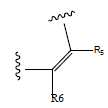

화학식 13 화학식 14 화학식 15 화학식 16 (13) (15)


- 
- R5 및 R6은 각각 서로 독립적으로 하기 그룹으로부터 선택되고: H, CN, F, 아릴, 헤테로아릴, C2-C20 알케닐, C2-C20 알키닐, 분지형 또는 선형, 사이클릭 또는 열린-사슬 C1-C20 알킬(여기서 C1-C20 알킬의 수소 원자는, 예를 들면, 할로겐에 의해 치환될 수 있음), 여기서 치환체 R13이 화학식 I의 화합물에 존재하는 경우, R5와 R13 또는 R6과 R13 사이에 폐환이 가능하며, 단 R5 및 R13 사이 또는 R6 및 R13 사이에서 각각의 경우에 화학식 11 또는 11*로부터의 이중 결합이 위치하는 것이 가능하며,R 5 and R 6 are each independently of one another selected from the following groups: H, CN, F, aryl, heteroaryl, C 2 -C 20 alkenyl, C 2 -C 20 alkynyl, branched or linear, C 1 -C 20 alkyl wherein the hydrogen atom of the C 1 -C 20 alkyl may be substituted, for example, by halogen, wherein the substituent R 13 is present in the compound of formula (I) , R 5 and R 13 or R 6 and R 13 , with the proviso that the double bond from the formula (11) or (11 *) in each case between R 5 and R 13 or between R 6 and R 13 is situated It is possible,
- W1 내지 W8은 각각 서로 독립적으로 N, CR로부터 선택되고, 여기서 R은 상기 기재된 바와 같이 정의되고,W 1 to W 8 are each independently selected from N, CR, wherein R is defined as described above,
- X17 내지 X27은 서로 독립적으로 C-R로부터 선택되고, 여기서 R은 상기 기재된 바와 같이 정의되고, 단 화학식 12, 13 및 14의 그룹에서, 각각의 경우에 그룹 X20/X21, X23/X24 및 X26/X27로부터의 한 그룹은 일반식 I의 화합물에서 다른 그룹에 대한 부착점 
- A는 S, O, NR"", Se이고- A is S, O, NR " ", Se
- Q는 S, O, NR"", Se이고Q is S, O, NR " ", Se
- 그룹 A 및 Q에 대해, 치환체 R""는 각각의 경우에 서로 독립적으로 H, CN, 분지형 또는 선형, 사이클릭 또는 열린-사슬 C1-C20 알킬(여기서 C1-C20 알킬의 H 원자는 치환될 수 있고, 특히 할로겐, 예를 들면, F로 치환될 수 있음); C2-C20 알케닐, O-알킬, S-알킬, O-알케닐, S-알케닐, 알키닐, 치환되거나 치환되지 않은 아릴, 치환되거나 치환되지 않은 헤테로아릴로부터 선택된다.- Group A and for Q, the substituent R "" is in each case the cyclic independently selected from H, CN, a branched or linear, with each other or in an open-chain C 1 -C 20 alkyl (wherein the C 1 -C 20 alkyl The H atom may be substituted and in particular may be substituted by halogen, for example F; C 2 -C 20 alkenyl, O- alkyl, S- alkyl, O- alkenyl, S- alkenyl, alkynyl, optionally substituted aryl, is selected from substituted or unsubstituted heteroaryl.
놀랍게도, 본 발명의 화합물의 경우에, 공여체 블록 Z의 일반적인 구조 요소에 의해, 적어도 하나의 그룹 M 및 하나의 그룹 N은, 그룹 M의 적어도 하나의 N 원자 및 그룹 N의 하나의 O 원자가 각각의 경우에 2개의 C 원자를 통해 서로 연결되도록 하는 방식으로 각각 연결되고, 이들 화합물은 유기 광활성 컴포넌트에서 효율을 상승시킬 수 있는 것인, 방사선, 특히 빛을 광범위하고 강하게 흡수한다는 것을 확인하였다. 더욱이, 이런 화합물은 또한 전하 캐리어 이동도를 향상시키며, 따라서 본 발명의 화합물을 포함하는, 트랜지스터와 같은 유기 전자 컴포넌트도 개선된 전기 값을 나타낼 수 있다.Surprisingly, in the case of the compounds of the present invention, by the general structural elements of the donor block Z, at least one group M and one group N are selected such that at least one N atom of group M and one O atom of group N are each In particular, it has been found that these compounds are broadly and strongly absorbed by radiation, in particular light, which are linked in such a way that they are connected to each other through two C atoms in the case, and that these compounds can increase the efficiency in organic photoactive components. Moreover, such compounds also improve charge carrier mobility, and thus organic electronic components such as transistors, including the compounds of the present invention, can also exhibit improved electrical values.
본 발명의 화합물은 특히 또한 전하 캐리어 수송 층, 예를 들면, p-전도 물질로서 사용될 수 있다. 흡수 스펙트럼 및 방출 스펙트럼은 더 낮은 UV로부터 출발하여 적외선 스펙트럼 범위까지 확장될 수 있다.The compounds of the present invention may also be used especially as charge carrier transporting layers, for example, as p-conducting materials. The absorption and emission spectra can be extended from the lower UV to the infrared spectral range.
상기-기재된 적어도 하나의 그룹 M은 하기 일반식 1 내지 3의, 적어도 하나의 N 원자를 갖는 피롤 구조 또는 융합된 피롤 스캐폴드로부터 선택된다:Said at least one group M is selected from the pyrrole structures or fused pyrrole scaffolds having at least one N atom of the following

이 그룹 M은 하기 일반식 3 내지 5의, 적어도 하나의 O 원자를 갖는 푸란 구조 또는 융합된 푸란 스캐폴드로부터 선택되는 적어도 하나의 그룹 N에 직접 연결된다:This group M is directly linked to at least one group N selected from furan structures having at least one O atom or fused furan scaffolds of the following

여기에서는, 중간 그룹 Z에서, 파라미터 c가 1 초과인 경우, M-N 및/또는 N-M 블록으로 구성된 일련의 복수의 이중 그룹, 예를 들면, *-M-N-M-N-M-N-*, *-M-N-N-M-M-N-* 또는 *-N-M-N-M-N-M-N-M-*이 또한 존재할 수 있다.Here, in the intermediate group Z, when the parameter c is greater than 1, a series of a plurality of binary groups consisting of MN and / or NM blocks, for example, * -MNMNMN- *, * -MNNMMN- * or * -NMNMNMNM - * may also exist.
본 발명의 화합물은, 이러한 구조적 특징 (*-M-N-*)c 또는 (*-N-M-*)c에 근거하여, 상기-기재된 구조 요소를 갖지 않는 본 발명이 아닌 화합물과 비교하여 바람직하게는 가시광선 스펙트럼 범위에서 높은 광학 밀도, 및 특히 흡수 스펙트럼에서의 광학 밀도에 대한 높은 적분을 갖는다. 여기서 "적분"은 유기 감광성 물질로서 물질의 적합성에 중요한 특징인, 흡수 스펙트럼에서의 곡선 아래 면적 함량을 의미한다.The compounds of the present invention can be preferably used in combination with compounds of the present invention which have no structural elements described above based on such structural characteristics (* -MN- *) c or (* -NM- *) c , High optical density in the ray spectrum range, and especially high optical density in the absorption spectrum. Herein, " integral " means the area content under the curve in the absorption spectrum, which is an important characteristic of the suitability of the material as an organic photosensitive material.
일반식 I의 본 발명의 화합물은, 항상 존재하는 전자 공여체 그룹 Z 이외에, 추가의 전자 공여체 그룹 T1, T2, T3 및 T4를 가질 수 있으며, 이는 Z를 통해 이미 존재하는 공액 π-전자 시스템을 추가로 확장시킨다. 전자 공여체 그룹은 말단 전자 수용체 그룹 EWG1 및 EWG2에 의해 측면에 배치된다.The compounds of the present invention of the general formula I may have additional electron donor groups T1, T2, T3 and T4 in addition to the always present electron donor group Z, which adds an already existing conjugated pi electron system through Z . The electron donor groups are flanked by terminal electron acceptor groups EWG1 and EWG2.
본 발명의 화합물은, 특히, 100 g/mol 내지 2000 g/mol의 몰 질량을 갖는 비중합성, 올리고머, 유기 분자를 의미하는, "소분자"로 불리는 것이며, 이는 특히 단분산될 수도 있다.The compounds of the present invention are particularly termed " small molecules ", meaning non-polymerizable, oligomeric, organic molecules having a molar mass of from 100 g / mol to 2000 g / mol, which may be particularly monodisperse.
전자-끄는 그룹 EWG1 및 EWG2는 바람직하게는 서로 독립적으로 하기로부터 선택될 수 있다:The electron-withdrawing groups EWG1 and EWG2 may preferably be selected independently of one another from the following:
화학식 7 화학식 8 화학식 9(7)
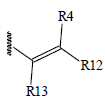


- 
- R4 및 R12는 각각 서로 독립적으로 H, CN, COOR로부터 선택되고, 단 R4 및 R12는 둘 모두 H일 수 없고,R 4 and R 12 are each independently selected from H, CN, COOR, with the proviso that R 4 and R 12 are not both H,
- R은 R1 내지 R3의 경우에 정의된 것과 동일한 그룹의 화합물로부터 선택되고,- R is selected from the same group of compounds as defined for R 1 to R 3 ,
- 각각의 R13은 서로 독립적으로 하기 그룹으로부터 선택되고: H, CN, F, 아릴, 헤테로아릴, C2-C20 알케닐, 알키닐, 분지형 또는 선형, 사이클릭 또는 열린-사슬 C1-C20 알킬(여기서 C1-C20 알킬의 수소 원자는 치환될 수 있음), 여기서 치환체 R5 또는 R6이 화학식 I의 화합물에 존재하는 경우, R5와 R13 또는 R6과 R13 사이에 폐환이 가능하며, 단 화학식 11 또는 화학식 11*로부터의 이중 결합이 각각의 경우에 R5 및 R13 사이 또는 R6 및 R13 사이에서 위치하며,- each R 13 is independently selected from the group to one another: H, CN, F, aryl, heteroaryl, C 2 -C 20 alkenyl, cyclic alkenyl, branched or linear, or open-chain C 1 -C 20 alkyl (where that may be substituted with hydrogen atoms of the C 1 -C 20 alkyl is a), wherein the substituents R 5 or R 6 in this case present in the compounds of formula I, R 5 and R 6 or R 13 and R 13 , With the proviso that the double bond from the formula (11) or (11) is located in each case between R 5 and R 13 or between R 6 and R 13 ,
- V는 O, S이고- V is O, S
- Y는 O, S, C(CN)2이고Y is O, S, C (CN) 2 ,
- U는 O, S, C(CN)2이고U is O, S, C (CN) 2 ,
- R7 및 R8은 각각 서로 독립적으로 그룹 H, CN, F, 아릴, 헤테로아릴, C2-C20 알케닐, 알키닐, 분지형 또는 선형, 사이클릭 또는 열린-사슬 C1-C20 알킬(여기서 C1-C20 알킬의 수소 원자는 치환될 수 있음)로부터 선택되고, 각각의 그룹 EWG1 및 EWG2에 대해, 각각 서로 독립적으로 각각의 경우에 각각의 C=C 이중 결합에 대해, E-이성질체 및 Z-이성질체 둘 모두 존재할 수 있다.- R 7 and R 8 are each independently selected from the group H, CN, F, aryl, heteroaryl, C 2 -C 20 alkenyl, alkynyl, branched or linear, cyclic or open each other-chain C 1 -C 20 Alkyl, wherein the hydrogen atom of the C 1 -C 20 alkyl may be substituted, and for each group EWG1 and EWG2, for each C = C double bond in each case independently of one another, E -Isomer and Z-isomer may both be present.
그러므로, 화학식 7, 8 및 9에서 각각의 C=C 이중 결합에 대해, E-이성질체("E" = 독어 엔트게겐(entgegen) = 반대; 즉 트랜스 배열) 및 Z 이성질체("Z" = 독어 추삼멘(zusammen) = 함께; 즉, 시스 배열) 둘 모두 존재할 수 있으며, 이들 이성질체는 C=C 이중 결합의 축에 대해 180°의 가상 회전에 의해 형성된다. 이는 화학식 8의 라디칼을 예로써 사용하여 아래에 설명될 것이다:Thus, for each C = C double bond in formulas 7, 8 and 9, the E-isomer ("E" = German entgegen = Both may exist, and these isomers are formed by a virtual rotation of 180 DEG about the axis of the C = C double bond. This will be illustrated below using the radical of formula (8) as an example: < RTI ID = 0.0 >

서로 분리되어 존재할 수 있는 두 이성질체는 C=C 이중 결합에 대한 가상 회전에 의해 서로 전환될 수 있으며(이중 결합 상에 화살표로 표시됨), 따라서 화학식 8의 그룹에 대해 다음 2개의 이성질체가 생성된다:The two isomers which may be present in isolation from each other can be mutually converted (indicated by arrows on the double bond) by virtue of a virtual rotation about the C = C double bond and thus the following two isomers are generated for the group of formula 8:
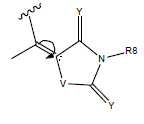

또한, 특히, EWG1은 EWG2와 동일할 수 있다.In particular, EWG1 can be the same as EWG2.
일반식 I의 본 발명의 화합물에서, 아릴 그룹 및 헤테로아릴 그룹은 바람직하게는 C5-C10 아릴 및 C5-C10 헤테로아릴 그룹일 수 있다. 치환체는 수소 이외의 모든 원자 및 원자의 그룹인 것으로 이해된다. 고려되는 치환체는, 특히, 할로겐, 예를 들면, 불소, 또는 C1-C5 알킬 그룹을 포함하며, 이는 차례로 치환될 수 있다. O-알킬, S-알킬, O-알케닐, S-알케닐 및 알키닐 그룹은 각각 C1-C20 그룹, 바람직하게는 C1-C5 그룹일 수 있다.In the compounds of the present invention of formula I, the aryl group and the heteroaryl group may preferably be C 5 -C 10 aryl and C 5 -C 10 heteroaryl groups. It is understood that a substituent is a group of atoms and atoms other than hydrogen. Substituents under consideration include, in particular, halogens, such as fluorine, or C 1 -C 5 alkyl groups, which may in turn be substituted. The O-alkyl, S-alkyl, O-alkenyl, S-alkenyl and alkynyl groups may each be a C 1 -C 20 group, preferably a C 1 -C 5 group.
본 발명의 화학식 I의 화합물의 사이클릭 또는 열린-사슬 C1-C20 알킬 그룹은 선형 또는 분지형일 수 있으며, 바람직하게는 C1-C5 알킬 그룹이다. 이러한 알킬 그룹에서 비인접하고 비말단 C 원자는 헤테로원자로 대체될 수 있다.The cyclic or open-chain C 1 -C 20 alkyl group of the compounds of formula (I) of the present invention may be linear or branched and is preferably a C 1 -C 5 alkyl group. Non-conjugated, non-terminal C atoms in such alkyl groups may be replaced by heteroatoms.
본 발명의 화학식 I의 화합물의 의미에서 "헤테로원자"는, 특히, O, S, Se 또는 NR""'를 의미하며, 치환체 R""'는 상기에서 이미 기재된 치환체 R1 내지 R3과 같이 정의된다."Hetero atom" in the sense of the compounds of formula I of the invention are, in particular, O, S, Se or NR ""'a meaning, and the substituents R''' are as already substituents R 1 to R 3 as described in the Is defined.

이러한 유기 물질은 인쇄, 접착, 코팅, 기상 증착 등에 의해 박막의 형태로 또는 소량으로 포일에 도포된다. 박층의 제조를 위해 고려된 방법은 또한 모두 유리, 세라믹 지지체 또는 반도체 지지체 상의 전자 장치에 또한 사용되는 것들이다.Such an organic material is applied to the foil in the form of a thin film or in a small amount by printing, adhesion, coating, vapor deposition or the like. The methods considered for the production of thin layers are also all those which are also used in electronic devices on glass, ceramic supports or semiconductor supports.
본 발명의 추가의 구현예에 따르면, 하기 일반식을 갖는 화학식 I c = 1의 화합물에서:According to a further embodiment of the invention there is provided a compound of formula I c = 1,
EWG1 -(T1)a-(T2)b-Z -(T3)d-(T4)e-EWG2. EWG1 - (T1) a - ( T2) b -Z - (T3) d - (T4) e -EWG2.
본 발명자들은, 하나의 공여체 블록 Z가 구조적으로 상이한 화합물에 비해 증가된 광학 밀도를 얻기에 충분하다는 것을 확인하였다.The present inventors have found that one donor block Z is sufficient to obtain increased optical density compared to structurally different compounds.
또한, 전자-끄는 그룹 EWG1 및 EWG2는 서로 독립적으로 하기 화학식 7의 그룹일 수 있다:Also, the electron-withdrawing groups EWG1 and EWG2 may be independently of one another a group of the formula (7)

이러한 종류의 전자-끄는 그룹 EWG1 및 EWG2는 기상 증착에 의해 기판에 특히 효과적으로 도포될 수 있는 화학식 I의 올리고머 화합물을 유도한다. 특히 바람직하게는, R4 및 R12는 CN이며, 따라서 특히 강한 전자-끄는 그룹 디시아노-비닐렌을 생성한다. 더욱이, 치환체 R13은 바람직하게는 H일 수 있다.This kind of electron-withdrawing groups EWG1 and EWG2 derive oligomeric compounds of formula I which can be applied particularly efficiently to substrates by vapor deposition. Particularly preferably, R < 4 > and R < 12 > are CN, thus producing a particularly strong electron-withdrawing group dicyano-vinylene. Furthermore, the substituent R < 13 > may preferably be H.
본 발명의 추가의 구현예에 따르면, 하기 일반식의 c = 1인 화학식 I의 화합물:According to a further embodiment of the invention there is provided a compound of formula I wherein c = 1 in the general formula:
EWG1 -(T1)a-(T2)b-Z-(T3)d-(T4)e-EWG2 EWG1 - (T1) a - ( T2) b -Z- (T3) d - (T4) e -EWG2
여기서 Z = *-M-N-* 또는 *-N-M-*는 화학식 1의 그룹 M을 갖는다:Wherein Z = * -M-N- * or * -N-M- * has the group M of formula (1)

추가로 융합된 방향족 π-전자 시스템을 갖지 않는 공여체 블록 M에 대한 이러한 단순한 피롤 구조 단위는 공여체 그룹 N을 또한 가질 때 본 발명의 화합물에 대한 방사선 흡수의 현저한 증가를 이미 초래한다. 그러나, 피롤, 예를 들면 인돌 또는 예를 들면, 일반식 2 또는 3에 포함되는 다른 화합물을 함유하는 공여체 블록 M으로서 융합된 환 시스템을 사용할 수도 있다.This simple pyrrole structural unit for the donor block M which does not further have a fused aromatic? -Electronic system already leads to a significant increase in the radiation absorption for the compounds of the present invention when the donor group N is also present. However, it is also possible to use a ring system fused as a donor block M containing a pyrrole, such as an indole or other compound included, for example, in the
용어 "치환된" 및 "치환체"는 본 발명의 의미에서 하나 이상의 H 원자가 임의의 다른 그룹의 원자 또는 또 다른 원자로 교체되었음을 의미하는 것으로 해석되어야 한다. 이러한 의미에서 "치환체"는 특히 할로겐 또는 슈도(pseudo) 할로겐, 예를 들면, 불소 또는 CN, 및 또한 아릴 그룹, 예를 들면, 페닐, 또는 알킬 그룹, 예를 들면, C1-C6 알킬 그룹일 수 있다.The terms " substituted " and " substituent " are to be construed to mean in the sense of the present invention that one or more H atoms have been replaced with any other group of atoms or atoms. In this sense, " substituent " is in particular a halogen or pseudo halogen, such as fluorine or CN, and also an aryl group such as phenyl or an alkyl group such as a C 1 -C 6 alkyl group Lt; / RTI >
이러한 일반식 I의 공여체 블록 M에서 일반 그룹 및 치환체는 아래와 같이 정의될 수 있다:The general groups and substituents in the donor block M of this general formula I can be defined as:
- X1 및 X2는 서로 독립적으로 C-R로부터 선택되고, 여기서 각각의 R은 서로 독립적으로 H, 할로겐, 분지형 또는 선형, 사이클릭 또는 열린-사슬 C1-C20 알킬로 구성된 그룹으로부터 선택된다.X 1 and X 2 are independently selected from CR, wherein each R is independently from each other selected from the group consisting of H, halogen, branched or linear, cyclic or open-chain C1-C20 alkyl.
구조적 단편 Z에서 추가의 공여체 블록 N은 하기 화학식 4의 일반 그룹일 수 있다:In structural fragment Z, the additional donor block N can be a general group of formula 4:
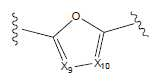
추가로 융합된 방향족 π-전자 시스템을 갖지 않는 공여체 블록 N에 대한 이러한 단순한 푸란 구조 단위는 공여체 그룹 M을 또한 가질 때 본 발명의 화합물에 대한 방사선 흡수의 현저한 증가를 이미 초래한다. 그러나, 예를 들면, 벤조푸란 또는 일반식 5 또는 6에 포함되는 다른 화합물과 같이 푸란을 받아들인 융합된 공여체 블록을 사용할 수도 있다.These simple furan structural units for the donor block N which do not further have a fused aromatic? -Electronic system already result in a significant increase in the radiation absorption for the compounds of the invention when they also have the donor group M. However, fused donor blocks that incorporate furans, such as, for example, benzofuran or other compounds included in
화학식 4에서 일반 그룹 X9 및 X10은 바람직하게는, 서로 독립적으로, C-R로부터 선택될 수 있으며, 여기서 각각의 R은 서로 독립적으로 H, 할로겐, 분지형 또는 선형, 사이클릭 또는 열린-사슬 C1-C20 알킬로 구성된 그룹으로부터 선택된다.The general groups X 9 and X 10 in formula (IV) are preferably independently of one another selected from CR, wherein each R is independently H, halogen, branched or linear, cyclic or open-chain C Lt; RTI ID = 0.0 > 1- C20 < / RTI >
본 발명의 화학식 I의 화합물의 공여체 영역의 공액 π-전자 시스템은 적어도 하나의 추가 공여체 블록 T1, T2, T3 또는 T4의 혼입에 의해 그리고 상응하게 화학식 I에서 이러한 공여체 블록과 관련된 파라미터 a, b, d 또는 e를 연속적으로 1로 설정함으로써 공여체 블록 Z를 넘어서 확장될 수 있다.The conjugated? -Electronic system of the donor region of the compounds of formula (I) of the present invention is characterized by the incorporation of at least one additional donor block T1, T2, T3 or T4 and correspondingly to the parameters a, b, can be extended beyond the donor block Z by setting d or e to 1 consecutively.
특히, a는 1일 수 있고, 이 경우에 그룹 T1은 바람직하게는 화학식 10 및/또는 화학식 11의 그룹으로부터 선택될 수 있다:In particular, a may be 1, in which case the group T1 may preferably be selected from the group of formula (10) and / or formula (11)
화학식 10 화학식 1110 Formula 11


화학식 10에 대해서는, 특히 하기가 적용될 수 있다: A = S 또는 O.For formula (10), in particular the following applies: A = S or O.
또한, 화학식 10에서, X17 및 X18은 C-R일 수 있으며, 여기서 R은 각각의 경우에 독립적으로 H, 할로겐, 분지형 또는 선형, 사이클릭 또는 열린-사슬 C1-C20 알킬로 구성된 그룹으로부터 선택되며; R5 및 R6은 각각 서로 독립적으로 H, CN, F, 아릴, 헤테로아릴, C2-C20 알케닐, 알키닐, 분지형 또는 선형, 사이클릭 또는 열린-사슬 C1-C20 알킬(여기서 C1-C20 알킬의 수소 원자는 치환될 수 있음)로 구성된 그룹으로부터 선택되고, 여기서 치환체 R5 및 R6이 화합물에 존재하는 경우, R5와 R13 사이 및 R6과 R13 사이에 폐환이 가능하며, 단 화학식 11 또는 화학식 11*로부터의 이중 결합은 R5 및 R13 사이 또는 R6 및 R13 사이에 위치한다.In addition, in
공여체 블록 T2가 존재하는 경우, b는 1이고, T2는 바람직하게는 화학식 10의 일반 그룹이다:When donor block T2 is present, b is 1 and T2 is preferably a general group of formula 10:

화학식 10에서, 바람직하게는 A는 S 또는 O이다. 더욱이, 화학식 10에서, X17 및 X18은 C-R일 수 있으며, 여기서 R은 각각의 경우에 독립적으로 H, 할로겐, 분지형 또는 선형, 사이클릭 또는 열린-사슬 C1-C20 알킬로 구성된 그룹으로부터 선택된다.In formula (10), preferably A is S or O. Furthermore, in formula (10), X 17 and X 18 may be CR, wherein R is in each case independently selected from the group consisting of H, halogen, branched or linear, cyclic or open-chain C 1 -C 20 alkyl .
공여체 블록 T3이 존재할 때, d는 1이고, 그룹 T3은 바람직하게는 화학식 10 또는 화학식 11의 그룹으로부터 선택된다:When donor block T3 is present, d is 1 and group T3 is preferably selected from the group of


여기서 화학식 10에 대해서는 다음과 같은 경우가 있을 수 있다: A = S 또는 O.Here, for formula (10), there may be the following case: A = S or O.
화학식 10에서, 특히, X17 및 X18은 C-R일 수 있으며, 여기서 R은 각각의 경우에 독립적으로 H, 할로겐, 분지형 또는 선형, 사이클릭 또는 열린-사슬 C1-C20 알킬로 구성된 그룹으로부터 선택되며, R5 및 R6은 각각 서로 독립적으로 H, CN, F, 아릴, 헤테로아릴, C2-C20 알케닐, 알키닐, 분지형 또는 선형, 사이클릭 또는 열린-사슬 C1-C20 알킬(여기서 C1-C20 알킬의 수소 원자는 치환될 수 있음)로 구성된 그룹으로부터 선택되고, 여기서 치환체 R5 및 R6이 화합물에 존재하는 경우, R5와 R13 또는 R6과 R13 사이에 폐환이 가능하며, 단 화학식 11 또는 화학식 11*로부터의 이중 결합은 R5 및 R13 사이 또는 R6 및 R13 사이에 위치한다.In formula (10), in particular, X 17 and X 18 can be CR, wherein R is in each case independently selected from the group consisting of H, halogen, branched or linear, cyclic or open-chain C 1 -C 20 alkyl is selected from, R 5 and R 6 are each independently of each other H, CN, F, aryl, heteroaryl, C 2 -C 20 alkenyl, alkynyl, cyclic minutes branched or linear, or open-chain C 1 - C 20 alkyl, if is selected from the consisting of (where C 1 -C 20 alkyl hydrogen atoms may be substituted) group, where the substituents R 5 and R 6 are present in the compounds, R 5 and R 13, or R 6 and R 13 , provided that the double bond from formula 11 or formula 11 * is located between R 5 and R 13 or between R 6 and R 13 .
T3과 유사하게, e = 1인 T4는 또한 바람직하게는 화학식 10 또는 화학식 11의 그룹으로부터 선택될 수 있으며, 이 경우에 이러한 화학식에 대한 일반 그룹 및 치환체는 바람직하게는 T3과 정확히 동일한 것으로 선택된다.Similar to T3, T4 with e = 1 may also be preferably selected from the group of
본 발명자들은, 특히 푸란 또는 티오펜 잔기일 수 있는 추가의 헤테로사이클릭 그룹, 및 또한 바람직하게는 전자-끄는 그룹 EWG1 및/또는 EWG2 중 적어도 하나에 인접하게 위치하지만, 또한 헤테로사이클릭 그룹 및 중심 공여체 블록 Z 사이에도 위치할 수 있는 이중 결합의 존재를 통해, 이미 언급된 유리한 특성을 갖는 본 발명의 추가의 분자를 제조할 수 있음을 확인하였다.The present inventors have found that a further heterocyclic group, which may in particular be a furan or thiophene residue, and also preferably is located adjacent to at least one of the electron-withdrawing groups EWG1 and / or EWG2, but also a heterocyclic group and a center Through the presence of a double bond that can also be located between the donor block Z, it is possible to produce additional molecules of the invention with the advantageous properties already mentioned.
또한, 이중 결합(화학식 11 또는 화학식 11*)은 또한 두 전자-끄는 그룹 EWG1 및 EWG2 모두에 인접하게 존재할 수 있다.In addition, the double bond (Formula 11 or Formula 11 *) may also be present adjacent to both the electron-withdrawing groups EWG1 and EWG2.
화학식 11 또는 화학식 11*의 그룹 R5와 전자-끄는 그룹 EWG1 및/또는 EWG2의 화학식 7의 그룹 R13 사이, 또는 화학식 11 또는 화학식 11*의 그룹 R6과 화학식 7의 R13 사이에 폐환이 또한 가능하며, 단 화학식 11로부터의 이중 결합은 R5 및 R13 사이 또는 R6 및 R13 사이에 위치하며, 폐환은 특히 선택적으로 치환된 사이클로펜테닐 환 또는 선택적으로 치환된 사이클로헥세닐 환의 형태로 존재한다(예를 들면, 표 1의 본 발명의 화합물 1 및 2 참조).The ring-closure between the attracting group EWG1 and / or EWG2 formula 7 group R 13, or between the formula 11, or a group R 6 and R 13 of formula (VII) of formula (11) - of the-general formula (11) or formula (11) or groups R 5 and E of With the proviso that the double bond from formula 11 is located between R 5 and R 13 or between R 6 and R 13 and the ring is especially an optionally substituted cyclopentenyl ring or an optionally substituted cyclohexenyl ring form (See, for example, compounds 1 and 2 of the present invention in Table 1).
본 발명의 추가의 구현예에서, 본 발명의 화합물은 그룹 Z 및 T1 내지 T4에 대한 특히 바람직한 공여체 블록을 가지며, 따라서 일반 구조식 II를 초래한다:In a further embodiment of the invention, the compounds of the invention have particularly preferred donor blocks for groups Z and T1 to T4, thus leading to the general structure II:
[화학식 II]≪ RTI ID = 0.0 &

여기서 치환체 및 일반 그룹은 이미 기재된 방식으로 정의될 수 있다. 가장 일반적인 형태로 치환체 및 일반 그룹에 대한 유효한 정의는 화학식 I의 화합물에 대해 정의된 것들이지만, 여기서는 화학식 II에 대한 하기 정의가 바람직하다:Wherein the substituents and the general groups can be defined in a manner already described. In the most general form, the effective definitions for substituents and general groups are those defined for compounds of formula (I), wherein the following definitions for formula (II) are preferred:
- A는 O 또는 S이고,A is O or S,
- 서로 독립적으로 X17, X18, X1, X2, X9 및 X10은 C-R이며, 여기서 R은 각각의 경우에 독립적으로 H, 할로겐, 분지형 또는 선형, 사이클릭 또는 열린-사슬 C1-C20 알킬로 구성된 그룹으로부터 선택되며, R5 및 R6은 각각 서로 독립적으로 H, CN, F, 아릴, 헤테로아릴, C2-C20 알케닐, 알키닐, 분지형 또는 선형, 사이클릭 또는 열린-사슬 C1-C20 알킬(여기서 C1-C20 알킬의 수소 원자는 치환될 수 있음)로 구성된 그룹으로부터 선택되고, 여기서 치환체 R5 및 R6이 존재하는 경우, R5와 R13 또는 R6과 R13 사이에 폐환을 형성할 수 있다.Independently of one another, X 17 , X 18 , X 1 , X 2 , X 9 and X 10 are CR, where R is in each case independently H, halogen, branched or linear, cyclic or open-chain C C 1 -C 20 alkyl, R 5 and R 6 are each independently of one another H, CN, F, aryl, heteroaryl, C 2 -C 20 alkenyl, alkynyl, branched or linear, click or open-chain C 1 -C 20 alkyl, if selected from the group consisting of (where the hydrogen atoms of the C 1 -C 20 alkyl may be substituted) and where the substituents R 5 and R 6 present, R 5 and R 13 or a ring-closed ring between R 6 and R 13 .
- 파라미터 a, b, d 또는 e 중 적어도 하나가 1이고, 이들 파라미터 모두가 1일 수도 있고; 바람직하게는 파라미터 중 적어도 하나가 0, 예를 들면, T4이고, 동시에 다른 모든 파라미터가 1이고,- at least one of the parameters a, b, d or e is 1, all of these parameters may be 1; Preferably at least one of the parameters is 0, for example T4, while all other parameters are 1,
- R4 및 R12는 각각 서로 독립적으로 H 및 CN으로부터 선택되고, 단 R4 및 R12는 둘 모두 H일 수 없다.R 4 and R 12 are each independently selected from H and CN, with the proviso that R 4 and R 12 are not both H.
본 발명의 추가의 측면에서, 상기 기재된 본 발명의 화합물 모두는 유기 전자 컴포넌트에서 사용될 수 있다.In a further aspect of the invention, all of the compounds of the present invention described above can be used in organic electronic components.
본 발명의 화합물의 특히 강한 흡수 관점에서, 엑시톤은 이러한 화합물을 포함하는 층에서 특히 양호한 효과를 위해 형성되며, 따라서 이러한 화합물을 포함하는 유기 광활성 컴포넌트에서 더 높은 충전율 FF, 개선된 개회로 전압 Voc, 및 개선된 단락 전류 밀도 Jsc를 야기한다. 다른 유기 전자 디바이스의 경우, 본 발명의 화합물의 상승된 전하 캐리어 수송 특성을 고려하면 더 양호한 전자 값이 또한 기대된다.In view of the particularly strong absorption of the compounds of the present invention, excitons are formed for a particularly good effect in the layer comprising such compounds, and thus the higher charge FF, the improved open circuit voltage V oc , And an improved short-circuit current density J sc . In the case of other organic electronic devices, better electron values are also expected in view of the increased charge carrier transport properties of the compounds of the present invention.
용어 "유기 전자 컴포넌트"는 유기 전도 또는 반도체 물질을 사용하여 생성될 수 있는 모든 전자 컴포넌트, 예를 들면 트랜지스터, 예를 들면 유기 전계-효과 트랜지스터, 유기 발광 컴포넌트, 조사에 의해 엑시톤(전자-정공 쌍)이 광활성 층에 형성될 수 있는 유기 광활성 디바이스, 예를 들면 광검출기, 예를 들면, 유기 태양전지를 나타낸다.The term " organic electronic component " is intended to encompass all electronic components, such as transistors, e.g., organic field effect transistors, organic light emitting components, Refers to an organic photoactive device, such as a photodetector, for example, an organic solar cell, which can be formed in the photoactive layer.
이러한 유기 전자 컴포넌트는 일반적으로 전극 및 상대 전극을 가지며, 이들 사이에 유기 기능 층이 배열된다. 이 유기 기능 층은 정공 수송(p-전도성) 또는 전자 수송(n-전도성)과 같은 전하 캐리어 수송 기능과 같이, 유기 컴포넌트의 전자적 작동에 중요한 기능을 발휘할 수 있다. 또한, 유기 기능 층은 또한, 정공(양전하) 및 전극(음전하)의 재결합을 통해, 전극 및 상대 전극에 전압이 인가될 때, 방사선, 예를 들면 빛을 방출하는 발광 층을 포함할 수 있다. 유기 기능 층은 또한 방사선, 예를 들면 빛, 또는 UV 방사선 또는 IR 방사선의 형태로 조사될 때 엑시톤(전자-정공 쌍)이 형성되는 광활성 층일 수 있다. 유기 광활성 층에서는, 특히, 평면 p-전도 층이 평면 n-전도 층에 인접하고, p-전도 층 또는 n-전도 층에서 조사에 의해 형성된 엑시톤이 두 층 사이의 계면에서 정공 및 전자로 분리될 수 있는, 소위 평면 헤테로 접합(planar heterojunction)이 형성될 수 있다. 또한, 광활성 층은 p-전도 물질 및 n-전도 물질이 상호 침투 네트워크의 형태로 서로 전이하고, 다시 조사에 의해 형성된 엑시톤의 분리가 p-전도 물질 및 n-전도 물질 사이의 계면에서 발생하는, 소위 벌크 헤테로 접합(bulk heterojunction)을 또한 포함할 수 있다.These organic electronic components generally have an electrode and a counter electrode, and an organic functional layer is arranged therebetween. The organic functional layer can perform an important function for the electronic operation of the organic component, such as the charge carrier transport function such as hole transport (p-conductivity) or electron transport (n-conductivity). The organic functional layer may further include a light emitting layer that emits radiation, for example, light when a voltage is applied to the electrode and the counter electrode through recombination of holes (positive charge) and an electrode (negative charge). The organic functional layer may also be a photoactive layer in which excitons (electron-hole pairs) are formed when irradiated in the form of radiation, e.g. light, or UV radiation or IR radiation. In the organic photoactive layer, in particular, the planar p-conductive layer is adjacent to the planar n-conductive layer and the exciton formed by irradiation in the p-conductive layer or n- conductive layer is separated into holes and electrons at the interface between the two layers A so-called planar heterojunction can be formed. Further, the photoactive layer is a layer in which the p-conductive material and the n-conductive material are mutually transferred in the form of an interpenetrating network, and the separation of the exciton formed by irradiation again occurs at the interface between the p- So-called bulk heterojunctions.
엑시톤은 전기적 중성 여기 상태, 전자-정공 쌍이며, 이는 이후 p-n 접합에서 추가 단계로 전자와 정공으로 분리된다. 이에 따라 분리는 전류 흐름에 기여하는 자유 전하 캐리어로 발생한다. 여기서 제한 요인은 반도체의 밴드갭(bandgap)의 크기이며; 이에 따라, 흡수될 수 있는 유일한 광자는 이의 밴드갭보다 더 큰 에너지를 갖는 것들이다. 빛은 항상 자유 전하 캐리어가 아닌, 엑시톤만을 생성하므로 낮은-재결합 확산은 광전류의 수준을 위한 중요한 구성 요소이다. 여기서 엑시톤 확산 거리는 가능한 한 많은 부분의 빛이 전기적으로 이용될 수 있도록 빛의 전형적인 침투 깊이를 초과해야 한다.An exciton is an electrically neutral excited state, an electron-hole pair, which is then separated into electrons and holes by a further step in the p-n junction. The separation thus occurs as a free charge carrier that contributes to current flow. Where the limiting factor is the size of the bandgap of the semiconductor; Thus, the only photons that can be absorbed are those with greater energy than their band gaps. Low-recombination diffusion is an important component for the level of photocurrent, since light always produces only excitons, not free charge carriers. Where the exciton diffusion distance must exceed the typical penetration depth of light so that as much light as possible is available electronically.
일반적인 유기 태양전지에 대한 문헌에서 이미 공지된 구성은 핀(pin) 또는 닙(nip) 다이오드로 구성되며[Martin Pfeiffer, "Controlled doping of organic vacuum deposited dye layers: basics and applications", PhD thesis TU Dresden, 1999 and WO2011/161108A1]: 핀 태양전지는 통상적으로 투명한 기저 접촉부, p-층(들), i-층(들), n-층(들), 및 상부 접촉부가 뒤따르는 캐리어/기판으로 구성된다. 닙 태양전지는 통상적으로 투명한 기저 접촉부, n-층(들), i-층(들), p-층(들), 및 상부 접촉부가 뒤따르는 캐리어/기판으로 구성된다.Known arrangements in the literature for general organic solar cells consist of a pin or nip diode (Martin Pfeiffer, " Controlled doping of organic vacuum deposited dye layers: basics and applications ", PhD thesis TU Dresden, 1999 and WO2011 / 161108A1: A pin solar cell typically consists of a carrier / substrate followed by a transparent base contact, p-layer (s), i-layer (s), n- layer . A nip solar cell typically consists of a carrier / substrate with a transparent base contact, n- layer (s), i-layer (s), p-layer (s), and top contact.
여기서, n 및 p 도핑은, 각각, 열평형 상태에서 각각 자유 전자 및 정공의 밀도를 증가시키는 도핑을 의미한다. 그러므로 이러한 층은 주로 수송 층으로 이해된다. 또한, n-층(들) 또는 p-층(들)은 적어도 부분적으로 명목상 도핑되지 않으며, 바람직하게는 오직 물리적 특성(예를 들면, 상이한 이동도)에 기초하여 또는 상이한 불순물(예를 들면, 합성 또는 층 생성으로부터의 잔류물)에 기초하여 또는 환경적 영향(예를 들면 경계 층, 금속 또는 다른 유기 물질의 내부 확산, 주변 대기로부터의 가스 도핑)의 결과로서 n-전도 특성 또는 p-전도 특성을 가질 수 있다. 이런 의미에서, 이러한 층은 바람직하게는 수송 층으로 이해되어야 한다.Here, n and p doping mean doping, respectively, which increases the density of free electrons and holes in a thermal equilibrium state. This layer is therefore understood primarily as a transport layer. Also, the n-layer (s) or p-layer (s) are at least partially not nominally doped, and preferably are based only on physical properties (e.g., different mobility) or different impurities Conductivity or p-conduction as a result of environmental effects (e.g., boundary layer, internal diffusion of metals or other organic materials, gas doping from the ambient atmosphere) . ≪ / RTI > In this sense, this layer should preferably be understood as a transport layer.
엑시톤은 확산에 의해 전자 및 정공이 서로 분리되는 이러한 종류의 계면으로 넘어간다. 전자를 받아들이는 물질을 수용체라고 하며, 정공을 받아들이는 물질을 공여체라고 한다.The excitons migrate to this kind of interface where electrons and holes are separated from each other by diffusion. A substance that accepts electrons is called a receptor, and a substance that accepts holes is called a donor.
명칭 "i 층"은 도핑되지 않은 층 또는 진성층을 표시한다. 여기서 하나 이상의 i-층은 하나의 물질로 구성되거나(평면 헤테로 접합), 상호 침투 네트워크를 갖는 벌크 헤테로 접합이라 하는, 2개 이상의 물질의 혼합물로 구성될 수 있다.The designation " i-layer " indicates an undoped layer or an intrinsic layer. Wherein one or more i-layers may consist of one material (planar heterojunction) or a mixture of two or more materials, called bulk heterojunction with interpenetrating network.
유기 핀 탠덤 셀(organic pin tandem cell) 및 핀 다중 셀(pin multiple cell)이 또한 문헌에 공지되어 있다(DE 10 2004 014 046). WO 2011 161 108 A1에서는 이와 관련하여 전극 및 상대 전극을 갖는 광활성 컴포넌트의 형태로 구현하기 위한 제안이 개시되어 있으며, 전극 사이에 배열되고, 또한 적어도 2개의 광활성 층 시스템, 및 광활성 층 시스템 사이에, 동일한 전하 캐리어 유형의 적어도 2개의 상이한 수송 층 시스템을 갖는 적어도 하나의 유기 층 시스템이 존재하며, 수송 층 시스템이 2개의 광활성 층 시스템 중 하나에 에너지적으로 적용되고, 다른 수송 층 시스템은 투명하게 실행된다는 것을 특징으로 한다.Organic pin tandem cells and pin multiple cells are also known in the literature (
유기 전자 컴포넌트는 또한 추가의 금속 산화물 층을 포함할 수 있다.The organic electronic component may also include additional metal oxide layers.
본 발명의 측면은 도면 및 예시적인 구현예를 사용하여 하기 추가로 더 상세하게 설명된다. 도면에서Aspects of the present invention are described in further detail below using the figures and exemplary implementations. In the drawing
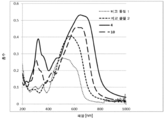
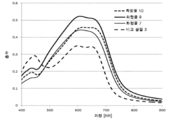
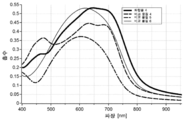
도 1 내지 도 3은 청구되지 않은 화합물과 비교한 본 발명의 화합물의 흡수 스펙트럼을 도시하고;Figures 1 to 3 show the absorption spectra of the compounds of the present invention in comparison to the compounds not claimed;
도 4 내지 도 6은 본 발명의 화합물을 포함하는 유기 광활성 컴포넌트(태양전지)의 전류-전압 곡선을 도시하고;Figures 4 to 6 show the current-voltage curves of an organic photoactive component (solar cell) comprising a compound of the invention;
도 7은 예시적인 유기 광활성 컴포넌트를 단면으로 도시하고;Figure 7 shows an exemplary organic photoactive component in cross-section;
도 8은 본 발명의 화합물의 합성의 개요를 도시한다.Figure 8 shows an overview of the synthesis of the compounds of the present invention.
표 1은, 개략적으로, 일반식 I 및 II 모두에 포함되는 본 발명의 화합물의 예시적인 구현예의 구조, 융점, 및 최대 흡수(용매(SV)에서의 nm 및 eV)를 나타낸다. 이러한 화합물의 합성은 아래에서 이후 추가로 상세하게 설명된다.Table 1 schematically shows the structure, melting point, and maximum absorption (nm and eV in solvent (SV)) of an exemplary embodiment of the compounds of the present invention included in both Formulas I and II. The synthesis of these compounds is described in further detail below.
표 1:Table 1:


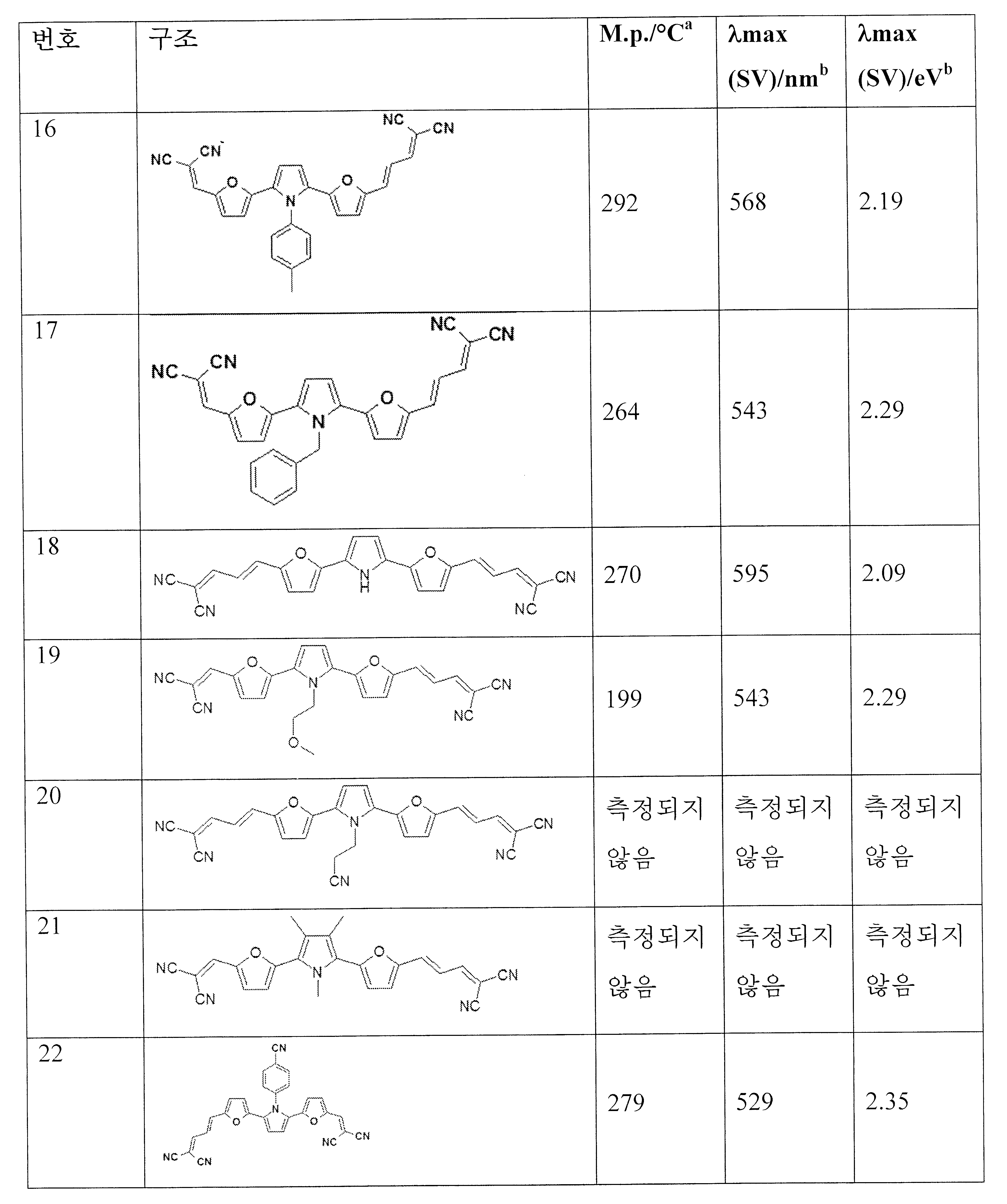
a 개시 DSC(시차 주사 열량측정법; 용융 범위의 시작; 외삽된 초기 온도(변곡 접선과 기준선의 교차점) a start DSC (differential scanning calorimetry; start of melting range; extrapolated initial temperature (intersection of the tangent line and the baseline)
b 달리 언급되지 않는 한 디클로로메탄 중에서 b < / RTI >< RTI ID = 0.0 >
놀랍게도 본 발명의 화합물은 특히 강한 흡수(즉, 본원에 청구된 범위 밖의 유사한 화합물과 비교하여 가시광선 스펙트럼 범위 내 최대 흡수에서의 높은 광학 밀도 또는 광학 밀도에 대한 높은 적분)를 나타낸다는 것이 밝혀졌다.Surprisingly, it has been found that the compounds of the present invention exhibit particularly strong absorption (i. E. High optical density at maximum absorption in the visible light spectrum or high integration for optical density as compared to similar compounds outside the scope claimed herein).
이러한 맥락에서, 도 1은 2개의 본 발명이 아닌 화합물: 비교 물질 1 및 비교 물질 2와 비교하여 표 1의 본 발명의 화합물 4 및 10에 대해, 두께가 30 nm인 진공-침착된 필름에 대한 흡수 스펙트럼(nm의 파장에 대한 광학 밀도)의 비교를 나타낸다.In this context, Figure 1 shows that for
2개의 비교 물질의 합성에 관한 구조 및 과학 출판물은 다음과 같다:The structure and scientific publications on the synthesis of two comparative substances are as follows:
비교 물질 1:Comparative material 1 :
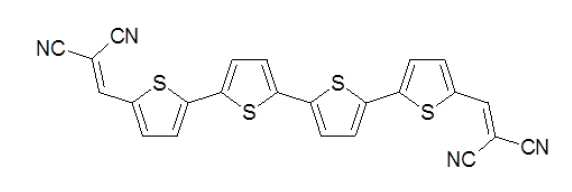
(Fitzner et al., Adv. Funct. Mat. 2011, 21, 897-910)(Fitzner et al., Adv. Funct. Mat. 2011, 21, 897-910)
비교 물질 2:Comparative substance 2 :
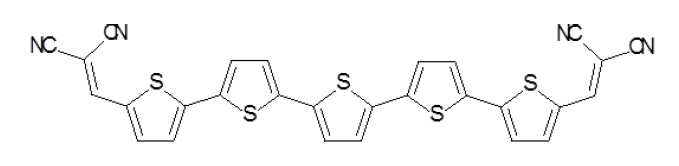
(Fitzner et al., Adv. Funct. Mat. 2011, 21, 897-910).(Fitzner et al., Adv. Funct., Mat., 2011, 21, 897-910).
도 1의 흡수 스펙트럼으로부터 본 발명의 화합물은 비교 화합물보다 실질적으로 더 크게 방사선을 흡수하므로 가시광선 스펙트럼 영역에서의 광학 밀도에 대해 더 높은 광학 적분을 갖는다는 것을 알 수 있다.It can be seen from the absorption spectrum of Figure 1 that the compounds of the present invention absorb radiation substantially more than the comparative compounds and therefore have a higher optical integration for optical density in the visible light spectrum region.
피롤 단위 바로 옆에 푸란 단위를 포함하는 공여체 블록과 상호 작용하는 EWG1 및 EWG2 그룹을 포함하는 본 발명의 화합물의 유리한 시너지 효과는 또한, 표 1의 본 발명의 화합물 7, 9 및 10의, 피롤 대신 EDOT 그룹을 함유하는 하기 구조를 갖는 비교 화합물 3과의 다음의, 매우 직접적인 비교로부터 명백해진다:The beneficial synergistic effect of the compounds of the present invention, including EWG1 and EWG2 groups, which interact with donor blocks comprising furan units immediately adjacent to the pyrrole unit, can also be achieved by using

하기 표 2는 이러한 일련의 물질의 다양한 파라미터를 직접적인 비교로 보여준다. 광전지 파라미터 Voc, Jsc 및 FF는 각각의 경우에 AM1.5 조명(Am = 공기 질량(Air Mass); 이 스펙트럼에 대한 AM = 1.5는 전체 복사선속(radiant power) 1000 W/m²에 해당함; 태양광 모듈의 측정을 위한 표준값으로서 AM = 1.5) 하에 측정된, ITO / C60 (15 nm) / 각각의 화합물:C60 (30 nm) / BPAPF (10 nm) / BPAPF:NDP9 (30 nm) / NDP9 (1 nm) / Au (50 nm)의 구성을 갖는, 유리 상에 광활성 층으로서 이들 화합물의 각각의 공여체 물질 및 풀러렌 C60의 30 nm 두께의 혼합 층을 갖는 태양전지에 관한 것이다. 여기서 ITO는 애노드의 역할을 하며, 인접한 풀러렌 C60은 전자 수송 층 ETL의 역할을 하며, 뒤이어 전자 수용체 물질로서 C60과 정공 수용체 물질(공여체 물질)로서 각각의 화합물 사이의 벌크 헤테로 접합으로서의 광활성 층, 이어서 정공 수송 층 HTL로서 BPAPF(9,9-비스[4-(N,N-비스-바이페닐-4-일-아미노)페닐]-9H-플루오렌) 및 NDP9로 도핑된 BPAPF(노발레드 아게(Novaled AG)), 이어서 Au 캐소드로 이어진다.Table 2 below shows a direct comparison of the various parameters of this series of materials. The photovoltaic parameters V oc , J sc and FF are in each case AM1.5 illumination (Am = air mass; AM = 1.5 for this spectrum corresponds to a total radiant power of 1000 W / m²; C60 (15 nm) / each compound: C60 (30 nm) / BPAPF (10 nm) / BPAPF: NDP9 (30 nm) / NDP9 (1 nm) / Au (50 nm) with a 30 nm thick mixed layer of fullerene C60 and fullerene of each of these compounds as a photoactive layer on glass. ITO serves as the anode, adjacent fullerene C60 serves as the electron transport layer ETL, followed by a photoactive layer as a bulk heterojunction between C60 as the electron acceptor material and the respective compound as the hole acceptor material (donor material) BPAPF (9,9-bis [4- (N, N-bis-biphenyl-4-yl-amino) phenyl] -9H- fluorene) and BPAPF doped with NDP9 Novaled AG), followed by an Au cathode.
도 2의 스펙트럼 데이터는 본 발명의 화합물 7, 9 및 10과 비교한 비교 물질 3의 흡수 스펙트럼을 나타낸다. 데이터는 진공 증착에 의해 용융 실리카에 도포된 30 nm 두께의 층에 관한 것이며, 본 발명의 화합물이 유사한 구조를 갖는 본 발명이 아닌 화합물보다 가시광선 스펙트럼 범위에서의 광학 밀도에 대해 더 높은 광학 적분을 갖는다는 것을 보여준다.The spectral data of FIG. 2 shows the absorption spectra of Comparative Example 3 compared to
표 2는 최대 흡수에서의 광학 밀도(ODmax), 가시광선 범위에서의 광학 적분(OD-적분), 및 또한 Voc, Jsc, FF, 및 효율을 나타낸다:Table 2 shows optical density (ODmax) at maximum absorption, optical integration (OD-integral) at visible light range, and also V oc , J sc , FF, and efficiency:

치환체와 관계 없이, 화합물 10은, 피롤 및 EDOT의 공여체 강도가 매우 유사하더라도, 더 높은 최대 흡수를 나타낼 뿐만 아니라 가시광선 범위에서 현저히 더 높은 적분 흡수를 나타낸다. 비교 물질 3과 비교하여 본 발명의 물질(화합물 9 및 화합물 10)의 우수한 특성은 충전율(화합물 9 및 화합물 10의 경우 70% 내지 73% 대 각각의 경우에 두께가 30 nm인 광활성 층을 갖는 비교 물질 3의 경우 59%) 및 광전류 Jsc(화합물 9 및 화합물 10의 경우 13.2 mA/cm² 내지 14.9 mA/cm² 대 비교 화합물 3의 경우 11.5 mA/cm2)의 광전지 파라미터에서도 동일한 태양전지 구성으로 또한 명백하다. 현저히 증가된 FF는, 화합물 9 및 화합물 10이 개선된 흡수 특성을 가질 뿐만 아니라 우수한 전하 캐리어 수송 특성을 갖는다는 것을 시사한다. 본 발명에 따라서 청구된 물질 부류의 예외적인 수송 특성의 인상적인 증거는, 화합물 10이 비교 물질 1보다 하나 더 적은 이중 결합을 포함하고, 비교 물질 2보다 3개 더 적은 이중 결합을 포함하는 매우 짧은 올리고머라는 사실에도 불구하고, 화합물 10에 대해 발견된 73%의 매우 높은 충전율이다.Regardless of the substituent,
본 발명의 화합물 7조차도, 최적화된 화합물 9 및 화합물 10(피롤의 양쪽에 푸란을 가짐)에 비해 티오펜 및 피롤 사이의 바로 근처에서의 입체 장애로 인해 현저한 강하를 겪게 됨에도 불구하고, 여전히 비교 화합물 3에 비해 유리한 경향이 있다.Even compound 7 of the present invention, despite experiencing a significant drop due to steric hindrance in the immediate vicinity between thiophene and pyrrole compared to optimized compound 9 and compound 10 (with furans on both sides of the pyrrole) 3. ≪ / RTI >
유사한 방식으로, 본 발명의 물질의 이점은, 각각 표 1의 본 발명의 화합물 4와 특정 구조적 요소를 공통적으로 갖는 추가로 일련의 직접적으로 비교 가능한, 이 경우에 거울-대칭 물질에서 명백해진다:In a similar manner, the advantages of the materials of the present invention are evident in a further series of directly comparable, in this case mirror-symmetrical, materials having in common with the
비교 물질 4:Comparative material 4 :

비교 물질 5:Comparative substance 5 :
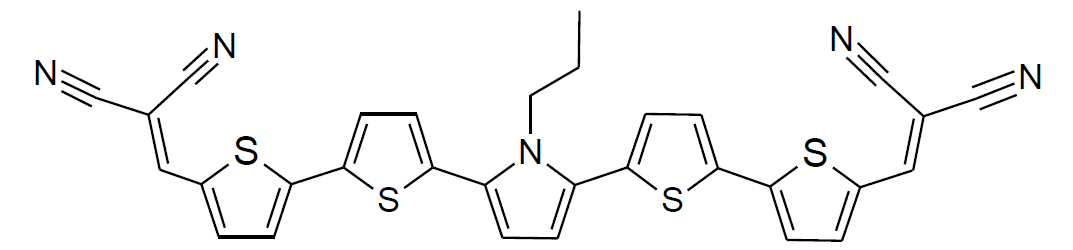
비교 물질 6:Comparative substance 6 :

물질의 흡수 스펙트럼은 도 3에 도시되어 있다. 스펙트럼 데이터는 진공 증착에 의해 용융 실리카에 도포된 30 nm 두께의 층에 관한 것이다.The absorption spectrum of the material is shown in Fig. The spectral data relates to a 30 nm thick layer applied to fused silica by vacuum deposition.
하기 표 3은 이러한 일련의 물질의 다양한 파라미터를 직접적인 비교로 보여준다. 광전지 파라미터 Voc, Jsc 및 FF는 각각의 경우에 AM1.5 조명 하에 측정된, ITO / C60(15 nm) / 상응하는 화합물:C60 (30 nm) / HTM81 (10 nm) / HTM81:NDP9 (30 nm) / NDP9 (1 nm)/ Au (50 nm)의 구성을 갖는, 유리 상에 광활성 층으로서 각각의 공여체 물질 및 풀러렌 C60으로 구성되고 30 nm 두께의 혼합 층을 갖는 태양전지에 관한 것이다. 스펙트럼 데이터는 진공 증착에 의해 용융 실리카에 도포된 30 nm 두께의 층을 기반으로 한다.Table 3 below shows the direct comparison of the various parameters of this series of materials. The photovoltaic parameters V oc , J sc and FF correspond to the ITO / C60 (15 nm) / corresponding compounds: C60 (30 nm) / HTM81 (10 nm) / HTM81: NDP9 The present invention relates to a solar cell having a composition of 30 nm thick / NDP9 (1 nm) / Au (50 nm), each donor material as a photoactive layer on glass and a mixed layer of 30 nm thick composed of fullerene C60. The spectral data is based on a 30 nm thick layer applied to fused silica by vacuum deposition.
표 3:Table 3:

* 화합물 6은 결정화에 대한 극심한 경향을 나타내므로 유리 상의 순수한 층에서의 강한 흡수를 흐릿하게 한다. 풀러렌 C60과 혼합된 층은 덜 거칠고, 예상대로 강한 흡수를 나타내며, 이는 혼합 층을 기반으로 한 태양전지에 대해 비정상적으로 높은 Jsc 값으로 나타난다.* Compound 6 exhibits an extreme tendency to crystallization, which makes the strong absorption in the pure layer on glass obscured. The layer mixed with fullerene C60 is less coarse and exhibits strong absorption as expected, which results in an abnormally high Jsc value for the solar cell based on the mixed layer.
표 3은 우선, 비교 물질 중 어느 것도 화합물 4와 유사하게 높은 수준의 흡수 적분을 갖지 않는다는 것을 보여준다. 이와 관련하여 밀접하게 구조적으로 관련된 비교 화합물 6이 가장 가깝지만; 후자는 아마도 자기-조직화에 대한 더 낮은 경향, 즉, 덜-규칙적인 층(피롤과 티오펜 사이의 입체 장애), 태양전지의 훨씬 더 낮은 충전율로 급격히 나타나는 현상에 기인하는 사실인, 훨씬 더 좁고 덜 구조화된 스펙트럼을 갖는다. 그러나 유사한 코멘트가 훨씬 더 약한 흡수를 나타내는 비교 화합물 5에도 적용된다. 본 발명의 피롤 단위 대신 EDOT를 갖는 비교 물질 4는 또한 화합물 4에 비해 주요 파라미터에서 현저히 저하되며 - 유사하게, 상기 나타낸 바와 같이, 비교 물질 3은 화합물 10에 비해 현저히 저하된다.Table 3 first shows that none of the comparative substances have a high level of absorption integral similar to
본 발명의 화합물의 수많은 유도체는 빛을 흡수할 수 있을 뿐만 아니라 잔류물 없이 진공 기상-증착될 수 있는 반면, 예를 들면, 상기 나타낸 비교 화합물 6(화합물 4에서와 같이 푸란 대신 티오펜을 가짐)은 증발기 공급원에서 다량의 분해된 잔류물을 가짐을 보여주는 것이 또한 가능하였다.Numerous derivatives of the compounds of the present invention are capable of absorbing light as well as being able to be vacuum vapor-deposited without residues, while, for example, the comparative compound 6 (having thiophene instead of furan as in compound 4) It was also possible to show that there was a large amount of decomposed residue in the evaporator supply.
매우 양호한 전하 수송 특성 및 양호한 흡수 특성(상기 참조)을 통해 탁월한 충전율을 갖는 높은 광전류가 생성될 수 있다. 따라서 매우 잘-조합된 탠덤/3중/4중 또는 다중 접합 태양전지가 생산될 수 있다.High photocurrents with excellent chargeability can be generated through very good charge transport properties and good absorption properties (see above). Thus, very well-combined tandem / triple / quadruple or multiple junction solar cells can be produced.
도 4는 다음의 구성을 갖는 BHJ 셀을 사용한 전류-전압 곡선을 도시하며: ITO / C60 (15 nm) / 화합물 4:C60 (20/30 nm, 1:1, 70℃) / BPAPF (10 nm) / BPAPF:NDP9 (30 nm, 9.1%wt) / NDP9 (1 nm) / Au (50 nm), 광활성 층은 벌크 헤테로 접합(BHJ)이다.FIG. 4 shows a current-voltage curve using a BHJ cell having the following structure: ITO / C60 (15 nm) / Compound 4 : C60 (20/30 nm, 1: ) / BPAPF: NDP9 (30 nm, 9.1% wt) / NDP9 (1 nm) / Au (50 nm) and the photoactive layer is bulk heterojunction (BHJ).
도 5는 다음의 구성을 갖는 BHJ 셀을 사용한 전류-전압 곡선을 도시하며: ITO / C60 (15 nm) / 화합물 8:C60 (20/30 nm, 3:2, 70℃) / BPAPF (10 nm) / BPAPF:NDP9 (30 nm, 9.7%wt) / NDP9 (1 nm) / Au (50 nm), 광활성 층은 벌크 헤테로 접합(BHJ)이다.5 shows a current-voltage curve using a BHJ cell having the following composition: ITO / C60 (15 nm) / Compound 8 : C60 (20/30 nm, 3: 2, 70 ° C) / BPAPF ) / BPAPF: NDP9 (30 nm, 9.7% wt) / NDP9 (1 nm) / Au (50 nm) and the photoactive layer is bulk heterojunction (BHJ).
도 6은 다음의 구성을 갖는 BHJ 셀을 사용한 전류-전압 곡선을 도시하며: ITO / C60 (15 nm) / 화합물 10:C60 (20/30 nm, 3:2, 50℃) / BPAPF (10 nm) / BPAPF:NDP9 (30 nm, 10.6%wt) / NDP9 (1 nm) / Au (50 nm), 광활성 층은 벌크 헤테로 접합(BHJ)이다.6 shows a current-voltage curve using a BHJ cell having the following configuration: ITO / C60 (15 nm) / Compound 10 : C60 (20/30 nm, 3: 2, 50 ° C) / BPAPF ) / BPAPF: NDP9 (30 nm, 10.6% wt) / NDP9 (1 nm) / Au (50 nm) and the photoactive layer is bulk heterojunction (BHJ).
도 7은, 예를 들면, 유리로 제조된 기판 1을 갖는 예시적인 광활성 디바이스를 도시하며, 기판 1 위에는, 예를 들면, ITO를 포함할 수 있는, 전극 2로서의 캐소드가 존재한다. ETL로서의 전자-수송 층 3, 및 또한 p-전도 공여체 컴포넌트로서 본 발명의 화합물 및, 추가로, 전자 수용체 컴포넌트로서 n-전도 컴포넌트, 예를 들면, C60을 포함하는 광활성 층 4가 평면 헤테로 접합 또는 벌크 헤테로 접합으로 그 위에 배열된다. HTL로서의 정공-전도 층 5 및 애노드 6이 이들 위에 배열된다.Figure 7 shows an exemplary photoactive device with a
본 발명의 화합물을 갖는 광활성 컴포넌트는 추가의 기능 층을 포함할 수 있으며, 예를 들면 또한 다중 셀 또는 탠덤 셀로서 설계될 수 있다.The photoactive component having the compounds of the present invention may comprise additional functional layers, for example also as multi-cell or tandem cells.
하기 텍스트에서, 특정 예시적인 구현예의 합성, 및 본 발명의 화합물에 대한 모듈러 시스템에 따른 일반적인 합성 경로가 추가로 설명될 것이다.In the text that follows, the synthesis of certain exemplary embodiments and the general synthetic route according to the modular system for the compounds of the present invention will be further described.
합성synthesis
본 발명의 흡수체 분자는 간단한 모듈러 시스템에 따라 쉽게 이용 가능하고, 양호한 수율로 유리하게 제조될 수 있다. 본 발명의 일반식 (I)의 화합물의 합성은 예로써 하기 도시된다.The absorber molecules of the present invention are readily available in accordance with simple modular systems and can be advantageously made with good yields. The synthesis of the compounds of formula (I) of the present invention is illustrated below by way of example.
일반 화합물 (I)은 하기 기재된 방법 중 하나에 따라서 합성될 수 있다. 이러한 합성은 본원에서 예시적인 표현으로 작용하는 것으로 의도되며, 이의 개별 단계의 순서가 달라지거나, 다른 공지된 방법에 의해 변형될 수 있다. 개별 반응 단계의 합병, 또는 합성 경로의 부분에 대한 변경도 가능하다.General compound (I) can be synthesized according to one of the methods described below. Such synthesis is intended to serve as an exemplary representation herein, and the order of the individual steps thereof may vary, or may be modified by other known methods. It is also possible to merge the individual reaction steps, or to modify the parts of the synthesis pathway.
치환체 "Hal-"은 전형적으로 할로겐 원자, 또는 가교-커플링 반응에서 사용될 수 있는 다른 관능 그룹, 예를 들면, 카복실산 또는 트리플레이트, 또는 -H를 포함하는 추가의 적합한 그룹을 포함하는 할로겐 성분을 의미한다. The substituent " Hal- " is typically a halogen atom, or a halogen moiety comprising a further functional group which may be used in a cross-linking reaction, for example a carboxylic acid or a triflate, it means.
치환체 "Met-"는, 더 넓은 의미에서, 금속-함유 또는 반금속-함유 관능 그룹, 또는 금속을 포함하지 않고, 가교-커플링 반응에서 사용될 수 있는 것들을 포함하고 -H를 포함하는 다른 관능 그룹을 지칭하는 금속 성분을 의미한다. 이 Met 그룹은 더 특히 하기 관능 그룹 중 하나로부터 선택될 수 있다:The substituent " Met- " in its broader sense does not include metal-containing or semimetal-containing functional groups, or metals, and includes those that can be used in the cross-linking reaction and include other functional groups Quot; metal " This Met group may be selected more particularly from one of the following functional groups:
-SnR*3, -B(OR*)2, -Zn-Hal*, -Mg-Hal*, -SnR * 3 , -B (OR *) 2 , -Zn-Hal *, -Mg-Hal *
여기서 R*는 C1-C10 알킬이고, 그룹 "Hal*"는 더 특히 하기를 함유하는 그룹으로부터 선택되는 할로겐이다: Cl, Br, I.Wherein R * is C 1 -C 10 alkyl and the group "Hal *" is more particularly a halogen selected from the group comprising: Cl, Br, I.
그러므로 M-N 또는 N-M을 함유하는 일반 화합물 (I)의 빌딩 블록 Z는 숙련가에게 공지된 C-C 커플링 반응을 통해 제조될 수 있다:The building block Z of the general compound (I) containing M-N or N-M can therefore be prepared via a C-C coupling reaction known to the skilled person:

본원에서 "Hal"은 더 특히 하기를 함유하는 그룹으로부터 선택된 할로겐 치환체를 나타낸다: Cl, Br, I. 이러한 반응에 사용되는 출발 화합물은 상업적으로 이용 가능하거나 전형적인 금속화 또는 할로겐화 반응에 의해 얻어질 수 있다. 빌딩 블록 N-M 또는 M-N을 얻기 위한 커플링은, 예를 들면, 하기를 포함하는 자료에 기재된, 스즈키(Suzuki), 네기시(Neghishi) 또는 스틸(Stille), 쿠마다(Kumada) 또는 히야마(Hiyama) 및 추가의 커플링 반응에 의해 수행될 수 있다: "Metal-Catalyzed Cross-Coupling Reactions, 2nd, Completely Revised and Enlarged Edition" (Wiley VCH, ISBN: 978-3-527-30518-6)(스즈키: 페이지 41-123, 네기시: 페이지 619-670, 스틸: 페이지 125-161, 쿠마다: 페이지 671-698, 히야마: 페이지 163-216, 추가의 커플링 반응: 페이지 815-889). 배타적이지는 않지만 일반적으로, C-C 가교-커플링 반응은 촉매를 사용하여 발생한다.The term " Hal " herein more particularly denotes a halogen substituent selected from the group comprising: Cl, Br, I. The starting compounds used in this reaction are either commercially available or can be obtained by a typical metallation or halogenation reaction have. Coupling to obtain the building block NM or MN can be carried out, for example, in Suzuki, Neghishi or Stille, Kumada or Hiyama, (Wiley VCH, ISBN: 978-3-527-30518-6) (Suzuki: p. 41, p. 41), which is incorporated herein by reference in its entirety. The term " metal-catalyzed cross- -123, Negishi: pages 619-670, Steel: pages 125-161, Kumada: pages 671-698, Hiyama: pages 163-216, further coupling reactions: pages 815-889). Generally, although not exclusively, the C-C bridge-coupling reaction occurs using a catalyst.
N, M 또는 T1 내지 T4로부터 선택된 추가 그룹의 도입은 C-C 커플링 반응을 위해 적절하게 활성화시키기 위해 차례로 2개의 성분 중 하나를 금속화하고, 제2 커플링 성분을 할로겐화하거나 또는 달리 치환함으로써 달성될 수 있다. 여기서는 원칙적으로 어느 커플링 성분이 어떤 활성화 그룹을 갖추고 있는지를 변화시키는 것이 가능하다. 전형적으로, C-C 커플링 반응에서, 더 전자가 풍부한 빌딩 블록이 "Met 치환체"를 갖고, 더 전자가 부족한 빌딩 블록이 "Hal 치환체"를 가질 때 높은 반응 수율이 달성된다. 그러나, 역 반응 체계도 양호한 결과를 가져올 수 있다. 이후 추가의 빌딩 블록의 커플링은, 예를 들면, 스즈키, 네기시 또는 스틸, 쿠마다 또는 히야마 커플링 반응과 같은 숙련가에게 공지된 커플링 반응에 의해 다시 수행될 수 있다. 적합한 커플링 반응의 선택은 필요한 반응 조건, 및 존재하는 임의의 관능 그룹과 이의 상용성을 고려하여 숙련가에 의해 이루어진다. 이러한 반응에서, 표적 화합물의 실현에 따라, 반응 단계당 하나 이상의 빌딩 블록이 스캐폴드에 커플링될 수 있다.The introduction of an additional group selected from N, M or T1 to T4 is accomplished by metallizing one of the two components in turn and optionally halogenating or otherwise substituting the second coupling component for proper activation for the CC coupling reaction . In principle, it is possible here to change which coupling group has which activation group. Typically, in the C-C coupling reaction, a high reaction yield is achieved when the more electron-rich building block has a "Met substituent" and the more electronegative building block has a "Hal substituent". However, the reverse reaction system can also produce good results. The coupling of further building blocks can then be carried out again by coupling reactions known to the skilled person, such as, for example, Suzuki, Negishi or Steel, Kumada or Hiyama coupling reactions. The selection of a suitable coupling reaction is made by the skilled person taking into account the requisite reaction conditions and compatibility with any functional groups present. In this reaction, depending on the realization of the target compound, one or more building blocks per reaction step can be coupled to the scaffold.

하나의 빌딩 블록 T가 화학식 11 또는 화학식 11*의 성분인 경우, 이러한 빌딩 블록은 이중 결합의 도입에 대해 숙련가에게 공지된 통상적인 경로에 따라서 발생할 수 있다. 이러한 경로는, 예를 들면, 하기를 포함하는 자료에 기재된, 헤크(Heck), 비티히(Wittig) 및/또는 알돌 반응, 또는 제거, 콥(Cope) 또는 맥머리(McMurry) 반응, 또는 상기 언급된 C-C 커플링 반응을 포함할 수 있다: March's Advanced Organic Chemistry: Reactions, Mechanisms, and Structure, 7th Edition (ISBN: 978-0-470-46259-1)(챕터 12, pp. 649ff, 챕터 13, pp. 732ff, 챕터 16, pp. 1067ff, 챕터 17, pp. 1253ff, 챕터 19, pp. 1433ff.).When one building block T is a component of Formula 11 or Formula 11, such a building block may occur in accordance with conventional routes known to those skilled in the art for the introduction of double bonds. Such pathways may include, for example, Heck, Wittig and / or aldol reactions, or elimination, Cope or McMurry reactions, as described in the data including, (ISBN: 978-0-470-46259-1) (chapter 12, pp. 649ff, chapter 13, pp. 732ff, chapter 16, pp. 1067ff, chapter 17, pp. 1253ff, chapter 19, pp. 1433ff.).
기재된 방법에 의해 N, M 또는 T의 그룹으로부터의 임의의 목적하는 추가 빌딩 블록을 도입할 수 있다.Any desired additional building blocks from the group of N, M, or T may be introduced by the methods described.

전자-끄는 그룹 EWG1 및 EWG2는 일반적으로, 활성화된 메틸렌 단위를 갖는 화학식 7, 8 또는 9의 성분을, 숙련가에게 공지된 방법, 예를 들면, 가터만(Gattermann), 가터만-코흐(Gattermann-Koch), 후벤-회쉬(Houben-Hoesch), 빌스마이어(Vilsmeier)/ 빌스마이어-하크(Vilsmeier-Haack), 프리델-크래프츠(Friedel-Crafts) 아실화 또는, 리튬화 후, 산 유도체 또는 카보닐화 시약과의 반응에 의해 인접한 모이어티 T, M 또는 N 상에 사전에 도입된 카보닐 성분과 알돌 축합시켜 도입되며, 이는 하기를 포함하는 자료에 기재되어 있다: Organikum (ISBN 978-3-527-33968-6 - Wiley-VCH, 챕터 D2-D9).The electron-withdrawing groups EWG1 and EWG2 are generally prepared by reacting the components of formulas 7, 8 or 9 with activated methylene units by methods known to the skilled worker, for example Gattermann, Gattermann- Koch, Houben-Hoesch, Vilsmeier / Vilsmeier-Haack, Friedel-Crafts acylation or, after lithiation, acid derivatives or carbonylation Is introduced by aldol condensation with a carbonyl moiety previously introduced on adjacent moieties T, M or N by reaction with a reagent, which is described in the data comprising Organikum (ISBN 978-3-527- 33968-6-Wiley-VCH, chapter D2-D9).

여기서 그룹 "카보닐"은 상기 언급된 카보닐 성분이다. 기재된 합성 단계의 순서는 임의적으로 달라질 수 있다. 따라서, 예를 들면, 상기 기재된 방법 중 하나에 의해 일반식 (I)의 2개의 분자 모이어티를 만들고, 마지막 반응 단계에서 구성 요소 M-N, N-N, M-M, N-T, M-T 또는 T-T 사이의 결합을 형성할 수 있다.Wherein the group " carbonyl " is the above-mentioned carbonyl moiety. The order of the synthesis steps described may be arbitrarily varied. Thus, for example, two molecular moieties of formula (I) can be made by one of the methods described above, and the formation of a bond between the moieties MN, NN, MM, NT, MT or TT in the final reaction step .

본 발명의 화합물은 다음 중 어느 것에 기초하여, 아래에 나타낸 방법에 의해 합성되었다: The compounds of the present invention were synthesized by the method shown below, based on any of the following:
a. 이중 스틸 커플링,a. Double steel coupling,
b. 이중 역 스틸 커플링(dual inverse Stille coupling), 또는b. Dual inverse stille coupling, or
c. 단일 스틸 커플링.c. Single steel coupling.
이하, 버전 a, b 및 c에 대한 상응하는 일반 작업 프로토콜(GOP1 내지 GOP3)이 기재되어 있다:Hereinafter, the corresponding general operation protocols (GOP1 to GOP3) for versions a, b and c are described:
a) 일반적인 작업 프로토콜(GOP1)a) General working protocol (GOP1)
1 mmol의 디스타닐 화합물 반응물 1 및 2.5 mmol의 반응물 2를 4 ml의 상응하는 용매(표 4)에 용해시키고, 용액을 탈기시켰다. 이후 0.05 mmol의 Pd 촉매를 여기에 첨가하고, 반응 혼합물을 밤새 가열하였다. 반응 혼합물을 실온이 되게 하고, 이 작업에서 형성된 침전물을 여과하여 제거하고, 이 침전물을 메탄올로 세척하였다. 조 생성물을 상응하는 용매로부터 재결정화하였다.1 mmol of

표 4: 화합물 1,2,4,5,11의 합성을 위한 반응 조건 Table 4: Reaction conditions for the synthesis of
b) 일반적인 작업 프로토콜(GOP2)b) Generic operation protocol (GOP2)
1 mmol의 디브로모 화합물 및 2.5 mmol의 B4를 4 ml의 디옥산에 용해시키고, 용액을 탈기시켰다. 이후 0.05 mmol의 Pd 촉매를 여기에 첨가하고, 반응 혼합물을 밤새 80℃에서 교반하였다. 반응 혼합물을 실온이 되게 하고, 형성된 침전물을 여과하여 제거하고, 이 침전물을 메탄올로 세척하였다.1 mmol of the dibromo compound and 2.5 mmol of B4 were dissolved in 4 ml of dioxane and the solution was degassed. Then 0.05 mmol of Pd catalyst was added thereto and the reaction mixture was stirred overnight at 80 < 0 > C. The reaction mixture was allowed to reach room temperature, the precipitate formed was filtered off, and the precipitate was washed with methanol.

표 5: 화합물 6 및 12의 합성을 위한 반응 조건 Table 5: Reaction conditions for the synthesis of compounds 6 and 12
c) 일반적인 작업 프로토콜(GOP3)c) General working protocol (GOP3)
아르곤을 사용하여 불활성으로 만든 슈렝크 용기에서, 1 mmol의 할로겐 화합물 반응물 1 및 1.2 mmol의 2-[3-(5-트리메틸스탄나닐푸란-2-일)알릴리덴]말로노니트릴 B4 반응물 2를 3 ml의 용매에 용해시켰다. 용액을 탈기시킨 후 0.05 mmol의 Pd 촉매를 첨가하고, 반응 혼합물을 밤새 교반하면서 가열하였다. 반응 혼합물을 실온까지 냉각시키고, 생성된 침전물을 여과하여 제거하고, 이 침전물을 메탄올로 세척하였다. 조 생성물을 각각의 용매로부터 재결정화하였다(표 5).In a Schlenk vessel made inert using argon, 1 mmol of

표 6: 화합물 3, 7, 8, 9, 10, 13 내지 17의 합성을 위한 반응 조건 Table 6: Reaction conditions for the synthesis of
대안적으로 본 발명의 화합물은 예를 들면, 스즈키 또는 네기시 반응과 같은 다른 공지된 C-C 커플링 반응을 통해 발생할 수도 있다.Alternatively, the compounds of the present invention may occur via other known C-C coupling reactions such as, for example, Suzuki or Negishi reactions.
반응물 1(A), 반응물 2(B) 및 반응물 3(C)을 하기 프로토콜에 따라서 합성할 수 있다:Reactant 1 (A), Reactant 2 (B) and Reactant 3 (C) can be synthesized according to the following protocol:
화합물 A1 내지 A19의 합성Synthesis of compounds A1 to A19
N-프로필-2,5-비스-트리메틸스타닐-피롤(A1)N-propyl-2,5-bis-trimethylstannyl-pyrrole (A1)

화합물은 다음의 참조 문헌에 따라서 제조되었다: G. H. Jana et al. Bioorg. Med. Chem. Lett., 2015, (15), 3592-3595. 트리부틸주석 클로라이드 대신에, 트리메틸주석 클로라이드를 사용하였다.The compounds were prepared according to the following references: GH Jana et al . Bioorg. Med. Chem. Lett., 2015, (15), 3592-3595. Instead of tributyltin chloride, trimethyltin chloride was used.
조 생성물을 메탄올로부터 재결정화하여 무색 고체로서의 생성물 A1을 35% 수율로 얻었다. 1H-NMR (CDCl3): 6.40 ppm (s, 2H), 3.88 (m, 2H), 1.76 (m, 2H), 0.97 (t, 3H), 0.32 (s, 18H).The crude product was recrystallized from methanol to give the product A1 as a colorless solid in 35% yield. 1 H-NMR (CDCl 3 ): 6.40 ppm (s, 2H), 3.88 (m, 2H), 1.76 (m, 2H), 0.97 (t, 3H), 0.32 (s,
N-메틸-2,5-비스-트리메틸스타닐-피롤(A2)N-methyl-2,5-bis-trimethylstannyl-pyrrole (A2)
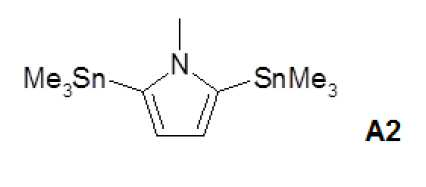
화합물은 다음의 참조 문헌에 따라서 제조되었다: G. H. Jana et al. Bioorg. Med. Chem. Lett., 2015, (15), 3592-3595. 트리부틸주석 클로라이드 대신에, 트리메틸주석 클로라이드를 사용하였다.The compounds were prepared according to the following references: GH Jana et al . Bioorg. Med. Chem. Lett., 2015, (15), 3592-3595. Instead of tributyltin chloride, trimethyltin chloride was used.
조 생성물을 이소프로판올로부터 재결정화하여 무색 고체로서의 생성물 A2를 34% 수율로 얻었다. 1H-NMR (CDCl3): 6.39 ppm (s, 2H), 3.75 (s, 3H), 0.32 (s, 18H).The crude product was recrystallized from isopropanol to give the product A2 as a colorless solid in 34% yield. 1 H-NMR (CDCl 3) : 6.39 ppm (s, 2H), 3.75 (s, 3H), 0.32 (s, 18H).
2,5-디브로모-1-에틸-피롤(A3)2,5-dibromo-1-ethyl-pyrrole (A3)

951 mg(10.0 mmol)의 1-에틸피롤을 아르곤 분위기 하에 -78℃에서 50 ml의 THF에 용해시켰다. 3.60 g(20.0 mmol)의 NBS를 15분 동안 첨가하였다. 반응 혼합물을 -78℃에서 4시간 동안 교반한 후 밤새 실온까지 가온하였다. 반응 혼합물을 100 ml의 포화 Na2SO3 용액과 혼합하고, MTBE로 2회 추출하였다. 합한 유기 상을 포화 NaCl 용액으로 세척하였다. 이를 Na2SO4 상에서 건조시키고, 여과하고, 용매를 감압 하에서 제거하였다. 잔류물을 실리카겔 상에서 크로마토그래피로 정제하여 1.00 g의 생성물 A3(40%)을 무색 오일로서 얻었다. GC-MS (EI, 75 eV) m/z 252.9 (M+, 100%).951 mg (10.0 mmol) of 1-ethylpyrrole was dissolved in 50 ml of THF at -78 < 0 > C under an argon atmosphere. 3.60 g (20.0 mmol) of NBS were added over 15 minutes. The reaction mixture was stirred at -78 < 0 > C for 4 h, then warmed to room temperature overnight. The reaction mixture was mixed with saturated Na 2 SO 3 solution,
1-메틸-2-트리메틸스탄나닐-1H-피롤(A4)1-methyl-2-trimethylstannanyl-1H-pyrrole (A4)

합성은 다음의 문헌과 유사하게 일어났다: Groenendaal et al. Synth. Commun. 1995, 25 (10), 1589-1600Synthesis took place similar to the following references: Groenendaal et al. Synth. Commun. 1995, 25 (10), 1589-1600
1-프로필-2-트리메틸스탄나닐-1H-피롤(A5)1-propyl-2-trimethylstannanyl-1H-pyrrole (A5)

합성은 다음의 문헌과 유사하게 일어났다: Groenendaal et al. Synth. Commun. 1995, 25 (10), 1589-1600 Synthesis took place similar to the following references: Groenendaal et al. Synth. Commun. 1995, 25 (10), 1589-1600
1-에틸-2-트리메틸스탄나닐-1H-피롤(A6)1-ethyl-2-trimethylstannanyl-1H-pyrrole (A6)

합성은 다음의 문헌과 유사하게 일어났다: Groenendaal et al. Synth. Commun. 1995, 25 (10), 1589-1600 Synthesis took place similar to the following references: Groenendaal et al. Synth. Commun. 1995, 25 (10), 1589-1600
1-페닐-2-트리메틸스탄나닐-1H-피롤(A7)1-phenyl-2-trimethylstannanyl-1H-pyrrole (A7)
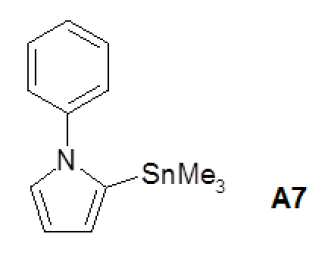
합성은 다음의 문헌과 유사하게 일어났다: Groenendaal et al. Synth. Commun. 1995, 25 (10), 1589-1600Synthesis took place similar to the following references: Groenendaal et al. Synth. Commun. 1995, 25 (10), 1589-1600
2,5-디브로모-1-페닐-피롤(A8)2,5-dibromo-1-phenyl-pyrrole (A8)

1446 mg(10.0 mmol)의 1-페닐피롤을 아르곤 분위기 하에 -78℃에서 50 ml의 THF에 용해시켰다. 3.60 g(20.0 mmol)의 NBS를 15분 동안 첨가하였다. 반응 혼합물을 -78℃에서 4시간 동안 교반한 후 밤새 실온까지 가온하였다. 반응 혼합물을 100 ml의 포화 Na2SO3 용액과 혼합하고, MTBE로 2회 추출하였다. 합한 유기 상을 포화 NaCl 용액으로 세척하였다. 이를 Na2SO4 상에서 건조시키고, 여과하고, 용매를 감압 하에서 제거하였다. 잔류물을 실리카겔 상에서 크로마토그래피로 정제하여 2.75 g의 생성물 A8(91%)을 무색 고체로서 얻었다. 1H-NMR (아세톤-d6): 7.57 ppm (m, 3H), 7.31 (dd, 2H), 6.38 (s, 1H).1446 mg (10.0 mmol) of 1-phenylpyrrole were dissolved in 50 ml of THF at -78 < 0 > C under an argon atmosphere. 3.60 g (20.0 mmol) of NBS were added over 15 minutes. The reaction mixture was stirred at -78 < 0 > C for 4 h, then warmed to room temperature overnight. The reaction mixture was mixed with saturated Na 2 SO 3 solution,
디메톡시테트라하이드로푸란으로부터 피롤의 합성을 위한 일반 프로토콜General protocol for the synthesis of pyrrole from dimethoxytetrahydrofuran
합성은 다음의 문헌 프로토콜과 유사하게 일어난다: Sunil Kumar et al., J. Phys. Chem. C, 2014, 118 (5), 2570:Synthesis occurs similar to the following literature protocol: Sunil Kumar et al ., J. Phys. Chem. C, 2014, 118 ( 5 ), 2570:
50 mmol의 나트륨 아세테이트를 실온에서 100 ml의 탈염수에 용해시키고, 50 mmol의 상응하는 아민을 첨가하였다. 25 ml의 빙초산을 여기에 서서히 적가하고, 혼합물을 80℃까지 가열하였다. 50 mmol의 2,5-디메톡시테트라하이드로푸란을 적가하고, 반응 혼합물을 80℃에서 16시간 동안 교반하였다. 이후 반응 용액을 실온이 되게 하고, 디클로로메탄으로 추출하였다. 유기 상을 포화 NaCl 용액으로 세척하고, 황산나트륨 상에서 건조시키고, 회전 증발기 상에서 농축시켰다. 조 생성물을 크로마토그래피로 정제하였다.50 mmol of sodium acetate was dissolved in 100 ml of demineralized water at room temperature and 50 mmol of the corresponding amine were added. 25 ml of glacial acetic acid was slowly added dropwise thereto, and the mixture was heated to 80 占 폚. 50 mmol of 2,5-dimethoxytetrahydrofuran was added dropwise, and the reaction mixture was stirred at 80 DEG C for 16 hours. Thereafter, the reaction solution was allowed to reach room temperature and extracted with dichloromethane. The organic phase was washed with saturated NaCl solution, dried over sodium sulfate and concentrated on a rotary evaporator. The crude product was purified by chromatography.

1-페네틸-2-트리메틸스타닐-1H-피롤(A10)의 합성Synthesis of 1-phenethyl-2-trimethylstannyl-1H-pyrrole (A10)
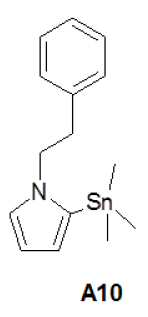
A10의 합성은 다음의 문헌과 유사하게 일어났다: Groenendaal et al. Synth. Commun. 1995, 25 (10), 1589-1600The synthesis of A10 occurred similar to the following literature: Groenendaal et al. Synth. Commun. 1995, 25 (10), 1589-1600
1-(2-플루오로-페닐)-1H-피롤(A17)L- (2-Fluoro-phenyl) -lH-pyrrole (A17)
1-벤질-1H-피롤(A19)1-benzyl-1H-pyrrole (A19)

화합물 A17 및 A19는 상업적으로 입수 가능하다.Compounds A17 and A19 are commercially available.
화합물 B1 내지 B8의 합성Synthesis of compounds B1 to B8
(E)-3-(5-브로모-푸란-2-일)-프로펜알(B1)(E) -3- (5-bromo-furan-2-yl) -propenal (B1)
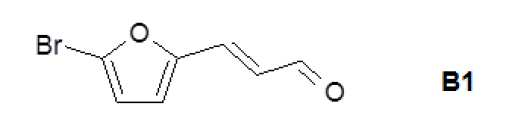
B1의 합성은 다음의 참조 문헌에 따라서 일어난다: I. I. Popov, Z. N. Nazarova, A. P. Chumak, Chem. Heterocycl. Compd., 1978, 14, (3), 253-255:The synthesis of B1 occurs according to the following references: II Popov, ZN Nazarova, AP Chumak, Chem. Heterocycl. Compd., 1978, 14, (3), 253-255:
50 mmol의 5-브로모-2-푸르푸랄을 100 ml의 6% NaOH 용액에 현탁하였다. 15 ml의 물 중의 아세트알데하이드를 0℃에서 반응 혼합물에 적가하였다. 교반은 0℃에서 1시간 동안 계속하였다. 침전물을 여과하여 단리하고, 물로 세척하고, 건조시켰다. 조 생성물을 실리카겔 상에서 크로마토그래피로 정제하였다. 수율 74%. 1H-NMR (아세톤-d6): 9.64 ppm (d, 1H), 7.44 (d, 1H), 7.04 (d, 1H), 6.73 (d, 1H), 6.47 (dd, 1H).50 mmol of 5-bromo-2-furfural was suspended in 100 ml of 6% NaOH solution. Acetaldehyde in 15 ml of water was added dropwise to the reaction mixture at 0 < 0 > C. Stirring was continued at 0 < 0 > C for 1 hour. The precipitate was isolated by filtration, washed with water and dried. The crude product was purified by chromatography on silica gel. Yield 74%. 1H-NMR (acetone-d6): 9.64 ppm (d, 1H), 7.44 (d, 1H), 7.04 (d, 1H), 6.73 (d, 1H), 6.47
(E)-3-(5-브로모-푸란-2-일)-알릴리덴]-말로노니트릴(B2) (E) -3- (5-bromo-furan-2-yl) -allylidene] -malononitrile (B2)

36.7 mmol의 (E)-3-(5-브로모-푸란-2-일)-프로펜알 및 44.0 mmol의 말로니트릴을 50 ml의 에탄올에 용해시켰다. 3.7 mmol의 β-알라닌을 여기에 첨가하고, 반응 혼합물을 실온에서 24시간 동안 교반하였다. 형성된 침전물을 끓을 때까지 잠시 가열한 후 빙욕에서 냉각하였다. 결정화된 고체를 여과하여 단리하고, 약간의 에탄올로 세척하였다. 데시케이터에서 건조하여 3.49 g의 [(E)-3-(5-브로모-푸란-2-일)-알릴리덴]-말로노니트릴 B2(38% 수율)를 단리하였다. EI m/z: 250[M], 169, 141, 114.36.7 mmol of (E) -3- (5-bromo-furan-2-yl) -propenal and 44.0 mmol of malononitrile were dissolved in 50 ml of ethanol. 3.7 mmol of [beta] -alanine was added thereto, and the reaction mixture was stirred at room temperature for 24 hours. The formed precipitate was briefly heated until it was boiled and then cooled in an ice bath. The crystallized solid was isolated by filtration and washed with a little ethanol. Dried in a desiccator to isolate 3.49 g of [(E) -3- (5-bromo-furan-2-yl) -allylidene] -malononitrile B2 (38% yield). EI m / z: 250 [M], 169, 141, 114.
(E)-3-(5-트리메틸스타닐-푸란-2-일)-프로펜알(B3)(E) -3- (5-trimethylstannyl-furan-2-yl) -propenal (B3)

82 ml의 무수 THF 중의 3.06 g(29.9 mmol)의 1-메틸피페라진 용액을 아르곤 분위기 하에 -78℃에서 12 ml(30 mmol)의 n-부틸리튬 용액(헥산 중 2.5 M)과 적가로 혼합하였다. 15분의 교반 후, 3.15 g(25.0 mmol)의 트랜스-3-(2-푸릴)아크롤레인을 적가하였다. 추가 15분의 교반 후, 3.95 g(33.7 mmol)의 N,N,N',N'-테트라메틸에틸렌디아민을 적가하였다. 15분의 교반 후, 13.4 ml(33.5 mmol)의 n-부틸리튬 용액(헥산 중 2.5 M)을 적가하였다. 반응 혼합물을 -20℃에서 3시간 동안 교반한 후 다시 -78℃까지 냉각하였다. 이 온도에서, THF 중의 트리메틸주석 클로라이드의 1 M 용액 29.9 ml(29.9 mmol)를 첨가하고, 그 후에 혼합물을 실온에서 16시간 동안 교반하였다. 이후 100 ml의 물을 첨가하고, 유기 상을 제거하고, 수성 상을 MTBE로 3회 추출하고, 합한 유기 상을 1 M 염산, 포화 염화암모늄 용액 및 염수 각각 80 ml로 세척하였다. 황산나트륨 상에서 건조시킨 후, 용매를 증류하여 제거하고, 잔류물을 크로마토그래피(SiO2, 석유 에테르/MTBE 5/1)로 정제하였다. 수율 5.52 g(76%). 아세톤-d6에서의 1H-NMR(400 MHz): 0.38 (s, 9H), 6.48 (dd, 1H), 6.84 (d, 1H), 6.97(d, 1H), 7.51(d, 1H), 9.63(d, 1H).A solution of 3.06 g (29.9 mmol) of 1-methylpiperazine in 82 ml of anhydrous THF was intimately mixed with 12 ml (30 mmol) of n-butyllithium solution (2.5 M in hexane) at -78 ° C under an argon atmosphere . After stirring for 15 minutes, 3.15 g (25.0 mmol) of trans-3- (2-furyl) acrolein was added dropwise. After stirring for an additional 15 minutes, 3.95 g (33.7 mmol) of N, N, N ', N'-tetramethylethylenediamine was added dropwise. After stirring for 15 minutes, 13.4 ml (33.5 mmol) of n-butyllithium solution (2.5 M in hexane) was added dropwise. The reaction mixture was stirred at -20 < 0 > C for 3 hours and then cooled again to -78 < 0 > C. At this temperature, 29.9 ml (29.9 mmol) of a 1 M solution of trimethyltin chloride in THF was added, after which the mixture was stirred at room temperature for 16 hours. 100 ml of water were then added, the organic phase was removed, the aqueous phase was extracted three times with MTBE, and the combined organic phases were washed with 80 ml each of 1 M hydrochloric acid, saturated ammonium chloride solution and brine. After drying over sodium sulfate, the solvent was distilled off and the residue was purified by chromatography (SiO2, petroleum ether /
2-[(E)-3-(5-트리메틸스탄나닐-푸란-2-일)-알릴리덴]-말로노니트릴(B4)2 - [(E) -3- (5-trimethylstannanyl-furan-2-yl) -allylidene] -malononitrile (B4)
아르곤 분위기 하에서, 9.52 g(33.4 mmol)의 B3 및 2.23 g(33.4 mmol)의 말로디니트릴을 19 ml의 에탄올에 용해시켰다. 152 mg(1.67 mmol)의 베타-알라닌을 첨가하고, 혼합물을 실온에서 4시간 동안 교반하였다. 이후 이를 환류 온도까지 가열하고, 교반하면서 0℃까지 서서히 냉각하였다. 침전물을 여과하여 단리하고, 2 ml의 에탄올로 세척하고, 감압 하에서 건조시켰다: 9.10 g(82%)의 오렌지색 결정성 고체. 아세톤-d6에서의 1H-NMR(400 MHz): 0.41 (s, 9H), 6.90 (d, 1H), 7.07 (m, 2H), 7.46 (d, 1H), 8.01(d, 1H).Under an argon atmosphere, 9.52 g (33.4 mmol) of B3 and 2.23 g (33.4 mmol) of malodinitrile were dissolved in 19 ml of ethanol. 152 mg (1.67 mmol) of beta-alanine were added and the mixture was stirred at room temperature for 4 hours. It was then heated to reflux temperature and slowly cooled to 0 ° C with stirring. The precipitate was isolated by filtration, washed with 2 ml of ethanol and dried under reduced pressure: 9.10 g (82%) of orange crystalline solid. 1 H-NMR in acetone-d6 (400 MHz): 0.41 (s, 9H), 6.90 (d, 1H), 7.07 (m, 2H), 7.46 (d,
3-(5-브로모-푸란-2-일)-사이클로헥스-2-에논(B5)3- (5-Bromo-furan-2-yl) -cyclohex-2-enone (B5)

아르곤 분위기 하에서, 25 ml의 디에틸 에테르 중의 2.00 g의 2,5-디브로모푸란(8.85 mmol)의 용액을 -65℃에서 교반하면서 15분 동안 5.53 ml의 n-부틸리튬(헥산 중 1.6 M)과 적가로 혼합하였다. 추가로 15분 후, 1.86 g의 3-에톡시-2-사이클로헥센-1-온(13.3 mmol)을 첨가하고, 혼합물을 밤새 실온에서 가열하였다. 혼합물을 150 ml의 염수에 첨가하고, 3 x 100 ml의 디클로로메탄으로 추출하였다. 합한 유기 추출물을 2 M 염산으로 세척하고, 황산나트륨 상에서 건조시키고, 용매를 감압 하에서 제거하였다. 컬럼 크로마토그래피(SiO2, 디클로로메탄)로 정제하여 B5를 황색 결정성 고체(1.08 g, 4.48 mmol, 51%)로서 얻었다. 1H-NMR (CDCl3): 6.68 ppm (d, 1H), 6.44-6.43 (m, 2H), 2.60 (td, 2H), 2.46 (t, 2H), 2.14-2.07 (m, 2H).Under an argon atmosphere, a solution of 2.00 g of 2,5-dibromofuran (8.85 mmol) in 25 ml of diethyl ether was added to a solution of 5.53 ml of n-butyllithium (1.6 M in hexane ). After an additional 15 minutes, 1.86 g of 3-ethoxy-2-cyclohexen-1-one (13.3 mmol) was added and the mixture was heated at room temperature overnight. The mixture was added to 150 ml of brine and extracted with 3 x 100 ml of dichloromethane. The combined organic extracts were washed with 2 M hydrochloric acid, dried over sodium sulfate and the solvent was removed under reduced pressure. Column chromatography (SiO 2, dichloromethane) to give the B5 as a yellow crystalline solid (1.08 g, 4.48 mmol, 51 %). 1 H-NMR (CDCl 3) : 6.68 ppm (d, 1H), 6.44-6.43 (m, 2H), 2.60 (td, 2H), 2.46 (t, 2H), 2.14-2.07 (m, 2H).
2-[3-(5-브로모-푸란-2-일)-사이클로헥스-2-에닐리덴]-말로노니트릴(B6)2- [3- (5-bromo-furan-2-yl) -cyclohex-2-enylidene] -malononitrile (B6)
아르곤 분위기 하에서, 1.68 g의 암모늄 아세테이트(21.8 mmol)를 디클로로에탄 중의 1.74 g의 B5(7.14 mmol) 및 1.42 g의 말로노니트릴(21.5 mmol)의 용액에 첨가하였다. 혼합물을 2시간 동안 환류한 후 20 mg의 1,4-디아자바이사이클로[2.2.2]옥탄(0.178 mmol)을 첨가하고, 이어서 추가로 16시간 동안 환류하였다. 반응 혼합물을 100 ml의 물에 첨가하고, 3 x 50 ml의 디클로로메탄으로 추출하였다. 합한 유기 추출물을 100 ml의 물로 세척하고, 황산나트륨 상에서 건조시키고, 용매를 감압 하에서 제거하였다. 컬럼 크로마토그래피(SiO2, 헥산)로 정제하여 B6을 오렌지색 결정성 고체(1.15 g, 3.98 mmol, 91%)로서 얻었다. 1H-NMR (CDCl3): 7.19 ppm (s, 1H), 6.79 (d, 1H), 6.49 (d, 1H), 2.80 (t, 2H), 2.64-2.61 (m, 2H), 2.00-1.94 (m, 2H).Under an argon atmosphere, 1.68 g of ammonium acetate (21.8 mmol) was added to a solution of 1.74 g of B5 (7.14 mmol) and 1.42 g of malononitrile (21.5 mmol) in dichloroethane. The mixture was refluxed for 2 hours and then 20 mg of 1,4-diazabicyclo [2.2.2] octane (0.178 mmol) was added and then refluxed for a further 16 hours. The reaction mixture was added to 100 ml of water and extracted with 3 x 50 ml of dichloromethane. The combined organic extracts were washed with 100 ml of water, dried over sodium sulfate and the solvent was removed under reduced pressure. Column chromatography (SiO 2, hexane) to obtain the B6 as an orange crystalline solid (1.15 g, 3.98 mmol, 91 %). 1 H-NMR (CDCl 3) : 7.19 ppm (s, 1H), 6.79 (d, 1H), 6.49 (d, 1H), 2.80 (t, 2H), 2.64-2.61 (m, 2H), 2.00-1.94 (m, 2H).
3-(5-브로모-푸란-2-일)-2-메틸-사이클로펜트-2-에논(B7)Methyl-cyclopent-2-enone (B7) < RTI ID = 0.0 >

아르곤 분위기 하에서, 45 ml의 디에틸 에테르 중의 3.46 g의 2,5-디브로모푸란(15 mmol)의 용액을 -65℃에서 교반하면서 30분 동안 6.00 ml의 n-부틸리튬(헥산 중 2.5 M, 15 mmol)과 적가로 혼합하였다. 추가로 15분 후, 15 ml의 디에틸 에테르 중의 용액으로 2.94 g의 3-에톡시-2-메틸-2-사이클로펜텐-1-온(21.0 mmol)을 첨가하고, 혼합물을 -65℃에서 1.5시간 동안 교반한 후 실온까지 밤새 가온하였다. 150 ml의 디클로로메탄을 첨가한 후, 혼합물을 300 ml의 1 M 염산에 첨가하였다. 유기 상을 제거하고, 수성 상을 100 ml의 디클로로메탄으로 1회 추출하였다. 합한 유기 상을 2 M 염산(150 ml) 및 물(100 ml)로 세척하고, 황산나트륨 상에서 건조시키고, 용매를 감압 하에서 제거하였다. 컬럼 크로마토그래피(SiO2, 디클로로메탄/헥산)로 정제하여 B7을 황색 결정성 고체(2.10 g, 8.71 mmol, 58%)로서 얻었다. 1H-NMR (CDCl3): 6.75 ppm (d, 1H), 6.50 (d, 1H), 2.86-2.82 (m, 2H), 2.52-2.49 (m, 2H), 2.02 (t, 3H).Under an argon atmosphere, a solution of 3.46
2-[3-(5-브로모-푸란-2-일)-2-메틸-사이클로펜트-2-에닐리덴]-말로노니트릴(B8)2-enylidene] -malononitrile (B8) was prepared from 2- [3- (5-bromo-furan-
1,2-디클로로에탄 중의 1.30 g의 3-(5-브로모푸란-2-일)-2-메틸사이클로펜트-2-에논(5.39 mmol) 및 3.60 g의 말로노니트릴(53.9 mmol)의 용액을 아르곤 분위기 하에서 3.09 g의 테트라이소프로필 오르토티타네이트(10.8 mmol)와 혼합하고, 3일 동안 환류 하에서 교반하였다. 반응 혼합물을 염산(1 M, 200 ml)에 붓고, 30분 동안 격렬하게 교반하고, 디클로로메탄(3 x 100 ml)으로 추출하였다. 합한 유기 상을 물(100 ml)로 세척하고, 황산나트륨 상에서 건조시키고 여과하고, 용매를 감압 하에서 제거하였다. 컬럼 크로마토그래피(실리카겔, 디클로로메탄)로 정제하여 B8(1.37 mg, 4.75 mmol, 88%)을 오렌지색의 결정성 고체로서 얻었다. 1H-NMR (CDCl3): 6.82 ppm (d, 1H), 6.55 (d, 1H), 3.09-3.06 (m, 2H), 3.00-2.96 (m, 2H), 2.40 (t, 3H).A solution of 1.30 g of 3- (5-bromofuran-2-yl) -2-methylcyclopent-2-enone (5.39 mmol) and 3.60 g of malononitrile (53.9 mmol) in 1,2- Was mixed with 3.09 g of tetraisopropyl orthotitanate (10.8 mmol) under argon atmosphere and stirred under reflux for 3 days. The reaction mixture was poured into hydrochloric acid (1 M, 200 ml), vigorously stirred for 30 min, and extracted with dichloromethane (3 x 100 ml). The combined organic phases were washed with water (100 ml), dried over sodium sulfate, filtered and the solvent was removed under reduced pressure. Purification by column chromatography (silica gel, dichloromethane) gave B8 (1.37 mg, 4.75 mmol, 88%) as an orange crystalline solid. 1 H-NMR (CDCl 3) : 6.82 ppm (d, 1H), 6.55 (d, 1H), 3.09-3.06 (m, 2H), 3.00-2.96 (m, 2H), 2.40 (t, 3H).
화합물 C1 내지 C39의 합성Synthesis of compounds C1 to C39
2-[5-(1-메틸-1H-피롤-2-일)-푸란-2-일메틸렌]-말로노니트릴(C1)Yl) -furan-2-ylmethylene] -malononitrile (Cl) < EMI ID =

베이킹된 슈렝크 용기에서, C12(1.01 g, 4.52 mmol) 및 A4(849 mg, 3.48 mmol)를 아르곤 하에서 무수 테트라하이드로푸란(5 ml)에 넣고, 테트라키스(트리페닐포스핀)팔라듐(0)(101 mg, 87 μmol)을 첨가하였다. 반응 혼합물을 80℃의 욕 온도에서 16시간 동안 교반하고, 물(약 150 ml)에 붓고, 디클로로메탄(3 x 100 ml)으로 추출하였다. 합한 유기 상을 황산나트륨 상에서 건조시키고 여과하고, 용매를 감압 하에서 제거하였다. 컬럼 크로마토그래피(실리카겔, 디클로로메탄/석유 에테르)로 정제하여 C1(420 mg, 1.88 mmol, 54%)을 적색 결정성 고체로서 제공하였다. 1H-NMR (아세톤-D6): 7.84 ppm (s, 1H), 7.52 (d, 1H), 7.03-7.02 (m, 1H), 6.97 (d, 1H), 6.90 (dd, 1H), 6.21 (dd, 1H), 4.00 (s, 3H).In a baked Schlenk vessel, C12 (1.01 g, 4.52 mmol) and A4 (849 mg, 3.48 mmol) were placed in anhydrous tetrahydrofuran (5 ml) under argon, tetrakis (triphenylphosphine) palladium (101 mg, 87 [mu] mol). The reaction mixture was stirred at a bath temperature of 80 < 0 > C for 16 hours, poured into water (about 150 ml) and extracted with dichloromethane (3 x 100 ml). The combined organic phases were dried over sodium sulfate, filtered and the solvent was removed under reduced pressure. Purification by column chromatography (silica gel, dichloromethane / petroleum ether) afforded C1 (420 mg, 1.88 mmol, 54%) as a red crystalline solid. 1 H-NMR (acetone-D 6 ): 7.84 ppm (s, IH), 7.52 (d, IH), 7.03-7.02 (dd, 1 H), 4.00 (s, 3 H).
2-[5-(1-프로필-1H-피롤-2-일)-푸란-2-일메틸렌]-말로노니트릴(C3)2-ylmethylene] -malononitrile (C3) < RTI ID = 0.0 >
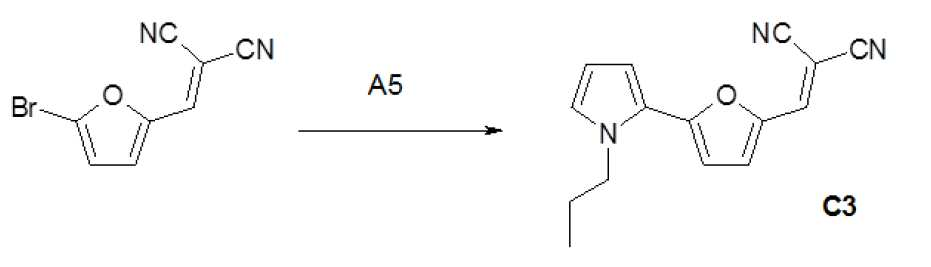
베이킹된 슈렝크 용기에서, C12(669 mg, 3.00 mmol) 및 A5(1.10 g, 3.00 mmol)를 아르곤 하에서 무수 테트라하이드로푸란(5 ml)에 넣고, 테트라키스-(트리페닐포스핀)-팔라듐(0)(87 mg, 75 μmol)을 첨가하였다. 반응 혼합물을 70℃의 욕 온도에서 16시간 동안 교반하고, 약 150 ml의 물에 붓고, 디클로로메탄(3 x 100 ml)으로 추출하였다. 합한 유기 상을 황산나트륨 상에서 건조시키고 여과하고, 용매를 감압 하에서 제거하였다. 컬럼 크로마토그래피(실리카겔, 디클로로메탄/석유 에테르)로 정제하여 C3(500 mg, 1.99 mmol, 66%)을 오렌지색의 점성 오일로서 제공하였다. 1H-NMR (아세톤-d6): 7.85 ppm (s, 1H), 7.53 (d, 1H), 7.10 (dd, 1H), 6.95-6.93 (m, 2H), 6.23 (dd, 1H), 4.36 (t, 2H), 1.75 (sext, 2H), 0.88 (t, 3H).In a baked Schlenk vessel, C12 (669 mg, 3.00 mmol) and A5 (1.10 g, 3.00 mmol) were placed in anhydrous tetrahydrofuran (5 ml) under argon and tetrakis- (triphenylphosphine) -palladium 0) (87 mg, 75 [mu] mol). The reaction mixture was stirred at bath temperature of 70 ° C for 16 hours, poured into about 150 ml of water and extracted with dichloromethane (3 x 100 ml). The combined organic phases were dried over sodium sulfate, filtered and the solvent was removed under reduced pressure. Purification by column chromatography (silica gel, dichloromethane / petroleum ether) afforded C3 (500 mg, 1.99 mmol, 66%) as an orange viscous oil. 1 H-NMR (acetone-d 6 ): 7.85 ppm (s, IH), 7.53 (d, IH), 7.10 (t, 2H), 1.75 (sext, 2H), 0.88 (t, 3H).
2-[5-(1-메틸-1H-피롤-2-일)-티오펜-2-일메틸렌]-말로노니트릴(C5)2-ylmethylene] -malononitrile (C5) < RTI ID = 0.0 >

베이킹된 슈렝크 용기에서, C11(1.09 g, 4.55 mmol) 및 A4를 아르곤 하에서 무수 테트라하이드로푸란(7 ml)에 넣고, 테트라키스-(트리페닐포스핀)-팔라듐(0)(105 mg, 91 μmol)을 첨가하였다. 반응 혼합물을 80℃의 욕 온도에서 16시간 동안 교반하고, 물(약 150 ml)에 붓고, 디클로로메탄(3 x 100 ml)으로 추출하였다. 합한 유기 상을 황산나트륨 상에서 건조시키고 여과하고, 용매를 감압 하에서 제거하였다. 컬럼 크로마토그래피(실리카겔, 디클로로메탄/석유 에테르)로 정제하여 C5(670 mg, 2.80 mmol, 80%)를 적색 결정성 고체로서 제공하였다. 1H-NMR (CDCl3): 7.74 ppm (s, 1H), 7.66 (d, 1H), 7.19 (d, 1H), 6.84-6.82 (m, 1H), 6.68 (dd, 1H), 6.23 (dd, 1H), 3.87 (s, 3H).In a baked Schlenk vessel, C11 (1.09 g, 4.55 mmol) and A4 were placed in anhydrous tetrahydrofuran (7 ml) under argon and tetrakis- (triphenylphosphine) -palladium (0) < / RTI > The reaction mixture was stirred at a bath temperature of 80 < 0 > C for 16 hours, poured into water (about 150 ml) and extracted with dichloromethane (3 x 100 ml). The combined organic phases were dried over sodium sulfate, filtered and the solvent was removed under reduced pressure. Purification by column chromatography (silica gel, dichloromethane / petroleum ether) provided C5 (670 mg, 2.80 mmol, 80%) as a red crystalline solid. 1 H-NMR (CDCl 3 ): 7.74 ppm (s, 1H), 7.66 (d, 1H), 7.19 (d, 1H), 6.84-6.82 , ≪ / RTI > 1H), 3.87 (s, 3H).
2-[5-(1-에틸-1H-피롤-2-일)-티오펜-2-일메틸렌]-말로노니트릴(C7)2-ylmethylene] -malononitrile (C7) < RTI ID = 0.0 >
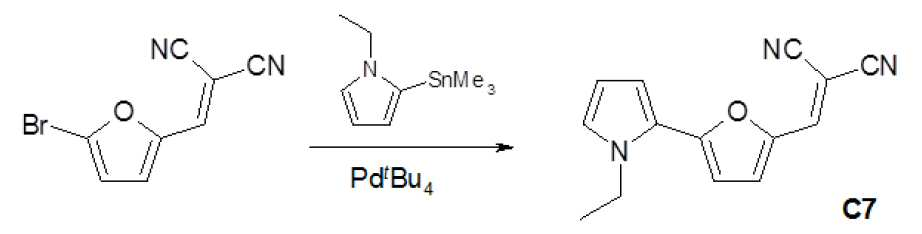
베이킹된 슈렝크 용기에서, C12(989 mg, 4.43 mmol) 및 A6(1.10 g, 3.41 mmol)을 아르곤 하에서 무수 디옥산(5 ml)에 넣고, 10분 동안 탈기하고, 트리스-(디벤질리덴아세톤)-디팔라듐(0)(81 mg, 85 μmol) 및 트리-3급-부틸포스핀 테트라플루오로보레이트(100 mg, 341 μmol)를 첨가하였다. 반응 혼합물을 80℃의 욕 온도에서 16시간 동안 교반하고, 물(약 150 ml)에 붓고, 디클로로메탄(3 x 100 ml)으로 추출하였다. 합한 유기 상을 황산나트륨 상에서 건조시키고 여과하고, 용매를 감압 하에서 제거하였다. 컬럼 크로마토그래피(실리카겔, 디클로로메탄)로 정제하여 C7(820 mg, 3.46 mmol, 78%)을 적색 고체로서 제공하였다. 1H-NMR (아세톤-D6): 7.85 ppm (s, 1H), 7.54 (d, 1H), 7.12-7.11 (m, 1H), 6.98 (d, 1H), 6.94-6.93 (m, 1H), 6.25-6.23 (m, 1H), 4.43 (q, 2H), 1.39 (t, 3H).In a baked Schlenk vessel, C12 (989 mg, 4.43 mmol) and A6 (1.10 g, 3.41 mmol) were placed in anhydrous dioxane (5 ml) under argon, degassed for 10 min and treated with tris- (dibenzylideneacetone ) -Dipalladium (0) (81 mg, 85 μmol) and tri- tert -butylphosphine tetrafluoroborate (100 mg, 341 μmol) were added. The reaction mixture was stirred at a bath temperature of 80 < 0 > C for 16 hours, poured into water (about 150 ml) and extracted with dichloromethane (3 x 100 ml). The combined organic phases were dried over sodium sulfate, filtered and the solvent was removed under reduced pressure. Purification by column chromatography (silica gel, dichloromethane) gave C7 (820 mg, 3.46 mmol, 78%) as a red solid. 1 H-NMR (acetone -D 6): 7.85 ppm (s , 1H), 7.54 (d, 1H), 7.12-7.11 (m, 1H), 6.98 (d, 1H), 6.94-6.93 (m, 1H) , 6.25-6.23 (m, IH), 4.43 (q, 2H), 1.39 (t, 3H).
2-[5-(1-페닐-1H-피롤-2-일)-푸란-2-일메틸렌]-말로노니트릴(C9)2-ylmethylene] -malononitrile (C9) < RTI ID = 0.0 >
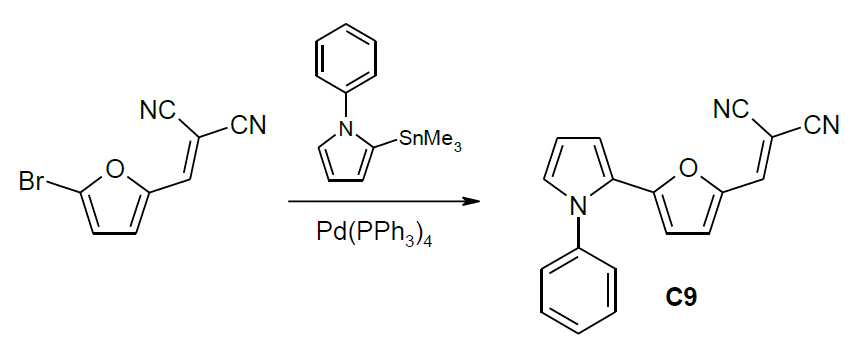
베이킹된 슈렝크 용기에서, C12(1.45 g, 6.50 mmol) 및 A7(1.91 mg, 5.00 mmol)을 아르곤 하에서 무수 1,4-디옥산(7.5 ml)에 넣었다. 트리-3급-부틸포스핀 테트라플루오로보레이트(147 mg, 0.50 mmol) 및 트리스-(디벤질리덴아세톤)-디팔라듐(0)(118 mg, 125 μmol)을 첨가한다. 반응 혼합물을 80℃의 욕 온도에서 16시간 동안 교반하고, 물(약 150 ml)에 붓고, 디클로로메탄(3 x 100 ml)으로 추출하였다. 합한 유기 상을 황산나트륨 상에서 건조시키고 여과하고, 용매를 감압 하에서 제거하였다. 컬럼 크로마토그래피(실리카겔, 디클로로메탄/석유 에테르)로 정제하여 2-[5-(1-페닐-1H-피롤-2-일)-푸란-2-일메틸렌]-말로노니트릴(1.35 g, 4.73 mmol, 94%)을 적색 결정성 고체로서 얻었다.In a baked Schlenk vessel, C12 (1.45 g, 6.50 mmol) and A7 (1.91 mg, 5.00 mmol) were placed in dry 1,4-dioxane (7.5 ml) under argon. Tri- tert -butylphosphine tetrafluoroborate (147 mg, 0.50 mmol) and tris- (dibenzylideneacetone) -dipalladium (0) (118 mg, 125 μmol) were added. The reaction mixture was stirred at a bath temperature of 80 < 0 > C for 16 hours, poured into water (about 150 ml) and extracted with dichloromethane (3 x 100 ml). The combined organic phases were dried over sodium sulfate, filtered and the solvent was removed under reduced pressure. Yl) -furan-2-ylmethylene] -malononitrile (1.35 g, 4.73 < RTI ID = 0.0 > mmol, 94%) as a red crystalline solid.
1H-NMR (아세톤-D6): 7.82 ppm (s, 1H), 7.59 (m, 3H), 7.47 (m, 2H), 7.28 (d, 1H), 7.17 (m, 1H), 7.07 (m, 1H), 6.47 (m, 1H), 5.57 (d, 1H).1H-NMR (acetone -D 6): 7.82 ppm (s , 1H), 7.59 (m, 3H), 7.47 (m, 2H), 7.28 (d, 1H), 7.17 (m, 1H), 7.07 (m, 1H), 6.47 (m, 1 H), 5.57 (d, 1 H).
2-(5-브로모-티오펜-2-일메틸렌)-말로노니트릴(C11)2- (5-bromo-thiophen-2-ylmethylene) -malononitrile (C11)
2-(5-브로모-푸란-2-일메틸렌)-말로노니트릴(C12)2- (5-bromo-furan-2-ylmethylene) -malononitrile (C12)

화합물 C11 및 C12를 문헌에 기재된 합성에 따라서 제조한다(Qi et al., J. Mat. Chem. 2008, 18, 1131).Compounds C11 and C12 are prepared according to the synthesis described in the literature (Qi et al., J. Mat. Chem. 2008, 18, 1131).
2-(5-푸란-2-일-티오펜-2-일메틸렌)-말로노니트릴(C13)2- (5-furan-2-yl-thiophen-2-ylmethylene) -malononitrile (C13)
2-[5-(5-브로모-푸란-2-일)-티오펜-2-일메틸렌]-말로노니트릴(C14)2- [5- (5-bromo-furan-2-yl) -thiophen-2- ylmethylene] -malononitrile (C14)

2-(5-푸란-2-일-티오펜-2-일메틸렌)-말로노니트릴(C13)2- (5-furan-2-yl-thiophen-2-ylmethylene) -malononitrile (C13)
베이킹된 슈렝크 용기에서, 아르곤 하에서 무수 1,4-디옥산(14.9 ml) 중의 C11(2.39 g, 10.0 mmol) 및 2-트리부틸스타닐푸란(4.79 g, 13.0 mmol)을 넣었다. 트리-3급-부틸포스핀 테트라플루오로보레이트(293 mg, 1.00 mmol) 및 트리스-(디벤질리덴아세톤)-디팔라듐(0)(236 mg, 250 μmol)을 첨가한다. 반응 혼합물을 80℃의 욕 온도에서 16시간 동안 교반하였다. 오렌지색 현탁액을 여과하고, 잔류물을 에탄올로부터 재결정화하였다. 이에 의해 생성물 C13(1.67 g, 4.73 mmol, 74%)을 오렌지색 결정성 고체로서 얻었다.In a baked Schlenk flask, C11 (2.39 g, 10.0 mmol) and 2-tributylstannylfuran (4.79 g, 13.0 mmol) in
1H-NMR (CDCl3): 7.78 ppm (s, 1H), 7.67 (d, 1H), 7.55 (d, 1H), 7.36 (d, 1H), 6.85 (d, 1H), 6.56 (dd, 1H). 1 H-NMR (CDCl 3 ): 7.78 ppm (s, IH), 7.67 (d, IH), 7.55 (d, IH), 7.36 ).
2-[5-(5-브로모-푸란-2-일)-티오펜-2-일메틸렌]-말로노니트릴(C14)2- [5- (5-bromo-furan-2-yl) -thiophen-2- ylmethylene] -malononitrile (C14)
2-(5-푸란-2-일-티오펜-2-일메틸렌)-말로노니트릴(C13)(1.11 g, 4.86 mmol)을 아르곤 하에서 -70℃에서 무수 테트라하이드로푸란(44 ml)에 넣고, N-브로모석신이미드(874 mg, 4.86 mmol)를 첨가하였다. 반응 혼합물을 빛의 부재 하에 -70℃에서 30분 동안 교반하고, 냉각욕에서 밤새 실온까지 서서히 가온하였다. 50 ml의 물을 첨가한 후, 생성물을 여과하여 단리하고, 건조시켰다. 잔류물을 에탄올로부터 재결정화하여 생성물 C14(1200 mg, 3.93 mmol, 81%)를 오렌지색 결정성 고체로서 얻었다.2- (5-furan-2-yl-thiophen-2-ylmethylene) -malononitrile ( C13 ) (1.11 g, 4.86 mmol) was placed in anhydrous tetrahydrofuran (44 ml) at- , N-bromosuccinimide (874 mg, 4.86 mmol). The reaction mixture was stirred at -70 < 0 > C for 30 minutes in the absence of light and slowly warmed to room temperature overnight in the cooling bath. After adding 50 ml of water, the product was isolated by filtration and dried. The residue was recrystallized from ethanol to give the product C14 (1200 mg, 3.93 mmol, 81%) as an orange crystalline solid.
1H-NMR (CDCl3): 7.78 ppm (s, 1H), 7.66 (d, 1H), 7.35 (d, 1H), 6.79 (d, 1H), 6.49 (d, 1H). 1 H-NMR (CDCl 3) : 7.78 ppm (s, 1H), 7.66 (d, 1H), 7.35 (d, 1H), 6.79 (d, 1H), 6.49 (d, 1H).
브롬화 및 스틸 커플링의 일반 프로토콜General protocol for bromination and steel coupling
1 mmol의 상응하는 피롤을 25 ml의 무수 THF에 용해시키고, 아르곤 하에 -78℃까지 냉각시켰다. 10 ml의 무수 THF 중의 용액으로 0.8 mmol의 NBS를 -78℃에서 서서히 적가하고, 반응 혼합물을 -78℃에서 2시간 동안 교반하였다. 그 후에 혼합물을 실온이 되게 하고, 35 ml의 디옥산, 1.2 mmol의 2-(5-트리메틸스탄나닐-푸란-2-일메틸렌)-말로노니트릴(C18) 및 1 mol%의 Pd[P(t-Bu3)]2를 첨가하였다. 반응 혼합물을 80℃에서 16시간 동안 교반하였다. 컬럼 크로마토그래피(실리카겔, 디클로로메탄)로 정제하여 상응하는 생성물을 제공하였다.1 mmol of the corresponding pyrrole was dissolved in 25 ml of anhydrous THF and cooled to -78 < 0 > C under argon. 0.8 mmol of NBS in 10 ml of anhydrous THF was slowly added dropwise at -78 [deg.] C and the reaction mixture was stirred at -78 [deg.] C for 2 h. Thereafter, the mixture was allowed to reach room temperature and 35 ml of dioxane, 1.2 mmol of 2- (5-trimethylstannanyl-furan-2-ylmethylene) -malononitrile (C18) and 1 mol% of Pd [P t-Bu3)] 2 was added. The reaction mixture was stirred at 80 < 0 > C for 16 hours. Purification by column chromatography (silica gel, dichloromethane) provided the corresponding product.

브롬화의 일반 프로토콜General protocol for bromination
1 mmol의 반응물 1을 아르곤 하에서 -70℃에서 무수 테트라하이드로푸란(10 ml)에 넣고, N-브로모석신이미드(178 mg, 1 mmol)를 첨가하였다. 반응 혼합물을 빛의 부재 하에 교반하고, 냉각욕에서 밤새 실온까지 서서히 가온하였다. 트리에틸아민(1 ml)을 첨가한 후, 용매를 감압 하에서 제거하였다. 컬럼 크로마토그래피(실리카겔, 디클로로메탄)로 정제하여 상응하는 브롬화 생성물을 제공하였다.1 mmol of


본 발명은 작업 예를 참조한 설명에 의해 국한되지 않는다. 대신, 본 발명은 특히 특징 또는 조합 자체가 청구항 또는 작업 예에 명백히 주어지지 않더라도, 청구항에 있는 특징의 모든 조합을 포함하는, 모든 신규 특징 및 또한 특징의 모든 조합을 포함한다.The present invention is not limited by the description with reference to working examples. Instead, the present invention includes all the novel features and all combinations of features, including all combinations of features in the claims, even if the features or combinations themselves are not explicitly stated in the claims or the working examples.
Claims (34)
EWG1 -(T1)a-(T2)b-(Z)c-(T3)d-(T4)e-EWG2
- 파라미터 a, b, d 및 e는 각각 서로 독립적으로 0 또는 1이고,
- 파라미터 c는 1, 2, 3, 4 또는 5이고,
- 일반 그룹 Z는 *-M-N-* 또는 *-N-M-*으로 연결된, 2개의 그룹 M 및 N의 블록이고, 여기서 *는 그룹 T1 내지 T4 또는 EWG1 및 EWG2에 대한 부착점을 나타내고,
- 그룹 M은 각각 서로 독립적으로 하기로부터 선택되고:
화학식 1 화학식 2 화학식 3


- 그룹 N은 각각 서로 독립적으로 하기로부터 선택되고:
화학식 4 화학식 5 화학식 6


- M 및 N은 그룹 M의 적어도 하나의 N 원자 및 그룹 N의 하나의 O 원자가 각각 2개의 C 원자를 통해 서로 연결되도록 각각 연결되며,

- X1 내지 X16은 서로 독립적으로 N 또는 C-R로부터 선택되고, 단 화학식 3 및 화학식 6의 그룹에서, 각각의 경우에 그룹 X8/X7 및 X16/X15로부터의 한 그룹은 일반식 I의 화합물에서 다른 그룹에 대한 부착점
- 각각의 R은 서로 독립적으로 H, 할로겐, 분지형 또는 선형, 사이클릭 또는 열린-사슬 C1-C20 알킬(여기서 C1-C20 알킬의 수소 원자는 치환될 수 있고, C1-C20 알킬의 C 원자는 헤테로원자로 대체될 수 있음); C2-C20 알케닐, O-알킬, S-알킬, O-알케닐, S-알케닐, 알키닐, 아릴, 헤테로아릴(이들 그룹 모두에서 수소 원자는 치환될 수 있음); CN, NR'R"(R' 및 R"는 각각 서로 독립적으로 H, 분지형 또는 선형, 사이클릭 또는 열린-사슬 C1-C20 알킬(여기서 C1-C20 알킬의 수소 원자는 치환될 수 있고, C1-C20 알킬의 C 원자는 헤테로원자로 대체될 수 있음)로부터 선택됨)로 구성된 그룹으로부터 선택되고,
- R1 내지 R3은 각각 서로 독립적으로 H, 분지형 또는 선형, 사이클릭 또는 열린-사슬 C1-C20 알킬(여기서 C1-C20 알킬의 수소 원자는 치환될 수 있고, C1-C20 알킬의 C 원자는 헤테로원자로 대체될 수 있음); 치환되거나 치환되지 않은 C2-C20 알케닐, 치환되거나 치환되지 않은 아릴, 치환되거나 치환되지 않은 헤테로아릴, CN으로 구성된 그룹으로부터 선택되고,
- 각각의 Q는 서로 독립적으로 S, O, Se, NR"'(여기서 R"'는 R1 내지 R3에서와 같이 정의됨)로부터 선택되고,
- 전자-끄는 그룹 EWG1 및 EWG2는 서로 독립적으로 적어도 하나의 C=C 이중 결합을 갖는 전자-끄는 그룹이고,
- 그룹 T1, T2, T3 및 T4는 각각 서로 독립적으로 하기로부터 선택되고:
화학식 10 화학식 11 화학식 11* 화학식 12
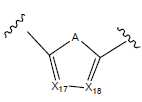
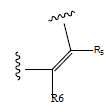
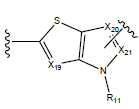
화학식 13 화학식 14 화학식 15 화학식 16


-

- R5 및 R6은 각각 서로 독립적으로 하기 그룹으로부터 선택되고: H, CN, F, 아릴, 헤테로아릴, C2-C20 알케닐, 알키닐, 분지형 또는 선형, 사이클릭 또는 열린-사슬 C1-C20 알킬(여기서 C1-C20 알킬의 수소 원자는 치환될 수 있음), 여기서 치환체 R13이 화학식 I의 화합물에 존재한다면, R5와 R13 또는 R6과 R13 사이의 폐환이 가능하며, 단 R5 및 R13 사이 또는 R6 및 R13 사이에서 각각의 경우에 화학식 11로부터의 이중 결합이 위치하는 것이 가능하며,
- W1 내지 W8은 각각 서로 독립적으로 N, CR로부터 선택되고, 여기서 R은 상기 기재된 바와 같이 정의되고,
- X17 내지 X27은 서로 독립적으로 C-R로부터 선택되고, 여기서 R은 상기 기재된 바와 같이 정의되고, 단 화학식 12, 13 및 14의 그룹에서, 각각의 경우에 그룹 X20/X21, X23/X24 및 X26/X27로부터의 한 그룹은 일반식 I의 화합물에서 다른 그룹에 대한 부착점

- A는 S, O, NR"", Se이고
- Q는 S, O, NR"", Se이고
- 그룹 A 및 Q에 대해, 치환체 R""는 각각의 경우에 서로 독립적으로 H, CN, 분지형 또는 선형, 사이클릭 또는 열린-사슬 C1-C20 알킬(여기서 C1-C20 알킬의 H 원자는 치환될 수 있음); C2-C20 알케닐, O-알킬, S-알킬, O-알케닐, S-알케닐, 알키닐, 치환되거나 치환되지 않은 아릴, 치환되거나 치환되지 않은 헤테로아릴로부터 선택됨.A compound of general formula I:
EWG1 - (T1) a - ( T2) b - (Z) c - (T3) d - (T4) e -EWG2
- the parameters a, b, d and e are each independently 0 or 1,
The parameter c is 1, 2, 3, 4 or 5,
A general group Z is a block of two groups M and N, connected by * -MN- * or * -NM- *, where * represents the attachment point for groups T1 to T4 or EWG1 and EWG2,
The groups M are each independently selected from:
(1)
- the groups N are each, independently of one another, selected from:
(4)
M and N are each connected such that at least one N atom of group M and one O atom of group N are each connected to each other via two C atoms,
- X 1 to X 16 are independently selected from N or CR to each other, in the end groups of formula (III) and formula (6), in each case, the group X 8 / X 7 and one group from the X 16 / X 15 of the general formula Lt; RTI ID = 0.0 > I < / RTI >
Each R is independently of each other H, halogen, branched or linear, cyclic or open-chain C 1 -C 20 alkyl, wherein the hydrogen atom of the C 1 -C 20 alkyl may be substituted and C 1 -C Lt; / RTI > alkyl may be replaced by a heteroatom); C 2 -C 20 alkenyl, O-alkyl, S-alkyl, O-alkenyl, S-alkenyl, alkynyl, aryl, heteroaryl in which the hydrogen atoms may be substituted; CN, NR'R " (R 'and R " are each, independently of one another, H, branched or linear, cyclic or open-chain C 1 -C 20 alkyl wherein the hydrogen atom of the C 1 -C 20 alkyl is substituted And the C atom of the C 1 -C 20 alkyl may be replaced by a heteroatom,
- R 1 to R 3 are each independently of each other H, minute cyclic branched or linear, or open-chain C 1 -C 20 alkyl (wherein the hydrogen atoms of the C 1 -C 20 alkyl may be substituted, C 1 - C atom of the alkyl is C 20 can be replaced with a hetero atom); Substituted or unsubstituted C 2 -C 20 alkenyl, substituted or unsubstituted aryl, substituted or unsubstituted heteroaryl, CN,
Each Q is independently selected from S, O, Se, NR "'wherein R "' is defined as in R 1 to R 3 ,
- the electron-withdrawing groups EWG1 and EWG2 are independently of each other an electron-withdrawing group having at least one C = C double bond,
The groups T1, T2, T3 and T4 are each, independently of one another, selected from:
Formula 10 Formula 11 Formula 12
Formula 13 Formula 15 Formula 16
-
- R5 and R6 are each independently selected from the group to one another: H, CN, F, aryl, heteroaryl, C 2 -C 20 alkenyl, alkynyl, branched or linear, cyclic or open-chain C 1 If the substituents R 13 -C 20 alkyl (wherein the hydrogen atoms of the C 1 -C 20 alkyl may be substituted), wherein present in the compounds of formula I, the ring closure between R 5 and R 6 or R 13 and R 13 With the proviso that the double bond from the formula (11) is situated in each case between R 5 and R 13 or between R 6 and R 13 ,
W 1 to W 8 are each independently selected from N, CR, wherein R is defined as described above,
X 17 to X 27 are independently selected from CR, wherein R is defined as described above, with the proviso that in groups of formulas 12, 13 and 14, in each case the groups X 20 / X 21 , X 23 / One group from X 24 and X 26 / X 27 is the point of attachment to another group in the compound of general formula I
- A is S, O, NR "", Se
Q is S, O, NR "", Se
- Group A and for Q, the substituent R "" is in each case the cyclic independently selected from H, CN, a branched or linear, with each other or in an open-chain C 1 -C 20 alkyl (wherein the C 1 -C 20 alkyl H atoms may be substituted); C 2 -C 20 alkenyl, O-alkyl, S-alkyl, O-alkenyl, S-alkenyl, alkynyl, substituted or unsubstituted aryl, or substituted or unsubstituted heteroaryl.
화학식 7 화학식 8 화학식 9

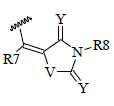
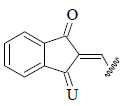
(

- R4 및 R12는 각각 서로 독립적으로 H, CN, COOR로부터 선택되고, 단 R4 및 R12는 둘 모두 H일 수 없고,
- R은 R1 내지 R3의 경우에 정의된 것과 동일한 그룹의 화합물로부터 선택되고,
- 각각의 R13은 서로 독립적으로 하기 그룹으로부터 선택되고: H, CN, F, 아릴, 헤테로아릴, C2-C20 알케닐, 알키닐, 분지형 또는 선형, 사이클릭 또는 열린-사슬 C1-C20 알킬(여기서 C1-C20 알킬의 수소 원자는 치환될 수 있음), 여기서 치환체 R5 또는 R6이 화학식 I의 화합물에 존재하는 경우, R5와 R13 또는 R6과 R13 사이에 폐환이 가능하며, 단 화학식 11로부터의 이중 결합이 각각의 경우에 R5 및 R13 사이 또는 R6 및 R13 사이에서 위치하며,
- V는 O, S이고, Y는 O, S, C(CN)2이고; U는 O, S, C(CN)2이고,
- R7 및 R8은 각각 서로 독립적으로 그룹 H, CN, F, 아릴, 헤테로아릴, C2-C20 알케닐, 알키닐, 분지형 또는 선형, 사이클릭 또는 열린-사슬 C1-C20 알킬(여기서 C1-C20 알킬의 수소 원자는 치환될 수 있음)로부터 선택되고, 각각의 그룹 EWG1 및 EWG2에 대해, 각각 서로 독립적으로 각각의 경우에 각각의 C=C 이중 결합에 대해, E-이성질체 및 Z-이성질체 둘 모두 존재할 수 있음).The compound of formula (I) according to claim 1, wherein the electron-withdrawing groups EWG1 and EWG2 are, independently of one another, selected from:
(7)
(
R 4 and R 12 are each independently selected from H, CN, COOR, with the proviso that R 4 and R 12 are not both H,
- R is selected from the same group of compounds as defined for R 1 to R 3 ,
- each R 13 is independently selected from the group to one another: H, CN, F, aryl, heteroaryl, C 2 -C 20 alkenyl, cyclic alkenyl, branched or linear, or open-chain C 1 -C 20 alkyl (where that may be substituted with hydrogen atoms of the C 1 -C 20 alkyl is a), wherein the substituents R 5 or R 6 in this case present in the compounds of formula I, R 5 and R 6 or R 13 and R 13 With the proviso that the double bond from formula 11 is located in each case between R 5 and R 13 or between R 6 and R 13 ,
V is O, S and Y is O, S, C (CN) 2 ; U is O, S, C (CN) 2 ,
- R 7 and R 8 are each independently selected from the group H, CN, F, aryl, heteroaryl, C 2 -C 20 alkenyl, alkynyl, branched or linear, cyclic or open each other-chain C 1 -C 20 Alkyl, wherein the hydrogen atom of the C 1 -C 20 alkyl may be substituted, and for each group EWG1 and EWG2, for each C = C double bond in each case independently of one another, E -Isomer and Z-isomer may both be present).
EWG1 -(T1)a-(T2)b-Z -(T3)d-(T4)e-EWG23. Compounds of formula I according to claims 1 or 2, wherein c is 1 and has the general formula:
EWG1 - (T1) a - ( T2) b -Z - (T3) d - (T4) e -EWG2

EWG1 -(T1)a-(T2)b-(Z)c-(T3)d-(T4)e-EWG2
(여기서 지표 a, b, d 및 e 중 하나는 0임).6. A compound according to any one of claims 1 to 5 having the general formula:
EWG1 - (T1) a - ( T2) b - (Z) c - (T3) d - (T4) e -EWG2
(Where one of the indices a, b, d and e is zero).
EWG1 -(T1)a-(T2)b-Z-(T3)d-(T4)e-EWG2
(여기서 Z = *-M-N-* 또는 *-N-M-*이고, M은 화학식 1의 그룹임:

EWG1 - (T1) a - ( T2) b -Z- (T3) d - (T4) e -EWG2
(Wherein Z = * -MN- * or * -NM- * and M is a group of the formula (1)


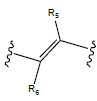
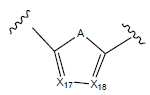


The organic photoactive layer of claim 33, comprising an electrode and a counter electrode, and at least one organic photoactive layer between the electrode and the counter electrode, wherein the organic photoactive layer comprises at least one of the compounds claimed in any one of claims 1 to 30 Gt; organic < / RTI > device.
Applications Claiming Priority (5)
| Application Number | Priority Date | Filing Date | Title |
|---|---|---|---|
| DE102015123006.2 | 2015-12-30 | ||
| DE102015123006 | 2015-12-30 | ||
| EP16181347.2A EP3188270B1 (en) | 2015-12-30 | 2016-07-26 | Organic semi-conducting material and its use in organic components |
| EP16181347.2 | 2016-07-26 | ||
| PCT/EP2016/082901 WO2017114938A1 (en) | 2015-12-30 | 2016-12-30 | Organic semiconducting material and use thereof in organic devices |
Publications (2)
| Publication Number | Publication Date |
|---|---|
| KR20180098580A true KR20180098580A (en) | 2018-09-04 |
| KR102352134B1 KR102352134B1 (en) | 2022-01-14 |
Family
ID=56550799
Family Applications (1)
| Application Number | Title | Priority Date | Filing Date |
|---|---|---|---|
| KR1020187020033A Active KR102352134B1 (en) | 2015-12-30 | 2016-12-30 | Organic semiconductor materials and their use in organic devices |
Country Status (10)
| Country | Link |
|---|---|
| US (1) | US11063222B2 (en) |
| EP (2) | EP3188270B1 (en) |
| JP (1) | JP6683815B2 (en) |
| KR (1) | KR102352134B1 (en) |
| CN (1) | CN108475731B (en) |
| AU (1) | AU2016383646B2 (en) |
| BR (1) | BR112018013360B1 (en) |
| ES (1) | ES2914690T3 (en) |
| SG (1) | SG11201805652TA (en) |
| WO (1) | WO2017114938A1 (en) |
Families Citing this family (10)
| Publication number | Priority date | Publication date | Assignee | Title |
|---|---|---|---|---|
| DE102019113016A1 (en) | 2019-05-17 | 2020-11-19 | Heliatek Gmbh | Column with at least one photovoltaic element and use of a photovoltaic element on a column |
| DE202019102792U1 (en) | 2019-05-17 | 2020-05-20 | Heliatek Gmbh | Column with at least one photovoltaic element and use of a photovoltaic element on a column |
| DE102019120457A1 (en) * | 2019-07-29 | 2021-02-04 | Heliatek Gmbh | Organic semiconducting compound with an indole group, organic optoelectronic component with such a compound, and use of such a compound |
| DE102019125715B4 (en) | 2019-09-24 | 2025-01-02 | Heliatek Gmbh | Compounds containing a furopyrrole or a thienopyrrole group, optoelectronic components containing such a compound, and use of such a compound in optoelectronic components |
| DE102019129355A1 (en) | 2019-10-30 | 2021-05-06 | Heliatek Gmbh | Photovoltaic element with improved efficiency in the case of shading and method for producing such a photovoltaic element |
| DE102019129832A1 (en) | 2019-11-05 | 2021-05-06 | Heliatek Gmbh | Optoelectronic component and method for contacting an optoelectronic component |
| EP3890041B1 (en) | 2020-03-31 | 2024-12-04 | Heliatek GmbH | New chemical compounds, optoelectronic elements comprising at least one new chemical compound, and use of new chemical compounds in an optoelectronic element |
| DE102020135172A1 (en) | 2020-12-31 | 2022-06-30 | Heliatek Gmbh | Compound and its use in organic electronic components |
| KR20220117756A (en) * | 2021-02-17 | 2022-08-24 | 삼성전자주식회사 | Sensor embedded display panel and electronic device |
| US20250063947A1 (en) | 2021-12-30 | 2025-02-20 | Heliatek Gmbh | Compound and its use in organic electronic devices |
Citations (2)
| Publication number | Priority date | Publication date | Assignee | Title |
|---|---|---|---|---|
| US20130167930A1 (en) * | 2010-06-24 | 2013-07-04 | Heliatek Gmbh | Evaporable organic semiconductive material and use thereof in an optoelectronic component |
| WO2014128281A1 (en) * | 2013-02-21 | 2014-08-28 | Heliatek Gmbh | Photoactive organic material for optoelectronic components |
Family Cites Families (5)
| Publication number | Priority date | Publication date | Assignee | Title |
|---|---|---|---|---|
| AU2004221377B2 (en) | 2003-03-19 | 2009-07-16 | Heliatek Gmbh | Photoactive component comprising organic layers |
| US20130240027A1 (en) * | 2010-06-07 | 2013-09-19 | Solarno, Inc. | Multijunction hybrid solar cell with parallel connection and nanomaterial charge collecting interlayers |
| EP2398056B1 (en) | 2010-06-21 | 2016-03-02 | Heliatek GmbH | Organic solar cell with several transport layer systems |
| CN102977084A (en) * | 2011-09-06 | 2013-03-20 | 中国科学院化学研究所 | Thiophene pyrroloquinone type structure n-type semiconductor material synthesis and semiconductor device containing thiophene pyrroloquinone type structure n-type semiconductor material |
| DE102013110693B4 (en) | 2013-09-27 | 2024-04-25 | Heliatek Gmbh | Photoactive organic material for optoelectronic components |
-
2016
- 2016-07-26 EP EP16181347.2A patent/EP3188270B1/en active Active
- 2016-12-30 CN CN201680077291.1A patent/CN108475731B/en active Active
- 2016-12-30 KR KR1020187020033A patent/KR102352134B1/en active Active
- 2016-12-30 JP JP2018534589A patent/JP6683815B2/en active Active
- 2016-12-30 ES ES16822705T patent/ES2914690T3/en active Active
- 2016-12-30 US US16/067,631 patent/US11063222B2/en active Active
- 2016-12-30 BR BR112018013360-4A patent/BR112018013360B1/en active IP Right Grant
- 2016-12-30 WO PCT/EP2016/082901 patent/WO2017114938A1/en not_active Ceased
- 2016-12-30 AU AU2016383646A patent/AU2016383646B2/en active Active
- 2016-12-30 SG SG11201805652TA patent/SG11201805652TA/en unknown
- 2016-12-30 EP EP16822705.6A patent/EP3398214B1/en active Active
Patent Citations (2)
| Publication number | Priority date | Publication date | Assignee | Title |
|---|---|---|---|---|
| US20130167930A1 (en) * | 2010-06-24 | 2013-07-04 | Heliatek Gmbh | Evaporable organic semiconductive material and use thereof in an optoelectronic component |
| WO2014128281A1 (en) * | 2013-02-21 | 2014-08-28 | Heliatek Gmbh | Photoactive organic material for optoelectronic components |
Also Published As
| Publication number | Publication date |
|---|---|
| BR112018013360A2 (en) | 2018-12-04 |
| CN108475731A (en) | 2018-08-31 |
| US11063222B2 (en) | 2021-07-13 |
| EP3188270A1 (en) | 2017-07-05 |
| EP3398214B1 (en) | 2022-03-16 |
| AU2016383646A1 (en) | 2018-07-19 |
| JP6683815B2 (en) | 2020-04-22 |
| WO2017114938A1 (en) | 2017-07-06 |
| ES2914690T3 (en) | 2022-06-15 |
| EP3398214A1 (en) | 2018-11-07 |
| KR102352134B1 (en) | 2022-01-14 |
| CA3010204A1 (en) | 2017-07-06 |
| EP3188270B1 (en) | 2018-12-26 |
| CN108475731B (en) | 2022-07-26 |
| US20190006599A1 (en) | 2019-01-03 |
| SG11201805652TA (en) | 2018-07-30 |
| JP2019503076A (en) | 2019-01-31 |
| AU2016383646B2 (en) | 2019-08-29 |
| BR112018013360B1 (en) | 2023-01-24 |
Similar Documents
| Publication | Publication Date | Title |
|---|---|---|
| KR102352134B1 (en) | Organic semiconductor materials and their use in organic devices | |
| KR102205966B1 (en) | Compound for photoactive organic electronic component, and photoactive organic electronic component containing the compound | |
| CN110740986B (en) | Indane derivatives and their use in organic electronic devices | |
| JP6029606B2 (en) | Usage of photoelectric conversion element, imaging element, optical sensor, photoelectric conversion element | |
| JP6010567B2 (en) | Photoelectric conversion material, photoelectric conversion element, optical sensor, and imaging element | |
| WO2014051007A1 (en) | Photoelectric conversion element, method for using same, light sensor, and imaging element | |
| WO2022025074A1 (en) | Compound, hole transport material for photoelectric conversion element, hole transport layer, and photoelectric conversion element and solar cell using same | |
| KR101157743B1 (en) | Dye for dye-sensitized solar cell and solar cell including the same | |
| CN109244275B (en) | Organic electroluminescent device | |
| KR20210091738A (en) | Di-, tri- and tetraphenylindane derivatives and their use in organic electronic devices | |
| KR20240132258A (en) | Its Uses in Compounds and Organic Electronic Devices | |
| CA3007935C (en) | Synthetic implant device replicating natural tissue structure and methods of making same | |
| JP7804481B2 (en) | Fused polycyclic aromatic compounds | |
| KR20230127248A (en) | Compounds and their use in organic electronic devices | |
| WO2023054344A1 (en) | Compound, hole transport material, and photoelectric conversion element using same |
Legal Events
| Date | Code | Title | Description |
|---|---|---|---|
| PA0105 | International application |
St.27 status event code: A-0-1-A10-A15-nap-PA0105 |
|
| P11-X000 | Amendment of application requested |
St.27 status event code: A-2-2-P10-P11-nap-X000 |
|
| P13-X000 | Application amended |
St.27 status event code: A-2-2-P10-P13-nap-X000 |
|
| R15-X000 | Change to inventor requested |
St.27 status event code: A-3-3-R10-R15-oth-X000 |
|
| R16-X000 | Change to inventor recorded |
St.27 status event code: A-3-3-R10-R16-oth-X000 |
|
| PG1501 | Laying open of application |
St.27 status event code: A-1-1-Q10-Q12-nap-PG1501 |
|
| A201 | Request for examination | ||
| E13-X000 | Pre-grant limitation requested |
St.27 status event code: A-2-3-E10-E13-lim-X000 |
|
| P11-X000 | Amendment of application requested |
St.27 status event code: A-2-2-P10-P11-nap-X000 |
|
| P13-X000 | Application amended |
St.27 status event code: A-2-2-P10-P13-nap-X000 |
|
| PA0201 | Request for examination |
St.27 status event code: A-1-2-D10-D11-exm-PA0201 |
|
| E902 | Notification of reason for refusal | ||
| PE0902 | Notice of grounds for rejection |
St.27 status event code: A-1-2-D10-D21-exm-PE0902 |
|
| E13-X000 | Pre-grant limitation requested |
St.27 status event code: A-2-3-E10-E13-lim-X000 |
|
| P11-X000 | Amendment of application requested |
St.27 status event code: A-2-2-P10-P11-nap-X000 |
|
| P13-X000 | Application amended |
St.27 status event code: A-2-2-P10-P13-nap-X000 |
|
| E902 | Notification of reason for refusal | ||
| PE0902 | Notice of grounds for rejection |
St.27 status event code: A-1-2-D10-D21-exm-PE0902 |
|
| P11-X000 | Amendment of application requested |
St.27 status event code: A-2-2-P10-P11-nap-X000 |
|
| P13-X000 | Application amended |
St.27 status event code: A-2-2-P10-P13-nap-X000 |
|
| E701 | Decision to grant or registration of patent right | ||
| PE0701 | Decision of registration |
St.27 status event code: A-1-2-D10-D22-exm-PE0701 |
|
| GRNT | Written decision to grant | ||
| PR0701 | Registration of establishment |
St.27 status event code: A-2-4-F10-F11-exm-PR0701 |
|
| PR1002 | Payment of registration fee |
St.27 status event code: A-2-2-U10-U12-oth-PR1002 Fee payment year number: 1 |
|
| PG1601 | Publication of registration |
St.27 status event code: A-4-4-Q10-Q13-nap-PG1601 |
|
| P22-X000 | Classification modified |
St.27 status event code: A-4-4-P10-P22-nap-X000 |
|
| P22-X000 | Classification modified |
St.27 status event code: A-4-4-P10-P22-nap-X000 |
|
| PR1001 | Payment of annual fee |
St.27 status event code: A-4-4-U10-U11-oth-PR1001 Fee payment year number: 4 |
|
| P22-X000 | Classification modified |
St.27 status event code: A-4-4-P10-P22-nap-X000 |
|
| PR1001 | Payment of annual fee |
St.27 status event code: A-4-4-U10-U11-oth-PR1001 Fee payment year number: 5 |
|
| U11 | Full renewal or maintenance fee paid |
Free format text: ST27 STATUS EVENT CODE: A-4-4-U10-U11-OTH-PR1001 (AS PROVIDED BY THE NATIONAL OFFICE) Year of fee payment: 5 |