KR20180098139A - Method and apparatus for processing hybrid automatic repeat request process in communication system - Google Patents
Method and apparatus for processing hybrid automatic repeat request process in communication system Download PDFInfo
- Publication number
- KR20180098139A KR20180098139A KR1020180017952A KR20180017952A KR20180098139A KR 20180098139 A KR20180098139 A KR 20180098139A KR 1020180017952 A KR1020180017952 A KR 1020180017952A KR 20180017952 A KR20180017952 A KR 20180017952A KR 20180098139 A KR20180098139 A KR 20180098139A
- Authority
- KR
- South Korea
- Prior art keywords
- harq
- group
- harq process
- groups
- memory
- Prior art date
- Legal status (The legal status is an assumption and is not a legal conclusion. Google has not performed a legal analysis and makes no representation as to the accuracy of the status listed.)
- Granted
Links
Images









Classifications
-
- H—ELECTRICITY
- H04—ELECTRIC COMMUNICATION TECHNIQUE
- H04L—TRANSMISSION OF DIGITAL INFORMATION, e.g. TELEGRAPHIC COMMUNICATION
- H04L1/00—Arrangements for detecting or preventing errors in the information received
- H04L1/12—Arrangements for detecting or preventing errors in the information received by using return channel
- H04L1/16—Arrangements for detecting or preventing errors in the information received by using return channel in which the return channel carries supervisory signals, e.g. repetition request signals
- H04L1/18—Automatic repetition systems, e.g. Van Duuren systems
- H04L1/1812—Hybrid protocols; Hybrid automatic repeat request [HARQ]
-
- H—ELECTRICITY
- H04—ELECTRIC COMMUNICATION TECHNIQUE
- H04W—WIRELESS COMMUNICATION NETWORKS
- H04W74/00—Wireless channel access
- H04W74/08—Non-scheduled access, e.g. ALOHA
- H04W74/0833—Random access procedures, e.g. with 4-step access
- H04W74/0841—Random access procedures, e.g. with 4-step access with collision treatment
Landscapes
- Engineering & Computer Science (AREA)
- Computer Networks & Wireless Communication (AREA)
- Signal Processing (AREA)
- Mobile Radio Communication Systems (AREA)
Abstract
통신 시스템에서 HARQ 프로세스의 처리를 위한 방법 및 장치가 개시된다. 통신 노드의 동작 방법은, 하나 이상의 HARQ 그룹들을 설정하는 단계, 및 상기 하나 이상의 HARQ 그룹들 각각에 HARQ 프로세스 ID를 배치하는 단계를 포함하며, 상기 하나 이상의 HARQ 그룹들 각각은 HARQ 메모리 그룹, 상기 HARQ 메모리 그룹을 제어하는 메모리 제어기 그룹 및 상기 메모리 제어기 그룹을 통해 상기 HARQ 메모리 그룹에 접속함으로써 상기 HARQ 메모리 그룹에 저장된 데이터를 복호하는 디코더 그룹을 포함한다. 따라서 통신 시스템의 성능이 향상될 수 있다.A method and apparatus for processing HARQ processes in a communication system is disclosed. A method of operating a communication node includes configuring one or more HARQ groups, and placing an HARQ process ID in each of the one or more HARQ groups, wherein each of the one or more HARQ groups includes a HARQ memory group, And a decoder group for decoding data stored in the HARQ memory group by accessing the HARQ memory group through the memory controller group. Therefore, the performance of the communication system can be improved.

Description
본 발명은 통신 시스템에서 HARQ(hybrid automaticrepeat request) 기술에 관한 것으로, 더욱 상세하게는 높은 데이터 처리량(high data throughput) 및 저지연(low latency)의 요구사항들을 만족시키기 위해 HARQ 프로세스를 독립적으로 처리하는 기술에 관한 것이다.BACKGROUND OF THE
통신 시스템에서 데이터 패킷은 무선 채널을 통해 송신기(예를 들어, 기지국)에서 수신기(예를 들어, 단말)로 전송될 수 있다. 무선 채널의 상태(예를 들어, 무선 채널의 품질 변화)에서 따라 수신기에서 수신된 데이터 패킷에 에러(error)가 발생할 수 있다. 수신 에러를 복구하기 위해 FEC(forward error correction) 기술이 사용될 수 있다. 통신 시스템에서 FEC 기술이 사용되는 경우, 송신기는 리던던시(redundancy)를 포함하는 데이터 패킷을 전송할 수 있고, 수신기는 수신된 데이터 패킷에 에러가 존재하는 경우에 리던던시를 사용하여 해당 에러를 복구할 수 있다.In a communication system, data packets may be transmitted from a transmitter (e.g., a base station) to a receiver (e.g., a terminal) over a wireless channel. An error may occur in the data packet received at the receiver depending on the state of the wireless channel (e.g., the quality change of the wireless channel). A forward error correction (FEC) technique may be used to recover the receive error. If the FEC technique is used in a communication system, the transmitter may transmit a data packet containing redundancy and the receiver may recover the error using redundancy in the presence of an error in the received data packet .
또한, 수신 에러를 복구하기 위해 ARQ(automatic repeat request) 기술이 사용될 수 있다. 통신 시스템에서 ARQ 기술이 사용되는 경우, 송신기는 CRC(cyclic redundancy check)를 포함하는 데이터 패킷을 전송할 수 있고, 수신기는 수신된 데이터 패킷에 포함된 CRC에 기초하여 에러의 존재 여부를 확인할 수 있다. 수신된 데이터 패킷에 에러가 존재하지 않으면, 수신기는 ACK(acknowledgement)을 송신기에 전송할 수 있다. 반면, 수신된 데이터 패킷에 에러가 존재하는 경우, 수신기는 NACK(negative ACK)을 송신기에 전송할 수 있다. NACK을 수신한 송신기는 동일한 데이터 패킷을 수신기에 재전송할 수 있다.An automatic repeat request (ARQ) technique may also be used to recover the receive error. When an ARQ technique is used in a communication system, the transmitter may transmit a data packet including a cyclic redundancy check (CRC), and the receiver may check for the presence of an error based on the CRC included in the received data packet. If there is no error in the received data packet, the receiver can send an acknowledgment (ACK) to the transmitter. On the other hand, if there is an error in the received data packet, the receiver may send a NACK (negative ACK) to the transmitter. The transmitter receiving the NACK can retransmit the same data packet to the receiver.
또한, 통신 시스템에서 FEC 기술과 ARQ 기술의 결합인 HARQ(hybrid ARQ) 기술이 사용될 수 있다. HARQ 재전송 절차는 CC(chase combining) 방식 또는 IR(incremental redundancy) 방식에 기초하여 수행될 수 있다. CC 방식에 따른 HARQ 재전송 절차가 수행되는 경우, 송신기는 동일한 데이터 패킷을 반복 전송할 수 있다. 이 경우, 수신기는 수신된 동일한 데이터 패킷들을 결합함으로써 데이터 패킷을 복호할 수 있다. IR 방식에 따른 HARQ 재전송 절차가 수행되는 경우, 송신기는 서로 다른 RV(redundancy version)를 가지는 데이터 패킷을 전송할 수 있다. 수신기는 수신된 서로 다른 RV를 가지는 데이터 패킷들을 결합함으로써 데이터 패킷을 복호할 수 있다.Also, HARQ (hybrid ARQ) technology, which is a combination of FEC technology and ARQ technology, can be used in a communication system. The HARQ retransmission procedure can be performed based on a chase combining (CC) scheme or an incremental redundancy (IR) scheme. When the HARQ retransmission procedure according to the CC scheme is performed, the transmitter can repeatedly transmit the same data packet. In this case, the receiver can decode the data packet by combining the same received data packets. When the HARQ retransmission procedure according to the IR scheme is performed, the transmitter can transmit data packets having different RVs (Redundancy Versions). The receiver can decode the data packet by combining the received data packets having different RVs.
한편, HARQ 재전송 절차가 수행되는 경우, HARQ 프로세스 ID(identifier)에 대응하는 전송 블록(transport block, TB)은 HARQ 메모리(예를 들어, HARQ 버퍼)에 저장될 수 있다. 통신 시스템에서 높은 데이터 처리량(high data throughput)의 요구사항을 만족시키기 위해 HARQ 메모리의 크기는 증가할 수 있다. 다만, HARQ 메모리의 크기가 증가하는 경우, 저지연(low latency)의 요구사항이 만족되지 못할 수 있다. 따라서 높은 데이터 처리량 및 저지연의 요구사항들을 만족시키기 위한 HARQ 기술이 필요하다.Meanwhile, when a HARQ retransmission procedure is performed, a transport block (TB) corresponding to an HARQ process identifier may be stored in an HARQ memory (e.g., HARQ buffer). The size of the HARQ memory may be increased to meet the requirements of high data throughput in communication systems. However, when the size of the HARQ memory increases, the requirement of low latency may not be satisfied. Therefore, there is a need for HARQ techniques to meet the requirements of high data throughput and low latency.
상기와 같은 문제점을 해결하기 위한 본 발명의 목적은 통신 시스템에서 HARQ 프로세스를 독립적으로 처리하기 위한 방법 및 장치를 제공하는 데 있다.SUMMARY OF THE INVENTION It is an object of the present invention to provide a method and apparatus for independently processing an HARQ process in a communication system.
상기 목적을 달성하기 위한 본 발명의 제1 실시예에 따른 제1 통신 노드의 동작 방법은, 하나 이상의 HARQ 그룹들을 설정하는 단계, 및 상기 하나 이상의 HARQ 그룹들 각각에 HARQ 프로세스 ID를 배치하는 단계를 포함하며, 상기 하나 이상의 HARQ 그룹들 각각은 HARQ 메모리 그룹, 상기 HARQ 메모리 그룹을 제어하는 메모리 제어기 그룹 및 상기 메모리 제어기 그룹을 통해 상기 HARQ 메모리 그룹에 접속함으로써 상기 HARQ 메모리 그룹에 저장된 데이터를 복호하는 디코더 그룹을 포함하고, 상기 하나 이상의 동일한 HARQ 그룹에 속하는 HARQ 프로세스 ID의 배치 간격은 하나의 HARQ 프로세스의 처리 시간 이상이다. 상기 HARQ 프로세스의 처리 시간의 최소값은 HARQ 메모리 처리 시간으로 주어질 수 있다.According to another aspect of the present invention, there is provided a method of operating a first communication node, the method comprising: setting one or more HARQ groups; and assigning HARQ process IDs to each of the one or more HARQ groups Wherein each of the one or more HARQ groups includes a HARQ memory group, a memory controller group for controlling the HARQ memory group, and a decoder for decoding data stored in the HARQ memory group by accessing the HARQ memory group through the memory controller group Group, and the allocation interval of HARQ process IDs belonging to the at least one same HARQ group is longer than the processing time of one HARQ process. The minimum value of the processing time of the HARQ process may be given as the HARQ memory processing time.
여기서, 상기 하나 이상의 HARQ 그룹들을 설정하기 위해 사용되는 파라미터들은 RRC 시그널링 절차, 시스템 정보의 전송 절차 및 제어 정보의 전송 절차 중에서 적어도 하나를 통해 수신될 수 있다.Here, the parameters used for setting the one or more HARQ groups may be received through at least one of an RRC signaling procedure, a system information transmission procedure, and a control information transmission procedure.
여기서, 상기 하나 이상의 HARQ 그룹들은 상기 하나 이상의 HARQ 그룹들의 전체 개수, 상기 하나 이상의 HARQ 그룹들에 속하는 HARQ 프로세스 ID들의 전체 개수, 상기 하나 이상의 HARQ 그룹들에 속하는 디코더들의 전체 개수, 상기 하나 이상의 동일한 HARQ 그룹의 배치 간격, 상기 하나 이상의 HARQ 그룹들 내에 배치되는 HARQ 프로세스 ID 및 HARQ 프로세스의 처리 시간에 기초하여 설정될 수 있다.Herein, the at least one HARQ group includes at least one of a total number of the at least one HARQ group, a total number of HARQ process IDs belonging to the at least one HARQ group, a total number of decoders belonging to the at least one HARQ group, A group allocation interval, a HARQ process ID allocated in the at least one HARQ group, and a HARQ process time.
여기서, HARQ 프로세스 ID를 배치하는 방법은 상황에 따라서 무수히 많으므로 일일이 모두 설명할 수가 없다. 따라서 설명의 용이함을 위해, 일 예로 HARQ 입장에서 가장 복잡한 동작을 수행하는 상황을 기준으로 설명을 하도록 하겠다. HARQ 입장에서 가장 복잡한 상황은 허용 가능한 최대 HARQ 프로세스 ID의 개수만큼 배치되었으나, 배치된 모든 HARQ 프로세스 ID에서 NACK이 발생하여, 배치된 모든 HARQ 프로세스 ID마다 재전송관리를 해주어야 하는 환경이다. 이러한 상황하에서는 허용가능한 모든 HARQ 프로세스 ID가 배치되었으므로, 매 TTI마다 HARQ 프로세스 ID가 단순 증가 혹은 감소 형태로 배치되는 상황으로 모델링해도 특별히 분석의 일반성을 해치지 않는다. 따라서, 별도의 언급이 없을 경우 이를 기준으로 설명하도록 하겠다. 하지만 이러한 가정은 설명의 용이함을 위한 것이지 본 발명의 내용이 상기한 가정하에서만 성립하는 것으로 한정되지는 않는다.Here, the method of arranging the HARQ process IDs can not be explained in detail because there are numerous methods depending on the situation. Therefore, for ease of explanation, the description will be made based on a situation in which the most complicated operation is performed in the HARQ position as an example. The most complicated situation in the HARQ position is the number of the maximum allowable HARQ process IDs, but NACK is generated in all the arranged HARQ process IDs and the retransmission management is required for all the arranged HARQ process IDs. In this situation, since all allowable HARQ process IDs are arranged, modeling into a situation in which the HARQ process IDs are arranged in a simple increase or decrease manner every TTI does not detract from the specifics of the analysis. Therefore, if there is no mention, I will explain it as a reference. However, this assumption is for ease of explanation, and the content of the present invention is not limited to being established under the above assumption.
여기서, 상기 HARQ 처리 시간이 L이고, 상기 하나 이상의 HARQ 그룹들의 전체 개수가 K이고, HARQ 그룹의 배치 간격이 S이고, 상기 HARQ 프로세스 ID들의 전체 개수가 N이고, N개의 HARQ 프로세스 ID들 중에서 임의의 HARQ 프로세스 ID의 번호가 j인 경우, L TTI 이상의 배치 간격을 얻어낼 수 있도록 HARQ 프로세스 ID를 HARQ 그룹에 배치하는 방법에 대한 일 실시예는 동일한 "j mod K" 결과를 가지는 HARQ 프로세스 ID를 동일한 HARQ 그룹에 배치하는 형태를 들 수 있다. 여기서, "N mod K = 0"인 경우, 동일한 HARQ 그룹에 속하는 HARQ 프로세스 ID의 배치 간격(S)의 최소값은 K TTI이므로 "min(S) = K"가 성립하고, 앞서 상기한 가정인 "HARQ 그룹의 배치 간격(S)은 HARQ 처리 시간(L) 이상이다."란 조건(즉, "S ≥ L")에 의해 "K = min(S) ≥ L"이 성립할 수 있다. 따라서, "K ≥ L"이 만족하도록 HARQ 그룹의 개수(K)를 선택한다면, 동일한 HARQ 그룹의 배치 간격(S)가 L TTI 이상의 배치 간격을 얻어 내도록 HARQ 프로세스 ID를 특정 HARQ 그룹에 배치할 수 있다.Here, it is assumed that the HARQ process time is L, the total number of one or more HARQ groups is K, the HARQ group arrangement interval is S, the total number of HARQ process IDs is N, An embodiment of a method of placing an HARQ process ID in an HARQ group so as to obtain a placement interval of L TTI or more when the number of the HARQ process ID of the HARQ process ID is j, And allocating them to the same HARQ group. In the case of "N mod K = 0", "min (S) = K" is established because the minimum value of the arrangement interval S of the HARQ process IDs belonging to the same HARQ group is K TTI. K = min (S)? L "can be established by the condition" the HARQ processing time L is equal to or greater than the HARQ processing time L ". Therefore, if the number of HARQ groups K is selected so that "K > L" is satisfied, the HARQ process ID can be placed in a specific HARQ group so that the arrangement interval S have.
여기서, "N mod K ≠ 0"인 경우에는, 여러 가지 방법으로 운영이 가능하다.Here, when "N mod K ≠ 0", it is possible to operate in various ways.
우선, 기존 방법과 동일하게 HARQ 프로세스 ID를 HARQ 그룹에 배치해서 사용하는 방법을 사용할 수 있다. 이 경우에는, HARQ 그룹의 배치 간격(S)의 최소값은 N mod K로 정해진다. 따라서 이 경우, "N mod K ≥ L"이 만족하도록 K가 선택될 수 있다. "N mod K = αK (0<α<1)"이라고 가정하면, "K ≥ L/α"를 만족하도록 K가 선택되어야 한다. HARQ 그룹의 개수(K)가 커질수록 구현 복잡도가 올라가므로 K값을 최대한 작게 유지하는 것이 유리하다는 사실로부터, α값을 최대한 1에 가깝도록 K를 선택하는 것이 K를 최소화할 수 있는 방법이라는 사실을 알 수 있다.First, the HARQ process ID may be allocated to the HARQ group and used in the same manner as in the conventional method. In this case, the minimum value of the arrangement interval S of HARQ groups is set to N mod K. Therefore, in this case, K may be selected such that "N mod K > L" is satisfied. Assuming that "N mod K = αK (0 <α <1)", K should be selected to satisfy "K ≥ L / α". Since the complexity increases as the number of HARQ groups (K) increases, the fact that it is advantageous to keep the K value as small as possible is the fact that choosing K so that α is as close to 1 as possible is a way to minimize K .
"N mod K ≠ 0"인 경우의 또 다른 방법으로는, α값을 최대한 1에 가깝도록 K를 선택하는 방법을 사용할 수 있다. 즉, 상기 HARQ 프로세스 ID를 HARQ 그룹에 배치하는 방법에 N mod K를 K/2와 비교하는 동작을 추가하면, HARQ 그룹의 배치간격의 최소값을 항상 K/2보다 크게 유지할 수 있다. 즉, 상기 HARQ 프로세스 ID j를 HARQ 그룹 "j mod K"에 배치하는 방법만을 사용 할 경우에는, "0 < α < 1"이지만, 여기에 추가로 N mod K와 K/2를 비교하는 동작을 추가하면 항상 "1/2 ≤ α < 1"이 유지되도록 HARQ 그룹을 배치할 수 있다.As another method in the case of "N mod K ≠ 0", a method of selecting K so that the value of α is close to 1 at maximum can be used. That is, if the operation of comparing N mod K with K / 2 is added to the method of allocating the HARQ process ID to the HARQ group, the minimum value of the HARQ group allocation interval can always be maintained larger than K / 2. That is, when only the method of placing the HARQ process ID j in the HARQ group "j mod K" is used, an operation of comparing N mod K and K / 2 is further performed, The HARQ group can be arranged such that "1/2 < alpha < 1" is always maintained.
"N mod K ≥ K/2"인 경우, N개의 HARQ 프로세스 ID들 중에서 HARQ 프로세스 ID #j는 HARQ 그룹 #(j mod K)에 배치될 수 있다. 이 경우, HARQ 그룹의 배치 간격(S)의 최소값은 "N mod K"로 주어지며 K/2 이상일 수 있다. "N mod K < K/2"인 경우, N개의 HARQ 프로세스 ID 중에서 K개씩 묶을 수 있는 "floor(N/K)*K"개의 HARQ 프로세스 ID #j는 HARQ 그룹 #(j mod K)에 배치될 수 있고, 남은 "N mod K"개의 HARQ 프로세스 ID #j는 HARQ 그룹 #((K/2)+(j mod K))에 배치될 수 있다. 이 경우, HARQ 그룹의 배치 간격의 최소값은 (K/2+(j mod K))이며, K/2보다 항상 클 수 있다. 따라서 "N mod K ≠ 0"인 상황에서 모든 K에 대해서 HARQ 그룹의 배치 간격(S)의 최소값은 K/2 이상이므로 "min(S) = K/2"이 성립할 수 있다. 이에 따라 "min(S) = K/2 ≥ L"이 성립할 수 있으므로, 이 경우에는 HARQ 그룹의 개수(K)는 "K ≥ 2L"이 만족하도록 선택될 수 있다.If N mod K > K / 2, HARQ process ID #j among N HARQ process IDs may be placed in HARQ group # (j mod K). In this case, the minimum value of the arrangement interval S of HARQ groups is given as "N mod K" and may be K / 2 or more. Quot; floor (N / K) * K "HARQ process IDs #j that can be grouped by K out of N HARQ process IDs are assigned to HARQ group # (j mod K) And the remaining "N mod K" HARQ process IDs #j may be placed in the HARQ group # ((K / 2) + (j mod K)). In this case, the minimum value of the arrangement interval of the HARQ groups is (K / 2 + (j mod K)), which may be always larger than K / 2. Therefore, "min (S) = K / 2" can be established because the minimum value of the arrangement interval S of the HARQ groups for all Ks is K / 2 or more in the state of "N mod K ≠ 0". Accordingly, "min (S) = K / 2? L" can be established, and in this case, the number K of HARQ groups can be selected to satisfy "K ≥ 2L".
앞서 설명된 방법들을 일반화하면, N mod K < K/x (x는 2 이상의 자연수임)인 경우, N mod K개의 나머지 HARQ 프로세스 ID # j가 HARQ 그룹 #(K*β + (j mod K))(β는 1/x 이상이고 1 이하인 임의의 실수임)에 배치되면, HARQ 프로세스의 배치 간격은 항상 K/x 이상일 수 있다.In general, if the N mod K < K / x (x is a natural number of 2 or more), N mod K HARQ process IDs # j are allocated to HARQ group # ) (where beta is an arbitrary real number equal to or larger than 1 / x and equal to or smaller than 1), the arrangement interval of the HARQ process can always be K / x or more.
여기서, 앞서 설명된 HARQ 프로세스 ID를 그룹화하는 방법들은 설명의 용이함을 위한 일 실시 예에 불과하다는 사실을 다시 한번 강조하도록 하겠다. 앞서 설명된 바와 같이, HARQ 프로세스 ID를 배치하는 방법은 상황에 따라서 무수히 많기 때문에 일일이 모두 설명할 수가 없고, 이에 따라 설명의 용이함을 위해서 가정한, TTI에 따라 HARQ 프로세스 ID가 단순 증가 혹은 단순 감소의 형태로 운영되는 상황에서 각 HARQ 그룹별로 L TTI 이상의 배치 간격을 얻어내기 위한 일 예가 "j mod K" 결과를 이용해 HARQ 프로세스 ID를 그룹화하는 방법이라는 것이다. 요점은 상황에 따라서 배치 간격이 존재하는 HARQ 프로세스 ID를 같은 HARQ 그룹에 배치하고, 같은 HARQ 그룹에 속하는 HARQ 프로세스 ID 배치 간격(S)이 HARQ 처리 시간(L)보다 길도록 확인하여 HARQ를 운영하는 것이 핵심사항이다. 따라서 HARQ 프로세스 ID가 서로 배치 간격이 존재한다면, "j mod K" 결과에 의하지 않고 다른 형태(예를 들어 다른 수식, 테이블, 혹은 별도의 시그널링 등)를 통해서 같은 HARQ 그룹에 속하는 HARQ 프로세스 ID의 배치 간격(S)이 L TTI 이상이 되도록 그룹화할 수 있다.Here, it will be emphasized again that the methods of grouping the HARQ process IDs described above are merely examples for ease of explanation. As described above, the method of arranging the HARQ process IDs is so numerous that it can not be explained at all, and accordingly, the HARQ process ID is simply increased or decreased according to the TTI, which is assumed for ease of explanation. Quot; j mod K "result for grouping the HARQ process IDs for each HARQ group in a situation where the HARQ process IDs are grouped by using a result of" j mod K ". The HARQ process ID having the arrangement interval exists in the same HARQ group and the HARQ process ID allocation interval S included in the same HARQ group is longer than the HARQ process time L to operate HARQ It is a key point. Therefore, if there is a placement interval between HARQ process IDs, placement of HARQ process IDs belonging to the same HARQ group through another form (for example, another formula, table, or separate signaling, etc.) The interval S can be grouped so as to be equal to or greater than L TTI.
종합하면, HARQ 프로세스 ID는 HARQ 그룹 매핑 함수에 의해 HARQ 그룹에 매핑될 수 있고, 이에 따라 HARQ 프로세스 ID가 그룹화될 수 있다. 여기서, HARQ 그룹 매핑 함수의 입력은 HARQ 프로세스 ID와 HARQ 프로세스 처리 시간일 수 있고, HARQ 그룹 매핑 함수의 출력은 HARQ 그룹일 수 있다. 이 경우, HARQ 그룹의 배치 간격은 HARQ 프로세스 처리 시간 이상일 수 있다. 앞서 설명된 실시예는 HARQ 그룹 매핑 함수가 "j mod K"인 경우의 예일 수 있다.Together, the HARQ process IDs can be mapped to HARQ groups by the HARQ group mapping function, so that the HARQ process IDs can be grouped. Here, an input of the HARQ group mapping function may be a HARQ process ID and an HARQ process processing time, and an output of the HARQ group mapping function may be a HARQ group. In this case, the arrangement interval of the HARQ groups may be longer than the HARQ process processing time. The above-described embodiment can be an example of a case where the HARQ group mapping function is "j mod K ".
이에 덧붙여, 본 발명에서 언급한 모든 상황에서 별도의 언급이 없다면, TTI 진행도중에 적절히 비어있는 TTI를 배치하여 HARQ 그룹의 배치 간격을 L TTI 이상으로 만드는 방법은 언제나 자유롭게 사용할 수 있다.In addition, if there is no mention in all the situations mentioned in the present invention, a method of arranging empty TTIs appropriately during the TTI process and making the arrangement interval of the HARQ groups greater than LTI is always available.
여기서, 상기 제1 통신 노드의 동작 방법은 제2 통신 노드로부터 전송 블록을 수신하는 단계, 상기 전송 블록에 대한 복조 동작을 수행하는 단계, 상기 복조된 전송 블록에 대한 디매핑 동작을 수행하는 단계, 상기 디매핑된 전송 블록을 상기 HARQ 메모리 그룹에 저장하는 단계, 및 상기 HARQ 메모리 그룹에 저장된 디매핑된 전송 블록에 대한 복호 동작을 수행하는 단계를 포함할 수 있다.Here, the method of operating the first communication node may include receiving a transport block from a second communication node, performing a demodulation operation on the transport block, performing a demapping operation on the demodulated transport block, Storing the demapped transport block in the HARQ memory group, and performing a decoding operation on a demapping transport block stored in the HARQ memory group.
여기서, 상기 디매핑된 전송 블록은 상기 디매핑된 전송 블록의 HARQ 프로세스 ID가 배치된 HARQ 그룹에 속한 HARQ 메모리 그룹에 저장될 수 있다.The demapped transport block may be stored in a HARQ memory group belonging to a HARQ group in which the HARQ process ID of the demapped transport block is located.
여기서, 상기 복호 동작을 수행하는 단계는 상기 디매핑된 전송 블록의 HARQ 프로세스 ID에 기초하여 상기 디매핑된 전송 블록이 저장된 HARQ 메모리 그룹을 확인하는 단계, 상기 확인된 HARQ 메모리 그룹으로부터 상기 디매핑된 전송 블록을 획득하는 단계, 및 상기 획득된 디매핑된 전송 블록에 대한 복호 동작을 수행하는 단계를 더 포함할 수 있다.Herein, the performing the decoding operation comprises: checking an HARQ memory group in which the demapped transport block is stored based on a HARQ process ID of the demapping transport block; Acquiring a transport block, and performing a decoding operation on the obtained demapped transport block.
상기 목적을 달성하기 위한 본 발명의 제2 실시예에 따른 제1 통신 노드의 동작 방법은, 하나 이상의 HARQ 그룹들을 설정하기 위해 사용되는 파라미터들을 설정하는 단계, 및 상기 파라미터들을 제2 통신 노드에 전송하는 단계를 포함하며, 상기 하나 이상의 HARQ 그룹들 각각은 HARQ 메모리 그룹, 상기 HARQ 메모리 그룹을 제어하는 메모리 제어기 그룹 및 상기 메모리 제어기 그룹을 통해 상기 HARQ 메모리 그룹에 접속함으로써 상기 HARQ 메모리 그룹에 저장된 데이터를 복호하는 디코더 그룹을 포함하고, 상기 파라미터들은 하나 이상의 HARQ 그룹들의 전체 개수, 상기 하나 이상의 HARQ 그룹들에 속하는 HARQ 프로세스 ID들의 전체 개수, 상기 하나 이상의 HARQ 그룹들에 속하는 디코더들의 전체 개수, 상기 하나 이상의 동일한 HARQ 그룹의 배치 간격, 상기 HARQ 그룹들 내에 배치되는 HARQ 프로세스 ID 및 HARQ 프로세스의 처리 시간 중에서 적어도 하나를 포함한다.According to another aspect of the present invention, there is provided a method for operating a first communication node, the method comprising: setting parameters to be used for setting one or more HARQ groups; Wherein each of the one or more HARQ groups includes a HARQ memory group, a memory controller group for controlling the HARQ memory group, and data stored in the HARQ memory group by accessing the HARQ memory group through the memory controller group Wherein the parameters include a total number of one or more HARQ groups, a total number of HARQ process IDs belonging to the at least one HARQ group, a total number of decoders belonging to the at least one HARQ group, The allocation interval of the same HARQ group, And a processing time of the HARQ process.
여기서, 상기 파라미터들은 RRC 시그널링 절차, 시스템 정보의 전송 절차 및 제어 정보의 전송 절차 중에서 적어도 하나를 통해 전송될 수 있다.Here, the parameters may be transmitted through at least one of an RRC signaling procedure, a system information transmission procedure, and a control information transmission procedure.
여기서, 상기 하나 이상의 동일한 HARQ 그룹에 속하는 HARQ 프로세스 ID의 배치 간격은 하나의 HARQ 프로세스의 처리 시간 이상일 수 있다.Here, the allocation interval of HARQ process IDs belonging to the at least one same HARQ group may be longer than the processing time of one HARQ process.
여기서, 상기 HARQ 처리 시간이 L이고, 상기 하나 이상의 HARQ 그룹들의 전체 개수가 K이고, HARQ 그룹의 배치간격이 S이고, 상기 HARQ 프로세스 ID들의 전체 개수가 N이고, N개의 HARQ 프로세스 ID들 중에서 임의의 HARQ 프로세스 ID의 번호가 j인 경우, L TTI 이상의 배치간격을 얻어낼 수 있도록 HARQ 프로세스 ID를 HARQ 그룹에 배치하는 방법에 대한 일 실시예는 동일한 "j mod K" 결과를 가지는 HARQ 프로세스 ID를 동일한 HARQ 그룹에 배치하는 형태를 들 수 있다. Here, it is assumed that the HARQ process time is L, the total number of one or more HARQ groups is K, the HARQ group arrangement interval is S, the total number of HARQ process IDs is N, An embodiment of a method of placing an HARQ process ID in an HARQ group so as to obtain a placement interval of L TTI or more when the number of the HARQ process ID of the HARQ process ID is j, And allocating them to the same HARQ group.
상기 목적을 달성하기 위한 본 발명의 제3 실시예에 따른 통신 노드는 프로세서 및 상기 프로세서에 의해 실행되는 적어도 하나의 명령이 저장된 메모리를 포함하며, 상기 적어도 하나의 명령은, 하나 이상의 HARQ 그룹들을 설정하고, 그리고 상기 하나 이상의 HARQ 그룹들 각각에 HARQ 프로세스 ID를 배치하도록 실행되며, 상기 하나 이상의 HARQ 그룹들 각각은 HARQ 메모리 그룹, 상기 HARQ 메모리 그룹을 제어하는 메모리 제어기 그룹 및 상기 메모리 제어기 그룹을 통해 상기 HARQ 메모리 그룹에 접속함으로써 상기 HARQ 메모리 그룹에 저장된 데이터를 복호하는 디코더 그룹을 포함하고, 상기 하나 이상의 동일한 HARQ 그룹에 속하는 HARQ 프로세스 ID의 배치 간격은 하나의 HARQ 프로세스의 처리 시간 이상이다.According to another aspect of the present invention, there is provided a communication node including a processor and a memory in which at least one instruction executed by the processor is stored, wherein the at least one instruction sets at least one HARQ group And allocating an HARQ process ID to each of the one or more HARQ groups, wherein each of the one or more HARQ groups includes a HARQ memory group, a memory controller group controlling the HARQ memory group, And a decoder group for decoding the data stored in the HARQ memory group by accessing the HARQ memory group. The arrangement interval of the HARQ process IDs belonging to the at least one same HARQ group is longer than the processing time of one HARQ process.
여기서, 상기 하나 이상의 HARQ 그룹들은 상기 하나 이상의 HARQ 그룹들의 전체 개수, 상기 하나 이상의 HARQ 그룹들에 속하는 HARQ 프로세스 ID들의 전체 개수, 상기 하나 이상의 HARQ 그룹들에 속하는 디코더들의 전체 개수, 상기 하나 이상의 동일한 HARQ 그룹의 배치 간격 및 상기 하나 이상의 HARQ 그룹들 내에 배치되는 HARQ 프로세스 ID 및 HARQ 프로세스의 처리 시간에 기초하여 설정될 수 있다.Herein, the at least one HARQ group includes at least one of a total number of the at least one HARQ group, a total number of HARQ process IDs belonging to the at least one HARQ group, a total number of decoders belonging to the at least one HARQ group, The group allocation interval, and the HARQ process ID and the processing time of the HARQ process disposed in the at least one HARQ group.
여기서, 상기 HARQ 처리 시간이 L이고, 상기 하나 이상의 HARQ 그룹들의 전체 개수가 K이고, HARQ 그룹의 배치 간격이 S이고, 상기 HARQ 프로세스 ID들의 전체 개수가 N이고, N개의 HARQ 프로세스 ID들 중에서 임의의 HARQ 프로세스 ID의 번호가 j인 경우, L TTI 이상의 배치 간격을 얻어낼 수 있도록 HARQ 프로세스 ID를 HARQ 그룹에 배치하는 방법에 대한 일 실시예는 동일한 "j mod K" 결과를 가지는 HARQ 프로세스 ID를 동일한 HARQ 그룹에 배치하는 형태를 들 수 있다. Here, it is assumed that the HARQ process time is L, the total number of one or more HARQ groups is K, the HARQ group arrangement interval is S, the total number of HARQ process IDs is N, An embodiment of a method of placing an HARQ process ID in an HARQ group so as to obtain a placement interval of L TTI or more when the number of the HARQ process ID of the HARQ process ID is j, And allocating them to the same HARQ group.
여기서, "N mod K = 0"인 경우, 동일한 HARQ 그룹에 속하는 HARQ 프로세스 ID의 배치 간격(S)의 최소값은 K TTI이므로 "min(S) = K"가 성립하고, 앞서 상기한 가정인 "HARQ 그룹의 배치 간격(S)은 HARQ 처리 시간(L) 이상이다."란 조건(즉, "S ≥ L")이 성립되어야 하므로 "K = min(S) ≥ L"이 성립한다. 따라서, "K ≥ L"이 만족하도록 HARQ 그룹의 개수(K)를 선택한다면, 동일한 HARQ 그룹의 배치 간격(S)가 L TTI 이상의 배치간격을 얻어 내도록 HARQ 프로세스 ID를 특정 HARQ 그룹에 배치할 수 있다. In the case of "N mod K = 0", "min (S) = K" is established because the minimum value of the arrangement interval S of the HARQ process IDs belonging to the same HARQ group is K TTI. K = min (S)? L "is established because the HARQ processing time L is equal to or greater than the HARQ group allocation interval S (i.e.," S? L " Therefore, if the number of HARQ groups K is selected so that "K > L" is satisfied, the HARQ process ID can be placed in a specific HARQ group so that the arrangement interval S have.
여기서, "N mod K ≠ 0"인 경우에는, 여러 가지 방법으로 운영이 가능하다.Here, when "N mod K ≠ 0", it is possible to operate in various ways.
우선, 기존 방법과 동일하게 HARQ 프로세스 ID를 HARQ 그룹에 배치해서 사용하는 방법을 사용할 수 있다. 이 경우에는, HARQ 그룹의 배치 간격(S)의 최소값은 N mod K로 정해진다. 따라서 이 경우, "N mod K ≥ L"이 만족하도록 K가 선택되어야 한다. "N mod K = αK (0<α<1)"이라고 가정하면, "K ≥ L/α"를 만족하도록 K가 선택되어야 한다. HARQ 그룹의 개수(K)가 커질수록 구현 복잡도가 올라가므로 K값을 최대한 작게 유지하는 것이 유리하다는 사실로부터, α값을 최대한 1에 가깝도록 K를 선택하는 것이 K를 최소화할 수 있는 방법이라는 사실을 알 수 있다.First, the HARQ process ID may be allocated to the HARQ group and used in the same manner as in the conventional method. In this case, the minimum value of the arrangement interval S of HARQ groups is set to N mod K. Therefore, in this case, K should be selected to satisfy "N mod K ≥ L". Assuming that "N mod K = αK (0 <α <1)", K should be selected to satisfy "K ≥ L / α". Since the complexity increases as the number of HARQ groups (K) increases, the fact that it is advantageous to keep the K value as small as possible is the fact that choosing K so that α is as close to 1 as possible is a way to minimize K .
또 다른 방법으로는, α를 최대한 1에 가깝도록 K를 선택하는 방법을 사용할 수 있다. 즉, 상기된 HARQ 프로세스 ID를 HARQ 그룹에 배치하는 방법에 N mod K를 K/2와 비교하는 동작을 추가하면, HARQ 그룹의 배치 간격의 최소값을 항상 K/2보다 크게 유지할 수 있다. 즉, 상기 HARQ 프로세스 ID #j를 HARQ 그룹 "j mod K"에 배치하는 방법만을 사용할 경우에는, "0 < α < 1"이지만, 여기에 추가로 N mod K와 K/2를 비교하는 동작을 추가하면 항상 "1/2 ≤ α < 1"이 유지되도록 HARQ 그룹을 배치할 수 있다. "N mod K ≥ K/2"인 경우, N개의 HARQ 프로세스 ID들 중에서 HARQ 프로세스 ID #j는 HARQ 그룹 #(j mod K)에 배치될 수 있다. 이 경우, HARQ 그룹의 배치 간격(S)의 최소값은 "N mod K"로 주어지며 K/2 이상이다. "N mod K < K/2"인 경우, N개의 HARQ 프로세스 ID 중에서 K개씩 묶을 수 있는 "floor(N/K)*K"개의 HARQ 프로세스 ID #j는 HARQ 그룹 #(j mod K)에 배치될 수 있고, 남은 "N mod K"개의 HARQ 프로세스 ID #j는 HARQ 그룹 #((K/2)+(j mod K))에 배치될 수 있다. 이 경우, HARQ 그룹의 배치 간격의 최소값은 (K/2+(j mod K))이며, K/2보다 항상 크다. 따라서 "N mod K ≠ 0"인 상황에서 모든 K에 대해서 HARQ 그룹의 배치 간격(S)의 최소값은 K/2 이상이므로 "min(S) = K/2"이 성립한다. 이에 따라서 "min(S) = K/2 ≥ L"이 성립해야 하므로, 이 경우에는 HARQ 그룹의 개수(K)는 "K ≥ 2L"이 만족하도록 선택될 수 있다.As another method, a method of selecting K so that α is as close as possible to 1 can be used. That is, if the operation of comparing N mod K with K / 2 is added to the method of allocating the HARQ process ID to the HARQ group, the minimum value of the HARQ group allocation interval can always be maintained larger than K / 2. That is, when only the method of allocating the HARQ process ID #j to the HARQ group "j mod K" is used, an operation of comparing N mod K and K / 2 is performed, The HARQ group can be arranged such that "1/2 < alpha < 1" is always maintained. If N mod K > K / 2, HARQ process ID #j among N HARQ process IDs may be placed in HARQ group # (j mod K). In this case, the minimum value of the arrangement interval S of HARQ groups is given as "N mod K" Quot; floor (N / K) * K "HARQ process IDs #j that can be grouped by K out of N HARQ process IDs are assigned to HARQ group # (j mod K) And the remaining "N mod K" HARQ process IDs #j may be placed in the HARQ group # ((K / 2) + (j mod K)). In this case, the minimum value of the arrangement interval of HARQ groups is (K / 2 + (j mod K)), which is always larger than K / 2. Therefore, "min (S) = K / 2" is established because the minimum value of the HARQ group allocation interval S is K / 2 or more for all the Ks in the state of "N mod K ≠ 0". Accordingly, "min (S) = K / 2 ≥ L" must be established, so that in this case, the number K of HARQ groups can be selected to satisfy "K ≥ 2L".
앞서 설명된 방법들을 일반화하면, N mod K < K/x (x는 2 이상의 자연수임)인 경우, N mod K개의 나머지 HARQ 프로세스 ID # j가 HARQ 그룹 #(K*β + (j mod K))(β는 1/x 이상이고 1 이하인 임의의 실수임)에 배치되면, HARQ 프로세스의 배치 간격은 항상 K/x 이상일 수 있다.In general, if the N mod K < K / x (x is a natural number of 2 or more), N mod K HARQ process IDs # j are allocated to HARQ group # ) (where beta is an arbitrary real number equal to or larger than 1 / x and equal to or smaller than 1), the arrangement interval of the HARQ process can always be K / x or more.
본 발명에 의하면, HARQ(hybrid automaticrepeat request) 프로세스 ID(identifier)에 대응하는 전송 블록을 저장하는 HARQ 메모리는 해당 HARQ 프로세스의 처리 시간을 고려하여 하나 이상의 HARQ 메모리 그룹들로 나누어질 수 있다. 또한, 하나 이상의 HARQ 메모리 그룹들 각각에 대응하는 메모리 제어기 그룹 및 디코더 그룹(또는, 인코더 그룹)이 설정될 수 있다. 이러한 구성에 의하면, HARQ 프로세스의 처리 동작이 독립적으로 수행되기 때문에, HARQ 프로세스들의 처리 동작들 간에 충돌이 발생하지 않을 수 있다. 따라서 통신 시스템에서 높은 데이터 처리량 및 저지연의 요구사항들은 만족될 수 있고, HARQ 메모리의 크기도 상대적으로 감소할 수 있다. 결국, 통신 시스템의 성능이 향상될 수 있다.According to the present invention, an HARQ memory for storing a transmission block corresponding to a hybrid automatic repeat request (HARQ) process identifier can be divided into one or more HARQ memory groups considering the processing time of the corresponding HARQ process. Also, a memory controller group and a decoder group (or an encoder group) corresponding to each of one or more HARQ memory groups may be set. With this configuration, since the processing operation of the HARQ process is performed independently, no conflict may occur between the processing operations of the HARQ processes. Therefore, the requirements of high data throughput and low delay in the communication system can be satisfied, and the size of HARQ memory can also be relatively reduced. As a result, the performance of the communication system can be improved.
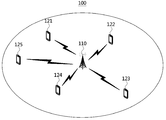
도 1은 통신 시스템의 제1 실시예를 도시한 개념도이다.
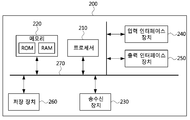
도 2는 통신 시스템을 구성하는 통신 노드의 제1 실시예를 도시한 블록도이다.
도 3은 도 2의 통신 노드에 포함된 송수신 장치의 제1 실시예를 도시한 블록도이다.
도 4는 HARQ 프로세스의 처리 절차에서 "디코더-메모리"의 구성에 대한 제1 실시예를 도시한 블록도이다.
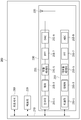
도 5는 HARQ 프로세스의 처리 절차에서 "디코더-메모리"의 구성에 대한 제2 실시예를 도시한 블록도이다.
도 6은 HARQ 그룹의 배치에 대한 제1 실시예를 도시한 타이밍도이다.
도 7은 HARQ 그룹의 배치에 대한 제2 실시예를 도시한 타이밍도이다.
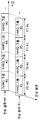
도 8은 HARQ 그룹의 배치에 대한 제3 실시예를 도시한 타이밍도이다.
도 9는 HARQ 그룹의 배치에 대한 제4 실시예를 도시한 타이밍도이다.
도 10은 HARQ 그룹의 배치에 대한 제5 실시예를 도시한 타이밍도이다.
도 11은 HARQ 그룹의 배치에 대한 제6 실시예를 도시한 타이밍도이다.
도 12는 HARQ 프로세스의 처리 방법의 제1 실시예를 도시한 순서도이다.
도 13은 "N mod K ≠ 0"이고 "N mod K ≥ K/2"인 경우 HARQ 그룹의 구성에 대한 제 1 실시예를 도시한 개념도이다.
도 14은 "N mod K ≠ 0"이고 "N mod K < K/2"인 경우 HARQ 그룹의 구성에 대한 제 1 실시예를 도시한 개념도이다.
도 15는 HARQ 프로세스 처리 절차에서 "디코더-메모리"의 구성에 대한 제3실시예를 도시한 블록도이다.1 is a conceptual diagram showing a first embodiment of a communication system.
2 is a block diagram showing a first embodiment of a communication node constituting a communication system.
3 is a block diagram illustrating a first embodiment of a transceiver included in the communication node of FIG.
4 is a block diagram showing a first embodiment of the configuration of "decoder-memory" in the processing procedure of the HARQ process.
5 is a block diagram showing a second embodiment of the configuration of "decoder-memory" in the processing procedure of the HARQ process.
6 is a timing chart showing a first embodiment of the arrangement of HARQ groups.
7 is a timing chart showing a second embodiment of the arrangement of HARQ groups.
8 is a timing diagram showing a third embodiment of the arrangement of HARQ groups.
9 is a timing diagram showing a fourth embodiment of the arrangement of HARQ groups.
10 is a timing chart showing a fifth embodiment of the arrangement of HARQ groups.
11 is a timing chart showing a sixth embodiment of the arrangement of HARQ groups.
12 is a flowchart showing a first embodiment of a processing method of the HARQ process.
13 is a conceptual diagram showing a first embodiment of the configuration of a HARQ group when "N mod K ≠ 0" and "N mod K ≥ K / 2".
14 is a conceptual diagram showing a first embodiment of the configuration of a HARQ group when "N mod K ≠ 0" and "N mod K <K / 2".
15 is a block diagram showing a third embodiment of the configuration of "decoder-memory" in the HARQ process procedure.
본 발명은 다양한 변경을 가할 수 있고 여러 가지 실시예를 가질 수 있는 바, 특정 실시예들을 도면에 예시하고 상세하게 설명하고자 한다. 그러나, 이는 본 발명을 특정한 실시 형태에 대해 한정하려는 것이 아니며, 본 발명의 사상 및 기술 범위에 포함되는 모든 변경, 균등물 내지 대체물을 포함하는 것으로 이해되어야 한다.While the invention is susceptible to various modifications and alternative forms, specific embodiments thereof are shown by way of example in the drawings and will herein be described in detail. It should be understood, however, that the invention is not intended to be limited to the particular embodiments, but includes all modifications, equivalents, and alternatives falling within the spirit and scope of the invention.
제1, 제2 등의 용어는 다양한 구성요소들을 설명하는데 사용될 수 있지만, 상기 구성요소들은 상기 용어들에 의해 한정되어서는 안 된다. 상기 용어들은 하나의 구성요소를 다른 구성요소로부터 구별하는 목적으로만 사용된다. 예를 들어, 본 발명의 권리 범위를 벗어나지 않으면서 제1 구성요소는 제2 구성요소로 명명될 수 있고, 유사하게 제2 구성요소도 제1 구성요소로 명명될 수 있다. 및/또는 이라는 용어는 하나 이상의 관련된 기재된 항목들의 조합 또는 하나 이상의 관련된 기재된 항목들 중의 어느 항목을 포함한다.The terms first, second, etc. may be used to describe various components, but the components should not be limited by the terms. The terms are used only for the purpose of distinguishing one component from another. For example, without departing from the scope of the present invention, the first component may be referred to as a second component, and similarly, the second component may also be referred to as a first component. The term " and / or " includes any combination of one or more related listed items or any of the one or more related listed items.
어떤 구성요소가 다른 구성요소에 "연결되어" 있다거나 "접속되어" 있다고 언급된 때에는, 그 다른 구성요소에 직접적으로 연결되어 있거나 또는 접속되어 있을 수도 있지만, 중간에 다른 구성요소가 존재할 수도 있다고 이해되어야 할 것이다. 반면에, 어떤 구성요소가 다른 구성요소에 "직접 연결되어" 있다거나 "직접 접속되어" 있다고 언급된 때에는, 중간에 다른 구성요소가 존재하지 않는 것으로 이해되어야 할 것이다.It is to be understood that when an element is referred to as being "connected" or "connected" to another element, it may be directly connected or connected to the other element, . On the other hand, when an element is referred to as being "directly connected" or "directly connected" to another element, it should be understood that there are no other elements in between.
본 출원에서 사용한 용어는 단지 특정한 실시예를 설명하기 위해 사용된 것으로, 본 발명을 한정하려는 의도가 아니다. 단수의 표현은 문맥상 명백하게 다르게 뜻하지 않는 한, 하나 이상의 표현을 포함한다. 본 출원에서, "포함하다" 또는 "가지다" 등의 용어는 명세서상에 기재된 특징, 숫자, 단계, 동작, 구성요소, 부품 또는 이들을 조합한 것이 존재함을 지정하려는 것이지, 하나 또는 그 이상의 다른 특징들이나 숫자, 단계, 동작, 구성요소, 부품 또는 이들을 조합한 것들의 존재 또는 부가 가능성을 미리 배제하지 않는 것으로 이해되어야 한다.The terminology used herein is for the purpose of describing particular embodiments only and is not intended to be limiting of the invention. The singular < / RTI > expression includes one or more expressions unless the context clearly indicates otherwise. In the present application, the terms "comprises" or "having" and the like are used to specify that there is a feature, a number, a step, an operation, an element, a component or a combination thereof described in the specification, But do not preclude the presence or addition of one or more other features, integers, steps, operations, elements, components, or combinations thereof.
다르게 정의되지 않는 한, 기술적이거나 과학적인 용어를 포함해서 여기서 사용되는 모든 용어들은 본 발명이 속하는 기술 분야에서 통상의 지식을 가진 자에 의해 일반적으로 이해되는 것과 동일한 의미를 가지고 있다. 일반적으로 사용되는 사전에 정의되어 있는 것과 같은 용어들은 관련 기술의 문맥 상 가지는 의미와 일치하는 의미를 가진 것으로 해석되어야 하며, 본 출원에서 명백하게 정의하지 않는 한, 이상적이거나 과도하게 형식적인 의미로 해석되지 않는다.Unless defined otherwise, all terms used herein, including technical or scientific terms, have the same meaning as commonly understood by one of ordinary skill in the art to which this invention belongs. Terms such as those defined in commonly used dictionaries should be interpreted as having a meaning consistent with the meaning in the context of the relevant art and are to be interpreted in an ideal or overly formal sense unless explicitly defined in the present application Do not.
이하, 첨부한 도면들을 참조하여, 본 발명의 바람직한 실시예를 보다 상세하게 설명하고자 한다. 본 발명을 설명함에 있어 전체적인 이해를 용이하게 하기 위하여 도면상의 동일한 구성요소에 대해서는 동일한 참조부호를 사용하고 동일한 구성요소에 대해서 중복된 설명은 생략한다.Hereinafter, preferred embodiments of the present invention will be described in detail with reference to the accompanying drawings. In order to facilitate the understanding of the present invention, the same reference numerals are used for the same constituent elements in the drawings and redundant explanations for the same constituent elements are omitted.
본 발명에 따른 실시예들이 적용되는 통신 시스템(communication system)이 설명될 것이다. 본 발명에 따른 실시예들이 적용되는 통신 시스템은 아래 설명된 내용에 한정되지 않으며, 본 발명에 따른 실시예들은 다양한 통신 시스템에 적용될 수 있다. 여기서, 통신 시스템은 통신 네트워크(network)와 동일한 의미로 사용될 수 있다.A communication system to which embodiments of the present invention are applied will be described. The communication system to which the embodiments according to the present invention are applied is not limited to the following description, and the embodiments according to the present invention can be applied to various communication systems. Here, the communication system can be used in the same sense as a communication network.
도 1은 통신 시스템의 제1 실시예를 도시한 개념도이다.1 is a conceptual diagram showing a first embodiment of a communication system.
도 1을 참조하면, 통신 시스템(100)은 하나 이상의 통신 노드들(110, 121, 122, 123, 124, 125)을 포함할 수 있다. 또한, 통신 시스템(100)은 코어 네트워크(core network)(예를 들어, S-GW(serving-gateway), P-GW(PDN(packet data network)-gateway), MME(mobility management entity))를 더 포함할 수 있다. 하나 이상의 통신 노드들은 3GPP(3rd generation partnership project) 표준에서 규정된 4G 통신(예를 들어, LTE(long term evolution), LTE-A(advanced)), 5G 통신(예를 들어, NR(new radio) 통신) 등을 지원할 수 있다.Referring to FIG. 1, a
예를 들어, 하나 이상의 통신 노드들은 CDMA(code division multipleaccess) 기반의 통신 프로토콜, WCDMA(wideband CDMA) 기반의 통신 프로토콜, TDMA(time division multipleaccess) 기반의 통신 프로토콜, FDMA(frequency division multipleaccess) 기반의 통신 프로토콜, OFDM(orthogonal frequency division multiplexing)기반의 통신 프로토콜, Filtered OFDM 기반의 통신 프로토콜, OFDMA(orthogonal frequency division multipleaccess) 기반의 통신 프로토콜, SC(single carrier)-FDMA 기반의 통신 프로토콜, NOMA(Non-orthogonal MultipleAccess), GFDM(generalized frequency division multiplexing)기반의 통신 프로토콜, FBMC(filter bank multi-carrier)기반의 통신 프로토콜, UFMC(universal filtered multi-carrier)기반의 통신 프로토콜, SDMA(Space Division MultipleAccess) 기반의 통신 프로토콜 등을 지원할 수 있다.For example, one or more of the communication nodes may be a communication protocol based on a code division multiple access (CDMA), a communication protocol based on a wideband CDMA (WCDMA), a communication protocol based on a time division multiple access (TDMA), a communication based on frequency division multiple access Protocol, a communication protocol based on OFDM (Orthogonal Frequency Division Multiplexing), a communication protocol based on OFDMA (orthogonal frequency division multiple access), a communication protocol based on single carrier (FD) A communication protocol based on generalized frequency division multiplexing (GFDM), a filter bank multi-carrier (FBMC), a communication protocol based on universal filtered multi-carrier (UFMC), a communication based on SDMA (Space Division Multiple Access) Protocol and so on.
한편, 하나 이상의 통신 노드들 각각은 다음과 같은 구조를 가질 수 있다.On the other hand, each of the one or more communication nodes may have the following structure.
도 2는 통신 시스템을 구성하는 통신 노드의 제1 실시예를 도시한 블록도이다.2 is a block diagram showing a first embodiment of a communication node constituting a communication system.
도 2를 참조하면, 통신 노드(200)는 적어도 하나의 프로세서(210), 메모리(220) 및 네트워크와 연결되어 통신을 수행하는 송수신 장치(230)를 포함할 수 있다. 또한, 통신 노드(200)는 입력 인터페이스 장치(240), 출력 인터페이스 장치(250), 저장 장치(260) 등을 더 포함할 수 있다. 통신 노드(200)에 포함된 각각의 구성 요소들은 버스(bus)(270)에 의해 연결되어 서로 통신을 수행할 수 있다.Referring to FIG. 2, the
다만, 통신 노드(200)에 포함된 각각의 구성요소들은 공통 버스(270)가 아니라, 프로세서(210)를 중심으로 개별 인터페이스 또는 개별 버스를 통하여 연결될 수도 있다. 예를 들어, 프로세서(210)는 메모리(220), 송수신 장치(230), 입력 인터페이스 장치(240), 출력 인터페이스 장치(250) 및 저장 장치(260) 중에서 적어도 하나와 전용 인터페이스를 통하여 연결될 수도 있다.However, each component included in the
프로세서(210)는 메모리(220) 및 저장 장치(260) 중에서 적어도 하나에 저장된 프로그램 명령(program command)을 실행할 수 있다. 프로세서(210)는 중앙 처리 장치(central processing unit, CPU), 그래픽 처리 장치(graphics processing unit, GPU), 또는 본 발명의 실시예들에 따른 방법들이 수행되는 전용의 프로세서를 의미할 수 있다. 메모리(220) 및 저장 장치(260) 각각은 휘발성 저장 매체 및 비휘발성 저장 매체 중에서 적어도 하나로 구성될 수 있다. 예를 들어, 메모리(220)는 읽기 전용 메모리(read only memory, ROM) 및 랜덤 액세스 메모리(random access memory, RAM) 중에서 적어도 하나로 구성될 수 있다.The
다시 도 1을 참조하면, 통신 시스템(100)에서 기지국(110)은 매크로 셀(macro cell) 또는 스몰 셀(small cell)을 형성할 수 있고, 아이디얼 백홀 또는 논-아이디얼 백홀을 통해 코어 네트워크와 연결될 수 있다. 기지국(110)은 코어 네트워크로부터 수신한 신호를 해당 단말(121, 122, 123, 124, 125)에 전송할 수 있고, 해당 단말(121, 122, 123, 124, 125)로부터 수신된 신호를 코어 네트워크에 전송할 수 있다. 하나 이상의 단말들(121, 122, 123, 124, 125)은 기지국(110)의 셀 커버리지(cell coverage) 내에 속할 수 있다. 하나 이상의 단말들(121, 122, 123, 124, 125)은 기지국(110)과 연결 확립(connection establishment) 절차를 수행함으로써 기지국(110)에 연결될 수 있다. 하나 이상의 단말들(121, 122, 123, 124, 125)은 기지국(110)에 연결된 후에 기지국(110)과 통신을 수행할 수 있다.Referring again to FIG. 1, in the
또한, 기지국(110)은 MIMO(multiple input multipleoutput)전송(예를 들어, SU(single user)-MIMO, MU(multi user)-MIMO, 대규모(massive) MIMO 등), CoMP(coordinated multipoint)전송, CA(carrier aggregation) 전송, 비면허 대역(unlicensedband)에서 전송, 단말 간 직접 통신(device to device communication, D2D)(또는, ProSe(proximity services)) 등을 지원할 수 있다. 여기서, 하나 이상의 단말들(121, 122, 123, 124, 125) 각각은 기지국(110)과 대응하는 동작, 기지국(110)에 의해 지원되는 동작 등을 수행할 수 있다.In addition, the
여기서, 기지국(110)은 노드B(NodeB), eNB, gNB, BTS(base transceiver station), RRH(radio remote head), TRP(transmission reception point), RU(radio unit), RSU(road side unit), 무선 트랜시버(radio transceiver), 액세스 포인트(access point), 액세스 노드(node) 등으로 지칭될 수 있다. 하나 이상의 단말들(121, 122, 123, 124, 125) 각각은 UE(user equipment), 액세스 터미널(access terminal), 모바일 터미널(mobile terminal), 스테이션(station), 가입자 스테이션(subscriber station), 모바일 스테이션(mobile station), 휴대 가입자 스테이션(portable subscriberstation), 노드(node), 다바이스(device), OBU(on-broad unit) 등으로 지칭될 수 있다.The
다음으로, 통신 시스템에서 HARQ(hybrid automaticrepeat request) 프로세스(process)의 독립적인 처리 방법들이 설명될 것이다. 통신 노드들 중에서 제1 통신 노드에서 수행되는 방법(예를 들어, 데이터 패킷의 전송 또는 수신)이 설명되는 경우에도 이에 대응하는 제2 통신 노드는 제1 통신 노드에서 수행되는 방법과 상응하는 방법(예를 들어, 데이터 패킷의 수신 또는 전송)을 수행할 수 있다. 즉, 단말의 동작이 설명된 경우에 이에 대응하는 기지국은 단말의 동작과 상응하는 동작을 수행할 수 있다. 반대로, 기지국의 동작이 설명된 경우에 이에 대응하는 단말은 기지국의 동작과 상응하는 동작을 수행할 수 있다.Next, independent processing methods of a hybrid automatic repeat request (HARQ) process in a communication system will be described. Even if a method (e.g., transmission or reception of a data packet) performed at the first communication node among the communication nodes is described, the corresponding second communication node can be a method corresponding to the method performed at the first communication node For example, receiving or transmitting a data packet). That is, when the operation of the terminal is described, the corresponding base station can perform an operation corresponding to the operation of the terminal. Conversely, when the operation of the base station is described, the corresponding terminal can perform an operation corresponding to the operation of the base station.
도 3은 도 2의 통신 노드에 포함된 송수신 장치의 제1 실시예를 도시한 블록도이고, 도 4는 HARQ 프로세스의 처리 절차에서 "디코더-메모리"의 구성에 대한 제1 실시예를 도시한 블록도이다.FIG. 3 is a block diagram showing a first embodiment of a transceiver included in the communication node of FIG. 2, and FIG. 4 shows a first embodiment of the configuration of "decoder-memory" Block diagram.
도 3 및 도 4를 참조하면, 통신 노드(200)의 송수신 장치(230)는 송신 장치(231), 수신 장치(233), 안테나(235) 등을 포함할 수 있다. 송신 장치(231)는 인코더(encoder)(231-1), 매퍼(mapper)(231-3), 모듈레이터(modulator)(231-5), IFFT(inverse fast Fourier transform)(231-7), DAC(digital-to-analog converter)(231-9) 등을 포함할 수 있다. 송신 장치(231)에 포함된 구성 요소들(231-1, 231-3, 231-5, 231-7, 231-9)에 의해 처리된 결과는 메모리(220)에 저장될 수 있다. 수신 장치(233)는 디코더(decoder)(233-1), 디매퍼(demapper)(233-3), 디모듈레이터(demodulator)(233-5), FFT(233-7), ADC(analog-to-digital converter)(233-9) 등을 포함할 수 있다. 수신 장치(233)에 포함된 구성 요소들(233-1, 233-3, 233-5, 233-7, 233-9)에 의해 처리된 결과는 메모리(220)에 저장될 수 있다.3 and 4, the transmission /
HARQ 재전송 절차가 수행되는 경우, 수신된 데이터 패킷은 HARQ 프로세스(process) ID(identifier)별로 HARQ 메모리(223)에 저장될 수 있다. 예를 들어, 전송 블록(transport block, TB)별로 HARQ 프로세스 ID가 설정되는 경우, 전송 블록 #0의 HARQ 프로세스 ID의 번호는 "0"으로 설정될 수 있고, 전송 블록 #1의 HARQ 프로세스 ID의 번호는 "1"로 설정될 수 있고, 전송 블록 #(N-1)의 HARQ 프로세스 ID의 번호는 "N-1"로 설정될 수 있다. 여기서, N은 0 이상의 정수일 수 있다.When the HARQ retransmission procedure is performed, the received data packet may be stored in the
HARQ 메모리(223)는 통신 노드(200)의 메모리(220)에 속할 수 있고, 디매퍼(233-3)에 의해 처리된 결과가 HARQ 메모리(223)에 저장될 수 있다. HARQ 메모리(223)에서 HARQ 프로세스 ID #0으로 표기된 영역은 HARQ 프로세스 ID #0에 대응하는 전송 블록 #0(예를 들어, 전송 블록 #0에 대한 LLR(log likelihood ratio) 값)이 저장된 영역을 지시할 수 있고, HARQ 메모리(223)에서 HARQ 프로세스 ID #1로 표기된 영역은 HARQ 프로세스 ID #1에 대응하는 전송 블록 #1(예를 들어, 전송 블록 #1에 대한 LLR 값)이 저장된 영역을 지시할 수 있고, HARQ 메모리(223)에서 HARQ 프로세스 ID #(N-1)로 표기된 영역은 HARQ 프로세스 ID #(N-1)에 대응하는 전송 블록 #(N-1)(예를 들어, 전송 블록 #(N-1)에 대한 LLR 값)이 저장된 영역을 지시할 수 있다.The
디코더(233-1)는 하나 이상의 디코더들(233-1-0 내지 233-1-(M-1))로 구성될 수 있다. 여기서, M은 0 이상의 정수일 수 있다. 하나 이상의 디코더들(233-1-0 내지 233-1-(M-1)) 각각은 메모리 제어기(controller)(225)를 통해 HARQ 메모리(223)에 접속할 수 있고, HARQ 메모리(223)로부터 HARQ 프로세스 ID에 대응하는 전송 블록(예를 들어, 전송 블록에 대한 LLR 값)을 획득할 수 있고, 획득된 전송 블록에 대한 복호를 수행할 수 있다. 메모리 제어기(225)는 "메모리 중재기(arbitrator)" 또는 "메모리 인터페이스"로 지칭될 수 있다. 하나 이상의 디코더들(233-1-0 내지 233-1-(M-1))로부터 하나 이상의 메모리 접속 요청들이 수신된 경우, 메모리 제어기(225)는 하나 이상의 메모리 접속 요청들을 순차적으로 처리함으로써 하나 이상의 디코더들(233-1-0 내지 233-1-(M-1)) 각각이 서로 다른 시간에 HARQ 메모리(223)에 접속하도록 지원할 수 있다.The decoder 233-1 may be composed of one or more decoders 233-1-0 to 233-1- (M-1). Here, M may be an integer of 0 or more. Each of the one or more decoders 233-1-0 through 233-1- (M-1) may be connected to the
한편, HARQ 재전송 절차가 수행되는 경우에 송신 장치(231)의 동작은 앞서 설명된 수신 장치(233)의 동작과 대응할 수 있다. 이 경우, 하나 이상의 디코더들(233-1-0 내지 233-1-(M-1))은 하나 이상의 인코더들일 수 있고, HARQ 메모리(223)는 하나 이상의 인코더들에 의해 처리된 결과를 저장할 수 있다.On the other hand, when the HARQ retransmission procedure is performed, the operation of the transmitting
HARQ 재전송 절차에서 전체 HARQ 프로세스 ID들에 대응하는 전송 블록들은 하나의 HARQ 메모리(223)에 의해 관리될 수 있다. HARQ 메모리(223) 측면에서 높은 데이터 처리량(high data throughput) 및 저지연(low latency)의 요구사항들을 만족시키기 위해, "고용량의 HARQ 메모리" 및 "동시 접속(simultaneous access) 가능한 HARQ 메모리"가 필요할 수 있다.In the HARQ retransmission procedure, the transmission blocks corresponding to the entire HARQ process IDs can be managed by one
HARQ 재전송 절차는 수신기(예를 들어, 수신 장치(233))에 의해 제어될 수 있고, HARQ 프로세스 ID(예를 들어, 전송 블록)별로 재전송 동작이 수행될 수 있다. 데이터 처리량의 증가에 따라 전송 블록의 크기가 증가할 수 있고, 이에 따라 큰 용량의 HARQ 메모리(223)가 필요할 수 있다. 또한, 주파수 자원의 부족으로 인하여 TDD(time division duplex)타입의 프레임이 사용되는 경우, 양방향 링크가 존재할 수 없기 때문에 HARQ 재전송 절차에서 관리되는 HARQ 프로세스 ID의 개수가 증가할 수 있다. 이로 인해, 큰 용량의 HARQ 메모리(223)가 필요할 수 있다.The HARQ retransmission procedure may be controlled by a receiver (e.g., receiver 233), and a retransmission operation may be performed for each HARQ process ID (e.g., a transport block). As the data throughput increases, the size of the transport block may increase, and thus a large
다만, HARQ 메모리(223)의 크기 증가에 따라 지연 시간(예를 들어, HARQ 프로세스 처리의 지연 시간)이 증가하므로, 회로의 고속화가 어려워질 수 있다. 또한, 회로의 클럭(clock)을 증가시키는데 한계가 있으므로, 높은 데이터 처리량 및 저지연의 요구사항들 만족되지 않을 수 있다. 비용 측면에서 HARQ 메모리(223)의 크기가 증가함에 따라 HARQ 메모리(223)의 가격도 증가하기 때문에, 회로의 구현 비용이 증가할 수 있다.However, since the delay time (for example, the delay time of the HARQ process process) increases with an increase in the size of the
또한, 5G 통신에서 기존 통신(예를 들어, 4G 통신)에 비해 짧은 지연이 요구될 수 있다. 높은 데이터 처리량의 요구사항을 만족시키기 위해 전송 블록의 크기가 증가하는 경우, 지연 시간이 증가할 수 있다. 이 경우, 저지연의 요구사항을 만족시키기 위해 TTI(transmission time interval) 듀레이션(duration)을 감소시키는 방안이 고려될 수 있다. 즉, 감소된 TTI 듀레이션 내에서 증가된 크기를 가지는 전송 블록을 처리하기 위해 회로의 고속화가 필수적일 수 있다. 회로의 고속화로 인한 성능 향상에 한계가 있으므로, 병렬로 구성되는 하나 이상의 디코더들((233-1-0 내지 233-1-(M-1))을 사용하는 방안이 고려될 수 있다.Also, a short delay may be required in 5G communication compared to conventional communication (e.g., 4G communication). If the size of the transport block increases to meet the requirements of high data throughput, the delay time may increase. In this case, it may be considered to reduce the transmission time interval (TTI) duration to satisfy the low delay requirement. That is, the speeding up of the circuit may be necessary to process the transport block with the increased size within the reduced TTI duration. There is a limitation in improvement in performance due to the speeding up of the circuit. Therefore, a scheme of using one or more decoders (233-1-0 to 233-1- (M-1)) configured in parallel can be considered.
하나 이상의 디코더들((233-1-0 내지 233-1-(M-1)) 각각이 HARQ 프로세스의 처리 동작(이하, "HARQ 처리 동작"이라 함)을 수행하기 위해, 메모리 제어기(225)에서 동시에 발생한 메모리 접속 요청들에 대한 처리가 필요할 수 있다. 메모리 접속 요청들의 처리를 위해, 메모리 제어기(225)의 복잡도 및 HARQ 메모리(223)의 비용이 증가할 수 있다. 다만, 하나 이상의 메모리 접속 요청들이 동시에 발생하는 경우, 하나 이상의 메모리 접속 요청들에 따른 HARQ 메모리 접속 요청들 간에 충돌이 HARQ 메모리(223)에서 발생할 수 있다. 이러한 문제를 해소하기 위해, 메모리 제어기(225)는 하나 이상의 메모리 접속 요청들이 존재하는 경우에 중재 동작을 통해 하나의 메모리 접속 요청에 대응하는 하나의 HARQ 메모리 접속 요청을 생성할 수 있다. 이에 따르면, HARQ 처리 동작들은 순차적으로 수행되므로, 지연 시간이 증가할 수 있다.Each of the one or more decoders 233-1-0 to 233-1- (M-1) is connected to the
즉, 높은 데이터 처리량의 요구사항을 만족시키기 위해 큰 용량의 HARQ 메모리(223)가 필요할 수 있고, 저지연의 요구사항을 만족시키기 위해 하나 이상의 디코더들((233-1-0 내지 233-1-(M-1))이 필요할 수 있고, 하나 이상의 디코더들((233-1-0 내지 233-1-(M-1))에 의해 동시에 발생하는 메모리 접속 요청들의 중재 방안이 필요할 수 있다.That is, a large
도 5는 HARQ 프로세스의 처리 절차에서 "디코더-메모리"의 구성에 대한 제2 실시예를 도시한 블록도이다.5 is a block diagram showing a second embodiment of the configuration of "decoder-memory" in the processing procedure of the HARQ process.
도 5를 참조하면, 하나 이상의 HARQ 그룹들(예를 들어, HARQ 그룹 #0 내지 #(K-1))이 설정될 수 있고, 하나 이상의 HARQ 그룹들 각각은 HARQ 메모리 그룹, 메모리 제어기 그룹 및 디코더 그룹을 포함할 수 있다. HARQ 메모리 그룹은 HARQ 프로세스 ID에 대응하는 전송 블록을 저장할 수 있고, 메모리 제어기 그룹은 HARQ 메모리 그룹을 제어할 수 있고, 디코더 그룹은 메모리 제어기 그룹을 통해 HARQ 메모리 그룹에 접속함으로써 HARQ 메모리 그룹에 저장된 전송 블록을 복호할 수 있다. 예를 들어, HARQ 그룹 #0은 HARQ 메모리 그룹 #0, 메모리 제어기 그룹 #0 및 디코더 그룹 #0을 포함할 수 있고, HARQ 그룹 #(K-1)은 HARQ 메모리 그룹 #(K-1), 메모리 제어기 그룹 #(K-1) 및 디코더 그룹 #(K-1)을 포함할 수 있다.Referring to FIG. 5, one or more HARQ groups (e.g.,
HARQ 그룹, HARQ 메모리 그룹, 메모리 제어기 그룹 및 디코더 그룹(또는, 인코더 그룹)은 아래 파라미터들(이하, "HARQ 파라미터들"이라 함)에 기초하여 설정될 수 있으며, HARQ 파라미터들의 설정 방법들은 이후에 상세하게 설명될 것이다.The HARQ group, the HARQ memory group, the memory controller group and the decoder group (or the encoder group) can be set based on the following parameters (hereinafter referred to as "HARQ parameters & Will be described in detail.
- K: 송신 장치 또는 수신 장치 내에 구성되는 HARQ 그룹들의 전체 개수- K: the total number of HARQ groups configured in the transmitting apparatus or the receiving apparatus
- Nk: HARQ 그룹 #k(예를 들어, HARQ 그룹 #0 내지 #(K-1))에 속하는 HARQ 프로세스 ID들의 전체 개수- N k : the total number of HARQ process IDs belonging to the HARQ group #k (for example,
- N: HARQ 프로세스 ID들의 전체 개수- N: total number of HARQ process IDs
- Mk: HARQ 그룹 #k(예를 들어, HARQ 그룹 #0 내지 #(K-1))에 속하는 디코더들(또는, 인코더들)의 전체 개수- Mk : total number of decoders (or encoders) belonging to HARQ group #k (for example,
- M: 디코더의 전체 개수- M: total number of decoders
- S: HARQ 그룹의 배치 간격 (TTI 단위)- S: HARQ group allocation interval (TTI unit)
- HARQ 그룹 내의 HARQ 프로세스 ID- HARQ process ID in the HARQ group
- L: HARQ 처리 동작의 수행 시간(예를 들어, HARQ 처리 동작에 따른 지연 시간) (TTI 단위)- L: time of performing the HARQ process operation (for example, a delay time according to the HARQ process operation) (TTI unit)
한편, 동시에 발생하는 메모리 접속 요청들을 최소화하기 위해, 하나 이상의 디코더들은 하나의 디코더 그룹으로 설정될 수 있고, 디코더 그룹들 각각을 위한 HARQ 메모리 그룹 및 메모리 제어기 그룹이 설정될 수 있다. "인코더-메모리"의 구성은 도 5에 도시된 "디코더-메모리"의 구성과 동일 또는 유사할 수 있다. 예를 들어, 디코더 그룹은 송신 장치의 인코더 그룹(또는, L2 기능을 수행하는 엔티티(entity) 그룹)과 대응할 수 있고, 인코더 그룹은 하나 이상의 인코더들(예를 들어, L2 기능을 수행하는 엔티티들)을 포함할 수 있다.On the other hand, in order to minimize simultaneous memory access requests, one or more decoders may be set to one decoder group, and a HARQ memory group and a memory controller group for each of the decoder groups may be set. The configuration of the "encoder-memory" may be the same as or similar to the configuration of the "decoder-memory" For example, a decoder group may correspond to an encoder group (or an entity group performing an L2 function) of the transmitting apparatus, and the encoder group may correspond to one or more encoders (e.g., entities performing L2 functions ).
도 4에서 디코더들(233-1-0 내지 233-1-(M-1)) 각각은 자신이 처리할 HARQ 프로세스 ID를 알지 못하기 때문에, 동시에 하나 이상의 메모리 접속 요청들이 발생할 수 있다. 반면, 도 5에서 디코더 그룹들 각각이 담당하는 HARQ 메모리 그룹(예를 들어, 동일한 HARQ 메모리 그룹에 속하는 HARQ 프로세스 ID)이 설정되므로, 물리적으로 분리된 HARQ 메모리가 구성될 수 있다. 예를 들어, 디코더 그룹들 각각에 의해 처리될 HARQ 프로세스 ID의 범위에 대응하는 HARQ 메모리가 구성될 수 있고, 디코더 그룹들 각각은 HARQ 프로세스의 처리 동작을 독립적으로 수행할 수 있다. 따라서 메모리 접속 요청들 간의 충돌이 최소화될 수 있다.In FIG. 4, since each of the decoders 233-1-0 to 233-1- (M-1) does not know the HARQ process ID to be processed by itself, one or more memory access requests can occur at the same time. On the other hand, in FIG. 5, HARQ memory groups (for example, HARQ process IDs belonging to the same HARQ memory group) assigned to each of the decoder groups are set, so that physically separated HARQ memories can be configured. For example, a HARQ memory corresponding to a range of HARQ process ID to be processed by each of the decoder groups may be configured, and each of the decoder groups may independently perform a processing operation of the HARQ process. Thus, conflicts between memory access requests can be minimized.
또한, HARQ 메모리 그룹들 각각에 속하는 HARQ 프로세스 ID의 간격이 HARQ 처리 동작의 수행 시간(예를 들어, HARQ 처리 동작의 지연 시간)보다 길게 설정되는 경우, HARQ 그룹들 각각에서 HARQ 처리 동작이 독립적으로 수행될 수 있기 때문에 메모리 제어기 그룹의 복잡도는 감소할 수 있다.In addition, when the interval of the HARQ process IDs belonging to each of the HARQ memory groups is set to be longer than the execution time of the HARQ process operation (for example, the delay time of the HARQ process operation), HARQ process operations in each HARQ group are performed independently The complexity of the memory controller group can be reduced.
■ HARQ 그룹들의 전체 개수(K)Total number of HARQ groups (K)
"N mod K = 0"인 경우에 HARQ 그룹들의 개수(K)는 아래 조건 1을 만족하는 범위 내에서 설정될 수 있고, "N mod K ≠ 0"인 경우에 HARQ 그룹들의 개수(K)는 아래 조건 2를 만족하는 범위 내에서 설정될 수 있다.The number K of HARQ groups can be set within a range satisfying the
- 조건 1: L ≤ K ≤ M- Condition 1: L? K? M
- 조건 2: L*K/(N mod K) ≤ K ≤ M 혹은 xL ≤ K ≤ M (x는 2 이상의 자연수임) Condition 2: L * K / (N mod K) ≤ K ≤ M or xL ≤ K ≤ M (x is a natural number of 2 or more)
또한, HARQ 메모리 그룹들, 메모리 제어기 그룹들 및 디코더 그룹들 각각의 전체 개수는 HARQ 그룹들의 전체 개수와 동일할 수 있다.Also, the total number of HARQ memory groups, memory controller groups, and decoder groups, respectively, may be equal to the total number of HARQ groups.
■ ■ HARQHARQ 프로세스 process ID들의IDs 전체 개수(N) Total number (N)
HARQ 프로세스 ID들의 전체 개수(N)는 규격에서 정의된 최대값 내에서 설정될 수 있다. 예를 들어, 규격에서 HARQ 프로세스 ID 개수의 최대값이 16으로 설정된 경우, HARQ 프로세스 ID들의 전체 개수(N)는 16 이하로 설정될 수 있다. 또한, HARQ 프로세스 ID들의 전체 개수는 HARQ 동작을 하도록 배치된 HARQ 프로세스 ID의 전체 개수로 해석될 수 있다.The total number (N) of HARQ process IDs can be set within the maximum value defined in the specification. For example, when the maximum value of the number of HARQ process IDs in the specification is set to 16, the total number N of HARQ process IDs can be set to 16 or less. In addition, the total number of HARQ process IDs may be interpreted as the total number of HARQ process IDs arranged to perform HARQ operations.
■ 디코더들의 전체 개수(M)Total number of decoders (M)
수신 장치(233)에 포함되는 디코더들 전체 개수(M)(또는, 송신 장치(231)에 포함되는 인코더들의 전체 개수(M))는 해당 디코더(또는, 해당 인코더)의 HARQ 처리 동작의 수행 시간에 기초하여 설정될 수 있다. 최대 전송량에 따른 데이터 패킷을 처리하기 위한 HARQ 처리 동작의 수행 시간이 "L TTI"인 경우, 수신 장치(233)에서 M개의 디코더들이 구성될 수 있다. 또한, 디코더 그룹이 반복 가능한 최소 주기는 "L TTI"이지만, HARQ 그룹이 K개 있으므로, 가능하다면 "K TTI"마다 디코더 그룹이 반복되는 것이 바람직하므로, 디코더 그룹 #i에 속한 디코더들의 개수(Mi)의 최소값은 "min(Mi)=M/K"일 수 있다. 일반적으로, min(Mi)의 값이 1 이상으로 유지하여야 HARQ 그룹을 바람직하게 운영할 수 있으므로, 여기서, "K ≤ M"이 만족될 수 있다. 그리고 각 HARQ 그룹의 디코더 개수의 합은 디코더 전체 개수와 같으므로 "∑Mi=M"이 만족될 수 있다.The total number M of decoders included in the receiving apparatus 233 (or the total number M of encoders included in the transmitting apparatus 231) . ≪ / RTI > When the execution time of the HARQ processing operation for processing a data packet according to the maximum amount of transmission is "L TTI ", M decoders in the receiving
■ ■ HARQHARQ 그룹의 배치(또는, 할당) The placement (or assignment)
HARQ 프로세스의 독립적인 처리를 위해, HARQ 그룹은 다음과 같이 배치될 수 있다.For independent processing of the HARQ process, the HARQ group can be arranged as follows.
도 6은 HARQ 그룹의 배치에 대한 제1 실시예를 도시한 타이밍도이다.6 is a timing chart showing a first embodiment of the arrangement of HARQ groups.
도 6을 참조하면, 동일한 HARQ 그룹의 배치 간격은 "0 TTI"일 수 있고, HARQ 그룹 #0에서 HARQ 처리 동작은 하나의 TTI 내에서 수행될 수 있다. 예를 들어, TTI #0 및 #1에서 HARQ 그룹 #0에 속한 HARQ 프로세스에 대한 처리 동작이 수행될 수 있다. 여기서, HARQ 프로세스 ID의 번호는 1만큼 순차적으로 증가 또는 감소할 수 있다.Referring to FIG. 6, the arrangement interval of the same HARQ group may be "0 TTI ", and the HARQ processing operation in
도 7은 HARQ 그룹의 배치에 대한 제2 실시예를 도시한 타이밍도이다.7 is a timing chart showing a second embodiment of the arrangement of HARQ groups.
도 7을 참조하면, 동일한 HARQ 그룹의 배치 간격은 "1 TTI"일 수 있고, HARQ 그룹 #0 및 #1 각각에서 HARQ 처리 동작은 2개의 TTI 내에서 수행될 수 있다. 예를 들어, TTI #0~#1에서 HARQ 그룹 #0에 속한 HARQ 프로세스에 대한 처리 동작이 수행될 수 있고, TTI #1~#2에서 HARQ 그룹 #1에 속한 HARQ 프로세스에 대한 처리 동작이 수행될 수 있다.Referring to FIG. 7, the arrangement interval of the same HARQ group may be "1 TTI ", and HARQ processing operations in
도 8은 HARQ 그룹의 배치에 대한 제3 실시예를 도시한 타이밍도이다.8 is a timing diagram showing a third embodiment of the arrangement of HARQ groups.
도 8을 참조하면, 동일한 HARQ 그룹의 배치 간격은 "2 TTI"일 수 있고, HARQ 그룹 #0 내지 #2 각각에서 HARQ 처리 동작은 3개의 TTI 내에서 수행될 수 있다. 예를 들어, TTI #0~#2에서 HARQ 그룹 #0에 속한 HARQ 프로세스에 대한 처리 동작이 수행될 수 있고, TTI #1~#3에서 HARQ 그룹 #1에 속한 HARQ 프로세스에 대한 처리 동작이 수행될 수 있고, TTI #2~#4에서 HARQ 그룹 #2에 속한 HARQ 프로세스에 대한 처리 동작이 수행될 수 있다.Referring to FIG. 8, the arrangement interval of the same HARQ group may be "2 TTI ", and the HARQ processing operation in each of
또한, 통신 시스템에서 MIMO 기반의 공간 다중화(spatial multiplexing)가 수행되는 경우, 전송블록(TB)별로 HARQ 그룹이 다르게 설정될 수 있다. 예를 들어, HARQ 그룹은 다음과 같이 배치될 수 있다.Also, when MIMO-based spatial multiplexing is performed in a communication system, HARQ groups may be set differently for each transport block (TB). For example, the HARQ group can be arranged as follows.
도 9는 HARQ 그룹의 배치에 대한 제4 실시예를 도시한 타이밍도이다.9 is a timing diagram showing a fourth embodiment of the arrangement of HARQ groups.
도 9를 참조하면, 동일한 HARQ 그룹의 배치 간격은 "0 TTI"일 수 있고, 전송블록(TB)별로 서로 다른 HARQ 그룹이 설정될 수 있다. 예를 들어, 전송블록(TB) #0에서 HARQ 그룹 #0에 속한 HARQ 프로세스에 대한 처리 동작이 수행될 수 있고, 전송블록(TB) #1에서 HARQ 그룹 #1에 속한 HARQ 프로세스에 대한 처리 동작이 수행될 수 있다.Referring to FIG. 9, the allocation interval of the same HARQ group may be "0 TTI ", and different HARQ groups may be set for each transport block (TB). For example, a processing operation for the HARQ process belonging to the
도 10은 HARQ 그룹의 배치에 대한 제5 실시예를 도시한 타이밍도이다.10 is a timing chart showing a fifth embodiment of the arrangement of HARQ groups.
도 10을 참조하면, 동일한 HARQ 그룹의 배치 간격은 "1 TTI"일 수 있고, 전송블록(TB)별로 서로 다른 HARQ 그룹이 설정될 수 있다. 예를 들어, 전송블록(TB) #0의 TTI #0에서 HARQ 그룹 #0에 속한 HARQ 프로세스에 대한 처리 동작이 수행될 수 있고, 전송블록(TB) #0의 TTI #1에서 HARQ 그룹 #2에 속한 HARQ 프로세스에 대한 처리 동작이 수행될 수 있다. 전송블록(TB) #1의 TTI #0에서 HARQ 그룹 #1에 속한 HARQ 프로세스에 대한 처리 동작이 수행될 수 있고, 전송블록(TB) #1의 TTI #1에서 HARQ 그룹 #3에 속한 HARQ 프로세스에 대한 처리 동작이 수행될 수 있다.Referring to FIG. 10, the allocation interval of the same HARQ group may be "1 TTI ", and different HARQ groups may be set for each transport block (TB). For example, a processing operation for a HARQ process belonging to
도 11은 HARQ 그룹의 배치에 대한 제6 실시예를 도시한 타이밍도이다.11 is a timing chart showing a sixth embodiment of the arrangement of HARQ groups.
도 11을 참조하면, 동일한 HARQ 그룹의 배치 간격은 "2 TTI"일 수 있고, 전송 블록(TB)별로 서로 다른 HARQ 그룹이 설정될 수 있다. 예를 들어, 전송 블록(TB) #0의 TTI #0에서 HARQ 그룹 #0에 속한 HARQ 프로세스에 대한 처리 동작이 수행될 수 있고, 전송 블록(TB) #0의 TTI #1에서 HARQ 그룹 #2에 속한 HARQ 프로세스에 대한 처리 동작이 수행될 수 있고, 전송 블록(TB) #0의 TTI #2에서 HARQ 그룹 #4에 속한 HARQ 프로세스에 대한 처리 동작이 수행될 수 있다. 전송 블록(TB) #1의 TTI #0에서 HARQ 그룹 #1에 속한 HARQ 프로세스에 대한 처리 동작이 수행될 수 있고, 전송 블록(TB) #1의 TTI #1에서 HARQ 그룹 #3에 속한 HARQ 프로세스에 대한 처리 동작이 수행될 수 있고, 전송 블록(TB) #1의 TTI #2에서 HARQ 그룹 #5에 속한 HARQ 프로세스에 대한 처리 동작이 수행될 수 있다.Referring to FIG. 11, the allocation interval of the same HARQ group may be "2 TTI ", and different HARQ groups may be set for each transport block (TB). For example, a processing operation for a HARQ process belonging to
추가적으로 공간 다중화가 시행될 경우, 전송 블록(TB)별로 HARQ 그룹으로 설정되더라도 암묵적으로 전송 블록(TB)별로 HARQ 그룹이 별도로 지정되어 독립적으로 동작할 수 있다. 즉, 도 9 내지 도 11에서 전송 블록(TB)별로 같은 HARQ 그룹으로 설정되더라도, 암묵적으로 별도의 독립적인 HARQ 그룹으로 간주하여 동작할 수 있다.In addition, when spatial multiplexing is performed, HARQ groups may be separately designated for transport blocks (TB) implicitly and independently, even if HARQ groups are set for each transport block (TB). That is, even if the HARQ group is set to the same HARQ group for each transport block TB in FIG. 9 to FIG. 11, the HARQ group can be implicitly regarded as a separate HARQ group.
도 9 내지 도 11에서 전송 블록(TB)별로 HARQ 그룹이 설정된 경우, "디코더-메모리"는 도 15와 같이 구성될 수 있다. 즉, HARQ 그룹에서 전송 블록(TB)들 각각을 위한 HARQ 메모리 그룹, 메모리 제어기 그룹 및 디코더 그룹이 설정될 수 있다.When a HARQ group is set for each transport block (TB) in FIGS. 9 to 11, a "decoder-memory" may be configured as shown in FIG. That is, a HARQ memory group, a memory controller group, and a decoder group for each of the transport blocks (TBs) in the HARQ group can be set.
■ ■ HARQHARQ 프로세스 ID의 배치(또는, 할당) The placement (or assignment)
HARQ 그룹들의 개수가 K이고, 임의의 HARQ 프로세스 ID의 번호가 j인 경우, 동일한 "j mod K" 결과를 가지는 HARQ 프로세스 ID들은 동일한 HARQ 그룹(예를 들어, HARQ 메모리 그룹)으로 설정될 수 있다. HARQ 프로세스 ID들의 개수가 N이고, "N mod K = 0"인 경우, 충돌을 야기하는 HARQ 처리 동작(예를 들어, 동일한 HARQ 프로세스 ID의 처리 동작)의 수행 간격은 "K TTI"의 배수로 최대화될 수 있다.If the number of HARQ groups is K and the number of any HARQ process ID is j, the HARQ process IDs with the same "j mod K" result may be set to the same HARQ group (e.g. HARQ memory group) . If the number of HARQ process IDs is N and "N mod K = 0 ", the execution interval of a HARQ processing operation (e.g., processing operation of the same HARQ process ID) causing a collision is maximized .
반면, "N mod K ≠ 0"인 경우, HARQ 프로세스 ID #j를 HARQ 그룹#(j mod K)에 배치한다고 했을 때, N개의 HARQ 프로세스 ID들 중에서 K개씩 묶을 수 있는 "floor(N/K)*K"개의 HARQ 프로세스 ID #j는 HARQ 그룹 #(j mod K)에 배치하고, 남은 "N mod K"개의 마지막 HARQ 그룹에 속하는 HARQ 프로세스 ID #j(예를 들어, 비어있는 TTI 없이 TTI마다 HARQ 프로세스 ID가 단순 증가 형태로 배치될 경우, "floor(j/K) = floor(N/K)"를 만족하는 HARQ 프로세스 ID #j 중 하나)와 다시 K개씩 묶을 수 있는 첫 번째 HARQ 그룹(예를 들어, 첫 번째 K개의 HARQ 메모리 그룹 중 하나)에 속하는 HARQ 프로세스 ID #j'(예를 들어, "floor(j'/K) = 0"을 만족하는 HARQ 프로세스 ID #j') 사이의 배치 간격은 "N mod K"일 수 있다. "N mod K K/2"인 경우, HARQ 프로세스 ID #j는 HARQ 그룹 #(j mod K)에 배치될 수 있다. 이 경우, 동일한 HARQ 그룹의 배치 간격은 항상 K/2 이상일 수 있다. 즉,"N mod K ≠ 0"이고 "N mod K ≥ K/2"인 경우, HARQ 그룹의 구성은 도 13과 같을 수 있다. 여기서, 칼럼(column)별로 동일한 HARQ 그룹일 수 있다.On the other hand, when "N mod K ≠ 0", it is assumed that HARQ process ID #j is allocated to HARQ group # (j mod K), "floor (N / K ) * K "HARQ process IDs #j are allocated to HARQ group # (j mod K) and HARQ process IDs #j belonging to the last HARQ group" N mod K "remaining (for example, TTI (One of the HARQ process IDs #j that satisfy "floor (j / K) = floor (N / K)") and the first HARQ group (E.g., HARQ process ID # j 'satisfying the floor (j' / K) = 0) belonging to the HARQ process ID # j 'belonging to the first HARQ process group (for example, one of the first K HARQ memory groups) May be "N mod K ". "N mod K K / 2 ", HARQ process ID #j may be placed in HARQ group # (j mod K). In this case, the arrangement interval of the same HARQ group can always be K / 2 or more. That is, when "N mod K ≠ 0" and "N mod K ≥ K / 2", the configuration of the HARQ group may be as shown in FIG. Here, the HARQ group may be the same for each column.
"N mod K < K/2"인 경우, N개의 HARQ 프로세스 ID 중에서 K개씩 묶을 수 있는 "floor(N/K)*K"개의 HARQ 프로세스 ID #j(예를 들어 #0 ~ #(floor(N/K)*K-1)까지)는 HARQ 그룹 #(j mod K)에 배치될 수 있고, 남은 "N mod K"개의 HARQ 프로세스 ID #j는 HARQ 그룹 #((K/2)+(j mod K))에 배치될 수 있다. 이 경우, K개씩 묶고 남은 "N mod K"개의 마지막 HARQ 프로세스 ID #j와 다시 K개씩 묶을 수 있는 첫 번째 HARQ 그룹에 속하는 HARQ 프로세스 #j'사이의 배치 간격의 최소값은 (K/2+(j mod K))이며, K/2보다 항상 크다. 따라서 "N mod K ≠ 0"인 상황에서 모든 K에 대해서 HARQ 그룹의 배치 간격(S)의 최소값은 K/2 이상이므로 "min(S) = K/2"이 성립한다. 이에 따라서 "min(S) = K/2 ≥ L"이 성립해야 하므로, 이 경우에는 HARQ 그룹의 개수(K)는 "K ≥ 2L"을 만족하도록 선택될 수 있다. 즉, "N mod K ≠ 0"이고 "N mod K < K/2"인 경우, HARQ 그룹의 구성은 도 14와 같을 수 있다. 여기서, 칼럼별로 동일한 HARQ 그룹일 수 있다. 이 경우, HARQ 프로세스 ID의 최소 배치 간격은 K가 아닌 K/2이기 때문에, K의 선택 범위가 감소할 수 있다. 따라서 HARQ 프로세스 ID들의 전체 개수(N)는 K의 배수로 설정되는 것이 유리할 수 있다."Floor (N / K) * K" number of HARQ process IDs #j (for example, # 0 to # (floor ( (K / 2) + (N / K) * K-1) may be allocated to the HARQ group # (j mod K) and the remaining N mod K HARQ process IDs #j may be allocated to the HARQ group # j mod K). In this case, the minimum value of the spacing interval between the last HARQ process ID #j of the "N mod K" and the remaining HARQ process #j 'that belongs to the first HARQ group that can be further grouped by K is (K / 2 + j mod K), which is always greater than K / 2. Therefore, "min (S) = K / 2" is established because the minimum value of the HARQ group allocation interval S is K / 2 or more for all the Ks in the state of "N mod K ≠ 0". Accordingly, "min (S) = K / 2 ≥ L" must be established, and in this case, the number K of HARQ groups can be selected to satisfy "K ≥ 2L". That is, when "N mod K ≠ 0" and "N mod K <K / 2", the configuration of the HARQ group may be as shown in FIG. Here, the same HARQ group may be used for each column. In this case, since the minimum arrangement interval of the HARQ process ID is K / 2, not K, the selection range of K can be reduced. Therefore, it may be advantageous that the total number N of HARQ process IDs is set to a multiple of K. [
앞서 설명된 방법들을 일반화하면, N mod K < K/x (x는 2 이상의 자연수임)인 경우, N mod K개의 나머지 HARQ 프로세스 ID # j가 HARQ 그룹 #(K*β + (j mod K))(β는 1/x 이상이고 1 이하인 임의의 실수임)에 배치되면, HARQ 프로세스의 배치 간격은 항상 K/x 이상일 수 있다.In general, if the N mod K < K / x (x is a natural number of 2 or more), N mod K HARQ process IDs # j are allocated to HARQ group # ) (where beta is an arbitrary real number equal to or larger than 1 / x and equal to or smaller than 1), the arrangement interval of the HARQ process can always be K / x or more.
HARQ 프로세스 ID의 배치 간격은 앞서 설명된 방법 이외에 다른 방법들에 기초하여 설정될 수 있다. HARQ 재전송 절차의 운영 상황(예를 들어, 디코더 또는 인코더의 HARQ 처리 동작의 수행 시간)에 따라 HARQ 프로세스 ID의 배치 간격이 설정될 수 있다. HARQ 프로세스 ID의 배치 간격은 HARQ 처리 동작의 수행 시간보다 클 수 있다. 여기서, 상기 HARQ 프로세스 ID를 그룹화하는 방법들은 설명의 용이함을 위한 일 실시 예에 불과하다는 사실을 다시 한번 강조하도록 하겠다. 상기된 바와 같이, HARQ 프로세스 ID를 배치하는 방법은 상황에 따라서 무수히 많기 때문에 일일이 모두 설명할 수가 없고, 이에 따라 설명의 용이함을 위해서 가정한, TTI에 따라 HARQ 프로세스 ID가 단순 증가 혹은 단순 감소의 형태로 운영되는 상황에서 각 HARQ 그룹별로 L TTI 이상의 배치 간격을 얻어 내기 위한 일 예가 "j mod K" 결과를 이용해 HARQ 프로세스 ID를 그룹화하는 방법이라는 것이다.The arrangement interval of HARQ process IDs can be set based on other methods other than the method described above. The arrangement interval of the HARQ process IDs can be set according to the operation status of the HARQ retransmission procedure (e.g., the execution time of the HARQ process operation of the decoder or the encoder). The arrangement interval of the HARQ process IDs may be larger than the execution time of the HARQ process operation. Here, it will be emphasized again that the methods of grouping the HARQ process IDs are merely examples for ease of explanation. As described above, the method of disposing the HARQ process IDs can not be completely explained because of a myriad of situations, and accordingly, the HARQ process ID is simply increased or decreased according to the TTI, Is an example of how to group HARQ process IDs using a result of "j mod K" to obtain a placement interval of L TTI or more for each HARQ group in a situation where the HARQ process ID is operated.
위의 상황은, HARQ 프로세스 ID #j가 TTI #t (t = j)에 배치되어있을 경우를 상정한 것이며, 상황에 따라서 비어있는 TTI가 있거나, 순차증가하는 형태로 운영하지 않을 경우, 상기 HARQ 프로세스 ID #j가 TTI #t (j ≠ t)에 배치될 수 있다. 이 경우, HARQ 프로세스 ID별 배치 간격을 구하기 위해서는 HARQ 프로세스 ID #j와 더불어 TTI #t를 함께 고려해 주어야 할 수 있다. 이 경우에는 HARQ 프로세스 ID #j대신 HARQ RTT 내의 TTI 번호 #t를 기준으로 배치 간격을 파악하고, HARQ 그룹을 구성한 뒤, 해당 TTI에 배치된 HARQ 프로세스 #j를 기억하고 있을 수 있다. 즉, 상황에 따라서 HARQ 프로세스 ID #j는 HARQ RTT 내의 t번째 TTI의 HARQ 프로세스 ID #j'로 해석될 수 있다.The above situation assumes that the HARQ process ID #j is located at TTI #t (t = j). If there is an empty TTI or does not operate in a sequential increase form according to the situation, Process ID #j may be placed at TTI #t (j # t). In this case, it is necessary to consider the TTI #t together with the HARQ process ID #j in order to obtain the arrangement interval for each HARQ process ID. In this case, the HARQ process ID #j may be used instead of the HARQ process ID #j to determine the allocation interval based on the TTI number #t in the HARQ RTT, configure the HARQ group, and then store the HARQ process #j allocated to the corresponding TTI. That is, the HARQ process ID #j may be interpreted as the HARQ process ID #j 'of the t-th TTI in the HARQ RTT according to the situation.
즉, 본 발명의 요점은 상황에 따라서 배치 간격이 존재하는 HARQ 프로세스 ID를 같은 HARQ 그룹에 배치하고, 같은 HARQ 그룹에 속하는 HARQ 프로세스 ID 배치 간격(S)이 HARQ 처리 시간(L)보다 길도록 확인하여 HARQ를 운영하는 것이 핵심사항이다. 따라서 HARQ 프로세스 ID가 서로 배치 간격이 존재한다면, "j mod K" 결과에 의하지 않고 다른 형태(예를 들어 다른 수식, 테이블, 혹은 별도의 시그널링 등)를 통해서 같은 HARQ 그룹에 속하는 HARQ 프로세스 ID의 배치 간격(S)이 L TTI 이상이 되도록 그룹화할 수 있다.That is, the essential point of the present invention is that the HARQ process IDs having the arrangement interval exist in the same HARQ group and the HARQ process ID arrangement interval S belonging to the same HARQ group is longer than the HARQ process time L It is important to operate HARQ. Therefore, if there is a placement interval between HARQ process IDs, placement of HARQ process IDs belonging to the same HARQ group through another form (for example, another formula, table, or separate signaling, etc.) The interval S can be grouped so as to be equal to or greater than L TTI.
종합하면, HARQ 프로세스 ID는 HARQ 그룹 매핑 함수에 의해 HARQ 그룹에 매핑될 수 있고, 이에 따라 HARQ 프로세스 ID가 그룹화될 수 있다. 여기서, HARQ 그룹 매핑 함수의 입력은 HARQ 프로세스 ID와 HARQ 프로세스 처리 시간일 수 있고, HARQ 그룹 매핑 함수의 출력은 HARQ 그룹일 수 있다. 이 경우, HARQ 그룹의 배치 간격은 HARQ 프로세스 처리 시간 이상일 수 있다. 앞서 설명된 실시예는 HARQ 그룹 매핑 함수가 "j mod K"인 경우의 예일 수 있다. 만일 공간 다중화가 수행되는 경우, 전송 블록(TB)의 번호는 HARQ 그룹 매핑 함수의 입력으로 추가될 수 있다. 또한, HARQ 그룹이 시간에 따라 변경되는 경우, TTI 번호도 HARQ 그룹 매핑 함수의 입력으로 추가될 수 있다. Together, the HARQ process IDs can be mapped to HARQ groups by the HARQ group mapping function, so that the HARQ process IDs can be grouped. Here, an input of the HARQ group mapping function may be a HARQ process ID and an HARQ process processing time, and an output of the HARQ group mapping function may be a HARQ group. In this case, the arrangement interval of the HARQ groups may be longer than the HARQ process processing time. The above-described embodiment can be an example of a case where the HARQ group mapping function is "j mod K ". If spatial multiplexing is performed, the number of the transport block TB may be added as an input of the HARQ group mapping function. Also, when the HARQ group changes with time, the TTI number may be added as an input of the HARQ group mapping function.
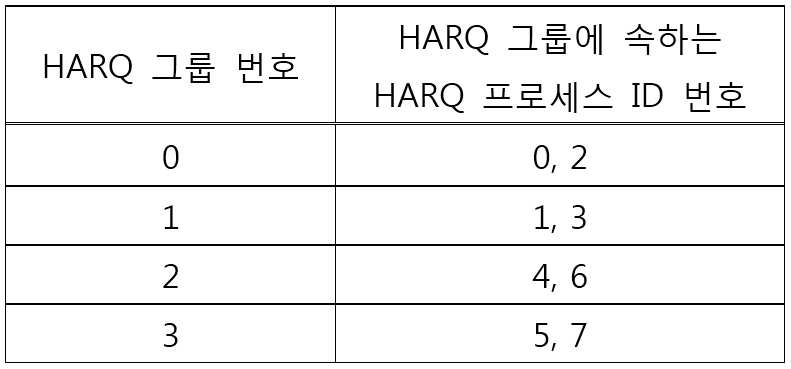
예를 들어, "N = 8"이고, "K = 4"인 경우, HARQ 그룹에서 HARQ 프로세스 ID는 아래 표 1과 같이 설정될 수 있다. HARQ 처리 동작의 수행 시간이 "1 TTI"인 경우, 동일한 HARQ 그룹에 속한 HARQ 프로세스 ID의 배치 간격은 "1 TTI" 이상으로 설정될 수 있다.For example, in the case of "N = 8" and "K = 4", the HARQ process ID in the HARQ group can be set as shown in Table 1 below. When the execution time of the HARQ process operation is "1 TTI ", the arrangement interval of HARQ process IDs belonging to the same HARQ group can be set to be equal to or larger than" 1 TTI ".
■ HARQ 처리 동작의 수행 시간(L)≪ RTI ID = 0.0 > (L) <
HARQ 처리 동작의 수행 시간(L)은 디코더(또는, 인코더)의 성능, HARQ 프로세스 ID에 대응하는 전송 블록의 크기, LLR 비트 폭 등에 기초하여 설정될 수 있다.The performance time L of the HARQ processing operation can be set based on the performance of the decoder (or encoder), the size of the transport block corresponding to the HARQ process ID, the LLR bit width, and the like.
한편, 앞서 설명된 HARQ 파라미터들(예를 들어, K, N, M, S, HARQ 그룹 내의 HARQ 프로세스 ID, L 등)의 설정 방법은 다음과 같을 수 있다.Meanwhile, a method of setting the HARQ parameters (for example, K, N, M, S, HARQ process ID, L in the HARQ group) described above may be as follows.
- 설정 방법 #1: HARQ 파라미터들은 규격(specification)에 미리 정의될 수 있으며, 통신 노드(예를 들어, 송신기 및 수신기)는 규격에 정의된 HARQ 파라미터들에 기초하여 HARQ 그룹을 설정할 수 있고, 설정된 HARQ 그룹에 기초하여 HARQ 프로세스를 처리할 수 있음.- Setting Method # 1: The HARQ parameters may be predefined in the specification, and the communication node (e.g., transmitter and receiver) may set the HARQ group based on the HARQ parameters defined in the specification, HARQ processes can be handled based on HARQ groups.
- 설정 방법 #2: "HARQ 그룹의 배치 간격" 및 "HARQ 그룹 내의 HARQ 프로세스 ID"는 통신 노드(예를 들어, 송신기 또는 수신기)로 시그널링될 수 있음. 통신 노드는 시그널링된 HARQ 파라미터들에 기초하여 나머지 HARQ 파라미터들(예를 들어, K, N, M, S)을 추정(또는, 계산)할 수 있고, 시그널링된 HARQ 파라미터들 및 추정된(또는, 계산된) HARQ 파라미터들에 기초하여 HARQ 그룹을 설정할 수 있고, 설정된 HARQ 그룹에 기초하여 HARQ 프로세스를 처리할 수 있음. 또는, 통신 노드는 시그널링된 HARQ 파라미터들 및 규격에 정의된 나머지 HARQ 파라미터들에 기초하여 HARQ 그룹을 설정할 수 있고, 설정된 HARQ 그룹에 기초하여 HARQ 프로세스를 처리할 수 있음.- Setting Method # 2: "Batch interval of HARQ group" and "HARQ process ID in HARQ group" can be signaled to a communication node (eg, transmitter or receiver). The communication node may estimate (or compute) the remaining HARQ parameters (e.g., K, N, M, S) based on the signaled HARQ parameters and may estimate the signaled HARQ parameters and the estimated HARQ < / RTI > parameters), and can process the HARQ process based on the set HARQ group. Alternatively, the communication node can set the HARQ group based on the signaled HARQ parameters and the remaining HARQ parameters defined in the specification, and can process the HARQ process based on the set HARQ group.
- 설정 방법 #3: N은 규격에서 정의될 수 있고, 이 경우에 통신 노드는 N에 기초하여 나머지 HARQ 파라미터들(예를 들어, M, K, S 등)을 추정(또는, 계산)할 수 있음. 따라서 통신 노드는 규격에 정의된 HARQ 파라미터 및 추정된(또는, 계산된) HARQ 파라미터들에 기초하여 HARQ 그룹을 설정할 수 있고, 설정된 HARQ 그룹에 기초하여 HARQ 프로세스를 처리할 수 있음.- Setting Method # 3: N can be defined in the specification, in which case the communication node can estimate (or calculate) the remaining HARQ parameters (e.g., M, K, S, etc.) has exist. Therefore, the communication node can set the HARQ group based on the HARQ parameters defined in the standard and the estimated (or computed) HARQ parameters, and can process the HARQ process based on the set HARQ group.
- 설정 방법 #4: 송신기는 HARQ 파라미터들 중에서 적어도 하나를 RRC(radio resource control) 시그널링 절차, 시스템 정보의 전송 절차 및 제어 정보(예를 들어, DCI(downlink control information))의 전송 절차 중에서 적어도 하나를 통해 수신기에 알려줄 수 있음. 수신기는 송신기로부터 수신된 적어도 하나의 HARQ 파라미터에 기초하여 HARQ 그룹을 설정할 수 있고, 설정된 HARQ 그룹에 기초하여 HARQ 프로세스를 처리할 수 있음. 여기서, HARQ 파라미터들은 송신기에 의해 설정될 수 있음.- Setting Method # 4: The transmitter transmits at least one of the HARQ parameters to at least one of a radio resource control (RRC) signaling procedure, a system information transmission procedure, and a transmission procedure of control information (e.g., downlink control information (DCI) To the receiver. The receiver can configure the HARQ group based on the at least one HARQ parameter received from the transmitter, and can process the HARQ process based on the set HARQ group. Here, the HARQ parameters can be set by the transmitter.
- 설정 방법 #5 : 수신기가 송신기에서 HARQ 그룹 설정에 필요한 정보 중에서 송신기가 모르고 있는 정보(예를 들어 수신기의 디코더 개수, HARQ 프로세스 처리시간 등)를 제공할 수 있고, 송신기는 수신기로부터 전달받은 정보를 통해서 수신기의 구성을 파악함으로써 HARQ 파라미터를 설정할 수 있음. 송신기는 설정된 HARQ 파라미터 중에 수신기가 필요한 정보(예를 들어, HARQ 프로세스 ID-HARQ 그룹의 매핑 관계, 혹은 TTI 번호-HARQ 그룹의 매핑 관계 등)를 선택적으로 수신기에 알려줄 수 있음.- Setting method # 5: The receiver can provide the information (for example, the number of decoders of the receiver, the HARQ process processing time, etc.) which the transmitter does not know from the information necessary for setting the HARQ group at the transmitter, The HARQ parameters can be set by knowing the configuration of the receiver. The transmitter may selectively inform the receiver of necessary information (e.g., HARQ process ID-HARQ group mapping relationship or TTI number-HARQ group mapping relationship) among the set HARQ parameters.
도 12는 HARQ 프로세스의 처리 방법의 제1 실시예를 도시한 순서도이다.12 is a flowchart showing a first embodiment of a processing method of the HARQ process.
도 12를 참조하면, 송신기 및 수신기 각각은 도 2에 도시된 통신 노드(200)와 동일 또는 유사하게 구성될 수 있다. 또한, 송신기 및 수신기 각각의 송수신 장치는 도 3에 도시된 송수신 장치(230)와 동일 또는 유사하게 구성될 수 있다. 하향링크 통신에서 송신기는 기지국일 수 있고, 수신기는 단말일 수 있다. 상향링크 통신에서 송신기는 단말일 수 있고, 수신기는 기지국일 수 있다. D2D 통신에서 송신기는 제1 단말일 수 있고, 수신기는 제2 단말일 수 있다.Referring to FIG. 12, each of the transmitter and the receiver may be configured to be the same as or similar to the
단계 S1200에서, 송신기 및 수신기 각각은 HARQ 파라미터들에 기초하여 하나 이상의 HARQ 그룹들을 설정할 수 있다. HARQ 파라미터들은 K, N, M, HARQ 그룹의 배치 간격, HARQ 그룹 내의 HARQ 프로세스 ID, HARQ 처리 동작의 수행 시간 등을 포함할 수 있다. HARQ 파라미터들은 앞서 설명된 설정 방법 #1 내지 #4에 기초하여 설정될 수 있고, HARQ 그룹은 도 5에 도시된 HARQ 그룹과 동일 또는 유사하게 설정될 수 있다. 또한, 단계 S1200에서 하나 이상의 HARQ 그룹들 각각에 HARQ 프로세스 ID가 배치(또는, 할당)될 수 있다.In step S1200, each of the transmitter and the receiver can set up one or more HARQ groups based on the HARQ parameters. The HARQ parameters may include K, N, M, a HARQ group allocation interval, a HARQ process ID in a HARQ group, a HARQ process operation execution time, and the like. The HARQ parameters may be set based on the
송신기는 HARQ 프로세스 ID별 전송 블록(예를 들어, 데이터 패킷)을 수신기에 전송할 수 있다(S1210). 수신기는 송신기로부터 전송 블록을 수신할 수 있고, 전송 블록에 대한 복조 동작을 수행할 수 있다(S1220). 또한, 수신기는 복조된 전송 블록에 대한 디매핑 동작을 수행할 수 있고(S1230), 디매핑된 전송 블록을 HARQ 메모리 그룹에 저장할 수 있다(S1240). 여기서, 디매핑된 전송 블록은 LLR 값일 수 있다. 수신기(예를 들어, 수신기의 디매퍼(233-3))는 디매핑된 전송 블록의 HARQ 프로세스 ID에 기초하여 디매핑된 전송 블록이 저장될 HARQ 메모리 그룹을 결정할 수 있다. 예를 들어, 디매핑된 전송 블록의 HARQ 프로세스 ID의 번호가 0 내지 N0-1 내에 속하는 경우, 수신기(예를 들어, 수신기의 디매퍼(233-3))는 디매핑된 전송 블록을 도 5의 HARQ 메모리 그룹 #0에 저장할 수 있다.The transmitter may transmit a transmission block (e.g., a data packet) per HARQ process ID to the receiver (S1210). The receiver can receive the transmission block from the transmitter and can perform the demodulation operation on the transmission block (S1220). Also, the receiver can perform a demapping operation on the demodulated transport block (S1230), and store the demapped transport block in the HARQ memory group (S1240). Here, the demapped transport block may be an LLR value. The receiver (e.g., demapper 233-3 of the receiver) can determine the HARQ memory group in which the demapped transport block is to be stored based on the HARQ process ID of the demapped transport block. For example, if the number of the HARQ process ID of the de-mapped transport block belongs to 0 to N 0 -1, the receiver (e.g., demapper 233-3 of the receiver) 5 HARQ
수신기(예를 들어, 수신기의 디코더(233-1))는 HARQ 메모리 그룹에 저장된 디매핑된 전송 블록에 대한 복호 동작을 수행할 수 있다(S1250). 예를 들어, 수신기(예를 들어, 수신기의 디코더(233-1))는 처리 대상인 HARQ 프로세스 ID에 대응하는 디매핑된 전송 블록이 저장된 HARQ 메모리 그룹을 확인할 수 있고, 확인된 HARQ 메모리 그룹에 메모리 접속 요청을 함으로써 해당 HARQ 메모리 그룹으로부터 디매핑된 전송 블록을 획득할 수 있고, 획득된 디매핑된 전송 블록에 대한 복호 동작을 수행할 수 있다. 처리 대상인 HARQ 프로세스 ID의 번호가 0 내지 N0-1 내에 속하는 경우, 수신기(예를 들어, 수신기의 디코더(233-1))는 도 5의 메모리 제어기 그룹 #0에 메모리 접속 요청을 할 수 있고, 메모리 접속 요청에 따라 HARQ 메모리 그룹 #0에 접속함으로써 HARQ 프로세스 ID에 대응하는 디매핑된 전송 블록을 획득할 수 있고, 획득된 디매핑된 전송 블록에 대한 복호 동작을 수행할 수 있다.The receiver (e.g., decoder 233-1 of the receiver) may perform a decoding operation on the demapped transport block stored in the HARQ memory group (S1250). For example, a receiver (e.g., decoder 233-1 of a receiver) can identify a HARQ memory group in which a demapped transport block corresponding to a HARQ process ID to be processed is stored, It is possible to acquire a transport block demapped from the corresponding HARQ memory group by performing a connection request and perform a decoding operation on the obtained demapped transport block. If the number of the HARQ process ID to be processed belongs to 0 to N 0 -1, the receiver (e.g., decoder 233-1 of the receiver) may make a memory access request to the memory
본 발명에 따른 방법들은 다양한 컴퓨터 수단을 통해 수행될 수 있는 프로그램 명령 형태로 구현되어 컴퓨터 판독 가능 매체에 기록될 수 있다. 컴퓨터 판독 가능 매체는 프로그램 명령, 데이터 파일, 데이터 구조 등을 단독으로 또는 조합하여 포함할 수 있다. 컴퓨터 판독 가능 매체에 기록되는 프로그램 명령은 본 발명을 위해 특별히 설계되고 구성된 것들이거나 컴퓨터 소프트웨어 당업자에게 공지되어 사용 가능한 것일 수도 있다.The methods according to the present invention can be implemented in the form of program instructions that can be executed through various computer means and recorded on a computer readable medium. The computer readable medium may include program instructions, data files, data structures, and the like, alone or in combination. The program instructions recorded on the computer readable medium may be those specially designed and constructed for the present invention or may be available to those skilled in the computer software.
컴퓨터 판독 가능 매체의 예에는 롬(rom), 램(ram), 플래시 메모리(flash memory) 등과 같이 프로그램 명령을 저장하고 수행하도록 특별히 구성된 하드웨어 장치가 포함된다. 프로그램 명령의 예에는 컴파일러(compiler)에 의해 만들어지는 것과 같은 기계어 코드뿐만 아니라 인터프리터(interpreter) 등을 사용해서 컴퓨터에 의해 실행될 수 있는 고급 언어 코드를 포함한다. 상술한 하드웨어 장치는 본 발명의 동작을 수행하기 위해 적어도 하나의 소프트웨어 모듈로 작동하도록 구성될 수 있으며, 그 역도 마찬가지이다.Examples of computer readable media include hardware devices that are specially configured to store and execute program instructions, such as ROM, RAM, flash memory, and the like. Examples of program instructions include machine language code such as those generated by a compiler, as well as high-level language code that can be executed by a computer using an interpreter or the like. The hardware devices described above may be configured to operate with at least one software module to perform the operations of the present invention, and vice versa.
이상 실시예를 참조하여 설명하였지만, 해당 기술 분야의 숙련된 당업자는 하기의 특허 청구의 범위에 기재된 본 발명의 사상 및 영역으로부터 벗어나지 않는 범위 내에서 본 발명을 다양하게 수정 및 변경시킬 수 있음을 이해할 수 있을 것이다.It will be understood by those skilled in the art that various changes in form and details may be made therein without departing from the spirit and scope of the invention as defined in the appended claims. It will be possible.
Claims (20)
하나 이상의 HARQ(hybrid automatic repeat request) 그룹들을 설정하는 단계; 및
상기 하나 이상의 HARQ 그룹들 각각에 HARQ 프로세스 ID(identifier)를 배치하는 단계를 포함하며,
상기 하나 이상의 HARQ 그룹들 각각은 HARQ 메모리 그룹, 상기 HARQ 메모리 그룹을 제어하는 메모리 제어기 그룹 및 상기 메모리 제어기 그룹을 통해 상기 HARQ 메모리 그룹에 접속함으로써 상기 HARQ 메모리 그룹에 저장된 데이터에 기초하여 복호를 수행하는 디코더(decoder) 그룹을 포함하고,
상기 하나 이상의 HARQ 그룹들 각각에 속하는 HARQ 프로세스 ID의 배치 간격은 하나의 HARQ 프로세스의 처리 시간 이상인, 제1 통신 노드의 동작 방법.A method of operating a first communication node in a communication system,
Establishing one or more hybrid automatic repeat request (HARQ) groups; And
And placing an HARQ process identifier in each of the one or more HARQ groups,
Each of the one or more HARQ groups performs decoding based on data stored in the HARQ memory group by accessing the HARQ memory group, a memory controller group controlling the HARQ memory group, and the HARQ memory group through the memory controller group A decoder group,
Wherein the allocation interval of HARQ process IDs belonging to each of the one or more HARQ groups is equal to or greater than a processing time of one HARQ process.
상기 하나 이상의 HARQ 그룹들을 설정하기 위해 사용되는 파라미터들은 RRC(radio resource control) 시그널링 절차, 시스템 정보의 전송 절차 및 제어 정보의 전송 절차 중에서 적어도 하나를 통해 수신되는, 제1 통신 노드의 동작 방법.The method according to claim 1,
Wherein the parameters used to configure the one or more HARQ groups are received via at least one of a radio resource control (RRC) signaling procedure, a system information transmission procedure, and a control information transmission procedure.
상기 하나 이상의 HARQ 그룹들은 상기 HARQ 프로세스 ID들의 전체 개수, 상기 하나 이상의 HARQ 그룹들에 속하는 디코더들의 전체 개수, 상기 HARQ 프로세스의 처리 시간에 기초하여 설정되는, 제1 통신 노드의 동작 방법.The method according to claim 1,
Wherein the one or more HARQ groups are set based on the total number of HARQ process IDs, the total number of decoders belonging to the one or more HARQ groups, and the processing time of the HARQ process.
상기 HARQ 프로세스 ID의 번호가 j이고, 상기 HARQ 프로세스의 처리 시간이 L이고, 전송 블록의 번호가 b이고, TTI(transmission time interval) 번호가 t이고, 매핑 함수가 입력된 j, L, b 및 t에 기초하여 HARQ 그룹 번호를 출력하는 경우, 상기 매핑 함수에 따른 결과가 동일한 HARQ 프로세스 ID #j의 전송 블록은 동일한 HARQ 그룹에 배치되는, 제1 통신 노드의 동작 방법.The method according to claim 1,
The HARQ process ID is j, the processing time of the HARQ process is L, the number of the transmission block is b, the transmission time interval (TTI) number is t, and the mapping function is input j, L, the transmission blocks of the HARQ process ID #j having the same result according to the mapping function are arranged in the same HARQ group.
상기 하나 이상의 HARQ 그룹들의 전체 개수가 K이고, 임의의 HARQ 프로세스 ID의 번호가 j인 경우, 동일한 "j mod K" 결과를 가지는 HARQ 프로세스 ID #j는 동일한 HARQ 그룹에 배치되는, 제1 통신 노드의 동작 방법.The method according to claim 1,
If the total number of one or more HARQ groups is K and the number of any HARQ process ID is j, the HARQ process ID #j having the same "j mod K" result is placed in the same HARQ group, Lt; / RTI >
상기 하나 이상의 HARQ 그룹들의 전체 개수가 K이고, 상기 HARQ 프로세스 ID들의 전체 개수가 N이고, x가 2 이상의 자연수이고, β가 1/x 이상이고 1 이하인 실수이고, "N mod K < K/x"인 경우, N개의 HARQ 프로세스 ID들 중에서 HARQ 그룹으로 설정되는 "floor(N/K)*K"개의 HARQ 프로세스 ID를 제외한 "N mod K"개의 HARQ 프로세스 ID #j는 HARQ 그룹 #(K*β ± (j mod K))에 배치되는, 제1 통신 노드의 동작 방법.The method according to claim 1,
Wherein N is an integer equal to or greater than 1 and equal to or greater than 1 and x is a natural number equal to or greater than 2 and? Is equal to or greater than 1 / x and equal to or less than 1, wherein N is a total number of HARQ processes "N mod K" HARQ process IDs #j, excluding "floor (N / K) * K" HARQ process IDs set to HARQ group among N HARQ process IDs, lt; / RTI > (j < / RTI > mod K).
상기 제1 통신 노드의 동작 방법은,
제2 통신 노드로부터 전송 블록을 수신하는 단계;
상기 전송 블록에 대한 복조 동작을 수행하는 단계;
상기 복조된 전송 블록에 대한 디매핑(demapping) 동작을 수행하는 단계;
상기 디매핑된 전송 블록의 HARQ 프로세스 ID에 기초하여 상기 디매핑된 전송 블록이 저장된 HARQ 메모리 그룹을 확인하는 단계;
상기 확인된 HARQ 메모리 그룹으로부터 상기 디매핑된 전송 블록을 획득하여 컴바이닝(combining)하는 단계;
상기 컴바이닝된 전송 블록을 상기 HARQ 메모리 그룹에 저장하는 단계; 및
상기 컴바이닝된 전송 블록에 대한 복호 동작을 수행하는 단계를 포함하는, 제1 통신 노드의 동작 방법.The method according to claim 1,
The method of claim 1,
Receiving a transport block from a second communication node;
Performing a demodulation operation on the transport block;
Performing a demapping operation on the demodulated transport block;
Determining an HARQ memory group in which the demapped transport block is stored based on a HARQ process ID of the demapped transport block;
Acquiring and combining the demapped transport block from the identified HARQ memory group;
Storing the combined transport block in the HARQ memory group; And
And performing a decoding operation on the combined transport block.
상기 하나 이상의 HARQ 그룹들을 설정하는 단계는,
HARQ 그룹별 배치 간격 정보를 제2 통신 노드에 전송하는 단계;
상기 제2 통신 노드로부터 상기 HARQ 그룹별 배치 간격 정보에 기초하여 설정된 파라미터들을 수신하는 단계; 및
상기 파라미터들을 사용하여 상기 하나 이상의 HARQ 그룹들을 설정하는 단계를 포함하는, 제1 통신 노드의 동작 방법.The method according to claim 1,
Wherein configuring the one or more HARQ groups comprises:
Transmitting allocation interval information for each HARQ group to a second communication node;
Receiving parameters from the second communication node based on the allocation interval information for each HARQ group; And
And setting the one or more HARQ groups using the parameters.
하나 이상의 HARQ(hybrid automatic repeat request) 그룹들을 설정하기 위해 사용되는 파라미터들을 설정하는 단계; 및
상기 파라미터들을 제2 통신 노드에 전송하는 단계를 포함하며,
상기 하나 이상의 HARQ 그룹들 각각은 HARQ 메모리 그룹, 상기 HARQ 메모리 그룹을 제어하는 메모리 제어기 그룹 및 상기 메모리 제어기 그룹을 통해 상기 HARQ 메모리 그룹에 접속함으로써 상기 HARQ 메모리 그룹에 저장된 데이터를 복호하는 디코더(decoder) 그룹을 포함하고,
상기 파라미터들은 하나 이상의 HARQ 그룹들의 전체 개수, 상기 하나 이상의 HARQ 그룹들에 속하는 HARQ 프로세스 ID들의 전체 개수, 상기 하나 이상의 HARQ 그룹들에 속하는 디코더들의 전체 개수, 상기 하나 이상의 HARQ 그룹들의 배치 간격, 상기 하나 이상의 HARQ 그룹들 내에 배치되는 HARQ 프로세스 ID 및 HARQ 프로세스의 처리 시간 중에서 적어도 하나를 포함하는, 제1 통신 노드의 동작 방법.A method of operating a first communication node in a communication system,
Setting parameters used to set one or more hybrid automatic repeat request (HARQ) groups; And
And transmitting the parameters to a second communication node,
Each of the one or more HARQ groups includes a HARQ memory group, a memory controller group for controlling the HARQ memory group, and a decoder for decoding data stored in the HARQ memory group by accessing the HARQ memory group through the memory controller group, Group,
Wherein the parameters include at least one of a total number of one or more HARQ groups, a total number of HARQ process IDs belonging to the at least one HARQ group, a total number of decoders belonging to the at least one HARQ group, The HARQ process ID being located in the HARQ groups and the processing time of the HARQ process.
상기 파라미터들은 상기 제2 통신 노드로부터 수신된 HARQ 그룹별 배치 간격 정보에 기초하여 설정되는, 제1 통신 노드의 동작 방법.The method of claim 9,
Wherein the parameters are set based on batch interval information per HARQ group received from the second communication node.
상기 파라미터들은 RRC(radio resource control) 시그널링 절차, 시스템 정보의 전송 절차 및 제어 정보의 전송 절차 중에서 적어도 하나를 통해 전송되는, 제1 통신 노드의 동작 방법.The method of claim 9,
Wherein the parameters are transmitted via at least one of a radio resource control (RRC) signaling procedure, a system information transmission procedure, and a control information transmission procedure.
상기 하나 이상의 HARQ 그룹들 각각에 속하는 HARQ 프로세스 ID의 배치 간격은 하나의 HARQ 프로세스의 처리 시간 이상인, 제1 통신 노드의 동작 방법.The method of claim 9,
Wherein the allocation interval of HARQ process IDs belonging to each of the one or more HARQ groups is equal to or greater than a processing time of one HARQ process.
상기 HARQ 프로세스 ID의 번호가 j이고, 상기 HARQ 프로세스의 처리 시간이 L이고, 전송 블록의 번호가 b이고, TTI(transmission time interval) 번호가 t이고, 매핑 함수가 입력된 j, L, b 및 t에 기초하여 HARQ 그룹 번호를 출력하는 경우, 상기 매핑 함수에 따른 결과가 동일한 HARQ 프로세스 ID #j의 전송 블록은 동일한 HARQ 그룹에 배치되는, 제1 통신 노드의 동작 방법.The method of claim 9,
The HARQ process ID is j, the processing time of the HARQ process is L, the number of the transmission block is b, the transmission time interval (TTI) number is t, and the mapping function is input j, L, the transmission blocks of the HARQ process ID #j having the same result according to the mapping function are arranged in the same HARQ group.
상기 하나 이상의 HARQ 그룹들의 전체 개수가 K이고, 상기 HARQ 프로세스 ID들의 전체 개수가 N이고, N개의 HARQ 프로세스 ID들 중에서 임의의 HARQ 프로세스 ID의 번호가 j인 경우, 동일한 "j mod K" 결과를 가지는 HARQ 프로세스 ID는 동일한 HARQ 그룹에 배치되는, 제1 통신 노드의 동작 방법.The method of claim 9,
If the total number of one or more HARQ groups is K, the total number of HARQ process IDs is N, and the number of any HARQ process ID among the N HARQ process IDs is j, the same "j mod K" The HARQ process IDs are placed in the same HARQ group.
상기 하나 이상의 HARQ 그룹들의 전체 개수가 K이고, 상기 HARQ 프로세스 ID들의 전체 개수가 N이고, x가 2 이상의 자연수이고, β가 1/x 이상이고 1 이하인 실수이고, "N mod K < K/x"인 경우, N개의 HARQ 프로세스 ID들 중에서 HARQ 그룹으로 설정되는 "floor(N/K)*K"개의 HARQ 프로세스 ID를 제외한 "N mod K"개의 HARQ 프로세스 ID #j는 HARQ 그룹 #(K*β ± (j mod K))에 배치되는, 제1 통신 노드의 동작 방법.The method of claim 9,
Wherein N is an integer equal to or greater than 1 and equal to or greater than 1 and x is a natural number equal to or greater than 2 and? Is equal to or greater than 1 / x and equal to or less than 1, wherein N is a total number of HARQ processes "N mod K" HARQ process IDs #j, excluding "floor (N / K) * K" HARQ process IDs set to HARQ group among N HARQ process IDs, lt; / RTI > (j < / RTI > mod K).
프로세서(processor); 및
상기 프로세서에 의해 실행되는 적어도 하나의 명령이 저장된 메모리를 포함하며,
상기 적어도 하나의 명령은,
하나 이상의 HARQ(hybrid automatic repeat request) 그룹들을 설정하고; 그리고
상기 하나 이상의 HARQ 그룹들 각각에 HARQ 프로세스 ID(identifier)를 배치하도록 실행되며,
상기 하나 이상의 HARQ 그룹들 각각은 HARQ 메모리 그룹, 상기 HARQ 메모리 그룹을 제어하는 메모리 제어기 그룹 및 상기 메모리 제어기 그룹을 통해 상기 HARQ 메모리 그룹에 접속함으로써 상기 HARQ 메모리 그룹에 저장된 데이터를 복호하는 디코더(decoder) 그룹을 포함하고,
상기 하나 이상의 HARQ 그룹들 각각에 속하는 HARQ 프로세스 ID의 배치 간격은 하나의 HARQ 프로세스의 처리 시간 이상인, 통신 노드.A communication node in a communication system,
A processor; And
Wherein the at least one instruction executed by the processor comprises a stored memory,
Wherein the at least one instruction comprises:
Establish one or more hybrid automatic repeat request (HARQ) groups; And
And to place an HARQ process identifier in each of the one or more HARQ groups,
Each of the one or more HARQ groups includes a HARQ memory group, a memory controller group for controlling the HARQ memory group, and a decoder for decoding data stored in the HARQ memory group by accessing the HARQ memory group through the memory controller group, Group,
Wherein the allocation interval of HARQ process IDs belonging to each of the one or more HARQ groups is equal to or greater than a processing time of one HARQ process.
상기 하나 이상의 HARQ 그룹들은 상기 하나 이상의 HARQ 그룹들에 속하는 디코더들의 전체 개수, 상기 HARQ 프로세스의 처리 시간에 기초하여 설정되는, 통신 노드.18. The method of claim 16,
Wherein the one or more HARQ groups are set based on a total number of decoders belonging to the one or more HARQ groups, a processing time of the HARQ process.
상기 HARQ 프로세스 ID의 번호가 j이고, 상기 HARQ 프로세스의 처리 시간이 L이고, 전송 블록의 번호가 b이고, TTI(transmission time interval) 번호가 t이고, 매핑 함수가 입력된 j, L, b 및 t에 기초하여 HARQ 그룹 번호를 출력하는 경우, 상기 매핑 함수에 따른 결과가 동일한 HARQ 프로세스 ID #j의 전송 블록은 동일한 HARQ 그룹에 배치되는, 통신 노드.18. The method of claim 16,
The HARQ process ID is j, the processing time of the HARQ process is L, the number of the transmission block is b, the transmission time interval (TTI) number is t, and the mapping function is input j, L, t, the transmission blocks of the HARQ process ID #j having the same result according to the mapping function are placed in the same HARQ group.
상기 하나 이상의 HARQ 그룹들의 전체 개수가 K이고, 상기 HARQ 프로세스 ID들의 전체 개수가 N이고, x가 2 이상의 자연수이고, β가 1/x 이상이고 1 이하인 실수이고, "N mod K < K/x"인 경우, N개의 HARQ 프로세스 ID들 중에서 HARQ 그룹으로 설정되는 "floor(N/K)*K"개의 HARQ 프로세스 ID를 제외한 "N mod K"개의 HARQ 프로세스 ID #j는 HARQ 그룹 #(K*β ± (j mod K))에 배치되는, 통신 노드.18. The method of claim 16,
Wherein N is an integer equal to or greater than 1 and equal to or greater than 1 and x is a natural number equal to or greater than 2 and? Is equal to or greater than 1 / x and equal to or less than 1, wherein N is a total number of HARQ processes "N mod K" HARQ process IDs #j, excluding "floor (N / K) * K" HARQ process IDs set to HARQ group among N HARQ process IDs, beta < / RTI > + (j mod K).
상기 하나 이상의 HARQ 그룹들을 설정하는 경우에 상기 적어도 하나의 명령은,
HARQ 그룹별 배치 간격 정보를 제2 통신 노드에 전송하고;
상기 제2 통신 노드로부터 상기 HARQ 그룹별 배치 간격 정보에 기초하여 설정된 파라미터들을 수신하고; 그리고
상기 파라미터들을 사용하여 상기 하나 이상의 HARQ 그룹들을 설정하도록 실행되는, 통신 노드.18. The method of claim 16,
Wherein the at least one command, when setting the one or more HARQ groups,
To the second communication node, allocation interval information per HARQ group;
Receiving parameters from the second communication node based on the HARQ-group allocation interval information; And
And to set the one or more HARQ groups using the parameters.
Priority Applications (1)
| Application Number | Priority Date | Filing Date | Title |
|---|---|---|---|
| US15/903,634 US10615923B2 (en) | 2017-02-24 | 2018-02-23 | Method and apparatus for processing hybrid automatic repeat request process in communication system |
Applications Claiming Priority (2)
| Application Number | Priority Date | Filing Date | Title |
|---|---|---|---|
| KR1020170024850 | 2017-02-24 | ||
| KR20170024850 | 2017-02-24 |
Publications (2)
| Publication Number | Publication Date |
|---|---|
| KR20180098139A true KR20180098139A (en) | 2018-09-03 |
| KR102016665B1 KR102016665B1 (en) | 2019-08-30 |
Family
ID=63601019
Family Applications (1)
| Application Number | Title | Priority Date | Filing Date |
|---|---|---|---|
| KR1020180017952A Active KR102016665B1 (en) | 2017-02-24 | 2018-02-13 | Method and apparatus for processing hybrid automatic repeat request process in communication system |
Country Status (1)
| Country | Link |
|---|---|
| KR (1) | KR102016665B1 (en) |
Cited By (1)
| Publication number | Priority date | Publication date | Assignee | Title |
|---|---|---|---|---|
| WO2022031102A1 (en) * | 2020-08-06 | 2022-02-10 | 엘지전자 주식회사 | Method for transmitting uplink channel, user device, processing device, storage medium and computer program, and method for receiving uplink channel, and base station |
Citations (3)
| Publication number | Priority date | Publication date | Assignee | Title |
|---|---|---|---|---|
| KR20050097892A (en) * | 2002-02-13 | 2005-10-10 | 인터디지탈 테크날러지 코포레이션 | Base station for transport block set transmission using hybrid automatic repeat request |
| JP5363633B2 (en) * | 2006-09-28 | 2013-12-11 | テレフオンアクチーボラゲット エル エム エリクソン(パブル) | Autonomous transmission method for coverage extension |
| US20150103775A1 (en) * | 2012-06-28 | 2015-04-16 | Nokia Corporation | Flexible harq ack/nack transmission |
-
2018
- 2018-02-13 KR KR1020180017952A patent/KR102016665B1/en active Active
Patent Citations (3)
| Publication number | Priority date | Publication date | Assignee | Title |
|---|---|---|---|---|
| KR20050097892A (en) * | 2002-02-13 | 2005-10-10 | 인터디지탈 테크날러지 코포레이션 | Base station for transport block set transmission using hybrid automatic repeat request |
| JP5363633B2 (en) * | 2006-09-28 | 2013-12-11 | テレフオンアクチーボラゲット エル エム エリクソン(パブル) | Autonomous transmission method for coverage extension |
| US20150103775A1 (en) * | 2012-06-28 | 2015-04-16 | Nokia Corporation | Flexible harq ack/nack transmission |
Cited By (3)
| Publication number | Priority date | Publication date | Assignee | Title |
|---|---|---|---|---|
| WO2022031102A1 (en) * | 2020-08-06 | 2022-02-10 | 엘지전자 주식회사 | Method for transmitting uplink channel, user device, processing device, storage medium and computer program, and method for receiving uplink channel, and base station |
| US20230309090A1 (en) * | 2020-08-06 | 2023-09-28 | Lg Electronics Inc. | Method for transmitting uplink channel, user device, processing device, storage medium and computer program, and method for receiving uplink channel, and base station |
| US12520304B2 (en) | 2020-08-06 | 2026-01-06 | Lg Electronics Inc. | Method for transmitting uplink channel, user device, processing device, storage medium and computer program, and method for receiving uplink channel, and base station |
Also Published As
| Publication number | Publication date |
|---|---|
| KR102016665B1 (en) | 2019-08-30 |
Similar Documents
| Publication | Publication Date | Title |
|---|---|---|
| JP6907322B2 (en) | Uplink transmission methods, terminals, and network-side devices | |
| CN111656840B (en) | System and method for time domain license-free PUSCH resource allocation | |
| CN110192417B (en) | System and method for license-free uplink transmission | |
| RU2725159C1 (en) | Methods and units for determining size of transmission data unit | |
| CN105612712B (en) | Method, apparatus and apparatus for identifying physical hybrid automatic repeat request indicator channel resources | |
| KR102756401B1 (en) | Transmission method and device | |
| CN108633014B (en) | Data transmission method, terminal device and network device | |
| CN109890076B (en) | A data transmission method, device and storage medium on unlicensed spectrum | |
| KR20200018141A (en) | Method and apparatus for transmission and reception of harq-ack feedback in wireless communication system | |
| CN106537979A (en) | System and method for multiple carrier transmission | |
| CN105556884A (en) | Transmission method, user equipment and base station for hybrid automatic repeat request acknowledgment | |
| WO2018171474A1 (en) | Data transmission method, device and system | |
| US10615923B2 (en) | Method and apparatus for processing hybrid automatic repeat request process in communication system | |
| WO2014173351A1 (en) | Uplink control information sending method, and user equipment and base station | |
| CN104885399A (en) | Aro values in pucch resource allocation for epdcch in tdd | |
| WO2015101046A1 (en) | Method and device for response information transmission, terminal, base station, and storage medium | |
| US20220140949A1 (en) | Method and apparatus for hybrid automatic repeat request feedback in communication system | |
| KR20220050766A (en) | Method and apparatus for transmitting and receiving broadcast signal in communication system | |
| JP2020530952A (en) | Feedback response information transmission method, equipment and system | |
| US10686566B2 (en) | Method for transmission and reception based on hybrid automatic repeat request in communication system and apparatus for the same | |
| KR102016665B1 (en) | Method and apparatus for processing hybrid automatic repeat request process in communication system | |
| KR102661305B1 (en) | Method and apparatus for hybrid automatic repeat request feedback in communication system | |
| US8270364B1 (en) | Method, apparatus and computer program for wireless communication | |
| CN107113119A (en) | Transmission method, user equipment and the base station of mixed automatic retransfer response message | |
| CN111431675A (en) | Data transmission method and device |
Legal Events
| Date | Code | Title | Description |
|---|---|---|---|
| A201 | Request for examination | ||
| PA0109 | Patent application |
St.27 status event code: A-0-1-A10-A12-nap-PA0109 |
|
| PA0201 | Request for examination |
St.27 status event code: A-1-2-D10-D11-exm-PA0201 |
|
| PG1501 | Laying open of application |
St.27 status event code: A-1-1-Q10-Q12-nap-PG1501 |
|
| D13-X000 | Search requested |
St.27 status event code: A-1-2-D10-D13-srh-X000 |
|
| D14-X000 | Search report completed |
St.27 status event code: A-1-2-D10-D14-srh-X000 |
|
| E701 | Decision to grant or registration of patent right | ||
| PE0701 | Decision of registration |
St.27 status event code: A-1-2-D10-D22-exm-PE0701 |
|
| GRNT | Written decision to grant | ||
| PR0701 | Registration of establishment |
St.27 status event code: A-2-4-F10-F11-exm-PR0701 |
|
| PR1002 | Payment of registration fee |
St.27 status event code: A-2-2-U10-U11-oth-PR1002 Fee payment year number: 1 |
|
| PG1601 | Publication of registration |
St.27 status event code: A-4-4-Q10-Q13-nap-PG1601 |
|
| PR1001 | Payment of annual fee |
St.27 status event code: A-4-4-U10-U11-oth-PR1001 Fee payment year number: 4 |
|
| PR1001 | Payment of annual fee |
St.27 status event code: A-4-4-U10-U11-oth-PR1001 Fee payment year number: 5 |
|
| PR1001 | Payment of annual fee |
St.27 status event code: A-4-4-U10-U11-oth-PR1001 Fee payment year number: 6 |
|
| PR1001 | Payment of annual fee |
St.27 status event code: A-4-4-U10-U11-oth-PR1001 Fee payment year number: 7 |
|
| U11 | Full renewal or maintenance fee paid |
Free format text: ST27 STATUS EVENT CODE: A-4-4-U10-U11-OTH-PR1001 (AS PROVIDED BY THE NATIONAL OFFICE) Year of fee payment: 7 |