KR20180008564A - Copolymers for alkene-alkane separation membranes - Google Patents
Copolymers for alkene-alkane separation membranes Download PDFInfo
- Publication number
- KR20180008564A KR20180008564A KR1020177035638A KR20177035638A KR20180008564A KR 20180008564 A KR20180008564 A KR 20180008564A KR 1020177035638 A KR1020177035638 A KR 1020177035638A KR 20177035638 A KR20177035638 A KR 20177035638A KR 20180008564 A KR20180008564 A KR 20180008564A
- Authority
- KR
- South Korea
- Prior art keywords
- cfocf
- cyclic
- polymer
- mol
- repeating units
- Prior art date
- Legal status (The legal status is an assumption and is not a legal conclusion. Google has not performed a legal analysis and makes no representation as to the accuracy of the status listed.)
- Ceased
Links
- 239000012528 membrane Substances 0.000 title claims abstract description 37
- 229920001577 copolymer Polymers 0.000 title claims abstract description 30
- 238000000926 separation method Methods 0.000 title claims description 14
- 239000000178 monomer Substances 0.000 claims abstract description 36
- XUCNUKMRBVNAPB-UHFFFAOYSA-N fluoroethene Chemical compound FC=C XUCNUKMRBVNAPB-UHFFFAOYSA-N 0.000 claims abstract description 35
- 150000001336 alkenes Chemical class 0.000 claims abstract description 30
- 229910052751 metal Inorganic materials 0.000 claims abstract description 25
- 239000002184 metal Substances 0.000 claims abstract description 25
- VGGSQFUCUMXWEO-UHFFFAOYSA-N Ethene Chemical compound C=C VGGSQFUCUMXWEO-UHFFFAOYSA-N 0.000 claims abstract description 24
- 239000005977 Ethylene Substances 0.000 claims abstract description 24
- 125000004122 cyclic group Chemical group 0.000 claims abstract description 23
- 229920000554 ionomer Polymers 0.000 claims abstract description 19
- 150000001335 aliphatic alkanes Chemical class 0.000 claims abstract description 18
- 229910052709 silver Inorganic materials 0.000 claims abstract description 8
- 239000004332 silver Substances 0.000 claims abstract description 8
- 229920000642 polymer Polymers 0.000 claims description 41
- 238000000034 method Methods 0.000 claims description 18
- 229910052731 fluorine Inorganic materials 0.000 claims description 13
- 150000001768 cations Chemical class 0.000 claims description 8
- 125000004432 carbon atom Chemical group C* 0.000 claims description 7
- VQUGQIYAVYQSAB-UHFFFAOYSA-N 1,1,2,2-tetrafluoro-2-(1,2,2-trifluoroethenoxy)ethanesulfonyl fluoride Chemical compound FC(F)=C(F)OC(F)(F)C(F)(F)S(F)(=O)=O VQUGQIYAVYQSAB-UHFFFAOYSA-N 0.000 claims description 6
- RTZKZFJDLAIYFH-UHFFFAOYSA-N Diethyl ether Chemical compound CCOCC RTZKZFJDLAIYFH-UHFFFAOYSA-N 0.000 claims description 6
- YSYRISKCBOPJRG-UHFFFAOYSA-N 4,5-difluoro-2,2-bis(trifluoromethyl)-1,3-dioxole Chemical group FC1=C(F)OC(C(F)(F)F)(C(F)(F)F)O1 YSYRISKCBOPJRG-UHFFFAOYSA-N 0.000 claims description 5
- BQCIDUSAKPWEOX-UHFFFAOYSA-N 1,1-Difluoroethene Chemical compound FC(F)=C BQCIDUSAKPWEOX-UHFFFAOYSA-N 0.000 claims description 4
- 125000001153 fluoro group Chemical group F* 0.000 claims description 4
- 239000011737 fluorine Substances 0.000 claims description 3
- 230000000694 effects Effects 0.000 claims description 2
- FOIXSVOLVBLSDH-UHFFFAOYSA-N Silver ion Chemical compound [Ag+] FOIXSVOLVBLSDH-UHFFFAOYSA-N 0.000 claims 2
- BQCADISMDOOEFD-UHFFFAOYSA-N Silver Chemical compound [Ag] BQCADISMDOOEFD-UHFFFAOYSA-N 0.000 abstract description 6
- BDHFUVZGWQCTTF-UHFFFAOYSA-M sulfonate Chemical compound [O-]S(=O)=O BDHFUVZGWQCTTF-UHFFFAOYSA-M 0.000 abstract 1
- 125000000472 sulfonyl group Chemical group *S(*)(=O)=O 0.000 abstract 1
- OKKJLVBELUTLKV-UHFFFAOYSA-N Methanol Chemical compound OC OKKJLVBELUTLKV-UHFFFAOYSA-N 0.000 description 30
- 239000007789 gas Substances 0.000 description 20
- XLYOFNOQVPJJNP-UHFFFAOYSA-N water Substances O XLYOFNOQVPJJNP-UHFFFAOYSA-N 0.000 description 20
- IJGRMHOSHXDMSA-UHFFFAOYSA-N Atomic nitrogen Chemical compound N#N IJGRMHOSHXDMSA-UHFFFAOYSA-N 0.000 description 19
- 239000000203 mixture Substances 0.000 description 19
- 239000012466 permeate Substances 0.000 description 16
- 238000003756 stirring Methods 0.000 description 13
- VEXZGXHMUGYJMC-UHFFFAOYSA-N Hydrochloric acid Chemical compound Cl VEXZGXHMUGYJMC-UHFFFAOYSA-N 0.000 description 12
- 239000007788 liquid Substances 0.000 description 11
- 239000000243 solution Substances 0.000 description 11
- 239000007787 solid Substances 0.000 description 10
- 238000006243 chemical reaction Methods 0.000 description 9
- 229910052757 nitrogen Inorganic materials 0.000 description 9
- -1 perfluoro Chemical group 0.000 description 9
- 239000011541 reaction mixture Substances 0.000 description 9
- XKRFYHLGVUSROY-UHFFFAOYSA-N Argon Chemical compound [Ar] XKRFYHLGVUSROY-UHFFFAOYSA-N 0.000 description 8
- 239000010410 layer Substances 0.000 description 8
- 238000012360 testing method Methods 0.000 description 8
- 229910001220 stainless steel Inorganic materials 0.000 description 7
- 239000010935 stainless steel Substances 0.000 description 7
- CSCPPACGZOOCGX-UHFFFAOYSA-N Acetone Chemical compound CC(C)=O CSCPPACGZOOCGX-UHFFFAOYSA-N 0.000 description 6
- KFZMGEQAYNKOFK-UHFFFAOYSA-N Isopropanol Chemical compound CC(C)O KFZMGEQAYNKOFK-UHFFFAOYSA-N 0.000 description 6
- ATUOYWHBWRKTHZ-UHFFFAOYSA-N Propane Chemical compound CCC ATUOYWHBWRKTHZ-UHFFFAOYSA-N 0.000 description 6
- 239000008367 deionised water Substances 0.000 description 6
- 229910021641 deionized water Inorganic materials 0.000 description 6
- JRZJOMJEPLMPRA-UHFFFAOYSA-N olefin Natural products CCCCCCCC=C JRZJOMJEPLMPRA-UHFFFAOYSA-N 0.000 description 6
- 230000035699 permeability Effects 0.000 description 6
- 239000002244 precipitate Substances 0.000 description 6
- 229920001897 terpolymer Polymers 0.000 description 6
- 239000002253 acid Substances 0.000 description 5
- 230000015572 biosynthetic process Effects 0.000 description 5
- 150000001875 compounds Chemical class 0.000 description 5
- 230000009477 glass transition Effects 0.000 description 5
- 230000007062 hydrolysis Effects 0.000 description 5
- 238000006460 hydrolysis reaction Methods 0.000 description 5
- 239000007864 aqueous solution Substances 0.000 description 4
- 229910052786 argon Inorganic materials 0.000 description 4
- 238000009835 boiling Methods 0.000 description 4
- 229920002313 fluoropolymer Polymers 0.000 description 4
- 239000011521 glass Substances 0.000 description 4
- 239000012188 paraffin wax Substances 0.000 description 4
- 125000000542 sulfonic acid group Chemical group 0.000 description 4
- 238000003786 synthesis reaction Methods 0.000 description 4
- RRZIJNVZMJUGTK-UHFFFAOYSA-N 1,1,2-trifluoro-2-(1,2,2-trifluoroethenoxy)ethene Chemical compound FC(F)=C(F)OC(F)=C(F)F RRZIJNVZMJUGTK-UHFFFAOYSA-N 0.000 description 3
- DFUYAWQUODQGFF-UHFFFAOYSA-N 1-ethoxy-1,1,2,2,3,3,4,4,4-nonafluorobutane Chemical compound CCOC(F)(F)C(F)(F)C(F)(F)C(F)(F)F DFUYAWQUODQGFF-UHFFFAOYSA-N 0.000 description 3
- ATRRKUHOCOJYRX-UHFFFAOYSA-N Ammonium bicarbonate Chemical compound [NH4+].OC([O-])=O ATRRKUHOCOJYRX-UHFFFAOYSA-N 0.000 description 3
- LSNNMFCWUKXFEE-UHFFFAOYSA-M Bisulfite Chemical compound OS([O-])=O LSNNMFCWUKXFEE-UHFFFAOYSA-M 0.000 description 3
- HEMHJVSKTPXQMS-UHFFFAOYSA-M Sodium hydroxide Chemical compound [OH-].[Na+] HEMHJVSKTPXQMS-UHFFFAOYSA-M 0.000 description 3
- 239000012080 ambient air Substances 0.000 description 3
- 239000001099 ammonium carbonate Substances 0.000 description 3
- 235000012501 ammonium carbonate Nutrition 0.000 description 3
- 229910052799 carbon Inorganic materials 0.000 description 3
- 238000001816 cooling Methods 0.000 description 3
- 238000000921 elemental analysis Methods 0.000 description 3
- 230000004907 flux Effects 0.000 description 3
- 238000010438 heat treatment Methods 0.000 description 3
- 238000003760 magnetic stirring Methods 0.000 description 3
- 229920000728 polyester Polymers 0.000 description 3
- 239000001294 propane Substances 0.000 description 3
- QQONPFPTGQHPMA-UHFFFAOYSA-N propylene Natural products CC=C QQONPFPTGQHPMA-UHFFFAOYSA-N 0.000 description 3
- 125000004805 propylene group Chemical group [H]C([H])([H])C([H])([*:1])C([H])([H])[*:2] 0.000 description 3
- 150000008054 sulfonate salts Chemical class 0.000 description 3
- OBTWBSRJZRCYQV-UHFFFAOYSA-N sulfuryl difluoride Chemical group FS(F)(=O)=O OBTWBSRJZRCYQV-UHFFFAOYSA-N 0.000 description 3
- BFKJFAAPBSQJPD-UHFFFAOYSA-N tetrafluoroethene Chemical group FC(F)=C(F)F BFKJFAAPBSQJPD-UHFFFAOYSA-N 0.000 description 3
- CURLTUGMZLYLDI-UHFFFAOYSA-N Carbon dioxide Chemical compound O=C=O CURLTUGMZLYLDI-UHFFFAOYSA-N 0.000 description 2
- 238000005033 Fourier transform infrared spectroscopy Methods 0.000 description 2
- 229920006362 Teflon® Polymers 0.000 description 2
- 238000004458 analytical method Methods 0.000 description 2
- 230000005540 biological transmission Effects 0.000 description 2
- 239000011248 coating agent Substances 0.000 description 2
- 238000000576 coating method Methods 0.000 description 2
- 238000007872 degassing Methods 0.000 description 2
- 238000007599 discharging Methods 0.000 description 2
- 229910052739 hydrogen Inorganic materials 0.000 description 2
- 239000007791 liquid phase Substances 0.000 description 2
- 238000005259 measurement Methods 0.000 description 2
- VNWKTOKETHGBQD-UHFFFAOYSA-N methane Chemical compound C VNWKTOKETHGBQD-UHFFFAOYSA-N 0.000 description 2
- 229920006120 non-fluorinated polymer Polymers 0.000 description 2
- RVZRBWKZFJCCIB-UHFFFAOYSA-N perfluorotributylamine Chemical compound FC(F)(F)C(F)(F)C(F)(F)C(F)(F)N(C(F)(F)C(F)(F)C(F)(F)C(F)(F)F)C(F)(F)C(F)(F)C(F)(F)C(F)(F)F RVZRBWKZFJCCIB-UHFFFAOYSA-N 0.000 description 2
- 239000012071 phase Substances 0.000 description 2
- KJFMBFZCATUALV-UHFFFAOYSA-N phenolphthalein Chemical compound C1=CC(O)=CC=C1C1(C=2C=CC(O)=CC=2)C2=CC=CC=C2C(=O)O1 KJFMBFZCATUALV-UHFFFAOYSA-N 0.000 description 2
- 238000006116 polymerization reaction Methods 0.000 description 2
- 239000012465 retentate Substances 0.000 description 2
- SQGYOTSLMSWVJD-UHFFFAOYSA-N silver(1+) nitrate Chemical compound [Ag+].[O-]N(=O)=O SQGYOTSLMSWVJD-UHFFFAOYSA-N 0.000 description 2
- 239000002904 solvent Substances 0.000 description 2
- 229910052717 sulfur Inorganic materials 0.000 description 2
- SIWVGXQOXWGJCI-UHFFFAOYSA-N 1,2-bis(ethenyl)benzene;2-ethenylbenzenesulfonic acid Chemical compound C=CC1=CC=CC=C1C=C.OS(=O)(=O)C1=CC=CC=C1C=C SIWVGXQOXWGJCI-UHFFFAOYSA-N 0.000 description 1
- JSGITCLSCUKHFW-UHFFFAOYSA-N 2,2,4-trifluoro-5-(trifluoromethoxy)-1,3-dioxole Chemical compound FC1=C(OC(F)(F)F)OC(F)(F)O1 JSGITCLSCUKHFW-UHFFFAOYSA-N 0.000 description 1
- RFJVDJWCXSPUBY-UHFFFAOYSA-N 2-(difluoromethylidene)-4,4,5-trifluoro-5-(trifluoromethyl)-1,3-dioxolane Chemical compound FC(F)=C1OC(F)(F)C(F)(C(F)(F)F)O1 RFJVDJWCXSPUBY-UHFFFAOYSA-N 0.000 description 1
- UFHFLCQGNIYNRP-UHFFFAOYSA-N Hydrogen Chemical compound [H][H] UFHFLCQGNIYNRP-UHFFFAOYSA-N 0.000 description 1
- GRYLNZFGIOXLOG-UHFFFAOYSA-N Nitric acid Chemical compound O[N+]([O-])=O GRYLNZFGIOXLOG-UHFFFAOYSA-N 0.000 description 1
- NINIDFKCEFEMDL-UHFFFAOYSA-N Sulfur Chemical compound [S] NINIDFKCEFEMDL-UHFFFAOYSA-N 0.000 description 1
- 238000002835 absorbance Methods 0.000 description 1
- 238000010521 absorption reaction Methods 0.000 description 1
- 150000007513 acids Chemical class 0.000 description 1
- 229910052783 alkali metal Inorganic materials 0.000 description 1
- 125000002947 alkylene group Chemical group 0.000 description 1
- QVGXLLKOCUKJST-UHFFFAOYSA-N atomic oxygen Chemical compound [O] QVGXLLKOCUKJST-UHFFFAOYSA-N 0.000 description 1
- 230000005587 bubbling Effects 0.000 description 1
- 229910002092 carbon dioxide Inorganic materials 0.000 description 1
- 239000001569 carbon dioxide Substances 0.000 description 1
- 125000003178 carboxy group Chemical group [H]OC(*)=O 0.000 description 1
- UUAGAQFQZIEFAH-UHFFFAOYSA-N chlorotrifluoroethylene Chemical group FC(F)=C(F)Cl UUAGAQFQZIEFAH-UHFFFAOYSA-N 0.000 description 1
- 239000002131 composite material Substances 0.000 description 1
- 238000000113 differential scanning calorimetry Methods 0.000 description 1
- 238000004821 distillation Methods 0.000 description 1
- 125000002573 ethenylidene group Chemical group [*]=C=C([H])[H] 0.000 description 1
- 239000004811 fluoropolymer Substances 0.000 description 1
- 239000003517 fume Substances 0.000 description 1
- 230000004927 fusion Effects 0.000 description 1
- 239000003365 glass fiber Substances 0.000 description 1
- 238000000892 gravimetry Methods 0.000 description 1
- PGFXOWRDDHCDTE-UHFFFAOYSA-N hexafluoropropylene oxide Chemical compound FC(F)(F)C1(F)OC1(F)F PGFXOWRDDHCDTE-UHFFFAOYSA-N 0.000 description 1
- 239000001257 hydrogen Substances 0.000 description 1
- 239000011261 inert gas Substances 0.000 description 1
- 238000004519 manufacturing process Methods 0.000 description 1
- 239000000463 material Substances 0.000 description 1
- 238000002844 melting Methods 0.000 description 1
- 230000008018 melting Effects 0.000 description 1
- 239000012982 microporous membrane Substances 0.000 description 1
- 125000002950 monocyclic group Chemical group 0.000 description 1
- 229910017604 nitric acid Inorganic materials 0.000 description 1
- JCXJVPUVTGWSNB-UHFFFAOYSA-N nitrogen dioxide Inorganic materials O=[N]=O JCXJVPUVTGWSNB-UHFFFAOYSA-N 0.000 description 1
- 230000003647 oxidation Effects 0.000 description 1
- 238000007254 oxidation reaction Methods 0.000 description 1
- 239000001301 oxygen Substances 0.000 description 1
- 229910052760 oxygen Inorganic materials 0.000 description 1
- 229920005548 perfluoropolymer Polymers 0.000 description 1
- 229920002239 polyacrylonitrile Polymers 0.000 description 1
- 229920000515 polycarbonate Polymers 0.000 description 1
- 239000004417 polycarbonate Substances 0.000 description 1
- 239000013047 polymeric layer Substances 0.000 description 1
- 229920001343 polytetrafluoroethylene Polymers 0.000 description 1
- 239000004810 polytetrafluoroethylene Substances 0.000 description 1
- 239000002243 precursor Substances 0.000 description 1
- 238000002360 preparation method Methods 0.000 description 1
- JTXAHXNXKFGXIT-UHFFFAOYSA-N propane;prop-1-ene Chemical group CCC.CC=C JTXAHXNXKFGXIT-UHFFFAOYSA-N 0.000 description 1
- 238000010526 radical polymerization reaction Methods 0.000 description 1
- 239000002994 raw material Substances 0.000 description 1
- 238000007363 ring formation reaction Methods 0.000 description 1
- 239000013535 sea water Substances 0.000 description 1
- 150000003378 silver Chemical class 0.000 description 1
- 229910001961 silver nitrate Inorganic materials 0.000 description 1
- 239000011734 sodium Substances 0.000 description 1
- 239000000126 substance Substances 0.000 description 1
- 239000000758 substrate Substances 0.000 description 1
- 150000003460 sulfonic acids Chemical class 0.000 description 1
- 239000011593 sulfur Substances 0.000 description 1
- 239000003930 superacid Substances 0.000 description 1
- 230000007704 transition Effects 0.000 description 1
- 238000002834 transmittance Methods 0.000 description 1
- 125000000391 vinyl group Chemical group [H]C([*])=C([H])[H] 0.000 description 1
- 238000005406 washing Methods 0.000 description 1
Classifications
-
- B—PERFORMING OPERATIONS; TRANSPORTING
- B01—PHYSICAL OR CHEMICAL PROCESSES OR APPARATUS IN GENERAL
- B01D—SEPARATION
- B01D71/00—Semi-permeable membranes for separation processes or apparatus characterised by the material; Manufacturing processes specially adapted therefor
- B01D71/06—Organic material
- B01D71/76—Macromolecular material not specifically provided for in a single one of groups B01D71/08 - B01D71/74
-
- B—PERFORMING OPERATIONS; TRANSPORTING
- B01—PHYSICAL OR CHEMICAL PROCESSES OR APPARATUS IN GENERAL
- B01D—SEPARATION
- B01D53/00—Separation of gases or vapours; Recovering vapours of volatile solvents from gases; Chemical or biological purification of waste gases, e.g. engine exhaust gases, smoke, fumes, flue gases, aerosols
- B01D53/22—Separation of gases or vapours; Recovering vapours of volatile solvents from gases; Chemical or biological purification of waste gases, e.g. engine exhaust gases, smoke, fumes, flue gases, aerosols by diffusion
- B01D53/228—Separation of gases or vapours; Recovering vapours of volatile solvents from gases; Chemical or biological purification of waste gases, e.g. engine exhaust gases, smoke, fumes, flue gases, aerosols by diffusion characterised by specific membranes
-
- B—PERFORMING OPERATIONS; TRANSPORTING
- B01—PHYSICAL OR CHEMICAL PROCESSES OR APPARATUS IN GENERAL
- B01D—SEPARATION
- B01D69/00—Semi-permeable membranes for separation processes or apparatus characterised by their form, structure or properties; Manufacturing processes specially adapted therefor
- B01D69/02—Semi-permeable membranes for separation processes or apparatus characterised by their form, structure or properties; Manufacturing processes specially adapted therefor characterised by their properties
-
- B—PERFORMING OPERATIONS; TRANSPORTING
- B01—PHYSICAL OR CHEMICAL PROCESSES OR APPARATUS IN GENERAL
- B01D—SEPARATION
- B01D69/00—Semi-permeable membranes for separation processes or apparatus characterised by their form, structure or properties; Manufacturing processes specially adapted therefor
- B01D69/12—Composite membranes; Ultra-thin membranes
-
- B—PERFORMING OPERATIONS; TRANSPORTING
- B01—PHYSICAL OR CHEMICAL PROCESSES OR APPARATUS IN GENERAL
- B01D—SEPARATION
- B01D69/00—Semi-permeable membranes for separation processes or apparatus characterised by their form, structure or properties; Manufacturing processes specially adapted therefor
- B01D69/12—Composite membranes; Ultra-thin membranes
- B01D69/1216—Three or more layers
-
- B—PERFORMING OPERATIONS; TRANSPORTING
- B01—PHYSICAL OR CHEMICAL PROCESSES OR APPARATUS IN GENERAL
- B01D—SEPARATION
- B01D71/00—Semi-permeable membranes for separation processes or apparatus characterised by the material; Manufacturing processes specially adapted therefor
- B01D71/06—Organic material
- B01D71/30—Polyalkenyl halides
- B01D71/32—Polyalkenyl halides containing fluorine atoms
-
- B—PERFORMING OPERATIONS; TRANSPORTING
- B01—PHYSICAL OR CHEMICAL PROCESSES OR APPARATUS IN GENERAL
- B01D—SEPARATION
- B01D71/00—Semi-permeable membranes for separation processes or apparatus characterised by the material; Manufacturing processes specially adapted therefor
- B01D71/06—Organic material
- B01D71/30—Polyalkenyl halides
- B01D71/32—Polyalkenyl halides containing fluorine atoms
- B01D71/34—Polyvinylidene fluoride
-
- B—PERFORMING OPERATIONS; TRANSPORTING
- B01—PHYSICAL OR CHEMICAL PROCESSES OR APPARATUS IN GENERAL
- B01D—SEPARATION
- B01D71/00—Semi-permeable membranes for separation processes or apparatus characterised by the material; Manufacturing processes specially adapted therefor
- B01D71/06—Organic material
- B01D71/76—Macromolecular material not specifically provided for in a single one of groups B01D71/08 - B01D71/74
- B01D71/82—Macromolecular material not specifically provided for in a single one of groups B01D71/08 - B01D71/74 characterised by the presence of specified groups, e.g. introduced by chemical after-treatment
-
- B—PERFORMING OPERATIONS; TRANSPORTING
- B32—LAYERED PRODUCTS
- B32B—LAYERED PRODUCTS, i.e. PRODUCTS BUILT-UP OF STRATA OF FLAT OR NON-FLAT, e.g. CELLULAR OR HONEYCOMB, FORM
- B32B27/00—Layered products comprising a layer of synthetic resin
- B32B27/06—Layered products comprising a layer of synthetic resin as the main or only constituent of a layer, which is next to another layer of the same or of a different material
- B32B27/08—Layered products comprising a layer of synthetic resin as the main or only constituent of a layer, which is next to another layer of the same or of a different material of synthetic resin
-
- B—PERFORMING OPERATIONS; TRANSPORTING
- B32—LAYERED PRODUCTS
- B32B—LAYERED PRODUCTS, i.e. PRODUCTS BUILT-UP OF STRATA OF FLAT OR NON-FLAT, e.g. CELLULAR OR HONEYCOMB, FORM
- B32B27/00—Layered products comprising a layer of synthetic resin
- B32B27/18—Layered products comprising a layer of synthetic resin characterised by the use of special additives
- B32B27/20—Layered products comprising a layer of synthetic resin characterised by the use of special additives using fillers, pigments, thixotroping agents
- B32B27/205—Layered products comprising a layer of synthetic resin characterised by the use of special additives using fillers, pigments, thixotroping agents the fillers creating voids or cavities, e.g. by stretching
-
- B—PERFORMING OPERATIONS; TRANSPORTING
- B32—LAYERED PRODUCTS
- B32B—LAYERED PRODUCTS, i.e. PRODUCTS BUILT-UP OF STRATA OF FLAT OR NON-FLAT, e.g. CELLULAR OR HONEYCOMB, FORM
- B32B27/00—Layered products comprising a layer of synthetic resin
- B32B27/28—Layered products comprising a layer of synthetic resin comprising synthetic resins not wholly covered by any one of the sub-groups B32B27/30 - B32B27/42
-
- B—PERFORMING OPERATIONS; TRANSPORTING
- B32—LAYERED PRODUCTS
- B32B—LAYERED PRODUCTS, i.e. PRODUCTS BUILT-UP OF STRATA OF FLAT OR NON-FLAT, e.g. CELLULAR OR HONEYCOMB, FORM
- B32B27/00—Layered products comprising a layer of synthetic resin
- B32B27/28—Layered products comprising a layer of synthetic resin comprising synthetic resins not wholly covered by any one of the sub-groups B32B27/30 - B32B27/42
- B32B27/286—Layered products comprising a layer of synthetic resin comprising synthetic resins not wholly covered by any one of the sub-groups B32B27/30 - B32B27/42 comprising polysulphones; polysulfides
-
- B—PERFORMING OPERATIONS; TRANSPORTING
- B32—LAYERED PRODUCTS
- B32B—LAYERED PRODUCTS, i.e. PRODUCTS BUILT-UP OF STRATA OF FLAT OR NON-FLAT, e.g. CELLULAR OR HONEYCOMB, FORM
- B32B27/00—Layered products comprising a layer of synthetic resin
- B32B27/32—Layered products comprising a layer of synthetic resin comprising polyolefins
- B32B27/322—Layered products comprising a layer of synthetic resin comprising polyolefins comprising halogenated polyolefins, e.g. PTFE
-
- B—PERFORMING OPERATIONS; TRANSPORTING
- B32—LAYERED PRODUCTS
- B32B—LAYERED PRODUCTS, i.e. PRODUCTS BUILT-UP OF STRATA OF FLAT OR NON-FLAT, e.g. CELLULAR OR HONEYCOMB, FORM
- B32B3/00—Layered products comprising a layer with external or internal discontinuities or unevennesses, or a layer of non-planar shape; Layered products comprising a layer having particular features of form
- B32B3/26—Layered products comprising a layer with external or internal discontinuities or unevennesses, or a layer of non-planar shape; Layered products comprising a layer having particular features of form characterised by a particular shape of the outline of the cross-section of a continuous layer; characterised by a layer with cavities or internal voids ; characterised by an apertured layer
-
- B—PERFORMING OPERATIONS; TRANSPORTING
- B32—LAYERED PRODUCTS
- B32B—LAYERED PRODUCTS, i.e. PRODUCTS BUILT-UP OF STRATA OF FLAT OR NON-FLAT, e.g. CELLULAR OR HONEYCOMB, FORM
- B32B3/00—Layered products comprising a layer with external or internal discontinuities or unevennesses, or a layer of non-planar shape; Layered products comprising a layer having particular features of form
- B32B3/26—Layered products comprising a layer with external or internal discontinuities or unevennesses, or a layer of non-planar shape; Layered products comprising a layer having particular features of form characterised by a particular shape of the outline of the cross-section of a continuous layer; characterised by a layer with cavities or internal voids ; characterised by an apertured layer
- B32B3/266—Layered products comprising a layer with external or internal discontinuities or unevennesses, or a layer of non-planar shape; Layered products comprising a layer having particular features of form characterised by a particular shape of the outline of the cross-section of a continuous layer; characterised by a layer with cavities or internal voids ; characterised by an apertured layer characterised by an apertured layer, the apertures going through the whole thickness of the layer, e.g. expanded metal, perforated layer, slit layer regular cells B32B3/12
-
- C—CHEMISTRY; METALLURGY
- C07—ORGANIC CHEMISTRY
- C07C—ACYCLIC OR CARBOCYCLIC COMPOUNDS
- C07C7/00—Purification; Separation; Use of additives
- C07C7/144—Purification; Separation; Use of additives using membranes, e.g. selective permeation
-
- C—CHEMISTRY; METALLURGY
- C08—ORGANIC MACROMOLECULAR COMPOUNDS; THEIR PREPARATION OR CHEMICAL WORKING-UP; COMPOSITIONS BASED THEREON
- C08F—MACROMOLECULAR COMPOUNDS OBTAINED BY REACTIONS ONLY INVOLVING CARBON-TO-CARBON UNSATURATED BONDS
- C08F214/00—Copolymers of compounds having one or more unsaturated aliphatic radicals, each having only one carbon-to-carbon double bond, and at least one being terminated by a halogen
- C08F214/18—Monomers containing fluorine
- C08F214/20—Vinyl fluoride
- C08F214/202—Vinyl fluoride with fluorinated vinyl ethers
-
- C—CHEMISTRY; METALLURGY
- C08—ORGANIC MACROMOLECULAR COMPOUNDS; THEIR PREPARATION OR CHEMICAL WORKING-UP; COMPOSITIONS BASED THEREON
- C08F—MACROMOLECULAR COMPOUNDS OBTAINED BY REACTIONS ONLY INVOLVING CARBON-TO-CARBON UNSATURATED BONDS
- C08F214/00—Copolymers of compounds having one or more unsaturated aliphatic radicals, each having only one carbon-to-carbon double bond, and at least one being terminated by a halogen
- C08F214/18—Monomers containing fluorine
- C08F214/26—Tetrafluoroethene
- C08F214/262—Tetrafluoroethene with fluorinated vinyl ethers
-
- C—CHEMISTRY; METALLURGY
- C08—ORGANIC MACROMOLECULAR COMPOUNDS; THEIR PREPARATION OR CHEMICAL WORKING-UP; COMPOSITIONS BASED THEREON
- C08F—MACROMOLECULAR COMPOUNDS OBTAINED BY REACTIONS ONLY INVOLVING CARBON-TO-CARBON UNSATURATED BONDS
- C08F216/00—Copolymers of compounds having one or more unsaturated aliphatic radicals, each having only one carbon-to-carbon double bond, and at least one being terminated by an alcohol, ether, aldehydo, ketonic, acetal or ketal radical
- C08F216/12—Copolymers of compounds having one or more unsaturated aliphatic radicals, each having only one carbon-to-carbon double bond, and at least one being terminated by an alcohol, ether, aldehydo, ketonic, acetal or ketal radical by an ether radical
- C08F216/14—Monomers containing only one unsaturated aliphatic radical
- C08F216/1408—Monomers containing halogen
-
- C—CHEMISTRY; METALLURGY
- C08—ORGANIC MACROMOLECULAR COMPOUNDS; THEIR PREPARATION OR CHEMICAL WORKING-UP; COMPOSITIONS BASED THEREON
- C08F—MACROMOLECULAR COMPOUNDS OBTAINED BY REACTIONS ONLY INVOLVING CARBON-TO-CARBON UNSATURATED BONDS
- C08F216/00—Copolymers of compounds having one or more unsaturated aliphatic radicals, each having only one carbon-to-carbon double bond, and at least one being terminated by an alcohol, ether, aldehydo, ketonic, acetal or ketal radical
- C08F216/12—Copolymers of compounds having one or more unsaturated aliphatic radicals, each having only one carbon-to-carbon double bond, and at least one being terminated by an alcohol, ether, aldehydo, ketonic, acetal or ketal radical by an ether radical
- C08F216/14—Monomers containing only one unsaturated aliphatic radical
- C08F216/1466—Monomers containing sulfur
- C08F216/1475—Monomers containing sulfur and oxygen
-
- C—CHEMISTRY; METALLURGY
- C08—ORGANIC MACROMOLECULAR COMPOUNDS; THEIR PREPARATION OR CHEMICAL WORKING-UP; COMPOSITIONS BASED THEREON
- C08F—MACROMOLECULAR COMPOUNDS OBTAINED BY REACTIONS ONLY INVOLVING CARBON-TO-CARBON UNSATURATED BONDS
- C08F4/00—Polymerisation catalysts
-
- C—CHEMISTRY; METALLURGY
- C08—ORGANIC MACROMOLECULAR COMPOUNDS; THEIR PREPARATION OR CHEMICAL WORKING-UP; COMPOSITIONS BASED THEREON
- C08F—MACROMOLECULAR COMPOUNDS OBTAINED BY REACTIONS ONLY INVOLVING CARBON-TO-CARBON UNSATURATED BONDS
- C08F4/00—Polymerisation catalysts
- C08F4/28—Oxygen or compounds releasing free oxygen
- C08F4/32—Organic compounds
- C08F4/34—Per-compounds with one peroxy-radical
-
- C—CHEMISTRY; METALLURGY
- C08—ORGANIC MACROMOLECULAR COMPOUNDS; THEIR PREPARATION OR CHEMICAL WORKING-UP; COMPOSITIONS BASED THEREON
- C08G—MACROMOLECULAR COMPOUNDS OBTAINED OTHERWISE THAN BY REACTIONS ONLY INVOLVING UNSATURATED CARBON-TO-CARBON BONDS
- C08G61/00—Macromolecular compounds obtained by reactions forming a carbon-to-carbon link in the main chain of the macromolecule
- C08G61/02—Macromolecular compounds containing only carbon atoms in the main chain of the macromolecule, e.g. polyxylylenes
- C08G61/10—Macromolecular compounds containing only carbon atoms in the main chain of the macromolecule, e.g. polyxylylenes only aromatic carbon atoms, e.g. polyphenylenes
-
- C—CHEMISTRY; METALLURGY
- C09—DYES; PAINTS; POLISHES; NATURAL RESINS; ADHESIVES; COMPOSITIONS NOT OTHERWISE PROVIDED FOR; APPLICATIONS OF MATERIALS NOT OTHERWISE PROVIDED FOR
- C09D—COATING COMPOSITIONS, e.g. PAINTS, VARNISHES OR LACQUERS; FILLING PASTES; CHEMICAL PAINT OR INK REMOVERS; INKS; CORRECTING FLUIDS; WOODSTAINS; PASTES OR SOLIDS FOR COLOURING OR PRINTING; USE OF MATERIALS THEREFOR
- C09D129/00—Coating compositions based on homopolymers or copolymers of compounds having one or more unsaturated aliphatic radicals, each having only one carbon-to-carbon double bond, and at least one being terminated by an alcohol, ether, aldehydo, ketonic, acetal, or ketal radical; Coating compositions based on hydrolysed polymers of esters of unsaturated alcohols with saturated carboxylic acids; Coating compositions based on derivatives of such polymers
- C09D129/10—Homopolymers or copolymers of unsaturated ethers
-
- B—PERFORMING OPERATIONS; TRANSPORTING
- B01—PHYSICAL OR CHEMICAL PROCESSES OR APPARATUS IN GENERAL
- B01D—SEPARATION
- B01D2325/00—Details relating to properties of membranes
- B01D2325/20—Specific permeability or cut-off range
-
- B—PERFORMING OPERATIONS; TRANSPORTING
- B32—LAYERED PRODUCTS
- B32B—LAYERED PRODUCTS, i.e. PRODUCTS BUILT-UP OF STRATA OF FLAT OR NON-FLAT, e.g. CELLULAR OR HONEYCOMB, FORM
- B32B2307/00—Properties of the layers or laminate
- B32B2307/70—Other properties
-
- B—PERFORMING OPERATIONS; TRANSPORTING
- B32—LAYERED PRODUCTS
- B32B—LAYERED PRODUCTS, i.e. PRODUCTS BUILT-UP OF STRATA OF FLAT OR NON-FLAT, e.g. CELLULAR OR HONEYCOMB, FORM
- B32B2307/00—Properties of the layers or laminate
- B32B2307/70—Other properties
- B32B2307/724—Permeability to gases, adsorption
-
- B—PERFORMING OPERATIONS; TRANSPORTING
- B32—LAYERED PRODUCTS
- B32B—LAYERED PRODUCTS, i.e. PRODUCTS BUILT-UP OF STRATA OF FLAT OR NON-FLAT, e.g. CELLULAR OR HONEYCOMB, FORM
- B32B2307/00—Properties of the layers or laminate
- B32B2307/70—Other properties
- B32B2307/732—Dimensional properties
Landscapes
- Chemical & Material Sciences (AREA)
- Chemical Kinetics & Catalysis (AREA)
- Organic Chemistry (AREA)
- Health & Medical Sciences (AREA)
- Polymers & Plastics (AREA)
- Medicinal Chemistry (AREA)
- Engineering & Computer Science (AREA)
- Oil, Petroleum & Natural Gas (AREA)
- Analytical Chemistry (AREA)
- Materials Engineering (AREA)
- General Chemical & Material Sciences (AREA)
- Water Supply & Treatment (AREA)
- Wood Science & Technology (AREA)
- Life Sciences & Earth Sciences (AREA)
- Addition Polymer Or Copolymer, Post-Treatments, Or Chemical Modifications (AREA)
- Separation Using Semi-Permeable Membranes (AREA)
- Laminated Bodies (AREA)
- Organic Low-Molecular-Weight Compounds And Preparation Thereof (AREA)
Abstract
본 발명은 특정 퍼플루오르화 술포닐 플루오르 모노머, 고리형 또는 고리형성이 가능한 퍼플루오르화 모노머, 및 플루오르화 비닐 및 에틸렌 중 어느 하나 또는 둘 모두로부터 유래된 코폴리머에 관한 것이다. 이러한 코폴리머의 11족 금속 술포네이트 이오노머, 특히 은 이오노머는 알칸으로부터 올레핀을 분리하는 멤브레인에 유용하다.The present invention relates to copolymers derived from certain perfluorinated sulfonyl fluoromonomers, cyclic or cyclizable perfluorinated monomers, and either or both of vinyl fluoride and ethylene. Group 11 metal sulfonate ionomers, especially silver ionomers, of these copolymers are useful in membranes that separate olefins from alkanes.
Description
본 발명은 알켄과 알칸의 분리용 멤브레인에 유용한 11족 금속 이오노머로 만들어질 수 있는 코폴리머에 관한 것이다.The present invention relates to copolymers that can be made from Group 11 metal ionomers useful in membranes for the separation of alkenes and alkanes.
미국 정부의 권리US Government Rights
본원은 미국 에너지국 지원금 DE-SC0004672와 DE-SC0007510에 따른 보조를 받았다.We have been assisted by the US Department of Energy grants DE-SC0004672 and DE-SC0007510.
미국 정부는 본원에 대해 권리를 갖는다.The US Government has the right to this right.
비다공성의 그러나 투과성의 멤브레인은 오랫동안 다양한 유형의 화학물질을 분리하는데 사용되어 왔다. 예를 들어, 특정 유형의 반투과성의 멤브레인은 해수로부터 물, 또는 질소로부터 산소, 또는 메탄으로부터 이산화탄소, 또는 알칸으로부터 알켄을 분리하는데 사용되어 왔다.Non-porous but permeable membranes have long been used to separate various types of chemicals. For example, certain types of semi-permeable membranes have been used to separate water from sea water, or oxygen from nitrogen, or carbon dioxide from methane, or alkanes from alkanes.
알칸으로부터 알켄의 분리는 플루오르화 폴리머의 은 이오노머를 사용해서 수행될 수 있다. 일반적으로, 아마도 플루오로폴리머는 비플루오르화 폴리머보다 산화에 대해 더 안정적이기 때문에, 플루오르화 폴리머의 11족 금속 이오노머는 보통 비플루오르화 폴리머보다 더 안정하다. 또한, 예를 들어 술폰산 또는 카르복실기와 같은 플루오로 치환체를 함유하는 폴리머의 경우 매우 강산 (종종 “초강산(super acids)”이라고 불린다)인 경향이 있기 때문에, 은 염(silver salts)은 더 안정할 수 있다.The separation of the alkene from the alkane can be carried out using a silver ionomer of a fluorinated polymer. In general, the Group 11 metal ionomer of a fluorinated polymer is usually more stable than a non-fluorinated polymer, presumably because the fluoropolymer is more stable to oxidation than a non-fluorinated polymer. Also, silver salts tend to be more stable (for example, because polymers that contain fluoro substituents such as sulfonic acids or carboxyl groups tend to be very strong acids (often referred to as " super acids " .
정유 공장 또는 올레핀 중합 공장에서는 종종 알켄과 알칸의 혼합물을 사용하며, 알칸으로부터 알켄을 분리하려는 요구가 있다. 이들 두 유형의 화합물들이 유의한 끓는점 차이를 나타낸다면, 분리는 비교적 쉬울 수 있으나, 유사한 끓는점을 갖는 화합물의 분리는, 특히 끓는점이 낮은 경우에는 보다 어렵고, 비용이 많이 든다. 예를 들어, 프로판은 -44.5℃에서 끓고, 프로필렌은 -47.8℃에서 끓는다. 이러한 두 화합물을 액화증류법을 통해 분리하는 것은 높은 에너지 비용 때문에 매우 고가이다. 그러므로, 더 저렴하고, 덜 에너지 집약적인 분리방법이 요구된다.Refineries or olefin polymerization plants often use mixtures of alkenes and alkanes, and there is a desire to separate the alkenes from the alkanes. Separation may be relatively easy if these two types of compounds exhibit significant boiling point differences, but separation of compounds with similar boiling points is more difficult and costly, especially when the boiling point is low. For example, propane boils at -44.5 ° C and propylene boils at -47.8 ° C. The separation of these two compounds through liquid distillation is very expensive due to the high energy cost. Therefore, a cheaper and less energy intensive separation method is required.
Erikson 등의 미국 특허 제5,191,151호는 테트라플루오로에틸렌(tetrafluoroethylene, TFE)와 술폰산에 대한 말단 전구체 그룹을 갖는 퍼플루오로비닐 에테르(perfluorovinyl ether)의 폴리머의 은 이오노머인 멤브레인을 사용하여 저급 알칸(1 내지 6개의 탄소원자 함유)으로부터 저급 알켄(2 내지 4개의 탄소원자 함유)을 분리하는 내용을 기재하고 있다. 그러나 본 발명에 따른 코폴리머는 상기 특허문헌에 언급되어 있지 않다.U.S. Patent No. 5,191,151 to Erikson et al. Discloses the use of a membrane that is a silver ionomer of a perfluorovinyl ether polymer having tetrafluoroethylene (TFE) and a terminal precursor group for a sulfonic acid to form a lower alkane 1 (Containing from 2 to 4 carbon atoms) from a lower alkene (containing from 1 to 6 carbon atoms). However, the copolymers according to the present invention are not mentioned in the above patent documents.
Feiring 등의 미국 특허 출원 제2015/0025293호는 퍼플루오르화 폴리머의 은 이오노머인 멤브레인의 사용에 대해 기재하고 있다. 그러나 본 발명에 따른 코폴리머는 상기 문헌에 언급되어 있지 않다.U.S. Patent Application No. 2015/0025293 to Feiring et al. Describes the use of a membrane that is a silver ionomer of a perfluorinated polymer. However, the copolymers according to the invention are not mentioned in the literature.
본 발명은 화학식 CF2=CF(ORf)SO2F의 모노머; 하나 이상의 고리형 또는 고리형성이 가능한 퍼플루오르화 모노머; 플루오르화 비닐 및 에틸렌 중 어느 하나 또는 둘 모두;로부터 유래된 반복 단위를 필수로 함유하며, 상기 Rf는 퍼플루오로알킬렌(perfluoroalkylene), 또는 2 내지 20개의 탄소 원자 함유 퍼플루오로알킬렌을 함유하는 에테르이며, 상기 CF2=CF(ORf)SO2F로부터 유래된 반복 단위는 총 반복 단위의 적어도 1 몰%이고, 상기 하나 이상의 고리형 또는 고리형성이 가능한 퍼플루오르화 모노머로부터 유래된 반복 단위는 총 반복 단위의 적어도 1 몰%이며, 상기 플루오르화 비닐 및 에틸렌 둘 모두로부터 유래된 반복 단위는 총 반복 단위의 적어도 1 몰%인, 코폴리머를 제공한다.The present invention relates to monomers of the formula CF 2 CF (OR f ) SO 2 F; At least one cyclic or cyclizable perfluorinated monomer; All fluorinated vinyl and either or both of ethylene; and containing a repeating unit derived from the required, wherein R f is an alkylene perfluoroalkyl-alkylene (perfluoroalkylene), or 2 to 20 carbon atom containing perfluoro Wherein the repeating unit derived from CF 2 CF (OR f ) SO 2 F is at least 1 mol% of the total repeating units, and the repeating units derived from the at least one cyclic or cyclizable perfluorinated monomer The repeating unit is at least 1 mole% of the total repeating units, and the repeating units derived from both vinyl fluoride and ethylene are at least 1 mole% of the total repeating units.
또한, 본 발명은 -SO2F 기가 술폰산 또는 금속 술포네이트 염과 같은 다른 기로 전환된 코폴리머를 제공하며, 이러한 코폴리머를 포함하는 층을 하나 이상 포함하는 멤브레인, 및 이러한 멤브레인을 사용하여 알칸으로부터 알켄을 분리하는 방법을 제공한다.The present invention also relates to a membrane which provides a copolymer wherein the -SO 2 F group has been converted to another group such as a sulfonic acid or a metal sulfonate salt and which comprises at least one layer comprising such a copolymer, Thereby providing a method of separating the alkene.
본 명세서에서는 특정 용어들이 사용되고 그 중 일부는 아래에 정의된다.Certain terms are used herein and some of them are defined below.
기체 상태에서 알켄 및 알칸의 분리에서의 “구동력(driving force)”은 일반적으로 멤브레인의 제1(“공급”)측 상의 알켄의 분압이 제2(“생산”)측의 알켄의 분압보다 높다는 것을 의미한다. 예를 들어, 이는 여러가지 방법 또는 이들의 조합에 의하여 달성될 수 있다. 첫째는 제1측의 알켄의 분압을 높이기 위하여 제1측을 가압하는 것이고, 둘째는 제2측의 알켄의 분압을 낮추기 위해 질소와 같은 불활성 기체에 의해 제2측을 스윕(sweeping)하는 것이며, 셋째는 제2측의 알켄의 분압을 낮추기 위해 진공 펌프를 이용하여 제2측의 압력을 감소시키는 것이다. 이들과 구동력을 가하는 것들로 당해 기술 분야에 알려진 다른 알려진 방법들이 사용될 수 있다.The " driving force " in the separation of alkene and alkane in the gaseous state generally indicates that the partial pressure of alkene on the first ("feed") side of the membrane is higher than the partial pressure of alkene on the second it means. For example, this can be accomplished by various methods or a combination thereof. The first is to pressurize the first side to increase the partial pressure of the alkene on the first side and the second is to sweep the second side by an inert gas such as nitrogen to lower the partial pressure of the alkene on the second side, The third is to reduce the pressure on the second side by using a vacuum pump to lower the partial pressure of the alkene on the second side. Other known methods known to those skilled in the art may be used for driving them and driving forces.
가스 분리는 하기의 수학적 관계에 의해 어느 정도 정량화될 수 있다.Gas separation can be quantified to some extent by the following mathematical relationship.
Qa α Fa(P1a-P2a)Q a ? F a (P1 a -P2 a )
여기서, Qa는 멤브레인을 통과하는 성분 “a”의 유속이고, Fa는 멤브레인을 통과하는 성분의 투과도며, P1a는 제1(공급)측의 분압이고, P2a는 제2(생산)측의 분압이다.Here, Q a is the flow rate of the component "a" passing through the membrane, F a the said transmittance of the component passing through the membrane, P1 a first (supply) and the partial pressure of the side, P2 a second (production) Lt; / RTI >
11족 금속 이오노머를 적어도 하나 이상 포함하는 멤브레인이란 금속 이오노머의 얇은 비다공성의 층 및 11족 금속 이오노머 층을 물리적으로 지지하거나 강화하는 적어도 하나 이상의 중합(polymeric) 층으로 구성되는 멤브레인을 의미한다. 바람직하게는 11족 금속 이오노머 층은 약 0.1㎛ 내지 1.0㎛의 두께를 가지며, 더 바람직하게는 약 0.2㎛ 내지 약 0.5㎛의 두께를 가진다. 다른 층(들)은 바람직하게는 분리되는 알켄 및 알칸에 대해 상대적으로 투과성이 있어야 하며, 그 자체가 알켄 및 알칸을 분리하는 경향이 있다면 그 다른 층들이 많지는 않아야 한다.A membrane comprising at least one Group 11 metal ionomer means a membrane comprised of at least one polymeric layer that physically supports or strengthens the thin non-porous layer of the metal ionomer and the Group 11 metal ionomer layer. Preferably, the Group 11 metal ionomer layer has a thickness of about 0.1 占 퐉 to 1.0 占 퐉, more preferably about 0.2 占 퐉 to about 0.5 占 퐉. The other layer (s) should preferably be relatively permeable to the separate alkenes and alkanes, and should not have many other layers if they tend to separate the alkenes and alkanes themselves.
본 명세서 기재된 11족 금속 이오노머는 화학식 CF2=CF(ORf)SO2F의 모노머; 하나 이상의 고리형 또는 고리형성이 가능한 퍼플루오르화 모노머; 플루오르화 비닐(VF) 및 에틸렌(E) 중 어느 하나 또는 둘 모두;로부터 유래된 반복 단위를 포함하는 코폴리머로부터 제조되며, 여기서 Rf는 퍼플루오로알킬렌, 또는 2 내지 20개의 탄소 원자 함유 퍼플루오로알킬렌을 함유하는 에테르이다. 제조된 폴리머는 술폰산, 금속 술포네이트 염 등으로 쉽게 전환될 수 있는 술포닐플루오라이드기 (-SO2F)를 함유한다. 예를 들어, 미국 특허 출원 제14/334,605호, 미국 가출원 제62/159,646호, 제659,668호 및 제62/262,169호(상기 가출원 각각의 PCT 출원), A van Zyl 등, Journal of Membrane Science, 133, (1997), pp. 15-26,0.1. Eriksen 등, Journal of Membrane Science, 85 (1993), pp. 89-97 및 A.J. van Zyl, Journal of Membrane Science, 137 (1997), pp. 175-185 및 미국 특허 제5,191,151호에 기재되어 있다. 따라서 CF2=CF(ORf)S02F로부터 유래된 폴리머에서 반복 단위는 하기 화학식으로 나타낼 수 있다.Group 11 metal ionomers described herein include monomers of the formula CF 2 CF (OR f ) SO 2 F; At least one cyclic or cyclizable perfluorinated monomer; Wherein either one or both of vinyl fluoride (VF) and ethylene (E) is prepared from a copolymer comprising recurring units derived from; wherein R f is perfluoroalkylene, or a copolymer containing 2 to 20 carbon atoms Is an ether containing perfluoroalkylene. The prepared polymer contains a sulfonyl fluoride group (-SO 2 F) which can be easily converted into a sulfonic acid, a metal sulfonate salt or the like. See, for example, U.S. Patent Application No. 14 / 334,605, U.S. Provisional Application Nos. 62 / 159,646, 659,668 and 62 / 262,169 (each of the above PCT applications), A van Zyl et al., Journal of Membrane Science, 133 , (1997), pp. 15-26, 0.1. Eriksen et al., Journal of Membrane Science, 85 (1993), pp. 89-97 and AJ van Zyl, Journal of Membrane Science, 137 (1997), pp. 175-185 and U.S. Patent No. 5,191,151. Therefore, the repeating unit in the polymer derived from CF 2 ═CF (OR f ) S 0 2 F can be represented by the following formula:

여기서, Y는 플루오르, -OH, 또는 -OM이며, M은 금속 양이온, 바람직하게는 1가 금속 양이온이다. 바람직한 금속 양이온들로는 Na+ 및/또는 K+와 같은 알칼리 금속 양이온, Cu+ 및/또는 Ag+와 같은 11족 금속 양이온이 있다. 11족 금속 양이온들이 더 바람직하며, 특히 은이 더 바람직하다.Wherein Y is fluorine, -OH, or -OM, and M is a metal cation, preferably a monovalent metal cation. Preferred metal cations include alkali metal cations such as Na + and / or K + , Group 11 metal cations such as Cu + and / or Ag + . Group 11 metal cations are more preferred, and silver is particularly preferred.
또 다른 유형의 유용한 모노머는, 고리형 또는 고리형성이 가능한 퍼플루오르화 모노머이다. 고리형 퍼플루오르화 모노머는 올레핀의 이중 결합이 고리내에 있거나, 이중 결합이 고리 바깥(exo-)에 있는 퍼플루오르화 올레핀을 의미하며 여기서 이중 결합의 한쪽 말단은 고리 탄소원자에 있다. 고리형성이 가능한 퍼플루오르화 모노머는 중합과정에서 폴리머의 메인 사슬 중 고리형 구조를 형성하는 두개의 올레핀 결합을 갖는 비고리형 퍼플루오르화 화합물을 의미한다(예를 들어, 참고문헌으로서 본원에 포함되는, N. Sugiyama, Perfluoropolymers Obtained by Cyc/opofymereization and Their Applications, in J. Schiers, Ed., Modern Fluoropoiymers. John Wiley & Sons, New York, 1997, p. 541-555를 참조). 이러한 고리형 및 고리형성이 가능한 퍼플루오르화 화합물은 퍼플루오로(2,2-디메틸-1,3-디옥솔)(perfluoro(2,2-dimethyl-1,3-dioxole)), 퍼플루오로(2-메틸렌-4-메틸-1,3-디옥솔란)(perfluoro(2-methylene-4-methyl-1,3-dioxolane)), 퍼플루오로알케닐 퍼플루오로비닐 에테르(perfluoroalkenyl perfluorovinyl ether), 및 2,2,4-트리플루오로-5-트리플루오로메톡시-1,3-디옥솔(2,2,4-trifluoro-5-trifluoromethoxy-1,3-dioxole)을 포함한다. 바람직하게는 하나의 고리형 또는 고리형성이 가능한 퍼플루오르화 모노머로부터 유도된 반복 단위가 폴리머에 존재한다. 물론 고리형 또는 고리형성이 가능한 퍼플루오르화 모노머로부터 유도된 반복 단위의 정확한 구조는 사용되는 특정 모노머에 의해 결정될 것이다.Another type of useful monomers are cyclic or cyclizable perfluorinated monomers. The cyclic perfluorinated monomer means a perfluorinated olefin in which the double bond of the olefin is in the ring or the double bond is in the exo-, where one end of the double bond is at the ring carbon atom. The perfluorinated monomer capable of ring formation means a non-cyclic perfluorinated compound having two olefinic bonds that form a cyclic structure in the main chain of the polymer during the polymerization process (see, for example, , N. Sugiyama, Perfluoropolymers Obtained by Cyc / opofymereization and Their Applications, in J. Schiers, Ed., Modern Fluoropoiomers , John Wiley & Sons, New York, 1997, p. 541-555). These cyclic and ring forming perfluorinated compounds include perfluoro (2,2-dimethyl-1,3-dioxole), perfluoro (2,2-dimethyl- Perfluoro (2-methylene-4-methyl-1,3-dioxolane), perfluoroalkenyl perfluorovinyl ether, And 2,2,4-trifluoro-5-trifluoromethoxy-1,3-dioxole (2,2,4-trifluoroethoxy-1,3-dioxole). Repeating units derived from perfluorinated monomers, preferably one cyclic or cyclizable, are present in the polymer. Of course, the exact structure of the repeating units derived from the cyclic or ring forming perfluorinated monomer will be determined by the specific monomers used.
에틸렌 및 플루오르화 비닐로부터 유래된 반복 단위는 통상 유사한 플루오르화 폴리머에서 수득되며, 각각 CH2CH2- 와 -CH2CHF-이다.The repeating units derived from ethylene and vinyl fluoride are usually obtained in similar fluorinated polymers, and are respectively CH 2 CH 2 - and -CH 2 CHF-.
폴리머 내에 존재하는 반복 단위의 적어도 1몰% (바람직하게는, 적어도 약 5몰%)가 각각의 CF2=CF(ORf)SO2F와, 하나 이상의 고리형 또는 고리형성이 가능한 퍼플루오르화 모노머로부터 유래된다. 폴리머 내에 존재하는 반복 단위의 적어도 1몰% (바람직하게는 적어도 약 5몰%)가 에틸렌 및 플루오르화 비닐로부터 유래된 총 반복 단위로부터 유래된다. 바람직하게는 CF2=CF(ORf)SO2F로부터 유래된 반복 단위는 폴리머 중의 총 반복 단위의 10몰% 내지 40몰%, 더 바람직하게는 25몰% 내지 40몰%이다. 바람직하게는 고리형 또는 고리형성이 가능한 퍼플루오르화 모노머로부터 유래된 반복 단위가 폴리머 중의 총 반복 단위의 5몰% 내지 30몰%, 더 바람직하게는 10몰% 내지 25몰%이다. 바람직하게는 에틸렌 및 플루오르화 비닐로부터 유도된 총 반복 단위가 폴리머 중의 총 반복 단위의 10몰% 내지 60몰%, 더 바람직하게는 20몰% 내지 50몰%이다. 하나의 바람직한 형태에서, 폴리머 중의 모든 반복 단위는 CF2=CF(ORf)SO2F, 하나 이상의 고리형 또는 고리형성이 가능한 퍼플루오르화 모노머, 및 에틸렌(E) 및 플루오르화 비닐(VF) 중 어느 하나 또는 둘 모두로부터 유래된 것들을 필수적으로 포함한다. 또 하나의 바람직한 형태에서, 코폴리머는 CF2=CF(ORf)SO2F로부터 유래된 반복 단위, 하나 이상의 고리형 또는 고리형성이 가능한 퍼플루오르화 모노머로부터 유래된 반복 단위, 및 플루오르화 비닐(VF) 및/또는 에틸렌(E)으로부터 유래된 반복 단위 필수적으로 포함한다.At least about 1 mole percent (preferably at least about 5 mole percent) of the repeat units present in the polymer is present in each of the CF 2 ═CF (OR f ) SO 2 F and at least one cyclic or ring forming perfluorinated Derived from a monomer. At least 1 mole% (preferably at least about 5 mole%) of the repeat units present in the polymer are derived from total repeat units derived from ethylene and vinyl fluoride. Preferably, the repeating unit derived from CF 2 ═CF (OR f ) SO 2 F is 10 mol% to 40 mol%, more preferably 25 mol% to 40 mol% of the total repeating units in the polymer. Preferably, the repeating unit derived from the cyclic or cyclizable perfluorinated monomer accounts for from 5 mol% to 30 mol%, more preferably from 10 mol% to 25 mol% of the total repeating units in the polymer. Preferably, the total repeating units derived from ethylene and vinyl fluoride are from 10 mol% to 60 mol%, more preferably from 20 mol% to 50 mol% of the total repeating units in the polymer. In one preferred form, all of the recurring units in the polymer comprise CF 2 ═CF (OR f ) SO 2 F, one or more cyclic or cyclizable perfluorinated monomers, and ethylene (E) and vinyl fluoride (VF) ≪ RTI ID = 0.0 > and / or < / RTI > In another preferred form, the copolymer comprises repeating units derived from CF 2 ═CF (OR f ) SO 2 F, repeating units derived from one or more cyclic or ring forming perfluorinated monomers, and vinyl fluoride (VF) and / or ethylene (E).
다른 유용한 코모노머(comonomers)는 테트라플루오로에틸렌(tetrafluoroethylene), 플루오르화 비닐리덴(vinylidene fluoride) 및 클로로트리플로오로에틸렌(chlorotrifluoroethylene)을 포함한다.Other useful comonomers include tetrafluoroethylene, vinylidene fluoride, and chlorotrifluoroethylene. ≪ Desc / Clms Page number 2 >
CF2=CF(ORf)SO2F 형태의 바람직한 특정 모노머는 CF2=CFOCF2CF2SO2F, CF2=CFOCH2CF2CF2SO2F, CF2=CFOCF2CF(CF3)OCF2CF2SO2F, CF2=CFOCF2CF(CF3)OCF2CF2SO2F 및 CF2=CFOCF2CF2SO2F를 포함한다. 바람직하게는 고리형 또는 고리형성이 가능한 퍼플루오르화 모노머는 퍼플루오로(2,2-디메틸-1,3-디옥솔)(perfluoro(2,2-dimethyl-1,3-dioxole)), 퍼플루오로(2-메틸렌-4-메틸-1,3-디옥솔란)(perfluoro(2-methylene-4-methyl-1,3-dioxolane)), 퍼플루오로알케닐 퍼플루오로비닐 에테르(perfluoroalkenyl perfluorovinyl ether), 및 2,2,4-트리플루오로-5-트리플루오로메톡시-1,3-디옥솔(2,2,4-trifluoro-5-trifluoromethoxy-1,3-dioxole)를 포함하며, 퍼플루오로(2,2-디메틸-1,3-디옥솔)(perfluoro(2,2-dimethyl-1,3-dioxole))이 더 바람직하다. 바람직하게는 이들 바람직한 모노머, 술포닐 플루오라이드 함유 모노머 및 바람직한 고리형 또는 고리형성이 가능한 퍼플루오르 화 모노머의 각 유형 중 하나는 플루오르화 비닐 및 에틸렌 중 적어도 하나 이상과 공중합되어 바람직한 코폴리머를 형성한다. 본 단락에서 언급된 바람직한 모노머들중 어떠한 것도 또 다른 바람직한 코모노머 및 적어도 하나 이상의 플루오르화 비닐(VF) 및 에틸렌(E)과 결합되어 바람직한 코폴리머를 형성할 수 있다. 또한 바람직하게는, 플루오르화 비닐(VF) 및 에틸렌(E) 중 하나만 코폴리머를 형성하는데 사용될 수 있다.CF 2 = CF (OR f) certain preferred monomers of the SO 2 F form of the CF 2 = CFOCF 2 CF 2 SO 2 F, CF 2 = CFOCH 2 CF 2 CF 2 SO 2 F, CF 2 = CFOCF 2 CF (CF 3 ) OCF 2 CF 2 SO 2 F, CF 2 = CFOCF 2 CF (CF 3 ) OCF 2 CF 2 SO 2 F, and CF 2 = CFOCF 2 CF 2 SO 2 F. Preferably, the cyclic or cyclizable perfluorinated monomer is selected from the group consisting of perfluoro (2,2-dimethyl-1,3-dioxole), purple Perfluoro (2-methylene-4-methyl-1,3-dioxolane), perfluoroalkenyl perfluorovinyl ether (perfluoroalkenyl) ), And 2,2,4-trifluoro-5-trifluoromethoxy-1,3-dioxole, and purple More preferred are perfluoro (2,2-dimethyl-1,3-dioxole). Preferably one of each type of these preferred monomers, sulfonyl fluoride containing monomers and preferred cyclic or cyclizable perfluorinated monomers is copolymerized with at least one of vinyl fluoride and ethylene to form the desired copolymer . Any of the preferred monomers mentioned in this paragraph may be combined with another preferred comonomer and at least one vinyl fluoride (VF) and ethylene (E) to form the desired copolymer. Also preferably, only one of vinyl fluoride (VF) and ethylene (E) can be used to form the copolymer.
또한 바람직하게는, 단일 CF2=CF(ORf)SO2F 유형의 모노머 및 단일 고리형 또는 고리형성이 가능한 퍼플루오르화 모노머를 포함하는 폴리머는, 코폴리머가 플루오르화 비닐(VF) 및 에틸렌(E) 중 어느 하나만 함유하고 있다면, 폴리머에 대한 C, H 및 S의 원소 분석을 통하여 반복 단위의 몰%를 분석할 수 있다. 이는 CF2=CF(ORf)SO2F 유형의 모노머가 코폴리머 내의 유일한 황(S)의 근원이고, Y가 F일 경우에 플루오르화 비닐 또는 에틸렌은 코폴리머 내의 유일한 수소의 근원이기 때문이다. 만약 에틸렌(E) 및 플루오르화 비닐(VF) 둘 모두로부터 유래된 반복 단위가 코폴리머에 존재한다면, 원소 분석과 에틸렌 및 플루오르화 비닐 유도 반복 단위의 몰비를 쉽게 측정할 수 있는 H1 NMR을 결합하여 코폴리머 내의 반복 단위의 몰비를 측정하는데 사용할 수 있다. 코폴리머 내의 반복 단위의 비율을 결정하기 위한 모든 계산은 표준의, 널리 알려진, 화학 양론 방법을 사용하여 수행될 수 있다.Also preferably, a polymer comprising monomers of the single CF 2 ═CF (OR f ) SO 2 F type and monocyclic or cyclizable perfluorinated monomers is prepared by reacting the copolymer with vinyl fluoride (VF) and ethylene (E), the mole% of the repeating units can be analyzed by analyzing the elements of C, H and S for the polymer. This is because vinyl fluoride or ethylene is the only source of hydrogen in the copolymer when the monomer of the CF 2 CF (OR f ) SO 2 F type is the only source of sulfur (S) in the copolymer and Y is F . If repeating units derived from both ethylene (E) and vinyl fluoride (VF) are present in the copolymer, elemental analysis and H 1 NMR, which can easily measure the molar ratio of ethylene and vinylidene fluoride- To determine the molar ratio of repeating units in the copolymer. All calculations for determining the proportion of repeating units in the copolymer can be performed using standard, well-known, stoichiometric methods.
폴리머는 예를 들어 미국 특허 출원 제14/334,605호, 미국 가출원 제62/159,646호, 제62/159,668호 및 제62/262,169호 (현재 상기 가출원 각각의 PCT 출원)를 참조하여 통상적인 액체 (종종 수분) 상 자유 라디칼 중합에 의해 제조 될 수 있다.Polymers are described, for example, in U.S. Patent Application No. 14 / 334,605, U.S. Provisional Nos. 62 / 159,646, 62 / 159,668 and 62 / 262,169 Moisture) phase free radical polymerization.
바람직하게는 본 명세서에 기재된 다양한 형태의 코폴리머 (정확하게 "Y"가 지칭하는 것을 고려하여, 특히 "Y"가 11족 금속 양이온인 경우)는 소위 "유리질(glassy)" 코폴리머다. 이는 10℃/min의 가열 및 냉각 속도를 사용하여 ASTM Test 03418-12e1을 사용하는 시차 주사 열량계(Differential Scanning Calorimetry)로 두번째 열(second heat)에서 측정하였을 때, 폴리머가 3J/g 이상의 융해열을 가지며 약 30℃ 이상의 융점을 갖지 않는 것을 의미한다. 또한, 유리질 폴리머는 약 40℃ 이상, 더욱 바람직하게는 약 40℃의 유리 전이 온도(Glass Transition Temperature, Tg)를 갖는다. 유리 전이 온도는 ASTM Test D3418-12e1에 따라 10℃/min의 가열 및 냉각 속도로 측정되며, 유리 전이 온도는 두번째 열(second heat)에서 전이의 중간점(변곡점)으로 한다. 바람직하게는 유리 전이 온도는 약 220℃보다 낮다. 예를 들어, 유리 전이 온도가 너무 높으면 폴리머를 용해시켜 코팅 또는 층을 형성하기 어려울 수 있기 때문이다.Preferably, the various types of copolymers described herein (especially when "Y" is a Group 11 metal cation, considering exactly what "Y" refers to) are so-called "glassy" copolymers. This means that the polymer has a heat of fusion of at least 3 J / g when measured in a second heat with a Differential Scanning Calorimetry using ASTM Test 03418-12e1 using a heating and cooling rate of 10 ° C / min Quot; means not having a melting point of about 30 캜 or higher. In addition, the glassy polymer has a glass transition temperature (Tg) of about 40 캜 or higher, more preferably about 40 캜. The glass transition temperature is measured at a heating and cooling rate of 10 ° C / min according to ASTM Test D3418-12e1 and the glass transition temperature is the midpoint (inflection point) of the transition in the second heat. Preferably, the glass transition temperature is lower than about 220 < 0 > C. For example, if the glass transition temperature is too high, it may be difficult to dissolve the polymer to form a coating or layer.
상술한 바와 같이, 원래 형성된 술포닐플루오라이드 함유 폴리머는 개질되어 술폰산 함유 폴리머 또는 폴리머의 금속 술포네이트 염인 이오노머를 형성 할 수 있다. 11족 금속 이오노머, 특히 은 이오노머는 알칸으로부터 알켄을 분리하기 위한 멤브레인에 특히 유용하다(미국 특허 출원 제14/334,605호, 미국 가출원 제62/159,646호, 제62/159,668호 및 제62/262,169호 (현재 상기 가출원 각각의 PCT 출원), A. van Zyl, et a., Journal of Membrane Science, 133, (1997), pp. 15-26, 0.1. Eriksen, et al., Journal of Membrane Science, 85 (1993), pp. 89-97, A.J. van Zyl, Journal of Membrane Science, 137 (1997), pp. 175-185, 및 미국 특허 제5,191,151호). 본 발명의 코폴리머의 적어도 하나 이상의 11족 금속 이오노머의 고밀도 층을 함유하는 멤브레인은 알칸으로부터 알켄을 분리하는데 우수한 투과도 및/또는 선택도를 갖는 것으로 나타났다. 알켄/알칸 혼합물로부터의 알켄의 분리는 기체 또는 액체 상 중 어느 하나의 혼합물로 수행될 수 있다. 바람직하게는 알켄/알칸 혼합물을 기체 상에서 및/또는 가습 기체 스트림을 사용하여 멤브레인 분리를 수행할 수 있다. 이러한 분리를 수행하기 위하여, 구동력은 일반적으로 멤브레인을 전체에 걸쳐적용된다.As discussed above, the originally formed sulfonyl fluoride containing polymer may be modified to form an ionomer that is a sulfonic acid containing polymer or a metal sulfonate salt of the polymer. Group 11 metal ionomers, particularly silver ionomers, are particularly useful for membranes for separating alkenes from alkanes (US Patent Application No. 14 / 334,605, US Provisional Nos. 62 / 159,646, 62 / 159,668 and 62 / 262,169 (each of the PCT application are the provisional application), A. van Zyl, et a ., Journal of Membrane Science, 133, (1997), pp. 15-26, 0.1. Eriksen, et al., Journal of Membrane Science, 85 (1993), pp. 89-97, AJ van Zyl, Journal of Membrane Science, 137 (1997), pp. 175-185, and U.S. Patent No. 5,191,151). Membranes containing a high density layer of at least one Group 11 metal ionomer of the inventive copolymer have been found to have good permeability and / or selectivity in separating alkenes from alkanes. The separation of the alkene from the alkene / alkane mixture can be carried out as a mixture of either gas or liquid phase. Preferably, the alkene / alkane mixture can be subjected to membrane separation using a gas phase and / or a humid gas stream. To effect this separation, the driving force is generally applied across the membrane.
실시예에서, 하기의 약어들이 사용되었다:In the examples, the following abbreviations were used:
HFPO - hexafluoropropylene oxide (HFPO 다이머 퍼옥사이드의 제조는 미국 특허 제7,112,314호참조).HFPO - hexafluoropropylene oxide (see US Pat. No. 7,112,314 for the preparation of HFPO dimer peroxide).
PDD - perfluoro(2,2-dimethyl-1,3-dioxole)PDD-perfluoro (2,2-dimethyl-1,3-dioxole)
SEFVE - CF=CFOCF2CF(CF3)OCF2CF2S02F SEFVE - CF = CFOCF 2 CF ( CF 3) OCF 2 CF 2 S0 2 F
PPSF- CF2=CFOCF2CF2S02F PPSF- CF 2 = CFOCF 2 CF 2 S0 2 F
VF- vinyl fluoride (H2C=CHF)VF-vinyl fluoride (H 2 C = CHF)
알켄/알칸 분리에 대한 투과도 및 선택도 측정Measurement of permeability and selectivity for alkene / alkane separation
투과도(GPU, sec/cm2·s·cm Hg 단위로 기록함)와 선택도를 측정하기 위하여 다음의 절차를 적용하였다. 47 mm의 평면 디스크 멤브레인을 더 큰 평면 시트 3인치 복합 멤브레인으로부터 펀칭하였다. 그 다음 상기 47mm의 디스크를 공급 포트(feed port), 잔류물 포트(retentate port), 스윕 입구 포트(sweep inlet port), 및 투과 포트(permeate port)로 구성된 스테인리스 스틸 직교류(cross flow) 시험 셀에 배치한 후, 네 개의 육각 볼트를 사용하여 총 유효 단면적이 13.85 cm2인 시험 셀에 멤브레인을 단단히 고정하였다.The following procedure was used to determine the permeability (in GPU, sec / cm 2 · s · cm Hg) and selectivity. A 47 mm flat disk membrane was punched out from the larger flat sheet 3 inch composite membrane. The 47 mm disk was then passed through a stainless steel crossflow test cell (not shown) consisting of a feed port, a retentate port, a sweep inlet port and a permeate port. , And then the membrane was firmly fixed to a test cell having a total effective cross-sectional area of 13.85 cm < 2 > using four hexagonal bolts.
상기 셀을 공급 라인, 잔류물 라인, 스윕 라인, 및 투과 라인으로 구성된 시험 장치에 배치하였다. 원료는 올레핀(알켄) (프로필렌) 기체 및 파라핀(알칸) (프로판) 기체의 혼합물로 구성된다. 각각의 기체는 분리된 실린더로부터 공급되었다. 올레핀의 경우, 폴리머 등급 프로필렌 (99.5 vol% 순도)을 사용하였고, 파라핀은 99.9 vol% 순도의 프로판을 사용하였다. 그런 다음, 상기 두 기체는 임의 조성의 혼합물을 제조할 수 있는 질량유량계에 각각 공급되었다. 표준 혼합 조성물은 총 기체 유속 200mL/min에서 20 vol% 올레핀 및 80 몰% 파라핀이었다. 상기 혼합 기체를 물 기포액위계(water bubbler) 통해 공급하여 기체 혼합물이90% 이상의 상대 습도를 갖도록 가습하였다. 배압 조절기를 잔류물 라인(retentate line)에서 사용하여 멤브레인에 대한 공급 압력을 조절한다. 배압 조절기에서 기체가 배출된 후, 공급 압력은 보통 60 psig (0.41 MPa)로 유지되었다.The cell was placed in a test apparatus consisting of a feed line, a residue line, a sweep line, and a transmission line. The raw material consists of a mixture of olefin (alkene) (propylene) gas and paraffin (alkane) (propane) gas. Each gas was supplied from a separate cylinder. For olefins, polymer grade propylene (99.5 vol% purity) was used and paraffin was 99.9 vol% propane. The two gases were then fed to a mass flow meter, which was capable of producing mixtures of any composition. The standard mixed composition was 20 vol% olefin and 80 mole% paraffin at a total gas flow rate of 200 mL / min. The mixed gas was supplied through a water bubbler to humidify the gas mixture to have a relative humidity of 90% or more. A back pressure regulator is used in the retentate line to regulate the supply pressure to the membrane. After the gas was drained from the backpressure regulator, the feed pressure was maintained at 60 psig (0.41 MPa).
스윕 라인은 가습된 순수한 질소 스트림으로 구성되었다. 질소는 실린더로부터 질량유량계로 연결되었다. 질량유량계를 유속 300mL/min으로 설정하였다. 상대 습도가 90% 이상이 되도록 질소를 물 기포액위계(water bubbler)에로 공급하였다. 기포액위계를 통과한 다음, 투과 포트를 통해 임의의 투과 기체를 운반하도록 질소를 멤브레인의 스윕 포트로 공급하였다.The sweep line consisted of a humidified pure nitrogen stream. Nitrogen was connected from the cylinder to the mass flowmeter. And a mass flow meter was set at a flow rate of 300 mL / min. Nitrogen was fed into a water bubbler so that the relative humidity was above 90%. After passing through the bubble liquid phase, nitrogen was fed to the sweep port of the membrane to carry any permeate gas through the permeate port.
투과 라인은 멤브레인을 통과하는 투과 기체, 및 수증기 뿐만 아니라 스윕(sweep) 기체로 구성되었다. 유동 측정이 이루어질 수 있도록 투과물을 3 방향의 밸브에 연결하였다. GS-GasPro 모세관 컬럼 (0.32mm, 30m)을 구비한 Varian® 450 GC 가스 크로마토그래프 (GC)가 투과 스트림(stream) 내의 올레핀과 파라핀의 비율을 분석하는데 사용되었다. 투과 측면의 압력은 전형적으로 1.20 내지 1.70 psig (8.3 내지 11.7 kPa)이지만, 본 예에서는 0.0 내지 0.3 psig (“0” 내지 2.1 kPa)이다. 시험은 상온에서 수행되었다.The permeate line consisted of the permeate gas passing through the membrane and the sweep gas as well as the water vapor. The permeate was connected to the three-way valve so that flow measurements could be made. A Varian® 450 GC gas chromatograph (GC) with a GS-GasPro capillary column (0.32 mm, 30 m) was used to analyze the ratio of olefin to paraffin in the permeate stream. The pressure on the permeate side is typically from 1.20 to 1.70 psig (8.3 to 11.7 kPa), but in this example is from 0.0 to 0.3 psig (" 0 " The test was carried out at room temperature.
시험 동안 다음 사항들이 기록되었다: 공급 압력, 투과 압력, 온도, 스윕-인(sweep-in) 유속 (질소+수증기) 및 전체 투과 유속 (투과물 + 질소 + 수증기).During the test, the following were recorded: feed pressure, permeation pressure, temperature, sweep-in flow rate (nitrogen + steam) and total permeate flux (permeate + nitrogen + steam).
기록된 결과들로부터 다음 사항들이 측정되었다: 공급 유량 및 공급 압력에 기초한 모든 개별 공급 분압; 측정된 투과량에 기초한 모든 개별 투과 유량; 스윕 유량; 및 가스 크로마토그래프(GC)의 조성; 투과 유량 및 투과 압력에 기초한 모든 개별 투과 분압. 이들로부터 각 성분의 막차분압차(transmembrane partial pressure difference)를 계산하였다. 하기 식으로부터 투과도(Qi)가 계산되었다.From the recorded results, the following were measured: all individual supply partial pressures based on feed flow and feed pressure; All individual permeate flow rates based on the measured permeate flux; Sweep flow rate; And gas chromatograph (GC) composition; All individual permeate pressures based on permeate flow and permeate pressure. From these, the transmembrane partial pressure difference of each component was calculated. The permeability (Q i ) was calculated from the following equation.
Oi = Fi/(A.Δpi)O i = F i /(A.Δp i )
여기서, Oi는 'i” 성분(species)의 투과도이고, Fi -는 'i' 성분의 투과 유속이며, ΔPi는 'i' 성분의 막차분압차이고, A는 멤브레인의 면적 (13.85 cm2)이다.Here, O i is the permeability of the "i" species, F i - is the permeate flux of the i component, ΔP i is the difference in partial pressure of the last component of the i component, A is the membrane area (13.85 cm 2 )to be.
실시예 1Example 1
PDD/VF/SEFVE (공급비 100:100:150) 코폴리머의 합성 및 가수분해Synthesis and hydrolysis of PDD / VF / SEFVE (feed ratio 100: 100: 150) copolymer
150mL의 스테인리스 스틸 압력 용기로 5분 동안 아르곤을 배출한 후, 자기 교반 막대(magnetic stirring bar), 3.66g PDD, 10.04g SEFVE, 12mL의 Vertrel ®XF, 0.6mL의 HFPO 다이머(dimer) 퍼옥사이드 수용액 (0.12M)을 첨가한 다음, 0℃에서 비닐 플루오르화 가스(vinyl fluoride gas) 0.69g을 충전했다. 반응 혼합물을 압력 용기에 밀봉하고, 상온에서 물중탕으로 교반하였다. 3시간의 반응 후, 반응 용기를 주위 공기로 개방하고, 10mL 아세톤 및 40mL 메탄올을 반응 혼합물에 첨가하였다. 침전물과 같이 생성된 겔을 유리 접시에 옮기고, 오븐에서 100℃의 온도로 밤새 건조시켜 무색 고체 PDD/VF/SEFVE 삼원코폴리머(terpolymer) 5.5g (Tg 37℃)을 수득하였다.After discharging argon for 5 minutes with a 150 mL stainless steel pressure vessel, a magnetic stirring bar, 3.66 g PDD, 10.04 g SEFVE, 12 mL Vertrel ® XF, 0.6 mL HFPO dimer peroxide aqueous solution (0.12M) was added, and then 0.69 g of vinyl fluoride gas was charged at 0 占 폚. The reaction mixture was sealed in a pressure vessel and stirred with water bath at room temperature. After 3 hours of reaction, the reaction vessel was opened to ambient air and 10 mL acetone and 40 mL methanol were added to the reaction mixture. The resulting gel, such as the precipitate, was transferred to a glass plate and dried in an oven at 100 < 0 > C overnight to yield 5.5 g of a colorless solid PDD / VF / SEFVE terpolymer (Tg 37 DEG C).
250mL의 둥근바닥 플라스크에 상기에서 합성된 3.75g의 터폴리머(terpolymer), 20mL의 탈이온수, 60mL의 메탄올, 1.85g의 암모늄 카보네이트 및 자기 교반 막대를 첨가하였다. 반응 혼합물을 교반 후 50-60℃에서 유지하였다. 밤샘 반응 후, 맑은 용액을 얻었다. 80mL의 2.0M 염산을 혼합물에 첨가하고 혼합물 중의 메탄올을 가열하에 증발시켜 침전물과 같은 겔을 형성하였다. 액체를 따라내고 2.0M 염산 50mL를 가한 후 30분간 교반하였다. 액체를 따라내고 탈이온수 80mL를 가한 후 30분간 교반하였다. 액체를 따라낸 후, 수세를 2회 반복하고, 고체 잔여물은 60℃의 진공 오븐에서 3시간 동안 건조시켰다. 유리 술폰산기를 함유하는 갈색 고체 (2.7g)을 수득하였다.To a 250 mL round bottom flask was added 3.75 g terpolymer, 20 mL deionized water, 60 mL methanol, 1.85 g ammonium carbonate, and magnetic stir bar, synthesized above. The reaction mixture was maintained at 50-60 < 0 > C after stirring. After overnight reaction, a clear solution was obtained. 80 mL of 2.0 M hydrochloric acid was added to the mixture and the methanol in the mixture was evaporated under heat to form a gel like precipitate. The liquid was taken out, and 50 mL of 2.0 M hydrochloric acid was added, followed by stirring for 30 minutes. The liquid was drained off, and 80 mL of deionized water was added, followed by stirring for 30 minutes. The liquid was drained, washed with water twice, and the solid residue was dried in a vacuum oven at 60 DEG C for 3 hours. A brown solid (2.7 g) containing the free sulfonic acid group was obtained.
실시예 2Example 2
PDD/VF/SEFVE (공급비 100:200:150) 코폴리머의 합성 및 가수분해Synthesis and hydrolysis of PDD / VF / SEFVE (feed ratio 100: 200: 150) copolymer
150mL의 스테인리스 스틸 압력 용기로 5분 동안 아르곤을 배출한 후, 자기 교반 막대(magnetic stirring bar), 3.66g PDD, 10.04g SEFVE, 15mL의 Vertrel ®XF, 0.6mL의 HFPO 다이머(dimer) 퍼옥사이드 수용액 (0.12M)을 첨가한 다음, 0℃에서 비닐 플루오르화 가스(vinyl fluoride gas) 1.38g을 충전했다. 반응 혼합물을 압력 용기에 밀봉하고, 상온에서 물중탕으로 교반하였다. 5.5시간의 반응 후, 반응 용기를 주위 공기로 개방하고, 10mL 아세톤 및 40mL 메탄올을 반응 혼합물에 첨가하였다. 침전물과 같이 생성된 겔을 유리 접시에 옮기고, 오븐에서 100℃의 온도로 밤새 건조시켜 무색 고체 PDD/VF/SEFVE 삼원코폴리머(terpolymer) 9.1g (Tg 18℃)을 수득하였다. 분석. 실측치: C, 24.92; H, 0.55; S, 5.01. 고유 점도 (Novec® HFE-7200, 25°C): 0.389 dL/g. 원소 분석으로부터, 폴리머 조성은 PDD 21%, VF 43%, SEFVE 37%인 것으로 추정되었다.After discharging argon for 5 minutes with a 150 mL stainless steel pressure vessel, a magnetic stirring bar, 3.66 g PDD, 10.04 g SEFVE, 15 mL Vertrel®XF, 0.6 mL HFPO dimer peroxide aqueous solution (0.12M) was added and then 1.38 g of vinyl fluoride gas was charged at 0 占 폚. The reaction mixture was sealed in a pressure vessel and stirred with water bath at room temperature. After 5.5 hours of reaction, the reaction vessel was opened to ambient air and 10 mL acetone and 40 mL methanol were added to the reaction mixture. The resulting gel, such as the precipitate, was transferred to a glass plate and dried in an oven at 100 < 0 > C overnight to give 9.1 g of colorless solid PDD / VF / SEFVE terpolymer (Tg 18 DEG C). analysis. Found: C, 24.92; H, 0.55; S, 5.01. Intrinsic viscosity (Novec® HFE-7200, 25 ° C): 0.389 dL / g. From elemental analysis, the polymer composition was estimated to be PDD 21%, VF 43%, SEFVE 37%.
250mL의 둥근바닥 플라스크에 상기에서 합성된 5.8g의 터폴리머(terpolymer), 20mL의 탈이온수, 80mL의 메탄올, 2.0g의 암모늄 카보네이트 및 자기 교반 막대를 첨가하였다. 반응 혼합물을 교반 후 50-60℃에서 유지하였다. 밤샘 반응 후, 맑은 용액을 얻었다. 80mL의 2.0M 염산을 혼합물에 첨가하고 혼합물 중의 메탄올을 가열하에 증발시켜 침전물과 같은 겔을 형성하였다. 액체를 따라내고 2.0M 염산 50mL를 가한 후 30분간 교반하였다. 액체를 따라내고 탈이온수 80mL를 가한 후 30분간 교반하였다. 액체를 따라낸 후, 수세를 2회 반복하고, 고체 잔여물은 60℃의 진공 오븐에서 3시간 동안 건조시켰다. 유리 술폰산기를 함유하는 갈색 고체 (4.6g)을 수득하였다.5.8 g terpolymer, 20 mL deionized water, 80 mL methanol, 2.0 g ammonium carbonate and magnetic stir bar were added to a 250 mL round bottom flask. The reaction mixture was maintained at 50-60 < 0 > C after stirring. After overnight reaction, a clear solution was obtained. 80 mL of 2.0 M hydrochloric acid was added to the mixture and the methanol in the mixture was evaporated under heat to form a gel like precipitate. The liquid was taken out, and 50 mL of 2.0 M hydrochloric acid was added, followed by stirring for 30 minutes. The liquid was drained off, and 80 mL of deionized water was added, followed by stirring for 30 minutes. The liquid was drained, washed with water twice, and the solid residue was dried in a vacuum oven at 60 DEG C for 3 hours. A brown solid (4.6 g) containing the free sulfonic acid group was obtained.
실시예 3Example 3
PDD/VF/PPSF (공급비 100:100:150) 코폴리머의 합성 및 가수분해Synthesis and hydrolysis of PDD / VF / PPSF (feed ratio 100: 100: 150) copolymer
150mL의 스테인리스 스틸 압력 용기로 5분 동안 아르곤을 배출한 후, 자기 교반 막대(magnetic stirring bar), 3.66g PDD, 6.3g PPSF, 12mL의 Vertrel ®XF, 0.6mL의 HFPO 다이머(dimer) 퍼옥사이드 수용액 (0.12M)을 첨가한 다음, 0℃에서 비닐 플루오르화 가스(vinyl fluoride gas) 0.96g을 충전했다. 반응 혼합물을 압력 용기에 밀봉하고, 상온에서 물중탕으로 교반하였다. 밤샘 반응 후, 반응 용기를 주위 공기로 개방하고, 10mL 아세톤 및 40mL 메탄올을 반응 혼합물에 첨가하였다. 침전물과 같이 생성된 겔을 유리 접시에 옮기고, 오븐에서 100℃의 온도로 밤새 건조시켜 무색 고체 PDD/VF/PPSF 삼원코폴리머(terpolymer) 6.0g (Tg 58℃)을 수득하였다.A 150 mL stainless steel pressure vessel was evacuated with argon for 5 minutes followed by a magnetic stirring bar, 3.66 g PDD, 6.3 g PPSF, 12 mL Vertrel®XF, 0.6 mL HFPO dimer peroxide aqueous solution (0.12 M) was added, and then 0.96 g of vinyl fluoride gas was charged at 0 占 폚. The reaction mixture was sealed in a pressure vessel and stirred with water bath at room temperature. After the overnight reaction, the reaction vessel was opened to ambient air and 10 mL acetone and 40 mL methanol were added to the reaction mixture. The resulting gel, like the precipitate, was transferred to a glass plate and dried overnight in a oven at a temperature of 100 ° C to obtain 6.0 g (Tg 58 ° C) of a colorless solid PDD / VF / PPSF terpolymer.
250mL의 둥근바닥 플라스크에 상기에서 합성된 4.0g의 터폴리머(terpolymer), 20mL의 탈이온수, 60mL의 메탄올, 1.5g의 암모늄 카보네이트 및 자기 교반 막대를 첨가하였다. 반응 혼합물을 교반 후 50-60℃에서 유지하였다. 밤샘 반응 후, 맑은 용액을 얻었다. 80mL의 2.0M 염산을 혼합물에 첨가하고 혼합물 중의 메탄올을 가열 하에 증발시켜 침전물과 같은 겔을 형성하였다. 액체를 따라내고 2.0M 염산 50mL를 가한 후 30분간 교반하였다. 액체를 따라내고 탈이온수 80mL를 가한 후 30분간 교반하였다. 액체를 따라낸 후, 수세를 2회 반복하고, 고체 잔여물은 60℃의 진공 오븐에서 3시간 동안 건조시켰다. 유리 술폰산기를 함유하는 연한 갈색 고체 (3.0g)을 수득하였다.To a 250 mL round bottom flask was added 4.0 g of the terpolymer synthesized above, 20 mL of deionized water, 60 mL of methanol, 1.5 g of ammonium carbonate and a magnetic stir bar. The reaction mixture was maintained at 50-60 < 0 > C after stirring. After overnight reaction, a clear solution was obtained. 80 mL of 2.0 M hydrochloric acid was added to the mixture and the methanol in the mixture was evaporated under heat to form a gel like precipitate. The liquid was taken out, and 50 mL of 2.0 M hydrochloric acid was added, followed by stirring for 30 minutes. The liquid was drained off, and 80 mL of deionized water was added, followed by stirring for 30 minutes. The liquid was drained, washed with water twice, and the solid residue was dried in a vacuum oven at 60 DEG C for 3 hours. A light brown solid (3.0 g) containing the free sulfonic acid group was obtained.
실시예 4Example 4
멤브레인 형성 및 테스트Membrane formation and testing
2%의 폴리머 용액을 조제하기 위해 이소프로판올에 실시예 1의 폴리머 0.200g 및 질산은 20중량%를 사용하여 용액을 제조하였다. 기판(substrate)은 Fluorinert® 770에 대한 Teflon® AF2400 0.3 중량% 수용액을 Nanostone Water 사에 의해 제조된 PAN350 멤브레인(Nanostone Water, 10250 Valley View Rd., Eden Prairie, MN 53344, USA)에 3M 사(3M Corp. 3M Center, Sty. Paul, MN, USA)로부터 구입가능한 Fluorinert® 770 중의 듀폰사(DuPont Co, Wilmington, DE 19898, USA) 로부터 구입가능한 0.3 wt %의 Teflon® AF2400 용액 (Teflon® AF에 대한 더 상세한 정보는, 본원에 참고문헌으로 포함되는, P.R. Resnick, et 211., Tefton AF Amorphous Ffuoropofymers, J. Schiers, Ed., Modern Fiuoropo!ymers , John Wiley & Sons, New York, 1997, p. 397-420을 참고)을 도포하여 준비하였다. (PAN350 멤브레인은 폴리아크릴로니트릴(polyacrylonitrile) 재질인 것으로 여겨지고, 또미세다공성 멤브레인 것으로 여겨진다.) 은 이오노머의 코팅은 상대습도 <30%에서 진행되었다. 실시예 2 및 3의 폴리머로부터 유사한 멤브레인을 제조하였다. 투과도와 선택도의 결과는 하기 표 1에 나타내었다.To prepare 2% of the polymer solution, 0.200 g of the polymer of Example 1 and 20% by weight of silver nitrate were used in isopropanol to prepare a solution. The substrate was a 0.3% by weight aqueous solution of Teflon® AF2400 for Fluorinert® 770 in a PAN350 membrane (Nanostone Water, 10250 Valley View Rd., Eden Prairie, MN 53344, USA) manufactured by Nanostone Water 0.3 wt% Teflon® AF2400 solution available from DuPont Co (Wilmington, DE 19898, USA) in Fluorinert® 770 available from 3M Center, Sty. Paul, For more information, see PR Resnick, et < RTI ID = 0.0 > 211., & AF Amorphous Ffuoropofymers, J. Schiers, Ed., Modern Fiuoropo! Ymers , John Wiley & Sons, New York, 1997, p. 397-420) was applied and prepared. (The PAN350 membrane is believed to be a polyacrylonitrile material and is considered to be a microporous membrane.) The coating of the ionomer proceeded at a relative humidity <30%. Similar membranes were prepared from the polymers of Examples 2 and 3. The results of permeability and selectivity are shown in Table 1 below.
실시예 5Example 5
PDD/에틸렌/SEFVE 코폴리머의 합성 및 가수분해Synthesis and hydrolysis of PDD / ethylene / SEFVE copolymer
Ace Glass 압력관(60mL)로 구성된 압력 반응기를 흄 후드(fume hood)에 조립하였다. 상기 압력관은 PTFE #25 및 #7의 Ace-thread 상부(top-) 및 측면(side-) 추가 포트를 각각 구비하고 있다. 상부 포트 플러그를 관통하여 구멍이 뚫려있고, 상기 상부 포트는 1/4” 스테인리스 스틸 유니온 크로스(Parker®) 밸브에 연결된다. 열전쌍은 반응기를 3-way 스테인리스 스틸 입구 밸브로 연결하고 1/4" 스테인리스 스틸 튜브를 압력계 및 릴리프 밸브(100 psig)로 연결하는 교차 연결구를 통해 장착되었다. 상기 반응기를 자기적으로 교반하고 작동 전에 80 psig 질소로 누출 테스트를 하였다. 압력이 가해질 때 반응기의 앞에 폴리카보네이트 안전 쉴드를 위치시켰다. 측면 포트를 통해 Perkadox® 16 (150-mg) 및 Vertrel® HFE-4310 (18-mL)을 추가했다. 반응기는 액체 질소를 사용하여 -40℃ 이하로 냉각하였다. SEFVE (10.5-g) 및 PDD (7.5-g)를 측면 포트를 통해 실린지로 첨가하였다. 교반된 반응기는 비등(가스 발생)을 나타내는 버블링(bubbling)이 관찰될 때까지 간단히 비워서 냉각하면서 탈기시킨 다음, 반응기를 아르곤으로 역충전 하였다. 최종 탈기 후 반응기가 진공으로 남아있는 상태에서 탈기를 2회 더 반복한 다음, 반응기를 오일 중탕 가열로 가온하면서 에틸렌을 증분하여 첨가하였다. 반응기를 43 내지 45℃에서 5시간 동안 교반하면서 일정한 50 psig 에틸렌 압력을 유지하였다. 반응기를 감압시키고, 내용물을 질소로 퍼지(purge)하여 타르를 칠한 250-mL 광구(widemouth) 병으로 옮겼다. 상기 병을 느슨하게 덮고 여분의 모노머와 용매를 진공 오븐 건조 (65℃)하여 일정한 무게(수율= 7.8-g)로 조심스럽게 제거 하였다. 얻어진 폴리머는 무색 투명하였다. 고유 점도는 Novec® HFE-7200의 Ubbelohde 점도계로 25℃에서 측정하였으며 0.28-dLig였다. 반사율 FTIR 분광법 결과, 폴리머 내의 S02F 및 CH 기의 지표인 1466cm-1 및 2850cm 내지 2960cm-1에서의 흡광도를 나타냈다. 분석. 실측치: C, 25.67; H, 0.79; S, 4.47. 원소 분석으로부터, 폴리머 조성은 PDD 28%, 에틸렌 42%, SEFVE 30%인 것으로 추정된다.A pressure reactor consisting of an Ace Glass pressure tube (60 mL) was assembled into a fume hood. The pressure tube has an ace-thread top- and side-side additional ports of PTFE # 25 and # 7, respectively. The upper port is perforated through the upper port plug and is connected to a 1/4 "stainless steel Union Parker® valve. The thermocouple was mounted via a 3-way stainless steel inlet valve with a reactor and a cross-connection through a 1/4 "stainless steel tube with a pressure gauge and a relief valve (100 psig). The reactor was magnetically stirred and pre- Perkadox® 16 (150-mg) and Vertrel® HFE-4310 (18-mL) were added via the side port and the polycarbonate safety shield was placed in front of the reactor when pressure was applied. The reactor was cooled to below -40 DEG C using liquid nitrogen SEFVE (10.5-g) and PDD (7.5-g) were added via sidestep through the syringe The stirred reactor showed boiling The reactor was evacuated with argon until the bubbling was observed, then the reactor was evacuated with cooling. After the final degassing, degassing was performed two more times with the reactor remaining in the vacuum Ethylene was then added incrementally while the reactor was warmed in an oil bath heater.The reactor was maintained at a constant 50 psig ethylene pressure while stirring for 5 hours at 43-45 DEG C. The reactor was depressurized and the contents purged with nitrogen purged and transferred to a 250-mL wide-bottle bottle filled with tar. The bottle was loosely covered and excess monomers and solvent were carefully vacuum oven dried (65 ° C) and carefully removed at a constant weight (yield = 7.8-g) the obtained polymer was colorless and transparent. the intrinsic viscosity Novec® HFE-7200 with the Ubbelohde viscometer was determined at 25 ℃ was 0.28-dLig. the surface of the reflectance FTIR spectroscopy results, S0 2 F and CH groups in the polymer, and 1466cm -1 It showed absorption at 2850cm -1 to 2960cm analysis found:... C, 25.67; H, 0.79; from S, 4.47 elemental analysis, the polymer composition is estimated to be the PDD 28%, ethylene 42%, 30% SEFVE .
폴리머 가수분해. 폴리머 4.04g을 메탄올 75mL 및 Novec® HFE-7200 8mL의 혼합물에 용해된 KOH 2.5g으로 가수분해시켰다. 폴리머는 3시간동안 60℃까지 가열하면서 가수분해됨에 따라 용해되었다. 생성된 용액은 투명하고 약간 황색이었다. 상기 용액를 큰 접시에 부어 용매를 천천히 증발시켰다. 접시에서 폴리머를 제거한 후, 필터 깔때기에서 물로 세척하고, 산을 1-M 질산의 3 개의 연속 부분으로 교환하고, 물로 세척하여 과량의 산을 제거 하였다. 백색 폴리머를 진공 오븐에서 건조시켰으며(50℃), 반사율 FTIR은 1466㎝-1에서의 SO2F 흡광도가 사라짐을 나타냈다. 15 g의 가수분해되고 산 교환 된 폴리머 15g을 이소프로판올에 약 5%로 용해시키고, 1.5 g의 Amberlyst® 15 이온 교환 수지로 1.5 시간 동안 부드럽게 롤 분쇄하여 산 교환이 완전해지도록 하였다. 용액을 주사기 여과 (1-㎛ 유리 섬유)하고, 여과된 용액의 고체 함량을 고온 건조 (110℃)하여 중량 측정에 의해 결정하였다. 용액 분취액을 과량의 이소프로판올로 희석하고 (약 3배) 0.0200-M 수산화 나트륨 수용액으로 페놀프탈레인 종점(end-point)까지 적정하였다. 당량은 폴리머 유리 산에 대하여 1157g/mole이었다.Polymer hydrolysis. 4.04 g of the polymer was hydrolyzed with 2.5 g of KOH dissolved in a mixture of 75 mL of methanol and 8 mL of Novec® HFE-7200. The polymer dissolves as it is hydrolyzed while heating to 60 DEG C for 3 hours. The resulting solution was clear and slightly yellow. The solution was poured into a large dish to slowly evaporate the solvent. After removing the polymer from the dish, it was washed with water in a filter funnel, the acid was exchanged with three successive portions of 1-M nitric acid, and the excess acid was removed by washing with water. The white polymer was dried in a vacuum oven (50 ° C) and the reflectance FTIR showed that the SO 2 F absorbance at 1466 cm -1 disappeared. 15 g of the hydrolyzed, acid-exchanged polymer 15 g was dissolved in isopropanol at about 5% and gently roll-milled with 1.5 g Amberlyst 15 ion exchange resin for 1.5 h to complete the acid exchange. The solution was syringe filtered (1-μm glass fiber) and the solids content of the filtered solution was determined by gravimetry at high temperature (110 ° C). The aliquot was diluted with excess isopropanol (approximately 3 times) and titrated to a phenolphthalein end-point with 0.0200-M aqueous sodium hydroxide solution. The equivalent was 1157 g / mole based on the polymer free acid.
Claims (15)
상기 Rf는 퍼플루오로알킬렌, 또는 2 내지 20개의 탄소 원자 함유 퍼플루오로알킬렌을 함유하는 에테르이며, 상기 CF2=CF(ORf)SO2F로부터 유래된 반복 단위는 총 반복 단위의 적어도 1 몰%이고, 상기 하나 이상의 고리형 또는 고리형성이 가능한 퍼플루오르화 모노머로부터 유래된 반복 단위는 총 반복 단위의 적어도 1 몰%이며, 상기 플루오르화 비닐 및 에틸렌 둘 모두로부터 유래된 반복 단위는 총 반복 단위의 적어도 1 몰%인, 코폴리머.Monomers of formula CF 2 CF (OR f ) SO 2 F; At least one cyclic or cyclizable perfluorinated monomer; Vinylidene fluoride, vinyl fluoride and ethylene, or both,
Wherein R f is an ether containing perfluoroalkylene or perfluoroalkylene containing 2 to 20 carbon atoms, and the repeating unit derived from CF 2 ═CF (OR f ) SO 2 F is a total repeating unit Of repeating units derived from vinylidene fluoride and at least 1 mole% of repeating units derived from both vinyl fluoride and ethylene, and wherein the repeating units derived from the at least one cyclic or cyclizable perfluorinated monomer are at least 1 mole% Is at least 1 mole percent of the total repeat units.
상기 CF2=CF(ORf)SO2F로부터 유래된 반복 단위는 하기 화학식으로 표시되는 것을 특징으로 하는, 코폴리머.
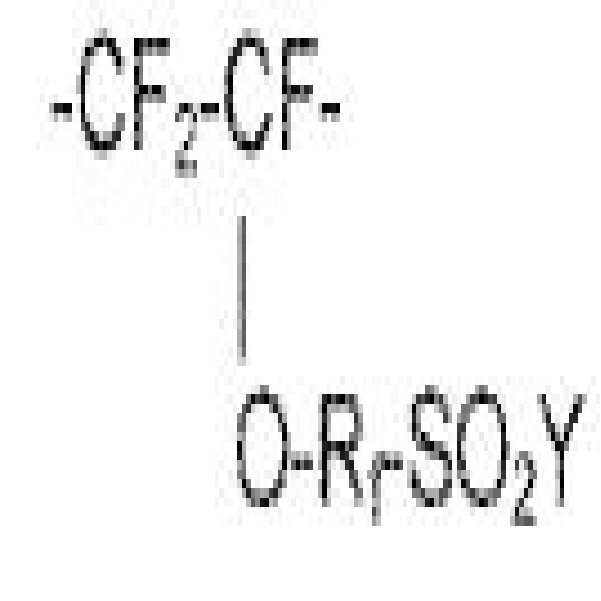
여기서, Y는 플루오르, -OH, 또는 -OM이며, M은 1가 금속 양이온이다.The method according to claim 1,
Wherein the repeating unit derived from CF 2 ═CF (OR f ) SO 2 F is represented by the following formula:
Wherein Y is fluorine, -OH, or -OM, and M is a monovalent metal cation.
상기 Y는 M이고, M은 1가 은 이온(Ag+)인 것을 특징으로 하는, 코폴리머.3. The method of claim 2,
Wherein Y is M and M is a monovalent silver ion (Ag + ).
상기 고리형 또는 고리형성이 가능한 퍼플루오르화 모노머는 퍼플루오로(2,2-디메틸-1,3-디옥솔인 것을 특징으로 하는, 코폴리머.4. The method according to any one of claims 1 to 3,
Wherein the cyclic or cyclizable perfluorinated monomer is perfluoro (2,2-dimethyl-1,3-dioxol).
상기 CF2=CF(ORf)SO2F는 CF2=CFOCF2CF2SO2F, CF2=CFOCH2CF2CF2SO2F, CF2=CFOCF2CF(CF3)OCF2CF2SO2F, CF2=CFOCF2CF(CF3)OCF2CF2SO2F 및 CF2=CFOCF2CF2SO2F 중 하나 이상인 것을 특징으로 하는, 코폴리머.5. The method according to any one of claims 1 to 4,
CF 2 ═CF (OR f ) SO 2 F is CF 2 ═CFOCF 2 CF 2 SO 2 F, CF 2 ═CFOCH 2 CF 2 CF 2 SO 2 F, CF 2 ═CFOCF 2 CF (CF 3 ) OCF 2 CF 2 SO 2 F, CF 2 = CFOCF 2 CF (CF 3 ) OCF 2 CF 2 SO 2 F and CF 2 = CFOCF 2 CF 2 SO 2 F.
상기 화학식 CF2=CF(ORf)SO2F의 단 하나의 유형의 모노머로부터의 반복 단위가 존재하는 것을 특징으로 하는, 코폴리머.6. The method of claim 5,
Characterized in that there is a repeat unit from only one type of monomer of the formula CF 2 CF (OR f ) SO 2 F.
상기 CF2=CF(ORf)SO2F로부터 유래된 반복 단위가 폴리머 중의 총 반복 단위의 10몰% 내지 40몰%이고, 상기 고리형 또는 고리형성이 가능한 퍼플루오르화 모노머로부터 유도된 반복 단위가 폴리머 중의 총 반복 단위의 5몰% 내지 30몰%이며, 상기 에틸렌 및 플루오르화 비닐로부터 유래된 총 반복 단위가 폴리머 중의 총 반복 단위의 10몰% 내지 60몰%인 것을 특징으로 하는, 코폴리머.4. The method according to any one of claims 1 to 3,
Wherein the repeating unit derived from CF 2 ═CF (OR f ) SO 2 F is 10 mol% to 40 mol% of the total repeating units in the polymer, and the repeating unit derived from the cyclic or cyclizable perfluorinated monomer Is from 5 mol% to 30 mol% of the total repeating units in the polymer, and the total repeating units derived from ethylene and vinyl fluoride are from 10 mol% to 60 mol% of the total repeating units in the polymer. .
상기 고리형 또는 고리형성이 가능한 퍼플루오르화 모노머는 퍼플루오로(2,2-디메틸-1,3-디옥솔) 이고, 상기 CF2=CF(ORf)SO2F로부터 유래된 반복 단위는 CF2=CFOCF2CF2SO2F, CF2=CFOCH2CF2CF2SO2F, CF2=CFOCF2CF(CF3)OCF2CF2SO2F, CF2=CFOCF2CF(CF3)OCF2CF2SO2F 및 CF2=CFOCF2CF2SO2F 중 어느 하나인 것을 특징으로 하는, 코폴리머.8. The method of claim 7,
The cyclic or cyclizable perfluorinated monomer is perfluoro (2,2-dimethyl-1,3-dioxol), and the repeating unit derived from CF 2 ═CF (OR f ) SO 2 F is CF 2 = CFOCF 2 CF 2 SO 2 F, CF 2 = CFOCH 2 CF 2 CF 2 SO 2 F, CF 2 = CFOCF 2 CF (CF 3 ) OCF 2 CF 2 SO 2 F, CF 2 = CFOCF 2 CF 3 ) the copolymer is any one of OCF 2 CF 2 SO 2 F and CF 2 = CFOCF 2 CF 2 SO 2 F.
상기 CF2=CF(ORf)SO2F로부터 유래된 반복 단위는 하기의 화학식으로 표시되는 것을 특징으로 하는, 코폴리머.
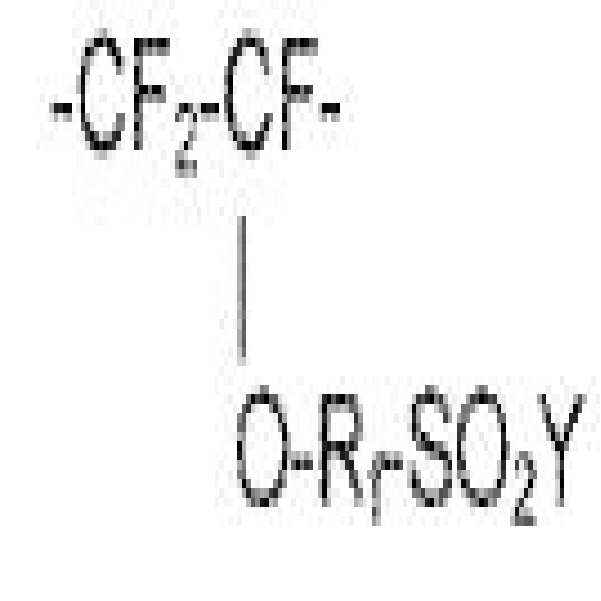
여기서, Y는 플루오르, -OH, 또는 -OM이며, M은 1가 금속 양이온이다.9. The method of claim 8,
Wherein the repeating unit derived from CF 2 ═CF (OR f ) SO 2 F is represented by the following formula:
Wherein Y is fluorine, -OH, or -OM, and M is a monovalent metal cation.
상기 Y는 M이고, M은 1가 은 이온(Ag+)인 것을 특징으로 하는, 코폴리머.10. The method of claim 9,
Wherein Y is M and M is a monovalent silver ion (Ag + ).
화학식 CF2=CF(ORf)SO2F의 모노머; 하나 이상의 고리형 또는 고리형성이 가능한 퍼플루오르화 모노머; 플루오르화 비닐 및 에틸렌 중 어느 하나 또는 둘 모두;로부터 유래된 반복 단위를 필수적으로 함유하며, 상기 Rf는 퍼플루오로알킬렌, 또는 2 내지 20개의 탄소 원자를 갖는퍼플루오로알킬렌을 함유하는 에테르인 것을 특징으로 하는, 코폴리머.11. The method according to any one of claims 1 to 10,
Monomers of formula CF 2 CF (OR f ) SO 2 F; At least one cyclic or cyclizable perfluorinated monomer; Vinylidene fluoride, vinyl fluoride and ethylene, or both, wherein R f is perfluoroalkylene, or a perfluoroalkylene containing perfluoroalkylene having 2 to 20 carbon atoms ≪ / RTI > ether.
상기 개선은 제2항, 제3항, 제9항 및 제10항 중 어느 한 항의 코폴리머의 10족 금속 이오노머의 치밀층(dense layer)을 적어도 하나 포함하는 멤브레인을 사용하는 것을 포함하는 것을 특징으로 하는, 분리 방법.CLAIMS What is claimed is: 1. A method of separating an alkene from an alkane in a gas stream using a membrane to effect separation,
The improvement comprises using a membrane comprising at least one dense layer of a Group 10 metal ionomer of the copolymer of any of Claims 2, 3, 9 and 10 .
상기 11족 금속은 은(silver)인 것을 특징으로 하는, 분리 방법.13. The method of claim 12,
Lt; RTI ID = 0.0 > 11 < / RTI > metal is silver.
상기 11족 금속은 은(silver)인 것을 특징으로 하는, 멤브레인.15. The method of claim 14,
Lt; RTI ID = 0.0 > 11 < / RTI > metal is silver.
Applications Claiming Priority (7)
| Application Number | Priority Date | Filing Date | Title |
|---|---|---|---|
| US201562159668P | 2015-05-11 | 2015-05-11 | |
| US201562159646P | 2015-05-11 | 2015-05-11 | |
| US62/159,668 | 2015-05-11 | ||
| US62/159,646 | 2015-05-11 | ||
| US201562262169P | 2015-12-02 | 2015-12-02 | |
| US62/262,169 | 2015-12-02 | ||
| PCT/US2016/031140 WO2016182889A1 (en) | 2015-05-11 | 2016-05-06 | Copolymer for use in alkene-alkane separation membranes |
Publications (1)
| Publication Number | Publication Date |
|---|---|
| KR20180008564A true KR20180008564A (en) | 2018-01-24 |
Family
ID=57248230
Family Applications (3)
| Application Number | Title | Priority Date | Filing Date |
|---|---|---|---|
| KR1020177035638A Ceased KR20180008564A (en) | 2015-05-11 | 2016-05-06 | Copolymers for alkene-alkane separation membranes |
| KR1020177035568A Withdrawn KR20180008559A (en) | 2015-05-11 | 2016-05-06 | Improved membrane for separating alkene and alkane |
| KR1020177035637A Active KR102118877B1 (en) | 2015-05-11 | 2016-05-06 | Thin film composite membrane for separation of alkanes and alkenes |
Family Applications After (2)
| Application Number | Title | Priority Date | Filing Date |
|---|---|---|---|
| KR1020177035568A Withdrawn KR20180008559A (en) | 2015-05-11 | 2016-05-06 | Improved membrane for separating alkene and alkane |
| KR1020177035637A Active KR102118877B1 (en) | 2015-05-11 | 2016-05-06 | Thin film composite membrane for separation of alkanes and alkenes |
Country Status (6)
| Country | Link |
|---|---|
| US (4) | US20180085714A1 (en) |
| EP (4) | EP3294696A4 (en) |
| JP (3) | JP2018518561A (en) |
| KR (3) | KR20180008564A (en) |
| CN (4) | CN107614466A (en) |
| WO (4) | WO2016182880A1 (en) |
Families Citing this family (14)
| Publication number | Priority date | Publication date | Assignee | Title |
|---|---|---|---|---|
| JP2020522467A (en) * | 2017-05-12 | 2020-07-30 | コンパクト メンブレイン システムズ インコーポレイテッド | Improved membrane for separating alkenes from other compounds |
| WO2019191388A1 (en) * | 2018-03-29 | 2019-10-03 | Compact Membrane Systems Inc. | Carbon dioxide separation membranes and process |
| CN112638509B (en) * | 2018-09-27 | 2023-01-13 | 卡姆帕特薄膜系统公司 | Method for humidifying facilitated transport membranes |
| US10639591B1 (en) * | 2019-01-07 | 2020-05-05 | Compact Membrane Systems, Inc. | Thin-film composite membrane and processes for the separation of alkenes from a gaseous feed mixture |
| US11040312B2 (en) * | 2019-05-09 | 2021-06-22 | Pall Corporation | Porous membrane having a fluorinated copolymer as surface treatment |
| EP4028163A1 (en) * | 2019-09-09 | 2022-07-20 | Compact Membrane Systems, Inc. | Gas permeable fluoropolymers and ionomers |
| CN111085120B (en) * | 2019-12-30 | 2022-02-22 | 山东天维膜技术有限公司 | Preparation method of monovalent selective cation exchange membrane |
| US12357951B2 (en) | 2020-02-06 | 2025-07-15 | National University Of Singapore | Composite membrane and methods of fabrication thereof |
| EP4126308A1 (en) * | 2020-03-30 | 2023-02-08 | Compact Membrane Systems, Inc. | Method for removing ethylene from agricultural products |
| JP2023539463A (en) * | 2020-08-17 | 2023-09-14 | アリゴス セラピューティクス インコーポレイテッド | Methods and compositions for targeting PD-L1 |
| MX2024000354A (en) | 2021-07-12 | 2024-03-06 | Compact Membrane Systems Inc | Thin-film composite membranes having improved adhesion between layers and uses thereof. |
| WO2023023280A1 (en) * | 2021-08-18 | 2023-02-23 | Freeman Benny D | Selective and hydrogen-stable facilitated transport membranes for olefin-paraffin separation |
| WO2023022847A1 (en) | 2021-08-19 | 2023-02-23 | Exxonmobil Chemical Patents Inc. | Membrane-based separation processes enhanced with an absorption device |
| CN118684807B (en) * | 2024-08-22 | 2024-11-08 | 江苏科润膜材料有限公司 | Preparation method of high oxygen permeability ionomer using diisopropyl peroxydicarbonate as initiator, ionomer, film and application thereof |
Family Cites Families (45)
| Publication number | Priority date | Publication date | Assignee | Title |
|---|---|---|---|---|
| US3758603A (en) | 1972-05-12 | 1973-09-11 | Standard Oil Co | Process for separation of unsaturated hydrocarbons |
| US3758605A (en) | 1972-09-13 | 1973-09-11 | Standard Oil Co | Process |
| US4614524A (en) | 1984-12-31 | 1986-09-30 | Monsanto Company | Water-free hydrocarbon separation membrane and process |
| US4731263A (en) | 1986-09-26 | 1988-03-15 | The Dow Chemical Company | Method for the preparation of ionomer films |
| US4741744A (en) * | 1987-02-20 | 1988-05-03 | The Dow Chemical Company | Hydrated metal ionomer membranes for gas separation |
| US5015268A (en) | 1988-10-13 | 1991-05-14 | Exxon Research And Engineering Co. | Polymeric membrane and process for separating aliphatically unsaturated hydrocarbons |
| US5062866A (en) | 1988-10-13 | 1991-11-05 | Exxon Research And Engineering Co. | Polymeric membrane and process for separation of aliphatically unsaturated hydrocarbons |
| AU5830090A (en) | 1989-06-15 | 1991-01-08 | Du Pont Canada Inc. | Perfluorodioxole membranes |
| US5191151A (en) * | 1991-12-18 | 1993-03-02 | Phillips Petroleum Company | Use of silver-exchanged ionomer membranes for gas separation |
| EP0709424A1 (en) | 1994-10-31 | 1996-05-01 | Ferro Corporation | Color concentrates |
| US5880241A (en) | 1995-01-24 | 1999-03-09 | E. I. Du Pont De Nemours And Company | Olefin polymers |
| AU3284197A (en) * | 1996-05-17 | 1997-12-09 | Colorado School Of Mines | Membrane separation of components in a fluid mixture |
| US5670051A (en) * | 1996-05-23 | 1997-09-23 | Membrane Technology And Research, Inc. | Olefin separation membrane and process |
| US5914154A (en) | 1997-05-30 | 1999-06-22 | Compact Membrane Systems, Inc. | Non-porous gas permeable membrane |
| DE19817376A1 (en) * | 1998-04-18 | 1999-10-21 | Univ Stuttgart Lehrstuhl Und I | Ion exchange membranes and polymer blends, useful for fuel cells, gas separation, pervaporation and reverse osmosis |
| US6369178B1 (en) | 1998-12-23 | 2002-04-09 | Alliedsignal Inc. | Poly (chlorotrifluoroethylene/vinylidenefluoride/vinylester) copolymers with excellent long-term ultraviolet light resistance |
| US6299777B1 (en) * | 1999-08-17 | 2001-10-09 | Cms Technology Holdings, Inc. | Osmotic distillation process |
| KR100315894B1 (en) | 1999-12-30 | 2001-12-24 | 박호군 | Solid State Facilitated Transport Membranes for Alkene Separation Using Polymer Electrolytes |
| US7482415B2 (en) | 2000-02-16 | 2009-01-27 | Daikin Industries, Ltd. | Process for producing fluoroionomer, method for purification and concentration of the ionomer, and method of film formation |
| US6592650B2 (en) | 2000-05-19 | 2003-07-15 | Membrane Technology And Research, Inc. | Gas separation using organic-vapor-resistant membranes and PSA |
| US6361582B1 (en) * | 2000-05-19 | 2002-03-26 | Membrane Technology And Research, Inc. | Gas separation using C3+ hydrocarbon-resistant membranes |
| US6518476B1 (en) * | 2000-09-18 | 2003-02-11 | Union Carbide Chemicals & Plastics Technology Corporation | Methods for manufacturing olefins from lower alkans by oxidative dehydrogenation |
| EP1211288A1 (en) * | 2000-12-01 | 2002-06-05 | Atofina | Conductive composition based on a fluoropolymer |
| EP1220344B2 (en) | 2000-12-26 | 2012-08-01 | Asahi Glass Company, Limited | Solid polymer electrolyte membrane, solid polymer fuel cell and fluorpolymer |
| EP1359142A4 (en) | 2001-02-01 | 2007-06-13 | Asahi Chemical Ind | Perfluorovinyl ether monomer having sulfonamide group |
| DE60221066T2 (en) | 2001-05-07 | 2008-03-13 | Solvay Solexis S.P.A. | Amorphous perfluorinated polymers |
| US6713567B2 (en) * | 2001-07-13 | 2004-03-30 | E. I. Du Pont De Nemours And Company | Method for forming fluorinated ionomers |
| KR100444325B1 (en) | 2001-07-16 | 2004-08-16 | 한국과학기술연구원 | Facilitated Olefin Transport Membranes containing Silver Salts having Improved Stability and Production Method for the Same |
| US7101938B2 (en) * | 2002-07-09 | 2006-09-05 | E. I. Dupont De Nemours And Company | Method for forming fluorinated ionomers |
| CN1319916C (en) * | 2002-12-02 | 2007-06-06 | 液体空气乔治洛德方法利用和研究的具有监督和管理委员会的有限公司 | Process for separating olefins from mixtures with paraffins |
| US20040173529A1 (en) * | 2003-03-07 | 2004-09-09 | Membrane Technology And Research, Inc. | Liquid-phase separation of low molecular weight organic compounds |
| KR100530544B1 (en) | 2003-04-11 | 2005-11-23 | 한국과학기술연구원 | Facilitated Membranes Comprising Porous Support Membranes and Solid Polymer Electrolyte Containg Transition Metal Salts and Polymers Containing Phthalic Structure |
| CA2426629C (en) | 2003-04-25 | 2012-09-25 | Nova Chemicals Corporation | Process for the separation of olefins from paraffins using membranes |
| US20060014887A1 (en) | 2004-07-19 | 2006-01-19 | 3M Innovative Properties Company | Method of hydrolyzing a dispersion of ionic fluoropolymer |
| ITMI20050445A1 (en) * | 2005-03-17 | 2006-09-18 | Solvay Solexis Spa | COMPONENT IONOMERIC MEMBRANE |
| KR100611682B1 (en) | 2005-07-12 | 2006-08-14 | 한국과학기술연구원 | Nanocomposite membrane and method for preparing olefin / paraffin separation using silver nanoparticle / polymer nanocomposite |
| US8497049B2 (en) * | 2007-04-02 | 2013-07-30 | GM Global Technology Operations LLC | Hydrophilic and corrosion resistant fuel cell components |
| EP2293863A4 (en) * | 2008-07-02 | 2014-04-30 | Uop Llc | Mixed matrix membranes incorporating microporous polymers as fillers |
| US8153738B2 (en) * | 2008-12-23 | 2012-04-10 | E I Du Pont De Nemours And Company | Fluoropolymer produced by aqueous polymerization using dispersed particulate of fluorinated ionomer |
| US20110266220A1 (en) | 2009-01-07 | 2011-11-03 | Cms Technologies Holdings, Inc. | Separations with highly selective fluoropolymer membranes |
| US9079138B2 (en) * | 2010-10-25 | 2015-07-14 | Cms Technologies Holdings, Inc. | Organic fluid permeation through fluoropolymer membranes |
| CN103263860B (en) * | 2013-05-26 | 2015-03-25 | 北京工商大学 | Preparation method of polyvinyl fluoride separating membrane |
| AU2013206560A1 (en) * | 2013-06-27 | 2015-01-22 | Canon Kabushiki Kaisha | Method, system and apparatus for rendering |
| CN105683222B (en) * | 2013-07-18 | 2018-11-16 | 紧密薄膜系统公司 | The UF membrane of alkene and alkane mixture |
| US9120834B2 (en) * | 2013-10-31 | 2015-09-01 | Cms Technologies Holdings, Inc. | Membrane separation of ionic liquid solutions |
-
2016
- 2016-05-06 JP JP2017558731A patent/JP2018518561A/en active Pending
- 2016-05-06 WO PCT/US2016/031117 patent/WO2016182880A1/en not_active Ceased
- 2016-05-06 EP EP16793240.9A patent/EP3294696A4/en not_active Withdrawn
- 2016-05-06 US US15/573,199 patent/US20180085714A1/en not_active Abandoned
- 2016-05-06 US US15/573,442 patent/US10399044B2/en active Active
- 2016-05-06 CN CN201680032939.3A patent/CN107614466A/en active Pending
- 2016-05-06 EP EP16793238.3A patent/EP3294695B1/en active Active
- 2016-05-06 WO PCT/US2016/031130 patent/WO2016182886A1/en not_active Ceased
- 2016-05-06 EP EP16793237.5A patent/EP3294694A1/en not_active Withdrawn
- 2016-05-06 CN CN201680035437.6A patent/CN107683273B/en active Active
- 2016-05-06 WO PCT/US2016/031140 patent/WO2016182889A1/en not_active Ceased
- 2016-05-06 JP JP2017558732A patent/JP2018519372A/en active Pending
- 2016-05-06 KR KR1020177035638A patent/KR20180008564A/en not_active Ceased
- 2016-05-06 JP JP2017558719A patent/JP6774966B2/en active Active
- 2016-05-06 CN CN201680037766.4A patent/CN107835797A/en active Pending
- 2016-05-06 WO PCT/US2016/031135 patent/WO2016182887A1/en not_active Ceased
- 2016-05-06 KR KR1020177035568A patent/KR20180008559A/en not_active Withdrawn
- 2016-05-06 CN CN201680032925.1A patent/CN107614549A/en active Pending
- 2016-05-06 EP EP16793233.4A patent/EP3294782A1/en not_active Withdrawn
- 2016-05-06 KR KR1020177035637A patent/KR102118877B1/en active Active
- 2016-05-06 US US15/573,436 patent/US20180093230A1/en not_active Abandoned
- 2016-05-06 US US15/573,287 patent/US20180111099A1/en not_active Abandoned
Also Published As
| Publication number | Publication date |
|---|---|
| EP3294696A4 (en) | 2018-12-19 |
| CN107614549A (en) | 2018-01-19 |
| WO2016182886A1 (en) | 2016-11-17 |
| EP3294695A4 (en) | 2018-12-12 |
| US20180093230A1 (en) | 2018-04-05 |
| KR20180008563A (en) | 2018-01-24 |
| CN107614466A (en) | 2018-01-19 |
| US20180111099A1 (en) | 2018-04-26 |
| WO2016182880A1 (en) | 2016-11-17 |
| CN107683273B (en) | 2021-09-10 |
| KR102118877B1 (en) | 2020-06-05 |
| CN107683273A (en) | 2018-02-09 |
| EP3294694A1 (en) | 2018-03-21 |
| KR20180008559A (en) | 2018-01-24 |
| CN107835797A (en) | 2018-03-23 |
| US20180111098A1 (en) | 2018-04-26 |
| US20180085714A1 (en) | 2018-03-29 |
| JP2018518561A (en) | 2018-07-12 |
| JP2018517549A (en) | 2018-07-05 |
| WO2016182889A1 (en) | 2016-11-17 |
| EP3294695A1 (en) | 2018-03-21 |
| JP6774966B2 (en) | 2020-10-28 |
| US10399044B2 (en) | 2019-09-03 |
| EP3294782A1 (en) | 2018-03-21 |
| EP3294696A1 (en) | 2018-03-21 |
| EP3294695B1 (en) | 2020-09-30 |
| WO2016182887A1 (en) | 2016-11-17 |
| JP2018519372A (en) | 2018-07-19 |
Similar Documents
| Publication | Publication Date | Title |
|---|---|---|
| KR20180008564A (en) | Copolymers for alkene-alkane separation membranes | |
| JP6165999B2 (en) | Gas separation membranes based on perfluoropolymers | |
| CN105683222B (en) | The UF membrane of alkene and alkane mixture | |
| US9636632B2 (en) | Gas separation membranes based on fluorinated and perfluorinated polymers | |
| GB2051831A (en) | Fluorinated copolymers and cation exchange membrane and process for producing the same | |
| CN105358592B (en) | The manufacture method of fluoropolymer | |
| KR20150100753A (en) | Hydrophilic fluoropolymer | |
| EP2882705B1 (en) | Allyl-bearing fluorinated ionomers | |
| CN103582672A (en) | Hydrophilizing agent composition, hydrophilization method, hydrophilized resin porous body, and method for producing hydrophilized resin porous body | |
| SU1233804A3 (en) | Method of producing fluorinated copolymer | |
| KR20180008558A (en) | Improved method for separating alkene and alkane | |
| AU2019264627B2 (en) | Gas separation membranes based on fluorinated and perfluorinated polymers | |
| KR20240146004A (en) | Method for producing functionalized polymers | |
| CN110769922A (en) | Improved membranes for separating olefins from other compounds | |
| WO2023282188A1 (en) | Perfluoro compound production method and fluorine-containing polymer production method | |
| US20220315681A1 (en) | Gas permeable fluoropolymers and ionomers | |
| JPH031389B2 (en) | ||
| Arcella et al. | 1.08—Amorphous perfluoropolymer membranes | |
| JPH05329343A (en) | Gas separation membrane composed of fluoropolymer | |
| JPS5942691B2 (en) | Novel fluorine-containing cation exchange resin body |
Legal Events
| Date | Code | Title | Description |
|---|---|---|---|
| PA0105 | International application |
Patent event date: 20171211 Patent event code: PA01051R01D Comment text: International Patent Application |
|
| PG1501 | Laying open of application | ||
| PA0201 | Request for examination |
Patent event code: PA02012R01D Patent event date: 20180906 Comment text: Request for Examination of Application |
|
| E902 | Notification of reason for refusal | ||
| PE0902 | Notice of grounds for rejection |
Comment text: Notification of reason for refusal Patent event date: 20191111 Patent event code: PE09021S01D |
|
| E601 | Decision to refuse application | ||
| PE0601 | Decision on rejection of patent |
Patent event date: 20200217 Comment text: Decision to Refuse Application Patent event code: PE06012S01D Patent event date: 20191111 Comment text: Notification of reason for refusal Patent event code: PE06011S01I |