KR20090055152A - Manufacturing method of flame retardant polystyrene foam board - Google Patents
Manufacturing method of flame retardant polystyrene foam board Download PDFInfo
- Publication number
- KR20090055152A KR20090055152A KR1020070121924A KR20070121924A KR20090055152A KR 20090055152 A KR20090055152 A KR 20090055152A KR 1020070121924 A KR1020070121924 A KR 1020070121924A KR 20070121924 A KR20070121924 A KR 20070121924A KR 20090055152 A KR20090055152 A KR 20090055152A
- Authority
- KR
- South Korea
- Prior art keywords
- board
- flame retardant
- polystyrene
- beads
- foam board
- Prior art date
- Legal status (The legal status is an assumption and is not a legal conclusion. Google has not performed a legal analysis and makes no representation as to the accuracy of the status listed.)
- Granted
Links
Images



Classifications
-
- B—PERFORMING OPERATIONS; TRANSPORTING
- B29—WORKING OF PLASTICS; WORKING OF SUBSTANCES IN A PLASTIC STATE IN GENERAL
- B29C—SHAPING OR JOINING OF PLASTICS; SHAPING OF MATERIAL IN A PLASTIC STATE, NOT OTHERWISE PROVIDED FOR; AFTER-TREATMENT OF THE SHAPED PRODUCTS, e.g. REPAIRING
- B29C44/00—Shaping by internal pressure generated in the material, e.g. swelling or foaming ; Producing porous or cellular expanded plastics articles
- B29C44/02—Shaping by internal pressure generated in the material, e.g. swelling or foaming ; Producing porous or cellular expanded plastics articles for articles of definite length, i.e. discrete articles
-
- B—PERFORMING OPERATIONS; TRANSPORTING
- B29—WORKING OF PLASTICS; WORKING OF SUBSTANCES IN A PLASTIC STATE IN GENERAL
- B29C—SHAPING OR JOINING OF PLASTICS; SHAPING OF MATERIAL IN A PLASTIC STATE, NOT OTHERWISE PROVIDED FOR; AFTER-TREATMENT OF THE SHAPED PRODUCTS, e.g. REPAIRING
- B29C44/00—Shaping by internal pressure generated in the material, e.g. swelling or foaming ; Producing porous or cellular expanded plastics articles
- B29C44/34—Auxiliary operations
- B29C44/3403—Foaming under special conditions, e.g. in sub-atmospheric pressure, in or on a liquid
-
- C—CHEMISTRY; METALLURGY
- C08—ORGANIC MACROMOLECULAR COMPOUNDS; THEIR PREPARATION OR CHEMICAL WORKING-UP; COMPOSITIONS BASED THEREON
- C08J—WORKING-UP; GENERAL PROCESSES OF COMPOUNDING; AFTER-TREATMENT NOT COVERED BY SUBCLASSES C08B, C08C, C08F, C08G or C08H
- C08J9/00—Working-up of macromolecular substances to porous or cellular articles or materials; After-treatment thereof
- C08J9/22—After-treatment of expandable particles; Forming foamed products
- C08J9/228—Forming foamed products
-
- C—CHEMISTRY; METALLURGY
- C08—ORGANIC MACROMOLECULAR COMPOUNDS; THEIR PREPARATION OR CHEMICAL WORKING-UP; COMPOSITIONS BASED THEREON
- C08L—COMPOSITIONS OF MACROMOLECULAR COMPOUNDS
- C08L25/00—Compositions of, homopolymers or copolymers of compounds having one or more unsaturated aliphatic radicals, each having only one carbon-to-carbon double bond, and at least one being terminated by an aromatic carbocyclic ring; Compositions of derivatives of such polymers
- C08L25/02—Homopolymers or copolymers of hydrocarbons
- C08L25/04—Homopolymers or copolymers of styrene
-
- B—PERFORMING OPERATIONS; TRANSPORTING
- B29—WORKING OF PLASTICS; WORKING OF SUBSTANCES IN A PLASTIC STATE IN GENERAL
- B29K—INDEXING SCHEME ASSOCIATED WITH SUBCLASSES B29B, B29C OR B29D, RELATING TO MOULDING MATERIALS OR TO MATERIALS FOR MOULDS, REINFORCEMENTS, FILLERS OR PREFORMED PARTS, e.g. INSERTS
- B29K2025/00—Use of polymers of vinyl-aromatic compounds or derivatives thereof as moulding material
- B29K2025/04—Polymers of styrene
- B29K2025/06—PS, i.e. polystyrene
-
- B—PERFORMING OPERATIONS; TRANSPORTING
- B29—WORKING OF PLASTICS; WORKING OF SUBSTANCES IN A PLASTIC STATE IN GENERAL
- B29K—INDEXING SCHEME ASSOCIATED WITH SUBCLASSES B29B, B29C OR B29D, RELATING TO MOULDING MATERIALS OR TO MATERIALS FOR MOULDS, REINFORCEMENTS, FILLERS OR PREFORMED PARTS, e.g. INSERTS
- B29K2105/00—Condition, form or state of moulded material or of the material to be shaped
- B29K2105/0005—Condition, form or state of moulded material or of the material to be shaped containing compounding ingredients
- B29K2105/0026—Flame proofing or flame retarding agents
-
- C—CHEMISTRY; METALLURGY
- C10—PETROLEUM, GAS OR COKE INDUSTRIES; TECHNICAL GASES CONTAINING CARBON MONOXIDE; FUELS; LUBRICANTS; PEAT
- C10M—LUBRICATING COMPOSITIONS; USE OF CHEMICAL SUBSTANCES EITHER ALONE OR AS LUBRICATING INGREDIENTS IN A LUBRICATING COMPOSITION
- C10M2201/00—Inorganic compounds or elements as ingredients in lubricant compositions
- C10M2201/08—Inorganic acids or salts thereof
Landscapes
- Chemical & Material Sciences (AREA)
- Health & Medical Sciences (AREA)
- Chemical Kinetics & Catalysis (AREA)
- Medicinal Chemistry (AREA)
- Polymers & Plastics (AREA)
- Organic Chemistry (AREA)
- Engineering & Computer Science (AREA)
- Materials Engineering (AREA)
- Manufacture Of Porous Articles, And Recovery And Treatment Of Waste Products (AREA)
Abstract
본 발명은 상대적으로 높은 수준의 공극률을 가지기 때문에 많은 양의 난연제를 주입할 수 있으며, 또한, 난연제의 주입도 용이하여 난연성이 우수한 폴리스틸렌발포보드를 용이하게 제조할 수 있는 새로운 방식의 난연성 폴리스틸렌발포보드의 제조방법에 대한 것으로서, 폴리스틸렌비드를 제조하는 단계(A)와, 제조된 폴리스틸렌비드(1)의 표면에 융착저하제(4)를 코팅하는 단계(B)와, 상기 융착저하제(4)가 코팅된 폴리스틸렌비드(1)를 발포시켜서 발포비드(2)를 제조하는 단계(C)와, 상기 발포비드(2)를 이용하여 발포보드를 성형하는 단계(D)와, 상기 발포보드에 난연액을 주입하는 단계(E)와, 난연액이 주입된 발포보드를 건조시키는 단계(G)를 포함하여 이루어지고, 상기 발포보드를 성형하는 단계(D)에서는 상기 융착저하제(4)에 의해 발포비드(2)의 상호 융착정도가 저하되는 것을 특징으로 한다. Since the present invention has a relatively high level of porosity, it is possible to inject a large amount of flame retardant, and also a flame retardant polystyrene foam board of a new method which can easily prepare a polystyrene foam board having excellent flame retardancy due to easy injection of the flame retardant. In the manufacturing method of the step of preparing a polystyrene bead (A), the step of coating a fusion lowering agent (4) on the surface of the prepared polystyrene bead (1) and the fusion lowering agent (4) is coated (C) preparing a foamed beads (2) by foaming the polystyrene beads (1), and (D) molding a foam board using the foamed beads (2), and a flame retardant on the foamed board And a step (E) of injecting and drying the foam board into which the flame retardant is injected (G). In the step (D) of forming the foam board, the foam beads (4) are melted by the fusion reducing agent (4). 2) Mutual It is characterized in that the degree of fusion is reduced.
Description
본 발명은 난연성 폴리스틸렌발포보드의 제조방법에 관한 것으로서, 보다 상세하게 상대적으로 높은 수준의 공극률을 가지기 때문에 많은 양의 난연제를 주입할 수 있으며, 또한, 난연제의 주입도 용이하여 난연성이 우수한 폴리스틸렌발포보드를 용이하게 제조할 수 있는 새로운 방식의 난연성 폴리스틸렌발포보드의 제조방법에 관한 것이다.The present invention relates to a method for manufacturing a flame retardant polystyrene foam board, and because it has a relatively high level of porosity, it is possible to inject a large amount of flame retardant, and also easy to inject a flame retardant polystyrene foam board with excellent flame retardancy It relates to a method for producing a flame-retardant polystyrene foam board of a new way that can be easily produced.
폴리스틸렌발포보드는 가격이 저렴하면서도 단열성 및 방음성이 우수하고 가공이 용이하며 경량인 장점으로 인해 각종 산업분야에서 널리 사용되고 있다. 그러나 이러한 폴리스틸렌발포보드는 난연성이 낮아서 화염에 쉽게 연소되는 단점이 있다. 따라서 폴리스틸렌발포보드의 난연성을 향상시키기 위한 다양한 노력이 이루어지고 있다. Polystyrene foam board is widely used in various industries due to its low cost, excellent insulation, sound insulation, easy processing and light weight. However, such polystyrene foam boards have a disadvantage of low flame retardancy and easy combustion in flames. Therefore, various efforts have been made to improve the flame retardancy of the polystyrene foam board.
예를 들면, 난연제가 코팅된 폴리스틸렌발포비드로 보드를 성형하는 방법이 제안되었다. 그러나 이와 같이 제조된 폴리스틸렌발포보드는 보드의 제조 초기부터 난연제가 보드 내부에 함유된 상태이므로 내부에 함유된 물유리에 의해 열선을 이용해 보드를 원하는 규격으로 절단할 수 없는 단점이 있다. 따라서 보드를 절단하기 위한 새로운 방법을 모색하여야 한다. 또한, 일반적으로 폴리스틸렌발포보드는 폴리스틸렌발포비드가 보드성형금형에서 비드에 함유된 발포제에 의해 재 발포되어 제조되는 것인데, 전술한 바와 같은 보드의 제조방법에서는 폴리스틸렌발포비드의 표면에 물유리가 코팅되어 있기 때문에 보드성형시 비드가 제대로 발포되지 못하여 보드의 발포배율이 낮으며, 이에 따라 제조된 보드의 단열성 및 방음성이 낮고 보드의 중량도 상승되는 단점이 있다. For example, a method of forming a board with a polystyrene balfobe coated with a flame retardant has been proposed. However, the polystyrene foamed board manufactured as described above has a disadvantage that the flame retardant is contained in the board from the beginning of the board, and thus the board cannot be cut to a desired standard using a hot wire by the water glass contained therein. Therefore, new ways to cut the board must be found. Also, in general, polystyrene foam board is prepared by re-foaming polystyrene foam beads by a blowing agent contained in beads in a board molding mold. In the manufacturing method of the board as described above, water glass is coated on the surface of polystyrene foam beads. Therefore, the beads are not foamed properly when forming the board, the foaming ratio of the board is low, thereby lowering the insulation and sound insulation of the manufactured board has the disadvantage that the weight of the board is also increased.
한편, 상기와 같은 방법이 안고 있는 문제점에 대해 폴리스틸렌발포보드를 제조한 후에 보드의 내부에 난연액을 주입하여 보드의 난연성을 향상시키는 방법이 제안되기도 하였다. 이러한 방법에 있어서는 난연액이 보드 내부에 형성되는 공극에 주입되기 때문에 보드의 공극률이 높을수록 난연액의 주입량이 증가되어 보드의 난연성이 향상된다. 따라서 이와 같이 폴리스틸렌발포보드의 내부에 난연액을 주입하여 보드에 난연성을 부여하는 방법을 적용하기 위해서는 폴리스틸렌발포보드의 공극률을 향상시킬 필요가 있다. 그러나 도 1에 도시된 바와 같이, 종래 일반적인 폴리스틸렌발포보드는 보드의 강도향상을 위해 폴리스틸렌발포비드들이 강하게 융착되어 있기 때문에 보드 내부에 공극이 거의 형성되지 않으며, 이에 따라 난연액의 주입이 상당이 미미한 수준에 그친다. On the other hand, the manufacturing method of the polystyrene foam for the problems of the above method, after the injection of a flame retardant to the inside of the board has been proposed a method for improving the flame retardancy of the board. In this method, since the flame retardant is injected into the voids formed inside the board, the higher the porosity of the board is, the more the flame retardant is injected, thereby improving the flame retardancy of the board. Therefore, in order to apply a method of imparting flame retardancy to the board by injecting a flame retardant into the polystyrene foam board, it is necessary to improve the porosity of the polystyrene foam board. However, as shown in FIG. 1, in the conventional general polystyrene foam board, since the polystyrene foam beads are strongly fused to improve the strength of the board, almost no voids are formed in the board, and thus the injection of flame retardant liquid is insignificant. Just a level.
본 발명은 상기의 문제점을 해결하기 위한 것으로서, 본 발명의 목적은 상대적으로 높은 수준의 공극률을 갖도록 폴리스틸렌발포보드가 형성되며, 또한, 상대적으로 많은 양의 난연액을 보드에 효과적으로 주입시킬 수 있으므로 난연성이 우수한 보드를 용이하게 제조할 수 있는 새로운 방식의 난연성이 우수한 폴리스틸렌발포보드의 제조 방법을 제공하는 것이다.The present invention is to solve the above problems, the object of the present invention is that the polystyrene foamed board is formed to have a relatively high level of porosity, and also, since a relatively large amount of flame retardant can be injected into the board effectively flame retardant It is to provide a method for producing a polystyrene foam board excellent in flame retardancy in a new way that can easily produce this excellent board.
본 발명에 따르면, 폴리스틸렌비드를 제조하는 단계(A)와, 제조된 폴리스틸렌비드(1)의 표면에 융착저하제(4)를 코팅하는 단계(B)와, 상기 융착저하제(4)가 코팅된 폴리스틸렌비드(1)를 발포시켜서 발포비드(2)를 제조하는 단계(C)와, 상기 발포비드(2)를 이용하여 발포보드를 성형하는 단계(D)와, 상기 발포보드에 난연액을 주입하는 단계(E)와, 난연액이 주입된 발포보드를 건조시키는 단계(G)를 포함하여 이루어지고, 상기 발포보드를 성형하는 단계(D)에서는 상기 융착저하제(4)에 의해 발포비드(2)의 상호 융착정도가 저하되는 것을 특징으로 하는 난연성 폴리스틸렌발포보드의 제조방법이 제공된다. According to the invention, the step of preparing the polystyrene bead (A), the step of coating the fusion lowering agent (4) on the surface of the prepared polystyrene bead (1) and the polystyrene coated with the fusion lowering agent (4) (C) manufacturing a foamed bead (2) by foaming the beads (1), molding (D) a foamed board using the foamed bead (2), and injecting a flame retardant into the foamed board Step (E), and the step of drying the foam board in which the flame retardant is injected (G), and in the step (D) of forming the foam board by the fusion reducing agent (4) foam beads (2) There is provided a method for producing a flame retardant polystyrene foam board, characterized in that the degree of mutual fusion is reduced.
본 발명의 다른 특징에 따르면, 상기 난연액은 수분에 의해 점도가 조절된 것이며, 상기 발포보드를 건조시키는 단계(G) 전에 상기 발포보드에 진공압을 걸어 난연액에 함유된 수분을 배출시키는 단계(H)가 추가된 것을 특징으로 하는 난연성 폴리스틸렌발포보드의 제조방법이 제공된다. According to another feature of the invention, the flame retardant is a viscosity controlled by the moisture, before the step (G) of drying the foam board by applying a vacuum pressure to the foam board to discharge the moisture contained in the flame retardant liquid Provided is a method for producing a flame retardant polystyrene foam board, wherein (H) is added.
본 발명의 또 다른 특징에 따르면, 상기 융착저하제(4)는 징크스테아린산인 것을 특징으로 하는 난연성 폴리스틸렌발포보드의 제조방법이 제공된다. According to another feature of the invention, the fusion reducing agent (4) is provided a method for producing a flame retardant polystyrene foam board, characterized in that the zinc stearic acid.
본 발명의 또 다른 특징에 따르면, 상기 융착저하제(4)를 코팅하는 단계(B)에서는 융착저하제(4)를 폴리스틸렌비드 중량의 0.3~1.5중량%로 사용한 것을 특징으로 하는 난연성 폴리스틸렌발포보드의 제조방법이 제공된다. According to another feature of the present invention, in the step (B) of coating the fusion reducing agent (4) the production of flame-retardant polystyrene foam board, characterized in that the fusion reducing agent (4) was used as 0.3 to 1.5% by weight of the polystyrene bead weight A method is provided.
이와 같을 구성을 가지는 본 발명은 폴리스틸렌비드의 표면에 코팅된 융착저하제(4)에 의해 폴리스틸렌발포보드의 제조시 발포비드(2)들의 융착정도가 조절되며, 이에 따라 상대적으로 높은 수준의 공극률을 가지는 보드가 제조되고, 이와 같이 제조되는 보드는 공극률이 높기 때문에 보드에 상대적으로 많은 양의 난연액을 주입시킬 수 있으며, 이에 따라 보드의 난연성이 향상된다. The present invention having such a configuration is controlled by the fusion reducing agent (4) coated on the surface of the polystyrene bead to adjust the degree of fusion of the foam beads (2) in the production of the polystyrene foam board, thereby having a relatively high level of porosity Since the board is manufactured, and the board manufactured as described above has a high porosity, a relatively large amount of flame retardant can be injected into the board, thereby improving the flame retardancy of the board.
또한, 난연액의 원활한 주입을 위해 난연액을 상대적으로 점도가 낮은 즉, 수분의 함량이 높아서 농도가 묽을 것을 사용하고, 이와 같이 점도가 낮은 난연액을 보드에 주입한 다음, 주입된 난연액의 수분을 제거하여 난연액의 농도를 향상시키는 방법을 사용함으로써, 난연성이 한층 더 우수한 보드를 용이하게 제조할 수 있다. In addition, in order to smoothly inject the flame retardant solution, the flame retardant is relatively low in viscosity, that is, a high concentration of moisture is used, so that the concentration is low. By using the method of removing the water | moisture content of the flame retardant and improving the density | concentration of a flame retardant liquid, the board which is further excellent in flame retardancy can be manufactured easily.
이하, 본 발명을 더욱 구체적으로 설명하면 다음과 같다. 도 2는 본 발명에 의한 제조공정의 흐름도이다. 본 발명에 따른 폴리스틸렌발포보드의 제조방법은 폴리스틸렌비드를 제조하는 단계(A)와, 상기 폴리스틸렌비드의 표면에 융착저하제(4)를 코팅하는 단계(B)와, 상기 폴리스틸렌비드(1)를 발포시키는 단계(C)와, 제조된 발포비드(2)를 보드 성형금형에 주입하여 보드를 성형하는 단계(D)와, 발포성형된 보드에 난연액을 주입하는 단계(E)와, 보드의 표면을 가공하는 단계(F)와, 보드를 건조시키는 단계(G)를 포함하여 이루어진다. Hereinafter, the present invention will be described in more detail. 2 is a flowchart of a manufacturing process according to the present invention. Method for producing a polystyrene foam board according to the present invention comprises the steps of preparing the polystyrene beads (A), coating the fusion reducing agent (4) on the surface of the polystyrene beads (B), and foaming the polystyrene beads (1) And a step (C) of injecting the prepared foam beads (2) into the board molding mold, and a step (E) of injecting a flame retardant into the foamed board, and the surface of the board. It comprises the step (F) of processing, and the step (G) of drying the board.
먼저, 폴리스틸렌비드(1)를 제조하는데(A), 스틸렌 모노머에 발포제 및 분산제, 난연제를 첨가하고, 스틸렌모노머를 중합시켜 폴리스틸렌비드(1)를 제조한다. 제조된 비드(1)를 냉각, 세척, 탈수, 건조 분급 및 숙성시키는 후처리를 행한다. 이와 같이 하여 준비된 폴리스틸렌비드(1)의 표면을 융착저하제(4)를 코팅한다(B). 융착저하제(4)는 폴리스티렌비드(1)의 점착성을 낮추고 슬립성을 부여하여 후술하는 보드성형과정에서 폴리스틸렌발포비드(2)의 상호 융착정도를 저하시켜 보드의 공극률을 향상시키는 기능을 한다. 이러한 융착저하제(4)로는 다양한 종류의 활제(Lubricant)가 사용가능하지만 그 중에서도 스테아린산의 금속염, 특히, 징크스테아린산(Zinc stearate)이 사용된다. 징크스테아린산은 폴리스틸렌비드(1)의 중량에 대해 0.3~1.5중량% 사용된다. 필요에 따라서는 상기 징크스테아린산 외에 수산 화마그네슘을 추가로 첨가할 수도 있다. 수산화마그네슘은 폴리스틸렌비드(1)의 중량에 대해 0.1~0.3중량%로 첨가한다. 이와 같은 융착저하제(4)를 폴리스티렌비드(1)에 혼합하여, 비드(1)의 표면에 융착저하제(4)가 코팅되도록 한다. First, the polystyrene bead (1) is prepared (A), a blowing agent, a dispersing agent, and a flame retardant are added to the styrene monomer, and the styrene monomer is polymerized to prepare the polystyrene bead (1). The
이어서 융착저하제(4)가 코팅된 폴리스틸렌비드(1)를 발포시켜 발포비드(2)를 제조한다(C). 바람직하게는 상기 폴리스틸렌비드(1)는 직경이 0.538㎜ 정도 되도록 제조되며, 상기 발포과정에서는 이러한 발포비드(2)의 직경이 2.5~5.0㎜ 정도 되도록 발포시킨다. 발포비드(2)의 직경이 상기 수준보다 작은 크기를 갖는 경우에는 고밀도 보드가 제조되어 보드의 열전도율은 우수하나, 보드 내부의 공극(6)이 작게 형성되어 난연액의 주입이 상대적으로 어려워진다. 그리고 발포비드(2)의 직경이 상기 수준 이상인 경우에는 보드 내부의 공극(6)이 상대적으로 크게 형성되어 난연액의 주입은 용이하게 이루어질 것이나, 반대로 보드의 강도가 저하되어 보드의 제품성이 저하된다. 발포비드(2)는 도 3에 도시된 바와 같이, 발포 전에 비해 표면이 확장되었으므로 발포비드(2)의 표면에는 융착저하제(4)가 부분적으로 묻게 된다. Subsequently, the
이와 같이 제조된 발포비드(2)는 숙성과정을 거치게 되는데, 이 숙성과정은 발포비드(2)에 증기를 소정시간 가하는 것으로 이루어진다. 이 과정은 발포비드(2)가 공기를 흡수하여 정상적인 구형으로 복원시키고 발포제의 양을 감소시키기 위한 것이다. 발포비드(2)에 잔존하는 발포제의 양이 많은 경우에는 보드 성형과정에서 비드의 발포배율이 높아지기 때문에 발포비드 사이에 형성되는 공극(6)이 커진다. 그러나 이와 같이 비드의 발포배율이 높아져서 보드 내부에 형성되는 공극(6)이 커 지면 난연액의 주입이 유리한 장점이 있으나, 보드의 강도가 저하되고, 난연액의 과다 주입으로 보드의 중량이 증가되어 보드의 제품성이 저하될 수 있기 때문에 바람직하게는 발포비드(2)를 8시간 이상 숙성시켜 발포비드(2) 내부에 잔존하는 발포제의 양을 4.5~3.9%정도로 낮춘다. 또한, 이러한 숙성과정에서 주의하여야 할 점은 발포비드(2)가 어느 정도 건조되도록 하여야 한다는 것이다. 발포비드(2)가 제대로 건조되지 않으면, 비드가 수분이 많은 축축한 상태이므로 비드끼리 붙어서 비드가 성형금형 안으로 원활하게 충전되는 것이 방해된다. The
이러한 숙성과정을 거친 발포비드(2)를 이용하여 보드를 성형한다(D). 먼저, 보드 금형을 예비가열하고 금형에 발포비드(2)를 주입한다. 이어서 금형 내의 공기를 배기시켜 금형 내부에 진공을 형성한 다음, 금형에 증기를 주입하여 발포비드(2)를 가열시키면 발포비드(2) 내부에 남아 있던 발포제가 기화되면서 발포비드(2)가 재 발포되며 동시에 발포비드(2)가 상호 융착되어 보드가 성형된다. 이때 발포비드(2)의 융착저하제(4)가 코팅된 부분은 이웃되는 발포비드(2)와 융착이 이루어지지 않으며, 이에 따라 발포비드(2) 사이에 상대적으로 더 넓은 공극이 형성된다. 이러한 보드성형과정에서 발포비드(2)가 융착되는 정도에 따라 보드 내부에 형성되는 공극의 크기와 공극률이 달라지는데, 발포비드(2)들의 상호 융착 정도가 낮을수록 보드의 공극(4)의 크기가 커지고 공극율도 상승된다. 이와 같이 본 발명에서는 발포비드(2)에 코팅된 융착저하제(4)에 의해 발포비드(2)간의 융착 정도가 조절되어 보드 내부의 공극율이 향상된다. The board is molded using the foam beads (2) after the aging process (D). First, the board mold is preheated and foamed
이와 같이 제조된 폴리스틸렌발포보드에 난연액을 주입한다(E). 이때에는 난 연액을 고압으로 보드에 주입하여 난연액이 보드 내부의 공극(6)으로 유입되도록 한다. 바람직하게는 상기 난연액은 수분을 이용해 점도가 조절된 것이 사용된다. 난연액의 점도가 높으면, 보드 내부로 주입이 용이하게 이루어지지 않기 때문에 본 발명에서는 난연액의 주입을 용이하게 하기 위해 수분, 즉, 물을 사용하여 난연액의 점도를 낮추어서 사용한다. 따라서 바람직하게는 난연액으로는 수분산성이 있는 물유리가 단독적으로 사용되거나 또는 물유리에 유기바인더 및 기타 무기물을 혼합하여 제조된 난연성 조성물(특허등록 제10-0624139호)이 사용된다. 난연액의 점도는 15~60cps가 적당하다. 난연액을 보드에 주입할 때에는 난연액이 공급되는 노즐을 바늘형상으로 가늘고 길게 형성하고, 이들 노즐을 보드에 꽂아서 난연액이 보드 내부로 주입되도록 한다. The flame retardant is injected into the polystyrene foam board thus prepared (E). At this time, the flame retardant is injected into the board at high pressure so that the flame retardant is introduced into the
이와 같이 하여 보드에 난연액을 주입한 다음에는, 난연액에 함유된 수분을 배출시켜 난연액의 점도 및 농도를 증가시킨다(H). 이를 위해서는 난연액이 주입된 보드를 진공조에 넣고 진공조에 진공압을 발생시킨다. 이와 같이 하면 보드에 진공압이 걸리면서 보드에 주입된 난연액 성분 중에서 상대적으로 분자크기가 작은 물이 먼저 배출된다. 이때에는 진공조에 -0.8~0.9 Kg정도의 진공압을 발생시켜서 처리하며, 처리 시간은 보드의 두께에 달라 조절한다. 이와 같이 난연액에 함유된 수분이 배출됨으로 인해 난연액의 농도가 상승되어 보드의 난연성도 향상된다. 또한, 이와 같이 난연액 중의 수분이 제거되면 후 공정인 보드의 건조과정에서 건조가 신속하게 이루어지는 장점도 있다. In this way, after the flame retardant is injected into the board, the moisture contained in the flame retardant is discharged to increase the viscosity and concentration of the flame retardant (H). To this end, a board in which a flame retardant is injected is put in a vacuum chamber and a vacuum pressure is generated in the vacuum chamber. In this way, the vacuum pressure is applied to the board, and water having a relatively small molecular size is first discharged from the flame retardant component injected into the board. At this time, it is processed by generating vacuum pressure of -0.8 ~ 0.9 Kg in the vacuum chamber, and the processing time is adjusted according to the thickness of the board. As the moisture contained in the flame retardant is discharged, the concentration of the flame retardant is increased to improve the flame retardancy of the board. In addition, when the moisture in the flame retardant is removed in this way, there is an advantage that the drying is quickly performed in the drying process of the board.
바람직하게는 이러한 전반적인 과정에서 전술한 바와 같이, 최종적으로 제조 되는 보드의 강도, 중량 등 보드의 제품성에 관련된 물성이 적절한 수준을 유지하면서도 난연성이 향상되도록 발포비드(2)의 발포배율을 비롯하여 보드의 공극의 크기, 공극률, 난연액의 주입량 등을 조절하는데, 실험에 의하면, 보드의 총 중량에 대해 난연액이 60~80중량%를 차지하는 경우에, 보드의 중량이 크게 증가되지 않으면서 보드의 강도 및 난연성은 크게 향상되어 제품성이 가장 우수하다. 이와 같이 보드의 총 중량에 대해 난연액이 60~80중량%를 차지하도록 하기 위해서는 상기 융착저하제(4)를 폴리스틸렌비드 중량의 0.3~1.5중량%로 사용하여 폴리스틸렌 비드의 상호 융착도가 종래 폴리스틸렌폼의 그것에 대해 60~90% 정도 저하되도록 한다. Preferably, as described above in the overall process, the foaming ratio of the foam beads (2), including the expansion ratio of the foam beads (2) so that the flame retardancy is improved while maintaining the appropriate level of physical properties related to the product properties of the board, such as the strength and weight of the board finally manufactured The size of the pore, the porosity, the amount of flame retardant injected, etc. are controlled. According to the experiment, when the flame retardant occupies 60 to 80% by weight relative to the total weight of the board, the strength of the board is not increased significantly. And the flame retardancy is greatly improved, the productability is the best. Thus, in order to make the flame retardant liquid account for 60 to 80% by weight with respect to the total weight of the board, the fusion reducing agent (4) is used as 0.3 to 1.5% by weight of the polystyrene bead, so that the mutual fusion of the polystyrene beads is conventionally polystyrene foam. About 60-90% of that.
이와 같은 방법으로 난연액 중의 수분을 배출시킨 다음에는 보드의 표면을 다듬는다(F). 난연액 중의 수분이 분리배출되는 과정에서 보드의 표면에 기포가 발생하여 보드의 표면이 매끄럽지 않게 되므로, 보드 표면에 형성된 기포를 제거하여 보드의 표면을 매끄럽게 다듬는다. 이어서 보드를 건조시켜서(G) 난연액을 경화시키고 제품을 완성한다. 도 2는 이와 같은 방법으로 제조된 보드의 확대단면사진으로, 파란색이 난연액이다. After the water in the flame retardant is discharged in this manner, the surface of the board is trimmed (F). In the process of separating and discharging moisture in the flame retardant solution, bubbles are generated on the surface of the board so that the surface of the board is not smooth. Thus, bubbles formed on the surface of the board are removed to smooth the surface of the board. The board is then dried (G) to cure the flame retardant and complete the product. Figure 2 is an enlarged cross-sectional picture of the board produced in this way, blue is the flame retardant.
이와 같은 구성을 가지는 제조방법에 의해 제조되는 보드는 내부에 공극이 크게 형성되고, 또한, 공극율도 높기 때문에 상대적으로 많은 양의 난연액을 주입할 수 있으며, 특히 점도가 낮은 묽은 상태의 난연액을 주입한 후 주입된 난연액의 농도를 향상시키는 방법을 사용함으로써, 난연액의 주입도 용이하게 이루어진다. The board manufactured by the manufacturing method having such a structure has a large void inside, and also has a high porosity, so that a relatively large amount of flame retardant can be injected. By using the method of improving the density | concentration of the injected flame retardant liquid after injecting, injection of a flame retardant liquid also becomes easy.
실시예 1Example 1
폴리스틸렌비드에 폴리스틸렌비드 중량에 대해 징크스테아린산 1.0중량%, 수산화마그네슘 0.3중량%를 첨가하여 폴리스틸렌비드의 표면에 이들이 코팅되도록 한 다음, 상기 폴리스틸렌비드는 발포하여 발포비드를 성형하고, 이 발포비드를 사용하여 폴리스틸렌발포보드를 제조하였다. 물유리 43중량%, 물 24중량%, 수산화알루미늄 12.4중량%, 탈크 10.7중량%, 석고 0.5중량%. 소포제 0.2 중량% 로 이루어진 난연액을 제조하고, 상기와 같이 제조된 폴리스틸렌발포보드에 주입하였다. 이어서 폴리스틸렌발포보드에 진공압을 걸어 난연액에 함유된 수분을 배출시킨 후 보드의 표면을 정리하고, 건조시켜 하되, 보드의 총중량에서 난연액이 80중량%를 차지하는 시편을 만들었다. To the polystyrene beads, 1.0% by weight of zinc stearic acid and 0.3% by weight of magnesium hydroxide are added to the polystyrene beads so that they are coated on the surface of the polystyrene beads. To prepare a polystyrene foam board. 43% water glass, 24% water, 12.4% aluminum hydroxide, 10.7% talc, 0.5% gypsum. A flame retardant composed of 0.2 wt% of an antifoam was prepared and injected into the polystyrene foam board prepared as described above. Subsequently, a vacuum pressure was applied to the polystyrene foam board to drain the moisture contained in the flame retardant liquid, and then the surface of the board was cleaned and dried, but a specimen was prepared in which the flame retardant liquid accounted for 80% by weight of the total weight of the board.
이와 같이 제조된 보드의 물성을 측정하여, 시중에 판매되고 있는 폴리스틸렌발포보드의 물성과 비교한 결과 표 1과 같다. The physical properties of the boards thus prepared were measured, and the results were compared with those of the polystyrene foam boards on the market.
<표 1>TABLE 1

실시예1의 결과, 본 발명에 의한 방법으로 제조된 보드는 난연성이 우수하고, 연소가스의 발생량이 상당히 저하됨과 더불어 굴곡강도 및 휨강도, 압축강도 등도 우수함을 알 수 있다. As a result of Example 1, it can be seen that the board produced by the method according to the present invention is excellent in flame retardancy, the amount of combustion gas is significantly reduced, and also excellent in flexural strength, flexural strength and compressive strength.
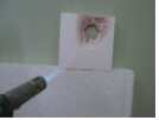
특히, 연소성 실험에서 보드에 불꽃을 가하여 보드의 연소정도를 테스트하였는데, 도 6에 도시된 바와 같이, 기존의 폴리스틸렌발포보드는 40초 만에 불꽃이 직접 닿은 부분에 구멍이 뚫렸으나, 실시예1에 의한 보드는 2분 후에도 빨갛게 가열만 될 뿐 큰 변화가 없었다. In particular, the combustion degree of the board was tested by applying flame to the board in the combustibility experiment. As shown in FIG. 6, the conventional polystyrene foam board was punched in a portion directly touched by the flame in 40 seconds, but Example 1 The board was heated red after 2 minutes, but there was no significant change.
도 1은 종래 폴리스틸렌폼보드의 단면사진1 is a cross-sectional picture of a conventional polystyrene foam board
도 2는 본 발명의 제조공정의 흐름도2 is a flow chart of the manufacturing process of the present invention
도 3은 본 발명에 의한 폴리스틸렌비드 및 폴리스틸렌폼비드의 확대단면도Figure 3 is an enlarged cross-sectional view of the polystyrene beads and polystyrene foam beads according to the present invention
도 4는 본 발명에 의해 제조된 보드의 난연액 주입 전 단면사진Figure 4 is a cross-sectional photo before flame retardant injection of the board prepared by the present invention
도 5는 상기 보드에 난연액을 주입한 단면사진Figure 5 is a cross-sectional photo of the flame retardant is injected into the board
도 6의 a, b는 비교예1 및 실시예1에서 연소성을 테스트한 사진 6, a and b are photographs of the combustibility test in Comparative Example 1 and Example 1
Claims (4)
Priority Applications (1)
| Application Number | Priority Date | Filing Date | Title |
|---|---|---|---|
| KR1020070121924A KR100902789B1 (en) | 2007-11-28 | 2007-11-28 | Manufacturing method of flame retardant polystyrene foam board |
Applications Claiming Priority (1)
| Application Number | Priority Date | Filing Date | Title |
|---|---|---|---|
| KR1020070121924A KR100902789B1 (en) | 2007-11-28 | 2007-11-28 | Manufacturing method of flame retardant polystyrene foam board |
Publications (2)
| Publication Number | Publication Date |
|---|---|
| KR20090055152A true KR20090055152A (en) | 2009-06-02 |
| KR100902789B1 KR100902789B1 (en) | 2009-06-12 |
Family
ID=40986863
Family Applications (1)
| Application Number | Title | Priority Date | Filing Date |
|---|---|---|---|
| KR1020070121924A Expired - Fee Related KR100902789B1 (en) | 2007-11-28 | 2007-11-28 | Manufacturing method of flame retardant polystyrene foam board |
Country Status (1)
| Country | Link |
|---|---|
| KR (1) | KR100902789B1 (en) |
Cited By (2)
| Publication number | Priority date | Publication date | Assignee | Title |
|---|---|---|---|---|
| KR20180027443A (en) * | 2018-01-04 | 2018-03-14 | 주식회사 비엠산업 | Method for making adiabatic panel for blocking off fire flame and the products |
| KR101977804B1 (en) * | 2018-09-28 | 2019-05-14 | 에프알코리아(주) | Insulating material for outer wall and process for preparing the same |
Family Cites Families (2)
| Publication number | Priority date | Publication date | Assignee | Title |
|---|---|---|---|---|
| KR100541658B1 (en) * | 2003-04-18 | 2006-01-10 | 주식회사 경동세라텍 | The foaming plastic body that has good incombustiblity |
| KR100699591B1 (en) * | 2004-09-20 | 2007-03-26 | 전창호 | Flame Retardant Additives Of Flame Retardant Styrofoam |
-
2007
- 2007-11-28 KR KR1020070121924A patent/KR100902789B1/en not_active Expired - Fee Related
Cited By (2)
| Publication number | Priority date | Publication date | Assignee | Title |
|---|---|---|---|---|
| KR20180027443A (en) * | 2018-01-04 | 2018-03-14 | 주식회사 비엠산업 | Method for making adiabatic panel for blocking off fire flame and the products |
| KR101977804B1 (en) * | 2018-09-28 | 2019-05-14 | 에프알코리아(주) | Insulating material for outer wall and process for preparing the same |
Also Published As
| Publication number | Publication date |
|---|---|
| KR100902789B1 (en) | 2009-06-12 |
Similar Documents
| Publication | Publication Date | Title |
|---|---|---|
| KR100927550B1 (en) | Foamed polystyrene particles having a skin layer with improved moldability and polystyrene foamed molding using the same | |
| KR102701498B1 (en) | Aerogel blanket and method preparing thereof | |
| JPS638976B2 (en) | ||
| JPH10130419A (en) | Foamed fluoropolymer | |
| EA008604B1 (en) | Expanded polystyrene bead having functional skin layer, manufacturing process thereof, and functional eps product and manufacturing process thereof using the same | |
| KR102787697B1 (en) | Method for preparing aerogel composite and aerogel composite | |
| JP2015529269A (en) | Phenolic foam | |
| KR20110126484A (en) | High performance expanded polystyrene moldings made using multi-coated expanded polystyrene particles | |
| CN103711211A (en) | Modified melamine formaldehyde resin-based EPS flame retardant thermal insulating board and preparation method thereof | |
| CN109881884B (en) | Reinforced building disassembly-free heat preservation template and preparation method thereof | |
| KR100902789B1 (en) | Manufacturing method of flame retardant polystyrene foam board | |
| TW202126738A (en) | Spacer, manufacturing method therefor, and composite | |
| CN111154174B (en) | Additive modified polypropylene foam material and preparation method thereof | |
| CN106519283A (en) | Polypropylene high-temperature supercritical foaming technology | |
| KR102188608B1 (en) | Semi-fireproof Insulator Using Graphen Oxide and its Manufacturing Method | |
| JP6338211B2 (en) | Polystyrene / silica composite foam manufacturing method and heat insulating material using the same | |
| JPH11349725A (en) | Foamed polystyrene product and its production | |
| KR20120133400A (en) | The method for manufacturing the incombustible melamine foam of open cell structure | |
| CN210683652U (en) | Flame-retardant expanded polystyrene board with layered metal mesh | |
| KR101970117B1 (en) | A manufacturing apparatus for a heat insulating material, a manufacturing method using the same, and a heat insulating material | |
| KR100590224B1 (en) | Method for producing polystyrene foam having excellent thermal barrier property and polystyrene foam prepared by the method | |
| KR102184480B1 (en) | Foam for insulator and method for manufacturing the same | |
| KR102231779B1 (en) | Thermosetting foam and method of producing the same | |
| KR102356528B1 (en) | Phenol resin foam, method of producing the same, and insulating material | |
| KR101919994B1 (en) | Flame retardant foam and manufacturing method thereof |
Legal Events
| Date | Code | Title | Description |
|---|---|---|---|
| A201 | Request for examination | ||
| PA0109 | Patent application |
St.27 status event code: A-0-1-A10-A12-nap-PA0109 |
|
| PA0201 | Request for examination |
St.27 status event code: A-1-2-D10-D11-exm-PA0201 |
|
| R18-X000 | Changes to party contact information recorded |
St.27 status event code: A-3-3-R10-R18-oth-X000 |
|
| R18-X000 | Changes to party contact information recorded |
St.27 status event code: A-3-3-R10-R18-oth-X000 |
|
| D13-X000 | Search requested |
St.27 status event code: A-1-2-D10-D13-srh-X000 |
|
| D14-X000 | Search report completed |
St.27 status event code: A-1-2-D10-D14-srh-X000 |
|
| E902 | Notification of reason for refusal | ||
| PE0902 | Notice of grounds for rejection |
St.27 status event code: A-1-2-D10-D21-exm-PE0902 |
|
| E13-X000 | Pre-grant limitation requested |
St.27 status event code: A-2-3-E10-E13-lim-X000 |
|
| P11-X000 | Amendment of application requested |
St.27 status event code: A-2-2-P10-P11-nap-X000 |
|
| P13-X000 | Application amended |
St.27 status event code: A-2-2-P10-P13-nap-X000 |
|
| E701 | Decision to grant or registration of patent right | ||
| PE0701 | Decision of registration |
St.27 status event code: A-1-2-D10-D22-exm-PE0701 |
|
| PG1501 | Laying open of application |
St.27 status event code: A-1-1-Q10-Q12-nap-PG1501 |
|
| GRNT | Written decision to grant | ||
| PR0701 | Registration of establishment |
St.27 status event code: A-2-4-F10-F11-exm-PR0701 |
|
| PR1002 | Payment of registration fee |
St.27 status event code: A-2-2-U10-U11-oth-PR1002 Fee payment year number: 1 |
|
| PG1601 | Publication of registration |
St.27 status event code: A-4-4-Q10-Q13-nap-PG1601 |
|
| PN2301 | Change of applicant |
St.27 status event code: A-5-5-R10-R13-asn-PN2301 St.27 status event code: A-5-5-R10-R11-asn-PN2301 |
|
| PN2301 | Change of applicant |
St.27 status event code: A-5-5-R10-R13-asn-PN2301 St.27 status event code: A-5-5-R10-R11-asn-PN2301 |
|
| LAPS | Lapse due to unpaid annual fee | ||
| PC1903 | Unpaid annual fee |
St.27 status event code: A-4-4-U10-U13-oth-PC1903 Not in force date: 20120609 Payment event data comment text: Termination Category : DEFAULT_OF_REGISTRATION_FEE |
|
| PC1903 | Unpaid annual fee |
St.27 status event code: N-4-6-H10-H13-oth-PC1903 Ip right cessation event data comment text: Termination Category : DEFAULT_OF_REGISTRATION_FEE Not in force date: 20120609 |
|
| R18-X000 | Changes to party contact information recorded |
St.27 status event code: A-5-5-R10-R18-oth-X000 |
|
| R18-X000 | Changes to party contact information recorded |
St.27 status event code: A-5-5-R10-R18-oth-X000 |
|
| P22-X000 | Classification modified |
St.27 status event code: A-4-4-P10-P22-nap-X000 |