KR20080098281A - Device for transmitting and receiving data in communication system - Google Patents
Device for transmitting and receiving data in communication system Download PDFInfo
- Publication number
- KR20080098281A KR20080098281A KR1020070043781A KR20070043781A KR20080098281A KR 20080098281 A KR20080098281 A KR 20080098281A KR 1020070043781 A KR1020070043781 A KR 1020070043781A KR 20070043781 A KR20070043781 A KR 20070043781A KR 20080098281 A KR20080098281 A KR 20080098281A
- Authority
- KR
- South Korea
- Prior art keywords
- data
- transmission data
- base station
- change information
- mobile terminal
- Prior art date
- Legal status (The legal status is an assumption and is not a legal conclusion. Google has not performed a legal analysis and makes no representation as to the accuracy of the status listed.)
- Withdrawn
Links
Images




Classifications
-
- H—ELECTRICITY
- H04—ELECTRIC COMMUNICATION TECHNIQUE
- H04L—TRANSMISSION OF DIGITAL INFORMATION, e.g. TELEGRAPHIC COMMUNICATION
- H04L1/00—Arrangements for detecting or preventing errors in the information received
- H04L1/12—Arrangements for detecting or preventing errors in the information received by using return channel
- H04L1/16—Arrangements for detecting or preventing errors in the information received by using return channel in which the return channel carries supervisory signals, e.g. repetition request signals
- H04L1/18—Automatic repetition systems, e.g. Van Duuren systems
- H04L1/1812—Hybrid protocols; Hybrid automatic repeat request [HARQ]
-
- H—ELECTRICITY
- H04—ELECTRIC COMMUNICATION TECHNIQUE
- H04B—TRANSMISSION
- H04B7/00—Radio transmission systems, i.e. using radiation field
- H04B7/24—Radio transmission systems, i.e. using radiation field for communication between two or more posts
- H04B7/26—Radio transmission systems, i.e. using radiation field for communication between two or more posts at least one of which is mobile
- H04B7/2612—Arrangements for wireless medium access control, e.g. by allocating physical layer transmission capacity
-
- Y—GENERAL TAGGING OF NEW TECHNOLOGICAL DEVELOPMENTS; GENERAL TAGGING OF CROSS-SECTIONAL TECHNOLOGIES SPANNING OVER SEVERAL SECTIONS OF THE IPC; TECHNICAL SUBJECTS COVERED BY FORMER USPC CROSS-REFERENCE ART COLLECTIONS [XRACs] AND DIGESTS
- Y02—TECHNOLOGIES OR APPLICATIONS FOR MITIGATION OR ADAPTATION AGAINST CLIMATE CHANGE
- Y02D—CLIMATE CHANGE MITIGATION TECHNOLOGIES IN INFORMATION AND COMMUNICATION TECHNOLOGIES [ICT], I.E. INFORMATION AND COMMUNICATION TECHNOLOGIES AIMING AT THE REDUCTION OF THEIR OWN ENERGY USE
- Y02D30/00—Reducing energy consumption in communication networks
- Y02D30/70—Reducing energy consumption in communication networks in wireless communication networks
Landscapes
- Engineering & Computer Science (AREA)
- Computer Networks & Wireless Communication (AREA)
- Signal Processing (AREA)
- Mobile Radio Communication Systems (AREA)
Abstract
본 발명은 통신 시스템에서 기지국의 데이터 송신 방법에 있어서, 송신 데이터 변경 정보를 나타내는 식별자를 임의의 값으로 설정하여 이동 단말기로 송신하는 과정과, 상기 이동 단말기로부터 부정 응답 메시지를 수신하는 과정과, 상기 부정 응답 메시지를 미리 설정된 일정 횟수를 초과하여 수신하면, 상기 설정한 송신 데이터 변경 정보를 나타내는 식별자 값을 유지하여 상기 이동 단말기로 송신함으로써 송신 데이터가 존재하지 않음을 나타내는 과정을 포함한다.The present invention provides a method of transmitting a data of a base station in a communication system, the method comprising: setting an identifier indicating transmission data change information to an arbitrary value and transmitting the same to a mobile terminal; receiving a negative response message from the mobile terminal; If the negative response message is received more than a predetermined number of times, the step of indicating that there is no transmission data by maintaining the identifier value indicating the set transmission data change information and transmitting the same to the mobile terminal.
Description
도 1은 일반적인 통신 시스템에서 HARQ 방식에 따른 신호 송수신 흐름을 개략적으로 도시한 도면,1 is a view schematically showing a signal transmission and reception flow according to the HARQ scheme in a general communication system,
도 2는 본 발명의 실시예에 따른 통신 시스템에서 HARQ 방식에 따른 신호 송수신 흐름을 개략적으로 도시한 도면,2 is a view schematically showing a signal transmission and reception flow according to an HARQ scheme in a communication system according to an embodiment of the present invention;
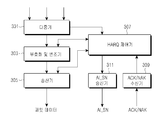
도 3은 본 발명의 실시예에 따른 통신 시스템에서 HARQ 방식에 따른 신호 송신기를 개략적으로 도시한 도면,3 is a diagram schematically showing a signal transmitter according to a HARQ scheme in a communication system according to an embodiment of the present invention;
도 4는 본 발명의 실시예에 따른 통신 시스템에서 HARQ 방식에 따른 신호 수신기를 개략적으로 도시한 도면,4 is a diagram schematically showing a signal receiver according to a HARQ scheme in a communication system according to an embodiment of the present invention;
도 5는 본 발명의 실시예에 따른 통신 시스템에서 HARQ 방식에 따른 신호 송신기의 동작 순서를 개략적으로 도시한 순서도,5 is a flowchart schematically illustrating an operation sequence of a signal transmitter according to an HARQ scheme in a communication system according to an embodiment of the present invention;
도 6은 본 발명의 실시예에 따른 통신 시스템에서 HARQ 방식에 따른 신호 수신기의 동작 순서를 개략적으로 도시한 순서도.6 is a flowchart schematically illustrating an operation sequence of a signal receiver according to an HARQ scheme in a communication system according to an embodiment of the present invention.
본 발명은 통신 시스템의 데이터 송수신 장치 및 방법에 관한 것이다.The present invention relates to an apparatus for transmitting and receiving data in a communication system.
차세대 통신 시스템은 이동 단말기(MS: Mobile Station, 이하 'MS'라 칭하기로 한다)들에게 고속의 대용량 데이터 송수신이 가능한 서비스들을 제공하기 위한 이동 통신 시스템 형태로 발전해 나가고 있다.The next generation communication system is developing as a mobile communication system for providing services capable of high-speed, high-capacity data transmission and reception to mobile terminals (MSs).
상기 차세대 통신 시스템에서 가장 근본적인 문제는 채널(channel)을 통하여 얼마나 효율적이고 신뢰성 있게(reliably) 데이터를 전송할 수 있느냐 하는 것이다. 최근에 활발하게 연구되고 있는 차세대 멀티미디어 이동 통신 시스템에서는 초기의 음성 위주의 서비스를 벗어나 영상, 무선 데이터 등의 다양한 정보를 처리하고 전송할 수 있는 고속 통신 시스템이 요구됨에 따라 시스템에 적절한 채널 부호화 방식을 사용하여 시스템의 효율을 높이는 것이 필수적이다.The most fundamental problem in the next generation communication system is how efficiently and reliably data can be transmitted through a channel. The next generation multimedia mobile communication system, which is being actively studied in recent years, needs a high-speed communication system capable of processing and transmitting a variety of information such as video and wireless data beyond the initial voice-oriented service. It is essential to increase the efficiency of the system.
그런데, 데이터를 전송할 때 채널의 상황에 따라 잡음, 갑섭 그리고 페이딩(fading) 등으로 인한 불가피한 오류가 발생하여 정보의 손실이 생긴다. 일반적으로 이러한 정보의 손실을 감소시키기 위해 채널의 성격에 따라 다양한 오류 제어 방식(error-control scheme)들을 이용하여 시스템의 신뢰도를 높인다. 이러한 오류 제어 방식들 중에 가장 대표적인 방식이 하이브리드 자동 반복 요구(HARQ: Hybrid Automatic Repeat request, 이하 'HARQ'라 칭하기로 한다) 방식이다.However, when data is transmitted, an unavoidable error due to noise, interference, and fading occurs depending on the channel condition, resulting in loss of information. In general, in order to reduce such loss of information, various error-control schemes are used according to the characteristics of the channel to increase the reliability of the system. The most representative of these error control schemes is a hybrid automatic repeat request (HARQ) scheme.
한편, 상기 차세대 통신 시스템은 자원 할당 정보로 인한 맵(MAP) 오버헤드를 최소화 시키기 위하여 고정 자원 할당 방식을 사용한다. 상기 고정 자원 할당 방식은 송신기가 수신기에게 한번 자원을 할당하면, 그 이후에는 추가적인 자원 해 제 명령을 받을 때까지 상기 자원이 계속해서 할당되는 방식이다.Meanwhile, the next generation communication system uses a fixed resource allocation scheme in order to minimize MAP overhead due to resource allocation information. In the fixed resource allocation method, once a transmitter allocates a resource to a receiver, the resource is continuously allocated until an additional resource release command is received thereafter.
그러면 여기서 도 1을 참조하여 일반적인 통신 시스템에서 HARQ 방식을 사용하는 신호 송수신 흐름을 설명하기로 한다. 상기 도 1을 설명하기에 앞서, 후술되는 통신 시스템은 고정 자원 할당 방식의 통신 시스템이라 가정하기로 한다. 상기 도 1은 하향링크 신호 송수신 흐름을 설명하기로 하며 상기 신호 송수신 흐름은 상향링크의 경우도 동일하게 적용되므로 상향링크 신호 송수신에 대한 설명은 생략하기로 한다.Next, a signal transmission / reception flow using HARQ scheme in a general communication system will be described with reference to FIG. 1. Before describing FIG. 1, it will be assumed that a communication system described below is a communication system of a fixed resource allocation method. 1 illustrates a downlink signal transmission and reception flow, and the signal transmission and reception flow is also applied to the case of uplink, and thus description of the uplink signal transmission and reception will be omitted.
도 1은 일반적인 통신 시스템에서 HARQ 방식에 따른 신호 송수신 흐름을 개략적으로 도시한 도면이다.1 is a diagram schematically illustrating a signal transmission and reception flow according to a HARQ scheme in a general communication system.
도 1을 참조하면, 신호 송신기, 일 예로 기지국(BS: Base Station, 이하 'BS'라 칭하기로 한다)(103)는 송신할 데이터가 발생하면 자동 반복 요구 식별자 시퀀스 넘버(AI_SN: Automatic repeat request Identifier Sequence Number)를 '1'로 설정하여 신호 수신기, 일 예로 MS(101)로 송신한 후(105단계), 상기 데이터를 송신한다(107단계). 여기서, 상기 AI_SN은 HARQ 방식에서 상기 BS(103)가 MS에게 송신하는 데이터 패킷이 최초 전송되는 데이터 패킷인지 재전송되는 데이터 패킷인지를 알려주는 비트(bit)로서, 최초 전송 데이터 패킷의 전송시마다 토글되는 형태로 표현된다. 또한 상기 105단계에서는 AI_SN이 1로 설정된 경우를 일 예로 하였지만 상기 AI_SN은 0으로도 설정 가능하다. 상기 데이터를 수신한 BS(103)는 긍정 응답(ACK: ACKnowledgement, 이하 'ACK'이라 칭하기로 한다) 메시지를 MS(101)로 송신한다(109단계).Referring to FIG. 1, a signal transmitter, for example, a base station (BS) (hereinafter, referred to as a 'BS') 103 is an automatic repeat request identifier sequence number (AI_SN) when data to be transmitted is generated. Sequence Number) is set to '1' and transmitted to the signal receiver, for example, MS 101 (step 105), and then the data is transmitted (step 107). Here, the AI_SN is a bit indicating whether the data packet transmitted from the
상기 ACK 메시지를 수신한 상기 BS(103)는 다음 송신할 데이터가 있는지 확인하고, 송신할 데이터가 없으면 상기 AI_SN을 토글하여, 즉 '0'으로 설정하여 MS(101)로 송신한다(111단계). 상기 MS(101)는 상기 BS(103)로부터 데이터를 수신하지 못하였으므로 상기 BS(103)로 부정 응답(NAK: Nagative AcKnowledgement, 이하 'NAK'라 칭하기로 한다) 메시지를 송신한다(115단계). 상기 NAK 메시지를 수신한 상기 BS(103)는 다음 송신할 데이터가 있는지 확인하고, 송신할 데이터가 없으면 상기 AI_SN의 현재 설정을 유지하여, 즉 AI_SN ='0'을 MS(101)로 송신한다(117단계). 상기 MS(101)는 데이터를 수신하지 못하였으므로 상기 BS(103)로 NAK 메시지를 송신한다(121단계). 또한, 이러한 과정으로 상기 NAK 메시지의 송신은 상기 MS(101)가 데이터를 수신할 때까지 계속해서 반복된다.Upon receiving the ACK message, the
한편, HARQ 방식에 따라 BS가 NAK 메시지를 수신하여 이전에 전송한 데이터를 재전송할 때, 상기 재전송 횟수가 임계값, 즉 시스템에서 미리 설정한 일정 횟수를 초과하면 상기 BS는 데이터 전송에 실패하였다고 판단하여 다음 데이터를 송신한다. 따라서 상기 AI_SN은 시스템에서 미리 설정한 임계값, 즉 재전송이 가능한 최대 횟수의 주기로 계속해서 토글된다.Meanwhile, when the BS receives the NAK message and retransmits previously transmitted data according to the HARQ scheme, if the number of retransmissions exceeds a threshold value, that is, a predetermined number of times preset by the system, the BS determines that the data transmission has failed. Send the next data. Accordingly, the AI_SN is continuously toggled at a predetermined threshold, i.e., the maximum number of times that retransmission is possible.
다시 말해서, 상기 동일한 설정값을 갖는 AI_SN이 시스템에서 미리 설정한 임계값 이상 반복해서 전송되면 상기 BS(103)는 상기 AI_SN을 토글하여, 즉 '1'로 설정하여 MS(101)로 송신한다(123단계). 그런 다음 상기 BS(103)로부터 데이터를 수신하지 못한 상기 MS(101)는 상기 BS(103)로 NAK 메시지를 송신한다(127단계). 또한, MS(101)는 데이터를 수신(131단계)할 때까지 계속해서 반복된다. 한편, 상기 BS(103)로부터 데이터를 수신한(131단계) MS(101)는 ACK 메시지를 송신한다(133단계).In other words, when the AI_SN having the same setting value is repeatedly transmitted over the threshold set in the system, the
전술한 바와 같이 통신 시스템에서 HARQ 방식을 사용하여 데이터를 송수신 할 때 송신단, 즉 BS는 AI_SN과 데이터를 송신하고 상기 데이터를 수신한 수신단, 즉 MS는 상기 BS로 ACK 메시지를 송신한다. 그러나 상기 BS가 송신할 데이터가 없어서 데이터를 송신하지 않았을 경우, 상기 MS는 상기 BS가 데이터를 송신하지 않았는지 또는 데이터 전송이 실패하였는지 판단할 수 없으므로 상기 BS로 NAK 메시지를 송신한다.As described above, when transmitting and receiving data using a HARQ scheme in a communication system, a transmitting end, that is, a BS transmits data with an AI_SN, and a receiving end, that is, an MS transmits an ACK message to the BS. However, if the BS does not transmit data because there is no data to transmit, the MS cannot determine whether the BS did not transmit the data or failed to transmit the data, thus transmitting a NAK message to the BS.
이렇게 상기 MS는 상기 BS가 송신할 데이터가 없음에도 불구하고 데이터를 수신할 때까지 NAK 메시지를 계속해서 송신하므로 불필요한 동작의 발생으로 전력 소모가 발생하는 문제점이 있었다. 또한, 고정 자원 할당 방식의 통신 시스템에서는 이러한 불필요한 동작으로 인한 자원 낭비로 자원 효율성이 저하되는 문제점이 있었다.As such, the MS continuously transmits a NAK message until the BS receives the data even though there is no data to be transmitted, thereby causing power consumption due to unnecessary operation. In addition, in a fixed resource allocation method, there is a problem in that resource efficiency is reduced due to waste of resources due to such unnecessary operations.
따라서, 또한, 본 발명은 통신 시스템에서 HARQ 방식에 따른 데이터 송수신 장치 및 방법을 제안한다.Accordingly, the present invention also proposes a data transmission / reception apparatus and method according to the HARQ scheme in a communication system.
또한, 본 발명은 HARQ 방식을 사용하는 통신 시스템에서 송신기가 전송할 데이터가 없을 경우 현재 전송할 데이터가 없음을 수신기에게 알려주는 데이터 송수신 장치 및 방법을 제안한다.In addition, the present invention proposes a data transmission and reception apparatus and method for informing a receiver that there is no data to be transmitted when there is no data to be transmitted in a communication system using a HARQ scheme.
또한 본 발명은 고정 자원 할당 방식의 통신 시스템에서 자원 효율성을 높일 수 있는 데이터 송수신 장치 및 방법을 제안한다.In addition, the present invention proposes a data transmission / reception apparatus and method for improving resource efficiency in a fixed resource allocation communication system.
이하, 본 발명에 따른 바람직한 실시예를 첨부한 도면을 참조하여 상세히 설명한다. 하기의 설명에서는 본 발명의 동작을 이해하는데 필요한 부분만이 설명되며 그 이외 부분의 설명은 본 발명의 요지를 흩트리지 않도록 생략될 것이라는 것을 유의하여야 한다.Hereinafter, exemplary embodiments of the present invention will be described in detail with reference to the accompanying drawings. It should be noted that in the following description, only parts necessary for understanding the operation of the present invention will be described, and descriptions of other parts will be omitted so as not to distract from the gist of the present invention.
본 발명은 하이브리드 자동 반복 요구(HARQ: Hybrid Automatic Repeat request, 이하 'HARQ'라 칭하기로 한다) 방식에 따른 통신 시스템에서 송신기가 전송할 데이터가 없을 경우 현재 전송할 데이터가 없음을 수신기에게 알려주는 데이터 송수신 장치 및 방법을 제안한다.The present invention provides a data transmitting / receiving apparatus for informing a receiver that there is no data to transmit when there is no data to transmit in a communication system according to a hybrid automatic repeat request (HARQ) scheme. And a method.
또한 본 발명은 고정 자원 할당 방식의 통신 시스템에서 자원 효율성을 높일 수 있는 데이터 송수신 장치 및 방법을 제안한다.In addition, the present invention proposes a data transmission / reception apparatus and method for improving resource efficiency in a fixed resource allocation communication system.
본 발명의 장치는; 통신 시스템에서 데이터 송신 장치에 있어서, 송신 데이터 변경 정보를 나타내는 식별자를 임의의 값으로 설정하여 이동 단말기로 송신하고, 상기 이동 단말기로부터 부정 응답 메시지를 미리 설정된 일정 횟수를 초과하여 수신하면, 상기 설정한 송신 데이터 변경 정보를 나타내는 식별자 값을 유지하여 상기 이동 단말기로 송신함으로써 송신 데이터가 존재하지 않음을 나타내는 기지국을 포함한다.The apparatus of the present invention; In a data transmission apparatus in a communication system, an identifier indicating transmission data change information is set to an arbitrary value to be transmitted to a mobile terminal, and when the negative response message is received from the mobile terminal more than a predetermined number of times, the setting is made. And a base station indicating that there is no transmission data by maintaining the identifier value indicating the transmission data change information and transmitting the same to the mobile terminal.
본 발명의 다른 장치는; 통신 시스템에서 데이터 수신 장치에 있어서, 임의의 값으로 설정된 송신 데이터 변경 정보를 나타내는 식별자를 기지국으로부터 수신하고, 상기 기지국으로부터 데이터를 수신하지 못하면 데이터를 수신하지 못하였음을 나타내는 부정 응답 메시지를 상기 기지국으로 송신하고, 상기 부정 응답 메시지를 미리 설정된 일정 회수를 초과하여 송신한 후, 상기 수신한 송신 데이터 변경 정보를 나타내는 식별자 값이 동일하면 상기 기지국의 송신 데이터가 존재하지 않음을 확인하는 이동 단말기를 포함한다. Another device of the invention is; In a data receiving apparatus in a communication system, an identifier indicating transmission data change information set to an arbitrary value is received from a base station, and if a data is not received from the base station, a negative response message indicating that no data is received is sent to the base station. And transmitting the negative response message more than a predetermined number of times, and confirming that there is no transmission data of the base station if the identifier value indicating the received transmission data change information is the same. .
본 발명의 방법은; 통신 시스템에서 기지국의 데이터 송신 방법에 있어서,송신 데이터 변경 정보를 나타내는 식별자를 임의의 값으로 설정하여 이동 단말기로 송신하는 과정과, 상기 이동 단말기로부터 부정 응답 메시지를 수신하는 과정과, 상기 부정 응답 메시지를 미리 설정된 일정 횟수를 초과하여 수신하면, 상기 설정한 송신 데이터 변경 정보를 나타내는 식별자 값을 유지하여 상기 이동 단말기로 송신함으로써 송신 데이터가 존재하지 않음을 나타내는 과정을 포함한다.The method of the present invention; A data transmission method of a base station in a communication system, the method comprising: setting an identifier indicating transmission data change information to an arbitrary value and transmitting the same to a mobile terminal, receiving a negative response message from the mobile terminal, and receiving the negative response message Receiving more than a predetermined number of times, maintaining the identifier value indicating the set transmission data change information and transmitting the same to the mobile terminal to indicate that there is no transmission data.
본 발명의 다른 방법은; 통신 시스템에서 이동 단말기가 데이터를 수신하는 방법에 있어서, 임의의 값으로 설정된 송신 데이터 변경 정보를 나타내는 식별자를 기지국으로부터 수신하는 과정과, 상기 기지국으로부터 데이터를 수신하지 못하면 데이터를 수신하지 못하였음을 나타내는 부정 응답 메시지를 상기 기지국으로 송신하는 과정과, 상기 부정 응답 메시지를 미리 설정된 일정 회수를 초과하여 송신한 후, 상기 수신한 송신 데이터 변경 정보를 나타내는 식별자 값이 동일한 값의 식별자를 수신하면 상기 기지국의 송신 데이터가 존재하지 않음을 인지하는 과정을 포 함한다.Another method of the invention is; A method for receiving data by a mobile terminal in a communication system, the method comprising: receiving an identifier indicating transmission data change information set to an arbitrary value from a base station, and indicating that data has not been received if data is not received from the base station. Transmitting a negative response message to the base station, transmitting the negative response message more than a predetermined number of times, and receiving an identifier having the same value as the identifier value indicating the received transmission data change information. This involves recognizing that no transmission data exists.
그러면 여기서 도 2를 참조하여 본 발명의 실시예에 따른 통신 시스템에서 HARQ 방식을 사용하는 신호 송수신 흐름을 설명하기로 한다. 또한, 상기 도 2는 하향링크 신호 송수신 흐름을 설명하기로 하며 상기 신호 송수신 흐름은 상향링크의 경우도 동일하게 적용되므로 상향링크 신호 송수신에 대한 설명은 생략하기로 한다.Next, a signal transmission / reception flow using the HARQ scheme in the communication system according to an embodiment of the present invention will be described with reference to FIG. 2. In addition, FIG. 2 will be described for the downlink signal transmission and reception flow, and the signal transmission and reception flow is also applied to the case of uplink, so a description of uplink signal transmission and reception will be omitted.
도 2는 본 발명의 실시예에 따른 통신 시스템에서 HARQ 방식에 따른 신호 송수신 흐름을 개략적으로 도시한 도면이다.2 is a diagram schematically illustrating a signal transmission and reception flow according to an HARQ scheme in a communication system according to an embodiment of the present invention.
도 2를 참조하면, 신호 송신기, 일 예로 BS(203)는 송신할 데이터가 발생하면 자동 반복 요구 식별자 시퀀스 넘버(AI_SN: Automatic repeat request Identifier Sequence Number, 이하 'AI_SN'라 칭하기로 한다)를 '1'로 설정하여 신호 수신기, 일 예로 MS(201)로 송신한 후(205단계), 상기 데이터를 송신한다(207단계). 여기서, 상기 AI_SN은 HARQ 방식에서 상기 BS(203)가 송신하는 데이터 패킷이 최초로 전송되는 데이터 패킷인지 재전송되는 데이터 패킷인지를 알려주는 비트(bit)로서, 최초 전송 데이터 패킷의 전송시마다 토글되는 형태로 표현된다. 또한 상기 205단계에서는 AI_SN이 '1'로 설정된 경우를 일 예로 하였지만 상기 AI_SN은 '0'으로도 설정 가능하다. 상기 데이터를 수신한 BS(203)는 긍정 응답(ACK: ACKnowledgement, 이하 'ACK'이라 칭하기로 한다) 메시지를 MS(201)로 송신한다(209단계).Referring to FIG. 2, when a signal transmitter, for example, BS 203 generates data to transmit, an automatic repeat request identifier sequence number (AI_SN) will be referred to as 'AI_SN'. Set to ', and transmits to the signal receiver, for example, the MS 201 (step 205), and then transmits the data (step 207). Here, the AI_SN is a bit indicating whether the data packet transmitted by the
상기 ACK 메시지를 수신한 상기 BS(203)는 다음 송신할 데이터가 있는지 확 인하고, 송신할 데이터가 없으면 상기 AI_SN을 토글하여, 즉 '0'으로 설정하여 MS(201)로 송신한다(211단계). 상기 MS(201)는 상기 BS(203)로부터 데이터를 수신하지 못하였으므로 상기 BS(103)로 부정 응답(NAK: Nagative AcKnowledgement, 이하 'NAK'라 칭하기로 한다) 메시지를 송신한다(215단계). 상기 NAK 메시지를 수신한 상기 BS(203)는 다음 송신할 데이터가 있는지 확인하고, 송신할 데이터가 없으면 상기 AI_SN의 현재 설정을 유지하여, 즉 AI_SN ='0'을 MS(201)로 송신한다(217단계). 상기 MS(101)는 데이터를 수신하지 못하였으므로 BS(203)로 NAK 메시지를 송신한다(221단계). 이러한 과정으로 상기 NAK 메시지의 송신은 상기 MS(201)가 데이터를 수신할 때까지 계속해서 반복된다.Upon receiving the ACK message, the
한편, HARQ 방식에 따라 BS가 NAK 메시지를 수신하여 이전에 전송한 데이터를 재전송할 때, 상기 재전송 횟수가 임계값, 즉 시스템에서 미리 설정한 일정 횟수를 초과하면 상기 BS는 데이터 전송에 실패하였다고 판단하여 다음 데이터를 송신한다. 따라서 상기 AI_SN은 시스템에서 미리 설정한 임계값, 즉 재전송이 가능한 최대 횟수의 주기로 반복해서 토글된다.Meanwhile, when the BS receives the NAK message and retransmits previously transmitted data according to the HARQ scheme, if the number of retransmissions exceeds a threshold value, that is, a predetermined number of times preset by the system, the BS determines that the data transmission has failed. Send the next data. Therefore, the AI_SN is repeatedly toggled at a predetermined threshold, i.e., the maximum number of retransmission cycles possible in the system.
그러나 상기 BS(103)는 상기 재전송 회수가 임계값 이상이어도 현재 전송할 데이터가 없으면 상기 AI_SN을 토글하지 않고 현재의 설정을 유지하여, 즉 AI_SN ='0'을 MS(201)로 송신한다(223단계). 한편, 상기 AI_SN ='0'을 수신한 상기 MS(201)는 상기 BS(203)가 데이터를 송신하지 않았다고 판단하여 어떠한 정보도 송신하지 않는다. 다시 말해, 상기 MS(201)는 재전송이 가능한 최대 횟수까지는 NAK 메시지를 송신하지만 그 이후부터는 다음 데이터를 수신할 때까지(231단계) NAK 메 시지를 송신하지 않는다. 그런 다음, 상기 BS는 송신할 데이터가 발생하면 AI_SN을 토글하여, 즉 '1'로 설정하여 MS(201)로 송신하고(229단계), 데이터를 송신한다(231단계). 상기 데이터를 수신한 MS(201)는 상기 BS(203)로 ACK 메시지를 송신한다. 그러면 여기서 도 3을 참조하여 본 발명의 실시예에 따른 통신 시스템에서 HARQ 방식에 따른 신호 송신기에 대하여 설명하기로 한다.However, even if the number of retransmissions is equal to or greater than the threshold, the
도 3은 본 발명의 실시예에 따른 통신 시스템에서 HARQ 방식에 따른 신호 송신기를 개략적으로 도시한 도면이다.3 is a diagram schematically illustrating a signal transmitter according to a HARQ scheme in a communication system according to an embodiment of the present invention.
도 3을 참조하면, 상기 신호 송신기는 다중기(multiplexer)(301)와, 부호화(encoding) 및 변조(modulation)기(303)와, 송신기(305)와, HARQ 제어기(controller)(307)와, ACK/NAK 수신기(309)와, AI_SN 송신기(311)를 포함한다.Referring to FIG. 3, the signal transmitter includes a
상기 다중화기(301)는 데이터를 입력하여 부호화 및 변조기(303)와 HARQ제어기(307)로 출력한다.The
상기 부호화 및 변조기(303)는 상기 다중화기가 출력한 데이터를 입력하여 미리 설정되어 있는 부호화 방식, 일 예로 QAM(Quadrature Amplitude Modulation) 방식, BPSK(Binary Phase Shift Key) 방식, QPSK(Quadrature Phase Shift Key) 방식으로 부호화하고, 상기 부호화 방식에 상응하여 변조한 후 송신기(305)로 출력한다. 또한, 상기 HARQ 제어기(307)는 상기 다중화기(301)가 출력한 데이터의 재전송 여부를 고려하여 AI_SN 송신기(311)로 출력한다.The encoding and
상기 송신기(305)는 상기 부호화 및 변조기(303)가 출력한 데이터를 입력하여 수신기로 출력하고, 상기 수신기로 출력되는 데이터 패킷의 전송 횟수를 상기 HARQ 제어기(307)로 출력한다. 상기 HARQ 제어기(307)는 상기 데이터 송신기(305) 및 ACK/NAK 수신기(309)가 출력한 데이터를 입력하여 현재 송신되는 데이터 패킷의 재전송 여부를 결정한다.The
한편, 상기 데이터 송신기(305)는 현재 송신하는 데이터가 재전송 데이터이면 상기 데이터의 재전송 횟수를 상기 HARQ 제어기(307)로 출력한다. 상기 HARQ 제어기(307)는 상기 데이터 송신기(305)가 출력한 데이터 재전송 횟수를 고려하여 데이터를 재전송할지, 다음 데이터를 송신할지 결정한 후 데이터 송신기(305) 및 AI_SN(311)으로 출력한다. 다음으로 도 4를 참조하여 참조하여 본 발명의 실시예에 따른 통신 시스템에서 HARQ 방식에 따른 신호 수신기에 대하여 설명하기로 한다.On the other hand, the
도 4는 본 발명의 실시예에 따른 통신 시스템에서 HARQ 방식에 따른 신호 수신기를 개략적으로 도시한 도면이다.4 is a diagram schematically illustrating a signal receiver according to a HARQ scheme in a communication system according to an embodiment of the present invention.
도 4를 참조하면, 상기 신호 수신기는 역다중기(inverse multiplexer)(401)와, 복호(decoding) 및 복조(demodulation)기(403)와, 수신기(405)와, HARQ 제어기(407)와, ACK/NAK 송신기(409)와, AI_SN 수신기(411)를 포함한다.Referring to FIG. 4, the signal receiver includes an
상기 수신기(405)는 상기 신호 송신 장치가 출력한 데이터 패킷을 입력하여 상기 HARQ 제어기(407)로 출력하고, 상기 AI_SN 수신기(411)는 상기 신호 송신 장치가 출력한 AI_SN을 입력하여 상기 HARQ 제어기(407)로 출력한다.The
상기 HARQ 제어기(407)는 상기 데이터 수신기(405) 및 AI_SN 수신기(411)가 출력한 데이터를 입력하여 상기 데이터 수신기(405)에 입력된 데이터 패킷이 새로운 데이터인지 재전송 데이터인지 판단하여 복호 및 복조기(403)로 출력한다. 상기 복호 및 복조기(403)는 상기 HARQ 제어기(407)가 출력한 데이터를 입력하여 복호 및 복조한 후 상기 데이터가 바르게 수신되었는지 여부를 검사한다. 상기 검사 결과 상기 데이터가 바르게 수신 되었으면 역다중기(401) 및 HARQ 제어기(407)로 출력한다. 상기 HARQ 제어기(407)는 ACK/NAK 송신기(409)로 ACK 신호를 출력한다.The
한편, 상기 검사 결과 상기 데이터가 바르게 수신되지 않았으면 HARQ 제어기(407)로 출력한다. 상기 HARQ 제어기(407)는 NAK 신호를 출력한다. 상기 HARQ 제어기(407)는 상기 AI_SN 수신기(411)가 출력한 AI_SN 값을 입력하고 입력된 값이 시스템이 미리 설정한 회수 이상 동일하면 상기 데이터 수신기(405)로 수신되는 데이터가 없다고 판단하여 NAK 신호 출력을 중단한다. 다음으로 도 5를 참조하여 본 발명의 실시예에 따른 통신 시스템에서 HARQ 방식에 따른 신호 송신기 동작 순서를 설명하기로 한다.On the other hand, if the data is not received correctly as a result of the test outputs to the
도 5는 본 발명의 실시예에 따른 통신 시스템에서 HARQ 방식에 따른 신호 송신기의 동작 순서를 개략적으로 도시한 순서도이다.5 is a flowchart schematically illustrating an operation sequence of a signal transmitter according to an HARQ scheme in a communication system according to an embodiment of the present invention.
도 5를 참조하면, 501단계에서 신호 송신기, 일 예로 BS는 송신할 데이터가 발생하였는지 검사하고, 검사 결과 송신할 데이터가 발생하였으면 503단계로 진행한다. 상기 503단계에서 상기 BS는 AI_SN을 '1'로 설정하여 MS로 송신하고 505단계로 진행한다. 상기 505단계에서 상기 BS는 상기 MS로 데이터를 송신하고 507단계로 진행한다. 상기 507단계에서 상기 BS는 MS로부터 NAK 메시지를 수신하는지 검사하고, 검사 결과 NAK 메시지를 수신하면 509단계로 진행한다. 또한 상기 507단계에서 검사 결과 NAK 메시지를 수신하지 않으면 501단계로 진행한다. Referring to FIG. 5, in
상기 509단계에서 상기 BS는 NAK 메시지를 수신하였으므로 상기 505단계의 데이터 송신이 실패하였다고 판단하여 상기 데이터를 재송신하고 511단계로 진행한다. 상기 511단계에서 상기 BS는 자신이 상기 데이터를 재송신한 횟수가 임계값을 초과하는지 검사한다. 상기 511단계에서 검사 결과 상기 데이터 재송신 횟수가 임계값을 초과하면 상기 BS는 501단계로 진행한다. 또한, 상기 511단계에서 검사 결과 상기 데이터 재송신 횟수가 임계값 이하이면 상기 BS는 507단계로 진행한다.Since the BS receives the NAK message in
한편, 상기 501단계에서 검사 결과 송신할 데이터가 발생하였으면 상기 BS는 513단계로 진행한다. 상기 513단계에서 상기 BS는 토글된 AI_SN를 MS로 전송한다. 다음으로 도 6을 참조하여 본 발명의 실시예에 따른 통신 시스템에서 HARQ 방식에 따른 신호 수신기 동작 순서를 설명하기로 한다.Meanwhile, if data to be transmitted is generated as a result of the check in
도 6은 본 발명의 실시예에 따른 통신 시스템에서 HARQ 방식에 따른 신호 수신기의 동작 순서를 개략적으로 도시한 순서도이다.6 is a flowchart schematically illustrating an operation sequence of a signal receiver according to an HARQ scheme in a communication system according to an embodiment of the present invention.
도 6을 참조하면, 601단계에서 신호 수신기, 일 예로 MS는 AI_SN를 수신하고 603단계로 진행한다. 상기 603단계에서 상기 MS는 데이터를 수신하고 605단계로 진행한다. 605단계에서 상기 MS는 동일한 데이터, 즉 재송신 데이터 수신 횟수가 시스템에서 미리 설정한 임계값을 초과하는지 검사하고, 상기 검사 결과 상기 동일한 데이터 수신 횟수가 임계값을 초과하면 613단계로 진행한다. 상기 613단계에서 상기 MS는 상기 AI_SN이 토글 되었는지 검사하여 토글 되었으면 607단계로 진행하고, 토글되지 않았으면 수신한 데이터가 없다고 판단하여 601단계 진행하고 다음 데이터를 수신할 때까지 대기한다.Referring to FIG. 6, in
또한, 상기 605단계에서 상기 검사 결과 상기 동일한 데이터 수신 횟수가 임계값 이하이면 상기 MS는 607단계로 진행한다. 상기 607단계에서 상기 MS는 상기 603단계에서 수신한 데이터를 복원하고 609단계로 진행한다. 609단계에서 상기 MS는 상기 복원된 데이터에 순환 중복 검사(CRC: Cycle Redundancy Check, 이하 'CRC'라 칭하기로 한다) 에러가 발생하였는지 검사하고, 상기 복원된 데이터에 CRC 에러가 발생하였으면 615단계로 진행한다. 상기 615단계에서 상기 MS는 NAK 메시지를 BS로 송신한다. 한편, 상기 609단계에서 검사 결과 상기 복원된 데이터에 CRC 에러가 발생하지 않으면 상기 BS로 ACK 메시지를 송신한다.In addition, in
본 발명의 상세한 설명에서는 구체적인 실시예에 관해 설명하였으나, 본 발명의 범위에서 벗어나지 않는 한도 내에서 여러 가지 변형이 가능함은 물론이다. 그러므로 본 발명의 범위는 설명된 실시예에 국한되지 않으며, 후술되는 특허청구의 범위뿐만 아니라 이 특허청구의 범위와 균등한 것들에 의해 정해져야 한다.In the detailed description of the present invention, specific embodiments have been described, but various modifications are possible without departing from the scope of the present invention. Therefore, the scope of the present invention should not be limited to the described embodiments, but should be defined not only by the scope of the following claims, but also by those equivalent to the scope of the claims.
상술한 바와 같이 HARQ 방식을 사용하는 통신 시스템에서 송신기가 전송할 데이터가 없을 경우, 현재 전송할 데이터가 없음을 수신기에게 알려줌으로써 상기 수신기의 불필요할 동작을 방지할 수 있고, 이러한 불필요한 동작으로 인한 전력 소모와 자원 낭비의 문제를 개선할 수 있다.As described above, when there is no data to be transmitted by the transmitter in a communication system using the HARQ scheme, it is possible to prevent unnecessary operation of the receiver by notifying the receiver that there is no data to be transmitted, and thus, power consumption and The problem of resource waste can be improved.
Claims (12)
Priority Applications (1)
| Application Number | Priority Date | Filing Date | Title |
|---|---|---|---|
| KR1020070043781A KR20080098281A (en) | 2007-05-04 | 2007-05-04 | Device for transmitting and receiving data in communication system |
Applications Claiming Priority (1)
| Application Number | Priority Date | Filing Date | Title |
|---|---|---|---|
| KR1020070043781A KR20080098281A (en) | 2007-05-04 | 2007-05-04 | Device for transmitting and receiving data in communication system |
Publications (1)
| Publication Number | Publication Date |
|---|---|
| KR20080098281A true KR20080098281A (en) | 2008-11-07 |
Family
ID=40285840
Family Applications (1)
| Application Number | Title | Priority Date | Filing Date |
|---|---|---|---|
| KR1020070043781A Withdrawn KR20080098281A (en) | 2007-05-04 | 2007-05-04 | Device for transmitting and receiving data in communication system |
Country Status (1)
| Country | Link |
|---|---|
| KR (1) | KR20080098281A (en) |
-
2007
- 2007-05-04 KR KR1020070043781A patent/KR20080098281A/en not_active Withdrawn
Similar Documents
| Publication | Publication Date | Title |
|---|---|---|
| JP5208272B2 (en) | Method and apparatus in a communication network | |
| US10972228B2 (en) | Base station device, user equipment, wireless communication system, and communication method | |
| EP1965534B1 (en) | Apparatus and method for transmitting a control message in a wireless communication system using relaying | |
| CN100379169C (en) | wireless communication system | |
| CN109964431B (en) | Base station, user equipment and system for wireless communication and corresponding method | |
| CA2563733C (en) | Method and system for providing autonomous retransmissions in a wireless communication system | |
| KR100976384B1 (en) | Hybrid automatic retransmission request signaling device and method in broadband wireless communication system | |
| JP2014042304A (en) | Transport block set transmission using hybrid automatic repeat request | |
| EP2521327B1 (en) | Method and apparatus for sending / receiving a control signaling and corresponding data packet control | |
| WO2008105620A1 (en) | Apparatus and method for retransmitting request in wireless relay communication system | |
| KR20090098752A (en) | Apparatus and method for supporting automatic retransmission request in a relay type wireless communication system | |
| KR20090098750A (en) | Apparatus and method for data retransmission in wireless communication system using relay method | |
| KR20090015253A (en) | Method and system of data retransmission in communication system | |
| KR20090022048A (en) | Hybrid automatic retransmission apparatus and method for packet-based fixed resource allocation in wireless mobile communication system | |
| CN103312473A (en) | Method and device for reducing HARQ (Hybrid Automatic Repeat Request) combination failures | |
| KR101247731B1 (en) | Apparatus and method for retransmission request in wireless communication system using relay | |
| JP2015188255A (en) | Method for wireless charging of mobile terminals | |
| JP2010530194A (en) | Method for allocating resources in a mobile radio communication network, corresponding transmitter and receiver | |
| CN101416434A (en) | Method, receiver and transmitter for improved hybrid automatic repeat request | |
| KR101626152B1 (en) | System and method for retransmitting of a data in a communication system | |
| KR101279694B1 (en) | Method of hybrid automatic repeat request having low signaling overhead and system thereof | |
| KR20080089118A (en) | Apparatus and method for asynchronous control message transmission for data retransmission in wireless communication system using relay method | |
| KR101552128B1 (en) | Incremental redundant automatic retransmission apparatus and method using constellation rearrangement scheme in a broadband wireless communication system | |
| CN102149132B (en) | Method, base station and terminal for retransmitting data | |
| KR20120010022A (en) | Method and apparatus for transmitting and receiving uplink resource allocation information in wireless communication system |
Legal Events
| Date | Code | Title | Description |
|---|---|---|---|
| PA0109 | Patent application |
Patent event code: PA01091R01D Comment text: Patent Application Patent event date: 20070504 |
|
| PG1501 | Laying open of application | ||
| PC1203 | Withdrawal of no request for examination | ||
| WITN | Application deemed withdrawn, e.g. because no request for examination was filed or no examination fee was paid |