KR100218552B1 - Process for producing ginsenoside - Google Patents
Process for producing ginsenoside Download PDFInfo
- Publication number
- KR100218552B1 KR100218552B1 KR1019970023369A KR19970023369A KR100218552B1 KR 100218552 B1 KR100218552 B1 KR 100218552B1 KR 1019970023369 A KR1019970023369 A KR 1019970023369A KR 19970023369 A KR19970023369 A KR 19970023369A KR 100218552 B1 KR100218552 B1 KR 100218552B1
- Authority
- KR
- South Korea
- Prior art keywords
- ginseng
- ginsenoside
- solvent
- reaction
- water
- Prior art date
- Legal status (The legal status is an assumption and is not a legal conclusion. Google has not performed a legal analysis and makes no representation as to the accuracy of the status listed.)
- Expired - Lifetime
Links
- GRMXNMPAFFEXEQ-YQQLDKRUSA-N CC(C(C(C1O)O)O)OC1O[C@@H](C1)C(C(C)(C)C(CC2)O)C2(C)C(C2)C1(C)[C@](C)(CCC1[C@](C)(CCC=C(C)C)O)C1C2O Chemical compound CC(C(C(C1O)O)O)OC1O[C@@H](C1)C(C(C)(C)C(CC2)O)C2(C)C(C2)C1(C)[C@](C)(CCC1[C@](C)(CCC=C(C)C)O)C1C2O GRMXNMPAFFEXEQ-YQQLDKRUSA-N 0.000 description 1
Landscapes
- Steroid Compounds (AREA)
Abstract
본 발명은 인삼의 재배과정에서 얻어지는 잎, 줄기, 과육과 같은 지상부로부터 20(S)-진세노사이드 Rh1이 다량 함유된 사포닌을 제조하기 위한 것임. 인삼 지상부에서 추출된 사포닌 혼합물을 수용성용매중에서 효소 락타제와 반응시켜 얻어지며, 생성된 사포닌성분중에는 20(S)-진세노사이드 Rh1을 70% 이상 고농도로 함유하고 있음. 본 발명은 인삼의 지상부를 활용함으로 경제적인 방법일 뿐 아니라 화학적 방법에 비하여 인체에 전혀 유해성이 없는 효소만을 이용 간단한 효소적 반응으로 20(S)-진세노사이드 Rh1의 생성 수율을 현저하게 높일 수 있는 장점이 있다.The present invention is to prepare a saponin containing a large amount of 20 (S) -ginsenoside Rh 1 from the ground, such as leaves, stems, pulp obtained in the cultivation process of ginseng. Saponin mixture extracted from the ground of ginseng is obtained by reacting with enzyme lactase in water-soluble solvent. The resulting saponin contains 20 (S) -ginsenoside Rh 1 at a high concentration of 70% or more. The present invention is not only economical method by utilizing the ground portion of ginseng, but also significantly increases the yield of 20 (S) -ginsenoside Rh 1 by a simple enzymatic reaction using only enzymes that are not harmful to the human body in comparison with chemical methods. There are advantages to it.
Description
[발명의 명칭][Name of invention]
미량 진세노사이드의 제조방법Method for preparing trace ginsenosides
[발명의 상세한 설명]Detailed description of the invention
[발명이 속하는 기술분야 및 그 분야의 종래기술][Technical field to which the invention belongs and the prior art in that field]
본 발명은 효소적방법에 의해 인삼의 잎, 줄기, 과육과 같은 지상부로부터 다음 일반식(I)으로 표시되는 20(S)-프로토파낙사트라이올-6-O-베타-디-글루코피라노사이드 [20(S)-진세노사이드 Rh1이라 함]가 다량으로 함유된 미량 진세노사이드를 제조하는 방법에 관한 것이다.The present invention provides the 20 (S) -protopanaxatriol-6-O-beta-di-glucopyrano represented by the following general formula (I) from above ground parts such as leaves, stems, and pulp of ginseng by enzymatic methods. The present invention relates to a process for preparing trace ginsenosides containing a large amount of side [20 (S) -ginsenoside Rh 1 ].

상기 일반식(I)의 20(S)-진세노사이드 Rh1은 실험적 간장해 억제작용, 종양세포(F9 세포) 분화 촉진작용, 혈소판응집 억제작용 및 선용활성화작용이 있는 성분으로 이미 알려져 있다.20 (S) -ginsenoside Rh 1 of the general formula (I) is already known as a component having an inhibitory effect on experimental liver damage, promoting the differentiation of tumor cells (F9 cells), inhibiting platelet aggregation and activating the first dose.
인삼 특유의 약리활성 사포닌인 진세노사이드 유도체들은 다마란계의 트리테르페노이드인 프로토파낙사다이올과 프로토파낙사트라이올의 알코올성 수산기에 글루코오스, 람노스, 자일로스 또는 아라비노스와 같은 당류가 결합한 화합물들로서 현재까지 고려인삼에서 30여종의 유도체들이 밝혀져 있다. 또한 인삼 사포닌은 아글리콘에 결합되어 있는 당의 종류나 결합된 당류의 수 또는 결합위치에 따라 약리효능이 각각 다르다는 것이 이미 밝혀져 있으며, 특히 수삼이나 백삼에 함유되어 있는 주요 사포닌의 약리효능에 대해서는 많은 연구가 행해졌으나 주로 홍삼에만 존재하는 미량사포닌의 약리효능에 관한 연구는 상대적으로 적은 편이다.Ginsenoside derivatives, ginseng's unique pharmacologically active saponins, contain sugars such as glucose, rhamnose, xylose or arabinose in the alcoholic hydroxyl groups of the protoparnaxadiol and the protoparnaxatriol, which are triterpenoids of the dimaran series. More than 30 derivatives of Korean ginseng have been identified as combined compounds. In addition, ginseng saponins have been found to have different pharmacological effects depending on the type of sugars bound to aglycone, the number of saccharides bound to each other, or the binding sites thereof. In particular, many studies have been conducted on the pharmacological effects of major saponins contained in ginseng and white ginseng. Although little research has been conducted on the pharmacological effects of microsaponins, which are present only in red ginseng.
홍삼은 수삼을 수증기 처리하여 제조하는데 이 과정에서 구조적으로 불안정한 진세노사이드의 아글리콘 C-20위치에 결합되어 있는 배당체결합이 쉽게 가수분해됨과 동시에 수산기가 반전 평형을 일으켜 C-20(R)과 C-20(S)의 이성체가 생성된다. 따라서 홍삼에는 프로사포게닌인 20(R&S)-진세노사이드 Rg2, Rg3, Rh1및 Rh2가 수삼이나 백삼에 비해 월등히 많이 함유되어 있으며, 특히 진세노사이드 Rh1은 홍삼의 특유성분이나 홍삼에는 이 성분이 20(R&S) 이성체 혼합물로 존재하기 때문에 20(S)-진세노사이드 Rh1만을 분리하는데는 많은 어려움이 있다. 또한 화학적인 방법에 의해 인삼에 많이 함유된 트라이올 타입 사포닌으로 부터 20(S)-진세노사이드 Rh1을 제조할 수도 있으나 제조과정에서 C-20위치에 있는 수산기의 반전 평형에 의한 C-20(R)과 C-20(S) 이성체 혼합물의 생성, 탈수, 히드록실화 반응과 같은 바람직하지 못한 부반응을 동반하기 때문에 수율이 극히 낮고 여러 단계의 반응을 거쳐야 하는 등의 문제점이 있다(예를 들면 대한민국 특허 제4066호, 제8291호).Red ginseng is prepared by steam treatment of ginseng. During this process, glycoside bonds bound to the aglycone C-20 position of ginsenoside, which are structurally unstable, are easily hydrolyzed, and the hydroxyl group reverses the equilibrium, resulting in C-20 (R) and Isomers of C-20 (S) are produced. Therefore, the red ginseng is the 20 (R & S) Pro sapogenin-ginsenoside Rg 2, Rg 3, Rh 1 and Rh and 2 is contained much more than in the fresh ginseng or white ginseng, particularly ginsenoside Rh 1 is the unique component of the red ginseng or Since red ginseng is present as a 20 (R & S) isomer mixture, it is difficult to separate only 20 (S) -ginsenoside Rh 1 . In addition, 20 (S) -ginsenoside Rh 1 may be prepared from triol-type saponins contained in ginseng by chemical methods, but C-20 may be produced by reverse equilibrium of hydroxyl groups at the C-20 position in the manufacturing process. Due to undesirable side reactions such as the formation of (R) and C-20 (S) isomer mixtures, dehydration and hydroxylation reactions, yields are extremely low and require several stages of reactions. Korean Patent Nos. 4066, 8291).
한편 인삼은 주로 뿌리를 이용하고, 잎, 줄기 및 씨를 둘러싸고 있는 과육 등은 거의 이용되고 있지 않은 실정이다. 그러나 인삼의 지상부는 다음의 표 1에서 알 수 있는 바와 같이 인삼근에 비해 사포닌이 월등히 많이 함유되어 있으며 특히 파낙사트라이올형의 사포닌함량이 높게 분포하고 있으나 진세노사이드 Rh1은 포함되지 않은 것으로 알려져 있다.On the other hand, ginseng mainly uses the root, and the flesh, which surrounds the leaves, stems, and seeds is rarely used. However, as shown in the following Table 1, the ground part of ginseng contains much more saponin than ginseng root, and especially, it contains a high distribution of saponin of panaxatriol type, but does not include ginsenoside Rh 1. have.
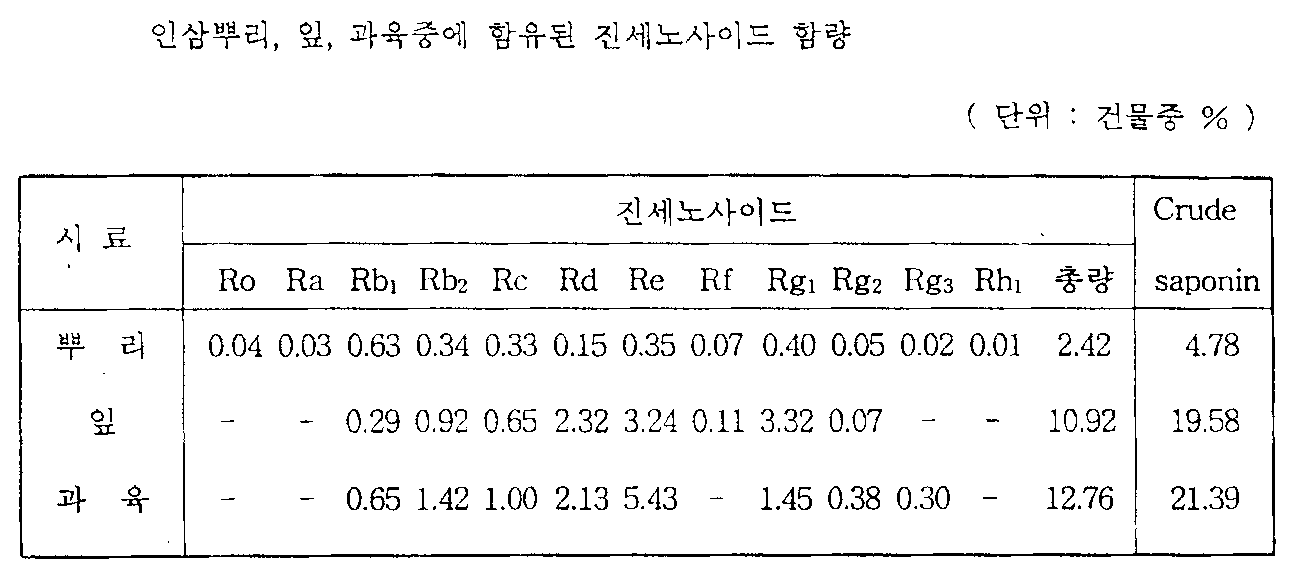
본 발명자들은 인삼의 지상부를 활용하여 인삼 뿌리에만 미량 함유된 생리활성 미량사포닌을 얻기 위하여 인삼 지상부를 용매 추출하여 얻은 조사포닌 분획에 미생물에서 분리한 락타제를 함께 반응시키면 단기간내에 C-20위치의 배당체결합이 선택적으로 절단되어 천연형이면서 여러가지 효능을 지닌 20(S)-진세노사이드 Rh이 고수율로 생성된다는데 착안하여 본 발명을 완성하게 되었다.The present inventors reacted with the lactase isolated from microorganisms in a short period of time in response to irradiated with the irradiated ponon fraction obtained by solvent extraction of the ginseng ground portion to obtain a physiologically active microsaponin contained only in the ginseng root using the ground portion of ginseng. Glycoside bonds are selectively cleaved to achieve 20 (S) -ginsenoside Rh, which is a natural form and has various effects, in high yield.
[발명의 이루고자 하는 기술적 과제][Technical task to achieve]
본 발명의 목적은 용도가 없어 대부분이 폐기되고 있는 인삼의 잎, 줄기, 과육 등의 인삼 지상부로부터 20(S)-진세노사이드 Rh을 다량 함유하는 미량 진세노사이드를 제조하기 위한 것이다.An object of the present invention is to prepare trace ginsenosides containing a large amount of 20 (S) -ginsenoside Rh from ginseng ground parts such as leaves, stems, and pulp of ginseng, which are mostly discarded due to no use.
전술한 본 발명의 목적은 인삼의 지상부로부터 얻은 조사포닌 분획이나 인삼을 추출하여 얻은 엑스를 물을 포함하는 용매중에서 효소와 반응시키는 방법에 의하여 달성된다.The object of the present invention described above is achieved by a method of reacting an enzyme obtained in a solvent containing water with X obtained by extracting the irradiated fraction of ginseng or ginseng from the ground of ginseng.
본 발명의 방법은 인삼의 잎, 줄기, 과실의 과육과 같은 인삼 지상부를 추출하여 얻은 조사포닌 분획이나 인삼 추출 엑스를 수성용매 또는 유기용매의 혼합액중에서 효소인 락타제와 반응시키는 방법으로 구성된다.The method of the present invention comprises a method of reacting an irradiated lactose with an enzyme in a mixed solution of an aqueous solvent or an organic solvent with an irradiated ginseng extract or ginseng extract obtained by extracting the ground of ginseng such as leaves, stems and fruit of ginseng.
본 발명에 사용되는 용매로는 효소의 활성을 저하시키지 않는 것이라면 특별히 제한을 받지 않으나 pH 4~8, 특히 pH 4~6 범위의 완충용액이 바람직하다. 또한 수성용매와 유기용매의 혼합액을 사용할 수도 있는데, 유기용매로는 물과 혼화되는 것이라면 특히 제한을 받지 않으나 그 중에서도 아세토니트릴, 디옥산, 디메틸 설폭사이드, 메탄올, 에탄올, 1-프로판올, 2-프로판올 등이 바람직하다. 수성용매와 유기용매의 혼합비율은 반응에 사용되는 진세노사이드를 용해시킬 수 있고 효소의 활성을 저하시키지 않는 범위라면 큰 문제점은 없으며, 용매의 량은 사용한 기질을 기준으로 1~50% 농도, 특히 2~30% 농도가 되도록 하는 것이 바람직하다.The solvent used in the present invention is not particularly limited as long as it does not reduce the activity of the enzyme, but a buffer solution having a pH of 4 to 8, especially a pH of 4 to 6 is preferable. In addition, a mixture of an aqueous solvent and an organic solvent may be used. The organic solvent is not particularly limited as long as it is miscible with water, and among them, acetonitrile, dioxane, dimethyl sulfoxide, methanol, ethanol, 1-propanol, and 2-propanol Etc. are preferable. The mixing ratio of the aqueous solvent and the organic solvent can dissolve the ginsenoside used in the reaction and there is no big problem as long as it does not lower the activity of the enzyme. The amount of the solvent is 1 to 50% based on the substrate used, It is preferable to make it become 2 to 30% concentration especially.
본 발명에 의하면 효소로는 아스퍼질러스 또는 페니실리움속에서 분리한 락타제가 사용되며, 효소의 첨가방법은 효소의 불활성화가 일어나지 않는 방법이라면 특별히 제한을 받지 않는다.According to the present invention, as the enzyme, lactase isolated from Aspergillus or penicillium is used, and the method of adding the enzyme is not particularly limited as long as it is a method in which the enzyme inactivation does not occur.
반응온도는 효소의 불활성화가 일어나지 않는 온도조건이어야 하며 수성용매만을 사용하는 경우는 60

본 발명에 의한 20(S)-진세노사이드 Rh1이 다량 함유된 미량 진세노사이드를 제조하는 방법을 구체적으로 설명하면 다음과 같다.Hereinafter, a method of preparing a trace ginsenoside containing a large amount of 20 (S) -ginsenoside Rh 1 according to the present invention will be described.
인삼의 지상부를 용매추출하여 얻은 조사포닌 분획을 수성용매에 용해시킨 다음, 여기에 아스퍼질러스속에서 분리한 락타제를 가하여 20~60
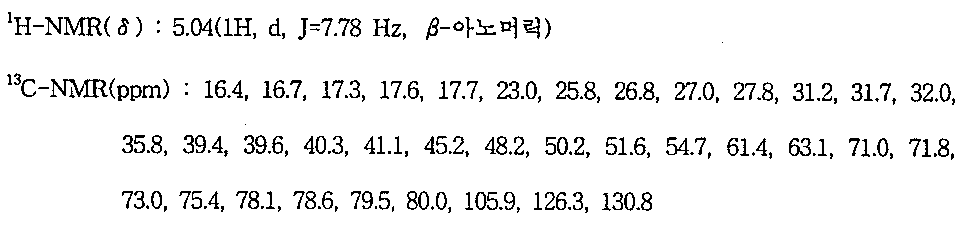
[20(S)-진세노사이드 Rh1의 물리화학적 성상][Physical and chemical properties of 20 (S) -ginsenoside Rh 1 ]
mp : 210-212
IR(cm-1) : 3420(히드록실), 1636(올레피닉)IR (cm -1 ): 3420 (hydroxyl), 1636 (olepic)
Positive FAB-MS : m/z 639.5(M+1)+ Positive FAB-MS: m / z 639.5 (M + 1) +
이하 본 발명을 실시예에 의하여 상세히 설명하면 다음과 같다.Hereinafter, the present invention will be described in detail with reference to Examples.
[실시예]EXAMPLE
[실시예 1]Example 1
인삼의 잎에서 분리한 조사포닌 분획 1g을 10ml의 0.1M 초산완충용액(pH 4.5)에 용해시키고 아스퍼질러스속에서 분리한 락타제 2g을 첨가하여 37
[실시예 2]Example 2
인삼의 과실에서 분리한 조사포닌 분획 1g을 10ml의 초산완충용액(pH 4.8)에 용해시키고 페니실리움속에서 분리한 락타제 3g을 첨가하여 37
[실시예 3]Example 3
인삼의 줄기로부터 얻어진 조사포닌 분획 1g을 10ml의 초산완충용액(pH 5.3)에 용해시키고 페니실리움속에서 분리한 락타제 3g을 첨가하여 50
[실시예 4]Example 4
인삼의 잎에서 분리한 조사포닌 분획 1g을 20% 아세토니트릴을 함유하는 초산완충용액(pH 5.0) 10ml에 용해시키고 락타제 5g을 첨가하여 20
[실시예 5]Example 5
인삼의 잎에서 분리한 조사포닌 분획 1g을 20% 에탄올을 함유하는 시트레이트-포스페이트 완충용액(pH 5.0) 20ml에 용해시키고 락타제 5g을 첨가하여 20
[실시예 6]Example 6
인삼추출 엑스 1g을 물 10ml에 용해시키고 여기에 페니실리움속에서 분리한 락타제 2g을 첨가하여 37
Claims (7)

Priority Applications (1)
| Application Number | Priority Date | Filing Date | Title |
|---|---|---|---|
| KR1019970023369A KR100218552B1 (en) | 1997-06-05 | 1997-06-05 | Process for producing ginsenoside |
Applications Claiming Priority (1)
| Application Number | Priority Date | Filing Date | Title |
|---|---|---|---|
| KR1019970023369A KR100218552B1 (en) | 1997-06-05 | 1997-06-05 | Process for producing ginsenoside |
Publications (2)
| Publication Number | Publication Date |
|---|---|
| KR19990000457A KR19990000457A (en) | 1999-01-15 |
| KR100218552B1 true KR100218552B1 (en) | 1999-10-01 |
Family
ID=19508769
Family Applications (1)
| Application Number | Title | Priority Date | Filing Date |
|---|---|---|---|
| KR1019970023369A Expired - Lifetime KR100218552B1 (en) | 1997-06-05 | 1997-06-05 | Process for producing ginsenoside |
Country Status (1)
| Country | Link |
|---|---|
| KR (1) | KR100218552B1 (en) |
Families Citing this family (2)
| Publication number | Priority date | Publication date | Assignee | Title |
|---|---|---|---|---|
| KR100424438B1 (en) * | 1998-05-07 | 2004-05-20 | 주식회사 케이티앤지 | Enzymatic producing method of ginsenoside rd |
| KR100444368B1 (en) * | 2001-06-13 | 2004-08-16 | 주식회사 한국인삼공사 | The manufacturing process for the specific ginsenoside from panax ginseng hairy roots by heat treatment |
-
1997
- 1997-06-05 KR KR1019970023369A patent/KR100218552B1/en not_active Expired - Lifetime
Also Published As
| Publication number | Publication date |
|---|---|
| KR19990000457A (en) | 1999-01-15 |
Similar Documents
| Publication | Publication Date | Title |
|---|---|---|
| KR100329259B1 (en) | manufacturing process of ginseng saponins | |
| JP4953547B2 (en) | Ginsenoside glycosidase hydrolyzing ginsenoside sugar group and use thereof | |
| KR100377546B1 (en) | Manufacturing Method for Ginsenoside Compound K by Enzymatic Reaction | |
| KR100418604B1 (en) | Manufacturing method of Compound K and Ginsenoside F1 from ginseng ginsenosides | |
| Fox et al. | The formation, isolation, and biological activity of a cytokinin 7-glucoside | |
| CN103266154A (en) | Biological transformation method for preparing high-activity theasaponin | |
| KR20130034173A (en) | Ginseng process method for increasing ginsenoside quantity and processed goods thereof | |
| Budzianowski | Naphthohydroquinone glucosides of Drosera rotundifolia and D. intermedia from in vitro cultures | |
| KR100424438B1 (en) | Enzymatic producing method of ginsenoside rd | |
| KR100293968B1 (en) | 20 (S) - Production method of Ginsenoside AL | |
| KR20230157273A (en) | Method for selectively preparing compound K and compound Y from saponins of ginseng by enzymatic process | |
| Curl et al. | Isolation and structural elucidation of a triterpenoid saponin from guar, Cyamopsis tetragonoloba | |
| KR100218553B1 (en) | Process for producing ginsenoside rg3 | |
| KR20080028266A (en) | Method for preparing Compound K, Compound Y, Ginsenoside F 1 and Compound Fiji-2, which are intestinal ginsenoside metabolites, from ginseng saponins using pectinis or biscozyme | |
| KR100403570B1 (en) | Method for the Production of Ginsenoside F2 by Enzymatic Process | |
| Keates et al. | 5-O-(α-D-galactopyranosyl)-D-glycero-pent-2-enono-1, 4-lactone: characterization in the oxalate-producing fungus, Sclerotinia sclerotiorum | |
| KR100420451B1 (en) | The manufacturing method for ginsenoside compound k with cellulase or lactase composition y-ao | |
| KR100186757B1 (en) | Preparation process of 20(s)-ginsenocide rh1 and 20(s)-protopanaxtrlyol | |
| KR101959848B1 (en) | Method of producing rare ginseng saponin by using Formitella fracinea mycelia | |
| Ionkova | Astragalus species (milk vetch): in vitro culture and the production of saponins, astragaline, and other biologically active compounds | |
| US20200317822A1 (en) | Method for Preparing Arabinogalacturonan from Tangerine Peel | |
| CN113105427A (en) | Method for extracting catechin and application thereof | |
| KR19990000457A (en) | Method for preparing trace ginsenosides | |
| KR100444370B1 (en) | The manufacturing method for ginsenoside f1 with naringinase | |
| JPS5980699A (en) | Gynosaponins |
Legal Events
| Date | Code | Title | Description |
|---|---|---|---|
| A201 | Request for examination | ||
| PA0109 | Patent application |
Patent event code: PA01091R01D Comment text: Patent Application Patent event date: 19970605 |
|
| PA0201 | Request for examination |
Patent event code: PA02012R01D Patent event date: 19970605 Comment text: Request for Examination of Application |
|
| PG1501 | Laying open of application | ||
| E701 | Decision to grant or registration of patent right | ||
| PE0701 | Decision of registration |
Patent event code: PE07011S01D Comment text: Decision to Grant Registration Patent event date: 19990311 |
|
| GRNT | Written decision to grant | ||
| PR0701 | Registration of establishment |
Comment text: Registration of Establishment Patent event date: 19990610 Patent event code: PR07011E01D |
|
| PR1002 | Payment of registration fee |
Payment date: 19990611 End annual number: 3 Start annual number: 1 |
|
| PG1601 | Publication of registration | ||
| PR1001 | Payment of annual fee |
Payment date: 20020503 Start annual number: 4 End annual number: 4 |
|
| PR1001 | Payment of annual fee |
Payment date: 20030324 Start annual number: 5 End annual number: 6 |
|
| PR1001 | Payment of annual fee |
Payment date: 20050318 Start annual number: 7 End annual number: 7 |
|
| PR1001 | Payment of annual fee |
Payment date: 20060224 Start annual number: 8 End annual number: 8 |
|
| PR1001 | Payment of annual fee |
Payment date: 20070427 Start annual number: 9 End annual number: 9 |
|
| PR1001 | Payment of annual fee |
Payment date: 20080605 Start annual number: 10 End annual number: 10 |
|
| PR1001 | Payment of annual fee |
Payment date: 20091103 Start annual number: 11 End annual number: 11 |
|
| PR1001 | Payment of annual fee |
Payment date: 20100628 Start annual number: 12 End annual number: 12 |
|
| PR1001 | Payment of annual fee |
Payment date: 20110517 Start annual number: 13 End annual number: 13 |
|
| PR1001 | Payment of annual fee |
Payment date: 20120524 Start annual number: 14 End annual number: 14 |
|
| FPAY | Annual fee payment |
Payment date: 20130528 Year of fee payment: 15 |
|
| PR1001 | Payment of annual fee |
Payment date: 20130528 Start annual number: 15 End annual number: 15 |
|
| FPAY | Annual fee payment |
Payment date: 20140609 Year of fee payment: 16 |
|
| PR1001 | Payment of annual fee |
Payment date: 20140609 Start annual number: 16 End annual number: 16 |
|
| FPAY | Annual fee payment |
Payment date: 20150604 Year of fee payment: 17 |
|
| PR1001 | Payment of annual fee |
Payment date: 20150604 Start annual number: 17 End annual number: 17 |
|
| FPAY | Annual fee payment |
Payment date: 20160607 Year of fee payment: 18 |
|
| PR1001 | Payment of annual fee |
Payment date: 20160607 Start annual number: 18 End annual number: 18 |
|
| EXPY | Expiration of term | ||
| PC1801 | Expiration of term |