JP7635355B2 - Combination of 4-pyrimidine sulfamide derivative with SGLT-2 inhibitor for treating endothelin-related diseases - Google Patents
Combination of 4-pyrimidine sulfamide derivative with SGLT-2 inhibitor for treating endothelin-related diseases Download PDFInfo
- Publication number
- JP7635355B2 JP7635355B2 JP2023209979A JP2023209979A JP7635355B2 JP 7635355 B2 JP7635355 B2 JP 7635355B2 JP 2023209979 A JP2023209979 A JP 2023209979A JP 2023209979 A JP2023209979 A JP 2023209979A JP 7635355 B2 JP7635355 B2 JP 7635355B2
- Authority
- JP
- Japan
- Prior art keywords
- pharma
- acceptable salt
- ceutically acceptable
- aprocitentan
- hypertension
- Prior art date
- Legal status (The legal status is an assumption and is not a legal conclusion. Google has not performed a legal analysis and makes no representation as to the accuracy of the status listed.)
- Active
Links
Classifications
-
- A—HUMAN NECESSITIES
- A61—MEDICAL OR VETERINARY SCIENCE; HYGIENE
- A61K—PREPARATIONS FOR MEDICAL, DENTAL OR TOILETRY PURPOSES
- A61K31/00—Medicinal preparations containing organic active ingredients
- A61K31/33—Heterocyclic compounds
- A61K31/395—Heterocyclic compounds having nitrogen as a ring hetero atom, e.g. guanethidine or rifamycins
- A61K31/495—Heterocyclic compounds having nitrogen as a ring hetero atom, e.g. guanethidine or rifamycins having six-membered rings with two or more nitrogen atoms as the only ring heteroatoms, e.g. piperazine or tetrazines
- A61K31/505—Pyrimidines; Hydrogenated pyrimidines, e.g. trimethoprim
- A61K31/506—Pyrimidines; Hydrogenated pyrimidines, e.g. trimethoprim not condensed and containing further heterocyclic rings
-
- A—HUMAN NECESSITIES
- A61—MEDICAL OR VETERINARY SCIENCE; HYGIENE
- A61K—PREPARATIONS FOR MEDICAL, DENTAL OR TOILETRY PURPOSES
- A61K31/00—Medicinal preparations containing organic active ingredients
- A61K31/70—Carbohydrates; Sugars; Derivatives thereof
-
- A—HUMAN NECESSITIES
- A61—MEDICAL OR VETERINARY SCIENCE; HYGIENE
- A61K—PREPARATIONS FOR MEDICAL, DENTAL OR TOILETRY PURPOSES
- A61K31/00—Medicinal preparations containing organic active ingredients
- A61K31/70—Carbohydrates; Sugars; Derivatives thereof
- A61K31/7004—Monosaccharides having only carbon, hydrogen and oxygen atoms
-
- A—HUMAN NECESSITIES
- A61—MEDICAL OR VETERINARY SCIENCE; HYGIENE
- A61K—PREPARATIONS FOR MEDICAL, DENTAL OR TOILETRY PURPOSES
- A61K31/00—Medicinal preparations containing organic active ingredients
- A61K31/70—Carbohydrates; Sugars; Derivatives thereof
- A61K31/7042—Compounds having saccharide radicals and heterocyclic rings
-
- A—HUMAN NECESSITIES
- A61—MEDICAL OR VETERINARY SCIENCE; HYGIENE
- A61K—PREPARATIONS FOR MEDICAL, DENTAL OR TOILETRY PURPOSES
- A61K31/00—Medicinal preparations containing organic active ingredients
- A61K31/70—Carbohydrates; Sugars; Derivatives thereof
- A61K31/7042—Compounds having saccharide radicals and heterocyclic rings
- A61K31/7048—Compounds having saccharide radicals and heterocyclic rings having oxygen as a ring hetero atom, e.g. leucoglucosan, hesperidin, erythromycin, nystatin, digitoxin or digoxin
-
- A—HUMAN NECESSITIES
- A61—MEDICAL OR VETERINARY SCIENCE; HYGIENE
- A61K—PREPARATIONS FOR MEDICAL, DENTAL OR TOILETRY PURPOSES
- A61K31/00—Medicinal preparations containing organic active ingredients
- A61K31/70—Carbohydrates; Sugars; Derivatives thereof
- A61K31/7042—Compounds having saccharide radicals and heterocyclic rings
- A61K31/7052—Compounds having saccharide radicals and heterocyclic rings having nitrogen as a ring hetero atom, e.g. nucleosides, nucleotides
- A61K31/7056—Compounds having saccharide radicals and heterocyclic rings having nitrogen as a ring hetero atom, e.g. nucleosides, nucleotides containing five-membered rings with nitrogen as a ring hetero atom
-
- A—HUMAN NECESSITIES
- A61—MEDICAL OR VETERINARY SCIENCE; HYGIENE
- A61K—PREPARATIONS FOR MEDICAL, DENTAL OR TOILETRY PURPOSES
- A61K9/00—Medicinal preparations characterised by special physical form
- A61K9/0012—Galenical forms characterised by the site of application
- A61K9/0053—Mouth and digestive tract, i.e. intraoral and peroral administration
-
- A—HUMAN NECESSITIES
- A61—MEDICAL OR VETERINARY SCIENCE; HYGIENE
- A61K—PREPARATIONS FOR MEDICAL, DENTAL OR TOILETRY PURPOSES
- A61K9/00—Medicinal preparations characterised by special physical form
- A61K9/20—Pills, tablets, discs, rods
- A61K9/2004—Excipients; Inactive ingredients
- A61K9/2013—Organic compounds, e.g. phospholipids, fats
- A61K9/2018—Sugars, or sugar alcohols, e.g. lactose, mannitol; Derivatives thereof, e.g. polysorbates
-
- A—HUMAN NECESSITIES
- A61—MEDICAL OR VETERINARY SCIENCE; HYGIENE
- A61K—PREPARATIONS FOR MEDICAL, DENTAL OR TOILETRY PURPOSES
- A61K9/00—Medicinal preparations characterised by special physical form
- A61K9/20—Pills, tablets, discs, rods
- A61K9/2004—Excipients; Inactive ingredients
- A61K9/2022—Organic macromolecular compounds
- A61K9/205—Polysaccharides, e.g. alginate, gums; Cyclodextrin
- A61K9/2054—Cellulose; Cellulose derivatives, e.g. hydroxypropyl methylcellulose
-
- A—HUMAN NECESSITIES
- A61—MEDICAL OR VETERINARY SCIENCE; HYGIENE
- A61P—SPECIFIC THERAPEUTIC ACTIVITY OF CHEMICAL COMPOUNDS OR MEDICINAL PREPARATIONS
- A61P13/00—Drugs for disorders of the urinary system
- A61P13/12—Drugs for disorders of the urinary system of the kidneys
-
- A—HUMAN NECESSITIES
- A61—MEDICAL OR VETERINARY SCIENCE; HYGIENE
- A61P—SPECIFIC THERAPEUTIC ACTIVITY OF CHEMICAL COMPOUNDS OR MEDICINAL PREPARATIONS
- A61P17/00—Drugs for dermatological disorders
- A61P17/02—Drugs for dermatological disorders for treating wounds, ulcers, burns, scars, keloids, or the like
-
- A—HUMAN NECESSITIES
- A61—MEDICAL OR VETERINARY SCIENCE; HYGIENE
- A61P—SPECIFIC THERAPEUTIC ACTIVITY OF CHEMICAL COMPOUNDS OR MEDICINAL PREPARATIONS
- A61P3/00—Drugs for disorders of the metabolism
- A61P3/08—Drugs for disorders of the metabolism for glucose homeostasis
- A61P3/10—Drugs for disorders of the metabolism for glucose homeostasis for hyperglycaemia, e.g. antidiabetics
-
- A—HUMAN NECESSITIES
- A61—MEDICAL OR VETERINARY SCIENCE; HYGIENE
- A61P—SPECIFIC THERAPEUTIC ACTIVITY OF CHEMICAL COMPOUNDS OR MEDICINAL PREPARATIONS
- A61P7/00—Drugs for disorders of the blood or the extracellular fluid
-
- A—HUMAN NECESSITIES
- A61—MEDICAL OR VETERINARY SCIENCE; HYGIENE
- A61P—SPECIFIC THERAPEUTIC ACTIVITY OF CHEMICAL COMPOUNDS OR MEDICINAL PREPARATIONS
- A61P9/00—Drugs for disorders of the cardiovascular system
- A61P9/10—Drugs for disorders of the cardiovascular system for treating ischaemic or atherosclerotic diseases, e.g. antianginal drugs, coronary vasodilators, drugs for myocardial infarction, retinopathy, cerebrovascula insufficiency, renal arteriosclerosis
-
- A—HUMAN NECESSITIES
- A61—MEDICAL OR VETERINARY SCIENCE; HYGIENE
- A61P—SPECIFIC THERAPEUTIC ACTIVITY OF CHEMICAL COMPOUNDS OR MEDICINAL PREPARATIONS
- A61P9/00—Drugs for disorders of the cardiovascular system
- A61P9/12—Antihypertensives
-
- A—HUMAN NECESSITIES
- A61—MEDICAL OR VETERINARY SCIENCE; HYGIENE
- A61K—PREPARATIONS FOR MEDICAL, DENTAL OR TOILETRY PURPOSES
- A61K2300/00—Mixtures or combinations of active ingredients, wherein at least one active ingredient is fully defined in groups A61K31/00 - A61K41/00
Landscapes
- Health & Medical Sciences (AREA)
- Life Sciences & Earth Sciences (AREA)
- Animal Behavior & Ethology (AREA)
- Pharmacology & Pharmacy (AREA)
- General Health & Medical Sciences (AREA)
- Veterinary Medicine (AREA)
- Chemical & Material Sciences (AREA)
- Public Health (AREA)
- Medicinal Chemistry (AREA)
- Epidemiology (AREA)
- Engineering & Computer Science (AREA)
- Bioinformatics & Cheminformatics (AREA)
- General Chemical & Material Sciences (AREA)
- Nuclear Medicine, Radiotherapy & Molecular Imaging (AREA)
- Organic Chemistry (AREA)
- Chemical Kinetics & Catalysis (AREA)
- Molecular Biology (AREA)
- Diabetes (AREA)
- Urology & Nephrology (AREA)
- Cardiology (AREA)
- Heart & Thoracic Surgery (AREA)
- Hematology (AREA)
- Emergency Medicine (AREA)
- Endocrinology (AREA)
- Obesity (AREA)
- Vascular Medicine (AREA)
- Dermatology (AREA)
- Biophysics (AREA)
- Nutrition Science (AREA)
- Physiology (AREA)
- Pharmaceuticals Containing Other Organic And Inorganic Compounds (AREA)
- Acyclic And Carbocyclic Compounds In Medicinal Compositions (AREA)
- Medicines That Contain Protein Lipid Enzymes And Other Medicines (AREA)
Description
本発明は、特定のエンドセリン関連疾患の予防又は治療における、ナトリウムグルコース共輸送体2(SGLT-2)阻害剤を含む他の有効成分又は治療剤と組み合わせた、化合物、アプロシテンタン(aprocitentan)及びエンドセリン受容体アンタゴニストとしてのその使用に関する。本発明はさらに、当該他の有効成分又は治療剤と組み合わせて、アプロシテンタンを有する医薬組成物に関する。本発明はさらに、アプロシテンタンの新規な結晶形を有するそのような医薬組成物;そのような結晶形から製造される医薬組成物、及び、当該エンドセリン関連疾患の予防又は治療における、当該他の有効成分又は治療剤と組み合わせた、そのような結晶形の使用に関する。 The present invention relates to a compound, aprocitentan, and its use as an endothelin receptor antagonist in combination with other active ingredients or therapeutic agents, including sodium glucose cotransporter 2 (SGLT-2) inhibitors, in the prevention or treatment of certain endothelin-related disorders. The present invention further relates to pharmaceutical compositions having aprocitentan in combination with said other active ingredients or therapeutic agents. The present invention further relates to such pharmaceutical compositions having novel crystalline forms of aprocitentan; pharmaceutical compositions made from such crystalline forms, and the use of such crystalline forms in combination with said other active ingredients or therapeutic agents in the prevention or treatment of said endothelin-related disorders.
アプロシテンタン、{5-(4-ブロモ-フェニル)-6-[2-(5-ブロモ-ピリミジン-2-イルオキシ)-エトキシ]-ピリミジン-4-イル}-スルファミド(以下、「化合物」とも記載する。)は、式Iを有する。 Aprocitentan, {5-(4-bromo-phenyl)-6-[2-(5-bromo-pyrimidin-2-yloxy)-ethoxy]-pyrimidin-4-yl}-sulfamide (hereinafter also referred to as "the compound"), has formula I.

エンドセリンの結合を阻害するその能力により、式Iの化合物は、多くの心臓-腎臓-代謝疾患において生じるエンドセリンに起因する血管れん縮、増殖又は炎症の増大と関連するエンドセリン関連疾患の治療に使用することができる。そのようなエンドセリン関連疾患の例は、治療困難性/抵抗性高血圧を特に含む高血圧;肺高血圧;冠動脈疾患;心不全;腎若しくは心筋虚血;慢性腎臓疾患(CKD)[特に、Kidney Disease Improving Global Outcomes(KDIGO)Guidelinesに定義されるステージ1~4のCKD(特に、ステージ3のCKD)、とりわけ高血圧又は糖尿病により引き起こされ/高血圧又は糖尿病に関連する(特にこれらのステージの)CKD(加えて高血圧に関連するDKDを含む糖尿病性腎臓疾患(DKD));
糖尿病及び、糖尿病性動脈疾患、糖尿病性ネフローゼ、糖尿病網膜症若しくは糖尿病性脈管障害等の糖尿病関連疾患;糖尿病を有する患者、特に少なくとも1つの他の心血管危険因子(例えば、高血圧、脂質異常症、血栓性イベント)を伴う糖尿病を有する患者の主要心血管イベント(例えば、心不全(HF)、心筋梗塞、発作又は心血管に起因する死亡)が進行するリスクを減少させること;糖尿病合併症の治療及び予防;(急性及び慢性)腎不全;糸球体腎炎;結合組織病;アテローム性動脈硬化;慢性抹消(閉塞性)動脈症を含む抹消動脈疾患;指潰瘍;糖尿病性足部潰瘍及び/又は糖尿病を有する、又は、喫煙者である、又は、アテローム性動脈硬化を有する患者の下肢(lower limb/extremety)切断リスクを減少させること;とりわけ、駆出率の低下を伴う収縮期HF/HF(HFrEF)(すなわち、駆出率<約40%)及び駆出率が保持される拡張期HF/HF(HFpEF)(すなわち、駆出率>約50%)を含む、特に慢性HFを含むものとして定義される心不全(HF);心血管リスクを有する患者(例えば、冠動脈疾患を有する患者、及び/又は、うっ血性心不全の臨床症状を示した患者)の主要心血管イベント(例えば、心不全(HF)、心筋梗塞、発作又は心血管に起因する死亡)が進行するリスクを減少させること;狭心症;及び拡張機能障害。式Iの化合物は、脳虚血、認知症、偏頭痛、くも膜下出血、レイノー症候群、門脈圧亢進症;バルーン又はステント血管形成術後の再狭窄;炎症;胃潰瘍及び十二指腸潰瘍;癌;黒色腫;前立腺癌;前立腺肥大;勃起不全;子癇発作;聴力損失;黒内障;慢性気管支炎;喘息;肺線維症;グラム陰性敗血症;ショック;鎌状赤血球貧血;腎疝痛;緑内障;血管若しくは心臓外科手術の、又は臓器移植後の合併症;シクロスポリン治療若しくは腎毒性プロファイルを示す同等の治療の合併症;疼痛;高脂血症;並びに現在エンドセリンに関連のあることが知られている他の疾患の治療又は予防にも使用することができる。
Due to their ability to inhibit endothelin binding, the compounds of formula I can be used to treat endothelin-related disorders associated with increased vasospasm, proliferation or inflammation due to endothelin, which occurs in many cardio-renal-metabolic disorders. Examples of such endothelin-related disorders include hypertension, particularly including refractory/resistant hypertension; pulmonary hypertension; coronary artery disease; heart failure; renal or myocardial ischemia; chronic kidney disease (CKD) [particularly CKD stages 1-4 (particularly CKD stage 3) as defined in the Kidney Disease Improving Global Outcomes (KDIGO) Guidelines, especially CKD caused/associated with hypertension or diabetes (particularly these stages) (as well as diabetic kidney disease (DKD) including DKD associated with hypertension);
Diabetes and diabetes-related diseases such as diabetic arterial disease, diabetic nephrosis, diabetic retinopathy or diabetic vasculopathy; reducing the risk of developing a major cardiovascular event (e.g. heart failure (HF), myocardial infarction, stroke or death from cardiovascular causes) in patients with diabetes, especially in patients with diabetes accompanied by at least one other cardiovascular risk factor (e.g. hypertension, dyslipidemia, thrombotic events); treatment and prevention of diabetic complications; renal failure (acute and chronic); glomerulonephritis; connective tissue diseases; atherosclerosis; peripheral arterial disease including chronic peripheral (obstructive) arteriopathy; digital ulcers; diabetic foot ulcers and/or lower limb ulcers in patients with diabetes or who are smokers or who have atherosclerosis. reducing the risk of limb/extremely amputation; heart failure (HF), defined inter alia as including chronic HF, including systolic HF/HF with reduced ejection fraction (HFrEF) (i.e., ejection fraction < about 40%) and diastolic HF/HF with preserved ejection fraction (HFpEF) (i.e., ejection fraction > about 50%); reducing the risk of progression to a major cardiovascular event (e.g., heart failure (HF), myocardial infarction, stroke, or death from cardiovascular causes) in patients at cardiovascular risk (e.g., patients with coronary artery disease and/or patients who have clinical symptoms of congestive heart failure); angina pectoris; and diastolic dysfunction. The compounds of formula I may also be used for the treatment or prevention of cerebral ischemia, dementia, migraine, subarachnoid hemorrhage, Raynaud's syndrome, portal hypertension; restenosis after balloon or stent angioplasty; inflammation; gastric and duodenal ulcers; cancer; melanoma; prostate cancer; prostatic hyperplasia; erectile dysfunction; eclampsia; hearing loss; amaurosis; chronic bronchitis; asthma; pulmonary fibrosis; gram-negative sepsis; shock; sickle cell anemia; renal colic; glaucoma; complications of vascular or cardiac surgery or after organ transplantation; complications of cyclosporine therapy or comparable treatments which exhibit a nephrotoxicity profile; pain; hyperlipidemia; and other diseases now known to be associated with endothelin.
高血圧及び/又は腎臓疾患を患う患者に対して、糖尿病が関連しているか否かに関わらず、エンドセリン受容体アンタゴニスト(ERA)が顕著な治療効果を有するかもしれないことが、臨床試験により示された。エンドセリン1(ET-1)のプラーク形成、血栓、血管れん縮及び血管肥大を介在する効果により、そして、ET-1は、他の系、特にレニン アンジオテンシン及び交感神経系及び/又はインスリンシグナル伝達の作用を増強するため、ET-1はおそらく慢性糖尿病性動脈症の病理メカニズムにおいて役割を担っている。従って、ERAは、急性(末梢血管拡張)及び慢性(血管拡張、血管構造の改善、交感神経作用の調節、抗血栓性、抗炎症性)効果を有することにより、糖尿病性動脈症を含む抹消動脈閉塞性疾患の治療に有益であるかもしれない。糖尿病及びCKDを有する成人について行った試験(43,256患者を含む157の試験)の臨床ネットワークメタナリシスにおいて、ERAは、末期腎臓疾患の予防に最も効果的な薬剤であると位置づけられた(S.C.Palmerら、Lancet(2015)、385(9982):2047-2056)。しかしながら、治療による有益性が、ERAと一般に関連付けられる催奇性作用の潜在リスク等の潜在的副作用を凌駕する必要がある。加えて、そしてより重要なことは、選択的ETAアンタゴニスト並びにETA及びETBの両受容体のデュアルアンタゴニストは、過去に試験を行った多くのERAに関連する共通の副作用である体液貯留を引き起こすかもしれず、時には(例えば、利尿剤で対処できない場合には)心不全又は死亡等の重大な(exaggerated)主要有害心イベントを引き起こす。危険性-有益性バランスは、(例えば、デュアルアンタゴニストであるボセンタン(bosentan)及びマシテンタン(macitentan)、ETA選択的アンタゴニストであるアンブリセンタン(ambrisentan)等のERAに対する過去における連続的な承認に反映されているように)肺高血圧等の適応症については、ほとんどの場合、ERAを用いた治療に有利であるが、ERAは原発性高血圧の処置には適さず(Laffinら、Seminars in Nephrology 2015、35、168-175)、また、治療困難性/抵抗性高血圧(rHT)、慢性腎臓疾患(CKD)(糖尿病及び/又は高血圧に関連しているか否かに関わらず)又は他の高血圧関連疾患をERAで治療する可能性を考える場合、体液貯留等の副作用の問題が残るであろう。 Clinical trials have shown that endothelin receptor antagonists (ERAs) may have significant therapeutic effects in patients with hypertension and/or renal disease, whether or not diabetes is associated. Due to its effects in mediating plaque formation, thrombosis, vasospasm, and vascular hypertrophy, and because ET-1 potentiates the effects of other systems, particularly renin-angiotensin and the sympathetic nervous system and/or insulin signaling, ET-1 probably plays a role in the pathomechanism of chronic diabetic arteriopathy. Thus, ERAs may be beneficial in the treatment of peripheral arterial occlusive diseases, including diabetic arteriopathy, by having acute (peripheral vasodilatation) and chronic (vasodilatation, improvement of vascular structure, modulation of sympathetic activity, antithrombotic, anti-inflammatory) effects. A clinical network meta-analysis of trials (157 trials involving 43,256 patients) in adults with diabetes and CKD ranked ERAs as the most effective agents for preventing end-stage renal disease (S.C. Palmer et al., Lancet (2015), 385(9982):2047-2056). However, the benefits of treatment must outweigh the potential side effects, such as the potential risk of teratogenic effects, commonly associated with ERAs. Additionally, and more importantly, selective ETA antagonists and dual antagonists of both ETA and ETB receptors may cause fluid retention, a common side effect associated with many previously tested ERAs, and sometimes cause exaggerated major adverse cardiac events, such as heart failure or death (e.g., if not managed with diuretics). While the risk-benefit balance favors treatment with ERAs in most cases for indications such as pulmonary hypertension (e.g., as reflected by the successive approvals in the past of ERAs such as the dual antagonists bosentan and macitentan and the ETA selective antagonist ambrisentan), ERAs are not suitable for treating primary hypertension (Laffin et al., Seminars in Nephrology 2015, 35, 168-175), and side effects such as fluid retention remain an issue when considering the possibility of treating difficult/resistant hypertension (rHT), chronic kidney disease (CKD) (whether or not related to diabetes and/or hypertension), or other hypertension-related conditions with ERAs.
ETA選択的エンドセリン受容体アンタゴニストであるダルセンタン(darusentan)が、抵抗性高血圧(rHT)の治療のために開発中である(Bakrisら、Hypertension 2010、56,824-830、WO2007/098390も参照されたい。)。rHTの患者における14週間の第3相試験において、ダルセンタンは、自由行動下血圧(ambulatory blood pressure)の減少に対して効果を示したが、主要エンドポイントである収縮期血圧に対する有意な治療効果を示すことができなかった。患者は、利尿剤を含む異なる薬物クラス(drug classes)の3種以上の降圧薬による最適用量における治療にもかかわらず、抵抗性高血圧(140mmHgより高い収縮期血圧)の治療を受けている場合、参加する資格を有した。1日当たり25mgの最小用量のヒドロクロロチアジド(又は、等価の他のサイアザイド利尿薬)が必要であった。たとえ、試験の間に、体液貯留を処置するために、研究者の裁量で利尿療法を強化することができたとしても、ダルセンタンに関連して最も頻発する有害イベントは体液貯留/浮腫であり、他の群のそれぞれにおいて12%であったのに対し28%であった。プラセボと比べ、より多くの患者がダルセンタンの有害イベントのために試験を中止した。 Darusentan, an ETA-selective endothelin receptor antagonist, is in development for the treatment of resistant hypertension (rHT) (Bakris et al., Hypertension 2010, 56, 824-830; see also WO 2007/098390). In a 14-week Phase 3 study in patients with rHT, darusentan demonstrated efficacy in reducing ambulatory blood pressure but failed to demonstrate a significant treatment effect on the primary endpoint, systolic blood pressure. Patients were eligible to participate if they were being treated for resistant hypertension (systolic blood pressure greater than 140 mmHg) despite treatment with three or more antihypertensive drugs of different drug classes, including a diuretic, at optimal doses. A minimum dose of 25 mg hydrochlorothiazide (or equivalent other thiazide diuretic) per day was required. The most frequent adverse event associated with darusentan was fluid retention/edema, occurring in 28% compared with 12% in each of the other groups, even though diuretic therapy could be intensified at the investigator's discretion to treat fluid retention during the study. Compared with placebo, more patients discontinued the study due to adverse events with darusentan.
ETA選択的ERAであるavosentanは、2型糖尿病患者の顕性糖尿病性腎症の進行に対するavosentanの効果を調べる試験において、有意な治療効果を示したが、主として水分過負荷及びうっ血性心不全に関連する有害イベントによる試験投薬の中止の有意な増大を伴った(Mannら、「Avosentan for Overt Diabetic Nephropathy」J Am Soc Nephrol.2010、21(3):527-535。)。複合主要転帰は、血清クレアチニン、ESRD
又は死亡が2倍になる時間であった。副次転帰にはアルブミン/クレアチニン比(ACR)の変化及び心血管転帰が含まれていた。試験は、グループ間の主要転帰の頻度の違いを検出しなかった。AvosentanはACRを有意に減少させた。中央値で4か月(最大16か月)の追跡期間の後、avosentanによる過剰の心血管イベントにより、上記試験は途中で打ち切られ、著者は、「25~50mgの用量において、ETA受容体に対するavosentanの選択性はより低く、従って、ナトリウム及び水の貯留並びに血管内から血管外空間への潜在的体液移動を伴う末梢血管拡張を引き起こしたのかもしれない。」と結論づけた。混合型ETA/B受容体アンタゴニストはタンパク尿に対して効果が弱いか又は効果を示さないことが以前に見いだされているため、アルブミン尿に対する効果は、おそらく腎ETA受容体の阻害によるものと考えられた。著者によれば、avosentanがより高い用量でETB受容体を遮断するという仮定は、ACE阻害剤で治療した人々における選択的ETA受容体遮断のナトリウム利尿効果を示すデータによりさらに支持される。従って、場合によっては最終的において試験の中断に結び付いたナトリウム利尿効果/体液貯留は、ETA及びETB受容体の両方の遮断によるものであり、このことは、そのような臨床状況において両方に作用するERAを使用することを思いとどまらせるものである。
Avosentan, an ETA-selective ERA, demonstrated significant therapeutic benefit in a study examining the effect of avosentan on the progression of overt diabetic nephropathy in patients with type 2 diabetes, but was associated with a significant increase in discontinuation of study medication due to adverse events, primarily related to fluid overload and congestive heart failure (Mann et al., "Avosentan for Overt Diabetic Nephropathy," J Am Soc Nephrol. 2010, 21(3):527-535.). The composite primary outcomes were serum creatinine, ESRD, and ESRD.
or doubling time to death. Secondary outcomes included change in albumin/creatinine ratio (ACR) and cardiovascular outcomes. The study did not detect a difference in the frequency of the primary outcome between the groups. Avosentan significantly reduced ACR. After a median follow-up of 4 months (maximum 16 months), the study was terminated prematurely due to excess cardiovascular events with avosentan, and the authors concluded that "at doses of 25-50 mg, avosentan is less selective for ETA receptors and may therefore have caused peripheral vasodilation with sodium and water retention and potential fluid shifts from the intravascular to the extravascular space." The effect on albuminuria was probably due to inhibition of renal ETA receptors, since mixed ETA/B receptor antagonists have previously been found to have little or no effect on proteinuria. According to the authors, the hypothesis that avosentan blocks ETB receptors at higher doses is further supported by data showing the natriuretic effect of selective ETA receptor blockade in people treated with ACE inhibitors. Thus, the natriuretic effect/fluid retention that ultimately led to discontinuation of the study in some cases was due to blockade of both ETA and ETB receptors, which discourages the use of dual acting ERAs in such clinical situations.
さらなる前臨床データは、ACE阻害剤であるエナラプリル(enalapril)と併用したETA選択的ERAの血圧に対する相乗効果は、ETB受容体の同時遮断により消失することを示し(Goddardら、J.Am.Soc.Nephrol.2004、15、2601-2610)、従って、背景療法としてACE阻害剤が必要とされる臨床状況において、両方に作用するERAを使用することを思いとどまらせるものである。 Further preclinical data indicate that the synergistic effect on blood pressure of ETA-selective ERAs in combination with the ACE inhibitor enalapril is abolished by concomitant blockade of ETB receptors (Goddard et al., J. Am. Soc. Nephrol. 2004, 15, 2601-2610), thus discouraging the use of dual-acting ERAs in clinical situations where an ACE inhibitor is required as background therapy.
「Endothelin antagonists for diabetic and non-diabetic chronic kidney disease」(Br J Clin Pharmacol(2012)、76:4、573-579)における概説において、D.E.Kohanらは、「一般に、結合ETA/B受容体アンタゴ
ニストとは対照的に、ETA受容体アンタゴニストはCKDの治療に好ましいというのが有力な意見である。」と述べている。3年後、Kohanらは、Clin J Am Soc Nephrol(2015)、10:1568-1574において公表した試験に関して、「ERAの体液貯留効果は、おそらく腎尿細管のナトリウム輸送に対する直接的な効果に関連しており、一方、ERAの抗タンパク尿効果は多分、脈管構造及び/又は糸球体に対する作用と関係している。結局、ERAによるタンパク尿自体の軽減は腎体液の排泄に有利に働くことが予想される;しかしながら、ERAは、尿細管のナトリウム及び水の再吸収に対する別の効果を介して、なお体液貯留を促進し得る。」と結論付けた。
In a review in "Endothelin antagonists for diabetic and non-diabetic chronic kidney disease" (Br J Clin Pharmacol (2012), 76:4, 573-579), D. E. Kohan et al. state that "in general, the prevailing opinion is that ETA receptor antagonists, as opposed to combined ETA/B receptor antagonists, are preferred for the treatment of CKD." Three years later, Kohan et al., in a study published in Clin J Am Soc Nephrol (2015), 10:1568-1574, concluded that "The fluid-retaining effect of ERAs is probably related to direct effects on renal tubular sodium transport, whereas the antiproteinuric effect of ERAs is probably related to actions on the vasculature and/or glomeruli. Ultimately, reduction of proteinuria by ERAs would be expected to favor renal fluid excretion; however, ERAs may still promote fluid retention via additional effects on tubular sodium and water reabsorption."
糖尿病性及び非糖尿病性CKD並びにrHTを含む種々の適応症に対してERAを試験した総括的要約が、WO2016/073846に記載されている。WO2016/073846には、体液貯留が、ERAであるボセンタン、tezosentan、アンブリセンタン及びアトラセンタン(atrasentan)の副作用の増大を引き起こした可能性があるさらなる例が記載されている。WO2016/073846は、結論として、体液貯留の予測装置を用いて、ERAで、特にETA選択的ERAであるアトラセンタンでCKDを治療する方法を提案しており;当該方法は、ERAを対象に投与した場合の体液貯留のリスクを決定する工程;及び、上記リスクが許容レベルである場合に、対象にERAを投与する工程を有する。標準治療に加えられた場合の、ステージ2~4の慢性腎臓疾患及び2型糖尿病の患者における腎臓疾患の進行に対する治験化合物であるアトラセンタンの効果を評価するための第3相臨床試験(SONAR)の詳細な試験プロトコルが、Heerspinkら、Diabetes Obes.Metab.2018、1-8に公表された。このプロトコルは、試験デザインにおける用量最適化及びナトリウム貯留/体液貯留の同時制御の重要性を反映しており、結果として、試験デザインは、「疾患のリスクが高く(予後的エンリッチメント(prognostic enrichment))、加えて、試験治療に対して良好な応答を示す(予測的エンリッチメント(predictive enrichment))個体の選択」を要求している。しかしながら、2017年12月1日に、AbbVieはSONAR試験中止の決定を発表した。プレスリリースは、「試験において観察された腎イベントの進行中のモニタリングにより、現在までのエンドポイントが予想よりかなり少ないことが判明し、SONAR試験の仮説を試験する上で悪影響を及ぼすと考えられる。従って、AbbVieは、患者の試験への参加を継続することは正当化できないと判断した。SONAR試験の早期中止の判断はいかなる安全性の懸念とも無関係である。」と述べている。 A comprehensive summary of ERAs tested for various indications including diabetic and non-diabetic CKD and rHT is given in WO2016/073846. Further examples are given in WO2016/073846 where fluid retention may have caused increased side effects of the ERAs bosentan, tezosentan, ambrisentan and atrasentan. In conclusion, WO2016/073846 proposes a method of treating CKD with an ERA, in particular with the ETA-selective ERA atrasentan, using a fluid retention predictor; the method comprises the steps of determining the risk of fluid retention when an ERA is administered to a subject; and administering the ERA to the subject if the risk is at an acceptable level. A detailed study protocol for the Phase 3 clinical trial to evaluate the effect of the investigational compound atrasentan on kidney disease progression in patients with stage 2-4 chronic kidney disease and type 2 diabetes when added to standard of care (SONAR) was published in Heerspink et al., Diabetes Obes. Metab. 2018, 1-8. The protocol reflects the importance of dose optimization and simultaneous control of sodium/fluid retention in the study design, and as a result, the study design calls for "selection of individuals at high risk of disease (prognostic enrichment) who will additionally respond well to study treatment (predictive enrichment)." However, on December 1, 2017, AbbVie announced its decision to discontinue the SONAR study. The press release stated, "Ongoing monitoring of renal events observed in the study has revealed that endpoints to date are significantly less frequent than expected, which may have a detrimental effect on testing the SONAR hypotheses. Accordingly, AbbVie has determined that continued patient enrollment in the study is not justified. The decision to early terminate the SONAR study is unrelated to any safety concerns."
Avosentan試験から得られた結論に反し、前臨床及び臨床データは、ETA選択的アンタゴニストであるsitaxentan及びアンブリセンタンは、デュアルERAであるボセンタン及びマシテンタンよりも体液貯留のリスクが高いことを示唆している(Vercauterenら、JPET 2017、361、322-333)。著者らは、かれらの知見は「ラットにおいて、ETA受容体自体の機能的拮抗ではなく、ETA受容体アンタゴニストの存在下における非遮断ETB受容体の刺激が有害である可能性があり、両受容体の遮断が1つの受容体の遮断よりも水の貯留を引き起こすとは言えないことを示唆している。」と述べ、引き続き「血漿量の増大を血管透過性の増大と組み合わせると、ETA選択的アンタゴニストで得られた観察を説明できるだろう」と推測している。著者らは、「ETA選択的アンタゴニストを用いた幾つかの臨床試験において体液貯留に関連した死亡率が増大した一方、このことはデュアルERAにおいては観察されていない。しかしながら、慢性心不全又は慢性腎不全等の既存の体液貯留又はアルギニンバソプレッシン(AVP)増大の条件下では、デュアルERAは、顕著な体液貯留を引き起こした」と結論付けている。 Contrary to the conclusions from the Avosentan trial, preclinical and clinical data suggest that the ETA selective antagonists sitaxentan and ambrisentan pose a higher risk of fluid retention than the dual ERAs bosentan and macitentan (Vercauteren et al., JPET 2017, 361, 322-333). The authors state that their findings "suggest that in rats, stimulation of the unblocked ETB receptor in the presence of an ETA receptor antagonist, rather than functional antagonism of the ETA receptor itself, may be detrimental, and that blockade of both receptors is less likely to cause water retention than blockade of one receptor," and go on to speculate that "an increase in plasma volume combined with increased vascular permeability could explain the observations obtained with ETA selective antagonists." The authors conclude that "While some clinical trials with ETA selective antagonists have shown increased mortality associated with fluid retention, this has not been observed with dual ERAs. However, in conditions of pre-existing fluid retention or increased arginine vasopressin (AVP), such as chronic heart or chronic renal failure, dual ERAs caused significant fluid retention."
両エンドセリン受容体を効果的に遮断するERAであるアプロシテンタンは、本態性高血圧を有する対象の血圧を効果的に制御するであろうことが第2相試験において示されて
いる(アプロシテンタンは単剤治療として、すなわち背景抗高血圧治療なしで投与された。)(Actelion Pharmaceuticals Ltd、2017年5月22日のプレスリリース)。潜在的体液貯留の幾つかの所見が観察されたが(例えば、高用量での体重増加、ヘモグロビン濃度の用量相関的減少、高用量で末梢性浮腫が観察された4例)、有害イベントの全体頻度はプラセボ群で観察されたものと同様であった。従って、WO2016/073846の方法とは異なり、アプロシテンタンに対しては、高血圧関連疾患、特に抵抗性高血圧の治療に使用する場合、体液貯留に関するリスク評価及び/又は副作用を軽減するための用量減少は不要であろう。従って、アプロシテンタンは、これまでに抵抗性高血圧又は糖尿病及び非糖尿病患者の慢性腎臓疾患において試験された主としてETA選択的なアンタゴニストとは異なる薬理学的プロファイルを有するであろう。
Aprocitentan, an ERA that effectively blocks both endothelin receptors, has been shown in a phase 2 study to effectively control blood pressure in subjects with essential hypertension (aprocitentan was administered as monotherapy, i.e., without background antihypertensive treatment) (Actelion Pharmaceuticals Ltd, press release, May 22, 2017). Although some indications of potential fluid retention were observed (e.g., weight gain at high doses, dose-related reduction in hemoglobin concentration, 4 cases of peripheral edema observed at high doses), the overall frequency of adverse events was similar to that observed in the placebo group. Thus, unlike the method of WO2016/073846, a risk assessment for fluid retention and/or dose reduction to reduce side effects would not be necessary for aprocitentan when used to treat hypertension-related diseases, particularly resistant hypertension. Thus, aprocitentan will have a different pharmacological profile than the primarily ETA selective antagonists previously tested in resistant hypertension or chronic kidney disease in diabetic and non-diabetic patients.
さらに、高血圧のラットモデルにおいて、各有効成分のみの効果と比較して、アプロシテンタンは、アンジオテンシン受容体ブロッカー(ARB)であるバルサルタンと併用すると相乗的な薬理学的効果を有し、アンジオテンシン変換酵素(ACE)阻害剤であるエナラプリルと併用すると相乗的な薬理学的効果を有し、カルシウムチャンネルブロッカー(CCB)であるアムロジピンと併用すると相乗的な薬理学的効果を有するであろうことが見いだされた。ARB、ACE阻害剤及びCCBは、高血圧の患者に単独で又は併用で一般的に処方される、ガイドラインの要求による標準的な治療であり、利尿剤、特にヒドロクロロチアジド等のサイアザイドクラスの利尿剤と併用して処方されることも多い。 Furthermore, in a rat model of hypertension, it was found that aprocitentan would have a synergistic pharmacological effect when combined with valsartan, an angiotensin receptor blocker (ARB), a synergistic pharmacological effect when combined with enalapril, an angiotensin-converting enzyme (ACE) inhibitor, and a synergistic pharmacological effect when combined with amlodipine, a calcium channel blocker (CCB), compared to the effect of each active ingredient alone. ARBs, ACE inhibitors, and CCBs are standard treatments as required by guidelines that are commonly prescribed alone or in combination to patients with hypertension, and are often prescribed in combination with diuretics, particularly those of the thiazide class, such as hydrochlorothiazide.
SGLT-2阻害剤は腎臓におけるグルコースの再吸収を遮断し、グルコースの排泄を増大させ、血中グルコース濃度を下げる。このよく特徴づけられた作用機序に加え、SGLT-2阻害剤は、血圧を下げ、血管硬化度を低下させ、内皮機能を改善し、ERAと類似した抗炎症及び抗繊維化特性を有する(H.J.Heerspinkら、Circulation(2016)、134(10):752-772)。この独特な作用機序は、カナグリフロジン(canagliflozin)、ダパグリフロジン(dapagliflozin)及びエンパグリフロジン(empagliflozin)を含むいくつかのSGLT-2阻害剤の開発及び承認に繋がり、これらのすべては2型糖尿病を有する成人の血糖コントロールの改善を適応症としており、加えて、エンパグリフロジンは、確定した循環器疾患を有する患者における循環器系による死亡のリスクの低減を適応症としている。デュアルSGLT-1及びSGLT-2阻害剤であるソタグリフロジン(Sotagliflozin)については、1型糖尿病の臨床試験中であることが報告されている。 SGLT-2 inhibitors block glucose reabsorption in the kidney, increasing glucose excretion and lowering blood glucose concentrations. In addition to this well-characterized mechanism of action, SGLT-2 inhibitors lower blood pressure, reduce vascular stiffness, improve endothelial function, and have anti-inflammatory and anti-fibrotic properties similar to ERAs (H.J. Heerspink et al., Circulation (2016), 134(10):752-772). This unique mechanism of action has led to the development and approval of several SGLT-2 inhibitors, including canagliflozin, dapagliflozin, and empagliflozin, all of which are indicated for improving glycemic control in adults with type 2 diabetes, with empagliflozin additionally indicated for reducing the risk of cardiovascular mortality in patients with established cardiovascular disease. Sotagliflozin, a dual SGLT-1 and SGLT-2 inhibitor, is reported to be in clinical trials for type 1 diabetes.
WO2010/138535は、1又は2種以上の経口抗糖尿病薬及び/又は1又は2種以上の注射用抗糖尿病薬で以前に治療された哺乳類である患者における2型糖尿病の治療法であって、上記以前の治療が失敗し、上記治療法が、治療を必要とする当該患者に、治療上効果的な量のSGLT2阻害剤、特にダパグリフロジンを投与する工程を有する、治療法をクレームする。さらに、WO2010/138535は、膨大な他の推測上の組み合わせ中に、ダパグリフロジン等のSGLT2阻害剤を1又は2種以上の降圧剤と併用して使用する方法を開示しており、そのような降圧剤は、例えば、ベータアドレナリン遮断薬、カルシウムチャンネルブロッカー(L型及び/又はT型;例えば、ジルチアゼム(diltiazem)、ベラパミル(verapamil)、ニフェジピン(nifedipine)、アムロジピン(amlodipine)及びミベフラジル(mybefradil))、利尿剤(例えば、クロロチアジド(chlorothiazide)、ヒドロクロロチアジド(hydrochlorothiazide)、フルメチアジド(flumethiazide)、ヒドロフルメチアジド(hydroflumethiazide)、ベンドロフルメチアジド(bendroflumethiazide)、メチルクロロチアジド(methylchlorothiazide)、トリクロロメチアジ
ド(trichloromethiazide)、ポリチアジド(polythiazide)、ベンズサイアザイド(benzthiazide)、エタクリン酸tricrynafen、クロルタリドン(chlorthalidone)、フロセミド(furosemide)、ムゾリミン(musolimine)、ブメタニド(bumetanide)、triamtrenene、アミロライド(amiloride)、スピロノラクトン(spironolactone))、レニン阻害剤、ACE阻害剤(例えば、カプトプリル(captopril)、ゾフェノプリル(zofenopril)、フォシノプリル(fosinopril)、エナラプリル、ceranopril、cilazopril、デラプリル(delapril)、ペントプリル(pentopril)、キナプリル(quinapril)、ラミプリル(ramipril)、リシノプリル(lisinopril))、AT-I受容体アンタゴニスト(例えば、ロサルタン(losartan)、イルベサルタン(irbesartan)、バルサルタン(valsartan))、ET受容体アンタゴニスト(例えば、シタクスセンタン(sitaxsentan)、アトラセンタン並びに米国特許第5,612,359及び6,043,265号に開示される化合物)、デュアルET/AIIアンタゴニスト、中性エンドペプチダーゼ(NEP)阻害剤、バソペプチダーゼ阻害剤(デュアルNEP-ACE阻害剤)又は硝酸塩である。提案されている他の併用と比較した降圧剤との併用を支持するデータも、種々の降圧剤の中の特定の併用治療を支持するデータも記載されていない。同様に、Kissei Pharmaceuticals Ltdは、いくつかの特許出願において、糖尿病、糖尿病合併症又は肥満等の高血糖症の治療に有用なSGLT-1及び/又はSGLT-2阻害剤を開示しており(例えば、US7,732,596、US7,989,424参照。)、これらには、膨大な他の推測上の組み合わせ中に、L-749805、TBC-3214、BMS-182874、BQ-610、TA-0201、SB-215355、PD-180988、シタクスセンタンナトリウム、BMS-193884、ダルセンタン、TBC-3711、ボセンタン、テゾセンタンナトリウム、J-104132、YM-598、S-0139、SB-234551、RPR-118031A、ATZ-1993、RO-61-1790、ABT-546、enlasentan、BMS-207940等のエンドセリン受容体アンタゴニストと併用すると有用であることが開示されている。
WO 2010/138535 claims a method for treating type 2 diabetes in a mammalian patient previously treated with one or more oral antidiabetic agents and/or one or more injectable antidiabetic agents, where said previous treatment has failed and said method comprises administering to said patient in need of treatment a therapeutically effective amount of an SGLT2 inhibitor, in particular dapagliflozin. Additionally, WO 2010/138535 discloses the use of SGLT2 inhibitors such as dapagliflozin in combination with one or more antihypertensive agents, including, for example, beta-adrenergic blockers, calcium channel blockers (L-type and/or T-type; e.g., diltiazem, verapamil, nifedipine, amlodipine, and mybefradil), diuretics (e.g., chlorothiazide, hiflozin, benzodiazepine ... Hydrochlorothiazide, flumethiazide, hydroflumethiazide, bendroflumethiazide, methylchlorothiazide, trichloromethiazide, polythiazide, benzthiazide, ethacrynic acid, tricrynafen, chlorthalidone , furosemide, muzolimine, bumetanide, triamtrenene, amiloride, spironolactone), renin inhibitors, ACE inhibitors (e.g., captopril, zofenopril, fosinopril, enalapril, ceranopril, cilazopril, delapril, pentopril, quinapril, la These include AT-I receptor antagonists (e.g., losartan, irbesartan, valsartan), ET receptor antagonists (e.g., sitaxsentan, atrasentan and compounds disclosed in U.S. Pat. Nos. 5,612,359 and 6,043,265), dual ET/AII antagonists, neutral endopeptidase (NEP) inhibitors, vasopeptidase inhibitors (dual NEP-ACE inhibitors) or nitrates. No data are provided to support combination with antihypertensive drugs compared to other proposed combinations, nor to support specific combination treatments among various antihypertensive drugs. Similarly, Kissei Pharmaceuticals Ltd. has disclosed in several patent applications SGLT-1 and/or SGLT-2 inhibitors useful for the treatment of hyperglycemia, such as diabetes, diabetic complications or obesity (see, e.g., US Pat. No. 7,732,596, US Pat. No. 7,989,424), including L-749805, TBC-3214, BMS-182874, BQ-610, TA-0201, SB-215355, PD-180988, among numerous other putative combinations. It has been disclosed that it is useful to use it in combination with an endothelin receptor antagonist such as sitaxsentan sodium, BMS-193884, darusentan, TBC-3711, bosentan, tezosentan sodium, J-104132, YM-598, S-0139, SB-234551, RPR-118031A, ATZ-1993, RO-61-1790, ABT-546, enlasentan, or BMS-207940.
糖尿病は心不全(HF)を伴うことが多く、その進行に寄与する。エンパグリフロジン等のSGLT-2阻害剤は、特に治療の選択肢が非常に限定されているHFpEFをも含む慢性HFの治療に適切である可能性がある。EMPA-REG OUTCOME Trial(エンパグリフロジン、2型糖尿病における心血管転帰及び死亡率)は、高心血管リスクを有するII型糖尿病患者をエンパグリフロジン又は標準治療に対して無作為化した。結果は、心血管による死亡、非致死性心筋梗塞、非致死性発作、HFのための入院及び任意の原因による死亡において改善を示唆した。ベースラインにおいてHFの診断を受けた患者の事後調査は、心血管による死亡、HFによる入院及びすべての原因による入院の顕著な減少を示唆した(D.H.Kimら、「Pharmacologic Management for Heart Failure and Emerging Therapies」Curr Cardiol.Rep(2017)19:94)。SGLT-2の作用機序は、ネフロンの近位尿細管におけるグルコース及びナトリウムの取り込みの同時阻害を引き起こし、これが尿細管糸球体フィードバックのリセットを招くと信じられており、糸球体過剰ろ過の現象を引き起こすと推定されている。SGLT-2阻害剤の効果は、血漿グルコースレベルの低下又は糸球体ろ過速度(GFR)の降下とともに減少すると考えられており、従って、SGLT-2阻害剤は低血糖症を引き起こすリスクが本来的に低い。結果として、SGLT-2阻害剤の特性は、非糖尿病患者におけるHFpEFをも含むHFを治療する途を開く可能性がある(P.Martensら、「Promise of SGLT2 Inhibitors in Heart Failure: Diabetes and Beyond」Curr Treat Options
Cardio Med(2017)19:23)。
Diabetes mellitus is often associated with heart failure (HF) and contributes to its progression. SGLT-2 inhibitors such as empagliflozin may be suitable for the treatment of chronic HF, including HFpEF, especially for which treatment options are very limited. The EMPA-REG OUTCOME Trial (Empagliflozin, Cardiovascular Outcomes and Mortality in Type 2 Diabetes) randomized type II diabetes patients with high cardiovascular risk to empagliflozin or standard care. Results suggested improvements in cardiovascular death, nonfatal myocardial infarction, nonfatal stroke, hospitalization for HF, and death from any cause. Post-hoc studies of patients with a diagnosis of HF at baseline suggested a significant reduction in cardiovascular deaths, HF hospitalizations, and all-cause hospitalizations (D.H. Kim et al., "Pharmacological Management for Heart Failure and Emerging Therapies," Curr Cardiol. Rep (2017) 19:94). The mechanism of action of SGLT-2 is believed to result in the simultaneous inhibition of glucose and sodium uptake in the proximal tubule of the nephron, which is believed to result in a reset of tubuloglomerular feedback and is presumed to cause the phenomenon of glomerular hyperfiltration. The effect of SGLT-2 inhibitors is believed to decrease with decreasing plasma glucose levels or a drop in glomerular filtration rate (GFR), and therefore, SGLT-2 inhibitors have an inherently low risk of causing hypoglycemia. As a result, the properties of SGLT-2 inhibitors may pave the way for treating HF, including HFpEF, in non-diabetic patients (P. Martens et al., "Promise of SGLT2 Inhibitors in Heart Failure: Diabetes and Beyond," Curr Treat Options, vol. 1, no. 1, 2011, pp. 1171-1175, 2011).
Cardio Med (2017) 19:23).
SGLT-2阻害剤の薬理学的効果に関連する副作用は体液量損失/血管内容積縮み(intravascular volume contraction)であり、これは脱水症状、血液量減少症、起立性低血圧症又は低血圧症を招く可能性がある。従って、SGLT-2阻害剤は一般に、血液濃縮の指標であるヘマトクリット(Hct)の増大及び抹消血管疾患に関連する血管損傷の想定される原因である血液粘性の増大を誘発する。2型糖尿病の患者においてSGLT-2阻害剤であるカナグリフロジンを評価する2つの大規模な試験(CANVAS及びCANVAS-R)において、下肢切断リスクの増大が観察された。European Medicines Agencyは、これらの知見(EMA/PRAC/637349/2016)を、下肢における体液減少及び組織潅流不全に関係する潜在的クラスエフェクトの観点から、既に潅流不全を有する患者は切断に繋がる症状を発展させやすいと評価した。EMAはクラスエフェクトを証明も反証もできなかったと結論付けた。 Side effects associated with the pharmacological effects of SGLT-2 inhibitors are volume loss/intravascular volume contraction, which can lead to dehydration, hypovolemia, orthostatic hypotension or hypotension. Thus, SGLT-2 inhibitors generally induce an increase in hematocrit (Hct), an index of hemoconcentration, and an increase in blood viscosity, a postulated cause of vascular damage associated with peripheral vascular disease. In two large trials (CANVAS and CANVAS-R) evaluating the SGLT-2 inhibitor canagliflozin in patients with type 2 diabetes, an increased risk of lower limb amputation was observed. The European Medicines Agency assessed these findings (EMA/PRAC/637349/2016) in terms of a potential class effect related to fluid loss and tissue insufficiency in the lower extremities, with patients with existing insufficiency being more likely to develop conditions leading to amputation. The EMA concluded that it could not prove or disprove a class effect.
さらに、大規模臨床試験のデータは、SGLT2阻害剤は、血液量減少症、慢性腎不全、うっ血性心不全及び同時薬物治療(利尿剤、ACE阻害剤、ARB及びNSAID)が考慮されるべきである、特に急性腎不全に罹りやすい患者において、急性腎不全及び腎機能の損傷を誘発する可能性があることを示唆している。SGLT-2阻害剤の腎臓に対する薬理学的作用には、血清クレアチニンの増大及びeGFRの減少が含まれる。 Furthermore, data from large-scale clinical trials suggest that SGLT2 inhibitors may induce acute renal failure and impaired renal function, especially in patients predisposed to acute renal failure, in whom hypovolemia, chronic renal failure, congestive heart failure and concomitant drug therapy (diuretics, ACE inhibitors, ARBs and NSAIDs) should be considered. Pharmacological effects of SGLT-2 inhibitors on the kidney include increased serum creatinine and decreased eGFR.
従って、エンドセリン受容体の効果的なデュアル遮断を引き起こすERAであるアプロシテンタンは、アチグリフロジン(atigliflozin)、ベクサグリフロジン(bexagliflozin)、カナグリフロジン、ダパグリフロジン、エンパグリフロジン、エルツグリフロジン(ertugliflozin)、ヘナグリフロジン(henagliflozin)、イプラグリフロジン(ipragliflozin)、ルセオグリフロジン(luseogliflozin)、レモグリフロジン(remogliflozin)、ソタグリフロジン、tianagliflozin又はトホグリフロジン(tofogliflozin)(特にカナグリフロジン、ダパグリフロジン又はエンパグリフロジン;とりわけカナグリフロジン)等のSGLT-2阻害剤と併用して処方する場合に、エンドセリン関連疾患の治療に特に適切である可能性がある。デュアルERAであるアプロシテンタンのSGLT-2阻害剤との併用は、相補的、相加的又は相乗的でさえある治療効果、並びに、そのような併用療法の各有効成分のそれぞれの副作用の相補的軽減の両方の観点から、2種の作用機序の特に有益な相補的薬理学的作用を引き起こす可能性がある。 Thus, aprocitentan, an ERA that causes effective dual blockade of endothelin receptors, is a stimulant for the treatment of endothelin-related inflammatory diseases, and is a promising treatment option for endothelin-related inflammatory diseases. It may be particularly suitable for the treatment of endothelin-related disorders when formulated in combination with an SGLT-2 inhibitor such as luseogliflozin, remogliflozin, sotagliflozin, tianagliflozin or tofogliflozin (especially canagliflozin, dapagliflozin or empagliflozin; especially canagliflozin). The combination of the dual ERA aprocitentan with an SGLT-2 inhibitor may result in a particularly beneficial complementary pharmacological action of the two mechanisms of action, both in terms of complementary, additive or even synergistic therapeutic effects, as well as complementary reduction in the respective side effects of each active ingredient of such a combination therapy.
ERAをSGLT-2阻害剤と併用すると、そのようなSGLT-2阻害剤の利尿効果及び心不全のリスクを軽減するその潜在的な薬理学的作用は、体液貯留及び潜在的に関連するうっ血性心不全のリスクの増大等のERAに一般的に関連する最も顕著な副作用の軽減に適切である可能性がある。特に、(本態性)高血圧患者において第2相試験で特に良好な安全性プロファイルを示したアプロシテンタンは、そのような併用に適切である可能性がある。そのような併用療法は、開示したエンドセリン関連疾患に対して薬理学的作用を引き起こす一方で、アプロシテンタンの最適有効用量においてでさえ、潜在的にはさらに増大させたアプロシテンタンの用量においてでさえ、アプロシテンタン単独、又は、例えば、ヒドロクロロチアジドを含むサイアザイド様利尿剤及び/又はアルドステロンアンタゴニスト等の標準的な利尿剤と併用したアプロシテンタンの最大耐用量と比較した場合に、良好な副作用プロファイルを維持する可能性がある。アプロシテンタンをSGLT-2阻害剤と併用した場合に、例えば副作用の軽減により利用可能となる増大した用量のアプロシテンタンにより、生体に広く分布しているエンドセリンパラクリン系の有害な効果により引き起こされる疾患に対する効果を増幅させることができる可能性がある。そのよ
うな併用療法は、有益性/リスク比を改善し、例えば、WO2016/073846のリスク評価法、及び/又は、例えば体液貯留に関連する副作用を軽減するための用量の低減を必要としない可能性がある。
When ERAs are combined with SGLT-2 inhibitors, the diuretic effect of such SGLT-2 inhibitors and their potential pharmacological action of reducing the risk of heart failure may be suitable for reducing the most prominent side effects commonly associated with ERAs, such as fluid retention and the potentially associated increased risk of congestive heart failure. In particular, aprocitentan, which has shown a particularly good safety profile in phase 2 studies in (essential) hypertensive patients, may be suitable for such combination. Such combination therapy may induce a pharmacological effect on the disclosed endothelin-related diseases while maintaining a favorable side effect profile, even at optimally effective doses of aprocitentan, and potentially even at even increased doses of aprocitentan, when compared to aprocitentan alone or the maximum tolerated dose of aprocitentan combined with standard diuretics, such as thiazide-like diuretics, including hydrochlorothiazide, and/or aldosterone antagonists. When aprocitentan is used in combination with an SGLT-2 inhibitor, the increased doses of aprocitentan available due to reduced side effects may potentially amplify the effect against diseases caused by the deleterious effects of the endothelin paracrine system, which is widely distributed in the body. Such combination therapy may improve the benefit/risk ratio and may not require, for example, the risk assessment methods of WO 2016/073846 and/or dose reductions to reduce side effects, for example related to fluid retention.
ERAであるアプロシテンタンの薬理学的効果及び/又は副作用プロファイルに対するSGLT-2阻害剤の上記の潜在的効果に加えて、ERAであるアプロシテンタンは、同様に、各SGLT-2阻害剤の薬理学的効果及び/又は副作用プロファイルに対する相補的効果を有する可能性がある。ERAは血液希釈を介してヘマトクリット(Hct)を減少させることが記載されている。従って、アプロシテンタンは、SGLT-2阻害剤と併用した場合、場合によっては下肢切断のリスクの増大に寄与する、体液量損失効果に起因する血液濃縮等のSGLT-2阻害剤に一般的に関連する最も顕著な副作用を弱める可能性がある。さらに、ERAは、腎保護をもたらし、腎血液動態を改善することが記載されている。従って、アプロシテンタンは、SGLT-2阻害剤と併用した場合、現在承認されているSGLT-2阻害剤について報告されたリスクの1つである急性腎不全のリスクを軽減する可能性がある。さらに、ERAは、ET-1がET受容体に結合することによる起こされる、ET-1の血管収縮効果を阻害することにより、血圧を下げることが期待されており、従って、アプロシテンタンは、SGLT-2阻害剤と併用した場合、血圧降下及びその帰結(血管リモデリング、終末器官損傷、糖尿病及び/又は高血圧に起因する/関連する心血管リスクの減少)に対して明白な薬理学的効果に寄与する可能性がある。さらに、ERAは、種々の機序(血流の増大、インスリンシグナル伝達の改善)により、血糖レベルを改善することが記載されている。従って、アプロシテンタンは、SGLT-2阻害剤と併用した場合、血糖低減に対して、相加的、又は相乗的効果さえ有する可能性がある。加えて、体液量損失は血液粘性の増大と関係している可能性がある。Sloopら(Ther Adv Cardiovasc Dis(2015)、9(1)19-25)は、「アテローム性動脈硬化、高血圧及びメタボリック症候群を含む慢性血管疾患の病因が主流により完全に理解されていない理由は、血液粘性の役割が無視されてきたからであり」、「理論的に、血流は粘性と反比例するため、血液粘性を下げれば、筋肉の潅流が改善し、グルコースの利用が増大し、血中グルコースレベルが下がるはずである。」と述べている。従って、アプロシテンタンとSGLT-2阻害剤の併用は、SGLT-2阻害剤と一般に関係する体液量損失効果及びERAと一般に関係する体液貯留効果の両方を相補的に正常化することにより、上記の有益な薬理学的効果を引き起こし、血液粘性に関するさらなる有益な薬理学的効果を引き起こす可能性がある。最後に、デュアルERAの薬理学的効果を有するアプロシテンタンは、選択的ETA受容体アンタゴニストと比較して、そのような併用療法に特に適切である可能性がある。それは、グルコース再取り込みに対するSGLT-2の主要な薬理学的効果に関連しているナトリウム再取り込みに対するSGLT-2阻害剤の有益な効果に対するアプロシテンタンの相殺活性が低いことによる。 In addition to the above-mentioned potential effects of SGLT-2 inhibitors on the pharmacological effects and/or side effect profile of the ERA aprocitentan, the ERA aprocitentan may have complementary effects on the pharmacological effects and/or side effect profile of each SGLT-2 inhibitor as well. ERAs have been described to reduce hematocrit (Hct) via hemodilution. Thus, aprocitentan, when used in combination with SGLT-2 inhibitors, may attenuate the most prominent side effects commonly associated with SGLT-2 inhibitors, such as hemoconcentration due to volume loss effects, which in some cases contributes to an increased risk of lower limb amputation. Furthermore, ERAs have been described to provide renal protection and improve renal hemodynamics. Thus, aprocitentan, when used in combination with SGLT-2 inhibitors, may reduce the risk of acute renal failure, one of the risks reported for currently approved SGLT-2 inhibitors. Furthermore, ERAs are expected to lower blood pressure by inhibiting the vasoconstrictor effect of ET-1, which is caused by its binding to the ET receptor, and therefore aprocitentan may contribute to the pronounced pharmacological effects on blood pressure reduction and its consequences (vascular remodeling, end-organ damage, reduction of cardiovascular risk due to/associated with diabetes and/or hypertension) when combined with SGLT-2 inhibitors. Furthermore, ERAs have been described to improve blood glucose levels by various mechanisms (increased blood flow, improved insulin signaling). Thus, aprocitentan may have an additive or even synergistic effect on blood glucose reduction when combined with SGLT-2 inhibitors. In addition, volume loss may be associated with increased blood viscosity. Sloop et al. (Ther Adv Cardiovasc Dis (2015), 9(1) 19-25) state that "the reason the pathogenesis of chronic vascular diseases, including atherosclerosis, hypertension and metabolic syndrome, has not been fully understood by the mainstream is because the role of blood viscosity has been ignored," and that "in theory, since blood flow is inversely proportional to viscosity, lowering blood viscosity should improve muscle perfusion, increase glucose utilization and lower blood glucose levels." Thus, the combination of aprocitentan with an SGLT-2 inhibitor may induce the beneficial pharmacological effects described above and further beneficial pharmacological effects on blood viscosity by complementary normalization of both the volume loss effects commonly associated with SGLT-2 inhibitors and the fluid retention effects commonly associated with ERAs. Finally, aprocitentan, with its dual ERA pharmacological effects, may be particularly suitable for such combination therapy compared to selective ETA receptor antagonists. This is due to the low counteracting activity of aprocitentan against the beneficial effects of SGLT-2 inhibitors on sodium reuptake, which is related to the primary pharmacological effect of SGLT-2 on glucose reuptake.
さらに、医薬組成物の製造に適するアプロシテンタンの特定の結晶形が特定の条件下で得られることが見いだされた。アプロシテンタンの当該結晶形は、薬学的有効成分としてのアプロシテンタンの使用可能性の観点から、有利な特性を有するであろう。そのような利点は、より良好な流動特性;より低い吸湿性;製造におけるより良好な再現性(例えば、より良好なろ過パラメータ、より良好な形成再現性及び/又はより良好な沈降性);及び/又は一定したモルフォロジーを含むであろう。アプロシテンタンのそのような結晶形は、特定の医薬組成物の製造方法に特に向いているであろう。アプロシテンタン又はその薬学的に許容される塩は、特に他の有効成分又は治療剤と併用した場合に、特定の障害の治療に特に有用であることも見いだされた。 It has further been found that certain crystalline forms of aprocitentan suitable for the preparation of pharmaceutical compositions can be obtained under certain conditions. Such crystalline forms of aprocitentan may have advantageous properties in terms of the possible use of aprocitentan as a pharma- ceutical active ingredient. Such advantages may include better flow properties; lower hygroscopicity; better reproducibility in manufacture (e.g. better filtration parameters, better formation reproducibility and/or better sedimentation); and/or consistent morphology. Such crystalline forms of aprocitentan may be particularly suitable for the preparation of certain pharmaceutical compositions. It has also been found that aprocitentan or a pharma- ceutical acceptable salt thereof is particularly useful for the treatment of certain disorders, especially when used in combination with other active ingredients or therapeutic agents.
本明細書に開示される結晶形は、遊離塩基の結晶形における(すなわち塩の形態ではない)「化合物」を含むものとする。さらに、当該結晶形は非配位及び/又は配位溶媒を有してもよい。配位溶媒は、本明細書において、結晶性溶媒和物についての用語として使用される。同様に、非配位溶媒は、本明細書において、物理吸着又は物理補足溶媒についての用語として使用される(Polymorphism in the Pharmaceutical Industry(Ed.R.Hilfiker、VCH、2006)、Chapter 8:U.J.Griesser:The Importance of
Solvatesによる定義)。結晶形A及びCは無水和物/非溶媒和物形態である。
The crystalline forms disclosed herein are intended to include the "compound" in the crystalline form of the free base (i.e., not in the form of a salt). Additionally, the crystalline forms may have non-coordinating and/or coordinating solvents. Coordinating solvent is used herein as the term for crystalline solvates. Similarly, non-coordinating solvent is used herein as the term for physically adsorbed or physically trapped solvents (Polymorphism in the Pharmaceutical Industry (Ed. R. Hilfiker, VCH, 2006), Chapter 8: U.J. Griesser: The Importance of
Solvates). Crystalline forms A and C are anhydrate/non-solvated forms.
本発明の詳細な記述
1) 第1の態様は、有効成分として、アプロシテンタン又はその薬学的に許容される塩を、SGLT-2阻害剤又はその薬学的に許容される塩と組み合わせて有し、さらに少なくとも1種の薬学的に許容される賦形剤を有する医薬組成物に関する。
DETAILED DESCRIPTION OF THE PRESENT EMBODIMENT 1) The first aspect relates to a pharmaceutical composition having as an active ingredient aprocitentan or a pharma- ceutically acceptable salt thereof in combination with an SGLT-2 inhibitor or a pharma- ceutically acceptable salt thereof, and further comprising at least one pharma- ceutically acceptable excipient.
2) さらなる態様は、SGLT-2阻害剤が、アチグリフロジン(atigliflozin)、ベクサグリフロジン(bexagliflozin)、カナグリフロジン、ダパグリフロジン、エンパグリフロジン、エルツグリフロジン、ヘナグリフロジン(henagliflozin)、イプラグリフロジン、ルセオグリフロジン、レモグリフロジン、ソタグリフロジン若しくはトホグリフロジン;又はその薬学的に許容される塩である、態様1)に従う医薬組成物に関する。 2) A further embodiment relates to a pharmaceutical composition according to embodiment 1), wherein the SGLT-2 inhibitor is atigliflozin, bexagliflozin, canagliflozin, dapagliflozin, empagliflozin, ertugliflozin, henagliflozin, ipragliflozin, luseogliflozin, remogliflozin, sotagliflozin or tofogliflozin; or a pharma- ceutically acceptable salt thereof.
2(i) 副態様において、SGLT-2阻害剤は、特に、ベクサグリフロジン(bexagliflozin)、カナグリフロジン、ダパグリフロジン、エンパグリフロジン、エルツグリフロジン、ヘナグリフロジン(henagliflozin)、イプラグリフロジン、ルセオグリフロジン、ソタグリフロジン又はトホグリフロジン(特に、カナグリフロジン、ダパグリフロジン又はエンパグリフロジン;とりわけカナグリフロジン);又はその薬学的に許容される塩である。 2(i) In a subembodiment, the SGLT-2 inhibitor is, in particular, bexagliflozin, canagliflozin, dapagliflozin, empagliflozin, ertugliflozin, henagliflozin, ipragliflozin, luseogliflozin, sotagliflozin or tofogliflozin (in particular canagliflozin, dapagliflozin or empagliflozin; especially canagliflozin); or a pharma- ceutically acceptable salt thereof.
3) さらなる態様は、SGLT-2阻害剤又はその薬学的に許容される塩が、カナグリフロジン、ダパグリフロジン若しくはエンパグリフロジン(とりわけカナグリフロジン)又はその薬学的に許容される塩である、態様1)に従う医薬組成物に関する。 3) A further embodiment relates to a pharmaceutical composition according to embodiment 1), in which the SGLT-2 inhibitor or a pharma- ceutically acceptable salt thereof is canagliflozin, dapagliflozin or empagliflozin (especially canagliflozin) or a pharma- ceutically acceptable salt thereof.
4) さらなる態様は、SGLT-2阻害剤又はその薬学的に許容される塩がカナグリフロジン又はその薬学的に許容される塩である、態様1)に従う医薬組成物に関する。 4) A further embodiment relates to a pharmaceutical composition according to embodiment 1), in which the SGLT-2 inhibitor or a pharma- ceutically acceptable salt thereof is canagliflozin or a pharma-ceutically acceptable salt thereof.
5) さらなる態様は、アプロシテンタン又はその薬学的に許容される塩を、1日当たり1~100mg、好ましくは2.5~100mg(特に10~50mg);特に、10mg、12.5mg、20mg、25mg、30mg、40mg又は50mg;とりわけ12.5mg、25mg又は50mgのアプロシテンタンの経口投与に適切な医薬単位投薬量剤型(a pharmaceutical unit dosage form)で有する;態様1)~4)のいずれか1つに従う医薬組成物に関し;
5(i) 副態様において、アプロシテンタンの当該用量は、(例えば高血圧の治療に関する)単剤治療として与えられた場合、アプロシテンタンの耐性有効用量(tolerated efficacious dose)であると期待される用量であり(特に、そのような用量は、10~25mg、特に10mg、12.5mg又は25mgである。);
5(ii) 別の副態様において、アプロシテンタンの当該用量は、(例えば高血圧の治療に関する)単剤治療として与えられた場合、アプロシテンタンの耐性有効用量又はアプロシテンタンの耐性有効用量よりも高い用量であると期待される用量であり(特に、そのような用量は、1日当たり40~100mg、特に50mgのアプロシテンタンである。);
5(iii) 別の副態様において、アプロシテンタンの当該用量は、(例えば高血圧の治療に関する)単剤治療として与えられた場合、アプロシテンタンの耐性有効用量又はアプロシテンタンの耐性有効用量よりも低い用量であると期待される用量である(特に、そのような用量は、1日当たり1mg、2.5mg又は5mgのアプロシテンタンである。)。
5) A further embodiment relates to a pharmaceutical composition according to any one of embodiments 1) to 4) having aprocitentan or a pharma- ceutically acceptable salt thereof in a pharmaceutical unit dosage form suitable for oral administration of 1 to 100 mg, preferably 2.5 to 100 mg (especially 10 to 50 mg) per day; in particular 10 mg, 12.5 mg, 20 mg, 25 mg, 30 mg, 40 mg or 50 mg; especially 12.5 mg, 25 mg or 50 mg of aprocitentan;
5(i) in a sub-embodiment, the dose of aprocitentan is a dose that is expected to be a tolerated efficacious dose of aprocitentan when given as monotherapy (e.g. for the treatment of hypertension) (particularly such a dose is 10-25 mg, particularly 10 mg, 12.5 mg or 25 mg);
5(ii) in another subembodiment, the dose of aprocitentan is a dose that is expected to be the tolerated effective dose of aprocitentan or a dose higher than the tolerated effective dose of aprocitentan when given as monotherapy (e.g. for the treatment of hypertension) (particularly such a dose is between 40 and 100 mg, especially 50 mg of aprocitentan per day);
5(iii) In another subembodiment, the dose of aprocitentan is a dose that is expected to be the tolerated effective dose of aprocitentan or a dose lower than the tolerated effective dose of aprocitentan when given as monotherapy (e.g. for the treatment of hypertension) (particularly such doses are 1 mg, 2.5 mg or 5 mg of aprocitentan per day).
6) さらなる態様は、アプロシテンタン又はその薬学的に許容される塩を、1日当たり1mg、2.5mg、5mg、10mg、12.5mg、20mg、25mg、30mg、40mg又は50mg;(特に、10mg、12.5mg、20mg、25mg、30mg、40mg又は50mg;とりわけ、12.5mg、25mg又は50mg)のアプロシテンタンの経口投与に適切な医薬単位投薬量剤型で有する;態様1)~4)のいずれか1つに従う医薬組成物に関し;
6(i) 副態様において、アプロシテンタン又はその薬学的に許容される塩を、1日当たり12.5mgのアプロシテンタン(すなわち、(例えば高血圧の治療に関する)単剤治療として与えられた場合、アプロシテンタンの耐性有効用量であると期待される用量)の経口投与に適切な医薬単位投薬量剤型で有し;
6(ii) 別の副態様において、アプロシテンタン又はその薬学的に許容される塩を、1日当たり25mgのアプロシテンタン(すなわち、(例えば高血圧の治療に関する)単剤治療として与えられた場合、アプロシテンタンの耐性有効用量であると期待される用量)の経口投与に適切な医薬単位投薬量剤型で有し;
6(iii) 別の副態様において、アプロシテンタン又はその薬学的に許容される塩を、1日当たり50mgのアプロシテンタン(すなわち、(例えば高血圧の治療に関する)単剤治療として与えられた場合、アプロシテンタンの耐性有効用量又はアプロシテンタンの耐性有効用量よりも高い用量であると期待される用量)の経口投与に適切な医薬単位投薬量剤型で有し;
6(iv) 別の副態様において、アプロシテンタン又はその薬学的に許容される塩を
、1日当たり10mgのアプロシテンタン(すなわち、(例えば高血圧の治療に関する)単剤治療として与えられた場合、アプロシテンタンの耐性有効用量であると期待される用量)の経口投与に適切な医薬単位投薬量剤型で有し;
6(v) 別の副態様において、アプロシテンタン又はその薬学的に許容される塩を、1日当たり5mgのアプロシテンタン(すなわち、(例えば高血圧の治療に関する)単剤治療として与えられた場合、アプロシテンタンの耐性有効用量又はアプロシテンタンの耐性有効用量よりも低い用量であると期待される用量)の経口投与に適切な医薬単位投薬量剤型で有し;
6(vi) 別の副態様において、アプロシテンタン又はその薬学的に許容される塩を、1日当たり2.5mgのアプロシテンタン(すなわち、(例えば高血圧の治療に関する)単剤治療として与えられた場合、アプロシテンタンの耐性有効用量よりも低い用量であると期待される用量)の経口投与に適切な医薬単位投薬量剤型で有し;
6(vii) 別の副態様において、アプロシテンタン又はその薬学的に許容される塩を、1日当たり1mgのアプロシテンタン(すなわち、(例えば高血圧の治療に関する)単剤治療として与えられた場合、アプロシテンタンの耐性有効用量よりも低い用量であると期待される用量)の経口投与に適切な医薬単位投薬量剤型で有する。
6) A further embodiment relates to a pharmaceutical composition according to any one of embodiments 1) to 4) having aprocitentan or a pharma- ceutically acceptable salt thereof in a pharmaceutical unit dosage form suitable for oral administration of 1 mg, 2.5 mg, 5 mg, 10 mg, 12.5 mg, 20 mg, 25 mg, 30 mg, 40 mg or 50 mg; (particularly 10 mg, 12.5 mg, 20 mg, 25 mg, 30 mg, 40 mg or 50 mg; more particularly 12.5 mg, 25 mg or 50 mg) of aprocitentan per day;
6(i) in a subembodiment, aprocitentan or a pharma- ceutically acceptable salt thereof in a pharmaceutical unit dosage form suitable for oral administration of 12.5 mg of aprocitentan per day (i.e., the dose that would be expected to be a tolerated and effective dose of aprocitentan if given as monotherapy (e.g., for the treatment of hypertension));
6(ii) in another subembodiment, aprocitentan or a pharma- ceutically acceptable salt thereof in a pharmaceutical unit dosage form suitable for oral administration of 25 mg of aprocitentan per day (i.e., the dose that would be expected to be the tolerated and effective dose of aprocitentan if given as monotherapy (e.g., for the treatment of hypertension);
6(iii) in another subembodiment, aprocitentan or a pharma- ceutically acceptable salt thereof in a pharmaceutical unit dosage form suitable for oral administration of 50 mg of aprocitentan per day (i.e., a dose that would be expected to be the tolerated effective dose of aprocitentan or a dose higher than the tolerated effective dose of aprocitentan if given as monotherapy (e.g., for the treatment of hypertension);
6(iv) in another subembodiment, aprocitentan or a pharma- ceutically acceptable salt thereof in a pharmaceutical unit dosage form suitable for oral administration of 10 mg of aprocitentan per day (i.e., a dose that would be expected to be a tolerated and effective dose of aprocitentan if given as monotherapy (e.g., for the treatment of hypertension);
6(v) in another subembodiment, aprocitentan or a pharma- ceutically acceptable salt thereof in a pharmaceutical unit dosage form suitable for oral administration of 5 mg of aprocitentan per day (i.e., a dose that would be expected to be at or below the tolerated effective dose of aprocitentan if given as monotherapy (e.g., for the treatment of hypertension);
6(vi) in another subembodiment, aprocitentan or a pharma- ceutically acceptable salt thereof in a pharmaceutical unit dosage form suitable for oral administration of 2.5 mg of aprocitentan per day (i.e., a dose that would be expected to be lower than the tolerated effective dose of aprocitentan if given as monotherapy (e.g., for the treatment of hypertension);
6(vii) In another subembodiment, aprocitentan or a pharma- ceutically acceptable salt thereof is in a pharmaceutical unit dosage form suitable for oral administration of 1 mg of aprocitentan per day (i.e., a dose that would be expected to be lower than the tolerated effective dose of aprocitentan if given as monotherapy (e.g. for the treatment of hypertension).
7) さらなる態様は、当該SGLT-2阻害剤又はその薬学的に許容される塩を、当該SGLT-2阻害剤の経口投与に適切な医薬単位投薬量剤型で有する、態様1)~6)のいずれか1つに従う医薬組成物に関し;
- ベクサグリフロジン(bexagliflozin)又はその薬学的に許容される塩を、存在する場合には、1日当たり5~50mg(特に20mg)のベクサグリフロジン(bexagliflozin)の経口投与に適切な医薬単位投薬量剤型で有し;
- カナグリフロジン又はその薬学的に許容される塩を、存在する場合には、1日当たり50~400mg(特に、50mg、100mg、150mg又は300mg;とりわけ、100mg又は300mg;さらには100mg)のカナグリフロジンの経口投与に適切な医薬単位投薬量剤型で有し;
- ダパグリフロジン又はその薬学的に許容される塩を、存在する場合には、1日当たり1~20mg(特に、5mg又は10mg)のダパグリフロジンの経口投与に適切な医薬単位投薬量剤型で有し;
- エンパグリフロジン又はその薬学的に許容される塩を、存在する場合には、1日当たり5~50mg(特に、10mg又は25mg)のエンパグリフロジンの経口投与に適切な医薬単位投薬量剤型で有し;
- エルツグリフロジン又はその薬学的に許容される塩を、存在する場合には、1日当たり2.5~50mg(特に、5mg又は15mg)のエルツグリフロジンの経口投与に適切な医薬単位投薬量剤型で有し;
- ヘナグリフロジン(henagliflozin)又はその薬学的に許容される塩を、存在する場合には、1日当たり5~100mg(特に25mg)のヘナグリフロジン(henagliflozin)の経口投与に適切な医薬単位投薬量剤型で有し;
- イプラグリフロジン又はその薬学的に許容される塩を、存在する場合には、1日当たり10~100mg(特に、25mg又は50mg)のイプラグリフロジンの経口投与に適切な医薬単位投薬量剤型で有し;
- ルセオグリフロジン又はその薬学的に許容される塩を、存在する場合には、1日当たり1~10mg(特に、2.5mg又は5mg)のルセオグリフロジンの経口投与に適切な医薬単位投薬量剤型で有し;
- ソタグリフロジン又はその薬学的に許容される塩を、存在する場合には、1日当たり50~500mg(特に、75mg、200mg又は400mg)のソタグリフロジンの経口投与に適切な医薬単位投薬量剤型で有し;
- トホグリフロジン又はその薬学的に許容される塩を、存在する場合には、1日当たり10~50mg(特に20mg)のトホグリフロジンの経口投与に適切な医薬単位投薬
量剤型で有する。
7) A further embodiment relates to a pharmaceutical composition according to any one of embodiments 1) to 6), comprising said SGLT-2 inhibitor or a pharma- ceutically acceptable salt thereof in a pharmaceutical unit dosage form suitable for oral administration of said SGLT-2 inhibitor;
- bexagliflozin or a pharma- ceutically acceptable salt thereof, if present, in a pharmaceutical unit dosage form suitable for oral administration of 5 to 50 mg (particularly 20 mg) of bexagliflozin per day;
- canagliflozin or a pharma- ceutically acceptable salt thereof, if present, in a pharmaceutical unit dosage form suitable for oral administration of 50 to 400 mg (in particular 50 mg, 100 mg, 150 mg or 300 mg; more particularly 100 mg or 300 mg; even more particularly 100 mg) of canagliflozin per day;
- dapagliflozin or a pharma- ceutically acceptable salt thereof, if present, in a pharmaceutical unit dosage form suitable for oral administration of 1 to 20 mg (in particular 5 mg or 10 mg) of dapagliflozin per day;
- empagliflozin or a pharma- ceutically acceptable salt thereof, if present, in a pharmaceutical unit dosage form suitable for oral administration of 5 to 50 mg (in particular 10 mg or 25 mg) of empagliflozin per day;
- ertugliflozin or a pharma- ceutically acceptable salt thereof, if present, in a pharmaceutical unit dosage form suitable for oral administration of 2.5 to 50 mg (in particular 5 mg or 15 mg) of ertugliflozin per day;
- henagliflozin or a pharma- ceutically acceptable salt thereof, if present, in a pharmaceutical unit dosage form suitable for oral administration of 5 to 100 mg (in particular 25 mg) of henagliflozin per day;
- ipragliflozin or a pharma- ceutically acceptable salt thereof, if present, in a pharmaceutical unit dosage form suitable for oral administration of 10 to 100 mg (in particular 25 mg or 50 mg) of ipragliflozin per day;
- luseogliflozin or a pharma- ceutically acceptable salt thereof, if present, in a pharmaceutical unit dosage form suitable for oral administration of 1 to 10 mg (in particular 2.5 mg or 5 mg) of luseogliflozin per day;
- sotagliflozin or a pharma- ceutically acceptable salt thereof, if present, in a pharmaceutical unit dosage form suitable for oral administration of 50 to 500 mg (in particular 75 mg, 200 mg or 400 mg) of sotagliflozin per day;
- tofogliflozin or a pharma- ceutically acceptable salt thereof, when present, in a pharmaceutical unit dosage form suitable for oral administration of 10 to 50 mg (particularly 20 mg) of tofogliflozin per day.
8) さらなる態様は、
- アプロシテンタン又はその薬学的に許容される塩を、1日当たり1~100mg、好ましくは2.5~100mg(特に10~50mg);特に、10mg、12.5mg、20mg、25mg、30mg、40mg又は50mg;とりわけ、12.5mg、25mg又は50mg;のアプロシテンタンの経口投与に適切な医薬単位投薬量剤型で有し;かつ、
- カナグリフロジン又はその薬学的に許容される塩を、1日当たり50~400mg(特に、50mg、100mg、150mg又は300mg;とりわけ、100mg又は300mg;さらには100mg)のカナグリフロジンの経口投与に適切な医薬単位投薬量剤型で有する;
態様4)に従う医薬組成物に関し;
8(i) 副態様において、アプロシテンタン又はその薬学的に許容される塩を、1日当たり12.5mgのアプロシテンタンの経口投与に適切な医薬単位投薬量剤型で有し;かつ、カナグリフロジン又はその薬学的に許容される塩を、1日当たり50mg、100mg、150mg又は300mg(特に、100mg又は300mg、とりわけ100mg)のカナグリフロジンの経口投与に適切な医薬単位投薬量剤型で有し;
8(ii) 別の副態様において、アプロシテンタン又はその薬学的に許容される塩を、1日当たり25mgのアプロシテンタンの経口投与に適切な医薬単位投薬量剤型で有し;かつ、カナグリフロジン又はその薬学的に許容される塩を、1日当たり50mg、100mg、150mg又は300mg(特に、100mg又は300mg、とりわけ100mg)のカナグリフロジンの経口投与に適切な医薬単位投薬量剤型で有し;
8(iii) 別の副態様において、アプロシテンタン又はその薬学的に許容される塩を、1日当たり10mgのアプロシテンタンの経口投与に適切な医薬単位投薬量剤型で有し;かつ、カナグリフロジン又はその薬学的に許容される塩を、1日当たり50mg、100mg、150mg又は300mg(特に、100mg又は300mg、とりわけ100mg)のカナグリフロジンの経口投与に適切な医薬単位投薬量剤型で有し;
8(iv) 別の副態様において、アプロシテンタン又はその薬学的に許容される塩を、1日当たり5mgのアプロシテンタンの経口投与に適切な医薬単位投薬量剤型で有し;かつ、カナグリフロジン又はその薬学的に許容される塩を、1日当たり50mg、100mg、150mg又は300mg(特に、100mg又は300mg、とりわけ100mg)のカナグリフロジンの経口投与に適切な医薬単位投薬量剤型で有し;
8(v) 別の副態様において、アプロシテンタン又はその薬学的に許容される塩を、1日当たり2.5mgのアプロシテンタンの経口投与に適切な医薬単位投薬量剤型で有し;かつ、カナグリフロジン又はその薬学的に許容される塩を、1日当たり50mg、100mg、150mg又は300mg(特に、100mg又は300mg、とりわけ100mg)のカナグリフロジンの経口投与に適切な医薬単位投薬量剤型で有し;
8(vi) 別の副態様において、アプロシテンタン又はその薬学的に許容される塩を、1日当たり1mgのアプロシテンタンの経口投与に適切な医薬単位投薬量剤型で有し;かつ、カナグリフロジン又はその薬学的に許容される塩を、1日当たり50mg、100mg、150mg又は300mg(特に、100mg又は300mg、とりわけ100mg)のカナグリフロジンの経口投与に適切な医薬単位投薬量剤型で有し;
8(vii) 別の副態様において、アプロシテンタン又はその薬学的に許容される塩を、1日当たり50mgのアプロシテンタンの経口投与に適切な医薬単位投薬量剤型で有し;かつ、カナグリフロジン又はその薬学的に許容される塩を、1日当たり50mg、100mg、150mg又は300mg(特に、100mg又は300mg、とりわけ100mg)のカナグリフロジンの経口投与に適切な医薬単位投薬量剤型で有する。
8) A further aspect is
- aprocitentan or a pharma- ceutically acceptable salt thereof in a pharmaceutical unit dosage form suitable for oral administration of 1 to 100 mg, preferably 2.5 to 100 mg (especially 10 to 50 mg); in particular 10 mg, 12.5 mg, 20 mg, 25 mg, 30 mg, 40 mg or 50 mg; especially 12.5 mg, 25 mg or 50 mg of aprocitentan per day; and
- having canagliflozin or a pharma- ceutically acceptable salt thereof in a pharmaceutical unit dosage form suitable for oral administration of 50 to 400 mg (in particular 50 mg, 100 mg, 150 mg or 300 mg; more particularly 100 mg or 300 mg; even more particularly 100 mg) of canagliflozin per day;
Regarding the pharmaceutical composition according to embodiment 4),
8(i) In a subembodiment, aprocitentan or a pharma- ceutically acceptable salt thereof in a pharmaceutical unit dosage form suitable for oral administration of 12.5 mg of aprocitentan per day; and canagliflozin or a pharma- ceutically acceptable salt thereof in a pharmaceutical unit dosage form suitable for oral administration of 50 mg, 100 mg, 150 mg or 300 mg (particularly 100 mg or 300 mg, especially 100 mg) of canagliflozin per day;
8(ii) In another subembodiment, aprocitentan or a pharma- ceutically acceptable salt thereof in a pharmaceutical unit dosage form suitable for oral administration of 25 mg of aprocitentan per day; and canagliflozin or a pharma- ceutically acceptable salt thereof in a pharmaceutical unit dosage form suitable for oral administration of 50 mg, 100 mg, 150 mg or 300 mg (particularly 100 mg or 300 mg, especially 100 mg) of canagliflozin per day;
8(iii) In another subembodiment, aprocitentan or a pharma- ceutically acceptable salt thereof in a pharmaceutical unit dosage form suitable for oral administration of 10 mg of aprocitentan per day; and canagliflozin or a pharma- ceutically acceptable salt thereof in a pharmaceutical unit dosage form suitable for oral administration of 50 mg, 100 mg, 150 mg or 300 mg (particularly 100 mg or 300 mg, especially 100 mg) of canagliflozin per day;
8(iv) In another subembodiment, aprocitentan or a pharma- ceutically acceptable salt thereof in a pharmaceutical unit dosage form suitable for oral administration of 5 mg of aprocitentan per day; and canagliflozin or a pharma- ceutically acceptable salt thereof in a pharmaceutical unit dosage form suitable for oral administration of 50 mg, 100 mg, 150 mg or 300 mg (particularly 100 mg or 300 mg, especially 100 mg) of canagliflozin per day;
8(v) In another subembodiment, aprocitentan or a pharma- ceutically acceptable salt thereof in a pharmaceutical unit dosage form suitable for oral administration of 2.5 mg of aprocitentan per day; and canagliflozin or a pharma- ceutically acceptable salt thereof in a pharmaceutical unit dosage form suitable for oral administration of 50 mg, 100 mg, 150 mg or 300 mg (particularly 100 mg or 300 mg, especially 100 mg) of canagliflozin per day;
8(vi) In another subembodiment, aprocitentan or a pharma- ceutically acceptable salt thereof in a pharmaceutical unit dosage form suitable for oral administration of 1 mg of aprocitentan per day; and canagliflozin or a pharma- ceutically acceptable salt thereof in a pharmaceutical unit dosage form suitable for oral administration of 50 mg, 100 mg, 150 mg or 300 mg (particularly 100 mg or 300 mg, more particularly 100 mg) of canagliflozin per day;
8(vii) In another subembodiment, aprocitentan or a pharma- ceutically acceptable salt thereof is in a pharmaceutical unit dosage form suitable for oral administration of 50 mg of aprocitentan per day; and canagliflozin or a pharma- ceutically acceptable salt thereof is in a pharmaceutical unit dosage form suitable for oral administration of 50 mg, 100 mg, 150 mg or 300 mg (particularly 100 mg or 300 mg, especially 100 mg) of canagliflozin per day.
同様に、ダパグリフロジン又はエンパグリフロジンと併用する場合には、アプロシテン
タン又はその薬学的に許容される塩を、上記態様8)及びその副態様8(i)~8(vii)に規定するように有し;かつ、
- ダパグリフロジン又はその薬学的に許容される塩を、存在する場合には、1日当たり1~20mg(特に、5mg又は10mg)のダパグリフロジンの経口投与に適切な医薬単位投薬量剤型で有し;
- エンパグリフロジン又はその薬学的に許容される塩を、存在する場合には、1日当たり5~50mg(特に、10mg又は25mg)のエンパグリフロジンの経口投与に適切な医薬単位投薬量剤型で有する。
Similarly, when used in combination with dapagliflozin or empagliflozin, aprocitentan or a pharma- ceutically acceptable salt thereof, as defined in embodiment 8) and its sub-embodiments 8(i) to 8(vii) above; and
- dapagliflozin or a pharma- ceutically acceptable salt thereof, if present, in a pharmaceutical unit dosage form suitable for oral administration of 1 to 20 mg (in particular 5 mg or 10 mg) of dapagliflozin per day;
- empagliflozin or a pharma- ceutically acceptable salt thereof, if present, in a pharmaceutical unit dosage form suitable for oral administration of 5 to 50 mg (in particular 10 mg or 25 mg) of empagliflozin per day.
9) 本発明の第2の側面は、当該医薬組成物が、特に治療困難性/抵抗性高血圧を含む高血圧;慢性腎臓疾患(CKD)[特に、Kidney Disease Improving Global Outcomes(KDIGO)Guidelinesに定義されるステージ1~4のCKD(特に、ステージ3のCKD)]、特に高血圧に起因し/関連する、及び/又は、糖尿病に起因し/関連する(特にこれらのステージの)CKD(糖尿病性腎臓疾患(DKD));又は糖尿病の予防又は治療に適した従来の背景療法(又は一次療法)との組み合わせ/併用療法(combination/co-therapy)において投与される(ことが意図される)、態様1)~8)のいずれか1つに従う医薬組成物に関し;
9(i) 第1の副態様において、そのような従来の背景療法は、特に:
- ACE阻害剤(特に、エナラプリル並びにラミプリル、キナプリル、ペリンドプリル(perindopril)、リシノプリル、ベナゼプリル(benazepril)、イミダプリル(imidapril)、トランドラプリル(trandolapril)、シラザプリル(cilazapril))、又はその薬学的に許容される塩;及び/又は、
- アンジオテンシン受容体ブロッカー(特に、バルサルタン並びにロサルタン、カンデサルタン(candesartan)、イルベサルタン、テルミサルタン(telmisartan)、エプロサルタン(eprosartan)、オルメサルタン(olmesartan)、アジルサルタン(azilsartan)、フィマサルタン(fimasartan))又はその薬学的に許容される塩;及び/又は、
- カルシウムチャンネルブロッカー(特に、アムロジピン並びにアラニジピン(aranidipine)、アゼルニジピン(azelnidipine)、バルニジピン(barnidipine)、ベニジピン(benidipine)、シルニジピン(cilnidipine)、クレビジピン(clevidipine)、エフォニジピン(efonidipine)、フェロジピン(felodipine)、イスラジピン(isradipine)、ラシジピン(lacidipine)、レルカニジピン(lercanidipine)、マニジピン(manidipine)、ニカルジピン(nicardipine)、ニフェジピン、ニルバジピン(nilvadipine)、ニモジピン(nimodipine)、ニソルジピン(nisoldipine)、ニトレンジピン(nitrendipine)、プラニジピン(pranidipine))又はその薬学的に許容される塩;及び/又は、
- メトホルミン(metformin);及び/又は、
- インスリン;及び/又は、
- スルホニルウレア(特に、グリベンクラミド(glibenclamide))又はその薬学的に許容される塩;及び/又は;
- DPP-4阻害剤(特に、シタグリプチン(sitagliptin)、ビルダグリプチン(vildagliptin)、サキサグリプチン(saxagliptin)又はリナグリプチン(linagliptin))又はその薬学的に許容される塩;及び/又は、
- GLP-1受容体アゴニスト(特に、エキセナチド(exenatide)、リラグルチド(liraglutide)、リキシセナチド(lixisenatide)、
アルビグルチド(albiglutide)、デュラグルチド(dulaglutide)、タスポグルチド(taspoglutide)、セマグルチド(semaglutide));及び/又は、
- チアゾリジンジオン(thiazolidinedione)又はその薬学的に許容される塩;
を含んでもよい。
9) A second aspect of the present invention relates to a pharmaceutical composition according to any one of aspects 1) to 8), wherein said pharmaceutical composition is (intended to be) administered in combination/co-therapy with a conventional background therapy (or primary therapy) suitable for the prevention or treatment of hypertension, including in particular difficult-to-treat/resistant hypertension; chronic kidney disease (CKD) [in particular CKD in stages 1 to 4 (in particular CKD in stage 3) as defined in the Kidney Disease Improving Global Outcomes (KDIGO) Guidelines], in particular CKD caused/associated with hypertension and/or caused/associated with diabetes (in particular in these stages) (Diabetic Kidney Disease (DKD)); or diabetes;
9(i) In a first subembodiment, such conventional background therapy may in particular be:
ACE inhibitors (in particular enalapril, as well as ramipril, quinapril, perindopril, lisinopril, benazepril, imidapril, trandolapril, cilazapril), or pharma- ceutically acceptable salts thereof; and/or
angiotensin receptor blockers (in particular valsartan, as well as losartan, candesartan, irbesartan, telmisartan, eprosartan, olmesartan, azilsartan, fimasartan) or pharma- ceutically acceptable salts thereof; and/or
- calcium channel blockers (in particular amlodipine as well as aranidipine, azelnidipine, barnidipine, benidipine, cilnidipine, clevidipine, efonidipine, felodipine, isradipine, lacidipine, lercanidipine, manidipine, nicardipine, nifedipine, nilvadipine, nimodipine, nisoldipine, nitrendipine, pranidipine) or a pharma- ceutically acceptable salt thereof; and/or
metformin; and/or
- insulin; and/or
a sulfonylurea (in particular glibenclamide) or a pharma- ceutically acceptable salt thereof; and/or;
- DPP-4 inhibitors (in particular sitagliptin, vildagliptin, saxagliptin or linagliptin) or a pharma- ceutically acceptable salt thereof; and/or
GLP-1 receptor agonists (in particular exenatide, liraglutide, lixisenatide,
albiglutide, dulaglutide, taspoglutide, semaglutide; and/or
a thiazolidinedione or a pharma- ceutically acceptable salt thereof;
may include:
9(ii) 第2の副態様において、好ましくは、特に、高血圧治療としてのACE阻害剤若しくはアンジオテンシン受容体ブロッカー;並びに/又は、糖尿病治療としてのメトホルミン及び/若しくはDPP-4阻害剤等の、高血圧及び/又は糖尿病の予防又は治療に適した一次療法である従来の背景療法である。 9(ii) In the second sub-embodiment, the preferred first-line therapy is a conventional background therapy suitable for the prevention or treatment of hypertension and/or diabetes, in particular an ACE inhibitor or angiotensin receptor blocker as a hypertension treatment; and/or metformin and/or a DPP-4 inhibitor as a diabetes treatment.
9(iii) 第3の副態様において、各SGLT-2阻害剤と組み合わせて与えられる場合には、態様9)、9(i)又は9(ii)のいずれか1つに従う当該背景療法は、例えば、単剤治療として、又は、糖尿病患者において与えられた場合に、各活性成分の耐性有効用量に対応する用量で投与されるべきである。特に、バルサルタン又はその薬学的に許容される塩は、存在する場合には、1日当たり160mg又は320mgのバルサルタンの経口投与に適した投薬量剤型で投与されるべきであり;ロサルタン又はその薬学的に許容される塩は、存在する場合には、1日当たり50mg又は100mgのロサルタンの経口投与に適した投薬量剤型で投与されるべきであり;イルベサルタン又はその薬学的に許容される塩は、存在する場合には、1日当たり75mg、150mg又は300mgのイルベサルタンの経口投与に適した投薬量剤型で投与されるべきであり;アムロジピン又はその薬学的に許容される塩は、存在する場合には、1日当たり5mg又は10mgのアムロジピンの経口投与に適した投薬量剤型で投与されるべきであり;エナラプリル又はその薬学的に許容される塩は、存在する場合には、1日当たり2.5mg~40mgのエナラプリルの経口投与に適した投薬量剤型で投与されるべきであり;リシノプリル又はその薬学的に許容される塩は、存在する場合には、1日当たり2.5mg~40mgのリシノプリルの経口投与に適した投薬量剤型で投与されるべきであり;ラミプリル又はその薬学的に許容される塩は、存在する場合には、1日当たり2.5mg~20mgのラミプリルの経口投与に適した投薬量剤型で投与されるべきであり;メトホルミンは、存在する場合には、1日当たり500mg~2000mgのメトホルミンの経口投与に適した投薬量剤型で投与されるべきであり;グリベンクラミドは、存在する場合には、1日当たり1.25mg~5mgのグリベンクラミドの経口投与に適した投薬量剤型で投与されるべきであり;シタグリプチンは、存在する場合には、1日当たり25mg~100mgのシタグリプチンの経口投与に適した投薬量剤型で投与されるべきであり;ビルダグリプチンは、存在する場合には、1日当たり50mgのビルダグリプチン2回の経口投与に適した投薬量剤型で投与されるべきであり;サキサグリプチンは、存在する場合には、1日当たり2.5mg又は5mgのサキサグリプチンの経口投与に適した投薬量剤型で投与されるべきであり;リナグリプチンは、存在する場合には、1日当たり5mgのリナグリプチン2回の経口投与に適した投薬量剤型で投与されるべきである。 9(iii) In a third sub-embodiment, the background therapy according to any one of embodiments 9), 9(i) or 9(ii), when given in combination with a respective SGLT-2 inhibitor, should be administered in a dose corresponding to the tolerated effective dose of each active ingredient, e.g. when given as monotherapy or in a diabetic patient. In particular, valsartan or a pharmaceutically acceptable salt thereof, if present, should be administered in a dosage form suitable for oral administration of 160 mg or 320 mg of valsartan per day; losartan or a pharmaceutically acceptable salt thereof, if present, should be administered in a dosage form suitable for oral administration of 50 mg or 100 mg of losartan per day; irbesartan or a pharmaceutically acceptable salt thereof, if present, should be administered in a dosage form suitable for oral administration of 75 mg, 150 mg or 300 mg of irbesartan per day. amlodipine or a pharma- ceutically acceptable salt thereof, if present, should be administered in a dosage form suitable for oral administration of 5 mg or 10 mg of amlodipine per day; enalapril or a pharma- ceutically acceptable salt thereof, if present, should be administered in a dosage form suitable for oral administration of 2.5 mg to 40 mg of enalapril per day; lisinopril or a pharma- ceutically acceptable salt thereof, if present, should be administered in a dosage form suitable for oral administration of 2.5 mg to 40 mg of lisinopril per day. ramipril or a pharma- ceutically acceptable salt thereof, if present, should be administered in a dosage form suitable for oral administration of 2.5 mg to 20 mg of ramipril per day; metformin, if present, should be administered in a dosage form suitable for oral administration of 500 mg to 2000 mg of metformin per day; glibenclamide, if present, should be administered in a dosage form suitable for oral administration of 1.25 mg to 5 mg of glibenclamide per day; sitagliptin, if present, should be administered in a dosage form suitable for oral administration of 1.25 mg to 5 mg of glibenclamide per day. sitagliptin, if present, should be administered in a dosage form suitable for oral administration of 25 mg to 100 mg; vildagliptin, if present, should be administered in a dosage form suitable for oral administration of 50 mg vildagliptin twice per day; saxagliptin, if present, should be administered in a dosage form suitable for oral administration of 2.5 mg or 5 mg saxagliptin twice per day; linagliptin, if present, should be administered in a dosage form suitable for oral administration of 5 mg linagliptin twice per day.
「アンジオテンシン受容体ブロッカー」又は「ARB」は、本出願において、バルサルタン、ロサルタン、テルミサルタン、イルベサルタン、カンデサルタン、オルメサルタン、アジルサルタン又はこれらの1つの薬学的に許容される塩を特に意味する。好ましいARBは、バルサルタン又はその薬学的に許容される塩である。 "Angiotensin receptor blocker" or "ARB" in this application specifically means valsartan, losartan, telmisartan, irbesartan, candesartan, olmesartan, azilsartan or a pharma- ceutically acceptable salt of one of these. A preferred ARB is valsartan or a pharma- ceutically acceptable salt thereof.
「カルシウムチャンネルブロッカー」又は「CCB」は、本出願において、アムロジピン、アラニジピン、アゼルニジピン、バルニジピン、ベニジピン、シルニジピン、クレビジピン、イスラジピン、エフォニジピン、フェロジピン、ラシジピン、レルカニジピン、マニジピン、ニカルジピン、ニフェジピン、ニルバジピン、ニモジピン、ニソルジピン、
ニトレンジピン、プラニジピン、ベラパミル若しくはジルチアゼム又はこれらの1つの薬学的に許容される塩を特に意味する。好ましいCCBは、アムロジピン又はその薬学的に許容される塩である。
"Calcium channel blocker" or "CCB" as used herein includes any of the following: amlodipine, aranidipine, azelnidipine, barnidipine, benidipine, cilnidipine, clevidipine, isradipine, efonidipine, felodipine, lacidipine, lercanidipine, manidipine, nicardipine, nifedipine, nilvadipine, nimodipine, nisoldipine,
Particularly meant is nitrendipine, pranidipine, verapamil or diltiazem or a pharma- ceutically acceptable salt of one of these.A preferred CCB is amlodipine or a pharma- ceutically acceptable salt thereof.
「アンジオテンシン変換酵素阻害剤」又は「ACE阻害剤」は、本出願において、カプトプリル、エナラプリル、ラミプリル、キナプリル、ペリンドプリル、リシノプリル、イミダプリル若しくはシラザプリル又はこれらの1つの薬学的に許容される塩を特に意味する。好ましいACE阻害剤は、エナラプリル又はその薬学的に許容される塩である。 "Angiotensin-converting enzyme inhibitor" or "ACE inhibitor" in this application means in particular captopril, enalapril, ramipril, quinapril, perindopril, lisinopril, imidapril or cilazapril or a pharma- ceutically acceptable salt of one of these. A preferred ACE inhibitor is enalapril or a pharma- ceutically acceptable salt thereof.
「DPP-4阻害剤」又は「DPP-IV阻害剤」という用語は、特に、シタグリプチン、ビルダグリプチン、サキサグリプチン及びリナグリプチン、並びに、gemigliptin、アナグリプチン(anagliptin)、テネリグリプチン(teneligliptin)、アログリプチン(alogliptin)、トレラグリプチン(trelagliptin)、オマリグリプチン(omarigliptin)、evogliptin及びdutogliptin等のジペプチジルペプチダーゼ4の阻害剤を意味する。 The term "DPP-4 inhibitors" or "DPP-IV inhibitors" refers in particular to inhibitors of dipeptidyl peptidase 4, such as sitagliptin, vildagliptin, saxagliptin and linagliptin, as well as gemigliptin, anagliptin, teneligliptin, alogliptin, trelagliptin, omarigliptin, evogliptin and dutogliptin.
「GLP-1受容体アゴニスト」という用語は、特に、エキセナチド、リラグルチド、リキシセナチド、アルビグルチド、デュラグルチド、タスポグルチド、セマグルチド等のグルカゴン様ペプチド-1受容体のアゴニストを意味する。 The term "GLP-1 receptor agonist" refers in particular to agonists of the glucagon-like peptide-1 receptor, such as exenatide, liraglutide, lixisenatide, albiglutide, dulaglutide, taspoglutide, and semaglutide.
「スルホニルウレア」という用語は、特に、グリベンクラミド(グリブリド)、グリボルヌリド(glibornuride)、グリクラジド(gliclazide)、グリピジド(glipizide)、グリキドン(gliquidone)、グリソキセピド(glisoxepide)、グリクロピラミド(glyclopyramide)又はグリメピリド(glimepiride)を意味する。 The term "sulfonylurea" means, in particular, glibenclamide (glyburide), glibornuride, gliclazide, glipizide, gliquidone, glisoxepide, glycopyramide or glimepiride.
TZDと略され、グリタゾン(glitazones)としても知られる「チアゾリジンジオン」という用語は、PPARγ(ペルオキシソーム増殖因子活性化受容体ガンマ)のアゴニストを意味し、特に、ピオグリタゾン(pioglitazone)、ロシグリタゾン(rosiglitazone)又はlobeglitazoneを意味する。 The term "thiazolidinedione", abbreviated as TZD and also known as glitazones, refers to agonists of PPARγ (peroxisome proliferator-activated receptor gamma), specifically pioglitazone, rosiglitazone or lobeglitazone.
特に高血圧の病歴を有する患者の治療のためのさらなる従来の背景療法は、利尿剤であってもよい。そのような利尿剤は、特に、高血圧の上記の従来の背景療法に加えて処方されてもよい。「利尿剤」という用語は、本出願において、フロセミド、ブメタニド、エタクリン酸、トルセミド(torsemide)を含むループ利尿剤;スピロノラクトン、エプレレノン(eplerenone)若しくはfinerenone等のアルドステロンアンタゴニスト又はアルドステロン合成酵素阻害剤を含むカリウム保持性利尿剤;アセタゾラミド(acetazolamide)及びメタゾラミド(methazolamide)を含む炭酸脱水酵素阻害剤;及び、とりわけ、クロルタリドン、ヒドロクロロチアジド、クロロチアジド、インダパミド(indapamide)又はメトラゾン(metolazone)等のサイアザイドクラスの利尿剤(サイアザイド様利尿剤)を特に意味する。好ましいサイアザイド様利尿剤は、クロルタリドン又はヒドロクロロチアジドである。疑義を避けるために、利尿的薬理学的効果をたとえ有していても、SGLT-2阻害剤は本明細書において使用される「利尿剤」という用語には包含されない。 A further conventional background therapy, particularly for the treatment of patients with a history of hypertension, may be a diuretic. Such a diuretic may be prescribed in addition to the above-mentioned conventional background therapy for hypertension. The term "diuretic" in this application particularly means loop diuretics, including furosemide, bumetanide, ethacrynic acid, torsemide; potassium-sparing diuretics, including aldosterone antagonists or aldosterone synthase inhibitors, such as spironolactone, eplerenone or finerenone; carbonic anhydrase inhibitors, including acetazolamide and methazolamide; and diuretics of the thiazide class (thiazide-like diuretics), such as chlorthalidone, hydrochlorothiazide, chlorothiazide, indapamide or metolazone, among others. A preferred thiazide-like diuretic is chlorthalidone or hydrochlorothiazide. For the avoidance of doubt, SGLT-2 inhibitors are not encompassed by the term "diuretic" as used herein, even if they have a diuretic pharmacological effect.
10) 本発明の第3の側面は、粉末X線回折ダイアグラムにおける以下の屈折角2θ:17.8°、20.0°及び23.5°におけるピークの存在により特徴づけられる結晶形Aのアプロシテンタンを有し;当該粉末X線回折ダイアグラムは、Kα2を除去することなく、結合Cu Kα1及びKα2照射(combined Cu Kα1 and
Kα2 radiation)を用いて得られ;上記2θ値の精度が2θ+/-0.2°の範囲内である、態様1)~9)のいずれか1つに従う医薬組成物に関する。
10) A third aspect of the present invention relates to a crystalline form A of aprocitentan, characterized by the presence of peaks at the following refraction angles 2θ in a powder X-ray diffraction diagram: 17.8°, 20.0° and 23.5°; said powder X-ray diffraction diagram being obtained by combining Cu Kα1 and Kα2 radiation without removing Kα2.
Kα2 radiation); and the accuracy of said 2θ values is within the range of 2θ+/−0.2°.
11) さらなる態様は、粉末X線回折ダイアグラムにおける以下の屈折角2θ:17.8°、18.6°、20.0°、23.2°及び23.5°におけるピークの存在により特徴づけられる結晶形Aのアプロシテンタンを有し;当該粉末X線回折ダイアグラムは、Kα2を除去することなく、結合Cu Kα1及びKα2照射を用いて得られ;上記2θ値の精度が2θ+/-0.2°の範囲内である、態様1)~9)のいずれか1つに従う医薬組成物に関する。 11) A further aspect relates to a pharmaceutical composition according to any one of aspects 1) to 9), having a crystalline form A of aprocitentan characterized by the presence of peaks at the following refraction angles 2θ: 17.8°, 18.6°, 20.0°, 23.2° and 23.5° in a powder X-ray diffraction diagram; the powder X-ray diffraction diagram is obtained using combined Cu Kα1 and Kα2 radiation without removing Kα2; and the accuracy of said 2θ values is within the range of 2θ+/−0.2°.
12) さらなる態様は、粉末X線回折ダイアグラムにおける以下の屈折角2θ:9.8°、9.9°、11.7°、17.8°、18.6°、20.0°、21.5°、22.8°、23.2°及び23.5°におけるピークの存在により特徴づけられる結晶形Aのアプロシテンタンを有し;当該粉末X線回折ダイアグラムは、Kα2を除去することなく、結合Cu Kα1及びKα2照射を用いて得られ;上記2θ値の精度が2θ+/-0.2°の範囲内である、態様1)~9)のいずれか1つに従う医薬組成物に関する。 12) A further aspect relates to a pharmaceutical composition according to any one of aspects 1) to 9), having a crystalline form A of aprocitentan characterized by the presence of peaks at the following refraction angles 2θ: 9.8°, 9.9°, 11.7°, 17.8°, 18.6°, 20.0°, 21.5°, 22.8°, 23.2° and 23.5° in a powder X-ray diffraction diagram, the powder X-ray diffraction diagram being obtained using combined Cu Kα1 and Kα2 radiation without removing Kα2; and the accuracy of said 2θ values is within the range of 2θ+/−0.2°.
13) さらなる態様は、粉末X線回折ダイアグラムにおける以下の屈折角2θ:9.8°、9.9°、11.7°、14.5°、15.4°、15.6°、16.9°、17.2°、17.8°、18.6°、19.9°、20.0°、21.5°、21.9°、22.8°、23.2°、23.5°、24.9°、25.1°、25.3°、25.6°、25.9°、27.1°、27.3°、28.5°、29.0°、29.4°、30.1°及び30.6°におけるピークの存在により特徴づけられる結晶形Aのアプロシテンタンを有し;当該粉末X線回折ダイアグラムは、Kα2を除去することなく、結合Cu
Kα1及びKα2照射を用いて得られ;上記2θ値の精度が2θ+/-0.2°の範囲内である、態様1)~9)のいずれか1つに従う医薬組成物に関する。
13) A further embodiment has crystalline form A of aprocitentan characterized by the presence of peaks at the following refraction angles 2θ in a powder X-ray diffraction diagram: 9.8°, 9.9°, 11.7°, 14.5°, 15.4°, 15.6°, 16.9°, 17.2°, 17.8°, 18.6°, 19.9°, 20.0°, 21.5°, 21.9°, 22.8°, 23.2°, 23.5°, 24.9°, 25.1°, 25.3°, 25.6°, 25.9°, 27.1°, 27.3°, 28.5°, 29.0°, 29.4°, 30.1° and 30.6°; said powder X-ray diffraction diagram showing no bound Cu without removing Kα2.
The pharmaceutical composition according to any one of aspects 1) to 9), wherein the accuracy of said 2θ values is within the range of 2θ+/−0.2°.
14) さらなる態様は、粉末X線回折ダイアグラムにおける以下の屈折角2θ:9.8°(18%)、9.9°(18%)、11.7°(14%)、14.5°(10%)、15.4°(14%)、15.6°(29%)、16.9°(19%)、17.2°(16%)、17.8°(100%)、18.6°(50%)、19.9°(54%)、20.0°(67%)、21.5°(24%)、21.9°(10%)、22.8°(18%)、23.2°(49%)、23.5°(83%)、24.9°(32%)、25.1°(20%)、25.3°(24%)、25.6°(33%)、25.9°(16%)、27.1°(23%)、27.3°(39%)、28.5°(13%)、29.0°(23%)、29.4°(15%)、30.1°(12%)及び30.6°(10%)におけるピークの存在により特徴づけられる結晶形Aのアプロシテンタンを有し;当該粉末X線回折ダイアグラムは、Kα2を除去することなく、結合Cu Kα1及びKα2照射を用いて得られ;上記2θ値の精度が2θ+/-0.2°の範囲内である、態様1)~9)のいずれか1つに従う医薬組成物に関する。 14) A further embodiment is a compound having the following refraction angles 2θ in a powder X-ray diffraction diagram: 9.8° (18%), 9.9° (18%), 11.7° (14%), 14.5° (10%), 15.4° (14%), 15.6° (29%), 16.9° (19%), 17.2° (16%), 17.8° (100%), 18.6° (50%), 19.9° (54%), 20.0° (67%), 21.5° (24%), 21.9° (10%), 22.8° (18%), 23.2° (49%), 23.0° (50%), 24.0° (50%), 25.0° (50%), 26.0° (50%), 27.0° (50%), 28.0° (50%), 29.0° (50%), 30.0° (30%), 31.0° (30%), 32.0° (30%), 33.0° (30%), 34.0° (30%), 35.0° (30%), 36.0° (30%), 37.0° (30%), 38.0° (30%), 39.0° (30%), 40.0° (40%), 41.0° (40%), 42.0° (40%), 43.0° (40%), 44.0° (40%), 45.0° (40%), 46.0° (40%), 47.0° (40%), 48.0° (40%), 49.0° (40%), 49.0° (40%) . The pharmaceutical composition according to any one of aspects 1) to 9) has a crystalline form A of aprocitentan characterized by the presence of peaks at 24.5° (83%), 24.9° (32%), 25.1° (20%), 25.3° (24%), 25.6° (33%), 25.9° (16%), 27.1° (23%), 27.3° (39%), 28.5° (13%), 29.0° (23%), 29.4° (15%), 30.1° (12%) and 30.6° (10%); the powder X-ray diffraction diagram is obtained using combined Cu Kα1 and Kα2 radiation without removing Kα2; and the accuracy of said 2θ values is within the range of 2θ+/-0.2°.
本データは、示した屈折角2シータにおける、ダイアグラムにおける最も強いピークと比較して、下記のパーセンテージの相対強度を有するピークを示す(相対的ピーク強度を括弧内に記載する。)(3-33°の範囲の2シータからの、10%より大きな相対強度を有する選択したピークを報告する。)。 The data show peaks with the following percentage relative intensities compared to the most intense peak in the diagram at the indicated refraction angles 2-theta (relative peak intensities are given in parentheses). (Selected peaks with a relative intensity greater than 10% from the 3-33° 2-theta range are reported.)
15) さらなる態様は、図1に示す粉末X線回折パターンを本質的に示す結晶形Aのアプロシテンタンを有し、当該粉末X線回折ダイアグラムは、Kα2を除去することなく、結合Cu Kα1及びKα2照射を用いて得られ;上記2θ値の精度が2θ+/-0.2°の範囲内である、態様1)~9)のいずれか1つに従う医薬組成物に関する。 15) A further aspect relates to a pharmaceutical composition according to any one of aspects 1) to 9), having a crystalline form A of aprocitentan exhibiting essentially the powder X-ray diffraction pattern shown in FIG. 1, said powder X-ray diffraction diagram being obtained using combined Cu Kα1 and Kα2 radiation without removing Kα2; the accuracy of said 2θ values is within the range of 2θ+/−0.2°.
この文脈において、「本質的に」という用語は、当該図に表されるダイアグラムの少なくとも主要なピーク、すなわち、ダイアグラムにおいて最も強いピークと比べ、10%を超える、特に20%を超える相対強度を有するピークが存在しなければならないことを意味する。しかしながら、粉末X線回折技術の当業者は、粉末X線回折ダイアグラムの相対強度が、好ましい配向効果に起因する強い強度変動に付され得ることを認識しているはずである。 In this context, the term "essentially" means that at least the main peaks of the diagram represented in the figure must be present, i.e. peaks having a relative intensity of more than 10%, in particular more than 20%, compared to the most intense peak in the diagram. However, a person skilled in the art of powder X-ray diffraction should be aware that the relative intensities of powder X-ray diffraction diagrams can be subject to strong intensity variations due to preferred orientation effects.
16) さらなる態様は、pH6.2~6.8において水溶液中で「化合物」を結晶化することにより得ることができる結晶形Aのアプロシテンタンを有する、態様1)~9)のいずれか1つに従う医薬組成物に関する。 16) A further embodiment relates to a pharmaceutical composition according to any one of embodiments 1) to 9), having a crystalline form A of aprocitentan, which can be obtained by crystallizing the Compound in an aqueous solution at a pH of 6.2 to 6.8.
いかなる疑義をも避けるために、上記態様の1つが、「粉末X線回折ダイアグラムにおける、以下の屈折角2θにおけるピーク」に言及する場合は常に、当該粉末X線回折ダイアグラムは、Kα2を除去することなく、結合Cu Kα1及びKα2照射を用いて得られるものであり;そして本明細書で提供される2θ値の精度は+/-0.1~0.2°の範囲内であることが理解されるべきである。特に、本発明の態様及び請求項中でピークに対する屈折角2シータ(2θ)を特定する場合、記載された当該2θ値は、当該値-0.2°から当該値+0.2°(2θ+/-0.2°)の間;そして好ましくは当該値-0.1°から当該値+0.1°(2θ+/-0.1°)の間と理解されるべきである。 For the avoidance of any doubt, whenever one of the above aspects refers to "peaks at the following refraction angles 2θ in a powder X-ray diffraction diagram", it is to be understood that the powder X-ray diffraction diagram is obtained using combined Cu Kα1 and Kα2 radiation without removing Kα2; and the accuracy of the 2θ values provided herein is within the range of +/- 0.1 to 0.2°. In particular, when specifying refraction angles 2-theta (2θ) for peaks in the aspects and claims of the invention, the 2θ values stated are to be understood as being between the value -0.2° and the value +0.2° (2θ+/-0.2°); and preferably between the value -0.1° and the value +0.1° (2θ+/-0.1°).
例えば、粉末X線回折ダイアグラムにおけるピークの存在を定義する場合、通常の方法は、S/N比(S=シグナル、N=ノイズ)の点からこれを行うことである。この定義に従えば、粉末X線回折ダイアグラムにピークが存在しなければならないと述べる場合、粉末X線回折ダイアグラムのピークは、x(xは1より大きい数値である。)より大きい、通常は2より大きい、特に3より大きいS/N比(S=シグナル、N=ノイズ)を持つことにより定義されるものと理解される。 For example, when defining the presence of a peak in an X-ray powder diffraction diagram, a common way is to do this in terms of the signal-to-noise ratio (S=signal, N=noise). According to this definition, when stating that a peak must be present in an X-ray powder diffraction diagram, it is understood that a peak in an X-ray powder diffraction diagram is defined by having a signal-to-noise ratio (S=signal, N=noise) greater than x (where x is a number greater than 1), usually greater than 2, in particular greater than 3.
温度に関して使用されていない場合には、数値「X」の前に置かれる「約」という用語は、本出願において、X-Xの10%からX+Xの10%の間、好ましくはX-Xの5%からX+Xの5%の間を表す。温度の特定の場合には、温度「Y」の前に置かれる「約」の用語は、本出願において、温度Y-10℃からY+10℃にわたる間、好ましくはY-5℃からY+5℃にわたる間、特にY-3℃からY+3℃にわたる間を表す。室温は、約25℃の温度を意味する。本出願において、n当量(nは数である。)の用語が使用される場合、本出願の範囲内において、nは約nを意味し、好ましくはnは正確にnを意味するものとする。 When not used in relation to temperature, the term "about" preceding a numerical value "X" in this application means between 10% of X-X and 10% of X+X, preferably between 5% of X-X and 5% of X+X. In the specific case of temperature, the term "about" preceding a temperature "Y" in this application means between temperatures Y-10°C and Y+10°C, preferably between Y-5°C and Y+5°C, in particular between Y-3°C and Y+3°C. Room temperature means a temperature of about 25°C. When the term n equivalents (n is a number) is used in this application, within the scope of this application n means about n, preferably n means exactly n.
数値範囲を記述するために「間」又は「から(~)」の語が使用される場合は常に、示された範囲の末端の点は明示的にその範囲に含まれると解される。これは、例えば、温度範囲が40℃から80℃の間(又は40℃から(~)80℃)であると記述される場合、末端の点である40℃と80℃はその範囲に含まれることを意味し、あるいは、可変数が1から4の間(又は1から(~)4)の整数であると定義される場合、可変数は整数の1、2、3又は4であることを意味する。 Whenever the words "between" or "to" are used to describe a numerical range, it is understood that the endpoints of the stated range are expressly included in the range. This means, for example, that when a temperature range is described as being between 40° C. and 80° C. (or 40° C. to 80° C.), the endpoints 40° C. and 80° C. are included in the range; or, when a variable is defined as an integer between 1 and 4 (or 1 to 4), it means that the variable is the integer 1, 2, 3, or 4.
17) 本発明の第4の側面は、粉末X線回折ダイアグラムにおける以下の屈折角2θ:9.7°、15.7°及び22.0°におけるピークの存在により特徴づけられる結晶形Cのアプロシテンタンを有し;当該粉末X線回折ダイアグラムは、Kα2を除去することなく、結合Cu Kα1及びKα2照射を用いて得られ;上記2θ値の精度が2θ+/-0.2°の範囲内である、態様1)~9)のいずれか1つに従う医薬組成物に関する。 17) A fourth aspect of the present invention relates to a pharmaceutical composition according to any one of aspects 1) to 9), having a crystalline form C of aprocitentan characterized by the presence of peaks at the following refraction angles 2θ: 9.7°, 15.7° and 22.0° in a powder X-ray diffraction diagram; the powder X-ray diffraction diagram is obtained using combined Cu Kα1 and Kα2 radiation without removing Kα2; and the accuracy of said 2θ values is within the range of 2θ+/−0.2°.
18) さらなる態様は、粉末X線回折ダイアグラムにおける以下の屈折角2θ:7.8°、9.7°、15.7°、19.8°及び22.0°におけるピークの存在により特徴づけられる結晶形Cのアプロシテンタンを有し;当該粉末X線回折ダイアグラムは、Kα2を除去することなく、結合Cu Kα1及びKα2照射を用いて得られ;上記2θ値の精度が2θ+/-0.2°の範囲内である、態様1)~9)のいずれか1つに従う医薬組成物に関する。 18) A further embodiment relates to a pharmaceutical composition according to any one of embodiments 1) to 9), having a crystalline form C of aprocitentan characterized by the presence of peaks at the following refraction angles 2θ: 7.8°, 9.7°, 15.7°, 19.8° and 22.0° in a powder X-ray diffraction diagram; the powder X-ray diffraction diagram is obtained using combined Cu Kα1 and Kα2 radiation without removing Kα2; and the accuracy of said 2θ values is within the range of 2θ+/−0.2°.
19) さらなる態様は、粉末X線回折ダイアグラムにおける以下の屈折角2θ:7.8°、9.7°、15.7°、17.2°、17.8°、18.8°、19.8°、22.0°、23.6°及び25.3°におけるピークの存在により特徴づけられる結晶形Cのアプロシテンタンを有し;当該粉末X線回折ダイアグラムは、Kα2を除去することなく、結合Cu Kα1及びKα2照射を用いて得られ;上記2θ値の精度が2θ+/-0.2°の範囲内である、態様1)~9)のいずれか1つに従う医薬組成物に関する。 19) A further aspect relates to a pharmaceutical composition according to any one of aspects 1) to 9), having a crystalline form C of aprocitentan characterized by the presence of peaks at the following refraction angles 2θ: 7.8°, 9.7°, 15.7°, 17.2°, 17.8°, 18.8°, 19.8°, 22.0°, 23.6° and 25.3° in a powder X-ray diffraction diagram; said powder X-ray diffraction diagram being obtained using combined Cu Kα1 and Kα2 radiation without removing Kα2; and the accuracy of said 2θ values is within the range of 2θ+/−0.2°.
20) さらなる態様は、粉末X線回折ダイアグラムにおける以下の屈折角2θ:7.8°、9.7°、15.7°、17.2°、17.8°、18.8°、19.8°、20.1°、20.6°、21.6°、22.0°、23.4°、23.6°、24.1°、24.5°、25.1°、25.3°、25.7°、26.8°、27.1°、28.5°、30.8°及び30.8°におけるピークの存在により特徴づけられる結晶形Cのアプロシテンタンを有し;当該粉末X線回折ダイアグラムは、Kα2を除去することなく、結合Cu Kα1及びKα2照射を用いて得られ;上記2θ値の精度が2θ+/-0.2°の範囲内である、態様1)~9)のいずれか1つに従う医薬組成物に関する。 20) A further embodiment relates to a pharmaceutical composition according to any one of embodiments 1) to 9), having a crystalline form C of aprocitentan characterized by the presence of peaks at the following angles of refraction 2θ in a powder X-ray diffraction diagram: 7.8°, 9.7°, 15.7°, 17.2°, 17.8°, 18.8°, 19.8°, 20.1°, 20.6°, 21.6°, 22.0°, 23.4°, 23.6°, 24.1°, 24.5°, 25.1°, 25.3°, 25.7°, 26.8°, 27.1°, 28.5°, 30.8° and 30.8°; said powder X-ray diffraction diagram being obtained using combined Cu Kα1 and Kα2 radiation without removing Kα2; and the accuracy of said 2θ values is within the range of 2θ+/−0.2°.
21) さらなる態様は、粉末X線回折ダイアグラムにおける以下の屈折角2θ:7.8°(23%)、9.7°(42%)、15.7°(37%)、17.2°(16%)、17.8°(15%)、18.8°(26%)、19.8°(71%)、20.1°(51%)、20.6°(15%)、21.6°(15%)、22.0°(100%)、23.4°(27%)、23.6°(40%)、24.1°(23%)、24.5°(16%)、25.1°(13%)、25.3°(39%)、25.7°(28%)、26.8°(19%)、27.1°(16%)、28.5°(31%)、30.8°(13%)及び30.8°(13%)におけるピークの存在により特徴づけられる結晶形Cのアプロシテンタンを有し;当該粉末X線回折ダイアグラムは、Kα2を除去することなく、結合Cu
Kα1及びKα2照射を用いて得られ;上記2θ値の精度が2θ+/-0.2°の範囲内である、態様1)~9)のいずれか1つに従う医薬組成物に関する。
21) A further embodiment is a compound having the following refraction angles 2θ in a powder X-ray diffraction diagram: 7.8° (23%), 9.7° (42%), 15.7° (37%), 17.2° (16%), 17.8° (15%), 18.8° (26%), 19.8° (71%), 20.1° (51%), 20.6° (15%), 21.6° (15%), 22.0° (100%), 23.4° (27%), 23.6° (40%), 24.0° (100%), 25.0° (100%), 26.0° (100%), 27.0° (100%), 28.0° (100%), 29.0° (100%), 30.0° (100%), 31.0° (100%), 32.0° (100%), 33.0° (100%), 34.0° (100%), 35.0° (100%), 36.0° (100%), 37.0° (100%), 38.0° (100%), 39.0° (100%), 40.0° (100%), 41.0° (100%), 42.0° (100%), 43.0° (100%), 44.0° (100%), 45.0° (100%), 46.0° (100%), 47.0° (100%), 48.0° (100%), 49.0° (100%), 50.0° (100%), 51.0° (100%), 52. .1° (23%), 24.5° (16%), 25.1° (13%), 25.3° (39%), 25.7° (28%), 26.8° (19%), 27.1° (16%), 28.5° (31%), 30.8° (13%) and 30.8° (13%); said powder X-ray diffraction diagram shows that the crystalline form C of aprocitentan is characterized by the presence of peaks at 24.1° (23%), 24.5° (16%), 25.1° (13%), 25.3° (39%), 25.7° (28%), 26.8° (19%), 27.1° (16%), 28.5° (31%), 30.8° (13%) and 30.8° (13%);
The pharmaceutical composition according to any one of aspects 1) to 9), wherein the accuracy of said 2θ values is within the range of 2θ+/−0.2°.
本データは、示した屈折角2シータにおける、ダイアグラムにおける最も強いピークと比較して、下記のパーセンテージの相対強度を有するピークを示す(相対的ピーク強度を括弧内に記載する。)(3-33°の範囲の2シータからの、10%より大きな相対強度を有する選択したピークを報告する。)。 The data show peaks with the following percentage relative intensities compared to the most intense peak in the diagram at the indicated refraction angles 2-theta (relative peak intensities are given in parentheses). (Selected peaks with a relative intensity greater than 10% from the 3-33° 2-theta range are reported.)
22) さらなる態様は、図3に示す粉末X線回折パターンを本質的に示す結晶形Cのアプロシテンタンを有し、当該粉末X線回折ダイアグラムは、Kα2を除去することなく、結合Cu Kα1及びKα2照射を用いて得られ;上記2θ値の精度が2θ+/-0.2°の範囲内である、態様1)~9)のいずれか1つに従う医薬組成物に関する。 22) A further aspect relates to a pharmaceutical composition according to any one of aspects 1) to 9), having a crystalline form C of aprocitentan exhibiting essentially the powder X-ray diffraction pattern shown in FIG. 3, said powder X-ray diffraction diagram being obtained using combined Cu Kα1 and Kα2 radiation without removing Kα2; the accuracy of said 2θ values is within the range of 2θ+/−0.2°.
この文脈において、「本質的に」という用語は、少なくとも当該図に表されるダイアグラムの主要なピーク、すなわち、ダイアグラムにおいて最も強いピークと比べ、10%を超える、特に20%を超える相対強度を有するピークが存在しなければならないことを意味する。しかしながら、粉末X線回折技術の当業者は、粉末X線回折ダイアグラムの相対強度が、好ましい配向効果に起因する強い強度変動に付され得ることを認識しているはず
である。
In this context, the term "essentially" means that at least the main peaks of the diagram represented in the figure must be present, i.e. peaks having a relative intensity of more than 10%, in particular more than 20%, compared to the most intense peak in the diagram. However, those skilled in the art of powder X-ray diffraction should be aware that the relative intensities of powder X-ray diffraction diagrams can be subject to strong intensity variations due to preferred orientation effects.
23) さらなる態様は、MeOH、EtOH又はプロパン-2-オールから「化合物」を結晶化することにより得ることができる結晶形Cのアプロシテンタンを有する、態様1)~9)のいずれか1つに従う医薬組成物に関する。 23) A further embodiment relates to a pharmaceutical composition according to any one of embodiments 1) to 9), having a crystalline form C of aprocitentan, which can be obtained by crystallizing the Compound from MeOH, EtOH or propan-2-ol.
24) さらなる態様は、非晶質形のアプロシテンタンを有する、態様1)~9)のいずれか1つに従う医薬組成物に関する。そのような非晶質形は、A形を粉砕すること(milling)により得てもよい。例えば、非晶質形はボールミル(MM200 Retsch Ball Mill、2メノウビーズ)内で、周囲温度において30Hzで30min粉砕することにより得ることができる。 24) A further embodiment relates to a pharmaceutical composition according to any one of embodiments 1) to 9), having an amorphous form of aprocitentan. Such an amorphous form may be obtained by milling form A. For example, the amorphous form can be obtained by milling in a ball mill (MM200 Retsch Ball Mill, 2 agate beads) at 30 Hz for 30 min at ambient temperature.
医薬組成物の製造は、いずれの当業者にもよく知られた方法で(例えば、Remington、The Science and Practice of Pharmacy、21st Edition(2005)、Part 5、「Pharmaceutical Manufacturing」[published by Lippincott Williams & Wilkins]を参照されたい。)、本発明の結晶形を、任意にその他の治療的に有益な物質と組み合わせて、適切な無毒の不活性な薬学的に許容される固体又は液体の担体材料及び必要に応じて、通常の薬学的アジュバントと共に、製剤投与形態とすることにより遂行することができる。 The preparation of pharmaceutical compositions can be accomplished by methods well known to any person skilled in the art (see, for example, Remington, The Science and Practice of Pharmacy, 21st Edition (2005), Part 5, "Pharmaceutical Manufacturing" [published by Lippincott Williams & Wilkins]) by combining the crystalline form of the present invention, optionally with other therapeutically valuable substances, with suitable non-toxic, inert, pharma- ceutical acceptable solid or liquid carrier materials and, if necessary, with conventional pharmaceutical adjuvants, to form a pharmaceutical dosage form.
25) さらなる態様は、薬学的に許容される賦形剤として、不活性微結晶セルロース、ラクトース、ヒドロキシプロピルセルロース、クロスカルメロースナトリウム及びステアリン酸マグネシウムを有する、態様1)~24)のいずれか1つに従う、特に態様10)~16)のいずれか1つに従う、又は、態様17)~22)のいずれか1つに従う、(特に錠剤の形態の)固体医薬組成物に関する。 25) A further embodiment relates to a solid pharmaceutical composition (particularly in the form of a tablet) according to any one of embodiments 1) to 24), in particular according to any one of embodiments 10) to 16), or according to any one of embodiments 17) to 22), comprising as pharma- ceutically acceptable excipients inert microcrystalline cellulose, lactose, hydroxypropylcellulose, croscarmellose sodium and magnesium stearate.
26) 特に、態様25)の固体医薬組成物は、医薬組成物の全重量に対して、重量にして全量で5~25%のアプロシテンタン、医薬組成物の全重量に対して、重量にして全量で20~30%の微結晶セルロース、医薬組成物の全重量に対して、重量にして全量で40~65%のラクトース、医薬組成物の全重量に対して、重量にして全量で1~3%のヒドロキシプロピルセルロース、医薬組成物の全重量に対して、重量にして全量で2~8%のクロスカルメロースナトリウム及び医薬組成物の全重量に対して、重量にして全量で0.2~2%のステアリン酸マグネシウムを有し、固体医薬組成物の全重量パーセントは常に100であり;上記固体医薬組成物は特に錠剤の形態である。 26) In particular, the solid pharmaceutical composition of embodiment 25) has a total of 5-25% by weight of aprocitentan based on the total weight of the pharmaceutical composition, a total of 20-30% by weight of microcrystalline cellulose based on the total weight of the pharmaceutical composition, a total of 40-65% by weight of lactose based on the total weight of the pharmaceutical composition, a total of 1-3% by weight of hydroxypropylcellulose based on the total weight of the pharmaceutical composition, a total of 2-8% by weight of croscarmellose sodium based on the total weight of the pharmaceutical composition and a total of 0.2-2% by weight of magnesium stearate based on the total weight of the pharmaceutical composition, the total weight percentage of the solid pharmaceutical composition always being 100; said solid pharmaceutical composition is in particular in the form of a tablet.
27) 本発明のさらなる態様は、錠剤の形態である、態様25)又は26)に従う医薬組成物に関する。副態様において、薬学的に有効な成分は、当該錠剤に打錠する前の顆粒に含まれる。 27) A further embodiment of the present invention relates to a pharmaceutical composition according to embodiment 25) or 26) in the form of a tablet. In a subembodiment, the pharma- ceutical active ingredient is contained in granules prior to compression into the tablet.
態様27)に従う錠剤は、任意で、適切な保護薄膜(protective pellicle)により被覆されてもよい。当該保護薄膜は、特に、医薬組成物が湿気と直接的に接触するのを防止し;また、上記医薬組成物を他と区別するために好ましく使用されるインプリントを容易にする。 The tablet according to embodiment 27) may optionally be coated with a suitable protective pellicle, which in particular protects the pharmaceutical composition from direct contact with moisture; and also facilitates the imprinting that is preferably used to distinguish the pharmaceutical composition from others.
そのような保護薄膜を形成する被覆材は、(ポリビニルアルコール(例えば、製造元BiogrundのAquapolish(登録商標)白色PVA)又はジメチルアミノエチル メタクリレート(例えば、EUDRAGIT(登録商標)E PO)等の)低水蒸気透過性ポリマーを含んでもよい。上記被覆材はさらに、可塑剤(例えば、プロピレングリコール、トリアセチン(triacetyne)、フタル酸ジブチル又はセバチン酸ジ
ブチル)、界面活性剤(例えば、ラウリル硫酸ナトリウム又はTween(登録商標)等のポリソルベート)及び/又は潤滑剤/滑剤(例えば、ステアリン酸、ステアリン酸マグネシウム若しくはカルシウム又はタルク)を含んでもよい。さらに、被覆材は、錠剤を着色するために、色素(例えば、酸化鉄(II)、酸化鉄(III)又は酸化チタン)を含んでもよい。
Coatings forming such protective films may comprise low water vapor permeable polymers (such as polyvinyl alcohol (e.g. Aquapolish® white PVA from Biogrund) or dimethylaminoethyl methacrylate (e.g. EUDRAGIT® E PO)). The coating may further comprise plasticizers (e.g. propylene glycol, triacetyne, dibutyl phthalate or dibutyl sebacate), surfactants (e.g. sodium lauryl sulfate or polysorbates such as Tween®) and/or lubricants/glidants (e.g. stearic acid, magnesium or calcium stearate or talc). Additionally, the coating may comprise pigments (e.g. iron (II) oxide, iron (III) oxide or titanium dioxide) to colour the tablet.
28) 本発明のさらなる態様は、カプセル剤の形態である、態様25)~26)のいずれか1つに従う医薬組成物に関する。副態様において、前記薬学的に有効な成分は、当該カプセル剤中に充填する前の顆粒中に含まれる。 28) A further aspect of the invention relates to a pharmaceutical composition according to any one of aspects 25) to 26) in the form of a capsule. In a sub-embodiment, the pharma- ceutical active ingredient is included in granules prior to filling into the capsule.
いかなる疑義をも避けるために、本発明はさらに、本明細書に開示されるアプロシテンタンの前記結晶形、特に結晶形Aに関し、そのような結晶形は、(例えば、医薬製造の純度要件に適合させるために)アプロシテンタンの最終単離工程として適し/使用されるが、(例えば、アプロシテンタンの上記元の結晶形は、製造過程の間にさらに変換され、及び/又は、医薬的に許容される担体材料中に溶解されるため;すなわち、最終医薬組成物中において、アプロシテンタンは、非結晶形、別の結晶形又は溶解形態等で存在し得るため)態様1)~28)に従う最終医薬組成物は、当該結晶形を含んでもよく、含まなくてもよい。 For the avoidance of any doubt, the present invention further relates to said crystalline forms of aprocitentan disclosed herein, in particular crystalline form A, which are suitable/used as a final isolation step for aprocitentan (e.g. to meet purity requirements for pharmaceutical manufacture), but the final pharmaceutical composition according to aspects 1) to 28) may or may not comprise said crystalline form (e.g. because said original crystalline form of aprocitentan is further transformed during the manufacturing process and/or dissolved in a pharma- ceutically acceptable carrier material; i.e., in the final pharmaceutical composition aprocitentan may be present in an amorphous form, another crystalline form or in a dissolved form, etc.).
態様1)~28)に従うそのような合剤医薬組成物は、ERAを必要とする対象における、エンドセリン関連疾患の治療及びエンドセリン関連疾患の治療法に特に有用である。 Such combination pharmaceutical compositions according to aspects 1) to 28) are particularly useful for treating endothelin-related disorders and methods of treating endothelin-related disorders in subjects in need of ERA.
そのようなエンドセリン関連疾患は、特に、特に治療困難性/抵抗性高血圧を含む高血圧;狭心症、冠動脈疾患及び心筋虚血を含む虚血性心疾患;心不全;慢性腎臓疾患(CKD)[特に、Kidney Disease Improving Global Outcomes(KDIGO)Guidelinesに定義されるステージ1~4のCKD(特に、ステージ3のCKD)]及び、特に、高血圧に起因し/関連する、又は、糖尿病に起因し/関連する(特にこれらのステージの)CKD(糖尿病性腎臓疾患(DKD)とも呼ばれ、特にそのような糖尿病は2型糖尿病である。);糖尿病及び糖尿病性動脈症、糖尿病性腎症、糖尿病網膜症又は糖尿病性脈管障害等の糖尿病関連疾患;糖尿病を有する患者、特に少なくとも1つの他の心血管危険因子(例えば、特に高血圧)を伴う糖尿病を有する患者の主要心血管イベント(例えば、HF、心筋梗塞、発作又は心血管に起因する死亡)が進行するリスクを減少させること;糖尿病合併症の治療及び予防;(急性及び慢性)腎不全;糸球体腎炎;結合組織病;アテローム性動脈硬化;慢性抹消動脈症を含む抹消動脈閉塞性疾患;指潰瘍;糖尿病性足部潰瘍及び/又は糖尿病を有する患者の下肢切断リスクを減少させること;とりわけ、駆出率の低下を伴う収縮期HF/HF(HFrEF)(すなわち、駆出率<約40%)及び駆出率が保持される拡張期HF/HF(HFpEF)(すなわち、駆出率>約50%)を含む、特に慢性HFを含むものとして定義される心不全(HF);心血管リスクを有する患者(例えば、冠動脈疾患を有する患者、及び/又は、うっ血性HFの臨床症状を示した患者)の主要心血管イベント(例えば、HF、心筋梗塞、発作又は心血管に起因する死亡)が進行するリスクを減少させること;及び拡張機能障害を含むものとして定義してもよい。 Such endothelin-related disorders include, in particular, hypertension, including in particular refractory/resistant hypertension; ischemic heart disease, including angina, coronary artery disease, and myocardial ischemia; heart failure; chronic kidney disease (CKD) [in particular, the Kidney Disease Improving Global and, in particular, CKD (particularly stage 3 CKD) at stages 1 to 4 as defined in the International Journal of Cardiovascular Outcomes (KDIGO) Guidelines, and in particular CKD (particularly at these stages) caused by/associated with hypertension or caused by/associated with diabetes (also referred to as Diabetic Kidney Disease (DKD), in particular such diabetes being type 2 diabetes); diabetes and diabetes-related diseases such as diabetic arteriopathy, diabetic nephropathy, diabetic retinopathy or diabetic vasculopathy; reducing the risk of developing a major cardiovascular event (e.g. HF, myocardial infarction, stroke or death from cardiovascular causes) in patients with diabetes, in particular those with diabetes accompanied by at least one other cardiovascular risk factor (e.g. in particular hypertension); treatment and prevention of diabetic complications; (acute and chronic) renal failure; glomerular reducing the risk of lower limb amputation in patients with nephritis; connective tissue disease; atherosclerosis; peripheral arterial occlusive disease, including chronic peripheral arteriopathy; digital ulcers; diabetic foot ulcers and/or diabetes; heart failure (HF), defined as including, inter alia, chronic HF, including systolic HF/HF with reduced ejection fraction (HFrEF) (i.e., ejection fraction < about 40%) and diastolic HF/HF with preserved ejection fraction (HFpEF) (i.e., ejection fraction > about 50%); reducing the risk of developing a major cardiovascular event (e.g., HF, myocardial infarction, stroke, or death from cardiovascular causes) in patients at cardiovascular risk (e.g., patients with coronary artery disease and/or patients who have clinical symptoms of congestive HF); and may be defined as including diastolic dysfunction.
疑義を避けるために、糖尿病に起因し/関連するCKD(糖尿病性腎臓疾患、DKD)という用語は、加えて高血圧に関連するそのようなDKDを含んでもよく;特に、前記糖尿病は2型糖尿病である。 For the avoidance of doubt, the term CKD (Diabetic Kidney Disease, DKD) caused/associated with diabetes may additionally include such DKD associated with hypertension; in particular, said diabetes is type 2 diabetes.
特に、本発明の文脈において、エンドセリン関連疾患は、
- 慢性腎臓疾患(CKD)[特に、Kidney Disease Improving Global Outcomes(KDIGO)Guidelinesに定義される
ステージ1~4のCKD(特に、ステージ3のCKD)]、及び、特に、高血圧に起因し/関連する、及び/又は、糖尿病に起因し/関連する(特にこれらのステージの)CKD(糖尿病性腎臓疾患(DKD));並びに(急性及び慢性)腎不全;糖尿病性腎症;及び糸球体腎炎;
副態様において、先に定義したDKDは、特に2型糖尿病と診断された患者におけるDKDを意味し;とりわけ、例えば、2型糖尿病と診断された患者におけるDKDの進行速度の低減を意味し、そのような低減された進行速度は特に、eGFRの低減、末期腎疾患(ESKD)イベントの低減又は腎死イベントの低減により表されてもよく;特に、当該患者は、加えて高血圧の病歴を示し;
さらなる副態様において、先に定義したDKDは、特に、2型糖尿病を有する患者における、とりわけ、加えて高血圧の病歴を示すそのような患者における、[特に、Kidney Disease Improving Global Outcomes(KDIGO)Guidelinesに定義されるステージ1~4のCKD(特に、ステージ3のCKD)に相当する]血清クレアチニンの上昇及び/又はタンパク尿に関連した糖尿病性腎症を意味し;
さらなる副態様において、先に定義したDKDは、加えて高血圧に関連したそのようなDKDを特に意味し;特に、前記糖尿病は2型糖尿病である;
- 糖尿病及び糖尿病性動脈症、糖尿病網膜症又は糖尿病性脈管障害等の糖尿病関連疾患;並びに糖尿病合併症の治療及び予防;及び、糖尿病を有する患者、特に少なくとも1つの他の心血管危険因子(例えば、特に高血圧)を伴う糖尿病を有する患者の主要心血管イベント(例えば、HF、心筋梗塞、発作又は心血管に起因する死亡)が進行するリスクを減少させること;並びに、糖尿病性足部潰瘍及び/又は糖尿病を有する患者の下肢切断リスクを減少させること;及び、
- とりわけ、駆出率の低下を伴う収縮期HF/HF(HFrEF)(すなわち、駆出率<約40%)及び駆出率が保持される拡張期HF/HF(HFpEF)(すなわち、駆出率>約50%)を含む、特に慢性HFを含むものとして定義される心不全(HF);並びに、心血管リスクを有する患者(例えば、冠動脈疾患を有する患者、及び/又は、うっ血性HFの臨床症状を示した患者)の主要心血管イベント(例えば、HF、心筋梗塞、発作又は心血管に起因する死亡)が進行するリスクを減少させること;狭心症;冠動脈疾患;心不全;及び拡張機能障害;
を含む。
In particular, in the context of the present invention, endothelin-related disorders are
- chronic kidney disease (CKD) [in particular stages 1 to 4 CKD (in particular stage 3 CKD) as defined in the Kidney Disease Improving Global Outcomes (KDIGO) Guidelines] and in particular CKD (particularly these stages) caused/associated with hypertension and/or caused/associated with diabetes (diabetic kidney disease (DKD)); and (acute and chronic) renal failure; diabetic nephropathy; and glomerulonephritis;
In a sub-embodiment, DKD as defined above refers in particular to DKD in a patient diagnosed with type 2 diabetes; in particular to a reduction in the rate of progression of DKD in, for example, a patient diagnosed with type 2 diabetes, such reduced rate of progression may in particular be expressed by a reduction in eGFR, a reduction in end stage renal disease (ESKD) events or a reduction in renal death events; in particular, the patient additionally presents with a history of hypertension;
In a further subembodiment, DKD as defined above refers to diabetic nephropathy associated with elevated serum creatinine and/or proteinuria, in particular in patients with type 2 diabetes, especially in such patients who additionally present a medical history of hypertension, [particularly corresponding to stages 1 to 4 CKD (particularly stage 3 CKD) as defined in the Kidney Disease Improving Global Outcomes (KDIGO) Guidelines];
In a further subembodiment, DKD as defined above additionally particularly means such DKD associated with hypertension; in particular, said diabetes is type 2 diabetes;
- treatment and prevention of diabetes and diabetes-related diseases such as diabetic arteriopathy, diabetic retinopathy or diabetic vasculopathy; and diabetic complications; and reducing the risk of developing a major cardiovascular event (e.g. HF, myocardial infarction, stroke or death from cardiovascular causes) in patients with diabetes, especially those with diabetes accompanied by at least one other cardiovascular risk factor (e.g. especially hypertension); and reducing the risk of diabetic foot ulcers and/or lower limb amputation in patients with diabetes; and
- heart failure (HF), defined in particular as including chronic HF, including systolic HF/HF with reduced ejection fraction (HFrEF) (i.e. ejection fraction < about 40%) and diastolic HF/HF with preserved ejection fraction (HFpEF) (i.e. ejection fraction > about 50%); and reducing the risk of developing a major cardiovascular event (e.g. HF, myocardial infarction, stroke or death from cardiovascular causes) in patients at cardiovascular risk (e.g. patients with coronary artery disease and/or patients who have clinical symptoms of congestive HF); angina pectoris; coronary artery disease; heart failure; and diastolic dysfunction;
Includes.
(原発性高血圧又は突発性高血圧とも呼ばれる)本態性高血圧は、定義により、特定可能な原因を有さない高血圧の形態であり、血管系及び腎系病態並びに心血管死亡率に影響する世界的な公衆衛生上の大きな懸念である。2又はそれを超える連続的な通院における複数回の収縮期血圧測定の平均が一貫して特定のスレショルド値TSBPと同じであるか又はそれを上回る場合に、本態性高血圧と診断される。正常血圧が高い個体は、一般集団の平均を上回る血圧を維持する傾向があり、確定的な高血圧及び心血管イベントが進行するリスクが一般集団より高い。上回った場合に治療が推奨されるスレショルド値TSBPについては、臨床医の間で定期的に議論されている(例えば、Manciaら、J.Hypertens.(2013)、31、1281-1357を参照されたい。);従って、患者の全般的な状況及び年齢により、TSBPは140又は130mmHg、又は別の適正な値を取りえる。 Essential hypertension (also called primary or idiopathic hypertension) is, by definition, a form of hypertension without an identifiable cause and is a major global public health concern affecting vascular and renal pathology and cardiovascular mortality. Essential hypertension is diagnosed when the average of multiple systolic blood pressure measurements over two or more consecutive visits consistently equals or exceeds a certain threshold value, TSBP. Individuals with high normal blood pressure tend to maintain blood pressures above the average of the general population and are at higher risk of developing definite hypertension and cardiovascular events. The threshold value, TSBP, above which treatment is recommended, is regularly discussed among clinicians (see, for example, Mancia et al., J. Hypertens. (2013), 31, 1281-1357); thus, depending on the patient's general condition and age, TSBP may be 140 or 130 mmHg, or another appropriate value.
「抵抗性高血圧」という用語[「治療困難性高血圧」という用語と同義]は、本発明において、異なるクラスの3種の降圧剤の同時使用にもかかわらず、目標よりも高く留まったままである血圧と定義される。上記3種の薬剤の1つは利尿剤であるべきであり、すべての薬剤は最適/最大用量で処方されるべきである。定義した通り、抵抗性高血圧の患者には、血圧が3種を超える医薬の使用により制御される患者が包含される。すなわち、血圧は制御されるが、そのためには4種以上の医薬を必要とする患者は、治療に抵抗性であ
ると考えられるべきである(例えば、Manciaら、J.Hypertens.(2013)、31、1281-1357を参照されたい。)。
The term "resistant hypertension" [synonymous with the term "difficult to treat hypertension"] is defined in the present invention as blood pressure that remains higher than the target despite the simultaneous use of three antihypertensive drugs of different classes. One of the three drugs should be a diuretic, and all drugs should be prescribed at optimal/maximal doses. As defined, patients with resistant hypertension include those whose blood pressure is controlled by the use of more than three medications. That is, patients whose blood pressure is controlled but who require four or more medications to do so should be considered refractory to treatment (see, for example, Mancia et al., J. Hypertens. (2013), 31, 1281-1357).
本明細書で使用される「糖尿病」という用語は、すべてのタイプの糖尿病、特に、2型糖尿病;並びに、1型糖尿病、及び、成人期に発症する1型糖尿病の形態であり、多くの場合、若年期に診断される1型糖尿病よりも緩余な発症過程を有する成人期潜在性自己免疫性糖尿病を意味する。 As used herein, the term "diabetes" refers to all types of diabetes, particularly type 2 diabetes; as well as type 1 diabetes and latent autoimmune diabetes of adulthood, which is a form of type 1 diabetes that develops in adulthood and often has a slower onset course than type 1 diabetes diagnosed at a younger age.
29) 従って、本発明の第5の側面は、
- CKD[特にステージ1~4のCKD、とりわけステージ3のCKD];及び、特に、高血圧に起因し/関連する、及び/又は、糖尿病に起因し/関連する(特にこれらのステージの)CKD(DKD)の予防又は治療において;並びに、急性又は慢性腎不全;糖尿病性腎症;又は糸球体腎炎の予防又は治療において;使用するための、
第1の副態様において、そのような使用は、特に、2型糖尿病と診断された患者のそのようなDKDの治療のためであり、とりわけアプロシテンタンがDKDの進行速度を低減させ、そのような低減された進行速度は、eGFRの低減、末期腎疾患(ESKD)イベントの低減又は腎死イベントの低減により特に表されてもよく;特に、当該患者は、加えて高血圧の病歴を示し;
第2の副態様において、そのような使用は、特に、2型糖尿病を有する患者における、とりわけ、加えて高血圧の病歴を示すそのような患者における、[特に、Kidney Disease Improving Global Outcomes(KDIGO)Guidelinesに定義されるステージ1~4のCKD(とりわけステージ3のそのようなCKD)に相当する]血清クレアチニンの上昇及び/又はタンパク尿に関連した糖尿病性腎症の治療を含む、そのようなDKDの治療のためである;
- 糖尿病及び糖尿病性動脈症、糖尿病網膜症又は糖尿病性脈管障害等の糖尿病関連疾患;並びに糖尿病合併症の予防又は治療において使用するための;糖尿病を有する患者、特に少なくとも1つの他の心血管危険因子(例えば、特に高血圧)を伴う糖尿病を有する患者の主要心血管イベント(例えば、HF、心筋梗塞、発作又は心血管に起因する死亡)が進行するリスクを減少させるための;並びに、糖尿病性足部潰瘍の予防又は治療において使用するための及び/又は糖尿病を有する患者の下肢切断リスクを減少させるための;
- とりわけ収縮期HF及び拡張期HFを含む、特に慢性HFを含む心不全(HF)の予防又は治療において使用するための;心血管リスクを有する患者(例えば、冠動脈疾患を有する患者、及び/又は、うっ血性HFの臨床症状を示した患者)の主要心血管イベント(例えば、HF、心筋梗塞、発作又は心血管に起因する死亡)が進行するリスクを減少させるための;並びに、狭心症、冠動脈疾患及び心筋虚血を含む虚血性心疾患;心不全;又は拡張機能障害の予防又は治療において使用するための;
- 特に治療困難性/抵抗性高血圧を含む高血圧の治療において使用するための;
- アテローム性動脈硬化;並びに慢性抹消動脈症を含む抹消動脈閉塞性疾患;の予防又は治療において使用するための;
- 指潰瘍の予防又は治療において使用するための;又は、
- 結合組織病の予防又は治療において使用するための;
アプロシテンタン又はその薬学的に許容される塩に関し;アプロシテンタンは、SGLT-2阻害剤又はその薬学的に許容される塩と組み合わせて投与される(ことが意図される)。
29) Thus, a fifth aspect of the present invention provides
- for use in the prevention or treatment of CKD (especially CKD stages 1 to 4, especially CKD stage 3); and in particular CKD (DKD) caused by/associated with hypertension and/or caused by/associated with diabetes (especially at these stages); and in the prevention or treatment of acute or chronic renal failure; diabetic nephropathy; or glomerulonephritis,
In a first sub-embodiment, such use is particularly for the treatment of such DKD in a patient diagnosed with type 2 diabetes, in particular where aprocitentan reduces the rate of progression of DKD, such reduced rate of progression may particularly be manifested by a reduction in eGFR, a reduction in end stage renal disease (ESKD) events or a reduction in renal death events; particularly where the patient additionally exhibits a history of hypertension;
In a second sub-embodiment, such use is for the treatment of such DKD, including the treatment of diabetic nephropathy associated with elevated serum creatinine and/or proteinuria, particularly in patients with type 2 diabetes, especially in such patients who additionally present a medical history of hypertension [particularly corresponding to stages 1 to 4 CKD (especially stage 3 such CKD) as defined in the Kidney Disease Improving Global Outcomes (KDIGO) Guidelines];
for use in the prevention or treatment of diabetes and diabetes-related diseases such as diabetic arteriopathy, diabetic retinopathy or diabetic vasculopathy; and diabetic complications; for reducing the risk of developing a major cardiovascular event (e.g. HF, myocardial infarction, stroke or death from cardiovascular causes) in patients with diabetes, especially those with diabetes accompanied by at least one other cardiovascular risk factor (e.g. especially hypertension); and for use in the prevention or treatment of diabetic foot ulcers and/or for reducing the risk of lower limb amputation in patients with diabetes;
- for use in the prevention or treatment of heart failure (HF), especially including chronic HF, including in particular systolic HF and diastolic HF; for reducing the risk of developing a major cardiovascular event (e.g. HF, myocardial infarction, stroke or death from cardiovascular causes) in patients at cardiovascular risk (e.g. patients with coronary artery disease and/or patients who have clinical symptoms of congestive HF); and for use in the prevention or treatment of ischemic heart disease, including angina pectoris, coronary artery disease and myocardial ischemia; heart failure; or diastolic dysfunction;
- for use in the treatment of hypertension, including in particular difficult-to-treat/resistant hypertension;
- for use in the prevention or treatment of atherosclerosis; and peripheral arterial occlusive diseases, including chronic peripheral arteriopathy;
- for use in the prevention or treatment of digital ulcers; or
- for use in the prevention or treatment of connective tissue diseases;
Regarding aprocitentan or a pharma- ceutically acceptable salt thereof; it is intended that aprocitentan be administered in combination with an SGLT-2 inhibitor or a pharma- ceutically acceptable salt thereof.
30) さらなる態様は、アプロシテンタンが、
- 高血圧に起因し/関連するCKD[特にステージ1~4のCKD、とりわけステージ3のCKD]及び糖尿病に起因し/関連するCKD(糖尿病性腎臓疾患、DKD)[特にステージ1~4のCKD、とりわけステージ3のCKD]を含む、CKD[特にステージ1~4のCKD、とりわけステージ3のCKD]の予防又は治療において使用するための
ものであり;
そのような使用は、特に、2型糖尿病と診断された患者におけるそのようなDKDの治療のためであり、とりわけ、アプロシテンタンがDKDの進行速度を低減させ、そのような低減された進行速度が、eGFRの低減、末期腎疾患(ESKD)イベントの低減又は腎死イベントの低減により特に表されてもよく;特に、当該患者は、加えて高血圧の病歴を示し;
- 急性腎不全の予防又は治療において使用するためのものであり;
- 慢性腎不全の予防又は治療において使用するためのものであり;
- 糖尿病性腎症の予防又は治療において使用するためのものであり;
- 糸球体腎炎の予防又は治療において使用するためのものであり;
- 糖尿病を有する患者、特に少なくとも1つの他の心血管危険因子(例えば、特に高血圧)を伴う糖尿病を有する患者の主要心血管イベント(例えば、HF、心筋梗塞、発作又は心血管に起因する死亡)が進行するリスクを減少させるためのものであり;
- 糖尿病性足部潰瘍の予防又は治療において使用するため、及び/又は、糖尿病を有する患者の下肢切断リスクを減少させるためのものであり;
- 特に慢性HFを含む心不全(HF);とりわけ収縮期HF又は拡張期HFの予防又は治療において使用するためのものであり;
- 心血管危険因子を有する患者(例えば、冠動脈疾患を有する患者、及び/又は、うっ血性HFの臨床症状を示した患者)において、HF、心筋梗塞、発作又は心血管に起因する死亡等の主要心血管イベントが進行するリスクを減少させるためのものであり;
- 拡張機能障害の予防又は治療において使用するためのものであり;
- 特に治療困難性/抵抗性高血圧を含む高血圧の治療において使用するためのものであり;又は、
- アテローム性動脈硬化;並びに慢性抹消動脈症を含む抹消動脈閉塞性疾患の予防又は治療において使用するためのものである;
態様29)に従う使用のためのアプロシテンタン又はその薬学的に許容される塩に関し;アプロシテンタンは、SGLT-2阻害剤又はその薬学的に許容される塩と組み合わせて投与される(ことが意図される)。
30) A further embodiment is wherein aprocitentan is
- for use in the prevention or treatment of CKD [particularly stages 1-4 CKD, especially stage 3 CKD], including CKD caused/associated with hypertension [particularly stages 1-4 CKD, especially stage 3 CKD] and CKD caused/associated with diabetes (diabetic kidney disease, DKD) [particularly stages 1-4 CKD, especially stage 3 CKD];
Such use is particularly for the treatment of such DKD in patients diagnosed with type 2 diabetes, and in particular where aprocitentan reduces the rate of progression of DKD, such reduced rate of progression may particularly be manifested by a reduction in eGFR, a reduction in end stage renal disease (ESKD) events or a reduction in renal death events; particularly where the patient additionally exhibits a history of hypertension;
- for use in the prevention or treatment of acute renal failure;
- for use in the prevention or treatment of chronic renal failure;
- for use in the prevention or treatment of diabetic nephropathy;
- for use in the prevention or treatment of glomerulonephritis;
- for reducing the risk of developing a major cardiovascular event (e.g. HF, myocardial infarction, stroke or death from cardiovascular causes) in patients with diabetes, especially in patients with diabetes accompanied by at least one other cardiovascular risk factor (e.g. especially hypertension);
- for use in the prevention or treatment of diabetic foot ulcers and/or for reducing the risk of lower limb amputation in patients with diabetes;
- for use in the prevention or treatment of heart failure (HF), especially including chronic HF; especially systolic or diastolic HF;
- for reducing the risk of developing a major cardiovascular event, such as HF, myocardial infarction, stroke or death from cardiovascular causes, in patients with cardiovascular risk factors (e.g., patients with coronary artery disease and/or patients who have clinical symptoms of congestive HF);
- for use in the prevention or treatment of diastolic dysfunction;
- for use in the treatment of hypertension, including in particular difficult-to-treat/resistant hypertension; or
- for use in the prevention or treatment of atherosclerosis; and peripheral arterial occlusive diseases, including chronic peripheral arteriopathy;
Concerning aprocitentan or a pharma- ceutically acceptable salt thereof for use according to embodiment 29); aprocitentan is (intended to be) administered in combination with an SGLT-2 inhibitor or a pharma- ceutically acceptable salt thereof.
31) さらなる態様は、アプロシテンタンが、
- 高血圧に起因し/関連するCKD[特にステージ1~4のCKD、とりわけステージ3のCKD]の予防又は治療において使用するためのものであり;
- 糖尿病に起因し/関連するCKD[特にステージ1~4のCKD、とりわけステージ3のCKD](DKD)の予防又は治療において使用するためのものであり;
そのような使用は、特に、2型糖尿病と診断された患者におけるそのようなDKDの治療のためであり、とりわけ、アプロシテンタンがDKDの進行速度を低減させ、そのような低減された進行速度は、eGFRの低減、末期腎疾患(ESKD)イベントの低減又は腎死イベントの低減により特に表されてもよく;特に、当該患者は、加えて高血圧の病歴を示し;
- 高血圧に起因し/関連する、又は、糖尿病に起因し/関連する慢性腎不全;糖尿病網膜症;又は、高血圧に起因し/関連する糸球体腎炎の予防又は治療のためのものであり;- 糖尿病を有する患者、特に少なくとも1つの他の心血管危険因子(例えば、特に高血圧)を伴う糖尿病を有する患者の主要心血管イベント(例えば、HF、心筋梗塞、発作又は心血管に起因する死亡)が進行するリスクを減少させるためのものであり;
- 糖尿病性足部潰瘍の予防又は治療において使用するため、及び/又は、糖尿病を有する患者の下肢切断リスクを減少させるためのものであり;又は、
- 慢性HFを特に含む心不全(HF);とりわけ収縮期HF又は拡張期HFの予防又は治療において使用するためのものである;
態様29)に従う使用のためのアプロシテンタン又はその薬学的に許容される塩に関し、アプロシテンタンは、SGLT-2阻害剤又はその薬学的に許容される塩と組み合わせて
投与される(ことが意図される)。
31) A further embodiment is wherein aprocitentan is
- for use in the prevention or treatment of CKD caused/associated with hypertension (particularly stages 1 to 4 CKD, especially stage 3 CKD);
- for use in the prevention or treatment of CKD due to/associated with diabetes, particularly stages 1 to 4 CKD, especially stage 3 CKD (DKD);
Such use is particularly for the treatment of such DKD in patients diagnosed with type 2 diabetes, and in particular where aprocitentan reduces the rate of progression of DKD, such reduced rate of progression may particularly be manifested by a reduction in eGFR, a reduction in end stage renal disease (ESKD) events or a reduction in renal death events; particularly where the patient additionally exhibits a history of hypertension;
- for the prevention or treatment of chronic renal failure due to/associated with hypertension or due to/associated with diabetes; diabetic retinopathy; or glomerulonephritis due to/associated with hypertension; - for reducing the risk of developing a major cardiovascular event (e.g. HF, myocardial infarction, stroke or death from cardiovascular causes) in patients with diabetes, especially in patients with diabetes accompanied by at least one other cardiovascular risk factor (e.g. especially hypertension);
- for use in the prevention or treatment of diabetic foot ulcers and/or for reducing the risk of lower limb amputation in patients with diabetes; or
- Heart failure (HF), especially including chronic HF; especially for use in the prevention or treatment of systolic or diastolic HF;
With regard to aprocitentan or a pharma- ceutically acceptable salt thereof for use according to embodiment 29), it is (intended to be) administered in combination with an SGLT-2 inhibitor or a pharma- ceutically acceptable salt thereof.
32) さらなる態様は、アプロシテンタンが、
- 高血圧に起因し/関連するCKD[特にステージ1~4のCKD、とりわけステージ3のCKD]の予防又は治療において使用するためのものであり;及び/又は、
- 糖尿病に起因し/関連するCKD[特にステージ1~4のCKD、とりわけステージ3のCKD](DKD)の予防又は治療において使用するためのものであり;
そのような使用が、特に、2型糖尿病と診断された患者のそのようなDKDの治療のためであり、とりわけ、アプロシテンタンがDKDの進行速度を低減させ、そのような低減された進行速度は、eGFRの低減、末期腎疾患(ESKD)イベントの低減又は腎死イベントの低減により特に表されてもよく;特に、当該患者は、加えて高血圧の病歴を示し;及び/又は、
- 糖尿病を有する患者、特に少なくとも1つの他の心血管危険因子(例えば、特に高血圧)を伴う糖尿病を有する患者の主要心血管イベント(例えば、HF、心筋梗塞、発作又は心血管に起因する死亡)が進行するリスクを減少させるためのものである;
態様29)に従う使用のためのアプロシテンタン又はその薬学的に許容される塩に関し、アプロシテンタンは、SGLT-2阻害剤又はその薬学的に許容される塩と組み合わせて投与される(ことが意図される)。
32) A further embodiment is wherein aprocitentan is
- for use in the prevention or treatment of CKD caused/associated with hypertension (particularly stages 1 to 4 CKD, especially stage 3 CKD); and/or
- for use in the prevention or treatment of CKD due to/associated with diabetes, particularly stages 1 to 4 CKD, especially stage 3 CKD (DKD);
Such use is particularly for the treatment of such DKD in patients diagnosed with type 2 diabetes, and in particular where aprocitentan reduces the rate of progression of DKD, such reduced rate of progression may particularly be manifested by a reduction in eGFR, a reduction in end stage renal disease (ESKD) events or a reduction in renal death events; particularly where the patient additionally exhibits a history of hypertension; and/or
- for reducing the risk of developing a major cardiovascular event (e.g. HF, myocardial infarction, stroke or death from cardiovascular causes) in patients with diabetes, in particular in patients with diabetes accompanied by at least one other cardiovascular risk factor (e.g. especially hypertension);
With regard to aprocitentan or a pharma- ceutically acceptable salt thereof for use according to embodiment 29), it is (intended to be) administered in combination with an SGLT-2 inhibitor or a pharma- ceutically acceptable salt thereof.
33) さらなる態様は、アプロシテンタンが、
- 高血圧に起因し/関連するCKD[特にステージ1~4のCKD、とりわけステージ3のCKD]の予防又は治療において使用するためのものであり;及び/又は、
- 糖尿病に起因し/関連するCKD[特にステージ1~4のCKD、とりわけステージ3のCKD](DKD)の予防又は治療において使用するためのものであり;
そのような使用は、特に、2型糖尿病と診断された患者におけるそのようなDKDの治療のためであり、とりわけ、アプロシテンタンがDKDの進行速度を低減させ、そのような低減された進行速度は、eGFRの低減、末期腎疾患(ESKD)イベントの低減又は腎死イベントの低減により特に表されてもよく;特に、当該患者は、加えて高血圧の病歴を示す;
態様29)に従う使用のためのアプロシテンタン又はその薬学的に許容される塩に関し、アプロシテンタンは、SGLT-2阻害剤又はその薬学的に許容される塩と組み合わせて投与される(ことが意図される)。
33) A further embodiment is wherein aprocitentan is
- for use in the prevention or treatment of CKD caused/associated with hypertension (particularly stages 1 to 4 CKD, especially stage 3 CKD); and/or
- for use in the prevention or treatment of CKD due to/associated with diabetes, particularly stages 1 to 4 CKD, especially stage 3 CKD (DKD);
Such use is particularly for the treatment of such DKD in patients diagnosed with type 2 diabetes, and in particular where aprocitentan reduces the rate of progression of DKD, such reduced rate of progression may particularly be manifested by a reduction in eGFR, a reduction in end stage renal disease (ESKD) events or a reduction in renal death events; particularly where the patient additionally exhibits a history of hypertension;
With regard to aprocitentan or a pharma- ceutically acceptable salt thereof for use according to embodiment 29), it is (intended to be) administered in combination with an SGLT-2 inhibitor or a pharma- ceutically acceptable salt thereof.
34) さらなる態様は、アプロシテンタンが、
- 糖尿病に起因し/関連するCKD[特にステージ1~4のCKD、とりわけステージ3のCKD](DKD)の予防又は治療において使用するためのものであり;
第1の副態様において、そのような使用は、特に、2型糖尿病と診断された患者におけるそのようなDKDの治療のためであり、とりわけ、アプロシテンタンがDKDの進行速度を低減させ、そのような低減された進行速度は、eGFRの低減、末期腎疾患(ESKD)イベントの低減又は腎死イベントの低減により特に表されてもよく;特に、当該患者は、加えて高血圧の病歴を示し;
第2の副態様において、そのような使用は、特に、2型糖尿病を有する患者における、とりわけ、加えて高血圧の病歴を示すそのような患者における[特に、Kidney Disease Improving Global Outcomes(KDIGO)Guidelinesに定義されるステージ1~4のCKD(とりわけステージ3のそのようなCKD)に相当する]血清クレアチニンの上昇及び/又はタンパク尿に関連した糖尿病性腎症の治療を含む、そのようなDKDの治療のためである;
態様29)に従う使用のためのアプロシテンタン又はその薬学的に許容される塩に関し、アプロシテンタンは、SGLT-2阻害剤又はその薬学的に許容される塩と組み合わせて投与される(ことが意図される)。
34) A further embodiment is wherein aprocitentan is
- for use in the prevention or treatment of CKD due to/associated with diabetes, particularly stages 1 to 4 CKD, especially stage 3 CKD (DKD);
In a first sub-embodiment, such use is for the treatment of DKD, in particular in a patient diagnosed with type 2 diabetes, and in particular where aprocitentan reduces the rate of progression of DKD, such reduced rate of progression may in particular be manifested by a reduction in eGFR, a reduction in end stage renal disease (ESKD) events or a reduction in renal death events; in particular where the patient additionally exhibits a history of hypertension;
In a second sub-embodiment, such use is for the treatment of such DKD, including the treatment of diabetic nephropathy associated with elevated serum creatinine and/or proteinuria, in particular in patients with type 2 diabetes, in particular in such patients who additionally present a history of hypertension [particularly corresponding to stages 1 to 4 CKD (particularly stage 3 such CKD) as defined in the Kidney Disease Improving Global Outcomes (KDIGO) Guidelines];
With regard to aprocitentan or a pharma- ceutically acceptable salt thereof for use according to embodiment 29), it is (intended to be) administered in combination with an SGLT-2 inhibitor or a pharma- ceutically acceptable salt thereof.
35) さらなる態様は、アプロシテンタンが、
- 糖尿病を有する患者、特に少なくとも1つの他の心血管危険因子(例えば、特に高血圧)を伴う糖尿病を有する患者の主要心血管イベント(例えば、HF、心筋梗塞、発作又は心血管に起因する死亡)が進行するリスクを減少させるためのものである;
態様29)に従う使用のためのアプロシテンタン又はその薬学的に許容される塩に関し、アプロシテンタンは、SGLT-2阻害剤又はその薬学的に許容される塩と組み合わせて投与される(ことが意図される)。
35) A further embodiment is wherein aprocitentan is
- for reducing the risk of developing a major cardiovascular event (e.g. HF, myocardial infarction, stroke or death from cardiovascular causes) in patients with diabetes, in particular in patients with diabetes accompanied by at least one other cardiovascular risk factor (e.g. especially hypertension);
With regard to aprocitentan or a pharma- ceutically acceptable salt thereof for use according to embodiment 29), it is (intended to be) administered in combination with an SGLT-2 inhibitor or a pharma- ceutically acceptable salt thereof.
36) さらなる態様は、前記SGLT-2阻害剤又はその薬学的に許容される塩が、アチグリフロジン(atigliflozin)、ベクサグリフロジン(bexagliflozin)、カナグリフロジン、ダパグリフロジン、エンパグリフロジン、エルツグリフロジン、ヘナグリフロジン(henagliflozin)、イプラグリフロジン、ルセオグリフロジン、レモグリフロジン、ソタグリフロジン若しくはトホグリフロジン又はその薬学的に許容される塩である、態様29)~35)のいずれか1つに従う使用のためのアプロシテンタン又はその薬学的に許容される塩に関する。 36) A further aspect relates to aprocitentan or a pharma- ceutically acceptable salt thereof for use according to any one of aspects 29) to 35), wherein the SGLT-2 inhibitor or a pharma- ceutically acceptable salt thereof is atigliflozin, bexagliflozin, canagliflozin, dapagliflozin, empagliflozin, ertugliflozin, henagliflozin, ipragliflozin, luseogliflozin, remogliflozin, sotagliflozin or tofogliflozin or a pharma- ceutically acceptable salt thereof.
36(i) 副態様において、前記SGLT-2阻害剤は、特に、ベクサグリフロジン(bexagliflozin)、カナグリフロジン、ダパグリフロジン、エンパグリフロジン、エルツグリフロジン、ヘナグリフロジン(henagliflozin)、イプラグリフロジン、ルセオグリフロジン、ソタグリフロジン若しくはトホグリフロジン(特に、カナグリフロジン、ダパグリフロジン若しくはエンパグリフロジン;とりわけカナグリフロジン)又はその薬学的に許容される塩である。 36(i) In a subembodiment, the SGLT-2 inhibitor is, in particular, bexagliflozin, canagliflozin, dapagliflozin, empagliflozin, ertugliflozin, henagliflozin, ipragliflozin, luseogliflozin, sotagliflozin or tofogliflozin (in particular canagliflozin, dapagliflozin or empagliflozin; especially canagliflozin) or a pharma- ceutically acceptable salt thereof.
37) さらなる態様は、前記SGLT-2阻害剤又はその薬学的に許容される塩が、カナグリフロジン、ダパグリフロジン若しくはエンパグリフロジン(特にカナグリフロジン)又はその薬学的に許容される塩である、態様29)~35)のいずれか1つに従う使用のためのアプロシテンタン又はその薬学的に許容される塩に関する。 37) A further embodiment relates to aprocitentan or a pharma- ceutically acceptable salt thereof for use according to any one of embodiments 29) to 35), in which the SGLT-2 inhibitor or a pharma- ceutically acceptable salt thereof is canagliflozin, dapagliflozin or empagliflozin (in particular canagliflozin) or a pharma- ceutically acceptable salt thereof.
38) さらなる態様は、前記SGLT-2阻害剤又はその薬学的に許容される塩が、カナグリフロジン又はその薬学的に許容される塩である、態様29)~35)のいずれか1つに従う使用のためのアプロシテンタン又はその薬学的に許容される塩に関する。 38) A further aspect relates to aprocitentan or a pharma- ceutically acceptable salt thereof for use according to any one of aspects 29) to 35), wherein the SGLT-2 inhibitor or a pharma- ceutically acceptable salt thereof is canagliflozin or a pharma- ceutically acceptable salt thereof.
39) さらなる態様は、前記SGLT-2阻害剤又はその薬学的に許容される塩が、ダパグリフロジン又はその薬学的に許容される塩である、態様29)~35)のいずれか1つに従う使用のためのアプロシテンタン又はその薬学的に許容される塩に関する。 39) A further aspect relates to aprocitentan or a pharma- ceutically acceptable salt thereof for use according to any one of aspects 29) to 35), wherein the SGLT-2 inhibitor or a pharma-ceutically acceptable salt thereof is dapagliflozin or a pharma-ceutically acceptable salt thereof.
40) さらなる態様は、前記SGLT-2阻害剤又はその薬学的に許容される塩が、エンパグリフロジン又はその薬学的に許容される塩である、態様29)~35)のいずれか1つに従う使用のためのアプロシテンタン又はその薬学的に許容される塩に関する。 40) A further aspect relates to aprocitentan or a pharma- ceutically acceptable salt thereof for use according to any one of aspects 29) to 35), in which the SGLT-2 inhibitor or a pharma-ceutically acceptable salt thereof is empagliflozin or a pharma-ceutically acceptable salt thereof.
41) さらなる態様は、必要な変更を加えて、前記薬学的に有効な成分が、態様5)、6)、7)若しくは8)のいずれか1つ、又は、それらの各副態様5(i)、5(ii)、5(iii)、6(i)、6(ii)、6(iii)、6(iv)、6(v)、6(vi)、6(vii)、8(i)、8(ii)、8(iii)、8(iv)、8(v)、8(vi)若しくは8(vii)のいずれか1つに開示された、医薬単位投薬量剤型で投与される、態様29)~40)のいずれか1つに従う使用のためのアプロシテンタン又はその薬学的に許容される塩に関する。 41) A further aspect relates to aprocitentan or a pharma- ceutically acceptable salt thereof for use according to any one of aspects 29) to 40), mutatis mutandis, wherein the pharma- ceutically active ingredient is administered in a pharmaceutical unit dosage form as disclosed in any one of aspects 5), 6), 7) or 8), or any one of their respective sub-aspects 5(i), 5(ii), 5(iii), 6(i), 6(ii), 6(iii), 6(iv), 6(v), 6(vi), 6(vii), 8(i), 8(ii), 8(iii), 8(iv), 8(v), 8(vi) or 8(vii).
42) さらなる態様は、アプロシテンタンが、態様10)~16)又は17)~23
)のいずれか1つに定義された[特に、態様10)、11)若しくは12);又は17)、18)若しくは19)にそれぞれ定義された]結晶形で使用される、態様29)~41)のいずれか1つに従うSGLT-2阻害剤と組み合わせて使用するための、アプロシテンタン又はその薬学的に許容される塩に関する。
42) A further embodiment is the compound according to any one of embodiments 10) to 16) or 17) to 23).
41) in combination with an SGLT-2 inhibitor according to any one of embodiments 29) to 41), in crystalline form as defined in any one of embodiments 10), 11) or 12); or as defined in embodiment 17), 18) or 19), respectively.
43) さらなる態様は、アプロシテンタンが、態様10)~16)のいずれか1つに定義された[特に、態様10)、11)又は12)に定義された]結晶形で使用される、態様29)~41)のいずれか1つに従うSGLT-2阻害剤と組み合わせて使用するための、アプロシテンタン又はその薬学的に許容される塩に関する。 43) A further embodiment relates to aprocitentan or a pharma- ceutically acceptable salt thereof for use in combination with an SGLT-2 inhibitor according to any one of embodiments 29) to 41), wherein aprocitentan is used in a crystalline form as defined in any one of embodiments 10) to 16) [in particular as defined in embodiment 10), 11) or 12)].
44) さらなる態様は、必要な変更を加えて、アプロシテンタンが適切な従来の背景療法と組み合わせて投与され、当該背景療法が、特に、態様9)又はその副態様9(i)、9(ii)若しくは9(iii)に定義された通りである、態様29)~41)のいずれか1つに従うSGLT-2阻害剤と組み合わせて使用するための、アプロシテンタン又はその薬学的に許容される塩に関する。 44) A further embodiment relates to aprocitentan or a pharma- ceutically acceptable salt thereof for use in combination with an SGLT-2 inhibitor according to any one of embodiments 29) to 41), in which aprocitentan is administered in combination with an appropriate conventional background therapy, in particular as defined in embodiment 9) or its sub-embodiments 9(i), 9(ii) or 9(iii), mutatis mutandis.
45) 従って、本発明の重要な側面の1つは、態様29)~44)のいずれか1つに従うSGLT-2阻害剤との組み合わせ/併用療法において使用するための、アプロシテンタン又はその薬学的に許容される塩に関する。特に、先に開示した種々の態様(又は、それらの各副態様)の従属関係に基づき、必要な変更を加えた上で、下記の態様が可能であり、意図されており、そして個々の形態としてここに具体的に開示される:
29+5、29+6、29+7、29+8、29+9+5、29+9+6、29+9+7、29+9+8、29+12+5、29+12+6、29+12+7、29+12+8、29+12+9+5、29+12+9+6、29+12+9+7、29+12+9+8、31+5、31+6、31+7、31+8、31+9+5、31+9+6、31+9+7、31+9+8、31+12+5、31+12+6、31+12+7、31+12+8、31+12+9+5、31+12+9+6、31+12+9+7、31+12+9+8、32+5、32+6、32+7、32+8、32+9+5、32+9+6、32+9+7、32+9+8、32+12+5、32+12+6、32+12+7、32+12+8、32+12+9+5、32+12+9+6、32+12+9+7、32+12+9+8、33+5、33+6、33+7、33+8、33+9+5、33+9+6、33+9+7、33+9+8、33+12+5、33+12+6、33+12+7、33+12+8、33+12+9+5、33+12+9+6、33+12+9+7、33+12+9+8、
34+5、34+6、34+7、34+8、34+9+5、34+9+6、34+9+7、34+9+8、34+12+5、34+12+6、34+12+7、34+12+8、34+12+9+5、34+12+9+6、34+12+9+7、34+12+9+8、36+5、36+6、36+7、36+9+5、36+9+6、36+9+7、36+9+8、36+12+5、36+12+6、36+12+7、36+12+8、36+12+9+5、36+12+9+6、36+12+9+7、36+12+9+8、36+29+5、36+29+6、36+29+7、36+29+8、36+29+9+5、36+29+9+6、36+29+9+7、36+29+9+8、36+29+12+5、36+29+12+6、36+29+12+7、36+29+12+8、36+29+12+9+5、36+29+12+9+6、36+29+12+9+7、36+29+12+9+8、36+31+5、36+31+6、36+31+7、36+31+8、36+31+9+5、36+31+9+6、36+31+9+7、36+31+9+8、36+31+12+5、36+31+12+6、36+31+12+7、36+31+12+8、36+31+12+9+5、36+31+12+9+6、36+31+12+9+7、36+31+12+9+8、36+32+5、36+32+6、36+32+7、36+32+8、36+32+9+5、36+32+9+6、36+32+9+7、36+32+9
+8、36+32+12+5、36+32+12+6、36+32+12+7、36+32+12+8、36+32+12+9+5、36+32+12+9+6、36+32+12+9+7、36+32+12+9+8、36+33+5、36+33+6、36+33+7、36+33+8、36+33+9+5、36+33+9+6、36+33+9+7、36+33+9+8、36+33+12+5、36+33+12+6、36+33+12+7、36+33+12+8、36+33+12+9+5、36+33+12+9+6、36+33+12+9+7、36+33+12+9+8、36+34+5、36+34+6、36+34+7、36+34+8、36+34+9+5、36+34+9+6、36+34+9+7、36+34+9+8、36+34+12+5、36+34+12+6、36+34+12+7、36+34+12+8、36+34+12+9+5、36+34+12+9+6、36+34+12+9+7、36+34+12+9+8、37+5、37+6、37+7、37+9+5、37+9+6、37+9+7、37+9+8、37+12+5、37+12+6、37+12+7、37+12+8、37+12+9+5、37+12+9+6、37+12+9+7、37+12+9+8、37+29+5、37+29+6、37+29+7、37+29+8、37+29+9+5、37+29+9+6、37+29+9+7、37+29+9+8、37+29+12+5、37+29+12+6、37+29+12+7、37+29+12+8、37+29+12+9+5、37+29+12+9+6、37+29+12+9+7、37+29+12+9+8、37+31+5、37+31+6、37+31+7、37+31+8、37+31+9+5、37+31+9+6、37+31+9+7、37+31+9+8、37+31+12+5、37+31+12+6、37+31+12+7、37+31+12+8、37+31+12+9+5、37+31+12+9+6、37+31+12+9+7、37+31+12+9+8、37+32+5、37+32+6、37+32+7、37+32+8、37+32+9+5、37+32+9+6、37+32+9+7、37+32+9+8、37+32+12+5、37+32+12+6、37+32+12+7、37+32+12+8、37+32+12+9+5、37+32+12+9+6、37+32+12+9+7、37+32+12+9+8、37+33+5、37+33+6、37+33+7、37+33+8、37+33+9+5、37+33+9+6、37+33+9+7、37+33+9+8、37+33+12+5、37+33+12+6、37+33+12+7、37+33+12+8、37+33+12+9+5、37+33+12+9+6、37+33+12+9+7、37+33+12+9+8、
37+34+5、37+34+6、37+34+7、37+34+8、37+34+9+5、37+34+9+6、37+34+9+7、37+34+9+8、37+34+12+5、37+34+12+6、37+34+12+7、37+34+12+8、37+34+12+9+5、37+34+12+9+6、37+34+12+9+7、37+34+12+9+8、38+5、38+6、38+8、38+9+5、38+9+6、38+9+7、38+9+8、38+12+5、38+12+6、38+12+7、38+12+8、38+12+9+5、38+12+9+6、38+12+9+7、38+12+9+8、38+29+5、38+29+6、38+29+7、38+29+8、38+29+9+5、38+29+9+6、38+29+9+7、38+29+9+8、38+29+12+5、38+29+12+6、38+29+12+7、38+29+12+8、38+29+12+9+5、38+29+12+9+6、38+29+12+9+7、38+29+12+9+8、38+31+5、38+31+6、38+31+7、38+31+8、38+31+9+5、38+31+9+6、38+31+9+7、38+31+9+8、38+31+12+5、38+31+12+6、38+31+12+7、38+31+12+8、38+31+12+9+5、38+31+12+9+6、38+31+12+9+7、38+31+12+9+8、38+32+5、38+32+6、38+32+7、38+32+8、38+32+9+5、38+32+9+6、38+32+9+7、38+32+9+8、38+32+12+5、38+32+12+6、38+32+12+7、38+32+12+8、38+32+12+9+5、38+32+12+9+6
、38+32+12+9+7、38+32+12+9+8、38+33+5、38+33+6、38+33+7、38+33+8、38+33+9+5、38+33+9+6、38+33+9+7、38+33+9+8、38+33+12+5、38+33+12+6、38+33+12+7、38+33+12+8、38+33+12+9+5、38+33+12+9+6、38+33+12+9+7、38+33+12+9+8、38+34+5、38+34+6、38+34+7、38+34+8、38+34+9+5、38+34+9+6、38+34+9+7、38+34+9+8、38+34+12+5、38+34+12+6、38+34+12+7、38+34+12+8、38+34+12+9+5、38+34+12+9+6、38+34+12+9+7、38+34+12+9+8。
45) Thus, one important aspect of the present invention relates to aprocitentan or a pharma- ceutically acceptable salt thereof, for use in combination/concomitant therapy with an SGLT-2 inhibitor according to any one of the embodiments 29) to 44). In particular, based on the dependency of the various embodiments (or each sub-embodiment thereof) disclosed above, mutatis mutandis, the following embodiments are possible, contemplated and specifically disclosed herein as individual forms:
29+5, 29+6, 29+7, 29+8, 29+9+5, 29+9+6, 29+9+7, 29+9+8, 29+12+5, 29+1 2+6, 29+12+7, 29+12+8, 29+12+9+5, 29+12+9+6, 29+12+9+7, 29+12+9+8, 31+5, 31+6, 31+7, 31+8, 31+9+5, 31+9+6, 31+9+7, 31+9+8, 31+12+5, 31+1 2+6, 31+12+7, 31+12+8, 31+12+9+5, 31+12+9+6, 31+12+9+7, 31+12+9+8, 32+5, 32+6, 32+7, 32+8, 32+9+5, 32+9+6, 32+9+7, 32+9+8, 32+12+5, 32+1 2+6, 32+12+7, 32+12+8, 32+12+9+5, 32+12+9+6, 32+12+9+7, 32+12+9+8, 33+5, 33+6, 33+7, 33+8, 33+9+5, 33+9+6, 33+9+7, 33+9+8, 33+12+5, 33+1 2+6, 33+12+7, 33+12+8, 33+12+9+5, 33+12+9+6, 33+12+9+7, 33+12+9+8,
34+5, 34+6, 34+7, 34+8, 34+9+5, 34+9+6, 34+9+7, 34+9+8, 34+12+5, 34+12+6, 34+12+7, 34+12+8, 34+12+9+5, 34+12+9+6, 34+12+9+7, 34+12+9+8, 36+5, 36+6, 36+7, 36+9+5, 36+9+6, 36+9+7, 36+9 +8, 36+12+5, 36+12+6, 36+12+7, 36+12+8, 36+12+9+5, 36+12+9+6, 36+12+9+7, 36+12+9+8, 36+29 +5, 36+29+6, 36+29+7, 36+29+8, 36+29+9+5, 36+29+9+6, 36+29+9+7, 36+29+9+8, 36+29+12+5, 36 +29+12+6, 36+29+12+7, 36+29+12+8, 36+29+12+9+5, 36+29+12+9+6, 36+29+12+9+7, 36+29+12+9 +8, 36+31+5, 36+31+6, 36+31+7, 36+31+8, 36+31+9+5, 36+31+9+6, 36+31+9+7, 36+31+9+8, 36+31 +12+5, 36+31+12+6, 36+31+12+7, 36+31+12+8, 36+31+12+9+5, 36+31+12+9+6, 36+31+12+9+7, 36 +31+12+9+8, 36+32+5, 36+32+6, 36+32+7, 36+32+8, 36+32+9+5, 36+32+9+6, 36+32+9+7, 36+32+9
+8, 36+32+12+5, 36+32+12+6, 36+32+12+7, 36+32+12+8, 36+32+12+9+5, 36+32+12+9+6, 36+ 32+12+9+7, 36+32+12+9+8, 36+33+5, 36+33+6, 36+33+7, 36+33+8, 36+33+9+5, 36+33+9+6, 3 6+33+9+7, 36+33+9+8, 36+33+12+5, 36+33+12+6, 36+33+12+7, 36+33+12+8, 36+33+12+9+5, 36+33+12+9+6, 36+33+12+9+7, 36+33+12+9+8, 36+34+5, 36+34+6, 36+34+7, 36+34+8, 36+34+ 9+5, 36+34+9+6, 36+34+9+7, 36+34+9+8, 36+34+12+5, 36+34+12+6, 36+34+12+7, 36+34+12+ 8, 36+34+12+9+5, 36+34+12+9+6, 36+34+12+9+7, 36+34+12+9+8, 37+5, 37+6, 37+7, 37+9+5, 3 7+9+6, 37+9+7, 37+9+8, 37+12+5, 37+12+6, 37+12+7, 37+12+8, 37+12+9+5, 37+12+9+6, 37+1 2+9+7, 37+12+9+8, 37+29+5, 37+29+6, 37+29+7, 37+29+8, 37+29+9+5, 37+29+9+6, 37+29+9+7 , 37+29+9+8, 37+29+12+5, 37+29+12+6, 37+29+12+7, 37+29+12+8, 37+29+12+9+5, 37+29+12 +9+6, 37+29+12+9+7, 37+29+12+9+8, 37+31+5, 37+31+6, 37+31+7, 37+31+8, 37+31+9+5, 37+ 31+9+6, 37+31+9+7, 37+31+9+8, 37+31+12+5, 37+31+12+6, 37+31+12+7, 37+31+12+8, 37+31 +12+9+5, 37+31+12+9+6, 37+31+12+9+7, 37+31+12+9+8, 37+32+5, 37+32+6, 37+32+7, 37+32+ 8, 37+32+9+5, 37+32+9+6, 37+32+9+7, 37+32+9+8, 37+32+12+5, 37+32+12+6, 37+32+12+7, 3 7+32+12+8, 37+32+12+9+5, 37+32+12+9+6, 37+32+12+9+7, 37+32+12+9+8, 37+33+5, 37+33+6 , 37+33+7, 37+33+8, 37+33+9+5, 37+33+9+6, 37+33+9+7, 37+33+9+8, 37+33+12+5, 37+33+12 +6, 37+33+12+7, 37+33+12+8, 37+33+12+9+5, 37+33+12+9+6, 37+33+12+9+7, 37+33+12+9+8,
37+34+5, 37+34+6, 37+34+7, 37+34+8, 37+34+9+5, 37+34+9+6, 37+34+9+7, 37+34+9+8, 37+34+12+5, 37+34+12+6, 3 7+34+12+7, 37+34+12+8, 37+34+12+9+5, 37+34+12+9+6, 37+34+12+9+7, 37+34+12+9+8, 38+5, 38+6, 38+8, 38+9+5, 38+9+6, 38+9+7, 38+9+8, 38+12+5, 38+12+6, 38+12+7, 38+12+8, 38+12+9+5, 38+12+9+6, 38+12+9+7, 38+12+9+8, 38 +29+5, 38+29+6, 38+29+7, 38+29+8, 38+29+9+5, 38+29+9+6, 38+29+9+7, 38+29+9+8, 38+29+12+5, 38+29+12+6, 38+ 29+12+7, 38+29+12+8, 38+29+12+9+5, 38+29+12+9+6, 38+29+12+9+7, 38+29+12+9+8, 38+31+5, 38+31+6, 38+31+7, 38+31+8, 38+31+9+5, 38+31+9+6, 38+31+9+7, 38+31+9+8, 38+31+12+5, 38+31+12+6, 38+31+12+7, 38+31+12+8, 38+ 31+12+9+5, 38+31+12+9+6, 38+31+12+9+7, 38+31+12+9+8, 38+32+5, 38+32+6, 38+32+7, 38+32+8, 38+32+9+5, 38+3 2+9+6, 38+32+9+7, 38+32+9+8, 38+32+12+5, 38+32+12+6, 38+32+12+7, 38+32+12+8, 38+32+12+9+5, 38+32+12+9+6
, 38+32+12+9+7, 38+32+12+9+8, 38+33+5, 38+33+6, 38+33+7, 38+33+8, 38+33+9+5, 38+33+9+6, 38+33+9+7, 3 8+33+9+8, 38+33+12+5, 38+33+12+6, 38+33+12+7, 38+33+12+8, 38+33+12+9+5, 38+33+12+9+6, 38+33+12+9+7 , 38+33+12+9+8, 38+34+5, 38+34+6, 38+34+7, 38+34+8, 38+34+9+5, 38+34+9+6, 38+34+9+7, 38+34+9+8, 38+34 +12+5, 38+34+12+6, 38+34+12+7, 38+34+12+8, 38+34+12+9+5, 38+34+12+9+6, 38+34+12+9+7, 38+34+12+9+8.
上記の表中、数字は上記の番号に応じた態様を意味し、「+」は他の態様への従属関係を表す。種々の態様は読点により個々に分けられている。換言すると、例えば「34+9+8」は、必要な変更を加えた上で、態様9)に従属し、態様8)に従属する態様34)を意味し、すなわち、態様「34+9+8」は、態様9)及び8)(又は、それらの各副態様)に定義された特徴によりさらに限定された態様34)に相当する。 In the above table, the numbers refer to the aspect according to the number and "+" indicates dependency on other aspects. The various aspects are individually separated by commas. In other words, for example, "34+9+8" means aspect 34) which is dependent on aspect 9) which is dependent on aspect 8), mutatis mutandis, i.e. aspect "34+9+8" corresponds to aspect 34) further limited by the features defined in aspects 9) and 8) (or each of their sub-aspects).
従って、本発明に従うアプロシテンタン又はその薬学的に許容される塩は、当該さらなる薬学的に有効な成分と組み合わせて(又は併用療法において)使用するためのものである。 Aprocitentan or a pharma- ceutically acceptable salt thereof according to the present invention is therefore intended for use in combination (or in a combination therapy) with said further pharma- ceutically active ingredient.
組み合わせ治療(又は併用療法)は、同時に、別々に又はある期間に渡って(特に、同時に)行われてもよい。 Combined treatments (or combination therapies) may be administered simultaneously, separately or over a period of time (particularly simultaneously).
投与形態に関連する場合の、「同時に」という用語は、本出願において、該当する投与形態が、2種又はより多くの有効成分及び/又は治療のほぼ同時投与であることを意味し;同時投与により、対象は2種又はより多くの有効成分及び/又は治療に同時に暴露されることになるものと理解される。同時に投与される場合、当該2種又はより多くの有効成分は、固定用量合剤(a fixed dose combination)として、又は、(例えば、同じ投与経路によりほぼ同時に投与されるべき2種又はより多くの異なるを使用することにより)同等の非固定用量合剤(a non-fixed dose combination)として、又は、2種又はより多くの異なる投与経路を用いる非固定用量合剤により投与されてもよく、当該投与により、対象は2種又はより多くの有効成分及び/又は治療に本質的に同時に暴露されることになる。SGLT-2阻害剤と組み合わせて使用する場合、アプロシテンタンは場合によっては「同時に」使用されるであろう。 The term "concurrently" in relation to a dosage form means in this application that the dosage form is a near-simultaneous administration of two or more active ingredients and/or treatments; by simultaneous administration, it is understood that the subject is exposed to the two or more active ingredients and/or treatments at the same time. When administered simultaneously, the two or more active ingredients may be administered as a fixed dose combination, or as a non-fixed dose combination equivalent (e.g., by using two or more different to be administered at about the same time by the same route of administration), or by a non-fixed dose combination using two or more different routes of administration, such that the subject is exposed to the two or more active ingredients and/or treatments essentially at the same time. When used in combination with an SGLT-2 inhibitor, aprocitentan will be used "concurrently" in some cases.
「固定用量合剤」は、投与形態に関連する場合、本出願においては、該当する投与形態が、特に態様1)~28)の医薬組成物のような、2種又はより多くの有効成分を有する1種のの投与であることを意味する。 "Fixed-dose combination", when referring to a dosage form, means in this application that the dosage form in question is a single dosage form having two or more active ingredients, such as the pharmaceutical compositions of embodiments 1) to 28).
投与形態に関連する場合の、「別々に」という用語は、本出願において、該当する投与形態が、2種又はより多くの有効成分及び/又は治療の異なる時点における投与であることを意味し;別々の投与は、対象が2種又はより多くの有効成分及び/又は治療に同時に暴露される治療相(例えば、少なくとも1時間、特に少なくとも6時間、とりわけ少なくとも12時間)に導くが、別々の投与は、対象が一定の時間の間(例えば、少なくとも12時間、特に少なくとも1日)、2種又はより多くの活性成分及び/又は治療の1つにのみ暴露される治療相に導いてもよいものと理解される。別々の投与は、特に、少なくとも1種の有効成分及び/又は治療を、(1日に1回又は2回等の)連日投与とは実質的に異なる周期で与える状況(例えば、1種の有効成分及び/又は治療を1日に1回又は2回与
え、別のものを、例えば、隔日、又は1週間に1回、又はより長い間隔で与える。)を意味する。
The term "separately" in relation to a dosage form means in the present application that the dosage form in question is the administration of two or more active ingredients and/or treatments at different times; separate administration leads to a treatment phase in which the subject is exposed to two or more active ingredients and/or treatments simultaneously (e.g. for at least 1 hour, in particular for at least 6 hours, especially for at least 12 hours), but it is understood that separate administration may also lead to a treatment phase in which the subject is exposed to only one of the two or more active ingredients and/or treatments for a certain period of time (e.g. for at least 12 hours, in particular for at least one day). Separate administration especially refers to the situation in which at least one active ingredient and/or treatment is given with a periodicity that is substantially different from daily administration (such as once or twice a day) (e.g. one active ingredient and/or treatment is given once or twice a day and another is given, for example, every other day or once a week, or at longer intervals).
「ある期間に渡る」投与は、本出願において、2種又はそれ以上の有効成分及び/又は治療を異なる時に続けて投与することを意味する。この用語は、特に、一の活性成分及び/又は治療の全投与が完結した後に、1又は2種以上の他方の投与を開始する投与法を意味する。この場合、有効成分及び/又は治療の1種を数カ月間投与した後に、他の活性成分及び/又は治療を投与することが可能である。 Administration "over a period of time" in this application means the administration of two or more active ingredients and/or treatments successively at different times. This term particularly refers to a method of administration in which the administration of one active ingredient and/or treatment is completed once the administration of one or more others has commenced. In this case, it is possible to administer one of the active ingredients and/or treatments for several months before administering the other active ingredient and/or treatment.
アプロシテンタンが、SGLT-2阻害剤(特に、そのような態様において具体的に定義したSGLT-2阻害剤)と組み合わせて投与される(ことが意図される)、本明細書に具体的に定義される特定のエンドセリン関連疾患の治療において使用するためのアプロシテンタン又はその薬学的に許容される塩に関するいずれの態様も、
- 当該エンドセリン関連疾患の治療において使用するための、アプロシテンタン又はその薬学的に許容される塩と組み合わせて投与される(ことが意図される)本明細書に開示したそのようなSGLT-2阻害剤;
- アプロシテンタン又はその薬学的に許容される塩及び本明細書に開示した当該SGLT-2阻害剤を有する、当該エンドセリン関連疾患の治療において使用するための医薬/医薬組成物の製造のためのアプロシテンタンの使用;
- アプロシテンタン又はその薬学的に許容される塩を有効成分として有する、当該エンドセリン関連疾患の治療において使用するための医薬/医薬組成物の製造のためのアプロシテンタンの使用であって;当該医薬/医薬組成物が、本明細書に開示したSGLT-2阻害剤と組み合わせて使用される(ことが意図される)、使用;
- 本明細書に開示したそのようなSGLT-2阻害剤を有効成分として有する、当該エンドセリン関連疾患の治療において使用するための医薬/医薬組成物の製造のための、本明細書に開示したSGLT-2阻害剤の使用であって;当該医薬/医薬組成物がアプロシテンタンと組み合わせて使用される(ことが意図される)、使用;
- アプロシテンタン又はその薬学的に許容される塩及び本明細書に開示したそのようなSGLT-2阻害剤を有する医薬組成物の、当該エンドセリン関連疾患の治療のための使用;
- 当該エンドセリン関連疾患の予防又は治療のための医薬であって、当該医薬がアプロシテンタン又はその薬学的に許容される塩を有し;当該医薬が当該SGLT-2阻害剤と組み合わせて投与される(ことが意図される)、医薬;
- 当該エンドセリン関連疾患の治療方法であって、それを必要とする対象(好ましくはヒト)に、効果的な量の当該SGLT-2阻害剤と組み合わせて投与されるべき、効果的な量のアプロシテンタン又はその薬学的に許容される塩を投与する工程を有する、治療方法;
- アプロシテンタン又はその薬学的に許容される塩及び本明細書に開示した当該SGLT-2阻害剤を有する医薬組成物の効果的な量を、それを必要とする対象に投与する工程を有する、当該エンドセリン関連疾患の治療方法;及び、
- 効果的な量のアプロシテンタン又はその薬学的に許容される塩と組み合わせて投与されるべき効果的な量の本明細書に開示した当該SGLT-2阻害剤を、それを必要とする対象(好ましくはヒト)に投与する工程を有する、当該エンドセリン関連疾患の治療方法;
にも関するものと理解される。
Any of the embodiments relating to aprocitentan or a pharma- ceutically acceptable salt thereof for use in the treatment of a particular endothelin-related disorder specifically defined herein, in which aprocitentan is (intended to be) administered in combination with an SGLT-2 inhibitor (in particular an SGLT-2 inhibitor specifically defined in such embodiment), further comprises:
- such SGLT-2 inhibitors as disclosed herein which are (intended to be) administered in combination with aprocitentan or a pharma- ceutically acceptable salt thereof for use in the treatment of such endothelin-related disorders;
- use of aprocitentan for the manufacture of a medicament/pharmaceutical composition comprising aprocitentan or a pharma- ceutical acceptable salt thereof and said SGLT-2 inhibitor as disclosed herein for use in the treatment of said endothelin-related disorders;
- the use of aprocitentan for the manufacture of a medicament/pharmaceutical composition having aprocitentan or a pharma- ceutical acceptable salt thereof as an active ingredient for use in the treatment of said endothelin-related disorders, said medicament/pharmaceutical composition being (intended to be) used in combination with an SGLT-2 inhibitor as disclosed herein;
- the use of an SGLT-2 inhibitor as disclosed herein for the manufacture of a medicament/pharmaceutical composition having as an active ingredient such an SGLT-2 inhibitor as disclosed herein for use in the treatment of said endothelin-related disease, wherein said medicament/pharmaceutical composition is (intended to be) used in combination with aprocitentan;
- the use of aprocitentan or a pharma- ceutically acceptable salt thereof and a pharmaceutical composition comprising such an SGLT-2 inhibitor as disclosed herein for the treatment of said endothelin-related disorders;
- a medicament for the prevention or treatment of said endothelin-related disease, said medicament comprising aprocitentan or a pharma- ceutically acceptable salt thereof; said medicament is (intended to be) administered in combination with said SGLT-2 inhibitor;
- a method for treating said endothelin-related disease, comprising administering to a subject, preferably a human, in need thereof an effective amount of aprocitentan or a pharma- ceutically acceptable salt thereof to be administered in combination with an effective amount of said SGLT-2 inhibitor;
- a method for treating said endothelin-related disorder, comprising administering to a subject in need thereof an effective amount of a pharmaceutical composition comprising aprocitentan or a pharma- ceutically acceptable salt thereof and said SGLT-2 inhibitor disclosed herein; and
- a method for treating said endothelin-related disorder, comprising administering to a subject, preferably a human, in need thereof an effective amount of said SGLT-2 inhibitor disclosed herein to be administered in combination with an effective amount of aprocitentan or a pharma- ceutically acceptable salt thereof;
It is understood that this also relates to the above.
46) さらなる態様は、
- 効果的な量のアプロシテンタンを対象に投与する工程を有する、ERAを必要とする対象(好ましくはヒト)の、体液貯留を減少させるための、及び/又は、うっ血性心不全のリスクを減少させるための方法であって、アプロシテンタンが、本明細書に開示したS
GLT-2阻害剤と組み合わせて投与され、態様1)~45)のいずれか1つの特徴が必要な変更を加えて適用される、方法;
- 効果的な量の本明細書に開示した当該SGLT-2阻害剤を対象に投与する工程を有する、(特に2型糖尿病及び/又はDKDと診断された対象等の)SGLT-2阻害剤を必要とする対象(好ましくはヒト)の、体液量損失を減少させるための、及び/又は、血液粘性を正常化させるための、及び/又は、下肢切断のリスクを減少させるための方法であって、当該SGLT-2阻害剤が、効果的な量のアプロシテンタンと組み合わせて投与され、態様1)~45)のいずれか1つの特徴が必要な変更を加えて適用される、方法;- 効果的な量の本明細書に開示した当該SGLT-2阻害剤を対象に投与する工程を有する、(特に2型糖尿病及び/又はDKDと診断された対象等の)SGLT-2阻害剤を必要とする対象(好ましくはヒト)の、腎臓を保護するための、及び/又は、腎血液動態を改善するための、及び/又は、急性腎不全のリスクを減少させるための方法であって、当該SGLT-2阻害剤が、効果的な量のアプロシテンタンと組み合わせて投与され、態様1)~45)のいずれか1つの特徴が必要な変更を加えて適用される、方法;
- 効果的な量のアプロシテンタンを対象に投与する工程を有する、対象(好ましくはヒト)の血圧を下げるための方法であって、アプロシテンタンが、本明細書に開示したSGLT-2阻害剤と組み合わせて投与され、態様1)~45)のいずれか1つの特徴が必要な変更を加えて適用される、方法;
- 効果的な量のアプロシテンタンを対象に投与する工程を有する、対象(好ましくはヒト)の血糖レベルを下げる方法であって、アプロシテンタンが、本明細書に開示したSGLT-2阻害剤と組み合わせて投与され、態様1)~45)のいずれか1つの特徴が必要な変更を加えて適用される、方法;及び/又は
- 効果的な量の本明細書に開示した当該SGLT-2阻害剤を当該対象に投与する工程を有する、本明細書に定義したエンドセリン関連疾患を予防又は治療するための方法であって、当該SGLT-2阻害剤が、効果的な量のアプロシテンタンと組み合わせて投与され、態様1)~45)のいずれか1つの特徴が必要な変更を加えて適用され;ナトリウム再取り込みに対する当該SGLT-2阻害剤の有益な効果がアプロシテンタンによる影響を受けない、方法;
において使用するためのアプロシテンタン又はその薬学的に許容される塩に関する。
46) A further aspect is
- a method for reducing fluid retention and/or reducing the risk of congestive heart failure in a subject (preferably a human) in need of an ERA, comprising administering to the subject an effective amount of aprocitentan, wherein the aprocitentan is selected from the group consisting of S and SEQ ID NO: 1 and SEQ ID NO: 2.
in combination with a GLT-2 inhibitor, wherein the features of any one of aspects 1) to 45) are applied mutatis mutandis;
- a method for reducing volume loss and/or normalizing blood viscosity and/or reducing the risk of lower limb amputation in a subject (preferably a human) in need of an SGLT-2 inhibitor (such as in particular a subject diagnosed with type 2 diabetes and/or DKD), comprising administering to the subject an effective amount of the SGLT-2 inhibitor disclosed herein, wherein the SGLT-2 inhibitor is administered in combination with an effective amount of aprocitentan, and the features of any one of aspects 1) to 45) apply mutatis mutandis; - a method for protecting the kidney and/or improving renal hemodynamics and/or reducing the risk of acute renal failure in a subject (preferably a human) in need of an SGLT-2 inhibitor (such as in particular a subject diagnosed with type 2 diabetes and/or DKD), comprising administering to the subject an effective amount of the SGLT-2 inhibitor disclosed herein, wherein the SGLT-2 inhibitor is administered in combination with an effective amount of aprocitentan, and the features of any one of aspects 1) to 45) apply mutatis mutandis;
- a method for lowering blood pressure in a subject, preferably a human, comprising administering to the subject an effective amount of aprocitentan, wherein aprocitentan is administered in combination with an SGLT-2 inhibitor as disclosed herein, wherein the features of any one of aspects 1) to 45) are applied mutatis mutandis;
- a method for lowering blood glucose levels in a subject, preferably a human, comprising administering to said subject an effective amount of aprocitentan, said aprocitentan being administered in combination with an SGLT-2 inhibitor as disclosed herein, and the features of any one of aspects 1) to 45) apply mutatis mutandis; and/or - a method for preventing or treating an endothelin-related disease as defined herein, comprising administering to said subject an effective amount of said SGLT-2 inhibitor as disclosed herein, said SGLT-2 inhibitor being administered in combination with an effective amount of aprocitentan, and the features of any one of aspects 1) to 45) apply mutatis mutandis; wherein the beneficial effect of said SGLT-2 inhibitor on sodium reuptake is not affected by aprocitentan;
The present invention relates to aprocitentan or a pharma- ceutically acceptable salt thereof for use in
47) 本発明のさらなる側面は、糖尿病に起因し/関連するCKD(DKD)[特にステージ1~4のCKD、とりわけステージ3のCKD]、[[特に、そのようなステージのCKDに相当する]血清クレアチニンの上昇及び/又はタンパク尿に関連した糖尿病性腎症を含む]CKD(DKD)の治療において使用するための、アプロシテンタン又はその薬学的に許容される塩に関し;副態様において、そのような使用は、特に、2型糖尿病と診断された患者における[とりわけ、加えて高血圧の病歴を示すそのような患者における]そのようなDKDの治療のためであり、特に、アプロシテンタンがDKDの進行速度を低減させ、そのような低減された進行速度は、eGFRの低減、末期腎疾患(ESKD)イベントの低減又は腎死イベントの低減により特に表されてもよく;
アプロシテンタンは、単剤治療として;又は、(好ましくは)[同時に、別々に又はある期間に渡って(特に、同時に)行われる]SGLT-2阻害剤及び/又は先に定義した従来の背景療法(又は一次療法)との組み合わせ/併用療法において使用され;
- 当該アプロシテンタンは、態様5)又は6)及びそれらの各副態様5(i)、5(ii)、5(iii)、6(i)、6(ii)、6(iii)、6(iv)、6(v)、6(vi)又は6(vii)に定義した適切な薬学的に有効な単位投薬量剤型で;[特に、1日当たり1mg、2.5mg、5mg、10mg、12.5mg、20mg、25mg、30mg、40mg又は50mg;(特に、10mg、12.5mg、20mg、25mg、30mg、40mg又は50mg;とりわけ、12.5mg、25mg又は50mg)のアプロシテンタンの経口投与に適切な単位投薬量剤型で]投与され;
- 当該SGLT-2阻害剤は、存在する場合には、特に態様7)又は8)に定義した
通りであり;当該SGLT-2阻害剤は、特に、態様7)又は8)及びその副態様8(i)、8(ii)、8(iii)、8(iv)、8(v)、8(vi)又は8(vii)に定義した適切な薬学的に有効な単位投薬量剤型で投与され;
- 当該従来の背景療法は、存在する場合には、態様9)及びその副態様に定義した通りであり;当該従来の背景療法は、特に、態様9)及びその副態様9(i)、9(ii)又は9(iii)に定義した適切な薬学的に有効な単位投薬量剤型で投与され;かつ、
当該従来の背景療法は、本態様に従うそのようなDKDの治療に適切であり、好ましくは、本態様に従うそのようなDKDの適応症である(すなわち、FDA又はEMA等の国家医療当局により承認されている)。
47) A further aspect of the invention relates to aprocitentan or a pharma- ceutically acceptable salt thereof for use in the treatment of CKD (DKD) due to/associated with diabetes, particularly CKD of stages 1-4, especially CKD of stage 3, including diabetic nephropathy associated with elevated serum creatinine and/or proteinuria, particularly corresponding to such stages of CKD; in a sub-embodiment, such use is for the treatment of such DKD, particularly in patients diagnosed with type 2 diabetes, particularly in such patients who additionally present with a history of hypertension, and in particular where aprocitentan reduces the rate of progression of DKD, such reduced rate of progression may in particular be manifested by a reduction in eGFR, a reduction in end stage renal disease (ESKD) events or a reduction in renal death events;
Aprocitentan is used as monotherapy or (preferably) in combination/concomitant therapy with an SGLT-2 inhibitor [either simultaneously, separately or over a period of time (in particular simultaneously)] and/or a conventional background therapy (or first-line therapy) as defined above;
- said aprocitentan is administered in a suitable pharma- ceutically effective unit dosage form as defined in embodiment 5) or 6) and each of their sub-embodiments 5(i), 5(ii), 5(iii), 6(i), 6(ii), 6(iii), 6(iv), 6(v), 6(vi) or 6(vii); [in particular in a unit dosage form suitable for oral administration of 1 mg, 2.5 mg, 5 mg, 10 mg, 12.5 mg, 20 mg, 25 mg, 30 mg, 40 mg or 50 mg; (in particular 10 mg, 12.5 mg, 20 mg, 25 mg, 30 mg, 40 mg or 50 mg; especially 12.5 mg, 25 mg or 50 mg) of aprocitentan per day];
- said SGLT-2 inhibitor, if present, is in particular as defined in embodiment 7) or 8); said SGLT-2 inhibitor is administered in a suitable pharma- ceutically effective unit dosage form, in particular as defined in embodiment 7) or 8) and its sub-embodiments 8(i), 8(ii), 8(iii), 8(iv), 8(v), 8(vi) or 8(vii);
- said conventional background therapy, if present, is as defined in embodiment 9) and its sub-embodiments; said conventional background therapy is administered in a suitable pharma- ceutical effective unit dosage form, in particular as defined in embodiment 9) and its sub-embodiments 9(i), 9(ii) or 9(iii); and
Such conventional background therapy is appropriate for treating such DKD according to the present embodiment, and is preferably indicated (i.e., approved by a national medical authority, such as the FDA or EMA) for such DKD according to the present embodiment.
本発明の特定の態様を以下の実施例に記載するが、それは、本発明をより詳細に説明するために供されるものであり、その範囲をいかなる意味においても限定するものではない。 Specific aspects of the present invention are described in the following examples, which are provided to more fully illustrate the present invention and are not intended to limit its scope in any way.
実験手順
略語:
明細書及び実施例を通して以下の略語が使われる:
Ac アセチル
AcOH 酢酸
aq. 水溶液
DCM ジクロロメタン
DMSO ジメチルスルホキシド
EtOAc 酢酸エチル
eq. 当量
FTIR フーリエ変換赤外分光法又はスペクトル
HPLC 高速液体クロマトグラフィー
iPrOAc 酢酸イソプロピル
MeOH メタノール
MIBK メチルイソブチルケトン
org. 有機
rt 室温
THF テトラヒドロフラン
vol. 体積
w/w 重量/重量比
wt. 重量単位
XRPD 粉末X線回折
Experimental Procedure Abbreviations:
The following abbreviations are used throughout the specification and examples:
Ac Acetyl AcOH Acetic acid aq. Water solution DCM Dichloromethane DMSO Dimethylsulfoxide EtOAc Ethyl acetate eq. Equivalent FTIR Fourier transform infrared spectroscopy or spectrum HPLC High performance liquid chromatography iPrOAc Isopropyl acetate MeOH Methanol MIBK Methyl isobutyl ketone org. Organic rt Room temperature THF Tetrahydrofuran vol. Volume w/w Weight/weight ratio wt. Weight unit XRPD X-ray powder diffraction
実施例
XRPDパターンの取得方法
本明細書に記載の固体形のすべてのXRPDパターンは、以下に記載の通りに取得した。粉末X線回折パターンは、反射モード(結合2シータ/シータ)においてCuKα-照射で作動するLynxeye検出器を備えたBruker D8 AdvanceX線回折計上で収集した。典型的には、X-線チューブを40kV/40mAで走査させた。3~50°の2θの走査範囲にわたって、0.02°(2θ)のステップサイズ及び76.8秒のステップタイムを適用した。発散スリットは固定的に0.3に設定した。粉末を、0.5mmの深さのシリコン単結晶サンプルホルダー内にわずかにプレスし、測定の間、サンプルをそれ自体のプレイン中で回転させた。回折データは、Kα2を除去することなく、結合Cu Kα1及びKα2照射を用いてレポートされる。これまでに記録された粉末X線回折パターンが一般的にそうであるように、本明細書で提供される2θ値の精度は、+/-0.1~0.2°の範囲内である。
EXAMPLES Method for Obtaining XRPD Patterns All XRPD patterns of the solid forms described herein were obtained as described below. Powder X-ray diffraction patterns were collected on a Bruker D8 Advance X-ray diffractometer equipped with a Lynxeye detector operating in reflection mode (coupled 2theta/theta) with CuKα-radiation. Typically, the X-ray tube was scanned at 40 kV/40 mA. A step size of 0.02° (2θ) and a step time of 76.8 seconds were applied over a scan range of 3-50° 2θ. The divergence slit was fixedly set at 0.3. The powder was lightly pressed into a silicon single crystal sample holder with a depth of 0.5 mm and the sample was rotated in its own plane during the measurement. Diffraction data are reported using coupled Cu Kα1 and Kα2 radiation without removing Kα2. As is typical for previously recorded powder X-ray diffraction patterns, the accuracy of the 2θ values provided herein is within +/- 0.1 to 0.2 degrees.
実施例1:A形:
1.1. 3L二重ジャケットリアクター(double jacketed reactor)に、5-(4-ブロモフェニル)-4-(2-((5-ブロモピリミジン-2-イル)オキシ)エトキシ)-6 フルオロピリミジン(100g、0.213mol、1eq.)、スルファミド(40.9g、0.425mol、2.0eq.)、K2CO3(147g、1.06mol、5eq.)及び水(2mL、0.111mol、0.5eq.)を混ぜたDMSO(500mL、5vol.)を仕込んだ。不均一な混合物を70℃に約3hの間加熱した後、完全な変換が観察された。20℃に冷却した後、無機塩の大部分をろ過により除いた。フィルターケークをEtOAc/iPrOAc 1:1(300mL、3vol.)で洗浄した。チャコール層(20g、0.2wt.)を載せたCelite(100g、1wt.)をEtOAc/iPrOAc 1:1(500mL、5vol.)で前処理した(ろ液は廃棄した)。反応混合物をこのケーク上でろ過し、EtOAc/iPrOAc 1:1(300mL、3vol.)でリンスした。次いで、温度を25~35℃に維持しながら、1M NaOAc水溶液(500mL、0.5mol、2.3eq、5vol.)を添加した。EtOAc/iPrOAc 1:1(500mL、5vol.)で水相の2回目の洗浄を行った。水相に、1M H2SO4(200mL、0.2mol、1eq.、2vol.)を、25-30℃にて1hの間添加した。pH8.5-8.0で結晶化が始まった。粗生成物を、XRPDパターンK形(DMSO溶媒和物)又はA形とK形の混合物としてろ過した。それを水で2回洗浄した(2x1000mL、2x10vol.)。固体を、rtにて3h、水(1000mL、10vol.)中でスラリー化した。固体をろ過し、rtにて3h、水(1000mL、10vol.)中で2回目のスラリー化を行った。水(1000mL、10vol.)で洗浄した後、純粋な生成物を40℃にて真空下で乾燥して、{5-(4-ブロモ-フェニル)-6-[2-(5-ブロモ-ピリミジン-2-イルオキシ)-エトキシ]-ピリミジン-4-イル}-スルファミドを白色から灰白色の固体として得た(75g、収率65%、XRPDパターンA形)。
Example 1: Form A:
1.1. A 3 L double jacketed reactor was charged with 5-(4-bromophenyl)-4-(2-((5-bromopyrimidin-2-yl)oxy)ethoxy)-6 fluoropyrimidine (100 g, 0.213 mol, 1 eq.), sulfamide (40.9 g, 0.425 mol, 2.0 eq.), K2CO3 (147 g, 1.06 mol, 5 eq.) and water (2 mL, 0.111 mol, 0.5 eq.) in DMSO (500 mL, 5 vol.). After heating the heterogeneous mixture to 70 °C for about 3 h, complete conversion was observed. After cooling to 20 °C, most of the inorganic salts were removed by filtration. The filter cake was washed with 1:1 EtOAc/iPrOAc (300 mL, 3 vol.). Celite (100 g, 1 wt.) topped with a layer of charcoal (20 g, 0.2 wt.) was pretreated with 1:1 EtOAc/iPrOAc (500 mL, 5 vol.) (filtrate was discarded). The reaction mixture was filtered onto the cake and rinsed with 1:1 EtOAc/iPrOAc (300 mL, 3 vol.). 1M aqueous NaOAc (500 mL, 0.5 mol, 2.3 eq, 5 vol.) was then added while maintaining the temperature at 25-35° C. A second wash of the aqueous phase was performed with 1:1 EtOAc/iPrOAc (500 mL, 5 vol.). To the aqueous phase was added 1M H2SO4 (200 mL, 0.2 mol, 1 eq., 2 vol.) for 1 h at 25-30 °C. Crystallization began at pH 8.5-8.0. The crude product was filtered as XRPD pattern form K (DMSO solvate) or a mixture of forms A and K. It was washed twice with water (2 x 1000 mL, 2 x 10 vol.). The solid was slurried in water (1000 mL, 10 vol.) for 3 h at rt. The solid was filtered and slurried a second time in water (1000 mL, 10 vol.) for 3 h at rt. After washing with water (1000 mL, 10 vol.), the pure product was dried under vacuum at 40° C. to give {5-(4-bromo-phenyl)-6-[2-(5-bromo-pyrimidin-2-yloxy)-ethoxy]-pyrimidin-4-yl}-sulfamide as a white to off-white solid (75 g, 65% yield, XRPD pattern Form A).
1.2. リアクター(200L Hastelloy)に、5-(4-ブロモフェニル)-4-(2-((5-ブロモピリミジン-2-イル)オキシ)エトキシ)-6 フルオロピリミジン(24.2kg、51.5mol)、スルファミド(9.7kg、100.9mol、1.96eq.)、炭酸カリウム(35.5kg、256.9mol、5.0eq.)、DMSO(133kg、5vol.)及び水(490g、27.2mol、0.53eq.)を仕込んだ。リアクターの内容物を70-75℃に加熱した。HPLCによるモニターが4時間後に完全な変換を示した。内容物を20-25℃に冷却し、固体を遠心分離した。各ロードをEtOAc/iPrOAc 1:1(65kg、3vol.)で洗浄した。ろ液をリアクター内に再度仕込み、チャコール(2.4kg、10%w/w)とCelite(登録商標)(4.8kg、20%w/w)を添加した。内容物を15-20℃にて1h撹拌し、カートリッジフィルターを通してろ過し、リアクター内に戻した。フィルターをEtOAc/iPrOAc 1:1(43kg、2vol.)でリンスした。温度を25℃未満に維持しながら、NaOAc(8%水溶液)(124kg、5vol.)を2hにわたって添加した。相を分離した後、水層を、20-25℃にてEtOAc/iPrOAc 1:1(109kg、5vol.)で洗浄した。硫酸(5%水溶液;64L、32.6mol、0.63eq.)を、25-30℃にて2時間にわたって水層に添加して、pHを6.4にした。次いで、内容物を15-20℃に1h冷却した。固体をろ過し、水で2回洗浄した(2x24L、2x1vol.)。固体を、15-20℃にて、水中で、それぞれ3時間2回スラリー化し(2x242kg、2x10vol.)、ろ過し、乾燥して、5-(4-ブロモ-フェニル)-6-[2-(5-ブロモ-ピリミジン-2-イルオキシ)-エトキシ]-ピリミジン-4-イル}-スルファミドを白色の固体として得た(21.6g、収率77%、XRPDパターンA形)。 1.2. A reactor (200 L Hastelloy) was charged with 5-(4-bromophenyl)-4-(2-((5-bromopyrimidin-2-yl)oxy)ethoxy)-6 fluoropyrimidine (24.2 kg, 51.5 mol), sulfamide (9.7 kg, 100.9 mol, 1.96 eq.), potassium carbonate (35.5 kg, 256.9 mol, 5.0 eq.), DMSO (133 kg, 5 vol.) and water (490 g, 27.2 mol, 0.53 eq.). The reactor contents were heated to 70-75°C. HPLC monitoring showed complete conversion after 4 hours. The contents were cooled to 20-25°C and the solids were centrifuged. Each load was washed with EtOAc/iPrOAc 1:1 (65 kg, 3 vol.). The filtrate was recharged into the reactor and charcoal (2.4 kg, 10% w/w) and Celite® (4.8 kg, 20% w/w) were added. The contents were stirred at 15-20°C for 1 h, filtered through a cartridge filter and returned to the reactor. The filter was rinsed with EtOAc/iPrOAc 1:1 (43 kg, 2 vol.). NaOAc (8% aq) (124 kg, 5 vol.) was added over 2 h while maintaining the temperature below 25°C. After phase separation, the aqueous layer was washed with EtOAc/iPrOAc 1:1 (109 kg, 5 vol.) at 20-25°C. Sulfuric acid (5% aqueous solution; 64 L, 32.6 mol, 0.63 eq.) was added to the aqueous layer over 2 h at 25-30° C. to bring the pH to 6.4. The contents were then cooled to 15-20° C. for 1 h. The solid was filtered and washed twice with water (2×24 L, 2×1 vol.). The solid was slurried twice in water at 15-20° C. for 3 h each (2×242 kg, 2×10 vol.), filtered, and dried to give 5-(4-bromo-phenyl)-6-[2-(5-bromo-pyrimidin-2-yloxy)-ethoxy]-pyrimidin-4-yl}-sulfamide as a white solid (21.6 g, 77% yield, XRPD pattern type A).
実施例2: C形:
{5-(4-ブロモ-フェニル)-6-[2-(5-ブロモ-ピリミジン-2-イルオキシ)-エトキシ]-ピリミジン-4-イル}-スルファミドをTHF中に50mg/mLにて溶解した0.2mLの保存溶液を、3本のバイアルに分注した。溶媒を、35℃、200mbarで作動させたHettich AG(Baech、スイス)製のCombidancer装置内で、90min蒸発させた。その後速やかに、0.015mLのMeOHを第1のバイアルに、EtOHを第2のバイアルに、iPrOHを第3のバイアルに添加し、蓋をして3日間放置した。C形の{5-(4-ブロモ-フェニル)-6-[2-(5-ブロモ-ピリミジン-2-イルオキシ)-エトキシ]-ピリミジン-4-イル}-スルファミドの固体残差を、これらの溶媒のそれぞれについて得た。
Example 2: C-shape:
0.2 mL of a stock solution of {5-(4-bromo-phenyl)-6-[2-(5-bromo-pyrimidin-2-yloxy)-ethoxy]-pyrimidin-4-yl}-sulfamide at 50 mg/mL in THF was dispensed into three vials. The solvent was evaporated for 90 min in a Combidancer apparatus from Hettich AG (Baech, Switzerland) operated at 35° C. and 200 mbar. Immediately thereafter, 0.015 mL of MeOH was added to the first vial, EtOH to the second vial, and iPrOH to the third vial, capped and left for 3 days. Solid residues of Form C of {5-(4-bromo-phenyl)-6-[2-(5-bromo-pyrimidin-2-yloxy)-ethoxy]-pyrimidin-4-yl}-sulfamide were obtained for each of these solvents.
実施例3: ACT-132577の錠剤:
それぞれが50mgのACT-132577を含有する錠剤は、湿式造粒法を用いて製造することができる。錠剤の組成は下記の通りである:
Example 3: ACT-132577 Tablets:
Tablets, each containing 50 mg of ACT-132577, can be manufactured using a wet granulation process. The tablet composition is as follows:
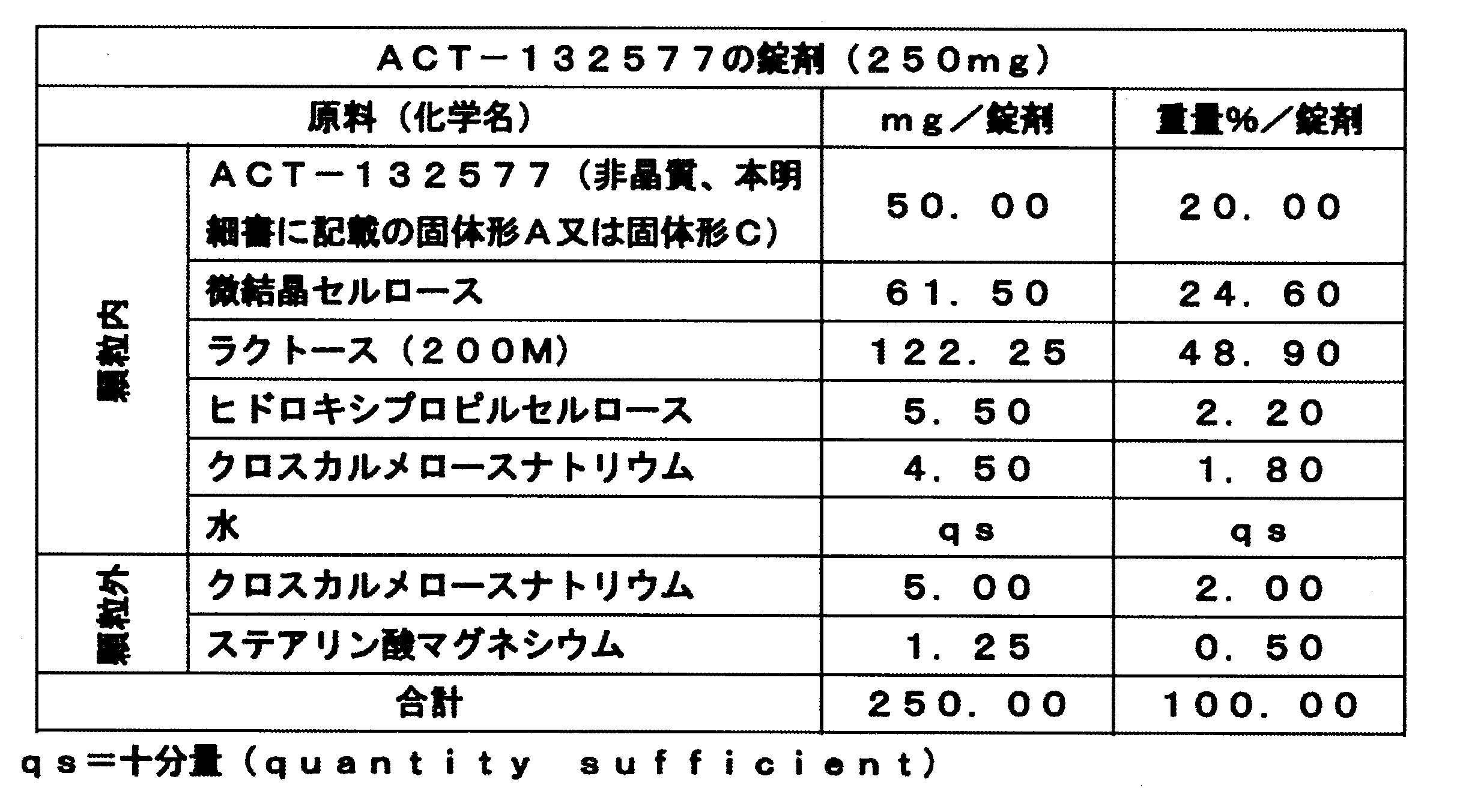
実施例4: ACT-132577の錠剤:
実施例3の錠剤は、Aquapolish(登録商標)、白色MS又はAquapolish(登録商標)、白色PVA(被覆材製造元:Biogrund)の層で被覆することができる。
Example 4: ACT-132577 Tablets:
The tablets of Example 3 can be coated with a layer of Aquapolish®, white MS or Aquapolish®, white PVA (coating manufacturer: Biogrund).
実施例5: ACT-132577の錠剤:
それぞれが50mgのACT-132577を含有する錠剤は、湿式造粒法を用いて製造することができる。錠剤の組成は下記の通りである:
Example 5: ACT-132577 Tablets:
Tablets, each containing 50 mg of ACT-132577, can be manufactured using a wet granulation process. The tablet composition is as follows:
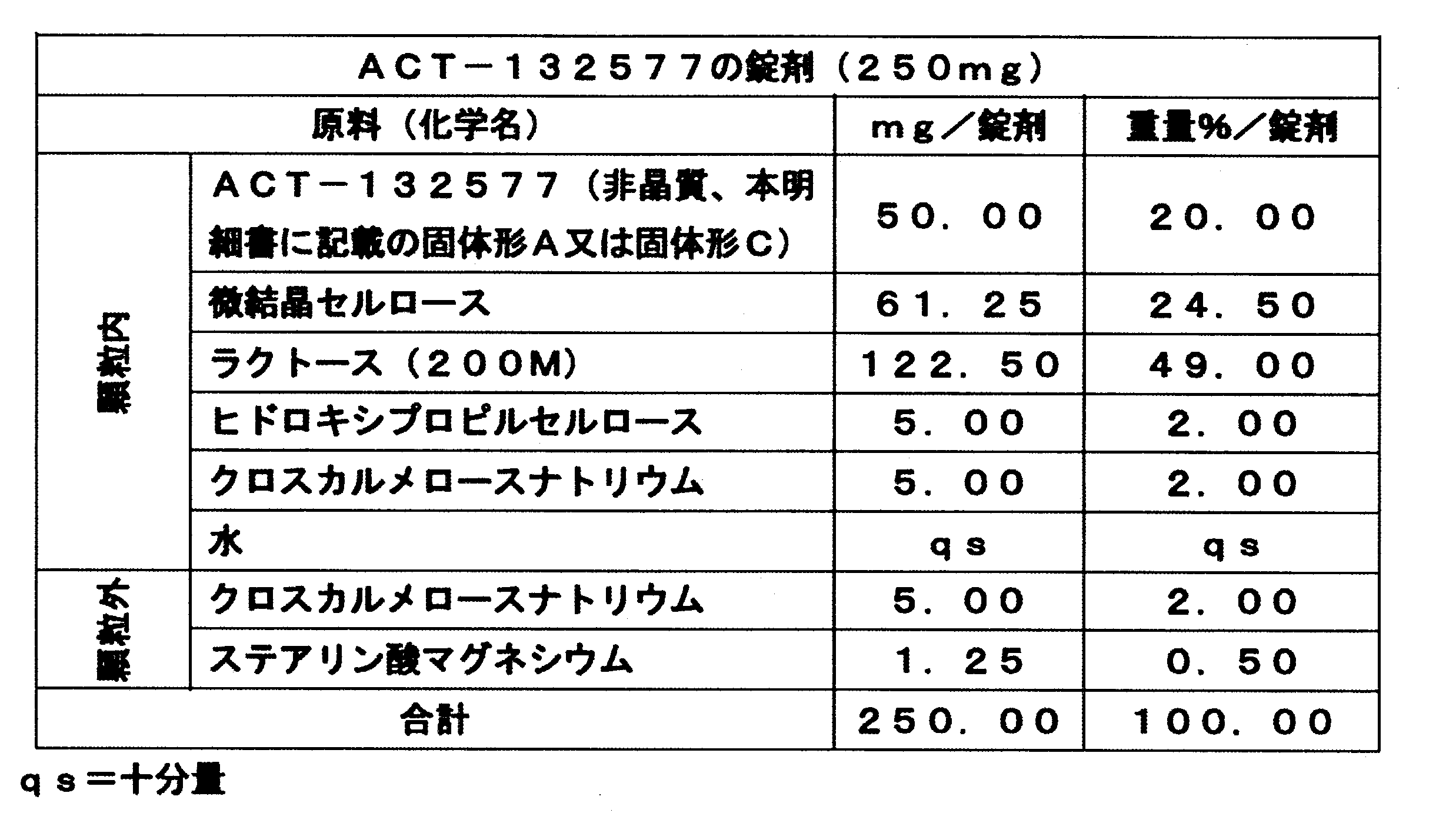
実施例6
実施例5の錠剤は、Aquapolish(登録商標)、白色MS又はAquapolish(登録商標)、白色PVA(被覆材製造元:Biogrund)の層で被覆することができる。
Example 6
The tablets of Example 5 can be coated with a layer of Aquapolish®, white MS or Aquapolish®, white PVA (coating manufacturer: Biogrund).
実施例7: ACT-132577の錠剤:
それぞれが12.5mgのACT-132577を含有する錠剤は、湿式造粒法を用いて製造することができる。錠剤の組成は下記の通りである:
Example 7: ACT-132577 Tablets:
Tablets, each containing 12.5 mg of ACT-132577, can be manufactured using a wet granulation process. The tablet composition is as follows:
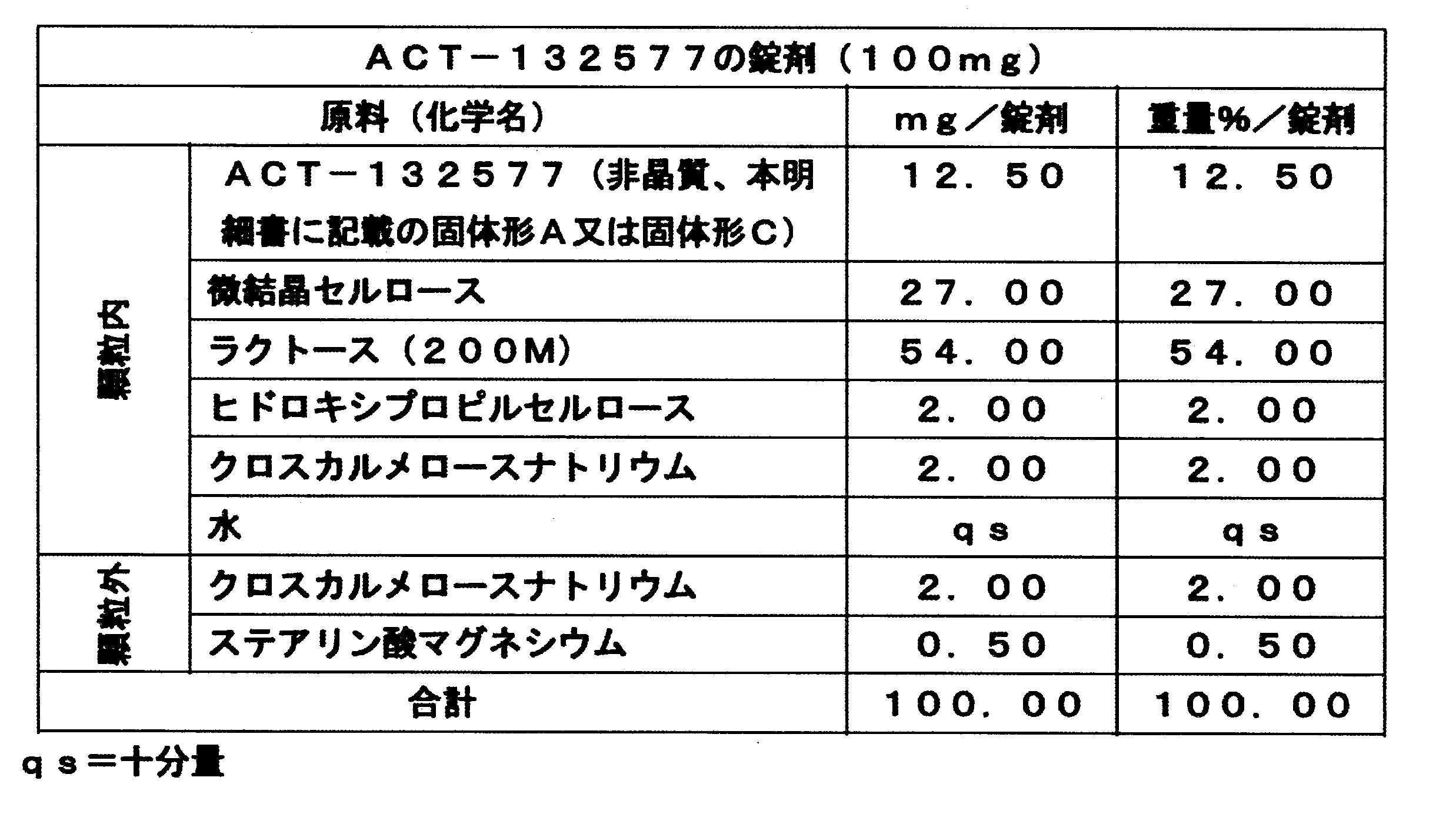
実施例8: ACT-132577の錠剤:
実施例7の錠剤は、Aquapolish(登録商標)、白色MS又はAquapolish(登録商標)、白色PVA(被覆材製造元:Biogrund)の層で被覆することができる。
Example 8: ACT-132577 Tablets:
The tablets of Example 7 can be coated with a layer of Aquapolish®, white MS or Aquapolish®, white PVA (coating manufacturer: Biogrund).
実施例9: ACT-132577の錠剤:
それぞれが12.5mgのACT-132577を含有する錠剤は、湿式造粒法を用いて製造することができる。錠剤の組成は下記の通りである:
Example 9: ACT-132577 Tablets:
Tablets, each containing 12.5 mg of ACT-132577, can be manufactured using a wet granulation process. The tablet composition is as follows:

実施例10: ACT-132577の錠剤:
実施例9の錠剤は、Aquapolish(登録商標)、白色MS又はAquapolish(登録商標)、白色PVA(被覆材製造元:Biogrund)の層で被覆することができる。
Example 10: ACT-132577 Tablets:
The tablets of Example 9 can be coated with a layer of Aquapolish®, white MS or Aquapolish®, white PVA (coating manufacturer: Biogrund).
結晶形の特性
実施例11:室温での貯蔵
(上記実施例1に従って得られた)「化合物」のA形結晶のサンプルを、20~25℃の温度、92%の相対湿度で2か月間貯蔵した。2か月の終了時にサンプルに対して行った粉末X線回折により、サンプルはなお「化合物」のA形結晶のみからなることがわかった。上記の条件下で8週間貯蔵した後においても同じ結果が得られた。8週間貯蔵した後のサンプルのHPLCコントロールにより、ピーク面積%の有意な変化は観られず、すなわち、そのような条件下において有意な劣化は観察されなかった。
Characterization of Crystal Forms Example 11: Storage at Room Temperature A sample of crystalline form A of Compound (obtained according to Example 1 above) was stored for two months at a temperature of 20-25°C and a relative humidity of 92%. Powder X-ray diffraction performed on the sample at the end of the two months showed that the sample still consisted exclusively of crystalline form A of Compound. The same results were obtained after eight weeks of storage under the above conditions. HPLC control of the sample after eight weeks of storage showed no significant change in peak area %, i.e. no significant degradation was observed under such conditions.
実施例12: 吸湿性
A形は、重量測定蒸気吸着(GVS)による測定から、わずかに吸湿性であると考えられる。実施例1に従って得られたサンプルの質量増加は、40%のr.h.から80%のr.h.の第1サイクルにおいて、0.4%に相当する。95%のr.h.では、2.2%
の水分が、乾燥時にヒステリシスを起こすことなく可逆的に吸着された。
Example 12: Hygroscopic Form A is considered to be slightly hygroscopic as measured by gravimetric vapor sorption (GVS). The mass gain of the sample obtained according to Example 1 corresponds to 0.4% in the first cycle from 40% r.h. to 80% r.h. At 95% r.h., it is 2.2%.
of water was reversibly adsorbed without hysteresis during drying.
ACT-132577の治療における使用の実施例
治療効果は複数の動物モデルでモデル化することができる。例えば、高血圧自然発症ラット(SHR)は、最も汎用されている遺伝性高血圧の動物モデルであり、増大した発作障害、インスリン抵抗性症候群及び腎障害により特徴づけられる。腎障害は、細動脈損傷、糸球体障害及びタンパク尿を含む。従って、SHRモデルは、数種の危険因子、すなわち高血圧、インスリン抵抗性及び腎障害に関連する心血管状態を模倣するのに使用することができる(M.A.Potezaら、Am J Physiol Heart Circ
Physiol(2005)289:H813-H822;L.G.Feldら、Kidney International(1981)、20、606-614)。ダール食塩感受性ラット及びDOCA塩ラットは、強い鉱質コルチコイド受容体刺激(DOCA塩モデル)又は低い/中等度の鉱質コルチコイド受容体刺激(ダール食塩モデル)に関連する食塩感受性高血圧のモデルである。両モデルは、高い血圧、内皮機能障害、心臓、脳及び腎臓に関与する終末器官損傷により特徴づけられる(Y.M.Pintoら、Cardiovascular Research 1998、39、77-88)。
EXAMPLES OF THERAPEUTIC USE OF ACT-132577 The therapeutic effect can be modeled in several animal models. For example, the spontaneously hypertensive rat (SHR) is the most commonly used animal model of genetic hypertension and is characterized by enhanced seizure disorder, insulin resistance syndrome and renal damage. Renal damage includes arteriolar damage, glomerular damage and proteinuria. Thus, the SHR model can be used to mimic cardiovascular conditions associated with several risk factors, namely hypertension, insulin resistance and renal damage (M.A. Poteza et al., Am J Physiol Heart Circ. 1999, 143:131-132).
Physiol (2005) 289:H813-H822; L. G. Feld et al., Kidney International (1981), 20, 606-614). Dahl salt-sensitive rats and DOCA-salt rats are models of salt-sensitive hypertension associated with strong mineralocorticoid receptor stimulation (DOCA-salt model) or low/moderate mineralocorticoid receptor stimulation (Dahl salt model). Both models are characterized by high blood pressure, endothelial dysfunction, and end-organ damage involving the heart, brain, and kidneys (Y. M. Pinto et al., Cardiovascular Research 1998, 39, 77-88).
実施例A: ダール食塩感受性ラットにおけるACT-132577の急性効果
血圧、特に平均動脈圧(以下、「MAP」と記載する。)、及び心拍数(以下、「HR」と記載する。)に対するACT-132577の急性効果は、覚醒雄性高血圧ダール食塩感受性ラット(以下、「Dahl-Sラット」と記載する。このモデルの詳細については、Rapp、Hypertension(1982)、4、753-763を参照されたい。)内における遠隔測定(telemetry)により評価することができる。
Example A: Acute Effects of ACT-132577 in Dahl Salt-Sensitive Rats The acute effects of ACT-132577 on blood pressure, particularly mean arterial pressure (hereinafter referred to as "MAP"), and heart rate (hereinafter referred to as "HR") can be assessed by telemetry in awake male hypertensive Dahl salt-sensitive rats (hereinafter referred to as "Dahl-S rats." For details of this model, see Rapp, Hypertension (1982), 4, 753-763).
飲料水中に1%の塩化ナトリウムを供給することにより、Dahl-Sラットに血圧上昇を誘発する。ベヒクル(7.5%ゼラチン水溶液)及びACT-132577の試験用量(0.3、1、3、10、30、100及び300mg/kg)のそれぞれについて、6~7匹のDahl-Sラットの群を用いる。ACT-132577のHR及びMAPに対する効果は、投与前の24hの間に対して、個々の動物について算出する。MAPに関して得られた結果(連続する6時間にわたって観察された最大MAP減少)を図3に要約する(データは平均±平均の標準誤差として示す。)。要約すると、10mg/kgの用量で、ACT-132577は、Dahl-SラットにおいてMAPを19±4mmHg減少させた。MAPとは対照的に、HRは影響を受けなかった。 Hypotension is induced in Dahl-S rats by providing 1% sodium chloride in the drinking water. Groups of 6-7 Dahl-S rats are used for each vehicle (7.5% gelatin solution in water) and the tested doses of ACT-132577 (0.3, 1, 3, 10, 30, 100 and 300 mg/kg). The effect of ACT-132577 on HR and MAP is calculated for each individual animal for the 24 h period before administration. The results obtained with regard to MAP (maximum MAP reduction observed over 6 consecutive hours) are summarized in Figure 3 (data are presented as mean ± standard error of the mean). In summary, at a dose of 10 mg/kg, ACT-132577 reduced MAP by 19 ± 4 mmHg in Dahl-S rats. In contrast to MAP, HR was not affected.
実施例B: デオキシコルチコステロンアセタート食塩ラットにおけるACT-132577の急性効果:
血圧、特に平均動脈圧(以下、「MAP」と記載する。)、及び心拍数(以下、「HR」と記載する。)に対するACT-132577の急性効果は、覚醒雄性高血圧デオキシコルチコステロンアセタート食塩ラット(以下、「DOCA塩ラット」と記載する。このモデルの詳細については、Gavrasら、Circ.Res.(1975)、36、300-309を参照されたい。)内における遠隔測定により評価することができる。
Example B: Acute Effects of ACT-132577 in Deoxycorticosterone Acetate Salt Rats:
The acute effects of ACT-132577 on blood pressure, particularly mean arterial pressure (hereinafter referred to as "MAP"), and heart rate (hereinafter referred to as "HR") can be assessed by telemetry in awake male hypertensive deoxycorticosterone acetate salt rats (hereinafter referred to as "DOCA-salt rats"; for details of this model, see Gavras et al., Circ. Res. (1975), 36, 300-309).
片側腎摘出、鉱質コルチコイドアナログであるDOCAのペレットの移植及び飲料水中への1%の塩化ナトリウムの供給を併用することにより、DOCA塩ラットに高血圧を誘発する。ベヒクル(7.5%ゼラチン水溶液)及びACT-132577の試験用量(0.3、1、3、10、30、100及び300mg/kg)のそれぞれについて、6~11匹のDOCA塩ラットの群を用いる。ACT-132577のHR及びMAPに対する効果は、投与前の24hの間に対して、個々の動物について算出する。MAPに関して得られた結果(連続する6時間にわたって観察された最大MAP減少)を図4に要約する(データは平均±平均の標準誤差として示す。)。要約すると、10mg/kgの用量で、
ACT-132577は、DOCA塩ラットにおいてMAPを29±6mmHg減少させた。MAPとは対照的に、HRは影響を受けなかった。
Hypertension is induced in DOCA-salt rats by a combination of unilateral nephrectomy, implantation of pellets of DOCA, a mineralocorticoid analogue, and provision of 1% sodium chloride in the drinking water. Groups of 6-11 DOCA-salt rats are used for each of the vehicle (7.5% aqueous gelatin solution) and the tested doses of ACT-132577 (0.3, 1, 3, 10, 30, 100 and 300 mg/kg). The effects of ACT-132577 on HR and MAP are calculated for individual animals for the 24 h period prior to dosing. The results obtained in terms of MAP (maximum MAP reduction observed over 6 consecutive hours) are summarized in Figure 4 (data presented as mean ± standard error of the mean). In summary, at a dose of 10 mg/kg:
ACT-132577 reduced MAP by 29±6 mmHg in DOCA-salt rats. In contrast to MAP, HR was unaffected.
実施例C: 高血圧自然発症ラットにおけるACT-132577の急性効果:
血圧、特に平均動脈圧(以下、「MAP」と記載する。)、及び心拍数(以下、「HR」と記載する。)に対するACT-132577の急性効果は、覚醒雄性高血圧自然発症ラット(以下、「SHR」と記載する。このモデルの詳細については、Atanurら、Genome Res.(2010)、20、791-803を参照されたい。)内における遠隔測定により評価することができる。
Example C: Acute Effects of ACT-132577 in Spontaneously Hypertensive Rats:
The acute effects of ACT-132577 on blood pressure, particularly mean arterial pressure (hereinafter referred to as "MAP"), and heart rate (hereinafter referred to as "HR") can be assessed by telemetry in awake male spontaneously hypertensive rats (hereinafter referred to as "SHR"; for details of this model, see Atanur et al., Genome Res. (2010), 20, 791-803).
ベヒクル(7.5%ゼラチン水溶液)及びACT-132577の試験用量(1、3、10、30、100及び300mg/kg)のそれぞれについて、4~6匹のSHRの群を用いる。ACT-132577のHR及びMAPに対する効果は、投与前の24hの間に対して、個々の動物について算出する。MAPに関して得られた結果(連続する6時間にわたって観察された最大MAP減少)を図5に要約する(データは平均±平均の標準誤差として示す。)。要約すると、100mg/kgの用量で、ACT-132577は、SHRにおいてMAPを18±4mmHg減少させた。MAPとは対照的に、HRは影響を受けなかった。 Groups of 4-6 SHRs are used for each of the vehicle (7.5% gelatin in water) and the tested doses of ACT-132577 (1, 3, 10, 30, 100 and 300 mg/kg). The effects of ACT-132577 on HR and MAP are calculated for individual animals for the 24 h period prior to dosing. The results obtained with respect to MAP (maximum MAP reduction observed over 6 consecutive hours) are summarized in Figure 5 (data presented as mean ± standard error of the mean). In summary, at a dose of 100 mg/kg, ACT-132577 reduced MAP by 18 ± 4 mmHg in SHRs. In contrast to MAP, HR was not affected.
実施例D: 高血圧自然発症ラットにおけるACT-132577単独又はバルサルタンとの併用の急性効果
100mg/kgの用量で単回経口投与した場合の、血圧、特に平均動脈圧(以下、「MAP」と記載する。)、及び心拍数(以下、「HR」と記載する。)に対するACT-132577の急性効果は、ACT-132577を単独で使用した場合、又は、10mg/kgの用量で単回経口投与したバルサルタンと組み合わせて使用した場合について、覚醒雄性高血圧自然発症ラット(以下、「SHR」と記載する。このモデルの詳細については、Atanurら、Genome Res.(2010)、20、791-803を参照されたい。)内における遠隔測定により評価することができる。
Example D: Acute Effects of ACT-132577 Alone or in Combination with Valsartan in Spontaneously Hypertensive Rats The acute effects of ACT-132577 on blood pressure, particularly mean arterial pressure (hereinafter referred to as "MAP"), and heart rate (hereinafter referred to as "HR"), when administered orally in a single dose of 100 mg/kg, can be assessed by telemetry in awake male spontaneously hypertensive rats (hereinafter referred to as "SHRs"; see Atanur et al., Genome Res. (2010), 20, 791-803 for details of this model).
各処置群当たり6匹のSHRをこの試験に使用する。MAPに関して得られた結果を図6に要約する。データの各点は6時間の平均である(注記:2種の薬剤の併用について期待される相加効果は、「予想相加効果」と記載し、各化合物を別々に投与した後に得られる血圧値の減少を加算することにより算出する);ベヒクル(7.5%ゼラチン水溶液)による処置は、MAP又はHRに対して効果を示さなかったため、得られた結果を図中に表示していない。簡単に述べると、ACT-132577とバルサルタンの同時投与は、予想(算出)値を超えてMAPを減少させており、2種の分子間の相乗作用を示す。MAPとは対照的に、処置群のいずれにおいても、HRは影響を受けなかった。 Six SHR per treatment group are used in this study. The results obtained with respect to MAP are summarized in Figure 6. Each data point is a 6-hour average (Note: the expected additive effect of the combination of the two drugs is described as "expected additive effect" and is calculated by adding the reduction in blood pressure values obtained after administration of each compound separately); treatment with the vehicle (7.5% gelatin in water) had no effect on MAP or HR and therefore the results obtained are not shown in the figure. In brief, the co-administration of ACT-132577 and valsartan reduced MAP beyond the expected (calculated) values, indicating a synergistic effect between the two molecules. In contrast to MAP, HR was not affected in any of the treatment groups.
実施例E: デオキシコルチコステロンアセタート食塩ラットにおけるACT-132577単独又はバルサルタンとの併用の急性効果
10mg/kgの用量で単回経口投与した場合の、血圧、特に平均動脈圧(以下、「MAP」と記載する。)、及び心拍数(以下、「HR」と記載する。)に対するACT-132577の急性効果は、ACT-132577を単独で使用した場合、又は、30mg/kgの用量で単回経口投与したバルサルタンと組み合わせて使用した場合について、覚醒雄性高血圧デオキシコルチコステロンアセタート食塩ラット(以下、「DOCA塩ラット」と記載する。このモデルの詳細については、Gavrasら、Circ.Res.(1975)、36、300-309を参照されたい。)内における遠隔測定により評価することができる。
Example E: Acute Effects of ACT-132577 Alone or in Combination with Valsartan in Deoxycorticosterone Acetate Salt Rats The acute effects of ACT-132577 on blood pressure, particularly mean arterial pressure (hereinafter referred to as "MAP"), and heart rate (hereinafter referred to as "HR"), when administered orally in a single dose of 10 mg/kg, can be assessed by telemetry in awake male hypertensive deoxycorticosterone acetate salt rats (hereinafter referred to as "DOCA-salt rats"; see Gavras et al., Circ. Res. (1975), 36, 300-309 for details of this model).
片側腎摘出、鉱質コルチコイドアナログであるDOCAのペレットの移植及び飲料水中
への1%の塩化ナトリウムの供給を併用することにより、DOCA塩ラットに高血圧を誘発する。各処置群当たり7~8匹のDOCA塩ラットをこの試験に使用する。MAPに関して得られた結果を図7に要約する。データの各点は6時間の平均である(注記:2種の薬剤の併用について期待される相加効果は、「予想相加効果」と記載し、各化合物を別々に投与した後に得られる血圧値の減少を加算することにより算出する);ベヒクル(4%ゼラチン水溶液)による処置は、MAP又はHRに対して効果を示さなかったため、得られた結果を図中に表示していない。簡単に述べると、ACT-132577とバルサルタンの同時投与は、予想(算出)値を超えてMAPを減少させており、2種の分子間の相乗作用を示す。MAPとは対照的に、処置群のいずれにおいても、HRは影響を受けなかった。
Hypertension is induced in DOCA-salt rats by a combination of unilateral nephrectomy, implantation of pellets of DOCA, a mineralocorticoid analogue, and provision of 1% sodium chloride in the drinking water. Seven to eight DOCA-salt rats per treatment group are used in this study. The results obtained in terms of MAP are summarized in Figure 7. Each data point is a 6-hour average (Note: the expected additive effect of the combination of the two drugs is described as "expected additive effect" and is calculated by adding the reduction in blood pressure values obtained after administration of each compound separately); treatment with the vehicle (4% gelatin in water) had no effect on MAP or HR, and therefore the results obtained are not shown in the figure. Briefly, co-administration of ACT-132577 and valsartan reduced MAP beyond the expected (calculated) values, indicating a synergistic effect between the two molecules. In contrast to MAP, HR was not affected in any of the treatment groups.
実施例F:高血圧自然発症ラットにおけるACT-132577単独又はエナラプリルとの併用の急性効果:
100mg/kgの用量で単回経口投与した場合の、血圧、特に平均動脈圧(以下、「MAP」と記載する。)、及び心拍数(以下、「HR」と記載する。)に対するACT-132577の急性効果は、ACT-132577を単独で使用した場合、又は、3mg/kgの用量で単回経口投与したエナラプリルと組み合わせて使用した場合について、覚醒雄性高血圧自然発症ラット(以下、「SHR」と記載する。このモデルの詳細については、Atanurら、Genome Res.(2010)、20、791-803を参照されたい。)内における遠隔測定により評価することができる。
Example F: Acute effects of ACT-132577 alone or in combination with enalapril in spontaneously hypertensive rats:
The acute effects of ACT-132577 on blood pressure, particularly mean arterial pressure (hereinafter referred to as "MAP"), and heart rate (hereinafter referred to as "HR"), when administered orally in a single dose of 100 mg/kg, can be assessed by telemetry in awake male spontaneously hypertensive rats (hereinafter referred to as "SHRs"; see Atanur et al., Genome Res. (2010), 20, 791-803 for details of this model), when ACT-132577 is used alone or in combination with enalapril administered orally in a single dose of 3 mg/kg.
各処置群当たり7匹のSHRをこの試験に使用する。MAPに関して得られた結果を図8に要約する。データの各点は6時間の平均である(注記:2種の薬剤の併用について期待される相加効果は、「予想相加効果」と記載し、各化合物を別々に投与した後に得られる血圧値の減少を加算することにより算出する);ベヒクル(4%ゼラチン水溶液)による処置は、MAP又はHRに対して効果を示さなかったため、得られた結果を図中に表示していない。簡単に述べると、ACT-132577とエナラプリルの同時投与は、予想(算出)値を超えてMAPを減少させており、2種の分子間の相乗作用を示す。MAPとは対照的に、処置群のいずれにおいても、HRは影響を受けなかった。 Seven SHR per treatment group are used in this study. The results obtained with respect to MAP are summarized in Figure 8. Each data point is a 6-hour average (Note: the expected additive effect of the combination of the two drugs is described as "expected additive effect" and is calculated by adding the reduction in blood pressure values obtained after administration of each compound separately); treatment with the vehicle (4% gelatin in water) had no effect on MAP or HR and therefore the results obtained are not shown in the figure. In brief, the co-administration of ACT-132577 and enalapril reduced MAP beyond the expected (calculated) values, indicating a synergistic effect between the two molecules. In contrast to MAP, HR was not affected in any of the treatment groups.
実施例G: デオキシコルチコステロンアセタート食塩ラットにおけるACT-132577単独又はアムロジピンとの併用の急性効果:
10mg/kgの用量で単回経口投与した場合の、血圧、特に平均動脈圧(以下、「MAP」と記載する。)、及び心拍数(以下、「HR」と記載する。)に対するACT-132577の急性効果は、ACT-132577を単独で使用した場合、又は、1mg/kgの用量で単回経口投与したアムロジピンと組み合わせて使用した場合について、覚醒雄性高血圧デオキシコルチコステロンアセタート食塩ラット(以下、「DOCA塩ラット」と記載する。このモデルの詳細については、Gavrasら、Circ.Res.(1975)、36、300-309を参照されたい。)内における遠隔測定により評価することができる。
Example G: Acute effects of ACT-132577 alone or in combination with amlodipine in deoxycorticosterone acetate salt rats:
The acute effects of ACT-132577 on blood pressure, particularly mean arterial pressure (hereinafter referred to as "MAP"), and heart rate (hereinafter referred to as "HR"), when administered orally in a single dose of 10 mg/kg, can be assessed by telemetry in awake male hypertensive deoxycorticosterone acetate salt rats (hereinafter referred to as "DOCA-salt rats"; see Gavras et al., Circ. Res. (1975), 36, 300-309 for details of this model), when used alone or in combination with amlodipine administered orally in a single dose of 1 mg/kg.
片側腎摘出、鉱質コルチコイドアナログであるDOCAのペレットの移植及び飲料水中への1%の塩化ナトリウムの供給を併用することにより、DOCA塩ラットに高血圧を誘発する。各処置群当たり6~8匹のDOCA塩ラットをこの試験に使用する。MAPに関して得られた結果を図9に要約する。データの各点は6時間の平均である(注記:2種の薬剤の併用について期待される相加効果は、「予想相加効果」と記載し、各化合物を別々に投与した後に得られる血圧値の減少を加算することにより算出する);ベヒクル(4%ゼラチン水溶液)による処置は、MAP又はHRに対して効果を示さなかったため、得られた結果を図中に表示していない。簡単に述べると、ACT-132577とアムロジピンの同時投与は、予想(算出)値を超えてMAPを減少させており、2種の分子間の相乗
作用を示す。MAPとは対照的に、処置群のいずれにおいても、HRは影響を受けなかった。
Hypertension is induced in DOCA-salt rats by a combination of unilateral nephrectomy, implantation of pellets of DOCA, a mineralocorticoid analogue, and provision of 1% sodium chloride in the drinking water. Six to eight DOCA-salt rats per treatment group are used in this study. The results obtained in terms of MAP are summarized in Figure 9. Each data point is a 6-hour average (Note: the expected additive effect of the combination of the two drugs is described as "expected additive effect" and is calculated by adding the reduction in blood pressure values obtained after administration of each compound separately); treatment with the vehicle (4% gelatin in water) had no effect on MAP or HR, and therefore the results obtained are not shown in the figure. Briefly, co-administration of ACT-132577 and amlodipine reduced MAP beyond the expected (calculated) values, indicating a synergistic effect between the two molecules. In contrast to MAP, HR was not affected in any of the treatment groups.
実施例H: デオキシコルチコステロンアセタート食塩ラットにおけるACT-132577の慢性効果:
ACT-132577を1、10及び100mg/kg/日の用量で繰り返し投与した場合の慢性効果、特に平均動脈圧(以下、「MAP」と記載する。)及び心拍数(以下、「HR」と記載する。)は、覚醒雄性高血圧デオキシコルチコステロンアセタート食塩ラット(以下、「DOCA塩ラット」と記載する。このモデルの詳細については、Gavrasら、Circ.Res.(1975)、36、300-309を参照されたい。)において評価することができる。片側腎摘出、鉱質コルチコイドアナログであるDOCAのペレットの移植及び飲料水中への1%の塩化ナトリウムの供給を併用することにより、DOCA塩ラットに高血圧を誘発する。ACT-132577で処置したDOCA塩ラットの結果は、ベヒクル(4%ゼラチン水溶液)のみを与えられたWistar系ラット又はDOCA塩ラットについて得られた結果と比較することができる。
Example H: Chronic Effects of ACT-132577 in Deoxycorticosterone Acetate Salt Rats:
The chronic effects of repeated administration of ACT-132577 at doses of 1, 10 and 100 mg/kg/day, particularly on mean arterial pressure (MAP) and heart rate (HR), can be assessed in awake male hypertensive deoxycorticosterone acetate salt rats (DOCA-salt rats; see Gavras et al., Circ. Res. (1975), 36, 300-309, for details of this model). Hypertension is induced in DOCA-salt rats by a combination of unilateral nephrectomy, implantation of pellets of the mineralocorticoid analog DOCA, and provision of 1% sodium chloride in the drinking water. The results in DOCA-salt rats treated with ACT-132577 can be compared to those obtained in Wistar rats or DOCA-salt rats that received only the vehicle (4% gelatin in water).
a) MAPに関して得られた結果を図10に要約する。データの各点は24時間の平均である。5つの試験群のそれぞれに6匹のラットを使用した(Wistar系対照ラット(図10の最下部のライン)、DOCA塩対照ラット(図10の一番上のライン)並びに1、10及び100mg/kg/日の用量のACT-132577を繰り返し投与されたDOCA塩ラット(図10の一番上からそれぞれ2番目から3番目のライン)。簡単に述べると、ACT-132577を4週間経口投与すると、HRを変えることなく、MAPのDOCA塩誘発上昇が用量依存的に緩和された。 a) The results obtained with respect to MAP are summarized in Figure 10. Each data point is a 24-hour average. Six rats were used in each of the five test groups (Wistar control rats (bottom line in Figure 10), DOCA-salt control rats (top line in Figure 10) and DOCA-salt rats repeatedly administered ACT-132577 at doses of 1, 10 and 100 mg/kg/day (second and third lines from the top of Figure 10, respectively). Briefly, oral administration of ACT-132577 for 4 weeks dose-dependently attenuated DOCA-salt-induced elevation of MAP without altering HR.
b) 腎血管抵抗について得られた結果を図11に要約する。 b) The results obtained for renal vascular resistance are summarized in Figure 11.
- DOCA O 2wは、ACT-132577による処置を開始する直前に犠牲に供されたDOCA塩ラットを示し;
- 「*」は、一元配置分散分析(one way ANOVA)、次いでNewmal-Keuls多重比較事後検定(Newmal-Keuls multiple comparisons post-hoc test)を用いた場合の、統計的有意性因子(statistical significance factor)、p<0.05を示す。
- DOCA 0 2w denotes DOCA-salt rats sacrificed immediately before initiating treatment with ACT-132577;
- "*" indicates a statistical significance factor, p<0.05, using a one way ANOVA followed by Newmal-Keuls multiple comparisons post-hoc test.
要約すると、これらの試験に基づいて、DOCA塩ラットにACT-132577を慢性的に経口投与すると、用量依存的に、腎血流が増大し、腎血管抵抗が減少した。N末端プロ脳ナトリウム利尿ペプチド(NTproBNP)の血漿濃度の用量依存的減少から示唆されるように、ACT-132577はまた、左室肥大を減少させる傾向もあった。 In summary, based on these studies, chronic oral administration of ACT-132577 to DOCA-salt rats dose-dependently increased renal blood flow and decreased renal vascular resistance. ACT-132577 also tended to decrease left ventricular hypertrophy, as suggested by a dose-dependent decrease in plasma concentrations of N-terminal pro-brain natriuretic peptide (NTproBNP).
実施例I: ACT-132577単独又はACE阻害剤若しくはARBとの併用の、糖尿病の動物モデルにおける効果:
ACT-132577の効果は糖尿病のげっ歯類モデルで評価することができる(これに関しては、下記の参考文献に記載のモデルを参照されたい:Senら、Life Sci.(2012)、91(13-14)、658-668;Janiakら、Eur.J.Pharmacol.(2006)、534、271-279;及びIglarzら、J.Pharmacol.Exp.Ther.(2008)、327(3)、736-745)。特に、ACT-132577を単独又は組み合わせて使用した場合の、耐糖能、インスリン血症及び終末器官損傷に対する効果を調べることができる。終末器官損傷は:血管機能、腎機能(例えば、タンパク尿)、心機能及びリモデリング並びに糖尿病により影響を受けるいかなる他の標的器官(例えば、眼)をも包含する。
Example I: Efficacy of ACT-132577 alone or in combination with ACE inhibitors or ARBs in animal models of diabetes:
The effect of ACT-132577 can be evaluated in rodent models of diabetes (see in this regard the models described in the following references: Sen et al., Life Sci. (2012), 91(13-14), 658-668; Janiak et al., Eur. J. Pharmacol. (2006), 534, 271-279; and Iglaz et al., J. Pharmacol. Exp. Ther. (2008), 327(3), 736-745). In particular, the effect of ACT-132577, alone or in combination, on glucose tolerance, insulinemia and end organ damage can be examined. End organ damage includes: vascular function, renal function (e.g., proteinuria), cardiac function and remodeling as well as any other target organs affected by diabetes (e.g., the eye).
実施例J: 体液貯留に対するACT-132577の効果の評価
ヘマトクリット(Hct)又はヘモグロビンの減少が、血漿体積の増大に続いて2次的に起こり、体液貯留のマーカーとして使用することができる。ACT-132577(1-30mg/kg)又はベヒクル(ゼラチン)を、雄性Wistar系ラットに、胃管(gavage)により単回経口投与する。投与から24時間後に、イソフルラン誘発麻酔下で、舌下血を採取した。ヘマトクリットを血液分析器を用いて測定する。この試験において、ACT-132577はヘマトクリット(Hct)に影響を与えなかったため、体液貯留を引き起こす傾向が低いことが示唆される(図12)。
Example J: Evaluation of the effect of ACT-132577 on fluid retention A decrease in hematocrit (Hct) or hemoglobin occurs secondarily to an increase in plasma volume and can be used as a marker of fluid retention. ACT-132577 (1-30 mg/kg) or vehicle (gelatin) is administered as a single oral dose via gavage to male Wistar rats. Sublingual blood is collected 24 hours after administration under isoflurane-induced anesthesia. Hematocrit is measured using a hematology analyzer. ACT-132577 did not affect hematocrit (Hct) in this study, suggesting a low propensity to cause fluid retention (Figure 12).
実施例K: ヘマトクリット測定、SGLT-2阻害剤単独又はACT-132577との併用の効果:
[健常若しくは病気の(ストレプトゾトシン糖尿病ラット)又は利尿剤処置下の(ループ利尿剤、例えばフロセミド)]8~12週齢の雄性Wistar系ラットを、それらの体重及びベースラインヘマトクリット(Hct)に従って、層化無作為的に群分けする(n=12)。SGLT-2阻害剤(例えばカナグリフロジン)を、(カナグリフロジン)30mg/kgの用量で1日に1回、1週間経口投与する。次いで、同用量のSGLT-2阻害剤とACT-132577(1~30mg/kg)又はベヒクル(ゼラチン)の組み合わせ(n=6/群)を胃管により投与する。イソフルラン誘発麻酔下で舌下血を週2回採取する(AttaneTM、MINRAD INC.、バッファロー、ニューヨーク)。ヘマトクリット(Hct)、ヘモグロビン(Hb)及び赤血球指数を血液分析装置(Coulter AcT、Beckman Coulter、ニヨン、スイス及びAdvia 2120i、Siemens Healthcare Diagnostics GmBH、チューリヒ、スイス)を用いて測定する。
Example K: Hematocrit measurements, effect of SGLT-2 inhibitors alone or in combination with ACT-132577:
Male Wistar rats aged 8-12 weeks [healthy or diseased (streptozotocin diabetic rats) or diuretic-treated (loop diuretic, e.g., furosemide)] are randomly assigned to groups (n=12) in a stratified manner according to their body weight and baseline hematocrit (Hct). An SGLT-2 inhibitor (e.g., canagliflozin) is orally administered at a dose of 30 mg/kg (canagliflozin) once daily for one week. The same dose of the SGLT-2 inhibitor in combination with ACT-132577 (1-30 mg/kg) or vehicle (gelatin) (n=6/group) is then administered by stomach tube. Sublingual blood is collected twice weekly under isoflurane-induced anesthesia (Attane™, MINRAD INC., Buffalo, NY). Hematocrit (Hct), hemoglobin (Hb) and red blood cell indices are measured using hematology analyzers (Coulter AcT, Beckman Coulter, Nyon, Switzerland and Advia 2120i, Siemens Healthcare Diagnostics GmBH, Zurich, Switzerland).
実施例L: 血圧測定、SGLT-2阻害剤単独又はACT-132577との併用の効果:
高血圧自然発症ラット(SHR)の腹腔内に、イソフルラン誘発昏睡下で、テレメトリー圧力トランスミッタを顕微手術により取り付ける(Data Science International、ミネソタ、USA)。要約すると、圧力カテーテルを腎動脈下の大動脈内に上流に向いた状態で挿入する。腹部を閉じ、トランスミッタを腹筋系に縫合する。血圧をDataquest ART Platinum取得システム(バージョン4.36)を用いて継続的に収集する。薬剤(ACT-132577若しくはSGLT2阻害剤)又はベヒクルを単独で又は組み合わせて胃管により投与する(群当たりn=4-7)。収縮期、平均及び拡張期動脈圧及び心拍数を、血圧曲線がベースラインに戻るまで、5分間隔で収集する。
Example L: Blood Pressure Measurements, Effect of SGLT-2 Inhibitors Alone or in Combination with ACT-132577:
Spontaneously hypertensive rats (SHR) are microsurgically fitted with telemetry pressure transmitters in the abdominal cavity under isoflurane-induced coma (Data Science International, Minnesota, USA). Briefly, a pressure catheter is inserted in the aorta below the renal arteries in an upstream orientation. The abdomen is closed and the transmitter is sutured to the abdominal musculature. Blood pressure is collected continuously using a Dataquest ART Platinum acquisition system (version 4.36). Drugs (ACT-132577 or SGLT2 inhibitors) or vehicle are administered by gavage, alone or in combination (n=4-7 per group). Systolic, mean and diastolic arterial pressures and heart rate are collected at 5-min intervals until the blood pressure curve returns to baseline.
結果: MAPに対する最大効果を図13及び14に要約する。SGLT2阻害剤が血圧に対して効果を及ぼすのには数日かかるため、ラットをまず、ベヒクル(5ml/kg/日)又はカナグリフロジン(30mg/kg/日)又はエンパグリフロジン(30mg/kg/日)のいずれかで12日間処置し、次いで、ACT-132577(30mg/kg/日)をさらに3日間同時投与する。カナグリフロジン及びエンパグリフロジンはMAPをそれぞれ-9±1及び-13±3mmHg減少させた。データは、ACT-132577は、カナグリフロジン又はエンパグリフロジンに上乗せして投与すると、血圧をそれぞれ-14±1及び-18±3mmHgさらに減少させたことを示す。これらの血圧の低下は、カナグリフロジン又はエンパグリフロジンなしで、ACT-132577をベヒクルに上乗せして投与した場合に得られたものと同様であった(それぞれ-16±2及び-14±2mmHg)。 Results: The maximal effects on MAP are summarized in Figures 13 and 14. Because it takes several days for SGLT2 inhibitors to have an effect on blood pressure, rats were first treated with either vehicle (5 ml/kg/day) or canagliflozin (30 mg/kg/day) or empagliflozin (30 mg/kg/day) for 12 days and then co-administered ACT-132577 (30 mg/kg/day) for an additional 3 days. Canagliflozin and empagliflozin reduced MAP by -9±1 and -13±3 mmHg, respectively. The data show that ACT-132577, when administered on top of canagliflozin or empagliflozin, further reduced blood pressure by -14±1 and -18±3 mmHg, respectively. These blood pressure reductions were similar to those obtained when ACT-132577 was administered in addition to vehicle without canagliflozin or empagliflozin (-16±2 and -14±2 mmHg, respectively).
要約すると、これらの結果に基づき、ACT-132577は、2種の異なるSGLT
2阻害剤と組み合わせた場合、インスリン抵抗性に関連する高血圧のモデルにおいてその血行力学的効果を少なくとも維持する。
In summary, based on these results, ACT-132577 inhibits two different SGLTs.
When combined with a 2 inhibitor, it at least maintains its hemodynamic effects in models of hypertension associated with insulin resistance.
実施例M: 単離腎臓の準備、SGLT-2阻害剤単独又はACT-132577との併用の効果:
健常又は糖尿病ラットの腎臓を除き、潅流システム内に置いて、腎圧をモニターする。雄性Wistar系ラットを安楽死させ、下腹部を露出させ、左腎及び主要な血管(大動脈、大静脈、腎動脈及び静脈)の周りの脂肪組織を切除する。腎臓と関連血管をひとまとめにして除き、腎静脈、次いで腎動脈にイノックス鋼(inox)カニューレを用いてカニューレを挿入し(O.D.1mm、I.D.0.7mm、Hugo Sachs)、絹縫合糸で固定する。次いで、カニューレを挿入した腎臓を、圧力センサを備えた潅流システムに結合する(潅流腎臓装置サイズ(perfused kidney apparatus size)2、Hugo Sachs、ドイツ)。潅流バッファーは改変Krebs-Henseleitバッファーである。初期潅流流速は2ml/分であり、次いで徐々に5ml/分に上げる。潅流圧が15-25mmHgで安定したら、実験プロトコルを行う。薬剤(SGLT2阻害剤、ACT-132577、それらの組み合わせ)を、潅流槽(体積200ml)を介して潅流バッファーに投与し、圧力を継続的に記録する。
Example M: Isolated Kidney Preparation, Effect of SGLT-2 Inhibitors Alone or in Combination with ACT-132577:
Kidneys from healthy or diabetic rats are removed and placed in a perfusion system to monitor renal pressure. Male Wistar rats are euthanized, the lower abdomen is exposed, and the adipose tissue around the left kidney and major blood vessels (aorta, vena cava, renal artery and vein) is excised. The kidney and associated blood vessels are removed en bloc, and the renal vein and then the renal artery are cannulated with an inox cannula (O.D. 1 mm, I.D. 0.7 mm, Hugo Sachs) and secured with silk sutures. The cannulated kidney is then connected to a perfusion system equipped with a pressure sensor (perfused kidney apparatus size 2, Hugo Sachs, Germany). The perfusion buffer is a modified Krebs-Henseleit buffer. The initial perfusion flow rate is 2 ml/min, then gradually increased to 5 ml/min. Once the perfusion pressure is stable at 15-25 mmHg, the experimental protocol is performed: drugs (SGLT2 inhibitors, ACT-132577, combinations thereof) are administered into the perfusion buffer via the perfusion bath (volume 200 ml) and the pressure is continuously recorded.
実施例N: 高血圧自然発症ラットにおける、EXFORGE HCT(登録商標)単独及びEXFORGE HCT(登録商標)のACT-132577又はスピロノラクトンとの併用の急性効果:
EXFORGE HCT(登録商標)(すなわち、バルサルタン/アムロジピン/ヒドロクロロチアジドの固定用量合剤;バルサルタン/アムロジピン/ヒドロクロロチアジドを、それぞれ1.6mg/kg/0.1mg/kg/0.25mg/kgの用量に調整)をACT-132577又はスピロノラクトンと併用した場合の、血圧、特に平均動脈圧(以下、「MAP」と記載する。)、及び心拍数(以下、「HR」と記載する。)に対する急性効果も、覚醒雄性高血圧自然発症ラット(以下、「SHR」と記載する。このモデルの詳細については、Atanurら、Genome Res.(2010)、20、791-803を参照されたい。)内における遠隔測定により評価することができる。
Example N: Acute Effects of EXFORGE HCT® Alone and in Combination with ACT-132577 or Spironolactone in Spontaneously Hypertensive Rats:
The acute effects of EXFORGE HCT® (i.e., a fixed dose combination of valsartan/amlodipine/hydrochlorothiazide; valsartan/amlodipine/hydrochlorothiazide adjusted to doses of 1.6 mg/kg/0.1 mg/kg/0.25 mg/kg, respectively) in combination with ACT-132577 or spironolactone on blood pressure, particularly mean arterial pressure (hereinafter referred to as "MAP"), and heart rate (hereinafter referred to as "HR"), can also be assessed by telemetry in awake male spontaneously hypertensive rats (hereinafter referred to as "SHR"; see Atanur et al., Genome Res. (2010), 20, 791-803 for details of this model).
各処置群当たり9匹のSHRをこの試験に使用する。このモデルにおいて同時投与される薬剤の血圧に対する最大効果に適合させるために、EXFORGE HCT(登録商標)mg/kgの3日間の経口投与に続いて、アプロシテンタン100mg/kgを第3日に経口投与し、また、第1日にスピロノラクトン300mg/kgをEXFORGE HCT(登録商標)と同時経口投与した後、EXFORGE HCT(登録商標)を2日間投与する。MAPに関して得られた結果を図15及び16に要約する。データの各点は6時間の平均である。 Nine SHRs per treatment group are used in this study. To accommodate the maximal effect on blood pressure of co-administered drugs in this model, EXFORGE HCT® is orally administered at 100 mg/kg for 3 days, followed by aprocitentan orally administered at 100 mg/kg on day 3, and spironolactone orally co-administered with EXFORGE HCT® at 300 mg/kg on day 1, followed by EXFORGE HCT® for 2 days. The results obtained for MAP are summarized in Figures 15 and 16. Each data point is a 6-hour average.
EXFORGE HCT(登録商標)に上乗せすると、アプロシテンタン又はスピロノラクトンは血圧をさらに減少させた。しかしながら、アプロシテンタンはスピロノラクトンを超える血圧減少を誘発した。MAPとは対照的に、処置群のいずれにおいても、HRは影響を受けなかった。 When added to EXFORGE HCT®, aprocitentan or spironolactone further reduced blood pressure. However, aprocitentan induced a greater reduction in blood pressure than spironolactone. In contrast to MAP, HR was not affected in any of the treatment groups.
実施例O: デオキシコルチコステロンアセタート食塩ラットにおける、EXFORGE HCT(登録商標)単独及びEXFORGE HCT(登録商標)のACT-132577又はスピロノラクトンとの併用の急性効果:
血圧、特に平均動脈圧(以下、「MAP」と記載する。)、及び心拍数(以下、「HR」と記載する。)に対する、ACT-132577(10mg/kg)又はスピロノラクトン(300mg/kg)と組み合わせた場合の、EXFORGE HCT(登録商標)(バルサルタン/アムロジピン/ヒドロクロロチアジドを、それぞれ3.2mg/kg/0
.2mg/kg/0.5mg/kgの用量に調整)の急性効果は、それぞれを単回経口投与した場合について、覚醒雄性高血圧デオキシコルチコステロンアセタート食塩ラット(以下、「DOCA塩ラット」と記載する。このモデルの詳細については、Gavrasら、Circ.Res.(1975)、36、300-309を参照されたい。)内における遠隔測定により評価することができる。
Example O: Acute Effects of EXFORGE HCT® Alone and in Combination with ACT-132577 or Spironolactone in Deoxycorticosterone Acetate Salt Rats:
The effects of EXFORGE HCT® (valsartan/amlodipine/hydrochlorothiazide at 3.2 mg/kg/0, respectively) in combination with ACT-132577 (10 mg/kg) or spironolactone (300 mg/kg) on blood pressure, particularly mean arterial pressure (MAP), and heart rate (HR).
The acute effects of a single oral dose of each of the two drugs (adjusted to a dose of 0.2 mg/kg/0.5 mg/kg) can be assessed by telemetry in awake male hypertensive deoxycorticosterone acetate salt rats (hereinafter referred to as "DOCA-salt rats"; for details of this model, see Gavras et al., Circ. Res. (1975), 36, 300-309).
片側腎摘出、鉱質コルチコイドアナログであるDOCAのペレットの移植及び飲料水中への1%の塩化ナトリウムの供給を併用することにより、DOCA塩ラットに高血圧を誘発する。各処置群当たり7~9匹のSHRをこの試験に使用する。MAPに関して得られた結果を図17及び18に要約する。データの各点は6時間の平均である。 Hypertension is induced in DOCA-salt rats by a combination of unilateral nephrectomy, implantation of pellets of the mineralocorticoid analog DOCA, and provision of 1% sodium chloride in the drinking water. Seven to nine SHR per treatment group are used in the study. The results obtained in terms of MAP are summarized in Figures 17 and 18. Each data point is a 6-hour average.
EXFORGE HCT(登録商標)に上乗せすると、アプロシテンタン10mg/kg又はスピロノラクトン300mg/kgは血圧をさらに減少させた。しかしながら、アプロシテンタンはスピロノラクトンを超える血圧減少を誘発した。MAPとは対照的に、処置群のいずれにおいても、HRは影響を受けなかった。 When added to EXFORGE HCT®, aprocitentan 10 mg/kg or spironolactone 300 mg/kg further reduced blood pressure. However, aprocitentan induced a greater reduction in blood pressure than spironolactone. In contrast to MAP, HR was not affected in any of the treatment groups.
実施例P: ACT-132577単独又はSGLT2阻害剤との併用の、糖尿病性腎臓疾患の動物モデルにおける効果:
ACT-132577単独又はSGLT2阻害剤と組み合わせた場合の効果は、ZDF-1ラット(Suら、Am J Nephrol.2016 Nov;44(5):339-353)、腎障害を有する糖尿病げっ歯類モデル等の糖尿病性腎臓疾患の動物モデルで評価することができる。特に、ACT-132577単独又はSGLT2阻害剤と組み合わせた場合の血圧、糖血症及び血液HBA1c、インスリン血症及び腎障害に対する効果を調べることができる。腎障害は:タンパク尿、代謝ケージを介した糸球体ろ過速度の測定、バイオマーカー(例えばKim-1)、尿及び血漿ケトン体及びクレアチニン、腎臓のterminal hispothological検査(糸球体損傷、脈管障害、繊維症)を含む。
Example P: Efficacy of ACT-132577 alone or in combination with an SGLT2 inhibitor in an animal model of diabetic kidney disease:
The effect of ACT-132577 alone or in combination with an SGLT2 inhibitor can be evaluated in animal models of diabetic kidney disease such as ZDF-1 rats (Su et al., Am J Nephrol. 2016 Nov;44(5):339-353), diabetic rodent models with nephropathy. In particular, the effect of ACT-132577 alone or in combination with an SGLT2 inhibitor on blood pressure, glycemia and blood HBA1c, insulinemia and renal impairment can be examined. Renal impairment includes: proteinuria, measurement of glomerular filtration rate via metabolic cages, biomarkers (e.g. Kim-1), urine and plasma ketone bodies and creatinine, terminal histological examination of the kidney (glomerular damage, vasculopathy, fibrosis).
Claims (15)
- 高血圧を含む少なくとも1つの他の心血管危険因子を伴う糖尿病を有する患者の主要心血管イベントが進行するリスクを減少させるための、又は
- 抵抗性高血圧を含む高血圧の治療において使用するための、
医薬であって、
アチグリフロジン、ベクサグリフロジン、カナグリフロジン、ダパグリフロジン、エンパグリフロジン、エルツグリフロジン、ヘナグリフロジン、イプラグリフロジン、ルセオグリフロジン、レモグリフロジン、ソタグリフロジン若しくはトホグリフロジンであるSGLT-2阻害剤又はその薬学的に許容される塩と組み合わせて用いられる医薬の製造のための、アプロシテンタン又はその薬学的に許容される塩の使用。 - for reducing the rate of progression of diabetic kidney disease (DKD) in patients diagnosed with type 2 diabetes who also exhibit a history of hypertension;
- for reducing the risk of developing a major cardiovascular event in patients with diabetes mellitus accompanied by at least one other cardiovascular risk factor, including hypertension, or - for use in the treatment of hypertension, including resistant hypertension,
A pharmaceutical composition comprising:
Use of aprocitentan or a pharma- ceutical acceptable salt thereof for the manufacture of a medicament for use in combination with an SGLT-2 inhibitor, which is atigliflozin, bexagliflozin, canagliflozin, dapagliflozin, empagliflozin, ertugliflozin, henagliflozin, ipragliflozin, luseogliflozin, remogliflozin, sotagliflozin or tofogliflozin, or a pharma- ceutical acceptable salt thereof.
前記医薬が、
- カナグリフロジンが1日当たり50~400mgのカナグリフロジンの経口投与に適切な医薬単位投薬量剤型で投与される、カナグリフロジン又はその薬学的に許容される塩、
- ダパグリフロジンが、1日当たり1~20mgのダパグリフロジンの経口投与に適切な医薬単位投薬量剤型で投与される、ダパグリフロジン又はその薬学的に許容される塩、又は
- エンパグリフロジンが、1日当たり5~50mgのエンパグリフロジンの経口投与に適切な医薬単位投薬量剤型で投与される、エンパグリフロジン又はその薬学的に許容される塩、
と組み合わせて用いられる、請求項2に記載の使用。 said medicament comprising aprocitentan or a pharma- ceutically acceptable salt thereof in a pharmaceutical unit dosage form suitable for oral administration of 10 to 50 mg of aprocitentan per day;
The pharmaceutical
- canagliflozin or a pharma- ceutically acceptable salt thereof, wherein the canagliflozin is administered in a pharmaceutical unit dosage form suitable for oral administration of 50 to 400 mg of canagliflozin per day;
- dapagliflozin or a pharma- ceutically acceptable salt thereof, wherein the dapagliflozin is administered in a pharmaceutical unit dosage form suitable for an oral administration of 1 to 20 mg of dapagliflozin per day, or - empagliflozin or a pharma- ceutically acceptable salt thereof, wherein the empagliflozin is administered in a pharmaceutical unit dosage form suitable for an oral administration of 5 to 50 mg of empagliflozin per day,
The use according to claim 2 in combination with
y)においてさらに投与される、請求項8に記載の使用。 The medicament is used in combination/co-therapy with conventional background therapy suitable for the prevention or treatment of hypertension, chronic kidney disease (CKD), or diabetes.
The use according to claim 8, further administered in y).
- ACE阻害剤若しくはその薬学的に許容される塩、及び/又は、
- アンジオテンシン受容体ブロッカー若しくはその薬学的に許容される塩、及び/又は、
- カルシウムチャンネルブロッカー若しくはその薬学的に許容される塩、及び/又は、- メトホルミン(metformin)、及び/又は、
- インスリン、及び/又は、
- スルホニルウレア若しくはその薬学的に許容される塩、及び/又は;
- DPP-4阻害剤若しくはその薬学的に許容される塩、及び/又は、
- GLP-1受容体アゴニスト、及び/又は、
- チアゾリジンジオン(thiazolidinedione)若しくはその薬学的に許容される塩、
を含む、請求項9に記載の使用。 The conventional background therapy is
- an ACE inhibitor or a pharma- ceutically acceptable salt thereof, and/or
an angiotensin receptor blocker or a pharma- ceutically acceptable salt thereof, and/or
- a calcium channel blocker or a pharma- ceutically acceptable salt thereof, and/or - metformin, and/or
- insulin, and/or
a sulfonylurea or a pharma- ceutically acceptable salt thereof, and/or;
- a DPP-4 inhibitor or a pharma- ceutically acceptable salt thereof, and/or
- GLP-1 receptor agonists, and/or
a thiazolidinedione or a pharma- ceutically acceptable salt thereof,
The use according to claim 9, comprising:
- 高血圧を含む少なくとも1つの他の心血管危険因子を伴う糖尿病を有する患者の主要心血管イベントが進行するリスクを減少させるための、又は
- 抵抗性高血圧を含む高血圧の治療において使用するための、
医薬であって、
アプロシテンタン又はその薬学的に許容される塩と組み合わせて用いられる医薬の製造のための、アチグリフロジン、ベクサグリフロジン、カナグリフロジン、ダパグリフロジン、エンパグリフロジン、エルツグリフロジン、ヘナグリフロジン、イプラグリフロジン、ルセオグリフロジン、レモグリフロジン、ソタグリフロジン若しくはトホグリフロジンであるSGLT-2阻害剤又はその薬学的に許容される塩の使用。 - Diabetes-associated chronic kidney disease (CKD) in patients diagnosed with type 2 diabetes and who additionally exhibit a history of hypertension, for reducing the rate of progression of diabetic kidney disease (DKD) as manifested by a reduction in eGFR, a reduction in end-stage renal disease (ESKD) events or a reduction in renal death events;
- for reducing the risk of developing a major cardiovascular event in patients with diabetes mellitus accompanied by at least one other cardiovascular risk factor, including hypertension, or - for use in the treatment of hypertension, including resistant hypertension,
A pharmaceutical composition comprising:
Use of an SGLT-2 inhibitor, which is atigliflozin, bexagliflozin, canagliflozin, dapagliflozin, empagliflozin, ertugliflozin, henagliflozin, ipragliflozin, luseogliflozin, remogliflozin, sotagliflozin or tofogliflozin, or a pharma- ceutically acceptable salt thereof, for the manufacture of a medicament for use in combination with aprocitentan or a pharma- ceutically acceptable salt thereof.
- ACE阻害剤若しくはその薬学的に許容される塩、及び/又は、
- アンジオテンシン受容体ブロッカー若しくはその薬学的に許容される塩、及び/又は、
- カルシウムチャンネルブロッカー若しくはその薬学的に許容される塩、及び/又は、- メトホルミン(metformin)、及び/又は、
- インスリン、及び/又は、
- スルホニルウレア若しくはその薬学的に許容される塩、及び/又は;
- DPP-4阻害剤若しくはその薬学的に許容される塩、及び/又は、
- GLP-1受容体アゴニスト、及び/又は、
- チアゾリジンジオン(thiazolidinedione)若しくはその薬学的に許容される塩、
を含む、請求項11に記載の使用。
The conventional background therapy is
- an ACE inhibitor or a pharma- ceutically acceptable salt thereof, and/or
an angiotensin receptor blocker or a pharma- ceutically acceptable salt thereof, and/or
- a calcium channel blocker or a pharma- ceutically acceptable salt thereof, and/or - metformin, and/or
- insulin, and/or
a sulfonylurea or a pharma- ceutically acceptable salt thereof, and/or;
- a DPP-4 inhibitor or a pharma- ceutically acceptable salt thereof, and/or
- GLP-1 receptor agonists, and/or
a thiazolidinedione or a pharma- ceutically acceptable salt thereof,
The use according to claim 11, comprising:
Applications Claiming Priority (4)
| Application Number | Priority Date | Filing Date | Title |
|---|---|---|---|
| EP2017081050 | 2017-11-30 | ||
| EPPCT/EP2017/081050 | 2017-11-30 | ||
| JP2020529550A JP7404235B2 (en) | 2017-11-30 | 2018-11-29 | Combination drug of 4-pyrimidine sulfamide derivative with SGLT-2 inhibitor for the treatment of endothelin-related diseases |
| PCT/EP2018/082947 WO2019106066A1 (en) | 2017-11-30 | 2018-11-29 | Combination of a 4-pyrimidinesulfamide derivative with an sglt-2 inhibitor for the treatment of endothelin related diseases |
Related Parent Applications (1)
| Application Number | Title | Priority Date | Filing Date |
|---|---|---|---|
| JP2020529550A Division JP7404235B2 (en) | 2017-11-30 | 2018-11-29 | Combination drug of 4-pyrimidine sulfamide derivative with SGLT-2 inhibitor for the treatment of endothelin-related diseases |
Publications (2)
| Publication Number | Publication Date |
|---|---|
| JP2024037866A JP2024037866A (en) | 2024-03-19 |
| JP7635355B2 true JP7635355B2 (en) | 2025-02-25 |
Family
ID=64606962
Family Applications (2)
| Application Number | Title | Priority Date | Filing Date |
|---|---|---|---|
| JP2020529550A Active JP7404235B2 (en) | 2017-11-30 | 2018-11-29 | Combination drug of 4-pyrimidine sulfamide derivative with SGLT-2 inhibitor for the treatment of endothelin-related diseases |
| JP2023209979A Active JP7635355B2 (en) | 2017-11-30 | 2023-12-13 | Combination of 4-pyrimidine sulfamide derivative with SGLT-2 inhibitor for treating endothelin-related diseases |
Family Applications Before (1)
| Application Number | Title | Priority Date | Filing Date |
|---|---|---|---|
| JP2020529550A Active JP7404235B2 (en) | 2017-11-30 | 2018-11-29 | Combination drug of 4-pyrimidine sulfamide derivative with SGLT-2 inhibitor for the treatment of endothelin-related diseases |
Country Status (29)
| Country | Link |
|---|---|
| US (2) | US12144811B2 (en) |
| EP (1) | EP3716979B1 (en) |
| JP (2) | JP7404235B2 (en) |
| KR (1) | KR20200094187A (en) |
| CN (1) | CN111405899B (en) |
| AU (1) | AU2018376263B2 (en) |
| BR (1) | BR112020010831A2 (en) |
| CA (1) | CA3083327A1 (en) |
| CL (1) | CL2020001394A1 (en) |
| DK (1) | DK3716979T3 (en) |
| EA (1) | EA202091324A1 (en) |
| ES (1) | ES3035734T3 (en) |
| FI (1) | FI3716979T3 (en) |
| HR (1) | HRP20250732T1 (en) |
| HU (1) | HUE071739T2 (en) |
| IL (1) | IL274943B2 (en) |
| LT (1) | LT3716979T (en) |
| MA (1) | MA51203A (en) |
| MX (1) | MX2020005543A (en) |
| MY (1) | MY210547A (en) |
| PH (1) | PH12020550745A1 (en) |
| PL (1) | PL3716979T3 (en) |
| PT (1) | PT3716979T (en) |
| RS (1) | RS66980B1 (en) |
| SG (1) | SG11202004862XA (en) |
| SI (1) | SI3716979T1 (en) |
| TW (1) | TWI809009B (en) |
| UA (1) | UA127083C2 (en) |
| WO (1) | WO2019106066A1 (en) |
Families Citing this family (18)
| Publication number | Priority date | Publication date | Assignee | Title |
|---|---|---|---|---|
| MY199557A (en) | 2017-02-27 | 2023-11-07 | Idorsia Pharmaceuticals Ltd | Combinations of a 4-pyrimidinesulfamide derivative with active ingredients for the treatment of endothelin related diseases |
| WO2018231702A1 (en) | 2017-06-13 | 2018-12-20 | The Regents Of The University Of California | Methods of improving cell-based therapy |
| WO2021092341A1 (en) * | 2019-11-07 | 2021-05-14 | Increvet, Inc. | Sodium-glucose linked transporter inhibitors for the management of chronic kidney disease, hypertension, and heart failure in companion animals |
| CN114630668B (en) * | 2019-11-07 | 2024-02-27 | 苏州科睿思制药有限公司 | A kind of Aprocitentan crystal form and preparation method and use thereof |
| EP4065081A1 (en) * | 2019-11-26 | 2022-10-05 | Actelion Pharmaceuticals Ltd | Pharmaceutical composition for the treatment of pulmonary vascular disease and/or cardiac dysfunction in fontan-palliated patients |
| MX2022007471A (en) | 2019-12-17 | 2022-08-17 | Chinook Therapeutics Inc | Methods of treating iga nephropathy with atrasentan. |
| CR20230083A (en) | 2020-07-10 | 2023-05-16 | Astrazeneca Ab | Combination of zibotentan and dapagliflozin for the treatment of chronic kidney disease |
| TW202220672A (en) | 2020-07-27 | 2022-06-01 | 瑞典商阿斯特捷利康公司 | Methods of treating chronic kidney disease with dapagliflozin |
| SI4188389T1 (en) * | 2020-07-27 | 2025-11-28 | Astrazeneca Ab | Dapagliflozin for use in methods of treating chronic kidney disease |
| CN114644595A (en) * | 2020-12-19 | 2022-06-21 | 普济生物科技(台州)有限公司 | Amorphous form of apracitentan, its pharmaceutical composition and use |
| EP4364722A4 (en) * | 2021-09-02 | 2025-02-19 | Daewoong Therapeutics Inc. | PHARMACEUTICAL COMPOSITION FOR PREVENTION OR TREATMENT OF DIABETIC EYE DISEASE COMPRISING AN SGLT-2 INHIBITOR |
| JP7396579B2 (en) * | 2022-01-31 | 2023-12-12 | 壽製薬株式会社 | Pharmaceutical composition for heart failure with preserved left ventricular ejection fraction |
| IL317076A (en) | 2022-05-22 | 2025-01-01 | Idorsia Pharmaceuticals Ltd | Aprocitentan for the treatment of hypertension |
| EP4532472A1 (en) | 2022-05-25 | 2025-04-09 | Idorsia Pharmaceuticals Ltd | Crystalline forms of sodium (5-(4-bromophenyl)-6-(2-((5-bromopyrimidin-2-yl)oxy)ethoxy)pyrimidin-4-yl)(sulfamoyl)amide |
| AU2023375521A1 (en) * | 2022-11-10 | 2025-05-15 | Regeneron Pharmaceuticals, Inc. | Treatment of kidney diseases with a combination of angiopoietin like 3 (angptl3) inhibitors and solute carrier family 5 member 2 (slc5a2) inhibitors |
| JP2026501945A (en) * | 2022-12-20 | 2026-01-19 | ティーエイチファーム コーポレーション | Oral pharmaceutical formulations containing a sodium-glucose cotransporter-2 inhibitor and an angiotensin II receptor blocker |
| WO2025089933A1 (en) * | 2023-10-24 | 2025-05-01 | 주식회사 레드엔비아 | Combinatory formulation comprising sglt-2 inhibitor and dpp-4 inhibitor for preventing or treating vascular or valvular stenosis |
| WO2025261457A1 (en) * | 2024-06-21 | 2025-12-26 | 深圳信立泰药业股份有限公司 | Medical use of combination of endothelin a (eta) receptor antagonist and sglt-2 inhibitor |
Citations (4)
| Publication number | Priority date | Publication date | Assignee | Title |
|---|---|---|---|---|
| WO2002068440A1 (en) | 2001-02-27 | 2002-09-06 | Kissei Pharmaceutical Co., Ltd. | Glycopyranosyloxypyrazole derivatives and medicinal use thereof |
| JP2010536742A (en) | 2007-08-17 | 2010-12-02 | アクテリオン ファーマシューティカルズ リミテッド | 4-pyrimidinesulfamide derivatives |
| JP2016515599A (en) | 2013-04-05 | 2016-05-30 | ベーリンガー インゲルハイム インターナショナル ゲゼルシャフト ミット ベシュレンクテル ハフツング | Therapeutic use of empagliflozin |
| US20170145000A1 (en) | 2014-03-19 | 2017-05-25 | Hangzhou Pushai Pharmaceutical Technology Co., Ltd. | Canagliflozin monohydrate and its crystalline forms, preparation methods and uses thereof |
Family Cites Families (24)
| Publication number | Priority date | Publication date | Assignee | Title |
|---|---|---|---|---|
| US5612359A (en) | 1994-08-26 | 1997-03-18 | Bristol-Myers Squibb Company | Substituted biphenyl isoxazole sulfonamides |
| TW536540B (en) | 1997-01-30 | 2003-06-11 | Bristol Myers Squibb Co | Endothelin antagonists: N-[[2'-[[(4,5-dimethyl-3-isoxazolyl)amino]sulfonyl]-4-(2-oxazolyl)[1,1'-biphenyl]-2-yl]methyl]-N,3,3-trimethylbutanamide and N-(4,5-dimethyl-3-isoxazolyl)-2'-[(3,3-dimethyl-2-oxo-1-pyrrolidinyl)methyl]-4'-(2-oxazolyl)[1,1'-biphe |
| US6515117B2 (en) * | 1999-10-12 | 2003-02-04 | Bristol-Myers Squibb Company | C-aryl glucoside SGLT2 inhibitors and method |
| PT1345920E (en) | 2000-12-18 | 2006-08-31 | Actelion Pharmaceuticals Ltd | NEW SULFONAMIDES AND ITS USE AS ENDTAGELINE RECEPTOR ANTAGONISTS |
| MXPA03005923A (en) | 2000-12-28 | 2004-01-26 | Kissei Pharmaceuticals Co Ltd | Glucopyranosyloxypyrazole derivatives and use thereof in medicines. |
| EG24716A (en) | 2002-05-17 | 2010-06-07 | Novartis Ag | Combination of organic compounds |
| UA86042C2 (en) | 2003-08-01 | 2009-03-25 | Янссен Фармацевтика Н.В. | Substituted indazole-o-glucosides |
| WO2005012326A1 (en) | 2003-08-01 | 2005-02-10 | Tanabe Seiyaku Co., Ltd. | Novel compounds having inhibitory activity against sodium-dependant transporter |
| NZ549219A (en) | 2004-03-04 | 2010-08-27 | Kissei Pharmaceutical | Fused heterocycle derivative, medicinal composition containing the same, and medicinal use thereof |
| CA2557801C (en) | 2004-03-16 | 2013-06-25 | Boehringer Ingelheim International Gmbh | Glucopyranosyl-substituted benzol derivatives, drugs containing said compounds, the use thereof and method for the production thereof |
| US20070196510A1 (en) | 2006-02-17 | 2007-08-23 | Gerber Michael J | Method for treating resistant hypertension |
| EP2029137A2 (en) | 2006-06-15 | 2009-03-04 | Gilead Colorado, Inc. | Antihypertensive therapy method |
| AR061627A1 (en) | 2006-06-27 | 2008-09-10 | Novartis Ag | SOLID DOSAGE FORMS OF VALSARTAN, AMLODIPINA, AND HYDROCLOROTIAZIDA, AND METHOD FOR PREPARING THEM |
| UY30730A1 (en) | 2006-12-04 | 2008-07-03 | Mitsubishi Tanabe Pharma Corp | CRYSTAL FORM OF HEMIHYDRATE 1- (B (BETA) -D-GLUCOPYRANOSIL) -4-METHYL-3- [5- (4-FLUOROPHENYL) -2-TIENYLMETHYL] BENZENE |
| AP2728A (en) | 2008-08-28 | 2013-08-31 | Pfizer | Dioxa-bicyclo[3.2.1.] octane-2,3,4-triol derivatives |
| CN102639125A (en) | 2009-05-27 | 2012-08-15 | 百时美施贵宝公司 | Methods of treating type 2 diabetes in patients resistant to prior treatment with other antidiabetic agents using SGLT2 inhibitors and compositions thereof |
| HK1215378A1 (en) * | 2013-04-18 | 2016-08-26 | 勃林格殷格翰国际有限公司 | Pharmaceutical composition, methods for treating and uses thereof |
| CN113144204A (en) | 2014-01-31 | 2021-07-23 | 詹森药业有限公司 | Method for treating and preventing renal and fatty liver diseases |
| EP2907811A1 (en) | 2014-02-14 | 2015-08-19 | Actelion Pharmaceuticals Ltd. | Process for manufacturing pyrimidine sulfamide derivatives |
| CA2942121A1 (en) * | 2014-04-04 | 2015-10-08 | Sanofi | Substituted indanone compounds as gpr119 modulators for the treatment of diabetes, obesity, dyslipidemia and related disorders |
| WO2015173584A1 (en) | 2014-05-16 | 2015-11-19 | Astrazeneca Ab | Method for suppressing glucagon secretion of an sglt2 inhibitor |
| MX2017005884A (en) | 2014-11-07 | 2017-06-26 | Abbvie Inc | Methods of treating ckd using predictors of fluid retention. |
| WO2017064679A1 (en) | 2015-10-15 | 2017-04-20 | Lupin Limited | Process for the preparation of amorphous canagliflozin |
| MY199557A (en) | 2017-02-27 | 2023-11-07 | Idorsia Pharmaceuticals Ltd | Combinations of a 4-pyrimidinesulfamide derivative with active ingredients for the treatment of endothelin related diseases |
-
2018
- 2018-11-29 US US16/768,604 patent/US12144811B2/en active Active
- 2018-11-29 EP EP18814821.7A patent/EP3716979B1/en active Active
- 2018-11-29 MY MYPI2020002671A patent/MY210547A/en unknown
- 2018-11-29 PL PL18814821.7T patent/PL3716979T3/en unknown
- 2018-11-29 SG SG11202004862XA patent/SG11202004862XA/en unknown
- 2018-11-29 BR BR112020010831-6A patent/BR112020010831A2/en not_active Application Discontinuation
- 2018-11-29 HU HUE18814821A patent/HUE071739T2/en unknown
- 2018-11-29 TW TW107142595A patent/TWI809009B/en active
- 2018-11-29 SI SI201831245T patent/SI3716979T1/en unknown
- 2018-11-29 EA EA202091324A patent/EA202091324A1/en unknown
- 2018-11-29 JP JP2020529550A patent/JP7404235B2/en active Active
- 2018-11-29 AU AU2018376263A patent/AU2018376263B2/en active Active
- 2018-11-29 RS RS20250663A patent/RS66980B1/en unknown
- 2018-11-29 HR HRP20250732TT patent/HRP20250732T1/en unknown
- 2018-11-29 ES ES18814821T patent/ES3035734T3/en active Active
- 2018-11-29 FI FIEP18814821.7T patent/FI3716979T3/en active
- 2018-11-29 MX MX2020005543A patent/MX2020005543A/en unknown
- 2018-11-29 KR KR1020207018658A patent/KR20200094187A/en not_active Ceased
- 2018-11-29 LT LTEPPCT/EP2018/082947T patent/LT3716979T/en unknown
- 2018-11-29 CN CN201880076562.0A patent/CN111405899B/en active Active
- 2018-11-29 PT PT188148217T patent/PT3716979T/en unknown
- 2018-11-29 WO PCT/EP2018/082947 patent/WO2019106066A1/en not_active Ceased
- 2018-11-29 IL IL274943A patent/IL274943B2/en unknown
- 2018-11-29 DK DK18814821.7T patent/DK3716979T3/en active
- 2018-11-29 UA UAA202003789A patent/UA127083C2/en unknown
- 2018-11-29 MA MA051203A patent/MA51203A/en unknown
- 2018-11-29 CA CA3083327A patent/CA3083327A1/en active Pending
-
2020
- 2020-05-27 CL CL2020001394A patent/CL2020001394A1/en unknown
- 2020-05-29 PH PH12020550745A patent/PH12020550745A1/en unknown
-
2023
- 2023-12-13 JP JP2023209979A patent/JP7635355B2/en active Active
-
2024
- 2024-10-28 US US18/929,609 patent/US20250120973A1/en active Pending
Patent Citations (4)
| Publication number | Priority date | Publication date | Assignee | Title |
|---|---|---|---|---|
| WO2002068440A1 (en) | 2001-02-27 | 2002-09-06 | Kissei Pharmaceutical Co., Ltd. | Glycopyranosyloxypyrazole derivatives and medicinal use thereof |
| JP2010536742A (en) | 2007-08-17 | 2010-12-02 | アクテリオン ファーマシューティカルズ リミテッド | 4-pyrimidinesulfamide derivatives |
| JP2016515599A (en) | 2013-04-05 | 2016-05-30 | ベーリンガー インゲルハイム インターナショナル ゲゼルシャフト ミット ベシュレンクテル ハフツング | Therapeutic use of empagliflozin |
| US20170145000A1 (en) | 2014-03-19 | 2017-05-25 | Hangzhou Pushai Pharmaceutical Technology Co., Ltd. | Canagliflozin monohydrate and its crystalline forms, preparation methods and uses thereof |
Non-Patent Citations (1)
| Title |
|---|
| Hiddo J.L. Heerspink, et al.,Sodium Glucose Cotransporter 2 Inhibitors in the Treatment of Diabetes Mellitus,Circulation,2016年07月28日,Vol. 134, No. 10,752-772 |
Also Published As
Similar Documents
| Publication | Publication Date | Title |
|---|---|---|
| JP7635355B2 (en) | Combination of 4-pyrimidine sulfamide derivative with SGLT-2 inhibitor for treating endothelin-related diseases | |
| JP7520951B2 (en) | Crystalline forms of 4-pyrimidine sulfamide derivatives | |
| HK40036978A (en) | Combination of a 4-pyrimidinesulfamide derivative with an sglt-2 inhibitor for the treatment of endothelin related diseases | |
| HK40036978B (en) | Combination of a 4-pyrimidinesulfamide derivative with an sglt-2 inhibitor for the treatment of endothelin related diseases | |
| KR20260037123A (en) | Combination of a 4-pyrimidinesulfamide derivative with an sglt-2 inhibitor for the treatment of endothelin related diseases | |
| EA045981B1 (en) | COMBINATION OF 4-PYRIMIDINE SULPHAMIDE DERIVATIVE WITH SGLT-2 INHIBITOR FOR THE TREATMENT OF ENDOTHELIN-ASSOCIATED DISEASES | |
| HK40076069A (en) | Aprocitentan for use in the treatment of hypertension and related diseases in combination with valsartan | |
| AU2023276826A1 (en) | Aprocitentan for the treatment of hypertension | |
| NZ796683A (en) | Crystalline forms of the 4-pyrimidinesulfamide derivative aprocitentan |
Legal Events
| Date | Code | Title | Description |
|---|---|---|---|
| A621 | Written request for application examination |
Free format text: JAPANESE INTERMEDIATE CODE: A621 Effective date: 20240112 |
|
| TRDD | Decision of grant or rejection written | ||
| A01 | Written decision to grant a patent or to grant a registration (utility model) |
Free format text: JAPANESE INTERMEDIATE CODE: A01 Effective date: 20250128 |
|
| A61 | First payment of annual fees (during grant procedure) |
Free format text: JAPANESE INTERMEDIATE CODE: A61 Effective date: 20250212 |
|
| R150 | Certificate of patent or registration of utility model |
Ref document number: 7635355 Country of ref document: JP Free format text: JAPANESE INTERMEDIATE CODE: R150 |