JP7621670B2 - Aqueous composition for sterilization of infectious microorganisms and sterilization method using the same - Google Patents
Aqueous composition for sterilization of infectious microorganisms and sterilization method using the same Download PDFInfo
- Publication number
- JP7621670B2 JP7621670B2 JP2023086953A JP2023086953A JP7621670B2 JP 7621670 B2 JP7621670 B2 JP 7621670B2 JP 2023086953 A JP2023086953 A JP 2023086953A JP 2023086953 A JP2023086953 A JP 2023086953A JP 7621670 B2 JP7621670 B2 JP 7621670B2
- Authority
- JP
- Japan
- Prior art keywords
- sterilization
- aqueous composition
- test
- aqueous
- lrv
- Prior art date
- Legal status (The legal status is an assumption and is not a legal conclusion. Google has not performed a legal analysis and makes no representation as to the accuracy of the status listed.)
- Active
Links
Landscapes
- Food Preservation Except Freezing, Refrigeration, And Drying (AREA)
- Apparatus For Disinfection Or Sterilisation (AREA)
- Agricultural Chemicals And Associated Chemicals (AREA)
Description
本発明は、感染性微生物の滅菌用水性組成物、及びこれを用いた滅菌処理方法に関するものである。 The present invention relates to an aqueous composition for sterilizing infectious microorganisms and a sterilization method using the same.
「消毒と滅菌のガイドライン」((監修/厚生省保健医療局結核感染症課、編集/小林寛伊、へるす出版、2000)には、感染症新法において対象となっている感染症の消毒法及び感染性の不活化、並びに汚染物(器具、患者環境、リネン類等)の消毒・滅菌方法が詳細に記載されている。同書には、消毒・滅菌方法と記載されているが、同書の内容からは、必ずしも細菌が完全に死滅することを意味する滅菌ではなく、細菌が害を及ぼさない程度まで不活化した、むしろ殺菌という範囲の不活化として理解した方が妥当と言える。また、同書には、独立の章として、「滅菌法」が記載されている。それによれば、「滅菌の概念は、確率的なものであり、あらかじめ設定された無菌性保証レベル(Sterility assurance level: SAL)に達した状態を維持してはじめて滅菌が完了する」、「無菌性保証レベルとして10-6レベルが採用されている」、とある。これは、滅菌を行って、1個の微生物が生き残る確率が100万回に1回であることを意味する。
これらのことは現在でも踏襲されており、「無菌性保証レベル」として10-6 が採用されている(「消毒と滅菌のガイドライン」改訂第4版(2020年版)大久保憲他、へるす出版)。
The "Guidelines for Disinfection and Sterilization" (supervised by the Tuberculosis and Infectious Diseases Division, Health and Medical Bureau, Ministry of Health and Welfare, edited by Kobayashi Hiroi, Health Publishing, 2000) provides detailed descriptions of disinfection and inactivation of infectious diseases covered by the New Infectious Diseases Law, as well as methods for disinfecting and sterilizing contaminated materials (instruments, patient environments, linens, etc.). Although the book refers to disinfection and sterilization methods, the contents of the book suggest that it is more appropriate to understand this as inactivation within the scope of sterilization, which does not necessarily mean the complete annihilation of bacteria, but rather inactivation to the extent that bacteria are no longer harmful. The book also has an independent chapter on "sterilization methods." It states that "the concept of sterilization is probabilistic, and sterilization is complete only when a state that has reached a preset sterility assurance level (SAL) is maintained," and that "a level of 10-6 has been adopted as the sterility assurance level." This means that the probability of a single microorganism surviving sterilization is one in a million.
These principles are still followed today, with 10-6 being adopted as the "sterility assurance level"("Guidelines for Disinfection and Sterilization," Revised 4th Edition (2020), Okubo Ken et al., Health Publishing).
「医療現場における滅菌保証のガイドライン2015」(日本医療機器学会)によれば、関連国際規格の指針として、指標菌のGeobacillus stearothermophilus(後述の細菌芽胞)に対して1x10⁵CFU以上(菌数が10万分の1以下)となる要求性能が示されている。
また、「廃棄物処理法に基づく感染性廃棄物処理マニュアル」(平成30年3月、環境省環境再生・資源循環局)により特別管理廃棄物に指定されている、感染性廃棄物(人が感染し、又は感染するおそれのある病原体が含まれ、若しくは付着している廃棄物又はこれらのおそれのある廃棄物)について、その適正な処理を確保するために必要で、かつ、具体的な手順等については、廃棄物の処理及び清掃に関する法律、並びに同法施行令において、具体的な解説が記載されている。
同マニュアルの資料(参考9)「感染性廃棄物の処理において有効であることの確認方法について」では、最も滅菌抵抗性を有する生物指標として、(1)Bacillus stearothermophilus(ATCC 7953)及び(2)Bacillus subtilis var. niger(ATCC 9372)が挙げられている。これらのBacillus属細菌芽胞に加えて、Clostridium属細菌(破傷風菌・ガス壊炭疽群)及び炭疽菌(Bacillus anthracis)の芽胞は、上記(1)及び(2)と同等の滅菌抵抗を持つが、安全性を考慮して、(1)及び(2)を使用して不活化(無菌性保証レベル10-6以下)の確認を行うことが望ましいとしている。
According to the "Guidelines for Sterilization Assurance in Medical Settings 2015" (Japan Society of Medical Devices), the required performance for the indicator bacteria Geobacillus stearothermophilus (bacterial spores described below) is 1 x 10⁵ CFU or more (bacterial count of 1/100,000 or less) as a guideline for related international standards.
In addition, for infectious waste (waste that contains or is attached to pathogens that can infect or are likely to infect humans, or waste that is likely to be such) designated as special controlled waste in the "Manual for Infectious Waste Disposal Based on the Waste Disposal Act" (March 2018, Environmental Regeneration and Resource Recycling Bureau, Ministry of the Environment), the Waste Disposal and Public Cleansing Act and the Enforcement Order of the same provide specific explanations on the specific procedures required to ensure its proper disposal.
The manual's document (Reference 9) "Methods for confirming effectiveness in the treatment of infectious waste" lists (1) Bacillus stearothermophilus (ATCC 7953) and (2) Bacillus subtilis var. niger (ATCC 9372) as the biological indicators with the highest resistance to sterilization. In addition to these Bacillus spores, Clostridium spores (tetanus and gas anthrax groups) and anthrax spores (Bacillus anthracis) have the same sterilization resistance as (1) and (2) above, but for safety reasons, it is preferable to confirm inactivation (sterility assurance level 10-6 or less) using (1) and (2).
前記「消毒と滅菌のガイドライン」及び「廃棄物処理法に基づく感染性廃棄物処理マニュアル」には、無菌性保証レベル10-6を達成する滅菌法として、1)加熱法(115~129℃での高圧蒸気法、160~190℃での乾熱法)、2)ガス法(酸化エチレンガス滅菌法、過酸化水素ガスプラズマ滅菌法)、3)照射法(γ線照射法、電子線照射法)、及びその他の方法が、滅菌抵抗性を有する細菌芽胞の滅菌法として広く行われている旨記載されている。
しかしながら、加熱法では、オートクレーブ装置が必須であり、経済的であるが、高温及び高圧下での処理条件という制約がある。酸化エチレンを用いるガス法では、低温で滅菌ができるため、加熱による材質の変化がないが、滅菌時間が長く、並びに処理後のガスの残留及び作業者の健康被害を減ずる方法が行われている。
The "Guidelines for Disinfection and Sterilization" and the "Manual for Infectious Waste Disposal Based on the Waste Disposal Act" state that the following sterilization methods are widely used to achieve a sterility assurance level of 10-6 for sterilization of sterilization-resistant bacterial spores: 1) heating methods (high-pressure steam method at 115-129°C, dry heat method at 160-190°C), 2) gas methods (ethylene oxide gas sterilization, hydrogen peroxide gas plasma sterilization), 3) irradiation methods (gamma ray irradiation, electron beam irradiation), and other methods.
However, the heating method requires an autoclave and is economical, but is limited by the treatment conditions of high temperature and high pressure.The gas method using ethylene oxide can sterilize at low temperature, so there is no change in the material due to heating, but the sterilization time is long and a method is used to reduce the residual gas after treatment and the health hazard to workers.
実際、「臨床検査技師のための病院感染対策の実践ガイド」(社団法人日本臨床衛生検査技師会、2005年)には、臨床検査室は、多くの病原体が運び込まれる危険性があることや、生理学的検査や採血では直接患者さんと接することなどが記載されている。このガイドには記載はないが、一例として、グルタルアルデヒドの被爆に関する大阪地裁判決(平成18年12月25日)が挙げられる。
なお、「医療機関におけるグルタルアルデヒドによる労働者の健康被害防止について」(2005年、厚生労働省)が、(社)日本病院会会長ならびに同会会員に通達された。その参考1には、平成11年~16年の期間に国内医療機関で発生したグルタルアルデヒドによる8件の労働災害事例が記載されている。さらに、同通達の参考3には、内視鏡等の医療器具等の殺菌消毒剤として、グルタルアルデヒドの代替となる殺菌消毒剤としてのフタラール製剤及び過酢酸による各種健康障害が挙げられている。
In fact, the "Practical Guide to Hospital Infection Control for Clinical Laboratory Technologists" (Japan Association of Medical Technologists, 2005) states that clinical laboratories are at risk of carrying in many pathogens, and that physiological tests and blood sampling involve direct contact with patients. Although not mentioned in the guide, one example is the Osaka District Court ruling on glutaraldehyde exposure (December 25, 2006).
Furthermore, "Prevention of health damage to workers caused by glutaraldehyde in medical institutions" (Ministry of Health, Labour and Welfare, 2005) was notified to the president and members of the Japan Hospital Association. Reference 1 of the notice lists eight cases of work-related accidents caused by glutaraldehyde that occurred in domestic medical institutions between 1999 and 2004. Furthermore, Reference 3 of the notice lists various health hazards caused by phthalal preparations and peracetic acid, which are alternative sterilizing disinfectants to glutaraldehyde for use in sterilizing medical instruments such as endoscopes.
このような背景の下、多種多様な医療機器・器具のほか、患者環境及び分泌物・排泄物などの消毒、滅菌についても、様々な方法が実施されているが、いずれの方法も必ずしも満足のいくものではなく、常圧、100℃以下で、しかも、酸化エチレンガスやグルタルアルデヒドなどを用いない滅菌法の開発が望まれている。 Against this background, various methods are being implemented for disinfecting and sterilizing a wide variety of medical devices and instruments, as well as the patient environment and secretions and excrement, but none of these methods are necessarily satisfactory, and there is a need for the development of a sterilization method that operates at normal pressure, below 100°C, and does not use ethylene oxide gas or glutaraldehyde.
特許文献1には、アパタイト鉱質形成に関連するナノバクテリアの種々の消毒薬混合物として、蒸留水中の50%過硫酸カリウムと5%スルファミン酸との1%混合物が記載されている。しかしながら、特許文献1には、該ナノバクテリアを根絶する効果的な方法としては、まず、第1段としてエチレンジアミンテトラ酢酸でアパタイト(鉱質)を溶解し、第2段として、過酸化合物、界面活性剤、有機酸及び無機緩衝系からなる市販品が好適であると記載されている。従って、この特許文献1には前記過硫酸カリウムとスルファミン酸との混合物による滅菌方法についての具体的な記述はない。そして、この特許文献1に記載の技術では、Bacillus stearothermophilusを死滅させることができなかった。 Patent Document 1 describes a 1% mixture of 50% potassium persulfate and 5% sulfamic acid in distilled water as various disinfectant mixtures for nanobacteria related to apatite mineral formation. However, Patent Document 1 describes that an effective method for eradicating the nanobacteria is to dissolve apatite (mineral) with ethylenediaminetetraacetic acid in the first step, and to use a commercially available product consisting of a peroxy acid compound, a surfactant, an organic acid, and an inorganic buffer system in the second step. Therefore, Patent Document 1 does not specifically describe a sterilization method using a mixture of potassium persulfate and sulfamic acid. And the technology described in Patent Document 1 could not kill Bacillus stearothermophilus.
なお、過硫酸カリウムには、ペルオキソ一硫酸水素カリウム(K+0-S02-0-0H、別名:過硫酸水素カリウム)ペルオキソ二硫酸カリウム(K2S208、略称KPS)の2種類がある。前者は、強い酸化剤であるが水溶液中で不安定であるため、これを主成分として環境除菌・洗浄剤等に使用される。後者は、約60℃の水溶液や有機溶媒中で2分子に分解して活性なラジカルとなり、重合開始剤として用いられ、両者とも過硫酸カリウムと呼ぶことは多いが、化学的性質は大きく異なる。 There are two types of potassium persulfate: potassium hydrogen peroxomonosulfate (K + 0- S02-0-0H , also known as potassium hydrogen persulfate) and potassium peroxodisulfate ( K2S208 , abbreviated as KPS). The former is a strong oxidizing agent, but is unstable in aqueous solution, so it is used as the main component in environmental disinfectants and cleaning agents. The latter decomposes into two molecules in aqueous solution or organic solvent at about 60°C to become active radicals and is used as a polymerization initiator. Both are often called potassium persulfate, but their chemical properties are significantly different.
非特許文献1には、ペルオキソ一硫酸水素カリウム(過硫酸水素カリウム)を主成分とする環境除菌・洗浄剤(RST)の有効性について、メチシリン耐性黄色ブドウ球菌(MRSA)、多剤耐性緑膿菌(MDRP)などを対象とした懸濁試験で、1%RSTが作用時間1分で、4log10以上(無菌性保証レベル10-4)の殺菌効果を示したことが報告されている。なお、ペルオキソ一硫酸水素カリウムは含有成分の塩化ナトリウムを酸化し、その反応中に生じた次亜塩素酸(HClO)が強力な抗微生物作用を示す。
特許文献2には、イオウ含有オキシ酸(過硫酸水素カリウム、KPS等を含む酸化剤の混合物)、アルカリ金属炭酸塩、亜塩素酸塩等からなる活性酸素化合物と二酸化塩素を発生させる前駆体の水溶液によって、シアノバクテリア等の細菌、真菌類などの殺菌による常温での水浄化が報告されている。しかしながら、これらの文献に記載の方法は、いずれも細菌芽胞を無菌保証レベル10-6に達成できる滅菌方法ではない。
Non-Patent Document 1 reports that the effectiveness of an environmental disinfectant/cleaning agent (RST) whose main ingredient is potassium peroxomonosulfate (potassium hydrogen persulfate) was demonstrated in a suspension test targeting methicillin-resistant Staphylococcus aureus (MRSA), multidrug-resistant Pseudomonas aeruginosa (MDRP), etc., with 1% RST demonstrating a bactericidal effect of 4 log10 or more (sterility assurance level 10-4 ) with an action time of 1 minute. Potassium peroxomonosulfate oxidizes the sodium chloride contained in the agent, and hypochlorous acid (HClO) generated during the reaction exhibits a strong antimicrobial effect.
Patent Document 2 reports water purification at room temperature by sterilizing bacteria such as cyanobacteria, fungi, etc., using an aqueous solution of a precursor that generates chlorine dioxide and an active oxygen compound consisting of a sulfur-containing oxyacid (a mixture of oxidizing agents including potassium hydrogen persulfate, KPS, etc.), an alkali metal carbonate, a chlorite, etc. However, none of the methods described in these documents are sterilization methods that can achieve a sterility assurance level of 10-6 for bacterial spores.
以上述べた通り、過硫酸カリウム等の過酸化物を用いた殺菌あるいは滅菌法が報告されているが、いずれも、過酸化物を含む酸化剤水溶液中では、最も滅菌抵抗性を有する生物指標としての(1)Bacillus stearothermophilus(ATCC 7953)及び(2)Bacillus subtilis var. niger(ATCC 9372)の滅菌効果が得られていない。 As mentioned above, disinfection or sterilization methods using peroxides such as potassium persulfate have been reported, but none of them have been effective in sterilizing (1) Bacillus stearothermophilus (ATCC 7953) and (2) Bacillus subtilis var. niger (ATCC 9372), which are the most sterilization-resistant biological indicators, in an oxidizing agent solution containing peroxide.
特許文献3には、少なくとも4log10程度の殺菌効果を示す処理方法として、第1段で過酢酸水溶液を、第2段で過酸化水素水溶液を用い、室温下、長時間をかけて殺菌し、細菌の胞子を殺菌する技術が記載されている。しかし、同文献には、過酸化剤として、ペルオキソ一硫酸及びペルオキソ二硫酸の名称は記載されているが、各々、ペルオキソ一硫酸水素カリウムや、ペルオキソ二硫酸カリウムを明記するものでもなく、また、実施例においても過硫酸塩化合物は全く記載されていない。さらに、Bacillus stearothermophilus、Bacillus subtilis等の細菌芽胞の名称は記載されているが、室温下、2段階での殺菌方法が紹介されているだけであって、前記ペルオキソ一硫酸及びペルオキソ二硫酸の水溶液が適切であるとの記載も全くない。従って、特許文献3に記載の技術は、KPS水溶液中、細菌芽胞を6log10以上(無菌性保証レベル10-6)の滅菌を開示するものではない。 Patent Document 3 describes a technology that uses an aqueous solution of peracetic acid in the first stage and an aqueous solution of hydrogen peroxide in the second stage to sterilize bacterial spores at room temperature for a long time, as a treatment method that shows a sterilization effect of at least about 4 log 10. However, although the name of peroxomonosulfuric acid and peroxodisulfuric acid are described as peroxidizing agents in the document, potassium hydrogen peroxomonosulfate and potassium peroxodisulfate are not specified, and no persulfate compounds are described in the examples. Furthermore, although the names of bacterial spores such as Bacillus stearothermophilus and Bacillus subtilis are described, only a two-stage sterilization method at room temperature is introduced, and there is no description that the aqueous solutions of peroxomonosulfuric acid and peroxodisulfuric acid are appropriate. Therefore, the technology described in Patent Document 3 does not disclose sterilization of bacterial spores in a KPS aqueous solution at 6 log 10 or more (sterility assurance level 10 -6 ).
以上のように、本発明者らは、鋭意、国内外の特許文献を検索したが、60℃以上の温度の水溶液中で、KPSを熱分解して得られるラジカルによって細菌芽胞を完全滅菌する報告は見当たらなかった。 As described above, the inventors have conducted an intensive search of domestic and foreign patent literature, but have not found any reports of complete sterilization of bacterial spores using radicals obtained by thermal decomposition of KPS in an aqueous solution at a temperature of 60°C or higher.
本発明は、以上のような事情に鑑みてなされたものであり、より安価で汎用性の高い酸化剤によって効率的に、最も高い耐滅菌性を有する細菌芽胞を滅菌することのできる新しい感染性微生物の滅菌用水性組成物、及びこれを用いた滅菌処理方法を提供することを課題としている。 The present invention was made in consideration of the above circumstances, and aims to provide a new aqueous composition for sterilizing infectious microorganisms that can efficiently sterilize bacterial spores with the highest sterilization resistance using a cheaper and more versatile oxidizing agent, and a sterilization method using the same.
上記の課題を解決するため、本発明者は、感染性微生物を効率良く滅菌できる分解剤について、鋭意、研究を重ねた結果、分解剤としての過硫酸塩化合物を含む水溶液が、従来の化学薬品に比べ、滅菌性能に優れているばかりか、100℃以下の温和な条件下で効率良く、安全な環境下で使用でき、滅菌処理及び洗浄処理後に感染性微生物の分解物及び分解剤が固体表面に残留することがないことを見出し、このような知見に基づいてこの本発明を完成した。 In order to solve the above problems, the inventors conducted extensive research into decomposition agents that can efficiently sterilize infectious microorganisms, and discovered that an aqueous solution containing a persulfate compound as a decomposition agent not only has superior sterilization performance compared to conventional chemical agents, but can also be used efficiently and safely under mild conditions of 100°C or less, and that decomposition products of infectious microorganisms and the decomposition agent do not remain on solid surfaces after sterilization and cleaning treatments. Based on these findings, the present invention was completed.
すなわち、本発明は、以下のとおりである。
[1]感染性微生物を滅菌するための滅菌用水性組成物であって、過硫酸塩化合物を含むことを特徴とする滅菌用水性組成物。
[2]過硫酸塩化合物が、水溶性である、[1]に記載の滅菌用水性組成物。
[3]過硫酸塩化合物が、ペルオキソ二硫酸塩である、[1]又は[2]に記載の滅菌用水性組成物。
[4]滅菌用水性組成物中の過硫酸塩化合物の濃度が、0.01重量%以上飽和濃度以下である、[1]~[3]のいずれかに記載の滅菌用水性組成物。
[5]さらに、アルカリ化合物を含むことを特徴とする[1]~[4]のいずれかに記載の滅菌用水性組成物。
[6]滅菌用水性組成物のpHが、1~10の範囲である、[1]~[5]のいずれかに記載の滅菌用水性組成物。
[7][1]~[6]のいずれかに記載の滅菌用水性組成物を用いて、感染性微生物を含む処理対象物を滅菌処理する工程を含む、感染性微生物の滅菌処理方法。
[8]感染性微生物が、水中に分散した状態、吸水性ポリマーゲル中に分散した状態、又は固体表面に付着・吸着した状態である、[7]に記載の滅菌処理方法。
[9]処理対象物が、医療用具又は医療機器である、[7]に記載の滅菌処理方法。
[10]医療用具が、医療用防護服である、[9]に記載の滅菌処理方法。
[11]処理対象物が、紙おむつである、[7]に記載の滅菌処理方法。
[12]処理対象物が、食品である、[7]に記載の滅菌処理方法。
That is, the present invention is as follows.
[1] An aqueous composition for sterilization for sterilizing infectious microorganisms, comprising a persulfate compound.
[2] The aqueous composition for sterilization described in [1], wherein the persulfate compound is water-soluble.
[3] The aqueous composition for sterilization described in [1] or [2], wherein the persulfate compound is peroxodisulfate.
[4] The aqueous composition for sterilization according to any one of [1] to [3], wherein the concentration of the persulfate compound in the aqueous composition for sterilization is 0.01% by weight or more and not exceeding the saturation concentration.
[5] The aqueous composition for sterilization according to any one of [1] to [4], further comprising an alkaline compound.
[6] The aqueous composition for sterilization according to any one of [1] to [5], wherein the pH of the aqueous composition for sterilization is in the range of 1 to 10.
[7] A method for sterilizing an infectious microorganism, comprising a step of sterilizing an object to be treated that contains the infectious microorganism using the aqueous composition for sterilization according to any one of [1] to [6].
[8] The sterilization method according to [7], wherein the infectious microorganisms are dispersed in water, dispersed in a water-absorbent polymer gel, or attached or adsorbed to a solid surface.
[9] The sterilization method according to [7], wherein the object to be sterilized is a medical tool or medical device.
[10] The sterilization method according to [9], wherein the medical tool is a medical protective suit.
[11] The sterilization method according to [7], wherein the object to be sterilized is a paper diaper.
[12] The sterilization method according to [7], wherein the object to be sterilized is a food product.
本発明の感染性微生物の滅菌用水性組成物、及びこれを用いた滅菌処理方法によれば、より安価で汎用性の高い酸化剤によって効率的に、最も高い耐滅菌性を有する細菌芽胞を滅菌することができる。 The aqueous composition for sterilizing infectious microorganisms of the present invention and the sterilization method using the same can efficiently sterilize bacterial spores with the highest sterilization resistance using a cheaper and more versatile oxidizing agent.
以下に、本発明の感染性微生物の滅菌用水性組成物、及びこれを用いた滅菌処理方法の実施形態について詳細に説明する。 The following provides a detailed description of an embodiment of the aqueous composition for sterilizing infectious microorganisms of the present invention and a sterilization method using the same.
本発明の滅菌用水性組成物による滅菌に供される感染性微生物は、最も高い耐滅菌性を有する細菌芽胞であるが、感染症法において対象となっている1類~5類の感染性微生物のすべてが対象として例示される。 The infectious microorganisms that are sterilized with the aqueous sterilization composition of the present invention are bacterial spores, which have the highest sterilization resistance, but all infectious microorganisms of categories 1 to 5 that are subject to the Infectious Diseases Control Law are also examples of the microorganisms that can be sterilized with the aqueous sterilization composition of the present invention.
本発明の滅菌用水性組成物は、酸化剤である過硫酸塩化合物を含む。より好ましくは、本発明の滅菌用水性組成物は、さらにアルカリ化合物を含む。
過硫酸塩化合物は、特に限定されることはなく、過硫酸カリウム(ぺルオキソ二硫酸カリウム、KPS)、過硫酸ナトリウム(ぺルオキソ二硫酸ナトリウム)、過硫酸アンモニウム(ぺルオキソ二硫酸アンモニウム)などが水溶性の酸化剤として好ましく用いられる。
アルカリ化合物としては、水溶性であって、その水溶液中で一価の陽イオンと一価あるいは二価の陰イオンに解離してアルカリ性を示すものが好適に用いられる。例えば、水酸化ナトリウム、水酸化カリウム、水酸化リチウムなどのアルカリ金属水酸化物、炭酸リチウム、炭酸ナトリウム、炭酸カリウムなどのアルカリ金属炭酸塩、炭酸水素ナトリウム、炭酸水素カリウムなどのアルカリ炭酸水素塩、酢酸ナトリウム、酢酸カリウム、酢酸アンモニウムなどのアルカリ金属酢酸塩、シュウ酸ナトリウム、シュウ酸カリウムなどのアルカリ金属シュウ酸塩、コハク酸一ナトリウムなどのアルカリ金属コハク酸塩、グリシン、アラニン、グルタミン酸などのアミノ酸のアルカリ金属塩、アンモニアが好ましい。中でも、炭酸水素ナトリウム、水酸化ナトリウムを用いるのが好ましい。
The aqueous composition for sterilization of the present invention contains a persulfate compound as an oxidizing agent. More preferably, the aqueous composition for sterilization of the present invention further contains an alkaline compound.
The persulfate compound is not particularly limited, and potassium persulfate (potassium peroxodisulfate, KPS), sodium persulfate (sodium peroxodisulfate), ammonium persulfate (ammonium peroxodisulfate), etc. are preferably used as water-soluble oxidizing agents.
As the alkaline compound, those that are water-soluble and dissociate into monovalent cations and monovalent or divalent anions in the aqueous solution to show alkalinity are preferably used.For example, alkali metal hydroxides such as sodium hydroxide, potassium hydroxide, lithium hydroxide, alkali metal carbonates such as lithium carbonate, sodium carbonate, potassium carbonate, alkali hydrogen carbonates such as sodium hydrogen carbonate, potassium hydrogen carbonate, alkali metal acetates such as sodium acetate, potassium acetate, ammonium acetate, alkali metal oxalates such as sodium oxalate, potassium oxalate, alkali metal succinates such as monosodium succinate, alkali metal salts of amino acids such as glycine, alanine, glutamic acid, and ammonia are preferred.Among them, sodium hydrogen carbonate and sodium hydroxide are preferred.
また、滅菌用水性組成物のpHは1~10の範囲であれば特に限定されるものではない。 The pH of the aqueous composition for sterilization is not particularly limited as long as it is in the range of 1 to 10.
滅菌用水性組成物中の過硫酸塩化合物(酸化剤)の濃度は、特に限定されないが、例えば、0.01重量%以上、飽和濃度以下であるのが好ましく、過硫酸カリウム(KPS)では、0.01~8重量%、過硫酸ナトリウムでは、1~30重量%、過硫酸アンモニウムでは、3~50重量%であることがより好ましい。
滅菌用水性組成物中のアルカリ化合物の濃度は、特に限定されないが、例えば、0重量%以上8重量%以下が好ましい。
さらに、滅菌用水性組成物の温度は、常圧下において、60℃~100℃の範囲であることが好ましい。
The concentration of the persulfate compound (oxidizing agent) in the aqueous composition for sterilization is not particularly limited, but is preferably, for example, 0.01% by weight or more and the saturated concentration or less, and more preferably 0.01 to 8% by weight for potassium persulfate (KPS), 1 to 30% by weight for sodium persulfate, and 3 to 50% by weight for ammonium persulfate.
The concentration of the alkaline compound in the aqueous composition for sterilization is not particularly limited, but is preferably, for example, from 0% by weight to 8% by weight.
Furthermore, the temperature of the aqueous composition for sterilization is preferably in the range of 60° C. to 100° C. under normal pressure.
本発明の滅菌処理方法は、上述した滅菌用水性組成物を用いて、感染性微生物を含む処理対象物を滅菌処理する工程を含む。 The sterilization method of the present invention includes a step of sterilizing an object to be treated, which contains infectious microorganisms, using the aqueous sterilization composition described above.
感染性微生物は、水中に分散した状態、吸水性ポリマーゲル中に分散した状態、又は固体表面に付着・吸着した状態であることが好ましい。 The infectious microorganism is preferably in a state of dispersion in water, in a water-absorbent polymer gel, or attached or adsorbed to a solid surface.
本発明の滅菌処理方法に適用される処理対象物の材質としては、滅菌用水性組成物によって腐食されない固体材料であることが不可欠であり、例えば、SUS304、SUS316などのステンレス鋼、パイレックスガラス及びポリエチレン、ポリプロピレン、シクロオレフィンポリマー、ポリアセタール、ナイロン、ポリフェニレンエーテル、ポリエチレンテレフタレート、ポリブチレンテレフタレート、ポリ-L-乳酸、ポリカーボネート、ポリフッ化ビニリデン、ポリテトラフルオロエチレン、ポリフェニルサルフォン、ポリフェニレンサルファイド、ポリエーテルエーテルケトン、ポリイミド、一般的なメチルビニルシリコーンゴムなどに代表されるホモポリマー、共重合体、ブレンド物、不織布、CFRPに代表される繊維強化樹脂などの複合材料等の高分子材料を例示することができる。 The material of the object to be treated that is applied to the sterilization method of the present invention must be a solid material that is not corroded by the aqueous sterilization composition, and examples of such materials include stainless steels such as SUS304 and SUS316, Pyrex glass, and polymeric materials such as polyethylene, polypropylene, cycloolefin polymer, polyacetal, nylon, polyphenylene ether, polyethylene terephthalate, polybutylene terephthalate, poly-L-lactic acid, polycarbonate, polyvinylidene fluoride, polytetrafluoroethylene, polyphenylsulfone, polyphenylene sulfide, polyether ether ketone, polyimide, homopolymers such as common methyl vinyl silicone rubber, copolymers, blends, nonwoven fabrics, and composite materials such as fiber-reinforced resins such as CFRP.
また、処理対象物は特に限定されず、例えば、使用済み紙おむつ等の衛生用品、医療用防護服、医療機器、繊維、フィルム、食品、各種成形物・製品・容器などを例示することができる。
なお、介護老人福祉施設等から廃棄される使用済み紙おむつは、一般廃棄物として処理される。ところが、医療機関から廃棄される使用済み紙おむつは、一般廃棄物と感染性廃棄物とに分別しそれぞれ別々の処理が必要である。このため、医療機関にとっては使用済み紙おむつの分別処理は煩雑であり処理費用の負担も大きい。本発明により、使用済み紙おむつを一括して感染性廃棄物の処理基準に沿って、低コストで、安全で、簡便な滅菌処理ができることで、医療施設においてもメリットは大きい。
Furthermore, the objects to be treated are not particularly limited, and examples thereof include sanitary products such as used paper diapers, medical protective clothing, medical equipment, fibers, films, food, various molded objects, products, and containers.
Used paper diapers discarded from nursing homes for the elderly and the like are disposed of as general waste. However, used paper diapers discarded from medical institutions must be separated into general waste and infectious waste and treated separately. For this reason, separating used paper diapers is cumbersome for medical institutions, and the burden of processing costs is also large. The present invention allows used paper diapers to be sterilized collectively at low cost, safely, and simply in accordance with the processing standards for infectious waste, which is of great benefit to medical facilities.
また、本滅菌処理方法では、滅菌用水性組成物中での処理対象物の滅菌処理を、静置状態で行うこともでき、適宜、撹拌あるいは超音波照射の手段とともに行うこともできる。 In addition, in this sterilization method, the sterilization of the object to be sterilized in the aqueous sterilization composition can be performed in a stationary state, or, if appropriate, can be performed together with stirring or ultrasonic irradiation.
本滅菌処理方法においては、本発明の滅菌用水性組成物中で、処理対象物を処理する時間(感染性微生物を分解(滅菌)する時間(分解時間))としては、酸化剤の濃度、水性組成物の組成、温度により適宜選択することができ、特に限定されないが、通常、15分~3時間であるのが好ましく、30分~2時間であるのがより好ましく、40分~1時間であるのがさらに好ましい。 In this sterilization method, the time for treating the object to be treated in the aqueous composition for sterilization of the present invention (the time for decomposing (sterilizing) infectious microorganisms (decomposition time)) can be appropriately selected depending on the concentration of the oxidizing agent, the composition of the aqueous composition, and the temperature, and is not particularly limited, but is usually preferably 15 minutes to 3 hours, more preferably 30 minutes to 2 hours, and even more preferably 40 minutes to 1 hour.
また、本滅菌処理方法においては、滅菌用水性組成物の加熱温度として、例えば、一般細菌の滅菌の場合は60℃以上100℃以下の範囲であることが好ましく、細菌芽胞の滅菌の場合は70℃以上100℃以下の温度範囲であることが好ましい。 In addition, in this sterilization method, the heating temperature of the aqueous composition for sterilization is preferably in the range of 60°C or higher and 100°C or lower for sterilization of general bacteria, and in the range of 70°C or higher and 100°C or lower for sterilization of bacterial spores.
さらに、過硫酸カリウム(KPS)に対するアルカリ化合物のモル比が約2以下の場合、滅菌処理反応過程において、pHが低下する傾向にある。この場合アルカリ化合物をその水溶液に添加して中和することが好ましい。 Furthermore, when the molar ratio of the alkaline compound to potassium persulfate (KPS) is less than about 2, the pH tends to decrease during the sterilization reaction. In this case, it is preferable to add an alkaline compound to the aqueous solution to neutralize it.
なお、処理対象物として使用済み紙おむつを用いる場合には、使用済み紙おむつは汚物、すなわち、糞尿成分を含むため、滅菌用水性組成物は、滅菌処理反応中、糞尿に由来する悪臭と褐色を呈する。しかしながら、例えば、1~2時間程度処理を継続することで、当初の悪臭は消失し、弱い臭気へと変化することから、処理時間は処理対象物により適宜変更することが可能である When used paper diapers are used as the object to be treated, the aqueous composition for sterilization will have a foul odor and brown color due to the foul odor caused by the feces and urine during the sterilization reaction, since the used paper diapers contain waste, i.e., feces and urine components. However, by continuing the treatment for, for example, about 1 to 2 hours, the initial foul odor will disappear and change to a weak odor, so the treatment time can be changed appropriately depending on the object to be treated.
本発明の滅菌処理方法については、専用の設備装置を設けなくても実施可能であるが、以下に、使用済み紙おむつを処理対象物とした場合の、滅菌処理装置を例示として説明する。使用済み紙おむつの滅菌処理装置としては、滅菌用水性組成物を貯留し、該水溶液中に紙おむつ基材、吸水性ポリマー及び汚物を含む使用済み紙おむつを浸漬するための浸漬部と、使用済み紙おむつと滅菌用水性組成物とを加熱し、吸水性ポリマーの分解反応と感染性微生物の滅菌を行うための分解・滅菌反応部と、を備えることを特徴とする。
浸漬部及び分解・滅菌反応部は、滅菌用水性組成物によって化学的に劣化することがない材質でできている。該装置の素材又はコーティング材として、ステンレス鋼、パイレックスガラス、ポリテトラフルオロエチレン(PTFE)などのフッ素樹脂、ポリプロピレンなどが挙げられ、中でもステンレス鋼がより好ましく、さらにSUS304ステンレス鋼が最も好ましい。この処理装置では、浸漬部と分解・滅菌反応部とがそれぞれ独立していてもよいし、浸漬工程と分解・滅菌反応工程を連続的に行うことができるように、浸漬部が加熱可能とされており分解・滅菌反応部として利用できる構造となっていてもよい。
Although the sterilization method of the present invention can be carried out without providing a dedicated facility, a sterilization treatment device for treating used paper diapers will be described below as an example. The sterilization treatment device for used paper diapers is characterized by comprising an immersion section for storing an aqueous sterilization composition and immersing used paper diapers containing a paper diaper base material, a water-absorbent polymer, and waste in the aqueous solution, and a decomposition/sterilization reaction section for heating the used paper diapers and the aqueous sterilization composition to decompose the water-absorbent polymer and sterilize infectious microorganisms.
The immersion section and the decomposition/sterilization reaction section are made of materials that will not be chemically deteriorated by the aqueous sterilization composition. Examples of materials or coating materials for the device include stainless steel, Pyrex glass, fluororesins such as polytetrafluoroethylene (PTFE), polypropylene, etc., among which stainless steel is more preferable, and SUS304 stainless steel is most preferable. In this treatment device, the immersion section and the decomposition/sterilization reaction section may be independent of each other, or the immersion section may be heatable and used as the decomposition/sterilization reaction section so that the immersion process and the decomposition/sterilization reaction process can be performed continuously.
本発明の滅菌用水性組成物及びこれを用いた滅菌処理方法は、以上の実施形態に限定されるものではない。 The aqueous composition for sterilization of the present invention and the sterilization method using the same are not limited to the above embodiments.
以下、本発明の滅菌用水性組成物及びこれを用いた滅菌処理方法について、実施例と共に説明するが、本発明の滅菌用水性組成物及び滅菌処理方法は、以下の実施例に何ら限定されるものではない。 The aqueous composition for sterilization of the present invention and the sterilization method using the same will be described below with examples, but the aqueous composition for sterilization and the sterilization method of the present invention are not limited to the following examples.
(滅菌試験方法)
感染性微生物の生物指標として、「廃棄物処理法に基づく感染性廃棄物処理マニュアル」に細菌芽胞と同等あるいはそれ以上の抵抗性を示す生物指標として認められているGeobacillus stearothermophilus (ATCC7953)とBacillus atrophaeus (ATCC 9372)に対する滅菌試験を、下記の通り実施した。
使用培地として、(1)Tryptic Soy Agar(Difico、以下「TSA」と記載)及び(2)SCDLPブイヨン培地を用い、培地の試薬として塩化ナトリウム(和光純薬工業製、以下、「0.85%溶液を生理食塩液」と記載)を用いた。
試験菌として、Geobacillus stearothermophilus ATCC7953(CROSSTEX社製芽胞液、Lot. AR579、約109CFU/mL、蒸気滅菌指標芽胞菌)又は、Bacillus atrophaeus ATCC 9372(NAMSA社製芽胞液、Lot. N35105、約109CFU/mL、又は、CROSSTEX社製芽胞液、Lot. BT324、約109CFU/mL、乾熱滅菌指標細菌)を用い、これらの芽胞液原液を試験に供した。
試験溶液の調製方法として、ガラス製容器に所定量の滅菌蒸留水を分取し、これに滅菌用水性組成物を溶解した。
殺菌効力試験は、前記試験溶液を調製後、該試験溶液を加温し、試験温度±2℃以内に保持し、試験菌液0.1mLを添加、混合し、所定時間作用させた。所定時間経過後の混合液1 mLを、有効性を確認した不活性化剤SCDLP9mLに加えて、試験菌に対する殺菌作用を停止させ、これを菌数測定用試料液とした。対照は、試験溶液の代わりに生理食塩液を用い、同様に作用させた。
菌数測定は、菌数測定用試料液を原液として、生理食塩液で10倍段階希釈列を作製し、試料原液及び希釈液の各 1 mLをシャーレに移し、TSA約20mLと混合後、固化させて、Bacillus atrophaeusは36±2℃で、Geobacillus stearothermophilusは52±2℃で、48時間培養した。培養後の発育集落を数えて、試料溶液 1 mLあたりの試験菌数を求めた(定量下限値:10 CFU)。
菌数対数減少値の算出は、試験菌の接種菌数と試験溶液の菌数から、菌数対数減少値(=LRV:log reduction value)及び減少率を算出した。なお、LRVは、小数点以下1桁(小数点以下2桁目を切り捨てた)で表記した。
ここで、LRV値が6以上であれば、滅菌用水性組成物によって、試料溶液中の菌数が100万分の1以下に減少したこと、すなわち、滅菌用水性組成物が優れた滅菌性能を有することを意味する。
(Sterilization test method)
As biological indicators of infectious microorganisms, sterilization tests were conducted for Geobacillus stearothermophilus (ATCC7953) and Bacillus atrophaeus (ATCC 9372), which are recognized in the "Manual for Infectious Waste Disposal Based on the Waste Disposal Law" as biological indicators that show equal or greater resistance to bacterial spores, as follows.
The media used were (1) Tryptic Soy Agar (Difico, hereinafter referred to as "TSA") and (2) SCDLP bouillon medium, and sodium chloride (manufactured by Wako Pure Chemical Industries, Ltd., hereinafter referred to as "0.85% solution as physiological saline") was used as the medium reagent.
The test bacteria used were Geobacillus stearothermophilus ATCC7953 (Crosstex spore liquid, Lot. AR579, approximately 10 CFU/mL, steam sterilization indicator spore bacterium) or Bacillus atrophaeus ATCC 9372 (Namsa spore liquid, Lot. N35105, approximately 10 CFU/mL, or Crosstex spore liquid, Lot. BT324, approximately 10 CFU/mL, dry heat sterilization indicator bacterium), and undiluted solutions of these spore liquids were subjected to the test.
To prepare the test solution, a predetermined amount of sterile distilled water was dispensed into a glass container, and the aqueous composition for sterilization was dissolved therein.
In the bactericidal efficacy test, after preparing the test solution, the test solution was heated and kept at the test temperature within ±2°C, and 0.1 mL of the test bacteria solution was added, mixed, and allowed to act for a specified time. After the specified time had elapsed, 1 mL of the mixed solution was added to 9 mL of the inactivator SCDLP, whose effectiveness had been confirmed, to stop the bactericidal action against the test bacteria, and this was used as a sample solution for measuring the number of bacteria. As a control, physiological saline was used instead of the test solution and allowed to act in the same manner.
The bacterial count was measured by preparing a 10-fold serial dilution series with physiological saline using the sample solution for bacterial count measurement as the stock solution, transferring 1 mL of each of the stock sample solution and the diluted solution to a petri dish, mixing with approximately 20 mL of TSA, solidifying, and culturing Bacillus atrophaeus at 36±2°C and Geobacillus stearothermophilus at 52±2°C for 48 hours. The number of grown colonies after culturing was counted to determine the number of test bacteria per mL of sample solution (lower limit of quantification: 10 CFU).
The log reduction value (LRV) and the reduction rate were calculated from the inoculated number of test bacteria and the number of bacteria in the test solution. The LRV was expressed to one decimal place (the second decimal place was rounded down).
Here, an LRV value of 6 or more means that the aqueous composition for sterilization has reduced the number of bacteria in the sample solution to one millionth or less, i.e., that the aqueous composition for sterilization has excellent sterilization performance.
(細菌芽胞水溶液の滅菌試験)
(実施例1)
パイレックスガラス容器(ビーカー)中で、過硫酸カリウム(KPS)0.2モル/Lと炭酸水素ナトリウム0.1モル/L、すなわち、モル比1/0.5で滅菌用水性組成物を調製し、95±2℃に加温した滅菌用水性組成物9mLに、Bacillus atrophaeus (ATCC 9372)菌液0.1mLを混合し、これを試験溶液(pH約8)とした。接種菌数は、2.2x10⁷CFU/試験溶液1mLであり、これを上記温度で60分間静置し、分解剤を作用させた。その後、不活性化剤の有効性を確認したSCDLP培地9mLに試験溶液1mLを添加混合し、試験溶液の効力を停止させ、菌数を測定した。
滅菌試験後の菌数は、10個以下となり、LRV(菌数対数減少値)= log (接種菌数/試験後の溶液の菌数)は、6.4より大きい値が得られた。これは、細菌芽胞が約250万分の1以下に減少したことを示す数値である。この値は、無菌性保証レベルである滅菌の接種菌数が10-6(100万分の1)以下に減少したことを意味する。従って、該滅菌用水性組成物は、100℃より低い95℃において、細菌芽胞等の滅菌抵抗性の強い生物指標の1つであるBacillus atrophaeus (ATCC 9372)に対して、高い滅菌性能を有することが明らかになった。
また、SUS304製ステンレス容器、及びポリプロピレン製容器中で、上記と同じ滅菌試験を行ったが、同様の滅菌性能が得られた。
(Sterilization test of aqueous solution of bacterial spores)
Example 1
In a Pyrex glass container (beaker), an aqueous composition for sterilization was prepared with 0.2 mol/L potassium persulfate (KPS) and 0.1 mol/L sodium bicarbonate, i.e., a molar ratio of 1/0.5. 9 mL of the aqueous composition for sterilization was heated to 95±2°C, and 0.1 mL of Bacillus atrophaeus (ATCC 9372) solution was mixed to prepare a test solution (pH about 8). The inoculated number of bacteria was 2.2× 10⁷ CFU/1 mL of test solution, which was left to stand at the above temperature for 60 minutes to allow the decomposition agent to act on it. Then, 1 mL of the test solution was added and mixed with 9 mL of SCDLP medium in which the effectiveness of the inactivator had been confirmed, the effect of the test solution was stopped, and the number of bacteria was measured.
The number of bacteria after the sterilization test was 10 or less, and the LRV (log reduction value of bacteria) = log (number of inoculum bacteria/number of bacteria in the solution after the test) was greater than 6.4. This value indicates that the number of bacterial spores was reduced to approximately 1/2.5 million or less. This value means that the number of inoculum bacteria for sterilization, which is the sterility assurance level, was reduced to 10 -6 (1/1 million) or less. Therefore, it was revealed that the aqueous composition for sterilization has high sterilization performance against Bacillus atrophaeus (ATCC 9372), which is one of the biological indicators of strong sterilization resistance such as bacterial spores, at 95°C, which is lower than 100°C.
In addition, the same sterilization tests were conducted in a SUS304 stainless steel container and a polypropylene container, and similar sterilization performance was obtained.
(実施例2)
滅菌用水性組成物として、過硫酸カリウム0.2モル/Lと炭酸水素ナトリウム0.2モル/L(モル比1/1)を用いた以外は、実施例1と同条件下で滅菌試験を実施した。その結果、滅菌試験後にLRV > 6.4が得られ、該滅菌用水性組成物は、高い滅菌性能を有することが明らかになった。
Example 2
A sterilization test was carried out under the same conditions as in Example 1, except that 0.2 mol/L potassium persulfate and 0.2 mol/L sodium bicarbonate (molar ratio 1/1) were used as the aqueous composition for sterilization. As a result, an LRV of >6.4 was obtained after the sterilization test, demonstrating that the aqueous composition for sterilization has high sterilization performance.
(実施例3)
滅菌用水性組成物の温度を90℃とした以外は、実施例1と同条件下で滅菌試験を実施した。その結果、滅菌試験後のLRV > 6.4が得られ、該処理剤水溶液は、90℃においても高い滅菌性能を有することが明らかになり、実施例1より低温で細菌芽胞の滅菌が可能であることがわかった。
Example 3
A sterilization test was carried out under the same conditions as in Example 1, except that the temperature of the aqueous composition for sterilization was 90° C. As a result, an LRV of >6.4 was obtained after the sterilization test, and it was revealed that the aqueous solution of the treating agent has high sterilization performance even at 90° C., and that it is possible to sterilize bacterial spores at a lower temperature than in Example 1.
(実施例4)
滅菌用水性組成物の温度を90℃とした以外は、実施例2と同条件下で滅菌試験を実施した。その結果、滅菌試験後のLRV > 6.4が得られ、該滅菌用水性組成物は、高い滅菌性能を有することが明らかになった。
Example 4
A sterilization test was carried out under the same conditions as in Example 2, except that the temperature of the aqueous composition for sterilization was 90° C. As a result, an LRV of >6.4 was obtained after the sterilization test, demonstrating that the aqueous composition for sterilization has high sterilization performance.
(実施例5)
滅菌用水性組成物の温度を85℃とした以外は、実施例1と同条件下で滅菌試験を実施した。その結果、滅菌試験後のLRV > 6.4が得られ、該滅菌用水性組成物は、実施例1より10℃低い85℃において、高い滅菌性能を有することが明らかになった。
Example 5
A sterilization test was carried out under the same conditions as in Example 1, except that the temperature of the aqueous composition for sterilization was 85° C. As a result, an LRV of >6.4 was obtained after the sterilization test, demonstrating that the aqueous composition for sterilization has high sterilization performance at 85° C., which is 10° C. lower than that in Example 1.
(実施例6)
菌種をGeobacillus stearothermophilus (ATCC7953)とした以外は、実施例1と同条件下で滅菌試験を実施した。その結果、滅菌試験後のLRV > 6.2が得られた。この値は、無菌性保証レベルである滅菌の接種菌数が10-6(100万分の1)以下に減少したことを意味する。従って、本発明の滅菌用水性組成物は、Geobacillus stearothermophilusに対しても高い滅菌性能を有することが明らかになった。また、該滅菌用水性組成物も、この条件下で中性を示した。
Example 6
A sterilization test was carried out under the same conditions as in Example 1, except that the bacterial species was Geobacillus stearothermophilus (ATCC7953). As a result, an LRV of >6.2 was obtained after the sterilization test. This value means that the number of inoculum bacteria for sterilization, which is the sterility assurance level, was reduced to 10 -6 (one millionth) or less. Therefore, it was revealed that the aqueous composition for sterilization of the present invention has high sterilization performance even against Geobacillus stearothermophilus. Moreover, the aqueous composition for sterilization also showed neutrality under these conditions.
(実施例7)
菌種をGeobacillus stearothermophilus (ATCC7953)とした以外は、実施例2と同条件下で滅菌試験を実施した。その結果、滅菌試験後のLRV > 6.2が得られ、該滅菌用水性組成物は、実施例2と同様、高い滅菌性能を有することが明らかになった。
(Example 7)
A sterilization test was carried out under the same conditions as in Example 2, except that the bacterial species was Geobacillus stearothermophilus (ATCC7953). As a result, an LRV of >6.2 was obtained after the sterilization test, and it was revealed that the aqueous composition for sterilization had high sterilization performance, similar to that of Example 2.
(実施例8)
菌種をGeobacillus stearothermophilus (ATCC7953)とした以外は、実施例3と同条件下で滅菌試験を実施した。その結果、滅菌試験後のLRV > 6.2が得られ、該滅菌用水性組成物は高い滅菌性能を有することが明らかになった。
(Example 8)
A sterilization test was carried out under the same conditions as in Example 3, except that the bacterial species was Geobacillus stearothermophilus (ATCC7953). As a result, an LRV of >6.2 was obtained after the sterilization test, demonstrating that the aqueous composition for sterilization has high sterilization performance.
(実施例9)
菌種をGeobacillus stearothermophilus (ATCC7953)とした以外は、実施例5と同条件下で滅菌試験を実施した。その結果、滅菌試験後のLRV>6.2が得られた。従って、該滅菌用水性組成物は、85℃において高い滅菌性能を有することを示している。
(Example 9)
A sterilization test was carried out under the same conditions as in Example 5, except that the bacterial species was Geobacillus stearothermophilus (ATCC7953). As a result, the LRV after the sterilization test was >6.2. This shows that the aqueous composition for sterilization has high sterilization performance at 85°C.
(実施例10)
滅菌用水性組成物として、過硫酸カリウム0.1モル/Lと炭酸水素ナトリウム0.05モル/L(モル比2/1)を用いた以外は、実施例8と同条件下で滅菌試験を実施した。その結果、分解剤濃度を1/2としても、滅菌試験後にLRV > 6.2が得られ、該滅菌用水性組成物は、高い滅菌性能を有することが明らかになった。
(Example 10)
A sterilization test was carried out under the same conditions as in Example 8, except that 0.1 mol/L potassium persulfate and 0.05 mol/L sodium hydrogen carbonate (molar ratio 2/1) were used as the aqueous composition for sterilization. As a result, even when the decomposition agent concentration was 1/2, an LRV > 6.2 was obtained after the sterilization test, demonstrating that the aqueous composition for sterilization has high sterilization performance.
(実施例11)
反応時間を20分とした以外は、実施例8と同条件下で滅菌試験を実施した。その結果、反応時間を1/3に短縮しても、滅菌試験後にLRV > 6.2が得られ、該滅菌用水性組成物は、高い滅菌性能を有することが明らかになった。
Example 11
A sterilization test was carried out under the same conditions as in Example 8, except that the reaction time was set to 20 minutes. As a result, even when the reaction time was shortened to 1/3, an LRV of >6.2 was obtained after the sterilization test, demonstrating that the aqueous composition for sterilization has high sterilization performance.
(実施例12)
反応時間を20分とした以外は、実施例9と同条件(反応温度を85℃とした以外は実施例11と同条件)下で、滅菌試験を実施した。その結果、実施例1~10よりも温和な条件下において、滅菌試験後にLRV = 6.2が得られ、該滅菌用水性組成物は、十分優れた滅菌性能を有することが明らかになった。
Example 12
A sterilization test was carried out under the same conditions as in Example 9 (the same conditions as in Example 11 except that the reaction temperature was 85° C.), except that the reaction time was 20 minutes. As a result, under milder conditions than in Examples 1 to 10, an LRV of 6.2 was obtained after the sterilization test, demonstrating that the aqueous composition for sterilization has sufficiently excellent sterilization performance.
(実施例13)
滅菌用水性組成物として過硫酸カリウム0.2モル/Lのみからなる水溶液を用いた以外は、実施例2と同条件(温度95℃、反応時間60分)下で、Bacillus atrophaeus(ATCC9372)に対する滅菌試験を実施した。その結果、滅菌試験後のLRV > 6.4が得られ、該滅菌用水性組成物は、高い滅菌性能を有することが明らかになった。なお、本実施例では、分解試験開始時から、水溶液は強酸性(pH約1)を示し、取り扱いに注意を要する。
Example 13
A sterilization test was carried out against Bacillus atrophaeus (ATCC9372) under the same conditions as in Example 2 (temperature 95°C, reaction time 60 minutes), except that an aqueous solution consisting of 0.2 mol/L potassium persulfate was used as the aqueous composition for sterilization. As a result, an LRV of >6.4 was obtained after the sterilization test, and it was revealed that the aqueous composition for sterilization has high sterilization performance. In this example, the aqueous solution was strongly acidic (pH about 1) from the start of the decomposition test, and care must be taken when handling it.
(実施例14)
分解温度を90℃とした以外は、実施例13と同様の条件下で滅菌試験を実施した。その結果は、実施例13と同様であって、滅菌試験後のLRV > 6.4が得られ、該滅菌用水性組成物は、高い滅菌性能を有することが明らかになった。
(Example 14)
A sterilization test was carried out under the same conditions as in Example 13, except that the decomposition temperature was set to 90° C. The results were the same as in Example 13, and an LRV of >6.4 was obtained after the sterilization test, demonstrating that the aqueous composition for sterilization has high sterilization performance.
(実施例15)
分解温度を85℃とした以外は、実施例13と同様の条件下で滅菌試験を実施した。その結果は、実施例13と同様であって、滅菌試験後のLRV > 6.4が得られ、該滅菌用水性組成物は、高い滅菌性能を有することが明らかになった。
(Example 15)
A sterilization test was carried out under the same conditions as in Example 13, except that the decomposition temperature was set to 85° C. The results were the same as in Example 13, and an LRV of >6.4 was obtained after the sterilization test, demonstrating that the aqueous composition for sterilization has high sterilization performance.
(実施例16)
菌種をGeobacillus stearothermophilus (ATCC7953)とした以外は、実施例13と同条件下で滅菌試験を実施した。その結果、滅菌試験後のLRV>6.2が得られ、該滅菌用水性組成物は、高い滅菌性能を有することが明らかになった。
(Example 16)
A sterilization test was carried out under the same conditions as in Example 13, except that the bacterial species was Geobacillus stearothermophilus (ATCC7953). As a result, an LRV of >6.2 was obtained after the sterilization test, demonstrating that the aqueous composition for sterilization has high sterilization performance.
(実施例17)
分解温度を90℃とした以外は、実施例16と同条件下で滅菌試験を実施した。その結果、滅菌試験後のLRV>6.2が得られ、該滅菌用水性組成物は、高い滅菌性能を有することが明らかになった。
(Example 17)
A sterilization test was carried out under the same conditions as in Example 16, except that the decomposition temperature was set to 90° C. As a result, an LRV of >6.2 was obtained after the sterilization test, demonstrating that the aqueous composition for sterilization has high sterilization performance.
(実施例18)
分解温度を85℃とした以外は、実施例16と同条件下で滅菌試験を実施した。その結果、滅菌試験後のLRV>6.2が得られ、該滅菌用水性組成物は、高い滅菌性能を有することが明らかになった。
(Example 18)
A sterilization test was carried out under the same conditions as in Example 16, except that the decomposition temperature was set to 85° C. As a result, an LRV of >6.2 was obtained after the sterilization test, demonstrating that the aqueous composition for sterilization has high sterilization performance.
(実施例19)
滅菌用水性組成物として過硫酸カリウム濃度を0.1モル/Lとした以外は、実施例17と同条件(温度90℃、反応時間60分)下で、滅菌試験を実施した。その結果、滅菌試験後のLRV > 6.2が得られ、該滅菌用水性組成物は、高い滅菌性能を有することが明らかになった。
(Example 19)
A sterilization test was carried out under the same conditions as in Example 17 (temperature 90°C, reaction time 60 minutes) except that the potassium persulfate concentration of the aqueous composition for sterilization was 0.1 mol/L. As a result, the LRV after the sterilization test was > 6.2, demonstrating that the aqueous composition for sterilization has high sterilization performance.
(実施例20)
滅菌用水性組成物として過硫酸カリウム濃度を0.05モル/Lとした以外は、実施例19と同条件(温度90℃、反応時間60分)下で、滅菌試験を実施した。その結果、滅菌試験後のLRV > 6.2が得られ、該滅菌用水性組成物は、高い滅菌性能を有することが明らかになった。
(Example 20)
A sterilization test was carried out under the same conditions as in Example 19 (temperature 90°C, reaction time 60 minutes) except that the potassium persulfate concentration of the aqueous composition for sterilization was 0.05 mol/L. As a result, the LRV after the sterilization test was >6.2, demonstrating that the aqueous composition for sterilization has high sterilization performance.
(実施例21)
反応時間を20分とした以外は、実施例17と同条件下で滅菌試験を実施した。その結果、反応時間を1/3に短縮しても、滅菌試験後にLRV > 6.2が得られ、該滅菌用水性組成物は、高い滅菌性能を有することが明らかになった。
(Example 21)
A sterilization test was carried out under the same conditions as in Example 17, except that the reaction time was set to 20 minutes. As a result, even when the reaction time was shortened to 1/3, an LRV of >6.2 was obtained after the sterilization test, demonstrating that the aqueous composition for sterilization has high sterilization performance.
(実施例22)
反応温度を85℃とした以外は、実施例21と同条件(反応時間60分)下で、滅菌試験を実施した。その結果、滅菌試験後のLRV = 6.2が得られ、該滅菌用水性組成物は、優れた滅菌性能を有することが明らかになった。
(Example 22)
A sterilization test was carried out under the same conditions as in Example 21 (reaction time: 60 minutes), except that the reaction temperature was 85° C. As a result, an LRV of 6.2 was obtained after the sterilization test, demonstrating that the aqueous composition for sterilization has excellent sterilization performance.
(実施例23)
滅菌用水性組成物として過硫酸カリウム濃度を0.1モル/Lとした以外は、実施例21と同条件(温度90℃、反応時間20分)下で、滅菌試験を実施した。その結果、滅菌試験後のLRV > 6.2が得られ、該滅菌用水性組成物は、高い滅菌性能を有することが明らかになった。
(Example 23)
A sterilization test was carried out under the same conditions as in Example 21 (temperature 90°C, reaction time 20 minutes) except that the potassium persulfate concentration of the aqueous composition for sterilization was 0.1 mol/L. As a result, the LRV after the sterilization test was >6.2, demonstrating that the aqueous composition for sterilization has high sterilization performance.
(実施例24)
滅菌用水性組成物として過硫酸カリウム濃度を0.05モル/Lとした以外は、実施例23と同条件(温度90℃、反応時間20分)下で、滅菌試験を実施した。その結果、滅菌試験後のLRV = 6.1が得られ、該滅菌用水性組成物は、高い滅菌性能を有することが明らかになった。
(Example 24)
A sterilization test was carried out under the same conditions as in Example 23 (temperature 90°C, reaction time 20 minutes) except that the aqueous composition for sterilization had a potassium persulfate concentration of 0.05 mol/L. As a result, the LRV after the sterilization test was 6.1, demonstrating that the aqueous composition for sterilization has high sterilization performance.
(実施例25)
滅菌用水性組成物として過硫酸カリウム濃度0.1モル/Lのみからなる滅菌用水性組成物中、70℃、60分間、Bacillus atrophaeusに対する滅菌試験を実施した。その結果、無菌性保証レベルまでには達しなかったが、LRV = 5、すなわち、細菌芽胞数が10万分の1まで死滅することがわかった。この値は、前出の国際規格によれば、滅菌の要求性能を満たしている。また、より長時間、反応を続ければLRVが6に達する可能性が推測される。
(Example 25)
A sterilization test was carried out on Bacillus atrophaeus at 70°C for 60 minutes in an aqueous sterilization composition consisting of only potassium persulfate at a concentration of 0.1 mol/L. Although the results did not reach the sterility assurance level, it was found that the LRV was 5, i.e., the number of bacterial spores was killed to 1/100,000. This value meets the required performance for sterilization according to the aforementioned international standard. It is also estimated that if the reaction is continued for a longer period of time, the LRV may reach 6.
(実施例26)
過硫酸カリウム0.2モル/Lと炭酸水素ナトリウム0.2モル/Lからなる滅菌用水性組成物中、85℃、60分間、Bacillus atrophaeusに対する滅菌試験を実施した。その結果、無菌性保証レベルまでには達しなかったが、LRV = 5が得られ、高い滅菌効果が得られることがわかった。この値は、前出の国際規格によれば、滅菌の要求性能を満たしている。より長時間、反応を続ければLRVが6に達する可能性が推測される。なお、これと同組成の滅菌用水性組成物は、実施例4に示した通り、90℃において、60分間でLRV > 6.4が得られた。
(Example 26)
A sterilization test was carried out on Bacillus atrophaeus in an aqueous sterilization composition consisting of 0.2 mol/L potassium persulfate and 0.2 mol/L sodium bicarbonate at 85°C for 60 minutes. As a result, although the sterility assurance level was not reached, an LRV of 5 was obtained, indicating that a high sterilization effect was obtained. This value meets the required performance for sterilization according to the above-mentioned international standard. It is estimated that the LRV could reach 6 if the reaction was continued for a longer period of time. Note that an aqueous sterilization composition with the same composition achieved an LRV of > 6.4 at 90°C for 60 minutes, as shown in Example 4.
(実施例27)
過硫酸カリウム0.1モル/Lと炭酸水素ナトリウム0.05モル/Lからなる滅菌用水性組成物中、90℃、20分間、Bacillus atrophaeusに対する滅菌試験を実施した。その結果、無菌性保証レベルまでには達しなかったが、LRV = 5.9が得られ、ある程度の滅菌効果が得られることがわかった。この値は、前出の国際規格によれば、滅菌の要求性能を満たしている。この場合は、反応時間30分で、LRVが6に達する可能性が推測される。
(Example 27)
A sterilization test was carried out on Bacillus atrophaeus in an aqueous sterilization composition consisting of 0.1 mol/L potassium persulfate and 0.05 mol/L sodium bicarbonate at 90°C for 20 minutes. As a result, although the sterility assurance level was not reached, an LRV of 5.9 was obtained, indicating that a certain degree of sterilization effect was obtained. This value meets the required performance for sterilization according to the aforementioned international standard. In this case, it is estimated that the LRV may reach 6 with a reaction time of 30 minutes.
実施例1~27の結果を表1に示す。
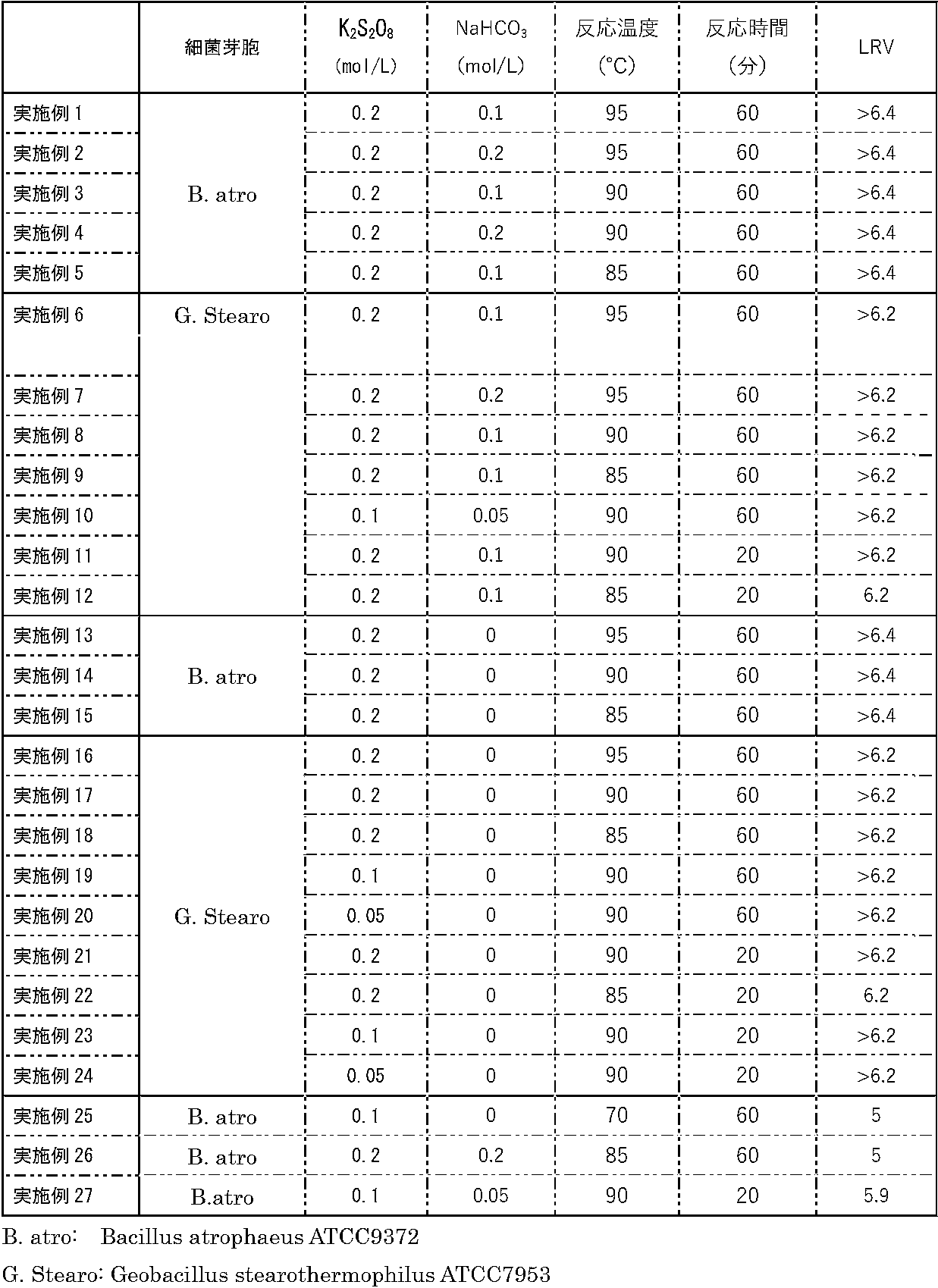
(滅菌用水性組成物に対する耐食性材料)
本発明の滅菌用水性組成物は、前述の通りの細菌芽胞を死滅する優れた性能を有するが、その成分として酸化剤を分解剤として含む。従って、滅菌処理を実施する上での細菌芽胞が付着、吸着している処理対象物(滅菌処理装置等)の材質(ステンレス鋼、パイレックスガラス、各種高分子材料等)が、この滅菌用水性組成物に対して耐劣化性(耐食性)を有することが不可欠である。
そこで、以下に耐劣化性試験を示し、さらに詳しく説明する。
(Materials resistant to corrosion by aqueous sterilization compositions)
The aqueous composition for sterilization of the present invention has excellent performance in killing bacterial spores as described above, and contains an oxidizing agent as a decomposition agent. Therefore, it is essential that the material (stainless steel, Pyrex glass, various polymeric materials, etc.) of the treatment object (sterilization treatment device, etc.) to which the bacterial spores adhere or adsorb in carrying out the sterilization treatment has resistance to deterioration (corrosion resistance) against the aqueous composition for sterilization.
Therefore, a deterioration resistance test will be shown below and described in more detail.
(実施例28)
市販のSUS304ステンレス鋼板から切り出した4試料(約10 x 10 x 0.5 mm、各重量:3.990g、3.976g、3.967g、3.977g)を、個別に、パイレックスガラス製バイアル管中の過硫酸カリウム(KPS)0.1モル/L水溶液(90℃)に投入し、60分間、該ステンレス鋼板試料に対する腐食試験を行った。試験終了後、蒸留水中で数回超音波洗浄し、その後、エタノール中に浸漬、撹拌後、ろ紙上で十分風乾した。
分解剤処理して得られた上記の4試料の重量測定を行った結果、いずれの試料も重量変化はなく、また、エリオニクス社製走査型電子顕微鏡ERA8900型によるSEM像(観察倍率:1000倍)も処理前後の変化は全く見られなかった。
この結果から、本発明の滅菌用水性組成物は、100℃以下において、該ステンレス鋼板を全く腐食しないことが明らかとなり、細菌芽胞の滅菌に最適な処理容器として活用できる。従って、SUS304ステンレス鋼板以上の耐食性に優れる他のステンレス鋼も、該滅菌用水性組成物の滅菌処理に適しているものと言える。
(Example 28)
Four samples (approximately 10 x 10 x 0.5 mm, weights: 3.990 g, 3.976 g, 3.967 g, 3.977 g) cut from commercially available SUS304 stainless steel plates were individually placed in a 0.1 mol/L aqueous solution of potassium persulfate (KPS) (90°C) in a Pyrex glass vial, and a corrosion test was performed on the stainless steel plate samples for 60 minutes. After the test, the samples were ultrasonically cleaned several times in distilled water, then immersed in ethanol, stirred, and air-dried thoroughly on filter paper.
The weights of the above four samples obtained after treatment with the decomposition agent were measured, and no weight change was observed in any of the samples. In addition, the SEM images (observation magnification: 1000x) taken with an Elionix scanning electron microscope ERA8900 showed no change before and after treatment.
These results demonstrate that the aqueous composition for sterilization of the present invention does not corrode the stainless steel plate at temperatures below 100° C., making it suitable for use as a treatment container for sterilizing bacterial spores. Therefore, it can be said that other stainless steels having corrosion resistance superior to that of SUS304 stainless steel plate are also suitable for sterilization with the aqueous composition for sterilization.
(実施例29)
アズワン株式会社のカタログに記載のTPXビーカー(材質PMP:ポリメチルペンテン製、121℃で20分間、オートクレーブ滅菌処理が可能な製品)から切り出した試験片0.259gを用いた以外は、実施例28と同条件下で、腐食試験(劣化試験)を行った。その結果、処理による試験片の重量変化はもちろん、形状変化も全くなく、該ポリメチルペンテン試料は、耐食性に優れるプラスチック素材として、本発明の該滅菌用水性組成物の滅菌処理の容器等に適していることが明らかになった。なお、一般的なポリメチルペンテンの物性は、融点約235℃とポリオレフィン中で最も高融点を有し、また密度は0.83と最も軽く、表面張力はフッ素樹脂に次いで小さく、クリープ特性はポリエチレン及びポリプロピレンより優れていることから、最近は、ビーカー、シャーレ、メスシリンダー、注射器等へとガラスからの転用が進んでいる。この事実からも、ポリメチルペンテンが本発明の滅菌用水性組成物中での細菌芽胞の滅菌処理にも好適な素材であると言える。
(Example 29)
A corrosion test (deterioration test) was carried out under the same conditions as in Example 28, except that a test piece of 0.259 g cut out from a TPX beaker (material: PMP: polymethylpentene, a product capable of autoclave sterilization at 121°C for 20 minutes) listed in the catalog of AS ONE Corporation was used. As a result, the test piece did not change in weight or shape due to the treatment, and it was revealed that the polymethylpentene sample is suitable as a plastic material with excellent corrosion resistance for a container for sterilization of the aqueous composition for sterilization of the present invention. In addition, the physical properties of general polymethylpentene are that it has the highest melting point of about 235°C among polyolefins, is the lightest at 0.83 in density, has the second lowest surface tension after fluororesin, and has creep properties superior to polyethylene and polypropylene, and therefore has recently been converted from glass to beakers, petri dishes, graduated cylinders, syringes, etc. From this fact, it can be said that polymethylpentene is also a suitable material for sterilization of bacterial spores in the aqueous composition for sterilization of the present invention.
(実施例30)
株式会社三商の総合カタログに記載のγ線滅菌済みディスポビーカー(ポリプロピレン製、半透明)から切り出した試験片フィルム0.058gを用いた以外は、実施例28と同条件下で腐食試験(劣化試験)を行った。その結果、処理による試験片の重量変化はもちろん、形状変化も全くなく、該γ線滅菌済みポリプロピレン製フィルム試料は、耐食性に優れるプラスチック素材として、本発明の該滅菌用水性組成物による滅菌処理の容器等に適していることが明らかになった。また、融解温度が約175℃の結晶性ポリプロピレン(iPP:アイソタクチックポリプロピレン)の試験片についても、本発明の滅菌用水性組成物中での劣化試験を行ったところ、表面形状は全く変化がなかった。以上の結果から、ポリプロピレンは、本発明の滅菌用水性組成物による滅菌処理の容器等の好適な素材であると言える。
(Example 30)
A corrosion test (deterioration test) was carried out under the same conditions as in Example 28, except that 0.058 g of test piece film was cut out from a gamma-ray sterilized disposable beaker (polypropylene, translucent) listed in the general catalog of Sansho Co., Ltd. was used. As a result, the test piece did not change in weight or shape due to the treatment, and it was revealed that the gamma-ray sterilized polypropylene film sample is a plastic material with excellent corrosion resistance and is suitable for containers for sterilization treatment using the aqueous composition for sterilization of the present invention. In addition, when a deterioration test was carried out in the aqueous composition for sterilization of the present invention for a test piece of crystalline polypropylene (iPP: isotactic polypropylene) with a melting temperature of about 175°C, the surface shape did not change at all. From the above results, it can be said that polypropylene is a suitable material for containers for sterilization treatment using the aqueous composition for sterilization of the present invention.
(実施例31)
アズワン株式会社のカタログに記載のルミラーフィルム(PET:ポリエチレンテレフタレート製フィルム、厚さ100μm、T60透明品)から切り出した試験片フィルム0.022gを用いた以外は、実施例28と同条件下で、腐食試験(劣化試験)を行った。その結果、処理による試験片フィルムの重量変化はもちろん、形状変化も全くなく、該PETフィルムは、本発明の滅菌用水性組成物によって劣化しない好適な素材であることが明らかになった。
(Example 31)
A corrosion test (deterioration test) was carried out under the same conditions as in Example 28, except that 0.022 g of test piece film was used, cut out from Lumirror film (PET: polyethylene terephthalate film, thickness 100 μm, T60 transparent product) listed in the catalog of AS ONE Corporation. As a result, the test piece film did not change in weight or shape due to the treatment, and it was revealed that the PET film is a suitable material that is not deteriorated by the aqueous composition for sterilization of the present invention.
(実施例32)
アズワン株式会社のカタログに記載のナフロンシート(PTFE:ポリテトラフルオロエチレン製シート、厚さ1.0mm)から切り出した試験片シート0.406gを用いた以外は、実施例28と同条件下で、腐食試験(劣化試験)を行った。その結果、処理による試験片フィルムの重量変化はもちろん、形状変化も全くなく、該PTFEシートは、本発明の滅菌用水性組成物によって劣化しない好適な素材であることが明らかになった。
(Example 32)
A corrosion test (deterioration test) was carried out under the same conditions as in Example 28, except that 0.406 g of a test piece sheet cut out from a Naflon sheet (PTFE: polytetrafluoroethylene sheet, thickness 1.0 mm) listed in the catalog of AS ONE Corporation was used. As a result, the test piece film did not change in weight or shape due to the treatment, and it was revealed that the PTFE sheet is a suitable material that is not deteriorated by the aqueous composition for sterilization of the present invention.
実施例28~32の一覧を表2に示す。
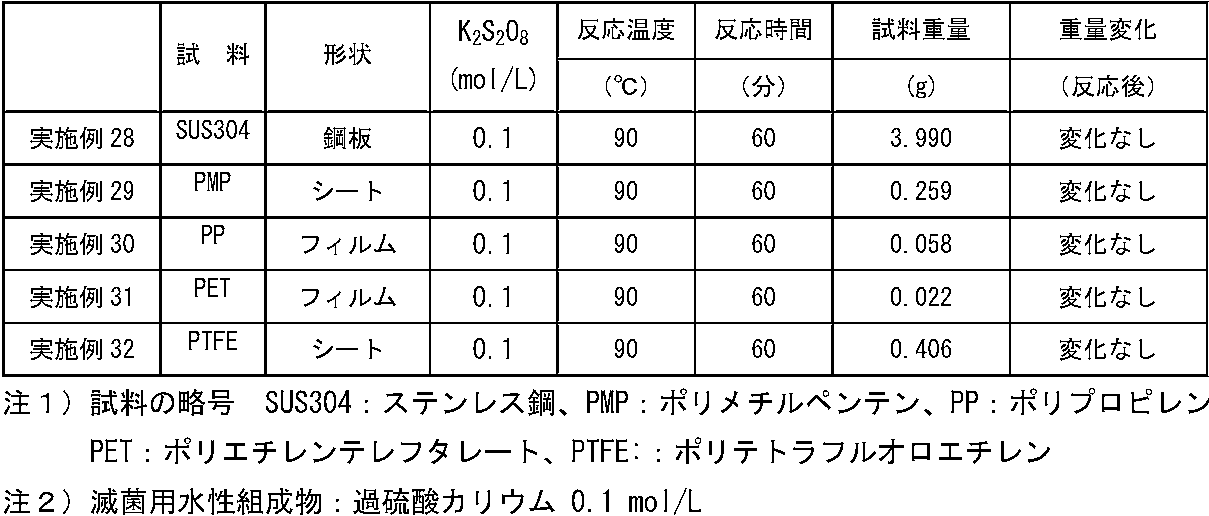
以上の結果から、本発明の滅菌用水性組成物は、常圧下、100℃以下で、しかも、酸化エチレンやグルタルアルデヒドのような健康被害を生じる気体の発生及び残留の危険性がなく、さらには、高温・高圧下での被滅菌物質の劣化も大幅に低減できる優れた滅菌剤であることが明らかになった。すなわち、本発明の滅菌処理方法によって、多くの医療機器をはじめ、一般細菌のみならず細菌芽胞などすべての感染性微生物が付着した器具等の滅菌が可能となるばかりか、該滅菌処理のための容器等についてもその材質は特に限定されないことが明らかになった。 The above results demonstrate that the aqueous sterilization composition of the present invention is an excellent sterilizing agent that can be used at normal pressure and below 100°C, without the risk of generating or leaving behind gases that cause health hazards such as ethylene oxide and glutaraldehyde, and that can also significantly reduce the deterioration of materials to be sterilized under high temperatures and pressures. In other words, the sterilization method of the present invention not only makes it possible to sterilize many medical devices and other instruments that are contaminated with all infectious microorganisms, including not only general bacteria but also bacterial spores, and it has also become clear that there are no particular limitations on the materials used for the containers used in the sterilization process.
以上の通り、本発明の滅菌用水性組成物は、人の健康や環境を害する気体の発生がなく、大気圧下、100℃以下において優れた滅菌性能を有することが立証され、本発明の滅菌処理方法は、従来の滅菌方法と比較して、安全性、利便性、滅菌容器、滅菌対照製品等の選択性の豊富さなどにおいて非常に優れていることが明らかになり、幅広い処理対象物への応用の可能性がある。
As described above, it has been demonstrated that the aqueous composition for sterilization of the present invention does not generate gases that are harmful to human health or the environment, and has excellent sterilization performance at atmospheric pressure and below 100°C. It has become clear that the sterilization method of the present invention is extremely superior to conventional sterilization methods in terms of safety, convenience, and a wide range of options for sterilized containers, sterilized control products, etc., and has the potential to be applied to a wide range of treatment objects.
Claims (4)
Priority Applications (1)
| Application Number | Priority Date | Filing Date | Title |
|---|---|---|---|
| JP2023086953A JP7621670B2 (en) | 2023-05-26 | 2023-05-26 | Aqueous composition for sterilization of infectious microorganisms and sterilization method using the same |
Applications Claiming Priority (1)
| Application Number | Priority Date | Filing Date | Title |
|---|---|---|---|
| JP2023086953A JP7621670B2 (en) | 2023-05-26 | 2023-05-26 | Aqueous composition for sterilization of infectious microorganisms and sterilization method using the same |
Publications (2)
| Publication Number | Publication Date |
|---|---|
| JP2024170034A JP2024170034A (en) | 2024-12-06 |
| JP7621670B2 true JP7621670B2 (en) | 2025-01-27 |
Family
ID=93707765
Family Applications (1)
| Application Number | Title | Priority Date | Filing Date |
|---|---|---|---|
| JP2023086953A Active JP7621670B2 (en) | 2023-05-26 | 2023-05-26 | Aqueous composition for sterilization of infectious microorganisms and sterilization method using the same |
Country Status (1)
| Country | Link |
|---|---|
| JP (1) | JP7621670B2 (en) |
Citations (7)
| Publication number | Priority date | Publication date | Assignee | Title |
|---|---|---|---|---|
| JP2004510878A (en) | 2000-10-13 | 2004-04-08 | ディプローム・インジェニエア・トーンハウザー・ゲーエムベーハー | Detergents and disinfectants |
| JP2008507399A (en) | 2004-07-21 | 2008-03-13 | イー・アイ・デュポン・ドウ・ヌムール・アンド・カンパニー | Water treatment |
| US20100178357A1 (en) | 2006-08-07 | 2010-07-15 | Tony Mathilde Jozef Kempen | Combinations of 4 bromo-2-(4-chlorophenyl)-5-(trifluoromethyl)-1h-pyrrole-3-carbonitrile and oxidizing agents |
| JP2021008471A (en) | 2014-12-18 | 2021-01-28 | エコラボ ユーエスエー インコーポレイティド | Production of peroxyformic acid by polyhydric alcohol formic acid |
| WO2021048802A1 (en) | 2019-09-13 | 2021-03-18 | Martelli, Giancarlo | Composition and method for sterilising and reconditioning substrates |
| DE102020109538A1 (en) | 2020-04-06 | 2021-10-07 | VMS-Maschinenbau GmbH | Device and method for the sterilization of medical protective clothing |
| JP2024108344A (en) | 2023-01-31 | 2024-08-13 | 忠史 甲本 | Microbial decomposition agent aqueous solution and its manufacturing method, disinfection/sterilization method, and disinfection/sterilization system |
Family Cites Families (2)
| Publication number | Priority date | Publication date | Assignee | Title |
|---|---|---|---|---|
| AU4969990A (en) * | 1989-01-27 | 1990-08-24 | Trans Delta Corporation | Stabilized sterilizing or disinfecting halogen containing composition, method and apparatus |
| DE19514612A1 (en) * | 1995-04-25 | 1996-10-31 | Fritz Dr Kueke | Process for the preparation of an aqueous chlorine dioxide solution |
-
2023
- 2023-05-26 JP JP2023086953A patent/JP7621670B2/en active Active
Patent Citations (7)
| Publication number | Priority date | Publication date | Assignee | Title |
|---|---|---|---|---|
| JP2004510878A (en) | 2000-10-13 | 2004-04-08 | ディプローム・インジェニエア・トーンハウザー・ゲーエムベーハー | Detergents and disinfectants |
| JP2008507399A (en) | 2004-07-21 | 2008-03-13 | イー・アイ・デュポン・ドウ・ヌムール・アンド・カンパニー | Water treatment |
| US20100178357A1 (en) | 2006-08-07 | 2010-07-15 | Tony Mathilde Jozef Kempen | Combinations of 4 bromo-2-(4-chlorophenyl)-5-(trifluoromethyl)-1h-pyrrole-3-carbonitrile and oxidizing agents |
| JP2021008471A (en) | 2014-12-18 | 2021-01-28 | エコラボ ユーエスエー インコーポレイティド | Production of peroxyformic acid by polyhydric alcohol formic acid |
| WO2021048802A1 (en) | 2019-09-13 | 2021-03-18 | Martelli, Giancarlo | Composition and method for sterilising and reconditioning substrates |
| DE102020109538A1 (en) | 2020-04-06 | 2021-10-07 | VMS-Maschinenbau GmbH | Device and method for the sterilization of medical protective clothing |
| JP2024108344A (en) | 2023-01-31 | 2024-08-13 | 忠史 甲本 | Microbial decomposition agent aqueous solution and its manufacturing method, disinfection/sterilization method, and disinfection/sterilization system |
Also Published As
| Publication number | Publication date |
|---|---|
| JP2024170034A (en) | 2024-12-06 |
Similar Documents
| Publication | Publication Date | Title |
|---|---|---|
| Rutala et al. | Disinfection, sterilization, and antisepsis: An overview | |
| Rutala et al. | New disinfection and sterilization methods | |
| Rutala et al. | Disinfection, sterilization, and control of hospital waste | |
| Rutala et al. | Infection control: the role of disinfection and sterilization | |
| Rutala et al. | Disinfection of endoscopes: review of new chemical sterilants used for high-level disinfection | |
| Rutala et al. | Draft guideline for disinfection and sterilization in healthcare facilities | |
| Herwaldt et al. | Disinfection and sterilization of patient-care items | |
| Schneider | New technologies and trends in sterilization and disinfection | |
| Solon et al. | Decontamination and sterilization | |
| Solon et al. | Decontamination and sterilization | |
| Simmons et al. | Guidelines for hospital environmental control | |
| Killeen et al. | Decontamination and sterilization | |
| WO2024162102A1 (en) | Decomposition agent solution for microorganisms and production method therefor, disinfection/sterilization treatment method, and disinfection/sterilization treatment system | |
| Rutala et al. | Guideline for disinfection and sterilization in healthcare facilities, 2008. update: June 2024 | |
| JP2024170034A (en) | Aqueous composition for sterilization of infectious microorganisms and sterilization method using the same | |
| Akamatsu et al. | Evaluation of the efficacy of a 3· 2% glutaraldehyde product for disinfection of fibreoptic endoscopes with an automatic machine | |
| Presterl et al. | Reprocessing: cleansing, disinfection, sterilization | |
| Loy et al. | Disinfection and Sterilization | |
| Chatburn | Decontamination of respiratory care equipment: what can be done, what should be done | |
| Hoh et al. | Decontamination and sterilization | |
| Lasemi et al. | Effects of different times of glutaraldehyde 2% on Bacillus subtilis spores (in vitro) | |
| EP4027788A1 (en) | Composition and method for sterilising and reconditioning substrates | |
| Favero et al. | Decontamination and disinfection | |
| JP2024170033A (en) | Aqueous composition for decomposing and sterilizing water-absorbent polymers, and method for decomposing and sterilizing water-absorbent polymers using the same | |
| Favero et al. | Microbiologic principles applied to reprocessing hemodialyzers |
Legal Events
| Date | Code | Title | Description |
|---|---|---|---|
| A621 | Written request for application examination |
Free format text: JAPANESE INTERMEDIATE CODE: A621 Effective date: 20230724 |
|
| A131 | Notification of reasons for refusal |
Free format text: JAPANESE INTERMEDIATE CODE: A131 Effective date: 20240716 |
|
| A521 | Request for written amendment filed |
Free format text: JAPANESE INTERMEDIATE CODE: A523 Effective date: 20240822 |
|
| A131 | Notification of reasons for refusal |
Free format text: JAPANESE INTERMEDIATE CODE: A131 Effective date: 20240909 |
|
| A521 | Request for written amendment filed |
Free format text: JAPANESE INTERMEDIATE CODE: A523 Effective date: 20241011 |
|
| TRDD | Decision of grant or rejection written | ||
| A01 | Written decision to grant a patent or to grant a registration (utility model) |
Free format text: JAPANESE INTERMEDIATE CODE: A01 Effective date: 20241223 |
|
| A61 | First payment of annual fees (during grant procedure) |
Free format text: JAPANESE INTERMEDIATE CODE: A61 Effective date: 20250107 |
|
| R150 | Certificate of patent or registration of utility model |
Ref document number: 7621670 Country of ref document: JP Free format text: JAPANESE INTERMEDIATE CODE: R150 |