JP7621654B2 - Compostable wood composites for thin-walled products - Google Patents
Compostable wood composites for thin-walled products Download PDFInfo
- Publication number
- JP7621654B2 JP7621654B2 JP2021531337A JP2021531337A JP7621654B2 JP 7621654 B2 JP7621654 B2 JP 7621654B2 JP 2021531337 A JP2021531337 A JP 2021531337A JP 2021531337 A JP2021531337 A JP 2021531337A JP 7621654 B2 JP7621654 B2 JP 7621654B2
- Authority
- JP
- Japan
- Prior art keywords
- wood
- particles
- composition according
- composition
- less
- Prior art date
- Legal status (The legal status is an assumption and is not a legal conclusion. Google has not performed a legal analysis and makes no representation as to the accuracy of the status listed.)
- Active
Links
Images


Classifications
-
- A—HUMAN NECESSITIES
- A47—FURNITURE; DOMESTIC ARTICLES OR APPLIANCES; COFFEE MILLS; SPICE MILLS; SUCTION CLEANERS IN GENERAL
- A47G—HOUSEHOLD OR TABLE EQUIPMENT
- A47G21/00—Table-ware
- A47G21/18—Drinking straws or the like
-
- B—PERFORMING OPERATIONS; TRANSPORTING
- B29—WORKING OF PLASTICS; WORKING OF SUBSTANCES IN A PLASTIC STATE IN GENERAL
- B29C—SHAPING OR JOINING OF PLASTICS; SHAPING OF MATERIAL IN A PLASTIC STATE, NOT OTHERWISE PROVIDED FOR; AFTER-TREATMENT OF THE SHAPED PRODUCTS, e.g. REPAIRING
- B29C70/00—Shaping composites, i.e. plastics material comprising reinforcements, fillers or preformed parts, e.g. inserts
- B29C70/58—Shaping composites, i.e. plastics material comprising reinforcements, fillers or preformed parts, e.g. inserts comprising fillers only, e.g. particles, powder, beads, flakes, spheres
-
- C—CHEMISTRY; METALLURGY
- C08—ORGANIC MACROMOLECULAR COMPOUNDS; THEIR PREPARATION OR CHEMICAL WORKING-UP; COMPOSITIONS BASED THEREON
- C08J—WORKING-UP; GENERAL PROCESSES OF COMPOUNDING; AFTER-TREATMENT NOT COVERED BY SUBCLASSES C08B, C08C, C08F, C08G or C08H
- C08J5/00—Manufacture of articles or shaped materials containing macromolecular substances
- C08J5/04—Reinforcing macromolecular compounds with loose or coherent fibrous material
-
- C—CHEMISTRY; METALLURGY
- C08—ORGANIC MACROMOLECULAR COMPOUNDS; THEIR PREPARATION OR CHEMICAL WORKING-UP; COMPOSITIONS BASED THEREON
- C08J—WORKING-UP; GENERAL PROCESSES OF COMPOUNDING; AFTER-TREATMENT NOT COVERED BY SUBCLASSES C08B, C08C, C08F, C08G or C08H
- C08J5/00—Manufacture of articles or shaped materials containing macromolecular substances
- C08J5/04—Reinforcing macromolecular compounds with loose or coherent fibrous material
- C08J5/06—Reinforcing macromolecular compounds with loose or coherent fibrous material using pretreated fibrous materials
-
- C—CHEMISTRY; METALLURGY
- C08—ORGANIC MACROMOLECULAR COMPOUNDS; THEIR PREPARATION OR CHEMICAL WORKING-UP; COMPOSITIONS BASED THEREON
- C08J—WORKING-UP; GENERAL PROCESSES OF COMPOUNDING; AFTER-TREATMENT NOT COVERED BY SUBCLASSES C08B, C08C, C08F, C08G or C08H
- C08J5/00—Manufacture of articles or shaped materials containing macromolecular substances
- C08J5/18—Manufacture of films or sheets
-
- C—CHEMISTRY; METALLURGY
- C08—ORGANIC MACROMOLECULAR COMPOUNDS; THEIR PREPARATION OR CHEMICAL WORKING-UP; COMPOSITIONS BASED THEREON
- C08L—COMPOSITIONS OF MACROMOLECULAR COMPOUNDS
- C08L1/00—Compositions of cellulose, modified cellulose or cellulose derivatives
- C08L1/08—Cellulose derivatives
- C08L1/10—Esters of organic acids, i.e. acylates
- C08L1/14—Mixed esters, e.g. cellulose acetate-butyrate
-
- C—CHEMISTRY; METALLURGY
- C08—ORGANIC MACROMOLECULAR COMPOUNDS; THEIR PREPARATION OR CHEMICAL WORKING-UP; COMPOSITIONS BASED THEREON
- C08L—COMPOSITIONS OF MACROMOLECULAR COMPOUNDS
- C08L101/00—Compositions of unspecified macromolecular compounds
- C08L101/16—Compositions of unspecified macromolecular compounds the macromolecular compounds being biodegradable
-
- C—CHEMISTRY; METALLURGY
- C08—ORGANIC MACROMOLECULAR COMPOUNDS; THEIR PREPARATION OR CHEMICAL WORKING-UP; COMPOSITIONS BASED THEREON
- C08L—COMPOSITIONS OF MACROMOLECULAR COMPOUNDS
- C08L67/00—Compositions of polyesters obtained by reactions forming a carboxylic ester link in the main chain; Compositions of derivatives of such polymers
- C08L67/04—Polyesters derived from hydroxycarboxylic acids, e.g. lactones
-
- C—CHEMISTRY; METALLURGY
- C08—ORGANIC MACROMOLECULAR COMPOUNDS; THEIR PREPARATION OR CHEMICAL WORKING-UP; COMPOSITIONS BASED THEREON
- C08L—COMPOSITIONS OF MACROMOLECULAR COMPOUNDS
- C08L97/00—Compositions of lignin-containing materials
- C08L97/02—Lignocellulosic material, e.g. wood, straw or bagasse
-
- C—CHEMISTRY; METALLURGY
- C08—ORGANIC MACROMOLECULAR COMPOUNDS; THEIR PREPARATION OR CHEMICAL WORKING-UP; COMPOSITIONS BASED THEREON
- C08L—COMPOSITIONS OF MACROMOLECULAR COMPOUNDS
- C08L2201/00—Properties
- C08L2201/06—Biodegradable
-
- C—CHEMISTRY; METALLURGY
- C08—ORGANIC MACROMOLECULAR COMPOUNDS; THEIR PREPARATION OR CHEMICAL WORKING-UP; COMPOSITIONS BASED THEREON
- C08L—COMPOSITIONS OF MACROMOLECULAR COMPOUNDS
- C08L2207/00—Properties characterising the ingredient of the composition
- C08L2207/20—Recycled plastic
-
- Y—GENERAL TAGGING OF NEW TECHNOLOGICAL DEVELOPMENTS; GENERAL TAGGING OF CROSS-SECTIONAL TECHNOLOGIES SPANNING OVER SEVERAL SECTIONS OF THE IPC; TECHNICAL SUBJECTS COVERED BY FORMER USPC CROSS-REFERENCE ART COLLECTIONS [XRACs] AND DIGESTS
- Y02—TECHNOLOGIES OR APPLICATIONS FOR MITIGATION OR ADAPTATION AGAINST CLIMATE CHANGE
- Y02W—CLIMATE CHANGE MITIGATION TECHNOLOGIES RELATED TO WASTEWATER TREATMENT OR WASTE MANAGEMENT
- Y02W90/00—Enabling technologies or technologies with a potential or indirect contribution to greenhouse gas [GHG] emissions mitigation
- Y02W90/10—Bio-packaging, e.g. packing containers made from renewable resources or bio-plastics
Landscapes
- Chemical & Material Sciences (AREA)
- Health & Medical Sciences (AREA)
- Chemical Kinetics & Catalysis (AREA)
- Medicinal Chemistry (AREA)
- Polymers & Plastics (AREA)
- Organic Chemistry (AREA)
- Engineering & Computer Science (AREA)
- Materials Engineering (AREA)
- Manufacturing & Machinery (AREA)
- Life Sciences & Earth Sciences (AREA)
- Wood Science & Technology (AREA)
- Composite Materials (AREA)
- Mechanical Engineering (AREA)
- Compositions Of Macromolecular Compounds (AREA)
Description
本発明は、堆肥化可能な複合材料に関する。特に、本発明は、堆肥化可能な木材複合材料およびそれを製造する方法に関する。本発明はまた、薄壁物品における木材複合材料の使用に関する。 The present invention relates to compostable composite materials. In particular, the present invention relates to compostable wood composite materials and methods for producing the same. The present invention also relates to the use of wood composite materials in thin-walled articles.
環境問題への意識の高まりと資源の不足により、多くの用途でのバイオベースの材料の使用を取り巻く関心が高まっている。立法レベルでは、より厳格な政策により、多くの産業は、再生不可能な化石資源に由来する従来の材料に取って代わるために、再生可能な資源から新しい材料を探すか開発することを余儀なくされている。 Increasing awareness of environmental issues and scarcity of resources have led to growing interest surrounding the use of bio-based materials in many applications. At the legislative level, stricter policies are forcing many industries to look for or develop new materials from renewable resources to replace traditional materials derived from non-renewable fossil resources.
ここ数十年の間に最も顕著な課題の1つは、環境、特に海洋におけるプラスチックの蓄積であった。これは主に、廃棄物処理プロセスが不十分であり、その結果、廃棄物処理施設から環境に細片が漏出していることが原因である。海洋のプラスチックの細片は、海洋動物にかなりの脅威をもたらし、最終的には海洋生態系に壊滅的な出来事をもたらし得る。2018年10月、欧州議会は、プラスチック製のカトラリーとプレート、綿棒、ストロー、ドリンクスターラー、バルーンスティックの禁止を承認した。決定の時点で、EUはその禁止が2021年までにブロック全体で発効されることを望んでいた。他の既存の代替材料がない他のアイテム(ハンバーガーボックスやサンドイッチラッパーなど)の消費は、2025年までに各国で25%削減する必要がある。もう1つの目標は、すべてのプラスチック製飲料ボトルの90%が2025年までにリサイクルのために回収されるようにすることである。 One of the most prominent challenges in recent decades has been the accumulation of plastic in the environment, especially in the oceans. This is mainly due to poor waste treatment processes and the resulting leakage of debris into the environment from waste treatment facilities. Plastic debris in the ocean poses a considerable threat to marine fauna and can eventually lead to catastrophic events in marine ecosystems. In October 2018, the European Parliament approved a ban on plastic cutlery and plates, cotton buds, straws, drink stirrers and balloon sticks. At the time of the decision, the EU wanted the ban to come into force across the bloc by 2021. Consumption of other items that have no other existing alternative materials (such as burger boxes and sandwich wrappers) should be reduced by 25% in each country by 2025. Another goal is to ensure that 90% of all plastic drink bottles are collected for recycling by 2025.
高分子材料の分解性を改善するために、様々なタイプのアプローチが提案されてきた。考えられる1つの方法は、生分解性または非生分解性ポリマーを、段ボールなどのセルロースベースの材料に置き換えることである。残念ながら、これらの材料は生態学的な利点を提供するが、ポリマーの代替品としては多くの点で不十分である。例えば、湿気のある環境でのこれらの材料の機械的耐久性は十分ではなく、優れたバリア特性を欠いている。別の可能性は、ポリマーの特性を改質して、より速く分解するようにすることである。これは通常、さまざまな種類の添加剤をポリマーに添加することによって行われる。これは、例えば、オキソ分解性ポリマーの開発につながった。これらのポリマーは確かにマクロスケールでより速く分解するが、環境中のマイクロサイズのポリマー粒子、すなわちマイクロプラスチックの蓄積の問題は依然として残っている。 Different types of approaches have been proposed to improve the degradability of polymeric materials. One possible method is to replace biodegradable or non-biodegradable polymers with cellulose-based materials, such as cardboard. Unfortunately, although these materials offer ecological advantages, they are in many ways inadequate as polymer replacements. For example, the mechanical durability of these materials in humid environments is not sufficient and they lack good barrier properties. Another possibility is to modify the properties of the polymer so that it degrades faster. This is usually done by adding different kinds of additives to the polymer. This has led, for example, to the development of oxo-degradable polymers. Although these polymers certainly degrade faster on the macroscale, the problem of the accumulation of micro-sized polymer particles, i.e. microplastics, in the environment still remains.
定義上、マイクロプラスチックは、物理的サイズが直径5mm未満のプラスチック粒子であり、さらに一次マイクロプラスチックと二次マイクロプラスチックに分けられ得る。一次マイクロプラスチックは、環境に入る前にすでに5mm未満のサイズであるプラスチック粒子である。このタイプのマイクロプラスチックは、例えば化粧品や衣類中に見られ得る。二次マイクロプラスチックは、大きなプラスチック製品が環境に入ると自然に分解するプロセスから生じる。したがって、二次マイクロプラスチックは、例えば、ビニール袋または飲料用ボトルに由来し得る。 By definition, microplastics are plastic particles with a physical size less than 5 mm in diameter and can be further divided into primary and secondary microplastics. Primary microplastics are plastic particles that are already less than 5 mm in size before entering the environment. This type of microplastic can be found, for example, in cosmetics and clothing. Secondary microplastics result from the process by which larger plastic products naturally decompose once they enter the environment. Thus, secondary microplastics can come from, for example, plastic bags or drinking bottles.
したがって、より効率的な廃棄物処理プロセスが緊急に必要とされていることは明らかである。 It is therefore clear that there is an urgent need for more efficient waste treatment processes.
石油ベースの非生分解性および使い捨てプラスチックに関連する環境問題を排除するために、非分解性の対応物と比較した場合に同様の特性を有する生分解性ポリマーを開発するための、広範囲の研究が行われてきた。これにより、ポリ乳酸(PLA)、ポリカプロラクトン(PCL)、ポリヒドロキシブチレート(PHB)、ポリブチレンアジペートテレフタレート(PBAT)、ポリブチレンサクシネート(PBS)、およびそれらのブレンドなど、さまざまな物品でのポリマーの使用のための、多数のポリマーが開発された。 To eliminate the environmental issues associated with petroleum-based non-biodegradable and disposable plastics, extensive research has been conducted to develop biodegradable polymers with similar properties when compared to their non-degradable counterparts. This has led to the development of numerous polymers such as polylactic acid (PLA), polycaprolactone (PCL), polyhydroxybutyrate (PHB), polybutylene adipate terephthalate (PBAT), polybutylene succinate (PBS), and blends thereof, for use in various articles.
こうして、JP469568B2(特許第4699568号公報)は、0.3~0.7mmの範囲の厚さを有する薄壁容器を製造する方法に関する。使用されるポリマーは1~28w%の量の無機充填材を含有し得るPLAである。 Thus, JP 469568 B2 (Patent Publication No. 4699568) relates to a method for producing thin-walled containers having a thickness in the range of 0.3 to 0.7 mm. The polymer used is PLA, which may contain inorganic fillers in an amount of 1 to 28 w%.
US210071528B2(米国特許第210071528号明細書)は、補強された薄壁繊維複合製品、および強化材として天然繊維を含む同じタイプの繊維を製造する方法を開示している。 US 210071528 B2 (United States Patent 210071528) discloses a method for producing reinforced thin-walled fiber composite products and the same type of fiber containing natural fibers as reinforcement.
CN101429328A(中国特許出願公開第101429328号明細書)は、食器用の自然分解性深窪薄壁ソフトボトルおよびそのソフトボトルの製造に使用され得る材料を提供する。この材料は、85~90w%のPLA、9~14w%のポリエチレンテレフタレート(PET)からなり、残りの材料はPET添加剤からなる。ボトルの壁の厚さは0.07~0.09mmである。 CN101429328A (Chinese Patent Publication No. 101429328) provides a naturally degradable deep recess thin-walled soft bottle for tableware and a material that can be used to manufacture the soft bottle. The material is composed of 85-90w% PLA, 9-14w% polyethylene terephthalate (PET), and the remaining material is composed of PET additives. The wall thickness of the bottle is 0.07-0.09mm.
US20030216492A1(米国特許出願公開第2003/0216492号明細書)は、例えば、ジャガイモ、紙またはトウモロコシから得られるデンプンに基づく材料を開示している。材料の特性は、デンプン懸濁液に木粉または繊維(アスペクト比1:2~1:8)を添加することによって変更される。木材繊維を添加することにより、材料成形が可能となる。成形品は、製品に耐液コーティング(PROTECoat、Zein(R)、PLAなど)を施すことで防水加工を施している。これらの製品は、カップ、トレイ、ボウル、調理器具、またはプレートとして使用され得る。物品の厚さは、0.001mm~10mmの範囲であり得る。他のデンプンベースの材料は、US6168857B1(米国特許第6168857号明細書)に記載されている。 US 2003/0216492 A1 discloses a material based on starch obtained, for example, from potato, paper or corn. The properties of the material are modified by adding wood flour or fibre (aspect ratio 1:2 to 1:8) to the starch suspension. The addition of wood fibre allows the material to be moulded. The moulded articles are waterproofed by applying a liquid-resistant coating to the product (PROTECoat, Zein®, PLA etc.). These products can be used as cups, trays, bowls, utensils or plates. The thickness of the article can range from 0.001 mm to 10 mm. Other starch-based materials are described in US 6168857 B1.
無機的に充填されたマトリックスを備える密封可能な液密容器を製造するための組成物および方法は、US5738921A(米国特許第5738921号明細書)に記載されている。容器は、有機ポリマー結合剤(PLAまたはデンプン)、約20%~約90%の濃度範囲を有する無機凝集体充填材、および繊維状材料(木材繊維など)からなる液密バリアを有する。有機粒子のサイズは決定されていない。 A composition and method for producing a sealable liquid-tight container with an inorganically filled matrix is described in US 5,738,921 A. The container has a liquid-tight barrier consisting of an organic polymeric binder (PLA or starch), an inorganic aggregate filler having a concentration range of about 20% to about 90%, and a fibrous material (such as wood fiber). The size of the organic particles is not determined.
US8455575(米国特許第8455575号明細書)は、木粉(1μm~約5mmのサイズ)およびPLAからなる材料について説明している。これらの成分に加えて、縮合リン酸エステルが組成物に含まれる。 US 8455575 describes a material consisting of wood flour (sizes between 1 μm and about 5 mm) and PLA. In addition to these components, condensed phosphate esters are included in the composition.
最後に、EP2888323B1(欧州特許第2888323号明細書)は、0.3~0.8mmの壁厚を有する薄壁射出成形部品を製造するためのポリマー混合物を開示している。使用される材料は、脂肪族芳香族ポリエステル(PLAなど)、木材繊維などの有機材料、および一般的に使用される添加剤である。 Finally, EP 2888323 B1 (European Patent Specification No. 2888323) discloses polymer mixtures for producing thin-walled injection molded parts with a wall thickness of 0.3 to 0.8 mm. The materials used are aliphatic aromatic polyesters (such as PLA), organic materials such as wood fibers, and commonly used additives.
特に生分解性の点でそれらの有利な特性にもかかわらず、当技術分野で知られている生分解性プラスチックは、物品の厚さが1mmを超えるとき、およびそれらが低温および乾燥条件にさらされるとき、ゆっくりと分解する。 Despite their advantageous properties, especially in terms of biodegradability, biodegradable plastics known in the art degrade slowly when the thickness of the articles exceeds 1 mm and when they are exposed to low temperature and dry conditions.
したがって、そのような生分解性プラスチックは、分解プロセスを加速するために、高温(例えば、60°C超)およびより高い湿度レベル(例えば、80%超)にさらされる廃棄物処理施設で処理する必要がある。 Therefore, such biodegradable plastics need to be processed in waste treatment facilities where they are exposed to high temperatures (e.g., above 60°C) and higher humidity levels (e.g., above 80%) to accelerate the decomposition process.
いくつかの研究によると、PLAなどの生分解性ポリマーで作られた製品の壁の厚さが約1mmに保たれている場合でも、湖や海での生分解には過度の時間(つまり、数年)がかかり得る。したがって、既知の材料は、真に海洋分解性であると特徴づけられ得ない。 Several studies have shown that even if the wall thickness of products made from biodegradable polymers such as PLA is kept at around 1 mm, biodegradation in lakes and oceans can take an excessive amount of time (i.e., years). Therefore, no known materials can be characterized as truly marine degradable.
本発明の目的は、従来技術の不利な点の少なくとも一部を排除し、薄壁物品での使用に適した新しい複合材料を提供することである。 The object of the present invention is to provide a new composite material suitable for use in thin-walled articles that eliminates at least some of the disadvantages of the prior art.
本発明の別の目的は、新規の薄壁物品を提供することである。 Another object of the present invention is to provide a novel thin-walled article.
本発明は、材料の吸水率を高め、同時にまたその機械的特性を改善するために、生分解性補強材を材料に組み込むというコンセプトに基づいている。 The invention is based on the concept of incorporating biodegradable reinforcements into a material in order to increase its water absorption rate and at the same time improve its mechanical properties.
したがって、一実施形態では、本発明は、粗い木材粒子などの天然の親水性粒子と、組成物を形成するための少なくとも1つの生分解性ポリマーとの組み合わせを備える。組成物において、親水性粒子は、ポリマーと混合され、好ましくはポリマー全体にわたって混合される。吸水による親水性粒子の膨潤は、ポリマーマトリックスに亀裂を形成するのに十分な力を有し、こうして水がより効率的に材料に浸透することを可能にし、したがって材料の劣化を加速する。材料が分解すると、長いポリマー鎖が短い鎖画分に分解され、最終的に二酸化炭素(CO2)、水、バイオマス、無機化合物などの天然化合物に分解され、マイクロプラスチックなどのプラスチック粒子、または環境中の有毒な残留物が残らない。 Thus, in one embodiment, the invention comprises a combination of natural hydrophilic particles, such as coarse wood particles, with at least one biodegradable polymer to form a composition. In the composition, the hydrophilic particles are mixed with the polymer, preferably throughout the polymer. The swelling of the hydrophilic particles due to water absorption has enough force to form cracks in the polymer matrix, thus allowing water to penetrate the material more efficiently, thus accelerating the degradation of the material. As the material degrades, the long polymer chains break down into short chain fractions, and finally into natural compounds such as carbon dioxide (CO 2 ), water, biomass, and inorganic compounds, without leaving behind plastic particles such as microplastics, or toxic residues in the environment.
一実施形態では、親水性粒子は、0.5mm(ふるいにかけられたサイズ)以下の粒子サイズを有する、繊維などの木材粒子を含むか、それらからなるか、または実質的にそれらからなる。 In one embodiment, the hydrophilic particles comprise, consist of, or consist essentially of wood particles, such as fibers, having a particle size of 0.5 mm (sieved size) or less.
本材料が特に適している製品は、約1.5mm以下、特に1mm以下、好ましくは少なくとも0.1mm、例えば少なくとも0.4mmの壁厚を有する。 Products for which the material is particularly suitable have a wall thickness of less than about 1.5 mm, in particular less than 1 mm, preferably at least 0.1 mm, for example at least 0.4 mm.
本発明は、堆肥化環境で急速に分解する能力を有し、また、多数の用途で利用されるのに十分な剛性を有する材料を提供するであろう。対象となる製品には、容器、ならびにストローおよびその他の薄壁のパイプやチューブなどのその他の中空製品が含まれ、それらは生分解性に機械的強度特性が組み合わされている。 The present invention will provide a material that has the ability to degrade rapidly in a composting environment and is also sufficiently rigid to be utilized in a number of applications. Products of interest include containers and other hollow products such as straws and other thin-walled pipes and tubes that combine biodegradability with mechanical strength properties.
物品は、射出成形または押出成形などの従来の溶融加工方法で製造され得る。 The articles may be manufactured by conventional melt processing methods such as injection molding or extrusion.
より具体的には、本発明は、独立請求項の特徴的な部分に記載されていることを特徴とする。 More specifically, the invention is characterized in what is stated in the characterizing parts of the independent claims.
本発明により、かなりの利点が得られる。こうして、上記のように、PLA、ポリグリコール酸(PGA)、PBATなどの従来の生分解性ポリマーは、厚さが1mm未満の物品に成形されたとき、海洋環境で通常数年または数十年のオーダーの生分解速度でのみ生分解可能であるのに対して、本発明の材料はより速く分解し、湖や海、および同様の海洋環境で40°C未満の温度でも良好な分解をもたらす。 The present invention provides significant advantages. Thus, as noted above, while conventional biodegradable polymers such as PLA, polyglycolic acid (PGA), PBAT, etc., when molded into articles less than 1 mm thick, are only biodegradable in marine environments at rates typically on the order of years or decades, the materials of the present invention degrade faster and provide good degradation even at temperatures below 40°C in lakes, oceans, and similar marine environments.
生分解性の薄壁製品を製造するために使用される現在の解決策と比較したとき、本発明の物品の明らかな利点には、より高い生分解速度だけでなく、より優れた美観も含まれる。本材料はまた、特に湿った暖かい環境において、良好な加工性およびより良好な寸法安定性を提供する。試験は、木材繊維の添加後の材料の弾性率の大幅な改善が達成され得ることを示している。堆肥化性と吸水挙動の改善に加えて、木材繊維を含めることで材料の延性も改善される。対照的に、生分解性ポリマーのみを使用して壁厚1mmの製品を製造すると、多くの用途には不十分で高価格の機械的特性を有する製品となる。 When compared to current solutions used to produce biodegradable thin-walled products, the clear advantages of the articles of the present invention include a higher biodegradation rate as well as better aesthetics. The material also offers good processability and better dimensional stability, especially in moist and warm environments. Tests have shown that a significant improvement in the elastic modulus of the material after the addition of wood fibers can be achieved. In addition to improving compostability and water absorption behavior, the inclusion of wood fibers also improves the ductility of the material. In contrast, the production of a 1 mm wall thickness product using only biodegradable polymers results in a product with mechanical properties that are insufficient for many applications and is expensive.
さらに、本明細書に開示される天然繊維の本物品への包含は、カーボンフットプリントの減少およびさもなければ廃棄されるかまたはエネルギー源として使用される副流副産物の利用に関して、より生態学的な付加価値材料をもたらす。 Furthermore, the inclusion of natural fibers disclosed herein in the present articles results in more ecological value-added materials with respect to reduced carbon footprint and utilization of side-stream by-products that would otherwise be discarded or used as energy sources.
本組成物は、新しい機械の取得という形で追加費用なしに射出成形または押出を使用して物品に容易に製造することができ、すなわち、本材料を既存の機械で処理することができる。 The composition can be easily manufactured into articles using injection molding or extrusion without additional costs in the form of acquiring new machinery, i.e., the material can be processed on existing machinery.
以下では、本発明の実施形態を、詳細な説明および添付の図面を参照して、より詳細に検討する。 Below, embodiments of the present invention are considered in more detail with reference to the detailed description and the accompanying drawings.
本発明は、薄壁の物品での使用に適した新規のバイオコンポジットを提供する。 The present invention provides novel biocomposites suitable for use in thin-walled articles.
この文脈において、「薄壁物品」という用語は、約1.5mm以下、特に1mm以下、好ましくは0.1mmを超える壁厚を有する製品を表す。 In this context, the term "thin-walled article" refers to a product having a wall thickness of about 1.5 mm or less, in particular 1 mm or less, preferably more than 0.1 mm.
「バイオコンポジット」は、ポリマーマトリックス内の天然繊維の強化によって形成された複合材料である。「複合材料」は、著しく異なる化学的特性または物理的特性を有する2つ以上の構成要素を備えるか、それらからなるか、または実質的にそれらからなり、完成した構造内で構成要素が分離されおよび別個のままである材料として定義される。その結果、複合材料の特性は、個々の構成要素と比較すると異なる。 "Biocomposite" is a composite material formed by the reinforcement of natural fibers within a polymer matrix. A "composite" is defined as a material that comprises, consists of, or consists essentially of two or more components that have significantly different chemical or physical properties, where the components remain separate and distinct within the finished structure. As a result, the properties of the composite material are different when compared to the individual components.
生分解性ポリマーと天然繊維、特に本明細書に開示される木材繊維との組み合わせは、生分解性ポリマーから作られた対応する部品と比較した場合、低価格、改善された機械的耐久性、自然な外観、および物品の軽量化などの複数の利点を提供する。加えて、特に本材料は、水性条件、特に海洋条件で分解性を示す物品を製造するのに有用である。 The combination of biodegradable polymers with natural fibers, particularly wood fibers as disclosed herein, offers multiple advantages, such as lower cost, improved mechanical durability, natural appearance, and reduced article weight when compared to corresponding parts made from biodegradable polymers. In addition, the materials are particularly useful for producing articles that exhibit degradability in aqueous conditions, particularly marine conditions.
本文脈において、「海洋分解性」または「海洋分解可能な」および「海または湖の条件で分解可能な」という用語は、それぞれ、本組成物の特性および海や湖に広がる条件の淡水または塩水中で分解するように作製された物品の特性を示すために交換可能に使用される。これらの条件は、「周囲条件」と呼ばれ得る。通常、本材料および物品は、例えば、海水/沈殿物界面において好気性生分解にさらされるであろう。このような分解性は、ISO18830およびISO19679の規格を使用して評価され得る。海洋分解性は、定義された微生物コンソーシアムまたは天然海水種菌によって、海洋環境におけるプラスチック材料の好気性生分解を測定するためのASTM D6691-17試験方法でも評価され得る。 In this context, the terms "marine degradable" or "marine degradable" and "degradable in marine or lake conditions" are used interchangeably to indicate the properties of the compositions and articles made to degrade in fresh or salt water, respectively, conditions prevalent in oceans and lakes. These conditions may be referred to as "ambient conditions". Typically, the materials and articles will be subjected to aerobic biodegradation, for example, at the seawater/sediment interface. Such degradability may be evaluated using the ISO 18830 and ISO 19679 standards. Marine degradability may also be evaluated with the ASTM D6691-17 test method for measuring the aerobic biodegradation of plastic materials in marine environments by defined microbial consortia or natural seawater inoculum.
一実施形態では、本組成物は、0.8~1.4g/cm3(800~1400kg/m3)の範囲の密度を有する。特定の一実施形態では、本組成物は、1g/cm3を超える(1000kg/m3を超える)密度を有し、これは、それらから作製された物品が「非浮遊(non-floating)」であることを意味する。 In one embodiment, the compositions have a density in the range of 0.8 to 1.4 g/ cm (800 to 1400 kg/m ) . In one particular embodiment, the compositions have a density greater than 1 g/ cm (greater than 1000 kg/m), meaning that articles made therefrom are "non-floating".
現在の状況では、特に明記しない限り、パーセンテージは、問題の存在物の全体の重量から計算された重量パーセンテージとして示される。 In the present context, unless otherwise stated, percentages are given as percentages by weight calculated from the total weight of the entity in question.
「モル質量」および「分子量」は、別段の定めがない限り、重量平均分子量(Mw)を指す。 "Molar mass" and "molecular weight" refer to weight average molecular weight (Mw) unless otherwise specified.
「室温」は、15~30°C、特に15~25°C、例えば約23°Cの温度を表す。 "Room temperature" refers to a temperature between 15 and 30°C, especially between 15 and 25°C, for example about 23°C.
本組成物は、一般に、植物由来の親水性粒子と混合された生分解性ポリマー、通常は熱可塑性ポリマーを備える。粒子は繊維状であり得る。 The composition generally comprises a biodegradable polymer, usually a thermoplastic polymer, mixed with hydrophilic particles of plant origin. The particles may be fibrous.
一実施形態では、本組成物は、
融点が110°Cを超える、特に150°Cを超える、連続熱可塑性ポリマーマトリックスと、
マトリックス内に分布し、1.0mm以下のふるいにかけられたサイズを有する親水性粒子と、
を備える。
In one embodiment, the composition comprises:
a continuous thermoplastic polymer matrix having a melting point above 110°C, in particular above 150°C;
distributed within the matrix, hydrophilic particles having a sieved size of 1.0 mm or less;
Equipped with.
「分散」とは、粒子がポリマーと混合されて、一般にマトリックス全体に存在するようになることを意味する。特に、それらはマトリックス内に一様にまたは均一に分布する。 "Dispersed" means that the particles are mixed with the polymer so that they are generally present throughout the matrix. In particular, they are distributed uniformly or homogeneously within the matrix.
一実施形態では、親水性粒子は、特に植物由来の天然繊維材料であり、1.0mm未満のふるいにかけられたサイズを有する。 In one embodiment, the hydrophilic particles are natural fiber materials, particularly of plant origin, and have a sieved size of less than 1.0 mm.
本組成物で使用される繊維の化学構造は、通常、3つの主要な化学高分子成分、すなわち、セルロース、ヘミセルロース、およびリグニンに基づいている。 The chemical structure of the fibers used in the present compositions is typically based on three main chemical polymeric components: cellulose, hemicellulose, and lignin.
通常、天然繊維で最も豊富な成分はセルロースであり、これは繊維の総質量の約26~83w%を構成する。セルロースは、分子内部の内部分子構造のタイプに基づいて、アモルファスセルロースおよび結晶セルロースにさらに分類され得、アモルファスセルロース分子は長距離秩序を欠いているが、結晶セルロースは高度に配向した微視的構造を有している。大きなセルロース分子内のアモルファス領域は、水分子が水素結合を形成し得る無配向の緩いポリマー構造内に多くの遊離ヒドロキシル基(-OH)があるため、親水性を構成する。結晶セルロースの場合はそうではない。これらの基を密封化する高度に秩序化された構造のために、水分子が結合を形成するために利用できる遊離の-OH基がないからである。 Typically, the most abundant component in natural fibers is cellulose, which constitutes about 26-83 w% of the total mass of the fiber. Cellulose can be further classified into amorphous and crystalline cellulose based on the type of internal molecular structure within the molecule, with amorphous cellulose molecules lacking long-range order, while crystalline cellulose has a highly oriented microscopic structure. The amorphous regions within large cellulose molecules constitute hydrophilicity because there are many free hydroxyl groups (-OH) within the unoriented loose polymer structure with which water molecules can form hydrogen bonds. This is not the case with crystalline cellulose, as there are no free -OH groups available for water molecules to form bonds due to the highly ordered structure that seals these groups.
ヘミセルロースは、キシラン、グルコマンナン、アラビノキシラン、キシログルカンなどのいくつかのヘテロポリマーの系統であり、天然繊維の総質量の約12~39w%を構成する。天然繊維の親水性は、主に非分岐のセルロース(7,000~15,000単位)分子とは対照的に、かなり短く、分岐した糖単位鎖(500~3,000単位)からなるため、主にヘミセルロースに起因し得る。したがって、分子構造の-OH基は、水分子が水素結合を形成するためにより自由に利用可能である。 Hemicelluloses are a family of several heteropolymers, such as xylans, glucomannans, arabinoxylans, and xyloglucans, and constitute approximately 12-39 wt% of the total mass of natural fibers. The hydrophilicity of natural fibers can be mainly attributed to hemicelluloses, as they consist of rather short, branched chains of sugar units (500-3,000 units) in contrast to the predominantly unbranched cellulose (7,000-15,000 units) molecules. Thus, the -OH groups of the molecular structure are more freely available for water molecules to form hydrogen bonds.
リグニンは、いくつかのタイプのヘテロポリマーからなるため、複合構造を有する分子でもある。リグニンの構造は不均一であり、定義された一次構造を欠いている。リグニンは、ヘミセルロースと共にセルロース鎖を結合するため、天然繊維の「接着剤」として機能する。セルロースやヘミセルロースの化学的性質とは対照的に、リグニンは疎水性であり、芳香族サブユニットに富む。リグニンからは、p-クマリルアルコール、コニフェリルアルコール、シナピルアルコールの3つの主成分が特定されている。 Lignin is also a molecule with a complex structure, since it is composed of several types of heteropolymers. The structure of lignin is heterogeneous and lacks a defined primary structure. Lignin acts as the "glue" of natural fibers, since it binds the cellulose chains together with the hemicelluloses. In contrast to the chemical properties of cellulose and hemicellulose, lignin is hydrophobic and rich in aromatic subunits. Three main components have been identified from lignin: p-coumaryl alcohol, coniferyl alcohol, and sinapyl alcohol.
適切な天然繊維材料は、リグノセルロース材料から直接、動物から直接、または工業プロセスの副産物または副流から得られ得る。この種の材料の例には、一年生または多年生の植物、または亜麻、麻、ジュート、コイア、綿、サイザルアサ、ケナフ、竹、草、干し草、わら、米、大豆、草の種子などの木質材料、および穀物粒からの砕いた種子、特にオート麦、小麦、ライ麦、大麦、およびココナッツの殻が含まれる。また、ウール、フェザーおよびシルクも利用され得る。 Suitable natural fiber materials may be obtained directly from lignocellulosic materials, directly from animals, or from by-products or by-streams of industrial processes. Examples of such materials include annual or perennial plants or woody materials such as flax, hemp, jute, coir, cotton, sisal, kenaf, bamboo, grasses, hay, straw, rice, soybeans, grass seeds, and crushed seeds from cereal grains, particularly oats, wheat, rye, barley, and coconut husks. Wool, feathers and silk may also be utilized.
木材材料は、マツ、トウヒ、カラマツ、スギ、カバノキ種、ハンノキ、アスペン、ポプラ、ユーカリ種および熱帯木種などの、針葉樹または広葉樹由来であり得る。好ましい実施形態では、木材材料は、広葉樹と針葉樹との両方から、特にポプラまたはアスペンなどのポプラ種の広葉樹、またはトウヒまたはマツなどのマツ属またはトウヒ属の針葉樹から選択される。 The wood material may be of softwood or hardwood origin, such as pine, spruce, larch, cedar, birch species, alder, aspen, poplar, eucalyptus species and tropical wood species. In a preferred embodiment, the wood material is selected from both hardwoods and softwoods, in particular hardwoods of the poplar species, such as poplar or aspen, or softwoods of the genus Pinus or Picea, such as spruce or pine.
一実施形態では、親水性繊維材料は、1mm以下のふるいにかけられたサイズを有する粒子を備える。したがって、一実施形態では、粒子の少なくとも70重量%、好ましくは少なくとも80重量%、通常80~95重量%が、0.1~1mm、特に0.3~0.95mmの範囲のふるいにかけられたサイズを有する。 In one embodiment, the hydrophilic fibrous material comprises particles having a sieved size of 1 mm or less. Thus, in one embodiment, at least 70% by weight, preferably at least 80% by weight, typically 80-95% by weight, of the particles have a sieved size in the range 0.1-1 mm, in particular 0.3-0.95 mm.
組成物の親水性粒子の供給源として木材を使用する場合、適切な粒子は、例えば、木材の破砕、粉砕、チッピング、鋸引きまたは精製などの機械的処理によって得られ得る。一実施形態では、材料は、主に、細かく分割された木材材料によって形成される。このような材料は、「おがくず」または「木粉」として特徴付けられ得る。 When wood is used as a source of hydrophilic particles for the composition, suitable particles may be obtained by mechanical processing, such as, for example, crushing, grinding, chipping, sawing or refining the wood. In one embodiment, the material is formed primarily by finely divided wood material. Such materials may be characterized as "sawdust" or "wood flour".
一実施形態では、材料は、木材繊維を備えるか、それからなるか、または実質的に木材繊維からなる。 In one embodiment, the material comprises, consists of, or consists essentially of wood fibers.
一実施形態では、材料は、木材粒子を備えるか、それからなるか、または実質的に木材粒子からなる。 In one embodiment, the material comprises, consists of, or consists essentially of wood particles.
一実施形態では、材料は、木材繊維と木材粒子との混合物を備えるか、それからなるか、または実質的にそれからなる。 In one embodiment, the material comprises, consists of, or consists essentially of a mixture of wood fibers and wood particles.
本文脈において、「繊維」は、典型的には、6:1以上、例えば、10:1以上、または15:1以上のアスペクト比を有する。 In this context, a "fiber" typically has an aspect ratio of 6:1 or greater, e.g., 10:1 or greater, or 15:1 or greater.
一実施形態では、材料は、立方体形状を有する粒子を含有する。 In one embodiment, the material contains particles having a cubic shape.
一実施形態では、材料は、非立方体の形状を有する木材粒子を含有する。そのような粒子は、チップであると特徴付けられ得、そのような粒子は、通常、「平らな」または「平らな形状」の「プレート状」または「スレート様」である。本発明の一実施形態では、そのような形状の木材粒子は、木材原料のチッピングによって得られる。本文脈において、木材粒子は、それらが粒子の平面の最大寸法の通常40%未満、特に25%未満、例えば10%未満である平面の断面厚さを有する、一般的な平面構造を有するとき、木材チップであると見なされる。 In one embodiment, the material contains wood particles having a non-cubic shape. Such particles may be characterized as chips, and such particles are usually "flat" or "flat-shaped", "plate-like" or "slate-like". In one embodiment of the present invention, wood particles of such shapes are obtained by chipping of wood raw material. In the present context, wood particles are considered to be wood chips when they have a generally planar structure, with a planar cross-sectional thickness that is usually less than 40%, in particular less than 25%, for example less than 10%, of the maximum planar dimension of the particle.
通常、例えば破砕、粉砕、チッピング、鋸引きまたは精製による木材の機械的処理によって、繊維状、立方体および非立方体を含む様々な形状を有する粒子を含有する細かく分割された物質が得られる。一実施形態では、組成物は、おがくずおよび木粉(サイズが1mm以下であることが好ましい)とともに、非立方体形状を有する粒子、特にチップ(サイズが1mm以下であることが好ましい)を含む。一実施形態では、木材粒子の体積の大部分は、立方体粒子(すなわち、おがくずまたは木粉粒子であり、それらの一般的な形状は非立方体ではない)、または繊維、または立方体粒子と繊維との組み合わせである。 Mechanical processing of wood, for example by crushing, grinding, chipping, sawing or refining, usually results in a finely divided material containing particles with various shapes, including fibrous, cubic and non-cubic. In one embodiment, the composition comprises particles with non-cubic shapes, particularly chips (preferably 1 mm or less in size), along with sawdust and wood flour (preferably 1 mm or less in size). In one embodiment, the majority of the volume of the wood particles are cubic particles (i.e. sawdust or wood flour particles, whose general shape is not non-cubic), or fibers, or a combination of cubic particles and fibers.
一実施形態では、未処理(例えば「バージン」)の木材粒子が使用される。そのような粒子は、例えば機械的に粉砕またはチッピングすることによって、未処理の木材から調製されている。 In one embodiment, untreated (e.g., "virgin") wood particles are used. Such particles have been prepared from untreated wood, for example by mechanically grinding or chipping.
一実施形態では、粉砕またはチッピングの前または後に、粒子に対して化学的処理または熱処理は行われていない。 In one embodiment, no chemical or heat treatment is performed on the particles before or after grinding or chipping.
一実施形態では、熱可塑性ポリマーは、約150°Cを超える、特に約155°Cを超える融点を有する。熱可塑性ポリマーは、特に、ポリラクチドおよびポリ(乳酸)、ポリグリコリドおよびポリ(グリコール酸)、酢酸プロピオン酸セルロース、または例えばポリヒドロキシブチレートなどのポリヒドロキシアルカノエート、を含むポリエステルなどの生分解性ポリマーの群から選択され得るが、ポリオレフィン、ポリエステル、特に生分解性ポリエステル、ポリアミド、ポリイミドなどの非生分解性ポリマーも、本明細書に記載のように、木材粒子で満たされた複合材料を達成するために使用され得る。 In one embodiment, the thermoplastic polymer has a melting point above about 150°C, in particular above about 155°C. The thermoplastic polymer may be selected from the group of biodegradable polymers such as polyesters, including, in particular, polylactides and poly(lactic acid), polyglycolides and poly(glycolic acid), cellulose acetate propionate, or polyhydroxyalkanoates, e.g., polyhydroxybutyrate, although non-biodegradable polymers such as polyolefins, polyesters, in particular biodegradable polyesters, polyamides, polyimides, etc., may also be used to achieve composites filled with wood particles, as described herein.
好ましい実施形態では、熱可塑性ポリマーは、ポリラクチドおよびポリ(乳酸)、ポリグリコリドおよびポリ(グリコール酸)または酢酸プロピオン酸セルロースを含むポリエステルなどの生分解性ポリマーの群から選択される。 In a preferred embodiment, the thermoplastic polymer is selected from the group of biodegradable polymers such as polyesters including polylactides and poly(lactic acid), polyglycolides and poly(glycolic acid) or cellulose acetate propionate.
生分解性ポリマーの分子量は、ポリマー分子間の絡み合いを可能にするのに十分高い量であるべきであり、また溶融加工されるのに十分低い量であるべきである。 The molecular weight of the biodegradable polymer should be high enough to allow entanglement between the polymer molecules, yet low enough to be melt processed.
一実施形態では、ポリ乳酸またはポリラクチド(両方とも略語「PLA」と呼ばれる)が使用される。1つの特に好ましい実施形態は、約10,000g/mol~約600,000g/mol、好ましくは約500,000g/mol未満または約400,000g/mol未満、より好ましくは約50,000g/mol~約300,000g/molまたは約30,000g/mol~約400,000g/mol、最も好ましくは約100,000g/mol~約250,000g/mol、または約50,000g/mol~約200,000g/mol、の重量平均分子量(Mw)を有するPLAポリマーまたはコポリマーを使用することを含む。 In one embodiment, polylactic acid or polylactide (both referred to by the abbreviation "PLA") is used. One particularly preferred embodiment involves using a PLA polymer or copolymer having a weight average molecular weight (Mw) of about 10,000 g/mol to about 600,000 g/mol, preferably less than about 500,000 g/mol or less than about 400,000 g/mol, more preferably about 50,000 g/mol to about 300,000 g/mol or about 30,000 g/mol to about 400,000 g/mol, and most preferably about 100,000 g/mol to about 250,000 g/mol, or about 50,000 g/mol to about 200,000 g/mol.
PLAを使用する場合、PLAは半結晶性または部分的に結晶性の形態であることが好ましい。半結晶性PLAを形成するために、ポリラクチド中の繰り返し単位の少なくとも約90モルパーセントがL-またはD-ラクチドのいずれかであることが好ましく、さらにより好ましくは少なくとも約95モルパーセントである。 When PLA is used, it is preferred that the PLA be in a semi-crystalline or partially crystalline form. To form semi-crystalline PLA, it is preferred that at least about 90 mole percent of the repeat units in the polylactide are either L- or D-lactide, and even more preferably at least about 95 mole percent.
別の実施形態では、熱可塑性ポリマーは、約110~120°Cの範囲の融点を有する。このような熱可塑性プラスチックは、ポリブチレンアジペートテレフタレート(略称PBAT)から選択され得る。 In another embodiment, the thermoplastic polymer has a melting point in the range of about 110-120°C. Such a thermoplastic may be selected from polybutylene adipate terephthalate (abbreviated PBAT).
この種類の熱可塑性ポリマーは、ホモポリマーまたはコポリマー、例えば、アジピン酸、1,4-ブタンジオールおよびジメチルテレフタレートのコポリエステルなどのランダムコポリマーのいずれかの形態の、ニートポリマーを備え得る。 Thermoplastic polymers of this type may comprise neat polymers in the form of either homopolymers or copolymers, for example random copolymers such as copolyesters of adipic acid, 1,4-butanediol and dimethyl terephthalate.
PBATポリマーは通常、生分解性、統計的、脂肪族-芳香族コポリエステルである。適切な材料は、BASFからEcoflex(R)の商品名で供給されている。PBATのポリマー特性は、分子量が大きく長鎖分岐分子構造であるため、PE-LDと同様である。 PBAT polymers are typically biodegradable, statistical, aliphatic-aromatic copolyesters. Suitable materials are supplied by BASF under the trade name Ecoflex®. The polymer properties of PBAT are similar to PE-LD due to its high molecular weight and long chain branched molecular structure.
PBATは、そのランダムな構造により、ランダムコポリマーとして分類される。これはまた、いかなる種類の構造的秩序も広く存在しないため、それが有意な程度に結晶化できないことを意味する。これは、いくつかの物理的特性、すなわち広い融点、低い弾性率と剛性、しかし高い柔軟性と靭性につながる。 PBAT is classified as a random copolymer due to its random structure. This also means that it cannot crystallize to any significant degree, as there is a widespread absence of any kind of structural order. This translates into some physical properties, namely a broad melting point, low modulus and stiffness, but high flexibility and toughness.
バージンポリマーに加えて、組成物はまた、リサイクルされたポリマー材料、特にリサイクルされた生分解性ポリマーを含有し得る。さらに、組成物はまた、繊維強化PLA、セラミック材料およびガラス材料(例えば、バイオガラス、リン酸塩ガラス)などのポリエステルの複合材料を含有し得る。 In addition to virgin polymers, the composition may also contain recycled polymeric materials, especially recycled biodegradable polymers. Furthermore, the composition may also contain composites of polyesters, such as fiber-reinforced PLA, ceramic materials and glass materials (e.g., bioglass, phosphate glass).
本技術の一実施形態では、組成物は、90°Cを超える融点または1~70g/10minの、特に1~30g/10minの溶融流量(MFR、190°C/2.16kg)を有するポリマーマトリックスを備える。特に、前述の特性を有するポリマーマトリックスは、ポリ(乳酸)もしくはポリラクチドまたはそれらのコポリマーを含むか、それらからなるか、または実質的にそれらからなる。特に、ポリマーは、ポリラクチドまたはポリ(乳酸)のホモポリマーを備える。 In one embodiment of the present technology, the composition comprises a polymer matrix having a melting point above 90°C or a melt flow rate (MFR, 190°C/2.16 kg) of 1-70 g/10 min, in particular 1-30 g/10 min. In particular, the polymer matrix having the aforementioned characteristics comprises, consists of, or consists essentially of poly(lactic acid) or polylactide or copolymers thereof. In particular, the polymer comprises a homopolymer of polylactide or poly(lactic acid).
一実施形態では、複合材料は、1~50g/10minの範囲、特に1~30g/10minの範囲(190°C/2.16kg)、特に1~30g/10minの範囲のMFRを有する。 In one embodiment, the composite material has an MFR in the range of 1 to 50 g/10 min, particularly in the range of 1 to 30 g/10 min (190°C/2.16 kg), especially in the range of 1 to 30 g/10 min.
水にさらされるとマトリックス内部で膨潤可能である親水性の天然繊維または粒子は、マトリックス全体に分布している。一実施形態では、粒子は、マトリックス内部に均一に分布している。これは、材料の各mm3内に少なくとも1つの粒子、好ましくは少なくとも2つ、特に少なくとも5つの粒子が存在することを意味する。 The hydrophilic natural fibers or particles, which are capable of swelling within the matrix when exposed to water, are distributed throughout the matrix. In one embodiment, the particles are uniformly distributed within the matrix. This means that there is at least one particle, preferably at least two, in particular at least five particles within each mm3 of material.
一実施形態では、これらの繊維または粒子は、好ましくは、1.0mm以下のふるいにかけられたサイズを有する非フィブリル化木材粒子から形成される。さらに、木材粒子の少なくとも一部は、平らな形の木材チップの形で存在する。製品は薄壁である。すなわち、総壁厚は1.5mm以下である。 In one embodiment, these fibers or particles are preferably formed from non-fibrillated wood particles having a sieved size of 1.0 mm or less. Furthermore, at least a portion of the wood particles are present in the form of flat shaped wood chips. The product is thin-walled, i.e., the total wall thickness is 1.5 mm or less.
熱可塑性ポリマーと天然繊維粒子(木材など)との重量比は、通常35:65~99:1である。好ましい実施形態では、複合材料は、熱可塑性ポリマーと天然繊維粒子との総重量のうち、1~60重量%、特に10~30重量%の天然繊維粒子を備える。したがって、好ましい実施形態では、熱可塑性ポリマーと木材粒子との重量比は、65:35~95:5、特に70:30~90:10である。 The weight ratio of thermoplastic polymer to natural fiber particles (such as wood) is typically 35:65 to 99:1. In a preferred embodiment, the composite material comprises 1 to 60% by weight, in particular 10 to 30% by weight, of the total weight of thermoplastic polymer and natural fiber particles. Thus, in a preferred embodiment, the weight ratio of thermoplastic polymer to wood particles is 65:35 to 95:5, in particular 70:30 to 90:10.
射出成形製品の十分な表面品質および機械的性能を達成するために、加工に使用される原材料は、加工前に乾燥させる必要がある。原材料の含水量が高すぎると、加工中に水分が材料から蒸発し、製品に細孔や筋が形成される。これにより、材料特性が劣化し得る。 To achieve sufficient surface quality and mechanical performance of injection molded products, the raw materials used in processing must be dried before processing. If the moisture content of the raw materials is too high, the moisture will evaporate from the material during processing, forming pores and streaks in the product. This can lead to a deterioration of the material properties.
天然繊維中の含水量は、処理前に2%未満に減少し、例えば、天然繊維の総重量から計算して0.025%未満であり、熱可塑性ポリマー、特にPLAなどの生分解性ポリマーまたは生体ポリマー中の水分含有量は、生分解性ポリマーまたは生体ポリマーの総重量の0.05%未満、特にそれぞれ0.025%未満に減少する。 The moisture content in the natural fibers is reduced to less than 2% before treatment, for example less than 0.025% calculated from the total weight of the natural fibers, and the moisture content in the thermoplastic polymers, in particular biodegradable polymers or biopolymers such as PLA, is reduced to less than 0.05%, in particular less than 0.025%, respectively, of the total weight of the biodegradable polymer or biopolymer.
一実施形態では、第1の組成物は、タルク、炭酸カルシウム(CaCO3)またはカオリンなどの鉱物充填材をさらに含有し得る。他の可能な充填材は、シリカから形成される。鉱物充填材の通常の含有量は、もしあれば、約0.1~40w%、特に約1~20w%の量である。他の鉱物充填材および顔料もまた、第1の組成物中に存在し得る。鉱物充填材および顔料のさらなる例は、硫酸カルシウム、硫酸バリウム、硫酸亜鉛、二酸化チタン、酸化アルミニウム、およびアルミノケイ酸塩である。 In one embodiment, the first composition may further contain a mineral filler, such as talc, calcium carbonate (CaCO 3 ) or kaolin. Another possible filler is formed from silica. The usual content of mineral fillers, if any, is in an amount of about 0.1-40 wt %, in particular about 1-20 wt %. Other mineral fillers and pigments may also be present in the first composition. Further examples of mineral fillers and pigments are calcium sulfate, barium sulfate, zinc sulfate, titanium dioxide, aluminum oxide, and aluminosilicates.
一実施形態では、複合材料は、複合材料に色特性を与える細かく分割された材料の粒子をさらに含有する。染色材料は、例えば、最大210°Cであり得る溶融加工温度で適切な安定性を有するバイオベースの材料から選択され得る。この用途に適した染色材料の例は、カーボンブラック(黒色顔料)、二酸化チタン(TiO2)、酸化鉄、硫酸銅および炭酸銅、酸化クロム、コバルトベースの化合物および炭酸カルシウムである。 In one embodiment, the composite material further contains particles of finely divided material that imparts color properties to the composite material. The dye material may be selected from bio-based materials that have suitable stability at melt processing temperatures, which may be up to 210° C., for example. Examples of dye materials suitable for this application are carbon black (black pigment), titanium dioxide (TiO 2 ), iron oxide, copper sulfate and carbonate, chromium oxide, cobalt-based compounds, and calcium carbonate.
一実施形態は、複合配合物において他の添加剤を使用することを含む。例えば、無水マレイン酸グラフト化PLA(MA-PLA)を使用して、木材繊維およびポリマーマトリックスを化学的に結合し得る。これにより、複合材料の機械的特性が向上し、天然繊維の表面にある遊離-OH基の数が減少することに基づいて、材料の耐水性も向上する。無水マレイン酸は、あらゆる種類の生分解性ポリマー(PBAT、PCLなど)にグラフト化され得る。使用されるMAグラフトポリマーの量は1~7w%、特に1~3w%である。 One embodiment includes the use of other additives in the composite formulation. For example, maleic anhydride grafted PLA (MA-PLA) can be used to chemically bond the wood fibers and the polymer matrix. This improves the mechanical properties of the composite and also improves the water resistance of the material based on the reduction in the number of free -OH groups on the surface of the natural fibers. Maleic anhydride can be grafted to any kind of biodegradable polymer (PBAT, PCL, etc.). The amount of MA grafted polymer used is 1-7 w%, especially 1-3 w%.
オレイン酸アミド、ワックス、ステアリン酸金属(亜鉛やカルシウムなど)、鉱物充填材(タルクなど)、リグニンを加工助剤として配合物に添加して、薄壁用途向けの材料の加工性を向上させ得る。オレイン酸アミド、ワックス、およびステアリン酸金属を添加して、押出成形および射出成形中の材料の内部摩擦を低減する。これにより、処理中に熱劣化する材料固有の傾向が減少し、材料内での木材繊維の分散が向上する。さらに、これらの添加剤は離型剤として機能し、完成品の離型を容易にし、材料の加工性の向上に貢献する。オレイン酸アミド、ワックス、リグニン、およびステアリン酸金属に存在する長い脂肪鎖も、材料の吸水率を低下させ得る。金属ステアリン酸塩およびCaCO3などの一部の鉱物充填材は、処理中に天然繊維およびポリマーから放出される酸を中和する酸スカベンジャーとしても機能する。リグニンは、複合材料の機械的特性を改善することも可能である。 Oleamides, waxes, metal stearates (such as zinc and calcium), mineral fillers (such as talc), and lignin may be added to the formulation as processing aids to improve the workability of the material for thin-wall applications. Oleamides, waxes, and metal stearates are added to reduce the internal friction of the material during extrusion and injection molding. This reduces the material's inherent tendency to thermally degrade during processing and improves the dispersion of wood fibers within the material. In addition, these additives act as mold release agents, facilitating the release of the finished product and contributing to improved workability of the material. The long fatty chains present in oleamides, waxes, lignin, and metal stearates may also reduce the water absorption of the material. Metal stearates and some mineral fillers, such as CaCO3 , also act as acid scavengers that neutralize the acids released from natural fibers and polymers during processing. Lignin can also improve the mechanical properties of the composite material.
オレイン酸アミドおよびワックスの一般的な投与量は0.1~7w%であるが、複合材料中のステアリン酸金属の量は0.5~7w%である。鉱物充填材の使用量は0.1w%~20w%である。リグニンの投与量は0.1~2w%である。 The typical dosage of oleamide and wax is 0.1-7w%, while the amount of metal stearate in the composite is 0.5-7w%. The amount of mineral filler used is 0.1w%-20w%. The dosage of lignin is 0.1-2w%.
一実施形態では、上記に提示された添加剤の1つまたは多数は、最大20w%、特に約10w%、好ましくは約5w%の投与量で複合配合物に組み込まれる。添加剤または添加剤の混合物は、製品のさらなる処理および製造の前に、生分解性ポリマーおよび木材チップの混合物に添加される。 In one embodiment, one or more of the additives presented above are incorporated into the composite formulation in a dosage of up to 20 wt%, in particular about 10 wt%, preferably about 5 wt%. The additive or mixture of additives is added to the mixture of biodegradable polymer and wood chips prior to further processing and manufacturing of the product.
一実施形態では、天然繊維は、繊維の親水性を低下させ、したがって繊維と疎水性ポリマーマトリックスとの間の化学的適合性を高めるために化学的に修飾される。化学修飾は、酸無水物、無機酸エステル、酸塩化物などの化学試薬、および水酸化ナトリウムまたは水酸化カリウム(NaOHまたはKOH)などの塩基性成分を使用して実行され得る。 In one embodiment, the natural fibers are chemically modified to reduce the hydrophilicity of the fibers and thus increase the chemical compatibility between the fibers and the hydrophobic polymer matrix. Chemical modification can be carried out using chemical reagents such as acid anhydrides, inorganic acid esters, acid chlorides, and basic components such as sodium or potassium hydroxide (NaOH or KOH).
別の実施形態では、天然繊維材料は、蒸気を使用して修飾される。こうして、蒸気処理抽出物によって、ヘミセルロースおよび他の容易に水溶性である化合物が天然繊維から抽出される。繊維は通常、加圧環境で繊維に蒸気を供給することにより、150~170°Cで少なくとも1時間処理される。 In another embodiment, the natural fiber material is modified using steam. Thus, hemicellulose and other readily water-soluble compounds are extracted from the natural fiber by steam-treated extraction. The fiber is typically treated at 150-170°C for at least 1 hour by providing steam to the fiber in a pressurized environment.
一実施形態は、融点が110°Cを超え、特に150°Cを超え、MFRが1~70g/10min(190°C/2.16kg)、特に1~40g/10minの範囲である熱可塑性ポリマーから製造された薄壁複合材料の調製に関する。 One embodiment relates to the preparation of thin-walled composites made from thermoplastic polymers having a melting point above 110°C, particularly above 150°C, and an MFR in the range of 1-70 g/10 min (190°C/2.16 kg), particularly 1-40 g/10 min.
一実施形態では、ポリマーは、生分解性ポリマーまたは生分解性ポリマーの混合物であり、これは、99:1~35:65の重量混合比で、1.0mm以下のふるい分けサイズを有する天然繊維粒子と混合されている。 In one embodiment, the polymer is a biodegradable polymer or a mixture of biodegradable polymers that is mixed with natural fiber particles having a sieve size of 1.0 mm or less in a weight mix ratio of 99:1 to 35:65.
一実施形態では、複合材料を製造する方法は、熱可塑性ポリマーを提供するステップと、1.0mm未満のふるい分けサイズを有する親水性天然繊維材料の粒子を提供するステップと、熱可塑性ポリマーを親水性天然繊維粒子と、35:65~99:1の重量混合比で溶融混合して複合材料溶融物を形成するステップと、を含む。 In one embodiment, a method for producing a composite material includes providing a thermoplastic polymer, providing particles of a hydrophilic natural fiber material having a sieve size of less than 1.0 mm, and melt mixing the thermoplastic polymer with the hydrophilic natural fiber particles in a weight mix ratio of 35:65 to 99:1 to form a composite material melt.
溶融混合後、溶融物は通常冷却される。一実施形態では、冷却ステップは、溶融物が所定の形状を有する物品に成形される金型内で実施される。 After melt mixing, the melt is typically cooled. In one embodiment, the cooling step is performed in a mold where the melt is formed into an article having a predetermined shape.
一実施形態では、熱可塑性ポリマーは、微細に分割された粒子またはペレットの形態で、1.0mm未満のふるい分けサイズを有する親水性天然繊維材料の粒子と共に、溶融加工ポリマー処理デバイスの供給ゾーンに供給される。混合比は、好ましくは、重量で35:65~99:1である。 In one embodiment, the thermoplastic polymer is fed into a feed zone of a melt-processed polymer processing device in the form of finely divided particles or pellets together with particles of hydrophilic natural fibrous material having a sieve size of less than 1.0 mm. The mix ratio is preferably between 35:65 and 99:1 by weight.
一実施形態では、熱可塑性ポリマーは、ホモポリマーまたはコポリマーとして、ニートポリマーの形態で親水性天然繊維材料の粒子と混合するように供給される。 In one embodiment, the thermoplastic polymer is provided as a homopolymer or copolymer in the form of a neat polymer to be mixed with the particles of hydrophilic natural fiber material.
一実施形態では、射出成形機または押出機のホッパーに供給する前に、混合物をペレット化して、顆粒またはペレットを形成し得る。 In one embodiment, the mixture may be pelletized to form granules or pellets prior to feeding into the hopper of an injection molder or extruder.
別の実施形態では、混合物は、ペレット化工程なしで直接供給される。 In another embodiment, the mixture is fed directly without a pelletizing step.
一実施形態では、天然繊維の熱劣化を防ぐために、プロセス中の処理温度は、220°C未満に保たれる。 In one embodiment, the processing temperature during the process is kept below 220°C to prevent thermal degradation of the natural fibers.
さらなる実施形態では、処理中のポリマーおよび天然繊維の劣化を低減または防止するために、射出成形処理で使用されるスクリューのL/D比は、少なくとも20:1である。 In a further embodiment, the L/D ratio of the screw used in the injection molding process is at least 20:1 to reduce or prevent degradation of the polymer and natural fibers during processing.
一実施形態では、製品の形状を決定する金型は、使用されるポリマーのTg未満の温度に冷却される。例えば、PLAの場合、アモルファス製品を形成するために、約25~60°C、好ましくは35~55°Cの金型温度が好ましい。 In one embodiment, the mold, which determines the shape of the product, is cooled to a temperature below the Tg of the polymer used. For example, for PLA, a mold temperature of about 25-60°C, preferably 35-55°C, is preferred to form an amorphous product.
一実施形態では、生分解性ポリマーおよび天然繊維(例えば、木材)の組み合わせから作られた製品は、製品を機械的に破砕し、破砕された材料を1w%~100w%の用量で生分解性ポリマーと天然繊維とのバージン混合物に混合することによってリサイクルされる。破砕された材料とバージン材料との混合物は、最終的に押出成形機または射出成形機のホッパーに供給され、5~100w%のリサイクル材料を含む新しい製品を形成する。 In one embodiment, products made from a combination of biodegradable polymers and natural fibers (e.g., wood) are recycled by mechanically crushing the products and mixing the crushed material into a virgin mixture of biodegradable polymers and natural fibers at a dosage of 1 wt% to 100 wt%. The mixture of crushed and virgin materials is finally fed into the hopper of an extruder or injection molding machine to form a new product containing 5 wt% to 100 wt% recycled material.
一実施形態では、上記の実施形態のいずれかに開示されるような組成物を備える、それからなる、または実質的にそれからなる容器または物品において、熱可塑性ポリマーと木材繊維との混合物の一部は、生分解性ポリマーと木材の混合物とによって形成されるリサイクル材料によって形成され、これは、射出成形または押出成形後に機械的に破砕され、生分解性ポリマーおよび木材のバージン混合物に添加される。リサイクルされた材料は、容器または物品の製造に使用される組成物の総重量の1w%~99w%、好ましくは5w%~20w%に達する。 In one embodiment, in a container or article comprising, consisting of, or consisting essentially of a composition as disclosed in any of the above embodiments, a portion of the mixture of thermoplastic polymer and wood fibers is formed by recycled material formed by a mixture of biodegradable polymer and wood, which is mechanically crushed after injection molding or extrusion and added to the virgin mixture of biodegradable polymer and wood. The recycled material amounts to 1 wt% to 99 wt%, preferably 5 wt% to 20 wt%, of the total weight of the composition used to manufacture the container or article.
一実施形態では、組成物はまた、リサイクルされたポリマー材料、特にリサイクルされた生分解性ポリマーをも含み得る。さらに、組成物に使用される天然繊維はまた、機械的および/または化学的にリサイクルされ得る。 In one embodiment, the composition may also include recycled polymeric materials, particularly recycled biodegradable polymers. Additionally, the natural fibers used in the composition may also be mechanically and/or chemically recycled.
本組成物は、1.5mm以下、特に1.0mm以下の厚さを有するシートまたはプレートに加工することができる。好ましくは、厚さは1mm以下である。このようなシートまたはプレートは、通常、機械的に一体化されている。それらは、例えば、容器または他の中空構造の壁として存在する。 The composition can be processed into sheets or plates having a thickness of 1.5 mm or less, in particular 1.0 mm or less. Preferably, the thickness is 1 mm or less. Such sheets or plates are usually mechanically integrated. They are present, for example, as walls of containers or other hollow structures.
一実施形態では、生分解性ポリマーと天然繊維、例えば、粒子サイズが0.5mm未満の木材繊維との組み合わせを使用して、射出ブロー成形によって薄壁のボトルを製造する。まず、パリソンは上記のプロセスに従って射出成形によって製造され、その後、パリソンはコアピンのブロー金型に移される。ブロー金型を閉じると、材料が加熱され、空気がコアピン(約3~15バール)に供給される。これにより、材料が金型内で膨張し、所定の形状のボトルが形成される。その後、製品は機械から排出される。ボトルの壁厚は0.1mm~5mmの間で変化し、最終製品の体積範囲は10-106 cm3になり得る。この用途に適した天然繊維の含有量は1~50w%である。ボトルの形状は、パリソン型の寸法を変更することで変更され得る。 In one embodiment, a combination of biodegradable polymers and natural fibers, e.g. wood fibers with particle size less than 0.5 mm, are used to produce thin-walled bottles by injection blow molding. First, a parison is produced by injection molding according to the process described above, after which the parison is transferred to a blow mold on a core pin. When the blow mold is closed, the material is heated and air is supplied to the core pin (approximately 3-15 bar). This causes the material to expand in the mold and form a bottle of the desired shape. The product is then ejected from the machine. The wall thickness of the bottle can vary between 0.1 mm and 5 mm, and the volume range of the final product can be 10-10 6 cm 3. The natural fiber content suitable for this application is 1-50 w%. The shape of the bottle can be changed by changing the dimensions of the parison mold.
本材料は、射出ブロー成形により、壁厚が0.1mm~5mm、特に0.3~1mmのボトルの製造に使用することができる。 The material can be used to manufacture bottles by injection blow moulding with a wall thickness of 0.1 mm to 5 mm, in particular 0.3 to 1 mm.
一実施形態では、本複合材料から製造された容器または他の物品は、1w%~30w%の間の木材繊維を含む壁について、10mg/dm2未満の10w%エタノールの総移行レベルを有する。 In one embodiment, a container or other article made from the composite has a total migration level of 10 w% ethanol of less than 10 mg/ dm2 for a wall containing between 1 w% and 30 w% wood fiber.
一実施形態では、20w%エタノールの総移行レベルは、1w%~30w%の木材繊維を含有する壁について10mg/dm2未満であり、特に、50w%エタノールの総移行レベルは1w%~30w%の木材繊維を含有する壁について10mg/dm2未満であり、例えば95w%エタノールの総移行レベルは1w%~30w%の木材繊維を含有する壁について10mg/dm2未満である。 In one embodiment, the total migration level of 20 wt % ethanol is less than 10 mg/ dm2 for walls containing 1 wt % to 30 wt % wood fibre, in particular the total migration level of 50 wt % ethanol is less than 10 mg/ dm2 for walls containing 1 wt % to 30 wt % wood fibre, for example the total migration level of 95 wt % ethanol is less than 10 mg/ dm2 for walls containing 1 wt % to 30 wt % wood fibre.
一実施形態では、本複合材料から製造された容器または他の物品は、1w%~30w%の間の木材繊維を含有する壁について、10mg/dm2未満の3w%酢酸の総移行レベルを有する。 In one embodiment, a container or other article made from the composite has a total migration level of 3 w% acetic acid of less than 10 mg/ dm2 for a wall containing between 1 w% and 30 w% wood fiber.
一般に、複合材料の密度は、上記のように、0.8~1.4g/cm3であり、実施形態では、密度は、1g/cm3より大きく、最大1.3g/cm3である。 Generally, the density of the composite material is, as noted above, between 0.8 and 1.4 g/cm 3 , and in embodiments the density is greater than 1 g/cm 3 up to 1.3 g/cm 3 .
一実施形態では、複合材料のショアD硬度は、60~90の間である。 In one embodiment, the composite material has a Shore D hardness between 60 and 90.
以下の非限定的な例は、本技術の実施形態を示している。 The following non-limiting examples illustrate embodiments of the present technology:
ここで説明する実験テストの結果は、PLAを天然繊維、つまり木材、と混合することによる生分解性の改善を裏付けている。一方、木材繊維を追加すると、熱変形に耐える材料の能力が向上する。木材繊維を含めると、材料の結晶化傾向も高まる。これはガラス転移温度(Tg)が低下することを意味する。これは、材料の堆肥化性を考慮すると利点と見なされ得る。次に、本発明の特定の実施形態を、例を参照して説明する。 The results of the experimental tests described here confirm the improvement of biodegradability by blending PLA with natural fibers, namely wood. On the other hand, the addition of wood fibers improves the material's ability to resist thermal deformation. The inclusion of wood fibers also increases the material's tendency to crystallize, which means that the glass transition temperature (Tg) is reduced. This can be considered an advantage when considering the compostability of the material. Specific embodiments of the invention will now be described with reference to examples.
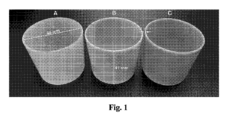
第1の例は、壁厚が1mmのカップ状の製品である。カップの高さは41mm、直径は約45mmである。図1は、木材繊維の含有量が変化する3つのサンプルの写真を示している。この図は、木材繊維の含有量が10w%(A)、20w%(B)および30w%(C)の薄壁カップ状製品の例を示している。製品の物理的測定値は写真に記されている。この製品の木材繊維のサイズは0.5mm以下であった。第1の試験は、50°Cの強制対流オーブン内のウォーターバスにサンプルを浸すことによって実施された。結果は、木材繊維の添加が熱変形抵抗の大幅な改善につながることを明確に示している。 The first example is a cup-shaped product with a wall thickness of 1 mm. The cup has a height of 41 mm and a diameter of about 45 mm. Figure 1 shows photographs of three samples with varying wood fiber content. The figure shows examples of thin-walled cup-shaped products with wood fiber contents of 10 w% (A), 20 w% (B) and 30 w% (C). The physical measurements of the product are noted on the photograph. The size of the wood fibers in this product was less than 0.5 mm. The first test was carried out by immersing the samples in a water bath in a forced convection oven at 50°C. The results clearly show that the addition of wood fibers leads to a significant improvement in heat distortion resistance.
図2にサンプル間の違いを示す。この図は、50°Cで15日間水浴に浸した後の薄壁のカップ状の製品を示している。木材繊維を含有しないサンプルでは、大きな熱変形が見られる(A)。10w%(B)の木材繊維を含有するサンプルでも小さな変形が見られる。20w%(C)および30w%(D)の木材繊維を含有するサンプルは、その形状を維持している。 The differences between the samples are shown in Figure 2. It shows a thin-walled cup-shaped product after immersion in a water bath at 50°C for 15 days. The sample with no wood fibre shows large thermal deformation (A). The sample with 10w% wood fibre (B) also shows small deformation. The samples with 20w% (C) and 30w% (D) wood fibre maintain their shape.
表1に、これらの材料の吸水率を示す。 Table 1 shows the water absorption rates of these materials.
表1:壁厚1mmのカップ状製品の吸水率。サンプルは50°Cの水に浸した。 Table 1: Water absorption rate of a cup-shaped product with a wall thickness of 1 mm. The sample was immersed in water at 50°C.
総移行試験(EN1186-9およびEN1186-14に準拠)は、さまざまな模擬物質にさらされたときの薄壁のカップ状製品の不活性を研究するために実施された。試験で使用された模擬物質は、10%エタノール(EtOH)、50%EtOH、95%EtOH、および3%酢酸であった。親水性を有し、親水性物質を抽出可能な食品は、10%のEtOHと3%の酢酸に割り当てられ、一方50%のEtOHは、親油性を有し、親油性の物質(牛乳など)を抽出できる食品に割り当てられる。脂肪の多い食品は、95%エタノールを模擬物質として使用して模擬化された。試験は40°Cで10日間続いた。これは、室温以下での長期保管に相当する。また、最大70°Cで最大2時間の加熱、または最大100°Cで最大15分の加熱も含まれる。カップ状製品の総移行結果を表2に示す。 Total migration tests (according to EN 1186-9 and EN 1186-14) were carried out to study the inertness of thin-walled cup-shaped products when exposed to various simulants. The simulants used in the tests were 10% ethanol (EtOH), 50% EtOH, 95% EtOH, and 3% acetic acid. Foods that have hydrophilic properties and can extract hydrophilic substances are assigned to 10% EtOH and 3% acetic acid, while 50% EtOH is assigned to foods that have lipophilic properties and can extract lipophilic substances (such as milk). Fatty foods were simulated using 95% ethanol as simulant. The tests lasted for 10 days at 40°C, which corresponds to long-term storage below room temperature. It also included heating up to 70°C for up to 2 hours or up to 100°C for up to 15 minutes. The total migration results for the cup-shaped products are shown in Table 2.
表2:さまざまな木材含有量を有するカップ状製品(N=3)の総移行結果。食品接触を目的としたプラスチック材料に関する規制(EC)10/2011によると、総移行量は10mg/dm2を超えるべきでない。総移行制限を超える場合、数字は斜体で表記される。 Table 2: Total migration results for cup-shaped products (N=3) with different wood contents. According to Regulation (EC) 10/2011 on plastic materials intended for food contact, the total migration should not exceed 10 mg/ dm2 . If the total migration limit is exceeded, the numbers are written in italics.
表2の結果は、薄壁のバイオコンポジット製品は、最大70oCまたは100oCの2時間または15分間の長期保管または短期加熱には適していない場合があり得ることを示している。ただし、これらの製品は、食品との短期間の接触が発生する用途で引き続き使用され得る。これらの用途の例には、ミルクまたはジュースの容器または飲料用ストローのキャップが含まれる。ストローが、2021年までに使い捨てプラスチック以外の材料で作らなければならない製品としてEUによってリストされたことは注目に値する。 The results in Table 2 show that thin-walled biocomposite products may not be suitable for long-term storage or short-term heating up to 70oC or 100oC for 2 hours or 15 minutes. However, these products may still be used in applications where short-term contact with food occurs. Examples of these applications include caps for milk or juice containers or drinking straws. It is worth noting that straws have been listed by the EU as products that must be made from materials other than single-use plastic by 2021.
総移行試験は、10w%の木材粒子および2w%のPLAベースの白色マスターバッチまたは0.5w%のPLAベースの赤いマスターバッチを含有するサンプルに対しても実施された。試験の結果は表3にまとめられている。結果は、これらの色の追加が材料の移行特性に影響を与えないことを裏付けている。 Total migration tests were also performed on samples containing 10 w% wood particles and 2 w% PLA-based white masterbatch or 0.5 w% PLA-based red masterbatch. The results of the tests are summarized in Table 3. The results confirm that the addition of these colors does not affect the migration properties of the material.
表3:10w%の木材とさまざまなPLAベースのマスターバッチ含有量とのカップ状製品(N=3)の総移行結果。食品接触を目的としたプラスチック材料に関する規制(EC)10/2011によると、総移行量は10mg/dm2を超えるべきではない。 Table 3: Total migration results for cup-shaped products (N=3) with 10 w% wood and various PLA-based masterbatch contents. According to Regulation (EC) 10/2011 on plastic materials intended for food contact, the total migration should not exceed 10 mg/ dm2 .
示差走査熱量測定(DSC)分析は、0、10、および20w%の木材を含有するサンプルで実施され、木材の添加が材料の結晶化挙動に影響を与えるかどうかを調査した。結果(図3)は、木材の添加が材料の低温結晶化時間の短縮につながることを明確に示している。図3は、一定の加熱速度(10°C/min)での材料の低温結晶化温度に対する木材含有量の影響を示している。 Differential scanning calorimetry (DSC) analysis was carried out on samples containing 0, 10, and 20 w% wood to investigate whether the addition of wood affects the crystallization behavior of the material. The results (Figure 3) clearly show that the addition of wood leads to a reduction in the cold crystallization time of the material. Figure 3 shows the effect of wood content on the cold crystallization temperature of the material at a constant heating rate (10°C/min).
図3は、結晶化温度の低下を示している。Tgが過ぎた直後に低温結晶化が始まるが、この種の組成のエンタルピー変化が検出限界を下回っているためである。 Figure 3 shows the decrease in crystallization temperature, as cold crystallization begins shortly after the Tg is passed, and the enthalpy change for this type of composition is below the detection limit.
図4は、材料の低温結晶化温度に対する加熱速度の影響を示している。表示されるように、図4は、結晶化温度が加熱速度の関数として低下したことを示している。結晶化速度の低下は、木材の添加が材料の不均一な核形成を増加させ(つまり、木材繊維がポリマーの「不純物」として機能する)、ポリマーの核形成に必要なエネルギー量を減少させるという事実によるものである。これらの結果は、複合材料の生分解プロセスを加速するのは木材繊維の親水性と膨潤挙動であるだけでなく、複合材料構造への水の浸透を加速する核形成挙動の変化でもあることを意味する。 Figure 4 shows the effect of heating rate on the cold crystallization temperature of the material. As shown, Figure 4 shows that the crystallization temperature decreased as a function of heating rate. The decrease in crystallization rate is due to the fact that the addition of wood increases the heterogeneous nucleation of the material (i.e., the wood fibers act as "impurities" to the polymer) and reduces the amount of energy required for polymer nucleation. These results imply that it is not only the hydrophilicity and swelling behavior of the wood fibers that accelerates the biodegradation process of the composite, but also the change in nucleation behavior that accelerates the penetration of water into the composite structure.
木材繊維を含有しない材料、およびチップサイズが0.5mm未満の木粉を含有する材料(20w%)の機械的特性を、ISO527、ISO178、およびISO179に従って決定した。 The mechanical properties of materials containing no wood fibres and materials containing wood flour (20 w%) with chip size less than 0.5 mm were determined according to ISO 527, ISO 178 and ISO 179.
結果(表4)は、木材を含有しない材料と比較した場合、木材繊維の添加後の材料の弾性率が大幅に改善されたことを示している。堆肥化性と吸水挙動の改善に加えて、木材繊維を含めることで材料の延性も改善される。シャルピー衝撃強度と引張ひずみの低下は、木材繊維の添加により材料がより脆くなることを示している。これは、例えば材料を堆肥化するとき、材料をより小さな断片に機械的に分解しやすく、その結果、堆肥化と分解の速度が加速するため、利点と見なされ得る。 The results (Table 4) show that the modulus of the material after the addition of wood fibres is significantly improved when compared to the material without wood content. In addition to improving the compostability and water absorption behaviour, the inclusion of wood fibres also improves the ductility of the material. The reduction in Charpy impact strength and tensile strain indicates that the addition of wood fibres makes the material more brittle. This can be seen as an advantage, for example when composting the material, as it is easier to mechanically break down the material into smaller pieces, thus accelerating the rate of composting and decomposition.
表4:チップサイズが0.5mm未満の木材粒子を0w%および20w%含むサンプルの機械的特性。 Table 4: Mechanical properties of samples containing 0 wt% and 20 wt% wood particles with chip size less than 0.5 mm.
PLA、25w%の木材繊維(チップサイズ0.5mm未満)および2~4w%のさまざまな添加剤を含有する薄壁のカップ状サンプル(図1)の耐水性は、サンプルを水に浸して室温での室内試験で決定される。サンプルの組成を表5に示す。 The water resistance of thin-walled cup-shaped samples (Figure 1) containing PLA, 25 w% wood fibres (chip size less than 0.5 mm) and 2-4 w% of various additives is determined in laboratory tests at room temperature by immersing the samples in water. The composition of the samples is shown in Table 5.
表5:吸水試験で使用された薄壁(1mm)のカップ状サンプルの組成。
Table 5: Composition of thin-walled (1 mm) cup-shaped samples used in water absorption tests.
サンプルの重量増加、崩壊、膨潤および美的特性を追跡した。表6は、サンプルの耐水性に対する添加剤の影響を示している。 The weight gain, disintegration, swelling and aesthetic properties of the samples were tracked. Table 6 shows the effect of additives on the water resistance of the samples.
表6:薄壁のカップ状サンプルの水浸試験の結果。参照サンプル(サンプル番号1)との違いは括弧内に示されている。 Table 6: Water immersion test results for thin-walled cup samples. Differences from the reference sample (sample no. 1) are shown in brackets.
表6に示す結果は、材料の耐水性に対する添加剤のプラスの効果を示す。最終的な目標は材料をできるだけ速く分解することであるが、分解速度を制御する機能を有することも重要である。これにより、さまざまな用途に応じて複合材料の特性を微調整することが可能である。これにより、一般的なプラスチックに代えてこの材料を使用し得る製品の数が増加する。 The results shown in Table 6 demonstrate the positive effect of the additive on the water resistance of the material. While the ultimate goal is to have the material degrade as quickly as possible, it is also important to have the ability to control the degradation rate. This allows the properties of the composite to be fine-tuned for different applications. This increases the number of products in which the material can be used to replace common plastics.
組成物の加工性(表5)もまた、射出成形プロセス中に観察された。添加剤の添加により、材料の加工性が大幅に向上した。図5は、添加剤を含有しないサンプル(サンプル番号1)と添加剤を含有するサンプル(サンプル番号2~9)との繊維分布の違いを示している。組成物にアミドベースの添加剤を含むと、製品中の繊維の凝集が減少することがはっきりとわかる。2w%のMA-PLAを含有するサンプルでは、同様の向上は観察され得なかった。これは、MA-PLAがカップリング剤としてのみ機能する、つまり、天然繊維とポリマーマトリックスとの間に化学結合を形成するためである。カップリング剤は、材料の摩擦に影響を及ぼさない、すなわち、それらは潤滑効果を有さないのが一般的である。したがって、潤滑剤と組み合わせてMA-PLAを含有する組成物が試験され(サンプル9)、それによりサンプル内の繊維のより均一な分布がもたらされた。 The processability of the composition (Table 5) was also observed during the injection molding process. The addition of the additive significantly improved the processability of the material. Figure 5 shows the difference in fiber distribution between the sample without additive (sample no. 1) and the samples with additive (sample nos. 2-9). It can be clearly seen that the inclusion of the amide-based additive in the composition reduces the aggregation of fibers in the product. A similar improvement could not be observed in the sample containing 2 wt.% MA-PLA. This is because MA-PLA acts only as a coupling agent, i.e. it forms a chemical bond between the natural fibers and the polymer matrix. Coupling agents generally do not affect the friction of the material, i.e. they do not have a lubricating effect. Therefore, a composition containing MA-PLA in combination with a lubricant was tested (sample 9), which resulted in a more uniform distribution of fibers in the sample.
加工性の向上は、射出成形パラメータでも観察された。すなわち、潤滑剤を含有しない組成物(サンプル1および8)は、製品を製造するために約1500~1600barの注入圧力を必要としたが、潤滑剤を含有するサンプル(サンプル2~7および9)は、約20%低い圧力(1200~1300bar)を必要とした。圧力が低いということは、添加剤を含有する材料の場合、プロセス中に発生する摩擦が少ないことをも示している。これにより、塊の摩擦熱負荷がより低くなり、機械内の塊の滞留時間が短くなるため、天然繊維に熱劣化を引き起こすことなく、プロセスでより高い温度を使用できるようになる。処理温度が高くなると、塊の粘度が低下し、生産量が増加する。上記の観察に加えて、潤滑剤を含有するサンプルは、金型から排出されやすく、本発明で提示された添加剤が離型剤としても作用したことを示している。 Improved processability was also observed in the injection molding parameters: the compositions without lubricant (samples 1 and 8) required injection pressures of about 1500-1600 bar to produce the product, while the lubricant-containing samples (samples 2-7 and 9) required about 20% lower pressures (1200-1300 bar). The lower pressure also indicates that less friction occurs during the process for the additive-containing material. This results in a lower frictional heat load on the mass and a shorter residence time of the mass in the machine, allowing the use of higher temperatures in the process without causing thermal degradation of the natural fibers. Higher processing temperatures reduce the mass viscosity and increase the production rate. In addition to the above observations, the lubricant-containing samples were easier to eject from the mold, indicating that the additive presented in this invention also acted as a mold release agent.
さまざまな材料のMFRは、ISO1133に従って決定された。190oC/2.16kgでのPLAのMFRは22.9g/10minであったが、PLA+20w%木材粒子(粒子サイズ0.5mm未満)およびPLA+40w%木材粒子に対応する値は、それぞれ17.0g/10minおよび7.8g/10minであった。 The MFR of the various materials was determined according to ISO 1133. The MFR of PLA at 190°C/2.16 kg was 22.9 g/10 min, while the corresponding values for PLA + 20 wt% wood particles (particle size <0.5 mm) and PLA + 40 wt% wood particles were 17.0 g/10 min and 7.8 g/10 min, respectively.
材料の密度もまた、特に生分解性材料を考慮する場合に重要な指標である。通常、生分解性ポリマーは、水および最も一般的に使用されるプラスチックよりも高い密度を有する(水の密度は1.0g/cm3であり、一般的なプラスチックの密度は通常1.0g/cm3未満である)。これらの物質が水生環境(湖や海など)に巻き込まれると、水面に蓄積するのではなく沈下する。沈下材料は、水面に残る材料よりも海および湖でより効率的に分解される可能性が高い。 The density of the material is also an important indicator, especially when considering biodegradable materials. Typically, biodegradable polymers have a higher density than water and most commonly used plastics (water has a density of 1.0 g/ cm3 , while the density of common plastics is usually less than 1.0 g/ cm3 ). When these materials are caught in an aquatic environment (such as a lake or ocean), they sink rather than accumulating at the surface. Sinking materials are likely to degrade more efficiently in oceans and lakes than materials that remain at the surface.
本発明で提示される材料の密度が決定された。PLAの密度は1.287g/cm3であったが、20w%の木材を含有するPLAの密度は1.272g/cm3であった。これは、密度の低下に関係なく、木材の添加が材料の沈下性に悪影響を及ぼさないことを示している。 The density of the materials presented in this invention was determined. The density of PLA was 1.287 g/ cm3 , while the density of PLA containing 20 w% wood was 1.272 g/ cm3 . This shows that the addition of wood does not adversely affect the sinkability of the material, regardless of the decrease in density.
第2の例は、壁厚が0.3mm以上の押出製品である。製品の木材含有量は10w%~20w%の間で変動し、生体ポリマー含有量は70w%~90w%の間で変動する。この製品は、プラスチックストローを置換する飲料用ストローとして使用することを目的としている。製品を図6に示す。上記のカップ状の製品と同様に、ストローの総移行値は、EN1186-9およびEN1186-14に従って決定された。ストローの使用期間は非常に短いため、試験期間は40oCで6時間および24時間に短縮された。これは、EU規則No10/2011に規定されている要件に準拠している。表7は、40oCで6時間実施した試験の結果を示し、表8は、40oCで24時間実施した試験の結果を示している。木材チップを含有するストローの水浸は、純粋な生体ポリマーストローと比較して大幅に増加した(表9および10)。 The second example is an extruded product with a wall thickness of 0.3 mm or more. The wood content of the product varies between 10 w% and 20 w% and the biopolymer content between 70 w% and 90 w%. The product is intended for use as a drinking straw to replace plastic straws. The product is shown in Figure 6. As with the cup-shaped product described above, the total migration values of the straw were determined according to EN 1186-9 and EN 1186-14. Due to the very short life span of the straw, the test periods were reduced to 6 and 24 hours at 40oC. This complies with the requirements laid down in EU Regulation No 10/2011. Table 7 shows the results of the test carried out at 40oC for 6 hours and Table 8 shows the results of the test carried out at 40oC for 24 hours. The water soaking of the straws containing wood chips was significantly increased compared to the pure biopolymer straws (Tables 9 and 10).
表7:さまざまな木材含有量の薄壁ストロー(N=3)の総移行結果(6時間、40oC)。食品接触を目的としたプラスチック材料に関する規制(EC)10/2011によると、総移行量は10mg/dm2を超えるべきではない。 Table 7: Total migration results (6h, 40°C) for thin-walled straws (N=3) with different wood contents. According to Regulation (EC) 10/2011 on plastic materials intended for food contact, the total migration should not exceed 10mg/ dm2 .
表8:さまざまな木材含有量の薄壁ストロー(N=3)の総移行結果(24時間、40oC)。食品接触を目的としたプラスチック材料に関する規制(EC)10/2011によると、総移行量は10mg/dm2を超えるべきではない。 Table 8: Total migration results for thin-walled straws (N=3) with different wood contents (24h, 40°C). According to Regulation (EC) 10/2011 on plastic materials intended for food contact, the total migration should not exceed 10mg/ dm2 .
表7および8の結果は、どの模擬物質でも移行限界を超えていないことを示しており、この特定の用途に対するこの材料の食品接触承認を裏付けている。 The results in Tables 7 and 8 show that migration limits were not exceeded for any of the simulants, supporting food contact approval of this material for this particular application.
薄壁押出製品の熱特性も、射出成形製品と同様の方法で測定された。結果は両方の材料で同様であった。つまり、木材繊維を追加すると、材料の低温結晶化時間が短縮される。 The thermal properties of the thin-walled extruded products were also measured in a similar manner to the injection-molded products. The results were similar for both materials; that is, the addition of wood fibers shortens the cold crystallization time of the material.
押出材料(木材含有量10w%および20w%)の機械的試験は、パイプ状の製品と押出パイプから切り出されたフィルムとの両方に対して実施された。また、市販品との比較のため、市販の紙・プラスチック(PP/PE)ストローについても試験を実施した。表9に、引張試験の結果を示す。 Mechanical testing of the extruded materials (10w% and 20w% wood content) was performed on both the pipe products and the films cut from the extruded pipes. Tests were also performed on commercial paper-plastic (PP/PE) straws for comparison with commercial products. Table 9 shows the results of the tensile tests.
表9:2つの異なるフィルム(N=5)とすでに市販されているストロー材料の引張試験(23°C、3N/min)の結果。 Table 9: Results of tensile tests (23°C, 3 N/min) on two different films (N=5) and a commercially available straw material.
表9の結果は、市販の非分解性製品は、生分解性組成物と比較した場合、より優れた弾性特性を持っていることを示している。それにもかかわらず、生分解性複合材料で同様のレベルの強度が達成され、生分解性材料が同じ用途で利用され得ることを示している。紙ストローから切り出されたフィルムと比較すると、紙から作られた製品は弾性挙動を示さないため、かなりの違いが見られ得る(ヤング率または降伏強度は決定できなかった)。 The results in Table 9 show that the commercially available non-degradable products have better elastic properties when compared to the biodegradable compositions. Nevertheless, similar levels of strength were achieved with the biodegradable composites, indicating that biodegradable materials can be utilized in the same applications. When compared to the film cut from paper straws, a significant difference can be seen as the product made from paper does not exhibit elastic behavior (Young's modulus or yield strength could not be determined).
表10に、10w%および20w%の木粉を含有する材料の曲げ試験の結果を示す。射出成形製品で行われた観察と同様に、木材を追加すると、材料の延性がより高くなる。つまり、材料を曲げるのにより多くの力が必要になる。ただし、木材の含有量を減らすと、材料を破壊するためにより多くの力が必要になる。 Table 10 shows the results of bending tests on materials containing 10w% and 20w% wood flour. Similar to the observations made with injection moulded products, adding wood makes the material more ductile, i.e. more force is required to bend the material. However, reducing the wood content requires more force to break the material.
表10:木材含有量が10w%および20w%の材料の曲げ試験の結果。試験は、ISO178に従って、80mmのサンプル、64mmのスパンで、r=5mmのツールを使用して実施された。曲げ速度は2mm/minであった。 Table 10: Bending test results for materials with 10w% and 20w% wood content. Tests were performed according to ISO 178 with 80mm samples, 64mm span, and a tool with r=5mm. The bending speed was 2mm/min.
射出成形製品と同様に、押出材料の特性は、さまざまな添加剤、生分解性ポリマーの混合物、および天然繊維を添加することにより、用途の要件に応じて変更され得る。これらの試験の結果は、この材料が飲料用ストローなどの使い捨て製品に適していることを示している。 As with injection molded products, the properties of the extruded material can be modified depending on the application requirements by adding various additives, mixtures of biodegradable polymers, and natural fibers. The results of these tests indicate that the material is suitable for disposable products such as drinking straws.
図6は、押出によって製造された薄壁のパイプ状の製品を示している。写真には製品の壁厚が記載されている。薄壁押出製品の吸水率(図6)は、サンプルをウォーターバスに4か月間浸漬することによって測定された。試験に使用した組成を表11に示す。試験の結果を表12に示す。 Figure 6 shows a thin-walled pipe-shaped product produced by extrusion. The wall thickness of the product is indicated on the photograph. The water absorption of the thin-walled extruded product (Figure 6) was measured by immersing the samples in a water bath for four months. The compositions used in the test are shown in Table 11. The results of the test are shown in Table 12.
表11:吸水試験で使用された薄壁(1mm)押出製品の組成。 Table 11: Composition of thin-walled (1 mm) extruded products used in water absorption testing.
表12:薄壁押出製品の水浸試験の結果。 Table 12: Water immersion test results for thin-walled extrusion products.
射出成形サンプルの結果が示したように、木材繊維の含有量が増えると吸水率が高くなる。これは、生分解性が懸念される場合の重要な長所である。親水性成分を含まない生分解性ポリマーの吸水率は低いままであった。これにより、これらの材料が水中でゆっくりと分解する理由が説明されている。 As the results for the injection-molded samples showed, increasing wood fiber content leads to higher water absorption, an important advantage when biodegradability is concerned. Water absorption for biodegradable polymers without hydrophilic components remained low, which explains why these materials degrade slowly in water.
本発明による材料、ならびに上記の実施形態は、例えば、化粧品、食品(冷・温)および飲料(炭酸および非炭酸)用の容器(ジャー、ボトル、チューブなど)として多数の用途を見出す。また、温飲料や冷飲料のコップ、皿、ボウル、使い捨てカトラリー、食品トレイ、ボトルや容器のキャップやクロージャー、飲料用ストロー、衣服ハンガー、3D印刷などにも利用され得る。本組成物は、射出ブロー成形または押出によって処理され得る。 The materials according to the invention, as well as the embodiments described above, find numerous applications, for example, as containers (jars, bottles, tubes, etc.) for cosmetics, food (hot and cold) and beverages (carbonated and non-carbonated). They may also be utilized in hot and cold beverage cups, plates, bowls, disposable cutlery, food trays, bottle and container caps and closures, drinking straws, clothes hangers, 3D printing, etc. The compositions may be processed by injection blow molding or extrusion.
Claims (26)
前記マトリックス内に分布する、1.0mm未満のふるい分けサイズを有する親水性天然繊維材料の粒子と、を備え、
前記熱可塑性ポリマーと前記親水性天然繊維材料の粒子との重量比は99:1~35:65であり、
加工前の前記親水性天然繊維の含水量は前記親水性天然繊維の総重量から計算して2%未満であり、
前記生分解性ポリマーまたは前記生体ポリマーの含水量は、前記生分解性ポリマーまたは前記生体ポリマーの総重量から計算して0.05%未満である、組成物。 a continuous thermoplastic polymer matrix having a melting point above 110° C., said thermoplastic polymer being a biodegradable polymer or a biopolymer;
particles of hydrophilic natural fibrous material having a sieve size of less than 1.0 mm distributed within said matrix;
a weight ratio of said thermoplastic polymer to said particles of said hydrophilic natural fiber material is between 99:1 and 35:65;
the moisture content of the hydrophilic natural fibers before processing is less than 2% calculated based on the total weight of the hydrophilic natural fibers;
A composition, wherein the water content of the biodegradable polymer or biopolymer is less than 0.05%, calculated from the total weight of the biodegradable polymer or biopolymer.
前記熱可塑性ポリマーと前記木材粒子との重量比は、65:35~95:5である、請求項1から8のいずれか一項に記載の組成物。 the particles of hydrophilic natural fibre material are wood particles;
The composition according to any one of claims 1 to 8, wherein the weight ratio of said thermoplastic polymer to said wood particles is from 65:35 to 95:5.
粒子、または
天然染料、または
それらの混合物、
をさらに含有する、請求項12または13に記載の組成物。 The composite material comprises:
particles, or natural dyes, or mixtures thereof,
The composition according to claim 12 or 13 , further comprising:
Applications Claiming Priority (3)
| Application Number | Priority Date | Filing Date | Title |
|---|---|---|---|
| FI20186033 | 2018-12-02 | ||
| FI20186033A FI20186033A1 (en) | 2018-12-02 | 2018-12-02 | Compostable wood composite material for thin-walled articles |
| PCT/FI2019/050863 WO2020115363A1 (en) | 2018-12-02 | 2019-12-02 | Compostable wood composite material for thin-walled articles |
Publications (2)
| Publication Number | Publication Date |
|---|---|
| JP2022510991A JP2022510991A (en) | 2022-01-28 |
| JP7621654B2 true JP7621654B2 (en) | 2025-01-27 |
Family
ID=68887063
Family Applications (1)
| Application Number | Title | Priority Date | Filing Date |
|---|---|---|---|
| JP2021531337A Active JP7621654B2 (en) | 2018-12-02 | 2019-12-02 | Compostable wood composites for thin-walled products |
Country Status (9)
| Country | Link |
|---|---|
| US (1) | US12421389B2 (en) |
| EP (1) | EP3887267A1 (en) |
| JP (1) | JP7621654B2 (en) |
| KR (1) | KR102809054B1 (en) |
| CN (1) | CN113272230B (en) |
| AU (1) | AU2019394809A1 (en) |
| CA (1) | CA3116964A1 (en) |
| FI (1) | FI20186033A1 (en) |
| WO (1) | WO2020115363A1 (en) |
Families Citing this family (10)
| Publication number | Priority date | Publication date | Assignee | Title |
|---|---|---|---|---|
| US20220056262A1 (en) * | 2020-08-21 | 2022-02-24 | United Arab Emirates University | Biodegradgradable devices, and methods of making the same |
| CN116438236A (en) * | 2020-09-24 | 2023-07-14 | 罗地亚巴西有限公司 | Compositions and methods for improving the marine biodegradability of polymer compositions |
| FI131323B1 (en) * | 2020-10-02 | 2025-02-20 | Woodly Oy | Co-extruded multi-layered cellulose-based film and a method for its manufacture |
| WO2022163117A1 (en) | 2021-01-27 | 2022-08-04 | パナソニックIpマネジメント株式会社 | Composite resin molded article and method for producing same |
| EP4049689A1 (en) | 2021-02-25 | 2022-08-31 | Dentsply IH AB | Medical device with substrate comprising natural fibers |
| CN113337088B (en) * | 2021-07-13 | 2022-10-18 | 山东瑞丰高分子材料股份有限公司 | Preparation method of composite degradable plastic material for injection molding |
| KR20240043759A (en) | 2021-07-16 | 2024-04-03 | 씨게 비오콤포지트 애페에스 | Biodegradable Composite Articles |
| CN116135943A (en) * | 2021-11-17 | 2023-05-19 | 上海隶海实业有限公司 | Preparation method of a degradable plant-based composite polyester hot-melt adhesive |
| CN119180133B (en) * | 2024-08-27 | 2025-10-31 | 天津大学 | A method for dynamically realizing changes in microbial communities on microplastic surfaces during environmental migration |
| CN121713790B (en) * | 2026-02-13 | 2026-04-17 | 都佰城新材料技术(上海)有限公司 | PHA-based blocking pore synergistic pot seedling cup suitable for natural compost treatment and preparation method and application thereof |
Citations (6)
| Publication number | Priority date | Publication date | Assignee | Title |
|---|---|---|---|---|
| JP2004359939A (en) | 2003-05-15 | 2004-12-24 | Dainichiseika Color & Chem Mfg Co Ltd | Biodegradable resin composition and processed article thereof |
| JP2005146261A (en) | 2003-10-20 | 2005-06-09 | Toray Ind Inc | Injection molded product |
| JP2008037022A (en) | 2006-08-08 | 2008-02-21 | Chuniti Seiko Kk | Case injection molding method for lignocellulosic resin composition and lignocellulosic resin composition |
| JP2010270290A (en) | 2008-08-08 | 2010-12-02 | Kao Corp | Biodegradable resin composition |
| JP2014015531A (en) | 2012-07-09 | 2014-01-30 | Sumika Color Kk | Discoloring resin composition and discoloring resin molding |
| JP2018154725A (en) | 2017-03-17 | 2018-10-04 | 株式会社リコー | Fiber-reinforced flame-retardant resin composition and molding |
Family Cites Families (24)
| Publication number | Priority date | Publication date | Assignee | Title |
|---|---|---|---|---|
| US2888323A (en) | 1955-12-13 | 1959-05-26 | Ca Nat Research Council | Production of active oxides of large specific surface area |
| US5738921A (en) | 1993-08-10 | 1998-04-14 | E. Khashoggi Industries, Llc | Compositions and methods for manufacturing sealable, liquid-tight containers comprising an inorganically filled matrix |
| JP3423094B2 (en) | 1995-01-19 | 2003-07-07 | 三井化学株式会社 | Biodegradable polymer composition |
| AU4717996A (en) * | 1995-02-16 | 1996-09-04 | Basf Aktiengesellschaft | Biodegradable polymers, process for producing them and their use in preparing biodegradable mouldings |
| US6168857B1 (en) | 1996-04-09 | 2001-01-02 | E. Khashoggi Industries, Llc | Compositions and methods for manufacturing starch-based compositions |
| JP3933315B2 (en) | 1997-08-19 | 2007-06-20 | 三井化学株式会社 | Composite resin composition |
| US6618939B2 (en) | 1998-02-27 | 2003-09-16 | Kabushiki Kaisha Miyake | Process for producing resonant tag |
| KR20030061675A (en) | 2002-01-11 | 2003-07-22 | 뉴 아이스 리미티드 | Biodegradable or compostable containers |
| JP2005014626A (en) | 2003-06-23 | 2005-01-20 | Nippon Paint Co Ltd | How to improve night visibility on a bicycle |
| NZ530339A (en) | 2004-06-23 | 2007-01-26 | Nz Forest Research Inst Ltd | Method for producing wood fibre pellets |
| BRPI0600683A (en) | 2006-02-24 | 2007-11-20 | Phb Ind Sa | environmentally degradable polymer composition and its process of obtaining |
| US8443520B2 (en) | 2008-09-09 | 2013-05-21 | Kyle Viereck | Device for stripping sheathing on unbonded post-tensioning tendons |
| CN101429328A (en) | 2008-12-02 | 2009-05-13 | 深圳市阳成世纪科技有限公司 | Material for producing natural degradable deep-cavity thin-wall soft bottle for tableware and soft bottle thereof |
| FI125448B (en) * | 2009-03-11 | 2015-10-15 | Onbone Oy | New materials |
| EP2418064B1 (en) | 2009-06-18 | 2014-04-30 | Michio Komatsu | Thin container production method |
| US9243128B2 (en) | 2009-12-11 | 2016-01-26 | Kao Corporation | Composite material |
| JP2013067681A (en) | 2011-09-20 | 2013-04-18 | Fuji Xerox Co Ltd | Wood powder-containing material, method of manufacturing the same, and compact |
| JP5356582B2 (en) | 2011-12-28 | 2013-12-04 | 花王株式会社 | Polyester resin composition |
| CN102746628B (en) | 2012-07-23 | 2014-12-24 | 惠州健昇吸塑制造有限公司 | Biodegradable temperature resistant material containing fiber base and polylactic acid and preparation method thereof |
| WO2014029692A2 (en) | 2012-08-24 | 2014-02-27 | Basf Se | Polymer mixtures for the production of thin-walled injection molded parts |
| SE539616C2 (en) | 2016-02-12 | 2017-10-17 | Stora Enso Oyj | Methods for making paper or board, a board tray and fibrous particles coated with foamable polymer for use in the same |
| PL418134A1 (en) | 2016-07-29 | 2018-02-12 | 3 Spare Spółka Z Ograniczoną Odpowiedzialnością | WPC that contains dust from a particle board, method for producing it and applications |
| US10323144B2 (en) | 2017-01-31 | 2019-06-18 | The United States Of America, As Represented By The Secretary Of Agriculture | Biodegrable cardstock composition |
| FI127576B (en) | 2017-03-02 | 2018-09-14 | Sulapac Oy | Novel materials for packaging |
-
2018
- 2018-12-02 FI FI20186033A patent/FI20186033A1/en unknown
-
2019
- 2019-12-02 AU AU2019394809A patent/AU2019394809A1/en not_active Abandoned
- 2019-12-02 JP JP2021531337A patent/JP7621654B2/en active Active
- 2019-12-02 CA CA3116964A patent/CA3116964A1/en active Pending
- 2019-12-02 CN CN201980079708.1A patent/CN113272230B/en active Active
- 2019-12-02 KR KR1020217020476A patent/KR102809054B1/en active Active
- 2019-12-02 WO PCT/FI2019/050863 patent/WO2020115363A1/en not_active Ceased
- 2019-12-02 EP EP19820818.3A patent/EP3887267A1/en active Pending
- 2019-12-02 US US17/298,834 patent/US12421389B2/en active Active
Patent Citations (6)
| Publication number | Priority date | Publication date | Assignee | Title |
|---|---|---|---|---|
| JP2004359939A (en) | 2003-05-15 | 2004-12-24 | Dainichiseika Color & Chem Mfg Co Ltd | Biodegradable resin composition and processed article thereof |
| JP2005146261A (en) | 2003-10-20 | 2005-06-09 | Toray Ind Inc | Injection molded product |
| JP2008037022A (en) | 2006-08-08 | 2008-02-21 | Chuniti Seiko Kk | Case injection molding method for lignocellulosic resin composition and lignocellulosic resin composition |
| JP2010270290A (en) | 2008-08-08 | 2010-12-02 | Kao Corp | Biodegradable resin composition |
| JP2014015531A (en) | 2012-07-09 | 2014-01-30 | Sumika Color Kk | Discoloring resin composition and discoloring resin molding |
| JP2018154725A (en) | 2017-03-17 | 2018-10-04 | 株式会社リコー | Fiber-reinforced flame-retardant resin composition and molding |
Also Published As
| Publication number | Publication date |
|---|---|
| US12421389B2 (en) | 2025-09-23 |
| WO2020115363A1 (en) | 2020-06-11 |
| KR102809054B1 (en) | 2025-05-15 |
| CN113272230A (en) | 2021-08-17 |
| AU2019394809A1 (en) | 2021-06-10 |
| CN113272230B (en) | 2023-10-20 |
| CA3116964A1 (en) | 2020-06-11 |
| KR20210098506A (en) | 2021-08-10 |
| BR112021010502A2 (en) | 2021-08-24 |
| EP3887267A1 (en) | 2021-10-06 |
| JP2022510991A (en) | 2022-01-28 |
| US20220033648A1 (en) | 2022-02-03 |
| FI20186033A1 (en) | 2020-06-03 |
Similar Documents
| Publication | Publication Date | Title |
|---|---|---|
| KR102809054B1 (en) | Compostable wood composite material for thin-walled articles | |
| CN1277882C (en) | Ternary mixture of biodegradable polyesters and products obtained therefrom | |
| KR102771045B1 (en) | Biodegradable wood composites | |
| AU2020322110B2 (en) | Flexible wood composite material | |
| US11504878B2 (en) | Materials for packaging | |
| WO2024013432A1 (en) | Flexible multi-layer composite material | |
| JP7484343B2 (en) | Molding composition and molded body | |
| KR20220075392A (en) | Hemp polymer material and manufacturing method thereof | |
| FI130888B1 (en) | High heat resistant, biodegradable materials for injection molding | |
| BR112021010502B1 (en) | COMPOSTABLE WOOD COMPOSITE MATERIAL FOR THIN-WALLED ITEMS | |
| BR112022001477B1 (en) | FLEXIBLE WOOD COMPOSITE MATERIAL | |
| WO2022160046A1 (en) | Compositions for making biodegradable plastic |
Legal Events
| Date | Code | Title | Description |
|---|---|---|---|
| A621 | Written request for application examination |
Free format text: JAPANESE INTERMEDIATE CODE: A621 Effective date: 20221026 |
|
| A977 | Report on retrieval |
Free format text: JAPANESE INTERMEDIATE CODE: A971007 Effective date: 20231124 |
|
| A131 | Notification of reasons for refusal |
Free format text: JAPANESE INTERMEDIATE CODE: A131 Effective date: 20231226 |
|
| A521 | Request for written amendment filed |
Free format text: JAPANESE INTERMEDIATE CODE: A523 Effective date: 20240325 |
|
| A131 | Notification of reasons for refusal |
Free format text: JAPANESE INTERMEDIATE CODE: A131 Effective date: 20240702 |
|
| A521 | Request for written amendment filed |
Free format text: JAPANESE INTERMEDIATE CODE: A523 Effective date: 20240910 |
|
| TRDD | Decision of grant or rejection written | ||
| A01 | Written decision to grant a patent or to grant a registration (utility model) |
Free format text: JAPANESE INTERMEDIATE CODE: A01 Effective date: 20241217 |
|
| A61 | First payment of annual fees (during grant procedure) |
Free format text: JAPANESE INTERMEDIATE CODE: A61 Effective date: 20250107 |
|
| R150 | Certificate of patent or registration of utility model |
Ref document number: 7621654 Country of ref document: JP Free format text: JAPANESE INTERMEDIATE CODE: R150 |