JP7621600B2 - Method for producing photocatalyst - Google Patents
Method for producing photocatalyst Download PDFInfo
- Publication number
- JP7621600B2 JP7621600B2 JP2020127359A JP2020127359A JP7621600B2 JP 7621600 B2 JP7621600 B2 JP 7621600B2 JP 2020127359 A JP2020127359 A JP 2020127359A JP 2020127359 A JP2020127359 A JP 2020127359A JP 7621600 B2 JP7621600 B2 JP 7621600B2
- Authority
- JP
- Japan
- Prior art keywords
- photocatalyst
- titanium oxide
- solution
- silica
- ppm
- Prior art date
- Legal status (The legal status is an assumption and is not a legal conclusion. Google has not performed a legal analysis and makes no representation as to the accuracy of the status listed.)
- Active
Links
- 239000011941 photocatalyst Substances 0.000 title claims description 42
- 238000004519 manufacturing process Methods 0.000 title claims description 20
- GWEVSGVZZGPLCZ-UHFFFAOYSA-N Titan oxide Chemical compound O=[Ti]=O GWEVSGVZZGPLCZ-UHFFFAOYSA-N 0.000 claims description 58
- VYPSYNLAJGMNEJ-UHFFFAOYSA-N Silicium dioxide Chemical compound O=[Si]=O VYPSYNLAJGMNEJ-UHFFFAOYSA-N 0.000 claims description 31
- MHAJPDPJQMAIIY-UHFFFAOYSA-N Hydrogen peroxide Chemical compound OO MHAJPDPJQMAIIY-UHFFFAOYSA-N 0.000 claims description 30
- OGIDPMRJRNCKJF-UHFFFAOYSA-N titanium oxide Inorganic materials [Ti]=O OGIDPMRJRNCKJF-UHFFFAOYSA-N 0.000 claims description 24
- XLYOFNOQVPJJNP-UHFFFAOYSA-N water Substances O XLYOFNOQVPJJNP-UHFFFAOYSA-N 0.000 claims description 20
- 239000006185 dispersion Substances 0.000 claims description 19
- BQCADISMDOOEFD-UHFFFAOYSA-N Silver Chemical compound [Ag] BQCADISMDOOEFD-UHFFFAOYSA-N 0.000 claims description 16
- 229910052709 silver Inorganic materials 0.000 claims description 16
- 239000004332 silver Substances 0.000 claims description 16
- 239000000377 silicon dioxide Substances 0.000 claims description 15
- 239000002131 composite material Substances 0.000 claims description 14
- 150000003839 salts Chemical class 0.000 claims description 12
- LLZRNZOLAXHGLL-UHFFFAOYSA-J titanic acid Chemical compound O[Ti](O)(O)O LLZRNZOLAXHGLL-UHFFFAOYSA-J 0.000 claims description 12
- 239000002244 precipitate Substances 0.000 claims description 11
- 239000012535 impurity Substances 0.000 claims description 8
- 238000001179 sorption measurement Methods 0.000 claims description 5
- 239000000126 substance Substances 0.000 claims description 5
- 150000003609 titanium compounds Chemical class 0.000 claims description 4
- 238000010438 heat treatment Methods 0.000 claims description 2
- 238000005406 washing Methods 0.000 claims description 2
- IKHGUXGNUITLKF-UHFFFAOYSA-N Acetaldehyde Chemical compound CC=O IKHGUXGNUITLKF-UHFFFAOYSA-N 0.000 description 26
- 239000000243 solution Substances 0.000 description 24
- 235000010215 titanium dioxide Nutrition 0.000 description 17
- 239000000203 mixture Substances 0.000 description 16
- 239000004408 titanium dioxide Substances 0.000 description 16
- 239000007788 liquid Substances 0.000 description 15
- 239000010419 fine particle Substances 0.000 description 14
- 238000000034 method Methods 0.000 description 14
- GEHJYWRUCIMESM-UHFFFAOYSA-L sodium sulfite Chemical compound [Na+].[Na+].[O-]S([O-])=O GEHJYWRUCIMESM-UHFFFAOYSA-L 0.000 description 14
- 230000000052 comparative effect Effects 0.000 description 11
- 239000002609 medium Substances 0.000 description 11
- 239000007864 aqueous solution Substances 0.000 description 10
- 239000011248 coating agent Substances 0.000 description 10
- 238000005516 engineering process Methods 0.000 description 10
- 239000012153 distilled water Substances 0.000 description 9
- 229920001817 Agar Polymers 0.000 description 8
- 239000008272 agar Substances 0.000 description 8
- 239000005416 organic matter Substances 0.000 description 8
- 239000000047 product Substances 0.000 description 8
- 239000010408 film Substances 0.000 description 7
- 239000002245 particle Substances 0.000 description 7
- 239000002994 raw material Substances 0.000 description 7
- CQLFBEKRDQMJLZ-UHFFFAOYSA-M silver acetate Chemical compound [Ag+].CC([O-])=O CQLFBEKRDQMJLZ-UHFFFAOYSA-M 0.000 description 7
- 229940071536 silver acetate Drugs 0.000 description 7
- 235000010265 sodium sulphite Nutrition 0.000 description 7
- 239000000725 suspension Substances 0.000 description 7
- 239000010936 titanium Substances 0.000 description 7
- 229910052719 titanium Inorganic materials 0.000 description 7
- RTAQQCXQSZGOHL-UHFFFAOYSA-N Titanium Chemical compound [Ti] RTAQQCXQSZGOHL-UHFFFAOYSA-N 0.000 description 6
- 230000001699 photocatalysis Effects 0.000 description 6
- 239000012266 salt solution Substances 0.000 description 6
- QGZKDVFQNNGYKY-UHFFFAOYSA-N Ammonia Chemical compound N QGZKDVFQNNGYKY-UHFFFAOYSA-N 0.000 description 5
- -1 alkoxy titanium Chemical compound 0.000 description 5
- 238000006243 chemical reaction Methods 0.000 description 5
- 229910052751 metal Inorganic materials 0.000 description 5
- 239000002184 metal Substances 0.000 description 5
- 238000002156 mixing Methods 0.000 description 5
- 239000007787 solid Substances 0.000 description 5
- XJDNKRIXUMDJCW-UHFFFAOYSA-J titanium tetrachloride Chemical compound Cl[Ti](Cl)(Cl)Cl XJDNKRIXUMDJCW-UHFFFAOYSA-J 0.000 description 5
- 238000004220 aggregation Methods 0.000 description 4
- 230000002776 aggregation Effects 0.000 description 4
- 239000003242 anti bacterial agent Substances 0.000 description 4
- 238000000576 coating method Methods 0.000 description 4
- 238000009833 condensation Methods 0.000 description 4
- 230000005494 condensation Effects 0.000 description 4
- 230000007613 environmental effect Effects 0.000 description 4
- 238000002360 preparation method Methods 0.000 description 4
- AKHNMLFCWUSKQB-UHFFFAOYSA-L sodium thiosulfate Chemical compound [Na+].[Na+].[O-]S([O-])(=O)=S AKHNMLFCWUSKQB-UHFFFAOYSA-L 0.000 description 4
- 235000019345 sodium thiosulphate Nutrition 0.000 description 4
- 239000002689 soil Substances 0.000 description 4
- VHUUQVKOLVNVRT-UHFFFAOYSA-N Ammonium hydroxide Chemical compound [NH4+].[OH-] VHUUQVKOLVNVRT-UHFFFAOYSA-N 0.000 description 3
- 241000589517 Pseudomonas aeruginosa Species 0.000 description 3
- 239000003570 air Substances 0.000 description 3
- 230000000844 anti-bacterial effect Effects 0.000 description 3
- 239000011230 binding agent Substances 0.000 description 3
- 239000004566 building material Substances 0.000 description 3
- 238000000354 decomposition reaction Methods 0.000 description 3
- 230000003247 decreasing effect Effects 0.000 description 3
- 238000001035 drying Methods 0.000 description 3
- 235000013305 food Nutrition 0.000 description 3
- 239000007789 gas Substances 0.000 description 3
- 230000002401 inhibitory effect Effects 0.000 description 3
- 150000002500 ions Chemical class 0.000 description 3
- 239000000463 material Substances 0.000 description 3
- 238000001556 precipitation Methods 0.000 description 3
- 238000003756 stirring Methods 0.000 description 3
- 229910002012 Aerosil® Inorganic materials 0.000 description 2
- VEXZGXHMUGYJMC-UHFFFAOYSA-M Chloride anion Chemical compound [Cl-] VEXZGXHMUGYJMC-UHFFFAOYSA-M 0.000 description 2
- 241000588724 Escherichia coli Species 0.000 description 2
- ZSILVJLXKHGNPL-UHFFFAOYSA-L S(=S)(=O)([O-])[O-].[Ag+2] Chemical compound S(=S)(=O)([O-])[O-].[Ag+2] ZSILVJLXKHGNPL-UHFFFAOYSA-L 0.000 description 2
- 241000191967 Staphylococcus aureus Species 0.000 description 2
- XLOMVQKBTHCTTD-UHFFFAOYSA-N Zinc monoxide Chemical compound [Zn]=O XLOMVQKBTHCTTD-UHFFFAOYSA-N 0.000 description 2
- 150000004703 alkoxides Chemical class 0.000 description 2
- 150000001450 anions Chemical class 0.000 description 2
- HNPSIPDUKPIQMN-UHFFFAOYSA-N dioxosilane;oxo(oxoalumanyloxy)alumane Chemical compound O=[Si]=O.O=[Al]O[Al]=O HNPSIPDUKPIQMN-UHFFFAOYSA-N 0.000 description 2
- 238000001914 filtration Methods 0.000 description 2
- 239000011521 glass Substances 0.000 description 2
- 238000011081 inoculation Methods 0.000 description 2
- 239000002054 inoculum Substances 0.000 description 2
- 230000001678 irradiating effect Effects 0.000 description 2
- 238000005259 measurement Methods 0.000 description 2
- 239000005022 packaging material Substances 0.000 description 2
- 239000000123 paper Substances 0.000 description 2
- 238000000746 purification Methods 0.000 description 2
- 238000012360 testing method Methods 0.000 description 2
- 239000010409 thin film Substances 0.000 description 2
- QDZRBIRIPNZRSG-UHFFFAOYSA-N titanium nitrate Chemical compound [O-][N+](=O)O[Ti](O[N+]([O-])=O)(O[N+]([O-])=O)O[N+]([O-])=O QDZRBIRIPNZRSG-UHFFFAOYSA-N 0.000 description 2
- 235000013311 vegetables Nutrition 0.000 description 2
- JBRZTFJDHDCESZ-UHFFFAOYSA-N AsGa Chemical compound [As]#[Ga] JBRZTFJDHDCESZ-UHFFFAOYSA-N 0.000 description 1
- 229910001218 Gallium arsenide Inorganic materials 0.000 description 1
- 229910021536 Zeolite Inorganic materials 0.000 description 1
- 230000002378 acidificating effect Effects 0.000 description 1
- 238000004887 air purification Methods 0.000 description 1
- 229910021529 ammonia Inorganic materials 0.000 description 1
- 230000000840 anti-viral effect Effects 0.000 description 1
- QVGXLLKOCUKJST-UHFFFAOYSA-N atomic oxygen Chemical compound [O] QVGXLLKOCUKJST-UHFFFAOYSA-N 0.000 description 1
- 230000001580 bacterial effect Effects 0.000 description 1
- 230000015572 biosynthetic process Effects 0.000 description 1
- UHYPYGJEEGLRJD-UHFFFAOYSA-N cadmium(2+);selenium(2-) Chemical compound [Se-2].[Cd+2] UHYPYGJEEGLRJD-UHFFFAOYSA-N 0.000 description 1
- 150000001768 cations Chemical class 0.000 description 1
- 238000005119 centrifugation Methods 0.000 description 1
- 239000000919 ceramic Substances 0.000 description 1
- 239000007795 chemical reaction product Substances 0.000 description 1
- 238000005229 chemical vapour deposition Methods 0.000 description 1
- 238000010908 decantation Methods 0.000 description 1
- 230000001627 detrimental effect Effects 0.000 description 1
- 238000011161 development Methods 0.000 description 1
- 150000002013 dioxins Chemical class 0.000 description 1
- 238000004090 dissolution Methods 0.000 description 1
- 230000000694 effects Effects 0.000 description 1
- 239000005447 environmental material Substances 0.000 description 1
- 230000003203 everyday effect Effects 0.000 description 1
- 239000001963 growth medium Substances 0.000 description 1
- 239000005556 hormone Substances 0.000 description 1
- 229940088597 hormone Drugs 0.000 description 1
- 238000005342 ion exchange Methods 0.000 description 1
- 231100001231 less toxic Toxicity 0.000 description 1
- 150000002739 metals Chemical class 0.000 description 1
- WSFSSNUMVMOOMR-NJFSPNSNSA-N methanone Chemical compound O=[14CH2] WSFSSNUMVMOOMR-NJFSPNSNSA-N 0.000 description 1
- 244000005700 microbiome Species 0.000 description 1
- 229910001120 nichrome Inorganic materials 0.000 description 1
- 239000001301 oxygen Substances 0.000 description 1
- 229910052760 oxygen Inorganic materials 0.000 description 1
- DCKVFVYPWDKYDN-UHFFFAOYSA-L oxygen(2-);titanium(4+);sulfate Chemical compound [O-2].[Ti+4].[O-]S([O-])(=O)=O DCKVFVYPWDKYDN-UHFFFAOYSA-L 0.000 description 1
- 239000003973 paint Substances 0.000 description 1
- 238000005502 peroxidation Methods 0.000 description 1
- 238000007146 photocatalysis Methods 0.000 description 1
- 238000013032 photocatalytic reaction Methods 0.000 description 1
- 239000004033 plastic Substances 0.000 description 1
- 229920003023 plastic Polymers 0.000 description 1
- 229910052573 porcelain Inorganic materials 0.000 description 1
- 239000000843 powder Substances 0.000 description 1
- 238000012545 processing Methods 0.000 description 1
- 239000011253 protective coating Substances 0.000 description 1
- 239000008213 purified water Substances 0.000 description 1
- 230000002829 reductive effect Effects 0.000 description 1
- 238000011160 research Methods 0.000 description 1
- 238000001223 reverse osmosis Methods 0.000 description 1
- 230000035945 sensitivity Effects 0.000 description 1
- 238000000926 separation method Methods 0.000 description 1
- 208000008842 sick building syndrome Diseases 0.000 description 1
- 238000003980 solgel method Methods 0.000 description 1
- 238000004544 sputter deposition Methods 0.000 description 1
- 239000003381 stabilizer Substances 0.000 description 1
- VEALVRVVWBQVSL-UHFFFAOYSA-N strontium titanate Chemical compound [Sr+2].[O-][Ti]([O-])=O VEALVRVVWBQVSL-UHFFFAOYSA-N 0.000 description 1
- 239000000758 substrate Substances 0.000 description 1
- 239000004753 textile Substances 0.000 description 1
- 229910000348 titanium sulfate Inorganic materials 0.000 description 1
- 238000002604 ultrasonography Methods 0.000 description 1
- 239000002351 wastewater Substances 0.000 description 1
- 239000010457 zeolite Substances 0.000 description 1
- 239000011787 zinc oxide Substances 0.000 description 1
Images
Landscapes
- Catalysts (AREA)
- Agricultural Chemicals And Associated Chemicals (AREA)
Description
本発明は、光エネルギーを利用して、有機物を分解する光触媒体の製造方法に関するものである。 The present invention relates to a method for producing a photocatalyst that decomposes organic matter by utilizing light energy.
近年、光触媒技術は、UVあるいは可視光を照射するのみで、環境問題に対処できる新技術として、大気、水質、及び土壌の各技術分野で注目を集めている。光触媒反応は、光エネルギーの存在下で光触媒を用いて、有機物等を分解する反応である。この反応は、太陽光や蛍光灯、白熱灯等の室内照明から給せられる光に含まれる紫外線を利用して、有害な有機物、無機物等を分解する技術として研究されている。 In recent years, photocatalysis has attracted attention in the fields of air, water quality, and soil technology as a new technology that can address environmental issues simply by irradiating materials with UV or visible light. A photocatalytic reaction is a reaction that uses a photocatalyst in the presence of light energy to decompose organic matter. This reaction is being researched as a technology that uses the ultraviolet rays contained in the light provided by sunlight, fluorescent lamps, incandescent lamps, and other indoor lighting to decompose harmful organic and inorganic matter.
光触媒は、例えば、SOx、NOx等の無機酸性ガスや、シックハウス症候群の原因物質とされているホルムアルデヒドのような有機ガスや、あるいは焼却処理により発生するダイオキシン等の環境ホルモン物質等を二次汚染なしに安全に分解、無害化する環境材料として広く注目を集め、水や空気の浄化への応用や、建材、及びタイル等の建築材料への応用等の研究がなされている。光触媒の特性を生かし、ガラス食器や観葉植物等の生活製品から高速道路や建築物の外壁等の工業用品まで幅広い分野でも光触媒の実用化及び製品化が盛んに進められつつある。 Photocatalysts have attracted widespread attention as environmental materials that safely decompose and detoxify inorganic acidic gases such as SOx and NOx, organic gases such as formaldehyde, which is believed to be the cause of sick house syndrome, and environmental hormones such as dioxins generated by incineration without causing secondary pollution, and research is being conducted into their application to water and air purification, as well as building materials and building materials such as tiles. Taking advantage of the properties of photocatalysts, the practical application and commercialization of photocatalysts is being actively promoted in a wide range of fields, from everyday products such as glass tableware and ornamental plants to industrial products such as highways and building exteriors.
光触媒としては、二酸化チタン、酸化亜鉛、セレン化カドミウム、ガリウムヒ素、及びチタン酸ストロンチウム等が知られているが、一般には、二酸化チタンがよく用いられている(例えば、特許文献1および2参照。)。二酸化チタン等の光触媒の存在下に、有害有機物等に紫外線等を照射することによって、有機物等は分解され、無害化される。 Known photocatalysts include titanium dioxide, zinc oxide, cadmium selenide, gallium arsenide, and strontium titanate, but titanium dioxide is generally used more frequently (see, for example, Patent Documents 1 and 2). By irradiating harmful organic matter with ultraviolet light in the presence of a photocatalyst such as titanium dioxide, the organic matter is decomposed and rendered harmless.
以下に、光触媒として、代表的な、二酸化チタン光触媒を例にして本発明の背景技術を説明する。
従来、二酸化チタン光触媒の原料としては、二酸化チタンの微粒子や、金属チタンのアルコキシド溶液等が利用されてきた。二酸化チタン微粒子を使用する場合には、例えば、二酸化チタン微粒子をそのまま用いる方法、バインダー等で固形物上に固定して用いる方法、塗料や水和物等に混合した後、固形物上に塗布、乾燥し、固定化して用いる方法等がある。金属チタンのアルコキシド溶液を使用する場合には、例えば、これを固形物上に塗布した後、乾操、焼成して二酸化チタン薄膜を生成させる、所謂、ゾルゲル法等がある。その他、例えば、CVD法、スパッタ法等で固形物上に二酸化チタン薄膜を生成させて使用する方法もある。
The background art of the present invention will be explained below by taking titanium dioxide photocatalyst, which is a typical photocatalyst, as an example.
Conventionally, titanium dioxide fine particles, titanium metal alkoxide solutions, etc. have been used as raw materials for titanium dioxide photocatalysts. When titanium dioxide fine particles are used, there are, for example, a method of using titanium dioxide fine particles as they are, a method of fixing the titanium dioxide fine particles on a solid body with a binder, etc., a method of mixing the titanium dioxide fine particles with a paint, hydrate, etc., and then coating the titanium dioxide fine particles on a solid body, drying, and fixing the titanium dioxide fine particles for use, etc. When a titanium metal alkoxide solution is used, there is, for example, a so-called sol-gel method in which the titanium dioxide fine particles are coated on a solid body, dried, and baked to form a titanium dioxide thin film. In addition, there is also a method of forming a titanium dioxide thin film on a solid body by, for example, a CVD method, a sputtering method, etc., and then using the titanium dioxide fine particles.
特許文献1および2では、銀などの金属成分を添加することにより有機物の分解や抗菌等の性能向上が図られている。しかしながら、光触媒粒子を分散させた分散液に金属原料を添加すると、光触媒粒子の分散安定性が阻害されて凝集を引き起こしてしまい、光触媒特性を効率化しにくいと言うという問題がある。 In Patent Documents 1 and 2, the addition of metal components such as silver improves the decomposition of organic matter and antibacterial properties. However, when metal raw materials are added to a dispersion liquid in which photocatalyst particles are dispersed, the dispersion stability of the photocatalyst particles is hindered, causing aggregation, which makes it difficult to efficiently utilize the photocatalytic properties.
本発明は、上記の課題を解決するためになされたものであって、光触媒特性を効率化できる光触媒体の製造方法を提供することを目的とする。 The present invention has been made to solve the above problems, and has an object to provide a method for producing a photocatalyst body that can improve the efficiency of photocatalytic properties.
上記課題を解決するための本発明は、以下の技術的手段から構成される。
(1)アナターゼ型酸化チタン(IV)(以下「光触媒酸化チタン」とも表記する。)と、ビス(チオスルファト)銀(I)酸イオンを含む塩(以下「チオスルファト銀錯塩」とも表記する。)と、を含有すること特徴とする光触媒体の製造方法。
The present invention for solving the above problems comprises the following technical means.
(1) A method for producing a photocatalyst, characterized in that it contains anatase type titanium(IV) oxide (hereinafter also referred to as "photocatalytic titanium oxide") and a salt containing bis(thiosulfato)argentate(I) ions (hereinafter also referred to as "thiosulfato silver complex salt").
(2)光触媒酸化チタンにシリカ又はシリカ複合酸化物を0.1~40重量%添加した複合体と、チオスルファト銀錯塩と、を含有すること特徴とする光触媒体の製造方法。 (2) A method for producing a photocatalyst, characterized in that it contains a complex in which 0.1 to 40% by weight of silica or a silica complex oxide is added to a titanium oxide photocatalyst, and a silver thiosulfato complex salt.
(3)結晶性チタン酸化物複合体の製造方法において、チタン含有原料水溶液に過酸化水素水を加えてペルオキソチタン錯体を形成させた後、シリカ又はシリカ複合酸化物を添加し、チオスルファト銀錯塩を含有する溶液を加えることを特徴とする結晶性チタン酸化物複合体の製造方法。 (3) A method for producing a crystalline titanium oxide complex, comprising adding hydrogen peroxide to a titanium-containing raw material aqueous solution to form a peroxotitanium complex, then adding silica or a silica complex oxide, and then adding a solution containing silver thiosulfato complex salt.
本発明は、水、大気又は土壌等の浄化技術、環境技術の次世代のキー・テクノロジーとして注目されている光触媒関連の技術分野において、光触媒特性を効率化できる光触媒体を開発し、提供することを可能とするものであり、光触媒を応用する技術分野における新技術の開発・新産業の創出の大きな推進力となり得るものとして有用である。 The present invention makes it possible to develop and provide a photocatalyst that can improve the efficiency of photocatalytic properties in the photocatalyst-related technical field, which is attracting attention as a next-generation key technology for water, air, soil, etc. purification technology and environmental technology, and is useful as a major driving force for the development of new technologies and the creation of new industries in technical fields that apply photocatalysts.
本発明の一実施形態では、結晶性チタン酸化物複合体の製造方法において、チタン含有原料水溶液に塩基性物質を添加して、得られた析出沈殿物を洗浄し、不純物イオンを除去する。その後、過酸化水素水を加えてペルオキソチタン錯体を形成させた。 In one embodiment of the present invention, in a method for producing a crystalline titanium oxide composite, a basic substance is added to a titanium-containing raw material aqueous solution, and the resulting precipitate is washed to remove impurity ions. Then, hydrogen peroxide is added to form a peroxotitanium complex.
このペルオキソチタン錯体水溶液を70℃以上の温度において加熱する結晶性チタン酸化物複合体を生成する。その後、チオスルファト銀錯塩を含有する溶液を加える。吸着特性を有するシリカ又はシリカ複合酸化物の添加のタイミングは、ペルオキソチタン液結晶性酸化チタンの形成の後である。具体的には以下に説明する工程から構成される。 The aqueous solution of the peroxotitanium complex is heated at a temperature of 70°C or higher to produce a crystalline titanium oxide complex. Then, a solution containing silver thiosulfato complex salt is added. The timing for adding silica or silica complex oxide having adsorption properties is after the formation of the peroxotitanium solution crystalline titanium oxide. Specifically, the process is composed of the steps described below.
(1)チタン酸の生成と不純物除去工程
四塩化チタン等の可溶性チタン化合物を水で希釈し、次に、アンモニア等の塩基性物質を添加し、析出沈殿物を得る。この析出沈殿物を洗浄し、不純物イオンを除去する。
(1) Titanic acid production and impurity removal process A soluble titanium compound such as titanium tetrachloride is diluted with water, and then a basic substance such as ammonia is added to obtain a precipitate. This precipitate is washed to remove impurity ions.
(2)ペルオキソチタン水和物の生成工程
(1)で得られたチタン酸を水分散系(サスペンジョン)とする。このサスペンジョンに適量の過酸化水素水を加え、黄色のペルオキソチタン水和物の水溶液を得る。
(2) Peroxotitanium hydrate production process The titanic acid obtained in (1) is made into an aqueous dispersion (suspension). An appropriate amount of hydrogen peroxide is added to this suspension to obtain a yellow aqueous solution of peroxotitanium hydrate.
(3)チオスルファト銀錯塩溶液の生成工程
純水またはイオン交換水30mlを40℃に加熱し、それに酢酸銀0.232gを加え40℃~50℃で約5分間攪拌した後濾過し、未溶解の酢酸銀を除去する。あるいは、酢酸銀がすべて溶解するまで強攪拌しても良い。こうして得られた溶液に、安定剤として亜硫酸ナトリウム1.0gを攪拌しながら加える。亜硫酸ナトリウムを加えて白く濁った溶液が透明になるまで攪拌する。その後、チオ硫酸ナトリウム0.66gを加えて攪拌し、チオスルファト銀錯塩溶液とする。
(3) Step of Producing Silver Thiosulfate
(4)結晶性チタン酸化物粒子の形成工程
生成したペルオキソチタン水和物を80℃以上において、常圧(言い換えると、外部系から水溶液に加圧も減圧していない状態、大気圧とも表記する。)、あるいはオートクレーブ中において加熱することによって(言い換えると、水溶液に熱および常圧よりも高い圧力が加えることによって)、結晶性チタン酸化物粒子を形成する。その後、シリカ又はシリカ複合酸化物とチオスルファト銀錯塩を加えた。
(4) Step of forming crystalline titanium oxide particles The produced peroxotitanium hydrate is heated at 80° C. or higher at normal pressure (in other words, a state in which the aqueous solution is neither pressurized nor reduced from an external system, also referred to as atmospheric pressure) or in an autoclave (in other words, by applying heat and a pressure higher than normal pressure to the aqueous solution), to form crystalline titanium oxide particles. Then, silica or a silica composite oxide and a silver thiosulfato complex salt are added.
次に、本発明について更に詳細に説明する。本発明の方法において原料として使用される可溶性チタン化合物は、四塩化チタン、硫酸チタン、硝酸チタン、アルコキシチタンなどを挙げることができる。また、可溶性チタン化合物の水溶液へ添加する過酸化水素水の量は過酸化水素/チタンのモル比は1以上が必要で、それ以下の量では、完全にペルオキソ化が完了しない。しかも、添加した過酸化水素水には反応に関与することなく分解するものがあるので、過酸化水素/チタンのモル比が1よりも過剰に加えることが好ましい。 Next, the present invention will be described in more detail. Examples of soluble titanium compounds used as raw materials in the method of the present invention include titanium tetrachloride, titanium sulfate, titanium nitrate, and alkoxy titanium. The amount of hydrogen peroxide added to the aqueous solution of the soluble titanium compound must be such that the hydrogen peroxide/titanium molar ratio is 1 or more; if the amount is less than this, the peroxidation will not be completed completely. Furthermore, since some of the added hydrogen peroxide decomposes without participating in the reaction, it is preferable to add hydrogen peroxide/titanium in a molar ratio of more than 1.
析出沈殿物を含む液体中から液体中に含まれているアンモニウムイオンや塩素イオン、あるいは原料に由来する不純物を取り除く工程では、デカンテーション、ろ過洗浄、遠心分離などの方法、あるいはイオン交換反応、逆浸透法を適用してイオン性物質を除去する方法を用いることができる。 In the process of removing ammonium ions and chloride ions contained in the liquid, or impurities derived from the raw materials, from the liquid containing the precipitate, methods such as decantation, filtration and washing, and centrifugation can be used, or methods that apply ion exchange reactions and reverse osmosis to remove ionic substances can be used.
不純物の残存量が多い場合は、ペルオキソチタン水和物の水溶液の安定性や性状に悪影響を与えるので十分に処理することが望ましい。
特に、塩素イオン等の陰イオンはペルオキソチタン水和物の縮合を促すと考えられ、これらの除去が不十分の場合には完全な透明にならず濁る場合がある。一方、アンモニウムイオン等の陽イオンが残っていても陰イオンを十分に除くとペルオキソチタン水和物を含む黄色透明な水溶液を得ることができる。
If the amount of remaining impurities is large, it is desirable to thoroughly treat the impurities since they have a detrimental effect on the stability and properties of the aqueous solution of peroxotitanium hydrate.
In particular, anions such as chloride ions are thought to promote the condensation of peroxotitanium hydrate, and if these are not sufficiently removed, the solution may not become completely transparent and may become cloudy. On the other hand, even if cations such as ammonium ions remain, a yellow, transparent aqueous solution containing peroxotitanium hydrate can be obtained by sufficiently removing the anions.
また、沈殿物の処理においては、沈殿物が乾燥すると脱水固化をして、その後の溶液化の工程に悪影響を及ぼすので乾燥させないようにすることが必要である。 In addition, when processing the precipitate, it is important to prevent it from drying out, as if the precipitate dries out, it will dehydrate and solidify, which will have a negative effect on the subsequent solution process.
この溶液化過程では、室温(言い換えると、外部系から加熱も冷却もされない温度)以上に加熱されると、溶液化したペルオキソチタン水和物が再縮合するため、液の増粘、微粒子の形成、不透明化などによって目的の酸化チタン塗布剤が得られない場合があるので、沈殿物含有液体を予め冷却した後に過酸化水素水を添加するか、あるいは冷却下で過酸化水素水を添加することが好ましい。 During this solution process, if the solution is heated above room temperature (in other words, a temperature at which it is neither heated nor cooled from an external system), the solution of peroxotitanium hydrate will recondense, causing the liquid to thicken, form fine particles, become opaque, and so on, which may prevent the desired titanium oxide coating agent from being obtained. Therefore, it is preferable to either cool the precipitate-containing liquid beforehand and then add the hydrogen peroxide solution, or to add the hydrogen peroxide solution while it is cooled.
本発明における添加するシリカとしては、市販品の製品(株式会社トクヤマ製、商品名レオロシール、グレードQS-09、QS-10、QS-102、QS-20、QS-30、QS-40)、(日本アエロジル株式会社製、商品名アエロジル、グレード90、130,150,200,255、300,380)が挙げられる。更に、添加するシリカ複合酸化物としては、市販品の製品は(ユニオン昭和株式会社製、商品名ABSCENTS2000、ABSCENTS3000、USKY-700、USKY-900,USYZ-2000、HiSiv3000、HiSiv6000)が挙げられる。 Examples of the silica to be added in the present invention include commercially available products (manufactured by Tokuyama Corporation, product name Reolosil, grades QS-09, QS-10, QS-102, QS-20, QS-30, QS-40) and (manufactured by Nippon Aerosil Co., Ltd., product name Aerosil, grades 90, 130, 150, 200, 255, 300, 380). Furthermore, examples of the silica composite oxide to be added include commercially available products (manufactured by Union Showa Co., Ltd., product names ABSCENTS2000, ABSCENTS3000, USKY-700, USKY-900, USYZ-2000, HiSiv3000, HiSiv6000).
本発明の製造方法で製造された光触媒体(結晶性チタン酸化物複合体)を含む塗布剤は、各種微粒子を分散させる働きがあり、固体微粒子と混合して、超音波やボールミル等で分散させることができ、それを塗布して乾燥焼成などで得られる酸化チタン膜の中に、他の物質を担持あるいは分散した複合体を作成することも可能である。 The coating agent containing the photocatalyst (crystalline titanium oxide complex) produced by the manufacturing method of the present invention has the function of dispersing various fine particles, and can be mixed with solid fine particles and dispersed using ultrasound, a ball mill, etc., and it is also possible to create a complex in which other substances are supported or dispersed within the titanium oxide film obtained by applying it and drying and baking it, etc.
また、塗布する基体としては、セラミックス、陶磁器、金属、プラスチックス、繊維、テント、建材等、用途に応じた加熱処理に耐え得る素材であればあらゆるものに塗布可能である。多孔体の内部や粉体の表面処理を行なうことも可能であり、本発明の製造方法で製造される光触媒体を含む塗布剤は、各種材料製品の保護被膜、光触媒膜、紫外線カット被膜、着色塗布膜、誘電体膜、膜型センサー、酸化チタンゾルの製造などの分野に利用され得る。 The coating can be applied to any substrate, including ceramics, porcelain, metals, plastics, textiles, tents, building materials, and other materials that can withstand heat treatment according to the application. It is also possible to treat the inside of porous bodies and the surface of powders, and the coating agent containing the photocatalyst produced by the manufacturing method of the present invention can be used in fields such as protective coatings for various material products, photocatalytic films, UV-blocking films, colored coating films, dielectric films, membrane-type sensors, and the production of titanium oxide sol.
段ボールなどの梱包資材にも塗布可能である。梱包資材としては、野菜などの生鮮食料品を輸送する際に用いられる段ボール箱などを例示することができる。本発明の製造方法で製造される光触媒体を含む塗布剤を塗布することにより、野菜などの生鮮食料品の保存可能期間を塗布しない場合と比較して延長することが可能となる。つまり、光触媒体の抗ウイルス作用や殺菌作用により、生鮮食料品が傷みにくくなり保存可能期間が長くなる。 It can also be applied to packaging materials such as cardboard. An example of a packaging material is a cardboard box used for transporting fresh foods such as vegetables. By applying a coating agent containing a photocatalyst produced by the manufacturing method of the present invention, it is possible to extend the shelf life of fresh foods such as vegetables compared to when the coating agent is not applied. In other words, the antiviral and antibacterial effects of the photocatalyst make fresh foods less likely to spoil, and extend their shelf life.
以下に、実施例を示し、本発明を報告する。
実施例1
四塩化チタンの60重量%水溶液5mlを蒸留水で500mlとした溶液に3重量%アンモニア水を45ml滴下して水酸化チタンを沈殿させた。沈殿物を濾別し、蒸留水で洗浄後、蒸留水を加えて90mlとした水酸化チタン懸濁液に30重量%過酸化水素水を10ml加えて攪拌した。7℃において24時間放置して余剰の過酸化水素水を分解させて、黄色粘性液体100mlを得た。次いで、得られた液体を110℃で8時間加熱し、薄い乳白色半透明の分散液を得た。この分散液にハイシリカゼオライト(ユニオン昭和株式会社製、HISIV-3000)を0.8g加え、超音波洗浄器にて60分間分散し、結晶性酸化チタンを含む複合ゾルを得た。
The present invention will now be described with reference to examples.
Example 1
45 ml of 3 wt% aqueous ammonia was dropped into a solution of 5 ml of 60 wt% aqueous titanium tetrachloride solution made up to 500 ml with distilled water to precipitate titanium hydroxide. The precipitate was filtered off and washed with distilled water, and then 10 ml of 30 wt% aqueous hydrogen peroxide was added to the titanium hydroxide suspension made up to 90 ml with distilled water, and the mixture was stirred. The mixture was left at 7°C for 24 hours to decompose the excess aqueous hydrogen peroxide, and 100 ml of a yellow viscous liquid was obtained. The resulting liquid was then heated at 110°C for 8 hours to obtain a pale milky translucent dispersion. 0.8 g of high silica zeolite (manufactured by Union Showa Co., Ltd., HISIV-3000) was added to this dispersion, and the mixture was dispersed in an ultrasonic cleaner for 60 minutes to obtain a composite sol containing crystalline titanium oxide.
その一方で、イオン交換水60mlを40℃に加熱し、それに酢酸銀0.464gを加え40~50℃で約5分間攪拌した後濾紙(No.2)で濾過し、未溶解の酢酸銀を除去する。こうして得られた溶液に、亜硫酸ナトリウム2.0gを攪拌しながら加えた。亜硫酸ナトリウムを加えて白く濁った溶液が透明になるまで攪拌し、その後、チオ硫酸ナトリウム1.32gを加えて攪拌し、チオスルファト銀錯塩溶液を得た。 Meanwhile, 60 ml of ion-exchanged water was heated to 40°C, 0.464 g of silver acetate was added, and the mixture was stirred at 40-50°C for about 5 minutes, after which it was filtered through filter paper (No. 2) to remove any undissolved silver acetate. 2.0 g of sodium sulfite was added to the solution thus obtained while stirring. After adding sodium sulfite, the mixture was stirred until the cloudy white solution became transparent, after which 1.32 g of sodium thiosulfate was added and stirred to obtain a silver thiosulfato complex salt solution.
得られた結晶性酸化チタンを含む複合ゾルおよびチオスルファト銀錯塩溶液を混合させる。混合後のチオスルファト銀錯塩の濃度は、125ppm以上500ppm以下、より好ましくは500ppm以上5000ppm以下とされる。 The resulting composite sol containing crystalline titanium oxide and the silver thiosulfato complex salt solution are mixed. The concentration of the silver thiosulfato complex salt after mixing is 125 ppm or more and 500 ppm or less, more preferably 500 ppm or more and 5000 ppm or less.
実施例2
四塩化チタンの60重量%水溶液5mlを蒸留水で500mlとした溶液に3重量%アンモニア水を45ml滴下して水酸化チタンを沈殿させた。沈殿物を濾別し、蒸留水で洗浄後、蒸留水を加えて90mlとした水酸化チタン懸濁液に30重量%過酸化水素水を10ml加えて攪拌した。7℃において24時間放置して余剰の過酸化水素水を分解させて、黄色粘性液体100mlを得た。次いで、得られた液体を110℃で8時間加熱し、薄い乳白色半透明の分散液を得た。この分散液にレオロシール QS-102を0.8g加え、超音波洗浄器にて60分間分散し、結晶性酸化チタンを含む複合ゾルを得た。
Example 2
45 ml of 3 wt% aqueous ammonia was dropped into a solution of 5 ml of 60 wt% aqueous titanium tetrachloride solution made up to 500 ml with distilled water to precipitate titanium hydroxide. The precipitate was filtered off and washed with distilled water, and then 10 ml of 30 wt% aqueous hydrogen peroxide was added to the titanium hydroxide suspension made up to 90 ml with distilled water, and the mixture was stirred. The mixture was left at 7°C for 24 hours to decompose the excess aqueous hydrogen peroxide, and 100 ml of a yellow viscous liquid was obtained. The resulting liquid was then heated at 110°C for 8 hours to obtain a pale milky translucent dispersion. 0.8 g of Reoloseal QS-102 was added to this dispersion, and the mixture was dispersed in an ultrasonic cleaner for 60 minutes to obtain a composite sol containing crystalline titanium oxide.
その一方で、イオン交換水60mlを40℃に加熱し、それに酢酸銀0.464gを加え40~50℃で約5分間攪拌した後濾紙(No.2)で濾過し、未溶解の酢酸銀を除去する。こうして得られた溶液に、亜硫酸ナトリウム2.0gを攪拌しながら加えた。亜硫酸ナトリウムを加えて白く濁った溶液が透明になるまで攪拌し、その後、チオ硫酸ナトリウム1.32gを加えて攪拌し、チオスルファト銀錯塩溶液を得た。 Meanwhile, 60 ml of ion-exchanged water was heated to 40°C, 0.464 g of silver acetate was added, and the mixture was stirred at 40-50°C for about 5 minutes, after which it was filtered through filter paper (No. 2) to remove any undissolved silver acetate. 2.0 g of sodium sulfite was added to the solution thus obtained while stirring. After adding sodium sulfite, the mixture was stirred until the cloudy white solution became transparent, after which 1.32 g of sodium thiosulfate was added and stirred to obtain a silver thiosulfato complex salt solution.
得られた結晶性酸化チタンを含む複合ゾルおよびチオスルファト銀錯塩溶液を混合させる。混合後のチオスルファト銀錯塩の濃度は、125ppm以上500ppm以下、より好ましくは500ppm以上5000ppm以下とされる。 The resulting composite sol containing crystalline titanium oxide and the silver thiosulfato complex salt solution are mixed. The concentration of the silver thiosulfato complex salt after mixing is 125 ppm or more and 500 ppm or less, more preferably 500 ppm or more and 5000 ppm or less.
比較例
四塩化チタンの60重量%水溶液5mlを蒸留水で500mlとした溶液に3重量%アンモニア水を45ml滴下して水酸化チタンを沈殿させた。沈殿物を濾別し、蒸留水で洗浄後、蒸留水を加えて90mlとした水酸化チタン懸濁液に30重量%過酸化水素水を10ml加えて攪拌した。7℃において24時間放置して余剰の過酸化水素水を分解させて、黄色粘性液体100mlを得た。次いで、得られた液体を110℃で8時間加熱し、薄い乳白色半透明の分散液を得た。
Comparative Example 45 ml of 3 wt% aqueous ammonia was dropped into a solution of 5 ml of 60 wt% aqueous titanium tetrachloride solution made up to 500 ml with distilled water to precipitate titanium hydroxide. The precipitate was filtered off and washed with distilled water, and then 10 ml of 30 wt% aqueous hydrogen peroxide was added to the titanium hydroxide suspension made up to 90 ml with distilled water, and the mixture was stirred. The mixture was left at 7°C for 24 hours to decompose the excess aqueous hydrogen peroxide, and 100 ml of a yellow viscous liquid was obtained. The resulting liquid was then heated at 110°C for 8 hours to obtain a pale milky translucent dispersion.
更に、亜硫酸ナトリウム0.245gとチオ硫酸ナトリウム0.163gとを溶解した水溶液、および、上述の薄い乳白色半透明の分散液を混合させた比較例の分散液を得た。 Furthermore, a comparative dispersion was obtained by mixing an aqueous solution in which 0.245 g of sodium sulfite and 0.163 g of sodium thiosulfate were dissolved, and the above-mentioned light milky translucent dispersion.
実施例1、実施例2および比較例の分散液における凝集度合いをそれぞれ目視にて確認した。
以下の表1に示すように実施例1では、沈殿が生じる一方で分散液は白濁したままの状体であった(表1では△と記載。)。実施例2では、沈殿は生じず、かつ、分散液は白濁したままの状態であった(表1では○と記載。)。比較例では、沈殿が生じると共に、分散液は透明な状態に変化した(表1では×と表記。)。
The degree of aggregation in each of the dispersions of Example 1, Example 2, and the Comparative Example was visually confirmed.
As shown in Table 1 below, in Example 1, precipitation occurred while the dispersion remained cloudy (represented as △ in Table 1). In Example 2, precipitation did not occur and the dispersion remained cloudy (represented as ○ in Table 1). In the comparative example, precipitation occurred and the dispersion changed to a transparent state (represented as × in Table 1).
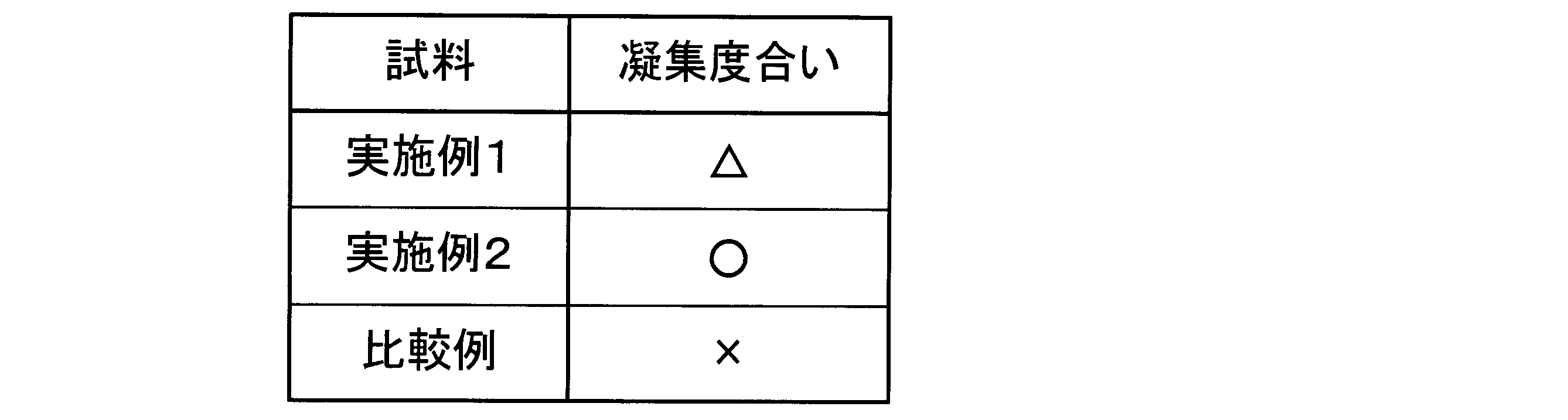
言い換えると実施例1および実施例2は、比較例と比較して光触媒酸化チタン等の光触媒粒子の分散安定性が阻害されにくく、凝集を引き起こしにくいことが示されている。また、実施例1と実施例2を比較すると、実施例2の方が光触媒粒子の分散安定性が阻害されにくく、凝集を引き起こしにくいことが示されている。 In other words, it has been shown that in Example 1 and Example 2, the dispersion stability of photocatalyst particles such as titanium oxide photocatalyst is less likely to be hindered and aggregation is less likely to occur compared to the comparative example. Also, when Example 1 and Example 2 are compared, it has been shown that Example 2 is less likely to hinder the dispersion stability of photocatalyst particles and aggregation is less likely to occur.
実施例1、実施例2および比較例の分散液をそれぞれスライドガラス(76×26mm)に膜厚0.8μmになるよう塗布し、乾燥させた。その後、ブラックライト(極大波長351nm、10W/m2)を2時間照射した。 The dispersions of Example 1, Example 2 and Comparative Example were each applied to a slide glass (76×26 mm) to a film thickness of 0.8 μm, dried and then irradiated with black light (maximum wavelength 351 nm, 10 W/m 2 ) for 2 hours.
これらのスライドガラスをそれぞれ5Lのテドラバッグに入れ、その後、各テドラバック内にアルファガス(エア・リキード工業ガス株式会社製 アルファガス1 Air)を3L注入する。その後、各テドラバック内にアセトアルデヒドを注入し、アセトアルデヒドの濃度が90ppmになるよう調整する。アセトアルデヒドの濃度は検知管式気体測定器(ガステック株式会社製 GV-100S)を用いて測定する。暗所・室温下で2時間、静置し、分散液を塗布して乾燥させた膜にアセトアルデヒドを吸着させる。この時、比較例ではアセトアルデヒドの吸着はおこらずアセトアルデヒドの濃度は90ppmであったが、実施例1および実施例2ではアセトアルデヒドの濃度は0ppmであった。 These slides are each placed in a 5L Tedra bag, and then 3L of Alpha Gas (Alpha Gas 1 Air, manufactured by Air Liquide Industrial Gas Co., Ltd.) is injected into each Tedra bag. Then, acetaldehyde is injected into each Tedra bag to adjust the acetaldehyde concentration to 90 ppm. The acetaldehyde concentration is measured using a gas detector tube (GV-100S, manufactured by Gastec Corporation). The sample is left to stand in a dark place at room temperature for 2 hours, and acetaldehyde is adsorbed onto the film on which the dispersion liquid is applied and dried. At this time, in the comparative example, no adsorption of acetaldehyde occurs and the acetaldehyde concentration is 90 ppm, but in Examples 1 and 2, the acetaldehyde concentration is 0 ppm.
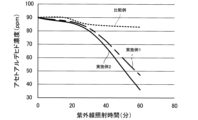
その後、実施例1および実施例2のテドラバッグ内にアセトアルデヒドを更に注入し、アセトアルデヒドの濃度を90ppmとした。これから、60分後の吸着は認められなかったので、ブラックライト(紫外線)を照射し、アセトアルデヒド濃度の変化、言い換えるとアセトアルデヒドの分解を観察した。観察結果を図1に示す。紫外線照射開始から60分の間に、比較例ではアセトアルデヒド濃度は、90ppmから約83ppmに低下した。実施例1では、90ppmから約47ppmに低下した。実施例2では、90ppmから約36ppmに低下した。 After that, acetaldehyde was further injected into the Tedra bags of Examples 1 and 2, bringing the acetaldehyde concentration to 90 ppm. Since no adsorption was observed after 60 minutes, the bags were irradiated with black light (ultraviolet light) to observe the change in acetaldehyde concentration, in other words, the decomposition of acetaldehyde. The observation results are shown in Figure 1. In the 60 minutes after the start of ultraviolet light irradiation, the acetaldehyde concentration in the comparative example decreased from 90 ppm to approximately 83 ppm. In Example 1, it decreased from 90 ppm to approximately 47 ppm. In Example 2, it decreased from 90 ppm to approximately 36 ppm.
[MIC(最小発育阻止濃度)の測定]
上記実施例1及び2と比較例1の抗菌剤を試料として、以下の方法で最小発育阻止濃度を測定した。即ち、任意濃度に各試料を添加した寒天平板培地に接種用菌液を接種・培養し、発育が阻止された抗菌剤の最低濃度を、各種微生物に対する試料の最小発育阻止濃度とした。結果を表1に示す。但し、寒天平板培地の調整、接種用菌液の調整、及び培養は、以下のようにして行った。
[Measurement of MIC (minimum inhibitory concentration)]
The antibacterial agents of Examples 1 and 2 and Comparative Example 1 were used as samples to measure the minimum inhibitory concentrations by the following method. That is, an inoculum liquid was inoculated and cultured on an agar plate medium to which each sample had been added at an arbitrary concentration, and the minimum concentration of the antibacterial agent at which growth was inhibited was determined as the minimum inhibitory concentration of the sample against each microorganism. The results are shown in Table 1. However, the preparation of the agar plate medium, the preparation of the inoculum liquid, and the culture were performed as follows.
寒天平板培地の調製
滅菌精製水で、試料の200,000ppm,100,000ppm,50,000ppm,25,000ppm,12,500ppm,6,250ppm,3,130ppm,1,560ppm,780ppm,390ppm,200ppm,100ppm,50ppm,25ppm,12.5ppm懸濁液を調製した。次に、溶解後50~60℃となった感受性測定用培地[ミューラー ヒントン(Mueller-Hinton)寒天培地(DIFCO社製)]に、上記の各懸濁液を培地の1/9量加えて、充分に混合した後、シャーレに分けて固化させ、寒天平板培地とした。
Preparation of agar plate medium 200,000 ppm, 100,000 ppm, 50,000 ppm, 25,000 ppm, 12,500 ppm, 6,250 ppm, 3,130 ppm, 1,560 ppm, 780 ppm, 390 ppm, 200 ppm, 100 ppm, 50 ppm, 25 ppm, and 12.5 ppm suspensions of the sample were prepared in sterilized purified water. Next, the above suspensions were added to a sensitivity measurement medium [Mueller-Hinton agar medium (DIFCO)] at 50 to 60 ° C. after dissolution in an amount of 1/9 of the medium, mixed thoroughly, and then divided into petri dishes to solidify, to prepare agar plate medium.
接種用菌液の調製
増菌用培地[ミューラー ヒントン ブロス(Mueller-HintonBroth)(DIFCO社製)]にて、35℃で一夜培養した試験菌株の菌液を同培地で希釈し、1ml当りの菌数が約106になるように調製した。但し、試験菌株としては、以下のものを利用した。
Preparation of inoculation solution A test strain was cultured overnight at 35°C in a culture medium [Mueller-Hinton Broth (DIFCO)] and diluted with the same medium to prepare a solution with a cell count of approximately 106 per ml. The following test strains were used:
大腸菌:エスケリチャ コーライ(Escherichia coli) IFO 3301
黄色ブドウ球菌:スタフィロコッカス オーレオス(Staphylococcus aureus) 12732
緑膿菌:緑膿菌:シュードモナス エルギノーサ(Pseudomonas aeruginosa) IID P-1
Escherichia coli: Escherichia coli IFO 3301
Staphylococcus aureus: Staphylococcus aureus 12732
Pseudomonas aeruginosa: Pseudomonas aeruginosa: Pseudomonas aeruginosa IID P-1
培養
接種用菌液を寒天平板培地に、ニクロム線ループ(内径約1mm)で2cm程度画線塗抹し、35℃で1日間培養した。
Cultivation The inoculation liquid was streaked on an agar plate medium to a thickness of about 2 cm using a nichrome wire loop (inner diameter about 1 mm), and cultured at 35°C for 1 day.
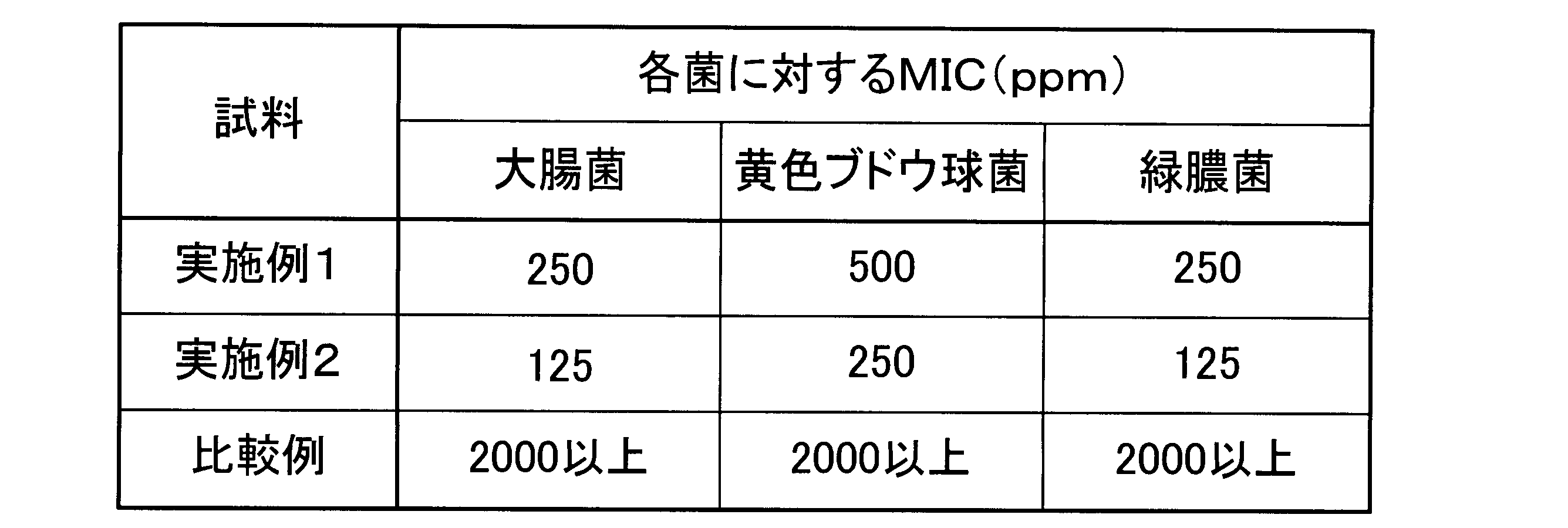
表2から明らかなように、実施例1及び実施例2の抗菌剤を混合した寒天平板培地では、抗菌性成分として毒性の低い銀錯塩を使用しているにもかかわらず、比較例1の抗菌剤を混合した寒天平板培地よりもはるかに低い混合濃度で菌の発育を阻止することが出来た。 As is clear from Table 2, the agar plate medium mixed with the antibacterial agents of Examples 1 and 2 was able to inhibit bacterial growth at a much lower mixing concentration than the agar plate medium mixed with the antibacterial agent of Comparative Example 1, despite the use of a less toxic silver complex salt as the antibacterial component.
上述の製造方法で製造された光触媒体(結晶性チタン酸化物複合体)を光触媒コーティング剤として、バインダーなどで塗布表面にコートした場合に、光触媒体の微粒子がバインダーに覆われたり、埋没したりしにくくなる。そのため、光触媒体の微粒子が、有機物等や酸素、紫外線と接触する表面積が低下しにくくなり、その結果、有機物等の分解効率が低下しにくくなる。 When the photocatalyst (crystalline titanium oxide complex) produced by the above-mentioned production method is used as a photocatalyst coating agent and coated on a coating surface with a binder or the like, the fine particles of the photocatalyst are less likely to be covered or buried in the binder. Therefore, the surface area of the fine particles of the photocatalyst that comes into contact with organic matter, oxygen, and ultraviolet rays is less likely to decrease, and as a result, the decomposition efficiency of organic matter, etc. is less likely to decrease.
また、上述のペルオキソチタン水和物を経由した結晶性チタン酸化物複合体の製造過程において、縮合等を促進する要因を除去するとともに、沈殿状態の水和物から直接的に特性の優れた結晶性粒子が得られる。反応過程において縮合等を促進する要因となる反応生成物、あるいは原料から混入する不純物を早期に分離することによって縮合等を防止することができる。 In addition, in the process of producing a crystalline titanium oxide composite via the above-mentioned peroxotitanium hydrate, factors that promote condensation, etc. are removed, and crystalline particles with excellent properties are obtained directly from the precipitated hydrate. Condensation, etc. can be prevented by early separation of reaction products that promote condensation, etc. during the reaction process, or impurities mixed in from the raw materials.
以上詳述したように、本発明は、光触媒体の製造方法に係るものであり、本発明は、高い吸着特性、高い光活性を維持したまま、光効率が良く、耐久性に優れ、且つ、取り扱いが容易である光触媒体の製造方法を提供するものである。本発明は、従来の光触媒体の問題点を解決し、光触媒体による、水、大気又は土壌等の新しい浄化技術、環境技術として有用である。更に、本発明は、照射された光のエネルギーを効率良く利用することができ、耐久性に優れ、取り扱いが容易で、且つ、廉価な光触媒体を提供することができる。更に、本発明は、土壌中、廃水中及び大気中に含まれている有害有機物を、分解し、除去する技術を提供するものであり、高い産業上の利用価値を有する。 As described above in detail, the present invention relates to a method for producing a photocatalyst, and provides a method for producing a photocatalyst that has good light efficiency, excellent durability, and is easy to handle while maintaining high adsorption characteristics and high photoactivity. The present invention solves the problems with conventional photocatalysts, and is useful as a new purification technology and environmental technology for water, air, soil, etc. using photocatalysts. Furthermore, the present invention can provide a photocatalyst that can efficiently utilize the energy of irradiated light, has excellent durability, is easy to handle, and is inexpensive. Furthermore, the present invention provides a technology for decomposing and removing harmful organic matter contained in soil, wastewater, and air, and has high industrial utility.
Claims (2)
水で希釈した可溶性チタン化合物に塩基性物質を添加して沈殿したチタン酸を得るチタン酸生成工程と、
得られた沈殿物である前記チタン酸を洗浄する不純物除去工程と、
洗浄後の前記チタン酸を含む分散系に過酸化水素水を加えてペルオキソチタン水和物の溶液を得るペルオキソチタン水和物生成工程と、
前記ペルオキソチタン水和物の溶液を大気圧以上の圧力に加圧した状態で加熱して結晶性チタン酸化複合体を含む溶液を得る結晶性チタン酸化物複合体形成工程と、
前記結晶性チタン酸化複合体を含む溶液に、吸着特性を有するシリカまたはシリカ複合酸化物を添加して複合ゾルを得る工程と、
前記複合ゾルにチオスルファト銀錯塩を含む溶液を添加する工程と、
を有する光触媒体の製造方法。 A method for producing a photocatalyst containing photocatalyst titanium oxide and silver thiosulfato complex salt, comprising the steps of:
a titanic acid production step of adding a basic substance to a soluble titanium compound diluted with water to obtain precipitated titanic acid;
an impurity removing step of washing the titanic acid, which is the precipitate obtained;
a peroxotitanium hydrate generating step of adding hydrogen peroxide to the washed dispersion containing titanic acid to obtain a peroxotitanium hydrate solution;
a crystalline titanium oxide composite forming step of heating the peroxotitanium hydrate solution under a pressure equal to or higher than atmospheric pressure to obtain a solution containing a crystalline titanium oxide composite;
a step of adding silica or a silica composite oxide having an adsorption property to a solution containing the crystalline titanium oxide composite to obtain a composite sol;
adding a solution containing a silver thiosulfato complex salt to the composite sol;
A method for producing a photocatalyst having the above structure.
Priority Applications (1)
| Application Number | Priority Date | Filing Date | Title |
|---|---|---|---|
| JP2020127359A JP7621600B2 (en) | 2020-07-28 | 2020-07-28 | Method for producing photocatalyst |
Applications Claiming Priority (1)
| Application Number | Priority Date | Filing Date | Title |
|---|---|---|---|
| JP2020127359A JP7621600B2 (en) | 2020-07-28 | 2020-07-28 | Method for producing photocatalyst |
Publications (2)
| Publication Number | Publication Date |
|---|---|
| JP2022024647A JP2022024647A (en) | 2022-02-09 |
| JP7621600B2 true JP7621600B2 (en) | 2025-01-27 |
Family
ID=80265483
Family Applications (1)
| Application Number | Title | Priority Date | Filing Date |
|---|---|---|---|
| JP2020127359A Active JP7621600B2 (en) | 2020-07-28 | 2020-07-28 | Method for producing photocatalyst |
Country Status (1)
| Country | Link |
|---|---|
| JP (1) | JP7621600B2 (en) |
Citations (3)
| Publication number | Priority date | Publication date | Assignee | Title |
|---|---|---|---|---|
| WO2005026276A1 (en) | 2003-09-11 | 2005-03-24 | Kabushiki Kaisha Zac | Coating material |
| JP2013129586A (en) | 2011-05-24 | 2013-07-04 | Shin-Etsu Chemical Co Ltd | Method for manufacturing microparticulate rutile titanium oxide dispersion and component having photocatalytic thin film on surface |
| JP2013198890A (en) | 2012-02-22 | 2013-10-03 | Fujico Co Ltd | Method of manufacturing interior material with photocatalyst function and the interior material |
-
2020
- 2020-07-28 JP JP2020127359A patent/JP7621600B2/en active Active
Patent Citations (3)
| Publication number | Priority date | Publication date | Assignee | Title |
|---|---|---|---|---|
| WO2005026276A1 (en) | 2003-09-11 | 2005-03-24 | Kabushiki Kaisha Zac | Coating material |
| JP2013129586A (en) | 2011-05-24 | 2013-07-04 | Shin-Etsu Chemical Co Ltd | Method for manufacturing microparticulate rutile titanium oxide dispersion and component having photocatalytic thin film on surface |
| JP2013198890A (en) | 2012-02-22 | 2013-10-03 | Fujico Co Ltd | Method of manufacturing interior material with photocatalyst function and the interior material |
Non-Patent Citations (1)
| Title |
|---|
| Journal of Environmental Chemical Engineering,2019年,vol. 7,p.103178,DOI:10.1016/j.jece.2019.103178 |
Also Published As
| Publication number | Publication date |
|---|---|
| JP2022024647A (en) | 2022-02-09 |
Similar Documents
| Publication | Publication Date | Title |
|---|---|---|
| Moongraksathum et al. | Antiviral and antibacterial effects of silver-doped TiO2 prepared by the peroxo sol-gel method | |
| Abdi | Synthesis of Ag-doped ZIF-8 photocatalyst with excellent performance for dye degradation and antibacterial activity | |
| Haq et al. | Green synthesis and characterization of tin dioxide nanoparticles for photocatalytic and antimicrobial studies | |
| Sayılkan et al. | Photocatalytic antibacterial performance of Sn4+-doped TiO2 thin films on glass substrate | |
| CN1218634C (en) | Preparation method of mesoporous titanium dioxide film with high bactericidal photoactivity | |
| US20050126428A1 (en) | Photocatalytic coating material having photocatalytic activity and adsorption property and method for preparing the same | |
| EP2671451B1 (en) | Virus inactivator | |
| KR101968367B1 (en) | Neutral, stable and transparent photocatalytic titanium dioxide sols | |
| KR101414899B1 (en) | Photocatalytic titanium dioxide sol, and coating composition using the same and member | |
| EP2214493B1 (en) | Process for limiting the growth of microorganisms | |
| KR101265781B1 (en) | Titanium dioxide photocatalyst having crystalline titanium dioxide core-amorphous titanium dioxide shell structure, preparation method thereof and hydrophilic coating material comprising said titanium dioxide photocatalyst | |
| JP6605473B2 (en) | Surface coating | |
| JP4169163B1 (en) | Photocatalytic titanium oxide sol and coating composition using the same | |
| Talebian et al. | Structure and antibacterial property of nano-SiO2 supported oxide ceramic | |
| Grine et al. | Synthesis, characterization, and antibacterial activity of Ag–TiO2–Fe composite thin films | |
| Wren et al. | Titanium–vanadium oxide nanocomposite thin films: synthesis, characterization and antibacterial activity | |
| KR101657517B1 (en) | Method for producing a visible light-responsive photocatalytic substance | |
| Sangchay et al. | Fe doped TiO2 thin films coated on glass fiber to inhibit bacterial of E. coli prepared by sol-gel method | |
| JP2022024647A (en) | Method of producing photocatalytic body, and method of producing crystalline titanium oxide compound body | |
| Bachvarova-Nedelcheva et al. | Influence of Nb2O5 and B2O3 on the Photocatalytic and Antibacterial Activity of Sol-Gel Derived TiO2 Nanopоwders | |
| Aritonang et al. | Photocatalytic bacterial inactivation using Bi-doped TiO2/kaolinite under visible light irradiation | |
| Suchea et al. | TiO2-based nanostructured materials with germicidal properties and other applications in biomedical fields | |
| Jothivenkatachalam et al. | A Study on the Photocatalytic and Antimicrobial Activities of Chitosan–ZnO Nanocomposites | |
| CN1842371B (en) | Ultraviolet-responsive thin film photocatalyst and application thereof | |
| Huajaipet et al. | Development of Air Filter by Porous Glass Filter Coated With Nano Titanium Dioxide |
Legal Events
| Date | Code | Title | Description |
|---|---|---|---|
| A621 | Written request for application examination |
Free format text: JAPANESE INTERMEDIATE CODE: A621 Effective date: 20230728 |
|
| A977 | Report on retrieval |
Free format text: JAPANESE INTERMEDIATE CODE: A971007 Effective date: 20240412 |
|
| A131 | Notification of reasons for refusal |
Free format text: JAPANESE INTERMEDIATE CODE: A131 Effective date: 20240507 |
|
| A521 | Request for written amendment filed |
Free format text: JAPANESE INTERMEDIATE CODE: A523 Effective date: 20240625 |
|
| A131 | Notification of reasons for refusal |
Free format text: JAPANESE INTERMEDIATE CODE: A131 Effective date: 20240910 |
|
| A521 | Request for written amendment filed |
Free format text: JAPANESE INTERMEDIATE CODE: A523 Effective date: 20241107 |
|
| TRDD | Decision of grant or rejection written | ||
| A01 | Written decision to grant a patent or to grant a registration (utility model) |
Free format text: JAPANESE INTERMEDIATE CODE: A01 Effective date: 20241210 |
|
| A61 | First payment of annual fees (during grant procedure) |
Free format text: JAPANESE INTERMEDIATE CODE: A61 Effective date: 20241227 |
|
| R150 | Certificate of patent or registration of utility model |
Ref document number: 7621600 Country of ref document: JP Free format text: JAPANESE INTERMEDIATE CODE: R150 |