JP7608564B2 - Heat shrinkable films and labels - Google Patents
Heat shrinkable films and labels Download PDFInfo
- Publication number
- JP7608564B2 JP7608564B2 JP2023187155A JP2023187155A JP7608564B2 JP 7608564 B2 JP7608564 B2 JP 7608564B2 JP 2023187155 A JP2023187155 A JP 2023187155A JP 2023187155 A JP2023187155 A JP 2023187155A JP 7608564 B2 JP7608564 B2 JP 7608564B2
- Authority
- JP
- Japan
- Prior art keywords
- heat
- biomass
- component
- resin
- derived
- Prior art date
- Legal status (The legal status is an assumption and is not a legal conclusion. Google has not performed a legal analysis and makes no representation as to the accuracy of the status listed.)
- Active
Links
- 229920006257 Heat-shrinkable film Polymers 0.000 title claims description 56
- 239000002028 Biomass Substances 0.000 claims description 100
- 229920005989 resin Polymers 0.000 claims description 72
- 239000011347 resin Substances 0.000 claims description 72
- 239000004793 Polystyrene Substances 0.000 claims description 38
- 229920002223 polystyrene Polymers 0.000 claims description 38
- 229920005990 polystyrene resin Polymers 0.000 claims description 30
- XLYOFNOQVPJJNP-UHFFFAOYSA-N water Substances O XLYOFNOQVPJJNP-UHFFFAOYSA-N 0.000 claims description 14
- 239000010410 layer Substances 0.000 description 83
- LYCAIKOWRPUZTN-UHFFFAOYSA-N Ethylene glycol Chemical compound OCCO LYCAIKOWRPUZTN-UHFFFAOYSA-N 0.000 description 68
- 229920001225 polyester resin Polymers 0.000 description 66
- PPBRXRYQALVLMV-UHFFFAOYSA-N Styrene Chemical compound C=CC1=CC=CC=C1 PPBRXRYQALVLMV-UHFFFAOYSA-N 0.000 description 34
- 239000004645 polyester resin Substances 0.000 description 33
- KKEYFWRCBNTPAC-UHFFFAOYSA-N Terephthalic acid Chemical compound OC(=O)C1=CC=C(C(O)=O)C=C1 KKEYFWRCBNTPAC-UHFFFAOYSA-N 0.000 description 24
- KAKZBPTYRLMSJV-UHFFFAOYSA-N Butadiene Chemical compound C=CC=C KAKZBPTYRLMSJV-UHFFFAOYSA-N 0.000 description 22
- 150000002009 diols Chemical class 0.000 description 22
- 239000002994 raw material Substances 0.000 description 21
- -1 decamethylene carboxylic acid Chemical class 0.000 description 20
- OFOBLEOULBTSOW-UHFFFAOYSA-N Malonic acid Chemical compound OC(=O)CC(O)=O OFOBLEOULBTSOW-UHFFFAOYSA-N 0.000 description 19
- RTZKZFJDLAIYFH-UHFFFAOYSA-N Diethyl ether Chemical compound CCOCC RTZKZFJDLAIYFH-UHFFFAOYSA-N 0.000 description 15
- MTHSVFCYNBDYFN-UHFFFAOYSA-N diethylene glycol Chemical compound OCCOCCO MTHSVFCYNBDYFN-UHFFFAOYSA-N 0.000 description 15
- 238000000034 method Methods 0.000 description 15
- 229920001971 elastomer Polymers 0.000 description 14
- 239000000806 elastomer Substances 0.000 description 14
- 230000009477 glass transition Effects 0.000 description 14
- 229920000728 polyester Polymers 0.000 description 14
- 229920001577 copolymer Polymers 0.000 description 13
- WERYXYBDKMZEQL-UHFFFAOYSA-N butane-1,4-diol Chemical compound OCCCCO WERYXYBDKMZEQL-UHFFFAOYSA-N 0.000 description 12
- QQVIHTHCMHWDBS-UHFFFAOYSA-N isophthalic acid Chemical compound OC(=O)C1=CC=CC(C(O)=O)=C1 QQVIHTHCMHWDBS-UHFFFAOYSA-N 0.000 description 12
- 238000010438 heat treatment Methods 0.000 description 11
- 229920002554 vinyl polymer Polymers 0.000 description 11
- 239000004215 Carbon black (E152) Substances 0.000 description 10
- 229930195733 hydrocarbon Natural products 0.000 description 10
- WGCNASOHLSPBMP-UHFFFAOYSA-N hydroxyacetaldehyde Natural products OCC=O WGCNASOHLSPBMP-UHFFFAOYSA-N 0.000 description 10
- 150000001993 dienes Chemical class 0.000 description 9
- 239000012790 adhesive layer Substances 0.000 description 7
- 229920001281 polyalkylene Polymers 0.000 description 7
- YIMQCDZDWXUDCA-UHFFFAOYSA-N [4-(hydroxymethyl)cyclohexyl]methanol Chemical compound OCC1CCC(CO)CC1 YIMQCDZDWXUDCA-UHFFFAOYSA-N 0.000 description 6
- 229920003048 styrene butadiene rubber Polymers 0.000 description 6
- LFQSCWFLJHTTHZ-UHFFFAOYSA-N Ethanol Chemical compound CCO LFQSCWFLJHTTHZ-UHFFFAOYSA-N 0.000 description 5
- 125000001931 aliphatic group Chemical group 0.000 description 5
- 229910052799 carbon Inorganic materials 0.000 description 5
- 230000000704 physical effect Effects 0.000 description 5
- OKTJSMMVPCPJKN-UHFFFAOYSA-N Carbon Chemical compound [C] OKTJSMMVPCPJKN-UHFFFAOYSA-N 0.000 description 4
- CURLTUGMZLYLDI-UHFFFAOYSA-N Carbon dioxide Chemical compound O=C=O CURLTUGMZLYLDI-UHFFFAOYSA-N 0.000 description 4
- 239000005062 Polybutadiene Substances 0.000 description 4
- WNLRTRBMVRJNCN-UHFFFAOYSA-N adipic acid Chemical compound OC(=O)CCCCC(O)=O WNLRTRBMVRJNCN-UHFFFAOYSA-N 0.000 description 4
- 125000005907 alkyl ester group Chemical group 0.000 description 4
- 230000008859 change Effects 0.000 description 4
- 238000005520 cutting process Methods 0.000 description 4
- DNIAPMSPPWPWGF-UHFFFAOYSA-N monopropylene glycol Natural products CC(O)CO DNIAPMSPPWPWGF-UHFFFAOYSA-N 0.000 description 4
- XNGIFLGASWRNHJ-UHFFFAOYSA-N phthalic acid Chemical compound OC(=O)C1=CC=CC=C1C(O)=O XNGIFLGASWRNHJ-UHFFFAOYSA-N 0.000 description 4
- 229920002857 polybutadiene Polymers 0.000 description 4
- 229920001195 polyisoprene Polymers 0.000 description 4
- 238000012545 processing Methods 0.000 description 4
- 230000002285 radioactive effect Effects 0.000 description 4
- YPFDHNVEDLHUCE-UHFFFAOYSA-N 1,3-propanediol Substances OCCCO YPFDHNVEDLHUCE-UHFFFAOYSA-N 0.000 description 3
- 125000003118 aryl group Chemical group 0.000 description 3
- 230000008901 benefit Effects 0.000 description 3
- 229920001400 block copolymer Polymers 0.000 description 3
- 125000004432 carbon atom Chemical group C* 0.000 description 3
- 230000007613 environmental effect Effects 0.000 description 3
- 150000002148 esters Chemical group 0.000 description 3
- 125000000524 functional group Chemical group 0.000 description 3
- 238000005227 gel permeation chromatography Methods 0.000 description 3
- 238000009998 heat setting Methods 0.000 description 3
- 239000000203 mixture Substances 0.000 description 3
- 229920006395 saturated elastomer Polymers 0.000 description 3
- 239000002356 single layer Substances 0.000 description 3
- PUPZLCDOIYMWBV-UHFFFAOYSA-N (+/-)-1,3-Butanediol Chemical compound CC(O)CCO PUPZLCDOIYMWBV-UHFFFAOYSA-N 0.000 description 2
- SDJHPPZKZZWAKF-UHFFFAOYSA-N 2,3-dimethylbuta-1,3-diene Chemical compound CC(=C)C(C)=C SDJHPPZKZZWAKF-UHFFFAOYSA-N 0.000 description 2
- SVTBMSDMJJWYQN-UHFFFAOYSA-N 2-methylpentane-2,4-diol Chemical compound CC(O)CC(C)(C)O SVTBMSDMJJWYQN-UHFFFAOYSA-N 0.000 description 2
- CDBAMNGURPMUTG-UHFFFAOYSA-N 4-[2-(4-hydroxycyclohexyl)propan-2-yl]cyclohexan-1-ol Chemical compound C1CC(O)CCC1C(C)(C)C1CCC(O)CC1 CDBAMNGURPMUTG-UHFFFAOYSA-N 0.000 description 2
- VZCYOOQTPOCHFL-OWOJBTEDSA-N Fumaric acid Chemical compound OC(=O)\C=C\C(O)=O VZCYOOQTPOCHFL-OWOJBTEDSA-N 0.000 description 2
- RRHGJUQNOFWUDK-UHFFFAOYSA-N Isoprene Chemical compound CC(=C)C=C RRHGJUQNOFWUDK-UHFFFAOYSA-N 0.000 description 2
- 229920002633 Kraton (polymer) Polymers 0.000 description 2
- 239000004721 Polyphenylene oxide Substances 0.000 description 2
- KDYFGRWQOYBRFD-UHFFFAOYSA-N Succinic acid Natural products OC(=O)CCC(O)=O KDYFGRWQOYBRFD-UHFFFAOYSA-N 0.000 description 2
- 239000006096 absorbing agent Substances 0.000 description 2
- 125000004018 acid anhydride group Chemical group 0.000 description 2
- 239000000654 additive Substances 0.000 description 2
- 239000001361 adipic acid Substances 0.000 description 2
- 235000011037 adipic acid Nutrition 0.000 description 2
- 125000003277 amino group Chemical group 0.000 description 2
- 239000003242 anti bacterial agent Substances 0.000 description 2
- 239000003963 antioxidant agent Substances 0.000 description 2
- 239000002216 antistatic agent Substances 0.000 description 2
- 239000001569 carbon dioxide Substances 0.000 description 2
- 229910002092 carbon dioxide Inorganic materials 0.000 description 2
- 125000002843 carboxylic acid group Chemical group 0.000 description 2
- 239000003795 chemical substances by application Substances 0.000 description 2
- PMMYEEVYMWASQN-IMJSIDKUSA-N cis-4-Hydroxy-L-proline Chemical compound O[C@@H]1CN[C@H](C(O)=O)C1 PMMYEEVYMWASQN-IMJSIDKUSA-N 0.000 description 2
- 239000003086 colorant Substances 0.000 description 2
- QYQADNCHXSEGJT-UHFFFAOYSA-N cyclohexane-1,1-dicarboxylate;hydron Chemical compound OC(=O)C1(C(O)=O)CCCCC1 QYQADNCHXSEGJT-UHFFFAOYSA-N 0.000 description 2
- 230000007423 decrease Effects 0.000 description 2
- WOZVHXUHUFLZGK-UHFFFAOYSA-N dimethyl terephthalate Chemical compound COC(=O)C1=CC=C(C(=O)OC)C=C1 WOZVHXUHUFLZGK-UHFFFAOYSA-N 0.000 description 2
- 125000003700 epoxy group Chemical group 0.000 description 2
- 238000001125 extrusion Methods 0.000 description 2
- 239000003063 flame retardant Substances 0.000 description 2
- 239000012760 heat stabilizer Substances 0.000 description 2
- 125000002887 hydroxy group Chemical group [H]O* 0.000 description 2
- 239000004611 light stabiliser Substances 0.000 description 2
- 239000000314 lubricant Substances 0.000 description 2
- 238000004519 manufacturing process Methods 0.000 description 2
- RXOHFPCZGPKIRD-UHFFFAOYSA-N naphthalene-2,6-dicarboxylic acid Chemical compound C1=C(C(O)=O)C=CC2=CC(C(=O)O)=CC=C21 RXOHFPCZGPKIRD-UHFFFAOYSA-N 0.000 description 2
- BDJRBEYXGGNYIS-UHFFFAOYSA-N nonanedioic acid Chemical compound OC(=O)CCCCCCCC(O)=O BDJRBEYXGGNYIS-UHFFFAOYSA-N 0.000 description 2
- 239000003208 petroleum Substances 0.000 description 2
- 229920003023 plastic Polymers 0.000 description 2
- 239000004033 plastic Substances 0.000 description 2
- 229920000570 polyether Polymers 0.000 description 2
- 229920000642 polymer Polymers 0.000 description 2
- 229920000909 polytetrahydrofuran Polymers 0.000 description 2
- 235000013772 propylene glycol Nutrition 0.000 description 2
- CXMXRPHRNRROMY-UHFFFAOYSA-N sebacic acid Chemical compound OC(=O)CCCCCCCCC(O)=O CXMXRPHRNRROMY-UHFFFAOYSA-N 0.000 description 2
- 239000002904 solvent Substances 0.000 description 2
- 150000003440 styrenes Chemical class 0.000 description 2
- 239000000126 substance Substances 0.000 description 2
- VZCYOOQTPOCHFL-UHFFFAOYSA-N trans-butenedioic acid Natural products OC(=O)C=CC(O)=O VZCYOOQTPOCHFL-UHFFFAOYSA-N 0.000 description 2
- 238000004804 winding Methods 0.000 description 2
- 230000037303 wrinkles Effects 0.000 description 2
- DNIAPMSPPWPWGF-VKHMYHEASA-N (+)-propylene glycol Chemical compound C[C@H](O)CO DNIAPMSPPWPWGF-VKHMYHEASA-N 0.000 description 1
- AHAREKHAZNPPMI-AATRIKPKSA-N (3e)-hexa-1,3-diene Chemical compound CC\C=C\C=C AHAREKHAZNPPMI-AATRIKPKSA-N 0.000 description 1
- PMJHHCWVYXUKFD-SNAWJCMRSA-N (E)-1,3-pentadiene Chemical compound C\C=C\C=C PMJHHCWVYXUKFD-SNAWJCMRSA-N 0.000 description 1
- DNIAPMSPPWPWGF-GSVOUGTGSA-N (R)-(-)-Propylene glycol Chemical compound C[C@@H](O)CO DNIAPMSPPWPWGF-GSVOUGTGSA-N 0.000 description 1
- 229940015975 1,2-hexanediol Drugs 0.000 description 1
- NVZWEEGUWXZOKI-UHFFFAOYSA-N 1-ethenyl-2-methylbenzene Chemical compound CC1=CC=CC=C1C=C NVZWEEGUWXZOKI-UHFFFAOYSA-N 0.000 description 1
- QTCNKIZNNWURDV-UHFFFAOYSA-N 2,2-dimethylpropane-1,3-diol Chemical compound OCC(C)(C)CO.OCC(C)(C)CO QTCNKIZNNWURDV-UHFFFAOYSA-N 0.000 description 1
- SRCNWAPDQFQZEK-UHFFFAOYSA-N 2,6-dimethyl-1h-naphthalene-1,2-dicarboxylic acid Chemical compound OC(=O)C1C(C)(C(O)=O)C=CC2=CC(C)=CC=C21 SRCNWAPDQFQZEK-UHFFFAOYSA-N 0.000 description 1
- JAHNSTQSQJOJLO-UHFFFAOYSA-N 2-(3-fluorophenyl)-1h-imidazole Chemical compound FC1=CC=CC(C=2NC=CN=2)=C1 JAHNSTQSQJOJLO-UHFFFAOYSA-N 0.000 description 1
- RWLALWYNXFYRGW-UHFFFAOYSA-N 2-Ethyl-1,3-hexanediol Chemical compound CCCC(O)C(CC)CO RWLALWYNXFYRGW-UHFFFAOYSA-N 0.000 description 1
- FPOGSOBFOIGXPR-UHFFFAOYSA-N 2-octylbutanedioic acid Chemical compound CCCCCCCCC(C(O)=O)CC(O)=O FPOGSOBFOIGXPR-UHFFFAOYSA-N 0.000 description 1
- HIYKOZFIVZIBFO-UHFFFAOYSA-N 3-methylpentane-1,3-diol Chemical compound CCC(C)(O)CCO HIYKOZFIVZIBFO-UHFFFAOYSA-N 0.000 description 1
- JLBJTVDPSNHSKJ-UHFFFAOYSA-N 4-Methylstyrene Chemical compound CC1=CC=C(C=C)C=C1 JLBJTVDPSNHSKJ-UHFFFAOYSA-N 0.000 description 1
- KJQMOGOKAYDMOR-UHFFFAOYSA-N CC(=C)C=C.CC(=C)C=C Chemical compound CC(=C)C=C.CC(=C)C=C KJQMOGOKAYDMOR-UHFFFAOYSA-N 0.000 description 1
- VGGSQFUCUMXWEO-UHFFFAOYSA-N Ethene Chemical compound C=C VGGSQFUCUMXWEO-UHFFFAOYSA-N 0.000 description 1
- 239000005977 Ethylene Substances 0.000 description 1
- ALQSHHUCVQOPAS-UHFFFAOYSA-N Pentane-1,5-diol Chemical compound OCCCCCO ALQSHHUCVQOPAS-UHFFFAOYSA-N 0.000 description 1
- 239000002202 Polyethylene glycol Substances 0.000 description 1
- 102100037681 Protein FEV Human genes 0.000 description 1
- 101710198166 Protein FEV Proteins 0.000 description 1
- UWHCKJMYHZGTIT-UHFFFAOYSA-N Tetraethylene glycol, Natural products OCCOCCOCCOCCO UWHCKJMYHZGTIT-UHFFFAOYSA-N 0.000 description 1
- 239000000853 adhesive Substances 0.000 description 1
- 230000001070 adhesive effect Effects 0.000 description 1
- 239000004840 adhesive resin Substances 0.000 description 1
- 229920006223 adhesive resin Polymers 0.000 description 1
- 229920003232 aliphatic polyester Polymers 0.000 description 1
- 125000002947 alkylene group Chemical group 0.000 description 1
- 150000008064 anhydrides Chemical class 0.000 description 1
- 230000000903 blocking effect Effects 0.000 description 1
- 238000005282 brightening Methods 0.000 description 1
- OWBTYPJTUOEWEK-UHFFFAOYSA-N butane-2,3-diol Chemical compound CC(O)C(C)O OWBTYPJTUOEWEK-UHFFFAOYSA-N 0.000 description 1
- KDYFGRWQOYBRFD-NUQCWPJISA-N butanedioic acid Chemical compound O[14C](=O)CC[14C](O)=O KDYFGRWQOYBRFD-NUQCWPJISA-N 0.000 description 1
- 238000006243 chemical reaction Methods 0.000 description 1
- 150000001875 compounds Chemical class 0.000 description 1
- 238000007796 conventional method Methods 0.000 description 1
- 238000007334 copolymerization reaction Methods 0.000 description 1
- 230000007547 defect Effects 0.000 description 1
- 125000004177 diethyl group Chemical group [H]C([H])([H])C([H])([H])* 0.000 description 1
- 125000000118 dimethyl group Chemical group [H]C([H])([H])* 0.000 description 1
- SZXQTJUDPRGNJN-UHFFFAOYSA-N dipropylene glycol Chemical compound OCCCOCCCO SZXQTJUDPRGNJN-UHFFFAOYSA-N 0.000 description 1
- 238000005886 esterification reaction Methods 0.000 description 1
- 238000011156 evaluation Methods 0.000 description 1
- 239000002803 fossil fuel Substances 0.000 description 1
- 239000001530 fumaric acid Substances 0.000 description 1
- 239000007789 gas Substances 0.000 description 1
- 239000011521 glass Substances 0.000 description 1
- ACCCMOQWYVYDOT-UHFFFAOYSA-N hexane-1,1-diol Chemical compound CCCCCC(O)O ACCCMOQWYVYDOT-UHFFFAOYSA-N 0.000 description 1
- FHKSXSQHXQEMOK-UHFFFAOYSA-N hexane-1,2-diol Chemical compound CCCCC(O)CO FHKSXSQHXQEMOK-UHFFFAOYSA-N 0.000 description 1
- XXMIOPMDWAUFGU-UHFFFAOYSA-N hexane-1,6-diol Chemical compound OCCCCCCO XXMIOPMDWAUFGU-UHFFFAOYSA-N 0.000 description 1
- 238000003475 lamination Methods 0.000 description 1
- VZCYOOQTPOCHFL-UPHRSURJSA-N maleic acid Chemical compound OC(=O)\C=C/C(O)=O VZCYOOQTPOCHFL-UPHRSURJSA-N 0.000 description 1
- 239000011976 maleic acid Substances 0.000 description 1
- 238000005259 measurement Methods 0.000 description 1
- OJURWUUOVGOHJZ-UHFFFAOYSA-N methyl 2-[(2-acetyloxyphenyl)methyl-[2-[(2-acetyloxyphenyl)methyl-(2-methoxy-2-oxoethyl)amino]ethyl]amino]acetate Chemical compound C=1C=CC=C(OC(C)=O)C=1CN(CC(=O)OC)CCN(CC(=O)OC)CC1=CC=CC=C1OC(C)=O OJURWUUOVGOHJZ-UHFFFAOYSA-N 0.000 description 1
- LVHBHZANLOWSRM-UHFFFAOYSA-N methylenebutanedioic acid Natural products OC(=O)CC(=C)C(O)=O LVHBHZANLOWSRM-UHFFFAOYSA-N 0.000 description 1
- 238000000465 moulding Methods 0.000 description 1
- KYTZHLUVELPASH-UHFFFAOYSA-N naphthalene-1,2-dicarboxylic acid Chemical compound C1=CC=CC2=C(C(O)=O)C(C(=O)O)=CC=C21 KYTZHLUVELPASH-UHFFFAOYSA-N 0.000 description 1
- AHHWIHXENZJRFG-UHFFFAOYSA-N oxetane Chemical compound C1COC1 AHHWIHXENZJRFG-UHFFFAOYSA-N 0.000 description 1
- 238000005191 phase separation Methods 0.000 description 1
- PMJHHCWVYXUKFD-UHFFFAOYSA-N piperylene Natural products CC=CC=C PMJHHCWVYXUKFD-UHFFFAOYSA-N 0.000 description 1
- 238000006068 polycondensation reaction Methods 0.000 description 1
- 229920001223 polyethylene glycol Polymers 0.000 description 1
- 229920000166 polytrimethylene carbonate Polymers 0.000 description 1
- 230000008569 process Effects 0.000 description 1
- 230000004044 response Effects 0.000 description 1
- 238000003860 storage Methods 0.000 description 1
- 238000012360 testing method Methods 0.000 description 1
- 229920005992 thermoplastic resin Polymers 0.000 description 1
- 150000003627 tricarboxylic acid derivatives Chemical class 0.000 description 1
- ZIBGPFATKBEMQZ-UHFFFAOYSA-N triethylene glycol Chemical compound OCCOCCOCCO ZIBGPFATKBEMQZ-UHFFFAOYSA-N 0.000 description 1
- 230000002087 whitening effect Effects 0.000 description 1
Landscapes
- Laminated Bodies (AREA)
- Wrappers (AREA)
Description
本発明は、化石資源の使用量を削減することができるとともに、機械的特性等の物性面において高い性能を発現可能な熱収縮性フィルムに関する。また、該熱収縮性フィルムを含む熱収縮性ラベルに関する。 The present invention relates to a heat-shrinkable film that can reduce the amount of fossil resources used and exhibits high performance in terms of physical properties such as mechanical properties. It also relates to a heat-shrinkable label that includes the heat-shrinkable film.
近年、ペットボトル、ガラス瓶等の容器の多くには、熱可塑性樹脂からなるベースフィルムに印刷等を施した熱収縮性ラベルが装着されている。
熱収縮性ラベルには、低温収縮性に優れるポリスチレン系樹脂フィルムや耐熱性及び耐溶剤性に優れるポリエステル系樹脂フィルムが多用されている。
また、これらの特性の両方を併せ持つように、ポリエステル系樹脂を含有する表裏層と、ポリスチレン系樹脂を含有する中間層とを有する多層フィルムが検討されている。
2. Description of the Related Art In recent years, heat-shrinkable labels formed by printing or the like on a base film made of a thermoplastic resin are attached to many containers such as PET bottles and glass bottles.
For heat-shrinkable labels, polystyrene-based resin films, which have excellent low-temperature shrinkability, and polyester-based resin films, which have excellent heat resistance and solvent resistance, are often used.
Also, in order to have both of these properties, a multi-layer film having front and back layers containing a polyester resin and an intermediate layer containing a polystyrene resin has been investigated.
一方、近年、持続可能な社会の実現に向け、循環型社会、低炭素社会の構築に対する要求が高まっており、化石資源からの脱却が望まれているが、従来の汎用プラスチックであるポリエステル系樹脂、ポリスチレン系樹脂等はいずれも石油資源を原料として用いているため、継続して使用するうえで石油資源の枯渇、有害ガスの発生等の問題を抱えている。 On the other hand, in recent years, there has been an increasing demand to build a recycling-oriented, low-carbon society in order to realize a sustainable society, and there is a desire to move away from fossil fuel resources. However, conventional general-purpose plastics such as polyester resins and polystyrene resins are all made using petroleum resources as raw materials, and so their continued use poses problems such as the depletion of petroleum resources and the generation of harmful gases.
このような問題に対して、汎用プラスチックであるポリエステル系樹脂をバイオマス原料から製造する試みが行われている。
例えば、特許文献1では、バイオマスを原料として、エチレングリコール、テレフタル酸等の樹脂原料を製造する方法が開示されている。
In response to these problems, attempts are being made to produce polyester resins, which are general-purpose plastics, from biomass raw materials.
For example, Patent Document 1 discloses a method for producing resin raw materials such as ethylene glycol and terephthalic acid using biomass as a raw material.
本発明は、化石資源の使用量を削減することができるとともに、機械的特性等の物性面において高い性能を発現可能な熱収縮性フィルムを提供することを目的とする。また、該熱収縮性フィルムを含む熱収縮性ラベルを提供することを目的とする。 The present invention aims to provide a heat-shrinkable film that can reduce the amount of fossil resources used and exhibits high performance in terms of physical properties such as mechanical properties. It also aims to provide a heat-shrinkable label that includes the heat-shrinkable film.
本発明は、ポリエステル系樹脂を含有する層及びポリスチレン系樹脂を含有する層のうち少なくとも1層を有する熱収縮性フィルムであって、前記熱収縮性フィルムは、バイオマス由来の成分を含有する熱収縮性フィルムである。
以下、本発明を詳述する。
The present invention relates to a heat-shrinkable film having at least one layer selected from a layer containing a polyester-based resin and a layer containing a polystyrene-based resin, the heat-shrinkable film containing a component derived from biomass.
The present invention will be described in detail below.
本発明者らは、ポリエステル系樹脂を含有する層及びポリスチレン系樹脂を含有する層のうち少なくとも1層を有する熱収縮性フィルムにおいて、バイオマス由来の成分を含有する樹脂を用いた場合でも、機械的特性等の物性面において高い性能を発現できる熱収縮性フィルムが得られることを見出した。なお、「バイオマス」とは、「再生可能な、生物由来の有機性資源で化石資源を除いたもの」をいう。
従って、従来に比べて化石資源から得られる原料を減らして、化石資源の使用量を削減できることを見出し、本発明を完成するに至った。
The present inventors have found that, in a heat-shrinkable film having at least one layer selected from a layer containing a polyester-based resin and a layer containing a polystyrene-based resin, even when a resin containing a component derived from biomass is used, the heat-shrinkable film can exhibit high performance in terms of physical properties such as mechanical properties. Note that "biomass" refers to "renewable organic resources derived from living organisms, excluding fossil resources."
Therefore, the inventors have found that it is possible to reduce the amount of raw materials obtained from fossil resources and to reduce the amount of fossil resources used, as compared to the conventional method, and have thus completed the present invention.
本発明の熱収縮性フィルムは、ポリエステル系樹脂を含有する層及びポリスチレン系樹脂を含有する層のうち少なくとも1層を有する。
本発明の熱収縮性フィルムは、ポリエステル系樹脂を含有する層のみからなるものであってもよく、ポリスチレン系樹脂を含有する層のみからなるものであってもよく、ポリエステル系樹脂を含有する表裏層とポリスチレン系樹脂を含有する中間層とを有するものであってもよい。
また、本発明の熱収縮性フィルムが、ポリエステル系樹脂を含有する層のみからなるものである場合、上記ポリエステル系樹脂を含有する層を1層のみ有するものであってもよく、2層以上有するものであってもよい。
更に、本発明の熱収縮性フィルムが、ポリスチレン系樹脂を含有する層のみからなるものである場合、上記ポリスチレン系樹脂を含有する層を1層のみ有するものであってもよく、2層以上有するものであってもよい。
なお、本明細書中、表裏層とは、表面層と裏面層との両方を意味する。
The heat-shrinkable film of the present invention has at least one layer selected from the group consisting of a layer containing a polyester-based resin and a layer containing a polystyrene-based resin.
The heat-shrinkable film of the present invention may consist only of a layer containing a polyester-based resin, may consist only of a layer containing a polystyrene-based resin, or may have front and back layers containing a polyester-based resin and an intermediate layer containing a polystyrene-based resin.
Furthermore, when the heat-shrinkable film of the present invention consists only of a layer containing a polyester-based resin, it may have only one layer containing the polyester-based resin, or it may have two or more layers.
Furthermore, when the heat-shrinkable film of the present invention consists only of a layer containing a polystyrene-based resin, it may have only one layer containing the above-mentioned polystyrene-based resin, or it may have two or more layers.
In this specification, the front and back layers refer to both the front and back layers.
本発明の熱収縮性フィルムが表裏層と中間層とを有する場合、表裏層を構成するポリエステル系樹脂、及び、中間層を構成するポリスチレン系樹脂のうち少なくとも1つがバイオマス由来の成分を含むものであればよく、表裏層を構成するポリエステル系樹脂のみがバイオマス由来の成分を含むものであってもよく、中間層を構成するポリスチレン系樹脂のみがバイオマス由来の原料を含むものであってもよく、また、ポリエステル系樹脂及びポリスチレン系樹脂の両方がバイオマス由来の成分を含むものであってもよい。
なお、上記ポリエステル系樹脂及び上記ポリスチレン系樹脂がバイオマス由来の成分を含むか否かは、上記樹脂中の放射性炭素(C14)の有無により確認することができる。
大気中の二酸化炭素には、C14が一定割合(105.5pMC)で含まれているため、大気中の二酸化炭素を取り入れて成長する植物中のC14含有量も105.5pMC程度であることが知られている。また、化石資源中にはC14が殆ど含まれていないことも知られている。したがって、ポリエステル系樹脂やポリスチレン系樹脂中の全炭素原子中に含まれるC14の割合を測定することにより、バイオマス由来の成分を含むか否かを確認することができる。
上記放射性炭素(C14)の有無は、例えば、後述するバイオマス度の測定と同様の方法を用いることで確認することができる。
When the heat-shrinkable film of the present invention has a front and back layer and an intermediate layer, it is sufficient that at least one of the polyester-based resin constituting the front and back layers and the polystyrene-based resin constituting the intermediate layer contains a biomass-derived component, and only the polyester-based resin constituting the front and back layers may contain a biomass-derived component, or only the polystyrene-based resin constituting the intermediate layer may contain a biomass-derived raw material, or both the polyester-based resin and the polystyrene-based resin may contain a biomass-derived component.
Whether or not the polyester-based resin and the polystyrene-based resin contain a component derived from biomass can be confirmed by the presence or absence of radioactive carbon (C14) in the resin.
Since atmospheric carbon dioxide contains a certain proportion of C14 (105.5 pMC), it is known that the C14 content in plants that grow by absorbing atmospheric carbon dioxide is also about 105.5 pMC. It is also known that fossil resources contain almost no C14. Therefore, by measuring the proportion of C14 in the total carbon atoms in polyester resins or polystyrene resins, it is possible to confirm whether or not they contain components derived from biomass.
The presence or absence of the radioactive carbon (C14) can be confirmed, for example, by using a method similar to that for measuring the biomass degree described below.
本発明の熱収縮性フィルムが、上記ポリエステル系樹脂を含有する層のみからなる場合、上記ポリエステル系樹脂を含有する層を構成するポリエステル系樹脂は、バイオマス由来の成分を含むポリエステル系樹脂のみからなるものであってもよく、バイオマス由来の成分を含むポリエステル系樹脂とバイオマス由来の成分を含まないポリエステル系樹脂とを含有するものであってもよい。
また、本発明の熱収縮性フィルムが、上記表裏層及び中間層を有する場合、上記ポリエステル系樹脂を含有する層を構成するポリエステル系樹脂は、バイオマス由来の成分を含むものであってもよく、バイオマス由来の成分を含まないものであってもよい。また、上記ポリエステル系樹脂は、バイオマス由来の成分を含むポリエステル系樹脂とバイオマス由来の成分を含まないポリエステル系樹脂とを含有するものであってもよい。
When the heat-shrinkable film of the present invention is composed only of a layer containing the above-mentioned polyester-based resin, the polyester-based resin constituting the layer containing the above-mentioned polyester-based resin may be composed only of a polyester-based resin containing a component derived from biomass, or may contain a polyester-based resin containing a component derived from biomass and a polyester-based resin not containing a component derived from biomass.
In addition, when the heat-shrinkable film of the present invention has the front and back layers and the intermediate layer, the polyester-based resin constituting the layer containing the polyester-based resin may contain a biomass-derived component or may not contain a biomass-derived component. In addition, the polyester-based resin may contain a polyester-based resin containing a biomass-derived component and a polyester-based resin not containing a biomass-derived component.
上記ポリエステル系樹脂を含有する層を構成するポリエステル系樹脂としては、例えば、ジカルボン酸成分とジオール成分とを縮重合させることにより得られるものが挙げられる。
上記ポリエステル系樹脂が、バイオマス由来の成分を含む場合、上記ポリエステル系樹脂は、バイオマス由来のジカルボン酸成分を含むものであってもよく、バイオマス由来のジオール成分を含むものであってもよく、バイオマス由来のジカルボン酸成分とバイオマス由来のジオール成分との両方を含むものであってもよい。
The polyester-based resin constituting the layer containing the polyester-based resin may be, for example, one obtained by polycondensation of a dicarboxylic acid component and a diol component.
In the case where the polyester-based resin contains a biomass-derived component, the polyester-based resin may contain a biomass-derived dicarboxylic acid component, may contain a biomass-derived diol component, or may contain both a biomass-derived dicarboxylic acid component and a biomass-derived diol component.
上記ジカルボン酸としては、例えば、テレフタル酸、o-フタル酸、イソフタル酸、コハク酸、アジピン酸、セバシン酸、アゼライン酸、オクチルコハク酸、シクロヘキサンジカルボン酸、ナフタレンジカルボン酸、フマル酸、マレイン酸、イタコン酸、デカメチレンカルボン酸、これらの無水物及び低級アルキルエステル等が挙げられる。
上記ジカルボン酸としては、テレフタル酸、イソフタル酸が好ましい。
Examples of the dicarboxylic acid include terephthalic acid, o-phthalic acid, isophthalic acid, succinic acid, adipic acid, sebacic acid, azelaic acid, octyl succinic acid, cyclohexane dicarboxylic acid, naphthalenedicarboxylic acid, fumaric acid, maleic acid, itaconic acid, decamethylene carboxylic acid, anhydrides and lower alkyl esters thereof.
As the dicarboxylic acid, terephthalic acid and isophthalic acid are preferred.
上記ジカルボン酸成分100モル%中、テレフタル酸に由来する成分を50~100モル%含有することが好ましく、60~100モル%含有することがより好ましい。
また、上記ジカルボン酸成分100モル%中、イソフタル酸に由来する成分を0~50モル%含有することが好ましく、0~40モル%含有することがより好ましい。
In 100 mol % of the dicarboxylic acid component, the component derived from terephthalic acid is preferably contained in an amount of 50 to 100 mol %, and more preferably 60 to 100 mol %.
In addition, the dicarboxylic acid component preferably contains 0 to 50 mol %, and more preferably 0 to 40 mol %, of a component derived from isophthalic acid, relative to 100 mol % of the dicarboxylic acid component.
上記ジオールとしては、例えば、エチレングリコール、1,3-プロパンジオール、1,4-ブタンジオール、ジエチレングリコール、1,5-ペンタンジオール、1,6-ヘキサンジオール、ジプロピレングリコール、トリエチレングリコール、テトラエチレングリコール、1,2-プロパンジオール、1,3-ブタンジオール、2,3-ブタンジオール、ネオペンチルグリコール(2,2-ジメチルプロパン-1,3-ジオール)、1,2-ヘキサンジオール、2,5-ヘキサンジオール、2-メチル-2,4-ペンタンジオール、3-メチル-1,3-ペンタンジオール、2-エチル-1,3-ヘキサンジオール、ポリテトラメチレンエーテルグリコール等の脂肪族ジオール類;2,2-ビス(4-ヒドロキシシクロヘキシル)プロパン、2,2-ビス(4-ヒドロキシシクロヘキシル)プロパンのアルキレンオキサイド付加物、1,4-シクロヘキサンジオール、1,4-シクロヘキサンジメタノール等の脂環式ジオール類等が挙げられる。
上記ジオールとしては、エチレングリコール、1,4-ブタンジオール、ジエチレングリコール、1,4-シクロヘキサンジメタノールが好ましい。
Examples of the diol include ethylene glycol, 1,3-propanediol, 1,4-butanediol, diethylene glycol, 1,5-pentanediol, 1,6-hexanediol, dipropylene glycol, triethylene glycol, tetraethylene glycol, 1,2-propanediol, 1,3-butanediol, 2,3-butanediol, neopentyl glycol (2,2-dimethylpropane-1,3-diol), 1,2-hexanediol, 2,5- Examples of the diols include aliphatic diols such as hexanediol, 2-methyl-2,4-pentanediol, 3-methyl-1,3-pentanediol, 2-ethyl-1,3-hexanediol, and polytetramethylene ether glycol; and alicyclic diols such as 2,2-bis(4-hydroxycyclohexyl)propane, alkylene oxide adducts of 2,2-bis(4-hydroxycyclohexyl)propane, 1,4-cyclohexanediol, and 1,4-cyclohexanedimethanol.
The diol is preferably ethylene glycol, 1,4-butanediol, diethylene glycol, or 1,4-cyclohexanedimethanol.
上記ジオール成分100モル%中、エチレングリコールに由来する成分を40~100モル%含有することが好ましく、50~100モル%含有することがより好ましい。
上記ジオール成分100モル%中、ジエチレングリコールに由来する成分を0~40モル%含有することが好ましく、0~30モル%含有することがより好ましい。
上記ジオール成分100モル%中、1,4-シクロヘキサンジメタノールに由来する成分を0~70モル%含有することが好ましく、0~60モル%含有することがより好ましい。
The diol component preferably contains 40 to 100 mol %, and more preferably 50 to 100 mol %, of a component derived from ethylene glycol, relative to 100 mol % of the diol component.
The diol component preferably contains 0 to 40 mol %, and more preferably 0 to 30 mol %, of a component derived from diethylene glycol, based on 100 mol % of the diol component.
The diol component preferably contains 0 to 70 mol %, and more preferably 0 to 60 mol %, of a component derived from 1,4-cyclohexanedimethanol, relative to 100 mol % of the diol component.
上記ジオール成分は、バイオマス由来の成分を含むものであってもよく、なかでも、バイオマス由来のジオール成分として、エチレングリコール、1,4-ブタンジオール、ジエチレングリコール、1,4-シクロヘキサンジメタノールに由来する成分を含むことが好ましく、エチレングリコールに由来する成分を含むことがより好ましい。
上記バイオマス由来のエチレングリコールとしては、バイオマスを原料として製造されたバイオマスエタノールを原料とするものが挙げられる。例えば、上記バイオマス由来のエチレングリコールは、バイオマスエタノールを原料として、従来公知の方法により製造することができる。
The diol component may contain a component derived from biomass. In particular, as the biomass-derived diol component, it is preferable to contain a component derived from ethylene glycol, 1,4-butanediol, diethylene glycol, or 1,4-cyclohexanedimethanol, and it is more preferable to contain a component derived from ethylene glycol.
The biomass-derived ethylene glycol may be one that uses biomass ethanol produced from biomass as a raw material. For example, the biomass-derived ethylene glycol may be produced from biomass ethanol as a raw material by a conventionally known method.
上記ジオール成分におけるバイオマス由来の成分の含有量は、30モル%以上であることが好ましく、50モル%以上であることがより好ましく、100モル%以下であることが好ましい。
上記範囲とすることで、環境負荷を低減するという利点がある。
The content of the biomass-derived component in the diol component is preferably 30 mol % or more, more preferably 50 mol % or more, and is preferably 100 mol % or less.
By setting the content within the above range, there is an advantage in that the environmental load is reduced.
上記ジオール成分におけるバイオマス由来のエチレングリコールの含有量は、30モル%以上であることが好ましく、50モル%以上であることがより好ましく、100モル%以下であることが好ましい。 The content of biomass-derived ethylene glycol in the diol component is preferably 30 mol% or more, more preferably 50 mol% or more, and preferably 100 mol% or less.
上記ポリエステル系樹脂のバイオマス度は、1%以上であることが好ましく、5%以上であることがより好ましく、100%以下であることが好ましい。
上記範囲とすることで、環境負荷を低減するという利点がある。
なお、上記バイオマス度とは、放射性炭素(C14)測定によるバイオマス由来の元祖の含有量を測定した値である。上記バイオマス度は、ISO16620-2:2015に基づき、加速器質量分光計を用いて測定することができる。
The biomass degree of the polyester resin is preferably 1% or more, more preferably 5% or more, and is preferably 100% or less.
By setting the content within the above range, there is an advantage in that the environmental load is reduced.
The biomass degree is a value obtained by measuring the content of original biomass-derived substances by radioactive carbon (C14) measurement. The biomass degree can be measured using an accelerator mass spectrometer based on ISO16620-2:2015.
また、上記ポリエステル系樹脂は、バイオマス度が異なる複数のポリエステル系樹脂を含有するものであってもよい。
上記ポリエステル系樹脂が、バイオマス度が異なる複数のポリエステル系樹脂を含有する混合樹脂である場合、上記混合樹脂のバイオマス度は、ISO16620-2:2015に基づいて測定することができる。また、上記バイオマス度は、混合樹脂中の各ポリエステル系樹脂の重量比とバイオマス度とに基づいて算出することもできる。
The polyester resin may contain a plurality of polyester resins having different biomass degrees.
When the polyester resin is a mixed resin containing a plurality of polyester resins having different biomass degrees, the biomass degree of the mixed resin can be measured based on ISO16620-2: 2015. The biomass degree can also be calculated based on the weight ratio and biomass degree of each polyester resin in the mixed resin.
上記ポリエステル系樹脂がバイオマス由来の成分を含むポリエステル系樹脂を含有する場合、上記ポリエステル系樹脂におけるバイオマス由来の成分を含むポリエステル系樹脂の含有量は、好ましい下限が5重量%、より好ましい下限が10重量%、好ましい上限が100重量%である。 When the polyester resin contains a polyester resin containing a biomass-derived component, the content of the polyester resin containing a biomass-derived component in the polyester resin is preferably 5% by weight at the lower limit, more preferably 10% by weight at the lower limit, and preferably 100% by weight at the upper limit.
上記ポリエステル系樹脂のガラス転移温度の好ましい下限は55℃、好ましい上限は95℃である。上記ガラス転移温度が55℃未満であると、熱収縮性多層フィルムの収縮開始温度が低くなりすぎたり、自然収縮率が大きくなったり、ブロッキングが発生しやすくなったりすることがある。上記ガラス転移温度が95℃を超えると、熱収縮性多層フィルムの低温収縮性及び収縮仕上がり性が低下したり、経時での低温収縮性の低下がおおきくなったり、延伸時に樹脂白化が発生しやすくなったりすることがある。上記ガラス転移温度のより好ましい下限は60℃、より好ましい上限は90℃である。更に好ましい下限は65℃、更に好ましい上限は85℃である。
なお、上記ガラス転移温度は、ISO 3146に準拠した方法で測定することができる。また、上記ポリエステル系樹脂がガラス転移温度が異なる複数のポリエステル系樹脂を含有する混合樹脂である場合、上記混合樹脂のガラス転移温度は、混合樹脂中の各ポリエステル系樹脂の重量比とガラス転移温度とに基づいて算出した見掛けのガラス転移温度を意味する。
The preferred lower limit of the glass transition temperature of the polyester resin is 55°C, and the preferred upper limit is 95°C. If the glass transition temperature is less than 55°C, the shrinkage start temperature of the heat-shrinkable multilayer film may be too low, the natural shrinkage rate may be large, and blocking may be easily caused. If the glass transition temperature exceeds 95°C, the low-temperature shrinkability and shrink finish of the heat-shrinkable multilayer film may be reduced, the low-temperature shrinkability may be significantly reduced over time, and resin whitening may be easily caused during stretching. The more preferred lower limit of the glass transition temperature is 60°C, and the more preferred upper limit is 90°C. The even more preferred lower limit is 65°C, and the even more preferred upper limit is 85°C.
The glass transition temperature can be measured by a method in accordance with ISO 3146. When the polyester resin is a mixed resin containing a plurality of polyester resins having different glass transition temperatures, the glass transition temperature of the mixed resin means an apparent glass transition temperature calculated based on the weight ratio and glass transition temperature of each polyester resin in the mixed resin.
上記ポリエステル系樹脂の引張弾性率の好ましい下限は1000MPaを超え、好ましい上限は4000MPaである。上記引張弾性率が1000MPa以下であると熱収縮性フィルムの収縮開始温度が低くなりすぎたり、自然収縮率が大きくなったりすることがある。上記引張弾性率が4000MPaを超えると、熱収縮性多層フィルムの低温収縮性及び収縮仕上り性が低下したり、経時での低温収縮性の低下が大きくなったりすることがある。上記引張弾性率のより好ましい下限は1500MPa、より好ましい上限は3700MPaである。
なお、上記引張弾性率は、ASTM-D882(TestA)に準拠した方法で測定することができる。
The lower limit of the tensile modulus of the polyester resin is preferably more than 1000 MPa, and the upper limit is preferably 4000 MPa. If the tensile modulus is 1000 MPa or less, the shrinkage start temperature of the heat shrinkable film may be too low, or the natural shrinkage rate may be large. If the tensile modulus is more than 4000 MPa, the low-temperature shrinkability and shrink finish of the heat shrinkable multilayer film may be reduced, or the low-temperature shrinkability may be significantly reduced over time. The lower limit of the tensile modulus is more preferably 1500 MPa, and the upper limit is more preferably 3700 MPa.
The tensile modulus can be measured by a method in accordance with ASTM-D882 (Test A).
上記ポリエステル系樹脂を含有する層を構成するポリエステル系樹脂としては、上述した組成を有するポリエステル系樹脂を単独で用いてもよく、上述した組成を有する2種以上のポリエステル系樹脂を併用してもよい。 As the polyester-based resin constituting the layer containing the polyester-based resin, a polyester-based resin having the above-mentioned composition may be used alone, or two or more polyester-based resins having the above-mentioned composition may be used in combination.
上記ポリエステル系樹脂を含有する層は、必要に応じて、酸化防止剤、熱安定剤、紫外線吸収剤、光安定剤、滑剤、帯電防止剤、アンチブロッキング剤、難燃剤、抗菌剤、蛍光増白剤、着色剤等の添加剤を含有してもよい。 The layer containing the polyester resin may contain additives such as antioxidants, heat stabilizers, UV absorbers, light stabilizers, lubricants, antistatic agents, antiblocking agents, flame retardants, antibacterial agents, fluorescent brightening agents, and colorants, as necessary.
本発明の熱収縮性フィルムが、上記ポリスチレン系樹脂を含有する層のみからなる場合、上記ポリスチレン系樹脂を含有する層を構成するポリスチレン系樹脂は、バイオマス由来の成分を含むポリスチレン系樹脂のみからなるものであってもよく、バイオマス由来の成分を含むポリスチレン系樹脂とバイオマス由来の成分を含まないポリスチレン系樹脂とを含有するものであってもよい。
また、本発明の熱収縮性フィルムが、上記表裏層及び中間層を有する場合、上記ポリスチレン系樹脂を含有する層を構成するポリスチレン系樹脂は、バイオマス由来の成分を含むものであってもよく、バイオマス由来の成分を含まないものであってもよい。また、上記ポリスチレン系樹脂は、バイオマス由来の成分を含むポリスチレン系樹脂とバイオマス由来の成分を含まないポリスチレン系樹脂とを含有するものであってもよい。
When the heat-shrinkable film of the present invention is composed only of a layer containing the above-mentioned polystyrene-based resin, the polystyrene-based resin constituting the layer containing the above-mentioned polystyrene-based resin may be composed only of a polystyrene-based resin containing a component derived from biomass, or may contain a polystyrene-based resin containing a component derived from biomass and a polystyrene-based resin not containing a component derived from biomass.
In addition, when the heat-shrinkable film of the present invention has the above-mentioned front and back layers and intermediate layer, the polystyrene-based resin constituting the layer containing the polystyrene-based resin may contain a biomass-derived component or may not contain a biomass-derived component. In addition, the polystyrene-based resin may contain a polystyrene-based resin containing a biomass-derived component and a polystyrene-based resin not containing a biomass-derived component.
上記ポリスチレン系樹脂を含有する層を構成するポリスチレン系樹脂としては、例えば、芳香族ビニル炭化水素-共役ジエン共重合体、芳香族ビニル炭化水素-共役ジエン共重合体と芳香族ビニル炭化水素-脂肪族不飽和カルボン酸エステル共重合体との混合樹脂、ゴム変性耐衝撃性ポリスチレン等が挙げられる。上記ポリスチレン系樹脂を用いることで、本発明の熱収縮性多層フィルムは低温から収縮を開始することができ、また、高収縮性を有する。 Examples of the polystyrene-based resin constituting the layer containing the polystyrene-based resin include aromatic vinyl hydrocarbon-conjugated diene copolymers, mixed resins of aromatic vinyl hydrocarbon-conjugated diene copolymers and aromatic vinyl hydrocarbon-aliphatic unsaturated carboxylic acid ester copolymers, and rubber-modified impact-resistant polystyrene. By using the polystyrene-based resins, the heat-shrinkable multilayer film of the present invention can start shrinking at low temperatures and has high shrinkability.
本明細書中、芳香族ビニル炭化水素-共役ジエン共重合体とは、芳香族ビニル炭化水素に由来する成分と、共役ジエンに由来する成分とを含有する共重合体をいう。
また、上記芳香族ビニル炭化水素に由来する成分は、バイオマス由来の成分を含むものであってもよい。更に、上記共役ジエンに由来する成分は、バイオマス由来の成分を含むものであってもよい。
上記芳香族ビニル炭化水素は特に限定されず、例えば、スチレン、o-メチルスチレン、p-メチルスチレン等が挙げられる。これらは単独で用いられてもよく、2種以上が併用されてもよい。
上記共役ジエンは特に限定されず、例えば、1,3-ブタジエン、2-メチル-1,3-ブタジエン、2,3-ジメチル-1,3-ブタジエン、1,3-ペンタジエン、1,3-ヘキサジエン等が挙げられる。これらは単独で用いられてもよく、2種以上が併用されてもよい。
In this specification, the aromatic vinyl hydrocarbon-conjugated diene copolymer refers to a copolymer containing a component derived from an aromatic vinyl hydrocarbon and a component derived from a conjugated diene.
The aromatic vinyl hydrocarbon-derived component may contain a biomass-derived component. Furthermore, the conjugated diene-derived component may contain a biomass-derived component.
The aromatic vinyl hydrocarbon is not particularly limited, and examples thereof include styrene, o-methylstyrene, p-methylstyrene, etc. These may be used alone or in combination of two or more kinds.
The conjugated diene is not particularly limited, and examples thereof include 1,3-butadiene, 2-methyl-1,3-butadiene, 2,3-dimethyl-1,3-butadiene, 1,3-pentadiene, 1,3-hexadiene, etc. These may be used alone or in combination of two or more kinds.
上記芳香族ビニル炭化水素-共役ジエン共重合体は、特に熱収縮性に優れることから、スチレン-ブタジエン共重合体(SBS樹脂)を含有することが好ましい。また、上記芳香族ビニル炭化水素-共役ジエン共重合体は、よりフィッシュアイの少ない熱収縮性多層フィルムを作製するためには、上記共役ジエンとして2-メチル-1,3-ブタジエン(イソプレン)を用いたスチレン-イソプレン共重合体(SIS樹脂)、スチレン-イソプレン-ブタジエン共重合体(SIBS)等を含有することが好ましい。
なお、上記芳香族ビニル炭化水素-共役ジエン共重合体は、SBS樹脂、SIS樹脂及びSIBS樹脂のうちのいずれか1つを単独で含有してもよく、複数を組み合わせて含有してもよい。また、SBS樹脂、SIS樹脂及びSIBS樹脂のうちの複数を用いる場合には、各樹脂をドライブレンドしてもよく、各樹脂を特定の組成にて押出機を用いて練り上げペレタイズしたコンパウンド樹脂を用いてもよい。
The aromatic vinyl hydrocarbon-conjugated diene copolymer preferably contains a styrene-butadiene copolymer (SBS resin) because of its excellent heat shrinkability. In order to produce a heat shrinkable multilayer film with fewer fisheyes, the aromatic vinyl hydrocarbon-conjugated diene copolymer preferably contains a styrene-isoprene copolymer (SIS resin) using 2-methyl-1,3-butadiene (isoprene) as the conjugated diene, a styrene-isoprene-butadiene copolymer (SIBS), or the like.
The aromatic vinyl hydrocarbon-conjugated diene copolymer may contain any one of SBS resin, SIS resin and SIBS resin alone or a combination of two or more. When two or more of SBS resin, SIS resin and SIBS resin are used, the resins may be dry blended, or a compound resin may be used in which the resins are kneaded in a specific composition using an extruder and pelletized.
上記芳香族ビニル炭化水素成分中、バイオマス由来の成分の含有量は、5重量%以上であることが好ましく、30重量%以上であることがより好ましく、100重量%以下であることが好ましい。
また、上記共役ジエン成分中、バイオマス由来の成分の含有量は、5重量%以上であることが好ましく、30重量%以上であることがより好ましく、100重量%以下であることが好ましい。
In the aromatic vinyl hydrocarbon component, the content of the biomass-derived component is preferably 5% by weight or more, more preferably 30% by weight or more, and is preferably 100% by weight or less.
Furthermore, the content of the biomass-derived component in the above-mentioned conjugated diene component is preferably 5% by weight or more, more preferably 30% by weight or more, and is preferably 100% by weight or less.
上記ポリスチレン系樹脂は、スチレン成分の含有量が65重量%以上であることが好ましく、70重量%以上であることがより好ましく、90重量%以下であることが好ましく、85重量%以下であることがより好ましい。
上記スチレン含有量が65重量%以上であると、成形加工時にゲル等の異物が発生し難く、熱収縮性フィルムの機械的強度を充分に高めることができる。上記スチレン含有量が90重量%以下であると、熱収縮性フィルムにテンションをかけた際や印刷等の加工時の破断を防止することができる。
The polystyrene resin preferably has a styrene component content of 65% by weight or more, more preferably 70% by weight or more, and preferably 90% by weight or less, more preferably 85% by weight or less.
When the styrene content is 65% by weight or more, foreign matter such as gel is unlikely to be generated during molding processing, and the mechanical strength of the heat-shrinkable film can be sufficiently increased.When the styrene content is 90% by weight or less, breakage when tension is applied to the heat-shrinkable film or during processing such as printing can be prevented.
また、上記ポリスチレン系樹脂は、バイオマス由来のスチレン成分を含有することが好ましい。
上記バイオマス由来のスチレンとしては、バイオマス由来のナフサを原料として製造されたエチレンを原料とするものが挙げられる。例えば、上記バイオマス由来のスチレンは、バイオマス由来のナフサを原料として、従来公知の方法により製造することができる。
The polystyrene resin preferably contains a styrene component derived from biomass.
The biomass-derived styrene may be one that uses ethylene produced from biomass-derived naphtha as a raw material. For example, the biomass-derived styrene may be produced from biomass-derived naphtha as a raw material by a conventionally known method.
上記ポリスチレン系樹脂がバイオマス由来のスチレン成分を含有する場合、上記ポリスチレン系樹脂におけるバイオマス由来のスチレン成分の含有量は、5重量%以上であることが好ましく、30重量%以上であることがより好ましく、100重量%以下であることが好ましい。 When the polystyrene resin contains a styrene component derived from biomass, the content of the styrene component derived from biomass in the polystyrene resin is preferably 5% by weight or more, more preferably 30% by weight or more, and preferably 100% by weight or less.
上記ポリスチレン系樹脂は、共役ジエン含有量が10重量%以上であることが好ましく、15重量%以上であることがより好ましく、35重量%以下であることが好ましく、30重量%以下であることがより好ましい。 The polystyrene resin preferably has a conjugated diene content of 10% by weight or more, more preferably 15% by weight or more, and preferably 35% by weight or less, more preferably 30% by weight or less.
また、上記ポリスチレン系樹脂は、バイオマス由来の共役ジエン成分を含むものであることが好ましく、バイオマス由来のブタジエン成分を含有することがより好ましい。
上記バイオマス由来のブタジエンとしては、バイオマス由来のナフサを原料として製造されたものが挙げられる。例えば、上記バイオマス由来のブタジエンは、バイオマス由来のナフサを原料として、従来公知の方法により製造することができる。
The polystyrene-based resin preferably contains a conjugated diene component derived from biomass, and more preferably contains a butadiene component derived from biomass.
The biomass-derived butadiene may be produced using naphtha derived from biomass as a raw material. For example, the biomass-derived butadiene may be produced using a conventionally known method using naphtha derived from biomass as a raw material.
上記ポリスチレン系樹脂がバイオマス由来の共役ジエン成分を含有する場合、上記ポリスチレン系樹脂におけるバイオマス由来の共役ジエン成分の含有量は、5重量%以上であることが好ましく、30重量%以上であることがより好ましく、100重量%以下であることが好ましい。 When the polystyrene resin contains a biomass-derived conjugated diene component, the content of the biomass-derived conjugated diene component in the polystyrene resin is preferably 5% by weight or more, more preferably 30% by weight or more, and preferably 100% by weight or less.
上記ポリスチレン系樹脂がバイオマス由来のブタジエン成分を含有する場合、上記ポリスチレン系樹脂におけるバイオマス由来のブタジエン成分の含有量は、5重量%以上であることが好ましく、30重量%以上であることがより好ましく、100重量%以下であることが好ましい。 When the polystyrene resin contains a biomass-derived butadiene component, the content of the biomass-derived butadiene component in the polystyrene resin is preferably 5% by weight or more, more preferably 30% by weight or more, and preferably 100% by weight or less.
上記ポリスチレン系樹脂中のバイオマス由来の成分の含有量は、5重量%以上であることが好ましく、30重量%以上であることがより好ましく、100重量%以下であることが好ましい。 The content of biomass-derived components in the polystyrene resin is preferably 5% by weight or more, more preferably 30% by weight or more, and preferably 100% by weight or less.
上記ポリスチレン系樹脂のバイオマス度は、10%以上であることが好ましく、30%以上であることがより好ましく、100%以下であることが好ましい。
上記バイオマス度は、ISO16620-2:2015に基づき、加速器質量分光計を用いて測定することができる。
The biomass ratio of the polystyrene resin is preferably 10% or more, more preferably 30% or more, and is preferably 100% or less.
The biomass degree can be measured using an accelerator mass spectrometer based on ISO16620-2:2015.
また、上記ポリスチレン系樹脂は、バイオマス度が異なる複数のポリスチレン系樹脂を含有するものであってもよい。
上記ポリスチレン系樹脂が、バイオマス度が異なる複数のポリスチレン系樹脂を含有する混合樹脂である場合、上記混合樹脂のバイオマス度は、ISO16620-2:2015に基づいて測定することができる。また、上記バイオマス度は、混合樹脂中の各ポリスチレン系樹脂の重量比とバイオマス度とに基づいて算出することもできる。
The polystyrene-based resin may contain a plurality of polystyrene-based resins having different biomass degrees.
When the polystyrene resin is a mixed resin containing a plurality of polystyrene resins having different biomass degrees, the biomass degree of the mixed resin can be measured based on ISO16620-2: 2015. The biomass degree can also be calculated based on the weight ratio and biomass degree of each polystyrene resin in the mixed resin.
上記ポリスチレン系樹脂のビカット軟化温度の好ましい下限は60℃、好ましい上限は85℃である。上記ビカット軟化温度が60℃未満であると、熱収縮性多層フィルムの低温収縮性が高くなり過ぎ、容器に装着するときにシワが入りやすくなる。上記ビカット軟化温度が85℃を超えると、熱収縮性多層フィルムの低温収縮性が低下し、容器に装着するときに未収縮部分が発生しやすくなる。上記ビカット軟化温度のより好ましい下限は65℃、より好ましい上限は80℃である。なお、上記ビカット軟化温度は、ISO 306:1994に準拠した方法で測定することができる。
また、上記ポリスチレン系樹脂が、ビカット軟化温度が異なる複数のポリスチレン系樹脂を含有する混合樹脂である場合、上記混合樹脂のビカット軟化温度は、混合樹脂中の各ポリスチレン系樹脂の重量比とビカット軟化温度とに基づいて算出される見掛けのビカット軟化温度を意味する。
The Vicat softening temperature of the polystyrene resin is preferably 60° C. at the lower limit and 85° C. at the upper limit. If the Vicat softening temperature is less than 60° C., the low-temperature shrinkability of the heat-shrinkable multilayer film becomes too high, and wrinkles are likely to occur when the film is attached to a container. If the Vicat softening temperature exceeds 85° C., the low-temperature shrinkability of the heat-shrinkable multilayer film decreases, and unshrunk portions are likely to occur when the film is attached to a container. The Vicat softening temperature is more preferably 65° C. at the lower limit and 80° C. at the upper limit. The Vicat softening temperature can be measured by a method in accordance with ISO 306:1994.
In addition, when the polystyrene-based resin is a mixed resin containing a plurality of polystyrene-based resins having different Vicat softening temperatures, the Vicat softening temperature of the mixed resin means an apparent Vicat softening temperature calculated based on the weight ratio and Vicat softening temperature of each polystyrene-based resin in the mixed resin.
上記ポリスチレン系樹脂の200℃でのMFR(melt flow rate)の好ましい下限は2g/10分、好ましい上限は15g/10分である。200℃でのMFRが2g/10分未満であると、フィルムの製膜が難しくなる。200℃でのMFRが15g/10分を超えると、フィルムの機械的強度が低くなり、実用に耐えられなくなる。200℃でのMFRのより好ましい下限は4g/10分、より好ましい上限は12g/10分である。なお、MFRは、ISO1133に準拠した方法で測定することができる。 The polystyrene resin has a preferred lower limit of MFR (melt flow rate) at 200°C of 2 g/10 min, and a preferred upper limit of 15 g/10 min. If the MFR at 200°C is less than 2 g/10 min, it becomes difficult to form a film. If the MFR at 200°C is more than 15 g/10 min, the mechanical strength of the film decreases and it becomes unsuitable for practical use. A more preferred lower limit of MFR at 200°C is 4 g/10 min, and a more preferred upper limit is 12 g/10 min. The MFR can be measured by a method conforming to ISO1133.
上記ポリスチレン系樹脂を含有する層は、必要に応じて、酸化防止剤、熱安定剤、紫外線吸収剤、光安定剤、滑剤、帯電防止剤、難燃剤、抗菌剤、蛍光増白剤、着色剤等の添加剤を含有してもよい。 The layer containing the polystyrene resin may contain additives such as antioxidants, heat stabilizers, UV absorbers, light stabilizers, lubricants, antistatic agents, flame retardants, antibacterial agents, fluorescent brighteners, and colorants, as necessary.
本発明の熱収縮性フィルムが上記表裏層及び中間層を有する場合、本発明の熱収縮性フィルムは表裏層及び中間層からなるものであってもよく、また、表裏層と中間層との間に接着層を介在させてもよい。 When the heat-shrinkable film of the present invention has the above-mentioned front and back layers and intermediate layer, the heat-shrinkable film of the present invention may consist of the front and back layers and the intermediate layer, and an adhesive layer may be interposed between the front and back layers and the intermediate layer.
上記接着層を構成する樹脂としては、スチレン系エラストマー、ポリエステル系エラストマー、これらの変性物等の接着性樹脂を用いることができる。
また、ポリエステル系樹脂、ポリスチレン系樹脂及びポリエステル系エラストマーの混合樹脂を用いることもできる。
The resin constituting the adhesive layer may be an adhesive resin such as a styrene-based elastomer, a polyester-based elastomer, or a modified product thereof.
Also, a mixed resin of a polyester resin, a polystyrene resin, and a polyester elastomer can be used.
上記スチレン系エラストマーは、ハードセグメントとしてのポリスチレンと、ソフトセグメントとしてポリブタジエン、ポリイソプレン、ポリブタジエンとポリイソプレンとの共重合体とからなるものや、これらの水素添加物のことである。なお、上記水素添加物は、ポリブタジエンやポリイソプレンの一部が水素添加されたものであってもよく、全てが水素添加されたものであってもよい。 The styrene-based elastomer is one that is made up of polystyrene as a hard segment and polybutadiene, polyisoprene, or a copolymer of polybutadiene and polyisoprene as a soft segment, or a hydrogenated product thereof. The hydrogenated product may be one in which a portion of the polybutadiene or polyisoprene is hydrogenated, or one in which the entirety of the polybutadiene or polyisoprene is hydrogenated.
上記スチレン系エラストマーの市販品としては、例えば、「タフテック」、「タフプレン」(何れも旭化成ケミカルズ社製)、「クレイトン」(クレイトンポリマージャパン社製)、「ダイナロン」(JSR社製)、「セプトン」(クラレ社製)等が挙げられる。 Commercially available products of the above styrene-based elastomers include, for example, "Tuftec" and "Tufprene" (both manufactured by Asahi Kasei Chemicals Corporation), "Kraton" (manufactured by Kraton Polymer Japan), "Dynaron" (manufactured by JSR Corporation), and "Septon" (manufactured by Kuraray Co., Ltd.).
上記スチレン系エラストマーの変性物としては、例えば、カルボン酸基、酸無水物基、アミノ基、エポキシ基及び水酸基等の官能基によって変性されたものが挙げられる。
上記スチレン系エラストマーの変性物における上記カルボン酸基、酸無水物基、アミノ基、エポキシ基及び水酸基等の官能基の含有量の好ましい下限は0.05重量%、好ましい上限は5.0重量%である。上記含有量が0.05重量%未満であると、特に表面層及び裏面層との接着性が不充分となることがあり、5.0重量%を超えると、上記官能基を付加する際に樹脂が熱劣化し、ゲル等の異物が発生しやすくなることがある。上記含有量のより好ましい下限は0.1重量%、より好ましい上限は3.0重量%である。
Examples of the modified styrene-based elastomer include those modified with functional groups such as a carboxylic acid group, an acid anhydride group, an amino group, an epoxy group, and a hydroxyl group.
The content of the functional groups such as carboxylic acid groups, acid anhydride groups, amino groups, epoxy groups and hydroxyl groups in the modified styrene-based elastomer is preferably 0.05% by weight at the lower limit and 5.0% by weight at the upper limit. If the content is less than 0.05% by weight, the adhesion to the front layer and back layer may be insufficient, and if it exceeds 5.0% by weight, the resin may be thermally deteriorated when the functional groups are added, and foreign matter such as gel may be easily generated. The more preferred lower limit of the content is 0.1% by weight, and the more preferred upper limit is 3.0% by weight.
上記ポリエステル系エラストマーは、飽和ポリエステル系エラストマーであることが好ましく、特に、ポリアルキレンエーテルグリコールセグメントを含有する飽和ポリエステル系エラストマーであることが好ましい。ポリアルキレンエーテルグリコールセグメントを含有する飽和ポリエステル系エラストマーとしては、例えば、ハードセグメントである芳香族ポリエステルと、ソフトセグメントであるポリアルキレンエーテルグリコールや脂肪族ポリエステルとからなるブロック共重合体が好ましい。更に、ソフトセグメントとしてポリアルキレンエーテルグリコールを有するポリエステルポリエーテルブロック共重合体がより好ましい。 The polyester elastomer is preferably a saturated polyester elastomer, and in particular, a saturated polyester elastomer containing a polyalkylene ether glycol segment. As a saturated polyester elastomer containing a polyalkylene ether glycol segment, for example, a block copolymer consisting of an aromatic polyester as a hard segment and a polyalkylene ether glycol or an aliphatic polyester as a soft segment is preferable. Furthermore, a polyester polyether block copolymer having a polyalkylene ether glycol as a soft segment is more preferable.
上記ポリエステルポリエーテルブロック共重合体としては、(i)炭素原子数2~12の脂肪族及び/又は脂環族ジオールと、(ii)芳香族ジカルボン酸及び/又は脂肪族ジカルボン酸又はそのアルキルエステルと、(iii)ポリアルキレンエーテルグリコールとを原料とし、エステル化反応又はエステル交換反応により得られたオリゴマーを重縮合させたものが好ましい。 The polyester polyether block copolymer is preferably a copolymer obtained by polycondensing an oligomer obtained by an esterification reaction or an ester exchange reaction using (i) an aliphatic and/or alicyclic diol having 2 to 12 carbon atoms, (ii) an aromatic dicarboxylic acid and/or an aliphatic dicarboxylic acid or an alkyl ester thereof, and (iii) a polyalkylene ether glycol as raw materials.
上記炭素原子数2~12の脂肪族及び/又は脂環族ジオールとしては、例えば、ポリエステルの原料、特にポリエステル系エラストマーの原料として一般に用いられるものを用いることができる。具体的には例えば、エチレングリコール、プロピレングリコール、トリメチレングリコール、1,4-ブタンジオール、1,4-シクロヘキサンジオール、1,4-シクロヘキサンジメタノール等が挙げられる。これらの中では、1,4-ブタンジオール又はエチレングリコールが好ましく、特に1,4-ブタンジオールが好ましい。これらのジオールは単独で用いてもよく、2種以上を併用してもよい。 As the aliphatic and/or alicyclic diol having 2 to 12 carbon atoms, for example, those generally used as raw materials for polyesters, particularly raw materials for polyester-based elastomers, can be used. Specific examples include ethylene glycol, propylene glycol, trimethylene glycol, 1,4-butanediol, 1,4-cyclohexanediol, 1,4-cyclohexanedimethanol, etc. Among these, 1,4-butanediol or ethylene glycol is preferred, and 1,4-butanediol is particularly preferred. These diols may be used alone or in combination of two or more kinds.
上記芳香族ジカルボン酸としては、ポリエステルの原料、特にポリエステル系エラストマーの原料として一般的に用いられているものを用いることができる。具体的には例えば、テレフタル酸、イソフタル酸、フタル酸、2,6-ナフタレンジカルボン酸等が挙げられる。これらの中では、テレフタル酸又は2,6-ナフタレンジカルボン酸が好ましく、特にテレフタル酸が好ましい。これらの芳香族ジカルボン酸は単独で用いてもよく、2種以上を併用してもよい。 As the aromatic dicarboxylic acid, those generally used as raw materials for polyesters, particularly raw materials for polyester-based elastomers, can be used. Specific examples include terephthalic acid, isophthalic acid, phthalic acid, and 2,6-naphthalenedicarboxylic acid. Among these, terephthalic acid or 2,6-naphthalenedicarboxylic acid is preferred, and terephthalic acid is particularly preferred. These aromatic dicarboxylic acids may be used alone or in combination of two or more.
上記芳香族ジカルボン酸のアルキルエステルとしては、上記芳香族ジカルボン酸のジメチルエステルやジエチルエステル等が挙げられる。なかでも、ジメチルテレフタレート及び2,6-ジメチルナフタレンジカルボキシレートが好ましい。 Examples of the alkyl esters of the aromatic dicarboxylic acids include dimethyl esters and diethyl esters of the aromatic dicarboxylic acids. Among these, dimethyl terephthalate and 2,6-dimethylnaphthalenedicarboxylate are preferred.
上記脂肪族ジカルボン酸としては、シクロヘキサンジカルボン酸等が好ましく、そのアルキルエステルとしては、ジメチルエステルやジエチルエステル等が好ましい。また、上記の成分以外に3官能のアルコールやトリカルボン酸又はそのエステルを少量共重合させてもよく、更に、アジピン酸等の脂肪族ジカルボン酸又はそのジアルキルエステルを共重合成分として用いてもよい。 As the aliphatic dicarboxylic acid, cyclohexanedicarboxylic acid and the like are preferred, and as its alkyl ester, dimethyl ester, diethyl ester and the like are preferred. In addition to the above components, a small amount of a trifunctional alcohol, tricarboxylic acid or its ester may be copolymerized, and further, an aliphatic dicarboxylic acid such as adipic acid or its dialkyl ester may be used as a copolymerization component.
上記ポリアルキレンエーテルグリコールとしては、例えば、ポリエチレングリコール、ポリ(1,2-及び/又は1,3-プロピレンエーテル)グリコール、ポリ(テトラメチレンエーテル)グリコール、ポリ(ヘキサメチレンエーテル)グリコール等が挙げられる。 Examples of the polyalkylene ether glycol include polyethylene glycol, poly(1,2- and/or 1,3-propylene ether) glycol, poly(tetramethylene ether) glycol, and poly(hexamethylene ether) glycol.
上記ポリアルキレンエーテルグリコールの数平均分子量の好ましい下限は400、好ましい上限は6000である。上記数平均分子量を400以上とすることで、共重合体のブロック性が高くなり、6000以下とすることで、系内での相分離が起こり難く、ポリマー物性が発現しやすくなる。上記数平均分子量のより好ましい下限は500、より好ましい上限は4000、更に好ましい下限は600、更に好ましい上限は3000である。なお、本明細書において、数平均分子量とはゲル浸透クロマトグラフィー(GPC)で測定されたものをいう。また、上記GPCのキャリブレーションは、例えば、POLYTETRAHYDROFURANキャリブレーションキット(英国POLYMER LABORATORIES社製)を使用することにより行うことができる。 The preferred lower limit of the number average molecular weight of the polyalkylene ether glycol is 400, and the preferred upper limit is 6000. By setting the number average molecular weight to 400 or more, the blockiness of the copolymer is increased, and by setting the number average molecular weight to 6000 or less, phase separation in the system is unlikely to occur, and the polymer properties are easily expressed. The more preferred lower limit of the number average molecular weight is 500, the more preferred upper limit is 4000, the even more preferred lower limit is 600, and the even more preferred upper limit is 3000. In this specification, the number average molecular weight refers to that measured by gel permeation chromatography (GPC). The GPC calibration can be performed, for example, by using a POLYTETRAHYDROFURAN calibration kit (manufactured by POLYMER LABORATORIES, UK).
また、上記接着層が、ポリエステル系樹脂、ポリスチレン系樹脂及びポリエステル系エラストマーの混合樹脂を含有する場合、上記ポリエステル系樹脂は、上記ポリエステル系樹脂を含有する層を構成するポリエステル系樹脂と同様のものを用いることができる。また、上記ポリスチレン系樹脂としては、上記ポリスチレン系樹脂を含有する層を構成するポリスチレン系樹脂と同様のものを用いることができる。
上記接着層を構成するポリエステル系樹脂は、バイオマス由来の成分を含むものであってもよく、バイオマス由来の成分を含まないものであってもよい。
上記接着層を構成するポリスチレン系樹脂は、バイオマス由来の成分を含むものであってもよく、バイオマス由来の成分を含まないものであってもよい。
In addition, when the adhesive layer contains a mixed resin of a polyester resin, a polystyrene resin, and a polyester elastomer, the polyester resin may be the same as the polyester resin constituting the layer containing the polyester resin, and the polystyrene resin may be the same as the polystyrene resin constituting the layer containing the polystyrene resin.
The polyester-based resin constituting the adhesive layer may contain a component derived from biomass, or may not contain a component derived from biomass.
The polystyrene-based resin constituting the adhesive layer may contain a component derived from biomass, or may not contain a component derived from biomass.
本発明の熱収縮性フィルムは、バイオマス度の好ましい下限が1%、より好ましい下限が2%、更に好ましい下限が10%、好ましい上限が100%、より好ましい上限が95%、更に好ましい上限が50%である。
上記範囲とすることで、経済合理性やフィルム性能を損なうことなく環境負荷の低減が可能となるという利点がある。
上記バイオマス度は、ISO16620-2:2015に基づき、加速器質量分光計を用いて測定することができる。
The heat shrinkable film of the present invention has a biomass degree of preferably 1% at its lower limit, more preferably 2% at its lower limit, and even more preferably 10% at its upper limit, and more preferably 100% at its upper limit, more preferably 95% at its upper limit, and even more preferably 50% at its upper limit.
By setting the content within the above range, there is an advantage that it is possible to reduce the environmental load without impairing the economic rationality or film performance.
The biomass degree can be measured using an accelerator mass spectrometer based on ISO16620-2:2015.
本発明の熱収縮性フィルムの厚さの好ましい下限は30μm、好ましい上限は60μmである。熱収縮性多層フィルムの厚さを上記範囲内とすることで、経済性に優れるとともに、取り扱いやすいものとなる。 The preferred lower limit of the thickness of the heat-shrinkable film of the present invention is 30 μm, and the preferred upper limit is 60 μm. By setting the thickness of the heat-shrinkable multilayer film within the above range, it is economical and easy to handle.
また、本発明の熱収縮性フィルムが表裏層と中間層とを有する場合、本発明の熱収縮性フィルム全体の厚さを45μmとした際の上記中間層の厚さの好ましい下限は22μm、好ましい上限は37μmである。22μm以上であると、充分なミシン目を付与することができ、37μm以下であると、充分な耐熱性を付与することができる。より好ましい下限は26μm、より好ましい上限は36μmである。
本発明の熱収縮性フィルムが表裏層と中間層とを有する場合、本発明の熱収縮性フィルム全体の厚さを45μmとした際の上記表裏層の厚さの好ましい下限は3μm、好ましい上限は10μmである。3μm以上であると、充分な耐油性や耐熱性を付与することができ、10μm以下であると、充分なミシン目におけるカット性を付与することができる。より好ましい下限は4μm、より好ましい上限は8μmである。
本発明の熱収縮性フィルムが表裏層と中間層とを有する場合、本発明の熱収縮性フィルム全体の厚さを45μmとした際の上記接着層の厚さの好ましい下限は0.7μm、好ましい上限は1.5μmである。0.7μm以上であると、充分な接着強度を付与することができ、1.5μm以下であると、充分な熱収縮特性を付与することができる。より好ましい下限は0.8μm、より好ましい上限は1.3μmである。
In addition, when the heat shrinkable film of the present invention has a front and back layer and an intermediate layer, the preferred lower limit of the thickness of the intermediate layer when the total thickness of the heat shrinkable film of the present invention is 45 μm is 22 μm, and the preferred upper limit is 37 μm. If it is 22 μm or more, sufficient perforations can be provided, and if it is 37 μm or less, sufficient heat resistance can be provided. The more preferred lower limit is 26 μm, and the more preferred upper limit is 36 μm.
When the heat shrinkable film of the present invention has a front and back layer and an intermediate layer, the preferred lower limit of the thickness of the front and back layer when the total thickness of the heat shrinkable film of the present invention is 45 μm is 3 μm, and the preferred upper limit is 10 μm. If it is 3 μm or more, sufficient oil resistance and heat resistance can be imparted, and if it is 10 μm or less, sufficient cuttability at the perforation can be imparted. The more preferred lower limit is 4 μm, and the more preferred upper limit is 8 μm.
When the heat shrinkable film of the present invention has a front and back layer and an intermediate layer, the preferred lower limit of the thickness of the adhesive layer when the total thickness of the heat shrinkable film of the present invention is 45 μm is 0.7 μm, and the preferred upper limit is 1.5 μm. If it is 0.7 μm or more, sufficient adhesive strength can be imparted, and if it is 1.5 μm or less, sufficient heat shrinkability can be imparted. The more preferred lower limit is 0.8 μm, and the more preferred upper limit is 1.3 μm.
本発明の熱収縮性フィルムの熱収縮特性については、70℃の温水中に10秒間浸した場合は、MD方向(主収縮方向と直交する方向)の熱収縮率の好ましい下限が-12%、より好ましい下限が-7%、好ましい上限が8%、より好ましい上限が3%である。また、TD方向(主収縮方向)の熱収縮率の好ましい下限が5%、より好ましい下限が10%、好ましい上限が65%、より好ましい上限が50%である。
上記範囲とすることで、容器の変形を防止することができ、また、加熱による急激な収縮を防止してシワ等の発生を抑制することができる。
なお、上記70℃の温水中に10秒間浸した場合の熱収縮率とは、熱収縮性多層フィルムを、100mm×100mmの大きさにサンプルをカットし、70℃の温水中に10秒間浸した後の、加熱処理前の寸法に対する加熱後の寸法の変化率を%で表した値のことである。
Regarding the heat shrinkage properties of the heat shrinkable film of the present invention, when immersed in warm water at 70° C. for 10 seconds, the heat shrinkage rate in the MD direction (direction perpendicular to the main shrinkage direction) is preferably −12% at the lower limit, more preferably −7% at the lower limit, and preferably 8% at the upper limit, more preferably 3% at the upper limit, and the heat shrinkage rate in the TD direction (main shrinkage direction) is preferably 5% at the lower limit, more preferably 10% at the lower limit, and preferably 65% at the upper limit, more preferably 50% at the upper limit.
By setting the thickness within the above range, deformation of the container can be prevented, and rapid shrinkage due to heating can be prevented, thereby suppressing the occurrence of wrinkles and the like.
The heat shrinkage rate when immersed in 70°C warm water for 10 seconds refers to the percentage change in dimensions after heating relative to the dimensions before heat treatment, obtained by cutting a sample of the heat-shrinkable multilayer film into a size of 100 mm x 100 mm and immersing it in 70°C warm water for 10 seconds.
本発明の熱収縮性フィルムの熱収縮特性については、80℃の温水中に10秒間浸した場合は、MD方向(主収縮方向と直交する方向)の熱収縮率の好ましい下限が‐12%、より好ましい下限が‐7%、好ましい上限が8%、より好ましい上限が3%である。また、TD方向(主収縮方向)の熱収縮率の好ましい下限が35%、より好ましい下限が45%、好ましい上限が70%、より好ましい上限が65%である。
なお、上記80℃の温水中に10秒間浸した場合の熱収縮率とは、熱収縮性多層フィルムを、100mm×100mmの大きさにサンプルをカットし、80℃の温水中に10秒間浸した後の、加熱処理前の寸法に対する加熱後の寸法の変化率を%で表した値のことである。
Regarding the heat shrinkage properties of the heat shrinkable film of the present invention, when immersed in warm water at 80° C. for 10 seconds, the heat shrinkage rate in the MD direction (direction perpendicular to the main shrinkage direction) is preferably −12% at the lower limit, more preferably −7% at the lower limit, and preferably 8% at the upper limit, more preferably 3% at the upper limit, and the heat shrinkage rate in the TD direction (main shrinkage direction) is preferably 35% at the lower limit, more preferably 45% at the lower limit, and preferably 70% at the upper limit, more preferably 65% at the upper limit.
The heat shrinkage rate when immersed in 80°C warm water for 10 seconds is the percentage change in dimensions after heating relative to the dimensions before heat treatment, obtained by cutting a sample of the heat-shrinkable multilayer film into a size of 100 mm x 100 mm and immersing it in 80°C warm water for 10 seconds.
本発明の熱収縮性フィルムの熱収縮特性については、90℃の温水中に10秒間浸した場合は、MD方向(主収縮方向と直交する方向)の熱収縮率の好ましい下限が‐10%、より好ましい下限が‐5%、好ましい上限が15%、より好ましい上限が10%である。また、TD方向(主収縮方向)の熱収縮率の好ましい下限が50%、より好ましい下限が55%、好ましい上限が80%、より好ましい上限が75%である。
なお、上記90℃の温水中に10秒間浸した場合の熱収縮率とは、熱収縮性多層フィルムを、100mm×100mmの大きさにサンプルをカットし、90℃の温水中に10秒間浸した後の、加熱処理前の寸法に対する加熱後の寸法の変化率を%で表した値のことである。
Regarding the heat shrinkage properties of the heat shrinkable film of the present invention, when immersed in warm water at 90° C. for 10 seconds, the heat shrinkage rate in the MD direction (direction perpendicular to the main shrinkage direction) is preferably −10% at the lower limit, more preferably −5% at the lower limit, and preferably 15% at the upper limit, more preferably 10% at the upper limit, and the heat shrinkage rate in the TD direction (main shrinkage direction) is preferably 50% at the lower limit, more preferably 55% at the lower limit, and preferably 80% at the upper limit, more preferably 75% at the upper limit.
The heat shrinkage rate when immersed in 90°C warm water for 10 seconds is a value expressed as a percentage of the change in dimensions after heating relative to the dimensions before heat treatment, after cutting a sample of the heat-shrinkable multilayer film into a size of 100 mm x 100 mm and immersing it in 90°C warm water for 10 seconds.
本発明の熱収縮性フィルムの熱収縮特性については、98℃の温水中に10秒間浸した場合は、MD方向(主収縮方向と直交する方向)の熱収縮率の好ましい下限が0%、より好ましい下限が5%、好ましい上限が25%、より好ましい上限が20%である。また、TD方向(主収縮方向)の熱収縮率の好ましい下限が55%、より好ましい下限が65%、好ましい上限が85%、より好ましい上限が80%である。
なお、上記98℃の温水中に10秒間浸した場合の熱収縮率とは、熱収縮性多層フィルムを、100mm×100mmの大きさにサンプルをカットし、98℃の温水中に10秒間浸した後の、加熱処理前の寸法に対する加熱後の寸法の変化率を%で表した値のことである。
Regarding the heat shrinkage properties of the heat shrinkable film of the present invention, when immersed in warm water at 98° C. for 10 seconds, the heat shrinkage rate in the MD direction (direction perpendicular to the main shrinkage direction) is preferably 0% at the lower limit, more preferably 5% at the lower limit, and preferably 25% at the upper limit, more preferably 20% at the upper limit, and the heat shrinkage rate in the TD direction (main shrinkage direction) is preferably 55% at the lower limit, more preferably 65% at the lower limit, and preferably 85% at the upper limit, more preferably 80% at the upper limit.
The heat shrinkage rate when immersed in 98°C warm water for 10 seconds refers to the percentage change in dimensions after heating relative to the dimensions before heat treatment, obtained by cutting a sample of the heat-shrinkable multilayer film into a size of 100 mm x 100 mm and immersing it in 98°C warm water for 10 seconds.
本発明の熱収縮性フィルムのTD方向の自然収縮率は、40℃7日間放置したとき、好ましい上限は3%である。上記自然収縮率が3%以下であると、本発明の熱収縮性フィルムを保管する際に、寸法変化が起こりにくく、印刷加工時の不良を防止することができる。上記自然収縮率のより好ましい上限は2%である。 The preferred upper limit of the natural shrinkage rate in the TD direction of the heat-shrinkable film of the present invention when left at 40°C for 7 days is 3%. If the natural shrinkage rate is 3% or less, the heat-shrinkable film of the present invention is less likely to undergo dimensional changes during storage, and defects during printing processing can be prevented. A more preferred upper limit of the natural shrinkage rate is 2%.
本発明の熱収縮性フィルムを製造する方法としては特に限定されないが、共押出法により各層を同時に成形する方法が好適である。例えば、Tダイによる共押出では、積層の方法として、フィードブロック方式、マルチマニホールド方式、又は、これらを併用した方法のいずれであってもよい。具体的には例えば、ポリエステル系樹脂を含有する層を構成する原料やポリスチレン系樹脂を含有する層を構成する原料、必要に応じて接着層を構成する原料をそれぞれ押出機に投入し、ダイスによりシート状に押し出し、引き取りロールにて冷却固化した後、1軸又は2軸に延伸する方法を用いることができる。 The method for producing the heat-shrinkable film of the present invention is not particularly limited, but a method in which each layer is simultaneously molded by a co-extrusion method is preferable. For example, in co-extrusion using a T-die, the lamination method may be any of the feed block method, the multi-manifold method, or a method using a combination of these. Specifically, for example, the raw materials constituting the layer containing a polyester resin, the raw materials constituting the layer containing a polystyrene resin, and if necessary, the raw materials constituting the adhesive layer are each fed into an extruder, extruded into a sheet shape by a die, cooled and solidified by a take-up roll, and then stretched uniaxially or biaxially.
本発明の熱収縮性フィルムをベースフィルムとして使用することにより、熱収縮性ラベルを得ることができる。このような熱収縮性ラベルもまた本発明の1つである。
本発明の熱収縮性ラベルは、上記熱収縮性多層フィルムをベースフィルムとして、必要に応じて、印刷層等の他の層を積層してもよい。
A heat-shrinkable label can be obtained by using the heat-shrinkable film of the present invention as a base film. Such a heat-shrinkable label also constitutes the present invention.
The heat-shrinkable label of the present invention may have the above-mentioned heat-shrinkable multilayer film as a base film, and other layers such as a printed layer may be laminated thereon, if necessary.
容器に熱収縮性ラベルを装着する方法としては、通常、溶剤を用いて熱収縮性多層フィルムの端部間を接着してチューブ状に加工(センターシール加工)し熱収縮性ラベルとした後、容器を覆った状態で加熱して収縮させる方法が採用されている。 The usual method for attaching a heat-shrinkable label to a container is to use a solvent to bond the ends of a heat-shrinkable multilayer film, process it into a tube (center seal processing) to make a heat-shrinkable label, and then heat it while covering the container to cause it to shrink.
本発明によれば、化石資源の使用量を削減することができるとともに、機械的特性等の物性面において高い性能を発現可能な熱収縮性フィルムを提供することができる。また、該熱収縮性フィルムを含む熱収縮性ラベルを提供することができる。 The present invention can provide a heat-shrinkable film that can reduce the amount of fossil resources used and exhibit high performance in terms of physical properties such as mechanical properties. It can also provide a heat-shrinkable label that includes the heat-shrinkable film.
以下に実施例を掲げて本発明の態様を更に詳しく説明するが、本発明はこれら実施例のみに限定されない。
実施例、参考例においては、以下の原料を用いた。
The present invention will be described in more detail below with reference to examples, but the present invention is not limited to these examples.
In the examples and reference examples, the following raw materials were used.
(ポリエステル系樹脂)
・PET-1:バイオマス成分含有ポリエステル系樹脂(ジカルボン酸成分としてテレフタル酸に由来する成分:100モル%、ジオール成分としてエチレングリコールに由来する成分:100モル%、ガラス転移温度:75℃)
・PET-2:バイオマス成分非含有ポリエステル系樹脂(ジカルボン酸成分としてテレフタル酸に由来する成分:100モル%、ジオール成分としてエチレングリコールに由来する成分:100モル%、ガラス転移温度:75℃)
・PET-3:バイオマス成分含有ポリエステル系樹脂(ジカルボン酸成分としてテレフタル酸に由来する成分:77モル%、イソフタル酸に由来する成分:23モル%、ジオール成分としてエチレングリコールに由来する成分:100モル%、ガラス転移温度:71℃)
・PET-4:バイオマス成分非含有ポリエステル系樹脂(ジカルボン酸成分としてテレフタル酸に由来する成分:77モル%、イソフタル酸に由来する成分:23モル%、ジオール成分としてエチレングリコールに由来する成分:100モル%、ガラス転移温度:71℃)
・PET-5:バイオマス成分非含有ポリエステル系樹脂(ジカルボン酸成分としてテレフタル酸に由来する成分:100モル%、ジオール成分としてエチレングリコールに由来する成分:65モル%、ジエチレングリコールに由来する成分:20モル%、1,4-シクロヘキサンジメタノールに由来する成分:15モル%、ガラス転移温度:69℃)
(Polyester resin)
PET-1: Biomass component-containing polyester resin (100 mol% dicarboxylic acid component derived from terephthalic acid, 100 mol% diol component derived from ethylene glycol, glass transition temperature: 75° C.)
PET-2: Biomass component-free polyester resin (dicarboxylic acid component derived from terephthalic acid: 100 mol%, diol component derived from ethylene glycol: 100 mol%, glass transition temperature: 75° C.)
PET-3: Biomass component-containing polyester resin (dicarboxylic acid component: terephthalic acid-derived component: 77 mol%, isophthalic acid-derived component: 23 mol%, diol component: ethylene glycol-derived component: 100 mol%, glass transition temperature: 71° C.)
PET-4: Biomass component-free polyester resin (dicarboxylic acid component: terephthalic acid-derived component: 77 mol%, isophthalic acid-derived component: 23 mol%, diol component: ethylene glycol-derived component: 100 mol%, glass transition temperature: 71° C.)
PET-5: Biomass component-free polyester resin (dicarboxylic acid component derived from terephthalic acid: 100 mol%, diol component derived from ethylene glycol: 65 mol%, diethylene glycol component: 20 mol%, 1,4-cyclohexanedimethanol component: 15 mol%, glass transition temperature: 69°C)
(ポリスチレン系樹脂)
・PS-1:バイオマス成分非含有スチレン-ブタジエン共重合体(スチレン成分:76重量%、ブタジエン成分:24重量%、ビカット軟化温度:70℃)
・PS-2:バイオマス成分非含有スチレン-ブタジエン共重合体(スチレン成分:70重量%、ブタジエン成分:30重量%、ビカット軟化温度:72℃)
・PS-3:バイオマス成分非含有スチレン-ブタジエン共重合体(スチレン成分:84重量%、ブタジエン成分:16重量%、ビカット軟化温度:75℃)
・PS-4:バイオマス成分含有スチレン-ブタジエン共重合体(スチレン成分:75重量%、ブタジエン成分:25重量%、ビカット軟化温度:62℃)
・PS-5:バイオマス成分含有スチレン-ブタジエン共重合体(スチレン成分:90重量%、ブタジエン成分:10重量%、ビカット軟化温度:72℃)
(Polystyrene resin)
PS-1: Biomass component-free styrene-butadiene copolymer (styrene component: 76% by weight, butadiene component: 24% by weight, Vicat softening temperature: 70°C)
PS-2: Biomass component-free styrene-butadiene copolymer (styrene component: 70% by weight, butadiene component: 30% by weight, Vicat softening temperature: 72°C)
PS-3: Biomass component-free styrene-butadiene copolymer (styrene component: 84% by weight, butadiene component: 16% by weight, Vicat softening temperature: 75°C)
PS-4: Styrene-butadiene copolymer containing biomass components (styrene component: 75% by weight, butadiene component: 25% by weight, Vicat softening temperature: 62°C)
PS-5: styrene-butadiene copolymer containing biomass components (styrene component: 90% by weight, butadiene component: 10% by weight, Vicat softening temperature: 72°C)
(参考例1-1~1-5、参考例1~3)
表裏層を構成する樹脂として、表1に示すポリエステル系樹脂を用いた。
中間層を構成する樹脂として、表1に示すポリスチレン系樹脂を用いた。
これらをバレル温度が160~250℃の押出機に投入し、250℃の多層ダイスから3層構造のシート状に押出し、30℃の引き取りロールにて冷却固化した。次いで、予熱ゾーン115℃、延伸ゾーン90℃、熱固定ゾーン85℃のテンター延伸機内で延伸倍率6倍にて延伸した後、巻き取り機で巻き取ることにより、主収縮方向と直交する方向がMD、主収縮方向がTDとなる熱収縮性多層フィルムを得た。
得られた熱収縮性フィルムは、総厚みが40μmであり、層比率(厚さ比)が表裏層/中間層/表裏層=1/5/1、層比率(重量比)が表裏層/中間層/表裏層=1/6/1の3層構造であった。
( Reference Examples 1-1 to 1-5 , Reference Examples 1 to 3)
As the resins constituting the front and back layers, polyester resins shown in Table 1 were used.
As the resin constituting the intermediate layer, a polystyrene resin shown in Table 1 was used.
These were fed into an extruder with a barrel temperature of 160 to 250° C., extruded from a multi-layer die at 250° C. into a three-layered sheet, and cooled and solidified by a take-up roll at 30° C. Then, in a preheating zone at 115° C., stretching was performed. The film is stretched at a stretch ratio of 6 times in a tenter stretching machine with a zone of 90°C and a heat setting zone of 85°C, and then wound up by a winding machine, so that the direction perpendicular to the main shrinkage direction is MD and the main shrinkage direction is TD. A heat-shrinkable multi-layer film was obtained.
The obtained heat-shrinkable film had a total thickness of 40 μm, a layer ratio (thickness ratio) of front/back layer/intermediate layer/front/back layer=1/5/1, and a layer ratio (weight ratio) of front/back layer/intermediate layer=1/5/1. The layer/front and back layer=1/6/1, making a three-layer structure.
(参考例6、7、参考例4)
熱収縮性フィルムを構成する樹脂として、表1に示すポリエステル系樹脂を用いた。
これをバレル温度が160~250℃の押出機に投入し、250℃の単層ダイスから単層構造のシート状に押出し、30℃の引き取りロールにて冷却固化した。次いで、予熱ゾーン115℃、延伸ゾーン90℃、熱固定ゾーン85℃のテンター延伸機内で延伸倍率6倍にて延伸した後、巻き取り機で巻き取ることにより、主収縮方向と直交する方向がMD、主収縮方向がTDとなる熱収縮性多層フィルムを得た。
得られた熱収縮性フィルムは、総厚みが40μmであった。
( Reference Examples 6, 7, Reference Example 4)
As the resin constituting the heat-shrinkable film, a polyester-based resin shown in Table 1 was used.
This was fed into an extruder with a barrel temperature of 160 to 250°C, extruded into a single-layered sheet from a single-layer die at 250°C, and cooled and solidified by a take-up roll at 30°C. The film was stretched at a stretch ratio of 6 times in a tenter stretching machine with a stretching zone of 90°C and a heat setting zone of 85°C, and then wound up by a winding machine, so that the direction perpendicular to the main shrinkage direction is MD and the main shrinkage direction is TD. A heat-shrinkable multi-layer film was obtained.
The resulting heat shrinkable film had a total thickness of 40 μm.
(実施例8、9、参考例5)
熱収縮性フィルムを構成する樹脂として、表1に示すポリスチレン系樹脂を用いた。
これらをバレル温度が160~250℃の押出機に投入し、250℃の単層ダイスから単層構造のシート状に押出し、30℃の引き取りロールにて冷却固化した。次いで、予熱ゾーン115℃、延伸ゾーン90℃、熱固定ゾーン85℃のテンター延伸機内で延伸倍率6倍にて延伸した後、巻き取り機で巻き取ることにより、主収縮方向と直交する方向がMD、主収縮方向がTDとなる熱収縮性多層フィルムを得た。
得られた熱収縮性フィルムは、総厚みが40μmであった。
(Examples 8, 9, Reference Example 5)
As the resin constituting the heat shrinkable film, a polystyrene resin shown in Table 1 was used.
These were fed into an extruder with a barrel temperature of 160 to 250° C., extruded into a single-layer sheet from a single-layer die at 250° C., and cooled and solidified by a take-up roll at 30° C. Next, the film was stretched at a stretch ratio of 6 times in a tenter stretching machine with a preheating zone of 115° C., a stretching zone of 90° C., and a heat setting zone of 85° C., and then taken up by a winder, to obtain a heat-shrinkable multilayer film in which the direction perpendicular to the main shrinkage direction is MD and the main shrinkage direction is TD.
The resulting heat shrinkable film had a total thickness of 40 μm.
(評価)
実施例及び参考例において、得られた熱収縮性フィルムについて、以下の評価を行った。結果を表1に示した。
(evaluation)
The heat-shrinkable films obtained in the Examples and Reference Examples were evaluated as follows. The results are shown in Table 1.
(1)バイオマス度
得られた熱収縮性フィルムについて、ISO16620-2:2015に基づき、加速器質量分光計(NEC社製、9SDH-2)を用いて、放射性炭素(C14)の濃度を求めることにより、バイオマス度を測定した。
(1) Biomass Degree The biomass degree of the obtained heat shrinkable film was measured by determining the concentration of radioactive carbon (C14) using an accelerator mass spectrometer (NEC, 9SDH-2) based on ISO16620-2:2015.
(2)熱収縮率
得られた熱収縮性フィルムを、100mm×100mmの大きさにカットし、70℃、80℃、90℃、98℃の温水に、それぞれ10秒間浸漬させた後、熱収縮性フィルムを取り出し、加熱処理前の寸法に対する加熱後の寸法の比率を算出した。なお、収縮率はn=3としてその平均値を用いた。
(2) Heat shrinkage rate The obtained heat shrinkable film was cut into a size of 100 mm x 100 mm, and immersed in hot water at 70°C, 80°C, 90°C, and 98°C for 10 seconds each, and then the heat shrinkable film was taken out and the ratio of the dimension after heating to the dimension before heat treatment was calculated. The shrinkage rate was calculated by using an average value of n=3.
(3)ヘイズ
得られた熱収縮性フィルムを、ヘイズメータ(日本電色工業社製、NDH-5000)を用いて、JIS K-7136(2000)に準拠して、ヘイズを測定した。
(3) Haze The haze of the obtained heat shrinkable film was measured using a haze meter (manufactured by Nippon Denshoku Industries Co., Ltd., NDH-5000) in accordance with JIS K-7136 (2000).
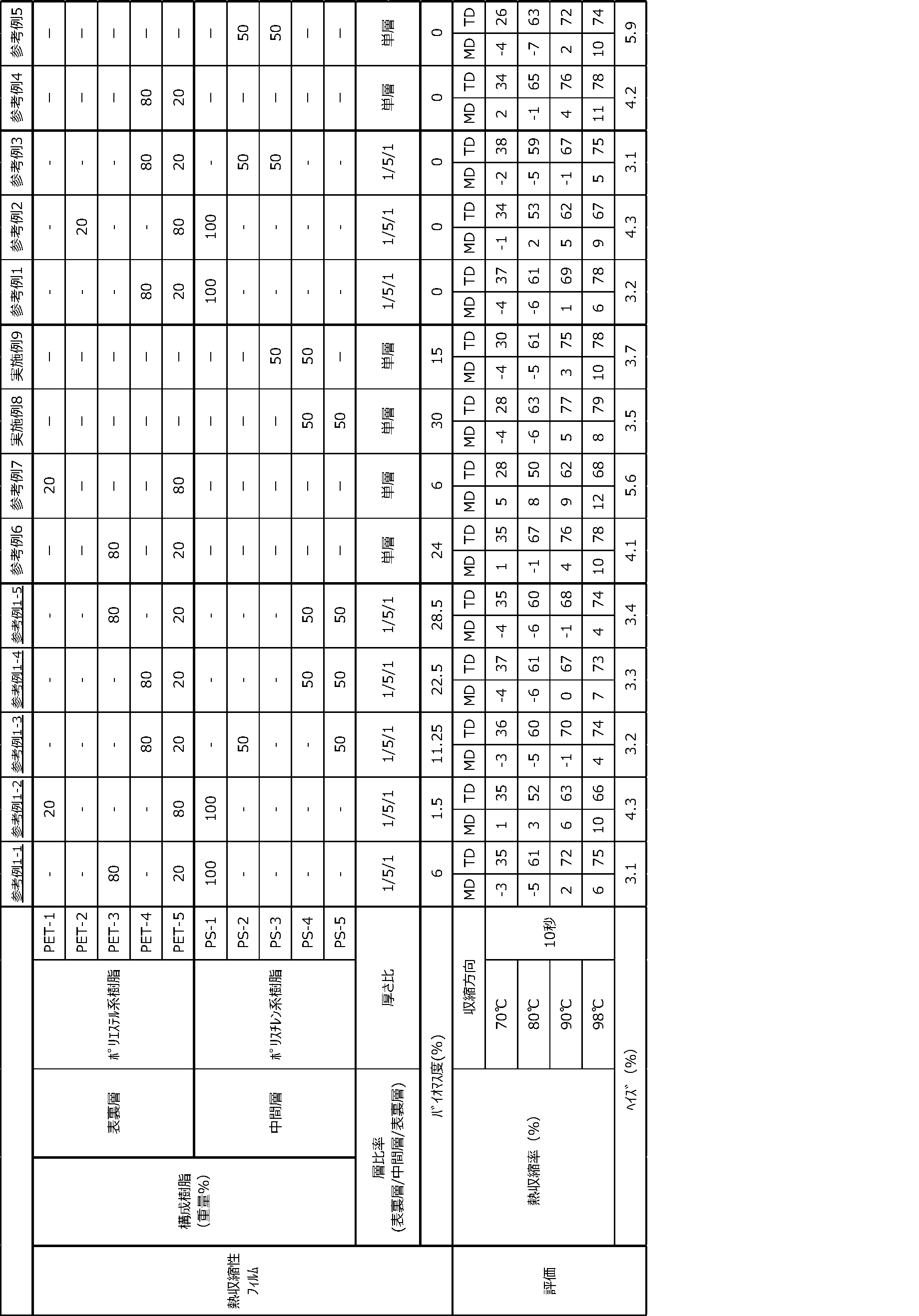
本発明によれば、化石資源の使用量を削減することができるとともに、機械的特性等の物性面において高い性能を発現可能な熱収縮性多層フィルムを提供することができる。また、該熱収縮性フィルムを含む熱収縮性ラベルを提供することができる。 The present invention can provide a heat-shrinkable multilayer film that can reduce the amount of fossil resources used and exhibit high performance in terms of physical properties such as mechanical properties. It can also provide a heat-shrinkable label that includes the heat-shrinkable film.
Claims (4)
前記ポリスチレン系樹脂はバイオマス由来の成分を含むポリスチレン系樹脂を含有し、
70℃の温水中に10秒間浸した場合のTD方向の熱収縮率が5~65%であることを特徴とする熱収縮性フィルム。 The layer is made up of only a layer containing a polystyrene-based resin,
The polystyrene-based resin contains a polystyrene-based resin containing a component derived from biomass,
A heat-shrinkable film having a thermal shrinkage rate in the TD direction of 5 to 65% when immersed in warm water at 70°C for 10 seconds.
Priority Applications (2)
| Application Number | Priority Date | Filing Date | Title |
|---|---|---|---|
| JP2023187155A JP7608564B2 (en) | 2020-02-14 | 2023-10-31 | Heat shrinkable films and labels |
| JP2024221778A JP2025028278A (en) | 2020-02-14 | 2024-12-18 | Heat shrinkable film and heat shrinkable label |
Applications Claiming Priority (2)
| Application Number | Priority Date | Filing Date | Title |
|---|---|---|---|
| JP2020023206A JP7378313B2 (en) | 2020-02-14 | 2020-02-14 | Heat-shrinkable film and heat-shrinkable labels |
| JP2023187155A JP7608564B2 (en) | 2020-02-14 | 2023-10-31 | Heat shrinkable films and labels |
Related Parent Applications (1)
| Application Number | Title | Priority Date | Filing Date |
|---|---|---|---|
| JP2020023206A Division JP7378313B2 (en) | 2020-02-14 | 2020-02-14 | Heat-shrinkable film and heat-shrinkable labels |
Related Child Applications (1)
| Application Number | Title | Priority Date | Filing Date |
|---|---|---|---|
| JP2024221778A Division JP2025028278A (en) | 2020-02-14 | 2024-12-18 | Heat shrinkable film and heat shrinkable label |
Publications (2)
| Publication Number | Publication Date |
|---|---|
| JP2024016130A JP2024016130A (en) | 2024-02-06 |
| JP7608564B2 true JP7608564B2 (en) | 2025-01-06 |
Family
ID=77487574
Family Applications (3)
| Application Number | Title | Priority Date | Filing Date |
|---|---|---|---|
| JP2020023206A Active JP7378313B2 (en) | 2020-02-14 | 2020-02-14 | Heat-shrinkable film and heat-shrinkable labels |
| JP2023187155A Active JP7608564B2 (en) | 2020-02-14 | 2023-10-31 | Heat shrinkable films and labels |
| JP2024221778A Pending JP2025028278A (en) | 2020-02-14 | 2024-12-18 | Heat shrinkable film and heat shrinkable label |
Family Applications Before (1)
| Application Number | Title | Priority Date | Filing Date |
|---|---|---|---|
| JP2020023206A Active JP7378313B2 (en) | 2020-02-14 | 2020-02-14 | Heat-shrinkable film and heat-shrinkable labels |
Family Applications After (1)
| Application Number | Title | Priority Date | Filing Date |
|---|---|---|---|
| JP2024221778A Pending JP2025028278A (en) | 2020-02-14 | 2024-12-18 | Heat shrinkable film and heat shrinkable label |
Country Status (1)
| Country | Link |
|---|---|
| JP (3) | JP7378313B2 (en) |
Families Citing this family (2)
| Publication number | Priority date | Publication date | Assignee | Title |
|---|---|---|---|---|
| JPWO2022138039A1 (en) * | 2020-12-24 | 2022-06-30 | ||
| CN122555629A (en) * | 2024-02-19 | 2026-08-11 | 郡是株式会社 | Heat shrinkable film |
Citations (6)
| Publication number | Priority date | Publication date | Assignee | Title |
|---|---|---|---|---|
| JP2009000898A (en) | 2007-06-21 | 2009-01-08 | Gunze Ltd | Heat-shrinkable multilayer film and heat-shrinkable label |
| JP2010214900A (en) | 2009-03-18 | 2010-09-30 | Mitsubishi Plastics Inc | Heat-shrinkable laminated film, molding and label using the film, and vessel with the molding and label attached thereto |
| JP2015042711A (en) | 2013-08-26 | 2015-03-05 | 住友ゴム工業株式会社 | Cap tread rubber composition for passenger car tire, cap tread rubber for passenger car tire, and pneumatic tire for passenger car |
| JP2016505645A (en) | 2012-11-09 | 2016-02-25 | 株式会社ブリヂストン | Usage of biological styrene |
| US20190390026A1 (en) | 2018-06-21 | 2019-12-26 | Fina Technology, Inc. | Polystyrene compositions for foam extrusion |
| WO2020008811A1 (en) | 2018-07-05 | 2020-01-09 | グンゼ株式会社 | Heat-shrinkable multilayer film and heat-shrinkable label |
Family Cites Families (9)
| Publication number | Priority date | Publication date | Assignee | Title |
|---|---|---|---|---|
| JP3867095B2 (en) * | 2004-06-03 | 2007-01-10 | 三菱樹脂株式会社 | Heat-shrinkable laminated film, molded product using the film, heat-shrinkable label, and container |
| JP2007176873A (en) * | 2005-12-28 | 2007-07-12 | Toray Ind Inc | Manufacturing method of resin raw material, resin and manufacturing method thereof |
| JP5153370B2 (en) * | 2008-02-04 | 2013-02-27 | 電気化学工業株式会社 | Resin composition, heat-shrinkable film, and heat-shrinkable label |
| JP5292196B2 (en) * | 2009-06-15 | 2013-09-18 | グンゼ株式会社 | Heat-shrinkable multilayer film and heat-shrinkable label |
| JP5762823B2 (en) * | 2011-05-23 | 2015-08-12 | エイ・エス・ケイジャパン株式会社 | Mat hook |
| JP5536840B2 (en) * | 2012-09-07 | 2014-07-02 | 住友ゴム工業株式会社 | Rubber composition for tire, tire member, and pneumatic tire |
| JP6269399B2 (en) * | 2014-02-04 | 2018-01-31 | 東洋紡株式会社 | Heat-shrinkable polyester film |
| CN111918909B (en) * | 2018-03-30 | 2024-03-01 | 东洋纺株式会社 | Heat shrinkable polyester film |
| JP7119504B2 (en) * | 2018-03-30 | 2022-08-17 | 東洋紡株式会社 | Heat-shrinkable polyester film |
-
2020
- 2020-02-14 JP JP2020023206A patent/JP7378313B2/en active Active
-
2023
- 2023-10-31 JP JP2023187155A patent/JP7608564B2/en active Active
-
2024
- 2024-12-18 JP JP2024221778A patent/JP2025028278A/en active Pending
Patent Citations (7)
| Publication number | Priority date | Publication date | Assignee | Title |
|---|---|---|---|---|
| JP2009000898A (en) | 2007-06-21 | 2009-01-08 | Gunze Ltd | Heat-shrinkable multilayer film and heat-shrinkable label |
| JP2010214900A (en) | 2009-03-18 | 2010-09-30 | Mitsubishi Plastics Inc | Heat-shrinkable laminated film, molding and label using the film, and vessel with the molding and label attached thereto |
| JP2016505645A (en) | 2012-11-09 | 2016-02-25 | 株式会社ブリヂストン | Usage of biological styrene |
| JP2018109200A (en) | 2012-11-09 | 2018-07-12 | 株式会社ブリヂストン | Uses of biobased styrene |
| JP2015042711A (en) | 2013-08-26 | 2015-03-05 | 住友ゴム工業株式会社 | Cap tread rubber composition for passenger car tire, cap tread rubber for passenger car tire, and pneumatic tire for passenger car |
| US20190390026A1 (en) | 2018-06-21 | 2019-12-26 | Fina Technology, Inc. | Polystyrene compositions for foam extrusion |
| WO2020008811A1 (en) | 2018-07-05 | 2020-01-09 | グンゼ株式会社 | Heat-shrinkable multilayer film and heat-shrinkable label |
Also Published As
| Publication number | Publication date |
|---|---|
| JP2024016130A (en) | 2024-02-06 |
| JP2021126834A (en) | 2021-09-02 |
| JP7378313B2 (en) | 2023-11-13 |
| JP2025028278A (en) | 2025-02-28 |
Similar Documents
| Publication | Publication Date | Title |
|---|---|---|
| JP6051160B2 (en) | Heat-shrinkable multilayer film and heat-shrinkable label | |
| CN106604817B (en) | Heat-shrinkable multilayer films and heat-shrinkable labels | |
| JP2025028278A (en) | Heat shrinkable film and heat shrinkable label | |
| JP7410867B2 (en) | heat shrinkable multilayer film | |
| CN106061732A (en) | Heat-shrinkable multilayer film and heat-shrinkable label | |
| JP6077891B2 (en) | Heat-shrinkable multilayer film and heat-shrinkable label | |
| JP5134294B2 (en) | Heat-shrinkable multilayer film and heat-shrinkable label | |
| JP7601994B2 (en) | Heat shrinkable multilayer film | |
| CN111902281B (en) | Heat-shrinkable multilayer film and heat-shrinkable label | |
| JP7269242B2 (en) | Heat-shrinkable multilayer film and heat-shrinkable label | |
| JP7532383B2 (en) | Heat-shrinkable multilayer film and heat-shrinkable label | |
| JP6154765B2 (en) | Heat-shrinkable multilayer film and heat-shrinkable label | |
| JP2012210717A (en) | Heat shrinkable multilayered film and heat shrinkable label | |
| JP7130512B2 (en) | Heat-shrinkable multilayer film and heat-shrinkable label | |
| JP6154706B2 (en) | Heat-shrinkable multilayer film and heat-shrinkable label | |
| JP5563858B2 (en) | Heat-shrinkable multilayer film and heat-shrinkable label | |
| JP5632631B2 (en) | Heat-shrinkable multilayer film and heat-shrinkable label | |
| JP7273230B2 (en) | heat shrinkable multilayer film | |
| JP7143180B2 (en) | heat shrinkable multilayer film |
Legal Events
| Date | Code | Title | Description |
|---|---|---|---|
| A521 | Request for written amendment filed |
Free format text: JAPANESE INTERMEDIATE CODE: A523 Effective date: 20231129 |
|
| A621 | Written request for application examination |
Free format text: JAPANESE INTERMEDIATE CODE: A621 Effective date: 20231129 |
|
| A977 | Report on retrieval |
Free format text: JAPANESE INTERMEDIATE CODE: A971007 Effective date: 20240726 |
|
| A131 | Notification of reasons for refusal |
Free format text: JAPANESE INTERMEDIATE CODE: A131 Effective date: 20240730 |
|
| A521 | Request for written amendment filed |
Free format text: JAPANESE INTERMEDIATE CODE: A523 Effective date: 20240927 |
|
| TRDD | Decision of grant or rejection written | ||
| A01 | Written decision to grant a patent or to grant a registration (utility model) |
Free format text: JAPANESE INTERMEDIATE CODE: A01 Effective date: 20241119 |
|
| A61 | First payment of annual fees (during grant procedure) |
Free format text: JAPANESE INTERMEDIATE CODE: A61 Effective date: 20241218 |
|
| R150 | Certificate of patent or registration of utility model |
Ref document number: 7608564 Country of ref document: JP Free format text: JAPANESE INTERMEDIATE CODE: R150 |