JP7598024B2 - Heavy Duty Tires - Google Patents
Heavy Duty Tires Download PDFInfo
- Publication number
- JP7598024B2 JP7598024B2 JP2021104865A JP2021104865A JP7598024B2 JP 7598024 B2 JP7598024 B2 JP 7598024B2 JP 2021104865 A JP2021104865 A JP 2021104865A JP 2021104865 A JP2021104865 A JP 2021104865A JP 7598024 B2 JP7598024 B2 JP 7598024B2
- Authority
- JP
- Japan
- Prior art keywords
- layer
- tire
- rubber
- belt
- tread portion
- Prior art date
- Legal status (The legal status is an assumption and is not a legal conclusion. Google has not performed a legal analysis and makes no representation as to the accuracy of the status listed.)
- Active
Links
- 229920001971 elastomer Polymers 0.000 claims description 88
- 239000005060 rubber Substances 0.000 claims description 87
- 239000000203 mixture Substances 0.000 claims description 39
- 239000011324 bead Substances 0.000 claims description 21
- 239000006229 carbon black Substances 0.000 claims description 21
- 150000001875 compounds Chemical class 0.000 claims description 19
- IJGRMHOSHXDMSA-UHFFFAOYSA-N Atomic nitrogen Chemical compound N#N IJGRMHOSHXDMSA-UHFFFAOYSA-N 0.000 claims description 18
- 244000043261 Hevea brasiliensis Species 0.000 claims description 10
- 229910000831 Steel Inorganic materials 0.000 claims description 10
- 229920003052 natural elastomer Polymers 0.000 claims description 10
- 229920001194 natural rubber Polymers 0.000 claims description 10
- 239000010959 steel Substances 0.000 claims description 10
- 229910052757 nitrogen Inorganic materials 0.000 claims description 9
- 238000001179 sorption measurement Methods 0.000 claims description 9
- 230000002093 peripheral effect Effects 0.000 claims description 7
- 125000000217 alkyl group Chemical group 0.000 claims description 3
- 125000004432 carbon atom Chemical group C* 0.000 claims description 3
- 230000020169 heat generation Effects 0.000 description 32
- 230000000052 comparative effect Effects 0.000 description 16
- 238000012360 testing method Methods 0.000 description 9
- VYPSYNLAJGMNEJ-UHFFFAOYSA-N Silicium dioxide Chemical compound O=[Si]=O VYPSYNLAJGMNEJ-UHFFFAOYSA-N 0.000 description 7
- 230000000694 effects Effects 0.000 description 7
- XLOMVQKBTHCTTD-UHFFFAOYSA-N Zinc monoxide Chemical compound [Zn]=O XLOMVQKBTHCTTD-UHFFFAOYSA-N 0.000 description 6
- 238000004073 vulcanization Methods 0.000 description 6
- NINIDFKCEFEMDL-UHFFFAOYSA-N Sulfur Chemical compound [S] NINIDFKCEFEMDL-UHFFFAOYSA-N 0.000 description 5
- 238000010276 construction Methods 0.000 description 5
- 229920003244 diene elastomer Polymers 0.000 description 5
- 239000000945 filler Substances 0.000 description 5
- 238000000034 method Methods 0.000 description 5
- 229910052717 sulfur Inorganic materials 0.000 description 5
- 239000011593 sulfur Substances 0.000 description 5
- ZWLIYXJBOIDXLL-UHFFFAOYSA-N decanedihydrazide Chemical compound NNC(=O)CCCCCCCCC(=O)NN ZWLIYXJBOIDXLL-UHFFFAOYSA-N 0.000 description 4
- 239000000654 additive Substances 0.000 description 3
- IBVAQQYNSHJXBV-UHFFFAOYSA-N adipic acid dihydrazide Chemical compound NNC(=O)CCCCC(=O)NN IBVAQQYNSHJXBV-UHFFFAOYSA-N 0.000 description 3
- 229940125782 compound 2 Drugs 0.000 description 3
- 229940126214 compound 3 Drugs 0.000 description 3
- 230000007423 decrease Effects 0.000 description 3
- 230000003014 reinforcing effect Effects 0.000 description 3
- 229920005989 resin Polymers 0.000 description 3
- 239000011347 resin Substances 0.000 description 3
- 239000000377 silicon dioxide Substances 0.000 description 3
- 239000000126 substance Substances 0.000 description 3
- 239000004636 vulcanized rubber Substances 0.000 description 3
- 239000011787 zinc oxide Substances 0.000 description 3
- FDNAQCWUERCJBK-UHFFFAOYSA-N 3-hydroxynaphthalene-2-carbohydrazide Chemical compound C1=CC=C2C=C(O)C(C(=O)NN)=CC2=C1 FDNAQCWUERCJBK-UHFFFAOYSA-N 0.000 description 2
- UIHCLUNTQKBZGK-UHFFFAOYSA-N 3-methyl-2-pentanone Chemical compound CCC(C)C(C)=O UIHCLUNTQKBZGK-UHFFFAOYSA-N 0.000 description 2
- VTYYLEPIZMXCLO-UHFFFAOYSA-L Calcium carbonate Chemical compound [Ca+2].[O-]C([O-])=O VTYYLEPIZMXCLO-UHFFFAOYSA-L 0.000 description 2
- 239000004594 Masterbatch (MB) Substances 0.000 description 2
- 235000021355 Stearic acid Nutrition 0.000 description 2
- 238000013329 compounding Methods 0.000 description 2
- 239000013078 crystal Substances 0.000 description 2
- 230000006866 deterioration Effects 0.000 description 2
- 238000011156 evaluation Methods 0.000 description 2
- 239000011159 matrix material Substances 0.000 description 2
- QIQXTHQIDYTFRH-UHFFFAOYSA-N octadecanoic acid Chemical compound CCCCCCCCCCCCCCCCCC(O)=O QIQXTHQIDYTFRH-UHFFFAOYSA-N 0.000 description 2
- OQCDKBAXFALNLD-UHFFFAOYSA-N octadecanoic acid Natural products CCCCCCCC(C)CCCCCCCCC(O)=O OQCDKBAXFALNLD-UHFFFAOYSA-N 0.000 description 2
- 239000003921 oil Substances 0.000 description 2
- FDPIMTJIUBPUKL-UHFFFAOYSA-N pentan-3-one Chemical compound CCC(=O)CC FDPIMTJIUBPUKL-UHFFFAOYSA-N 0.000 description 2
- 239000008117 stearic acid Substances 0.000 description 2
- 229920005992 thermoplastic resin Polymers 0.000 description 2
- YNKRALFEAHPYHV-UHFFFAOYSA-N 1-hydroxy-n-(4-methylpentan-2-ylideneamino)naphthalene-2-carboxamide Chemical compound C1=CC=CC2=C(O)C(C(=O)NN=C(C)CC(C)C)=CC=C21 YNKRALFEAHPYHV-UHFFFAOYSA-N 0.000 description 1
- QMAKQGRNPBSVPF-UHFFFAOYSA-N 1-hydroxy-n-(pentan-2-ylideneamino)naphthalene-2-carboxamide Chemical compound C1=CC=CC2=C(O)C(C(=O)NN=C(C)CCC)=CC=C21 QMAKQGRNPBSVPF-UHFFFAOYSA-N 0.000 description 1
- HPVHAMSPYACBNI-UHFFFAOYSA-N 1-hydroxy-n-(propan-2-ylideneamino)naphthalene-2-carboxamide Chemical compound C1=CC=CC2=C(O)C(C(=O)NN=C(C)C)=CC=C21 HPVHAMSPYACBNI-UHFFFAOYSA-N 0.000 description 1
- HPTJCEPNQHYWIH-UHFFFAOYSA-N 3-hydroxy-n-(4-methylpentan-2-ylideneamino)naphthalene-2-carboxamide Chemical compound C1=CC=C2C=C(O)C(C(=O)NN=C(C)CC(C)C)=CC2=C1 HPTJCEPNQHYWIH-UHFFFAOYSA-N 0.000 description 1
- RSRDAGPXJWNKES-UHFFFAOYSA-N 3-hydroxy-n-(pentan-2-ylideneamino)naphthalene-2-carboxamide Chemical compound C1=CC=C2C=C(O)C(C(=O)NN=C(C)CCC)=CC2=C1 RSRDAGPXJWNKES-UHFFFAOYSA-N 0.000 description 1
- BJBFLNKKGYKDFG-UHFFFAOYSA-N 3-hydroxy-n-(propan-2-ylideneamino)naphthalene-2-carboxamide Chemical compound C1=CC=C2C=C(O)C(C(=O)NN=C(C)C)=CC2=C1 BJBFLNKKGYKDFG-UHFFFAOYSA-N 0.000 description 1
- 229920000459 Nitrile rubber Polymers 0.000 description 1
- 239000005062 Polybutadiene Substances 0.000 description 1
- 241000872198 Serjania polyphylla Species 0.000 description 1
- 125000005370 alkoxysilyl group Chemical group 0.000 description 1
- 150000001408 amides Chemical group 0.000 description 1
- 150000001412 amines Chemical group 0.000 description 1
- 239000003963 antioxidant agent Substances 0.000 description 1
- 229920005549 butyl rubber Polymers 0.000 description 1
- 229910000019 calcium carbonate Inorganic materials 0.000 description 1
- 229910052799 carbon Inorganic materials 0.000 description 1
- 125000003178 carboxy group Chemical group [H]OC(*)=O 0.000 description 1
- 239000003795 chemical substances by application Substances 0.000 description 1
- 239000004927 clay Substances 0.000 description 1
- 229910052570 clay Inorganic materials 0.000 description 1
- 229940125904 compound 1 Drugs 0.000 description 1
- 229940125898 compound 5 Drugs 0.000 description 1
- 238000004132 cross linking Methods 0.000 description 1
- 239000003431 cross linking reagent Substances 0.000 description 1
- 238000010586 diagram Methods 0.000 description 1
- 239000000806 elastomer Substances 0.000 description 1
- 238000009472 formulation Methods 0.000 description 1
- 125000002887 hydroxy group Chemical group [H]O* 0.000 description 1
- 239000004615 ingredient Substances 0.000 description 1
- 238000004898 kneading Methods 0.000 description 1
- OEJJDFUEHNLHCY-UHFFFAOYSA-N n-(butan-2-ylideneamino)-1-hydroxynaphthalene-2-carboxamide Chemical compound C1=CC=CC2=C(O)C(C(=O)NN=C(C)CC)=CC=C21 OEJJDFUEHNLHCY-UHFFFAOYSA-N 0.000 description 1
- CFMUQRHQUYZLQW-UHFFFAOYSA-N n-(butan-2-ylideneamino)-3-hydroxynaphthalene-2-carboxamide Chemical compound C1=CC=C2C=C(O)C(C(=O)NN=C(C)CC)=CC2=C1 CFMUQRHQUYZLQW-UHFFFAOYSA-N 0.000 description 1
- 125000001181 organosilyl group Chemical group [SiH3]* 0.000 description 1
- 239000002245 particle Substances 0.000 description 1
- 230000000704 physical effect Effects 0.000 description 1
- 239000004014 plasticizer Substances 0.000 description 1
- 229920002857 polybutadiene Polymers 0.000 description 1
- 230000002265 prevention Effects 0.000 description 1
- 239000002994 raw material Substances 0.000 description 1
- 230000002787 reinforcement Effects 0.000 description 1
- 239000012779 reinforcing material Substances 0.000 description 1
- 238000000926 separation method Methods 0.000 description 1
- 229920003048 styrene butadiene rubber Polymers 0.000 description 1
- 239000000454 talc Substances 0.000 description 1
- 229910052623 talc Inorganic materials 0.000 description 1
Images


Classifications
-
- Y—GENERAL TAGGING OF NEW TECHNOLOGICAL DEVELOPMENTS; GENERAL TAGGING OF CROSS-SECTIONAL TECHNOLOGIES SPANNING OVER SEVERAL SECTIONS OF THE IPC; TECHNICAL SUBJECTS COVERED BY FORMER USPC CROSS-REFERENCE ART COLLECTIONS [XRACs] AND DIGESTS
- Y02—TECHNOLOGIES OR APPLICATIONS FOR MITIGATION OR ADAPTATION AGAINST CLIMATE CHANGE
- Y02T—CLIMATE CHANGE MITIGATION TECHNOLOGIES RELATED TO TRANSPORTATION
- Y02T10/00—Road transport of goods or passengers
- Y02T10/80—Technologies aiming to reduce greenhouse gasses emissions common to all road transportation technologies
- Y02T10/86—Optimisation of rolling resistance, e.g. weight reduction
Landscapes
- Tires In General (AREA)
- Compositions Of Macromolecular Compounds (AREA)
Description
本発明は、トレッド部におけるカーカス層の外周側に5層以上のベルト層が埋設された重荷重用タイヤに関する。 The present invention relates to a heavy-duty tire in which five or more belt layers are embedded on the outer peripheral side of the carcass layer in the tread portion.
トラック、バス、建設用車両等に使用される重荷重用タイヤは、耐久性を確保するために、トレッド部におけるカーカス層の外周側に、主としてスチールワイヤで構成された複数のベルト層が配置されている。特に、採石場や大規模な建設作業場等で稼働する大型ダンプ等の大型建設用車両に装着される重荷重用タイヤは、重荷重が載積された状態で長時間使用されることが多く、優れた耐久性を有することが求められる。例えば、特許文献1に記載される重荷重用タイヤは、5層以上のスチールベルト層を備えることで、重荷重載積に対する耐久性を確保している。
Heavy-duty tires used on trucks, buses, construction vehicles, etc. have multiple belt layers, mainly made of steel wires, arranged on the outer periphery of the carcass layer in the tread portion to ensure durability. In particular, heavy-duty tires mounted on large construction vehicles such as large dump trucks operating in quarries and large construction sites are often used for long periods of time with a heavy load loaded, and are therefore required to have excellent durability. For example, the heavy-duty tire described in
一方で、大型建設用車両向けの重荷重用タイヤは、前述のように重荷重が載積された状態で長時間使用されるため、タイヤが発熱して過熱状態になりやすい傾向があり、発熱を抑制する対策が求められる。また、重荷重用タイヤにおける発熱の抑制は、発熱に起因するバーストの防止効果が見込めるため、耐久性の観点からも低発熱化は重要である。更に、近年、輸送効率の向上のためにタイヤの大型化が進んでいるため、重荷重用タイヤにおける低発熱化は非常に重要な課題となっている。ところが、前述の5層以上のスチールベルト層を備えたタイヤでは、ベルト層の数が多いため、発熱を抑制することが難しく、耐久性と低発熱性の両立が難しいという問題があった。 On the other hand, heavy-duty tires for large construction vehicles are used for long periods of time with a heavy load on them, as mentioned above, so the tires tend to heat up and become overheated, and measures to suppress heat generation are required. In addition, suppressing heat generation in heavy-duty tires is expected to prevent bursts caused by heat generation, so low heat generation is also important from the perspective of durability. Furthermore, in recent years, tires have become larger to improve transportation efficiency, so low heat generation in heavy-duty tires has become a very important issue. However, in tires with the above-mentioned five or more steel belt layers, the large number of belt layers makes it difficult to suppress heat generation, and there is a problem that it is difficult to achieve both durability and low heat generation.
本発明の目的は、低発熱性を悪化させることなく、耐久性を向上することを可能にした重荷重用タイヤを提供することにある。 The object of the present invention is to provide a heavy-duty tire that improves durability without compromising low heat generation.
上記目的を達成する本発明の重荷重用タイヤは、タイヤ周方向に延在して環状をなすトレッド部と、前記トレッド部の両側に配置された一対のサイドウォール部と、前記一対のサイドウォール部のタイヤ径方向内側に配置された一対のビード部とを備え、前記一対のビード部間に装架されたカーカス層と、前記トレッド部における前記カーカス層の外周側に配置された5層以上のベルト層とを有し、前記トレッド部が、前記トレッド部の踏面を構成するキャップトレッド層と、前記キャップトレッド層のタイヤ径方向内側に配置されたアンダートレッド層との2層で構成され、前記トレッド部の外表面に複数本の溝が形成された空気入りタイヤにおいて、タイヤ子午線断面において、接地端を通り前記カーカス層のタイヤ径方向外側の表面に垂直な直線を垂線Pとしたとき、前記5層以上のベルト層のうち幅が最も大きい最幅広ベルトと前記カーカス層との間の前記垂線P上で測定される距離Aと、前記複数本の溝のうち最大深さを有する最深溝の溝底を通り前記トレッド部の外表面の輪郭線に平行な溝底ラインLとタイヤ内表面との間の前記垂線P上で測定される距離Bとが0.3≦A/B≦0.7の関係を満たし、前記アンダートレッド層が、天然ゴムを70質量%以上含有するゴム成分100質量部に対して、下記式(1)で表されるヒドラジド化合物0.5質量部~3.0質量部と、窒素吸着比表面積N2SAが60m2/g~120m2/gであるカーボンブラック30質量部~60質量部とが配合されたゴム組成物で構成されたことを特徴とする(尚、下記式(1)中、R1およびR2はそれぞれ独立して炭素数1~18のアルキル基を表す)。 The heavy-duty tire of the present invention that achieves the above object comprises a tread portion extending in a circumferential direction of the tire to form an annular shape, a pair of sidewall portions disposed on both sides of the tread portion, and a pair of bead portions disposed radially inward of the pair of sidewall portions, the tire has a carcass layer mounted between the pair of bead portions, and five or more belt layers disposed on the outer peripheral side of the carcass layer in the tread portion, the tread portion being composed of two layers, a cap tread layer that constitutes the contact surface of the tread portion, and an under tread layer disposed radially inward of the cap tread layer, and a plurality of grooves are formed on the outer surface of the tread portion. In a tire meridian cross section, when a straight line passing through a ground contact edge and perpendicular to the surface of the carcass layer radially outward from the tire is taken as a perpendicular line P, a distance A measured on the perpendicular line P between a widest belt having the largest width among the five or more belt layers and the carcass layer, and a distance B measured on the perpendicular line P between a groove bottom line L passing through a groove bottom of a deepest groove having the greatest depth among the plurality of grooves and parallel to a contour line of the outer surface of the tread portion and an inner surface of the tire satisfy a relationship of 0.3≦A/B≦0.7, and the undertread layer is a rubber component containing 70% or more by mass of natural rubber and 0.5 to 3.0 parts by mass of a hydrazide compound represented by the following formula (1), and a nitrogen adsorption specific surface area N The rubber composition is characterized in that it is composed of a rubber composition blended with 30 to 60 parts by mass of carbon black having an SA of 60 m2 /g to 120 m2 /g (in the following formula (1), R1 and R2 each independently represent an alkyl group having 1 to 18 carbon atoms).
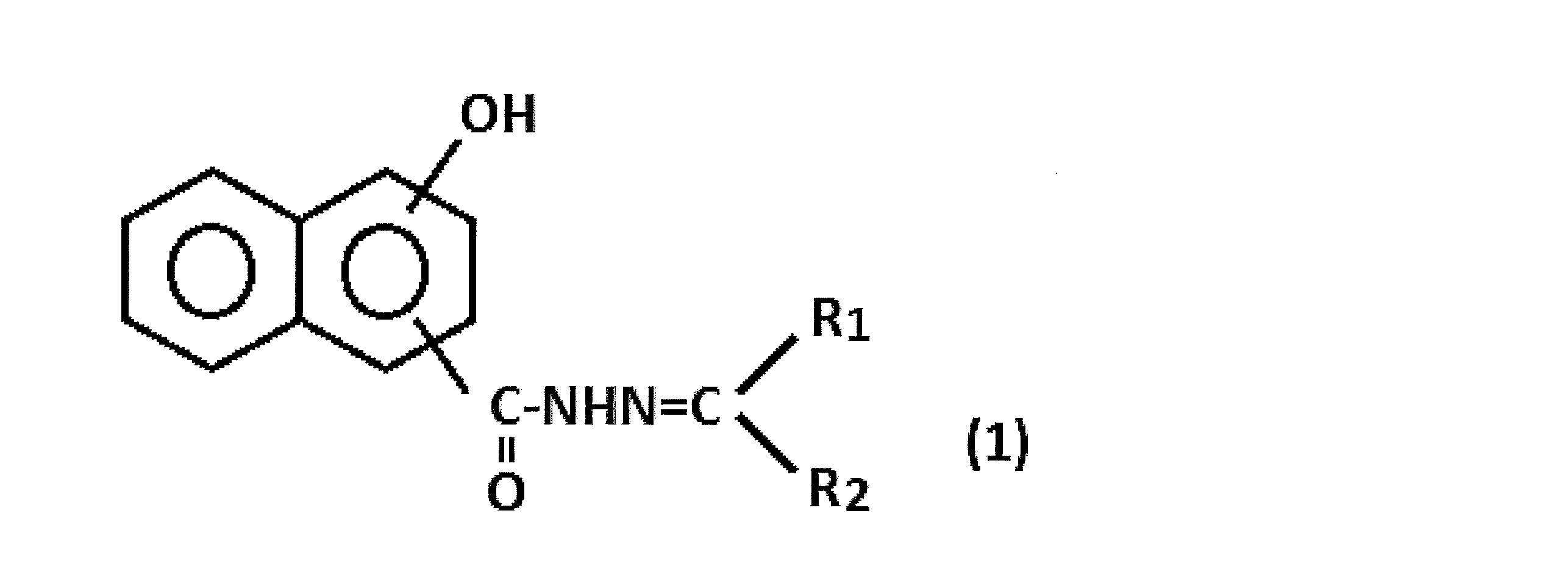
本発明の空気入りタイヤは、5層以上のベルト層を設けて耐久性を向上するにあたって、比A/Bの範囲を上述のように設定しているので、ベルト層(特に、最幅広ベルト)の端部を、溝底ラインとタイヤ内表面との間の適切な位置に配置することができ、ベルトエッジの歪を適切に分散し、耐久性を効果的に高めることができる。一方で、ベルト層の数が多いことで発熱性が悪化することが懸念されるが、アンダートレッド層が上述のゴム組成物で構成されているので、発熱を効果的に抑制することができる。特に、上述のヒドラジド化合物とカーボンブラックを用いているので、カーボンブラックを効果的に分散して、低発熱化を図ることができる。これらの協働により、優れた耐久性と低発熱性をバランスよく高度に両立することができる。 In the pneumatic tire of the present invention, the range of the ratio A/B is set as described above when five or more belt layers are provided to improve durability, so that the ends of the belt layers (particularly the widest belt) can be positioned at appropriate positions between the groove bottom line and the tire inner surface, and distortion of the belt edges can be appropriately distributed and durability can be effectively improved. On the other hand, there is a concern that a large number of belt layers may deteriorate heat generation, but since the undertread layer is composed of the above-mentioned rubber composition, heat generation can be effectively suppressed. In particular, since the above-mentioned hydrazide compound and carbon black are used, the carbon black can be effectively dispersed to reduce heat generation. These cooperations make it possible to achieve a good balance between excellent durability and low heat generation.
本発明において、ベルト層の層数が5層~6層であることが好ましい。このようにベルト層の数を最適化することで、ベルト層の数が過剰になって低発熱性が悪化することを防止しながら、耐久性を向上することができる。 In the present invention, the number of belt layers is preferably 5 to 6. By optimizing the number of belt layers in this way, it is possible to improve durability while preventing deterioration of low heat generation properties due to an excessive number of belt layers.
本発明において、ベルト層のそれぞれがタイヤ周方向に対して傾斜する複数本のスチールワイヤを含み、各ベルト層におけるスチールワイヤのタイヤ周方向に対する傾斜角度が3°以上であることが好ましい。これにより、耐久性を向上するには有利になる。 In the present invention, each belt layer includes a plurality of steel wires that are inclined with respect to the tire circumferential direction, and it is preferable that the inclination angle of the steel wires in each belt layer with respect to the tire circumferential direction is 3° or more. This is advantageous for improving durability.
本発明において、ビード部におけるカーカス層の外周側に配置されたリムクッションゴム層を構成するゴムのJIS‐A硬度が64以上であることが好ましい。特に、リムクッションゴム層を構成するゴムのJIS‐A硬度は67以上であることが好ましい。このようにリムクッションゴム層の硬度を十分に確保することで、タイヤの耐久性を向上するには有利になる。 In the present invention, it is preferable that the JIS-A hardness of the rubber constituting the rim cushion rubber layer arranged on the outer periphery of the carcass layer in the bead portion is 64 or more. In particular, it is preferable that the JIS-A hardness of the rubber constituting the rim cushion rubber layer is 67 or more. Ensuring sufficient hardness of the rim cushion rubber layer in this way is advantageous in improving the durability of the tire.
尚、本発明において、カーボンブラックの窒素吸着比表面積N2SAは、JIS K6217‐2に準拠して測定するものとする。硬度は、各ゴム層を構成するゴムのJIS‐A硬度であり、JIS K6253に準拠しデュロメータのタイプAにより温度20℃で測定されたゴムの硬さである。 In the present invention, the nitrogen adsorption specific surface area N2SA of carbon black is measured in accordance with JIS K6217-2. The hardness is the JIS-A hardness of the rubber constituting each rubber layer, and is the hardness of the rubber measured at a temperature of 20°C using a durometer type A in accordance with JIS K6253.
本発明において、「接地端」とは、タイヤを正規リムにリム組みして正規内圧を充填した状態で平面上に垂直に置いて正規荷重を加えたときに形成される接地領域のタイヤ軸方向の両端部である。「正規リム」とは、タイヤが基づいている規格を含む規格体系において、当該規格がタイヤ毎に定めるリムであり、例えば、JATMAであれば標準リム、TRAであれば“Design Rim”、或いはETRTOであれば“Measuring Rim”とする。「正規内圧」とは、タイヤが基づいている規格を含む規格体系において、各規格がタイヤ毎に定めている空気圧であり、JATMAであれば最高空気圧、TRAであれば表“TIRE LOAD LIMITS AT VARIOUS COLD INFLATION PRESSURES”に記載の最大値、ETRTOであれば“INFLATION PRESSURE”である。「正規荷重」は、タイヤが基づいている規格を含む規格体系において、各規格がタイヤ毎に定めている荷重であり、JATMAであれば最大負荷能力、TRAであれば表“TIRE LOAD LIMITS AT VARIOUS COLD INFLATION PRESSURES”に記載の最大値、ETRTOであれば“LOAD CAPACITY”である。 In the present invention, the "ground contact edge" refers to both ends in the axial direction of the tire in the contact area formed when the tire is mounted on a standard rim, inflated to the standard internal pressure, placed vertically on a flat surface, and subjected to a standard load. The "standard rim" refers to the rim determined for each tire by the standard system including the standard on which the tire is based, for example, the standard rim for JATMA, the "Design Rim" for TRA, or the "Measuring Rim" for ETRTO. The "standard internal pressure" refers to the air pressure determined for each tire by the standard system including the standard on which the tire is based, for example, the maximum air pressure for JATMA, the maximum value listed in the table "TIRE LOAD LIMITS AT VARIOUS COLD INFLATION PRESSURES" for TRA, and the "INFLATION PRESSURE" for ETRTO. "Normal load" is the load that each standard specifies for each tire in the standard system on which the tire is based. For JATMA, it is the maximum load capacity. For TRA, it is the maximum value listed in the table "TIRE LOAD LIMITS AT VARIOUS COLD INFLATION PRESSURES." For ETRTO, it is the "LOAD CAPACITY."
以下、本発明の構成について添付の図面を参照しながら詳細に説明する。 The configuration of the present invention will be described in detail below with reference to the attached drawings.
図1に示すように、本発明の空気入りタイヤは、トレッド部1と、このトレッド部1の両側に配置された一対のサイドウォール部2と、サイドウォール部2のタイヤ径方向内側に配置された一対のビード部3とを備えている。図1において、符号CLはタイヤ赤道を示す。尚、図1は子午線断面図であるため描写されないが、トレッド部1、サイドウォール部2、ビード部3は、それぞれタイヤ周方向に延在して環状を成しており、これにより空気入りタイヤのトロイダル状の基本構造が構成される。以下、図1を用いた説明は基本的に図示の子午線断面形状に基づくが、各タイヤ構成部材はいずれもタイヤ周方向に延在して環状を成すものである。
As shown in FIG. 1, the pneumatic tire of the present invention comprises a
左右一対のビード部3間にはカーカス層4が装架されている。このカーカス層4は、タイヤ径方向に延びる複数本の補強コードを含み、各ビード部3に配置されたビードコア5の廻りに車両内側から外側に折り返されている。また、ビードコア5の外周上にはビードフィラー6が配置され、このビードフィラー6がカーカス層4の本体部と折り返し部とにより挟み込まれている。
A
トレッド部1におけるカーカス層4の外周側には5層以上(図示の例では6層)のベルト層7が埋設されている。このようにベルト層7の数を多くすることで、耐久性を確保することができる。ベルト層7の数が5層未満であると、十分な耐久性を確保することができない。ベルト層7の数が過剰になって低発熱性が悪化することを防止する観点から、ベルト層7の数は好ましくは5層~6層に設定するとよい。
Five or more belt layers 7 (six in the illustrated example) are embedded on the outer periphery of the
各ベルト層7はタイヤ周方向に対して傾斜して延在する複数本の補強コード(スチールワイヤ)を含む。各ベルト層におけるスチールワイヤのタイヤ周方向に対する傾斜角度は、耐久性の観点から好ましくは3°以上、より好ましくは3°~35°であるとよい。尚、ベルト層7の外周側(タイヤ径方向最外側のベルト層の外周側)には、最外層のベルト層のエッジセパレーションを防止するために、ワイヤー等の補強材を含まずにゴムのみで構成されて、最外層のベルト層のエッジを覆うように配置されたベルトカバーシート(不図示)を設けてもよい。
Each
タイヤ内面にはカーカス層4に沿ってインナーライナー層8が設けられている。このインナーライナー層8は、タイヤ内に充填された空気がタイヤ外に透過することを防ぐための層である。インナーライナー層9は、例えば、空気透過防止性能を有するブチルゴムを主体とするゴム組成物で構成される。或いは、熱可塑性樹脂をマトリクスとする樹脂層で構成することもできる。樹脂層の場合、熱可塑性樹脂のマトリクス中にエラストマー成分を分散させたものであってもよい。
An
トレッド部1において、上述のカーカス層4およびベルト層7の外周側にはトレッドゴム層10が配置される。本発明では、トレッドゴム層10は、物性の異なる2種類のゴム層(キャップトレッド層11およびアンダートレッド層12)がタイヤ径方向に積層した構造を有する。キャップトレッド層11は、アンダートレッド層12の外周側に配置されてトレッド部1の踏面を構成する。アンダートレッド層12は、キャップトレッド層11とベルト層7(タイヤ径方向最外側のベルト層)との間に挟まれる位置に配置される。但し、前述のベルトカバーシートを備える場合は、キャップトレッド層11とベルトカバーシートとの間に挟まれる位置に配置される。尚、サイドウォール部2におけるカーカス層4の外周側(タイヤ幅方向外側)にはサイドゴム層20が配置され、ビード部3におけるカーカス層4の外周側(タイヤ幅方向外側)にはリムクッションゴム層30が配置されている。
In the
トレッド部1の外表面には複数本の溝40が形成される。溝40としては、タイヤにおいて一般的に形成される溝、即ち、タイヤ周方向に沿って延在する主溝、タイヤ幅方向に沿って延在するラグ溝などを設けることができる。以降の説明では、これら溝の延長方向に拘らず、最大深さを有する溝を最深溝41という場合がある。
A number of
本発明では、図2に示すように、タイヤ子午線断面において、接地端Eを通りカーカス層4のタイヤ径方向外側の表面に垂直な直線を垂線Pとする。また、前述の5層以上のベルト層7のうち幅が最も大きい層を最幅広ベルト7Aとし(図示の例では、6層のベルト層7のうち最外層から2番目の層)、この最幅広ベルト7Aのタイヤ径方向内側の表面とカーカス層4のタイヤ径方向外側の表面との間の垂線P上で測定される距離をAとする。更に、前述の最深溝41の溝底を通りトレッド部1の外表面の輪郭線に平行な曲線を溝底ラインLとし、この溝底ラインLとタイヤ内表面(インナーライナー層8のタイヤ内腔が側の表面)との間の垂線P上で測定される距離をBとする。尚、溝底ラインLに関して、「外表面の輪郭線に平行」とは、溝底ラインL上のすべての点で外表面の輪郭線と法線を共有することを意味する。上記のように、距離A,Bを定義したとき、これら距離A,Bの比A/Bは0.3≦A/B≦0.7の関係を満たす。比A/Bの範囲を上述のように設定しているので、ベルト層7(特に、最幅広ベルト7A)の端部を、溝底ラインLとタイヤ内表面との間の適切な位置に配置することができ、ベルトエッジの歪を適切に分散し、耐久性を効果的に高めることができる。比A/Bが0.3未満であると、最幅広ベルト7Aの端部がタイヤ内腔側に寄りすぎて、ベルトエッジの歪を十分に分散できないため、耐久性を向上する効果が見込めなくなる。比A/Bが0.7を超えると、最幅広ベルト7Aの端部がタイヤ外周側に寄りすぎて、ベルトエッジの歪を十分に分散できないため、耐久性を向上する効果が見込めなくなる。
In the present invention, as shown in FIG. 2, in the tire meridian cross section, a straight line passing through the ground contact edge E and perpendicular to the tire radial outer surface of the
本発明では、ベルト層7の数が多いことに起因する発熱への影響を抑制するために、上述のベルト層7の構造だけでなく、アンダートレッド層12に後述のゴム組成物を使用している。
In the present invention, in order to suppress the effect on heat generation caused by the large number of
アンダートレッド層12を構成するゴム組成物(以下、本発明のタイヤ用ゴム組成物という)において、ゴム成分は、ジエン系ゴムであり、天然ゴムを必ず使用する。天然ゴムを含むことにより、耐久性をより優れたものにすることができる。天然ゴムとしては、タイヤ用ゴム組成物に一般的に用いられるものを使用することができる。天然ゴムの含有量は、ゴム成分100質量%中、70質量%以上、好ましくは80質量%~100質量%、より好ましくは100質量%である。天然ゴムの含有量が70質量%未満であると、耐久性を十分に改良することができない。 In the rubber composition constituting the undertread layer 12 (hereinafter referred to as the rubber composition for tires of the present invention), the rubber component is a diene rubber, and natural rubber is always used. By including natural rubber, durability can be improved. As the natural rubber, any natural rubber generally used in rubber compositions for tires can be used. The content of natural rubber is 70% by mass or more, preferably 80% by mass to 100% by mass, and more preferably 100% by mass, out of 100% by mass of the rubber component. If the content of natural rubber is less than 70% by mass, durability cannot be sufficiently improved.
本発明のタイヤ用ゴム組成物は、上述の天然ゴム以外に、他のジエン系ゴムを含有することができる。他のジエン系ゴムとしては、タイヤ用ゴム組成物に一般的に使用可能なゴムを用いることができる。例えば、ブタジエンゴム、スチレンブタジエンゴム、アクリロニトリルブタジエンゴム等を挙げることができる。他のジエン系ゴムは、単独または任意のブレンドとして使用することができる。尚、ジエン系ゴムの分子量やミクロ構造はとくに制限されず、アミン、アミド、シリル、アルコキシシリル、カルボキシル、ヒドロキシル基等で末端変性されていても、エポキシ化されていてもよい。 The rubber composition for tires of the present invention may contain other diene rubbers in addition to the above-mentioned natural rubber. As the other diene rubbers, rubbers that can be generally used in rubber compositions for tires can be used. For example, butadiene rubber, styrene butadiene rubber, acrylonitrile butadiene rubber, etc. can be mentioned. The other diene rubbers can be used alone or as any blend. The molecular weight and microstructure of the diene rubber are not particularly limited, and it may be terminally modified with amine, amide, silyl, alkoxysilyl, carboxyl, hydroxyl groups, etc., or may be epoxidized.
本発明のタイヤ用ゴム組成物は、下記式(1)で表されるヒドラジド化合物が必ず配合される(尚、下記式(1)中、R1およびR2はそれぞれ独立して炭素数1~18のアルキル基を表す)。 The rubber composition for tires of the present invention necessarily contains a hydrazide compound represented by the following formula (1) (in the following formula (1), R 1 and R 2 each independently represent an alkyl group having 1 to 18 carbon atoms).
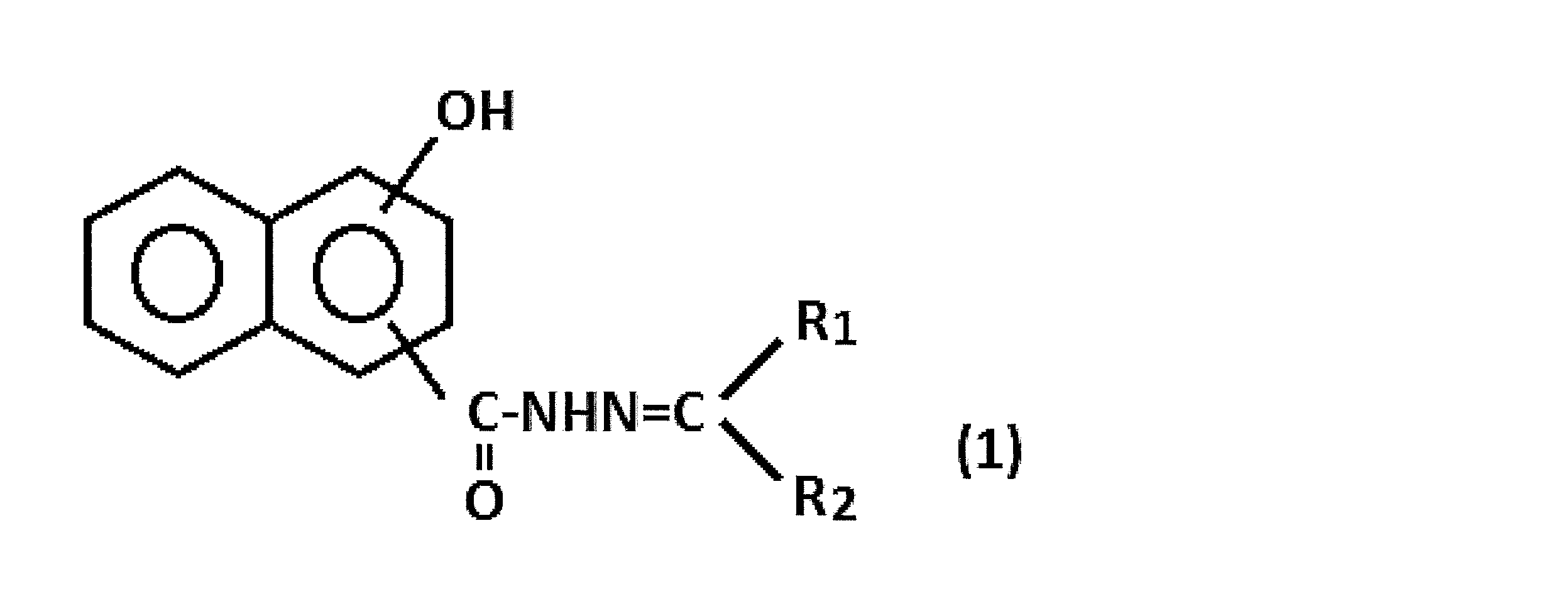
具体的には、1-ヒドロキシ-N’-(1-メチルエチリデン)-2-ナフトエ酸ヒドラジド、1-ヒドロシキ-N’-(1-メチルプロピリデン)-2-ナフトエ酸ヒドラジド、1-ヒドロキシ-N’-(1-メチルブチリデン)-2-ナフトエ酸ヒドラジド、1-ヒドロキシ-N’-(1,3-ジメチルブチリデン)-2-ナフトエ酸ヒドラジド、3-ヒドロキシ-N’-(1-メチルエチリデン)-2-ナフトエ酸ヒドラジド、3-ヒドロキシ-N’-(1-メチルプロピリデン)-2-ナフトエ酸ヒドラジド、3-ヒドロキシ-N’-(1-メチルブチリデン)-2-ナフトエ酸ヒドラジド、3-ヒドロキシ-N′-(1,3-ジメチルブチリデン)-2-ナフトエ酸ヒドラジド等が挙げられる。中でも、本発明の効果の観点から、下記式(2)で表されるヒドラジド化合物を好適に用いることができる。 Specific examples include 1-hydroxy-N'-(1-methylethylidene)-2-naphthoic acid hydrazide, 1-hydroxy-N'-(1-methylpropylidene)-2-naphthoic acid hydrazide, 1-hydroxy-N'-(1-methylbutylidene)-2-naphthoic acid hydrazide, 1-hydroxy-N'-(1,3-dimethylbutylidene)-2-naphthoic acid hydrazide, 3-hydroxy-N'-(1-methylethylidene)-2-naphthoic acid hydrazide, 3-hydroxy-N'-(1-methylpropylidene)-2-naphthoic acid hydrazide, 3-hydroxy-N'-(1-methylbutylidene)-2-naphthoic acid hydrazide, 3-hydroxy-N'-(1,3-dimethylbutylidene)-2-naphthoic acid hydrazide, and the like. Among these, from the viewpoint of the effects of the present invention, the hydrazide compound represented by the following formula (2) can be preferably used.

本発明のタイヤ用ゴム組成物は、カーボンブラックが必ず配合される。本発明で使用するカーボンブラックは、窒素吸着比表面積N2SAが60m2/g~120m2/g、好ましくは70m2/g~120m2/gである。このような粒径のカーボンブラックを使用することで、ゴム組成物の発熱性を低く抑えしながら、ゴム硬度、引張り破断強度、引張り破断伸び等の機械的物性を改良し、タイヤ耐久性を向上することができる。カーボンブラックの窒素吸着比表面積N2SAが60m2/g未満であると、耐久性が低下する。カーボンブラックの窒素吸着比表面積N2SAが120m2/gを超えると、発熱性が悪化する。 The rubber composition for tires of the present invention always contains carbon black. The carbon black used in the present invention has a nitrogen adsorption specific surface area N 2 SA of 60 m 2 /g to 120 m 2 /g, preferably 70 m 2 /g to 120 m 2 /g. By using carbon black with such a particle size, it is possible to improve mechanical properties such as rubber hardness, tensile strength at break, and tensile elongation at break while suppressing heat generation of the rubber composition, thereby improving tire durability. If the nitrogen adsorption specific surface area N 2 SA of the carbon black is less than 60 m 2 /g, durability decreases. If the nitrogen adsorption specific surface area N 2 SA of the carbon black is more than 120 m 2 /g, heat generation deteriorates.
カーボンブラックの配合量は、前述のゴム成分100質量部に対して、30質量部~60質量部、好ましくは35質量部~50質量部である。カーボンブラックの配合量が30質量部未満であると、ゴム組成物に対する補強性能を十分に得ることができず、耐久性が低下する。カーボンブラックの配合量が60質量部を超えるとゴム組成物の発熱性が大きくなると共に、引張り破断伸びが低下して耐久性が低下する。 The amount of carbon black to be blended is 30 to 60 parts by mass, preferably 35 to 50 parts by mass, per 100 parts by mass of the rubber component described above. If the amount of carbon black is less than 30 parts by mass, the reinforcing performance of the rubber composition cannot be sufficiently obtained, and durability decreases. If the amount of carbon black to be blended exceeds 60 parts by mass, heat generation of the rubber composition increases, and the tensile elongation at break decreases, resulting in reduced durability.
本発明のタイヤ用ゴム組成物は、上述の配合剤の他に、シリカ、クレー、タルク、炭酸カルシウム等の各種充填剤、加硫または架橋剤、加硫促進剤、各種オイル、老化防止剤、可塑剤、亜鉛華などのタイヤ用ゴム組成物に一般的に使用される各種添加剤を、本発明の目的を阻害しない範囲内で配合することができる。 In addition to the above-mentioned compounding agents, the rubber composition for tires of the present invention can contain various additives commonly used in rubber compositions for tires, such as various fillers such as silica, clay, talc, and calcium carbonate, vulcanization or crosslinking agents, vulcanization accelerators, various oils, antioxidants, plasticizers, and zinc oxide, within the range that does not impair the object of the present invention.
前述の各種添加剤は一般的な方法で混練してゴム組成物とし、加硫または架橋するのに使用することができる。これら添加剤の配合量は本発明の目的に反しない限り、従来の一般的な配合量とすることができる。タイヤ用ゴム組成物は、通常のゴム用混練機械、例えば、バンバリーミキサー、ニーダー、ロール等を使用して、上記各成分を混合することによって製造することができる。 The various additives described above can be kneaded in a general manner to form a rubber composition, which can then be used for vulcanization or crosslinking. The amounts of these additives can be conventional amounts, as long as they do not conflict with the object of the present invention. The rubber composition for tires can be produced by mixing the above components using a general rubber kneading machine, such as a Banbury mixer, kneader, roll, etc.
本発明は、上述のように、基本的にトレッド部1に関するものであるので、他の部位や構成部材については特に限定されない。但し、上述の構造やゴム組成物を採用した場合に、タイヤ全体のバランスを考慮して、リムクッションゴム層30を構成するゴムのJIS‐A硬度を好ましくは64以上、より好ましくは67以上、更に好ましくは67以上73以下に設定するとよい。これにより、トレッド部1およびビード部3の協働により、タイヤの耐久性を効果的に高めることができる。リムクッションゴム層30の硬度が上述の範囲を下回ると、リムクッションゴム層30によって耐久性を向上する効果が十分に見込めなくなる。尚、リムクッションゴム層30を構成するゴムのJIS‐A硬度は、例えば、リムクッションゴム層30を構成するゴムに配合されるカーボンブラックやシリカなどの充填剤や樹脂、硫黄の配合量を調節することで設定することができる。
As described above, the present invention is basically related to the
尚、上述のリムクッションゴム層30を構成するゴムと対比したとき、アンダートレッド層12を構成するゴム(上述の本発明のタイヤ用ゴム組成物)は、リムクッションゴム層30を構成するゴムよりも低硬度であるとよい。アンダートレッド層12を構成するゴム(上述の本発明のタイヤ用ゴム組成物)の具体的な硬度は特に限定されない。
In addition, when compared with the rubber constituting the above-mentioned rim
以下、実施例によって本発明を更に説明するが、本発明の範囲はこれらの実施例に限定されるものではない。 The present invention will be further explained below with reference to examples, but the scope of the present invention is not limited to these examples.
表1~3に示す配合からなる29種類のタイヤ用ゴム組成物(標準例1、比較例1~14、実施例1~14)をそれぞれアンダートレッド層(アンダートレッドゴム)に使用し、図1に示す基本構造を有し、構造(ベルト層の数、タイヤ周方向に対するベルトコードの傾斜角度の最小値、比A/B)および硬度(アンダートレッド層、リムクッションゴム層)を表1~3のように設定し、タイヤサイズが46/90R57である空気入りタイヤ(試験タイヤ)を製造した。尚、これら29種類のタイヤ用ゴム組成物を調製する際には、それぞれ加硫促進剤および硫黄を除く配合成分を秤量し、1.7Lの密閉式バンバリーミキサーで4分間混練し、マスターバッチを放出し室温冷却した。その後、このマスターバッチを1.7Lの密閉式バンバリーミキサーに供し、加硫促進剤および硫黄を加え3分間混合して、29種類のタイヤ用ゴム組成物を得た。 29 types of rubber compositions for tires (Standard Example 1, Comparative Examples 1-14, Examples 1-14) with the formulations shown in Tables 1-3 were used in the undertread layer (undertread rubber), and a pneumatic tire (test tire) with the basic structure shown in Figure 1 and the structure (number of belt layers, minimum inclination angle of belt cord to tire circumferential direction, ratio A/B) and hardness (undertread layer, rim cushion rubber layer) set as shown in Tables 1-3 and the tire size of 46/90R57 was manufactured. In addition, when preparing these 29 types of rubber compositions for tires, the compounding ingredients except for the vulcanization accelerator and sulfur were weighed and kneaded for 4 minutes in a 1.7L closed Banbury mixer, the master batch was discharged and cooled at room temperature. After that, this master batch was fed to a 1.7L closed Banbury mixer, the vulcanization accelerator and sulfur were added, and mixed for 3 minutes to obtain 29 types of rubber compositions for tires.
尚、表1~3の「ベルトコードの角度(最小値)」の欄は、複数層のベルト層のそれぞれにおけるタイヤ周方向に対するベルトコードの傾斜角度のうちの最小値である。「距離A」は、複数層のベルト層のうち幅が最も大きい最幅広ベルトとカーカス層との間の垂線P上で測定される距離である。「距離B」は、溝底ラインLとタイヤ内表面との間の垂線P上で測定される距離である。各例のアンダートレッド層およびリムクッションゴム層の硬度は、それぞれの層を構成するゴム組成物を用いて、所定形状の金型を用いて145℃、35分間加硫し、各タイヤ用ゴム組成物からなる加硫ゴム試験片を作成して測定したものである。具体的には、JIS K6253に準拠し、デュロメータのタイプAにより温度20℃の条件で測定したデュロメータ硬さである。 The "Belt cord angle (minimum value)" column in Tables 1 to 3 indicates the minimum value of the inclination angle of the belt cord with respect to the tire circumferential direction in each of the multiple belt layers. "Distance A" is the distance measured on the perpendicular line P between the widest belt, which is the widest of the multiple belt layers, and the carcass layer. "Distance B" is the distance measured on the perpendicular line P between the groove bottom line L and the tire inner surface. The hardness of the undertread layer and the rim cushion rubber layer in each example was measured by vulcanizing the rubber composition constituting each layer at 145°C for 35 minutes using a mold of a specified shape, and creating a vulcanized rubber test piece made of each tire rubber composition. Specifically, it is the durometer hardness measured in accordance with JIS K6253 using a durometer type A at a temperature of 20°C.
各試験タイヤについて、下記に示す方法により、低発熱性、耐久性の評価を行った。 Each test tire was evaluated for low heat generation and durability using the methods described below.
アンダートレッド層の低発熱性
各例のアンダートレッド層に使用したタイヤ用ゴム組成物(標準例1、比較例1~14、実施例1~14)を用いて、所定形状の金型を用いて145℃、35分間加硫し、各タイヤ用ゴム組成物からなる加硫ゴム試験片を作成した。この加硫ゴム試験片を用いて、JIS K6394:2007に準拠して、粘弾性スペクトロメータ(東洋精機製作所製)を使用し、伸張変形歪率10±2%、振動数20Hz、温度60℃の条件で、tanδ(60℃)を測定した。結果は、測定値の逆数を用いて、標準例1の値を100とする指数で示した。この指数値が大きいほど、アンダートレッド層が低発熱性であることを意味する。
Low heat build-up in undertread layer Using the rubber compositions for tires (Standard Example 1, Comparative Examples 1-14, Examples 1-14) used in the undertread layer of each example, a mold of a predetermined shape was used to vulcanize at 145°C for 35 minutes to prepare vulcanized rubber test pieces made of each rubber composition for tires. Using these vulcanized rubber test pieces, tan δ (60°C) was measured using a viscoelasticity spectrometer (manufactured by Toyo Seiki Seisakusho) in accordance with JIS K6394:2007 under conditions of an elongation deformation strain rate of 10±2%, a vibration frequency of 20 Hz, and a temperature of 60°C. The results were expressed as an index using the reciprocal of the measured value, with the value of Standard Example 1 being taken as 100. The larger this index value, the lower the heat build-up in the undertread layer.
タイヤ全体の低発熱性
各試験タイヤをTRA規格の規定リムに組み付けて、TRA規格の基準空気圧を充填し、試験車両(建設車両)の総輪に装着し、TRA規格の荷重を負荷し、走行速度10km/hにて60分間走行した前後のトレッド部のタイヤ内面温度を測定し、タイヤ内面温度の上昇量を算出した。評価結果は、測定値の逆数を用いて、標準例1の値を100とする指数で示した。この指数値が大きいほど、温度上昇量が小さく、タイヤ全体として低発熱性であることを意味する。
Low heat generation property of the whole tire Each test tire was mounted on a rim specified by the TRA standard, inflated to the standard air pressure of the TRA standard, and attached to all wheels of a test vehicle (construction vehicle). The load of the TRA standard was applied, and the tire was driven at a speed of 10 km/h for 60 minutes. The temperature of the inner surface of the tread part of the tire was measured before and after the tire was driven, and the amount of rise in the temperature of the inner surface of the tire was calculated. The evaluation results were expressed as an index using the reciprocal of the measured value, with the value of Standard Example 1 being set at 100. The larger the index value, the smaller the amount of temperature rise, which means that the tire has low heat generation property as a whole.
耐久性
各試験タイヤをTRA規格の規定リムに組み付けて、TRA規格の基準空気圧を充填し、ドラム径1707.6mmのドラム試験機に装着し、TRA基準荷重の120%を負荷した状態で、走行速度10km/hの条件で200時間ドラム走行し、解体後のタイヤ断面を目視で評価した。評価基準は下記基準による2段階で評価した。
○:ベルト端部、ベルト-アンダートレッド界面、アンダートレッド内部またはアンダートレッド周辺部材との界面に亀裂の発生なく、外観が良好である。
△:ベルト端部、ベルト-アンダートレッド界面、アンダートレッドの内部または周辺部材との界面のいずれかに亀裂が発生している。
Durability Each test tire was mounted on a rim specified by the TRA standard, inflated to the standard air pressure of the TRA standard, and attached to a drum testing machine with a drum diameter of 1707.6 mm. The tire was run on the drum for 200 hours at a speed of 10 km/h under a load of 120% of the TRA standard load, and the tire cross section after disassembly was visually evaluated. Evaluation was based on the following two-level criteria.
◯: No cracks were generated at the belt end, the belt-undertread interface, the inside of the undertread, or the interface with the peripheral members of the undertread, and the appearance was good.
Δ: Cracks occurred at the belt end, the belt-undertread interface, the inside of the undertread, or the interface with a surrounding member.


表1~3において使用した原材料の種類を下記に示す。
・NR:天然ゴム、RSS#3
・CB1:カーボンブラック、キャボットジャパン社製 ショウブラックN339(種別:HAF、窒素吸着比表面積N2SA:88m2 /g)
・CB2:カーボンブラック、キャボットジャパン社製 ショウブラックS118(種別:SAF、窒素吸着比表面積N2SA:130m2 /g)
・CB3:カーボンブラック、日鉄カーボン社製 ニテロン#GN(種別:GPF、窒素吸着比表面積N2SA:33m2 /g)
・シリカ:EVONIK社製 ULTRASIL VN3GR
・ヒドラジド化合物1:上記式(2)で表されるヒドラジド化合物、大塚化学社製 DC‐01
・ヒドラジド化合物2:下記の方法で製造されたヒドラジド化合物
・ヒドラジド化合物3:下記の方法で製造されたヒドラジド化合物
・ヒドラジド化合物4:アジピン酸ジヒドラジド、大塚化学社製 アジピン酸ジヒドラジド(ADH)
・ヒドラジド化合物5:セバシン酸ジヒドラジド、大塚化学社製 セバシン酸ジヒドラジド(SDH)
・ステアリン酸:日油社製 ビーズステアリン酸YR
・亜鉛華:正同化学工業社製 酸化亜鉛3種
・加硫促進剤:大内新興化学工業社製 ノクセラーNS
・硫黄:鶴見化学工業社製 金華印油入微粉硫黄
The types of raw materials used in Tables 1 to 3 are shown below.
NR: Natural rubber,
CB1: Carbon black, Cabot Japan Co., Ltd., Show Black N339 (type: HAF, nitrogen adsorption specific surface area N2SA : 88 m2 /g)
CB2: Carbon black, Cabot Japan's Show Black S118 (type: SAF, nitrogen adsorption specific surface area N2SA : 130 m2 /g)
CB3: Carbon black, Nitelon #GN manufactured by Nippon Steel Carbon Co., Ltd. (type: GPF, nitrogen adsorption specific surface area N2SA : 33 m2 /g)
・Silica: ULTRASIL VN3GR manufactured by EVONIK
Hydrazide compound 1: A hydrazide compound represented by the above formula (2), DC-01 manufactured by Otsuka Chemical Co., Ltd.
Hydrazide compound 2: A hydrazide compound produced by the following method Hydrazide compound 3: A hydrazide compound produced by the following method Hydrazide compound 4: Adipic acid dihydrazide, manufactured by Otsuka Chemical Co., Ltd. Adipic acid dihydrazide (ADH)
Hydrazide compound 5: Sebacic acid dihydrazide, manufactured by Otsuka Chemical Co., Ltd. Sebacic acid dihydrazide (SDH)
Stearic acid: Beads Stearic Acid YR manufactured by NOF Corporation
・Zinc oxide: Three types of zinc oxide manufactured by Seido Chemical Industry Co., Ltd. ・Vulcanization accelerator: Noccela NS manufactured by Ouchi Shinko Chemical Industry Co., Ltd.
Sulfur: Tsurumi Chemical Industry Co., Ltd. Kinka-in oil-filled fine sulfur
ヒドラジド化合物2の製造方法:
3-ヒドロキシ-2-ナフトエ酸ヒドラジドと3-メチル-2-ペンタノンを加温しながら攪拌した。反応液を濃縮し冷却した後、析出した結晶を濾過し、減圧乾燥して下記式(3)で表される構造のヒドラジド化合物2を得た。
Method for preparing hydrazide compound 2:
3-Hydroxy-2-naphthoic acid hydrazide and 3-methyl-2-pentanone were stirred while being heated. The reaction solution was concentrated and cooled, and then the precipitated crystals were filtered and dried under reduced pressure to obtain

ヒドラジド化合物3の製造方法:
3-ヒドロキシ-2-ナフトエ酸ヒドラジドと3-ペンタノンを加温しながら攪拌した。反応液を濃縮し冷却した後、析出した結晶を濾過し、減圧乾燥して下記式(4)で表される構造のヒドラジド化合物3を得た。
Method for preparing hydrazide compound 3:
3-Hydroxy-2-naphthoic acid hydrazide and 3-pentanone were stirred while being heated. The reaction solution was concentrated and cooled, and then the precipitated crystals were filtered and dried under reduced pressure to obtain

表1~3から明らかなように、実施例1~14の重荷重用タイヤは、標準例1と比較して、アンダートレッド層自体の低発熱性を改善し、更に、タイヤ全体の低発熱性を改善し、且つ、耐久性を良好に発揮した。一方、比較例1は、ベルト層の数が少なく、アンダートレッド層を構成するゴム組成物がヒドラジド化合物を含まないため、アンダートレッド層自体の低発熱性が悪化し、また、耐久性が悪化した。比較例2は、ベルト層の構造は適切であるものの、アンダートレッド層を構成するゴム組成物がヒドラジド化合物を含まないため、低発熱性を改善する効果が得られなかった。比較例3は、比A/Bが小さく、アンダートレッド層を構成するゴム組成物がヒドラジド化合物を含まないため、アンダートレッド層自体の低発熱性が悪化し、また、耐久性が悪化した。比較例4は、アンダートレッド層を構成するゴム組成物がヒドラジド化合物を含むものの、ベルト層の数が少ないため、耐久性が悪化した。比較例5は、アンダートレッド層を構成するゴム組成物がヒドラジド化合物を含むものの、比A/Bが小さいため、耐久性が悪化した。比較例6は、アンダートレッド層を構成するゴム組成物がヒドラジド化合物を含むものの、比A/Bが大きいため、耐久性が悪化した。比較例7は、カーボンブラックのN2SAが大きいため、低発熱性が悪化した。比較例8は、カーボンブラックのN2SAが小さいため、アンダートレッドゴムの補強性が低下し耐久性が悪化した。比較例9は、カーボンブラックの配合量が少ないため、耐久性が悪化した。比較例10は、カーボンブラックの配合量が多いため、発熱性が悪化した。比較例11は、ヒドラジド化合物の配合量が少ないため、タイヤ発熱性の改良効果が得られなかった。比較例12は、ヒドラジド化合物の配合量が多いため、加工性が悪化し、発熱性・耐久性が悪化した。比較例13は、本発明の条件を満たすヒドラジド化合物の代わりに、アジピン酸ジヒドラジドを含むため、発熱性が悪化した。比較例14は、本発明の条件を満たすヒドラジド化合物の代わりに、セバシン酸ジヒドラジドを含むため、発熱性が悪化した。 As is clear from Tables 1 to 3, the heavy-duty tires of Examples 1 to 14 improved the low heat generation property of the undertread layer itself, further improved the low heat generation property of the entire tire, and exhibited good durability, compared with Standard Example 1. On the other hand, Comparative Example 1 had a small number of belt layers, and the rubber composition constituting the undertread layer did not contain a hydrazide compound, so the low heat generation property of the undertread layer itself deteriorated, and the durability also deteriorated. Comparative Example 2 had an appropriate belt layer structure, but the rubber composition constituting the undertread layer did not contain a hydrazide compound, so the effect of improving the low heat generation property was not obtained. Comparative Example 3 had a small ratio A/B, and the rubber composition constituting the undertread layer did not contain a hydrazide compound, so the low heat generation property of the undertread layer itself deteriorated, and the durability also deteriorated. Comparative Example 4 had a small number of belt layers, so the durability was deteriorated, although the rubber composition constituting the undertread layer contained a hydrazide compound. In Comparative Example 5, the rubber composition constituting the undertread layer contains a hydrazide compound, but the ratio A/B is small, so durability is deteriorated. In Comparative Example 6, the rubber composition constituting the undertread layer contains a hydrazide compound, but the ratio A/B is large, so durability is deteriorated. In Comparative Example 7, the N2SA of the carbon black is large, so low heat generation is deteriorated. In Comparative Example 8, the N2SA of the carbon black is small, so the reinforcement of the undertread rubber is reduced and durability is deteriorated. In Comparative Example 9, the durability is deteriorated because the amount of carbon black is small. In Comparative Example 10, the heat generation is deteriorated because the amount of carbon black is large. In Comparative Example 11, the amount of hydrazide compound is small, so the effect of improving the tire heat generation is not obtained. In Comparative Example 12, the amount of hydrazide compound is large, so processability is deteriorated, and heat generation and durability are deteriorated. In Comparative Example 13, heat generation is deteriorated because adipic acid dihydrazide is included instead of the hydrazide compound that satisfies the conditions of the present invention. Comparative Example 14 contained sebacic dihydrazide instead of the hydrazide compound satisfying the conditions of the present invention, and therefore the heat generation property was deteriorated.
1 トレッド部
2 サイドウォール部
3 ビード部
4 カーカス層
5 ビードコア
6 ビードフィラー
7 ベルト層
7A 最幅広ベルト
8 インナーライナー層
10 トレッドゴム層
11 キャップトレッド層
12 アンダートレッド層
20 サイドゴム層
30 リムクッションゴム層
40 溝
41 最深溝
CL タイヤ赤道
E 接地端
L 溝底ライン
Claims (6)
タイヤ子午線断面において、接地端を通り前記カーカス層のタイヤ径方向外側の表面に垂直な直線を垂線Pとしたとき、前記5層以上のベルト層のうち幅が最も大きい最幅広ベルトと前記カーカス層との間の前記垂線P上で測定される距離Aと、前記複数本の溝のうち最大深さを有する最深溝の溝底を通り前記トレッド部の外表面の輪郭線に平行な溝底ラインLとタイヤ内表面との間の前記垂線P上で測定される距離Bとが0.3≦A/B≦0.7の関係を満たし、
前記アンダートレッド層が、天然ゴムを70質量%以上含有するゴム成分100質量部に対して、下記式(1)で表されるヒドラジド化合物0.5質量部~3.0質量部と、窒素吸着比表面積N2SAが60m2/g~120m2/gであるカーボンブラック30質量部~60質量部とが配合されたゴム組成物で構成されたことを特徴とする重荷重用タイヤ。

In a tire meridian cross section, when a straight line passing through a ground contact edge and perpendicular to a surface of the carcass layer radially outward is defined as a perpendicular line P, a distance A measured on the perpendicular line P between a widest belt having the largest width among the five or more belt layers and the carcass layer, and a distance B measured on the perpendicular line P between a groove bottom line L passing through a groove bottom of a deepest groove having the greatest depth among the plurality of grooves and parallel to a contour line of the outer surface of the tread portion and an inner surface of the tire satisfy a relationship of 0.3≦A/B≦0.7,
The heavy-duty tire is characterized in that the undertread layer is made of a rubber composition containing 100 parts by mass of a rubber component containing 70% by mass or more of natural rubber, 0.5 to 3.0 parts by mass of a hydrazide compound represented by the following formula (1), and 30 to 60 parts by mass of carbon black having a nitrogen adsorption specific surface area N2SA of 60 m2/g to 120 m2 /g:
Priority Applications (1)
| Application Number | Priority Date | Filing Date | Title |
|---|---|---|---|
| JP2021104865A JP7598024B2 (en) | 2021-06-24 | 2021-06-24 | Heavy Duty Tires |
Applications Claiming Priority (1)
| Application Number | Priority Date | Filing Date | Title |
|---|---|---|---|
| JP2021104865A JP7598024B2 (en) | 2021-06-24 | 2021-06-24 | Heavy Duty Tires |
Publications (2)
| Publication Number | Publication Date |
|---|---|
| JP2023003655A JP2023003655A (en) | 2023-01-17 |
| JP7598024B2 true JP7598024B2 (en) | 2024-12-11 |
Family
ID=85100300
Family Applications (1)
| Application Number | Title | Priority Date | Filing Date |
|---|---|---|---|
| JP2021104865A Active JP7598024B2 (en) | 2021-06-24 | 2021-06-24 | Heavy Duty Tires |
Country Status (1)
| Country | Link |
|---|---|
| JP (1) | JP7598024B2 (en) |
Citations (4)
| Publication number | Priority date | Publication date | Assignee | Title |
|---|---|---|---|---|
| WO2008108370A1 (en) | 2007-03-05 | 2008-09-12 | Bridgestone Corporation | Pneumatic tire |
| JP2017043143A (en) | 2015-08-25 | 2017-03-02 | 株式会社ブリヂストン | Construction vehicle tires |
| WO2019017417A1 (en) | 2017-07-19 | 2019-01-24 | 株式会社ブリヂストン | Tire |
| JP2020117580A (en) | 2019-01-21 | 2020-08-06 | 横浜ゴム株式会社 | Rubber composition for tire |
Family Cites Families (1)
| Publication number | Priority date | Publication date | Assignee | Title |
|---|---|---|---|---|
| JP3961627B2 (en) * | 1997-07-15 | 2007-08-22 | 株式会社ブリヂストン | Heavy duty wasteland running pneumatic radial tires |
-
2021
- 2021-06-24 JP JP2021104865A patent/JP7598024B2/en active Active
Patent Citations (4)
| Publication number | Priority date | Publication date | Assignee | Title |
|---|---|---|---|---|
| WO2008108370A1 (en) | 2007-03-05 | 2008-09-12 | Bridgestone Corporation | Pneumatic tire |
| JP2017043143A (en) | 2015-08-25 | 2017-03-02 | 株式会社ブリヂストン | Construction vehicle tires |
| WO2019017417A1 (en) | 2017-07-19 | 2019-01-24 | 株式会社ブリヂストン | Tire |
| JP2020117580A (en) | 2019-01-21 | 2020-08-06 | 横浜ゴム株式会社 | Rubber composition for tire |
Also Published As
| Publication number | Publication date |
|---|---|
| JP2023003655A (en) | 2023-01-17 |
Similar Documents
| Publication | Publication Date | Title |
|---|---|---|
| JP5768901B2 (en) | Pneumatic tire | |
| EP2072289B1 (en) | Run-flat tire | |
| CN104968723B (en) | Rubber composition for pneumatic tires for construction vehicles | |
| EP2239154A1 (en) | Side part reinforcing layer and run-flat tire | |
| JP6897206B2 (en) | Pneumatic tires for heavy loads | |
| JP7127705B2 (en) | pneumatic tire | |
| JP5431640B2 (en) | Sidewall rubber composition and pneumatic tire | |
| US20090101258A1 (en) | Pneumatic Tire | |
| JP7075204B2 (en) | Pneumatic tires | |
| JP6644248B2 (en) | Rubber composition for heavy duty pneumatic tires | |
| JP7598024B2 (en) | Heavy Duty Tires | |
| JP7709102B2 (en) | Rubber composition for rim cushion | |
| JP7211024B2 (en) | pneumatic tire | |
| JP7211446B2 (en) | pneumatic tire | |
| JP7355985B2 (en) | pneumatic tires | |
| WO2015079659A1 (en) | Pneumatic tire | |
| JP2008120940A (en) | Pneumatic tire | |
| JP7263940B2 (en) | pneumatic tire | |
| JP7075203B2 (en) | Pneumatic tires | |
| JP7075206B2 (en) | Pneumatic tires | |
| JP2018052414A (en) | Pneumatic tire | |
| JP7602152B2 (en) | Rubber composition for side tread | |
| JP7234758B2 (en) | pneumatic tire | |
| JP7075207B2 (en) | Pneumatic tires | |
| WO2016186006A1 (en) | Rubber composition for tire |
Legal Events
| Date | Code | Title | Description |
|---|---|---|---|
| A621 | Written request for application examination |
Free format text: JAPANESE INTERMEDIATE CODE: A621 Effective date: 20240328 |
|
| A871 | Explanation of circumstances concerning accelerated examination |
Free format text: JAPANESE INTERMEDIATE CODE: A871 Effective date: 20240328 |
|
| A131 | Notification of reasons for refusal |
Free format text: JAPANESE INTERMEDIATE CODE: A131 Effective date: 20240416 |
|
| A131 | Notification of reasons for refusal |
Free format text: JAPANESE INTERMEDIATE CODE: A131 Effective date: 20240709 |
|
| A521 | Request for written amendment filed |
Free format text: JAPANESE INTERMEDIATE CODE: A523 Effective date: 20240904 |
|
| TRDD | Decision of grant or rejection written | ||
| A01 | Written decision to grant a patent or to grant a registration (utility model) |
Free format text: JAPANESE INTERMEDIATE CODE: A01 Effective date: 20241029 |
|
| A61 | First payment of annual fees (during grant procedure) |
Free format text: JAPANESE INTERMEDIATE CODE: A61 Effective date: 20241111 |
|
| R150 | Certificate of patent or registration of utility model |
Ref document number: 7598024 Country of ref document: JP Free format text: JAPANESE INTERMEDIATE CODE: R150 |