JP7591925B2 - Composite absorbents and polymeric absorbents - Google Patents
Composite absorbents and polymeric absorbents Download PDFInfo
- Publication number
- JP7591925B2 JP7591925B2 JP2020219829A JP2020219829A JP7591925B2 JP 7591925 B2 JP7591925 B2 JP 7591925B2 JP 2020219829 A JP2020219829 A JP 2020219829A JP 2020219829 A JP2020219829 A JP 2020219829A JP 7591925 B2 JP7591925 B2 JP 7591925B2
- Authority
- JP
- Japan
- Prior art keywords
- absorbent
- pore
- pores
- pore volume
- polymer
- Prior art date
- Legal status (The legal status is an assumption and is not a legal conclusion. Google has not performed a legal analysis and makes no representation as to the accuracy of the status listed.)
- Active
Links
- 239000002250 absorbent Substances 0.000 title claims description 367
- 230000002745 absorbent Effects 0.000 title claims description 344
- 239000002131 composite material Substances 0.000 title claims description 93
- 239000011148 porous material Substances 0.000 claims description 538
- 239000007788 liquid Substances 0.000 claims description 184
- 229920000642 polymer Polymers 0.000 claims description 125
- 238000009826 distribution Methods 0.000 claims description 52
- CERQOIWHTDAKMF-UHFFFAOYSA-N Methacrylic acid Chemical compound CC(=C)C(O)=O CERQOIWHTDAKMF-UHFFFAOYSA-N 0.000 claims description 26
- 229920006037 cross link polymer Polymers 0.000 claims description 17
- 239000000463 material Substances 0.000 claims description 16
- 230000007062 hydrolysis Effects 0.000 claims description 13
- 238000006460 hydrolysis reaction Methods 0.000 claims description 13
- 150000001875 compounds Chemical class 0.000 claims description 9
- 125000000391 vinyl group Chemical group [H]C([*])=C([H])[H] 0.000 claims description 6
- 239000006096 absorbing agent Substances 0.000 claims 1
- 238000010521 absorption reaction Methods 0.000 description 83
- MYRTYDVEIRVNKP-UHFFFAOYSA-N 1,2-Divinylbenzene Chemical compound C=CC1=CC=CC=C1C=C MYRTYDVEIRVNKP-UHFFFAOYSA-N 0.000 description 52
- 239000000835 fiber Substances 0.000 description 49
- 239000000178 monomer Substances 0.000 description 30
- 230000014759 maintenance of location Effects 0.000 description 21
- 238000006116 polymerization reaction Methods 0.000 description 19
- 238000005259 measurement Methods 0.000 description 18
- 238000000034 method Methods 0.000 description 16
- OKKJLVBELUTLKV-UHFFFAOYSA-N Methanol Chemical compound OC OKKJLVBELUTLKV-UHFFFAOYSA-N 0.000 description 15
- 238000012360 testing method Methods 0.000 description 15
- SOGAXMICEFXMKE-UHFFFAOYSA-N Butylmethacrylate Chemical compound CCCCOC(=O)C(C)=C SOGAXMICEFXMKE-UHFFFAOYSA-N 0.000 description 12
- LFQSCWFLJHTTHZ-UHFFFAOYSA-N Ethanol Chemical compound CCO LFQSCWFLJHTTHZ-UHFFFAOYSA-N 0.000 description 12
- 239000004094 surface-active agent Substances 0.000 description 12
- XLYOFNOQVPJJNP-UHFFFAOYSA-N water Substances O XLYOFNOQVPJJNP-UHFFFAOYSA-N 0.000 description 12
- 238000004132 cross linking Methods 0.000 description 11
- 239000004745 nonwoven fabric Substances 0.000 description 11
- 229920000620 organic polymer Polymers 0.000 description 11
- -1 polyethylene Polymers 0.000 description 11
- 239000003505 polymerization initiator Substances 0.000 description 11
- 238000010586 diagram Methods 0.000 description 10
- 238000002156 mixing Methods 0.000 description 10
- HEMHJVSKTPXQMS-UHFFFAOYSA-M Sodium hydroxide Chemical compound [OH-].[Na+] HEMHJVSKTPXQMS-UHFFFAOYSA-M 0.000 description 9
- 239000000470 constituent Substances 0.000 description 9
- 229920005989 resin Polymers 0.000 description 9
- 239000011347 resin Substances 0.000 description 9
- NIXOWILDQLNWCW-UHFFFAOYSA-M Acrylate Chemical compound [O-]C(=O)C=C NIXOWILDQLNWCW-UHFFFAOYSA-M 0.000 description 8
- 229920003043 Cellulose fiber Polymers 0.000 description 8
- ZMXDDKWLCZADIW-UHFFFAOYSA-N N,N-Dimethylformamide Chemical compound CN(C)C=O ZMXDDKWLCZADIW-UHFFFAOYSA-N 0.000 description 8
- WYURNTSHIVDZCO-UHFFFAOYSA-N Tetrahydrofuran Chemical compound C1CCOC1 WYURNTSHIVDZCO-UHFFFAOYSA-N 0.000 description 8
- 229940048053 acrylate Drugs 0.000 description 8
- 239000000839 emulsion Substances 0.000 description 8
- 239000002245 particle Substances 0.000 description 8
- 229920005992 thermoplastic resin Polymers 0.000 description 8
- 239000007864 aqueous solution Substances 0.000 description 7
- 230000001186 cumulative effect Effects 0.000 description 7
- 230000000694 effects Effects 0.000 description 7
- 229910052753 mercury Inorganic materials 0.000 description 7
- 238000002459 porosimetry Methods 0.000 description 7
- 238000003756 stirring Methods 0.000 description 7
- OZAIFHULBGXAKX-UHFFFAOYSA-N 2-(2-cyanopropan-2-yldiazenyl)-2-methylpropanenitrile Chemical compound N#CC(C)(C)N=NC(C)(C)C#N OZAIFHULBGXAKX-UHFFFAOYSA-N 0.000 description 6
- LYCAIKOWRPUZTN-UHFFFAOYSA-N Ethylene glycol Chemical compound OCCO LYCAIKOWRPUZTN-UHFFFAOYSA-N 0.000 description 6
- VEXZGXHMUGYJMC-UHFFFAOYSA-N Hydrochloric acid Chemical compound Cl VEXZGXHMUGYJMC-UHFFFAOYSA-N 0.000 description 6
- YXFVVABEGXRONW-UHFFFAOYSA-N Toluene Chemical compound CC1=CC=CC=C1 YXFVVABEGXRONW-UHFFFAOYSA-N 0.000 description 6
- 238000004519 manufacturing process Methods 0.000 description 6
- QSHDDOUJBYECFT-UHFFFAOYSA-N mercury Chemical compound [Hg] QSHDDOUJBYECFT-UHFFFAOYSA-N 0.000 description 6
- 239000000047 product Substances 0.000 description 6
- 230000000717 retained effect Effects 0.000 description 6
- 229920000247 superabsorbent polymer Polymers 0.000 description 6
- 239000004698 Polyethylene Substances 0.000 description 5
- 239000004743 Polypropylene Substances 0.000 description 5
- 238000001035 drying Methods 0.000 description 5
- 229920000573 polyethylene Polymers 0.000 description 5
- 229920001155 polypropylene Polymers 0.000 description 5
- 239000002904 solvent Substances 0.000 description 5
- 239000007762 w/o emulsion Substances 0.000 description 5
- KAKZBPTYRLMSJV-UHFFFAOYSA-N Butadiene Chemical compound C=CC=C KAKZBPTYRLMSJV-UHFFFAOYSA-N 0.000 description 4
- IAZDPXIOMUYVGZ-UHFFFAOYSA-N Dimethylsulphoxide Chemical compound CS(C)=O IAZDPXIOMUYVGZ-UHFFFAOYSA-N 0.000 description 4
- VQTUBCCKSQIDNK-UHFFFAOYSA-N Isobutene Chemical compound CC(C)=C VQTUBCCKSQIDNK-UHFFFAOYSA-N 0.000 description 4
- RRHGJUQNOFWUDK-UHFFFAOYSA-N Isoprene Chemical compound CC(=C)C=C RRHGJUQNOFWUDK-UHFFFAOYSA-N 0.000 description 4
- FAPWRFPIFSIZLT-UHFFFAOYSA-M Sodium chloride Chemical compound [Na+].[Cl-] FAPWRFPIFSIZLT-UHFFFAOYSA-M 0.000 description 4
- PPBRXRYQALVLMV-UHFFFAOYSA-N Styrene Chemical compound C=CC1=CC=CC=C1 PPBRXRYQALVLMV-UHFFFAOYSA-N 0.000 description 4
- 125000003178 carboxy group Chemical group [H]OC(*)=O 0.000 description 4
- 230000000052 comparative effect Effects 0.000 description 4
- 239000010410 layer Substances 0.000 description 4
- 239000000203 mixture Substances 0.000 description 4
- 229920000139 polyethylene terephthalate Polymers 0.000 description 4
- 239000005020 polyethylene terephthalate Substances 0.000 description 4
- GEHJYWRUCIMESM-UHFFFAOYSA-L sodium sulfite Chemical compound [Na+].[Na+].[O-]S([O-])=O GEHJYWRUCIMESM-UHFFFAOYSA-L 0.000 description 4
- 230000002195 synergetic effect Effects 0.000 description 4
- YLQBMQCUIZJEEH-UHFFFAOYSA-N tetrahydrofuran Natural products C=1C=COC=1 YLQBMQCUIZJEEH-UHFFFAOYSA-N 0.000 description 4
- VNDYJBBGRKZCSX-UHFFFAOYSA-L zinc bromide Chemical compound Br[Zn]Br VNDYJBBGRKZCSX-UHFFFAOYSA-L 0.000 description 4
- ZORQXIQZAOLNGE-UHFFFAOYSA-N 1,1-difluorocyclohexane Chemical compound FC1(F)CCCCC1 ZORQXIQZAOLNGE-UHFFFAOYSA-N 0.000 description 3
- QTBSBXVTEAMEQO-UHFFFAOYSA-N Acetic acid Chemical compound CC(O)=O QTBSBXVTEAMEQO-UHFFFAOYSA-N 0.000 description 3
- 229920000742 Cotton Polymers 0.000 description 3
- 125000005907 alkyl ester group Chemical group 0.000 description 3
- 239000002585 base Substances 0.000 description 3
- 229920002678 cellulose Polymers 0.000 description 3
- 239000001913 cellulose Substances 0.000 description 3
- 230000003247 decreasing effect Effects 0.000 description 3
- 125000000816 ethylene group Chemical group [H]C([H])([*:1])C([H])([H])[*:2] 0.000 description 3
- 239000004744 fabric Substances 0.000 description 3
- 239000000413 hydrolysate Substances 0.000 description 3
- 230000002209 hydrophobic effect Effects 0.000 description 3
- FVAUCKIRQBBSSJ-UHFFFAOYSA-M sodium iodide Chemical compound [Na+].[I-] FVAUCKIRQBBSSJ-UHFFFAOYSA-M 0.000 description 3
- 239000001593 sorbitan monooleate Substances 0.000 description 3
- 235000011069 sorbitan monooleate Nutrition 0.000 description 3
- 229940035049 sorbitan monooleate Drugs 0.000 description 3
- 239000002759 woven fabric Substances 0.000 description 3
- SCYULBFZEHDVBN-UHFFFAOYSA-N 1,1-Dichloroethane Chemical compound CC(Cl)Cl SCYULBFZEHDVBN-UHFFFAOYSA-N 0.000 description 2
- RYHBNJHYFVUHQT-UHFFFAOYSA-N 1,4-Dioxane Chemical compound C1COCCO1 RYHBNJHYFVUHQT-UHFFFAOYSA-N 0.000 description 2
- SLBOQBILGNEPEB-UHFFFAOYSA-N 1-chloroprop-2-enylbenzene Chemical compound C=CC(Cl)C1=CC=CC=C1 SLBOQBILGNEPEB-UHFFFAOYSA-N 0.000 description 2
- OEPOKWHJYJXUGD-UHFFFAOYSA-N 2-(3-phenylmethoxyphenyl)-1,3-thiazole-4-carbaldehyde Chemical compound O=CC1=CSC(C=2C=C(OCC=3C=CC=CC=3)C=CC=2)=N1 OEPOKWHJYJXUGD-UHFFFAOYSA-N 0.000 description 2
- CSCPPACGZOOCGX-UHFFFAOYSA-N Acetone Chemical compound CC(C)=O CSCPPACGZOOCGX-UHFFFAOYSA-N 0.000 description 2
- NLHHRLWOUZZQLW-UHFFFAOYSA-N Acrylonitrile Chemical compound C=CC#N NLHHRLWOUZZQLW-UHFFFAOYSA-N 0.000 description 2
- 239000004342 Benzoyl peroxide Substances 0.000 description 2
- OMPJBNCRMGITSC-UHFFFAOYSA-N Benzoylperoxide Chemical compound C=1C=CC=CC=1C(=O)OOC(=O)C1=CC=CC=C1 OMPJBNCRMGITSC-UHFFFAOYSA-N 0.000 description 2
- OKTJSMMVPCPJKN-UHFFFAOYSA-N Carbon Chemical compound [C] OKTJSMMVPCPJKN-UHFFFAOYSA-N 0.000 description 2
- HEDRZPFGACZZDS-UHFFFAOYSA-N Chloroform Chemical compound ClC(Cl)Cl HEDRZPFGACZZDS-UHFFFAOYSA-N 0.000 description 2
- DGAQECJNVWCQMB-PUAWFVPOSA-M Ilexoside XXIX Chemical compound C[C@@H]1CC[C@@]2(CC[C@@]3(C(=CC[C@H]4[C@]3(CC[C@@H]5[C@@]4(CC[C@@H](C5(C)C)OS(=O)(=O)[O-])C)C)[C@@H]2[C@]1(C)O)C)C(=O)O[C@H]6[C@@H]([C@H]([C@@H]([C@H](O6)CO)O)O)O.[Na+] DGAQECJNVWCQMB-PUAWFVPOSA-M 0.000 description 2
- KFZMGEQAYNKOFK-UHFFFAOYSA-N Isopropanol Chemical compound CC(C)O KFZMGEQAYNKOFK-UHFFFAOYSA-N 0.000 description 2
- AFVFQIVMOAPDHO-UHFFFAOYSA-N Methanesulfonic acid Chemical compound CS(O)(=O)=O AFVFQIVMOAPDHO-UHFFFAOYSA-N 0.000 description 2
- 239000004677 Nylon Substances 0.000 description 2
- QAOWNCQODCNURD-UHFFFAOYSA-N Sulfuric acid Chemical compound OS(O)(=O)=O QAOWNCQODCNURD-UHFFFAOYSA-N 0.000 description 2
- DTQVDTLACAAQTR-UHFFFAOYSA-N Trifluoroacetic acid Chemical compound OC(=O)C(F)(F)F DTQVDTLACAAQTR-UHFFFAOYSA-N 0.000 description 2
- ZJCCRDAZUWHFQH-UHFFFAOYSA-N Trimethylolpropane Chemical compound CCC(CO)(CO)CO ZJCCRDAZUWHFQH-UHFFFAOYSA-N 0.000 description 2
- XTXRWKRVRITETP-UHFFFAOYSA-N Vinyl acetate Chemical compound CC(=O)OC=C XTXRWKRVRITETP-UHFFFAOYSA-N 0.000 description 2
- BZHJMEDXRYGGRV-UHFFFAOYSA-N Vinyl chloride Chemical compound ClC=C BZHJMEDXRYGGRV-UHFFFAOYSA-N 0.000 description 2
- 239000002253 acid Substances 0.000 description 2
- 230000009471 action Effects 0.000 description 2
- 239000000853 adhesive Substances 0.000 description 2
- 230000001070 adhesive effect Effects 0.000 description 2
- 150000001298 alcohols Chemical class 0.000 description 2
- 150000001336 alkenes Chemical class 0.000 description 2
- XYLMUPLGERFSHI-UHFFFAOYSA-N alpha-Methylstyrene Chemical compound CC(=C)C1=CC=CC=C1 XYLMUPLGERFSHI-UHFFFAOYSA-N 0.000 description 2
- VSCWAEJMTAWNJL-UHFFFAOYSA-K aluminium trichloride Chemical compound Cl[Al](Cl)Cl VSCWAEJMTAWNJL-UHFFFAOYSA-K 0.000 description 2
- ROOXNKNUYICQNP-UHFFFAOYSA-N ammonium persulfate Chemical compound [NH4+].[NH4+].[O-]S(=O)(=O)OOS([O-])(=O)=O ROOXNKNUYICQNP-UHFFFAOYSA-N 0.000 description 2
- 230000008901 benefit Effects 0.000 description 2
- 235000019400 benzoyl peroxide Nutrition 0.000 description 2
- INLLPKCGLOXCIV-UHFFFAOYSA-N bromoethene Chemical compound BrC=C INLLPKCGLOXCIV-UHFFFAOYSA-N 0.000 description 2
- 229910052799 carbon Inorganic materials 0.000 description 2
- 150000007942 carboxylates Chemical group 0.000 description 2
- 238000005119 centrifugation Methods 0.000 description 2
- YACLQRRMGMJLJV-UHFFFAOYSA-N chloroprene Chemical compound ClC(=C)C=C YACLQRRMGMJLJV-UHFFFAOYSA-N 0.000 description 2
- 238000013461 design Methods 0.000 description 2
- XBDQKXXYIPTUBI-UHFFFAOYSA-N dimethylselenoniopropionate Natural products CCC(O)=O XBDQKXXYIPTUBI-UHFFFAOYSA-N 0.000 description 2
- SNRUBQQJIBEYMU-UHFFFAOYSA-N dodecane Chemical compound CCCCCCCCCCCC SNRUBQQJIBEYMU-UHFFFAOYSA-N 0.000 description 2
- 238000011156 evaluation Methods 0.000 description 2
- 229960002089 ferrous chloride Drugs 0.000 description 2
- 239000006261 foam material Substances 0.000 description 2
- 125000003055 glycidyl group Chemical group C(C1CO1)* 0.000 description 2
- 238000010438 heat treatment Methods 0.000 description 2
- 229910052739 hydrogen Inorganic materials 0.000 description 2
- 150000002431 hydrogen Chemical class 0.000 description 2
- 239000001257 hydrogen Substances 0.000 description 2
- 230000003301 hydrolyzing effect Effects 0.000 description 2
- 238000007654 immersion Methods 0.000 description 2
- 238000000691 measurement method Methods 0.000 description 2
- 229920001778 nylon Polymers 0.000 description 2
- GLDOVTGHNKAZLK-UHFFFAOYSA-N octadecan-1-ol Chemical compound CCCCCCCCCCCCCCCCCCO GLDOVTGHNKAZLK-UHFFFAOYSA-N 0.000 description 2
- JRZJOMJEPLMPRA-UHFFFAOYSA-N olefin Natural products CCCCCCCC=C JRZJOMJEPLMPRA-UHFFFAOYSA-N 0.000 description 2
- 230000003204 osmotic effect Effects 0.000 description 2
- 229920002647 polyamide Polymers 0.000 description 2
- 229920001225 polyester resin Polymers 0.000 description 2
- USHAGKDGDHPEEY-UHFFFAOYSA-L potassium persulfate Chemical compound [K+].[K+].[O-]S(=O)(=O)OOS([O-])(=O)=O USHAGKDGDHPEEY-UHFFFAOYSA-L 0.000 description 2
- HJWLCRVIBGQPNF-UHFFFAOYSA-N prop-2-enylbenzene Chemical compound C=CCC1=CC=CC=C1 HJWLCRVIBGQPNF-UHFFFAOYSA-N 0.000 description 2
- 239000002994 raw material Substances 0.000 description 2
- 239000004627 regenerated cellulose Substances 0.000 description 2
- 239000002356 single layer Substances 0.000 description 2
- 239000011734 sodium Substances 0.000 description 2
- 229910052708 sodium Inorganic materials 0.000 description 2
- 239000011780 sodium chloride Substances 0.000 description 2
- 235000010265 sodium sulphite Nutrition 0.000 description 2
- 239000000243 solution Substances 0.000 description 2
- 239000004583 superabsorbent polymers (SAPs) Substances 0.000 description 2
- SJMYWORNLPSJQO-UHFFFAOYSA-N tert-butyl 2-methylprop-2-enoate Chemical compound CC(=C)C(=O)OC(C)(C)C SJMYWORNLPSJQO-UHFFFAOYSA-N 0.000 description 2
- BFKJFAAPBSQJPD-UHFFFAOYSA-N tetrafluoroethene Chemical group FC(F)=C(F)F BFKJFAAPBSQJPD-UHFFFAOYSA-N 0.000 description 2
- JOXIMZWYDAKGHI-UHFFFAOYSA-N toluene-4-sulfonic acid Chemical compound CC1=CC=C(S(O)(=O)=O)C=C1 JOXIMZWYDAKGHI-UHFFFAOYSA-N 0.000 description 2
- 229940102001 zinc bromide Drugs 0.000 description 2
- LCZVSXRMYJUNFX-UHFFFAOYSA-N 2-[2-(2-hydroxypropoxy)propoxy]propan-1-ol Chemical compound CC(O)COC(C)COC(C)CO LCZVSXRMYJUNFX-UHFFFAOYSA-N 0.000 description 1
- NDAJNMAAXXIADY-UHFFFAOYSA-N 2-methylpropanimidamide Chemical compound CC(C)C(N)=N NDAJNMAAXXIADY-UHFFFAOYSA-N 0.000 description 1
- CDOUZKKFHVEKRI-UHFFFAOYSA-N 3-bromo-n-[(prop-2-enoylamino)methyl]propanamide Chemical compound BrCCC(=O)NCNC(=O)C=C CDOUZKKFHVEKRI-UHFFFAOYSA-N 0.000 description 1
- RTANHMOFHGSZQO-UHFFFAOYSA-N 4-methoxy-2,4-dimethylpentanenitrile Chemical compound COC(C)(C)CC(C)C#N RTANHMOFHGSZQO-UHFFFAOYSA-N 0.000 description 1
- XZIIFPSPUDAGJM-UHFFFAOYSA-N 6-chloro-2-n,2-n-diethylpyrimidine-2,4-diamine Chemical compound CCN(CC)C1=NC(N)=CC(Cl)=N1 XZIIFPSPUDAGJM-UHFFFAOYSA-N 0.000 description 1
- QTBSBXVTEAMEQO-UHFFFAOYSA-M Acetate Chemical compound CC([O-])=O QTBSBXVTEAMEQO-UHFFFAOYSA-M 0.000 description 1
- 239000007848 Bronsted acid Substances 0.000 description 1
- ZAFNJMIOTHYJRJ-UHFFFAOYSA-N Diisopropyl ether Chemical compound CC(C)OC(C)C ZAFNJMIOTHYJRJ-UHFFFAOYSA-N 0.000 description 1
- 239000004831 Hot glue Substances 0.000 description 1
- 238000004566 IR spectroscopy Methods 0.000 description 1
- 239000002841 Lewis acid Substances 0.000 description 1
- FXHOOIRPVKKKFG-UHFFFAOYSA-N N,N-Dimethylacetamide Chemical compound CN(C)C(C)=O FXHOOIRPVKKKFG-UHFFFAOYSA-N 0.000 description 1
- GRYLNZFGIOXLOG-UHFFFAOYSA-N Nitric acid Chemical compound O[N+]([O-])=O GRYLNZFGIOXLOG-UHFFFAOYSA-N 0.000 description 1
- CTQNGGLPUBDAKN-UHFFFAOYSA-N O-Xylene Chemical compound CC1=CC=CC=C1C CTQNGGLPUBDAKN-UHFFFAOYSA-N 0.000 description 1
- 229920001131 Pulp (paper) Polymers 0.000 description 1
- 229920000297 Rayon Polymers 0.000 description 1
- IYFATESGLOUGBX-YVNJGZBMSA-N Sorbitan monopalmitate Chemical compound CCCCCCCCCCCCCCCC(=O)OC[C@@H](O)[C@H]1OC[C@H](O)[C@H]1O IYFATESGLOUGBX-YVNJGZBMSA-N 0.000 description 1
- HVUMOYIDDBPOLL-XWVZOOPGSA-N Sorbitan monostearate Chemical compound CCCCCCCCCCCCCCCCCC(=O)OC[C@@H](O)[C@H]1OC[C@H](O)[C@H]1O HVUMOYIDDBPOLL-XWVZOOPGSA-N 0.000 description 1
- 239000004147 Sorbitan trioleate Substances 0.000 description 1
- PRXRUNOAOLTIEF-ADSICKODSA-N Sorbitan trioleate Chemical compound CCCCCCCC\C=C/CCCCCCCC(=O)OC[C@@H](OC(=O)CCCCCCC\C=C/CCCCCCCC)[C@H]1OC[C@H](O)[C@H]1OC(=O)CCCCCCC\C=C/CCCCCCCC PRXRUNOAOLTIEF-ADSICKODSA-N 0.000 description 1
- 238000000944 Soxhlet extraction Methods 0.000 description 1
- 235000021355 Stearic acid Nutrition 0.000 description 1
- KYIKRXIYLAGAKQ-UHFFFAOYSA-N abcn Chemical compound C1CCCCC1(C#N)N=NC1(C#N)CCCCC1 KYIKRXIYLAGAKQ-UHFFFAOYSA-N 0.000 description 1
- 230000002378 acidificating effect Effects 0.000 description 1
- 150000007513 acids Chemical class 0.000 description 1
- 125000005396 acrylic acid ester group Chemical group 0.000 description 1
- 238000005054 agglomeration Methods 0.000 description 1
- 230000002776 aggregation Effects 0.000 description 1
- 239000005456 alcohol based solvent Substances 0.000 description 1
- 150000001408 amides Chemical class 0.000 description 1
- 229910001870 ammonium persulfate Inorganic materials 0.000 description 1
- 239000002280 amphoteric surfactant Substances 0.000 description 1
- 238000004458 analytical method Methods 0.000 description 1
- 239000003945 anionic surfactant Substances 0.000 description 1
- 239000003849 aromatic solvent Substances 0.000 description 1
- 150000001732 carboxylic acid derivatives Chemical class 0.000 description 1
- 150000001735 carboxylic acids Chemical class 0.000 description 1
- 239000003093 cationic surfactant Substances 0.000 description 1
- VYLVYHXQOHJDJL-UHFFFAOYSA-K cerium trichloride Chemical compound Cl[Ce](Cl)Cl VYLVYHXQOHJDJL-UHFFFAOYSA-K 0.000 description 1
- 238000006243 chemical reaction Methods 0.000 description 1
- 238000009833 condensation Methods 0.000 description 1
- 230000005494 condensation Effects 0.000 description 1
- 239000004035 construction material Substances 0.000 description 1
- 229920001577 copolymer Polymers 0.000 description 1
- 150000004292 cyclic ethers Chemical class 0.000 description 1
- 238000007872 degassing Methods 0.000 description 1
- 230000018044 dehydration Effects 0.000 description 1
- 238000006297 dehydration reaction Methods 0.000 description 1
- REZZEXDLIUJMMS-UHFFFAOYSA-M dimethyldioctadecylammonium chloride Chemical compound [Cl-].CCCCCCCCCCCCCCCCCC[N+](C)(C)CCCCCCCCCCCCCCCCCC REZZEXDLIUJMMS-UHFFFAOYSA-M 0.000 description 1
- 235000019329 dioctyl sodium sulphosuccinate Nutrition 0.000 description 1
- 239000004664 distearyldimethylammonium chloride (DHTDMAC) Substances 0.000 description 1
- GVGUFUZHNYFZLC-UHFFFAOYSA-N dodecyl benzenesulfonate;sodium Chemical compound [Na].CCCCCCCCCCCCOS(=O)(=O)C1=CC=CC=C1 GVGUFUZHNYFZLC-UHFFFAOYSA-N 0.000 description 1
- 229940079593 drug Drugs 0.000 description 1
- 239000003814 drug Substances 0.000 description 1
- 125000004185 ester group Chemical group 0.000 description 1
- 239000004210 ether based solvent Substances 0.000 description 1
- 150000002170 ethers Chemical class 0.000 description 1
- 239000006260 foam Substances 0.000 description 1
- 125000000524 functional group Chemical group 0.000 description 1
- 239000008187 granular material Substances 0.000 description 1
- 230000005484 gravity Effects 0.000 description 1
- 229910052736 halogen Inorganic materials 0.000 description 1
- 150000002367 halogens Chemical class 0.000 description 1
- 229930195733 hydrocarbon Natural products 0.000 description 1
- 150000002430 hydrocarbons Chemical class 0.000 description 1
- 239000003999 initiator Substances 0.000 description 1
- 238000005342 ion exchange Methods 0.000 description 1
- 150000002500 ions Chemical group 0.000 description 1
- LRDFRRGEGBBSRN-UHFFFAOYSA-N isobutyronitrile Chemical compound CC(C)C#N LRDFRRGEGBBSRN-UHFFFAOYSA-N 0.000 description 1
- 150000002576 ketones Chemical class 0.000 description 1
- 150000007517 lewis acids Chemical class 0.000 description 1
- BLQJIBCZHWBKSL-UHFFFAOYSA-L magnesium iodide Chemical compound [Mg+2].[I-].[I-] BLQJIBCZHWBKSL-UHFFFAOYSA-L 0.000 description 1
- 229910001641 magnesium iodide Inorganic materials 0.000 description 1
- 150000002730 mercury Chemical class 0.000 description 1
- 125000005397 methacrylic acid ester group Chemical group 0.000 description 1
- 229940098779 methanesulfonic acid Drugs 0.000 description 1
- 230000004048 modification Effects 0.000 description 1
- 238000012986 modification Methods 0.000 description 1
- DVEKCXOJTLDBFE-UHFFFAOYSA-N n-dodecyl-n,n-dimethylglycinate Chemical compound CCCCCCCCCCCC[N+](C)(C)CC([O-])=O DVEKCXOJTLDBFE-UHFFFAOYSA-N 0.000 description 1
- GOQYKNQRPGWPLP-UHFFFAOYSA-N n-heptadecyl alcohol Natural products CCCCCCCCCCCCCCCCCO GOQYKNQRPGWPLP-UHFFFAOYSA-N 0.000 description 1
- 229910017604 nitric acid Inorganic materials 0.000 description 1
- 239000002736 nonionic surfactant Substances 0.000 description 1
- QIQXTHQIDYTFRH-UHFFFAOYSA-N octadecanoic acid Chemical compound CCCCCCCCCCCCCCCCCC(O)=O QIQXTHQIDYTFRH-UHFFFAOYSA-N 0.000 description 1
- OQCDKBAXFALNLD-UHFFFAOYSA-N octadecanoic acid Natural products CCCCCCCC(C)CCCCCCCCC(O)=O OQCDKBAXFALNLD-UHFFFAOYSA-N 0.000 description 1
- TVMXDCGIABBOFY-UHFFFAOYSA-N octane Chemical compound CCCCCCCC TVMXDCGIABBOFY-UHFFFAOYSA-N 0.000 description 1
- 239000003960 organic solvent Substances 0.000 description 1
- 230000002093 peripheral effect Effects 0.000 description 1
- 229920000728 polyester Polymers 0.000 description 1
- 230000000379 polymerizing effect Effects 0.000 description 1
- 229920000098 polyolefin Polymers 0.000 description 1
- 239000000244 polyoxyethylene sorbitan monooleate Substances 0.000 description 1
- 235000010482 polyoxyethylene sorbitan monooleate Nutrition 0.000 description 1
- 229920000053 polysorbate 80 Polymers 0.000 description 1
- 229940096992 potassium oleate Drugs 0.000 description 1
- MLICVSDCCDDWMD-KVVVOXFISA-M potassium;(z)-octadec-9-enoate Chemical compound [K+].CCCCCCCC\C=C/CCCCCCCC([O-])=O MLICVSDCCDDWMD-KVVVOXFISA-M 0.000 description 1
- 230000002265 prevention Effects 0.000 description 1
- 235000019260 propionic acid Nutrition 0.000 description 1
- IUVKMZGDUIUOCP-BTNSXGMBSA-N quinbolone Chemical compound O([C@H]1CC[C@H]2[C@H]3[C@@H]([C@]4(C=CC(=O)C=C4CC3)C)CC[C@@]21C)C1=CCCC1 IUVKMZGDUIUOCP-BTNSXGMBSA-N 0.000 description 1
- 150000003254 radicals Chemical class 0.000 description 1
- 239000002964 rayon Substances 0.000 description 1
- 238000011084 recovery Methods 0.000 description 1
- 239000013535 sea water Substances 0.000 description 1
- 238000007789 sealing Methods 0.000 description 1
- 229940047670 sodium acrylate Drugs 0.000 description 1
- 229940080264 sodium dodecylbenzenesulfonate Drugs 0.000 description 1
- 235000009518 sodium iodide Nutrition 0.000 description 1
- 239000002689 soil Substances 0.000 description 1
- 229940035044 sorbitan monolaurate Drugs 0.000 description 1
- 239000001570 sorbitan monopalmitate Substances 0.000 description 1
- 235000011071 sorbitan monopalmitate Nutrition 0.000 description 1
- 229940031953 sorbitan monopalmitate Drugs 0.000 description 1
- 239000001587 sorbitan monostearate Substances 0.000 description 1
- 235000011076 sorbitan monostearate Nutrition 0.000 description 1
- 229940035048 sorbitan monostearate Drugs 0.000 description 1
- 235000019337 sorbitan trioleate Nutrition 0.000 description 1
- 229960000391 sorbitan trioleate Drugs 0.000 description 1
- 230000003068 static effect Effects 0.000 description 1
- 239000008117 stearic acid Substances 0.000 description 1
- 238000006467 substitution reaction Methods 0.000 description 1
- 239000006228 supernatant Substances 0.000 description 1
- 229920003002 synthetic resin Polymers 0.000 description 1
- 239000000057 synthetic resin Substances 0.000 description 1
- PUGUQINMNYINPK-UHFFFAOYSA-N tert-butyl 4-(2-chloroacetyl)piperazine-1-carboxylate Chemical compound CC(C)(C)OC(=O)N1CCN(C(=O)CCl)CC1 PUGUQINMNYINPK-UHFFFAOYSA-N 0.000 description 1
- KUAZQDVKQLNFPE-UHFFFAOYSA-N thiram Chemical compound CN(C)C(=S)SSC(=S)N(C)C KUAZQDVKQLNFPE-UHFFFAOYSA-N 0.000 description 1
- 229960002447 thiram Drugs 0.000 description 1
- XJDNKRIXUMDJCW-UHFFFAOYSA-J titanium tetrachloride Chemical compound Cl[Ti](Cl)(Cl)Cl XJDNKRIXUMDJCW-UHFFFAOYSA-J 0.000 description 1
- 239000008096 xylene Substances 0.000 description 1
Images



Classifications
-
- B—PERFORMING OPERATIONS; TRANSPORTING
- B32—LAYERED PRODUCTS
- B32B—LAYERED PRODUCTS, i.e. PRODUCTS BUILT-UP OF STRATA OF FLAT OR NON-FLAT, e.g. CELLULAR OR HONEYCOMB, FORM
- B32B5/00—Layered products characterised by the non- homogeneity or physical structure, i.e. comprising a fibrous, filamentary, particulate or foam layer; Layered products characterised by having a layer differing constitutionally or physically in different parts
- B32B5/18—Layered products characterised by the non- homogeneity or physical structure, i.e. comprising a fibrous, filamentary, particulate or foam layer; Layered products characterised by having a layer differing constitutionally or physically in different parts characterised by features of a layer of foamed material
-
- B—PERFORMING OPERATIONS; TRANSPORTING
- B01—PHYSICAL OR CHEMICAL PROCESSES OR APPARATUS IN GENERAL
- B01J—CHEMICAL OR PHYSICAL PROCESSES, e.g. CATALYSIS OR COLLOID CHEMISTRY; THEIR RELEVANT APPARATUS
- B01J20/00—Solid sorbent compositions or filter aid compositions; Sorbents for chromatography; Processes for preparing, regenerating or reactivating thereof
- B01J20/28—Solid sorbent compositions or filter aid compositions; Sorbents for chromatography; Processes for preparing, regenerating or reactivating thereof characterised by their form or physical properties
- B01J20/28014—Solid sorbent compositions or filter aid compositions; Sorbents for chromatography; Processes for preparing, regenerating or reactivating thereof characterised by their form or physical properties characterised by their form
- B01J20/28042—Shaped bodies; Monolithic structures
-
- A—HUMAN NECESSITIES
- A61—MEDICAL OR VETERINARY SCIENCE; HYGIENE
- A61F—FILTERS IMPLANTABLE INTO BLOOD VESSELS; PROSTHESES; DEVICES PROVIDING PATENCY TO, OR PREVENTING COLLAPSING OF, TUBULAR STRUCTURES OF THE BODY, e.g. STENTS; ORTHOPAEDIC, NURSING OR CONTRACEPTIVE DEVICES; FOMENTATION; TREATMENT OR PROTECTION OF EYES OR EARS; BANDAGES, DRESSINGS OR ABSORBENT PADS; FIRST-AID KITS
- A61F13/00—Bandages or dressings; Absorbent pads
- A61F13/15—Absorbent pads, e.g. sanitary towels, swabs or tampons for external or internal application to the body; Supporting or fastening means therefor; Tampon applicators
- A61F13/53—Absorbent pads, e.g. sanitary towels, swabs or tampons for external or internal application to the body; Supporting or fastening means therefor; Tampon applicators characterised by the absorbing medium
-
- B—PERFORMING OPERATIONS; TRANSPORTING
- B01—PHYSICAL OR CHEMICAL PROCESSES OR APPARATUS IN GENERAL
- B01J—CHEMICAL OR PHYSICAL PROCESSES, e.g. CATALYSIS OR COLLOID CHEMISTRY; THEIR RELEVANT APPARATUS
- B01J20/00—Solid sorbent compositions or filter aid compositions; Sorbents for chromatography; Processes for preparing, regenerating or reactivating thereof
- B01J20/22—Solid sorbent compositions or filter aid compositions; Sorbents for chromatography; Processes for preparing, regenerating or reactivating thereof comprising organic material
- B01J20/26—Synthetic macromolecular compounds
- B01J20/265—Synthetic macromolecular compounds modified or post-treated polymers
- B01J20/267—Cross-linked polymers
-
- B—PERFORMING OPERATIONS; TRANSPORTING
- B01—PHYSICAL OR CHEMICAL PROCESSES OR APPARATUS IN GENERAL
- B01J—CHEMICAL OR PHYSICAL PROCESSES, e.g. CATALYSIS OR COLLOID CHEMISTRY; THEIR RELEVANT APPARATUS
- B01J20/00—Solid sorbent compositions or filter aid compositions; Sorbents for chromatography; Processes for preparing, regenerating or reactivating thereof
- B01J20/28—Solid sorbent compositions or filter aid compositions; Sorbents for chromatography; Processes for preparing, regenerating or reactivating thereof characterised by their form or physical properties
- B01J20/28002—Solid sorbent compositions or filter aid compositions; Sorbents for chromatography; Processes for preparing, regenerating or reactivating thereof characterised by their form or physical properties characterised by their physical properties
- B01J20/28011—Other properties, e.g. density, crush strength
-
- B—PERFORMING OPERATIONS; TRANSPORTING
- B01—PHYSICAL OR CHEMICAL PROCESSES OR APPARATUS IN GENERAL
- B01J—CHEMICAL OR PHYSICAL PROCESSES, e.g. CATALYSIS OR COLLOID CHEMISTRY; THEIR RELEVANT APPARATUS
- B01J20/00—Solid sorbent compositions or filter aid compositions; Sorbents for chromatography; Processes for preparing, regenerating or reactivating thereof
- B01J20/28—Solid sorbent compositions or filter aid compositions; Sorbents for chromatography; Processes for preparing, regenerating or reactivating thereof characterised by their form or physical properties
- B01J20/28014—Solid sorbent compositions or filter aid compositions; Sorbents for chromatography; Processes for preparing, regenerating or reactivating thereof characterised by their form or physical properties characterised by their form
- B01J20/28033—Membrane, sheet, cloth, pad, lamellar or mat
- B01J20/28038—Membranes or mats made from fibers or filaments
-
- B—PERFORMING OPERATIONS; TRANSPORTING
- B01—PHYSICAL OR CHEMICAL PROCESSES OR APPARATUS IN GENERAL
- B01J—CHEMICAL OR PHYSICAL PROCESSES, e.g. CATALYSIS OR COLLOID CHEMISTRY; THEIR RELEVANT APPARATUS
- B01J20/00—Solid sorbent compositions or filter aid compositions; Sorbents for chromatography; Processes for preparing, regenerating or reactivating thereof
- B01J20/28—Solid sorbent compositions or filter aid compositions; Sorbents for chromatography; Processes for preparing, regenerating or reactivating thereof characterised by their form or physical properties
- B01J20/28054—Solid sorbent compositions or filter aid compositions; Sorbents for chromatography; Processes for preparing, regenerating or reactivating thereof characterised by their form or physical properties characterised by their surface properties or porosity
- B01J20/28069—Pore volume, e.g. total pore volume, mesopore volume, micropore volume
-
- B—PERFORMING OPERATIONS; TRANSPORTING
- B01—PHYSICAL OR CHEMICAL PROCESSES OR APPARATUS IN GENERAL
- B01J—CHEMICAL OR PHYSICAL PROCESSES, e.g. CATALYSIS OR COLLOID CHEMISTRY; THEIR RELEVANT APPARATUS
- B01J20/00—Solid sorbent compositions or filter aid compositions; Sorbents for chromatography; Processes for preparing, regenerating or reactivating thereof
- B01J20/28—Solid sorbent compositions or filter aid compositions; Sorbents for chromatography; Processes for preparing, regenerating or reactivating thereof characterised by their form or physical properties
- B01J20/28054—Solid sorbent compositions or filter aid compositions; Sorbents for chromatography; Processes for preparing, regenerating or reactivating thereof characterised by their form or physical properties characterised by their surface properties or porosity
- B01J20/28088—Pore-size distribution
-
- B—PERFORMING OPERATIONS; TRANSPORTING
- B32—LAYERED PRODUCTS
- B32B—LAYERED PRODUCTS, i.e. PRODUCTS BUILT-UP OF STRATA OF FLAT OR NON-FLAT, e.g. CELLULAR OR HONEYCOMB, FORM
- B32B3/00—Layered products comprising a layer with external or internal discontinuities or unevennesses, or a layer of non-planar shape; Layered products comprising a layer having particular features of form
- B32B3/02—Layered products comprising a layer with external or internal discontinuities or unevennesses, or a layer of non-planar shape; Layered products comprising a layer having particular features of form characterised by features of form at particular places, e.g. in edge regions
- B32B3/04—Layered products comprising a layer with external or internal discontinuities or unevennesses, or a layer of non-planar shape; Layered products comprising a layer having particular features of form characterised by features of form at particular places, e.g. in edge regions characterised by at least one layer folded at the edge, e.g. over another layer ; characterised by at least one layer enveloping or enclosing a material
-
- B—PERFORMING OPERATIONS; TRANSPORTING
- B32—LAYERED PRODUCTS
- B32B—LAYERED PRODUCTS, i.e. PRODUCTS BUILT-UP OF STRATA OF FLAT OR NON-FLAT, e.g. CELLULAR OR HONEYCOMB, FORM
- B32B5/00—Layered products characterised by the non- homogeneity or physical structure, i.e. comprising a fibrous, filamentary, particulate or foam layer; Layered products characterised by having a layer differing constitutionally or physically in different parts
- B32B5/02—Layered products characterised by the non- homogeneity or physical structure, i.e. comprising a fibrous, filamentary, particulate or foam layer; Layered products characterised by having a layer differing constitutionally or physically in different parts characterised by structural features of a fibrous or filamentary layer
-
- B—PERFORMING OPERATIONS; TRANSPORTING
- B32—LAYERED PRODUCTS
- B32B—LAYERED PRODUCTS, i.e. PRODUCTS BUILT-UP OF STRATA OF FLAT OR NON-FLAT, e.g. CELLULAR OR HONEYCOMB, FORM
- B32B5/00—Layered products characterised by the non- homogeneity or physical structure, i.e. comprising a fibrous, filamentary, particulate or foam layer; Layered products characterised by having a layer differing constitutionally or physically in different parts
- B32B5/22—Layered products characterised by the non- homogeneity or physical structure, i.e. comprising a fibrous, filamentary, particulate or foam layer; Layered products characterised by having a layer differing constitutionally or physically in different parts characterised by the presence of two or more layers which are next to each other and are fibrous, filamentary, formed of particles or foamed
- B32B5/24—Layered products characterised by the non- homogeneity or physical structure, i.e. comprising a fibrous, filamentary, particulate or foam layer; Layered products characterised by having a layer differing constitutionally or physically in different parts characterised by the presence of two or more layers which are next to each other and are fibrous, filamentary, formed of particles or foamed one layer being a fibrous or filamentary layer
- B32B5/245—Layered products characterised by the non- homogeneity or physical structure, i.e. comprising a fibrous, filamentary, particulate or foam layer; Layered products characterised by having a layer differing constitutionally or physically in different parts characterised by the presence of two or more layers which are next to each other and are fibrous, filamentary, formed of particles or foamed one layer being a fibrous or filamentary layer another layer next to it being a foam layer
-
- A—HUMAN NECESSITIES
- A61—MEDICAL OR VETERINARY SCIENCE; HYGIENE
- A61F—FILTERS IMPLANTABLE INTO BLOOD VESSELS; PROSTHESES; DEVICES PROVIDING PATENCY TO, OR PREVENTING COLLAPSING OF, TUBULAR STRUCTURES OF THE BODY, e.g. STENTS; ORTHOPAEDIC, NURSING OR CONTRACEPTIVE DEVICES; FOMENTATION; TREATMENT OR PROTECTION OF EYES OR EARS; BANDAGES, DRESSINGS OR ABSORBENT PADS; FIRST-AID KITS
- A61F13/00—Bandages or dressings; Absorbent pads
- A61F13/15—Absorbent pads, e.g. sanitary towels, swabs or tampons for external or internal application to the body; Supporting or fastening means therefor; Tampon applicators
- A61F13/53—Absorbent pads, e.g. sanitary towels, swabs or tampons for external or internal application to the body; Supporting or fastening means therefor; Tampon applicators characterised by the absorbing medium
- A61F2013/530481—Absorbent pads, e.g. sanitary towels, swabs or tampons for external or internal application to the body; Supporting or fastening means therefor; Tampon applicators characterised by the absorbing medium having superabsorbent materials, i.e. highly absorbent polymer gel materials
- A61F2013/530583—Absorbent pads, e.g. sanitary towels, swabs or tampons for external or internal application to the body; Supporting or fastening means therefor; Tampon applicators characterised by the absorbing medium having superabsorbent materials, i.e. highly absorbent polymer gel materials characterized by the form
- A61F2013/530649—Absorbent pads, e.g. sanitary towels, swabs or tampons for external or internal application to the body; Supporting or fastening means therefor; Tampon applicators characterised by the absorbing medium having superabsorbent materials, i.e. highly absorbent polymer gel materials characterized by the form in sponge or foam
-
- B—PERFORMING OPERATIONS; TRANSPORTING
- B32—LAYERED PRODUCTS
- B32B—LAYERED PRODUCTS, i.e. PRODUCTS BUILT-UP OF STRATA OF FLAT OR NON-FLAT, e.g. CELLULAR OR HONEYCOMB, FORM
- B32B2266/00—Composition of foam
- B32B2266/02—Organic
- B32B2266/0214—Materials belonging to B32B27/00
-
- B—PERFORMING OPERATIONS; TRANSPORTING
- B32—LAYERED PRODUCTS
- B32B—LAYERED PRODUCTS, i.e. PRODUCTS BUILT-UP OF STRATA OF FLAT OR NON-FLAT, e.g. CELLULAR OR HONEYCOMB, FORM
- B32B2266/00—Composition of foam
- B32B2266/10—Composition of foam characterised by the foam pores
- B32B2266/104—Micropores, i.e. with average diameter in the range from 0.1 µm to 0.1 mm
-
- B—PERFORMING OPERATIONS; TRANSPORTING
- B32—LAYERED PRODUCTS
- B32B—LAYERED PRODUCTS, i.e. PRODUCTS BUILT-UP OF STRATA OF FLAT OR NON-FLAT, e.g. CELLULAR OR HONEYCOMB, FORM
- B32B2307/00—Properties of the layers or laminate
- B32B2307/70—Other properties
- B32B2307/726—Permeability to liquids, absorption
-
- B—PERFORMING OPERATIONS; TRANSPORTING
- B32—LAYERED PRODUCTS
- B32B—LAYERED PRODUCTS, i.e. PRODUCTS BUILT-UP OF STRATA OF FLAT OR NON-FLAT, e.g. CELLULAR OR HONEYCOMB, FORM
- B32B2307/00—Properties of the layers or laminate
- B32B2307/70—Other properties
- B32B2307/728—Hydrophilic
Landscapes
- Chemical & Material Sciences (AREA)
- Chemical Kinetics & Catalysis (AREA)
- Organic Chemistry (AREA)
- Analytical Chemistry (AREA)
- Health & Medical Sciences (AREA)
- Heart & Thoracic Surgery (AREA)
- Life Sciences & Earth Sciences (AREA)
- Animal Behavior & Ethology (AREA)
- General Health & Medical Sciences (AREA)
- Public Health (AREA)
- Veterinary Medicine (AREA)
- Vascular Medicine (AREA)
- Biomedical Technology (AREA)
- Engineering & Computer Science (AREA)
- Epidemiology (AREA)
- Solid-Sorbent Or Filter-Aiding Compositions (AREA)
- Absorbent Articles And Supports Therefor (AREA)
- Addition Polymer Or Copolymer, Post-Treatments, Or Chemical Modifications (AREA)
Description
本発明は、複合吸収体及び高分子吸収剤に関する。 The present invention relates to a composite absorbent and a polymer absorbent.
水溶液等の液体の吸収に用いられる吸収体としてスポンジ材料等の多孔質材料を含むものが知られている。例えば、特許文献1には、相互連結された連続気泡の親水性可撓性構造物からなる高分子フォーム材料を含有する吸収性物品が開示されている。
Absorbents containing porous materials such as sponge materials are known as absorbents used to absorb liquids such as aqueous solutions. For example,
本件の発明者の検討によれば、特許文献1の高分子フォーム材料のような多孔質材料では、比較的小さい細孔半径の細孔が多い。ところが、多孔質の構造体では、液体成分は、比較的大きい細孔半径の細孔に引き込まれ易い傾向にある。そのため、上記のような、小さい孔径の細孔が多い多孔質材料では、吸液時に、液体成分が小さい孔径の細孔に入り込まず、細孔容積に比して吸液量が低下してしまうおそれがある。
According to the study by the inventors of this case, porous materials such as the polymer foam material of
本発明は、このような問題に鑑みてなされたものであり、細孔容積に比して吸液量が低下することを抑制することができ、吸収性能に優れた複合吸収体及び高分子吸収剤を提供することを目的とする。 The present invention was made in consideration of these problems, and aims to provide a composite absorbent and a polymer absorbent that can suppress a decrease in the amount of absorbed liquid relative to the pore volume and have excellent absorption performance.
本発明の一態様(態様1)は、液体を吸収するための衛生用品用の複合吸収体であって、親水性の連続骨格及び連続空孔を備えた高分子吸収剤を含み、前記高分子吸収剤において、細孔半径が1μm以上の細孔による細孔容積の割合は、全細孔の細孔容積の90%以上であることを特徴とする、複合吸収体である。 One aspect of the present invention (aspect 1) is a composite absorbent for sanitary products for absorbing liquids, which comprises a polymer absorbent having a hydrophilic continuous skeleton and continuous pores, and is characterized in that in the polymer absorbent, the proportion of the pore volume of pores with a pore radius of 1 μm or more is 90% or more of the pore volume of all pores.
本態様の複合吸収体は、高分子吸収剤において細孔半径が1μm以上の細孔による細孔容積の割合が全細孔の細孔容積の90%以上である。それゆえ、吸液時に、細孔半径が1μm未満のような比較的小さい細孔半径の細孔に液体が入り込み難く、入り込めなくても、細孔半径が1μm以上の細孔に液体が入り込むことができ、十分な吸液量を確保できる。よって、細孔容積に比して吸液量が低下することを抑制でき、優れた吸収性能を得ることができる。 In the composite absorbent of this embodiment, the proportion of the pore volume of pores with a pore radius of 1 μm or more in the polymer absorbent is 90% or more of the total pore volume. Therefore, during absorption, liquid is unlikely to enter pores with a relatively small pore radius, such as pores with a pore radius of less than 1 μm. Even if liquid cannot enter, it can enter pores with a pore radius of 1 μm or more, ensuring a sufficient amount of liquid absorption. This makes it possible to suppress a decrease in the amount of liquid absorption compared to the pore volume, and to obtain excellent absorption performance.
また、本発明の別の態様(態様2)では、上記態様1の複合吸収体において、前記高分子吸収剤において、細孔半径が0.005μm以下の細孔による細孔容積の割合は、全細孔の細孔容積の10%未満であることを特徴とする。
In another aspect (Aspect 2) of the present invention, in the composite absorbent of
本態様の複合吸収体は、細孔半径が0.005μm以下であるような、細孔半径が非常に小さく吸液が困難な細孔による細孔容積の割合が非常に小さく、細孔半径が1μm以上であるような、細孔半径が大きく吸液が可能な細孔による細孔容積の割合が大きい。それにより、高分子吸収剤の細孔を吸液に有効に利用でき、十分な吸液量を確保できる。 In the composite absorbent of this embodiment, the proportion of the pore volume due to pores with a very small pore radius, such as 0.005 μm or less, which make it difficult to absorb liquid, is very small, and the proportion of the pore volume due to pores with a large pore radius, such as pores with a pore radius of 1 μm or more, which are capable of absorbing liquid, is large. This allows the pores of the polymer absorbent to be effectively used for absorbing liquid, ensuring a sufficient amount of liquid absorption.
本発明の更に別の態様(態様3)では、上記態様1又は2の複合吸収体において、前記高分子吸収剤において、細孔容積の最大値での細孔半径は、500μm以下であることを特徴とする。
In yet another aspect (aspect 3) of the present invention, in the composite absorbent of
本態様の複合吸収体は、細孔容積の最大値での細孔半径を500μm以下とすることで、吸液時に、高分子吸収剤の連続骨格の構造が壊れる(潰れる)ことを抑制でき、優れた吸収速度が得られやすくなり、安定的に、十分な吸液量を確保できる(細孔容積の最大値での細孔半径が500μm以上の場合、吸液時に連続骨格の構造が維持しきれず潰れるおそれがある)。 In this embodiment of the composite absorbent, by setting the pore radius at the maximum pore volume to 500 μm or less, the continuous skeleton structure of the polymer absorbent can be prevented from breaking (collapsed) during liquid absorption, making it easier to obtain an excellent absorption speed and ensuring a stable and sufficient amount of liquid absorption (if the pore radius at the maximum pore volume is 500 μm or more, the continuous skeleton structure cannot be maintained during liquid absorption and may collapse).
本発明の更に別の態様(態様4)では、上記態様1~3のいずれか一項に記載の複合吸収体において、前記高分子吸収剤において、細孔半径が1μm以上の細孔における、細孔分布の変動係数は1.4以下であることを特徴とする。
In yet another aspect (aspect 4) of the present invention, in the composite absorbent described in any one of
本態様の複合吸収体は、細孔分布の変動係数が1.4以下であるので、細孔半径の平均値に対する細孔半径のばらつきが小さく、細孔半径の平均値付近でその細孔分布の示すピークがシャープになる。したがって、高分子吸収剤は、液体を、全方向・全表面から概ね均一に吸収することができる。それにより、高分子吸収剤の細孔を吸液に有効に利用でき、十分な吸液量を確保できる。 The composite absorbent of this embodiment has a coefficient of variation of pore distribution of 1.4 or less, so the variation in pore radius relative to the average pore radius is small, and the peak of the pore distribution is sharp near the average pore radius. Therefore, the polymer absorbent can absorb liquid almost uniformly from all directions and all surfaces. This allows the pores of the polymer absorbent to be effectively used for absorbing liquid, ensuring a sufficient amount of liquid absorption.
本発明の更に別の態様(態様5)では、上記態様1~3のいずれか一項に記載の複合吸収体において、前記高分子吸収剤において、細孔半径が1μm以上の細孔において、細孔分布の変動係数は1.4超であることを特徴とする。
In yet another aspect (aspect 5) of the present invention, in the composite absorbent described in any one of
本態様の複合吸収体は、細孔分布の変動係数が1.4超であるので、細孔半径の平均値に対する細孔半径のばらつきが大きく、細孔半径の平均値付近でその細孔分布が示すピークがブロードになる。すなわち、高分子吸収剤には、細孔半径の小さい細孔と大きい細孔とが存在している。そのため、細孔半径の小さい細孔では、毛細管力が働き易く、よって吸液速度が速くなり易くなり、細孔半径の大きい細孔では、吸液容積が大きくなり易くなる。それゆえ、二つの相乗効果により、高分子吸収剤は、細孔の内部に瞬時に多量の液体を吸収することができる。 The composite absorbent of this embodiment has a coefficient of variation of pore distribution exceeding 1.4, so there is a large variation in pore radius relative to the average pore radius, and the peak of the pore distribution is broad near the average pore radius. In other words, the polymer absorbent contains pores with small and large pore radii. Therefore, capillary forces are more likely to act in pores with small pore radii, which makes it easier for the liquid absorption speed to increase, and pores with large pore radii are more likely to have a larger liquid absorption volume. Therefore, the synergistic effect of these two factors allows the polymer absorbent to instantly absorb a large amount of liquid inside the pores.
本発明の更に別の態様(態様6)では、上記態様5に記載の複合吸収体において、前記高分子吸収剤において、細孔分布を示す曲線における細孔容積の極大値に対応する細孔半径に対して、細孔半径が小さい側の部分よりも細孔半径が大きい側の部分がブロードであるであることを特徴とする。
In yet another aspect (aspect 6) of the present invention, in the composite absorbent described in
本態様の複合吸収体は、高分子吸収剤が上記の構成、すなわち、細孔半径の小さい細孔よりも細孔径の大きい細孔の方が多く存在するような構成を有している。細孔半径の大きい細孔が多いことにより、吸液容積がより大きくなり易く、細孔の内部により多量の液体を吸収することができる。 The composite absorbent of this embodiment has the above-mentioned configuration of the polymer absorbent, that is, a configuration in which there are more pores with a large pore diameter than pores with a small pore radius. By having more pores with a large pore radius, the liquid absorption volume tends to be larger, and a larger amount of liquid can be absorbed inside the pores.
本発明の更に別の態様(態様7)では、上記態様5に記載の複合吸収体において、前記高分子吸収剤において、細孔分布を示す曲線における細孔容積の極大値に対応する細孔半径に対して、細孔半径が大きい側の部分よりも細孔半径が小さい側の部分がブロードであることを特徴とする。
In yet another aspect (aspect 7) of the present invention, in the composite absorbent described in
本態様の複合吸収体は、高分子吸収剤が上記の構成、すなわち、細孔半径の大きい細孔よりも細孔径の小さい細孔の方が多く存在するような構成を有している。細孔半径の小さい細孔が多いことにより、毛細管力がより働き易く、よって吸液速度がより速くなり易くなり、細孔の内部により瞬時に液体を吸収することができる。 In the composite absorbent of this embodiment, the polymer absorbent has the above-mentioned configuration, that is, a configuration in which there are more pores with small pore diameters than pores with large pore radii. The presence of many pores with small pore radii makes it easier for capillary forces to work, which in turn makes it easier for the liquid absorption speed to increase, allowing liquid to be instantly absorbed inside the pores.
本発明の更に別の態様(態様8)では、上記態様1~3のいずれか一項に記載の複合吸収体において、前記高分子吸収剤において、細孔分布を示す曲線における細孔容積の極大値は、少なくとも二つ存在することを特徴とする。
In yet another aspect of the present invention (Aspect 8), the composite absorbent described in any one of
本態様の複合吸収体では、高分子吸収剤が上記の構成、すなわち、所定の小さな細孔半径及びその近傍の細孔半径を有する細孔と、所定の大きな細孔半径及びその近傍の細孔半径を有する細孔とが存在している。そのため、相対的に小さい細孔半径の細孔では、毛細管力が働き易く、よって吸液速度が速くなり易くなり、相対的に大きい細孔半径の細孔では、吸液容積が大きくなり易くなる。それゆえ、二つの相乗効果により、高分子吸収剤は、細孔の内部に瞬時に多量の液体を吸収することができる。 In the composite absorbent of this embodiment, the polymer absorbent has the above-mentioned configuration, that is, there are pores having a predetermined small pore radius and a pore radius nearby it, and pores having a predetermined large pore radius and a pore radius nearby it. Therefore, in pores with a relatively small pore radius, capillary force is likely to act, and therefore the liquid absorption speed tends to be fast, and in pores with a relatively large pore radius, the liquid absorption volume tends to be large. Therefore, due to the synergistic effect of the two, the polymer absorbent can instantly absorb a large amount of liquid inside the pores.
本発明の更に別の態様(態様9)では、上記態様8に記載の複合吸収体において、前記高分子吸収剤において、細孔分布を示す曲線における細孔容積の二つの極大値は、相対的に小さい細孔半径の極大値の方が、相対的に大きい細孔半径の極大値よりも大きいことを特徴とする。
In yet another aspect (aspect 9) of the present invention, in the composite absorbent described in
本態様の複合吸収体では、高分子吸収剤が上記の構成、すなわち、細孔半径の大きい細孔よりも細孔径の小さい細孔の方が多く存在している。細孔半径の小さい細孔が多いことにより、毛細管力がより働き易く、よって吸液速度がより速くなり易くなり、細孔の内部により瞬時に液体を吸収することができる。 In the composite absorbent of this embodiment, the polymer absorbent has the above-mentioned configuration, that is, there are more pores with small pore diameters than pores with large pore radius. The presence of many pores with small pore radiuses makes it easier for capillary force to work, which makes it easier for the liquid absorption speed to become faster, and liquid can be instantly absorbed inside the pores.
本発明の更に別の態様(態様10)では、上記態様8に記載の複合吸収体において、前記高分子吸収剤において、細孔分布を示す曲線における細孔容積の二つの極大値は、相対的に小さい細孔半径の極大値の方が、相対的に大きい細孔半径の極大値よりも小さいことを特徴とする。
In yet another aspect (aspect 10) of the present invention, in the composite absorbent described in
本態様の複合吸収体では、高分子吸収剤が上記の構成、すなわち、細孔半径の小さい細孔よりも細孔径の大きい細孔の方が多く存在している。細孔半径の大きい細孔が多いことにより、吸液容積がより大きくなり易く、細孔の内部により多量の液体を吸収することができる。 In the composite absorbent of this embodiment, the polymer absorbent has the above-mentioned configuration, that is, there are more pores with a large pore diameter than pores with a small pore radius. By having more pores with a large pore radius, the liquid absorption volume tends to be larger, and a larger amount of liquid can be absorbed inside the pores.
本発明の更に別の態様(態様11)では、上記態様1~10のいずれか一項に記載の複合吸収体において、前記高分子吸収剤において、全細孔容積は0.9mL/g以上であることを特徴とする。
In yet another aspect (aspect 11) of the present invention, the composite absorbent according to any one of
本態様の複合吸収体では、高分子吸収剤において、全細孔容積は0.9mL/g以上であるので、高分子吸収剤に十分な細孔容積を確保でき、したがって、十分な吸液量を確保できる。また、多孔質体の吸収対象液である液体を取り込むための空間(空孔)を吸収時に潰れ難くでき、吸液量及び吸液速度を低下し難くできる。 In the composite absorbent of this embodiment, the total pore volume in the polymer absorbent is 0.9 mL/g or more, so that a sufficient pore volume can be secured in the polymer absorbent, and therefore a sufficient amount of liquid can be absorbed. In addition, the spaces (pores) for absorbing the liquid to be absorbed in the porous body are less likely to collapse during absorption, and the amount and speed of absorption can be less likely to decrease.
本発明の更に別の態様(態様12)では、上記態様1~11のいずれか一項に記載の複合吸収体において、前記高分子吸収剤において、嵩密度が0.07~0.6g/cm3であることを特徴とする。
In yet another aspect (aspect 12) of the present invention, in the composite absorbent according to any one of
本態様の複合吸収体では、高分子吸収剤において、嵩密度が0.07~0.6g/cm3であるので、吸液速度(DW)性能を6mL/30sec.以上とすることができる。すなわち、吸液速度が速くなるので、高分子吸収剤は、細孔の内部により瞬時に液体を吸収することができる。 In the composite absorbent of this embodiment, since the polymer absorbent has a bulk density of 0.07 to 0.6 g/ cm3 , the liquid absorption rate (DW) performance can be 6 mL/30 sec or more. In other words, since the liquid absorption rate is increased, the polymer absorbent can instantly absorb liquid inside the pores.
本発明の更に別の態様(態様13)では、上記態様1~12のいずれか一項に記載の複合吸収体において、前記高分子吸収剤は、モノリス状の吸収剤であることを特徴とする。
In yet another aspect (aspect 13) of the present invention, in the composite absorbent described in any one of
本態様の複合吸収体は、高分子吸収剤がモノリス状の吸収剤であるため、液体を素早く吸収することができる。 The composite absorbent of this embodiment can quickly absorb liquid because the polymer absorbent is a monolithic absorbent.
本発明の更に別の態様(態様14)では、上記態様1~13のいずれか一項に記載の複合吸収体において、前記高分子吸収剤は、(メタ)アクリル酸エステルと、一分子中に2個以上のビニル基を含有する化合物の架橋重合体の加水分解物であり、且つ、少なくとも1個以上の-COONa基を含有することを特徴とする。
In yet another aspect (aspect 14) of the present invention, in the composite absorbent described in any one of
本態様の複合吸収体は、高分子吸収剤が上記特定の構成を備えていることで、液体を吸収する時に、親水性の連続骨格が伸長しやすく、連続空孔も広がりやすいため、より多くの液体をより素早く連続空孔に取り込むことができ、吸収体として更に優れた吸収性能を発揮することができる。 In the composite absorbent of this embodiment, since the polymer absorbent has the above-mentioned specific configuration, when liquid is absorbed, the hydrophilic continuous skeleton is easily extended and the continuous pores are easily expanded, so that more liquid can be taken in by the continuous pores more quickly, and the absorbent can exhibit even better absorption performance.
また、本発明の更に別の態様(態様15)は、親水性の連続骨格及び連続空孔を備え、細孔半径が1μm以上の細孔による細孔容積の割合は、全細孔の細孔容積の90%以上であることを特徴とする、高分子吸収剤である。 Yet another aspect of the present invention (aspect 15) is a polymer absorbent characterized in that it has a hydrophilic continuous skeleton and continuous pores, and the proportion of the pore volume of pores with a pore radius of 1 μm or more is 90% or more of the pore volume of all pores.
本態様の高分子吸収剤は、細孔半径が1μm以上の細孔による細孔容積の割合が全細孔の細孔容積の90%以上なので、吸液時に、細孔半径が1μm未満のような比較的小さい細孔半径の細孔に液体が入り込まなくても、十分な吸液量を確保できる。それにより、細孔容積に比して吸液量が低下することを抑制でき、優れた吸収性能を得ることができる。 In the polymer absorbent of this embodiment, the proportion of the pore volume of pores with a pore radius of 1 μm or more is 90% or more of the total pore volume, so that even if liquid does not enter pores with a relatively small pore radius, such as pores with a pore radius of less than 1 μm, a sufficient amount of liquid can be absorbed. This makes it possible to prevent the amount of liquid absorption from decreasing compared to the pore volume, and to obtain excellent absorption performance.
本発明によれば、細孔容積に比して吸液量が低下することを抑制することができ、吸収性能に優れた複合吸収体、及びそれを有する衛生用品を提供することができる。 The present invention makes it possible to prevent the amount of absorbed liquid from decreasing relative to the pore volume, and to provide a composite absorbent with excellent absorption performance, as well as a sanitary product having the same.
以下、本発明の好適な実施形態について、一実施形態である複合吸収体1を用いて、詳細に説明する。
なお、本明細書においては、特に断りのない限り、「展開状態で水平面上に置いた対象物(例えば、複合吸収体等)を、垂直方向の上方側から対象物の厚さ方向に見ること」を、単に「平面視」という。
Hereinafter, preferred embodiments of the present invention will be described in detail using a composite
In this specification, unless otherwise specified, "viewing an object (e.g., a composite absorbent body) placed on a horizontal surface in an unfolded state in the thickness direction of the object from above in the vertical direction" is simply referred to as "planar view."
[複合吸収体]
図1は、本発明の一実施形態である複合吸収体1の分解斜視図である。
図1に示す複合吸収体1は、平面視にて略矩形状の外形形状を有しており、厚さ方向において、複合吸収体1の一方側の表面を形成する第1の保持シート2と、複合吸収体1の他方側の表面を形成する第2の保持シート3と、これらのシートの間に位置し且つ高分子吸収剤4を含む吸液性部材とを、備えている。
[Composite absorbent body]
FIG. 1 is an exploded perspective view of a composite
The
そして、複合吸収体1における吸液性部材は、第1の保持シート2と第2の保持シート3の間に位置する、親水性の連続骨格及び連続空孔を備えた高分子吸収剤4によって、第1の保持シート2を透過してきた液体を吸収・保持し得るように構成されている。
さらに、上述の高分子吸収剤4は、液体を吸収する際に、液体を連続骨格に取り込んだ後に連続空孔に取り込むという特有の吸液挙動を示す。
The liquid-absorbent member in the
Furthermore, the above-mentioned polymer absorbent 4 exhibits a unique liquid absorbing behavior in that, when absorbing a liquid, the liquid is incorporated into the continuous skeleton and then into the continuous pores.
上述の高分子吸収剤4は、水溶液等の液体を吸収する際に、親水性の連続骨格が液体を浸透圧によって瞬時に取り込んで膨張することで、連続空孔の容積を拡大し、さらにその拡大した連続空孔内に液体を取り込むことができるため、多量の液体を瞬時に吸収することができ、さらにその吸収した液体を保水能力の高いSAPへ受け渡して、SAP内で着実に保持することができる。
したがって、このような高分子吸収剤4を含む複合吸収体1は、吸収体として高い吸収性能を発揮することができる。
When the above-mentioned
Therefore, the
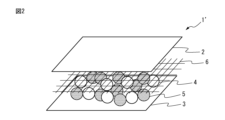
なお、本発明において、吸液性部材は上述の実施形態の複合吸収体1の態様に限定されず、吸液性部材は、少なくとも上記特有の吸液挙動を示す高分子吸収剤を含むものであれば、その他の吸液性材料を含んでいても、含んでいなくてもよい。例えば、図2に示す本発明の別の実施形態の複合吸収体1’のように、第1の保持シート2と第2の保持シート3との間に位置する吸液性部材が、高分子吸収剤4と高吸収性ポリマー5(SAP)との混合物によって構成されていてもよい。
In the present invention, the absorbent member is not limited to the form of the
また、本発明においては、複合吸収体の構成も上述の実施形態の複合吸収体1の態様に限定されず、複合吸収体は、例えば、図2に示す本発明の別の実施形態の複合吸収体1’のように、第1の保持シート2と吸液性部材(すなわち、高分子吸収剤4及び高吸収性ポリマー5)との間に位置する親水性繊維シート6を有していてもよい。
In addition, in the present invention, the configuration of the composite absorbent is not limited to the
本発明において、複合吸収体の外形形状や各種寸法、坪量等は、本発明の効果を阻害しない限り特に制限されず、各種用途や使用態様等に応じた任意の外形形状(例えば、円形状、長円形状、多角形状、砂時計形状、デザイン形状など)や各種寸法、坪量等を採用することができる。 In the present invention, the outer shape, various dimensions, basis weight, etc. of the composite absorbent are not particularly limited as long as they do not impede the effects of the present invention, and any outer shape (e.g., circular, elliptical, polygonal, hourglass, design shape, etc.), various dimensions, basis weight, etc. can be adopted according to various applications and usage modes.
以下、本発明の複合吸収体の各種構成部材について、図1に示す実施形態の複合吸収体1を例示的に用いて更に詳細に説明する。
The various components of the composite absorbent of the present invention will be described in more detail below, using the
(保持シート)
図1に示す複合吸収体1において、当該複合吸収体1の一方側の表面を形成する第1の保持シート2は、平面視にて複合吸収体1の外形形状と同様の略矩形状の外形形状を有している。かかる第1の保持シート2は、複合吸収体1に供給された液体を透過させて、内側の吸液性部材に吸収・保持させることができる、液透過性のシート状部材によって形成されている。
(Retaining sheet)
1, a
第1の保持シート2は、内側に配置される吸液性部材に比べて(すなわち、高分子吸収剤4等の吸液性材料の配置領域に比べて)、全体的にやや大きいサイズを有しており、周縁部において、複合吸収体1の厚さ方向の他方側に位置する第2の保持シート3と、任意の接着剤または熱融着手段等によって接合されている。
The
一方、複合吸収体1の他方側の表面を形成する第2の保持シート3は、平面視にて複合吸収体1の外形形状と同様の略矩形状の外形形状を有している。かかる第2の保持シート3は、内側の吸液性部材に吸収・保持されなかった液体や吸液性部材から滲出した液体が複合吸収体1の外部へ漏出するのを防ぐ、液不透過性のシート状部材によって形成されている。
On the other hand, the
本発明において、第1の保持シート及び第2の保持シートとして用い得る各々のシート状部材は、上述の実施形態のものに限定されず、本発明の複合吸収体は、第1の保持シート及び第2の保持シートのうちの少なくとも一方の保持シートが液透過性のシート状部材によって形成されていればよい。すなわち、本発明の複合吸収体は、第1の保持シート及び第2の保持シートのうちのいずれか一方の保持シートが液不透過性のシート状部材によって形成されていてもよい。 In the present invention, the sheet-like members that can be used as the first and second holding sheets are not limited to those in the above-mentioned embodiments, and the composite absorbent of the present invention may be such that at least one of the first and second holding sheets is formed from a liquid-permeable sheet-like member. In other words, the composite absorbent of the present invention may be such that either one of the first and second holding sheets is formed from a liquid-impermeable sheet-like member.
なお、保持シートとして液透過性のシート状部材を用いる場合、その液透過性のシート状部材は、本発明の効果を阻害しない限り特に制限されず、各種用途や使用態様等に応じた任意の液透過性のシート状部材を採用することができる。そのような液透過性のシート状部材の例としては、親水性を有するエアスルー不織布、スパンボンド不織布、ポイントボンド不織布等の不織布や織布、編布、多孔の樹脂フィルムなどが挙げられる。 When a liquid-permeable sheet-like member is used as the retaining sheet, the liquid-permeable sheet-like member is not particularly limited as long as it does not impair the effects of the present invention, and any liquid-permeable sheet-like member can be used depending on various applications and usage modes. Examples of such liquid-permeable sheet-like members include hydrophilic air-through nonwoven fabrics, spunbond nonwoven fabrics, point-bond nonwoven fabrics, and other nonwoven fabrics, woven fabrics, knitted fabrics, and porous resin films.
さらに、液透過性のシート状部材として親水性の不織布や織布、編布等(以下、これらを総称して「繊維シート」と称する。)を用いる場合、これらの繊維シートは、単層構造を有していても、2層以上の多層構造を有していてもよい。かかる繊維シートの構成繊維の種類も特に制限されず、例えばセルロース系繊維や親水化処理を施した熱可塑性樹脂繊維などの親水性繊維が挙げられる。これらの繊維は単独で用いても、二種類以上の繊維を併用してもよい。
繊維シートの構成繊維に用い得るセルロース系繊維としては、例えば、天然セルロース繊維(例えば、コットン等の植物繊維など)や再生セルロース繊維、精製セルロース繊維、半合成セルロース繊維などが挙げられる。また、繊維シートの構成繊維に用い得る熱可塑性樹脂繊維としては、例えば、ポリエチレン(PE)、ポリプロピレン(PP)等のオレフィン系樹脂、ポリエチレンテレフタレート(PET)等のポリエステル系樹脂、6-ナイロン等のポリアミド系樹脂などの公知の熱可塑性樹脂からなる繊維が挙げられる。これらの樹脂は単独で用いても、二種類以上の樹脂を併用してもよい。
Furthermore, when hydrophilic nonwoven fabrics, woven fabrics, knitted fabrics, etc. (hereinafter collectively referred to as "fiber sheets") are used as the liquid-permeable sheet-like member, these fiber sheets may have a single-layer structure or a multi-layer structure of two or more layers. The type of fiber constituting such a fiber sheet is not particularly limited, and examples thereof include hydrophilic fibers such as cellulosic fibers and thermoplastic resin fibers that have been subjected to a hydrophilization treatment. These fibers may be used alone or in combination of two or more types of fibers.
Examples of cellulose-based fibers that can be used as constituent fibers of the fiber sheet include natural cellulose fibers (e.g., plant fibers such as cotton), regenerated cellulose fibers, refined cellulose fibers, and semi-synthetic cellulose fibers. Examples of thermoplastic resin fibers that can be used as constituent fibers of the fiber sheet include fibers made of known thermoplastic resins such as olefin-based resins such as polyethylene (PE) and polypropylene (PP), polyester-based resins such as polyethylene terephthalate (PET), and polyamide-based resins such as 6-nylon. These resins may be used alone or in combination of two or more types.
また、保持シートとして液不透過性のシート状部材を用いる場合、その液不透過性のシート状部材は、本発明の効果を阻害しない限り特に制限されず、各種用途や使用態様等に応じた任意の液不透過性のシート状部材を採用することができる。そのような液不透過性のシート状部材の例としては、任意の疎水性の熱可塑性樹脂繊維(例えば、PE、PP等のポリオレフィン系繊維、PET等のポリエステル系繊維、芯鞘型等の各種複合繊維など)によって形成された疎水性不織布;PEやPP等の疎水性の熱可塑性樹脂によって形成された有孔又は無孔の樹脂フィルム;該樹脂フィルムに不織布を貼り合わせた積層体;SMS不織布等の積層不織布などが挙げられる。 In addition, when a liquid-impermeable sheet-like member is used as the retaining sheet, the liquid-impermeable sheet-like member is not particularly limited as long as it does not impair the effects of the present invention, and any liquid-impermeable sheet-like member can be adopted according to various applications and usage modes. Examples of such liquid-impermeable sheet-like members include hydrophobic nonwoven fabrics formed from any hydrophobic thermoplastic resin fibers (e.g., polyolefin fibers such as PE and PP, polyester fibers such as PET, various composite fibers such as core-sheath type, etc.); perforated or non-perforated resin films formed from hydrophobic thermoplastic resins such as PE and PP; laminates in which nonwoven fabrics are bonded to the resin films; laminated nonwoven fabrics such as SMS nonwoven fabrics, etc.
本発明において、保持シートの外形形状や各種寸法、坪量等は、本発明の効果を阻害しない限り特に制限されず、各種用途や使用態様等に応じた任意の外形形状(例えば、円形状、長円形状、多角形状、砂時計形状、デザイン形状など)や各種寸法、坪量等を採用することができる。 In the present invention, the external shape, various dimensions, basis weight, etc. of the retaining sheet are not particularly limited as long as they do not impede the effects of the present invention, and any external shape (e.g., circular, elliptical, polygonal, hourglass, design shape, etc.), various dimensions, basis weight, etc. can be adopted according to various applications and usage modes, etc.
(吸液性部材)
図1に示す複合吸収体1において、吸液性部材は、上述のとおり第1の保持シート2と第2の保持シート3の間に位置する、親水性の連続骨格及び連続空孔を備えた高分子吸収剤4によって、第1の保持シート2を透過してきた液体を吸収・保持し得るように構成されている。
(Liquid-absorbent member)
In the
なお、複合吸収体1においては、吸液性部材の高分子吸収剤4は、上述の第1の保持シート2及び第2の保持シート3の各々と、ホットメルト型接着剤等の任意の接着剤によって接合されているが、本発明の複合吸収体において、高分子吸収剤は保持シートと接合されていなくてもよい。
In the
そして、本発明において吸液性部材は、上述のとおり親水性の連続骨格及び連続空孔を備えた上記特有の吸液挙動を示す高分子吸収剤を含んでいる。高分子吸収剤については後述する。 In the present invention, the liquid-absorbent member contains a polymer absorbent that has a hydrophilic continuous skeleton and continuous pores and exhibits the above-mentioned unique liquid-absorption behavior. The polymer absorbent will be described later.
本発明において、第1の保持シート及び第2の保持シートの間に位置する吸液性部材は、少なくとも上記の高分子吸収剤を含むものであれば、その他の吸液性材料を含んでいても、含んでいなくてもよい。すなわち、吸液性部材は、吸液性材料として上述の高分子吸収剤のみを含むものであっても、上述の高分子吸収剤のほかに、当分野において公知の吸液性材料を更に含むものであってもよい。そのような吸液性材料としては、例えば、親水性繊維や高吸収性ポリマーなどが挙げられ、更に具体的には、パルプ繊維(例えば、粉砕パルプ等)、コットン、レーヨン、アセテート等のセルロース系繊維;アクリル酸ナトリウムコポリマー等の高吸収性ポリマー(SAP)からなる粒状物;これらを任意に組み合わせた混合物などが挙げられる。
例えば、図2に示す本発明の別の実施形態の複合吸収体1’では、第1の保持シート2と第2の保持シート3の間に位置する吸液性部材は、親水性の連続骨格及び連続空孔を備え且つ上記特定の粒子径を有する粒子状の高分子吸収剤4のほかに、高吸収性ポリマー5を含んでいる。
In the present invention, the liquid-absorbent member located between the first holding sheet and the second holding sheet may or may not contain other liquid-absorbent materials as long as it contains at least the above-mentioned polymer absorbent. That is, the liquid-absorbent member may contain only the above-mentioned polymer absorbent as the liquid-absorbent material, or may further contain a liquid-absorbent material known in the art in addition to the above-mentioned polymer absorbent. Examples of such liquid-absorbent materials include hydrophilic fibers and superabsorbent polymers, and more specifically, cellulose-based fibers such as pulp fibers (e.g., ground pulp), cotton, rayon, and acetate; granules made of superabsorbent polymers (SAP) such as sodium acrylate copolymer; and mixtures of any combination of these.
For example, in a composite absorbent 1' of another embodiment of the present invention shown in Figure 2, the liquid-absorbent member located between the
なお、本発明において、吸液性部材の外形形状(吸液性材料の配置領域の平面視形状)や各種寸法、坪量等は、本発明の効果を阻害しない限り特に制限されず、所望の吸液性や柔軟性、強度等に応じた任意の外形形状や各種寸法、坪量等を採用することができる。 In the present invention, the outer shape (planar shape of the area where the absorbent material is arranged), various dimensions, basis weight, etc. of the absorbent member are not particularly limited as long as they do not impair the effects of the present invention, and any outer shape, various dimensions, basis weight, etc. can be adopted according to the desired absorbency, flexibility, strength, etc.
(親水性繊維シート)
本発明においては、複合吸収体は、例えば、図2に示す別の実施形態の複合吸収体1’のように、第1の保持シート2と吸液性部材(すなわち、高分子吸収剤4及び高吸収性ポリマー5)との間に、親水性繊維シート6を有していてもよい。
(hydrophilic fiber sheet)
In the present invention, the composite absorbent may have a
本発明において、複合吸収体に用い得る親水性繊維シートは、本発明の効果を阻害しない限り特に制限されず、各種用途や使用態様等に応じた任意の親水性繊維シートを採用することができる。そのような親水性繊維シートの例としては、親水性を有する不織布や織布、編布などが挙げられる。なお、親水性繊維シートは、単層構造を有していても、2層以上の多層構造を有していてもよい。 In the present invention, the hydrophilic fiber sheet that can be used in the composite absorbent is not particularly limited as long as it does not impair the effects of the present invention, and any hydrophilic fiber sheet can be used depending on various applications and usage modes. Examples of such hydrophilic fiber sheets include nonwoven fabrics, woven fabrics, knitted fabrics, etc. that have hydrophilicity. The hydrophilic fiber sheet may have a single layer structure or a multi-layer structure of two or more layers.
かかる親水性繊維シートの構成繊維の種類も特に制限されず、例えばセルロース系繊維や親水化処理を施した熱可塑性樹脂繊維などの親水性繊維が挙げられる。これらの繊維は単独で用いても、二種類以上の繊維を併用してもよい。
さらに、親水性繊維シートの構成繊維に用い得るセルロース系繊維としては、例えば、天然セルロース繊維(例えば、コットン等の植物繊維など)や再生セルロース繊維、精製セルロース繊維、半合成セルロース繊維などが挙げられる。また、親水性繊維シートの構成繊維に用い得る熱可塑性樹脂繊維としては、例えば、PE、PP等のオレフィン系樹脂、PET等のポリエステル系樹脂、6-ナイロン等のポリアミド系樹脂などの公知の熱可塑性樹脂からなる繊維が挙げられる。これらの樹脂は単独で用いても、二種類以上の樹脂を併用してもよい。
The type of the constituent fiber of such a hydrophilic fiber sheet is not particularly limited, and examples thereof include hydrophilic fibers such as cellulosic fibers and thermoplastic resin fibers that have been subjected to a hydrophilic treatment. These fibers may be used alone or in combination of two or more types of fibers.
Furthermore, examples of cellulose-based fibers that can be used as constituent fibers of the hydrophilic fiber sheet include natural cellulose fibers (e.g., plant fibers such as cotton), regenerated cellulose fibers, refined cellulose fibers, semi-synthetic cellulose fibers, etc. Furthermore, examples of thermoplastic resin fibers that can be used as constituent fibers of the hydrophilic fiber sheet include fibers made of known thermoplastic resins such as olefin-based resins such as PE and PP, polyester-based resins such as PET, and polyamide-based resins such as 6-nylon. These resins may be used alone or in combination of two or more types.
本発明において、親水性繊維シートの外形形状や各種寸法、坪量等は、本発明の効果を阻害しない限り特に制限されず、各種用途や使用態様等に応じた任意の外形形状や各種寸法、坪量等を採用することができる。 In the present invention, the outer shape, various dimensions, basis weight, etc. of the hydrophilic fiber sheet are not particularly limited as long as they do not impair the effects of the present invention, and any outer shape, various dimensions, basis weight, etc. can be adopted according to various applications and usage modes, etc.
以下、本発明の複合吸収体に用いられる高分子吸収剤について、更に詳細に説明する。 The polymer absorbent used in the composite absorbent of the present invention will be described in more detail below.
[高分子吸収剤]
本発明において高分子吸収剤は、親水性の連続骨格及び連続空孔を備え、液体を吸収する際に、液体を上述の連続骨格に取り込んだ後に連続空孔に取り込むという特有の吸液挙動を示すものであれば特に限定されない。そのような高分子吸収剤としては、例えば、少なくとも(メタ)アクリル酸エステルを含む2個以上のモノマーの架橋重合体の加水分解物であり、官能基に少なくとも1個以上の親水基を有する高分子化合物が挙げられる。より具体的には、(メタ)アクリル酸エステルと、一分子中に2個以上のビニル基を含有する化合物の架橋重合体の加水分解物であり、少なくとも-COONa基を有する高分子化合物が挙げられる。かかる高分子吸収剤は、一分子中に少なくとも1個以上の-COONa基を有する有機多孔質体であり、さらに、-COOH基を有していてもよい。多孔質体の骨格中には、-COONa基が略均一に分布している。
[Polymer absorbent]
In the present invention, the polymer absorbent is not particularly limited as long as it has a hydrophilic continuous skeleton and continuous pores, and exhibits a unique liquid absorption behavior in which, when absorbing a liquid, the liquid is taken up in the above-mentioned continuous skeleton and then taken up in the continuous pores. Such a polymer absorbent may be, for example, a hydrolyzate of a crosslinked polymer of two or more monomers including at least a (meth)acrylic acid ester, and a polymer compound having at least one hydrophilic group in the functional group. More specifically, a polymer compound may be a hydrolyzate of a crosslinked polymer of a (meth)acrylic acid ester and a compound containing two or more vinyl groups in one molecule, and having at least a -COONa group. Such a polymer absorbent is an organic porous body having at least one or more -COONa groups in one molecule, and may further have a -COOH group. The -COONa groups are distributed approximately uniformly in the skeleton of the porous body.
高分子吸収剤がこのような(メタ)アクリル酸エステルと、一分子中に2個以上のビニル基を含有する化合物の架橋重合体の加水分解物であり、且つ、少なくとも1個以上の-COONa基を含有するものであると、後述するように、水溶液等の液体を吸収する時に親水性の連続骨格が伸長しやすくなり(すなわち、膨張しやすくなり)、連続空孔も広がりやすくなるため、より多くの液体をより素早く連続空孔に取り込むことができる。したがって、このような高分子吸収剤を含む複合吸収体は、吸収体として更に優れた吸収性能を発揮することができる。 If the polymer absorbent is a hydrolysate of a crosslinked polymer of such a (meth)acrylic acid ester and a compound containing two or more vinyl groups in one molecule, and contains at least one -COONa group, as described below, the continuous hydrophilic skeleton is more likely to extend (i.e., expand) when absorbing liquid such as an aqueous solution, and the continuous pores are also more likely to expand, so that more liquid can be taken in by the continuous pores more quickly. Therefore, a composite absorbent containing such a polymer absorbent can exhibit even better absorption performance as an absorbent.
なお、本明細書において(メタ)アクリル酸エステルとは、アクリル酸エステル又はメタクリル酸エステルをいう。 In this specification, (meth)acrylic acid ester refers to acrylic acid ester or methacrylic acid ester.
このような(メタ)アクリル酸エステルと、ジビニルベンゼンとの架橋重合体の加水分解物によって形成される高分子吸収剤においては、少なくとも-COONa基を有する有機ポリマーによって親水性の連続骨格が形成され、骨格間に液体の吸収場となる連通孔(連続空孔)を有している。
なお、加水分解処理は、架橋重合体の-COOR基(すなわち、カルボン酸エステル基)を-COONa基又は-COOH基にするものであるため(図2を参照)、高分子吸収剤は-COOR基を有していてもよい。
In the polymer absorbent formed by the hydrolysis product of the crosslinked polymer of such a (meth)acrylic acid ester and divinylbenzene, a hydrophilic continuous skeleton is formed by an organic polymer having at least a -COONa group, and the skeleton has communicating holes (interconnected pores) that serve as a liquid absorption field.
In addition, since the hydrolysis treatment converts the --COOR groups (that is, carboxylate groups) of the crosslinked polymer into --COONa groups or --COOH groups (see FIG. 2), the polymer absorbent may have --COOR groups.
親水性の連続骨格を形成する有機ポリマー中の-COOH基及び-COONa基の存在は、赤外分光光度法及び弱酸性イオン交換基の定量法で分析することで確認できる。 The presence of -COOH groups and -COONa groups in organic polymers that form a continuous hydrophilic skeleton can be confirmed by analysis using infrared spectroscopy and a method for quantifying weakly acidic ion exchange groups.
ここで、図3は、高分子吸収剤の一例である吸収剤Aの製造過程について説明する図である。この図3において、上図は重合の構成原料を示し、中図は(メタ)アクリル酸エステルとジビニルベンゼンとの架橋重合体であるモノリスAを示し、下図は中図のモノリスAに加水分解及び乾燥処理をして得られる吸収剤Aを示している。 Here, Figure 3 is a diagram explaining the manufacturing process of absorbent A, which is an example of a polymer absorbent. In this Figure 3, the upper diagram shows the constituent raw materials for polymerization, the middle diagram shows monolith A, which is a crosslinked polymer of (meth)acrylic acid ester and divinylbenzene, and the lower diagram shows absorbent A obtained by subjecting monolith A in the middle diagram to hydrolysis and drying treatment.
以下、高分子吸収剤の一例である、(メタ)アクリル酸エステルと、ジビニルベンゼンとの架橋重合体の加水分解物によって形成される吸収剤Aを用いて説明する。 The following description will use absorbent A, which is an example of a polymer absorbent and is formed from a hydrolyzate of a cross-linked polymer of (meth)acrylic acid ester and divinylbenzene.
なお、高分子吸収剤としては、このような吸収剤Aに限られず、(メタ)アクリル酸エステルと、一分子中に2個以上のビニル基を有する化合物の架橋重合体の加水分解物、或いは、少なくとも(メタ)アクリル酸エステルを含む2種類以上のモノマーの架橋重合体の加水分解物などであってもよい。
但し、高分子吸収剤がモノリス状の吸収剤であると、液体を素早く吸収することができる上、当該高分子吸収剤に一時的に保持した液体をより着実にSAPへ受け渡すことができるという利点がある。
The polymer absorbent is not limited to the absorbent A, but may be a hydrolysate of a cross-linked polymer of a (meth)acrylic acid ester and a compound having two or more vinyl groups in one molecule, or a hydrolysate of a cross-linked polymer of two or more monomers including at least a (meth)acrylic acid ester.
However, when the polymer absorbent is a monolithic absorbent, it has the advantage that it can absorb liquid quickly and that the liquid temporarily held in the polymer absorbent can be transferred to the SAP more reliably.
なお、以下の説明において、「モノリスA」とは、加水分解処理がなされる前の(メタ)アクリル酸エステルとジビニルベンゼンとの架橋重合体からなる有機多孔質体であり、「モノリス状有機多孔質体」と称することがある。
また、「吸収剤A」は、加水分解処理及び乾燥処理がなされた後の(メタ)アクリル酸エステルとジビニルベンゼンとの架橋重合体(モノリスA)の加水分解物である。なお、以下の説明において、吸収剤Aは乾燥状態のものをいう。
In the following description, "Monolith A" refers to an organic porous material consisting of a crosslinked polymer of a (meth)acrylic acid ester and divinylbenzene before hydrolysis treatment, and may be referred to as a "monolithic organic porous material."
In addition, "absorbent A" is a hydrolyzate of a crosslinked polymer (monolith A) of (meth)acrylic acid ester and divinylbenzene after hydrolysis and drying. In the following description, absorbent A refers to the absorbent in a dry state.
まず、吸収剤Aの構造について説明する。
吸収剤Aは、上述のとおり親水性の連続骨格と連続空孔を有している。親水性の連続骨格を有する有機ポリマーである吸収剤Aは、図3に示すように、重合モノマーである(メタ)アクリル酸エステルと、架橋モノマーであるジビニルベンゼンとを架橋重合し、得られた架橋重合体(モノリスA)を更に加水分解することにより得られる。
First, the structure of absorbent A will be described.
As described above, the absorbent A has a hydrophilic continuous skeleton and continuous pores. The absorbent A, which is an organic polymer having a hydrophilic continuous skeleton, is obtained by cross-linking and polymerizing a (meth)acrylic acid ester as a polymerization monomer and a divinylbenzene as a cross-linking monomer, and further hydrolyzing the obtained cross-linked polymer (monolith A), as shown in FIG.
親水性の連続骨格を形成する有機ポリマーは、構成単位として、エチレン基の重合残基(以下、「構成単位X」と称する。)と、ジビニルベンゼンの架橋重合残基(以下、「構成単位Y」と称する。)と、を有する。
さらに、親水性の連続骨格を形成する有機ポリマー中のエチレン基の重合残基(構成単位X)は、カルボン酸エステル基の加水分解により生成する-COONa基、又は-COOH基と-COONa基の両方の基を有する。なお、重合モノマーが(メタ)アクリル酸エステルである場合、エチレン基の重合残基(構成単位X)は、-COONa基、-COOH基及びエステル基を有する。
The organic polymer forming the hydrophilic continuous skeleton has, as structural units, a polymerized residue of an ethylene group (hereinafter referred to as "structural unit X") and a cross-linked polymerized residue of divinylbenzene (hereinafter referred to as "structural unit Y").
Furthermore, the polymerized residue of an ethylene group (structural unit X) in the organic polymer forming the hydrophilic continuous skeleton has a -COONa group, or both a -COOH group and a -COONa group, which are generated by hydrolysis of a carboxylate group. When the polymerization monomer is a (meth)acrylic acid ester, the polymerized residue of an ethylene group (structural unit X) has a -COONa group, a -COOH group, and an ester group.
吸収剤Aにおいて、親水性の連続骨格を形成する有機ポリマー中の、ジビニルベンゼンの架橋重合残基(構成単位Y)の割合は、全構成単位に対し、例えば0.1~30モル%であり、好ましくは0.1~20モル%である。例えば、メタクリル酸ブチルを重合モノマーとし、ジビニルベンゼンを架橋モノマーとした吸収剤Aにおいては、親水性の連続骨格を形成する有機ポリマー中の、ジビニルベンゼンの架橋重合残基(構成単位Y)の割合は、全構成単位に対し、例えば約3%であり、好ましくは0.1~10モル%であり、より好ましくは0.3~8モル%である。
なお、親水性の連続骨格を形成する有機ポリマー中のジビニルベンゼンの架橋重合残基の割合が0.1モル%以上であると、吸収剤Aの強度が低下しにくくなり、また、このジビニルベンゼンの架橋重合残基の割合が30モル%以下であると、吸収対象となる液体の吸液量が低下しにくくなる。
In the absorbent A, the ratio of the crosslinked polymerized residue of divinylbenzene (structural unit Y) in the organic polymer forming the hydrophilic continuous skeleton is, for example, 0.1 to 30 mol %, preferably 0.1 to 20 mol %, relative to the total structural units. For example, in the absorbent A in which butyl methacrylate is used as the polymerization monomer and divinylbenzene is used as the crosslinked monomer, the ratio of the crosslinked polymerized residue of divinylbenzene (structural unit Y) in the organic polymer forming the hydrophilic continuous skeleton is, for example, about 3 mol %, preferably 0.1 to 10 mol %, more preferably 0.3 to 8 mol %, relative to the total structural units.
When the ratio of cross-linked polymerized residues of divinylbenzene in the organic polymer forming the hydrophilic continuous skeleton is 0.1 mol % or more, the strength of the absorbent A is less likely to decrease, and when the ratio of cross-linked polymerized residues of divinylbenzene is 30 mol % or less, the absorption amount of the liquid to be absorbed is less likely to decrease.
また、吸収剤Aにおいて、親水性の連続骨格を形成する有機ポリマーは、構成単位X及び構成単位Yのみからなるものであってもよいし、或いは、構成単位X及び構成単位Yに加えて、構成単位X及び構成単位Y以外の構成単位、すなわち(メタ)アクリル酸エステル及びジビニルベンゼン以外のモノマーの重合残基を有していてもよい。 In absorbent A, the organic polymer forming the hydrophilic continuous skeleton may consist only of structural units X and Y, or may contain, in addition to structural units X and Y, structural units other than structural units X and Y, i.e., polymerized residues of monomers other than (meth)acrylic acid esters and divinylbenzene.
構成単位X及び構成単位Y以外の構成単位として、例えばスチレン、α-メチルスチレン、ビニルトルエン、ビニルベンジルクロライド、(メタ)アクリル酸グリシジル、イソブテン、ブタジエン、イソプレン、クロロプレン、塩化ビニル、臭化ビニル、塩化ビニリデン、テトラフルオロエチレン、(メタ)アクリロニトリル、酢酸ビニル、エチレングリコールジ(メタ)アクリレート、トリプロピレングリコールジ(メタ)アクリレート、トリメチロールプロパントリ(メタ)アクリレート等のモノマーの重合残基が挙げられる。 Examples of constituent units other than the constituent unit X and the constituent unit Y include polymerized residues of monomers such as styrene, α-methylstyrene, vinyltoluene, vinylbenzyl chloride, glycidyl (meth)acrylate, isobutene, butadiene, isoprene, chloroprene, vinyl chloride, vinyl bromide, vinylidene chloride, tetrafluoroethylene, (meth)acrylonitrile, vinyl acetate, ethylene glycol di(meth)acrylate, tripropylene glycol di(meth)acrylate, and trimethylolpropane tri(meth)acrylate.
なお、親水性の連続骨格を形成する有機ポリマー中の、構成単位X及び構成単位Y以外の構成単位の割合は、全構成単位に対し、例えば0~50モル%であり、好ましくは0~30モル%である。 In addition, the ratio of structural units other than structural unit X and structural unit Y in the organic polymer that forms the hydrophilic continuous skeleton is, for example, 0 to 50 mol %, and preferably 0 to 30 mol %, relative to the total structural units.
また、吸収剤Aは、親水性の連続骨格の厚みが0.1~100μmであることが好ましい。吸収剤Aの親水性の連続骨格の厚みが0.1μm以上であると、多孔質体における液体を取り込むための空間(空孔)が吸収時に潰れにくくなり、吸液量が低下しにくくなる。一方、親水性の連続骨格の厚みが100μm以下であると、優れた吸収速度が得られやすくなる。 In addition, it is preferable that the thickness of the hydrophilic continuous skeleton of absorbent A is 0.1 to 100 μm. If the thickness of the hydrophilic continuous skeleton of absorbent A is 0.1 μm or more, the spaces (pores) for absorbing liquid in the porous body are less likely to collapse during absorption, and the amount of absorbed liquid is less likely to decrease. On the other hand, if the thickness of the hydrophilic continuous skeleton is 100 μm or less, an excellent absorption speed is more likely to be obtained.
なお、吸収剤Aの親水性の連続骨格の細孔構造は、連続気泡構造であるため、連続骨格の厚みの測定は、電子顕微鏡測定用の試験片に現れる骨格断面を厚みの評価箇所とする。連続骨格は、加水分解後の脱水・乾燥処理で取り除かれる水(水滴)同士の間隔で形成されるため、多角形の形状であることが多い。そのため、連続骨格の厚みは、多角形断面に外接する円の直径(μm)の平均値とする。また、稀に多角形の中に小さな穴が開いている場合もあるが、その場合は、小さな穴を囲んでいる多角形の断面の外接円を測定する。 The pore structure of the hydrophilic continuous skeleton of absorbent A is an open-cell structure, so the thickness of the continuous skeleton is measured at the cross-section of the skeleton that appears on the test piece for electron microscope measurement. The continuous skeleton is often polygonal in shape, as it is formed by the spaces between water (water droplets) that are removed in the dehydration and drying process after hydrolysis. Therefore, the thickness of the continuous skeleton is the average value of the diameters (μm) of circles circumscribing the polygonal cross-section. In rare cases, small holes may be present within the polygon, in which case the circumscribing circle of the polygonal cross-section surrounding the small holes is measured.
さらに、吸収剤Aは、連続空孔の平均直径が1~1000μmであることが好ましい。吸収剤Aの連続空孔の平均直径が1μm以上であると、多孔質体における液体を取り込むための空間(空孔)が吸収時に潰れ難くなり、吸収速度が低下し難くなる。一方、連続空孔の平均直径が1000μm以下であると、優れた吸収速度が得られ易くなる。 Furthermore, it is preferable that the average diameter of the interconnected pores of absorbent A is 1 to 1000 μm. If the average diameter of the interconnected pores of absorbent A is 1 μm or more, the spaces (pores) for absorbing liquid in the porous body are less likely to collapse during absorption, and the absorption rate is less likely to decrease. On the other hand, if the average diameter of the interconnected pores is 1000 μm or less, an excellent absorption rate is more easily obtained.
なお、吸収剤Aの連続空孔の平均直径(μm)は、水銀圧入法によって測定することができ、かかる水銀圧入法によって得られた細孔分布曲線の最大値を採用する。連続空孔の平均直径の測定用試料については、吸収剤Aのイオン形によらず、50℃の温度に設定した減圧乾燥器で18時間以上乾燥させたものを試料として用いる。なお、最終到達圧力は0Torrとする。 The average diameter (μm) of the interconnected pores of absorbent A can be measured by mercury intrusion porosimetry, and the maximum value of the pore distribution curve obtained by this mercury intrusion porosimetry is used. Regardless of the ionic form of absorbent A, samples for measuring the average diameter of interconnected pores are those dried for 18 hours or more in a reduced pressure dryer set at a temperature of 50°C. The final pressure reached is 0 Torr.
ここで、図4は、吸収剤Aの拡大倍率50倍のSEM写真であり、図5は、吸収剤Aの拡大倍率100倍のSEM写真であり、図6は、吸収剤Aの拡大倍率500倍のSEM写真であり、図7は、吸収剤Aの拡大倍率1000倍のSEM写真であり、さらに、図8は、吸収剤Aの拡大倍率1500倍のSEM写真である。
これら図4~図8に示す吸収剤Aは、メタクリル酸ブチルを重合モノマーとし、ジビニルベンゼンを架橋モノマーとする吸収剤の一例であり、それぞれ2mm角の立方体の構造を有している。
Here, FIG. 4 is an SEM photograph of absorbent A at a magnification of 50 times, FIG. 5 is an SEM photograph of absorbent A at a magnification of 100 times, FIG. 6 is an SEM photograph of absorbent A at a magnification of 500 times, FIG. 7 is an SEM photograph of absorbent A at a magnification of 1000 times, and further, FIG. 8 is an SEM photograph of absorbent A at a magnification of 1500 times.
The absorbent A shown in these Figs. 4 to 8 is an example of an absorbent having butyl methacrylate as a polymerization monomer and divinylbenzene as a cross-linking monomer, and each has a cubic structure of 2 mm square.
図4~図8に示す吸収剤Aは、多数の気泡状のマクロポアを有しており、さらに、これら気泡状のマクロポア同士が重なる部分を有している。吸収剤Aは、このマクロポア同士が重なる部分が共通の開口(メソポア)となる連続気泡構造を有している、すなわち、連続気泡構造体(連続マクロポア構造体)となっている。 The absorbent A shown in Figures 4 to 8 has numerous bubble-like macropores, and further has portions where these bubble-like macropores overlap. The absorbent A has an open cell structure in which the overlapping portions of the macropores form common openings (mesopores), i.e., it has an open cell structure (continuous macropore structure).
このマクロポア同士が重なる部分は、乾燥状態の平均直径が1~1000μm、好ましくは10~200μm、特に好ましくは20~100μmである共通の開口(メソポア)となっており、その大部分がオープンポア構造となっている。メソポアの乾燥状態の平均直径が1μm以上であると、吸収対象となる液体の吸収速度がより良好なものとなる。一方、メソポアの乾燥状態の平均直径が1000μm以下であると、吸収剤Aが脆化しにくくなる。
なお、このようなマクロポア同士の重なりは、1個のマクロポアで1~12個程度、多くのものは3~10個程度である。
The overlapping portions of the macropores form common openings (mesopores) having an average diameter in a dry state of 1 to 1000 μm, preferably 10 to 200 μm, and particularly preferably 20 to 100 μm, most of which have an open pore structure. When the average diameter of the mesopores in a dry state is 1 μm or more, the absorption rate of the liquid to be absorbed is improved. On the other hand, when the average diameter of the mesopores in a dry state is 1000 μm or less, the absorbent A is less likely to become embrittled.
The number of overlapping macropores in each macropore is about 1 to 12, and in most cases, about 3 to 10.
また、吸収剤Aがこのような連続気泡構造を有することにより、マクロポア群やメソポア群を均一に形成することができるとともに、特開平8-252579号公報などに記載されているような粒子凝集型多孔質体に比べて、細孔容積や比表面積を格段に大きくすることができるという利点がある。 In addition, because absorbent A has such an open cell structure, it is possible to uniformly form macropores and mesopores, and there is an advantage in that the pore volume and specific surface area can be significantly increased compared to particle agglomeration type porous bodies such as those described in JP-A-8-252579.
吸収剤Aが備える連続空孔は、互いに連通した複数の細孔(空孔)である。その吸収剤Aの細孔(空孔)の全細孔容積は0.5~50mL/gが好ましく、0.9~40mL/gがより好ましく、2~30mL/gが更により好ましい。吸収剤Aの全細孔容積が0.5mL/g以上であることで、吸収剤Aに十分な細孔容積を確保でき、したがって、十分な吸液量を確保できる。また、多孔質体における液体を取り込むための空間(空孔)を吸収時に潰れ難くでき、吸液量及び吸液速度を低下し難くできる。一方、吸収剤Aの全細孔容積が50mL/g以下のとき、吸収剤Aの強度を低下し難くできる。 The continuous pores in absorbent A are multiple pores (voids) that are interconnected. The total pore volume of the pores (voids) in absorbent A is preferably 0.5 to 50 mL/g, more preferably 0.9 to 40 mL/g, and even more preferably 2 to 30 mL/g. When the total pore volume of absorbent A is 0.5 mL/g or more, a sufficient pore volume can be secured in absorbent A, and therefore a sufficient amount of liquid can be secured. In addition, the spaces (voids) for absorbing liquid in the porous body can be made less likely to collapse during absorption, and the amount and speed of liquid absorption can be made less likely to decrease. On the other hand, when the total pore volume of absorbent A is 50 mL/g or less, the strength of absorbent A can be made less likely to decrease.
なお、全細孔容積は、水銀圧入法で測定することができる。全細孔容積の測定用試料は、吸収剤Aのイオン形によらず、50℃の温度に設定した減圧乾燥器で18時間以上乾燥させたものを用いる。最終到達圧力は0Torrとする。その水銀圧入法により、累積(積算)細孔容積分布(細孔半径と累積細孔容積との関係)やlog微分細孔容積分布(細孔半径とlog微分細孔容積との関係)などが得られ、全細孔容積(mL/g)、平均細孔半径(μm)、最大細孔半径(μm)、所定の細孔半径以上(/以下)の細孔の細孔容積(mL/g)及び割合(%)、細孔容積の変動係数などを算出できる。なお、最大細孔径(μm)は、細孔容積の最大値を示す細孔の細孔半径をいう。また、各細孔半径における細孔容積(mL/g)は、log微分細孔容積分布におけるlog微分細孔容積(mL/g)を採用する。 The total pore volume can be measured by mercury intrusion porosimetry. The sample for measuring the total pore volume is dried for 18 hours or more in a vacuum dryer set at a temperature of 50°C, regardless of the ion form of absorbent A. The final pressure is 0 Torr. The mercury intrusion porosimetry can obtain the cumulative (integrated) pore volume distribution (relationship between pore radius and cumulative pore volume) and the log differential pore volume distribution (relationship between pore radius and log differential pore volume), and can calculate the total pore volume (mL/g), average pore radius (μm), maximum pore radius (μm), pore volume (mL/g) and ratio (%) of pores with a predetermined pore radius or more (or less), and the coefficient of variation of the pore volume. The maximum pore diameter (μm) refers to the pore radius of the pore that shows the maximum value of the pore volume. In addition, the pore volume (mL/g) for each pore radius is the log differential pore volume (mL/g) in the log differential pore volume distribution.
ここで、吸収剤Aの細孔(空孔)では、細孔半径が1μm以上の細孔による細孔容積の割合は、全細孔の細孔容積(全細孔容積)の90%以上であり、93%以上が好ましく、95%以上がより好ましい。細孔半径が1μm以上の細孔の細孔容積の割合が90%以上であることで、吸液時に、細孔半径が1μm未満のような比較的小さい細孔半径の細孔に液体成分が入り込み難く、入り込めなくても、十分な吸液量を確保できる。それゆえ、細孔容積に比して吸液量が低下することを抑制でき、優れた吸収性能を得ることができる。 Here, in the pores (voids) of absorbent A, the proportion of the pore volume due to pores with a pore radius of 1 μm or more is 90% or more of the pore volume of all pores (total pore volume), preferably 93% or more, and more preferably 95% or more. When the proportion of the pore volume due to pores with a pore radius of 1 μm or more is 90% or more, during liquid absorption, it is difficult for liquid components to enter pores with a relatively small pore radius, such as pores with a pore radius of less than 1 μm, and even if they cannot enter, a sufficient amount of liquid absorption can be ensured. Therefore, it is possible to suppress a decrease in the amount of liquid absorption compared to the pore volume, and excellent absorption performance can be obtained.
吸収剤Aの細孔では、細孔半径が0.005μm以下の細孔による細孔容積の割合が、全細孔の細孔容積(全細孔容積)の10%未満が好ましく、細孔半径が0.05μm以下の細孔による細孔容積の割合が、全細孔の細孔容積(全細孔容積)の10%未満がより好ましい。吸収剤Aでは、細孔半径が0.005μm以下であるような、細孔半径が非常に小さく吸液が困難な細孔による細孔容積の割合が非常に小さく、細孔半径が1μm以上であるような、細孔半径が大きく吸液が可能な細孔による細孔容積の割合が大きい(90%以上)。それにより、吸収剤Aの細孔を吸液に有効に利用でき、十分な吸液量を確保できる。 In the pores of absorbent A, the proportion of the pore volume due to pores with a pore radius of 0.005 μm or less is preferably less than 10% of the pore volume of all pores (total pore volume), and the proportion of the pore volume due to pores with a pore radius of 0.05 μm or less is more preferably less than 10% of the pore volume of all pores (total pore volume). In absorbent A, the proportion of the pore volume due to pores with a very small pore radius, such as 0.005 μm or less, which make it difficult to absorb liquid, is very small, and the proportion of the pore volume due to pores with a large pore radius, such as pore radius of 1 μm or more, which are capable of absorbing liquid, is large (90% or more). This allows the pores of absorbent A to be effectively used for absorbing liquid, and a sufficient amount of liquid can be absorbed.
また、吸収剤Aの細孔では、細孔容積の最大値を示す細孔における細孔半径が(0.5μm以上、)500μm以下が好ましく、300μm以下がより好ましく、150μm以下がより好ましい。細孔容積の最大値での細孔半径を500μm以下とすることで、吸液時に、吸収剤Aの連続骨格の構造が壊れる(潰れる)ことを抑制でき、優れた吸収速度が得られやすく、安定的に、十分な吸液量を確保できる。細孔容積の最大値での細孔半径が500μm以上の場合、吸液時に連続骨格の構造が維持しきれず潰れるおそれがある。 In addition, the pores of absorbent A preferably have a pore radius of 500 μm or less at the pores showing the maximum pore volume (0.5 μm or more), more preferably 300 μm or less, and even more preferably 150 μm or less. By setting the pore radius at the maximum pore volume to 500 μm or less, it is possible to prevent the continuous skeletal structure of absorbent A from being broken (crushed) during liquid absorption, making it easier to obtain an excellent absorption rate and ensuring a stable and sufficient amount of liquid absorption. If the pore radius at the maximum pore volume is 500 μm or more, there is a risk that the continuous skeletal structure cannot be maintained during liquid absorption and may be collapsed.
また、吸収剤Aの細孔では、細孔半径が1μm以上の細孔における、細孔分布(細孔容積)の変動係数は1.4以下であってもよい。細孔分布の変動係数が1.4以下の場合、細孔半径の平均値に対する細孔半径のばらつきが小さく、細孔半径の平均値付近でその細孔分布の示すピークがシャープになる。したがって、吸収剤Aは、液体を、全方向・全表面から概ね均一に吸収することができる。それにより、高分子吸収剤の細孔を吸液に有効に利用でき、十分な吸液量を確保できる。 In addition, the pores of absorbent A may have a coefficient of variation of pore distribution (pore volume) of 1.4 or less for pores with a pore radius of 1 μm or more. When the coefficient of variation of the pore distribution is 1.4 or less, the variation of the pore radius relative to the average value of the pore radius is small, and the peak of the pore distribution is sharp near the average value of the pore radius. Therefore, absorbent A can absorb liquid generally uniformly from all directions and all surfaces. This allows the pores of the polymer absorbent to be effectively used for absorbing liquid, ensuring a sufficient amount of liquid absorption.
一方で、吸収剤Aの細孔では、細孔半径が1μm以上の細孔における、細孔分布(細孔容積)の変動係数は1.4超であってもよい。その場合、細孔分布の変動係数が1.4超であるので、細孔半径の平均値に対する細孔半径のばらつきが大きく、細孔半径の平均値付近でその細孔分布が示すピークがブロードになる。すなわち、吸収剤Aには、細孔半径の小さい細孔と大きい細孔とが存在している。そのため、細孔半径の小さい細孔では、毛細管力が働き易く、よって吸液速度が速くなり易くなり、細孔半径の大きい細孔では、吸液容積が大きくなり易くなる。それゆえ、二つの相乗効果により、吸収剤Aは、細孔の内部に瞬時に多量の液体を吸収することができる。 On the other hand, the coefficient of variation of the pore distribution (pore volume) of the pores of absorbent A in pores with a pore radius of 1 μm or more may be more than 1.4. In this case, since the coefficient of variation of the pore distribution is more than 1.4, the variation of the pore radius relative to the average value of the pore radius is large, and the peak of the pore distribution near the average value of the pore radius becomes broad. In other words, absorbent A has pores with small and large pore radii. Therefore, capillary force is likely to act in pores with a small pore radius, and therefore the liquid absorption speed is likely to be fast, and pores with a large pore radius are likely to have a large liquid absorption volume. Therefore, due to the synergistic effect of the two, absorbent A can instantly absorb a large amount of liquid inside the pores.
ここで、吸収剤Aの細孔では、細孔分布が示すピークがブロードの場合、細孔分布を示す曲線における細孔容積の極大値に対応する細孔半径に対して、細孔半径が小さい側の部分よりも細孔半径が大きい側の部分がブロードであるであってもよい。その場合、吸収剤Aは、細孔半径の小さい細孔よりも細孔径の大きい細孔の方が多く存在するような構成を有している。そのため、細孔半径の大きい細孔が多いことにより、吸液容積がより大きくなり易く、細孔の内部により多量の液体を吸収することができる。 Here, in the case of the pores of absorbent A, when the peak of the pore distribution is broad, the portion on the side with a larger pore radius may be broader than the portion on the side with a smaller pore radius with respect to the pore radius corresponding to the maximum value of the pore volume in the curve showing the pore distribution. In this case, absorbent A has a configuration in which there are more pores with a larger pore diameter than pores with a smaller pore radius. Therefore, by having more pores with a larger pore radius, the liquid absorption volume tends to be larger, and a larger amount of liquid can be absorbed inside the pores.
一方、吸収剤Aの細孔では、細孔分布が示すピークがブロードの場合でも、細孔分布を示す曲線における細孔容積の極大値に対応する細孔半径に対して、細孔半径が大きい側の部分よりも細孔半径が小さい側の部分がブロードであってもよい。その場合、吸収剤Aは、細孔半径の大きい細孔よりも細孔径の小さい細孔の方が多く存在するような構成を有している。細孔半径の小さい細孔が多いことにより、毛細管力がより働き易く、よって吸液速度がより速くなり易くなり、細孔の内部により瞬時に液体を吸収することができる。 On the other hand, in the pores of absorbent A, even if the pore distribution shows a broad peak, the portion with a smaller pore radius may be broader than the portion with a larger pore radius relative to the pore radius corresponding to the maximum value of the pore volume in the curve showing the pore distribution. In this case, absorbent A has a configuration in which there are more pores with small pore diameters than pores with large pore radiuses. With more pores with small pore radiuses, capillary force works more easily, which makes it easier for the liquid absorption speed to become faster, and liquid can be instantly absorbed inside the pores.
更に、吸収剤Aの細孔では、細孔分布を示す曲線における細孔容積の極大値は、少なくとも二つ存在してもよい。その場合、吸収剤Aでは、所定の小さな細孔半径及びその近傍の細孔半径を有する細孔と、所定の大きな細孔半径及びその近傍の細孔半径を有する細孔とが存在している。そのため、相対的に小さい細孔半径の細孔では、毛細管力が働き易く、よって吸液速度が速くなり易くなり、相対的に大きい細孔半径の細孔では、吸液容積が大きくなり易くなる。それゆえ、二つの相乗効果により、高分子吸収剤は、細孔の内部に瞬時に多量の液体を吸収することができる。 Furthermore, the pores of absorbent A may have at least two maximum values of pore volume in the curve showing the pore distribution. In this case, absorbent A has pores with a predetermined small pore radius and a pore radius nearby it, and pores with a predetermined large pore radius and a pore radius nearby it. Therefore, in pores with a relatively small pore radius, capillary force is more likely to act, and therefore the liquid absorption speed is more likely to be fast, and in pores with a relatively large pore radius, the liquid absorption volume is more likely to be large. Therefore, due to the synergistic effect of the two, the polymer absorbent can instantly absorb a large amount of liquid inside the pores.
ここで、吸収剤Aの細孔では、細孔容積の極大値が二つ存在する場合、細孔分布を示す曲線における細孔容積の二つの極大値は、相対的に小さい細孔半径の極大値の方が、相対的に大きい細孔半径の極大値よりも大きくてもよい。その場合、吸収剤Aでは、細孔半径の大きい細孔よりも細孔径の小さい細孔の方が多く存在している。細孔半径の小さい細孔が多いことにより、毛細管力がより働き易く、よって吸液速度がより速くなり易くなり、細孔の内部により瞬時に液体を吸収することができる。 Here, when there are two maxima of the pore volume in the pores of absorbent A, the two maxima of the pore volume in the curve showing the pore distribution may be such that the maximum value of the relatively small pore radius is larger than the maximum value of the relatively large pore radius. In this case, absorbent A has more pores with small pore diameters than pores with large pore radius. The presence of more pores with small pore radiuses makes it easier for capillary force to work, which makes it easier for the liquid absorption speed to become faster, and liquid can be instantly absorbed inside the pores.
一方、吸収剤Aの細孔では、細孔容積の極大値が二つ存在する場合でも、細孔分布を示す曲線における細孔容積の二つの極大値は、相対的に小さい細孔半径の極大値の方が、相対的に大きい細孔半径の極大値よりも小さくてもよい。その場合、吸収剤Aでは、細孔半径の小さい細孔よりも細孔径の大きい細孔の方が多く存在している。細孔半径の大きい細孔が多いことにより、吸液容積がより大きくなり易く、細孔の内部により多量の液体成分を吸収することができる。 On the other hand, even if there are two maxima in the pore volume of the pores of absorbent A, the two maxima in the pore volume on the curve showing the pore distribution may be such that the maximum value of the relatively small pore radius is smaller than the maximum value of the relatively large pore radius. In this case, absorbent A has more pores with large pore diameters than pores with small pore radius. The presence of more pores with large pore radiuses makes the liquid absorption volume larger, and a larger amount of liquid component can be absorbed inside the pores.
また、吸収剤Aの細孔では、嵩密度が0.07~0.6g/cm3であることが好ましく、0.1~0.4g/cm3であることがより好ましく、0.15~0.35g/cm3であることがさらに好ましい。その場合、後述されるように、吸液速度(DW)性能を6mL/30sec.以上とすることができ、より好ましくは10mL/30sec.以上とすることができ、さらに好ましくは12mL/30sec.以上とすることができる。すなわち、吸液速度が速くなるので、高分子吸収剤は、細孔の内部により瞬時に液体を吸収することができる。 In addition, the pores of absorbent A preferably have a bulk density of 0.07 to 0.6 g/cm 3 , more preferably 0.1 to 0.4 g/cm 3 , and even more preferably 0.15 to 0.35 g/cm 3. In this case, as described later, the liquid absorption rate (DW) performance can be 6 mL/30 sec. or more, more preferably 10 mL/30 sec. or more, and even more preferably 12 mL/30 sec. or more. In other words, since the liquid absorption rate is increased, the polymer absorbent can instantly absorb liquid inside the pores.
<吸液速度(DW)の測定方法>
吸収剤の吸液速度は、無加圧DW(Demand Wettability)法によって測定する。図12は、無加圧DW法で用いられる測定装置を示した模式図である。このような測定装置としてDW装置(DemandWettability装置、大洋クリエイト株式会社製)11を使用する。図示されるように、DW装置11は、ビュレット12(目盛容量50ml、長さ86cm、内径1.05cm)と、ゴム栓13と、空気流入細管(先端内径3mm)14と、コック15と、コック16と、測定台17と、液出口(内径3mm)18と、円筒19と、試験液20と、を備える。ビュレット12から測定台17までには、導管(内径7mm)が取り付けられている。試験液として、0.9%塩化ナトリウム水溶液を使用する。測定は、25℃×50%湿度RH雰囲気内(恒温恒湿室内)で実施する。
<Method of measuring liquid absorption rate (DW)>
The liquid absorption rate of the absorbent is measured by the non-pressurized DW (Demand Wetability) method. FIG. 12 is a schematic diagram showing a measuring device used in the non-pressurized DW method. A DW device (Demand Wetability device, manufactured by Taiyo Create Co., Ltd.) 11 is used as such a measuring device. As shown in the figure, the
測定手順はいかのとおりである。
(1)DW装置11の両方のコック15、16を閉じた状態で、試験液20を0点(ビュレット12目盛の一番上(0mlライン))以上に入れビュレット12上部にゴム栓13をし、密閉する。
(2)測定台17の液出口18に濾紙を置いた後、両方のコック15、16を開け、濾紙で液出口18から出る液を吸い取りながら、液面を0点に合わせる。調整後、コック15、16を閉じる。
(3)測定台17上に、液出口18が中心になるように木材パルプ100%のティッシュ(目付15±1gsm、不織布厚み計で測定圧3g/cm2時の厚みが0.1±0.02mm)を載せる。
(4)ティッシュの中心部に直径30mmの円筒19を載せ、その中に、液出口18を中心に試験対象物(高分子吸収剤)を置く。試験対象物は、円筒19に入れられ、その周りが当該円筒19により拘束される。
(5)コック15、16を開き、試験対象物が試験液20を吸収し始め、空気流入細管14から導入された一つ目の泡がビュレット12内の試験液20の水面に到達した時点(ビュレット12内の試験液20の水面が下がった時点)を測定開始時間とする。
(6)継続的に、ビュレット12内の試験液20の減少量(試験対象物が吸収した試験液20の量)M(ml)を読み取る。
(7)吸液開始から所定時間経過後(本実施の形態では、30秒経過後)における試験対象物の吸収量を、DW法による吸収量(ml/g)=M(ml)/(試験対象物(高分子吸収剤)の重量(g))により求める。
The measurement procedure is as follows.
(1) With both
(2) After placing filter paper on the
(3) Place a 100% wood pulp tissue (
(4) A
(5) Open the
(6) The amount of
(7) The amount of absorption of the test object after a predetermined time has elapsed since the start of absorption (in this embodiment, after 30 seconds has elapsed) is calculated by the DW method: Absorption amount (ml/g) = M (ml) / (weight (g) of test object (polymer absorbent)).
以下、吸収剤Aと液体が接触した場合の様子について説明するが、吸収剤Aを含む吸液性部材ないし複合吸収体4液体が接触した場合についても同様である。また、吸収された液体の質量は、液体量に略比例するため、以下の説明においては、液体の質量を単に「液体量」と称することがある。
The following describes what happens when absorbent A comes into contact with liquid, but the same applies when liquid comes into contact with a liquid-absorbent member or
まず、図4~図8に示す吸収剤Aが備える連続空孔は、複数の細孔(空孔)が互いに連通している空孔であり、外観からも空孔が多数設けられていることを肉眼で視認することができる。液体がこのような多数の空孔を備えた吸収剤Aに接触すると、まず親水性の連続骨格が一部の液体を浸透圧によって瞬時に取り込んで伸長する(すなわち、膨張する)。この連続骨格の伸長は、ほぼ全方位にわたって生じる。このようにして一定量の液体を吸収して大きくなった吸収剤Aは、毛細管現象によって、更に所定量の液体を拡大した連続空孔内に吸収することができるようになる。このように吸収剤Aは、液体を吸収する際に、液体を親水性の連続骨格に取り込んだ後に連続空孔に取り込んで吸収するという特有の吸液挙動を示す。 First, the continuous pores of absorbent A shown in Figures 4 to 8 are pores in which multiple pores (voids) are interconnected, and the presence of a large number of voids can be seen with the naked eye from the outside. When liquid comes into contact with absorbent A, which has such a large number of voids, the hydrophilic continuous skeleton first instantly absorbs some of the liquid due to osmotic pressure and expands (i.e., expands). This expansion of the continuous skeleton occurs in almost all directions. In this way, absorbent A, which has absorbed a certain amount of liquid and become larger, is able to absorb a further predetermined amount of liquid into the expanded continuous pores due to capillary action. In this way, absorbent A exhibits a unique liquid absorption behavior in which, when absorbing liquid, the liquid is absorbed into the hydrophilic continuous skeleton and then absorbed by the continuous pores.
なお、吸収剤Aの親水性の連続骨格内に吸収された液体は連続骨格から放出されにくい(すなわち、離液しにくい)一方、連続空孔内に吸収された液体は放出されやすいため、複合吸収体内においては、この連続空孔内に吸収された液体が離液して、保液能力の高い高吸収性ポリマー(SAP)へ受け渡され、SAP内で着実に保持されることとなる。
ここで、吸収剤Aの連続骨格内に吸収された液体量と、連続空孔内に吸収された液体量は、吸収剤Aが吸収した全液体量のうち、遠心処理(150G/90秒間)にて吸収剤Aから放出された液体量(離液量)が連続空孔内に吸収された液体量となり、その他の液体量(すなわち、遠心処理にて吸収剤Aから離液しなかった液体量)が連続骨格内に吸収された液体量となる。
In addition, the liquid absorbed into the hydrophilic continuous skeleton of the absorbent A is not easily released from the continuous skeleton (i.e., is not easily synergized), whereas the liquid absorbed into the continuous pores is easily released. Therefore, in the composite absorbent, the liquid absorbed into the continuous pores synergizes and is transferred to the superabsorbent polymer (SAP) with high liquid retention capacity, and is steadily retained within the SAP.
Here, the amount of liquid absorbed into the continuous skeleton of absorbent A and the amount of liquid absorbed into the continuous pores are determined as follows: out of the total amount of liquid absorbed by absorbent A, the amount of liquid released from absorbent A during centrifugation (150 G/90 seconds) (amount of liquid released) is the amount of liquid absorbed into the continuous pores, and the remaining amount of liquid (i.e., the amount of liquid that did not release liquid from absorbent A during centrifugation) is the amount of liquid absorbed into the continuous skeleton.
また、吸収剤Aに吸収された液体は、親水性の連続骨格内に吸収される液体よりも、空孔内に留まる液体の方が多くなっている。吸収剤Aによる液体の吸収の大部分は、毛細管現象によって空孔内に液体を留めることによって行われるため、空孔の空隙の体積(全細孔容積)の割合である空隙率(吸収剤Aの体積に対する空孔の空隙の体積)が大きいほど、より多くの液体を吸収できる。なお、この空隙率は85%以上であることが好ましい。 More of the liquid absorbed by absorbent A remains in the pores than in the hydrophilic continuous skeleton. Most of the liquid absorbed by absorbent A is retained in the pores by capillary action, so the greater the porosity (the volume of the pores relative to the volume of absorbent A), which is the ratio of the volume of the voids in the pores (total pore volume), the more liquid can be absorbed. It is preferable that this porosity is 85% or more.
例えば、上述の図4~図8に示す吸収剤Aの空隙率を求めると、以下のようになる。
まず、水銀圧入法によって得られた吸収剤Aの比表面積は400m2/gであり、細孔容積は15.5mL/gである。この細孔容積15.5mL/gは、1gの吸収剤Aの中にある細孔の容積が15.5mLであることを意味する。
吸収剤Aの比重を仮に1g/mLと仮定すると、1gの吸収剤Aの中で細孔が占める体積、すなわち細孔容積は15.5mLとなり、1gの吸収剤Aの体積は1mLとなる。
そうすると、1gの吸収剤Aの全容積(体積)は、15.5+1(mL)となり、そのうちの細孔容積の比率が空隙率となるため、吸収剤Aの空隙率は、15.5/(15.5+1)×100≒94%となる。
For example, the porosity of the absorbent A shown in the above-mentioned FIGS.
First, the specific surface area of absorbent A obtained by mercury intrusion porosimetry is 400 m 2 /g, and the pore volume is 15.5 mL/g. This pore volume of 15.5 mL/g means that the volume of the pores in 1 g of absorbent A is 15.5 mL.
Assuming that the specific gravity of absorbent A is 1 g/mL, the volume occupied by pores in 1 g of absorbent A, i.e., the pore volume, is 15.5 mL, and the volume of 1 g of absorbent A is 1 mL.
In this case, the total volume (volume) of 1 g of absorbent A is 15.5 + 1 (mL), and the ratio of the pore volume to that is the porosity, so the porosity of absorbent A is 15.5/(15.5 + 1) × 100 ≈ 94%.
そして、本発明においては、このような親水性の連続骨格及び連続空孔を備えた吸収剤A、すなわち高分子吸収剤が、例えば、粒子状やシート状等の形態で、複合吸収体に適用される。
さらに、この高分子吸収剤は、上述のとおり、液体を吸収する際に、液体を親水性の連続骨格に取り込んだ後に連続空孔に取り込むという特有の吸液挙動を示すものであるので、多量の液体を瞬時に吸収することができ、さらにその吸収した液体(主に連続空孔に吸収された液体)を保水能力の高いSAPへ受け渡して、SAP内で着実に保持することができる。したがって、このような高分子吸収剤を適用した複合吸収体は、吸収体として高い吸収性能を発揮することができる。
In the present invention, the absorbent A having such a hydrophilic continuous skeleton and continuous pores, that is, a polymeric absorbent, is applied to the composite absorbent in the form of, for example, particles or a sheet.
Furthermore, as described above, this polymer absorbent exhibits a unique liquid absorption behavior in which the liquid is absorbed into the hydrophilic continuous skeleton and then into the continuous pores when absorbing liquid, and therefore it can instantly absorb a large amount of liquid, and furthermore, the absorbed liquid (mainly the liquid absorbed into the continuous pores) can be transferred to the SAP with high water retention capacity and steadily retained within the SAP. Therefore, a composite absorbent using such a polymer absorbent can exhibit high absorption performance as an absorbent.
ただし、高分子吸収剤の吸液量は以下の<高分子吸収剤の吸液量の測定方法>に従って測定できる。 However, the liquid absorption capacity of polymer absorbents can be measured according to the following <Method for measuring the liquid absorption capacity of polymer absorbents>.
<高分子吸収剤の吸液量の測定方法>
(1)測定用の試料(高分子吸収剤)1gを10cm四方に切断したメッシュ袋((株)NBCメッシュテック製、N-NО255HD 115(規格巾:115cm、255メッシュ/2.54cm、オープニング:57μm、線径:43μm、厚さ:75μm))に封入する。なお、メッシュ袋は、予め質量(g)を測定しておく。また、本測定方法は、温度25℃、湿度60%の条件下で行う。さらに、測定用の試料(高分子吸収剤)を衛生用品の製品から回収して用いる場合は、後述する<測定用の試料(高分子吸収剤)の回収方法>に従って得ることができる。
(2)試料を封入したメッシュ袋を0.9%塩化ナトリウム水溶液に1時間浸漬する。
(3)メッシュ袋を5分間吊るして液切りした後の質量(g)を測定する。
(4)上記(3)で測定した水切り後のメッシュ袋の質量から試料の質量(=1g)及びメッシュ袋の合計質量を差し引くことにより試料の吸液量(g)を算出し、さらにこの吸液量を試料の質量(=1g)で除することにより試料(高分子吸収剤)の単位質量当たりの吸液量(g/g)を得る。
<Method for measuring liquid absorption amount of polymer absorbent>
(1) 1 g of a measurement sample (polymer absorbent) is cut into a 10 cm square mesh bag (NBC Meshtec Co., Ltd., N-NO255HD 115 (standard width: 115 cm, 255 mesh/2.54 cm, opening: 57 μm, wire diameter: 43 μm, thickness: 75 μm)) and enclosed. The mass (g) of the mesh bag is measured in advance. This measurement method is performed under conditions of a temperature of 25° C. and a humidity of 60%. Furthermore, when the measurement sample (polymer absorbent) is recovered from a sanitary product and used, it can be obtained according to the <Recovery method of measurement sample (polymer absorbent)> described later.
(2) The mesh bag containing the sample is immersed in a 0.9% sodium chloride solution for one hour.
(3) The mesh bag is hung for 5 minutes, the liquid is drained, and then the mass (g) is measured.
(4) The amount of liquid absorbed by the sample (g) is calculated by subtracting the total mass of the sample (= 1 g) and the mesh bag from the mass of the mesh bag after draining measured in (3) above, and the amount of liquid absorbed by the sample (= 1 g) is then divided by the mass of the sample (= 1 g) to obtain the amount of liquid absorbed per unit mass of the sample (polymer absorbent) (g/g).
なお、測定用の試料(高分子吸収剤)を複合吸収体の製品から回収して用いる場合は、次の<測定用の試料(高分子吸収剤)の回収方法>に従って得ることができる。 When using a sample for measurement (polymeric absorbent) recovered from a composite absorbent product, it can be obtained according to the following <Method for recovering a sample for measurement (polymeric absorbent)>.
<測定用の試料(高分子吸収剤)の回収方法>
(1)複合吸収体の製品から保持シート等を剥がして、吸液性部材を露出させる。
(2)露出させた吸液性部材から測定対象物(高分子吸収剤)を落下させ、(粒子状の)測定対象物以外のもの(例えば、パルプや合成樹脂繊維等)を、ピンセット等を用いて取り除く。
(3)拡大観察手段として顕微鏡又は簡易ルーペを使用し、SAPとの違いを認識できる倍率又は多孔質体の空孔を視認できる倍率で観察しながら、ピンセット等を用いて測定対象物を回収する。なお、簡易ルーペの倍率は、多孔質体の空孔を視認できる倍率であれば特に限定されず、例えば25倍~50倍の倍率が挙げられる。
(4)このようにして回収した測定対象物を各種測定方法における測定用の試料とする。
<Method of collecting the measurement sample (polymer absorbent)>
(1) The retaining sheet or the like is peeled off from the composite absorbent product to expose the liquid-absorbent member.
(2) The object to be measured (polymer absorbent) is dropped from the exposed liquid-absorbent member, and anything other than the (particulate) object to be measured (e.g., pulp, synthetic resin fibers, etc.) is removed using tweezers or the like.
(3) A microscope or a simple loupe is used as a magnifying observation means, and the measurement object is collected using tweezers or the like while observing at a magnification at which the difference from SAP can be recognized or at which the pores of the porous body can be visually recognized. The magnification of the simple loupe is not particularly limited as long as the pores of the porous body can be visually recognized, and examples of the magnification include 25 to 50 times.
(4) The measurement objects thus collected are used as samples for measurement in various measurement methods.
以下、このような高分子吸収剤の製造方法を、上述の吸収剤Aを例に詳細に説明する。 The manufacturing method for such a polymer absorbent will be explained in detail below, using the above-mentioned absorbent A as an example.
[高分子吸収剤の製造方法]
上述の吸収剤Aは、図3に示すように、架橋重合工程と加水分解工程を経ることにより得ることができる。以下、これらの各工程について説明する。
[Method of manufacturing polymer absorbent]
The above-mentioned absorbent A can be obtained through a cross-linking polymerization step and a hydrolysis step, as shown in Fig. 3. Each of these steps will be described below.
(架橋重合工程)
まず、架橋重合用の油溶性モノマーと、架橋性モノマーと、界面活性剤と、水と、必要に応じて重合開始剤とを混合し、油中水滴型エマルションを得る。この油中水滴型エマルションは、油相が連続相となって、その中に水滴が分散したエマルションである。
(Crosslinking Polymerization Process)
First, an oil-soluble monomer for crosslinking polymerization, a crosslinkable monomer, a surfactant, water, and optionally a polymerization initiator are mixed to obtain a water-in-oil emulsion, which is an emulsion in which the oil phase is the continuous phase and water droplets are dispersed within it.
そして、上述の吸収剤Aにおいては、図3の上図に示すように、油溶性モノマーとして、(メタ)アクリル酸エステルであるメタクリル酸ブチルを用い、架橋性モノマーとして、ジビニルベンゼンを用い、界面活性剤としてソルビタンモノオレエートを用い、さらに重合開始剤としてイソブチロニトリルを用いて架橋重合させ、モノリスAを得る。 As shown in the upper diagram of Figure 3, the above-mentioned absorbent A uses butyl methacrylate, which is a (meth)acrylic acid ester, as the oil-soluble monomer, divinylbenzene as the cross-linking monomer, sorbitan monooleate as the surfactant, and isobutyronitrile as the polymerization initiator to cross-link and polymerize the materials to obtain monolith A.
具体的には、吸収剤Aにおいては、図3の上図に示すように、まず、油溶性モノマーとしてのメタクリル酸t-ブチル9.2gと、架橋性モノマーとしてのジビニルベンゼン0.28gと、界面活性剤としてのソルビタンモノオレエート(以下、「SMO」と略す。)1.0gと、重合開始剤としての2,2’-アゾビス(イソブチロニトリル)0.4gとを混合し、均一に溶解させる。
次に、メタクリル酸t-ブチル/ジビニルベンゼン/SMO/2,2’-アゾビス(イソブチロニトリル)の混合物を180gの純水に添加し、遊星式撹拌装置である真空撹拌脱泡ミキサー(イーエムイー社製)を用いて減圧下で撹拌し、油中水滴型エマルションを得る。
Specifically, for absorbent A, as shown in the upper diagram of FIG. 3, first, 9.2 g of t-butyl methacrylate as an oil-soluble monomer, 0.28 g of divinylbenzene as a cross-linking monomer, 1.0 g of sorbitan monooleate (hereinafter abbreviated as "SMO") as a surfactant, and 0.4 g of 2,2'-azobis(isobutyronitrile) as a polymerization initiator are mixed and dissolved uniformly.
Next, the mixture of t-butyl methacrylate/divinylbenzene/SMO/2,2'-azobis(isobutyronitrile) is added to 180 g of pure water and stirred under reduced pressure using a planetary stirring device, a vacuum stirring and degassing mixer (manufactured by EME Corporation) to obtain a water-in-oil emulsion.
さらに、このエマルションを速やかに反応容器に移して密封し、静置下で60℃、24時間の条件で重合させる。重合終了後に内容物を取り出し、メタノールで抽出した後、減圧乾燥して、連続マクロポア構造を有するモノリスAを得る。なお、モノリスAの内部構造をSEMにより観察した結果、モノリスAは、連続気泡構造を有しており、連続骨格の厚みは5.4μmであった。また、水銀圧入法により測定した連続空孔の平均直径は36.2μm、全細孔容積は15.5mL/gであった。 The emulsion is then quickly transferred to a reaction vessel, sealed, and polymerized at 60°C for 24 hours under static conditions. After polymerization is complete, the contents are removed, extracted with methanol, and dried under reduced pressure to obtain Monolith A, which has a continuous macropore structure. When the internal structure of Monolith A was observed using an SEM, it was found that Monolith A had a continuous cell structure, with a continuous skeleton thickness of 5.4 μm. The average diameter of the continuous pores, measured using mercury intrusion porosimetry, was 36.2 μm, and the total pore volume was 15.5 mL/g.
なお、全モノマーに対するジビニルベンゼンの含有量は、0.3~10モル%であることが好ましく、0.3~5モル%であることがより好ましい。また、メタアクリル酸ブチルとジビニルベンゼンの合計に対するジビニルベンゼンの割合が0.1~10モル%であることが好ましく、0.3~8モル%であることがより好ましい。なお、上述の吸収剤Aにおいては、メタアクリル酸ブチルとジビニルベンゼンの合計に対するメタアクリル酸ブチルの割合が97.0モル%であり、ジビニルベンゼンの割合が3.0モル%である。 The content of divinylbenzene relative to the total monomers is preferably 0.3 to 10 mol%, and more preferably 0.3 to 5 mol%. The ratio of divinylbenzene to the total of butyl methacrylate and divinylbenzene is preferably 0.1 to 10 mol%, and more preferably 0.3 to 8 mol%. In the above-mentioned absorbent A, the ratio of butyl methacrylate to the total of butyl methacrylate and divinylbenzene is 97.0 mol%, and the ratio of divinylbenzene is 3.0 mol%.
界面活性剤の添加量は、油溶性モノマーの種類及び所望のエマルション粒子(マクロポア)の大きさに応じて設定することができ、油溶性モノマーと界面活性剤の合計量に対して約2~70%の範囲とすることが好ましい。 The amount of surfactant added can be set according to the type of oil-soluble monomer and the desired size of the emulsion particles (macropores), and is preferably in the range of approximately 2 to 70% of the total amount of oil-soluble monomer and surfactant.
なお、モノリスAの気泡形状やサイズなどを制御するために、メタノール、ステアリルアルコール等のアルコール;ステアリン酸等のカルボン酸;オクタン、ドデカン、トルエン等の炭化水素;テトラヒドロフラン、ジオキサン等の環状エーテルなどを重合系内に共存させてもよい。 In order to control the shape and size of the bubbles in Monolith A, alcohols such as methanol and stearyl alcohol; carboxylic acids such as stearic acid; hydrocarbons such as octane, dodecane, and toluene; and cyclic ethers such as tetrahydrofuran and dioxane may be allowed to coexist in the polymerization system.
また、油中水滴型エマルションを形成させる際の混合方法は特に制限されず、例えば各成分を一括して一度に混合する方法、油溶性モノマー、界面活性剤及び油溶性重合開始剤である油溶性成分と、水や水溶性重合開始剤である水溶性成分とを別々に均一溶解させた後、それぞれの成分を混合する方法などの任意の混合方法を採用することができる。 The mixing method for forming the water-in-oil emulsion is not particularly limited, and any mixing method can be used, such as mixing all the components at once, or dissolving the oil-soluble components (oil-soluble monomer, surfactant, and oil-soluble polymerization initiator) separately and the water-soluble components (water and water-soluble polymerization initiator) uniformly, and then mixing the respective components.
さらに、エマルションを形成させるための混合装置も特に制限されず、所望のエマルション粒径に応じて、通常のミキサーやホモジナイザー、高圧ホモジナイザー等の任意の装置を採用することができ、さらには、被処理物を混合容器に入れ、該混合容器を傾斜させた状態で公転軸の周りに公転させながら自転させることにより被処理物を攪拌混合する、いわゆる遊星式攪拌装置なども用いることができる。 Furthermore, the mixing device for forming the emulsion is not particularly limited, and any device such as a normal mixer, homogenizer, or high-pressure homogenizer can be used depending on the desired emulsion particle size. Furthermore, a so-called planetary mixing device can also be used, in which the material to be treated is placed in a mixing container and rotated while revolving around the revolution axis while tilting the mixing container, thereby mixing and stirring the material to be treated.
また、混合条件についても特に制限されず、所望のエマルション粒径に応じて、攪拌回転数や攪拌時間等を任意に設定することができる。なお、上記の遊星式攪拌装置では、W/Oエマルション中の水滴を均一に生成させることができ、その平均径を幅広い範囲で任意に設定することができる。 There are also no particular limitations on the mixing conditions, and the stirring speed, stirring time, etc. can be set as desired depending on the desired emulsion particle size. The planetary stirring device described above can generate water droplets uniformly in the W/O emulsion, and the average diameter can be set as desired within a wide range.
油中水滴型エマルションの重合条件は、モノマーや開始剤の種類等に応じて様々な条件を採用することができる。例えば、重合開始剤としてアゾビスイソブチロニトリルや過酸化ベンゾイル、過硫酸カリウム等を用いる場合は、不活性雰囲気下の密封容器内において、30~100℃の温度で1~48時間加熱重合すればよく、重合開始剤として過酸化水素-塩化第一鉄、過硫酸ナトリウム-酸性亜硫酸ナトリウム等を用いる場合は、不活性雰囲気下の密封容器内において、0~30℃の温度で1~48時間重合すればよい。 Polymerization conditions for water-in-oil emulsions can vary depending on the type of monomer and initiator. For example, when azobisisobutyronitrile, benzoyl peroxide, potassium persulfate, etc. are used as the polymerization initiator, polymerization can be carried out by heating in a sealed container under an inert atmosphere at a temperature of 30 to 100°C for 1 to 48 hours. When hydrogen peroxide-ferrous chloride, sodium persulfate-acidic sodium sulfite, etc. are used as the polymerization initiator, polymerization can be carried out in a sealed container under an inert atmosphere at a temperature of 0 to 30°C for 1 to 48 hours.
なお、重合終了後は、内容物を取り出して、イソプロパノール等の溶剤でソックスレー抽出を行うことにより未反応モノマーと残留界面活性剤を除去し、図3の中図に示すモノリスAを得ることができる。 After the polymerization is complete, the contents are removed and Soxhlet extraction is performed with a solvent such as isopropanol to remove unreacted monomers and residual surfactants, yielding monolith A, as shown in the center of Figure 3.
(加水分解工程)
続いて、モノリスA(架橋重合体)を加水分解して、吸収剤Aを得る工程(加水分解工程)について説明する。
(Hydrolysis step)
Next, the step of hydrolyzing the monolith A (crosslinked polymer) to obtain the absorbent A (hydrolysis step) will be described.
まず、モノリスAを、臭化亜鉛を加えたジクロロエタンに浸漬させ40℃で24時間撹拌し、メタノール、4%塩酸、4%水酸化ナトリウム水溶液及び水にこの順で接触させ加水分解を行った後、乾燥させてブロック状の吸収剤Aを得る。更に、このブロック状の吸収剤Aを所定の大きさに粉砕して粒子状の吸収剤Aを得る。なお、この吸収剤Aの形態は粒子状に限定されず、例えば、乾燥させる際に又は乾燥後にシート状に成形してもよい。 First, monolith A is immersed in dichloroethane containing zinc bromide and stirred at 40°C for 24 hours, then contacted with methanol, 4% hydrochloric acid, 4% aqueous sodium hydroxide solution, and water in that order for hydrolysis, and then dried to obtain a block of absorbent A. This block of absorbent A is then crushed to a predetermined size to obtain particulate absorbent A. The form of absorbent A is not limited to particulate, and it may be formed into a sheet during or after drying, for example.
また、モノリスAの加水分解の方法は特に制限されず、種々の方法を採用することができる。例えば、トルエン、キシレン等の芳香族系溶媒、クロロホルム、ジクロロエタン等のハロゲン系溶媒、テトラヒドロフランやイソプロピルエーテル等のエーテル系溶媒、ジメチルホルムアミドやジメチルアセトアミド等のアミド系溶媒、メタノールやエタノール等のアルコール系溶媒、酢酸やプロピオン酸等のカルボン酸系溶媒または水を溶媒として、水酸化ナトリウム等の強塩基と接触させる方法、或いは、塩酸等のハロゲン化水素酸、硫酸、硝酸、トリフルオロ酢酸、メタンスルホン酸、p-トルエンスルホン酸等のブレンステッド酸または臭化亜鉛、塩化アルミニウム、臭化アルミニウム、塩化チタン(IV)、塩化セリウム/ヨウ化ナトリウム、ヨウ化マグネシウム等のルイス酸と接触させる方法などが挙げられる。 In addition, the method of hydrolysis of monolith A is not particularly limited, and various methods can be adopted. For example, aromatic solvents such as toluene and xylene, halogen solvents such as chloroform and dichloroethane, ether solvents such as tetrahydrofuran and isopropyl ether, amide solvents such as dimethylformamide and dimethylacetamide, alcohol solvents such as methanol and ethanol, carboxylic acid solvents such as acetic acid and propionic acid, or water as a solvent are contacted with a strong base such as sodium hydroxide, or with a hydrohalic acid such as hydrochloric acid, a Brønsted acid such as sulfuric acid, nitric acid, trifluoroacetic acid, methanesulfonic acid, and p-toluenesulfonic acid, or a Lewis acid such as zinc bromide, aluminum chloride, aluminum bromide, titanium (IV) chloride, cerium chloride/sodium iodide, and magnesium iodide.
また、吸収剤Aの親水性の連続骨格を形成する有機ポリマーの重合原料のうち、(メタ)アクリル酸エステルとしては、特に制限されないが、(メタ)アクリル酸のC1~C10(すなわち、炭素数1~10)のアルキルエステルが好ましく、(メタ)アクリル酸のC4(すなわち、炭素数4)のアルキルエステルが特に好ましい。
なお、(メタ)アクリル酸のC4のアルキルエステルとしては、(メタ)アクリル酸t-ブチルエステル、(メタ)アクリル酸n-ブチルエステル、(メタ)アクリル酸iso-ブチルエステルが挙げられる。
Furthermore, among the polymerization raw materials of the organic polymer that forms the hydrophilic continuous skeleton of the absorbent A, the (meth)acrylic acid ester is not particularly limited, but is preferably a C1 to C10 (i.e.,
Examples of the C4 alkyl ester of (meth)acrylic acid include t-butyl (meth)acrylic acid, n-butyl (meth)acrylic acid, and iso-butyl (meth)acrylic acid.
また、架橋重合に用いるモノマーは、(メタ)アクリル酸エステル及びジビニルベンゼンのみでもよいし、(メタ)アクリル酸エステル及びジビニルベンゼンに加えて、(メタ)アクリル酸エステル及びジビニルベンゼン以外の他のモノマーを含有していてもよい。
後者の場合、他のモノマーとしては、特に限定されないが、例えばスチレン、α―メチルスチレン、ビニルトルエン、ビニルベンジルクロライド、(メタ)アクリル酸グリシジル、(メタ)アクリル酸2エチルヘキシル、イソブテン、ブタジエン、イソブレン、クロロプレン、塩化ビニル、臭化ビニル、塩化ビニリデン、テトラフルオロエチレン、(メタ)アクリロニトリル、酢酸ビニル、エチレングリコールジ(メタ)アクリレート、トリメチロールプロパントリ(メタ)アクリレートなどが挙げられる。
なお、架橋重合に用いる全モノマー中の、(メタ)アクリル酸エステル及びジビニルベンゼン以外の他のモノマーの割合は、0~80モル%が好ましく、0~50モル%がより好ましい。
The monomers used in the crosslinking polymerization may be only (meth)acrylic acid esters and divinylbenzene, or may contain, in addition to (meth)acrylic acid esters and divinylbenzene, other monomers other than (meth)acrylic acid esters and divinylbenzene.
In the latter case, the other monomers are not particularly limited, but examples thereof include styrene, α-methylstyrene, vinyltoluene, vinylbenzyl chloride, glycidyl (meth)acrylate, 2-ethylhexyl (meth)acrylate, isobutene, butadiene, isoprene, chloroprene, vinyl chloride, vinyl bromide, vinylidene chloride, tetrafluoroethylene, (meth)acrylonitrile, vinyl acetate, ethylene glycol di(meth)acrylate, and trimethylolpropane tri(meth)acrylate.
The proportion of monomers other than (meth)acrylic acid ester and divinylbenzene in all monomers used in the crosslinking polymerization is preferably 0 to 80 mol %, more preferably 0 to 50 mol %.
また、界面活性剤は、上述のソルビタンモノオレエートに限定されず、架橋重合用モノマーと水とを混合した際に、油中水滴型(W/O)エマルションを形成し得るものであればよい。そのような界面活性剤としては、例えば、ソルビタンモノラウレート、ソルビタンモノパルミテート、ソルビタンモノステアレート、ソルビタントリオレエート、ポリオキシエチレン基ノニルフェニルエーテル、ポリオキシエチレン基ステアリルエーテル、ポリオキシエチレン基ソルビタンモノオレエート等の非イオン界面活性剤、オレイン酸カリウム、ドデシルベンゼンスルホン酸ナトリウム、スルホコハク酸ジオクチルナトリウム等の陰イオン界面活性剤、ジステアリルジメチルアンモニウムクロライド等の陽イオン界面活性剤、ラウリルジメチルベタイン等の両性界面活性剤が挙げられる。これらの界面活性剤は一種類を単独で用いても、二種類以上を併用してもよい。 The surfactant is not limited to the above-mentioned sorbitan monooleate, and may be any surfactant capable of forming a water-in-oil (W/O) emulsion when the crosslinking polymerization monomer is mixed with water. Examples of such surfactants include nonionic surfactants such as sorbitan monolaurate, sorbitan monopalmitate, sorbitan monostearate, sorbitan trioleate, polyoxyethylene nonylphenyl ether, polyoxyethylene stearyl ether, and polyoxyethylene sorbitan monooleate; anionic surfactants such as potassium oleate, sodium dodecylbenzenesulfonate, and dioctyl sodium sulfosuccinate; cationic surfactants such as distearyl dimethyl ammonium chloride; and amphoteric surfactants such as lauryl dimethyl betaine. These surfactants may be used alone or in combination of two or more.
また、重合開始剤は、熱及び光照射によりラジカルを発生する化合物が好適に用いられる。さらに、重合開始剤は、水溶性でも油溶性でもよく、例えば、アゾビス(4-メトキシ-2,4-ジメチルバレロニトリル)、アゾビスイソブチロニトリル、アゾビスジメチルバレロニトリル、アゾビスシクロヘキサンニトリル、アゾビスシクロヘキサンカルボニトリル、アゾビス(2-メチルプロピオンアミジン)ジヒドロクロライド、過酸化ベンゾイル、過硫酸カリウム、過硫酸アンモニウム、過酸化水素-塩化第一鉄、過硫酸ナトリウム-酸性亜硫酸ナトリウム、テトラメチルチウラムジスルフィドなどが挙げられる。ただし、場合によっては、重合開始剤を添加しなくても加熱のみや光照射のみで重合が進行する系もあるため、そのような系では重合開始剤の添加は不要である。 The polymerization initiator is preferably a compound that generates radicals by heat and light irradiation. The polymerization initiator may be water-soluble or oil-soluble, and examples thereof include azobis(4-methoxy-2,4-dimethylvaleronitrile), azobisisobutyronitrile, azobisdimethylvaleronitrile, azobiscyclohexanenitrile, azobiscyclohexanecarbonitrile, azobis(2-methylpropionamidine)dihydrochloride, benzoyl peroxide, potassium persulfate, ammonium persulfate, hydrogen peroxide-ferrous chloride, sodium persulfate-acidic sodium sulfite, and tetramethylthiuram disulfide. However, in some cases, there are systems in which polymerization proceeds only by heating or light irradiation without the addition of a polymerization initiator, and in such systems, the addition of a polymerization initiator is not necessary.
以下、実施例を示して本発明を説明するが、本発明はこの実施例に限定されない。 The present invention will be explained below using examples, but the present invention is not limited to these examples.
(A)試料
(a)細孔分布について
上記の製造方法で製造された本発明の高分子吸収剤を実施例1~5の試料とし、Infinity粒子体を比較例1~2の試料として準備した。ただし、実施例1~5の試料は、製造方法における油中水滴型エマルションを形成させるときの、界面活性剤/モノマー比(wt%)及び攪拌時間(分)を変化させた。また、Infinity粒子体とは、P&G社製の吸収剤であり、高分子吸収剤と似た構造(発泡構造)を有しているものの、高分子吸収剤とは異なり、吸液して膨張する機能は有していない。
(b)嵩密度と吸液速度との関係について
上記実施例の試料に関し、エタノール浸漬及び乾燥の条件を変更することにより、種々の嵩密度を有する試料を準備した。具体的には、乾燥した高分子吸収体を40%エタノール水溶液に充分浸漬したのち、上澄み液の除去、エタノール添加を繰り返すことで所定濃度のエタノール水溶液に調整、充分浸漬後、湿潤状態の高分子吸収体をろ過し、50℃一晩減圧乾燥することで嵩密度の異なる高分子吸収体を得た。
(A) Samples (a) Pore Distribution The polymer absorbents of the present invention manufactured by the above manufacturing method were prepared as samples of Examples 1 to 5, and Infinity particles were prepared as samples of Comparative Examples 1 and 2. However, for the samples of Examples 1 to 5, the surfactant/monomer ratio (wt%) and the stirring time (min) were changed when forming the water-in-oil emulsion in the manufacturing method. Infinity particles are absorbents manufactured by P&G, and although they have a structure (foam structure) similar to that of polymer absorbents, they do not have the function of absorbing liquid and expanding, unlike polymer absorbents.
(b) Relationship between bulk density and liquid absorption rate For the samples of the above examples, samples with various bulk densities were prepared by changing the conditions of ethanol immersion and drying. Specifically, the dried polymer absorbent was thoroughly immersed in a 40% ethanol aqueous solution, and then the supernatant was removed and ethanol was added repeatedly to adjust the ethanol aqueous solution to a predetermined concentration. After thorough immersion, the wet polymer absorbent was filtered and dried overnight at 50° C. under reduced pressure to obtain polymer absorbents with different bulk densities.
(B)評価
(a)細孔分布について
水銀圧入法で、各試料について、累積(積算)細孔容積分布(細孔半径と累積細孔容積との関係)やlog微分細孔容積分布(細孔半径とlog微分細孔容積との関係)を求め、全細孔容積(mL/g)、平均細孔半径(μm)、最大細孔半径(μm)、所定の細孔半径以上(以下)の細孔の細孔容積(の割合)、及び細孔容積変動係数などを算出した。
(b)嵩密度と吸液速度との関係について
吸液速度(DW)の測定で、各試料の嵩密度と吸液速度(DW)との関係を調べた。
(B) Evaluation (a) Pore distribution By mercury intrusion porosimetry, the cumulative (integrated) pore volume distribution (relationship between pore radius and cumulative pore volume) and the log differential pore volume distribution (relationship between pore radius and log differential pore volume) were determined for each sample, and the total pore volume (mL/g), average pore radius (μm), maximum pore radius (μm), pore volume (proportion) of pores having a predetermined pore radius or more (or less), and pore volume variation coefficient, etc. were calculated.
(b) Relationship between bulk density and liquid absorption rate The relationship between the bulk density and liquid absorption rate (DW) of each sample was examined by measuring the liquid absorption rate (DW).
(C)評価結果
(a)細孔分布について
測定結果を図9及び図10に、それらをまとめた内容を表1に示す。ただし、図9は、得られた累積(積算)細孔容積分布、すなわち細孔半径(横軸)と累積細孔容積(縦軸)との関係を示し、図10は、得られたlog微分細孔容積分布、すなわち細孔半径(横軸)とlog微分細孔容積(縦軸)との関係を示している。なお、図9及び図10において、実施例1は破線(太線)であり、実施例2は一点鎖線(細線)であり、実施例3は破線(細線)であり、実施例4は点線であり、実施例5は実線(細線)であり、比較例1は実線(太線)であり、比較例2は一点鎖線(太線)である
(C) Evaluation Results (a) Pore Distribution The measurement results are shown in Figures 9 and 10, and the summary thereof is shown in Table 1. However, Figure 9 shows the obtained cumulative (integrated) pore volume distribution, i.e., the relationship between the pore radius (horizontal axis) and the cumulative pore volume (vertical axis), and Figure 10 shows the obtained log differential pore volume distribution, i.e., the relationship between the pore radius (horizontal axis) and the log differential pore volume (vertical axis). Note that in Figures 9 and 10, Example 1 is a dashed line (thick line), Example 2 is a dashed line (thin line), Example 3 is a dashed line (thin line), Example 4 is a dotted line, Example 5 is a solid line (thin line), Comparative Example 1 is a solid line (thick line), and Comparative Example 2 is a dashed line (thick line).

実施例1~5の試料では、以下のことを確認できた。
細孔半径が1μm以上の細孔による細孔容積の割合は、全細孔の細孔容積の90%以上であった。細孔半径が0.005μm以下の細孔による細孔容積の割合は、全細孔の細孔容積の10%未満であった。細孔容積の最大値での細孔半径は、500μm以下であった。細孔半径が1μm以上の細孔における、細孔分布の変動係数は1.4以下である場合があった(実施例3)。細孔半径が1μm以上の細孔において、細孔分布の変動係数は1.4超である場合があった(実施例4、5)。細孔分布を示す曲線における細孔容積の極大値に対応する細孔半径に対して、細孔半径が小さい側の部分よりも細孔半径が大きい側の部分がブロードである場合があった(実施例5)。細孔分布を示す曲線における細孔容積の極大値に対応する細孔半径に対して、細孔半径が大きい側の部分よりも細孔半径が小さい側の部分がブロードである場合があった(実施例4)。細孔分布を示す曲線における細孔容積の極大値は、少なくとも二つ存在する場合があった(実施例1、2)。細孔分布を示す曲線における細孔容積の二つの極大値は、相対的に小さい細孔半径の極大値の方が、相対的に大きい細孔半径の極大値よりも大きい場合があった(実施例2)。細孔分布を示す曲線における細孔容積の二つの極大値は、相対的に小さい細孔半径の極大値の方が、相対的に大きい細孔半径の極大値よりも小さい場合があった(実施例1)。全細孔容積は0.9mL/g以上であった。一方、比較例1,2では、少なくとも、細孔半径が1μm以上の細孔による細孔容積の割合は、全細孔の細孔容積の90%未満であった。
The following was confirmed for the samples of Examples 1 to 5.
The proportion of the pore volume of pores with a pore radius of 1 μm or more was 90% or more of the pore volume of all pores. The proportion of the pore volume of pores with a pore radius of 0.005 μm or less was less than 10% of the pore volume of all pores. The pore radius at the maximum pore volume was 500 μm or less. In pores with a pore radius of 1 μm or more, the coefficient of variation of the pore distribution was sometimes 1.4 or less (Example 3). In pores with a pore radius of 1 μm or more, the coefficient of variation of the pore distribution was sometimes more than 1.4 (Examples 4 and 5). In the curve showing the pore distribution, the part on the side with a larger pore radius was broader than the part on the side with a smaller pore radius with respect to the pore radius corresponding to the maximum value of the pore volume in the curve showing the pore distribution (Example 5). In the curve showing the pore distribution, the part on the side with a smaller pore radius was broader than the part on the side with a larger pore radius with respect to the pore radius corresponding to the maximum value of the pore volume in the curve showing the pore distribution (Example 4). There were at least two maximum values of the pore volume in the curve showing the pore distribution (Examples 1 and 2). In the curve showing the pore distribution, the maximum value of the pore volume with a relatively small pore radius was larger than the maximum value of the relatively large pore radius (Example 2). In the curve showing the pore distribution, the maximum value of the pore volume with a relatively small pore radius was smaller than the maximum value of the relatively large pore radius (Example 1). The total pore volume was 0.9 mL/g or more. On the other hand, in Comparative Examples 1 and 2, the proportion of the pore volume of pores with a pore radius of 1 μm or more was less than 90% of the pore volume of all pores.
(b)嵩密度と吸液速度との関係について
測定結果を図11に示す。図11は、得られた嵩密度(横軸)と吸液速度(縦軸)との関係を示すグラフである。図に示されるように、嵩密度を0.07~0.6g/cm3とすることで、吸液速度(DW)性能を6mL/30sec.以上にできることが確認できた。更に、嵩密度を0.1~0.4g/cm3とすることで、吸水速度(DW)性能を10mL/30sec.以上にできることが確認できた。更に、嵩密度を0.15~0.35g/cm3とすることで、吸液速度(DW)性能を12mL/30sec.以上にできることが確認できた。
(b) Relationship between bulk density and liquid absorption rate The measurement results are shown in FIG. 11. FIG. 11 is a graph showing the relationship between the obtained bulk density (horizontal axis) and liquid absorption rate (vertical axis). As shown in the figure, it was confirmed that the liquid absorption rate (DW) performance can be 6 mL/30 sec. or more by setting the bulk density to 0.07 to 0.6 g/cm 3. Furthermore, it was confirmed that the water absorption rate (DW) performance can be 10 mL/30 sec. or more by setting the bulk density to 0.1 to 0.4 g/cm 3. Furthermore, it was confirmed that the liquid absorption rate (DW) performance can be 12 mL/30 sec. or more by setting the bulk density to 0.15 to 0.35 g/cm 3.
なお、本発明の複合吸収体は、特に限定されないが、例えば、結露防止シートや簡易土壌等の土木・建築資材、医薬品等の基材、漏出液体の吸収用資材などの様々な分野の複合吸収体に適用することができる。したがって、複合吸収体の吸収対象となる液体も特に限定されず、例えば、水や水溶液(例えば、海水など)、酸(例えば、塩酸など)、塩基(例えば、水酸化ナトリウムなど)、有機溶媒(例えば、メタノール、エタノール等のアルコール類、アセトン等のケトン類、テトラヒドロフラン(THF)、1,4-ジオキサン等のエーテル類、N,N-ジメチルホルムアミド(DMF)、ジメチルスルホキシド(DMSO)など)が挙げられる。なお、これらの液体は、2種類以上の液体の混合物であってもよい。 The composite absorbent of the present invention can be applied to a variety of fields, including, but not limited to, civil engineering and construction materials such as condensation prevention sheets and simple soil, base materials for medicines, and materials for absorbing leaked liquids. Therefore, the liquid to be absorbed by the composite absorbent is also not particularly limited, and examples thereof include water and aqueous solutions (such as seawater), acids (such as hydrochloric acid), bases (such as sodium hydroxide), and organic solvents (such as alcohols such as methanol and ethanol, ketones such as acetone, ethers such as tetrahydrofuran (THF) and 1,4-dioxane, N,N-dimethylformamide (DMF), dimethyl sulfoxide (DMSO), etc.). These liquids may be mixtures of two or more liquids.
また、本発明は、上述の実施形態等に制限されることなく、本発明の目的、趣旨を逸脱しない範囲内において、適宜組み合わせや代替、変更等が可能である。なお、本明細書において、「第1」、「第2」等の序数は、当該序数が付された事項を区別するためのものであり、各事項の順序や優先度、重要度等を意味するものではない。 The present invention is not limited to the above-described embodiments, and suitable combinations, substitutions, modifications, etc. are possible within the scope of the purpose and intent of the present invention. Note that in this specification, ordinal numbers such as "first" and "second" are used to distinguish the items to which the ordinal numbers are attached, and do not indicate the order, priority, importance, etc. of each item.
1 複合吸収体
2 第1の保持シート
3 第2の保持シート
4 高分子吸収剤
5 高吸収性ポリマー(SAP)
6 親水性繊維シート
1
6 Hydrophilic fiber sheet
Claims (14)
親水性の連続骨格及び連続空孔を備えた高分子吸収剤を含み、
前記高分子吸収剤において、細孔半径が1μm以上の細孔による細孔容積の割合は、全細孔の細孔容積の90%以上であり、
前記高分子吸収剤において、細孔容積の最大値での細孔半径は、500μm以下であり、
前記高分子吸収剤において、細孔半径が1μm以上の細孔において、細孔分布の変動係数は1.4超であることを特徴とする、
複合吸収体。 1. A composite absorbent for absorbing liquid, comprising:
The present invention relates to a polymeric absorbent material having a hydrophilic continuous skeleton and continuous pores,
In the polymer absorbent, the ratio of the pore volume of pores having a pore radius of 1 μm or more to the pore volume of all pores is 90% or more,
In the polymer absorbent, the pore radius at the maximum pore volume is 500 μm or less;
In the polymer absorbent, the coefficient of variation of the pore distribution is more than 1.4 in pores having a pore radius of 1 μm or more .
Composite absorber.
請求項1に記載の複合吸収体。 In the polymer absorbent, the ratio of the pore volume of pores having a pore radius of 0.005 μm or less is less than 10% of the pore volume of all pores.
2. The composite absorbent body of claim 1.
親水性の連続骨格及び連続空孔を備えた高分子吸収剤を含み、
前記高分子吸収剤において、細孔半径が1μm以上の細孔による細孔容積の割合は、全細孔の細孔容積の90%以上であり、
前記高分子吸収剤において、細孔容積の最大値での細孔半径は、500μm以下であり、
前記高分子吸収剤において、細孔分布を示す曲線における細孔容積の極大値は、少なくとも二つ存在することを特徴とする、複合吸収体。 1. A composite absorbent for absorbing liquid, comprising:
The present invention relates to a polymeric absorbent material having a hydrophilic continuous skeleton and continuous pores,
In the polymer absorbent, the ratio of the pore volume of pores having a pore radius of 1 μm or more to the pore volume of all pores is 90% or more,
In the polymer absorbent, the pore radius at the maximum pore volume is 500 μm or less;
A composite absorbent body, characterized in that in the polymer absorbent, there are at least two maximum values of pore volume in a curve showing the pore distribution.
親水性の連続骨格及び連続空孔を備えた高分子吸収剤を含み、
前記高分子吸収剤において、細孔半径が1μm以上の細孔による細孔容積の割合は、全細孔の細孔容積の90%以上であり、
前記高分子吸収剤において、細孔容積の最大値での細孔半径は、500μm以下であり、
前記高分子吸収剤は、(メタ)アクリル酸エステルと、一分子中に2個以上のビニル基を含有する化合物の架橋重合体の加液体成分解物であり、且つ、少なくとも1個以上の-COONa基を含有することを特徴とする、複合吸収体。 1. A composite absorbent for absorbing liquid, comprising:
The present invention relates to a polymeric absorbent material having a hydrophilic continuous skeleton and continuous pores,
In the polymer absorbent, the ratio of the pore volume of pores having a pore radius of 1 μm or more to the pore volume of all pores is 90% or more,
In the polymer absorbent, the pore radius at the maximum pore volume is 500 μm or less;
The polymer absorbent is a hydrolysis product of a crosslinked polymer of a (meth)acrylic acid ester and a compound containing two or more vinyl groups in one molecule, and contains at least one -COONa group.
細孔半径が1μm以上の細孔による細孔容積の割合は、全細孔の細孔容積の90%以上であり、
細孔容積の最大値での細孔半径は、500μm以下であり、
細孔半径が1μm以上の細孔において、細孔分布の変動係数は1.4超であることを特徴とする、
高分子吸収剤。 It has a hydrophilic continuous skeleton and continuous pores,
The proportion of the pore volume of pores having a pore radius of 1 μm or more is 90% or more of the pore volume of all pores,
The pore radius at the maximum pore volume is 500 μm or less,
The coefficient of variation of the pore distribution is greater than 1.4 for pores having a pore radius of 1 μm or more ;
Polymer absorbent.
細孔半径が1μm以上の細孔による細孔容積の割合は、全細孔の細孔容積の90%以上であり、
細孔容積の最大値での細孔半径は、500μm以下であり、
細孔分布を示す曲線における細孔容積の極大値は、少なくとも二つ存在することを特徴とする、
高分子吸収剤。 It has a hydrophilic continuous skeleton and continuous pores,
The proportion of the pore volume of pores having a pore radius of 1 μm or more is 90% or more of the pore volume of all pores,
The pore radius at the maximum pore volume is 500 μm or less,
The pore volume maximum in the pore distribution curve is characterized by having at least two maximum values.
Polymer absorbent.
細孔半径が1μm以上の細孔による細孔容積の割合は、全細孔の細孔容積の90%以上であり、
細孔容積の最大値での細孔半径は、500μm以下であり、
(メタ)アクリル酸エステルと、一分子中に2個以上のビニル基を含有する化合物の架橋重合体の加液体成分解物であり、且つ、少なくとも1個以上の-COONa基を含有することを特徴とする、
高分子吸収剤。 It has a hydrophilic continuous skeleton and continuous pores,
The proportion of the pore volume of pores having a pore radius of 1 μm or more is 90% or more of the pore volume of all pores,
The pore radius at the maximum pore volume is 500 μm or less,
The present invention is characterized in that the crosslinked polymer is a hydrolyzate of a crosslinked polymer of a (meth)acrylic acid ester and a compound containing two or more vinyl groups in one molecule, and contains at least one -COONa group.
Polymer absorbent.
Priority Applications (6)
| Application Number | Priority Date | Filing Date | Title |
|---|---|---|---|
| JP2020219829A JP7591925B2 (en) | 2020-12-29 | 2020-12-29 | Composite absorbents and polymeric absorbents |
| US18/270,030 US20240116263A1 (en) | 2020-12-29 | 2021-12-15 | Composite absorbent body and polymeric absorber |
| CA3203503A CA3203503A1 (en) | 2020-12-29 | 2021-12-15 | Composite absorbent body and polymeric absorber |
| CN202180088286.1A CN116744881A (en) | 2020-12-29 | 2021-12-15 | Composite absorbers and polymer absorbents |
| PCT/JP2021/046314 WO2022145237A1 (en) | 2020-12-29 | 2021-12-15 | Composite absorbent body and polymeric absorber |
| DE112021006721.4T DE112021006721T5 (en) | 2020-12-29 | 2021-12-15 | Absorbent composite body and polymer absorbent |
Applications Claiming Priority (1)
| Application Number | Priority Date | Filing Date | Title |
|---|---|---|---|
| JP2020219829A JP7591925B2 (en) | 2020-12-29 | 2020-12-29 | Composite absorbents and polymeric absorbents |
Publications (2)
| Publication Number | Publication Date |
|---|---|
| JP2022104711A JP2022104711A (en) | 2022-07-11 |
| JP7591925B2 true JP7591925B2 (en) | 2024-11-29 |
Family
ID=82259272
Family Applications (1)
| Application Number | Title | Priority Date | Filing Date |
|---|---|---|---|
| JP2020219829A Active JP7591925B2 (en) | 2020-12-29 | 2020-12-29 | Composite absorbents and polymeric absorbents |
Country Status (6)
| Country | Link |
|---|---|
| US (1) | US20240116263A1 (en) |
| JP (1) | JP7591925B2 (en) |
| CN (1) | CN116744881A (en) |
| CA (1) | CA3203503A1 (en) |
| DE (1) | DE112021006721T5 (en) |
| WO (1) | WO2022145237A1 (en) |
Families Citing this family (1)
| Publication number | Priority date | Publication date | Assignee | Title |
|---|---|---|---|---|
| EP4550917A4 (en) | 2022-06-29 | 2025-10-15 | Panasonic Ip Corp America | ACCESS POINT, TERMINAL, AND COMMUNICATION METHOD |
Citations (3)
| Publication number | Priority date | Publication date | Assignee | Title |
|---|---|---|---|---|
| JP2003102784A (en) | 2001-09-28 | 2003-04-08 | Toyobo Co Ltd | Moisture/water absorbing exothermic diaper |
| JP2009221428A (en) | 2008-03-18 | 2009-10-01 | Japan Organo Co Ltd | Monolithic organic porous material, method for producing the same, and monolithic organic porous ion exchanger |
| JP2017137432A (en) | 2016-02-04 | 2017-08-10 | 旭化成株式会社 | Polyolefin porous sinter molding body |
Family Cites Families (15)
| Publication number | Priority date | Publication date | Assignee | Title |
|---|---|---|---|---|
| AUPM807094A0 (en) * | 1994-09-09 | 1994-10-06 | Commonwealth Scientific And Industrial Research Organisation | Polymer beads and method for preparation thereof |
| MY116007A (en) * | 1994-12-28 | 2003-10-31 | Kao Corp | Absorbent sheet, process for producing the same and absorbent article |
| JPH08252579A (en) | 1995-01-19 | 1996-10-01 | Asahi Glass Co Ltd | Porous ion exchanger and method for producing deionized water |
| US7179951B2 (en) * | 2000-06-21 | 2007-02-20 | The Procter & Gamble Company | Absorbent barrier structures having a high convective air flow rate and articles made therefrom |
| DE20120392U1 (en) * | 2001-12-17 | 2002-03-14 | Klein, Hans Georg, 35764 Sinn | Flexible sheets, especially for the production of protective clothing |
| US6841580B2 (en) * | 2001-12-21 | 2005-01-11 | Organo Corporation | Organic porous material, process for manufacturing the same, and organic porous ion exchanger |
| US8921244B2 (en) * | 2005-08-22 | 2014-12-30 | The Procter & Gamble Company | Hydroxyl polymer fiber fibrous structures and processes for making same |
| CA2905437C (en) * | 2013-03-15 | 2021-08-03 | Eam Corporation | Absorbent structure with discrete acquisition cells |
| EP3245992B1 (en) * | 2015-01-14 | 2019-12-04 | SDP Global Co., Ltd. | Absorbent article |
| EP3412710B1 (en) * | 2016-12-23 | 2021-11-10 | LG Chem, Ltd. | Method for producing porous superabsorbent polymer |
| WO2018144241A1 (en) * | 2017-01-31 | 2018-08-09 | Kimberly-Clark Worldwide, Inc. | Porous polyester material |
| US10882295B2 (en) * | 2018-03-09 | 2021-01-05 | Novipax Llc | Absorbent fluff and tissue laminate pads for food packaging |
| BR112021020337A2 (en) * | 2019-06-28 | 2022-01-04 | Unicharm Corp | Absorber and absorbent article |
| JP7336898B2 (en) * | 2019-06-28 | 2023-09-01 | オルガノ株式会社 | Monolithic organic porous ion exchanger |
| JP7467115B2 (en) * | 2019-12-27 | 2024-04-15 | ユニ・チャーム株式会社 | Absorbent articles |
-
2020
- 2020-12-29 JP JP2020219829A patent/JP7591925B2/en active Active
-
2021
- 2021-12-15 US US18/270,030 patent/US20240116263A1/en active Pending
- 2021-12-15 CN CN202180088286.1A patent/CN116744881A/en active Pending
- 2021-12-15 CA CA3203503A patent/CA3203503A1/en active Pending
- 2021-12-15 WO PCT/JP2021/046314 patent/WO2022145237A1/en not_active Ceased
- 2021-12-15 DE DE112021006721.4T patent/DE112021006721T5/en active Pending
Patent Citations (3)
| Publication number | Priority date | Publication date | Assignee | Title |
|---|---|---|---|---|
| JP2003102784A (en) | 2001-09-28 | 2003-04-08 | Toyobo Co Ltd | Moisture/water absorbing exothermic diaper |
| JP2009221428A (en) | 2008-03-18 | 2009-10-01 | Japan Organo Co Ltd | Monolithic organic porous material, method for producing the same, and monolithic organic porous ion exchanger |
| JP2017137432A (en) | 2016-02-04 | 2017-08-10 | 旭化成株式会社 | Polyolefin porous sinter molding body |
Also Published As
| Publication number | Publication date |
|---|---|
| US20240116263A1 (en) | 2024-04-11 |
| JP2022104711A (en) | 2022-07-11 |
| CN116744881A (en) | 2023-09-12 |
| CA3203503A1 (en) | 2022-07-07 |
| DE112021006721T5 (en) | 2023-11-16 |
| WO2022145237A1 (en) | 2022-07-07 |
Similar Documents
| Publication | Publication Date | Title |
|---|---|---|
| JP7630276B2 (en) | Composite absorbent materials and sanitary products | |
| JP2024147542A (en) | Absorbent bodies and absorbent articles | |
| JP7467115B2 (en) | Absorbent articles | |
| JP7591925B2 (en) | Composite absorbents and polymeric absorbents | |
| CN114007744B (en) | Monolithic organic porous ion exchanger | |
| JP7682631B2 (en) | Composite absorbents and polymeric absorbents | |
| JP7680838B2 (en) | Composite absorbents and polymeric absorbents | |
| JP7680836B2 (en) | Composite absorbents and polymeric absorbents | |
| JP7682630B2 (en) | Composite absorbents and polymeric absorbents | |
| JP7693316B2 (en) | Composite absorbent materials and sanitary products | |
| TWI899396B (en) | Composite absorbents and sanitary products | |
| JP7591924B2 (en) | Composite absorbent and polymer absorbent | |
| JP7680837B2 (en) | Composite absorbents and polymeric absorbents | |
| JP2024041649A (en) | Composite absorbers and polymer absorbents | |
| JP7580270B2 (en) | Composite absorbent materials and sanitary products | |
| JP7682125B2 (en) | Composite absorbent material and sanitary products using the same | |
| JP7692697B2 (en) | Composite absorbent materials and sanitary products | |
| JP2023157677A (en) | Composite absorbers and polymer absorbents | |
| CN116710489A (en) | Composite absorbent and hygiene products |
Legal Events
| Date | Code | Title | Description |
|---|---|---|---|
| A621 | Written request for application examination |
Free format text: JAPANESE INTERMEDIATE CODE: A621 Effective date: 20230822 |
|
| A131 | Notification of reasons for refusal |
Free format text: JAPANESE INTERMEDIATE CODE: A131 Effective date: 20240507 |
|
| A601 | Written request for extension of time |
Free format text: JAPANESE INTERMEDIATE CODE: A601 Effective date: 20240703 |
|
| A521 | Request for written amendment filed |
Free format text: JAPANESE INTERMEDIATE CODE: A523 Effective date: 20240903 |
|
| TRDD | Decision of grant or rejection written | ||
| A01 | Written decision to grant a patent or to grant a registration (utility model) |
Free format text: JAPANESE INTERMEDIATE CODE: A01 Effective date: 20241105 |
|
| A61 | First payment of annual fees (during grant procedure) |
Free format text: JAPANESE INTERMEDIATE CODE: A61 Effective date: 20241119 |
|
| R150 | Certificate of patent or registration of utility model |
Ref document number: 7591925 Country of ref document: JP Free format text: JAPANESE INTERMEDIATE CODE: R150 |