JP7586839B2 - Data structures and operations for searching, computing, and indexing in DNA-based data storage - Patents.com - Google Patents
Data structures and operations for searching, computing, and indexing in DNA-based data storage - Patents.com Download PDFInfo
- Publication number
- JP7586839B2 JP7586839B2 JP2021566244A JP2021566244A JP7586839B2 JP 7586839 B2 JP7586839 B2 JP 7586839B2 JP 2021566244 A JP2021566244 A JP 2021566244A JP 2021566244 A JP2021566244 A JP 2021566244A JP 7586839 B2 JP7586839 B2 JP 7586839B2
- Authority
- JP
- Japan
- Prior art keywords
- nucleic acid
- symbol
- identifier
- string
- pool
- Prior art date
- Legal status (The legal status is an assumption and is not a legal conclusion. Google has not performed a legal analysis and makes no representation as to the accuracy of the status listed.)
- Active
Links
- 238000013500 data storage Methods 0.000 title description 19
- 150000007523 nucleic acids Chemical class 0.000 claims description 575
- 238000000034 method Methods 0.000 claims description 460
- 102000039446 nucleic acids Human genes 0.000 claims description 443
- 108020004707 nucleic acids Proteins 0.000 claims description 443
- 239000000523 sample Substances 0.000 claims description 141
- 239000007788 liquid Substances 0.000 claims description 21
- 239000007787 solid Substances 0.000 claims description 21
- 230000008685 targeting Effects 0.000 claims description 16
- 239000000843 powder Substances 0.000 claims description 15
- 239000010410 layer Substances 0.000 description 160
- 108020004414 DNA Proteins 0.000 description 68
- 102000053602 DNA Human genes 0.000 description 68
- 238000006243 chemical reaction Methods 0.000 description 66
- 238000003752 polymerase chain reaction Methods 0.000 description 48
- 108091028043 Nucleic acid sequence Proteins 0.000 description 46
- 238000010586 diagram Methods 0.000 description 45
- 239000011159 matrix material Substances 0.000 description 43
- 238000003860 storage Methods 0.000 description 41
- 230000008569 process Effects 0.000 description 36
- 230000009466 transformation Effects 0.000 description 27
- 230000006870 function Effects 0.000 description 26
- 238000009396 hybridization Methods 0.000 description 24
- 238000013459 approach Methods 0.000 description 23
- 239000000047 product Substances 0.000 description 22
- 238000013507 mapping Methods 0.000 description 20
- 108091034117 Oligonucleotide Proteins 0.000 description 18
- 238000003491 array Methods 0.000 description 12
- 238000009739 binding Methods 0.000 description 12
- 230000015572 biosynthetic process Effects 0.000 description 12
- 239000002777 nucleoside Substances 0.000 description 12
- 239000000126 substance Substances 0.000 description 12
- 230000008901 benefit Effects 0.000 description 11
- 238000003786 synthesis reaction Methods 0.000 description 11
- 230000000295 complement effect Effects 0.000 description 10
- 238000010379 pull-down assay Methods 0.000 description 10
- 238000012163 sequencing technique Methods 0.000 description 9
- 102000018120 Recombinases Human genes 0.000 description 8
- 108010091086 Recombinases Proteins 0.000 description 8
- 239000003153 chemical reaction reagent Substances 0.000 description 8
- 238000013461 design Methods 0.000 description 8
- 230000014509 gene expression Effects 0.000 description 8
- 125000003835 nucleoside group Chemical group 0.000 description 8
- 238000005192 partition Methods 0.000 description 8
- JLCPHMBAVCMARE-UHFFFAOYSA-N [3-[[3-[[3-[[3-[[3-[[3-[[3-[[3-[[3-[[3-[[3-[[5-(2-amino-6-oxo-1H-purin-9-yl)-3-[[3-[[3-[[3-[[3-[[3-[[5-(2-amino-6-oxo-1H-purin-9-yl)-3-[[5-(2-amino-6-oxo-1H-purin-9-yl)-3-hydroxyoxolan-2-yl]methoxy-hydroxyphosphoryl]oxyoxolan-2-yl]methoxy-hydroxyphosphoryl]oxy-5-(5-methyl-2,4-dioxopyrimidin-1-yl)oxolan-2-yl]methoxy-hydroxyphosphoryl]oxy-5-(6-aminopurin-9-yl)oxolan-2-yl]methoxy-hydroxyphosphoryl]oxy-5-(6-aminopurin-9-yl)oxolan-2-yl]methoxy-hydroxyphosphoryl]oxy-5-(6-aminopurin-9-yl)oxolan-2-yl]methoxy-hydroxyphosphoryl]oxy-5-(6-aminopurin-9-yl)oxolan-2-yl]methoxy-hydroxyphosphoryl]oxyoxolan-2-yl]methoxy-hydroxyphosphoryl]oxy-5-(5-methyl-2,4-dioxopyrimidin-1-yl)oxolan-2-yl]methoxy-hydroxyphosphoryl]oxy-5-(4-amino-2-oxopyrimidin-1-yl)oxolan-2-yl]methoxy-hydroxyphosphoryl]oxy-5-(5-methyl-2,4-dioxopyrimidin-1-yl)oxolan-2-yl]methoxy-hydroxyphosphoryl]oxy-5-(5-methyl-2,4-dioxopyrimidin-1-yl)oxolan-2-yl]methoxy-hydroxyphosphoryl]oxy-5-(6-aminopurin-9-yl)oxolan-2-yl]methoxy-hydroxyphosphoryl]oxy-5-(6-aminopurin-9-yl)oxolan-2-yl]methoxy-hydroxyphosphoryl]oxy-5-(4-amino-2-oxopyrimidin-1-yl)oxolan-2-yl]methoxy-hydroxyphosphoryl]oxy-5-(4-amino-2-oxopyrimidin-1-yl)oxolan-2-yl]methoxy-hydroxyphosphoryl]oxy-5-(4-amino-2-oxopyrimidin-1-yl)oxolan-2-yl]methoxy-hydroxyphosphoryl]oxy-5-(6-aminopurin-9-yl)oxolan-2-yl]methoxy-hydroxyphosphoryl]oxy-5-(4-amino-2-oxopyrimidin-1-yl)oxolan-2-yl]methyl [5-(6-aminopurin-9-yl)-2-(hydroxymethyl)oxolan-3-yl] hydrogen phosphate Polymers Cc1cn(C2CC(OP(O)(=O)OCC3OC(CC3OP(O)(=O)OCC3OC(CC3O)n3cnc4c3nc(N)[nH]c4=O)n3cnc4c3nc(N)[nH]c4=O)C(COP(O)(=O)OC3CC(OC3COP(O)(=O)OC3CC(OC3COP(O)(=O)OC3CC(OC3COP(O)(=O)OC3CC(OC3COP(O)(=O)OC3CC(OC3COP(O)(=O)OC3CC(OC3COP(O)(=O)OC3CC(OC3COP(O)(=O)OC3CC(OC3COP(O)(=O)OC3CC(OC3COP(O)(=O)OC3CC(OC3COP(O)(=O)OC3CC(OC3COP(O)(=O)OC3CC(OC3COP(O)(=O)OC3CC(OC3COP(O)(=O)OC3CC(OC3COP(O)(=O)OC3CC(OC3COP(O)(=O)OC3CC(OC3COP(O)(=O)OC3CC(OC3CO)n3cnc4c(N)ncnc34)n3ccc(N)nc3=O)n3cnc4c(N)ncnc34)n3ccc(N)nc3=O)n3ccc(N)nc3=O)n3ccc(N)nc3=O)n3cnc4c(N)ncnc34)n3cnc4c(N)ncnc34)n3cc(C)c(=O)[nH]c3=O)n3cc(C)c(=O)[nH]c3=O)n3ccc(N)nc3=O)n3cc(C)c(=O)[nH]c3=O)n3cnc4c3nc(N)[nH]c4=O)n3cnc4c(N)ncnc34)n3cnc4c(N)ncnc34)n3cnc4c(N)ncnc34)n3cnc4c(N)ncnc34)O2)c(=O)[nH]c1=O JLCPHMBAVCMARE-UHFFFAOYSA-N 0.000 description 7
- 238000012937 correction Methods 0.000 description 7
- 238000012545 processing Methods 0.000 description 7
- ISAKRJDGNUQOIC-UHFFFAOYSA-N Uracil Chemical compound O=C1C=CNC(=O)N1 ISAKRJDGNUQOIC-UHFFFAOYSA-N 0.000 description 6
- 238000007906 compression Methods 0.000 description 6
- 230000006835 compression Effects 0.000 description 6
- 239000000203 mixture Substances 0.000 description 6
- 150000003833 nucleoside derivatives Chemical class 0.000 description 6
- 230000010076 replication Effects 0.000 description 6
- 102000004190 Enzymes Human genes 0.000 description 5
- 108090000790 Enzymes Proteins 0.000 description 5
- 102000003960 Ligases Human genes 0.000 description 5
- 108090000364 Ligases Proteins 0.000 description 5
- 238000004364 calculation method Methods 0.000 description 5
- 238000005516 engineering process Methods 0.000 description 5
- 238000010801 machine learning Methods 0.000 description 5
- 230000015654 memory Effects 0.000 description 5
- 238000001712 DNA sequencing Methods 0.000 description 4
- -1 cyclic nucleic acid Chemical class 0.000 description 4
- OPTASPLRGRRNAP-UHFFFAOYSA-N cytosine Chemical compound NC=1C=CNC(=O)N=1 OPTASPLRGRRNAP-UHFFFAOYSA-N 0.000 description 4
- UYTPUPDQBNUYGX-UHFFFAOYSA-N guanine Chemical compound O=C1NC(N)=NC2=C1N=CN2 UYTPUPDQBNUYGX-UHFFFAOYSA-N 0.000 description 4
- 239000000463 material Substances 0.000 description 4
- 238000005457 optimization Methods 0.000 description 4
- 238000013138 pruning Methods 0.000 description 4
- 230000003362 replicative effect Effects 0.000 description 4
- 229920002477 rna polymer Polymers 0.000 description 4
- RWQNBRDOKXIBIV-UHFFFAOYSA-N thymine Chemical compound CC1=CNC(=O)NC1=O RWQNBRDOKXIBIV-UHFFFAOYSA-N 0.000 description 4
- 239000013598 vector Substances 0.000 description 4
- 238000000018 DNA microarray Methods 0.000 description 3
- 108010014303 DNA-directed DNA polymerase Proteins 0.000 description 3
- 102000016928 DNA-directed DNA polymerase Human genes 0.000 description 3
- 238000000354 decomposition reaction Methods 0.000 description 3
- 238000005304 joining Methods 0.000 description 3
- 230000007774 longterm Effects 0.000 description 3
- 238000012986 modification Methods 0.000 description 3
- 230000004048 modification Effects 0.000 description 3
- 230000003287 optical effect Effects 0.000 description 3
- 239000000758 substrate Substances 0.000 description 3
- 238000012360 testing method Methods 0.000 description 3
- 229940035893 uracil Drugs 0.000 description 3
- RFLVMTUMFYRZCB-UHFFFAOYSA-N 1-methylguanine Chemical compound O=C1N(C)C(N)=NC2=C1N=CN2 RFLVMTUMFYRZCB-UHFFFAOYSA-N 0.000 description 2
- FZWGECJQACGGTI-UHFFFAOYSA-N 2-amino-7-methyl-1,7-dihydro-6H-purin-6-one Chemical compound NC1=NC(O)=C2N(C)C=NC2=N1 FZWGECJQACGGTI-UHFFFAOYSA-N 0.000 description 2
- OIVLITBTBDPEFK-UHFFFAOYSA-N 5,6-dihydrouracil Chemical compound O=C1CCNC(=O)N1 OIVLITBTBDPEFK-UHFFFAOYSA-N 0.000 description 2
- KDCGOANMDULRCW-UHFFFAOYSA-N 7H-purine Chemical compound N1=CNC2=NC=NC2=C1 KDCGOANMDULRCW-UHFFFAOYSA-N 0.000 description 2
- LRFVTYWOQMYALW-UHFFFAOYSA-N 9H-xanthine Chemical compound O=C1NC(=O)NC2=C1NC=N2 LRFVTYWOQMYALW-UHFFFAOYSA-N 0.000 description 2
- IJGRMHOSHXDMSA-UHFFFAOYSA-N Atomic nitrogen Chemical compound N#N IJGRMHOSHXDMSA-UHFFFAOYSA-N 0.000 description 2
- 108010017826 DNA Polymerase I Proteins 0.000 description 2
- 102000004594 DNA Polymerase I Human genes 0.000 description 2
- 102000004163 DNA-directed RNA polymerases Human genes 0.000 description 2
- 108090000626 DNA-directed RNA polymerases Proteins 0.000 description 2
- HYVABZIGRDEKCD-UHFFFAOYSA-N N(6)-dimethylallyladenine Chemical compound CC(C)=CCNC1=NC=NC2=C1N=CN2 HYVABZIGRDEKCD-UHFFFAOYSA-N 0.000 description 2
- 238000011529 RT qPCR Methods 0.000 description 2
- 108010006785 Taq Polymerase Proteins 0.000 description 2
- 108010001244 Tli polymerase Proteins 0.000 description 2
- 229960000643 adenine Drugs 0.000 description 2
- OIRDTQYFTABQOQ-KQYNXXCUSA-N adenosine group Chemical group [C@@H]1([C@H](O)[C@H](O)[C@@H](CO)O1)N1C=NC=2C(N)=NC=NC12 OIRDTQYFTABQOQ-KQYNXXCUSA-N 0.000 description 2
- 238000011166 aliquoting Methods 0.000 description 2
- 238000004891 communication Methods 0.000 description 2
- 230000021615 conjugation Effects 0.000 description 2
- 239000000470 constituent Substances 0.000 description 2
- 238000010276 construction Methods 0.000 description 2
- 229940104302 cytosine Drugs 0.000 description 2
- 238000007847 digital PCR Methods 0.000 description 2
- 238000006911 enzymatic reaction Methods 0.000 description 2
- 238000002474 experimental method Methods 0.000 description 2
- 238000000605 extraction Methods 0.000 description 2
- 239000012530 fluid Substances 0.000 description 2
- 229910052739 hydrogen Inorganic materials 0.000 description 2
- 239000001257 hydrogen Substances 0.000 description 2
- FDGQSTZJBFJUBT-UHFFFAOYSA-N hypoxanthine Chemical compound O=C1NC=NC2=C1NC=N2 FDGQSTZJBFJUBT-UHFFFAOYSA-N 0.000 description 2
- 238000007689 inspection Methods 0.000 description 2
- 238000012423 maintenance Methods 0.000 description 2
- 230000035772 mutation Effects 0.000 description 2
- 229910052757 nitrogen Inorganic materials 0.000 description 2
- 238000001668 nucleic acid synthesis Methods 0.000 description 2
- NMHMNPHRMNGLLB-UHFFFAOYSA-N phloretic acid Chemical compound OC(=O)CCC1=CC=C(O)C=C1 NMHMNPHRMNGLLB-UHFFFAOYSA-N 0.000 description 2
- 150000008300 phosphoramidites Chemical class 0.000 description 2
- BASFCYQUMIYNBI-UHFFFAOYSA-N platinum Chemical compound [Pt] BASFCYQUMIYNBI-UHFFFAOYSA-N 0.000 description 2
- 238000012805 post-processing Methods 0.000 description 2
- 238000007639 printing Methods 0.000 description 2
- 230000002441 reversible effect Effects 0.000 description 2
- 238000005070 sampling Methods 0.000 description 2
- 238000001338 self-assembly Methods 0.000 description 2
- 230000000153 supplemental effect Effects 0.000 description 2
- 230000002194 synthesizing effect Effects 0.000 description 2
- 229940113082 thymine Drugs 0.000 description 2
- WJNGQIYEQLPJMN-IOSLPCCCSA-N 1-methylinosine Chemical compound C1=NC=2C(=O)N(C)C=NC=2N1[C@@H]1O[C@H](CO)[C@@H](O)[C@H]1O WJNGQIYEQLPJMN-IOSLPCCCSA-N 0.000 description 1
- HLYBTPMYFWWNJN-UHFFFAOYSA-N 2-(2,4-dioxo-1h-pyrimidin-5-yl)-2-hydroxyacetic acid Chemical compound OC(=O)C(O)C1=CNC(=O)NC1=O HLYBTPMYFWWNJN-UHFFFAOYSA-N 0.000 description 1
- SGAKLDIYNFXTCK-UHFFFAOYSA-N 2-[(2,4-dioxo-1h-pyrimidin-5-yl)methylamino]acetic acid Chemical compound OC(=O)CNCC1=CNC(=O)NC1=O SGAKLDIYNFXTCK-UHFFFAOYSA-N 0.000 description 1
- YSAJFXWTVFGPAX-UHFFFAOYSA-N 2-[(2,4-dioxo-1h-pyrimidin-5-yl)oxy]acetic acid Chemical compound OC(=O)COC1=CNC(=O)NC1=O YSAJFXWTVFGPAX-UHFFFAOYSA-N 0.000 description 1
- SVBOROZXXYRWJL-UHFFFAOYSA-N 2-[(4-oxo-2-sulfanylidene-1h-pyrimidin-5-yl)methylamino]acetic acid Chemical compound OC(=O)CNCC1=CNC(=S)NC1=O SVBOROZXXYRWJL-UHFFFAOYSA-N 0.000 description 1
- VLEIUWBSEKKKFX-UHFFFAOYSA-N 2-amino-2-(hydroxymethyl)propane-1,3-diol;2-[2-[bis(carboxymethyl)amino]ethyl-(carboxymethyl)amino]acetic acid Chemical compound OCC(N)(CO)CO.OC(=O)CN(CC(O)=O)CCN(CC(O)=O)CC(O)=O VLEIUWBSEKKKFX-UHFFFAOYSA-N 0.000 description 1
- XMSMHKMPBNTBOD-UHFFFAOYSA-N 2-dimethylamino-6-hydroxypurine Chemical compound N1C(N(C)C)=NC(=O)C2=C1N=CN2 XMSMHKMPBNTBOD-UHFFFAOYSA-N 0.000 description 1
- SMADWRYCYBUIKH-UHFFFAOYSA-N 2-methyl-7h-purin-6-amine Chemical compound CC1=NC(N)=C2NC=NC2=N1 SMADWRYCYBUIKH-UHFFFAOYSA-N 0.000 description 1
- KOLPWZCZXAMXKS-UHFFFAOYSA-N 3-methylcytosine Chemical compound CN1C(N)=CC=NC1=O KOLPWZCZXAMXKS-UHFFFAOYSA-N 0.000 description 1
- GJAKJCICANKRFD-UHFFFAOYSA-N 4-acetyl-4-amino-1,3-dihydropyrimidin-2-one Chemical compound CC(=O)C1(N)NC(=O)NC=C1 GJAKJCICANKRFD-UHFFFAOYSA-N 0.000 description 1
- LQLQRFGHAALLLE-UHFFFAOYSA-N 5-bromouracil Chemical compound BrC1=CNC(=O)NC1=O LQLQRFGHAALLLE-UHFFFAOYSA-N 0.000 description 1
- ZFTBZKVVGZNMJR-UHFFFAOYSA-N 5-chlorouracil Chemical compound ClC1=CNC(=O)NC1=O ZFTBZKVVGZNMJR-UHFFFAOYSA-N 0.000 description 1
- KSNXJLQDQOIRIP-UHFFFAOYSA-N 5-iodouracil Chemical compound IC1=CNC(=O)NC1=O KSNXJLQDQOIRIP-UHFFFAOYSA-N 0.000 description 1
- ZLAQATDNGLKIEV-UHFFFAOYSA-N 5-methyl-2-sulfanylidene-1h-pyrimidin-4-one Chemical compound CC1=CNC(=S)NC1=O ZLAQATDNGLKIEV-UHFFFAOYSA-N 0.000 description 1
- LRSASMSXMSNRBT-UHFFFAOYSA-N 5-methylcytosine Chemical compound CC1=CNC(=O)N=C1N LRSASMSXMSNRBT-UHFFFAOYSA-N 0.000 description 1
- VKKXEIQIGGPMHT-UHFFFAOYSA-N 7h-purine-2,8-diamine Chemical compound NC1=NC=C2NC(N)=NC2=N1 VKKXEIQIGGPMHT-UHFFFAOYSA-N 0.000 description 1
- MSSXOMSJDRHRMC-UHFFFAOYSA-N 9H-purine-2,6-diamine Chemical compound NC1=NC(N)=C2NC=NC2=N1 MSSXOMSJDRHRMC-UHFFFAOYSA-N 0.000 description 1
- 241000517645 Abra Species 0.000 description 1
- 229930024421 Adenine Natural products 0.000 description 1
- GFFGJBXGBJISGV-UHFFFAOYSA-N Adenine Chemical compound NC1=NC=NC2=C1N=CN2 GFFGJBXGBJISGV-UHFFFAOYSA-N 0.000 description 1
- 239000002126 C01EB10 - Adenosine Substances 0.000 description 1
- 108091033409 CRISPR Proteins 0.000 description 1
- 238000010354 CRISPR gene editing Methods 0.000 description 1
- 241000544061 Cuculus canorus Species 0.000 description 1
- 108050009160 DNA polymerase 1 Proteins 0.000 description 1
- 241000588724 Escherichia coli Species 0.000 description 1
- 241000701533 Escherichia virus T4 Species 0.000 description 1
- 108060002716 Exonuclease Proteins 0.000 description 1
- GHASVSINZRGABV-UHFFFAOYSA-N Fluorouracil Chemical compound FC1=CNC(=O)NC1=O GHASVSINZRGABV-UHFFFAOYSA-N 0.000 description 1
- 108020005004 Guide RNA Proteins 0.000 description 1
- UGQMRVRMYYASKQ-UHFFFAOYSA-N Hypoxanthine nucleoside Natural products OC1C(O)C(CO)OC1N1C(NC=NC2=O)=C2N=C1 UGQMRVRMYYASKQ-UHFFFAOYSA-N 0.000 description 1
- 229930010555 Inosine Natural products 0.000 description 1
- UGQMRVRMYYASKQ-KQYNXXCUSA-N Inosine Chemical compound O[C@@H]1[C@H](O)[C@@H](CO)O[C@H]1N1C2=NC=NC(O)=C2N=C1 UGQMRVRMYYASKQ-KQYNXXCUSA-N 0.000 description 1
- 102000005717 Myeloma Proteins Human genes 0.000 description 1
- 108010045503 Myeloma Proteins Proteins 0.000 description 1
- SGSSKEDGVONRGC-UHFFFAOYSA-N N(2)-methylguanine Chemical compound O=C1NC(NC)=NC2=C1N=CN2 SGSSKEDGVONRGC-UHFFFAOYSA-N 0.000 description 1
- 108010002747 Pfu DNA polymerase Proteins 0.000 description 1
- 108091000080 Phosphotransferase Proteins 0.000 description 1
- 108010019653 Pwo polymerase Proteins 0.000 description 1
- CZPWVGJYEJSRLH-UHFFFAOYSA-N Pyrimidine Chemical compound C1=CN=CN=C1 CZPWVGJYEJSRLH-UHFFFAOYSA-N 0.000 description 1
- 108010020713 Tth polymerase Proteins 0.000 description 1
- 230000009471 action Effects 0.000 description 1
- 239000008186 active pharmaceutical agent Substances 0.000 description 1
- 229960005305 adenosine Drugs 0.000 description 1
- 230000003321 amplification Effects 0.000 description 1
- 238000003556 assay Methods 0.000 description 1
- 238000000429 assembly Methods 0.000 description 1
- 230000000712 assembly Effects 0.000 description 1
- 230000003542 behavioural effect Effects 0.000 description 1
- 230000009286 beneficial effect Effects 0.000 description 1
- 229910002056 binary alloy Inorganic materials 0.000 description 1
- 230000015556 catabolic process Effects 0.000 description 1
- 230000008859 change Effects 0.000 description 1
- 239000007795 chemical reaction product Substances 0.000 description 1
- 239000003795 chemical substances by application Substances 0.000 description 1
- 230000001186 cumulative effect Effects 0.000 description 1
- 125000004122 cyclic group Chemical group 0.000 description 1
- 230000001351 cycling effect Effects 0.000 description 1
- 238000013144 data compression Methods 0.000 description 1
- 230000007423 decrease Effects 0.000 description 1
- 238000006731 degradation reaction Methods 0.000 description 1
- 239000005549 deoxyribonucleoside Substances 0.000 description 1
- 230000001419 dependent effect Effects 0.000 description 1
- 238000000151 deposition Methods 0.000 description 1
- 238000001514 detection method Methods 0.000 description 1
- 230000029087 digestion Effects 0.000 description 1
- 238000009826 distribution Methods 0.000 description 1
- 230000000694 effects Effects 0.000 description 1
- 239000000839 emulsion Substances 0.000 description 1
- 102000013165 exonuclease Human genes 0.000 description 1
- 238000001914 filtration Methods 0.000 description 1
- 229960002949 fluorouracil Drugs 0.000 description 1
- 230000006872 improvement Effects 0.000 description 1
- 238000011534 incubation Methods 0.000 description 1
- 230000000977 initiatory effect Effects 0.000 description 1
- 238000007641 inkjet printing Methods 0.000 description 1
- 229960003786 inosine Drugs 0.000 description 1
- 230000010354 integration Effects 0.000 description 1
- 230000009191 jumping Effects 0.000 description 1
- 238000002372 labelling Methods 0.000 description 1
- 239000002346 layers by function Substances 0.000 description 1
- 238000007403 mPCR Methods 0.000 description 1
- 238000007726 management method Methods 0.000 description 1
- 238000002156 mixing Methods 0.000 description 1
- 238000001823 molecular biology technique Methods 0.000 description 1
- 238000003199 nucleic acid amplification method Methods 0.000 description 1
- 238000005580 one pot reaction Methods 0.000 description 1
- 230000008520 organization Effects 0.000 description 1
- 125000002467 phosphate group Chemical group [H]OP(=O)(O[H])O[*] 0.000 description 1
- 229910052698 phosphorus Inorganic materials 0.000 description 1
- 102000020233 phosphotransferase Human genes 0.000 description 1
- 229910052697 platinum Inorganic materials 0.000 description 1
- 238000011176 pooling Methods 0.000 description 1
- 238000004321 preservation Methods 0.000 description 1
- 239000011541 reaction mixture Substances 0.000 description 1
- 230000006798 recombination Effects 0.000 description 1
- 238000005215 recombination Methods 0.000 description 1
- 230000009467 reduction Effects 0.000 description 1
- 230000003252 repetitive effect Effects 0.000 description 1
- 108091008146 restriction endonucleases Proteins 0.000 description 1
- 239000002342 ribonucleoside Substances 0.000 description 1
- 238000000638 solvent extraction Methods 0.000 description 1
- 238000006467 substitution reaction Methods 0.000 description 1
- 230000001131 transforming effect Effects 0.000 description 1
- 238000013519 translation Methods 0.000 description 1
- 230000017105 transposition Effects 0.000 description 1
- 230000035899 viability Effects 0.000 description 1
- 229940075420 xanthine Drugs 0.000 description 1
Images

Classifications
-
- G—PHYSICS
- G16—INFORMATION AND COMMUNICATION TECHNOLOGY [ICT] SPECIALLY ADAPTED FOR SPECIFIC APPLICATION FIELDS
- G16B—BIOINFORMATICS, i.e. INFORMATION AND COMMUNICATION TECHNOLOGY [ICT] SPECIALLY ADAPTED FOR GENETIC OR PROTEIN-RELATED DATA PROCESSING IN COMPUTATIONAL MOLECULAR BIOLOGY
- G16B50/00—ICT programming tools or database systems specially adapted for bioinformatics
-
- G—PHYSICS
- G16—INFORMATION AND COMMUNICATION TECHNOLOGY [ICT] SPECIALLY ADAPTED FOR SPECIFIC APPLICATION FIELDS
- G16B—BIOINFORMATICS, i.e. INFORMATION AND COMMUNICATION TECHNOLOGY [ICT] SPECIALLY ADAPTED FOR GENETIC OR PROTEIN-RELATED DATA PROCESSING IN COMPUTATIONAL MOLECULAR BIOLOGY
- G16B50/00—ICT programming tools or database systems specially adapted for bioinformatics
- G16B50/50—Compression of genetic data
-
- G—PHYSICS
- G16—INFORMATION AND COMMUNICATION TECHNOLOGY [ICT] SPECIALLY ADAPTED FOR SPECIFIC APPLICATION FIELDS
- G16H—HEALTHCARE INFORMATICS, i.e. INFORMATION AND COMMUNICATION TECHNOLOGY [ICT] SPECIALLY ADAPTED FOR THE HANDLING OR PROCESSING OF MEDICAL OR HEALTHCARE DATA
- G16H50/00—ICT specially adapted for medical diagnosis, medical simulation or medical data mining; ICT specially adapted for detecting, monitoring or modelling epidemics or pandemics
- G16H50/30—ICT specially adapted for medical diagnosis, medical simulation or medical data mining; ICT specially adapted for detecting, monitoring or modelling epidemics or pandemics for calculating health indices; for individual health risk assessment
-
- G—PHYSICS
- G16—INFORMATION AND COMMUNICATION TECHNOLOGY [ICT] SPECIALLY ADAPTED FOR SPECIFIC APPLICATION FIELDS
- G16B—BIOINFORMATICS, i.e. INFORMATION AND COMMUNICATION TECHNOLOGY [ICT] SPECIALLY ADAPTED FOR GENETIC OR PROTEIN-RELATED DATA PROCESSING IN COMPUTATIONAL MOLECULAR BIOLOGY
- G16B30/00—ICT specially adapted for sequence analysis involving nucleotides or amino acids
-
- Y—GENERAL TAGGING OF NEW TECHNOLOGICAL DEVELOPMENTS; GENERAL TAGGING OF CROSS-SECTIONAL TECHNOLOGIES SPANNING OVER SEVERAL SECTIONS OF THE IPC; TECHNICAL SUBJECTS COVERED BY FORMER USPC CROSS-REFERENCE ART COLLECTIONS [XRACs] AND DIGESTS
- Y02—TECHNOLOGIES OR APPLICATIONS FOR MITIGATION OR ADAPTATION AGAINST CLIMATE CHANGE
- Y02A—TECHNOLOGIES FOR ADAPTATION TO CLIMATE CHANGE
- Y02A90/00—Technologies having an indirect contribution to adaptation to climate change
- Y02A90/10—Information and communication technologies [ICT] supporting adaptation to climate change, e.g. for weather forecasting or climate simulation
Landscapes
- Health & Medical Sciences (AREA)
- Engineering & Computer Science (AREA)
- Physics & Mathematics (AREA)
- Life Sciences & Earth Sciences (AREA)
- Medical Informatics (AREA)
- General Health & Medical Sciences (AREA)
- Biophysics (AREA)
- Theoretical Computer Science (AREA)
- Bioinformatics & Cheminformatics (AREA)
- Bioinformatics & Computational Biology (AREA)
- Biotechnology (AREA)
- Evolutionary Biology (AREA)
- Spectroscopy & Molecular Physics (AREA)
- Databases & Information Systems (AREA)
- Public Health (AREA)
- Bioethics (AREA)
- Chemical & Material Sciences (AREA)
- Analytical Chemistry (AREA)
- Proteomics, Peptides & Aminoacids (AREA)
- Biomedical Technology (AREA)
- Data Mining & Analysis (AREA)
- Pathology (AREA)
- Genetics & Genomics (AREA)
- Epidemiology (AREA)
- Primary Health Care (AREA)
- Measuring Or Testing Involving Enzymes Or Micro-Organisms (AREA)
- Apparatus Associated With Microorganisms And Enzymes (AREA)
Description
関連出願の相互参照
本出願は、2019年5月9日出願の"NUCLEIC ACID-BASED DATA STORAGE: SEARCH AND COMPUTE"という名称の米国仮特許出願第62/845,638号、2019年6月11日出願の"DATA STRUCTURES FOR DNA STORAGE"という名称の米国仮特許出願第62/860,117号、および2019年8月22日出願の"INDEX AND SEARCH OF INFORMATION STORED IN DNA"という名称の米国仮特許出願第62/890,243号に対する優先権および利益を主張する。上記に参照した出願の内容全体が、参照により本明細書に組み込まれている。
CROSS-REFERENCE TO RELATED APPLICATIONS This application claims priority to and the benefit of U.S. Provisional Patent Application No. 62/845,638, entitled "NUCLEIC ACID-BASED DATA STORAGE: SEARCH AND COMPUTE," filed May 9, 2019, U.S. Provisional Patent Application No. 62/860,117, entitled "DATA STRUCTURES FOR DNA STORAGE," filed June 11, 2019, and U.S. Provisional Patent Application No. 62/890,243, entitled "INDEX AND SEARCH OF INFORMATION STORED IN DNA," filed August 22, 2019. The entire contents of the above-referenced applications are incorporated herein by reference.
核酸デジタルデータ記憶は、情報を符号化し、長期間にわたって記憶するための安定した手法であり、データは、磁気テープまたはハードドライブ記憶システムより高い密度で記憶される。加えて、低温および乾燥条件で保管された核酸分子に記憶されているデジタルデータは、60,000年またはそれよりも長い年数の後に取り出すことができる。 Nucleic acid digital data storage is a stable method for encoding and storing information over long periods of time, and data is stored at higher densities than magnetic tape or hard drive storage systems. In addition, digital data stored in nucleic acid molecules stored in low temperature and dry conditions can be retrieved after 60,000 years or more.
核酸分子に記憶されたデジタルデータにアクセスするための1つの方法は、核酸分子をシークエンシングすることである。したがって、核酸デジタルデータ記憶は、頻繁にアクセスされるわけではないが、長期間にわたって記憶または格納されるべき大量の情報を有することのあるデータを記憶するための理想的な方法となりうる。 One way to access digital data stored in nucleic acid molecules is to sequence the nucleic acid molecules. Thus, nucleic acid digital data storage can be an ideal method for storing data that is not accessed frequently, but may have large amounts of information to be stored or archived for long periods of time.
核酸分子にデータを記憶する既存の方法は、デジタル情報(たとえば、2進コード)を塩基ごとの核酸配列に符号化することに依拠しており、したがって、配列内の塩基間の関係が、デジタル情報(たとえば、2進コード)に直接変換される。しかし、そのような塩基ごとのデノボ核酸合成は、エラーを起こしやすい上に高価である。さらに、これらの既存の核酸デジタルデータ記憶方法を介して記憶されたデータでは、単一塩基分解能でデータが符号化されているとき、最初に分子集合全体をデジタル情報に変換させなければ、特定の機能を実行することができない。たとえば、そのような機能には、データセット内で特有の照会パターンが発生したか否か、発生の数、および各発生の場所を含めて、論理関数、加算、減算、および照会探索など、データがディスクに記憶されるときに一般に実行される基本的なタスクが含まれる。 Existing methods of storing data in nucleic acid molecules rely on encoding digital information (e.g., binary code) into the nucleic acid sequence base by base, so that the relationships between bases in the sequence are directly converted into digital information (e.g., binary code). However, such base by base de novo nucleic acid synthesis is error prone and expensive. Furthermore, data stored via these existing nucleic acid digital data storage methods cannot perform certain functions when the data is encoded at single base resolution without first converting the entire molecular ensemble into digital information. For example, such functions include basic tasks that are typically performed when data is stored to disk, such as logic functions, addition, subtraction, and query lookup, including whether a particular query pattern occurs in the data set, the number of occurrences, and the location of each occurrence.
本開示は、最適化されたデータ構造および関数によってDNAに記憶されたデータの探索および抽出を可能にすることを対象とする。したがって、核酸分子に記憶されたデータに対して特定の関数を実行するシステムおよび方法が、本明細書に提供される。本開示は、少なくとも、(1)核酸分子に記憶された情報への効率的なアクセスおよび探索を提供するデータ構造、(2)核酸分子に記憶された情報の正確かつ迅速な読取り、(3)核酸分子に記憶された情報のサブセットへのアクセスへの標的を絞った手法、(4)核酸分子に記憶された情報のセット内の特定のビットまたはシンボル値のカウントを判定するランク関数、(5)核酸分子に記憶された情報のメッセージにおける特有のパターンの発生の計数、位置付け、および抽出を含む関数、ならびに(6)核酸分子に記憶されたデータを分類するif-then-else演算という関心領域を包含する。 The present disclosure is directed to enabling the searching and extraction of data stored in DNA through optimized data structures and functions. Thus, systems and methods are provided herein that perform specific functions on data stored in nucleic acid molecules. The present disclosure encompasses at least the following areas of interest: (1) data structures that provide efficient access and searching of information stored in nucleic acid molecules; (2) accurate and rapid reading of information stored in nucleic acid molecules; (3) targeted approaches to accessing subsets of information stored in nucleic acid molecules; (4) ranking functions that determine the count of specific bit or symbol values in a set of information stored in nucleic acid molecules; (5) functions that include counting, locating, and extracting occurrences of unique patterns in messages of information stored in nucleic acid molecules; and (6) if-then-else operations that classify data stored in nucleic acid molecules.
本明細書に記載するシステムおよび方法は、あらゆる核酸配列を読み取るために使用することができるが、本開示は、識別子核酸分子(本明細書では、単に「識別子」または「識別子分子」とも呼ぶ)に特定の符号化方法を使用して書かれた核酸配列に記憶された情報の読取り、アクセス、および探索を行うときに特に有利である。各識別子分子の核酸配列は、シンボルストリング(たとえば、ビットストリームまたはシンボルストリーム)内の特定のシンボル値(たとえば、2つのシンボル値「0」および「1」のみが可能であるとき、または別法として3つ以上のシンボル値が可能であるとき、1つまたは一連のビット)、そのシンボルの位置(たとえば、ランクまたはアドレス)、または両方に対応する。たとえば、識別子分子の有無は、それぞれ1または0のビット値を伝えることができる(または逆も同様である)。識別子核酸分子は、成分核酸分子(本明細書では、単に「成分」または「成分分子」とも呼ぶ)の組合せ配置を含む。成分の核酸配列は、固有のセット(層とも呼ばれる)に分離される。識別子分子は、複数の成分分子をともに結合する(または他の方法で組み立てる)ことによって組み立てられており、各成分分子は、各層から選択された配列を有する。いくつかの場合、成分分子は自己組織化して、識別子分子を形成する。可能な識別子配列のセットが、成分配列の様々な可能な組合せの組合せに対応する。たとえば、C個の成分配列がM個の層に分離され、ここでciが第iの各層内の成分配列の数を表す場合、形成することができる可能な識別子配列の数は、c1×c2×....×cMによって表すことができる。一例として、12個の層からなり、各層が10個の成分配列を収容する符号化方式は、1012個の異なる固有の識別子配列をもたらすことができる。各識別子配列がビットストリーム内の1ビットに対応する場合、この符号化方式は、1TBのデータを表すことができる。 While the systems and methods described herein can be used to read any nucleic acid sequence, the present disclosure is particularly advantageous when reading, accessing, and searching information stored in nucleic acid sequences written using a specific encoding method on identifier nucleic acid molecules (also referred to herein simply as "identifiers" or "identifier molecules"). The nucleic acid sequence of each identifier molecule corresponds to a particular symbol value (e.g., one or a series of bits when only two symbol values "0" and "1" are possible, or alternatively, when three or more symbol values are possible), the position (e.g., rank or address) of that symbol, or both, in a symbol string (e.g., a bit stream or symbol stream). For example, the presence or absence of an identifier molecule can convey a bit value of 1 or 0, respectively (or vice versa). An identifier nucleic acid molecule comprises a combinatorial arrangement of component nucleic acid molecules (also referred to herein simply as "components" or "component molecules"). The component nucleic acid sequences are separated into unique sets (also referred to as layers). An identifier molecule is assembled by binding together (or otherwise assembling) multiple component molecules, each component molecule having a selected sequence from each layer. In some cases, the component molecules self-assemble to form the identifier molecule. The set of possible identifier sequences corresponds to the various possible combinations of the component sequences. For example, if C component sequences are separated into M layers, where ci represents the number of component sequences in each ith layer, the number of possible identifier sequences that can be formed can be represented by c1 x c2 x... x cM . As an example, an encoding scheme consisting of 12 layers, each layer housing 10 component sequences, can result in 1012 different unique identifier sequences. If each identifier sequence corresponds to one bit in the bitstream, this encoding scheme can represent 1TB of data.
DNAから情報を読み取る効率を改善するための1つの方法は、データ構造を使用して、データストリングのデータブロックの場所を記憶して示すことを伴う。たとえば、大きいデータストリングは、2つまたはそれよりも多いコンテナに分離して記憶することができる。ユーザがアクセスしようとする情報をどのコンテナが収容しているかを判定するために、システムは、場所(たとえば、コンテナ番号または配置)を保持するB木またはトリプルストア構造にアクセスすることができる。これにより、ユーザは、データストリングを収容している各コンテナ内の情報を読み取るのではなく、自身が探していた情報に好都合にアクセスすることが可能になる。 One method for improving the efficiency of reading information from DNA involves using a data structure to store and indicate the location of data blocks in a data string. For example, a large data string can be stored separately in two or more containers. To determine which container contains the information a user wishes to access, the system can access a B-tree or triple store structure that holds the location (e.g., container number or placement). This allows the user to conveniently access the information they are looking for, rather than having to read the information in each container that contains the data string.
データ構造はまた、ビット/シンボル値のランク付けおよびデータ内の特有のパターンの探索などの高速動作を可能にする構成で、核酸分子内にデータを記憶することができる。たとえば、システムは、データストリングにおけるビット/シンボル値の発生のランニングカウントを表すカウンタアレイにアクセスすることができる。これにより、システムは、システム内のすべての単一の核酸分子を読み取ることなく、ビット/シンボル値のランクを判定することが可能になる。個々の各核酸分子または配列を読み取る必要なく、データ内の特有のパターンの効率的な探索を可能にする圧縮に好適な形式でデータを記憶するために、Burrows-Wheeler変換を介して、または接尾辞アレイに、データを変換することができる。 Data structures can also store data within nucleic acid molecules in configurations that allow for fast operations such as ranking bit/symbol values and searching for unique patterns within the data. For example, the system can access a counter array that represents a running count of occurrences of bit/symbol values in a data string. This allows the system to determine the rank of the bit/symbol values without reading every single nucleic acid molecule in the system. The data can be converted via a Burrows-Wheeler transformation or into a suffix array to store the data in a format suitable for compression that allows for efficient searching for unique patterns within the data without having to read each individual nucleic acid molecule or sequence.
いくつかの態様では、複数のブロックを取得することによって、デジタル情報を核酸分子に記憶するシステムおよび方法が本明細書に提供されており、各ブロックはシンボルストリングを含み、ブロックIDに関連付けられる。そのようなシステムおよび方法は、記憶されたデータまたは関連付けられた核酸分子を特徴付ける情報を記憶または暗示することによって、記憶されたデータの探索を容易にするために、ブロックIDを使用することができることから、利点を提供する。このシステムおよび方法では、ブロックがコンテナに割り当てられ、コンテナに関連付けられるべき複数の識別子核酸配列にマッピングされ、各識別子核酸配列は成分核酸配列を含んでおり、成分核酸配列の少なくとも一部分は、1つまたは複数のプローブに結合するように構成される。システムおよび方法は、複数の識別子核酸配列の個々の識別子核酸分子をさらに構築し、割り当てられたコンテナ内に個々の識別子分子を記憶し、コンテナおよびそのコンテナに関連付けられた複数の識別子核酸配列の識別情報を含む物理アドレスが、関連付けられたブロックIDを使用して判定されるように構成される。 In some aspects, systems and methods are provided herein for storing digital information in a nucleic acid molecule by obtaining a plurality of blocks, each block including a symbol string and associated with a block ID. Such systems and methods provide advantages since the block ID can be used to facilitate searching for stored data by storing or implying information that characterizes the stored data or the associated nucleic acid molecule. In the systems and methods, blocks are assigned to containers and mapped to a plurality of identifier nucleic acid sequences to be associated with the container, each identifier nucleic acid sequence including a component nucleic acid sequence, at least a portion of the component nucleic acid sequence configured to bind to one or more probes. The systems and methods are further configured to construct individual identifier nucleic acid molecules of the plurality of identifier nucleic acid sequences, store the individual identifier molecules in the assigned container, and determine a physical address including an identification of the container and the plurality of identifier nucleic acid sequences associated with the container using the associated block ID.
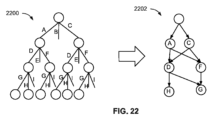
たとえば、ブロックIDは、整数、ストリング、トリプル、属性リスト、または意味注釈である。いくつかの実装形態では、物理アドレスは、関連付けられたブロックIDを使用して物理アドレスにアクセスすることを容易にするように設計されたデータ構造に記憶される。データ構造は、B木、トライ、またはアレイのうちの1つとすることができる。データ構造の少なくとも一部分は、デジタル情報とともに索引内に記憶することができ、索引は、第2のコンテナに関連付けられた第2の複数の識別子核酸配列を含むことができる。索引は、ノードを有するB木またはトライデータ構造とすることができ、ノードは各々、第2の複数の識別子核酸配列のうちの別個の複数の識別子核酸配列に対応する。第1のノードを含む別個の識別子にアクセスすることができ、それに続いてそれらの識別子に関連付けられた値を読み取ることができ、これらのステップを後続のノードに対して繰り返すことができ、ブロックIDを使用して、第1のノードの値に関する後続のノードを含む別個の複数の識別子の識別情報を判定することができる。第1のノードは、B木またはトライの根ノードとすることができ、プロセスは、葉ノードの値が読み取られるまで継続して、ブロックIDに対するブロックが存在するかどうか、および対応する物理アドレスが何であるかを示すことができる。ブロックIDは、シンボルストリングとすることができ、B木またはトライデータ構造の各ノードは、シンボルストリングの可能な接頭辞に対応する。葉ノード自体は、葉ノードによって指定されたシンボルストリングに一致するブロックIDに関連付けられた物理アドレスを表すことができる。 For example, the block ID is an integer, a string, a triple, an attribute list, or a semantic annotation. In some implementations, the physical address is stored in a data structure designed to facilitate accessing the physical address using the associated block ID. The data structure can be one of a B-tree, a trie, or an array. At least a portion of the data structure can be stored in an index along with the digital information, and the index can include a second plurality of identifier nucleic acid sequences associated with the second container. The index can be a B-tree or trie data structure having nodes, each of which corresponds to a distinct plurality of identifier nucleic acid sequences of the second plurality of identifier nucleic acid sequences. The distinct identifiers comprising the first node can be accessed, followed by reading the values associated with those identifiers, and these steps can be repeated for subsequent nodes, and the block ID can be used to determine the identity of the distinct plurality of identifiers comprising subsequent nodes with respect to the value of the first node. The first node can be the root node of the B-tree or trie, and the process can continue until the value of the leaf node is read to indicate whether a block exists for the block ID and what the corresponding physical address is. A block ID can be a symbol string, and each node in the B-tree or trie data structure corresponds to a possible prefix of the symbol string. The leaf node itself can represent a physical address associated with the block ID that matches the symbol string specified by the leaf node.
いくつかの実装形態では、データ構造はアレイであり、アレイの各要素は、第2の複数の識別子核酸配列のうちの別個の複数の識別子核酸配列に対応する。アレイの各要素は、ブロックIDに対応することができ、または関連付けられたブロックIDの物理アドレスを記憶することができる。いくつかの実装形態では、物理アドレスは、物理アドレスを追加のデータ構造に記憶する必要なく、ブロックIDが物理アドレスにマッピングするように、ブロックIDに固有に構成される。ブロックIDは、物理アドレスに関連付けられた複数の識別子核酸配列のうちのすべての識別子核酸配列によって共用される複数の成分核酸配列にマッピングすることができる。いくつかの実装形態では、ブロックに関連付けられた複数の識別子核酸配列は、隣接して順序付けられた識別子核酸配列を含み、したがって前記複数の識別子核酸配列は、前記識別子範囲内の第1および最後の識別子核酸分子の識別情報を含む識別子範囲によって、対応する物理アドレスに指定される。前記識別子範囲内の第1および最後の識別子核酸配列は、整数によって表すことができる。 In some implementations, the data structure is an array, with each element of the array corresponding to a separate plurality of identifier nucleic acid sequences of the second plurality of identifier nucleic acid sequences. Each element of the array can correspond to a block ID or can store a physical address of the associated block ID. In some implementations, the physical address is configured uniquely for the block ID, such that the block ID maps to a physical address without the need to store the physical address in an additional data structure. The block ID can map to a plurality of component nucleic acid sequences shared by all identifier nucleic acid sequences of the plurality of identifier nucleic acid sequences associated with the physical address. In some implementations, the plurality of identifier nucleic acid sequences associated with a block includes contiguously ordered identifier nucleic acid sequences, such that the plurality of identifier nucleic acid sequences are assigned to corresponding physical addresses by an identifier range that includes the identity of the first and last identifier nucleic acid molecules in the identifier range. The first and last identifier nucleic acid sequences in the identifier range can be represented by integers.
いくつかの実装形態では、ブロックIDは、親シンボルストリングの対応するブロックによって表されるシンボルストリング内の位置である。親シンボルストリングは、別のシンボルストリングにおけるパターンの発生を計数または位置付けするためのデータ構造によって表すことができる。適当なデータ構造には、Burrows-Wheeler変換、接尾辞アレイ、接尾辞木、および転置索引が含まれる。データ構造がアレイである場合、アレイの各要素は、ブロックIDに対応する別個の複数の識別子を含むことができる。アレイの各要素は、関連付けられたブロックIDの物理アドレスを記憶することができる。 In some implementations, the block ID is the position in the symbol string represented by the corresponding block of the parent symbol string. The parent symbol string may be represented by a data structure for counting or locating occurrences of a pattern in another symbol string. Suitable data structures include the Burrows-Wheeler transform, a suffix array, a suffix tree, and an inverted index. If the data structure is an array, each element of the array may contain separate identifiers corresponding to the block ID. Each element of the array may store the physical address of the associated block ID.
いくつかの実装形態では、物理アドレスは、第2の複数の識別子配列を含む識別子のプールから、一連のプローブを使用してアクセスされる。データ構造は、磁気記憶デバイス、光記憶デバイス、フラッシュメモリデバイス、またはクラウドストレージに記憶することができる。一連のプローブを使用して、ブロックに関連付けられた識別子にアクセスすることができる。プローブは、PCRプライマーまたは親和性タグ付きオリゴヌクレオチドとすることができ、それぞれアクセスのためにPCRまたは親和性プルダウンアッセイを使用する。 In some implementations, the physical address is accessed using a series of probes from a pool of identifiers including the second plurality of identifier sequences. The data structure can be stored in a magnetic storage device, an optical storage device, a flash memory device, or cloud storage. The series of probes can be used to access the identifiers associated with the blocks. The probes can be PCR primers or affinity tagged oligonucleotides, using PCR or affinity pull-down assays for access, respectively.
いくつかの態様では、核酸分子のプールに記憶されたデジタル情報からビットストリングまたはシンボルストリング内の特定の位置における特定のビットまたはシンボル値のランクを取得するシステムおよび方法が本明細書に提供されており、各ビットまたはシンボルは、値および位置を有する。システムおよび方法は、ビットストリングまたはシンボルストリングを表す識別子核酸分子の第1のプールを取得することであって、プールが、粉末、液体、または固体の形態を有し、第1のプール内の各識別子核酸分子が成分核酸分子を含み、成分核酸分子の少なくとも一部分が、1つまたは複数のプローブに結合するように構成される、第1のプールを取得することと、ビットストリングまたはシンボルストリングから導出されたカウンタシンボルストリングを表す識別子核酸分子の第2のプールを取得することであって、各カウンタシンボルが、ビットストリングまたはシンボルストリングのすべてのw個のビットまたはシンボル内の特定のビットまたはシンボル値のランニングカウントを表す、第2のプールを取得することとを伴う。システムおよび方法は、少なくとも(1)特定の位置に先行するw個のビットもしくはシンボルのすべてのブロック、または(2)特定の位置を含むw個のビットもしくはシンボルのブロックを含む、特定の位置に先行するw個のビットもしくはシンボルのすべてのブロックのいずれかに対して、特定のビットまたはシンボル値のランニングカウントを示す対応するカウンタシンボルを表す第2のプール内の識別子核酸分子を標的とするように、第2の一連のプローブを有する第2のプールにアクセスすることによって、第1のカウントを取得することをさらに伴う。(1)特定の位置に先行しもしくは特定の位置を含む、第1のカウントで計数されていないビットもしくはシンボルを表す、または(2)第1のカウントで計数されたが特定の位置に先行しないもしくは特定の位置を含まないビットもしくはシンボルを表す、第1のプール内の1つまたは複数の別個の識別子核酸分子を標的とするように、第1の一連のプローブを有する第1のプールにアクセスすることによって、第2のカウントが取得される。第1のカウントおよび第2のカウントから、ストリング内の特定の位置における特定のビットまたはシンボル値のランクが取得される。 In some aspects, systems and methods are provided herein for obtaining a rank of a particular bit or symbol value at a particular position in a bit string or symbol string from digital information stored in a pool of nucleic acid molecules, each bit or symbol having a value and a position. The systems and methods involve obtaining a first pool of identifier nucleic acid molecules representing the bit string or symbol string, the pool having a powder, liquid, or solid form, each identifier nucleic acid molecule in the first pool comprising a component nucleic acid molecule, at least a portion of the component nucleic acid molecule being configured to bind to one or more probes, and obtaining a second pool of identifier nucleic acid molecules representing a counter symbol string derived from the bit string or symbol string, each counter symbol representing a running count of a particular bit or symbol value within all w bits or symbols of the bit string or symbol string. The system and method further includes obtaining a first count by accessing a second pool with a second series of probes to target identifier nucleic acid molecules in the second pool that represent corresponding counter symbols indicating a running count of a particular bit or symbol value for at least either (1) all blocks of w bits or symbols preceding the particular position, or (2) all blocks of w bits or symbols preceding the particular position, including the block of w bits or symbols that includes the particular position. A second count is obtained by accessing the first pool with a first series of probes to target one or more distinct identifier nucleic acid molecules in the first pool that represent (1) bits or symbols preceding or including the particular position that were not counted in the first count, or (2) bits or symbols that were counted in the first count but that do not precede or include the particular position. From the first count and the second count, a rank of a particular bit or symbol value at a particular position in the string is obtained.
本明細書に記載するランク関数の1つの利点は、ストリング全体を読み取る必要がないことである。代わりに、ランク関数は、選択的アクセス演算を使用して、特有のカウントを提供する核酸分子のサブセットを読み取る。このようにして、本明細書に記載するランク演算は、記憶されたすべての核酸分子の完全な読取りを必要とするブルートフォース演算と比較すると、より時間効率的かつ高い費用効果で実行される。 One advantage of the rank functions described herein is that they do not require the entire string to be read. Instead, they use selective access operations to read a subset of the nucleic acid molecules that provide a unique count. In this way, the rank operations described herein are performed more time-efficiently and cost-effectively compared to brute-force operations that require a complete read of all stored nucleic acid molecules.
識別子は、M個の選択された成分核酸分子を物理的に組み立てることによって形成することができ、M個の選択された成分核酸分子の各々は、M個の異なる層に分離された別個の成分核酸分子のセットから選択される。 The identifier can be formed by physically assembling M selected component nucleic acid molecules, each of which is selected from a set of distinct component nucleic acid molecules separated into M distinct layers.
いくつかの実装形態では、第1のカウントが、特定のビットに先行するw個のビットのすべてのブロックを表すとき、第2のカウント内の第1の一連のプローブは、特定のビットに先行しまたは特定のビットを含む、第1のカウントで計数されていないビットを表す第1のプール内の1つまたは複数の別個の識別子核酸分子を標的とし、ビットストリング内の特定のビットのランクは、第1および第2のカウントを合計することによって取得される。いくつかの実装形態では、第1のカウント内の第1のカウントが、特定のビットを含むw個のビットのブロックを含む、特定のビットに先行するw個のビットのすべてのブロックを表すとき、第1の一連のプローブは、第1のカウントで計数されたが特定のビットに先行しないまたは特定のビットを含まないビットを表す第1のプール内の1つまたは複数の別個の識別子核酸分子を標的とし、ビットストリング内の特定のビットのランクは、第1のカウントから第2のカウントを引くことによって取得される。 In some implementations, when the first count represents all blocks of w bits preceding a particular bit, the first series of probes in the second count target one or more distinct identifier nucleic acid molecules in the first pool that represent bits not counted in the first count that precede or include the particular bit, and the rank of the particular bit in the bit string is obtained by summing the first and second counts. In some implementations, when the first count in the first count represents all blocks of w bits preceding a particular bit, including a block of w bits that includes the particular bit, the first series of probes target one or more distinct identifier nucleic acid molecules in the first pool that represent bits counted in the first count but that do not precede or include the particular bit, and the rank of the particular bit in the bit string is obtained by subtracting the second count from the first count.
いくつかの実装形態では、第1のプールが第2のプールであり、または第1のプールおよび第2のプールが別個である。第1のカウントおよび第2のカウントは、それぞれ第2のプールおよび第1のプールから、標的とされた識別子分子を読み取ることによって取得することができる。第1のカウントの場合、標的とされた識別子に対応するカウンタシンボル値を読み取りまたは判定することができる。ストリング内のw個のビットまたはシンボルのブロックは、第1のプール内の隣接して順序付けられた識別子核酸分子のブロックにマッピングすることができる。たとえば、第1のプール内の識別子分子の有無は、ストリング内の特定の値に直接相関しない。ストリングの固定長のサブストリング(ワード)を、固定数の可能な固有の識別子核酸分子からの固定数の固有の識別子核酸分子を含むコードワードにマッピングすることができる。識別子に記憶された追加の情報を使用して、識別子の書込み、アクセス、および読取りにおけるエラーを検出および補正することができる。 In some implementations, the first pool is the second pool, or the first pool and the second pool are separate. The first and second counts can be obtained by reading the targeted identifier molecules from the second and first pools, respectively. For the first count, a counter symbol value corresponding to the targeted identifier can be read or determined. A block of w bits or symbols in the string can be mapped to a block of contiguously ordered identifier nucleic acid molecules in the first pool. For example, the presence or absence of an identifier molecule in the first pool does not directly correlate to a particular value in the string. A fixed-length substring (word) of the string can be mapped to a codeword that includes a fixed number of unique identifier nucleic acid molecules from a fixed number of possible unique identifier nucleic acid molecules. Additional information stored in the identifier can be used to detect and correct errors in writing, accessing, and reading the identifier.
各カウンタシンボルは、b個のカウンタビットのストリングによって表すことができる。いくつかの実装形態では、ストリングは、n個のビットまたはシンボルの長さを有し、bはlog2(n+1)の上限である。カウンタシンボルストリングは、nをwで割った上限個のカウンタシンボルを含むことができ、bにnをwで割った上限を掛けた値に対応する長さを有するカウンタビットストリングによって表される。いくつかの実装形態では、特定のビットまたはシンボルが、w個のビットまたはシンボルの第1のブロックの範囲内である場合、w個のビットの第1のブロックに先行するランニングカウントは0である。wの値は、bの値または1に設定することができる。たとえば、第1のカウントは、特定のビットまたはシンボルを含むw個のビットまたはシンボルのブロックに対応するカウンタシンボルを表す第2のプール内の識別子核酸分子を標的とすることによって取得され、ランクは、第1のカウントと同等である。この例では、最後の第2のカウントを取得する必要はない。 Each counter symbol can be represented by a string of b counter bits. In some implementations, the string has a length of n bits or symbols, where b is an upper limit of log2 (n+1). The counter symbol string can include an upper limit of n divided by w counter symbols, and is represented by a counter bit string with a length corresponding to b multiplied by the upper limit of n divided by w. In some implementations, if a particular bit or symbol is within the first block of w bits or symbols, the running count preceding the first block of w bits is 0. The value of w can be set to the value of b or 1. For example, the first count is obtained by targeting identifier nucleic acid molecules in the second pool that represent counter symbols corresponding to the block of w bits or symbols that includes the particular bit or symbol, and the rank is equal to the first count. In this example, there is no need to obtain a final second count.
いくつかの実装形態では、特定のビットが、w個のビットまたはシンボルの第1のブロック内にない場合、特定のビットまたはシンボルに先行するw個のビットまたはシンボルのすべてのブロックのカウンタシンボルは、0からw*B(x)-1の位置範囲内の特定の値を有するストリング内のビットまたはシンボルの数を表し、0はストリングの第1の位置であり、xはストリング内の特定のビットまたはシンボルの位置に対応し、B(x)はxをwで割った下限である。たとえば、第1のカウントに対する第2のプール内の標的とされた識別子核酸分子は、位置b*B(x)およびb*(B(x)+1)-1によって画定される範囲内であり、0の位置は、ストリング内の第1の位置に対応する。第2のカウントは、位置範囲w*B(x)~x内に特定の値を有するストリング内のビットまたはシンボルの数に対応することができ、ここで、xはストリング内の特定のビットまたはシンボルの位置に対応し、位置0は第1の位置であり、B(x)はxをwで割った下限である。 In some implementations, if a particular bit is not in the first block of w bits or symbols, the counter symbols of all blocks of w bits or symbols preceding the particular bit or symbol represent the number of bits or symbols in the string that have a particular value within a position range of 0 to w*B(x)-1, where 0 is the first position of the string, x corresponds to the position of the particular bit or symbol in the string, and B(x) is the lower bound of x divided by w. For example, the targeted identifier nucleic acid molecules in the second pool for the first count are in a range defined by positions b*B(x) and b*(B(x)+1)-1, and the position of 0 corresponds to the first position in the string. The second count can correspond to the number of bits or symbols in the string that have a particular value within a position range of w*B(x) to x, where x corresponds to the position of the particular bit or symbol in the string, position 0 is the first position, and B(x) is the lower bound of x divided by w.
ストリングがビットストリングであるいくつかの実装形態では、第1のプール内の識別子核酸分子は、ビットストリングを表し、したがって識別子の存在は、ビット位置のビット値「1」を表す。ビットストリングは、シンボルストリングを表すことができ、シンボルストリング内の特定のシンボルに対してランクが取得される。 In some implementations where the string is a bit string, the identifier nucleic acid molecules in the first pool represent a bit string, such that the presence of the identifier represents a bit value of "1" at the bit position. The bit string can represent a symbol string, and a rank is obtained for a particular symbol in the symbol string.
ストリングがシンボルストリングであるいくつかの実装形態では、第1のプール内の対応する識別子核酸分子の存在は、第1のシンボル値を示し、第1のプール内の対応する識別子核酸分子の不在は、第2のシンボル値を示す。シンボル値は、シンボル値のセット(たとえば、アルファベット)から選択することができ、カウンタシンボルストリングは、特定のシンボル値を有するシンボルの数のランニングカウントを示す。シンボルストリングは、ビットストリングを表すことができる。たとえば、ストリング内の各シンボルは、固定数のビットに対応する。いくつかの実装形態では、識別子核酸分子の異なる第2のプールは、特有のシンボル値のインスタンスの数を計数する異なるカウンタシンボルストリングを表し、異なる各カウンタシンボルストリングが、対応する特有のシンボル値のインスタンスを計数する。 In some implementations where the string is a symbol string, the presence of a corresponding identifier nucleic acid molecule in the first pool indicates a first symbol value and the absence of a corresponding identifier nucleic acid molecule in the first pool indicates a second symbol value. The symbol value can be selected from a set of symbol values (e.g., an alphabet), and the counter symbol string indicates a running count of the number of symbols having a particular symbol value. The symbol string can represent a bit string. For example, each symbol in the string corresponds to a fixed number of bits. In some implementations, different second pools of identifier nucleic acid molecules represent different counter symbol strings that count the number of instances of a unique symbol value, and each different counter symbol string counts the instances of a corresponding unique symbol value.
いくつかの態様では、核酸分子のプールからデジタル情報をフェッチするシステムおよび方法が本明細書に提供される。システムおよび方法は、識別子核酸分子の第1のプールを取得することを伴い、プールが、粉末、液体、または固体の形態を有し、第1のプール内の各識別子核酸分子が成分核酸分子を含み、成分核酸分子の少なくとも一部分が、1つまたは複数のプローブに結合するように構成され、識別子核酸分子は、シンボルストリングを表し、したがってシンボル値は、前記第1のプール内の対応する識別子核酸分子の有無によって示される。第1の一連のプローブによって前記第1のプールにアクセスして、前記第1のプールからの識別子核酸分子のサブセットを有する第2のプールを作成し、第1の一連のプローブの各々は、成分核酸分子のうちの少なくとも1つを標的とする。前記第2のプールからの識別子核酸分子の前記サブセットの配列を読み取り、前記配列を使用して、少なくともシンボルストリング内のシンボルのサブセットを取得する。 In some aspects, systems and methods are provided herein for fetching digital information from a pool of nucleic acid molecules. The systems and methods involve obtaining a first pool of identifier nucleic acid molecules, the pool having a powder, liquid, or solid form, each identifier nucleic acid molecule in the first pool comprising a component nucleic acid molecule, at least a portion of the component nucleic acid molecules configured to bind to one or more probes, the identifier nucleic acid molecules representing a symbol string, such that a symbol value is indicated by the presence or absence of a corresponding identifier nucleic acid molecule in the first pool. The first pool is accessed by a first series of probes to create a second pool having a subset of identifier nucleic acid molecules from the first pool, each of the first series of probes targeting at least one of the component nucleic acid molecules. The sequences of the subset of identifier nucleic acid molecules from the second pool are read, and the sequences are used to obtain at least a subset of the symbols in the symbol string.
各識別子核酸分子は、M個の層の各々からの成分核酸配列を有する別個の成分核酸分子を含み、各層は、成分核酸配列のセットを含む。M個の層は、論理的に順序付けることができ、各層の成分核酸配列を論理的に順序付けることができる。いくつかの実装形態では、識別子核酸分子は、識別子核酸配列を第1の層内の対応する成分核酸配列によって分類し、識別子核酸配列を第2の層内の対応する成分核酸配列によって細分し、残りのM-2個の層の各々に対して細分プロセスを繰り返すことによって、論理的に順序付けられた識別子核酸配列に対応する。各識別子配列は、照会木内のパスとして表される一連の成分核酸配列を含むことができ、照会木は、根ノードから開始し、各層に1つのインスタンスでM個のインスタンスにわたって分岐し、葉ノードで終了し、各葉ノードは、識別子核酸配列を表す。したがって、第1の一連のプローブは、照会木内の根ノードからの部分パスまたはフルパスに対応することができる。フルパスは、M個のプローブを含む根から葉までのパスに対応することができ、したがって一連のプローブは、単一の識別子核酸分子を標的とし、部分パスは、M個より少ないプローブに対応し、したがって一連のプローブは、異なる配列を有する識別子核酸分子の複数の母集団を標的とする。異なる配列を有する識別子核酸分子の複数の母集団は、少なくとも第Mの層内の異なる成分核酸分子に対応することができる。 Each identifier nucleic acid molecule includes a separate component nucleic acid molecule having a component nucleic acid sequence from each of the M layers, each layer including a set of component nucleic acid sequences. The M layers can be logically ordered, and the component nucleic acid sequences of each layer can be logically ordered. In some implementations, the identifier nucleic acid molecule corresponds to logically ordered identifier nucleic acid sequences by sorting the identifier nucleic acid sequences by the corresponding component nucleic acid sequences in the first layer, subdividing the identifier nucleic acid sequences by the corresponding component nucleic acid sequences in the second layer, and repeating the subdivision process for each of the remaining M-2 layers. Each identifier sequence can include a series of component nucleic acid sequences represented as a path in a query tree, where the query tree starts at a root node, branches across M instances with one instance in each layer, and terminates at a leaf node, each leaf node representing an identifier nucleic acid sequence. Thus, the first series of probes can correspond to a partial or full path from the root node in the query tree. A full path can correspond to a root-to-leaf path that includes M probes, such that the set of probes targets a single identifier nucleic acid molecule, and a partial path can correspond to fewer than M probes, such that the set of probes targets multiple populations of identifier nucleic acid molecules with different sequences. The multiple populations of identifier nucleic acid molecules with different sequences can correspond to different component nucleic acid molecules in at least the Mth layer.
いくつかの実装形態では、第1のプールは、複数の一連のプローブによってアクセスされる。たとえば、システムおよび方法は、第1のプールを少なくとも2つの複製プールに分割し、手法のステップを、一連のプローブの各々を有する前記複製プールの各々で実行することを実行する。第1のプールは、少なくとも2つの複製プールに分割する前に複製することができる(たとえば、PCRを介して)。いくつかの実装形態では、プローブのサブシリーズを有する識別子核酸分子の第1のプールにアクセスして、識別子核酸分子の中間プールを作成する。プローブの後続のサブシリーズを有する中間プールにアクセスして、識別子核酸分子の第2の中間プールまたは識別子核酸分子の第2のプールを形成することができる。少なくとも2つの中間プールを組み合わせて、別の中間プールまたは第2のプールを形成することができる。プローブは、PCRプライマー(PCRを介したアクセスの場合)、または親和性タグ付きオリゴヌクレオチド(親和性プルダウンアッセイを介したアクセスの場合)とすることができる。 In some implementations, the first pool is accessed by a plurality of series of probes. For example, the system and method performs splitting the first pool into at least two replicate pools and performing steps of the method on each of the replicate pools with each of the series of probes. The first pool can be replicated (e.g., via PCR) before splitting into at least two replicate pools. In some implementations, the first pool of identifier nucleic acid molecules with a subseries of probes is accessed to create an intermediate pool of identifier nucleic acid molecules. The intermediate pool with a subsequent subseries of probes can be accessed to form a second intermediate pool of identifier nucleic acid molecules or a second pool of identifier nucleic acid molecules. The at least two intermediate pools can be combined to form another intermediate pool or a second pool. The probes can be PCR primers (in the case of access via PCR) or affinity tagged oligonucleotides (in the case of access via affinity pull-down assay).
いくつかの態様では、長さnのビットストリングを含むメッセージ内の長さpの特定のビットパターンのカウントを取得するシステムおよび方法が本明細書に提供される。システムおよび方法は、ビットストリングLを表す識別子核酸分子の第1のプールを取得し、ビットストリングLは、メッセージのBurrows-Wheeler変換行列の最後の列であり、第1のプールは、粉末、液体、または固体の形態を有し、第1のプール内の各識別子核酸分子は、成分核酸分子を含み、成分核酸分子の少なくとも一部分は、1つまたは複数のプローブに結合するように構成される。ビットストリングLから導出されたカウンタシンボルストリングを表す識別子核酸分子の第2のプールが取得され、各カウンタシンボルは、特有のビット値「1」を有するビットストリングL内のすべてのw個のビットに対するビットの数のランニングカウントを示すb個のカウンタビットのストリングによって表される。一連のプローブを使用して、ビットストリングL内のビット値「1」の発生の総数に対するカウンタシンボルを表す第2のプールからの識別子核酸分子にアクセスする。第2のプールからアクセスされた識別子核酸分子を読み取って、ビットストリングL内のビット値「1」の発生の総数を計数する。各ビット値の発生の総数は、メッセージのBurrows-Wheeler変換行列の第1の列Fを再構築するためのものである。第1の列F内の第pのビット値の範囲を画定する第1の位置hおよび最後の位置zが、hおよびzを含めて判定される。第1の一連のプローブを使用して、第1のプールおよび第2のプールからの識別子核酸分子にアクセスして、L内の位置h-1におけるパターンの第(p-i)のビット値のランクrh-1を計算し、ここでi=1である。第2の一連のプローブを使用して、第1のプールおよび第2のプールからの識別子核酸分子にアクセスして、L内の位置zにおけるパターンの第(p-i)のビット値のランクrzを計算する。 In some aspects, systems and methods are provided herein for obtaining a count of a particular bit pattern of length p in a message comprising a bit string of length n. The systems and methods obtain a first pool of identifier nucleic acid molecules representing a bit string L, the bit string L being the last column of a Burrows-Wheeler transformation matrix for the message, the first pool having a powder, liquid, or solid form, each identifier nucleic acid molecule in the first pool comprising a component nucleic acid molecule, at least a portion of the component nucleic acid molecule being configured to bind to one or more probes. A second pool of identifier nucleic acid molecules is obtained representing a counter symbol string derived from the bit string L, each counter symbol being represented by a string of b counter bits indicating a running count of the number of bits for all w bits in the bit string L having a unique bit value "1". A series of probes are used to access identifier nucleic acid molecules from the second pool representing counter symbols for a total number of occurrences of the bit value "1" in the bit string L. The identifier nucleic acid molecules accessed from the second pool are read to count the total number of occurrences of the bit value "1" in the bit string L. The total number of occurrences of each bit value is for reconstructing a first column F of a Burrows-Wheeler transform matrix for the message. A first position h and a last position z that define a range of pth bit values in the first column F, inclusive of h and z, are determined. A first series of probes is used to access identifier nucleic acid molecules from the first pool and the second pool to calculate a rank r h-1 of the (pi)th bit value of the pattern at position h-1 in L, where i=1. A second series of probes is used to access identifier nucleic acid molecules from the first pool and the second pool to calculate a rank r z of the (pi)th bit value of the pattern at position z in L.
rh-1がrzに等しい場合、メッセージ内のパターンの発生のカウントは0として設定される。そうではなく、rh-1がrzに等しくない場合、hは、F内の第(p-i)のビット値の第(rh-1+1)のインスタンスの索引に設定される。zは、F内の第(p-i)のビット値の第rzのインスタンスの索引に設定される。ループカウンタiが1だけ増分され、アクセスおよび索引付けステップが、i=p-1になるまで複数回繰り返される。メッセージ内のパターンの発生のカウントは、z-h+1として計数される。本手法によって提供される少なくとも1つの利点は、データセット内のすべての単一のビットを読み取ることなく、大きいデータセットにわたって探索を実行することができることであり、代わりに本開示は、選択的アクセスおよびランク演算を介して、パターンの発生を論理的に位置付ける。本明細書に提供される別の利点は、実行時間を最小にし、処理量を増大させるために、アクセスおよびランク演算を第1および第2のプール上で並列に実行することができることである。 If r h-1 is equal to r z , then the count of occurrences of the pattern in the message is set as 0. Otherwise, if r h-1 is not equal to r z , then h is set to the index of the (r h-1 +1)th instance of the (p-i)th bit value in F. z is set to the index of the r zth instance of the (p-i)th bit value in F. The loop counter i is incremented by 1 and the accessing and indexing steps are repeated multiple times until i=p-1. The count of occurrences of the pattern in the message is counted as z-h+1. At least one advantage provided by this technique is that a search can be performed across a large data set without reading every single bit in the data set; instead, the present disclosure logically locates occurrences of the pattern via selective access and rank operations. Another advantage provided herein is that the access and rank operations can be performed in parallel on the first and second pools to minimize execution time and increase throughput.
第1のプールは、第2のプールと同じにすることができ、または第2のプールとは別個にすることができる。いくつかの実装形態では、メッセージのBurrows-Wheeler変換から導出された接尾辞アレイを表す識別子核酸分子の第3のプールが取得され、接尾辞アレイの各要素は、メッセージ内のLの対応する要素の位置を示す少なくともlog2(n)個のビットのビットストリングによって表される。システムおよび方法は、カウントが0より大きいとき、hおよびzに対する最終値を含むhとzと間の位置における接尾辞アレイ内の要素に対応する第3のプール内の識別子核酸分子にアクセスすることによって、メッセージ内のパターンの発生をさらに位置付けることができる。いくつかの実装形態では、メッセージを表す識別子核酸分子の第4のプールが取得される。システムおよび方法は、前記第1の場所および第1の場所を取り囲む位置の近傍に対応する第4のプール内の識別子核酸分子にアクセスすることによって、パターンの第1の場所のコンテキストをさらに抽出することができる。 The first pool can be the same as the second pool or can be separate from the second pool. In some implementations, a third pool of identifier nucleic acid molecules is obtained that represents a suffix array derived from a Burrows-Wheeler transform of the message, where each element of the suffix array is represented by a bit string of at least log 2 (n) bits that indicates the location of the corresponding element of L in the message. The system and method can further locate the occurrence of the pattern in the message by accessing identifier nucleic acid molecules in the third pool that correspond to elements in the suffix array at locations between h and z that include the final values for h and z when the count is greater than 0. In some implementations, a fourth pool of identifier nucleic acid molecules that represent the message is obtained. The system and method can further extract the context of the first location of the pattern by accessing identifier nucleic acid molecules in the fourth pool that correspond to a neighborhood of said first location and locations surrounding the first location.
いくつかの実装形態では、第1のプール内の対応する識別子核酸分子の存在は、ビット値1を示し、第1のプール内の対応する識別子核酸分子の不在は、ビット値0を示す。bは、log2(n+1)の上限に等しくすることができる。カウンタシンボルストリングは、nをwで割った上限個のカウンタシンボルを含むことができ、bにnをwで割った上限を掛けた値に対応する長さを有するカウンタビットストリングによって表される。L内のw個のビットの第1のブロックに先行するあらゆるビット値のランニングカウントは0である。wは、bの値または1に設定することができる。システムおよび方法は、ビットストリングL内のビットのブロックを、第1のプール内の隣接して順序付けられた識別子核酸分子のブロックにマッピングすることができる。ビットストリングLの固定長のサブストリングを、固有の識別子核酸分子の固定サイズのセットから選択された固定数の固有の識別子核酸分子によって表されるコードワードにマッピングすることができる。追加の情報を使用して、第1および第2のプールからの識別子核酸分子の書込み、アクセス、および読取りのエラーを検出および補正し、追加の情報を識別子に記憶することができる。 In some implementations, the presence of a corresponding identifier nucleic acid molecule in the first pool indicates a bit value of 1, and the absence of a corresponding identifier nucleic acid molecule in the first pool indicates a bit value of 0. b can be equal to an upper limit of log2(n+1). The counter symbol string can include an upper limit of n divided by w counter symbols and is represented by a counter bit string having a length corresponding to b multiplied by the upper limit of n divided by w. A running count of any bit value preceding the first block of w bits in L is 0. w can be set to the value of b or 1. The system and method can map blocks of bits in the bit string L to blocks of contiguously ordered identifier nucleic acid molecules in the first pool. Fixed-length substrings of the bit string L can be mapped to code words represented by a fixed number of unique identifier nucleic acid molecules selected from a fixed-sized set of unique identifier nucleic acid molecules. Additional information can be used to detect and correct errors in writing, accessing, and reading identifier nucleic acid molecules from the first and second pools, and the additional information can be stored in the identifier.
いくつかの態様では、メッセージ内の長さpの特定のビットパターンのカウントを取得するシステムおよび方法が本明細書に提供される。システムおよび方法は、ビットストリングLを表す識別子核酸分子の第1のプールを取得し、ビットストリングLは、メッセージのBurrows-Wheeler変換行列の最後の列であり、第1のプールは、粉末、液体、または固体の形態を有し、第1のプール内の各識別子核酸分子は、成分核酸分子を含み、成分核酸分子の少なくとも一部分は、1つまたは複数のプローブに結合するように構成される。特有のビット値を有するビットの数のランニングカウントを表す、ビットストリングLから導出されたカウンタシンボルストリングを表す識別子核酸分子の第2のプールが取得される。メッセージ内の特定のビットパターンのカウントは、第1のプールおよび第2のプールからの識別子核酸分子に選択的にアクセスすることによって取得される。この技法によって提供される少なくとも1つの利点は、データセット内のすべての単一のビットを読み取ることなく、大きいデータセットにわたって探索を実行することができることであり、代わりに本技法は、選択的なアクセスを介してパターンの発生を論理的に位置付けることを伴う。本明細書に提供される別の利点は、実行時間を最小にし、処理量を増大させるために、アクセス演算を第1および第2のプール上で並列に実行することができることである。 In some aspects, systems and methods are provided herein for obtaining a count of a particular bit pattern of length p in a message. The systems and methods obtain a first pool of identifier nucleic acid molecules representing a bit string L, where the bit string L is the last column of a Burrows-Wheeler transformation matrix of the message, the first pool having a powder, liquid, or solid form, each identifier nucleic acid molecule in the first pool comprising a component nucleic acid molecule, at least a portion of the component nucleic acid molecule being configured to bind to one or more probes. A second pool of identifier nucleic acid molecules is obtained representing a counter symbol string derived from the bit string L, which represents a running count of the number of bits having a unique bit value. The count of a particular bit pattern in the message is obtained by selectively accessing identifier nucleic acid molecules from the first pool and the second pool. At least one advantage provided by this technique is that a search can be performed across a large data set without reading every single bit in the data set; instead, the technique involves logically locating occurrences of a pattern via selective access. Another advantage provided herein is that access operations can be performed in parallel on the first and second pools to minimize execution time and increase throughput.
いくつかの態様では、長さnsのシンボルストリングを含むメッセージ内の長さpsの特定のシンボルパターンのカウントを取得するシステムおよび方法が本明細書に提供され、各シンボルは、r個のシンボル値のセットから選択される。システムおよび方法は、メッセージのBurrows-Wheeler変換行列の最後の列であるシンボルストリングLを表す識別子核酸分子の第1のプールを取得し、第1のプールは、粉末、液体、または固体の形態を有し、第1のプール内の各識別子核酸分子は、成分核酸分子を含み、成分核酸分子の少なくとも一部分は、1つまたは複数のプローブに結合するように構成される。システムおよび方法は、識別子核酸分子のr個の第2のプールをさらに取得し、r個の第2のプールの各々は、Lから導出されたカウンタシンボルストリングCvに対応し、ここでv=1、2、...、rであり、これは対応するシンボル値Rvを有するL内のシンボルの数のランニングカウントを表す。システムおよび方法は、第1のプールおよびr個の第2のプールからの識別子核酸分子に選択的にアクセスすることによって、メッセージ内の長さpsの特定のシンボルパターンのカウントを取得する。この手法によって提供される少なくとも1つの利点は、データセット内のすべての単一のビットを読み取ることなく、大きいデータセットにわたって探索を実行することができることであり、代わりに本手法は、選択的なアクセスを介してパターンの発生を論理的に位置付ける。本明細書に提供される別の利点は、実行時間を最小にし、処理量を増大させるために、アクセス演算を第1および第2のプール上で並列に実行することができることである。 In some aspects, systems and methods are provided herein for obtaining a count of a particular symbol pattern of length p s in a message comprising a symbol string of length ns, where each symbol is selected from a set of r symbol values. The systems and methods obtain a first pool of identifier nucleic acid molecules representing a symbol string L that is the last column of a Burrows-Wheeler transformation matrix for the message, the first pool having a powder, liquid, or solid form, and each identifier nucleic acid molecule in the first pool comprises a component nucleic acid molecule, at least a portion of the component nucleic acid molecule configured to bind to one or more probes. The systems and methods further obtain r second pools of identifier nucleic acid molecules, each of the r second pools corresponding to a counter symbol string C v derived from L, where v = 1, 2, ..., r, which represents a running count of the number of symbols in L having a corresponding symbol value R v . The systems and methods obtain a count of a particular symbol pattern of length p s in the message by selectively accessing identifier nucleic acid molecules from the first pool and the r second pools. At least one advantage provided by this approach is that searches can be performed across large data sets without reading every single bit in the data set, instead the approach logically locates the occurrence of a pattern through selective access. Another advantage provided herein is that access operations can be performed in parallel on the first and second pools to minimize execution time and increase throughput.
いくつかの実装形態では、本手法は、Burrows-Wheeler変換行列の第1の列Fを再構築することを含む。一連のプローブを使用して、L内の対応する各シンボル値Rvの発生の総数を表すr個の第2のプールの各々における最後のカウンタシンボルから、識別子核酸分子にアクセスすることができ、対応する各シンボル値Rvの発生の前記総数を使用して、Fを再構築することができる。パターン内の第pのシンボル値を有するF内の位置の範囲を判定することができる。いくつかの実装形態では、本手法は、一連のプローブを使用して、第1のプールおよび対応する第2のプールから識別子核酸分子にアクセスして、範囲にすぐ先行する位置におけるL内の対応するシンボル値の第1のランク、および範囲の末端の位置におけるL内の対応するシンボル値の第2のランクを判定することと、第1のランクおよび第2のランクを使用して、この範囲を、パターン内の後続のシンボルに先行する対応するシンボルのインスタンスを有するF内の位置の範囲に更新することとを含む。 In some implementations, the approach includes reconstructing a first column F of a Burrows-Wheeler transformation matrix. A series of probes can be used to access identifier nucleic acid molecules from the last counter symbol in each of the r second pools that represent a total number of occurrences of each corresponding symbol value R v in L, and the total number of occurrences of each corresponding symbol value R v can be used to reconstruct F. A range of locations in F having the pth symbol value in the pattern can be determined. In some implementations, the approach includes using a series of probes to access identifier nucleic acid molecules from the first pool and the corresponding second pool to determine a first rank of the corresponding symbol value in L at a location immediately preceding the range and a second rank of the corresponding symbol value in L at a location at the end of the range, and using the first and second ranks to update the range to a range of locations in F having an instance of the corresponding symbol that precedes the subsequent symbol in the pattern.
いくつかの実装形態では、第1のランクrh-1は、L内の位置h-1におけるパターン内のそれぞれの先行するシンボル値であり、第2のランクrzは、L内の位置zにおけるパターン内のそれぞれの先行するシンボル値である。メッセージ内のパターンの発生のカウントは、第1および第2のランクの最終値に基づいて判定することができる。たとえば、カウントは、第1および第2のランクの最終値間の差である。第1および第2のランクが等しいと判定された場合、カウントを0に設定することができる。 In some implementations, the first rank r h-1 is the respective preceding symbol value in the pattern at position h-1 in L, and the second rank r z is the respective preceding symbol value in the pattern at position z in L. A count of occurrences of the pattern in the message may be determined based on the final values of the first and second ranks. For example, the count is the difference between the final values of the first and second ranks. If the first and second ranks are determined to be equal, the count may be set to 0.
いくつかの実装形態では、本手法は、メッセージのBurrows-Wheeler変換から導出された接尾辞アレイSAを表す識別子核酸分子のプール、SAプールを取得することを含み、SAの各要素は、メッセージ内のLの対応する要素の位置を示す少なくともlog2(n)個のビットのビットストリングによって表される。方法およびシステムは、カウントが0より大きいと仮定して、F内の位置の最終範囲によって与えられる位置におけるSAの要素に対応するSAプール内の識別子核酸分子にアクセスすることによって、メッセージ内のパターンの発生を位置付けることができる。本手法は、メッセージを表す識別子のメッセージプールを取得することを含むことができ、前記第1の場所および第1の場所を取り囲む位置の近傍に対応するメッセージプール内の識別子核酸分子にアクセスすることによって、パターンの第1の場所のコンテキストの抽出を可能にする。 In some implementations, the approach includes obtaining a pool of identifier nucleic acid molecules, the SA pool, representing a suffix array SA derived from a Burrows-Wheeler transform of the message, where each element of SA is represented by a bit string of at least log 2 (n) bits indicating the position of the corresponding element of L in the message. The method and system can locate an occurrence of a pattern in the message by accessing an identifier nucleic acid molecule in the SA pool that corresponds to an element of SA at a position given by a final range of positions in F, assuming the count is greater than 0. The approach can include obtaining a message pool of identifiers representing the message, allowing extraction of a context of a first location of a pattern by accessing identifier nucleic acid molecules in the message pool that correspond to said first location and a neighborhood of positions surrounding the first location.
いくつかの実装形態では、識別子核酸分子の第1のプールは、r個の第1のプールのうちの1つであり、r個の第1のプールの各々は、ビットストリングLvに対応し、ここでv=1、2、...、rであり、したがってLvの要素は、シンボル値Rvに一致するLの要素に対してビット値「1」、そうでない場合はビット値「0」を有し、または逆も同様である。たとえば、Lvに対応する第1のプールが、パターン内のシンボル値Rvの第1および第2のランクを判定するために使用される。 In some implementations, the first pool of the identifier nucleic acid molecule is one of r first pools, each of the r first pools corresponding to a bit string Lv , where v=1, 2,...,r, such that elements of Lv have a bit value "1" for elements of L that match a symbol value Rv and a bit value "0" otherwise, or vice versa. For example, the first pool corresponding to Lv is used to determine the first and second ranks of the symbol value Rv in the pattern.
いくつかの態様では、核酸分子に記憶されたデジタル情報に対して動作するシステムおよび方法が本明細書に提供される。システムおよび方法は、識別子核酸分子の第1のプールを取得し、プールは、粉末、液体、または固体の形態を有し、第1のプール内の各識別子核酸分子は、成分核酸分子を含み、成分核酸分子の少なくとも一部分は、1つまたは複数のプローブに結合するように構成され、識別子核酸分子は、入力シンボルストリングを表す。第1のプール内の識別子核酸分子でif-then-else演算が実行され、if-then-else演算は、プローブを有する成分核酸分子のうちの少なくとも1つを標的とし、前記第1のプールからの識別子核酸分子のサブセットを有する中間プールを作成する。if-then-else演算が繰り返され、出力シンボルストリングの少なくとも一部分を表す識別子核酸分子の最終プールが作成されるまで、すべての後続のステップにおいて中間プールが第1のプールに取って代わる。 In some aspects, systems and methods are provided herein that operate on digital information stored in nucleic acid molecules. The systems and methods obtain a first pool of identifier nucleic acid molecules, the pool having a powder, liquid, or solid form, each identifier nucleic acid molecule in the first pool comprising a component nucleic acid molecule, at least a portion of the component nucleic acid molecules configured to bind to one or more probes, the identifier nucleic acid molecules representing an input symbol string. An if-then-else operation is performed on the identifier nucleic acid molecules in the first pool, the if-then-else operation targeting at least one of the component nucleic acid molecules with a probe to create an intermediate pool having a subset of identifier nucleic acid molecules from the first pool. The if-then-else operation is repeated, with the intermediate pool replacing the first pool in all subsequent steps until a final pool of identifier nucleic acid molecules representing at least a portion of the output symbol string is created.
この手法を使用することで、条件付きプログラムを書き込むことが可能になる。たとえば、各「if」演算は、1つまたは複数の識別子の有無を試験し、その有無に応じて、「then」または「else」の分岐へ進む。この演算は、複数の条件および対応する分岐を含むことができる。演算のすべての分岐から、出力を作り出すことができる。この手法により、複数の識別子ライブラリ内の識別子のすべて(たとえば、テラビット規模)を並列に演算することが可能になる。たとえば、ライブラリが数十億のデータオブジェクトを符号化する場合、各オブジェクトを調べて出力を作り出す複素関数を、DNAに基づくプログラムとして設計し、ライブラリ上で並列に実行することができる。 Using this approach, it is possible to write conditional programs. For example, each "if" operation tests for the presence or absence of one or more identifiers and proceeds to a "then" or "else" branch depending on the presence or absence. The operation can include multiple conditions and corresponding branches. An output can be produced from every branch of the operation. This approach allows all of the identifiers in multiple identifier libraries (e.g., on a terabit scale) to be computed in parallel. For example, if the library encodes billions of data objects, a complex function that examines each object and produces an output can be designed as a DNA-based program and run on the library in parallel.
本開示は、所望のプログラムの実行のために識別子ライブラリを複数の入力識別子ライブラリに再配置するビットをシフト、コピー、および移動する方策を含む。物理的に、1つの入力ライブラリを2つの出力ライブラリに変換する反応において、各if-then-else演算を行うことができ、それらのライブラリ内のすべての識別子にわたって多重化することができる。たとえば流体伝達によって、1つの演算の出力ライブラリを別の演算の入力ライブラリへ向けることができる。RAMおよび処理力によって制限される従来のハードウェアとは異なり、本明細書に記載するDNAプラットホームは、大量の入力データオブジェクトにわたって同時に低電力でプログラムを実行することが可能である。 The present disclosure includes bit shifting, copying, and moving strategies that rearrange identifier libraries into multiple input identifier libraries for the execution of a desired program. Physically, each if-then-else operation can be performed in a reaction that converts one input library into two output libraries, multiplexed across all identifiers in those libraries. The output library of one operation can be directed to the input library of another operation, for example by fluid communication. Unlike conventional hardware that is limited by RAM and processing power, the DNA platform described herein is capable of low-power program execution across large numbers of input data objects simultaneously.
識別子は、M個の層の各々から別個の成分を含むことができ、各層は成分のセットを含む。プローブは、PCRプライマーまたは親和性タグ付きオリゴヌクレオチドとすることができ、それによってそれぞれPCRまたは親和性プルダウンアッセイを介してアクセスが実行される。いくつかの実装形態では、if-then-else演算は、特有の成分核酸分子を含むプール内の識別子核酸分子にアクセスすることを含む。演算は、第1のプール、中間プール、または最終プールのうちの少なくとも1つを少なくとも2つの複製プールに分割または複製し(たとえば、PCRを介して)、少なくとも2つの中間プールを組み合わせて、新しい中間プールもしくは第2のプールまたは両方を形成することを含むことができる。1つまたは複数のプール上で並列に、2つまたはそれよりも多いif-then-else演算を実行することができる。 The identifier can include a separate component from each of the M layers, with each layer including a set of components. The probes can be PCR primers or affinity tagged oligonucleotides, whereby the access is performed via PCR or affinity pull-down assay, respectively. In some implementations, the if-then-else operation includes accessing the identifier nucleic acid molecule in a pool that includes the unique component nucleic acid molecule. The operation can include splitting or replicating (e.g., via PCR) at least one of the first pool, the intermediate pool, or the final pool into at least two replicate pools, and combining the at least two intermediate pools to form a new intermediate pool or a second pool, or both. Two or more if-then-else operations can be performed in parallel on one or more pools.
いくつかの態様では、本明細書に記載する方法のいずれかを実行するように構成されたシステムが本明細書に提供される。システムは、基質上の個別の場所(たとえば、反応コンパートメント)にDNA成分を分注し、結合反応に最適の条件を提供する試薬を分注し、ライブラリを含むDNA識別子のすべてをプールするように構成されたプリンタフィニッシャシステムとすることができる。システムは、コンテナ内に核酸分子を記憶して操作することができる(たとえば、自動化された液体の取扱いを介して)。システムは、コンパートメントまたはコンテナ内へプローブを分注して、核酸分子のサブセットにアクセスすることができる。システムは、核酸分子のプールを等分および複製するように構成することができる。 In some aspects, provided herein is a system configured to perform any of the methods described herein. The system can be a printer finisher system configured to dispense DNA components to individual locations (e.g., reaction compartments) on a substrate, dispense reagents that provide optimal conditions for binding reactions, and pool all of the DNA identifiers that comprise the library. The system can store and manipulate nucleic acid molecules in containers (e.g., via automated liquid handling). The system can dispense probes into the compartments or containers to access a subset of the nucleic acid molecules. The system can be configured to aliquot and replicate the pool of nucleic acid molecules.
いくつかの態様では、本明細書に記載する方法のいずれかによるデジタル情報を表す核酸分子を含む組成物が本明細書に提供される。組成物は、成分核酸分子を含む識別子核酸分子を含む。識別子核酸分子は、プール内に収集してデジタル情報にマッピングすることができる。たとえば、識別子の存在は、シンボルストリング内の特定のビットまたはシンボル値を示し、識別子の不在は、シンボルストリング内の別のビットまたはシンボル値を示す。 In some aspects, provided herein is a composition comprising a nucleic acid molecule representing digital information according to any of the methods described herein. The composition comprises an identifier nucleic acid molecule comprising a component nucleic acid molecule. The identifier nucleic acid molecules can be collected into pools and mapped to digital information. For example, the presence of the identifier indicates a particular bit or symbol value in a symbol string, and the absence of the identifier indicates a different bit or symbol value in the symbol string.
本開示の上記およびその他の特徴は本開示の性質およびその様々な利点を含めて、添付の図面と併せて以下の詳細な説明を考慮するとより明らかになる。 The above and other features of the present disclosure, including the nature of the disclosure and various advantages thereof, will become more apparent from the following detailed description taken in conjunction with the accompanying drawings.
本明細書に記載するアセンブリおよび方法の全体的な理解を提供するために、特定の例示的な実装形態について説明する。本明細書に記載する実装形態および特徴は、成分核酸分子から構成された識別子核酸分子におけるデータ記憶に関して具体的に説明されているが、以下に概説するすべての態様および他の特徴は、任意の好適な形で互いに組み合わせることができ、DNAに基づくデータ記憶の他の形式にも適合および適用することができることが理解されよう。 To provide an overall understanding of the assemblies and methods described herein, certain exemplary implementations are described. Although the implementations and features described herein are specifically described with respect to data storage in identifier nucleic acid molecules composed of component nucleic acid molecules, it will be understood that all aspects and other features outlined below can be combined with each other in any suitable manner and can be adapted and applied to other forms of DNA-based data storage.
デジタル情報を符号化するための核酸の塩基ごとの合成は、概してすべての新しい情報記憶要求に対して別個の核酸配列の塩基ごとのデノボ合成(たとえば、ホスホロアミダイト合成)を必要とすることから、高価でありかつ時間がかかる可能性がある。本開示は、塩基ごとの合成またはデノボ合成に依拠するのではなく、代わりに成分(または成分核酸配列)の組合せ配置を含む複数の識別子または核酸配列内にデジタル情報を符号化するシステムおよび方法に関する。このようにして、本開示のシステムおよび方法は、デジタル情報記憶の効率および製品化の可能性を改善する。 Base-by-base synthesis of nucleic acids to encode digital information can be expensive and time-consuming, as it generally requires de novo base-by-base synthesis (e.g., phosphoramidite synthesis) of a separate nucleic acid sequence for every new information storage request. The present disclosure relates to systems and methods that do not rely on base-by-base or de novo synthesis, but instead encode digital information within multiple identifiers or nucleic acid sequences that include combinatorial arrangements of components (or component nucleic acid sequences). In this manner, the systems and methods of the present disclosure improve the efficiency and commercial viability of digital information storage.
本開示は、第1の情報記憶要求に対して別個の核酸配列(または成分)の第1のセットを作り出し、その後同じ核酸配列(または成分)を後続の情報記憶要求に対して再利用することができる方法を説明する。これらの手法は、情報からDNAへの符号化および書込みプロセスにおける核酸配列のデノボ合成の役割を低減させることによって、DNAに基づく情報記憶のコストを大幅に低減させる。 This disclosure describes methods for creating a first set of distinct nucleic acid sequences (or components) for a first information storage request, and then reusing the same nucleic acid sequences (or components) for subsequent information storage requests. These approaches significantly reduce the cost of DNA-based information storage by reducing the role of de novo synthesis of nucleic acid sequences in the information-to-DNA encoding and writing process.
さらに、各伸長核酸への各塩基の循環的な送達を使用するホスホロアミダイトの化学的性質または鋳型のないポリメラーゼに基づく核酸伸長などの塩基ごとの合成の実装形態とは異なり、成分からの識別子構造を使用して情報からDNAに書き込むことに関する本開示のシステムおよび方法は、非常に並列化可能なプロセスであり、必ずしも循環的な核酸伸長を使用しない。したがって、本開示は、他の方法と比較すると、DNAにデジタル情報を書き込む速度を増大させる。デジタル情報を核酸分子に書き込む様々なシステムおよび方法は、各々が全体として参照により本明細書に組み込まれている、2017年12月21日出願の"NUCLEIC ACID-BASED DATA STORAGE"という名称の米国特許第10,650,312号(DNAにおけるデジタル情報の符号化について記載)、2019年5月16日に出願され、米国特許出願公開第2019/0362814号として公開された"SYSTEMS FOR NUCLEIC ACID-BASED DATA STORAGE"という名称の米国特許出願第16/461,774号(DNAに基づくデータ記憶のための符号化方式について記載)、2019年5月16日出願の"COMPOSITIONS AND METHODS FOR NUCLEIC ACID-BASED DATA STORAGE"という名称の米国特許出願第16/414,758号、および2019年8月5日出願の"SYSTEMS AND METHODS FOR STORING AND READING NUCLEIC ACID-BASED DATA WITH ERROR PROTECTION"という名称の米国特許出願第16/532,077号(DNA符号化のためのデータ構造ならびにエラーの保護および補正について記載)に記載されている。 Furthermore, unlike base-by-base synthesis implementations such as phosphoramidite chemistry or template-free polymerase-based nucleic acid extension that use cyclic delivery of each base to each extended nucleic acid, the disclosed systems and methods for writing information to DNA using identifier structures from components are highly parallelizable processes and do not necessarily use cyclic nucleic acid extension. Thus, the present disclosure increases the speed of writing digital information to DNA when compared to other methods. Various systems and methods for writing digital information to nucleic acid molecules are described in U.S. Pat. No. 10,650,312, filed Dec. 21, 2017, entitled "NUCLEIC ACID-BASED DATA STORAGE," which describes encoding of digital information in DNA; U.S. patent application Ser. No. 16/461,774, filed May 16, 2019, and published as U.S. Patent Application Publication No. 2019/0362814, entitled "SYSTEMS FOR NUCLEIC ACID-BASED DATA STORAGE," which describes encoding methods for DNA-based data storage; U.S. patent application Ser. No. 16/414,758, filed May 16, 2019, entitled "COMPOSITIONS AND METHODS FOR NUCLEIC ACID-BASED DATA STORAGE," which describes encoding methods for DNA-based data storage; and U.S. patent application Ser. No. 16/414,758, filed May 16, 2019, entitled "COMPOSITIONS AND METHODS FOR STORING AND READING NUCLEIC ACID-BASED DATA STORAGE," which describes encoding methods for DNA-based data storage; each of which is incorporated herein by reference in its entirety. This is described in U.S. patent application Ser. No. 16/532,077, entitled "NUCLEIC ACID-BASED DATA WITH ERROR PROTECTION" (describing data structures for DNA encoding and error protection and correction).
以下の説明は、データを核酸分子で符号化する様々なシステムおよび方法の概略から始まり、図1~図10に関連して説明するように、デジタルデータを符号化する核酸分子を印刷および記憶するように構成された様々な書込みおよび格納システムについて説明する。本開示は次いで、図11~図14に関連して様々な符号化方法について説明する。本開示は、上記で参照した特許出願に記載されている核酸分子におけるデジタル情報の書込みおよび読取りを行う方法の改善に関する。具体的には、データ構造を使用してデジタル情報を表すことで、デジタル情報の特有の特性を画定し、DNAにおけるアクセスを容易にするようにそれらの特性を組織化することによって、DNAから情報を読み取る効率を改善することができる。 The following description begins with an overview of various systems and methods for encoding data in nucleic acid molecules, and then describes various writing and storage systems configured to print and store nucleic acid molecules encoding digital data, as described in connection with Figures 1-10. The disclosure then describes various encoding methods in connection with Figures 11-14. The disclosure relates to improvements in the methods for writing and reading digital information in nucleic acid molecules that are described in the above-referenced patent applications. In particular, the use of data structures to represent digital information can improve the efficiency of reading information from DNA by defining unique properties of the digital information and organizing those properties to facilitate access in DNA.
一例として、大きいデータストリングが2つまたはそれよりも多いサブストリングに分離され、各サブストリングは核酸分子の別個のプールに記憶され、このプールは独自のコンテナ内へ配置される。どのコンテナが所望の情報を収容しているかを判定するための1つの方法は、場所(たとえば、コンテナ数または配置)を識別するデータ構造(たとえば、B木またはトライ構造など)にアクセスすることである。データ構造を使用してどのコンテナが関連するかを参照することによって、ユーザは、各コンテナ内の情報を1つずつ読み取ってからその情報が関連するかどうかを判定するのではなく、所望の情報を収容しているコンテナだけにアクセスすることができる。これにより、核酸分子内のデータストリングにおいて関連する情報にアクセスする効率が改善される。 As an example, a large data string is separated into two or more substrings, each substring is stored in a separate pool of nucleic acid molecules, and the pool is placed into its own container. One way to determine which containers contain the desired information is to access a data structure (such as, for example, a B-tree or trie structure) that identifies the location (e.g., container number or arrangement). By using the data structure to reference which containers are relevant, a user can access only those containers that contain the desired information, rather than reading the information in each container one by one and then determining if the information is relevant. This improves the efficiency of accessing relevant information in data strings within nucleic acid molecules.
上記の例の延長として、ユーザがアクセスしたい関連する情報は、コンテナのプール内の核酸分子のサブセットのみから表すことができ、または計算可能とすることができる。この場合、本開示は、核酸分子のプール全体に記憶された情報のすべてにアクセスする必要なく、関連する分子の特有のサブセットのみにアクセスする方法を提供する。そうすることで、効率が増大され、コストが低減されるはずである。プール内の核酸分子の望ましいサブセットのみにアクセスするための1つの方法は、プール内の核酸分子の特有のサブセットを標的とするために使用することができる情報を記憶しているデータ構造(たとえば、B木またはトライ構造など)を参照することである。プール内の(または異なるコンテナ内の異なるプールにわたる)核酸分子の特有のサブセットにアクセスしてそれを探索するために使用することができる特有のデータ構造の例は、図15~図19に関連して説明する。さらに、本開示は、探索、位置付け、および抽出機能など、核酸分子に記憶されたデータに対して特定の演算を効率的に実行するためにデータ構造に依拠するシステムおよび方法に関する。具体的には、核酸分子に記憶された特有のデータ部分にアクセスして、読取り、アクセス、およびランク付けなどの演算を実行するために1つまたは複数のデータ構造に依拠する例示的なシステムおよび方法が、図20~図25に関連して説明されており、核酸分子に記憶された特有のデータ部分にアクセスして、核酸分子に記憶されたデータからの特有のパターンまたは照会の探索、位置付け、および抽出などの演算を実行するための1つまたは複数のデータ構造に依拠するシステムおよび方法が、図26~図32に関連して説明されている。最後に、論理if-then-else演算が、図33に関連して説明されている。 As an extension of the above example, the relevant information that a user wishes to access can be represented or computable from only a subset of the nucleic acid molecules in a pool of containers. In this case, the present disclosure provides a method to access only a unique subset of the relevant molecules without having to access all of the information stored in the entire pool of nucleic acid molecules. Doing so should increase efficiency and reduce costs. One way to access only a desired subset of the nucleic acid molecules in a pool is to reference a data structure (such as, for example, a B-tree or trie structure) that stores information that can be used to target a unique subset of the nucleic acid molecules in the pool. Examples of specific data structures that can be used to access and search for unique subsets of nucleic acid molecules in a pool (or across different pools in different containers) are described in connection with Figures 15-19. Additionally, the present disclosure relates to systems and methods that rely on data structures to efficiently perform certain operations on data stored in nucleic acid molecules, such as search, locate, and extract functions. In particular, exemplary systems and methods that rely on one or more data structures to access unique data portions stored in nucleic acid molecules and perform operations such as reading, accessing, and ranking are described in connection with Figures 20-25, and systems and methods that rely on one or more data structures to access unique data portions stored in nucleic acid molecules and perform operations such as searching, locating, and extracting unique patterns or queries from data stored in nucleic acid molecules are described in connection with Figures 26-32. Finally, logical if-then-else operations are described in connection with Figure 33.
概して、本開示は、データ(1もしく0ビットのストリング、またはシンボルストリングによって表され、各シンボルは、3つ以上のシンボル値のセットから選択される)を、識別子核酸配列(または識別子配列)のセットに符号化し、各固有の識別子配列は、ストリング内に対応するビットまたはシンボルを有する。識別子配列は、ストリング内のビットもしくはシンボルの位置、その値、または位置および値の両方を符号化する。本開示のシステムおよび方法を実施するための1つの方法は、図1~図11に関連して論じるように、事前に作られたDNA成分分子(成分配列によって表される)を、画定された層に基づいて順序付けられた形で結合することによって、識別子配列によって表される各識別子核酸分子(または識別子分子)を作成することである。具体的には、異なる層内の成分配列を複数の層にわたって組合せにより組み合わせて(たとえば、1つの成分配列が層ごとに選択される)、これらを連結(たとえば、結合)し、ストリング内の各シンボルまたはビットに1対1でマッピングされた識別子配列を形成する。 In general, the present disclosure encodes data (represented by a string of 1 or 0 bits, or a symbol string, where each symbol is selected from a set of three or more symbol values) into a set of identifier nucleic acid sequences (or identifier sequences), with each unique identifier sequence having a corresponding bit or symbol in the string. The identifier sequence encodes the position of the bit or symbol in the string, its value, or both the position and value. One way to implement the systems and methods of the present disclosure is to create each identifier nucleic acid molecule (or identifier molecule) represented by an identifier sequence by combining pre-made DNA component molecules (represented by component sequences) in an ordered manner based on defined layers, as discussed in connection with Figures 1-11. Specifically, component sequences in different layers are combinatorially combined across multiple layers (e.g., one component sequence is selected per layer) and concatenated (e.g., joined) to form an identifier sequence that is one-to-one mapped to each symbol or bit in the string.
概して、成分核酸配列は、前記配列を含むすべての識別子に対して選択するために使用することができる1つまたは複数のプローブに結合するように構成される。たとえば、成分は、20塩基からなる標的配列を含むことができ、プローブは、標的配列に結合するために、相補的な20塩基のオリゴヌクレオチドを含むことができる。本開示に記載するように、各々固有のプローブに結合することが可能な成分からの識別子核酸配列の組成は、記憶されたデータに対するアクセスおよび動作に関して有益な特徴を提供する。本明細書に提示する識別子を生成する方法は、成分を含む識別子を生成するように特に構成されているが、そのような識別子核酸分子は、複数の代替の方法によって形成することもできることを理解されたい。たとえば、長さ100塩基の核酸配列を生成するデノボ合成を使用して、各識別子が各々20塩基からなる5つの成分を含む識別子核酸配列を作成することができる。塩基のすべての組合せが合成に対して利用可能である場合、各成分に対して最高420の可能な配列を得ることができる。 Generally, the component nucleic acid sequences are configured to bind to one or more probes that can be used to select for all identifiers that contain said sequence. For example, the component can include a target sequence consisting of 20 bases, and the probe can include a complementary 20-base oligonucleotide to bind to the target sequence. As described in this disclosure, the composition of the identifier nucleic acid sequence from components that can each bind to a unique probe provides beneficial features for accessing and operating on the stored data. Although the method of generating identifiers presented herein is specifically configured to generate identifiers that contain components, it should be understood that such identifier nucleic acid molecules can also be formed by multiple alternative methods. For example, an identifier nucleic acid sequence can be created that includes five components, each of which is made up of 20 bases, using de novo synthesis to generate a nucleic acid sequence that is 100 bases in length. If all combinations of bases are available for synthesis, up to 420 possible sequences can be obtained for each component.
本明細書では、「シンボル」という用語は概して、デジタル情報の単位の表現を指す。デジタル情報は、シンボルストリングに分けまたは変換することができる。一例では、シンボルは、1ビットとすることができ、ビットは、「0」または「1」の値を有することができる。 As used herein, the term "symbol" generally refers to the representation of a unit of digital information. Digital information can be divided or converted into symbol strings. In one example, a symbol can be a bit, and a bit can have a value of "0" or "1."
本明細書では、「別個」または「固有」という用語は概して、グループ内の他の物体から区別可能な物体を指す。たとえば、別個または固有の核酸配列は、いかなる他の核酸配列とも同じ配列を有していない核酸配列とすることができる。別個または固有の核酸分子は、いかなる他の核酸分子とも同じ配列を有していない。別個または固有の核酸配列または分子は、別の核酸配列または分子と類似領域を共用することができる。 As used herein, the terms "distinct" or "unique" generally refer to an entity that is distinguishable from other entities in a group. For example, a distinct or unique nucleic acid sequence can be a nucleic acid sequence that does not have the same sequence as any other nucleic acid sequence. A distinct or unique nucleic acid molecule does not have the same sequence as any other nucleic acid molecule. A distinct or unique nucleic acid sequence or molecule can share regions of similarity with another nucleic acid sequence or molecule.
本明細書では、「成分」という用語は概して、核酸配列または核酸分子を指す。成分は、別個の核酸配列を含むことができる。成分は、1つまたは複数の他の成分と連結しまたは組み立てて、他の核酸配列または分子を生成することができる。 As used herein, the term "component" generally refers to a nucleic acid sequence or a nucleic acid molecule. A component can include a separate nucleic acid sequence. A component can be linked or assembled with one or more other components to produce other nucleic acid sequences or molecules.
本明細書では、「層」という用語は概して、成分のグループまたはプールを指す。各層は、別個の成分のセットを含むことができ、したがって1つの層内の成分は、別の層内の成分とは異なる。1つまたは複数の層からの成分を組み立てて、1つまたは複数の識別子を生成することができる。 As used herein, the term "stratum" generally refers to a group or pool of components. Each stratum can include a distinct set of components, such that the components in one stratum are different from the components in another stratum. Components from one or more stratums can be assembled to generate one or more identifiers.
本明細書では、「識別子」という用語は概して、より大きいビットストリング内のビットストリングの位置および値を表す核酸分子または核酸配列を指す。より一般には、識別子は、シンボルストリング内のシンボルを表しまたはそれに対応する任意の物体を指すことができる。いくつかの実装形態では、識別子は、1つまたは複数の連結された成分を含むことができる。 As used herein, the term "identifier" generally refers to a nucleic acid molecule or sequence that represents the position and value of a bit string within a larger bit string. More generally, an identifier can refer to any entity that represents or corresponds to a symbol within a symbol string. In some implementations, an identifier can include one or more concatenated components.
本明細書では、「組合せ空間」という用語は概して、成分などの物体の開始セットから生成することができるすべての可能な別個の識別子のセット、および識別子を形成するためにそれらの物体をどのように修正するかに関する許容可能な規則セットを指す。成分を組み立てまたは連結することによって作られる識別子の組合せ空間のサイズは、成分の層の数、各層内の成分の数、および識別子を生成するために使用される特定の組立て方法に依存することができる。 As used herein, the term "combinatorial space" generally refers to the set of all possible distinct identifiers that can be generated from a starting set of objects, such as components, and the allowable set of rules for how to modify those objects to form the identifiers. The size of the combinatorial space of identifiers created by assembling or linking components can depend on the number of layers of components, the number of components in each layer, and the particular assembly method used to generate the identifiers.
本明細書では、「識別子ランク」という用語は概して、セット内の識別子の順序を画定する関係を指す。 As used herein, the term "identifier rank" generally refers to a relationship that defines the ordering of identifiers within a set.
本明細書では、「識別子ライブラリ」という用語は概して、デジタル情報を表すシンボルストリング内のシンボルに対応する1群の識別子を指す。いくつかの実装形態では、識別子ライブラリ内の所与の識別子の不在は、特定の位置におけるシンボル値を示すことができる。1つまたは複数の識別子ライブラリは、識別子のプール、グループ、またはセットに組み合わせることができる。各識別子ライブラリは、識別子ライブラリを識別する固有のバーコードを含むことができる。 As used herein, the term "identifier library" generally refers to a collection of identifiers that correspond to symbols in a symbol string representing digital information. In some implementations, the absence of a given identifier in an identifier library can indicate a symbol value at a particular location. One or more identifier libraries can be combined into pools, groups, or sets of identifiers. Each identifier library can include a unique barcode that identifies the identifier library.
本明細書では、「プローブ」という用語は概して、識別子核酸分子上の標的配列に結合する剤を指す。標的配列は、成分の一部分とすることができる。プローブは、その標的配列に一致しまたはそれに相補的な配列を含むことができる。プローブは、前記標的配列を含むすべての識別子核酸分子を分離するためにさらに使用することができる。たとえば、プローブは、標的配列を含むすべての識別子核酸分子を増幅するPCR反応におけるプライマーとすることができる。別法として、プローブは、前記オリゴヌクレオチドに対応する配列を有するすべての識別子核酸分子を選択するために使用することができる親和性タグ付きオリゴヌクレオチド分子を収容することができる。 As used herein, the term "probe" generally refers to an agent that binds to a target sequence on an identifier nucleic acid molecule. The target sequence can be a portion of the moiety. The probe can include a sequence that matches or is complementary to its target sequence. The probe can further be used to isolate all identifier nucleic acid molecules that contain the target sequence. For example, the probe can be a primer in a PCR reaction that amplifies all identifier nucleic acid molecules that contain the target sequence. Alternatively, the probe can contain an affinity tagged oligonucleotide molecule that can be used to select all identifier nucleic acid molecules that have a sequence that corresponds to the oligonucleotide.
本明細書では、「核酸」という用語は概して、デオキシリボ核酸(DNA)、リボ核酸(RNA)、またはその変異体を指す。核酸は、アデノシン(A)、シトシン(C)、グアニン(G)、チミン(T)、およびウラシル(U)、またはその変異体から選択された1つまたは複数のサブユニットを含みうる。ヌクレオシドは、A、C、G、T、もしくはU、またはその変異体を含みうる。ヌクレオシドは、成長核酸鎖に組み込むことができるサブユニットを含みうる。そのようなサブユニットは、より相補的なA、C、G、T、もしくはUのうちの1つに特有でありうる、またはプリン(すなわち、AもしくはG、またはその変異体)もしくはピリミジン(すなわち、C、T、もしくはU、またはその変異体)に相補的でありうる、A、C、G、T、もしくはU、または他のサブユニットでありうる。いくつかの例では、核酸は1本鎖または2本鎖とすることができ、いくつかの場合、核酸は環状である。 As used herein, the term "nucleic acid" generally refers to deoxyribonucleic acid (DNA), ribonucleic acid (RNA), or variants thereof. A nucleic acid may include one or more subunits selected from adenosine (A), cytosine (C), guanine (G), thymine (T), and uracil (U), or variants thereof. A nucleoside may include A, C, G, T, or U, or variants thereof. A nucleoside may include a subunit that can be incorporated into a growing nucleic acid chain. Such a subunit may be A, C, G, T, or U, or other subunits that may be unique to one of the more complementary A, C, G, T, or U, or may be complementary to a purine (i.e., A or G, or variants thereof) or pyrimidine (i.e., C, T, or U, or variants thereof). In some instances, a nucleic acid may be single-stranded or double-stranded, and in some cases, a nucleic acid is circular.
本明細書では、「核酸分子」または「核酸配列」という用語は概して、様々な長さを有することができるヌクレオシドの高分子形態もしくはポリヌクレオシド、デオキシリボヌクレオシド(DNA)もしくはリボヌクレオシド(RNA)、またはその類似体を指す。「核酸配列」という用語は、ヌクレオシドの順序を画定するポリヌクレオシドのアルファベット表現を指し、「核酸分子」という用語は、ポリヌクレオシド自体の物理インスタンスを指す。このアルファベット表現は、中央処理装置を有するコンピュータ内のデータベースに入力することができ、核酸配列または核酸分子をシンボルまたはビットにマッピングしてデジタル情報を符号化するために使用することができる。核酸配列またはオリゴヌクレオチドは、1つまたは複数の非標準的なヌクレオシド、ヌクレオシド類似体、および/または修飾ヌクレオシドを含みうる。 As used herein, the term "nucleic acid molecule" or "nucleic acid sequence" generally refers to a polymeric form of nucleosides or polynucleosides, deoxyribonucleosides (DNA) or ribonucleosides (RNA), which may have various lengths, or analogs thereof. The term "nucleic acid sequence" refers to an alphabetic representation of a polynucleoside that defines the order of the nucleosides, and the term "nucleic acid molecule" refers to the physical instance of the polynucleoside itself. This alphabetic representation can be entered into a database in a computer having a central processing unit and used to map the nucleic acid sequence or molecule to symbols or bits to encode digital information. A nucleic acid sequence or oligonucleotide may contain one or more non-standard nucleosides, nucleoside analogs, and/or modified nucleosides.
本明細書では、「オリゴヌクレオチド」は概して、1本鎖核酸配列を指し、典型的には、アデニン(A)、シトシン(C)、グアニン(G)、およびチミン(T)、またはポリヌクレオシドがRNAであるときはウラシル(U)という4つのヌクレオシド塩基の特異配列から構成される。 As used herein, "oligonucleotide" generally refers to a single-stranded nucleic acid sequence, typically composed of a specific sequence of the four nucleoside bases adenine (A), cytosine (C), guanine (G), and thymine (T), or, when the polynucleoside is RNA, uracil (U).
修飾ヌクレオシドの例には、それだけに限定されるものではないが、ジアミノプリン、5-フルオロウラシル、5-ブロモウラシル、5-クロロウラシル、5-ヨードウラシル、ヒポキサンチン、キサンチン(xantine)、4-アセチルシトシン、5-(カルボキシヒドロキシルメチル)ウラシル、5-カルボキシメチルアミノメチル-2-チオウラジン、5-カルボキシメチルアミノメチルウラシル、ジヒドロウラシル、ベータ-D-ガラクトシルキュエオシン(beta-D-galactosylqueosine)、イノシン、N6-イソペンテニルアデニン、1-メチルグアニン、1-メチルイノシン、2,2-ジメチルグアニン、2-メチルアデニン、2-メチルグアニン、3-メチルシトシン、5-メチルシトシン、N6-アデニン、7-メチルグアニン、5-メチルアミノメチルウラシル、5-メトキシアミノメチル-2-チオウラシル、ベータ-D-メノシルキュエオシン(beta-D-mannosylqueosine)、5’-メトキシカルボキシメチルウラシル、5-メトキシウラシル、2-メチルチオ-D46-イソペンテニルアデニン、ウラシル-5-オキシ酢酸(v)、ワイブトキソシン、シュードウラシル、キュエオシン(queosine)、2-チオシトシン、5-メチル-2-チオウラシル、2-チオウラシル、4-チオウラシル、5-メチルウラシル、ウラシル-5-オキシ酢酸メチルエステル、ウラシル-5-オキシ酢酸(v)、5-メチル-2-チオウラシル、3-(3-アミノ-3-N-2-カルボキシプロピル)ウラシル、(acp3)w、2,6-ジアミノプリンなどが含まれる。核酸分子はまた、塩基部分(たとえば、典型的に相補的ヌクレオシドとの水素結合を形成するために利用可能な1つもしくは複数の原子、および/または典型的に相補的ヌクレオシドとの水素結合を形成することが可能でない1つもしくは複数の原子)、糖部分、またはリン酸主鎖で修飾することができる。核酸分子はまた、N-ヒドロキシスクシンイミドエステル(NHS)などのアミン反応部分の共有結合を可能にするために、アミノアリル-dUTP(aa-dUTP)およびアミノヘキシルアクリルアミド-dCTP(aha-dCTP)などのアミン修飾基を含有することができる。 Examples of modified nucleosides include, but are not limited to, diaminopurine, 5-fluorouracil, 5-bromouracil, 5-chlorouracil, 5-iodouracil, hypoxanthine, xanthine, 4-acetylcytosine, 5-(carboxyhydroxymethyl)uracil, 5-carboxymethylaminomethyl-2-thiouracil, 5-carboxymethylaminomethyluracil, dihydrouracil, beta-D-galactosylqueosine, inosine, N6-isopentenyladenine, 1-methylguanine, 1-methylinosine, 2,2-dimethylguanine, 2-methyladenine, 2-methylguanine, 3-methylcytosine, 5-methylcytosine, N6-adenine, 7-methylguanine, uracil-5-oxyacetic acid (v), 5-methyl-2-thiouracil, 3-(3-amino-3-N-2-carboxypropyl)uracil, (acp3)w, 2,6-diaminopurine, and the like. Nucleic acid molecules can also be modified at the base moiety (e.g., one or more atoms typically available to form hydrogen bonds with a complementary nucleoside and/or one or more atoms typically not capable of forming hydrogen bonds with a complementary nucleoside), the sugar moiety, or the phosphate backbone. Nucleic acid molecules can also contain amine-modifying groups, such as aminoallyl-dUTP (aa-dUTP) and aminohexylacrylamide-dCTP (aha-dCTP), to allow for covalent attachment of amine-reactive moieties, such as N-hydroxysuccinimide ester (NHS).
本明細書では、「プライマー」という用語は概して、ポリメラーゼ連鎖反応(PCR)などの核酸合成開始点として働く核酸の鎖を指す。一例では、DNAサンプルの複製中、複製に触媒作用を及ぼす酵素は、DNAサンプルに取り付けられたプライマーの3’末端で複製を開始し、逆鎖をコピーする。 As used herein, the term "primer" generally refers to a strand of nucleic acid that serves as an initiation point for nucleic acid synthesis, such as in a polymerase chain reaction (PCR). In one example, during replication of a DNA sample, an enzyme that catalyzes replication initiates replication at the 3' end of a primer attached to the DNA sample and copies the reverse strand.
本明細書では、「ポリメラーゼ」または「ポリメラーゼ酵素」という用語は概して、ポリメラーゼ反応に触媒作用を及ぼすことが可能な酵素を指す。ポリメラーゼの例には、限定ではないが、核酸ポリメラーゼが含まれる。ポリメラーゼは、自然に発生または合成することができる。例示的なポリメラーゼは、Φ29のポリメラーゼまたはその誘導体である。いくつかの場合、ポリメラーゼとともに、またはポリメラーゼの代替として、新しい核酸配列を構築するために、転写酵素またはリガーゼ(すなわち、結合の形成に触媒作用を及ぼす酵素)が使用される。ポリメラーゼの例には、DNAポリメラーゼ、RNAポリメラーゼ、熱安定性ポリメラーゼ、野生型ポリメラーゼ、修飾ポリメラーゼ、E.coli DNAポリメラーゼI、T7DNAポリメラーゼ、バクテリオファージT4 DNAポリメラーゼΦ29(phi29)DNAポリメラーゼ、Taqポリメラーゼ、Tthポリメラーゼ、Tliポリメラーゼ、Pfuポリメラーゼ、Pwoポリメラーゼ、VENTポリメラーゼ、DEEPVENTポリメラーゼ、Ex-Taqポリメラーゼ、LA-Tawポリメラーゼ、Ssoポリメラーゼ、Pocポリメラーゼ、Pabポリメラーゼ、Mthポリメラーゼ、ES4ポリメラーゼ、Truポリメラーゼ、Tacポリメラーゼ、Tneポリメラーゼ、Tmaポリメラーゼ、Tcaポリメラーゼ、Tihポリメラーゼ、Tfiポリメラーゼ、プラチナTaqポリメラーゼ、Tbrポリメラーゼ、Tflポリメラーゼ、Pfutuboポリメラーゼ、Pyrobestポリメラーゼ、KODポリメラーゼ、Bstポリメラーゼ、Sacポリメラーゼ、3’~5’エキソヌクレアーゼ活性を有するKlenow断片ポリメラーゼ、ならびにそれらの変異体、修飾産物、および誘導体が含まれる。 As used herein, the term "polymerase" or "polymerase enzyme" generally refers to an enzyme capable of catalyzing a polymerase reaction. Examples of polymerases include, but are not limited to, nucleic acid polymerases. Polymerases can be naturally occurring or synthetic. An exemplary polymerase is Φ29 polymerase or a derivative thereof. In some cases, transcriptases or ligases (i.e., enzymes that catalyze the formation of bonds) are used in conjunction with or as an alternative to polymerases to construct new nucleic acid sequences. Examples of polymerases include DNA polymerase, RNA polymerase, thermostable polymerase, wild-type polymerase, modified polymerase, E. coli DNA polymerase I, T7 DNA polymerase, bacteriophage T4 DNA polymerase Φ29 (phi29) DNA polymerase, Taq polymerase, Tth polymerase, Tli polymerase, Pfu polymerase, Pwo polymerase, VENT polymerase, DEEPVENT polymerase, Ex-Taq polymerase, LA-Taw polymerase, Sso polymerase, Poc polymerase, Pab polymerase, Mth polymerase, ES4 polymerase, Tru polymerase, Tac polymerase, Tne These include polymerases, Tma polymerase, Tca polymerase, Tih polymerase, Tfi polymerase, Platinum Taq polymerase, Tbr polymerase, Tfl polymerase, Pfutubo polymerase, Pyrobest polymerase, KOD polymerase, Bst polymerase, Sac polymerase, Klenow fragment polymerase with 3'-5' exonuclease activity, and mutants, modified products, and derivatives thereof.
2進コードの形式のコンピュータデータなどのデジタル情報は、シンボル配列またはストリングを含むことができる。2進コードは、たとえば2つの2進シンボル、典型的にはビットと呼ばれる0および1を有する2進法を使用して、テキストまたはコンピュータプロセッサ命令を符号化しまたは表すことができる。デジタル情報は、非2進シンボルの配列を含むことができる非2進コードの形式で表すことができる。符号化された各シンボルは、固有のビットストリング(または「バイト」)に再び割り当てることができ、固有のビットストリングまたはバイトは、バイトまたはバイトストリームのストリングに配置することができる。所与のビットに対するビット値は、2つのシンボル(たとえば、0または1)のうちの1つとすることができる。バイトは、Nビットのストリングを含むことができ、合計2Nの固有のバイト値を有することができる。たとえば、8ビットを含むバイトは、合計28または256の可能な固有のバイト値を作り出すことができ、256バイトの各々は、バイトによって符号化することができる256個の可能な別個のシンボル、文字、または命令のうちの1つに対応することができる。生データ(たとえば、テキストファイルおよびコンピュータ命令)は、バイトまたはバイトストリームのストリングとして表すことができる。生データを含むZipファイルまたは圧縮データファイルもまた、バイトストリームに記憶することができ、これらのファイルは、圧縮された形式でバイトストリームとして記憶することができ、次いで生データに解凍してから、コンピュータによって読み取ることができる。 Digital information, such as computer data in the form of binary code, can include symbol arrays or strings. Binary code can encode or represent text or computer processor instructions, for example, using a binary system with two binary symbols, typically 0 and 1, called bits. Digital information can be represented in the form of non-binary code, which can include an array of non-binary symbols. Each encoded symbol can be reassigned to a unique bit string (or "byte"), and the unique bit string or byte can be arranged into a string of bytes or byte streams. The bit value for a given bit can be one of two symbols (e.g., 0 or 1). A byte can include a string of N bits, which can have a total of 2 N unique byte values. For example, a byte containing 8 bits can produce a total of 2 8 or 256 possible unique byte values, and each of the 256 bytes can correspond to one of the 256 possible distinct symbols, characters, or instructions that can be encoded by the byte. Raw data (e.g., text files and computer instructions) can be represented as a string of bytes or byte streams. Zip files or compressed data files containing raw data can also be stored in a byte stream; these files can be stored as a byte stream in a compressed format and then decompressed back to the raw data before being read by a computer.
「索引」および「位置」という用語は、本開示で区別なく使用され、どちらの用語も、リストまたはストリングなどの順序付けられた群の特有の要素または実体を指すために使用されることを理解されたい。たとえば、索引または位置を使用して、アレイ、ベクトル、ストリング、またはデータ構造内の要素を指定することができる。索引/位置の表記は、付番方式を使用して、各エントリ/実体に公称番号を割り当てる。本開示の例は、当技術分野では公知の第1の索引/位置0を、0に基づく付番として使用することが多い。アレイ/ストリングの第1の位置(第0の位置とも呼ばれる)は、特有の位置を含む算出の目的で、0によって示される。1組の長さnは、0、1、...、n-1の付番方式を有するはずである。本明細書に記載するシステムおよび方法では、他の付番方式を使用することもできることを理解されたい。たとえば、付番方式は、1組の長さnに対して、1で開始し、nまで継続することができる。 It should be understood that the terms "index" and "position" are used interchangeably in this disclosure, with both terms being used to refer to a unique element or entity of an ordered group, such as a list or string. For example, an index or position can be used to specify an element in an array, vector, string, or data structure. The index/position notation uses a numbering scheme to assign a nominal number to each entry/entity. Examples of this disclosure often use a first index/position 0 as a zero-based numbering, as is known in the art. The first position of an array/string (also called the zeroth position) is denoted by 0 for purposes of calculations involving unique positions. A set of length n should have a numbering scheme of 0, 1, ..., n-1. It should be understood that other numbering schemes can also be used in the systems and methods described herein. For example, the numbering scheme can start with 1 and continue to n for a set of length n.
本開示は、本出願の図に関連する方法について説明する。これらの方法は、算出ステップを含み、DNAで実行されるように構成されることを理解されたい。本開示の方法およびシステムを使用して、コンピュータデータまたは情報を複数の識別子で符号化することができ、識別子の各々は、元の情報の1つまたは複数のビットを表すことができる。いくつかの例では、本開示の方法およびシステムは、識別子を使用してデータまたは情報を符号化し、識別子の各々は、元の情報の2つのビットを表す。 This disclosure describes methods associated with the figures of this application. It is understood that these methods include a calculation step and are configured to be performed on DNA. Using the methods and systems of this disclosure, computer data or information can be encoded with multiple identifiers, each of which can represent one or more bits of the original information. In some examples, the methods and systems of this disclosure encode data or information using identifiers, each of which represents two bits of the original information.
核酸配列への情報の符号化および書込み Encoding and writing information into nucleic acid sequences
以下の説明では、図1~図10に関連して、核酸分子でデータを符号化する様々なシステムおよび方法の概略を提供し、符号化された核酸分子を印刷および記憶するように構成された様々な書込みおよび格納システムについて説明する。 The following discussion, in conjunction with Figures 1-10, provides an overview of various systems and methods for encoding data in nucleic acid molecules and describes various writing and storage systems configured to print and store the encoded nucleic acid molecules.
図1は、例示的な実装形態による核酸配列への情報の符号化、核酸配列への情報の書込み、核酸配列に書き込まれた情報の読取り、および読み取った情報の復号のための概略的なプロセスを示す。デジタル情報またはデータは、1つまたは複数のシンボルストリングとして表される。一例では、シンボルはビットであり、各ビットは「0」または「1」の値を有する。各シンボルは、そのシンボルを表すオブジェクト(たとえば、識別子)にマッピングまたは符号化することができ、したがって各シンボルは、別個の識別子によって表される。別個の識別子は、成分核酸配列(本明細書では、成分と呼ぶことができる)から構築された特異核酸配列を有する1つまたは複数の核酸分子とすることができる。デジタル情報を核酸配列に書き込むために、プロセスは、デジタル情報の各シンボルに対応する識別子を物理的に構築することによって物理的に生成することができる「識別子ライブラリ」を生成する。識別子ライブラリからデジタル情報を読み取るために、プロセスは、識別子をシークエンシングおよび識別することによって、識別子ライブラリ内の識別子のすべてまたはサブセットにアクセスする。次いで、識別された識別子を、対応するシンボルに関連付けて、元のデジタルデータを復号する。概して、本手法は、一度にデジタル情報のすべてまたは任意の部分にアクセスすることを可能にする。 1 shows a schematic process for encoding information into a nucleic acid sequence, writing information into a nucleic acid sequence, reading information written into a nucleic acid sequence, and decoding information read from the nucleic acid sequence according to an exemplary implementation. Digital information or data is represented as one or more symbol strings. In one example, the symbols are bits, with each bit having a value of "0" or "1". Each symbol can be mapped or encoded to an object (e.g., an identifier) that represents that symbol, and thus each symbol is represented by a separate identifier. The separate identifiers can be one or more nucleic acid molecules having unique nucleic acid sequences constructed from component nucleic acid sequences (which may be referred to herein as components). To write digital information into a nucleic acid sequence, the process generates an "identifier library," which can be physically generated by physically constructing identifiers corresponding to each symbol of the digital information. To read digital information from the identifier library, the process accesses all or a subset of the identifiers in the identifier library by sequencing and identifying the identifiers. The identified identifiers are then associated with the corresponding symbols to decode the original digital data. In general, the approach allows access to all or any portion of the digital information at one time.
一例では、図1の手法を使用した情報の符号化および読取りのための方法は、ビットストリームを受け取ることと、識別子ランクまたは核酸索引を使用して、ビットストリーム内の各1ビット(「1」のビット値を有するビット)を別個の核酸識別子にマッピングすることとを含む。次いで、プロセスは、1のビット値に対応する識別子のコピーを含む核酸分子のプールとして、識別子ライブラリを構築する(ビット値0の場合は識別子を除外する)。言い換えれば、識別子ライブラリは、ビットストリーム内の特有の位置またはランクにおいて1ビットを表す各識別子の複数のコピーを含み、各識別子は、ビットストリーム内の特有の位置またはランクを表す特異配列を共用するプール内の識別子分子の複数のインスタンスに関連付けられており、ビットストリーム内の0ビットを表す識別子は、プールから除外される。核酸分子のプールからデジタルデータを読み取るために、分子生物学方法(たとえば、シークエンシング、ハイブリダイゼーション、PCRなど)を使用して、どの識別子が識別子ライブラリ内に表されているかを判定することができる。識別子ライブラリ内に存在する識別子の場合、対応する識別子ランク(したがって、ビットストリーム内のビット位置)が判定され、ビット値「1」がその場所に割り当てられる。識別子ライブラリに存在しないあらゆる識別子に対しては、対応する識別子ランク(したがって、ビットストリーム内のビット位置)が判定され、ビット値「0」がその場所に割り当てられる。このようにして、核酸分子のプールを復号して、元の符号化されたビットストリームを判定することができる。 In one example, a method for encoding and reading information using the approach of FIG. 1 includes receiving a bit stream and mapping each one bit (a bit having a bit value of "1") in the bit stream to a distinct nucleic acid identifier using an identifier rank or nucleic acid index. The process then builds an identifier library as a pool of nucleic acid molecules that includes copies of identifiers corresponding to a bit value of one (excluding identifiers with a bit value of zero). In other words, the identifier library includes multiple copies of each identifier that represents a one bit at a unique position or rank in the bit stream, each identifier being associated with multiple instances of identifier molecules in the pool that share a unique sequence that represents a unique position or rank in the bit stream, and identifiers that represent a zero bit in the bit stream are excluded from the pool. To read the digital data from the pool of nucleic acid molecules, molecular biology methods (e.g., sequencing, hybridization, PCR, etc.) can be used to determine which identifiers are represented in the identifier library. For identifiers present in the identifier library, the corresponding identifier rank (and thus the bit position in the bit stream) is determined and a bit value of "1" is assigned to that location. For any identifier not present in the identifier library, the corresponding identifier rank (and thus the bit position in the bitstream) is determined and a bit value of "0" is assigned in its place. In this manner, the pool of nucleic acid molecules can be decoded to determine the original encoded bitstream.
上述した手法は、N個の別個のビットのストリングを符号化することを伴い、等しい数Nの固有の核酸配列を可能な識別子として用いる。情報の符号化に対するこの手法は、記憶すべき情報の新しい各項目(Nビットの別のストリング)に対して、識別子(たとえば、核酸分子)のデノボ合成を使用することができる。他の事例では、記憶すべき情報の新しい各項目に対して識別子(数がNに等しいまたはそれよりも小さい)を新しく合成するコストを低減させて、すべての可能なN個の識別子の1回限りのデノボ合成および後の保守にすることができる。このようにして、情報の新しい項目(たとえば、長さNまたはそれよりも小さいビットストリング)を符号化することは、事前に合成(または事前に製作)された識別子を機械的に選択してともに混合し、識別子ライブラリを形成することを伴う。他の事例では、核酸配列の数(Nより小さい、いくつかの場合はNよりはるかに小さい)を合成および維持し、次いで酵素反応によってこれらの配列を修飾して、記憶すべき情報の新しい各項目に対して最大N個の識別子を生成することによって、(1)記憶すべき情報の新しい各項目に対する最大N個の識別子のデノボ合成、もしくは(2)記憶すべき情報の新しい各項目に対するN個の可能な識別子からの維持および選択、またはその両方のコストを低減させることができる。たとえば、合成および維持される核酸配列は、成分などのN個の識別子を構成する特有の部分に対応することができる。 The above-described approach involves encoding a string of N distinct bits, with an equal number N of unique nucleic acid sequences as possible identifiers. This approach to encoding information can use de novo synthesis of an identifier (e.g., a nucleic acid molecule) for each new item of information (another string of N bits) to be stored. In other cases, the cost of synthesizing a new identifier (a number equal to or less than N) for each new item of information to be stored can be reduced to a one-time de novo synthesis and subsequent maintenance of all N possible identifiers. In this way, encoding a new item of information (e.g., a bit string of length N or less) involves mechanically selecting and mixing together pre-synthesized (or pre-fabricated) identifiers to form an identifier library. In other cases, the cost of (1) de novo synthesis of up to N identifiers for each new item of information to be stored, or (2) maintenance and selection from N possible identifiers for each new item of information to be stored, or both, can be reduced by synthesizing and maintaining a number of nucleic acid sequences (less than N, in some cases much less than N) and then modifying these sequences by enzymatic reactions to generate up to N identifiers for each new item of information to be stored. For example, the nucleic acid sequences synthesized and maintained can correspond to unique portions that make up the N identifiers, such as moieties.
識別子は、読取り、書込み、アクセス、コピー、および削除演算を容易にするように合理的に設計および選択することができる。識別子は、書込みエラー、突然変異、劣化、および読取りエラーを最小にするように設計および選択することができる。 Identifiers may be reasonably designed and selected to facilitate read, write, access, copy, and delete operations. Identifiers may be designed and selected to minimize write errors, mutations, degradation, and read errors.
特有の例として、利用可能な識別子配列のセットは、15の層を含むことができ、そのうち14層は各々、6つの固有のDNA成分配列を収容する。第15の層は、28個のDNA成分配列(6つではない)を含む多重化層とすることができ、これらのDNA成分配列も組み込まれる。したがって、各識別子は、識別子核酸分子の全長にわたって、15個の成分(各層に1成分)を収容することができる。書込みプロセス中、成分分子を反応コンパートメント内にともに組み立てて、識別子分子を形成する。いくつかの実装形態では、「多重化層」のみからの複数の成分が、同じ反応コンパートメント内へ組み合わせられる。 As a specific example, the set of available identifier sequences can include 15 layers, 14 of which each accommodate six unique DNA component sequences. The 15th layer can be a multiplexed layer that includes 28 DNA component sequences (instead of six), which are also incorporated. Thus, each identifier can accommodate 15 components (one component per layer) across the entire length of the identifier nucleic acid molecule. During the writing process, the component molecules are assembled together in reaction compartments to form the identifier molecule. In some implementations, multiple components from only the "multiplexed layer" are combined into the same reaction compartment.
別の例として、86,400秒(24時間)で1テラバイトを書き込むために、約8×10¹¹個の識別子分子を組み立てること(1つの識別子当たり10ビットの情報が符号化されると仮定する)、または約5×10¹⁰の液滴反応コンパートメントが必要となりうる。各反応は、28個の識別子の可能なセットから、14個の識別子を組み立てることができる。14個の成分(14層の各々から1つ、各層は6つの可能な成分を有する)は、識別子の「塩基」を指定して組み立てる。多重化層からの28個の可能な成分のうち残りの14個の成分は、どの14個の識別子(28の可能性から)が組み立てられるかを指定する。したがって、各反応コンパートメントは、28個のDNA成分と、リガーゼまたは他の反応混合物とを必要とすることができる。 As another example, to write 1 terabyte in 86,400 seconds (24 hours), it may require the assembly of approximately 8x10 11 identifier molecules (assuming 10 bits of information are encoded per identifier), or approximately 5x10 10 droplet reaction compartments. Each reaction can assemble 14 identifiers from a possible set of 28 identifiers. 14 components (one from each of 14 layers, each layer having 6 possible components) specify the "bases" of the identifiers to assemble. The remaining 14 components of the 28 possible components from the multiplexing layer specify which 14 identifiers (out of the 28 possibilities) are assembled. Thus, each reaction compartment may require 28 DNA components and ligase or other reaction mixtures.
本明細書に記載する方法は、後述するように、書込みシステムを使用して実施することができる。書込みシステムは、参照により本明細書に組み込まれている、2019年5月16日出願の"Printer-Finisher System for Data Storage in DNA"という名称の米国特許出願第16/414,752号に記載されているものなどのプリンタフィニッシャシステムとすることができる。ライタシステムは、基質上の個別の場所(たとえば、反応コンパートメント)にDNA成分を分注し、結合マスタ混合物を分注し、結合反応に最適の条件を提供し、ライブラリを含むDNA識別子のすべてをプールすることができる。 The methods described herein can be performed using a writing system, as described below. The writing system can be a printer-finisher system, such as that described in U.S. Patent Application No. 16/414,752, entitled "Printer-Finisher System for Data Storage in DNA," filed May 16, 2019, which is incorporated herein by reference. The writer system can dispense DNA components to individual locations (e.g., reaction compartments) on the substrate, dispense a binding master mix, provide optimal conditions for the binding reactions, and pool all of the DNA identifiers that comprise the library.
本明細書に記載する書込みシステムは、識別子を構築するために、結合反応の高処理量の並列化された印刷を実行することが可能である。反応は、ローラの上を動く可撓シート(ウェビングまたは基質とも呼ばれる)上へ印刷されるピコリットル(pL)規模の液滴で実施することができる。上記で参照した出願に記載されているように、書込みシステムは、好適な既製の印刷ヘッド、ドライバ、および機械インフラストラクチャを使用するデジタルインクジェット印刷およびウェブハンドリングなどの技術を組み込むことができる。いくつかの実装形態では、本明細書に記載するシステムおよび方法は、記憶容量および書込み処理量を実現するために、ウェブ速度、印刷ヘッド分注速度、液滴サイズ、および結合の化学的性質などの要因の最適化を含む。この目的で、潜在的な化学的性質およびハードウェアエラーに対するデータ許容度を確保するために、本明細書に記載するシステムおよび方法は、DNA成分配列をどのように層に区画化するか、および各印刷反応においてどれだけの識別子分子を構築するかに関する仕様を含めて、データの符号化および印刷命令の展開のための構成を含む。たとえば、そのような構成は、書込みシステムと通信してその性能を追跡するコンピュータシステムを含むことができる。 The writing systems described herein are capable of performing high-throughput parallelized printing of conjugation reactions to construct identifiers. The reactions can be performed in picoliter (pL)-scale droplets printed onto a flexible sheet (also called a webbing or substrate) moving over a roller. As described in the above-referenced applications, the writing systems can incorporate technologies such as digital inkjet printing and web handling using suitable off-the-shelf print heads, drivers, and machine infrastructure. In some implementations, the systems and methods described herein include optimization of factors such as web speed, print head dispense speed, droplet size, and conjugation chemistry to achieve storage capacity and writing throughput. To this end, to ensure data tolerance to potential chemistry and hardware errors, the systems and methods described herein include configurations for encoding data and developing print instructions, including specifications on how to compartmentalize DNA component sequences into layers and how many identifier molecules to construct in each printing reaction. For example, such configurations can include a computer system that communicates with the writing system and tracks its performance.
図2Aおよび図2Bは、例示的な実装形態によるデジタルデータをオブジェクトまたは識別子(たとえば、核酸分子)に符号化する「データアットアドレス」と呼ばれる例示的な方法を概略的に示す。図2Aは、ビットストリームを識別子ライブラリに符号化することを示し、個々の識別子は、識別子ランクを指定する単一の成分を、バイト値を指定する単一の成分に連結しまたは組み立てることによって構築される。概して、データアットアドレス方法は、2つのオブジェクトを含むことによって情報をモジュール式に符号化する識別子を使用し、1つのオブジェクトは、バイト値を識別する「バイト値オブジェクト」(または「データオブジェクト」)であり、1つのオブジェクトは、識別子ランク(または元のビットストリーム内のバイトの相対位置)を識別する「ランクオブジェクト」(または「アドレスオブジェクト」)である。図2Bは、データアットアドレス方法の一例を示し、各ランクオブジェクトは、成分のセットから組合せにより構築することができ、各バイト値オブジェクトは、成分のセットから組合せにより構築することができる。ランクおよびバイト値オブジェクトのそのような組合せ構造により、オブジェクトが単一の成分のみから作られた場合(たとえば、図2A)より、多くの情報を識別子に書き込むことが可能になる。 2A and 2B show schematic diagrams of an exemplary method, called "data-at-address," of encoding digital data into objects or identifiers (e.g., nucleic acid molecules) according to an exemplary implementation. FIG. 2A shows encoding a bit stream into an identifier library, where each identifier is constructed by concatenating or assembling a single component that specifies an identifier rank into a single component that specifies a byte value. In general, the data-at-address method uses identifiers to modularly encode information by including two objects: one object is a "byte value object" (or "data object") that identifies a byte value, and one object is a "rank object" (or "address object") that identifies an identifier rank (or the relative position of a byte in the original bit stream). FIG. 2B shows an example of the data-at-address method, where each rank object can be combinatorially constructed from a set of components, and each byte value object can be combinatorially constructed from a set of components. Such a combinatorial structure of rank and byte value objects allows more information to be written into the identifier than if the objects were made from only a single component (e.g., FIG. 2A).
図3Aおよび図3Bは、例示的な実装形態によるデジタル情報をオブジェクトまたは識別子(たとえば、核酸配列)に符号化する別の例示的な方法を概略的に示す。図3Aは、ビットストリームを識別子ライブラリに符号化することを示し、識別子は、ビットストリーム内の位置に対応する識別子ランクを指定する単一の成分から構築される。特定のランク(またはアドレス)における識別子の存在は、ビット値「1」を指定し、特定のランク(またはアドレス)における識別子の不在は、ビット値「0」を指定する。このタイプの符号化は、ランク(元のビットストリーム内のビットの相対位置)のみを符号化する識別子を使用することができ、識別子ライブラリ内のそれらの識別子の有無を使用して、それぞれビット値「1」または「0」を符号化することができる。情報の読取りおよび復号は、識別子ライブラリ内に存在する識別子を識別することと、対応するランクにビット値「1」を割り当てることと、そうでない場合はビット値「0」を割り当てることとを含むことができる。この例では、識別子の存在が1ビットを符号化し、識別子の不在が0ビットを符号化するが、本開示の範囲から逸脱することなく、識別子の存在が0ビットを符号化し、識別子の不在が1ビットを符号化することもできることが理解されよう。 3A and 3B show schematic diagrams of another exemplary method of encoding digital information into an object or identifier (e.g., a nucleic acid sequence) according to an exemplary implementation. FIG. 3A shows encoding a bit stream into an identifier library, where the identifier is constructed from a single component that specifies an identifier rank corresponding to a position in the bit stream. The presence of an identifier at a particular rank (or address) specifies a bit value of "1", and the absence of an identifier at a particular rank (or address) specifies a bit value of "0". This type of encoding can use identifiers that only encode the rank (relative position of the bit in the original bit stream), and the presence or absence of those identifiers in the identifier library can be used to encode the bit values "1" or "0", respectively. Reading and decoding the information can include identifying identifiers present in the identifier library and assigning a bit value of "1" to the corresponding rank, and a bit value of "0" otherwise. In this example, the presence of the identifier encodes a 1 bit and the absence of the identifier encodes a 0 bit, but it will be understood that the presence of the identifier could encode a 0 bit and the absence of the identifier could encode a 1 bit without departing from the scope of this disclosure.
図3Bは、図3Aに類似しているが、図3Bの例示的な符号化方法では、各識別子は、可能な各組合せ構造がランクを指定するように、成分のセットから組合せにより構築される。そのような組合せ構造により、識別子が単一の成分のみから作られた場合(たとえば、図3A)より、多くの情報を識別子に書き込むことが可能になる。たとえば、図3Bに描くように、5つの別個の成分からなる成分セットを使用して、長さN=10のビットストリングに対応する10個のアドレスが表される。5つの別個の成分は、10個の別個の識別子を生成するように、組合せによって組み立てられ、各識別子は、5つの成分のうちの2つを含む。10個の別個の識別子は各々、ビットストリーム内のビットの位置に対応するランク(またはアドレス)を有する。識別子ライブラリは、長さ10のビットストリーム内で、ビット値「1」の位置に対応するそれらの可能な10個の識別子のサブセットを含むことができ、ビット値「0」の位置に対応するそれらの可能な10個の識別子のサブセットを除外することができる。 3B is similar to FIG. 3A, but in the exemplary encoding method of FIG. 3B, each identifier is combinatorially constructed from a set of components such that each possible combinatorial structure specifies a rank. Such combinatorial structures allow more information to be written into the identifier than if the identifier were made from only a single component (e.g., FIG. 3A). For example, as depicted in FIG. 3B, a component set of five separate components is used to represent ten addresses corresponding to a bit string of length N=10. The five separate components are combinatorially assembled to generate ten separate identifiers, each identifier containing two of the five components. Each of the ten separate identifiers has a rank (or address) corresponding to the position of the bit in the bit stream. The identifier library can include a subset of those ten possible identifiers that correspond to the positions of bit values "1" in a bit stream of length 10, and can exclude a subset of those ten possible identifiers that correspond to the positions of bit values "0".
図4は、図3Aおよび図3Bに示す符号化方法を使用してビット単位の所与の元のサイズの情報(D、等高線)を記憶するように物理的に構築される可能な識別子の組合せ空間(C、x軸)と識別子の平均数(k、y軸)との間の関係の対数空間における例示的な実装形態による等高線図を示す。このグラフは、サイズDの元の情報が、C個のビットのストリングに再コード化され(CはDより大きくすることができる)、指定数kのビットがビット値「1」を有すると仮定する。さらに、グラフは、情報から核酸への符号化が、再コード化されたビットストリングで実行され、ビット値が「1」になる位置に対する識別子が構築され、ビット値が「0」になる位置に対する識別子が構築されないと仮定する。この仮定に従って、可能な識別子の組合せ空間は、再コード化されたビットストリング内のすべての位置を識別するためにサイズCを有し、サイズDのビットストリングを符号化するために使用される識別子の数は、D=log2(Cchoosek)になるようになっており、ここでCchoosekは、C個の可能性からk個の順序付けられていない結果を選ぶ方法の数である。したがって、可能な識別子の組合せ空間が情報の所与の項目のサイズ(ビット単位)を超えて増大すると、所与の情報を記憶するために必要な物理的に構築された識別子の数が減少する。 4 shows a contour plot according to an exemplary implementation in logarithmic space of the relationship between the combinatorial space of possible identifiers (C, x-axis) and the average number of identifiers (k, y-axis) that are physically constructed to store information of a given original size in bits (D, contour) using the encoding method shown in Figures 3A and 3B. The graph assumes that the original information of size D is recoded into a string of C bits (C can be greater than D), with a specified number k of bits having a bit value of "1". Furthermore, the graph assumes that the encoding of the information to nucleic acid is performed on the recoded bit string, with identifiers constructed for positions where the bit value is "1" and no identifiers constructed for positions where the bit value is "0". According to this assumption, the combinatorial space of possible identifiers has size C to identify all positions in the recoded bit string, and the number of identifiers used to encode a bit string of size D is such that D=log2(Cchoosek), where Cchoosek is the number of ways to choose k unordered outcomes from C possibilities. Thus, as the combinatorial space of possible identifiers increases beyond the size (in bits) of a given item of information, the number of physically constructed identifiers required to store the given information decreases.
図5は、例示的な実装形態によって核酸配列に情報を書き込む概略的な方法を示す。例示的な実装形態によれば、情報は、核酸分子に書き込まれる前に、シンボルストリングに変換され、複数の識別子配列に符号化される。一例では、核酸分子に情報を書き込むことは、プール内に組み合わせるための識別子分子を作り出すように様々な化学反応を設定することを含む。具体的には、入力(たとえば、核酸、成分、鋳型、酵素、または化学試薬など)をコンパートメント(本明細書ではコンテナとも呼ばれる、たとえばウェル、チューブ、表面上の位置、マイクロ流体デバイス内のチャンバ、または乳剤内の液滴など)内へ堆積させることによって、反応が設定される。反応は、一度に単一のコンパートメント内に設定することができ、または並列処理のために複数のコンパートメント内に設定することができる。反応は、プログラムされた温度のインキュベーションもしくは循環などの特有のプロセスステップを含むことができ、選択的もしくは普遍的に除去(たとえば、削除)することができ、その結果得られる識別子分子を1つのプール内に収集するように選択的もしくは普遍的に中断、統合、および精製することができ、またはこれらの任意の好適な組合せとすることができる。複数の識別子ライブラリからの識別子は、同じプール内に収集することができ、または異なる識別子ライブラリの各々を、別個の個々のプール内に収集することができる。いくつかの例では、個々の識別子は、その識別子が属する対応する識別子ライブラリを識別するために、固有のバーコードまたはタグを含む。いくつかの例では、そのバーコードは、符号化された情報を表すメタデータを含む。符号化された情報自体を表す識別子分子に加えて、補足の核酸または追加の識別子を識別子ライブラリとともに識別子プール内に含むこともできる。たとえば、補足の核酸または追加の識別子は、符号化された情報に対するメタデータを表すことができ、または符号化された情報を不明瞭にしもしくは隠す働きをすることもできる。 5 shows a schematic method of writing information to a nucleic acid sequence according to an exemplary implementation. According to an exemplary implementation, the information is converted to a symbol string and encoded into a plurality of identifier sequences before being written to the nucleic acid molecule. In one example, writing information to a nucleic acid molecule includes setting up various chemical reactions to create identifier molecules for combination in a pool. Specifically, reactions are set up by depositing inputs (e.g., nucleic acids, components, templates, enzymes, or chemical reagents, etc.) into compartments (also referred to herein as containers, e.g., wells, tubes, locations on a surface, chambers in a microfluidic device, or droplets in an emulsion, etc.). Reactions can be set up in a single compartment at a time or in multiple compartments for parallel processing. Reactions can include unique process steps, such as programmed temperature incubation or cycling, can be selectively or universally removed (e.g., deleted), can be selectively or universally interrupted, consolidated, and purified to collect the resulting identifier molecules in a pool, or any suitable combination thereof. Identifiers from multiple identifier libraries can be collected in the same pool, or each of the different identifier libraries can be collected in a separate individual pool. In some examples, each identifier includes a unique barcode or tag to identify the corresponding identifier library to which it belongs. In some examples, the barcode includes metadata representing the encoded information. In addition to the identifier molecule representing the encoded information itself, supplemental nucleic acids or additional identifiers can also be included in the identifier pool with the identifier library. For example, the supplemental nucleic acids or additional identifiers can represent metadata for the encoded information or can serve to obscure or hide the encoded information.
識別子ランク(たとえば、核酸索引)は、識別子の順序付けに基づいている。この方法は、すべての識別子および対応するランクを有するルックアップテーブルを含むことができる。この方法はまた、識別子を構成するすべての成分のランクおよびそれらの成分の組合せを含むあらゆる識別子の順序付けを判定するための関数を有するルックアップテーブルを含むことができる。そのような方法を、辞書的順序付けと呼ぶことができ、辞書内の単語がアルファベット順で順序付けられる方法に類似したものとすることができる。たとえば、組合せ空間内の各識別子は、固定数のN個の成分を含むことができ、各成分は、N個の層のセット内の別個の層に由来し、前記層内の複数の可能な成分のセットのうちの1つである。各成分は、座標(j,Xj)によって指定することができ、ここでjは層のラベルであり、Xjは層内の成分のラベルである。N個の層を伴う前記方式の場合、jは集合{1,2,...,N}の要素であり、Xjは、集合{1,2,...,Mj}の要素であり、ここでMjは層j内の成分の数である。本発明者らは、これらの層に対する論理順序を画定することができる。本発明者らはまた、各層内の各成分に対する論理順序を画定することができる。本発明者らは、このラベル付けを使用して、関数またはアルゴリズムによって、組合せ空間内のすべての可能な識別子に対する論理順序付けを画定することができる。たとえば、本発明者らは、まず層1内の成分の順序に従って、次いで後に層2内の成分の順序に従って、識別子を分類することができ、以下同様である。 The identifier rank (e.g., nucleic acid index) is based on the ordering of the identifiers. The method can include a lookup table with all identifiers and corresponding ranks. The method can also include a lookup table with a function for determining the ranking of all components that make up the identifier and the ordering of every identifier, including combinations of those components. Such a method can be called lexicographic ordering and can be similar to the way words in a dictionary are ordered alphabetically. For example, each identifier in the combinatorial space can include a fixed number of N components, each component coming from a distinct layer in a set of N layers and one of a set of multiple possible components in the layer. Each component can be specified by coordinates (j, Xj ), where j is the label of the layer and Xj is the label of the component in the layer. For the scheme with N layers, j is an element of the set {1,2,...,N} and Xj is an element of the set {1,2,..., Mj }, where Mj is the number of components in layer j. We can define a logical order for these layers. We can also define a logical order for each component within each layer. We can use this labeling to define, by a function or algorithm, a logical ordering for all possible identifiers in the combination space. For example, we can sort the identifiers first according to the order of the components in layer 1, then later according to the order of the components in layer 2, and so on.
データアットアドレス符号化方法では、識別子ランク(識別子のランクオブジェクトによって符号化される)を使用して、ビットストリーム内のバイト(識別子のバイト値オブジェクトによって符号化される)の位置を判定することができる。代替方法では、存在する識別子に対する識別子ランク(識別子自体の全体によって符号化される)を使用して、ビットストリーム内のビット値「1」の位置を判定することができる。特有のランクを判定しまたは1つまたは複数の識別子のランクを使用する様々な方法について説明するシステムおよび方法は、図23~図29に関連して説明する。 In a data-at-address encoding method, the identifier rank (encoded by the identifier rank object) can be used to determine the location of a byte (encoded by the identifier byte value object) in the bitstream. In an alternative method, the identifier rank for an existing identifier (encoded by the entire identifier itself) can be used to determine the location of a bit value "1" in the bitstream. Systems and methods describing various ways of determining a particular rank or using the rank of one or more identifiers are described in conjunction with Figures 23-29.
鍵が、サンプル内の識別子(たとえば、核酸分子)の固有のサブセットに、別個のバイトまたは情報部分を割り当てることができる。たとえば、簡単な形式では、鍵は、ビットの位置を指定する固有の核酸配列に、バイト内の各ビットを割り当てることができ、次いでサンプル内のその核酸配列の有無が、それぞれビット値1または0を指定することができる。本開示の範囲を逸脱することなく、他のタイプの鍵を使用することもできる。符号化された情報を核酸サンプルから読み取ることは、シークエンシング、ハイブリダイゼーション、またはPCRを含む任意の数の分子生物学技法を含むことができる。いくつかの実装形態では、符号化されたデータセットを読み取ることは、データセットの一部分を再構築すること、または符号化されたデータセット全体を各核酸サンプルから再構築することを含むことができる。配列が読み取られるとき、固有の核酸配列の有無とともに核酸索引が判定され、核酸サンプルをビットストリームに復号することができる(たとえば、各ストリングは、複数ビット、1バイト、複数バイト、またはバイトストリングである)。 A key can assign separate bytes or pieces of information to unique subsets of identifiers (e.g., nucleic acid molecules) within a sample. For example, in a simple form, the key can assign each bit within a byte to a unique nucleic acid sequence that specifies the position of the bit, and then the presence or absence of that nucleic acid sequence within the sample can specify a bit value of 1 or 0, respectively. Other types of keys can be used without departing from the scope of this disclosure. Reading the encoded information from the nucleic acid samples can include any number of molecular biology techniques, including sequencing, hybridization, or PCR. In some implementations, reading the encoded dataset can include reconstructing a portion of the dataset or reconstructing the entire encoded dataset from each nucleic acid sample. When the sequences are read, a nucleic acid index is determined along with the presence or absence of unique nucleic acid sequences, and the nucleic acid samples can be decoded into a bit stream (e.g., each string is multiple bits, one byte, multiple bytes, or a byte string).
いくつかの実装形態では、成分核酸配列を組合せにより組み立てることによって、識別子が構築される。たとえば、画定された分子のグループ(たとえば、組合せ空間)から核酸分子(たとえば、識別子)のセットを得ることによって、情報を符号化することができる。画定された分子のグループの可能な各識別子は、層に分けることができる事前製作された成分のセットからの核酸配列(たとえば、成分)のアセンブリとすることができる。個々の各識別子は、すべての層からの1つの成分を固定の順序で連結することによって構築することができる。たとえば、M個の層が存在し、各層がn個の成分を有することができる場合、最大C=nM個の固有の識別子を構築することができ、最大2Cの異なる項目の情報またはCビットを符号化および記憶することができる。たとえば、1メガビットの情報の記憶は、1×10⁶個の別個の識別子またはサイズC=1×10⁶の組合せ空間を使用することができる。この例では、識別子は、異なる方法で組織化された様々な成分から組み立てることができる。アセンブリは、M=2個の事前製作された層から作ることができ、各層はn=1×10³個の成分を収容する。別法として、アセンブリは、M=3個の層から作ることができ、各層はn=1×102個の成分を収容する。いくつかの実装形態では、アセンブリは、M=2、M=3、M=4、M=5、またはそれよりも多い層から作ることができる。この例が示すように、より多数の層を使用して同じ量の情報を符号化することで、成分の総数をより小さくすることを可能にすることができる。全体でより少数の成分を使用することは、書込みコストの点から有利となりうる。 In some implementations, identifiers are constructed by combinatorially assembling component nucleic acid sequences. For example, information can be encoded by obtaining a set of nucleic acid molecules (e.g., identifiers) from a defined group of molecules (e.g., combinatorial space). Each possible identifier of a defined group of molecules can be an assembly of nucleic acid sequences (e.g., components) from a set of prefabricated components that can be separated into layers. Each individual identifier can be constructed by concatenating one component from every layer in a fixed order. For example, if there are M layers, each of which can have n components, then up to C= nM unique identifiers can be constructed, and up to 2C different items of information or C bits can be encoded and stored. For example, storage of 1 megabit of information can use 1x10⁶ distinct identifiers or a combinatorial space of size C= 1x10⁶ . In this example, the identifiers can be assembled from various components organized in different ways. The assembly can be made from M=2 prefabricated layers, each layer housing n= 1x10³ components. Alternatively, the assembly can be made of M=3 layers, with each layer housing n=1× 10² components. In some implementations, the assembly can be made of M=2, M=3, M=4, M=5, or more layers. As this example shows, using a larger number of layers to encode the same amount of information can allow for a smaller total number of components. Using fewer components overall can be advantageous in terms of write costs.
一例では、2セットの固有の核酸配列または層XおよびYが存在し、各核酸配列は、それぞれxおよびyの成分(たとえば、核酸配列)を有する。Xからの各核酸配列を、Yからの各核酸配列に組み立てることができる。2つのセット内で維持される核酸配列の総数は、xおよびyの和であるが、生成することができる核酸分子、したがって可能な識別子の総数は、xおよびyの積である。任意の順序でXからの配列をYの配列に組み立てることができる場合、さらに多くの核酸配列(たとえば、識別子)を生成することができる。たとえば、組立て順序がプログラム可能である場合、生成される核酸配列(たとえば、識別子)の数を、xおよびyの積の2倍にすることができる。生成することができるすべての可能な核酸配列のこのセットを、XYと呼ぶことができる。XY内の固有の核酸配列の組み立てられたユニットの順序は、別個の5’および3’末端を有する核酸を使用して制御することができ、配列の別個の5’および3’末端に対して、制限消化、結合、ポリメラーゼ連鎖反応(PCR)、およびシークエンシングを行うことができる。したがって、すべてのユニットおよび必要な試薬を反応コンパートメント内に同時に堆積させることができ、組み立てられたユニットの順位が末端の設計によって制御されるため、各ユニットの別個の5’および3’末端により、ユニット(たとえば、成分)が所望の固有の核酸分子に自己組織化することが可能になる。そのような手法は、組立て積の組合せおよび順序で情報を符号化することによって、N個の別個のビットを符号化するために使用される核酸配列(たとえば、成分)の総数を低減させることができる。たとえば、100ビットの情報を符号化するために、10個の別個の核酸分子(たとえば、成分)の2つの層を固定の順序で組み立てて、102または100個の別個の核酸分子(たとえば、識別子)を作り出すことができ、または5個の別個の核酸分子(たとえば、成分)の1つの層と、10個の別個の核酸分子(たとえば、成分)の別の層とを任意の順序で組み立てて、100個の別個の核酸分子(たとえば、識別子)を作り出すことができる。 In one example, there are two sets of unique nucleic acid sequences or layers, X and Y, each with x and y components (e.g., nucleic acid sequences), respectively. Each nucleic acid sequence from X can be assembled into each nucleic acid sequence from Y. The total number of nucleic acid sequences maintained in the two sets is the sum of x and y, while the total number of nucleic acid molecules, and therefore possible identifiers, that can be generated is the product of x and y. If sequences from X can be assembled into sequences of Y in any order, many more nucleic acid sequences (e.g., identifiers) can be generated. For example, if the assembly order is programmable, the number of nucleic acid sequences (e.g., identifiers) generated can be twice the product of x and y. This set of all possible nucleic acid sequences that can be generated can be referred to as XY. The order of the assembled units of the unique nucleic acid sequences in XY can be controlled using nucleic acids with distinct 5' and 3' ends, and restriction digestion, ligation, polymerase chain reaction (PCR), and sequencing can be performed on the distinct 5' and 3' ends of the sequences. Thus, all units and necessary reagents can be deposited simultaneously in the reaction compartment, and the distinct 5' and 3' ends of each unit allow the units (e.g., components) to self-assemble into the desired unique nucleic acid molecules, with the order of the assembled units controlled by the design of the ends. Such an approach can reduce the total number of nucleic acid sequences (e.g., components) used to encode N distinct bits by encoding information in combinations and sequences of assembled products. For example, to encode 100 bits of information, two layers of 10 distinct nucleic acid molecules (e.g., components) can be assembled in a fixed order to create 102 or 100 distinct nucleic acid molecules (e.g., identifiers), or one layer of 5 distinct nucleic acid molecules (e.g., components) and another layer of 10 distinct nucleic acid molecules (e.g., components) can be assembled in any order to create 100 distinct nucleic acid molecules (e.g., identifiers).
各層内の核酸配列(たとえば、成分)は、中央の固有(または別個)の配列またはバーコード、一方の末端の共通のハイブリダイゼーション領域、および他方の末端の別の共通のハイブリダイゼーション領域を含むことができる。バーコードは、層内のすべての配列を固有に識別するのに十分な数のヌクレオシドを収容することができる。たとえば、典型的には、バーコード内の各塩基位置に対して、4つの可能なヌクレオシドが存在する。したがって、3つの塩基バーコードが、43=64個の核酸配列を一意に識別することができる。バーコードは、ランダムに生成されるように設計することができる。別法として、バーコードは、識別子またはシークエンシングの構造の化学的性質に複雑さを生じさせる可能性のある配列を回避するように設計することができる。加えて、バーコードは、各バーコードが他のバーコードから最小のハミング距離を有することができるように設計することができ、それによって塩基分解能の突然変異または読取りエラーがバーコードの適切な識別に干渉しうる可能性を減少させることができる。また、バーコード領域は、PCRに対するプライマー、CRISPR-CasガイドRNA、または親和性タグ付きオリゴヌクレオチド(たとえば、ビオチン化オリゴヌクレオチド)などのプローブに結合するように設計することができる。 The nucleic acid sequences (e.g., components) in each layer can include a central unique (or distinct) sequence or barcode, a common hybridization region at one end, and another common hybridization region at the other end. The barcode can accommodate a sufficient number of nucleosides to uniquely identify all sequences in the layer. For example, typically there are four possible nucleosides for each base position in the barcode. Thus, a three base barcode can uniquely identify 4 3 =64 nucleic acid sequences. The barcode can be designed to be randomly generated. Alternatively, the barcode can be designed to avoid sequences that may cause complications in the chemistry of the identifier or sequencing structure. In addition, the barcode can be designed so that each barcode can have a minimum Hamming distance from other barcodes, thereby reducing the possibility that base resolution mutations or reading errors may interfere with proper identification of the barcode. The barcode region can also be designed to bind to a probe, such as a primer for PCR, a CRISPR-Cas guide RNA, or an affinity tagged oligonucleotide (e.g., a biotinylated oligonucleotide).
核酸配列(たとえば、成分)の一方の末端のハイブリダイゼーション領域は、各層内で異なることもあるが、ハイブリダイゼーション領域は、層内の各部材に対して同じにすることができる。隣接する層は、それらの成分に相補的なハイブリダイゼーション領域を有するものであり、したがって互いに相互作用することが可能である。たとえば、相補的なハイブリダイゼーション領域を有することができるため、層Xからのあらゆる成分は、層Yからのあらゆる成分に取り付けることが可能である。反対の末端のハイブリダイゼーション領域は、第1の末端のハイブリダイゼーション領域と同じ目的を担うことができる。たとえば、層Yからのあらゆる成分は、一方の末端で層Xのあらゆる成分に取り付けることができ、反対の末端で層Zのあらゆる成分に取り付けることができる。したがって、複数の識別子を形成するためのすべての成分および必要な試薬を反応コンパートメント内に同時に堆積させることができ、組み立てられた成分の順序がハイブリダイゼーション領域の設計によって制御されるため、各成分上のハイブリダイゼーション領域により、成分が所望の固有の識別子分子に自己組織化することが可能になる。 The hybridization regions at one end of the nucleic acid sequences (e.g., components) may be different within each layer, but the hybridization regions can be the same for each member within a layer. Adjacent layers have complementary hybridization regions for their components and can therefore interact with each other. For example, any component from layer X can be attached to any component from layer Y because they can have complementary hybridization regions. The hybridization region at the opposite end can serve the same purpose as the hybridization region at the first end. For example, any component from layer Y can be attached at one end to any component of layer X and at the opposite end to any component of layer Z. Thus, all components and necessary reagents for forming the multiple identifiers can be deposited simultaneously in the reaction compartment, and the hybridization regions on each component allow the components to self-assemble into the desired unique identifier molecule, since the order of the assembled components is controlled by the design of the hybridization regions.
図6Aおよび図6Bは、例示的な実装形態による各層からの別個の成分(たとえば、核酸配列)を固定の順序で組合せにより組み立てることによって、識別子(たとえば、核酸分子)を構築するための「積方式」と呼ばれる例示的な方法を示す。図6Aは、積方式を使用して構築された識別子のアーキテクチャを示す。識別子は、各層からの単一の成分を固定の順序で組み合わせることによって構築することができる。各々N個の成分を有するM個の層の場合、NM個の可能な識別子が存在する。図6Bは、積方式を使用して構築することができる識別子の組合せ空間の一例を示す。一例では、組合せ空間は、3つの層から生成することができ、各層は、3つの別個の成分を含む。これらの成分は、各層からの1つの成分を固定の順序で組み合わせることができるように組み合わせることができる。この組立て方法に対する組合せ空間全体は、27個の可能な識別子を含むことができる。 6A and 6B show an exemplary method, called the "product method," for constructing an identifier (e.g., a nucleic acid molecule) by combinatorially assembling separate components (e.g., nucleic acid sequences) from each layer in a fixed order according to an exemplary implementation. FIG. 6A shows the architecture of an identifier constructed using the product method. An identifier can be constructed by combining a single component from each layer in a fixed order. For M layers with N components each, there are N M possible identifiers. FIG. 6B shows an example of a combinatorial space of identifiers that can be constructed using the product method. In one example, the combinatorial space can be generated from three layers, each layer containing three separate components. These components can be combined such that one component from each layer can be combined in a fixed order. The entire combinatorial space for this assembly method can include 27 possible identifiers.
図7~図10は、積方式(図6参照)を実施するための化学的方法を示す。図7~図10に描く方法は、2つまたはそれよりも多い別個の成分を固定の順序で組み立てるための任意の他の方法とともに、たとえば識別子ライブラリ内にいずれか1つまたは複数の識別子を作り出すために使用することができる。これらの方法は、全体として参照により組み込まれている、2017年12月21日出願の"NUCLEIC ACID-BASED DATA STORAGE"という名称の米国特許第10,650,312号に記載されている。本明細書に開示する方法またはシステム中の任意の時点で、図7~図10に記載する実装方法のいずれかを使用して、識別子を構築することができる。いくつかの事例では、可能な識別子の組合せ空間のすべてのまたは一部分は、デジタル情報が符号化されまたは書き込まれる前に構築することができ、このとき書込みプロセスは、既存のセットから識別子(情報を符号化する)を機械的に選択およびプールすることを伴うことができる。他の事例では、識別子は、データ符号化または書込みプロセスの1つまたは複数のステップが行われた後(すなわち、情報が書き込まれるとき)に構築することができる。 7-10 show chemical methods for implementing the product method (see FIG. 6). The methods depicted in FIGS. 7-10, along with any other methods for assembling two or more separate components in a fixed order, can be used to create any one or more identifiers, for example, in an identifier library. These methods are described in U.S. Patent No. 10,650,312, entitled "NUCLEIC ACID-BASED DATA STORAGE," filed December 21, 2017, which is incorporated by reference in its entirety. At any point during the methods or systems disclosed herein, identifiers can be constructed using any of the implementation methods described in FIGS. 7-10. In some cases, all or a portion of the combinatorial space of possible identifiers can be constructed before digital information is encoded or written, and the writing process can then involve mechanically selecting and pooling identifiers (which encode the information) from an existing set. In other cases, identifiers can be constructed after one or more steps of the data encoding or writing process have occurred (i.e., when the information is written).
酵素反応を使用して、異なる層またはセットからの成分を組み立てることができる。組立ては、各層の成分(たとえば、核酸配列)が隣接する層の成分に対して特有のハイブリダイゼーションまたは取付け領域を有するため、1ポット反応で行うことができる。たとえば、層Xからの核酸配列(たとえば、成分)X1、層Yからの核酸配列Y1、および層Zからの核酸配列Z1が、組み立てられた核酸分子(たとえば、識別子)X1Y1Z1を形成することができる。加えて、各層から複数の核酸配列を含むことによって、複数の核酸分子(たとえば、識別子)を1つの反応で組み立てることができる。1つの反応は、成分の識別子への自己組織化を伴うことができる。 Enzymatic reactions can be used to assemble components from different layers or sets. Assembly can occur in a one-pot reaction because components (e.g., nucleic acid sequences) from each layer have unique hybridization or attachment regions to components from adjacent layers. For example, a nucleic acid sequence (e.g., component) X1 from layer X, a nucleic acid sequence Y1 from layer Y, and a nucleic acid sequence Z1 from layer Z can form an assembled nucleic acid molecule (e.g., identifier) X1Y1Z1. Additionally, by including multiple nucleic acid sequences from each layer, multiple nucleic acid molecules (e.g., identifiers) can be assembled in one reaction. The one reaction can involve self-assembly of components into identifiers.
例示的な実装形態によれば、図7に示すように、オーバーラップ伸長ポリメラーゼ連鎖反応(OEPCR)を使用して積方式に従って識別子を構築することができる。各層内の各成分は、配列末端に共通のハイブリダイゼーション領域を有する2本鎖または1本鎖(図示)の核酸配列を含むことができ、共通のハイブリダイゼーション領域は、隣接する層からの成分の配列末端の共通のハイブリダイゼーション領域に相同および/または相補的とすることができる。したがって、複数の識別子を形成するためのすべての成分および必要な試薬を反応コンパートメント内に同時に堆積させることができ、組み立てられた成分の順序がハイブリダイゼーション領域の設計によって制御されるため、各成分上のハイブリダイゼーション領域により、成分が所望の固有の識別子分子に自己組織化することが可能になる。 According to an exemplary implementation, the identifiers can be constructed according to a product scheme using overlap extension polymerase chain reaction (OEPCR), as shown in FIG. 7. Each component in each layer can include a double-stranded or single-stranded (as shown) nucleic acid sequence with a common hybridization region at the sequence end, which can be homologous and/or complementary to the common hybridization region at the sequence end of the component from the adjacent layer. Thus, all components and necessary reagents for forming the multiple identifiers can be deposited simultaneously in the reaction compartment, and the hybridization regions on each component allow the components to self-assemble into the desired unique identifier molecule, with the order of the assembled components controlled by the design of the hybridization regions.
例示的な実装形態によれば、図8に示すように、付着末端結合を使用して積方式に従って識別子を組み立てることができる。各々1本鎖3’オーバーハングを有する2本鎖成分(たとえば、2本鎖DNA(dsDNA))を含む3つの層を使用して、別個の識別子を組み立てることができる。付着末端結合のための付着末端は、制限エンドヌクレアーゼで各層の成分を処理することによって生成することができる。いくつかの実装形態では、1つの「親」セットの成分から、複数の層の成分を生成することができる。 According to an exemplary implementation, identifiers can be assembled according to a product scheme using sticky end joining, as shown in FIG. 8. Separate identifiers can be assembled using three layers, each containing double-stranded components (e.g., double-stranded DNA (dsDNA)) with a single-stranded 3′ overhang. Sticky ends for sticky end joining can be generated by treating the components of each layer with a restriction endonuclease. In some implementations, components of multiple layers can be generated from one “parent” set of components.
例示的な実装形態によれば、図9に示すように、部位特異的組換えを使用して積方式に従って識別子を組み立てることができる。3つの異なる層からの成分を組み立てることによって、識別子を構築することができる。層X(または層1)内の成分は、分子の一方の側にattBxリコンビナーゼ部位を有する2本鎖分子を含むことができ、層Y(または層2)からの成分は、一方の側のattPxリコンビナーゼ部位および他方の側のattByリコンビナーゼ部位を有する2本鎖分子を含むことができ、層Z(または層3)内の成分は、分子の一方の側にattPyリコンビナーゼ部位を含むことができる。添字によって示される1対の中のattBおよびattP部位は、対応するリコンビナーゼ酵素の存在下で組み換えることが可能である。各層からの1つの成分は、層Xからの1つの成分が層Yからの1つの成分に関連し、層Yからの1つの成分が層Zからの1つの成分に関連するように組み合わせることができる。したがって、複数の識別子を形成するためのすべての成分および必要な試薬を反応コンパートメント内に同時に堆積させることができ、組み立てられた成分の順序がリコンビナーゼ部位の設計によって制御されるため、各成分上のリコンビナーゼ部位により、成分が所望の固有の識別子分子に自己組織化することが可能になる。 According to an exemplary implementation, the identifier can be assembled according to a product scheme using site-specific recombination, as shown in FIG. 9. The identifier can be constructed by assembling components from three different layers. Components in layer X (or layer 1) can include double-stranded molecules with an attBx recombinase site on one side of the molecule, components from layer Y (or layer 2) can include double-stranded molecules with an attPx recombinase site on one side and an attBy recombinase site on the other side, and components in layer Z (or layer 3) can include an attPy recombinase site on one side of the molecule. The attB and attP sites in a pair, indicated by the subscripts, can recombine in the presence of the corresponding recombinase enzyme. One component from each layer can be combined such that one component from layer X is associated with one component from layer Y, and one component from layer Y is associated with one component from layer Z. Thus, all components and necessary reagents for forming multiple identifiers can be deposited simultaneously in the reaction compartment, and the recombinase sites on each component allow the components to self-assemble into the desired unique identifier molecule, with the order of the assembled components controlled by the design of the recombinase sites.
例示的な実装形態によれば、図10Aに示すように、鋳型指向結合(TDL)を使用して積方式に従って識別子を構築することができる。鋳型指向結合は、「鋳型」または「ステープル」と呼ばれる1本鎖核酸配列を利用して、識別子を形成するための成分の順序付けられた結合を容易にする。鋳型は、隣接する層からの成分に同時にハイブリッド化し、リガーゼが成分を結合する間に、成分を互いに(3’末端を5’末端に)隣接して保持する。したがって、複数の識別子を形成するためのすべての成分および必要な試薬を反応コンパートメント内に同時に堆積させることができ、組み立てられた成分の順序が鋳型の設計によって制御されるため、各成分上のハイブリダイゼーション領域により、成分が所望の固有の識別子分子に自己組織化することが可能になる。 According to an exemplary implementation, as shown in FIG. 10A, template-directed ligation (TDL) can be used to construct identifiers according to a product scheme. Template-directed ligation utilizes single-stranded nucleic acid sequences, called "templates" or "staples," to facilitate ordered ligation of components to form identifiers. The templates simultaneously hybridize to components from adjacent layers, holding the components adjacent to each other (3' end to 5' end) while ligase joins the components. Thus, all components and necessary reagents to form multiple identifiers can be simultaneously deposited in a reaction compartment, and the hybridization regions on each component allow the components to self-assemble into the desired unique identifier molecule, as the order of assembled components is controlled by the template design.
図10Bは、例示的な実装形態による各々6層TDLによって組み立てられた256個の別個の核酸配列のコピー数(存在度)のヒストグラムを示す。縁部の層(第1および最後の層)は各々、1つの成分を有し、内部の層(残り4つの層)の各々は、4つの成分を有した。各縁部層成分は、10塩基のハイブリダイゼーション領域を含む28塩基であった。各内部層成分は、5’末端の10塩基の共通のハイブリダイゼーション領域、10塩基の可変(バーコード)領域、および3’末端の10塩基の共通のハイブリダイゼーション領域を含む30塩基であった。3つの鋳型鎖の各々は、長さ20塩基であった。すべての256個の別個の配列が、すべての成分および鋳型、T4ポリヌクレオシドキナーゼ(成分をリン酸化する)、およびT4リガーゼ、ATP、および他の適切な反応試薬を含む1つの反応によって、多重化方式で組み立てられた。反応を、30分にわたって37度で、次いで1時間にわたって室温でインキュベートした。シークエンシングアダプタがPCRによる反応生成物に加えられ、生成物をIllumina MiSeq機器によってシークエンシングした。合計192910の組み立てられた配列読取りからの別個の組み立てられた各配列の相対的なコピー数が示されている。この方法の他の実装形態は、2本鎖成分を使用することができ、成分は最初に融解されて1本鎖の変種を形成し、これをステープルにアニーリングすることができる。この方法(すなわち、TDL)の他の実装形態または派生物を使用して、積方式で実現することができるものより複雑な識別子の組合せ空間を構築することもできる。ゴールデンゲートアセンブリ、ギブソンアセンブリ、およびリガーゼ循環反応アセンブリを含む様々な他の化学的実装形態を使用して、積方式に従って識別子を構築することもできる。 Figure 10B shows a histogram of copy numbers (abundance) of 256 distinct nucleic acid sequences assembled by each 6-layer TDL according to an exemplary implementation. The edge layers (first and last layers) each had one component, and each of the interior layers (remaining four layers) had four components. Each edge layer component was 28 bases with a 10-base hybridization region. Each interior layer component was 30 bases with a 10-base common hybridization region at the 5' end, a 10-base variable (barcode) region, and a 10-base common hybridization region at the 3' end. Each of the three template strands was 20 bases in length. All 256 distinct sequences were assembled in a multiplexed manner by one reaction containing all components and templates, T4 polynucleoside kinase (to phosphorylate the components), and T4 ligase, ATP, and other appropriate reaction reagents. The reaction was incubated at 37 degrees for 30 minutes and then at room temperature for 1 hour. Sequencing adaptors were added to the reaction products by PCR, and the products were sequenced by an Illumina MiSeq instrument. The relative copy numbers of each separate assembled sequence from a total of 192,910 assembled sequence reads are shown. Other implementations of this method can use double-stranded components, which can be first melted to form single-stranded variants that can be annealed to the staples. Other implementations or derivatives of this method (i.e., TDL) can also be used to construct a combinatorial space of identifiers that are more complex than those that can be achieved with the product method. A variety of other chemical implementations, including Golden Gate Assembly, Gibson Assembly, and Ligase Circular Reaction Assembly, can also be used to construct identifiers according to the product method.
核酸配列における効率的なデータ記憶のためのデータ構造およびデータブロック Data structures and data blocks for efficient data storage in nucleic acid sequences
本章では、DNA内にデータを効率的に符号化するためのシステムおよび方法について論じており、これは図11~図19に関連している。特に、特定のデータ構造および制御方式について説明する。データ構造は、記憶されたデータへの効率的なアクセスおよび修飾を可能にするデータの組織化、管理、および/または記憶のための形式を含む。より厳密には、データ構造は、1群のデータ値、これらの間の関係、およびデータに適用することができる関数または演算を含む。例示的なデータ構造および符号化方式は、全体として参照により本明細書に組み込まれている、2019年8月5日出願の"SYSTEMS AND METHODS FOR STORING AND READING NUCLEIC ACID-BASED DATA WITH ERROR PROTECTION"という名称の米国特許出願第16/532,077号に記載されている。これらの構造または方式によってDNAを符号化することによって、記憶されたデータにより容易にアクセスしまたはそれを操作することができる。 This section discusses systems and methods for efficiently encoding data in DNA, which are related to Figures 11-19. In particular, specific data structures and control schemes are described. A data structure includes a format for organizing, managing, and/or storing data that allows efficient access to and modification of the stored data. More precisely, a data structure includes a set of data values, the relationships between them, and functions or operations that can be applied to the data. Exemplary data structures and encoding schemes are described in U.S. Patent Application Serial No. 16/532,077, filed August 5, 2019, entitled "SYSTEMS AND METHODS FOR STORING AND READING NUCLEIC ACID-BASED DATA WITH ERROR PROTECTION," which is incorporated herein by reference in its entirety. By encoding DNA with these structures or schemes, the stored data can be more easily accessed or manipulated.
上記で論じたように、ストリングは、ストリング内の1ビットまたはシンボルストリング内のシンボルの位置を表す識別子のライブラリとして符号化することができる。しかし、「コードワード」および「コードブック」を使用することによって、余分の変換層を用いることもできる。「コードワード」は、順序付けられた識別子ライブラリ内のnc個の連続する識別子のグループであり、nc個の利用可能な識別子からkc個の識別子のみを設定することによって、シンボル(たとえば、任意のアルファベット)を符号化する。kcの値は、コードワードの「重み」と呼ばれる。「コードブック」は、すべての可能なコードワードのセットである。たとえば、本明細書に記載するシステムおよび方法は、8つの識別子のすべての隣接グループで6ビットのデータを符号化するコードブックを使用することができる。この例では、コードブックは、6ビットの可能な各ストリングを、nc=8個の識別子からのkc=4個の固有のサブセットにマッピングすることができる(8choose4=70個のそのようなサブセットが存在するため、最大でfloor(log2(70))=6ビットのデータを記憶することが可能である)。これらの識別子の組合せをコードワードと呼び、コードワードが符号化するデータをワードと呼ぶ。データ内の隣接するワードは、論理的に順序付けられた識別子の中で、隣接するコードワード内に記憶することができる。コードワードは、ビットストリングとしてシンボルによって表すことができ、すべてのビット位置は、順序付けられた識別子に対応し、ビット値「0」は、コードワード内の対応する識別子の不在を表し、ビット値「1」は、コードワード内の対応する識別子の存在を表す。コードブックは、「低い重み」または「高い重み」とすることができ、たとえば低い重みのコードブックは、25個の識別子から2つを設定することができ、高い重みのコードブックは、357個の識別子から178個を設定することができる。高い重みのコードブックは、より高密度のデータ記憶を可能にすることができる(すなわち、1つのライブラリ当たりより多くのビットが記憶される)が、低い重みのコードブックは、エラー補正方式のより良好な実装およびより頑強なエンコーダを可能にすることができる。 As discussed above, a string can be coded as a library of identifiers that represent a bit in the string or the position of a symbol in a symbol string. However, an extra layer of transformation can also be used by using "codewords" and "codebooks". A "codeword" is a group of n c contiguous identifiers in an ordered identifier library, and codes a symbol (e.g., any alphabet) by setting only k c identifiers from the n c available identifiers. The value of k c is called the "weight" of the codeword. A "codebook" is the set of all possible codewords. For example, the systems and methods described herein can use a codebook that codes 6 bits of data with all adjacent groups of 8 identifiers. In this example, the codebook can map each possible string of 6 bits to k c = 4 unique subsets from n c = 8 identifiers (there are 8choose4 = 70 such subsets, so it is possible to store up to floor(log 2 (70)) = 6 bits of data). The combination of these identifiers is called a codeword, and the data that the codeword encodes is called a word. Adjacent words in the data can be stored in adjacent codewords in logically ordered identifiers. The codewords can be represented by symbols as bit strings, with every bit position corresponding to an ordered identifier, with a bit value of "0" representing the absence of the corresponding identifier in the codeword and a bit value of "1" representing the presence of the corresponding identifier in the codeword. Codebooks can be "low weight" or "high weight", e.g., a low weight codebook can set 2 out of 25 identifiers, and a high weight codebook can set 178 out of 357 identifiers. High weight codebooks can allow for denser data storage (i.e., more bits stored per library), while low weight codebooks can allow for better implementation of error correction schemes and more robust encoders.
図11は、例示的な実装形態によるトライデータ構造から構築された識別子配列に従って反応コンパートメントに溶液を分注することによる識別子ライブラリ内のストリングの符号化の図を示す。トライは、順序付けられた木データ構造であり、トライの各層/レベルは、識別子の層を表し、各トライ層の各縁部は、対応する識別子層内の成分を表す。トライの最後の層は、識別子の多重化層を表すことができる。シンボルストリング1100は、DNA識別子核酸分子に記憶されるコードワードのセットを表す。コードワードは、ソースワードと呼ばれるソースアルファベットからの特有のシンボルストリングを表すシンボルストリングである。コードは、符号化として公知のプロセスにおいて、ソースワードをコードワードにマッピングする。個々の反応コンパートメント(たとえば、コンパートメント1106)に、液滴1104が分注される。シンボルストリング1100は、木(図示せず)の根を、シンボル値「1」を指す最後の(多重化)層1102の葉に接続するトライパスによって表される識別子を構築することによって符号化される。 11 shows a diagram of encoding strings in an identifier library by dispensing solutions into reaction compartments according to an identifier sequence constructed from a trie data structure according to an exemplary implementation. A trie is an ordered tree data structure, where each layer/level of the trie represents a layer of identifiers, and each edge of each trie layer represents a component in the corresponding identifier layer. The last layer of the trie can represent a multiplexing layer of identifiers. Symbol string 1100 represents a set of code words stored in a DNA identifier nucleic acid molecule. A code word is a symbol string that represents a unique symbol string from a source alphabet called a source word. The code maps the source word to the code word in a process known as encoding. Droplets 1104 are dispensed into individual reaction compartments (e.g., compartment 1106). The symbol string 1100 is encoded by constructing an identifier represented by a trie path that connects the root of the tree (not shown) to the leaves of the last (multiplexing) layer 1102 that points to the symbol value "1".
概して、コードワードの重みは、コードワード内のビットの数に対する「1」の値を有するビットの数を含む。図11に示し、特に図15に関連してさらに後述するように、コードワードの「重み」は、コードワードにわたって均一に分散される。なぜなら、シンボルストリング1100は、5つのビットの各ストリング(たとえば、サブストリング)が反応コンパートメント内で符号化され、ちょうど3つの「1」の値(5つから)を有するように分けられるからであり、したがって各コンパートメントは、多重化層から3つの成分を受け取って、3つの識別子を形成する。たとえば、反応コンパートメント1106は、多重化層に示すように、シンボルストリング「10101」の位置に対応して、それぞれ塩基層からの成分(たとえば、多重化層までのトライのパスを含む成分、成分7、B、D、...)および多重化層からの成分0、2、および4の固有の組合せを有する識別子を収容するように構成される。「1」の値の各々に対して、そのシンボル位置に対応する識別子分子(そのシンボル位置につながるパスを構成する成分を含む)が、反応コンパートメント内へ堆積させられる。 In general, the weight of a codeword includes the number of bits having a value of "1" relative to the number of bits in the codeword. As shown in FIG. 11 and described further below, particularly in conjunction with FIG. 15, the "weight" of a codeword is uniformly distributed across the codeword because the symbol string 1100 is divided such that each string (e.g., substring) of five bits is encoded in a reaction compartment and has exactly three "1" values (out of five), and therefore each compartment receives three components from the multiplexing layer to form three identifiers. For example, reaction compartment 1106 is configured to accommodate an identifier having a unique combination of components from the base layer (e.g., components that include the path of the trie up to the multiplexing layer, components 7, B, D, ...) and components 0, 2, and 4 from the multiplexing layer, corresponding to the position of the symbol string "10101", as shown in the multiplexing layer. For each "1" value, an identifier molecule corresponding to that symbol position (including components that make up the path leading to that symbol position) is deposited into the reaction compartment.
上述したように、シンボルストリングの書込みプロセスからの出力は、長期の保存および頻繁でないアクセスを必要としうる符号化されたDNA(識別子)のライブラリである。符号化されたDNAの作製されたプールは、各識別子配列の多数(たとえば、数十万)の分子を収容する。グラムの場合、作製される物質の総量は、マイクログラム量とすることができる。プールは、冗長性、格納、およびアクセスのために十分な物質が存在することを確実にするために、PCRによって増幅させることができる。増幅後、プールを複数のコンテナに割り当てて、異なる場所に保存することができる。プールは、様々な核酸保存および格納システム内に保存することができる。たとえば、DNAは、冷凍庫内のEppendorfチューブに保管することができ、液体窒素に冷凍保存することができ、またはTris-EDTAに保管することができる。DNAの貯蔵寿命は、異なる温度などの加速安定性条件にかけられた物質を読み取ることによって評価される。本明細書に記載するシステムおよび方法は、保存されたDNAの長期の保存およびランダムアクセスの両方を可能にする自動化されたサンプル管理システムを含むことができる。 As described above, the output from the symbol string writing process is a library of encoded DNA (identifiers) that may require long-term storage and infrequent access. The generated pool of encoded DNA contains a large number (e.g., hundreds of thousands) of molecules of each identifier sequence. For grams, the total amount of material generated can be in microgram quantities. The pool can be amplified by PCR to ensure that there is enough material for redundancy, storage, and access. After amplification, the pool can be assigned to multiple containers and stored in different locations. The pool can be stored in various nucleic acid storage and storage systems. For example, the DNA can be stored in Eppendorf tubes in a freezer, frozen in liquid nitrogen, or stored in Tris-EDTA. The shelf life of the DNA is evaluated by reading the material subjected to accelerated stability conditions such as different temperatures. The systems and methods described herein can include an automated sample management system that allows both long-term storage and random access of the stored DNA.
いくつかの実装形態では、オペレーティングシステム(OS)は、エクサバイトサイズまでスケーラブルなアーカイブの書込み、読取り、発見可能な照会、またはこれらの任意の組合せを統合することが可能である。OSは、記憶媒体を1群の固定サイズの「ブロック」として表すように構成することができる。各ブロックは、識別子の単一のプール内に記憶された単一の識別子ライブラリ内の識別子配列のうちの隣接配列である。しかし、ブロックは、障害許容度のためにいくつかのプール内に鏡映を作ることもできる。OSは、ブロックの組織化、割当て、および書込みを担うことができる。「ブロック索引」は、「ブロックID」を物理アドレス(コンテナおよび識別子から構成される)にマッピングする階層的なデータ構造であり、「ブロックID」は、各ブロックに割り当てられた論理アドレス、バーコード、またはタグである。物理アドレスは、その対応するブロックにアクセスするために必要とされる情報を収容する。具体的には、いくつかの実装形態では、OSは、上述した読取り/書込みプラットホームに関して最適化されたコーデックを介して、意味的に注釈および索引付けされたブロックの木の読取りおよび書込みを可能にする。OSは、インジェストAPIを含むことができる変換スタック、ならびに長期であるが粒状のデータ照会および発見のためにデータを組織化および形式化するためのモジュールを含む。OSのこれらの態様は、任意の書込み、読取り、またはアクセス方法に広く適合させることができる。OSの他の態様も、情報の書込み、アクセス、および読取りの方法を特別に最適化するように設計することができる。これらは、データの圧縮およびエラー保護のためのモジュール、ならびに上述した書込みシステムへのデータの構成および送信のためのモジュールを含む。上記の方法によってDNA分子に書き込まれたデータは、任意のシーケンサによって可読であるが、特有の読取り方法は以下に説明する。OSはまた、たとえば情報のエクサバイトに対応することが可能な保管コンテナのシステムにDNAを割り当てること、そのようなシステムからDNAにアクセスすること、およびそのようなシステム内にDNAを補充することによって、ライタとリーダとの間のDNAに基づく情報の取扱いを仲介する自動化ソフトウェアおよびワークフローを含むことができる。 In some implementations, an operating system (OS) can orchestrate writing, reading, discoverable querying, or any combination of these, of an archive that is scalable up to exabyte size. The OS can be configured to represent the storage medium as a set of fixed-size "blocks". Each block is a contiguous sequence of identifiers in a single identifier library stored in a single pool of identifiers. However, blocks can also be mirrored in several pools for fault tolerance. The OS can be responsible for organizing, allocating, and writing blocks. A "block index" is a hierarchical data structure that maps "block IDs" to physical addresses (composed of containers and identifiers), which are logical addresses, barcodes, or tags assigned to each block. The physical addresses contain the information needed to access their corresponding blocks. Specifically, in some implementations, the OS enables reading and writing of semantically annotated and indexed trees of blocks via codecs optimized for the read/write platforms described above. The OS includes a transformation stack, which may include an ingest API, as well as modules for organizing and formatting data for long-term but granular data querying and discovery. These aspects of the OS can be broadly adapted to any write, read, or access method. Other aspects of the OS can also be designed to specifically optimize how information is written, accessed, and read. These include modules for data compression and error protection, as well as modules for organizing and sending data to the write system described above. Data written to DNA molecules by the above methods is readable by any sequencer, although specific read methods are described below. The OS can also include automated software and workflows that mediate the handling of DNA-based information between writers and readers, for example by allocating DNA to a system of storage containers capable of accommodating exabytes of information, accessing DNA from such a system, and refilling DNA into such a system.
いくつかの実装形態では、すべてのブロックが、固定された均一のサイズを有する。各々関連付けられたブロックIDを有する複数のブロックの場合、ブロックIDは、たとえば順序付けられた値または表現を有することによって、順序付けることができる。ブロックIDの順序付けは、順序付けられたブロックIDを有する各ブロックの物理アドレスを暗示的に示すように構成することができる。物理アドレスは、その順序付けられたブロックIDに対応する順序付けられた物理アドレスに各ブロックが位置付けられるように、順序付けることができる。たとえば、第1のブロックIDは、値または表現「0」を有することができ、第2のブロックIDは、値または表現「1」を有することができる。第1のブロックIDは、対応する第1のブロックが第1のアドレス空間内にあることを示し、第2のブロックIDは、対応する第2のブロックが第2のアドレス空間内にあることを示す。 In some implementations, all blocks have a fixed, uniform size. In the case of multiple blocks, each with an associated block ID, the block IDs can be ordered, for example, by having ordered values or representations. The ordering of the block IDs can be configured to implicitly indicate the physical addresses of each block with an ordered block ID. The physical addresses can be ordered such that each block is located at an ordered physical address that corresponds to its ordered block ID. For example, a first block ID can have a value or representation of "0" and a second block ID can have a value or representation of "1". The first block ID indicates that the corresponding first block is in a first address space and the second block ID indicates that the corresponding second block is in a second address space.
たとえば、識別子の組合せ空間を、固定サイズcのコードワードの隣接するブロックに区画化することを選択することができる。このようにして、識別子がブロックの第gのインスタンスを符号化する範囲を、コードワードインスタンス(g-1)*c+1~g*cを符号化する範囲として推測することができる。このとき、共通の指定の成分セットを共用する識別子のみを取り出す化学的アクセスプログラムによって、これらの特定の識別子に容易にアクセスすることができる。これらのアクセスプログラムは、たとえばプライマーおよびPCRまたは親和性タグ付きオリゴヌクレオチドおよび親和性プルダウンアッセイによって、プローブを有する前記指定の成分セットを有する識別子を選択的に標的とし、後に増幅または選択することによって機能する。プローブは、一連の選択反応に適用することができ、各反応が個々の成分を標的とする。1つの反応からの出力を、別の反応への入力として使用することができる。識別子は、成分によって論理的に順序付けることができ、さらにブロックはこれらの順序付けられた識別子の連続する範囲によって表すことができるため、ブロックを含む識別子は、異なる場合より、共通の成分を共用する可能性が高い。これにより、これらの識別子を取り出すために必要とされるアクセスプログラムの複雑さが低減される。共通の成分セットを排他的に共用する識別子の範囲にブロックが割り当てられた場合、複雑さの低減をさらに改善することができる。 For example, one may choose to partition the combinatorial space of identifiers into contiguous blocks of codewords of fixed size c. In this way, the range in which an identifier encodes the gth instance of a block may be inferred as the range encoding codeword instances (g-1)*c+1 to g*c. These particular identifiers can then be easily accessed by chemical access programs that retrieve only identifiers that share a common, designated set of components. These access programs work by selectively targeting identifiers with said designated set of components with probes, for example by primers and PCR or affinity tagged oligonucleotides and affinity pull-down assays, and subsequently amplifying or selecting. The probes can be applied to a series of selection reactions, each targeting an individual component. The output from one reaction can be used as input to another reaction. Since identifiers can be logically ordered by components, and blocks can be represented by contiguous ranges of these ordered identifiers, identifiers that contain blocks are more likely to share common components than they are different. This reduces the complexity of the access programs required to retrieve these identifiers. Complexity reduction can be further improved if blocks are assigned ranges of identifiers that exclusively share a common set of components.
いくつかの実装形態では、1次シンボルストリングが、1次ストリングを複数のサブストリングに分けることによって、複数のブロックにわたって記憶される。各ブロックに記憶されたシンボルストリングは、1次シンボルストリングから取得されたシンボルの1つのサブストリングである。サブストリングは、順序付けられた形で1次ストリングを構成する。したがって、各サブストリングを記憶するブロックは、1次ストリング内の対応するサブストリングの位置または順序に従って順序付けられたブロックIDを有することができる。たとえば、1次ストリングを5つのサブストリングに分け、5つのブロックにわたって記憶することができ、各ブロックは、1~5の値のブロックIDを有する(すなわち、5つのサブストリングのうちの第1のサブストリングが、ブロックID「1」を有するブロックに記憶される)。 In some implementations, the primary symbol string is stored across multiple blocks by splitting the primary string into multiple substrings. The symbol string stored in each block is one substring of the symbols taken from the primary symbol string. The substrings make up the primary string in an ordered manner. Thus, the blocks storing each substring may have block IDs ordered according to the position or order of the corresponding substring in the primary string. For example, the primary string may be split into five substrings and stored across five blocks, each with a block ID value between 1 and 5 (i.e., the first of the five substrings is stored in the block with block ID "1").
図12は、例示的な実装形態による機能層に組織化されたOSによって管理される能力の層状の組織化を示し、機能層のいくつかは、データブロックおよび/またはデータ構造を伴う。各層は、以下のリストに要約するように、層によって提供されるサービスを利用する。7つの層が、以下の設計および構造を含む6つの展開領域に変換される。
(1)コーデック:ライタ特有の最適化を伴うエンコーダ/デコーダパイプライン
(2)化学インターフェース:ビット演算から化学動作への変換
(3)自動化インターフェース:自動化デバイスへのインターフェースおよびトランスレータ
(4)ブロック抽象化:ブロックに基づくインターフェースおよびコアデータ構造への対応
(5)探索および索引:意味注釈および索引付けのためのインフラストラクチャ
(6)アーカイブアプリケーション:OSを実証するアーカイブアプリケーション
本明細書に記載する符号化方式およびOSの利益には、書込み速度、書込みコスト、読取りコスト、またはアクセスコストに関して最適化された符号化方式を選択する能力、復号されるフットプリントを最小にするようにブロックへの索引データのマッピングを最適化する能力、大きいブロックから単一のビットおよびモデルデータ構造まですべてのスケールで情報を固有に操作する能力、ならびにデータおよび関係に関する格納、照会、および推論を可能にする現在のアーカイブ規格および慣行による緊密な統合が含まれる。
12 illustrates a layered organization of OS-managed capabilities according to an exemplary implementation organized into functional layers, some of which involve data blocks and/or data structures. Each layer utilizes services provided by the layer, as summarized in the following list. The seven layers translate into six deployment areas with the following design and structure:
(1) Codec: an encoder/decoder pipeline with writer-specific optimizations; (2) Chemistry Interface: translation from bit operations to chemistry operations; (3) Automation Interface: an interface and translator to automated devices; (4) Block Abstraction: block-based interfaces and support for core data structures; (5) Search and Index: an infrastructure for semantic annotation and indexing; (6) Archive Application: an archive application that demonstrates the OS. Benefits of the encoding schemes and OS described herein include the ability to select encoding schemes that are optimized for write speed, write cost, read cost, or access cost; the ability to optimize the mapping of index data to blocks to minimize the decoded footprint; the ability to natively manipulate information at all scales from large blocks to single bit-and-model data structures; and tight integration with current archive standards and practices that enable the storage, querying, and reasoning about data and relationships.
コーデックは、情報のためのエンコーダ/デコーダとして機能する。上記の層はコーデックを必要とし、以下の層はコーデックがなければ有意に試験することができないため、コーデックの適切な演算は非常に重要である。コーデックは、ソースビットストリームを受け取り、化学的方法を使用して書込みに好適な形式に変換することを担う。ソースビットストリームは、パケットに分けられ、すべてのパケットは固定のサイズである。パケットは、独立して処理することができ、並列処理のための単位として働くことができる。パケットは、1つまたは複数のブロックから構成される。ブロックは、アーカイブにおける割当てのための最も小さい単位であり、アーカイブの組合せ空間は、ブロックと呼ばれる一連の隣接ビットストリングに分けられる。固定層は、標準的な暗号ハッシングアルゴリズムを使用してブロックハッシュを算出することを担い、このハッシュは親ブロック内に含まれる。ブロックが復号されるとき、その完全性は、そのハッシュを再算出し、親ブロックを介してそのハッシュを検査することによって検査することができる。 The codec acts as an encoder/decoder for the information. Proper operation of the codec is very important since the layers above require the codec and the layers below cannot be meaningfully tested without it. The codec is responsible for taking the source bitstream and converting it into a form suitable for writing using chemical methods. The source bitstream is divided into packets, all packets being of a fixed size. Packets can be processed independently and can act as units for parallel processing. Packets consist of one or more blocks. A block is the smallest unit for allocation in the archive, and the combination space of the archive is divided into a series of contiguous bitstrings called blocks. The fixed layer is responsible for computing the block hash using a standard cryptographic hashing algorithm, and this hash is contained within the parent block. When a block is decrypted, its integrity can be checked by recomputing its hash and checking it over the parent block.
いくつかの実装形態では、コーデックは、図13に示す例示的な符号化方式を含めて、B木構造またはトライ構造などのデータ構造に従って、符号化を実行または調整する。 In some implementations, the codec performs or adjusts the encoding according to a data structure such as a B-tree or trie structure, including the exemplary encoding scheme shown in FIG. 13.
図13は、例示的な実装形態による識別子の設計および順序付けのための層状デカルト積の組合せコンストラクタ(LCPCC)のシステム図である。プロダクトコンストラクタは、3つの層(M=3)および8つの成分配列の成分ライブラリ(C=8)を有する。層ごとに{3,3,2}の成分配列を有する組合せの区画方式が示されており、これは第1の層内に3つの成分、第2の層内に3つの成分、および第3の層内に2つの成分があることを意味する。すべての可能な識別子配列の空間が、組合せ空間を形成する。成分ライブラリから構築可能な組合せオブジェクトの総数は、組合せ方式のスパンと呼ぶことができ、識別子の単一のプールに書込み可能なビットストリームの長さを決定する。この特定の方式のスパンは、3×3×2または18である。概して、任意の組合せ区画方式を使用することができ、C個の成分がM個の層に分離され、ここで第iの層はCi個の成分を有し、CiのM個の値の和がCであり、CiのM個の値の積は、可能な識別子配列の数、したがって書込み可能なビットストリームの長さを画定する組合せ空間のスパンである。組合せオブジェクトは、成分配列のランク付けを、そこから構築される識別子まで延ばすことによって、組合せ空間内で辞書的に順序付けられる。この順序付け情報は、識別子内で暗示的であり、組合せ空間内のその位置を識別し、ソースシンボルストリーム内で識別子によって符号化されたシンボルの位置を識別するために使用することができる。たとえば、LCPCCを使用して、2進アルファベットを符号化し、構築された識別子によって符号化されたシンボルを「1」になるように画定することができる。「0」のシンボルは、対応する識別子を構築しないことによって表すことができる。ソースビットストリームは、そのビットストリームに固有の特有の識別子セット(すなわち、識別子ライブラリ)を構築することによって符号化することができる。 13 is a system diagram of a layered Cartesian product combination constructor (LCPCC) for designing and ordering identifiers according to an exemplary implementation. The product constructor has three layers (M=3) and a component library of eight component sequences (C=8). A combination partition scheme is shown with a component sequence of {3,3,2} per layer, meaning that there are three components in the first layer, three components in the second layer, and two components in the third layer. The space of all possible identifier sequences forms the combination space. The total number of combination objects that can be constructed from the component library can be called the span of the combination scheme, which determines the length of the bitstream that can be written to a single pool of identifiers. The span of this particular scheme is 3×3×2 or 18. In general, any combinatorial partition scheme can be used, with C components separated into M layers, where the i-th layer has C i components, the sum of the M values of C i is C, and the product of the M values of C i is the span of the combinatorial space that defines the number of possible identifier sequences and thus the length of the writable bitstream. The combinatorial objects are lexicographically ordered in the combinatorial space by extending the ranking of the component sequences to the identifiers constructed from them. This ordering information is implicit in the identifiers and can be used to identify their position in the combinatorial space and to identify the position of the symbols encoded by the identifiers in the source symbol stream. For example, LCPCC can be used to encode a binary alphabet and define the symbols encoded by the constructed identifiers to be "1". The "0" symbol can be represented by not constructing a corresponding identifier. The source bitstream can be encoded by constructing a unique set of identifiers (i.e., an identifier library) that is unique to that bitstream.
図14は、例示的な実装形態によるデータブロックのマッピングおよびデータ構造の使用のためのアーカイブ演算のシステム図を示す。アーカイブ(CAR)は、ブート、オントロジ、索引、およびコンテンツの領域に区画される。ブート区画は、外部メタデータなく復号することが可能な標準的な符号化方式を使用して書き込むことができ、他の区画を読み取るために必要とされるパラメータ、鍵、およびアドレスを記憶することができる。OSは、上述したように、記憶媒体を1群の固定サイズのブロックとして抽象化する。 Figure 14 shows a system diagram of archive operations for mapping data blocks and using data structures according to an exemplary implementation. The archive (CAR) is partitioned into boot, ontology, index, and content regions. The boot partition can be written using a standard encoding scheme that can be decoded without external metadata, and can store parameters, keys, and addresses needed to read the other partitions. The OS abstracts the storage medium as a set of fixed-sized blocks, as described above.
各ブロックは、単一の識別子プールとして記憶された単一の識別子ライブラリ内に識別子配列の隣接配列を含むことができ、障害許容度のためにいくつかの識別子プール内に鏡映を作ることができる。概して、OSは、ブロックの組織化、割当て、および書込みを担う。ブロック層がソースビットストリームパケットを受け取るとき、ブロック索引は、パケットを分けてアーカイブ内のブロックに割り当てる。ブート区画は、ブロック索引を含み、階層データ構造が、ブロックIDを物理アドレス(コンテナおよび識別子から構成される)にマッピングする。ブロック索引は、自由/使用中のブロックを追跡し、新しいパケットにブロックを割り当てる。 Each block may contain a contiguous array of identifiers in a single identifier library stored as a single identifier pool, and may be mirrored in several identifier pools for fault tolerance. In general, the OS is responsible for organizing, allocating, and writing blocks. When the block layer receives source bitstream packets, the block index separates and assigns packets to blocks in the archive. The boot partition contains the block index, a hierarchical data structure that maps block IDs to physical addresses (composed of containers and identifiers). The block index tracks free/in-use blocks and assigns blocks to new packets.
各ブロックIDは、論理アドレスとすることができ、分子アーカイブ内の物理アドレスに変換することができる。これは、図14に示すようにブロック索引を横断することによって実現される。データ構造内の各ノード(たとえば、アドレスノード)は、B木データ構造に類似した子ブロック識別子範囲の配列を含むことができる(たとえば、図15に関連して後述)。各範囲は、関心ブロックへのパス上の次のブロックを指す。このようにして、システムは、アドレスノードの木を維持し、この木は、実際のデータを収容する分子アーカイブ内のブロックを参照する葉ノードで終わる。言い換えれば、葉ノードは、ブロックの物理アドレスを識別するブロックIDを記憶しており、ブロックのハッシュをさらに記憶することができる。内部ノードはまた、その子ノードのハッシュの連結などのハッシュを収容し、したがってハッシュ木を形成することができる。図14に示すように、ブロックの物理アドレスは、場所コード、コンテナコード、ならびに識別子範囲を含むことができ、識別子範囲は、関連する情報を符号化する複数の識別子を参照する開始および終了識別子によって画定される。概して、障害許容度を可能にするために、ブロックIDを2つ以上の物理アドレスに分解することが可能である。この場合、ブロックIDに記憶された情報は、2つもしくはそれよりも多い異なるコンテナまたは2つもしくはそれよりも多い異なる識別子範囲に分散させることができる。 Each block ID may be a logical address and may be translated into a physical address in the molecular archive. This is achieved by traversing the block index as shown in FIG. 14. Each node in the data structure (e.g., an address node) may contain an array of child block identifier ranges, similar to a B-tree data structure (e.g., as described below in connection with FIG. 15). Each range points to the next block on the path to the block of interest. In this way, the system maintains a tree of address nodes, which ends with a leaf node that references a block in the molecular archive that contains the actual data. In other words, a leaf node stores a block ID that identifies the physical address of the block, and may further store a hash of the block. An internal node may also contain a hash, such as a concatenation of the hashes of its child nodes, thus forming a hash tree. As shown in FIG. 14, the physical address of a block may include a location code, a container code, as well as an identifier range, where the identifier range is defined by a start and end identifier that references multiple identifiers that encode related information. In general, it is possible to decompose a block ID into two or more physical addresses to allow for fault tolerance. In this case, the information stored in the block ID can be distributed across two or more different containers or two or more different identifier ranges.
ビットブロック上の各高レベル演算は、化学的方法または物理的ステップに依拠する複数の物理的動作に依存し、そのような複数の物理的動作をもたらす。それらの化学的または物理的プロセスを調整するために、2つのタイプのソフトウェアツールを使用することができる。第1に、最適化ツールが、ブロック演算を、物理的動作の最適化されたセットに変換する。次いで、変換ツールが、物理的動作を、技術者または自動化デバイスによって実行されるべき詳細な行動プログラムに変換し、これは、ビットブロックの演算と物理的および化学的動作との間でトランスレータを設計および実施することを含むことができる。 Each high-level operation on a block of bits depends on and results in multiple physical operations that rely on chemical methods or physical steps. To coordinate those chemical or physical processes, two types of software tools can be used. First, optimization tools convert the block operations into an optimized set of physical operations. Then, conversion tools convert the physical operations into detailed behavioral programs to be executed by engineers or automated devices, which can include designing and implementing translators between the operations of the block of bits and the physical and chemical operations.
本明細書に記載するシステムおよび方法は、アーカイブの保存ならびに標的の発見および照会を提供する。本開示は、特有の標的アクセス演算を実行するようにデータブロックおよびデータ構造に影響を与えることが重要であり、これはアーカイブの大部分の復号を必要としない。代わりに、本開示のシステムおよび方法によって、標的コンテンツの選択的かつ増分的な発見、照会、および読取りを行いながら、アーカイブ上の結合演算および他の構造を算出する必要を最小にすることが可能である。最小にされるべき主なメトリクは、照会の配列を満たすために復号されるビットの総数である。 The systems and methods described herein provide for archival preservation and target discovery and querying. The present disclosure is focused on affecting data blocks and data structures to perform specific target access operations, which do not require the decryption of the majority of the archive. Instead, the systems and methods of the present disclosure enable selective and incremental discovery, querying, and reading of target content while minimizing the need to compute join operations and other structures on the archive. The primary metric to be minimized is the total number of bits decoded to satisfy an array of queries.
図15は、例示的な実装形態によるコンテナ内のブロック識別(ID)に関連付けられたデータのブロックを記憶するステップについて概説する流れ図1500を示す。ステップ1502で、複数のブロックが取得される。各ブロックは、シンボルストリングを含み、ブロックIDに関連付けられる。ブロックIDは、特定のブロックに関連付けられた任意の識別特性またはシンボルとすることができる。たとえばブロックIDは、トリプルの形式の意味注釈とすることができる。いくつかの実装形態では、ブロックIDは、整数、ストリング、位置、トリプル、属性のリスト、または意味注釈である。たとえば、ブロック内に含まれるシンボルストリングの第1のXのシンボルは、そのブロックに対する数値IDを示すことができる。 Figure 15 shows a flow diagram 1500 outlining steps for storing blocks of data associated with block identifications (IDs) in a container according to an example implementation. At step 1502, a number of blocks are obtained. Each block includes a symbol string and is associated with a block ID. The block ID can be any identifying characteristic or symbol associated with a particular block. For example, the block ID can be a semantic annotation in the form of a triple. In some implementations, the block ID is an integer, a string, a position, a triple, a list of attributes, or a semantic annotation. For example, the first X symbols of a symbol string contained within a block can indicate a numeric ID for that block.
ステップ1504で、ブロック(ステップ1502で受け取った複数のブロックに属するブロックのうちの1つ)がコンテナに割り当てられる。コンテナは、核酸分子を記憶することができるビン、チューブ、または他の物理的記憶媒体などの物理的な場所とすることができる。コンテナは、単一のブロックまたは複数のブロックに結合することができる。たとえば、1つのコンテナをB個の情報ブロックに関連付けることができる。いくつかの実装形態では、コンテナは、複数のサブコンテナを含むことができる。 In step 1504, a block (one of the blocks received in step 1502) is assigned to a container. A container can be a physical location such as a bin, tube, or other physical storage medium in which nucleic acid molecules can be stored. A container can be associated with a single block or multiple blocks. For example, a container can be associated with B information blocks. In some implementations, a container can contain multiple sub-containers.
ステップ1506で、ブロックは、コンテナに関連付けられるべき識別子配列にマッピングされる。これらの識別子は、識別子範囲または識別子範囲の複数の異なる識別子を含む。識別子範囲は、範囲を取り囲む識別子を含む成分配列によって指定される。いくつかの実装形態では、個々の各識別子は別個の整数に関連付けられており、したがって識別子範囲を2つの整数によって指定することができる。複数の識別子配列のうちの個々の識別子配列は、ブロックに記憶されたシンボルストリング内の個々のシンボルに対応する。各識別子配列は、対応する複数の成分配列を含む。これらの成分配列の各々は、別個の核酸配列を含む。 At step 1506, the block is mapped to an identifier array to be associated with the container. These identifiers include an identifier range or a plurality of different identifiers of an identifier range. The identifier range is specified by a component array that includes the identifiers that encompass the range. In some implementations, each individual identifier is associated with a separate integer, such that an identifier range can be specified by two integers. Each identifier array of the plurality of identifier arrays corresponds to an individual symbol in the symbol string stored in the block. Each identifier array includes a corresponding plurality of component arrays. Each of these component arrays includes a separate nucleic acid sequence.
ステップ1508で、複数の識別子配列の個々の識別子が構築される。たとえば、Q個の識別子配列のセットが、特定のコンテに関連付けられる。それらQ個の識別子配列のサブセットVは、上述した様々な方法に説明したように、ブロック内の情報を表すように物理的に構築することができる。ステップ1510で、ステップ1508で構築された識別子は、割り当てられたコンテナ内に記憶される。たとえば、割り当てられたコンテナはこのとき、ブロック内に記憶された情報を表す数Vの識別子を保持する。コンテナおよびコンテナに関連付けられた複数の識別子核酸配列の識別情報は、関連付けられたブロックIDを使用して判定されるように構成される。いくつかの実装形態では、識別情報は、関連付けられたブロックIDを使用した各コンテナの識別情報へのアクセスを容易にするように設計されたデータ構造に記憶される。たとえば、データ構造は、B木、トライ、またはアレイのうちの1つである。いくつかの実装形態では、データ構造の少なくとも一部分は、デジタル情報とともに索引内に記憶される。索引は、第2のコンテナに関連付けられた第2の複数の識別子配列を含む。いくつかの実装形態では、索引は、磁気記憶デバイス、光記憶デバイス、フラッシュメモリデバイス、またはクラウドストレージ内に記憶される。 At step 1508, individual identifiers for the plurality of identifier sequences are constructed. For example, a set of Q identifier sequences is associated with a particular container. A subset V of the Q identifier sequences can be physically constructed to represent information in a block, as described in the various methods above. At step 1510, the identifiers constructed at step 1508 are stored in an assigned container. For example, the assigned container now holds a number V of identifiers representing information stored in a block. The identities of the container and the plurality of identifier nucleic acid sequences associated with the container are configured to be determined using the associated block ID. In some implementations, the identities are stored in a data structure designed to facilitate access to the identity of each container using the associated block ID. For example, the data structure is one of a B-tree, a trie, or an array. In some implementations, at least a portion of the data structure is stored in an index along with the digital information. The index includes a second plurality of identifier sequences associated with a second container. In some implementations, the index is stored in a magnetic storage device, an optical storage device, a flash memory device, or a cloud storage.
いくつかの実装形態では、索引は、B木データ構造を含む。この場合、B木の各ノードは、第2の複数の識別子配列の別個の複数の識別子(すなわち、ステップ1508で構築された識別子のセットとは異なる)を含むことができる。プロセスは、B木を探索して別個の複数の識別子の識別情報を判定することを伴う。具体的には、B木内の特定のブロックIDを探索することは、第1のノードを含む別個の複数の識別子を選択することと、第1のノードの値を読み取ることとを伴う。識別子を選択してノードの値を読み取るステップは、後続のノードに対して繰り返すことができる。後続のノードを含む別個の複数の識別子の識別情報は、第1のノードの値に関連するブロックIDによって判定される。一例では、第1のノードはB木の根ノードであり、ノードを選択して読み取るプロセスは、B木の葉ノードの値が読み取られるまで継続する。葉ノードの値は、ブロックIDに対するブロックが存在するかどうかを通信するように構成される。ブロックIDが存在する場合、前記ブロック(たとえば、識別子範囲)を含むコンテナの識別情報および複数の識別子核酸配列の識別情報を、ユーザまたはシステムへ通信することができる。 In some implementations, the index includes a B-tree data structure. In this case, each node of the B-tree can include a plurality of distinct identifiers (i.e., different from the set of identifiers constructed in step 1508) of the second plurality of identifiers array. The process involves searching the B-tree to determine the identity of the plurality of distinct identifiers. Specifically, searching for a particular block ID in the B-tree involves selecting a plurality of distinct identifiers that include a first node and reading the value of the first node. The steps of selecting identifiers and reading the value of the node can be repeated for subsequent nodes. The identity of the plurality of distinct identifiers that include subsequent nodes is determined by the block ID associated with the value of the first node. In one example, the first node is a root node of the B-tree, and the process of selecting and reading nodes continues until the value of a leaf node of the B-tree is read. The value of the leaf node is configured to communicate whether a block exists for the block ID. If the block ID exists, the identity of the container that includes the block (e.g., the identifier range) and the identity of the plurality of identifier nucleic acid sequences can be communicated to a user or system.
いくつかの実装形態では、索引はトライデータ構造である。この場合、トライの各ノードは、第2の複数の識別子配列の別個の複数の識別子を含むことができる。いくつかの実装形態では、ブロックIDはシンボルストリングであり、トライ内の各ノードは、シンボルストリングの可能な接頭辞に対応する。特定のブロックIDに対するトライを通るパスが存在する場合、対応するブロックの物理アドレス(コンテナおよび1つまたは複数の識別子範囲から構成される)を、そのパスの葉ノードによって指定することができる。トライの各中間ノードは、別個の複数の識別子によって表すことができ、どれだけの娘ノードを有するか、それらの娘ノードがどのシンボルを表すか、ならびにそれらの娘ノードの物理アドレス(コンテナ識別情報および1つまたは複数の識別子範囲から構成される)に関する情報を収容することができる。そのようにして、B木と同様に、本明細書に記載するアクセスおよび読取り演算を使用して、DNA内でトライをナビゲートすることができる。方法1500は、第2の複数の識別子配列を含む識別子のプールから物理アドレスにアクセスし、そのようなプールからの一連のプローブを使用することをさらに含むことができる。 In some implementations, the index is a trie data structure. In this case, each node of the trie can include a separate plurality of identifiers of the second plurality of identifier arrays. In some implementations, the block IDs are symbol strings, and each node in the trie corresponds to a possible prefix of the symbol string. If there is a path through the trie for a particular block ID, the physical address of the corresponding block (composed of a container and one or more identifier ranges) can be specified by a leaf node of the path. Each intermediate node of the trie can be represented by a separate plurality of identifiers and can contain information about how many daughter nodes it has, which symbols those daughter nodes represent, and the physical addresses of those daughter nodes (composed of container identification information and one or more identifier ranges). In that way, similar to a B-tree, the access and read operations described herein can be used to navigate the trie in DNA. The method 1500 can further include accessing the physical address from a pool of identifiers that includes the second plurality of identifier arrays and using a sequence of probes from such pool.
いくつかの実装形態では、データ構造はアレイである。この場合、アレイの各要素は、第2の複数の識別子配列の別個の複数の識別子を含む。アレイ内の各要素は、ブロックIDに対応することができ、そのブロックIDの物理アドレス(コンテナ識別情報および識別子範囲を含む)を収容することができる。 In some implementations, the data structure is an array, where each element of the array includes a separate plurality of identifiers of the second plurality of identifier arrays. Each element in the array can correspond to a block ID and can contain the physical address (including the container identification information and the identifier range) of that block ID.
物理アドレスは、物理アドレスを追加のデータ構造に記憶することなく、ブロックIDが物理アドレスにマッピングされるように、ブロックIDに固有に構成することができる。たとえば、ブロックIDは、物理アドレスに関連付けられた複数の識別子配列のうちのすべての識別子配列によって共用される複数の成分配列にマッピングされる。ブロックに関連付けられた複数の識別子配列は、隣接して順序付けられた識別子核酸配列(たとえば、図13に関連して説明)を含むことができ、したがって前記複数の識別子配列は、範囲の第1および最後の識別子の識別情報を含む識別子範囲によって、対応する物理アドレス内に指定される。第1および最後の識別子は、整数によって表すことができる。一連のプローブを使用して、複数の識別子(たとえば、ブロックに関連付けられたもの)にアクセスすることができ、一連のプローブは、連続することができる。プローブは、PCRプライマーとすることができ、したがってアクセスはPCRを介して実行され、またはプローブは、親和性タグ付きオリゴヌクレオチドとすることができ、したがってアクセスは親和性プルダウンアッセイを介して実行される。 A physical address can be configured to be specific to a block ID such that the block ID is mapped to a physical address without storing the physical address in an additional data structure. For example, the block ID is mapped to a plurality of component sequences shared by all of the plurality of identifier sequences associated with the physical address. The plurality of identifier sequences associated with a block can include contiguously ordered identifier nucleic acid sequences (e.g., as described in connection with FIG. 13), and thus the plurality of identifier sequences are specified in the corresponding physical address by an identifier range that includes the identity of the first and last identifiers in the range. The first and last identifiers can be represented by integers. A series of probes can be used to access the plurality of identifiers (e.g., those associated with a block), and the series of probes can be consecutive. The probes can be PCR primers, and thus the access is performed via PCR, or the probes can be affinity-tagged oligonucleotides, and thus the access is performed via an affinity pull-down assay.
ブロックIDが位置である実装形態では、前記位置は、親シンボルストリングの対応するブロックによって表されるシンボルストリング内の位置とすることができる。前記親ストリングは、たとえば別のシンボルストリングにおけるパターンの発生の計数または位置付けのためのデータ構造を含む。以下で論じるように、前記データ構造は、Burrows-Wheeler変換(BWT)、接尾辞アレイ、接尾辞木、または転置索引とすることができる。 In implementations where the block ID is a position, the position may be a position within a symbol string represented by a corresponding block of a parent symbol string. The parent string includes a data structure for counting or locating occurrences of a pattern in another symbol string, for example. As discussed below, the data structure may be a Burrows-Wheeler transform (BWT), a suffix array, a suffix tree, or an inverted index.
データ構造は、接尾辞木に基づく手法を使用して、データにおけるパターン発生の判定、位置付け、および計数を助けるために、ブロック内に記憶することができる。接尾辞木において、ブロックは、接尾辞木のノードを表すように構成される。接尾辞木はトライであり、根ノードから葉までのすべてのパスが、シンボルストリングSの接尾辞を表す。トライの縁部は、各パスを含むシンボルのサブストリングを表す。接尾辞木は、識別子核酸ライブラリ内に表すことができ、すべてのブロックが、接尾辞木内のノードに対応し、その娘ノードについての情報を収容する。たとえば、娘ノードについての情報は、各娘ノードにつながる縁部を含むシンボルのサブストリング、およびそれらの娘ノードを収容するブロックの物理アドレスを含む。根ノードは、第1のブロックのような所定のブロックとすることができる。パターンのメンバーシップ、カウント、または場所を照会することは、根ノードに対応するブロックの識別子にアクセスし、その中に収容されていた情報を復号し、その中に収容されていた情報および照会パターンに基づいて、次のブロックの物理アドレスを判定し、対応する照会を満たす下流のブロック(またはノード)がなくなるまで、または先導ノードに到達するまで、プロセスを継続することによって、接尾辞木に沿ってパスをたどることを伴う。前者の場合、ストリングS内に照会パターンは存在しない。後者の場合、葉ノードに対応するブロックが、照会パターンのカウントまたは場所を収容するように構成することができる。 Using a suffix tree based approach, data structures can be stored in blocks to aid in determining, locating, and counting pattern occurrences in data. In a suffix tree, blocks are constructed to represent nodes of the suffix tree. A suffix tree is a trie, where every path from a root node to a leaf represents a suffix of a symbol string S. The edges of the trie represent the substrings of symbols that comprise each path. A suffix tree can be represented in an identifier nucleic acid library, where every block corresponds to a node in the suffix tree and contains information about its daughter nodes. For example, the information about the daughter nodes includes the substrings of symbols that include the edges that lead to each daughter node, and the physical addresses of the blocks that contain those daughter nodes. The root node can be a predefined block, such as the first block. Querying for membership, count, or location of a pattern involves following a path along the suffix tree by accessing an identifier for the block corresponding to the root node, decoding the information contained therein, determining the physical address of the next block based on the information contained therein and the query pattern, and continuing the process until there are no downstream blocks (or nodes) that satisfy the corresponding query, or until a lead node is reached. In the former case, no query pattern is present in the string S. In the latter case, blocks corresponding to leaf nodes can be configured to contain the count or location of the query pattern.
データ構造は、転置索引に基づく手法を使用して、データにおけるパターン発生の判定、位置付け、および計数を助けるために、ブロック内に記憶することができる。転置索引では、シンボルストリングSを含むシンボルアルファベットに、固定長の可能な各サブストリングに対するブロックが存在することができる。各ブロックは、S内の対応するサブストリングの開始位置についての情報を収容することができる。ブロックIDは、サブストリングに対応することができ、または分類されたサブストリングの位置に対応することができ、したがって追加の情報なしで、サブストリングに対応するブロックの物理アドレスを確かめることができる。照会パターンは、それを含む転置索引のサブストリングにマッピングすることができ、ブロックにアクセスして復号することができる。その中に収容されている位置情報を使用して、S内の照会パターンのカウントおよび場所を判定することができる。転置索引は、固定長のサブストリングに限定される必要はない。たとえば、転置索引は、1つの文書内または複数の文書にまたがるワードの位置を表すために使用することもできる。 Data structures can be stored in blocks to aid in determining, locating, and counting pattern occurrences in data using an inverted index based approach. In an inverted index, there can be a block for each possible substring of fixed length in a symbol alphabet that contains a symbol string S. Each block can contain information about the starting location of the corresponding substring in S. The block ID can correspond to the substring or the location of the sorted substring, so that the physical address of the block corresponding to the substring can be ascertained without additional information. A query pattern can be mapped to a substring of the inverted index that contains it, and the block can be accessed and decoded. The location information contained therein can be used to determine the count and location of the query pattern in S. An inverted index need not be limited to fixed length substrings. For example, an inverted index can also be used to represent the location of words within a document or across multiple documents.
データ構造は、微小空間におけるフルテキスト索引(FM索引)に基づく手法を使用して、データにおけるパターン発生の判定、位置付け、および計数を助けるために、ブロック内に記憶することができる。FM索引は、Burrows-Wheeler変換(BWT)に基づくサブストリング索引であり、接尾辞アレイに類似している。FM索引は、入力データまたはテキストの圧縮を可能にしながら高速のサブストリング照会も可能にするデータ構造である。FM索引の構造について、以下でより詳細に説明する。FM索引は、圧縮されたデータ/テキスト内のパターンの発生の数を効率的に発見し、ならびに各発生の位置を位置付けるために使用することができる。したがって、いくつかの実装形態では、ブロック内に記憶されたシンボルストリングは、第2のシンボルストリング内の任意のシンボルサブストリングのメンバーシップの位置付け、計数、および/または判定に対応することが意図されたデータ構造の一部分であり、第2のシンボルストリングは、第1のストリングより大きくすることができる。データ構造は、FM索引、カウンタアレイ、Burrows-Wheeler変換、または接尾辞アレイとすることができ、これらのデータ構造の各々について、図16~図19を参照して以下でさらに詳細に論じる。いくつかの実装形態では、データ構造は、たとえば第2のストリングが記憶されたコンテナとは別個の、1つまたは複数のコンテナの別個のセット内に記憶される。 A data structure can be stored in the block to aid in determining, locating, and counting pattern occurrences in the data using an approach based on a full-text index (FM index) in a small space. The FM index is a substring index based on the Burrows-Wheeler Transform (BWT) and is similar to a suffix array. The FM index is a data structure that allows for compression of the input data or text while also allowing fast substring queries. The structure of the FM index is described in more detail below. The FM index can be used to efficiently find the number of occurrences of a pattern in the compressed data/text as well as to locate the location of each occurrence. Thus, in some implementations, the symbol strings stored in the block are part of a data structure intended to accommodate locating, counting, and/or determining the membership of any symbol substring in a second symbol string, which may be larger than the first string. The data structure can be an FM index, a counter array, a Burrows-Wheeler transform, or a suffix array, each of which is discussed in further detail below with reference to Figures 16-19. In some implementations, the data structure is stored in a separate set of one or more containers, e.g., separate from the container in which the second string is stored.
上述したように、データ構造は、BWTを含むことができ、BWTは、ストリングSをストリングbw(S)の変換に変換する。変換は、ストリングSの探索を支援する特定の特性を有する(図26~図32に関連する下記の説明参照)。概して、BWTは、変換されていないストリングSに対してより容易に実施することができる方法を介した圧縮に好適な方法によって、変換内で順序付けられた入力シンボル/ビットの置換または無損失変換であると考えることができる。BWTは、入力ストリングSのシンボルを再配置してbw(S)を形成する順方向変換、およびそのBWTbw(S)から元のストリングSを再構築する逆方向変換という1対の変換を含む。 As mentioned above, the data structure may include a BWT, which transforms a string S into a transformation of the string bw(S). The transformation has certain properties that aid in searching the string S (see the discussion below in connection with Figures 26-32). In general, the BWT may be thought of as a permutation or lossless transformation of input symbols/bits ordered within the transform in a manner suitable for compression over a method that can be more easily implemented on the untransformed string S. The BWT includes a pair of transforms: a forward transform that rearranges the symbols of the input string S to form bw(S), and a reverse transform that reconstructs the original string S from the BWT bw(S).
概して、長さnを有する入力ストリングS=s1、s2、...、snの場合、Sのシンボルが、順序付けられたアルファベットΣ(たとえば、英語のアルファベット、正の整数のセット、任意の文字もしくはシンボルのセット、またはこれらの組合せ)から選択される。順方向変換は、この入力ストリングSに関して次のように進行する。ストリングs$が構築され、ここで$は、順序付けられたアルファベットΣ内に生じない特別なシンボルであり、その全体的な順序付けに従ってアルファベット内のあらゆる他のシンボルより小さいと仮定される。たとえば、英語のアルファベットの場合、全体的な順序は、$、A、B、C、...X、Y、Zになるはずである。概念上、サイズ(n+1)×(n+1)の行列Mは、ストリングs$の循環左シフトのすべてである行を収容する。行列Mは、sの回転行列と呼ぶことができる。ストリングの左シフトは、ストリングの第1のシンボルをストリングの末端へ動かすことと、すべての他のシンボルを1つの位置だけ左へシフトさせることとを伴う。この左シフトは、s$のすべての可能な循環左シフトがMに含まれるまで繰り返される(図16の左側参照)。行列Mは、Burrows-Wheeler変換中に明示的に構築される必要はない。次いで、アルファベットΣに定義される順序に従って、$は順序の最初であると考えて、行を左から右へ読み取って、Mの行を辞書的に分類する。$はΣ内のあらゆるシンボルより小さく、ストリング内に一度だけ現れるため、最後に分類される行列M’は、$sの第1の行を含む(図16の右側参照)。行列M’の最後の列は、$を含む列Lに対応し、Burrows-Wheeler変換bw(s)は、(L’,r)に等しく、ここでL’は、M’の最後の列を読み取ってシンボル$を省略することによって取得されるストリングであり、rは、最後の列におけるシンボル$の位置である。 In general, for an input string S= s1, s2 , ..., sn with length n , the symbols of S are selected from an ordered alphabet Σ (e.g., the English alphabet, the set of positive integers, the set of arbitrary letters or symbols, or a combination of these). The forward transform proceeds on this input string S as follows: A string s$ is constructed, where $ is a special symbol that does not occur in the ordered alphabet Σ and is assumed to be smaller than every other symbol in the alphabet according to its global ordering. For example, for the English alphabet, the global ordering should be $, A, B, C, ... X, Y, Z. Conceptually, a matrix M of size (n+1) x (n+1) contains the rows that are all of the circular left shifts of the string s$. The matrix M can be called the rotation matrix of s. A left shift of a string involves moving the first symbol of the string to the end of the string and shifting all other symbols one position to the left. This left shift is repeated until all possible circular left shifts of s$ are included in M (see the left side of FIG. 16). The matrix M does not need to be explicitly constructed during the Burrows-Wheeler transformation. The rows of M are then sorted lexicographically according to the order defined in the alphabet Σ, considering $ to be the first in the order, reading the rows from left to right. The last sorted matrix M' contains the first row of $s (see the right side of FIG. 16), since $ is smaller than any symbol in Σ and occurs only once in the string. The last column of the matrix M' corresponds to the column L that contains $, and the Burrows-Wheeler transformation bw(s) is equal to (L', r), where L' is the string obtained by reading the last column of M' and omitting the symbol $, and r is the position of the symbol $ in the last column.
図16は、例示的な実装形態によるストリングS=「abracadabra」に対するBWTの例示を描く。分類されていない12×12の行列Mが左に示されており、S$の各循環左シフト有し、S内の11個のシンボルおよび追加のシンボル$に対して12行をもたらす。図16の右側は、分類された形の12×12の行列M’を描いており、$はS$のすべてのシンボルの順序の最初であると定義され、ストリングの残りは英語のアルファベットの順序に従って分類されるため、$から開始するストリング「$abracadabra」に対応する第1の行を有する。シンボルaから開始する5つの行(「abracadabra」というワード内に文字aが5回現れるため)が、後続のシンボル(たとえば、第2、第3、第4、および第5のシンボル)に従ってアルファベット順に分類される。行列Mを変換してM’を導出するこのプロセスを、接尾辞分類または右分類と呼ぶことができる。 FIG. 16 illustrates an illustration of the BWT for string S=“abracadabra” according to an exemplary implementation. An unsorted 12×12 matrix M is shown on the left with each circular left shift of S$ resulting in 12 rows for the 11 symbols in S plus the additional symbol $. The right side of FIG. 16 illustrates a sorted form of the 12×12 matrix M′ with the first row corresponding to the string “$abracadabra” starting with $ since $ is defined to be the first in the order of all symbols in S$ and the rest of the string is sorted according to the order of the English alphabet. The five rows starting with the symbol a (because the letter a appears five times in the word “abracadabra”) are sorted alphabetically according to the subsequent symbols (e.g., the second, third, fourth, and fifth symbols). This process of transforming matrix M to derive M' can be called suffix sorting or right sorting.
Fによって示されている分類された行列M’の第1の列を読み取ることで、S内のすべてのシンボルの分類された配列であるストリング「$aaaaabbcdr」が与えられる。第1の文字$を含まないが同じストリングが、F’または「aaaaabbcdr」として表される。出力ストリングL’は、最後の列L(「ard$rcaaaabb」)を読み取り、シンボル$を除外することによって取得され、したがってL’は「ardrcaaaabb」に等しい。最後の列におけるシンボル$の単一の発生の位置は、r=3と示されている。出力ストリングL’は、局所的に均質な特性を有し、これは圧縮設定に特に有用である。具体的には、局所的に均質な特性は、図16の最後の列Lの最後の6つのシンボルが、圧縮方法を介して大幅に圧縮することができる非常に反復性の高いストリング「aaaabb」を形成することから明らかである。局所的均質性のこの特性は、ストリングが右のコンテキスト(すなわち、接尾辞)に従ってアルファベット順に分類されるため、BWTに固有である。 Reading the first column of the sorted matrix M', denoted by F, gives the string "$aaaaabbcdr", which is the sorted arrangement of all symbols in S. The same string, but without the first character $, is denoted as F' or "aaaaabbcdr". The output string L' is obtained by reading the last column L ("ard$rcaaaabb") and excluding the symbol $, so L' is equal to "ardrcaaaabb". The position of the single occurrence of the symbol $ in the last column is denoted as r=3. The output string L' has a locally homogeneous property, which is particularly useful in a compression setting. Specifically, the locally homogeneous property is evident from the fact that the last six symbols of the last column L in FIG. 16 form a highly repetitive string "aaaabb", which can be significantly compressed via compression methods. This property of local homogeneity is unique to BWT because strings are sorted alphabetically according to their right context (i.e., suffixes).
本明細書では、接尾辞アレイ(SA)を使用することができる。長さnのシンボルのストリングに対して構築された接尾辞アレイsa[0,n-1]は、辞書的順序でsの第iの接尾辞の位置をsa[i]に記憶する。接尾辞位置sa[i]は、log2(n)に等しい複数のビットで符号化することができ、接尾辞アレイsaは、2進で直列化することができる。この直列化は、接尾辞アレイ内の接尾辞位置の各ビット表現を連結すること、または各ビット表現を別個のコンテナ内の識別子に記憶することを伴う。 Herein, a suffix array (SA) may be used. A suffix array sa[0,n-1] constructed for a string of symbols of length n stores the position of the i-th suffix of s in lexicographical order in sa[i]. The suffix position sa[i] may be encoded with a number of bits equal to log 2 (n), and the suffix array sa may be binary serialized. This serialization involves concatenating each bit representation of the suffix positions in the suffix array or storing each bit representation in an identifier in a separate container.
図17は、同じストリングのBWTと比較して、例示的な実装形態によるストリングS=「abracadabra」に対する例示的な接尾辞アレイを描く。図17の第1の列は、シンボル$が添えられた入力ストリングSであるストリングS$のすべての接尾辞を示し、ここでシンボル$は、シンボルの全体的な順序の最初であると定義される。各接尾辞は、ストリングS$内の各位置に対して、その位置のシンボルおよびすべての後続のシンボルを得ることによって取得される。対応する接尾辞位置、S$内の各接尾辞の開始位置が、図17の第2の列にある。たとえば、上の行の第1の接尾辞は、接尾辞位置0を有し、したがってストリングS$全体または「abracadabra$」を有する。上の行の第2の接尾辞は、接尾辞位置1を有し、したがってストリングS$のうち第1の位置の後に始まる部分または「bracadabra$」を有する。残りの接尾辞も同様に判定される。 FIG. 17 illustrates an example suffix array for string S=“abracadabra” according to an example implementation, compared to a BWT for the same string. The first column of FIG. 17 shows all suffixes of string S$, which is input string S appended with the symbol $, where the symbol $ is defined to be the first in the overall order of symbols. Each suffix is obtained by taking, for each position in string S$, the symbol at that position and all subsequent symbols. The corresponding suffix position, the starting position of each suffix in S$, is in the second column of FIG. 17. For example, the first suffix in the top row has suffix position 0, and thus has the entire string S$ or “abracadabra$”. The second suffix in the top row has suffix position 1, and thus has the portion of string S$ that begins after the first position, or “bracadabra$”. The remaining suffixes are determined similarly.
BWTが行を辞書的に分類することを伴うのとちょうど同様に、図17の第1の列からの接尾辞は、アルファベット順に従って辞書的に分類され、図17の第3の列にリスト化され、対応する接尾辞位置は、図17の第4の列にリスト化される。ここでは、シンボル$が辞書的順序で最初にあると定義されるため、接尾辞「$」は常に、分類された接尾辞アレイの第1の行にある。列4における分類された接尾辞位置のリストを、物理的に記憶される接尾辞アレイとすることができる。 Just as the BWT involves lexicographically sorting rows, the suffixes from the first column of FIG. 17 are lexicographically sorted according to alphabetical order and listed in the third column of FIG. 17, with the corresponding suffix positions listed in the fourth column of FIG. 17. Here, the symbol $ is defined to be first in lexicographical order, so the suffix "$" is always in the first row of the sorted suffix array. The list of sorted suffix positions in column 4 can be the physically stored suffix array.
図17の最後の2つの列は、図16に描くように、同じ入力ストリングがBWTに変換されるため、分類された回転行列M’および対応する最後の列Lを示す。第3の列の分類された接尾辞は、行列M’の行に対応し、行列M’の各行に対して、対応する分類された接尾辞は、シンボル$を含むシンボル$までのシンボルのセットである。第iの行に対する最後の列L内のすべてのシンボルL[i]が、図17の同じ行(すなわち、第iの行)の接尾辞位置sa[i]に先行する入力ストリングsのシンボルに対応する。しかし、接尾辞が全ストリング(すなわち、sa[i]=0)である場合、$が先行するシンボルとして使用される。このようにして、SAに対して接尾辞を分類することは、BWTに対してMの行を分類することに均等となりうる。各構造間の関係は、以下の等式によって形式化される。
図18および図19は、例示的な実装形態による本明細書に記載するデータ構造を実施する実験例を描く。この実験例は、378成分の成分ライブラリサイズを使用して実施されたものであり、これらの成分は、以下の区画方式(3,3,3,3,3,3,3,357)によって示す8つのレベルの中で細分される。このライブラリに対応するトライに対するファンアウトは、最初の7つのレベルに対して値c=3、次いで最後のレベルに対して値c=357を要する。この成分ライブラリによって、合計780,759の固有の識別子を符号化することができる(すなわち、37×357=780,759)。いくつかの実装形態では、たとえば手法を実行可能かつ頑強にするためのそのような識別子の書込みおよびエラー補正コードの設計に関する技術上の制約のため、索引付けされたストリングsのシンボルを符号化するためにすべてのそのような識別子が使用されるとは限らない。図18および図19に描く例は、例示のみを目的として示されており、本開示は、任意の数のレベルに対する任意のサイズの成分ライブラリに適用可能であることが理解されよう。本開示では、「コンテナ」という用語は物理的コンパートメントを指すことが多いが、図18および図19に関連して説明するコンテナは、必ずしも別個のコンパートメント内に物理的に区画化されていない核酸分子のセットを指すことを理解されたい。 18 and 19 depict an example experiment implementing the data structures described herein according to an exemplary implementation. The example experiment was performed using a component library size of 378 components, which are subdivided among eight levels as shown by the following partitioning scheme (3, 3, 3, 3, 3, 3, 3, 357). The fanout for the trie corresponding to this library requires a value c=3 for the first seven levels, then a value c=357 for the last level. A total of 780,759 unique identifiers can be encoded by this component library (i.e., 3 7 ×357=780,759). In some implementations, not all such identifiers are used to encode the symbols of the indexed string s, for example due to technical constraints on writing such identifiers and designing error correction codes to make the technique feasible and robust. It will be understood that the examples depicted in FIGS. 18 and 19 are shown for illustrative purposes only, and the present disclosure is applicable to component libraries of any size for any number of levels. In this disclosure, the term "container" often refers to a physical compartment, however, it should be understood that the containers described in connection with Figures 18 and 19 refer to sets of nucleic acid molecules that are not necessarily physically compartmentalized within separate compartments.
図18は、例示的な実装形態によるストリングのBurrows-Wheeler変換の符号化の例示的な表現を示す。この例では、コンテナは、同じ長さ7成分の接頭辞を共用し、最後の層に区画化された357個の可能な成分のうちの最後の成分に従って区別される識別子のグループを指す。同じ7「塩基」レベルを共用する識別子は、たとえば単一の自己組織化反応で識別子を多重化することによって、単一のコンテナ内に並列に構築される。37=2,187個のコンテナが存在し、各コンテナは、識別子構造のための最後の層で利用可能な357個の成分に従って、357個の固有の識別子を収容することができる。7塩基レベルが並列に構築されるとき、これらは、最後の層に別個の成分を有する識別子の数に等しい量に複製することができる。 FIG. 18 illustrates an exemplary representation of the encoding of the Burrows-Wheeler transform of a string according to an exemplary implementation. In this example, a container refers to a group of identifiers that share the same length 7-component prefix and are differentiated according to the last component of the 357 possible components partitioned in the last layer. Identifiers that share the same 7 "base" levels are constructed in parallel within a single container, for example by multiplexing the identifiers in a single self-assembly reaction. There are 3 7 = 2,187 containers, each of which can accommodate 357 unique identifiers according to the 357 components available in the last layer for identifier construction. When the 7-base levels are constructed in parallel, they can be replicated in an amount equal to the number of identifiers with distinct components in the last layer.
357個の利用可能な識別子から、1つのコンテナ当たり350個の識別子のみを使用する低い重みのコードブックを実施することができる。概して、低い重みのコードブックは、1つのコンテナ当たりの識別子の数が閾値より小さい限り、1つのコンテナ当たり利用可能な識別子の数に対して、1つのコンテナ当たり任意の好適な数の識別子を使用することができる。コードブックは、25個の識別子のブロック内に350個の識別子を区画化し、1つのコンテナ当たり14個のブロックが得られる。各ブロックは、コードワードに対応することができる。各コンテナは、数ビットの情報を符号化する12個のデータコードワード、ならびにエラー補正コードを実施する2個のエラー検出および補正(EDAC)コードワードに区画化することができる。各コードワードが25個の利用可能な識別子から2つの識別子を設定した場合、300個の可能なコードワード構成(25choose2)は、1バイト(8ビット)、したがってエラー補正を伴って1つのコンテナ当たり96個のソースビットの符号化を可能にする。2,187個のコンテナのセットの場合、26,244バイトの情報を符号化することができ、4,374バイトをエラー補正に使用する。 A low-weight codebook can be implemented that uses only 350 identifiers per container out of 357 available identifiers. In general, a low-weight codebook can use any suitable number of identifiers per container, as long as the number of identifiers per container is less than a threshold value. The codebook partitions the 350 identifiers into blocks of 25 identifiers, resulting in 14 blocks per container. Each block can correspond to a codeword. Each container can be partitioned into 12 data codewords that encode several bits of information, as well as two error detection and correction (EDAC) codewords that implement an error correction code. If each codeword sets two identifiers out of the 25 available identifiers, then the 300 possible codeword configurations (25choose2) allow for the encoding of one byte (8 bits) and therefore 96 source bits per container with error correction. For a set of 2,187 containers, 26,244 bytes of information can be encoded, leaving 4,374 bytes for error correction.
213=8,192ビット(1キロバイト)に等しいサイズnの2進ストリングsを考慮すると、Burrows-Wheeler変換をストリングsの符号化に使用することができる。ストリングsのBWTの長さ(すなわち、BWT(s))は、ストリングsの長さと同じであり、この例では、具体的にn=213である。教示法アルゴリズムを使用して、sのBWTを構築することができる。低い重みのコードブックによれば、各コンテナは、12バイトまたは96ビットの情報(各データコードワードに対して1バイトまたは8ビット)を符号化する。長さ8,192ビットを有するsのBWT、BWT(s)は、86個のコンテナ(8,192ビットの上限を1つのコンテナ当たり96ビットで割った値)で直列化される。サイズw=96ビットのブロックは、各コンテナがBWT(s)のブロックを符号化するように画定することができる。さらに、BWT(s)の1ブロック(96ビット)当たりの特定のシンボル値のランニングカウントを記憶するカウンタアレイを符号化することができる。 Considering a binary string s of size n equal to 2 13 =8,192 bits (1 kilobyte), the Burrows-Wheeler transform can be used to encode string s. The length of the BWT of string s (i.e., BWT(s)) is the same as the length of string s, specifically n=2 13 in this example. A teaching algorithm can be used to construct the BWT of s. According to the low-weight codebook, each container encodes 12 bytes or 96 bits of information (1 byte or 8 bits for each data codeword). The BWT of s, BWT(s), with length 8,192 bits, is serialized in 86 containers (the upper limit of 8,192 bits divided by 96 bits per container). Blocks of size w=96 bits can be defined such that each container encodes a block of BWT(s). Additionally, a counter array can be encoded that stores a running count of particular symbol values per block (96 bits) of the BWT(s).
図19は、例示的な実装形態による図18のBurrows-Wheeler変換から導出されるカウンタアレイを符号化する例示的な表現を示す。カウンタアレイは、長さがBWT(s)内のシンボルの数に等しいサイズの数213=8192を記憶するのに十分な設定長さb=13ビットのブロックまたはカウンタに分けられる。したがって、コンテナは、12個のコードワードおよび追加の2個のedacコードワードによってfloor(96/13)=7カウンタを記憶することができる。この例では、カウンタアレイの各ブロックは、sのBWT、BWTs内のブロックに対応し、その位置の接頭辞内に1の数を記憶する。この関係は、カウンタアレイをc[0,floor((n-1)/w)]として画定するように形式化され(カウンタアレイcは長さfloor((n-1)/w)+1)を有する)、したがってc[i](所与のブロックまたはカウンタ、cの第iのブロック)が、接頭辞BWTs[0,i×w-1]内に1の数を記憶する。したがって、c[0](cの第1のブロック)は0に等しい。所与のカウンタc[i]は、位置floor(i/7)のコンテナ内に記憶され、第iのコンテナの前のBWTsの部分内で生じる1(ビット値1)の数を計数する。 Figure 19 shows an exemplary representation for encoding the counter array derived from the Burrows-Wheeler transform of Figure 18 according to an exemplary implementation. The counter array is divided into blocks or counters of set length b = 13 bits, sufficient to store the number 2 13 = 8192 of size equal to the number of symbols in the BWT(s). Thus, the container can store floor(96/13) = 7 counters with 12 codewords and an additional 2 edac codewords. In this example, each block of the counter array corresponds to a block in the BWT of s, BWT s , and stores the number of 1s in the prefix of its position. This relationship is formalized to define the counter array as c[0,floor((n-1)/w)], where counter array c has length floor((n-1)/w)+1), such that c[i] (the i-th block of a given block or counter, c) stores the number of 1s in the prefix BWT s [0,i×w-1]. Thus, c[0] (the first block of c) is equal to 0. A given counter c[i] is stored in a container at location floor(i/7) and counts the number of 1s (bit value 1) occurring in the portion of BWT s before the i-th container.
BWTsは、長さn=213ビットを有し、各カウンタは、13ビットに等しいlog2(n)個のビットで符号化することができる。各々13ビットの7つのカウンタは、合計91ビットに等しく、これは96ビットという1つのコンテナ当たりの最大記憶より小さいため、カウンタアレイcは、1つのコンテナ当たり7つのカウンタを割り当てることによって2進で直列化される。したがって、13ビットで表される所与のカウンタc[i]が、floor(i/7)で示されるコンテナ内に記憶され、コンテナを0から計数する。86個のコンテナが、sの変換、BWTsを記憶し、したがって合計86個のカウンタがアレイcを形成する。合計86個のカウンタは、13個のコンテナ(86個のカウンタの上限を1つのコンテナ当たり7つのカウンタで割った値)にわたって記憶される。図19は、この例示的な分布を図示する。 The BWT s has a length n=2 13 bits, and each counter can be encoded with log 2 (n) bits, which is equal to 13 bits. Since seven counters of 13 bits each equal a total of 91 bits, which is less than the maximum storage per container of 96 bits, the counter array c is binary serialized by allocating seven counters per container. Thus, a given counter c[i], represented by 13 bits, is stored in a container denoted floor(i/7), counting containers from 0. 86 containers store the transformation of s, the BWT s , thus forming the array c with a total of 86 counters. The total of 86 counters are stored across 13 containers (the upper limit of 86 counters divided by 7 counters per container). Figure 19 illustrates this exemplary distribution.
カウンタアレイに関して上述したように、同じストリングsに対する接尾辞アレイの接尾辞位置は、13ビット(log2(n)個のビット)で符号化することができる。接尾辞アレイは、1つのコンテナ当たり7つの接尾辞位置を記憶することによって、2進で直列化される。上記の同じ例の場合、所与の接尾辞位置sa[i]が、コンテナfloor(i/7)に位置付けられ、コンテナを0から計数する。接尾辞アレイは、ceiling(n/7)個のコンテナを要し、これはceiling(8,192/7)個のコンテナ、または1,171個のコンテナに等しい。 As described above for the counter array, the suffix position of the suffix array for the same string s can be encoded in 13 bits (log 2 (n) bits). The suffix array is binary serialized by storing seven suffix positions per container. For the same example above, a given suffix position sa[i] is located in container floor(i/7), counting containers from 0. The suffix array requires ceiling(n/7) containers, which is equal to ceiling(8,192/7) containers, or 1,171 containers.
上述したデータ構造は、合計1,270個のコンテナ(BWTに対する86+カウンタアレイに対する13+接尾辞アレイに対する1,171)に記憶される。こうしたコンテナの使用は、この例に使用される成分ライブラリに従って、2,187個の利用可能なコンテナの一部分である。全体的な標的ライブラリは、BWTライブラリLBWT、カウンタライブラリLC、および接尾辞ライブラリLSAという表記に従って細分することができる。いくつかの実装形態では、この細分は、単に論理的または暗示的であり、したがってこれらのライブラリへのアクセスは並列に行うことができる。並列アクセスの場合、各ライブラリへの照会を組み合わせることができる。 The data structures described above are stored in a total of 1,270 containers (86 for BWT + 13 for counter array + 1,171 for suffix array). The use of these containers is a portion of the 2,187 available containers according to the component libraries used in this example. The overall target library can be subdivided according to the notation: BWT library L BWT , counter library L C , and suffix library L SA . In some implementations, this subdivision is purely logical or implicit, and thus access to these libraries can be made in parallel. In the case of parallel access, queries to each library can be combined.
上記の例では、rank1(x)、すなわちBWTsのビット位置xを含むビット位置xまでのビット値「1」の発生の総数を取得することは、以下を伴う。第1に、BWTsにおけるそのビット位置、すなわちブロック位置z=floor(x/w)のブロックを計算し、ここでw=96はBWTsのブロックサイズである。第2に、LBWTのコンテナ位置zにあるそのコンテナにアクセスすることによって、前記ブロックを読み取り、その中に符号化されたデータを復号して、位置xを含む位置xまでのビット値「1」の数の第1のカウントnBWTを計算する。第3に、1つのコンテナ当たり7つのカウンタがあるため、LCのコンテナ位置floor(z/7)にあるカウンタアレイ内の対応するカウンタzを読み取り、その中のデータを復号して、ビット位置xを収容するブロックまでのビット値「1」の数の第2のカウントnCを計算する。最後に、第1のカウントおよび第2のカウントの和(rank1(x)=nBWT+nC)を得る。rank0(x)=x-rank1(x)+1であるため、この方法は、0に対するランクの計算に拡大可能である。 In the above example, obtaining rank 1 (x), i.e., the total number of occurrences of bit value "1" up to and including bit position x in BWT s , involves: first, computing the block at that bit position in BWT s , i.e., block position z=floor(x/w), where w=96 is the block size of BWT s ; second, reading said block by accessing its container at container position z in L BWT and decoding the data encoded therein to compute a first count n BWT of the number of bit values "1" up to and including position x; third, since there are seven counters per container, reading the corresponding counter z in the counter array at container position floor(z/7) of L C and decoding the data therein to compute a second count n C of the number of bit values "1" up to and including the block containing bit position x. Finally, take the sum of the first and second counts (rank 1 (x)=n BWT +n C ). Since rank 0 (x)=x-rank 1 (x)+1, this method can be extended to calculate the rank relative to 0.
この例では、カウンタアレイの第iのブロックは、BWTの第iのブロックまで、特定のシンボル値を計数するが、他の実施形態では、カウンタアレイの第iのブロックは、BWTの第iのブロックを含む第iのブロックまでの特定のシンボル値を計数することができることを理解されたい。差が上記の第3のステップのみ変化させるはずである場合、nCは、位置zではなく位置z-1のカウンタに対応するはずである。別法として、これらのステップは、ブロックzにわたってビット値「1」の総数を計数し、次いでブロックz内の位置xの後に生じるビット値「1」の数を引くように構成することができる。概して、カウンタブロックf(z)へのBWTブロックのマッピングは、方法の効率に影響を及ぼすことなく定義することができる。この例で使用されるコンテナに属する識別子は、各々成分に結合する一連のプローブによって効率的にアクセス可能になるように構成される(各コンテナの識別子が、共通の7つの成分の排他的なセットを共用するため)ことも理解されたい。さらに、コンテナ内に収容される情報は、1つのコンテナ当たり2つの関連付けられたedacコードワードのため、特定の許容度に補正可能になるように構成されることも理解されたい。概して、カウンタアレイおよびBWTsの識別子への異なるマッピングを定義することができる。 It should be understood that in this example, the ith block of the counter array counts a particular symbol value up to the ith block of the BWT, but in other embodiments, the ith block of the counter array can count a particular symbol value up to the ith block including the ith block of the BWT. If the difference is to change only the third step above, then n C should correspond to the counter at position z-1 instead of position z. Alternatively, these steps can be configured to count the total number of bit values "1" across block z, and then subtract the number of bit values "1" occurring after position x in block z. In general, the mapping of BWT blocks to counter blocks f(z) can be defined without affecting the efficiency of the method. It should also be understood that the identifiers belonging to the containers used in this example are configured to be efficiently accessible by a set of probes each binding to a component (since the identifiers of each container share an exclusive set of seven components in common). It should also be understood that the information contained in the containers is configured to be correctable to a certain tolerance due to the two associated edac codewords per container. In general, different mappings of counter arrays and BWT s to identifiers can be defined.
核酸配列に記憶されたデータの効率的な読取りおよびアクセス演算 Efficient reading and access operations for data stored in nucleic acid sequences
識別子にアクセスして読み取り、符号化された情報を明らかにすることができ、読取りおよびアクセス演算について、図20~図22に関連して説明する。識別子のライブラリLを考慮すると、読取り演算Read(L)を実行して、Lに収容された識別子のセットを完全に読み取ることができ、アクセス演算Access(L,Q)を実行して、適切な照会式Qを指定することによって、Lから識別子を選択することができる。ライブラリLの読取りは、識別子のランダムなサブセットをLから取得するプロセスを指し、各識別子は、多数性(またはコピー数)を有する。DNAシーケンサを使用して、このプロセスを実行することができる。DNAシークエンシングによる読取り方法は、Lのサイズとは独立して、読取り数と呼ばれる、シークエンシング演算が単一の実行でサンプリングおよび報告することができる、Lのサブセットの最大サイズ、および読取り長さと呼ばれる、読み取ることができる識別子の最大長さという2つのパラメータによって定義される。特有の識別子が読取りプロセスによってサンプリングされる回数は、その特有のプロセス実行におけるその識別子のコピーカウントまたはカバレージと呼ばれる。本開示では、「アクセス」および「照会」という用語はどちらも、そのセットからの核酸分子のサブセット、データ、または情報を標的とするプロセスに使用されることを理解されたい。本明細書では、これらの用語を区別なく使用することができる。 Identifiers can be accessed and read to reveal encoded information, and read and access operations are described in conjunction with Figures 20-22. Given a library L of identifiers, a read operation Read(L) can be performed to completely read the set of identifiers contained in L, and an access operation Access(L,Q) can be performed to select identifiers from L by specifying an appropriate query expression Q. Reading a library L refers to the process of obtaining a random subset of identifiers from L, where each identifier has a multiplicity (or copy number). A DNA sequencer can be used to perform this process. The reading method by DNA sequencing is defined by two parameters: the maximum size of the subset of L that the sequencing operation can sample and report in a single run, called the read count, and the maximum length of the identifiers that can be read, called the read length, independent of the size of L. The number of times a unique identifier is sampled by the reading process is called the copy count or coverage of that identifier in that unique process run. It should be understood that in this disclosure, the terms "access" and "query" are both used to refer to the process of targeting a subset of nucleic acid molecules, data, or information from the set. These terms can be used interchangeably herein.
Rmax個の識別子の最大のランダム読取り処理量を有する技術を考慮すると、関数≦f(Rmax,δ)は、|L|≦f(Rmax,δ)の場合かつその場合に限り、無視できるほどの障害確率≦1/|L|δで、その識別子に多数性を有するLを完全に読み取ることができるように定義することができる。言い換えれば、ライブラリLは、同じ識別子配列を有する複製識別子分子を有し、したがってfは、無視できるほどの故障確率で快適に読み取ることができる別個の識別子の数を示す。一例として、現在の技術は、ランダム読取り数Rmax≒25×106および150ヌクレオシドの読取り長さに対応する。この技術に対する≦f(Rmax,δ)の適当な推定は、L内のすべての別個の識別子をサンプリングする際に10-6より小さい故障確率を保証するために、25×104である。 Considering a technology with a maximum random read throughput of R max identifiers, a function ≦f(R max , δ) can be defined such that L with multiplicity in its identifiers can be fully read with negligible probability of failure ≦1/|L| δ if and only if |L|≦f(R max , δ). In other words, library L has duplicate identifier molecules with the same identifier sequence, and thus f denotes the number of distinct identifiers that can be comfortably read with negligible probability of failure. As an example, current technology corresponds to a random read number R max ≈25×10 6 and a read length of 150 nucleosides. A reasonable estimate of ≦f(R max , δ) for this technology is 25×10 4 to ensure a failure probability smaller than 10 −6 when sampling all distinct identifiers in L.
より小さいライブラリの場合、非ランダム読取りプロセスが実行され、それによって、ハイブリダイゼーションアッセイ、たとえばDNAマイクロアレイ、CRISPRに基づくプローブ、またはPCRによって、可能な各識別子の有無が判定される。この非ランダム読取り方法は、たとえばサイズ1,000またはそれよりも少ない識別子のライブラリを読み取るとき、DNAシークエンシングより高速かつ安価にすることができる。 For smaller libraries, a non-random reading process is performed whereby the presence or absence of each possible identifier is determined by a hybridization assay, e.g., DNA microarray, CRISPR-based probes, or PCR. This non-random reading method can be faster and cheaper than DNA sequencing, e.g., when reading libraries of size 1,000 or less identifiers.
異なる層に対応する成分から識別子が構築されるとき、特有のレベルまたは層に特有の成分を有する識別子にアクセスすることが可能である。照会式は、論理ANDおよびORによって構成された正規表現として、有向非巡回グラフ(DAG)、アクセスプログラムの形で調整される照会木と呼ばれる1組の木構造の形で形式化されたmatch-component演算子によって構築される。DAGは、識別子を収容する様々なコンテナにおいて化学反応が実行される順序を指定する。たとえば、図13の識別子の組合せ空間における照会は、(0または2)ならびに5および6に一致する成分を有するすべての識別子のようなものとして指定することができる。そのような表現は、アクセスプログラムとして調整されるとき、この組合せ空間によって画定されるライブラリ内の識別子4および16にアクセスするはずである。アクセスプログラムは、直列で実行される3つの反応とすることができる。第1の反応では、プローブを使用して、成分0または2を有する識別子を選択する(たとえば、多重化PCRによる)。第2の反応は、第1の反応からの出力核酸を得て、プローブを使用して、成分5を有する識別子を選択する。最後に、第3の反応は、第2の反応からの出力核酸を得て、プローブを使用して、成分6を有する識別子を選択する。 When identifiers are constructed from components corresponding to different layers, it is possible to access identifiers with components specific to a particular level or layer. The query expression is constructed by match-component operators, formalized as a regular expression constructed by logical AND and OR, in the form of a directed acyclic graph (DAG), a set of tree structures called query trees, which are arranged in the form of an access program. The DAG specifies the order in which chemical reactions are performed in the various containers that house the identifiers. For example, a query in the combinatorial space of identifiers in FIG. 13 can be specified as such as all identifiers with components matching (0 or 2) as well as 5 and 6. Such an expression, when arranged as an access program, should access identifiers 4 and 16 in the library defined by this combinatorial space. The access program can be three reactions performed in series. The first reaction uses a probe to select identifiers with components 0 or 2 (e.g., by multiplex PCR). The second reaction takes the output nucleic acid from the first reaction and uses a probe to select identifiers with component 5. Finally, the third reaction takes the output nucleic acid from the second reaction and uses a probe to select for identifiers having component 6.
Lのサブセットにアクセスするために、selector(i,ci’)が、L内の識別子のセットを、第iの層内の成分Ciの全セットのうちのサブセットci’の部材である第iの成分を有する識別子に制限することを可能にする。ci’は、特定の第iの成分に対して一致の論理ORを実施する。セレクタsおよびtは、sおよびtの両方に一致する識別子にLを制限するセレクタを取得し、したがって論理ANDを取得するようにともに構成することができる。論理ANDは、連続するレベルに適用され、ライブラリLへの特異性を有するが、図11および図13のトライなどのトライT(L)内の1つまたは複数のサブパスにわたって選択を実施する。上記で論じたように、アクセスは、たとえば、PCRまたは親和性タグ付けを伴う。識別子が、異なる層に対応する成分から構築されるとき、特有のレベルに特有の成分を有する識別子にアクセスすることが可能である。照会式は、論理ANDおよびORによって構成された正規表現として、有向非巡回グラフ(DAG)、アクセスプログラムの形で調整される照会木と呼ばれる1組の木構造の形で形式化されたmatch-component演算子によって構築される。DAGは、識別子を収容する様々なコンテナにおいて化学反応が実行される順序を指定する。 To access a subset of L, selector(i, c i ') allows restricting the set of identifiers in L to those that have an i th component that is a member of a subset c i ' of the full set of components C i in the i th layer. c i ' performs a logical OR of matches for a particular i th component. Selectors s and t can be configured together to obtain a selector that restricts L to identifiers that match both s and t, thus obtaining a logical AND. The logical AND is applied to successive levels and performs selection over one or more subpaths in a trie T(L), such as the tries of Figures 11 and 13, but with specificity to the library L. As discussed above, access involves, for example, PCR or affinity tagging. When identifiers are constructed from components that correspond to different layers, it is possible to access identifiers that have components specific to a specific level. The query expression is constructed as a regular expression composed of logical AND and OR match-component operators formalized in the form of a Directed Acyclic Graph (DAG), a set of tree structures called query trees that are arranged in the form of an access program. The DAG specifies the order in which chemical reactions are performed on the various containers that house the identifiers.
m個のセレクタのセットは、m個のセレクタすべてのレベルが別個であり、トライT(L)の第1のm個のレベルを指すとき、左セレクタまたは5’セレクタと呼ばれる。セレクタのセットσは、σが、T(L)のπ個以下のレベルにアクセスする少なくとも1つの左セレクタを収容するとき、アクセサと呼ばれ、ここでπは、アクセス演算に使用されるPCRなどの化学的方法のパラメータである。PCRの場合、2つのPCRプライマーの各々によって1つの成分を標的とすることによって、2つの成分が反応における標的とされるため、πの値を2とすることができる。アクセサを組み合わせて、T(L)の部分木である照会木Qを形成する。 A set of m selectors is called a left selector or 5' selector when all m selectors are distinct and point to the first m levels of the trie T(L). A set of selectors σ is called an accessor when σ contains at least one left selector that accesses π or fewer levels of T(L), where π is a parameter of the chemical method, such as PCR, used in the access operation. For PCR, the value of π can be 2 because two components are targeted in the reaction by targeting one component with each of two PCR primers. The accessors are combined to form a query tree Q, which is a subtree of T(L).
図20は、例示的な実装形態によるトライT(L)にわたって実行される照会木2000の図例を示す。トライT(L)は、トライの9個の底部ノードによって示される9個の識別子の組合せ空間を列挙する。図20に描くように、各識別子は、層1からの1つの成分および層2からの1つの成分という2つの成分を有する。照会Qは、グループ2002a内の3つの識別子およびグループ2002b内の2つの識別子という5つの識別子を選択するように、T(L)にわたって実行される。5つの識別子に到達するために5つのパスを構文解析するのではなく、照会Qは、低減されたパスセットを伴う。具体的には、照会Qは、1つの部分パスおよび2つのフルパスという3つのパスのみのセットを伴う。 20 shows an example diagram of a query tree 2000 run over a trie T(L) according to an exemplary implementation. The trie T(L) enumerates a combinatorial space of nine identifiers, represented by the nine bottom nodes of the trie. As depicted in FIG. 20, each identifier has two components, one from layer 1 and one from layer 2. A query Q runs over T(L) to select five identifiers, three identifiers in group 2002a and two identifiers in group 2002b. Rather than parsing five paths to arrive at the five identifiers, query Q involves a reduced set of paths. Specifically, query Q involves a set of only three paths, one partial path and two full paths.
部分パスは、T(L)内の下向きのパスであり、根(トライ内の単数の最も上のノード)から始まって内部ノードのうちの1つ(図20のT(L)の中間レベル内の3つのノードのうちの1つ)へつながる。部分パスは、長さ<Mを有し、複数の層を使用してライブラリLの識別子を定義する。Q内の部分パスは、2つのノードのみを伴い、したがって部分パスを指定するには、π=2成分の1つのアクセサで十分である。図20に描くように、部分パスは、グループ2002a内の3つの識別子を選択する。 A partial path is a downward path in T(L) that starts at the root (the single topmost node in the trie) and leads to one of the internal nodes (one of the three nodes in the middle level of T(L) in Figure 20). The partial path has length < M and uses multiple layers to define the identifiers of library L. The partial path in Q involves only two nodes, so one accessor with π = 2 components is sufficient to specify the partial path. As depicted in Figure 20, the partial path selects three identifiers in group 2002a.
フルパスは、T(L)内の根から葉までの下向きのパスであり、根から葉(トライ内の底部ノードのうちの1つ、固有の識別子配列を示す)まで延びる。フルパスは、長さ=Mを有する。2つのフルパスの各々は、3つのノードを伴い、したがって各フルパスを指定するには、π=2成分の1つのアクセサおよび1成分の1つのアクセサという2つのアクセサで十分である。図20の2つのフルパスは、第1のレベルで根ノードおよび別のノードを共用し、したがって2つのフルパスは、サイズπ=2のアクセサ(根から他のノードへ進む)と、各フルパスの末端に位置する2つの別個の葉に対する2つの別個のセレクタとに分解することができる。 A full path is a downward path in T(L) from the root to a leaf, going from the root to a leaf (one of the bottom nodes in the trie, representing a unique identifier sequence). A full path has length=M. Each of the two full paths involves three nodes, so two accessors are sufficient to specify each full path: one accessor with π=2 components and one accessor with 1 component. The two full paths in Figure 20 share the root node and another node at the first level, so the two full paths can be decomposed into an accessor of size π=2 (going from the root to the other node) and two separate selectors for the two separate leaves at the end of each full path.
言い換えれば、照会木QがL内の識別子のサブセットにアクセスするように実行されるとき、フルパスは、1つの葉(フルパスによって到達される葉)のみを選択し、部分パスは、複数の葉(部分パスのフルパス延長によって到達することができる葉)を選択する。T(L)の葉とLの識別子との間に全単射(1対1のペアリング)が存在し、したがってLにおけるQの実行は、照会木Qによって到達可能なT(L)の葉によって表される識別子を選択する。LQは、Qによって選択されたLのサブセットを示す。図20の例では、照会木Qは、Lの5つの識別子を選択し、したがってLQは、グループ2002aおよび2002bによって示される5つの識別子を収容する。 In other words, when a query tree Q is executed to access a subset of identifiers in L, a full path selects only one leaf (a leaf reached by a full path) and a partial path selects multiple leaves (leaves that can be reached by full path extensions of the partial path). There is a bijection (one-to-one pairing) between the leaves of T(L) and the identifiers of L, and thus execution of Q on L selects identifiers represented by the leaves of T(L) that are reachable by query tree Q. L Q denotes the subset of L selected by Q. In the example of FIG. 20, query tree Q selects five identifiers of L, and thus L Q accommodates the five identifiers denoted by groups 2002a and 2002b.
Qは、アクセス方法によって物理的に可能にされるものより多くの識別子をフェッチすることができるため、照会木は、必ずしも1つの化学反応のみによって実施されるとは限らない。たとえば、所与のQは、f(Rmax,δ)より多くの識別子を選択し、またはQは、π=2より大きい深さを有し、これは多くのアクセサの実行を必要とする。これらの問題は、アクセスプログラム、すなわちノードが照会木の一部であるDAGによって対処することができ、縁部は、接続されたノード、したがって照会木間の入力/出力を示す。 A query tree is not necessarily implemented by only one chemical reaction, since Q may fetch more identifiers than is physically allowed by the access method. For example, a given Q may select more identifiers than f( Rmax , δ), or Q may have a depth greater than π=2, which requires many accessor executions. These problems can be addressed by an access program, a DAG, whose nodes are parts of the query tree, and whose edges indicate the connected nodes and thus the inputs/outputs between the query trees.
L内の識別子の任意のサブセットSを、対応する照会木QSに変換することができる。S内の識別子に対応する各葉xに対して、QSはまず、T(L)内の任意のxにつながるフルパスによって示される木である。QS内のノードは、その子(親ノードからの分岐に続くノード)のすべてがQSに属する場合、またはそのノードがQSの葉である場合、フルとして示される。QSは次いで、QSからの全ノードのすべての子を剪定し、さらなる剪定が可能でなくなるまでこのステップを繰り返すことによって完成される。残りのノードは、T(L)の接続された部分木を形成し、これは厳密にSの識別子を選択する最も小さい部分木である。この部分木を構成するノードの数は、部分木のサイズを示し、Sに対する適当な部分木の最も大きいインスタンスが、Sの各識別子に対応するすべての葉xに対して長さMの別個のフルパスを含むため、|S|×M個のノードによって上限が定められる。剪定の一例として、図20の照会木Qは、2002aのすべての3つの識別子がサブセットSの一部であるため、その子が剪定されたフルノードであると考えられるもので終了する部分パスを有する。 Any subset S of identifiers in L can be transformed into a corresponding query tree QS . For each leaf x corresponding to an identifier in S, QS is first a tree denoted by the full path leading to any x in T(L). A node in QS is denoted as full if all of its children (nodes following branches from a parent node) belong to QS or if the node is a leaf of QS . QS is then completed by pruning all children of all nodes from QS , and repeating this step until no further pruning is possible. The remaining nodes form a connected subtree of T(L), which is the smallest subtree that strictly selects identifiers in S. The number of nodes that compose this subtree denotes the size of the subtree, which is upper bounded by |S|×M nodes, since the largest instance of a suitable subtree for S contains a distinct full path of length M for every leaf x corresponding to each identifier in S. As an example of pruning, the query tree Q of FIG. 20 has a partial path that ends in what is considered to be a pruned full node because all three identifiers in 2002a are part of subset S.
いくつかの実装形態では、Sは、L内の(y-x+1)個の識別子隣接範囲R=[id[x],id[y]]を形成する。Rは、T(L)の葉の対応する隣接範囲に変換され、QSを生成するための上記のステップが適用される。例示的な実装形態によるこの実装形態の一例が、図21に示されており、図21は、2分木T(L)内のフルパスおよび部分パスのセットにおける識別子(葉によって表される)の隣接範囲Rの分解の図例を示す。最も左および最も右のパスは、それぞれ最も左および最も右の識別子id[x]およびid[y]につながる2つのフルパスである。白丸のノードは、木が2進であると仮定して、レベルごとに2つのノードから下降する部分木全体を示す。各レベルにおけるノードの「ファンアウト」(すなわち、成分の数)は、cによって示されており、図21の例で、cは2に等しい。Rは、(M-1)個のレベルに対して多くとも2(c-1)個のパスからなるQSによって選択され、したがってQRは、多くとも2(M-1)(c-1)個の照会されたパス、したがってセレクタからなる。パスの数は、cではなく係数(c-1)に基づいている。なぜなら、同じ親ノードに由来するc個の部分パスがレベルiに存在する場合、これらの部分パスは、上のレベルの共用の親ノードで終了するが同じ部分範囲に及ぶより短い部分パスに縮小または圧縮することができるからである。 In some implementations, S forms a (y-x+1) identifier contiguous range R=[id[x], id[y]] in L. R is converted to the corresponding contiguous range of the leaves of T(L) and the above steps for generating QS are applied. An example of this implementation according to an exemplary implementation is shown in FIG. 21, which shows an example diagram of the decomposition of the contiguous range R of identifiers (represented by leaves) in a set of full paths and partial paths in a binary tree T(L). The leftmost and rightmost paths are the two full paths that lead to the leftmost and rightmost identifiers id[x] and id[y], respectively. The open circle nodes indicate the entire subtrees descending from the two nodes per level, assuming the tree is binary. The "fanout" (i.e., number of components) of the nodes at each level is indicated by c, which is equal to 2 in the example of FIG. 21. R is selected by QS consisting of at most 2(c-1) paths for (M-1) levels, so QR consists of at most 2(M-1)(c-1) queried paths, and thus selectors. The number of paths is based on a factor (c-1) rather than c, because if there are c partial paths at level i originating from the same parent node, these partial paths can be reduced or compressed into shorter partial paths that end at a shared parent node at a higher level but span the same subrange.
一般的な照会木Qにおいて、アクセスされた識別子が、T(L)の対応する葉の順序で順序付けられた場合、識別子は、対応する隣接葉を有する隣接識別子の範囲<(s1,t1),...,(sn,tn)>を形成し、ここで各(si,ti)は、識別子/葉の空でない、互いに素である、最大の隣接部分配列である。 In a general query tree Q, if the accessed identifiers are ordered in the order of the corresponding leaves of T(L), the identifiers form a range of adjacent identifiers with corresponding adjacent leaves, <(s 1 , t 1 ),...,(s n , t n )>, where each (s i , t i ) is a nonempty, disjoint, maximal contiguous subsequence of identifiers/leaves.
好適な照会木QSは、(i)照会されたサブセットSを満たし、(ii)特定の制限を有する採用された読取り技術に従って実行可能であり、かつ(iii)読取りコストが最小化されたものである。いくつかの実装形態では、必要とされるより多くの識別子を読み取ることが有用であり、したがってQSは、S内にないいくつかの偽の正の識別子に到達するが、自動または手動検査を介して後処理ステップで廃棄することができる。照会木QSに対する実行時間を最小にしたケースは、現在の照会木が及ぶ葉の総数がf(Rmax,δ)(所与の読取り方法の単一の実行で読み取ることができる固有の識別子の最大数)より小さくなるまで、木Qを最も深いレベルからレベルごとに剪定することによって実施することができる。ノードの数を最小にしたケースは、すべてのノードuに優先権prio(u)が割り当てられる貪欲解によって実現することができ、この解は、現在の照会木からノードの子を除去することによって誘導される利得を測定し、これは、Q内のその子(除去される)の数およびそれらの子の除去によって含まれる余分の葉数の関数として表される。次いで、貪欲解は、剪定された照会木によって含まれる葉の全体的な数がf(Rmax,δ)より大きくなるまで、優先権に従ってQからノードを除去することによって続行される。 A suitable query tree QS is one that (i) satisfies the queried subset S, (ii) is feasible according to the adopted reading technique with certain restrictions, and (iii) has minimized read costs. In some implementations, it is useful to read more identifiers than required, so that QS will reach some false positive identifiers that are not in S, but can be discarded in a post-processing step via automatic or manual inspection. The case with the minimum execution time for a query tree QS can be implemented by pruning the tree Q level by level, starting from the deepest level, until the total number of leaves spanned by the current query tree is smaller than f( Rmax , δ) (the maximum number of unique identifiers that can be read in a single execution of a given reading method). The case with the minimum number of nodes can be achieved by a greedy solution in which every node u is assigned a priority prio(u), which measures the gain induced by removing a node's children from the current query tree, expressed as a function of the number of its children (to be removed) in Q and the number of extra leaves involved by removing those children. The greedy solution then proceeds by removing nodes from Q according to priority until the overall number of leaves covered by the pruned query tree is greater than f(R max , δ).
上述したように、たとえば読み取るべき識別子のセットがf(Rmax,δ)より大きい場合、または識別子のセット全体のシークエンシングが異常な費用をもたらす場合、アクセスプログラムを使用して、所与の照会の実行可能性に関係する問題を克服することができる。アクセスプログラムPは、有向非巡回グラフ(DAG)であり、(i)各ノードがアクセスまたは読取り演算であり、(ii)誘導される各縁部が2つのノード間の入力/出力を示し(場合により、標的ライブラリ内に存在する識別子の濃度が増幅される)、(iii)DAGの根への入力が元の識別子ライブラリLであり、(iv)DAGの出力が、その末端ノードの数と同程度のライブラリLの(場合により互いに素でない)サブセットからなる。Pの実行可能性は、読取り演算が実行されるときはいつでも、読取りへ入力される識別子のプールのサイズがf(Rmax,δ)より小さい場合に保証される。実行可能性は、照会木を実行するために使用されるコンテナ内の識別子の濃度に依存し、これは、少なくとも固定の値mcとすることができる。いくつかの実装形態では、濃度要件を満たすために、標的ライブラリL内の識別子は、近似定数mrによって複製される。いくつかの実装形態では、l個の長い下向きのパス(根からノード/葉へ)からなる照会木の実行において、ライブラリLは、l個の別個のコンテナ(たとえば、ウェルプレート内のウェル、試験管)内のアリコートに区画化される(サンプルの体積による区画化)。各アリコートでは、各識別子の最小濃度mcを依然として満たすことができる。等分は、1つのコンテナからl個のコンテナへのピペット分注を伴うが、自動化された液体取扱い機械によって自動的に実行することもできる。ライブラリLのトライT(L)におけるl個の長い独立したパスの実行は、1つの識別子当たりmc×l個のコピーを保証するmr=lで複製演算を実行することを伴う。次いで、lのアリコート演算を実行して、識別子をl個の別個のコンテナに区画化し、各コンテナは、1つの識別子当たり約mc個のコピーを有する。次いで、これらのl個のチューブにわたって、l個の長い下向きパスに対してl個のアクセサが、個別および/または並列に実行される。 As mentioned above, access programs can be used to overcome problems related to the feasibility of a given query, for example when the set of identifiers to be read is larger than f(R max , δ) or when sequencing the entire set of identifiers would result in extraordinary costs. An access program P is a directed acyclic graph (DAG) where (i) each node is an access or read operation, (ii) each induced edge represents an input/output between two nodes (possibly amplifying the cardinality of identifiers present in the target library), (iii) the input to the root of the DAG is the original identifier library L, and (iv) the output of the DAG consists of a (possibly disjoint) subset of library L as large as the number of its terminal nodes. The feasibility of P is guaranteed if, whenever a read operation is performed, the size of the pool of identifiers input to the read is smaller than f(R max , δ). Feasibility depends on the cardinality of the identifiers in the container used to execute the query tree, which can be at least a fixed value m c . In some implementations, to meet the concentration requirement, the identifiers in the target library L are replicated by an approximate constant m r . In some implementations, in the execution of a query tree consisting of l long downward paths (from root to nodes/leaves), the library L is partitioned (partitioned by sample volume) into aliquots in l separate containers (e.g., wells in a well plate, test tubes). In each aliquot, the minimum concentration m c of each identifier can still be met. The aliquoting involves pipetting from one container to l containers, but can also be performed automatically by automated liquid handling machines. The execution of l long independent paths in the trie T(L) of library L involves performing a replication operation with m r = l, which ensures m c ×l copies per identifier. Then, l aliquot operations are performed to partition the identifiers into l separate containers, each container having approximately m c copies per identifier. Then, l accessors are performed individually and/or in parallel for l long downward paths across these l tubes.
照会木のパスが比較的短い実装形態では、これらを同じコンテナ上で並列に実行することができ、これは1つの反応または少数の反応のみを必要とする。いくつかのパスが長く、同じサブパスのいくつかを共用する実装形態では、いくつかの反応を同じコンテナ内で併合して、必要とされるアリコートの数lを低減させることができる。反応の併合は、照会木の構造に存在する対称性に関係し、したがってアクセスプログラムは、照会木における可能な併合を検出するように構成することができる。 In implementations where the paths of the query tree are relatively short, they can be run in parallel on the same container, which requires only one or a few reactions. In implementations where some paths are longer and share some of the same subpaths, some reactions can be merged in the same container to reduce the number of aliquots l required. Merging of reactions is related to symmetries that exist in the structure of the query tree, and therefore the access program can be configured to detect possible merges in the query tree.
図22は、トライT(3)に適用される照会木Q2200におけるこの併合プロセスの一例を示し、ここで文字A~Iはアクセサを示し、ノードにつながらない分岐は、例示的な実装形態による照会木2200には存在しないフルトライ2200のパスである。図22の例では、照会木2200は、ADG、ADH、AFG、CDG、CDH、およびCFGという6つのフルパスを含む。すべてのノードは、そのノードをラベル付けるセレクタまたはアクセサによる化学反応を指定し、反応は、入っている反応(前のノード)から、識別子にわたって実行される。照会木2200のサイズおよび構造に基づいて、全体で合計12個のセレクタが使用され、1つのレベル当たり多くとも6つの反応(1つの子ノード当たり1つの反応)が必要とされる。
Figure 22 shows an example of this merging process in a
図22の右側の照会DAG2202は、照会木2200において共用される接尾辞を併合した結果である。照会DAG2202は、AFGとCFGとの間で共用される接尾辞FG、ADGとCDGとの間で共用される接尾辞DG、およびADHとCDHとの間で共用される接尾辞DHを併合する。その結果得られる照会DAG2202は、1つのレベル当たり6つのアクセサおよび2つ以下の反応によって実施される。1つのノードにおけるアリコートの数は、そのファンアウトに依存し、したがって照会DAG2202は、2以下のアリコート演算、1つのレベル当たり多くとも2つのコンテナ、したがって1つのレベル当たり多くとも2つの複製演算によって実施される。
概して、アクセスプログラムは、l個の下向きパス(セレクタ)からなる照会木を使用して実施される。いくつかの実装形態では、照会木は浅く、これは、パスが長さp≦πを有することを意味し、ここでπは、読取り技術に応じて上記で定義したとおりであり、このとき照会木を実行するには1つの反応で十分である。照会木は、パス、すなわちセレクタの結果の論理ORからなり、したがってセレクタは、同じコンテナ上で並列に適用することができる。いくつかの実装形態では、照会木は、πより長いいくつかのパスを有しており、実行において区別される(p/π)個のアクセサのANDによって実行されなければならない。しかし、照会木が対応する下向きパスで行われる1つまたは複数の繰返しを含む実装形態では、これらの制限を克服することができる。繰返しの形態は、図21に関連して上述したとおりであり、繰返しは、アクセス演算に対応する照会木内の2つまたはそれよりも多いパスの間で共用される接尾辞である。2つのパスが、図21の2200の2つのパスADGおよびCDGにおけるDGの接尾辞などの接尾辞sを共用するとき、これらのパスは、|s|個のセレクタの最後の配列を共用し、したがって2つのパスによって選択された識別子のセットを同じコンテナ内へ併合することができる。このプロセスは、2200のような照会木QSを、2202のような照会DAG DSに変換することを伴い、ここで変換は、QSにおけるパスの等しい接尾辞を壊すことを伴う。DS内のノードは、アクセサ(長いπのセレクタ)によってラベル付けされ、各ノードは、サブパスに従ってコンテナ内で併合された識別子にわたって対応するアクセサを適用することによって実行される反応を示す。アクセスプログラムによって並列に実行されるべき反応の数は、DSの各レベルにおけるノードの数に等しい。 In general, an access program is implemented using a query tree consisting of l downward paths (selectors). In some implementations, the query tree is shallow, meaning that the paths have length p≦π, where π is as defined above depending on the reading technique, and one reaction is then sufficient to execute the query tree. The query tree consists of the logical OR of the paths, i.e., the results of the selectors, so that the selectors can be applied in parallel on the same container. In some implementations, the query tree has some paths longer than π, which must be executed by ANDing distinct (p/π) accessors in the execution. However, these limitations can be overcome in implementations where the query tree includes one or more iterations performed on the corresponding downward paths. The form of the iteration is as described above in connection with FIG. 21, where the iteration is a suffix shared between two or more paths in the query tree corresponding to the access operation. When two paths share a suffix s, such as the suffix of the DG in the two-path ADG and CDG of 2200 in FIG. 21, these paths share the last array of |s| selectors, and thus the sets of identifiers selected by the two paths can be merged into the same container. This process involves converting a query tree Q S , such as 2200, into a query DAG D S , such as 2202, where the conversion involves breaking the equal suffixes of the paths in Q S. The nodes in D S are labeled by accessors (long π selectors), and each node indicates a reaction to be performed by applying the corresponding accessor over the identifiers merged in the container according to the subpaths. The number of reactions to be performed in parallel by the access program is equal to the number of nodes at each level of D S.
いくつかの実装形態では、アクセスプログラムは、その構成パスの論理ORである照会木を有し、論理ANDにおいてその構成(p/π)アクセサを組み合わせることによって、p≦Lの照会パス長さが実行される。アクセスプログラムは、多くとも長さpのr個のパスの実行を伴い、これらのパスは、各々多くともr個のアクセサの(p/π)セットの配列において(1つのパス当たり1つのアクセサ)、レベルごとに分解することができる。そのような各セットは、コンテナにおける1つの反応動作を介して実行される。この実装形態は、たとえばパスがいくつかの接頭辞を共用する(したがってともに実行することができる)場合、またはパスの部分を併合することでアリコートおよび複製演算の数(したがって並列反応の数)を低減させる場合、アクセスプログラムの材料コストを高く推定しすぎる。m個の葉を有する照会木Qによって指定されるアクセスプログラムの実行時間は、その深さをπで割った値(1/π)×深さ(Q)に比例する。アクセスプログラムは、照会木Qのπ個のレベル当たり1つの反応を実行することによって続行され、これは、場合により別個のコンテナにわたって多くのアクセサを実行することを伴うことができる。実行時間は、複製および等分に要する時間を補償する。いくつかの実装形態では、照会木Qは、πの倍数であるレベルでノードを維持し、π成分のサブパスを縮小して、単一のシンボルであると考えられる長さπのメタ成分を形成することによって縮小される。すべてのπ個のレベルにおいて、cπ個のパスが調査され、したがって縮小されたトライは、L/πの深さおよびcπのファンアウトを有する。1つのノードは、ファンアウトfを有し、このとき親ノードからのその入力は、f回複製される。木Qから導出された照会DAG Dに従って照会が実行される実装形態では、実行時間は、(1/π)×深さ(D)に、各ノードのファンアウトを考慮してDのノードに基づいて事前に判定される複製時間を足した値によって近似される。上記で論じた照会DAGの定義によれば、深さ(D)=深さ(Q)であり、かつ|D|≦|Q|であるため、この実行時間は、Qに対する実行時間より小さくすることができる。 In some implementations, an access program has a query tree that is the logical OR of its constituent paths, and a query path length of p≦L is executed by combining its constituent (p/π) accessors in a logical AND. The access program involves the execution of at most r paths of length p, which can each be decomposed level-wise in an array of (p/π) sets of at most r accessors (one accessor per path). Each such set is executed via one reaction operation in the container. This implementation overestimates the material cost of the access program, for example, when paths share some prefixes (and can therefore be executed together), or when merging parts of paths reduces the number of aliquot and replicate operations (and therefore the number of parallel reactions). The execution time of an access program specified by a query tree Q with m leaves is proportional to its depth divided by π (1/π) times the depth (Q). The access program proceeds by executing one reaction per π levels of the query tree Q, which can possibly involve executing many accessors across separate containers. The execution time compensates for the time required for duplication and aliquoting. In some implementations, the query tree Q is reduced by maintaining nodes at levels that are multiples of π and collapsing π-component subpaths to form meta-components of length π that are considered to be single symbols. At every π levels, c π paths are explored, so the reduced trie has a depth of L/π and a fan-out of c π . A node has a fan-out f, where its input from a parent node is replicated f times. In implementations where queries are performed according to a query DAG D derived from tree Q, the execution time is approximated by (1/π) × depth(D) plus the duplication time, which is pre-determined based on the nodes of D taking into account the fan-out of each node. According to the definition of the query DAG discussed above, this execution time can be smaller than the execution time for Q, since depth(D)=depth(Q) and |D|≦|Q|.
アクセサがπ個の成分によって形成されると仮定すると、アクセスプログラムの設定時間は、Qのサイズをπで割った値に比例する。設定時間は、サイズ|Q|、またはm個の個々のパスの長さの和をπによって割った値(1/π)×m×深さ(Q)のどちらかより小さいほうによって、上限が制限される。QSに対応する照会DAG DSが、設定時間を指定するために、Qの代わりに使用される。 Assuming that an accessor is formed by π components, the setup time of an access program is proportional to the size of Q divided by π. The setup time is upper bounded by the smaller of the size |Q| or the sum of the lengths of the m individual paths divided by π (1/π) × m × depth(Q). The query DAG D S corresponding to Q S is used in place of Q to specify the setup time.
本明細書に論じる読取りおよびアクセス演算は、DNAに基づく記憶システムで他の演算を実行するための基本を形成する。 The read and access operations discussed herein form the basis for performing other operations in a DNA-based memory system.
核酸配列に記憶されたデータのランクおよびフェッチ演算 Rank and fetch operations for data stored in nucleic acid sequences
図23および図24は、例示的な実装形態によるランク演算を実行して、ストリング内の特定の位置を含むその特定の位置までのデータストリングの範囲に対するシンボルまたはビット値のカウントを判定する例示的な方法を描く。ランク演算は、上述した複数のアクセスおよび読取り演算を含む。同様に、フェッチ演算を実行して、シンボルストリングのサブセットを取り出すことができる。上記で論じたように、本開示の態様は、2進ストリングの記憶、索引付け、および探索に関する。長さnの2進ビットのストリングSは、サイズcのセット内で選択されたM個の成分によって構築された識別子のプールLSを介して識別子核酸分子によって表すことができる。たとえば、組合せライブラリLのサイズ|L[M]|は、cL≧nに等しく設定され、したがって層の数Mは、logcnによって近似される。ストリングSは、識別子のプールとして符号化され、したがってS内の位置xのビットS[x]がビット値1を有する場合、位置xの識別子id[x]はLSに属する。いくつかの実装形態では、これは、ビット値1に対応するL内の識別子のみが構築され、後にプールされ、ビット値0に対応するL内の識別子は構築されないことを意味する。 23 and 24 depict an exemplary method of performing a rank operation according to an exemplary implementation to determine a count of symbol or bit values for a range of a data string up to and including a particular position in the string. The rank operation includes multiple access and read operations as described above. Similarly, a fetch operation can be performed to retrieve a subset of a symbol string. As discussed above, aspects of the present disclosure relate to the storage, indexing, and searching of binary strings. A string S of binary bits of length n can be represented by an identifier nucleic acid molecule through a pool of identifiers L S constructed by M components selected in a set of size c. For example, the size |L[M]| of the combinatorial library L is set equal to c L ≧n, and thus the number of layers M is approximated by log c n. The string S is encoded as a pool of identifiers, such that if a bit S[x] at position x in S has a bit value of 1, then the identifier id[x] at position x belongs to L S. In some implementations, this means that only identifiers in L that correspond to bit values of 1 are constructed and subsequently pooled, and identifiers in L that correspond to bit values of 0 are not constructed.
本開示は、ランク演算rank(x)を実行するシステムおよび方法を含み、ランク演算は、2進ストリングに対して、接頭辞ストリングS[0,x](ビットストリングSのうち位置xに先行して位置xを含む部分)内の1の数のカウントを返す。非2進ストリングの場合、ランク演算は、接頭辞ストリング内の特有のシンボル値を有するシンボルの数のカウントを返す。本明細書に記載する例のいくつかは2進ストリングに関するが、本開示は、3つ以上の可能なシンボル値を有するシンボルストリングに対するランク演算にも適用されることが理解されよう。 The present disclosure includes systems and methods for performing a rank operation, rank(x), which for binary strings returns a count of the number of ones in a prefix string S[0,x] (the portion of bit string S preceding and including position x). For non-binary strings, the rank operation returns a count of the number of symbols having unique symbol values in the prefix string. Although some of the examples described herein relate to binary strings, it will be understood that the present disclosure also applies to rank operations for symbol strings having more than two possible symbol values.
いくつかの実装形態では、bは、2進ビットストリングSの長さを示す整数nを符号化するために必要とされるビットの数である。ビットの数bは、log2(n+1)によって推定される。ストリングSは、サイズbのブロックに分けられ、ストリングS内に位置xを含むブロックは、B(x)によって示すことができる。ストリングSの一方の末端で0から計数すると、順序付けられた索引B(x)は、floor(x/b)に等しい。ランクの算出は、(i)S[0,b×B(x)-1]内の1の数(xを収容するブロックB(x)に先行するブロック内の1の数)を計数すること、および(ii)S[b×B(x),x]内の1の数(xを含むxまでのブロックB(x)内の1の数)を計数することという2つのステップに分解することができる。これらのステップは、任意の順序で行うことができる。次いで、両方のステップからのカウントを合計して、位置xにおけるランクを判定する。いくつかの実装形態では、アクセス演算および読取り演算の各対が別個の標的ライブラリに適用され、別個の標的ライブラリが各ステップ(i)および(ii)に対応するため、演算rank(x)は、並列に実行可能な2つのアクセス演算および2つの読取り演算からなるアクセスプログラムを介して実施される。 In some implementations, b is the number of bits required to encode the integer n that denotes the length of the binary bit string S. The number of bits b is estimated by log 2 (n+1). The string S is divided into blocks of size b, and the block containing position x in the string S can be denoted by B(x). Counting from 0 at one end of the string S, the ordered index B(x) is equal to floor(x/b). Calculating the rank can be decomposed into two steps: (i) counting the number of ones in S[0, b×B(x)−1] (the number of ones in the block preceding the block B(x) that contains x), and (ii) counting the number of ones in S[b×B(x), x] (the number of ones in the block B(x) up to and including x). These steps can be done in any order. The counts from both steps are then summed to determine the rank at position x. In some implementations, operation rank(x) is implemented via an access program consisting of two access operations and two read operations that can be executed in parallel, since each pair of access and read operations is applied to a separate target library, with a separate target library corresponding to each step (i) and (ii).
本明細書に記載する例のいくつかは、上記の2つのステップに関するが、本開示は、同等の結果に到達するランクを判定する他の方法も含む。たとえば、いくつかの実装形態では、上述した2つのステップがわずかに修正される。具体的には、ランクの算出は、(i)S[0,(b+1)×B(x)-1]内の1の数(xを収容するブロックB(x)に先行してブロックB(x)を含むブロック内の1の数)を計数すること、および(ii)S[x+1,(b+1)×B(x)]内の1の数(ステップ(i)内に含まれていたがx後にのみ行われるブロックB(x)内の1の数)を計数することという2つの異なるステップに分解することができる。次いで、ステップ(ii)からのカウントをステップ(i)のカウントから引いて、ステップ(i)および(ii)で2重に計数された1の数を除去することによって、位置xのランクを取得する。より概略的には、ストリングSは、ブロックサイズwに分けることができ、wはbと同じである必要はない。いくつかの実装形態では、アクセス演算および読取り演算の各対が別個の標的ライブラリに適用され、別個の標的ライブラリが各ステップ(i)および(ii)に対応するため、演算rank(x)は、並列に実行可能な2つのアクセス演算および2つの読取り演算からなるアクセスプログラムを介して実施される。 Although some of the examples described herein concern the above two steps, the present disclosure also includes other methods of determining rank that reach comparable results. For example, in some implementations, the above two steps are slightly modified. Specifically, the calculation of rank can be decomposed into two distinct steps: (i) counting the number of ones in S[0, (b+1) x B(x)-1] (the number of ones in blocks that include block B(x) preceding block B(x) that contains x), and (ii) counting the number of ones in S[x+1, (b+1) x B(x)] (the number of ones in blocks B(x) that were included in step (i) but only after x). The count from step (ii) is then subtracted from the count in step (i) to obtain the rank of position x by removing the number of ones that were double-counted in steps (i) and (ii). More generally, the string S can be divided into blocks of size w, where w need not be the same as b. In some implementations, each pair of access and read operations is applied to a separate target library, with a separate target library corresponding to each step (i) and (ii), so that operation rank(x) is implemented via an access program consisting of two access operations and two read operations that can be executed in parallel.
図23は、例示的な実装形態による本明細書に記載する方法による識別子を使用して記憶されたn=30ビットの2進ストリングS内のrank(22)の計算のための一例を示す。したがって、この演算は、S内の位置x=22を含む位置x=22までの位置における、ビット値1の数を判定する。この例では、標的ライブラリLSは、S内の値1に設定された13ビットに対応する13個の識別子を含む。識別子は、各々3つの成分から構成され、3つの成分は、図23の各トライ内の3つのレベルに対応する。したがって、図23のストリングSの上のトライTS「3」は、13個の葉(1のビットに対する13個の識別子に対応する)、これらの葉の上の3つのレベル、およびc=4のファンアウトからなる。既存の葉(ビット値1に対応する識別子)につながるパスのみが描かれている。 FIG. 23 illustrates an example for the calculation of rank(22) in an n=30 bit binary string S stored using identifiers according to the method described herein according to an exemplary implementation. Thus, this operation determines the number of bit values 1 at positions in S up to and including position x=22. In this example, the target library L S includes 13 identifiers corresponding to the 13 bits set to value 1 in S. The identifiers are each composed of three components, which correspond to the three levels in each trie in FIG. 23. Thus, the trie T S "3" above the string S in FIG. 23 consists of 13 leaves (corresponding to the 13 identifiers for the 1 bits), three levels above these leaves, and a fanout of c=4. Only paths leading to existing leaves (identifiers corresponding to bit values 1) are depicted.
図23の第1の照会木は、上記で論じたランク演算のステップ(ii)に対応する。この例では、ブロックサイズbは、log(n+1)=5に等しく、位置22を収容するブロックは、B(22)=4である。照会木QR(木構造においてより太い線で示される)は、位置20から位置22の範囲R[20,22]に及ぶ。QRは、それぞれビット値1、1、および0に対応する位置20、21、および22で3つの葉を選択する3つのフルパスからなる。これらの値のうちの2つのみが1に等しく、したがってそれぞれ位置20および21における識別子id[20]およびid[21]が取り出される。この照会木QRに対するカウントは、上述したステップ(ii)に従って、位置x=22を含み位置x=22までのB(22)内の1の数に対応するnS=2に設定される。 The first query tree in Figure 23 corresponds to step (ii) of the rank operation discussed above. In this example, the block size b is equal to log(n+1)=5, and the block containing position 22 is B(22)=4. The query tree QR (denoted by the bolder lines in the tree structure) spans the range R[20,22] from position 20 to position 22. QR consists of three full paths that select three leaves at positions 20, 21, and 22, which correspond to bit values 1, 1, and 0, respectively. Only two of these values are equal to 1, so the identifiers id[20] and id[21] at positions 20 and 21, respectively, are retrieved. The count for this query tree QR is set to nS =2, which corresponds to the number of 1's in B(22) up to and including position x=22, in accordance with step (ii) above.
次に、ランク演算のステップ(i)に従って、B(22)に先行するブロック内の残りの1を判定することができる。このステップは、各々b=5ビットのceiling(n/b)=6個のカウンタを符号化する2進カウンタストリングCを参照することによって実行される。Cは、本明細書に記載する方法による識別子を使用して記憶され、したがってSと同様にアクセスして読み取ることができる。Cの各5ビットカウンタは、各カウンタに先行するSの接頭辞内の1の数を計数する。Sは、参照のためにCの下でコピーされる。第1のカウンタに先行するSの接頭辞がないため、Cの第1の5ビットカウンタは、2進で0に等しい。第2の5ビットカウンタは、3つの1を収容するSの第1のブロックに続くため、2進で3に等しい「00011」である。Cのビットは、Cに適用される照会木QCのc=4ファンアウトに対応する4ビットのグループを示すために、垂直の点線によって分離される。Cに適用されるQCは、B(22)の接頭辞S[0,19]内の1ビットの数のカウンタに対応する範囲C[20,24]内の識別子を選択する。QCは、ノードuで終了する1つの部分パス、および位置24のビットに及ぶ1つのフルパスからなる。対応するビットが0に設定されているため、位置24における識別子id[24]は存在せず、したがってフル照会パスは何も取り出さない。ノードuで終了する部分パスは、それぞれ位置22および23における2つの識別子id[22]およびid[23]を取り出す。カウンタC[20,24]のビットは、B(22)の接頭辞S[0,19]内の1の数に対応する整数値6を符号化する「00110」を読み出す。この照会木QCに対するカウントは、上述したステップ(i)に従って、B(22)までのS内の1の数に対応するnC=6に設定される。アクセスプログラムを介したこの例示的なランク演算の実行は、nS+nC=2+6=8を返し、これはS[0,22]内の1ビットの正しい数である。 Next, the remaining ones in the block preceding B(22) can be determined according to step (i) of the rank operation. This step is performed by referencing a binary counter string C that encodes ceiling(n/b)=6 counters of b=5 bits each. C is stored using an identifier according to the methods described herein, and can therefore be accessed and read in the same way as S. Each 5-bit counter in C counts the number of ones in the prefix of S that precedes each counter. S is copied under C for reference. The first 5-bit counter in C is equal to 0 in binary since there is no prefix of S preceding the first counter. The second 5-bit counter is "00011", which is equal to 3 in binary since it follows the first block of S, which contains three ones. The bits of C are separated by vertical dashed lines to indicate groups of 4 bits corresponding to the c=4 fanout of the query tree QC that applies to C. QC applied to C selects identifiers in the range C[20,24] corresponding to the counter of the number of 1 bits in the prefix S[0,19] of B(22). QC consists of one partial path ending at node u and one full path spanning the bit at position 24. The identifier id[24] at position 24 is not present because the corresponding bit is set to 0, so the full query path retrieves nothing. The partial path ending at node u retrieves two identifiers id[22] and id[23] at positions 22 and 23, respectively. The bits of counter C[20,24] read "00110", which encodes the integer value 6 corresponding to the number of 1's in the prefix S[0,19] of B(22). The count for this query tree QC is set to nC =6, corresponding to the number of 1's in S up to B(22), according to step (i) above. Execution of this exemplary rank operation through the access program returns n S +n C =2+6=8, which is the correct number of 1 bits in S[0,22].
図23の例によって上述および図示したように、ランクの算出は、(i)S[0,b×B(x)-1]内の1の数(xを収容するブロックB(x)に先行するブロック内の1の数)を計数すること、および(ii)S[b×B(x),x]内の1の数(xを含むxまでのブロックB(x)内の1の数)を加算することという2つのステップに分解することができる。この演算は、長さnのビットストリングSに対して形式化されており、次の段階に従って実行される。段階1は、ブロックB(x)の接頭辞S[0,b×B(x)-1]内の1の数n1(C)を算出することを伴う。接頭辞は、特定のビットまたはブロックに先行するビットを指す。第1の標的ライブラリLCは、ストリングSに対するカウンタストリングである2進ストリングC[1,b×B(n)]を表す。カウンタストリングCは、C[ib,(i+1)b-1]がSの値rank(ib-1)のbビット内に2進表現を記憶するように定義され、ここでi=1、...B(n)-1である。Cは、長さ≦nを有する(Sの長さより小さくまたはそれに等しい)。C(0)は、定義によれば0に等しいため、記憶されない。段階1は、指定の位置xを収容するブロックB(x)までのSのランクを符号化するCのカウンタに対応する、範囲RC=(id[b×B(x)],id[b×(B(x)+1)-1])内で第1のライブラリLCの識別子をフェッチする照会木QCを作成することを伴う。QCは、約logcnの深さおよび約cLのサイズ、すなわち深さにファンアウトを掛けた値を有し、ここでサイズは、ブロックサイズbに依存しない。次いで段階1は、Y=access(LC,RC)(範囲RC内のLCの識別子にアクセスする)、次いでread(Y)という2つの演算を介して、RCによって境界が定められたCのサブストリングを構成するビットを読み取るアクセスプログラムを作成することを伴い、ここでYは、アクセス演算を介して取得される識別子のサブセットである。このアクセスプログラムは、多くともb個の識別子の範囲にわたって読取り演算が実行されるため、上記で論じた基準に従って実行可能であり、ここでbは約log(n)であり、これはf(Rmax,δ)より小さい。アクセスプログラムによって取り出される識別子は、RCによって境界が定められたCのサブストリング内の1ビットの位置を示す。段階1は、それらの位置のみが1に設定されたbビットの2進サブストリングによって符号化された整数値に、n1(C)を設定することによって終わる。 As described above and illustrated by the example of FIG. 23, the calculation of rank can be decomposed into two steps: (i) counting the number of ones in S[0, b×B(x)−1] (the number of ones in the blocks preceding the block B(x) containing x), and (ii) adding the number of ones in S[b×B(x), x] (the number of ones in the blocks B(x) up to and including x). This operation is formalized for a bit string S of length n and is performed according to the following stages: Stage 1 involves calculating the number of ones n 1 (C) in the prefix S[0, b×B(x)−1] of the block B(x). The prefix refers to the bit preceding a particular bit or block. The first target library L C represents a binary string C[1, b×B(n)] that is a counter string for the string S. A counter string C is defined such that C[ib, (i+1)b-1] stores the binary representation in b bits of the value rank(ib-1) of S, where i=1, . . . B(n)-1. C has length ≦n (less than or equal to the length of S). C(0) is not stored, since by definition it is equal to 0. Stage 1 involves creating a query tree QC that fetches identifiers of a first library LC in the range RC = (id[b×B(x)], id[b×(B(x)+1)-1]) corresponding to counters in C that encode the rank of S up to the block B(x) that contains the specified position x . QC has a depth of approximately log c n and a size of approximately cL, i.e., the depth times the fanout, where the size is independent of the block size b. Phase 1 then involves creating an access program that reads the bits that make up the substring of C bounded by R C via two operations: Y=access(L C , R C ) (accessing identifiers of L C within the range R C ) and then read(Y), where Y is the subset of identifiers obtained via the access operations. This access program is executable according to the criteria discussed above, since the read operations are performed over a range of at most b identifiers, where b is approximately log(n), which is less than f(R max , δ). The identifiers retrieved by the access program indicate the positions of one-bits in the substring of C bounded by R C. Phase 1 concludes by setting n 1 (C) to the integer value encoded by the b-bit binary substring with only those positions set to 1.
段階2は、S[b×B(x),x]内の1の数n1(R)を算出することを伴い、Sのサブストリングは、位置xを収容するブロックB(x)に対応する。第2の標的ライブラリLSは、2進ストリングSを表し、したがってS内の対応する位置のビット値が1に等しい場合、識別子が物理的に存在し、すなわちS[x]=1の場合かつその場合に限り、id[x]が存在する。段階1は、位置xを含む位置xまでのS内のブロックB(x)の位置に対応する、範囲RS=(id[b×B(x)],id[x])内の第2のライブラリLSの識別子をフェッチする照会木QRを作成することを伴う。QRは、約logcnの深さおよび約cLのサイズ、すなわち深さにファンアウトを掛けた値を有する。次いで段階1はX=access(LS,RS)(範囲RS内のLSの識別子にアクセスする)、次いでread(X)という2つの演算を介して、RSによって境界が定められたSのサブストリングを構成するビットを読み取るアクセスプログラムを作成することを伴い、ここでXは、アクセス演算を介して取得される識別子のサブセットである。アクセスプログラムによって取り出される識別子は、RSによって境界が定められたSのサブストリング内の1ビットの位置を示す。段階2は、取り出された識別子の数に等しいn1(R)を設定することによって終わる。ランク演算は、それぞれ段階1および2から値n1(C)+n1(R)を返すことによって完了し、ここでランクは、0から位置xの範囲におけるS内の1ビットの数である。 Stage 2 involves calculating the number n 1 (R) of ones in S[b×B(x),x], a substring of S corresponding to the block B(x) containing position x. A second target library L S represents a binary string S, such that an identifier is physically present if the bit value of the corresponding position in S is equal to one, i.e., id[x] exists if and only if S[x]=1. Stage 1 involves creating a query tree Q R that fetches identifiers of the second library L S in the range R S =(id[b×B(x)],id[x]), which correspond to the positions of the block B(x) in S up to and including position x. Q R has a depth of approximately log c n and a size of approximately cL, i.e., the depth multiplied by the fanout. Phase 1 then involves creating an access program that reads the bits that make up the substring of S bounded by R S through two operations: X=access(L S ,R S ) (accessing identifiers of L S in the range R S ) and then read(X), where X is the subset of identifiers obtained through the access operations. The identifiers retrieved by the access program indicate the position of a bit within the substring of S bounded by R S. Phase 2 concludes by setting n 1 (R) equal to the number of identifiers retrieved. The rank operation completes by returning the value n 1 (C)+n 1 (R) from phases 1 and 2, respectively, where rank is the number of one bits in S in the range from 0 to position x.
図24は、例示的な実装形態によるビットストリング上でランク演算を実行する流れ図2400を示す。流れ図2400の方法では、図23に関して上述した方法ならびに段階1および2による概略的なケースを使用することができる。ステップ2402で、上記のSなどのビットストリングを表す識別子の第1のプールが取得される。ステップ2404で、上記のCなどのカウンタシンボルストリングを表す識別子の第2のプールが取得される。ステップ2406で、特定の値のビットのランニングカウントを示す識別子を標的とするように、連続することができる第2の一連のプローブを使用して第2のプールにアクセスすることによって、第1のカウントが取得される。所与の値のビットの数のランニングカウントを示すカウンタシンボルを表す標的とされた識別子は、(1)特定のビットに先行するw個のビットのすべてのブロック、または(2)特定のビットを含むw個のビットのブロックを含む、特定のビットに先行するw個のビットのすべてのブロックのいずれかに対して取得される。ステップ2408で、識別子を標的とするように、連続する第1の一連のプローブを使用して第1のプールにアクセスすることによって、第2のカウントが取得される。標的とされた識別子は、(1)特定のビットに先行しもしくは特定のビットを含む、ステップ2406で計数されていないビットを表す、または(2)ステップ2406で計数されたが特定のビットに先行しないもしくは特定のビットを含まないビットを表す。ステップ2410で、第1のカウントおよび第2のカウントから、ビットストリング内の特定のビットのランクが取得される(たとえば、カウントの和または差を判定することによる)。 24 illustrates a flow diagram 2400 for performing a rank operation on a bit string according to an exemplary implementation. The method of flow diagram 2400 may use the method described above with respect to FIG. 23 as well as the general case according to steps 1 and 2. At step 2402, a first pool of identifiers representing bit strings, such as S above, is obtained. At step 2404, a second pool of identifiers representing counter symbol strings, such as C above, is obtained. At step 2406, a first count is obtained by accessing the second pool using a second series of probes, which may be consecutive, to target identifiers indicating a running count of bits of a particular value. Targeted identifiers representing counter symbols indicating a running count of the number of bits of a given value are obtained for either (1) all blocks of w bits preceding a particular bit, or (2) all blocks of w bits preceding a particular bit, including a block of w bits that includes the particular bit. At step 2408, a second count is obtained by accessing the first pool using a first series of probes, which may be consecutive, to target identifiers. The targeted identifier (1) represents bits that precede or include the particular bit and that were not counted in step 2406, or (2) represents bits that were counted in step 2406 but that do not precede or include the particular bit. In step 2410, a rank of the particular bit in the bit string is obtained from the first count and the second count (e.g., by determining the sum or difference of the counts).
ビットストリング内の各ビットは、ビット値およびビット位置を有する。各プールは、固体、液体、または固体の形態を有することができ、複数の識別子核酸分子を形成することによって形成される。各識別子は、それぞれのビット位置に対応し、M個の選択された成分核酸分子を物理的に組み立てることによって形成される。M個の選択された成分の各々は、M個の異なる層に分離された別個の成分核酸分子のセットから選択される。識別子は、ビットストリングを表すように、第1のプール内に収集することができ、したがってビット値は、第1のプール内の対応する識別子の有無によって示される。同様に、識別子の第2のプールは、各々カウンタストリング内のビットを表す識別子を収集することによって形成される。いくつかの実装形態では、第1のプールは第2のプールと同じであり、他の実装形態では、第1のプールおよび第2のプールは別個である。 Each bit in the bit string has a bit value and a bit position. Each pool can have a solid, liquid, or solid form and is formed by forming a plurality of identifier nucleic acid molecules. Each identifier corresponds to a respective bit position and is formed by physically assembling M selected component nucleic acid molecules. Each of the M selected components is selected from a set of distinct component nucleic acid molecules separated into M distinct layers. The identifiers can be collected in a first pool to represent a bit string, such that a bit value is indicated by the presence or absence of a corresponding identifier in the first pool. Similarly, a second pool of identifiers is formed by collecting identifiers that each represent a bit in the counter string. In some implementations, the first pool is the same as the second pool, and in other implementations, the first pool and the second pool are separate.
いくつかの実装形態では、第1のプール内の対応する識別子の物理的な存在は、ビット値1を示し、対応する識別子の物理的な不在は、ビット値0を示す。各カウンタシンボルは、b個のカウンタビットのストリングによって表すことができ、bは、関数log2(n+1)の上限によって判定することができ、ここでnはビットストリングの長さである。b個のカウンタビットの各ストリングは、特有の値、たとえば1または0を有するビットストリング内のすべてのw個のビットに対するビットの数のランニングカウントを表すことができる。カウンタシンボルストリングは、nをwで割った上限個のカウンタシンボルを含むことができ、長さnを有するカウンタビットのストリングによって表される。いくつかの実装形態では、初期カウンタシンボルは、値0を有し、これは、すべて値0を有するb個のカウンタビットのストリングによって表される。特定のビットが、w個のビットの第1のブロック内にある場合、w個のビットの第1のブロックに先行するランニングカウントは0である。 In some implementations, the physical presence of the corresponding identifier in the first pool indicates a bit value of 1, and the physical absence of the corresponding identifier indicates a bit value of 0. Each counter symbol can be represented by a string of b counter bits, where b can be determined by an upper bound of the function log 2 (n+1), where n is the length of the bit string. Each string of b counter bits can represent a running count of the number of bits for all w bits in the bit string that have a unique value, e.g., 1 or 0. A counter symbol string can include an upper bound of n divided by w counter symbols and is represented by a string of counter bits having length n. In some implementations, the initial counter symbol has a value of 0, which is represented by a string of b counter bits that all have a value of 0. If a particular bit is within the first block of w bits, then the running count preceding the first block of w bits is 0.
第1および第2のカウントは、本明細書に記載する読取り演算に従って、各照会から標的とされた識別子を読み取ることによって取得される。たとえば、第1のカウントは、2406で標的とされた識別子に対応するカウンタシンボル値を読み取ることによって取得され、または第2のカウントは、2408で標的とされた識別子を読み取ることによって取得される。いくつかの実装形態では、各ストリングの第1の索引は、0に等しく設定される。ステップ2408で第1のカウントを取得するために使用されたカウンタシンボルは、範囲0~w×B(x)-1内で値1を有するビットストリング内のビットの数に対応することができ、ここでxはビットストリング内の特定のビットの位置に対応し、B(x)はxをwで割った下限である。第2のプールから少なくともb個の識別子を標的とすることができ、標的の少なくともb個の識別子は、範囲b×B(x)~b×(B(x)+1)-1内とすることができる。 The first and second counts are obtained by reading the targeted identifiers from each query according to the read operations described herein. For example, the first count is obtained by reading a counter symbol value corresponding to the targeted identifier at 2406, or the second count is obtained by reading the targeted identifier at 2408. In some implementations, the first index of each string is set equal to 0. The counter symbol used to obtain the first count at step 2408 can correspond to the number of bits in the bit string that have a value of 1 in the range 0 to w×B(x)−1, where x corresponds to the position of a particular bit in the bit string and B(x) is the lower bound of x divided by w. At least b identifiers can be targeted from the second pool, and the targeted at least b identifiers can be in the range b×B(x) to b×(B(x)+1)−1.
いくつかの実装形態では、第2のカウントは、範囲w×B(x)~x内で値1を有するビットストリング内のビットの数に対応し、ここでxはビットストリング内の特定のビットの位置に対応し、B(x)はxをwで割った下限である。ステップ2408で、特定のビットを含むw個のビットのブロックに対応するカウンタシンボルを表す第2のプールから照会された識別子を標的とすることによって、第1のカウントを取得することができ、ステップ2412で、2408で計数されたが特定のビットに先行しないまたは特定のビットを含まないビットを表す2410で標的とされた固有の識別子を標的として計数することによって、第2のカウントが取得される。したがって、2414で、第1のカウントから第2のカウントを引くことによって、ランクが取得される。 In some implementations, the second count corresponds to the number of bits in the bit string that have a value of 1 in the range w×B(x) to x, where x corresponds to the position of the particular bit in the bit string, and B(x) is the lower bound of x divided by w. At step 2408, the first count can be obtained by targeting queried identifiers from the second pool that represent counter symbols corresponding to a block of w bits that includes the particular bit, and at step 2412, the second count is obtained by targeting and counting unique identifiers targeted at 2410 that represent bits counted at 2408 but that do not precede or include the particular bit. Thus, at 2414, the rank is obtained by subtracting the second count from the first count.
いくつかの実装形態では、カウンタストリングブロックサイズwを、ビットストリングブロックサイズbに等しく設定することができる。別法として、カウンタストリングブロックサイズwを、1に設定することができる。2408の第1のカウントは、特定のビットを含むw個のビットのブロックに対応するカウンタシンボルを表す2406で第2のプールで照会された識別子を標的とすることによって取得することができ、ランクは第1のカウントと同等である。したがって、ステップ2412および2414をこの方法から省略することができる。 In some implementations, the counter string block size w may be set equal to the bit string block size b. Alternatively, the counter string block size w may be set to 1. The first count at 2408 may be obtained by targeting the identifier queried in the second pool at 2406 that represents the counter symbol corresponding to the block of w bits that includes the particular bit, and has a rank equal to the first count. Thus, steps 2412 and 2414 may be omitted from the method.
いくつかの実装形態では、識別子核酸の第1のプールは、ビットストリングの変換を表し、したがって識別子の有無は、ビットストリング内のいずれのビット値とも直接相関しないが、コードワードと呼ばれる隣接して順序付けられた識別子のブロックは、ビットストリング内のビットのブロックに変換させることができる。コードワードは、固定の数の可能な固有の識別子核酸分子からの、固定の数の固有の識別子核酸分子の存在を含む。追加の情報を使用して、第1および第2のプールからの識別子核酸分子の書込み、アクセス、および読取りのエラーを検出および補正することができる。前記追加の情報は、第1および第2のプールの識別子に記憶される。 In some implementations, the first pool of identifier nucleic acids represents a transformation of a bit string, such that the presence or absence of an identifier does not directly correlate with any bit value in the bit string, but a block of contiguously ordered identifiers, called a codeword, can be transformed into a block of bits in the bit string. A codeword comprises the presence of a fixed number of unique identifier nucleic acid molecules from a fixed number of possible unique identifier nucleic acid molecules. Additional information can be used to detect and correct errors in writing, accessing, and reading identifier nucleic acid molecules from the first and second pools. The additional information is stored in the identifiers of the first and second pools.
いくつかの実装形態では、2406の第1のカウントは、特定のビットに先行するw個のビットのすべてのブロックを表し、2408の第1の一連のプローブは、特定のビットに先行しまたは特定のビットを含む、2406で計数されていないビットを表す第1のプール内の1つまたは複数の別個の識別子核酸分子を標的とし、2410で第1および第2のカウントを合計することによって、ビットストリング内の特定のビットのランクが取得される。他の実装形態では、2406の第1のカウントは、特定のビットに先行し、特定のビットを含むw個のビットのブロックを含む、w個のビットのすべてのブロックを表し、第1の一連のプローブは、2406で計数されたが特定のビットに先行しないまたは特定のビットを含まないビットを表す第1のプール内の1つまたは複数の別個の識別子核酸分子を標的とし、2410で第1のカウントから第2のカウントを引くことによって、ビットストリング内の特定のビットのランクが取得される。 In some implementations, the first count of 2406 represents all blocks of w bits preceding the particular bit, the first series of probes of 2408 targets one or more distinct identifier nucleic acid molecules in the first pool representing bits not counted in 2406 that precede or include the particular bit, and the rank of the particular bit in the bit string is obtained by summing the first and second counts in 2410. In other implementations, the first count of 2406 represents all blocks of w bits including blocks of w bits preceding and including the particular bit, the first series of probes targets one or more distinct identifier nucleic acid molecules in the first pool representing bits counted in 2406 but not preceding or including the particular bit, and the rank of the particular bit in the bit string is obtained by subtracting the second count from the first count in 2410.
いくつかの実装形態では、S内で読み取るべき2進ブロックのサイズが調整される。ブロックサイズを増大させることで、C内のカウンタの数を低減させ、したがってCの長さを低減させる。たとえば、wをS内の2進ブロックの長さとして設定することによって、Cの長さは約(n/w)log(n)になり、wは段階2でread(X)からフェッチされたビットの量である。上記の分解では、wをlog(n)にほぼ等しく設定することによって、Cのサイズは、Sのサイズnより小さくまたはそれに等しくなるように選択された。 In some implementations, the size of the binary blocks to be read in S is adjusted. Increasing the block size reduces the number of counters in C and therefore the length of C. For example, by setting w as the length of the binary blocks in S, the length of C becomes approximately (n/w) log(n), where w is the amount of bits fetched from read(X) in stage 2. In the above decomposition, the size of C was chosen to be smaller than or equal to the size n of S by setting w approximately equal to log(n).
方法2400によって説明したランク演算は、2進ビットストリングに注目しているが、方法2400はまた、シンボルストリングにも適用することができることを理解されたい。いくつかの実装形態では、ビットストリングは、シンボルストリングを表し、ランクは、シンボルストリング内の特定のシンボルに対して取得される。シンボルストリング内のシンボルは、シンボル値のセットから選択され、2404のカウンタシンボルストリングは、特定のシンボル値を有するシンボルの数のランニングカウントを示す。いくつかの実装形態では、2404で識別子の複数の第2のプールが取得され、各第2のプールは、特有のシンボル値のインスタンスの数を計数するカウンタシンボルの異なるストリングを表し、カウンタシンボルの異なる各ストリングが、特有のシンボル値に対応するインスタンスを計数する。 While the rank operation described by method 2400 focuses on binary bit strings, it should be understood that method 2400 can also be applied to symbol strings. In some implementations, the bit string represents a symbol string and the rank is obtained for a particular symbol in the symbol string. The symbols in the symbol string are selected from a set of symbol values, and the counter symbol string at 2404 indicates a running count of the number of symbols having a particular symbol value. In some implementations, a plurality of second pools of identifiers are obtained at 2404, each second pool representing a different string of counter symbols that counts the number of instances of a unique symbol value, and each different string of counter symbols counts the instances corresponding to a unique symbol value.
図23の上記の例では、別法として、S内の0ビットの数を計数することによって、任意の2進ランク演算を実行することができ、この演算は、rank0(x)によって示される。rank0(x)は、rank0(x)=x-rank1(x)+1として算出することができる。シンボル値のセットから選択されたシンボルストリング上でランク演算を実行して、シンボルストリング内の特定のシンボルに対するランクを取得することもできる。たとえば、カウンタシンボルストリングは、特有のシンボル値を有するシンボルの数のランニングカウントを示す。ステップ2404で、異なる識別子プールは、特有のシンボル値のインスタンスの数を計数するカウンタシンボルの異なるストリングを表し、カウンタシンボルの異なる各ストリングが、対応する特有のシンボル値のインスタンスを計数する。 In the above example of Figure 23, any binary rank operation can alternatively be performed by counting the number of 0 bits in S, which is denoted by rank 0 (x). rank 0 (x) can be calculated as rank 0 (x) = x - rank 1 (x) + 1. A rank operation can also be performed on a symbol string selected from a set of symbol values to obtain a rank for a particular symbol in the symbol string. For example, a counter symbol string indicates a running count of the number of symbols having a unique symbol value. In step 2404, different identifier pools represent different strings of counter symbols that count the number of instances of a unique symbol value, with each different string of counter symbols counting the instances of a corresponding unique symbol value.
いくつかの実装形態では、ランク演算が大きいビットストリング(たとえば、大きい入力メッセージ)上で実行される場合でも、所与のランク演算を実行するために読み取らなければならない識別子の数は非常に小さい。たとえば、テラビットサイズのメッセージ内の特定のビットのランク付けは、構成に応じて、わずか40~100個の識別子を読み取ることを伴う。この少量の識別子によって、より高い関連コストを有するDNAシークエンシングのようなより高処理量の方法を使用するのではなく、DNAマイクロアレイまたはPCR(たとえば、qPCRまたはデジタルPCR)などの低処理量のハイブリダイゼーション方法によって、読取りを実行することができる。 In some implementations, the number of identifiers that must be read to perform a given rank operation is very small, even when the rank operation is performed on a large bit string (e.g., a large input message). For example, ranking a particular bit in a terabit-sized message involves reading only 40-100 identifiers, depending on the configuration. This small number of identifiers allows the reading to be performed by low-throughput hybridization methods such as DNA microarrays or PCR (e.g., qPCR or digital PCR), rather than using higher-throughput methods such as DNA sequencing, which have higher associated costs.
本明細書に記載するDNAに基づく記憶システム上で実行することができる別の演算はフェッチ演算であり、これはたとえば、整数アレイを取り扱うためにカウンタアレイCから1つのエントリを取り出す上記のプロセスを拡大することによって行われる。各々bビットからなるn個の整数のアレイを考慮すると、アレイは、固定サイズbの表現でn個の整数を直列化することによって、2進ストリングに変換することができる。変換された2進ストリングは、直列化が長さn×bの2進ストリングをもたらすため、A[0,nb-1]として表される。Aは、本明細書に記載する方法によって符号化された識別子プールLAによって表され、ここで各識別子は、Aで1のビット値に対応する場合、物理的に構築される(すなわち、A[x]=1の場合かつその場合に限り、id[x])。フェッチ演算は、範囲[x,y]内に生じる整数を返すfetch(x,y)として定義され、範囲およびストリング長さによって判定された位置(すなわち、i=x、...、yの場合は位置i×b)で始まる長さbの2進ストリングによって表される。フェッチ演算は、第1の位置xbおよび最後の位置(y+1)b-1によって境界が定められたAのサブアレイを表すLAの識別子にアクセスする。フェッチ演算は、1つのアクセス演算および1つの読取り演算からなるアクセスプログラムによって実施される。 Another operation that can be performed on the DNA-based storage system described herein is the fetch operation, for example by extending the above process of retrieving one entry from the counter array C to handle integer arrays. Considering an array of n integers, each of b bits, the array can be converted to a binary string by serializing the n integers in a representation of fixed size b. The converted binary string is represented as A[0, nb-1], since serialization results in a binary string of length n×b. A is represented by an identifier pool L A encoded by the method described herein, where each identifier is physically constructed if it corresponds to a bit value of 1 in A (i.e., id[x] if and only if A[x]=1). The fetch operation is defined as fetch(x,y) that returns an integer occurring in the range [x,y], represented by a binary string of length b starting at a position determined by the range and the string length (i.e., position i×b for i=x,...,y). A fetch operation accesses an identifier in L A that represents a subarray of A bounded by a first position xb and a last position (y+1)b-1. A fetch operation is implemented by an access program that consists of one access operation and one read operation.
フェッチ演算のためのアクセスプログラムは、次のように実行することができる。標的ライブラリLAは、上述した2進ストリングAを表す。上述したように、第1の位置xbおよび最後の位置(y+1)b-1によって境界が定められた範囲RA(すなわち、RA=(id[x×b],id[(y+1)b-1]))内の識別子を選択する照会木QAが作成される。範囲RAは、範囲x~yの位置(すなわち、[x,y])で生じる入力アレイ(直列化されていない整数アレイ)の整数を表すAのビットをちょうどすべて含む。本明細書に記載するアクセス方法によって、RAによって境界が定められたAのサブストリングがアクセスされ、本明細書に記載する読取り方法によって、そのサブストリング内に含まれる識別子が読み取られる。このアクセスプログラムは、logcnbに等しい約logcAの深さを有し、logcnbに等しい約logcAのサイズを有する。範囲RAは、(y-x+1)×b個のビットに等しいサイズを有する。アクセスプログラムによって取り出される識別子を使用して、入力整数アレイの範囲[x,y]内の位置で記憶されたy-x+1個の整数を再構築することができる。このフェッチ演算は、約(y-x)の実行時間で実行することができる。 An access program for a fetch operation may be executed as follows: A target library L A represents the binary string A described above. A query tree Q A is created that selects identifiers within a range R A bounded by a first position xb and a last position (y+1)b-1, i.e., R A = (id[x×b ], id[(y+1)b-1]), as described above. The range R A includes exactly all the bits of A that represent the integers in the input array (a non-serialized integer array) that occur in the range from x to y positions, i.e., [x,y]. The access method described herein accesses a substring of A bounded by R A , and the read method described herein reads the identifiers contained within that substring. This access program has a depth of approximately log c A equal to log c nb, and a size of approximately log c A equal to log c nb. The range R A has a size equal to (y-x+1)xb bits. Identifiers retrieved by the accessing program can be used to reconstruct the y-x+1 integers stored at locations in the range [x,y] of the input integer array. This fetch operation can be performed in approximately (y-x) execution time.
図25は、例示的な実装形態によるシンボルストリング上でのフェッチ演算の実行のための流れ図を示す。上述した方法および論理を図25のこの方法で使用して、フェッチ演算を実行することができる。ステップ2502は、シンボルストリングを表す識別子の第1のプールを取得することを伴う。ステップ2504は、第1の一連のプローブを有する第1のプールにアクセスして、第1のプールからの識別子のサブセットを有する第2のプールを作成することを伴い、各プローブは、第1のプールの識別子の成分を標的とする。ステップ2506は、第2のプール内の識別子のサブセットの配列を読み取ることを伴う。ステップ2508は、読み取った配列を使用して、シンボルストリングのサブセットを取得することを伴う。 Figure 25 illustrates a flow diagram for performing a fetch operation on a symbol string according to an exemplary implementation. The methods and logic described above can be used in this method of Figure 25 to perform a fetch operation. Step 2502 involves obtaining a first pool of identifiers representing the symbol string. Step 2504 involves accessing the first pool with a first set of probes to create a second pool with a subset of identifiers from the first pool, each probe targeting a component of the identifiers in the first pool. Step 2506 involves reading the sequence of the subset of identifiers in the second pool. Step 2508 involves using the read sequence to obtain a subset of the symbol string.
シンボルストリングでは、各シンボルが、シンボル値およびシンボル位置を有する。いくつかの実装形態では、ステップ2502は、複数の識別子核酸分子を形成することを伴い、各識別子がそれぞれのシンボル位置に対応し、M個の選択された成分核酸分子を物理的に組み立てることによって形成される。M個の選択された成分の各々は、M個の異なる層に分離された別個の成分のセットから選択される。各層の成分は、図13に関連して説明したように、論理的に順序付けることができる。識別子は、シンボルストリングを表すようにプール内に収集することができ、したがってシンボル値は、前記プール内の対応する識別子の有無によって示される。 In the symbol string, each symbol has a symbol value and a symbol position. In some implementations, step 2502 involves forming a plurality of identifier nucleic acid molecules, each identifier corresponding to a respective symbol position, by physically assembling M selected component nucleic acid molecules. Each of the M selected components is selected from a set of distinct components separated into M different layers. The components in each layer can be logically ordered as described in connection with FIG. 13. The identifiers can be collected into a pool to represent the symbol string, and thus the symbol value is indicated by the presence or absence of a corresponding identifier in the pool.
いくつかの実装形態では、ステップ2504で、第1の一連のプローブは連続しており、成分のM個の層を表す照会木内の下向きの部分パスまたはフルパスに対応する。下向きのフルパスは、M個のプローブを含む根から葉までのパスに対応し、したがって連続する一連のM個のプローブは、単一の識別子を標的とする。下向きの部分パスは、M個未満のプローブに対応し、したがって連続する一連のプローブは、異なる配列を有する識別子の複数の母集団を標的とする。異なる配列を有する識別子の複数の母集団は、少なくとも第Mの層内の異なる成分に対応することができる。 In some implementations, in step 2504, the first series of probes are contiguous and correspond to a partial or full path downward in the query tree representing M layers of components. A full path downward corresponds to a path from root to leaf that includes M probes, such that the series of M probes in the series targets a single identifier. A partial path downward corresponds to fewer than M probes, such that the series of probes in the series targets multiple populations of identifiers with different sequences. The multiple populations of identifiers with different sequences can correspond to different components in at least the Mth layer.
いくつかの実装形態では、ステップ2504で、第1のプールを照会することは、第1の連続する一連のプローブのうちの第1のプローブを使用して、第1のプール内の第1の層に第1の成分核酸分子を捕捉することと、第1のプールを別個のコンパートメント内の少なくとも2つのプールに分離することと、追加のプローブを使用して、少なくとも2つのプール内の第2の層に成分核酸分子を捕捉することとを伴う。第1の連続する一連のプローブは、サブセットを含むシンボルストリングの望ましい部分を取得するように設計することができる。望ましい部分は、ステップ2504で取得したサブセットに密接に対応することができる。 In some implementations, querying the first pool in step 2504 involves capturing a first component nucleic acid molecule in a first layer in the first pool using a first probe of the first successive series of probes, separating the first pool into at least two pools in separate compartments, and capturing the component nucleic acid molecule in a second layer in the at least two pools using an additional probe. The first successive series of probes can be designed to capture a desired portion of the symbol string that includes the subset. The desired portion can closely correspond to the subset obtained in step 2504.
いくつかの実装形態では、ステップ2502で取得した第1のプールは、少なくとも2つの複製プールに分割され、ステップ2504~2508は、前記複製プールの各々で実行される。第1のプールは、少なくとも2つの複製プールに分割される前に複製することができる(たとえば、PCRを介して)。ステップ2504のプローブは、PCRプライマーとすることができ、アクセスはPCRによって実行される。別法として、ステップ2504のプローブは、親和性タグ付きオリゴヌクレオチドとすることができ、アクセスは親和性プルダウンアッセイによって実行される。いくつかの実装形態では、方法2500は、プローブのサブシリーズによって、識別子の第1のプールにアクセスし、識別子の中間プールを作成することをさらに含む。中間プールは、少なくとも2つの複製プールに分割することができる。プローブの後続のサブシリーズによって第1の中間プールにアクセスして、第2の中間プールまたは第2のプールを形成することができる。少なくとも2つの中間プールを組み合わせて、別の中間プールを形成することができる。 In some implementations, the first pool obtained in step 2502 is split into at least two replicate pools, and steps 2504-2508 are performed on each of the replicate pools. The first pool can be replicated (e.g., via PCR) before being split into at least two replicate pools. The probes of step 2504 can be PCR primers, and the accessing is performed by PCR. Alternatively, the probes of step 2504 can be affinity-tagged oligonucleotides, and the accessing is performed by an affinity pull-down assay. In some implementations, the method 2500 further includes accessing the first pool of identifiers by a subseries of probes to create an intermediate pool of identifiers. The intermediate pool can be split into at least two replicate pools. The first intermediate pool can be accessed by a subsequent subseries of probes to form a second intermediate pool or a second pool. The at least two intermediate pools can be combined to form another intermediate pool.
いくつかの実装形態では、フェッチ演算は、識別子の読取りのためにDNAマイクロアレイまたはPCR(たとえば、qPCRまたはデジタルPCR)のようなハイブリダイゼーションに基づく手法を使用する。たとえば、標的とされた識別子が少量である場合、低処理量の方法を使用するとより費用効果を高くすることができるが、識別子の大きいサブセットが読み取られる場合、高処理量の読取りのために、DNAシークエンシングを使用することができる。 In some implementations, the fetch operation uses hybridization-based techniques such as DNA microarrays or PCR (e.g., qPCR or digital PCR) for reading the identifiers. For example, if the targeted identifiers are low in quantity, it may be more cost-effective to use low-throughput methods, whereas DNA sequencing can be used for high-throughput reading when a large subset of identifiers are to be read.
核酸分子に記憶されたデータのパターン探索 Searching for patterns in data stored in nucleic acid molecules
上述したように、DNAに基づくプラットホーム上で実行することができる別の演算は、ストリングのBWTに依拠するカウント演算およびランク演算である。カウント演算の基本は、並列に実行することができる2つのランク演算を使用することである。なぜなら、各ランク演算がBWTおよびカウンタアレイの異なる部分を要求し、またはこれらの部分が重複し、それらの演算の結果を再利用するようにそれらの実行を構築することができるからである。BWT、カウンタアレイ、およびランク演算を導入する探索方法について、以下に説明する。 As mentioned above, another operation that can be performed on a DNA-based platform is the count and rank operations that rely on the BWT of strings. The basis of the count operation is the use of two rank operations that can be performed in parallel, since each rank operation requires different parts of the BWT and counter array, or these parts overlap, and their execution can be structured to reuse the results of the operations. A search method that introduces the BWT, counter array, and rank operation is described below.
データ構造は本明細書に記載するシステムで実施可能であり、カウント演算を実行して、ストリングにおけるパターンPの発生の数を計数することができる。このカウント演算について、図26~図30に関連して説明する。カウント演算の基本は、並列に実行することができる2つのランク演算を使用することである。なぜなら、各ランク演算がBWTおよびカウンタアレイの異なる部分を要求し、またはこれらの部分が重複し、それらの演算の結果を再利用するようにそれらの実行を構築することができるからである。パターン発生の取出しは、必ずしも2進探索を介して実施されないが、本明細書に記載するシステムは、BWT、カウンタアレイ、およびランク演算を導入する探索方法を使用することができる。これらの演算/データ構造は、圧縮された形で記憶しながら、それでもなおエントリの取出しを可能にすることができる。 The data structures can be implemented in the systems described herein to perform a count operation to count the number of occurrences of pattern P in a string. This count operation is described in connection with Figures 26-30. The basis of the count operation is the use of two rank operations that can be executed in parallel, since each rank operation requires different portions of the BWT and counter array, or these portions overlap, and their execution can be structured to reuse the results of the operations. The retrieval of pattern occurrences is not necessarily performed via a binary search, although the systems described herein can use search methods that introduce the BWT, counter array, and rank operations. These operations/data structures can be stored in a compressed form while still allowing retrieval of entries.
カウント演算は、たとえばメッセージのBurrows-Wheeler変換行列の最後の列であるビットストリングLを表す識別子の第1のプールを取得することによって実行することができる。各識別子は、本明細書に記載する方法によって組み立てられており、1つまたは複数のプローブに個々に結合することが可能である。ビットストリングLから導出されたカウンタシンボルストリングを表す識別子の第2のプールが取得され、これは特有のビット値を有するビットの数のランニングカウントを表す。メッセージ内の特定のビットパターンのカウントは、第1および第2のプールからの識別子に選択的にアクセスすることによって取得される。一連のプローブを使用して、第1および第2のプールからの識別子にアクセスする。ランニングカウントを使用して、たとえば後述するLFマッピングを使用することによって、BWT行列の第1の列Fを再構築することができる。 The counting operation may be performed by obtaining a first pool of identifiers representing a bit string L, e.g., the last column of the Burrows-Wheeler transform matrix of the message. Each identifier is assembled by the methods described herein and may be individually bound to one or more probes. A second pool of identifiers representing a counter symbol string derived from the bit string L is obtained, which represents a running count of the number of bits having unique bit values. A count of a particular bit pattern in the message is obtained by selectively accessing identifiers from the first and second pools. A series of probes are used to access the identifiers from the first and second pools. The running counts may be used to reconstruct the first column F of the BWT matrix, e.g., by using the LF mapping described below.
図26は、例示的な実装形態による2進ビットストリングSにおける特定のパターンPの発生の数を計数するカウント演算方法2600のための流れ図を示し、2進ビットストリングSは、たとえば、メッセージまたは他の形態の情報とすることができる。SのBWT Lは、第1のプール内の識別子によって表現を介して記憶される。ステップ2602は、BWT Lを表す識別子の第1のプールを取得することを伴う。ステップ2604で、識別子の第2のプールが取得され、第2のプールの識別子は、Lから導出されたカウンタシンボルストリングを表す。ステップ2606で、本明細書に記載する方法を使用して第2のプールの識別子にアクセスして、L内のビット値1の発生の総数を示すカウンタシンボルを表す識別子を取り出す。ステップ2608は、取り出した識別子からカウンタシンボル値を読み取って、L内の各ビット値の発生の総数(たとえば、2進ストリングに対する1または0の総数)を計数することを伴う。ステップ2610で、ステップ2608で計数した総数を使用して、Burrows-Wheeler行列の第1の列Fが構築される。ステップ2612で、パターンP内の最後のシンボル(すなわち、長さpのパターンに対する第pのシンボル)のすべての発生を示す第1の列F内の範囲の索引を判定することを伴う。ステップ2614は、第1および第2のプールからの識別子にアクセスして、範囲の第1および最後の索引hおよびzにおけるランクを計算することを伴い、これらのランクは、パターンP内で範囲のシンボル(すなわち、P内の第(p-i)のシンボル、ここでループカウンタiは最初に1に等しい)に先行するシンボルの値に対して判定される。ステップ2616で、各索引におけるランクを使用して、先行するシンボル(第(p-i)のシンボル)の値が生じる第1の列F内の新しい範囲の索引を計算する。決定ブロック2618で、ランクrh-1およびrzを比較して、これらが等しいかどうかを検査する。ランクが等しいと判定された場合(Y)、方法2600はステップ2620へ進み、ストリングS内にパターンPの発生が存在しないことを示す0のカウントを出力する。ランクが等しくない場合(N)、方法2600は決定ブロック2621へ進み、iがp-1(パターンの末端を示す)に等しいかどうかが検査される。iがp-1に等しい場合(Y)、方法2600はステップ2622へ進み、ここでパターンPのカウントがz-h+1であると判定される。iがp-1に等しくない場合(N)、方法2600はステップ2623へ進み、ここでループカウンタiが1だけ増分され、プロセスはステップ2614へ戻り、ステップ2614~2618を少なくとももう一度繰り返す。ステップ2612~2616は、Pの第1のシンボルに到達し、カウントがステップ2622で出力されるまで、またはストリングS内にパターンPの発生が存在しないと判定され、0のカウントがステップ2620で出力されるまで、繰り返される。 FIG. 26 illustrates a flow diagram for a counting operation method 2600 for counting the number of occurrences of a particular pattern P in a binary bit string S, which may be, for example, a message or other form of information, according to an exemplary implementation. A BWT L of S is stored via representation by an identifier in a first pool. Step 2602 involves obtaining a first pool of identifiers representing the BWT L. At step 2604, a second pool of identifiers is obtained, the identifiers in the second pool representing counter symbol strings derived from L. At step 2606, the identifiers in the second pool are accessed using methods described herein to retrieve identifiers representing counter symbols indicative of the total number of occurrences of a bit value 1 in L. Step 2608 involves reading counter symbol values from the retrieved identifiers to count the total number of occurrences of each bit value in L (e.g., the total number of 1s or 0s for the binary string). At step 2610, the first column F of the Burrows-Wheeler matrix is constructed using the total counted at step 2608. At step 2612, it involves determining the index of the range in the first column F that indicates all occurrences of the last symbol in the pattern P (i.e., the pth symbol for a pattern of length p). At step 2614, it involves accessing identifiers from the first and second pools to calculate ranks at the first and last indexes h and z of the range, which are determined for the value of the symbol preceding the symbol of the range in the pattern P (i.e., the (pi)th symbol in P, where the loop counter i is initially equal to 1). At step 2616, the rank at each index is used to calculate the index of a new range in the first column F at which the value of the preceding symbol (the (pi)th symbol) occurs. At decision block 2618, the ranks r h−1 and r z are compared to check if they are equal. If the ranks are determined to be equal (Y), method 2600 proceeds to step 2620 and outputs a count of 0, indicating that there are no occurrences of pattern P in string S. If the ranks are not equal (N), method 2600 proceeds to decision block 2621 where it is checked whether i is equal to p-1 (indicating the end of the pattern). If i is equal to p-1 (Y), method 2600 proceeds to step 2622 where it is determined that the count of pattern P is z-h+1. If i is not equal to p-1 (N), method 2600 proceeds to step 2623 where loop counter i is incremented by 1 and the process returns to step 2614 and repeats steps 2614-2618 at least one more time. Steps 2612-2616 are repeated until either the first symbol of P is reached and a count is output at step 2622 or until it is determined that there are no occurrences of pattern P in string S and a count of 0 is output at step 2620.
ビットストリング内の各ビットは、ビット値およびビット位置を有する。各カウンタシンボルは、直列化されたカウンタアレイであるカウンタシンボルストリング内に記憶することができる。各カウンタシンボルは、特有のビット値、たとえば「1」を有するビットストリングL内のすべてのw個のビットに対するビットの数のランニングカウントを示すb個のカウンタビットのストリングによって表すことができる。ステップ2612は、パターンPの第pのビット値の発生のF内の範囲を画定する第1の位置hおよび最後の位置zを判定することを伴うことができ、ここで範囲はhおよびzを含む。ステップ2614は、ストリングL内の位置h-1で、パターンPの第(p-i)のビット値のランクrh-1を計算することを伴うことができ、ここでループカウンタiは最初に1である。ステップ2614は、ストリングL内の位置zで、パターンPの第(p-i)のビット値のランクrzを計算することをさらに伴うことができる。rh-1がrzに等しい場合、メッセージ内のパターンの発生のカウントを0に設定することができる。ステップ2616は、hを第(p-i)のビット値のF内の第(rh-1+1)のインスタンスの索引に設定すること、およびzを第(p-i)のビット値のF内の第rzのインスタンスの索引に設定することを伴うことができ、ここで新しいhおよびzは、新しい範囲を画定する。hおよびzが再計算された後、ループカウンタiを1だけ増分することができ、ステップ2614~2616が、i=p-1になるまで繰り返される。ステップ2614~2616の繰返しは、連続して実行することができ、または繰返しは、たとえば上記で説明した照会木最適化方法を使用して、並列反応で実行することができる。 Each bit in the bit string has a bit value and a bit position. Each counter symbol may be stored in a counter symbol string, which is a serialized counter array. Each counter symbol may be represented by a string of b counter bits that indicates a running count of the number of bits for all w bits in the bit string L that have a unique bit value, e.g., "1". Step 2612 may involve determining a first position h and a last position z that define a range in F of an occurrence of the pth bit value of pattern P, where the range includes h and z. Step 2614 may involve calculating a rank r h-1 of the (pi)th bit value of pattern P at position h-1 in string L, where loop counter i is initially 1. Step 2614 may further involve calculating a rank r z of the (pi)th bit value of pattern P at position z in string L. If r h-1 is equal to r z , then a count of occurrences of the pattern in the message may be set to 0. Step 2616 may involve setting h to the index of the (r h-1 +1)th instance in F of the (pi)th bit value, and setting z to the index of the r zth instance in F of the (pi)th bit value, where the new h and z define a new range. After h and z have been recomputed, the loop counter i may be incremented by 1, and steps 2614-2616 are repeated until i=p-1. The iterations of steps 2614-2616 may be performed serially, or the iterations may be performed in parallel reactions, for example using the query tree optimization methods described above.
各プールは、固体、液体、または固体の形態を有することができ、複数の識別子核酸分子を形成することによって形成することができる。各識別子は、それぞれのビット位置に対応することができ、M個の選択された成分核酸分子を物理的に組み立てることによって形成することができる。M個の選択された成分の各々は、M個の異なる層に分離された別個の成分核酸分子のセットから選択することができる。識別子は、ビットストリングを表すように、第1のプール内に収集することができ、したがってビット値は、第1のプール内の対応する識別子の有無によって示される。同様に、識別子の第2のプールは、各々カウンタストリング内のビットを表す識別子を収集することによって形成することができる。いくつかの実装形態では、第1のプールは第2のプールと同じであり、他の実装形態では、第1のプールおよび第2のプールは別個である。 Each pool can have a solid, liquid, or solid form and can be formed by forming a plurality of identifier nucleic acid molecules. Each identifier can correspond to a respective bit position and can be formed by physically assembling M selected component nucleic acid molecules. Each of the M selected components can be selected from a set of distinct component nucleic acid molecules separated into M distinct layers. The identifiers can be collected in a first pool to represent a bit string, such that a bit value is indicated by the presence or absence of a corresponding identifier in the first pool. Similarly, a second pool of identifiers can be formed by collecting identifiers that each represent a bit in a counter string. In some implementations, the first pool is the same as the second pool, and in other implementations, the first pool and the second pool are separate.
いくつかの実装形態では、第1のプール内の対応する識別子の物理的な存在は、ビット値1を示し、対応する識別子の物理的な不在は、ビット値0を示す。各カウンタシンボルは、b個のカウンタビットのストリングによって表すことができ、bは、関数log2(n+1)の上限によって判定することができ、ここでnはビットストリングの長さである。b個のカウンタビットからなる各ストリングは、特有の値、たとえば1または0を有するビットストリング内のすべてのw個のビットに対するビットの数のランニングカウントを表すことができる。カウンタシンボルストリングは、nをwで割った上限個のカウンタシンボルを含むことができ、bにnをwで割った上限を掛けた値に対応する長さを有するカウンタビットのストリングによって表すことができる。いくつかの実装形態では、初期カウンタシンボルは、値0を有し、これは、すべて値0を有するb個のカウンタビットのストリングによって表される。いくつかの実装形態では、カウンタストリングブロックサイズwは、ビットストリングブロックサイズbに等しく設定することができる。カウンタストリングブロックサイズwは、1に設定することができる。いくつかの実装形態では、ステップ2602は方法2600から省略される。 In some implementations, the physical presence of the corresponding identifier in the first pool indicates a bit value of 1, and the physical absence of the corresponding identifier indicates a bit value of 0. Each counter symbol can be represented by a string of b counter bits, where b can be determined by an upper bound of the function log 2 (n+1), where n is the length of the bit string. Each string of b counter bits can represent a running count of the number of bits for all w bits in the bit string that have a unique value, e.g., a 1 or a 0. A counter symbol string can include an upper bound of n divided by w counter symbols and can be represented by a string of counter bits having a length corresponding to b multiplied by the upper bound of n divided by w. In some implementations, the initial counter symbol has a value of 0, which is represented by a string of b counter bits all having the value 0. In some implementations, the counter string block size w can be set equal to the bit string block size b. The counter string block size w can be set to 1. In some implementations, step 2602 is omitted from method 2600.
いくつかの実装形態では、識別子の第1のプールは、L内のビットのブロックに変換された隣接して順序付けられた識別子のブロックに対応するコードワードを表すストリングLの変換を表す。第1のプール内の識別子の有無は、ビットストリング内のいずれのビット値とも直接相関しない。コードワードは、固定数の可能な固有の識別子からの、固定数の固有の識別子に対応することができる。追加の情報を記憶することができる。たとえば、第1および第2のプールからの識別子の書込み、アクセス、および読取りのエラーの検出および補正で使用するために、追加の情報を記憶することができる。追加の情報は、第1または第2のプールの識別子に記憶することができる。 In some implementations, the first pool of identifiers represents a transformation of a string L that represents a codeword corresponding to a block of contiguously ordered identifiers transformed into a block of bits in L. The presence or absence of an identifier in the first pool does not directly correlate with any bit value in the bit string. The codeword may correspond to a fixed number of unique identifiers from a fixed number of possible unique identifiers. Additional information may be stored. For example, additional information may be stored for use in detecting and correcting errors in writing, accessing, and reading identifiers from the first and second pools. The additional information may be stored in identifiers in the first or second pools.
単にビット値1または0などの長さ1のパターンの場合、ステップ2614~2618を省略することができる。「01」または「11」などの長さ2のパターンの場合、繰返しが必要とされないため、ステップ2618を省略することができる。方法は、第1の列F内の範囲が存在しないと判定された場合、方法を停止することをさらに伴うことができ、カウントは0として返される。範囲が存在しない場合、パターンPのシンボルはストリング内に存在せず、したがってPの発生は0である。 For a length 1 pattern, such as simply bit values 1 or 0, steps 2614-2618 may be omitted. For a length 2 pattern, such as "01" or "11", step 2618 may be omitted since no repetition is required. The method may further involve stopping the method if it is determined that no range in the first column F exists, and the count is returned as 0. If no range exists, no symbols of pattern P exist in the string, and thus the occurrences of P are 0.
いくつかの実装形態では、識別子の第3のプールが取得され、第3のプール内の識別子は、BWTから導出された接尾辞アレイSAを表す。SAの各要素は、Lの対応する要素の索引を示す少なくともlog2(n)個のビットのビットストリングによって表すことができる。方法2600は、カウントが0より大きいと仮定すると、範囲の索引の最終値hおよびzを含めて、hとzとの間の接尾辞アレイの要素に対応する第3のプール内の識別子にアクセスすることによって、パターンの発生を位置付けることをさらに伴うことができる。これらの索引は、発生のカウントが返されるときの最後の範囲の索引とすることができる。これらのステップは、フェッチ演算として実行することができる。 In some implementations, a third pool of identifiers is obtained, the identifiers in the third pool representing a suffix array SA derived from the BWT. Each element of SA may be represented by a bit string of at least log 2 (n) bits indicating the index of the corresponding element of L. The method 2600 may further involve locating occurrences of the pattern by accessing identifiers in the third pool that correspond to elements of the suffix array between h and z, including the final values h and z of the range index, assuming that the count is greater than 0. These indexes may be the indexes of the last range when the count of occurrences is returned. These steps may be performed as a fetch operation.
いくつかの実装形態では、方法2600は、たとえばメッセージとすることができるビットストリングSを表す識別子の第4のプールを取得することをさらに伴う。第1の場所および第1の場所を取り囲む隣接位置に対応する第4のプール内の識別子にアクセスすることによって、パターンPの第1の場所のコンテキストを抽出することができる。 In some implementations, the method 2600 further involves obtaining a fourth pool of identifiers representing a bit string S, which may be, for example, a message. The context of the first location of the pattern P can be extracted by accessing identifiers in the fourth pool that correspond to the first location and adjacent locations surrounding the first location.
図26に関連して説明した計数方法に対する代替として、図27は、例示的な実装形態によるストリングs内の2進パターンPの発生を計数するカウント演算のための方法2700について説明する流れ図を示す。パターンPは、長さpのビットを有し、ストリングsは、長さnのビットを有する。方法2700はまず、2702で、パターンPの最後のシンボルP[p-1]が0に等しいかどうかを検査するように条件付きの決定ブロックを伴う。最後のシンボルが0に等しい場合(Y)、ステップ2704で、第1の索引hが0(たとえば、Burrows-Wheeler行列の第1の列内の第1の位置)に等しく設定され、最後の索引zは、#0(ストリングs内の0の数)から1を引いた値に等しく設定される。この場合、第1および最後の索引hおよびzは、各々0から始まる接尾辞の範囲の境界を定めることができる。Pの最後のシンボルが0に等しくない場合(N)、ステップ2705で、第1の索引が#0に等しく設定され、最後の索引がn-1に等しく設定される。この場合、第1および最後の索引は、各々1から始まる接尾辞の範囲の境界を定めることができる。 As an alternative to the counting method described in connection with FIG. 26, FIG. 27 shows a flow diagram describing a method 2700 for a counting operation to count occurrences of a binary pattern P in a string s according to an exemplary implementation. The pattern P has a length p bits, and the string s has a length n bits. The method 2700 first involves a decision block conditional on checking, at 2702, whether the last symbol P[p-1] of the pattern P is equal to 0. If the last symbol is equal to 0 (Y), then, at step 2704, a first index h is set equal to 0 (e.g., the first position in the first column of the Burrows-Wheeler matrix) and a last index z is set equal to #0 (the number of 0's in string s) minus 1. In this case, the first and last indexes h and z may each bound a range of suffixes starting from 0. If the last symbol of P is not equal to 0 (N), then in step 2705, the first index is set equal to #0 and the last index is set equal to n-1. In this case, the first and last indexes can each delimit a range of suffixes starting from 1.
方法2700は、ステップ2706で、ループカウンタiをp-2に等しく設定することをさらに伴う。このループカウンタは、発生が存在するまで(すなわち、第1の索引が最後の索引より小さいまたはそれに等しいとき)、方法2700がPを逆方向に走査することを可能にすることができる。2708で、決定ブロックが実施され、これは、第1の索引が最後の索引より小さいまたはそれに等しいこと、およびループカウンタiが0より大きいまたはそれに等しいことに関して条件付きである。決定ブロック2708の条件が満たされなかった場合(N)、ブロック2710で、出力カウントはz-h+1に等しいと判定される。決定ブロック2708の条件が満たされた場合(Y)、ステップ2711で、ストリングsのBurrows-Wheeler変換(BWTs)上の第1の索引hに先行する索引(第1の索引から1を引いた値)で、シンボル値1に対して、第1のランクrh-1が実行される。BWTs上の最後の索引zに等しい位置で、シンボル値1に対して、最後のランクrzが実行される。 Method 2700 further involves setting a loop counter i equal to p-2 at step 2706. This loop counter may enable method 2700 to scan backwards through P until there is an occurrence (i.e., when the first index is less than or equal to the last index). At 2708, a decision block is performed that is conditional on the first index being less than or equal to the last index and the loop counter i being greater than or equal to 0. If the condition at decision block 2708 is not met (N), then at block 2710, the output count is determined to be equal to z-h+1. If the condition at decision block 2708 is met (Y), then at step 2711, a first rank r h-1 is performed for symbol value 1 at the index preceding the first index h (the first index minus 1) on the Burrows-Wheeler transform (BWT s ) of string s. The last rank r z is performed for symbol value 1 at the location equal to the last index z on the BWT s .
ステップ2712で、パターンPの第iのシンボルが0に等しいことに関して条件付きで、別の決定ブロックが実行される。条件が満たされた場合(Y)、ステップ2714で、第1の索引hは、現在の第1の索引から第1のランクrh-1を引いた値より1小さい値に等しくなるように再計算され、最後の索引zは、現在の最後の索引から最後のランクrzを引いた値より1小さい値に等しくなるように再計算される。ステップ2714で、新しい第1の索引hは、BWTs上の現在の第1の索引に先行する索引で、シンボル値0に対して、現在の第1の索引とランクとの差として計算することができ、新しい最後の索引zは、BWTs上の現在の最後の索引で、シンボル値0に対して、現在の最後の索引とランクとの差として計算することができる。決定ブロック2712の条件が満たされない場合(N)、これはパターンPの第iの値が1であることを意味し、ステップ2715で、第1の索引hは、s内の0の数と第1のランクrh-1との和に等しくなるように再計算される。最後の索引zは、s内の0の数と最後のランクrzとの和より1小さい値に等しくなるように再計算される。ステップ2716で、ループカウンタは1だけ減分され、方法は決定ブロック2708へ戻る。ブロック2708の条件がまた満たされる場合、ステップ2711~2716は繰り返される。 At step 2712, another decision block is executed conditional on the i-th symbol of pattern P being equal to 0. If the condition is met (Y), then at step 2714, the first index h is recalculated to be equal to one less than the current first index minus the first rank r h-1 , and the last index z is recalculated to be equal to one less than the current last index minus the last rank r z . At step 2714, a new first index h may be calculated as the difference between the current first index and the rank at the index preceding the current first index on the BWT s , for symbol value 0, and a new last index z may be calculated as the difference between the current last index and the rank at the current last index on the BWT s , for symbol value 0. If the condition of decision block 2712 is not met (N), meaning the i-th value of pattern P is 1, then in step 2715 the first index h is recalculated to be equal to the number of 0's in s plus the first rank r h-1 . The last index z is recalculated to be equal to one less than the number of 0's in s plus the last rank r z . In step 2716 the loop counter is decremented by 1 and the method returns to decision block 2708. If the condition of block 2708 is still met, steps 2711-2716 are repeated.
方法2700は、ステップ2711で、1ビットに対するランク演算、したがって表記rank1を特別に実行する。これは、方法2600がランク演算をどのように実行するかとはわずかに異なり、方法2600では、パターンP内の先行するビット値に対してランクが判定される。しかし、ビット値1に対する位置xのランクrank1(x)は、以下の等式によって、ビット値0に対する位置xのランクrank0(x)に容易に変換することができるため、どちらの方法も同じ結果をもたらす。
rank0(x)=x-rank1(x)+1 等式2
rank1(x)=x-rank0(x)+1 等式3
したがって、ステップ2711は、別法として、rank0を実施することができる。
Method 2700 specially performs a rank operation on a 1 bit, hence the notation rank 1 , in step 2711. This is slightly different from how method 2600 performs the rank operation, in which the rank is determined with respect to the preceding bit value in pattern P. However, both methods yield the same result, since the rank rank 1 (x) of position x for bit value 1 can be easily converted to the rank rank 0 (x) of position x for bit value 0 by the following equation:
rank 0 (x)=x-rank 1 (x)+1 Equation 2
rank 1 (x)=x-rank 0 (x)+1 Equation 3
Therefore, step 2711 may alternatively be implemented for rank 0 .
図27の方法2700のステップ2711は、2つのランク演算の実行を伴う。このステップについて、例示的な実装形態による2つのアクセス演算および2つの読取り演算を介して2つのランク演算を並列に実行する方法2711として、図28でさらに詳細に説明する。図28の方法2711は、方法2700の決定ブロック2708に従って繰返し実行される。方法2711は、図18および図19に関連して説明した例示的な符号化方式からの特定のパラメータを使用するが、代替のパラメータを有する他の符号化方式をこれらの方法に適用することもできることを理解されたい。 Step 2711 of method 2700 of FIG. 27 involves performing two rank operations. This step is described in further detail in FIG. 28 as method 2711 of performing two rank operations in parallel via two access operations and two read operations according to an exemplary implementation. Method 2711 of FIG. 28 is performed repeatedly according to decision block 2708 of method 2700. Method 2711 uses certain parameters from the exemplary encoding schemes described in connection with FIGS. 18 and 19, although it should be understood that other encoding schemes having alternative parameters may be applied to these methods.
方法2711のステップ2802は、パラメータxを現在の第1の索引(アルゴリズム1から)より1小さい値に等しく設定することを伴う。ステップ2802は、qfirst BWTを、xを96(各コンテナに符号化されたビットの数)で割った値の下限(それより小さい最大の整数)に等しく設定することをさらに伴い、ここでqfirst BWTは、BWTsを記憶するライブラリ内のコンテナの索引であり、特有のコンテナは、BWTsの第xのビットを記憶する。パラメータrfirst BWTが、xおよび96の係数(残余)に等しく設定され、ここでパラメータは、そのコンテナ内の第xのビットのオフセットを示す。カウンタアレイcに対して、類似のパラメータが算出される。qfirst Cは、qfirst BWTの下限を7(1つのコンテナ当たりのカウンタの数)で割った値に等しく設定され、ここでqfirst Cは、cの第qfirst BWTのカウンタを含むcを記憶するライブラリ内のコンテナである。rfirst Cは、カウンタのそのコンテナ内のオフセットを示すqfirst BWTおよび7の係数に等しく設定される。 Step 2802 of method 2711 involves setting a parameter x equal to one less than the current first index (from Algorithm 1). Step 2802 further involves setting q_first_BWT equal to the lower bound (the largest integer less than) of x divided by 96 (the number of bits coded into each container), where q_first_BWT is the index of a container in the library that stores BWT s , and the particular container stores the xth bit of BWT s . A parameter r_first_BWT is set equal to x and the coefficient (residual) of 96, where the parameter indicates the offset of the xth bit within that container. Similar parameters are calculated for the counter array c. q_first C is set equal to the lower bound of q_first BWT divided by 7 (the number of counters per container), where q_first C is a container in the library that stores c containing c's q_first BWT counter. r_first C is set equal to q_first BWT plus a factor of 7 to indicate the counter's offset within that container.
方法2711のステップ2804は、パラメータyを最後の索引(アルゴリズム1から)に等しく設定すること、ならびにqlast BWT、rlast BWT、qlast C、およびrlast Cによって示されるパラメータyに対して、ステップ2802と同じBWTおよびカウンタアレイのパラメータを設定することを伴う。ステップ2804は、BWTsの第xのビットを含むコンテナおよびそのコンテナの前の1のカウンタを含むコンテナを識別する照会Qfirst,BWTおよびQfirst,Cを作成することを伴う。これらの照会はコンテナを識別し、したがって照会は、それぞれ塩基3の7桁におけるqfirst BWTおよび塩基3の7桁におけるqfirst Cを表す成分を有する2つのパスとすることができる。ステップ2806は、それぞれqfirst BWTおよびqfirst Cに関して特殊化された照会Qlast,BWTおよびQlast,Cを同様に作成することを伴う。ステップ2808は、BWTsを記憶する標的ライブラリに対して合同でQfirst,BWTおよびQlast,BWTの第1のアクセス演算(論理OR)、ならびにカウンタアレイcを記憶する標的ライブラリに対して合同でQfirst,CおよびQlast,Cの第2のアクセス演算を、並列に実行することを伴う。いくつかの実装形態では、合同の照会は各々7つの成分の4つのパスとすることができ、πは2に等しい(たとえば、PCRの場合)ため、これらのアクセス演算は、各々多くとも2つのコンテナ(これらが等しい場合は1つのコンテナとすることもできる)を取り出し、16個のアクセサ(7の上限を読取りに対する技術的制限πで割った値に4を掛けた値)を必要とする。ステップ2810は、アクセス演算によって選択された識別子のセットを併合すること、およびこれらのセットを読み取ることを伴う。いくつかの実装形態では、これらの識別子は、4つ以下のコンテナ内に含まれ、各コンテナは、28個以下の識別子を含み、したがってこれらは多くとも合計4×28=112である。 Step 2804 of method 2711 involves setting parameter y equal to the last index (from algorithm 1), and setting the same BWT and counter array parameters as step 2802 for parameter y denoted by q last BWT , r last BWT , q last C , and r last C. Step 2804 involves creating queries Q first,BWT and Q first,C that identify the container containing the xth bit of BWT s and the container containing the 1 counter before that container. These queries identify containers, and thus the query can be two passes with components representing q first BWT at the 7th digit of base 3 and q first C at the 7th digit of base 3, respectively. Step 2806 involves similarly creating specialized queries Q last,BWT and Q last,C for q first BWT and q first C, respectively. Step 2808 involves performing in parallel a first access operation (logical OR) of Q first,BWT and Q last,BWT jointly to the target library storing BWT s , and a second access operation of Q first,C and Q last,C jointly to the target library storing counter array c. In some implementations, the joint queries can be four passes of seven components each, and since π is equal to 2 (e.g., for PCR), these access operations each retrieve at most two containers (or could be one container if they were equal), requiring 16 accessors (the upper limit of seven divided by the technology limit for reads π multiplied by 4). Step 2810 involves merging sets of identifiers selected by the access operations and reading these sets. In some implementations, the identifiers are contained within four or fewer containers, each containing 28 or fewer identifiers, thus totaling at most 4 x 28 = 112.
ステップ2812は、パラメータnfirst BWTで、Qfirst,BWTに等しい長さ7成分の先導パスと、rfirst BWTより小さいまたはそれに等しい最後の成分とを有する識別子の数を計数することを伴う。同様に、パラメータnlast BWTは、Qlast,BWTに等しい長さ7成分の先導パスと、rlast BWTより小さいまたはそれに等しい最後の成分とを有する識別子の数に等しく設定される。ステップ2814は、パラメータnfirstCを、qfirst Cに等しい長さ7成分の先導パスを有する識別子を記憶するコンテナ内の第rfirst Cのカウンタに対応する値に等しく設定することを伴う。パラメータnlast Cも同様に設定される。ステップ9で、出力、第1のランクRFが、nfirst BWTおよびnfirst Cの和に等しく設定され、別の出力、最後のランクRLが、nlast BWTおよびnlast Cの和に等しく設定される。 Step 2812 involves counting with a parameter n_first_BWT the number of identifiers having a leading path of length 7 components equal to Q_first,BWT and a last component less than or equal to r_first_BWT . Similarly, a parameter n_last_BWT is set equal to the number of identifiers having a leading path of length 7 components equal to Q_last,BWT and a last component less than or equal to r_last_BWT . Step 2814 involves setting a parameter n_first_C equal to a value corresponding to a counter of r_first_C in a container that stores identifiers having a leading path of length 7 components equal to q_first_C . The parameter n_last_C is similarly set . In step 9, an output, the first rank, RF, is set equal to the sum of n first BWT and n first C , and another output, the last rank, RL, is set equal to the sum of n last BWT and n last C.
第1および最後の索引によって境界が定められた範囲R内のストリングsの接尾辞上に構築された接尾辞アレイsa[0,n-1]内に存在する発生の取出しに関して、フェッチ演算は、接尾辞アレイを記憶するライブラリに対して、それらの発生を収容するコンテナと同程度の長さ7成分のパスを指定することによって実施することができる。符号化方式の例では、すべてのコンテナが、7つの接尾辞位置を含み、したがって2+(最後の索引-第1の索引+1)/7以下のパスによって、フェッチ演算を実行することができる。これらのパスは、コンテナの連続する範囲を識別することができるため、成分を共用することができる。必要とされるより多くの識別子を取り出すスーパークエリを実施して、後処理算出段階への識別子のフィルタリングを遅らせることができる。最小整数zは、(最後の索引-第1の索引+1)より大きい3z×7に等しいサイズS(z)を画定することができ、ここでzは0、1、...、7に等しい。範囲Rは、サイズS(z)の多くとも2つの範囲によって含むことができ、これらは、(7-z)個の成分からなる2つの部分パス照会によって画定することができる。スーパークエリは、(7-z)/πの上限に等しい数のアクセサによって、場合により1つの複製演算によって実行することができ、パターン発生の上位セットを得ることができる(7より多い発生の場合、乗法因子3による)。次いで、2つの照会に由来する識別子の併合に対して、読取り演算を実行することができる。 For retrieving occurrences present in a suffix array sa[0,n-1] built on the suffixes of string s in a range R bounded by the first and last indexes, the fetch operation can be performed by specifying a path of length 7 components to the library storing the suffix arrays as long as the containers that house those occurrences. In the example encoding scheme, all containers contain 7 suffix positions, so the fetch operation can be performed with no more than 2+(last index-first index+1)/7 paths. These paths can share components because they can identify contiguous ranges of containers. A superquery can be performed to retrieve more identifiers than are needed, postponing the filtering of identifiers to a post-processing computation stage. A minimum integer z can define a size S(z) greater than (last index-first index+1) equal to 3 z ×7, where z is equal to 0, 1,...,7. The range R can be contained by at most two ranges of size S(z), which can be defined by two partial path queries of (7-z) components. A superquery can be performed with a number of accessors equal to an upper bound of (7-z)/π, possibly with one copy operation, to obtain a superset of pattern occurrences (by a multiplicative factor of 3 for more than seven occurrences). A read operation can then be performed on the union of the identifiers coming from the two queries.
ここまで、カウント演算について、2進ストリングを使用する例で説明してきたが、カウント演算は、任意のストリングを記憶するDNAで実施することもできる。任意のアルファベットから引き出されるストリングsが、図16および図17に示すBurrows-Wheeler変換および接尾辞アレイに対する基本として働いた。ストリングBWT(s)および追加のデータ構造を活用することによって、本開示は、任意のアルファベットから引き出されたパターンの探索を提供する。図29は、例示的な実装形態による任意のシンボルストリング上でカウント演算を実行する方法2900のための流れ図を示す。ステップ2902は、識別子の第1のプールを取得することを伴い、識別子は、シンボルストリング(s)のBurrows-Wheeler変換L(BWT行列の最後の列)を表し、ここでシンボルストリング内の各シンボルは、シンボル値のセットから得られる。ステップ2904は、識別子の第2のプールを取得することを伴い、各第2のプールは、BWT(s)Lから導出されたカウンタシンボルストリングを表し、特定のシンボル値を有するL内のシンボルの数のランニングカウントを表す。ステップ2906は、第1のプールおよび第2のプールセットからの識別子に選択的にアクセスすることによって、シンボルストリング内の特定のシンボルパターンのカウントを取得することを伴う。方法2900に続いて、2進ストリングに関して図26~図28に説明した方法を、ビットストリングおよび対応するカウンタストリングを表すプールの各対に適用することができる。 Thus far, the counting operation has been described with examples using binary strings, but the counting operation can also be implemented with DNA storing arbitrary strings. A string s drawn from an arbitrary alphabet served as the basis for the Burrows-Wheeler transform and suffix array shown in Figures 16 and 17. By leveraging the string BWT(s) and additional data structures, the present disclosure provides for searching for patterns drawn from an arbitrary alphabet. Figure 29 shows a flow diagram for a method 2900 of performing a counting operation on an arbitrary symbol string according to an exemplary implementation. Step 2902 involves obtaining a first pool of identifiers, which represent the Burrows-Wheeler transform L (the last column of the BWT matrix) of the symbol string(s), where each symbol in the symbol string is taken from a set of symbol values. Step 2904 involves obtaining a second pool of identifiers, each second pool representing a counter symbol string derived from the BWT(s)L, and representing a running count of the number of symbols in L having a particular symbol value. Step 2906 involves obtaining a count of a particular symbol pattern in the symbol string by selectively accessing identifiers from the first pool and the second pool set. Following method 2900, the methods described in Figures 26-28 for binary strings can be applied to each pair of pools representing a bit string and a corresponding counter string.
たとえば、ステップ2906は、sに対するBurrows-Wheeler変換行列の第1の列Fを再構築することを伴うことができる。一連のプローブを使用して、L内の対応する各シンボル値の発生の総数を表す第2のプールの各々の最後のカウンタシンボルから、識別子にアクセスすることができる。対応する各シンボル値の発生のこの総数を使用して、Fを再構築することができる。Fが分かると、2906は、長さpを有するパターン内の最後(第p)のシンボル値を有するF内の位置の範囲を判定することをさらに伴うことができる。F内の位置の前記範囲は、第1の位置hおよび最後の位置zによって、hおよびzを含めて画定される。 For example, step 2906 may involve reconstructing a first column F of a Burrows-Wheeler transformation matrix for s. A series of probes may be used to access an identifier from the last counter symbol of each of the second pools that represents the total number of occurrences of each corresponding symbol value in L. This total number of occurrences of each corresponding symbol value may be used to reconstruct F. Once F is known, 2906 may further involve determining a range of positions in F that have the last (pth) symbol value in a pattern having length p. The range of positions in F is defined by a first position h and a last position z, inclusive of h and z.
ステップ2906は、第pのシンボル後のパターン内の先行する各シンボルに対して、一連のプローブを使用して、範囲にすぐ先行する位置におけるL内の対応するシンボル値の第1のランク、および範囲の末端の位置におけるL内の対応するシンボル値の第2のランクを判定して、第1のプールおよび対応する第2のプールからの識別子核酸分子にアクセスすることと、第1のランクおよび第2のランクを使用して、パターン内の後続のシンボルに先行する対応するシンボルのインスタンスを有するF内の位置の範囲に、範囲を更新することとをさらに含むことができる。第1のランクrh-1は、L内の位置h-1におけるパターン内のそれぞれの先行するシンボル値であり、第2のランクrzは、L内の位置zにおけるパターン内のそれぞれの先行するシンボル値である。範囲を更新することは、F内のパターン内のそれぞれの先行するシンボル値の第(rh-1+1)のインスタンスの位置にhを設定すること、およびF内のパターン内のそれぞれの先行するシンボル値の第rzのインスタンスの索引にzを設定することを含む。パターンの発生のカウントは、第1および第2のランクまたは第1および最後の索引の最終値に基づいて設定することができる。たとえば、カウントは、第1および第2のランクの最終値間の差である。第pのシンボルまたはあらゆる先行するシンボルに対して、第1および第2のランクが互いに等しい場合、カウントは0に設定される。 Step 2906 may further include, for each preceding symbol in the pattern after the pth symbol, using a series of probes to determine a first rank of corresponding symbol values in L at a position immediately preceding the range and a second rank of corresponding symbol values in L at a position at the end of the range to access identifier nucleic acid molecules from the first pool and the corresponding second pool, and updating the range using the first and second ranks to a range of positions in F having an instance of the corresponding symbol preceding the subsequent symbol in the pattern. The first rank r h-1 is the respective preceding symbol value in the pattern at position h-1 in L, and the second rank r z is the respective preceding symbol value in the pattern at position z in L. Updating the range includes setting h to the position of the (r h-1 +1)th instance of each preceding symbol value in the pattern in F, and setting z to the index of the r zth instance of each preceding symbol value in the pattern in F. The count of occurrences of a pattern can be set based on the final values of the first and second ranks or the first and last index. For example, the count is the difference between the final values of the first and second ranks. If the first and second ranks are equal to each other for the pth symbol or any preceding symbol, the count is set to 0.
シンボルストリングLは、Lの長さに等しい長さのr個のビットストリングに変換することができ、ここでrは、シンボル値のセット内のシンボル値の数を表す。1つのビット値(たとえば、1)でL内のRvのすべての発生を表し、他のビット値(たとえば、0)ですべての他のシンボル値の発生を表すことによって、v=1、2、...、rの場合、各シンボル値Rvに対して、ビットストリングLvを作成することができる。たとえば、シンボルストリングS=「BABBO」を考慮すると、ビットストリングSA=01000、SB=10110、およびSO=00001を作成することができる。すべてのビットストリングの中の1の総数は、元のシンボルストリングの長さに等しい。いくつかの実装形態では、r個の第1のプールが存在し、各々ビットストリングLvに対応する。Lvに対応する第1のプールを使用して、パターン内のシンボル値Rvの第1および第2のランクを判定することができる。 A symbol string L can be converted into r bit strings of length equal to the length of L, where r represents the number of symbol values in the set of symbol values. For each symbol value R v, where v=1, 2,...,r, a bit string L v can be created by representing all occurrences of R v in L with one bit value (e.g., 1) and all other occurrences of symbol values with other bit values (e.g., 0) . For example, considering a symbol string S="BABBO", bit strings S A =01000, S B =10110, and S O =00001 can be created. The total number of ones in all bit strings is equal to the length of the original symbol string. In some implementations, there are r first pools, each corresponding to a bit string L v . The first pools corresponding to L v can be used to determine the first and second ranks of the symbol value R v in the pattern.
カウンタシンボルは、各ビットストリングから導出することができ、したがって各カウンタシンボルは、特有のビット値(たとえば、1)を有する対応するビットストリング内のすべてのw個のビットに対するビットの数のランニングカウントを示すb個のカウンタビットのストリングによって表される。いくつかの実装形態では、wの値は、bの値に等しく設定される。他の実装形態では、wは1の値に設定される。 A counter symbol can be derived from each bit string such that each counter symbol is represented by a string of b counter bits that indicates a running count of the number of bits for all w bits in the corresponding bit string that have a distinctive bit value (e.g., 1). In some implementations, the value of w is set equal to the value of b. In other implementations, w is set to a value of 1.
各プールは、固体、液体、または固体の形態を有することができ、複数の識別子核酸分子を形成することによって形成することができる。各識別子は、それぞれのビット位置に対応することができ、M個の選択された成分核酸分子を物理的に組み立てることによって形成することができる。M個の選択された成分の各々は、M個の異なる層に分離された別個の成分核酸分子のセットから選択することができる。識別子は、ビットストリングを表すように、第1のプール内に収集することができ、したがってビット値は、第1のプール内の対応する識別子の有無によって示される。同様に、識別子の第2のプールは、各々カウンタストリング内のビットを表す識別子を収集することによって形成することができる。いくつかの実装形態では、第1のプールは第2のプールと同じであり、他の実装形態では、第1のプールおよび第2のプールは別個である。 Each pool can have a solid, liquid, or solid form and can be formed by forming a plurality of identifier nucleic acid molecules. Each identifier can correspond to a respective bit position and can be formed by physically assembling M selected component nucleic acid molecules. Each of the M selected components can be selected from a set of distinct component nucleic acid molecules separated into M distinct layers. The identifiers can be collected in a first pool to represent a bit string, such that a bit value is indicated by the presence or absence of a corresponding identifier in the first pool. Similarly, a second pool of identifiers can be formed by collecting identifiers that each represent a bit in a counter string. In some implementations, the first pool is the same as the second pool, and in other implementations, the first pool and the second pool are separate.
識別子のプールは、識別子の有無がLv内のいずれのビット値とも直接相関しないが、v=1、2、...、rの場合、コードワードと呼ばれる隣接して順序付けられた識別子のブロックを、Lv内のビットのブロックに変換させることができるように構成することができる。コードワードは、固定数の可能な固有の識別子からの、固定数の固有の識別子に対応することができる。追加の情報を記憶することができる。たとえば、第1および第2のプールからの識別子の書込み、アクセス、および読取りのエラーの検出および補正で使用するために、追加の情報を記憶することができる。追加の情報は、第1または第2のプールの識別子に記憶することができる。 The pool of identifiers may be configured such that the presence or absence of an identifier does not directly correlate with any bit value in Lv , but that for v=1, 2,...,r, a contiguously ordered block of identifiers, called a codeword, may be transformed into a block of bits in Lv . A codeword may correspond to a fixed number of unique identifiers from a fixed number of possible unique identifiers. Additional information may be stored. For example, additional information may be stored for use in detecting and correcting errors in writing, accessing, and reading identifiers from the first and second pools. The additional information may be stored in identifiers in the first or second pools.
いくつかの実装形態では、方法2900は、BWTから導出された接尾辞アレイSAを表す識別子のプールを取得することをさらに伴う。SAの各要素は、Lの対応する要素の索引を示す少なくともlog2(n)個のビットのビットストリングによって表すことができる。方法2900は、カウントが0より大きいと仮定すると、接尾辞アレイを表すプール内の識別子にアクセスすることによって、パターンの発生を位置付けることをさらに伴うことができる。これらのステップは、フェッチ演算として実行することができる。いくつかの実装形態では、方法2900は、たとえばメッセージとすることができる任意のストリングを表す識別子のプールを取得することを伴う。第1の場所および第1の場所を取り囲む隣接位置に対応する第4のプール内の識別子にアクセスすることによって、パターンPの第1の場所のコンテキストを抽出することができる。 In some implementations, the method 2900 further involves obtaining a pool of identifiers representing a suffix array SA derived from the BWT. Each element of SA may be represented by a bit string of at least log 2 (n) bits indicating the index of the corresponding element of L. The method 2900 may further involve locating an occurrence of the pattern by accessing an identifier in the pool representing the suffix array, assuming the count is greater than 0. These steps may be performed as a fetch operation. In some implementations, the method 2900 involves obtaining a pool of identifiers representing any string, which may be, for example, a message. The context of the first location of the pattern P may be extracted by accessing identifiers in a fourth pool corresponding to the first location and adjacent locations surrounding the first location.
サイズ|Σ|の任意のアルファベットΣから引き出された長さnのシンボルのストリングsを考慮する。図16および図17に示す「abracadabra$」というストリングは、そのような任意のストリングの一例である。図29に関連して説明した前述の方法では、ストリングs内の長さpのパターンPの探索は、ストリング接頭辞s[0,x](第1の索引から索引xまでのストリングsのサブセット)内のシンボルσの発生を計数する概略的なrankσ(x)演算の実装を介して、sのBWTの接頭辞内のシンボルを計数することに依拠することを論じた。この方法は、探索されるパターン内のシンボルと同数のrankσ演算を実行する必要がある。なぜなら、ビット値「1」を有する2進ストリングSσの特性に対して1つのrank1(x)演算を実行することによって、rankσ(x)を実施することができるからであり、ここでsはシンボルσを有する。 Consider a string s of symbols of length n drawn from an arbitrary alphabet Σ of size |Σ|. The string "abracadabra$" shown in Figures 16 and 17 is an example of such an arbitrary string. In the previous method described in connection with Figure 29, we discussed that the search for a pattern P of length p in string s relies on counting symbols in the prefixes of the BWT of s through the implementation of a rough rank σ (x) operation that counts the occurrences of the symbol σ in the string prefix s[0,x] (the subset of string s from the first index to index x). This method needs to perform as many rank σ operations as there are symbols in the pattern being searched, since rank σ (x) can be implemented by performing one rank 1 (x) operation on the property of a binary string S σ with a bit value of "1", where s has the symbol σ.
以下の実験例は、より少ないrankσ演算を実行すること、および低い重みのコードブックで機能する手法を利用することを目的とする。この実装形態は、パターンPの探索におけるシンボルのグループ化を活用し、アルファベットを事実上拡大し、繰返しの数を低減させる。 The following experimental example aims to perform fewer rank σ operations and utilize a technique that works with low-weight codebooks. This implementation exploits the grouping of symbols in the search for the pattern P, effectively expanding the alphabet and reducing the number of repetitions.
この例では、ストリングSk[0:n-1]は次のように画定される。kは、1から始まり、ストリング長さnによって上限が制限される整数パラメータであり、マクロシンボルSk[i]は、BWTを含む行列内の第iの行の最後のk個のシンボルを占有するサブストリングである。各ストリングSkは、n×kバイトに記憶することができる。この例では、「abracadabra$」という入力ストリングを使用して、以下のサブストリングが得られる。S1は、BWT行列内の行の最後のk=1個のシンボルがちょうど最後の列L、すなわちBWT(s)であるため、sのBWT、すなわちBWT(s)である。S2は、最後のk=2個のシンボルが各行から得られるため、「ra br ad a$ br ac da $a ra ca ab ab」に等しい。読みやすくするために空間が含まれており、2個のシンボルの各グループは、固有の「マクロシンボル」であると考えられる。したがって、マクロシンボルS2[3]は「a$」であり、S2は、各々2つの文字を有するn=12個のマクロシンボルからなり、合計24バイトである。S3は、最後のk=3個のシンボルが各行から得られるため、「bra abr cad ra$ abr rac ada a$a bra aca dab $ab」に等しい。S3は、各々3つの文字を有する12個のマクロシンボルからなり、合計36バイトである。これらのストリングは、各kに対して最大nまで繰返し構築することができる。 In this example, strings S k [0:n-1] are defined as follows: k is an integer parameter starting from 1 and bounded by the string length n, and a macro symbol S k [i] is a substring occupying the last k symbols of the i-th row in the matrix containing the BWT. Each string S k can be stored in nxk bytes. In this example, using the input string "abracadabra$", the following substrings are obtained: S 1 is the BWT of s, i.e., BWT(s), since the last k=1 symbols of a row in the BWT matrix are exactly the last column L, i.e., BWT(s); S 2 is equal to "ra br a d a $ br ac da $ a ra ca a b ab" since the last k=2 symbols are taken from each row. Spaces are included for readability, and each group of two symbols is considered to be a unique "macro symbol". Thus, macro symbol S2 [3] is "a$", S2 consists of n=12 macro symbols with two characters each, totaling 24 bytes. S3 is equal to "bra abr cad ra$ abr rac ada a$a bra aca dab $ab" since the last k=3 symbols are taken from each row. S3 consists of 12 macro symbols with three characters each, totaling 36 bytes. These strings can be built repeatedly for each k up to n.
Sk個のストリングは、必ずしも明示的に構築されるとは限らず、次のように導出することもできる。新しいストリング
パターン探索の場合、Sk個のストリングにわたってrankα演算を実行しなければならず、ここでαは、長さkのシンボルのマクロシンボルである。符号化方策は、
いくつかの実装形態では、長さkのすべてのサブストリングαがs内で生じるとは限らず、したがってcα
kに記憶する必要はない。存在するまたは存在しないサブストリングを追跡して、本明細書に記載する符号化方式を介してDNAに、または本明細書に記載するDNAに基づくデータ記憶とコンピュータの内部メモリとの両方を導入する複合記憶方式によって、対応するデータ構造のみを記憶することができる。複合記憶方式は、ストリングs内の既存の(マクロ)シンボルと範囲[0,...]内の整数との間の再マッピングを実施することができる。本当のアルファベット
例として、パターンPがストリング「abracadabra」内の「dab」に等しいものとする。長さ1および2のマクロシンボルに対して、前述のデータ構造が導入され、Pに対する探索が、P上で逆方向に演算する2つの段階に分割される。まず「ab」の探索、第2に「d」の探索が行われる。最初に0に等しい第1の索引、および最後に11に等しい最後の索引から始まり、接頭辞abを有する行が判定される。この第1のステップは、ストリングS2にアクセスすること、ならびにこのストリングにわたって、0に等しい演算rankab(first-1)および2に等しいrankab(last)を実行することを伴う。これらのランク演算は、ストリングS2およびそのカウンタアレイcab 2にわたって、2つの並列のアクセス演算および2つの並列の読取り演算によって実行することができる。「ab」より小さいストリングの数は、s内の2であり、したがって索引に対する新しい値は、first=2+rankab(first-1)=2およびlast=2+rankab(last)-1=3である。図16に見ることができるように、接頭辞abを有する行は2つであり、BWT行列の行2および3で生じる。第2のステップは、接頭辞「dab」、したがって「プリペンド」するシンボル「d」から「ab」を有する行を判定することを伴う。このステップは、S1にアクセスし、このストリングにわたって、演算rankd(first-1)=0およびrankd(last)=1を実行することによって実行される。「d」より小さいストリングの数は、s内の9であり、したがって索引に対する新しい値は、first=9+rankd(first-1)=9およびlast=9+rankd(last)-1=9である。新しい索引は同等であり、したがってプロセスを停止して、Pの発生のカウントを1に戻すことができる。この例では、一度に1つのシンボルで探索が実行された場合に必要とされるはずの3回ではなく、2回の繰返し/ステップを実行して、Pを探索する。類似の探索演算について、概略的なケースに関して図32に関連して説明する。 As an example, let the pattern P be equal to "dab" in the string "abracadabra". For macro symbols of length 1 and 2, the aforementioned data structure is introduced and the search for P is divided into two stages operating backwards on P. First a search for "ab" is performed, and second a search for "d". Starting first with a first index equal to 0 and finally with a last index equal to 11, the row with the prefix ab is determined. This first step involves accessing the string S2 and performing over this string the operations rank ab (first-1) equal to 0 and rank ab (last) equal to 2. These rank operations can be performed by two parallel access operations and two parallel read operations over the string S2 and its counter array c ab2 . The number of strings in s less than "ab" is 2, so the new values for the indexes are first = 2 + rank ab (first-1) = 2 and last = 2 + rank ab (last)-1 = 3. As can be seen in Figure 16, there are two rows with the prefix ab, occurring in rows 2 and 3 of the BWT matrix. The second step involves determining the rows that have the prefix "dab" and therefore "ab" from the symbol "d" that it "prepends". This step is performed by accessing S1 and performing the operations rank d (first-1) = 0 and rank d (last) = 1 over this string. The number of strings in s less than "d" is 9, so the new values for the indices are first = 9 + rank d (first - 1) = 9 and last = 9 + rank d (last) - 1 = 9. The new indices are equivalent, so the process can be stopped and the count of occurrences of P returned to 1. In this example, two iterations/steps are performed to search for P, rather than the three that would be required if the search was performed one symbol at a time. A similar search operation is described in relation to Figure 32 for a schematic case.
ストリング内のパターンの発生を計数するために、BWT、カウンタアレイ、接尾辞アレイ、ならびにアクセスおよび読取り方法が実施されている。いくつかの実装形態では、ストリング自体は、DNAに記憶することができ、特定のパターンの場所でアクセスすることができる。探索方法を使用して、ストリング内のパターンの場所を発見する場合、ストリングを表す識別子プール内で、それらの場所および取り囲む近傍にアクセスすることができ、後に読み取ることができる。このプロセスは、たとえば特定のストリングパターンが生じるコンテキストを集めるために有用となりうる。 To count occurrences of patterns in strings, BWTs, counter arrays, suffix arrays, and access and read methods are implemented. In some implementations, the strings themselves can be stored in DNA and accessed at the locations of particular patterns. When search methods are used to discover the locations of patterns in strings, those locations and surrounding neighborhoods can be accessed and later read out in the pool of identifiers representing the strings. This process can be useful, for example, to gather the context in which a particular string pattern occurs.
識別子ライブラリを別個のコンテナ内へ複製および等分することができ、したがって複数のパターン探索を同時に並列で実行することができる。たとえば、10、100、1000、またはそれよりも多くのパターン探索を並列に実行することができる。DNAシーケンサおよび固有のバーコードを使用して、異なる探索に属する識別子にラベル付けすることによって、異なる探索のランクおよびフェッチ演算を、読取り箇所で多重化することができる。 The identifier library can be replicated and aliquoted into separate containers, so that multiple pattern searches can be run simultaneously in parallel. For example, 10, 100, 1000, or more pattern searches can be run in parallel. By using DNA sequencers and unique barcodes to label identifiers belonging to different searches, the rank and fetch operations of different searches can be multiplexed at the read point.
上記では、BWTが順方向変換および逆方向変換を含むことができることについて論じた。上記の例によって、BWTに対する分類された循環シフト行列M’の各行が、シンボル$が添えられた入力ストリングS(すなわち、ストリングS$)の置換を収容することが示されている。同様に、M’の各列は、S$の置換を収容する。特に、例示的なストリング「abracadabra」に対する第1の列Fは、アルファベット順に分類された「aaaaabbcdr」であり、元の入力ストリングの最善に圧縮可能な変換を表す。Fは転置可能でなく、したがって最後の列Lは、可逆性および圧縮性のために、BWTとして使用される。 Above, we discussed that the BWT can include a forward transform and an inverse transform. The above example shows that each row of the sorted circular shift matrix M' for the BWT contains a permutation of the input string S appended with the symbol $ (i.e., the string S$). Similarly, each column of M' contains a permutation of S$. In particular, the first column F for the example string "abracadabra" is "aaaaabbcdr" sorted alphabetically, and represents the best compressible transformation of the original input string. F is not transposable, and therefore the last column L is used as the BWT for reversibility and compressibility.
M’のiのすべての行は、左向きの循環シフト、Sの接尾辞S[ki,n-1]、特殊シンボル$、および接頭辞S[1,ki-1]のため、3つの部分に分解することができる。たとえば、図16で、M’の行2は接頭辞「abra」を有し、それに$が続き、接尾辞「abracad」を有する。BWT行列の第1の特性として、行iがS$を表すことを除いて、最後の列L[i]のシンボルは、ストリングS内で第1の列F[i]のシンボルに先行し、したがってF[i]=S[1]およびL[i]=$である。この特性は、MおよびM’のすべての行がS$の左循環シフトであるという性質の結果であり、したがって各行の第1および最後のシンボルを得ることによって、ストリングSにわたって、最後のシンボル(L内)の直後に第1のシンボル(F内)が位置する。BWT行列の第2の特性は、L内の同じシンボルcのすべての発生が、F内と同じ相対順序を維持することである。この特性は、L内のシンボルcの第kの発生がF内のシンボルcの第kの発生に対応することを意味する。「LFマッピング」と呼ばれる方法は、これらの特性を活用して、そのBWT(s)=(L’,r)からSを再構築することができる。LFマッピングは、サイズnのアレイとして表すことができる。シンボルL[i]がシンボルF[j]にマッピングされる場合かつその場合に限り、アレイの第iのエントリLF[i]はjに等しい。L[i]がL内のシンボルcの第kの発生である場合、F[LF[i]]はF内のcの第kの発生である。 Every row of M' can be decomposed into three parts due to the left circular shift, the suffix S[k i ,n-1] of S, the special symbol $, and the prefix S[1,k i -1]. For example, in FIG. 16, row 2 of M' has the prefix "abra", followed by $, and has the suffix "abracad". As a first property of the BWT matrix, except for row i representing S$, the symbol of the last column L[i] precedes the symbol of the first column F[i] in string S, so F[i]=S[1] and L[i]=$. This property is a consequence of the nature that every row of M and M' is a left circular shift of S$, so that by taking the first and last symbol of each row, the first symbol (in F) across string S is located immediately after the last symbol (in L). A second property of the BWT matrix is that all occurrences of the same symbol c in L maintain the same relative order as in F. This property means that the kth occurrence of symbol c in L corresponds to the kth occurrence of symbol c in F. A method called "LF mapping" can exploit these properties to reconstruct S from its BWT(s) = (L', r). LF mapping can be represented as an array of size n. The ith entry LF[i] of the array is equal to j if and only if the symbol L[i] maps to the symbol F[j]. If L[i] is the kth occurrence of symbol c in L, then F[LF[i]] is the kth occurrence of c in F.
図30は、例示的な実装形態による列LからLFマッピングを構築する方法3000を示す。ステップ3002で、方法3000は、サイズ|Σ|+1の補助ベクトルVAを画定する。VAは、シンボルまたは整数によって索引付けることができる。ステップ3004で、ループの第1に、L内の各シンボルcに対して、L内のその発生の数ncを判定し、ステップ3006で、VA[c]=ncを記憶する。次いで、ステップ3010で、ループの第2に、これらのシンボルごとの発生を累積和にし、したがってステップ3012で、新しいVA[c]が、cより小さいシンボルのL内の発生の総数を記憶し、すなわちVA[c]=Σx<cnxになる。このステップは、ステップ3008で、2つの補助変数を採用することによって行われ、したがって全体的な作業空間は、約nのサイズのままである。VA[c]は、シンボルcが生じるF内の第1の位置を与える。したがって、ループの最後が開始する前、VA[c]は、L内の第1のcのF内の着地位置である(すべてのアルファベットシンボルの第1の発生に対するLFマッピングが既知である)。最後に、ステップ3014で、ループの最後に、列Lを走査し、シンボルL[i]=cに遭遇したときはいつでも、ステップ3016で、LF[i]=VA[c]を設定する。この条件は、第1の時間に対してcが満たされるときに適正であり、次いでVA[c]は、L内のcの次の発生がF内の次の位置にマッピングされるように増分される(そのシンボルから始まるすべての行のF内の近接性を考慮する)。したがってアルゴリズムは、LF[i]=Σx<cnx+kの不変量を維持し、その後、L内のcのk回の発生が処理される。ステップ3018で、最後のLF(LFマッピングアレイ)の出力が生成される。 FIG. 30 shows a method 3000 for constructing an LF mapping from a sequence L according to an exemplary implementation. In step 3002, the method 3000 defines an auxiliary vector V A of size |Σ|+1. V A can be indexed by symbols or integers. In step 3004, in a loop first, for each symbol c in L, determine its number of occurrences n c in L, and in step 3006, store V A [c] = n c . Then, in step 3010, in a loop second, these symbol-wise occurrences are made into a cumulative sum, so that in step 3012, a new V A [c] stores the total number of occurrences in L of symbols smaller than c, i.e., V A [c] = Σ x < c n x . This step is done in step 3008 by employing two auxiliary variables, so that the overall workspace remains approximately the size of n. V A [c] gives the first position in F where the symbol c occurs. Thus, before the end of the loop begins, V A [c] is the landing position in F of the first c in L (LF mapping for the first occurrence of every alphabet symbol is known). Finally, at the end of the loop, in step 3014, we scan column L and whenever we encounter symbol L[i]=c, in step 3016 we set LF[i]=V A [c]. This condition is true when c is satisfied for the first time, then V A [c] is incremented so that the next occurrence of c in L is mapped to the next position in F (taking into account the proximity in F of all rows starting from that symbol). Thus, the algorithm maintains the invariant LF[i]=Σ x<c n x +k, after which k occurrences of c in L are processed. In step 3018, the output of the final LF (LF mapping array) is generated.
上述したLFマッピングおよび基礎的な特性を考慮すると、Sは、変換された出力BWT(s)=(L’,r)から始まって、逆方向に再構築することができる。例示的な実装形態によるストリングSの再構築のための方法3100が、図31に示されている。ステップ3102で、Lは、L’の位置rに$を挿入することによって、BWT(s)から再構築される。ステップ3104で、LのLFマッピングが判定される。ステップ3104は、図30の方法3000を介して実行することができる。ステップ3106で、補助変数kおよびi(ループカウンタ)が設定される。変数kは、最初に0に設定され、ループカウンタiは、最初にn-1に設定され、長さの最後の位置はL、F、およびsである。決定ブロック3108で、方法3100は、ループカウンタiが0より大きいまたはそれに等しいかどうかを検査する。条件が満たされた場合(Y)、繰返しはステップ3110を介して続行する。ステップ3110は、M’の第1の行が$Sであると仮定すると、Sの最後のシンボル、すなわちS[n-1]を選ぶことを伴い、これをL[0]で識別することができる。次いで、方法は、S内で1つのシンボルを一度に左へ動かし、上記の2つの特性を導入することによって続行し、第2の特性は、L(最初はL[0])内で生じる現在のシンボルをF内の対応するコピーにマッピングすることを可能にし、次いで、第1の特性は、同じ行の末端(すなわち、L内のもの)でシンボルを得ることによって、F内のそのコピーに先行するシンボルを発見することを可能にする。この2重のステップは、Lで戻り、sにおける1つのシンボルの左向きの動きを可能にする。このプロセスをSの始めまで繰り返すことで、このストリングを再構築することができる。決定ブロック3108の条件が満たされなくなった場合(N)、方法3100はステップ3111で終了し、ここで元のストリングsが完全に構築される。 Given the LF mapping and fundamental properties described above, S can be reconstructed backwards, starting from the transformed output BWT(s)=(L',r). A method 3100 for reconstruction of a string S according to an exemplary implementation is shown in FIG. 31. In step 3102, L is reconstructed from BWT(s) by inserting $ at position r of L'. In step 3104, the LF mapping of L is determined. Step 3104 can be performed via method 3000 of FIG. 30. In step 3106, auxiliary variables k and i (loop counters) are set. Variable k is initially set to 0, loop counter i is initially set to n-1, and the last position of the length is L, F, and s. In decision block 3108, method 3100 checks whether loop counter i is greater than or equal to 0. If the condition is met (Y), the iteration continues via step 3110. Step 3110 involves choosing the last symbol of S, i.e., S[n-1], which can be identified in L[0], assuming that the first row of M' is $S. The method then proceeds by moving one symbol to the left in S at a time, introducing the two properties mentioned above; the second property allows for mapping the current symbol occurring in L (initially L[0]) to its corresponding copy in F, and then the first property allows for finding the symbol preceding that copy in F by taking the symbol at the end of the same row (i.e., the one in L). This double step goes back in L, allowing for a leftward movement of one symbol in s. The string can be reconstructed by repeating this process to the beginning of S. If the condition in decision block 3108 is no longer met (N), the method 3100 ends in step 3111, where the original string s is now fully constructed.
一例として、図16を参照されたい。図16では、L[0]=S[n-1]=「a」になり、方法3100のループが実行される(ステップ3108および3110を繰り返す)。LF[0]は、「a」から始まる第1の行、すなわち行1を指す。したがって、「a」のコピーがF[1]にLFマッピングされ(実際には、F[1]=「a」)、S内の先行するシンボルはL[1]=「r」である。これら2つの基本ステップが、ストリングS全体が再構築されるまで繰り返される。前述の実行中の例を引き続き参照すると、L[1]=「r」が位置LF[1]=10のF内のシンボルにLFマッピングされる(実際には、F[10]=r)。L[1]およびF[10]は、それぞれ両方の列LおよびFにおけるシンボル「r」の第1の発生である。次いで、アルゴリズムは、S内の「r」の先行するシンボルとして、シンボルL[10]=「b」を得る。次いで、これらのステップが、ストリングSの残余の先行する各シンボルに対して繰り返される。 For an example, see FIG. 16. In FIG. 16, L[0] = S[n-1] = "a" and the loop of method 3100 is executed (repeating steps 3108 and 3110). LF[0] refers to the first row starting with "a", i.e. row 1. Thus, a copy of "a" is LF-mapped to F[1] (actually, F[1] = "a") and the preceding symbol in S is L[1] = "r". These two basic steps are repeated until the entire string S is reconstructed. Continuing with the running example above, L[1] = "r" is LF-mapped to the symbol in F at position LF[1] = 10 (actually, F[10] = r). L[1] and F[10] are the first occurrences of the symbol "r" in both columns L and F, respectively. The algorithm then obtains the symbol L[10] = "b" as the preceding symbol of "r" in S. These steps are then repeated for each remaining preceding symbol in the string S.
回転行列Mの行とストリングSの接尾辞との間の全単射の対応関係、ならびにS上に構築される最後の列Lと接尾辞アレイとの間の関係について記載したように、これらの関係は、上記で論じたFM索引の設計の中心である。FM索引は、効率的なサブストリング探索およびストリングサイズ約nのサイズの空間占有率を可能にする。したがって、3つの基本探索演算が、そのような索引付け探索の設計の根底にあり、count(P)は、ストリングPの接頭辞を有するM内の行の範囲[first,last]を返し、ここで値(last-first+1)は、パターン発生の数を補償し、locate(P)は、Pが生じるストリングS内のすべての位置のリストを返し、ここでリストは、分類済みまたは未分類であり、extract(i,j)は、FM索引内のその圧縮表現にアクセスすることによって、サブストリングS[i,j]を返す。たとえば、図17で、パターンP=「ab」の場合、索引first=2およびlast=3が、合計2つのパターン発生を返す。これら2つの行は、接尾辞S[0,1]およびS[7,:]に対応し、パターンPの接頭辞を有する。 As described above, the bijective correspondence between the rows of the rotation matrix M and the suffixes of the string S, as well as the relationship between the last column L and the suffix array constructed on S, are central to the design of the FM index discussed above. The FM index allows for efficient substring searches and space occupancy of the size of the string size n. Thus, three basic search operations underlie the design of such indexing searches: count(P) returns the range [first, last] of rows in M that have a prefix of the string P, where the value (last-first+1) compensates for the number of pattern occurrences; locate(P) returns a list of all positions in the string S where P occurs, where the list is sorted or unsorted; and extract(i,j) returns a substring S[i,j] by accessing its compressed representation in the FM index. For example, in FIG. 17, for pattern P="ab", indexes first=2 and last=3 return a total of two occurrences of the pattern. These two rows correspond to suffixes S[0,1] and S[7,:], which have the prefix of pattern P.
図26~図29に関連して上述したように、行firstおよびlastの取出しは、2進探索を介して実施されるのではなく、列L、アレイC(C[c]内でcより小さいすべてのシンボルのs内の発生の数を計数する)、およびストリング接頭辞L[0,k-1]内のシンボルcの発生の数を報告する計数rank(c,k)に効率的に対応する追加のデータ構造を導入する探索方法を使用する。すべてのデータ構造L、C、およびrankを、圧縮した状態で記憶することができ、それでもなお、それらのエントリ、すなわちアクセスL[i]もしくはC[c]を効率的に取り出し、またはrank(c,k)で応答することができる。 As described above in connection with Figures 26-29, retrieval of rows first and last is not performed via a binary search, but rather uses a search method that introduces additional data structures that efficiently correspond to a column L, an array C (which counts the number of occurrences in s of all symbols in C[c] that are less than c), and a count rank(c,k) that reports the number of occurrences of symbol c in string prefix L[0,k-1]. All data structures L, C, and rank can be stored in a compressed state and still efficiently retrieve their entries, i.e., accesses L[i] or C[c], or respond with rank(c,k).
図32は、例示的な実装形態による上記のアンサンブルを使用してcount(P)を実施するように構成された方法3200を示す。ステップ3202は、ループカウンタiを、パターンP内の最後の位置を示すp-1に等しくなるように設定することを伴う。可変シンボルcが、P[p-1]によって示すように、P内の最後のシンボルに等しく設定される。ステップ3204で、第1の索引hは、C[c]によって示すように、可変シンボルcに対するカウンタエントリに等しく設定され、ここでCは、シンボルストリングのBurrows-Wheeler変換から導出されるカウンタアレイである。最後の索引zは、位置c+1のカウンタエントリより1小さい値に等しく設定される。第1および最後の索引hおよびzは、BWTから導出される行列M’の第1の列F内の値の範囲の境界を定める。決定ブロック3206は、第1の索引hが最後の索引zより小さいかどうか、およびループカウンタiが1より大きいまたはそれに等しいかどうかを検査する。両方の条件が満たされた場合(Y)、ステップ3208で、可変シンボルcが、パターンPの先行するシンボルに設定される。新しい第1の索引hが、cに対するカウンタエントリと、シンボル値cに対する位置h-1で算出されるBWTのランクとの和に等しく設定される。新しい最後の索引zが、cに対するカウンタエントリと、シンボル値cに対する位置zで算出されたBWTのランクとの和より1小さい値に等しく設定される。ループカウンタiは、1だけ減分され、方法はステップ3204へ戻る。 32 illustrates a method 3200 configured to implement count(P) using the above ensemble according to an exemplary implementation. Step 3202 involves setting a loop counter i equal to p-1, which indicates the last position in the pattern P. A variable symbol c is set equal to the last symbol in P, as denoted by P[p-1]. In step 3204, a first index h is set equal to the counter entry for the variable symbol c, as denoted by C[c], where C is a counter array derived from the Burrows-Wheeler transform of the symbol string. A last index z is set equal to one less than the counter entry at position c+1. The first and last indexes h and z bound the range of values in the first column F of the matrix M' derived from the BWT. A decision block 3206 checks whether the first index h is less than the last index z and whether the loop counter i is greater than or equal to one. If both conditions are met (Y), then in step 3208, the variable symbol c is set to the previous symbol of pattern P. A new first index h is set equal to the counter entry for c plus the rank of the BWT calculated at position h-1 for symbol value c. A new last index z is set equal to one less the counter entry for c plus the rank of the BWT calculated at position z for symbol value c. The loop counter i is decremented by one and the method returns to step 3204.
方法3200の各繰返しステップ3204~3208は、次の不変量を保持する。第iの段階で、パラメータ「h」は、接頭辞P[i,p-1]を有する分類された回転行列M’の第1の行を指し、パラメータ「z」は、接頭辞P[i,p-1]を有するM’の最後の行を指す。最初に、不変量は構成によって真であり、第1の列Fに対して、F[C[c]]は、cから始まるM’の第1の行であり、F[C[c+1]-1]は、cから始まるM’の最後の行である。図17に関するP=「ab」の例を再び参照すると、初期条件は、C[b]=6およびC[b+1]=C[c]=8であり、[6,7]は、接頭辞bを有する行の範囲であり、その前に、逆方向探索が開始する。 Each iteration step 3204-3208 of the method 3200 holds the following invariant: At the i-th stage, the parameter "h" refers to the first row of the sorted rotation matrix M' with prefix P[i,p-1], and the parameter "z" refers to the last row of M' with prefix P[i,p-1]. Initially, the invariant is true by construction, and for the first column F, F[C[c]] is the first row of M' starting from c, and F[C[c+1]-1] is the last row of M' starting from c. Referring again to the example of P="ab" for FIG. 17, the initial conditions are C[b]=6 and C[b+1]=C[c]=8, and [6,7] is the range of rows with prefix b before the backward search begins.
後続の各繰返しにおいて、方法3200は、接頭辞P[i,p-1]を有する行の範囲[h,z]を発見する。次いで、この方法は、次のように進むことによって、接頭辞P[i-1,p-1]=P[i-1]P[i,p-1]を有する行の新しい範囲[h,z]を判定することを伴う。第1に、適切に照会された関数rankを導入することによって、サブストリングL[h,z]内のシンボルc=P[i-1]の第1および最後の発生を判定する。具体的には、rank(c,h-1)が、cのどれだけの発生がL内の位置hに先行するかを計数し、rank(c,z)が、cのどれだけの発生がL内の位置zに先行するかを計数する。次いで、これらの値を使用して、cのそれらの第1/最後の発生のLFマッピングを算出する。同等LF[i]=C[L[i]]+rank(L[i],i)が存在する。この同等は、rank(c,k)を実施するデータ構造が密に記憶されるという条件で、LFマッピングの算出を効率的かつ簡潔に行うことができることを意味する。図17を再び参照して、前述のように、パターンP=「ab」および接頭辞P[2]=「b」を有するM’内の行の範囲[6,7]を考慮する。次に、前述のパターンシンボルP[1]=「a」を選ぶと、L[0,h-1]が「a」の1つの発生を収容し、L[0,z]が「a」の3つの発生を収容するため、アルゴリズム5は、rank(「a」,5)=1およびrank(「a」,7)=3を算出する。したがって、アルゴリズムは、h=C[「a」]+rank(「a」,5)=1+1=2、z=C[「a」]+rank(「a」,7)-1=1+3-1=3として、新しい範囲を算出し、これは、接頭辞パターンP=「ab」を有する行の隣接範囲である。最後の段階(すなわち、i=0)後、firstおよびlastは、接頭辞Pを有するすべての接尾辞を収容するM’の行の境界を定める。z<hの場合、パターンPはSで生じない。 In each subsequent iteration, the method 3200 finds the range [h,z] of lines with prefix P[i,p-1]. The method then involves determining the new range [h,z] of lines with prefix P[i-1,p-1]=P[i-1]P[i,p-1] by proceeding as follows: First, determine the first and last occurrence of symbol c=P[i-1] in substring L[h,z] by introducing a suitably queried function rank. Specifically, rank(c,h-1) counts how many occurrences of c precede position h in L, and rank(c,z) counts how many occurrences of c precede position z in L. These values are then used to compute the LF mapping of those first/last occurrences of c. There exists an equivalent LF[i]=C[L[i]]+rank(L[i],i). This equivalence means that computing the LF mapping can be done efficiently and concisely, provided that the data structure implementing rank(c,k) is densely stored. Referring again to Figure 17, consider the range [6,7] of rows in M' with pattern P = "ab" and prefix P[2] = "b", as previously described. Then, choosing the pattern symbol P[1] = "a" as previously described, Algorithm 5 computes rank("a",5) = 1 and rank("a",7) = 3, since L[0,h-1] contains one occurrence of "a" and L[0,z] contains three occurrences of "a". Therefore, the algorithm computes a new range as h=C["a"]+rank("a",5)=1+1=2, z=C["a"]+rank("a",7)-1=1+3-1=3, which is the contiguous range of rows with prefix pattern P="ab". After the last step (i.e., i=0), first and last bound the rows of M' that contain all suffixes with prefix P. If z<h, pattern P does not occur in S.
以下、手順locate(P)を介したパターン発生の位置づけの実装形態について説明する。固定のパラメータμの場合、本発明者らは、j=0、1、2、...の場合、形式pos(i)=jμの位置で開始する接尾辞に対応するM’の行iをサンプリングする。そのような各対<i,pos(i)>は、一定時間内(行成分上)のメンバーシップ照会に対応するデータ構造Lに明示的に記憶される。次に、行索引rを考慮すると、L内のrがサンプリングされた行である場合、値pos(r)をすぐに導出することができ、そうでない場合、アルゴリズムは、t=1、2、...の場合、jがサンプリングされた行になり、L内に発見されるまでに、j=LFt(r)を判定する。この場合、pos(r)=pos(j)+tである。サンプリング方策は、L内の行が多くともμ回の繰返しで発見されること、および約(μ×occ)回の照会を介してパターンPのocc発生をランクデータ構造に位置付けることができることを確実にする。 In the following we describe an implementation of locating pattern occurrences via the procedure locate(P). For a fixed parameter μ, we sample rows i of M′ corresponding to suffixes starting at positions of the form pos(i)=jμ, for j=0, 1, 2, ... Each such pair <i,pos(i)> is explicitly stored in a data structure L corresponding to a membership query in constant time (on the row component). Then, given a row index r, the value pos(r) can be derived immediately if r in L is a sampled row, otherwise the algorithm determines j=LF t (r), for t=1, 2, ... by the time j becomes a sampled row and is found in L. In this case pos(r)=pos(j)+t. The sampling strategy ensures that a row in L is found in at most μ iterations, and that an occ occurrence of pattern P can be located in the rank data structure via approximately (μ×occ) queries.
count(P)は、FM索引によって対応される最後の基本演算extract(i,j)を実施するように適合することができることに留意されたい。rを接尾辞S[j,n-1]を有するM’の行とし、rの値が既知であると仮定する。アルゴリズムは、S[j]=F[r]を設定し、次いでt=0、1、...、j-i-1の場合、s[j-1-t]=L[LFt[r]]を設定するサイクルを開始する。このサイクルの根底にある概念は、本発明者らが現在のシンボルのLFマッピング(ランクデータ構造を介して実施される)を繰返し算出し、したがってS[j-1]から始まるS内で逆方向に飛び越すことである。j-i-1回のステップ後、S[i]に到達したとき、プロセスは停止する。この手法は、BWT転置で得られるものに類似しており、違いは、アレイLFが明示的に利用可能ではないが、そのエントリがランク演算を介してステップごとに生成されることに依拠する。この手法は、LFアレイへの一定時間アクセスを依然として保証するが、ランクに対する圧縮手法が採用された場合、簡潔な空間記憶を保証する。 Note that count(P) can be adapted to implement the last elementary operation extract(i,j) that is addressed by the FM index. Let r be a row of M' with suffix S[j,n-1] and assume that the value of r is known. The algorithm starts a cycle of setting S[j] = F[r] and then setting s[j-1-t] = L[LF t [r]] for t = 0, 1, ..., j-i-1. The idea behind this cycle is that we iteratively calculate the LF mapping of the current symbol (implemented via the rank data structure), thus jumping backwards in S starting from S[j-1]. After j-i-1 steps, when we reach S[i], the process stops. This approach is similar to that obtained with the BWT transposition, the difference being that we rely on the fact that the array LF is not explicitly available, but its entries are generated step by step via the rank operation. This approach still guarantees constant-time access to the LF array, but guarantees compact spatial storage if a compression approach to ranks is adopted.
上記で説明したアクセス、読取り、ランク、および探索のための化学的方法に加えて、「if-then-else」演算を実施するための化学的方法も本明細書に記載される。「if-then-else」演算は、指定のブール条件が真と評価されるか、それとも偽と評価されるかに応じて、異なる算出または行動を実行する命令、表現、または構成である。この演算を使用して、条件付きプログラムを書き込むことができる。各「if」演算は、1つまたは複数の識別子の有無を試験し、その有無に応じて、「then」または「else」分岐へ進む。この演算は、複数の条件および対応する分岐を含むことができる。出力は、演算のすべての分岐から作り出すことができる。この手法により、複数の識別子ライブラリ内の識別子のすべて(たとえば、テラビット規模)を並列に演算することが可能になる。たとえば、ライブラリが数十億のデータオブジェクトを符号化する場合、各オブジェクトを調べて出力を作り出す複素関数は、DNAに基づくプログラムとして設計することができ、ライブラリ上で並列に実行することができる。 In addition to the chemical methods for accessing, reading, ranking, and searching described above, chemical methods for implementing "if-then-else" operations are also described herein. An "if-then-else" operation is an instruction, expression, or construct that performs a different computation or action depending on whether a specified Boolean condition evaluates to true or false. Conditional programs can be written using this operation. Each "if" operation tests for the presence or absence of one or more identifiers and proceeds to a "then" or "else" branch depending on their presence or absence. The operation can include multiple conditions and corresponding branches. Outputs can be produced from all branches of the operation. This approach allows all of the identifiers in multiple identifier libraries (e.g., terabit scale) to be computed in parallel. For example, if the library encodes billions of data objects, a complex function that examines each object and produces an output can be designed as a DNA-based program and executed in parallel on the library.
ビットのシフト、コピー、および移動に対する方策は、所望のプログラムの実行のために単一の識別子ライブラリを複数の入力識別子ライブラリに再配置することを可能にする。物理的に、1つの入力ライブラリおよび2つの出力ライブラリによる反応において、各if-then-else演算を行うことができ、それらのライブラリ内のすべての識別子にわたって多重化することができる。流体伝達によって、1つの演算の出力ライブラリを別の演算の入力ライブラリへ向けることができる。DNAにおける各演算の実行は、従来のハードウェアと比較すると遅い可能性があるが、RAMおよび処理力によって制限される従来のハードウェアとは異なり、本明細書に記載するDNAプラットホームは、大量の入力データオブジェクトにわたって同時に低電力でプログラムを実行することが可能である。 A strategy for bit shifting, copying, and moving allows a single identifier library to be rearranged into multiple input identifier libraries for the execution of a desired program. Physically, each if-then-else operation can be performed in a reaction with one input library and two output libraries, multiplexed across all identifiers in those libraries. By fluid communication, the output library of one operation can be directed to the input library of another operation. Although execution of each operation in DNA can be slow compared to conventional hardware, unlike conventional hardware that is limited by RAM and processing power, the DNA platform described herein is capable of low-power program execution across large numbers of input data objects simultaneously.
図33は、1つまたは複数のif-then-else演算を識別子のプール上で実行する方法3300について説明する流れ図を示す。方法3300のステップ3302は、1つまたは複数の入力シンボルストリングを表す識別子の第1のプールを取得することを伴う。ステップ3304は、if-then-else演算を識別子上で実行して、識別子の第1のプールからの識別子のサブセットを有する中間プールを作成することを伴う。ステップ3306は、1つまたは複数のif-then-else演算を中間プール上で繰り返し、各if-then-else演算後、識別子の最終プールが生成されるまで、新しい中間プールを作成することを伴い、最終プールは出力シンボルストリングを表す。 Figure 33 shows a flow diagram describing a method 3300 of performing one or more if-then-else operations on a pool of identifiers. Step 3302 of method 3300 involves obtaining a first pool of identifiers representing one or more input symbol strings. Step 3304 involves performing the if-then-else operations on the identifiers to create an intermediate pool having a subset of identifiers from the first pool of identifiers. Step 3306 involves repeating one or more if-then-else operations on the intermediate pool, creating a new intermediate pool after each if-then-else operation until a final pool of identifiers is generated, the final pool representing the output symbol string.
プールは、粉末、液体、または固体の形態を有する。識別子のプール内の各識別子は、成分核酸分子を含む核酸分子である。成分核酸分子の少なくとも一部分は、PCRプライマーまたは親和性タグ付きオリゴヌクレオチドなどの1つまたは複数のプローブに個々に結合することが可能である。各識別子は、M個の層の各々とは別個の成分を含むことができ、ここで各層は、成分のセットを含む。 The pool has a powder, liquid, or solid form. Each identifier in the pool of identifiers is a nucleic acid molecule that includes a component nucleic acid molecule. At least a portion of the component nucleic acid molecules are capable of individually binding to one or more probes, such as PCR primers or affinity-tagged oligonucleotides. Each identifier can include a component that is separate from each of the M layers, where each layer includes a set of components.
ステップ3304および3306のif-then-else演算は、プローブを有する識別子の少なくとも1つの成分を標的とする。演算は、特有の成分を含むプール内の識別子にアクセスすることを伴うことができる。たとえば、プローブは、PCRプライマーであり、識別子は、PCRを介してアクセスされる。別の例として、プローブは、親和性タグ付きオリゴヌクレオチドであり、識別子は、親和性プルダウンアッセイを介してアクセスされる。複数のif-then-else演算を1つまたは複数のプール上で並列に実行することができる。たとえば、2つの演算が2つの識別子プール内で並列に実行される。 The if-then-else operations of steps 3304 and 3306 target at least one component of the identifier with a probe. The operations can involve accessing the identifier in a pool that contains unique components. For example, the probe is a PCR primer and the identifier is accessed via PCR. As another example, the probe is an affinity tagged oligonucleotide and the identifier is accessed via an affinity pull-down assay. Multiple if-then-else operations can be performed in parallel on one or more pools. For example, two operations are performed in parallel in two pools of identifiers.
方法3300は、第1のプール、中間プール、または最終プールのうちの少なくとも1つを少なくとも2つの複製プールに分割することをさらに伴うことができる。この分割により、並列化されたif-then-else演算を可能にすることができる。十分な濃度の識別子を確実にするために、分割前に、たとえばPCRを使用して、プールを複製することができる。2つまたはそれよりも多いプール(たとえば、中間プール)を組み合わせて、識別子の新しいプール(たとえば、新しい中間プールまたは第2のプール)を形成することができる。 The method 3300 may further involve splitting at least one of the first pool, the intermediate pool, or the final pool into at least two replicate pools. This splitting may enable parallelized if-then-else operations. To ensure sufficient concentration of identifiers, the pools may be replicated, e.g., using PCR, prior to splitting. Two or more pools (e.g., intermediate pools) may be combined to form a new pool of identifiers (e.g., a new intermediate pool or second pool).
別の用途として、比較器回路のちょうど1つのインスタンス(約log(n))と同等のランタイムで、DNA内の構造化されていないデータにわたって、長さnのビットストリングの探索を実行することができる。従来のハードウェア上で実行される同等の探索は、データをRAMへ移動させるコストおよび時間をさらに補償するはずである。さらにこの用途に対して、大きい格納データセットで一般的なように、データが符号化された後に考えられる任意のパターンに対して大きいデータセットを探索することを考慮する。たとえば、パターンはすべて、画像の大きいデータウェアハウスからの関心人物の写真である可能性がある。アーカイブが書き込まれた後、データから所望のパターンを発見することが可能な関数を考えることができる。そのような関数は、たとえば、機械学習アルゴリズムを使用して構築することができる。これらのパターン発見関数は、ブール回路表現を有しており、if-then-else演算を使用してDNAで実施することができる。演算は、学習済みモデルに従って、データセットのすべてのデータオブジェクトに同時に適用することができ、関心パターンに整合するオブジェクトを識別することができる。従来のハードウェア内で同じ演算を実行すると、RAMおよびプロセッサの利用可能性が制限されるため、高価で低速になるはずである。学習アルゴリズムが改善されると、更新プログラムを格納データセットに適用して、新しい関心情報を発見することができる。別の例示的な用途は、時空信号処理であり、特定のパターンを探索するとき、時間または空間の複数の小さい窓にわたって、畳込み関数(フーリエ変換などのデジタル信号処理関数の根底にある)を格納データに適用することができる。別の例として、安全性(たとえば、認証)または完全性(たとえば、安全性検査)の用途のために、大きいデータセットのオブジェクトにハッシュ関数を適用することができる。 As another application, a search for a bit string of length n can be performed across the unstructured data in DNA with a runtime equivalent to just one instance of a comparator circuit (approximately log(n)). An equivalent search performed on conventional hardware would still compensate for the cost and time of moving the data to RAM. Further to this application, consider searching a large data set for any possible pattern after the data is encoded, as is common with large stored data sets. For example, the patterns could all be photos of a person of interest from a large data warehouse of images. After the archive is written, one can consider functions capable of discovering desired patterns in the data. Such functions can be constructed, for example, using machine learning algorithms. These pattern discovery functions have Boolean circuit expressions and can be implemented in DNA using if-then-else operations. The operations can be applied to all data objects of the data set simultaneously according to a learned model, and objects matching the pattern of interest can be identified. Performing the same operations in conventional hardware would be expensive and slow due to limited availability of RAM and processors. As the learning algorithms improve, updates can be applied to the stored data set to discover new information of interest. Another exemplary application is space-time signal processing, where a convolution function (which underlies digital signal processing functions such as the Fourier transform) can be applied to stored data over multiple small windows in time or space when searching for specific patterns. As another example, a hash function can be applied to objects in a large data set for security (e.g., authentication) or integrity (e.g., security inspection) applications.
入力データがオブジェクトのセットを記述する場合、入力データは、識別子ライブラリ内で固有に符号化することができ、したがって各識別子が、セット内の可能なオブジェクトを表す。この符号化では、2つの識別子ライブラリ間の「AND」、「OR」、および「NOT」演算の化学的方法が、当技術分野で定義されている「INTERSECTION」、「UNION」、および「COMPLEMENT」の集合演算を、一定のランタイムで実施する。集合包含(1つのセットが別のセットのサブセットであるかどうかを判定する)および均等物を実行するための化学的方法もまた、DNAプラットホーム上で実行することができる。これらの演算および関係をともに使用して、集合代数におけるあらゆる関数を実行することができる。 When the input data describes a set of objects, it can be uniquely encoded in an identifier library, such that each identifier represents a possible object in the set. In this encoding, chemical methods of "AND", "OR", and "NOT" operations between two identifier libraries implement the art-defined set operations of "INTERSECTION", "UNION", and "COMPLEMENT" with constant runtime. Chemical methods for performing set inclusion (determining whether one set is a subset of another set) and equivalents can also be implemented on the DNA platform. These operations and relations can be used together to perform any function in set algebra.
DNAプラットホームはまた、機械学習(ML)に対する対応を含むことができる。MLによる概念的な索引付けは、高次元のベクトルを利用して、データを組織化および注釈する。本明細書に記載するシステムは、そのようなデータに対して固有の効率的な記憶および照会を提供し、MLモデルがデータ内の関連する概念および関係を捕捉する能力を完全に可能にすることができる。置換および合計などのDNA上の演算は、当技術分野では公知のように、概念的な関係を効率的に発見、記憶、および照会するために、ベクトル演算として実施することができる。識別子ライブラリをプラットホームとして使用して、記憶媒体に固有の記憶および構造を一体化する知的メモリを構築することができる。DNAに基づく記憶システムは、プラットホームに対するアルゴリズムおよびデータ構造に固有に対応する。データを概念的構造に継続的に組織化し、意味的に豊富な照会および推測を可能にするように、長い寿命の超低電力のメモリバンクを構成することができる。 The DNA platform can also include support for machine learning (ML). ML conceptual indexing utilizes high-dimensional vectors to organize and annotate data. The system described herein provides uniquely efficient storage and querying for such data, fully enabling the ability of ML models to capture relevant concepts and relationships within the data. Operations on DNA, such as permutation and summation, can be implemented as vector operations, as known in the art, to efficiently discover, store, and query conceptual relationships. The identifier library can be used as a platform to build intelligent memories that integrate the inherent storage and structure of the storage medium. A DNA-based storage system is uniquely responsive to algorithms and data structures for the platform. Long-lived, ultra-low-power memory banks can be configured to continually organize data into conceptual structures, enabling semantically rich querying and inference.
上記は、本開示の原理の単なる例示であり、記載の実装形態以外の形態で、装置および方法を実施することもでき、記載の実装形態は、限定ではなく例示の目的で提示されている。本開示を読めば、変形例および修正例が当業者には想到されよう。開示する特徴は、本明細書に記載する1つまたは複数の他の特徴とともに、任意の組合せおよび部分的組合せ(複数の依存する組合せおよび部分的組合せを含む)で実施することができる。上記で説明または例示した様々な特徴は、そのあらゆる構成要素を含めて、他のシステム内で組み合わせたり一体化したりすることができる。さらに、特定の特徴は、省略されてもよく、または実施されなくてもよい。 The foregoing is merely illustrative of the principles of the present disclosure, and the apparatus and methods may be implemented in other implementations than those described, which are presented for purposes of illustration and not limitation. Variations and modifications will occur to those skilled in the art upon reading this disclosure. The disclosed features may be implemented in any combination and subcombination, including multiple dependent combinations and subcombinations, with one or more other features described herein. The various features described or illustrated above, including any components thereof, may be combined or integrated in other systems. Additionally, certain features may be omitted or not implemented.
変更、置換え、および修正の例は、当業者であれば確かめられるものであり、本明細書に開示する情報の範囲を逸脱することなく加えることができる。本明細書に引用されるすべての参照は、参照により全体として組み込まれており、本出願の一部を構成する。
本発明は、例えば、以下を提供する。
(項目1)
核酸分子のプールに記憶されたデジタル情報からビットストリング内の特定のビットのランクを取得する方法であって、各ビットが、ビット値およびビット位置を有し、前記方法が、
(a)前記ビットストリングを表す識別子核酸分子の第1のプールを取得することであって、前記プールが、粉末、液体、または固体の形態を有し、前記第1のプール内の各識別子核酸分子が成分核酸分子を含み、前記成分核酸分子の少なくとも一部分が、1つまたは複数のプローブに結合するように構成される、第1のプールを取得することと、
(b)前記ビットストリングから導出されたカウンタシンボルストリングを表す識別子核酸分子の第2のプールを取得することであって、各カウンタシンボルが、特有のビット値を有する前記ビットストリング内のすべてのw個のビットに対するビットの数のランニングカウントを示すb個のカウンタビットのストリングによって表される、第2のプールを取得することと、
(c)(1)前記特定のビットに先行するw個のビットのすべてのブロック、または(2)前記特定のビットを含むw個のビットの前記ブロックを含む、前記特定のビットに先行するw個のビットのすべてのブロックのいずれかに対して、所与の値の前記ビットの数の前記ランニングカウントを示す対応するカウンタシンボルを表す前記第2のプール内の前記識別子核酸分子を少なくとも標的とするように、第2の一連のプローブを有する(b)の前記第2のプールにアクセスすることによって、第1のカウントを取得することと、
(d)(1)前記特定のビットに先行しもしくは前記特定のビットを含む、(c)で計数されていないビットを表す、または(2)(c)で計数されたが前記特定のビットに先行しないもしくは前記特定のビットを含まないビットを表す、前記第1のプール内の1つまたは複数の別個の識別子核酸分子を標的とするように、第1の一連のプローブを有する(a)の前記第1のプールにアクセスすることによって、第2のカウントを取得することと、
(e)前記第1のカウントおよび前記第2のカウントから、前記ビットストリング内の前記特定のビットの前記ランクを取得することと
を含む方法。
(項目2)
前記第1のプール内の前記識別子核酸分子が、識別子の存在が、ビット位置の前記ビット値「1」を表すように前記ビットストリングを表す、項目1に記載の方法。
(項目3)
(c)の前記第1のカウントが、前記特定のビットに先行するw個のビットのすべてのブロックを表すとき、(d)の前記第1の一連のプローブが、前記特定のビットに先行するまたは前記特定のビットを含む、(c)で計数されていないビットを表す前記第1のプール内の1つまたは複数の別個の識別子核酸分子を標的とし、前記ビットストリング内の前記特定のビットの前記ランクが、(e)で前記第1および第2のカウントを合計することによって取得される、項目1および2のいずれかに記載の方法。
(項目4)
(c)の前記第1のカウントが、前記特定のビットに先行し、前記特定のビットを含むw個のビットの前記ブロックを含む、w個のビットのすべてのブロックを表すとき、前記第1の一連のプローブが、(c)で計数されたが前記特定のビットに先行しないまたは前記特定のビットを含まないビットを表す前記第1のプール内の1つまたは複数の別個の識別子核酸分子を標的とし、前記ビットストリング内の前記特定のビットの前記ランクが、(e)の前記第1のカウントから前記第2のカウントを引くことによって取得される、項目1および2のいずれかに記載の方法。
(項目5)
前記第1のカウントが、(c)の前記標的とされた識別子核酸分子に対応するカウンタシンボル値を読み取ることによって取得される、項目1~4のいずれかに記載の方法。
(項目6)
前記第2のカウントが、(d)からの前記標的とされた識別子核酸分子を読み取ることによって取得される、項目1~5のいずれかに記載の方法。
(項目7)
(a)の前記第1のプールが、(b)の前記第2のプールである、項目1~6のいずれかに記載の方法。
(項目8)
(a)の前記第1のプールが、(b)の前記第2のプールとは別個である、項目1~6のいずれかに記載の方法。
(項目9)
前記第1のプール内の対応する識別子核酸分子の存在が、前記ビット値1を示し、前記第1のプール内の対応する識別子核酸分子の不在が、前記ビット値0を示す、項目1~8のいずれかに記載の方法。
(項目10)
前記ビットストリングが、長さnを有し、bがlog
2
(n+1)の上限である、項目1~9のいずれかに記載の方法。
(項目11)
前記カウンタシンボルストリングが、nをwで割った上限個のカウンタシンボルを含み、bにnをwで割った上限を掛けた値に対応する長さを有するカウンタビットストリングによって表される、項目10に記載の方法。
(項目12)
前記特定のビットが、w個のビットの前記第1のブロックの範囲内である場合、w個のビットの前記第1のブロックに先行する前記ランニングカウントが0である、項目1~11のいずれかに記載の方法。
(項目13)
前記特定のビットが、w個のビットの前記第1のブロックの範囲内にない場合、前記特定のビットに先行するw個のビットのすべてのブロックの前記カウンタシンボルが、0からw*B(x)-1の位置範囲内の値1を有する前記ビットストリング内のビットの数を表し、0が前記ビットストリングの第1の位置であり、xが前記ビットストリング内の前記特定のビットの位置に対応し、B(x)がxをwで割った下限である、項目1~12のいずれかに記載の方法。
(項目14)
(c)の前記第2のプール内の前記標的とされた識別子核酸分子が、位置b*B(x)およびb*(B(x)+1)-1によって画定される前記範囲内であり、0の位置が、前記ビットストリング内の前記第1の位置に対応する、項目13に記載の方法。
(項目15)
前記第2のカウントが、前記位置の範囲w*B(x)からx内に値1を有する前記ビットストリング内のビットの数に対応し、xが前記ビットストリング内の前記特定のビットの位置に対応し、位置0が、前記第1の位置であり、B(x)が、xをwで割った下限である、項目1~14のいずれかに記載の方法。
(項目16)
wがbの値に設定される、項目1~15のいずれかに記載の方法。
(項目17)
wが1の値に設定される、項目1~15のいずれかに記載の方法。
(項目18)
前記第1のカウントが、前記特定のビットを含むw個のビットの前記ブロックに対応する前記カウンタシンボルを表す(c)の識別子核酸分子を標的とすることによって取得され、前記ランクが前記第1のカウントと同等である、項目17に記載の方法。
(項目19)
ステップ(d)が実行されない、項目18に記載の方法。
(項目20)
前記ビットストリング内のビットのブロックが、識別子核酸分子の前記第1のプール内の隣接して順序付けられた識別子核酸分子のブロックにマッピングされる、項目1~19のいずれかに記載の方法。
(項目21)
前記第1のプール内の識別子核酸分子の有無が、前記ビットストリング内のいずれのビット値とも直接相関しない、項目20に記載の方法。
(項目22)
前記ビットストリングの固定長のサブストリング(ワード)が、固定数の可能な固有の識別子核酸分子からの固定数の固有の識別子核酸分子を含むコードワードにマッピングされる、項目20および21のいずれかに記載の方法。
(項目23)
追加の情報を使用して、前記第1および第2のプールからの識別子核酸分子の書込み、アクセス、および読取りのエラーを検出および補正することをさらに含む、項目1~22のいずれかに記載の方法。
(項目24)
前記追加の情報が、前記第1および第2のプールの前記識別子核酸分子に記憶される、項目23に記載の方法。
(項目25)
前記ビットストリングが、シンボルストリングを表し、前記ランクが、前記シンボルストリング内の特定のシンボルに対して取得される、項目1~24のいずれかに記載の方法。
(項目26)
前記シンボルストリング内の前記シンボルが、シンボル値のセットから選択され、(b)の前記カウンタシンボルストリングが、前記特定のシンボル値を有するシンボルの数のランニングカウントを示す、項目25に記載の方法。
(項目27)
(b)の識別子核酸分子の異なる第2のプールが、特有のシンボル値のインスタンスの数を計数する異なるカウンタシンボルストリングを表し、異なる各カウンタシンボルストリングが、対応する特有のシンボル値のインスタンスを計数する、項目25および26のいずれかに記載の方法。
(項目28)
M個の選択された成分核酸分子を物理的に組み立てることによって、識別子核酸分子を形成することをさらに含み、前記M個の選択された成分核酸分子の各々が、M個の異なる層に分離された別個の成分核酸分子のセットから選択される、項目1~27のいずれかに記載の方法。
(項目29)
核酸分子のプールからデジタル情報をフェッチする方法であって、
(a)識別子核酸分子の第1のプールを取得することであって、前記プールが、粉末、液体、または固体の形態を有し、前記第1のプール内の各識別子核酸分子が成分核酸分子を含み、前記成分核酸分子の少なくとも一部分が、1つまたは複数のプローブに結合するように構成され、前記識別子核酸分子が、前記シンボル値が、前記第1のプール内の前記対応する識別子核酸分子の有無によって示されるようにシンボルストリングを表す、取得することと、
(b)第1の一連のプローブを有する前記第1のプールにアクセスすることであり、前記第1の一連のプローブの各々が、前記成分核酸分子の少なくとも1つを標的として、前記第1のプールからの識別子核酸分子のサブセットを有する第2のプールを作成する、アクセスすることと、
(c)前記第2のプールからの前記識別子核酸分子のサブセットの配列を読み取ることと、
(d)前記配列を使用して、(a)からの前記シンボルストリング内のシンボルの少なくともサブセットを取得することと
を含む方法。
(項目30)
各識別子核酸分子が、M個の層の各々からの成分核酸配列を有する別個の成分核酸分子を含み、各層が、前記成分核酸配列のセットを含む、項目29に記載の方法。
(項目31)
前記M個の層が論理的に順序付けられる、項目30に記載の方法。
(項目32)
各層の前記成分核酸配列が論理的に順序付けられる、項目31に記載の方法。
(項目33)
前記識別子核酸分子が、前記識別子核酸配列を第1の層内の対応する成分核酸配列によって分類し、前記識別子核酸配列を第2の層内の対応する成分核酸配列によって細分し、残りのM-2個の層の各々に対して前記細分プロセスを繰り返すことによって、論理的に順序付けられた識別子核酸配列に対応する、項目32に記載の方法。
(項目34)
各識別子配列が、照会木内のパスとして表される一連の成分核酸配列を含み、前記照会木が、根ノードから開始し、各層に1つのインスタンスでM個のインスタンスにわたって分岐し、葉ノードで終了し、各葉ノードが、識別子核酸配列を表す、項目33に記載の方法。
(項目35)
前記第1の一連のプローブが、前記照会木内の前記根ノードからの部分パスまたはフルパスに対応する、項目34に記載の方法。
(項目36)
前記フルパスが、前記一連のプローブが、単一の識別子核酸分子を標的とするように、M個のプローブを含む根から葉までのパスに対応する、項目35に記載の方法。
(項目37)
前記部分パスが、前記一連のプローブが異なる配列を有する識別子核酸分子の複数の母集団を標的とするように、M個より少ないプローブに対応する、項目36に記載の方法。
(項目38)
異なる配列を有する識別子核酸分子の前記複数の母集団が、少なくとも前記第Mの層内の異なる成分核酸分子に対応する、項目37に記載の方法。
(項目39)
前記第1のプールが、複数の一連のプローブによってアクセスされる、項目29~38のいずれかに記載の方法。
(項目40)
(a)の前記第1のプールを少なくとも2つの複製プールに分割することをさらに含み、(b)、(c)、および(d)が、前記一連のプローブの各々を有する前記複製プールの各々で実行される、項目39に記載の方法。
(項目41)
前記少なくとも2つの複製プールに分割する前に、前記第1のプールを複製することをさらに含む、項目40に記載の方法。
(項目42)
プローブのサブシリーズを有する識別子核酸分子の第1のプールにアクセスして、識別子核酸分子の中間プールを作成することをさらに含む、項目41に記載の方法。
(項目43)
識別子核酸の中間プールを少なくとも2つの複製プールに分割することをさらに含む、項目42に記載の方法。
(項目44)
前記少なくとも2つの複製プールに分割する前に、前記中間プールを複製することをさらに含む、項目43に記載の方法。
(項目45)
後続のプローブのサブシリーズを有する識別子核酸分子の第1の中間プールにアクセスして、識別子核酸分子の第2の中間プールまたは識別子核酸分子の第2のプールを形成することをさらに含む、項目39~44のいずれかに記載の方法。
(項目46)
識別子核酸分子の少なくとも2つの中間プールを組み合わせて、識別子核酸分子の別の中間プールまたは識別子核酸分子の第2のプールを形成することをさらに含む、項目39~45のいずれかに記載の方法。
(項目47)
前記複製が、ポリメラーゼ連鎖反応(PCR)によって実行される、項目41および44のいずれかに記載の方法。
(項目48)
プローブがPCRプライマーであり、アクセスがポリメラーゼ連鎖反応によって実行される、項目29~47のいずれかに記載の方法。
(項目49)
前記プローブが親和性タグ付きオリゴヌクレオチドであり、アクセスが親和性プルダウンアッセイによって実行される、項目29~47のいずれかに記載の方法。
(項目50)
長さnのビットストリングを含むメッセージ内の長さpの特定のビットパターンのカウントを取得する方法であって、
(a)ビットストリングLを表す識別子核酸分子の第1のプールを取得することであって、前記ビットストリングLが、前記メッセージのBurrows-Wheeler変換行列の最後の列であり、前記第1のプールが、粉末、液体、または固体の形態を有し、前記第1のプール内の各識別子核酸分子が成分核酸分子を含み、前記成分核酸分子の少なくとも一部分が、1つまたは複数のプローブに結合するように構成される、第1のプールを取得することと、
(b)前記ビットストリングLから導出されたカウンタシンボルストリングを表す識別子核酸分子の第2のプールを取得することであって、各カウンタシンボルが、特有のビット値「1」を有する前記ビットストリングL内のすべてのw個のビットに対するビットの数のランニングカウントを示すb個のカウンタビットのストリングによって表される、第2のプールを取得することと、
(c)一連のプローブを使用して、前記ビットストリングL内のビット値「1」の発生の総数に対する前記カウンタシンボルを表す前記第2のプールからの前記識別子核酸分子にアクセスすることと、
(d)(c)の前記アクセスされた識別子核酸分子を読み取って、前記ビットストリングL内のビット値「1」の発生の前記総数を計数することと、
(e)(d)からの各ビット値の発生の前記総数を使用して、前記メッセージの前記Burrows-Wheeler変換行列の第1の列Fを再構築することと、
(f)前記第1の列F内の前記第pのビット値の範囲を画定する第1の位置hおよび最後の位置zを、hおよびzを含めて判定することと、
(g)第1の一連のプローブを使用して、前記第1のプールおよび前記第2のプールからの前記識別子核酸分子にアクセスして、L内の位置h-1における前記パターンの前記第(p-i)のビット値の前記ランクr
h-1
を計算することであり、i=1である、計算することと、
(h)第2の一連のプローブを使用して、前記第1のプールおよび第2のプールからの前記識別子核酸分子にアクセスして、L内の位置zにおける前記パターンの前記第(p-i)のビット値の前記ランクr
z
を計算することと、
(i)r
h-1
がr
z
に等しい場合、前記メッセージ内の前記パターンの発生の前記カウントを0として設定することと、
(j)そうではなく、r
h-1
がr
z
に等しくない場合、
(j1)hをF内の前記第(p-i)のビット値の第(r
h-1
+1)のインスタンスの索引に設定し、
(j2)zをF内の前記第(p-i)のビット値の第r
z
のインスタンスの索引に設定し、
(j3)iを1だけ増分し、
(j4)i=p-1になるまで、ステップ(g)、(h)、(i)、(j)、(j1)、(j2)、および(j3)を複数回繰り返し、
(j5)前記メッセージ内の前記パターンの発生の前記カウントをz-h+1として計算することとを含む、方法。
(項目51)
(a)の前記第1のプールが、(b)の前記第2のプールである、項目50に記載の方法。
(項目52)
(a)の前記第1のプールが、(b)の前記第2のプールとは別個である、項目50に記載の方法。
(項目53)
前記第1のプール内の対応する識別子核酸分子の存在が、前記ビット値1を示し、前記第1のプール内の対応する識別子核酸分子の不在が、前記ビット値0を示す、項目50~52のいずれかに記載の方法。
(項目54)
bがlog
2
(n+1)の上限である、項目50~53のいずれかに記載の方法。
(項目55)
前記カウンタシンボルストリングが、nをwで割った上限個のカウンタシンボルを含み、bにnをwで割った上限を掛けた値に対応する長さを有するカウンタビットストリングによって表される、項目54に記載の方法。
(項目56)
L内のw個のビットの前記第1のブロックに先行するあらゆるビット値の前記ランニングカウントが0である、項目50~55のいずれかに記載の方法。
(項目57)
wがbの値に設定される、項目50~56のいずれかに記載の方法。
(項目58)
wが1の値に設定される、項目50~57のいずれかに記載の方法。
(項目59)
前記ビットストリングL内のビットのブロックを、前記第1のプール内の隣接して順序付けられた識別子核酸分子のブロックにマッピングすることをさらに含む、項目50~58のいずれかに記載の方法。
(項目60)
前記ビットストリングLの固定長のサブストリングが、固有の識別子核酸分子の固定サイズのセットから選択された固定数の固有の識別子核酸分子によって表されるコードワードにマッピングされる、項目59に記載の方法。
(項目61)
前記第1および第2のプールからの識別子核酸分子の書込み、アクセス、および読取りのエラーを検出および補正するために、追加の情報が使用される、項目50~60のいずれかに記載の方法。
(項目62)
前記追加の情報が、前記第1および第2のプールの前記識別子核酸分子に記憶される、項目61に記載の方法。
(項目63)
前記メッセージのBurrows-Wheeler変換から導出された接尾辞アレイSAを表す識別子核酸分子の第3のプールを取得することをさらに含み、SAの各要素が、前記メッセージ内のLの対応する要素の位置を示す少なくともlog
2
(n)個のビットのビットストリングによって表される、項目50~62のいずれかに記載の方法。
(項目64)
前記カウントが0より大きいとき、hおよびzに対する最終値を含むhとzとの間の位置における前記接尾辞アレイ内の要素に対応する前記第3のプール内の前記識別子核酸分子にアクセスすることによって、前記メッセージ内の前記パターンの前記発生を位置付けることをさらに含む、項目63に記載の方法。
(項目65)
前記メッセージを表す識別子核酸分子の第4のプールを取得することをさらに含む、項目64に記載の方法。
(項目66)
前記第1の場所および前記第1の場所を取り囲む位置の近傍に対応する前記第4のプール内の前記識別子核酸分子にアクセスすることによって、前記パターンの前記第1の場所のコンテキストを抽出することをさらに含む、項目65に記載の方法。
(項目67)
長さnのビットストリングを含むメッセージ内の長さpの特定のビットパターンのカウントを取得する方法であって、
(a)ビットストリングLを表す識別子核酸分子の第1のプールを取得することであって、前記ビットストリングLが、前記メッセージのBurrows-Wheeler変換行列の最後の列であり、前記第1のプールが、粉末、液体、または固体の形態を有し、前記第1のプール内の各識別子核酸分子が成分核酸分子を含み、前記成分核酸分子の少なくとも一部分が1つまたは複数のプローブに結合するように構成される、第1のプールを取得することと、
(b)特有のビット値を有するビットの数のランニングカウントを表す、前記ビットストリングLから導出されたカウンタシンボルストリングを表す識別子核酸分子の第2のプールを取得することと、
(c)前記第1のプールおよび前記第2のプールからの識別子核酸分子に選択的にアクセスすることによって、前記メッセージ内の前記特定のビットパターンの前記カウントを取得することと
を含む方法。
(項目68)
ステップ(c)が、前記Burrows-Wheeler変換行列の第1の列Fを再構築することをさらに含む、項目67に記載の方法。
(項目69)
ステップ(c)が、一連のプローブを使用して、前記ビットストリングL内の前記特有のビット値の発生の総数に対する前記カウンタシンボルを表す前記第2のプールからの前記識別子核酸分子にアクセスすることと、前記特有のビット値の発生の前記総数を使用して、Fを再構築することとを含む、項目68に記載の方法。
(項目70)
ステップ(c)が、前記パターン内の第pのビット値を有するF内の位置の範囲を判定することをさらに含む、項目68および69のいずれかに記載の方法。
(項目71)
F内の位置の前記範囲が、第1の位置hおよび最後の位置zによって、hおよびzを含めて画定される、項目70に記載の方法。
(項目72)
ステップ(c)が、前記第pのビット後の前記パターン内の先行する各ビットに対して、
一連のプローブを使用して、前記第1のプールおよび前記第2のプールからの前記識別子核酸分子にアクセスして、前記範囲にすぐ先行する位置におけるL内の前記対応するビット値の第1のランク、および前記範囲の末端の位置におけるL内の前記対応するビット値の第2のランクを判定することと、
前記第1のランクおよび前記第2のランクを使用して、前記範囲を、前記パターン内の後続のビットに先行する前記対応するビットのインスタンスを有するF内の位置の範囲に更新することとをさらに含む、項目70および71のいずれかに記載の方法。
(項目73)
前記第1のランクが、L内の位置h-1における前記パターン内のそれぞれの先行するビット値であり、前記第2のランクが、L内の位置zにおける前記パターン内のそれぞれの先行するビット値である、項目72に記載の方法。
(項目74)
前記範囲を更新することが、前記第1のランクに基づいて、hをF内の前記パターン内の前記それぞれの先行するビット値の1つのインスタンスの位置に設定することを含む、項目73に記載の方法。
(項目75)
前記範囲を更新することが、前記第2のランクに基づいて、zをF内の前記パターン内の前記それぞれの先行するビット値の1つのインスタンスの位置に設定することを含む、項目73および74のいずれかに記載の方法。
(項目76)
ステップ(c)が、前記第1および第2のランクの前記最終値に基づいて、前記メッセージ内の前記パターンの発生の前記カウントを設定することをさらに含む、項目72~75のいずれかに記載の方法。
(項目77)
発生の前記カウントが、前記第1および第2のランクの前記最終値間の差である、項目76に記載の方法。
(項目78)
前記第1および第2のランクが、前記第pのビットまたはあらゆる先行するビットに対して互いに等しい場合、発生の前記カウントが0に設定される、項目76に記載の方法。
(項目79)
長さn
s
のシンボルストリングを含むメッセージ内の長さp
s
の特定のシンボルパターンのカウントを取得する方法であって、各シンボルが、r個のシンボル値のセットから選択され、前記方法が、
(a)前記メッセージのBurrows-Wheeler変換行列の最後の列であるシンボルストリングLを表す識別子核酸分子の第1のプールを取得することであって、前記第1のプールが、粉末、液体、または固体の形態を有し、前記第1のプール内の各識別子核酸分子が成分核酸分子を含み、前記成分核酸分子の少なくとも一部分が、1つまたは複数のプローブに結合するように構成される、第1のプールを取得することと、
(b)識別子核酸分子のr個の第2のプールを取得することであって、前記識別子核酸分子の各々が、Lから導出されたカウンタシンボルストリングC
v
に対応し、ここでv=1、2、...、rであり、対応するシンボル値R
v
を有するL内のシンボルの数のランニングカウントを表す、r個の第2のプールを取得することと、
(c)前記第1のプールおよび前記r個の第2のプールからの識別子核酸分子に選択的にアクセスすることによって、前記メッセージ内の長さp
s
の特定のシンボルパターンの前記カウントを取得することとを含む方法。
(項目80)
ステップ(c)が、前記Burrows-Wheeler変換行列の第1の列Fを再構築することをさらに含む、項目79に記載の方法。
(項目81)
ステップ(c)が、一連のプローブを使用して、L内の対応する各シンボル値R
v
の発生の総数を表す前記r個の第2のプールの各々における前記最後のカウンタシンボルからの前記識別子核酸分子にアクセスすることと、対応する各シンボル値R
v
の発生の前記総数を使用して、Fを再構築することとを含む、項目80に記載の方法。
(項目82)
ステップ(c)が、前記パターン内の第pのシンボル値を有するF内の位置の範囲を判定することをさらに含む、項目80および81のいずれかに記載の方法。
(項目83)
F内の位置の前記範囲が、第1の位置hおよび最後の位置zによって、hおよびzを含めて画定される、項目82に記載の方法。
(項目84)
ステップ(c)が、前記第pのシンボル後の前記パターン内の先行する各シンボルに対して、
一連のプローブを使用して、前記第1のプールおよび前記対応する第2のプールからの前記識別子核酸分子にアクセスして、前記範囲にすぐ先行する位置におけるL内の前記対応するシンボル値の第1のランク、および前記範囲の末端の位置におけるL内の前記対応するシンボル値の第2のランクを判定することと、
前記第1のランクおよび前記第2のランクを使用して、前記範囲を、前記パターン内の後続のシンボルに先行する前記対応するシンボルのインスタンスを有するF内の位置の範囲に更新することと
をさらに含む、項目82および83のいずれかに記載の方法。
(項目85)
前記第1のランクr
h-1
が、L内の位置h-1における前記パターン内のそれぞれの先行するシンボル値であり、前記第2のランクr
z
が、L内の位置zにおける前記パターン内のそれぞれの先行するシンボル値である、項目84に記載の方法。
(項目86)
前記範囲を更新することが、hをF内の前記パターン内の前記それぞれの先行するシンボル値の第(r
h-1
+1)のインスタンスの位置に設定することを含む、項目85に記載の方法。
(項目87)
前記範囲を更新することが、zをF内の前記パターン内の前記それぞれの先行するシンボル値の第r
z
のインスタンスの索引に設定することを含む、項目85および86のいずれかに記載の方法。
(項目88)
ステップ(c)が、前記第1および第2のランクの前記最終値に基づいて、前記メッセージ内の前記パターンの発生の前記カウントを設定することをさらに含む、項目84~87のいずれかに記載の方法。
(項目89)
発生の前記カウントが、前記第1および第2のランクの前記最終値間の差である、項目88に記載の方法。
(項目90)
前記第1および第2のランクが、前記第pのシンボルまたはあらゆる先行するシンボルに対して互いに等しい場合、発生の前記カウントが0に設定される、項目88に記載の方法。
(項目91)
識別子核酸分子の前記第1のプールが、r個の第1のプールのうちの1つであり、前記r個の第1のプールの各々が、ビットストリングL
v
に対応し、ここでv=1、2、...、rであり、したがってL
v
の要素が、前記シンボル値R
v
に一致するLの要素に対してビット値「1」、そうでない場合はビット値「0」を有し、または逆も同様である、項目79~90のいずれかに記載の方法。
(項目92)
L
v
に対応する前記第1のプールが、前記パターン内のシンボル値R
v
の前記第1および第2のランクを判定するために使用される、項目91に記載の方法。
(項目93)
前記メッセージの前記Burrows-Wheeler変換から導出された接尾辞アレイSAを表す識別子核酸分子のプールであるSAプールを取得することをさらに含み、SAの各要素が、前記メッセージ内のLの対応する要素の位置を示す少なくともlog
2
(n)個のビットのビットストリングによって表される、項目79~92のいずれかに記載の方法。
(項目94)
前記カウントが0より大きいと仮定して、F内の位置の最終範囲によって与えられる位置における前記SAの要素に対応する前記SAプール内の識別子核酸分子にアクセスすることによって、前記メッセージ内の前記パターンの前記発生を位置付けることをさらに含む、項目93に記載の方法。
(項目95)
前記メッセージを表す識別子核酸分子のメッセージプールを取得することをさらに含む、項目94に記載の方法。
(項目96)
第1の場所および前記第1の場所を取り囲む位置の近傍に対応する前記メッセージプール内の前記識別子核酸分子にアクセスすることによって、前記パターンの前記第1の場所のコンテキストを抽出することをさらに含む、項目95に記載の方法。
(項目97)
ステップ(c)が、
(c.1)前記第1の列F内の前記第pのシンボル値の範囲を画定する第1の位置hおよび最後の位置zを、hおよびzを含めて判定することと、
(c.2)一連のプローブを使用して、第1のプールおよび第2のプールからの前記識別子核酸分子にアクセスし、L内の位置h-1における前記パターンの第(p-i)のシンボル値のランクr
h-1
を計算することであり、i=1である、計算することと、
(c.3)一連のプローブを使用して、第1のプールおよび第2のプールからの前記識別子核酸分子にアクセスし、L内の位置zにおける前記パターンの前記第(p-i)のシンボル値のランクr
z
を計算することと、
(c.4)r
h-1
がr
z
に等しい場合、前記メッセージ内の前記パターンの発生の前記カウントを0として設定することと、
(c.5)そうではなく、r
h-1
がr
z
に等しくない場合、
(c.5.A)hをF内の前記第(p-i)のシンボル値の第(r
h-1
+1)のインスタンスの索引に設定し、
(c.5.B)zをF内の前記第(p-i)のシンボル値の第r
z
のインスタンスの索引に設定し、
(c.5.C)iを1だけ増分し、
(c.5.D)i=p-1になるまで、ステップ(c.2)、(c.3)、(c.4)、(c.5)、(c.5.A)、(c.5.B)、および(c.5.C)を複数回繰り返し、
(c.5.E)前記メッセージ内の前記パターンの発生の前記カウントをz-h+1として計算することと
を含む、項目79~96のいずれかに記載の方法。
(項目98)
(c.2)の前記第1のプールおよび前記第2のプールが、前記パターンの前記第(p-i)のシンボル値に対応する、項目97に記載の方法。
(項目99)
(c.3)の前記第1のプールおよび前記第2のプールが、前記パターンの前記第(p-i)のシンボル値に対応する、項目97および98のいずれかに記載の方法。
(項目100)
核酸分子内へデジタル情報を記憶する方法であって、
複数のブロックを取得することであって、各ブロックがシンボルストリングを含み、ブロックIDに関連付けられる、取得することと、
前記複数のブロックのうちの1つのブロックをコンテナに割り当てることと、
前記ブロックを、前記コンテナに関連付けられる複数の識別子核酸配列にマッピングすることであって、各識別子核酸配列が成分核酸配列を含み、前記成分核酸配列の少なくとも一部分が、1つまたは複数のプローブに結合するように構成される、マッピングすることと、
前記複数の識別子核酸配列の個々の識別子核酸分子を構築することと、
前記割り当てられたコンテナ内に前記個々の識別子核酸分子を記憶することと
を含み、前記コンテナおよび前記コンテナに関連付けられた前記複数の識別子核酸配列の識別情報を含む物理アドレスが、前記関連付けられたブロックIDを使用して判定されるように構成される、方法。
(項目101)
前記ブロックIDが、整数、ストリング、トリプル、属性リスト、または意味注釈である、項目100に記載の方法。
(項目102)
前記物理アドレスが、前記関連付けられたブロックIDを使用して前記物理アドレスにアクセスすることを容易にするように設計されたデータ構造に記憶される、項目100および101のいずれかに記載の方法。
(項目103)
前記データ構造が、B木、トライ、またはアレイのうちの1つである、項目100~102のいずれかに記載の方法。
(項目104)
前記データ構造の少なくとも一部分が、前記デジタル情報とともに索引内に記憶される、項目102および103のいずれかに記載の方法。
(項目105)
前記索引が、第2のコンテナに関連付けられた第2の複数の識別子核酸配列を含む、項目104に記載の方法。
(項目106)
前記索引が、B木データ構造を含み、前記B木の各ノードが、前記第2の複数の識別子核酸配列の別個の複数の識別子核酸分子を含む、項目105に記載の方法。
(項目107)
前記B木内の前記ブロックIDを探索することが、
第1のノードを含む前記別個の複数の識別子核酸分子にアクセスすることと、
前記第1のノードの値を読み取ることと、
ステップ(i)および(ii)のプロセスを後続のノードに対して繰り返すことと
を含み、前記後続のノードを含む前記別個の複数の識別子核酸分子の識別情報が、前記第1のノードの前記値に関連する前記ブロックIDによって判定される、項目106に記載の方法。
(項目108)
前記第1のノードが、前記B木の根ノードであり、ステップ(i)および(ii)の前記プロセスが、前記B木の葉ノードの値が読み取られるまで継続し、前記葉ノードの前記値が、前記ブロックIDに対するブロックが存在するかどうかを通信し、前記ブロックIDが存在する場合、前記ブロックの前記物理アドレスを通信するように構成される、項目107に記載の方法。
(項目109)
前記索引が、トライデータ構造を含み、前記トライの各ノードが、前記第2の複数の識別子核酸配列の別個の複数の識別子核酸分子を含む、項目105に記載の方法。
(項目110)
前記ブロックIDが、シンボルストリングであり、前記トライデータ構造内の各ノードが、前記シンボルストリングの可能な接頭辞に対応する、項目109に記載の方法。
(項目111)
前記トライデータ構造の葉ノードが、前記葉ノード内の前記トライデータ構造によって指定された前記シンボルストリングに一致する前記ブロックIDに関連付けられた前記物理アドレスを表す、項目110に記載の方法。
(項目112)
前記データ構造が、アレイであり、前記アレイの各要素が、前記第2の複数の識別子核酸配列の別個の複数の識別子核酸分子を含む、項目104に記載の方法。
(項目113)
前記アレイ内の各要素が、ブロックIDに対応する、項目112に記載の方法。
(項目114)
前記アレイの各要素が、前記関連付けられたブロックIDの前記物理アドレスを記憶する、項目113に記載の方法。
(項目115)
前記第2の複数の識別子核酸配列を含む識別子核酸分子のプールから、一連のプローブを使用して、物理アドレスにアクセスすることをさらに含む、項目104~114のいずれかに記載の方法。
(項目116)
前記データ構造が、磁気記憶デバイス、光記憶デバイス、フラッシュメモリデバイス、またはクラウドストレージに記憶される、項目102に記載の方法。
(項目117)
前記物理アドレスが、前記物理アドレスを追加のデータ構造に記憶することなく、前記ブロックIDが前記物理アドレスにマッピングされるように、前記ブロックIDに固有に構成される、項目101に記載の方法。
(項目118)
前記ブロックIDが、前記物理アドレスに関連付けられた前記複数の識別子核酸配列のうちのすべての識別子核酸配列によって共用される複数の成分核酸配列にマッピングされる、項目117に記載の方法。
(項目119)
ブロックに関連付けられた複数の識別子核酸配列が、隣接して順序付けられた識別子核酸配列を含み、したがって前記複数の識別子核酸配列が、前記識別子範囲内の前記第1および最後の識別子核酸分子の識別情報を含む識別子範囲によって、対応する物理アドレスに指定される、項目100~118のいずれかに記載の方法。
(項目120)
前記識別子範囲内の前記第1および最後の識別子核酸配列が、整数によって表される、項目119に記載の方法。
(項目121)
一連のプローブを使用することによって、ブロックに関連付けられた複数の核酸分子にアクセスすることをさらに含む、項目100~120のいずれかに記載の方法。
(項目122)
前記プローブがPCRプライマーであり、前記アクセスが、ポリメラーゼ連鎖反応によって実行される、項目115および121のいずれかに記載の方法。
(項目123)
前記プローブが親和性タグ付きオリゴヌクレオチドであり、前記アクセスが、親和性プルダウンアッセイによって実行される、項目112および121のいずれかに記載の方法。
(項目124)
ブロックIDが位置である、項目100~123のいずれかに記載の方法。
(項目125)
前記位置が、親シンボルストリングの対応するブロックによって表されるシンボルストリングの位置である、項目124のいずれかに記載の方法。
(項目126)
前記親シンボルストリングが、別のシンボルストリングにおけるパターンの前記発生の計数または位置付けのためのデータ構造を含む、項目125に記載の方法。
(項目127)
前記データ構造が、カウンタアレイ、Burrows-Wheeler変換(BWT)行列の列、接尾辞アレイ、接尾辞木、または転置索引のうちの1つである、項目126に記載の方法。
(項目128)
核酸分子に記憶されたデジタル情報を演算する方法であって、
識別子核酸分子の第1のプールを取得することであって、前記プールが、粉末、液体、または固体の形態を有し、前記第1のプール内の各識別子核酸分子が成分核酸分子を含み、前記成分核酸分子の少なくとも一部分が、1つまたは複数のプローブに結合するように構成され、前記識別子核酸分子が、入力シンボルストリングを表す、取得することと、
前記第1のプール内の前記識別子核酸分子でif-then-else演算を実行することであって、前記if-then-else演算が、プローブを有する前記成分核酸分子のうちの少なくとも1つを標的とし、前記第1のプールからの識別子核酸分子のサブセットを有する中間プールを作成する、実行することと、
ステップ(b)を繰り返すことと
を含み、出力シンボルストリングの少なくとも一部分を表す識別子核酸分子の最終プールが作成されるまで、すべての後続のステップで、前記中間プールが前記第1のプールに取って代わる、方法。
(項目129)
前記第1のプール内の各識別子核酸分子が、M個の層の各々から別個の成分核酸分子を含み、各層が、成分核酸分子のセットを含む、項目128に記載の方法。
(項目130)
if-then-else演算が、特有の成分核酸分子を含むプール内の識別子核酸分子にアクセスすることを含む、項目128および129のいずれかに記載の方法。
(項目131)
プローブがPCRプライマーであり、アクセスが、ポリメラーゼ連鎖反応によって実行される、項目130のいずれかに記載の方法。
(項目132)
プローブが親和性タグ付きオリゴヌクレオチドであり、アクセスが、親和性プルダウンアッセイによって実行される、項目130に記載の方法。
(項目133)
識別子核酸分子の1つまたは複数のプールで並列に、2つまたはそれよりも多いif-then-else演算が実行される、項目128~132のいずれかに記載の方法。
(項目134)
前記第1のプール、前記中間プール、または前記最終プールのうちの少なくとも1つを少なくとも2つの複製プールに分割することをさらに含む、項目128~133に記載の方法。
(項目135)
前記第1のプール、前記中間プール、または前記最終プールのうちの前記少なくとも1つを分割前に複製することをさらに含む、項目134に記載の方法。
(項目136)
前記複製が、ポリメラーゼ連鎖反応(PCR)によって実行される、項目135に記載の方法。
(項目137)
識別子核酸分子の少なくとも2つの中間プールを組み合わせて、識別子核酸分子の新しい中間プールまたは識別子核酸分子の第2のプールを形成することをさらに含む、項目128~136のいずれかに記載の方法。
(項目138)
核酸分子のプールに記憶されたデジタル情報からシンボルストリング内の特定の位置における特定のシンボル値のランクを取得する方法であって、各シンボルが、シンボル値およびシンボル位置を有し、前記方法が、
(a)前記シンボルストリングを表す識別子核酸分子の第1のプールを取得することであって、前記プールが、粉末、液体、または固体の形態を有し、前記第1のプール内の各識別子核酸分子が成分核酸分子を含み、前記成分核酸分子の少なくとも一部分が、1つまたは複数のプローブに結合するように構成される、第1のプールを取得することと、
(b)前記シンボルストリングから導出されたカウンタシンボルストリングを表す識別子核酸分子の第2のプールを取得することであって、各カウンタシンボルが、前記シンボルストリングのすべてのw個のシンボル内の前記特定のシンボル値のランニングカウントを表す、第2のプールを取得することと、
(c)(1)前記特定の位置に先行するw個のシンボルのすべてのブロック、または(2)前記特定の位置を含むw個のシンボルのブロックを含む、前記特定の位置に先行するw個のシンボルのすべてのブロックのいずれかに対して、前記特定のシンボル値の前記ランニングカウントを示す対応するカウンタシンボルを表す前記第2のプール内の前記識別子核酸分子を少なくとも標的とするように、第2の一連のプローブを有する(b)の前記第2のプールにアクセスすることによって、第1のカウントを取得することと、
(d)(1)前記特定の位置に先行しもしくは前記特定の位置を含む、(c)で計数されていないシンボルを表す、または(2)(c)で計数されたが前記特定の位置に先行しないもしくは前記特定の位置を含まないシンボルを表す、前記第1のプール内の1つまたは複数の別個の識別子核酸分子を標的とするように、第1の一連のプローブを有する(a)の前記第1のプールにアクセスすることによって、第2のカウントを取得することと、
(e)前記第1のカウントおよび前記第2のカウントから、前記シンボルストリング内の前記特定の位置における前記特定のシンボル値の前記ランクを取得することと
を含む方法。
(項目139)
前記第1のプール内の前記識別子核酸分子が、識別子核酸分子の存在が、前記シンボル位置における特定のシンボル値を表すように、前記シンボルストリングにマッピングされたビットストリングを表す、項目138に記載の方法。
(項目140)
(c)の前記第1のカウントが、前記特定の位置に先行するw個のシンボルのすべてのブロックを表すとき、(d)の前記第1の一連のプローブが、前記特定の位置に先行しまたは前記特定の位置を含む、(c)で計数されていないシンボルを表す前記第1のプール内の1つまたは複数の別個の識別子核酸分子を標的とし、前記シンボルストリング内の前記特定の位置における前記特定のシンボル値の前記ランクが、(e)で前記第1および第2のカウントを合計することによって取得される、項目138および139のいずれかに記載の方法。
(項目141)
(c)の前記第1のカウントが、前記特定の位置を含むw個のシンボルの前記ブロックを含む、前記特定の位置に先行するw個のシンボルのすべてのブロックを表すとき、前記第1の一連のプローブが、(c)で計数されたが前記特定の位置に先行しないまたは前記特定の位置を含まないシンボルを表す前記第1のプール内の1つまたは複数の別個の識別子核酸分子を標的とし、前記シンボルストリング内の前記特定の位置における前記特定のシンボル値の前記ランクが、(e)で前記第1のカウントから前記第2のカウントを引くことによって取得される、項目138および139のいずれかに記載の方法。
(項目142)
前記第1のカウントが、(c)の前記標的とされた識別子核酸分子に対応するカウンタシンボル値を読み取ることによって取得される、項目138~141のいずれかに記載の方法。
(項目143)
前記第2のカウントが、(d)からの前記標的とされた識別子核酸分子を読み取ることによって取得される、項目138~142のいずれかに記載の方法。
(項目144)
(a)の前記第1のプールが、(b)の前記第2のプールである、項目138~143のいずれかに記載の方法。
(項目145)
(a)の前記第1のプールが、(b)の前記第2のプールとは別個である、項目138~143のいずれかに記載の方法。
(項目146)
前記第1のプール内の対応する識別子核酸分子の存在が、第1のシンボル値を示し、前記第1のプール内の対応する識別子核酸分子の不在が、第2のシンボル値を示す、項目138~145のいずれかに記載の方法。
(項目147)
前記シンボルストリングが、長さnを有し、前記カウンタシンボルが、bビットによって表され、ここでbがlog
2
(n+1)の上限である、項目138~146のいずれかに記載の方法。
(項目148)
前記カウンタシンボルストリングが、nをwで割った上限個のカウンタシンボルを含み、bにnをwで割った上限を掛けた値に対応する長さを有するカウンタビットストリングによって表される、項目147に記載の方法。
(項目149)
前記特定の位置が、w個のシンボルの前記第1のブロックの範囲内である場合、w個のシンボルの前記第1のブロックに先行する前記ランニングカウントが0である、項目138~148のいずれかに記載の方法。
(項目150)
前記特定の位置が、w個のシンボルの前記第1のブロックの範囲内にない場合、前記特定の位置に先行するw個のシンボルのすべてのブロックの前記カウンタシンボルが、前記シンボルストリングの0からw*B(x)-1の位置範囲内の前記特定のシンボル値の発生の数を表し、0が前記シンボルストリングの第1の位置であり、xが前記シンボルストリング内の前記特定の位置に対応し、B(x)がxをwで割った下限である、項目138~149のいずれかに記載の方法。
(項目151)
(c)の前記第2のプール内の前記標的とされた識別子核酸分子が、位置b*B(x)およびb*(B(x)+1)-1によって画定される前記範囲内であり、0の位置が、前記シンボルストリング内の前記第1の位置に対応する、項目150に記載の方法。
(項目152)
前記第2のカウントが、前記シンボルストリングのw*B(x)からxの前記位置範囲内の前記特定のシンボル値の発生の数に対応し、xが前記シンボルストリング内の前記特定の位置に対応し、位置0が、前記第1の位置であり、B(x)が、xをwで割った下限である、項目138~151のいずれかに記載の方法。
(項目153)
wが、前記シンボルストリングのw個のシンボルを表すビットの長さが、ビットの長さbと同等になり、前記カウンタシンボルを表すように設定される、項目138~152のいずれかに記載の方法。
(項目154)
wが1の値に設定される、項目138~152のいずれかに記載の方法。
(項目155)
前記第1のカウントが、前記特定の位置を含むw個のシンボルの前記ブロックに対応する前記カウンタシンボルを表す(c)の識別子核酸分子を標的とすることによって取得され、前記ランクが前記第1のカウントと同等である、項目154に記載の方法。
(項目156)
ステップ(d)が実行されない、項目155に記載の方法。
(項目157)
前記シンボルストリング内のw個のシンボルのブロックが、識別子核酸分子の前記第1のプール内の隣接して順序付けられた識別子核酸分子のブロックにマッピングされる、項目138~156のいずれかに記載の方法。
(項目158)
前記シンボルストリング内の前記シンボルがビットであり、各ビットが識別子核酸分子にマッピングされ、したがって識別子核酸分子の前記第1のプール内の前記識別子の有無が、前記ビットの値を示す、項目157に記載の方法。
(項目159)
前記シンボルストリングの固定長のサブストリングが、固定数の可能な固有の識別子核酸分子からの固定数の固有の識別子核酸分子を含むコードワードにマッピングされる、項目157および158のいずれかに記載の方法。
(項目160)
追加の情報を使用して、前記第1および第2のプールからの識別子核酸分子の書込み、アクセス、および読取りのエラーを検出および補正することをさらに含む、項目138~159のいずれかに記載の方法。
(項目161)
前記追加の情報が、前記第1および第2のプールの前記識別子核酸分子に記憶される、項目160に記載の方法。
(項目162)
前記シンボルストリングが、ビットストリングを表す、項目138~161のいずれかに記載の方法。
(項目163)
前記シンボルストリングの各シンボルが、固定数のビットに対応する、項目162に記載の方法。
(項目164)
(b)の識別子核酸分子の異なる第2のプールが、特有のシンボル値のインスタンスの数を計数する異なるカウンタシンボルストリングを表し、異なる各カウンタシンボルストリングが、対応する特有のシンボル値のインスタンスを計数する、項目162および163のいずれかに記載の方法。
(項目165)
M個の選択された成分核酸分子を物理的に組み立てることによって、識別子核酸分子が形成され、前記M個の選択された成分核酸分子の各々が、M個の異なる層に分離された別個の成分核酸分子のセットから選択される、項目138~164のいずれかに記載の方法。
Examples of changes, substitutions, and modifications would be ascertainable by one skilled in the art and could be made without departing from the scope of the information disclosed herein. All references cited herein are incorporated by reference in their entirety and constitute a part of this application.
The present invention provides, for example, the following:
(Item 1)
1. A method for obtaining a rank of a particular bit in a bit string from digital information stored in a pool of nucleic acid molecules, each bit having a bit value and a bit position, the method comprising:
(a) obtaining a first pool of identifier nucleic acid molecules representing said bit strings, said pool having a powder, liquid, or solid form, each identifier nucleic acid molecule in said first pool comprising a component nucleic acid molecule, at least a portion of said component nucleic acid molecules configured to bind to one or more probes;
(b) obtaining a second pool of identifier nucleic acid molecules representing counter symbol strings derived from the bit string, the second pool being represented by a string of b counter bits, each counter symbol indicating a running count of the number of bits for all w bits in the bit string having a unique bit value;
(c) obtaining a first count by accessing the second pool of (b) with a second series of probes to target at least the identifier nucleic acid molecules in the second pool that represent corresponding counter symbols indicative of the running count of the number of bits of a given value for either (1) all blocks of w bits preceding the particular bit, or (2) all blocks of w bits preceding the particular bit, including the block of w bits that includes the particular bit;
(d) obtaining a second count by accessing the first pool of (a) with a first series of probes to target one or more distinct identifier nucleic acid molecules in the first pool that (1) represent bits preceding or including the particular bit, not counted in (c), or (2) represent bits counted in (c) but that do not precede or include the particular bit;
(e) obtaining the rank of the particular bit in the bit string from the first count and the second count; and
The method includes:
(Item 2)
2. The method of claim 1, wherein the identifier nucleic acid molecules in the first pool represent the bit string such that the presence of an identifier represents the bit value "1" at a bit position.
(Item 3)
3. The method of any of items 1 and 2, wherein when the first count in (c) represents all blocks of w bits preceding the particular bit, the first set of probes in (d) targets one or more distinct identifier nucleic acid molecules in the first pool representing bits not counted in (c) that precede or include the particular bit, and the rank of the particular bit in the bit string is obtained by summing the first and second counts in (e).
(Item 4)
3. The method of any of items 1 and 2, wherein when the first count in (c) represents all blocks of w bits including the block of w bits preceding and including the particular bit, the first series of probes targets one or more distinct identifier nucleic acid molecules in the first pool that represent bits counted in (c) but that do not precede or include the particular bit, and the rank of the particular bit in the bit string is obtained by subtracting the second count from the first count in (e).
(Item 5)
5. The method of any of items 1 to 4, wherein the first count is obtained by reading counter symbol values corresponding to the targeted identifier nucleic acid molecules of (c).
(Item 6)
6. The method of any of items 1 to 5, wherein the second count is obtained by reading the targeted identifier nucleic acid molecules from (d).
(Item 7)
7. The method of any of items 1 to 6, wherein the first pool of (a) is the second pool of (b).
(Item 8)
7. The method of any of items 1 to 6, wherein the first pool of (a) is separate from the second pool of (b).
(Item 9)
9. The method of any of items 1 to 8, wherein the presence of a corresponding identifier nucleic acid molecule in the first pool indicates the bit value 1 and the absence of a corresponding identifier nucleic acid molecule in the first pool indicates the bit value 0.
(Item 10)
10. The method of any of items 1 to 9, wherein the bit string has length n, and b is an upper bound on log 2 (n+1).
(Item 11)
11. The method of claim 10, wherein the counter symbol string includes an upper limit of n divided by w counter symbols and is represented by a counter bit string having a length corresponding to b multiplied by the upper limit of n divided by w.
(Item 12)
12. The method of any of items 1-11, wherein if the particular bit is within the first block of w bits, then the running count preceding the first block of w bits is 0.
(Item 13)
13. The method of any of items 1 to 12, wherein if the particular bit is not within the first block of w bits, then the counter symbols of all blocks of w bits preceding the particular bit represent the number of bits in the bit string that have value 1 within a position range from 0 to w*B(x)-1, where 0 is the first position of the bit string, x corresponds to the position of the particular bit in the bit string, and B(x) is the lower bound of x divided by w.
(Item 14)
14. The method of claim 13, wherein the targeted identifier nucleic acid molecules in the second pool of (c) are within the range defined by positions b*B(x) and b*(B(x)+1)-1, with a position of 0 corresponding to the first position in the bit string.
(Item 15)
15. The method of any of items 1 to 14, wherein the second count corresponds to the number of bits in the bit string that have a value of 1 within the range of positions w*B(x) to x, where x corresponds to the position of the particular bit in the bit string, position 0 being the first position, and B(x) being the lower bound of x divided by w.
(Item 16)
16. The method of any of items 1 to 15, wherein w is set to the value of b.
(Item 17)
16. The method of any of items 1 to 15, wherein w is set to a value of 1.
(Item 18)
18. The method of claim 17, wherein the first count is obtained by targeting identifier nucleic acid molecules of (c) that represent the counter symbol corresponding to the block of w bits that includes the particular bit, and the rank is equal to the first count.
(Item 19)
20. The method of claim 18, wherein step (d) is not performed.
(Item 20)
20. The method of any of items 1 to 19, wherein blocks of bits in the bit string are mapped to blocks of contiguously ordered identifier nucleic acid molecules in the first pool of identifier nucleic acid molecules.
(Item 21)
21. The method of claim 20, wherein the presence or absence of an identifier nucleic acid molecule in the first pool does not directly correlate with any bit value in the bit string.
(Item 22)
22. The method of any of items 20 and 21, wherein fixed length substrings (words) of the bit string are mapped to codewords that contain a fixed number of unique identifier nucleic acid molecules from a fixed number of possible unique identifier nucleic acid molecules.
(Item 23)
23. The method of any of items 1 to 22, further comprising using additional information to detect and correct errors in writing, accessing, and reading identifier nucleic acid molecules from said first and second pools.
(Item 24)
24. The method of claim 23, wherein the additional information is stored in the identifier nucleic acid molecules of the first and second pools.
(Item 25)
25. The method of any of the preceding claims, wherein the bit string represents a symbol string and the rank is obtained for a particular symbol within the symbol string.
(Item 26)
26. The method of claim 25, wherein the symbols in the symbol string are selected from a set of symbol values, and the counter symbol string in (b) indicates a running count of the number of symbols having the particular symbol value.
(Item 27)
27. The method of any of items 25 and 26, wherein the different second pools of identifier nucleic acid molecules of (b) represent different counter symbol strings that count the number of instances of a unique symbol value, each different counter symbol string counting the number of instances of a corresponding unique symbol value.
(Item 28)
28. The method of any of items 1 to 27, further comprising forming an identifier nucleic acid molecule by physically assembling M selected component nucleic acid molecules, each of said M selected component nucleic acid molecules being selected from a set of distinct component nucleic acid molecules separated into M distinct layers.
(Item 29)
1. A method for fetching digital information from a pool of nucleic acid molecules, comprising:
(a) obtaining a first pool of identifier nucleic acid molecules, the pool having a powder, liquid, or solid form, each identifier nucleic acid molecule in the first pool comprising a component nucleic acid molecule, at least a portion of the component nucleic acid molecules configured to bind to one or more probes, the identifier nucleic acid molecules representing symbol strings, such that the symbol value is indicated by the presence or absence of the corresponding identifier nucleic acid molecule in the first pool;
(b) accessing the first pool with a first set of probes, each of the first set of probes targeting at least one of the component nucleic acid molecules to create a second pool having a subset of identifier nucleic acid molecules from the first pool;
(c) sequencing a subset of the identifier nucleic acid molecules from the second pool; and
(d) using the array to obtain at least a subset of the symbols in the symbol string from (a);
The method includes:
(Item 30)
30. The method of claim 29, wherein each identifier nucleic acid molecule comprises a separate component nucleic acid molecule having a component nucleic acid sequence from each of the M layers, each layer comprising a set of said component nucleic acid sequences.
(Item 31)
31. The method of claim 30, wherein the M layers are logically ordered.
(Item 32)
32. The method of claim 31, wherein the component nucleic acid sequences of each layer are logically ordered.
(Item 33)
33. The method of claim 32, wherein the identifier nucleic acid molecules correspond to logically ordered identifier nucleic acid sequences by grouping the identifier nucleic acid sequences by corresponding component nucleic acid sequences in a first stratum, subdividing the identifier nucleic acid sequences by corresponding component nucleic acid sequences in a second stratum, and repeating the subdivision process for each of the remaining M-2 stratum.
(Item 34)
34. The method of claim 33, wherein each identifier sequence comprises a series of component nucleic acid sequences represented as a path in a query tree, the query tree starting at a root node, branching across M instances with one instance at each layer, and terminating at leaf nodes, each leaf node representing an identifier nucleic acid sequence.
(Item 35)
35. The method of claim 34, wherein the first series of probes corresponds to a partial or full path from the root node in the query tree.
(Item 36)
36. The method of claim 35, wherein the full path corresponds to a root-to-leaf path comprising M probes, such that the set of probes targets a single identifier nucleic acid molecule.
(Item 37)
37. The method of claim 36, wherein the partial paths correspond to fewer than M probes, such that the set of probes targets multiple populations of identifier nucleic acid molecules having different sequences.
(Item 38)
38. The method of claim 37, wherein the plurality of populations of identifier nucleic acid molecules having different sequences correspond to different component nucleic acid molecules in at least the M stratum.
(Item 39)
39. The method of any of items 29 to 38, wherein the first pool is accessed by a plurality of series of probes.
(Item 40)
40. The method of claim 39, further comprising splitting the first pool of (a) into at least two replicate pools, wherein (b), (c), and (d) are performed on each of the replicate pools having each of the sets of probes.
(Item 41)
41. The method of claim 40, further comprising replicating the first pool prior to dividing the first pool into at least two replicate pools.
(Item 42)
42. The method of claim 41, further comprising accessing the first pool of identifier nucleic acid molecules with a subseries of probes to create an intermediate pool of identifier nucleic acid molecules.
(Item 43)
43. The method of claim 42, further comprising splitting the intermediate pool of identifier nucleic acids into at least two replicate pools.
(Item 44)
44. The method of claim 43, further comprising replicating the intermediate pool prior to dividing the intermediate pool into the at least two replicate pools.
(Item 45)
45. The method of any of items 39-44, further comprising accessing the first intermediate pool of identifier nucleic acid molecules with a subsequent subseries of probes to form a second intermediate pool of identifier nucleic acid molecules or a second pool of identifier nucleic acid molecules.
(Item 46)
46. The method of any of items 39-45, further comprising combining at least two intermediate pools of identifier nucleic acid molecules to form another intermediate pool of identifier nucleic acid molecules or a second pool of identifier nucleic acid molecules.
(Item 47)
45. The method of any of items 41 and 44, wherein the replication is carried out by polymerase chain reaction (PCR).
(Item 48)
48. The method according to any of items 29 to 47, wherein the probe is a PCR primer and the accessing is carried out by polymerase chain reaction.
(Item 49)
48. The method according to any of items 29 to 47, wherein the probe is an affinity-tagged oligonucleotide and the accessing is performed by an affinity pull-down assay.
(Item 50)
1. A method for obtaining a count of a particular bit pattern of length p in a message containing a bit string of length n, comprising the steps of:
(a) obtaining a first pool of identifier nucleic acid molecules representing a bit string L, said bit string L being a last column of a Burrows-Wheeler transformation matrix for said message, said first pool having a powder, liquid or solid form, each identifier nucleic acid molecule in said first pool comprising a component nucleic acid molecule, at least a portion of said component nucleic acid molecules configured to bind to one or more probes;
(b) obtaining a second pool of identifier nucleic acid molecules representing counter symbol strings derived from the bit string L, the second pool being represented by a string of b counter bits, each counter symbol indicating a running count of the number of bits for all w bits in the bit string L having a unique bit value "1";
(c) using a series of probes to access the identifier nucleic acid molecules from the second pool that represent the counter symbols for a total number of occurrences of a bit value "1" in the bit string L;
(d) reading the accessed identifier nucleic acid molecules of (c) to count the total number of occurrences of bit value "1" in the bit string L;
(e) reconstructing a first column F of the Burrows-Wheeler transform matrix for the message using the total number of occurrences of each bit value from (d);
(f) determining a first position h and a last position z, inclusive, that define a range of bit values for the pth bit in the first sequence F;
(g) using a first set of probes to access the identifier nucleic acid molecules from the first pool and the second pool to calculate the rank r h -1 of the (p-i) bit values of the patterns at position h-1 in L , where i=1;
(h) accessing the identifier nucleic acid molecules from the first pool and the second pool using a second set of probes to calculate the rank r z of the (pi) bit values of the patterns at position z in L;
(i) if r h−1 is equal to r z , setting the count of occurrences of the pattern in the message as 0;
(j) Otherwise, r h-1 is not equal to r z ;
(j1) Set h to the index of the (r h−1 +1) th instance of the (p−i)th bit value in F ;
(j2) set z to the index of the r z instance of the (pi) bit value in F ;
(j3) increment i by 1;
(j4) repeating steps (g), (h), (i), (j), (j1), (j2), and (j3) a number of times until i=p−1;
(j5) calculating the count of occurrences of the pattern in the message as z-h+1.
(Item 51)
51. The method of claim 50, wherein the first pool of (a) is the second pool of (b).
(Item 52)
51. The method of claim 50, wherein the first pool of (a) is separate from the second pool of (b).
(Item 53)
53. The method of any of items 50 to 52, wherein the presence of a corresponding identifier nucleic acid molecule in the first pool indicates the bit value 1, and the absence of a corresponding identifier nucleic acid molecule in the first pool indicates the bit value 0.
(Item 54)
54. The method of any one of items 50 to 53, wherein b is the upper limit of log 2 (n+1).
(Item 55)
55. The method of claim 54, wherein the counter symbol string includes an upper limit of n divided by w counter symbols and is represented by a counter bit string having a length corresponding to b multiplied by the upper limit of n divided by w.
(Item 56)
56. The method of any of items 50-55, wherein the running count of every bit value preceding the first block of w bits in L is zero.
(Item 57)
57. The method of any of items 50 to 56, wherein w is set to the value of b.
(Item 58)
58. The method of any of items 50 to 57, wherein w is set to a value of 1.
(Item 59)
59. The method of any of items 50 to 58, further comprising mapping blocks of bits in the bit string L to blocks of contiguous ordered identifier nucleic acid molecules in the first pool.
(Item 60)
60. The method of claim 59, wherein fixed length substrings of the bit string L are mapped to codewords represented by a fixed number of unique identifier nucleic acid molecules selected from a fixed size set of unique identifier nucleic acid molecules.
(Item 61)
61. The method of any of items 50 to 60, wherein additional information is used to detect and correct errors in writing, accessing and reading identifier nucleic acid molecules from said first and second pools.
(Item 62)
62. The method of claim 61, wherein the additional information is stored in the identifier nucleic acid molecules of the first and second pools.
(Item 63)
63. The method of any of items 50 to 62, further comprising obtaining a third pool of identifier nucleic acid molecules representing a suffix array SA derived from a Burrows-Wheeler transformation of the message, wherein each element of SA is represented by a bit string of at least log 2 (n) bits indicating the position of a corresponding element of L within the message.
(Item 64)
64. The method of claim 63, further comprising locating the occurrence of the pattern in the message by accessing the identifier nucleic acid molecule in the third pool that corresponds to an element in the suffix array at a position between h and z that includes the final values for h and z when the count is greater than 0.
(Item 65)
65. The method of claim 64, further comprising obtaining a fourth pool of identifier nucleic acid molecules representative of the message.
(Item 66)
66. The method of claim 65, further comprising extracting a context of the first location of the pattern by accessing the identifier nucleic acid molecules in the fourth pool that correspond to a neighborhood of the first location and locations surrounding the first location.
(Item 67)
1. A method for obtaining a count of a particular bit pattern of length p in a message containing a bit string of length n, comprising the steps of:
(a) obtaining a first pool of identifier nucleic acid molecules representing a bit string L, said bit string L being a last column of a Burrows-Wheeler transformation matrix for said message, said first pool having a powder, liquid or solid form, each identifier nucleic acid molecule in said first pool comprising a component nucleic acid molecule, at least a portion of said component nucleic acid molecules configured to bind to one or more probes;
(b) obtaining a second pool of identifier nucleic acid molecules representing a counter symbol string derived from said bit string L, the counter symbol string representing a running count of the number of bits having a unique bit value;
(c) obtaining the count of the particular bit pattern in the message by selectively accessing identifier nucleic acid molecules from the first pool and the second pool;
The method includes:
(Item 68)
Item 68. The method of item 67, wherein step (c) further comprises reconstructing a first column F of the Burrows-Wheeler transformation matrix.
(Item 69)
Item 69. The method of item 68, wherein step (c) comprises using a series of probes to access the identifier nucleic acid molecules from the second pool that represent the counter symbols for a total number of occurrences of the unique bit value in the bit string L, and reconstructing F using the total number of occurrences of the unique bit value.
(Item 70)
70. The method of any of items 68 and 69, wherein step (c) further comprises determining a range of positions in F having a pth bit value in the pattern.
(Item 71)
Item 71. The method of item 70, wherein the range of positions in F is defined by a first position h and a last position z, inclusive of h and z.
(Item 72)
Step (c) comprises, for each preceding bit in the pattern after the pth bit:
accessing the identifier nucleic acid molecules from the first pool and the second pool using a series of probes to determine a first rank of the corresponding bit values in L at a position immediately preceding the range and a second rank of the corresponding bit values in L at a terminal position of the range;
and updating the range using the first rank and the second rank to a range of positions in F having an instance of the corresponding bit that precedes a subsequent bit in the pattern.
(Item 73)
Item 73. The method of item 72, wherein the first rank is the respective preceding bit value in the pattern at position h-1 in L, and the second rank is the respective preceding bit value in the pattern at position z in L.
(Item 74)
74. The method of claim 73, wherein updating the range comprises setting h to the position of one instance of the respective preceding bit value in the pattern in F based on the first rank.
(Item 75)
75. The method of any of items 73 and 74, wherein updating the range includes setting z to a position of one instance of the respective preceding bit value in the pattern in F based on the second rank.
(Item 76)
76. The method of any of claims 72-75, wherein step (c) further comprises setting the count of occurrences of the pattern within the message based on the final values of the first and second ranks.
(Item 77)
77. The method of claim 76, wherein the count of occurrences is the difference between the final values of the first and second ranks.
(Item 78)
77. The method of claim 76, wherein if the first and second ranks are equal to each other for the pth bit or any preceding bit, then the count of occurrences is set to 0.
(Item 79)
A method for obtaining a count of a particular symbol pattern of length p s in a message including a symbol string of length n s , each symbol being selected from a set of r symbol values, the method comprising:
(a) obtaining a first pool of identifier nucleic acid molecules representing a symbol string L that is a last column of a Burrows-Wheeler transformation matrix for the message, the first pool having a powder, liquid, or solid form, each identifier nucleic acid molecule in the first pool comprising a component nucleic acid molecule, at least a portion of the component nucleic acid molecules configured to bind to one or more probes;
(b) obtaining a second pool of r identifier nucleic acid molecules, each of the identifier nucleic acid molecules corresponding to a counter symbol string Cv derived from L , where v=1, 2,...,r, and representing a running count of the number of symbols in L having a corresponding symbol value Rv ;
(c) obtaining the count of particular symbol patterns of length p s in the message by selectively accessing identifier nucleic acid molecules from the first pool and the r second pools .
(Item 80)
80. The method of claim 79, wherein step (c) further comprises reconstructing a first column F of the Burrows-Wheeler transformation matrix.
(Item 81)
Item 81. The method of item 80, wherein step (c) comprises using a series of probes to access the identifier nucleic acid molecules from the last counter symbol in each of the r second pools that represents a total number of occurrences of each corresponding symbol value R v in L, and reconstructing F using the total number of occurrences of each corresponding symbol value R v .
(Item 82)
82. The method of any of items 80 and 81, wherein step (c) further comprises determining a range of positions in F having a pth symbol value in the pattern.
(Item 83)
Item 83. The method of item 82, wherein the range of positions in F is defined by a first position h and a last position z, inclusive of h and z.
(Item 84)
Step (c) comprises, for each preceding symbol in the pattern after the pth symbol:
accessing the identifier nucleic acid molecules from the first pool and the corresponding second pool using a series of probes to determine a first rank of the corresponding symbol values within L at a position immediately preceding the range and a second rank of the corresponding symbol values within L at a terminal position of the range;
updating the range using the first rank and the second rank to a range of positions in F having an instance of the corresponding symbol that precedes a subsequent symbol in the pattern;
84. The method of any one of items 82 and 83, further comprising:
(Item 85)
Item 85. The method of item 84, wherein the first rank r h−1 is the respective preceding symbol value in the pattern at position h−1 in L, and the second rank r z is the respective preceding symbol value in the pattern at position z in L.
(Item 86)
Item 86. The method of item 85, wherein updating the range includes setting h to the position of the (r h−1 +1)th instance of the respective preceding symbol value in the pattern in F.
(Item 87)
87. The method of any of items 85 and 86, wherein updating the ranges comprises setting z to an index of the r z -th instance of the respective preceding symbol value in the pattern in F.
(Item 88)
88. The method of any of items 84-87, wherein step (c) further comprises setting the count of occurrences of the pattern within the message based on the final values of the first and second ranks.
(Item 89)
89. The method of claim 88, wherein the count of occurrences is the difference between the final values of the first and second ranks.
(Item 90)
Item 89. The method of item 88, wherein if the first and second ranks are equal to each other for the pth symbol or any preceding symbol, the count of occurrences is set to 0.
(Item 91)
91. The method according to any of items 79 to 90, wherein the first pool of identifier nucleic acid molecules is one of r first pools, each of the r first pools corresponding to a bit string L v , where v=1, 2,...,r, such that elements of L v have a bit value "1" for elements of L that match the symbol value R v , and a bit value "0" otherwise, or vice versa.
(Item 92)
92. The method of claim 91, wherein the first pool corresponding to L v is used to determine the first and second ranks of a symbol value R v in the pattern .
(Item 93)
93. The method of any of claims 79 to 92, further comprising obtaining an SA pool, which is a pool of identifier nucleic acid molecules representing a suffix array SA derived from the Burrows-Wheeler transformation of the message, wherein each element of SA is represented by a bit string of at least log 2 (n) bits indicating the position of a corresponding element of L within the message.
(Item 94)
94. The method of claim 93, further comprising locating the occurrence of the pattern in the message by accessing an identifier nucleic acid molecule in the SA pool that corresponds to an element of the SA at a position given by a final range of positions in F, assuming that the count is greater than 0.
(Item 95)
95. The method of claim 94, further comprising obtaining a message pool of identifier nucleic acid molecules representing the message.
(Item 96)
96. The method of claim 95, further comprising extracting a context of the first location of the pattern by accessing the identifier nucleic acid molecules in the message pool that correspond to a first location and a neighborhood of locations surrounding the first location.
(Item 97)
Step (c)
(c.1) determining a first position h and a last position z, inclusive, that define a range of the p symbol values in the first sequence F;
(c.2) using a series of probes to access the identifier nucleic acid molecules from the first pool and the second pool and calculate a rank r h -1 of the (pi)th symbol value of the pattern at position h-1 in L , where i=1;
(c.3) accessing the identifier nucleic acid molecules from the first pool and the second pool using a series of probes and calculating a rank r z of the (pi) symbol values of the patterns at position z in L;
(c.4) if r h−1 is equal to r z , setting the count of occurrences of the pattern in the message as 0;
(c.5) Otherwise, r h-1 is not equal to r z .
(c.5.A) Set h to the index of the (r h−1 +1) th instance of the (p−i)th symbol value in F ;
(c.5.B) Set z to the index of the r z instance of said (pi) symbol value in F ;
(c.5.C) Increment i by 1;
(c.5.D) repeating steps (c.2), (c.3), (c.4), (c.5), (c.5.A), (c.5.B), and (c.5.C) multiple times until i=p−1;
(c.5.E) calculating the count of occurrences of the pattern in the message as z−h+1;
97. The method according to any one of items 79 to 96, comprising:
(Item 98)
Item 98. The method of item 97, wherein the first pool and the second pool of (c.2) correspond to the (pi) symbol values of the pattern.
(Item 99)
99. The method of any of items 97 and 98, wherein the first pool and the second pool of (c.3) correspond to the (pi) symbol values of the pattern.
(Item 100)
1. A method for storing digital information in a nucleic acid molecule, comprising:
Obtaining a plurality of blocks, each block including a symbol string and associated with a block ID;
allocating a block of the plurality of blocks to a container;
mapping the blocks to a plurality of identifier nucleic acid sequences associated with the container, each identifier nucleic acid sequence comprising a component nucleic acid sequence, at least a portion of the component nucleic acid sequences configured to bind to one or more probes;
constructing individual identifier nucleic acid molecules of said plurality of identifier nucleic acid sequences;
storing said individual identifier nucleic acid molecules in said assigned containers;
wherein a physical address including an identity of the container and the plurality of identifier nucleic acid sequences associated with the container is determined using the associated block ID.
(Item 101)
Item 101. The method of item 100, wherein the block ID is an integer, a string, a triple, an attribute list, or a semantic annotation.
(Item 102)
102. The method of any of items 100 and 101, wherein the physical address is stored in a data structure designed to facilitate accessing the physical address using the associated block ID.
(Item 103)
Item 3. The method according to any of items 100 to 102, wherein the data structure is one of a B-tree, a trie, or an array.
(Item 104)
104. The method of any of items 102 and 103, wherein at least a portion of the data structure is stored in an index together with the digital information.
(Item 105)
105. The method of claim 104, wherein the index comprises a second plurality of identifier nucleic acid sequences associated with a second container.
(Item 106)
106. The method of claim 105, wherein the index comprises a B-tree data structure, each node of the B-tree comprising a distinct plurality of identifier nucleic acid molecules of the second plurality of identifier nucleic acid sequences.
(Item 107)
searching for the block ID in the B-tree;
accessing the distinct plurality of identifier nucleic acid molecules comprising a first node;
reading a value of the first node;
Repeating the process of steps (i) and (ii) for subsequent nodes.
107. The method of claim 106, wherein the identity of the distinct plurality of identifier nucleic acid molecules that comprises the subsequent node is determined by the block ID associated with the value of the first node.
(Item 108)
108. The method of claim 107, wherein the first node is a root node of the B-tree, and the process of steps (i) and (ii) continues until a value of a leaf node of the B-tree is read, the value of the leaf node being configured to communicate whether a block exists for the block ID and, if the block ID exists, to communicate the physical address of the block.
(Item 109)
106. The method of claim 105, wherein the index comprises a trie data structure, each node of the trie comprising a distinct plurality of identifier nucleic acid molecules of the second plurality of identifier nucleic acid sequences.
(Item 110)
110. The method of claim 109, wherein the block ID is a symbol string and each node in the trie data structure corresponds to a possible prefix of the symbol string.
(Item 111)
111. The method of claim 110, wherein a leaf node of the trie data structure represents the physical address associated with the block ID that matches the symbol string specified by the trie data structure in the leaf node.
(Item 112)
105. The method of claim 104, wherein the data structure is an array, each element of the array comprising a distinct plurality of identifier nucleic acid molecules of the second plurality of identifier nucleic acid sequences.
(Item 113)
Item 113. The method of item 112, wherein each element in the array corresponds to a block ID.
(Item 114)
Item 114. The method of item 113, wherein each element of the array stores the physical address of the associated block ID.
(Item 115)
15. The method of any of items 104 to 114, further comprising accessing physical addresses from a pool of identifier nucleic acid molecules comprising the second plurality of identifier nucleic acid sequences using a series of probes.
(Item 116)
Item 103. The method of item 102, wherein the data structure is stored in a magnetic storage device, an optical storage device, a flash memory device, or cloud storage.
(Item 117)
Item 102. The method of item 101, wherein the physical address is configured to be unique to the block ID such that the block ID is mapped to the physical address without storing the physical address in an additional data structure.
(Item 118)
118. The method of claim 117, wherein the block ID is mapped to a plurality of component nucleic acid sequences that are shared by all identifier nucleic acid sequences of the plurality of identifier nucleic acid sequences associated with the physical address.
(Item 119)
19. The method of any of items 100 to 118, wherein the plurality of identifier nucleic acid sequences associated with a block comprises contiguous ordered identifier nucleic acid sequences, such that said plurality of identifier nucleic acid sequences are assigned to corresponding physical addresses by an identifier range that includes the identity of said first and last identifier nucleic acid molecule in said identifier range.
(Item 120)
120. The method of claim 119, wherein the first and last identifier nucleic acid sequences in the identifier range are represented by integers.
(Item 121)
121. The method of any of items 100 to 120, further comprising accessing a plurality of nucleic acid molecules associated with the block by using a series of probes.
(Item 122)
122. The method of any of items 115 and 121, wherein the probe is a PCR primer and the accessing is carried out by polymerase chain reaction.
(Item 123)
122. The method according to any one of items 112 and 121, wherein the probe is an affinity-tagged oligonucleotide and the accessing is performed by an affinity pull-down assay.
(Item 124)
Item 124. The method according to any of items 100 to 123, wherein the block ID is a location.
(Item 125)
15. The method of any of claims 124, wherein the location is the location of the symbol string represented by the corresponding block of a parent symbol string.
(Item 126)
Item 126. The method of item 125, wherein the parent symbol string includes a data structure for counting or locating the occurrences of a pattern in another symbol string.
(Item 127)
Item 127. The method of item 126, wherein the data structure is one of a counter array, a column of a Burrows-Wheeler Transform (BWT) matrix, a suffix array, a suffix tree, or an inverted index.
(Item 128)
1. A method for computing digital information stored in a nucleic acid molecule, comprising:
obtaining a first pool of identifier nucleic acid molecules, said pool having a powder, liquid, or solid form, each identifier nucleic acid molecule in said first pool comprising a component nucleic acid molecule, at least a portion of said component nucleic acid molecules configured to bind to one or more probes, said identifier nucleic acid molecules representing an input symbol string;
performing an if-then-else operation on the identifier nucleic acid molecules in the first pool, the if-then-else operation targeting at least one of the component nucleic acid molecules with a probe to create an intermediate pool having a subset of identifier nucleic acid molecules from the first pool;
repeating step (b);
wherein in every subsequent step, said intermediate pool replaces said first pool until a final pool of identifier nucleic acid molecules representing at least a portion of an output symbol string is created.
(Item 129)
130. The method of claim 128, wherein each identifier nucleic acid molecule in the first pool comprises a distinct component nucleic acid molecule from each of M strata, each strata comprising a set of component nucleic acid molecules.
(Item 130)
130. The method of any of items 128 and 129, wherein the if-then-else operation comprises accessing the identifier nucleic acid molecule within a pool containing unique component nucleic acid molecules.
(Item 131)
131. The method according to any of items 130, wherein the probe is a PCR primer and the accessing is carried out by polymerase chain reaction.
(Item 132)
131. The method according to claim 130, wherein the probe is an affinity-tagged oligonucleotide and the accessing is performed by an affinity pull-down assay.
(Item 133)
133. The method according to any of items 128 to 132, wherein two or more if-then-else operations are performed in parallel on one or more pools of identifier nucleic acid molecules.
(Item 134)
134. The method of claim 128, further comprising splitting at least one of the first pool, the intermediate pool, or the final pool into at least two replicate pools.
(Item 135)
135. The method of claim 134, further comprising replicating the at least one of the first pool, the intermediate pool, or the final pool prior to splitting.
(Item 136)
136. The method of claim 135, wherein the replication is carried out by polymerase chain reaction (PCR).
(Item 137)
137. The method of any of items 128-136, further comprising combining at least two intermediate pools of identifier nucleic acid molecules to form a new intermediate pool of identifier nucleic acid molecules or a second pool of identifier nucleic acid molecules.
(Item 138)
1. A method for obtaining a rank for a particular symbol value at a particular position in a symbol string from digital information stored in a pool of nucleic acid molecules, each symbol having a symbol value and a symbol position, the method comprising:
(a) obtaining a first pool of identifier nucleic acid molecules representing the symbol string, the pool having a powder, liquid, or solid form, each identifier nucleic acid molecule in the first pool comprising a component nucleic acid molecule, at least a portion of the component nucleic acid molecules configured to bind to one or more probes;
(b) obtaining a second pool of identifier nucleic acid molecules representing a counter symbol string derived from the symbol string, each counter symbol representing a running count of the particular symbol value within all w symbols of the symbol string;
(c) obtaining a first count by accessing the second pool of (b) with a second series of probes to target at least the identifier nucleic acid molecules in the second pool that represent corresponding counter symbols indicative of the running count of the particular symbol values for either (1) all blocks of w symbols preceding the particular location, or (2) all blocks of w symbols preceding the particular location, including the block of w symbols that includes the particular location;
(d) obtaining a second count by accessing the first pool of (a) with a first set of probes to target one or more distinct identifier nucleic acid molecules in the first pool that (1) represent symbols preceding or including the specific position and not counted in (c), or (2) represent symbols counted in (c) but not preceding or including the specific position;
(e) obtaining the rank of the particular symbol value at the particular position within the symbol string from the first count and the second count; and
The method includes:
(Item 139)
Item 139. The method of item 138, wherein the identifier nucleic acid molecules in the first pool represent bit strings mapped to the symbol strings such that the presence of an identifier nucleic acid molecule represents a particular symbol value at the symbol position.
(Item 140)
140. The method of any of items 138 and 139, wherein when the first count in (c) represents all blocks of w symbols preceding the particular position, the first set of probes in (d) targets one or more distinct identifier nucleic acid molecules in the first pool representing symbols not counted in (c) that precede or include the particular position, and the rank of the particular symbol value at the particular position in the symbol string is obtained by summing the first and second counts in (e).
(Item 141)
140. The method of any of items 138 and 139, wherein the first series of probes targets one or more distinct identifier nucleic acid molecules in the first pool that represent symbols counted in (c) but that do not precede or include the particular position, when the first count in (c) represents all blocks of w symbols preceding the particular position, including the block of w symbols that includes the particular position, and the rank of the particular symbol value at the particular position in the symbol string is obtained by subtracting the second count from the first count in (e).
(Item 142)
142. The method of any of items 138-141, wherein the first count is obtained by reading counter symbol values corresponding to the targeted identifier nucleic acid molecules of (c).
(Item 143)
143. The method of any of items 138-142, wherein the second count is obtained by reading the targeted identifier nucleic acid molecules from (d).
(Item 144)
144. The method of any of items 138 to 143, wherein the first pool of (a) is the second pool of (b).
(Item 145)
144. The method of any of items 138-143, wherein the first pool of (a) is separate from the second pool of (b).
(Item 146)
146. The method of any of items 138 to 145, wherein the presence of a corresponding identifier nucleic acid molecule in the first pool indicates a first symbol value and the absence of a corresponding identifier nucleic acid molecule in the first pool indicates a second symbol value.
(Item 147)
147. The method of any of claims 138-146, wherein the symbol string has length n and the counter symbol is represented by b bits, where b is an upper bound on log 2 (n+1).
(Item 148)
Item 148. The method of item 147, wherein the counter symbol string includes an upper limit of n divided by w counter symbols and is represented by a counter bit string having a length corresponding to b multiplied by the upper limit of n divided by w.
(Item 149)
149. The method of any of items 138-148, wherein if the particular location is within the first block of w symbols, then the running count preceding the first block of w symbols is 0.
(Item 150)
150. The method of any of claims 138 to 149, wherein if the particular position is not within the first block of w symbols, then the counter symbols of all blocks of w symbols preceding the particular position represent the number of occurrences of the particular symbol value within a position range of 0 to w*B(x)-1 of the symbol string, where 0 is the first position of the symbol string, x corresponds to the particular position within the symbol string, and B(x) is the lower bound of x divided by w.
(Item 151)
151. The method of claim 150, wherein the targeted identifier nucleic acid molecules in the second pool of (c) are within the range defined by positions b*B(x) and b*(B(x)+1)-1, with position 0 corresponding to the first position in the symbol string.
(Item 152)
152. The method of any of claims 138-151, wherein the second count corresponds to the number of occurrences of the particular symbol value within the position range of w*B(x) to x of the symbol string, where x corresponds to the particular position within the symbol string, position 0 is the first position, and B(x) is the lower bound of x divided by w.
(Item 153)
Item 153. A method according to any of items 138 to 152, wherein w is set such that the length in bits representing the w symbols of the symbol string is equal to the length in bits b to represent the counter symbol.
(Item 154)
Item 153. The method of any of items 138 to 152, wherein w is set to a value of 1.
(Item 155)
Item 155. The method of item 154, wherein the first count is obtained by targeting identifier nucleic acid molecules of (c) that represent the counter symbol corresponding to the block of w symbols that includes the particular position, and the rank is equal to the first count.
(Item 156)
Item 156. The method of item 155, wherein step (d) is not performed.
(Item 157)
157. The method of any of items 138-156, wherein a block of w symbols in the symbol string is mapped to a block of contiguous ordered identifier nucleic acid molecules in the first pool of identifier nucleic acid molecules.
(Item 158)
Item 158. The method of item 157, wherein the symbols in the symbol string are bits, and each bit is mapped to an identifier nucleic acid molecule such that the presence or absence of the identifier in the first pool of identifier nucleic acid molecules indicates the value of the bit.
(Item 159)
159. The method of any of items 157 and 158, wherein fixed length substrings of the symbol string are mapped to codewords that contain a fixed number of unique identifier nucleic acid molecules from a fixed number of possible unique identifier nucleic acid molecules.
(Item 160)
160. The method of any of items 138 to 159, further comprising using additional information to detect and correct errors in writing, accessing and reading identifier nucleic acid molecules from said first and second pools.
(Item 161)
161. The method of claim 160, wherein the additional information is stored in the identifier nucleic acid molecules of the first and second pools.
(Item 162)
Item 162. A method according to any of items 138 to 161, wherein the symbol string represents a bit string.
(Item 163)
Item 163. The method of item 162, wherein each symbol of the symbol string corresponds to a fixed number of bits.
(Item 164)
164. The method of any of items 162 and 163, wherein the different second pools of identifier nucleic acid molecules of (b) represent different counter symbol strings that count the number of instances of a unique symbol value, each different counter symbol string counting the number of instances of a corresponding unique symbol value.
(Item 165)
165. The method of any of items 138-164, wherein the identifier nucleic acid molecule is formed by physically assembling M selected component nucleic acid molecules, each of said M selected component nucleic acid molecules being selected from a set of distinct component nucleic acid molecules separated into M different layers.
Claims (28)
(a)前記シンボルストリングを表す識別子核酸分子の第1のプールを取得することであって、前記プールが、粉末、液体、または固体の形態を有し、前記第1のプール内の各識別子核酸分子が成分核酸分子を含み、前記成分核酸分子の少なくとも一部分が、1つまたは複数のプローブに結合するように構成される、第1のプールを取得することと、
(b)前記シンボルストリングから導出されたカウンタシンボルストリングを表す識別子核酸分子の第2のプールを取得することであって、各カウンタシンボルが、前記シンボルストリングのすべてのw個のシンボル内の前記特定のシンボル値のランニングカウントを表す、第2のプールを取得することと、
(c)(1)前記特定の位置に先行するw個のシンボルのすべてのブロック、または(2)前記特定の位置を含むw個のシンボルのブロックを含む、前記特定の位置に先行するw個のシンボルのすべてのブロックのいずれかに対して、前記特定のシンボル値の前記ランニングカウントを示す対応するカウンタシンボルを表す前記第2のプール内の前記識別子核酸分子を少なくとも標的とするように、第2の一連のプローブを有する(b)の前記第2のプールにアクセスすることによって、第1のカウントを取得することと、
(d)(1)前記特定の位置に先行しもしくは前記特定の位置を含む、(c)で計数されていないシンボルを表す、または(2)(c)で計数されたが前記特定の位置に先行しないもしくは前記特定の位置を含まないシンボルを表す、前記第1のプール内の1つまたは複数の別個の識別子核酸分子を標的とするように、第1の一連のプローブを有する(a)の前記第1のプールにアクセスすることによって、第2のカウントを取得することと、
(e)前記第1のカウントおよび前記第2のカウントから、前記シンボルストリング内の前記特定の位置における前記特定のシンボル値の前記ランクを取得することと
を含む方法。 1. A method for obtaining a rank for a particular symbol value at a particular position in a symbol string from digital information stored in a pool of nucleic acid molecules, each symbol having a symbol value and a symbol position, the method comprising:
(a) obtaining a first pool of identifier nucleic acid molecules representing the symbol string, the pool having a powder, liquid, or solid form, each identifier nucleic acid molecule in the first pool comprising a component nucleic acid molecule, at least a portion of the component nucleic acid molecules configured to bind to one or more probes;
(b) obtaining a second pool of identifier nucleic acid molecules representing a counter symbol string derived from the symbol string, each counter symbol representing a running count of the particular symbol value within all w symbols of the symbol string;
(c) obtaining a first count by accessing the second pool of (b) with a second series of probes to target at least the identifier nucleic acid molecules in the second pool that represent corresponding counter symbols indicative of the running count of the particular symbol values for either (1) all blocks of w symbols preceding the particular location, or (2) all blocks of w symbols preceding the particular location, including the block of w symbols that includes the particular location;
(d) obtaining a second count by accessing the first pool of (a) with a first set of probes to target one or more distinct identifier nucleic acid molecules in the first pool that (1) represent symbols preceding or including the specific position and not counted in (c), or (2) represent symbols counted in (c) but not preceding or including the specific position;
(e) obtaining the rank of the particular symbol value at the particular position in the symbol string from the first count and the second count.
Applications Claiming Priority (7)
| Application Number | Priority Date | Filing Date | Title |
|---|---|---|---|
| US201962845638P | 2019-05-09 | 2019-05-09 | |
| US62/845,638 | 2019-05-09 | ||
| US201962860117P | 2019-06-11 | 2019-06-11 | |
| US62/860,117 | 2019-06-11 | ||
| US201962890243P | 2019-08-22 | 2019-08-22 | |
| US62/890,243 | 2019-08-22 | ||
| PCT/US2020/032384 WO2020227718A1 (en) | 2019-05-09 | 2020-05-11 | Data structures and operations for searching, computing, and indexing in dna-based data storage |
Publications (3)
| Publication Number | Publication Date |
|---|---|
| JP2022531790A JP2022531790A (en) | 2022-07-11 |
| JP2022531790A5 JP2022531790A5 (en) | 2023-05-16 |
| JP7586839B2 true JP7586839B2 (en) | 2024-11-19 |
Family
ID=70857293
Family Applications (1)
| Application Number | Title | Priority Date | Filing Date |
|---|---|---|---|
| JP2021566244A Active JP7586839B2 (en) | 2019-05-09 | 2020-05-11 | Data structures and operations for searching, computing, and indexing in DNA-based data storage - Patents.com |
Country Status (7)
| Country | Link |
|---|---|
| US (3) | US11610651B2 (en) |
| EP (1) | EP3966823A1 (en) |
| JP (1) | JP7586839B2 (en) |
| KR (1) | KR20220017409A (en) |
| AU (1) | AU2020268440A1 (en) |
| CA (1) | CA3139819A1 (en) |
| WO (1) | WO2020227718A1 (en) |
Families Citing this family (18)
| Publication number | Priority date | Publication date | Assignee | Title |
|---|---|---|---|---|
| ES2979182T3 (en) | 2016-11-16 | 2024-09-24 | Catalog Tech Inc | Nucleic acid-based data storage |
| US11734231B2 (en) * | 2017-10-30 | 2023-08-22 | AtomBeam Technologies Inc. | System and methods for bandwidth-efficient encoding of genomic data |
| WO2019160133A1 (en) * | 2018-02-19 | 2019-08-22 | 日本電信電話株式会社 | Information management device, information management method, and information management program |
| KR20200132921A (en) | 2018-03-16 | 2020-11-25 | 카탈로그 테크놀로지스, 인크. | Chemical methods for storing nucleic acid-based data |
| GB2576304B (en) * | 2018-07-26 | 2020-09-09 | Evonetix Ltd | Accessing data storage provided using double-stranded nucleic acid molecules |
| KR20210053292A (en) | 2018-08-03 | 2021-05-11 | 카탈로그 테크놀로지스, 인크. | Nucleic acid-based data storage and reading system and method with error protection |
| WO2020227718A1 (en) | 2019-05-09 | 2020-11-12 | Catalog Technologies, Inc. | Data structures and operations for searching, computing, and indexing in dna-based data storage |
| US20210327539A1 (en) * | 2020-04-17 | 2021-10-21 | Raytheon Bbn Technologies Corp. | Generating subsequence catalogs for nucleic acid synthesis |
| EP4150622B1 (en) | 2020-05-11 | 2024-09-25 | Catalog Technologies, Inc. | Programs and functions in dna-based data storage |
| US11429279B2 (en) * | 2020-09-16 | 2022-08-30 | Samsung Electronics Co., Ltd. | Automatic data separation and placement for compressed data in a storage device |
| WO2023056097A1 (en) * | 2021-10-01 | 2023-04-06 | Imply Data, Inc. | Iterative querying mechanism for data aggregation and visualization |
| US12417127B2 (en) * | 2021-10-21 | 2025-09-16 | International Business Corporation | Managing workloads in container pools |
| CA3254001A1 (en) * | 2022-03-18 | 2023-09-21 | Catalog Technologies, Inc. | Combinatorial enumeration and search for nucleic acid-based data storage |
| CN117669703A (en) * | 2022-08-17 | 2024-03-08 | 密码子(杭州)科技有限公司 | Methods, devices and systems for storing information in molecules |
| US12061637B2 (en) * | 2022-09-11 | 2024-08-13 | Microsoft Technology Licensing, Llc | Heuristic identification of shared substrings between text documents |
| KR20240044353A (en) | 2022-09-27 | 2024-04-04 | 서울대학교산학협력단 | Method for accelerating molecular computation using nucleic acid based synthetic condensates |
| US20240160629A1 (en) * | 2022-11-11 | 2024-05-16 | Jio Platforms Limited | System and method for accessing data across multiple data sources in a data ecosystem |
| WO2025128606A1 (en) * | 2023-12-11 | 2025-06-19 | Maxlinear, Inc. | Data compression using extendable substring matching |
Citations (3)
| Publication number | Priority date | Publication date | Assignee | Title |
|---|---|---|---|---|
| WO2004009844A1 (en) | 2002-07-18 | 2004-01-29 | Dnasign Ag | The use of nucleotide sequences as carrier of information |
| JP2009244996A (en) | 2008-03-28 | 2009-10-22 | Hitachi High-Technologies Corp | Character string retrieval system and method |
| US20180137418A1 (en) | 2016-11-16 | 2018-05-17 | Catalog Technologies, Inc. | Nucleic acid-based data storage |
Family Cites Families (165)
| Publication number | Priority date | Publication date | Assignee | Title |
|---|---|---|---|---|
| US20050032048A1 (en) | 1988-05-03 | 2005-02-10 | Oxford Gene Technology Limited | Analyzing polynucleotide sequences |
| US5821886A (en) | 1996-10-18 | 1998-10-13 | Samsung Electronics Company, Ltd. | Variable length code detection in a signal processing system |
| CA2284211A1 (en) | 1997-03-20 | 1998-09-24 | University Of Washington | Solvent for biopolymer synthesis, solvent microdroplets and methods of use |
| US6419883B1 (en) | 1998-01-16 | 2002-07-16 | University Of Washington | Chemical synthesis using solvent microdroplets |
| EP1591541B1 (en) | 1997-04-01 | 2012-02-15 | Illumina Cambridge Limited | Method of nucleic acid sequencing |
| US6537747B1 (en) | 1998-02-03 | 2003-03-25 | Lucent Technologies Inc. | Data transmission using DNA oligomers |
| US6187537B1 (en) | 1998-04-27 | 2001-02-13 | Donald E. Zinn, Jr. | Process and apparatus for forming a dry DNA transfer film, a transfer film product formed thereby and an analyzing process using the same |
| US6458583B1 (en) | 1998-09-09 | 2002-10-01 | Agilent Technologies, Inc. | Method and apparatus for making nucleic acid arrays |
| US6309828B1 (en) | 1998-11-18 | 2001-10-30 | Agilent Technologies, Inc. | Method and apparatus for fabricating replicate arrays of nucleic acid molecules |
| US6221653B1 (en) | 1999-04-27 | 2001-04-24 | Agilent Technologies, Inc. | Method of performing array-based hybridization assays using thermal inkjet deposition of sample fluids |
| US7501245B2 (en) | 1999-06-28 | 2009-03-10 | Helicos Biosciences Corp. | Methods and apparatuses for analyzing polynucleotide sequences |
| US6446642B1 (en) | 1999-11-22 | 2002-09-10 | Agilent Technologies, Inc. | Method and apparatus to clean an inkjet reagent deposition device |
| KR101012182B1 (en) | 2001-05-11 | 2011-02-07 | 파나소닉 주식회사 | Biomolecular substrate and method and apparatus for inspection and diagnosis using same |
| WO2003025123A2 (en) | 2001-08-28 | 2003-03-27 | Mount Sinai School Of Medecine | Dna: a medium for long-term information storage specification |
| WO2003027991A1 (en) | 2001-09-25 | 2003-04-03 | Kabushiki Kaisha Dnaform | Printed materials comprising a support having an oligomer and/or a polymer applied thereon, a method for preparing the same and a method for delivering and/or storing the same |
| US7361310B1 (en) | 2001-11-30 | 2008-04-22 | Northwestern University | Direct write nanolithographic deposition of nucleic acids from nanoscopic tips |
| US20030116630A1 (en) | 2001-12-21 | 2003-06-26 | Kba-Giori S.A. | Encrypted biometric encoded security documents |
| US6773888B2 (en) | 2002-04-08 | 2004-08-10 | Affymetrix, Inc. | Photoactivatable silane compounds and methods for their synthesis and use |
| US7306316B2 (en) | 2002-05-29 | 2007-12-11 | Arizona Board Of Regents | Nanoscale ink-jet printing |
| US8071168B2 (en) | 2002-08-26 | 2011-12-06 | Nanoink, Inc. | Micrometric direct-write methods for patterning conductive material and applications to flat panel display repair |
| US7491422B2 (en) | 2002-10-21 | 2009-02-17 | Nanoink, Inc. | Direct-write nanolithography method of transporting ink with an elastomeric polymer coated nanoscopic tip to form a structure having internal hollows on a substrate |
| DE10308931A1 (en) | 2003-02-28 | 2004-09-23 | Apibio Sas | System and method for the synthesis of polymers |
| US6943417B2 (en) | 2003-05-01 | 2005-09-13 | Clemson University | DNA-based memory device and method of reading and writing same |
| JP2005080523A (en) | 2003-09-05 | 2005-03-31 | Sony Corp | DNA to be introduced into biological gene, gene introduction vector, cell, information introduction method to biological gene, information processing apparatus and method, recording medium, and program |
| WO2005038431A2 (en) | 2003-10-14 | 2005-04-28 | Verseon | Method and device for partitioning a molecule |
| US20050239102A1 (en) | 2003-10-31 | 2005-10-27 | Verdine Gregory L | Nucleic acid binding oligonucleotides |
| DE102005012567B4 (en) | 2005-03-04 | 2008-09-04 | Identif Gmbh | Marking solution, its use and process for its preparation |
| EP1752213A1 (en) | 2005-08-12 | 2007-02-14 | Samsung Electronics Co., Ltd. | Device for printing droplet or ink on substrate or paper |
| US9616661B2 (en) | 2005-10-07 | 2017-04-11 | Koninklijke Philips N.V. | Inkjet device and method for the controlled positioning of droplets of a substance onto a substrate |
| CN101277759A (en) | 2005-10-07 | 2008-10-01 | 皇家飞利浦电子股份有限公司 | Inkjet device for controlled placement of droplets of a substance on a substrate, method for controlled placement of droplets of a substance and use of an inkjet device |
| EP1782886A1 (en) | 2005-11-02 | 2007-05-09 | Sony Deutschland GmbH | A method of patterning molecules on a substrate using a micro-contact printing process |
| WO2007060634A1 (en) | 2005-11-28 | 2007-05-31 | Koninklijke Philips Electronics N. V. | Ink jet device for releasing controllably a plurality of substances onto a substrate, method of discriminating between a plurality of substances and use of an ink jet device |
| EP1963105A2 (en) | 2005-12-22 | 2008-09-03 | Koninklijke Philips Electronics N.V. | Ink jet device for the positioning of a substance onto a substrate, method for the positioning of a substance onto a substrate and use of an ink jet device |
| CN101370588A (en) | 2006-01-12 | 2009-02-18 | 皇家飞利浦电子股份有限公司 | Ink jet device and method for releasing a plurality of substances on a substrate |
| JP2009538123A (en) | 2006-04-19 | 2009-11-05 | アプライド バイオシステムズ, エルエルシー | Reagents, methods and libraries for gel-free bead-based sequencing |
| US20100029490A1 (en) | 2006-09-21 | 2010-02-04 | Koninklijke Philips Electronics N.V. | Ink-jet device and method for producing a biological assay substrate using a printing head and means for accelerated motion |
| CN101535806A (en) | 2006-10-30 | 2009-09-16 | 皇家飞利浦电子股份有限公司 | Porous biological assay substrate and method and device for producing such substrate |
| AU2008251612A1 (en) | 2007-05-09 | 2008-11-20 | Nanoink, Inc. | Compact nanofabrication apparatus |
| US8318508B2 (en) | 2007-06-20 | 2012-11-27 | Northwestern University | Patterning with compositions comprising lipid |
| US9061494B2 (en) | 2007-07-19 | 2015-06-23 | The Board Of Trustees Of The University Of Illinois | High resolution electrohydrodynamic jet printing for manufacturing systems |
| US8452725B2 (en) | 2008-09-03 | 2013-05-28 | Hamid Hatami-Hanza | System and method of ontological subject mapping for knowledge processing applications |
| US9684678B2 (en) | 2007-07-26 | 2017-06-20 | Hamid Hatami-Hanza | Methods and system for investigation of compositions of ontological subjects |
| CZ301799B6 (en) | 2007-07-30 | 2010-06-23 | Kencl@Lukáš | Processing of data information in a system |
| KR101597703B1 (en) | 2007-08-20 | 2016-02-26 | 알.알.도넬리앤드선즈컴퍼니 | Apparatus and methods for controlling application of a substance to a substrate |
| DE102007057802B3 (en) | 2007-11-30 | 2009-06-10 | Geneart Ag | Steganographic embedding of information in coding genes |
| WO2010029332A1 (en) | 2008-09-10 | 2010-03-18 | Datalase Ltd. | Multi-coloured codes |
| US9062218B2 (en) | 2008-09-11 | 2015-06-23 | Nagahama Bio-Laboratory Incorporated | DNA-containing ink composition |
| US8769689B2 (en) | 2009-04-24 | 2014-07-01 | Hb Gary, Inc. | Digital DNA sequence |
| US8806127B2 (en) | 2009-10-26 | 2014-08-12 | Genisyss Llc | Data storage device with integrated DNA storage media |
| US20110269119A1 (en) | 2009-10-30 | 2011-11-03 | Synthetic Genomics, Inc. | Encoding text into nucleic acid sequences |
| US8735327B2 (en) | 2010-01-07 | 2014-05-27 | Jeansee, Llc | Combinatorial DNA taggants and methods of preparation and use thereof |
| US9187777B2 (en) | 2010-05-28 | 2015-11-17 | Gen9, Inc. | Methods and devices for in situ nucleic acid synthesis |
| US20110312781A1 (en) | 2010-06-17 | 2011-12-22 | Geneasys Pty Ltd | Loc with digital memory to store genetic data updates |
| EP2612271A4 (en) * | 2010-08-31 | 2017-07-19 | Annai Systems Inc. | Method and systems for processing polymeric sequence data and related information |
| US9114399B2 (en) | 2010-08-31 | 2015-08-25 | Canon U.S. Life Sciences, Inc. | System and method for serial processing of multiple nucleic acid assays |
| WO2012054873A2 (en) | 2010-10-22 | 2012-04-26 | Cold Spring Harbor Laboratory | Varietal counting of nucleic acids for obtaining genomic copy number information |
| EP2633080B1 (en) | 2010-10-29 | 2018-12-05 | President and Fellows of Harvard College | Method of detecting targets using fluorescently labelled nucleic acid nanotube probes |
| US20120329561A1 (en) | 2010-12-09 | 2012-12-27 | Genomic Arts, LLC | System and methods for generating avatars and art |
| KR101345337B1 (en) | 2011-06-13 | 2013-12-30 | 한국생명공학연구원 | Preparation apparatus and method of nanopositioning for one-tip multicomponent nano-inking system in the dip-pen nanolithography |
| CN103328973B (en) | 2011-07-20 | 2015-04-01 | 加利福尼亚大学董事会 | Two-hole device |
| US20130253839A1 (en) | 2012-03-23 | 2013-09-26 | International Business Machines Corporation | Surprisal data reduction of genetic data for transmission, storage, and analysis |
| WO2013170009A1 (en) | 2012-05-09 | 2013-11-14 | Applied Dna Sciences, Inc. | Verification of physical encryption taggants uning digital representatives and authentications thereof |
| CN107055468A (en) | 2012-06-01 | 2017-08-18 | 欧洲分子生物学实验室 | The high-capacity storage of digital information in DNA |
| US9097708B2 (en) * | 2012-06-06 | 2015-08-04 | The Trustees Of The University Of Pennsylvania | High-throughput methodology for identifying RNA-protein interactions transcriptome-wide |
| EP2875458A2 (en) | 2012-07-19 | 2015-05-27 | President and Fellows of Harvard College | Methods of storing information using nucleic acids |
| US9266370B2 (en) | 2012-10-10 | 2016-02-23 | Apdn (B.V.I) Inc. | DNA marking of previously undistinguished items for traceability |
| US8937564B2 (en) | 2013-01-10 | 2015-01-20 | Infinidat Ltd. | System, method and non-transitory computer readable medium for compressing genetic information |
| CA2899020C (en) | 2013-02-01 | 2023-10-03 | The Regents Of The University Of California | Methods for genome assembly and haplotype phasing |
| US20160007893A1 (en) | 2013-02-06 | 2016-01-14 | Loxbridge Research Llp | Systems and methods for early disease detection and real-time disease monitoring |
| KR102245192B1 (en) | 2013-05-06 | 2021-04-29 | 온테라 인크. | Target detection with nanopore |
| WO2015054188A1 (en) | 2013-10-07 | 2015-04-16 | Apdn (B.V.I), Inc. | Multimode image and spectral reader |
| US9670485B2 (en) * | 2014-02-15 | 2017-06-06 | The Board Of Trustees Of The Leland Stanford Junior University | Partitioning of DNA sequencing libraries into host and microbial components |
| WO2015144858A1 (en) | 2014-03-28 | 2015-10-01 | Thomson Licensing | Methods for storing and reading digital data on a set of dna strands |
| US10020826B2 (en) | 2014-04-02 | 2018-07-10 | International Business Machines Corporation | Generating molecular encoding information for data storage |
| US20150312212A1 (en) | 2014-04-24 | 2015-10-29 | David Holmes | Holistic embodiment of dna and ipv6 |
| EP2958238A1 (en) | 2014-06-17 | 2015-12-23 | Thomson Licensing | Method and apparatus for encoding information units in code word sequences avoiding reverse complementarity |
| KR101788673B1 (en) | 2014-06-24 | 2017-11-15 | 싸이퍼롬, 인코퍼레이티드 | Method for protecting nucleic acid sequence data security and computer readable storage medium storing the method |
| WO2016019078A1 (en) | 2014-07-30 | 2016-02-04 | Tufts University | Three dimensional printing of bio-ink compositions |
| WO2016015701A1 (en) | 2014-07-31 | 2016-02-04 | Schebo Biotech Ag | Bioanalysis device, the production thereof and method for detecting bioanalytes by means of the device |
| EP2983297A1 (en) | 2014-08-08 | 2016-02-10 | Thomson Licensing | Code generation method, code generating apparatus and computer readable storage medium |
| AU2015311866B2 (en) | 2014-09-03 | 2018-06-07 | Nant Holdings Ip, Llc | Synthetic genomic variant-based secure transaction devices, systems and methods |
| US10860562B1 (en) | 2014-09-12 | 2020-12-08 | Amazon Technologies, Inc. | Dynamic predicate indexing for data stores |
| JP2017538234A (en) | 2014-10-18 | 2017-12-21 | マリク、ギリクMALIK, Girik | Data storage system |
| WO2016070869A2 (en) | 2014-11-03 | 2016-05-12 | Universität Osnabrück | Device for carrying out a capillary nanoprinting method, a method for carrying out capillary nanoprinting using the device, products obtained according to the method and use of the device |
| JP6861152B2 (en) | 2014-11-20 | 2021-04-21 | サイトニックス コーポレイション | Therapeutic variant alpha 2-macroglobulin composition |
| EP3067809A1 (en) | 2015-03-13 | 2016-09-14 | Thomson Licensing | Method and apparatus for storing and selectively retrieving data encoded in nucleic acid molecules |
| WO2016164779A1 (en) | 2015-04-10 | 2016-10-13 | University Of Washington | Integrated system for nucleic acid-based storage of digital data |
| US10385387B2 (en) | 2015-04-20 | 2019-08-20 | Pacific Biosciences Of California, Inc. | Methods for selectively amplifying and tagging nucleic acids |
| US10589273B2 (en) | 2015-05-08 | 2020-03-17 | Illumina, Inc. | Cationic polymers and method of surface application |
| US10423341B1 (en) | 2015-06-12 | 2019-09-24 | Bahram Ghaffarzadeh Kermani | Accurate and efficient DNA-based storage of electronic data |
| US9898579B2 (en) | 2015-06-16 | 2018-02-20 | Microsoft Technology Licensing, Llc | Relational DNA operations |
| EP3322812B1 (en) | 2015-07-13 | 2022-05-18 | President and Fellows of Harvard College | Methods for retrievable information storage using nucleic acids |
| US10474654B2 (en) | 2015-08-26 | 2019-11-12 | Storagecraft Technology Corporation | Structural data transfer over a network |
| CN108698012A (en) | 2015-09-22 | 2018-10-23 | 特韦斯特生物科学公司 | Flexible substrates for nucleic acid synthesis |
| US20170093851A1 (en) | 2015-09-30 | 2017-03-30 | Aetna Inc. | Biometric authentication system |
| EP3160049A1 (en) | 2015-10-19 | 2017-04-26 | Thomson Licensing | Data processing method and device for recovering valid code words from a corrupted code word sequence |
| US20170136452A1 (en) | 2015-11-13 | 2017-05-18 | SoluDot LLC | Method for high throughput dispensing of biological samples |
| US10566077B1 (en) | 2015-11-19 | 2020-02-18 | The Board Of Trustees Of The University Of Illinois | Re-writable DNA-based digital storage with random access |
| US10047235B2 (en) | 2015-12-08 | 2018-08-14 | Xerox Corporation | Encoding liquid ink with a device specific biomarker |
| US11326161B2 (en) | 2016-02-18 | 2022-05-10 | President And Fellows Of Harvard College | Methods and systems of molecular recording by CRISPR-Cas system |
| US10438662B2 (en) | 2016-02-29 | 2019-10-08 | Iridia, Inc. | Methods, compositions, and devices for information storage |
| WO2017151195A1 (en) | 2016-02-29 | 2017-09-08 | The Penn State Research Foundation | Nucleic acid molecular diagnosis |
| US10640822B2 (en) | 2016-02-29 | 2020-05-05 | Iridia, Inc. | Systems and methods for writing, reading, and controlling data stored in a polymer |
| US10859562B2 (en) * | 2016-02-29 | 2020-12-08 | Iridia, Inc. | Methods, compositions, and devices for information storage |
| US10883140B2 (en) | 2016-04-21 | 2021-01-05 | President And Fellows Of Harvard College | Method and system of nanopore-based information encoding |
| US11514331B2 (en) | 2016-04-27 | 2022-11-29 | Massachusetts Institute Of Technology | Sequence-controlled polymer random access memory storage |
| EP4299803A3 (en) | 2016-05-02 | 2024-03-27 | Encodia, Inc. | Macromolecule analysis employing nucleic acid encoding |
| EP3470997B1 (en) | 2016-05-04 | 2024-10-23 | BGI Shenzhen | Method for using dna to store text information, decoding method therefor and application thereof |
| EP3478852B1 (en) | 2016-07-01 | 2020-08-12 | Microsoft Technology Licensing, LLC | Storage through iterative dna editing |
| EP3426793A4 (en) | 2016-07-22 | 2019-03-27 | Hewlett-Packard Development Company, L.P. | METHOD FOR PREPARING TEST SAMPLES |
| AU2017298017A1 (en) | 2016-07-22 | 2019-02-21 | Nucleotrace Pty. Ltd. | A method for amplification of nucleic acid sequences |
| WO2018049272A1 (en) | 2016-09-08 | 2018-03-15 | Thomas Villwock | Methods and systems for authenticating goods using analyte encoded security fluids |
| WO2018057526A2 (en) | 2016-09-21 | 2018-03-29 | Twist Bioscience Corporation | Nucleic acid based data storage |
| US10370246B1 (en) | 2016-10-20 | 2019-08-06 | The Board Of Trustees Of The University Of Illinois | Portable and low-error DNA-based data storage |
| EP3532965A1 (en) | 2016-10-28 | 2019-09-04 | Integrated DNA Technologies Inc. | Dna data storage using reusable nucleic acids |
| ES2979182T3 (en) | 2016-11-16 | 2024-09-24 | Catalog Tech Inc | Nucleic acid-based data storage |
| US10853244B2 (en) | 2016-12-07 | 2020-12-01 | Sandisk Technologies Llc | Randomly writable memory device and method of operating thereof |
| US10417208B2 (en) * | 2016-12-15 | 2019-09-17 | Sap Se | Constant range minimum query |
| US10984029B2 (en) | 2016-12-15 | 2021-04-20 | Sap Se | Multi-level directory tree with fixed superblock and block sizes for select operations on bit vectors |
| KR102622275B1 (en) | 2017-01-10 | 2024-01-05 | 로스웰 바이오테크놀로지스 인코포레이티드 | Methods and systems for DNA data storage |
| US10793897B2 (en) | 2017-02-08 | 2020-10-06 | Microsoft Technology Licensing, Llc | Primer and payload design for retrieval of stored polynucleotides |
| CN120685901A (en) | 2017-02-08 | 2025-09-23 | 上海宜晟生物科技有限公司 | Digital measurement |
| US10787699B2 (en) | 2017-02-08 | 2020-09-29 | Microsoft Technology Licensing, Llc | Generating pluralities of primer and payload designs for retrieval of stored nucleotides |
| WO2018148257A1 (en) | 2017-02-13 | 2018-08-16 | Thomson Licensing | Apparatus, method and system for digital information storage in deoxyribonucleic acid (dna) |
| CN110892485B (en) | 2017-02-22 | 2024-03-22 | 特韦斯特生物科学公司 | Nucleic acid-based data storage |
| US10774379B2 (en) | 2017-03-15 | 2020-09-15 | Microsoft Technology Licensing, Llc | Random access of data encoded by polynucleotides |
| US11341459B2 (en) | 2017-05-16 | 2022-05-24 | Artentika (Pty) Ltd | Digital data minutiae processing for the analysis of cultural artefacts |
| US11174512B2 (en) | 2017-05-31 | 2021-11-16 | Molecular Assemblies, Inc. | Homopolymer encoded nucleic acid memory |
| US11612873B2 (en) | 2017-05-31 | 2023-03-28 | Molecular Assemblies, Inc. | Homopolymer encoded nucleic acid memory |
| US10982276B2 (en) | 2017-05-31 | 2021-04-20 | Molecular Assemblies, Inc. | Homopolymer encoded nucleic acid memory |
| US10742233B2 (en) | 2017-07-11 | 2020-08-11 | Erlich Lab Llc | Efficient encoding of data for storage in polymers such as DNA |
| WO2019046768A1 (en) | 2017-08-31 | 2019-03-07 | William Marsh Rice University | Symbolic squencing of dna and rna via sequence encoding |
| US11538554B1 (en) * | 2017-09-19 | 2022-12-27 | The Board Of Trustees Of The Univ Of Illinois | Nick-based data storage in native nucleic acids |
| CN111373051A (en) | 2017-10-10 | 2020-07-03 | 罗斯威尔生命技术公司 | Methods, devices and systems for amplification-free DNA data storage |
| WO2019081145A1 (en) | 2017-10-27 | 2019-05-02 | Eth Zurich | Encoding and decoding information in synthetic dna with cryptographic keys generated based on polymorphic features of nucleic acids |
| WO2019094928A1 (en) | 2017-11-10 | 2019-05-16 | Massachusetts Institute Of Technology | Microbial production of pure single stranded nucleic acids |
| EP4715681A2 (en) | 2018-01-04 | 2026-03-25 | Atlas Data Storage, Inc. | Dna-based digital information storage |
| JP2021515579A (en) | 2018-03-15 | 2021-06-24 | ツインストランド・バイオサイエンシズ・インコーポレイテッドTwinstrand Biosciences, Inc. | Methods and Reagents for Concentrating Nucleic Acid Substances for Sequencing Applications and Other Nucleic Acid Substance Interrogation |
| KR20200132921A (en) | 2018-03-16 | 2020-11-25 | 카탈로그 테크놀로지스, 인크. | Chemical methods for storing nucleic acid-based data |
| US11339423B2 (en) | 2018-03-18 | 2022-05-24 | Bryan Bishop | Systems and methods for data storage in nucleic acids |
| US20210168116A1 (en) | 2018-04-03 | 2021-06-03 | Ippsec Inc. | Systems and methods of physical infrastructure and information technology infrastructure security |
| KR102138864B1 (en) | 2018-04-11 | 2020-07-28 | 경희대학교 산학협력단 | Dna digital data storage device and method, and decoding method of dna digital data storage device |
| US11106633B2 (en) | 2018-04-24 | 2021-08-31 | EMC IP Holding Company, LLC | DNA-based data center with deduplication capability |
| EP3794518A1 (en) | 2018-05-16 | 2021-03-24 | Catalog Technologies, Inc. | Printer-finisher system for data storage in dna |
| KR102956991B1 (en) | 2018-05-16 | 2026-04-24 | 카탈로그 테크놀로지스, 인크. | Composition and method for storing nucleic acid-based data |
| US11093547B2 (en) | 2018-06-19 | 2021-08-17 | Intel Corporation | Data storage based on encoded DNA sequences |
| WO2019246434A1 (en) | 2018-06-20 | 2019-12-26 | Brown University | Methods of chemical computation |
| US11651836B2 (en) * | 2018-06-29 | 2023-05-16 | Microsoft Technology Licensing, Llc | Whole pool amplification and in-sequencer random-access of data encoded by polynucleotides |
| KR102324476B1 (en) * | 2018-07-11 | 2021-11-12 | 더 리전트 오브 더 유니버시티 오브 캘리포니아 | Nucleic acid-based electrically readable read-only memory |
| KR20210053292A (en) | 2018-08-03 | 2021-05-11 | 카탈로그 테크놀로지스, 인크. | Nucleic acid-based data storage and reading system and method with error protection |
| US10673847B2 (en) | 2018-08-28 | 2020-06-02 | Ofer A. LIDSKY | Systems and methods for user authentication based on a genetic sequence |
| US11162950B2 (en) | 2018-11-29 | 2021-11-02 | International Business Machines Corporation | Zonal nanofluidic anti-tamper device for product authentication |
| US11164190B2 (en) | 2018-11-29 | 2021-11-02 | International Business Machines Corporation | Method for product authentication using a microfluidic reader |
| GB201821155D0 (en) | 2018-12-21 | 2019-02-06 | Oxford Nanopore Tech Ltd | Method |
| CN113228193B (en) | 2018-12-26 | 2023-06-09 | 深圳华大生命科学研究院 | A method and device for fixed-point editing of nucleic acid sequences with stored data |
| US11507135B2 (en) | 2019-04-15 | 2022-11-22 | Government Of The United States Of America, As Represented By The Secretary Of Commerce | Molecular scrivener for reading or writing data to a macromolecule |
| WO2020227718A1 (en) | 2019-05-09 | 2020-11-12 | Catalog Technologies, Inc. | Data structures and operations for searching, computing, and indexing in dna-based data storage |
| US10956806B2 (en) | 2019-06-10 | 2021-03-23 | International Business Machines Corporation | Efficient assembly of oligonucleotides for nucleic acid based data storage |
| US11939570B2 (en) | 2019-08-20 | 2024-03-26 | Seagate Technology Llc | Microfluidic lab-on-a-chip for gene synthesis |
| US12260937B2 (en) * | 2019-09-05 | 2025-03-25 | Microsoft Technology Licensing, Llc | Reverse concatenation of error-correcting codes in DNA data storage |
| US11495324B2 (en) | 2019-10-01 | 2022-11-08 | Microsoft Technology Licensing, Llc | Flexible decoding in DNA data storage based on redundancy codes |
| US10917109B1 (en) | 2020-03-06 | 2021-02-09 | Centre National De La Recherche Scientifique | Methods for storing digital data as, and for transforming digital data into, synthetic DNA |
| EP4150622B1 (en) | 2020-05-11 | 2024-09-25 | Catalog Technologies, Inc. | Programs and functions in dna-based data storage |
| US20230317164A1 (en) | 2020-09-08 | 2023-10-05 | Catalog Technologies, Inc. | Systems and methods for writing by sequencing of nucleic acids |
| WO2022204442A1 (en) | 2021-03-24 | 2022-09-29 | Northeastern University | Method and system for decoding information stored on a polymer sequence |
-
2020
- 2020-05-11 WO PCT/US2020/032384 patent/WO2020227718A1/en not_active Ceased
- 2020-05-11 JP JP2021566244A patent/JP7586839B2/en active Active
- 2020-05-11 US US16/872,129 patent/US11610651B2/en active Active
- 2020-05-11 EP EP20728648.5A patent/EP3966823A1/en not_active Withdrawn
- 2020-05-11 KR KR1020217040321A patent/KR20220017409A/en active Pending
- 2020-05-11 AU AU2020268440A patent/AU2020268440A1/en not_active Abandoned
- 2020-05-11 CA CA3139819A patent/CA3139819A1/en active Pending
-
2023
- 2023-02-09 US US18/107,851 patent/US12002547B2/en active Active
-
2024
- 2024-04-26 US US18/646,997 patent/US20250061968A1/en not_active Abandoned
Patent Citations (3)
| Publication number | Priority date | Publication date | Assignee | Title |
|---|---|---|---|---|
| WO2004009844A1 (en) | 2002-07-18 | 2004-01-29 | Dnasign Ag | The use of nucleotide sequences as carrier of information |
| JP2009244996A (en) | 2008-03-28 | 2009-10-22 | Hitachi High-Technologies Corp | Character string retrieval system and method |
| US20180137418A1 (en) | 2016-11-16 | 2018-05-17 | Catalog Technologies, Inc. | Nucleic acid-based data storage |
Also Published As
| Publication number | Publication date |
|---|---|
| US20240055075A1 (en) | 2024-02-15 |
| US20250061968A1 (en) | 2025-02-20 |
| JP2022531790A (en) | 2022-07-11 |
| AU2020268440A1 (en) | 2021-12-02 |
| CA3139819A1 (en) | 2020-11-12 |
| WO2020227718A1 (en) | 2020-11-12 |
| KR20220017409A (en) | 2022-02-11 |
| EP3966823A1 (en) | 2022-03-16 |
| US11610651B2 (en) | 2023-03-21 |
| US20200357483A1 (en) | 2020-11-12 |
| US12002547B2 (en) | 2024-06-04 |
Similar Documents
| Publication | Publication Date | Title |
|---|---|---|
| US12002547B2 (en) | Data structures and operations for searching, computing, and indexing in DNA-based data storage | |
| US12236354B2 (en) | Systems for nucleic acid-based data storage | |
| JP7665655B2 (en) | Programs and Functions in DNA-Based Data Storage | |
| JP7576536B2 (en) | Systems and methods for storing and reading nucleic acid-based data with error protection - Patents.com | |
| JP2022531790A5 (en) | ||
| US20230317164A1 (en) | Systems and methods for writing by sequencing of nucleic acids | |
| Sharma et al. | Efficiently enabling block semantics and data updates in DNA storage | |
| WO2024137794A1 (en) | Dna-based vector data structure with parallel operations | |
| AU2023407373A1 (en) | Dna-based vector data structure with parallel operations | |
| Usmani et al. | DNA-based storage of RDF graph data: a futuristic approach to data analytics | |
| HK40091260A (en) | Programs and functions in dna-based data storage | |
| HK40091260B (en) | Programs and functions in dna-based data storage | |
| Wei | Enlarge Practical DNA Storage Capacity: The Challenge and The Methodology |
Legal Events
| Date | Code | Title | Description |
|---|---|---|---|
| A521 | Request for written amendment filed |
Free format text: JAPANESE INTERMEDIATE CODE: A523 Effective date: 20230508 |
|
| A621 | Written request for application examination |
Free format text: JAPANESE INTERMEDIATE CODE: A621 Effective date: 20230508 |
|
| RD03 | Notification of appointment of power of attorney |
Free format text: JAPANESE INTERMEDIATE CODE: A7423 Effective date: 20230713 |
|
| RD04 | Notification of resignation of power of attorney |
Free format text: JAPANESE INTERMEDIATE CODE: A7424 Effective date: 20230816 |
|
| A131 | Notification of reasons for refusal |
Free format text: JAPANESE INTERMEDIATE CODE: A131 Effective date: 20240319 |
|
| A601 | Written request for extension of time |
Free format text: JAPANESE INTERMEDIATE CODE: A601 Effective date: 20240617 |
|
| A521 | Request for written amendment filed |
Free format text: JAPANESE INTERMEDIATE CODE: A523 Effective date: 20240913 |
|
| TRDD | Decision of grant or rejection written | ||
| A01 | Written decision to grant a patent or to grant a registration (utility model) |
Free format text: JAPANESE INTERMEDIATE CODE: A01 Effective date: 20240925 |
|
| A601 | Written request for extension of time |
Free format text: JAPANESE INTERMEDIATE CODE: A601 Effective date: 20241022 |
|
| A61 | First payment of annual fees (during grant procedure) |
Free format text: JAPANESE INTERMEDIATE CODE: A61 Effective date: 20241107 |
|
| R150 | Certificate of patent or registration of utility model |
Ref document number: 7586839 Country of ref document: JP Free format text: JAPANESE INTERMEDIATE CODE: R150 |