JP7581359B2 - Apparatus, computer program and method for processing multimedia content - Patents.com - Google Patents
Apparatus, computer program and method for processing multimedia content - Patents.com Download PDFInfo
- Publication number
- JP7581359B2 JP7581359B2 JP2022548695A JP2022548695A JP7581359B2 JP 7581359 B2 JP7581359 B2 JP 7581359B2 JP 2022548695 A JP2022548695 A JP 2022548695A JP 2022548695 A JP2022548695 A JP 2022548695A JP 7581359 B2 JP7581359 B2 JP 7581359B2
- Authority
- JP
- Japan
- Prior art keywords
- sound source
- audio focus
- subject
- visual object
- focus attenuation
- Prior art date
- Legal status (The legal status is an assumption and is not a legal conclusion. Google has not performed a legal analysis and makes no representation as to the accuracy of the status listed.)
- Active
Links
Images




Classifications
-
- H—ELECTRICITY
- H04—ELECTRIC COMMUNICATION TECHNIQUE
- H04N—PICTORIAL COMMUNICATION, e.g. TELEVISION
- H04N23/00—Cameras or camera modules comprising electronic image sensors; Control thereof
- H04N23/60—Control of cameras or camera modules
- H04N23/61—Control of cameras or camera modules based on recognised objects
-
- H—ELECTRICITY
- H04—ELECTRIC COMMUNICATION TECHNIQUE
- H04N—PICTORIAL COMMUNICATION, e.g. TELEVISION
- H04N23/00—Cameras or camera modules comprising electronic image sensors; Control thereof
- H04N23/60—Control of cameras or camera modules
- H04N23/61—Control of cameras or camera modules based on recognised objects
- H04N23/611—Control of cameras or camera modules based on recognised objects where the recognised objects include parts of the human body
-
- H—ELECTRICITY
- H04—ELECTRIC COMMUNICATION TECHNIQUE
- H04N—PICTORIAL COMMUNICATION, e.g. TELEVISION
- H04N23/00—Cameras or camera modules comprising electronic image sensors; Control thereof
- H04N23/60—Control of cameras or camera modules
- H04N23/63—Control of cameras or camera modules by using electronic viewfinders
- H04N23/631—Graphical user interfaces [GUI] specially adapted for controlling image capture or setting capture parameters
- H04N23/632—Graphical user interfaces [GUI] specially adapted for controlling image capture or setting capture parameters for displaying or modifying preview images prior to image capturing, e.g. variety of image resolutions or capturing parameters
-
- H—ELECTRICITY
- H04—ELECTRIC COMMUNICATION TECHNIQUE
- H04N—PICTORIAL COMMUNICATION, e.g. TELEVISION
- H04N23/00—Cameras or camera modules comprising electronic image sensors; Control thereof
- H04N23/60—Control of cameras or camera modules
- H04N23/64—Computer-aided capture of images, e.g. transfer from script file into camera, check of taken image quality, advice or proposal for image composition or decision on when to take image
-
- H—ELECTRICITY
- H04—ELECTRIC COMMUNICATION TECHNIQUE
- H04N—PICTORIAL COMMUNICATION, e.g. TELEVISION
- H04N23/00—Cameras or camera modules comprising electronic image sensors; Control thereof
- H04N23/60—Control of cameras or camera modules
- H04N23/69—Control of means for changing angle of the field of view, e.g. optical zoom objectives or electronic zooming
-
- H—ELECTRICITY
- H04—ELECTRIC COMMUNICATION TECHNIQUE
- H04N—PICTORIAL COMMUNICATION, e.g. TELEVISION
- H04N23/00—Cameras or camera modules comprising electronic image sensors; Control thereof
- H04N23/60—Control of cameras or camera modules
- H04N23/695—Control of camera direction for changing a field of view, e.g. pan, tilt or based on tracking of objects
-
- H—ELECTRICITY
- H04—ELECTRIC COMMUNICATION TECHNIQUE
- H04N—PICTORIAL COMMUNICATION, e.g. TELEVISION
- H04N5/00—Details of television systems
- H04N5/222—Studio circuitry; Studio devices; Studio equipment
- H04N5/262—Studio circuits, e.g. for mixing, switching-over, change of character of image, other special effects ; Cameras specially adapted for the electronic generation of special effects
- H04N5/2628—Alteration of picture size, shape, position or orientation, e.g. zooming, rotation, rolling, perspective, translation
-
- H—ELECTRICITY
- H04—ELECTRIC COMMUNICATION TECHNIQUE
- H04R—LOUDSPEAKERS, MICROPHONES, GRAMOPHONE PICK-UPS OR LIKE ACOUSTIC ELECTROMECHANICAL TRANSDUCERS; ELECTRIC HEARING AIDS; PUBLIC ADDRESS SYSTEMS
- H04R3/00—Circuits for transducers
- H04R3/005—Circuits for transducers for combining the signals of two or more microphones
-
- H—ELECTRICITY
- H04—ELECTRIC COMMUNICATION TECHNIQUE
- H04S—STEREOPHONIC SYSTEMS
- H04S7/00—Indicating arrangements; Control arrangements, e.g. balance control
Landscapes
- Engineering & Computer Science (AREA)
- Multimedia (AREA)
- Signal Processing (AREA)
- Human Computer Interaction (AREA)
- Circuit For Audible Band Transducer (AREA)
- Studio Devices (AREA)
- Studio Circuits (AREA)
- Stereophonic System (AREA)
Description
本開示の実施形態はマルチメディアコンテンツに関する。詳細には、マルチメディアコンテンツを取り込むこと、および/または処理することに関する。 Embodiments of the present disclosure relate to multimedia content, and more particularly, to capturing and/or processing multimedia content.
マルチメディアコンテンツはしばしば、専門家ではない人々によって場当たり的で無計画のシナリオで記録される。たとえば、音声付きのビデオが、ポータブルカメラ、カメラ対応携帯電話、またはスポーツアクティビティカメラ上に容易に記録され得る。 Multimedia content is often recorded by non-professionals in ad-hoc and unplanned scenarios. For example, video with audio can be easily recorded on a portable camera, a camera-enabled mobile phone, or a sports activity camera.
取り込まれ、または記録されるマルチメディアコンテンツの品質を改善することが望ましいはずである。 It would be desirable to improve the quality of multimedia content that is captured or recorded.
必ずしもすべての実施形態ではないが、様々な実施形態によれば、
音源のオーディオフォーカス減衰を識別し、
オーディオフォーカス減衰を受ける音源と、対応する視覚的物体との間の対応を決定し、
オーディオフォーカス減衰を受ける音源に対応する視覚的物体を少なくとも部分的に除外および/または修正するようにイメージの取込みを修正する
ための手段を備える装置が提供される。
According to various, but not necessarily all, embodiments:
Identify the audio focus attenuation of the sound source,
determining a correspondence between a sound source subject to audio focus attenuation and a corresponding visual object;
An apparatus is provided that comprises means for modifying image capture to at least partially exclude and/or modify visual objects corresponding to sound sources that are subject to audio focus attenuation.
必ずしもすべての実施例ではないが、いくつかの実施例では、装置は、
オーディオフォーカス減衰を受ける音源の位置を決定し、
オーディオフォーカス減衰を受ける音源の位置に関連付けられる視覚的物体を決定し、
決定した視覚的物体を除外するように、取り込まれたイメージを修正する
ための手段を備える。
In some, but not necessarily all, embodiments, the apparatus includes:
determining a location of a sound source that is to be subjected to audio focus attenuation;
determining a visual object associated with a location of the sound source that is subject to audio focus attenuation;
Means are provided for modifying the captured image to exclude the determined visual object.
必ずしもすべての実施例ではないが、いくつかの実施例では、オーディオフォーカス減衰を受ける音源の位置を決定するための手段は、
候補音源がしきい値を超えるエネルギーまたはレベルを有することを判定し、
目標音源と候補音源との間の十分な相関の欠如を判定し、
候補音源がしきい値を超えるエネルギーまたはレベルを有し、目標音源との間の十分な相関が欠如している場合、候補音源の位置を取得する
ための手段を備える。
In some, but not necessarily all, embodiments, the means for determining a location of a sound source that is subject to audio focus attenuation comprises:
determining that the candidate sound source has an energy or level above a threshold;
Determining a lack of sufficient correlation between the target sound source and the candidate sound sources;
Means are provided for obtaining the location of a candidate sound source when the candidate sound source has an energy or level above a threshold and lacks sufficient correlation with the target sound source.
目標音源は、その代わりにユーザ選択された音源であり得る。 The target sound source can instead be a user-selected sound source.
ターゲティングは、たとえばユーザ選択を介して行われ得る。必ずしもすべての実施例ではないが、いくつかの実施例では、目標音源がユーザ選択され、装置は、目標音源に関連付けられる視覚的物体の、ビューファインダディスプレイ内のユーザ選択のための手段を備える。 Targeting may occur, for example, via user selection. In some, but not necessarily all, embodiments, the target sound source is user selected and the device includes means for user selection within the viewfinder display of a visual object associated with the target sound source.
必ずしもすべての実施例ではないが、いくつかの実施例では、候補音源が、複数の場所、たとえば別個の場所のうちのいずれか1つに配置され得る。 In some, but not necessarily all, embodiments, the candidate sound source may be located in any one of multiple locations, e.g., separate locations.
必ずしもすべての実施例ではないが、いくつかの実施例では、候補音源が空間オーディオを使用して配置され得る。 In some, but not necessarily all, embodiments, candidate sound sources may be located using spatial audio.
必ずしもすべての実施例ではないが、いくつかの実施例では、オーディオフォーカス減衰を受ける音源の位置に関連付けられる視覚的物体を決定するための手段は、物体認識のための手段を備える。 In some, but not necessarily all, embodiments, the means for determining a visual object associated with the location of the sound source subject to audio focus attenuation comprises means for object recognition.
必ずしもすべての実施例ではないが、いくつかの実施例では、イメージの取込みを修正するための手段が、取り込まれたイメージを再フレーミングして、音源に関連付けられる視覚的物体を除外するように構成される。 In some, but not necessarily all, embodiments, the means for modifying the image capture is configured to reframe the captured image to exclude visual objects associated with the sound source.
必ずしもすべての実施例ではないが、いくつかの実施例では、イメージの取込みを修正するための手段が、イメージセンサアレイで検出されたイメージに適用されるクロップを変更するように構成され、適用されるクロップが、取り込まれるイメージを決定する。 In some, but not necessarily all, embodiments, the means for modifying the image capture is configured to change a crop applied to the image detected by the image sensor array, the crop applied determining the image that is captured.
必ずしもすべての実施例ではないが、いくつかの実施例では、イメージの取込みを修正するための手段が、イメージセンサアレイで検出されたイメージに適用されるクロップの位置を変更するように構成される。 In some, but not necessarily all, embodiments, the means for modifying the image capture is configured to change the position of a crop applied to the image detected by the image sensor array.
必ずしもすべての実施例ではないが、いくつかの実施例では、イメージの取込みを修正するための手段が、イメージセンサアレイで検出されたイメージに適用されるクロップのサイズを維持するように構成される。 In some, but not necessarily all, embodiments, the means for modifying the image capture is configured to maintain the size of the crop applied to the image detected by the image sensor array.
必ずしもすべての実施例ではないが、いくつかの実施例では、イメージの取込みを修正するための手段が、オーディオフォーカス減衰を受ける音源に関連付けられるすべての視覚的物体を除外するように構成される。 In some, but not necessarily all, embodiments, the means for modifying the image capture is configured to exclude all visual objects associated with the sound source that is subject to audio focus attenuation.
必ずしもすべての実施例ではないが、いくつかの実施例では、イメージの取込みを修正するための手段が、オーディオフォーカス減衰を受ける音源に関連付けられる、選択された視覚的物体を除外するように構成され、視覚的物体の選択が、
取り込まれたイメージ内の、オーディオフォーカス減衰を受ける音源に関連付けられる視覚的物体の数を最小限に抑えること、
取り込まれたイメージから除外される、オーディオフォーカス減衰を受ける音源に関連付けられる視覚的物体の数を最大にすること、
オーディオフォーカス減衰を受け、取り込まれたイメージ内の視覚的物体に関連付けられる音源の全エネルギーを最小限に抑えること、
オーディオフォーカス減衰を受け、取り込まれたイメージから除外される視覚的物体に関連付けられる音源の全エネルギーを最大にすること、
オーディオフォーカス減衰を受ける音源に関連付けられる視覚的物体の物体認識、
オーディオフォーカス減衰を受ける音源に関連付けられる視覚的物体の、装置に対する近接、および
オーディオフォーカス減衰を受ける音源に関連付けられる視覚的物体によって占められる、取り込まれたイメージの面積を最小限に抑えること
のうちの1つまたは複数に依存する。
In some, but not necessarily all, embodiments, the means for modifying the image capture is configured to exclude selected visual objects associated with the sound source that is subject to audio focus attenuation, the selection of visual objects being:
Minimizing the number of visual objects in the captured image that are associated with the sound source that is subject to audio focus attenuation;
maximizing the number of visual objects associated with the sound source subject to audio focus attenuation that are excluded from the captured image;
Minimizing the total energy of a sound source that is subject to audio focus attenuation and associated with a visual object in a captured image;
maximizing the total energy of a sound source associated with a visual object that is subject to audio focus attenuation and excluded from the captured image;
Object recognition of visual objects associated with a sound source that is subject to audio focus attenuation;
This relies on one or more of: the proximity to the device of visual objects associated with the sound source that are subject to audio focus attenuation; and minimizing the area of the captured image occupied by visual objects associated with the sound source that are subject to audio focus attenuation.
必ずしもすべての実施形態ではないが、様々な実施形態によれば、コンピュータ上で実行されるとき、
音源のオーディオフォーカス減衰を識別することと、
オーディオフォーカス減衰を受ける音源と、対応する視覚的物体との間の対応を決定することと、
オーディオフォーカス減衰を受ける音源に対応する視覚的物体を少なくとも部分的に除外および/または修正するようにイメージの取込みを修正することと
を実施するコンピュータプログラムが提供される。
According to various, but not necessarily all, embodiments, when executed on a computer:
Identifying an audio focus attenuation of a sound source;
determining a correspondence between a sound source subject to audio focus attenuation and a corresponding visual object;
and modifying the image capture to at least partially exclude and/or modify visual objects corresponding to sound sources that are subject to audio focus attenuation.
必ずしもすべての実施形態ではないが、様々な実施形態によれば、
音源のオーディオフォーカス減衰を識別することと、
オーディオフォーカス減衰を受ける音源と、対応する視覚的物体との間の対応を決定することと、
オーディオフォーカス減衰を受ける音源に対応する視覚的物体を少なくとも部分的に除外および/または修正するようにイメージの取込みを修正することと
を含む方法が提供される。
According to various, but not necessarily all, embodiments:
Identifying an audio focus attenuation of a sound source;
determining a correspondence between a sound source subject to audio focus attenuation and a corresponding visual object;
and modifying the image capture to at least partially exclude and/or modify visual objects corresponding to the sound sources subject to audio focus attenuation.
必ずしもすべての実施形態ではないが、様々な実施形態によれば、添付の特許請求の範囲で特許請求される実施例が提供される。 Various, but not necessarily all, embodiments provide examples as claimed in the accompanying claims.
定義
音源のオーディオフォーカス減衰は、その音源に対する相対的減衰の適用である。音源のレベルが低下する。
Definition Audio focus attenuation of a sound source is the application of a relative attenuation to that sound source. The level of the sound source is reduced.
音源のオーディオフォーカス減衰は、その音源に対する相対的利得の適用である。音源のレベルが増加する。 Audio focus attenuation of a sound source is the application of relative gain to that sound source. The level of the sound source increases.
複数の音源のうちの1つ(または複数)のオーディオフォーカス減衰は、必然的に複数の音源のうちの他の音源のオーディオフォーカス利得となる。 Audio focus attenuation of one (or more) of the multiple sound sources necessarily results in audio focus gain of the other (or more) of the multiple sound sources.
複数の音源のうちの1つ(または複数)のオーディオフォーカス利得は、必然的に複数の音源のうちの他の音源のオーディオフォーカス減衰となる。 The audio focus gain of one (or more) of the multiple sound sources necessarily results in an audio focus attenuation of the other (or more) of the multiple sound sources.
次に、添付の図面を参照しながら、いくつかの例示的実施形態が説明される。 Next, some exemplary embodiments will be described with reference to the accompanying drawings.
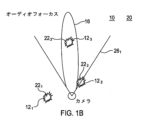
図1Aおよび1Bは、複数の音源12を含む音響空間10の一実施例を示す。相異なる位置にある音源12には、相異なる添字で符号が付けられる。図1Aおよび図1Bは、原点14に対して相異なる位置にある3つの音源121、122、123を示す。
1A and 1B show an example of an
マイクロフォンなどの音声取込みデバイスが、原点14または原点14の近くに配置され得る。たとえば、音声取込みデバイスは、アレイ、たとえば1次元、2次元、または3次元アレイとして構成され得る。
A sound capture device, such as a microphone, may be placed at or near the
複数の音声取込みデバイスの使用により、ある音源12の、別の音源12に対する選択的相対的減衰が可能となる。
The use of multiple sound capture devices allows for selective relative attenuation of one
この実施例では、少なくとも目標音源123、および1つまたは複数の他の非目標音源121、122を含む3つの音源12がある。
In this embodiment, there are three
音声取込み装置が、目標音源123に相対的利得を適用し、1つまたは複数の他の非目標音源121、122に相対的減衰を適用して、目標音源123に対するオーディオフォーカス16を生み出すように構成される。1つまたは複数の非目標音源122、122のオーディオフォーカス減衰がある。
The sound capture device is configured to apply a relative gain to the
目標音源123は、原点14に対する第1の位置にあり、1つまたは複数の非目標音源121、122は、第1の位置とは異なる、原点14からの第2の位置にある。すなわち、目標音源123は、1つまたは複数の非目標音源121、122とは空間的に異なる。
The target sound source 123 is at a first location relative to an
音声取込み装置は、ビームフォーミングを使用して第1の位置から来る音を分離するように構成され得る。ビームフォーミングは、相異なる音声取込みデバイスからのオーディオ信号の重みつき一次結合を使用する。オーディオ信号の重みつき一次結合は、ハードウェアもしくはソフトウェアで、またはハードウェアとソフトウェアの組合せで実施され得る。 The sound capture devices may be configured to separate sounds coming from a first location using beamforming. Beamforming uses a weighted linear combination of audio signals from different sound capture devices. The weighted linear combination of audio signals may be implemented in hardware or software, or a combination of hardware and software.
必ずしもすべての実施例ではないが、いくつかの実施例では、一次結合についての重みづけは適応的である。重みづけは、たとえば、いくつかの実施例では、第1の位置に向かう目標方向に応答を保つための制約下で、干渉する音源(たとえば、非目標音源121、122)のエネルギーを最小限に抑えることによって取得され得る。これは最小分散無ひずみ応答(minimum variance distortionless response)である。
In some, but not necessarily all, embodiments, the weighting for the linear combination is adaptive. The weighting may, for example, in some embodiments, be obtained by minimizing the energy of the interfering sources (e.g.,
必ずしもすべての実施例ではないが、いくつかの実施例では、重みづけは周波数に依存する。 In some embodiments, but not necessarily all, the weighting is frequency dependent.
たとえば、別個のマイクロフォンのアレイからの信号を処理し、伝播する音場の空間フィルタリングを実現するためにビームフォーマが使用され得る。空間フィルタリングは、重複する周波数内容を有するが、相異なる空間位置から生じる信号を分離する。目標位置(方位)からの目標信号は減衰されないが、他の場所(方位)からの信号は減衰される。空間フィルタは、非目標信号の方向について利得のディープヌル(deep null)を生み出す。したがって、ビームフォーマは、目標方向16からの信号に対する空間帯域フィルタとして、および非目標方向からの信号に対する帯域消去フィルタとして動作し得る。
For example, a beamformer may be used to process signals from an array of separate microphones and provide spatial filtering of the propagating sound field. The spatial filtering separates signals that have overlapping frequency content but originate from distinct spatial locations. Target signals from the target location (azimuth) are not attenuated, while signals from other locations (azimuths) are attenuated. The spatial filter creates a deep null of gain for the directions of non-target signals. Thus, the beamformer may operate as a spatial bandpass filter for signals from the
相異なるマイクロフォンからのオーディオ信号の重みつき一次結合は、y(t)=wHx(t)として表され得る。到来方向θを有する複素平面波について、y(t)=exp(jωt).r(θ,ω)であり、ただしビームフォーマ応答r(θ,ω)=wHd(θ,ω)であり、d(θ,ω)はステアリングベクトルである。 A weighted linear combination of the audio signals from the different microphones can be expressed as y(t) = wHx (t). For a complex plane wave with arrival direction θ, y(t) = exp(jωt).r(θ,ω), where the beamformer response r(θ,ω) = wHd (θ,ω), and d(θ,ω) is the steering vector.
wHは、y(t)が目標音源123からの著しく高い(たとえば、最大の)寄与(目標方向のオーディオフォーカス16)と、非目標音源121、122(非目標方向)からの著しく低い(たとえば、最小の)寄与とを含むように選択される。wHは、単一の周波数帯にわたって、または別個の周波数帯にわたって別々に適用され得る。
wH is selected such that y(t) contains a significantly higher (e.g., largest) contribution from the target sound source 123 (
重みwHは、費用関数を最小限に抑えることによって、たとえば、ある方向に対する目標利得と、別の方向に対する目標減衰(たとえば、力ゼロ利得)などの応答制約を受ける(目標とするものからの)出力分散を最小限に抑えることによって取得され得る。これにより、非目標方向からの(たとえば、非目標音源121、122からの)非目標信号からの出力に対する寄与を最小限に抑えながら、(たとえば、目標音源123からの)目標信号を保持する最小分散無ひずみ応答(MVDR)ビームフォーマが生み出される。 The weights wH may be obtained by minimizing a cost function, e.g., by minimizing the output variance (from the target) subject to response constraints such as a target gain for one direction and a target attenuation (e.g., zero force gain) for another direction. This produces a minimum variance distortionless response (MVDR) beamformer that preserves the target signal (e.g., from the target source 123 ) while minimizing the contribution to the output from non-target signals from non-target directions (e.g., from non-target sources 121 , 122 ).
重みづけおよび空間フィルタリングはリアルタイムに変化し得る。たとえば、ステアリングベクトルd(θ,ω)はリアルタイムに変化し得る。たとえば、重みwHはリアルタイムで適合され得る。 The weighting and spatial filtering may be changed in real time, e.g., the steering vector d(θ,ω) may be changed in real time, e.g., the weights w H may be adapted in real time.
図1Aおよび1Bはまた、1つまたは複数の視覚的物体22を含む視覚空間20の一実施例を示す。相異なる位置にある視覚的物体22には、相異なる添字で符号が付けられる。図1Aおよび1Bは、原点14に対して相異なる位置にある3つの視覚的物体221、222、223を示す。
1A and 1B also show an example of a
必ずしもすべての実施例ではないが、この実施例では、各音源121、122、123が、対応する視覚的物体221、222、223を有する。
In this embodiment, but not necessarily in all embodiments, each
この実施例では、音響空間10と視覚空間20が対応する。音響空間10内の音源121、122、123の位置は、視覚空間20内の視覚的物体221、222、223の位置と重複する。
In this embodiment, there is correspondence between the
カメラなどの1つまたは複数のイメージ取込みデバイスが、原点14または原点14の近くに配置され得る。イメージ取込みデバイスは、たとえば、視野261によって画定される視覚的シーンを取り込むように構成され得る。イメージ取込みデバイスは、たとえば、視野261によって画定された視覚的シーンのシーケンスを含むビデオを取り込むビデオカメラであり得る。
One or more image capture devices, such as cameras, may be positioned at or near the
この実施例では、視覚的物体221、222は、減衰された音源121、122に対応し、視覚的物体223は、減衰されない音源123に対応する。減衰された音源は、たとえば消音された音源であり得る。
In this embodiment, visual objects 22 1 , 22 2 correspond to
図1Bから、減衰された音源121に対応する視覚的物体221が視野261内にはなく、したがって原点14にあるカメラによって取り込まれる視覚的シーン内にはないことを理解することができる。
From FIG. 1B it can be seen that the visual object 22 1 corresponding to the
図1Bから、減衰されない音源123に対応する視覚的物体223が視野261内にあり、したがって原点14にあるカメラによって取り込まれる視覚的シーン内にあることを理解することができる。
From FIG. 1B it can be seen that a visual object 22 3 corresponding to the unattenuated
図1Bから、減衰された音源122に対応する視覚的物体222が視野261内にあり、したがって原点14にあるカメラによって取り込まれる視覚的シーン内にあることを理解することができる。
From FIG. 1B it can be seen that a visual object 22 2 corresponding to the
この実施例では、視野261内にある、減衰された音源122に対応する視覚的物体222は、減衰されない音源123に対応する視覚的物体223から注意をそらすものとなり得る。このことは、視野261内にある、減衰された音源122に対応する視覚的物体222が、視覚的物体223よりも視覚的シーンの広い部分を占めるとき、または視覚的物体223が背景の物体であるときに視覚的物体222が前景の物体であるとき、または視覚的物体222が動的視覚的物体(位置を移動し、かつ/または変化する視覚的物体)であるときに特にそうである。 In this embodiment, visual object 222 in the field of view 261 and corresponding to attenuated sound source 122 may distract from visual object 223 corresponding to unattenuated sound source 123. This is especially true when visual object 222 in the field of view 261 and corresponding to attenuated sound source 122 occupies a larger portion of the visual scene than visual object 223 , or when visual object 222 is a foreground object while visual object 223 is a background object, or when visual object 222 is a dynamic visual object (a visual object that moves and/or changes position).
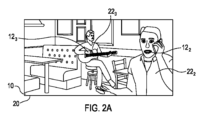
図2Aは視覚的シーンの一実施例を示す。視覚的物体222は、減衰された音源122に対応する。視覚的物体222と、視覚的物体222に対応する減衰された音源122の位置は、視野261内にある。取り込まれたイメージ内に視覚的物体222を確認することができる。視覚的物体223は、減衰されない音源123に対応する。視覚的物体223と、視覚的物体223に対応する減衰されない音源123は、視野261内にある。取り込まれたイメージ内で視覚的物体223を確認することができる。減衰されない音源123から取り込まれた音声が聴覚的に最も顕著であるのに対して、より大きいサイズの前景の視覚的物体222が視覚的に最も顕著である。より大きいサイズの前景の視覚的物体222は、減衰されない音源123に対応する視覚的物体223から視覚的に注意をそらす。
2A shows an example of a visual scene. Visual object 22 2 corresponds to attenuated
以下の方法100(図3)が、注意をそらすことを低減する。 The following method 100 (Figure 3) reduces distractions:
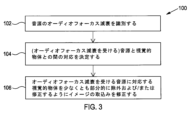
方法100は、
ブロック102で、音源122のオーディオフォーカス減衰を識別することと、
ブロック104で、オーディオフォーカス減衰を受ける音源122と、対応する視覚的物体222との間の対応を決定することと、
ブロック106で、オーディオフォーカス減衰を受ける音源122に対応する視覚的物体222を少なくとも部分的に除外および/または修正するようにイメージの取込みを修正することと
を含む。
The
In
In
At
必ずしもすべての実施例ではないが、いくつかの実施例では、ブロック102で、方法は、音源122のオーディオフォーカス減衰を自動的に識別することを含み得る。必ずしもすべての実施例ではないが、いくつかの実施例では、ブロック104で、方法は、オーディオフォーカス減衰を受ける音源122と、対応する視覚的物体222との間の対応を自動的に決定することを含み得る。必ずしもすべての実施例ではないが、いくつかの実施例では、ブロック106では、方法は、オーディオフォーカス減衰を受ける音源122に対応する視覚的物体222を少なくとも部分的に除外および/または修正するようにイメージの取込みを自動的に修正することを含み得る。
In some, but not necessarily all, embodiments, at
方法は、オーディオフォーカス減衰を受ける音源122に対応する視覚的物体222の取り込まれたイメージに対する視覚的影響を低減する。
The method reduces the visual impact on a captured image of a visual object 22 2 that corresponds to a
方法100の結果の一例が図2Bに示されている。方法は、オーディオフォーカス減衰を受ける音源122に対応する視覚的物体222を少なくとも部分的に修正するようにイメージの取込みを修正する。未修正の視覚的物体222が図2Aに示されており、修正された視覚的物体222’が図2Bに示されている。この実施例では、(視覚的物体223ではなく)未修正の視覚的物体222が、たとえば50ピクセルのぼけカーネル(blurring kernel)を受け、修正された視覚的物体222’が生成される。実際には、オーディオフォーカス減衰を受ける音源122に対応する視覚的物体222が、たとえばぼけ、着色などによって視覚的に減衰される。
An example of the result of the
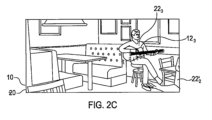
方法100の結果の一例が図2Cに示されている。方法は、視覚的シーンを再フレーミングして、オーディオフォーカス減衰を受ける音源122に対応する視覚的物体222を少なくとも部分的に除外するようにイメージの取込みを修正する。未修正の視覚的物体222が図2Aに示されており、少なくとも部分的に除外された、修正された視覚的物体222’が図2Cに示されている。この実施例では、(視覚的物体223ではなく)未修正の視覚的物体222が、取り込まれたイメージからの少なくとも部分的な除外の対象となる。これは、たとえば、パニングもしくはトラッキングおよび/またはズーミングによって取り込まれるイメージを実質的に再フレーミングすることによって達成され得る。これは、視野26のサイズおよび/または方向を変更することによって達成され得る。
An example of the result of the
図4Aは図1Bに類似している。図4Aは、減衰されない音源123に対応する視覚的物体223が視野261内にあり、したがって原点14にあるカメラによって取り込まれる視覚的シーン内にあること、および減衰された音源122に対応する視覚的物体222が視野261内にあり、したがって原点14にあるカメラによって取り込まれる視覚的シーン内にあることを示す。
Figure 4A is similar to Figure 1B and shows that visual object 22 3 corresponding to unattenuated
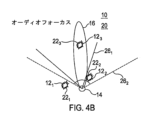
図4Bは図1Bと同様であるが、視野261が視野261’という新しい視野に修正されている。これは、取り込まれたイメージを再フレーミングし、減衰された音源122に対応する視覚的物体222のすべてまたは部分を除外する。
Figure 4B is similar to Figure 1B, except that the field of
したがって、図4Bは、減衰されない音源123に対応する視覚的物体223が新しい視野261’内にあり、したがって原点14にあるカメラによって取り込まれる視覚的シーン内にあること、および減衰された音源122に対応する視覚的物体222が新しい視野261’から少なくとも部分的に除外され、したがって原点14にあるカメラによって取り込まれる視覚的シーン内にもはやないことを示す。
Thus, Figure 4B shows that visual object 22 3 corresponding to unattenuated
いくつかの例では、再フレーミングが自動的に行われる。他の例では、再フレーミングをさせるためのユーザ選択可能なオプションがユーザに与えられる。 In some instances, the reframing occurs automatically. In other instances, the user is given a user-selectable option to cause the reframing to occur.
この実施例では、再フレーミングは同一の解像度を維持し、実質的にはパンまたはトラックである。他の例では、追加または代替として、再フレーミングは解像度を変更し、実質的にはズームである。 In this example, the reframing maintains the same resolution and is effectively a pan or track. In other examples, additionally or alternatively, the reframing changes resolution and is effectively a zoom.
図4Aおよび4Bの実施例では、第2のより広い視野262が示されている。広い視野262は、カメラのイメージセンサによって撮像される視覚的シーンを示す。より狭い視野261、261’は、イメージセンサによって取り込まれる視覚的シーンを示す。より狭い視野261、261’は、第2のより広い視野262の副部分である。図4Bに示されるフレーミングは、より狭い視野イメージを達成するように広い視野イメージをクロッピングすることによって達成される。クロップは、図4Aと図4Bの間でサイズおよび/または位置を変更し得る。クロップは、図4Aと図4Bの間で同一のサイズを保ち得る。この実施例では、イメージの取込みを修正することは、イメージセンサアレイで検出されたイメージに適用されるクロップを変更するように構成され、適用されるクロップが、取り込まれるイメージを決定する。クロップは、センサアレイのセンセル(sensel)の連続するサブセットを画定する。イメージセンサアレイで検出されたイメージに適用されるクロップの位置が変更される。イメージセンサアレイで検出されたイメージに適用されるクロップのサイズが維持され、または変更され得る。再クロッピングの効果が図5Aおよび5Bに示されている。図5Aは、イメージセンサアレイで検出されたイメージ(視野262)と、現在適用されているクロップ(減衰された音源122に対応する視覚的物体222を含む視野261)とを示す。図5Bは、イメージセンサアレイで検出されたイメージ(視野262)に新しく適用された新しいクロップによって画定される、取り込まれたイメージ(減衰された音源122に対応する視覚的物体222を含まない視野261’)を示す。必ずしもすべての実施例ではないが、この実施例では、取り込まれたイメージは、減衰された音源122に対応する、除外される視覚的物体222の一部(修正された視覚的物体222’)を保持する。
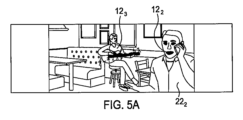
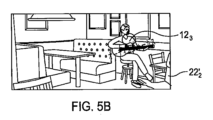
In the example of Figures 4A and 4B, a second, wider field of view 262 is shown. The wider field of view 262 represents the visual scene imaged by the image sensor of the camera. The narrower fields of view 261 , 261 ' represent the visual scene captured by the image sensor. The narrower fields of view 261 , 261 ' are sub-portions of the second, wider field of view 262. The framing shown in Figure 4B is achieved by cropping the wider field of view image to achieve the narrower field of view image. The crop may change size and/or position between Figures 4A and 4B. The crop may remain the same size between Figures 4A and 4B. In this example, modifying the image capture is configured to change a crop applied to the image detected at the image sensor array, the applied crop determining the image captured. The crop defines a contiguous subset of sensels of the sensor array. The position of the crop applied to the image detected at the image sensor array is changed. The size of the crop applied to the image detected at the image sensor array may be maintained or changed. The effect of re-cropping is illustrated in Figures 5A and 5B. Figure 5A shows the image detected at the image sensor array (field of view 262 ) and the currently applied crop (field of
方法100(図3)は、ブロック102で、音源122のオーディオフォーカス減衰を識別することを含む。このブロックは、たとえば、
オーディオフォーカス方向、たとえばビームフォーミングステアリングベクトルd(θ,ω)を取得することと、
音源方向を取得することと、
たとえばオーディオフォーカス方向ではない方向に減衰される1つまたは複数の音源を決定することと
を含み得る。
The method 100 (FIG. 3) includes identifying an audio focus attenuation for a sound source 12 at
Obtaining an audio focus direction, e.g., a beamforming steering vector d(θ,ω);
Obtaining a sound source direction;
For example, determining one or more sound sources that are attenuated in a direction other than the audio focus direction.
方法100は、ブロック104で、オーディオフォーカス減衰を受ける音源12と、対応する視覚的物体22との間の対応を決定することを含む。
The
このブロック104は、
オーディオフォーカス減衰を受ける音源12の位置を決定することと、
オーディオフォーカス減衰を受ける音源12の位置に関連付けられる視覚的物体22を決定することと、
決定した視覚的物体22を除外または修正するように、取り込まれたイメージを修正することと
を含み得る。
This
determining a location of a
determining a visual object 22 associated with a position of a
and modifying the captured image to exclude or modify the determined visual object 22.
視覚的物体22が、オーディオフォーカス減衰を受ける音源12の位置またはその近くにある場合、たとえば視覚的物体22(または視覚的物体22の任意の部分)がその位置のしきい値距離以内にある場合、視覚的物体22はその位置に関連付けられる。
If a visual object 22 is at or near a location of a
必ずしもすべての実施例ではないが、いくつかの実施例では、ブロック104の前に、イメージが取り込まれる。次いで、ブロック106で、この取り込まれたイメージが修正される。必ずしもすべての実施例ではないが、いくつかの実施例では、取り込まれたイメージが、対応する視覚的物体222を識別するために処理される。
In some, but not necessarily all, embodiments, an image is captured prior to block 104. The captured image is then modified in
位置に関連付けられる視覚的物体22の周囲を識別し、あるいは場所に関連付けられる視覚的物体22を認識または特徴付けるためにコンピュータビジョン技法が使用され得る。コンピュータビジョン技法は、たとえば、縁部またはコーナ検出、注目点検出、特徴検出を含み得る。 Computer vision techniques may be used to identify the surroundings of the visual object 22 associated with the location or to recognize or characterize the visual object 22 associated with the location. Computer vision techniques may include, for example, edge or corner detection, interest point detection, feature detection.
位置は、たとえば1次元方位(たとえば方位角φ)、2次元方位(たとえば方位角φおよび極角θ)、2次元座標(たとえばデカルト座標(x,y)または極座標(r,φ))、または3次元座標(たとえばデカルト座標(x,y,z)または円柱極座標(r,φ,z)または球面極座標(r,φ,θ))であり得る。 The position can be, for example, a one-dimensional orientation (e.g., azimuth angle φ), a two-dimensional orientation (e.g., azimuth angle φ and polar angle θ), a two-dimensional coordinate (e.g., Cartesian coordinates (x,y) or polar coordinates (r,φ)), or a three-dimensional coordinate (e.g., Cartesian coordinates (x,y,z) or cylindrical polar coordinates (r,φ,z) or spherical polar coordinates (r,φ,θ)).
たとえば、決定した視覚的物体22を修正するように、取り込まれたイメージを修正することは、たとえば図2Bを参照しながら説明したように、取り込まれたイメージを処理することを含み得る。 For example, modifying the captured image to modify the determined visual object 22 may include processing the captured image, for example, as described with reference to FIG. 2B.
たとえば、決定した視覚的物体22を修正するように、取り込まれたイメージを修正することは、たとえば図2Cまたは図4A、4B、5A、5Bを参照しながら説明したように、取り込まれたイメージを再フレーミングまたはクロッピングすることを含み得る。 For example, modifying the captured image to modify the determined visual object 22 may include reframing or cropping the captured image, for example, as described with reference to FIG. 2C or FIGS. 4A, 4B, 5A, 5B.
候補音源(オーディオフォーカス減衰を受ける音源12であることがあり、またはそうでないことがある)12がしきい値を超えるエネルギーまたはレベルを有すること、および目標音源123と候補音源12との間の十分な相関の欠如(しきい値未満の相関スコア)の結果として、候補音源がオーディオフォーカス減衰を受ける音源12として識別され得る。
As a result of a candidate sound source 12 (which may or may not be a
オーディオフォーカス減衰を受ける音源12の位置を決定することは、
候補音源12がしきい値を超えるエネルギーまたはレベルを有すると判定することと、
目標音源123と候補音源12との間の十分な相関の欠如を判定することと、
候補音源12がしきい値を超えるエネルギーまたはレベルを有し、目標音源123との間の十分な相関が欠如している場合、候補音源12の位置を取得することと
を含み得る。
Determining the location of the
determining that a
Determining a lack of sufficient correlation between the
obtaining the position of the candidate sound
しきい値はゼロまたは非ゼロしきい値であり得る。 The threshold can be zero or a non-zero threshold.
いくつかの例では、候補音源12の位置が、たとえばビームフォーミングステアリングベクトルd(θ,ω)の量子化された値によって定義される、複数の別個の位置のうちのいずれか1つに特定され得る。
In some examples, the position of the candidate sound
候補音源12の位置が、空間オーディオを使用して、たとえば前述のビームフォーマを使用して、または候補音響物体に関連付けられるメタデータから特定され得る。
The location of the
必ずしもすべての実施例ではないが、いくつかの実施例では、目標音源123がユーザ選択され得る。装置は、たとえば、ビューファインダディスプレイ内のユーザ選択のための手段を備え得る。
In some, but not necessarily all, embodiments the
図6Aは装置50の一実施例を示す。
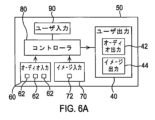
Figure 6A shows one embodiment of
装置50は音声取込み装置であり、音声の入力のためのオーディオ入力回路60を備える。オーディオ入力回路は複数の音声取込みデバイス62を備え、この実施例では、複数の音声取込みデバイス62はマイクロフォンである。
The
マイクロフォンは空間的に分散し、別個のマイクロフォンのアレイを形成する。アレイは、たとえば1D、2D、または3Dであり得る。 The microphones are spatially distributed to form an array of separate microphones. The array can be, for example, 1D, 2D, or 3D.
装置50はイメージ取込み装置であり、イメージ取込みデバイス70を備える。イメージ取込みデバイス70はカメラまたはイメージセンサであり得る。
The
イメージ取込みデバイス70は、たとえばビデオカメラ72であり得る。
The
コントローラ80は、オーディオ入力回路60からオーディオデータを受け取り、イメージ取込みデバイス70から視覚的データを受け取るように構成される。データはrawであり得、何らかの前処理がオーディオ入力回路60および/またはイメージ取込みデバイス70で行われ得る。
The
この実施例では、装置50はビームフォーマ装置であり得る。装置50は、オーディオ入力回路60からのオーディオデータを空間的にフィルタリングして、前述のようにオーディオフォーカスを実現するように構成される。オーディオフォーカスは望ましくない方向からの音を減衰する。
In this embodiment,
コントローラ80はまた、
音源12のオーディオフォーカス減衰を識別し、
オーディオフォーカス減衰を受ける音源12と、対応する視覚的物体22との間の対応を決定し、
オーディオフォーカス減衰を受ける音源12に対応する視覚的物体22を少なくとも部分的に除外および/または修正するようにイメージの取込みを修正する
ように構成される。
The
Identifying the audio focus attenuation of the
determining a correspondence between the
The image capture is configured to modify the image capture to at least partially exclude and/or modify the visual object 22 corresponding to the
装置50はレンダリング装置であり、イメージおよび音声をマルチメディアコンテンツとして同時にレンダリングするためのユーザ出力回路40を備える。ユーザ出力回路40は、この実施例では、より多くのスピーカ、ヘッドフォンのうちの1つ、あるいはスピーカまたはヘッドフォンに対するインターフェースを備え得るオーディオ出力回路42を備える。ユーザ出力回路40は、この実施例では、たとえばより多くのディスプレイ44のうちの1つを備え得るイメージ出力回路を備える。
The
装置50は、オーディオフォーカス減衰を受ける音源に対応する視覚的物体の除外/修正前のイメージをディスプレイ44上に表示するように構成され得る。
The
装置50は、オーディオフォーカス減衰を受ける音源に対応する視覚的物体の除外/修正後のイメージをディスプレイ44上に表示するように構成され得る。
The
装置50は、オーディオフォーカス減衰を受ける音源に対応する視覚的物体を少なくとも部分的に除外および/または修正する、取り込まれたイメージをディスプレイ44上に表示するように構成され得る。
The
装置50は、いくつかの例では、ユーザが装置50に制御コマンドを与えることを可能にするように構成されるユーザ入力回路90を備え得る。必ずしもすべての実施例ではないが、いくつかの実施例では、ユーザ入力回路90は、タッチスクリーンディスプレイを作成するようにディスプレイ44と一体化され得る。必ずしもすべての実施例ではないが、いくつかの実施例では、ディスプレイ44またはタッチスクリーンディスプレイは、ビデオカメラ72のためのカメラビューファインダを提供する。ユーザ入力回路90は、ユーザが音源12および/または音源12に関連付けられる視覚的物体22を識別することを可能にし得る。
The
装置50はポータブルまたはハンドポータブルデバイスであり得る。装置50は、たとえばカメラであり得、またはカメラ機能を有する携帯電話であり得る。
The
図6Bは、コントローラ80の一実施例を示す。コントローラ80の実装はコントローラ回路としてのものであり得る。コントローラ80は、ハードウェアだけで実装され得、ファームウェアだけを含むソフトウェアのいくつかの態様を有し、またはハードウェアとソフトウェア(ファームウェアを含む)の組合せであり得る。
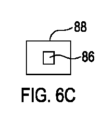
FIG. 6B shows one embodiment of
図6Bに示されるように、コントローラ80は、たとえば、汎用または専用プロセッサ82によって実行されるべき、コンピュータ可読記憶媒体(ディスク、メモリなど)上に記憶され得る、そのようなプロセッサ82内のコンピュータプログラム86の実行可能命令を使用することにより、ハードウェア機能を可能にする命令を使用して実装され得る。
As shown in FIG. 6B, the
プロセッサ82は、メモリ84から読み取り、メモリ84に書き込むように構成される。プロセッサ82はまた、データおよび/またはコマンドがそれを介してプロセッサ82によって出力される出力インターフェースと、データおよび/またはコマンドがそれを介してプロセッサ82に入力される入力インターフェースとを備え得る。
The
メモリ84は、プロセッサ82内にロードされたとき、装置50の動作を制御するコンピュータプログラム命令(コンピュータプログラムコード)を含むコンピュータプログラム86を記憶する。コンピュータプログラム86のコンピュータプログラム命令は、装置が図3に示される方法を実施することを可能にする論理およびルーチンを提供する。メモリ84を読み取ることにより、プロセッサ82は、コンピュータプログラム86をロードおよび実行することができる。
The
したがって装置50は、
少なくとも1つのプロセッサ82と、
コンピュータプログラムコードを含む少なくとも1つのメモリ84と、
少なくとも1つのプロセッサ82と共に、装置50に、
音源のオーディオフォーカス減衰を識別することと、
オーディオフォーカス減衰を受ける音源と、対応する視覚的物体との間の対応を決定することと、
オーディオフォーカス減衰を受ける音源に対応する視覚的物体を少なくとも部分的に除外および/または修正するようにイメージの取込みを修正することと
を少なくとも実施させるように構成された少なくとも1つのメモリ84およびコンピュータプログラムコードと
を備える。
Thus, the device 50:
At least one
At least one
In conjunction with at least one
Identifying an audio focus attenuation of a sound source;
determining a correspondence between a sound source subject to audio focus attenuation and a corresponding visual object;
and modifying the image capture to at least partially exclude and/or modify visual objects corresponding to sound sources that are subject to audio focus attenuation.
図6Bに示されるように、コンピュータプログラム86は、任意の適切な送達機構88を介して装置50に到達し得る。送達機構88は、たとえば、機械可読媒体、コンピュータ可読媒体、非一時的コンピュータ可読記憶媒体、コンピュータプログラム製品、メモリデバイス、コンパクトディスク読取り専用メモリ(CD-ROM)、デジタルバーサタイルディスク(DVD)、ソリッドステートメモリなどの記録媒体、コンピュータプログラム86を含む、またはコンピュータプログラム86を有形に実施する製造品であり得る。送達機構は、コンピュータプログラム86を確実に転送するように構成された信号であり得る。装置50は、コンピュータプログラム86をコンピュータデータ信号として伝播または送信し得る。
As shown in FIG. 6B, the
装置に少なくとも以下を実施させる、または少なくとも以下を実施するためのコンピュータプログラム命令。
音源のオーディオフォーカス減衰を識別することと、
オーディオフォーカス減衰を受ける音源と、対応する視覚的物体との間の対応を決定することと、
オーディオフォーカス減衰を受ける音源に対応する視覚的物体を少なくとも部分的に除外および/または修正するようにイメージの取込みを修正すること。
Computer program instructions for causing an apparatus to at least:
Identifying an audio focus attenuation of a sound source;
determining a correspondence between a sound source subject to audio focus attenuation and a corresponding visual object;
Modifying image capture to at least partially exclude and/or modify visual objects corresponding to sound sources that are subject to audio focus attenuation.
コンピュータプログラム命令は、コンピュータプログラム、非一時的コンピュータ可読媒体、コンピュータプログラム製品、機械可読媒体内に含まれ得る。必ずしもすべての実施例ではないが、いくつかの実施例では、コンピュータプログラム命令は、複数のコンピュータプログラムにわたって分散し得る。 The computer program instructions may be included in a computer program, a non-transitory computer readable medium, a computer program product, or a machine readable medium. In some embodiments, but not necessarily all embodiments, the computer program instructions may be distributed across multiple computer programs.
メモリ84が単一の構成要素/回路として示されているが、メモリ84は、1つまたは複数の別々の構成要素/回路として実装され得、その一部またはすべてが一体化され/取外し可能であり得、かつ/または永続的/半永続的/動的/キャッシュされたストレージを提供し得る。
Although
プロセッサ82が単一の構成要素/回路として示されているが、プロセッサ82は、1つまたは複数の別々の構成要素/回路として実装され得、その一部またはすべてが一体化され/取外し可能であり得る。プロセッサ82はシングルコアまたはマルチコアプロセッサであり得る。
Although the
前述の実施例が、複数のオーディオフォーカス方向がある状況に拡張され得る。 The above example can be extended to situations where there are multiple audio focus directions.
前述の実施例が、オーディオフォーカス減衰を受け、候補の取り込まれたイメージ内の視覚的物体に対応する複数の音源がある状況に拡張され得る。 The above embodiment can be extended to situations where there are multiple sound sources that are subject to audio focus attenuation and correspond to visual objects in the candidate captured image.
方法100は、そうした音源のそれぞれについて実施される。
方法は、
ブロック102で、複数の音源12のオーディオフォーカス減衰を識別することと、
ブロック104で、オーディオフォーカス減衰を受ける複数の音源12と、取り込まれるべきイメージ内に存在する、それぞれの複数の視覚的物体22との間の対応を決定することと、
ブロック106で、オーディオフォーカス減衰を受ける複数の音源12に対応するそれぞれの複数の視覚的物体22のうちの少なくとも一部を少なくとも部分的に除外および/または修正するようにイメージの取込みを修正することと
を含み得る。
The method is:
At
At
At
必ずしもすべての実施例ではないが、いくつかの実施例では、方法は、普通なら取り込まれたイメージ内にあるはずの、オーディオフォーカス減衰を受ける音源12に関連付けられるすべての視覚的物体22を全体的または部分的に除外および/または修正する。その結果、減衰された音源12は見えない。
In some, but not necessarily all, embodiments, the method entirely or partially excludes and/or modifies all visual objects 22 associated with the
必ずしもすべての実施例ではないが、いくつかの実施例では、イメージの取込みを修正することが、オーディオフォーカス減衰を受ける音源12に関連付けられる、選択された視覚的物体22を除外するように構成され、視覚的物体22の選択が、
取り込まれたイメージ内の、オーディオフォーカス減衰を受ける音源12に関連付けられる視覚的物体22の数を最小限に抑えること、
取り込まれたイメージから除外される、オーディオフォーカス減衰を受ける音源12に関連付けられる視覚的物体22の数を最大にすること、
オーディオフォーカス減衰を受け、取り込まれたイメージ内の視覚的物体22に関連付けられる音源12の全エネルギーを最小限に抑えること、
オーディオフォーカス減衰を受け、取り込まれたイメージから除外される視覚的物体22に関連付けられる音源12の全エネルギーを最大にすること、
オーディオフォーカス減衰を受ける音源12に関連付けられる視覚的物体22の物体認識、
オーディオフォーカス減衰を受ける音源12に関連付けられる視覚的物体22の、装置50に対する近接、
オーディオフォーカス減衰を受ける音源に関連付けられる視覚的物体22の移動または変化、
オーディオフォーカス減衰を受ける音源12に関連付けられる視覚的物体22によって占められる、取り込まれたイメージの面積を最小限に抑えること
のうちの1つまたは複数に依存する。
In some, but not necessarily all, embodiments, modifying the image capture is configured to exclude selected visual objects 22 associated with the
Minimizing the number of visual objects 22 in the captured image that are associated with the
maximizing the number of visual objects 22 associated with the
Minimizing the total energy of the
maximizing the total energy of the
Object recognition of a visual object 22 associated with a
the proximity of the visual object 22 associated with the
A movement or change in the visual object 22 associated with the sound source that is subject to audio focus attenuation;
The audio focus attenuation is achieved by minimizing the area of the captured image occupied by visual objects 22 associated with the
「コンピュータ可読記憶媒体」、「コンピュータプログラム製品」、「有形に実施されたコンピュータプログラム」など、または「コントローラ」、「コンピュータ」、「プロセッサ」などへの参照は、単一/マルチプロセッサアーキテクチャや順次(フォンノイマン)/並列アーキテクチャなどの様々なアーキテクチャを有するコンピュータだけではなく、フィールドプログラマブルゲートアレイ(FPGA)、特定用途向け回路(ASIC)、信号処理デバイス、他の処理回路などの専用回路をも包含すると理解されたい。コンピュータプログラム、命令、コードなどへの参照は、たとえば、プロセッサのための命令であっても、固定機能デバイス、ゲートアレイ、またはプログラマブル論理デバイスなどのための構成設定であっても、ハードウェアデバイスのプログラム可能な内容などのプログラム可能プロセッサまたはファームウェアのためのソフトウェアを包含すると理解されたい。 References to "computer-readable storage medium," "computer program product," "tangibly embodied computer program," etc., or to "controller," "computer," "processor," etc., should be understood to encompass computers having a variety of architectures, such as single/multi-processor architectures and sequential (von Neumann)/parallel architectures, as well as special purpose circuitry, such as field programmable gate arrays (FPGAs), application specific circuits (ASICs), signal processing devices, other processing circuitry, etc. References to computer programs, instructions, code, etc., should be understood to encompass software for programmable processors or firmware, such as the programmable content of a hardware device, whether for example, instructions for a processor or configuration settings for a fixed function device, gate array, or programmable logic device, etc.
本願では、「回路」という用語は、以下のうちの1つまたは複数またはすべてを指すことがある。
(a)ハードウェアのみの回路実装(アナログおよび/またはデジタルのみの回路実装など)、および
(b)以下のような(適用可能なとき)、ハードウェア回路とソフトウェアの組合せ
(i)アナログおよび/またはデジタルハードウェア回路とソフトウェア/ファームウェアの組合せ、および
(ii)携帯電話やサーバなどの装置に様々な機能を実施させるように共に働く、ソフトウェアを有するハードウェアプロセッサ(デジタル信号プロセッサを含む)、ソフトウェア、およびメモリの任意の部分、および
(c)動作のためにソフトウェア(たとえばファームウェア)を必要とするが、動作のためにソフトウェアが不要であるときにソフトウェアが存在しないことがある、ハードウェア回路、および/またはマイクロプロセッサやマイクロプロセッサの一部などのプロセッサ。
As used herein, the term "circuitry" may refer to one or more or all of the following:
(a) hardware-only circuit implementations (such as analog and/or digital-only circuit implementations); and (b) combinations of hardware circuitry and software, such as (when applicable): (i) combinations of analog and/or digital hardware circuitry and software/firmware; and (ii) hardware processors (including digital signal processors) with software, software, and any portions of memory that work together to cause a device such as a mobile phone or a server to perform various functions; and (c) hardware circuits and/or processors, such as microprocessors or portions of microprocessors, that require software (e.g., firmware) to operate but that may be absent when the software is not necessary for operation.
回路のこの定義は、任意の請求項内を含む、本願でのこの用語のすべての使用に当てはまる。別の実施例として、本願では、回路という用語は、単なるハードウェア回路またはプロセッサおよびその付随するソフトウェアおよび/またはファームウェアの一実装をも包含する。回路という用語はまた、たとえば、特定の請求項要素に適用可能な場合、モバイルデバイス用のベースバンド集積回路、あるいはサーバ、セルラネットワークデバイス、または他のコンピューティングもしくはネットワークデバイス内の類似の集積回路をも包含する。 This definition of circuitry applies to all uses of the term in this application, including within any claims. As another example, in this application, the term circuitry encompasses a simple hardware circuit or an implementation of a processor and its associated software and/or firmware. The term circuitry also encompasses, for example, a baseband integrated circuit for a mobile device, or a similar integrated circuit in a server, cellular network device, or other computing or network device, if applicable to a particular claim element.
図3に示されるブロックは、方法でのステップ、および/またはコンピュータプログラム86内のコードのセクションを表し得る。ブロックに対する特定の順序の例示は、ブロックについての必要とされる、または好ましい順序があることを必ずしも示唆せず、ブロックの順序および構成は変動し得る。さらに、いくつかのブロックを省略することが可能であり得る。
The blocks shown in FIG. 3 may represent steps in a method and/or sections of code within the
構造的特徴を説明したところでは、構造的特徴が、構造的特徴の機能のうちの1つまたは複数を実施するための手段によって、そうした機能が明示的に説明されるか、それとも暗黙的に説明されるかに関わらず置換され得る。 Wherever a structural feature is described, the structural feature may be replaced by a means for performing one or more of the functions of the structural feature, whether such functions are explicitly described or implicitly described.
必ずしもすべての実施例ではないが、いくつかの実施例では、装置50は、装置50でのメモリ84内へのデータのローカル記憶を用いて、または用いずに、装置50での回路またはプロセッサによるデータのローカル処理を用いて、または用いずに、装置50からデータを通信するように構成される。
In some, but not necessarily all, embodiments, the
データは、1つまたは複数のデバイスに処理済みフォーマットまたは未処理フォーマットでリモートに記憶され得る。データはクラウド内に記憶され得る。 The data may be stored remotely on one or more devices in processed or raw format. The data may be stored in the cloud.
データは1つまたは複数のデバイスでリモートに処理され得る。データは、部分的にローカルに処理され、1つまたは複数のデバイスで部分的にリモートに処理され得る。 The data may be processed remotely on one or more devices. The data may be partially processed locally and partially processed remotely on one or more devices.
データは、たとえばWi-Fi(登録商標)やBluetooth(登録商標)などの近距離無線通信を介して、または遠距離セルラ無線リンクを介してワイヤレスにリモートデバイスに通信され得る。装置は、たとえばデータの通信用の無線トランシーバなどの通信インターフェースを備え得る。 The data may be communicated to the remote device wirelessly, for example via short-range wireless communication such as Wi- Fi or Bluetooth , or via a longer-range cellular radio link. The apparatus may include a communication interface, for example a wireless transceiver for communication of data.
装置50は、より大規模な分散型ネットワークの部分を形成する、モノのインターネットの部分であり得る。
The
データの処理は、ローカルであっても、リモートであっても、健康監視、データアグリゲーション、患者監視、生命徴候監視、または他の目的のためのものであり得る。 The processing of data may be local or remote and may be for health monitoring, data aggregation, patient monitoring, vital signs monitoring, or other purposes.
データの処理は、ローカルであっても、リモートであっても、人工知能または機械学習アルゴリズムを使用し得る。データは、たとえば、機械学習ネットワークをトレーニングするための学習入力として使用され得、または機械学習ネットワークに対する照会入力として使用され得、機械学習ネットワークは応答を提供する。機械学習ネットワークは、たとえば、線形回帰、ロジスティック回帰、ベクトルサポートマシン、または単一もしくは複数隠れ層ニューラルネットワークなどの非循環機械学習ネットワーク(acyclic machine learning network)を使用し得る。 The processing of the data, whether local or remote, may use artificial intelligence or machine learning algorithms. The data may be used, for example, as learning input to train a machine learning network or as a query input to a machine learning network, which provides a response. The machine learning network may use, for example, an acyclic machine learning network, such as linear regression, logistic regression, vector support machine, or a single or multiple hidden layer neural network.
データの処理は、ローカルであっても、リモートであっても出力を生成し得る。出力は装置50に通信され得、装置50は、音声出力、視覚的出力、または触覚出力などの対象に感応する出力を生成し得る。
The processing of the data may generate an output, either locally or remotely. The output may be communicated to the
データの記録は一時的な記録のみを含み得、またはデータの記録は永続的記録を含み得、またはデータの記録は一時的記録と永続的記録の両方を含み得る。一時的記録は一時的なデータの記録を示唆する。これは、たとえば、感知またはイメージ取込み中に行われ、ダイナミックメモリで行われ、環状バッファ、レジスタ、キャッシュなどのバッファで行われ得る。永続的記録は、データが、アドレス指定可能メモリ空間から検索可能であるアドレス指定可能データ構造の形態であり、したがって削除または上書きされるまで記憶および検索され得ることを示唆するが、長期記憶が行われることがあり、または行われないことがある。イメージに関連する「取込み」という用語の使用は、イメージのデータの一時的記録に関係する。イメージに関連する「記憶」という用語の使用は、イメージのデータの永続的記録に関係する。 The recording of data may include only temporary recording, or the recording of data may include permanent recording, or the recording of data may include both temporary and permanent recording. Temporary recording suggests the recording of data temporarily. This may be done, for example, during sensing or image capture, in dynamic memory, in a buffer such as a circular buffer, a register, a cache, etc. Persistent recording suggests the data is in the form of an addressable data structure that is retrievable from an addressable memory space, and thus may be stored and retrieved until deleted or overwritten, although long-term storage may or may not occur. Use of the term "capture" in relation to an image relates to the temporary recording of the image's data. Use of the term "storage" in relation to an image relates to the permanent recording of the image's data.
上記の実施例では、取り込まれたイメージは記録されたイメージでもあり得る。 In the above embodiment, the captured image can also be a recorded image.
ここでは、「モジュール」とは、製造業者またはユーザによって追加されることになるいくつかの部品/構成要素を除外するユニットまたは装置を指す。 In this context, "module" refers to a unit or device that excludes some parts/components that are to be added by the manufacturer or user.
たとえば、装置50は、時間および/または空間で分離され得る、オーディオ入力回路60、イメージ取込みデバイス70、コントローラ80、およびユーザ出力回路40のうちの1つまたは複数に物理的に分離され得る。装置50の機能は、複数の異なるデバイスであるが、機能的に結合されたデバイスを使用して実装され得る。
For example,
前述の実施例は、
自動車システム、遠隔通信システム、消費者電子製品を含む電子システム、分散コンピューティングシステム、音声コンテンツ、視覚的コンテンツ、およびオーディオビジュアルコンテンツ、ならびに複合現実感、媒介現実感、仮想現実感、および/または拡張現実感を含むメディアコンテンツを生成またはレンダリングするためのメディアシステム、パーソナルヘルスシステムまたはパーソナルフィットネスシステムを含むパーソナルシステム、ナビゲーションシステム、ヒューマンマシンインターフェースとも呼ばれるユーザインターフェース、セルラ、非セルラ、および光ネットワークを含むネットワーク、アドホックネットワーク、インターネット、モノのインターネット、仮想化ネットワーク、ならびに関連するソフトウェアおよびサービス
の使用可能構成要素として応用される。
The above embodiment is
Applications include as enablement components in automotive systems, telecommunications systems, electronic systems including consumer electronic products, distributed computing systems, media systems for generating or rendering audio, visual, and audiovisual content, as well as media content including mixed reality, mediated reality, virtual reality, and/or augmented reality, personal systems including personal health or fitness systems, navigation systems, user interfaces also referred to as human-machine interfaces, networks including cellular, non-cellular, and optical networks, ad-hoc networks, the Internet, the Internet of Things, virtualized networks, and related software and services.
「備える」という用語は、本文書では排他的ではなく包含的な意味で使用される。すなわち、Yを備えるXに対する任意の参照は、Xがただ1つのYを備え得、または複数のYを備え得る。「備える」を排他的な意味で使用することが意図される場合、「ただ1つの..を備える」を参照することによって、または「からなる」を使用することによって、文脈でそれが明らかにされる。 The term "comprises" is used in this document in an inclusive rather than exclusive sense. That is, any reference to X comprising Y means that X may comprise only one Y, or may comprise multiple Ys. If the exclusive sense of "comprises" is intended, this will be made clear in the context by a reference to "comprises only one..." or by using "consisting of."
この説明では、様々な実施例に対して参照が行われた。実施例に関連する特徴または機能の説明は、そうした特徴または機能がその実施例に存在することを示す。本文での「実施例」または「たとえば」または「することができる」または「し得る」という用語の使用は、明示的に述べられたか否かに関わらず、そのような特徴または機能が、一例として説明されたか否かに関わらず、少なくとも説明された実施例に存在すること、および必ずしもそうではないが、他の実施例のうちのいくつか、またはすべての他の実施例に存在し得ることを示す。したがって、「実施例」、「たとえば」、「することができる」、または「し得る」は、実施例のクラス内の特定の例を参照する。例の特性は、その例のみの特性、またはクラスの特性、またはクラス内の例のすべてではないが一部を含むクラスのサブクラスの特性であり得る。したがって、一実施例を参照するが別の実施例を参照せずに説明された特徴が、可能なら、機能する組合せの部分としてその別の実施例で使用され得るが、その別の実施例で必ずしも使用する必要のないことが暗黙的に開示される。 In this description, reference has been made to various embodiments. The description of a feature or function in relation to an embodiment indicates that such feature or function is present in that embodiment. Use of the terms "embodiment" or "for example" or "may" or "could" in this text, whether or not explicitly stated, indicates that such feature or function is present in at least the embodiment described, whether or not described as an example, and may, but not necessarily, be present in some or all of the other embodiments. Thus, "embodiment," "for example," "may," or "may" refers to a particular example within a class of embodiments. The properties of an example may be properties of only that example, or properties of a class, or properties of a subclass of a class that includes some but not all of the examples in the class. Thus, a feature described with reference to one embodiment but without reference to another embodiment is implicitly disclosed to be usable in that other embodiment, if possible, as part of a functional combination, but not necessarily in that other embodiment.
先行するパラグラフで、様々な実施例を参照しながら実施形態が説明されたが、特許請求の範囲から逸脱することなく、与えられた実施例に対する修正が行われ得ることを理解されたい。 In the preceding paragraphs, embodiments have been described with reference to various examples, but it should be understood that modifications to the examples given may be made without departing from the scope of the claims.
先行する説明で説明された特徴が、上記で明示的に説明した組合せ以外の組合せで使用され得る。 Features described in the preceding description may be used in combinations other than those expressly described above.
いくつかの特徴を参照しながら機能が説明されたが、そうした機能は、説明されたか否かに関わらず、他の特徴によって実施可能であり得る。 Although functionality has been described with reference to certain features, such functionality may be implemented by other features, whether or not described.
いくつかの実施形態を参照しながら特徴が説明されたが、そうした特徴は、説明されたか否かに関わらず、他の実施形態にも存在し得る。 Although features have been described with reference to some embodiments, such features may be present in other embodiments, whether or not they are described.
「a」または「the」という用語は、本文書では排他的な意味ではなく、包含的な意味で使用される。すなわち、Yを備えるX(X comprising a/the Y)に対する任意の参照は、文脈がそうではないことを明確に示すのでない限り、Xがただ1つのYを備え得、または複数のYを備え得ることを示す。「a」または「the」を排他的な意味で使用することが意図される場合、文脈でそれが明らかにされる。ある状況では、「少なくとも1つ」または「1つまたは複数」の使用は、包含的な意味を強調するために使用され得るが、こうした用語の欠如を排他的な意味を推論するように理解するべきではない。 The terms "a" or "the" are used in this document in an inclusive, not exclusive sense. That is, any reference to X comprising a/the Y indicates that X may comprise only one Y or may comprise multiple Ys, unless the context clearly indicates otherwise. If "a" or "the" is intended to be used in an exclusive sense, the context will make this clear. In some circumstances, the use of "at least one" or "one or more" may be used to emphasize an inclusive sense, but the absence of such terms should not be understood to infer an exclusive sense.
請求項での特徴(特徴の組合せ)の存在は、その特徴または(特徴の組合せ)自体に対する参照、さらには実質的に同一の技術的効果(同等の特徴)を達成する特徴に対する参照である。同等の特徴は、たとえば、変形形態であり、ほぼ同様にして実質的に同一の結果を達成する特徴を含む。同等の特徴は、たとえば、ほぼ同一の結果を達成するためにほぼ同一の方式でほぼ同一の機能を実施する特徴を含む。 The presence of a feature (combination of features) in a claim is a reference to the feature or (combination of features) itself, as well as to features that achieve substantially the same technical effect (equivalent features). Equivalent features include, for example, features that are variations and achieve substantially the same result in substantially the same way. Equivalent features include, for example, features that perform substantially the same function in substantially the same way to achieve substantially the same result.
この説明では、実施例の特徴を説明するために、形容詞または形容詞句を用いて様々な実施例に対する参照が行われた。実施例に関する、特徴のそのような説明は、特徴がいくつかの例では厳密に説明したように存在し、他の例ではほぼ説明したように存在することを示す。 Throughout this description, reference has been made to various embodiments using adjectives or adjectival phrases to describe features of the embodiments. Such description of features in relation to the embodiments indicates that in some instances the feature is present exactly as described and in other instances it is present approximately as described.
上記の明細書では重要であると考えられる特徴に注意を引くように努めたが、出願人は、強調が置かれているか否かに関わらず、上記で参照され、かつ/または図面に示される、特許を受けることができる特徴または特徴の組合せに関して請求の範囲を介して保護を求めることがあることを理解されたい。 Although the foregoing specification has attempted to draw attention to features believed to be important, it will be understood that applicants may seek protection through the claims for any patentable feature or combination of features referenced above and/or shown in the drawings, whether or not emphasis is placed on them.
Claims (15)
少なくとも1つのプロセッサと、
コンピュータプログラムコードを含む少なくとも1つの非一時的メモリと、
前記少なくとも1つの非一時的メモリおよび前記コンピュータプログラムコードは、前記少なくとも1つのプロセッサと共に、前記装置に、
音源が第1のしきい値を超えるエネルギーまたはレベルを有することを判定することと、
ユーザ選択された音源である目標音源と前記音源との間に、第2のしきい値未満のエネルギーまたはレベルについての相関があることを判定することと、
前記音源のエネルギーまたはレベルが第1のしきい値を超えていること、および前記目標音源と前記音源との相関が第2のしきい値未満であることに応じて、前記音源のオーディオフォーカス減衰を識別することと、
オーディオフォーカス減衰を受ける前記音源と、対応する視覚的物体との間の対応を決定することと、
オーディオフォーカス減衰を受ける前記音源に対応する前記視覚的物体を少なくとも部分的に除外および/または修正するようにイメージの取込みを修正することと
を実行させるように構成された、装置。 1. An apparatus comprising:
At least one processor;
at least one non-transitory memory containing computer program code;
The at least one non-transitory memory and the computer program code, together with the at least one processor, cause the apparatus to:
determining that a sound source has an energy or level that exceeds a first threshold;
determining that there is a correlation between a target sound source, the target sound source being a user selected sound source , and the sound source in terms of energy or level below a second threshold;
identifying an audio focus attenuation of the sound source in response to the energy or level of the sound source exceeding a first threshold and a correlation between the target sound source and the sound source being less than a second threshold;
determining a correspondence between said sound sources subject to audio focus attenuation and corresponding visual objects;
and modifying image capture to at least partially exclude and/or modify the visual object corresponding to the sound source that is subject to audio focus attenuation.
オーディオフォーカス減衰を受ける前記音源の位置を決定することと、
オーディオフォーカス減衰を受ける前記音源の前記位置と前記視覚的物体との関連付けに少なくとも部分的に基づいて、前記視覚的物体を決定することと、
決定した視覚的物体を除外するように、取り込まれたイメージを修正することと
を実行させるように構成された、請求項1に記載の装置。 The at least one non-transitory memory and the computer program code, together with the at least one processor, cause the apparatus to:
determining a position of the sound source that is subject to audio focus attenuation;
determining a visual object based at least in part on an association between the position of the sound source and the visual object that is subject to audio focus attenuation;
and modifying the captured image to exclude the determined visual object.
取り込まれたイメージを再フレーミングして、前記音源に対応する前記視覚的物体を除外することを行わせるように構成された、請求項1に記載の装置。 The at least one non-transitory memory and the computer program code, together with the at least one processor, cause the apparatus to:
10. The apparatus of claim 1, configured to cause a captured image to be reframed to exclude the visual object corresponding to the sound source.
前記イメージの取込みを修正することが、イメージセンサアレイで検出されたイメージに適用されるクロップを変更することを行わせるように構成され、適用されるクロップが、取り込まれる前記イメージを決定する、請求項1に記載の装置。 The at least one non-transitory memory and the computer program code, together with the at least one processor, cause the apparatus to:
2. The apparatus of claim 1, wherein modifying the image capture is configured to alter a crop applied to an image detected by an image sensor array, the crop applied determining the image captured.
前記イメージセンサアレイで検出された前記イメージに適用される前記クロップのサイズを維持することを行わせるように構成される、請求項9に記載の装置。 The at least one non-transitory memory and the computer program code, together with the at least one processor, cause the apparatus to:
The apparatus of claim 9 , configured to cause maintaining a size of the crop applied to the image detected by the image sensor array.
オーディオフォーカス減衰を受ける音源に関連付けられるすべての視覚的物体を除外することを行わせるように構成される、請求項1のいずれかに記載の装置。 The at least one non-transitory memory and the computer program code, together with the at least one processor, cause the apparatus to:
2. The apparatus of claim 1, configured to cause the filtering out of all visual objects associated with a sound source that is subject to audio focus attenuation.
オーディオフォーカス減衰を受ける音源に関連付けられる、選択された視覚的物体を除外することを行わせるように構成され、前記視覚的物体の前記選択が、
取り込まれたイメージ内にある、オーディオフォーカス減衰を受ける音源に関連付けられる視覚的物体の数を最小限に抑えること、
取り込まれたイメージから除外される、オーディオフォーカス減衰を受ける音源に関連付けられる視覚的物体の数を最大にすること、
オーディオフォーカス減衰を受け、取り込まれたイメージ内の視覚的物体に関連付けられる音源の全エネルギーを最小限に抑えること、
オーディオフォーカス減衰を受け、取り込まれたイメージから除外される視覚的物体に関連付けられる音源の全エネルギーを最大にすること、
オーディオフォーカス減衰を受ける音源に関連付けられる視覚的物体の物体認識、
オーディオフォーカス減衰を受ける前記音源に関連付けられる視覚的物体の、前記装置に対する近接、または、
オーディオフォーカス減衰を受ける前記音源に関連付けられる前記視覚的物体で占められる、取り込まれたイメージの面積を最小限に抑えること
のうちの1つまたは複数に依存する、請求項1に記載の装置。 The at least one non-transitory memory and the computer program code, together with the at least one processor, cause the apparatus to:
and causing the selection of visual objects to be removed, the visual objects being associated with a sound source that is subject to audio focus attenuation, the selection of the visual objects being configured to:
Minimizing the number of visual objects in the captured image that are associated with the sound source that is subject to audio focus attenuation;
maximizing the number of visual objects associated with the sound source subject to audio focus attenuation that are excluded from the captured image;
Minimizing the total energy of a sound source that is subject to audio focus attenuation and associated with a visual object in a captured image;
maximizing the total energy of a sound source associated with a visual object that is subject to audio focus attenuation and excluded from the captured image;
Object recognition of visual objects associated with a sound source that is subject to audio focus attenuation;
the proximity of a visual object associated with the sound source that is subject to audio focus attenuation to the device; or
The apparatus of claim 1 , wherein the audio focus attenuation is achieved by minimizing an area of a captured image occupied by the visual object associated with the sound source.
コンピュータで実行されるとき、
音源が第1のしきい値を超えるエネルギーまたはレベルを有すると判定することと、
ユーザ選択された音源である目標音源と前記音源との間に、第2のしきい値未満のエネルギーまたはレベルについての相関があることを判定することと、
前記音源のエネルギーまたはレベルが第1のしきい値を超えていること、および前記目標音源と前記音源との相関が第2のしきい値未満であることに応じて、前記音源のオーディオフォーカス減衰を識別することと、
オーディオフォーカス減衰を受ける前記音源と、対応する視覚的物体との間の対応を決定することと、
オーディオフォーカス減衰を受ける前記音源に対応する前記視覚的物体を少なくとも部分的に除外および/または修正するようにイメージの取込みを修正することと
を実施するように構成された、コンピュータプログラム。 A computer program recorded on a non-transitory computer-readable storage medium, comprising:
When executed on a computer,
determining that a sound source has an energy or level that exceeds a first threshold;
determining that there is a correlation between a target sound source, the target sound source being a user selected sound source , and the sound source in terms of energy or level below a second threshold;
identifying an audio focus attenuation of the sound source in response to the energy or level of the sound source exceeding a first threshold and a correlation between the target sound source and the sound source being less than a second threshold;
determining a correspondence between said sound sources subject to audio focus attenuation and corresponding visual objects;
and modifying image capture to at least partially exclude and/or modify the visual object corresponding to the sound source that is subject to audio focus attenuation.
オーディオフォーカス減衰を受ける前記音源の位置を決定することと、
オーディオフォーカス減衰を受ける前記音源の位置と前記視覚的物体との関連付けに少なくとも部分的に基づいて、前記視覚的物体を決定することと、
決定した視覚的物体を除外するように、取り込まれたイメージを修正することと
を実施するように構成された、請求項13に記載のコンピュータプログラム。 When executed on a computer,
determining a position of the sound source that is subject to audio focus attenuation;
determining the visual object based at least in part on an association between the position of the sound source and the visual object that is subject to audio focus attenuation;
and modifying the captured image to exclude the determined visual object.
ユーザ選択された音源である目標音源と前記音源との間に、第2のしきい値未満のエネルギーまたはレベルについての相関があることを判定することと、
前記音源のエネルギーまたはレベルが第1のしきい値を超えていること、および前記目標音源と前記音源との相関が第2のしきい値未満であることに応じて、前記音源のオーディオフォーカス減衰を識別することと、
オーディオフォーカス減衰を受ける前記音源と、対応する視覚的物体との間の対応を決定することと、
オーディオフォーカス減衰を受ける前記音源に対応する前記視覚的物体を少なくとも部分的に除外および/または修正するようにイメージの取込みを修正することと
を含む方法。 determining that a sound source has an energy or level that exceeds a first threshold;
determining that there is a correlation between a target sound source, the target sound source being a user selected sound source , and the sound source in terms of energy or level below a second threshold;
identifying an audio focus attenuation of the sound source in response to the energy or level of the sound source exceeding a first threshold and a correlation between the target sound source and the sound source being less than a second threshold;
determining a correspondence between said sound sources subject to audio focus attenuation and corresponding visual objects;
and modifying image capture to at least partially exclude and/or modify the visual object corresponding to the sound source that is subject to audio focus attenuation.
Applications Claiming Priority (3)
| Application Number | Priority Date | Filing Date | Title |
|---|---|---|---|
| EP20157385.4A EP3866457A1 (en) | 2020-02-14 | 2020-02-14 | Multi-media content |
| EP20157385.4 | 2020-02-14 | ||
| PCT/EP2021/052382 WO2021160465A1 (en) | 2020-02-14 | 2021-02-02 | Multi-media content |
Publications (2)
| Publication Number | Publication Date |
|---|---|
| JP2023513318A JP2023513318A (en) | 2023-03-30 |
| JP7581359B2 true JP7581359B2 (en) | 2024-11-12 |
Family
ID=69593628
Family Applications (1)
| Application Number | Title | Priority Date | Filing Date |
|---|---|---|---|
| JP2022548695A Active JP7581359B2 (en) | 2020-02-14 | 2021-02-02 | Apparatus, computer program and method for processing multimedia content - Patents.com |
Country Status (5)
| Country | Link |
|---|---|
| US (1) | US11805312B2 (en) |
| EP (1) | EP3866457A1 (en) |
| JP (1) | JP7581359B2 (en) |
| CN (1) | CN115136581B (en) |
| WO (1) | WO2021160465A1 (en) |
Families Citing this family (3)
| Publication number | Priority date | Publication date | Assignee | Title |
|---|---|---|---|---|
| GB2606176A (en) * | 2021-04-28 | 2022-11-02 | Nokia Technologies Oy | Apparatus, methods and computer programs for controlling audibility of sound sources |
| GB2611357A (en) * | 2021-10-04 | 2023-04-05 | Nokia Technologies Oy | Spatial audio filtering within spatial audio capture |
| US20220191583A1 (en) * | 2021-12-23 | 2022-06-16 | Stanley Baran | Methods and apparatus for enhancing a video and audio experience |
Citations (3)
| Publication number | Priority date | Publication date | Assignee | Title |
|---|---|---|---|---|
| US20150146078A1 (en) | 2013-11-27 | 2015-05-28 | Cisco Technology, Inc. | Shift camera focus based on speaker position |
| JP2017028633A (en) | 2015-07-27 | 2017-02-02 | 株式会社リコー | Video distribution terminal, program, and video distribution method |
| JP2018536365A (en) | 2015-09-29 | 2018-12-06 | トムソン ライセンシングThomson Licensing | Method for refocusing an image captured by a plenoptic camera and an audio based refocusing image system |
Family Cites Families (12)
| Publication number | Priority date | Publication date | Assignee | Title |
|---|---|---|---|---|
| NO323434B1 (en) * | 2005-09-30 | 2007-04-30 | Squarehead System As | System and method for producing a selective audio output signal |
| US8130257B2 (en) * | 2008-06-27 | 2012-03-06 | Microsoft Corporation | Speaker and person backlighting for improved AEC and AGC |
| WO2012169284A1 (en) * | 2011-06-08 | 2012-12-13 | オリンパスイメージング株式会社 | Camera system, and lens barrel |
| KR20140098835A (en) * | 2011-12-29 | 2014-08-08 | 인텔 코포레이션 | Systems, methods, and apparatus for directing sound in a vehicle |
| EP3712635A1 (en) * | 2014-08-29 | 2020-09-23 | SZ DJI Technology Co., Ltd. | An unmanned aerial vehicle (uav) for collecting audio data |
| DE112015005862T5 (en) * | 2014-12-30 | 2017-11-02 | Knowles Electronics, Llc | Directed audio recording |
| EP3343957B1 (en) * | 2016-12-30 | 2022-07-06 | Nokia Technologies Oy | Multimedia content |
| EP3343347A1 (en) * | 2016-12-30 | 2018-07-04 | Nokia Technologies Oy | Audio processing |
| FR3081662A1 (en) * | 2018-06-28 | 2019-11-29 | Orange | METHOD FOR SPATIALIZED SOUND RESTITUTION OF A SELECTIVELY AUDIBLE AUDIBLE FIELD IN A SUBZONE OF A ZONE |
| CN113196803A (en) * | 2018-10-15 | 2021-07-30 | 奥康科技有限公司 | Hearing aid system and method |
| US20210350823A1 (en) * | 2020-05-11 | 2021-11-11 | Orcam Technologies Ltd. | Systems and methods for processing audio and video using a voice print |
| US20220172736A1 (en) * | 2020-11-30 | 2022-06-02 | Orcam Technologies Ltd. | Systems and methods for selectively modifying an audio signal based on context |
-
2020
- 2020-02-14 EP EP20157385.4A patent/EP3866457A1/en active Pending
-
2021
- 2021-02-02 CN CN202180014562.XA patent/CN115136581B/en active Active
- 2021-02-02 WO PCT/EP2021/052382 patent/WO2021160465A1/en not_active Ceased
- 2021-02-02 US US17/799,310 patent/US11805312B2/en active Active
- 2021-02-02 JP JP2022548695A patent/JP7581359B2/en active Active
Patent Citations (3)
| Publication number | Priority date | Publication date | Assignee | Title |
|---|---|---|---|---|
| US20150146078A1 (en) | 2013-11-27 | 2015-05-28 | Cisco Technology, Inc. | Shift camera focus based on speaker position |
| JP2017028633A (en) | 2015-07-27 | 2017-02-02 | 株式会社リコー | Video distribution terminal, program, and video distribution method |
| JP2018536365A (en) | 2015-09-29 | 2018-12-06 | トムソン ライセンシングThomson Licensing | Method for refocusing an image captured by a plenoptic camera and an audio based refocusing image system |
Also Published As
| Publication number | Publication date |
|---|---|
| US20230074589A1 (en) | 2023-03-09 |
| CN115136581A (en) | 2022-09-30 |
| CN115136581B (en) | 2025-03-14 |
| US11805312B2 (en) | 2023-10-31 |
| EP3866457A1 (en) | 2021-08-18 |
| WO2021160465A1 (en) | 2021-08-19 |
| JP2023513318A (en) | 2023-03-30 |
Similar Documents
| Publication | Publication Date | Title |
|---|---|---|
| US10887719B2 (en) | Apparatus and associated methods for presentation of spatial audio | |
| US11395088B2 (en) | Audio processing to modify a spatial extent of a sound object | |
| CN112673276B (en) | Ultrasonic Sensors | |
| CN115136581B (en) | Multimedia Content | |
| CA2940156A1 (en) | Image steered microphone array | |
| US12231866B2 (en) | Apparatus and associated methods for capture of spatial audio | |
| JP2020520576A5 (en) | ||
| WO2017112070A1 (en) | Controlling audio beam forming with video stream data | |
| US20170193704A1 (en) | Causing provision of virtual reality content | |
| US20190318510A1 (en) | Multimedia content | |
| US12079945B2 (en) | XR preferred movement along planes | |
| CN111860064B (en) | Video-based target detection methods, devices, equipment and storage media | |
| US12309557B2 (en) | Selective sound modification for video communication | |
| US11868520B2 (en) | Rendering content | |
| US20220253262A1 (en) | Apparatus, a method and a computer program for rotating displayed visual information | |
| EP3968643A1 (en) | Alignment control information for aligning audio and video playback | |
| CN117897687A (en) | Audio adjustment based on user's electrical signal | |
| EP3343347A1 (en) | Audio processing | |
| US12526566B2 (en) | Generating microphone arrays from user devices | |
| CN115314653A (en) | Image and audio device and method | |
| CN119313554A (en) | Image stitching method, device and hearing electronic device | |
| CN117032492A (en) | Touch recognition method, touch calibration method and related devices and equipment |
Legal Events
| Date | Code | Title | Description |
|---|---|---|---|
| A621 | Written request for application examination |
Free format text: JAPANESE INTERMEDIATE CODE: A621 Effective date: 20220810 |
|
| A131 | Notification of reasons for refusal |
Free format text: JAPANESE INTERMEDIATE CODE: A131 Effective date: 20230831 |
|
| A521 | Request for written amendment filed |
Free format text: JAPANESE INTERMEDIATE CODE: A523 Effective date: 20231130 |
|
| A131 | Notification of reasons for refusal |
Free format text: JAPANESE INTERMEDIATE CODE: A131 Effective date: 20240304 |
|
| A521 | Request for written amendment filed |
Free format text: JAPANESE INTERMEDIATE CODE: A523 Effective date: 20240603 |
|
| TRDD | Decision of grant or rejection written | ||
| A01 | Written decision to grant a patent or to grant a registration (utility model) |
Free format text: JAPANESE INTERMEDIATE CODE: A01 Effective date: 20240930 |
|
| A61 | First payment of annual fees (during grant procedure) |
Free format text: JAPANESE INTERMEDIATE CODE: A61 Effective date: 20241030 |
|
| R150 | Certificate of patent or registration of utility model |
Ref document number: 7581359 Country of ref document: JP Free format text: JAPANESE INTERMEDIATE CODE: R150 |