JP7575331B2 - MOBILE BODY CONTROL DEVICE, MOBILE BODY CONTROL METHOD, AND PROGRAM - Google Patents
MOBILE BODY CONTROL DEVICE, MOBILE BODY CONTROL METHOD, AND PROGRAM Download PDFInfo
- Publication number
- JP7575331B2 JP7575331B2 JP2021056994A JP2021056994A JP7575331B2 JP 7575331 B2 JP7575331 B2 JP 7575331B2 JP 2021056994 A JP2021056994 A JP 2021056994A JP 2021056994 A JP2021056994 A JP 2021056994A JP 7575331 B2 JP7575331 B2 JP 7575331B2
- Authority
- JP
- Japan
- Prior art keywords
- moving
- speed
- roadway
- moving body
- predetermined area
- Prior art date
- Legal status (The legal status is an assumption and is not a legal conclusion. Google has not performed a legal analysis and makes no representation as to the accuracy of the status listed.)
- Active
Links
Images



Classifications
-
- B—PERFORMING OPERATIONS; TRANSPORTING
- B60—VEHICLES IN GENERAL
- B60W—CONJOINT CONTROL OF VEHICLE SUB-UNITS OF DIFFERENT TYPE OR DIFFERENT FUNCTION; CONTROL SYSTEMS SPECIALLY ADAPTED FOR HYBRID VEHICLES; ROAD VEHICLE DRIVE CONTROL SYSTEMS FOR PURPOSES NOT RELATED TO THE CONTROL OF A PARTICULAR SUB-UNIT
- B60W30/00—Purposes of road vehicle drive control systems not related to the control of a particular sub-unit, e.g. of systems using conjoint control of vehicle sub-units
- B60W30/14—Adaptive cruise control
- B60W30/143—Speed control
- B60W30/146—Speed limiting
-
- B—PERFORMING OPERATIONS; TRANSPORTING
- B60—VEHICLES IN GENERAL
- B60W—CONJOINT CONTROL OF VEHICLE SUB-UNITS OF DIFFERENT TYPE OR DIFFERENT FUNCTION; CONTROL SYSTEMS SPECIALLY ADAPTED FOR HYBRID VEHICLES; ROAD VEHICLE DRIVE CONTROL SYSTEMS FOR PURPOSES NOT RELATED TO THE CONTROL OF A PARTICULAR SUB-UNIT
- B60W60/00—Drive control systems specially adapted for autonomous road vehicles
- B60W60/005—Handover processes
-
- B—PERFORMING OPERATIONS; TRANSPORTING
- B60—VEHICLES IN GENERAL
- B60Q—ARRANGEMENT OF SIGNALLING OR LIGHTING DEVICES, THE MOUNTING OR SUPPORTING THEREOF OR CIRCUITS THEREFOR, FOR VEHICLES IN GENERAL
- B60Q9/00—Arrangement or adaptation of signal devices not provided for in one of main groups B60Q1/00 - B60Q7/00, e.g. haptic signalling
-
- B—PERFORMING OPERATIONS; TRANSPORTING
- B60—VEHICLES IN GENERAL
- B60W—CONJOINT CONTROL OF VEHICLE SUB-UNITS OF DIFFERENT TYPE OR DIFFERENT FUNCTION; CONTROL SYSTEMS SPECIALLY ADAPTED FOR HYBRID VEHICLES; ROAD VEHICLE DRIVE CONTROL SYSTEMS FOR PURPOSES NOT RELATED TO THE CONTROL OF A PARTICULAR SUB-UNIT
- B60W30/00—Purposes of road vehicle drive control systems not related to the control of a particular sub-unit, e.g. of systems using conjoint control of vehicle sub-units
- B60W30/08—Active safety systems predicting or avoiding probable or impending collision or attempting to minimise its consequences
- B60W30/09—Taking automatic action to avoid collision, e.g. braking and steering
-
- B—PERFORMING OPERATIONS; TRANSPORTING
- B60—VEHICLES IN GENERAL
- B60W—CONJOINT CONTROL OF VEHICLE SUB-UNITS OF DIFFERENT TYPE OR DIFFERENT FUNCTION; CONTROL SYSTEMS SPECIALLY ADAPTED FOR HYBRID VEHICLES; ROAD VEHICLE DRIVE CONTROL SYSTEMS FOR PURPOSES NOT RELATED TO THE CONTROL OF A PARTICULAR SUB-UNIT
- B60W30/00—Purposes of road vehicle drive control systems not related to the control of a particular sub-unit, e.g. of systems using conjoint control of vehicle sub-units
- B60W30/18—Propelling the vehicle
- B60W30/182—Selecting between different operative modes, e.g. comfort and performance modes
-
- B—PERFORMING OPERATIONS; TRANSPORTING
- B60—VEHICLES IN GENERAL
- B60W—CONJOINT CONTROL OF VEHICLE SUB-UNITS OF DIFFERENT TYPE OR DIFFERENT FUNCTION; CONTROL SYSTEMS SPECIALLY ADAPTED FOR HYBRID VEHICLES; ROAD VEHICLE DRIVE CONTROL SYSTEMS FOR PURPOSES NOT RELATED TO THE CONTROL OF A PARTICULAR SUB-UNIT
- B60W40/00—Estimation or calculation of non-directly measurable driving parameters for road vehicle drive control systems not related to the control of a particular sub unit, e.g. by using mathematical models
- B60W40/02—Estimation or calculation of non-directly measurable driving parameters for road vehicle drive control systems not related to the control of a particular sub unit, e.g. by using mathematical models related to ambient conditions
- B60W40/06—Road conditions
-
- B—PERFORMING OPERATIONS; TRANSPORTING
- B60—VEHICLES IN GENERAL
- B60W—CONJOINT CONTROL OF VEHICLE SUB-UNITS OF DIFFERENT TYPE OR DIFFERENT FUNCTION; CONTROL SYSTEMS SPECIALLY ADAPTED FOR HYBRID VEHICLES; ROAD VEHICLE DRIVE CONTROL SYSTEMS FOR PURPOSES NOT RELATED TO THE CONTROL OF A PARTICULAR SUB-UNIT
- B60W40/00—Estimation or calculation of non-directly measurable driving parameters for road vehicle drive control systems not related to the control of a particular sub unit, e.g. by using mathematical models
- B60W40/10—Estimation or calculation of non-directly measurable driving parameters for road vehicle drive control systems not related to the control of a particular sub unit, e.g. by using mathematical models related to vehicle motion
- B60W40/114—Yaw movement
-
- B—PERFORMING OPERATIONS; TRANSPORTING
- B60—VEHICLES IN GENERAL
- B60W—CONJOINT CONTROL OF VEHICLE SUB-UNITS OF DIFFERENT TYPE OR DIFFERENT FUNCTION; CONTROL SYSTEMS SPECIALLY ADAPTED FOR HYBRID VEHICLES; ROAD VEHICLE DRIVE CONTROL SYSTEMS FOR PURPOSES NOT RELATED TO THE CONTROL OF A PARTICULAR SUB-UNIT
- B60W50/00—Details of control systems for road vehicle drive control not related to the control of a particular sub-unit, e.g. process diagnostic or vehicle driver interfaces
- B60W50/08—Interaction between the driver and the control system
- B60W50/14—Means for informing the driver, warning the driver or prompting a driver intervention
-
- B—PERFORMING OPERATIONS; TRANSPORTING
- B60—VEHICLES IN GENERAL
- B60W—CONJOINT CONTROL OF VEHICLE SUB-UNITS OF DIFFERENT TYPE OR DIFFERENT FUNCTION; CONTROL SYSTEMS SPECIALLY ADAPTED FOR HYBRID VEHICLES; ROAD VEHICLE DRIVE CONTROL SYSTEMS FOR PURPOSES NOT RELATED TO THE CONTROL OF A PARTICULAR SUB-UNIT
- B60W60/00—Drive control systems specially adapted for autonomous road vehicles
- B60W60/001—Planning or execution of driving tasks
-
- B—PERFORMING OPERATIONS; TRANSPORTING
- B60—VEHICLES IN GENERAL
- B60W—CONJOINT CONTROL OF VEHICLE SUB-UNITS OF DIFFERENT TYPE OR DIFFERENT FUNCTION; CONTROL SYSTEMS SPECIALLY ADAPTED FOR HYBRID VEHICLES; ROAD VEHICLE DRIVE CONTROL SYSTEMS FOR PURPOSES NOT RELATED TO THE CONTROL OF A PARTICULAR SUB-UNIT
- B60W60/00—Drive control systems specially adapted for autonomous road vehicles
- B60W60/001—Planning or execution of driving tasks
- B60W60/0025—Planning or execution of driving tasks specially adapted for specific operations
- B60W60/00253—Taxi operations
-
- G—PHYSICS
- G06—COMPUTING OR CALCULATING; COUNTING
- G06V—IMAGE OR VIDEO RECOGNITION OR UNDERSTANDING
- G06V20/00—Scenes; Scene-specific elements
- G06V20/50—Context or environment of the image
- G06V20/56—Context or environment of the image exterior to a vehicle by using sensors mounted on the vehicle
- G06V20/588—Recognition of the road, e.g. of lane markings; Recognition of the vehicle driving pattern in relation to the road
-
- B—PERFORMING OPERATIONS; TRANSPORTING
- B60—VEHICLES IN GENERAL
- B60Q—ARRANGEMENT OF SIGNALLING OR LIGHTING DEVICES, THE MOUNTING OR SUPPORTING THEREOF OR CIRCUITS THEREFOR, FOR VEHICLES IN GENERAL
- B60Q1/00—Arrangement of optical signalling or lighting devices, the mounting or supporting thereof or circuits therefor
- B60Q1/26—Arrangement of optical signalling or lighting devices, the mounting or supporting thereof or circuits therefor the devices being primarily intended to indicate the vehicle, or parts thereof, or to give signals, to other traffic
- B60Q1/50—Arrangement of optical signalling or lighting devices, the mounting or supporting thereof or circuits therefor the devices being primarily intended to indicate the vehicle, or parts thereof, or to give signals, to other traffic for indicating other intentions or conditions, e.g. request for waiting or overtaking
- B60Q1/503—Arrangement of optical signalling or lighting devices, the mounting or supporting thereof or circuits therefor the devices being primarily intended to indicate the vehicle, or parts thereof, or to give signals, to other traffic for indicating other intentions or conditions, e.g. request for waiting or overtaking using luminous text or symbol displays in or on the vehicle, e.g. static text
- B60Q1/5035—Arrangement of optical signalling or lighting devices, the mounting or supporting thereof or circuits therefor the devices being primarily intended to indicate the vehicle, or parts thereof, or to give signals, to other traffic for indicating other intentions or conditions, e.g. request for waiting or overtaking using luminous text or symbol displays in or on the vehicle, e.g. static text electronic displays
-
- B—PERFORMING OPERATIONS; TRANSPORTING
- B60—VEHICLES IN GENERAL
- B60Q—ARRANGEMENT OF SIGNALLING OR LIGHTING DEVICES, THE MOUNTING OR SUPPORTING THEREOF OR CIRCUITS THEREFOR, FOR VEHICLES IN GENERAL
- B60Q1/00—Arrangement of optical signalling or lighting devices, the mounting or supporting thereof or circuits therefor
- B60Q1/26—Arrangement of optical signalling or lighting devices, the mounting or supporting thereof or circuits therefor the devices being primarily intended to indicate the vehicle, or parts thereof, or to give signals, to other traffic
- B60Q1/50—Arrangement of optical signalling or lighting devices, the mounting or supporting thereof or circuits therefor the devices being primarily intended to indicate the vehicle, or parts thereof, or to give signals, to other traffic for indicating other intentions or conditions, e.g. request for waiting or overtaking
- B60Q1/545—Arrangement of optical signalling or lighting devices, the mounting or supporting thereof or circuits therefor the devices being primarily intended to indicate the vehicle, or parts thereof, or to give signals, to other traffic for indicating other intentions or conditions, e.g. request for waiting or overtaking for indicating other traffic conditions, e.g. fog, heavy traffic
-
- B—PERFORMING OPERATIONS; TRANSPORTING
- B60—VEHICLES IN GENERAL
- B60W—CONJOINT CONTROL OF VEHICLE SUB-UNITS OF DIFFERENT TYPE OR DIFFERENT FUNCTION; CONTROL SYSTEMS SPECIALLY ADAPTED FOR HYBRID VEHICLES; ROAD VEHICLE DRIVE CONTROL SYSTEMS FOR PURPOSES NOT RELATED TO THE CONTROL OF A PARTICULAR SUB-UNIT
- B60W50/00—Details of control systems for road vehicle drive control not related to the control of a particular sub-unit, e.g. process diagnostic or vehicle driver interfaces
- B60W50/08—Interaction between the driver and the control system
- B60W50/14—Means for informing the driver, warning the driver or prompting a driver intervention
- B60W2050/143—Alarm means
-
- B—PERFORMING OPERATIONS; TRANSPORTING
- B60—VEHICLES IN GENERAL
- B60W—CONJOINT CONTROL OF VEHICLE SUB-UNITS OF DIFFERENT TYPE OR DIFFERENT FUNCTION; CONTROL SYSTEMS SPECIALLY ADAPTED FOR HYBRID VEHICLES; ROAD VEHICLE DRIVE CONTROL SYSTEMS FOR PURPOSES NOT RELATED TO THE CONTROL OF A PARTICULAR SUB-UNIT
- B60W2420/00—Indexing codes relating to the type of sensors based on the principle of their operation
- B60W2420/40—Photo, light or radio wave sensitive means, e.g. infrared sensors
- B60W2420/403—Image sensing, e.g. optical camera
-
- B—PERFORMING OPERATIONS; TRANSPORTING
- B60—VEHICLES IN GENERAL
- B60W—CONJOINT CONTROL OF VEHICLE SUB-UNITS OF DIFFERENT TYPE OR DIFFERENT FUNCTION; CONTROL SYSTEMS SPECIALLY ADAPTED FOR HYBRID VEHICLES; ROAD VEHICLE DRIVE CONTROL SYSTEMS FOR PURPOSES NOT RELATED TO THE CONTROL OF A PARTICULAR SUB-UNIT
- B60W2520/00—Input parameters relating to overall vehicle dynamics
- B60W2520/14—Yaw
-
- B—PERFORMING OPERATIONS; TRANSPORTING
- B60—VEHICLES IN GENERAL
- B60W—CONJOINT CONTROL OF VEHICLE SUB-UNITS OF DIFFERENT TYPE OR DIFFERENT FUNCTION; CONTROL SYSTEMS SPECIALLY ADAPTED FOR HYBRID VEHICLES; ROAD VEHICLE DRIVE CONTROL SYSTEMS FOR PURPOSES NOT RELATED TO THE CONTROL OF A PARTICULAR SUB-UNIT
- B60W2552/00—Input parameters relating to infrastructure
- B60W2552/45—Pedestrian sidewalk
-
- B—PERFORMING OPERATIONS; TRANSPORTING
- B60—VEHICLES IN GENERAL
- B60W—CONJOINT CONTROL OF VEHICLE SUB-UNITS OF DIFFERENT TYPE OR DIFFERENT FUNCTION; CONTROL SYSTEMS SPECIALLY ADAPTED FOR HYBRID VEHICLES; ROAD VEHICLE DRIVE CONTROL SYSTEMS FOR PURPOSES NOT RELATED TO THE CONTROL OF A PARTICULAR SUB-UNIT
- B60W2552/00—Input parameters relating to infrastructure
- B60W2552/53—Road markings, e.g. lane marker or crosswalk
-
- B—PERFORMING OPERATIONS; TRANSPORTING
- B60—VEHICLES IN GENERAL
- B60W—CONJOINT CONTROL OF VEHICLE SUB-UNITS OF DIFFERENT TYPE OR DIFFERENT FUNCTION; CONTROL SYSTEMS SPECIALLY ADAPTED FOR HYBRID VEHICLES; ROAD VEHICLE DRIVE CONTROL SYSTEMS FOR PURPOSES NOT RELATED TO THE CONTROL OF A PARTICULAR SUB-UNIT
- B60W2554/00—Input parameters relating to objects
- B60W2554/60—Traversable objects, e.g. speed bumps or curbs
-
- B—PERFORMING OPERATIONS; TRANSPORTING
- B60—VEHICLES IN GENERAL
- B60W—CONJOINT CONTROL OF VEHICLE SUB-UNITS OF DIFFERENT TYPE OR DIFFERENT FUNCTION; CONTROL SYSTEMS SPECIALLY ADAPTED FOR HYBRID VEHICLES; ROAD VEHICLE DRIVE CONTROL SYSTEMS FOR PURPOSES NOT RELATED TO THE CONTROL OF A PARTICULAR SUB-UNIT
- B60W2720/00—Output or target parameters relating to overall vehicle dynamics
- B60W2720/10—Longitudinal speed
-
- G—PHYSICS
- G06—COMPUTING OR CALCULATING; COUNTING
- G06V—IMAGE OR VIDEO RECOGNITION OR UNDERSTANDING
- G06V20/00—Scenes; Scene-specific elements
- G06V20/50—Context or environment of the image
- G06V20/59—Context or environment of the image inside of a vehicle, e.g. relating to seat occupancy, driver state or inner lighting conditions
Landscapes
- Engineering & Computer Science (AREA)
- Automation & Control Theory (AREA)
- Mechanical Engineering (AREA)
- Transportation (AREA)
- Physics & Mathematics (AREA)
- Human Computer Interaction (AREA)
- Mathematical Physics (AREA)
- General Physics & Mathematics (AREA)
- Multimedia (AREA)
- Theoretical Computer Science (AREA)
- Traffic Control Systems (AREA)
- Control Of Driving Devices And Active Controlling Of Vehicle (AREA)
Description
本発明は、移動体の制御装置、移動体の制御方法、およびプログラムに関する。 The present invention relates to a control device for a moving object, a control method for a moving object, and a program.
従来、歩道を移動可能な一人乗り用の電動車両の発明が開示されている(特許文献1)。 Previously, an invention for a single-seater electric vehicle capable of traveling on sidewalks has been disclosed (Patent Document 1).
従来の技術は、車道と、車道と異なる所定領域との双方を移動可能な移動体を想定したものでは無い。このため、車道から所定領域への進入時において適切な制御を行うことができない場合があった。 Conventional technology does not assume that a mobile object can move on both the roadway and a specified area different from the roadway. As a result, there are cases where appropriate control cannot be performed when entering a specified area from the roadway.
本発明は、このような事情を考慮してなされたものであり、車道と、車道と異なる所定領域との双方を移動可能な移動体に関して、車道から所定領域への進入時において適切な制御を行うことが可能な移動体の制御装置、移動体の制御方法、およびプログラムを提供することを目的の一つとする。 The present invention has been made in consideration of these circumstances, and one of its objectives is to provide a control device for a mobile body, a control method for a mobile body, and a program that are capable of performing appropriate control when a mobile body that can move on both the roadway and a specified area different from the roadway enters the specified area from the roadway.
この発明に係る移動体の制御装置、移動体の制御方法、およびプログラムは、以下の構成を採用した。
(1):この発明の一態様に係る移動体の制御装置は、一以上の乗員が搭乗し、車道と、車道と異なる所定領域との双方を移動可能な移動体の制御装置であって、前記移動体の挙動を示す情報を取得する取得部と、前記移動体が車道を移動しているか、前記所定領域を移動しているかを認識する道路タイプ認識部と、前記移動体の進行方向側における車道と前記所定領域の連絡部の存在を認識する連絡部認識部と、前記移動体の速度を少なくとも部分的に制御する制御部であって、前記移動体が車道を移動する場合の速度を第1速度に制限し、前記移動体が前記所定領域を移動する場合の速度を前記第1速度よりも低い第2速度に制限する制御部と、を備え、前記制御部は、前記移動体が車道を移動しており、前記連絡部が前記移動体から所定範囲内に認識され、且つ前記移動体の挙動が所定条件を満たす場合、前記移動体の速度を前記第2速度に近づけるものである。
The control device for a moving object, the control method for a moving object, and the program according to the present invention employ the following configuration.
(1): A control device for a moving body according to one embodiment of the present invention is a control device for a moving body that has one or more occupants on board and is capable of moving both on a roadway and a specified area different from the roadway, and includes an acquisition unit that acquires information indicating the behavior of the moving body, a road type recognition unit that recognizes whether the moving body is moving on the roadway or in the specified area, a connection recognition unit that recognizes the presence of a connection between the roadway and the specified area in the direction of travel of the moving body, and a control unit that at least partially controls the speed of the moving body, the control unit limiting the speed of the moving body when moving on the roadway to a first speed and limiting the speed of the moving body when moving in the specified area to a second speed lower than the first speed, and when the moving body is moving on the roadway, the connection unit is recognized within a specified range of the moving body, and the behavior of the moving body satisfies specified conditions, the control unit causes the speed of the moving body to approach the second speed.
(2):上記(1)の態様において、前記所定条件は、前記移動体がふらつき状態にあるか否かを判定するための条件であるものである。 (2): In the above aspect (1), the predetermined condition is a condition for determining whether the moving body is in a staggering state.
(3):上記(1)または(2)の態様において、前記制御部は、前記移動体が車道を移動しており、前記連絡部が前記移動体から所定範囲内に認識され、且つ前記移動体の挙動が前記所定条件を満たす場合、インターフェース装置を用いて前記所定領域への進入意図に関して問いかけを行い、肯定的な返答が得られた場合に、前記移動体の速度を前記第2速度に近づけるものである。 (3): In the above aspect (1) or (2), when the moving body is moving on a roadway, the communication unit is recognized within a predetermined range from the moving body, and the behavior of the moving body satisfies the predetermined condition, the control unit uses an interface device to inquire about an intention to enter the predetermined area, and when an affirmative response is obtained, the control unit brings the speed of the moving body closer to the second speed.
(4):上記(1)から(3)のいずれかの態様において、前記取得部は、前記移動体の道路幅方向に関する移動量、速度、または加速度を、前記移動体の挙動を示す情報として取得し、前記所定条件は、基準期間において、道路幅方向に関する前記移動量、速度、または加速度の方向が反転した回数が第1閾値以上であることを含むものである。 (4): In any of the above aspects (1) to (3), the acquisition unit acquires the amount of movement, speed, or acceleration of the moving object in the road width direction as information indicating the behavior of the moving object, and the predetermined condition includes the number of times that the direction of the amount of movement, speed, or acceleration in the road width direction is reversed during a reference period being equal to or greater than a first threshold value.
(5):上記(1)から(4)のいずれかの態様において、前記取得部は、前記移動体の道路幅方向に関する位置を、前記移動体の挙動を示す情報として取得し、前記所定条件は、基準期間において、前記車道における前記所定領域に近接する基準領域を移動した時間的または距離的な割合が第2閾値以上であることを含むものである。 (5): In any of the above aspects (1) to (4), the acquisition unit acquires the position of the moving object in the road width direction as information indicating the behavior of the moving object, and the specified condition includes that the proportion of time or distance traveled through a reference area adjacent to the specified area on the roadway during a reference period is equal to or greater than a second threshold value.
(6):上記(1)から(5)のいずれかの態様において、前記取得部は、前記移動体の道路長手方向に関する加速度を、前記移動体の挙動を示す情報として取得し、前記所定条件は、基準期間において、道路長手方向に関する加速度が反転した回数が第3閾値以上であることを含むものである。 (6): In any of the above aspects (1) to (5), the acquisition unit acquires the acceleration of the moving body in the road longitudinal direction as information indicating the behavior of the moving body, and the predetermined condition includes the number of times that the acceleration in the road longitudinal direction is reversed during the reference period being equal to or greater than a third threshold value.
(7):上記(1)から(6)のいずれかの態様において、前記取得部は、前記移動体のヨーレートを、前記移動体の挙動を示す情報として取得し、前記所定条件は、基準期間において、基準値以上のヨーレートが発生した回数が第4閾値以上であることを含むものである。 (7): In any of the above aspects (1) to (6), the acquisition unit acquires the yaw rate of the moving body as information indicating the behavior of the moving body, and the predetermined condition includes the number of times that a yaw rate equal to or greater than a reference value occurs during a reference period being equal to or greater than a fourth threshold value.
(8):上記(1)から(7)のいずれかの態様において、前記道路タイプ認識部は、前記移動体の外部の状況を検知する外界検知デバイスの出力に基づいて、前記移動体が車道を移動しているか、前記所定領域を移動しているかを認識するものである。 (8): In any of the above aspects (1) to (7), the road type recognition unit recognizes whether the moving body is moving on a roadway or in the specified area based on the output of an external environment detection device that detects the external situation of the moving body.
(9):上記(1)から(8)のいずれかの態様において、前記道路タイプ認識部は、前記移動体の内部に設けられたスイッチに対する前記乗員の操作に基づいて、前記移動体が車道を移動しているか、前記所定領域を移動しているかを認識するものである。 (9): In any of the above aspects (1) to (8), the road type recognition unit recognizes whether the moving body is moving on a roadway or in the specified area based on the occupant's operation of a switch provided inside the moving body.
(10):上記(1)から(9)のいずれかの態様において、前記道路タイプ認識部は、前記移動体が前記所定領域を移動していることを認識した場合、外部報知装置に、前記所定領域を移動中であることを前記移動体の外部に報知させるものである。 (10): In any of the above aspects (1) to (9), when the road type recognition unit recognizes that the moving object is moving in the specified area, the road type recognition unit causes an external notification device to notify the outside of the moving object that it is moving in the specified area.
(11):本発明の他の態様に係る移動体の制御方法は、一以上の乗員が搭乗し、車道と、車道と異なる所定領域との双方を移動可能な移動体を制御するコンピュータが、前記移動体の挙動を示す情報を取得し、前記移動体が車道を移動しているか、前記所定領域を移動しているかを認識し、前記移動体の進行方向側における車道と前記所定領域の連絡部の存在を認識し、前記移動体の速度を少なくとも部分的に制御し、前記移動体が車道を移動する場合の速度を第1速度に制限し、前記移動体が前記所定領域を移動する場合の速度を前記第1速度よりも低い第2速度に制限し、前記移動体が車道を移動しており、前記連絡部が前記移動体から所定範囲内に認識され、且つ前記移動体の挙動が所定条件を満たす場合、前記移動体の速度を前記第2速度に近づけるものである。 (11): In another aspect of the present invention, a method for controlling a moving body, in which one or more occupants are on board and which is capable of moving both on a roadway and a predetermined area different from the roadway, is provided, in which a computer controls the moving body, acquires information indicating the behavior of the moving body, recognizes whether the moving body is moving on the roadway or in the predetermined area, recognizes the presence of a connection between the roadway and the predetermined area in the traveling direction of the moving body, at least partially controls the speed of the moving body, limits the speed of the moving body when moving on the roadway to a first speed, limits the speed of the moving body when moving in the predetermined area to a second speed lower than the first speed, and, when the moving body is moving on the roadway, the connection is recognized within a predetermined range from the moving body, and the behavior of the moving body satisfies a predetermined condition, brings the speed of the moving body closer to the second speed.
(12):本発明の他の態様に係るプログラムは、一以上の乗員が搭乗し、車道と、車道と異なる所定領域との双方を移動可能な移動体を制御するコンピュータに、前記移動体の挙動を示す情報を取得させ、前記移動体が車道を移動しているか、前記所定領域を移動しているかを認識させ、前記移動体の進行方向側における車道と前記所定領域の連絡部の存在を認識させ、前記移動体の速度を少なくとも部分的に制御させ、前記移動体が車道を移動する場合の速度を第1速度に制限させ、前記移動体が前記所定領域を移動する場合の速度を前記第1速度よりも低い第2速度に制限させ、前記移動体が車道を移動しており、前記連絡部が前記移動体から所定範囲内に認識され、且つ前記移動体の挙動が所定条件を満たす場合、前記移動体の速度を前記第2速度に近づけさせるものである。 (12): A program according to another aspect of the present invention causes a computer that controls a moving body having one or more occupants on board and capable of moving both on a roadway and a predetermined area different from the roadway to acquire information indicating the behavior of the moving body, recognize whether the moving body is moving on the roadway or in the predetermined area, recognize the presence of a connection between the roadway and the predetermined area in the traveling direction of the moving body, at least partially control the speed of the moving body, limit the speed of the moving body when moving on the roadway to a first speed, limit the speed of the moving body when moving in the predetermined area to a second speed lower than the first speed, and, when the moving body is moving on the roadway, the connection is recognized within a predetermined range from the moving body, and the behavior of the moving body satisfies a predetermined condition, cause the speed of the moving body to approach the second speed.
(13):本発明の他の態様に係る移動体の制御装置は、一以上の乗員が搭乗し、車道と、車道と異なる所定領域との双方を移動可能な移動体の制御装置であって、前記移動体の挙動を示す情報を取得する取得部と、前記移動体が車道を移動しているか、前記所定領域を移動しているかを認識する道路タイプ認識部と、前記移動体の進行方向側における車道と前記所定領域の連絡部の存在を認識する連絡部認識部と、前記移動体の速度を少なくとも部分的に制御する制御部であって、前記移動体が車道を移動する場合の速度を第1速度に制限し、前記移動体が前記所定領域を移動する場合の速度を前記第1速度よりも低い第2速度に制限する制御部と、を備え、前記制御部は、前記移動体が車道を移動しており、前記連絡部が前記移動体から所定範囲内に認識され、且つ前記移動体の挙動が所定条件を満たす場合、インターフェース装置を用いて前記乗員に減速を提案するものである。 (13): A control device for a moving body according to another aspect of the present invention is a control device for a moving body that has one or more occupants on board and is capable of moving both on a roadway and a predetermined area different from the roadway, and includes an acquisition unit that acquires information indicating the behavior of the moving body, a road type recognition unit that recognizes whether the moving body is moving on the roadway or in the predetermined area, a connection recognition unit that recognizes the presence of a connection between the roadway and the predetermined area in the traveling direction of the moving body, and a control unit that at least partially controls the speed of the moving body, and limits the speed of the moving body when moving on the roadway to a first speed and limits the speed of the moving body when moving in the predetermined area to a second speed lower than the first speed, and the control unit uses an interface device to suggest to the occupant that they should decelerate when the moving body is moving on the roadway, the connection unit is recognized within a predetermined range from the moving body, and the behavior of the moving body satisfies a predetermined condition.
(14):本発明の他の態様に係る移動体の制御方法は、一以上の乗員が搭乗し、車道と、車道と異なる所定領域との双方を移動可能な移動体を制御するコンピュータが、前記移動体の挙動を示す情報を取得し、前記移動体が車道を移動しているか、前記所定領域を移動しているかを認識し、前記移動体の進行方向側における車道と前記所定領域の連絡部の存在を認識し、前記移動体の速度を少なくとも部分的に制御し、前記移動体が車道を移動する場合の速度を第1速度に制限し、前記移動体が前記所定領域を移動する場合の速度を前記第1速度よりも低い第2速度に制限し、前記移動体が車道を移動しており、前記連絡部が前記移動体から所定範囲内に認識され、且つ前記移動体の挙動が所定条件を満たす場合、インターフェース装置を用いて前記乗員に減速を提案するものである。 (14): In another aspect of the present invention, a method for controlling a moving body includes a computer that controls a moving body having one or more occupants on board and capable of moving both on a roadway and a predetermined area different from the roadway, and obtains information indicating the behavior of the moving body, recognizes whether the moving body is moving on the roadway or in the predetermined area, recognizes the presence of a connection between the roadway and the predetermined area in the traveling direction of the moving body, at least partially controls the speed of the moving body, limits the speed of the moving body when moving on the roadway to a first speed, limits the speed of the moving body when moving in the predetermined area to a second speed lower than the first speed, and suggests to the occupant to decelerate using an interface device when the moving body is moving on the roadway, the connection is recognized within a predetermined range from the moving body, and the behavior of the moving body satisfies a predetermined condition.
(15):本発明の他の態様に係るプログラムは、一以上の乗員が搭乗し、車道と、車道と異なる所定領域との双方を移動可能な移動体を制御するコンピュータに、前記移動体の挙動を示す情報を取得させ、前記移動体が車道を移動しているか、前記所定領域を移動しているかを認識させ、前記移動体の進行方向側における車道と前記所定領域の連絡部の存在を認識させ、前記移動体の速度を少なくとも部分的に制御させ、前記移動体が車道を移動する場合の速度を第1速度に制限させ、前記移動体が前記所定領域を移動する場合の速度を前記第1速度よりも低い第2速度に制限させ、前記移動体が車道を移動しており、前記連絡部が前記移動体から所定範囲内に認識され、且つ前記移動体の挙動が所定条件を満たす場合、インターフェース装置を用いて前記乗員に減速を提案させるものである。 (15): A program according to another aspect of the present invention causes a computer that controls a moving body having one or more occupants on board and capable of moving both on a roadway and a predetermined area different from the roadway to acquire information indicating the behavior of the moving body, recognize whether the moving body is moving on the roadway or in the predetermined area, recognize the presence of a connection between the roadway and the predetermined area in the traveling direction of the moving body, at least partially control the speed of the moving body, limit the speed of the moving body when moving on the roadway to a first speed, limit the speed of the moving body when moving in the predetermined area to a second speed lower than the first speed, and, when the moving body is moving on the roadway, the connection is recognized within a predetermined range from the moving body, and the behavior of the moving body satisfies a predetermined condition, use an interface device to suggest to the occupant to decelerate.
(1)~(15)の態様によれば、車道と、車道と異なる所定領域との双方を移動可能な移動体に関して、車道から所定領域への進入時において適切な制御を行うことができる。 According to aspects (1) to (15), it is possible to perform appropriate control when a mobile object that can move on both a roadway and a specified area different from the roadway enters the specified area from the roadway.
以下、図面を参照し、本発明の移動体の制御装置、移動体の制御方法、およびプログラムの実施形態について説明する。移動体は、車道と、車道と異なる所定領域との双方を移動するものである。所定領域とは、例えば歩道である。また、所定領域とは、路側帯や自転車レーン、公開空地などのうち一部または全部であってもよいし、歩道、路側帯、自転車レーン、公開空地などを全て含んでもよい。以下の説明では、所定領域は歩道であるものとする。以下の説明において「歩道」と記載されている部分は、適宜、「所定領域」と読み替えることができる。 Below, with reference to the drawings, an embodiment of a mobile object control device, a mobile object control method, and a program of the present invention will be described. A mobile object moves on both a roadway and a specified area different from the roadway. The specified area is, for example, a sidewalk. The specified area may be a part or all of a sidewalk, a bicycle lane, a public open space, etc., or may include all of a sidewalk, a sidewalk, a bicycle lane, a public open space, etc. In the following description, the specified area is assumed to be a sidewalk. In the following description, the part written as "sidewalk" can be read as "specified area" as appropriate.
<第1実施形態>
図1は、実施形態に係る移動体1および制御装置100の構成の一例を示す図である。移動体1には、例えば、外界検知デバイス10と、移動体センサ12と、操作子14と、内部カメラ16と、測位装置18と、対話装置20と、モード切替スイッチ22と、移動機構30と、駆動装置40と、外部報知装置50と、記憶装置70と、制御装置100とが搭載される。なお、これらの構成のうち本発明の機能を実現するのに必須でない一部の構成が省略されてもよい。
First Embodiment
1 is a diagram showing an example of the configuration of a moving
外界検知デバイス10は、移動体1の進行方向を検知範囲とする各種デバイスである。外界検知デバイス10は、外部カメラ、レーダー装置、LIDAR(Light Detection and Ranging)、センサフュージョン装置などを含む。外界検知デバイス10は、検知結果を示す情報(画像、物体の位置等)を制御装置100に出力する。
The external
移動体センサ12は、例えば、速度センサ、加速度センサ、ヨーレート(角速度)センサ、方位センサ、並びに操作子14に取り付けられた操作量検出センサなどを含む。操作子14は、例えば、加減速を指示するための操作子(例えばアクセルペダルやブレーキペダル)と、操舵を指示するための操作子(例えばステアリングホイール)とを含む。この場合、移動体センサ12は、アクセル開度センサやブレーキ踏量センサ、ステアリングトルクセンサ等を含んでよい。移動体1は、操作子14として、上記以外の態様の操作子(例えば、円環状でない回転操作子、ジョイスティック、ボタン等)を備えてもよい。
The
内部カメラ16は、移動体1の乗員の少なくとも頭部を正面から撮像する。内部カメラ16は、CCD(Charge Coupled Device)やCMOS(Complementary Metal Oxide Semiconductor)などの撮像素子を利用したデジタルカメラである。内部カメラ16は、撮像した画像を制御装置100に出力する。
The
測位装置18は、移動体1の位置を測位する装置である。測位装置18は、例えば、GNSS(Global Navigation Satellite System)受信機であり、GNSS衛星から受信した信号に基づいて、移動体1の位置を特定し、位置情報として出力する。なお、移動体1の位置情報は、後述する通信装置が接続しているWi-Fi基地局の位置から推定されてもよい。
The
対話装置20は、例えば、スピーカ、マイク、タッチパネル、通信装置などを含む。対話装置20は、マイクによって収音された乗員の音声を適宜加工し、通信装置によってネットワーク経由でサーバ装置に送信し、サーバ装置から返信された情報に基づいてスピーカから音声による情報提供を行う。対話装置20は、エージェント装置、コンシェルジュ装置、アシスタンス装置などと称される場合もある。サーバ装置は、音声認識機能、自然言語処理機能、意味解釈機能、返信内容決定機能等を有する。また、対話装置20は、位置情報をサーバ装置に送信し、サーバ装置は、位置情報と乗員により発せられた案内要求(例えば「この辺でおいしいラーメン屋は?」といったもの)に応じて該当する施設の情報を返信するものであってもよい。この場合、対話装置20によって「この先を左に曲がったところにあります」といった音声案内がなされる。これに限らず、対話装置20は、乗員による自然な発話を受け付けて適切な返信を返す機能を有している。また、対話装置20は、装置側から問いかけを行って返信を受け付ける等、簡易な対話をサーバ装置を介さずに行う機能を有しており、制御装置100からの要求に応じて乗員に問いかけ等を行ってもよい。対話装置20は、インターフェース装置の一例である。
The
モード切替スイッチ22は、乗員により操作されるスイッチである。モード切替スイッチ22は、機械式スイッチであってもよいし、タッチパネル上に設定されるGUI(Graphical User Interface)スイッチであってもよい。モード切替スイッチ22は、例えば、モードA:乗員により操舵操作がなされ、加減速制御は自動的に行われる速度アシストモード、モードB:乗員により操舵操作および加減速操作がなされる手動運転モード、モードC:操作制御および加減速制御が自動的に行われる自動運転モードのいずれかに運転モードを切り替える操作を受け付ける。
The
移動機構30は、道路において移動体1を移動させるための機構である。移動機構30は、例えば、操舵輪と駆動輪とを含む車輪群である。また、移動機構30は、多足歩行するための脚部であってもよい。
The moving
駆動装置40は、移動機構30に力を出力して移動体1を移動させる。例えば、駆動装置40は、駆動輪を駆動するモータ、モータに供給する電力を蓄えるバッテリ、操舵輪の操舵角を調整する操舵装置などを含む。駆動装置40は、駆動力出力手段、或いは発電手段として、内燃機関や燃料電池などを備えてもよい。また、駆動装置40は、摩擦力や空気抵抗によるブレーキ装置を更に備えてもよい。
The
外部報知装置50は、例えば移動体1の外板部に設けられ、移動体1の外部に向けて情報を報知するためのランプ、ディスプレイ装置、スピーカなどである。外部報知装置50は、移動体1が歩道を移動している状態と、車道を移動している状態とで異なる動作を行う。例えば、外部報知装置50は、移動体1が歩道を移動している場合にランプを発光させ、移動体1が車道を移動している場合にランプを発光させないように制御される。このランプの発光色は、法規で定められた色であると好適である。外部報知装置50がディスプレイ装置である場合、外部報知装置50は、移動体1が歩道を走行している場合に「歩道走行中である」旨をテキストやグラフィックで表示する。
The
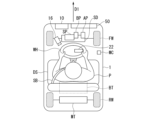
図2は、移動体1を上方から見た透視図である。図中、FWは操舵輪、RWは駆動輪、SDは操舵装置、MTはモータ、BTはバッテリである。また、APはアクセルペダル、BPはブレーキペダル、WHはステアリングホイール、SPはスピーカ、MCはマイクである。図示する移動体1は一人乗りの移動体であり、乗員Pは運転席DSに着座してシートベルトSBを装着している。矢印D1は移動体1の進行方向(速度ベクトル)である。外界検知デバイス10は移動体1の前端部付近に、内部カメラ16は乗員Pの前方から乗員Pの頭部を撮像可能な位置に、モード切替スイッチ22はステアリングホイールWHのボス部にそれぞれ設けられている。また、移動体1の前端部付近に、ディスプレイ装置としての外部報知装置50が設けられている。
2 is a perspective view of the moving
図1に戻り、記憶装置70は、例えば、HDD(Hard Disk Drive)やフラッシュメモリ、RAM(Random Access Memory)などの非一過性の記憶装置である。記憶装置70には、地図情報72、制御装置100が実行するプログラム74などが格納される。図では記憶装置70を制御装置100の枠外に記載しているが、記憶装置70は制御装置100に含まれるものであってよい。
Returning to FIG. 1, the
[制御装置]
制御装置100は、例えば、取得部110と、道路タイプ認識部120と、連絡部認識部130と、制御部140とを備える。例えば、CPU(Central Processing Unit)などのハードウェアプロセッサがプログラム(ソフトウェア)74を実行することにより実現される。これらの構成要素のうち一部または全部は、LSI(Large Scale Integration)やASIC(Application Specific Integrated Circuit)、FPGA(Field-Programmable Gate Array)、GPU(Graphics Processing Unit)などのハードウェア(回路部;circuitryを含む)によって実現されてもよいし、ソフトウェアとハードウェアの協働によって実現されてもよい。プログラムは、予め記憶装置70に格納されていてもよいし、DVDやCD-ROMなどの着脱可能な記憶媒体(非一過性の記憶媒体)に格納されており、記憶媒体がドライブ装置に装着されることで記憶装置70にインストールされてもよい。
[Control device]
The
取得部110は、移動体1の挙動を示す情報を取得する。移動体1の挙動を示す情報とは、例えば、移動体1の道路幅方向に関する位置、移動量、速度、または加速度、道路の長手方向に関する加速度、あるいはヨーレート等である。図3は、移動体1の挙動に含まれうる要素について説明するための図である。移動体1の道路幅方向に関する位置Yとは、例えば、道路の左右端のいずれかと移動体1の代表点(例えば前端部中心や重心など)M1との距離で表される。図中、Ylが道路の左端(図では車道RWの左端を示す白線CL1)と移動体1の代表点M1との距離、Yrが道路の右端(図では移動体1が居る車線と対向車線とを区画する破線CL2)と移動体1の代表点M1との距離である。以下の説明では道路の左端と移動体1の代表点M1との距離Ylが、移動体1の道路幅方向に関する位置Yとして取得されるものとする。道路区画線の位置が道路の左端や右端として認識されるのに限らず、路肩やガードレール、中央分離帯などが道路の左端や右端として認識されてもよい。
The
取得部110は、例えば、外界検知デバイス10から入力される道路区画線CL1の移動体1の代表点M1に対する距離を、移動体1の道路幅方向に関する位置として取得する。移動体1の道路幅方向に関する移動量ΔYとは、観測期間Δt(後述する基準期間ΔTとは異なるものであってよく、例えば基準期間ΔTよりも短い値である)において道路幅方向のどちらの向きに、どれだけの距離を移動したかを示す情報である。取得部110は、移動体1の道路幅方向に関する位置Yの観測期間の変化に基づいて移動体1の道路幅方向に関する移動量ΔYを求めてもよいし、移動体1の道路幅方向に関する速度VYを積分して移動体1の道路幅方向に関する移動量を求めてもよい。また、取得部110は、移動体センサ12の検出値に基づいて、各方向の速度、加速度、またはヨーレートを取得する。
The
道路タイプ認識部120は、移動体1が車道を移動しているか、歩道を移動しているかを認識する。道路タイプ認識部120は、例えば、外界検知デバイス10の外部カメラが撮像した画像を解析することで、移動体1が車道を移動しているか、歩道を移動しているかを認識する。画像解析の一例として、セマンティックセグメンテーションが挙げられる。道路タイプ認識部120は、画像のフレーム内の各ピクセルをクラス(車道、歩道、境界、障害物など)に分類してラベルを付与し、移動体1の正面に相当する領域に車道のラベルが付与されたピクセルが多い場合に移動体1が車道を移動していることを認識し、画像における移動体1の正面に相当する領域に歩道のラベルが付与されたピクセルが多い場合に移動体1が歩道を移動していることを認識する。これに限らず、道路タイプ認識部120は、画像における移動体1の正面に相当する領域に車両が認識されている場合に移動体1が車道を移動していることを認識し、画像における移動体1の正面に相当する領域に歩行者が認識されている場合に移動体1が歩道を移動していることを認識してもよい。また、道路タイプ認識部120は、画像における移動体1の正面に相当する領域にある路面領域の幅が大きい場合に移動体1が車道を移動していることを認識し、画像における移動体1の正面に相当する領域にある路面領域の幅が小さい場合に移動体1が歩道を移動していることを認識してもよい。また、道路タイプ認識部120は、移動体1の位置情報と地図情報72とを照合し、移動体1が車道を移動しているか、歩道を移動しているかを認識してもよい。この場合の地図情報は、位置座標から歩道と車道が区別できる程度の精度を有している必要がある。「所定領域」が歩道だけで無い場合、道路タイプ認識部120は、路側帯や自転車レーン、公開空地などについても同様の処理を行う。
The road
連絡部認識部130は、移動体の進行方向側における歩道と車道との連絡部の存在を認識する。連絡部とは、歩道と車道との境界部に設けられるものであり、境界部のそれ以外の部分に比して通過することに対する負担が小さい部分をいう。例えば、歩道と車道との境界部に段差が設けられている場合、段差が緩和されている(歩道と車道に対して面一になっていることを含む)部分が連絡部に該当する。図4~図6は、連絡部の形状を例示した図である。図4に示すように、連絡部CPは、例えば、境界部のブロックBKが歩道SWと共に低くなっている部分である。図中、RWは車道を示している。図5に示すように、連絡部CPは、車道RWと歩道SWとの段差を埋める段差解消プレートPTが置かれている部分であってもよい。図6に示すように連絡部CPは、車道RWと歩道SWとの段差を形成しているブロックBKが欠損している部分であってもよい。これら例示した形態の他にも、種々の形態の連絡部CPが想定される。連絡部CPは、道路の中腹部だけでなく交差点等に存在してもよい。連絡部認識部130は、例えば、画像が入力されると連絡部CPの位置を示す情報を出力するように学習された学習済モデルに、外部カメラの撮像した画像を入力することで、連絡部CPの存在を認識する。連絡部認識部130は、LIDARによって斜め下方を走査した結果として得られる段差の形状に基づいて、連絡部CPの存在を認識してもよい。
The
制御部140は、例えば、設定されている運転モードに応じて駆動装置40を制御する。
The
モードAにおいて制御部140は、移動体1が車道を移動する場合、移動体1の前方に存在する物体との距離を一定以上に維持し、移動体1の前方に存在する物体との距離が十分に長い場合は第1速度V1(例えば、十[km/h]以上、数十[km/h]未満の速度)で移動体1が移動するように、駆動装置40を制御する。制御部140は、移動体1が歩道を移動する場合、移動体1の前方に存在する物体との距離を一定以上に維持し、移動体1の前方に存在する物体との距離が十分に長い場合は第2速度V2(例えば、十[km/h]未満の速度)で移動体1が移動するように、駆動装置40を制御する。係る機能は、第1速度V1または第2速度V2を設定速度とした車両のACC(Adaptive Cruise Control)機能と同様のものであり、ACCにおいて用いられている技術を利用することができる。また、モードAにおいて制御部140は、ステアリングホイール等の操作子14の操作量に基づいて操舵輪の操舵角を制御する。係る機能は、パワーステアリング装置の機能と同様のものであり、パワーステアリング装置において用いられている技術を利用することができる。なお操舵に関して電子制御を行わず、移動体1は、操作子14と操舵機構が機械的に連結された操舵装置を有してもよい。
In mode A, the
モードBにおいて制御部140は、移動体1の速度とアクセルペダルまたはブレーキペダルの操作量とに基づいて駆動装置40を制御する。制御部140は、移動体1が車道を移動している場合は第1速度V1を上限速度として駆動装置40を制御し(モードBの場合、上限速度に達した場合は更なる加速指示があっても移動体1を加速させないことを意味する)、移動体1が歩道を移動している場合は第2速度V2を上限速度として駆動装置40を制御する。操舵に関してはモードAと同様である。
In mode B, the
モードCにおいて制御部140は、外界検知デバイス10の出力に基づいて走路と障害物を検出し、走路内で障害物を回避して移動可能な目標軌道を生成し、移動体1が目標軌道に沿って移動するように駆動装置40を制御する。モードCにおいても、制御部140は、移動体1が車道を移動している場合は第1速度V1を上限速度として駆動装置40を制御し、移動体1が歩道を移動している場合は第2速度V2を上限速度として駆動装置40を制御する。なおモードCに関しては本発明の中核をなさないため、これ以上の詳細な説明を省略する。
In mode C, the
[連絡部の存在に応じた制御]
以下、制御部140による連絡部の存在に応じた制御について、モードAから順に説明する。モードAにおいて制御部140は、移動体1が車道を移動しており、連絡部が移動体1から所定範囲内に認識され、且つ移動体1の挙動が所定条件を満たす場合、移動体1の速度を第1速度V1から第2速度V2に近づける。「移動体1の速度を第1速度V1から第2速度V2に近づける」とは、偶々障害物の存在によって移動体1が低速で移動または停止している場合を除き、移動体1を減速させることを意味する。このとき、制御部140は、対話装置20を用いて歩道への進入意図に関して問いかけを行い、肯定的な返答が得られた場合に、移動体1の速度を第2速度V2に近づけ、肯定的な返答が得られなかった場合に、移動体1の速度を第2速度V2に近づけないようにしてもよい。以下、問いかけの有無に関わらず、「移動体1が車道を移動しており、連絡部が移動体1から所定範囲内に認識され、且つ移動体1の挙動が所定条件を満たす場合、移動体1の速度を第1速度V1から第2速度V2に近づける」ことを、「特定速度制御」と称する。
[Control according to the presence of a connecting part]
Hereinafter, the control by the
所定条件とは、移動体1がふらつき状態にあるか否かを判定するための条件である。所定条件は、以下に列挙する条件のうち一部または全部をアンド条件またはオア条件で含む。すなわち、制御部140は、以下の条件(A)~(D)のそれぞれのうち一つが満たされた場合に所定条件が満たされたと判定してもよいし、複数が同時に満たされた場合に所定条件が満たされたと判定してもよい。
The specified conditions are conditions for determining whether the moving
(条件(A))
所定条件は、例えば、基準期間ΔTにおいて、道路幅方向に関する移動量ΔY、速度VY、または加速度αYの方向が反転した回数が、第1閾値Th1以上であることを含む。「反転する」とは向きが逆になることをいう。この所定条件の判定において、移動量ΔY、速度VY、または加速度αYがゼロ近傍で小さく反転した回数に関しては、誤差要因としてカウントしないようにしてもよい。係る条件が満たされる場合、短期間に向きが逆の横移動が何度も発生しているため、車道の交通事情が混雑しており、スムーズな移動が困難になっている、或いは、乗員Pが疲労しているため操舵操作の精度が低下していることが推定される。このため、歩道に進入して移動を継続したいという気持ちが乗員Pに生じる可能性が高いと考えられる。
(Condition (A))
The predetermined condition includes, for example, that the number of times that the direction of the movement amount ΔY, the speed VY, or the acceleration αY in the road width direction is reversed in the reference period ΔT is equal to or greater than the first threshold value Th1. "Reverse" means that the direction is reversed. In determining whether or not the predetermined condition is satisfied, the number of times that the movement amount ΔY, the speed VY, or the acceleration αY is reversed slightly near zero may not be counted as an error factor. If such a condition is satisfied, it is estimated that the traffic situation on the roadway is congested, making smooth movement difficult, or that the accuracy of the steering operation is reduced due to fatigue of the occupant P, since lateral movement in the opposite direction has occurred many times in a short period of time. For this reason, it is considered that the occupant P is likely to feel the desire to enter the sidewalk and continue moving.
(条件(B))
所定条件は、例えば、基準期間ΔTにおいて、車道における歩道に近接する基準領域を移動した時間的または距離的な割合βが第2閾値Th以上であることである。図7は、条件(B)について説明するための図である。図中、Alは基準領域である。本図の例では、距離的な割合として割合βを計算している。移動体1がこのような領域を移動することで、路肩の凹凸によって移動体1に振動などの更なる細かい挙動が生じる可能性が高まる。このため、歩道に進入して移動を継続したいという気持ちが乗員Pに生じる可能性が高いと考えられる。
(Condition (B))
The predetermined condition is, for example, that the time or distance ratio β of the movement through a reference area on the roadway close to the sidewalk during the reference period ΔT is equal to or greater than the second threshold value Th. FIG. 7 is a diagram for explaining the condition (B). In the figure, Al is the reference area. In the example of this figure, the ratio β is calculated as a distance ratio. When the moving
(条件(C))
所定条件は、例えば、基準期間ΔTにおいて、道路長手方向に関する加速度が反転した回数(すなわち加減速の回数)が第3閾値Th3以上であることを含む。係る条件が満たされる場合、車道の交通事情が混雑しており、スムーズな移動が困難になっている、或いは、乗員Pが疲労しているため操舵操作の精度が低下していることが推定される。このため、歩道に進入して移動を継続したいという気持ちが乗員Pに生じる可能性が高いと考えられる。
(Condition (C))
The predetermined condition includes, for example, that the number of times that the acceleration in the longitudinal direction of the road is reversed (i.e., the number of times that the acceleration and deceleration are repeated) is equal to or greater than a third threshold value Th3 during the reference period ΔT. If such a condition is satisfied, it is estimated that the traffic conditions on the roadway are congested, making smooth movement difficult, or that the accuracy of the steering operation is reduced due to fatigue of the occupant P. For this reason, it is considered that the occupant P is likely to feel the desire to enter the sidewalk and continue moving.
(条件(D))
所定条件は、例えば、基準期間において、基準値以上のヨーレートが発生した回数が第4閾値以上であることを含む。係る条件が満たされる場合、短期間に急旋回が何度も発生しているため、車道の交通事情が混雑しており、スムーズな移動が困難になっている、或いは、乗員Pが疲労しているため操舵操作の精度が低下していることが推定される。このため、歩道に進入して移動を継続したいという気持ちが乗員Pに生じる可能性が高いと考えられる。
(Condition (D))
The predetermined condition includes, for example, that the number of times that the yaw rate exceeds the reference value in the reference period is equal to or exceeds a fourth threshold value. If such a condition is satisfied, it is estimated that the vehicle has made many sharp turns in a short period of time, causing traffic congestion on the roadway and making smooth movement difficult, or that the occupant P is fatigued and the accuracy of steering operation is reduced. For this reason, it is considered that the occupant P is likely to feel the desire to enter the sidewalk and continue moving.
図8は、特定速度制御が行われる場面の一例を示す図である。図中、Xは移動体1と連絡部CPとの距離である。距離Xは、例えば、連絡部CPの最も手前側の位置から移動体1の前端部までの距離と定義されるが、これに限らず連絡部CPの中央部から移動体1の重心まで、というように任意に定義されてもよい。距離Xが所定距離以下であり(連絡部CPが移動体1から所定範囲内であることの一例である)、且つ移動体1の挙動が所定条件を満たす場合、特定速度制御が行われる。図においてTJは移動体1の過去の軌跡であり、ふらつきが生じていることを表している。
Figure 8 is a diagram showing an example of a scene where specific speed control is performed. In the figure, X is the distance between the moving
モードBにおいて、制御部140は、移動体1が車道を移動しており、連絡部が移動体1から所定範囲内に認識され、且つ移動体1の挙動が所定条件を満たす場合(更に問いかけによる確認を経てもよい)、移動体1の上限速度を第1速度V1から第2速度V2に徐々に切り替える。これに代えて、モードBにおいて上記の条件を満たす場合、制御部140は、単に、アクセルペダルAPやブレーキペダルBPに対する手動操作によって第2速度V2に近づけるように、対話装置20を用いて提案するに留めてもよい。例えば、制御部140は、「歩道に進入予定ならば減速して下さい」といった音声を対話装置20に出力させる。所定の状態の定義に関してはモードAと同様である。
In mode B, when the moving
図9は、実施形態の制御装置100により実行される処理の流れの一例を示すフローチャートである。本フローチャートの処理は、モードAを前提としている。本フローチャートの処理は、例えば、所定周期で繰り返し実行される。
Figure 9 is a flowchart showing an example of the flow of processing executed by the
まず、道路タイプ認識部120が、移動体1が車道を移動中であるか否か(歩道を移動中であるか)を判定する(ステップS200)。移動体1が車道を移動中であると判定された場合、制御部140は、前述したように移動体1が車道を移動している場合の制御を行う(ステップS202)。続いて、制御部140は、連絡部認識部130の認識結果に基づいて、移動体1の進行方向側の所定範囲内に連絡部CPが存在するか否かを判定する(ステップS206)。移動体1の進行方向側の所定範囲内に連絡部CPが存在すると判定した場合、制御部140は、取得部110から提供される情報に基づいて、移動体1の挙動が所定条件を満たすか否かを判定する(ステップS208)。移動体1の挙動が所定条件を満たす場合と判定した場合、制御部140は、特定速度制御を実行する(ステップS210)。
First, the road
ステップS206またはS208において否定的な判定結果が得られた場合、本フローチャートの1ルーチンの処理が終了する。また、ステップS200において移動体1が歩道を移動していると判定された場合、制御部140は、移動体1が歩道を移動している場合の制御を行う(ステップS204)。
If a negative determination result is obtained in step S206 or S208, the processing of one routine of this flowchart ends. Also, if it is determined in step S200 that the moving
以上説明した第1実施形態によれば、車道と歩道の双方を移動可能な移動体に関して、車道から歩道への進入時において適切な制御を行うことができる。移動体1の挙動が所定条件を満たす場合、上記のように、車道の交通事情が混雑しており、スムーズな移動が困難になっている、或いは、乗員Pが疲労しているため操舵操作の精度が低下していることが推定される。従って、移動体1の挙動が所定条件を満たす場合、接近している連絡部CPにおいて乗員がステアリングホイールWHを操作して移動体1を歩道に進入させる確率が高まっていることが推察される。ところが車道における上限速度ないし目標速度である第1速度V1と、歩道における上限速度ないし目標速度である第2速度V2とでは差があるため、第1速度V1で移動している移動体1が急に歩道に進入した場合、急減速をせざるを得ない場面が生じ得る。また、比較的高い速度である第1速度V1で移動中に、歩道に進入するための旋回が開始されると、大きい横加速度が生じることも懸念される。つまり、実際に操舵が開始されてから減速したのでは遅い可能性がある。
According to the first embodiment described above, it is possible to perform appropriate control when a moving body capable of moving on both the roadway and the sidewalk enters the sidewalk from the roadway. When the behavior of the moving
これに対し、実施形態の制御装置100は、移動体1が車道を移動しており、連絡部CPが移動体1に進行方向における所定範囲内に認識され、且つ移動体1の挙動が所定条件を満たす場合、移動体の速度を第2速度V2に近づけるため、上記の急減速や急旋回が生じるのを抑制することができる。この結果、車道から歩道への進入時において適切な制御を行うことができる。
In response to this, the
<第2実施形態>
以下、第2実施形態について説明する。第2実施形態の制御装置100は、道路タイプ認識部120の機能が第1実施形態と異なる。第2実施形態の道路タイプ認識部120は、例えば、移動体に設けられた道路タイプ入力スイッチ(不図示)に対してなされた乗員の操作に応じて、移動体1が車道を走行しているのか、歩道を走行しているのかを認識する。道路タイプ入力スイッチは、例えば、ステアリングホイールWHのボス部などに設けられる。道路タイプ入力スイッチは、例えば、上下に操作可能であると共に操作された位置を保持する機構を有し、上側に操作されている場合は車道、下側に操作されている場合は歩道を表すものである。また、道路タイプ入力スイッチは、ボタン或いはGUIスイッチの形態であって、制御装置100が車道走行中と認識している状態で操作された場合は歩道走行中の認識に切り替わり、制御装置100が歩道走行中と認識している状態で操作された場合は車道走行中の認識に切り替わるものであってもよい。係る構成によって、移動体1が車道を走行しているのか、歩道を走行しているのかを自動的に認識する機能を省略することができ、処理負荷やコストを軽減することができる。但し、乗員による誤操作の可能性があるため、第2実施形態においては外部報知装置50による外部への情報報知が行われることが望ましい。
Second Embodiment
The second embodiment will be described below. The
<その他>
上記各実施形態において、制御部140は、モードAとモードBのどちらか一方の制御だけ実行するものであってもよい。すなわち、移動体1は、速度アシストモードは実行するが手動モードは実行しないものであってもよく、手動モードは実行するが速度アシストモードは実行しないものであってもよい。また、制御部140は、モードAとモードBの双方の制御を実行するが、特定速度制御についてはモードAまたはモードBのいずれか一方が実行されている場合にのみ行うものであってもよい。いずれの場合も、モードCの制御を実行するかどうかは任意に決定されてよい。
<Other>
In each of the above embodiments, the
上記説明した実施形態は、以下のように表現することができる。
プログラムを記憶した記憶装置と、
ハードウェアプロセッサと、を備え、
前記ハードウェアプロセッサが前記記憶装置に記憶されたプログラムを実行することにより、
一以上の乗員が搭乗し、車道と、車道と異なる所定領域との双方を移動可能な移動体の挙動を示す情報を取得し、
前記移動体が車道を移動しているか、前記所定領域を移動しているかを認識し、
前記移動体の進行方向側における車道と前記所定領域の連絡部の存在を認識し、
前記移動体の速度を少なくとも部分的に制御し、
前記移動体が車道を移動する場合の速度を第1速度に制限し、
前記移動体が前記所定領域を移動する場合の速度を前記第1速度よりも低い第2速度に制限し、
前記移動体が車道を移動しており、前記連絡部が前記移動体から所定範囲内に認識され、且つ前記移動体の挙動が所定条件を満たす場合、前記移動体の速度を前記第2速度に近づけるように構成されており、
前記所定条件は、前記移動体がふらつき状態にあるか否かを判定するための条件である、
移動体の制御装置。
The above-described embodiment can be expressed as follows.
A storage device storing a program;
a hardware processor;
The hardware processor executes the program stored in the storage device,
acquiring information indicating a behavior of a mobile body having one or more occupants on board and capable of moving on both a roadway and a predetermined area different from the roadway;
Recognizing whether the moving object is moving on a roadway or in the predetermined area;
Recognizing the presence of a connecting portion between a roadway in a traveling direction of the moving object and the predetermined area;
at least partially controlling the speed of the moving object;
limiting a speed of the moving body when the moving body moves on a roadway to a first speed;
limiting a speed of the moving body when the moving body moves in the predetermined area to a second speed which is lower than the first speed;
When the moving body is moving on a roadway, the connection unit is recognized within a predetermined range from the moving body, and a behavior of the moving body satisfies a predetermined condition, the speed of the moving body is made to approach the second speed,
The predetermined condition is a condition for determining whether the moving body is in a swaying state.
A control device for a moving object.
上記説明した実施形態は、以下のように表現することもできる。
プログラムを記憶した記憶装置と、
ハードウェアプロセッサと、を備え、
前記ハードウェアプロセッサが前記記憶装置に記憶されたプログラムを実行することにより、
一以上の乗員が搭乗し、車道と、車道と異なる所定領域との双方を移動可能な移動体の挙動を示す情報を取得し、
前記移動体が車道を移動しているか、前記所定領域を移動しているかを認識し、
前記移動体の進行方向側における車道と前記所定領域の連絡部の存在を認識し、
前記移動体の速度を少なくとも部分的に制御し、
前記移動体が車道を移動する場合の速度を第1速度に制限し、
前記移動体が前記所定領域を移動する場合の速度を前記第1速度よりも低い第2速度に制限し、
前記移動体が車道を移動しており、前記連絡部が前記移動体から所定範囲内に認識され、且つ前記移動体の挙動が所定条件を満たす場合、インターフェース装置を用いて前記乗員に減速を提案するように構成されており、
前記所定条件は、前記移動体がふらつき状態にあるか否かを判定するための条件である、
移動体の制御装置。
The above-described embodiment can also be expressed as follows.
A storage device storing a program;
a hardware processor;
The hardware processor executes the program stored in the storage device,
acquiring information indicating a behavior of a mobile body having one or more occupants on board and capable of moving on both a roadway and a predetermined area different from the roadway;
Recognizing whether the moving object is moving on a roadway or in the predetermined area;
Recognizing the presence of a connecting portion between a roadway in a traveling direction of the moving object and the predetermined area;
at least partially controlling the speed of the moving object;
limiting a speed of the moving body when the moving body moves on a roadway to a first speed;
limiting a speed of the moving body when the moving body moves in the predetermined area to a second speed which is lower than the first speed;
when the moving body is moving on a roadway, the connection unit is recognized within a predetermined range from the moving body, and a behavior of the moving body satisfies a predetermined condition, the interface device is configured to suggest to the occupant to decelerate,
The predetermined condition is a condition for determining whether the moving body is in a swaying state.
A control device for a moving object.
以上、本発明を実施するための形態について実施形態を用いて説明したが、本発明はこうした実施形態に何等限定されるものではなく、本発明の要旨を逸脱しない範囲内において種々の変形及び置換を加えることができる。 The above describes the form for carrying out the present invention using an embodiment, but the present invention is not limited to such an embodiment, and various modifications and substitutions can be made without departing from the spirit of the present invention.
10 外界検知デバイス
12 移動体センサ
14 操作子
16 内部カメラ
18 測位装置
20 対話装置
22 モード切替スイッチ
30 移動機構
40 駆動装置
50 外部報知装置
70 記憶装置
100 制御装置
110 取得部
120 道路タイプ認識部
130 連絡部認識部
140 制御部
REFERENCE SIGNS
Claims (14)
前記移動体の挙動を示す情報を取得する取得部と、
前記移動体が車道を移動しているか、前記所定領域を移動しているかを認識する道路タイプ認識部と、
前記移動体の進行方向側における車道と前記所定領域の連絡部の存在を認識する連絡部認識部と、
前記移動体の速度を少なくとも部分的に制御する制御部であって、前記移動体が車道を移動する場合の速度を第1速度に制限し、前記移動体が前記所定領域を移動する場合の速度を前記第1速度よりも低い第2速度に制限する制御部と、
を備え、
前記制御部は、前記移動体が車道を移動しており、前記連絡部が前記移動体から所定範囲内に認識され、且つ前記移動体の挙動が、前記移動体がふらつき状態にあるか否かを判定するための条件を満たす場合、前記移動体の速度を前記第2速度に近づける、
移動体の制御装置。 A control device for a moving body capable of carrying one or more occupants and moving on both a roadway and a predetermined area different from the roadway,
An acquisition unit that acquires information indicating a behavior of the moving object;
a road type recognition unit that recognizes whether the moving object is moving on a roadway or in the predetermined area;
a connection recognition unit that recognizes the presence of a connection between a roadway in a traveling direction of the moving object and the predetermined area;
a control unit that at least partially controls the speed of the moving body, the control unit limiting the speed of the moving body when moving on a roadway to a first speed and limiting the speed of the moving body when moving in the specified area to a second speed lower than the first speed;
Equipped with
the control unit, when the moving body is moving on a roadway, the communication unit is recognized within a predetermined range from the moving body, and a behavior of the moving body satisfies a condition for determining whether the moving body is in a swaying state , causes a speed of the moving body to approach the second speed.
A control device for a moving object.
請求項1記載の移動体の制御装置。 the control unit, when the moving object is moving on a roadway, the communication unit is recognized within a predetermined range from the moving object, and the behavior of the moving object satisfies the condition, uses an interface device to inquire about an intention to enter the predetermined area, and when an affirmative response is obtained, causes the speed of the moving object to approach the second speed.
The control device for a moving object according to claim 1 .
前記移動体の挙動を示す情報を取得する取得部と、
前記移動体が車道を移動しているか、前記所定領域を移動しているかを認識する道路タイプ認識部と、
前記移動体の進行方向側における車道と前記所定領域の連絡部の存在を認識する連絡部認識部と、
前記移動体の速度を少なくとも部分的に制御する制御部であって、前記移動体が車道を移動する場合の速度を第1速度に制限し、前記移動体が前記所定領域を移動する場合の速度を前記第1速度よりも低い第2速度に制限する制御部と、
を備え、
前記取得部は、前記移動体の道路幅方向に関する移動量、速度、または加速度を、前記移動体の挙動を示す情報として取得し、
前記制御部は、前記移動体が車道を移動しており、前記連絡部が前記移動体から所定範囲内に認識され、且つ前記移動体の挙動が、基準期間において、道路幅方向に関する前記移動量、速度、または加速度の方向が反転した回数が第1閾値以上となる挙動である場合、前記移動体の速度を前記第2速度に近づける、
移動体の制御装置。 A control device for a moving body capable of carrying one or more occupants and moving on both a roadway and a predetermined area different from the roadway,
An acquisition unit that acquires information indicating a behavior of the moving object;
a road type recognition unit that recognizes whether the moving object is moving on a roadway or in the predetermined area;
a connection recognition unit that recognizes the presence of a connection between a roadway in a traveling direction of the moving object and the predetermined area;
a control unit that at least partially controls the speed of the moving body, the control unit limiting the speed of the moving body when moving on a roadway to a first speed and limiting the speed of the moving body when moving in the specified area to a second speed lower than the first speed;
Equipped with
The acquisition unit acquires a movement amount, a speed, or an acceleration of the moving object in a road width direction as information indicating a behavior of the moving object,
the control unit, when the moving body is moving on a roadway, the communication unit is recognized within a predetermined range from the moving body, and the behavior of the moving body is such that the number of times the direction of the movement amount, the speed, or the acceleration in the road width direction is reversed in a reference period is equal to or greater than a first threshold value , causes the speed of the moving body to approach the second speed;
A control device for a moving object.
前記移動体の挙動を示す情報を取得する取得部と、
前記移動体が車道を移動しているか、前記所定領域を移動しているかを認識する道路タイプ認識部と、
前記移動体の進行方向側における車道と前記所定領域の連絡部の存在を認識する連絡部認識部と、
前記移動体の速度を少なくとも部分的に制御する制御部であって、前記移動体が車道を移動する場合の速度を第1速度に制限し、前記移動体が前記所定領域を移動する場合の速度を前記第1速度よりも低い第2速度に制限する制御部と、
を備え、
前記取得部は、前記移動体の道路幅方向に関する位置を、前記移動体の挙動を示す情報として取得し、
前記制御部は、前記移動体が車道を移動しており、前記連絡部が前記移動体から所定範囲内に認識され、且つ前記移動体の挙動が、基準期間において、前記車道における前記所定領域に近接する基準領域を移動した時間的または距離的な割合が第2閾値以上となる挙動である場合、前記移動体の速度を前記第2速度に近づける、
移動体の制御装置。 A control device for a moving body capable of carrying one or more occupants and moving on both a roadway and a predetermined area different from the roadway,
An acquisition unit that acquires information indicating a behavior of the moving object;
a road type recognition unit that recognizes whether the moving object is moving on a roadway or in the predetermined area;
a connection recognition unit that recognizes the presence of a connection between a roadway in a traveling direction of the moving object and the predetermined area;
a control unit that at least partially controls the speed of the moving body, the control unit limiting the speed of the moving body when moving on a roadway to a first speed and limiting the speed of the moving body when moving in the specified area to a second speed lower than the first speed;
Equipped with
The acquisition unit acquires a position of the moving object in a road width direction as information indicating a behavior of the moving object,
the control unit, when the moving object is moving on a roadway, the communication unit is recognized within a predetermined range from the moving object, and the behavior of the moving object is such that a time or distance ratio of the moving object moving through a reference area adjacent to the predetermined area on the roadway during a reference period is equal to or greater than a second threshold value , causes the speed of the moving object to approach the second speed.
A control device for a moving object.
前記移動体の挙動を示す情報を取得する取得部と、
前記移動体が車道を移動しているか、前記所定領域を移動しているかを認識する道路タイプ認識部と、
前記移動体の進行方向側における車道と前記所定領域の連絡部の存在を認識する連絡部認識部と、
前記移動体の速度を少なくとも部分的に制御する制御部であって、前記移動体が車道を移動する場合の速度を第1速度に制限し、前記移動体が前記所定領域を移動する場合の速度を前記第1速度よりも低い第2速度に制限する制御部と、
を備え、
前記取得部は、前記移動体の道路長手方向に関する加速度を、前記移動体の挙動を示す情報として取得し、
前記制御部は、前記移動体が車道を移動しており、前記連絡部が前記移動体から所定範囲内に認識され、且つ前記移動体の挙動が、基準期間において、道路長手方向に関する加速度が反転した回数が第3閾値以上となる挙動である場合、前記移動体の速度を前記第2速度に近づける、
移動体の制御装置。 A control device for a moving body capable of carrying one or more occupants and moving on both a roadway and a predetermined area different from the roadway,
An acquisition unit that acquires information indicating a behavior of the moving object;
a road type recognition unit that recognizes whether the moving object is moving on a roadway or in the predetermined area;
a connection recognition unit that recognizes the presence of a connection between a roadway in a traveling direction of the moving object and the predetermined area;
a control unit that at least partially controls the speed of the moving body, the control unit limiting the speed of the moving body when moving on a roadway to a first speed and limiting the speed of the moving body when moving in the specified area to a second speed lower than the first speed;
Equipped with
The acquisition unit acquires an acceleration of the moving body in a longitudinal direction of a road as information indicating a behavior of the moving body,
the control unit, when the moving body is moving on a roadway, the connection unit is recognized within a predetermined range from the moving body, and the behavior of the moving body is such that the number of times that acceleration in a road longitudinal direction is reversed during a reference period is equal to or greater than a third threshold , causes the speed of the moving body to approach the second speed.
A control device for a moving object.
前記移動体の挙動を示す情報を取得する取得部と、
前記移動体が車道を移動しているか、前記所定領域を移動しているかを認識する道路タイプ認識部と、
前記移動体の進行方向側における車道と前記所定領域の連絡部の存在を認識する連絡部認識部と、
前記移動体の速度を少なくとも部分的に制御する制御部であって、前記移動体が車道を移動する場合の速度を第1速度に制限し、前記移動体が前記所定領域を移動する場合の速度を前記第1速度よりも低い第2速度に制限する制御部と、
を備え、
前記取得部は、前記移動体のヨーレートを、前記移動体の挙動を示す情報として取得し、
前記制御部は、前記移動体が車道を移動しており、前記連絡部が前記移動体から所定範囲内に認識され、且つ前記移動体の挙動が、基準期間において、基準値以上のヨーレートが発生した回数が第4閾値以上となる挙動である場合、前記移動体の速度を前記第2速度に近づける、
移動体の制御装置。 A control device for a moving body capable of carrying one or more occupants and moving on both a roadway and a predetermined area different from the roadway, comprising:
An acquisition unit that acquires information indicating a behavior of the moving object;
a road type recognition unit that recognizes whether the moving object is moving on a roadway or in the predetermined area;
a connection recognition unit that recognizes the presence of a connection between a roadway in a traveling direction of the moving object and the predetermined area;
a control unit that at least partially controls the speed of the moving body, the control unit limiting the speed of the moving body when moving on a roadway to a first speed and limiting the speed of the moving body when moving in the specified area to a second speed lower than the first speed;
Equipped with
The acquisition unit acquires a yaw rate of the moving body as information indicating a behavior of the moving body,
the control unit, when the moving body is moving on a roadway, the communication unit is recognized within a predetermined range from the moving body, and the behavior of the moving body is a behavior in which the number of times a yaw rate equal to or greater than a reference value occurs during a reference period is equal to or greater than a fourth threshold value , causes the speed of the moving body to approach the second speed.
A control device for a moving object.
請求項1から6のうちいずれか1項記載の制御装置。 The road type recognition unit recognizes whether the moving object is moving on a roadway or in the predetermined area based on an output of an external environment detection device that detects an external situation of the moving object.
A control device according to any one of claims 1 to 6 .
請求項1から7のうちいずれか1項記載の制御装置。 the road type recognition unit recognizes whether the moving body is moving on a roadway or in the predetermined area based on an operation of a switch provided inside the moving body by the occupant.
A control device according to any one of claims 1 to 7 .
請求項1から8のうちいずれか1項記載の制御装置。 When the road type recognition unit recognizes that the moving object is moving in the predetermined area, the road type recognition unit causes an external notification device to notify outside the moving object that the moving object is moving in the predetermined area.
A control device according to any one of claims 1 to 8 .
前記移動体の挙動を示す情報を取得し、
前記移動体が車道を移動しているか、前記所定領域を移動しているかを認識し、
前記移動体の進行方向側における車道と前記所定領域の連絡部の存在を認識し、
前記移動体の速度を少なくとも部分的に制御し、
前記移動体が車道を移動する場合の速度を第1速度に制限し、
前記移動体が前記所定領域を移動する場合の速度を前記第1速度よりも低い第2速度に制限し、
前記移動体が車道を移動しており、前記連絡部が前記移動体から所定範囲内に認識され、且つ前記移動体の挙動が、前記移動体がふらつき状態にあるか否かを判定するための条件を満たす場合、前記移動体の速度を前記第2速度に近づける、
移動体の制御方法。 A computer controls a mobile body that has one or more occupants on board and is capable of moving on both a roadway and a predetermined area different from the roadway,
acquiring information indicating a behavior of the moving object;
Recognizing whether the moving object is moving on a roadway or in the predetermined area;
Recognizing the presence of a connecting portion between a roadway in a traveling direction of the moving object and the predetermined area;
at least partially controlling the speed of the moving object;
limiting a speed of the moving body when the moving body moves on a roadway to a first speed;
limiting a speed of the moving body when the moving body moves in the predetermined area to a second speed which is lower than the first speed;
when the moving body is moving on a roadway, the connection unit is recognized within a predetermined range from the moving body, and the behavior of the moving body satisfies a condition for determining whether the moving body is in a swaying state , the speed of the moving body is brought closer to the second speed.
A method for controlling a moving object.
前記移動体の挙動を示す情報を取得させ、
前記移動体が車道を移動しているか、前記所定領域を移動しているかを認識させ、
前記移動体の進行方向側における車道と前記所定領域の連絡部の存在を認識させ、
前記移動体の速度を少なくとも部分的に制御させ、
前記移動体が車道を移動する場合の速度を第1速度に制限させ、
前記移動体が前記所定領域を移動する場合の速度を前記第1速度よりも低い第2速度に制限させ、
前記移動体が車道を移動しており、前記連絡部が前記移動体から所定範囲内に認識され、且つ前記移動体の挙動が、前記移動体がふらつき状態にあるか否かを判定するための条件を満たす場合、前記移動体の速度を前記第2速度に近づけさせる、
プログラム。 A computer controls a mobile body that has one or more occupants on board and can move on both a roadway and a predetermined area different from the roadway,
acquiring information indicating a behavior of the moving object;
Recognizing whether the moving object is moving on a roadway or in the predetermined area;
The vehicle is made to recognize the presence of a connecting portion between a roadway in a traveling direction of the vehicle and the predetermined area,
at least partially controlling the speed of the moving object;
limiting the speed of the moving body when moving on a roadway to a first speed;
limiting the speed of the moving body when it moves within the predetermined area to a second speed which is lower than the first speed;
when the moving body is moving on a roadway, the communication unit is recognized within a predetermined range from the moving body, and the behavior of the moving body satisfies a condition for determining whether the moving body is in a swaying state , the speed of the moving body is made to approach the second speed.
program.
前記移動体の挙動を示す情報を取得する取得部と、
前記移動体が車道を移動しているか、前記所定領域を移動しているかを認識する道路タイプ認識部と、
前記移動体の進行方向側における車道と前記所定領域の連絡部の存在を認識する連絡部認識部と、
前記移動体の速度を少なくとも部分的に制御する制御部であって、前記移動体が車道を移動する場合の速度を第1速度に制限し、前記移動体が前記所定領域を移動する場合の速度を前記第1速度よりも低い第2速度に制限する制御部と、
を備え、
前記制御部は、前記移動体が車道を移動しており、前記連絡部が前記移動体から所定範囲内に認識され、且つ前記移動体の挙動が、前記移動体がふらつき状態にあるか否かを判定するための条件を満たす場合、インターフェース装置を用いて前記乗員に減速を提案する、
移動体の制御装置。 A control device for a moving body capable of carrying one or more occupants and moving on both a roadway and a predetermined area different from the roadway, comprising:
An acquisition unit that acquires information indicating a behavior of the moving object;
a road type recognition unit that recognizes whether the moving object is moving on a roadway or in the predetermined area;
a connection recognition unit that recognizes the presence of a connection between a roadway in a traveling direction of the moving object and the predetermined area;
a control unit that at least partially controls the speed of the moving body, the control unit limiting the speed of the moving body when moving on a roadway to a first speed and limiting the speed of the moving body when moving in the specified area to a second speed lower than the first speed;
Equipped with
the control unit, when the moving body is moving on a roadway, the communication unit is recognized within a predetermined range from the moving body, and the behavior of the moving body satisfies a condition for determining whether the moving body is in a swaying state , suggests to the occupant to decelerate using an interface device.
A control device for a moving object.
前記移動体の挙動を示す情報を取得し、
前記移動体が車道を移動しているか、前記所定領域を移動しているかを認識し、
前記移動体の進行方向側における車道と前記所定領域の連絡部の存在を認識し、
前記移動体の速度を少なくとも部分的に制御し、
前記移動体が車道を移動する場合の速度を第1速度に制限し、
前記移動体が前記所定領域を移動する場合の速度を前記第1速度よりも低い第2速度に制限し、
前記移動体が車道を移動しており、前記連絡部が前記移動体から所定範囲内に認識され、且つ前記移動体の挙動が、前記移動体がふらつき状態にあるか否かを判定するための条件を満たす場合、インターフェース装置を用いて前記乗員に減速を提案する、
移動体の制御方法。 A computer controls a mobile body that has one or more occupants on board and is capable of moving on both a roadway and a predetermined area different from the roadway,
acquiring information indicating a behavior of the moving object;
Recognizing whether the moving object is moving on a roadway or in the predetermined area;
Recognizing the presence of a connecting portion between a roadway in a traveling direction of the moving object and the predetermined area;
at least partially controlling the speed of the moving object;
limiting a speed of the moving body when the moving body moves on a roadway to a first speed;
limiting a speed of the moving body when the moving body moves in the predetermined area to a second speed which is lower than the first speed;
when the moving body is moving on a roadway, the connection unit is recognized within a predetermined range from the moving body, and the behavior of the moving body satisfies a condition for determining whether the moving body is in a swaying state , suggesting to the occupant to decelerate using an interface device;
A method for controlling a moving object.
前記移動体の挙動を示す情報を取得させ、
前記移動体が車道を移動しているか、前記所定領域を移動しているかを認識させ、
前記移動体の進行方向側における車道と前記所定領域の連絡部の存在を認識させ、
前記移動体の速度を少なくとも部分的に制御させ、
前記移動体が車道を移動する場合の速度を第1速度に制限させ、
前記移動体が前記所定領域を移動する場合の速度を前記第1速度よりも低い第2速度に制限させ、
前記移動体が車道を移動しており、前記連絡部が前記移動体から所定範囲内に認識され、且つ前記移動体の挙動が、前記移動体がふらつき状態にあるか否かを判定するための条件を満たす場合、インターフェース装置を用いて前記乗員に減速を提案させる、
プログラム。 A computer controls a mobile body that has one or more occupants on board and can move on both a roadway and a predetermined area different from the roadway,
acquiring information indicating a behavior of the moving object;
Recognizing whether the moving object is moving on a roadway or in the predetermined area;
The vehicle is made to recognize the presence of a connecting portion between a roadway in a traveling direction of the vehicle and the predetermined area,
at least partially controlling the speed of the moving object;
limiting the speed of the moving body when moving on a roadway to a first speed;
limiting the speed of the moving body when it moves within the predetermined area to a second speed which is lower than the first speed;
when the moving body is moving on a roadway, the connection unit is recognized within a predetermined range from the moving body, and the behavior of the moving body satisfies a condition for determining whether the moving body is in a swaying state , the interface device is used to suggest to the occupant to decelerate.
program.
Priority Applications (4)
| Application Number | Priority Date | Filing Date | Title |
|---|---|---|---|
| JP2021056994A JP7575331B2 (en) | 2021-03-30 | 2021-03-30 | MOBILE BODY CONTROL DEVICE, MOBILE BODY CONTROL METHOD, AND PROGRAM |
| CN202210154478.4A CN115214712A (en) | 2021-03-30 | 2022-02-18 | Control device for moving body, control method for moving body, and storage medium |
| US17/701,728 US12403903B2 (en) | 2021-03-30 | 2022-03-23 | Mobile object control device and mobile object control method |
| JP2024181793A JP7770510B2 (en) | 2021-03-30 | 2024-10-17 | MOBILE BODY CONTROL DEVICE, MOBILE BODY CONTROL METHOD, AND PROGRAM |
Applications Claiming Priority (1)
| Application Number | Priority Date | Filing Date | Title |
|---|---|---|---|
| JP2021056994A JP7575331B2 (en) | 2021-03-30 | 2021-03-30 | MOBILE BODY CONTROL DEVICE, MOBILE BODY CONTROL METHOD, AND PROGRAM |
Related Child Applications (1)
| Application Number | Title | Priority Date | Filing Date |
|---|---|---|---|
| JP2024181793A Division JP7770510B2 (en) | 2021-03-30 | 2024-10-17 | MOBILE BODY CONTROL DEVICE, MOBILE BODY CONTROL METHOD, AND PROGRAM |
Publications (2)
| Publication Number | Publication Date |
|---|---|
| JP2022154110A JP2022154110A (en) | 2022-10-13 |
| JP7575331B2 true JP7575331B2 (en) | 2024-10-29 |
Family
ID=83450452
Family Applications (2)
| Application Number | Title | Priority Date | Filing Date |
|---|---|---|---|
| JP2021056994A Active JP7575331B2 (en) | 2021-03-30 | 2021-03-30 | MOBILE BODY CONTROL DEVICE, MOBILE BODY CONTROL METHOD, AND PROGRAM |
| JP2024181793A Active JP7770510B2 (en) | 2021-03-30 | 2024-10-17 | MOBILE BODY CONTROL DEVICE, MOBILE BODY CONTROL METHOD, AND PROGRAM |
Family Applications After (1)
| Application Number | Title | Priority Date | Filing Date |
|---|---|---|---|
| JP2024181793A Active JP7770510B2 (en) | 2021-03-30 | 2024-10-17 | MOBILE BODY CONTROL DEVICE, MOBILE BODY CONTROL METHOD, AND PROGRAM |
Country Status (3)
| Country | Link |
|---|---|
| US (1) | US12403903B2 (en) |
| JP (2) | JP7575331B2 (en) |
| CN (1) | CN115214712A (en) |
Families Citing this family (3)
| Publication number | Priority date | Publication date | Assignee | Title |
|---|---|---|---|---|
| JP7575331B2 (en) * | 2021-03-30 | 2024-10-29 | 本田技研工業株式会社 | MOBILE BODY CONTROL DEVICE, MOBILE BODY CONTROL METHOD, AND PROGRAM |
| JP7575330B2 (en) * | 2021-03-30 | 2024-10-29 | 本田技研工業株式会社 | MOBILE BODY CONTROL DEVICE, MOBILE BODY CONTROL METHOD, AND PROGRAM |
| CN118973885A (en) * | 2022-03-30 | 2024-11-15 | 本田技研工业株式会社 | Control device of mobile object, control method of mobile object and storage medium |
Citations (7)
| Publication number | Priority date | Publication date | Assignee | Title |
|---|---|---|---|---|
| JP2009089758A (en) | 2007-10-04 | 2009-04-30 | Honda Motor Co Ltd | Small electric vehicle |
| JP2016212120A (en) | 2016-08-31 | 2016-12-15 | 英和 藤川 | Navigation system |
| JP2017100490A (en) | 2015-11-30 | 2017-06-08 | パイオニア株式会社 | Speed control device |
| WO2018134863A1 (en) | 2017-01-17 | 2018-07-26 | 株式会社日立製作所 | Travel control device for moving body |
| JP2020027459A (en) | 2018-08-13 | 2020-02-20 | 株式会社Subaru | Automatic driving support device |
| JP2020121573A (en) | 2019-01-29 | 2020-08-13 | トヨタ自動車株式会社 | Vehicle running control device |
| JP2020185889A (en) | 2019-05-15 | 2020-11-19 | アルパイン株式会社 | Electronic device and moving body mounted with the same |
Family Cites Families (12)
| Publication number | Priority date | Publication date | Assignee | Title |
|---|---|---|---|---|
| JP6921692B2 (en) * | 2017-09-19 | 2021-08-18 | 本田技研工業株式会社 | Vehicle control devices, vehicle control methods, and programs |
| JP2019168965A (en) * | 2018-03-23 | 2019-10-03 | パナソニックIpマネジメント株式会社 | Vehicle and automatic operation control device |
| WO2019241565A1 (en) * | 2018-06-13 | 2019-12-19 | Skip Transport, Inc. | System and method for vehicle operation control |
| US10915762B1 (en) * | 2018-12-07 | 2021-02-09 | Waymo Llc | Sidewalk detection for pedestrian behavior modeling |
| US20210165404A1 (en) * | 2019-03-05 | 2021-06-03 | Carla R. Gillett | Autonomous scooter system |
| JP7165093B2 (en) * | 2019-03-29 | 2022-11-02 | 本田技研工業株式会社 | vehicle control system |
| JP7336876B2 (en) | 2019-05-21 | 2023-09-01 | 本田技研工業株式会社 | electric vehicle |
| US11797089B2 (en) * | 2019-07-29 | 2023-10-24 | Lyft, Inc. | Systems and methods for sidewalk detection for personal mobility vehicles |
| JP7094254B2 (en) | 2019-09-17 | 2022-07-01 | 本田技研工業株式会社 | Vehicle control system |
| IL295244A (en) * | 2020-02-11 | 2022-10-01 | Fantasmo Studio Inc | Systems and methods for spatial micromobile applications |
| JP7414612B2 (en) * | 2020-03-26 | 2024-01-16 | 本田技研工業株式会社 | Vehicle control device, vehicle control method, and program |
| JP7575331B2 (en) | 2021-03-30 | 2024-10-29 | 本田技研工業株式会社 | MOBILE BODY CONTROL DEVICE, MOBILE BODY CONTROL METHOD, AND PROGRAM |
-
2021
- 2021-03-30 JP JP2021056994A patent/JP7575331B2/en active Active
-
2022
- 2022-02-18 CN CN202210154478.4A patent/CN115214712A/en active Pending
- 2022-03-23 US US17/701,728 patent/US12403903B2/en active Active
-
2024
- 2024-10-17 JP JP2024181793A patent/JP7770510B2/en active Active
Patent Citations (7)
| Publication number | Priority date | Publication date | Assignee | Title |
|---|---|---|---|---|
| JP2009089758A (en) | 2007-10-04 | 2009-04-30 | Honda Motor Co Ltd | Small electric vehicle |
| JP2017100490A (en) | 2015-11-30 | 2017-06-08 | パイオニア株式会社 | Speed control device |
| JP2016212120A (en) | 2016-08-31 | 2016-12-15 | 英和 藤川 | Navigation system |
| WO2018134863A1 (en) | 2017-01-17 | 2018-07-26 | 株式会社日立製作所 | Travel control device for moving body |
| JP2020027459A (en) | 2018-08-13 | 2020-02-20 | 株式会社Subaru | Automatic driving support device |
| JP2020121573A (en) | 2019-01-29 | 2020-08-13 | トヨタ自動車株式会社 | Vehicle running control device |
| JP2020185889A (en) | 2019-05-15 | 2020-11-19 | アルパイン株式会社 | Electronic device and moving body mounted with the same |
Also Published As
| Publication number | Publication date |
|---|---|
| US12403903B2 (en) | 2025-09-02 |
| JP2022154110A (en) | 2022-10-13 |
| CN115214712A (en) | 2022-10-21 |
| JP7770510B2 (en) | 2025-11-14 |
| JP2025003496A (en) | 2025-01-09 |
| US20220314987A1 (en) | 2022-10-06 |
Similar Documents
| Publication | Publication Date | Title |
|---|---|---|
| JP7770510B2 (en) | MOBILE BODY CONTROL DEVICE, MOBILE BODY CONTROL METHOD, AND PROGRAM | |
| JP7688220B2 (en) | MOBILE BODY CONTROL DEVICE, MOBILE BODY CONTROL METHOD, AND STORAGE MEDIUM | |
| US20250162604A1 (en) | Mobile object control device and mobile object control method | |
| JP2025003503A (en) | MOBILE BODY CONTROL DEVICE, MOBILE BODY CONTROL METHOD, AND PROGRAM | |
| JP7710604B2 (en) | MOBILE BODY CONTROL DEVICE, MOBILE BODY CONTROL METHOD, AND STORAGE ME | |
| US12221129B2 (en) | Control device, control method, and storage medium | |
| JP7575330B2 (en) | MOBILE BODY CONTROL DEVICE, MOBILE BODY CONTROL METHOD, AND PROGRAM | |
| JP7774712B2 (en) | MOBILE BODY CONTROL DEVICE, MOBILE BODY CONTROL METHOD, AND STORAGE MEDIUM | |
| JP7676657B2 (en) | MOBILE BODY CONTROL DEVICE, MOBILE BODY CONTROL METHOD, AND PROGRAM | |
| JP7770224B2 (en) | MOBILE BODY CONTROL DEVICE, MOBILE BODY CONTROL METHOD, AND STORAGE MEDIUM | |
| JP7714122B2 (en) | MOBILE BODY CONTROL DEVICE, MOBILE BODY CONTROL METHOD, AND STORAGE MEDIUM | |
| JP7638440B2 (en) | MOBILE BODY CONTROL DEVICE, MOBILE BODY CONTROL METHOD, AND PROGRAM | |
| EP4502981A1 (en) | Apparatus for controlling mobile body and method for controlling mobile body | |
| WO2023188090A1 (en) | Moving body control device, method for controlling moving body, and storage medium |
Legal Events
| Date | Code | Title | Description |
|---|---|---|---|
| A621 | Written request for application examination |
Free format text: JAPANESE INTERMEDIATE CODE: A621 Effective date: 20231128 |
|
| A131 | Notification of reasons for refusal |
Free format text: JAPANESE INTERMEDIATE CODE: A131 Effective date: 20240521 |
|
| A977 | Report on retrieval |
Free format text: JAPANESE INTERMEDIATE CODE: A971007 Effective date: 20240522 |
|
| A521 | Request for written amendment filed |
Free format text: JAPANESE INTERMEDIATE CODE: A523 Effective date: 20240719 |
|
| TRDD | Decision of grant or rejection written | ||
| A01 | Written decision to grant a patent or to grant a registration (utility model) |
Free format text: JAPANESE INTERMEDIATE CODE: A01 Effective date: 20240917 |
|
| A61 | First payment of annual fees (during grant procedure) |
Free format text: JAPANESE INTERMEDIATE CODE: A61 Effective date: 20241017 |
|
| R150 | Certificate of patent or registration of utility model |
Ref document number: 7575331 Country of ref document: JP Free format text: JAPANESE INTERMEDIATE CODE: R150 |