JP7547590B2 - Encoder, decoder, method, and video bitstream for hybrid video coding, and computer program product - Google Patents
Encoder, decoder, method, and video bitstream for hybrid video coding, and computer program product Download PDFInfo
- Publication number
- JP7547590B2 JP7547590B2 JP2023165020A JP2023165020A JP7547590B2 JP 7547590 B2 JP7547590 B2 JP 7547590B2 JP 2023165020 A JP2023165020 A JP 2023165020A JP 2023165020 A JP2023165020 A JP 2023165020A JP 7547590 B2 JP7547590 B2 JP 7547590B2
- Authority
- JP
- Japan
- Prior art keywords
- video sequence
- processing scheme
- motion vector
- syntax elements
- video
- Prior art date
- Legal status (The legal status is an assumption and is not a legal conclusion. Google has not performed a legal analysis and makes no representation as to the accuracy of the status listed.)
- Active
Links
Images






Classifications
-
- H—ELECTRICITY
- H04—ELECTRIC COMMUNICATION TECHNIQUE
- H04N—PICTORIAL COMMUNICATION, e.g. TELEVISION
- H04N19/00—Methods or arrangements for coding, decoding, compressing or decompressing digital video signals
- H04N19/10—Methods or arrangements for coding, decoding, compressing or decompressing digital video signals using adaptive coding
- H04N19/102—Methods or arrangements for coding, decoding, compressing or decompressing digital video signals using adaptive coding characterised by the element, parameter or selection affected or controlled by the adaptive coding
- H04N19/117—Filters, e.g. for pre-processing or post-processing
-
- H—ELECTRICITY
- H04—ELECTRIC COMMUNICATION TECHNIQUE
- H04N—PICTORIAL COMMUNICATION, e.g. TELEVISION
- H04N19/00—Methods or arrangements for coding, decoding, compressing or decompressing digital video signals
- H04N19/10—Methods or arrangements for coding, decoding, compressing or decompressing digital video signals using adaptive coding
- H04N19/102—Methods or arrangements for coding, decoding, compressing or decompressing digital video signals using adaptive coding characterised by the element, parameter or selection affected or controlled by the adaptive coding
- H04N19/132—Sampling, masking or truncation of coding units, e.g. adaptive resampling, frame skipping, frame interpolation or high-frequency transform coefficient masking
-
- H—ELECTRICITY
- H04—ELECTRIC COMMUNICATION TECHNIQUE
- H04N—PICTORIAL COMMUNICATION, e.g. TELEVISION
- H04N19/00—Methods or arrangements for coding, decoding, compressing or decompressing digital video signals
- H04N19/10—Methods or arrangements for coding, decoding, compressing or decompressing digital video signals using adaptive coding
- H04N19/134—Methods or arrangements for coding, decoding, compressing or decompressing digital video signals using adaptive coding characterised by the element, parameter or criterion affecting or controlling the adaptive coding
-
- H—ELECTRICITY
- H04—ELECTRIC COMMUNICATION TECHNIQUE
- H04N—PICTORIAL COMMUNICATION, e.g. TELEVISION
- H04N19/00—Methods or arrangements for coding, decoding, compressing or decompressing digital video signals
- H04N19/10—Methods or arrangements for coding, decoding, compressing or decompressing digital video signals using adaptive coding
- H04N19/169—Methods or arrangements for coding, decoding, compressing or decompressing digital video signals using adaptive coding characterised by the coding unit, i.e. the structural portion or semantic portion of the video signal being the object or the subject of the adaptive coding
- H04N19/17—Methods or arrangements for coding, decoding, compressing or decompressing digital video signals using adaptive coding characterised by the coding unit, i.e. the structural portion or semantic portion of the video signal being the object or the subject of the adaptive coding the unit being an image region, e.g. an object
- H04N19/176—Methods or arrangements for coding, decoding, compressing or decompressing digital video signals using adaptive coding characterised by the coding unit, i.e. the structural portion or semantic portion of the video signal being the object or the subject of the adaptive coding the unit being an image region, e.g. an object the region being a block, e.g. a macroblock
-
- H—ELECTRICITY
- H04—ELECTRIC COMMUNICATION TECHNIQUE
- H04N—PICTORIAL COMMUNICATION, e.g. TELEVISION
- H04N19/00—Methods or arrangements for coding, decoding, compressing or decompressing digital video signals
- H04N19/10—Methods or arrangements for coding, decoding, compressing or decompressing digital video signals using adaptive coding
- H04N19/169—Methods or arrangements for coding, decoding, compressing or decompressing digital video signals using adaptive coding characterised by the coding unit, i.e. the structural portion or semantic portion of the video signal being the object or the subject of the adaptive coding
- H04N19/184—Methods or arrangements for coding, decoding, compressing or decompressing digital video signals using adaptive coding characterised by the coding unit, i.e. the structural portion or semantic portion of the video signal being the object or the subject of the adaptive coding the unit being bits, e.g. of the compressed video stream
-
- H—ELECTRICITY
- H04—ELECTRIC COMMUNICATION TECHNIQUE
- H04N—PICTORIAL COMMUNICATION, e.g. TELEVISION
- H04N19/00—Methods or arrangements for coding, decoding, compressing or decompressing digital video signals
- H04N19/10—Methods or arrangements for coding, decoding, compressing or decompressing digital video signals using adaptive coding
- H04N19/169—Methods or arrangements for coding, decoding, compressing or decompressing digital video signals using adaptive coding characterised by the coding unit, i.e. the structural portion or semantic portion of the video signal being the object or the subject of the adaptive coding
- H04N19/186—Methods or arrangements for coding, decoding, compressing or decompressing digital video signals using adaptive coding characterised by the coding unit, i.e. the structural portion or semantic portion of the video signal being the object or the subject of the adaptive coding the unit being a colour or a chrominance component
-
- H—ELECTRICITY
- H04—ELECTRIC COMMUNICATION TECHNIQUE
- H04N—PICTORIAL COMMUNICATION, e.g. TELEVISION
- H04N19/00—Methods or arrangements for coding, decoding, compressing or decompressing digital video signals
- H04N19/50—Methods or arrangements for coding, decoding, compressing or decompressing digital video signals using predictive coding
- H04N19/503—Methods or arrangements for coding, decoding, compressing or decompressing digital video signals using predictive coding involving temporal prediction
- H04N19/51—Motion estimation or motion compensation
- H04N19/513—Processing of motion vectors
- H04N19/517—Processing of motion vectors by encoding
- H04N19/52—Processing of motion vectors by encoding by predictive encoding
-
- H—ELECTRICITY
- H04—ELECTRIC COMMUNICATION TECHNIQUE
- H04N—PICTORIAL COMMUNICATION, e.g. TELEVISION
- H04N19/00—Methods or arrangements for coding, decoding, compressing or decompressing digital video signals
- H04N19/50—Methods or arrangements for coding, decoding, compressing or decompressing digital video signals using predictive coding
- H04N19/503—Methods or arrangements for coding, decoding, compressing or decompressing digital video signals using predictive coding involving temporal prediction
- H04N19/51—Motion estimation or motion compensation
- H04N19/523—Motion estimation or motion compensation with sub-pixel accuracy
-
- H—ELECTRICITY
- H04—ELECTRIC COMMUNICATION TECHNIQUE
- H04N—PICTORIAL COMMUNICATION, e.g. TELEVISION
- H04N19/00—Methods or arrangements for coding, decoding, compressing or decompressing digital video signals
- H04N19/50—Methods or arrangements for coding, decoding, compressing or decompressing digital video signals using predictive coding
- H04N19/59—Methods or arrangements for coding, decoding, compressing or decompressing digital video signals using predictive coding involving spatial sub-sampling or interpolation, e.g. alteration of picture size or resolution
-
- H—ELECTRICITY
- H04—ELECTRIC COMMUNICATION TECHNIQUE
- H04N—PICTORIAL COMMUNICATION, e.g. TELEVISION
- H04N19/00—Methods or arrangements for coding, decoding, compressing or decompressing digital video signals
- H04N19/70—Methods or arrangements for coding, decoding, compressing or decompressing digital video signals characterised by syntax aspects related to video coding, e.g. related to compression standards
-
- H—ELECTRICITY
- H04—ELECTRIC COMMUNICATION TECHNIQUE
- H04N—PICTORIAL COMMUNICATION, e.g. TELEVISION
- H04N19/00—Methods or arrangements for coding, decoding, compressing or decompressing digital video signals
- H04N19/80—Details of filtering operations specially adapted for video compression, e.g. for pixel interpolation
- H04N19/82—Details of filtering operations specially adapted for video compression, e.g. for pixel interpolation involving filtering within a prediction loop
Landscapes
- Engineering & Computer Science (AREA)
- Multimedia (AREA)
- Signal Processing (AREA)
- Compression Or Coding Systems Of Tv Signals (AREA)
- Two-Way Televisions, Distribution Of Moving Picture Or The Like (AREA)
- Compression, Expansion, Code Conversion, And Decoders (AREA)
Description
本発明による実施形態は、ハイブリッドビデオコード化用のエンコーダおよびデコーダに関する。本発明によるさらなる実施形態は、ハイブリッドビデオコード化の方法に関する。本発明によるさらなる実施形態は、ハイブリッドビデオコード化のためのビデオビットストリームに関する。 Embodiments according to the invention relate to encoders and decoders for hybrid video coding. Further embodiments according to the invention relate to methods for hybrid video coding. Further embodiments according to the invention relate to video bitstreams for hybrid video coding.
すべての最新のビデオコード化規格は、動きベクトル(MV)の分数サンプル精度を備えた動き補償予測(MCP)を使用する。分数サンプル位置における参照ピクチャのサンプル値を求めるために、補間フィルタが用いられる。 All modern video coding standards use motion compensated prediction (MCP) with fractional sample accuracy of the motion vectors (MV). Interpolation filters are used to find sample values of the reference picture at fractional sample positions.
4分の1ルーマサンプルの動きベクトル精度を使用する高効率ビデオコード化(HEVC)規格では、様々な1次元有限インパルス応答(FIR)フィルタを使用して計算される15個の分数ルーマサンプル位置がある。しかしながら、各分数サンプル位置について、補間フィルタは固定されている。 In the High Efficiency Video Coding (HEVC) standard, which uses a quarter-luma sample motion vector precision, there are 15 fractional luma sample positions that are calculated using various one-dimensional finite impulse response (FIR) filters. However, for each fractional sample position, the interpolation filter is fixed.
また、各分数サンプル位置に対して固定の補間フィルタを有する代わりに、1組の補間フィルタから各分数サンプル位置に対して補間フィルタを選択することも可能である。スライスレベルで異なる補間フィルタ間の切り替えを可能にする手法には、Non-separable Adaptive Interpolation Filter(AIF)[1]、分離可能適応補間フィルタ(SAIF)[2]、Switched Interpolation Filtering with Offset(SIFO)[3]、およびEnhanced Adaptive Interpolation Filter(EAIF)[4]が含まれる。補間フィルタ係数はスライスごとに明示的にシグナリングされる(AIF、SAIF、EAIFなど)か、または(SIFOの場合のように)所定の補間フィルタのセットのうちのどの補間フィルタが使用されるかが示される。 Also, instead of having a fixed interpolation filter for each fractional sample position, it is possible to select an interpolation filter for each fractional sample position from a set of interpolation filters. Techniques that allow switching between different interpolation filters at the slice level include Non-separable Adaptive Interpolation Filter (AIF) [1], Separable Adaptive Interpolation Filter (SAIF) [2], Switched Interpolation Filtering with Offset (SIFO) [3], and Enhanced Adaptive Interpolation Filter (EAIF) [4]. The interpolation filter coefficients are either explicitly signaled per slice (e.g., AIF, SAIF, EAIF), or it is indicated which of a given set of interpolation filters is to be used (as in SIFO).
最新のVersatile Video Coding(VVC)規格[5]の現在のドラフトは、いわゆるAdaptive Motion Vector Resolution(AMVR)をサポートしている。AMVRを使用して、動きベクトル予測子(MVP)と動きベクトル差分(MVD)の両方の精度を、以下の可能性の中から一緒に選択することができる:
-4分の1サンプル(QPEL):4分の1ルーマサンプルの動きベクトル精度、
-フルサンプル(FPEL):ルーマサンプルの動きベクトル精度、
-4サンプル(4PEL):4つのルーマサンプルの動きベクトル精度。
The current draft of the latest Versatile Video Coding (VVC) standard [5] supports the so-called Adaptive Motion Vector Resolution (AMVR), which allows the precision of both the Motion Vector Predictor (MVP) and the Motion Vector Differential (MVD) to be selected jointly among the following possibilities:
-Quarter Sample (QPEL): Quarter luma sample motion vector precision;
- Full Sample (FPEL): motion vector precision in luma samples;
-4 samples (4 PEL): Motion vector precision of 4 luma samples.
所望の精度を選択するために、追加のシンタックス要素がビットストリームで送信される。双予測の場合、示された精度はlist0とlist1の両方に適用される。AMVRはスキップモードおよびマージモードでは利用できない。さらに、すべてのMVDが0に等しい場合、AMVRは利用できない。QPEL以外の精度が使用される場合、MVを得るためにMVDを加算する前に、MVPは最初に指定された精度に丸められる。 An additional syntax element is sent in the bitstream to select the desired precision. In the bi-predictive case, the indicated precision applies to both list0 and list1. AMVR is not available in skip and merge modes. Furthermore, AMVR is not available if all MVDs are equal to 0. If a precision other than QPEL is used, the MVP is first rounded to the specified precision before adding the MVDs to obtain the MV.
本開示のいくつかの実施形態は、上述の概念のうちの1つまたは複数を実施してもよく、またはその文脈において使用可能であってもよい。例えば、実施形態は、HEVCまたはVVC規格を実装することができ、AMVRおよび上述のMV精度を使用することができる。 Some embodiments of the present disclosure may implement or be usable in the context of one or more of the concepts described above. For example, embodiments may implement the HEVC or VVC standards and may use the AMVR and MV precision described above.
ビットレート、複雑さ、およびハイブリッドビデオコード化の達成可能な品質の間の改善されたトレードオフを提供する、ビデオデータを符号化、復号、および送信するための概念が望まれている。 Concepts for encoding, decoding, and transmitting video data that offer an improved tradeoff between bit rate, complexity, and achievable quality of hybrid video coding are desired.
本開示の態様は、ハイブリッドビデオコード化(例えば、予測を伴うビデオコード化および予測エラーの変換コード化)用のエンコーダに関し、エンコーダは入力ビデオコンテンツに基づいてビデオシーケンスの符号化された表現を提供するためであり、エンコーダは、ビデオシーケンスの部分(例えば、ブロック)に関連する1つまたは複数のシンタックス要素(例えば、動きベクトル精度シンタックス要素)を決定し、1つまたは複数のシンタックス要素によって記述される特性(たとえば、1つまたは複数のシンタックス要素によってシグナリングされるデコーダ設定、または1つまたは複数のシンタックス要素によってシグナリングされるビデオシーケンスの部分の特性)に基づいて、(例えば、デコーダによって)ビデオシーケンスの部分に適用される処理方式(例えば、補間フィルタ)を選択し、処理方式は、ビデオシーケンスの部分内の整数および/または分数位置での動き補償予測のためのサンプル(例えば、ビデオシーケンスに関連する、例えば、サンプル、例えば、分数サンプル)を取得するためのものであり、所与の符号化されたインデックス値が1つまたは複数のシンタックス要素によって記述される特性に応じて(例えば、1つまたは複数のシンタックス要素に応じて)異なる処理方式を表す(例えば、関連する)ように、(1つまたは複数のシンタックス要素に依存して)選択された処理方式を示すインデックスを符号化し、ビデオシーケンスの符号化された表現として、1つまたは複数のシンタックス要素および符号化されたインデックスを含むビットストリームを提供する(例えば、送信する、アップロードする、ファイルとして保存する)ように構成される。 Aspects of the present disclosure relate to an encoder for hybrid video coding (e.g., video coding with prediction and transform coding of prediction error), for providing an encoded representation of a video sequence based on input video content, wherein the encoder determines one or more syntax elements (e.g., motion vector precision syntax elements) associated with a portion (e.g., a block) of the video sequence, and determines (e.g., by a decoder) a processing scheme (e.g., an interpolation filter) to be applied to the portion of the video sequence based on characteristics described by the one or more syntax elements (e.g., decoder settings signaled by the one or more syntax elements, or characteristics of the portion of the video sequence signaled by the one or more syntax elements). The processing scheme is for obtaining samples (e.g., samples, e.g., fractional samples, associated with the video sequence) for motion compensated prediction at integer and/or fractional positions within a portion of the video sequence, and is configured to encode an index indicating the selected processing scheme (in dependence on one or more syntax elements) such that a given encoded index value represents (e.g., is associated with) a different processing scheme depending on characteristics described by (e.g., depending on) the one or more syntax elements, and to provide (e.g., transmit, upload, store as a file) a bitstream including the one or more syntax elements and the encoded index as a coded representation of the video sequence.
部分の特性に基づいて部分に適用される処理方式を選択することにより、例えば部分の特性に従って、適用される処理方式を部分に適合させることが可能になる。例えば、ビデオシーケンスの異なる部分に対して異なる処理方式を選択することができる。例えば、特定の処理方式は、特に効率的な符号化を容易にするため、および/または所与の特性を有する部分の符号化された表現の、特に高品質を容易にするために適合され得るため、特定の処理方式は、所与の特性を有する部分を符号化するのに特に有益であり得る。したがって、部分の特性に応じて処理方式を選択する(例えば、可能な処理方式のセットを部分の特性に適合させることができる)ことにより、ビデオシーケンスの符号化の全体的な効率および品質を同時に向上させることができる。符号化の効率は、符号化の低い計算労力を指す場合もあれば、符号化された情報の高い圧縮率を指す場合もある。 Selecting the processing scheme to be applied to a part based on the characteristics of the part makes it possible to adapt the applied processing scheme to the part, e.g. according to the characteristics of the part. For example, different processing schemes can be selected for different parts of a video sequence. For example, a particular processing scheme may be particularly beneficial for encoding a part with given characteristics, since the particular processing scheme may be adapted to facilitate a particularly efficient encoding and/or to facilitate a particularly high quality of the encoded representation of the part with the given characteristics. Thus, by selecting a processing scheme depending on the characteristics of the part (e.g., a set of possible processing schemes can be adapted to the characteristics of the part), the overall efficiency and quality of the encoding of the video sequence can be simultaneously improved. The efficiency of the encoding can refer to a low computational effort of the encoding or to a high compression rate of the encoded information.
選択された処理方式を示す符号化されたインデックスを提供することにより、その部分の適切な復号が保証され得る。符号化されたインデックスの所与の値は、部分の特性に応じて、異なる処理方式を表すことができるため、エンコーダは、特性に従ってインデックスの符号化を適合させることができる。例えば、符号化されたインデックスの可能な値の数は、その特性を有する部分に適用可能な処理方式の数に制限され得る。したがって、選択可能な処理方式(例えば、異なる特性に関連する)の総数が多い場合でも、符号化されたインデックスは、少ないビット数を必要とすることがある(これは、例えば、現在考慮されている部分の実際の特性の観点から選択可能な処理方式の数に適合させることができる)。したがって、エンコーダは、インデックスを効率的に符号化するために、1つまたは複数のシンタックス要素を決定することによってエンコーダに利用可能な部分の特性に関する知識を活用することができる。したがって、特性に従って処理方式を選択する(特性は、利用可能な異なる処理方式の総数と比較した場合に、現在考慮されている部分の可能な処理方式の数を減らすことができる)ことと、特性に応じてインデックスを符号化することとの組み合わせは、選択された処理方式がビットストリーム内で示され得るが、符号化の全体的な効率を高めることができる。 By providing an encoded index indicating the selected processing scheme, a proper decoding of the part can be ensured. Since a given value of the encoded index can represent different processing schemes depending on the characteristics of the part, the encoder can adapt the encoding of the index according to the characteristics. For example, the number of possible values of the encoded index can be limited to the number of processing schemes applicable to the part with that characteristic. Thus, even if the total number of selectable processing schemes (e.g., related to different characteristics) is large, the encoded index may require a small number of bits (which can be adapted to the number of selectable processing schemes in view of the actual characteristics of the currently considered part). Thus, the encoder can exploit knowledge about the characteristics of the part available to the encoder by determining one or more syntax elements in order to efficiently encode the index. Thus, the combination of selecting a processing scheme according to the characteristics (the characteristics can reduce the number of possible processing schemes for the currently considered part when compared to the total number of different processing schemes available) and encoding the index according to the characteristics can increase the overall efficiency of the encoding, although the selected processing scheme can be indicated in the bitstream.
一実施形態によれば、エンコーダは、1つまたは複数のシンタックス要素によって記述される特性に応じて、インデックス値を符号化されたインデックス値にマッピングするマッピング規則を適合させるように構成される。特性に応じてマッピング規則を適応させることにより、所与の符号化されたインデックス値が特性に応じて異なる処理方式を表すように、インデックスが符号化され得ることが保証され得る。 According to one embodiment, the encoder is configured to adapt a mapping rule that maps index values to encoded index values depending on the characteristics described by one or more syntax elements. By adapting the mapping rule depending on the characteristics, it may be ensured that the indexes can be encoded such that a given encoded index value represents different processing schemes depending on the characteristics.
一実施形態によれば、エンコーダは、選択された処理方式を示す符号化されたインデックスを提供するために使用されるビンの数を、1つまたは複数のシンタックス要素によって記述される特性に応じて適応させるように構成される。したがって、エンコーダは、ビンの数を、特性に対して許容可能な処理方式の数に適合させることができ、その結果、エンコーダは、少数の処理方式が特性に対して許容可能な場合、少数のビンを使用することができ、したがって、ビットストリームのサイズを縮小する。 According to one embodiment, the encoder is configured to adapt the number of bins used to provide an encoded index indicative of the selected processing scheme depending on the characteristics described by one or more syntax elements. Thus, the encoder can adapt the number of bins to the number of processing schemes that are acceptable for the characteristics, so that the encoder can use a small number of bins when a small number of processing schemes are acceptable for the characteristics, thus reducing the size of the bitstream.
一実施形態によれば、エンコーダは、1つまたは複数のシンタックス要素によって記述される特性の観点から許容可能な処理方式のセットを決定し、決定されたセットから処理方式を選択するように構成される。特性を考慮して許容可能な処理方式のセットを決定することによって、エンコーダは、1つまたは複数のシンタックス要素から選択可能な処理方式に関する情報を推論することができる。したがって、エンコーダは、処理方式を選択するために、1つまたは複数のシンタックス要素を決定することから既に利用可能な情報を使用し、したがって、符号化の効率を高める。さらに、処理方式を選択するために処理方式のセットに依存することにより、許容可能な処理方式の数を処理方式のセットに制限することができ、それにより、インデックスを符号化されたインデックスの小さいサイズに符号化することが可能になる。 According to one embodiment, the encoder is configured to determine a set of permissible processing schemes in terms of the characteristics described by one or more syntax elements and to select a processing scheme from the determined set. By determining a set of permissible processing schemes in terms of the characteristics, the encoder can infer information about selectable processing schemes from one or more syntax elements. Thus, the encoder uses information already available from determining one or more syntax elements to select a processing scheme, thus increasing the efficiency of the encoding. Furthermore, relying on a set of processing schemes to select a processing scheme can limit the number of permissible processing schemes to the set of processing schemes, which allows the index to be encoded to a small size of the encoded index.
一実施形態によれば、エンコーダは、ビデオシーケンスの部分に対して単一の処理方式が許容可能であるかどうかを判定し、ビデオシーケンスの一部に対して単一の処理方式(例えば、空間フィルタまたは補間フィルタ)のみが許容可能であるという発見に応じて、符号化されたインデックスの包含を選択的に省略するように構成される。したがって、エンコーダは、例えば、部分の特性から、部分に対して単一の処理方式が許容可能であると推論し、部分に適用される処理方式として単一の処理方式を選択することができる。符号化されたインデックスをビットストリームに含めることを省略すると、ビットストリームのサイズを縮小することができる。 According to one embodiment, the encoder is configured to determine whether a single processing scheme is acceptable for a portion of the video sequence, and selectively omit inclusion of the coded index in response to finding that only a single processing scheme (e.g., a spatial filter or an interpolation filter) is acceptable for the portion of the video sequence. Thus, the encoder may, for example, infer from characteristics of the portion that a single processing scheme is acceptable for the portion and select the single processing scheme as the processing scheme to be applied to the portion. Omitting inclusion of the coded index in the bitstream may reduce the size of the bitstream.
一実施形態によれば、エンコーダは、符号化されたインデックス値を表すビンの数が、ビデオシーケンスの部分に許容可能な処理方式の数に適合されるように、インデックス値を符号化されたインデックス値にマッピングするマッピング規則を選択するように構成される。したがって、エンコーダは、ビンの数を、部分に対して許容可能な処理方式の数に適合させることができ、その結果、符号化されたインデックスは、少数の処理方式が部分に対して許容可能な場合、少数のビンを有することができ、したがって、ビットストリームのサイズを縮小する。 According to one embodiment, the encoder is configured to select a mapping rule that maps index values to encoded index values such that the number of bins representing the encoded index value is adapted to the number of processing schemes permissible for a portion of the video sequence. Thus, the encoder can adapt the number of bins to the number of processing schemes permissible for a portion, so that the encoded index can have a small number of bins if a small number of processing schemes are permissible for the portion, thus reducing the size of the bitstream.
一実施形態によれば、エンコーダにおいて、処理方式はフィルタ(例えば、補間フィルタ)またはフィルタのセット(例えば、補間フィルタ)(例えば、動きベクトルの分数部分によってパラメータ化される)である。 According to one embodiment, in the encoder, the processing scheme is a filter (e.g., an interpolation filter) or a set of filters (e.g., interpolation filters) (e.g., parameterized by the fractional part of the motion vector).
一実施形態によれば、エンコーダでは、フィルタのセット内のフィルタは、ビデオシーケンスの部分に分離可能に適用可能(例えば、空間方向、例えばx方向および/またはy方向に順次適用可能な1次元フィルタ)である。したがって、フィルタを個別に選択することができ、フィルタを選択するための柔軟性が高まり、その結果、フィルタのセットを部分の特性に非常に正確に適合させることができる。 According to one embodiment, in the encoder, the filters in the set of filters are separably applicable to portions of the video sequence (e.g. one-dimensional filters that can be applied sequentially in spatial directions, e.g. x-direction and/or y-direction). Thus, the filters can be selected individually, allowing for increased flexibility in filter selection and, as a result, a very precise adaptation of the set of filters to the characteristics of the portions.
一実施形態によれば、エンコーダは、ビデオフレームまたはピクチャ内の異なるブロック(例えば、異なる予測ユニットPUおよび/またはコード化ユニットCUおよび/またはコード化ツリーユニットCTU)に対して異なる処理方式(例えば、異なる補間フィルタ)を選択するように構成される(ビデオシーケンスの異なる部分または単一のビデオフレームまたはピクチャの異なる部分の同じ分数サンプル位置に対して異なる補間フィルタ)。したがって、処理方式の選択は、異なるブロックの個々の特性を考慮することができ、したがって、ブロックの符号化の向上、またはコード化効率、またはビットストリームのサイズの縮小を容易にする。 According to one embodiment, the encoder is configured to select different processing schemes (e.g., different interpolation filters) for different blocks (e.g., different prediction units PU and/or coding units CU and/or coding tree units CTU) within a video frame or picture (different interpolation filters for the same fractional sample positions in different parts of a video sequence or different parts of a single video frame or picture). Thus, the selection of the processing scheme can take into account the individual characteristics of the different blocks, thus facilitating improved coding of the blocks, or coding efficiency, or reduction in the size of the bitstream.
一実施形態によれば、エンコーダは、所与の符号化されたインデックス値が動きベクトル精度(これは、例えば、ビットストリーム内のシンタックス要素を使用してシグナリングされることができ、例えば、以下の値:QPEL、HPEL、FPEL、4PELのうちの1つを取り出すことができる)に応じて異なる処理方式を表す(例えば、関連付けられる)ように、選択された処理方式を示すインデックスを符号化する(例えば、1つまたは複数のシンタックス要素に応じて)ように構成される。したがって、インデックスの符号化は、MV精度、例えばMV精度に許容可能な処理方式の数に依存し得る。MV精度のいくつかの設定に関して、許容可能な処理方式の数は他のものよりも少なくてもよく、これはビットストリームのサイズを縮小する効率的な方法である。 According to one embodiment, the encoder is configured to code an index indicating the selected processing scheme (e.g., depending on one or more syntax elements) such that a given coded index value represents (e.g., is associated with) a different processing scheme depending on the motion vector precision (which can be, for example, signaled using a syntax element in the bitstream and can, for example, take one of the following values: QPEL, HPEL, FPEL, 4PEL). Thus, the coding of the index may depend on the MV precision, e.g., the number of processing schemes acceptable for the MV precision. For some settings of MV precision, the number of acceptable processing schemes may be smaller than others, which is an efficient way to reduce the size of the bitstream.
一実施形態によれば、エンコーダでは、1つまたは複数のシンタックス要素は、動きベクトル精度(例えば、クォーターサンプル、ハーフサンプル、フルサンプル)、分数サンプル位置、ブロックサイズ、ブロック形状、予測仮説の数(たとえば、単予測の1つの仮説、双予測の2つの仮説)、予測モード(たとえば、並行移動インター、アフィンインター、並行移動マージ、アフィンマージ、組み合わされたインター/イントラ)、コード化された残差信号の可用性(例えば、コード化ブロックフラグ)、コード化された残差信号のスペクトル特性、参照ピクチャ信号(例えば、動きデータによって定義された参照ブロック、参照ブロック内の共同配置された予測ユニットPUからのブロックエッジ、参照信号の高または低周波数特性)、ループフィルタデータ(たとえば、サンプル適応オフセットフィルタSAOからのエッジオフセットまたはバンドオフセット分類、デブロッキングフィルタの決定および境界強度)、動きベクトル長(たとえば、長い動きベクトルまたは特定の方向のための追加の平滑化フィルタのみを有効にする)、または適応動きベクトル分解能モード、のうちの少なくとも1つを含む。 According to one embodiment, in the encoder, the one or more syntax elements include at least one of: motion vector precision (e.g., quarter sample, half sample, full sample), fractional sample position, block size, block shape, number of prediction hypotheses (e.g., one hypothesis for uni-prediction, two hypotheses for bi-prediction), prediction mode (e.g., translation inter, affine inter, translation merge, affine merge, combined inter/intra), availability of coded residual signal (e.g., coded block flag), spectral characteristics of coded residual signal, reference picture signal (e.g., reference block defined by motion data, block edges from co-located prediction units PU within reference block, high or low frequency characteristics of reference signal), loop filter data (e.g., edge offset or band offset classification from sample adaptive offset filter SAO, deblocking filter decision and boundary strength), motion vector length (e.g., enable only long motion vectors or additional smoothing filters for specific directions), or adaptive motion vector resolution mode.
一実施形態によれば、エンコーダは、所与の符号化されたインデックス値が動きベクトルの分数部分(または複数の分数部分)に応じて、異なる処理方式を表す(例えば、関連付けられる)ように、選択された処理方式を示すインデックスを符号化する(例えば、1つまたは複数のシンタックス要素に応じて)ように構成される(例えば、異なる符号化方式は、考慮される部分のすべての動きベクトルが整数サンプル位置、例えば、ルーマサンプル位置を指すか、指さないかに依存して、使用される)。したがって、エンコーダは、インデックスの符号化を、動きベクトルの分数部分に許容可能な処理方式の数に適合させることができる。動きベクトルの分数部分は部分から決定され得るので、これはビットストリームのサイズを縮小する効率的な方法である。 According to one embodiment, the encoder is configured to code an index indicating the selected processing scheme (e.g., depending on one or more syntax elements) such that a given coded index value represents (e.g., is associated with) different processing schemes depending on the fractional part (or fractional parts) of the motion vector (e.g., different coding schemes are used depending on whether all motion vectors of the considered part point to integer sample positions, e.g., luma sample positions, or not). Thus, the encoder can adapt the coding of the index to the number of processing schemes permissible for the fractional part of the motion vector. This is an efficient way of reducing the size of the bitstream, since the fractional part of the motion vector can be determined from the part.
一実施形態によれば、エンコーダは、最大動きベクトル精度(例えば、前述の動きベクトル精度よりも細かいサブサンプル動きベクトル分解能、例えば、QPEL)と最小動きベクトル精度(例えば4PEL)との間の動きベクトル精度(例えば、サブサンプル動きベクトル精度、例えば、HPEL)、または最大動きベクトル精度(例えば、QPEL)とフルサンプル動きベクトル精度(例えばFPEL)との間の動きベクトル精度(例えば、HPEL)について処理方式のセット(例えば、「複数の可能性の符号化」)を選択的に決定し、決定されたセットから処理方式を選択するように構成される。例えば、最大MV精度では、1つの特に効率的な処理方式があり得るので、処理方式のセットを決定しないことが有益であり得るが、最大またはフルサンプルMV精度では、選択可能な処理方式のいずれも適用できない可能性があるため、処理方式の選択は不要であり得る。対照的に、最大MV精度とフルサンプルまたは最小MV精度との間のMV精度の場合、処理方式をその部分の特性に適合させることが特に有益であり得る。 According to one embodiment, the encoder is configured to selectively determine a set of processing schemes (e.g., "multiple possibilities coding") for a motion vector precision (e.g., a subsample motion vector resolution finer than the aforementioned motion vector precision, e.g., QPEL) between the maximum motion vector precision (e.g., a subsample motion vector resolution, e.g., QPEL) and the minimum motion vector precision (e.g., 4 PEL) or for a motion vector precision (e.g., HPEL) between the maximum motion vector precision (e.g., QPEL) and the full sample motion vector precision (e.g., FPEL) and select a processing scheme from the determined set. For example, at the maximum MV precision, it may be beneficial not to determine a set of processing schemes, since there may be one particularly efficient processing scheme, whereas at the maximum or full sample MV precision, selection of a processing scheme may be unnecessary, since none of the selectable processing schemes may be applicable. In contrast, for MV precisions between the maximum MV precision and the full sample or minimum MV precision, it may be particularly beneficial to adapt the processing scheme to the characteristics of the part.
一実施形態によれば、エンコーダは、第1のFIRフィルタリング(例えば、HEVCフィルタリング)(例えば、HEVC 8タップフィルタリング)、第2のFIRフィルタリング、および第3のFIRフィルタリングの間で選択するためのインデックス(処理方式インデックス、if_idx)を符号化するように構成される。 According to one embodiment, the encoder is configured to encode an index (processing scheme index, if_idx) for selecting between a first FIR filtering (e.g., HEVC filtering) (e.g., HEVC 8-tap filtering), a second FIR filtering, and a third FIR filtering.
一実施形態によれば、エンコーダは、第1のFIRフィルタリング(例えば、HEVCフィルタリング)(例えば、HEVC 8タップフィルタリング)と第2のFIRフィルタリングとの間で選択するためのインデックス(処理方式インデックス、if_idx)を符号化するように構成される。 According to one embodiment, the encoder is configured to encode an index (processing scheme index, if_idx) for selecting between a first FIR filtering (e.g., HEVC filtering) (e.g., HEVC 8-tap filtering) and a second FIR filtering.
一実施形態によれば、エンコーダは、異なる特性(例えば、より強いローパス特性対より弱いローパス特性)を有する処理方式(例えば、補間フィルタ)間で選択する(例えば、切替える)ように構成される。例えば、強いローパス特性を有する処理方式またはフィルタは、高周波数ノイズ成分を減衰させることができ、その結果、ビデオシーケンスの符号化された表現の品質を向上させることができる。 According to one embodiment, the encoder is configured to select (e.g., switch) between processing schemes (e.g., interpolation filters) having different characteristics (e.g., stronger vs. weaker low-pass characteristics). For example, a processing scheme or filter with stronger low-pass characteristics can attenuate high-frequency noise components, thereby improving the quality of the encoded representation of the video sequence.
一実施形態によれば、エンコーダは、動きベクトル精度および分数サンプル位置または動きベクトルの分数部分(または複数の分数部分)に応じてマッピング規則を選択するように構成される。したがって、エンコーダは、インデックスの符号化を、MV精度および動きベクトルの分数部分に許容可能な処理方式の数に適合させることができる。MV精度および動きベクトルの分数部分は、1つまたは複数のシンタックス要素から決定され得るため、これらの特性を使用して、許容可能な処理方式の数を決定し、それに応じてマッピング規則を選択することは非常に効率的であり得る。
一実施形態によれば、エンコーダは、動きベクトル精度に応じて、利用可能な処理方式のセット(例えば、補間フィルタ)を決定するように構成される。
According to one embodiment, the encoder is configured to select a mapping rule depending on the motion vector precision and the fractional sample position or fractional part (or fractional parts) of the motion vector. Thus, the encoder can adapt the encoding of the index to the number of processing schemes acceptable for the MV precision and the fractional part of the motion vector. Since the MV precision and the fractional part of the motion vector can be determined from one or more syntax elements, it can be very efficient to use these characteristics to determine the number of acceptable processing schemes and select the mapping rule accordingly.
According to one embodiment, the encoder is configured to determine a set of available processing schemes (eg, interpolation filters) depending on the motion vector precision.
一実施形態によれば、エンコーダは、4分の1サンプル動きベクトル分解能、ハーフサンプル動きベクトル分解能、フルサンプル動きベクトル分解能、および4サンプル動きベクトル分解能の間で選択するように構成される(例えば、処理方式を記述するインデックス要素または補間フィルタは、ハーフサンプル動きベクトル分解能が選択された場合に選択的に含まれ、処理方式を記述するインデックス要素は、例えば、他の場合には省略される)。 According to one embodiment, the encoder is configured to select between quarter-sample motion vector resolution, half-sample motion vector resolution, full-sample motion vector resolution, and four-sample motion vector resolution (e.g., index elements describing the processing scheme or interpolation filters are selectively included when half-sample motion vector resolution is selected, and index elements describing the processing scheme are, for example, omitted in other cases).
一実施形態によれば、エンコーダにおいて、処理方式は、1つまたは複数のFIRフィルタを備える。FIRフィルタは、ビデオシーケンスを処理するための特に安定したフィルタである。 According to one embodiment, in the encoder, the processing scheme comprises one or more FIR filters. FIR filters are particularly stable filters for processing video sequences.
本開示の別の態様は、ハイブリッドビデオコード化(例えば、予測を伴うビデオコード化および予測エラーの変換コード化)用のエンコーダに関し、エンコーダは入力ビデオコンテンツに基づいてビデオシーケンスの符号化された表現を提供するためであり、エンコーダは、ビデオシーケンスの部分(例えば、ブロック)に関連する1つまたは複数のシンタックス要素(例えば、動きベクトル精度シンタックス要素)を決定し、1つまたは複数のシンタックス要素によって記述される特性(たとえば、1つまたは複数のシンタックス要素によってシグナリングされるデコーダ設定、または1つまたは複数のシンタックス要素によってシグナリングされるビデオシーケンスの部分の特性)に基づいて、(例えば、デコーダによって)ビデオシーケンスの部分に適用される処理方式(例えば、補間フィルタ)を選択し、処理方式は、ビデオシーケンスの部分内の整数および/または分数位置での動き補償予測のためのサンプル(例えば、ビデオシーケンスに関連する、例えば、サンプル、例えば、分数サンプル)を取得するためのものであり、1つまたは複数のシンタックス要素によって記述される特性に応じて(例えば、1つまたは複数のシンタックス要素に応じて)選択された処理方式を示す符号化されたインデックスを提供するために使用されるエントロピーコード化方式を選択し(例えば、エントロピーコード化方式によって記述されたビンの数は、1つまたは複数の考慮されるシンタックス要素の観点から、1つの処理方式のみが許容可能である場合、ゼロに等しくてもよい)、ビデオシーケンスの符号化された表現として、1つまたは複数のシンタックス要素を含み、符号化されたインデックスを含む(例えば、ビンの選択された数がゼロより大きい場合)ビットストリームを提供する(例えば、送信する、アップロードする、ファイルとして保存する)ように構成される。 Another aspect of the disclosure relates to an encoder for hybrid video coding (e.g., video coding with prediction and transform coding of prediction error), for providing an encoded representation of a video sequence based on input video content, the encoder determining one or more syntax elements (e.g., motion vector precision syntax elements) associated with a portion (e.g., a block) of the video sequence, and selecting (e.g., by a decoder) a processing scheme (e.g., an interpolation filter) to be applied to the portion of the video sequence based on characteristics described by the one or more syntax elements (e.g., decoder settings signaled by the one or more syntax elements, or characteristics of the portion of the video sequence signaled by the one or more syntax elements), the processing scheme comprising: The present invention is for obtaining samples (e.g., samples, e.g., fractional samples, associated with a video sequence) for compensated prediction, and is configured to select an entropy coding scheme to be used to provide an encoded index indicating a selected processing scheme according to characteristics described by one or more syntax elements (e.g., according to one or more syntax elements) (e.g., the number of bins described by the entropy coding scheme may be equal to zero if only one processing scheme is acceptable from the point of view of one or more considered syntax elements), and to provide (e.g., transmit, upload, store as a file) a bitstream including the one or more syntax elements and including the encoded index (e.g., if the selected number of bins is greater than zero) as an encoded representation of the video sequence.
部分の特性に基づいて部分に適用される処理方式を選択することは、前の態様に関して説明したのと同等の機能および利点を提供する。さらに、エントロピーコード化方式を特性に応じて選択することにより、符号化されたインデックスの提供を特性に適合させることができる。例えば、符号化されたインデックスの可能な値の数は、その特性を有する部分に適用可能な処理方式の数に制限され得る。したがって、符号化されたインデックスは、異なる部分に対して選択可能な処理方式の総数が多い場合であっても、ビットストリーム内に低ビット数を必要とするか、またはビットを必要としないことがある。したがって、1つまたは複数のシンタックス要素を決定することによってエンコーダに利用可能な部分の特性に関する知識に基づいてエントロピーコード化方式を選択することは、符号化されたインデックスの効率的な提供を提供することができる。したがって、特性に従ってプロセス方式とエントロピー符号化方式の両方を選択すると、選択された処理方式がビットストリームに示されても、符号化の全体的な効率が向上する可能性がある。 Selecting a processing scheme to be applied to a part based on the characteristics of the part provides equivalent functionality and advantages as described with respect to the previous aspect. Moreover, selecting an entropy coding scheme according to the characteristics allows the provision of the coded index to be adapted to the characteristics. For example, the number of possible values of the coded index may be limited to the number of processing schemes applicable to a part having that characteristic. Thus, the coded index may require a low number of bits or no bits in the bitstream, even if the total number of selectable processing schemes for different parts is large. Thus, selecting an entropy coding scheme based on knowledge of the characteristics of the part available to the encoder by determining one or more syntax elements may provide an efficient provision of the coded index. Thus, selecting both the process scheme and the entropy coding scheme according to the characteristics may increase the overall efficiency of the coding, even if the selected processing scheme is indicated in the bitstream.
一実施形態によれば、エンコーダにおいて、エントロピーコード化方式は、符号化されたインデックスを提供するための2値化方式を含む。エントロピーコード化方式は特性に応じて選択されるため、2値化方式は特性に応じて適合させることができ、その結果、2値化方式は符号化されたインデックスの特に短い表現を提供することができる。 According to one embodiment, in the encoder, the entropy coding scheme includes a binarization scheme for providing the coded index. Since the entropy coding scheme is selected according to the characteristics, the binarization scheme can be adapted according to the characteristics, so that the binarization scheme can provide a particularly short representation of the coded index.
一実施形態によれば、エンコーダにおいて、2値化方式は、符号化されたインデックスを提供するために使用されるビンの数を含む。したがって、符号化されたインデックスを提供するために使用されるビンの数は、特性に従って適合されることができ、その結果、エンコーダは、効率的な符号化を提供するように、符号化されたインデックスを提供するために少数のビンを選択し得るか、またはビンを選択することができない。 According to one embodiment, in the encoder, the binarization scheme includes the number of bins used to provide the encoded index. The number of bins used to provide the encoded index can thus be adapted according to the characteristics, so that the encoder can select a small number of bins or no bins to provide the encoded index, providing efficient encoding.
一実施形態によれば、エンコーダは、1つまたは複数のシンタックス要素によって記述される特性に応じて、インデックス値を符号化されたインデックス値にマッピングするマッピング規則を適合させるように構成される。 According to one embodiment, the encoder is configured to adapt a mapping rule that maps index values to encoded index values depending on the characteristics described by one or more syntax elements.
一実施形態によれば、エンコーダは、選択された処理方式を示す符号化されたインデックスを提供するために使用されるビンの数を、1つまたは複数のシンタックス要素によって記述される特性に応じて適応させるように構成される。 According to one embodiment, the encoder is configured to adapt the number of bins used to provide an encoded index indicative of a selected processing scheme depending on the characteristics described by one or more syntax elements.
一実施形態によれば、エンコーダは、1つまたは複数のシンタックス要素によって記述される特性の観点から許容可能な処理方式のセットを決定し、決定されたセットから処理方式を選択するように構成される。 According to one embodiment, the encoder is configured to determine a set of processing schemes that are acceptable in terms of the characteristics described by the one or more syntax elements, and to select a processing scheme from the determined set.
一実施形態によれば、エンコーダは、ビデオシーケンスの部分に対して単一の処理方式が許容可能であるかどうかを判定し、ビデオシーケンスの一部に対して単一の処理方式(例えば、空間フィルタまたは補間フィルタ)のみが許容可能であるという発見に応じて、符号化されたインデックスの包含を選択的に省略するように構成される。 According to one embodiment, the encoder is configured to determine whether a single processing scheme is acceptable for a portion of the video sequence, and, in response to a finding that only a single processing scheme (e.g., a spatial filter or an interpolation filter) is acceptable for a portion of the video sequence, selectively omit inclusion of the encoded index.
一実施形態によれば、エンコーダは、符号化されたインデックス値を表すビンの数が、ビデオシーケンスの部分に許容可能な処理方式の数に適合されるように、インデックス値を符号化されたインデックス値にマッピングするマッピング規則を選択するように構成される。 According to one embodiment, the encoder is configured to select a mapping rule for mapping index values to encoded index values such that the number of bins representing the encoded index values is adapted to the number of processing schemes permissible for a portion of the video sequence.
一実施形態によれば、エンコーダにおいて、処理方式はフィルタ(例えば、補間フィルタ)またはフィルタのセット(例えば、補間フィルタ)(例えば、動きベクトルの分数部分によってパラメータ化される)である。 According to one embodiment, in the encoder, the processing scheme is a filter (e.g., an interpolation filter) or a set of filters (e.g., interpolation filters) (e.g., parameterized by the fractional part of the motion vector).
一実施形態によれば、エンコーダでは、フィルタのセット内のフィルタは、ビデオシーケンスの部分に分離可能に適用可能(例えば、空間方向、例えばx方向および/またはy方向に順次適用可能な1次元フィルタ)である。 According to one embodiment, in the encoder, the filters in the set of filters are separably applicable to portions of the video sequence (e.g., one-dimensional filters that can be applied sequentially in spatial directions, e.g., the x-direction and/or the y-direction).
一実施形態によれば、エンコーダは、ビデオフレームまたはピクチャ内の異なるブロック(例えば、異なる予測ユニットPUおよび/またはコード化ユニットCUおよび/またはコード化ツリーユニットCTU)に対して異なる処理方式(例えば、異なる補間フィルタ)を選択するように構成される(ビデオシーケンスの異なる部分または単一のビデオフレームまたは「ピクチャ」の異なる部分の同じ分数サンプル位置に対して異なる補間フィルタ)。 According to one embodiment, the encoder is configured to select different processing schemes (e.g., different interpolation filters) for different blocks (e.g., different prediction units PU and/or coding units CU and/or coding tree units CTU) within a video frame or picture (different interpolation filters for the same fractional sample positions in different parts of a video sequence or different parts of a single video frame or "picture").
一実施形態によれば、エンコーダは、所与の符号化されたインデックス値が動きベクトル精度(これは、例えば、ビットストリーム内のシンタックス要素を使用してシグナリングされることができ、例えば、以下の値:QPEL、HPEL、FPEL、4PELのうちの1つを取り出すことができる)に応じて異なる処理方式を表す(例えば、関連付けられる)ように、選択された処理方式を示すインデックスを符号化する(例えば、1つまたは複数のシンタックス要素に応じて)ように構成される。 According to one embodiment, the encoder is configured to code an index indicating a selected processing scheme (e.g., in response to one or more syntax elements) such that a given coded index value represents (e.g., is associated with) a different processing scheme depending on the motion vector precision (which can be, for example, signaled using a syntax element in the bitstream and can, for example, take one of the following values: QPEL, HPEL, FPEL, 4PEL).
一実施形態によれば、エンコーダでは、1つまたは複数のシンタックス要素は、動きベクトル精度(例えば、クォーターサンプル、ハーフサンプル、フルサンプル)、分数サンプル位置、ブロックサイズ、ブロック形状、予測仮説の数(たとえば、単予測の1つの仮説、双予測の2つの仮説)、予測モード(たとえば、並行移動インター、アフィンインター、並行移動マージ、アフィンマージ、組み合わされたインター/イントラ)、コード化された残差信号の可用性(例えば、コード化ブロックフラグ)、コード化された残差信号のスペクトル特性、参照ピクチャ信号(例えば、動きデータによって定義された参照ブロック、参照ブロック内の共同配置された予測ユニットPUからのブロックエッジ、参照信号の高または低周波数特性)、ループフィルタデータ(たとえば、サンプル適応オフセットフィルタSAOからのエッジオフセットまたはバンドオフセット分類、デブロッキングフィルタの決定および境界強度)、動きベクトル長(たとえば、長い動きベクトルまたは特定の方向のための追加の平滑化フィルタのみを有効にする)、または適応動きベクトル分解能モード、のうちの少なくとも1つを含む。 According to one embodiment, in the encoder, the one or more syntax elements include at least one of: motion vector precision (e.g., quarter sample, half sample, full sample), fractional sample position, block size, block shape, number of prediction hypotheses (e.g., one hypothesis for uni-prediction, two hypotheses for bi-prediction), prediction mode (e.g., translation inter, affine inter, translation merge, affine merge, combined inter/intra), availability of coded residual signal (e.g., coded block flag), spectral characteristics of coded residual signal, reference picture signal (e.g., reference block defined by motion data, block edges from co-located prediction units PU within reference block, high or low frequency characteristics of reference signal), loop filter data (e.g., edge offset or band offset classification from sample adaptive offset filter SAO, deblocking filter decision and boundary strength), motion vector length (e.g., enable only long motion vectors or additional smoothing filters for specific directions), or adaptive motion vector resolution mode.
一実施形態によれば、エンコーダは、所与の符号化されたインデックス値が動きベクトルの分数部分(または複数の分数部分)に応じて、異なる処理方式を表す(例えば、関連付けられる)ように、選択された処理方式を示すインデックスを符号化する(例えば、1つまたは複数のシンタックス要素に応じて)ように構成される(例えば、異なる符号化方式は、考慮される部分のすべての動きベクトルが整数サンプル位置、例えば、ルーマサンプル位置を指すか、指さないかに依存して、使用される)。 According to one embodiment, the encoder is configured to code (e.g., in response to one or more syntax elements) an index indicating the selected processing scheme, such that a given coded index value represents (e.g., is associated with) a different processing scheme depending on the fractional part (or multiple fractional parts) of the motion vector (e.g., different coding schemes are used depending on whether all motion vectors of the considered part point to integer sample positions, e.g., luma sample positions, or not).
一実施形態によれば、エンコーダは、最大動きベクトル精度(例えば、前述の動きベクトル精度よりも細かいサブサンプル動きベクトル分解能、例えば、QPEL)と最小動きベクトル精度(例えば4PEL)との間の動きベクトル精度(例えば、サブサンプル動きベクトル精度、例えば、HPEL)、または最大動きベクトル精度(例えば、QPEL)とフルサンプル動きベクトル精度(例えばFPEL)との間の動きベクトル精度(例えば、HPEL)について処理方式のセット(例えば、「複数の可能性の符号化」)を選択的に決定し、決定されたセットから処理方式を選択するように構成される。 According to one embodiment, the encoder is configured to selectively determine a set of processing schemes (e.g., "multiple possibility encoding") for a motion vector precision (e.g., sub-sample motion vector precision, e.g., HPEL) between a maximum motion vector precision (e.g., a sub-sample motion vector resolution finer than the aforementioned motion vector precision, e.g., QPEL) and a minimum motion vector precision (e.g., 4 PEL), or for a motion vector precision (e.g., HPEL) between a maximum motion vector precision (e.g., QPEL) and a full-sample motion vector precision (e.g., FPEL), and select a processing scheme from the determined set.
一実施形態によれば、エンコーダは、第1のFIRフィルタリング(例えば、HEVCフィルタリング)(例えば、HEVC 8タップフィルタリング)、第2のFIRフィルタリング、および第3のFIRフィルタリングの間で選択するためのインデックス(処理方式インデックス、if_idx)を符号化するように構成される。 According to one embodiment, the encoder is configured to encode an index (processing scheme index, if_idx) for selecting between a first FIR filtering (e.g., HEVC filtering) (e.g., HEVC 8-tap filtering), a second FIR filtering, and a third FIR filtering.
一実施形態によれば、エンコーダは、第1のFIRフィルタリング(例えば、HEVCフィルタリング)(例えば、HEVC 8タップフィルタリング)と第2のFIRフィルタリングとの間で選択するためのインデックス(処理方式インデックス、if_idx)を符号化するように構成される。 According to one embodiment, the encoder is configured to encode an index (processing scheme index, if_idx) for selecting between a first FIR filtering (e.g., HEVC filtering) (e.g., HEVC 8-tap filtering) and a second FIR filtering.
一実施形態によれば、エンコーダは、異なる特性(例えば、より強いローパス特性対より弱いローパス特性)を有する処理方式(例えば、補間フィルタ)間で選択する(例えば、切替える)ように構成される。 According to one embodiment, the encoder is configured to select (e.g., switch) between processing schemes (e.g., interpolation filters) having different characteristics (e.g., stronger low-pass characteristics vs. weaker low-pass characteristics).
一実施形態によれば、エンコーダは、動きベクトル精度および分数サンプル位置または動きベクトルの分数部分(または複数の分数部分)に応じてマッピング規則を選択するように構成される。
一実施形態によれば、エンコーダは、動きベクトル精度に応じて、利用可能な処理方式のセット(例えば、補間フィルタ)を決定するように構成される。
According to one embodiment, the encoder is configured to select a mapping rule depending on the motion vector precision and the fractional sample position or fractional part (or multiple fractional parts) of the motion vector.
According to one embodiment, the encoder is configured to determine a set of available processing schemes (eg, interpolation filters) depending on the motion vector precision.
一実施形態によれば、エンコーダは、4分の1サンプル動きベクトル分解能、ハーフサンプル動きベクトル分解能、フルサンプル動きベクトル分解能、および4サンプル動きベクトル分解能の間で選択するように構成される(例えば、処理方式を記述するインデックス要素または補間フィルタは、ハーフサンプル動きベクトル分解能が選択された場合に選択的に含まれ、処理方式を記述するインデックス要素は、例えば、他の場合には省略される)。
一実施形態によれば、エンコーダにおいて、処理方式は、1つまたは複数のFIRフィルタを備える。
According to one embodiment, the encoder is configured to select between quarter-sample motion vector resolution, half-sample motion vector resolution, full-sample motion vector resolution, and four-sample motion vector resolution (e.g., index elements describing the processing scheme or interpolation filters are selectively included when half-sample motion vector resolution is selected, and index elements describing the processing scheme are, for example, omitted in other cases).
According to one embodiment, in the encoder, the processing scheme comprises one or more FIR filters.
本開示の別の態様は、ハイブリッドビデオコード化(例えば、予測を伴うビデオコード化および予測エラーの変換コード化)用のデコーダに関し、デコーダはビデオシーケンスの符号化された表現に基づいて出力ビデオコンテンツを提供するためであり、デコーダは、ビデオシーケンスの符号化された表現としてビットストリームを取得し(例えば、受信、ダウンロード、ファイルから開く)、ビットストリームから、ビデオシーケンスの部分(例えば、ブロック)(および符号化されたインデックス)に関連する1つまたは複数のシンタックス要素(例えば、動きベクトル精度シンタックス要素)を識別し、1つまたは複数のシンタックス要素とインデックス(符号化された形式のビットストリームに含まれ得る)とに基づいて、ビデオシーケンスの部分のための処理方式(例えば、エンコーダによって選択された、例えば補間フィルタ)を識別し、処理方式は、ビデオシーケンスの部分内の整数および/または分数位置における動き補償予測(例えば、ビデオシーケンスに関する、例えば、サンプル、例えば、分数サンプル)のためのサンプルを取得するためであり、デコーダは、1つまたは複数のシンタックス要素に応じて(例えば、1つまたは複数のシンタックス要素の値に応じて)、所与の符号化されたインデックス値に異なる処理方式を割り当てるように構成され、識別された処理方式をビデオシーケンスの部分に適用するように構成される。 Another aspect of the disclosure relates to a decoder for hybrid video coding (e.g., video coding with prediction and transform coding of prediction error), for providing output video content based on a coded representation of a video sequence, the decoder obtaining (e.g., receiving, downloading, opening from a file) a bitstream as the coded representation of the video sequence, identifying from the bitstream one or more syntax elements (e.g., motion vector precision syntax elements) associated with a portion (e.g., block) (and coded index) of the video sequence, and identifying a processing scheme (e.g., an interpolation filter selected by an encoder) for the portion of the video sequence based on the one or more syntax elements and the index (which may be included in the coded form of the bitstream), the processing scheme for obtaining samples for motion compensated prediction (e.g., samples, e.g., fractional samples, for the video sequence) at integer and/or fractional positions within the portion of the video sequence, the decoder being configured to assign different processing schemes to a given coded index value depending on the one or more syntax elements (e.g., depending on the value of the one or more syntax elements), and applying the identified processing scheme to the portion of the video sequence.
デコーダは、シンタックス要素およびインデックスに基づいて部分のための処理方式を識別するという考えに基づいているが、インデックスの値を表す所与の符号化されたインデックス値は、様々な処理方式に関連付けられてもよい。処理方式の識別は、シンタックス要素に応じて符号化されたインデックス値に処理方式を割り当てることによって達成され得る。したがって、デコーダは、符号化されたインデックス値に関連付けられ得る異なる処理方式から処理方式を識別するために、シンタックス要素によって提供される情報を使用することができる。所与の符号化されたインデックス値をいくつかの処理方式に割り当てることができるので、ビットストリームの情報密度は特に高くてもよく、依然としてデコーダは処理方式を識別することができる。 The decoder is based on the idea that it identifies a processing scheme for a part based on a syntax element and an index, but a given coded index value, which represents the value of the index, may be associated with various processing schemes. Identification of the processing scheme may be achieved by assigning a processing scheme to the coded index value depending on the syntax element. Thus, the decoder can use the information provided by the syntax element to identify a processing scheme from different processing schemes that may be associated with the coded index value. Since a given coded index value can be assigned to several processing schemes, the information density of the bitstream may be particularly high and still allow the decoder to identify the processing scheme.
一実施形態によれば、デコーダにおいて、処理方式はフィルタ(例えば、補間フィルタ)またはフィルタのセット(例えば、補間フィルタ)(例えば、動きベクトルの分数部分によってパラメータ化される)である。 According to one embodiment, in the decoder, the processing scheme is a filter (e.g., an interpolation filter) or a set of filters (e.g., interpolation filters) (e.g., parameterized by the fractional part of the motion vector).
一実施形態によれば、デコーダでは、フィルタのセット内のフィルタは、ビデオシーケンスの部分に分離可能に適用可能(例えば、空間方向、例えばx方向および/またはy方向に順次適用可能な1次元フィルタ)である。 According to one embodiment, at the decoder, the filters in the set of filters are separably applicable to portions of the video sequence (e.g., one-dimensional filters that can be applied sequentially in spatial directions, e.g., the x-direction and/or the y-direction).
一実施形態によれば、デコーダは、動きベクトルの分数部分(または複数の分数部分)に応じて(例えば、1つまたは複数の動きベクトルの分数部分に応じて)フィルタ(例えば、補間フィルタ)を選択する(例えば、適用する)ように構成される(例えば、動きベクトル終点がフルサンプル位置にあるか、または検討中の方向のフルサンプル位置にある場合、第1のフィルタを選択することによって、また、動きベクトル終点がフルサンプル間にあるか、または検討中の方向のフルサンプル間にある場合、第1のフィルタとは異なる第2のフィルタを選択することによって)。 According to one embodiment, the decoder is configured to select (e.g., apply) a filter (e.g., an interpolation filter) depending on a fractional portion (or multiple fractional portions) of the motion vector (e.g., depending on the fractional portions of one or more motion vectors) (e.g., by selecting a first filter if the motion vector end point is at a full sample position or at a full sample position in the considered direction, and by selecting a second filter different from the first filter if the motion vector end point is between full samples or between full samples in the considered direction).
一実施形態によれば、デコーダは、動きベクトルの分数部分(または複数の分数部分)に応じて、第1の方向(例えば、x)のフィルタリング用と第2の方向(例えば、y)のフィルタリング用に異なるフィルタ(例えば、補間フィルタ)を選択する(例えば、適用する)ように構成される。 According to one embodiment, the decoder is configured to select (e.g., apply) different filters (e.g., interpolation filters) for filtering in a first direction (e.g., x) and for filtering in a second direction (e.g., y) depending on the fractional portion (or multiple fractional portions) of the motion vector.
一実施形態によれば、デコーダは、動きベクトルの(1つまたは複数またはすべての)分数部分(または複数の分数部分)がフルサンプル上にある方向のフィルタリングに、より強いローパスフィルタリングが適用されるように、第1の方向のフィルタリング用と第2の方向のフィルタリング用に異なるフィルタ(例えば、補間フィルタ)を選択する(例えば、適用する)ように構成される(例えば、ハーフサンプルの正確な動きベクトル(複数可)がフルサンプル位置(複数可)を指す場合)(動きベクトルの分数部分(複数可)がフルサンプル間にある方向に適用されるフィルタリングと比較して)。 According to one embodiment, the decoder is configured to select (e.g., apply) different filters (e.g., interpolation filters) for filtering in a first direction and for filtering in a second direction, such that stronger low-pass filtering is applied to filtering in directions where (one or more or all) fractional portions (or multiple fractional portions) of the motion vector lie on a full sample (e.g., when half-sample accurate motion vector(s) point to full sample position(s) (compared to filtering applied to directions where fractional portions (or multiple portions) of the motion vector lie between full samples).
一実施形態によれば、デコーダは、動きベクトルの1つまたは複数の分数部分(または複数の分数部分)に応じて、シンタックス要素(例えば、補間フィルタインデックスif_idx)または所定のフィルタによってシグナリングされるフィルタ(例えば、補間フィルタ)を選択する(例えば、適用する、例えば、フィルタリング方向ごとに個別に)ように構成される(例えば、シンタックス要素によってシグナリングされるフィルタは、例えば、第1の方向の位置座標を考慮するとき、例えば、動きベクトルの1つまたは複数の分数部分(または複数の分数部分)がフルサンプル間にある場合、第1の方向のフィルタリングのために選択され、また所定のフィルタは、例えば、第2の方向の位置座標を考慮するとき、例えば、動きベクトルのすべての分数部分(または複数の分数部分)がフルサンプル上にある場合、第1の方向とは異なる第2の方向のフィルタリングのために選択される)。 According to one embodiment, the decoder is configured to select (e.g., apply, e.g., separately for each filtering direction) a filter (e.g., an interpolation filter) signaled by a syntax element (e.g., an interpolation filter index if_idx) or a predefined filter depending on one or more fractional parts (or multiple fractional parts) of the motion vector (e.g., a filter signaled by a syntax element is selected for filtering in a first direction, e.g., when considering position coordinates in a first direction, e.g., if one or more fractional parts (or multiple fractional parts) of the motion vector are between full samples, and a predefined filter is selected for filtering in a second direction different from the first direction, e.g., when considering position coordinates in a second direction, e.g., if all fractional parts (or multiple fractional parts) of the motion vector are on full samples).
一実施形態によれば、デコーダは、動きベクトルの1つまたは複数の分数部分(または複数の分数部分)に応じて、第1のシンタックス要素(例えば、補間フィルタインデックスif_idx)、またはフィルタシンタックス要素によってシグナリングされた第2のフィルタによってシグナリングされる第1のフィルタ(例えば、補間フィルタ)を選択する(例えば、適用する、例えば、フィルタリング方向ごとに個別に)ように構成される(例えば、フィルタシンタックス要素によってシグナリングされる第1のフィルタは、例えば、第1の方向の位置座標を考慮するとき、例えば、動きベクトルの1つまたは複数の分数部分(または複数の分数部分)がフルサンプル間にある場合、第1の方向のフィルタリングのために選択され、また、例えば、フィルタシンタックス要素によってシグナリングされる第2のフィルタは、例えば、第2の方向の位置座標を考慮するとき、例えば、動きベクトルのすべての分数部分(または複数の分数部分)がフルサンプル上にある場合、第1の方向とは異なる第2の方向のフィルタリングのために選択される)。 According to one embodiment, the decoder is configured to select (e.g., apply, e.g., separately for each filtering direction) a first filter (e.g., an interpolation filter) signaled by a first syntax element (e.g., an interpolation filter index if_idx) or a second filter signaled by a filter syntax element depending on one or more fractional parts (or multiple fractional parts) of the motion vector (e.g., a first filter signaled by a filter syntax element is selected for filtering in a first direction, e.g., when considering position coordinates in a first direction, e.g., when one or more fractional parts (or multiple fractional parts) of the motion vector are between full samples, and a second filter signaled by a filter syntax element is selected for filtering in a second direction different from the first direction, e.g., when considering position coordinates in a second direction, e.g., when all fractional parts (or multiple fractional parts) of the motion vector are on full samples).
一実施形態によれば、デコーダは、マージモードで隣接ブロックからフィルタ選択を引き継ぐように構成される(例えば、動きベクトルが隣接ブロックの動きベクトルと同一であるかどうかに応じて選択的に)。 According to one embodiment, the decoder is configured to inherit the filter selection from a neighboring block in merge mode (e.g., selectively depending on whether the motion vector is identical to the motion vector of the neighboring block).
一実施形態によれば、デコーダにおいて、選択された(例えば、適用された)処理方式は、ルーマ成分の(例えば、空間)フィルタリングおよび/またはクロマ成分の(例えば、空間)フィルタリングを定義する。
一実施形態によれば、デコーダは、予測モードに応じてフィルタを選択する(例えば、適用する)ように構成される。
According to one embodiment, at the decoder, the selected (eg, applied) processing scheme defines (eg, spatial) filtering of the luma component and/or (eg, spatial) filtering of the chroma components.
According to one embodiment, the decoder is configured to select (eg, apply) a filter depending on the prediction mode.
一実施形態によれば、デコーダは、符号化されたインデックス値を、1つまたは複数のシンタックス要素に応じて処理方式を示す指示(例えば、インデックス値)にマッピングするマッピング規則を適合させるように構成される。 According to one embodiment, the decoder is configured to adapt mapping rules that map the encoded index values to instructions (e.g., index values) that indicate a processing scheme according to one or more syntax elements.
一実施形態によれば、デコーダは、選択された処理方式を示す符号化されたインデックスを識別するために使用されるビンの数を、1つまたは複数のシンタックス要素に応じて適応させるように構成される。 According to one embodiment, the decoder is configured to adapt the number of bins used to identify the encoded index indicative of the selected processing scheme in response to one or more syntax elements.
一実施形態によれば、デコーダは、適用される処理方式が1つまたは複数のシンタックス要素およびインデックスに基づいて識別される1つまたは複数のシンタックス要素の観点から許容可能な処理方式のセットを決定するように構成される。 According to one embodiment, the decoder is configured to determine a set of processing schemes that are permissible in terms of one or more syntax elements, where the processing scheme to be applied is identified based on the one or more syntax elements and an index.
一実施形態によれば、デコーダは、ビデオシーケンスの部分に対して単一の処理方式が許容可能であるかどうかを判定し、ビデオシーケンスの一部に対して単一の処理方式(例えば、空間フィルタまたは補間フィルタ)のみが許容可能であるという発見に応じて、符号化されたインデックスの識別を選択的に省略するように構成される。 According to one embodiment, the decoder is configured to determine whether a single processing scheme is acceptable for a portion of the video sequence, and, in response to a finding that only a single processing scheme (e.g., a spatial filter or an interpolation filter) is acceptable for a portion of the video sequence, selectively omit identifying the coded index.
一実施形態によれば、デコーダは、符号化されたインデックス値を表すビンの数がビデオシーケンスの一部に許容可能な処理方式の数に適合するように、符号化されたインデックス値を、処理方式を示す指示(例えば、インデックス値)にマッピングするマッピング規則を選択するように構成される。 According to one embodiment, the decoder is configured to select a mapping rule that maps the coded index values to indications (e.g., index values) of processing schemes such that the number of bins representing the coded index values matches the number of processing schemes allowable for a portion of the video sequence.
一実施形態によれば、デコーダは、ビデオフレームまたはピクチャ内の異なるブロック(例えば、異なる予測ユニットPUおよび/またはコード化ユニットCUおよび/またはコード化ツリーユニットCTU)に対して異なる処理方式(例えば、異なる補間フィルタ)を選択する(例えば、適用する)ように構成される(ビデオシーケンスの異なる部分または単一のビデオフレームまたは「ピクチャ」の異なる部分の同じ分数サンプル位置に対して異なる補間フィルタ)。 According to one embodiment, the decoder is configured to select (e.g., apply) different processing schemes (e.g., different interpolation filters) for different blocks (e.g., different prediction units PU and/or coding units CU and/or coding tree units CTU) within a video frame or picture (different interpolation filters for the same fractional sample positions in different parts of a video sequence or different parts of a single video frame or "picture").
一実施形態によれば、デコーダは、所与の符号化されたインデックス値が動きベクトル精度(これは、例えば、ビットストリーム内のシンタックス要素を使用してシグナリングされることができ、例えば、以下の値:QPEL、HPEL、FPEL、4PELのうちの1つを取り出すことができる)に応じて異なる処理方式を表す(例えば、関連付けられる)ように、選択された処理方式を示すインデックスを復号する(例えば、1つまたは複数のシンタックス要素に応じて)ように構成される。 According to one embodiment, the decoder is configured to decode (e.g., in response to one or more syntax elements) an index indicating a selected processing scheme, such that a given coded index value represents (e.g., is associated with) a different processing scheme depending on the motion vector precision (which can be, for example, signaled using a syntax element in the bitstream and can, for example, take one of the following values: QPEL, HPEL, FPEL, 4PEL).
一実施形態によれば、1つまたは複数のシンタックス要素は、動きベクトル精度(例えば、クォーターサンプル、ハーフサンプル、フルサンプル)、分数サンプル位置、ブロックサイズ、ブロック形状、予測仮説の数(たとえば、単予測の1つの仮説、双予測の2つの仮説)、予測モード(たとえば、並行移動インター、アフィンインター、並行移動マージ、アフィンマージ、組み合わされたインター/イントラ)、コード化された残差信号の可用性(例えば、コード化ブロックフラグ)、コード化された残差信号のスペクトル特性、参照ピクチャ信号(例えば、動きデータによって定義された参照ブロック、参照ブロック内の共同配置された予測ユニットPUからのブロックエッジ、参照信号の高または低周波数特性)、ループフィルタデータ(たとえば、サンプル適応オフセットフィルタSAOからのエッジオフセットまたはバンドオフセット分類、デブロッキングフィルタの決定および境界強度)、動きベクトル長(たとえば、長い動きベクトルまたは特定の方向のための追加の平滑化フィルタのみを有効にする)、または適応動きベクトル分解能モード、のうちの少なくとも1つを含む。 According to one embodiment, the one or more syntax elements include at least one of: motion vector precision (e.g., quarter sample, half sample, full sample), fractional sample position, block size, block shape, number of prediction hypotheses (e.g., one hypothesis for uni-prediction, two hypotheses for bi-prediction), prediction mode (e.g., translation inter, affine inter, translation merge, affine merge, combined inter/intra), availability of coded residual signal (e.g., coded block flag), spectral characteristics of coded residual signal, reference picture signal (e.g., reference block defined by motion data, block edges from co-located prediction units PU within reference block, high or low frequency characteristics of reference signal), loop filter data (e.g., edge offset or band offset classification from sample adaptive offset filter SAO, deblocking filter decision and boundary strength), motion vector length (e.g., enable only long motion vectors or additional smoothing filters for specific directions), or adaptive motion vector resolution mode.
一実施形態によれば、デコーダは、所与の符号化されたインデックス値が動きベクトルの分数部分(または複数の分数部分)に応じて、異なる処理方式を表す(例えば、関連付けられる)ように、選択された処理方式を示すインデックスを復号する(例えば、1つまたは複数のシンタックス要素に応じて)ように構成される(例えば、異なる符号化方式は、考慮される部分のすべての動きベクトルが整数サンプル位置、例えば、ルーマサンプル位置を指すか、指さないかに依存して、使用される)。 According to one embodiment, the decoder is configured to decode (e.g., in response to one or more syntax elements) an index indicating the selected processing scheme, such that a given coded index value represents (e.g., is associated with) a different processing scheme depending on the fractional part (or multiple fractional parts) of the motion vector (e.g., different coding schemes are used depending on whether all motion vectors of the considered part point to integer sample positions, e.g., luma sample positions, or not).
一実施形態によれば、デコーダは、最大動きベクトル精度(例えば、前述の動きベクトル精度よりも細かいサブサンプル動きベクトル分解能、例えば、QPEL)と最小動きベクトル精度(例えば4PEL)との間の動きベクトル精度(例えば、サブサンプル動きベクトル精度、例えば、HPEL)、または最大動きベクトル精度(例えば、QPEL)と、適用される処理方式が識別されるフルサンプル動きベクトル精度(例えばFPEL)との間の動きベクトル精度(例えば、HPEL)について処理方式のセット(例えば、「複数の可能性の符号化」)を選択的に決定するように構成される。 According to one embodiment, the decoder is configured to selectively determine a set of processing schemes (e.g., "multiple possibility coding") for a motion vector precision (e.g., sub-sample motion vector precision, e.g., HPEL) between a maximum motion vector precision (e.g., a sub-sample motion vector resolution finer than the aforementioned motion vector precision, e.g., QPEL) and a minimum motion vector precision (e.g., 4 PEL), or for a motion vector precision (e.g., HPEL) between a maximum motion vector precision (e.g., QPEL) and a full-sample motion vector precision (e.g., FPEL) for which a processing scheme to be applied is identified.
一実施形態によれば、デコーダは、第1のFIRフィルタリング(例えば、HEVCフィルタリング)(例えば、HEVC 8タップフィルタリング)、第2のFIRフィルタリング、および第3のFIRの間で選択するためのインデックス(処理方式インデックス、if_idx)を復号するように構成される。 According to one embodiment, the decoder is configured to decode an index (processing scheme index, if_idx) for selecting between a first FIR filtering (e.g., HEVC filtering) (e.g., HEVC 8-tap filtering), a second FIR filtering, and a third FIR.
一実施形態によれば、デコーダは、第1のFIRフィルタリング(例えば、HEVCフィルタリング)(例えば、HEVC 8タップフィルタリング)と第2のFIRフィルタリングとの間で選択するためのインデックス(処理方式インデックス、if_idx)を復号するように構成される。 According to one embodiment, the decoder is configured to decode an index (processing scheme index, if_idx) for selecting between a first FIR filtering (e.g., HEVC filtering) (e.g., HEVC 8-tap filtering) and a second FIR filtering.
一実施形態によれば、デコーダは、異なる特性(例えば、より強いローパス特性対より弱いローパス特性)を有する処理方式(例えば、補間フィルタ)を適用するように構成される。 According to one embodiment, the decoder is configured to apply processing schemes (e.g., interpolation filters) with different characteristics (e.g., stronger vs. weaker low-pass characteristics).
一実施形態によれば、デコーダは、動きベクトル精度および分数サンプル位置または動きベクトルの分数部分(または複数の分数部分)に応じてマッピング規則を選択するように構成される。
一実施形態によれば、デコーダは、動きベクトル精度に応じて、利用可能な処理方式のセット(例えば、補間フィルタ)を決定するように構成される。
According to one embodiment, the decoder is configured to select a mapping rule depending on the motion vector precision and the fractional sample position or fractional part (or multiple fractional parts) of the motion vector.
According to one embodiment, the decoder is configured to determine a set of available processing schemes (eg, interpolation filters) depending on the motion vector precision.
一実施形態によれば、デコーダは、4分の1サンプル動きベクトル分解能、ハーフサンプル動きベクトル分解能、フルサンプル動きベクトル分解能、および4サンプル動きベクトル分解能のうちの1つを適用するように構成される(例えば、処理方式を記述するインデックス要素または補間フィルタは、ハーフサンプル動きベクトル分解能が選択された場合にビットストリームに選択的に含まれ、処理方式を記述するインデックス要素は、例えば、他の場合には省略される)。
一実施形態によれば、デコーダにおいて、処理方式は、1つまたは複数のFIRフィルタを備える。
According to one embodiment, the decoder is configured to apply one of quarter-sample motion vector resolution, half-sample motion vector resolution, full-sample motion vector resolution, and four-sample motion vector resolution (e.g., index elements describing the processing scheme or interpolation filters are selectively included in the bitstream when half-sample motion vector resolution is selected, and index elements describing the processing scheme are, for example, omitted in other cases).
According to one embodiment, in the decoder, the processing scheme comprises one or more FIR filters.
本開示の別の態様は、ハイブリッドビデオコード化(例えば、予測を伴うビデオコード化および予測エラーの変換コード化)用のデコーダに関し、デコーダはビデオシーケンスの符号化された表現に基づいて出力ビデオコンテンツを提供するためであり、デコーダは、ビデオシーケンスの符号化された表現としてビットストリームを取得し(例えば、受信、ダウンロード、ファイルから開く)、ビットストリームから、ビデオシーケンスの部分に関連する1つまたは複数のシンタックス要素を識別し、1つまたは複数のシンタックス要素(例えば、動きベクトル精度シンタックス要素)に応じて、ビデオシーケンスの部分(例えば、ブロック)のための処理方式(例えば、補間フィルタ、例えば、エンコーダによって選択された)を示す符号化されたインデックスを提供するためのビットストリームに使用されるエントロピーコード化方式を決定し、処理方式は、ビデオシーケンスの部分内の整数および/または分数位置における動き補償予測(例えば、ビデオシーケンスに関する、例えば、サンプル、例えば、分数サンプル)のためのサンプルを取得するためであり、決定されたエントロピーコード化方式がゼロより大きいビンの数を規定する場合、ビットストリーム内で符号化されたインデックスを識別し、インデックスを復号し、1つまたは複数のシンタックス要素に基づいて、かつ決定されたコード化方式によって規定されたビンの数がゼロより大きい場合は、復号されたインデックスに基づいて、処理方式を識別し(例えば選択する)(または、決定されたビンの数がゼロである場合のみ、1つまたは複数のシンタックス要素に基づいて処理方式を識別する)、識別された処理方式をビデオシーケンスの部分に適用するように構成される。 Another aspect of the disclosure relates to a decoder for hybrid video coding (e.g., video coding with prediction and transform coding of prediction error), for providing output video content based on a coded representation of a video sequence, the decoder comprising: obtaining (e.g., receiving, downloading, opening from a file) a bitstream as the coded representation of the video sequence; identifying from the bitstream one or more syntax elements associated with a portion of the video sequence; and, depending on the one or more syntax elements (e.g., a motion vector precision syntax element), determining an entropy used in the bitstream to provide a coded index indicating a processing scheme (e.g., an interpolation filter, e.g., selected by an encoder) for the portion (e.g., block) of the video sequence. The coding scheme is determined, the processing scheme being for obtaining samples for motion compensated prediction (e.g., samples, e.g., fractional samples, for the video sequence) at integer and/or fractional positions within the portion of the video sequence, and is configured to identify an index encoded in the bitstream if the determined entropy coding scheme specifies a number of bins greater than zero, decode the index, identify (e.g., select) a processing scheme based on one or more syntax elements and based on the decoded index if the number of bins specified by the determined coding scheme is greater than zero (or identify a processing scheme based on one or more syntax elements only if the determined number of bins is zero), and apply the identified processing scheme to the portion of the video sequence.
デコーダは、シンタックス要素に基づいてエントロピーコード化方式を決定することによって、部分のための処理方式を識別するという考えに基づいている。決定されたエントロピーコード化方式から、デコーダは、処理方式を識別する方法を推測し得る。エントロピーコード化方式によって規定されたビンの数がゼロより大きい場合、識別することによって、デコーダは、ビンの数とは無関係にエントロピーコード化方式によってビットストリームに符号化された情報を推測し得る。言い換えれば、デコーダは、ビンの数が0であるという情報を、処理方式を識別するために使用することができる。さらに、デコーダは、処理方式を識別するためにシンタックス要素およびインデックスを使用することができるため、デコーダは、所与の符号化されたインデックス値が様々な処理方式に関連付けられ得る場合でも、処理方式を識別することができる。したがって、デコーダは、処理方式に関する情報を送信するためのビットストリーム内のビンの数が少ないか、または0であっても、処理方式を識別することができる。
一実施形態によれば、デコーダにおいて、エントロピーコード化方式は、符号化されたインデックスを提供するために使用される2値化方式を含む。
一実施形態によれば、デコーダにおいて、2値化方式は、符号化されたインデックスを提供するために使用されるビンの数を含む。
The method is based on the idea that the decoder identifies a processing scheme for a portion by determining an entropy coding scheme based on a syntax element. From the determined entropy coding scheme, the decoder can infer how to identify the processing scheme. By identifying, if the number of bins defined by the entropy coding scheme is greater than zero, the decoder can infer the information encoded in the bitstream by the entropy coding scheme independent of the number of bins. In other words, the decoder can use the information that the number of bins is zero to identify the processing scheme. Furthermore, since the decoder can use the syntax elements and indexes to identify the processing scheme, the decoder can identify the processing scheme even if a given coded index value can be associated with various processing schemes. Thus, the decoder can identify the processing scheme even if the number of bins in the bitstream for transmitting information about the processing scheme is small or zero.
According to one embodiment, at the decoder, the entropy coding scheme includes a binarization scheme which is used to provide the coded index.
According to one embodiment, at the decoder, the binarization scheme includes the number of bins used to provide the coded index.
一実施形態によれば、デコーダにおいて、処理方式はフィルタ(例えば、補間フィルタ)またはフィルタのセット(例えば、補間フィルタ)(例えば、動きベクトルの分数部分によってパラメータ化される)である。 According to one embodiment, in the decoder, the processing scheme is a filter (e.g., an interpolation filter) or a set of filters (e.g., interpolation filters) (e.g., parameterized by the fractional part of the motion vector).
一実施形態によれば、デコーダでは、フィルタのセット内のフィルタは、ビデオシーケンスの部分に分離可能に適用可能(例えば、空間方向、例えばx方向および/またはy方向に順次適用可能な1次元フィルタ)である。 According to one embodiment, at the decoder, the filters in the set of filters are separably applicable to portions of the video sequence (e.g., one-dimensional filters that can be applied sequentially in spatial directions, e.g., the x-direction and/or the y-direction).
一実施形態によれば、デコーダは、動きベクトルの分数部分(または複数の分数部分)に応じて(例えば、1つまたは複数の動きベクトルの分数部分に応じて)フィルタ(例えば、補間フィルタ)を選択する(例えば、適用する)ように構成される(例えば、動きベクトル終点がフルサンプル位置にあるか、または検討中の方向のフルサンプル位置にある場合、第1のフィルタを選択することによって、また、動きベクトル終点がフルサンプル間にあるか、または検討中の方向のフルサンプル間にある場合、第1のフィルタとは異なる第2のフィルタを選択することによって)。 According to one embodiment, the decoder is configured to select (e.g., apply) a filter (e.g., an interpolation filter) depending on a fractional portion (or multiple fractional portions) of the motion vector (e.g., depending on the fractional portions of one or more motion vectors) (e.g., by selecting a first filter if the motion vector end point is at a full sample position or at a full sample position in the considered direction, and by selecting a second filter different from the first filter if the motion vector end point is between full samples or between full samples in the considered direction).
一実施形態によれば、デコーダは、動きベクトルの分数部分(または複数の分数部分)に応じて、第1の方向(例えば、x)のフィルタリング用と第2の方向(例えば、y)のフィルタリング用に異なるフィルタ(例えば、補間フィルタ)を選択する(例えば、適用する)ように構成される。 According to one embodiment, the decoder is configured to select (e.g., apply) different filters (e.g., interpolation filters) for filtering in a first direction (e.g., x) and for filtering in a second direction (e.g., y) depending on the fractional portion (or multiple fractional portions) of the motion vector.
一実施形態によれば、デコーダは、動きベクトルの(1つまたは複数またはすべての)分数部分(または複数の分数部分)がフルサンプル上にある方向のフィルタリングに、より強いローパスフィルタリングが適用されるように、第1の方向のフィルタリング用と第2の方向のフィルタリング用に異なるフィルタ(例えば、補間フィルタ)を選択する(例えば、適用する)ように構成される(例えば、ハーフサンプルの正確な動きベクトル(複数可)がフルサンプル位置(複数可)を指す場合)(動きベクトルの分数部分(複数可)がフルサンプル間にある方向に適用されるフィルタリングと比較して)。 According to one embodiment, the decoder is configured to select (e.g., apply) different filters (e.g., interpolation filters) for filtering in a first direction and for filtering in a second direction, such that stronger low-pass filtering is applied to filtering in directions where (one or more or all) fractional portions (or multiple fractional portions) of the motion vector lie on a full sample (e.g., when half-sample accurate motion vector(s) point to full sample position(s) (compared to filtering applied to directions where fractional portions (or multiple portions) of the motion vector lie between full samples).
一実施形態によれば、デコーダは、動きベクトルの1つまたは複数の分数部分(または複数の分数部分)に応じて、シンタックス要素(例えば、補間フィルタインデックスif_idx)または所定のフィルタによってシグナリングされるフィルタ(例えば、補間フィルタ)を選択する(例えば、適用する、例えば、フィルタリング方向ごとに個別に)ように構成される(例えば、シンタックス要素によってシグナリングされるフィルタは、例えば、第1の方向の位置座標を考慮するとき、例えば、動きベクトルの1つまたは複数の分数部分(または複数の分数部分)がフルサンプル間にある場合、第1の方向のフィルタリングのために選択され、また所定のフィルタは、例えば、第2の方向の位置座標を考慮するとき、例えば、動きベクトルのすべての分数部分(または複数の分数部分)がフルサンプル上にある場合、第1の方向とは異なる第2の方向のフィルタリングのために選択される)。 According to one embodiment, the decoder is configured to select (e.g., apply, e.g., separately for each filtering direction) a filter (e.g., an interpolation filter) signaled by a syntax element (e.g., an interpolation filter index if_idx) or a predefined filter depending on one or more fractional parts (or multiple fractional parts) of the motion vector (e.g., a filter signaled by a syntax element is selected for filtering in a first direction, e.g., when considering position coordinates in a first direction, e.g., if one or more fractional parts (or multiple fractional parts) of the motion vector are between full samples, and a predefined filter is selected for filtering in a second direction different from the first direction, e.g., when considering position coordinates in a second direction, e.g., if all fractional parts (or multiple fractional parts) of the motion vector are on full samples).
一実施形態によれば、デコーダは、動きベクトルの1つまたは複数の分数部分(または複数の分数部分)に応じて、第1のシンタックス要素(例えば、補間フィルタインデックスif_idx)、またはフィルタシンタックス要素によってシグナリングされた第2のフィルタによってシグナリングされる第1のフィルタ(例えば、補間フィルタ)を選択する(例えば、適用する、例えば、フィルタリング方向ごとに個別に)ように構成される(例えば、フィルタシンタックス要素によってシグナリングされる第1のフィルタは、例えば、第1の方向の位置座標を考慮するとき、例えば、動きベクトルの1つまたは複数の分数部分(または複数の分数部分)がフルサンプル間にある場合、第1の方向のフィルタリングのために選択され、また、例えば、フィルタシンタックス要素によってシグナリングされる第2のフィルタは、例えば、第2の方向の位置座標を考慮するとき、例えば、動きベクトルのすべての分数部分(または複数の分数部分)がフルサンプル上にある場合、第1の方向とは異なる第2の方向のフィルタリングのために選択される)。 According to one embodiment, the decoder is configured to select (e.g., apply, e.g., separately for each filtering direction) a first filter (e.g., an interpolation filter) signaled by a first syntax element (e.g., an interpolation filter index if_idx) or a second filter signaled by a filter syntax element depending on one or more fractional parts (or multiple fractional parts) of the motion vector (e.g., a first filter signaled by a filter syntax element is selected for filtering in a first direction, e.g., when considering position coordinates in a first direction, e.g., when one or more fractional parts (or multiple fractional parts) of the motion vector are between full samples, and a second filter signaled by a filter syntax element is selected for filtering in a second direction different from the first direction, e.g., when considering position coordinates in a second direction, e.g., when all fractional parts (or multiple fractional parts) of the motion vector are on full samples).
一実施形態によれば、デコーダは、マージモードで隣接ブロックからフィルタ選択を引き継ぐように構成される(例えば、動きベクトルが隣接ブロックの動きベクトルと同一であるかどうかに応じて選択的に)。 According to one embodiment, the decoder is configured to inherit the filter selection from a neighboring block in merge mode (e.g., selectively depending on whether the motion vector is identical to the motion vector of the neighboring block).
一実施形態によれば、デコーダにおいて、選択された(例えば、適用された)処理方式は、ルーマ成分の(例えば、空間)フィルタリングおよび/またはクロマ成分の(例えば、空間)フィルタリングを定義する。
一実施形態によれば、デコーダは、予測モードに応じてフィルタを選択する(例えば、適用する)ように構成される。
According to one embodiment, at the decoder, the selected (eg, applied) processing scheme defines (eg, spatial) filtering of the luma component and/or (eg, spatial) filtering of the chroma components.
According to one embodiment, the decoder is configured to select (eg, apply) a filter depending on the prediction mode.
一実施形態によれば、デコーダは、符号化されたインデックス値を、1つまたは複数のシンタックス要素に応じて処理方式を示す指示(例えば、インデックス値)にマッピングするマッピング規則を適合させるように構成される。 According to one embodiment, the decoder is configured to adapt mapping rules that map the encoded index values to instructions (e.g., index values) that indicate a processing scheme according to one or more syntax elements.
一実施形態によれば、デコーダは、選択された処理方式を示す符号化されたインデックスを識別するために使用されるビンの数を、1つまたは複数のシンタックス要素に応じて適応させるように構成される。 According to one embodiment, the decoder is configured to adapt the number of bins used to identify the encoded index indicative of the selected processing scheme in response to one or more syntax elements.
一実施形態によれば、デコーダは、適用される処理方式が1つまたは複数のシンタックス要素およびインデックスに基づいて識別される1つまたは複数のシンタックス要素の観点から許容可能な処理方式のセットを決定するように構成される。 According to one embodiment, the decoder is configured to determine a set of processing schemes that are permissible in terms of one or more syntax elements, where the processing scheme to be applied is identified based on the one or more syntax elements and an index.
一実施形態によれば、デコーダは、ビデオシーケンスの部分に対して単一の処理方式が許容可能であるかどうかを判定し、ビデオシーケンスの一部に対して単一の処理方式(例えば、空間フィルタまたは補間フィルタ)のみが許容可能であるという発見に応じて、符号化されたインデックスの識別を選択的に省略するように構成される。 According to one embodiment, the decoder is configured to determine whether a single processing scheme is acceptable for a portion of the video sequence, and, in response to a finding that only a single processing scheme (e.g., a spatial filter or an interpolation filter) is acceptable for a portion of the video sequence, selectively omit identifying the coded index.
一実施形態によれば、デコーダは、符号化されたインデックス値を表すビンの数がビデオシーケンスの一部に許容可能な処理方式の数に適合するように、符号化されたインデックス値を、処理方式を示す指示(例えば、インデックス値)にマッピングするマッピング規則を選択するように構成される。 According to one embodiment, the decoder is configured to select a mapping rule that maps the coded index values to indications (e.g., index values) of processing schemes such that the number of bins representing the coded index values matches the number of processing schemes allowable for a portion of the video sequence.
一実施形態によれば、デコーダは、ビデオフレームまたはピクチャ内の異なるブロック(例えば、異なる予測ユニットPUおよび/またはコード化ユニットCUおよび/またはコード化ツリーユニットCTU)に対して異なる処理方式(例えば、異なる補間フィルタ)を選択する(例えば、適用する)ように構成される(ビデオシーケンスの異なる部分または単一のビデオフレームまたは「ピクチャ」の異なる部分の同じ分数サンプル位置に対して異なる補間フィルタ)。 According to one embodiment, the decoder is configured to select (e.g., apply) different processing schemes (e.g., different interpolation filters) for different blocks (e.g., different prediction units PU and/or coding units CU and/or coding tree units CTU) within a video frame or picture (different interpolation filters for the same fractional sample positions in different parts of a video sequence or different parts of a single video frame or "picture").
一実施形態によれば、デコーダは、所与の符号化されたインデックス値が動きベクトル精度(これは、例えば、ビットストリーム内のシンタックス要素を使用してシグナリングされることができ、例えば、以下の値:QPEL、HPEL、FPEL、4PELのうちの1つを取り出すことができる)に応じて異なる処理方式を表す(例えば、関連付けられる)ように、選択された処理方式を示すインデックスを復号する(例えば、1つまたは複数のシンタックス要素に応じて)ように構成される。 According to one embodiment, the decoder is configured to decode (e.g., in response to one or more syntax elements) an index indicating a selected processing scheme, such that a given coded index value represents (e.g., is associated with) a different processing scheme depending on the motion vector precision (which can be, for example, signaled using a syntax element in the bitstream and can, for example, take one of the following values: QPEL, HPEL, FPEL, 4PEL).
一実施形態によれば、デコーダでは、1つまたは複数のシンタックス要素は、動きベクトル精度(例えば、クォーターサンプル、ハーフサンプル、フルサンプル)、分数サンプル位置、ブロックサイズ、ブロック形状、予測仮説の数(たとえば、単予測の1つの仮説、双予測の2つの仮説)、予測モード(たとえば、並行移動インター、アフィンインター、並行移動マージ、アフィンマージ、組み合わされたインター/イントラ)、コード化された残差信号の可用性(例えば、コード化ブロックフラグ)、コード化された残差信号のスペクトル特性、参照ピクチャ信号(例えば、動きデータによって定義された参照ブロック、参照ブロック内の共同配置された予測ユニットPUからのブロックエッジ、参照信号の高または低周波数特性)、ループフィルタデータ(たとえば、サンプル適応オフセットフィルタSAOからのエッジオフセットまたはバンドオフセット分類、デブロッキングフィルタの決定および境界強度)、動きベクトル長(たとえば、長い動きベクトルまたは特定の方向のための追加の平滑化フィルタのみを有効にする)、または適応動きベクトル分解能モード、のうちの少なくとも1つを含む。 According to one embodiment, in the decoder, the one or more syntax elements include at least one of: motion vector precision (e.g., quarter sample, half sample, full sample), fractional sample position, block size, block shape, number of prediction hypotheses (e.g., one hypothesis for uni-prediction, two hypotheses for bi-prediction), prediction mode (e.g., translation inter, affine inter, translation merge, affine merge, combined inter/intra), availability of coded residual signal (e.g., coded block flag), spectral characteristics of coded residual signal, reference picture signal (e.g., reference block defined by motion data, block edges from co-located prediction units PU within reference block, high or low frequency characteristics of reference signal), loop filter data (e.g., edge offset or band offset classification from sample adaptive offset filter SAO, deblocking filter decision and boundary strength), motion vector length (e.g., enable only long motion vectors or additional smoothing filters for specific directions), or adaptive motion vector resolution mode.
一実施形態によれば、デコーダは、所与の符号化されたインデックス値が動きベクトルの分数部分(または複数の分数部分)に応じて、異なる処理方式を表す(例えば、関連付けられる)ように、選択された処理方式を示すインデックスを復号する(例えば、1つまたは複数のシンタックス要素に応じて)ように構成される(例えば、異なる符号化方式は、考慮される部分のすべての動きベクトルが整数サンプル位置、例えば、ルーマサンプル位置を指すか、指さないかに依存して、使用される)。 According to one embodiment, the decoder is configured to decode (e.g., in response to one or more syntax elements) an index indicating the selected processing scheme, such that a given coded index value represents (e.g., is associated with) a different processing scheme depending on the fractional part (or multiple fractional parts) of the motion vector (e.g., different coding schemes are used depending on whether all motion vectors of the considered part point to integer sample positions, e.g., luma sample positions, or not).
一実施形態によれば、デコーダは、最大動きベクトル精度(例えば、前述の動きベクトル精度よりも細かいサブサンプル動きベクトル分解能、例えば、QPEL)と最小動きベクトル精度(例えば4PEL)との間の動きベクトル精度(例えば、サブサンプル動きベクトル精度、例えば、HPEL)、または最大動きベクトル精度(例えば、QPEL)と、適用される処理方式が識別されるフルサンプル動きベクトル精度(例えばFPEL)との間の動きベクトル精度(例えば、HPEL)について処理方式のセット(例えば、「複数の可能性の符号化」)を選択的に決定するように構成される。 According to one embodiment, the decoder is configured to selectively determine a set of processing schemes (e.g., "multiple possibility coding") for a motion vector precision (e.g., sub-sample motion vector precision, e.g., HPEL) between a maximum motion vector precision (e.g., a sub-sample motion vector resolution finer than the aforementioned motion vector precision, e.g., QPEL) and a minimum motion vector precision (e.g., 4 PEL), or for a motion vector precision (e.g., HPEL) between a maximum motion vector precision (e.g., QPEL) and a full-sample motion vector precision (e.g., FPEL) for which a processing scheme to be applied is identified.
一実施形態によれば、デコーダは、第1のFIRフィルタリング(例えば、HEVCフィルタリング)(例えば、HEVC 8タップフィルタリング)、第2のFIRフィルタリング、および第3のFIRの間で選択するためのインデックス(処理方式インデックス、if_idx)を復号するように構成される。 According to one embodiment, the decoder is configured to decode an index (processing scheme index, if_idx) for selecting between a first FIR filtering (e.g., HEVC filtering) (e.g., HEVC 8-tap filtering), a second FIR filtering, and a third FIR.
一実施形態によれば、デコーダは、第1のFIRフィルタリング(例えば、HEVCフィルタリング)(例えば、HEVC 8タップフィルタリング)と第2のFIRフィルタリングとの間で選択するためのインデックス(処理方式インデックス、if_idx)を復号するように構成される。 According to one embodiment, the decoder is configured to decode an index (processing scheme index, if_idx) for selecting between a first FIR filtering (e.g., HEVC filtering) (e.g., HEVC 8-tap filtering) and a second FIR filtering.
一実施形態によれば、デコーダは、異なる特性(例えば、より強いローパス特性対より弱いローパス特性)を有する処理方式(例えば、補間フィルタ)を適用するように構成される。 According to one embodiment, the decoder is configured to apply processing schemes (e.g., interpolation filters) with different characteristics (e.g., stronger vs. weaker low-pass characteristics).
一実施形態によれば、デコーダは、動きベクトル精度および分数サンプル位置または動きベクトルの分数部分(または複数の分数部分)に応じてマッピング規則を選択するように構成される。
一実施形態によれば、デコーダは、動きベクトル精度に応じて、利用可能な処理方式のセット(例えば、補間フィルタ)を決定するように構成される。
According to one embodiment, the decoder is configured to select a mapping rule depending on the motion vector precision and the fractional sample position or fractional part (or multiple fractional parts) of the motion vector.
According to one embodiment, the decoder is configured to determine a set of available processing schemes (eg, interpolation filters) depending on the motion vector precision.
一実施形態によれば、デコーダは、4分の1サンプル動きベクトル分解能、ハーフサンプル動きベクトル分解能、フルサンプル動きベクトル分解能、および4サンプル動きベクトル分解能のうちの1つを適用するように構成される(例えば、処理方式を記述するインデックス要素または補間フィルタは、ハーフサンプル動きベクトル分解能が選択された場合にビットストリームに選択的に含まれ、処理方式を記述するインデックス要素は、例えば、他の場合には省略される)。
一実施形態によれば、処理方式は、1つまたは複数のFIRフィルタを備える。
According to one embodiment, the decoder is configured to apply one of quarter-sample motion vector resolution, half-sample motion vector resolution, full-sample motion vector resolution, and four-sample motion vector resolution (e.g., index elements describing the processing scheme or interpolation filters are selectively included in the bitstream when half-sample motion vector resolution is selected, and index elements describing the processing scheme are, for example, omitted in other cases).
According to one embodiment, the processing scheme comprises one or more FIR filters.
本開示の別の態様は、ハイブリッドビデオコード化(例えば、予測を伴うビデオコード化および予測エラーの変換コード化)の方法に関し、方法は入力ビデオコンテンツに基づいてビデオシーケンスの符号化された表現を提供するためであり、(例えば、エンコーダによって実行される方法)、方法は、ビデオシーケンスの部分(例えば、ブロック)に関連する1つまたは複数のシンタックス要素(例えば、動きベクトル精度シンタックス要素)を決定することと、1つまたは複数のシンタックス要素によって記述される特性(たとえば、1つまたは複数のシンタックス要素によってシグナリングされるデコーダ設定、または1つまたは複数のシンタックス要素によってシグナリングされるビデオシーケンスの部分の特性)に基づいて、(例えば、デコーダによって)ビデオシーケンスの部分に適用される処理方式(例えば、補間フィルタ)を選択することと、処理方式は、ビデオシーケンスの部分内の整数および/または分数位置での動き補償予測のためのサンプル(例えば、ビデオシーケンスに関連する、例えば、サンプル、例えば、分数サンプル)を取得するためのものであり、所与の符号化されたインデックス値が1つまたは複数のシンタックス要素によって記述される特性に応じて(例えば、1つまたは複数のシンタックス要素に応じて)異なる処理方式を表す(例えば、関連する)ように、(1つまたは複数のシンタックス要素に依存して)選択された処理方式を示すインデックスを符号化することと、ビデオシーケンスの符号化された表現として、1つまたは複数のシンタックス要素および符号化されたインデックスを含むビットストリームを提供する(例えば、送信する、アップロードする、ファイルとして保存する)こととを含む。 Another aspect of the present disclosure relates to a method of hybrid video coding (e.g., video coding with prediction and transform coding of prediction error), for providing an encoded representation of a video sequence based on input video content, the method comprising (e.g., a method performed by an encoder) determining one or more syntax elements (e.g., motion vector precision syntax elements) associated with a portion (e.g., a block) of the video sequence, and determining (e.g., by a decoder) a processing scheme (e.g., interpolation scheme) to be applied to the portion of the video sequence based on characteristics described by the one or more syntax elements (e.g., decoder settings signaled by the one or more syntax elements, or characteristics of the portion of the video sequence signaled by the one or more syntax elements). the processing scheme is for obtaining samples (e.g., samples, e.g., fractional samples, associated with the video sequence) for motion compensated prediction at integer and/or fractional positions within a portion of the video sequence; encoding an index indicating the selected processing scheme (in dependence on one or more syntax elements) such that a given encoded index value represents (e.g., is associated with) a different processing scheme depending on the characteristics described by the one or more syntax elements (e.g., depending on the one or more syntax elements); and providing (e.g., transmitting, uploading, storing as a file) a bitstream including the one or more syntax elements and the encoded index as a coded representation of the video sequence.
本開示の別の態様は、ハイブリッドビデオコード化(例えば、予測を伴うビデオコード化および予測エラーの変換コード化)の方法に関し、方法は入力ビデオコンテンツに基づいてビデオシーケンスの符号化された表現を提供し、(例えばエンコーダによって実行される方法)、方法は、ビデオシーケンスの部分(例えば、ブロック)に関連する1つまたは複数のシンタックス要素(例えば、動きベクトル精度シンタックス要素)を決定することと、1つまたは複数のシンタックス要素によって記述される特性(たとえば、1つまたは複数のシンタックス要素によってシグナリングされるデコーダ設定、または1つまたは複数のシンタックス要素によってシグナリングされるビデオシーケンスの部分の特性)に基づいて、(例えば、デコーダによって)ビデオシーケンスの部分に適用される処理方式(例えば、補間フィルタ)を選択することと、処理方式は、ビデオシーケンスの部分内の整数および/または分数位置での動き補償予測のためのサンプル(例えば、ビデオシーケンスに関連する、例えば、サンプル、例えば、分数サンプル)を取得するためのものであり、1つまたは複数のシンタックス要素によって記述される特性に応じて(例えば、1つまたは複数のシンタックス要素に応じて)選択された処理方式を示す符号化されたインデックスを提供するために使用されるエントロピーコード化方式を選択することと(例えば、エントロピーコード化方式によって記述されたビンの数は、1つまたは複数の考慮されるシンタックス要素の観点から、1つの処理方式のみが許容可能である場合、ゼロに等しくてもよい)、ビデオシーケンスの符号化された表現として、1つまたは複数のシンタックス要素を含み、符号化されたインデックスを含む(例えば、ビンの選択された数がゼロより大きい場合)ビットストリームを提供することと(例えば、送信する、アップロードする、ファイルとして保存する)を含む。 Another aspect of the present disclosure relates to a method of hybrid video coding (e.g., video coding with prediction and transform coding of prediction error), the method providing an encoded representation of a video sequence based on input video content, the method (e.g., a method performed by an encoder) including: determining one or more syntax elements (e.g., motion vector precision syntax elements) associated with a portion (e.g., a block) of the video sequence; and selecting (e.g., by a decoder) a processing scheme (e.g., an interpolation filter) to be applied to the portion of the video sequence based on characteristics described by the one or more syntax elements (e.g., decoder settings signaled by the one or more syntax elements, or characteristics of the portion of the video sequence signaled by the one or more syntax elements), the processing scheme being selected based on integer and/or fractional coding of the video sequence within the portion of the video sequence. The method includes obtaining samples (e.g., samples, e.g., fractional samples, associated with a video sequence) for motion compensated prediction at a certain number of positions, selecting an entropy coding scheme to be used to provide an encoded index indicating the selected processing scheme according to characteristics described by one or more syntax elements (e.g., according to one or more syntax elements), and providing (e.g., transmitting, uploading, storing as a file) a bitstream including the one or more syntax elements and including the encoded index (e.g., if the selected number of bins is greater than zero) as an encoded representation of the video sequence.
本開示の別の態様は、ハイブリッドビデオコード化(例えば、予測を伴うビデオコード化および予測エラーの変換コード化)の方法に関し、方法はビデオシーケンスの符号化された表現に基づいて出力ビデオコンテンツを提供するためであり、(例えば、デコーダによって実行される方法)、方法は、ビデオシーケンスの符号化された表現としてビットストリームを取得することと(例えば、受信、ダウンロード、ファイルから開く)、ビットストリームから、ビデオシーケンスの部分(例えば、ブロック)(および符号化されたインデックス)に関連する1つまたは複数のシンタックス要素(例えば、動きベクトル精度シンタックス要素)を識別することと、1つまたは複数のシンタックス要素とインデックス(符号化された形式のビットストリームに含まれ得る)とに基づいて、ビデオシーケンスの部分のための処理方式(例えば、エンコーダによって選択された、例えば補間フィルタ)を識別することと、処理方式は、ビデオシーケンスの部分内の整数および/または分数位置における動き補償予測(例えば、ビデオシーケンスに関する、例えば、サンプル、例えば、分数サンプル)のためのサンプルを取得するためであり、方法は、1つまたは複数のシンタックス要素に応じて(例えば、1つまたは複数のシンタックス要素の値に応じて)、所与の符号化されたインデックス値に異なる処理方式を割り当て、識別された処理方式をビデオシーケンスの部分に適用することとを含む。 Another aspect of the disclosure relates to a method of hybrid video coding (e.g., video coding with prediction and transform coding of prediction error), for providing output video content based on a coded representation of a video sequence, the method comprising (e.g., a method performed by a decoder), obtaining (e.g., receiving, downloading, opening from a file) a bitstream as the coded representation of the video sequence, identifying from the bitstream one or more syntax elements (e.g., motion vector precision syntax elements) associated with a portion (e.g., block) of the video sequence (and coded index), and and an index (which may be included in the bitstream in coded form), identifying a processing scheme (e.g., an interpolation filter, e.g., selected by an encoder) for a portion of the video sequence, the processing scheme being for obtaining samples for motion compensated prediction (e.g., samples, e.g., fractional samples, for the video sequence) at integer and/or fractional positions within the portion of the video sequence, the method including assigning different processing schemes to a given coded index value as a function of one or more syntax elements (e.g., as a function of values of one or more syntax elements), and applying the identified processing scheme to the portion of the video sequence.
本開示の別の態様は、ハイブリッドビデオコード化(例えば、予測を伴うビデオコード化および予測エラーの変換コード化)の方法に関し、方法はビデオシーケンスの符号化された表現に基づいて出力ビデオコンテンツを提供するためであり、(例えば、デコーダによって実行される方法)、方法は、ビデオシーケンスの符号化された表現としてビットストリームを取得することと(例えば、受信、ダウンロード、ファイルから開く)、ビットストリームから、ビデオシーケンスの部分(例えば、ブロック)に関連する1つまたは複数のシンタックス要素(例えば、動きベクトル精度シンタックス要素)を識別することと、1つまたは複数のシンタックス要素に応じて、ビデオシーケンスの部分のための処理方式(例えば、補間フィルタ、例えば、エンコーダによって選択された)を示す符号化されたインデックスを提供するためのビットストリームに使用されるエントロピーコード化方式を決定し、処理方式は、ビデオシーケンスの部分内の整数および/または分数位置における動き補償予測(例えば、ビデオシーケンスに関する、例えば、サンプル、例えば、分数サンプル)のためのサンプルを取得するためであり、決定されたエントロピーコード化方式がゼロより大きいビンの数を規定する場合、ビットストリーム内で符号化されたインデックスを識別することと、インデックスを復号し、1つまたは複数のシンタックス要素に基づいて、かつ決定されたエントロピーコード化方式によって規定されたビンの数がゼロより大きい場合は、復号されたインデックスに基づいて、処理方式を識別する(例えば、選択する)ことと(または、決定されたビンの数がゼロである場合のみ、1つまたは複数のシンタックス要素に基づいて処理方式を識別する)、識別された処理方式をビデオシーケンスの部分に適用することとを含む。 Another aspect of the disclosure relates to a method of hybrid video coding (e.g., video coding with prediction and transform coding of prediction error), for providing output video content based on an encoded representation of a video sequence, the method (e.g., a method performed by a decoder), comprising obtaining (e.g., receiving, downloading, opening from a file) a bitstream as the encoded representation of the video sequence, identifying from the bitstream one or more syntax elements (e.g., motion vector precision syntax elements) associated with a portion (e.g., a block) of the video sequence, and, in response to the one or more syntax elements, generating an interpolation scheme (e.g., an interpolation filter, e.g., selected by an encoder) to be used in the bitstream to provide an encoded index indicating a processing scheme (e.g., an interpolation filter, e.g., selected by an encoder) for the portion of the video sequence. Determining an entropy coding scheme, the processing scheme for obtaining samples for motion compensated prediction (e.g., samples, e.g., fractional samples, for the video sequence) at integer and/or fractional positions within a portion of the video sequence, includes identifying an index encoded in the bitstream if the determined entropy coding scheme specifies a number of bins greater than zero, decoding the index and identifying (e.g., selecting) a processing scheme based on one or more syntax elements and based on the decoded index if the number of bins specified by the determined entropy coding scheme is greater than zero (or identifying a processing scheme based on one or more syntax elements only if the determined number of bins is zero), and applying the identified processing scheme to the portion of the video sequence.
本開示の別の態様は、ハイブリッドビデオコード化(例えば、予測を伴うビデオコード化および予測エラーの変換コード化)のためのビデオビットストリームに関し、ビデオビットストリームはビデオシーケンスを記述し(例えば、ビデオシーケンスの符号化された表現の形式で)、ビデオビットストリームは、ビデオシーケンスの部分(例えば、ブロック)に関連する1つまたは複数のシンタックス要素(例えば、動きベクトル精度シンタックス要素)を含み、ビデオビットストリームは、ビデオシーケンスの部分の少なくともいくつかのための処理方式インデックスビットストリーム要素(例えば、ビデオデコーダによって使用される補間フィルタを記述する、例えば、if_idx)を含み、処理方式インデックスビットストリーム要素(たとえば、ビデオデコーダによって実行されるフィルタリングまたは補間フィルタを記述する)の存在は、1つまたは複数の他のシンタックス要素に依存して変化する(たとえば、処理方式インデックスビットストリーム要素は、別のシンタックス要素の第1の値、または複数の他のシンタックス要素の値の第1の組み合わせに対して存在し、例えば、処理方式インデックスビットストリーム要素は、別のシンタックス要素の第2の値に対して、または複数の他のシンタックス要素の値の第2の組み合わせに対して省略される)。 Another aspect of the disclosure relates to a video bitstream for hybrid video coding (e.g., video coding with prediction and transform coding of prediction error), the video bitstream describing a video sequence (e.g., in the form of a coded representation of the video sequence), the video bitstream including one or more syntax elements (e.g., motion vector precision syntax elements) related to portions (e.g., blocks) of the video sequence, the video bitstream including a processing scheme index bitstream element (e.g., if_idx, describing an interpolation filter used by a video decoder) for at least some of the portions of the video sequence, the presence of the processing scheme index bitstream element (e.g., describing a filtering or interpolation filter performed by the video decoder) varying depending on one or more other syntax elements (e.g., the processing scheme index bitstream element is present for a first value of another syntax element or a first combination of values of multiple other syntax elements, e.g., the processing scheme index bitstream element is omitted for a second value of another syntax element or a second combination of values of multiple other syntax elements).
本開示の別の態様は、ハイブリッドビデオコード化(例えば、予測を伴うビデオコード化および予測エラーの変換コード化)のためのビデオビットストリームに関し、ビデオビットストリームはビデオシーケンスを記述し(例えば、ビデオシーケンスの符号化された表現の形式で)、ビデオビットストリームは、ビデオシーケンスの部分(例えば、ブロック)に関連する1つまたは複数のシンタックス要素(例えば、動きベクトル精度シンタックス要素)を含み、ビデオビットストリームは、ビデオシーケンスの部分の少なくともいくつかのための処理方式インデックスビットストリーム要素(例えば、ビデオデコーダによって使用される補間フィルタを記述する、例えば、if_idx)を含み、処理方式インデックスビットストリーム要素のビンの数は、ビデオシーケンスの部分に関連する1つまたは複数のシンタックス要素に依存して変化する(例えば、処理方式インデックスビットストリーム要素のビンの数は、ビデオシーケンスの部分に許容可能な処理方式数に適合されるように、例えば、処理方式インデックスビットストリーム要素のビンの数がゼロに等しくなるように、例えば、ビデオシーケンスの部分に1つの処理方式しか許容可能でない場合は、処理方式インデックスビットストリーム要素は省略される)。 Another aspect of the disclosure relates to a video bitstream for hybrid video coding (e.g., video coding with prediction and transform coding of prediction error), where the video bitstream describes a video sequence (e.g., in the form of a coded representation of the video sequence), the video bitstream includes one or more syntax elements (e.g., motion vector precision syntax elements) associated with portions (e.g., blocks) of the video sequence, the video bitstream includes processing scheme index bitstream elements (e.g., if_idx, describing an interpolation filter used by a video decoder) for at least some of the portions of the video sequence, and the number of bins of the processing scheme index bitstream element varies depending on the one or more syntax elements associated with the portions of the video sequence (e.g., the number of bins of the processing scheme index bitstream element is adapted to the number of processing schemes allowable for the portions of the video sequence, e.g., the number of bins of the processing scheme index bitstream element is equal to zero, e.g., if only one processing scheme is allowable for the portions of the video sequence, the processing scheme index bitstream element is omitted).
本開示の別の態様は、ハイブリッドビデオコード化(例えば、予測を伴うビデオコード化および予測エラーの変換コード化)のためのビデオビットストリームに関し、ビデオビットストリームはビデオシーケンスを記述し(例えば、ビデオシーケンスの符号化された表現の形式で)、ビデオビットストリームは、ビデオシーケンスの部分(例えば、ブロック)に関連する1つまたは複数のシンタックス要素(例えば、動きベクトル精度シンタックス要素)を含み、ビデオビットストリームは、ビデオシーケンスの部分の少なくともいくつかのための処理方式インデックスビットストリーム要素(例えば、ビデオデコーダによって使用される補間フィルタを記述する、例えば、if_idx)を含み、処理方式インデックスビットストリーム要素のコードワード(例えば、符号化されたインデックス値)の意味は、ビデオシーケンスの一部に関連する1つまたは複数のシンタックス要素に依存して変化する(例えば、ビデオシーケンスの部分に関連する1つまたは複数のシンタックス要素に応じて、所与の符号化されたインデックス値に異なる処理方式が割り当てられるように)。 Another aspect of the disclosure relates to a video bitstream for hybrid video coding (e.g., video coding with prediction and transform coding of prediction error), where the video bitstream describes a video sequence (e.g., in the form of a coded representation of the video sequence), the video bitstream includes one or more syntax elements (e.g., motion vector precision syntax elements) associated with portions (e.g., blocks) of the video sequence, the video bitstream includes processing scheme index bitstream elements (e.g., if_idx, describing an interpolation filter used by a video decoder) for at least some of the portions of the video sequence, and the meaning of a codeword (e.g., coded index value) of the processing scheme index bitstream element varies depending on one or more syntax elements associated with the portions of the video sequence (e.g., such that different processing schemes are assigned to a given coded index value depending on one or more syntax elements associated with the portions of the video sequence).
本開示の別の態様は、ハイブリッドビデオコード化のデコーダに関し、デコーダはビデオシーケンスの符号化された表現に基づいて出力ビデオコンテンツを提供するためであり、デコーダは、ビデオシーケンスの符号化された表現としてビットストリームを取得し、ビットストリームから、ビデオシーケンスの部分に関連する1つまたは複数のシンタックス要素を識別し、1つまたは複数のシンタックス要素に応じて、ビデオシーケンスの部分のための処理方式を選択し、処理方式は、部分の特性および動きベクトルの分数部分によって完全に指定され(特性は1つまたは複数のシンタックス要素によって記述される)、処理方式は、ビデオシーケンスの部分内の整数および/または分数位置での動き補償予測のためのサンプルを取得するためであり、識別された処理方式をビデオシーケンスの部分に適用するように構成される。 Another aspect of the disclosure relates to a hybrid video coding decoder for providing output video content based on a coded representation of a video sequence, the decoder being configured to obtain a bitstream as the coded representation of the video sequence, identify from the bitstream one or more syntax elements associated with a portion of the video sequence, select a processing scheme for the portion of the video sequence in response to the one or more syntax elements, the processing scheme being fully specified by characteristics of the portion and a fractional portion of a motion vector, the characteristics being described by the one or more syntax elements, the processing scheme being for obtaining samples for motion compensated prediction at integer and/or fractional positions within the portion of the video sequence, and apply the identified processing scheme to the portion of the video sequence.
デコーダは、1つまたは複数のシンタックス要素に基づいて処理方式を選択することができるため、デコーダは、処理方式に特に専用のシンタックス要素を必要とせずに、部分のための処理方式を選択することができる。したがって、デコーダは、処理方式がビットストリームに明示的に示されていなくても処理方式を選択することができ、その結果、ビットストリームは特に小さくなり得る。デコーダが処理方式を取得するために1つまたは複数のシンタックス要素を使用するとき、デコーダは、1つまたは複数のシンタックス要素によって提供される粒度で処理方式を選択することができる。したがって、デコーダは、ビットストリーム内に追加のビットを必要とせずに、細かい粒度で処理方式を選択するために、ビットストリーム内に既に提供されている情報を効率的に使用することができる。動きベクトルの分数部分は、動きベクトルが動き補償予測に使用され得るため、サンプルを特に正確に取得するために使用される処理方式を特徴付けることができる。したがって、処理方式は、動きベクトルの分数部分に基づいて迅速かつ確実に選択され得る。 Because the decoder can select a processing scheme based on one or more syntax elements, the decoder can select a processing scheme for a portion without requiring a syntax element specifically dedicated to the processing scheme. Thus, the decoder can select a processing scheme even if the processing scheme is not explicitly indicated in the bitstream, which can result in a particularly small bitstream. When the decoder uses one or more syntax elements to obtain a processing scheme, the decoder can select a processing scheme with the granularity provided by the one or more syntax elements. Thus, the decoder can efficiently use information already provided in the bitstream to select a processing scheme with fine granularity without requiring additional bits in the bitstream. The fractional part of the motion vector can characterize the processing scheme used to obtain samples with particular accuracy, since the motion vector can be used for motion compensation prediction. Thus, a processing scheme can be selected quickly and reliably based on the fractional part of the motion vector.
一実施形態によれば、処理方式を指定する部分の特性は、動きベクトル精度、(処理方式によって取得される)サンプルの分数位置、および部分に使用される予測モードのうちの1つまたは2つまたはすべてに関する。処理方式は、動き補償予測のためのサンプルを取得するためのものであり得るため、MV精度は、部分に使用される適切な処理方式に関する正確なヒントを提供し得る。フルサンプル、ハーフサンプル、および4分の1サンプル位置に異なる処理方式を使用することができるため、サンプルの分数位置は、許容可能な処理方式の数を制限するか、または処理方式を指定することさえできる。動きベクトル精度、サンプルの分数位置、および予測モードのうちの1つまたは複数またはすべては、ビデオシーケンスの一部を復号するための1つまたは複数のシンタックス要素によって示され得る。したがって、デコーダメインは、既に利用可能な情報から処理方式を推測する。 According to one embodiment, the characteristics of the part that specify the processing scheme relate to one or two or all of the following: the motion vector precision, the fractional position of the sample (obtained by the processing scheme) and the prediction mode used for the part. Since the processing scheme may be for obtaining samples for motion compensated prediction, the MV precision may provide a precise hint as to the appropriate processing scheme to be used for the part. Since different processing schemes may be used for full sample, half sample and quarter sample positions, the fractional position of the sample may limit the number of allowable processing schemes or even specify the processing scheme. One or more or all of the motion vector precision, fractional position of the sample and the prediction mode may be indicated by one or more syntax elements for decoding the part of the video sequence. Thus, the decoder main infers the processing scheme from already available information.
一実施形態によれば、部分は、予測ユニット(PU)またはコード化ユニット(CU)であり、デコーダは、ビデオシーケンスの異なる部分に対して個別に処理方式を選択するように構成される。異なる予測ユニットまたはコード化ユニットに対して個別に処理方式を選択することにより、特に細かい粒度でビデオシーケンスのローカル特性に処理方式を適合させることが可能になる。この正確な適応は、特に小さいサイズのビットストリームからの部分の復号を可能にし、および/または特に高速の復号を可能にすることができる。処理方式が1つまたは複数のシンタックス要素に応じて選択されるため、ビットストリームのサイズを増加させることなく、異なる予測ユニットまたはコード化ユニットに対して個別に処理方式を決定することが可能である。
一実施形態によれば、デコーダは、ビデオシーケンスの異なる部分の同じ分数サンプル位置に対して異なる処理方式を使用するように構成される。
一実施形態によれば、デコーダは、ローカル画像特性に適応するためにPUまたはCUレベルで処理方式を切り替えるように構成される。
一実施形態によれば、1つまたは複数のシンタックス要素のいずれも、処理方式を示すために明示的に専用ではない。
According to one embodiment, the portions are prediction units (PUs) or coding units (CUs), and the decoder is configured to select a processing scheme for different portions of the video sequence separately. Selecting a processing scheme for different prediction units or coding units separately allows adapting the processing scheme to local characteristics of the video sequence with a particularly fine granularity. This precise adaptation may allow decoding of portions from a bitstream of particularly small size and/or allow particularly fast decoding. Since the processing scheme is selected according to one or more syntax elements, it is possible to determine a processing scheme for different prediction units or coding units separately without increasing the size of the bitstream.
According to one embodiment, the decoder is configured to use different processing schemes for the same fractional sample positions in different parts of a video sequence.
According to one embodiment, the decoder is configured to switch processing schemes at the PU or CU level to adapt to local image characteristics.
According to one embodiment, none of the one or more syntax elements are explicitly dedicated to indicating a processing scheme.
本開示の別の態様は、ハイブリッドビデオコード化のデコーダに関し、デコーダはビデオシーケンスの符号化された表現に基づいて出力ビデオコンテンツを提供するためであり、デコーダは、ビデオシーケンスの符号化された表現としてビットストリームを取得し、ビットストリームから、ビデオシーケンスの部分に関連する1つまたは複数のシンタックス要素を識別し、動きベクトル精度に応じて、ビデオシーケンスの部分のための処理方式を選択し、処理方式は、ビデオシーケンスの部分内の整数および/または分数位置での動き補償予測のためのサンプルを取得するためであり、識別された処理方式をビデオシーケンスの部分に適用するように構成される。 Another aspect of the disclosure relates to a decoder for hybrid video coding, the decoder for providing output video content based on an encoded representation of a video sequence, the decoder being configured to obtain a bitstream as the encoded representation of the video sequence, identify from the bitstream one or more syntax elements associated with a portion of the video sequence, select a processing scheme for the portion of the video sequence depending on the motion vector precision, the processing scheme being for obtaining samples for motion compensated prediction at integer and/or fractional positions within the portion of the video sequence, and apply the identified processing scheme to the portion of the video sequence.
一実施形態によれば、デコーダは、動きベクトル精度および(処理方式によって取得される)サンプルの分数位置に依存して処理方式を選択するように構成される。
一実施形態によれば、デコーダは、部分に使用される予測モードにさらに応じて処理方式を選択するように構成される。
According to one embodiment, the decoder is configured to select the processing scheme depending on the motion vector precision and the fractional position of the sample (obtained by the processing scheme).
According to one embodiment, the decoder is configured to select the processing scheme further depending on the prediction mode used for the portion.
一実施形態によれば、部分は、予測ユニット(PU)またはコード化ユニット(CU)であり、デコーダは、ビデオシーケンスの異なる部分に対して個別に処理方式を選択するように構成される。異なる予測ユニットまたはコード化ユニットに対して個別に処理方式を選択することにより、特に細かい粒度でビデオシーケンスのローカル特性に処理方式を適合させることが可能になる。この正確な適応は、特に小さいサイズのビットストリームからの部分の復号を可能にし、および/または特に高速の復号を可能にすることができる。処理方式が1つまたは複数のシンタックス要素に応じて選択されるため、ビットストリームのサイズを増加させることなく、異なる予測ユニットまたはコード化ユニットに対して個別に処理方式を決定することが可能である。
一実施形態によれば、デコーダは、ビデオシーケンスの異なる部分の同じ分数サンプル位置に対して異なる処理方式を使用するように構成される。
一実施形態によれば、デコーダは、ローカル画像特性に適応するためにPUまたはCUレベルで処理方式を切り替えるように構成される。
一実施形態によれば、1つまたは複数のシンタックス要素のいずれも、処理方式を示すために明示的に専用ではない。
According to one embodiment, the portions are prediction units (PUs) or coding units (CUs), and the decoder is configured to select a processing scheme for different portions of the video sequence separately. Selecting a processing scheme for different prediction units or coding units separately allows adapting the processing scheme to local characteristics of the video sequence with a particularly fine granularity. This precise adaptation may allow decoding of portions from a bitstream of particularly small size and/or allow particularly fast decoding. Since the processing scheme is selected according to one or more syntax elements, it is possible to determine a processing scheme for different prediction units or coding units separately without increasing the size of the bitstream.
According to one embodiment, the decoder is configured to use different processing schemes for the same fractional sample positions in different parts of a video sequence.
According to one embodiment, the decoder is configured to switch processing schemes at the PU or CU level to adapt to local image characteristics.
According to one embodiment, none of the one or more syntax elements are explicitly dedicated to indicating a processing scheme.
本開示の別の態様は、ハイブリッドビデオコード化のデコーダに関し、デコーダはビデオシーケンスの符号化された表現に基づいて出力ビデオコンテンツを提供するためであり、デコーダは、ビデオシーケンスの符号化された表現としてビットストリームを取得し、ビットストリームから、ビデオシーケンスの部分に関連する1つまたは複数のシンタックス要素を識別し、PU粒度またはCU粒度を用いて、1つまたは複数のシンタックス要素に応じて、ビデオシーケンスの部分のための処理方式を決定し、処理方式は、ビデオシーケンスの部分内の整数および/または分数位置での動き補償予測のためのサンプルを取得するためであり、識別された処理方式をビデオシーケンスの部分に適用するように構成される。
一実施形態によれば、デコーダは、ビデオシーケンスの異なる部分の同じ分数サンプル位置に対して異なる処理方式を使用するように構成される。
一実施形態によれば、デコーダは、ローカル画像特性に適応するためにPUまたはCUレベルで処理方式を切り替えるように構成される。
一実施形態によれば、1つまたは複数のシンタックス要素のいずれも、処理方式を示すために明示的に専用ではない。
Another aspect of the disclosure relates to a hybrid video coding decoder for providing output video content based on a coded representation of a video sequence, the decoder being configured to obtain a bitstream as the coded representation of the video sequence, identify from the bitstream one or more syntax elements associated with a portion of the video sequence, determine a processing scheme for the portion of the video sequence in response to the one or more syntax elements with PU or CU granularity, the processing scheme being for obtaining samples for motion compensated prediction at integer and/or fractional positions within the portion of the video sequence, and apply the identified processing scheme to the portion of the video sequence.
According to one embodiment, the decoder is configured to use different processing schemes for the same fractional sample positions in different parts of a video sequence.
According to one embodiment, the decoder is configured to switch processing schemes at the PU or CU level to adapt to local image characteristics.
According to one embodiment, none of the one or more syntax elements are explicitly dedicated to indicating a processing scheme.
一実施形態によれば、デコーダにおいて、処理方式はフィルタ(例えば、補間フィルタ)またはフィルタのセット(例えば、補間フィルタ)(例えば、動きベクトルの分数部分によってパラメータ化される)である。 According to one embodiment, in the decoder, the processing scheme is a filter (e.g., an interpolation filter) or a set of filters (e.g., interpolation filters) (e.g., parameterized by the fractional part of the motion vector).
一実施形態によれば、デコーダでは、フィルタのセット内のフィルタは、ビデオシーケンスの部分に分離可能に適用可能(例えば、空間方向、例えばx方向および/またはy方向に順次適用可能な1次元フィルタ)である。 According to one embodiment, at the decoder, the filters in the set of filters are separably applicable to portions of the video sequence (e.g., one-dimensional filters that can be applied sequentially in spatial directions, e.g., the x-direction and/or the y-direction).
一実施形態によれば、デコーダは、動きベクトルの分数部分(または複数の分数部分)に応じて、第1の方向(例えば、x)のフィルタリング用と第2の方向(例えば、y)のフィルタリング用に異なるフィルタ(例えば、補間フィルタ)を選択する(例えば、適用する)ように構成される。 According to one embodiment, the decoder is configured to select (e.g., apply) different filters (e.g., interpolation filters) for filtering in a first direction (e.g., x) and for filtering in a second direction (e.g., y) depending on the fractional portion (or multiple fractional portions) of the motion vector.
一実施形態によれば、デコーダは、動きベクトルの(1つまたは複数またはすべての)分数部分(または複数の分数部分)がフルサンプル上にある方向のフィルタリングに、より強いローパスフィルタリングが適用されるように、第1の方向のフィルタリング用と第2の方向のフィルタリング用に異なるフィルタ(例えば、補間フィルタ)を選択する(例えば、適用する)ように構成される(例えば、ハーフサンプルの正確な動きベクトル(複数可)がフルサンプル位置(複数可)を指す場合)(動きベクトルの分数部分(複数可)がフルサンプル間にある方向に適用されるフィルタリングと比較して)。 According to one embodiment, the decoder is configured to select (e.g., apply) different filters (e.g., interpolation filters) for filtering in a first direction and for filtering in a second direction, such that stronger low-pass filtering is applied to filtering in directions where (one or more or all) fractional portions (or multiple fractional portions) of the motion vector lie on a full sample (e.g., when half-sample accurate motion vector(s) point to full sample position(s) (compared to filtering applied to directions where fractional portions (or multiple portions) of the motion vector lie between full samples).
一実施形態によれば、デコーダは、マージモードで隣接ブロックからフィルタ選択を引き継ぐように構成される(例えば、動きベクトルが隣接ブロックの動きベクトルと同一であるかどうかに応じて選択的に)。 According to one embodiment, the decoder is configured to inherit the filter selection from a neighboring block in merge mode (e.g., selectively depending on whether the motion vector is identical to the motion vector of the neighboring block).
一実施形態によれば、デコーダにおいて、選択された(例えば、適用された)処理方式は、ルーマ成分の(例えば、空間)フィルタリングおよび/またはクロマ成分の(例えば、空間)フィルタリングを定義する。 According to one embodiment, at the decoder, the selected (e.g. applied) processing scheme defines (e.g. spatial) filtering of the luma component and/or (e.g. spatial) filtering of the chroma components.
一実施形態によれば、デコーダは、ビデオフレームまたはピクチャ内の異なるブロック(例えば、異なる予測ユニットPUおよび/またはコード化ユニットCUおよび/またはコード化ツリーユニットCTU)に対して異なる処理方式(例えば、異なる補間フィルタ)を選択する(例えば、適用する)ように構成される(ビデオシーケンスの異なる部分または単一のビデオフレームまたは「ピクチャ」の異なる部分の同じ分数サンプル位置に対して異なる補間フィルタ)。 According to one embodiment, the decoder is configured to select (e.g., apply) different processing schemes (e.g., different interpolation filters) for different blocks (e.g., different prediction units PU and/or coding units CU and/or coding tree units CTU) within a video frame or picture (different interpolation filters for the same fractional sample positions in different parts of a video sequence or different parts of a single video frame or "picture").
一実施形態によれば、1つまたは複数のシンタックス要素は、動きベクトル精度(例えば、クォーターサンプル、ハーフサンプル、フルサンプル)、分数サンプル位置、ブロックサイズ、ブロック形状、予測仮説の数(たとえば、単予測の1つの仮説、双予測の2つの仮説)、予測モード(たとえば、並行移動インター、アフィンインター、並行移動マージ、アフィンマージ、組み合わされたインター/イントラ)、コード化された残差信号の可用性(例えば、コード化ブロックフラグ)、コード化された残差信号のスペクトル特性、参照ピクチャ信号(例えば、動きデータによって定義された参照ブロック、参照ブロック内の共同配置された予測ユニットPUからのブロックエッジ、参照信号の高または低周波数特性)、ループフィルタデータ(たとえば、サンプル適応オフセットフィルタSAOからのエッジオフセットまたはバンドオフセット分類、デブロッキングフィルタの決定および境界強度)、動きベクトル長(たとえば、長い動きベクトルまたは特定の方向のための追加の平滑化フィルタのみを有効にする)、または適応動きベクトル分解能モード、のうちの少なくとも1つを含む。 According to one embodiment, the one or more syntax elements include at least one of: motion vector precision (e.g., quarter sample, half sample, full sample), fractional sample position, block size, block shape, number of prediction hypotheses (e.g., one hypothesis for uni-prediction, two hypotheses for bi-prediction), prediction mode (e.g., translation inter, affine inter, translation merge, affine merge, combined inter/intra), availability of coded residual signal (e.g., coded block flag), spectral characteristics of coded residual signal, reference picture signal (e.g., reference block defined by motion data, block edges from co-located prediction units PU within reference block, high or low frequency characteristics of reference signal), loop filter data (e.g., edge offset or band offset classification from sample adaptive offset filter SAO, deblocking filter decision and boundary strength), motion vector length (e.g., enable only long motion vectors or additional smoothing filters for specific directions), or adaptive motion vector resolution mode.
一実施形態によれば、デコーダは、最大動きベクトル精度(例えば、前述の動きベクトル精度よりも細かいサブサンプル動きベクトル分解能、例えば、QPEL)と最小動きベクトル精度(例えば4PEL)との間の動きベクトル精度(例えば、サブサンプル動きベクトル精度、例えば、HPEL)、または最大動きベクトル精度(例えば、QPEL)と、適用される処理方式が識別されるフルサンプル動きベクトル精度(例えばFPEL)との間の動きベクトル精度(例えば、HPEL)について処理方式のセット(例えば、「複数の可能性の符号化」)を選択的に決定するように構成される。 According to one embodiment, the decoder is configured to selectively determine a set of processing schemes (e.g., "multiple possibility coding") for a motion vector precision (e.g., sub-sample motion vector precision, e.g., HPEL) between a maximum motion vector precision (e.g., a sub-sample motion vector resolution finer than the aforementioned motion vector precision, e.g., QPEL) and a minimum motion vector precision (e.g., 4 PEL), or for a motion vector precision (e.g., HPEL) between a maximum motion vector precision (e.g., QPEL) and a full-sample motion vector precision (e.g., FPEL) for which a processing scheme to be applied is identified.
一実施形態によれば、デコーダは、異なる特性(例えば、より強いローパス特性対より弱いローパス特性)を有する処理方式(例えば、補間フィルタ)を適用するように構成される。 According to one embodiment, the decoder is configured to apply processing schemes (e.g., interpolation filters) with different characteristics (e.g., stronger vs. weaker low-pass characteristics).
一実施形態によれば、デコーダは、4分の1サンプル動きベクトル分解能、ハーフサンプル動きベクトル分解能、フルサンプル動きベクトル分解能、または4サンプル動きベクトル分解能のうちの1つを適用するように構成される。
一実施形態によれば、デコーダにおいて、処理方式は、1つまたは複数のFIRフィルタを備える。
According to one embodiment, the decoder is configured to apply one of a quarter sample motion vector resolution, a half sample motion vector resolution, a full sample motion vector resolution, or a four sample motion vector resolution.
According to one embodiment, in the decoder, the processing scheme comprises one or more FIR filters.
本開示の別の態様は、ハイブリッドビデオコード化のエンコーダに関し、エンコーダは入力ビデオコンテンツに基づいてビデオシーケンスの符号化された表現を提供するためであり、エンコーダは、ビデオシーケンスの部分に関連する1つまたは複数のシンタックス要素を決定し、1つまたは複数のシンタックス要素によって記述される特性に基づいて、ビデオシーケンスの部分に適用される処理方式を選択し、処理方式は部分の特性および動きベクトルの分数部分によって完全に指定され、処理方式は、ビデオシーケンスの部分内の整数および/または分数位置での動き補償予測のためのサンプルを取得するためのものであり、ビデオシーケンスの符号化された表現として、1つまたは複数のシンタックス要素を含むビットストリームを提供するように構成される。 Another aspect of the disclosure relates to an encoder for hybrid video coding, the encoder for providing an encoded representation of a video sequence based on input video content, the encoder being configured to determine one or more syntax elements associated with a portion of the video sequence, select a processing scheme to be applied to the portion of the video sequence based on characteristics described by the one or more syntax elements, the processing scheme being fully specified by the characteristics of the portion and a fractional portion of a motion vector, the processing scheme being for obtaining samples for motion compensated prediction at integer and/or fractional positions within the portion of the video sequence, and provide a bitstream including the one or more syntax elements as the encoded representation of the video sequence.
一実施形態によれば、1つまたは複数のシンタックス要素によって記述される特性は、動きベクトル精度、(処理方式によって取得される)サンプルの分数位置、およびその部分に使用される予測モードのうちの1つまたは2つまたはすべてに関する。 According to one embodiment, the characteristics described by the one or more syntax elements relate to one or two or all of the following: the motion vector precision, the fractional position of the sample (obtained by the processing scheme), and the prediction mode used for the portion.
一実施形態によれば、部分は、予測ユニット(PU)またはコード化ユニット(CU)であり、エンコーダは、ビデオシーケンスの異なる部分に対して個別に処理方式を選択するように構成される。
一実施形態によれば、エンコーダは、ビデオシーケンスの異なる部分の同じ分数サンプル位置に対して異なる処理方式を使用するように構成される。
一実施形態によれば、エンコーダは、ローカル画像特性に適応するためにPUまたはCUレベルで処理方式を切り替えるように構成される。
一実施形態によれば、1つまたは複数のシンタックス要素のいずれも、処理方式を示すために明示的に専用ではない。
According to one embodiment, the portions are prediction units (PUs) or coding units (CUs), and the encoder is configured to select the processing schemes separately for different portions of the video sequence.
According to one embodiment, the encoder is configured to use different processing schemes for the same fractional sample positions in different parts of a video sequence.
According to one embodiment, the encoder is configured to switch processing schemes at the PU or CU level to adapt to local image characteristics.
According to one embodiment, none of the one or more syntax elements are explicitly dedicated to indicating a processing scheme.
本開示の別の態様は、ハイブリッドビデオコード化のエンコーダに関し、エンコーダは入力ビデオコンテンツに基づいてビデオシーケンスの符号化された表現を提供するためであり、エンコーダは、ビデオシーケンスの部分に関連する1つまたは複数のシンタックス要素を決定し、1つまたは複数のシンタックス要素によって記述される動きベクトル精度に基づいて、ビデオシーケンスの部分に適用される処理方式を選択し、処理方式は部分の特性および動きベクトルの分数部分によって完全に指定され、ビデオシーケンスの符号化された表現として、1つまたは複数のシンタックス要素を含むビットストリームを提供するように構成される。 Another aspect of the disclosure relates to an encoder for hybrid video coding, the encoder for providing an encoded representation of a video sequence based on input video content, the encoder being configured to determine one or more syntax elements associated with a portion of the video sequence, select a processing scheme to be applied to the portion of the video sequence based on a motion vector precision described by the one or more syntax elements, the processing scheme being fully specified by characteristics of the portion and a fractional portion of the motion vector, and provide a bitstream including the one or more syntax elements as the encoded representation of the video sequence.
一実施形態によれば、エンコーダは、動きベクトル精度および(処理方式によって取得される)サンプルの分数位置に基づいて処理方式を選択するように構成される。
一実施形態によれば、エンコーダは、部分に使用される予測モードにさらに応じて処理方式を選択するように構成される。
According to one embodiment, the encoder is configured to select a processing scheme based on the motion vector precision and the fractional position of the sample (obtained by the processing scheme).
According to one embodiment, the encoder is configured to select the processing scheme further depending on the prediction mode used for the portion.
一実施形態によれば、部分は、予測ユニット(PU)またはコード化ユニット(CU)であり、エンコーダは、ビデオシーケンスの異なる部分に対して個別に処理方式を選択するように構成される。
一実施形態によれば、エンコーダは、ビデオシーケンスの異なる部分の同じ分数サンプル位置に対して異なる処理方式を使用するように構成される。
一実施形態によれば、エンコーダは、ローカル画像特性に適応するためにPUまたはCUレベルで処理方式を切り替えるように構成される。
一実施形態によれば、1つまたは複数のシンタックス要素のいずれも、処理方式を示すために明示的に専用ではない。
According to one embodiment, the portions are prediction units (PUs) or coding units (CUs), and the encoder is configured to select the processing schemes separately for different portions of the video sequence.
According to one embodiment, the encoder is configured to use different processing schemes for the same fractional sample positions in different parts of a video sequence.
According to one embodiment, the encoder is configured to switch processing schemes at the PU or CU level to adapt to local image characteristics.
According to one embodiment, none of the one or more syntax elements are explicitly dedicated to indicating a processing scheme.
本開示の別の態様は、ハイブリッドビデオコード化のエンコーダに関し、エンコーダは入力ビデオコンテンツに基づいてビデオシーケンスの符号化された表現を提供するためであり、エンコーダは、ビデオシーケンスの部分に関連する1つまたは複数のシンタックス要素を決定し、PU粒度またはCU粒度を用いて、1つまたは複数のシンタックス要素によって記述される動きベクトル精度に基づいて、ビデオシーケンスの部分に適用される処理方式を選択し、処理方式は部分の特性および動きベクトルの分数部分によって完全に指定され、ビデオシーケンスの符号化された表現として、1つまたは複数のシンタックス要素を含むビットストリームを提供するように構成される。
一実施形態によれば、エンコーダは、ビデオシーケンスの異なる部分の同じ分数サンプル位置に対して異なる処理方式を使用するように構成される。
一実施形態によれば、エンコーダは、ローカル画像特性に適応するためにPUまたはCUレベルで処理方式を切り替えるように構成される。
一実施形態によれば、1つまたは複数のシンタックス要素のいずれも、処理方式を示すために明示的に専用ではない。
Another aspect of the disclosure relates to an encoder for hybrid video coding, for providing an encoded representation of a video sequence based on input video content, the encoder being configured to determine one or more syntax elements associated with a portion of the video sequence, select a processing scheme to be applied to the portion of the video sequence based on a motion vector precision described by the one or more syntax elements, with a PU or CU granularity, the processing scheme being fully specified by characteristics of the portion and a fractional part of the motion vector, and provide a bitstream including the one or more syntax elements as the encoded representation of the video sequence.
According to one embodiment, the encoder is configured to use different processing schemes for the same fractional sample positions in different parts of a video sequence.
According to one embodiment, the encoder is configured to switch processing schemes at the PU or CU level to adapt to local image characteristics.
According to one embodiment, none of the one or more syntax elements are explicitly dedicated to indicating a processing scheme.
一実施形態によれば、エンコーダは、1つまたは複数のシンタックス要素によって記述される特性の観点から許容可能な処理方式のセットを決定し、決定されたセットから処理方式を選択するように構成される。 According to one embodiment, the encoder is configured to determine a set of processing schemes that are acceptable in terms of the characteristics described by the one or more syntax elements, and to select a processing scheme from the determined set.
一実施形態によれば、エンコーダにおいて、処理方式はフィルタ(例えば、補間フィルタ)またはフィルタのセット(例えば、補間フィルタ)(例えば、動きベクトルの分数部分によってパラメータ化される)である。 According to one embodiment, in the encoder, the processing scheme is a filter (e.g., an interpolation filter) or a set of filters (e.g., interpolation filters) (e.g., parameterized by the fractional part of the motion vector).
一実施形態によれば、エンコーダでは、フィルタのセット内のフィルタは、ビデオシーケンスの部分に分離可能に適用可能(例えば、空間方向、例えばx方向および/またはy方向に順次適用可能な1次元フィルタ)である。 According to one embodiment, in the encoder, the filters in the set of filters are separably applicable to portions of the video sequence (e.g., one-dimensional filters that can be applied sequentially in spatial directions, e.g., the x-direction and/or the y-direction).
一実施形態によれば、エンコーダは、ビデオフレームまたはピクチャ内の異なるブロック(例えば、異なる予測ユニットPUおよび/またはコード化ユニットCUおよび/またはコード化ツリーユニットCTU)に対して異なる処理方式(例えば、異なる補間フィルタ)を選択するように構成される(ビデオシーケンスの異なる部分または単一のビデオフレームまたはピクチャの異なる部分の同じ分数サンプル位置に対して異なる補間フィルタ)。 According to one embodiment, the encoder is configured to select different processing schemes (e.g., different interpolation filters) for different blocks (e.g., different prediction units PU and/or coding units CU and/or coding tree units CTU) within a video frame or picture (different interpolation filters for the same fractional sample positions in different parts of a video sequence or different parts of a single video frame or picture).
一実施形態によれば、エンコーダでは、1つまたは複数のシンタックス要素は、動きベクトル精度(例えば、クォーターサンプル、ハーフサンプル、フルサンプル)、分数サンプル位置、ブロックサイズ、ブロック形状、予測仮説の数(たとえば、単予測の1つの仮説、双予測の2つの仮説)、予測モード(たとえば、並行移動インター、アフィンインター、並行移動マージ、アフィンマージ、組み合わされたインター/イントラ)、コード化された残差信号の可用性(例えば、コード化ブロックフラグ)、コード化された残差信号のスペクトル特性、参照ピクチャ信号(例えば、動きデータによって定義された参照ブロック、参照ブロック内の共同配置された予測ユニットPUからのブロックエッジ、参照信号の高または低周波数特性)、ループフィルタデータ(たとえば、サンプル適応オフセットフィルタSAOからのエッジオフセットまたはバンドオフセット分類、デブロッキングフィルタの決定および境界強度)、動きベクトル長(たとえば、長い動きベクトルまたは特定の方向のための追加の平滑化フィルタのみを有効にする)、または適応動きベクトル分解能モード、のうちの少なくとも1つを含む。 According to one embodiment, in the encoder, the one or more syntax elements include at least one of: motion vector precision (e.g., quarter sample, half sample, full sample), fractional sample position, block size, block shape, number of prediction hypotheses (e.g., one hypothesis for uni-prediction, two hypotheses for bi-prediction), prediction mode (e.g., translation inter, affine inter, translation merge, affine merge, combined inter/intra), availability of coded residual signal (e.g., coded block flag), spectral characteristics of coded residual signal, reference picture signal (e.g., reference block defined by motion data, block edges from co-located prediction units PU within reference block, high or low frequency characteristics of reference signal), loop filter data (e.g., edge offset or band offset classification from sample adaptive offset filter SAO, deblocking filter decision and boundary strength), motion vector length (e.g., enable only long motion vectors or additional smoothing filters for specific directions), or adaptive motion vector resolution mode.
一実施形態によれば、エンコーダは、最大動きベクトル精度(例えば、前述の動きベクトル精度よりも細かいサブサンプル動きベクトル分解能、例えば、QPEL)と最小動きベクトル精度(例えば4PEL)との間の動きベクトル精度(例えば、サブサンプル動きベクトル精度、例えば、HPEL)、または最大動きベクトル精度(例えば、QPEL)とフルサンプル動きベクトル精度(例えばFPEL)との間の動きベクトル精度(例えば、HPEL)について処理方式のセット(例えば、「複数の可能性の符号化」)を選択的に決定し、決定されたセットから処理方式を選択するように構成される。 According to one embodiment, the encoder is configured to selectively determine a set of processing schemes (e.g., "multiple possibility encoding") for a motion vector precision (e.g., sub-sample motion vector precision, e.g., HPEL) between a maximum motion vector precision (e.g., a sub-sample motion vector resolution finer than the aforementioned motion vector precision, e.g., QPEL) and a minimum motion vector precision (e.g., 4 PEL), or for a motion vector precision (e.g., HPEL) between a maximum motion vector precision (e.g., QPEL) and a full sample motion vector precision (e.g., FPEL), and select a processing scheme from the determined set.
本開示の別の態様は、ハイブリッドビデオコード化の方法に関し、方法はビデオシーケンスの符号化された表現に基づいて出力ビデオコンテンツを提供するためであり、方法は、ビデオシーケンスの符号化された表現としてビットストリームを取得することと、ビットストリームから、ビデオシーケンスの部分に関連する1つまたは複数のシンタックス要素を識別することと、1つまたは複数のシンタックス要素に応じて、ビデオシーケンスの部分のための処理方式を選択することであって、処理方式は、部分の特性および動きベクトルの分数部分によって完全に指定され、処理方式は、ビデオシーケンスの部分内の整数および/または分数位置での動き補償予測のためのサンプルを取得するためである、ことと、識別された処理方式をビデオシーケンスの部分に適用することとを含む。 Another aspect of the present disclosure relates to a method of hybrid video coding for providing output video content based on an encoded representation of a video sequence, the method including: obtaining a bitstream as the encoded representation of the video sequence; identifying from the bitstream one or more syntax elements associated with a portion of the video sequence; selecting a processing scheme for the portion of the video sequence in response to the one or more syntax elements, the processing scheme being fully specified by characteristics of the portion and fractional portions of motion vectors, the processing scheme being for obtaining samples for motion compensated prediction at integer and/or fractional positions within the portion of the video sequence; and applying the identified processing scheme to the portion of the video sequence.
一実施形態によれば、エンコーダは、4分の1サンプル動きベクトル分解能、ハーフサンプル動きベクトル分解能、フルサンプル動きベクトル分解能、および4サンプル動きベクトル分解能の間で選択するように構成される。 According to one embodiment, the encoder is configured to select between quarter sample motion vector resolution, half sample motion vector resolution, full sample motion vector resolution, and four sample motion vector resolution.
一実施形態によれば、エンコーダにおいて、処理方式は、1つまたは複数のFIRフィルタを備える。FIRフィルタは、ビデオシーケンスを処理するための特に安定したフィルタである。 According to one embodiment, in the encoder, the processing scheme comprises one or more FIR filters. FIR filters are particularly stable filters for processing video sequences.
本開示の別の態様は、ハイブリッドビデオコード化の方法に関し、方法はビデオシーケンスの符号化された表現に基づいて出力ビデオコンテンツを提供するためであり、方法は、ビデオシーケンスの符号化された表現としてビットストリームを取得することと、ビットストリームから、ビデオシーケンスの部分に関連する1つまたは複数のシンタックス要素を識別することと、動きベクトル精度に応じて、ビデオシーケンスの部分のための処理方式を選択することであって、処理方式は、ビデオシーケンスの部分内の整数および/または分数位置での動き補償予測のためのサンプルを取得するためである、ことと、識別された処理方式をビデオシーケンスの部分に適用することとを含む。 Another aspect of the present disclosure relates to a method of hybrid video coding for providing output video content based on an encoded representation of a video sequence, the method including: obtaining a bitstream as the encoded representation of the video sequence; identifying from the bitstream one or more syntax elements associated with a portion of the video sequence; selecting a processing scheme for the portion of the video sequence depending on a motion vector precision, the processing scheme being for obtaining samples for motion compensated prediction at integer and/or fractional positions within the portion of the video sequence; and applying the identified processing scheme to the portion of the video sequence.
本開示の別の態様は、ハイブリッドビデオコード化の方法に関し、方法はビデオシーケンスの符号化された表現に基づいて出力ビデオコンテンツを提供するためであり、方法は、ビデオシーケンスの符号化された表現としてビットストリームを取得することと、ビットストリームから、ビデオシーケンスの部分に関連する1つまたは複数のシンタックス要素を識別することと、PU粒度またはCU粒度を用いて、1つまたは複数のシンタックス要素に応じて、ビデオシーケンスの部分のための処理方式を決定することであって、処理方式は、ビデオシーケンスの部分内の整数および/または分数位置での動き補償予測のためのサンプルを取得するためである、ことと、識別された処理方式をビデオシーケンスの部分に適用する、を含む。 Another aspect of the present disclosure relates to a method of hybrid video coding for providing output video content based on an encoded representation of a video sequence, the method including: obtaining a bitstream as the encoded representation of the video sequence; identifying from the bitstream one or more syntax elements associated with a portion of the video sequence; determining a processing scheme for the portion of the video sequence in response to the one or more syntax elements with a PU or CU granularity, the processing scheme being for obtaining samples for motion compensated prediction at integer and/or fractional positions within the portion of the video sequence; and applying the identified processing scheme to the portion of the video sequence.
本開示の別の態様は、ハイブリッドビデオコード化の方法に関し、方法は入力ビデオコンテンツに基づいてビデオシーケンスの符号化された表現を提供するためであり、方法は、ビデオシーケンスの部分に関連する1つまたは複数のシンタックス要素を決定することと、1つまたは複数のシンタックス要素によって記述される特性に基づいて、ビデオシーケンスの部分に適用される処理方式を選択することであって、処理方式は部分の特性および動きベクトルの分数部分によって完全に指定され、処理方式は、ビデオシーケンスの部分内の整数および/または分数位置での動き補償予測のためのサンプルを取得するためのものである、ことと、ビデオシーケンスの符号化された表現として、1つまたは複数のシンタックス要素を含むビットストリームを提供することとを含む。 Another aspect of the present disclosure relates to a method for hybrid video coding, for providing an encoded representation of a video sequence based on input video content, the method including: determining one or more syntax elements associated with a portion of the video sequence; selecting a processing scheme to be applied to the portion of the video sequence based on characteristics described by the one or more syntax elements, the processing scheme being fully specified by the characteristics of the portion and a fractional portion of a motion vector, the processing scheme being for obtaining samples for motion compensated prediction at integer and/or fractional positions within the portion of the video sequence; and providing a bitstream including the one or more syntax elements as the encoded representation of the video sequence.
本開示の別の態様は、ハイブリッドビデオコード化の方法に関し、方法は入力ビデオコンテンツに基づいてビデオシーケンスの符号化された表現を提供するためであり、方法は、ビデオシーケンスの部分に関連する1つまたは複数のシンタックス要素を決定することと、1つまたは複数のシンタックス要素によって記述される動きベクトル精度に基づいて、ビデオシーケンスの部分に適用される処理方式を選択することであって、処理方式は、ビデオシーケンスの部分内の整数および/または分数位置での動き補償予測のためのサンプルを取得するためのものである、ことと、ビデオシーケンスの符号化された表現として、1つまたは複数のシンタックス要素を含むビットストリームを提供することとを含む。 Another aspect of the present disclosure relates to a method of hybrid video coding for providing an encoded representation of a video sequence based on input video content, the method including: determining one or more syntax elements associated with a portion of the video sequence; selecting a processing scheme to be applied to the portion of the video sequence based on a motion vector precision described by the one or more syntax elements, the processing scheme being for obtaining samples for motion compensated prediction at integer and/or fractional positions within the portion of the video sequence; and providing a bitstream including the one or more syntax elements as the encoded representation of the video sequence.
本開示の別の態様は、ハイブリッドビデオコード化の方法に関し、方法は入力ビデオコンテンツに基づいてビデオシーケンスの符号化された表現を提供するためであり、方法は、ビデオシーケンスの部分に関連する1つまたは複数のシンタックス要素を決定することと、PU粒度またはCU粒度を用いて、1つまたは複数のシンタックス要素によって記述される特性に基づいて、ビデオシーケンスの部分に適用される処理方式を選択することであって、処理方式は、ビデオシーケンスの部分内の整数および/または分数位置での動き補償予測のためのサンプルを取得するためのものである、ことと、ビデオシーケンスの符号化された表現として、1つまたは複数のシンタックス要素を含むビットストリームを提供することとを含む。 Another aspect of the present disclosure relates to a method for hybrid video coding for providing an encoded representation of a video sequence based on input video content, the method including: determining one or more syntax elements associated with a portion of the video sequence; selecting, with PU or CU granularity, a processing scheme to be applied to the portion of the video sequence based on characteristics described by the one or more syntax elements, the processing scheme being for obtaining samples for motion compensated prediction at integer and/or fractional positions within the portion of the video sequence; and providing a bitstream including the one or more syntax elements as the encoded representation of the video sequence.
本開示の別の態様は、コンピュータプログラムがコンピュータ上で動作するときにハイブリッドビデオコード化のための記載された方法のいずれかを実行するためのコンピュータプログラムに関する。 Another aspect of the present disclosure relates to a computer program for performing any of the described methods for hybrid video coding when the computer program runs on a computer.
記載されたデコーダは、エンコーダに関して記載されたものと同様の機能および利点を提供し、その逆も同様であり、エンコーダの特徴を参照するエンコーダの機能および利点は、デコーダの対応する特徴に同等に適用され、復号は符号化に置き換わり、その逆も同様である。例えば、エンコーダの特徴が、特に小さいサイズのビットストリームにおける情報の符号化または効率的な符号化を可能にする場合、デコーダの対応する特徴は、小さいサイズのビットストリームまたは効率的な復号からそれぞれ情報を導出することを可能にすることができる。言い換えれば、エンコーダに関して本明細書で開示された特徴、機能、および詳細のいずれかは、個別に、および組み合わせて、デコーダに任意選択的に含まれてもよく、逆もまた同様である。 The described decoders provide similar features and advantages as those described with respect to the encoders, and vice versa, and features and advantages of the encoders that refer to features of the encoders apply equally to corresponding features of the decoders, with decoding replacing encoding and vice versa. For example, if features of the encoders enable encoding of information in a particularly small-sized bitstream or efficient encoding, corresponding features of the decoders may enable deriving information from a small-sized bitstream or efficient decoding, respectively. In other words, any of the features, functions, and details disclosed herein with respect to the encoders may be optionally included in the decoders, individually and in combination, and vice versa.
ハイブリッドビデオコード化のための記載された方法は、上述したエンコーダおよびデコーダと同じ考えに依存し、同等または同等の機能および利点を提供する。方法は、任意選択的に、対応するエンコーダおよびデコーダに関して本明細書に記載された特徴、機能、および詳細のいずれかと組み合わされてもよい(または補足されてもよい)。ハイブリッドビデオコード化のための方法は、個別に、またはそれらの任意の組み合わせで、言及された特徴、機能、および詳細と任意選択的に組み合わせることができる。 The described method for hybrid video coding relies on the same ideas as the encoders and decoders described above and provides the same or comparable functionality and advantages. The method may optionally be combined (or supplemented) with any of the features, functions, and details described herein with respect to the corresponding encoders and decoders. The method for hybrid video coding may optionally be combined with the mentioned features, functions, and details, either individually or in any combination thereof.
本開示の実施形態は、添付の図面および図を参照して本明細書で説明される。
以下では、異なる発明の実施形態および態様を説明する。
また、さらなる実施形態は、添付の特許請求の範囲によって定義される。
In the following, different invention embodiments and aspects are described.
Moreover, further embodiments are defined by the appended claims.
特許請求の範囲によって定義される任意の実施形態は、本明細書に記載の詳細(特徴および機能)のいずれかによって補足することができることに留意されたい。
また、本明細書に記載の実施形態は、個別に使用することができ、特許請求の範囲に含まれる特徴のいずれかによって補足することもできる。
It is noted that any embodiment defined by the claims can be supplemented by any of the details (features and functions) described in this specification.
Furthermore, the embodiments described in this specification can be used individually or can be supplemented by any of the features contained in the claims.
また、本明細書に記載の個々の態様は、個別にまたは組み合わせて使用することができることに留意されたい。したがって、詳細は、態様の別の1つに詳細を追加することなく、個々の態様のそれぞれに追加することができる。 It should also be noted that the individual aspects described herein may be used individually or in combination. Thus, details may be added to each of the individual aspects without adding details to another one of the aspects.
本開示は、ビデオエンコーダ(入力ビデオ信号の符号化された表現を提供するための装置)およびビデオデコーダ(符号化された表現に基づいてビデオ信号の復号表現を提供するための装置)で使用可能な機能を明示的または暗黙的に記述することにも留意されたい。したがって、本明細書に記載された特徴のいずれも、ビデオエンコーダの文脈およびビデオデコーダの文脈において使用され得る。 It should also be noted that this disclosure explicitly or implicitly describes functionality usable in a video encoder (apparatus for providing an encoded representation of an input video signal) and a video decoder (apparatus for providing a decoded representation of a video signal based on the encoded representation). Thus, any of the features described herein may be used in the context of a video encoder as well as in the context of a video decoder.
さらに、方法に関連して本明細書で開示される特徴および機能は、(そのような機能を実行するように構成された)装置で使用することもできる。さらに、装置に関して本明細書に開示された任意の特徴および機能を、対応する方法で使用することもできる。言い換えれば、本明細書に開示された方法は、装置に関して説明された特徴および機能のいずれかによって補完することができる。 Furthermore, the features and functions disclosed herein in relation to a method may also be used in an apparatus (configured to perform such functions). Furthermore, any features and functions disclosed herein in relation to an apparatus may also be used in a corresponding method. In other words, the methods disclosed herein may be complemented by any of the features and functions described in relation to the apparatus.
また、本明細書で説明される特徴および機能のいずれも、「実装の代替案」などの他のセクションで説明されるように、ハードウェアもしくはソフトウェアで、またはハードウェアとソフトウェアの組み合わせを使用して実装することができる。 Additionally, any of the features and functionality described herein may be implemented in hardware or software, or using a combination of hardware and software, as described in other sections, such as "Implementation Alternatives."
さらに、本明細書に記載された特徴およびシンタックス要素のいずれも、個別におよび組み合わせてビデオビットストリームに任意選択的に導入することができる。 Furthermore, any of the features and syntax elements described herein may be optionally introduced into a video bitstream, both individually and in any combination.
以下の説明では、実施形態を詳細に説明するが、実施形態は、多種多様なビデオエンコーダおよびビデオデコーダに組み込まれ得る多くの適用可能な概念を提供することを理解されたい。説明された特定の実施形態は、本概念を実装および使用するための特定の方法の単なる例示であり、実施形態の範囲を限定するものではない。以下の実施形態の説明では、同じもしくは類似の要素または同じ機能を有する要素には同じ参照符号が付され、または同じ名称で識別され、同じ参照番号が付され、または同じ名称で識別される要素の繰り返しの説明は通常省略される。したがって、同じもしくは類似の参照番号を有するか、または同じ名称で識別される要素について提供される説明は、相互に交換可能であるか、または異なる実施形態において互いに適用され得る。以下の説明では、本開示の実施形態のより完全な説明を提供するために複数の詳細が示される。しかしながら、これらの具体的な詳細なしに他の実施形態を実施することができることは当業者には明らかであろう。他の例では、本明細書に説明される例を不明瞭にすることを避けるために、周知の構造および装置は、詳細ではなくブロック図の形態で示す。また、本明細書に説明する異なる実施形態の特徴は、特記しない限り、互いに組み合わせることができる。 In the following description, the embodiments are described in detail, but it should be understood that the embodiments provide many applicable concepts that can be incorporated into a wide variety of video encoders and video decoders. The specific embodiments described are merely illustrative of specific ways to implement and use the concepts, and do not limit the scope of the embodiments. In the following description of the embodiments, the same or similar elements or elements having the same functions are given the same reference numbers or are identified with the same names, and repeated descriptions of elements given the same reference numbers or are identified with the same names are typically omitted. Therefore, descriptions provided for elements having the same or similar reference numbers or are identified with the same names may be interchangeable or may be applied to each other in different embodiments. In the following description, multiple details are provided to provide a more complete description of the embodiments of the present disclosure. However, it will be apparent to one skilled in the art that other embodiments can be implemented without these specific details. In other examples, well-known structures and devices are shown in block diagram form rather than in detail to avoid obscuring the examples described herein. Also, features of different embodiments described herein may be combined with each other unless otherwise specified.
1.コード化フレームワークの例
以下の図面の説明は、本発明の実施形態を組み込むことができるコード化フレームワークの例を形成するために、ビデオのピクチャをコード化するためのブロックベースの予測コーデックのエンコーダおよびデコーダの説明の提示から始まる。それぞれのエンコーダおよびデコーダは、図1~図3に関して説明される。以下では、本発明の概念の実施形態の説明を、そのような概念を図1および図2のエンコーダおよびデコーダにそれぞれどのように組み込むことができるかに関する説明と共に提示するが、後続の図4以降で説明した実施形態は、図1および図2のエンコーダおよびデコーダの基礎となるコード化フレームワークに従って動作しないエンコーダおよびデコーダを形成するためにも使用され得る。
1. An Example Coding Framework The following description of the figures begins with the presentation of an encoder and decoder of a block-based predictive codec for coding pictures of a video to form an example coding framework in which embodiments of the present invention may be incorporated. The respective encoders and decoders are described with respect to Figures 1-3. Below, a description of embodiments of the inventive concepts is presented together with a description of how such concepts may be incorporated into the encoders and decoders of Figures 1 and 2, respectively, although the embodiments described in subsequent Figures 4 onwards may also be used to form encoders and decoders that do not operate according to the coding framework underlying the encoders and decoders of Figures 1 and 2.
図1は、変換ベースの残差コード化を例示的に使用して、ピクチャ12をデータストリーム14に予測的にコード化するための装置を示す。装置またはエンコーダは、参照符号10を使用して示されている。図2は、対応するデコーダ20、すなわち、やはり変換ベースの残差復号を使用してデータストリーム14からピクチャ12’を予測的に復号するように構成された装置20を示し、アポストロフィは、デコーダ20によって再構成されたピクチャ12’が、予測残差信号の量子化によって導入されるコード化損失に関して、装置10によって最初に符号化されたピクチャ12から逸脱していることを示すために使用されている。図1および図2は、例示的に、変換ベースの予測残差コード化を使用するが、本出願の実施形態は、この種の予測残差コード化に限定されない。これは、以下に概説されるように、図1および図2に関して説明される他の詳細にも当てはまる。
Figure 1 shows an apparatus for predictively coding a
エンコーダ10は、予測残差信号を空間-スペクトル変換し、このようにして得られた予測残差信号をデータストリーム14に符号化するように構成される。同様に、デコーダ20は、データストリーム14からの予測残差信号を復号し、このようにして得られた予測残差信号をスペクトル-空間変換するように構成される。
The
内部的に、エンコーダ10は、元の信号、すなわちピクチャ12からの予測信号26の偏差を測定するために予測残差24を生成する予測残差信号形成器22を備えることができる。予測残差信号形成器22は、例えば、元の信号から、すなわちピクチャ12から予測信号を減算する減算器であってもよい。次いで、エンコーダ10は、同じくエンコーダ10に含まれる量子化器32によって量子化されるスペクトル領域予測残差信号24’を取得するために、予測残差信号24を空間-スペクトル変換する変換器28をさらに備える。このように量子化された予測残差信号24’’は、ビットストリーム14にコード化される。この目的のために、エンコーダ10は、任意選択的に、データストリーム14に変換および量子化される予測残差信号をエントロピーコード化するエントロピーコーダ34を備えることができる。予測信号26は、データストリーム14に符号化され、データストリーム14から復号可能な予測残差信号24’’に基づいて、エンコーダ10の予測段36によって生成される。この目的のために、予測段36は、図1に示すように、量子化損失以外の信号24’に対応するスペクトル領域予測残差信号24’’’を得るように、予測残差信号24’’を逆量子化する逆量子化器38と、量子化損失以外の元の予測残差信号24に対応する予測残差信号24’’’’を取得するために、後者の予測残差信号24’’’を逆変換、すなわちスペクトル-空間変換する逆変換器40とを内部に備えることができる。次いで、予測段36の結合器42は、再構成信号46、すなわち元の信号12の再構成を取得するために、加算などによって予測信号26と予測残差信号24’’’’とを再結合する。再構成信号46は、信号12’に対応することができる。次に、予測段36の予測モジュール44は、例えば、空間予測、すなわちピクチャ内予測、および/または時間予測、すなわちピクチャ間予測を使用して、信号46に基づいて予測信号26を生成する。
Internally, the
同様に、図2に示すように、デコーダ20は、予測段36に対応する構成要素から内部に構成され、予測段に対応する方法で相互接続されてもよい。特に、デコーダ20のエントロピーデコーダ50は、データストリームから量子化されたスペクトル領域予測残差信号24’’をエントロピー復号することができ、その際、逆量子化器52、逆変換器54、結合器56、および予測モジュール58は相互接続され、予測段36のモジュールに関して上述した方法で協働し、予測残差信号24’’に基づいて再構成信号を回復し、その結果、図2に示すように、結合器56の出力は再構成信号、すなわちピクチャ12’をもたらす。
Similarly, as shown in FIG. 2, the
上記では具体的に説明されていないが、エンコーダ10は、例えば、いくつかのレートおよび歪み関連基準、すなわちコード化コストを最適化する方法などのいくつかの最適化方式に従って、例えば、予測モード、動きパラメータなどを含むいくつかの符号化パラメータを設定することができることは容易に明らかである。例えば、エンコーダ10およびデコーダ20ならびに対応するモジュール44、58はそれぞれ、イントラコード化モードおよびインターコード化モードなどの異なる予測モードをサポートすることができる。エンコーダおよびデコーダがこれらの予測モードタイプを切り替える粒度は、それぞれピクチャ12および12’のコード化セグメントまたはコード化ブロックへの細分化に対応し得る。これらのコード化セグメントの単位で、例えば、ピクチャは、イントラコード化されているブロックとインターコード化されているブロックとに細分され得る。イントラコード化ブロックは、以下により詳細に概説されるように、それぞれのブロックの空間的な既にコード化/復号された近傍に基づいて予測される。いくつかのイントラコード化モードが存在し、それぞれのイントラコード化セグメントに対して選択されてもよく、それぞれの方向性イントラコード化モードに固有の特定の方向に沿って近傍のサンプル値を外挿することによってそれぞれのセグメントが、それぞれのイントラコード化されたセグメントへ満たされる方向性または角度イントラコード化モードを含む。イントラコード化モードはまた、例えば、1つまたは複数のさらなるモードも含むことができ、それぞれのイントラコード化ブロックの予測がそれぞれのイントラコード化セグメント内のすべてのサンプルにDC値を割り当てるDCコード化モード、および/またはそれぞれのブロックの予測が、隣接するサンプルに基づいて、2次元線形関数によって定義された平面のチルト駆動およびオフセットを有するそれぞれのイントラコード化ブロックのサンプル位置にわたる2次元線形関数によって記述されたサンプル値の空間分布であると近似または決定される平面イントラコード化モードなどである。これと比較して、インターコード化ブロックは、例えば時間的に予測され得る。インターコード化ブロックの場合、データストリーム内で動きベクトルをシグナリングすることができ、動きベクトルは、ピクチャ12が属するビデオの以前にコード化されたピクチャの部分の空間変位を示し、以前にコード化/復号されたピクチャは、それぞれのインターコード化ブロックの予測信号を取得するためにサンプリングされる。これは、量子化スペクトル領域予測残差信号24’’を表すエントロピーコード化変換係数レベルなど、データストリーム14に含まれる残差信号コード化に加えて、データストリーム14は、コード化モードを様々なブロックに割り当てるためのコード化モードパラメータ、インターコード化セグメントの動きパラメータなど、ブロックのいくつかの予測パラメータ、およびピクチャ12および12’のそれぞれのセグメントへの細分化を制御およびシグナリングするためのパラメータなどの任意選択のさらなるパラメータを符号化することができることを意味する。デコーダ20は、これらのパラメータを使用して、エンコーダが行ったのと同じ方法でピクチャを細分化し、セグメントに同じ予測モードを割り当て、同じ予測を実行して同じ予測信号をもたらす。
Although not specifically described above, it is readily apparent that the
図3は、一方では再構成信号、すなわち再構成ピクチャ12’と、他方ではデータストリーム14でシグナリングされる予測残差信号24’’’’と予測信号26との組み合わせ、との間の関係を示している。既に上述したように、組み合わせは加算であってもよい。予測信号26は、図3では、ピクチャ領域を、線影を使用して例示的に示されるイントラコード化ブロックと、線影を使用せずに例示的に示されるインターコード化ブロックとに細分化したものとして示されている。細分化は、正方形ブロックまたは非正方形ブロックの行および列へのピクチャエリアの規則的な細分化、またはクワッドツリー細分化などのような、ツリールートブロックから様々なサイズの複数のリーフブロックへのピクチャ12のマルチツリー細分化などの任意の細分化であってもよく、それらの混合が図3に示されており、図3では、ピクチャエリアは、ツリールートブロックの行および列に最初に細分化され、次いで、再帰的マルチツリー細分化に従って1つまたは複数のリーフブロックにさらに細分化される。例えば、ピクチャ12、12’は、例えば、コード化ツリーブロックを表すことができるコード化ブロック80、82に細分することができ、より小さいコード化ブロック83にさらに細分することができる。
3 shows the relationship between the reconstructed signal, i.e. the reconstructed picture 12', on the one hand, and the combination of the prediction residual signal 24''''' and the
この場合も、データストリーム14は、イントラコード化ブロック80のためにコード化されたイントラコード化モードを有することがあり、これは、サポートされているいくつかのイントラコード化モードのうちの1つを、それぞれのイントラコード化ブロック80へ割り当てる。インターコード化ブロック82の場合、データストリーム14は、コード化された1つまたは複数の動きパラメータを有することができる。一般的に言えば、インターコード化ブロック82は、時間的にコード化されることに限定されない。あるいは、インターコード化ブロック82は、ピクチャ12が属するビデオの以前にコード化されたピクチャ、またはエンコーダおよびデコーダがそれぞれスケーラブルなエンコーダおよびデコーダである場合には、別のビューまたは階層的に下位のレイヤのピクチャなど、現在のピクチャ12自体を超える、以前に符号化された部分から予測された任意のブロックであってもよい。
Again,
図3の予測残差信号24’’’’も、ピクチャ領域のブロック84への細分化として示されている。これらのブロックは、コード化ブロック80および82と区別するために、変換ブロックと呼ばれる場合がある。実際には、図3は、エンコーダ10およびデコーダ20が、ピクチャ12およびピクチャ12’のブロックへの2つの異なる細分化、すなわち、コード化ブロック80および82への一方の細分化、および変換ブロック84への他方の細分化を使用し得ることを示している。両方の細分化は同じであってもよく、すなわち、各コード化ブロック80および82は同時に変換ブロック84を形成してもよいが、図3は、例えば、ブロック80および82の2つのブロック間の任意の境界が2つのブロック84間の境界を覆うように、変換ブロック84への細分化がコード化ブロック80、82への細分化の拡張を形成する、あるいは、各ブロック80、82は、変換ブロック84のうちの1つと一致するか、または変換ブロック84のクラスタと一致する場合を示す。しかしながら、変換ブロック84が代替的にブロック80、82間のブロック境界を横切ることができるように、これらの細分化はまた、互いに独立して決定または選択されてもよい。したがって、変換ブロック84への細分化に関する限り、ブロック80、82への細分化に関して提示されたものと同様の記述が真であり、すなわち、ブロック84は、(行および列への配置の有無にかかわらず)ブロックへのピクチャエリアの規則的な細分化の結果、ピクチャエリアの再帰的マルチツリー細分化の結果、またはそれらの組み合わせ、または任意の他の種類のブロック化であり得る。なお、ブロック80、82、および84は、正方形、長方形、または任意の他の形状に限定されないことに留意されたい。
The prediction residual signal 24'''' in FIG. 3 is also shown as a subdivision of the picture domain into blocks 84. These blocks are sometimes called transform blocks to distinguish them from the coded blocks 80 and 82. In fact, FIG. 3 shows that the
図3はさらに、予測信号26と予測残差信号24’’’’との組み合わせが再構成信号12’を直接もたらすことを示している。しかしながら、代替実施形態によれば、複数の予測信号26を予測残差信号24’’’’と組み合わせてピクチャ12’にすることができることに留意されたい。
FIG. 3 further illustrates that the combination of the
すでに上で概説したように、図1~図3は、本出願によるエンコーダおよびデコーダの特定の例を形成するために、以下でさらに説明する本発明の概念を実施することができる例として提示されている。その限りにおいて、図1および図2のエンコーダおよびデコーダはそれぞれ、本明細書で後述するエンコーダおよびデコーダの可能な実装形態を表すことができる。しかしながら、図1および図2は単なる例である。しかしながら、本出願の実施形態によるエンコーダは、以下でより詳細に概説される概念を使用してピクチャ12のブロックベースの符号化を実行することができる。同様に、本出願の実施形態によるデコーダは、以下でさらに概説されるコード化概念を使用してデータストリーム14からピクチャ12’のブロックベースの復号を実行することができるが、例えば、図2のデコーダ20とは、同じピクチャ12’を図3に関して説明したのとは異なる方法でブロックに細分する点、および/または、それが変換領域ではあるが、例えば空間領域ではデータストリーム14から予測残差を導出しない点で、異なり得る。
As already outlined above, Figs. 1-3 are presented as examples in which the inventive concepts further described below can be implemented to form specific examples of encoders and decoders according to the present application. To that extent, the encoders and decoders of Figs. 1 and 2, respectively, can represent possible implementations of the encoders and decoders described later in this specification. Figs. 1 and 2 are, however, merely examples. An encoder according to an embodiment of the present application can, however, perform block-based encoding of the
2.図4による分数サンプル
本開示の実施形態は、予測モジュール44、58によって適用され得るようなピクチャ間予測の一例であり得る動き補償予測の概念の一部であり得る。MCPは、分数サンプル精度で行われ得る。例えば、サンプルは、ピクチャまたはビデオシーケンスの画素または位置を参照することがあり、フルサンプル位置は、ピクチャまたはビデオシーケンスにおいてシグナリングされた位置を参照し、分数サンプル位置は、フルサンプル位置間の位置を参照し得る。
2. Fractional Samples According to FIG. 4 The embodiments of the present disclosure may be part of the concept of motion compensated prediction, which may be an example of inter-picture prediction as may be applied by
図4は、4分の1サンプルルーマ補間の整数サンプル401(大文字の網掛けブロック)および分数サンプル位置411(小文字の非網掛けブロック)を示す。図4に示すサンプルは、ビデオシーケンスの部分400を形成するか、または部分の一部であり得る。さらに、4分の1サンプル分解能での分数サンプル位置411は、非陰影ブロックおよび小文字で示されている。例えば、部分400は、ルーマコード化ブロックを表してもよく、またはルーマコード化ブロックの一部であってもよい。したがって、図4は、4分の1サンプルルーマ補間のための方式を表すことができる。しかしながら、ルーマコード化ブロックは、MCPの文脈において使用され得るコード化ブロックの一例にすぎない。MCPはまた、クロマサンプル、またはカラープレーンの他の方式、例えば3つのカラープレーンを使用するビデオシーケンスのサンプルを使用して実行されてもよい。例えば、4分の1サンプル分解能を有する分数サンプル位置411は、ハーフサンプル位置415および4分の1サンプル位置417を含む。
Figure 4 illustrates integer samples 401 (shaded blocks in uppercase) and fractional sample positions 411 (unshaded blocks in lowercase) of quarter-sample luma interpolation. The samples illustrated in Figure 4 may form or be part of a
分数サンプル位置411は、補間フィルタによってフルサンプル401から取得することができる。補間フィルタのための異なる方式が可能であり得る。補間フィルタのための方式は、補間フィルタのセットを提供することができ、補間フィルタの各々は、1つまたは複数の特定の分数サンプル位置を取得するための規則を表す。
The
補間フィルタの一例として、15個の分数ルーマサンプル位置、例えばブロック412の非陰影分数サンプル位置を取得するためにHEVCで使用される方式が、図4に関して説明される。補間フィルタのためのHEVC方式は、表1に列挙されたFIRフィルタを利用する。
As an example of an interpolation filter, the scheme used in HEVC to obtain 15 fractional luma sample positions, e.g., the non-shaded fractional sample positions of
2.1 HEVCにおける補間フィルタ
4分の1のルーマサンプルの動きベクトル精度を使用するHEVCでは、様々な1次元FIRフィルタを使用して計算される15個の分数ルーマサンプル位置(例えば、図4に示すように)がある。しかしながら、各分数サンプル位置について、補間フィルタは固定されている。
2.1 Interpolation Filters in HEVC In HEVC, which uses quarter luma sample motion vector precision, there are 15 fractional luma sample positions (e.g., as shown in Figure 4) that are computed using various one-dimensional FIR filters. However, for each fractional sample position, the interpolation filter is fixed.

この方式は、ハーフサンプル(HPEL)位置に対して1つの対称8タップフィルタh[i]を含み、位置b0,0は、整数サンプル位置A-3,0からA4,0を水平方向にフィルタリングすることによって計算され、位置h0,0は、整数サンプル位置A0,-3からA0,4を垂直方向にフィルタリングすることによって計算され、位置j0,0は、上述したように水平方向のフィルタリングによってHPEL位置b0,-3からb0,4をまず計算し、続いて同じ8タップフィルタを使用してこれらを垂直方向にフィルタリングすることによって計算される。
b0,0=Σi=-3..4 Ai,0 h[i],h0,0=Σj=-3..4 A0,j h[j],j0,0=Σj=-3..4 b0,j h[j]
This scheme involves one symmetric 8-tap filter h[i] for the half-sample (HPEL) positions, where position b0,0 is calculated by horizontally filtering integer sample positions A -3,0 to A4,0, position h0,0 is calculated by vertically filtering integer sample positions A0 ,-3 to A0,4 , and position j0,0 is calculated by first computing HPEL positions b0 ,-3 to b0,4 by horizontal filtering as described above, and then vertically filtering these using the same 8-tap filter.
b 0,0 =Σ i=-3. .. 4 A i,0 h[i], h 0,0 =Σ j=-3. .. 4 A 0,j h[j],j 0,0 =Σ j=-3. .. 4 b 0,j h[j]
4分の1サンプル(QPEL)位置に対する係数q[i]を有する1つの非対称7タップフィルタ:この場合も、1つの分数サンプル成分のみを有する位置は、垂直方向または水平方向の最も近い整数サンプル位置の1Dフィルタリングによって計算される。
a0,0=Σi=-3..3 Ai,0 q[i],c0,0=Σi=-2..4 Ai,0 q[1-i]
d0,0=Σj=-3..3 A0,j q[j],n0,0=Σj=-2..4 A0,j q[1-j]
One asymmetric 7-tap filter with coefficients q[i] for quarter-sample (QPEL) positions: Again, positions with only one fractional sample component are computed by 1D filtering of the nearest integer sample position in the vertical or horizontal direction.
a0,0=Σi=-3. .. 3 Ai,0 q[i],c0,0=Σi=-2. .. 4 Ai,0 q[1-i]
d0,0=Σj=-3. .. 3 A0,j q[j], n0,0=Σj=-2. .. 4 A0,j q[1-j]
他のすべてのQPEL位置は、最近傍分数サンプル位置の垂直フィルタリングによって計算される。垂直HPEL成分を有する位置では、HPEL 8タップフィルタが使用される。 All other QPEL positions are calculated by vertical filtering of the nearest fractional sample positions. For positions with a vertical HPEL component, an HPEL 8-tap filter is used.
j0,0=Σj=-3..4 a0,j h[j] or i0,0=Σj=-3..4 a0,j h[j],k0,0=Σj=-3..4 c0,j h[j]
垂直QPEL成分を有する位置については、QPEL 7タップフィルタが使用される。
e0,0=Σj=-3..4 a0,j h[j],f0,0=Σj=-3..4 b0,j h[j],g0,0=Σj=-3..4 c0,j h[j]
j0,0=Σj=-3. .. 4 a0,j h[j] or i0,0=Σj=-3. .. 4 a0,j h[j], k0,0=Σj=-3. .. 4 c0,j h[j]
For locations with a vertical QPEL component, a QPEL 7-tap filter is used.
e0,0=Σj=-3. .. 4 a0,j h[j], f0,0=Σj=-3. .. 4 b0,j h[j],g0,0=Σj=-3. .. 4 c0,j h[j]
p0,0=Σj=-2..4 a0,j q[1-j],q0,0=Σj=-2..4 b0,j q[1-j],r0,0=Σj=-2..4 c0,j q[1-j]
この方式を適用して、図4に示すような分数サンプル位置を得ることができる。
p0,0=Σj=-2. .. 4 a0,j q[1-j], q0,0=Σj=-2. .. 4 b0,j q[1-j], r0,0=Σj=-2. .. 4 c0,j q[1-j]
Applying this scheme, we can obtain fractional sample positions as shown in FIG.
3.図5、図6、および図13によるエンコーダ
図5は、一実施形態によるハイブリッドビデオコード化のためのエンコーダ500を示す。エンコーダ500は、入力ビデオコンテンツ512に基づいてビデオシーケンスの符号化された表現514を提供するように構成される。エンコーダ500は、例えばシンタックス決定モジュール521によって、ビデオシーケンスの部分585に関連する1つまたは複数のシンタックス要素520を決定するように構成される。さらに、エンコーダ500は、1つまたは複数のシンタックス要素520によって記述される特性に基づいて、ビデオシーケンスの部分585に適用される処理方式540を選択するように構成される。例えば、エンコーダ500は、処理方式540を選択するための処理方式選択器541を備える。処理方式540は、ビデオシーケンスの部分内の整数および/または分数位置における動き補償予測のために、サンプル、例えばサンプル401、411、415、417を取得するためのものである。エンコーダは、例えばインデックスエンコーダ561によってインデックス550を符号化するように構成され、インデックス550は、所与の符号化されたインデックス値が1つまたは複数のシンタックス要素520によって記述される特性に応じて異なる処理方式を表すように、選択された処理方式540を示す。さらに、エンコーダ500は、ビデオシーケンスの符号化された表現514として、1つまたは複数のシンタックス要素520および符号化されたインデックス560を含むビットストリームを提供するように構成される。例えば、エンコーダ500は、符号化された表現514を提供するための、例えばエントロピーコーダなどのコーダ590を備える。インデックスエンコーダ561は、コーダ590の一部であってもよいし、別個であってもよい。
3. Encoder according to Fig. 5, Fig. 6 and Fig. 13 Fig. 5 shows an
図6は、さらなる実施形態によるハイブリッドビデオコード化のためのエンコーダ600を示す。エンコーダ600は、入力ビデオコンテンツ512に基づいてビデオシーケンスの符号化された表現614を提供するように構成される。エンコーダ600は、例えばシンタックス決定モジュール521によって、ビデオシーケンスの部分585に関連する1つまたは複数のシンタックス要素520を決定するように構成される。さらに、エンコーダ500は、1つまたは複数のシンタックス要素520によって記述される特性に基づいて、ビデオシーケンスの部分585に適用される処理方式540を選択するように構成される。例えば、エンコーダ500は、処理方式540を選択するための処理方式選択器541を備える。処理方式540は、ビデオシーケンスの部分内の整数および/または分数位置における動き補償予測のために、サンプル、例えばサンプル401、411、415を取得するためのものである。エンコーダ600は、1つまたは複数のシンタックス要素520によって記述される特性に応じて、選択された処理方式540を示す符号化されたインデックス660を提供するために使用されるエントロピーコード化方式662を選択するように構成される。さらに、エンコーダ600は、ビデオシーケンスの符号化された表現614として、1つまたは複数のシンタックス要素520を含み、符号化されたインデックス660を含むビットストリームを提供するように構成される。符号化されたインデックス値は、符号化されたインデックス660の値を表すことができる。
6 shows an
図13は、さらなる実施形態によるハイブリッドビデオコード化のためのエンコーダ1300を示す。エンコーダ1300は、入力ビデオコンテンツ512に基づいてビデオシーケンスの符号化された表現1314を提供するように構成される。エンコーダ1300は、ビデオシーケンスの部分585に関連する1つまたは複数のシンタックス要素520を決定するように構成される。
Figure 13 shows an
一実施形態によれば、エンコーダ1300は、1つまたは複数のシンタックス要素520によって記述される特性に基づいてビデオシーケンスの部分585に適用される処理方式540を選択するように構成され、処理方式は、部分(585)の特性および動きベクトルの分数部分によって完全に指定され、処理方式540は、ビデオシーケンスの部分585内の整数および/または分数位置で動き補償予測のためのサンプル401、411、415、417を取得するためのものである。
According to one embodiment, the
代替実施形態によれば、エンコーダ1300は、1つまたは複数のシンタックス要素520によって記述される動きベクトル精度に基づいて、ビデオシーケンスの部分585に適用される処理方式540を選択するように構成される。
According to an alternative embodiment, the
別の代替実施形態によれば、エンコーダ1300は、PU粒度またはCU粒度で、1つまたは複数のシンタックス要素520によって記述される特性に基づいてビデオシーケンスの部分585に適用される処理方式540を選択するように構成される。
According to another alternative embodiment, the
さらに、エンコーダ1300は、ビデオシーケンスの符号化された表現1314として、1つまたは複数のシンタックス要素520を含むビットストリームを提供するように構成される。
Further, the
一実施形態によれば、エンコーダ1300は、決定された1つまたは複数のシンタックス要素520がHEPLのMV精度を示す場合、および予測モードが並行移動-インター、並行移動マージ、および結合インター/イントラのうちの1つである場合、取得されるサンプルのHPEL位置のための標準的な処理方式以外の別の処理方式を選択するように構成される。
According to one embodiment, the
以下の説明は、特に明記しない限り、図5によるエンコーダ500、図6によるエンコーダ600、および図13によるエンコーダ1300に同等に適用される。
The following description applies equally to the
例えば、エンコーダ500、600、1300は、入力ビデオコンテンツとしてビデオシーケンスを受信し、複数のビデオフレームを含み得るビデオシーケンスの符号化された表現514、614、1314を提供する。シンタックス決定モジュール521は、例えばビデオシーケンスもしくはそのビデオフレームを分割することによって、またはビデオシーケンスを分割するためのモジュールから部分585を取得することによって、ビデオシーケンスの部分585を取得することができる。部分585は、例えば、図3に関して説明したように、例えば、コード化ツリーユニットまたはコード化ユニットまたはコード化ツリーブロックまたはコード化ブロックへのビデオシーケンスの区分化の結果であり得る。例えば、部分585は、例えば図1または図2の予測モジュール44、58によって、ピクチャ間またはピクチャ内予測に使用されるビデオシーケンスの区分化から生じ得る。シンタックス決定モジュール521は、ビデオシーケンスの部分585および任意選択でさらなる部分に基づいて、1つまたは複数のシンタックス要素520をさらに決定することができる。
For example, the
エンコーダ500、600、1300は、任意選択的に、破線矢印によって示されるように予測信号を取得するために処理方式540を部分585に適用するための処理モジュール544を備える。例えば、予測信号は、ビデオシーケンスの符号化された表現514、614、1314を取得するために使用され得る。例えば、入力ビデオコンテンツ512の符号化された表現514、614、1314への符号化は、図1のエンコーダ10に関して説明した方式に従って実行することができ、ピクチャ12はビデオコンテンツ512を表すことができ、ビットストリーム14は符号化された表現514、614、1314を含むことができる。例えば、処理モジュール544は、予測モジュール44を備えることができ、または予測モジュール44に対応することができ、その結果、処理方式540は、予測信号26を提供するために、例えば、説明の導入部分で紹介されたAMVRを使用するために、MCP用の処理方式540を使用することができる予測モジュール44の入力を表すことができる。
The
一実施形態によれば、処理方式540は、フィルタまたはフィルタのセットである。例えば、1つまたは複数のフィルタは、FIRフィルタ、例えば補間フィルタであってもよい。
According to one embodiment, the
例えば、処理方式540は、セクション2.1で説明した8タップフィルタおよび7タップフィルタなどの補間フィルタ、または同様の補間フィルタであってもよく、例えばMCPのための分数サンプル位置を取得するために使用されてもよい。本発明の実施形態では、2つの追加の1D 6タップローパスFIRフィルタがサポートされてもよく、HEVC 8タップフィルタの代わりに適用されてもよい(表2に記載されている係数h[i]を伴う)。以下では、補間フィルタが処理方式の一例として機能し得る。
For example, the
例えば、処理方式540は、ローパス特性またはハイパス特性などのスペクトル特性を有することができ、その結果、エンコーダ500、600、1300は、異なる特性を有する処理方式の間で選択するように構成することができる。
一実施形態によれば、エンコーダ500、600は、ビデオフレームまたはピクチャ内の異なるブロックに対して異なる処理方式を選択するように構成される。
For example, the
According to one embodiment, the
例えば、ビデオシーケンスのビデオフレームは、例えばエンコーダ500、600、1300によって、例えば図3のブロック80、82、83によって示されるように、複数のブロックまたは部分に分割され得る。例えば、エンコーダ500、600、1300は、部分80、82、83の各々について予測信号26を取得することができる。エンコーダ500、600、1300は、ビデオフレームの異なる部分に対して個別に処理方式540を選択することができる。これに関連して、ビデオフレームの部分またはブロックは、コード化ツリーブロックまたはコード化ツリーユニット、例えばコード化ブロック80または82など、ビデオフレームの分割の最初の再帰から生じる規則的なサイズのブロックまたは第1レベルのブロックを指すことができる。また、エンコーダ500、600、1300は、そのような部分または第1レベルのブロックまたはコード化ツリーユニットの異なるサブ部分、例えばコード化ブロック83に対して異なる処理方式を選択することができる。エンコーダ500、600、1300は、コード化ブロックまたはコード化ユニットの異なる部分またはブロックに対して異なる処理方式を選択することさえできる。
For example, a video frame of a video sequence may be divided into a number of blocks or portions, for example as shown by
したがって、エンコーダ500、600、1300は、ビデオシーケンスのピクチャまたはビデオフレームの細かい粒度で補間フィルタを適合させることができ、1つのスライス、タイル、またはピクチャ内のローカル特性への適合、すなわちスライスまたはタイルまたはピクチャのサイズよりも小さい粒度での適合を可能にする。
The
したがって、エンコーダ500、600、1300は、ブロックサイズまたはブロック形状などの部分585のサイズまたは形状に関する情報を決定し、この情報を1つまたは複数のシンタックス要素520として提供することができる。また、エンコーダ500、600、1300は、ピクチャ内またはピクチャ間予測モデルの文脈で使用され得るさらなるパラメータを決定または取得し得る。例えば、エンコーダ500、600、1300は、例えば、部分585を符号化するための予測信号を取得するために処理モジュール544によって、部分585に適用されるMV精度を決定することができる。
The
したがって、1つまたは複数のシンタックス要素520は、動きベクトル精度、分数サンプル位置、ブロックサイズ、ブロック形状、予測仮説の数、予測モード、コード化された残差信号の可用性、コード化された残差信号のスペクトル特性、参照ピクチャ信号、ループフィルタデータ、動きベクトル長、または適応動きベクトル分解能モードのうちの少なくとも1つを含み得る。
Thus, one or
例えば、エンコーダ500、600、1300は、既に決定された特性または処理ステップから処理方式540を推定することができ、これは、1つまたは複数のシンタックス要素520によって示され得る。例えば、HEVCやVVCのマージモードの場合、選択されたマージ候補から使用する補間フィルタを継承してもよい。別の実施形態では、明示的なシグナリングによって、マージ候補から継承された補間フィルタを上書きすることが可能であり得る。
For example, the
一実施形態によれば、エンコーダ500,600,1300は、1つまたは複数のシンタックス要素によって記述される特性の観点から許容可能な処理方式のセットを決定し、決定されたセットから処理方式540を選択するように構成される。例えば、処理方式選択器541は、ビデオシーケンス、または特に部分585の効率的な符号化を得るために、処理方式のエンティティのどの処理方式が部分585と互換性があるか、または部分585に有利に適用され得るかを、1つまたは複数のシンタックス要素520から推測することができる。
According to one embodiment, the
言い換えれば、1つまたは複数のシンタックス要素520によって示される部分585の1つまたは複数の特性に応じて、部分585に対して1つまたは複数の処理方式が利用可能または許容可能または選択可能である。したがって、部分585には、単一の処理方式のみが許容され得る。この場合、エンコーダ500、600は、処理方式540として許容可能な処理方式のみを選択してもよい。処理方式は、この場合、1つまたは複数のシンタックス要素520から一意に識別され得るため、エンコーダ500、600は、ビットストリームにおける冗長情報およびシグナリングオーバーヘッドを回避するために、符号化された表現514、614における符号化されたインデックス550,560の提供をスキップし得る。部分585に複数の処理方式が許容可能である場合、エンコーダは、許容可能な処理方式を部分585に許容可能な処理方式のセットとして決定し、この処理方式のセットから処理方式540を選択することができる。後者の場合、エンコーダ500、600は、選択された処理方式540を示すために、符号化された表現514、614内の符号化されたインデックス560、660を符号化することができる。セクション6で説明した実施形態は、そのような実施形態の一例であり得る。
In other words, one or more processing schemes are available or permissible or selectable for the
したがって、場合によっては、処理方式または補間フィルタは、適用された処理方式または補間フィルタを明示的にシグナリングする必要なしに、ビデオフレームの異なる部分に適合させることができる。したがって、符号化された表現514、516を含むビットストリームにおいて追加のビットは必要とされない場合がある。
Thus, in some cases, a processing scheme or an interpolation filter can be adapted to different portions of a video frame without the need to explicitly signal the processing scheme or interpolation filter applied. Thus, no additional bits may be required in the bitstream containing the coded
エンコーダ1300に対応し得る実施形態によれば、処理方式は、すべての場合において、1つまたは複数のシンタックス要素によって記述される特性に基づいて一意に決定され、その結果、処理方式540に専用の符号化されたインデックスを有する符号化された表現1314内の処理方式540の明示的な指示は必要とされない。したがって、実施形態によれば、エンコーダ1300は、符号化されたインデックスを符号化するかどうかを決定する必要がなくてもよく、または符号化方式を選択する必要がなくてもよい。
According to an embodiment that may correspond to the
一実施形態によれば、エンコーダ500、600、1300は、動きベクトル精度に応じて利用可能な処理方式のセットを決定するように構成される。例えば、利用可能な(または許容可能な)補間フィルタセットは、(専用のシンタックス要素を使用してシグナリングされる)ブロックに対して選択された動きベクトル精度によって決定され得る。
According to one embodiment, the
例えば、1つまたは複数のシンタックス要素520は、例えば、表3に関してセクション6.1.2で説明したMV精度をシグナリングするための方式を使用することによって、部分585に対して選択されたMV精度を示すことができる。
For example, one or
一実施形態によれば、エンコーダ500、600、1300は、4分の1サンプル動きベクトル分解能、ハーフサンプル動きベクトル分解能、フルサンプル動きベクトル分解能、および4サンプル動きベクトル分解能の間で選択するように構成される。
According to one embodiment, the
一実施形態によれば、エンコーダ500、600、1300は、最大動きベクトル精度と最小動きベクトル精度との間の動きベクトル精度、または最大動きベクトル精度とフルサンプル動きベクトル精度との間の動きベクトル精度について、処理方式のセットを選択的に決定し、決定されたセットから処理方式540を選択するように構成される。
According to one embodiment, the
例えば、一実施形態では、ルーマサンプルの半分の精度では、補間フィルタの複数のセットをサポートすることができ、他のすべての可能な動きベクトル精度では、補間フィルタのデフォルトセットを使用することができる。 For example, in one embodiment, multiple sets of interpolation filters may be supported for half a luma sample precision, and a default set of interpolation filters may be used for all other possible motion vector precisions.
エンコーダ500、600の一実施形態によれば、AMVRモードがHPEL精度を示す場合(amvr mode=2)、補間フィルタは、CUごとに1つのシンタックス要素(if_idx)によって明示的にシグナリングされ得る。
if_idxが0に等しい場合、それは、HEVC補間フィルタのフィルタ係数h[i]がHPEL位置を生成するために使用されることを示す。
According to one embodiment of the
When if_idx is equal to 0, it indicates that the filter coefficients h[i] of the HEVC interpolation filter are used to generate the HPEL position.
if_idxが1に等しい場合、それは、HPEL位置を生成するためにフラットトップフィルタ(以下の表を参照)のフィルタ係数h[i]が使用されることを示す。
if_idxが2に等しい場合、それは、ガウスフィルタのフィルタ係数h[i](以下の表を参照)がHPEL位置を生成するために使用されることを示す。
When if_idx is equal to 1, it indicates that the filter coefficients h[i] of the flat-top filter (see table below) are used to generate the HPEL position.
When if_idx is equal to 2, it indicates that the filter coefficients h[i] of the Gaussian filter (see table below) are used to generate the HPEL position.
CUがマージモードでコード化され、動きベクトルを修正せずに隣接ブロックから動きベクトルをコピーすることによってマージ候補が生成されるとき、インデックスif_idxもコピーされる。if_idxが0より大きい場合、HPEL位置は、2つの非HEVCフィルタ(フラットトップまたはガウス)のうちの1つを使用してフィルタリングされる。 When a CU is coded in merge mode and merge candidates are generated by copying motion vectors from neighboring blocks without modifying the motion vectors, the index if_idx is also copied. If if_idx is greater than 0, the HPEL position is filtered using one of two non-HEVC filters (flat-top or Gaussian).
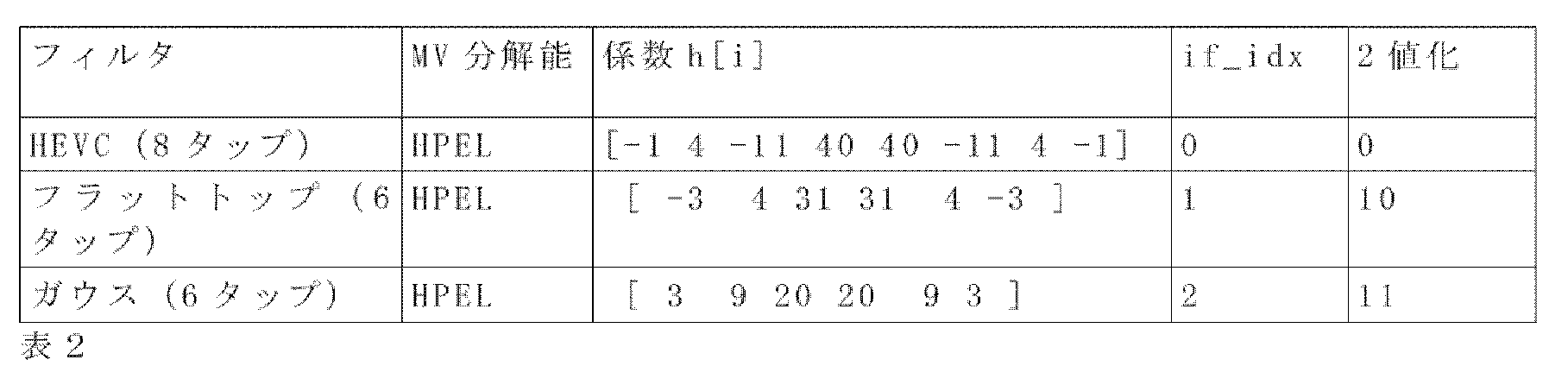
符号化されたインデックス560、660を取得するために、エンコーダ500、600は、インデックス550または選択された処理方式540を示すインデックスを符号化されたインデックス560、660にマッピングするマッピング規則を適用することができる。例えば、マッピング規則は2値化方式に対応し得る。エンコーダ500、600は、符号化されたインデックス560、660が低ビット数を必要とするように、いくつかの許容可能な処理方式に応じて符号化されたインデックス560、660を適合させることができる。
To obtain the coded
例えば、エンコーダ500、600は、動きベクトル精度および/または動きベクトルの分数サンプル位置または分数部分に応じて処理方式、したがってマッピング規則を選択することができる。
For example, the
エンコーダ500、600は、例えばマッピング規則を適合させることによって、1つまたは複数のシンタックス要素520によって記述される特性に応じて、符号化されたインデックス560、660を提供するために使用されるビンの数をさらに適合させることができる。
The
したがって、エンコーダ500、600は、符号化されたインデックス値を表すビンの数が、ビデオシーケンスの部分585に許容可能な処理方式の数に適合されるように、インデックス値を符号化されたインデックス値にマッピングするマッピング規則を選択する。
The
例えば、符号化されたインデックス560を提供するために使用されるビンの数は、特性の観点から許容される処理方式の数に依存し得る。例えば、1つの処理方式のみが許容される場合、ビンの数は0であってもよい。表2は、符号化されたインデックス560、660のための3つの許容可能な処理方式および最大3つのビンの例を、インデックス値を符号化されたインデックス値にマッピングするための対応するマッピング規則と共に示す。
For example, the number of bins used to provide the coded
例えば、表2は、if_idxを符号化されたインデックス値にマッピングするためのマッピング規則の一実施形態を示す。マッピング規則は、異なるMV精度に対して異なり得る。 For example, Table 2 shows one embodiment of a mapping rule for mapping if_idx to an encoded index value. The mapping rule may be different for different MV precisions.
表2に記載されている実施形態では、補間フィルタは、HPEL位置に対してのみ修正されてもよい。動きベクトルが整数ルーマサンプル位置を指し示す場合、すべての場合において補間フィルタは使用されない。動きベクトルがフルサンプルx(またはy)位置およびハーフサンプルy(またはx)位置を表す参照ピクチャ位置を指す場合、選択されたハーフペルフィルタは垂直(または水平方向)にのみ適用される。さらに、ルーマ成分のフィルタリングのみが影響を受け、クロマ成分については、従来のクロマ補間フィルタがすべての場合に使用される。 In the embodiment described in Table 2, the interpolation filter may be modified only for HPEL positions. If the motion vector points to integer luma sample positions, no interpolation filter is used in all cases. If the motion vector points to reference picture positions representing full sample x (or y) positions and half sample y (or x) positions, the selected half-pel filter is applied only in the vertical (or horizontal) direction. Furthermore, only the filtering of the luma components is affected; for the chroma components, conventional chroma interpolation filters are used in all cases.
if_idxインデックスは、例えば表2に示されるように、インデックス550に対応することができ、if_idxの2値化値は符号化されたインデックス560、660に対応することができる。したがって、インデックスエンコーダ561は、2値化方式、例えば、表2の最後の列に示される2値化方式に基づいて、インデックス550から符号化されたインデックス560を導出することができる。エンコーダ600の文脈では、表2の最後の列に示されている2値化方式は、エントロピーコード化方式662に対応するか、またはコード化方式選択器661によって選択されたエントロピーコード化方式662の一部であってもよく、それに基づいて、コーダ690は、例えば、表2に示された2値化値、またはその符号化された表現にに対応し得る、符号化されたインデックス660を提供することができる。例えば、エンコーダ600がエントロピーコード化方式662を選択することができる特性は、MV精度に対応することができる。したがって、表2は、シンタックス要素520のうちの1つまたは複数が、部分585のMV精度がHPELであることを示す場合の例を示す。
The if_idx index may correspond to
一実施形態によれば、エンコーダ500、600は、ビデオシーケンスの部分585に対して単一の処理方式540が許容可能であるかどうかを決定し、ビデオシーケンスの部分585に対して単一の処理方式540のみが許容可能であるという発見に応じて、符号化されたインデックスの包含を選択的に省略するように構成される。例えば、エンコーダ500は、符号化された表現514への符号化されたインデックス560の包含を省略することができる。エンコーダ600は、例えば、符号化された表現614に符号化されたインデックス660が含まれないこと、またはビットストリーム内の符号化されたインデックス660に使用されるビンまたはビットの数が0であることを示すエントロピーコード化方式662を選択することができる。
According to one embodiment, the
一実施形態によれば、適応フィルタ選択は、クロマ成分に拡張される。例えば、エンコーダ500、600は、クロマ成分の特性に応じて処理方式540を選択することができる。クロマ成分は、ルーマコード化ブロックに関連付けられ得るクロマコード化ブロックの一部であり得る。例えば、部分585は、ルーマコード化ブロックの一部および/またはクロマコード化ブロックの一部であってもよい。
4.図7および図8によるデコーダ
According to one embodiment, the adaptive filter selection is extended to the chroma components. For example, the
4. Decoder according to Figs. 7 and 8
図7は、一実施形態によるハイブリッドビデオコード化のためのデコーダ700を示す。デコーダ700は、ビデオシーケンスの符号化された表現714に基づいて出力ビデオコンテンツ712を提供するように構成される。符号化された表現714は、エンコーダ500、600、1300によって提供される符号化された表現514、614、1314に対応することができる。デコーダ700は、ビデオシーケンスの符号化された表現714としてビットストリームを取得するように構成され、ビットストリームから、入力ビデオコンテンツ512の部分585に対応し得るビデオシーケンスの部分785に関連する1つまたは複数のシンタックス要素520を識別するように構成される。
Figure 7 illustrates a
一実施形態によれば、デコーダ700は、エンコーダ500、600によって符号化された表現714に符号化されている可能性がある、1つまたは複数のシンタックス要素520を識別するためのシンタックス識別子721を備える。さらに、デコーダ700は、1つまたは複数のシンタックス要素520およびインデックス550に基づいてビデオシーケンスの部分785の処理方式540を識別するように構成され、処理方式540は、ビデオシーケンスの部分785内の整数401および/または分数位置411、415、417で動き補償予測のためのサンプル401、411、415、417を取得するためのものであり、デコーダ700は、1つまたは複数のシンタックス要素520に応じて、所与の符号化されたインデックス値に異なる処理方式を割り当てるように構成される。
According to one embodiment, the
例えば、処理方式選択器741は、1つまたは複数のシンタックス要素520に基づいて符号化された表現714からインデックス550を決定することができ、その後、処理方式540を決定するために1つまたは複数のシンタックス要素520および/またはインデックス550を使用することができる。1つまたは複数のシンタックス要素520に応じて、処理方式選択器741はまた、符号化された表現714および1つ以上のシンタックス要素520がインデックス550を含まないと推測してもよく、1つ以上のシンタックス要素520からインデックス550を推定してもよい。
For example, the
代替実施形態によれば、デコーダ700は、1つまたは複数のシンタックス要素520に応じて、ビデオシーケンスの部分785の処理方式540を選択するように構成され、処理方式は、部分785の特性および動きベクトルの分数部分によって完全に指定され、処理方式540は、ビデオシーケンスの部分785内の整数および/または分数位置で動き補償予測のためのサンプル401、411、415、417を取得するためのものである。
別の代替実施形態によれば、デコーダ700は、動きベクトル精度に応じて、ビデオシーケンスの部分785の処理方式540を選択するように構成される。
According to an alternative embodiment, the
According to another alternative embodiment, the
別の代替実施形態によれば、デコーダ700は、PU粒度またはCU粒度で、かつ1つまたは複数のシンタックス要素520に応じて、ビデオシーケンスの部分785の処理方式540を決定するように構成される。
さらに、デコーダ700は、例えば処理モジュール744によって、識別された処理方式540をビデオシーケンスの部分785に適用するように構成される。
According to another alternative embodiment, the
Further, the
図8は、別の実施形態によるハイブリッドビデオコード化のためのデコーダ800を示す。デコーダ800は、ビデオシーケンスの符号化された表現714に基づいて出力ビデオコンテンツ812を提供するように構成される。符号化された表現714は、エンコーダ500、600によって提供される符号化された表現514、614に対応することができる。デコーダ800は、ビデオシーケンスの符号化された表現714としてビットストリームを取得するように構成され、ビットストリームから、入力ビデオコンテンツ512の部分585に対応し得るビデオシーケンスの部分785に関連する1つまたは複数のシンタックス要素520を識別するように構成される。例えば、デコーダ700は、エンコーダ500、600によって符号化された表現714に符号化されている可能性がある、1つまたは複数のシンタックス要素520を識別するためのシンタックス識別子821を備える。さらに、デコーダ800は、1つまたは複数のシンタックス要素520に応じて、ビデオシーケンスの部分785の処理方式540を示す符号化されたインデックスを提供するためにビットストリームで使用されるエントロピーコード化方式662を決定するように構成され、処理方式540は、ビデオシーケンスの部分785内の整数および/または分数位置で動き補償予測のためのサンプル401、411、415、417を取得するためのものである。例えば、デコーダ800は、コード化方式選択器861を備え、コード化方式選択器は、エンコーダ600のコード化方式選択器661に対応してもよく、1つまたは複数のシンタックス要素520に基づいてコード化方式662を決定する。デコーダ800は、決定されたエントロピーコード化方式662がゼロより大きいビンの数を規定する場合、ビットストリームにおいて、符号化されたインデックスを識別し、例えば処理方式選択器841によってインデックスを復号するようにさらに構成される。デコーダ800は、決定されたコード化方式によって規定されたビンの数がゼロより大きい場合、1つまたは複数のシンタックス要素520に基づいて、および復号されたインデックスに基づいて処理方式540を識別するようにさらに構成される。例えば、処理方式選択器841は、処理方式540を識別してもよい。さらに、デコーダ800は、例えば処理モジュール744に対応することができる処理モジュール844によって、識別された処理方式540をビデオシーケンスの部分785に適用するように構成される。
8 shows a
デコーダ700、800は、出力ビデオコンテンツ712、812が量子化損失などのコード化損失を除いて入力ビデオコンテンツ512に対応することができるように、入力ビデオコンテンツ512に基づいてエンコーダ500、600によって提供された符号化された表現514、614、1314から出力ビデオコンテンツ712、812を取得することができる。したがって、エンコーダ500、600およびその特徴の説明は、いくつかのプロセスが逆に実行されてもよいが、同等にデコーダ700、800に適用されてもよい。例えば、符号化を参照するエンコーダ500、600の特徴は、復号を参照するデコーダ700、800の特徴に対応し得る。
The
例えば、デコーダ700、800は、エンコーダ500、600、1300によって提供されるように、符号化された表現714、814、1314から1つまたは複数のシンタックス要素520を読み取り、または復号することができる。したがって、エンコーダ500、600、1300およびデコーダ700、800、1300は、1つまたは複数のシンタックス要素520から処理方式540を決定するために同等の仮定または知識を適用することができる。
For example, the
例えば、符号化されたインデックス560、660は、デコーダ700、800が1つまたは複数のシンタックス要素520から推定できない情報を示すことができ、その結果、デコーダ700、800のいくつかの実施形態は、符号化されたインデックス560、660に基づいて処理方式540を決定することができる。例えば、デコーダ700、800のいくつかの実施形態は、例えばデコーダ700、800が1つまたは複数のシンタックス要素520からいくつかの処理方式が許容可能であると推論する場合、インデックス、例えばインデックス550を取得するために符号化された表現714、814から符号化されたインデックス560、660を復号することができる。しかしながら、デコーダ700のすべての実施形態が、いくつかの処理方式が許容可能であるかどうかを推定するように構成されているわけではないことが指摘される。デコーダ700のいくつかの実施形態は、例えば、すべての場合において、または1つまたは複数のシンタックス要素520の指示とは無関係に、符号化された表現1314の1つまたは複数のシンタックス要素から処理方式540を推論するように構成され得る。したがって、デコーダ700の実施形態は、処理方式540に明示的に専用のインデックスを復号することなく、1つまたは複数のシンタックス要素520から処理方式540を推測することができる。
For example, the coded
したがって、1つまたは複数のシンタックス要素520、処理方式540、部分585、インデックス550、任意選択的に符号化されたインデックス560、660およびエンコーダ500、600、1300のさらなる詳細の特徴、機能、利点、および例は、要素の説明は明示的に繰り返されないが、等価的にデコーダ700、800に適用され得る。
Thus, the features, functions, advantages and examples of one or
例えば、デコーダ700、800は、図2のデコーダ20に実装されてもよい。例えば、処理モジュール744,844は、予測モジュール58を備えることができ、または予測モジュール58に対応することができ、その結果、処理方式540は、予測信号59を提供するためにMCPのための処理方式540を使用することができる予測モジュール58のための入力を表すことができる。エンコーダ500、600とデコーダ700、800との間の関係は、セクション1で説明したように、エンコーダ10とデコーダ20との間の関係に対応し得る。
For example, the
一実施形態によれば、デコーダ700、800は、ビデオシーケンスの部分785に対して単一の処理方式540が許容可能であるかどうかを決定し、ビデオシーケンスの部分785に対して単一の処理方式540のみが許容可能であるという発見に応じて、符号化されたインデックスの識別を選択的に省略するように構成される。
According to one embodiment, the
例えば、デコーダ700は、単一の処理方式540が部分785に対して許容可能であるかどうかを、1つまたは複数のシンタックス要素520に基づいて決定することができる。結果に応じて、デコーダ700は、符号化されたインデックス560、660に対応することができる符号化されたインデックスを識別もしくは復号することができ、またはデコーダ700は、符号化されたインデックスの識別を省略またはスキップすることができ、部分785に対して単一の許容可能な処理方式を選択することができる。
For example, the
さらなる例によれば、デコーダ800は、エントロピーコード化方式662から、符号化された表現814から符号化されたインデックスを復号するかどうかを推定することができる。符号化されたインデックスが復号される場合、デコーダ800は、符号化されたインデックス560、660に対応し得る符号化されたインデックスを復号して、インデックス550に対応し得るインデックスを決定し、インデックスに基づいて処理方式540を決定することができる。復号される符号化されたインデックスがない場合、デコーダ800は、符号化されたインデックスの復号を省略またはスキップし、1つまたは複数のシンタックス要素520に基づいて処理方式540を決定することができる。
According to a further example, the
一実施形態によれば、デコーダ700、800は、動きベクトルの分数部分に応じてフィルタを選択するように構成される。例えば、動きベクトルは、2つの異なる方向を参照する2つの成分によって表され得る。例えば、動きベクトルは水平成分および垂直成分によって表されてもよい。水平および垂直は、ピクチャまたはビデオフレームの平面内の2つの直交する方向を表すことができる。したがって、動きベクトルの分数部分は、分数分解能を有するMVの成分を指すことができる。
According to one embodiment, the
一実施形態によれば、デコーダ700、800は、動きベクトルの分数部分に応じて、第1の方向のフィルタリングと第2の方向のフィルタリングとのために異なるフィルタを選択するように構成される。例えば、デコーダ700、800は、第1の方向のMVの成分を表すMVの第1の成分と、第2の方向のMVの成分を表すMVの第2の成分とに従って、異なるフィルタを選択することができる。
According to one embodiment, the
符号化された表現514、614,714、1314は、エンコーダ500、600、1300によって提供されるビデオビットストリームの部分であってもよく、ビデオビットストリームは、入力ビデオコンテンツのビデオシーケンスの複数の部分の符号化された表現を含む。
The encoded
一実施形態によれば、ハイブリッドビデオコード化のためのビデオビットストリームであって、ビデオシーケンスを記述するビデオビットストリームは、ビデオシーケンスの部分585に関連する1つまたは複数のシンタックス要素520を含む。ビデオビットストリームは、ビデオシーケンスの部分の少なくともいくつかのための処理方式540インデックスビットストリーム要素を含み、処理方式540インデックスビットストリーム要素の存在は、1つまたは複数の他のシンタックス要素520に依存して変化する。例えば、ビデオビットストリームは、符号化された表現514、614、714に対応し得るか、またはそれらを含み得る。
According to one embodiment, a video bitstream for hybrid video coding, the video bitstream describing a video sequence includes one or
一実施形態によれば、ハイブリッドビデオコード化のためのビデオビットストリームであって、ビデオシーケンスを記述するビデオビットストリームは、ビデオシーケンスの部分585に関連する1つまたは複数のシンタックス要素520を含む。ビデオビットストリームは、ビデオシーケンスの部分の少なくともいくつかのための処理方式540のインデックスビットストリーム要素を含み、処理方式540のインデックスビットストリーム要素のビンの数は、ビデオシーケンスの部分585に関連する1つまたは複数のシンタックス要素520に応じて変化する。例えば、ビデオビットストリームは、符号化された表現514、614、714に対応し得るか、またはそれらを含み得る。
According to one embodiment, a video bitstream for hybrid video coding, the video bitstream describing a video sequence includes one or
一実施形態によれば、ハイブリッドビデオコード化のためのビデオビットストリームであって、ビデオシーケンスを記述するビデオビットストリームは、ビデオシーケンスの部分585に関連する1つまたは複数のシンタックス要素520を含む。ビデオビットストリームは、ビデオシーケンスの部分の少なくともいくつかのための処理方式540のインデックスビットストリーム要素を含み、処理方式540のインデックスビットストリーム要素のコードワードの意味は、ビデオシーケンスの部分585に関連する1つまたは複数のシンタックス要素520に応じて変化する。例えば、ビデオビットストリームは、符号化された表現514、614、714に対応し得るか、またはそれらを含み得る。
5.図9、図10、図11、および図12によるハイブリッドビデオコード化のための方法
According to one embodiment, a video bitstream for hybrid video coding, the video bitstream describing a video sequence, includes one or
5. Methods for hybrid video coding according to Figures 9, 10, 11 and 12
図9は、一実施形態によるハイブリッドビデオコード化のための方法5000のフローチャートを示す。入力ビデオコンテンツ512に基づいてビデオシーケンスの符号化された表現514を提供するための方法5000であって、方法5000は、ビデオシーケンスの部分585に関連する1つまたは複数のシンタックス要素520を決定するステップ5001を含む。ステップ5002は、ビデオシーケンスの部分585に適用される処理方式540を、1つまたは複数のシンタックス要素520上で記述される特性に基づいて選択することを含み、処理方式540は、ビデオシーケンスの部分585内の整数および/または分数位置で動き補償予測のためのサンプル401、411、415、417を取得するためのものである。ステップ5003は、所与の符号化されたインデックス値が、1つまたは複数のシンタックス要素520によって記述される特性に応じて異なる処理方式を表すように、選択された処理方式540を示すインデックスを符号化することを含む。ステップ5004は、ビデオシーケンスの符号化された表現として、1つ以上のシンタックス要素520と符号化されたインデックスとを含むビットストリームを提供することを含む。
9 shows a flow chart of a
図10は、一実施形態によるハイブリッドビデオコード化のための方法6000のフローチャートを示す。入力ビデオコンテンツに基づいてビデオシーケンスの符号化された表現を提供するための方法600であって、方法600は、ビデオシーケンスの部分585に関連する1つまたは複数のシンタックス要素520を決定するステップ6001を含む。ステップ6002は、ビデオシーケンスの部分585に適用される処理方式540を、1つまたは複数のシンタックス要素520上で記述される特性に基づいて選択することを含み、処理方式540は、ビデオシーケンスの部分585内の整数および/または分数位置で動き補償予測のためのサンプル401、411、415、417を取得するためのものである。ステップ6003は、1つまたは複数のシンタックス要素520によって記述される特性に応じて、選択された処理方式540を示す符号化されたインデックスを提供するために使用されるエントロピーコード化方式を選択することを含む。ステップ6004は、ビデオシーケンスの符号化された表現として、1つ以上のシンタックス要素520を含み、符号化されたインデックスを含むビットストリームを提供することを含む。
10 shows a flow chart of a
図11は、一実施形態によるハイブリッドビデオコード化のための方法7000のフローチャートを示す。ビデオシーケンスの符号化された表現に基づいて出力ビデオコンテンツを提供するための方法7000であって、方法7000は、ビデオシーケンスの符号化された表現としてビットストリームを取得するステップ7001を含む。ステップ7002は、ビットストリームから、ビデオシーケンスの部分785に関連する1つまたは複数のシンタックス要素520を識別することを含む。ステップ7003は、1つまたは複数のシンタックス要素520およびインデックスに基づいてビデオシーケンスの部分785の処理方式540を識別することを含み、処理方式540は、ビデオシーケンスの部分785内の整数および/または分数位置で動き補償予測のためのサンプル401、411、415、417を取得するためのものであり、方法は、1つまたは複数のシンタックス要素520に応じて、所与の符号化されたインデックス値に異なる処理方式を割り当てる。ステップ7004は、識別された処理方式540をビデオシーケンスの部分785に適用することを含む。
Figure 11 shows a flowchart of a
図12は、一実施形態によるハイブリッドビデオコード化のための方法8000のフローチャートを示す。ビデオシーケンスの符号化された表現に基づいて出力ビデオコンテンツを提供するための方法8000であって、方法8000は、ビデオシーケンスの符号化された表現としてビットストリームを取得するステップ8001を含む。ステップ8002は、ビットストリームから、ビデオシーケンスの部分785に関連する1つまたは複数のシンタックス要素520を識別することを含む。ステップ8003は、1つまたは複数のシンタックス要素520に応じて、ビデオシーケンスの部分785の処理方式540を示す符号化されたインデックスを提供するためにビットストリームで使用されるエントロピーコード化方式を決定することを含み、処理方式540は、ビデオシーケンスの部分785内の整数および/または分数位置で動き補償予測のためのサンプル401、411、415、417を取得するためのものである。ステップ8004は、決定されたエントロピーコード化方式がゼロより大きいビンの数を規定する場合、ビットストリームにおいて、符号化されたインデックスを識別し、インデックスを復号することを含む。ステップ8005は、決定されたエントロピーコード化方式によって規定されたビンの数がゼロより大きい場合、処理方式540を、1つまたは複数のシンタックス要素520に基づいて、かつ復号されたインデックスに基づいて識別することを含む。ステップ8006は、識別された処理方式540をビデオシーケンスの部分785に適用することを含む。
12 shows a flow chart of a
図14は、一実施形態によるハイブリッドビデオコード化のための方法7100のフローチャートを示す。方法7100は、ビデオシーケンスの符号化された表現1314に基づいて出力ビデオコンテンツ712を提供するためであり、方法7100は、ビデオシーケンスの符号化された表現714としてビットストリームを取得する7101ことと、ビットストリームから、ビデオシーケンスの部分785に関連する1つまたは複数のシンタックス要素520を識別する7102ことと、1つまたは複数のシンタックス要素520に応じて、ビデオシーケンスの部分785のための処理方式540を選択する7103ことであって、処理方式は、部分785の特性および動きベクトルの分数部分によって完全に指定され、処理方式540は、ビデオシーケンスの部分785内の整数および/または分数位置での動き補償予測のためのサンプル401、411、415、417を取得するためである、ことと、識別された処理方式540をビデオシーケンスの部分785に適用する7104こととを含む。
14 shows a flowchart of a
図15は、一実施形態によるハイブリッドビデオコード化のための方法7200のフローチャートを示す。方法7200は、ビデオシーケンスの符号化された表現1314に基づいて出力ビデオコンテンツ712を提供するためであり、方法7200は、ビデオシーケンスの符号化された表現714としてビットストリームを取得する7201ことと、ビットストリームから、ビデオシーケンスの部分785に関連する1つまたは複数のシンタックス要素520を識別する7202ことと、動きベクトル精度に応じて、ビデオシーケンスの部分785のための処理方式540を選択する7203ことであって、処理方式540は、ビデオシーケンスの部分785内の整数および/または分数位置での動き補償予測のためのサンプル401、411、415、417を取得するためである、ことと、識別された処理方式540をビデオシーケンスの部分785に適用する7204こととを含む。
15 shows a flowchart of a
図16は、一実施形態によるハイブリッドビデオコード化のための方法7300のフローチャートを示す。方法7300は、ビデオシーケンスの符号化された表現1314に基づいて出力ビデオコンテンツ712を提供するためであり、方法7300は、ビデオシーケンスの符号化された表現714としてビットストリームを取得する7301ことと、ビットストリームから、ビデオシーケンスの部分785に関連する1つまたは複数のシンタックス要素520を識別する7302ことと、PU粒度またはCU粒度を用いて、1つまたは複数のシンタックス要素520に応じて、ビデオシーケンスの部分785のための処理方式540を決定する7303ことであって、処理方式540は、ビデオシーケンスの部分785内の整数および/または分数位置での動き補償予測のためのサンプル401、411、415、417を取得するためである、ことと、
識別された処理方式540をビデオシーケンスの部分785に適用する7304こととを含む。
16 shows a flowchart of a
and applying 7304 the identified
図17は、一実施形態によるハイブリッドビデオコード化のための方法1310のフローチャートを示す。方法1310は入力ビデオコンテンツ512に基づいてビデオシーケンスの符号化された表現1314を提供するためであって、方法1310は、ビデオシーケンスの部分585に関連する1つまたは複数のシンタックス要素520を決定する1311ことと、1つまたは複数のシンタックス要素520によって記述される特性に基づいて、ビデオシーケンスの部分585に適用される処理方式540を選択する1312ことであって、処理方式は部分585の特性および動きベクトルの分数部分によって完全に指定され、処理方式540は、ビデオシーケンスの部分585内の整数および/または分数位置での動き補償予測のためのサンプル401、411、415、417を取得するためのものである、ことと、ビデオシーケンスの符号化された表現1314として、1つまたは複数のシンタックス要素520を含むビットストリームを提供する1313こととを含む。
17 shows a flowchart of a
図18は、一実施形態によるハイブリッドビデオコード化のための方法1320のフローチャートを示す。方法1320は入力ビデオコンテンツ512に基づいてビデオシーケンスの符号化された表現1314を提供するためであり、方法1320は、ビデオシーケンスの部分585に関連する1つまたは複数のシンタックス要素520を決定する1321ことと、1つまたは複数のシンタックス要素520によって記述される動きベクトル精度に基づいて、ビデオシーケンスの部分585に適用される処理方式540を選択する1322ことであって、処理方式540は、ビデオシーケンスの部分785内の整数および/または分数位置での動き補償予測のためのサンプル401、411、415、417を取得するためのものである、ことと、ビデオシーケンスの符号化された表現1314として、1つまたは複数のシンタックス要素520を含むビットストリームを提供する1323こととを含む。
18 shows a flowchart of a
図19は、一実施形態によるハイブリッドビデオコード化のための方法1330のフローチャートを示す。方法1330は、入力ビデオコンテンツ512に基づいてビデオシーケンスの符号化された表現1314を提供するためであり、方法1330は、ビデオシーケンスの部分585に関連する1つまたは複数のシンタックス要素520を決定する1331ことと、PU粒度またはCU粒度を用いて、1つまたは複数のシンタックス要素520によって記述される特性に基づいて、ビデオシーケンスの部分585に適用される処理方式540を選択する1332ことであって、処理方式540は、ビデオシーケンスの部分785内の整数および/または分数位置での動き補償予測のためのサンプル401、411、415、417を取得するためのものである、ことと、ビデオシーケンスの符号化された表現1314として、1つまたは複数のシンタックス要素520を含むビットストリームを提供する1333こととを含む。
6.さらなる実施形態
19 shows a flowchart of a
6. Further embodiments
現在のVVCドラフト[5]を含む多くの、または場合によってはすべての現在のビデオコード化規格では、補間フィルタは、各分数サンプル位置に対して固定される。(本明細書での「分数サンプル位置」は、4つの周囲のFPELまたは整数位置の間の相対位置を指す)。本発明の実施形態は、ビデオシーケンスの異なる部分(例えば、部分)の同じ分数サンプル位置に対して異なる補間フィルタ(例えば処理方式)を使用することを可能にする。切替補間フィルタのための前述の手法(「本発明の背景技術」の項を参照)は、粗い粒度(すなわち、スライスレベル)でのみ異なる補間フィルタ間の切換を可能にするという欠点、および、場合によっては(AIFおよびその変形例に関して)個々のFIRフィルタ係数を送信することによって、選択が明示的にシグナリングされ得るという欠点を有する。 In many, or possibly all, current video coding standards, including the current VVC draft [5], the interpolation filters are fixed for each fractional sample position. ("Fractional sample position" herein refers to the relative position between the four surrounding FPEL or integer positions.) An embodiment of the present invention allows for different interpolation filters (e.g., processing schemes) to be used for the same fractional sample position in different parts (e.g., portions) of a video sequence. The previously described techniques for switching interpolation filters (see the "Background of the Invention" section) have the disadvantages of only allowing switching between different interpolation filters at a coarse granularity (i.e., slice level) and, in some cases (for AIF and its variants), the selection may be explicitly signaled by transmitting individual FIR filter coefficients.
補間フィルタを細かい粒度(例えば、PU/CU、またはCTUレベル)で切り替えることを可能にすることにより、ローカルの画像特性(例えば、高精度HEVC補間フィルタに加えて、異なる特性を有するフィルタ、例えば高周波ノイズ成分を減衰させるためのより強いローパス特性を有するフィルタを使用することが有益であり得る)によりよく適合させることができる。しかしながら、各PUのために使用される補間フィルタの明示的なシグナリングは、必要とされるビットレートの観点から、高すぎる場合があり得る。したがって、本発明の実施形態は、デコーダ(例えば、それらは、符号化された表現514、614、1314の一部であり得る1つまたは複数のシンタックス要素520によって示されるため)にも知られているビデオシーケンスの所与の部分または領域(例えば、PU/CU、CTU、スライス、フレームなど)の特性に従って、ビデオシーケンスの部分または領域に利用可能な補間フィルタを制限することによってこのシグナリングオーバーヘッドを回避する。1つの補間フィルタのみが利用可能なままである場合、さらなるシグナリングは必要ない。複数が利用可能なままである場合、利用可能な補間フィルタのうちのどれが使用されるかのみが送信されてもよい。(本明細書および以下では、「補間フィルタ」は、所与の、場合によっては分数サンプル位置で基準サンプルを取得するために適用される任意の信号処理のより広い意味を意味し、FPEL位置のフィルタリングも含み得ることに留意されたい。)
By allowing the interpolation filters to be switched at a finer granularity (e.g., PU/CU, or CTU level), it is possible to better adapt to local picture characteristics (e.g., in addition to the high-precision HEVC interpolation filters, it may be beneficial to use filters with different characteristics, e.g., filters with stronger low-pass characteristics to attenuate high-frequency noise components). However, explicit signaling of the interpolation filter used for each PU may be too expensive in terms of the required bitrate. Therefore, embodiments of the present invention avoid this signaling overhead by restricting the interpolation filters available to a part or region of a video sequence according to the characteristics of a given part or region (e.g., PU/CU, CTU, slice, frame, etc.) of the video sequence that are also known to the decoder (e.g., because they are indicated by one or
本発明の実施形態によれば、使用される補間フィルタの変更は、現在のブロックが(他の復号されたシンタックス要素の値によって与えられる)特定の特性を有する場合にのみ可能であり得る。この場合、以下の2つのケースを区別することができる。 According to an embodiment of the invention, changing the used interpolation filter may only be possible if the current block has certain characteristics (given by the values of other decoded syntax elements). In this case, two cases can be distinguished:
ケース1:(他のシンタックス要素によって決定される)ブロックの所与の特性に対して、補間フィルタの1つの特定のセットのみがサポートされる。ここで、「補間フィルタのセット」という用語は、実際に使用されるフィルタがサブサンプル位置にも依存するという事実を指す(サブサンプル精度を有する従来のビデオコード化の場合のように)。次に、特性は、使用される補間フィルタのセットを決定し、動きベクトルの分数部分は、実際のフィルタ(またはフィルタリングが分離可能フィルタによって指定される場合は水平および垂直フィルタ)を決定する。補間フィルタは、ブロックおよび動きベクトルの分数部分の特性によって完全に指定されるので、この場合、追加のシンタックス要素は送信されない。 Case 1: For given characteristics of a block (determined by other syntax elements), only one specific set of interpolation filters is supported. Here, the term "set of interpolation filters" refers to the fact that the actually used filters also depend on the subsample position (as in conventional video coding with subsample precision). The characteristics then determine the set of interpolation filters used, and the fractional part of the motion vector determines the actual filters (or horizontal and vertical filters, if filtering is specified by separable filters). Since the interpolation filters are fully specified by the characteristics of the block and the fractional part of the motion vector, no additional syntax elements are transmitted in this case.
ケース2:ブロックの所与の特性に対して複数セットの補間フィルタがサポートされる。この場合、補間フィルタのセットは、対応するシンタックス要素(例えば、サポートされているセットのリストへのインデックス)をコード化することによって選択することができる。(選択されたセットから)使用される補間フィルタは、動きベクトルの分数部分によって再び決定され得る。 Case 2: Multiple sets of interpolation filters are supported for a given characteristic of a block. In this case, the set of interpolation filters can be selected by coding a corresponding syntax element (e.g., an index into the list of supported sets). The interpolation filter used (from the selected set) can again be determined by the fractional part of the motion vector.
両方の場合が同じピクチャでサポートされ得ることに留意されたい。これは、第1の特性を有するブロックに対して、固定された補間フィルタのセットを使用することができることを意味する(このセットは、従来の補間フィルタのセットと同じであってもよく、または従来のセットから逸脱してもよい)。また、第2の特性を有するブロックの場合、補間フィルタの複数のセットがサポートされてもよく、選択されたフィルタは、送信されたフィルタインデックス(または任意の他の手段)によって決定される。さらに、ブロックは第3の特性を有してもよく、この場合、他のセットの補間フィルタ(1つまたは複数)が使用されてもよい。
利用可能な補間フィルタを制限するために使用され得るビデオシーケンスの部分または領域(ビデオシーケンスの部分)のこれらの特性は、以下を含む。
Note that both cases may be supported in the same picture. This means that for blocks with the first property, a fixed set of interpolation filters may be used (this set may be the same as the set of conventional interpolation filters or may deviate from the conventional set). Also, for blocks with the second property, multiple sets of interpolation filters may be supported, with the selected filter being determined by the transmitted filter index (or any other means). Furthermore, blocks may have a third property, in which case another set of interpolation filters (one or more) may be used.
These characteristics of portions or regions of a video sequence (portions of a video sequence) that can be used to limit the available interpolation filters include:
-MV精度(例えば、QPEL、HPEL、FPELなど)、すなわち、異なる動きベクトル精度に対して異なる補間フィルタセットがサポートされる可能性がある
-分数サンプル位置
-ブロックサイズ、またはより一般的にはブロック形状
-予測仮説の数(すなわち、単予測の場合は1、双予測の場合は2などである)、例えば単予測のみの追加の平滑化フィルタ
-予測モード(例えば、並行移動インター、アフィンインター、並行移動マージ、アフィンマージ、結合インター/イントラ)
-コード化された残差信号の可用性(例えば、HEVCにおけるようなコード化ブロックフラグ)
-コード化された残差信号のスペクトル特性
-参照ピクチャ信号(動きデータによって定義される参照ブロック)、例えば、
・参照ブロック内の共同配置されたPUからのブロックエッジ
・参照信号の高周波特性または低周波特性
-ループフィルタデータ、例えば、
・サンプル適応オフセットフィルタ(SAO)
からのエッジオフセットまたは帯域オフセット分類
・デブロッキングフィルタの決定および境界強度
-MV長さ、例えば、長いMVまたは特定の方向に対してのみ追加の平滑化フィルタを可能にする
これらの特性(例えば、MV精度および分数サンプル位置)の2つ以上の組み合わせも可能である(上記参照)。
- MV precision (e.g. QPEL, HPEL, FPEL, etc.), i.e. different interpolation filter sets may be supported for different motion vector precisions - fractional sample positions - block size, or more generally block shape - number of prediction hypotheses (i.e. 1 for uni-prediction, 2 for bi-prediction, etc.), e.g. additional smoothing filter for uni-prediction only - prediction mode (e.g. translation inter, affine inter, translation merge, affine merge, combined inter/intra)
- Availability of the coded residual signal (e.g. the coded block flag as in HEVC)
- the spectral characteristics of the coded residual signal - the reference picture signal (reference blocks defined by motion data), e.g.
Block edges from co-located PUs within the reference block High-frequency or low-frequency characteristics of the reference signal - loop filter data, e.g.
Sample Adaptive Offset Filter (SAO)
Edge offset or band offset classification from Deblocking filter decision and boundary strength - MV length, e.g. allowing additional smoothing filters only for long MVs or specific directions Combinations of two or more of these properties (e.g. MV precision and fractional sample positions) are also possible (see above).
本発明の一実施形態では、利用可能な補間フィルタはMV精度に直接リンクされてもよい。特に、(HEVCまたはVVC補間フィルタに関して)追加のまたは異なる補間フィルタは、特定のMV精度(例えば、HPEL)を使用して符号化され、例えばHPEL位置にのみ適用されるブロックに対してのみ利用可能であり得る。MV精度のシグナリングは、この場合、VVCのAMVR(Sec.6.1.2参照)と同様の方式を使用することができる。1つの補間フィルタ(すなわち、対応するHEVCまたはVVC補間フィルタを置き換える)のみが利用可能である場合、さらなるシグナリングは必要ない。2つ以上の補間フィルタが利用可能である場合、所与のMV精度を使用するブロックについてのみ、使用された補間フィルタの指示がシグナリングされ得るが、他のすべてのブロックについては、シグナリングは変更されない。 In one embodiment of the present invention, the available interpolation filters may be directly linked to the MV precision. In particular, additional or different interpolation filters (with respect to HEVC or VVC interpolation filters) may be available only for blocks that are coded using a particular MV precision (e.g., HPEL) and are, for example, applied only to HPEL positions. Signaling of the MV precision may in this case use a scheme similar to AMVR for VVC (see Sec. 6.1.2). If only one interpolation filter (i.e. replacing the corresponding HEVC or VVC interpolation filter) is available, no further signaling is required. If more than one interpolation filter is available, an indication of the used interpolation filter may be signaled only for blocks using a given MV precision, while for all other blocks the signaling remains unchanged.
本発明の一実施形態では、HEVCまたはVVCのマージモードの場合、使用される補間フィルタは、選択されたマージ候補から継承されてもよい。別の実施形態では、明示的なシグナリングによって、マージ候補から継承された補間フィルタを上書きすることが可能であり得る。
6.1 本発明のさらなる実施形態
In one embodiment of the present invention, for HEVC or VVC merge modes, the interpolation filters used may be inherited from the selected merge candidate. In another embodiment, it may be possible to override the interpolation filters inherited from the merge candidate by explicit signaling.
6.1 Further embodiments of the invention
本発明の一実施形態では、利用可能な補間フィルタのセットは、(専用のシンタックス要素を使用してシグナリングされる)ブロックに対して選択された動きベクトル精度によって決定され得る。ルーマサンプルの半分の精度では、補間フィルタの複数のセットがサポートされ得るが、他のすべての可能な動きベクトル精度では、補間フィルタのデフォルトセットが使用される。
6.1.1 補間フィルタセット
In one embodiment of the present invention, the set of available interpolation filters may be determined by the motion vector precision selected for the block (signaled using a dedicated syntax element): for half a luma sample precision, multiple sets of interpolation filters may be supported, while for all other possible motion vector precisions, a default set of interpolation filters is used.
6.1.1 Interpolation Filter Set
本発明の実施形態では、2つの追加の1D 6タップローパスFIRフィルタがサポートされてもよく、これは(上述の係数h[i]を有する)HEVC 8タップフィルタの代わりに適用されてもよい。
6.1.2 信号伝達
In embodiments of the present invention, two additional 1D 6-tap low-pass FIR filters may be supported, which may be applied in place of the HEVC 8-tap filter (with coefficients h[i] as described above).
6.1.2 Signaling
HPEL分解能による現在のVVCドラフトからの切り捨てられた単項2値化を有するAMVR CUシンタックスの拡張であって、追加のビンに1つのCABAC文脈を追加する拡張:
-インデックスは、少なくとも1つのMVDが0より大きい場合にのみ存在する
-インデックスが0に等しい場合、QPEL精度およびHEVC補間フィルタを示す
An extension of the AMVR CU syntax with truncated unary binarization from the current VVC draft with HPEL resolution, adding one CABAC context for an additional bin:
- Index is present only if at least one MVD is greater than 0 - Index equal to 0 indicates QPEL precision and HEVC interpolation filter
-インデックスが1に等しい場合、すべてのMVDがHPEL MV精度を有し、HPEL精度に丸められたMVPに追加される前にQPEL精度にシフトされなければならないことを示す。
インデックスが2または3に等しい場合、それぞれFPELまたは4PEL精度を示し、補間フィルタは適用されない。
- If index is equal to 1, it indicates that all MVDs have HPEL MV precision and must be shifted to QPEL precision before being added to the MVP rounded to HPEL precision.
If the index is equal to 2 or 3, it indicates FPEL or 4 PEL precision, respectively, and no interpolation filter is applied.
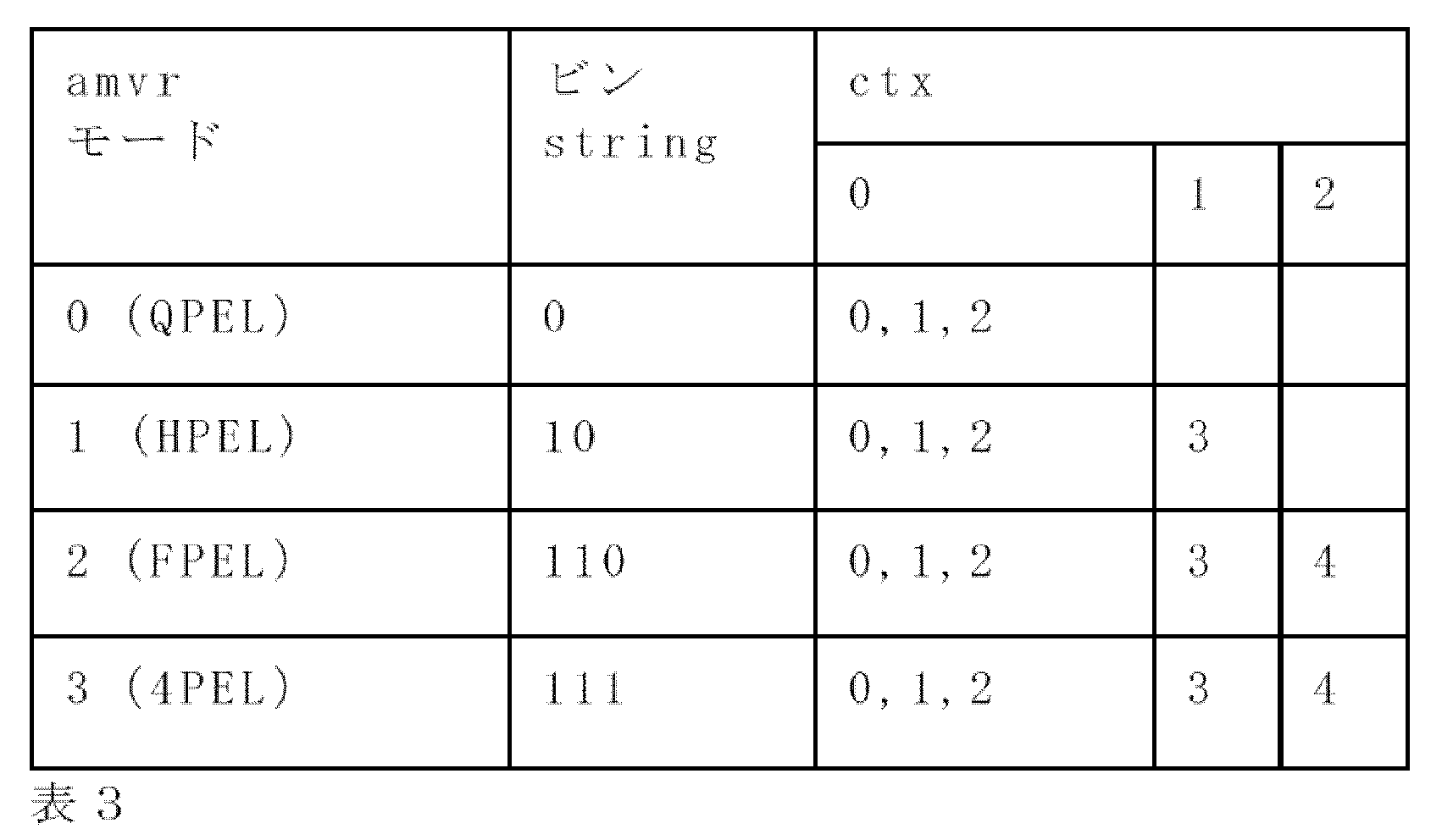
QPELと他の精度とを切り替える第1のビンの文脈は、現在のブロックの左および上に隣接ブロックのAMVRモードの値に応じて3つの文脈の中から選択することができる。両方の隣接ブロックがQPEL AMVRモードを有する場合、文脈は0であり、そうでない場合、1つの隣接ブロックのみがQPEL AMVRモードを使用していない場合、文脈は1であり、そうでない場合(両方の隣接ブロックがQPEL AMVRモードを使用していない)、文脈は2である。 The context of the first bin, which switches between QPEL and other precisions, can be chosen among three contexts depending on the value of the AMVR mode of the neighboring blocks to the left and above the current block. If both neighboring blocks have QPEL AMVR mode, the context is 0, otherwise, if only one neighboring block does not use QPEL AMVR mode, the context is 1, otherwise (both neighboring blocks do not use QPEL AMVR mode), the context is 2.
AMVRモードがHPEL精度を示す場合(amvrモード=2)、補間フィルタは、CUごとに1つのシンタックス要素(if_idx)によって明示的にシグナリングされ得る。
if_idxが0に等しい場合、それは、HEVC補間フィルタのフィルタ係数h[i]がHPEL位置を生成するために使用されることを示す。
If the AMVR mode indicates HPEL precision (amvr mode = 2), the interpolation filters may be explicitly signaled by one syntax element (if_idx) per CU.
When if_idx is equal to 0, it indicates that the filter coefficients h[i] of the HEVC interpolation filter are used to generate the HPEL position.
if_idxが1に等しい場合、それは、HPEL位置を生成するためにフラットトップフィルタ(セクション3の表2を参照)のフィルタ係数h[i]が使用されることを示す。 When if_idx is equal to 1, it indicates that the filter coefficients h[i] of the flat-top filter (see Table 2 in Section 3) are used to generate the HPEL position.
if_idxが2に等しい場合、それは、HPEL位置を生成するためにガウスフィルタ(セクション3の表2を参照)のフィルタ係数h[i]が使用されることを示す。 When if_idx is equal to 2, it indicates that the filter coefficients h[i] of the Gaussian filter (see Table 2 in Section 3) are used to generate the HPEL position.
CUがマージモードでコード化され、動きベクトルを修正せずに隣接ブロックから動きベクトルをコピーすることによってマージ候補が生成される場合、インデックスif_idxもコピーされる。if_idxが0より大きい場合、HPEL位置は、2つの非HEVCフィルタ(フラットトップまたはガウス)のうちの1つを使用してフィルタリングされる。 If the CU is coded in merge mode and the merge candidate is generated by copying motion vectors from neighboring blocks without modifying the motion vectors, the index if_idx is also copied. If if_idx is greater than 0, the HPEL position is filtered using one of two non-HEVC filters (flat-top or Gaussian).
この特定の実施形態では、補間フィルタは、HPEL位置に対してのみ修正されてもよい。動きベクトルが整数ルーマサンプル位置を指し示す場合、すべての場合において補間フィルタは使用されない。動きベクトルがフルサンプルx(またはy)位置およびハーフサンプルy(またはx)位置を表す参照ピクチャ位置を指す場合、選択されたハーフペルフィルタは垂直(または水平方向)にのみ適用される。さらに、ルーマ成分のフィルタリングのみが影響を受け、クロマ成分については、従来のクロマ補間フィルタがすべての場合に使用される。
説明される実施形態の可能な変更は、以下の態様を含むことができる。
In this particular embodiment, the interpolation filter may be modified only for HPEL positions. If the motion vector points to an integer luma sample position, the interpolation filter is not used in all cases. If the motion vector points to a reference picture position representing a full sample x (or y) position and a half sample y (or x) position, the selected half-pel filter is applied only in the vertical (or horizontal) direction. Furthermore, only the filtering of the luma component is affected; for the chroma components, the conventional chroma interpolation filter is used in all cases.
Possible variations of the described embodiments may include the following aspects.
HPEL精度のための補間フィルタのセットはまた、フルサンプル位置のための修正されたフィルタを含む。すなわち、ハーフサンプルの正確な動きベクトルがx(またはy)方向のフルサンプル位置を指す場合、水平(または垂直)方向のより強いローパスフィルタリングも適用され得る。 The set of interpolation filters for HPEL precision also includes modified filters for full sample positions. That is, if a half-sample accurate motion vector points to a full sample position in the x (or y) direction, stronger low-pass filtering in the horizontal (or vertical) direction may also be applied.
全ルーマサンプルまたは4ルーマサンプルの動きベクトル精度が選択された場合、参照サンプルのフィルタリングも適用され得る。このとき、単一のフィルタまたは複数のフィルタのいずれかをサポートすることができる。
適応フィルタ選択は、クロマ成分に拡張される。
選択されたフィルタは、単予測が使用されるか双予測が使用されるかにさらに依存する。
7.実装の代替案:
If full luma sample or 4 luma sample motion vector precision is selected, reference sample filtering may also be applied, where either a single filter or multiple filters can be supported.
The adaptive filter selection is extended to the chroma components.
The filter selected further depends on whether uni- or bi-prediction is used.
7. Implementation Alternatives:
いくつかの態様は、装置の文脈で説明されているが、これらの態様は、対応する方法の説明も表しており、ブロックまたは装置は、方法ステップまたは方法ステップの特徴に対応することは明らかである。同様に、方法ステップの文脈で説明される態様は、対応するブロックまたは対応する装置のアイテムまたは特徴の記述も表す。方法ステップの一部または全部は、例えば、マイクロ処理部、プログラム可能なコンピュータまたは電子回路のようなハードウェア装置によって(または使用して)実行されてもよい。いくつかの実施形態では、最も重要な方法ステップの1つ以上は、そのような装置によって実行されてもよい。 Although some aspects are described in the context of an apparatus, it will be apparent that these aspects also represent a description of a corresponding method, with blocks or apparatus corresponding to method steps or features of method steps. Similarly, aspects described in the context of a method step also represent a description of the corresponding block or item or feature of the corresponding apparatus. Some or all of the method steps may be performed by (or using) a hardware apparatus, such as, for example, a microprocessor, a programmable computer or electronic circuitry. In some embodiments, one or more of the most important method steps may be performed by such an apparatus.
特定の実装要件に応じて、本発明の実施形態は、ハードウェアまたはソフトウェアで実装することができる。実施形態は、中に格納される電子的に読み取り可能な制御信号を有し、各方法が実行されるようにプログラム可能なコンピュータシステムと協働する(または協働可能な)、例えばフロッピーディスク、DVD、ブルーレイ、CD、ROM、PROM、EPROM、EEPROMまたはフラッシュメモリなどのデジタル記憶媒体を使用して実行することができる。したがって、デジタル記憶媒体はコンピュータ可読であってもよい。 Depending on the particular implementation requirements, embodiments of the invention can be implemented in hardware or software. The embodiments can be implemented using a digital storage medium, such as, for example, a floppy disk, DVD, Blu-ray, CD, ROM, PROM, EPROM, EEPROM or flash memory, having electronically readable control signals stored therein and cooperating (or capable of cooperating) with a programmable computer system such that the methods are performed. The digital storage medium may therefore be computer readable.
本発明によるいくつかの実施形態は、プログラム可能なコンピュータシステムと協働して、本明細書に記載の方法の1つが実行されるような、電子的に読み取り可能な制御信号を有するデータキャリアを備える。 Some embodiments according to the invention include a data carrier having electronically readable control signals that cooperate with a programmable computer system to perform one of the methods described herein.
一般に、本発明の実施形態は、コンピュータプログラム製品がコンピュータ上で動作するときに、本方法の1つを実行するように動作するプログラムコードを有するコンピュータプログラム製品として実施することができる。プログラムコードは、例えば、機械読み取り可能なキャリアに格納することができる。
他の実施形態は、本明細書に記載の方法の1つを実行するためのコンピュータプログラムを含み、機械読み取り可能なキャリアに格納される。
Generally, embodiments of the present invention may be implemented as a computer program product having program code operative to perform one of the methods when the computer program product runs on a computer. The program code may for example be stored on a machine readable carrier.
Other embodiments comprise the computer program for performing one of the methods described herein, stored on a machine readable carrier.
換言すれば、本発明の方法の実施形態は、コンピュータプログラムがコンピュータ上で実行されるときに、本明細書に記載の方法の1つを実行するためのプログラムコードを有するコンピュータプログラムである。 In other words, an embodiment of the inventive method is a computer program having a program code for performing one of the methods described herein, when the computer program runs on a computer.
したがって、本発明の方法の更なる実施形態は、本明細書に記載の方法のうちの1つを実行するためのコンピュータプログラムを含み、そこに記録される、データキャリア(またはデジタル記憶媒体またはコンピュータ可読媒体)である。データキャリア、デジタル記憶媒体または記録媒体は、典型的には有形および/または非一時的である。 Therefore, a further embodiment of the method of the present invention is a data carrier (or digital storage medium or computer readable medium) containing and recorded thereon a computer program for performing one of the methods described herein. The data carrier, digital storage medium or recording medium is typically tangible and/or non-transitory.
したがって、本発明の方法の更なる実施形態は、本明細書に記載の方法のうちの1つを実行するためのコンピュータプログラムを表すデータストリームまたは信号のシーケンスである。データストリームまたは信号のシーケンスは、例えば、データ通信接続、例えばインターネットを介して転送されるように構成することができる。 A further embodiment of the inventive method is therefore a data stream or a sequence of signals representing a computer program for performing one of the methods described herein. The data stream or the sequence of signals can for example be configured to be transferred via a data communication connection, for example the Internet.
更なる実施形態は、本明細書に記載の方法のうちの1つを実行するように構成された、または適用される処理手段、例えばコンピュータまたはプログラマブル論理装置を含む。
更なる実施形態は、本明細書で説明される方法の1つを実行するためのコンピュータプログラムがインストールされたコンピュータを含む。
A further embodiment comprises a processing means, for example a computer, or a programmable logic device, configured to or adapted to perform one of the methods described herein.
A further embodiment comprises a computer having installed thereon the computer program for performing one of the methods described herein.
本発明による更なる実施形態は、本明細書で説明される方法の1つを実行するためのコンピュータプログラムを受信機に転送(例えば、電子的にまたは光学的に)するように構成された装置またはシステムを含む。受信機は、例えば、コンピュータ、モバイル装置、メモリ装置などであってもよい。この装置またはシステムは、例えば、コンピュータプログラムを受信機に転送するためのファイルサーバを備えることができる。 Further embodiments according to the invention include an apparatus or system configured to transfer (e.g. electronically or optically) a computer program for performing one of the methods described herein to a receiver. The receiver may be, for example, a computer, a mobile device, a memory device, etc. The apparatus or system may, for example, comprise a file server for transferring the computer program to the receiver.
いくつかの実施形態では、プログラマブルロジック装置(例えば、フィールドプログラマブルゲートアレイ)を使用して、本明細書に記載の方法の機能の一部または全部を実行することができる。いくつかの実施形態では、フィールドプログラマブルゲートアレイは、本明細書で説明する方法の1つを実行するためにマイクロ処理部と協働することができる。一般に、これらの方法は、好ましくは、任意のハードウェア装置によって実行される。 In some embodiments, a programmable logic device (e.g., a field programmable gate array) may be used to perform some or all of the functions of the methods described herein. In some embodiments, a field programmable gate array may cooperate with a microprocessor to perform one of the methods described herein. In general, the methods are preferably performed by any hardware device.
本明細書に記載の装置は、ハードウェア装置を使用して、またはコンピュータを使用して、またはハードウェア装置とコンピュータの組み合わせを使用して実装することができる。
本明細書に記載の装置、または本明細書に記載の装置の任意の構成要素は、少なくとも部分的にハードウェアおよび/またはソフトウェアで実装されてもよい。
The apparatus described herein may be implemented using a hardware apparatus, or using a computer, or using a combination of a hardware apparatus and a computer.
The apparatus described herein, or any components of the apparatus described herein, may be implemented at least in part in hardware and/or software.
ここに記載された方法は、ハードウェア装置を使用して、またはコンピュータを使用して、またはハードウェア装置とコンピュータの組み合わせを使用して実行されてもよい。 The methods described herein may be performed using a hardware apparatus, or using a computer, or using a combination of a hardware apparatus and a computer.
本明細書に記載の方法、または本明細書に記載の装置の任意の構成要素は、少なくとも部分的にハードウェアおよび/またはソフトウェアによって実行されてもよい。 The methods described herein, or any components of the apparatus described herein, may be implemented at least in part by hardware and/or software.
上述の実施形態は、本発明の原理の単なる例示である。本明細書に記載された構成および詳細の修正および変形は、他の当業者には明らかであることが理解される。したがって、本明細書の実施形態の説明および説明として提示された特定の詳細によってではなく、差し迫った特許請求の範囲によってのみ限定されることが意図される。 The above-described embodiments are merely illustrative of the principles of the present invention. It is understood that modifications and variations of the configurations and details described herein will be apparent to others skilled in the art. It is therefore intended to be limited only by the scope of the appended claims and not by the specific details presented as illustrative and explanatory of the embodiments herein.
参考文献
[1] Yuri Vatis, Bernd Edler, Dieu Thanh Nguyen, Joern Ostermann, “Two-dimensional non-separable Adaptive Wiener Interpolation Filter for H.264/AVC”, ITU-T SG 16/Q.6 Doc. VCEG-Z17, Busan, South Korea, April 2005.
References [1] Yuri Vatis, Bernd Edler, Dieu Thanh Nguyen, Joern Ostermann, “Two-dimensional non-separable Adaptive Wiener Interpola tion Filter for H. 264/AVC”, ITU-T SG 16/Q. 6 Doc. VCEG-Z17, Busan, South Korea, April 2005.
[2] S. Wittmann, T. Wedi, “Separable Adaptive Interpolation Filter,” document COM16-C219, ITU-T, June 2007. [2] S. Wittmann, T. Wedi, “Separable Adaptive Interpolation Filter,” document COM16-C219, ITU-T, June 2007.
[3] M. Karczewicz, Y. Ye, and P. Chen, “Switched interpolation filter with offset,” document COM16-C463, ITU-T, Apr. 2008. [3] M. Karczewicz, Y. Ye, and P. Chen, “Switched interpolation filter with offset,” document COM16-C463, ITU-T, Apr. 2008.
[4] Y. Ye and M. Karczewicz, “Enhanced Adaptive Interpolation Filter,” document COM16-C464, ITU-T, Apr. 2008. [4] Y. Ye and M. Karczewicz, “Enhanced Adaptive Interpolation Filter,” document COM16-C464, ITU-T, April. 2008.
[5] B. Bross, J. Chen, S. Liu (editors), “Versatile Video Coding (Draft 4),” document JVET-M1001, Jan. 2019.
[5] B. Bross, J. Chen, S. Liu (editors), “Versatile Video Coding (Draft 4),” document JVET-M1001, Jan. 2019.
Claims (15)
指示されたAMVRモードおよびインター予測モードが平行移動であるかアフィンであるかの指示に応じて、前記符号化ブロックの参照ピクチャのハーフサンプル位置に対応するサンプルを取得するための、6つの非ゼロ係数を有する補間フィルタおよび8つの非ゼロ係数を有する補間フィルタを含む複数の有限インパルス応答(FIR)補間フィルタからFIR補間フィルタを選択し、
選択された前記FIR補間フィルタを前記参照ピクチャのサンプルに適用して、前記ハーフサンプル位置に対応するサンプルを取得し、
前記ハーフサンプル位置に対応する前記サンプルを使用して、前記符号化ブロックのサンプルを予測する、
ように構成された、ビデオエンコーダ(500)。 encoding into the video bitstream a syntax element comprising an indication of whether an inter prediction mode for a coding block of the picture is translation or affine and an indication of an adaptive motion vector resolution (AMVR) mode;
Selecting a finite impulse response (FIR) interpolation filter from a plurality of FIR interpolation filters, including an interpolation filter having six non-zero coefficients and an interpolation filter having eight non-zero coefficients, for obtaining a sample corresponding to a half-sample position of a reference picture of the coding block according to the indicated AMVR mode and an indication of whether the inter prediction mode is translation or affine;
applying the selected FIR interpolation filter to samples of the reference picture to obtain samples corresponding to the half-sample positions;
predicting samples of the coding block using the samples corresponding to the half-sample positions;
A video encoder (500) configured to:
指示されたAMVRモードおよびインター予測モードが平行移動であるかアフィンであるかの指示に応じて、前記符号化ブロックの参照ピクチャのハーフサンプル位置に対応するサンプルを取得するための、6つの非ゼロ係数を有する補間フィルタおよび8つの非ゼロ係数を有する補間フィルタを含む複数の有限インパルス応答(FIR)補間フィルタからFIR補間フィルタを選択し、
選択された前記FIR補間フィルタを前記参照ピクチャのサンプルに適用して、前記ハーフサンプル位置に対応するサンプルを取得し、
前記ハーフサンプル位置に対応する前記サンプルを使用して、前記符号化ブロックのサンプルを予測する、
ように構成された、ビデオデコーダ。 Decoding from the video bitstream a syntax element comprising an indication of whether an inter prediction mode for a coding block of the picture is translation or affine and an indication of an adaptive motion vector resolution (AMVR) mode;
Selecting a finite impulse response (FIR) interpolation filter from a plurality of FIR interpolation filters, including an interpolation filter having six non-zero coefficients and an interpolation filter having eight non-zero coefficients, for obtaining a sample corresponding to a half-sample position of a reference picture of the coding block according to the indicated AMVR mode and an indication of whether the inter prediction mode is translation or affine;
applying the selected FIR interpolation filter to samples of the reference picture to obtain samples corresponding to the half-sample positions;
predicting samples of the coding block using the samples corresponding to the half-sample positions;
A video decoder configured to:
指示されたAMVRモードおよびインター予測モードが平行移動であるかアフィンであるかの指示に応じて、前記符号化ブロックの参照ピクチャのハーフサンプル位置に対応するサンプルを取得するための、6つの非ゼロ係数を有する補間フィルタおよび8つの非ゼロ係数を有する補間フィルタを含む複数の有限インパルス応答(FIR)補間フィルタからFIR補間フィルタを選択し、
選択された前記FIR補間フィルタを前記参照ピクチャのサンプルに適用して、前記ハーフサンプル位置に対応するサンプルを取得し、
前記ハーフサンプル位置に対応する前記サンプルを使用して、前記符号化ブロックのサンプルを予測する、
ビデオ符号化のための方法。 encoding into the video bitstream a syntax element comprising an indication of whether an inter prediction mode for a coding block of the picture is translation or affine and an indication of an adaptive motion vector resolution (AMVR) mode;
Selecting a finite impulse response (FIR) interpolation filter from a plurality of FIR interpolation filters, including an interpolation filter having six non-zero coefficients and an interpolation filter having eight non-zero coefficients, for obtaining a sample corresponding to a half-sample position of a reference picture of the coding block according to the indicated AMVR mode and an indication of whether the inter prediction mode is translation or affine;
applying the selected FIR interpolation filter to samples of the reference picture to obtain samples corresponding to the half-sample positions;
predicting samples of the coding block using the samples corresponding to the half-sample positions;
A method for video encoding.
指示されたAMVRモードおよびインター予測モードが平行移動であるかアフィンであるかの指示に応じて、前記符号化ブロックの参照ピクチャのハーフサンプル位置に対応するサンプルを取得するための、6つの非ゼロ係数を有する補間フィルタおよび8つの非ゼロ係数を有する補間フィルタを含む複数の有限インパルス応答(FIR)補間フィルタからFIR補間フィルタを選択し、
選択された前記FIR補間フィルタを前記参照ピクチャのサンプルに適用して、前記ハーフサンプル位置に対応するサンプルを取得し、
前記ハーフサンプル位置に対応する前記サンプルを使用して、前記符号化ブロックのサンプルを予測する、
ように構成された、ビデオ復号のための方法。 Decoding from the video bitstream a syntax element comprising an indication of whether an inter prediction mode for a coding block of the picture is translation or affine and an indication of an adaptive motion vector resolution (AMVR) mode;
Selecting a finite impulse response (FIR) interpolation filter from a plurality of FIR interpolation filters, including an interpolation filter having six non-zero coefficients and an interpolation filter having eight non-zero coefficients, for obtaining a sample corresponding to a half-sample position of a reference picture of the coding block according to the indicated AMVR mode and an indication of whether the inter prediction mode is translation or affine;
applying the selected FIR interpolation filter to samples of the reference picture to obtain samples corresponding to the half-sample positions;
predicting samples of the coding block using the samples corresponding to the half-sample positions;
23. A method for video decoding, comprising:
Priority Applications (1)
| Application Number | Priority Date | Filing Date | Title |
|---|---|---|---|
| JP2024146506A JP2024161603A (en) | 2019-03-12 | 2024-08-28 | Encoder, decoder, method, and video bitstream for hybrid video coding, and computer program product |
Applications Claiming Priority (4)
| Application Number | Priority Date | Filing Date | Title |
|---|---|---|---|
| EP19162403 | 2019-03-12 | ||
| EP19162403.0 | 2019-03-12 | ||
| JP2021555161A JP7358497B2 (en) | 2019-03-12 | 2020-03-12 | Encoders, decoders, methods, and video bitstreams and computer programs for hybrid video coding |
| PCT/EP2020/056730 WO2020182965A1 (en) | 2019-03-12 | 2020-03-12 | Encoders, decoders, methods, and video bit streams, and computer programs for hybrid video coding |
Related Parent Applications (1)
| Application Number | Title | Priority Date | Filing Date |
|---|---|---|---|
| JP2021555161A Division JP7358497B2 (en) | 2019-03-12 | 2020-03-12 | Encoders, decoders, methods, and video bitstreams and computer programs for hybrid video coding |
Related Child Applications (1)
| Application Number | Title | Priority Date | Filing Date |
|---|---|---|---|
| JP2024146506A Division JP2024161603A (en) | 2019-03-12 | 2024-08-28 | Encoder, decoder, method, and video bitstream for hybrid video coding, and computer program product |
Publications (2)
| Publication Number | Publication Date |
|---|---|
| JP2023169385A JP2023169385A (en) | 2023-11-29 |
| JP7547590B2 true JP7547590B2 (en) | 2024-09-09 |
Family
ID=65861205
Family Applications (3)
| Application Number | Title | Priority Date | Filing Date |
|---|---|---|---|
| JP2021555161A Active JP7358497B2 (en) | 2019-03-12 | 2020-03-12 | Encoders, decoders, methods, and video bitstreams and computer programs for hybrid video coding |
| JP2023165020A Active JP7547590B2 (en) | 2019-03-12 | 2023-09-27 | Encoder, decoder, method, and video bitstream for hybrid video coding, and computer program product |
| JP2024146506A Pending JP2024161603A (en) | 2019-03-12 | 2024-08-28 | Encoder, decoder, method, and video bitstream for hybrid video coding, and computer program product |
Family Applications Before (1)
| Application Number | Title | Priority Date | Filing Date |
|---|---|---|---|
| JP2021555161A Active JP7358497B2 (en) | 2019-03-12 | 2020-03-12 | Encoders, decoders, methods, and video bitstreams and computer programs for hybrid video coding |
Family Applications After (1)
| Application Number | Title | Priority Date | Filing Date |
|---|---|---|---|
| JP2024146506A Pending JP2024161603A (en) | 2019-03-12 | 2024-08-28 | Encoder, decoder, method, and video bitstream for hybrid video coding, and computer program product |
Country Status (9)
| Country | Link |
|---|---|
| US (3) | US12010337B2 (en) |
| EP (1) | EP3939272A1 (en) |
| JP (3) | JP7358497B2 (en) |
| KR (1) | KR20210134392A (en) |
| CN (2) | CN118945340A (en) |
| BR (1) | BR112021017844A2 (en) |
| MX (2) | MX2021010898A (en) |
| TW (2) | TWI752435B (en) |
| WO (1) | WO2020182965A1 (en) |
Cited By (1)
| Publication number | Priority date | Publication date | Assignee | Title |
|---|---|---|---|---|
| JP2024161603A (en) * | 2019-03-12 | 2024-11-19 | フラウンホーファー-ゲゼルシャフト・ツール・フェルデルング・デル・アンゲヴァンテン・フォルシュング・アインゲトラーゲネル・フェライン | Encoder, decoder, method, and video bitstream for hybrid video coding, and computer program product |
Families Citing this family (5)
| Publication number | Priority date | Publication date | Assignee | Title |
|---|---|---|---|---|
| US11425414B2 (en) * | 2019-08-05 | 2022-08-23 | Tencent America LLC | Method and apparatus for video coding |
| US11366811B2 (en) * | 2020-05-21 | 2022-06-21 | Sap Se | Data imprints techniques for use with data retrieval methods |
| US20230140628A1 (en) * | 2021-11-04 | 2023-05-04 | Meta Platforms, Inc. | Novel buffer format for a two-stage video encoding process |
| US20250124607A1 (en) * | 2022-01-13 | 2025-04-17 | Mediatek Inc. | In-loop neural networks for video coding |
| WO2023219599A1 (en) * | 2022-05-07 | 2023-11-16 | Google Llc | Flexible motion vector precision of video coding |
Citations (1)
| Publication number | Priority date | Publication date | Assignee | Title |
|---|---|---|---|---|
| WO2018067848A1 (en) | 2016-10-05 | 2018-04-12 | Qualcomm Incorporated | Systems and methods of switching interpolation filters |
Family Cites Families (16)
| Publication number | Priority date | Publication date | Assignee | Title |
|---|---|---|---|---|
| US6968008B1 (en) * | 1999-07-27 | 2005-11-22 | Sharp Laboratories Of America, Inc. | Methods for motion estimation with adaptive motion accuracy |
| KR101678968B1 (en) | 2009-08-21 | 2016-11-25 | 에스케이텔레콤 주식회사 | Reference Picture Interpolation Method and Apparatus and Video Coding Method and Apparatus Using Same |
| WO2011054879A2 (en) * | 2009-11-06 | 2011-05-12 | Fraunhofer-Gesellschaft zur Förderung der angewandten Forschung e.V. | Hybrid video coding |
| US9237355B2 (en) * | 2010-02-19 | 2016-01-12 | Qualcomm Incorporated | Adaptive motion resolution for video coding |
| US20120134425A1 (en) * | 2010-11-29 | 2012-05-31 | Faouzi Kossentini | Method and System for Adaptive Interpolation in Digital Video Coding |
| US20120230407A1 (en) * | 2011-03-11 | 2012-09-13 | General Instrument Corporation | Interpolation Filter Selection Using Prediction Index |
| US11146788B2 (en) * | 2015-06-12 | 2021-10-12 | Qualcomm Incorporated | Grouping palette bypass bins for video coding |
| JP6693009B2 (en) | 2015-09-21 | 2020-05-13 | シェンチュン エバーグリーン セラピューティクス カンパニー・リミテッド | Pulmonary delivery of progestogen |
| KR20180059444A (en) * | 2015-09-24 | 2018-06-04 | 엘지전자 주식회사 | AMVR-based image coding method and apparatus in video coding system |
| AU2015410097B2 (en) | 2015-09-25 | 2020-01-23 | Huawei Technologies Co., Ltd. | Apparatus and method for video motion compensation with selectable interpolation filter |
| WO2017156705A1 (en) * | 2016-03-15 | 2017-09-21 | Mediatek Inc. | Affine prediction for video coding |
| EP3264768A1 (en) * | 2016-06-30 | 2018-01-03 | Thomson Licensing | Method and apparatus for video coding with adaptive motion information refinement |
| WO2018049594A1 (en) * | 2016-09-14 | 2018-03-22 | Mediatek Inc. | Methods of encoder decision for quad-tree plus binary tree structure |
| EP3834415B1 (en) * | 2018-09-07 | 2023-09-06 | Huawei Technologies Co., Ltd. | Method and apparatus for interpolation filtering for intra- and inter-prediction in video coding |
| US10834393B2 (en) * | 2018-09-10 | 2020-11-10 | Tencent America LLC | Intra interpolation filter for multi-line intra prediction |
| TWI752435B (en) * | 2019-03-12 | 2022-01-11 | 弗勞恩霍夫爾協會 | Encoders, decoders, methods, and video bit streams, and computer programs for hybrid video coding |
-
2020
- 2020-03-12 TW TW109108247A patent/TWI752435B/en active
- 2020-03-12 KR KR1020217032510A patent/KR20210134392A/en active Pending
- 2020-03-12 CN CN202411204156.1A patent/CN118945340A/en active Pending
- 2020-03-12 JP JP2021555161A patent/JP7358497B2/en active Active
- 2020-03-12 TW TW110123610A patent/TWI810596B/en active
- 2020-03-12 WO PCT/EP2020/056730 patent/WO2020182965A1/en not_active Ceased
- 2020-03-12 BR BR112021017844A patent/BR112021017844A2/en unknown
- 2020-03-12 EP EP20709231.3A patent/EP3939272A1/en active Pending
- 2020-03-12 CN CN202080035664.5A patent/CN113826388B/en active Active
- 2020-03-12 MX MX2021010898A patent/MX2021010898A/en unknown
-
2021
- 2021-09-08 US US17/469,137 patent/US12010337B2/en active Active
- 2021-09-09 MX MX2025005697A patent/MX2025005697A/en unknown
-
2023
- 2023-09-27 JP JP2023165020A patent/JP7547590B2/en active Active
-
2024
- 2024-05-06 US US18/656,189 patent/US12407852B2/en active Active
- 2024-08-28 JP JP2024146506A patent/JP2024161603A/en active Pending
-
2025
- 2025-08-07 US US19/293,385 patent/US20250365440A1/en active Pending
Patent Citations (1)
| Publication number | Priority date | Publication date | Assignee | Title |
|---|---|---|---|---|
| WO2018067848A1 (en) | 2016-10-05 | 2018-04-12 | Qualcomm Incorporated | Systems and methods of switching interpolation filters |
Cited By (1)
| Publication number | Priority date | Publication date | Assignee | Title |
|---|---|---|---|---|
| JP2024161603A (en) * | 2019-03-12 | 2024-11-19 | フラウンホーファー-ゲゼルシャフト・ツール・フェルデルング・デル・アンゲヴァンテン・フォルシュング・アインゲトラーゲネル・フェライン | Encoder, decoder, method, and video bitstream for hybrid video coding, and computer program product |
Also Published As
| Publication number | Publication date |
|---|---|
| WO2020182965A1 (en) | 2020-09-17 |
| TW202046734A (en) | 2020-12-16 |
| MX2025005697A (en) | 2025-06-02 |
| JP2024161603A (en) | 2024-11-19 |
| JP7358497B2 (en) | 2023-10-10 |
| TW202139710A (en) | 2021-10-16 |
| JP2022526244A (en) | 2022-05-24 |
| BR112021017844A2 (en) | 2021-11-30 |
| TWI752435B (en) | 2022-01-11 |
| CN113826388A (en) | 2021-12-21 |
| EP3939272A1 (en) | 2022-01-19 |
| CN113826388B (en) | 2024-09-17 |
| CN118945340A (en) | 2024-11-12 |
| JP2023169385A (en) | 2023-11-29 |
| US12407852B2 (en) | 2025-09-02 |
| TWI810596B (en) | 2023-08-01 |
| US20250365440A1 (en) | 2025-11-27 |
| US20240292019A1 (en) | 2024-08-29 |
| KR20210134392A (en) | 2021-11-09 |
| MX2021010898A (en) | 2021-11-12 |
| US12010337B2 (en) | 2024-06-11 |
| US20210409755A1 (en) | 2021-12-30 |
Similar Documents
| Publication | Publication Date | Title |
|---|---|---|
| JP7547590B2 (en) | Encoder, decoder, method, and video bitstream for hybrid video coding, and computer program product | |
| JP7159354B2 (en) | Video signal processing method and apparatus using adaptive motion vector resolution | |
| KR102383104B1 (en) | Method and apparatus for processing a video signal | |
| CN109076218B (en) | Video encoding/decoding method and device based on multiple filter confusion | |
| JP2024003124A (en) | Restricted upsampling process in matrix-based intra prediction | |
| EP3598760A1 (en) | Method for encoding and decoding image using adaptive deblocking filtering, and apparatus therfor | |
| CN113273203A (en) | Two-step cross component prediction mode | |
| JP2023143946A (en) | Quantization parameter offset for chroma deblock filtering | |
| KR20240050409A (en) | Video signal processing method and device therefor | |
| CN113475063B (en) | Image encoding/decoding method and device | |
| US20220070468A1 (en) | Image encoding/decoding method and device | |
| US20240022722A1 (en) | Neighbor based partitioning constraints | |
| KR20240113380A (en) | Method and Apparatus for Video Coding Using Far Reference Pixels | |
| CN117834904A (en) | Image decoding device and image encoding device | |
| HK40113051A (en) | Encoders, decoders, methods, and video bit streams, and computer programs for hybrid video coding | |
| HK40065899A (en) | Encoders, decoders, methods, and video bit streams, and computer programs for hybrid video coding | |
| HK40065899B (en) | Encoders, decoders, methods, and video bit streams, and computer programs for hybrid video coding | |
| JP2026501536A (en) | Filtering applied to prediction in video coding | |
| CN120513622A (en) | Method and apparatus for video encoding and decoding using remote reference pixels | |
| CN120569971A (en) | Video coding method and apparatus using template matching-based inter prediction | |
| EP4480177A1 (en) | Methods and devices for geometric partitioning mode split modes reordering with pre-defined modes order | |
| CN118743222A (en) | Video encoding method and apparatus for reducing block boundary discontinuity | |
| CN120513628A (en) | Improvement of intra template matching prediction mode for motion prediction |
Legal Events
| Date | Code | Title | Description |
|---|---|---|---|
| A621 | Written request for application examination |
Free format text: JAPANESE INTERMEDIATE CODE: A621 Effective date: 20230927 |
|
| TRDD | Decision of grant or rejection written | ||
| A01 | Written decision to grant a patent or to grant a registration (utility model) |
Free format text: JAPANESE INTERMEDIATE CODE: A01 Effective date: 20240730 |
|
| A61 | First payment of annual fees (during grant procedure) |
Free format text: JAPANESE INTERMEDIATE CODE: A61 Effective date: 20240828 |
|
| R150 | Certificate of patent or registration of utility model |
Ref document number: 7547590 Country of ref document: JP Free format text: JAPANESE INTERMEDIATE CODE: R150 |