JP7547331B2 - Easy-to-clean coating - Google Patents
Easy-to-clean coating Download PDFInfo
- Publication number
- JP7547331B2 JP7547331B2 JP2021525814A JP2021525814A JP7547331B2 JP 7547331 B2 JP7547331 B2 JP 7547331B2 JP 2021525814 A JP2021525814 A JP 2021525814A JP 2021525814 A JP2021525814 A JP 2021525814A JP 7547331 B2 JP7547331 B2 JP 7547331B2
- Authority
- JP
- Japan
- Prior art keywords
- organyl
- group
- independently selected
- coating
- precursor composition
- Prior art date
- Legal status (The legal status is an assumption and is not a legal conclusion. Google has not performed a legal analysis and makes no representation as to the accuracy of the status listed.)
- Active
Links
Images


Classifications
-
- B—PERFORMING OPERATIONS; TRANSPORTING
- B05—SPRAYING OR ATOMISING IN GENERAL; APPLYING FLUENT MATERIALS TO SURFACES, IN GENERAL
- B05D—PROCESSES FOR APPLYING FLUENT MATERIALS TO SURFACES, IN GENERAL
- B05D5/00—Processes for applying liquids or other fluent materials to surfaces to obtain special surface effects, finishes or structures
-
- B—PERFORMING OPERATIONS; TRANSPORTING
- B05—SPRAYING OR ATOMISING IN GENERAL; APPLYING FLUENT MATERIALS TO SURFACES, IN GENERAL
- B05D—PROCESSES FOR APPLYING FLUENT MATERIALS TO SURFACES, IN GENERAL
- B05D1/00—Processes for applying liquids or other fluent materials
- B05D1/02—Processes for applying liquids or other fluent materials performed by spraying
-
- B—PERFORMING OPERATIONS; TRANSPORTING
- B05—SPRAYING OR ATOMISING IN GENERAL; APPLYING FLUENT MATERIALS TO SURFACES, IN GENERAL
- B05D—PROCESSES FOR APPLYING FLUENT MATERIALS TO SURFACES, IN GENERAL
- B05D3/00—Pretreatment of surfaces to which liquids or other fluent materials are to be applied; After-treatment of applied coatings, e.g. intermediate treating of an applied coating preparatory to subsequent applications of liquids or other fluent materials
- B05D3/02—Pretreatment of surfaces to which liquids or other fluent materials are to be applied; After-treatment of applied coatings, e.g. intermediate treating of an applied coating preparatory to subsequent applications of liquids or other fluent materials by baking
- B05D3/0254—After-treatment
-
- B—PERFORMING OPERATIONS; TRANSPORTING
- B05—SPRAYING OR ATOMISING IN GENERAL; APPLYING FLUENT MATERIALS TO SURFACES, IN GENERAL
- B05D—PROCESSES FOR APPLYING FLUENT MATERIALS TO SURFACES, IN GENERAL
- B05D3/00—Pretreatment of surfaces to which liquids or other fluent materials are to be applied; After-treatment of applied coatings, e.g. intermediate treating of an applied coating preparatory to subsequent applications of liquids or other fluent materials
- B05D3/06—Pretreatment of surfaces to which liquids or other fluent materials are to be applied; After-treatment of applied coatings, e.g. intermediate treating of an applied coating preparatory to subsequent applications of liquids or other fluent materials by exposure to radiation
- B05D3/061—Pretreatment of surfaces to which liquids or other fluent materials are to be applied; After-treatment of applied coatings, e.g. intermediate treating of an applied coating preparatory to subsequent applications of liquids or other fluent materials by exposure to radiation using U.V.
- B05D3/065—After-treatment
-
- C—CHEMISTRY; METALLURGY
- C08—ORGANIC MACROMOLECULAR COMPOUNDS; THEIR PREPARATION OR CHEMICAL WORKING-UP; COMPOSITIONS BASED THEREON
- C08G—MACROMOLECULAR COMPOUNDS OBTAINED OTHERWISE THAN BY REACTIONS ONLY INVOLVING UNSATURATED CARBON-TO-CARBON BONDS
- C08G65/00—Macromolecular compounds obtained by reactions forming an ether link in the main chain of the macromolecule
- C08G65/002—Macromolecular compounds obtained by reactions forming an ether link in the main chain of the macromolecule from unsaturated compounds
- C08G65/005—Macromolecular compounds obtained by reactions forming an ether link in the main chain of the macromolecule from unsaturated compounds containing halogens
- C08G65/007—Macromolecular compounds obtained by reactions forming an ether link in the main chain of the macromolecule from unsaturated compounds containing halogens containing fluorine
-
- C—CHEMISTRY; METALLURGY
- C08—ORGANIC MACROMOLECULAR COMPOUNDS; THEIR PREPARATION OR CHEMICAL WORKING-UP; COMPOSITIONS BASED THEREON
- C08G—MACROMOLECULAR COMPOUNDS OBTAINED OTHERWISE THAN BY REACTIONS ONLY INVOLVING UNSATURATED CARBON-TO-CARBON BONDS
- C08G65/00—Macromolecular compounds obtained by reactions forming an ether link in the main chain of the macromolecule
- C08G65/02—Macromolecular compounds obtained by reactions forming an ether link in the main chain of the macromolecule from cyclic ethers by opening of the heterocyclic ring
- C08G65/32—Polymers modified by chemical after-treatment
- C08G65/329—Polymers modified by chemical after-treatment with organic compounds
- C08G65/336—Polymers modified by chemical after-treatment with organic compounds containing silicon
-
- C—CHEMISTRY; METALLURGY
- C08—ORGANIC MACROMOLECULAR COMPOUNDS; THEIR PREPARATION OR CHEMICAL WORKING-UP; COMPOSITIONS BASED THEREON
- C08G—MACROMOLECULAR COMPOUNDS OBTAINED OTHERWISE THAN BY REACTIONS ONLY INVOLVING UNSATURATED CARBON-TO-CARBON BONDS
- C08G77/00—Macromolecular compounds obtained by reactions forming a linkage containing silicon with or without sulfur, nitrogen, oxygen or carbon in the main chain of the macromolecule
- C08G77/04—Polysiloxanes
- C08G77/14—Polysiloxanes containing silicon bound to oxygen-containing groups
-
- C—CHEMISTRY; METALLURGY
- C08—ORGANIC MACROMOLECULAR COMPOUNDS; THEIR PREPARATION OR CHEMICAL WORKING-UP; COMPOSITIONS BASED THEREON
- C08G—MACROMOLECULAR COMPOUNDS OBTAINED OTHERWISE THAN BY REACTIONS ONLY INVOLVING UNSATURATED CARBON-TO-CARBON BONDS
- C08G77/00—Macromolecular compounds obtained by reactions forming a linkage containing silicon with or without sulfur, nitrogen, oxygen or carbon in the main chain of the macromolecule
- C08G77/04—Polysiloxanes
- C08G77/14—Polysiloxanes containing silicon bound to oxygen-containing groups
- C08G77/18—Polysiloxanes containing silicon bound to oxygen-containing groups to alkoxy or aryloxy groups
-
- C—CHEMISTRY; METALLURGY
- C08—ORGANIC MACROMOLECULAR COMPOUNDS; THEIR PREPARATION OR CHEMICAL WORKING-UP; COMPOSITIONS BASED THEREON
- C08G—MACROMOLECULAR COMPOUNDS OBTAINED OTHERWISE THAN BY REACTIONS ONLY INVOLVING UNSATURATED CARBON-TO-CARBON BONDS
- C08G77/00—Macromolecular compounds obtained by reactions forming a linkage containing silicon with or without sulfur, nitrogen, oxygen or carbon in the main chain of the macromolecule
- C08G77/04—Polysiloxanes
- C08G77/22—Polysiloxanes containing silicon bound to organic groups containing atoms other than carbon, hydrogen and oxygen
- C08G77/24—Polysiloxanes containing silicon bound to organic groups containing atoms other than carbon, hydrogen and oxygen halogen-containing groups
-
- C—CHEMISTRY; METALLURGY
- C08—ORGANIC MACROMOLECULAR COMPOUNDS; THEIR PREPARATION OR CHEMICAL WORKING-UP; COMPOSITIONS BASED THEREON
- C08G—MACROMOLECULAR COMPOUNDS OBTAINED OTHERWISE THAN BY REACTIONS ONLY INVOLVING UNSATURATED CARBON-TO-CARBON BONDS
- C08G77/00—Macromolecular compounds obtained by reactions forming a linkage containing silicon with or without sulfur, nitrogen, oxygen or carbon in the main chain of the macromolecule
- C08G77/04—Polysiloxanes
- C08G77/22—Polysiloxanes containing silicon bound to organic groups containing atoms other than carbon, hydrogen and oxygen
- C08G77/28—Polysiloxanes containing silicon bound to organic groups containing atoms other than carbon, hydrogen and oxygen sulfur-containing groups
-
- C—CHEMISTRY; METALLURGY
- C09—DYES; PAINTS; POLISHES; NATURAL RESINS; ADHESIVES; COMPOSITIONS NOT OTHERWISE PROVIDED FOR; APPLICATIONS OF MATERIALS NOT OTHERWISE PROVIDED FOR
- C09D—COATING COMPOSITIONS, e.g. PAINTS, VARNISHES OR LACQUERS; FILLING PASTES; CHEMICAL PAINT OR INK REMOVERS; INKS; CORRECTING FLUIDS; WOODSTAINS; PASTES OR SOLIDS FOR COLOURING OR PRINTING; USE OF MATERIALS THEREFOR
- C09D171/00—Coating compositions based on polyethers obtained by reactions forming an ether link in the main chain; Coating compositions based on derivatives of such polymers
-
- C—CHEMISTRY; METALLURGY
- C09—DYES; PAINTS; POLISHES; NATURAL RESINS; ADHESIVES; COMPOSITIONS NOT OTHERWISE PROVIDED FOR; APPLICATIONS OF MATERIALS NOT OTHERWISE PROVIDED FOR
- C09D—COATING COMPOSITIONS, e.g. PAINTS, VARNISHES OR LACQUERS; FILLING PASTES; CHEMICAL PAINT OR INK REMOVERS; INKS; CORRECTING FLUIDS; WOODSTAINS; PASTES OR SOLIDS FOR COLOURING OR PRINTING; USE OF MATERIALS THEREFOR
- C09D183/00—Coating compositions based on macromolecular compounds obtained by reactions forming in the main chain of the macromolecule a linkage containing silicon, with or without sulfur, nitrogen, oxygen, or carbon only; Coating compositions based on derivatives of such polymers
- C09D183/04—Polysiloxanes
-
- C—CHEMISTRY; METALLURGY
- C09—DYES; PAINTS; POLISHES; NATURAL RESINS; ADHESIVES; COMPOSITIONS NOT OTHERWISE PROVIDED FOR; APPLICATIONS OF MATERIALS NOT OTHERWISE PROVIDED FOR
- C09D—COATING COMPOSITIONS, e.g. PAINTS, VARNISHES OR LACQUERS; FILLING PASTES; CHEMICAL PAINT OR INK REMOVERS; INKS; CORRECTING FLUIDS; WOODSTAINS; PASTES OR SOLIDS FOR COLOURING OR PRINTING; USE OF MATERIALS THEREFOR
- C09D183/00—Coating compositions based on macromolecular compounds obtained by reactions forming in the main chain of the macromolecule a linkage containing silicon, with or without sulfur, nitrogen, oxygen, or carbon only; Coating compositions based on derivatives of such polymers
- C09D183/04—Polysiloxanes
- C09D183/06—Polysiloxanes containing silicon bound to oxygen-containing groups
-
- C—CHEMISTRY; METALLURGY
- C09—DYES; PAINTS; POLISHES; NATURAL RESINS; ADHESIVES; COMPOSITIONS NOT OTHERWISE PROVIDED FOR; APPLICATIONS OF MATERIALS NOT OTHERWISE PROVIDED FOR
- C09D—COATING COMPOSITIONS, e.g. PAINTS, VARNISHES OR LACQUERS; FILLING PASTES; CHEMICAL PAINT OR INK REMOVERS; INKS; CORRECTING FLUIDS; WOODSTAINS; PASTES OR SOLIDS FOR COLOURING OR PRINTING; USE OF MATERIALS THEREFOR
- C09D183/00—Coating compositions based on macromolecular compounds obtained by reactions forming in the main chain of the macromolecule a linkage containing silicon, with or without sulfur, nitrogen, oxygen, or carbon only; Coating compositions based on derivatives of such polymers
- C09D183/04—Polysiloxanes
- C09D183/08—Polysiloxanes containing silicon bound to organic groups containing atoms other than carbon, hydrogen, and oxygen
-
- C—CHEMISTRY; METALLURGY
- C09—DYES; PAINTS; POLISHES; NATURAL RESINS; ADHESIVES; COMPOSITIONS NOT OTHERWISE PROVIDED FOR; APPLICATIONS OF MATERIALS NOT OTHERWISE PROVIDED FOR
- C09D—COATING COMPOSITIONS, e.g. PAINTS, VARNISHES OR LACQUERS; FILLING PASTES; CHEMICAL PAINT OR INK REMOVERS; INKS; CORRECTING FLUIDS; WOODSTAINS; PASTES OR SOLIDS FOR COLOURING OR PRINTING; USE OF MATERIALS THEREFOR
- C09D5/00—Coating compositions, e.g. paints, varnishes or lacquers, characterised by their physical nature or the effects produced; Filling pastes
-
- B—PERFORMING OPERATIONS; TRANSPORTING
- B05—SPRAYING OR ATOMISING IN GENERAL; APPLYING FLUENT MATERIALS TO SURFACES, IN GENERAL
- B05D—PROCESSES FOR APPLYING FLUENT MATERIALS TO SURFACES, IN GENERAL
- B05D2203/00—Other substrates
- B05D2203/30—Other inorganic substrates, e.g. ceramics, silicon
- B05D2203/35—Glass
Landscapes
- Chemical & Material Sciences (AREA)
- Organic Chemistry (AREA)
- Chemical Kinetics & Catalysis (AREA)
- Engineering & Computer Science (AREA)
- Materials Engineering (AREA)
- Wood Science & Technology (AREA)
- Life Sciences & Earth Sciences (AREA)
- Medicinal Chemistry (AREA)
- Health & Medical Sciences (AREA)
- Polymers & Plastics (AREA)
- General Chemical & Material Sciences (AREA)
- Physics & Mathematics (AREA)
- Plasma & Fusion (AREA)
- Paints Or Removers (AREA)
- Application Of Or Painting With Fluid Materials (AREA)
Description
本発明は、高い硬度を有し、耐摩耗性があり、且つ洗浄が容易なコーティングを作製する方法、コーティング組成物、当該コーティングを含む物品、及びコーティングを作製するための当該コーティング組成物の使用に関する。 The present invention relates to a method for producing a coating that has high hardness, is abrasion resistant, and is easy to clean, a coating composition, an article containing the coating, and the use of the coating composition to produce a coating.
タッチパネルディスプレイ、ソーラーパネルスクリーン、及び窓といった多くの用途において、衛生及び外観上の理由から、汚れが除去された表面を保つことができること、並びに機器を、その性能を最大限発揮して使用できることが重要である。機器又は施用の耐用期間が終わるまでこの性能を維持できることも同様に重要である。耐摩耗性を伴う洗浄が容易な(E2C:Easy to clean)特性は、フッ素化材料を使用して疎水性且つ疎油性のコーティング(coating)を達成することよってしばしば示されてきた。これらのフッ素化材料は、例えばガラス基板への接着性を向上させるためにシロキサン基で官能化されることが多い。そのような材料の好適な例は、耐摩耗性と共に良好なE2C特性をもたらすことが示されているシロキサン官能化パーフルオロポリエーテルである。しかし、これらの種の材料の希釈には、通常、特定の種類の溶媒のみ、すなわちフッ素系溶媒しか使用することができないため、これらの材料は製造コストに伴って非常に高価となる。従って、フッ素系溶媒を完全に避けることができない場合でも、例えばフッ素系溶媒と非フッ素系溶媒の混合物を使用することによって、必要となるフッ素系溶媒の量を少なくとも減らすことが望まれる。更に、これらの種の材料は、通常、単層コーティングを製造するために使用される。単層コーティングは、原理上、下層の基板の強度を再現する。通常、このような単層コーティングは、特に高温に曝される場合、特に湿気に曝される場合、長期的熱安定性に劣るという問題も有する。更に、これらの単層コーティングは、厳しい耐摩耗性条件を満たすことができず、長期の耐用期間を維持できない。 In many applications, such as touch panel displays, solar panel screens, and windows, it is important for hygiene and aesthetic reasons to be able to keep the surface clean and to be able to use the equipment at its best. It is equally important to be able to maintain this performance throughout the life of the equipment or application. Easy to clean (E2C) properties with abrasion resistance have often been demonstrated by using fluorinated materials to achieve hydrophobic and oleophobic coatings. These fluorinated materials are often functionalized with siloxane groups to improve adhesion, for example, to glass substrates. A suitable example of such a material is a siloxane-functionalized perfluoropolyether, which has been shown to provide good E2C properties with abrasion resistance. However, these types of materials are usually very expensive with respect to production costs, since only certain types of solvents, namely fluorinated solvents, can be used to dilute them. Therefore, even if fluorinated solvents cannot be completely avoided, it is desirable to at least reduce the amount of fluorinated solvent required, for example by using a mixture of fluorinated and non-fluorinated solvents. Furthermore, these types of materials are usually used to produce single-layer coatings, which in principle reproduce the strength of the underlying substrate. Such single-layer coatings also usually suffer from poor long-term thermal stability, especially when exposed to high temperatures, and especially when exposed to moisture. Furthermore, these single-layer coatings cannot meet stringent wear resistance requirements and cannot maintain a long service life.
従って、優れたE2C特性、高い硬度、及び高い耐久性を有し、摩耗及び環境条件下でこれらの特性を維持できるコーティングが求められる。このようなコーティングは、滑らかな基板表面上及び粗い基板表面上の両方に、並びにガラス、セラミック、及び/又は金属といった異なる種類の基板上に使用可能であるべきである。更に、コーティングを施す表面の硬度を向上させることが望ましい。更にこれは、特定の追加の下塗層(primer layer)を必要とすることなく、基板上に単層膜を使用することよって達成されるべきである。 There is therefore a need for coatings that have excellent E2C properties, high hardness, and high durability, and that can maintain these properties under abrasive and environmental conditions. Such coatings should be usable on both smooth and rough substrate surfaces, and on different types of substrates, such as glass, ceramic, and/or metal. Furthermore, it is desirable to improve the hardness of the surface to which the coating is applied. Moreover, this should be achieved by using a single layer on the substrate, without the need for a specific additional primer layer.
更に、コーティング組成物は、スロット、スピン、スプレー、バー、ローラ、又は他の典型的な湿潤膜を作製するための塗工方法を使用し、大気条件での液相析出法によって塗布可能であるべきであり、且つ比較的低い最終硬化温度、例えば150℃~250℃、又は80℃でも硬化可能であるべきである。そのため、例えば、電子線又はプラズマ化学気相蒸着(PECVD)といった、高コストで煩雑な方法は避けるべきである。 Furthermore, the coating composition should be applicable by liquid deposition at ambient conditions using slot, spin, spray, bar, roller, or other typical wet film application methods, and should be curable at relatively low final cure temperatures, e.g., 150°C to 250°C, or even 80°C. Therefore, costly and cumbersome methods, e.g., electron beam or plasma enhanced chemical vapor deposition (PECVD), should be avoided.
本発明が提供する以下の方法によって上記の目的を達成することができることが見出された。 It has been found that the above object can be achieved by the following method provided by the present invention.
基板上に薄膜を作製する方法であって、
a)第1の容器内で第1の前駆体組成物(FPC:first precursor composition)を調製する工程であって、
a1)1つ又は複数の下記式(I)
M1(OR1)nR2
m (I)
(式中、
M1は、z価の金属又は半金属であり、
R1は、それぞれ独立してC1~C10のオルガニル基又はオルガノヘテリル基から選択され、
R2は、それぞれ独立してC1~C20のオルガニル基、オルガノヘテリル基、フッ素化オルガニル基、又はフッ素化オルガノヘテリル基から選択され、
nは、1~zであり、
mは、z-1~0であり、
n+mは、zである)
の金属又は半金属化合物を供給する工程、及び
a2)M1(OR1)部分を少なくとも部分的に加水分解し、且つ前記1つ又は複数の式(I)の金属又は半金属化合物を重合する工程
を含む、工程、
b)第2の容器内で第2の前駆体組成物(SPC)を調製する工程であって、
b1)加水分解性基を含むフルオロポリエーテルシラン(PFS)を供給する工程
を含む、工程、
c)前記第1の前駆体組成物(FPC)を前記第2の前駆体組成物(SPC)と組み合わせる工程、
d)前記基板上に薄層を形成する工程、
e)任意選択で、溶媒が存在する場合、工程d)の後に部分的又は完全に溶媒を除去する工程、並びに
f)工程e)を実施した場合、工程e)で、又は工程e)を実施しない場合、工程d)で得られた中間生成物を硬化させて薄膜を得る工程
を含む、方法。
1. A method for producing a thin film on a substrate, comprising the steps of:
a) preparing a first precursor composition (FPC) in a first container,
a1) one or more of the following formula (I):
M1 ( OR1 ) nR2m ( I)
(Wherein,
M 1 is a z-valent metal or metalloid;
R1 's are each independently selected from C1 - C10 organyl or organoheteryl groups;
R2 is independently selected from a C1 to C20 organyl group, an organoheteryl group, a fluorinated organyl group, or a fluorinated organoheteryl group;
n is 1 to z;
m is z-1 to 0;
n+m is z)
providing a metal or metalloid compound of
a2) at least partially hydrolyzing the M 1 (OR 1 ) moieties and polymerizing said one or more metal or semi-metal compounds of formula (I);
b) preparing a second precursor composition (SPC) in a second container,
b1) providing a fluoropolyether silane (PFS) comprising hydrolyzable groups;
c) combining the first precursor composition (FPC) with the second precursor composition (SPC);
d) forming a thin layer on said substrate;
e) optionally, if solvent is present, after step d), partially or completely removing the solvent; and
f) if step e) is performed, or if step e) is not performed, curing the intermediate product obtained in step d) to obtain a thin film.
結果として得られるコーティングは、優れた硬度、耐摩耗性、及び優れた表面洗浄性をもたらす。コーティングは、表示装置の光学特性を更に向上させることができる。更に、フッ素含有溶媒の過剰な使用を避けることができ、且つより広範囲の成膜機器への適用が可能となる。更に、組成物は従来の方法で塗布可能であり、低温で硬化可能である。組成物は、追加の接着促進層の使用を必要とせずに、多様な基板表面に対する接着性を向上させる。これは、優れた熱安定性及び長期的性能安定性も有し(基板上の薄い単層ではなく、より厚い物理コーティングとしての耐用期間の安定性を意味する)、且つフッ素系溶剤含有量及びフッ素含有量が少ないために、費用効率が高い。 The resulting coating provides excellent hardness, abrasion resistance, and excellent surface cleanability. The coating can further improve the optical properties of the display device. Furthermore, excessive use of fluorine-containing solvents can be avoided, and a wider range of deposition equipment can be applied. Furthermore, the composition can be applied by conventional methods and cured at low temperatures. The composition improves adhesion to a variety of substrate surfaces without the need for the use of additional adhesion-promoting layers. It also has excellent thermal and long-term performance stability (meaning stability over its lifetime as a thicker physical coating, rather than a thin monolayer on the substrate), and is cost-effective due to its low fluorinated solvent content and fluorine content.
本発明において、明確に反する記載がない限り、以下の定義が適用される。 In the present invention, the following definitions apply unless clearly stated to the contrary.
オルガニル基は、炭素原子に1つの遊離原子価を有する有機置換基である。 An organyl group is an organic substituent that has one free valence at a carbon atom.
オルガノヘテリル基は、炭素原子以外の原子に1つの遊離原子価を有する有機置換基である。 An organoheteryl group is an organic substituent having one free valence at an atom other than a carbon atom.
フッ素化オルガニル基又はフッ素化オルガノヘテリル基は、少なくとも1個の水素原子がフッ素で置換された、上記のように定義されたオルガニル基又はオルガノヘテリル基である。 A fluorinated organyl group or a fluorinated organoheteryl group is an organyl group or an organoheteryl group as defined above in which at least one hydrogen atom has been replaced by fluorine.
第1の前駆体組成物
上記で概説されたように、第1の前駆体組成物(FPC)は、第1の容器内で調製され、調製は、以下の工程:
a1)1つ又は複数の下記式(I)
M1(OR1)nR2
m (I)
(式中、
M1は、z価の金属又は半金属であり、
R1は、それぞれ独立してC1~C10のオルガニル基又はオルガノヘテリル基から選択され、
R2は、それぞれ独立してC1~C20のオルガニル基、オルガノヘテリル基、フッ素化オルガニル基、又はフッ素化オルガノヘテリル基から選択され、
nは、1~zであり、
mは、z-1~0であり、
n+mは、zである)
の金属又は半金属化合物を供給する工程、及び
a2)M1(OR1)部分を少なくとも部分的に加水分解し、且つ1つ又は複数の式(I)の金属又は半金属化合物を重合する工程を含む。
First Precursor Composition As outlined above, a first precursor composition (FPC) is prepared in a first container, the preparation comprising the following steps:
a1) one or more of the following formula (I):
M1 ( OR1 ) nR2m ( I)
(Wherein,
M 1 is a z-valent metal or metalloid;
R1 's are each independently selected from C1 - C10 organyl or organoheteryl groups;
R2 is independently selected from a C1 to C20 organyl group, an organoheteryl group, a fluorinated organyl group, or a fluorinated organoheteryl group;
n is 1 to z;
m is z-1 to 0;
n+m is z)
providing a metal or metalloid compound of
a2) at least partially hydrolyzing the M 1 (OR 1 ) moieties and polymerizing one or more metal or semi-metal compounds of formula (I).
工程a1)において、最大で5つの異なる式(I)の金属又は半金属化合物が供給されてよく、通常、3つ以下の異なる式(I)の金属又は半金属化合物が供給される。 In step a1), up to five different metal or metalloid compounds of formula (I) may be provided, typically not more than three different metal or metalloid compounds of formula (I) are provided.
好ましくは、第1の実施形態において、1つ又は複数の式(I)の金属又は半金属化合物は、フッ素を有さない。従って、複数の式(I)の金属又は半金属化合物が供給される場合、全ての金属又は半金属化合物がフッ素を有さないことが好ましい。
任意選択的なフッ素含有溶媒を除き、工程c)の前の第1の前駆体組成物(FPC)の調製が完了するまでの間、フッ素含有化合物が存在しないことがより好ましく、溶媒が存在する場合、存在するフッ素含有溶媒の量は、存在する溶媒の総質量に対し75質量%以下であることが更に好ましく、フッ素含有溶媒を含め、フッ素含有化合物は、工程c)の前の第1の前駆体組成物(FPC)の調製が完了するまでの間、存在しないことが最も好ましい。
Preferably, in the first embodiment, one or more of the metal or semi-metal compounds of formula (I) are fluorine free. Thus, where more than one metal or semi-metal compound of formula (I) is provided, it is preferred that all of the metal or semi-metal compounds are fluorine free.
More preferably, no fluorine-containing compounds are present, except for the optional fluorine-containing solvent, until preparation of the first precursor composition (FPC) prior to step c), further preferably, if solvent is present, the amount of fluorine-containing solvent present is 75% by weight or less, based on the total weight of solvent present, and most preferably, no fluorine-containing compounds, including fluorine-containing solvent, are present until preparation of the first precursor composition (FPC) prior to step c).
好ましくは、第2の実施形態において、1つ又は複数の下記式(I)の金属又は半金属化合物のうちの1つ又は複数は、式(I)のR2残基中に少なくとも1個のフッ素原子を含む。従って、第2の実施形態において、1つ又は複数の、例えば1、2、又は3つの下記式(I)の金属又は半金属化合物は、式(I)のR2残基中に1個又は複数個のフッ素原子を含有する。 Preferably, in the second embodiment, one or more of the one or more metal or semi-metallic compounds of the following formula (I) contain at least one fluorine atom in the R2 residue of formula (I). Thus, in the second embodiment, one or more, for example one, two or three, of the metal or semi-metallic compounds of the following formula (I) contain one or more fluorine atoms in the R2 residue of formula (I).
M1は、好ましくはSi、Ge、Sb、Ti、Zr、Al、Sn、W、Se、Cr、Ag、又はNiから、より好ましくはSi、Ti、Zr、Ge、Sbから選択され、最も好ましくはM1はSiである。 M1 is preferably selected from Si, Ge, Sb, Ti, Zr, Al, Sn, W, Se, Cr, Ag, or Ni, more preferably from Si, Ti, Zr, Ge, Sb, and most preferably M1 is Si.
R1は、それぞれ独立してC1~C10のオルガニル基又はオルガノヘテリル基から選択される。 Each R1 is independently selected from a C1 to C10 organyl or organoheteryl group.
R1のオルガニル基にヘテロ原子が存在する場合、ヘテロ原子は、好ましくはN、O、P、S、又はSiから選択され、より好ましくはN及びOから選択される。 When heteroatoms are present in the organyl group of R 1 , the heteroatoms are preferably selected from N, O, P, S, or Si, more preferably selected from N and O.
好ましいOR1基は、アルコキシ基、アシルオキシ基、及びアリールオキシ基である。 Preferred OR 1 groups are alkoxy, acyloxy, and aryloxy groups.
M1に結合する酸素原子に結合するR1のオルガノヘテリル基のヘテロ原子は、通常Oとは異なる。 The heteroatom of the organoheteryl group of R 1 that is bonded to the oxygen atom bonded to M 1 is usually different from O.
R1のオルガノヘテリル基中に存在するヘテロ原子は、好ましくはN、O、P、又はSから選択され、より好ましくはN及びOから選択される。 The heteroatoms present in the organoheteryl group of R 1 are preferably selected from N, O, P, or S, more preferably selected from N and O.
R1中のヘテロ原子の総数は、存在する場合、通常5個以下であり、好ましくは3個以下である。 The total number of heteroatoms in R1 , if present, is usually 5 or less, preferably 3 or less.
R1は、好ましくは3個以下のヘテロ原子を含有するC1~C10のオルガニル基であり、R1は、より好ましくはC1~C10のヒドロカルビル基であり、更に好ましくはC1~C10の直鎖、分岐状、又は環状アルキル基である。 R1 is preferably a C1 - C10 organyl group containing up to 3 heteroatoms, and R1 is more preferably a C1 - C10 hydrocarbyl group, and even more preferably a C1 - C10 linear, branched, or cyclic alkyl group.
上記の変形例のいずれか1つに係るR1中に存在する総炭素原子数は、好ましくは1~6個であり、より好ましくは1~4個である。 The total number of carbon atoms present in R 1 according to any one of the above variations is preferably 1 to 6, more preferably 1 to 4.
R2は、第1の実施形態において、それぞれ独立してC1~C20のオルガニル基若しくはオルガノヘテリル基から選択され、又は、第2の実施形態において、それぞれ独立してC1~C20のオルガニル基、オルガノヘテリル基、フッ素化オルガニル基、若しくはフッ素化オルガノヘテリル基から選択される。 In a first embodiment, R2 is independently selected from C1 to C20 organyl or organoheteryl groups, or in a second embodiment, R2 is independently selected from C1 to C20 organyl, organoheteryl, fluorinated organyl, or fluorinated organoheteryl groups.
R2のオルガニル基にヘテロ原子が存在する場合、ヘテロ原子は、好ましくはN、O、P、S、又はSiから選択され、より好ましくはN及びOから選択される。
M1に結合するR2のオルガノヘテリル基のヘテロ原子は、通常、Oと異なる。
R2のオルガノヘテリル基中に存在するヘテロ原子は、好ましくはN、O、P、又はSから選択され、より好ましくはN及びOから選択される。
When heteroatoms are present in the organyl group of R2 , the heteroatoms are preferably selected from N, O, P, S, or Si, more preferably selected from N and O.
The heteroatom of the organoheteryl group of R 2 attached to M 1 is usually different from O.
The heteroatoms present in the organoheteryl group of R2 are preferably selected from N, O, P, or S, more preferably selected from N and O.
R2中のヘテロ原子の総数は、存在する場合、通常8個以下であり、好ましくは5個以下であり、最も好ましくは3個以下である。 The total number of heteroatoms in R2 , if present, is typically 8 or less, preferably 5 or less, and most preferably 3 or less.
第1の実施形態において、R2は、好ましくは3個以下のヘテロ原子を含有するC1~C20のオルガニル基であり、R2は、より好ましくはC1~C20のヒドロカルビル基であり、更に好ましくはC1~C20の直鎖、分岐状、又は環状アルキル基である。
第2の実施形態において、R2は、好ましくは3個以下のヘテロ原子を含有するC1~C20のオルガニル基及び/又はフッ素化オルガニル基であり、R2は、より好ましくはC1~C20のヒドロカルビル基であり、更に好ましくはC1~C20の直鎖、分岐状、又は環状アルキル基である。
フッ素化オルガニル基は、好ましくは1~30個のフッ素原子を含み、より好ましくは3~17個のフッ素原子を含む。
In a first embodiment, R2 is preferably a C1- C20 organyl group containing up to 3 heteroatoms, R2 is more preferably a C1 - C20 hydrocarbyl group, and even more preferably a C1 - C20 linear, branched, or cyclic alkyl group.
In a second embodiment, R2 is preferably a C1 -C20 organyl group and/or a fluorinated organyl group containing up to 3 heteroatoms, and R2 is more preferably a C1 - C20 hydrocarbyl group, and even more preferably a C1 - C20 linear, branched, or cyclic alkyl group.
The fluorinated organyl group preferably contains from 1 to 30 fluorine atoms, more preferably from 3 to 17 fluorine atoms.
上記の変形例のいずれか1つに係るR2中に存在する総炭素原子数は、好ましくは1~15個であり、より好ましくは1~12個であり、最も好ましくは1~10個である。 The total number of carbon atoms present in R2 according to any one of the above variations is preferably 1-15, more preferably 1-12, and most preferably 1-10.
nは、好ましくは少なくとも2である。金属又は半金属M1の価数zが4以上である場合、nは、好ましくは少なくとも3である。 n is preferably at least 2. When the valence z of the metal or semi-metal M 1 is 4 or more, n is preferably at least 3.
好ましくは、少なくとも1つの式(I)の化合物において、R1及びR2は、存在する場合、それぞれ同一である。よって、R1及びR2は、依然として異なっていてもよい。 Preferably, in at least one compound of formula (I), R1 and R2 , when present, are each the same. Thus, R1 and R2 may still be different.
より好ましくは、式(I)の各化合物において、各々のR1及びR2は、存在する場合、それぞれ同一である。そのため、複数の式(I)の化合物が使用される場合、1つの式(I)の化合物のR1は、依然として式(I)の別の化合物のR1と異なっていてもよい。 More preferably, in each compound of formula (I), each R1 and R2 , when present, are each identical. Therefore, when multiple compounds of formula (I) are used, R1 of one compound of formula (I) may still be different from R1 of another compound of formula (I).
工程a1)において複数の式(I)の化合物が供給される場合、少なくとも1つの式(I)の化合物においてn=zであり、一方で少なくとも1つの他の式(I)の化合物においてはn<zであることが好ましい。 When multiple compounds of formula (I) are provided in step a1), it is preferred that in at least one compound of formula (I), n=z, while in at least one other compound of formula (I), n<z.
適切な式(I)の化合物は、例えば、トリエトキシシラン、テトラエトキシシラン、ジメチルジメトキシシラン、ジエチルジメトキシシラン、ジメチルジエトキシシラン、ジエチルジエトキシシラン、メチルトリエトキシシラン、エチルトリエトキシシラン、n-ブチルトリエトキシシラン、メチルジエトキシビニルシラン、フェニルトリメトキシシラン、フェナントレン-9-トリエトキシシラン、ビニルトリメトキシシラン、3-グリシドキシプロピルトリメトキシシラン、3-グリシドキシプロピルトリエトキシシラン、3-グリシドキシプロピルメチルジメトキシシラン、3-グリシドキシプロピルメチルジエトキシシラン、アミノプロピルトリメトキシシラン、n-ヘキシルトリメトキシシラン、プロピルトリメトキシシラン、メタクリロキシプロピルトリメトキシシラン、メタクリロキシプロピルメチルジメトキシシラン、メタクリロキシプロピルメチルジエトキシシラン、メルカプトプロピルトリメトキシシラン、メルカプトプロピルメチルジメトキシシラン、アクリロキシプロピルトリメトキシシラン、アリルトリメトキシシラン、エポキシシクロヘキシルエチルトリメトキシシラン、メチルトリメトキシシラン(MTMOS)、メチルトリエトキシシラン(MTEOS)、ジメチルジエトキシシラン(DMDEOS)、フェニルトリエトキシシラン(PTEOS)、フェニルメチルジメトキシシラン、ジメチルジメトキシシラン、フェニルトリメトキシシラン、メトキシトリメチルシラン、エトキシトリメチルシラン、n-プロポキシトリメチルシラン、メトキシジメチルエチルシラン、エトキシジメチルエチルシラン、n-プロポキシジメチルエチルシラン、メトキシジメチルビニルシラン、エトキシジメチルビニルシラン、n-プロポキシジメチルビニルシラン、トリメトキシメチルシラン及びトリエトキシメチルシラン、1H,1H,2H,2H-パーフルオロオクチルトリエトキシシラン、(ヘプタデカフルオロ-1,1,2,2-テトラ-ヒドロデシル)トリメトキシシラン、トリデカフルオロトリエトキシシラン、1H,1H,2H,2H-パーフルオロデシルトリメトキシシラン、ペンタフルオロスチレニルトリメトキシシラン、トリメトキシ(3,3,3-トリフルオロプロピル)シラン、パーフルオロドデシル-1H,1H,2H,2H-トリエトキシシラン、パーフルオロテトラ
デシル-1H,1H,2H,2H-トリエトキシシラン、[(4-トリフルオロメチル)-2,3,5,6-テトラフルオロフェニル]トリエトキシシラン、ポリ(メチル-3,3,3-トリフルオロプロピルシロキサン)、並びにこれらの混合物である。
Suitable compounds of formula (I) are, for example, triethoxysilane, tetraethoxysilane, dimethyldimethoxysilane, diethyldimethoxysilane, dimethyldiethoxysilane, diethyldiethoxysilane, methyltriethoxysilane, ethyltriethoxysilane, n-butyltriethoxysilane, methyldiethoxyvinylsilane, phenyltrimethoxysilane, phenanthrene-9-triethoxysilane, vinyltrimethoxysilane, 3-glycidoxypropyltrimethoxysilane, 3-glycidoxypropyltriethoxysilane, 3-glycidoxypropylmethyldimethoxysilane, 3-glycidoxypropylmethyldiethoxysilane, silane, aminopropyltrimethoxysilane, n-hexyltrimethoxysilane, propyltrimethoxysilane, methacryloxypropyltrimethoxysilane, methacryloxypropylmethyldimethoxysilane, methacryloxypropylmethyldiethoxysilane, mercaptopropyltrimethoxysilane, mercaptopropylmethyldimethoxysilane, acryloxypropyltrimethoxysilane, allyltrimethoxysilane, epoxycyclohexylethyltrimethoxysilane, methyltrimethoxysilane (MTMOS), methyltriethoxysilane (MTEOS), dimethyldiethoxysilane (DMDEOS), Phenyltriethoxysilane (PTEOS), phenylmethyldimethoxysilane, dimethyldimethoxysilane, phenyltrimethoxysilane, methoxytrimethylsilane, ethoxytrimethylsilane, n-propoxytrimethylsilane, methoxydimethylethylsilane, ethoxydimethylethylsilane, n-propoxydimethylethylsilane, methoxydimethylvinylsilane, ethoxydimethylvinylsilane, n-propoxydimethylvinylsilane, trimethoxymethylsilane and triethoxymethylsilane, 1H,1H,2H,2H-perfluorooctyltriethoxysilane, (heptadecafluoro-1,1,2, 2-tetra-hydrodecyl)trimethoxysilane, tridecafluorotriethoxysilane, 1H,1H,2H,2H-perfluorodecyltrimethoxysilane, pentafluorostyrenyltrimethoxysilane, trimethoxy(3,3,3-trifluoropropyl)silane, perfluorododecyl-1H,1H,2H,2H-triethoxysilane, perfluorotetradecyl-1H,1H,2H,2H-triethoxysilane, [(4-trifluoromethyl)-2,3,5,6-tetrafluorophenyl]triethoxysilane, poly(methyl-3,3,3-trifluoropropylsiloxane), and mixtures thereof.
工程a2)において、M1(OR1)部分は、下記式(II)
R7'
t'(OR6')s'M2-Y-M2'(OR6)sR7
t (II)
(式中、
M2、M2'は、同一であるか又は異なり、それぞれ独立してx価の金属又は半金属から選択され、
Yは、2価の連結基であり、
R6、R6'は、同一であるか又は異なり、それぞれ独立してC1~C10のオルガニル基又はオルガノヘテリル基から選択され、
R7、R7'は、同一であるか又は異なり、それぞれ独立してC1~C20のオルガニル基又はオルガノヘテリル基から選択され、
s、s'は、同一であるか又は異なり、それぞれ独立して1~x-1から選択され、
t、t'は、同一であるか又は異なり、それぞれ独立してx-2~0から選択され、
s+tは、x-1であり、且つ
s'+t'は、x-1である)
の化合物の存在中、少なくとも部分的に加水分解されうる。
In step a2), the M 1 (OR 1 ) moiety is a compound represented by the following formula (II):
R 7' t' (OR 6' ) s' M 2 -YM 2' (OR 6 ) s R 7 t (II)
(Wherein,
M 2 and M 2′ are the same or different and each independently selected from x-valent metals or metalloids;
Y is a divalent linking group,
R 6 and R 6' are the same or different and each independently selected from C 1 to C 10 organyl or organoheteryl groups;
R 7 and R 7′ are the same or different and are each independently selected from C 1 to C 20 organyl or organoheteryl groups;
s, s' are the same or different and are each independently selected from 1 to x-1;
t, t' are the same or different and each independently selected from x-2 to 0;
s+t is x-1, and
s'+t' is x-1)
can be at least partially hydrolyzed in the presence of the compound.
工程a2)において式(II)の化合物が存在する場合、当該化合物は、好ましくは、工程a1)の前、後、又は同時に完了しうる更なる工程a1a)で供給される。 If a compound of formula (II) is present in step a2), said compound is preferably provided in a further step a1a), which may be completed before, after or simultaneously with step a1).
M2及びM2'は、好ましくは独立してSi、Ge、Sb、Ti、Zr、Al、Sn、W、Se、Cr、Ag、又はNiから選択され、より好ましくは独立してSi、Ti、Zr、Ge、Sbから選択され、最も好ましくはM2及びM2'はSiである。
好ましくは、M2及びM2'は、同一である。
M2 and M2 ' are preferably independently selected from Si, Ge, Sb, Ti, Zr, Al, Sn, W, Se, Cr, Ag, or Ni, more preferably independently selected from Si, Ti, Zr, Ge, Sb, and most preferably M2 and M2 ' are Si.
Preferably, M2 and M2 ' are the same.
Yは、好ましくはC1~C20のオルガニル基又はオルガノヘテリル基から選択され、より好ましくはC1~C20のヒドロカルビル基から選択され、更に好ましくはC1~C20の直鎖、分岐状、若しくは環状アルキル基又はC6~C20のアリール基から選択される。 Y is preferably selected from C1 to C20 organyl or organoheteryl groups, more preferably C1 to C20 hydrocarbyl groups, and even more preferably C1 to C20 linear, branched, or cyclic alkyl groups or C6 to C20 aryl groups.
R6、R6'は、同一であるか又は異なり、それぞれ独立してC1~C10のオルガニル基又はオルガノヘテリル基から選択される。 R 6 and R 6' are the same or different and each independently selected from C 1 to C 10 organyl or organoheteryl groups.
R6及び/又はR6'のオルガニル基にヘテロ原子が存在する場合、ヘテロ原子は、好ましくはN、O、P、S、又はSiから選択され、より好ましくはN及びOから選択される。 When heteroatoms are present in the organyl groups of R6 and/or R6 ' , the heteroatoms are preferably selected from N, O, P, S, or Si, more preferably selected from N and O.
好ましいOR6及び/又はOR6'基は、アルコキシ基、アシルオキシ基、及びアリールオキシ基である。 Preferred OR6 and/or OR6 ' groups are alkoxy, acyloxy, and aryloxy groups.
M1に結合する酸素原子に結合するR6及び/又はR6'のオルガノヘテリル基のヘテロ原子は、通常、Oと異なる。
R6及び/又はR6'のオルガノヘテリル基中に存在するヘテロ原子は、好ましくはN、O、P、又はSから選択され、より好ましくはN及びOから選択される。
The heteroatom of the organoheteryl group of R6 and/or R6 ' which is bonded to the oxygen atom bonded to M1 is usually different from O.
The heteroatoms present in the organoheteryl groups of R6 and/or R6 ' are preferably selected from N, O, P, or S, more preferably N and O.
R6及び/又はR6'中のヘテロ原子の総数は、存在する場合、通常5個以下であり、好ましくは3個以下である。 The total number of heteroatoms in R6 and/or R6 ' , if present, is typically 5 or less, preferably 3 or less.
R6及び/又はR6'は、好ましくは3個以下のヘテロ原子を含有するC1~C10のオルガニル基であり、R6及び/又はR6'は、より好ましくはC1~C10のヒドロカルビル基であり、更に好ましくはC1~C10の直鎖、分岐状、又は環状アルキル基である。 R6 and/or R6 ' are preferably C1 to C10 organyl groups containing up to 3 heteroatoms, and R6 and/or R6 ' are more preferably C1 to C10 hydrocarbyl groups, and even more preferably C1 to C10 linear, branched, or cyclic alkyl groups.
上記の変形例のいずれか1つに係るR6及び/又はR6'中に存在する総炭素原子数は、好ましくは1~6個であり、より好ましくは1~4個である。 The total number of carbon atoms present in R 6 and/or R 6′ according to any one of the above variations is preferably 1 to 6, more preferably 1 to 4.
好ましくは、R6及びR6'は同一である。 Preferably, R6 and R6 ' are the same.
R7、R7'は、それぞれ独立してC1~C20のオルガニル基又はオルガノヘテリル基から選択される。 R 7 and R 7' are each independently selected from C 1 to C 20 organyl or organoheteryl groups.
R7及び/又はR7'のオルガニル基にヘテロ原子が存在する場合、ヘテロ原子は、好ましくはN、O、P、S、又はSiから選択され、より好ましくはN及びOから選択される。 When heteroatoms are present in the organyl groups of R7 and/or R7 ' , the heteroatoms are preferably selected from N, O, P, S, or Si, more preferably selected from N and O.
M1に結合するR7及び/又はR7'のオルガノヘテリル基のヘテロ原子は、通常、Oと異なる。 The heteroatom of the organoheteryl group of R 7 and/or R 7′ attached to M 1 is usually different from O.
R7及び/又はR7'のオルガノヘテリル基中に存在するヘテロ原子は、好ましくはN、O、P、又はSから選択され、より好ましくはN及びOから選択される。 The heteroatoms present in the organoheteryl groups of R7 and/or R7 ' are preferably selected from N, O, P, or S, more preferably selected from N and O.
R7及び/又はR7'中のヘテロ原子の総数は、存在する場合、通常8個以下であり、好ましくは5個以下であり、最も好ましくは3個以下である。 The total number of heteroatoms in R7 and/or R7 ' , if present, is typically 8 or less, preferably 5 or less, and most preferably 3 or less.
R7及び/又はR7'は、好ましくは3個以下のヘテロ原子を含有するC1~C20のオルガニル基であり、R7及び/又はR7'は、より好ましくはC1~C20のヒドロカルビル基であり、更に好ましくはC1~C20の直鎖、分岐状、又は環状アルキル基である。 R7 and/or R7 ' are preferably C1 to C20 organyl groups containing up to 3 heteroatoms, and R7 and/or R7 ' are more preferably C1 to C20 hydrocarbyl groups, and even more preferably C1 to C20 linear, branched, or cyclic alkyl groups.
上記の変形例のいずれか1つに係るR7及び/又はR7'中に存在する総炭素原子数は、好ましくは1~15個であり、より好ましくは1~10個であり、最も好ましくは1~6個である。 The total number of carbon atoms present in R 7 and/or R 7′ according to any one of the above variations is preferably 1 to 15, more preferably 1 to 10, and most preferably 1 to 6.
好ましくは、R7及びR7'は同一である。 Preferably, R7 and R7 ' are the same.
s及び/又はs'は、好ましくは少なくとも2である。金属又は半金属M2及び/又はM2'の価数zが4以上である場合、s及び/又はs'は、好ましくは少なくとも3である。 s and/or s′ is preferably at least 2. When the valency z of the metal or semi-metal M2 and/or M2 ′ is 4 or more, s and/or s′ is preferably at least 3.
適切な式(II)の化合物は、例えば、1,2-ビス(トリメトキシシリル)メタン、1,2-ビス(トリエトキシシリル)メタン、1,2-ビス(トリメトキシシリル)エタン、1,2-ビス(トリエトキシシリル)エタン、1-(ジメトキシメチルシリル)-1-(トリメトキシシリル)メタン、1-(ジエトキシメチルシリル)-1-(トリエトキシ)メタン、1-(トリメトキシメチルシリル)-2-(ジメトキシシリル)エタン、1-(ジメトキシメチルシリル)-2-(トリメトキシシリル)エタン、1-(ジエトキシメチルシリル)-2-(トリエトキシシリル)エタン、ビス(ジメトキシメチルシリル)メタン、ビス(ジエトキシメチルシリル)メタン、1,2-ビス(ジクロロメチルシリル)エタン、1,2-ビス(トリクロロシリル)エタン、1,2-ビス(ジメトキシメチルシリル)エタン、1,2-ビス(ジエトキシメチルシリル)エタン、1,2-ビス(トリメトキシシリル)ベンゼン、1,2-ビス(トリエトキシシリル)ベンゼン、1,3-ビス(トリメトキシシリル)ベンゼン、1,3-ビス(トリエトキシシリル)ベンゼン、1,4-ビス(トリメトキシシリル)ベンゼン、1,4-ビス(トリエトキシシリル)ベンゼン、4,4'-ビス(トリエトキシシリル)-1,1'-ビフェニル、1,4-ビス(トリエトキシシリル)ベンゼン、及び1,3-ビス(トリエトキシシリル)ベンゼン、並びにこれらの組み合わせである。 Suitable compounds of formula (II) are, for example, 1,2-bis(trimethoxysilyl)methane, 1,2-bis(triethoxysilyl)methane, 1,2-bis(trimethoxysilyl)ethane, 1,2-bis(triethoxysilyl)ethane, 1-(dimethoxymethylsilyl)-1-(trimethoxysilyl)methane, 1-(diethoxymethylsilyl)-1-(triethoxy)methane, 1-(trimethoxymethylsilyl)-2-(dimethoxysilyl)ethane, 1-(dimethoxymethylsilyl)-2-(trimethoxysilyl)ethane, 1-(diethoxymethylsilyl)-2-(triethoxysilyl)ethane, bis(dimethoxymethylsilyl)methane, bis(diethoxymethylsilyl)methane, 1,2-bis(triethoxysilyl)ethane, bis(dichloromethylsilyl)ethane, 1,2-bis(trichlorosilyl)ethane, 1,2-bis(dimethoxymethylsilyl)ethane, 1,2-bis(diethoxymethylsilyl)ethane, 1,2-bis(trimethoxysilyl)benzene, 1,2-bis(triethoxysilyl)benzene, 1,3-bis(trimethoxysilyl)benzene, 1,3-bis(triethoxysilyl)benzene, 1,4-bis(trimethoxysilyl)benzene, 1,4-bis(triethoxysilyl)benzene, 4,4'-bis(triethoxysilyl)-1,1'-biphenyl, 1,4-bis(triethoxysilyl)benzene, and 1,3-bis(triethoxysilyl)benzene, and combinations thereof.
工程a2)における、任意選択で上記又は下記のように定義される式(II)の化合物の存在中での、少なくとも部分的な加水分解は、好ましくは、酸性又は塩基性条件下で、通常、硫酸、塩酸、硝酸、酢酸、クエン酸、ギ酸、トリフルオロメタンスルホン酸、パーフルオロ酪酸、又は他の鉱酸若しくは有機酸、又は塩基といった触媒、より好ましくはHNO3といった鉱酸を使用して達成される。
酸が使用される場合、酸の濃度は、好ましくは0.01mol/l~1.0mol/l、より好ましくは0.05mol/l~0.2mol/lである。酸は、通常、水又は水と他の有機溶媒、例えば、アルコール、ケトン、好ましくはアセトンといったケトンとの混合物中に溶解される。
The at least partial hydrolysis in step a2), optionally in the presence of a compound of formula (II) as defined above or below, is preferably achieved under acidic or basic conditions, usually using a catalyst such as sulfuric acid, hydrochloric acid, nitric acid, acetic acid, citric acid, formic acid, trifluoromethanesulfonic acid, perfluorobutyric acid or other mineral or organic acids or bases, more preferably a mineral acid such as HNO3 .
When an acid is used, the concentration of the acid is preferably 0.01 mol/l to 1.0 mol/l, more preferably 0.05 mol/l to 0.2 mol/l. The acid is usually dissolved in water or a mixture of water and other organic solvents, such as alcohols, ketones, preferably ketones, such as acetone.
工程a2)における少なくとも部分的な加水分解は、好ましくは50から150℃の間の温度、より好ましくは80~120℃で達成される。 The at least partial hydrolysis in step a2) is preferably accomplished at a temperature between 50 and 150°C, more preferably at 80-120°C.
好ましくは、工程a2)における少なくとも部分的な加水分解は、0.5~10時間、好ましくは1.0~5.0時間で達成される。 Preferably, the at least partial hydrolysis in step a2) is accomplished in 0.5 to 10 hours, preferably 1.0 to 5.0 hours.
工程a2)における少なくとも部分的な加水分解の間、塩基性物質、例えば、C1~C4-トリアルキルアミンといったアミンが添加されてよい。 During the at least partial hydrolysis in step a2), a basic substance may be added, for example an amine such as a C 1 -C 4 -trialkylamine.
好ましくは、工程a2)の生成物の分子量は、500g/mol~6000g/mol、より好ましくは800g/mol~4000g/molである。 Preferably, the molecular weight of the product of step a2) is between 500 g/mol and 6000 g/mol, more preferably between 800 g/mol and 4000 g/mol.
第1の前駆体組成物の調製中、1つ又は複数の追加の有機溶媒が使用されてよい。 During the preparation of the first precursor composition, one or more additional organic solvents may be used.
好ましくは、溶媒は、アルコール類、好ましくは1~6個の炭素原子を含有するアルコール類、例えば、メタノール、エタノール、プロパノール、ブタノール、プロピレングリコールモノメチルエーテルといったエーテルアルコール類、アセトンといったケトン類、プロピレングリコールモノメチルエーテルアセタート、酢酸エチル、ギ酸メチルといったエステル類、及びジエチルエーテル、THFといったエーテル類、好ましくはアルコール類、エーテルアルコール類、又はケトン類から選択される。 Preferably, the solvent is selected from alcohols, preferably alcohols containing 1 to 6 carbon atoms, for example ether alcohols such as methanol, ethanol, propanol, butanol, propylene glycol monomethyl ether, ketones such as acetone, esters such as propylene glycol monomethyl ether acetate, ethyl acetate, methyl formate, and ethers such as diethyl ether, THF, preferably alcohols, ether alcohols, or ketones.
最大で5つの有機溶媒の混合物が使用されてよく、好ましくは3つ以下の有機溶媒が使用され、最も好ましくは1つのみの有機溶媒が使用される。 A mixture of up to five organic solvents may be used, preferably no more than three organic solvents are used, and most preferably only one organic solvent is used.
好ましくは、上記で概説されたように、第1の前駆体組成物の調製中に使用される有機溶媒は、フッ素を有さない。 Preferably, as outlined above, the organic solvent used during the preparation of the first precursor composition is fluorine-free.
より好ましくは、工程a2)の後、追加の工程a3)が行われる。 More preferably, step a2) is followed by an additional step a3).
a3)工程a2)で溶媒が存在する場合、工程a2)で使用された溶媒又は複数の溶媒を、上記で概説された1つ又は複数の有機溶媒と交換するか、又は
工程a2)で溶媒が存在しない場合、上記で概説された1つ又は複数の有機溶媒を添加する工程。
a3) if a solvent is present in step a2), replacing the solvent or solvents used in step a2) with one or more organic solvents as outlined above, or if no solvent is present in step a2), adding one or more organic solvents as outlined above.
溶媒の交換とは、溶媒交換の前後に存在する溶媒又は溶媒混合物が異なることを意味する。通常、工程a2)における少なくとも部分的な加水分解において存在する水が、少なくとも溶媒交換によって除去される。 By solvent exchange it is meant that the solvent or solvent mixture present before and after the solvent exchange is different. Usually, at least the water present in the at least partial hydrolysis in step a2) is removed by the solvent exchange.
従って、例えば、工程a2)における少なくとも部分的な加水分解で使用される水及び任意選択的な有機溶媒、例えばケトンは、異なる有機溶媒、例えばエーテルアルコールといったアルコールで置き換えられる。 Thus, for example, the water and optional organic solvent, e.g. a ketone, used in the at least partial hydrolysis in step a2) is replaced with a different organic solvent, e.g. an alcohol, e.g. an ether alcohol.
第1の前駆体組成物の固形分は、好ましくは、第1の前駆体組成物の全量に対し1.0~25質量%、より好ましくは、第1の前駆体組成物の全量に対し5~20質量%である。 The solid content of the first precursor composition is preferably 1.0 to 25 mass % based on the total amount of the first precursor composition, and more preferably 5 to 20 mass % based on the total amount of the first precursor composition.
第1の前駆体組成物の調製は、好ましくは0~150℃の温度範囲内で、より好ましくは40~120℃の温度範囲内で達成される。 Preparation of the first precursor composition is preferably accomplished within a temperature range of 0-150°C, more preferably within a temperature range of 40-120°C.
第2の前駆体組成物
上記で概説されたように、第2の前駆体組成物(SPC)は、第2の容器内で調製され、調製は、以下の工程:
b1)加水分解性基を含むフルオロポリエーテルシラン(PFS)を供給する工程
を含み、
加水分解性基を含むフルオロポリエーテルシラン(PFS)は、好ましくは以下の式(III)
R5-RF-Q-Si(OR3)oR4
p (III)
(式中、
RFは、フルオロポリエーテル基であり、
Qは、2価の連結基であり、
R3は、それぞれ独立してC1~C10のオルガニル基又はオルガノヘテリル基から選択され、
R4は、それぞれ独立してC1~C20のオルガニル基又はオルガノヘテリル基から選択され、
oは、1、2、又は3であり、
pは、0、1、又は2であり、
o+pは、3であり、
R5は、H、xが1~10であるCxF2x+1、又はQ、R3、R4、o、及びpが上記で定義されたとおりである-Q-Si(OR3)oR4
pであり、存在するQ、R3、R4、o、及びpは、出現ごとにそれぞれ同一であっても、異なっていてもよい)
の化合物から選択される。
Second Precursor Composition As outlined above, a second precursor composition (SPC) is prepared in a second vessel, the preparation comprising the following steps:
b1) providing a fluoropolyether silane (PFS) comprising hydrolyzable groups,
The fluoropolyether silane (PFS) containing hydrolyzable groups is preferably represented by the following formula (III):
R 5 -R F -Q-Si(OR 3 ) o R 4 p (III)
(Wherein,
RF is a fluoropolyether group;
Q is a divalent linking group,
R3 is independently selected from C1 to C10 organyl or organoheteryl groups;
R4 is independently selected from C1 to C20 organyl or organoheteryl groups;
o is 1, 2, or 3;
p is 0, 1, or 2;
o+p is 3,
R 5 is H, C x F 2x+1 where x is 1 to 10, or -Q-Si(OR 3 ) o R 4 p where Q, R 3 , R 4 , o, and p are as defined above, and each occurrence of Q, R 3 , R 4 , o, and p may be the same or different.
The compound is selected from the group consisting of
R3は、それぞれ独立してC1~C10のオルガニル基又はオルガノヘテリル基から選択される。 Each R3 is independently selected from a C1 to C10 organyl or organoheteryl group.
R3のオルガニル基中にヘテロ原子が存在する場合、ヘテロ原子は、好ましくはN、O、P、S、又はSiから選択され、より好ましくはN及びOから選択される。 When heteroatoms are present in the organyl group of R3 , the heteroatoms are preferably selected from N, O, P, S, or Si, more preferably selected from N and O.
好ましいOR3基は、アルコキシ、アシルオキシ、及びアリールオキシ基である。 Preferred OR 3 groups are alkoxy, acyloxy, and aryloxy groups.
M1に結合する酸素原子に結合するR3のオルガノヘテリル基のヘテロ原子は、通常、Oと異なる。 The heteroatom of the organoheteryl group of R3 that is bonded to the oxygen atom bonded to M1 is usually different from O.
R3のオルガノヘテリル基中に存在するヘテロ原子は、好ましくはN、O、P、又はSから選択され、より好ましくはN及びOから選択される。 The heteroatoms present in the organoheteryl group of R3 are preferably selected from N, O, P, or S, more preferably selected from N and O.
R3中のヘテロ原子の総数は、存在する場合、通常5個以下であり、好ましくは3個以下である。 The total number of heteroatoms in R3 , if present, is usually 5 or less, preferably 3 or less.
R3は、好ましくは3個以下のヘテロ原子を含有するC1~C10のオルガニル基であり、R3は、より好ましくはC1~C10のヒドロカルビル基であり、更に好ましくはC1~C10の直鎖、分岐状、又は環状アルキル基である。 R3 is preferably a C1 - C10 organyl group containing up to 3 heteroatoms, and R3 is more preferably a C1 - C10 hydrocarbyl group, and even more preferably a C1 - C10 linear, branched, or cyclic alkyl group.
上記の変形例のいずれか1つに係るR3中に存在する総炭素原子数は、好ましくは1~6個であり、より好ましくは1~4個である。 The total number of carbon atoms present in R3 according to any one of the above variations is preferably 1 to 6, more preferably 1 to 4.
R4は、それぞれ独立してC1~C20のオルガニル基又はオルガノヘテリル基から選択される。 Each R4 is independently selected from a C1 to C20 organyl or organoheteryl group.
R4のオルガニル基中にヘテロ原子が存在する場合、ヘテロ原子は、好ましくはN、O、P、S、又はSiから選択され、より好ましくはN及びOから選択される。 When heteroatoms are present in the organyl group of R4 , the heteroatoms are preferably selected from N, O, P, S, or Si, more preferably selected from N and O.
Siに結合するR4のオルガノヘテリル基のヘテロ原子は、通常、Oと異なる。
R4のオルガノヘテリル基中に存在するヘテロ原子は、好ましくはN、O、P、又はSから選択され、より好ましくはN及びOから選択される。
The heteroatom of the organoheteryl group of R4 bonded to Si is usually different from O.
The heteroatoms present in the organoheteryl group of R4 are preferably selected from N, O, P, or S, more preferably selected from N and O.
R4中のヘテロ原子の総数は、存在する場合、通常8個以下であり、好ましくは5個以下であり、最も好ましくは3個以下である。 The total number of heteroatoms in R4 , if present, is typically 8 or less, preferably 5 or less, and most preferably 3 or less.
R4は、好ましくは3個以下のヘテロ原子を含有するC1~C20のオルガニル基であり、R4は、より好ましくはC1~C20のヒドロカルビル基であり、更に好ましくはC1~C20の直鎖、分岐状、又は環状アルキル基である。 R4 is preferably a C1 - C20 organyl group containing up to 3 heteroatoms, and R4 is more preferably a C1 - C20 hydrocarbyl group, and even more preferably a C1 - C20 linear, branched, or cyclic alkyl group.
上記の変形例のいずれか1つに係るR4中に存在する総炭素原子数は、好ましくは1~15個であり、より好ましくは1~10個であり、最も好ましくは1~6個である。 The total number of carbon atoms present in R4 according to any one of the above variations is preferably 1-15, more preferably 1-10, and most preferably 1-6.
oは、好ましくは1~3であり、より好ましくは2又は3であり、最も好ましくは3である。
pは、好ましくは0~2であり、より好ましくは0又は1であり、最も好ましくは0である。
o+pは3である。
o is preferably 1 to 3, more preferably 2 or 3, and most preferably 3.
p is preferably 0 to 2, more preferably 0 or 1, and most preferably 0.
o+p is 3.
フルオロポリエーテル基RFは、通常、150~10,000g/mol、より好ましくは250~5,000g/mol、最も好ましくは350~2,500g/molの分子量を有する。 The fluoropolyether group R F usually has a molecular weight of 150 to 10,000 g/mol, more preferably 250 to 5,000 g/mol, most preferably 350 to 2,500 g/mol.
フルオロポリエーテル基RF中、全ての水素原子がフッ素に置換されているとは限らない。フルオロポリエーテル基RF中に水素原子が存在する場合、フッ素/水素の分子比は、好ましくは少なくとも5であり、より好ましくは少なくとも10である。より好ましくは、フルオロポリエーテル基RFは、パーフルオロポリエーテル基である。 In the fluoropolyether group RF , not all hydrogen atoms are necessarily substituted with fluorine. When hydrogen atoms are present in the fluoropolyether group RF , the fluorine/hydrogen molar ratio is preferably at least 5, more preferably at least 10. More preferably, the fluoropolyether group RF is a perfluoropolyether group.
フルオロポリエーテル基RFは、直鎖であっても、分岐状であってもよく、好ましくは直鎖の基である。 The fluoropolyether group RF may be linear or branched, preferably it is a linear group.
フルオロポリエーテル基RFの繰り返し単位は、好ましくはC1~C6のフッ素化ジアルコールであり、より好ましくはC1~C4のフッ素化ジアルコールであり、最も好ましくはC1~C3のフッ素化ジアルコールである。 The repeating units of the fluoropolyether group RF are preferably C 1 to C 6 fluorinated dialcohols, more preferably C 1 to C 4 fluorinated dialcohols, and most preferably C 1 to C 3 fluorinated dialcohols.
フルオロポリエーテル基RFの好ましい単量体は、パーフルオロ-1,2-プロピレングリコール、パーフルオロ-1,3-プロピレングリコール、パーフルオロ-1,2-エチレングリコール、及びジフルオロ-1,1-ジヒドロキシメタンであり、好ましくはパーフルオロ-1,3-プロピレングリコール、パーフルオロ-1,2-エチレングリコール、及びジフルオロメタンジオールである。 Preferred monomers of the fluoropolyether group R F are perfluoro-1,2-propylene glycol, perfluoro-1,3-propylene glycol, perfluoro-1,2-ethylene glycol and difluoro-1,1-dihydroxymethane, preferably perfluoro-1,3-propylene glycol, perfluoro-1,2-ethylene glycol and difluoromethanediol.
後者の単量体、ジフルオロ-1,1-ジヒドロキシメタンは、ポリ(テトラフルオロエチレン)の酸化によって得られうる。 The latter monomer, difluoro-1,1-dihydroxymethane, can be obtained by oxidation of poly(tetrafluoroethylene).
2価のパーフルオロポリエーテル基の好ましい構造として、
-CF2O(CF2O)m(C2F4O)pCF2-(式中、m及びpの平均値は0~50、但しm及びpは、実質的にゼロではない)、
-CF(CF3)O(CF(CF3)CF2O)pCF(CF3)-、
-CF2O(C2F4O)pCF2-、及び
-(CF2)3O(C4F8O)p(CF2)3-
(式中、pの平均値は、3~50である)が挙げられる。
これらの中でも、特に好ましい構造は、
-CF2O(CF2O)m(C2F4O)pCF2-、
-CF2O(C2F4O)pCF2-、及び
-CF(CF3)(OCF2(CF3)CF)pO(CF2)mO(CF(CF3)CF2O)pCF(CF3)-である。
A preferred structure of the divalent perfluoropolyether group is
-CF2O ( CF2O ) m ( C2F4O ) pCF2- ( wherein the average values of m and p are 0 to 50 , but m and p are not substantially zero),
-CF(CF 3 )O(CF(CF 3 )CF 2 O) p CF(CF 3 )-,
-CF2O ( C2F4O ) pCF2- , and
-(CF 2 ) 3 O(C 4 F 8 O) p (CF 2 ) 3 -
(wherein the average value of p is 3 to 50).
Among these, particularly preferred structures are
-CF 2 O(CF 2 O) m (C 2 F 4 O) p CF 2 -,
-CF2O ( C2F4O ) pCF2- , and
-CF(CF 3 )(OCF 2 (CF 3 )CF) p O(CF 2 ) m O(CF(CF 3 )CF 2 O) p CF(CF 3 )-.
1価のパーフルオロポリエーテル基の好ましい構造として、
CF3CF2O(CF2O)m(C2F4O)pCF2-、
CF3CF2O(CF2O)pCF2-、
CF3CF2CF2O(CF(CF3)CF2O)pCF(CF3)-、
(式中、m及びpの平均値は0~50であり、m及びpは、独立して0でない)又は、これらの組み合わせが挙げられる。
A preferred structure of the monovalent perfluoropolyether group is
CF 3 CF 2 O(CF 2 O) m (C 2 F 4 O) p CF 2 -,
CF 3 CF 2 O(CF 2 O) p CF 2 -,
CF 3 CF 2 CF 2 O(CF(CF 3 )CF 2 O) p CF(CF 3 )-,
(wherein the average value of m and p is 0 to 50, and m and p are independently not 0), or a combination thereof.
特に好ましいフルオロポリエーテル基RFは、
-CF2O-[C2F4O]m-[CF2O]n-(1<n<8及び3<m<10)
R-[C3F6O]n-(n=2~10、Rは、直鎖又は分岐状、好ましくは直鎖のパーフルオロ化C2又はC3アルコール、好ましくはC3アルコールである)から選択される。
Particularly preferred fluoropolyether groups RF are
-CF2O- [ C2F4O ] m- [ CF2O ] n- (1<n<8 and 3<m<10)
R-[C 3 F 6 O] n - (n=2-10, R is a linear or branched, preferably linear, perfluorinated C 2 or C 3 alcohol, preferably a C 3 alcohol).
2価の連結基Qは、パーフルオロポリエーテルをケイ素含有基に連結させる。 The divalent linking group Q links the perfluoropolyether to the silicon-containing group.
Qは、通常、500g/mol以下、より好ましくは250g/mol以下、最も好ましくは150g/molの分子量を有する。2価の連結基の例は、アミド含有基及びアルキレン基である。 Q typically has a molecular weight of 500 g/mol or less, more preferably 250 g/mol or less, and most preferably 150 g/mol or less. Examples of divalent linking groups are amide-containing groups and alkylene groups.
加水分解性基を含むフルオロポリエーテルシラン化合物は、その正確な化学構造が公表されていなくても市販のものを使用することができる。 Fluoropolyether silane compounds containing hydrolyzable groups can be used commercially even if their exact chemical structure has not been published.
適切な市販の加水分解性基を含むフルオロポリエーテルシランは、例えば、フルオロリンクS10(CAS no.223557-70-8、Solvay社)、オプツール(商標)DSX(ダイキン工業株式会社)、SHIN-ETSU SUBELYN(商標)KY-1900(信越化学工業株式会社)、及びDow Corning(登録商標)2634(CAS no.870998-78-0)である。 Suitable commercially available fluoropolyether silanes containing hydrolyzable groups are, for example, Fluorolink S10 (CAS no. 223557-70-8, Solvay), Optool™ DSX (Daikin Industries, Ltd.), SHIN-ETSU SUBELYN™ KY-1900 (Shin-Etsu Chemical Co., Ltd.), and Dow Corning® 2634 (CAS no. 870998-78-0).
第2の前駆体組成物(SPC)の調製中、有機溶媒が使用されてよい。 During the preparation of the second precursor composition (SPC), an organic solvent may be used.
好ましくは、溶媒は、アルコール類、好ましくは1~6個の炭素原子を含有するアルコール類、例えばメタノール、エタノール、プロパノール、ブタノール、プロピレングリコールモノメチルエーテル、エチレングリコールといったエーテルアルコール類、ケトン類、酢酸エチル、ギ酸エチルといったエステル類、部分的又は完全にフッ素化されたエーテル類といったエーテル類、部分的又は完全にフッ素化された炭化水素類から選択され、アルコール類、好ましくは1~6個の炭素原子を含有するアルコール類、例えばメタノール、エタノール、プロパノール、ブタノール、プロピレングリコールモノメチルエーテルといったエーテルアルコール類、部分的又は完全にフッ素化されたエーテル類、エチレングリコール、又はそれらの混合物が特に好ましく、プロピレングリコールモノメチルエーテルといったエーテルアルコール類、部分的又は完全にフッ素化されたエーテル類、エチレングリコール、又はそれらの混合物、例えばメトキシノナフルオロブタン、メチルノナフルオロブチルエーテル、メチルノナフルオロイソブチルエーテル、エトキシノナフルオロブタン、イソプロピルアルコール、エタノール、プロピレングリコールモノメチルエーテル、及び/又はエチレングリコールが最も好ましい。 Preferably, the solvent is selected from alcohols, preferably alcohols containing 1 to 6 carbon atoms, such as ether alcohols, such as methanol, ethanol, propanol, butanol, propylene glycol monomethyl ether, ethylene glycol, ketones, esters, such as ethyl acetate, ethyl formate, ethers, such as partially or fully fluorinated ethers, partially or fully fluorinated hydrocarbons, with alcohols, preferably alcohols containing 1 to 6 carbon atoms, such as methanol, ethanol, propanol, butanol, ether alcohols, such as propylene glycol monomethyl ether, partially or fully fluorinated ethers, ethylene glycol, or mixtures thereof being particularly preferred, and ether alcohols, such as propylene glycol monomethyl ether, partially or fully fluorinated ethers, ethylene glycol, or mixtures thereof, such as methoxynonafluorobutane, methyl nonafluorobutyl ether, methyl nonafluoroisobutyl ether, ethoxynonafluorobutane, isopropyl alcohol, ethanol, propylene glycol monomethyl ether, and/or ethylene glycol being most preferred.
第2の前駆体組成物(SPC)の調製中に溶媒が存在する場合、フッ素含有溶媒の量は、存在する溶媒の総質量に対し90質量%以下であり、より好ましくは80質量%以下であり、最も好ましくは75体積%以下である。 If a solvent is present during the preparation of the second precursor composition (SPC), the amount of fluorine-containing solvent is 90% by weight or less, more preferably 80% by weight or less, and most preferably 75% by volume or less, based on the total weight of solvent present.
適切なフッ素含有溶媒は、例えば、部分的又は完全にフッ素化された炭化水素類、部分的又は完全にフッ素化されたエーテル類、又はそれらの混合物、例えば、メチルノナフルオロブチルエーテル、メチルノナフルオロイソブチルエーテル、及びエトキシノナフルオロブタンである。 Suitable fluorine-containing solvents are, for example, partially or fully fluorinated hydrocarbons, partially or fully fluorinated ethers, or mixtures thereof, such as methyl nonafluorobutyl ether, methyl nonafluoroisobutyl ether, and ethoxy nonafluorobutane.
第2の前駆体組成物の固形分は、好ましくは、第2の前駆体組成物の全量に対し0.2~100質量%、より好ましくは、第2の前駆体組成物の全量に対し0.3~20質量%である。 The solid content of the second precursor composition is preferably 0.2 to 100% by mass based on the total amount of the second precursor composition, and more preferably 0.3 to 20% by mass based on the total amount of the second precursor composition.
第2の前駆体組成物の調製は、好ましくは0~75℃の温度範囲内で、より好ましくは20~50℃の温度範囲内で達成される。 Preparation of the second precursor composition is preferably accomplished within a temperature range of 0-75°C, more preferably within a temperature range of 20-50°C.
工程c)
工程c)において、第1の前駆体組成物(FPC)は、第2の前駆体組成物(SPC)と組み合わされる。
第1の前駆体組成物(FPC)と第2の前駆体組成物(SPC)の組み合わせは、2つの組成物を混合することによって行われることが好ましい。第1の前駆体組成物(FPC)と第2の前駆体組成物(SPC)は、好ましくは、2つの組成物をフラスコといった容器に加え、組み合わされた組成物を攪拌することによって、組み合わされる、例えば混合される。
Step c)
In step c), the first precursor composition (FPC) is combined with a second precursor composition (SPC).
Combining the first precursor composition (FPC) and the second precursor composition (SPC) is preferably performed by mixing the two compositions. The first precursor composition (FPC) and the second precursor composition (SPC) are preferably combined, e.g. mixed, by adding the two compositions to a container, such as a flask, and stirring the combined composition.
2つの前駆体組成物を組み合わせると、反応が起こりうる。しかし、この反応は、硬化反応と異なる。第2の前駆体組成物のシラン基は、第1の前駆体組成物のシラン基と反応してコーティング成膜が可能なプレポリマーを形成する。 When the two precursor compositions are combined, a reaction can occur. However, this reaction is different from a curing reaction. The silane groups of the second precursor composition react with the silane groups of the first precursor composition to form a prepolymer that can be used to deposit a coating.
望ましい最終固形分を得るために、工程c)において追加の有機溶媒が添加されうる。 Additional organic solvent may be added in step c) to obtain the desired final solids content.
最終的な配合物に使用されるフッ素含有溶媒の量は、存在する溶媒の総質量に対し、90質量%以下であり、より好ましくは80質量%以下であり、最も好ましくは75体積%以下である。 The amount of fluorine-containing solvent used in the final formulation is 90% by weight or less, more preferably 80% by weight or less, and most preferably 75% by volume or less, based on the total weight of solvents present.
好ましくは、添加されうる溶媒は、アルコール類、好ましくは1~6個の炭素原子を含有するアルコール類、例えばメタノール、エタノール、プロパノール、ブタノール、プロピレングリコールモノメチルエーテル、エチレングリコールといったエーテルアルコール類、ケトン類、酢酸エチル、ギ酸メチルといったエステル類、部分的又は完全にフッ素化されたエーテル類といったエーテル類から選択され、アルコール類、好ましくは1~6個の炭素原子を含有するアルコール類、例えばメタノール、エタノール、プロパノール、ブタノール、プロピレングリコールモノメチルエーテルといったエーテルアルコール類、部分的又は完全にフッ素化されたエーテル類、エチレングリコール、又はそれらの混合物が特に好ましく、プロピレングリコールモノメチルエーテルといったエーテルアルコール類、部分的又は完全にフッ素化されたエーテル類、エチレングリコール、又はそれらの混合物、例えばメトキシノナフルオロブタン、メチルノナフルオロブチルエーテル、メチルノナフルオロイソブチルエーテル、エトキシノナフルオロブタン、酢酸エチル、n-ヘキサン、n-ペンタン、イソプロピルアルコール、エタノール、ブタノール、プロピレングリコールモノメチルエーテル、プロピレングリコールが最も好ましい。 Preferably, the solvent that can be added is selected from alcohols, preferably alcohols containing 1 to 6 carbon atoms, such as ether alcohols, such as methanol, ethanol, propanol, butanol, propylene glycol monomethyl ether, ethylene glycol, ketones, esters, such as ethyl acetate, methyl formate, ethers, such as partially or fully fluorinated ethers, alcohols, preferably alcohols containing 1 to 6 carbon atoms, such as methanol, ethanol, propanol, butanol, ether alcohols, such as propylene glycol monomethyl ether, partially or fully fluorinated ethers, ethylene glycol, or mixtures thereof, are particularly preferred, and ether alcohols, such as propylene glycol monomethyl ether, partially or fully fluorinated ethers, ethylene glycol, or mixtures thereof, such as methoxynonafluorobutane, methyl nonafluorobutyl ether, methyl nonafluoroisobutyl ether, ethoxynonafluorobutane, ethyl acetate, n-hexane, n-pentane, isopropyl alcohol, ethanol, butanol, propylene glycol monomethyl ether, propylene glycol are most preferred.
工程c)において、第1の前駆体組成物(FPC)の固形分と第2の前駆体組成物(SPC)の固形分との間の質量比は、好ましくは100:1.0~0.5:1.0の間であり、好ましくは80:1.0~1.0:1.0の間であり、より好ましくは60:1.0~1.5:1.0の間である。 In step c), the mass ratio between the solid content of the first precursor composition (FPC) and the solid content of the second precursor composition (SPC) is preferably between 100:1.0 and 0.5:1.0, preferably between 80:1.0 and 1.0:1.0, more preferably between 60:1.0 and 1.5:1.0.
更に、薄膜用のコーティング組成物に使用される一般的な添加剤は、工程c)中に添加されうる。このような一般的な添加剤として、例えば、界面活性剤、レベリング剤、加工助剤、帯電防止剤、酸化防止剤、水及び酸素捕捉剤、触媒、光開始剤、又はそれらの混合物が挙げられる。場合により、薄膜コーティング溶液中に散乱粒子を導入することも好ましい。通常、そのような粒子は、例えば照明用途といった特定の要件を満たすための、更なる光学的効果をもたらす。これらの粒子は、例えば、SiO2、TiO2、ZrO2、又は同様の無機粒子でありうる。 Furthermore, common additives used in coating compositions for thin films can be added during step c). Such common additives include, for example, surfactants, leveling agents, processing aids, antistatic agents, antioxidants, water and oxygen scavengers, catalysts, photoinitiators, or mixtures thereof. In some cases, it is also preferred to introduce scattering particles into the thin film coating solution. Such particles usually provide additional optical effects to meet specific requirements, for example, lighting applications. These particles can be, for example, SiO2 , TiO2 , ZrO2 , or similar inorganic particles.
工程c)の後に得られる組成物の固形分は、好ましくは、組成物の全量に対し0.1~10質量%であり、より好ましくは、組成物の全量に対し0.1~5質量%である。 The solid content of the composition obtained after step c) is preferably 0.1 to 10% by mass, more preferably 0.1 to 5% by mass, based on the total amount of the composition.
好ましくは、工程c)の後に得られる組成物の固形分におけるフッ素含有量は、工程c)の後に得られる配合組成物の全量に対し、0.005~0.3質量%、好ましくは0.01~0.1質量%の間である。 Preferably, the fluorine content in the solids of the composition obtained after step c) is between 0.005 and 0.3% by mass, preferably between 0.01 and 0.1% by mass, based on the total amount of the blended composition obtained after step c).
好ましくは、工程c)の後に得られる組成物の固形分におけるフッ素含有量は、工程c)の後に得られる組成物の総固形分に対し、0.1~17.5質量%、好ましくは0.2~15質量%の間である。 Preferably, the fluorine content in the solids of the composition obtained after step c) is between 0.1 and 17.5% by weight, preferably between 0.2 and 15% by weight, based on the total solids of the composition obtained after step c).
通常、且つ好ましくは、工程c)後の固形分は、工程d)が完了するまで変わらないままである。 Typically and preferably, the solids content after step c) remains unchanged until step d) is completed.
工程c)における温度は、75℃を超えないことが好ましく、50℃を超えないことがより好ましく、通常35℃を下回る。 The temperature in step c) preferably does not exceed 75°C, more preferably does not exceed 50°C, and is usually below 35°C.
反応時間は、通常24時間を下回り、好ましくは6~15時間である The reaction time is usually less than 24 hours, preferably 6 to 15 hours.
工程d)
工程d)において、基板上に薄層が形成される。
Step d)
In step d) a thin layer is formed on the substrate.
適切な基板として、セラミック、ガラス、金属、天然及び人工石、高分子材料(例えば、ポリ(メタ)アクリラート、ポリカーボナート、ポリスチレン、スチレンアクリロニトリル共重合体といったスチレン共重合体、ポリエステル、ポリエチレンテレフタレート等)、塗料(例えば、アクリル樹脂上のもの等)、粉末塗料(例えば、ポリウレタン又はハイブリッド粉末塗料等)、木材及び繊維基板(例えば、織物、革、カーペット、紙等)が挙げられる。好ましくは、基板は、セラミック、ガラス、金属、高分子材料(例えば、ポリ(メタ)アクリラート、ポリカーボナート、ポリスチレン、スチレンアクリロニトリル共重合体といったスチレン共重合体、ポリエステル、ポリエチレンテレフタレート等)、天然及び人工石から、より好ましくは金属、セラミック、ガラス、及び高分子材料(例えば、ポリ(メタ)アクリラート、ポリカーボナート、ポリスチレン、スチレンアクリロニトリル共重合体といったスチレン共重合体、ポリエステル、ポリエチレンテレフタレート等)から選択される。 Suitable substrates include ceramics, glass, metals, natural and artificial stone, polymeric materials (e.g. poly(meth)acrylates, polycarbonates, polystyrene, styrene copolymers such as styrene-acrylonitrile copolymers, polyesters, polyethylene terephthalate, etc.), paints (e.g. on acrylic resins, etc.), powder coatings (e.g. polyurethane or hybrid powder coatings, etc.), wood and textile substrates (e.g. textiles, leather, carpets, paper, etc.). Preferably, the substrate is selected from ceramics, glass, metals, polymeric materials (e.g. poly(meth)acrylates, polycarbonates, polystyrene, styrene copolymers such as styrene-acrylonitrile copolymers, polyesters, polyethylene terephthalate, etc.), natural and artificial stone, more preferably from metals, ceramics, glass, and polymeric materials (e.g. poly(meth)acrylates, polycarbonates, polystyrene, styrene copolymers such as styrene-acrylonitrile copolymers, polyesters, polyethylene terephthalate, etc.).
工程d)は、好ましくはディップコーティング、スロットコーティング、スロットコーティングとスピンコーティングの組み合わせ、スピンコーティング、スプレーコーティング、インクジェット印刷、カーテンコーティング、ローラコーティング、ロールツーロール(roll to roll)コーティング、スクリーン印刷によって、又はバー、ブラシを使用することによって、又はラビングによって、より好ましくはスプレーコーティング、スロットコーティング、ディップコーティング、スピンコーティング、最も好ましくはスプレーコーティング及びスピンコーティング(幾つかの典型的な液相析出法を挙げるが、これらに限定されない)によって達成される。このような方法は、当技術分野で知られている。 Step d) is preferably achieved by dip coating, slot coating, a combination of slot coating and spin coating, spin coating, spray coating, inkjet printing, curtain coating, roller coating, roll to roll coating, screen printing, or by using a bar, brush, or by rubbing, more preferably by spray coating, slot coating, dip coating, spin coating, most preferably spray coating and spin coating (to name but not limited to some typical liquid phase deposition methods). Such methods are known in the art.
工程d)における温度は、75℃を超えないことが好ましく、50℃を超えないことがより好ましく、35℃を超えないことが最も好ましい。 The temperature in step d) preferably does not exceed 75°C, more preferably does not exceed 50°C, and most preferably does not exceed 35°C.
工程d)中の基板の温度は、好ましくは100℃を超えず、より好ましくは50℃を超えず、最も好ましくは35℃を超えない。場合により、予熱された基板上に成膜することが好ましい可能性がある。
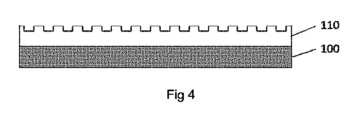
工程d)で基板上に薄層を形成した後、且つ工程f)で中間生成物を硬化させる前、薄膜にパターンを形成し、表面構造及びパターンを形成することができる。適切なパターン形成方法は、ナノインプリント、エンボス加工、ロールツーロール、グラビア、フレキソ印刷、ローラ、インクジェット、スクリーン印刷、スプレー、且つ/又はUVリソグラフィであり、表面構造(ナノスケール、又はマイクロ若しくはミリメートルスケール)を形成するために使用される。パターン形成の目的は、更なる光学的、物理的、又は化学的特性を薄膜に与えることである。
The temperature of the substrate during step d) preferably does not exceed 100° C., more preferably does not exceed 50° C., most preferably does not exceed 35° C. In some cases it may be preferable to deposit on a pre-heated substrate.
After forming the thin layer on the substrate in step d) and before curing the intermediate product in step f), the thin film can be patterned to form surface structures and patterns. Suitable patterning methods are nanoimprinting, embossing, roll-to-roll, gravure, flexographic, roller, inkjet, screen printing, spraying and/or UV lithography, which are used to form surface structures (nanoscale, or micro- or millimeter scale). The purpose of the patterning is to impart additional optical, physical or chemical properties to the thin film.
工程e)
工程d)において溶媒が存在する場合、溶媒は、工程e)において部分的又は完全に除去されることが好ましい。工程e)は、任意選択であり、通常は必要ない。成膜方法と製造ラインの仕様の間には差異がある。
Step e)
If a solvent is present in step d), the solvent is preferably partially or completely removed in step e). Step e) is optional and usually not necessary. There are differences between deposition methods and production line specifications.
温度に加え、溶媒の蒸発を促進させるために、真空乾燥工程も任意選択で適用されてよい。真空乾燥工程が使用される場合、通常、真空乾燥工程は最初に適用され、熱による予備硬化が後に続く。通常、除去は50~200kPaの圧力で行われ、且つ/又は50~150℃の温度での熱硬化が後に続く。好ましくは、除去は90~115kPaの圧力で行われ、且つ/又は60~100℃の温度での熱硬化が後に続く。 In addition to temperature, a vacuum drying step may also be optionally applied to accelerate evaporation of the solvent. If a vacuum drying step is used, it is usually applied first, followed by a thermal pre-cure. Typically, removal is performed at a pressure of 50-200 kPa and/or followed by a thermal cure at a temperature of 50-150°C. Preferably, removal is performed at a pressure of 90-115 kPa and/or followed by a thermal cure at a temperature of 60-100°C.
任意選択の熱による予備硬化は、通常、例えば対流式オーブン、ホットプレート、又はIR照射を使用し、熱に曝すことによって達成される。 Optional thermal pre-curing is typically accomplished by exposure to heat, for example using a convection oven, a hot plate, or IR radiation.
任意選択の真空乾燥は、塗工された基板(coated substrate)が入れられる特定のチャンバ内で高真空を印加することによって溶媒の除去が可能な特定の機器によって行われる。 Optional vacuum drying is performed by specific equipment capable of removing the solvent by applying a high vacuum in a specific chamber in which the coated substrate is placed.
工程f)
工程f)において、工程e)を実施した場合、工程e)で、又は工程e) を実施しない場合、工程d)で得られた中間生成物が硬化される。
Step f)
In step f), the intermediate product obtained in step d) is hardened, if step e) has been carried out or if step e) has not been carried out.
硬化は、通常、例えば対流式オーブン、ホットプレート、又はIR照射を使用し、熱に曝すことによって達成される。熱及びUV硬化処理の組み合わせも任意選択で使用されてよい。 Curing is typically accomplished by exposure to heat, for example using a convection oven, a hot plate, or IR radiation. A combination of heat and UV curing processes may also optionally be used.
硬化に用いられる温度は、通常、300℃を超えず、好ましくは250℃を超えず、最も好ましくは150℃を超えないか、又は80℃を超えない。 The temperature used for curing will usually not exceed 300°C, preferably not exceed 250°C, and most preferably not exceed 150°C or not exceed 80°C.
硬化時間は、通常、10分間~5.0時間であり、好ましくは20分間~3.0時間であり、最も好ましくは5分間~1.0時間である。 The curing time is usually 10 minutes to 5.0 hours, preferably 20 minutes to 3.0 hours, and most preferably 5 minutes to 1.0 hour.
工程f)の後に得られる最終的な薄膜の総フッ素含有量は、好ましくは薄膜の総質量に対し0.2~15質量%である。 The total fluorine content of the final thin film obtained after step f) is preferably 0.2-15 wt. % based on the total mass of the thin film.
工程f)の後の薄膜の厚さは、好ましくは15.0~120nmであり、より好ましくは30~100nmである。 The thickness of the thin film after step f) is preferably 15.0 to 120 nm, more preferably 30 to 100 nm.
好ましくは、膜の鉛筆硬度(PEHA)は少なくとも7Hであり、好ましくは少なくとも8Hであり、最も好ましくは少なくとも9Hである。 Preferably, the pencil hardness (PEHA) of the film is at least 7H, preferably at least 8H, and most preferably at least 9H.
好ましくは、膜の初期水接触角は少なくとも110°であり、好ましくは少なくとも115°であり、最も好ましくは少なくとも120°である。 Preferably, the film has an initial water contact angle of at least 110°, preferably at least 115°, and most preferably at least 120°.
好ましくは、膜の(632nmにおける)屈折率は1.50を下回り、好ましくは1.48を下回り、最も好ましくは1.46を下回る。 Preferably, the refractive index of the film (at 632 nm) is less than 1.50, preferably less than 1.48, and most preferably less than 1.46.
好ましくは、膜のRMS表面粗さは5.0nmを下回り、好ましくは3.5nmを下回り、最も好ましくは2.5nmを下回る。 Preferably, the RMS surface roughness of the film is below 5.0 nm, preferably below 3.5 nm, and most preferably below 2.5 nm.
好ましくは、膜のa*は-0.2~+0.2の間であり、好ましくは-0.1~+0.1の間であり、最も好ましくは-0.05~+0.05の間である。 Preferably, the a * of the membrane is between -0.2 and +0.2, preferably between -0.1 and +0.1, and most preferably between -0.05 and +0.05.
好ましくは、膜のb*は-0.2~+0.2の間であり、好ましくは-0.1~+0.1の間であり、最も好ましくは-0.05~+0.05の間である。 Preferably, the b * of the membrane is between -0.2 and +0.2, preferably between -0.1 and +0.1, and most preferably between -0.05 and +0.05.
膜は、ゴリラガラス(gorilla glass)基板上に適用された際に、塗工されていないゴリラガラスの透過率と比較して、好ましくは少なくとも0.5%、より好ましくは少なくとも0.75%、最も好ましくは少なくとも1.0%の透過率の向上をもたらす。 When applied onto a gorilla glass substrate, the film preferably provides an improvement in transmittance of at least 0.5%, more preferably at least 0.75%, and most preferably at least 1.0% compared to the transmittance of uncoated gorilla glass.
5000サイクル後の膜の性能は、初期の接触角に対する5000サイクル後の接触角の比として測定し、好ましくは20%未満、好ましくは15%未満、最も好ましくは10%未満である。 The performance of the film after 5000 cycles is measured as the ratio of the contact angle after 5000 cycles to the initial contact angle, and is preferably less than 20%, preferably less than 15%, and most preferably less than 10%.
綿布で100000サイクル摩擦した後の膜の水接触角は、ゴリラガラス基板上に適用された際、好ましくは少なくとも90°であり、より好ましくは少なくとも100°であり、最も好ましくは少なくとも105°である。 The water contact angle of the film after 100,000 cycles of rubbing with a cotton cloth is preferably at least 90°, more preferably at least 100°, and most preferably at least 105° when applied onto a Gorilla Glass substrate.
スチールウールで8000サイクル摩擦した後の膜の水接触角は、ゴリラガラス基板上に適用された際、好ましくは少なくとも80°であり、より好ましくは少なくとも90°であり、最も好ましくは少なくとも100°である。 The water contact angle of the film after 8000 cycles of rubbing with steel wool is preferably at least 80°, more preferably at least 90°, and most preferably at least 100° when applied onto a Gorilla Glass substrate.
ミノア消しゴム(Minoan eraser)で2500サイクル摩擦した後の膜の水接触角は、ゴリラガラス基板上に適用された際、好ましくは少なくとも90°であり、より好ましくは少なくとも100°であり、最も好ましくは少なくとも105°である。 The water contact angle of the film after 2500 cycles of rubbing with a Minoan eraser is preferably at least 90°, more preferably at least 100°, and most preferably at least 105° when applied onto a Gorilla Glass substrate.
スチールウールで2000サイクル摩擦した後の膜の水接触角は、金属基板上に適用された際、好ましくは少なくとも85°であり、より好ましくは少なくとも95°であり、最も好ましくは少なくとも105°である。 The water contact angle of the film after 2000 cycles of rubbing with steel wool is preferably at least 85°, more preferably at least 95°, and most preferably at least 105° when applied onto a metal substrate.
スチールウールで3000サイクル摩擦した後の膜の水接触角は、ソーダ石灰ガラス基板上に適用された際、好ましくは少なくとも90°であり、より好ましくは少なくとも100°であり、最も好ましくは少なくとも105°である。 The water contact angle of the film after 3000 cycles of rubbing with steel wool is preferably at least 90°, more preferably at least 100°, and most preferably at least 105° when applied onto a soda-lime glass substrate.
スチールウールで2000サイクル摩擦した後の膜の水接触角は、セラミック基板上に適用された際、好ましくは少なくとも80°であり、より好ましくは少なくとも90°であり、最も好ましくは少なくとも100°である。 The water contact angle of the film after 2000 cycles of rubbing with steel wool is preferably at least 80°, more preferably at least 90°, and most preferably at least 100° when applied onto a ceramic substrate.
「汗試験」処理された膜の、スチールウールで5000サイクル摩擦した後の水接触角は、ゴリラガラス基板上に適用された際、好ましくは少なくとも90°であり、より好ましくは少なくとも100°であり、最も好ましくは少なくとも105°である。 The water contact angle of the "sweat test" treated film after 5000 cycles of rubbing with steel wool is preferably at least 90°, more preferably at least 100°, and most preferably at least 105° when applied onto a Gorilla Glass substrate.
「高温高湿度(85℃/82%)」処理された膜の、スチールウールで5000サイクル摩擦した後の水接触角は、ゴリラガラス基板上に適用された際、好ましくは少なくとも90°であり、より好ましくは少なくとも100°であり、最も好ましくは少なくとも105°である。 The water contact angle of the "high temperature and humidity (85°C/82%)" treated film after 5000 cycles of rubbing with steel wool is preferably at least 90°, more preferably at least 100°, and most preferably at least 105° when applied onto a Gorilla Glass substrate.
「250℃温度安定性試験」処理された膜の、スチールウールで5000サイクル摩擦した後の水接触角は、ゴリラガラス基板上に適用された際、好ましくは少なくとも90°であり、より好ましくは少なくとも100°であり、最も好ましくは少なくとも110°である。 "250°C Temperature Stability Test" The water contact angle of the treated film after 5000 cycles of rubbing with steel wool when applied onto a Gorilla Glass substrate is preferably at least 90°, more preferably at least 100°, and most preferably at least 110°.
「酸試験」処理された膜の、スチールウールで5000サイクル摩擦した後の水接触角は、ゴリラガラス基板上に適用された際、好ましくは少なくとも90°であり、より好ましくは少なくとも100°であり、最も好ましくは少なくとも110°である。 The water contact angle of the "acid test" treated film after 5000 cycles of rubbing with steel wool is preferably at least 90°, more preferably at least 100°, and most preferably at least 110° when applied onto a Gorilla Glass substrate.
「熱サイクル/衝撃(-40℃→+85℃)試験」処理された膜の、スチールウールで5000サイクル摩擦した後の水接触角は、ゴリラガラス基板上に適用された際、好ましくは少なくとも90°であり、より好ましくは少なくとも100°であり、最も好ましくは少なくとも110°である。 "Thermal Cycle/Shock (-40°C → +85°C) Test" The water contact angle of the treated film after 5000 cycles of rubbing with steel wool is preferably at least 90°, more preferably at least 100°, and most preferably at least 110° when applied onto a Gorilla Glass substrate.
「UV安定性試験」処理された膜の、スチールウールで5000サイクル摩擦した後の水接触角は、ゴリラガラス基板上に適用された際、好ましくは少なくとも90°であり、より好ましくは少なくとも100°であり、最も好ましくは少なくとも110°である。 "UV Stability Test" The water contact angle of the treated film after 5000 cycles of rubbing with steel wool is preferably at least 90°, more preferably at least 100°, and most preferably at least 110° when applied onto a Gorilla Glass substrate.
「200℃の長期(6時間)高温安定性」処理された膜の、スチールウールで5000サイクル摩擦した後の水接触角は、ゴリラガラス基板上に適用された際、好ましくは少なくとも90°であり、より好ましくは少なくとも100°であり、最も好ましくは少なくとも110°である。 The water contact angle of the "200°C long-term (6 hours) high temperature stability" treated film after 5000 cycles of rubbing with steel wool is preferably at least 90°, more preferably at least 100°, and most preferably at least 110° when applied onto a Gorilla Glass substrate.
「長期性能安定性(室温で6カ月)」が試験された膜の、5000サイクル摩擦した膜の安定性能は、ゴリラガラス基板上に適用された際、初期の接触角に対する5000サイクル後の接触角の比として測定し、好ましくは15%未満であり、好ましくは10%未満であり、最も好ましくは8%未満である。 For films tested for "long-term performance stability (6 months at room temperature)", the stability performance of the film rubbed for 5000 cycles, when applied onto a Gorilla Glass substrate, is preferably less than 15%, preferably less than 10%, and most preferably less than 8%, measured as the ratio of the contact angle after 5000 cycles to the initial contact angle.
5000サイクル後の膜の性能は、初期のRMS表面粗さに対する5000サイクル後のRMS表面粗さの増大として測定し、好ましくは15%未満であり、好ましくは10%未満であり、最も好ましくは5%未満である。 The performance of the film after 5000 cycles is measured as the increase in RMS surface roughness after 5000 cycles relative to the initial RMS surface roughness, and is preferably less than 15%, preferably less than 10%, and most preferably less than 5%.
物品
本発明は、物品、好ましくは光学的又は電気的に被覆された物品であって、本発明の方法によって得られる薄膜を含む、物品に更に関する。
Articles The present invention further relates to an article, preferably an optically or electrically coated article, comprising a thin film obtainable by the method of the present invention.
物品は、携帯型タッチパネルディスプレイ又は他のインタラクティブタッチスクリーン装置といったタッチパネルディスプレイ、ソーラーパネルや窓等のガラス全般、携帯電話やコンピュータの金属ケース等の金属表面でありうる。 The article can be a touch panel display, such as a portable touch panel display or other interactive touch screen device, glass in general, such as a solar panel or a window, or a metal surface, such as a metal case for a cell phone or computer.
本発明に係る方法によって得られる薄膜を含む物品用の適切な材料として、セラミック、ガラス、金属、天然及び人工石、高分子材料(例えば、ポリ(メタ)アクリラート、ポリカーボナート、ポリスチレン、スチレンアクリロニトリル共重合体といったスチレン共重合体、ポリエステル、ポリエチレンテレフタレート等)、塗料(例えば、アクリル樹脂上のもの等)、粉末塗料(例えば、ポリウレタン又はハイブリッド粉末塗料等)、木材及び繊維基板(例えば、織物、革、カーペット、紙等)が挙げられる。
好ましくは、物品用の材料は、セラミック、ガラス(例えば、ホウケイ酸ガラス、ソーダ石灰ガラス、アルミノケイ酸ガラス、又は他の任意の種のガラス)、金属(例えば、アルミニウム、スチール等)、高分子材料(例えば、ポリ(メタ)アクリラート、ポリカーボナート、ポリスチレン、スチレンアクリロニトリル共重合体といったスチレン共重合体、ポリエステル、ポリエチレンテレフタレート等)、天然及び人工石から、より好ましくは金属、セラミック、ガラス、及び高分子材料(例えば、ポリ(メタ)アクリラート、ポリカーボナート、ポリスチレン、スチレンアクリロニトリル共重合体といったスチレン共重合体、ポリエステル、ポリエチレンテレフタレート等)から選択される。
Suitable materials for articles comprising thin films obtainable by the method according to the invention include ceramics, glass, metals, natural and artificial stone, polymeric materials (e.g. poly(meth)acrylates, polycarbonates, polystyrene, styrene copolymers such as styrene-acrylonitrile copolymers, polyesters, polyethylene terephthalate, etc.), paints (e.g. on acrylics, etc.), powder coatings (e.g. polyurethane or hybrid powder coatings, etc.), wood and textile substrates (e.g. textiles, leather, carpet, paper, etc.).
Preferably, the material for the article is selected from ceramics, glass (e.g. borosilicate glass, soda lime glass, aluminosilicate glass, or any other type of glass), metals (e.g. aluminum, steel, etc.), polymeric materials (e.g. poly(meth)acrylates, polycarbonates, polystyrene, styrene copolymers such as styrene-acrylonitrile copolymers, polyesters, polyethylene terephthalate, etc.), natural and artificial stone, more preferably from metals, ceramics, glass, and polymeric materials (e.g. poly(meth)acrylates, polycarbonates, polystyrene, styrene copolymers such as styrene-acrylonitrile copolymers, polyesters, polyethylene terephthalate, etc.).
物品の厚さ及び形状は、個別に変動してよく、平面、2D、又は3D形状でありうる。 The thickness and shape of the article may vary independently and may be flat, 2D, or 3D in shape.
物品は、薄膜が物品に適用される、例えば物品上に成膜される前に、化学的、物理的、及び/又は機械的表面処理を受けうる。 The article may undergo chemical, physical, and/or mechanical surface treatments before the thin film is applied to, e.g., deposited on, the article.
金属の場合、例えばアルミニウムは、材料の堆積前に、研磨、陽極酸化、着色、又は他のコーティングで被覆されうる。
ガラスは、非強化でも、熱的又は化学的に強化されていてもよく、各種の(アルカリ性又は酸性)表面処理剤を使用し、例えば研磨、研削、洗浄等、様々な表面処理を受けうる。
In the case of metals, for example aluminum, they may be polished, anodized, stained, or coated with other coatings prior to deposition of the material.
The glass may be unstrengthened, thermally or chemically strengthened and may undergo a variety of surface treatments, such as polishing, grinding, cleaning, etc., using a variety of (alkaline or acidic) surface treatment agents.
更に、物品は、平面であっても、表面テクスチャ(例えば、エッチング加工されたガラス表面、又は陽極酸化されたアルミニウム表面)を有していてもよく、又は物品上の他の層がテクスチャリング/波型表面をもたらしてもよく、物品上の他の層に表面テクスチャがなくてもよい。 Furthermore, the article may be flat, may have a surface texture (e.g., an etched glass surface, or an anodized aluminum surface), or other layers on the article may provide a textured/corrugated surface, or other layers on the article may not have a surface texture.
ガラスの場合、表面は、(例えば、ガラスに防眩(AG)効果をもたらすために)エッチング加工を使用するか、又はAG効果をもたらすためにコーティング層を施すことによって表面加工(texture)されてもよい。 In the case of glass, the surface may be textured using an etching process (e.g. to provide an anti-glare (AG) effect to the glass) or by applying a coating layer to provide an AG effect.
薄膜は、物品の少なくとも一つの表面が薄膜に直接接するよう、物品上に直接適用されうる。 The thin film can be applied directly onto the article such that at least one surface of the article is in direct contact with the thin film.
薄膜は、中間層の内表面が物品の少なくとも1つの表面に直接接するよう、中間層上にも適用されうる。その結果、薄膜は、中間層の外表面に直接接する。中間層は、材料コーティング層に関連し、機械的、物理的、化学的、又は光学的機能を有しうる。中間層は、実際の物理的コーティング層であってよく、又は物品中の中間層に直接接する表面の領域における分子若しくは原子レベルの修飾であってよい。 The thin film may also be applied over an intermediate layer such that the inner surface of the intermediate layer is in direct contact with at least one surface of the article. As a result, the thin film is in direct contact with the outer surface of the intermediate layer. The intermediate layer may have mechanical, physical, chemical, or optical functionality associated with the material coating layer. The intermediate layer may be an actual physical coating layer or may be a molecular or atomic level modification in the area of the surface in the article that is in direct contact with the intermediate layer.
本発明の方法の好ましい変形例及び実施形態は、本発明に係る物品の好ましい変形例及び実施形態でもある。 The preferred variations and embodiments of the method of the present invention are also preferred variations and embodiments of the article of the present invention.
本発明は、第1の前駆体組成物(FPC)及び第2の前駆体組成物(SPC)を含む組成物であって、第1の前駆体組成物(FPC)は、重合した式(I)
M1(OR1)nR2
m (I)
(式中、
M1は、z価の金属又は半金属であり、
R1は、それぞれ独立してC1~C10のオルガニル基又はオルガノヘテリル基から選択され、
R2は、それぞれ独立してC1~C20のオルガニル基、オルガノヘテリル基、フッ素化オルガニル基、又はフッ素化オルガノヘテリル基から選択され、
nは、1~z-1であり、
mは、1~z-1であり、
n+mは、zである)
の金属又は半金属化合物であり、
これにより、M1(OR1)部分の少なくとも部分的な加水分解によって重合は達成され、
第2の前駆体組成物(SPC)は、
b1)加水分解性基を含むフルオロポリエーテルシラン(PFS)を供給する工程
によって得られる、組成物に更に関する。
The present invention relates to a composition comprising a first precursor composition (FPC) and a second precursor composition (SPC), wherein the first precursor composition (FPC) is a polymerized precursor of formula (I):
M1 ( OR1 ) nR2m ( I)
(Wherein,
M 1 is a z-valent metal or metalloid;
R1 's are each independently selected from C1 - C10 organyl or organoheteryl groups;
R2 is independently selected from a C1 to C20 organyl group, an organoheteryl group, a fluorinated organyl group, or a fluorinated organoheteryl group;
n is 1 to z-1,
m is 1 to z-1;
n+m is z)
is a metal or semimetal compound of
whereby polymerization is accomplished by at least partial hydrolysis of the M 1 (OR 1 ) moiety;
The second precursor composition (SPC) comprises:
b1) providing a fluoropolyether silane (PFS) containing hydrolyzable groups.
本発明に係る方法の好ましい特徴は、本発明の組成物の好ましい特徴でもある。
本組成物は、驚くべきことに、室温及びやや高い温度(40℃まで)で安定である。
The preferred features of the method according to the invention are also preferred features of the composition according to the invention.
The composition is surprisingly stable at room temperature and at moderately elevated temperatures (up to 40° C.).
実施例に記載されるように決定される、組成物の保存可能期間は、通常、少なくとも6カ月である。 The shelf life of the composition, as determined as described in the Examples, is typically at least 6 months.
本発明は、第1の容器中の第1の前駆体組成物(FPC)及び第2の容器中の第2の前駆体組成物(SPC)を含むパーツキットであって、第1の前駆体組成物(FPC)は、重合した式(I)
M1(OR1)nR2
m (I)
(式中、
M1は、z価の金属又は半金属であり、
R1は、それぞれ独立してC1~C10のオルガニル基又はオルガノヘテリル基から選択され、
R2は、それぞれ独立してC1~C20のオルガニル基、オルガノヘテリル基、フッ素化オルガニル基、又はフッ素化オルガノヘテリル基から選択され、
nは、1~z-1であり、
mは、1~z-1であり、
n+mは、zである)
の金属又は半金属化合物であり、
これにより、M1(OR1)部分の少なくとも部分的な加水分解によって重合は達成され、
第2の前駆体組成物(SPC)は、
b1)加水分解性基を含むフルオロポリエーテルシラン(PFS)を供給する工程
によって得られる、パーツキットに更に関する。
The present invention relates to a kit of parts comprising a first precursor composition (FPC) in a first container and a second precursor composition (SPC) in a second container, the first precursor composition (FPC) comprising polymerized formula (I):
M1 ( OR1 ) nR2m ( I)
(Wherein,
M 1 is a z-valent metal or metalloid;
R1 's are each independently selected from C1 - C10 organyl or organoheteryl groups;
R2 is independently selected from a C1 to C20 organyl group, an organoheteryl group, a fluorinated organyl group, or a fluorinated organoheteryl group;
n is 1 to z-1,
m is 1 to z-1;
n+m is z)
is a metal or semimetal compound of
whereby polymerization is accomplished by at least partial hydrolysis of the M 1 (OR 1 ) moiety;
The second precursor composition (SPC) comprises:
b1) providing a fluoropolyether silane (PFS) containing hydrolyzable groups.
本発明に係る方法及び組成物の好ましい特徴は、本発明のパーツキットの好ましい特徴でもある。 The preferred features of the methods and compositions of the present invention are also preferred features of the kit of parts of the present invention.
本発明は、基板上に薄膜を作製するための、本発明に係る組成物又はパーツキットの使用に更に関する。 The present invention further relates to the use of the composition or kit of parts according to the present invention for producing a thin film on a substrate.
本発明は、光学コーティング又は電気コーティングを作製するための、本発明に係る組成物又はパーツキットの使用に更に関する。 The present invention further relates to the use of a composition or a kit of parts according to the present invention for producing an optical coating or an electrical coating.
測定方法
分子量
分子量の測定に使用される手段は、WATERS社GPC(ゲル浸透クロマトグラフィ):waters1515アイソクラティックHPLCポンプ、waters2414屈折率検出器である。
測定用の較正標準としてポリスチレン標準が使用される。測定用の実際の試料は、溶離溶液としてTHFを使用し、4m-%試料として調製される。
Measurement Method Molecular Weight The means used for measuring molecular weight is WATERS GPC (gel permeation chromatography): waters 1515 isocratic HPLC pump, waters 2414 refractive index detector.
Polystyrene standards are used as calibration standards for the measurements. The actual samples for the measurements are prepared as 4m-% samples using THF as the eluent solution.
固形分
分子量の決定に使用される手段は、Mettler Toledo HB43ハロゲン乾燥機/秤である。アルミニウム皿/カップ上で試料を秤量し、約1グラムの材料を使用して測定を行う。
The means used to determine solids molecular weight is a Mettler Toledo HB43 Halogen Dryer/Scale. Samples are weighed onto an aluminum dish/cup and approximately 1 gram of material is used to make the measurement.
保存可能期間の決定
実際の測定データについては実施例1Aの材料のデータを参照のこと。材料の保存可能期間は、以下の材料処理/適用結果安定性/硬化膜としての再現性によって決定される。膜厚及び摩擦性能の値は、硬化膜から測定される。膜厚は、エリプソメータ(ホリバ・ジョバンイボン社製UVISEL-VASE)を使用することによって特性評価される。測定は、ゴリラガラス4及びシリコンウエハ(直径150mm、型/ドーパント:P/Bor、配向:<1-0-0>、抵抗率:1~30オーム・cm、厚さ:675±25μm、TTV:<5μm、粒子:<20@0.2μm、前面:研磨、裏面:エッチング加工、フラット:1 SEMIスタンダード)を基板として使用して行われる。材料膜の成膜は、スプレーコーティングを使用して行われ、前処理(プラズマ)されたガラス基板上に材料膜をスプレーコーティングにより塗工し(典型的なスプレー処理:走査速度:300mm/s、ピッチ:50mm、ギャップ:100mm、流速:5~6ml/分、噴霧空気圧:5kg/cm2)、例えば150℃60分の熱硬化が後に続く。
Shelf life determination: See the material data in Example 1A for actual measurement data. The shelf life of the material is determined by the following material processing/application result stability/reproducibility as cured film. Film thickness and friction performance values are measured from the cured film. Film thickness is characterized by using an ellipsometer (UVISEL-VASE, HORIBA JOBIN YVON). Measurements are performed using Gorilla Glass 4 and silicon wafers (diameter 150 mm, type/dopant: P/Bor, orientation: <1-0-0>, resistivity: 1-30 ohm-cm, thickness: 675±25 μm, TTV: <5 μm, grain: <20@0.2 μm, front: polished, back: etched, flat: 1 SEMI standard) as substrates. The deposition of the material film is carried out using spray coating, where the material film is applied by spray coating onto a pretreated (plasma) glass substrate (typical spray process: scanning speed: 300 mm/s, pitch: 50 mm, gap: 100 mm, flow rate: 5-6 ml/min, spray air pressure: 5 kg/cm 2 ), followed by thermal curing at, for example, 150°C for 60 min.
粘度
器具製造業者:Grabner Instruments社、Viscometer MINIVIS-II。測定方法「落球式粘度測定」。試料は、直径3.175mmのスチールボールを使用し、20℃で測定される。
Viscosity: Instrument manufacturer: Grabner Instruments, Viscometer MINIVIS-II. Measurement method: "Falling ball viscosity measurement". The sample is measured at 20°C using a steel ball with a diameter of 3.175 mm.
膜厚及び屈折率
膜厚及び屈折率は、エリプソメータ(ホリバ・ジョバンイボン社製UVISEL-VASE)を使用することによって測定される。測定は、ゴリラガラス4又はシリコンウエハ(直径150mm、型/ドーパント:P/Bor、配向:<1-0-0>、抵抗:1~30オーム・cm、厚さ:675±25μm、TTV:<5μm、粒子:<20@0.2μm、表面:研磨、裏面:エッチング加工、フラット:1 SEMIスタンダード)を基板として使用して行われる。スプレー手段(典型的なスプレー処理:走査速度:300mm/s、ピッチ:50mm、ギャップ:100mm、流速:5~6ml/分、噴霧空気圧:5kg/cm2)を使用することによって、前処理(プラズマ)されたガラス基板上に材料膜を作製し、例えば150℃60分の熱硬化が後に続く。
透過率
コニカミノルタ社製分光光度計CM-3700A(ソフトウェア:SpectraMagic NX)。試験片の作製は、各実施例において記載される。
Film thickness and refractive index Film thickness and refractive index are measured by using an ellipsometer (UVISEL-VASE, HORIBA JOBIN YVON). Measurements are performed using Gorilla Glass 4 or silicon wafers (diameter 150 mm, type/dopant: P/Bor, orientation: <1-0-0>, resistivity: 1-30 ohm-cm, thickness: 675±25 μm, TTV: <5 μm, grain: <20@0.2 μm, front side: polished, back side: etched, flat: 1 SEMI standard) as substrates. By using a spraying means (typical spraying process: scanning speed: 300 mm/s, pitch: 50 mm, gap: 100 mm, flow rate: 5-6 ml/min, spraying air pressure: 5 kg/cm 2 ), a material film is produced on a pre-treated (plasma) glass substrate, followed by thermal curing, for example at 150°C for 60 min.
Transmittance: Konica Minolta spectrophotometer CM-3700A (software: SpectraMagic NX) Preparation of test pieces is described in each example.
色及びヘイズ測定
L*(D65)、a*(D65)、及びb*(D65)、並びにヘイズは、コニカミノルタ社製分光光度計CM-3700A(ソフトウェア:SpectraMagic NX)を使用して求められた。測定は、ゴリラガラス4を基板として使用して行われる。スプレー手段(典型的なスプレー処理:走査速度:300mm/s、ピッチ:50mm、ギャップ:100mm、流速:5~6ml/分、噴霧空気圧:5kg/cm2)を使用することによって、前処理(プラズマ)されたガラス基板上に材料膜を作製し、例えば150℃60分の熱硬化が後に続く。
Color and Haze Measurements
L * (D65), a * (D65), and b * (D65), as well as haze, were determined using a Konica Minolta spectrophotometer CM-3700A (software: SpectraMagic NX). Measurements are performed using Gorilla Glass 4 as the substrate. By using a spraying means (typical spraying process: scanning speed: 300 mm/s, pitch: 50 mm, gap: 100 mm, flow rate: 5-6 ml/min, atomizing air pressure: 5 kg/cm 2 ), material films are produced on pre-treated (plasma) glass substrates, followed by thermal curing, e.g., at 150°C for 60 min.
鉛筆硬度(PEHA)
スプレー手段(典型的なスプレー処理:走査速度:300mm/s、ピッチ:50mm、ギャップ:100mm、流速:5~6ml/分、噴霧空気圧:5kg/cm2)を使用することによって、前処理(プラズマ)されたガラス基板又は陽極酸化アルミニウム基板上に膜を作製し、例えば(ガラスに関しては)150℃60分及び(陽極酸化アルミニウムに関しては)80℃60分の熱硬化が後に続く。鉛筆硬度は、Elcometer鉛筆硬度試験機を使用し、ASTM規格D3363-00に準じて求められる。
Pencil hardness (PEHA)
Films are produced on pretreated (plasma) glass or anodized aluminum substrates by using a spray means (typical spray process: scanning speed: 300 mm/s, pitch: 50 mm, gap: 100 mm, flow rate: 5-6 ml/min, atomizing air pressure: 5 kg/ cm2 ), followed by thermal curing, e.g. 150°C for 60 min (for glass) and 80°C for 60 min (for anodized aluminum). Pencil hardness is determined according to ASTM standard D3363-00 using an Elcometer pencil hardness tester.
水接触角(CA)
スプレー手段(典型的なスプレー処理:走査速度:300mm/s、ピッチ:50mm、ギャップ:100mm、流速:5~6ml/分、噴霧空気圧:5kg/cm2)を使用することによって、前処理(プラズマ)されたガラス基板又は陽極酸化アルミニウム基板上に膜を作製し、例えば(ガラス及びセラミックに関しては)150℃60分及び(陽極酸化アルミニウムに関しては)80℃60分の熱硬化が後に続く。静的接触角の測定は、液滴サイズ4μlの蒸留水を使用して光学的張力計によって行われ、3つの測定点の平均が測定結果値として記録され、液滴の輪郭を表す数値法としてヤング・ラプラスの式が使用される(手段:Attension Theta光学式張力計)。水に加え、ジヨードメタン及びヘキサデカン等の他の液体も表面特性評価に使用されうる。
Water contact angle (CA)
Films are produced on pretreated (plasma) glass or anodized aluminum substrates by using a spraying means (typical spraying process: scanning speed: 300 mm/s, pitch: 50 mm, gap: 100 mm, flow rate: 5-6 ml/min, atomizing air pressure: 5 kg/cm 2 ), followed by thermal curing, e.g. 150°C for 60 min (for glass and ceramic) and 80°C for 60 min (for anodized aluminum). Static contact angle measurements are performed by an optical tensiometer using a drop size of 4 μl of distilled water, the average of three measurement points is recorded as the measurement result value, and the Young-Laplace equation is used as a numerical method to describe the drop profile (means: Attention Theta optical tensiometer). In addition to water, other liquids such as diiodomethane and hexadecane can also be used for surface characterization.
摩擦
スプレー手段(典型的なスプレー処理:走査速度:300mm/s、ピッチ:50mm、ギャップ:100mm、流速:5~6ml/分、噴霧空気圧:5kg/cm2)を使用することによって、前処理(プラズマ)されたガラス基板、陽極酸化アルミニウム基板、又はセラミック基板上に膜を作製し、例えば(ガラス及びセラミックに関しては)150℃60分及び(陽極酸化アルミニウム及び他の金属に関しては)80℃60分の熱硬化が後に続く。摩擦試験は、ボンスタースチールウール#0000、荷重1kg、ヘッド1×1cm、ストローク2インチ、速度60サイクル/分を使用して行われる(手段:Taberリニア摩耗試験機5750)。摩耗試験評価基準:初期水接触角、1000サイクル間隔(最大8000サイクル)での水接触角測定、及び1000サイクル間隔(最大8000サイクル)での目視による表面破損の検査/目視による擦傷検査。水接触角は、水接触角測定法に従って測定され、目視検査は、顕微鏡検査並びに緑及び赤色光質ランプ検査にて行われる。スチールウールに加え、綿布及びミノア消しゴムも摩擦性能試験に使用される。
接着性
スプレー手段(典型的なスプレー処理:走査速度:300mm/s、ピッチ:50mm、ギャップ:100mm、流速:5~6ml/分、噴霧空気圧:5kg/cm2)を使用することによって、前処理(プラズマ)されたガラス基板又は陽極酸化アルミニウム基板上に膜を作製し、例えば(ガラスに関しては)150℃60分及び(陽極酸化アルミニウムに関しては)80℃60分の熱硬化が後に続く。接着性は、Elcometerクロスハッチテスタ及びElcometerテープ試験を使用し、ASTM規格D3359-D9に準じて求められる。
Friction Films are prepared on pre-treated (plasma) glass, anodized aluminum, or ceramic substrates by using a spraying means (typical spraying process: scanning speed: 300 mm/s, pitch: 50 mm, gap: 100 mm, flow rate: 5-6 ml/min, atomizing air pressure: 5 kg/ cm2 ), followed by thermal curing, e.g. 150°C for 60 min (for glass and ceramic) and 80°C for 60 min (for anodized aluminum and other metals). Friction tests are performed using Bonstar steel wool #0000, 1 kg load, 1x1 cm head, 2 inch stroke, and 60 cycles/min speed (means: Taber Linear Abrasion Tester 5750). Abrasion test evaluation criteria: initial water contact angle, water contact angle measurement at 1000 cycle intervals (up to 8000 cycles), and visual inspection for surface damage/visual scratch inspection at 1000 cycle intervals (up to 8000 cycles). The water contact angle is measured according to the water contact angle measurement method, and visual inspection is performed under a microscope and under green and red light quality lamps. In addition to steel wool, cotton cloth and Minoa eraser are also used for the friction performance test.
Adhesion Films are produced on pre-treated (plasma) glass or anodized aluminium substrates by using a spray means (typical spray process: scanning speed: 300 mm/s, pitch: 50 mm, gap: 100 mm, flow rate: 5-6 ml/min, atomizing air pressure: 5 kg/ cm2 ), followed by thermal curing, e.g. 150°C for 60 min (for glass) and 80°C for 60 min (for anodized aluminium). Adhesion is determined according to ASTM standard D3359-D9 using an Elcometer crosshatch tester and an Elcometer tape test.
沸騰水試験
スプレー手段(典型的なスプレー処理:走査速度:300mm/s、ピッチ:50mm、ギャップ:100mm、流速:5~6ml/分、噴霧空気圧:5kg/cm2)を使用することによって、前処理(プラズマ)されたガラス基板、陽極酸化アルミニウム基板、又はセラミック基板上に膜を作製し、例えば(ガラスに関しては)150℃60分及び(陽極酸化アルミニウムに関しては)80℃60分の熱硬化が後に続く。ガラスの場合、塗工硬化後(coated and cured)の基板に対し、以下の初期測定が行われる:接着性、透過率、反射率、L*、a*、b*、及び水接触角。初期測定の後、試料基板は、沸騰水中に1時間浸される。沸騰水中での1時間の処理が完了した後、試料の接着性試験を行い、試料に5000サイクルの摩擦試験(ボンスタースチールウール#0000、荷重1kg、ヘッド1×1cm、ストローク2インチ、速度60サイクル/分)を施す。摩擦試験後、透過率、反射率、L*、a*、b*、及び水接触角を特性評価し、基準が満たされているかを確認するため、初期値と比較する。基板が陽極酸化アルミニウムである場合、接着性及び水接触角のみが測定され、初期値と摩擦試験後の値が比較され、性能が検証される。
Boiling Water Test Films are prepared on pre-treated (plasma) glass, anodized aluminum, or ceramic substrates by using a spray means (typical spray process: scanning speed: 300 mm/s, pitch: 50 mm, gap: 100 mm, flow rate: 5-6 ml/min, atomizing air pressure: 5 kg/ cm2 ), followed by thermal curing, e.g. 150°C for 60 min (for glass) and 80°C for 60 min (for anodized aluminum). For glass, the following initial measurements are made on the coated and cured substrates: adhesion, transmittance, reflectance, L * , a * , b * , and water contact angle. After the initial measurements, the sample substrates are immersed in boiling water for 1 hour. After the 1 hour treatment in boiling water is completed, the samples are adhesion tested and subjected to 5000 cycles of rub test (Bonstar steel wool #0000, 1 kg load, 1 x 1 cm head, 2 inch stroke, speed 60 cycles/min). After rub test, transmittance, reflectance, L * , a * , b * , and water contact angle are characterized and compared to initial values to ensure criteria are met. If the substrate is anodized aluminum, only adhesion and water contact angle are measured and initial values are compared to post rub test values to verify performance.
化学耐性試験(汗試験)
スプレー手段(典型的なスプレー処理:走査速度:300mm/s、ピッチ:50mm、ギャップ:100mm、流速:5~6ml/分、噴霧空気圧:5kg/cm2)を使用することによって、前処理(プラズマ)されたガラス基板、陽極酸化アルミニウム基板又はセラミック基板上に膜を作製し、例えば(ガラスに関しては)150℃60分や(陽極酸化アルミニウムに関しては)80℃60分の熱硬化が後に続く。ガラスの場合、塗工硬化後の基板に対し、以下の初期測定が行われる:接着性、透過率、反射率、L*、a*、b*、及び水接触角。初期測定の後、試料基板は、人の汗を模した溶液中に72時間浸される。汗溶液は、下記を含有する:純水100ml+NaCl 5g+2Na2HPO4 5g+99%酢酸2ml。汗溶液中での72時間の浸漬が完了した後、試料の接着性試験を行い、試料に5000サイクルの摩擦試験(ボンスタースチールウール#0000、荷重1kg、ヘッド1×1cm、ストローク2インチ、速度60サイクル/分)を施す。摩擦試験後、透過率、反射率、L*、a*、b*、及び水接触角を特性評価し、基準が満たされているかを確認するため、初期値と比較する。基板が陽極酸化アルミニウムである場合、接着性及び水接触角のみが測定され、初期値と摩擦試験後の値が比較され、性能が検証される。
Chemical resistance test (sweat test)
By using a spraying means (typical spraying process: scanning speed: 300 mm/s, pitch: 50 mm, gap: 100 mm, flow rate: 5-6 ml/min, atomizing air pressure: 5 kg/cm 2 ), films are produced on pretreated (plasma) glass, anodized aluminum or ceramic substrates, followed by thermal curing, e.g. at 150°C for 60 min (for glass) or at 80°C for 60 min (for anodized aluminum). In the case of glass, the following initial measurements are carried out on the substrate after coating and curing: adhesion, transmittance, reflectance, L * , a * , b * and water contact angle. After the initial measurements, the sample substrate is immersed for 72 hours in a solution simulating human sweat. The sweat solution contains: 100 ml pure water + 5 g NaCl + 5 g 2Na 2 HPO 4 + 2 ml 99% acetic acid. After the 72 hour immersion in the sweat solution is completed, the samples are adhesion tested and subjected to 5000 cycles of rub test (Bonstar steel wool #0000, 1 kg load, 1 x 1 cm head, 2 inch stroke, speed 60 cycles/min). After rub test, transmittance, reflectance, L * , a * , b * , and water contact angle are characterized and compared to initial values to ensure criteria are met. If the substrate is anodized aluminum, only adhesion and water contact angle are measured and initial values are compared to post rub test values to verify performance.
化学耐性試験(酸試験)
スプレー手段(典型的なスプレー処理:走査速度:300mm/s、ピッチ:50mm、ギャップ:100mm、流速:5~6ml/分、噴霧空気圧:5kg/cm2)を使用することによって、前処理(プラズマ)されたガラス基板、陽極酸化アルミニウム基板、又はセラミック基板上に膜を作製し、例えば(ガラスに関しては)150℃60分及び(陽極酸化アルミニウムに関しては)80℃60分の熱硬化が後に続く。ガラスの場合、塗工硬化後の基板に対し、以下の初期測定が行われる:接着性、透過率、反射率、L*、a*、b*、及び水接触角。初期測定の後、試料基板は、酸性溶液中に24時間浸される。酸性溶液は、下記を含有する:1質量%H2SO4。酸性溶液中での24時間の浸漬が完了した後、試料の接着性試験を行い、試料に5000サイクルの摩擦試験(ボンスタースチールウール#0000、荷重1kg、ヘッド1×1cm、ストローク2インチ、速度60サイクル/分)を施す。摩擦試験後、透過率、反射率、L*、a*、b*、及び水接触角を特性評価し、基準が満たされているかを確認するため、初期値と比較する。基板が陽極酸化アルミニウムである場合、接着性及び水接触角のみが測定され、初期値と摩擦試験後の値が比較され、性能が検証される。
Chemical resistance test (acid test)
By using a spraying means (typical spraying process: scanning speed: 300 mm/s, pitch: 50 mm, gap: 100 mm, flow rate: 5-6 ml/min, atomizing air pressure: 5 kg/cm 2 ), films are produced on pretreated (plasma) glass, anodized aluminum or ceramic substrates, followed by thermal curing, e.g. 60 min at 150°C (for glass) and 60 min at 80°C (for anodized aluminum). In the case of glass, the following initial measurements are made on the substrate after coating and curing: adhesion, transmittance, reflectance, L * , a * , b * and water contact angle. After the initial measurements, the sample substrate is immersed in an acidic solution for 24 hours. The acidic solution contains: 1% by weight H 2 SO 4 . After the 24-hour immersion in the acid solution is completed, the samples are adhesion tested and subjected to 5000 cycles of rub test (Bonstar steel wool #0000, 1 kg load, 1 x 1 cm head, 2 inch stroke, speed 60 cycles/min). After rub test, transmittance, reflectance, L * , a * , b * , and water contact angle are characterized and compared to initial values to ensure criteria are met. If the substrate is anodized aluminum, only adhesion and water contact angle are measured and initial values are compared to post-rub test values to verify performance.
HTHH試験
スプレー手段(典型的なスプレー処理:走査速度:300mm/s、ピッチ:50mm、ギャップ:100mm、流速:5~6ml/分、噴霧空気圧:5kg/cm2)を使用することによって、前処理(プラズマ)されたガラス基板、陽極酸化アルミニウム基板、又はセラミック基板上に膜を作製し、例えば(ガラスに関しては)150℃60分や(陽極酸化アルミニウムに関しては)80℃60分の熱硬化が後に続く。ガラスの場合、塗工硬化後の基板に対し、以下の初期測定が行われる:接着性、透過率、反射率、L*、a*、b*、及び水接触角。初期測定の後、試料は、温度85℃、相対湿度85%の条件の環境チャンバ内に100時間置かれる。100時間の85/85環境チャンバ処理が完了した後、試料の接着性試験を行い、試料に5000サイクルの摩擦試験(ボンスタースチールウール#0000、荷重1kg、ヘッド1×1cm、ストローク2インチ、速度60サイクル/分)を施す。摩擦試験後、透過率、反射率、L*、a*、b*、及び水接触角を特性評価し、基準が満たされているかを確認するため、初期値と比較する。基板が陽極酸化アルミニウムである場合、接着性及び水接触角のみが測定され、初期値と摩擦試験後の値が比較され、性能が検証される。
HTHH Testing Films are prepared on pre-treated (plasma) glass, anodized aluminum, or ceramic substrates by using a spraying means (typical spraying process: scanning speed: 300mm/s, pitch: 50mm, gap: 100mm, flow rate: 5-6ml/min, atomizing air pressure: 5kg/ cm2 ), followed by thermal curing, e.g. 150°C for 60 minutes (for glass) or 80°C for 60 minutes (for anodized aluminum). In the case of glass, the following initial measurements are made on the substrate after coating and curing: adhesion, transmittance, reflectance, L * , a * , b * , and water contact angle. After the initial measurements, the samples are placed in an environmental chamber at 85°C and 85% relative humidity for 100 hours. After the 100 hours of 85/85 environmental chamber treatment is completed, the samples are adhesion tested and subjected to 5000 cycles of rub testing (Bonstar steel wool #0000, 1 kg load, 1 x 1 cm head, 2 inch stroke, speed 60 cycles/min). After rub testing, the transmittance, reflectance, L * , a * , b * , and water contact angle are characterized and compared to initial values to ensure criteria are met. If the substrate is anodized aluminum, only adhesion and water contact angle are measured and initial values are compared to post-rub testing values to verify performance.
高温試験1及び2
スプレー手段(典型的なスプレー処理:走査速度:300mm/s、ピッチ:50mm、ギャップ:100mm、流速:5~6ml/分、噴霧空気圧:5kg/cm2)を使用することによって、前処理(プラズマ)されたガラス基板、陽極酸化アルミニウム基板、又はセラミック基板上に膜を作製し、例えば(ガラスに関しては)150℃60分や(陽極酸化アルミニウムに関しては)80℃60分の熱硬化が後に続く。ガラスの場合、塗工硬化後の基板に対し、以下の初期測定が行われる:接着性、透過率、反射率、L*、a*、b*、及び水接触角。初期測定の後、試料は、250℃の対流式オーブン内に10時間置かれ、高温試験1が実施される。試料は、200℃の対流式オーブン内に6日間置かれ、高温試験2が実施される。高温試験が完了した後、試料の接着性試験を行い、試料に5000サイクルの摩擦試験(ボンスタースチールウール#0000、荷重1kg、ヘッド1×1cm、ストローク2インチ、速度60サイクル/分)を施す。摩擦試験後、透過率、反射率、L*、a*、b*、及び水接触角を特性評価し、基準が満たされているかを確認するため、初期値と比較する。基板が陽極酸化アルミニウムである場合、接着性及び水接触角のみが測定され、初期値と摩擦試験後の値が比較され、性能が検証される。
High temperature tests 1 and 2
By using a spraying means (typical spraying process: scanning speed: 300 mm/s, pitch: 50 mm, gap: 100 mm, flow rate: 5-6 ml/min, atomizing air pressure: 5 kg/cm 2 ), films are produced on pre-treated (plasma) glass, anodized aluminum or ceramic substrates, followed by thermal curing, e.g. at 150°C for 60 min (for glass) or at 80°C for 60 min (for anodized aluminum). In the case of glass, the following initial measurements are made on the substrate after coating and curing: adhesion, transmittance, reflectance, L * , a * , b * and water contact angle. After the initial measurements, the sample is placed in a convection oven at 250°C for 10 hours and high temperature test 1 is performed. The sample is placed in a convection oven at 200°C for 6 days and high temperature test 2 is performed. After the high temperature test is completed, the samples are adhesion tested and subjected to 5000 cycles of rub test (Bonstar steel wool #0000, 1 kg load, 1 x 1 cm head, 2 inch stroke, speed 60 cycles/min). After rub test, transmittance, reflectance, L * , a * , b * , and water contact angle are characterized and compared to initial values to ensure criteria are met. If the substrate is anodized aluminum, only adhesion and water contact angle are measured and initial values are compared to post rub test values to verify performance.
熱衝撃試験
スプレー手段(典型的なスプレー処理:走査速度:300mm/s、ピッチ:50mm、ギャップ:100mm、流速:5~6ml/分、噴霧空気圧:5kg/cm2)を使用することによって、前処理(プラズマ)されたガラス基板、陽極酸化アルミニウム基板、又はセラミック基板上に膜を作製し、例えば(ガラスに関しては)150℃60分や(陽極酸化アルミニウムに関しては)80℃60分の熱硬化が後に続く。ガラスの場合、塗工硬化後の基板に対し、以下の初期測定が行われる:接着性、透過率、反射率、L*、a*、b*、及び水接触角。初期測定の後、試料は熱衝撃試験チャンバ内に置かれる。試験チャンバは、-40℃(10分間保持)から+85℃(10分間保持)までの温度サイクルに従い、これらの2つの温度間(温度変化の間隔は10秒間)の温度サイクルが合計120サイクル繰り返される。120回の熱衝撃サイクルの後、試料の接着性試験を行い、試料に5000サイクルの摩擦試験(ボンスタースチールウール#0000、荷重1kg、ヘッド1×1cm、ストローク2インチ、速度60サイクル/分)を施す。摩擦試験後、透過率、反射率、L*、a*、b*、及び水接触角を特性評価し、基準が満たされているかを確認するため、初期値と比較する。基板が陽極酸化アルミニウムである場合、接着性及び水接触角のみが測定され、初期値と摩擦試験後の値が比較され、性能が検証される。
Thermal Shock Test Films are produced on pre-treated (plasma) glass, anodized aluminum or ceramic substrates by using a spraying means (typical spraying process: scanning speed: 300 mm/s, pitch: 50 mm, gap: 100 mm, flow rate: 5-6 ml/min, atomizing air pressure: 5 kg/ cm2 ), followed by thermal curing, e.g. at 150°C for 60 min (for glass) or 80°C for 60 min (for anodized aluminum). In the case of glass, the following initial measurements are made on the substrate after coating and curing: adhesion, transmittance, reflectance, L * , a * , b * and water contact angle. After the initial measurements, the samples are placed in a thermal shock test chamber. The test chamber is subjected to a temperature cycle from -40°C (held for 10 min) to +85°C (held for 10 min) and between these two temperatures (with 10 s interval between temperature changes) for a total of 120 cycles. After 120 thermal shock cycles, the samples are adhesion tested and subjected to 5000 cycles of rub test (Bonstar steel wool #0000, 1 kg load, 1 x 1 cm head, 2 inch stroke, speed 60 cycles/min). After rub test, transmittance, reflectance, L * , a * , b * , and water contact angle are characterized and compared to initial values to ensure criteria are met. If the substrate is anodized aluminum, only adhesion and water contact angle are measured and initial values are compared to post-rub test values to verify performance.
UV安定性試験
スプレー手段(典型的なスプレー処理:走査速度:300mm/s、ピッチ:50mm、ギャップ:100mm、流速:5~6ml/分、噴霧空気圧:5kg/cm2)を使用することによって、前処理(プラズマ)されたガラス基板、陽極酸化アルミニウム基板、又はセラミック基板上に膜を作製し、例えば(ガラスに関しては)150℃60分や(陽極酸化アルミニウムに関しては)80℃60分の熱硬化が後に続く。ガラスの場合、塗工硬化後の基板に対し、以下の初期測定が行われる:接着性、透過率、反射率、L*、a*、b*、及び水接触角。初期測定の後、試料は、UV安定性試験チャンバ内に置かれる。UV試験チャンバは、試料が最初に(60℃で)4時間の0.77W/m2のUV露光に、次いで4時間の50℃の集光条件(condensing conditions)に曝されるサイクルに従い、このサイクルが、合計40時間、5回繰り返される。40時間のUV安定性試験の後、試料の接着性試験を行い、試料に5000サイクルの摩擦試験(ボンスタースチールウール#0000、荷重1kg、ヘッド1×1cm、ストローク2インチ、速度60サイクル/分)を施す。摩擦試験後、透過率、反射率、L*、a*、b*、及び水接触角を特性評価し、基準が満たされているかを確認するため、初期値と比較する。基板が陽極酸化アルミニウムである場合、接着性及び水接触角のみが測定され、初期値と摩擦試験後の値が比較され、性能が検証される。
UV Stability Test Films are prepared on pre-treated (plasma) glass, anodized aluminum, or ceramic substrates by using a spraying means (typical spraying process: scanning speed: 300 mm/s, pitch: 50 mm, gap: 100 mm, flow rate: 5-6 ml/min, atomizing air pressure: 5 kg/ cm2 ), followed by thermal curing, e.g. 150°C for 60 min (for glass) or 80°C for 60 min (for anodized aluminum). In the case of glass, the following initial measurements are made on the substrate after coating and curing: adhesion, transmittance, reflectance, L * , a * , b * , and water contact angle. After the initial measurements, the samples are placed in a UV stability test chamber. The UV test chamber follows a cycle where the samples are first exposed to 0.77 W/ m2 UV exposure (at 60°C) for 4 hours, followed by condensing conditions at 50°C for 4 hours, and this cycle is repeated 5 times for a total of 40 hours. After 40 hours of UV stability testing, the samples are adhesion tested and subjected to 5000 cycles of rub testing (Bonstar steel wool #0000, 1 kg load, 1 x 1 cm head, 2 inch stroke, speed 60 cycles/min). After the rub testing, the transmittance, reflectance, L * , a * , b * , and water contact angle are characterized and compared to the initial values to ensure that the criteria are met. If the substrate is anodized aluminum, only adhesion and water contact angle are measured and the initial values are compared to the values after the rub testing to verify the performance.
膜エージング(Aged Film)試験
スプレー手段(典型的なスプレー処理:走査速度:300mm/s、ピッチ:50mm、ギャップ:100mm、流速:5~6ml/分、噴霧空気圧:5kg/cm2)を使用することによって、前処理(プラズマ)されたゴリラガラス上に膜を作製し、例えば150℃60分の熱硬化が後に続く。塗工硬化後の基板に対し、初期測定が行われる:接着性、透過率、反射率、L*、a*、b*、及び水接触角。初期測定の後、塗工ゴリラガラス試料は、事務机に保管され、2カ月、4カ月、及び6カ月の測定点で試験される。試料の接着性試験を行い、試料に5000サイクルの摩擦試験(ボンスタースチールウール#0000、荷重1kg、ヘッド1×1cm、ストローク2インチ、速度60サイクル/分)を施す。摩擦試験後、透過率、反射率、L*、a*、b*、及び水接触角を特性評価し、基準が満たされているかを確認するため、初期値と比較する。
Aged Film Test A film is prepared on pre-treated (plasma) Gorilla Glass by using a spraying means (typical spraying process: scanning speed: 300 mm/s, pitch: 50 mm, gap: 100 mm, flow rate: 5-6 ml/min, atomizing air pressure: 5 kg/ cm2 ), followed by thermal curing at 150°C for 60 min. Initial measurements are performed on the substrate after coating curing: adhesion, transmittance, reflectance, L * , a * , b * , and water contact angle. After the initial measurements, the coated Gorilla Glass samples are stored on an office desk and tested at 2 months, 4 months, and 6 months measurement points. The adhesion of the samples is tested and the samples are subjected to 5000 cycles of friction testing (Bonstar steel wool #0000, load 1 kg, head 1 x 1 cm, stroke 2 inches, speed 60 cycles/min). After the rub test, the transmittance, reflectance, L * , a * , b * , and water contact angle are characterized and compared to the initial values to ensure that criteria are met.
図面の説明
添付の図面は、実施形態を説明する。
Description of the Drawings The accompanying drawings illustrate embodiments.
図1は、最上部に材料コーティング層110が成膜された、塗工基板100の断面を示す。任意選択で、材料コーティング層110は、基板100の両側(両面)に塗工されうる。
Figure 1 shows a cross-section of a
図2は、塗工基板200の断面を示し、この例において、基板表面は、材料コーティング層220が層210上へ成膜される前に、基板の最上部に成膜された中間層210を有する。中間層210は、材料コーティング層220に関連し、機械的、物理的、化学的、又は光学的機能を有しうる。中間層は、実際の物理的なコーティング層であってもよいし、又は最上面の基板200の材料における分子若しくは原子レベルの修飾であってもよい。
コーティング層210は、基板200表面を活性化し、基板200と材料コーティング層220との間の良好な接着を達成する下塗層であってもよい。代替的に、コーティング層210は、例えば追加のガラス腐食防止、拡散バリア、導電性若しくは半導電性コーティング層、又はコーティング積層体(coating stack)全体の光学特性を向上させる役割を果たす光学的コーティング層をもたらす、(パターンが形成されるか、又はパターンが形成されない)コーティング層であってもよい。
代替的な構成において、コーティング層210は、本発明に記載される実際の材料コーティング層であってもよく(この場合、基板200とコーティング層210との間の更なる任意選択のコーティング層が適用されうる)、コーティング層220は、更なる表面処理化学物質層、下塗層、又は例えば追加のガラス腐食防止、拡散バリア、導電性若しくは半導電性コーティング層、及び/若しくはコーティング積層体全体の光学特性を向上させる役割を果たす光学的コーティング層をもたらす、(パターンが形成されるか、又はパターンが形成されない)コーティング層として機能しうる。具体的には、コーティング層210は、材料コーティング層210及びコーティング積層体全体の水接触角及び油接触角の更なる増大ももたらしうる。
2 shows a cross-section of a coated substrate 200, in this example a substrate surface having an intermediate layer 210 deposited on top of the substrate before a material coating layer 220 is deposited onto layer 210. The intermediate layer 210 may have a mechanical, physical, chemical, or optical function associated with the material coating layer 220. The intermediate layer may be an actual physical coating layer or may be a molecular or atomic level modification in the material of the top substrate 200.
Coating layer 210 may be a primer layer that activates the substrate 200 surface and achieves good adhesion between the substrate 200 and the material coating layer 220. Alternatively, coating layer 210 may be a coating layer (patterned or unpatterned) that provides, for example, an additional glass corrosion protection, a diffusion barrier, a conductive or semiconductive coating layer, or an optical coating layer that serves to improve the optical properties of the overall coating stack.
In an alternative configuration, coating layer 210 may be the actual material coating layer described in the present invention (in which case further optional coating layers between substrate 200 and coating layer 210 may be applied), and coating layer 220 may function as a further surface treatment chemical layer, a primer layer, or a coating layer (patterned or unpatterned) that provides, for example, additional glass corrosion protection, a diffusion barrier, a conductive or semiconductive coating layer, and/or an optical coating layer that serves to improve the optical properties of the entire coating stack. In particular, coating layer 210 may also provide a further increase in the water and oil contact angles of material coating layer 210 and the entire coating stack.
図3は、基板最上部に材料層を成膜する方法の典型的な順序を示す。工程1は、基板の用意を含み、工程2は、塗工処理を含み、工程3は、コーティングのその最終形態への硬化を含む。 Figure 3 shows a typical sequence of a method for depositing a layer of material on top of a substrate. Step 1 involves preparing the substrate, step 2 involves the coating process, and step 3 involves curing the coating to its final form.
適切な基板として、セラミック、ガラス、金属、天然及び人工石、高分子材料(例えば、ポリ(メタ)アクリラート、ポリカーボナート、ポリスチレン、スチレンアクリロニトリル共重合体といったスチレン共重合体、ポリエステル、ポリエチレンテレフタレート等)、塗料(例えば、アクリル樹脂上のもの等)、粉末塗料(例えば、ポリウレタン又はハイブリッド粉末塗料等)、木材及び繊維基板(例えば、織物、革、カーペット、紙等)が挙げられる。好ましくは、基板は、セラミック、ガラス(例えば、ホウケイ酸ガラス、ソーダ石灰ガラス、アルミノケイ酸ガラス、又は他の任意の種のガラス)、金属(例えば、アルミニウム、スチール等)、高分子材料(例えば、ポリ(メタ)アクリラート、ポリカーボナート、ポリスチレン、スチレンアクリロニトリル共重合体といったスチレン共重合体、ポリエステル、ポリエチレンテレフタレート等)、天然及び人工石から、より好ましくは金属、セラミック、ガラス、及び高分子材料(例えば、ポリ(メタ)アクリラート、ポリカーボナート、ポリスチレン、スチレンアクリロニトリル共重合体といったスチレン共重合体、ポリエステル、ポリエチレンテレフタレート等)から選択される。基板の厚さ及び形状は、個別に変動してもよく、平面、2D、又は3D形状でありうる。基板は、材料の堆積(deposition)前に、化学的、物理的、及び/又は機械的表面処理を受けうる(且つ実際のコーティング材料の堆積前に成膜される中間層を有しうる)。金属の場合、例えばアルミニウムは、材料の堆積前に、研磨、陽極酸化、着色、又は他のコーティングで被覆されうる。ガラスは、非強化でも、熱的又は化学的に強化されていてもよく、各種の(アルカリ性又は酸性)表面処理剤を使用し、例えば研磨、研削、洗浄等、様々な表面処理を受けうる。更に、基板は、平面であっても、表面テクスチャ(例えば、エッチング加工されたガラス表面、又は陽極酸化されたアルミニウム表面)を有していてもよく、又は基板上の他の層がテクスチャリング/波型表面をもたらしてもよく、基板上の他の層に表面テクスチャがなくてもよい。ガラスの場合、表面は、(例えば、ガラスに防眩(AG)効果をもたらすために)エッチング加工を使用するか、又はAG効果をもたらすためにコーティング層を施すことによって表面加工(texture)されてもよい。 Suitable substrates include ceramics, glass, metals, natural and artificial stone, polymeric materials (e.g., poly(meth)acrylates, polycarbonates, polystyrene, styrene copolymers such as styrene-acrylonitrile copolymers, polyesters, polyethylene terephthalate, etc.), paints (e.g., on acrylics), powder coatings (e.g., polyurethane or hybrid powder coatings), wood and textile substrates (e.g., textiles, leather, carpet, paper, etc.). Preferably, the substrate is selected from ceramics, glass (e.g. borosilicate glass, soda-lime glass, aluminosilicate glass or any other type of glass), metal (e.g. aluminum, steel, etc.), polymeric materials (e.g. poly(meth)acrylates, polycarbonates, polystyrene, styrene copolymers such as styrene-acrylonitrile copolymers, polyesters, polyethylene terephthalates, etc.), natural and artificial stone, more preferably from metals, ceramics, glass and polymeric materials (e.g. poly(meth)acrylates, polycarbonates, polystyrene, styrene copolymers such as styrene-acrylonitrile copolymers, polyesters, polyethylene terephthalates, etc.). The thickness and shape of the substrate may vary independently and may be planar, 2D or 3D in shape. The substrate may undergo chemical, physical and/or mechanical surface treatments before the deposition of the material (and may have intermediate layers deposited before the deposition of the actual coating material). In the case of metals, for example aluminum, it may be polished, anodized, stained or covered with other coatings before the deposition of the material. Glass may be unstrengthened, thermally or chemically strengthened, and may undergo various surface treatments, e.g. polishing, grinding, cleaning, using various (alkaline or acidic) surface treatments. Furthermore, the substrate may be flat, have a surface texture (e.g. an etched glass surface, or an anodized aluminum surface), or other layers on the substrate may provide a textured/corrugated surface, or other layers on the substrate may not have a surface texture. In the case of glass, the surface may be textured using an etching process (e.g. to provide an anti-glare (AG) effect on the glass) or by applying a coating layer to provide an AG effect.
材料コーティング層は、好ましくはスピンオン、ディップ、スプレー、バー、インクジェット、ロールツーロール、グラビア、フレキソ印刷、スクリーン印刷、カーテン、ドリップ、ローラ、スクリーン印刷塗工法、ブラシ塗工を用いる湿式化学塗工法を使用することによって、又はラビング、押出塗工やスロットコーティング、スロットとスピンの組み合わせによって、より好ましくはスプレーコーティング、スロットコーティング、ディップコーティング、スピンコーティング、最も好ましくはスプレーコーティング(幾つかの典型的な液相析出法を挙げるが、これらに限定されない)によって塗布される。湿式化学塗工工程の後、任意選択で過剰な溶媒の除去工程が行われ、熱硬化のみ若しくはUV硬化を使用するか、又はそれらの組み合わせであってもよい硬化工程が後に続く。 The material coating layer is preferably applied by using wet chemical coating methods using spin-on, dip, spray, bar, inkjet, roll-to-roll, gravure, flexographic, screen printing, curtain, drip, roller, screen printing coating methods, brush coating, or by rubbing, extrusion coating, slot coating, a combination of slot and spin, more preferably by spray coating, slot coating, dip coating, spin coating, most preferably spray coating (listing some typical liquid phase deposition methods, but not limited to these). The wet chemical coating step is optionally followed by a step of removing excess solvent, followed by a curing step, which may be thermal curing only or UV curing, or a combination thereof.
典型的なスプレー処理の概要:
1.基板の前洗浄:
a.洗剤「Merck107553」(特にソーダ石灰ガラスの場合、アルカリ性洗剤も使用されうる)による洗浄
b.DI水によるすすぎ
c.噴霧器による吹き付け
A typical spray process overview:
1. Pre-cleaning of the substrate:
a. Cleaning with detergent "Merck 107553" (alkaline detergents can also be used, especially for soda-lime glass)
b. DI water rinse
c. Spraying with a sprayer
2.プラズマ前処理(機器ブランド:Creating-nano、モデル:CNT-ASP003RT)
a.出力:800W
b.走査速度:400mm/s
c.ピッチ:10~30mm
d.ギャップ:25~30mm
2. Plasma pretreatment (equipment brand: Creating-nano, model: CNT-ASP003RT)
a. Output: 800W
b. Scanning speed: 400mm/s
c.Pitch: 10-30mm
d. Gap: 25-30mm
3.スプレー条件(機器ブランド:Creating-nano、モデル:PSC640)
a.スプレー量:6~20ml/分
b.圧力:2~5kg/cm2
c.走査速度:300~800mm/s
d.ギャップ:3~10cm
e.ピッチ:5~20mm
3. Spray conditions (equipment brand: Creating-nano, model: PSC640)
a. Spray volume: 6-20ml/min
b. Pressure: 2-5kg/ cm2
c. Scanning speed: 300-800mm/s
d.Gap: 3-10cm
e.Pitch: 5-20mm
4.焼成条件
オーブン:80~150℃/30~60分
4. Baking conditions Oven: 80-150℃/30-60 minutes
図4は、基板400及び材料コーティング層410の断面像を示す。材料層の成膜に加え、パターン形成処理(ナノインプリント、エンボス加工、ロールツーロール、グラビア、フレキソ印刷、ローラ、インクジェット、スクリーン印刷、スプレー及び/又はUVリソグラフィがパターン形成処理として使用される)が、材料膜に表面構造(ナノスケール、又はマイクロ若しくはミリメートルスケール)を形成して、材料コーティング層又はコーティング層に更なる光学的、物理的、又は化学的特性をもたらすために使用される。 Figure 4 shows a cross-sectional image of a substrate 400 and a material coating layer 410. In addition to deposition of a material layer, a patterning process (nanoimprint, embossing, roll-to-roll, gravure, flexography, roller, inkjet, screen printing, spray and/or UV lithography are used as patterning processes) is used to create surface structures (nanoscale, or micro- or millimeter scale) in the material film to provide additional optical, physical or chemical properties to the material coating layer or coating layers.
図5は、基板500最上部に材料層510を成膜し、且つパターン形成する方法の典型的な順序を示す。工程1は、基板の用意を含み、工程2は、塗工処理を含み、工程3は、材料コーティングのパターン形成処理(これは、熱及びUV硬化、又はそれらの組み合わせを含んでもよい)を含み、工程4は、コーティングのその最終形態への硬化を含む。工程2及び工程3は、成膜技術及びパターン形成技術に応じて、1工程として組み合わせられ得る。 Figure 5 shows a typical sequence of a method for depositing and patterning a material layer 510 on top of a substrate 500. Step 1 involves preparing the substrate, step 2 involves a coating process, step 3 involves a patterning process of the material coating (which may include thermal and UV curing, or a combination thereof), and step 4 involves curing the coating to its final form. Steps 2 and 3 may be combined into one step, depending on the deposition and patterning techniques.
本発明によって、膜及び構造体の製造に適する材料が提供される。層は、ガラス、シリコン、窒化珪素、他の酸化物コーティング層、金属、セラミック、及びプラスチックといった様々な基板表面上に堆積され得る。 The present invention provides materials suitable for the fabrication of films and structures. Layers can be deposited on a variety of substrate surfaces, including glass, silicon, silicon nitride, other oxide coating layers, metals, ceramics, and plastics.
感熱性及び/又は感放射性材料組成物のパターン形成は、直接リソグラフィパターン形成、従来のリソグラフィマスキング及びエッチング手段、インプリント、並びにエンボス加工を通して行われうるが、これらに限定されない。 Patterning of the heat-sensitive and/or radiation-sensitive material composition can be accomplished through, but is not limited to, direct lithographic patterning, conventional lithographic masking and etching means, imprinting, and embossing.
組成物は、比較的低い処理温度で、例えば最大で250℃の温度で、又は50℃の温度、及びこれらの限界値の間の範囲で硬化される層の形成に使用されうる。 The compositions can be used to form layers that are cured at relatively low processing temperatures, for example at temperatures up to 250°C, or at temperatures up to 50°C, and in the range between these limits.
成膜(任意選択でパターン形成)及び硬化後、材料膜及び/又は構造体は、過酷な環境条件に耐えることができ、高い機械的耐久性、熱安定性、及び化学的安定性を有し、それによって防汚及び洗浄が容易な特性並びに反射防止特性の長期的安定性が達成され、且つ持続される。以下、前述のシロキサン高分子コーティング組成物の調製、及びコーティングを製造するためのそれらの使用に関する更なる詳細を示す非限定的な幾つかの実施例を用いて本発明を説明する。 After deposition (optionally patterning) and curing, the material film and/or structure can withstand harsh environmental conditions and has high mechanical durability, thermal stability, and chemical stability, thereby achieving and sustaining antifouling and easy-to-clean properties as well as long-term stability of antireflective properties. The present invention is illustrated below with the aid of several non-limiting examples that provide further details regarding the preparation of the aforementioned siloxane polymer coating compositions and their use to produce coatings.
合成例
(実施例1)
溶液1:テトラエトキシシラン(63.84g)及びアセトン(200g)を丸底フラスコに入れた。0.1MのHNO3を44.6g滴下して加えた。溶液を95℃で1時間還流させ、冷却した。ロータリーエバポレータでアセトンを除去し、2-メトキシプロパノールを添加した。得られた溶液量は、178gであり、その固形分は14.45%であった。2-メトキシプロパノール(79.21グラム)を用いて溶液を更に10%に希釈した。
Synthesis Example
Example 1
Solution 1: Tetraethoxysilane (63.84 g) and acetone (200 g) were placed in a round bottom flask. 44.6 g of 0.1 M HNO3 was added dropwise. The solution was refluxed at 95°C for 1 hour and cooled. The acetone was removed on a rotary evaporator and 2-methoxypropanol was added. The resulting solution weighed 178 g with a solids content of 14.45%. The solution was further diluted to 10% with 2-methoxypropanol (79.21 grams).
1A.配合物調製(SC=0.75%)
25gのオプツール(商標)DSX E(Novec3700を使用して20%から0.4%に希釈)、74.73gのNovec3700、81.17gの2-メトキシ-1-プロパノール、4.96gのエチレングリコール、及び15gの溶液1を500mlの丸底フラスコに加え、処理前に一晩攪拌し、反応させた。
1A. Formulation Preparation (SC=0.75%)
25 g of Optool™ DSX E (diluted from 20% to 0.4% using Novec 3700), 74.73 g of Novec 3700, 81.17 g of 2-methoxy-1-propanol, 4.96 g of ethylene glycol, and 15 g of Solution 1 were added to a 500 ml round bottom flask and allowed to stir and react overnight before processing.
1B.配合物調製(SC=0.85%)
15gのオプツール(商標)DSX E(Novec7100を使用して20%から0.4%に希釈)、84.64gのNovec7100、79.32gの2-メトキシ-1-プロパノール、4.96gのエチレングリコール、及び17gの溶液1を500mlの丸底フラスコに加え、攪拌し、処理前に一晩反応させた。
1B. Formulation preparation (SC=0.85%)
15 g of Optool™ DSX E (diluted from 20% to 0.4% using Novec 7100), 84.64 g of Novec 7100, 79.32 g of 2-methoxy-1-propanol, 4.96 g of ethylene glycol, and 17 g of Solution 1 were added to a 500 ml round bottom flask, stirred, and allowed to react overnight before processing.
(実施例2)
溶液2:テトラエトキシシラン(60.64g)、1,2-ビストリエトキシシリルエタン(5.43g)、及びアセトン(200g)を丸底フラスコに入れた。0.1MのHNO3を45.26g滴下した。溶液を95℃で1時間還流させ、冷却した。ロータリーエバポレータでアセトンを除去し、2-メトキシプロパノールを添加した。得られた溶液量は、178.66gであり、その固形分は17.20%であった。2-メトキシプロパノール(128.59g)を用いて溶液を更に10%に希釈した。
Example 2
Solution 2: Tetraethoxysilane (60.64 g), 1,2-bistriethoxysilylethane (5.43 g), and acetone (200 g) were placed in a round bottom flask. 45.26 g of 0.1 M HNO3 was added dropwise. The solution was refluxed at 95°C for 1 hour and cooled. The acetone was removed on a rotary evaporator and 2-methoxypropanol was added. The resulting solution weighed 178.66 g with a solids content of 17.20%. The solution was further diluted to 10% with 2-methoxypropanol (128.59 g).
2A.配合物調製(SC=0.75%)
25gのオプツール(商標)DSX E(Novec7100を使用して20%から0.4%に希釈)、74.73gのNovec7100、81.17gの2-メトキシ-1-プロパノール、4.96gのエチレングリコール、及び15gの溶液2を500mlの丸底フラスコに加え、攪拌し、処理前に一晩反応させた。
2A. Formulation Preparation (SC=0.75%)
25 g of Optool™ DSX E (diluted from 20% to 0.4% using Novec 7100), 74.73 g of Novec 7100, 81.17 g of 2-methoxy-1-propanol, 4.96 g of ethylene glycol, and 15 g of Solution 2 were added to a 500 ml round bottom flask, stirred, and allowed to react overnight before processing.
(実施例3)
溶液3:テトラエトキシシラン(60.64g)、フェニルトリメトキシシラン(2.73g)、及びアセトン(200g)を丸底フラスコに入れた。0.1MのHNO3を43.60g滴下した。溶液を95℃で1時間還流させ、冷却した。ロータリーエバポレータでアセトンを除去し、2-メトキシプロパノールを添加した。得られた溶液量は、176gであり、その固形分は16.44%であった。2-メトキシプロパノール(113.34g)を用いて溶液を更に10%に希釈した。
Example 3
Solution 3: Tetraethoxysilane (60.64 g), phenyltrimethoxysilane (2.73 g), and acetone (200 g) were placed in a round bottom flask. 43.60 g of 0.1 M HNO3 was added dropwise. The solution was refluxed at 95°C for 1 hour and cooled. The acetone was removed on a rotary evaporator and 2-methoxypropanol was added. The resulting solution weighed 176 g with a solids content of 16.44%. The solution was further diluted to 10% with 2-methoxypropanol (113.34 g).
3A.配合物調製(SC=0.75%)
25gのオプツール(商標)DSX E(Novec7100を使用して20%から0.4%に希釈)、74.73gのNovec7100、81.17gの2-メトキシ-1-プロパノール、4.96gのエチレングリコール、及び15gの溶液3を500mlの丸底フラスコに加え、攪拌し、処理前に一晩反応させた。
3A. Formulation Preparation (SC=0.75%)
25 g of Optool™ DSX E (diluted from 20% to 0.4% using Novec 7100), 74.73 g of Novec 7100, 81.17 g of 2-methoxy-1-propanol, 4.96 g of ethylene glycol, and 15 g of Solution 3 were added to a 500 ml round bottom flask, stirred, and allowed to react overnight before processing.
(実施例4)
溶液4:テトラエトキシシラン(60.64g)、3-グリシドキシプロピルトリメトキシシラン(3.62g)、及びアセトン(200g)を丸底フラスコに入れた。0.1MのHNO3を43.60g滴下した。溶液を95℃で1時間還流させ、冷却した。ロータリーエバポレータでアセトンを除去し、2-メトキシプロパノールを添加した。得られた溶液量は、171.05gであり、その固形分は18.46%であった。2-メトキシプロパノール(144.70g)を用いて溶液を更に10%に希釈した。
Example 4
Solution 4: Tetraethoxysilane (60.64 g), 3-glycidoxypropyltrimethoxysilane (3.62 g), and acetone (200 g) were placed in a round bottom flask. 43.60 g of 0.1 M HNO3 was added dropwise. The solution was refluxed at 95°C for 1 hour and cooled. The acetone was removed on a rotary evaporator and 2-methoxypropanol was added. The resulting solution weighed 171.05 g with a solids content of 18.46%. The solution was further diluted to 10% with 2-methoxypropanol (144.70 g).
4A.配合物調製(SC=0.75%)
25gのオプツール(商標)DSX E(Novec7100を使用して20%から0.4%に希釈)、74.73gのNovec7100、81.17gの2-メトキシ-1-プロパノール、4.96gのエチレングリコール、及び15gの溶液4を500mlの丸底フラスコに加え、攪拌し、処理前に一晩反応させた。
4A. Formulation Preparation (SC=0.75%)
25 g of Optool™ DSX E (diluted from 20% to 0.4% using Novec 7100), 74.73 g of Novec 7100, 81.17 g of 2-methoxy-1-propanol, 4.96 g of ethylene glycol, and 15 g of solution 4 were added to a 500 ml round bottom flask, stirred, and allowed to react overnight before processing.
(実施例5)
溶液5:テトラエトキシシラン(60.64g)、メタクリロキシプロピルトリメトキシシラン(3.80g)、及びアセトン(200g)を丸底フラスコに入れた。0.1MのHNO3を43.60g滴下した。溶液を95℃で1時間還流させ、冷却した。ロータリーエバポレータでアセトンを除去し、2-メトキシプロパノールを添加した。得られた溶液量は、168.73gであり、その固形分は17.60%であった。2-メトキシプロパノール(128.23g)を用いて溶液を更に10%に希釈した。
Example 5
Solution 5: Tetraethoxysilane (60.64 g), methacryloxypropyltrimethoxysilane (3.80 g), and acetone (200 g) were placed in a round bottom flask. 43.60 g of 0.1 M HNO3 was added dropwise. The solution was refluxed at 95°C for 1 hour and cooled. The acetone was removed on a rotary evaporator and 2-methoxypropanol was added. The resulting solution weighed 168.73 g with a solids content of 17.60%. The solution was further diluted to 10% with 2-methoxypropanol (128.23 g).
5A.配合物調製(SC=0.75%)
25gのオプツール(商標)DSX E(Novec7100を使用して20%から0.4%に希釈)、74.73gのNovec7100、81.17gの2-メトキシ-1-プロパノール、4.96gのエチレングリコール、及び15gの溶液5を500mlの丸底フラスコに加え、攪拌し、処理前に一晩反応させた。
5A. Formulation Preparation (SC=0.75%)
25 g of Optool™ DSX E (diluted from 20% to 0.4% using Novec 7100), 74.73 g of Novec 7100, 81.17 g of 2-methoxy-1-propanol, 4.96 g of ethylene glycol, and 15 g of Solution 5 were added to a 500 ml round bottom flask, stirred, and allowed to react overnight before processing.
(実施例6)
溶液6:テトラエトキシシラン(60.64g)、メチルトリエトキシシラン(2.57g)、及びアセトン(200g)を丸底フラスコに入れた。0.1MのHNO3を43.60g滴下した。溶液を95℃で1時間還流させ、冷却した。ロータリーエバポレータでアセトンを除去し、2-メトキシプロパノールを添加した。得られた溶液量は、172.26gであり、その固形分は16.97%であった。2-メトキシプロパノール(120.06g)を用いて溶液を更に10%に希釈した。
Example 6
Solution 6: Tetraethoxysilane (60.64 g), methyltriethoxysilane (2.57 g), and acetone (200 g) were placed in a round bottom flask. 43.60 g of 0.1 M HNO3 was added dropwise. The solution was refluxed at 95°C for 1 hour and cooled. The acetone was removed on a rotary evaporator and 2-methoxypropanol was added. The resulting solution weighed 172.26 g with a solids content of 16.97%. The solution was further diluted to 10% with 2-methoxypropanol (120.06 g).
6A.配合物調製(SC=0.75%)
25gのオプツール(商標)DSX E(Novec7100を使用して20%から0.4%に希釈)、74.73gのNovec7100、81.17gの2-メトキシ-1-プロパノール、4.96gのエチレングリコール、及び15gの溶液6を500mlの丸底フラスコに加え、攪拌し、処理前に一晩反応させた。
6A. Formulation Preparation (SC=0.75%)
25 g of Optool™ DSX E (diluted from 20% to 0.4% using Novec 7100), 74.73 g of Novec 7100, 81.17 g of 2-methoxy-1-propanol, 4.96 g of ethylene glycol, and 15 g of Solution 6 were added to a 500 ml round bottom flask, stirred, and allowed to react overnight before processing.
(実施例7)
溶液7:テトラエトキシシラン(60.64g)、エチルトリメトキシシラン(2.08g)、及びアセトン(200g)を丸底フラスコに入れた。0.1MのHNO3を43.60g滴下した。溶液を95℃で1時間還流させ、冷却した。ロータリーエバポレータでアセトンを除去し、2-メトキシプロパノールを添加した。得られた溶液量は、177gであり、その固形分は16.43%であった。2-メトキシプロパノール(113.81g)を用いて溶液を更に10%に希釈した。
Example 7
Solution 7: Tetraethoxysilane (60.64 g), ethyltrimethoxysilane (2.08 g), and acetone (200 g) were placed in a round bottom flask. 43.60 g of 0.1 M HNO3 was added dropwise. The solution was refluxed at 95°C for 1 hour and cooled. The acetone was removed on a rotary evaporator and 2-methoxypropanol was added. The resulting solution weighed 177 g with a solids content of 16.43%. The solution was further diluted to 10% with 2-methoxypropanol (113.81 g).
7A.配合物調製(SC=0.75%)
25gのオプツール(商標)DSX E(Novec7100を使用して20%から0.4%に希釈)、74.73gのNovec7100、81.17gの2-メトキシ-1-プロパノール、4.96gのエチレングリコール、及び15gの溶液7を500mlの丸底フラスコに加え、攪拌し、処理前に一晩反応させた。
7A. Formulation Preparation (SC=0.75%)
25 g of Optool™ DSX E (diluted from 20% to 0.4% using Novec 7100), 74.73 g of Novec 7100, 81.17 g of 2-methoxy-1-propanol, 4.96 g of ethylene glycol, and 15 g of Solution 7 were added to a 500 ml round bottom flask, stirred, and allowed to react overnight before processing.
(実施例8)
溶液8:テトラエトキシシラン(60.64g)、フェニルメチルジメトキシシラン(2.79g)、及びアセトン(200g)を丸底フラスコに入れた。0.1MのHNO3を43.05g滴下した。溶液を95℃で1時間還流させ、冷却した。ロータリーエバポレータでアセトンを除去し、2-メトキシプロパノールを添加した。得られた溶液量は、175.88gであり、その固形分は16.08%であった。2-メトキシプロパノール(106.93g)を用いて溶液を更に10%に希釈した。
Example 8
Solution 8: Tetraethoxysilane (60.64 g), phenylmethyldimethoxysilane (2.79 g), and acetone (200 g) were placed in a round bottom flask. 43.05 g of 0.1 M HNO3 was added dropwise. The solution was refluxed at 95°C for 1 hour and cooled. The acetone was removed on a rotary evaporator and 2-methoxypropanol was added. The resulting solution weighed 175.88 g with a solids content of 16.08%. The solution was further diluted to 10% with 2-methoxypropanol (106.93 g).
8A.配合物調製(SC=0.75%)
25gのオプツール(商標)DSX E(Novec7100を使用して20%から0.4%に希釈)、74.73gのNovec7100、81.17gの2-メトキシ-1-プロパノール、4.96gのエチレングリコール、及び15gの溶液8を500mlの丸底フラスコに加え、処理前に一晩攪拌した。
8A. Formulation Preparation (SC=0.75%)
25 g of Optool™ DSX E (diluted from 20% to 0.4% using Novec 7100), 74.73 g of Novec 7100, 81.17 g of 2-methoxy-1-propanol, 4.96 g of ethylene glycol, and 15 g of Solution 8 were added to a 500 ml round bottom flask and stirred overnight before processing.
(実施例9)
溶液9:テトラエトキシシラン(63.84g)及びエタノール(75g)を丸底フラスコに入れた。0.1MのHNO3を44.16g滴下した。溶液を95℃で1時間還流させ、冷却した。ロータリーエバポレータでアセトンを除去し、2-メトキシプロパノールを添加した。最終的に溶液を固形分10%まで希釈した。
Example 9
Solution 9: Tetraethoxysilane (63.84 g) and ethanol (75 g) were placed in a round bottom flask. 44.16 g of 0.1 M HNO3 was added dropwise. The solution was refluxed at 95°C for 1 h and cooled. Acetone was removed on a rotary evaporator and 2-methoxypropanol was added. Finally, the solution was diluted to 10% solids.
9A.配合物調製(SC=0.75%)
25gのオプツール(商標)DSX E(Novec7100を使用して20%から0.4%に希釈)、74.73gのNovec7100、81.17gの2-メトキシ-1-プロパノール、4.96gのエチレングリコール、及び15gの溶液9を500mlの丸底フラスコに加え、攪拌し、処理前に一晩反応させた。
9A. Formulation Preparation (SC=0.75%)
25 g of Optool™ DSX E (diluted from 20% to 0.4% using Novec 7100), 74.73 g of Novec 7100, 81.17 g of 2-methoxy-1-propanol, 4.96 g of ethylene glycol, and 15 g of Solution 9 were added to a 500 ml round bottom flask, stirred, and allowed to react overnight before processing.
(実施例10)
溶液10:テトラエトキシシラン(63.84g)、Novec7100(50g)、及びアセトン(50g)を丸底フラスコに入れた。0.1MのHNO3を44.16g滴下した。溶液を95℃で1時間還流させ、冷却した。ロータリーエバポレータでアセトンを除去し、2-メトキシプロパノールを添加した。最終的に溶液を固形分10%まで希釈した。
Example 10
Solution 10: Tetraethoxysilane (63.84 g), Novec 7100 (50 g), and acetone (50 g) were placed in a round bottom flask. 44.16 g of 0.1 M HNO3 was added dropwise. The solution was refluxed at 95 °C for 1 h and cooled. The acetone was removed on a rotary evaporator and 2-methoxypropanol was added. Finally, the solution was diluted to 10% solids.
10A.配合物調製(SC=0.75%)
25gのオプツール(商標)DSX E(Novec7100を使用して20%から0.4%に希釈)、74.73gのNovec7100、81.17gの2-メトキシ-1-プロパノール、4.96gのエチレングリコール、及び15gの溶液10を500mlの丸底フラスコに加え、攪拌し、処理前に一晩反応させた。
10A. Formulation preparation (SC=0.75%)
25 g of Optool™ DSX E (diluted from 20% to 0.4% using Novec 7100), 74.73 g of Novec 7100, 81.17 g of 2-methoxy-1-propanol, 4.96 g of ethylene glycol, and 15 g of Solution 10 were added to a 500 ml round bottom flask, stirred, and allowed to react overnight before processing.
(実施例11)
溶液11:テトラエトキシシラン(63.84g)及び2-プロパノール(130g)を丸底フラスコに入れた。0.1MのHNO3を44.16g滴下した。溶液を95℃で1時間還流させ、冷却した。固形分は10.41%であった。9.6gの2-プロパノールを添加することによって溶液を10%まで希釈した。溶液を95℃で1時間還流させ、冷却した。ロータリーエバポレータで2-プロパノールを除去し、2-メトキシプロパノールを添加した。最終的に溶液を固形分10%まで希釈した。
Example 11
Solution 11: Tetraethoxysilane (63.84 g) and 2-propanol (130 g) were placed in a round bottom flask. 44.16 g of 0.1 M HNO3 was added dropwise. The solution was refluxed at 95°C for 1 hour and cooled. The solids content was 10.41%. The solution was diluted to 10% by adding 9.6 g of 2-propanol. The solution was refluxed at 95°C for 1 hour and cooled. The 2-propanol was removed on a rotary evaporator and 2-methoxypropanol was added. Finally the solution was diluted to 10% solids.
11A.配合物調製(SC=0.75%)
25gのオプツール(商標)DSX E(Novec7100を使用して20%から0.4%に希釈)、74.73gのNovec7100、81.17gの2-メトキシ-1-プロパノール、4.96gのエチレングリコール、及び15gの溶液11を500mlの丸底フラスコに加え、攪拌し、処理前に一晩反応させた。
11A. Formulation preparation (SC=0.75%)
25 g of Optool™ DSX E (diluted from 20% to 0.4% using Novec 7100), 74.73 g of Novec 7100, 81.17 g of 2-methoxy-1-propanol, 4.96 g of ethylene glycol, and 15 g of Solution 11 were added to a 500 ml round bottom flask, stirred, and allowed to react overnight before processing.
(実施例12)
溶液12:テトラエトキシシラン(63.84g)及び2-プロパノール(110g)を丸底フラスコに入れた。0.1MのHNO3を66.24g滴下した。溶液を95℃で1時間還流させ、冷却した。固形分は10.28%であった。6.54gの2-プロパノールを添加することによって溶液を10%まで希釈した。
Example 12
Solution 12: Tetraethoxysilane (63.84 g) and 2-propanol (110 g) were placed in a round bottom flask. 66.24 g of 0.1 M HNO3 was added dropwise. The solution was refluxed at 95°C for 1 hour and cooled. The solids content was 10.28%. The solution was diluted to 10% by adding 6.54 g of 2-propanol.
12A.配合物調製(SC=0.75%)
25gのオプツール(商標)DSX E(Novec7100を使用して20%から0.4%に希釈)、74.73gのNovec7100、81.17gの2-メトキシ-1-プロパノール、4.96gのエチレングリコール、及び15gの溶液12を500mlの丸底フラスコに加え、攪拌し、処理前に一晩反応させた。
12A. Formulation preparation (SC=0.75%)
25 g of Optool™ DSX E (diluted from 20% to 0.4% using Novec 7100), 74.73 g of Novec 7100, 81.17 g of 2-methoxy-1-propanol, 4.96 g of ethylene glycol, and 15 g of Solution 12 were added to a 500 ml round bottom flask, stirred, and allowed to react overnight before processing.
(実施例13)
溶液13:テトラエトキシシラン(63.84g)及びアセトン(200g)を丸底フラスコに入れた。0.1MのHNO3を44.16g滴下した。溶液を95℃で1時間還流させ、冷却した。200gの2-メトキシエタノールを添加し、アセトンから2-メトキシエタノールへの溶媒交換を減圧下で開始した。固形分は16.45%であった。113.7gの2-メトキシエタノールを添加することによって溶液を10%まで希釈した。
Example 13
Solution 13: Tetraethoxysilane (63.84 g) and acetone (200 g) were placed in a round bottom flask. 44.16 g of 0.1 M HNO3 was added dropwise. The solution was refluxed at 95°C for 1 h and cooled. 200 g of 2-methoxyethanol was added and solvent exchange from acetone to 2-methoxyethanol was initiated under reduced pressure. The solids content was 16.45%. The solution was diluted to 10% by adding 113.7 g of 2-methoxyethanol.
13A.配合物調製(SC=0.75%)
25gのオプツール(商標)DSX E(Novec7100を使用して20%から0.4%に希釈)、74.73gのNovec7100、81.17gの2-メトキシ-1-プロパノール、4.96gのエチレングリコール、及び15gの溶液13を500mlの丸底フラスコに加え、攪拌し、処理前に一晩反応させた。
13A. Formulation preparation (SC=0.75%)
25 g of Optool™ DSX E (diluted from 20% to 0.4% using Novec 7100), 74.73 g of Novec 7100, 81.17 g of 2-methoxy-1-propanol, 4.96 g of ethylene glycol, and 15 g of Solution 13 were added to a 500 ml round bottom flask, stirred, and allowed to react overnight before processing.
(実施例14)
溶液14:テトラエトキシシラン(63.84g)及び2-プロパノール(200g)を丸底フラスコに入れた。0.1MのHNO3を44.16g滴下した。溶液を95℃で1時間還流させ、冷却した。200gの2-プロパノールを添加し、2-プロパノールから2-プロパノールへの溶媒交換を減圧下で開始した。固形分は13.9%であった。69.1gの2-プロパノールを添加することによって溶液を10%まで希釈した。
Example 14
Solution 14: Tetraethoxysilane (63.84 g) and 2-propanol (200 g) were placed in a round bottom flask. 44.16 g of 0.1 M HNO3 was added dropwise. The solution was refluxed at 95°C for 1 h and cooled. 200 g of 2-propanol was added and solvent exchange from 2-propanol to 2-propanol was initiated under reduced pressure. The solids content was 13.9%. The solution was diluted to 10% by adding 69.1 g of 2-propanol.
14A.配合物調製(SC=0.75%)
25gのオプツール(商標)DSX E(Novec7100を使用して20%から0.4%に希釈)、74.73gのNovec7100、81.17gの2-メトキシ-1-プロパノール、4.96gのエチレングリコール、及び15gの溶液14を500mlの丸底フラスコに加え、攪拌し、処理前に一晩反応させた。
14A. Formulation preparation (SC=0.75%)
25 g of Optool™ DSX E (diluted from 20% to 0.4% using Novec 7100), 74.73 g of Novec 7100, 81.17 g of 2-methoxy-1-propanol, 4.96 g of ethylene glycol, and 15 g of Solution 14 were added to a 500 ml round bottom flask, stirred, and allowed to react overnight before processing.
14B.配合物調製(SC=0.4%)
25gのオプツール(商標)DSX E(Novec7100を使用して20%から0.4%に希釈)、74.9gのNovec7100、43.8gの2-メトキシ-1-プロパノール、43.8gの2-プロパノール、4.96gのエチレングリコール、及び8gの溶液14を500mlの丸底フラスコに加え、攪拌し、処理前に一晩反応させた。
14B. Formulation preparation (SC=0.4%)
25 g of Optool™ DSX E (diluted from 20% to 0.4% using Novec 7100), 74.9 g of Novec 7100, 43.8 g of 2-methoxy-1-propanol, 43.8 g of 2-propanol, 4.96 g of ethylene glycol, and 8 g of Solution 14 were added to a 500 ml round bottom flask, stirred, and allowed to react overnight before processing.
14C.配合物調製(SC=0.4%)
25gのオプツール(商標)DSX E(Novec7100を使用して20%から0.4%に希釈)、74.9gのNovec7100、87.6gの2-プロパノール、4.96gのエチレングリコール、及び8gの溶液14を500mlの丸底フラスコに加え、攪拌し、処理前に一晩反応させた。
14C. Formulation preparation (SC=0.4%)
25 g of Optool™ DSX E (diluted from 20% to 0.4% using Novec 7100), 74.9 g of Novec 7100, 87.6 g of 2-propanol, 4.96 g of ethylene glycol, and 8 g of Solution 14 were added to a 500 ml round bottom flask, stirred, and allowed to react overnight before processing.
(実施例15)
溶液15:テトラエトキシシラン(63.84g)及びテトラヒドロフラン(200g)を丸底フラスコに入れた。0.1MのHNO3を44.16g滴下した。溶液を95℃で1時間還流させ、冷却した。200gの2-メトキシ-1-プロパノールを添加し、テトラヒドロフランから2-メトキシ-1-プロパノールへの溶媒交換を減圧下で開始した。固形分は14.94%であった。93.26gの2-メトキシ-1-プロパノールを添加することによって溶液を10%まで希釈した。
Example 15
Solution 15: Tetraethoxysilane (63.84 g) and tetrahydrofuran (200 g) were placed in a round bottom flask. 44.16 g of 0.1 M HNO3 was added dropwise. The solution was refluxed at 95°C for 1 hour and cooled. 200 g of 2-methoxy-1-propanol was added and solvent exchange from tetrahydrofuran to 2-methoxy-1-propanol was initiated under reduced pressure. The solids content was 14.94%. The solution was diluted to 10% by adding 93.26 g of 2-methoxy-1-propanol.
15A.配合物調製(SC=0.75%)
25gのオプツール(商標)DSX E(Novec7100を使用して20%から0.4%に希釈)、74.73gのNovec7100、81.17gの2-メトキシ-1-プロパノール、4.96gのエチレングリコール、及び16gの溶液15を500mlの丸底フラスコに加え、攪拌し、処理前に一晩反応させた。
15A. Formulation preparation (SC=0.75%)
25 g of Optool™ DSX E (diluted from 20% to 0.4% using Novec 7100), 74.73 g of Novec 7100, 81.17 g of 2-methoxy-1-propanol, 4.96 g of ethylene glycol, and 16 g of Solution 15 were added to a 500 ml round bottom flask, stirred, and allowed to react overnight before processing.
(実施例16)
溶液16:テトラエトキシシラン(63.84g)及び2-メトキシ-1-プロパノール(130g)を丸底フラスコに入れた。0.1MのHNO3を44.16g滴下した。溶液を105℃で1時間還流させ、冷却した。固形分は11.35%であった。31.64gの2-メトキシ-1-プロパノールを添加することによって溶液を10%まで希釈した。
(Example 16)
Solution 16: Tetraethoxysilane (63.84 g) and 2-methoxy-1-propanol (130 g) were placed in a round bottom flask. 44.16 g of 0.1 M HNO3 was added dropwise. The solution was refluxed at 105°C for 1 hour and cooled. The solids content was 11.35%. The solution was diluted to 10% by adding 31.64 g of 2-methoxy-1-propanol.
16A.配合物調製(SC=0.75%)
25gのオプツール(商標)DSX E(Novec7100を使用して20%から0.4%に希釈)、74.73gのNovec7100、81.17gの2-メトキシ-1-プロパノール、4.96gのエチレングリコール、及び16gの溶液16を500mlの丸底フラスコに加え、処理前に一晩攪拌した。
16A. Formulation preparation (SC=0.75%)
25 g of Optool™ DSX E (diluted from 20% to 0.4% using Novec 7100), 74.73 g of Novec 7100, 81.17 g of 2-methoxy-1-propanol, 4.96 g of ethylene glycol, and 16 g of solution 16 were added to a 500 ml round bottom flask and stirred overnight before processing.
(実施例17)
溶液17:テトラエトキシシラン(63.84g)及びアセトン(200g)を丸底フラスコに入れた。44.6gの水(0.1MのHNO3)を滴下した。溶液を95℃で1時間還流させ、冷却した。ロータリーエバポレータでアセトンを除去し、2-メトキシプロパノールを添加した。得られた溶液量は、178gであり、その固形分は14.45%であった。2-メトキシプロパノール(79.21g)を用いて溶液を更に10%に希釈した。
Example 17
Solution 17: Tetraethoxysilane (63.84 g) and acetone (200 g) were placed in a round bottom flask. 44.6 g of water (0.1 M HNO3 ) was added dropwise. The solution was refluxed at 95°C for 1 hour and cooled. The acetone was removed on a rotary evaporator and 2-methoxypropanol was added. The resulting solution weighed 178 g with a solids content of 14.45%. The solution was further diluted to 10% with 2-methoxypropanol (79.21 g).
17A.配合物調製(SC=0.75%)
25gのオプツール(商標)DSX E(Novec7100を使用して20%から0.4%に希釈)、74.73gのNovec7100、81.17gの2-メトキシ-1-プロパノール、4.96gのエチレングリコール、及び15gの溶液17を500mlの丸底フラスコに加え、処理前に一晩攪拌した。
17A. Formulation preparation (SC=0.75%)
25 g of Optool™ DSX E (diluted from 20% to 0.4% using Novec 7100), 74.73 g of Novec 7100, 81.17 g of 2-methoxy-1-propanol, 4.96 g of ethylene glycol, and 15 g of solution 17 were added to a 500 ml round bottom flask and stirred overnight before processing.
17B.配合物調製(SC=1%)
25gのオプツール(商標)DSX E(Novec7100を使用して20%から0.4%に希釈)、74.6gのNovec7100、76.54gの2-メトキシ-1-プロパノール、4.96gのエチレングリコール、及び20gの溶液17を500mlの丸底フラスコに加え、処理前に一晩攪拌した。
17B. Formulation preparation (SC=1%)
25 g of Optool™ DSX E (diluted from 20% to 0.4% using Novec 7100), 74.6 g of Novec 7100, 76.54 g of 2-methoxy-1-propanol, 4.96 g of ethylene glycol, and 20 g of solution 17 were added to a 500 ml round bottom flask and stirred overnight before processing.
17C.配合物調製(SC=2%)
25gのオプツール(商標)DSX E(Novec7100を使用して20%から0.4%に希釈)、74.1gのNovec7100、58.04gの2-メトキシ-1-プロパノール、4.96gのエチレングリコール、及び40gの溶液17を500mlの丸底フラスコに加え、処理前に一晩攪拌した。
17C. Formulation preparation (SC=2%)
25 g of Optool™ DSX E (diluted from 20% to 0.4% using Novec 7100), 74.1 g of Novec 7100, 58.04 g of 2-methoxy-1-propanol, 4.96 g of ethylene glycol, and 40 g of solution 17 were added to a 500 ml round bottom flask and stirred overnight before processing.
17D.配合物調製(SC=3%)
25gのオプツール(商標)DSX E(Novec7100を使用して20%から0.4%に希釈)、73.6gのNovec7100、39.54gの2-メトキシ-1-プロパノール、4.96gのエチレングリコール、及び60gの溶液17を500mlの丸底フラスコに加え、処理前に一晩攪拌した。
17D. Formulation preparation (SC=3%)
25 g of Optool™ DSX E (diluted from 20% to 0.4% using Novec 7100), 73.6 g of Novec 7100, 39.54 g of 2-methoxy-1-propanol, 4.96 g of ethylene glycol, and 60 g of solution 17 were added to a 500 ml round bottom flask and stirred overnight before processing.
17E.配合物調製(SC=4%)
25gのオプツール(商標)DSX E(Novec7100を使用して20%から0.4%に希釈)、73.1gのNovec7100、21.08gの2-メトキシ-1-プロパノール、4.96gのエチレングリコール、及び80gの溶液17を500mlの丸底フラスコに加え、処理前に一晩攪拌した。
17E. Formulation preparation (SC=4%)
25 g of Optool™ DSX E (diluted from 20% to 0.4% using Novec 7100), 73.1 g of Novec 7100, 21.08 g of 2-methoxy-1-propanol, 4.96 g of ethylene glycol, and 80 g of solution 17 were added to a 500 ml round bottom flask and stirred overnight before processing.
17F.配合物調製(SC=0.75%)
25gのオプツール(商標)DSX E(Novec7100を使用して20%から0.4%に希釈)、74.73gのNovec3700、81.17gの2-メトキシ-1-プロパノール、4.96gのエチレングリコール、及び15gの溶液17を500mlの丸底フラスコに加え、処理前に一晩攪拌した。
17F. Formulation preparation (SC=0.75%)
25 g of Optool™ DSX E (diluted from 20% to 0.4% using Novec 7100), 74.73 g of Novec 3700, 81.17 g of 2-methoxy-1-propanol, 4.96 g of ethylene glycol, and 15 g of solution 17 were added to a 500 ml round bottom flask and stirred overnight before processing.
17G.配合物調製(SC=0.75%)
25gのオプツール(商標)UF503(Novec7100を使用して20%から0.4%に希釈)、74.73gのNovec3700、81.17gの2-メトキシ-1-プロパノール、4.96gのエチレングリコール、及び15gの溶液17を500mlの丸底フラスコに加え、処理前に一晩攪拌した。
17G. Formulation preparation (SC=0.75%)
25 g of Optool™ UF503 (diluted from 20% to 0.4% using Novec 7100), 74.73 g of Novec 3700, 81.17 g of 2-methoxy-1-propanol, 4.96 g of ethylene glycol, and 15 g of solution 17 were added to a 500 ml round bottom flask and stirred overnight before processing.
17H.配合物調製(SC=0.75%)
25gのオプツール(商標)UD509(Novec7100を使用して20%から0.4%に希釈)、74.73gのNovec3700、81.17gの2-メトキシ-1-プロパノール、4.96gのエチレングリコール、及び15gの溶液17を500mlの丸底フラスコに加え、処理前に一晩攪拌した。
17H. Formulation preparation (SC=0.75%)
25 g of Optool™ UD509 (diluted from 20% to 0.4% using Novec 7100), 74.73 g of Novec 3700, 81.17 g of 2-methoxy-1-propanol, 4.96 g of ethylene glycol, and 15 g of solution 17 were added to a 500 ml round bottom flask and stirred overnight before processing.
17I.配合物調製(SC=0.75%)
25gのフルオロリンクS10(Novec3700を使用して20%から0.4%に希釈)、74.73gのNovec7100、81.17gの2-メトキシ-1-プロパノール、4.96gのエチレングリコール、及び15gの溶液17を500mlの丸底フラスコに加え、処理前に一晩攪拌した。
17I. Formulation preparation (SC=0.75%)
25 g of Fluorolink S10 (diluted from 20% to 0.4% using Novec 3700), 74.73 g of Novec 7100, 81.17 g of 2-methoxy-1-propanol, 4.96 g of ethylene glycol, and 15 g of solution 17 were added to a 500 ml round bottom flask and stirred overnight before processing.
17J.配合物調製(SC=0.75%)
25gのSHIN-ETSU SUBELYN(商標)KY-1900(Novec7100を使用して20%から0.4%に希釈)、74.73gのNovec7100、81.17gの2-メトキシ-1-プロパノール、4.96gのエチレングリコール、及び15gの溶液17を500mlの丸底フラスコに加え、処理前に一晩攪拌した。
17J. Formulation preparation (SC=0.75%)
25 g of SHIN-ETSU SUBELYN™ KY-1900 (diluted from 20% to 0.4% with Novec 7100), 74.73 g of Novec 7100, 81.17 g of 2-methoxy-1-propanol, 4.96 g of ethylene glycol, and 15 g of Solution 17 were added to a 500 ml round bottom flask and stirred overnight before processing.
17K.配合物調製(SC=0.75%)
25gのSHIN-ETSU SUBELYN(商標)KY-1900(Novec7100を使用して20%から0.2%に希釈)、74.73gのNovec7100、81.17gの2-メトキシ-1-プロパノール、4.96gのエチレングリコール、及び15gの溶液17を500mlの丸底フラスコに加え、処理前に一晩攪拌した。
17K. Formulation preparation (SC=0.75%)
25 g of SHIN-ETSU SUBELYN™ KY-1900 (diluted from 20% to 0.2% with Novec 7100), 74.73 g of Novec 7100, 81.17 g of 2-methoxy-1-propanol, 4.96 g of ethylene glycol, and 15 g of Solution 17 were added to a 500 ml round bottom flask and stirred overnight before processing.
17L.配合物調製(SC=0.75%)(Met123;金属用試料)
25gのSHIN-ETSU SUBELYN(商標)KY-1900(Novec7100を使用して20%から0.4%に希釈)、74.9gのNovec7100、32.83gの2-メトキシ-1-プロパノール、4.96gのエチレングリコール、43.82gのn-ペンタン、及び8gの溶液17を500mlの丸底フラスコに加え、処理前に一晩攪拌した。
17L. Preparation of compound (SC=0.75%) (Met123; metal sample)
25 g of SHIN-ETSU SUBELYN™ KY-1900 (diluted from 20% to 0.4% with Novec 7100), 74.9 g of Novec 7100, 32.83 g of 2-methoxy-1-propanol, 4.96 g of ethylene glycol, 43.82 g of n-pentane, and 8 g of Solution 17 were added to a 500 ml round bottom flask and stirred overnight before processing.
17M.配合物調製(SC=0.75%)(Met115;金属用試料)
50gのオプツール(商標)DSX E(Novec7100を使用して20%から0.4%に希釈)、50.0gのNovec7100、43.82gの2-メトキシ-1-プロパノール、4.96gのエチレングリコール、43.82gの2-プロパノール、及び8gの溶液17を500mlの丸底フラスコに加え、処理前に一晩攪拌した。
17M. Preparation of compound (SC=0.75%) (Met115; metal sample)
50 g of Optool™ DSX E (diluted from 20% to 0.4% using Novec 7100), 50.0 g of Novec 7100, 43.82 g of 2-methoxy-1-propanol, 4.96 g of ethylene glycol, 43.82 g of 2-propanol, and 8 g of Solution 17 were added to a 500 ml round bottom flask and stirred overnight before processing.
17N.配合物調製(SC=0.75%)(Met107-mod1;金属用試料)
25gのオプツール(商標)DSX E(Novec7100を使用して20%から0.4%に希釈)、118.72gのNovec7200、43.82gの2-メトキシ-1-プロパノール、4.96gのエチレングリコール、及び8gの溶液17を500mlの丸底フラスコに加え、処理前に一晩攪拌した。
17N. Preparation of compound (SC=0.75%) (Met107-mod1; metal sample)
25 g of Optool™ DSX E (diluted from 20% to 0.4% using Novec 7100), 118.72 g of Novec 7200, 43.82 g of 2-methoxy-1-propanol, 4.96 g of ethylene glycol, and 8 g of solution 17 were added to a 500 ml round bottom flask and stirred overnight before processing.
17O.配合物調製(SC=0.75%)(Met107-mod2;金属用試料)
25gのオプツール(商標)DSX E(Novec7100を使用して20%から0.4%に希釈)、118.72gのNovec71IPA、43.82gの2-メトキシ-1-プロパノール、4.96gのエチレングリコール、及び8gの溶液17を500mlの丸底フラスコに加え、処理前に一晩攪拌した。
17O. Preparation of compound (SC=0.75%) (Met107-mod2; metal sample)
25 g of Optool™ DSX E (diluted from 20% to 0.4% using Novec 7100), 118.72 g of Novec 71IPA, 43.82 g of 2-methoxy-1-propanol, 4.96 g of ethylene glycol, and 8 g of solution 17 were added to a 500 ml round bottom flask and stirred overnight before processing.
(実施例18)
溶液18:テトラエトキシシラン(50.64g)、1,2-ビストリエトキシシリルエタン(5.43g)、パーフルオロドデシル-1H,1H,2H,2H-トリエトキシシラン(1.5g)、パーフルオロテトラデシル-1H,1H,2H,2H-トリエトキシシラン(2.4g)、及びアセトン(200g)を丸底フラスコに入れた。0.1MのHNO3を43.27g滴下した。溶液を95℃で1時間還流させ、冷却した。ロータリーエバポレータでアセトンを除去し、2-メトキシプロパノールを添加した。得られた溶液量は、178.66gであり、その固形分は15.20%であった。2-メトキシプロパノール(123.59g)を用いて溶液を更に10%に希釈した。
(Example 18)
Solution 18: Tetraethoxysilane (50.64 g), 1,2-bistriethoxysilylethane (5.43 g), perfluorododecyl-1H,1H,2H,2H-triethoxysilane (1.5 g), perfluorotetradecyl-1H,1H,2H,2H-triethoxysilane (2.4 g), and acetone (200 g) were placed in a round-bottom flask. 43.27 g of 0.1 M HNO3 was added dropwise. The solution was refluxed at 95 °C for 1 h and cooled. The acetone was removed on a rotary evaporator and 2-methoxypropanol was added. The resulting solution amounted to 178.66 g with a solid content of 15.20%. The solution was further diluted to 10% with 2-methoxypropanol (123.59 g).
18A.配合物調製(SC=0.75%)
25gのオプツール(商標)DSX E(Novec7100を使用して20%から0.4%に希釈)、74.73gのNovec7100、81.17gの2-メトキシ-1-プロパノール、4.96gのエチレングリコール、及び15gの溶液18を500mlの丸底フラスコに加え、攪拌し、処理前に一晩反応させた。
18A. Formulation preparation (SC=0.75%)
25 g of Optool™ DSX E (diluted from 20% to 0.4% using Novec 7100), 74.73 g of Novec 7100, 81.17 g of 2-methoxy-1-propanol, 4.96 g of ethylene glycol, and 15 g of Solution 18 were added to a 500 ml round bottom flask, stirred, and allowed to react overnight before processing.
(実施例19)
溶液19:テトラエトキシシラン(50.64g)、[(4-トリフルオロメチル)-2,3,5,6-テトラフルオロフェニル]トリエトキシシラン(2.1g)、及びアセトン(200g)を丸底フラスコに入れた。0.1MのHNO3を41.33g滴下した。溶液を95℃で1時間還流させ、冷却した。ロータリーエバポレータでアセトンを除去し、2-メトキシプロパノールを添加した。得られた溶液量は、178.66gであり、その固形分は14.20%であった。2-メトキシプロパノール(114.59g)を用いて溶液を更に10%に希釈した。
(Example 19)
Solution 19: Tetraethoxysilane (50.64 g), [(4-trifluoromethyl)-2,3,5,6-tetrafluorophenyl]triethoxysilane (2.1 g), and acetone (200 g) were placed in a round bottom flask. 41.33 g of 0.1 M HNO3 was added dropwise. The solution was refluxed at 95°C for 1 hour and cooled. The acetone was removed on a rotary evaporator and 2-methoxypropanol was added. The resulting solution weighed 178.66 g with a solids content of 14.20%. The solution was further diluted to 10% with 2-methoxypropanol (114.59 g).
19A.配合物調製(SC=0.75%)
25gのオプツール(商標)DSX E(Novec7100を使用して20%から0.4%に希釈)、74.73gのNovec7100、81.17gの2-メトキシ-1-プロパノール、4.96gのエチレングリコール、及び15gの溶液NEWx2を500mlの丸底フラスコに加え、攪拌し、処理前に一晩反応させた。
19A. Formulation preparation (SC=0.75%)
25 g of Optool™ DSX E (diluted from 20% to 0.4% using Novec 7100), 74.73 g of Novec 7100, 81.17 g of 2-methoxy-1-propanol, 4.96 g of ethylene glycol, and 15 g of solution NEWx2 were added to a 500 ml round bottom flask, stirred, and allowed to react overnight before processing.
(実施例20)
溶液20:テトラエトキシシラン(50.64g)、1,2-ビストリエトキシシリルエタン(5.43g)、トリメトキシ(3,3,3-トリフルオロプロピル)シラン(1.9g)、及びアセトン(200g)を丸底フラスコに入れた。0.1MのHNO3を41.90g滴下した。溶液を95℃で1時間還流させ、冷却した。ロータリーエバポレータでアセトンを除去し、2-メトキシプロパノールを添加した。得られた溶液量は、178.66gであり、その固形分は15.20%であった。2-メトキシプロパノール(110.59g)を用いて溶液を更に10%に希釈した。
(Example 20)
Solution 20: Tetraethoxysilane (50.64 g), 1,2-bistriethoxysilylethane (5.43 g), trimethoxy(3,3,3-trifluoropropyl)silane (1.9 g), and acetone (200 g) were placed in a round bottom flask. 41.90 g of 0.1 M HNO3 was added dropwise. The solution was refluxed at 95°C for 1 hour and cooled. The acetone was removed on a rotary evaporator and 2-methoxypropanol was added. The resulting solution weighed 178.66 g with a solids content of 15.20%. The solution was further diluted to 10% with 2-methoxypropanol (110.59 g).
20A.配合物調製(SC=0.75%)
25gのオプツール(商標)DSX E(Novec7100を使用して20%から0.4%に希釈)、74.73gのNovec7100、81.17gの2-メトキシ-1-プロパノール、4.96gのエチレングリコール、及び15gの溶液NEWx3を500mlの丸底フラスコに加え、攪拌し、処理前に一晩反応させた。
20A. Formulation preparation (SC=0.75%)
25 g of Optool™ DSX E (diluted from 20% to 0.4% using Novec 7100), 74.73 g of Novec 7100, 81.17 g of 2-methoxy-1-propanol, 4.96 g of ethylene glycol, and 15 g of solution NEWx3 were added to a 500 ml round bottom flask, stirred, and allowed to react overnight before processing.
(実施例21)
溶液21:テトラエトキシシラン(50.64g)、1H,1H,2H,2H-パーフルオロデシルトリメトキシシラン(2.6g)、及びアセトン(200g)を丸底フラスコに入れた。0.1MのHNO3を44.26g滴下した。溶液を95℃で1時間還流させ、冷却した。ロータリーエバポレータでアセトンを除去し、2-メトキシプロパノールを添加した。得られた溶液量は、178.66gであり、その固形分は18.20%であった。2-メトキシプロパノール(132.59g)を用いて溶液を更に10%に希釈した。
Example 21
Solution 21: Tetraethoxysilane (50.64 g), 1H,1H,2H,2H-perfluorodecyltrimethoxysilane (2.6 g), and acetone (200 g) were placed in a round bottom flask. 44.26 g of 0.1 M HNO3 was added dropwise. The solution was refluxed at 95°C for 1 hour and cooled. The acetone was removed on a rotary evaporator and 2-methoxypropanol was added. The resulting solution weighed 178.66 g with a solids content of 18.20%. The solution was further diluted to 10% with 2-methoxypropanol (132.59 g).
21A.配合物調製(SC=0.75%)
25gのSHIN-ETSU SUBELYN(商標)KY-1900(Novec7100を使用して20%から0.4%に希釈)、74.73gのNovec7100、81.17gの2-メトキシ-1-プロパノール、4.96gのエチレングリコール、及び15gの溶液NEWx4を500mlの丸底フラスコに加え、攪拌し、処理前に一晩反応させた。
21A. Formulation preparation (SC=0.75%)
25 g of SHIN-ETSU SUBELYN™ KY-1900 (diluted from 20% to 0.4% with Novec 7100), 74.73 g of Novec 7100, 81.17 g of 2-methoxy-1-propanol, 4.96 g of ethylene glycol, and 15 g of solution NEWx4 were added to a 500 ml round bottom flask, stirred, and allowed to react overnight before processing.
処理条件及び適用例:
スプレー装置及びスプレーパラメータ:
直径0.3~0.5mmのノズルを有するHVLPスプレーガン;典型的な設定:走査速度(300~1200mm/s)、ピッチ(50~100mm)、ギャップ(50~100mm)、噴霧圧力(4~6Kg/cm2)、及び流速(5~20ml/分)。実施例:走査速度(300mm/s)、ピッチ(50mm)、ギャップ(100mm)、噴霧圧力(5Kg/cm2)、及び流速(10ml/分)。スプレー装置は、スプレーヘッド又は複数のスプレーヘッドが、例えば基板の移動方向に垂直に、移動/走査しながら基板が移動する(10mm~100mm/s)ような装置でありうる。一部の装置において、基板は、スプレーヘッド又は複数のスプレーヘッドが固定されているか、又は任意選択で基板に対して同様に動きながら基板が回転する(50~1000rpm/分)、いわゆるスピンドルスプレー装置に設置されうる。スピンドルスプレー装置は、特に3Dオブジェクトの堆積への使用に有益でありうる。
Processing conditions and application examples:
Spray equipment and spray parameters:
HVLP spray gun with nozzle diameter 0.3-0.5 mm; typical settings: scanning speed (300-1200 mm/s), pitch (50-100 mm), gap (50-100 mm), spray pressure (4-6 Kg/ cm2 ) and flow rate (5-20 ml/min). Example: scanning speed (300 mm/s), pitch (50 mm), gap (100 mm), spray pressure (5 Kg/ cm2 ) and flow rate (10 ml/min). The spray device can be such that the spray head or multiple spray heads move/scan, for example perpendicular to the substrate movement direction, while the substrate moves (10 mm-100 mm/s). In some devices the substrate can be mounted in a so-called spindle spray device, where the spray head or multiple spray heads are fixed or optionally move in the same way relative to the substrate while the substrate rotates (50-1000 rpm/min). Spindle spray devices can be particularly beneficial for use in depositing 3D objects.
スプレーコーティング前の典型的な基板洗浄手順(ガラスの例):
ガラス基板には、塗工前に、汚れ、破片、及びあらゆる油気があってはならない。ガラス表面の良好な濡れを得る(優れた塗工性能及び視覚品質を確保するため、塗工前のガラス表面の水接触角は<5°である必要がある)ことが非常に重要である。工程1:液体アルカリ又は酸性ガラス洗浄溶液、ガラス洗浄装置に使用される非発泡洗浄剤、工程2:ガラス洗浄装置内でのDI水洗浄工程、工程3:プラズマ/コロナ処理(可能であれば、品質検査として水接触角検査で<5°にする)(ガラスの場合、液体洗浄工程又はプラズマ洗浄工程のいずれかが使用されうる)、工程4:スプレー処理(厚さ40~100nmの硬化膜を目的としてスプレーパラメータを最適化する。熱硬化へ移行する際、湿性コーティングを破損しないよう気を付けて基板を取り扱う)、工程5:硬化温度80~250℃、硬化時間30~60分、特別な雰囲気なし。
Typical substrate cleaning steps before spray coating (glass example):
Glass substrates must be free of dirt, debris and any oiliness before coating. It is very important to obtain good wetting of the glass surface (water contact angle of glass surface before coating should be <5° to ensure good coating performance and visual quality). Step 1: Liquid alkaline or acid glass cleaning solution, non-foaming cleaner used in glass cleaning equipment, Step 2: DI water cleaning step in glass cleaning equipment, Step 3: Plasma/corona treatment (water contact angle test <5° if possible as quality check) (For glass, either liquid or plasma cleaning steps can be used), Step 4: Spray treatment (optimize spray parameters for a cured film thickness of 40-100nm. Handle the substrate with care when transferring to thermal cure to avoid damaging the wet coating), Step 5: Curing temperature 80-250°C, curing time 30-60 minutes, no special atmosphere.
以下、実施例としての、より大きなコンベヤ型の生産ライン装置、及び典型的に使用されるパラメータの概要である。 Below is an example of a larger conveyor-type production line device and an overview of the parameters typically used.

本ラインは、前洗浄(アルカリ洗浄+DI+プラズマ)、任意選択で追加の塗工処理、続く材料のスプレーコーティングによる堆積、及びやはり同一のインライン型コンベヤに統合される熱硬化工程を最後に含む。コンベヤの速度は、通常、例えば0.2m/分~0.8m/分で変動しうる。スプレーヘッド走査速度は、通常、コンベヤを通して設置されるスプレーヘッドの数に応じて、例えば100mm/s~1200mm/sで変動しうるため、スプレーヘッドによって全表面積が覆われうる。基板表面からスプレーヘッドへの距離は、50mm~200mmで変動しうる。使用される典型的な噴霧圧力は、1.5~4バールの間である。典型的な材料供給圧力は、0.2~2.0バールである。最終的な硬化は、80℃~150℃で行われる。熱硬化コンベヤのライン速度は、例えば0.2~0.8m/分でありうる。 The line includes a pre-cleaning (alkaline cleaning + DI + plasma), optionally additional coating treatments, subsequent deposition of the material by spray coating, and finally a thermal curing step, also integrated on the same in-line conveyor. The speed of the conveyor can typically vary, for example, from 0.2 m/min to 0.8 m/min. The spray head scanning speed can typically vary, for example, from 100 mm/s to 1200 mm/s, depending on the number of spray heads installed through the conveyor, so that the entire surface area can be covered by the spray heads. The distance of the spray heads from the substrate surface can vary from 50 mm to 200 mm. Typical spray pressures used are between 1.5 and 4 bar. Typical material feed pressures are 0.2 to 2.0 bar. The final curing takes place at 80°C to 150°C. The line speed of the thermal curing conveyor can typically be 0.2 to 0.8 m/min.
先に記載されたように、スピンコーティング、ローラコーティング、バーコーティング/マイヤーバーコーティング、スロットコーティング技術といった他の方法が、基板上の成膜に適用されうる。各成膜技術に関し、配合物、材料組成、及び溶媒系、並びに添加物は、特定の成膜技術に適するように選択されるべきである。材料の堆積に関連してフッ素化溶媒に加え他の溶剤が使用されうることは、本発明に記載される新規の材料に特に有益である。一部の成膜方法では、フッ素化溶媒の揮発性が非常に高いことに起因し、配合物にフッ素化溶媒のみを使用する場合、十分な膜品質を達成できないことがある。十分な光学的、機械的、及び化学的性能を達成するためには、塗工材料の膜厚、塗工均一性、及びコーティングの品質を最適化する必要がある。膜厚、塗工均一性、及びコーティングの品質は、材料の組成及び配合、並びに堆積パラメータを調整することによって最適化されうる。本発明に係る材料により、使用される多種多様な液相析出技術に合わせた組成及び配合の調整において、特に非常に高度な調整が可能となる。更に、低温硬化性能を目的として、例えば80℃の硬化温度で機能するよう材料を最適化する場合、必要な膜性能を得やすくするために、熱硬化中に全ての溶媒を蒸発させることができるよう溶媒混合物を最適化する必要がある。 As described above, other methods such as spin coating, roller coating, bar coating/Mayer bar coating, slot coating techniques can be applied for deposition on the substrate. For each deposition technique, the formulation, material composition, and solvent system, as well as additives, should be selected to suit the particular deposition technique. It is particularly beneficial for the novel materials described in this invention that other solvents can be used in addition to fluorinated solvents in connection with the deposition of the material. In some deposition methods, sufficient film quality cannot be achieved when using only fluorinated solvents in the formulation due to the very high volatility of fluorinated solvents. In order to achieve sufficient optical, mechanical, and chemical performance, the film thickness, coating uniformity, and coating quality of the coating material need to be optimized. Film thickness, coating uniformity, and coating quality can be optimized by adjusting the composition and formulation of the material as well as the deposition parameters. The materials of the present invention allow a particularly high degree of tailoring in the tailoring of the composition and formulation to the wide variety of liquid phase deposition techniques used. Furthermore, if a material is optimized for low temperature cure performance, e.g., to function at a cure temperature of 80°C, the solvent mixture must be optimized to allow all the solvent to evaporate during thermal cure to facilitate the desired film performance.
以下の実施例のために、最適な塗工方法としてスプレーコーティングを説明する。 For the purposes of the following examples, spray coating is described as the preferred application method.
適用例:
スプレー手段を使用することによって、前処理(プラズマ)されたガラス、陽極酸化アルミニウム基板、又はセラミック基板上に膜を作製する。ソーダ石灰ガラスの場合、下記の試料洗浄処理が使用される:a)アルカリ洗浄(RBS又は同様のアルカリ洗浄溶液PH10)、b)DI水、続くc)プラズマ洗浄。
材料合成例からの試料の調製に使用される典型的なスプレー処理パラメータ:
- 走査速度:300mm/s
- ピッチ:50mm
- ギャップ:100mm
- 流速:5~6ml/分
- 噴霧空気圧:5kg/cm2
Application examples:
By using a spray means, films are produced on pretreated (plasma) glass, anodized aluminum substrates, or ceramic substrates. For soda-lime glass, the following sample cleaning procedure is used: a) alkaline cleaning (RBS or similar alkaline cleaning solution PH 10), b) DI water followed by c) plasma cleaning.
Typical spray processing parameters used for preparation of samples from material synthesis examples:
- Scanning speed: 300mm/s
- Pitch: 50mm
- Gap: 100mm
- Flow rate: 5-6ml/min
- Spray air pressure: 5kg/ cm2
スプレー処理の後、例えば(ガラス及びセラミックに関しては)150℃60分や(陽極酸化アルミニウム及び他の金属に関しては)80℃60分の熱硬化が続く。熱硬化は、オーブン内又はコンベヤ上で行われる。 The spraying process is followed by heat curing, e.g. at 150°C for 60 minutes (for glass and ceramics) or 80°C for 60 minutes (for anodized aluminum and other metals). Heat curing can take place in an oven or on a conveyor.
試料は、先に規定された測定方法、及び以下の表にまとめられる様々な合成例に要約されたデータに従って特性評価される。 The samples are characterized according to the measurement methods defined above and the data summarized in the various synthesis examples summarized in the table below.


陽極酸化アルミニウムの場合、試料は、先に規定されたスプレー処理によって調製され、80℃の温度で硬化される(表6のデータに関する試料調製)。 For anodized aluminum, the samples are prepared by the spray process specified above and cured at a temperature of 80°C (sample preparation for data in Table 6).


ソーダ石灰ガラス試料の調製(表8のデータに関する試料調製)
・ガラス洗浄:アルカリ洗浄+DI水+プラズマ
・スプレー処理:走査速度(300mm/s)、ピッチ(50mm)、ギャップ(100mm)、噴霧圧(5Kg/cm2)、及び流速(10ml/分)
・熱硬化:150℃/60分
Soda-Lime Glass Sample Preparation (Sample Preparation for Data in Table 8)
Glass cleaning: Alkaline cleaning + DI water + plasma spray treatment: Scanning speed (300mm/s), pitch (50mm), gap (100mm), spray pressure (5Kg/ cm2 ), and flow rate (10ml/min)
-Heat curing: 150℃/60min


本発明は、以下の重要な特徴を提供する:
・非常に薄い(50~100nm)硬質コーティング(非塗工表面と塗工表面の硬度を比較した場合、ゴリラガラス及びソーダ石灰ガラスの両方の場合においてガラス表面の硬度を向上させる特性を有し、この特性は、従来の単層による手法と比較して優れた性能をもたらす)
・洗浄が容易な表面を与える疎水特性と疎油特性の組み合わせ
・優れた耐擦傷性(本発明の実施例により、(一般的に使用される研磨剤である)スチールウールに対してだけでなく、綿布及びミノア消しゴムヘッドに対しても「最高水準の」摩擦性能がもたらされうることを見出した(最大で5000サイクルの摩擦性能で基準を満たす結果が得られる)。この組み合わせは、単層による手法又は市場に出回っているこの種のあらゆるE2Cコーティングと比較して優れた摩擦性能をもたらす。)
・高い熱及び化学耐久性、並びに長期耐久性(データによって示されるように、コーティング製品は、まず高温(>250℃)で硬化しうるが、150℃といった低温でも、又は80℃ですら硬化しうる。本発明の実施例は、この場合でも、従来の単層による手法と比較して非常に良好な熱安定性及び長期安定性を有することが示された。)
・高価なPVD処理材料と比較し、金属表面上での優れた化学耐性(本発明の手法は、コーティング成膜前に追加の下塗層を必要とせずに、金属表面上で非常に良好な化学耐性を有することが示された。)
・スプレー、ディップ、ローラ、スロット、又は他の溶液処理によって塗布可能であり、低コストで大型基板のコーティングが実現される。本発明は、様々な成膜技術のニーズに応じて調整可能なE2C塗工液配合物のための新規の手法を提供する。
・ガラス、金属、AG又はAR等の表面に適しており、本発明は、その表面で優れた性能を発揮する基板表面に関し、幅広い選択肢を提供する。例えば、エッチング加工された防眩ソーダ石灰ガラス又は金属表面上では、従来の手法は、下塗層がなければ十分な性能を発揮することができない。
・本発明に係る試料は、コーティング組成物について優れた保存可能期間安定性も発揮することができる。
The present invention provides the following important features:
A very thin (50-100 nm) hard coating that improves the hardness of the glass surface when comparing the hardness of uncoated to coated surfaces for both Gorilla Glass and soda-lime glass, resulting in superior performance compared to traditional single layer approaches.
- A combination of hydrophobic and oleophobic properties that give an easy-to-clean surface - Excellent scratch resistance (It has been found that examples of the present invention can provide "state of the art" friction performance not only against steel wool (a commonly used abrasive) but also against cotton cloth and Minoa eraser heads (acceptable results for friction performance up to 5000 cycles). This combination provides superior friction performance compared to single layer approaches or any E2C coating of this type available on the market.)
High thermal and chemical durability, as well as long-term durability (As shown by the data, the coating product can be initially cured at high temperatures (>250°C), but can also be cured at temperatures as low as 150°C, or even 80°C. The examples of the present invention were again shown to have very good thermal and long-term stability compared to the traditional single layer approach.)
Superior chemical resistance on metal surfaces compared to expensive PVD processed materials (The inventive approach has been shown to have very good chemical resistance on metal surfaces without the need for an additional primer layer prior to coating deposition.)
It can be applied by spray, dip, roller, slot, or other solution processes, enabling coating of large substrates at low cost. The present invention provides a novel approach for E2C coating formulations that can be tailored to the needs of various deposition techniques.
Suitable for surfaces such as glass, metal, AG or AR, the invention offers a wide range of substrate surface options on which it performs well. For example, on etched anti-glare soda lime glass or metal surfaces, traditional approaches do not perform well without a primer layer.
The samples according to the present invention can also provide excellent shelf life stability for coating compositions.
100 基板
110 材料コーティング層
200 基板
210 コーティング層
220 材料コーティング層
400 基板
410 材料コーティング層
500 基板
510 材料コーティング層
100 Substrates
110 Material coating layer
200 boards
210 Coating layer
220 Material Coating Layer
400 Substrates
410 Material Coating Layer
500 boards
510 Material Coating Layer
Claims (16)
a)第1の容器内で第1の前駆体組成物(FPC)を調製する工程であって、
a1)1つ又は複数の下記式(I)
M1(OR1)nR2 m (I)
(式中、
M1は、z価の金属又は半金属であり、
R1は、それぞれ独立してC1~C10のオルガニル基又はオルガノヘテリル基から選択され、
R2は、それぞれ独立してC1~C20のオルガニル基、オルガノヘテリル基、フッ素化オルガニル基、又はフッ素化オルガノヘテリル基から選択され、
nは、1~zであり、
mは、z-1~0であり、
n+mは、zである)
の金属又は半金属化合物を供給する工程、及び
a2)M1(OR1)部分を少なくとも部分的に加水分解し、且つ前記1つ又は複数の式(I)の金属又は半金属化合物を重合する工程
を含む、工程、
b)第2の容器内で第2の前駆体組成物(SPC)を調製する工程であって、
b1)以下の式(III)
R5-RF-Q-Si(OR3)oR4 p (III)
(式中、
RFは、フルオロポリエーテル基であり、
Qは、2価の連結基であり、
R3は、それぞれ独立してC1~C10のオルガニル基又はオルガノヘテリル基から選択され、
R4は、それぞれ独立してC1~C20のオルガニル基又はオルガノヘテリル基から選択され、
oは、1、2、又は3であり、
pは、0、1、又は2であり、
o+pは、3であり、
R5は、H、xが1~10であるCxF2x+1、又はQ、R3、R4、o、及びpが上記で定義されたとおりである-Q-Si(OR3)oR4 pであり、存在するQ、R3、R4、o、及びpは、出現ごとにそれぞれ同一であっても、異なっていてもよい)
の化合物から選択される、加水分解性基を含むフルオロポリエーテルシラン(PFS)を供給する工程
を含む、工程、
c)前記第1の前駆体組成物(FPC)を前記第2の前駆体組成物(SPC)と組み合わせる工程、
d)前記基板上に薄層を形成する工程、並びに
f)工程d)で得られた中間生成物を硬化させて薄膜を得る工程
を含む、方法。 1. A method for producing a thin film on a substrate, comprising the steps of:
a) preparing a first precursor composition (FPC) in a first container,
a1) one or more of the following formula (I):
M1 ( OR1 ) nR2m ( I)
(Wherein,
M 1 is a z-valent metal or metalloid;
R1 's are each independently selected from C1 - C10 organyl or organoheteryl groups;
R2 is independently selected from a C1 to C20 organyl group, an organoheteryl group, a fluorinated organyl group, or a fluorinated organoheteryl group;
n is 1 to z;
m is z-1 to 0;
n+m is z)
providing a metal or metalloid compound of
a2) at least partially hydrolyzing the M 1 (OR 1 ) moieties and polymerizing said one or more metal or semi-metal compounds of formula (I);
b) preparing a second precursor composition (SPC) in a second container,
b1) a compound represented by the following formula (III):
R 5 -R F -Q-Si(OR 3 ) o R 4 p (III)
(Wherein,
RF is a fluoropolyether group;
Q is a divalent linking group,
R3 is independently selected from C1 to C10 organyl or organoheteryl groups;
R4 is independently selected from C1 to C20 organyl or organoheteryl groups;
o is 1, 2, or 3;
p is 0, 1, or 2;
o+p is 3,
R 5 is H, C x F 2x+1 where x is 1 to 10, or -Q-Si(OR 3 ) o R 4 p where Q, R 3 , R 4 , o, and p are as defined above, and each occurrence of Q, R 3 , R 4 , o, and p may be the same or different.
providing a fluoropolyether silane (PFS) containing hydrolyzable groups selected from the compounds of
c) combining said first precursor composition (FPC) with said second precursor composition (SPC);
d) forming a thin layer on said substrate ; and
f ) curing the intermediate product obtained in step d) to obtain a thin film.
R7' t'(OR6')s'M2-Y-M2'(OR6)sR7 t (II)
(式中、
M2、M2'は、同一であるか又は異なり、それぞれ独立してx価の金属又は半金属から選択され、
Yは、2価の連結基であり、
R6、R6'は、同一であるか又は異なり、それぞれ独立してC1~C10のオルガニル基又はオルガノヘテリル基から選択され、
R7、R7'は、同一であるか又は異なり、それぞれ独立してC1~C20のオルガニル基又はオルガノヘテリル基から選択され、
s、s'は、同一であるか又は異なり、それぞれ独立して1~x-1から選択され、
t、t'は、同一であるか又は異なり、それぞれ独立してx-2~0から選択され、
s+tは、x-1であり、且つ
s'+t'は、x-1である)
の化合物が存在する、請求項1から8のいずれか一項に記載の方法。 In step a2), a compound represented by the following formula (II) is
R 7' t' (OR 6' ) s' M 2 -YM 2' (OR 6 ) s R 7 t (II)
(Wherein,
M 2 and M 2′ are the same or different and each independently selected from x-valent metals or metalloids;
Y is a divalent linking group,
R 6 and R 6' are the same or different and each independently selected from C 1 to C 10 organyl or organoheteryl groups;
R 7 and R 7′ are the same or different and are each independently selected from C 1 to C 20 organyl or organoheteryl groups;
s, s' are the same or different and are each independently selected from 1 to x-1;
t, t' are the same or different and each independently selected from x-2 to 0;
s+t is x-1, and
s'+t' is x-1)
9. The method of claim 1 , wherein the compound of formula (I) is present.
をさらに含み、Further comprising:
工程e)の後、硬化する工程f)を行う、請求項1から9のいずれか一項に記載の方法。10. The method according to claim 1, wherein step e) is followed by a curing step f).
a)第1の容器内で第1の前駆体組成物(FPC)を調製する工程であって、
a1)1つ又は複数の下記式(I)
M1(OR1)nR2 m (I)
(式中、
M1は、z価の金属又は半金属であり、
R1は、それぞれ独立してC1~C10のオルガニル基又はオルガノヘテリル基から選択され、
R2は、それぞれ独立してC1~C20のオルガニル基、オルガノヘテリル基、フッ素化オルガニル基、又はフッ素化オルガノヘテリル基から選択され、
nは、1~zであり、
mは、z-1~0であり、
n+mは、zである)
の金属又は半金属化合物を供給する工程、及び
a2)M1(OR1)部分を少なくとも部分的に加水分解し、且つ前記1つ又は複数の式(I)の金属又は半金属化合物を重合する工程
を含む、工程、
b)第2の容器内で第2の前駆体組成物(SPC)を調製する工程であって、
b1) 以下の式(III)
R5-RF-Q-Si(OR3)oR4 p (III)
(式中、
RFは、フルオロポリエーテル基であり、
Qは、2価の連結基であり、
R3は、それぞれ独立してC1~C10のオルガニル基又はオルガノヘテリル基から選択され、
R4は、それぞれ独立してC1~C20のオルガニル基又はオルガノヘテリル基から選択され、
oは、1、2、又は3であり、
pは、0、1、又は2であり、
o+pは、3であり、
R5は、H、xが1~10であるCxF2x+1、又はQ、R3、R4、o、及びpが上記で定義されたとおりである-Q-Si(OR3)oR4 pであり、存在するQ、R3、R4、o、及びpは、出現ごとにそれぞれ同一であっても、異なっていてもよい)
の化合物から選択される、加水分解性基を含むフルオロポリエーテルシラン(PFS)を供給する工程
を含む、工程、
c)前記第1の前駆体組成物(FPC)を前記第2の前駆体組成物(SPC)と組み合わせる工程、
を含む、方法。 1. A method for preparing a composition comprising a first precursor composition (FPC) and a second precursor composition (SPC), the method comprising:
a) preparing a first precursor composition (FPC) in a first container,
a1) one or more of the following formula (I):
M1 ( OR1 ) nR2m ( I)
(Wherein,
M 1 is a z-valent metal or metalloid;
R1 's are each independently selected from C1 - C10 organyl or organoheteryl groups;
R2 is independently selected from a C1 to C20 organyl group, an organoheteryl group, a fluorinated organyl group, or a fluorinated organoheteryl group;
n is 1 to z;
m is z-1 to 0;
n+m is z)
providing a metal or metalloid compound of
a2) at least partially hydrolyzing the M 1 (OR 1 ) moieties and polymerizing said one or more metal or semi-metal compounds of formula (I);
b) preparing a second precursor composition (SPC) in a second container,
b1) a compound of formula (III)
R 5 -R F -Q-Si(OR 3 ) o R 4 p (III)
(Wherein,
RF is a fluoropolyether group;
Q is a divalent linking group,
R3 is independently selected from C1 to C10 organyl or organoheteryl groups;
R4 is independently selected from C1 to C20 organyl or organoheteryl groups;
o is 1, 2, or 3;
p is 0, 1, or 2;
o+p is 3,
R 5 is H, C x F 2x+1 where x is 1 to 10, or -Q-Si(OR 3 ) o R 4 p where Q, R 3 , R 4 , o, and p are as defined above, and each occurrence of Q, R 3 , R 4 , o, and p may be the same or different.
providing a fluoropolyether silane (PFS) containing hydrolyzable groups selected from the compounds of
c) combining the first precursor composition (FPC) with the second precursor composition (SPC);
A method comprising:
前記方法は、
a)第1の容器内で第1の前駆体組成物(FPC)を調製する工程であって、
a1)1つ又は複数の下記式(I)
M1(OR1)nR2 m (I)
(式中、
M1は、z価の金属又は半金属であり、
R1は、それぞれ独立してC1~C10のオルガニル基又はオルガノヘテリル基から選択され、
R2は、それぞれ独立してC1~C20のオルガニル基、オルガノヘテリル基、フッ素化オルガニル基、又はフッ素化オルガノヘテリル基から選択され、
nは、1~zであり、
mは、z-1~0であり、
n+mは、zである)
の金属又は半金属化合物を供給する工程、及び
a2)M1(OR1)部分を少なくとも部分的に加水分解し、且つ前記1つ又は複数の式(I)の金属又は半金属化合物を重合する工程
を含む、工程、
b)第2の容器内で第2の前駆体組成物(SPC)を調製する工程であって、
b1)以下の式(III)
R5-RF-Q-Si(OR3)oR4 p (III)
(式中、
RFは、フルオロポリエーテル基であり、
Qは、2価の連結基であり、
R3は、それぞれ独立してC1~C10のオルガニル基又はオルガノヘテリル基から選択され、
R4は、それぞれ独立してC1~C20のオルガニル基又はオルガノヘテリル基から選択され、
oは、1、2、又は3であり、
pは、0、1、又は2であり、
o+pは、3であり、
R5は、H、xが1~10であるCxF2x+1、又はQ、R3、R4、o、及びpが上記で定義されたとおりである-Q-Si(OR3)oR4 pであり、存在するQ、R3、R4、o、及びpは、出現ごとにそれぞれ同一であっても、異なっていてもよい)
の化合物から選択される、加水分解性基を含むフルオロポリエーテルシラン(PFS)を供給する工程
を含む、工程、
を含む、方法。 1. A method of making a kit of parts comprising a first precursor composition (FPC) in a first container and a second precursor composition (SPC) in a second container, comprising:
The method comprises:
a) preparing a first precursor composition (FPC) in a first container,
a1) one or more of the following formula (I):
M1 ( OR1 ) nR2m ( I)
(Wherein,
M 1 is a z-valent metal or metalloid;
R1 's are each independently selected from C1 - C10 organyl or organoheteryl groups;
R2 is independently selected from a C1 to C20 organyl group, an organoheteryl group, a fluorinated organyl group, or a fluorinated organoheteryl group;
n is 1 to z;
m is z-1 to 0;
n+m is z)
providing a metal or metalloid compound of
a2) at least partially hydrolyzing the M 1 (OR 1 ) moieties and polymerizing said one or more metal or semi-metal compounds of formula (I);
b) preparing a second precursor composition (SPC) in a second container,
b1) a compound represented by the following formula (III):
R 5 -R F -Q-Si(OR 3 ) o R 4 p (III)
(Wherein,
RF is a fluoropolyether group;
Q is a divalent linking group,
R3 is independently selected from C1 to C10 organyl or organoheteryl groups;
R4 is independently selected from C1 to C20 organyl or organoheteryl groups;
o is 1, 2, or 3;
p is 0, 1, or 2;
o+p is 3,
R 5 is H, C x F 2x+1 where x is 1 to 10, or -Q-Si(OR 3 ) o R 4 p where Q, R 3 , R 4 , o, and p are as defined above, and each occurrence of Q, R 3 , R 4 , o, and p may be the same or different.
providing a fluoropolyether silane (PFS) containing hydrolyzable groups selected from the compounds of
A method comprising:
Applications Claiming Priority (3)
| Application Number | Priority Date | Filing Date | Title |
|---|---|---|---|
| EP18205971 | 2018-11-13 | ||
| EP18205971.7 | 2018-11-13 | ||
| PCT/EP2019/080795 WO2020099290A1 (en) | 2018-11-13 | 2019-11-11 | Easy to clean coating |
Publications (2)
| Publication Number | Publication Date |
|---|---|
| JP2022507316A JP2022507316A (en) | 2022-01-18 |
| JP7547331B2 true JP7547331B2 (en) | 2024-09-09 |
Family
ID=64572065
Family Applications (1)
| Application Number | Title | Priority Date | Filing Date |
|---|---|---|---|
| JP2021525814A Active JP7547331B2 (en) | 2018-11-13 | 2019-11-11 | Easy-to-clean coating |
Country Status (7)
| Country | Link |
|---|---|
| US (1) | US12187914B2 (en) |
| EP (1) | EP3880371A1 (en) |
| JP (1) | JP7547331B2 (en) |
| KR (1) | KR20210090670A (en) |
| CN (1) | CN113015581A (en) |
| TW (1) | TW202035596A (en) |
| WO (1) | WO2020099290A1 (en) |
Families Citing this family (7)
| Publication number | Priority date | Publication date | Assignee | Title |
|---|---|---|---|---|
| JP2022102520A (en) * | 2020-12-25 | 2022-07-07 | 日東電工株式会社 | Optical film |
| TWI859811B (en) | 2022-04-14 | 2024-10-21 | 芬蘭商歐提騰有限公司 | Flexible multi-layered polysiloxane hard coating |
| TW202402542A (en) | 2022-04-14 | 2024-01-16 | 芬蘭商歐提騰有限公司 | Flexible multi-layered polysiloxane hard coating |
| WO2023198748A1 (en) | 2022-04-14 | 2023-10-19 | Optitune Oy | Process for preparing an abrasion resistant coating |
| CN118265755A (en) * | 2022-09-26 | 2024-06-28 | 株式会社Lg化学 | Product for scale prevention |
| FI20235215A1 (en) * | 2023-02-21 | 2024-08-22 | Optitune Oy | Polysiloxane coating compositions, methods of forming the coating compositions, and methods of coating articles with the coating compositions |
| CN118352433B (en) * | 2024-04-24 | 2025-09-05 | 新源彩能(北京)科技有限公司 | A preparation method for easy-to-clean full-color optoelectronic functional material |
Citations (9)
| Publication number | Priority date | Publication date | Assignee | Title |
|---|---|---|---|---|
| JP2003238577A (en) | 2001-10-05 | 2003-08-27 | Shin Etsu Chem Co Ltd | Perfluoropolyether-modified silane and surface treatment agent, and antireflection filter |
| JP2005508420A (en) | 2001-11-08 | 2005-03-31 | スリーエム イノベイティブ プロパティズ カンパニー | Coating compositions containing fluorochemical polyether silane polycondensates and their use |
| CN1665752A (en) | 2002-07-30 | 2005-09-07 | 中央硝子株式会社 | Article excellent in waterdrop slippage from article surface and process for producing such article |
| WO2006045582A1 (en) | 2004-10-22 | 2006-05-04 | Essilor International (Compagnie Generale D'optique) | Substrate with an anti-soiling coating |
| CN102732152A (en) | 2011-03-31 | 2012-10-17 | 海德堡印刷机械股份公司 | Coating composition for wear-resistant and anti-adhesion surface coatings |
| JP2014501804A (en) | 2010-11-10 | 2014-01-23 | スリーエム イノベイティブ プロパティズ カンパニー | Surface treatment process, composition used in the process, and treated article |
| JP2014021316A (en) | 2012-07-19 | 2014-02-03 | Asahi Glass Co Ltd | Hard coat layer forming composition and products having hard coat layer |
| WO2015190526A1 (en) | 2014-06-11 | 2015-12-17 | 日産化学工業株式会社 | Curable composition containing perfluoropolyether having silyl group |
| JP2017228238A (en) | 2016-06-24 | 2017-12-28 | 大日本印刷株式会社 | Touch panel, multilayer film, and method for producing multilayer film |
Family Cites Families (3)
| Publication number | Priority date | Publication date | Assignee | Title |
|---|---|---|---|---|
| JPH10120442A (en) * | 1996-10-18 | 1998-05-12 | Sony Corp | Surface modified film, filter for display device and display device |
| DE60229340D1 (en) * | 2001-10-05 | 2008-11-27 | Shinetsu Chemical Co | Perfluoropolyether modified silanes, surface treatment agents and antireflective filters |
| WO2017032445A1 (en) | 2015-08-26 | 2017-03-02 | Merck Patent Gmbh | Perfluorinated compounds with reactive groups |
-
2019
- 2019-11-11 US US17/293,665 patent/US12187914B2/en active Active
- 2019-11-11 KR KR1020217017637A patent/KR20210090670A/en active Pending
- 2019-11-11 JP JP2021525814A patent/JP7547331B2/en active Active
- 2019-11-11 CN CN201980074374.9A patent/CN113015581A/en active Pending
- 2019-11-11 TW TW108140862A patent/TW202035596A/en unknown
- 2019-11-11 WO PCT/EP2019/080795 patent/WO2020099290A1/en not_active Ceased
- 2019-11-11 EP EP19798104.6A patent/EP3880371A1/en active Pending
Patent Citations (9)
| Publication number | Priority date | Publication date | Assignee | Title |
|---|---|---|---|---|
| JP2003238577A (en) | 2001-10-05 | 2003-08-27 | Shin Etsu Chem Co Ltd | Perfluoropolyether-modified silane and surface treatment agent, and antireflection filter |
| JP2005508420A (en) | 2001-11-08 | 2005-03-31 | スリーエム イノベイティブ プロパティズ カンパニー | Coating compositions containing fluorochemical polyether silane polycondensates and their use |
| CN1665752A (en) | 2002-07-30 | 2005-09-07 | 中央硝子株式会社 | Article excellent in waterdrop slippage from article surface and process for producing such article |
| WO2006045582A1 (en) | 2004-10-22 | 2006-05-04 | Essilor International (Compagnie Generale D'optique) | Substrate with an anti-soiling coating |
| JP2014501804A (en) | 2010-11-10 | 2014-01-23 | スリーエム イノベイティブ プロパティズ カンパニー | Surface treatment process, composition used in the process, and treated article |
| CN102732152A (en) | 2011-03-31 | 2012-10-17 | 海德堡印刷机械股份公司 | Coating composition for wear-resistant and anti-adhesion surface coatings |
| JP2014021316A (en) | 2012-07-19 | 2014-02-03 | Asahi Glass Co Ltd | Hard coat layer forming composition and products having hard coat layer |
| WO2015190526A1 (en) | 2014-06-11 | 2015-12-17 | 日産化学工業株式会社 | Curable composition containing perfluoropolyether having silyl group |
| JP2017228238A (en) | 2016-06-24 | 2017-12-28 | 大日本印刷株式会社 | Touch panel, multilayer film, and method for producing multilayer film |
Also Published As
| Publication number | Publication date |
|---|---|
| JP2022507316A (en) | 2022-01-18 |
| KR20210090670A (en) | 2021-07-20 |
| WO2020099290A1 (en) | 2020-05-22 |
| US12187914B2 (en) | 2025-01-07 |
| TW202035596A (en) | 2020-10-01 |
| US20220010170A1 (en) | 2022-01-13 |
| CN113015581A (en) | 2021-06-22 |
| EP3880371A1 (en) | 2021-09-22 |
Similar Documents
| Publication | Publication Date | Title |
|---|---|---|
| JP7547331B2 (en) | Easy-to-clean coating | |
| TWI421283B (en) | Surface modifier and its use | |
| TWI435900B (en) | Surface modifier and product having incorporated such surface modifi er therein | |
| JP6732783B2 (en) | Scratch-resistant easy-clean coating, process for its production and its use | |
| KR102792745B1 (en) | Coating for preventing fingerprints from standing out and method for manufacturing the same | |
| KR102468424B1 (en) | Invisible fingerprint coatings and process for forming same | |
| KR101587308B1 (en) | Coating composition, method of antifouling treatment and antifouling substrate | |
| TW201829718A (en) | Composition for forming water-repellent film, water-repellent film, and water-repellent-film-attached substrate and article | |
| US11066517B2 (en) | Processes for producing fluorinated ether compounds | |
| TWI609050B (en) | Fluorine-containing surface treating agent and method for producing the same and an article treated with the same | |
| CN103221497A (en) | Optical device surface treatment process and smudge-esistant article produced thereby | |
| US11905368B2 (en) | Water-repellent member and method for manufacturing water-repellent member | |
| JP5293180B2 (en) | Coating liquid for coating formation containing phosphoric ester compound and antireflection film | |
| JP2014024288A (en) | Substrate with water-repellent film | |
| JP2016222869A (en) | Fluorooxyalkylene group-containing polymer-modified phosphonic acid derivative, surface treatment agent containing the derivative, article treated with the surface treatment agent, and optical article | |
| JP3649585B2 (en) | Water repellent coating solution | |
| JP2001205187A (en) | Method for manufacturing silica-base film coated article and silica-base film coated article | |
| CN109563338A (en) | combination | |
| TW202406995A (en) | Process for preparing an abrasion resistant coating | |
| JP5382034B2 (en) | Anti-reflection laminate | |
| KR20100016601A (en) | Coating solution for formation of low refractive index coating film, method for production of the same, and anti-reflection material | |
| US20230257528A1 (en) | Surface treating composition | |
| US20210101828A1 (en) | Atomized anti-scratching nano-coating for glass surface and method of manufacturing thereof | |
| CN120659852A (en) | Polysiloxane coating composition, method of forming the same, and method of coating an article using the same | |
| JP2000063153A (en) | Water-repelling substrate and its production |
Legal Events
| Date | Code | Title | Description |
|---|---|---|---|
| A621 | Written request for application examination |
Free format text: JAPANESE INTERMEDIATE CODE: A621 Effective date: 20221110 |
|
| A977 | Report on retrieval |
Free format text: JAPANESE INTERMEDIATE CODE: A971007 Effective date: 20230831 |
|
| A131 | Notification of reasons for refusal |
Free format text: JAPANESE INTERMEDIATE CODE: A131 Effective date: 20230904 |
|
| A521 | Request for written amendment filed |
Free format text: JAPANESE INTERMEDIATE CODE: A523 Effective date: 20231130 |
|
| A131 | Notification of reasons for refusal |
Free format text: JAPANESE INTERMEDIATE CODE: A131 Effective date: 20240115 |
|
| A521 | Request for written amendment filed |
Free format text: JAPANESE INTERMEDIATE CODE: A523 Effective date: 20240402 |
|
| TRDD | Decision of grant or rejection written | ||
| A01 | Written decision to grant a patent or to grant a registration (utility model) |
Free format text: JAPANESE INTERMEDIATE CODE: A01 Effective date: 20240729 |
|
| A61 | First payment of annual fees (during grant procedure) |
Free format text: JAPANESE INTERMEDIATE CODE: A61 Effective date: 20240828 |
|
| R150 | Certificate of patent or registration of utility model |
Ref document number: 7547331 Country of ref document: JP Free format text: JAPANESE INTERMEDIATE CODE: R150 |