JP7527770B2 - CURABLE SILICONE RUBBER MIXTURE, ELECTROPHOTOGRAPHIC MEMBER, AND ELECTROPHOTOGRAPHIC IMAGE FORMING APPARATUS - Google Patents
CURABLE SILICONE RUBBER MIXTURE, ELECTROPHOTOGRAPHIC MEMBER, AND ELECTROPHOTOGRAPHIC IMAGE FORMING APPARATUS Download PDFInfo
- Publication number
- JP7527770B2 JP7527770B2 JP2019201063A JP2019201063A JP7527770B2 JP 7527770 B2 JP7527770 B2 JP 7527770B2 JP 2019201063 A JP2019201063 A JP 2019201063A JP 2019201063 A JP2019201063 A JP 2019201063A JP 7527770 B2 JP7527770 B2 JP 7527770B2
- Authority
- JP
- Japan
- Prior art keywords
- group
- silicone rubber
- curable silicone
- cation
- carbon atoms
- Prior art date
- Legal status (The legal status is an assumption and is not a legal conclusion. Google has not performed a legal analysis and makes no representation as to the accuracy of the status listed.)
- Active
Links
Images

Landscapes
- Electrophotography Configuration And Component (AREA)
- Electrostatic Charge, Transfer And Separation In Electrography (AREA)
- Compositions Of Macromolecular Compounds (AREA)
Description
本発明は、電子写真画像形成装置に用いられる電子写真用部材、および、硬化性シリコーンゴム混合物に関する。 The present invention relates to an electrophotographic member for use in an electrophotographic image forming apparatus, and a curable silicone rubber mixture.
近年、電子写真画像形成装置に対しては、紙の秤量が300g/m2を超える厚紙やエンボス紙のように、表面が平滑でない記録媒体に対しても高品位な電子写真画像を形成できることが求められている。しかしながら、表面が平滑でない記録媒体の当該表面に電子写真画像を形成する場合、当該記録媒体の表面の凹部へのトナー像の転写が不十分となることがある。このような課題に対して、記録媒体の表面形状への追従性に優れた、シリコーンゴムの如きゴムを含む導電性の弾性層を有する中間転写ベルトの使用が有効である(特許文献1)。 In recent years, electrophotographic image forming apparatuses are required to be able to form high-quality electrophotographic images even on recording media with an uneven surface, such as thick paper or embossed paper with a paper basis weight exceeding 300 g/ m2 . However, when forming an electrophotographic image on the surface of a recording medium with an uneven surface, the transfer of a toner image to recesses on the surface of the recording medium may be insufficient. To address this issue, it is effective to use an intermediate transfer belt having a conductive elastic layer containing a rubber such as silicone rubber, which has excellent conformability to the surface shape of the recording medium (Patent Document 1).
特許文献2には、半導電領域での体積抵抗率のばらつきが小さく、かつ、体積抵抗率の電圧依存性が小さい導電性シリコーンゴムが開示されている。特許文献2に記載の導電性シリコーンゴムは、下記(A)~(C)からなる組成を有する導電性シリコーンゴム組成物および当該導電性シリコーンゴム組成物の硬化物層を備えた導電ローラである。
(A)熱硬化性シリコーンゴム100重量部;
(B)導電性カーボンブラック1~150重量部;
(C)陰イオン成分が、ビス(トリフルオロメタンスルホニル)イミドであり、陽イオン成分が少なくとも1個のアルケニル基を有する陽イオンであるイオン液体0.05~1000ppm。該イオン液体は、難水溶性または非水溶性であって、25℃で液体であり、分解温度が220℃以上である。
(A) 100 parts by weight of a thermosetting silicone rubber;
(B) 1 to 150 parts by weight of conductive carbon black;
(C) 0.05 to 1000 ppm of an ionic liquid in which the anion component is bis(trifluoromethanesulfonyl)imide and the cation component is a cation having at least one alkenyl group, the ionic liquid being poorly water-soluble or water-insoluble, liquid at 25°C, and having a decomposition temperature of 220°C or higher.
我々は、表面が平滑でない記録媒体の凹部に、中間転写ベルト上のトナー像を確実に転写させるためには、転写電圧を、1,000Vの如き高電圧とすることが有効であるとの知見を得ている。 We have found that a high transfer voltage, such as 1,000 V, is effective for ensuring that the toner image on the intermediate transfer belt is transferred reliably to the recesses of a recording medium that does not have a smooth surface.
そこで、特許文献2に係る導電性シリコーンゴム組成物の硬化物からなる導電性弾性層を備えた中間転写ベルトに1000Vの直流電圧を6時間印加した後の体積抵抗率の初期値からの変化を観察した。その結果、体積抵抗率の大幅な変化が観察された。
Therefore, the change in volume resistivity from the initial value after applying a DC voltage of 1000 V for 6 hours to an intermediate transfer belt having a conductive elastic layer made of a cured product of the conductive silicone rubber composition according to
本発明の一態様は、1,000Vの如き高電圧を長時間に亘って印加した場合にも、体積抵抗率の変化が小さい硬化シリコーンゴムを与える硬化性シリコーンゴム混合物の提供に向けたものである。 One aspect of the present invention is to provide a curable silicone rubber mixture that produces a cured silicone rubber that exhibits minimal change in volume resistivity even when a high voltage such as 1,000 V is applied for a long period of time.
また、本発明の一態様は、長期に亘る、高品位な電子写真画像の安定的な形成に資する電子写真用部材の提供に向けたものである。 Another aspect of the present invention is to provide an electrophotographic member that contributes to the stable formation of high-quality electrophotographic images over a long period of time.
さらに、本発明の一態様は、長期に亘り、高品位な電子写真画像を安定して形成することのできる電子写真画像形成装置の提供に向けたものである。 Furthermore, one aspect of the present invention is aimed at providing an electrophotographic image forming apparatus that can stably form high-quality electrophotographic images over a long period of time.
本発明の一態様によれば、硬化性シリコーンゴム、イオン液体、および、金属酸化物粒子、を含む硬化性シリコーンゴム混合物であって、該イオン液体は、カチオン及びアニオンからなり、該カチオンは、分子構造中に炭素-炭素2重結合を1つ以上有する第1のカチオンを含み、該金属酸化物粒子は、シリカ粒子であり、該シリカ粒子は、その表面のIRスペクトルにおけるSi-OHを表す7300cm-1における吸光度を、SiO2を表す4500cm-1における吸光度で除した値として定義される親水化率が、0.51以上、0.98以下であり、電子導電剤を、該硬化性シリコーンゴム混合物の全量に対し、0.1質量%以下の割合でさらに含む、硬化性シリコーンゴム混合物が提供される。
また、本発明の別の態様によれば、硬化性シリコーンゴム、イオン液体、および、金属酸化物粒子、を含み、該イオン液体は、カチオン及びアニオンからなり、該カチオンは、分子構造中に炭素-炭素2重結合を1つ以上有する第1のカチオンを含み、該金属酸化物粒子は、シリカ粒子であり、該シリカ粒子は、その表面のIRスペクトルにおけるSi-OHを表す7300cm
-1
における吸光度を、SiO
2
を表す4500cm
-1
における吸光度で除した値として定義される親水化率が、0.51以上、0.98以下であり、該カチオンが、さらに、ジメチルシロキサン鎖で変性された第2のカチオンを含む、硬化性シリコーンゴム混合物が提供される。
According to one aspect of the present invention, there is provided a curable silicone rubber mixture comprising a curable silicone rubber, an ionic liquid, and metal oxide particles, wherein the ionic liquid is composed of a cation and an anion, the cation comprises a first cation having one or more carbon-carbon double bonds in its molecular structure, the metal oxide particles are silica particles, the silica particles have a hydrophilicity ratio, defined as the value obtained by dividing the absorbance at 7300 cm -1 representing Si-OH in an IR spectrum of the surface by the absorbance at 4500 cm -1 representing SiO2 , of 0.51 or more and 0.98 or less , and the curable silicone rubber mixture further comprises an electronic conductive agent in a proportion of 0.1 mass% or less relative to the total amount of the curable silicone rubber mixture.
According to another aspect of the present invention, there is provided a curable silicone rubber mixture comprising a curable silicone rubber, an ionic liquid, and metal oxide particles, wherein the ionic liquid is composed of a cation and an anion, the cation comprises a first cation having one or more carbon-carbon double bonds in its molecular structure, the metal oxide particles are silica particles, the silica particles have a hydrophilicity ratio, defined as the value obtained by dividing the absorbance at 7300 cm -1 representing Si-OH in an IR spectrum of the surface by the absorbance at 4500 cm - 1 representing SiO2 , of 0.51 or more and 0.98 or less, and the cation further comprises a second cation modified with a dimethylsiloxane chain.
本発明の他の様態によれば、基材と、該基材上の弾性層とを有する電子写真用部材であって、該弾性層が、硬化性シリコーンゴム混合物の硬化物であり、該硬化性シリコーンゴム混合物は、硬化性シリコーンゴム、イオン液体、および、金属酸化物粒子、を含み、
該イオン液体は、カチオン及びアニオンからなり、該カチオンは、分子構造中に炭素-炭素2重結合を1つ以上有する第1のカチオンを含み、該金属酸化物粒子は、シリカ粒子、または、アルミナ粒子であり、該シリカ粒子は、表面のIRスペクトルにおけるSi-OHを表す7300cm
-1
における吸光度を、SiO
2
を表す4500cm
-1
における吸光度で除した値として定義される親水化率が、0.51以上、0.98以下であり、該アルミナ粒子は、表面のIRスペクトルにおけるAl-OHを表す3690cm
-1
における吸光度を、Al
2
O
3
を表す7425cm
-1
における吸光度で除した値として定義される親水化率が、0.50以上である電子写真用部材が提供される。
According to another aspect of the present invention, there is provided an electrophotographic member having a substrate and an elastic layer on the substrate, the elastic layer being a cured product of a curable silicone rubber mixture , the curable silicone rubber mixture including a curable silicone rubber, an ionic liquid, and metal oxide particles,
The ionic liquid is composed of cations and anions, the cations include a first cation having one or more carbon-carbon double bonds in its molecular structure, the metal oxide particles are silica particles or alumina particles, the silica particles have a hydrophilicity ratio of 0.51 or more and 0.98 or less, defined as the value obtained by dividing the absorbance at 7300 cm -1 representing Si-OH in an IR spectrum of the surface by the absorbance at 4500 cm -1 representing SiO 2 , and the alumina particles have a hydrophilicity ratio of 0.50 or more, defined as the value obtained by dividing the absorbance at 3690 cm -1 representing Al-OH in an IR spectrum of the surface by the absorbance at 7425 cm -1 representing
本発明のさらに他の態様によれば、上記の電子写真用部材を、中間転写部材として具備する電子写真画像形成装置が提供される。 According to yet another aspect of the present invention, there is provided an electrophotographic image forming apparatus that includes the electrophotographic member described above as an intermediate transfer member.
本発明の一態様によれば、1,000Vの如き高い電圧を長時間印加した場合においても、体積抵抗率の変化が小さい弾性層を与え得る、硬化性シリコーンゴム混合物を得ることができる。また、本発明の他の態様によれば、厚紙やエンボス紙のように、表面が平滑でない記録媒体に対しても高品位な電子写真画像を、長期に亘って安定的に形成可能な電子写真用部材を得ることができる。本発明のさらに他の態様によれば、表面が平滑でない記録媒体に対しても高品位な電子写真画像を、長期に亘って安定して形成することのできる電子写真画像形成装置を得ることができる。 According to one aspect of the present invention, it is possible to obtain a curable silicone rubber mixture that can provide an elastic layer with a small change in volume resistivity even when a high voltage such as 1,000 V is applied for a long period of time. According to another aspect of the present invention, it is possible to obtain an electrophotographic member that can stably form high-quality electrophotographic images over a long period of time even on recording media that do not have a smooth surface, such as cardboard or embossed paper. According to yet another aspect of the present invention, it is possible to obtain an electrophotographic image forming apparatus that can stably form high-quality electrophotographic images over a long period of time even on recording media that do not have a smooth surface.
前記した特許文献2に係る導電性シリコーンゴム組成物の硬化物を用いた中間転写ベルトが、高電圧の長時間の印加によって体積抵抗率が大きく変化する理由を我々は以下のように推測した。
We speculate as follows why the volume resistivity of an intermediate transfer belt using the cured product of the conductive silicone rubber composition described in
すなわち、特許文献2に係る導電性シリコーンゴム組成物の硬化物の導電性は、導電性カーボンブラックによる電子導電と、イオン液体によるイオン導電との双方によっていると考えられる。ここで、導電性カーボンブラックによる導電性機構としては、カーボンブラック粒子間をπ電子がジャンプすることによる、所謂トンネル効果説が知られている。これは、電子導電性が、カーボンブラックの分散状態に大きく依存することとも整合する。
In other words, the electrical conductivity of the cured product of the conductive silicone rubber composition of
そして、上記イオン液体は、カーボンブラック粒子間の電荷の授受に何らかの影響を与えているものと考えられる。このような硬化物に対して、高電圧を印加すると、イオン液体を構成するカチオン、およびアニオンは、硬化物内を徐々に移動していき、カーボンブラック粒子に対する位置が変化していく。その結果として、硬化物の体積抵抗率が変化すると考えられる。 The ionic liquid is thought to have some effect on the transfer of charges between the carbon black particles. When a high voltage is applied to such a cured product, the cations and anions that make up the ionic liquid gradually move within the cured product, changing their positions relative to the carbon black particles. As a result, the volume resistivity of the cured product is thought to change.
本発明の一態様に係る硬化性シリコーンゴム混合物は、硬化性シリコーンゴム、カチオン、アニオン、及び金属酸化物粒子を含む。該カチオンは、分子構造中に炭素-炭素2重結合を1つ以上有するカチオンを含み、該金属酸化物粒子は、表面の親水化率が0.50以上である。 The curable silicone rubber mixture according to one embodiment of the present invention includes a curable silicone rubber, a cation, an anion, and metal oxide particles. The cation includes a cation having one or more carbon-carbon double bonds in the molecular structure, and the metal oxide particles have a surface hydrophilicity rate of 0.50 or more.
本態様に係る前記硬化性シリコーンゴム混合物の硬化物が、高電圧を印加した場合にも、その体積抵抗率が変化しにくい理由としては、次のことが考えられる。すなわち、炭素-炭素2重結合を有する第1のカチオンが、金属酸化物粒子の親水性表面に存在する水酸基と相互作用することで、カチオンの移動度が低下し、高電圧の印加によってもイオンの偏在を生じにくくしている。 The reason why the volume resistivity of the cured product of the curable silicone rubber mixture according to this embodiment is unlikely to change even when a high voltage is applied is thought to be as follows. That is, the first cation having a carbon-carbon double bond interacts with the hydroxyl groups present on the hydrophilic surface of the metal oxide particles, reducing the mobility of the cation, making it difficult for uneven distribution of ions to occur even when a high voltage is applied.
[硬化性シリコーンゴム混合物]
本発明の一態様に係る硬化性シリコーンゴム混合物は、硬化性シリコーンゴム、カチオン、アニオン、及び金属酸化物粒子を含む。該カチオンは、分子構造中に炭素-炭素2重結合を1つ以上有するカチオンを含む。また、該金属酸化物粒子は、表面に水酸基を有することにより、親水化率が0.50以上の表面を有する。以下、各成分について詳述する。
[Curable silicone rubber mixture]
A curable silicone rubber mixture according to one embodiment of the present invention includes a curable silicone rubber, a cation, an anion, and metal oxide particles. The cation includes a cation having one or more carbon-carbon double bonds in the molecular structure. The metal oxide particles have hydroxyl groups on their surfaces, and thus have a hydrophilicity ratio of 0.50 or more. Each component will be described in detail below.
<硬化性シリコーンゴム>
硬化性シリコーンゴムとしては、付加硬化型液状シリコーンゴムを用いることができる。付加硬化型液状シリコーンゴムは、下記(a)、(b)および(c)成分を含む。
(a)不飽和脂肪族基を有するオルガノポリシロキサン;
(b)ケイ素原子に結合した活性水素を有するオルガノポリシロキサン;
(c)架橋触媒としての白金化合物。
<Curable silicone rubber>
The curable silicone rubber may be an addition-curable liquid silicone rubber, which contains the following components (a), (b) and (c):
(a) an organopolysiloxane having an unsaturated aliphatic group;
(b) an organopolysiloxane having active hydrogen bonded to a silicon atom;
(c) Platinum compounds as crosslinking catalysts.
上記(a)成分である、不飽和脂肪族基を有するオルガノポリシロキサンとしては、以下のものが挙げられる。
・分子両末端が(R1)2R2SiO1/2で表され、中間単位が(R1)2SiOおよびR1R2SiOで表される直鎖状オルガノポリシロキサン;
・中間単位にR1SiO3/2またはSiO4/2を含む分岐状オルガノポリシロキサン。
Examples of the organopolysiloxane having an unsaturated aliphatic group, which is component (a), include the following.
Linear organopolysiloxanes in which both molecular terminals are represented by (R 1 ) 2 R 2 SiO 1/2 and intermediate units are represented by (R 1 ) 2 SiO and R 1 R 2 SiO;
Branched organopolysiloxanes containing R 1 SiO 3/2 or SiO 4/2 in the intermediate unit.
ここで、R1は、上記式中のケイ素原子に結合した、不飽和脂肪族基を含まない非置換または置換の1価の炭化水素基を表す。該炭化水素基としては、具体的に、以下のものが挙げられる。
・アルキル基(例えば、メチル基、エチル基、プロピル基、ブチル基、ペンチル基、ヘキシル基等);
・アリール基(フェニル基、ナフチル基等)。
Here, R1 represents an unsubstituted or substituted monovalent hydrocarbon group that does not contain an unsaturated aliphatic group and is bonded to the silicon atom in the above formula. Specific examples of the hydrocarbon group include the following:
- alkyl groups (e.g., methyl, ethyl, propyl, butyl, pentyl, hexyl, etc.);
Aryl groups (such as phenyl and naphthyl groups).
該炭化水素基が有していてもよい置換基としては、フッ素原子や塩素原子等のハロゲン原子;メトキシ基やエトキシ基等のアルコキシ基;シアノ基等が挙げられる。置換炭化水素基としては、具体的に、クロロメチル基、3-クロロプロピル基、3,3,3-トリフルオロプロピル基、3-シアノプロピル基、3-メトキシプロピル基等が挙げられる。これらの中でも、合成や取扱いが容易で、優れた耐熱性が得られることから、R1の50%以上がメチル基であることが好ましく、すべてのR1がメチル基であることがより好ましい。 Examples of the substituent that the hydrocarbon group may have include halogen atoms such as fluorine atoms and chlorine atoms, alkoxy groups such as methoxy groups and ethoxy groups, and cyano groups. Specific examples of the substituted hydrocarbon group include a chloromethyl group, a 3-chloropropyl group, a 3,3,3-trifluoropropyl group, a 3-cyanopropyl group, and a 3-methoxypropyl group. Among these, it is preferable that 50% or more of R 1 are methyl groups, and it is more preferable that all of R 1 are methyl groups, because this is easy to synthesize and handle and provides excellent heat resistance.
また、R2は、上記式中のケイ素原子に結合した不飽和脂肪族基を表す。不飽和脂肪族基としては、ビニル基、アリル基、3-ブテニル基、4-ペンテニル基、5-ヘキセニル基が例示される。これらの中でも、合成や取扱いが容易で、シリコーンゴムの架橋反応が進行しやすいことから、ビニル基が好ましい。 Furthermore, R2 represents an unsaturated aliphatic group bonded to the silicon atom in the above formula. Examples of the unsaturated aliphatic group include a vinyl group, an allyl group, a 3-butenyl group, a 4-pentenyl group, and a 5-hexenyl group. Among these, a vinyl group is preferred because it is easy to synthesize and handle, and the crosslinking reaction of the silicone rubber is likely to proceed easily.
上記(b)成分である、ケイ素原子に結合した活性水素を有するオルガノポリシロキサンは、(c)成分である白金化合物の触媒作用により、該(a)成分が有する不飽和脂肪族基と反応して架橋構造を形成する架橋剤である。(b)成分中のケイ素原子に結合した活性水素の数は、1分子中に平均3個を超える数であることが好ましい。 The organopolysiloxane having active hydrogen bonded to silicon atoms, which is component (b), is a crosslinking agent that reacts with the unsaturated aliphatic groups in component (a) to form a crosslinked structure due to the catalytic action of the platinum compound, which is component (c). It is preferable that the number of active hydrogens bonded to silicon atoms in component (b) is more than 3 on average per molecule.
(b)成分であるケイ素原子に結合した活性水素を有するオルガノポリシロキサン中の、ケイ素原子に結合した有機基としては、(a)成分のR1と同じ、不飽和脂肪族基を含まない非置換または置換の1価の炭化水素基が例示される。特に、合成および取扱いが容易であることから、該有機基としてはメチル基が好ましい。ケイ素原子に結合した活性水素を有するオルガノポリシロキサンの分子量は特に限定されない。 The organic group bonded to the silicon atom in the organopolysiloxane having active hydrogen bonded to the silicon atom, which is component (b), is exemplified by the same unsubstituted or substituted monovalent hydrocarbon group that does not contain an unsaturated aliphatic group as R1 in component (a). In particular, the organic group is preferably a methyl group because it is easy to synthesize and handle. The molecular weight of the organopolysiloxane having active hydrogen bonded to the silicon atom is not particularly limited.
また、(b)成分の25℃における粘度は、10mm2/s以上100,000mm2/s以下が好ましく、15mm2/s以上1,000mm2/s以下がより好ましい。
該オルガノポリシロキサンの25℃における粘度が上記範囲内であれば、保存中に揮発して所望の架橋度や成形品の物性が得られないということがなく、また合成や取扱いが容易となり、系中に均一に分散させやすくなる。
Furthermore, the viscosity of component (b) at 25° C. is preferably from 10 mm 2 /s to 100,000 mm 2 /s, and more preferably from 15 mm 2 /s to 1,000 mm 2 /s.
If the viscosity of the organopolysiloxane at 25° C. is within the above range, it will not volatilize during storage, preventing the desired degree of crosslinking or the desired physical properties from being obtained in the molded product, and it will be easy to synthesize and handle, and will be easy to disperse uniformly in the system.
(b)成分のシロキサン骨格は、直鎖状、分岐状、環状のいずれでもよく、これらの混合物を用いてもよい。特に合成の容易性の観点から、直鎖状のものが好ましい。また、(b)成分において、Si-H結合は、分子中のどのシロキサン単位に存在してもよいが、少なくともその一部が、(R1)2HSiO1/2単位のような分子末端のシロキサン単位に存在することが好ましい。 The siloxane skeleton of component (b) may be linear, branched, or cyclic, or a mixture of these may be used. From the viewpoint of ease of synthesis, linear structures are particularly preferred. In component (b), the Si-H bond may be present in any siloxane unit in the molecule, but it is preferred that at least a portion of the Si-H bond is present in a siloxane unit at the molecular terminal, such as a (R 1 ) 2 HSiO 1/2 unit.
付加硬化型液状シリコーンゴムとしては、不飽和脂肪族基の量が、ケイ素原子1モルに対して0.1モル%以上、2.0モル%以下であるものが好ましく、0.2モル%以上、1.0モル%以下であるものがより好ましい。 Addition-curing liquid silicone rubbers preferably have an amount of unsaturated aliphatic groups of 0.1 mol% or more and 2.0 mol% or less per mole of silicon atoms, and more preferably 0.2 mol% or more and 1.0 mol% or less.
硬化後のシリコーンゴムの硬さは、タイプA硬さで5度以上80度以下であることが好ましく、15度以上60度以下であることがより好ましい。
上記(c)成分としては、公知の白金化合物を用いることができる。
The hardness of the silicone rubber after curing is preferably from 5 degrees to 80 degrees, and more preferably from 15 degrees to 60 degrees, in type A hardness.
As the component (c), a known platinum compound can be used.
<分子構造中に炭素-炭素2重結合を1つ以上有する第1のカチオン>
分子構造中に炭素-炭素2重結合を1つ以上有する第1のカチオンの例としては、例えば、4級アンモニウムに、アリル基が結合したものが挙げられ、具体的には、下記構造式(1-1)のような構造が挙げられる。

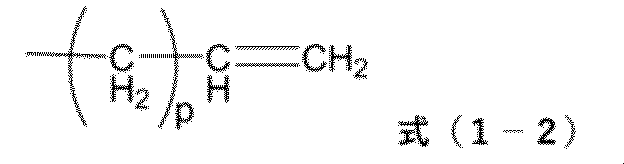
An example of the first cation having one or more carbon-carbon double bonds in its molecular structure is, for example, a quaternary ammonium to which an allyl group is bonded, and specifically, a structure such as that shown in the following structural formula (1-1) can be mentioned.
また、第1のカチオンは、ホスホニウムや、スルホニウム、環状構造を有するものであってもよく、環状構造の例としては、イミダゾリウム、ピロリジニウム、ピペリジニウム、ピリジニウム、および、モルホリニウムが挙げられる。 The first cation may also be a phosphonium, sulfonium, or cyclic cation, and examples of cyclic cations include imidazolium, pyrrolidinium, piperidinium, pyridinium, and morpholinium.
シリコーンゴム混合物中での上記構造の第1のカチオンの存在は、硬化させたシリコーンゴム混合物を、アセトン等の溶媒に浸漬させ、溶媒に溶出した成分を抽出し、分析することで確認することができる。分析手法としては、液体クロマトグラフィ質量分析法や、核磁気共鳴分光法が挙げられる。 The presence of the first cation of the above structure in the silicone rubber mixture can be confirmed by immersing the cured silicone rubber mixture in a solvent such as acetone, extracting the components dissolved in the solvent, and analyzing them. Examples of analytical methods include liquid chromatography mass spectrometry and nuclear magnetic resonance spectroscopy.
<第2のカチオン>
本発明の一態様に係る硬化性シリコーンゴム混合物は、さらにジメチルシロキサン鎖で変性された第2のカチオンを含むことができる。
<Second Cation>
The curable silicone rubber mixture according to one embodiment of the present invention may further include a second cation modified with a dimethylsiloxane chain.
該硬化性シリコーンゴム混合物は、硬化性シリコーンゴムの連続相中に、金属酸化物粒子が分散相として存在している。そして、分子構造中に炭素-炭素2重結合を1つ以上有する第1のカチオンは、分散相である金属酸化物粒子表面の水酸基との親和性が高い。一方、ジメチルシロキサン鎖で変性された第2のカチオンは、シリコーンゴムと類似した化学構造を有するため、連続相を構成する硬化性シリコーンゴムとの親和性が高いと考えられる。 In the curable silicone rubber mixture, metal oxide particles exist as a dispersed phase in a continuous phase of curable silicone rubber. The first cation, which has one or more carbon-carbon double bonds in its molecular structure, has a high affinity for the hydroxyl groups on the surface of the metal oxide particles that make up the dispersed phase. On the other hand, the second cation modified with a dimethylsiloxane chain has a chemical structure similar to that of silicone rubber, and is therefore considered to have a high affinity for the curable silicone rubber that makes up the continuous phase.
そのため、分散相を構成する金属酸化物粒子、および連続相を構成する硬化性シリコーンゴムの各々に対して親和性が高い第1のカチオン、および第2のカチオンを含む硬化性シリコーンゴム混合物は、より均一な導電性を発現する。 Therefore, a curable silicone rubber mixture containing a first cation and a second cation that have high affinity for the metal oxide particles that make up the dispersed phase and the curable silicone rubber that makes up the continuous phase, respectively, exhibits more uniform conductivity.
第2のカチオンは、4級アンモニウム、ホスホニウム、スルホニウム、イミダゾリウム、ピロリジニウム、ピペリジニウム、ピリジニウム、モルホリニウムからなる群より選択されるカチオン構造を有することが好ましい。 The second cation preferably has a cation structure selected from the group consisting of quaternary ammonium, phosphonium, sulfonium, imidazolium, pyrrolidinium, piperidinium, pyridinium, and morpholinium.
高電圧の印加によるイオンの偏在抑制に寄与する第1のカチオンに対し、第2のカチオンのモル量は等量以下であることが好ましく、より好ましくは1/2以下である。
以下、ジメチルシロキサン鎖で変性された第2のカチオンの構造について説明する。
The molar amount of the second cation is preferably equal to or less than the first cation that contributes to suppressing uneven distribution of ions due to application of a high voltage, and more preferably equal to or less than half.
The structure of the second cation modified with a dimethylsiloxane chain will now be described.
<ジメチルシロキサン鎖で変性された第2のカチオン>
ジメチルシロキサン鎖で変性された第2のカチオンとしては、例えば、構造式(2-1)に示すように、4級アンモニウムとジメチルシロキサン鎖が結合したものが挙げられる。また、カチオンは、構造式(2-2)に示すようなホスホニウムや、スルホニウム、構造式(2-3)、構造式(2-4)に示すような環状構造を有するものであってもよい。
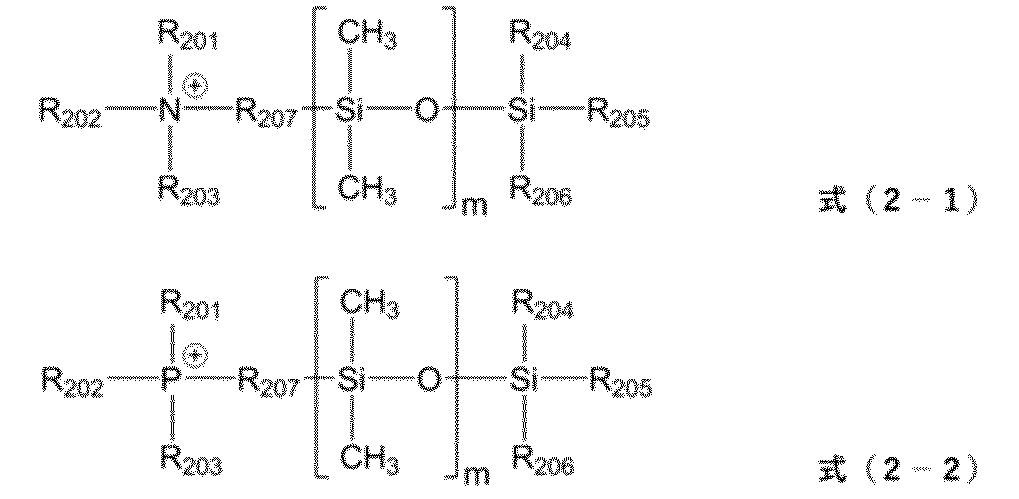
The second cation modified with a dimethylsiloxane chain may be, for example, a quaternary ammonium bonded to a dimethylsiloxane chain as shown in structural formula (2-1). The cation may be a phosphonium or sulfonium cation as shown in structural formula (2-2), or a cation having a cyclic structure as shown in structural formula (2-3) or structural formula (2-4).
R204~R206は、各々独立に、炭素数1~10の直鎖状または分岐鎖状のアルキル基、水酸基、エポキシ基、またはカルボキシル基を表す。 R 204 to R 206 each independently represent a linear or branched alkyl group having 1 to 10 carbon atoms, a hydroxyl group, an epoxy group, or a carboxyl group.
R207は、4級アンモニウム構造またはホスホニウム構造とジメチルシロキサン鎖との連結基である。R207としては、例えば、4級アンモニウム塩とポリジメチルシロキサンのカップリング反応により得られる基が挙げられる。より具体的には、R207としては、例えば、置換基を有していてもよい炭素数1~20の直鎖状または分岐鎖状のアルキレン基が挙げられる。該アルキレン基は、-Ph-(フェニレン)、-O-、-C(=O)-、-C(=O)-O-、または-C(=O)-NR-(Rは炭素数1~6のアルキル基を表す)から選択される基を介した構造であってもよい。該アルキレン基の置換基としては、水酸基等が挙げられる。

R212は、イミダゾリウム構造とジメチルシロキサン鎖との連結基である。R212としては、例えば、イミダゾリウム塩とポリジメチルシロキサンのカップリング反応により得られる基が挙げられる。より具体的には、R212としては、例えば、置換基を有していてもよい炭素数1~20の直鎖状または分岐鎖状のアルキレン基が挙げられる。該アルキレン基は、-Ph-(フェニレン)、-O-、-C(=O)-、-C(=O)-O-、または-C(=O)-NR-(Rは炭素数1~6のアルキル基を表す)から選択される基を介した構造であってもよい。該アルキレン基の置換基としては、水酸基等が挙げられる。 R 212 is a linking group between the imidazolium structure and the dimethylsiloxane chain. Examples of R 212 include groups obtained by a coupling reaction between an imidazolium salt and polydimethylsiloxane. More specifically, examples of R 212 include linear or branched alkylene groups having 1 to 20 carbon atoms which may have a substituent. The alkylene group may have a structure via a group selected from -Ph-(phenylene), -O-, -C(=O)-, -C(=O)-O-, or -C(=O)-NR- (R represents an alkyl group having 1 to 6 carbon atoms). Examples of the substituent of the alkylene group include a hydroxyl group.
構造式(2-1)~(2-4)において、ジメチルシロキサン鎖の長さ(構造式中のm)は、シリコーンゴムとの相溶性の観点から、1以上150以下の整数である。 In structural formulas (2-1) to (2-4), the length of the dimethylsiloxane chain (m in the structural formula) is an integer of 1 or more and 150 or less, from the viewpoint of compatibility with silicone rubber.
<アニオン>
アニオンとしては、特に限定されない。
用い得るアニオンの例としては、AlCl4
-、Al2Cl7
-、NO3
-、BF4
-、PF6
-、CH3COO-、CF3COO-、CF3SO3
-、(CF3SO2)3C-、AsF6
-、SbF6
-、F(HF)n-、CF3CF2CF2CF2SO3
-、(CF3CF2SO2)2N-、CF3CF2CF2COO-、(CF3SO2)2N-からなる群より選択される少なくとも1つが挙げられる。電子写真用部材として用いる場合には、湿度に因る影響が小さい点から、(CF3SO2)2N-(以降、ビストリフルオロスルホニルイミドアニオンを略して、「TFSI-」と標記する場合がある)がより好ましい。
<Anion>
The anion is not particularly limited.
Examples of anions that can be used include at least one selected from the group consisting of AlCl4- , Al2Cl7- , NO3- , BF4- , PF6- , CH3COO- , CF3COO- , CF3SO3- , ( CF3SO2 ) 3C- , AsF6- , SbF6- , F( HF ) n- , CF3CF2CF2CF2SO3- , ( CF3CF2SO2 ) 2N- , CF3CF2CF2COO- , ( CF3SO2 ) 2N- . When used as an electrophotographic member, (CF 3 SO 2 ) 2 N − (hereinafter, bistrifluorosulfonylimide anion may be abbreviated as “TFSI − ”) is more preferable since it is less affected by humidity.
なお、上記カチオン、およびアニオンは、各々は1種を単独で用いてもよく、2種以上を併用してもよい。 The above cations and anions may each be used alone or in combination of two or more.
上記アニオン、及び上記第1のカチオン及び上記第2のカチオンを含むカチオンの総量は、硬化性シリコーンゴムの100質量部に対して、0.01質量部以上、10質量部以下であることが好ましく、特には、0.05質量部以上、5質量部以下であることが好ましい。付加硬化型液状シリコーンゴムに対する、カチオンおよびアニオンの総量を上記範囲内とすることで、後述する、表面に水酸基を有する金属酸化物粒子との協働により、液状シリコーンゴム混合物の硬化物の体積抵抗率を、1.0×10⁸Ω・cm~2.0×10¹¹Ω・cmの如き中抵抗領域の範囲内に調整することが容易となる。 The total amount of cations including the anion, the first cation and the second cation is preferably 0.01 to 10 parts by mass, and particularly preferably 0.05 to 5 parts by mass, per 100 parts by mass of the curable silicone rubber. By keeping the total amount of cations and anions in the addition-curable liquid silicone rubber within the above range, it becomes easy to adjust the volume resistivity of the cured product of the liquid silicone rubber mixture to within a medium resistance range of 1.0×10 8 Ω·cm to 2.0×10 11 Ω·cm, in cooperation with metal oxide particles having hydroxyl groups on their surfaces, as described below.
<表面の親水化率が0.50以上の金属酸化物粒子>
表面の親水化率が0.50以上の金属酸化物粒子は、イオン導電によって硬化性シリコーンゴムの硬化物の体積抵抗率を上記した中抵抗領域に調整する上で重要な成分である。
<Metal oxide particles having a surface hydrophilicity ratio of 0.50 or more>
Metal oxide particles having a surface hydrophilicity ratio of 0.50 or more are an important component for adjusting the volume resistivity of the cured product of the curable silicone rubber to the above-mentioned medium resistivity range through ionic conductivity.
このような金属酸化物粒子としては、以下に示すような親水性シリカ粒子、および親水性アルミナ粒子が挙げられる。シリコーンゴム混合物中の上記金属酸化物の存在は、シリコーンゴム混合物中から固形分を抽出し、後述する近赤外分光分析による分析等を行うことで確認することができる。なお、シリコーンゴム混合物が液状であればトルエン等の溶媒による希釈、硬化物であれば溶解可能な溶剤(たとえば、商品名:eソルブ21RS、株式会社カネコ化学製)による溶解をそれぞれ行い、フィルタにより濾過することで固形分を得ることができる。 Examples of such metal oxide particles include hydrophilic silica particles and hydrophilic alumina particles, as shown below. The presence of the above metal oxides in the silicone rubber mixture can be confirmed by extracting solids from the silicone rubber mixture and analyzing them using near-infrared spectroscopy, as described below. If the silicone rubber mixture is liquid, it can be diluted with a solvent such as toluene, and if it is a cured product, it can be dissolved in a solvent that can dissolve it (for example, product name: e-Solv 21RS, manufactured by Kaneko Chemical Co., Ltd.), and then filtered to obtain the solids.
<<親水性シリカ粒子>>
親水性シリカ粒子とは、シリカ粒子表面が十分に親水化されているものを指す。シリカ表面がどの程度親水化されているかについては、近赤外分光法などの分析手法により評価することができる。具体的には、まず、近赤外分光装置(Frontier NIR、パーキンエルマー社製)によって、シリカ粒子の表面の近赤外スペクトル(IRスペクトル)を測定する。このスペクトルデータから、Si-OHに相当する7300cm-1の吸光度を、SiO2に相当する4500cm-1の吸光度で除した値を親水化率と定義し、表面に存在するSi-OHの量を比較することが可能である。親水性シリカとは、上記方法で算出された親水化率が0.50以上のものを言う。親水性シリカの親水化率としては、特には、0.51以上、0.98以下が好ましい。
上記、親水化率を満たすシリカ粒子であれば特に限定されず、1種を単独で用いてもよく、2種以上を併用してもよい。
<<Hydrophilic Silica Particles>>
Hydrophilic silica particles refer to silica particles whose surfaces are sufficiently hydrophilized. The degree to which the silica surface is hydrophilized can be evaluated by an analytical method such as near-infrared spectroscopy. Specifically, first, the near-infrared spectrum (IR spectrum) of the surface of the silica particles is measured using a near-infrared spectrometer (Frontier NIR, manufactured by PerkinElmer). From this spectrum data, the value obtained by dividing the absorbance at 7300 cm -1 corresponding to Si-OH by the absorbance at 4500 cm -1 corresponding to SiO 2 is defined as the hydrophilization rate, and it is possible to compare the amount of Si-OH present on the surface. Hydrophilic silica refers to a silica whose hydrophilization rate calculated by the above method is 0.50 or more. The hydrophilization rate of hydrophilic silica is particularly preferably 0.51 or more and 0.98 or less.
There are no particular limitations on the silica particles as long as they satisfy the above hydrophilicity rate, and one type may be used alone, or two or more types may be used in combination.
<<親水性アルミナ粒子>>
親水性アルミナ粒子とは、アルミナ粒子の表面が十分に親水化されているものを指す。上記、シリカ粒子の親水化率の評価手法と同様の手法により、親水性アルミナの親水化率を評価することができる。親水性アルミナの場合、Al-OHに相当する3690cm-1の吸光度を、Al2O3に相当する7425cm-1の吸光度で除した値を親水性アルミナの親水化率と定義し、表面に存在するAl-OHの量を比較することが可能である。好適に用い得る親水性アルミナ粒子は、上記方法で算出された親水化率が0.50以上のものである。
<<Hydrophilic Alumina Particles>>
The hydrophilic alumina particles refer to alumina particles whose surfaces are sufficiently hydrophilized. The hydrophilicity of hydrophilic alumina can be evaluated by the same method as the evaluation method of the hydrophilicity of silica particles. In the case of hydrophilic alumina, the hydrophilicity of hydrophilic alumina is defined as the value obtained by dividing the absorbance at 3690 cm -1 corresponding to Al-OH by the absorbance at 7425 cm -1 corresponding to Al 2 O 3 , and the amount of Al-OH present on the surface can be compared. Hydrophilic alumina particles that can be suitably used are those whose hydrophilicity calculated by the above method is 0.50 or more.
表面の親水化率が0.50以上である金属酸化物粒子の配合量は、硬化性シリコーンゴムの100質量部に対して、0.1質量部以上、30.0質量部以下、特には、0.2質量部以上、5.0質量部以下とすることが好ましい。硬化性シリコーンゴムに対する、表面に水酸基を有する金属酸化物粒子の量を上記範囲内とすることで、硬化性シリコーンゴム混合物の硬化物の体積抵抗率を、中抵抗領域に容易に調整することができる。また、当該硬化物に高電圧を印加した場合において、その体積抵抗率の変動をより確実に抑制し得る。さらに、硬化性シリコーンゴム混合物の粘度が高くなりすぎることを抑制し得る。 The amount of metal oxide particles having a surface hydrophilicity rate of 0.50 or more is preferably 0.1 parts by mass or more and 30.0 parts by mass or less, particularly 0.2 parts by mass or more and 5.0 parts by mass or less, per 100 parts by mass of the curable silicone rubber. By setting the amount of metal oxide particles having hydroxyl groups on the surface relative to the curable silicone rubber within the above range, the volume resistivity of the cured product of the curable silicone rubber mixture can be easily adjusted to the medium resistance range. In addition, when a high voltage is applied to the cured product, the fluctuation of the volume resistivity can be more reliably suppressed. Furthermore, the viscosity of the curable silicone rubber mixture can be prevented from becoming too high.
<電子導電剤>
特許文献2に係る導電性シリコーンゴム組成物が含む導電性カーボンブラックの表面には水酸基があり、少なくとも1個のアルケニル基を有するカチオンの一部は、カーボンブラックによって捕捉されているとも考えられる。しかしながら、特許文献2に係る導電性シリコーンゴム組成物の導電性は、イオン液体の添加量が0.05~1000ppmときわめて微量であることから、電子導電が支配的であるといえる。その場合、たとえ、高電圧印加下でのカチオンの移動がカーボンブラックによって抑制されていたとしても、カチオンの移動が完全に抑えられる訳ではない以上、カーボンブラックに対するイオンの位置は変動する。その結果として、体積抵抗率の大きな変動が生じていると考えられる。
<Electronic Conductive Agent>
The conductive carbon black contained in the conductive silicone rubber composition according to
従って、本態様に係る硬化性シリコーンゴム混合物においては、電子導電剤は含まないことが好ましい。また、たとえ、電子導電剤を含ませるとしても電子導電を殆ど発現させない程度の量、例えば、硬化性シリコーンゴム混合物の全量に対し、0.1質量%以下の割合で含有させることが好ましい。 Therefore, it is preferable that the curable silicone rubber mixture according to this embodiment does not contain an electronic conductive agent. Even if an electronic conductive agent is contained, it is preferable that the amount contained is such that electronic conductivity is hardly exhibited, for example, 0.1 mass % or less of the total amount of the curable silicone rubber mixture.
電子導電剤としては、アセチレンブラックやケッチェンブラックのような導電性カーボンブラック、グラファイト、グラフェン、カーボン繊維、カーボンナノチューブ、銀、銅、ニッケルなどの金属粉、導電性亜鉛華、導電性炭酸カルシウム、導電性酸化チタン、導電性酸化錫、導電性マイカが例示される。 Examples of electronic conductive agents include conductive carbon black such as acetylene black and ketjen black, graphite, graphene, carbon fiber, carbon nanotubes, metal powders such as silver, copper, and nickel, conductive zinc oxide, conductive calcium carbonate, conductive titanium oxide, conductive tin oxide, and conductive mica.
<添加剤>
弾性層は、上記の他にも充填剤、架橋促進剤、架橋遅延剤、架橋助剤、着色剤、スコーチ防止剤、老化防止剤、軟化剤、熱安定剤、難燃剤、難燃助剤、紫外線吸収剤、防錆剤などの添加剤を含んでいてもよい。
<Additives>
In addition to the above, the elastic layer may contain additives such as a filler, a crosslinking accelerator, a crosslinking retarder, a crosslinking assistant, a colorant, a scorch inhibitor, an antiaging agent, a softener, a heat stabilizer, a flame retardant, a flame retardant assistant, an ultraviolet absorber, and a rust inhibitor.
[電子写真用部材]
次に、電子写真用部材について説明する。図2は、本発明の一態様に係る、エンドレス形状を有する電子写真用部材(以降、「電子写真用ベルト」ともいう)200の概略図である。電子写真用ベルト200は、エンドレス形状の基材202と、その外周面上に形成された弾性層201とで構成されている。なお、必要に応じて、弾性層201の外周面上にさらに不図示の表面層を設けることもできる。
[Electrophotographic Members]
Next, an electrophotographic member will be described. Fig. 2 is a schematic diagram of an electrophotographic member (hereinafter, also referred to as "electrophotographic belt") 200 having an endless shape according to one embodiment of the present invention. The
<弾性層>
弾性層は、前記した硬化性シリコーンゴム混合物の硬化物を含む。
円筒状、円柱状またはエンドレスベルト形状を有する上記基材上に、前記した硬化性シリコーンゴム混合物を塗布し、硬化させることで、基材上に弾性層を形成することができる。弾性層の厚さは、電子写真用部材としての機能を満たす範囲で適宜調整することができる。特に、中間転写ベルト用の弾性層の厚さとしては、ニップ時の圧縮変形量や、中間転写ベルト表面のトナー像の色ずれ抑制の観点から、80μmから600μmが好適であり、より好ましくは、150μm以上400μm以下である。
<Elastic layer>
The elastic layer contains a cured product of the above-mentioned curable silicone rubber mixture.
The above-mentioned curable silicone rubber mixture is applied on the above-mentioned substrate having a cylindrical, columnar or endless belt shape, and then cured, so that an elastic layer can be formed on the substrate.The thickness of the elastic layer can be appropriately adjusted within a range that satisfies the function of the electrophotographic member.In particular, the thickness of the elastic layer for the intermediate transfer belt is preferably 80 μm to 600 μm, more preferably 150 μm or more and 400 μm or less, from the viewpoint of the amount of compression deformation during nipping and the suppression of color shift of the toner image on the surface of the intermediate transfer belt.
<基材>
基材としては、電子写真用部材の形状に対応して、円筒状、円柱状またはエンドレスベルト形状を有するものを用い得る。基材の材質としては、耐熱性および機械的強度に優れる材質であれば特に制限はない。例えば、アルミニウム、鉄、銅、ニッケルの如き金属、ステンレス、真鍮の如き合金、アルミナ、炭化珪素の如きセラミックス、ポリエーテルエーテルケトン、ポリエチレンテレフタレート、ポリブチレンナフタレート、ポリエステル、ポリイミド、ポリアミド、ポリアミドイミド、ポリアセタール、ポリフェニレンサルファイドの如き樹脂が挙げられる。
<Substrate>
The substrate may be cylindrical, columnar or endless belt-shaped, depending on the shape of the electrophotographic member.The substrate may be made of any material that has excellent heat resistance and mechanical strength.For example, metals such as aluminum, iron, copper and nickel, alloys such as stainless steel and brass, ceramics such as alumina and silicon carbide, and resins such as polyether ether ketone, polyethylene terephthalate, polybutylene naphthalate, polyester, polyimide, polyamide, polyamideimide, polyacetal and polyphenylene sulfide may be used.
なお、基材の材質として樹脂を用いる場合には、金属粉末、導電性酸化物粉末、導電性カーボンの如き導電性粉体を添加して導電性を付与してもよい。 When using resin as the material for the substrate, conductive powder such as metal powder, conductive oxide powder, or conductive carbon may be added to impart conductivity.
基材の材質として柔軟性および機械強度に優れる樹脂が特に好適であり、中でも、導電性粉体としてのカーボンブラックを含むポリエーテルエーテルケトン、および、導電性粉体としてのカーボンブラックを含むポリイミドが特に好適に用いられる。また、エンドレス形状の基材の厚さとしては、例えば、10μm以上500μm以下、特には30μm以上150μm以下である。 Resins with excellent flexibility and mechanical strength are particularly suitable as materials for the substrate, and among them, polyether ether ketone containing carbon black as conductive powder and polyimide containing carbon black as conductive powder are particularly suitable. The thickness of the endless substrate is, for example, 10 μm or more and 500 μm or less, particularly 30 μm or more and 150 μm or less.
基材および弾性層をより強固に接着するため、基材の外表面に、適宜プライマーを塗布しても良い。ここで用いられるプライマーとは、有機溶剤中に、シランカップリング剤、シリコーンポリマー、水素化メチルシロキサン、アルコキシシラン、反応促進触媒、ベンガラの如き着色剤が、適宜配合分散された塗料である。該プライマーとしては、市販品を用いることができる。プライマー処理は、このプライマーを基材の外表面に塗布し、乾燥または焼成させることによって行われる。プライマーは、基材の材質、弾性層の種類または架橋反応の形態によって適宜選択可能である。特に、弾性層が不飽和脂肪族基を多く含む場合には、不飽和脂肪族基との反応により接着性を付与するために、ヒドロシリル基を含有するプライマーが好適に用いられる。このような特徴を持つ市販のプライマーとして、DY39-051A/B(東レ・ダウコーニング株式会社)が挙げられる。 In order to bond the substrate and the elastic layer more firmly, a primer may be applied to the outer surface of the substrate. The primer used here is a paint in which a silane coupling agent, a silicone polymer, a hydrogenated methylsiloxane, an alkoxysilane, a reaction-accelerating catalyst, and a colorant such as red iron oxide are appropriately mixed and dispersed in an organic solvent. Commercially available products can be used as the primer. The primer treatment is performed by applying the primer to the outer surface of the substrate and drying or baking it. The primer can be appropriately selected depending on the material of the substrate, the type of the elastic layer, or the form of the crosslinking reaction. In particular, when the elastic layer contains a large amount of unsaturated aliphatic groups, a primer containing a hydrosilyl group is preferably used to impart adhesion by reaction with the unsaturated aliphatic groups. An example of a commercially available primer with such characteristics is DY39-051A/B (Dow Corning Toray Co., Ltd.).
また、弾性層がヒドロシリル基を多く含む場合には、不飽和脂肪族基を含有するプライマーが好適に用いられる。このような特徴を持つ市販のプライマーとして、DY39-067(東レ・ダウコーニング株式会社)が挙げられる。プライマーとしてはそのほかにも、アルコキシ基を含有するものも挙げられる。また、基材表面に紫外線照射等の表面処理を施すことで、基材と弾性層との架橋反応を補助し、より接着力を強めることができる。また、上記以外のプライマーとしては、X-33-156-20、X-33-173A/B、X-33-183A/B(信越化学工業株式会社)や、DY39-90A/B、DY39-110A/B、DY39-125A/B、DY39-200A/B(東レ・ダウコーニング株式会社)等が挙げられる。 In addition, when the elastic layer contains a large amount of hydrosilyl groups, a primer containing an unsaturated aliphatic group is preferably used. An example of a commercially available primer having such characteristics is DY39-067 (Dow Corning Toray Co., Ltd.). Other examples of primers include those containing alkoxy groups. In addition, by subjecting the surface of the substrate to a surface treatment such as ultraviolet irradiation, the crosslinking reaction between the substrate and the elastic layer can be assisted, and the adhesive strength can be further strengthened. Other examples of primers include X-33-156-20, X-33-173A/B, X-33-183A/B (Shin-Etsu Chemical Co., Ltd.), DY39-90A/B, DY39-110A/B, DY39-125A/B, DY39-200A/B (Dow Corning Toray Co., Ltd.), etc.
<表面層>
電子写真用部材の表面層は、用紙のような記録媒体や、ドラム等の各種当接部材との摺擦による摩耗に対して耐性があり、かつトナー等が固着せぬように、低付着性を有することが求められる。表面層に用いる樹脂は、低付着性を有するものであれば特に制限はないが、例えば、フッ素樹脂、含フッ素ウレタン樹脂、フッ素ゴム、シロキサン変性ポリイミドが挙げられる。中間転写ベルト用の表層としては、これらの中でも、弾性層の弾性機能を損なわない観点から、含フッ素ウレタン樹脂が好ましい。
<Surface layer>
The surface layer of the electrophotographic member is required to be resistant to wear caused by rubbing against a recording medium such as paper or various contact members such as a drum, and to have low adhesion so that toner and the like do not adhere. The resin used for the surface layer is not particularly limited as long as it has low adhesion, and examples thereof include fluorine resin, fluorine-containing urethane resin, fluorine rubber, and siloxane-modified polyimide. Among these, fluorine-containing urethane resin is preferable as the surface layer for the intermediate transfer belt from the viewpoint of not impairing the elastic function of the elastic layer.
表面層の厚さは0.5μm以上20μm以下が好ましく、1μm以上10μm以下がより好ましい。表面層の厚さが0.5μm以上であれば、使用に伴う表面層の摩耗によるトナーの消失を抑制しやすくなる。また、表面層の厚さが20μm以下であれば、弾性層の弾性機能を阻害することがない。 The thickness of the surface layer is preferably 0.5 μm or more and 20 μm or less, and more preferably 1 μm or more and 10 μm or less. If the thickness of the surface layer is 0.5 μm or more, it becomes easier to suppress the loss of toner due to wear of the surface layer during use. Furthermore, if the thickness of the surface layer is 20 μm or less, the elastic function of the elastic layer is not hindered.
表面層は、必要に応じて、上述の電子導電剤を含んでいてもよい。表面層中の電子導電剤の含有量は、付着性や機械強度の観点から、表面層に対して30質量部以下であることが好ましい。 The surface layer may contain the above-mentioned electronic conductive agent, if necessary. From the viewpoint of adhesion and mechanical strength, the content of the electronic conductive agent in the surface layer is preferably 30 parts by mass or less relative to the surface layer.
また、必要に応じて、弾性層と表面層の間にプライマー層を設けてもよい。プライマー層の厚さは、弾性機能を阻害しない観点から、0.1μm以上15μm以下であることが好ましく、0.5μm以上10μm以下であることがより好ましい。 If necessary, a primer layer may be provided between the elastic layer and the surface layer. The thickness of the primer layer is preferably 0.1 μm or more and 15 μm or less, and more preferably 0.5 μm or more and 10 μm or less, so as not to inhibit the elastic function.
<電子写真画像形成装置>
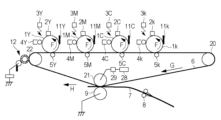
本発明の一態様に係る電子写真画像形成装置は、上記した本態様に係る電子写真用エンドレスベルトを中間転写部材(中間転写ベルト)として具備する。図1により電子写真画像形成装置の実施形態の一例を説明する。本実施形態の画像形成装置は、複数色の画像形成ステーションを電子写真用エンドレスベルト(以下、「中間転写ベルト」と称する)の回転方向に並べて配置した、所謂タンデム型の構成を有する。なお、以下の説明では、イエロー、マゼンタ、シアン、ブラックの各色に関する構成の符号に、それぞれ、Y、M、C、kの添え字を付しているが、同様の構成については添え字を省略する場合もある。
<Electrophotographic Image Forming Apparatus>
An electrophotographic image forming apparatus according to one aspect of the present invention is equipped with the electrophotographic endless belt according to the present aspect as an intermediate transfer member (intermediate transfer belt). An example of an embodiment of an electrophotographic image forming apparatus will be described with reference to FIG. 1. The image forming apparatus according to this embodiment has a so-called tandem type configuration in which image forming stations of multiple colors are arranged in the rotation direction of the electrophotographic endless belt (hereinafter referred to as the "intermediate transfer belt"). In the following description, the symbols of the components of each color of yellow, magenta, cyan, and black are respectively given the suffixes Y, M, C, and k, but the suffixes may be omitted for similar components.
図1の符号1Y、1M、1C、1kは感光ドラム(感光体、像担持体)で、感光ドラム1の周囲には、帯電装置2Y、2M、2C、2k、露光装置3Y、3M、3C、3k、現像装置4Y、4M、4C、4k、中間転写ベルト(中間転写体)6が配置される。感光ドラム1は、矢印Fの方向に所定の周速度(プロセススピード)で回転駆動される。帯電装置2は、感光ドラム1の周面を所定の極性、電位に帯電する(1次帯電)。露光装置3としてのレーザビームスキャナーは、不図示のイメージスキャナー、コンピュータ等の外部機器から入力される画像情報に対応してオン/オフ変調したレーザー光を出力して、感光ドラム1上の帯電処理面を走査露光する。この走査露光により感光ドラム1面上に目的の画像情報に応じた静電潜像が形成される。
In FIG. 1,
現像装置4Y,4M,4C,4kは、それぞれイエロー(Y)、マゼンタ(M)、シアン(C)、ブラック(k)の各色成分のトナーを内包する。そして、画像情報に基づいて使用する現像装置4を選択し感光ドラム1面上に現像剤(トナー)が現像され、静電潜像がトナー像として可視化される。本実施形態では、このように静電潜像の露光部にトナーを付着させて現像する反転現像方式が用いられる。また、このような帯電装置、露光装置、現像装置により画像形成手段を構成している。
The developing
また、中間転写ベルト6は、本態様に係る電子写真用エンドレスベルトで、感光ドラム1の表面に当接されるよう配設され、複数の張架ローラ20、21、22に張架されている。そして、矢印Gの方向へ回動するようになっている。本実施の形態では、張架ローラ20は中間転写ベルト6の張力を一定に制御するようにしたテンションローラ、張架ローラ22は中間転写ベルト6の駆動ローラ、張架ローラ21は2次転写用の対向ローラである。また、中間転写ベルト6を挟んで感光ドラム1と対向する1次転写位置には、それぞれ、1次転写ローラ5Y、5M、5C、5kが配置されている。感光ドラム1にそれぞれ形成された各色未定着トナー像は、1次転写ローラ5に定電圧源または定電流源によりトナーの帯電極性と逆極性(例えば正極性)の1次転写バイアスを印加することにより、中間転写ベルト6上に順次静電的に1次転写される。そして、中間転写ベルト6上に4色の未定着トナー像が重ね合わされたフルカラー画像を得る。中間転写ベルト6は、このように感光ドラム1から転写されたトナー像を担持しつつ回転する。1次転写後の感光ドラム1の1回転毎に感光ドラム1の表面は、クリーニング装置11で転写残トナーをクリーニングし、繰り返し作像工程に入る。
The intermediate transfer belt 6 is an endless belt for electrophotography according to this embodiment, and is arranged so as to be in contact with the surface of the photosensitive drum 1, and is stretched around a number of
また、記録材7の搬送経路に面した中間転写ベルト6の2次転写位置には、中間転写ベルト6のトナー像担持面側に2次転写ローラ(転写部)9を圧接配置している。また、2次転写位置の中間転写ベルト6の裏面側には、2次転写ローラ9の対向電極をなし、バイアスが印加される対向ローラ21が配設されている。中間転写ベルト6上のトナー像を記録材7に転写する際、対向ローラ21にはトナーと同極性のバイアスが2次転写バイアス印加手段28により印加され、例えば-1000~-3000Vが印加され-10~-50μAの電流が流れる。このときの転写電圧は転写電圧検知手段29により検知される。さらに、2次転写位置の下流側には、2次転写後の中間転写ベルト6上に残留したトナーを除去するクリーニング装置(ベルトクリーナ)12が設けられている。
At the secondary transfer position of the intermediate transfer belt 6 facing the conveyance path of the
2次転写位置に導入された記録材7は、2次転写位置で挾持搬送され、その時に、2次転写ローラ9の対向ローラ21に2次転写バイアス印加手段28から所定に制御された定電圧バイアス(転写バイアス)が印加される。対向ローラ21にはトナーと同極性の転写バイアスが印加されることで転写部位にて中間転写ベルト6上に重ね合わされた4色のフルカラー画像(トナー像)を記録材7へ一括転写し、記録材上にフルカラーの未定着トナー像が形成される。トナー像の転写を受けた記録材7は不図示の定着器へ導入され加熱定着される。
The
<電子写真用ベルトの作製>
[実施例1]
(基材の調製)
下記の材料を、各々重量式フィーダを用いて、2軸混練機(商品名:PCM30、(株)池貝製)に投入し、混練して、これらのペレットを得た。2軸混練機のシリンダ設定温度は、材料投入部を320℃とし、シリンダ下流およびダイは360℃とした。2軸混練機のスクリュ回転数は300rpmとし、材料供給量は8kg/hとした。
・ポリエーテルエーテルケトン(商品名:VICTREXPEEK450G、ビクトレックス社製):80質量部
・アセチレンブラック(商品名:デンカブラック粒状品、デンカ(株)製):20質量部
次いで、得られたペレットを円筒押出成形することにより、エンドレス形状の基材を作製した。なお、円筒押出成形は、単軸押出機(商品名:GT40、(株)プラスチック工学研究所製)、および直径300mm、隙間1mmの円形開口部を有する円筒ダイを用いて行った。
<Preparation of Electrophotographic Belt>
[Example 1]
(Preparation of Substrate)
The following materials were fed into a twin-screw kneader (product name: PCM30, manufactured by Ikegai Corporation) using gravimetric feeders, respectively, and kneaded to obtain these pellets. The cylinder temperature of the twin-screw kneader was set to 320° C. at the material feed section, and 360° C. downstream of the cylinder and the die. The screw rotation speed of the twin-screw kneader was 300 rpm, and the material supply rate was 8 kg/h.
Polyether ether ketone (product name: VICTREX PEEK 450G, manufactured by Victrex): 80 parts by mass Acetylene black (product name: Denka Black granules, manufactured by Denka Co., Ltd.): 20 parts by mass
The pellets were then extruded into a cylindrical shape to produce an endless substrate. The cylindrical extrusion was performed using a single-screw extruder (product name: GT40, manufactured by Plastics Engineering Research Institute Co., Ltd.) and a cylindrical die having a circular opening with a diameter of 300 mm and a gap of 1 mm.
具体的には、重量式フィーダを用いて、ペレットを4kg/hの供給量で単軸押出機に供給した。単軸押出機のシリンダ設定温度は、材料投入部を320℃とし、シリンダ下流および円筒ダイは380℃とした。単軸押出機から吐出された溶融樹脂は、ギアポンプを経て、円筒ダイから押し出され、円筒引取機により、厚さ60μmとなる速度にて引き取られた。熔融樹脂は、引き取られる過程において、円筒ダイと円筒引取機の間に設けられた冷却マンドレルと接触することで冷却・固化された。固化した樹脂を、円筒引取機の下部に設置された円筒切断機にて、幅400mmとなるように切断して、エンドレス形状の基材を得た。 Specifically, pellets were fed to a single-screw extruder at a feed rate of 4 kg/h using a gravimetric feeder. The cylinder temperature of the single-screw extruder was set to 320°C at the material input section, and 380°C downstream of the cylinder and the cylindrical die. The molten resin discharged from the single-screw extruder was extruded from the cylindrical die via a gear pump, and was taken up by a cylindrical take-up machine at a speed to a thickness of 60 μm. During the take-up process, the molten resin was cooled and solidified by contacting a cooling mandrel installed between the cylindrical die and the cylindrical take-up machine. The solidified resin was cut to a width of 400 mm by a cylindrical cutter installed below the cylindrical take-up machine to obtain an endless-shaped substrate.
(弾性層形成用の硬化性シリコーンゴム混合物の調製)
第1のカチオンとして、炭素-炭素2重結合を1つ以上有するビニル変性4級アンモニウム塩であり、アニオンがTFSI-である第1のイオン液体を用意した。なお、当該カチオンは、前記構造式(1-1)で示される構造を有し、R101およびR102が、前記構造式(1-2)で示される、p=1の基であり、R103~R104がメチル基であるものであり、モル質量は126.2g/molである。また、該アニオンのモル質量は、280.2g/molである。
(Preparation of Curable Silicone Rubber Mixture for Forming Elastic Layer)
A first ionic liquid was prepared in which the first cation was a vinyl-modified quaternary ammonium salt having one or more carbon-carbon double bonds and the anion was TFSI - . The cation had a structure represented by the structural formula (1-1) above, R 101 and R 102 were groups represented by the structural formula (1-2) above in which p=1, and R 103 to R 104 were methyl groups, and the molar mass was 126.2 g/mol. The molar mass of the anion was 280.2 g/mol.
次いで、付加硬化型液状シリコーンゴム(商品名:TSE3450 A/B、モメンティブ・パフォーマンス・マテリアルズ社製)100質量部に対し、該第1のイオン液体を2.0質量部添加し、混合した。
次いで、表面に水酸基を有する金属酸化物粒子として、親水性シリカ粒子No.1(商品名:AEROSIL90、日本アエロジル社製)を2.0質量部添加し、さらに黒色の着色材(商品名:LIMカラー02;信越化学工業社製)を1.0質量部添加した。その後、遊星撹拌脱泡装置(商品名:HM-500、キーエンス社製)を用いて撹拌・脱泡して、付加硬化型液状シリコーンゴム混合液を得た。なお上記親水性シリカ粒子の親水化率は、52%であり、BET法による比表面積は、90±15(m/g)であった。
Next, 2.0 parts by mass of the first ionic liquid was added to 100 parts by mass of an addition-curing liquid silicone rubber (product name: TSE3450 A/B, manufactured by Momentive Performance Materials, Inc.) and mixed.
Next, 2.0 parts by mass of hydrophilic silica particles No. 1 (trade name: AEROSIL90, manufactured by Nippon Aerosil Co., Ltd.) were added as metal oxide particles having hydroxyl groups on the surface, and 1.0 part by mass of a black colorant (trade name: LIM Color 02; manufactured by Shin-Etsu Chemical Co., Ltd.) was added. Thereafter, the mixture was stirred and defoamed using a planetary stirring and defoaming device (trade name: HM-500, manufactured by Keyence Corporation) to obtain an addition-curing liquid silicone rubber mixture. The hydrophilization rate of the hydrophilic silica particles was 52%, and the specific surface area by the BET method was 90±15 (m/g).
続いて、上記基材の外表面に紫外線照射処理を施したのちに、プライマー(商品名:DY39-051、東レ・ダウコーニング社製)を塗布し、加熱乾燥を行った。プライマー層を外表面に形成した基材を円筒形の中子に取り付け、さらに中子と同軸上にゴム吐出用のリングノズルを取り付けた。送液ポンプを用いて、上記付加硬化型液状シリコーンゴム混合物をリングノズルに供給し、スリットから吐出することで、該基材上に、該付加硬化型液状シリコーンゴム混合物の層を形成した。この際、硬化後の弾性層が280μmの厚さになるように、相対移動速度および送液ポンプ吐出量を調整した。中子に取り付けた状態で加熱炉に入れて、130℃で15分間、さらに180℃で60分間加熱し、該付加硬化型液状シリコーンゴム混合物の層を硬化して弾性層を形成した。 Then, the outer surface of the substrate was subjected to ultraviolet irradiation treatment, and then a primer (product name: DY39-051, manufactured by Dow Corning Toray Co., Ltd.) was applied and dried by heating. The substrate with the primer layer formed on the outer surface was attached to a cylindrical core, and a ring nozzle for discharging rubber was attached coaxially with the core. The addition-curing liquid silicone rubber mixture was supplied to the ring nozzle using a liquid delivery pump, and discharged from the slit to form a layer of the addition-curing liquid silicone rubber mixture on the substrate. At this time, the relative movement speed and the discharge amount of the liquid delivery pump were adjusted so that the elastic layer after curing had a thickness of 280 μm. The substrate was placed in a heating furnace while attached to the core, and heated at 130°C for 15 minutes and then at 180°C for 60 minutes, curing the layer of the addition-curing liquid silicone rubber mixture to form an elastic layer.
(表面層の調製)
ポリウレタンディスパージョンにポリテトラフルオロエチレンが分散した含フッ素ポリウレタン樹脂液(商品名:Emralon T-861、ヘンケルジャパン社製)を用意した。次いで、弾性層の外表面をエキシマUV照射により親水化処理した後、中子に嵌め合わせ、200rpmで回転させながら、スプレーガン(商品名:W-101、アネスト岩田(株)製)を用いて該ウレタン樹脂液を塗布した。塗布後、130℃の加熱炉に入れて、30分間硬化した。こうして、弾性層上に厚さ3μmの表面層を有する電子写真用ベルトNo.1を得た。
(Preparation of Surface Layer)
A fluorine-containing polyurethane resin liquid (product name: Emralon T-861, manufactured by Henkel Japan Co., Ltd.) in which polytetrafluoroethylene was dispersed in a polyurethane dispersion was prepared. Next, the outer surface of the elastic layer was hydrophilized by excimer UV irradiation, and then the elastic layer was fitted into a core, and the urethane resin liquid was applied using a spray gun (product name: W-101, manufactured by Anest Iwata Co., Ltd.) while rotating at 200 rpm. After application, the belt was placed in a heating furnace at 130° C. and cured for 30 minutes. In this way, electrophotographic belt No. 1 having a surface layer with a thickness of 3 μm on the elastic layer was obtained.
[実施例2]
実施例1における弾性層形成用の硬化性シリコーンゴム混合物の調製において、親水性シリカ粒子No.1を親水性シリカ粒子No.2(商品名:AEROSIL200、日本アエロジル社製)に変更した。親水性シリカ粒子No.2の親水化率は96%、BET比表面積は200±25(m/g)である。それ以外は、実施例1と同様にして電子写真用ベルトNo.2を作製した。
[Example 2]
In the preparation of the curable silicone rubber mixture for forming the elastic layer in Example 1, hydrophilic silica particles No. 1 were changed to hydrophilic silica particles No. 2 (product name:
[実施例3]
実施例1における弾性層形成用の硬化性シリコーンゴム混合物の調製において、親水性シリカ粒子No.1を親水性シリカNo.3(AEROSIL380、日本アエロジル社製)に変更した。親水性シリカNo.3の親水化率は98%、BET比表面積は380±30(m/g)である。それ以外は、実施例1と同様にして電子写真用ベルトNo.3を作製した。
[Example 3]
In the preparation of the curable silicone rubber mixture for forming the elastic layer in Example 1, the hydrophilic silica particles No. 1 were changed to hydrophilic silica No. 3 (AEROSIL 380, manufactured by Nippon Aerosil Co., Ltd.). The hydrophilicity of the hydrophilic silica No. 3 was 98%, and the BET specific surface area was 380±30 (m/g). Otherwise, the electrophotographic belt No. 3 was prepared in the same manner as in Example 1.
[実施例4]
実施例3における弾性層形成用の硬化性シリコーンゴム混合物の調製において、第1のイオン液体の添加量を0.5質量部に変更した以外は、実施例3と同様にして電子写真用ベルトNo.4を作製した。
[Example 4]
Electrophotographic belt No. 4 was produced in the same manner as in Example 3, except that in the preparation of the curable silicone rubber mixture for forming the elastic layer in Example 3, the amount of the first ionic liquid added was changed to 0.5 parts by mass.
[実施例5]
実施例3における弾性層形成用の硬化性シリコーンゴム混合物の調製において、第1のイオン液体の添加量を10.0質量部に変更した以外は、実施例3と同様にして電子写真用ベルトNo.5を作製した。
[Example 5]
Electrophotographic belt No. 5 was produced in the same manner as in Example 3, except that in the preparation of the curable silicone rubber mixture for forming the elastic layer in Example 3, the amount of the first ionic liquid added was changed to 10.0 parts by mass.
[実施例6]
実施例3における弾性層形成用の硬化性シリコーンゴム混合物の調製において、親水性シリカの添加量を0.2質量部に変更した以外は、実施例3と同様にして電子写真用ベルトNo.6を作製した。
[Example 6]
Electrophotographic belt No. 6 was produced in the same manner as in Example 3, except that in the preparation of the curable silicone rubber mixture for forming the elastic layer in Example 3, the amount of hydrophilic silica added was changed to 0.2 parts by mass.
[実施例7]
実施例3における弾性層形成用の硬化性シリコーンゴム混合物の調製において、親水性シリカの添加量を5.0質量部に変更した以外は、実施例3と同様にして電子写真用ベルトNo.7を作製した。
[Example 7]
Electrophotographic belt No. 7 was produced in the same manner as in Example 3, except that in the preparation of the curable silicone rubber mixture for forming the elastic layer in Example 3, the amount of hydrophilic silica added was changed to 5.0 parts by mass.
[実施例8]
実施例1における弾性層の調製において、親水性シリカ粒子No.1を親水性アルミナ粒子(商品名:AEROXIDE Alu130、日本アエロジル社製)に変更した。用いた親水性アルミナ粒子の親水化率は67%、BET比表面積は130±20(m/g)である。それ以外は、実施例1と同様にして電子写真用ベルトNo.8を作製した。
[Example 8]
In the preparation of the elastic layer in Example 1, hydrophilic silica particles No. 1 were changed to hydrophilic alumina particles (product name: AEROXIDE Alu130, manufactured by Nippon Aerosil Co., Ltd.). The hydrophilic alumina particles used had a hydrophilization rate of 67% and a BET specific surface area of 130±20 (m/g). Otherwise, electrophotographic belt No. 8 was prepared in the same manner as in Example 1.
[比較例1]
実施例4における弾性層形成用の硬化性シリコーンゴム混合物の調製において、カチオンを、テトラメチルアンモニウムカチオンに変更した以外は、実施例4と同様にして電子写真用ベルトNo.9を作製した。
[Comparative Example 1]
Electrophotographic belt No. 9 was produced in the same manner as in Example 4, except that in the preparation of the curable silicone rubber mixture for forming the elastic layer in Example 4, the cation was changed to a tetramethylammonium cation.
[実施例9]
第2のカチオンとして、ジメチルシロキサン鎖で変性された4級ホスホニウム塩であり、アニオンが第1のイオン液体と同様にTFSI-であるイオン液体を用意した。なお、当該カチオンは、前記構造式(2-2)で示される構造を有し、R201~R203が炭素数4のアルキル基、R204が炭素数1のアルキル基、R205がエポキシ基、R206が水酸基、R207が炭素数3のアルキレン基である。また、当該カチオンのモル質量は、569.3g/molである。
実施例3における弾性層形成用の硬化性シリコーンゴム混合物の調製において、さらに第2のイオン液体0.9質量部を添加した以外は、実施例3と同様にして電子写真用ベルトNo.10を作製した。添加された第1のイオン液体と第2のイオン液体の総量において、第1のカチオンのモル量に対する、第2のカチオンのモル量は46%となる。
[Example 9]
As the second cation, an ionic liquid was prepared which was a quaternary phosphonium salt modified with a dimethylsiloxane chain and whose anion was TFSI - like the first ionic liquid. This cation has a structure represented by the structural formula (2-2) above, in which R 201 to R 203 are alkyl groups having 4 carbon atoms, R 204 is an alkyl group having 1 carbon atom, R 205 is an epoxy group, R 206 is a hydroxyl group, and R 207 is an alkylene group having 3 carbon atoms. The molar mass of this cation is 569.3 g/mol.
Electrophotographic belt No. 10 was produced in the same manner as in Example 3, except that 0.9 parts by mass of the second ionic liquid was further added in the preparation of the curable silicone rubber mixture for forming the elastic layer in Example 3. In the total amount of the added first ionic liquid and second ionic liquid, the molar amount of the second cation relative to the molar amount of the first cation was 46%.
[実施例10]
実施例3における弾性層形成用の硬化性シリコーンゴム混合物の調製において、第1のイオン液体の添加量を7.0質量部に変更し、さらに第2のイオン液体3.0質量部を添加した以外は、実施例9と同様にして電子写真用ベルトNo.11を作製した。添加された第1のイオン液体と第2のイオン液体の総量において、第1のカチオンのモル量に対する、第2のカチオンのモル量は44%となる。
[Example 10]
In the preparation of the curable silicone rubber mixture for forming the elastic layer in Example 3, the amount of the first ionic liquid added was changed to 7.0 parts by mass, and 3.0 parts by mass of the second ionic liquid was further added. In the total amount of the added first ionic liquid and the second ionic liquid, the molar amount of the second cation relative to the molar amount of the first cation was 44%.
<評価>
電子写真用ベルトNo.1~11について、以下の評価を行った。初期の体積抵抗率、および、1000Vの直流電圧を印加した後の体積抵抗率を測定した。また、初期の体積抵抗率と、電圧印加後の体積抵抗率の差の絶対値を初期の体積抵抗率で除した値を100倍した値を、体積抵抗率の変化率として算出した。
また、各々の電子写真用ベルトを中間転写ベルトとして用いて電子写真画像の形成に供したときの画像評価を行った。
<Evaluation>
The following evaluations were performed for electrophotographic belts No. 1 to 11. The initial volume resistivity and the volume resistivity after application of a direct current voltage of 1000 V were measured. In addition, the absolute value of the difference between the initial volume resistivity and the volume resistivity after application of the voltage was divided by the initial volume resistivity, and the result was multiplied by 100 to calculate the rate of change in volume resistivity.
Further, each of the electrophotographic belts was used as an intermediate transfer belt to form an electrophotographic image, and image evaluation was carried out.
[体積抵抗率(初期)の測定]
上記した各実施例および各比較例によって得られた電子写真用ベルトNo.1~11の各々について、電子写真画像の形成に供する前の体積抵抗率を以下のようにして測定した。
すなわち、体積抵抗率(初期)の値は、周長が1147mmである各電子写真用ベルトに対して、20mm間隔で58点測定したときの平均値と定義した。
体積抵抗率の測定は、二重電極法により、高抵抗率計(商品名:ハイレスタMCP-HT450、三菱化学アナリテック社製)を用いて行った。電極としては、「URプローブ」を使用し、1000Vの電圧を10秒間印加したときの値を用いた。なお、体積抵抗率の測定は、温度25℃、相対湿度55%の環境で行った。
また、各電子写真用ベルトについて、58点で測定した体積抵抗率の最小値と最大値との比(最大値/最小値)を計算し、各電子写真用ベルトの体積抵抗率の均一性の指標とした。
[Measurement of volume resistivity (initial)]
The volume resistivity of each of the electrophotographic belts Nos. 1 to 11 obtained in the above-mentioned respective Examples and Comparative Examples before being used for forming an electrophotographic image was measured as follows.
That is, the volume resistivity (initial) value was defined as the average value when 58 points were measured at intervals of 20 mm for each electrophotographic belt having a circumference of 1147 mm.
The volume resistivity was measured by a double electrode method using a high resistivity meter (product name: Hiresta MCP-HT450, manufactured by Mitsubishi Chemical Analytech Co., Ltd.). A "UR probe" was used as the electrode, and the value when a voltage of 1000 V was applied for 10 seconds was used. The volume resistivity was measured in an environment at a temperature of 25° C. and a relative humidity of 55%.
Further, for each electrophotographic belt, the ratio of the minimum value to the maximum value of the volume resistivity measured at 58 points (maximum value/minimum value) was calculated and used as an index of the uniformity of the volume resistivity of each electrophotographic belt.
[電子写真画像形成後の体積抵抗率の測定、および画像評価]
フルカラー電子写真画像形成装置(商品名:imagePRESS C800、キヤノン(株)製)に装着されている中間転写ベルトに代えて、各実施例または比較例に係る電子写真用ベルトを中間転写ベルトとして装着した。そして、A4サイズの普通紙(商品名:CS-680A4、キヤノン(株)製)上に、シアン色のベタ画像を出力した。なお、画像の形成には、上記電子写真画像形成装置のプリントカートリッジに搭載されているシアンおよびマゼンタ現像剤を用いた。また、画像の出力は、常温常湿(温度25℃、相対湿度55%)環境下で行った。なお、当該フルカラー電子写真画像形成装置は、1次転写手段が、中間転写ベルトを介して電子写真感光体と対向配置されてなる転写ローラを含むものであり、1次転写電圧は、1000~3000Vであり、また、2次転写電圧は、1000Vであった。
[Measurement of Volume Resistivity After Electrophotographic Image Formation and Image Evaluation]
Instead of the intermediate transfer belt installed in a full-color electrophotographic image forming apparatus (product name: ImagePRESS C800, manufactured by Canon Inc.), the electrophotographic belt according to each of the Examples or Comparative Examples was installed as the intermediate transfer belt. Then, a solid image of cyan color was output on A4-size plain paper (product name: CS-680A4, manufactured by Canon Inc.). Note that, for forming the image, cyan and magenta developers installed in the print cartridge of the electrophotographic image forming apparatus were used. Also, the image was output under an environment of normal temperature and normal humidity (temperature 25° C., relative humidity 55%). Note that, in the full-color electrophotographic image forming apparatus, the primary transfer means includes a transfer roller arranged opposite to the electrophotographic photosensitive member via the intermediate transfer belt, and the primary transfer voltage was 1000 to 3000 V, and the secondary transfer voltage was 1000 V.
上記出力条件にて、100枚の画像出力を行った。引き続いて、用紙をB5サイズの普通紙(商品名:CS-680B5、キヤノン(株)製)に変更し、30,000枚の連続出力を行った。さらに、引き続いて、用紙をA4サイズの普通紙((商品名:CS-680A4、キヤノン(株)製))変更して、1枚の画像を出力した。その後、当該フルカラー電子写真画像形成装置から、評価対象である中間転写ベルトを取り外し、前記した方法と同じ方法で体積抵抗率を測定した。得られた値を算術平均して、体積抵抗率(電圧印加後)を算出した。
また、体積抵抗率(初期)と、体積抵抗率(電圧印加後)との差の絶対値を、体積抵抗率(初期)で除した値を100倍した値を、体積抵抗率の変化率とした。
Under the above output conditions, 100 sheets of images were output. Subsequently, the paper was changed to B5 size plain paper (product name: CS-680B5, manufactured by Canon Inc.), and 30,000 sheets were continuously output. Furthermore, subsequently, the paper was changed to A4 size plain paper (product name: CS-680A4, manufactured by Canon Inc.), and one image was output. Thereafter, the intermediate transfer belt to be evaluated was removed from the full-color electrophotographic image forming apparatus, and the volume resistivity was measured by the same method as described above. The obtained values were arithmetically averaged to calculate the volume resistivity (after voltage application).
The absolute value of the difference between the volume resistivity (initial) and the volume resistivity (after voltage application) was divided by the volume resistivity (initial), and the resultant value was multiplied by 100 to obtain the rate of change in volume resistivity.
さらに、上記の電子写真画像形成において、100枚目に出力されたA4サイズの紙上に形成されたシアン色のベタ画像(以降、「初期画像」ともいう)を目視で観察した。また、最後に出力されたA4サイズの紙上に形成されたシアン色のベタ画像(以降、「最終画像」ともいう)を目視で観察した。そして、観察した結果を下記の基準で評価した。
(画像評価基準)
ランクA:ムラが全く認められない。
ランクB:一部に軽微なムラが認められる。
ランクC:観察画像の2割程度の領域にムラが認められる。
ランクD:観察画像の半分以上に亘ってムラが認められる。
Furthermore, in the above electrophotographic image formation, the cyan solid image (hereinafter also referred to as "initial image") formed on the 100th sheet of A4 size paper was visually observed. Also, the cyan solid image (hereinafter also referred to as "final image") formed on the last sheet of A4 size paper was visually observed. The observation results were evaluated according to the following criteria.
(Image Evaluation Criteria)
Rank A: No unevenness was observed at all.
Rank B: Minor unevenness is observed in some areas.
Rank C: Unevenness is observed in about 20% of the observed image.
Rank D: Unevenness is observed over half or more of the observed image.
以上の評価結果を表1に示す。

200 電子写真用ベルト
201 弾性層
202 基材
200
Claims (22)
該イオン液体は、カチオン及びアニオンからなり、
該カチオンは、分子構造中に炭素-炭素2重結合を1つ以上有する第1のカチオンを含み、
該金属酸化物粒子は、シリカ粒子であり、
該シリカ粒子は、その表面のIRスペクトルにおけるSi-OHを表す7300cm-1における吸光度を、SiO2を表す4500cm-1における吸光度で除した値として定義される親水化率が、0.51以上、0.98以下であり、
電子導電剤を、該硬化性シリコーンゴム混合物の全量に対し、0.1質量%以下の割合でさらに含む、ことを特徴とする硬化性シリコーンゴム混合物。 A curable silicone rubber mixture comprising a curable silicone rubber , an ionic liquid, and metal oxide particles,
The ionic liquid is composed of a cation and an anion,
The cation includes a first cation having one or more carbon-carbon double bonds in its molecular structure,
the metal oxide particles are silica particles;
The silica particles have a hydrophilicity ratio of 0.51 or more and 0.98 or less, the hydrophilicity ratio being defined as the value obtained by dividing the absorbance at 7300 cm -1 representing Si-OH in an IR spectrum of the surface of the silica particles by the absorbance at 4500 cm -1 representing SiO2 ;
A curable silicone rubber mixture further comprising an electronic conductive agent in an amount of 0.1 mass % or less, based on the total amount of the curable silicone rubber mixture .
該イオン液体は、カチオン及びアニオンからなり、The ionic liquid is composed of a cation and an anion,
該カチオンは、分子構造中に炭素-炭素2重結合を1つ以上有する第1のカチオンを含み、The cation includes a first cation having one or more carbon-carbon double bonds in its molecular structure,
該金属酸化物粒子は、シリカ粒子であり、the metal oxide particles are silica particles;
該シリカ粒子は、その表面のIRスペクトルにおけるSi-OHを表す7300cmThe silica particles have a surface IR spectrum of 7300 cm which represents Si—OH. -1-1 における吸光度を、SiOThe absorbance at SiO 22 を表す4500cmRepresents 4500 cm -1-1 における吸光度で除した値として定義される親水化率が、0.51以上、0.98以下であり、a hydrophilicity ratio, defined as a value obtained by dividing the absorbance by the absorbance at
該カチオンが、さらに、ジメチルシロキサン鎖で変性された第2のカチオンを含む、ことを特徴とする硬化性シリコーンゴム混合物。The curable silicone rubber mixture further comprises a second cation modified with a dimethylsiloxane chain.
構造式(2-3)および構造式(2-4)中、R208は、炭素数1~10のアルキル基、炭素数1~10のアルコキシ基、ベンジル基、またはカルボキシル基を表す。R209~R211は、各々独立に、炭素数1~10のアルキル基を表す。R212は、置換基を有していてもよい炭素数1~20のアルキレン基を表す。該アルキレン基は、-Ph-、-O-、-C(=O)-、-C(=O)-O-、または-C(=O)-NR-(Rは炭素数1~6のアルキル基を表す)から選択される基を介した構造であってもよい。mは、1以上150以下の整数を表す。)。 The curable silicone rubber mixture according to claim 2, 5, or 6, wherein the second cation has any one of the structures represented by structural formulas (2-1) to (2-4):
In structural formula (2-3) and structural formula (2-4), R 208 represents an alkyl group having 1 to 10 carbon atoms, an alkoxy group having 1 to 10 carbon atoms, a benzyl group, or a carboxyl group. R 209 to R 211 each independently represent an alkyl group having 1 to 10 carbon atoms. R 212 represents an alkylene group having 1 to 20 carbon atoms which may have a substituent. The alkylene group may have a structure via a group selected from -Ph-, -O-, -C(=O)-, -C(=O)-O-, or -C(=O)-NR- (R represents an alkyl group having 1 to 6 carbon atoms). m represents an integer of 1 to 150.
該硬化性シリコーンゴム混合物は、
硬化性シリコーンゴム、イオン液体、および、金属酸化物粒子、を含み、
該イオン液体は、カチオン及びアニオンからなり、
該カチオンは、分子構造中に炭素-炭素2重結合を1つ以上有する第1のカチオンを含み、
該金属酸化物粒子は、シリカ粒子、または、アルミナ粒子であり、
該シリカ粒子は、表面のIRスペクトルにおけるSi-OHを表す7300cm-1における吸光度を、SiO2を表す4500cm-1における吸光度で除した値として定義される親水化率が、0.51以上、0.98以下であり、
該アルミナ粒子は、表面のIRスペクトルにおけるAl-OHを表す3690cm-1における吸光度を、Al2O3を表す7425cm-1における吸光度で除した値として定義される親水化率が、0.50以上である、ことを特徴とする電子写真用部材。 An electrophotographic member having a substrate and an elastic layer on the substrate, the elastic layer being a cured product of a curable silicone rubber mixture,
The curable silicone rubber mixture comprises:
The composition comprises a curable silicone rubber, an ionic liquid, and metal oxide particles,
The ionic liquid is composed of a cation and an anion,
The cation includes a first cation having one or more carbon-carbon double bonds in its molecular structure,
the metal oxide particles are silica particles or alumina particles,
The silica particles have a hydrophilicity ratio of 0.51 or more and 0.98 or less, the hydrophilicity ratio being defined as the value obtained by dividing the absorbance at 7300 cm -1 representing Si-OH in an IR spectrum of the surface by the absorbance at 4500 cm -1 representing SiO2 ;
The alumina particles have a hydrophilicity of 0.50 or more, which is defined as the value obtained by dividing the absorbance at 3690 cm −1 representing Al—OH in an IR spectrum of the surface by the absorbance at 7425 cm −1 representing Al 2 O 3 .
構造式(2-3)および構造式(2-4)中、R208は、炭素数1~10のアルキル基、炭素数1~10のアルコキシ基、ベンジル基、またはカルボキシル基を表す。R209~R211は、各々独立に、炭素数1~10のアルキル基を表す。R212は、置換基を有していてもよい炭素数1~20のアルキレン基を表す。該アルキレン基は、-Ph-、-O-、-C(=O)-、-C(=O)-O-、または-C(=O)-NR-(Rは炭素数1~6のアルキル基を表す)から選択される基を介した構造であってもよい。mは、1以上150以下の整数を表す。)。 The electrophotographic member according to claim 16 or 17 , wherein the second cation has any one of structures represented by structural formulas (2-1) to (2-4):
In structural formula (2-3) and structural formula (2-4), R 208 represents an alkyl group having 1 to 10 carbon atoms, an alkoxy group having 1 to 10 carbon atoms, a benzyl group, or a carboxyl group. R 209 to R 211 each independently represent an alkyl group having 1 to 10 carbon atoms. R 212 represents an alkylene group having 1 to 20 carbon atoms which may have a substituent. The alkylene group may have a structure via a group selected from -Ph-, -O-, -C(=O)-, -C(=O)-O-, or -C(=O)-NR- (R represents an alkyl group having 1 to 6 carbon atoms). m represents an integer of 1 to 150.
Priority Applications (1)
| Application Number | Priority Date | Filing Date | Title |
|---|---|---|---|
| US16/692,031 US20200172701A1 (en) | 2018-11-29 | 2019-11-22 | Curable silicone rubber mixture, electrophotographic member, and electrophotographic image forming apparatus |
Applications Claiming Priority (2)
| Application Number | Priority Date | Filing Date | Title |
|---|---|---|---|
| JP2018224158 | 2018-11-29 | ||
| JP2018224158 | 2018-11-29 |
Publications (2)
| Publication Number | Publication Date |
|---|---|
| JP2020094187A JP2020094187A (en) | 2020-06-18 |
| JP7527770B2 true JP7527770B2 (en) | 2024-08-05 |
Family
ID=71086032
Family Applications (1)
| Application Number | Title | Priority Date | Filing Date |
|---|---|---|---|
| JP2019201063A Active JP7527770B2 (en) | 2018-11-29 | 2019-11-05 | CURABLE SILICONE RUBBER MIXTURE, ELECTROPHOTOGRAPHIC MEMBER, AND ELECTROPHOTOGRAPHIC IMAGE FORMING APPARATUS |
Country Status (1)
| Country | Link |
|---|---|
| JP (1) | JP7527770B2 (en) |
Families Citing this family (4)
| Publication number | Priority date | Publication date | Assignee | Title |
|---|---|---|---|---|
| US12306577B2 (en) | 2021-04-12 | 2025-05-20 | Canon Kabushiki Kaisha | Electrophotographic member and electrophotographic image forming apparatus |
| JP7672901B2 (en) * | 2021-07-06 | 2025-05-08 | キヤノン株式会社 | Electrophotographic belt and electrophotographic image forming apparatus using the same |
| JP7767232B2 (en) * | 2021-07-30 | 2025-11-11 | キヤノン株式会社 | Electrophotographic member and electrophotographic image forming apparatus |
| JP7730790B2 (en) * | 2021-08-13 | 2025-08-28 | キヤノン株式会社 | Electrophotographic member and electrophotographic image forming apparatus |
Citations (6)
| Publication number | Priority date | Publication date | Assignee | Title |
|---|---|---|---|---|
| WO2009084730A1 (en) | 2007-12-27 | 2009-07-09 | Momentive Performance Materials Japan Llc | Thermosetting silicone rubber composition |
| JP2009173923A (en) | 2007-12-27 | 2009-08-06 | Momentive Performance Materials Inc | Thermosetting silicone rubber composition |
| JP2011516373A (en) | 2008-03-04 | 2011-05-26 | エボニック デグサ ゲーエムベーハー | Silica and epoxy resin |
| WO2014069621A1 (en) | 2012-11-05 | 2014-05-08 | モメンティブ・パフォーマンス・マテリアルズ・ジャパン合同会社 | Thermosetting silicone rubber composition |
| JP2015205978A (en) | 2014-04-18 | 2015-11-19 | 日立化成株式会社 | Resin composition for transparent conductive film and transparent conductive film |
| JP2018097246A (en) | 2016-12-15 | 2018-06-21 | キヤノン株式会社 | Electrophotographic member, process cartridge and electrophotographic device |
-
2019
- 2019-11-05 JP JP2019201063A patent/JP7527770B2/en active Active
Patent Citations (6)
| Publication number | Priority date | Publication date | Assignee | Title |
|---|---|---|---|---|
| WO2009084730A1 (en) | 2007-12-27 | 2009-07-09 | Momentive Performance Materials Japan Llc | Thermosetting silicone rubber composition |
| JP2009173923A (en) | 2007-12-27 | 2009-08-06 | Momentive Performance Materials Inc | Thermosetting silicone rubber composition |
| JP2011516373A (en) | 2008-03-04 | 2011-05-26 | エボニック デグサ ゲーエムベーハー | Silica and epoxy resin |
| WO2014069621A1 (en) | 2012-11-05 | 2014-05-08 | モメンティブ・パフォーマンス・マテリアルズ・ジャパン合同会社 | Thermosetting silicone rubber composition |
| JP2015205978A (en) | 2014-04-18 | 2015-11-19 | 日立化成株式会社 | Resin composition for transparent conductive film and transparent conductive film |
| JP2018097246A (en) | 2016-12-15 | 2018-06-21 | キヤノン株式会社 | Electrophotographic member, process cartridge and electrophotographic device |
Also Published As
| Publication number | Publication date |
|---|---|
| JP2020094187A (en) | 2020-06-18 |
Similar Documents
| Publication | Publication Date | Title |
|---|---|---|
| CN103765323B (en) | Developing member and production method thereof and electrophotographic image-forming apparatus | |
| KR101657860B1 (en) | Developing member, process cartridge, and electrophotographic image forming apparatus | |
| JP7027231B2 (en) | Electrophotographic member, manufacturing method of electrophotographic member, and electrophotographic image forming apparatus | |
| WO2013084404A1 (en) | Conductive member, process cartridge, and electrophotographic apparatus | |
| US20200172701A1 (en) | Curable silicone rubber mixture, electrophotographic member, and electrophotographic image forming apparatus | |
| EP3153931B1 (en) | Fixing member, fixing apparatus, image forming apparatus, and method of producing fixing member | |
| JP2020094187A (en) | Curable silicone rubber mixture, electrophotographic member, and electrophotographic image forming apparatus | |
| CN104718502A (en) | Fixing member, method for producing same, fixing device and image forming device | |
| EP3916044B1 (en) | Curable silicone rubber mixture, electrophotographic member, and electrophotographic image forming apparatus | |
| US20180329319A1 (en) | Electrophotographic member, method for producing electrophotographic member, and electrophotographic image forming apparatus | |
| US11415913B2 (en) | Electrophotographic member and electrophotographic image forming apparatus | |
| JP7592544B2 (en) | Electrophotographic member and electrophotographic image forming apparatus | |
| JP2018180097A (en) | Electrophotographic member and electrophotographic image forming apparatus | |
| JP7767232B2 (en) | Electrophotographic member and electrophotographic image forming apparatus | |
| JP7730790B2 (en) | Electrophotographic member and electrophotographic image forming apparatus | |
| JP2008003458A (en) | Semiconductive roller and image forming apparatus | |
| JP2021189442A (en) | Curable silicone rubber mixture, member for electrophotography, and electrophotographic image forming apparatus | |
| JP2020086013A (en) | Intermediate transfer belt, and image forming method and image forming apparatus using the same | |
| JP2013088681A (en) | Inspection method and manufacturing method for roller for developing device | |
| JP7765317B2 (en) | Electrophotographic member and electrophotographic image forming apparatus | |
| JP2020154066A (en) | Intermediate transfer belt, method for manufacturing the same, and electrophotographic image formation device | |
| US20240142900A1 (en) | Electrophotographic belt, electrophotographic image forming apparatus and cured rubber product | |
| JP2024057583A (en) | Electrophotographic belt, electrophotographic image forming apparatus and cured rubber | |
| US20250013179A1 (en) | Electrophotographic member, fixing apparatus, and electrophotographic image forming apparatus | |
| JP2026006951A (en) | Electronic photography member and electronic photography image forming device |
Legal Events
| Date | Code | Title | Description |
|---|---|---|---|
| RD01 | Notification of change of attorney |
Free format text: JAPANESE INTERMEDIATE CODE: A7421 Effective date: 20220630 |
|
| A621 | Written request for application examination |
Free format text: JAPANESE INTERMEDIATE CODE: A621 Effective date: 20221101 |
|
| A977 | Report on retrieval |
Free format text: JAPANESE INTERMEDIATE CODE: A971007 Effective date: 20230726 |
|
| A131 | Notification of reasons for refusal |
Free format text: JAPANESE INTERMEDIATE CODE: A131 Effective date: 20230829 |
|
| A521 | Request for written amendment filed |
Free format text: JAPANESE INTERMEDIATE CODE: A523 Effective date: 20231027 |
|
| A131 | Notification of reasons for refusal |
Free format text: JAPANESE INTERMEDIATE CODE: A131 Effective date: 20240116 |
|
| A521 | Request for written amendment filed |
Free format text: JAPANESE INTERMEDIATE CODE: A523 Effective date: 20240315 |
|
| TRDD | Decision of grant or rejection written | ||
| A01 | Written decision to grant a patent or to grant a registration (utility model) |
Free format text: JAPANESE INTERMEDIATE CODE: A01 Effective date: 20240625 |
|
| A61 | First payment of annual fees (during grant procedure) |
Free format text: JAPANESE INTERMEDIATE CODE: A61 Effective date: 20240724 |
|
| R150 | Certificate of patent or registration of utility model |
Ref document number: 7527770 Country of ref document: JP Free format text: JAPANESE INTERMEDIATE CODE: R150 |