JP7517153B2 - Chocolate-like food with high vegetable protein content and method for producing same - Google Patents
Chocolate-like food with high vegetable protein content and method for producing same Download PDFInfo
- Publication number
- JP7517153B2 JP7517153B2 JP2020560008A JP2020560008A JP7517153B2 JP 7517153 B2 JP7517153 B2 JP 7517153B2 JP 2020560008 A JP2020560008 A JP 2020560008A JP 2020560008 A JP2020560008 A JP 2020560008A JP 7517153 B2 JP7517153 B2 JP 7517153B2
- Authority
- JP
- Japan
- Prior art keywords
- chocolate
- food
- weight
- oil
- protein content
- Prior art date
- Legal status (The legal status is an assumption and is not a legal conclusion. Google has not performed a legal analysis and makes no representation as to the accuracy of the status listed.)
- Active
Links
Classifications
-
- A—HUMAN NECESSITIES
- A23—FOODS OR FOODSTUFFS; TREATMENT THEREOF, NOT COVERED BY OTHER CLASSES
- A23G—COCOA; COCOA PRODUCTS, e.g. CHOCOLATE; SUBSTITUTES FOR COCOA OR COCOA PRODUCTS; CONFECTIONERY; CHEWING GUM; ICE-CREAM; PREPARATION THEREOF
- A23G1/00—Cocoa; Cocoa products, e.g. chocolate; Substitutes therefor
- A23G1/30—Cocoa products, e.g. chocolate; Substitutes therefor
- A23G1/32—Cocoa products, e.g. chocolate; Substitutes therefor characterised by the composition containing organic or inorganic compounds
-
- A—HUMAN NECESSITIES
- A23—FOODS OR FOODSTUFFS; TREATMENT THEREOF, NOT COVERED BY OTHER CLASSES
- A23G—COCOA; COCOA PRODUCTS, e.g. CHOCOLATE; SUBSTITUTES FOR COCOA OR COCOA PRODUCTS; CONFECTIONERY; CHEWING GUM; ICE-CREAM; PREPARATION THEREOF
- A23G1/00—Cocoa; Cocoa products, e.g. chocolate; Substitutes therefor
- A23G1/30—Cocoa products, e.g. chocolate; Substitutes therefor
- A23G1/32—Cocoa products, e.g. chocolate; Substitutes therefor characterised by the composition containing organic or inorganic compounds
- A23G1/44—Cocoa products, e.g. chocolate; Substitutes therefor characterised by the composition containing organic or inorganic compounds containing peptides or proteins
Landscapes
- Chemical & Material Sciences (AREA)
- Life Sciences & Earth Sciences (AREA)
- Inorganic Chemistry (AREA)
- Engineering & Computer Science (AREA)
- Food Science & Technology (AREA)
- Polymers & Plastics (AREA)
- Proteomics, Peptides & Aminoacids (AREA)
- Confectionery (AREA)
Description
関連出願
この出願は、2018年12月5日に日本国特許庁に出願された出願番号2018-228445号の優先権の利益を主張する。優先権基礎出願はその全体について、出典明示により本明細書の一部とする。
RELATED APPLICATIONS This application claims the benefit of priority from Application No. 2018-228445, filed in the Japan Patent Office on December 5, 2018. The priority application is hereby incorporated by reference in its entirety.
本発明は、植物性(plant-based)蛋白質を高含有するチョコレート様食品、およびその製造法に関する。The present invention relates to a chocolate-like food product having a high content of plant-based protein and a method for producing the same.
チョコレートに代表されるチョコレート様食品は、その好ましい風味により、世界的に広く食されている。チョコレートは主に、カカオマス、砂糖、ココアバター、粉乳等を原料に製造される場合が多い。ミルクチョコレートは乳原料を含むため比較的蛋白質含量が高いが、蛋白質の含有量はそれでも7重量%程度に過ぎない。 Chocolate and other chocolate-like foods are widely consumed worldwide due to their pleasant flavor. Chocolate is often made primarily from ingredients such as cacao mass, sugar, cocoa butter, and milk powder. Milk chocolate contains milk ingredients and therefore has a relatively high protein content, but the protein content is still only around 7% by weight.
そうした中、これまで、チョコレート様食品に使用される原料として高価な乳原料の代替品として大豆由来の原料を使用するという試みがなされている。大豆蛋白質はその健康効果が注目されており、コレステロール低下といった代謝改善効果が見込まれている。
そこで、全脂大豆粉をミルクチョコレート中の粉乳の代替品として一部ないし全量置換したものが検討されている。
例えば、特許文献1では全脂大豆粉を粉乳の代替として、2~20重量%含有するチョコレートが開示されている。また、特許文献2では80~140℃の加熱により酵素を失活された大豆微粉末を含有する菓子が開示されており、菓子としてチョコレートが記載されている。特許文献3では大豆を酵素失活し、加水した後に湿式粉砕してスラリー状とし、殺菌、均質化、噴霧乾燥して得られた大豆粉末を含有するチョコレートが開示されている。特許文献4では、大豆蛋白液を酸性で高温加熱処理して得られるNSIが20~80の分離大豆蛋白を、チョコレートに5~20重量%含有させる技術が記載されている。
In this context, attempts have been made to use soybean-derived ingredients as substitutes for expensive dairy ingredients in chocolate-like foods. Soybean protein has been attracting attention for its health benefits, and is expected to improve metabolism, such as lowering cholesterol.
Therefore, full-fat soy flour has been investigated as a partial or total replacement for milk powder in milk chocolate.
For example, Patent Document 1 discloses chocolate containing 2 to 20% by weight of full fat soy flour as a substitute for milk powder. Patent Document 2 discloses confectionery containing soy fine powder whose enzymes have been inactivated by heating at 80 to 140°C, and describes chocolate as the confectionery. Patent Document 3 discloses chocolate containing soy powder obtained by inactivating soybeans, adding water, wet grinding to form a slurry, sterilizing, homogenizing, and spray drying. Patent Document 4 describes a technology in which isolated soy protein with an NSI of 20 to 80 obtained by high-temperature heating of a soy protein liquid in an acidic environment is added to chocolate in an amount of 5 to 20% by weight.
上記文献および本明細書内に示される文献は、出典明示により本明細書に組み込まれる。 The above references and those referenced herein are hereby incorporated by reference.
本発明者らが種々の植物性蛋白質素材をチョコレート様食品中に配合する予備試験をしたところ、乳原料並みに多量に配合すると、程度の差はあるものの、いずれもチョコレート様食品の品質において重要な要素である風味に少なからず影響を与えた。特許文献1~4はかかる課題に着目しておらず、その解決手段を提供するものではない。
本発明は、あらゆる食場面を通じて植物性蛋白質をより多く摂取することが可能となるように、植物性蛋白質が強化され、かつ、おいしく食すことのできる高蛋白質のチョコレート様食品を提供することを課題とする。
The present inventors conducted preliminary tests of blending various vegetable protein materials into chocolate-like foods, and found that when blended in large amounts comparable to dairy ingredients, all of them had a significant effect on the flavor, which is an important factor in the quality of chocolate-like foods, although the degree of the effect varied. Patent Documents 1 to 4 do not focus on this problem, and do not provide any means for solving it.
To provide a high-protein chocolate-like food product which is enriched with vegetable protein so that more vegetable protein can be ingested in any eating occasion and which can be eaten deliciously.
本発明者らは、特定の油脂組成物との組合せで粉末状植物性蛋白素材を高配合することにより、上記課題を解決できることを見出し、本発明を完成させた。The inventors discovered that the above problems could be solved by incorporating a high amount of powdered vegetable protein material in combination with a specific oil and fat composition, and thus completed the present invention.
すなわち本発明は、下記の技術的思想を包含するものである。
(1)ポリフェノール素材を1~60重量%含有する水相粒子が油相中に分散した油脂組成物、及び、粉末状植物性蛋白質素材を蛋白質量として7.5~25重量%含有することを特徴とする、植物性蛋白質高含有チョコレート様食品、
(2)粉末状植物性蛋白素材が全脂大豆粉を含む、前記(1)記載の植物性蛋白質高含有チョコレート様食品、
(3)粉末状植物性蛋白素材が分離大豆蛋白を含む、前記(1)記載の植物性蛋白質高含有チョコレート様食品、
(4)粉末状植物性蛋白素材が全脂大豆粉及び分離大豆蛋白を含む、前記(1)記載の植物性蛋白質高含有チョコレート様食品、
(5)該全脂大豆粉が、NSIが10~70の全脂大豆粉である、前記(2)又は(4)記載の植物性蛋白質高含有チョコレート様食品、
(6)該分離大豆蛋白が、NSIが10~50の分離大豆蛋白である、前記(3)又は(5)記載の植物性蛋白質高含有チョコレート様食品、
(7)乳由来の蛋白質含量が7.5重量%以下である、前記(1)~(6)の何れか1項記載の植物性蛋白質高含有チョコレート様食品、
(8)乳由来の蛋白質含量が0重量%である、前記(1)~(6)の何れか1項記載の植物性蛋白質高含有チョコレート様食品、
(9)ポリフェノールがイソフラボン及びカテキンを除く水溶性ポリフェノールである、前記(1)~(8)の何れか1項記載の植物性蛋白質高含有チョコレート様食品、
(10)ポリフェノールがイソフラボン及びカテキンを除く水溶性ポリフェノールである、前記(6)記載の植物性蛋白質高含有チョコレート様食品、
(11)ポリフェノールがヘスペリジンである、前記(1)~(8)の何れか1項記載の植物性蛋白質高含有チョコレート様食品、
(12)ポリフェノールがヘスペリジンである、前記(6)記載の植物性蛋白質高含有チョコレート様食品、
(13)ポリフェノール素材を1~60重量%含有する水相粒子が油相中に分散した油脂組成物、及び、粉末状植物性蛋白質素材を蛋白質量として7.5~25重量%含有させることを特徴とする、植物性蛋白質高含有チョコレート様食品の製造法。
That is, the present invention encompasses the following technical ideas.
(1) A chocolate-like food with a high vegetable protein content, characterized in that it contains an oil and fat composition in which aqueous phase particles containing 1 to 60% by weight of a polyphenol material are dispersed in an oil phase, and a powdered vegetable protein material in an amount of 7.5 to 25% by weight in terms of protein.
(2) The chocolate-like food with a high vegetable protein content according to (1) above, wherein the powdered vegetable protein material contains full-fat soybean flour.
(3) The chocolate-like food with a high vegetable protein content according to the above (1), wherein the powdered vegetable protein material contains isolated soy protein.
(4) The chocolate-like food with a high vegetable protein content according to (1) above, wherein the powdered vegetable protein material contains full-fat soy flour and isolated soy protein.
(5) The chocolate-like food with a high vegetable protein content according to (2) or (4), wherein the full-fat soy flour is a full-fat soy flour having an NSI of 10 to 70.
(6) The chocolate-like food with a high vegetable protein content according to (3) or (5) above, wherein the isolated soy protein is an isolated soy protein having an NSI of 10 to 50.
(7) The chocolate-like food with high vegetable protein content according to any one of (1) to (6) above, wherein the milk-derived protein content is 7.5% by weight or less.
(8) The chocolate-like food with high vegetable protein content according to any one of (1) to (6) above, wherein the milk-derived protein content is 0% by weight.
(9) The chocolate-like food with high vegetable protein content according to any one of (1) to (8), wherein the polyphenol is a water-soluble polyphenol excluding isoflavone and catechin.
(10) The chocolate-like food with a high vegetable protein content according to (6) above, wherein the polyphenol is a water-soluble polyphenol excluding isoflavones and catechins.
(11) The chocolate-like food with high vegetable protein content according to any one of (1) to (8) above, wherein the polyphenol is hesperidin.
(12) The chocolate-like food with high vegetable protein content according to (6) above, wherein the polyphenol is hesperidin.
(13) A method for producing a chocolate-like food with a high vegetable protein content, comprising: an oil and fat composition in which aqueous phase particles containing 1 to 60% by weight of a polyphenol material are dispersed in an oil phase; and a powdered vegetable protein material in an amount of 7.5 to 25% by weight in terms of protein.
本発明により、植物性蛋白質が強化された高蛋白質のチョコレート様食品を容易に得ることができる。得られたチョコレート様食品は、植物性蛋白素材由来のエグ味などの異風味を感じない、好ましい風味を有するものである。 The present invention makes it possible to easily obtain a high-protein chocolate-like food product enriched with vegetable protein. The obtained chocolate-like food product has a pleasant flavor without any unpleasant flavor such as a harsh taste derived from the vegetable protein material.
(チョコレート様食品)
本発明で言うチョコレート様食品とは、一例を挙げると、チョコレート類が該当する。また、ここで言うチョコレート類とは、全国チョコレート業公正取引協議会、チョコレート利用食品公正取引協議会で規定されるチョコレート、準チョコレート、チョコレート利用食品だけでなく、油脂類を必須成分とし、必要により糖類、粉乳類、カカオ原料(カカオマス、ココア、ココアバター)、果汁粉末、果実粉末、呈味材、乳化剤、香料、着色料等の副原料を任意の割合で配合したものを言う。
(Chocolate-like food)
The chocolate-like food in the present invention includes, for example, chocolates. The chocolates mentioned here include not only chocolate, semi-chocolate, and chocolate-based foods as defined by the National Chocolate Industry Fair Trade Council and the Chocolate-Based Food Fair Trade Council, but also foods that contain fats and oils as essential ingredients and, if necessary, sugars, milk powders, cacao raw materials (cacao mass, cocoa, cocoa butter), fruit juice powder, fruit powder, flavoring materials, emulsifiers, flavorings, colorings, and other auxiliary materials in any ratio.
なお、チョコレート様食品の風味は、カカオ原料、粉乳類、糖類が主成分であるスイートチョコレート類、ミルクチョコレート類、ホワイトチョコレート類に限らず、コーヒー風味、キャラメル風味、抹茶風味、果実風味、野菜風味、塩味系風味などの風味バラエティー品も、当然その範囲に入る。In addition, the flavors of chocolate-like foods are not limited to sweet chocolates, milk chocolates, and white chocolates whose main ingredients are cacao ingredients, milk powder, and sugars, but also include a variety of flavors such as coffee flavor, caramel flavor, matcha flavor, fruit flavor, vegetable flavor, and salty flavor.
(油脂組成物)
本発明のチョコレート様食品は、ポリフェノール素材を1~60重量%含有する水相粒子を、油相中に分散した油脂組成物を含有させることを一つの特徴とする。該油脂組成物は、植物性蛋白質素材に由来する異風味を抑制する「異風味抑制剤」として機能しうるのが特長である。
(Oil and fat composition)
The chocolate-like food of the present invention is characterized in that it contains an oil and fat composition in which aqueous phase particles containing 1 to 60% by weight of a polyphenol material are dispersed in an oil phase. The oil and fat composition is characterized in that it can function as an "off-flavor suppressor" that suppresses off-flavors derived from vegetable protein materials.
該油脂組成物の異風味抑制効果の源は、ポリフェノール素材であると推察される。ただし、該ポリフェノール素材は水相に存在し、それが油相中に分散している必要がある。ポリフェノール素材自体は、その多くがそれ自身、収斂味などの異風味を示すものであり、それが食品中に単に存在した場合は、収斂味即ち異風味を示すことになる。
油相中における水相粒子の大きさは、500nm以下であることが望ましく、より望ましくは300nm以下である。適当な粒子径となることで、効果の高い異風味抑制剤を得ることができる。
なお、本発明において水相とは、水に水溶性成分が溶解したものである。また油相とは、油に油溶性成分が溶解したものである。なお、油溶性成分を用いない配合においては、油脂自身を油相と称することがある。
The source of the off-flavor suppressing effect of the oil and fat composition is presumed to be the polyphenol material. However, the polyphenol material must be present in the aqueous phase and dispersed in the oil phase. Many polyphenol materials themselves exhibit off-flavors such as astringent taste, and if they are simply present in food, they will exhibit an astringent taste, i.e., off-flavor.
The size of the aqueous phase particles in the oil phase is preferably 500 nm or less, and more preferably 300 nm or less. By having an appropriate particle size, a highly effective off-flavor suppressant can be obtained.
In the present invention, the aqueous phase refers to a water-soluble component dissolved in water, and the oil phase refers to an oil-soluble component dissolved in oil. In a formulation that does not use an oil-soluble component, the fat or oil itself may be referred to as the oil phase.
◆油脂種
本発明で油相に使用する油脂に限定はなく、大豆油、菜種油、米油、綿実油、パーム油、パーム核油、ココナッツオイル、ココアバター、ココアバター代用脂をはじめとする各種植物性油脂、及び牛脂や豚油のような動物性油脂、およびこれらを分別、硬化、エステル交換から選ばれる1以上の加工を施した油脂を1以上使用できる。
本発明のチョコレート様食品においては、チョコレート様食品に好ましい硬さを与えるために、ココアバターやココアバター代用脂を使用することが望ましい。ココアバター代用脂はハードバターとも呼ばれているが、その種類はテンパリング型、ノンテンパリング型の何れであってもよい。多様なチョコレート様食品に求められる品質に応じて、適宜、他の油脂も選択し、組み合わせて用いることができる。
◆Type of fats and oils There is no limitation on the fats and oils used in the oil phase in the present invention, and one or more of various vegetable fats and oils such as soybean oil, rapeseed oil, rice oil, cottonseed oil, palm oil, palm kernel oil, coconut oil, cocoa butter, and cocoa butter substitutes, as well as animal fats and oils such as beef tallow and lard oil, and fats and oils that have been subjected to one or more processes selected from fractionation, hardening, and interesterification can be used.
In the chocolate-like food of the present invention, it is preferable to use cocoa butter or a cocoa butter substitute in order to give the chocolate-like food a desired hardness. The cocoa butter substitute is also called hard butter, and may be of either tempering or non-tempering type. Other fats and oils may be appropriately selected and used in combination according to the quality required for various chocolate-like foods.
◆ポリフェノール素材
本発明において、ポリフェノール素材とは、ポリフェノールを多く含む素材を指す。具体的には、イソフラボン素材、ヘスペリジン素材、コーヒーポリフェノール素材、カカオポリフェノール素材、カテキン素材、ルチン及びアントシアニン素材から選ばれる1以上を使用することができる。より望ましくはイソフラボン及びカテキンを除く水溶性ポリフェノール素材であり、さらに望ましくはコーヒーポリフェノール素材、ヘスペリジン素材である。適当なポリフェノール素材を使用することで、効果の高い収斂味抑制剤を得ることができる。
なお、コーヒーポリフェノール素材としては、具体的には生コーヒー豆エキスを挙げることができ、カカオポリフェノール素材としてはカカオエキスを挙げることができる。また、カテキン素材としては茶抽出物を挙げることができる。コーヒーポリフェノール素材における有効成分は、クロロゲン酸であると言われている。
◆Polyphenol material In the present invention, the polyphenol material refers to a material containing a large amount of polyphenol. Specifically, one or more selected from isoflavone material, hesperidin material, coffee polyphenol material, cacao polyphenol material, catechin material, rutin and anthocyanin material can be used. More preferably, it is a water-soluble polyphenol material other than isoflavone and catechin, and even more preferably, it is a coffee polyphenol material or a hesperidin material. By using an appropriate polyphenol material, it is possible to obtain a highly effective astringent taste suppressant.
Specifically, coffee polyphenol materials include green coffee bean extracts, and cacao polyphenol materials include cacao extracts. Furthermore, catechin materials include tea extracts. The active ingredient in coffee polyphenol materials is said to be chlorogenic acid.
本発明における油脂組成物は、油相中にポリフェノール素材を含有する水相粒子が分散している必要がある。なお、本発明において、単に「水相粒子」と言うときには、「ポリフェノール素材を含有する水相粒子」のことを指す。
水相におけるポリフェノール素材の量は1~60重量%であることが必要であり、この量はより望ましくは1.3~37重量%であり、さらに望ましくは1.5~35重量%である。適当な量のポリフェノール素材が水相中に存在することで、より異風味抑制効果の高い油脂組成物を得ることができる。
In the oil and fat composition of the present invention, aqueous phase particles containing a polyphenol material must be dispersed in an oil phase. In the present invention, the term "aqueous phase particles" simply refers to "aqueous phase particles containing a polyphenol material."
The amount of the polyphenol material in the aqueous phase must be 1 to 60 % by weight, more preferably 1.3 to 37 % by weight, and even more preferably 1.5 to 35 % by weight . The presence of an appropriate amount of the polyphenol material in the aqueous phase makes it possible to obtain an oil and fat composition having a higher effect of suppressing off-flavors.
本発明における油脂組成物において、水相の割合は、水相におけるポリフェノール素材の量により相違する。よって、明確に定義することは難しいが、概ね、0.001~20重量%であることが望ましい。この量は、より望ましくは0.002~15重量%であり、さらに望ましくは0.005~10重量%である。
In the oil and fat composition of the present invention, the proportion of the aqueous phase varies depending on the amount of the polyphenol material in the aqueous phase. Therefore, although it is difficult to clearly define, it is preferably about 0.001 to 20 % by weight . This amount is more preferably 0.002 to 15 % by weight, and even more preferably 0.005 to 10 % by weight .
◆乳化剤
本発明における油脂組成物は、水相及び/又は油相中に乳化剤が溶解していることがより望ましい。特に油相中に油溶性乳化剤が溶解していることが望ましい。なお、油溶性乳化剤とは、油脂に溶解する乳化剤であり、本発明ではHLBが7以下の乳化剤を指す。
油溶性乳化剤としては、ポリグリセリンエステル、シュガーエステル、ソルビタンエステル、モノグリセリン脂肪酸エステルから選ばれる1以上が望ましく、より望ましくはポリグリセリンエステル、シュガーエステル、蒸留モノグリセリドが好ましく、特にポリグリセリンエステルが好ましく、そのうちポリグリセリン縮合リシノレイン酸エステルが最も好ましい。なお、ポリグリセリン縮合リシノレートはPGPRと略称されることがある。
油相における油溶性乳化剤の量は、0.01~6重量%が望ましく、より望ましくは0.01~4重量%である。適当な乳化剤を適当な量使用することで、油中水型の乳化が強固になり、食品における異風味を効率的に抑制することができる異風味抑制剤が得られる。
Emulsifier In the oil and fat composition of the present invention, it is more preferable that an emulsifier is dissolved in the water phase and/or the oil phase. In particular, it is preferable that an oil-soluble emulsifier is dissolved in the oil phase. Note that the oil-soluble emulsifier is an emulsifier that dissolves in oils and fats, and in the present invention, it refers to an emulsifier having an HLB of 7 or less.
The oil-soluble emulsifier is preferably one or more selected from polyglycerol esters, sugar esters, sorbitan esters, and monoglycerol fatty acid esters, more preferably polyglycerol esters, sugar esters, and distilled monoglycerides, and particularly preferably polyglycerol esters, of which polyglycerol condensed ricinoleate is most preferred. Polyglycerol condensed ricinoleate is sometimes abbreviated as PGPR.
The amount of the oil-soluble emulsifier in the oil phase is preferably 0.01 to 6 % by weight, more preferably 0.01 to 4 % by weight. By using an appropriate amount of an appropriate emulsifier, the water-in-oil emulsion becomes strong, and an off-flavor suppressant that can efficiently suppress off-flavors in foods can be obtained.
◆油脂組成物の調製
本発明における油脂組成物の調製法を例をもって説明する。例えばポリフェノール素材を水に溶解して水相を調製する。また、必要により油溶性乳化剤を油脂に溶解し、油相を調製する。次に、油相へ水相を混合し、油中水型に乳化させることで、油脂組成物を得ることができる。
Preparation of the oil and fat composition The method for preparing the oil and fat composition of the present invention will be described with an example. For example, a polyphenol material is dissolved in water to prepare an aqueous phase. If necessary, an oil-soluble emulsifier is dissolved in an oil and fat to prepare an oil phase. Next, the aqueous phase is mixed into the oil phase to emulsify it into a water-in-oil type, thereby obtaining an oil and fat composition.
本発明のチョコレート様食品の製造に用いる該油脂組成物は、チョコレート様食品の製造に使用する油分の一部もしくは全部と置き換えて使用することができる。
ポリフェノール素材を1~60重量%含有した水相粒子が油相中に分散した状態で、ハイカカオチョコレート様食品中に存在することで、植物性蛋白質素材に由来する異風味を抑制する効果が発現する。本発明のチョコレート様食品中の水相粒子の量は、0.001~0.01重量%含有していることが望ましい。油相に使用する油脂は、カカオバターであることが望ましい。
The oil and fat composition used in the production of the chocolate-like food of the present invention can be used to replace a part or all of the oil used in the production of the chocolate-like food.
The presence of aqueous phase particles containing 1 to 60 % by weight of a polyphenol material dispersed in an oil phase in a high-cocoa chocolate-like food product exhibits the effect of suppressing off-flavors derived from vegetable protein materials. The amount of aqueous phase particles in the chocolate-like food product of the present invention is preferably 0.001 to 0.01 % by weight . The fat or oil used in the oil phase is preferably cocoa butter.
(粉末状植物性蛋白質素材)
本発明における粉末状植物性蛋白質素材は、植物由来の蛋白質に富む粉末状の素材であり、典型的には穀類由来の粉末状蛋白質素材である。穀類とは穀物とも称される、植物から得られる食材の総称の一つである。例えば豆類、麦類、芋類、米、コーンの他、各種の油糧作物を挙げることができる。より望ましくは、豆類由来粉末状蛋白質素材、麦類由来粉末状蛋白質素材などである。
より具体的には、豆類由来粉末状蛋白質素材のうち、粉末状大豆蛋白質素材としては、全脂大豆粉や脱脂大豆粉などの大豆粉類や、分離大豆蛋白、濃縮大豆蛋白、豆乳粉末などがある。大豆粉類としては大豆を粉砕したものの他、一旦水系下で湿式粉砕して乾燥したものや、大豆粉を一旦水系下で懸濁させてこれを乾燥したものなども含む。
(Powdered vegetable protein material)
The powdered vegetable protein material of the present invention is a powdered material rich in protein derived from plants, typically a powdered protein material derived from grains. Grains are also called cereals, and are obtained from plants. It is a general term for food ingredients that can be used for food preparation. Examples include beans, wheat, potatoes, rice, corn, and various oil crops. More preferably, it is a powdered protein material derived from beans, wheat, and other crops. Powdered protein materials, etc.
More specifically, among the powdered protein materials derived from beans, the powdered soy protein materials include soy flours such as full fat soy flour and defatted soy flour, isolated soy protein, concentrated soy protein, soy milk powder, etc. Soybean flour includes not only ground soybeans, but also those that have been wet ground in an aqueous system and then dried, and those that have been suspended in an aqueous system and then dried.
大豆以外にエンドウ、ヒヨコ豆、緑豆などの他の豆類についても、上記の各種大豆蛋白質素材に相当する製造法で調製された濃縮蛋白や分離蛋白等の各種蛋白素材を用いることができる。麦類由来蛋白質素材のうち、小麦蛋白質素材としては、グルテンやその分解物を挙げることができる。米類由来蛋白質素材としては、米糠蛋白質を挙げることができ、コーン由来蛋白質素材としては、コーン蛋白質を挙げることができる。その他、各種の油糧作物由来の植物性蛋白質素材としては、菜種蛋白質、ごま蛋白質、綿実蛋白質、ナッツ蛋白質、ヘンプ蛋白質などを挙げることができる。 For other legumes other than soybeans, such as peas, chickpeas, and mung beans, various protein materials such as concentrated proteins and isolated proteins prepared by manufacturing methods equivalent to the various soybean protein materials mentioned above can be used. Among protein materials derived from wheat and barley, examples of wheat protein materials include gluten and its hydrolyzates. Examples of protein materials derived from rice include rice bran protein, and examples of protein materials derived from corn include corn protein. Other examples of vegetable protein materials derived from various oilseed crops include rapeseed protein, sesame protein, cottonseed protein, nut protein, and hemp protein.
特に、大豆蛋白質素材などの豆類由来蛋白質素材には独特の異風味を有する物もある。豆類に限らず、このような独特の異風味を有する植物由来の蛋白質素材は、本発明の効果が奏するのにより適した素材である。以下、大豆蛋白素材を用いる場合の実施態様を挙げる。In particular, some protein materials derived from beans, such as soy protein materials, have a unique, off-flavor. Protein materials derived from plants that have such a unique, off-flavor, not limited to beans, are materials that are more suitable for achieving the effects of the present invention. Below, an embodiment in which a soy protein material is used is given.
◆全脂大豆粉
粉末状大豆蛋白素材を用いる場合の実施態様の一つは、全脂大豆粉を用いることである。全脂大豆粉は一般に特有の青臭味といった異風味を感じやすいが、本発明に用いられる油脂組成物と組み合わせることにより、当該異風味を改善することができる。
また全脂大豆粉は、チョコレート様食品に用いると舌への張り付き感を感じやすいが、蛋白質の溶解性の指標として常用されているNSI(後述)が10~70、さらには20~60である全脂大豆粉を用いると、チョコレート様食品の舌への張り付き感を比較的抑えることができ、さらに該食品に大豆本来の円やかな風味を付与でき、かつチョコレート様食品として違和感のない風味にできる点で好ましい。
◆ Full-fat soy flour One of the embodiments of the powdered soy protein material is to use full-fat soy flour. Full-fat soy flour generally has a distinctive off-flavor such as a grassy taste, but by combining it with the oil and fat composition used in the present invention, the off-flavor can be improved.
In addition, when full-fat soy flour is used in chocolate-like foods, it tends to feel sticky to the tongue. However, if full-fat soy flour with an NSI (described later), which is commonly used as an index of protein solubility, is used, the feeling of sticking to the tongue of the chocolate-like food can be relatively suppressed, and the food can be imparted with the smooth flavor inherent to soybeans, and the flavor can be made to be natural for a chocolate-like food. This is preferable.
◆分離大豆蛋白
粉末状大豆蛋白素材を用いる場合の他の実施態様の一つは、分離大豆蛋白を用いることである。分離大豆蛋白も大豆粉とは傾向が異なるものの一般に特有の異風味であるエグ味を感じやすいが、本発明に用いられる油脂組成物と組み合わせることにより、当該異風味を改善することができる。
また分離大豆蛋白も、チョコレート様食品に用いると舌への張り付き感を感じやすいが、NSI(窒素溶解指数)が10~50、さらには10~40である分離大豆蛋白を用いると、チョコレート様食品の舌への張り付き感を強く抑えることができる点で好ましい。
このようにNSIが比較的低い範囲にある分離大豆蛋白は、市販品としては例えば「プロリーナ700」や「プロリーナSU」(不二製油(株)製)などを用いることができる。
◆Soy protein isolate Another embodiment of the powdered soy protein material is to use soy protein isolate. Although soy protein isolate also tends to have a distinctive bitter taste, which is different from soy flour, it is possible to improve the unpleasant taste by combining it with the fat and oil composition used in the present invention.
In addition, when isolated soy protein is used in chocolate-like foods, it tends to feel sticky to the tongue, but the use of isolated soy protein with an NSI (nitrogen solubility index) of 10 to 50, or even 10 to 40, is preferred in that the sticking feeling of the chocolate-like food to the tongue can be significantly reduced.
As such isolated soybean protein having a relatively low NSI range, commercially available products such as "Proleena 700" and "Proleena SU" (manufactured by Fuji Oil Co., Ltd.) can be used.
◆全脂大豆粉及び分離大豆蛋白の併用
粉末状大豆蛋白素材を用いる場合の他の実施態様の一つは、全脂大豆粉及び分離大豆蛋白を併用することである。これらを適切な割合で配合することにより、該油脂組成物で両素材の異風味を軽減しつつ、風味バランスも矯正することができる。全脂大豆粉と分離大豆蛋白の配合割合は、蛋白質換算で20:80~75:25が好ましく、30:70~50:50がより好ましい。
さらに、全脂大豆粉と分離大豆蛋白は、何れか又は両方について上記の比較的低い範囲のNSIを有するものを用いることがより好ましい。これにより、大豆本来の旨味と舌への張り付き感の少なさが両立したチョコレート様食品を得ることができる。
◆ Combination use of full-fat soy flour and isolated soy protein Another embodiment of the present invention when using a powdered soy protein material is the combination of full-fat soy flour and isolated soy protein. By blending these in an appropriate ratio, the oil composition can reduce the off-flavors of both materials while correcting the flavor balance. The blending ratio of full-fat soy flour and isolated soy protein is preferably 20:80 to 75:25 in terms of protein, and more preferably 30:70 to 50:50.
Furthermore, it is more preferable to use full fat soy flour and/or isolated soy protein having a relatively low NSI range as described above, which allows a chocolate-like food product to be obtained that has both the inherent umami taste of soybeans and a less sticky feeling on the tongue.
本発明のチョコレート様食品には、粉末状植物性蛋白質素材を蛋白質量として7.5~25重量%含有させることを特徴とする。本発明ではこのように粉末状植物由来蛋白質素材を高含有させたタイプのチョコレート様食品であっても、風味の良好な品質を維持できる。
上記のチョコレート様食品は、植物ベースのチョコレート様食品であることができる。本発明において、”植物ベースの”(plant-based)とは、植物由来の蛋白質素材を基本として組成されていることを意味する。具体的には、チョコレート様食品中、乳由来の蛋白質の含量が7.5重量%以下であるのが好ましい。該含量は、より好ましくは5重量%以下、4重量%以下、3重量%以下、2重量%以下、1重量%以下、0.5重量%以下、0.2重量%以下、0.1重量%以下、0.05重量%以下、又は0重量%である。
The chocolate-like food of the present invention is characterized in that it contains 7.5 to 25% by weight of powdered vegetable protein material in terms of protein content. In the present invention, even in a chocolate-like food of this type with a high content of powdered vegetable protein material, good flavor quality can be maintained.
The chocolate-like food may be a plant-based chocolate-like food. In the present invention, "plant-based" means that the composition is based on a protein material derived from a plant. Specifically, the content of milk-derived protein in the chocolate-like food is preferably 7.5% by weight or less. More preferably, the content is 5% by weight or less, 4% by weight or less, 3% by weight or less, 2% by weight or less, 1% by weight or less, 0.5% by weight or less, 0.2% by weight or less, 0.1% by weight or less, 0.05% by weight or less, or 0% by weight.
本発明でいうNSI(Nitrogen soluble index)とは、窒素溶解度指数のことである。すなわち、所定の方法に基づき、全窒素量に占める水溶性窒素(粗蛋白)の比率(重量%)で表したものであり、本発明においては以下の方法に基づいて測定された値とする。In the present invention, NSI (Nitrogen soluble index) refers to the nitrogen solubility index. In other words, it is expressed as the ratio (by weight) of water-soluble nitrogen (crude protein) to the total nitrogen amount based on a specified method, and in the present invention, it is the value measured based on the following method.
(NSIの測定法)
試料2.0gに100mlの水を加え、40℃にて60分攪拌抽出し、1,400×gにて10分間遠心分離し、上清1を得る。残った沈殿に再度100mlの水を加え、40℃にて60分攪拌抽出し、1,400×gにて10分遠心分離し、上清2を得る。上清1および上清2を合わせ、さらに水を加えて250mlとする。No.5Aろ紙にてろ過したのち、ろ液の窒素含量をケルダール法にて測定する。同時に試料中の窒素含量をケルダール法にて測定し、ろ液として回収された窒素(水溶性窒素)の試料中の全窒素に対する割合を重量%として表したものをNSIとする。
(Method of measuring NSI)
Add 100 ml of water to 2.0 g of sample, stir and extract at 40°C for 60 minutes, then centrifuge at 1,400 x g for 10 minutes to obtain Supernatant 1. Add 100 ml of water to the remaining precipitate, stir and extract at 40°C for 60 minutes, then centrifuge at 1,400 x g for 10 minutes to obtain Supernatant 2. Combine Supernatant 1 and Supernatant 2, add water to make 250 ml. After filtering through No. 5A filter paper, measure the nitrogen content of the filtrate by the Kjeldahl method. At the same time, measure the nitrogen content in the sample by the Kjeldahl method, and the ratio of the nitrogen (water-soluble nitrogen) recovered as the filtrate to the total nitrogen in the sample, expressed as a weight percent, is the NSI.
次に、チョコレート様食品の調製法について説明する。
チョコレート様食品の調製は、基本的には従前の方法を採用することができる。すなわち、砂糖、カカオマスなどの原材料を混合した後、ローラー等により微細化する。油脂組成物や粉末状大豆蛋白質素材も他の原材料と混合し、あわせてローラー等により微細化することが望ましい。その後加温して練り上げることで、チョコレート様食品を調製することができる。
Next, a method for preparing the chocolate-like food will be described.
The chocolate-like food can basically be prepared by a conventional method. That is, raw materials such as sugar and cacao mass are mixed and then pulverized by a roller or the like. It is preferable to mix the oil and fat composition and the powdered soy protein material with other raw materials and pulverize them together by a roller or the like. The chocolate-like food can then be prepared by heating and kneading.
以下に本発明の実施例を記載する。なお、以下「%」及び「部」は特に断りのない限り「重量%」及び「重量部」を意味する。Examples of the present invention are described below. In the following, "%" and "parts" mean "% by weight" and "parts by weight" unless otherwise specified.
(試験例1)予備検討
植物性蛋白質高含有チョコレート様食品を得るために、まず、チョコレート様食品中に各種の粉末状植物性蛋白素材を選択して含有させ、その特性をみた。粉末状植物由来蛋白質素材の種類として、分離大豆蛋白と大豆粉を選択した。さらに、これら2種において、NSIが高く水溶性の蛋白質を多く含む素材と、NSIが低く不溶性の蛋白質を多く含む素材をそれぞれ選択した。
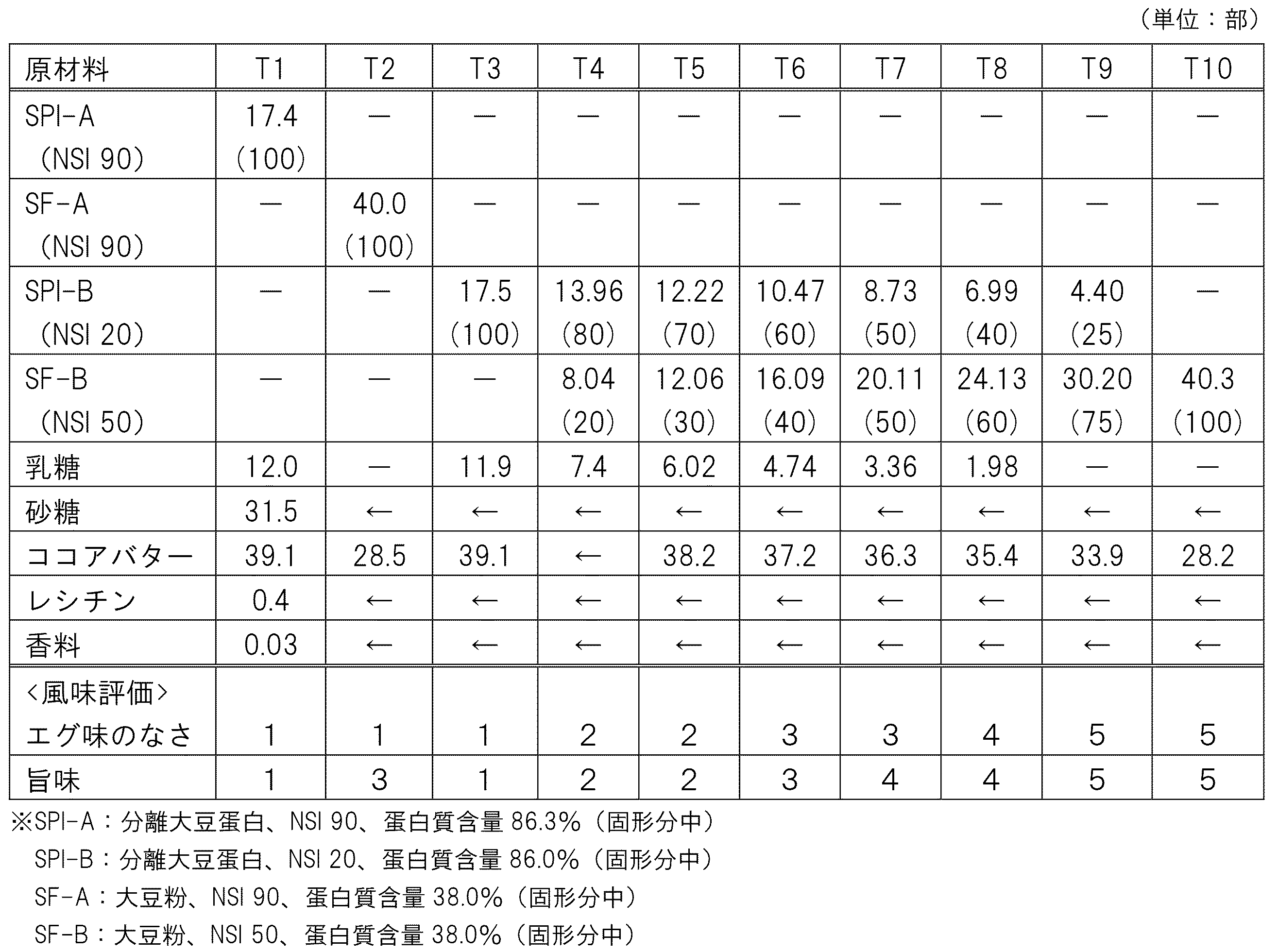
下記表1の配合により、T1~T10の各例において、後述する調製法によりチョコレート様食品を調製した。なお、各例は全て大豆由来の蛋白質含量が15%となるように設計し、T4~T9については分離大豆蛋白由来の蛋白質と大豆粉由来の蛋白質の比率が表1の括弧内の重量比率となるように、分離大豆蛋白と大豆粉を併用した。
(Test Example 1) Preliminary Study In order to obtain a chocolate-like food with a high vegetable protein content, various powdered vegetable protein materials were selected and included in the chocolate-like food, and their properties were examined. As the types of powdered vegetable protein materials, isolated soy protein and soy flour were selected. Furthermore, from these two types, a material with a high NSI and a high content of water-soluble protein, and a material with a low NSI and a high content of insoluble protein were selected, respectively.
Chocolate-like foods were prepared in each of Examples T1 to T10 by the preparation method described below, using the formulations in Table 1. Each example was designed so that the soybean-derived protein content was 15%, and in Examples T4 to T9, soybean protein isolate and soybean flour were used in combination, so that the ratio of protein derived from soybean protein to protein derived from soybean flour was the weight ratio in parentheses in Table 1.
得られた各サンプルについて、チョコレート様食品の官能評価において十分に訓練されたパネラー5名を選定し、盲検にて各サンプルを試食してもらい、合議により、風味(エグ味、大豆の旨味)の各項目について、各サンプルの中で最も強く感じるサンプルを(5)、最も弱く感じにくいサンプルを(1)とし、1~5点の相対的評価をしてもらった。結果を表1の下段に示した。Five panelists, thoroughly trained in the sensory evaluation of chocolate-like foods, were selected to taste each sample in a blind test and, by consensus, were asked to rate each sample on a relative scale of 1 to 5 for each flavor category (bitterness, umami of soybean), with the sample that they perceived as the strongest being graded as (5) and the sample that they perceived as the weakest being graded as (1). The results are shown in the lower section of Table 1.
(表1)チョコレート様食品の配合および評価結果
<チョコレート様食品の調製法>
・ロールフレークの作製
1.表1の配合に従い砂糖、乳糖、融解したココアバターの一部、香料を配合した。
2.ミキサーにてドウ状になる程度(5~10分)に撹拌してロールリファイナー投入生地を調製した。
3.上記の生地をロールリファイナーにより微細化し、ロールフレークを得た。ロールフレークの粒度は20~30μmであった。
・コンチング
4.得られたロールフレークをコンチングマシンにて90℃で2時間ドライコンチングを行った。
5.残りのココアバターを追油し、レシチンを添加し、混合して液化した。
6.テンパリングを行い、モールドに流し、5℃で固化させた。
7.20~22℃の室内に1~3時間放置した。
<Method of preparing chocolate-like food>
- Preparation of roll flakes 1. Sugar, lactose, a portion of the melted cocoa butter, and flavoring were mixed according to the recipe in Table 1.
2. The mixture was stirred in a mixer until it became dough-like (5 to 10 minutes) to prepare a dough to be put into the roll refiner.
3. The dough was refined by a roll refiner to obtain roll flakes. The particle size of the roll flakes was 20-30 μm.
Conching 4. The obtained roll flakes were dry conched in a conching machine at 90° C. for 2 hours.
5. The remaining cocoa butter was added and the lecithin was added and mixed to liquefy.
6. The mixture was tempered, poured into a mold, and allowed to solidify at 5°C.
7. The sample was left in a room at 20 to 22°C for 1 to 3 hours.
以上の結果から、分離大豆蛋白に関してはNSIの高低に関わらず、異風味としてエグ味が強く、大豆本来の良好な旨味を感じなかった。また大豆粉に関してはNSIが低いほどエグ味が弱くなり、反対に大豆本来の良好な旨味を感じる傾向にあった。NSIが低い分離大豆蛋白と大豆粉の混合系においては、少しエグ味が減り、旨味が増加する結果となった。
しかしながら、T1~T10のいずれのサンプルにおいても、チョコレート様食品の風味として絶対的に満足できるレベルにはないとの評価をパネラーから受けた。このことから、種々の大豆蛋白質素材を組み合わせて風味のバランスを調整してチョコレート様食品に配合するだけでは、満足な風味の高蛋白チョコレート様食品は得難いということが示された。
From the above results, it was found that soy protein isolate, regardless of its NSI level, had a strong harsh taste as an off-flavor, and the inherently good umami taste of soybeans was not felt. As for soy flour, the lower the NSI, the weaker the harsh taste, and conversely, there was a tendency for the inherently good umami taste of soybeans to be felt. In a mixture of low-NSI soy protein isolate and soy flour, the harsh taste was slightly reduced and the umami taste increased.
However, the panelists rated all samples T1 to T10 as not being at an absolutely satisfactory level in terms of flavor as a chocolate-like food. This shows that it is difficult to obtain a high-protein chocolate-like food with a satisfactory flavor by simply combining various soy protein materials, adjusting the balance of flavors, and adding them to a chocolate-like food.
(試験例2)
ココアバター99.877部と、油溶性乳化剤としてポリグリセリン縮合リシノレイン酸エステル「ポエムPR-100」(理研ビタミン(株)製)0.045部とを融解し、混合して油相99.922部を調製した。
次に、水0.06部に、ポリフェノール素材であるヘスペリジン素材「αGヘスペリジン」(東洋精糖(株)製)0.018部を溶解して、水相0.078部を調製した。
上記油相中に水相を混合して、油中水型に乳化することにより、「油脂組成物A」を得た。得られた油脂組成物Aにおける水相の割合は0.078%であり、ポリフェノール素材の量は水相中23.1%、油脂組成物中0.018%であった。
以上により得られた油脂組成物Aを用い、試験例1のT6配合をベースにして、下記表2の配合により、試験例1と同様の方法でチョコレート様食品を調製した(T12)。比較として、油脂組成物Aを通常のココアバターに置換したチョコレート様食品を調製した(T11)。またT11とT12のチョコレート様食品を混合し、6種類の混合比率のチョコレート様食品を調製した(T13~T18)。
(Test Example 2)
99.877 parts of cocoa butter and 0.045 parts of polyglycerin condensed ricinoleic acid ester "Poem PR-100" (manufactured by Riken Vitamin Co., Ltd.) as an oil-soluble emulsifier were melted and mixed to prepare 99.922 parts of an oil phase.
Next, 0.018 parts of a hesperidin material, a polyphenol material "αG hesperidin" (manufactured by Toyo Sugar Refining Co., Ltd.) was dissolved in 0.06 parts of water to prepare 0.078 parts of an aqueous phase.
The oil phase was mixed with the water phase to emulsify it into a water-in-oil type emulsion, thereby obtaining "Oil composition A". The proportion of the water phase in the obtained oil composition A was 0.078%, and the amount of the polyphenol material in the water phase was 23.1%, and in the oil composition, it was 0.018%.
Using the fat and oil composition A obtained above, a chocolate-like food was prepared in the same manner as in Test Example 1, based on the T6 formulation in Test Example 1, and based on the formulation in Table 2 below (T12). For comparison, a chocolate-like food was prepared in which fat and oil composition A was replaced with normal cocoa butter (T11). In addition, the chocolate-like foods of T11 and T12 were mixed to prepare six different chocolate-like foods with different mixing ratios (T13 to T18).
(表2)チョコレート様食品の配合

得られた各サンプルについて、試験例1と同様にして相対的な官能評価を行った。結果を表3の下段に示した。A relative sensory evaluation was performed on each of the obtained samples in the same manner as in Test Example 1. The results are shown in the lower part of Table 3.
(表3)各チョコレート様食品の評価結果

○考察
表3の通り、ポリフェノール素材を含有する水相粒子が油相中に分散した油脂組成物Aをチョコレート様食品の原料に用いることにより、チョコレート様食品中に配合された分離大豆蛋白由来のエグ味が減り、大豆由来の旨味がより強調されること、そして、その傾向はポリフェノール素材の量が多い程強くなることが示された。
Observations As shown in Table 3, by using oil and fat composition A in which aqueous phase particles containing polyphenol materials are dispersed in an oil phase as an ingredient of a chocolate-like food, the harsh taste derived from the isolated soy protein blended in the chocolate-like food is reduced and the umami taste derived from soybeans is emphasized, and this tendency becomes stronger as the amount of polyphenol materials increases.
(試験例3)他のポリフェノールの検討
試験例2において、ポリフェノール素材としてヘスペリジン素材の代わりに、以下のポリフェノール素材を用いて試験例2と同様にして油脂組成物を調製し、これを用いて表3のT15の配合でチョコレート様食品を調製した。
T19:イソフラボン素材「ソヤフラボンHG」(不二製油(株)製)
T20:アントシアニン素材「粉末ぶどうエキスHA」(三栄源エフ・エフ・アイ社製)
T21:オリゴノール素材「OLG-F」(アミノアップ化学社製)
T22:コーヒーポリフェノール素材「生コーヒー豆エキス-P」(オリザ油化社製)
T23:カカオポリフェノール素材「カカオエキス-WSP」(オリザ油化社製)
T24:カテキン素材「サンフェノン90S」(太陽化学社製)
(Test Example 3) Examination of other polyphenols
In Test Example 2 , an oil and fat composition was prepared in the same manner as in Test Example 2 , except that the following polyphenol materials were used instead of the hesperidin material as the polyphenol material, and a chocolate-like food was prepared using this composition with the T15 formulation in Table 3.
T19: Isoflavone material "Soyaflavone HG" (manufactured by Fuji Oil Co., Ltd.)
T20: Anthocyanin material "Powdered Grape Extract HA" (manufactured by San-Ei Gen FFI Co., Ltd.)
T21: Oligonol material "OLG-F" (manufactured by Amino Up Chemical Co., Ltd.)
T22: Coffee polyphenol material "Green Coffee Bean Extract-P" (Oryza Oil & Fat Chemical Co., Ltd.)
T23: Cacao polyphenol material "Cacao Extract-WSP" (Oryza Oil & Fat Chemical Co., Ltd.)
T24: Catechin material "Sunphenon 90S" (manufactured by Taiyo Kagaku Co., Ltd.)
試験例2と同様に官能評価をした結果、いずれのチョコレート様食品も試験例2のT15のチョコレート様食品と同等の評価であった。
As a result of the sensory evaluation carried out in the same manner as in Test Example 2 , all of the chocolate-like food products were rated equivalent to the chocolate-like food product T15 in Test Example 2 .
以上の結果より、ポリフェノールを含む水相を油相に分散させた油脂組成物を高蛋白質含量のチョコレート様食品に配合することにより、蛋白質素材由来の独特のエグ味をマスキングでき、逆に大豆粉に由来する大豆本来の好ましい旨味を増強することができた。 Based on the above results, by incorporating an oil and fat composition in which an aqueous phase containing polyphenols is dispersed in an oil phase into a chocolate-like food product with a high protein content, it is possible to mask the unique bitter taste derived from the protein ingredients and, conversely, to enhance the inherently pleasant umami taste of soybeans derived from soy flour.
試験例4
試験例1のT9の配合をベースにして表4の配合でチョコレート様食品を調製した(対照)。次に、NSIが低い分離大豆蛋白のみを用いて表4の配合でチョコレート様食品を調製した(T19、T20)。またT19とT20のチョコレート様食品を混合し、表5の通り、6種類の分離大豆蛋白の配合比率のチョコレート様食品を調製した。
Test Example 4
A chocolate-like food was prepared with the recipe in Table 4 based on the recipe in T9 of Test Example 1 (Control). Next, chocolate-like foods were prepared with the recipe in Table 4 using only low NSI soy protein isolates (T19, T20). In addition, chocolate-like foods T19 and T20 were mixed to prepare chocolate-like foods with the recipe ratios of six types of soy protein isolates as shown in Table 5.
(表4)チョコレート様食品の配合

得られた各サンプルについて、試験例1と同様にして、相対的な官能評価を行った。結果を表5の下段に示した。A relative sensory evaluation was performed on each of the obtained samples in the same manner as in Test Example 1. The results are shown in the lower part of Table 5.
(表5)各チョコレート様食品の評価結果

いずれのサンプルにおいても、同等の程度でエグ味が大きく改善された。また、大豆本来の好ましい旨味を感じるサンプルについてはいずれも旨味も増強した。In all samples, the harshness was greatly improved to the same extent. In addition, the umami taste of the samples that have the inherently pleasant umami taste of soybeans was also enhanced.
次に、風味についての改善が可能となったため、チョコレート様食品としてのより好ましい食感(口中への張り付きにくさ)について、各チョコレート様食品を評価した。
対照及びT19~T24の各サンプルについて、チョコレート様食品の官能評価において十分に訓練されたパネラー5名を選定し、盲検にて各サンプルを試食してもらい、合議により、食感(口中への張り付きにくさ)について、各サンプルの中で最も強く感じるサンプルを(5)、最も弱く感じるサンプルを(1)とし、1~5点の相対的評価をしてもらった。結果を表6の下段に示した。
Next, since it became possible to improve the flavor, each chocolate-like food was evaluated for a more preferable texture as a chocolate-like food (less likely to stick to the mouth).
For the control and each sample T19 to T24, five panelists who were well trained in the sensory evaluation of chocolate-like foods were selected to taste each sample in a blind test, and by consensus, they were asked to give a relative rating of 1 to 5 points for the texture (difficulty of sticking to the mouth), with the sample that they felt was the strongest being given a rating of (5) and the sample that they felt was the weakest being given a rating of (1). The results are shown in the lower part of Table 6.
(表6)各チョコレート様食品の評価結果

表6の結果より、口中への張り付きはチョコレート様食品中の蛋白質含量が多くなるほど強くなる傾向となったが、蛋白質含量が25%程度を超えるまではチョコレート様食品の食感として許容できるものであった。 The results in Table 6 show that the tendency for the chocolate-like food to stick to the mouth increases as the protein content in the food increases, but the texture of the chocolate-like food remains acceptable up to a protein content of approximately 25%.
Claims (11)
ここで、該チョコレート様食品中に含有する油脂は、高度不飽和脂肪酸含有油脂を除く。 The present invention relates to a chocolate-like food with a high vegetable protein content, characterized in that the food contains an oil and fat composition in which aqueous phase particles containing 1 to 60% by weight of a polyphenol material are emulsified in an oil phase at 0.001 to 20% by weight of a water-in-oil type, and a powdered bean-derived protein material at 7.5 to 25% by weight in terms of protein content.
Here, the fats and oils contained in the chocolate-like food product exclude fats and oils containing highly unsaturated fatty acids.
粉末状豆類由来蛋白質素材を蛋白質量として7.5~25重量%含有する
ことを特徴とする、植物性蛋白質高含有チョコレート様食品。
ここで、該チョコレート様食品中に含有する油脂は、全てココアバター又はココアバター代用脂である。 An oil and fat composition in which aqueous phase particles containing 1 to 60% by weight of a polyphenol material are emulsified in an oil phase at 0.001 to 20% by weight of a water-in-oil type , and
A chocolate-like food with a high vegetable protein content, characterized in that it contains 7.5 to 25% by weight of a powdered bean- derived protein material in terms of protein content.
Here, all of the fats and oils contained in the chocolate-like food are cocoa butter or cocoa butter substitutes.
ここで、該チョコレート様食品中に含有させる油脂は、高度不飽和脂肪酸含有油脂を除く。 A method for producing a chocolate-like food with a high vegetable protein content, comprising: an oil and fat composition in which aqueous phase particles containing 1 to 60% by weight of a polyphenol material are emulsified in an oil phase at 0.001 to 20% by weight of a water-in-oil type ; and a powdered bean-derived protein material at 7.5 to 25% by weight in terms of protein.
Here, the fats and oils contained in the chocolate-like food product exclude fats and oils containing highly unsaturated fatty acids.
ここで、該チョコレート様食品中に含有させる油脂は、全てココアバター又はココアバター代用脂である。 A method for producing a chocolate-like food with a high vegetable protein content, comprising: an oil and fat composition in which aqueous phase particles containing 1 to 60% by weight of a polyphenol material are emulsified in an oil phase at 0.001 to 20% by weight of a water-in-oil type ; and a powdered bean-derived protein material at 7.5 to 25% by weight in terms of protein.
Here, the fats and oils contained in the chocolate-like food are all cocoa butter or cocoa butter substitutes.
Applications Claiming Priority (3)
| Application Number | Priority Date | Filing Date | Title |
|---|---|---|---|
| JP2018228445 | 2018-12-05 | ||
| JP2018228445 | 2018-12-05 | ||
| PCT/JP2019/047641 WO2020116565A1 (en) | 2018-12-05 | 2019-12-05 | High plant-protein-containing chocolate-like food product and production method thereof |
Publications (2)
| Publication Number | Publication Date |
|---|---|
| JPWO2020116565A1 JPWO2020116565A1 (en) | 2021-10-28 |
| JP7517153B2 true JP7517153B2 (en) | 2024-07-17 |
Family
ID=70973913
Family Applications (1)
| Application Number | Title | Priority Date | Filing Date |
|---|---|---|---|
| JP2020560008A Active JP7517153B2 (en) | 2018-12-05 | 2019-12-05 | Chocolate-like food with high vegetable protein content and method for producing same |
Country Status (2)
| Country | Link |
|---|---|
| JP (1) | JP7517153B2 (en) |
| WO (1) | WO2020116565A1 (en) |
Families Citing this family (7)
| Publication number | Priority date | Publication date | Assignee | Title |
|---|---|---|---|---|
| JP2021193993A (en) * | 2020-06-15 | 2021-12-27 | 日清オイリオグループ株式会社 | Butter cream |
| CA3198065A1 (en) * | 2020-10-15 | 2022-04-21 | Givaudan Sa | Compositions and methods for masking off-notes in consumables |
| WO2022102382A1 (en) * | 2020-11-10 | 2022-05-19 | 不二製油グループ本社株式会社 | Sweetness enhancement method for oil-based food product |
| AU2022270202A1 (en) * | 2021-05-04 | 2023-11-23 | Cargill, Incorporated | Cocoa composition |
| BE1029592B1 (en) * | 2021-07-16 | 2023-02-13 | Puratos | CHOCOLATE WITHOUT OR LOW DAIRY COMPONENTS |
| US20260174110A1 (en) | 2022-10-28 | 2026-06-25 | Nagase Viita Co., Ltd. | Composition for improving mouthfeel, food/beverage product composition and method for producing same, and method for improving mouthfeel |
| WO2024162150A1 (en) * | 2023-01-31 | 2024-08-08 | 不二製油グループ本社株式会社 | Plant-based white chocolate-like food, and manufacturing method therefor |
Citations (8)
| Publication number | Priority date | Publication date | Assignee | Title |
|---|---|---|---|---|
| WO2008096703A1 (en) | 2007-02-08 | 2008-08-14 | The Nisshin Oillio Group, Ltd. | Flavor-improving agent and food containing the flavor-improving agent |
| JP2011126849A (en) | 2009-12-21 | 2011-06-30 | Ito En Ltd | Hesperidin-containing beverage |
| JP2015033335A (en) | 2013-08-08 | 2015-02-19 | 不二製油株式会社 | Oil-and-fat for confectionery and food using the same |
| JP2015116189A (en) | 2013-11-13 | 2015-06-25 | 不二製油株式会社 | Highly polyunsaturated fatty acid-containing oil and fat, food containing the same, and method for producing the same |
| JP2015154756A (en) | 2014-02-21 | 2015-08-27 | 不二製油株式会社 | Soybean protein raw material for enriching food protein |
| WO2015156007A1 (en) | 2014-04-11 | 2015-10-15 | 不二製油株式会社 | Soybean protein material for enriching proteins in foods |
| WO2016147754A1 (en) | 2015-03-18 | 2016-09-22 | 不二製油グループ本社株式会社 | Chocolate-like food |
| WO2016194558A1 (en) | 2015-06-02 | 2016-12-08 | 不二製油グループ本社株式会社 | Method for manufacturing chocolate-like food |
Family Cites Families (4)
| Publication number | Priority date | Publication date | Assignee | Title |
|---|---|---|---|---|
| JPS5963425A (en) * | 1982-10-01 | 1984-04-11 | Matsushita Electric Ind Co Ltd | Heating cooker |
| JPS59166038A (en) * | 1983-03-10 | 1984-09-19 | N I Food Kk | Chocolate |
| JP3208113B2 (en) * | 1998-05-15 | 2001-09-10 | 田辺製薬株式会社 | Method for improving flavor of food and drink and flavor improver |
| WO2019031326A1 (en) * | 2017-08-08 | 2019-02-14 | 不二製油グループ本社株式会社 | Off-flavor reducing agent and food using same |
-
2019
- 2019-12-05 JP JP2020560008A patent/JP7517153B2/en active Active
- 2019-12-05 WO PCT/JP2019/047641 patent/WO2020116565A1/en not_active Ceased
Patent Citations (8)
| Publication number | Priority date | Publication date | Assignee | Title |
|---|---|---|---|---|
| WO2008096703A1 (en) | 2007-02-08 | 2008-08-14 | The Nisshin Oillio Group, Ltd. | Flavor-improving agent and food containing the flavor-improving agent |
| JP2011126849A (en) | 2009-12-21 | 2011-06-30 | Ito En Ltd | Hesperidin-containing beverage |
| JP2015033335A (en) | 2013-08-08 | 2015-02-19 | 不二製油株式会社 | Oil-and-fat for confectionery and food using the same |
| JP2015116189A (en) | 2013-11-13 | 2015-06-25 | 不二製油株式会社 | Highly polyunsaturated fatty acid-containing oil and fat, food containing the same, and method for producing the same |
| JP2015154756A (en) | 2014-02-21 | 2015-08-27 | 不二製油株式会社 | Soybean protein raw material for enriching food protein |
| WO2015156007A1 (en) | 2014-04-11 | 2015-10-15 | 不二製油株式会社 | Soybean protein material for enriching proteins in foods |
| WO2016147754A1 (en) | 2015-03-18 | 2016-09-22 | 不二製油グループ本社株式会社 | Chocolate-like food |
| WO2016194558A1 (en) | 2015-06-02 | 2016-12-08 | 不二製油グループ本社株式会社 | Method for manufacturing chocolate-like food |
Also Published As
| Publication number | Publication date |
|---|---|
| JPWO2020116565A1 (en) | 2021-10-28 |
| WO2020116565A1 (en) | 2020-06-11 |
Similar Documents
| Publication | Publication Date | Title |
|---|---|---|
| WO2020116565A1 (en) | High plant-protein-containing chocolate-like food product and production method thereof | |
| CN112752513B (en) | Chocolate rich in protein and method for producing the same | |
| JP6061118B1 (en) | Chocolate-like food | |
| JP7823569B2 (en) | Oily foods | |
| JP6525097B1 (en) | Anti-flavoring agent and food using it | |
| JP2017176120A (en) | Production method of low-allergen cake containing cacao solid portion | |
| JP2023171673A (en) | oily food | |
| RU2736152C2 (en) | Chocolate product containing highly unsaturated fatty acids | |
| US20050175765A1 (en) | Soy-containing chocolate products | |
| CN115087356B (en) | Oily food raw material for combination and method for producing the same, method for producing frozen dessert combination food | |
| WO2019031326A1 (en) | Off-flavor reducing agent and food using same | |
| EP1358804A1 (en) | Milk-containing chocolate | |
| JP2015033335A (en) | Oil-and-fat for confectionery and food using the same | |
| JP7783401B2 (en) | Dairy-free chocolate | |
| AU2023385589A1 (en) | Oily food | |
| JP2015154756A (en) | Soybean protein raw material for enriching food protein | |
| JP2002191291A (en) | Chocolate containing soy protein | |
| KR102276209B1 (en) | Novel spread containing garlic extract and preparation of the same | |
| JP2019180297A (en) | Hard butter composition | |
| JP2025149775A (en) | Oily food coating | |
| JP2023149407A (en) | How to make chocolate crumb | |
| KR20040094214A (en) | Cocoa cheese and manufacturing method thereof | |
| JP3808872B2 (en) | Bread texture improver and bread | |
| WO2024162150A1 (en) | Plant-based white chocolate-like food, and manufacturing method therefor | |
| CN120201930A (en) | Edible plant-based paste and method for producing an edible plant-based paste |
Legal Events
| Date | Code | Title | Description |
|---|---|---|---|
| A621 | Written request for application examination |
Free format text: JAPANESE INTERMEDIATE CODE: A621 Effective date: 20221121 |
|
| A131 | Notification of reasons for refusal |
Free format text: JAPANESE INTERMEDIATE CODE: A131 Effective date: 20231205 |
|
| A601 | Written request for extension of time |
Free format text: JAPANESE INTERMEDIATE CODE: A601 Effective date: 20240129 |
|
| A521 | Request for written amendment filed |
Free format text: JAPANESE INTERMEDIATE CODE: A523 Effective date: 20240304 |
|
| A521 | Request for written amendment filed |
Free format text: JAPANESE INTERMEDIATE CODE: A523 Effective date: 20240325 |
|
| TRDD | Decision of grant or rejection written | ||
| A01 | Written decision to grant a patent or to grant a registration (utility model) |
Free format text: JAPANESE INTERMEDIATE CODE: A01 Effective date: 20240604 |
|
| A61 | First payment of annual fees (during grant procedure) |
Free format text: JAPANESE INTERMEDIATE CODE: A61 Effective date: 20240617 |
|
| R150 | Certificate of patent or registration of utility model |
Ref document number: 7517153 Country of ref document: JP Free format text: JAPANESE INTERMEDIATE CODE: R150 |
|
| S111 | Request for change of ownership or part of ownership |
Free format text: JAPANESE INTERMEDIATE CODE: R313111 |
|
| R350 | Written notification of registration of transfer |
Free format text: JAPANESE INTERMEDIATE CODE: R350 |