JP7463520B2 - Optical and light-guiding elements - Google Patents
Optical and light-guiding elements Download PDFInfo
- Publication number
- JP7463520B2 JP7463520B2 JP2022540060A JP2022540060A JP7463520B2 JP 7463520 B2 JP7463520 B2 JP 7463520B2 JP 2022540060 A JP2022540060 A JP 2022540060A JP 2022540060 A JP2022540060 A JP 2022540060A JP 7463520 B2 JP7463520 B2 JP 7463520B2
- Authority
- JP
- Japan
- Prior art keywords
- liquid crystal
- light
- cholesteric liquid
- crystal layer
- wavelength
- Prior art date
- Legal status (The legal status is an assumption and is not a legal conclusion. Google has not performed a legal analysis and makes no representation as to the accuracy of the status listed.)
- Active
Links
Classifications
-
- G—PHYSICS
- G02—OPTICS
- G02F—OPTICAL DEVICES OR ARRANGEMENTS FOR THE CONTROL OF LIGHT BY MODIFICATION OF THE OPTICAL PROPERTIES OF THE MEDIA OF THE ELEMENTS INVOLVED THEREIN; NON-LINEAR OPTICS; FREQUENCY-CHANGING OF LIGHT; OPTICAL LOGIC ELEMENTS; OPTICAL ANALOGUE/DIGITAL CONVERTERS
- G02F1/00—Devices or arrangements for the control of the intensity, colour, phase, polarisation or direction of light arriving from an independent light source, e.g. switching, gating or modulating; Non-linear optics
- G02F1/01—Devices or arrangements for the control of the intensity, colour, phase, polarisation or direction of light arriving from an independent light source, e.g. switching, gating or modulating; Non-linear optics for the control of the intensity, phase, polarisation or colour
- G02F1/13—Devices or arrangements for the control of the intensity, colour, phase, polarisation or direction of light arriving from an independent light source, e.g. switching, gating or modulating; Non-linear optics for the control of the intensity, phase, polarisation or colour based on liquid crystals, e.g. single liquid crystal display cells
- G02F1/133—Constructional arrangements; Operation of liquid crystal cells; Circuit arrangements
- G02F1/1333—Constructional arrangements; Manufacturing methods
- G02F1/1335—Structural association of cells with optical devices, e.g. polarisers or reflectors
- G02F1/133528—Polarisers
- G02F1/133543—Cholesteric polarisers
-
- G—PHYSICS
- G02—OPTICS
- G02B—OPTICAL ELEMENTS, SYSTEMS OR APPARATUS
- G02B5/00—Optical elements other than lenses
- G02B5/30—Polarising elements
- G02B5/3016—Polarising elements involving passive liquid crystal elements
-
- G—PHYSICS
- G02—OPTICS
- G02B—OPTICAL ELEMENTS, SYSTEMS OR APPARATUS
- G02B27/00—Optical systems or apparatus not provided for by any of the groups G02B1/00 - G02B26/00, G02B30/00
- G02B27/01—Head-up displays
- G02B27/017—Head mounted
- G02B27/0172—Head mounted characterised by optical features
-
- G—PHYSICS
- G02—OPTICS
- G02B—OPTICAL ELEMENTS, SYSTEMS OR APPARATUS
- G02B27/00—Optical systems or apparatus not provided for by any of the groups G02B1/00 - G02B26/00, G02B30/00
- G02B27/02—Viewing or reading apparatus
-
- G—PHYSICS
- G02—OPTICS
- G02B—OPTICAL ELEMENTS, SYSTEMS OR APPARATUS
- G02B5/00—Optical elements other than lenses
- G02B5/18—Diffraction gratings
- G02B5/1833—Diffraction gratings comprising birefringent materials
-
- G—PHYSICS
- G02—OPTICS
- G02B—OPTICAL ELEMENTS, SYSTEMS OR APPARATUS
- G02B5/00—Optical elements other than lenses
- G02B5/18—Diffraction gratings
- G02B5/1861—Reflection gratings characterised by their structure, e.g. step profile, contours of substrate or grooves, pitch variations, materials
-
- G—PHYSICS
- G02—OPTICS
- G02F—OPTICAL DEVICES OR ARRANGEMENTS FOR THE CONTROL OF LIGHT BY MODIFICATION OF THE OPTICAL PROPERTIES OF THE MEDIA OF THE ELEMENTS INVOLVED THEREIN; NON-LINEAR OPTICS; FREQUENCY-CHANGING OF LIGHT; OPTICAL LOGIC ELEMENTS; OPTICAL ANALOGUE/DIGITAL CONVERTERS
- G02F1/00—Devices or arrangements for the control of the intensity, colour, phase, polarisation or direction of light arriving from an independent light source, e.g. switching, gating or modulating; Non-linear optics
- G02F1/01—Devices or arrangements for the control of the intensity, colour, phase, polarisation or direction of light arriving from an independent light source, e.g. switching, gating or modulating; Non-linear optics for the control of the intensity, phase, polarisation or colour
- G02F1/13—Devices or arrangements for the control of the intensity, colour, phase, polarisation or direction of light arriving from an independent light source, e.g. switching, gating or modulating; Non-linear optics for the control of the intensity, phase, polarisation or colour based on liquid crystals, e.g. single liquid crystal display cells
- G02F1/133—Constructional arrangements; Operation of liquid crystal cells; Circuit arrangements
- G02F1/1333—Constructional arrangements; Manufacturing methods
- G02F1/1335—Structural association of cells with optical devices, e.g. polarisers or reflectors
- G02F1/133524—Light-guides, e.g. fibre-optic bundles, louvered or jalousie light-guides
-
- G—PHYSICS
- G02—OPTICS
- G02F—OPTICAL DEVICES OR ARRANGEMENTS FOR THE CONTROL OF LIGHT BY MODIFICATION OF THE OPTICAL PROPERTIES OF THE MEDIA OF THE ELEMENTS INVOLVED THEREIN; NON-LINEAR OPTICS; FREQUENCY-CHANGING OF LIGHT; OPTICAL LOGIC ELEMENTS; OPTICAL ANALOGUE/DIGITAL CONVERTERS
- G02F1/00—Devices or arrangements for the control of the intensity, colour, phase, polarisation or direction of light arriving from an independent light source, e.g. switching, gating or modulating; Non-linear optics
- G02F1/01—Devices or arrangements for the control of the intensity, colour, phase, polarisation or direction of light arriving from an independent light source, e.g. switching, gating or modulating; Non-linear optics for the control of the intensity, phase, polarisation or colour
- G02F1/13—Devices or arrangements for the control of the intensity, colour, phase, polarisation or direction of light arriving from an independent light source, e.g. switching, gating or modulating; Non-linear optics for the control of the intensity, phase, polarisation or colour based on liquid crystals, e.g. single liquid crystal display cells
- G02F1/133—Constructional arrangements; Operation of liquid crystal cells; Circuit arrangements
- G02F1/1333—Constructional arrangements; Manufacturing methods
- G02F1/1335—Structural association of cells with optical devices, e.g. polarisers or reflectors
- G02F1/133528—Polarisers
- G02F1/133536—Reflective polarizers
-
- G—PHYSICS
- G02—OPTICS
- G02B—OPTICAL ELEMENTS, SYSTEMS OR APPARATUS
- G02B27/00—Optical systems or apparatus not provided for by any of the groups G02B1/00 - G02B26/00, G02B30/00
- G02B27/01—Head-up displays
- G02B27/017—Head mounted
- G02B2027/0178—Eyeglass type
Landscapes
- Physics & Mathematics (AREA)
- General Physics & Mathematics (AREA)
- Optics & Photonics (AREA)
- Nonlinear Science (AREA)
- Chemical & Material Sciences (AREA)
- Crystallography & Structural Chemistry (AREA)
- Mathematical Physics (AREA)
- Polarising Elements (AREA)
- Diffracting Gratings Or Hologram Optical Elements (AREA)
- Electroluminescent Light Sources (AREA)
- Light Guides In General And Applications Therefor (AREA)
- Liquid Crystal (AREA)
Description
本発明は、入射した光を回折する光学素子、および、この光学素子を用いた導光素子に関する。 The present invention relates to an optical element that diffracts incident light, and a light-guiding element that uses this optical element.
光学素子として、液晶化合物をコレステリック配向したコレステリック液晶層を用いることが提案されている。 It has been proposed to use a cholesteric liquid crystal layer in which liquid crystal compounds are cholesterically oriented as an optical element.
例えば、特許文献1には、各々が所定方向に沿って延びる複数の螺旋状構造体を備え、所定方向に交差すると共に、光が入射する第1入射面と、所定方向に交差すると共に、第1入射面から入射した光を反射する反射面とを有し、第1入射面は、複数の螺旋状構造体のそれぞれの両端部のうちの一方端部を含み、複数の螺旋状構造体の各々は、所定方向に沿って連なる複数の構造単位を含み、複数の構造単位は、螺旋状に旋回して積み重ねられた複数の要素を含み、複数の構造単位の各々は、第1端部と第2端部とを有し、所定方向に沿って互いに隣接する構造単位のうち、一方の構造単位の第2端部は、他方の構造単位の第1端部を構成し、複数の螺旋状構造体に含まれる複数の第1端部に位置する要素の配向方向は揃っており、反射面は、複数の螺旋状構造体のそれぞれに含まれる少なくとも1つの第1端部を含み、反射面は、第1入射面に対して非平行である、反射構造体が記載されている。
特許文献1には、液晶化合物をコレステリック配向させて螺旋構造とすることが記載されている。また、特許文献1に記載の反射構造体は、入射した光を鏡面反射するのではなく、入射した光を回折して反射するものである。
For example, Patent Document 1 describes a reflective structure having a plurality of spiral structures each extending along a predetermined direction, a first incident surface that intersects with the predetermined direction and on which light is incident, and a reflective surface that intersects with the predetermined direction and reflects the light incident from the first incident surface, the first incident surface includes one end of each of the plurality of spiral structures, each of the plurality of spiral structures includes a plurality of structural units that are connected along the predetermined direction, the plurality of structural units include a plurality of elements that are spirally wound and stacked, each of the plurality of structural units has a first end and a second end, among the structural units adjacent to each other along the predetermined direction, the second end of one structural unit constitutes the first end of the other structural unit, the orientation directions of the elements located at the plurality of first ends included in the plurality of spiral structures are aligned, the reflective surface includes at least one first end included in each of the plurality of spiral structures, and the reflective surface is non-parallel to the first incident surface.
Patent Document 1 describes a method of forming a helical structure by cholesterically aligning a liquid crystal compound. The reflection structure described in Patent Document 1 does not mirror-reflect incident light, but diffracts and reflects the incident light.
また、特許文献2には、コレステリック構造および楕円状の屈折率楕円体を有する変形螺旋を有する二軸性フィルムであって、380nm未満の波長を有する光を反射する二軸性フィルムが記載されている。Furthermore, Patent Document 2 describes a biaxial film having a deformed spiral with a cholesteric structure and an elliptical refractive index ellipsoid, which reflects light having a wavelength of less than 380 nm.
ところで、近年、実際に見ている光景に、仮想の映像および各種の情報等を重ねて表示する、いわゆるAR(Augmented Reality(拡張現実))グラスが実用化されている。ARグラスは、スマートグラス、ヘッドマウントディスプレイ(HMD(Head Mounted Display))、および、ARメガネ等とも呼ばれている。
ARグラスは、一例として、ディスプレイ(光学エンジン)が表示した映像を、導光板の一端に入射して伝播し、他端から出射することにより、使用者が実際に見ている光景に、仮想の映像を重ねて表示する。
In recent years, so-called Augmented Reality (AR) glasses that display virtual images and various information superimposed on an actually viewed scene have been put to practical use. AR glasses are also called smart glasses, head mounted displays (HMDs), AR glasses, and the like.
As an example, AR glasses display an image (optical engine) by having the image enter one end of a light guide plate, propagate through it, and exit from the other end, thereby superimposing a virtual image on the view the user actually sees.
ARグラスでは、一例として、ディスプレイが表示した画像を担持する光を、回折素子を用いて回折することで、全反射可能な角度で導光板に入射する。また、ARグラスでは、導光板内を全反射して伝播された光を、同様に、回折素子によって回折することで、光を導光板から出射させて、使用者による観察部に照射させる。 In AR glasses, for example, the light carrying the image shown on the display is diffracted using a diffraction element, and enters the light guide plate at an angle that allows total reflection. In addition, in AR glasses, the light that is totally reflected and propagated within the light guide plate is similarly diffracted by a diffraction element, causing the light to exit the light guide plate and illuminate the area observed by the user.
周知のように、液晶化合物をコレステリック配向させたコレステリック液晶層は、特定の波長域の光を選択的に反射する波長選択反射性を有する。また、特許文献1に記載された反射構造体は、コレステリック液晶層を有するもので、入射した光を回折して反射することができる。
そのため、特許文献1に記載されるコレステリック液晶層を、ARグラスの、例えば入射素子(入射側の回折素子)として用いることにより、所望の色の画像を、導光板に入射して、全反射させて伝播することができる。
As is well known, a cholesteric liquid crystal layer in which a liquid crystal compound is cholesterically oriented has wavelength selective reflectivity that selectively reflects light in a specific wavelength range. The reflection structure described in Patent Document 1 has a cholesteric liquid crystal layer and can diffract and reflect incident light.
Therefore, by using the cholesteric liquid crystal layer described in Patent Document 1 as, for example, an incident element (diffraction element on the incident side) of AR glass, an image of a desired color can be incident on the light guide plate and propagated by total reflection.
しかしながら、コレステリック液晶層は、上述のように、所定の波長域の光のみを選択的に反射するものである。
したがって、1枚の導光板に、不連続な異なる波長域の光を入射させるためには、複数層のコレステリック液晶層が必要になる。
また、回折素子は、回折する光の波長が異なる場合には、回折の角度も異なる。一般的に、回折素子は、回折する光の波長が長いほど、回折角度が大きくなる。そのため、単にコレステリック液晶層を増やしただけでは、1枚の導光板に異なる波長域の光を、導光板内を全反射するように適正に入射することは、困難である。
However, as described above, the cholesteric liquid crystal layer selectively reflects only light in a predetermined wavelength range.
Therefore, in order to allow light of different discontinuous wavelength ranges to enter a single light guide plate, a plurality of cholesteric liquid crystal layers are required.
In addition, when the wavelength of light diffracted by a diffraction element is different, the angle of diffraction also differs. In general, the longer the wavelength of light diffracted by a diffraction element, the larger the diffraction angle. Therefore, simply increasing the number of cholesteric liquid crystal layers makes it difficult to properly input light of different wavelength ranges into a single light guide plate so that the light is totally reflected within the light guide plate.
また、周知のように、コレステリック液晶層は、主面(最大面)の法線に対して斜め方向から光が入射した場合には、選択的な反射波長域が短波長側に変動する、いわゆるブルーシフトを生じる。
一方で、ディスプレイ等から照射される光は、様々な角度で入射素子に入射する。
そのため、従来、知られているコレステリック液晶層を用いる回折素子では、ディスプレイの画像表示面の全面に対応して、所定の波長域の光を、全反射可能な角度で導光板に入射することは、困難であった。その結果、コレステリック液晶層を用いる回折素子を、導光板への入射側に用いるARグラスでは、いわゆるFOV(Field of View)が狭くなってしまうという問題が有る。
As is well known, when light is incident on a cholesteric liquid crystal layer from a direction oblique to the normal to the main surface (largest surface), a selective reflection wavelength range shifts to the short wavelength side, causing a so-called blue shift.
On the other hand, light emitted from a display or the like is incident on the incident element at various angles.
Therefore, in a conventionally known diffraction element using a cholesteric liquid crystal layer, it is difficult to make light of a predetermined wavelength range incident on a light guide plate at an angle that allows total reflection, corresponding to the entire image display surface of a display. As a result, in an AR glass using a diffraction element using a cholesteric liquid crystal layer on the incident side of the light guide plate, there is a problem that the so-called FOV (Field of View) becomes narrow.
本発明の目的は、このような従来技術の問題点を解決することにあり、λを含む波長域と、λ/2を含む波長域とに、十分な幅の反射波長域を有し、例えば、上述のような導光板への入射素子として用いることで、ディスプレイの表示画面の全面に対応して、連続しない異なる波長域の光を、全反射可能な角度で導光板に入射できる光学素子、および、この光学素子を用いる導光素子を提供することにある。The object of the present invention is to solve the problems of the conventional technology by providing an optical element having a sufficiently wide reflection wavelength range in a wavelength range including λ and a wavelength range including λ/2, and by using it, for example, as an incident element into a light guide plate as described above, capable of making light of different discontinuous wavelength ranges incident on the light guide plate at an angle allowing total reflection corresponding to the entire display screen of a display, and a light guide element using this optical element.
この課題を解決するために、本発明は、以下の構成を有する。
[1] 液晶化合物をコレステリック配向させてなるコレステリック液晶層を有し、
コレステリック液晶層は、液晶化合物由来の光学軸の向きが面内の少なくとも一方向に沿って連続的に回転しながら変化している液晶配向パターンを有し、かつ、
コレステリック配向における螺旋軸方向の螺旋ピッチが、コレステリック液晶層の厚さ方向に、漸次、変化するものであり、さらに、
第1の波長λと、第2の波長λ/2とに、反射のピークを有することを特徴とする光学素子。
[2] コレステリック液晶層は、面内に、第2の波長λ/2の光の回折効率が異なる領域を有する、[1]に記載の光学素子。
[3] [1]または[2]に記載の光学素子と、導光板とを有する、導光素子。
[4] 光学素子は、第1の波長λの光および第2の波長λ/2の光を、全反射させる角度で導光板に入射させる入射素子である、[3]に記載の導光素子。
[5] 導光板に光を入射させる入射素子と、導光板から光を出射させる出射素子とを有し、
光学素子は、第2の波長λ/2の光を導光板から出射させる出射素子であり、コレステリック液晶層は、面内に、第2の波長λ/2の光の回折効率が異なる領域を有する、[3]に記載の導光素子。
[6] コレステリック液晶層は、入射素子から離間するにしたがって、漸次、第2の波長λ/2の光の回折効率が高くなる、[5]に記載の導光素子。
In order to solve this problem, the present invention has the following configuration.
[1] A liquid crystal layer having a liquid crystal compound cholesterically aligned,
The cholesteric liquid crystal layer has a liquid crystal alignment pattern in which the direction of the optical axis derived from the liquid crystal compound changes while continuously rotating along at least one direction in the plane, and
The helical pitch in the helical axis direction in the cholesteric alignment gradually changes in the thickness direction of the cholesteric liquid crystal layer, and
An optical element having reflection peaks at a first wavelength λ and a second wavelength λ/2.
[2] The optical element according to [1], wherein the cholesteric liquid crystal layer has regions in its plane that have different diffraction efficiencies for light having the second wavelength λ/2.
[3] A light guide element comprising the optical element according to [1] or [2] and a light guide plate.
[4] The light guide element according to [3], wherein the optical element is an incident element that causes light having a first wavelength λ and light having a second wavelength λ/2 to be incident on the light guide plate at an angle at which the light is totally reflected.
[5] A light guide plate having an incident element that causes light to be incident on the light guide plate and an exit element that causes the light to exit from the light guide plate,
The optical element is an output element that outputs light having a second wavelength of λ/2 from the light guide plate, and the cholesteric liquid crystal layer has a region in its plane that has different diffraction efficiencies for the light having the second wavelength of λ/2. The light guide element described in [3].
[6] The light guide element according to [5], wherein the cholesteric liquid crystal layer has a gradually increased diffraction efficiency for light having the second wavelength λ/2 as the cholesteric liquid crystal layer is spaced apart from the light incidence element.
本発明によれば、λを含む波長域と、λ/2を含む波長域とに、十分な幅の反射波長域を有し、かつ、2つの波長域の光を同じ方向に回折できる光学素子、および、この光学素子を用いる導光素子を提供できる。 According to the present invention, it is possible to provide an optical element that has a sufficiently wide reflection wavelength range in a wavelength range including λ and a wavelength range including λ/2, and that can diffract light in the two wavelength ranges in the same direction, and a light-guiding element that uses this optical element.
以下、本発明の光学素子および導光素子について、添付の図面に示される好適実施例を基に詳細に説明する。 Below, the optical elements and light-guiding elements of the present invention will be described in detail based on preferred embodiments shown in the attached drawings.
本明細書において「~」を用いて表される数値範囲は、「~」の前後に記載される数値を下限値および上限値として含む範囲を意味する。
本明細書において、「(メタ)アクリレート」は、「アクリレートおよびメタクリレートのいずれか一方または双方」の意味で使用される。
本明細書において、「同じ」、「等しい」等は、技術分野で一般的に許容される誤差範囲を含むものとする。
In this specification, a numerical range expressed using "to" means a range that includes the numerical values before and after "to" as the lower and upper limits.
In this specification, "(meth)acrylate" is used to mean "either one or both of acrylate and methacrylate."
In this specification, the terms "same", "equal" and the like are intended to include a generally accepted margin of error in the technical field.
本明細書において、可視光は、電磁波のうち、ヒトの目で見える波長の光であり、380~780nmの波長域の光を示す。非可視光は、380nm未満の波長域および780nmを超える波長域の光である。
また、これに限定されるものではないが、可視光のうち、420~490nmの波長域の光は青色光であり、495~570nmの波長域の光は緑色光であり、620~750nmの波長域の光は赤色光である。
In this specification, visible light refers to electromagnetic waves having wavelengths visible to the human eye, in the wavelength range of 380 to 780 nm, while non-visible light refers to light having wavelengths shorter than 380 nm and longer than 780 nm.
Also, although not limited to this, among visible light, light in the wavelength region of 420 to 490 nm is blue light, light in the wavelength region of 495 to 570 nm is green light, and light in the wavelength region of 620 to 750 nm is red light.
本明細書において、選択反射中心波長とは、対象となる物(部材)における透過率の極小値をTmin(%)とした場合、下記の式で表される半値透過率:T1/2(%)を示す2つの波長の平均値のことを言う。
半値透過率を求める式: T1/2=100-(100-Tmin)÷2
In this specification, the selective reflection central wavelength refers to the average value of two wavelengths that exhibit a half-value transmittance: T1/2 (%), which is expressed by the following formula, when the minimum value of the transmittance in the target object (component) is Tmin (%).
Formula for calculating half-value transmittance: T1/2 = 100 - (100 - Tmin) ÷ 2
図1に、本発明の導光素子を用いる画像表示装置の一例を概念的に示す。
図1に示す画像表示装置10は、例えば、上述したARグラスに用いられるもので、本発明の導光素子12と、ディスプレイ14とを有する。
導光素子12は、導光板18と、入射素子20と、出射素子24とを有する。入射素子20および出射素子24は、いずれも、反射型の回折素子で、入射素子20は、本発明の光学素子である。
FIG. 1 conceptually shows an example of an image display device using a light guide element of the present invention.
An image display device 10 shown in FIG. 1 is used in, for example, the above-mentioned AR glasses, and includes a light guide element 12 of the present invention and a display 14 .
The light guide element 12 has a light guide plate 18, an entrance element 20, and an exit element 24. The entrance element 20 and the exit element 24 are both reflective diffractive elements, and the entrance element 20 is the optical element of the present invention.
図示例の導光素子において、導光板18は、長尺な矩形の板状物で、長手方向の一方の端部近傍の主面に入射素子20が設けられ、長手方向の他方の端部近傍の他方の主面に出射素子24が設けられる。In the illustrated example of the light-guiding element, the light-guiding plate 18 is a long rectangular plate-like object with an incident element 20 provided on a main surface near one longitudinal end and an exit element 24 provided on the other main surface near the other longitudinal end.
なお、本発明の導光素子は、これに制限はされず、公知のARグラスで用いられている導光板、入射素子(入射部)および出射素子(出射部)を有する導光素子の、各種の構成が利用可能である。
一例として、矩形状の導光板を有し、導光板の一方の主面の角部近傍に矩形状の入射素子を設け、他方の主面に、入射素子以外の領域を面方向に全面的に覆うように、出射素子を設けた構成が例示される。他の例として、矩形状の導光板を有し、導光板の一方の主面の端部近傍で、かつ1つの辺1つの辺の中央に、矩形の入射素子を有し、他方の主面に、入射素子以外の領域を面方向に全面的に覆うように、出射素子を設けた構成も、利用可能である。
主面とは、シート状物(板状物、フィルム、層)の最大面である。また、面方向とは、主面の面方向(面内方向)である。
The light-guiding element of the present invention is not limited to this, and various configurations of light-guiding elements having light-guiding plates, incident elements (incident portions) and exit elements (exit portions) used in known AR glasses can be used.
As an example, a configuration is exemplified in which a rectangular light guide plate is provided with a rectangular entrance element near a corner of one of the main surfaces of the light guide plate, and an exit element is provided on the other main surface so as to completely cover the area other than the entrance element in the surface direction. As another example, a configuration is also usable in which a rectangular light guide plate is provided with a rectangular entrance element near an end of one of the main surfaces of the light guide plate and in the center of each side, and an exit element is provided on the other main surface so as to completely cover the area other than the entrance element in the surface direction.
The main surface is the largest surface of a sheet-like object (plate-like object, film, layer), and the planar direction is the planar direction (in-plane direction) of the main surface.
図1に示すように、図示例の画像表示装置10は、ディスプレイ14が表示(照射)した画像を担持する光を、入射素子20によって回折して反射することにより、全反射可能な角度で導光板18に入射する。
導光板18に入射した光は、導光板18内で全反射を繰り返して伝播し、出射素子24に入射する。出射素子24は、入射した光を回折して反射することにより、導光板18から出射させて、使用者Uによる観察位置に出射する。
As shown in FIG. 1, in the illustrated image display device 10, light carrying an image displayed (illuminated) by a display 14 is diffracted and reflected by an incident element 20, so that the light is incident on a light guide plate 18 at an angle allowing total reflection.
The light incident on the light guide plate 18 propagates by repeatedly undergoing total reflection within the light guide plate 18, and then enters the emission element 24. The emission element 24 diffracts and reflects the incident light, causing it to exit the light guide plate 18 and to exit the light to an observation position for the user U.
画像表示装置10において、ディスプレイ14には、制限はなく、例えば、ARグラス等に用いられる公知のディスプレイが、各種、利用可能である。
ディスプレイとしては、一例として、液晶ディスプレイ、有機エレクトロルミネッセンスディスプレイ、DLP(Digital Light Processing)方式のプロジェクター、および、MEMS(Micro Electro Mechanical Systems)ミラーを用いたスキャニング方式ディスプレイ等が例示される。なお、液晶ディスプレイには、LCOS(Liquid Crystal On Silicon)なども含む。
In the image display device 10, the display 14 is not limited, and various known displays used in, for example, AR glasses, etc. can be used.
Examples of displays include liquid crystal displays, organic electroluminescence displays, DLP (Digital Light Processing) type projectors, and scanning type displays using MEMS (Micro Electro Mechanical Systems) mirrors. Note that liquid crystal displays also include LCOS (Liquid Crystal On Silicon).
ディスプレイ14は、カラー画像を表示するものでも、モノクロ画像を表示するものでもよい。本発明の導光素子を用いる画像表示装置は、異なる色のモノクロ画像を表示する複数台のディスプレイを有してもよい。The display 14 may display a color image or a monochrome image. An image display device using the light-guiding element of the present invention may have multiple displays that display monochrome images of different colors.
本発明の導光素子を用いる画像表示装置では、必要に応じて、ディスプレイ14と導光板18の入射素子20の配置位置との間に、ARグラス等に用いられる公知の投映レンズを設けてもよい。In an image display device using the light-guiding element of the present invention, if necessary, a known projection lens used in AR glasses, etc. may be provided between the display 14 and the position of the incident element 20 of the light-guiding plate 18.
ここで、画像表示装置10においては、ディスプレイ14が照射する光には、制限はないが、無偏光(自然光)でも、直線偏光または円偏光でもよい。
なお、ディスプレイ14と導光板18との間には、必要に応じて、ディスプレイが照射する光の偏光に応じて、直線偏光子とλ/4板とからなる円偏光板、および、λ/4板等を設けてもよい。
Here, in the image display device 10, the light emitted by the display 14 is not limited, and may be unpolarized (natural light), linearly polarized light, or circularly polarized light.
Between the display 14 and the light guide plate 18, if necessary, a circular polarizing plate consisting of a linear polarizer and a λ/4 plate, a λ/4 plate, etc. may be provided depending on the polarization of the light irradiated by the display.
図示例の画像表示装置10において、導光素子12は、導光板18、入射素子20、および、出射素子24を有する。
導光板18は、内部に入射した光を反射して伝播(導光)する、公知の導光板である。図示例において、導光板18は、長尺な矩形状の平面形状を有する。
導光板18には、制限はなく、ARグラスおよび液晶ディスプレイのバックライトユニット等で用いられている公知の導光板が、各種、利用可能である。
導光板18の屈折率には制限はないが、高屈折率であるのが好ましい。具体的には、導光板18の屈折率は、1.7~2.0が好ましく、1.8~2.0がより好ましい。導光板18の屈折率を1.7~2.0にすることにより、導光板18内を全反射して伝播できる角度範囲を広げる事ができる。
In the image display device 10 of the illustrated example, the light guide element 12 has a light guide plate 18 , an input element 20 , and an output element 24 .
The light guide plate 18 is a known light guide plate that reflects and propagates (guides) light incident therein. In the illustrated example, the light guide plate 18 has a long rectangular planar shape.
There are no limitations on the light guide plate 18, and various known light guide plates used in AR glasses, backlight units of liquid crystal displays, and the like can be used.
Although there is no limitation on the refractive index of the light guide plate 18, a high refractive index is preferable. Specifically, the refractive index of the light guide plate 18 is preferably 1.7 to 2.0, and more preferably 1.8 to 2.0. By making the refractive index of the light guide plate 18 1.7 to 2.0, the angle range in which light can propagate by total reflection within the light guide plate 18 can be expanded.
図1に示すように、図示例の画像表示装置10は、ディスプレイ14が表示(照射)した画像を担持する光を、入射素子20によって回折して反射することにより、全反射可能な角度で導光板18に入射する。
図示例の画像表示装置10において、入射素子20は、本発明の光学素子である。
As shown in FIG. 1, in the illustrated image display device 10, light carrying an image displayed (illuminated) by a display 14 is diffracted and reflected by an incident element 20, so that the light is incident on a light guide plate 18 at an angle allowing total reflection.
In the image display device 10 of the illustrated example, the entrance element 20 is the optical element of the present invention.
本発明の光学素子(入射素子20)は、液晶化合物をコレステリック配向させてなるコレステリック液晶層を有する。言い換え得ると、コレステリック液晶層は、コレステリック液晶相を固定してなる層である。The optical element (incident element 20) of the present invention has a cholesteric liquid crystal layer in which liquid crystal compounds are cholesterically oriented. In other words, the cholesteric liquid crystal layer is a layer in which a cholesteric liquid crystal phase is fixed.
本発明の光学素子において、コレステリック液晶層は、液晶化合物由来の光学軸の向きが面内の少なくとも一方向に沿って連続的に回転しながら変化している液晶配向パターンを有する。
コレステリック液晶層が、このような液晶配向パターンを有することによって、選択反射波長の光を、回折して反射できる。その際の回折角度は、液晶配向パターンにおいて、液晶化合物由来の光学軸の向きが面内で180°回転する長さを1周期(以下、液晶配向パターンの1周期ともいう)とすると、この1周期の長さと螺旋構造における螺旋ピッチに依存する。そのため、液晶配向パターンの1周期を調節することによって、回折角度を調節することができる。
In the optical element of the present invention, the cholesteric liquid crystal layer has a liquid crystal alignment pattern in which the direction of the optical axis derived from the liquid crystal compound changes while continuously rotating along at least one direction in the plane.
The cholesteric liquid crystal layer has such a liquid crystal orientation pattern, and can diffract and reflect light of a selective reflection wavelength. The diffraction angle at this time depends on the length of one period (hereinafter also referred to as one period of the liquid crystal orientation pattern) in which the direction of the optical axis derived from the liquid crystal compound rotates 180° in the plane in the liquid crystal orientation pattern and the helical pitch in the helical structure. Therefore, the diffraction angle can be adjusted by adjusting one period of the liquid crystal orientation pattern.
また、コレステリック液晶層は、コレステリック配向における螺旋軸方向の螺旋ピッチが、コレステリック液晶層の厚さ方向に、漸次、変化する、ピッチグラジエント構造を有する。以下の説明では、ピッチグラジエント構造を、PG構造(Pitch Gradient構造)ともいう。In addition, the cholesteric liquid crystal layer has a pitch gradient structure in which the helical pitch in the helical axis direction in the cholesteric orientation gradually changes in the thickness direction of the cholesteric liquid crystal layer. In the following description, the pitch gradient structure is also referred to as a PG structure (Pitch Gradient structure).
さらに、本発明の光学素子において、コレステリック液晶層は、第1の波長λと、第2の波長λ/2とに、反射のピークを有する。
後述するが、本発明の光学素子のコレステリック液晶層は、図3に概念的に示すように、コレステリック液晶相の螺旋軸方向から液晶化合物の配列を見た際に、隣接する液晶化合物40の分子軸がなす角度が、漸次、変化している構成を有する。言い換えると、液晶化合物40の配列を螺旋軸方向から見た際の液晶化合物40の存在確率が異なっている。
以下の説明では、螺旋軸方向から液晶化合物の配列を見た際に、隣接する液晶化合物の分子軸がなす角度が、漸次、変化している構成を有することを、屈折率楕円体を有するともいう。屈折率楕円体を有するコレステリック液晶相は、第1の波長λと、第2の波長λ/2とに、反射のピークを有する。
1つ目の反射のピーク波長である第1の波長λは、液晶化合物をコレステリック配向してなるコレステリック液晶層(コレステリック液晶相)が、本来、有する選択反射中心波長に対応する波長である。すなわち、第1の波長λとは、反射型の回折素子として作用するコレステリック液晶層における、一次光(一次回折光)の波長である。
他方、2つ目の反射のピーク波長である第2の波長λ/2は、第1の波長λの半分の波長である。すなわち、第2の波長λとは、反射型の回折素子として作用するコレステリック液晶層における、二次光(二次回折光)の波長である。
Furthermore, in the optical element of the present invention, the cholesteric liquid crystal layer has reflection peaks at the first wavelength λ and the second wavelength λ/2.
As will be described later, the cholesteric liquid crystal layer of the optical element of the present invention has a configuration in which the angle between the molecular axes of adjacent liquid crystal compounds 40 gradually changes when the arrangement of the liquid crystal compounds is viewed from the direction of the helical axis of the cholesteric liquid crystal phase, as conceptually shown in Fig. 3. In other words, the existence probability of liquid crystal compounds 40 differs when the arrangement of liquid crystal compounds 40 is viewed from the direction of the helical axis.
In the following description, a configuration in which the angle between the molecular axes of adjacent liquid crystal compounds gradually changes when the liquid crystal compounds are viewed from the helical axis direction is also referred to as having an index ellipsoid. A cholesteric liquid crystal phase having an index ellipsoid has reflection peaks at a first wavelength λ and a second wavelength λ/2.
The first wavelength λ, which is the peak wavelength of the first reflection, is a wavelength that corresponds to the selective reflection center wavelength inherent to a cholesteric liquid crystal layer (cholesteric liquid crystal phase) formed by cholesterically aligning a liquid crystal compound. In other words, the first wavelength λ is the wavelength of the primary light (primary diffracted light) in the cholesteric liquid crystal layer acting as a reflective diffraction element.
On the other hand, the second wavelength λ/2, which is the second reflection peak wavelength, is half the wavelength of the first wavelength λ. That is, the second wavelength λ is the wavelength of the secondary light (secondary diffracted light) in the cholesteric liquid crystal layer acting as a reflective diffraction element.
なお、本発明において、第2の波長λ/2の中心波長は、第1の波長λの中心波長の完全な半分の長さに制限はされない。ここで、第1の波長λは、本来、コレステリック液晶相の選択反射中心波長に対応するが、コレステリック液晶相の厚さ方向における螺旋ピッチが一定ではない場合には、ピーク波長λは、一定値ではなく、或る範囲を持つため、対応する第2の波長λ/2も、或る範囲を持つことになる。
第2の波長λ/2の中心波長は、第1の波長λの中心波長の1/2±100nmの範囲内であればよい。例えば、第1の波長λの中心波長が1100nmである場合には、第2の波長λ/2の中心波長は550nm±100nmの範囲内であればよい。
In the present invention, the central wavelength of the second wavelength λ/2 is not limited to being exactly half the central wavelength of the first wavelength λ. Here, the first wavelength λ essentially corresponds to the selective reflection central wavelength of the cholesteric liquid crystal phase, but when the helical pitch in the thickness direction of the cholesteric liquid crystal phase is not constant, the peak wavelength λ is not a constant value but has a certain range, so that the corresponding second wavelength λ/2 also has a certain range.
The central wavelength of the second wavelength λ/2 may be within a range of ½±100 nm of the central wavelength of the first wavelength λ. For example, when the central wavelength of the first wavelength λ is 1100 nm, the central wavelength of the second wavelength λ/2 may be within a range of 550 nm±100 nm.
図2に、本発明の光学素子(入射素子20)のコレステリック液晶層の一例を概念的に示す。
コレステリック液晶層34は、液晶化合物40をコレステリック配向させてなる層である。また、本発明において、コレステリック液晶層34は、液晶化合物由来の光学軸の向きが面内の少なくとも一方向に沿って連続的に回転しながら変化している液晶配向パターンを有する。
コレステリック液晶層34において、液晶化合物40由来の分子軸は、螺旋軸に沿ってねじれ配向している。図2に示す例においては、液晶化合物40は、棒状液晶化合物であって、液晶化合物由来の分子軸の方向は液晶化合物40の長手方向に一致する。
FIG. 2 conceptually shows an example of a cholesteric liquid crystal layer of the optical element (incident element 20) of the present invention.
The cholesteric liquid crystal layer 34 is a layer formed by cholesterically aligning the liquid crystal compound 40. In the present invention, the cholesteric liquid crystal layer 34 has a liquid crystal alignment pattern in which the direction of the optical axis derived from the liquid crystal compound changes while continuously rotating along at least one direction in the plane.
In the cholesteric liquid crystal layer 34, the molecular axes derived from the liquid crystal compound 40 are twisted and aligned along the helical axis. In the example shown in FIG. 2, the liquid crystal compound 40 is a rod-shaped liquid crystal compound, and the direction of the molecular axes derived from the liquid crystal compound coincides with the longitudinal direction of the liquid crystal compound 40.
加えて、図2では表現されていないが、本発明において、コレステリック液晶層34は、厚さ方向に、コレスティック配向の螺旋軸が、漸次、変化する、PG構造を有する。そのため、コレスティック配向における螺旋構造の螺旋軸は、コレステリック液晶層34の厚さ方向(図2中、上下方向)に対して、傾いている。
コレステリック液晶層34において、螺旋軸は、後述するSEM(Scanning Electron Microscope、走査型電子顕微鏡)で観察する断面における明部および暗部に対して直交する方向となる。従って、コレスティック配向における螺旋構造の螺旋軸の方向は、コレステリック液晶層34の厚さ方向に、漸次、変化する(図4参照)。
In addition, although not shown in Fig. 2, in the present invention, the cholesteric liquid crystal layer 34 has a PG structure in which the helical axis of the cholesteric alignment gradually changes in the thickness direction. Therefore, the helical axis of the helical structure in the cholesteric alignment is inclined with respect to the thickness direction of the cholesteric liquid crystal layer 34 (the vertical direction in Fig. 2).
In the cholesteric liquid crystal layer 34, the helical axis is perpendicular to the light and dark areas in a cross section observed by a scanning electron microscope (SEM) described later. Therefore, the direction of the helical axis of the helical structure in the cholesteric orientation gradually changes in the thickness direction of the cholesteric liquid crystal layer 34 (see FIG. 4).
なお、図2において、コレステリック液晶層34の厚さ方向における螺旋構造(コレステリック構造)の螺旋の数は半ピッチ分を記載しているが、実際には少なくとも数ピッチ分の螺旋構造を有する。
また、上述したように、コレステリック液晶層34は、PG構造を有するので、螺旋構造の螺旋ピッチは、コレステリック液晶層34の厚さ方向に、漸次、変化する。図示例においては、一例として、螺旋ピッチは、図中、上方に向かって、漸次、長くなる。
なお、本発明において、コレステリック液晶層のPG構造は、これに制限はされず、逆に、図中、上方に向かって、螺旋ピッチが、漸次、短くなる構成であってもよい。
In FIG. 2, the number of spirals in the spiral structure (cholesteric structure) in the thickness direction of the cholesteric liquid crystal layer 34 is shown as half a pitch, but in reality, the spiral structure has at least several pitches.
As described above, since the cholesteric liquid crystal layer 34 has a PG structure, the helical pitch of the helical structure gradually changes in the thickness direction of the cholesteric liquid crystal layer 34. In the illustrated example, as an example, the helical pitch gradually becomes longer toward the top in the figure.
In the present invention, the PG structure of the cholesteric liquid crystal layer is not limited to this, and conversely, the helical pitch may be gradually shortened toward the top in the figure.
以下の説明では、光学素子(コレステリック液晶層34)の厚さ方向(図1中、上下方向)をz方向とし、厚さ方向に直交する面方向を、x方向(図1中、左右方向)、および、y方向(図1の紙面に垂直な方向)とする。
すなわち、図2は、z方向およびx方向に平行な断面で見た図である。
In the following description, the thickness direction of the optical element (cholesteric liquid crystal layer 34) (the up-down direction in FIG. 1) is defined as the z-direction, and the surface directions perpendicular to the thickness direction are defined as the x-direction (the left-right direction in FIG. 1) and the y-direction (the direction perpendicular to the paper surface in FIG. 1).
That is, FIG. 2 is a cross-sectional view parallel to the z and x directions.
このようなコレステリック液晶層34(光学素子)の作用については、後に詳述する。The function of such cholesteric liquid crystal layer 34 (optical element) will be described in detail later.
図4に、入射素子20すなわち本発明の光学素子の層構成の一例を概念的に示す。
図5に、コレステリック液晶層34の主面の面内における液晶化合物40の配向状態を概念的に示す。
図4に示すように、入射素子20は、支持体30と、配向膜32と、反射型の回折素子としての作用を発現するコレステリック液晶層34とを有する。
FIG. 4 conceptually shows an example of the layer structure of the incident element 20, that is, the optical element of the present invention.
FIG. 5 conceptually shows the alignment state of the liquid crystal compound 40 in the plane of the main surface of the cholesteric liquid crystal layer 34. In FIG.
As shown in FIG. 4, the incident element 20 has a support 30, an alignment film 32, and a cholesteric liquid crystal layer 34 that acts as a reflective diffraction element.
なお、入射素子20すなわち本発明の光学素子の層構成は、図4に示すような、支持体30と、配向膜32と、コレステリック液晶層34とを有するものに制限はされない。
例えば、入射素子は、図4に示す入射素子20から支持体30を剥離した、配向膜32とコレステリック液晶層34とからなるものでもよい。あるいは、入射素子は、図4に示す入射素子20から支持体30および配向膜32を剥離した、コレステリック液晶層34のみからなるものでもよい。あるいは、入射素子は、図4に示す入射素子20から支持体30および配向膜32を剥離して、別の支持体(基板、基材)をコレステリック液晶層34に貼着した物であってもよい。
The layer structure of the incident element 20, that is, the optical element of the present invention is not limited to the one having the support 30, the alignment film 32, and the cholesteric liquid crystal layer 34 as shown in FIG.
For example, the incident element may be one in which the support 30 is peeled off from the incident element 20 shown in Fig. 4 and which is composed of the alignment film 32 and the cholesteric liquid crystal layer 34. Alternatively, the incident element may be one in which the support 30 and the alignment film 32 are peeled off from the incident element 20 shown in Fig. 4 and which is composed of only the cholesteric liquid crystal layer 34. Alternatively, the incident element may be one in which the support 30 and the alignment film 32 are peeled off from the incident element 20 shown in Fig. 4 and which is composed of another support (substrate, base material) attached to the cholesteric liquid crystal layer 34.
<支持体>
支持体30は、配向膜32およびコレステリック液晶層34を支持するものである。
支持体30は、配向膜32、コレステリック液晶層34を支持できるものであれば、各種のシート状物(フィルム、板状物)が利用可能である。
なお、支持体30は、対応する光に対する透過率が50%以上であるのが好ましく、70%以上であるのがより好ましく、85%以上であるのがさらに好ましい。
<Support>
The support 30 supports the alignment film 32 and the cholesteric liquid crystal layer 34 .
The support 30 may be any type of sheet-like material (film, plate-like material) that can support the alignment film 32 and the cholesteric liquid crystal layer 34 .
The support 30 preferably has a transmittance to the corresponding light of 50% or more, more preferably 70% or more, and even more preferably 85% or more.
支持体30の厚さには、制限はなく、光学素子の用途および支持体30の形成材料等に応じて、配向膜32、コレステリック液晶層34を保持できる厚さを、適宜、設定すればよい。
支持体30の厚さは、1~1000μmが好ましく、3~250μmがより好ましく、5~150μmがさらに好ましい。
There is no limitation on the thickness of the support 30, and the thickness capable of supporting the alignment film 32 and the cholesteric liquid crystal layer 34 may be appropriately set depending on the application of the optical element and the material from which the support 30 is formed.
The thickness of the support 30 is preferably from 1 to 1000 μm, more preferably from 3 to 250 μm, and even more preferably from 5 to 150 μm.
支持体30は単層であっても、多層であってもよい。
単層である場合の支持体30としては、ガラス、トリアセチルセルロース(TAC)、ポリエチレンテレフタレート(PET)、ポリカーボネート、ポリ塩化ビニル、アクリル、および、ポリオレフィン等で形成される支持体30が例示される。多層である場合の支持体30の例としては、前述の単層の支持体のいずれかなどを基板として含み、この基板の表面に他の層を設けたもの等が例示される。
The support 30 may be a single layer or a multi-layer.
Examples of the support 30 in the case of a single layer include support 30 formed of glass, triacetyl cellulose (TAC), polyethylene terephthalate (PET), polycarbonate, polyvinyl chloride, acrylic, polyolefin, etc. Examples of the support 30 in the case of a multilayer include a support that includes any of the above-mentioned single-layer supports as a substrate, and another layer is provided on the surface of this substrate.
<配向膜>
入射素子20において、支持体30の表面には配向膜32が形成される。
配向膜32は、コレステリック液晶層34を形成する際に、液晶化合物40を所定の液晶配向パターンに配向するための配向膜である。
上述のように、本発明において、コレステリック液晶層34は、液晶化合物40に由来する光学軸40Aの向きが、面内の一方向に沿って連続的に回転しながら変化している液晶配向パターンを有する(図5参照)。従って、配向膜32は、コレステリック液晶層34が、この液晶配向パターンを形成できるように、形成される。
以下の説明では、『光学軸40Aの向きが回転』を単に『光学軸40Aが回転』とも言う。
<Alignment film>
In the incident element 20 , an alignment film 32 is formed on the surface of a support 30 .
The alignment film 32 is an alignment film for aligning the liquid crystal compound 40 in a predetermined liquid crystal alignment pattern when the cholesteric liquid crystal layer 34 is formed.
As described above, in the present invention, the cholesteric liquid crystal layer 34 has a liquid crystal orientation pattern in which the direction of the optical axis 40A derived from the liquid crystal compound 40 changes while continuously rotating along one direction in the plane (see FIG. 5). Therefore, the alignment film 32 is formed so that the cholesteric liquid crystal layer 34 can form this liquid crystal orientation pattern.
In the following description, "the orientation of the optical axis 40A rotates" will also be simply referred to as "the optical axis 40A rotates."
配向膜32は、公知の各種のものが利用可能である。
例えば、ポリマーなどの有機化合物からなるラビング処理膜、無機化合物の斜方蒸着膜、マイクログルーブを有する膜、ならびに、ω-トリコサン酸、ジオクタデシルメチルアンモニウムクロライドおよびステアリン酸メチルなどの有機化合物のラングミュア・ブロジェット法によるLB(Langmuir-Blodgett:ラングミュア・ブロジェット)膜を累積させた膜、等が例示される。
The alignment film 32 may be of any of various known types.
Examples of such films include a rubbed film made of an organic compound such as a polymer, an obliquely evaporated film of an inorganic compound, a film having microgrooves, and a film obtained by accumulating LB (Langmuir-Blodgett) films made of organic compounds such as ω-tricosanoic acid, dioctadecylmethylammonium chloride, and methyl stearate by the Langmuir-Blodgett method.
ラビング処理による配向膜32は、ポリマー層の表面を紙または布で一定方向に数回こすることにより形成できる。
配向膜32に使用する材料としては、ポリイミド、ポリビニルアルコール、特開平9-152509号公報に記載された重合性基を有するポリマー、特開2005-97377号公報、特開2005-99228号公報、および、特開2005-128503号公報記載の配向膜32等の形成に用いられる材料が好ましい。
The alignment film 32 formed by rubbing treatment can be formed by rubbing the surface of the polymer layer several times in a certain direction with paper or cloth.
Preferred materials for use in the alignment film 32 include polyimide, polyvinyl alcohol, polymers having polymerizable groups as described in JP-A-9-152509, and materials used in forming the alignment film 32 described in JP-A-2005-97377, JP-A-2005-99228, and JP-A-2005-128503.
配向膜32は、光配向性の素材に偏光または非偏光を照射して配向膜32とした、いわゆる光配向膜が好適に利用される。すなわち、配向膜32として、支持体30上に、光配向材料を塗布して形成した光配向膜が、好適に利用される。
偏光の照射は、光配向膜に対して、垂直方向または斜め方向から行うことができ、非偏光の照射は、光配向膜に対して、斜め方向から行うことができる。
The alignment film 32 is preferably a so-called photo-alignment film obtained by irradiating a photo-alignable material with polarized or non-polarized light to form the alignment film 32. That is, the alignment film 32 is preferably a photo-alignment film formed by applying a photo-alignment material onto the support 30.
The photo-alignment film can be irradiated with polarized light from a vertical direction or an oblique direction, while the photo-alignment film can be irradiated with unpolarized light from an oblique direction.
本発明に利用可能な配向膜に用いられる光配向材料としては、例えば、特開2006-285197号公報、特開2007-76839号公報、特開2007-138138号公報、特開2007-94071号公報、特開2007-121721号公報、特開2007-140465号公報、特開2007-156439号公報、特開2007-133184号公報、特開2009-109831号公報、特許第3883848号公報および特許第4151746号公報に記載のアゾ化合物、特開2002-229039号公報に記載の芳香族エステル化合物、特開2002-265541号公報および特開2002-317013号公報に記載の光配向性単位を有するマレイミドおよび/またはアルケニル置換ナジイミド化合物、特許第4205195号公報および特許第4205198号公報に記載の光架橋性シラン誘導体、特表2003-520878号公報、特表2004-529220号公報および特許第4162850号に記載の光架橋性ポリイミド、光架橋性ポリアミドおよび光架橋性ポリエステル、ならびに、特開平9-118717号公報、特表平10-506420号公報、特表2003-505561号公報、国際公開第2010/150748号、特開2013-177561号公報および特開2014-12823号公報に記載の光二量化可能な化合物、特にシンナメート化合物、カルコン化合物およびクマリン化合物等が、好ましい例として例示される。
中でも、アゾ化合物、光架橋性ポリイミド、光架橋性ポリアミド、光架橋性ポリエステル、シンナメート化合物、および、カルコン化合物は、好適に利用される。
Examples of photo-alignment materials used in the alignment film that can be used in the present invention include those described in JP-A-2006-285197, JP-A-2007-76839, JP-A-2007-138138, JP-A-2007-94071, JP-A-2007-121721, JP-A-2007-140465, JP-A-2007-156439, and JP-A-2007- azo compounds described in JP-A-133184, JP-A-2009-109831, JP-A-3883848 and JP-A-4151746, aromatic ester compounds described in JP-A-2002-229039, maleimides and/or amides having photo-orientable units described in JP-A-2002-265541 and JP-A-2002-317013 or alkenyl-substituted nadimide compounds, photocrosslinkable silane derivatives described in Japanese Patent Nos. 4205195 and 4205198, photocrosslinkable polyimides, photocrosslinkable polyamides and photocrosslinkable polyesters described in JP-T-2003-520878, JP-T-2004-529220 and JP-T-4162850, and photodimerizable compounds described in JP-A-9-118717, JP-T-10-506420, JP-T-2003-505561, WO 2010/150748, JP-A-2013-177561 and JP-A-2014-12823, in particular cinnamate compounds, chalcone compounds and coumarin compounds, are exemplified as preferred examples.
Among these, azo compounds, photocrosslinkable polyimides, photocrosslinkable polyamides, photocrosslinkable polyesters, cinnamate compounds, and chalcone compounds are preferably used.
配向膜32の厚さには、制限はなく、配向膜32の形成材料に応じて、必要な配向機能を得られる厚さを、適宜、設定すればよい。
一例として、配向膜32の厚さは、0.01~5μmが好ましく、0.05~2μmがより好ましい。
There is no limitation on the thickness of the alignment film 32, and the thickness may be appropriately set so as to obtain the necessary alignment function depending on the material from which the alignment film 32 is formed.
As an example, the thickness of the alignment film 32 is preferably 0.01 to 5 μm, and more preferably 0.05 to 2 μm.
配向膜32の形成方法には、制限はなく、配向膜32の形成材料に応じた公知の方法が、各種、利用可能である。一例として、配向膜32を支持体30の表面に塗布して乾燥させた後、配向膜32をレーザー光によって露光して、配向パターンを形成する方法が例示される。There are no limitations on the method for forming the alignment film 32, and various known methods can be used depending on the material for forming the alignment film 32. One example is a method in which the alignment film 32 is applied to the surface of the support 30 and dried, and then the alignment film 32 is exposed to laser light to form an alignment pattern.
図6に、配向膜32を露光して、配向パターンを形成する露光装置の一例を概念的に示す。
図6に示す露光装置60は、レーザー62を備えた光源64と、レーザー62が出射したレーザー光Mの偏光方向を変えるλ/2板65と、レーザー62が出射したレーザー光Mを光線MAおよびMBの2つに分離する偏光ビームスプリッター68と、分離された2つの光線MAおよびMBの光路上にそれぞれ配置されたミラー70Aおよび70Bと、λ/4板72Aおよび72Bと、を備える。
なお、光源64は直線偏光P0を出射する。λ/4板72Aは、直線偏光P0(光線MA)を右円偏光PRに、λ/4板72Bは直線偏光P0(光線MB)を左円偏光PLに、それぞれ変換する。
FIG. 6 conceptually shows an example of an exposure apparatus for exposing the alignment film 32 to light to form an alignment pattern.
The exposure device 60 shown in Figure 6 includes a light source 64 equipped with a laser 62, a λ/2 plate 65 that changes the polarization direction of laser light M emitted by the laser 62, a polarizing beam splitter 68 that splits the laser light M emitted by the laser 62 into two light beams MA and MB, mirrors 70A and 70B that are respectively arranged on the optical paths of the two split light beams MA and MB, and λ/4 plates 72A and 72B.
The light source 64 emits linearly polarized light P 0. The λ/4 plate 72A converts the linearly polarized light P 0 (light beam MA) into right-handed circularly polarized light P R , and the λ/4 plate 72B converts the linearly polarized light P 0 (light beam MB) into left-handed circularly polarized light P L.
配向パターンを形成される前の配向膜32を有する支持体30が露光部に配置され、2つの光線MAと光線MBとを配向膜32上において交差させて干渉させ、その干渉光を配向膜32に照射して露光する。
この際の干渉により、配向膜32に照射される光の偏光状態が干渉縞状に周期的に変化するものとなる。これにより、配向状態が周期的に変化する配向パターンを有する配向膜(以下、パターン配向膜ともいう)が得られる。
露光装置60においては、2つの光線MAおよびMBの交差角αを変化させることにより、配向パターンの周期を調節できる。すなわち、露光装置60においては、交差角αを調節することにより、液晶化合物40に由来する光学軸40Aが一方向に沿って連続的に回転する配向パターンにおいて、光学軸40Aが回転する1方向における、光学軸40Aが180°回転する1周期の長さを調節できる。
このような配向状態が周期的に変化した配向パターンを有する配向膜32上に、コレステリック液晶層を形成することにより、後述するように、液晶化合物40に由来する光学軸40Aが一方向に沿って連続的に回転する液晶配向パターンを有する、コレステリック液晶層34を形成できる。
また、λ/4板72Aおよび72Bの光学軸を、それぞれ、90°回転することにより、光学軸40Aの回転方向を逆にすることができる。
A support 30 having an alignment film 32 before an alignment pattern is formed is placed in an exposure section, and two light beams MA and MB are made to intersect and interfere on the alignment film 32, and the alignment film 32 is exposed by being irradiated with the interference light.
Due to the interference at this time, the polarization state of the light irradiated to the alignment film 32 changes periodically in the form of interference fringes, thereby obtaining an alignment film having an alignment pattern in which the alignment state changes periodically (hereinafter also referred to as a pattern alignment film).
In the exposure device 60, the period of the orientation pattern can be adjusted by changing the crossing angle α of the two light beams MA and MB. That is, in the exposure device 60, in an orientation pattern in which the optical axis 40A derived from the liquid crystal compound 40 continuously rotates along one direction, the length of one period in which the optical axis 40A rotates by 180° in one direction in which the optical axis 40A rotates can be adjusted by adjusting the crossing angle α.
By forming a cholesteric liquid crystal layer on an alignment film 32 having an alignment pattern in which the alignment state changes periodically, a cholesteric liquid crystal layer 34 can be formed having a liquid crystal alignment pattern in which the optical axis 40A derived from the liquid crystal compound 40 rotates continuously along one direction, as described below.
Moreover, by rotating the optical axes of the λ/4 plates 72A and 72B by 90°, respectively, the rotation direction of the optical axis 40A can be reversed.
上述のとおり、パターン配向膜は、パターン配向膜の上に形成されるコレステリック液晶層中の液晶化合物の光学軸の向きが面内の少なくとも一方向に沿って連続的に回転しながら変化している液晶配向パターンとなるように、液晶化合物を配向させる配向パターンを有する。パターン配向膜が、液晶化合物を配向させる向きに沿った軸を配向軸とすると、パターン配向膜は、配向軸の向きが面内の少なくとも一方向に沿って連続的に回転しながら変化している配向パターンを有するといえる。パターン配向膜の配向軸は、吸収異方性を測定することで検出することができる。例えば、パターン配向膜に直線偏光を回転させながら照射して、パターン配向膜を透過する光の光量を測定した際に、光量が最大または最小となる向きが、面内の一方向に沿って漸次変化して観測される。As described above, the patterned alignment film has an alignment pattern that aligns the liquid crystal compound so that the direction of the optical axis of the liquid crystal compound in the cholesteric liquid crystal layer formed on the patterned alignment film is a liquid crystal alignment pattern in which the direction of the optical axis of the liquid crystal compound changes while rotating continuously along at least one direction in the plane. If the axis along which the patterned alignment film aligns the liquid crystal compound is the alignment axis, it can be said that the patterned alignment film has an alignment pattern in which the direction of the alignment axis changes while rotating continuously along at least one direction in the plane. The alignment axis of the patterned alignment film can be detected by measuring the absorption anisotropy. For example, when the patterned alignment film is irradiated with linearly polarized light while rotating and the amount of light transmitted through the patterned alignment film is measured, the direction in which the amount of light is maximum or minimum is observed to change gradually along one direction in the plane.
なお、本発明において、配向膜32は、好ましい態様として設けられるものであり、必須の構成要件ではない。
例えば、支持体30をラビング処理する方法、支持体30をレーザー光などで加工する方法等によって、支持体30に配向パターンを形成することにより、コレステリック液晶層が、液晶化合物40に由来する光学軸40Aの向きが面内の少なくとも一方向に沿って連続的に回転しながら変化している液晶配向パターンを有する構成とすることも、可能である。すなわち、本発明においては、支持体30を配向膜として作用させてもよい。
In the present invention, the alignment film 32 is provided as a preferred embodiment, but is not an essential component.
For example, by forming an orientation pattern on the support 30 by a method of subjecting the support 30 to a rubbing treatment, a method of processing the support 30 with laser light, or the like, it is possible to configure the cholesteric liquid crystal layer to have a liquid crystal orientation pattern in which the direction of the optical axis 40A derived from the liquid crystal compound 40 changes while continuously rotating along at least one direction in the plane. That is, in the present invention, the support 30 may act as an orientation film.
<コレステリック液晶層>
コレステリック液晶層34は、配向膜32の表面に形成される。
上述したように、本発明の光学素子である入射素子20において、コレステリック液晶層34は、コレステリック液晶相を固定してなる、コレステリック液晶層であり、液晶化合物由来の光学軸の向きが面内の少なくとも一方向に沿って連続的に回転しながら変化している液晶配向パターンを有する。
また、本発明の光学素子である入射素子20において、コレステリック液晶層34は、コレステリック液晶層34の厚さ方向に、螺旋構造の螺旋ピッチが、漸次、変化するPG(ピッチグラジエント)構造を有する。図示例においては、一例として、厚さ方向の図中、上方すなわち支持体30(配向膜32)から離隔する方向に向かって、螺旋ピッチが、漸次、広くなるPG構造を有する。
加えて、本発明の光学素子である入射素子20において、コレステリック液晶層34は、第1の波長λと、第2の波長λ/2とに、反射のピークを有する。第1の波長λは、コレステリック液晶層が、本来、有する選択反射中心波長に対応する反射のピークである。また、第2の波長λ/2は、第1の波長λの略半分の波長の反射のピークである。
<Cholesteric Liquid Crystal Layer>
The cholesteric liquid crystal layer 34 is formed on the surface of the alignment film 32 .
As described above, in the incident element 20, which is an optical element of the present invention, the cholesteric liquid crystal layer 34 is a cholesteric liquid crystal layer formed by fixing a cholesteric liquid crystal phase, and has a liquid crystal orientation pattern in which the direction of the optical axis derived from the liquid crystal compound changes while continuously rotating along at least one direction in the plane.
In addition, in the incident element 20 which is the optical element of the present invention, the cholesteric liquid crystal layer 34 has a PG (pitch gradient) structure in which the helical pitch of the helical structure changes gradually in the thickness direction of the cholesteric liquid crystal layer 34. In the illustrated example, as an example, the PG structure has a helical pitch that gradually widens toward the top in the thickness direction, i.e., toward the direction away from the support 30 (alignment film 32).
In addition, in the incident light element 20, which is an optical element of the present invention, the cholesteric liquid crystal layer 34 has reflection peaks at a first wavelength λ and a second wavelength λ/2. The first wavelength λ is a reflection peak that corresponds to the selective reflection central wavelength that the cholesteric liquid crystal layer originally has. The second wavelength λ/2 is a reflection peak at a wavelength that is approximately half the first wavelength λ.
コレステリック液晶層34は、図4に概念的に示すように、通常のコレステリック液晶相を固定してなるコレステリック液晶層と同様に、液晶化合物40が螺旋状に旋回して積み重ねられた螺旋構造を有し、液晶化合物40が螺旋状に1回転(360°回転)して積み重ねられた構成を螺旋1ピッチとして、螺旋状に旋回する液晶化合物40が、複数ピッチ、積層された構造を有する。As conceptually shown in FIG. 4, the cholesteric liquid crystal layer 34 has a helical structure in which the liquid crystal compounds 40 are spirally stacked, similar to a cholesteric liquid crystal layer formed by fixing a normal cholesteric liquid crystal phase, and has a structure in which the helically spiraling liquid crystal compounds 40 are stacked at multiple pitches, with one helical pitch being one rotation (360° rotation) of the liquid crystal compounds 40 stacked in a helical shape.
周知のように、コレステリック液晶相を固定してなるコレステリック液晶層は、波長選択反射性を有する。
後に詳述するが、コレステリック液晶層の選択的な反射波長域は、上述した螺旋1ピッチの厚さ方向の長さに依存する。
As is well known, a cholesteric liquid crystal layer formed by fixing a cholesteric liquid crystal phase has wavelength selective reflectivity.
As will be described in detail later, the selective reflection wavelength range of the cholesteric liquid crystal layer depends on the length of one pitch of the helix described above in the thickness direction.
<<コレステリック液晶相>>
コレステリック液晶相は、特定の波長において選択反射性を示すことが知られている。
一般的なコレステリック液晶相において、選択反射の中心波長(選択反射中心波長)λは、コレステリック液晶相における螺旋のピッチ(螺旋ピッチP)に依存し、コレステリック液晶相の平均屈折率nとλ=n×Pの関係に従う。そのため、この螺旋ピッチPを調節することによって、選択反射中心波長を調節することができる。コレステリック液晶相の選択反射中心波長は、螺旋ピッチPが長いほど、長波長になる。
なお、本発明においては、λ=n×Pの関係に従い反射される波長の光が、後述する反射一次光である。
なお、螺旋ピッチPとは、上述したように、コレステリック液晶相の螺旋構造1ピッチ分(螺旋の周期)であり、言い換えれば、螺旋の巻き数1回分であり、すなわち、コレステリック液晶相を構成する液晶化合物のダイレクター(棒状液晶であれば長軸方向)が360°回転する螺旋軸方向の長さである。
<<Cholesteric Liquid Crystal Phase>>
Cholesteric liquid crystal phases are known to exhibit selective reflectivity at specific wavelengths.
In a typical cholesteric liquid crystal phase, the central wavelength of selective reflection (selective reflection central wavelength) λ depends on the helical pitch (helical pitch P) in the cholesteric liquid crystal phase, and follows the relationship between the average refractive index n of the cholesteric liquid crystal phase and λ = n x P. Therefore, the selective reflection central wavelength can be adjusted by adjusting this helical pitch P. The longer the helical pitch P, the longer the selective reflection central wavelength of the cholesteric liquid crystal phase becomes.
In the present invention, the light having a wavelength that is reflected in accordance with the relationship λ=n×P is the reflected primary light, which will be described later.
As described above, the helical pitch P is one pitch (helical period) of the helical structure of the cholesteric liquid crystal phase, in other words, one turn of the helix, i.e., the length of the helical axis direction in which the director (the long axis direction in the case of rod-shaped liquid crystal) of the liquid crystal compound constituting the cholesteric liquid crystal phase rotates 360°.
コレステリック液晶相の螺旋ピッチは、コレステリック液晶層を形成する際に、液晶化合物と共に用いるキラル剤の種類、および、キラル剤の添加濃度に依存する。従って、これらを調節することによって、所望の螺旋ピッチを得ることができる。
なお、ピッチの調節については富士フイルム研究報告No.50(2005年)p.60-63に詳細な記載がある。螺旋のセンスおよびピッチの測定法については「液晶化学実験入門」日本液晶学会編 シグマ出版2007年出版、46頁、および、「液晶便覧」液晶便覧編集委員会 丸善 196頁に記載される方法を用いることができる。
The helical pitch of the cholesteric liquid crystal phase depends on the type of chiral agent used together with the liquid crystal compound when forming the cholesteric liquid crystal layer, and on the concentration of the chiral agent added. Therefore, by adjusting these factors, a desired helical pitch can be obtained.
The adjustment of the pitch is described in detail in Fujifilm Research Report No. 50 (2005), pp. 60-63. The sense of helix and the method of measuring the pitch can be described in "Introduction to Liquid Crystal Chemistry Experiments" edited by the Japanese Liquid Crystal Society, published by Sigma Publishing in 2007, p. 46, and "Liquid Crystal Handbook" edited by the Liquid Crystal Handbook Editorial Committee, published by Maruzen, p. 196.
コレステリック液晶相は、特定の波長において左右いずれかの円偏光に対して選択反射性を示す。反射光が右円偏光であるか左円偏光であるかは、コレステリック液晶相の螺旋の捩れ方向(センス)による。コレステリック液晶相による円偏光の選択反射は、コレステリック液晶層の螺旋の捩れ方向が右の場合は右円偏光を反射し、螺旋の捩れ方向が左の場合は左円偏光を反射する。
なお、コレステリック液晶相の旋回の方向は、コレステリック液晶層を形成する液晶化合物の種類および/または添加されるキラル剤の種類によって調節できる。
Cholesteric liquid crystal phases exhibit selective reflection for either left-handed or right-handed circularly polarized light at a specific wavelength. Whether the reflected light is right-handed or left-handed circularly polarized light depends on the helical twist direction (sense) of the cholesteric liquid crystal phase. When the helical twist direction of the cholesteric liquid crystal layer is right-handed, right-handed circularly polarized light is reflected, and when the helical twist direction is left-handed, left-handed circularly polarized light is reflected.
The direction of rotation of the cholesteric liquid crystal phase can be adjusted by the type of liquid crystal compound forming the cholesteric liquid crystal layer and/or the type of chiral agent added.
また、選択反射を示す選択反射波長域(円偏光反射波長域)の半値幅Δλ(nm)、すなわち、一次光の半値幅は、コレステリック液晶相のΔnと螺旋のピッチPとに依存し、Δλ=Δn×Pの関係に従う。そのため、一次光の選択反射波長域(選択的な反射波長域)の幅の制御は、Δnを調節して行うことができる。Δnは、コレステリック液晶層を形成する液晶化合物の種類およびその混合比率、ならびに、配向固定時の温度により調節できる。 In addition, the half-width Δλ (nm) of the selective reflection wavelength range (circularly polarized reflection wavelength range) exhibiting selective reflection, i.e., the half-width of the primary light, depends on the Δn of the cholesteric liquid crystal phase and the helical pitch P, and follows the relationship Δλ = Δn x P. Therefore, the width of the selective reflection wavelength range (selective reflection wavelength range) of the primary light can be controlled by adjusting Δn. Δn can be adjusted by the type and mixing ratio of the liquid crystal compounds that form the cholesteric liquid crystal layer, as well as the temperature at which the orientation is fixed.
コレステリック液晶層の厚さ方向の断面をSEMで観察すると、コレステリック液晶相に由来する明部と暗部とを交互に有する縞模様が観察される。
図4に示すコレステリック液晶層34のX-Z面、すなわち、上述した液晶配向パターンを有するコレステリック液晶層の厚さ方向の断面をSEMで観察すると、図7に概念的に示すように、明部42と暗部44とが、主面(X-Y面)に対して傾斜している縞模様が観察される。
ここで、コレステリック液晶層34は、厚さ方向の図中、上方すなわち支持体30(配向膜32)から離間する方向に向かって、螺旋ピッチが、漸次、広くなるPG構造を有する。そのため、コレステリック液晶層34の断面をSEMで観察すると、明部42と暗部44は、図7に示すように、図中、上方すなわち配向膜32と離間する方向に向かって、明部42および暗部44の間隔が、漸次、広くなるような、曲線状となる。
When a cross section of a cholesteric liquid crystal layer in the thickness direction is observed with an SEM, a striped pattern having alternating light and dark areas derived from the cholesteric liquid crystal phase is observed.
When the X-Z plane of the cholesteric liquid crystal layer 34 shown in FIG. 4, i.e., a cross section in the thickness direction of the cholesteric liquid crystal layer having the above-mentioned liquid crystal orientation pattern, is observed with an SEM, a striped pattern is observed in which the bright areas 42 and the dark areas 44 are inclined with respect to the main surface (X-Y plane), as conceptually shown in FIG. 7.
Here, the cholesteric liquid crystal layer 34 has a PG structure in which the helical pitch gradually widens upward in the thickness direction, i.e., in the direction away from the support 30 (alignment film 32). Therefore, when a cross section of the cholesteric liquid crystal layer 34 is observed with an SEM, the bright and dark portions 42 and 44 are curved such that the interval between the bright and dark portions 42 and 44 gradually widens upward in the thickness direction, i.e., in the direction away from the alignment film 32, as shown in FIG.
このようなSEM断面において、隣接する明部42から明部42、または、暗部44から暗部44の、明部42または暗部44が成す線の法線方向における間隔が1/2ピッチに相当する。すなわち、図7中における、明部42が2つと暗部44が2つで螺旋1ピッチ分(螺旋の巻き数1回分)すなわち螺旋ピッチPに相当する。
従って、上述した液晶配向パターンを有し、かつ、PG構造を有するコレステリック液晶層34の螺旋構造の螺旋軸は、明部42および暗部44が成す線の法線方向となるのが普通である。すなわち、コレステリック液晶層34は、螺旋軸の方向も、厚さ方向に変化する。
さらに、上述した液晶配向パターンを有し、かつ、PG構造を有するコレステリック液晶層34では、液晶化合物40の光学軸すなわち分子軸も、明部42および暗部44に沿うように傾斜する。
In such an SEM cross section, the distance between adjacent bright portions 42 or dark portions 44 in the normal direction of the line formed by the bright portions 42 or dark portions 44 corresponds to ½ pitch. That is, in FIG. 7 , two bright portions 42 and two dark portions 44 correspond to one pitch of the spiral (one winding of the spiral), i.e., the spiral pitch P.
Therefore, the helical axis of the helical structure of the cholesteric liquid crystal layer 34 having the above-mentioned liquid crystal orientation pattern and also having a PG structure is usually in the normal direction to the line formed by the light parts 42 and the dark parts 44. That is, in the cholesteric liquid crystal layer 34, the direction of the helical axis also changes in the thickness direction.
Furthermore, in the cholesteric liquid crystal layer 34 having the above-mentioned liquid crystal orientation pattern and also having a PG structure, the optical axis, ie, the molecular axis, of the liquid crystal compound 40 is also tilted so as to be aligned with the light portion 42 and the dark portion 44 .
<<コレステリック液晶層の形成方法>>
コレステリック液晶層は、コレステリック液晶相を層状に固定して形成できる。
コレステリック液晶相を固定した構造は、コレステリック液晶相となっている液晶化合物の配向が保持されている構造であればよく、典型的には、重合性液晶化合物をコレステリック液晶相の配向状態としたうえで、紫外線照射、加熱等によって重合、硬化し、流動性が無い層を形成して、同時に、外場または外力によって配向形態に変化を生じさせることない状態に変化した構造が好ましい。
なお、コレステリック液晶相を固定した構造においては、コレステリック液晶相の光学的性質が保持されていれば十分であり、コレステリック液晶層において、液晶化合物40は液晶性を示さなくてもよい。例えば、重合性液晶化合物は、硬化反応により高分子量化して、液晶性を失っていてもよい。
<<Method of forming a cholesteric liquid crystal layer>>
The cholesteric liquid crystal layer can be formed by fixing a cholesteric liquid crystal phase in a layer form.
The structure in which the cholesteric liquid crystal phase is fixed may be any structure in which the orientation of the liquid crystal compound in the cholesteric liquid crystal phase is maintained, and typically, a structure in which a polymerizable liquid crystal compound is brought into a cholesteric liquid crystal phase orientation state, and then polymerized and hardened by ultraviolet light irradiation, heating, etc. to form a layer with no fluidity, and at the same time, changed to a state in which the orientation form does not change due to an external field or external force, is preferred.
In the structure in which the cholesteric liquid crystal phase is fixed, it is sufficient that the optical properties of the cholesteric liquid crystal phase are maintained, and the liquid crystal compound 40 does not need to exhibit liquid crystallinity in the cholesteric liquid crystal layer. For example, the polymerizable liquid crystal compound may be polymerized by a curing reaction and lose its liquid crystallinity.
コレステリック液晶相を固定してなるコレステリック液晶層の形成に用いる材料としては、一例として、液晶化合物を含む液晶組成物が挙げられる。液晶化合物は重合性液晶化合物であるのが好ましい。
また、コレステリック液晶層の形成に用いる液晶組成物は、さらに界面活性剤およびキラル剤を含んでいてもよい。
An example of a material used to form a cholesteric liquid crystal layer formed by fixing a cholesteric liquid crystal phase is a liquid crystal composition containing a liquid crystal compound, which is preferably a polymerizable liquid crystal compound.
The liquid crystal composition used to form the cholesteric liquid crystal layer may further contain a surfactant and a chiral agent.
--重合性液晶化合物--
重合性液晶化合物は、棒状液晶化合物であっても、円盤状液晶化合物であってもよい。
コレステリック液晶相を形成する棒状の重合性液晶化合物の例としては、棒状ネマチック液晶化合物が挙げられる。棒状ネマチック液晶化合物としては、アゾメチン類、アゾキシ類、シアノビフェニル類、シアノフェニルエステル類、安息香酸エステル類、シクロヘキサンカルボン酸フェニルエステル類、シアノフェニルシクロヘキサン類、シアノ置換フェニルピリミジン類、アルコキシ置換フェニルピリミジン類、フェニルジオキサン類、トラン類、および、アルケニルシクロヘキシルベンゾニトリル類等が好ましく用いられる。低分子液晶化合物だけではなく、高分子液晶化合物も用いることができる。
--Polymerizable liquid crystal compound--
The polymerizable liquid crystal compound may be a rod-shaped liquid crystal compound or a discotic liquid crystal compound.
Examples of rod-shaped polymerizable liquid crystal compounds that form cholesteric liquid crystal phase include rod-shaped nematic liquid crystal compounds.As rod-shaped nematic liquid crystal compounds, azomethines, azoxys, cyanobiphenyls, cyanophenyl esters, benzoates, cyclohexane carboxylic acid phenyl esters, cyanophenylcyclohexanes, cyano-substituted phenylpyrimidines, alkoxy-substituted phenylpyrimidines, phenyldioxanes, tolanes, and alkenylcyclohexylbenzonitriles are preferably used.Not only low molecular weight liquid crystal compounds, but also high molecular weight liquid crystal compounds can be used.
重合性液晶化合物は、重合性基を液晶化合物に導入することで得られる。重合性基の例には、不飽和重合性基、エポキシ基、およびアジリジニル基が含まれ、不飽和重合性基が好ましく、エチレン性不飽和重合性基がより好ましい。重合性基は種々の方法で、液晶化合物の分子中に導入できる。重合性液晶化合物が有する重合性基の個数は、好ましくは1~6個、より好ましくは1~3個である。
重合性液晶化合物の例は、Makromol.Chem.,190巻、2255頁(1989年)、Advanced Materials 5巻、107頁(1993年)、米国特許第4683327号明細書、米国特許第5622648号明細書、米国特許第5770107号明細書、国際公開第95/22586号、国際公開第95/24455号、国際公開第97/00600号、国際公開第98/23580号、国際公開第98/52905号、特開平1-272551号公報、特開平6-16616号公報、特開平7-110469号公報、特開平11-80081号公報、および、特開2001-328973号公報等に記載の化合物が含まれる。2種類以上の重合性液晶化合物を併用してもよい。2種類以上の重合性液晶化合物を併用すると、配向温度を低下させることができる。
A polymerizable liquid crystal compound can be obtained by introducing a polymerizable group into a liquid crystal compound. Examples of the polymerizable group include an unsaturated polymerizable group, an epoxy group, and an aziridinyl group, with an unsaturated polymerizable group being preferred, and an ethylenically unsaturated polymerizable group being more preferred. The polymerizable group can be introduced into the molecule of the liquid crystal compound by various methods. The number of polymerizable groups in the polymerizable liquid crystal compound is preferably 1 to 6, more preferably 1 to 3.
Examples of the polymerizable liquid crystal compound include those described in Makromol. Chem., Vol. 190, p. 2255 (1989), Advanced Materials Vol. 5, p. 107 (1993), U.S. Pat. No. 4,683,327, U.S. Pat. No. 5,622,648, U.S. Pat. No. 5,770,107, WO 95/22586, WO 95/24455, WO 97/00600, WO 98/23580, WO 98/52905, JP-A-1-272551, JP-A-6-16616, JP-A-7-110469, JP-A-11-80081, and JP-A-2001-328973. Two or more kinds of polymerizable liquid crystal compounds may be used in combination. When two or more kinds of polymerizable liquid crystal compounds are used in combination, the alignment temperature can be lowered.
また、上記以外の重合性液晶化合物としては、特開昭57-165480号公報に開示されているようなコレステリック相を有する環式オルガノポリシロキサン化合物等を用いることができる。さらに、前述の高分子液晶化合物としては、液晶を呈するメソゲン基を主鎖、側鎖、あるいは主鎖および側鎖の両方の位置に導入した高分子、コレステリル基を側鎖に導入した高分子コレステリック液晶、特開平9-133810号公報に開示されているような液晶性高分子、および、特開平11-293252号公報に開示されているような液晶性高分子等を用いることができる。In addition, as the polymerizable liquid crystal compound other than the above, a cyclic organopolysiloxane compound having a cholesteric phase as disclosed in JP-A-57-165480 can be used. Furthermore, as the above-mentioned polymer liquid crystal compound, a polymer having a mesogen group exhibiting liquid crystal property introduced into the main chain, the side chain, or both the main chain and the side chain, a polymer cholesteric liquid crystal having a cholesteryl group introduced into the side chain, a liquid crystalline polymer as disclosed in JP-A-9-133810, and a liquid crystalline polymer as disclosed in JP-A-11-293252 can be used.
--円盤状液晶化合物--
円盤状液晶化合物としては、例えば、特開2007-108732号公報や特開2010-244038号公報に記載のものを好ましく用いることができる。
--Discotic liquid crystal compounds--
As the discotic liquid crystal compound, for example, those described in JP-A-2007-108732 and JP-A-2010-244038 can be preferably used.
また、液晶組成物中の重合性液晶化合物の添加量は、液晶組成物の固形分質量(溶媒を除いた質量)に対して、75~99.9質量%であるのが好ましく、80~99質量%であるのがより好ましく、85~90質量%であるのがさらに好ましい。In addition, the amount of the polymerizable liquid crystal compound added in the liquid crystal composition is preferably 75 to 99.9 mass %, more preferably 80 to 99 mass %, and even more preferably 85 to 90 mass %, relative to the solids mass of the liquid crystal composition (mass excluding the solvent).
--界面活性剤--
コレステリック液晶層を形成する際に用いる液晶組成物は、界面活性剤を含有してもよい。
界面活性剤は、安定的に、または迅速に、コレステリック液晶相の配向に寄与する配向制御剤として機能できる化合物が好ましい。界面活性剤としては、例えば、シリコ-ン系界面活性剤およびフッ素系界面活性剤が挙げられ、フッ素系界面活性剤が好ましく例示される。
--Surfactants--
The liquid crystal composition used in forming the cholesteric liquid crystal layer may contain a surfactant.
The surfactant is preferably a compound that can function as an alignment control agent that contributes to the alignment of the cholesteric liquid crystal phase stably or quickly. Examples of the surfactant include silicone surfactants and fluorine surfactants, and fluorine surfactants are preferred.
界面活性剤の具体例としては、特開2014-119605号公報の段落[0082]~[0090]に記載の化合物、特開2012-203237号公報の段落[0031]~[0034]に記載の化合物、特開2005-99248号公報の段落[0092]および[0093]中に例示されている化合物、特開2002-129162号公報の段落[0076]~[0078]および段落[0082]~[0085]中に例示されている化合物、ならびに、特開2007-272185号公報の段落[0018]~[0043]等に記載のフッ素(メタ)アクリレート系ポリマー、などが挙げられる。
なお、界面活性剤は、1種を単独で用いてもよいし、2種以上を併用してもよい。
フッ素系界面活性剤として、特開2014-119605号公報の段落[0082]~[0090]に記載の化合物が好ましい。
Specific examples of the surfactant include the compounds described in paragraphs [0082] to [0090] of JP-A-2014-119605, the compounds described in paragraphs [0031] to [0034] of JP-A-2012-203237, the compounds exemplified in paragraphs [0092] and [0093] of JP-A-2005-99248, the compounds exemplified in paragraphs [0076] to [0078] and paragraphs [0082] to [0085] of JP-A-2002-129162, and fluorine (meth)acrylate-based polymers described in paragraphs [0018] to [0043] of JP-A-2007-272185, and the like.
The surfactant may be used alone or in combination of two or more kinds.
As the fluorine-based surfactant, the compounds described in paragraphs [0082] to [0090] of JP-A-2014-119605 are preferred.
液晶組成物中における、界面活性剤の添加量は、液晶化合物の全質量に対して0.01~10質量%が好ましく、0.01~5質量%がより好ましく、0.02~1質量%がさらに好ましい。The amount of surfactant added in the liquid crystal composition is preferably 0.01 to 10 mass % relative to the total mass of the liquid crystal compound, more preferably 0.01 to 5 mass %, and even more preferably 0.02 to 1 mass %.
--キラル剤(光学活性化合物)--
キラル剤(カイラル剤)はコレステリック液晶相の螺旋構造を誘起する機能を有する。キラル剤は、化合物によって誘起する螺旋の捩れ方向または螺旋ピッチが異なるため、目的に応じて選択すればよい。
PG構造を有するコレステリック液晶層34は、光の照射によって、戻り異性化、二量化、ならびに、異性化および二量化等を生じて、螺旋誘起力(HTP:Helical Twisting Power)が変化するキラル剤を用い、コレステリック液晶層を形成する液晶組成物の硬化前、または、液晶組成物の硬化時、キラル剤のHTPを変化させる波長の光を照射することで、形成できる。
光の照射によってHTPが変化するキラル剤は、一般的に、光の照射によってHTPが小さくなる。
--Chiral agents (optically active compounds)--
Chiral agents have the function of inducing a helical structure in the cholesteric liquid crystal phase. Chiral agents can be selected according to the purpose, since the twist direction or helical pitch of the helix induced varies depending on the compound.
The cholesteric liquid crystal layer 34 having a PG structure can be formed by using a chiral agent that undergoes back isomerization, dimerization, isomerization and dimerization, etc., upon irradiation with light, and changes the helical twisting power (HTP), and by irradiating the liquid crystal composition that forms the cholesteric liquid crystal layer with light of a wavelength that changes the HTP of the chiral agent before or during curing of the liquid crystal composition.
A chiral agent whose HTP changes upon irradiation with light generally has a smaller HTP upon irradiation with light.
キラル剤は、光の照射によってHTPが変化するキラル剤であれば、公知の各種のキラル剤が利用可能であるが、波長313nmにおけるモル吸光係数が30000以上のキラル剤が好ましく利用される。
キラル剤はコレステリック液晶相の螺旋構造を誘起する機能を有する。キラル化合物は、化合物によって、誘起する螺旋のセンスまたは螺旋ピッチが異なるため、目的に応じて選択すればよい。
キラル剤としては、公知の化合物を用いることができるが、シンナモイル基を有することが好ましい。
キラル剤の例としては、液晶デバイスハンドブック(第3章4-3項、TN、STN用キラル剤、199頁、日本学術振興会第142委員会編、1989)、ならびに、特開2003-287623号公報、特開2002-302487号公報、特開2002-80478号公報、特開2002-80851号公報、特開2010-181852号公報および特開2014-034581号公報等に記載される化合物が例示される。
As the chiral agent, various known chiral agents can be used as long as the HTP changes upon irradiation with light, but a chiral agent having a molar absorption coefficient of 30,000 or more at a wavelength of 313 nm is preferably used.
The chiral agent has the function of inducing a helical structure in the cholesteric liquid crystal phase. Since the sense or pitch of the helical structure induced by the chiral compound varies depending on the compound, the chiral compound may be selected according to the purpose.
As the chiral agent, known compounds can be used, but it is preferable that the compound has a cinnamoyl group.
Examples of the chiral agent include the compounds described in Liquid Crystal Device Handbook (Chapter 3, Section 4-3, Chiral Agents for TN and STN, p. 199, edited by the 142nd Committee of the Japan Society for the Promotion of Science, 1989), and JP-A Nos. 2003-287623, 2002-302487, 2002-80478, 2002-80851, 2010-181852, and 2014-034581.
キラル剤は、一般に不斉炭素原子を含むが、不斉炭素原子を含まない軸性不斉化合物または面性不斉化合物もキラル剤として用いることができる。軸性不斉化合物または面性不斉化合物の例には、ビナフチル、ヘリセン、パラシクロファン、および、これらの誘導体が含まれる。キラル剤は、重合性基を有していてもよい。
キラル剤と液晶化合物とが、いずれも重合性基を有する場合は、重合性キラル剤と重合性液晶化合物との重合反応により、重合性液晶化合物から誘導される繰り返し単位と、キラル剤から誘導される繰り返し単位とを有するポリマーを形成することができる。この態様では、重合性キラル剤が有する重合性基は、重合性液晶化合物が有する重合性基と、同種の基であることが好ましい。従って、キラル剤の重合性基も、不飽和重合性基、エポキシ基またはアジリジニル基であることが好ましく、不飽和重合性基であることがさらに好ましく、エチレン性不飽和重合性基であることが特に好ましい。
また、キラル剤は、液晶化合物であってもよい。
The chiral agent generally contains an asymmetric carbon atom, but an axially asymmetric or planarly asymmetric compound that does not contain an asymmetric carbon atom can also be used as the chiral agent. Examples of the axially asymmetric or planarly asymmetric compound include binaphthyl, helicene, paracyclophane, and derivatives thereof. The chiral agent may have a polymerizable group.
When both the chiral agent and the liquid crystal compound have a polymerizable group, a polymer having a repeating unit derived from the polymerizable liquid crystal compound and a repeating unit derived from the chiral agent can be formed by the polymerization reaction between the polymerizable chiral agent and the polymerizable liquid crystal compound.In this embodiment, the polymerizable group of the polymerizable chiral agent is preferably the same type of group as the polymerizable group of the polymerizable liquid crystal compound.Therefore, the polymerizable group of the chiral agent is also preferably an unsaturated polymerizable group, an epoxy group or an aziridinyl group, more preferably an unsaturated polymerizable group, and particularly preferably an ethylenically unsaturated polymerizable group.
The chiral agent may also be a liquid crystal compound.
キラル剤としては、イソソルビド誘導体、イソマンニド誘導体、または、ビナフチル誘導体等を好ましく用いることができる。イソソルビド誘導体は、BASF社製のLC-756等の市販品を用いてもよい。
液晶組成物における、キラル剤の含有量は、液晶化合物量の0.01~200モル%が好ましく、1~30モル%がより好ましい。
As the chiral agent, an isosorbide derivative, an isomannide derivative, a binaphthyl derivative, etc. can be preferably used. As the isosorbide derivative, a commercially available product such as LC-756 manufactured by BASF Corporation can be used.
The content of the chiral dopant in the liquid crystal composition is preferably from 0.01 to 200 mol %, more preferably from 1 to 30 mol %, of the amount of the liquid crystal compound.
PG構造のコレステリック液晶層34は、このような光の照射によってHTPが変化するキラル剤を有する液晶組成物を用い、液晶組成物の硬化に先立ち、キラル剤のHTPを変化させる光の照射を行うことで、形成できる。The cholesteric liquid crystal layer 34 of the PG structure can be formed by using a liquid crystal composition having a chiral agent whose HTP changes upon irradiation with such light, and by irradiating the liquid crystal composition with light that changes the HTP of the chiral agent prior to hardening the liquid crystal composition.
--重合開始剤--
液晶組成物が重合性化合物を含む場合は、重合開始剤を含有しているのが好ましい。紫外線照射により重合反応を進行させる態様では、使用する重合開始剤は、紫外線照射によって重合反応を開始可能な光重合開始剤であるのが好ましい。
光重合開始剤の例には、α-カルボニル化合物(米国特許第2367661号、米国特許第2367670号の各明細書記載)、アシロインエーテル(米国特許第2448828号明細書記載)、α-炭化水素置換芳香族アシロイン化合物(米国特許第2722512号明細書記載)、多核キノン化合物(米国特許第3046127号、米国特許第2951758号の各明細書記載)、トリアリールイミダゾールダイマーとp-アミノフェニルケトンとの組み合わせ(米国特許第3549367号明細書記載)、アクリジンおよびフェナジン化合物(特開昭60-105667号公報、米国特許第4239850号明細書記載)、ならびに、オキサジアゾール化合物(米国特許第4212970号明細書記載)等が挙げられる。
--Polymerization initiator--
When the liquid crystal composition contains a polymerizable compound, it preferably contains a polymerization initiator. In an embodiment in which the polymerization reaction is caused to proceed by irradiation with ultraviolet light, the polymerization initiator used is preferably a photopolymerization initiator capable of initiating the polymerization reaction by irradiation with ultraviolet light.
Examples of the photopolymerization initiator include α-carbonyl compounds (described in U.S. Pat. Nos. 2,367,661 and 2,367,670), acyloin ethers (described in U.S. Pat. No. 2,448,828), α-hydrocarbon-substituted aromatic acyloin compounds (described in U.S. Pat. No. 2,722,512), polynuclear quinone compounds (described in U.S. Pat. Nos. 3,046,127 and 2,951,758), combinations of triarylimidazole dimers and p-aminophenyl ketones (described in U.S. Pat. No. 3,549,367), acridine and phenazine compounds (described in JP-A No. 60-105667 and U.S. Pat. No. 4,239,850), and oxadiazole compounds (described in U.S. Pat. No. 4,212,970).
中でも、重合開始剤は、二色性の重合開始剤が好ましい。
二色性の重合開始剤とは、光重合開始剤のうち、特定の偏光方向の光に対して吸収選択性を有し、その偏光により励起されてフリーラジカルを発生させるものをいう。つまり、二色性の重合開始剤とは、特定の偏光方向の光と、上記特定の偏光方向の光と直交する偏光方向の光とで、異なる吸収選択性を有する重合開始剤である。
その詳細および具体例については、国際公開第2003/054111号に一例が記載されている。
二色性の重合開始剤の具体例としては、下記化学式の重合開始剤が挙げられる。また、二色性の重合開始剤としては、特表2016-535863号公報の段落[0046]~[0097]に記載の重合開始剤を用いることができる。
Among them, the polymerization initiator is preferably a dichroic polymerization initiator.
A dichroic polymerization initiator is a photopolymerization initiator that has an absorption selectivity for light of a specific polarization direction and generates free radicals when excited by the polarization. In other words, a dichroic polymerization initiator is a polymerization initiator that has different absorption selectivity for light of a specific polarization direction and light of a polarization direction perpendicular to the light of the specific polarization direction.
The details and a specific example thereof are described, for example, in International Publication No. 2003/054111.
Specific examples of the dichroic polymerization initiator include polymerization initiators of the following chemical formula: In addition, as the dichroic polymerization initiator, the polymerization initiators described in paragraphs [0046] to [0097] of JP2016-535863A can be used.
液晶組成物中の光重合開始剤の含有量は、液晶化合物の含有量に対して0.1~20質量%であるのが好ましく、0.5~12質量%であるのがさらに好ましい。The content of the photopolymerization initiator in the liquid crystal composition is preferably 0.1 to 20 mass % relative to the content of the liquid crystal compound, and more preferably 0.5 to 12 mass %.
--架橋剤--
液晶組成物は、硬化後の膜強度向上、耐久性向上のため、任意に架橋剤を含有していてもよい。架橋剤としては、紫外線、熱、および、湿気等で硬化するものが好適に使用できる。
架橋剤としては、特に制限はなく、目的に応じて適宜選択することができ、例えばトリメチロールプロパントリ(メタ)アクリレートおよびペンタエリスリトールトリ(メタ)アクリレート等の多官能アクリレート化合物;グリシジル(メタ)アクリレートおよびエチレングリコールジグリシジルエーテル等のエポキシ化合物;2,2-ビスヒドロキシメチルブタノール-トリス[3-(1-アジリジニル)プロピオネート]および4,4-ビス(エチレンイミノカルボニルアミノ)ジフェニルメタン等のアジリジン化合物;ヘキサメチレンジイソシアネートおよびビウレット型イソシアネート等のイソシアネート化合物;オキサゾリン基を側鎖に有するポリオキサゾリン化合物;ならびに、ビニルトリメトキシシラン、N-(2-アミノエチル)3-アミノプロピルトリメトキシシラン等のアルコキシシラン化合物などが挙げられる。また、架橋剤の反応性に応じて公知の触媒を用いることができ、膜強度および耐久性向上に加えて生産性を向上させることができる。これらは、1種単独で使用してもよいし、2種以上を併用してもよい。
架橋剤の含有量は、液晶組成物の固形分質量に対して、3~20質量%が好ましく、5~15質量%がより好ましい。架橋剤の含有量が上記範囲内であれば、架橋密度向上の効果が得られやすく、コレステリック液晶相の安定性がより向上する。
--Crosslinking agent--
The liquid crystal composition may contain a crosslinking agent as required to improve the film strength and durability after curing. As the crosslinking agent, those which are cured by ultraviolet light, heat, moisture, etc. can be suitably used.
The crosslinking agent is not particularly limited and can be appropriately selected according to the purpose. Examples of the crosslinking agent include polyfunctional acrylate compounds such as trimethylolpropane tri(meth)acrylate and pentaerythritol tri(meth)acrylate; epoxy compounds such as glycidyl (meth)acrylate and ethylene glycol diglycidyl ether; aziridine compounds such as 2,2-bishydroxymethylbutanol-tris[3-(1-aziridinyl)propionate] and 4,4-bis(ethyleneiminocarbonylamino)diphenylmethane; isocyanate compounds such as hexamethylene diisocyanate and biuret type isocyanate; polyoxazoline compounds having an oxazoline group in the side chain; and alkoxysilane compounds such as vinyltrimethoxysilane and N-(2-aminoethyl)3-aminopropyltrimethoxysilane. In addition, a known catalyst can be used depending on the reactivity of the crosslinking agent, and in addition to improving the film strength and durability, productivity can be improved. These may be used alone or in combination of two or more.
The content of the crosslinking agent is preferably 3 to 20% by mass, more preferably 5 to 15% by mass, based on the solid content by mass of the liquid crystal composition. When the content of the crosslinking agent is within the above range, the effect of improving the crosslinking density is easily obtained, and the stability of the cholesteric liquid crystal phase is further improved.
--その他の添加剤--
液晶組成物中には、必要に応じて、さらに重合禁止剤、酸化防止剤、紫外線吸収剤、光安定化剤、色材、および、金属酸化物微粒子等を、光学的性能等を低下させない範囲で添加することができる。
--Other additives--
If necessary, a polymerization inhibitor, an antioxidant, an ultraviolet absorber, a light stabilizer, a colorant, metal oxide fine particles, etc. may be added to the liquid crystal composition within a range that does not deteriorate the optical performance, etc.
液晶組成物は、コレステリック液晶層を形成する際には、液体として用いられるのが好ましい。
液晶組成物は溶媒を含んでいてもよい。溶媒には、制限はなく、目的に応じて適宜選択することができるが、有機溶媒が好ましい。
有機溶媒には、制限はなく、目的に応じて適宜選択することができ、例えば、ケトン類、アルキルハライド類、アミド類、スルホキシド類、ヘテロ環化合物、炭化水素類、エステル類、および、エーテル類などが挙げられる。これらは、1種単独で使用してもよいし、2種以上を併用してもよい。これらの中でも、環境への負荷を考慮した場合にはケトン類が好ましい。
The liquid crystal composition is preferably used in the form of a liquid when forming a cholesteric liquid crystal layer.
The liquid crystal composition may contain a solvent. The solvent is not limited and can be appropriately selected depending on the purpose, but an organic solvent is preferable.
The organic solvent is not limited and can be appropriately selected according to the purpose, and examples thereof include ketones, alkyl halides, amides, sulfoxides, heterocyclic compounds, hydrocarbons, esters, and ethers. These may be used alone or in combination of two or more. Among these, ketones are preferred when considering the burden on the environment.
コレステリック液晶層を形成する際には、コレステリック液晶層の形成面に液晶組成物を塗布して、液晶化合物をコレステリック液晶相の状態に配向した後、液晶化合物を硬化して、コレステリック液晶層とするのが好ましい。
すなわち、配向膜32上にコレステリック液晶層を形成する場合には、配向膜32に液晶組成物を塗布して、液晶化合物をコレステリック液晶相の状態に配向した後、液晶化合物を硬化して、コレステリック液晶相を固定してなるコレステリック液晶層を形成するのが好ましい。
液晶組成物の塗布は、インクジェットおよびスクロール印刷等の印刷法、ならびに、スピンコート、バーコートおよびスプレー塗布等のシート状物に液体を一様に塗布できる公知の方法が全て利用可能である。
When forming a cholesteric liquid crystal layer, it is preferable to apply a liquid crystal composition to the surface on which the cholesteric liquid crystal layer is to be formed, align the liquid crystal compound in a cholesteric liquid crystal phase state, and then harden the liquid crystal compound to form a cholesteric liquid crystal layer.
That is, when forming a cholesteric liquid crystal layer on the alignment film 32, it is preferable to apply a liquid crystal composition to the alignment film 32, align the liquid crystal compound in a cholesteric liquid crystal phase state, and then harden the liquid crystal compound to form a cholesteric liquid crystal layer in which the cholesteric liquid crystal phase is fixed.
The liquid crystal composition can be applied by any known method capable of uniformly applying a liquid to a sheet-like material, such as printing methods including ink-jet printing and scroll printing, as well as spin coating, bar coating and spray coating.
塗布された液晶組成物は、必要に応じて乾燥および/または加熱され、その後、硬化され、コレステリック液晶層を形成する。この乾燥および/または加熱の工程で、液晶組成物中の液晶化合物がコレステリック液晶相に配向すればよい。加熱を行う場合、加熱温度は、200℃以下が好ましく、130℃以下がより好ましい。The applied liquid crystal composition is dried and/or heated as necessary, and then cured to form a cholesteric liquid crystal layer. In this drying and/or heating process, the liquid crystal compounds in the liquid crystal composition are aligned in a cholesteric liquid crystal phase. When heating is performed, the heating temperature is preferably 200°C or less, and more preferably 130°C or less.
配向させた液晶化合物は、必要に応じて、さらに重合される。重合は、熱重合、および、光照射による光重合のいずれでもよいが、光重合が好ましい。光照射は、紫外線を用いるのが好ましい。照射エネルギーは、20mJ/cm2~50J/cm2が好ましく、50~1500mJ/cm2がより好ましい。光重合反応を促進するため、加熱条件下または窒素雰囲気下で光照射を実施してもよい。照射する紫外線の波長は250~430nmが好ましい。 The aligned liquid crystal compound is further polymerized as necessary. The polymerization may be either thermal polymerization or photopolymerization by light irradiation, but photopolymerization is preferred. For the light irradiation, ultraviolet light is preferably used. The irradiation energy is preferably 20 mJ/cm 2 to 50 J/cm 2 , more preferably 50 to 1500 mJ/cm 2. To promote the photopolymerization reaction, light irradiation may be performed under heating conditions or in a nitrogen atmosphere. The wavelength of the ultraviolet light to be irradiated is preferably 250 to 430 nm.
なお、後に詳述するが、本発明の光学素子において、コレステリック液晶層は、厚さ方向に、コレステリック液晶相の螺旋ピッチが、漸次、変化する、PG構造を有する。
さらに、本発明の光学素子において、コレステリック液晶層は、第1の波長λと第2の波長λ/2とに反射のピークを有するものであり、すなわち、螺旋軸方向から見た際に、隣接する液晶化合物の分子軸がなす角度が、漸次、変化している屈折率楕円体を有する。
そのため、本発明の光学素子のコレステリック液晶層を形成する際には、液晶組成物を塗布した後、まず、液晶組成物が含有するキラル剤のHTPを変化させるための光の照射を行う。次いで、上述した、乾燥および/または加熱によるコレステリック液晶相への配向を行う。次いで、屈折率楕円体を形成するための偏光の照射を行う。その後、硬化、さらには、液晶組成物の重合を行う。
As will be described in detail later, in the optical element of the present invention, the cholesteric liquid crystal layer has a PG structure in which the helical pitch of the cholesteric liquid crystal phase changes gradually in the thickness direction.
Furthermore, in the optical element of the present invention, the cholesteric liquid crystal layer has reflection peaks at a first wavelength λ and a second wavelength λ/2, i.e., when viewed from the helical axis direction, it has an index ellipsoid in which the angle between the molecular axes of adjacent liquid crystal compounds gradually changes.
Therefore, when forming the cholesteric liquid crystal layer of the optical element of the present invention, after applying the liquid crystal composition, first, light is irradiated to change the HTP of the chiral agent contained in the liquid crystal composition. Then, the above-mentioned alignment to the cholesteric liquid crystal phase is performed by drying and/or heating. Then, polarized light is irradiated to form an index ellipsoid. Then, hardening and further polymerization of the liquid crystal composition are performed.
コレステリック液晶層の厚さには、制限はなく、コレステリック液晶層の用途、コレステリック液晶層に要求される光の反射率、および、コレステリック液晶層の形成材料等に応じて、必要な光の反射率が得られる厚さを、適宜、設定すればよい。There are no restrictions on the thickness of the cholesteric liquid crystal layer, and the thickness that provides the required light reflectance can be set appropriately depending on the use of the cholesteric liquid crystal layer, the light reflectance required for the cholesteric liquid crystal layer, and the material from which the cholesteric liquid crystal layer is formed, etc.
(液晶エラストマー)
本発明においては、コレステリック液晶層に液晶エラストマーを用いても良い。
液晶エラストマーとは、液晶とエラストマーとのハイブリッド材料である。
液晶エラストマーは、例えば、ゴム弾性をもつ柔軟な高分子網目中に液晶性の剛直なメソゲン基が導入された構造を有する。そのため、柔軟な力学特性を持ち伸縮性の特徴がある。
また、液晶の配向状態と系のマクロな形状が強く相関しているため、温度や電場などで液晶の配向状態が変化すると、配向度変化に応じたマクロ変形する特徴がある。例えば、液晶エラストマーをネマチック相からランダム配向の等方相となる温度まで昇温していくと、試料がダイレクタ一方向に収縮していき、その収縮量は温度上昇と共に、つまり液晶の配向度の減少と共に増加していく。変形は熱可逆的であり、再びネマチック相まで降温するともとの形状に戻る。
一方、コレステリック相の液晶エラストマーは、昇温して液晶の配向度が減少すると、螺旋軸方向のマクロな伸長変形が起きるため、らせんピッチ長が増加し、選択反射ピークの反射中心波長が長波長側にシフトする。この変化も熱可逆的で降温するともとに反射中心波長が短波長側に戻る。
(Liquid Crystal Elastomer)
In the present invention, a liquid crystal elastomer may be used in the cholesteric liquid crystal layer.
A liquid crystal elastomer is a hybrid material of liquid crystal and elastomer.
Liquid crystal elastomers, for example, have a structure in which liquid crystal rigid mesogen groups are introduced into a flexible polymer network with rubber elasticity, and therefore have flexible mechanical properties and elasticity.
In addition, because the orientation state of the liquid crystal and the macroscopic shape of the system are strongly correlated, when the orientation state of the liquid crystal changes due to temperature, electric field, etc., the sample has the characteristic of undergoing macroscopic deformation according to the change in the degree of orientation. For example, when a liquid crystal elastomer is heated to a temperature at which it changes from the nematic phase to an isotropic phase with random orientation, the sample shrinks in one direction along the director, and the amount of shrinkage increases with increasing temperature, i.e., with the decrease in the degree of orientation of the liquid crystal. The deformation is thermoreversible, and the sample returns to its original shape when cooled back down to the nematic phase.
On the other hand, when the liquid crystal elastomer in the cholesteric phase is heated and the degree of orientation of the liquid crystal decreases, macroscopic elongation deformation occurs in the direction of the helical axis, increasing the helical pitch length and shifting the central reflection wavelength of the selective reflection peak to the longer wavelength side. This change is also thermoreversible, and the central reflection wavelength returns to the shorter wavelength side when the temperature is lowered.
<<コレステリック液晶層の液晶配向パターン>>
前述のように、コレステリック液晶層において、コレステリック液晶層は、コレステリック液晶相を形成する液晶化合物40に由来する光学軸40Aの向きが、コレステリック液晶層の面内において、一方向に連続的に回転しながら変化する液晶配向パターンを有する。
なお、液晶化合物40に由来する光学軸40Aとは、液晶化合物40において屈折率が最も高くなる軸、いわゆる遅相軸である。例えば、液晶化合物40が棒状液晶化合物である場合には、光学軸40Aは、棒形状の長軸方向に沿っている。以下の説明では、液晶化合物40に由来する光学軸40Aを、『液晶化合物40の光学軸40A』または『光学軸40A』ともいう。
<<Liquid crystal alignment pattern of cholesteric liquid crystal layer>>
As described above, in the cholesteric liquid crystal layer, the cholesteric liquid crystal layer has a liquid crystal orientation pattern in which the orientation of the optical axis 40A derived from the liquid crystal compound 40 that forms the cholesteric liquid crystal phase changes while continuously rotating in one direction within the plane of the cholesteric liquid crystal layer.
The optical axis 40A derived from the liquid crystal compound 40 is the axis along which the refractive index of the liquid crystal compound 40 is the highest, that is, the so-called slow axis. For example, when the liquid crystal compound 40 is a rod-shaped liquid crystal compound, the optical axis 40A is aligned with the long axis direction of the rod shape. In the following description, the optical axis 40A derived from the liquid crystal compound 40 is also referred to as the "optical axis 40A of the liquid crystal compound 40" or the "optical axis 40A".
図5に、コレステリック液晶層34の平面図を概念的に示す。
なお、平面図とは、図4においてコレステリック液晶層34を上方から見た図であり、すなわち、コレステリック液晶層34を厚さ方向(=各層(膜)の積層方向)から見た図である。
また、図5では、コレステリック液晶層(コレステリック液晶層34)の構成を明確に示すために、液晶化合物40は配向膜32の表面の液晶化合物40のみを示している。
FIG. 5 conceptually shows a plan view of the cholesteric liquid crystal layer 34. As shown in FIG.
The plan view is a view of the cholesteric liquid crystal layer 34 in FIG. 4 as seen from above, that is, a view of the cholesteric liquid crystal layer 34 as seen from the thickness direction (= the lamination direction of each layer (film)).
In addition, in FIG. 5, in order to clearly show the configuration of the cholesteric liquid crystal layer (cholesteric liquid crystal layer 34), only the liquid crystal compound 40 on the surface of the alignment film 32 is shown.
図5に示すように、配向膜32の表面において、コレステリック液晶層34を構成する液晶化合物40は、下層の配向膜32に形成された配向パターンに応じて、コレステリック液晶層の面内において、矢印X1で示す所定の一方向に沿って、光学軸40Aの向きが連続的に回転しながら変化する液晶配向パターンを有する。図示例においては、液晶化合物40の光学軸40Aが、矢印X1方向に沿って、時計回りに連続的に回転しながら変化する、液晶配向パターンを有する。
コレステリック液晶層34を構成する液晶化合物40は、矢印X1、および、この一方向(矢印X1方向)と直交する方向に、二次元的に配列された状態になっている。
図示例のコレステリック液晶層34では、矢印X1方向は、上述のx方向と一致している。従って、上述のy方向は矢印X1方向と直交する図5の図中、上方向であり、z方向は、図5の紙面と垂直方向である。
従って、y方向は、液晶化合物40の光学軸40Aの向きが、コレステリック液晶層の面内において、連続的に回転しながら変化する一方向と直交する方向である。従って、後述する図8では、y方向は、紙面に直交する方向となる。
5, on the surface of the alignment film 32, the liquid crystal compound 40 constituting the cholesteric liquid crystal layer 34 has a liquid crystal alignment pattern in which the orientation of the optical axis 40A changes while continuously rotating along a predetermined direction indicated by the arrow X1 within the plane of the cholesteric liquid crystal layer in accordance with the alignment pattern formed on the underlying alignment film 32. In the illustrated example, the liquid crystal alignment pattern is such that the optical axis 40A of the liquid crystal compound 40 changes while continuously rotating clockwise along the direction of the arrow X1.
The liquid crystal compounds 40 constituting the cholesteric liquid crystal layer 34 are two-dimensionally aligned in the direction of the arrow X1 and in a direction perpendicular to the direction of the arrow X1.
In the illustrated cholesteric liquid crystal layer 34, the direction of the arrow X1 coincides with the above-mentioned x direction. Therefore, the above-mentioned y direction is the upward direction in Fig. 5 which is perpendicular to the direction of the arrow X1, and the z direction is the direction perpendicular to the paper surface of Fig. 5.
Therefore, the y direction is perpendicular to the direction in which the optical axis 40A of the liquid crystal compound 40 changes while continuously rotating within the plane of the cholesteric liquid crystal layer. Therefore, in FIG. 8 described later, the y direction is perpendicular to the paper surface.
液晶化合物40の光学軸40Aの向きが矢印X1方向(所定の一方向)に連続的に回転しながら変化しているとは、具体的には、矢印X1方向に沿って配列されている液晶化合物40の光学軸40Aと、矢印X1方向とが成す角度が、矢印X1方向の位置によって異なっており、矢印X1方向に沿って、光学軸40Aと矢印X1方向とが成す角度がθからθ+180°あるいはθ-180°まで、順次、変化していることを意味する。
なお、矢印X1方向に互いに隣接する液晶化合物40の光学軸40Aの角度の差は、45°以下であるのが好ましく、15°以下であるのがより好ましく、より小さい角度であるのがさらに好ましい。
The direction of the optical axis 40A of the liquid crystal compound 40 changes while continuously rotating in the direction of the arrow X1 (a predetermined direction), specifically means that the angle between the optical axis 40A of the liquid crystal compound 40 aligned along the direction of the arrow X1 and the direction of the arrow X1 varies depending on the position in the direction of the arrow X1, and the angle between the optical axis 40A and the direction of the arrow X1 changes sequentially from θ to θ+180° or θ−180° along the direction of the arrow X1.
The difference in angle between the optical axes 40A of the liquid crystal compounds 40 adjacent to each other in the direction of the arrow X1 is preferably 45° or less, more preferably 15° or less, and even more preferably a smaller angle.
一方、コレステリック液晶層34を形成する液晶化合物40は、矢印X1方向と直交するy方向、すなわち、光学軸40Aが連続的に回転する一方向と直交するy方向では、光学軸40Aの向きが等しい。
言い換えれば、コレステリック液晶層34を形成する液晶化合物40は、y方向では、液晶化合物40の光学軸40Aと矢印X1方向とが成す角度が等しい。
On the other hand, the liquid crystal compound 40 forming the cholesteric liquid crystal layer 34 has the same orientation of the optical axis 40A in the y direction perpendicular to the direction of the arrow X1, that is, in the y direction perpendicular to the one direction in which the optical axis 40A continuously rotates.
In other words, in the y direction, the liquid crystal compound 40 forming the cholesteric liquid crystal layer 34 has an angle formed by the optical axis 40A of the liquid crystal compound 40 and the direction of the arrow X1 equal to one another.
コレステリック液晶層34においては、このような液晶化合物40の液晶配向パターンにおいて、面内で光学軸40Aが連続的に回転して変化する矢印X1方向において、液晶化合物40の光学軸40Aが180°回転する長さ(距離)、すなわち、上述した液晶配向パターンにおける1周期の長さをΛとする。
すなわち、矢印X1方向に対する角度が等しい2つの液晶化合物40の、矢印X1方向の中心間の距離を、1周期の長さΛとする。具体的には、図5に示すように、矢印X1方向と光学軸40Aの方向とが一致する2つの液晶化合物40の、矢印X1方向の中心間の距離を、1周期の長さΛとする。以下の説明では、この1周期の長さΛを『1周期Λ』とも言う。
コレステリック液晶層34の液晶配向パターンは、この1周期Λを、矢印X1方向すなわち光学軸40Aの向きが連続的に回転して変化する一方向に繰り返す。
In the cholesteric liquid crystal layer 34, in the liquid crystal orientation pattern of such liquid crystal compound 40, the length (distance) over which the optical axis 40A of the liquid crystal compound 40 rotates 180° in the direction of arrow X1 in which the optical axis 40A continuously rotates and changes within the plane, i.e., the length of one period in the above-mentioned liquid crystal orientation pattern, is defined as Λ.
That is, the distance between the centers in the arrow X1 direction of two liquid crystal compounds 40 that are at the same angle with respect to the arrow X1 direction is defined as the length Λ of one period. Specifically, as shown in Fig. 5, the distance between the centers in the arrow X1 direction of two liquid crystal compounds 40 whose optical axes 40A coincide with the arrow X1 direction is defined as the length Λ of one period. In the following description, this length Λ of one period is also referred to as "one period Λ".
The liquid crystal orientation pattern of the cholesteric liquid crystal layer 34 repeats this one period Λ in the direction of the arrow X1, that is, in one direction in which the direction of the optical axis 40A continuously rotates and changes.
コレステリック液晶相を固定してなるコレステリック液晶層は、通常、入射した光(円偏光)を鏡面反射する。
これに対して、光学軸40AがX1方向(所定の一方向)に沿って回転しながら連続的に変化する液晶配向パターンを有するコレステリック液晶層34は、入射した光を、回折して、鏡面反射に対して矢印X1方向に傾けて反射する。
以下、図8を参照して、この回折の作用を説明する。
なお、図8は、コレステリック液晶層34による回折の作用を明確に示すために、PG構造および屈折率楕円体を有さないコレステリック液晶層を例示している。しかしながら、以下に示す回折の作用は、PG構造および屈折率楕円体を有するコレステリック液晶層34でも、同様である。ただし、後述するように、屈折率楕円体を有するコレステリック液晶層は、螺旋ピッチPに応じた波長λにピークを有する一次光と、波長λ/2にピークを有する二次光とを反射する。
A cholesteric liquid crystal layer formed by fixing a cholesteric liquid crystal phase usually specularly reflects incident light (circularly polarized light).
In contrast, the cholesteric liquid crystal layer 34, which has a liquid crystal orientation pattern that changes continuously as the optical axis 40A rotates along the X1 direction (a specific direction), diffracts the incident light and reflects it at an angle in the direction of the arrow X1 relative to the specular reflection.
The effect of this diffraction will now be described with reference to FIG.
8 illustrates a cholesteric liquid crystal layer having neither a PG structure nor an index ellipsoid in order to clearly show the diffraction effect by the cholesteric liquid crystal layer 34. However, the diffraction effect described below is similar in the cholesteric liquid crystal layer 34 having a PG structure and an index ellipsoid. However, as described later, the cholesteric liquid crystal layer having an index ellipsoid reflects primary light having a peak at a wavelength λ corresponding to the helical pitch P and secondary light having a peak at a wavelength λ/2.
一例として、図8に示すコレステリック液晶層は、赤色光の右円偏光RRを選択的に反射するコレステリック液晶層であるとする。従って、コレステリック液晶層に光が入射すると、コレステリック液晶層は、赤色光の右円偏光RRのみを反射し、それ以外の光を透過する。 8 is a cholesteric liquid crystal layer that selectively reflects right-handed circularly polarized red light R R. Therefore, when light is incident on the cholesteric liquid crystal layer, the cholesteric liquid crystal layer reflects only the right-handed circularly polarized red light R R and transmits other light.
コレステリック液晶層に入射した赤色光の右円偏光RRは、コレステリック液晶層によって反射される際に、各液晶化合物40の光学軸40Aの向きに応じて絶対位相が変化する。
ここで、コレステリック液晶層34では、液晶化合物40の光学軸40Aが矢印X1方向(一方向)に沿って回転しながら変化している。そのため、光学軸40Aの向きによって、入射した赤色光の右円偏光RRの絶対位相の変化量が異なる。
さらに、コレステリック液晶層34に形成された液晶配向パターンは、矢印X1方向に周期的なパターンである。そのため、コレステリック液晶層34に入射した赤色光の右円偏光RRには、図8に概念的に示すように、それぞれの光学軸40Aの向きに対応した矢印X1方向に周期的な絶対位相Qが与えられる。
また、液晶化合物40の光学軸40Aの矢印X1方向に対する向きは、矢印X1方向と直交するy方向の液晶化合物40の配列では、均一である。
これによりコレステリック液晶層では、赤色光の右円偏光RRに対して、XY面に対して矢印X1方向に傾いた等位相面Eが形成される。
そのため、赤色光の右円偏光RRは、等位相面Eの法線方向に反射され、反射された赤色光の右円偏光RRは、XY面(コレステリック液晶層の主面)に対して矢印X1方向に傾いた方向に反射される。
When right-handed circularly polarized red light R 3 R incident on the cholesteric liquid crystal layer is reflected by the cholesteric liquid crystal layer, the absolute phase changes depending on the direction of the optical axis 40A of each liquid crystal compound 40.
Here, in the cholesteric liquid crystal layer 34, the optical axis 40A of the liquid crystal compound 40 changes while rotating along the direction of the arrow X1 (one direction). Therefore, the amount of change in the absolute phase of the right-handed circularly polarized light R R of the incident red light differs depending on the direction of the optical axis 40A.
Furthermore, the liquid crystal orientation pattern formed in the cholesteric liquid crystal layer 34 is a periodic pattern in the direction of the arrow X1. Therefore, the right-handed circularly polarized red light R R incident on the cholesteric liquid crystal layer 34 is given a periodic absolute phase Q in the direction of the arrow X1 corresponding to the orientation of each optical axis 40A, as conceptually shown in FIG.
The orientation of the optical axis 40A of the liquid crystal compound 40 relative to the direction of the arrow X1 is uniform in the alignment of the liquid crystal compound 40 in the y direction perpendicular to the direction of the arrow X1.
As a result, in the cholesteric liquid crystal layer, an equiphase surface E inclined in the direction of the arrow X1 with respect to the XY plane is formed for the right-handed circularly polarized red light R 2 R .
Therefore, the right-handed circularly polarized red light R R is reflected in the normal direction of the equiphase surface E, and the reflected right-handed circularly polarized red light R R is reflected in a direction inclined in the direction of arrow X1 with respect to the XY plane (the principal surface of the cholesteric liquid crystal layer).
従って、光学軸40Aが回転する一方向である矢印X1方向を、適宜、設定することで、赤色光の右円偏光RRの反射方向(回折方向)を調節できる。
すなわち、矢印X1方向を逆方向にすれば、赤色光の右円偏光RRの反射方向も図7とは逆方向になる。
Therefore, by appropriately setting the direction of arrow X1, which is one direction in which the optical axis 40A rotates, the reflection direction (diffraction direction) of the right-handed circularly polarized red light R R can be adjusted.
That is, if the direction of the arrow X1 is reversed, the reflection direction of the right-handed circularly polarized red light R R will also be reversed from that in FIG.
また、矢印X1方向に向かう液晶化合物40の光学軸40Aの回転方向を逆にすることで、赤色光の右円偏光RRの反射方向を逆にできる。
すなわち、図5および図8においては、矢印X1方向に向かう光学軸40Aの回転方向は時計回りで、赤色光の右円偏光RRは矢印X1方向に傾けて反射される。これに対して、矢印X1方向に向かう光学軸40Aの回転方向を反時計回りとすることで、赤色光の右円偏光RRは矢印X1方向と逆方向に傾けて反射される。
Moreover, by reversing the rotation direction of the optical axis 40A of the liquid crystal compound 40 facing the direction of the arrow X1, the reflection direction of the right-handed circularly polarized red light R R can be reversed.
5 and 8, the rotation direction of the optical axis 40A pointing in the direction of the arrow X1 is clockwise, and the right-handed circularly polarized light R R of red light is reflected with an inclination in the direction of the arrow X1. In contrast, by making the rotation direction of the optical axis 40A pointing in the direction of the arrow X1 counterclockwise, the right-handed circularly polarized light R R of red light is reflected with an inclination in the opposite direction to the direction of the arrow X1.
さらに、同じ液晶配向パターンを有するコレステリック液晶層では、液晶化合物40の螺旋の旋回方向、すなわち、選択的に反射する円偏光の旋回方向によって、反射方向が逆になる。
図8に示すコレステリック液晶層34は、螺旋の旋回方向が右捩じれで、右円偏光を選択的に反射するものであり、矢印X1方向に沿って光学軸40Aが時計回りに回転する液晶配向パターンを有することにより、右円偏光を矢印X1方向に傾けて反射する。
従って、螺旋の旋回方向が左捩じれで、左円偏光を選択的に反射するものであり、矢印X1方向に沿って光学軸40Aが時計回りに回転する液晶配向パターンを有するコレステリック液晶層は、左円偏光を矢印X1方向と逆方向に傾けて反射する。
Furthermore, in a cholesteric liquid crystal layer having the same liquid crystal orientation pattern, the reflection direction is reversed depending on the helical rotation direction of the liquid crystal compound 40, that is, the rotation direction of the circularly polarized light that is selectively reflected.
The cholesteric liquid crystal layer 34 shown in Figure 8 has a right-twisted helix and selectively reflects right-handed circularly polarized light. It has a liquid crystal orientation pattern in which the optical axis 40A rotates clockwise along the direction of arrow X1, thereby reflecting right-handed circularly polarized light with an inclination in the direction of arrow X1.
Therefore, the direction of the helix is left-twisted, and left-handed circularly polarized light is selectively reflected. A cholesteric liquid crystal layer having a liquid crystal orientation pattern in which the optical axis 40A rotates clockwise along the direction of arrow X1 reflects left-handed circularly polarized light with a tilt in the direction opposite to the direction of arrow X1.
液晶配向パターンを有するコレステリック液晶層では、1周期Λが短いほど、回折が大きくなる。すなわち、液晶配向パターンを有するコレステリック液晶層では、1周期Λが短いほど、入射光に対する反射光の角度が、鏡面反射に対して大きく変わる。すなわち、1周期Λが短いほど、入射光の鏡面反射に対して、反射光を大きく傾けて反射できる。In a cholesteric liquid crystal layer having a liquid crystal orientation pattern, the shorter the period Λ, the greater the diffraction. That is, in a cholesteric liquid crystal layer having a liquid crystal orientation pattern, the shorter the period Λ, the greater the change in the angle of the reflected light relative to the incident light relative to the specular reflection. That is, the shorter the period Λ, the greater the angle at which the reflected light can be reflected relative to the specular reflection of the incident light.
<<コレステリック液晶層の屈折率楕円体>>
上述のとおり、コレステリック液晶層34は、第1の波長λと、第1の波長λの約半分である第2の波長λ/2とに、反射のピークを有する。すなわち、コレステリック液晶層34は、コレステリック配向された液晶化合物40の配列を螺旋軸方向から見た際に、隣接する液晶化合物40の分子軸が成す角度が、漸次、変化している構成である屈折率楕円体を有する。言い換えると、屈折率楕円体を有するコレステリック液晶層34は、コレステリック液晶層の螺旋構造が歪んでいる。
屈折率楕円体について、図9および図10の概念図を用いて説明する。
なお、上述のように、PG構造を有する本発明のコレステリック液晶層34は、螺旋軸は、コレステリック液晶層34の厚さ方向、すなわち、z方向に対して傾いている。
しかしながら、図9および図10では、屈折率楕円体の構成を明確に示すために、螺旋軸の方向が、コレステリック液晶層34の厚さ方向、すなわち、z方向に一致しているものとして示す。
図9は、螺旋軸に沿って捩れ配向された複数の液晶化合物の一部(1/4ピッチ分)を螺旋軸方向(z方向)から見た図であり、図10は、螺旋軸方向から見た液晶化合物の存在確率を概念的に示す図である。
<<Index ellipsoid of cholesteric liquid crystal layer>>
As described above, the cholesteric liquid crystal layer 34 has reflection peaks at the first wavelength λ and at the second wavelength λ/2, which is approximately half the first wavelength λ. That is, the cholesteric liquid crystal layer 34 has an index ellipsoid in which the angle between the molecular axes of adjacent liquid crystal compounds 40 gradually changes when the arrangement of the cholesterically aligned liquid crystal compounds 40 is viewed from the helical axis direction. In other words, the cholesteric liquid crystal layer 34 having an index ellipsoid has a distorted helical structure of the cholesteric liquid crystal layer.
The index ellipsoid will be described with reference to the conceptual diagrams of FIG. 9 and FIG.
As described above, in the cholesteric liquid crystal layer 34 of the present invention having the PG structure, the helical axis is inclined with respect to the thickness direction of the cholesteric liquid crystal layer 34, that is, the z direction.
However, in order to clearly show the configuration of the index ellipsoid, in FIGS. 9 and 10, the direction of the helical axis is shown as coinciding with the thickness direction of the cholesteric liquid crystal layer 34, that is, the z direction.
FIG. 9 is a diagram showing a portion (1/4 pitch) of multiple liquid crystal compounds twisted and aligned along the helical axis, as viewed from the helical axis direction (z direction), and FIG. 10 is a conceptual diagram showing the existence probability of liquid crystal compounds as viewed from the helical axis direction.
図9において、分子軸がy方向と平行な液晶化合物をC1とし、分子軸がx方向と平行な液晶化合物をC7とし、C1とC7との間の液晶化合物を液晶化合物C1側から液晶化合物C7側に向かってC2~C6とする。
液晶化合物C1~C7は、螺旋軸に沿って捩れ配向されており、液晶化合物C1から液晶化合物C7の間で90°回転している。
コレステリック配向すなわち捩れ配向された液晶化合物の角度が360°変化する液晶化合物間の長さが螺旋1ピッチ(螺旋ピッチP)であるので、液晶化合物C1から液晶化合物C7までの螺旋軸方向の長さは1/4ピッチである。
In Figure 9, the liquid crystal compound whose molecular axis is parallel to the y direction is C1, the liquid crystal compound whose molecular axis is parallel to the x direction is C7, and the liquid crystal compounds between C1 and C7 are C2 to C6 from the liquid crystal compound C1 side to the liquid crystal compound C7 side.
The liquid crystal compounds C1 to C7 are twisted along the helical axis, and rotated by 90° between the liquid crystal compound C1 and the liquid crystal compound C7.
Since the length between liquid crystal compounds where the angle of the cholesteric-oriented, i.e., twisted-oriented, liquid crystal compounds changes by 360° is one helical pitch (helical pitch P), the length in the helical axis direction from liquid crystal compound C1 to liquid crystal compound C7 is 1/4 pitch.
コレステリック液晶層34は、屈折率楕円体を有する。そのため、螺旋軸方向から見た際に、図9に示すように、液晶化合物C1から液晶化合物C7までの1/4ピッチの中で、隣接する液晶化合物の分子軸がなす角度が異なっている。なお、上述のように、コレステリック液晶層34において、液晶化合物40は棒状液晶化合物であるので、分子軸は、光学軸と一致している。
図9に示す例では、液晶化合物C1と液晶化合物C2とが成す角度θ1は、液晶化合物C2と液晶化合物C3とが成す角度θ2よりも大きく、液晶化合物C2と液晶化合物C3とが成す角度θ2は、液晶化合物C3と液晶化合物C4とが成す角度θ3よりも大きく、液晶化合物C3と液晶化合物C4とが成す角度θ3は、液晶化合物C4と液晶化合物C5とが成す角度θ4よりも大きく、液晶化合物C4と液晶化合物C5とが成す角度θ4は、液晶化合物C5と液晶化合物C6とが成す角度θ5よりも大きく、液晶化合物C5と液晶化合物C6とが成す角度θ5は、液晶化合物C6と液晶化合物C7とが成す角度θ6よりも大きく、さらに、液晶化合物C6と液晶化合物C7とが成す角度θ6は、最も小さい。
The cholesteric liquid crystal layer 34 has an index ellipsoid. Therefore, when viewed from the helical axis direction, the angles formed by the molecular axes of adjacent liquid crystal compounds within a 1/4 pitch from liquid crystal compound C1 to liquid crystal compound C7 are different, as shown in Fig. 9. As described above, in the cholesteric liquid crystal layer 34, since the liquid crystal compound 40 is a rod-like liquid crystal compound, the molecular axis coincides with the optical axis.
In the example shown in FIG. 9 , the angle θ 1 between the liquid crystal compound C1 and the liquid crystal compound C2 is larger than the angle θ 2 between the liquid crystal compound C2 and the liquid crystal compound C3, the angle θ 2 between the liquid crystal compound C2 and the liquid crystal compound C3 is larger than the angle θ 3 between the liquid crystal compound C3 and the liquid crystal compound C4, the angle θ 3 between the liquid crystal compound C3 and the liquid crystal compound C4 is larger than the angle θ 4 between the liquid crystal compound C4 and the liquid crystal compound C5, the angle θ 4 between the liquid crystal compound C4 and the liquid crystal compound C5 is larger than the angle θ 5 between the liquid crystal compound C5 and the liquid crystal compound C6, the angle θ 5 between the liquid crystal compound C5 and the liquid crystal compound C6 is larger than the angle θ 6 between the liquid crystal compound C6 and the liquid crystal compound C7, and further, the angle θ 6 between the liquid crystal compound C6 and the liquid crystal compound C7 is smallest.
すなわち、液晶化合物C1~C7は、液晶化合物C1側から液晶化合物C7側に向かうにしたがって、螺旋状の旋回方向に隣接する液晶化合物の分子軸が成す角度が小さくなるように、螺旋状に捩れ配向されている。
例えば、螺旋軸方向の液晶化合物間の間隔が略一定であるとすると、液晶化合物C1から液晶化合物C7までの1/4ピッチの中では、液晶化合物C1側から液晶化合物C7側に向かうにしたがって、螺旋軸方向の単位長さ当たりの回転角が減少する構成となる。
コレステリック液晶層34においては、このように、1/4ピッチの中で、螺旋軸方向の単位長さ当たりの回転角が変化する構成が繰り返されて、液晶化合物が、螺旋状に捩れ配向されている。
That is, the liquid crystal compounds C1 to C7 are helically twisted and aligned such that the angle between the molecular axes of adjacent liquid crystal compounds in the helical twisting direction becomes smaller from the liquid crystal compound C1 side toward the liquid crystal compound C7 side.
For example, if the spacing between the liquid crystal compounds in the direction of the helical axis is approximately constant, within a 1/4 pitch from liquid crystal compound C1 to liquid crystal compound C7, the rotation angle per unit length in the direction of the helical axis decreases from the liquid crystal compound C1 side toward the liquid crystal compound C7 side.
In the cholesteric liquid crystal layer 34, this configuration in which the rotation angle per unit length in the helical axis direction changes within a quarter pitch is repeated, and the liquid crystal compound is aligned in a helical twist.
ここで、単位長さ当たりの回転角が一定の場合には、隣接する液晶化合物の分子軸がなす角度が一定であるため、図14に概念的に示すように、螺旋軸方向から見た液晶化合物の存在確率はどの方向でも同じになる。
これに対して、上述のように、液晶化合物C1から液晶化合物C7までの1/4ピッチの中で、液晶化合物C1側から液晶化合物C7側に向かうに従って、単位長さ当たりの回転角が減少する構成とすることで、螺旋軸方向から見た液晶化合物の存在確率は、図10に概念的に示すように、y方向に比べてx方向が高くなる。x方向とy方向とで液晶化合物の存在確率が異なるものとなることで、x方向とy方向とで屈折率が異なるものとなり、屈折率異方性が生じる。言い換えると、螺旋軸に垂直な面内において屈折率異方性が生じる。
Here, when the rotation angle per unit length is constant, the angle between the molecular axes of adjacent liquid crystal compounds is also constant, so that the probability of the existence of liquid crystal compounds as viewed from the helical axis direction is the same in any direction, as conceptually shown in Figure 14.
In contrast, as described above, by configuring the liquid crystal compound C1 to C7 in such a manner that the rotation angle per unit length decreases from the liquid crystal compound C1 side toward the liquid crystal compound C7 side within the 1/4 pitch, the existence probability of the liquid crystal compound as viewed from the helical axis direction is higher in the x direction than in the y direction, as conceptually shown in Fig. 10. Since the existence probability of the liquid crystal compound differs between the x direction and the y direction, the refractive index differs between the x direction and the y direction, and refractive index anisotropy occurs. In other words, refractive index anisotropy occurs in a plane perpendicular to the helical axis.
従って、コレステリック液晶層34を面方向(主面の面方向)に見た場合には、液晶化合物の存在確率が高くなるx方向の屈折率nxは、液晶化合物の存在確率が低くなるy方向の屈折率nyよりも高くなる。すなわち、コレステリック液晶層34においては、屈折率nxと屈折率nyとは、nx>nyの関係となる。
液晶化合物の存在確率が高いx方向は、コレステリック液晶層34の面内の遅相軸方向となり、液晶化合物の存在確率が低いy方向はコレステリック液晶層34の面内の進相軸方向となる。
Therefore, when the cholesteric liquid crystal layer 34 is viewed in the plane direction (plane direction of the main surface), the refractive index nx in the x direction, where the probability of the liquid crystal compound existing is high, is higher than the refractive index ny in the y direction, where the probability of the liquid crystal compound existing is low. That is, in the cholesteric liquid crystal layer 34, the refractive index nx and the refractive index ny have a relationship of nx>ny.
The x direction, in which the liquid crystal compound is more likely to exist, corresponds to the slow axis direction in the plane of the cholesteric liquid crystal layer 34 , and the y direction, in which the liquid crystal compound is less likely to exist, corresponds to the fast axis direction in the plane of the cholesteric liquid crystal layer 34 .
このように、液晶化合物のコレステリック配向、すなわち、螺旋状の捩れ配向において、1/4ピッチの中で単位長さ当たりの回転角が変化する構成(屈折率楕円体を有する構成)は、コレステリック液晶層となる液晶組成物を塗布して、コレステリック液晶相とした後に、コレステリック液晶相(組成物層)に、厚さ方向(z方向)と直交する方向、すなわち、例えばx方向などの面方向の偏光を照射することで形成することができる。
なお、コレステリック液晶層34の形成においては、この屈折率楕円体を形成するための偏光の照射に先立ち、PG構造を形成するために、キラル剤のHTPを変化させるための光照射(紫外線照射)を行うのは、上述のとおりである。
In this way, the cholesteric orientation of a liquid crystal compound, i.e., a configuration in which the rotation angle per unit length changes within 1/4 pitch in a helical twisted orientation (a configuration having an index ellipsoid), can be formed by applying a liquid crystal composition that will become a cholesteric liquid crystal layer to form a cholesteric liquid crystal phase, and then irradiating the cholesteric liquid crystal phase (composition layer) with polarized light in a direction perpendicular to the thickness direction (z direction), i.e., in a planar direction such as the x direction.
In the formation of the cholesteric liquid crystal layer 34, as described above, prior to the irradiation with polarized light to form this refractive index ellipsoid, light irradiation (ultraviolet light irradiation) is performed to change the HTP of the chiral agent in order to form a PG structure.
具体的には、面方向の偏光、例えば、x方向の偏光を照射すると、照射した偏光の偏光方向と合致する方向に分子軸を有する液晶化合物の重合が進行する。このとき、一部の液晶化合物のみが重合するため、この位置に存在したキラル剤が排除されて他の位置に移動する。
従って、液晶化合物の分子軸の方向が偏光方向に近い位置では、キラル剤の量が少なくなり、捩れ配向の回転角が小さくなる。一方、液晶化合物の分子軸の方向が偏光方向に直交する位置では、キラル剤の量が多くなり、捩れ配向の回転角が大きくなる。
これによって、図9に示すように、螺旋軸に沿って捩れ配向された液晶化合物において、分子軸が偏光方向と平行な液晶化合物から、偏光方向に直交する液晶化合物までの1/4ピッチの中で、偏光方向に平行な液晶化合物側から偏光方向に直交する液晶化合物側に向かうに従って、隣接する液晶化合物の分子軸がなす角度が小さくなる構成とすることができる。
すなわち、コレステリック液晶相に偏光を照射することで、x方向とy方向とで液晶化合物の存在確率が異なるものとなり、屈折率楕円体を形成できる。
また、屈折率楕円体を有することにより、上述のように、x方向とy方向とで屈折率が異なる、屈折率異方性が生じる。これによって、光学素子の屈折率nxと、屈折率nyとが、nx>nyの関係となる。
Specifically, when the liquid crystal molecules are irradiated with light polarized in the plane direction, for example, light polarized in the x direction, the liquid crystal molecules having a molecular axis in a direction that matches the polarization direction of the irradiated polarized light undergo polymerization. At this time, only a part of the liquid crystal molecules is polymerized, and the chiral agent present at this position is eliminated and moves to another position.
Therefore, in a position where the molecular axis of the liquid crystal compound is close to the polarization direction, the amount of chiral agent is small and the rotation angle of the twisted alignment is small, whereas in a position where the molecular axis of the liquid crystal compound is perpendicular to the polarization direction, the amount of chiral agent is large and the rotation angle of the twisted alignment is large.
This allows for a configuration in which, as shown in Figure 9, in liquid crystal compounds twisted and oriented along the helical axis, within a quarter pitch from a liquid crystal compound whose molecular axis is parallel to the polarization direction to a liquid crystal compound perpendicular to the polarization direction, the angle between the molecular axes of adjacent liquid crystal compounds becomes smaller as one moves from the liquid crystal compound parallel to the polarization direction to the liquid crystal compound perpendicular to the polarization direction.
That is, by irradiating a cholesteric liquid crystal phase with polarized light, the probability of the liquid crystal compound existing in the x direction differs from that in the y direction, and an index ellipsoid can be formed.
Furthermore, by having an index ellipsoid, as described above, refractive index anisotropy occurs, in which the refractive index differs between the x direction and the y direction, and thus the refractive index nx and the refractive index ny of the optical element have a relationship of nx>ny.
この偏光照射はコレステリック液晶相の固定化と同時に行ってもよいし、先に偏光照射を行ってから非偏光照射でさらに固定化を行ってもよいし、非偏光照射で先に固定化してから偏光照射によって光配向を行ってもよい。
液晶化合物の存在確率の差が大きな屈折率楕円体を形成するためには、偏光照射のみ、または、先に屈折率楕円体を形成するための偏光照射を行うのが好ましい。
偏光照射は、酸素濃度0.5%以下の不活性ガス雰囲気下で行うのが好ましい。照射エネルギーは、20mJ/cm2~10J/cm2が好ましく、100~800mJ/cm2がより好ましい。照度は、20~1000mW/cm2が好ましく、50~500mW/cm2がより好ましく、100~350mW/cm2がさらに好ましい。
偏光照射によって硬化する液晶化合物の種類については特に制限はないが、反応性基としてエチレン不飽和基を有する液晶化合物が好ましい。
This polarized light irradiation may be carried out simultaneously with fixation of the cholesteric liquid crystal phase, or polarized light irradiation may be carried out first and then fixation may be carried out by unpolarized light irradiation, or fixation may be carried out first by unpolarized light irradiation and then photo-alignment may be carried out by polarized light irradiation.
In order to form an index ellipsoid in which the difference in the existence probability of liquid crystal compounds is large, it is preferable to carry out only polarized light irradiation or to carry out polarized light irradiation for forming an index ellipsoid first.
The polarized light irradiation is preferably carried out in an inert gas atmosphere with an oxygen concentration of 0.5% or less. The irradiation energy is preferably 20 mJ/ cm2 to 10 J/ cm2 , more preferably 100 to 800 mJ/ cm2 . The illuminance is preferably 20 to 1000 mW/ cm2 , more preferably 50 to 500 mW/ cm2 , and even more preferably 100 to 350 mW/ cm2 .
There are no particular limitations on the type of liquid crystal compound that can be cured by irradiation with polarized light, but liquid crystal compounds having an ethylenically unsaturated group as a reactive group are preferred.
この偏光照射の強度を高くすることにより、液晶化合物40の分子軸がなす角度の変化が大きくなる。すなわち、この偏光照射の強度を高くすることにより、通常の螺旋構造に対する、コレステリック液晶相の歪み(螺旋構造の歪み)が大きくなる。
その結果、光学素子の屈折率nxと屈折率nyとの差が大きくなり、後述する二次光の回折効率すなわち二次光の光強度が高くなる。すなわち、本発明の光学素子は、コレステリック液晶相の歪みが大きいほど、二次光の回折効率が高くなる。
なお、偏光照射の強度の調節は、例えば、上述した照射する偏光の照射エネルギーの調節、照射する偏光の照度の調節、偏光の照射時間の調節等によって行えばよい。
Increasing the intensity of the polarized light irradiation increases the change in the angle between the molecular axes of the liquid crystal compound 40. That is, increasing the intensity of the polarized light irradiation increases the distortion of the cholesteric liquid crystal phase (distortion of the helical structure) relative to the normal helical structure.
As a result, the difference between the refractive index nx and the refractive index ny of the optical element becomes large, and the diffraction efficiency of the secondary light, i.e., the light intensity of the secondary light, described later, becomes high. That is, in the optical element of the present invention, the diffraction efficiency of the secondary light becomes higher as the distortion of the cholesteric liquid crystal phase becomes larger.
The intensity of the polarized light irradiation may be adjusted by, for example, adjusting the irradiation energy of the polarized light to be irradiated, adjusting the illuminance of the polarized light to be irradiated, adjusting the irradiation time of the polarized light, or the like.
また、偏光の照射によって屈折率楕円体を形成する方法として、二色性液晶性重合開始剤を用いる方法(国際公開第2003/054111号)、あるいは、分子内にシンナモイル基等の光配向性官能基を有する棒状液晶化合物を用いる方法(特開2002-6138号公報)が挙げられる。Methods for forming an index ellipsoid by irradiating polarized light include a method using a dichroic liquid crystal polymerization initiator (International Publication No. 2003/054111) or a method using a rod-shaped liquid crystal compound having a photoalignable functional group such as a cinnamoyl group in the molecule (Japanese Patent Publication No. 2002-6138).
照射する光は、紫外線でも、可視光でも、赤外線でもよい。すなわち、塗膜が含有する液晶化合物および重合開始剤等に応じて、液晶化合物が重合できる光を、適宜、選択すればよい。The light to be irradiated may be ultraviolet light, visible light, or infrared light. In other words, light that can polymerize the liquid crystal compound may be selected appropriately depending on the liquid crystal compound and polymerization initiator contained in the coating film.
重合開始剤として二色性の重合開始剤を用いることによって、組成物層に偏光を照射した際に、偏光方向と合致する方向に分子軸を有する液晶化合物の重合を、より好適に進行させることができる。
その結果、液晶化合物の存在確率の差が大きな屈折率楕円体を形成できる。
By using a dichroic polymerization initiator as the polymerization initiator, the polymerization of the liquid crystal compound having a molecular axis in a direction that matches the polarization direction when the composition layer is irradiated with polarized light can be more suitably promoted.
As a result, an index ellipsoid with a large difference in the existence probability of liquid crystal compounds can be formed.
本発明の光学素子において、コレステリック液晶層34における、屈折率nxおよび屈折率nyの差には制限はないが、0.1以上が好ましく、0.15以上がより好ましく、0.2以上がさらに好ましい。
コレステリック液晶層の面内の遅相軸の方向、進相軸の方向、屈折率nx、および、屈折率nyは、例えば、分光エリプソ測定機であるJ.A.Woollam社製M-2000UIを用いて測定すればよい。
なお、屈折率nx、および、屈折率nyは、位相差Δn×dの測定値から平均屈折率naveと厚さdの実測値を用いて求めることができる。ここで、Δn=nx-ny、平均屈折率nave=(nx+ny)/2である。一般に液晶の平均屈折率は1.5程度であるため、この値を用いてnxとnyを求めることもできる。
コレステリック液晶層の面内の遅相軸の方向、進相軸の方向、屈折率nx、および、屈折率nyを測定するときには、選択反射中心波長よりも大きい波長を測定波長とするのが好ましい。すなわち、本発明の場合には、選択反射中心波長に対応する一次光である第1の波長λを含む反射波長域よりも大きい波長を測定波長とするのが好ましい。一例として、第1の波長λを含む反射波長域の長波側の端よりも100nm長い波長によって、屈折率nx等を測定するのが好ましい。
このようにすると、コレステリック液晶層の選択反射に由来するリタデーションの旋光成分の影響を極力減らせるので、精度のよい測定ができる。
In the optical element of the present invention, the difference between the refractive index nx and the refractive index ny in the cholesteric liquid crystal layer 34 is not limited, but is preferably 0.1 or more, more preferably 0.15 or more, and even more preferably 0.2 or more.
The in-plane slow axis direction, fast axis direction, refractive index nx, and refractive index ny of the cholesteric liquid crystal layer may be measured using, for example, a spectroscopic ellipsometer M-2000UI manufactured by J. A. Woollam Co.
The refractive indexes nx and ny can be calculated from the measured value of the phase difference Δn×d using the average refractive index nave and the actual measured value of the thickness d. Here, Δn=nx-ny, and the average refractive index nave=(nx+ny)/2. Generally, the average refractive index of liquid crystal is about 1.5, so nx and ny can also be calculated using this value.
When measuring the in-plane slow axis direction, fast axis direction, refractive index nx, and refractive index ny of the cholesteric liquid crystal layer, it is preferable to use a wavelength longer than the selective reflection center wavelength as the measurement wavelength. That is, in the case of the present invention, it is preferable to use a wavelength longer than the reflection wavelength range including the first wavelength λ, which is the primary light corresponding to the selective reflection center wavelength, as the measurement wavelength. As an example, it is preferable to measure the refractive index nx, etc., using a wavelength 100 nm longer than the long-wave end of the reflection wavelength range including the first wavelength λ.
In this way, the influence of the optical rotation component of the retardation resulting from the selective reflection of the cholesteric liquid crystal layer can be reduced as much as possible, enabling accurate measurement.
また、屈折率楕円体を有するコレステリック液晶層は、コレステリック液晶層となる液晶組成物を塗布した後に、あるいは、コレステリック液晶相を固定化した後に、あるいは、コレステリック液晶相を半固定化した状態で、コレステリック液晶層を延伸することでも形成できる。
延伸によって屈折率楕円体を有するコレステリック液晶層を形成する場合には、一軸延伸であっても二軸延伸であってもよい。また、延伸の条件は、コレステリック液晶層の材料、厚さ、所望の屈折率nxおよび屈折率ny、等に応じて適宜設定すればよい。一軸延伸の場合、延伸倍率は、1.1~4が好ましい。二軸延伸の場合、一方の延伸方向における延伸倍率と、他方の延伸方向の延伸倍率の比率が1.1~2が好ましい。
In addition, a cholesteric liquid crystal layer having an index ellipsoid can also be formed by stretching a cholesteric liquid crystal layer after applying a liquid crystal composition that will become the cholesteric liquid crystal layer, or after fixing the cholesteric liquid crystal phase, or while the cholesteric liquid crystal phase is in a semi-fixed state.
When a cholesteric liquid crystal layer having an index ellipsoid is formed by stretching, either uniaxial stretching or biaxial stretching may be used. The stretching conditions may be appropriately set according to the material, thickness, desired refractive index nx and refractive index ny, etc., of the cholesteric liquid crystal layer. In the case of uniaxial stretching, the stretching ratio is preferably 1.1 to 4. In the case of biaxial stretching, the ratio of the stretching ratio in one stretching direction to the stretching ratio in the other stretching direction is preferably 1.1 to 2.
<<屈折率楕円体を有するコレステリック液晶層の作用>>
次に、上述の屈折率楕円体を有するコレステリック液晶層(光学素子)の作用について説明する。
図2(および図8)に示すように、液晶配向パターンを有するコレステリック液晶層34に、法線方向(主面に垂直な方向)から入射光L1が入射すると、上述のように、コレステリック液晶層34内の液晶化合物の配向によって形成されている等位相面Eによって、入射光L1すなわち鏡面反射に対して傾いた方向に反射光L2として反射される。
反射光L2は、コレステリック液晶層34の螺旋ピッチPに応じた波長、すなわち、コレステリック液晶層34による反射の一次光(一次回折光)である。従って、反射光L2のピーク波長は、コレステリック液晶層の選択反射中心波長に対応する第1の波長λとなる。以下の説明では、反射光の一次光を『反射一次光』ともいう。
<<Function of cholesteric liquid crystal layer having refractive index ellipsoid>>
Next, the function of the cholesteric liquid crystal layer (optical element) having the above-mentioned index ellipsoid will be described.
As shown in FIG. 2 (and FIG. 8 ), when incident light L1 is incident on the cholesteric liquid crystal layer 34 having a liquid crystal orientation pattern in the normal direction (direction perpendicular to the main surface), as described above, it is reflected as reflected light L2 in a direction inclined with respect to the incident light L1 , i.e., specular reflection, by the equiphase surface E formed by the orientation of the liquid crystal compound in the cholesteric liquid crystal layer 34.
The reflected light L2 has a wavelength according to the helical pitch P of the cholesteric liquid crystal layer 34, i.e., it is the primary light (primary diffracted light) reflected by the cholesteric liquid crystal layer 34. Therefore, the peak wavelength of the reflected light L2 is the first wavelength λ corresponding to the selective reflection center wavelength of the cholesteric liquid crystal layer. In the following description, the primary light of the reflected light is also referred to as the "reflected primary light".
ここで、本発明者らは、検討の結果、コレステリック液晶層34が、上述した液晶配向パターンに加え、屈折率楕円体を有する場合には、反射一次光L2に加えて、回折の二次光(二次回折光)として、反射光L3が反射されることを見出した。以下の説明では、反射の二次光を『反射二次光』ともいう。
さらに、本発明者らは、反射二次光が以下の特徴を有することを見出した。
Here, the inventors have found through their investigation that when the cholesteric liquid crystal layer 34 has an index ellipsoid in addition to the above-mentioned liquid crystal orientation pattern, the reflected light L3 is reflected as a secondary light of diffraction (secondary diffracted light) in addition to the reflected primary light L2 . In the following description, the reflected secondary light is also referred to as "reflected secondary light".
Furthermore, the inventors have found that the reflected secondary light has the following characteristics.
まず、反射二次光の反射のピーク波長は、反射一次光の反射のピークすなわち選択反射中心波長の略半分の長さになる。従って、反射二次光のピーク波長は、本発明における第2の波長λ/2である。
すなわち、コレステリック液晶層に入射光L1が入射すると、図11に破線によって概念的に示すように、第1の波長λをピークとする反射一次光である反射光L2に加え、第2の波長λ/2をピークとする反射二次光である反射光L3が反射される。
First, the peak wavelength of the reflected secondary light is approximately half the length of the peak of the reflection of the reflected primary light, i.e., the selective reflection central wavelength. Therefore, the peak wavelength of the reflected secondary light is the second wavelength λ/2 in the present invention.
That is, when incident light L1 is incident on the cholesteric liquid crystal layer, as conceptually shown by the dashed lines in FIG. 11, in addition to reflected light L2 , which is reflected primary light having a peak at a first wavelength λ, reflected light L3, which is reflected secondary light having a peak at a second wavelength λ/2, is reflected.
また、反射一次光である反射光L2と反射二次光である反射光L3とは、回折(反射)の角度が等しい。
回折光の回折角θは、『n*sinθ=mλ/p』によって与えられる。上記式において、nは屈折率、mは次数、λは光の波長、pは回折素子の周期である。本発明において、周期pは、上述したコレステリック液晶層34の液晶配向パターンにおける、1周期の長さΛ(図5参照)である。
上述のように、反射二次光の波長は反射一次光の略半分の長さである。従って、上記の式『n*sinθ=mλ/p』において、次数mが反射一次光の1から2と倍になっても、波長λが半分になるので相殺され、回折角θは同じになる。従って、反射一次光と反射二次光は、回折角θが等しく、反射二次光は、反射一次光と同じ角度で反射される。
Moreover, the reflected light L2 which is the reflected primary light and the reflected light L3 which is the reflected secondary light have the same diffraction (reflection) angle.
The diffraction angle θ of the diffracted light is given by "n*sinθ=mλ/p". In the above formula, n is the refractive index, m is the order, λ is the wavelength of light, and p is the period of the diffraction element. In the present invention, the period p is the length Λ (see FIG. 5) of one period in the liquid crystal orientation pattern of the above-mentioned cholesteric liquid crystal layer 34.
As described above, the wavelength of the reflected secondary light is approximately half the length of the reflected primary light. Therefore, in the above formula "n*sinθ=mλ/p", even if the order m of the reflected primary light is doubled from 1 to 2, the wavelength λ is halved, so they are offset and the diffraction angle θ remains the same. Therefore, the reflected primary light and the reflected secondary light have the same diffraction angle θ, and the reflected secondary light is reflected at the same angle as the reflected primary light.
さらに、反射一次光である反射光L2は、コレステリック液晶相における液晶化合物の螺旋の旋回方向に応じた、右円偏光および左円偏光のいずれかの円偏光である。
これに対して、反射二次光は、右円偏光および左円偏光のいずれの成分も含む。
Furthermore, the reflected light L2 , which is the reflected primary light, is either right-handed or left-handed circularly polarized light depending on the direction of rotation of the helix of the liquid crystal compound in the cholesteric liquid crystal phase.
In contrast, the reflected secondary light contains both right-handed and left-handed circularly polarized light components.
これに対して、同じ液晶配向パターンを有しても、屈折率楕円体を有さないコレステリック液晶層は、図13に示すように、コレステリック液晶層が、液晶化合物102の配列を螺旋軸方向から見た際に、隣接する液晶化合物102の分子軸がなす角度が一定である。すなわち、コレステリック液晶層が屈折率楕円体を有さない。そのため、図14に概念的に示すように、螺旋軸方向から見た液晶化合物の存在確率はどの方向でも同じになる。In contrast, a cholesteric liquid crystal layer that has the same liquid crystal orientation pattern but does not have an index ellipsoid has a constant angle between the molecular axes of adjacent liquid crystal compounds 102 when the arrangement of the liquid crystal compounds 102 is viewed from the helical axis direction, as shown in Figure 13. In other words, the cholesteric liquid crystal layer does not have an index ellipsoid. Therefore, as conceptually shown in Figure 14, the probability of the presence of liquid crystal compounds when viewed from the helical axis direction is the same in any direction.
図12に概念的に示すように、このような従来のコレステリック液晶層100に入射光L1が主面に垂直な方向から入射すると、前述のとおり、コレステリック液晶層100内の液晶化合物の配向によって形成されている等位相面によって入射光L1が傾いた方向に反射光L4として反射される。反射光L4は、コレステリック液晶層100による反射一次光である。
しかしながら、一方で、反射二次光である反射光L5(破線)は反射されない。
12, when incident light L1 is incident on such a conventional cholesteric liquid crystal layer 100 in a direction perpendicular to the main surface, as described above, the incident light L1 is reflected as reflected light L4 in an inclined direction by the equiphase surface formed by the orientation of the liquid crystal compound in the cholesteric liquid crystal layer 100. The reflected light L4 is a primary light reflected by the cholesteric liquid crystal layer 100.
However, on the other hand, the reflected secondary light, L 5 (dashed line), is not reflected.
このように、本発明の光学素子は、反射一次光と同じ方向に反射二次光を反射する。また、反射二次光は、反射一次光とは大きく異なる波長(略半分)である。
そのため、本発明の光学素子を導光板に光(画像)を入射させる入射素子20として用いることにより、波長域が連続しない波長が全く異なる2種の光を、全反射可能な角度で、かつ、同じ入射角度で、導光板18に入射できる。
すなわち、本発明の光学素子を入射素子20とすることにより、図16に概念的に示すように、1つの導光板18および1つの入射素子20で、第1の波長λを含む波長域の色の画像と、第2の波長λ/2を含む色の画像との、全く異なる2色の画像を、1枚の導光板18に同じ角度で入射して、同様に全反射して伝搬できる。
その結果、本発明を利用する図1に示す画像表示装置10によれば、1つの導光板18および1つの入射素子20で、連続しない2つの波長域の光を反射できる。例えば、本発明を利用する図1に示す画像表示装置10によれば、1つの導光板18および1つの入射素子20で、例えば第1の波長λに対応する赤色画像と、第2の波長λ/2に対応する青色画像など、波長域の全く異なる2色の画像を用いるARグラス等を実現できる。
Thus, the optical element of the present invention reflects the reflected secondary light in the same direction as the reflected primary light, and the reflected secondary light is at a significantly different wavelength (approximately half) than the reflected primary light.
Therefore, by using the optical element of the present invention as the incident element 20 that makes light (image) incident on the light guide plate, two types of light having completely different wavelengths and not continuous wavelength ranges can be incident on the light guide plate 18 at an angle that allows total reflection and at the same incident angle.
In other words, by using the optical element of the present invention as the incident element 20, as conceptually shown in Figure 16, with one light guide plate 18 and one incident element 20, two completely different color images, an image of a color in a wavelength range including a first wavelength λ and an image of a color including a second wavelength λ/2, can be made to enter one light guide plate 18 at the same angle and propagate by total reflection in the same manner.
As a result, the image display device 10 shown in Fig. 1 utilizing the present invention can reflect light in two discontinuous wavelength ranges with one light guide plate 18 and one incident element 20. For example, the image display device 10 shown in Fig. 1 utilizing the present invention can realize AR glasses or the like that use images of two colors in completely different wavelength ranges, such as a red image corresponding to a first wavelength λ and a blue image corresponding to a second wavelength λ/2, with one light guide plate 18 and one incident element 20.
<<PG構造を有するコレステリック液晶層の作用>>
ここで、上述した屈折率楕円体を有するコレステリック液晶層は、図11に破線で示すように、通常、第2の波長λ/2に対応する反射二次光は、第1の波長λに対応する反射一次光よりも、反射波長の帯域幅が大幅に狭い。
<<Function of Cholesteric Liquid Crystal Layer Having PG Structure>>
Here, in a cholesteric liquid crystal layer having the refractive index ellipsoid described above, the reflected secondary light corresponding to the second wavelength λ/2 typically has a much narrower bandwidth of reflected wavelengths than the reflected primary light corresponding to the first wavelength λ, as shown by the dashed line in Figure 11.
ところが、上述したように、ARグラス等の画像表示装置10において、ディスプレイ14が表示した画像を担持する光は、様々な角度で入射素子に入射する。また、周知のように、コレステリック液晶層(コレステリック液晶相)は、主面の法線に対して角度を有して光が入射した場合に、選択的な反射波長域が短波長側に変動する、いわゆるブルーシフトを生じる。
そのため、反射波長の帯域幅が非常に狭い第2の波長λ/2に対応する反射二次光は、極狭い波長域の光が、ほぼ正面からの極狭い角度範囲から入射した場合のみにしか、光を反射することが出来ない。
However, as described above, in the image display device 10 such as AR glasses, the light carrying the image displayed by the display 14 is incident on the incident element at various angles. Also, as is well known, when light is incident at an angle with respect to the normal to the main surface, a cholesteric liquid crystal layer (cholesteric liquid crystal phase) generates a so-called blue shift in which the selective reflection wavelength range shifts to the short wavelength side.
Therefore, the reflected secondary light corresponding to the second wavelength λ/2, which has a very narrow bandwidth of reflected wavelengths, can only reflect light when light in an extremely narrow wavelength range is incident from an extremely narrow angle range almost from the front.
その結果、単に屈折率楕円体を有するコレステリック液晶層を入射素子とした場合には、2つの波長域の画像のうち、第2の波長λ/2に対応する波長域の画像は、極狭い波長域の光しか利用できない。
加えて、単に屈折率楕円体を有するコレステリック液晶層を入射素子とした場合には、例えばARグラス等において、ディスプレイ14による画像表示面の一部しか、全反射可能な角度で導光板18に入射することができず、いわゆるFOV(Field of View)が狭くなってしまう。
As a result, when a cholesteric liquid crystal layer having a refractive index ellipsoid is simply used as the incident element, only light in an extremely narrow wavelength range can be used to produce an image in the wavelength range corresponding to the second wavelength λ/2 out of the two wavelength ranges.
In addition, when a cholesteric liquid crystal layer having a refractive index ellipsoid is simply used as the incident element, for example in AR glasses, only a portion of the image display surface of the display 14 can be incident on the light guide plate 18 at an angle allowing total reflection, resulting in a narrow so-called FOV (Field of View).
これに対して、本発明の光学素子すなわち入射素子20は、コレステリック液晶層34は、単に屈折率楕円体を有するのみならず、PG構造を有する。
PG構造とは、コレステリック液晶層の厚さ方向に、コレステリック液晶相の螺旋ピッチが、漸次、変化する構造である。図示例においては、上述のように、支持体30(配向膜32)から離間する方向に向かって、コレステリック液晶相の螺旋ピッチPが、漸次、広くなるPG構造を有する。
In contrast to this, in the optical element of the present invention, that is, the input element 20, the cholesteric liquid crystal layer 34 not only has an index ellipsoid but also has a PG structure.
The PG structure is a structure in which the helical pitch of the cholesteric liquid crystal phase gradually changes in the thickness direction of the cholesteric liquid crystal layer. In the illustrated example, as described above, the PG structure has a helical pitch P of the cholesteric liquid crystal phase gradually widening in the direction away from the support 30 (alignment film 32).
コレステリック液晶層による選択的な反射波長は、コレステリック液晶相の螺旋ピッチPに依存し、螺旋ピッチが長いほど、長波長の光を選択的に反射する。
従って、螺旋ピッチが、漸次、変化するPG構造を有するコレステリック液晶層による第1の波長λに対応する反射一次光の反射波長域は、図11に破線で示すPG構造を有さないコレステリック液晶層に比して、例えば、矢印a分だけ広くなる。
The wavelengths selectively reflected by the cholesteric liquid crystal layer depend on the helical pitch P of the cholesteric liquid crystal phase, and the longer the helical pitch, the more selectively light of longer wavelengths is reflected.
Therefore, the reflection wavelength range of the reflected primary light corresponding to the first wavelength λ by the cholesteric liquid crystal layer having a PG structure in which the helical pitch changes gradually is wider, for example, by the amount of arrow a, compared to the cholesteric liquid crystal layer not having the PG structure shown by the dashed line in Figure 11.
しかも、本発明者らの検討によれば、屈折率楕円体を有するコレステリック液晶層が、さらにPG構造を有することにより、反射一次光のみならず、図11に示すように、破線で示すPG構造を有さないコレステリック液晶層に比して、第2の波長λ/2に対応する反射二次光の反射波長域も広くなる。例えば、PG構造により、第2の波長λ/2に対応する反射二次光の反射波長域は、矢印b分だけ、広くなる。
その結果、本発明の光学素子を入射素子20とすることにより、反射一次光のみならず、広い波長域の光を反射二次光の画像として用いることができる。さらに、反射一次光のみならず、反射二次光に対応する画像も、ディスプレイ14の表示画面全面の光を、全反射可能な角度で入射でき、FOVを広くすることができる。
Moreover, according to the study by the present inventors, by further having a PG structure in a cholesteric liquid crystal layer having an index ellipsoid, the reflection wavelength range of not only the reflected primary light but also the reflected secondary light corresponding to the second wavelength λ/2 is broadened as compared with a cholesteric liquid crystal layer not having a PG structure as shown by the dashed line in Fig. 11. For example, the reflection wavelength range of the reflected secondary light corresponding to the second wavelength λ/2 is broadened by the amount of the arrow b due to the PG structure.
As a result, by using the optical element of the present invention as the incident element 20, not only the reflected primary light but also light in a wide wavelength range can be used as an image of reflected secondary light. Furthermore, not only the reflected primary light but also the image corresponding to the reflected secondary light can be incident on the entire display screen of the display 14 at an angle allowing total reflection, thereby widening the FOV.
コレステリック液晶層34のPG構造は、上述のように、光の照射によってHTPが変化するキラル剤を用い、液晶化合物をコレステリック液晶相に配向する前に、キラル剤のHTPを変化させるための光の照射を行うことで、形成できる。
光の照射によってHTPが変化するキラル剤として、一般的な、光の照射によってHTPが小さくなるキラル剤を用いたとする。また、一例として、キラル剤のHTPを変化させるための光の照射は、支持体30等の影響を受けないように、支持体30とは逆側すなわち図4の図中、上方から行う。
以下の説明では、入射素子20の支持体30とは逆側を上方、支持体30側を下方、ともいう。
As described above, the PG structure of the cholesteric liquid crystal layer 34 can be formed by using a chiral agent whose HTP changes when irradiated with light, and irradiating the liquid crystal compound with light to change the HTP of the chiral agent before aligning the liquid crystal compound into the cholesteric liquid crystal phase.
Assuming that a general chiral agent whose HTP decreases when irradiated with light is used as the chiral agent whose HTP changes when irradiated with light, as one example, the light irradiation for changing the HTP of the chiral agent is performed from the opposite side to the support 30, i.e., from above in the drawing of FIG.
In the following description, the side of the incident element 20 opposite the support 30 will also be referred to as the upper side, and the side facing the support 30 will also be referred to as the lower side.
キラル剤のHTPを変化させるために照射される光は、コレステリック液晶層34を形成するための液晶組成物に含まれる成分、中でも特にキラル剤によって吸収される。
従って、コレステリック液晶層34(液晶組成物)への光の照射量は、上方(支持体30とは逆側)から下方(支持体30側)に向かって、漸次、少なくなる。そのため、光の照射によるキラル剤のHTPの低下は、上方から下方の配向膜32側に向かって、漸次、小さくなる。
その結果、キラル剤のHTPが大きく低下した上方では、螺旋の誘起が小さいので螺旋ピッチが長くなる。それに対して、キラル剤のHTPの低下が小さい下方側では、キラル剤が、本来、有するHTPで螺旋が誘起されるので、螺旋ピッチが短くなる。
従って、本例では、コレステリック液晶層34は、上方から下方に向かって、コレステリック液晶相の螺旋ピッチが、漸次、小さくなる。
The light irradiated to change the HTP of the chiral agent is absorbed by the components contained in the liquid crystal composition for forming the cholesteric liquid crystal layer 34, particularly the chiral agent.
Therefore, the amount of light irradiated onto the cholesteric liquid crystal layer 34 (liquid crystal composition) gradually decreases from the top (the side opposite to the support 30) to the bottom (the side toward the support 30). Therefore, the decrease in HTP of the chiral agent due to light irradiation gradually decreases from the top to the bottom alignment film 32 side.
As a result, in the upper portion where the HTP of the chiral agent is greatly reduced, the helical pitch becomes longer because the induction of the helical twist is small, whereas in the lower portion where the reduction in the HTP of the chiral agent is small, the helical twist is induced by the HTP that the chiral agent originally has, and the helical pitch becomes shorter.
Therefore, in this example, the helical pitch of the cholesteric liquid crystal phase in the cholesteric liquid crystal layer 34 gradually decreases from the top to the bottom.
キラル剤のHTPを変化させるための光は、キラル剤が吸収を有する波長の光を用いて行えばよいが、紫外線の照射によって行うのが好ましい。
コレステリック液晶層34の形成においては、キラル剤のHTPの変化を促進するために、紫外線の照射を加熱して行うのが好ましい。なお、この加熱によって、液晶化合物をコレステリック液晶相に配向させてもよい。
紫外線照射時の温度は、コレステリック液晶相が乱れないように、コレステリック液晶相を呈する温度範囲に維持するのが好ましい。具体的には、紫外線照射時の温度は、25~140℃が好ましく、30~100℃がより好ましい。
キラル剤のHTPの変化を促進するための紫外線照射時における酸素濃度には、制限はない。従って、この紫外線照射は、酸素雰囲気下で行ってもよく、低酸素雰囲気下で行ってもよい。
The light for changing the HTP of the chiral agent may be light having a wavelength that the chiral agent has absorption, but is preferably irradiated with ultraviolet light.
In forming the cholesteric liquid crystal layer 34, it is preferable to perform the ultraviolet irradiation with heating in order to promote the change in HTP of the chiral agent. Note that the liquid crystal compound may be aligned in a cholesteric liquid crystal phase by this heating.
The temperature during ultraviolet irradiation is preferably maintained within a temperature range in which the cholesteric liquid crystal phase is exhibited so as not to disturb the cholesteric liquid crystal phase. Specifically, the temperature during ultraviolet irradiation is preferably 25 to 140° C., more preferably 30 to 100° C.
There is no limitation on the oxygen concentration during ultraviolet irradiation to promote the change in HTP of the chiral agent, and therefore, the ultraviolet irradiation may be performed in an oxygen atmosphere or a low-oxygen atmosphere.
入射素子20すなわち本発明の光学素子において、PG構造を有するコレステリック液晶層34における、第2の波長λ/2に対応する反射二次光の反射波長域の半値幅(半値全幅)には制限はなく、例えばARグラスに必要なFOVの広さ等に応じて、適宜、設定すればよい。
例えば、ARグラスにおいて、十分なFOVを確保できる、第2の波長λ/2に対応する画像の波長域を十分に広くできる等の点で、反射二次光の反射波長域の半値幅は、100nm以上が好ましく、200nm以上がより好ましく、300nm以上がさらに好ましい。
In the incident element 20, i.e., the optical element of the present invention, the half-width (full-width at half-maximum) of the reflection wavelength range of the reflected secondary light corresponding to the second wavelength λ/2 in the cholesteric liquid crystal layer 34 having a PG structure is not limited, and may be set appropriately depending on, for example, the width of the FOV required for the AR glass.
For example, in AR glasses, in order to ensure a sufficient FOV and to make the wavelength range of the image corresponding to the second wavelength λ/2 sufficiently wide, the half-width of the reflection wavelength range of the reflected secondary light is preferably 100 nm or more, more preferably 200 nm or more, and even more preferably 300 nm or more.
反射二次光(反射一次光)の反射波長域の半値幅は、一例として、使用するキラル剤の種類、キラル剤のHTPを変化させるために照射する光の輝度、キラル剤のHTPを変化させるために照射する光の照射時間等によって調節すればよい。 The half-width of the reflected wavelength range of the reflected secondary light (reflected primary light) can be adjusted, for example, by the type of chiral agent used, the brightness of the light irradiated to change the HTP of the chiral agent, the irradiation time of the light irradiated to change the HTP of the chiral agent, etc.
なお、本発明の光学素子において、反射二次光の回折強度(反射光強度、反射率)は、屈折率楕円体を有するコレステリック液晶層における、液晶化合物40の分子軸がなす角度の変化、すなわち、コレステリック液晶相の歪みを大きくすることで、高くできるのは、上述のとおりである。As described above, in the optical element of the present invention, the diffraction intensity (reflected light intensity, reflectance) of the reflected secondary light can be increased by increasing the change in the angle between the molecular axes of the liquid crystal compound 40 in the cholesteric liquid crystal layer having an index ellipsoid, i.e., by increasing the distortion of the cholesteric liquid crystal phase.
図示例のコレステリック液晶層34においては、図3および図9に示すように、x方向、すなわち、液晶配向パターンにおいて液晶化合物の光学軸の向きが連続的に回転しながら変化する方向で、液晶化合物の存在確率が高く、y方向で存在確率が低くなる構成とした。すなわち、液晶配向パターンにおいて液晶化合物の光学軸の向きが連続的に回転しながら変化する方向が、面内の遅相軸方向と一致する構成としたが、本発明は、これに制限はされない。
すなわち、本発明の光学素子のコレステリック液晶層において、液晶配向パターンにおいて液晶化合物の光学軸の向きが連続的に回転しながら変化する方向と、面内の遅相軸方向との関係は特に制限はない。
例えば、図15に概念的に示す例のように、液晶配向パターンにおいて液晶化合物の光学軸の向きが連続的に回転しながら変化する方向と直交するy方向で存在確率が高く、x方向で存在確率が低くなる構成としてもよい。すなわち、液晶配向パターンにおいて液晶化合物の光学軸の向きが連続的に回転しながら変化する方向が、面内の遅相軸方向と略直交する構成としてもよい。
3 and 9, the cholesteric liquid crystal layer 34 in the illustrated example is configured such that the probability of the liquid crystal compound existing is high in the x direction, i.e., in the direction in which the orientation of the optical axis of the liquid crystal compound changes while rotating continuously in the liquid crystal orientation pattern, and the probability of the liquid crystal compound existing is low in the y direction. That is, the direction in which the orientation of the optical axis of the liquid crystal compound changes while rotating continuously in the liquid crystal orientation pattern is configured to coincide with the in-plane slow axis direction, but the present invention is not limited to this.
That is, in the cholesteric liquid crystal layer of the optical element of the present invention, there is no particular restriction on the relationship between the direction in which the optical axis of the liquid crystal compound changes while rotating continuously in the liquid crystal alignment pattern and the in-plane slow axis direction.
For example, as shown conceptually in Fig. 15, the liquid crystal orientation pattern may have a high probability of existence in the y direction perpendicular to the direction in which the orientation of the optical axis of the liquid crystal compound changes while rotating continuously, and a low probability of existence in the x direction. That is, the liquid crystal orientation pattern may have a configuration in which the direction in which the orientation of the optical axis of the liquid crystal compound changes while rotating continuously is substantially perpendicular to the in-plane slow axis direction.
図1に示す画像表示装置10において、ディスプレイ14が表示して、入射素子20によって、全反射可能な角度で導光板18に入射した光(画像を担持する光)は、導光板18内で全反射を繰り返して伝播されて、出射素子24に入射する。
出射素子24に入射した光は、出射素子24によって回折されて反射され、導光板から、使用者Uによる画像の観察位置に出射(照射)される。
In the image display device 10 shown in FIG. 1 , light (light carrying an image) displayed by the display 14 is incident on the light guide plate 18 by the incident element 20 at an angle allowing total reflection, and is propagated within the light guide plate 18 by repeated total reflection, and is incident on the exit element 24.
The light incident on the emission element 24 is diffracted and reflected by the emission element 24, and is emitted (irradiated) from the light guide plate to the position where the user U views the image.
本発明の導光素子12において、出射素子24には、制限はなく、ARグラス等において出射素子として用いられている公知の回折素子が、各種、利用可能である。
一例として、特許文献1および国際公開第2018/212348号等に記載される、本発明の光学素子と同様に、液晶化合物に由来する光学軸が図5に示すように、一方向に向かって連続的に回転して変化する液晶配向パターンを有し、かつ、屈折率楕円体を有さないコレステリック液晶層(光学異方性層)を有する、反射型の液晶回折素子が例示される。出射素子24に、この反射型の液晶回折素子を用いる場合には、出射素子24は、必要に応じて、第1の波長λ(反射一次光)に対応する選択反射中心波長を有するコレステリック液晶層と、第2の波長λ/2(反射二次光)に対応する選択反射中心波長を有するコレステリック液晶層との、2層のコレステリック液晶層を有してもよい。
In the light guide element 12 of the present invention, the output element 24 is not limited, and various known diffraction elements used as output elements in AR glasses and the like can be used.
As an example, a reflective liquid crystal diffraction element having a liquid crystal orientation pattern in which the optical axis derived from the liquid crystal compound rotates continuously toward one direction and changes as shown in FIG. 5, as in the optical element of the present invention described in Patent Document 1 and International Publication No. WO 2018/212348, and having a cholesteric liquid crystal layer (optically anisotropic layer) without an index ellipsoid is exemplified. When this reflective liquid crystal diffraction element is used for the emission element 24, the emission element 24 may have two cholesteric liquid crystal layers, a cholesteric liquid crystal layer having a selective reflection center wavelength corresponding to the first wavelength λ (reflected primary light) and a cholesteric liquid crystal layer having a selective reflection center wavelength corresponding to the second wavelength λ/2 (reflected secondary light), as necessary.
なお、本発明の導光素子において、出射素子は、図示例のような反射型の回折素子に制限はされず、透過型の回折素子も利用可能である。なお、出射素子として、透過型の回折素子を用いる場合には、出射素子は、導光板18の、光出射側(使用者U)側の面に設けられる。
透過型の回折素子も、公知の回折素子が、全て、利用可能である。好ましい一例として、国際公開第2019/004442号等に記載される、本発明の光学素子と同様に、液晶化合物に由来する光学軸が、図5に示すように一方向に向かって連続的に回転して変化する液晶配向パターンを有し、かつ、厚さ方向で液晶化合物の光学軸(分子軸)の方向が同方向の液晶層(光学異方性層)を有する、透過型の液晶回折素子が例示される。
In the light guide element of the present invention, the emission element is not limited to a reflective diffraction element as in the illustrated example, and a transmissive diffraction element may also be used. When a transmissive diffraction element is used as the emission element, the emission element is provided on the surface of the light guide plate 18 on the light emission side (user U side).
All known diffraction elements can be used for the transmission type diffraction element. As a preferred example, a transmission type liquid crystal diffraction element having a liquid crystal orientation pattern in which the optical axis derived from the liquid crystal compound rotates continuously toward one direction as shown in FIG. 5, as in the optical element of the present invention described in International Publication No. 2019/004442, and the like, and having a liquid crystal layer (optically anisotropic layer) in which the optical axis (molecular axis) of the liquid crystal compound is in the same direction in the thickness direction, is exemplified.
なお、本発明の導光素子12(画像表示装置10)においては、出射素子24として、入射素子20と同様の、本発明の光学素子も、好適に利用可能である。 In addition, in the light-guiding element 12 (image display device 10) of the present invention, an optical element of the present invention similar to the input element 20 can also be suitably used as the output element 24.
図1に示す画像表示装置10において、導光素子12は、本発明の光学素子を入射素子20に用いているが、本発明の導光素子は、これに制限はされない。すなわち、本発明の導光素子は、出射素子に、本発明の光学素子を用いてもよい。
図17に、出射素子として、本発明の光学素子の別の態様を用いる画像表示装置の一例を概念的に示す。なお、図17に示す画像表示装置50は、図1に示す画像表示装置10と同じ部材を、いくつか用いているので、同じ部材には同じ符号を付し、以下の説明は、異なる部位を主に行う。
1, the light guide element 12 uses the optical element of the present invention as the entrance element 20, but the light guide element of the present invention is not limited thereto. That is, the light guide element of the present invention may use the optical element of the present invention as the exit element.
An example of an image display device using another embodiment of the optical element of the present invention as an emission element is conceptually shown in Fig. 17. Note that the image display device 50 shown in Fig. 17 uses some of the same members as the image display device 10 shown in Fig. 1, so the same members are given the same reference numerals, and the following description will mainly focus on the different parts.
図17に示す画像表示装置50においても、ディスプレイ14が照射した画像を担持する光は、反射型の回折素子である入射素子54によって回折して反射されて、全反射可能な角度で導光板18に入射される。
ここで、図17に示す画像表示装置50は、本発明の光学素子における第2の波長λ/2(反射二次光)に対応する波長域の画像のみを表示するものである。従って、ディスプレイ14の表示画像も、第2の波長λ/2に対応する波長域(色)の画像である。
In the image display device 50 shown in FIG. 17 , the light carrying the image emitted by the display 14 is diffracted and reflected by the incident element 54, which is a reflective diffraction element, and is incident on the light guide plate 18 at an angle allowing total reflection.
17 shows an image display device 50 that displays only an image in a wavelength range corresponding to the second wavelength λ/2 (reflected secondary light) in the optical element of the present invention. Therefore, the image displayed on the display 14 is also an image in a wavelength range (color) corresponding to the second wavelength λ/2.
入射素子54には、制限はなく、ARグラスにおいて入射素子として用いられている公知の回折素子が、各種、利用可能である。
一例として、図1に示す画像表示装置10において、出射素子24として例示した、各種の回折素子が例示される。従って、図17に示す画像表示装置50では、入射素子として、透過型の回折素子を用いてもよい、なお、入射素子として、透過型の回折素子を用いる場合には、入射素子は、導光板18のディスプレイ14側の面に配置される。
There is no limitation on the incident element 54, and various known diffraction elements used as incident elements in AR glasses can be used.
As an example, various diffraction elements exemplified as the emission element 24 in the image display device 10 shown in Fig. 1 are exemplified. Therefore, in the image display device 50 shown in Fig. 17, a transmission type diffraction element may be used as the incidence element. Note that, when a transmission type diffraction element is used as the incidence element, the incidence element is disposed on the surface of the light guide plate 18 on the display 14 side.
入射素子54によって、全反射可能な角度で導光板18に入射した画像を担持する光は、導光板18内を全反射して伝搬され、出射素子56に入射する。
出射素子56は、本発明の光学素子である。従って、出射素子56は、コレステリック液晶層を有する。また、出射素子56のコレステリック液晶層は、上述した液晶化合物に由来する光学軸が一方向に向かって連像的に回転して変化する液晶配向パターンを有し、また、第1の波長λおよび第2の波長λ/2に反射のピークを有し、すなわち屈折率楕円体を有し、さらに、コレステリック液晶相の螺旋ピッチが、厚さ方向に、漸次、変化するPG構造を有する。
Light carrying an image that is incident on the light guide plate 18 at an angle allowing total reflection by the entrance element 54 is propagated through the light guide plate 18 by being totally reflected, and is then incident on the exit element 56 .
The emission element 56 is an optical element of the present invention. Therefore, the emission element 56 has a cholesteric liquid crystal layer. The cholesteric liquid crystal layer of the emission element 56 has a liquid crystal orientation pattern in which the optical axis derived from the above-mentioned liquid crystal compound changes by rotating concentrically in one direction, has reflection peaks at the first wavelength λ and the second wavelength λ/2, i.e., has an index ellipsoid, and further has a PG structure in which the helical pitch of the cholesteric liquid crystal phase changes gradually in the thickness direction.
図示例の出射素子56は、一例として、図1に示す画像表示装置10の入射素子20と同様、支持体30と、配向膜32と、コレステリック液晶層を有する。
支持体30および配向膜32は、上述したものと同様である。また、コレステリック液晶層は、領域によってコレステリック液晶相の歪みが異なる以外は、基本的に、上述したコレステリック液晶層34と同様のものである。この点に関しては、後に詳述する。
The illustrated exit element 56 has, as an example, a support 30, an alignment film 32, and a cholesteric liquid crystal layer, similar to the entrance element 20 of the image display device 10 shown in FIG.
The support 30 and the alignment film 32 are the same as those described above. The cholesteric liquid crystal layer is basically the same as the cholesteric liquid crystal layer 34 described above, except that the distortion of the cholesteric liquid crystal phase differs depending on the region. This will be described in detail later.
上述のように、ディスプレイ14が表示して、導光板18に入射して伝搬される画像を担持する光は、第2の波長λ/2に対応する波長域の光である。
従って、導光板18内を全反射して伝搬されて出射素子56に入射した光は、反射二次光(反射光L3)として、出射素子56によって回折して反射され、使用者Uによる観察位置に出射される。
As described above, the light carrying an image displayed by the display 14 and incident on and propagating through the light guide plate 18 is light in a wavelength range corresponding to the second wavelength λ/2.
Therefore, the light that is totally reflected and propagates within the light guide plate 18 and enters the emission element 56 is diffracted and reflected by the emission element 56 as reflected secondary light (reflected light L 3 ) and is emitted to the observation position of the user U.
ここで、出射素子56は、入射素子54に近い側から、領域56a、領域56bおよび領域56cの、3つの領域を有する。すなわち、出射素子56は、導光板18における光の伝播方向の上流側から、領域56a、領域56bおよび領域56cの、3つの領域を有する。
以下の説明において、上流および下流とは、導光板における光の伝播方向の上流および下流を示す。
領域56a~領域56cは、屈折率楕円体を有するコレステリック液晶層における、液晶化合物40の分子軸がなす角度の変化の程度が異なす。すなわち、領域56a~領域56cは、屈折率楕円体を有するコレステリック液晶層における、コレステリック液晶相の歪みの大きさが異なる。
具体的には、領域56a~領域56cでは、上流の領域56aが、最も、コレステリック液晶相の歪みが小さく、領域56bは、上流側の領域56aよりもコレステリック液晶相の歪みが大きく、下流側の領域56cが、最もコレステリック液晶相の歪みが大きい。従って、出射素子56のコレステリック液晶層においては、平均的な遅相軸方向の平均屈折率nxと、平均的な進相軸方向の平均屈折率nyとの差は、領域56aが最も小さく、領域56bは領域56aよりも大きく、領域56cが最も大きい。
Here, the emission element 56 has three regions, a region 56a, a region 56b, and a region 56c, from the side closer to the incidence element 54. That is, the emission element 56 has three regions, a region 56a, a region 56b, and a region 56c, from the upstream side in the light propagation direction of the light guide plate 18.
In the following description, upstream and downstream refer to the upstream and downstream in the propagation direction of light in the light guide plate.
The regions 56a to 56c differ in the degree of change in the angle between the molecular axes of the liquid crystal compound 40 in the cholesteric liquid crystal layer having an index ellipsoid. That is, the regions 56a to 56c differ in the magnitude of distortion of the cholesteric liquid crystal phase in the cholesteric liquid crystal layer having an index ellipsoid.
Specifically, among the regions 56a to 56c, the upstream region 56a has the smallest distortion of the cholesteric liquid crystal phase, the region 56b has a larger distortion of the cholesteric liquid crystal phase than the upstream region 56a, and the downstream region 56c has the largest distortion of the cholesteric liquid crystal phase. Therefore, in the cholesteric liquid crystal layer of the emission element 56, the difference between the average refractive index nx in the slow axis direction and the average average refractive index ny in the fast axis direction is the smallest in the region 56a, the difference is larger in the region 56b than in the region 56a, and the difference is the largest in the region 56c.
図17に示す画像表示装置50は、このような構成を有することにより、使用者Uが観察する画像の光強度の均一化を図り、ムラの無い高画質な画像の表示を可能にしている。 The image display device 50 shown in Figure 17 has such a configuration, which makes it possible to uniformize the light intensity of the image observed by the user U, thereby enabling the display of a high-quality image without unevenness.
ARグラス等の画像表示装置において、明るさに差が無い均一な光強度の画像を表示するためには、出射素子が回折して導光板から出射させる光の強度(光量)を、全面的に均一にする必要がある。
ところが、ARグラスのように導光板を用いる画像表示装置では、入射素子から離間するにしたがって、出射素子から出射する光の強度が低くなる。
導光板内を伝播して、出射素子に入射した光は、上流部で何%かの光が出射されて、その残りの光が、中流部に至る。出射素子に入射して中流部に至った光は、中流部でも、何%かの光が出射されて、その残りの光が、下流部に至る。すなわち、出射素子の下流部には、上流部および中流部で出射された光の残りのみが到達する。
In image display devices such as AR glasses, in order to display an image with uniform light intensity without differences in brightness, it is necessary to make the intensity (amount of light) of the light diffracted by the emission element and emitted from the light guide plate uniform across the entire surface.
However, in an image display device that uses a light guide plate such as AR glass, the intensity of light emitted from the emission element decreases with increasing distance from the incidence element.
Of the light that propagates through the light guide plate and enters the emitting element, a certain percentage of the light is emitted in the upstream section, and the remaining light reaches the midstream section. Of the light that enters the emitting element and reaches the midstream section, a certain percentage of the light is also emitted in the midstream section, and the remaining light reaches the downstream section. In other words, only the remainder of the light emitted in the upstream section and the midstream section reaches the downstream section of the emitting element.
従って、出射素子において、到達する光が最も多いのは上流部であり、次いで多いのが中流部であり、下流部は、到達する光が、最も少なくなってしまう。
その結果、導光板を用いる画像表示装置では、出射素子の上流部では画像が明るく、下流に向かうほど画像が暗いという、画像の光量ムラが生じてしまう。
Therefore, in the emission element, the upstream portion receives the most light, the midstream portion receives the second most, and the downstream portion receives the least amount of light.
As a result, in an image display device using a light guide plate, the image is brighter upstream of the emission element and darker downstream, resulting in unevenness in the amount of light in the image.
これに対して、図示例の画像表示装置50は、出射素子56として、本発明の光学素子を有し、第2の波長λ/2に対応する波長域の画像を表示し、かつ、上流側の領域56aが、最もコレステリック液晶相の歪みが小さく、領域56bは、領域56aよりもコレステリック液晶相の歪みが大きく、下流側の領域56cが最もコレステリック液晶相の歪みが大きい。
上述したように、コレステリック液晶層が屈折率楕円体を有する本発明の光学素子においては、コレステリック液晶相の歪みが大きいほど、第2の波長λ/2に対応する反射二次光の回折効率(反射光強度、反射率)が高くなる。
従って、出射素子56では、上流側の領域56aが最も回折効率が低く、中流部の領域56bは上流側の領域56aよりも回折効率が高く、下流側の領域56cの回折効率が最も高い。
In contrast, the image display device 50 in the illustrated example has an optical element of the present invention as an output element 56, displays an image in a wavelength range corresponding to the second wavelength λ/2, and the upstream region 56a has the smallest distortion of the cholesteric liquid crystal phase, the region 56b has a greater distortion of the cholesteric liquid crystal phase than the region 56a, and the downstream region 56c has the greatest distortion of the cholesteric liquid crystal phase.
As described above, in the optical element of the present invention in which the cholesteric liquid crystal layer has an index ellipsoid, the greater the distortion of the cholesteric liquid crystal phase, the higher the diffraction efficiency (reflected light intensity, reflectance) of the reflected secondary light corresponding to the second wavelength λ/2.
Therefore, in the output element 56, the upstream region 56a has the lowest diffraction efficiency, the midstream region 56b has a higher diffraction efficiency than the upstream region 56a, and the downstream region 56c has the highest diffraction efficiency.
すなわち、最も到達する光の量が多い上流部である領域56aは、他の領域よりも低い回折効率で光を回折して反射し、最も光の到達する量が少ない下流部である領域56cでは、他の領域に比して、最も高い回折効率で光を回折して反射する。
その結果、本発明の回折素子である出射素子56を用いることにより、出射素子56が回折して反射する光の強度を全面的に均一化して、光量ムラのない高画質な画像を表示できる。
That is, region 56a, which is the upstream portion where the greatest amount of light reaches, diffracts and reflects light with a lower diffraction efficiency than the other regions, while region 56c, which is the downstream portion where the least amount of light reaches, diffracts and reflects light with the highest diffraction efficiency compared to the other regions.
As a result, by using the output element 56 which is a diffraction element of the present invention, the intensity of the light diffracted and reflected by the output element 56 can be made uniform over the entire surface, making it possible to display a high-quality image without unevenness in the amount of light.
ここで、出射素子56には、様々な角度で光が入射する。そのため、通常のコレステリック液晶層では、ブルーシフトによって、回折して反射できない光が多く生じてしまう。
また、上述のように、屈折率楕円体を有するコレステリック液晶層は、第2の波長λ/2に対応する反射二次光の反射波長域が狭く、極狭い波長域の光しか利用できない。
Here, light is incident on the emission element 56 at various angles, so in a normal cholesteric liquid crystal layer, a large amount of light is diffracted and cannot be reflected due to blue shift.
As described above, the cholesteric liquid crystal layer having an index ellipsoid has a narrow reflection wavelength range of the reflected secondary light corresponding to the second wavelength λ/2, and can only utilize light in an extremely narrow wavelength range.
これに対して、上述のように本発明の光学素子は、屈折率楕円体を有するコレステリック液晶層は、さらに、コレステリック液晶相の螺旋ピッチが、厚さ方向に、漸次、変化するPG構造を有するので、第2の波長λ/2に対応する反射二次光の反射波長域が広い。
そのため、本発明の光学素子である出射素子56を用いることにより、広い波長域の光を反射二次光(第2の波長λ/2)に対応する画像として用いることができる。さらに、様々な角度で入射した光を、導光板18から出射可能な角度に回折して反射できるので、FOVを広くすることができる。
In contrast, as described above, in the optical element of the present invention, the cholesteric liquid crystal layer having an index ellipsoid further has a PG structure in which the helical pitch of the cholesteric liquid crystal phase changes gradually in the thickness direction, and therefore the reflection wavelength range of the reflected secondary light corresponding to the second wavelength λ/2 is wide.
Therefore, by using the output element 56, which is an optical element of the present invention, light in a wide wavelength range can be used as an image corresponding to the reflected secondary light (second wavelength λ/2). Furthermore, since light incident at various angles can be diffracted and reflected to an angle at which it can be output from the light guide plate 18, the FOV can be widened.
上述のように、コレステリック液晶相に歪みを有する屈折率楕円体は、コレステリック液晶相を固定する前に、偏光を照射することで形成できる。
出射素子56のように、コレステリック液晶相の歪みが異なる領域を有するコレステリック液晶相は、一例として、以下のように形成すればよい。出射素子56を構成するコレステリック液晶層を硬化する前に、まず、例えばコレステリック液晶層の領域56a以外の領域をマスキングして、偏光を照射する。次いで、コレステリック液晶層の領域56b以外の領域をマスキングして、領域56aよりも高光量の偏光を照射する。次いで、コレステリック液晶層の領域56c以外の領域をマスキングして、領域56bよりも高光量の偏光を照射する。
その後、コレステリック液晶層を硬化することにより、領域56a、領域56bおよび領域56cの順番で、コレステリック液晶相の歪みが大きい屈折率楕円体を有する、コレステリック液晶層を形成できる。
As described above, an index ellipsoid having a distortion in the cholesteric liquid crystal phase can be formed by irradiating the cholesteric liquid crystal phase with polarized light before fixing the cholesteric liquid crystal phase.
A cholesteric liquid crystal layer having regions with different distortions of the cholesteric liquid crystal phase, such as the emission element 56, may be formed, for example, as follows. Before hardening the cholesteric liquid crystal layer constituting the emission element 56, first, for example, regions of the cholesteric liquid crystal layer other than region 56a are masked and irradiated with polarized light. Next, regions of the cholesteric liquid crystal layer other than region 56b are masked and irradiated with a higher amount of polarized light than region 56a. Next, regions of the cholesteric liquid crystal layer other than region 56c are masked and irradiated with a higher amount of polarized light than region 56b.
Thereafter, the cholesteric liquid crystal layer is cured to form a cholesteric liquid crystal layer having an index ellipsoid with a large distortion of the cholesteric liquid crystal phase in the order of the regions 56a, 56b, and 56c.
なお、本発明の光学素子である出射素子56は、コレステリック液晶相の歪みを変更する領域は、上流部/中流部/下流部の3つに制限はされない。すなわち、コレステリック液晶相の歪みを変更する領域は、上流部および下流部の2つでもよく、または、光の伝播方向に4以上の領域に分けてもよい。In addition, the region in which the cholesteric liquid crystal phase distortion is changed in the output element 56, which is an optical element of the present invention, is not limited to the upstream/midstream/downstream three regions. In other words, the region in which the cholesteric liquid crystal phase distortion is changed may be two, the upstream and downstream, or may be divided into four or more regions in the light propagation direction.
本発明の光学素子は、上述した入射素子20および出射素子56以外にも、各種の構成が利用可能である。
例えば、本発明の光学素子が有するコレステリック液晶層は、液晶配向パターンの1周期の長さが面内で異なる領域を有する構成としてもよい。
前述のとおり、液晶配向パターンを有するコレステリック液晶層において、コレステリック液晶層の等位相面Eによる光の反射角度は、光学軸40Aが180°回転する液晶配向パターンの1周期の長さΛによって異なる。具体的には、1周期Λが短いほど、入射光の鏡面反射に対する反射光の角度(回折角θ)が大きくなる。従って、コレステリック液晶層が、液晶配向パターンの1周期の長さが面内で異なる領域を有する構成とすることで、光学素子は、面内の領域ごとに異なる回折角度で反射一次光および反射二次光を回折することができる。
The optical element of the present invention can have various configurations other than the entrance element 20 and the exit element 56 described above.
For example, the cholesteric liquid crystal layer of the optical element of the present invention may have a configuration in which the length of one period of the liquid crystal orientation pattern has regions that differ within the plane.
As described above, in a cholesteric liquid crystal layer having a liquid crystal orientation pattern, the reflection angle of light by the equiphase surface E of the cholesteric liquid crystal layer varies depending on the length Λ of one period of the liquid crystal orientation pattern when the optical axis 40A rotates 180°. Specifically, the shorter the period Λ, the larger the angle (diffraction angle θ) of the reflected light relative to the specular reflection of the incident light. Therefore, by configuring the cholesteric liquid crystal layer to have regions in which the length of one period of the liquid crystal orientation pattern differs within the plane, the optical element can diffract the reflected primary light and the reflected secondary light at different diffraction angles for each region in the plane.
本発明の光学素子は、必要に応じて、上述したコレステリック液晶層を2以上有していてもよい。 The optical element of the present invention may have two or more of the above-mentioned cholesteric liquid crystal layers, if necessary.
コレステリック液晶層を2層以上有する場合には、各コレステリック液晶層のコレステリック液晶相における螺旋ピッチを互いに異なるものとして、選択的な反射波長を異なるものとすることができる。
すなわち、選択的な反射波長の異なるコレステリック液晶層を2層以上有する構成とすることで、例えば、上述した画像表示装置10は、中心波長が異なる4種以上の波長の光(4種以上の色)による画像を、選択的に表示できる。
When two or more cholesteric liquid crystal layers are provided, the helical pitches in the cholesteric liquid crystal phase of each cholesteric liquid crystal layer can be made different from each other to make the selective reflection wavelengths different.
In other words, by having a configuration with two or more cholesteric liquid crystal layers with different selective reflection wavelengths, for example, the above-mentioned image display device 10 can selectively display images using light of four or more wavelengths (four or more colors) with different central wavelengths.
また、コレステリック液晶層を2層以上有する場合には、各コレステリック液晶相における螺旋の旋回方向が、異なってもよい。
これにより、第1の波長λに対応する反射一次光において、右円偏光と左円偏光の両方を反射できるようになる。
When the liquid crystal layer has two or more cholesteric liquid crystal layers, the helical direction in each cholesteric liquid crystal layer may be different.
This makes it possible to reflect both right-handed and left-handed circularly polarized light in the reflected primary light corresponding to the first wavelength λ.
また、コレステリック液晶層を2層以上有する場合には、各コレステリック液晶層の液晶配向パターンの1周期の長さΛが互いに異なるものとしてもよい。
例えば、選択反射波長が同じで、液晶配向パターンの1周期の長さが異なるコレステリック液晶層を2層以上有する構成とすることで、異なる複数の方向(角度)に、第1の波長λに対応する反射一次光、および、第2の波長λ/2に対応する反射二次光を反射することができる。
In addition, when there are two or more cholesteric liquid crystal layers, the lengths Λ of one period of the liquid crystal alignment pattern of the cholesteric liquid crystal layers may be different from each other.
For example, by configuring the device to have two or more cholesteric liquid crystal layers having the same selective reflection wavelength but different lengths of one period of the liquid crystal orientation pattern, it is possible to reflect reflected primary light corresponding to a first wavelength λ and reflected secondary light corresponding to a second wavelength λ/2 in a number of different directions (angles).
また、コレステリック液晶層を2層以上有する場合には、各コレステリック液晶層は、選択反射波長が異なり、かつ、液晶配向パターンの1周期の長さが異なる構成としてもよい。
このような構成により、中心波長が異なる複数の第1の波長λに対応する反射一次光、および、第2の波長λ/2に対応する反射二次光を、それぞれ、異なる方向に反射することができる。
In addition, when the liquid crystal display device has two or more cholesteric liquid crystal layers, each cholesteric liquid crystal layer may have a different selective reflection wavelength and a different length of one period of the liquid crystal alignment pattern.
With this configuration, the reflected primary light corresponding to a plurality of first wavelengths λ having different center wavelengths, and the reflected secondary light corresponding to the second wavelength λ/2 can be reflected in different directions.
以上、本発明の光学素子および導光素子について詳細に説明したが、本発明は上述の例に限定はされず、本発明の要旨を逸脱しない範囲において、各種の改良や変更を行ってもよいのは、もちろんである。 The optical elements and light-guiding elements of the present invention have been described in detail above, but the present invention is not limited to the above examples, and various improvements and modifications may of course be made without departing from the gist of the present invention.
以下に実施例を挙げて本発明の特徴をさらに具体的に説明する。以下の実施例に示す材料、試薬、使用量、物質量、割合、処理内容、および、処理手順等は、本発明の趣旨を逸脱しない限り適宜変更することができる。したがって、本発明の範囲は以下に示す具体例により限定的に解釈されるべきものではない。The features of the present invention are explained in more detail below with reference to examples. The materials, reagents, amounts used, amounts of substances, ratios, processing contents, and processing procedures shown in the following examples can be changed as appropriate without departing from the spirit of the present invention. Therefore, the scope of the present invention should not be interpreted as being limited by the specific examples shown below.
[実施例1]
(配向膜の形成)
支持体としてガラス基材を用意した。
支持体上に、下記の配向膜形成用塗布液を、スピンコータを用いて、2500rpmにて30秒間塗布した。この配向膜形成用塗布液の塗膜が形成された支持体を60℃のホットプレート上で60秒間乾燥し、配向膜を形成した。
[Example 1]
(Formation of alignment film)
A glass substrate was prepared as a support.
The following coating solution for forming an alignment film was applied to the support at 2500 rpm for 30 seconds using a spin coater. The support on which the coating film of the coating solution for forming an alignment film was formed was dried on a hot plate at 60° C. for 60 seconds to form an alignment film.
配向膜形成用塗布液
―――――――――――――――――――――――――――――――――
下記光配向用素材 1.00質量部
水 16.00質量部
ブトキシエタノール 42.00質量部
プロピレングリコールモノメチルエーテル 42.00質量部
―――――――――――――――――――――――――――――――――
Coating liquid for forming alignment film --------------------------------------------------
The following photoalignment material: 1.00 part by mass Water 16.00 parts by mass Butoxyethanol 42.00 parts by mass Propylene glycol monomethyl ether 42.00 parts by mass
-光配向用素材-
(配向膜の露光)
図6に示す露光装置を用いて配向膜を露光して、配向パターンを有する配向膜P-1を形成した。
露光装置において、レーザーとして波長(325nm)のレーザー光を出射するものを用いた。干渉光による露光量を300mJ/cm2とした。なお、2つのレーザー光の干渉により形成される配向パターンの1周期Λ(光学軸が180°回転する長さ)が、0.87μmとなるように、2つの光の交差角(交差角α)を調節した。
(Exposure of Alignment Film)
The alignment film was exposed using the exposure apparatus shown in FIG. 6 to form an alignment film P-1 having an alignment pattern.
In the exposure device, a laser emitting laser light with a wavelength (325 nm) was used. The exposure dose by the interference light was set to 300 mJ/ cm2 . The crossing angle (crossing angle α) of the two lights was adjusted so that one period Λ (the length of 180° rotation of the optical axis) of the orientation pattern formed by the interference of the two laser lights was 0.87 μm.
(コレステリック液晶層の形成)
コレステリック液晶層を形成する液晶組成物として、下記の液晶組成物LC-1を調製した。なお、LC-1-1はEP1388538A1,page21に記載される方法によって合成した。
液晶組成物LC-1
―――――――――――――――――――――――――――――――――
液晶化合物L-1 100.00質量部
光重合開始剤(LC-1-1) 3.5質量部
光増感剤(日本化薬社製、KAYACURE DETX-S)
1.00質量部
キラル剤Ch-3 2.0質量部
メチルエチルケトン 330.60質量部
―――――――――――――――――――――――――――――――――
(Formation of Cholesteric Liquid Crystal Layer)
The following liquid crystal composition LC-1 was prepared as a liquid crystal composition for forming a cholesteric liquid crystal layer. LC-1-1 was synthesized by the method described in EP1388538A1, page 21.
Liquid crystal composition LC-1
------------------------------------------------------------------
Liquid crystal compound L-1 100.00 parts by weight Photopolymerization initiator (LC-1-1) 3.5 parts by weight Photosensitizer (KAYACURE DETX-S, manufactured by Nippon Kayaku Co., Ltd.)
1.00 parts by mass Chiral agent Ch-3 2.0 parts by mass Methyl ethyl ketone 330.60 parts by mass
液晶化合物L-1
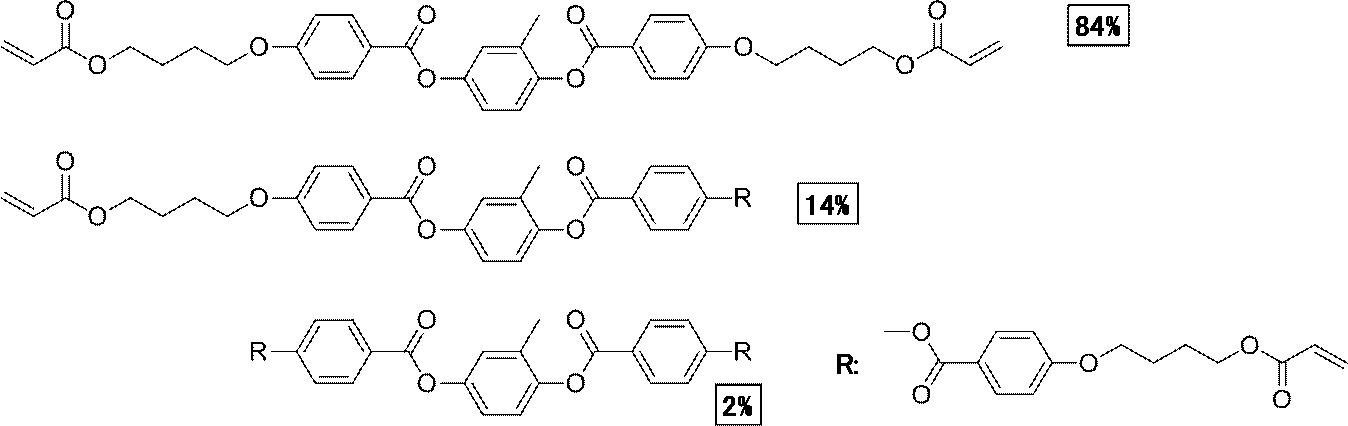
キラル剤Ch-3
なお、液晶化合物L-1の相転移温度は、液晶化合物をホットプレート上で加熱し、偏光顕微鏡によるテクスチャー観察によって求めた。その結果、結晶相-ネマチック相転移温度は79℃、ネマチック相-等方相転移温度は144℃であった。
また、液晶化合物L-1のΔnは、液晶化合物を、くさび型セルに注入し、これに波長550nmのレーザー光を照射し、透過光の屈折角を測定することで測定した。測定温度は60℃とした。液晶化合物L-1のΔnは0.16であった。
The phase transition temperatures of the liquid crystal compound L-1 were determined by heating the liquid crystal compound on a hot plate and observing the texture with a polarizing microscope, and the crystal phase-nematic phase transition temperature was 79° C., and the nematic phase-isotropic phase transition temperature was 144° C.
The Δn of the liquid crystal compound L-1 was measured by injecting the liquid crystal compound into a wedge-shaped cell, irradiating it with a laser beam having a wavelength of 550 nm, and measuring the refraction angle of the transmitted light. The measurement temperature was 60° C. The Δn of the liquid crystal compound L-1 was 0.16.
配向膜P-1上に、上述の上記の液晶組成物LC-1を、スピンコータを用いて、800rpmで10秒間塗布した。
液晶組成物LC-1の塗膜をホットプレート上で80℃にて3分間(180sec)加熱した。
その後、第1露光工程として、高圧水銀灯を用いて、300nmのロングバスフィルタおよび350nmのショートパスフィルタを介して、100℃で液晶組成物LC-1の露光を行った。第1露光工程は、波長315nmで測定される光の照射量が30mJ/cm2となるように行った。
The above-mentioned liquid crystal composition LC-1 was applied onto the alignment film P-1 using a spin coater at 800 rpm for 10 seconds.
The coating of the liquid crystal composition LC-1 was heated on a hot plate at 80° C. for 3 minutes (180 seconds).
Thereafter, in the first exposure step, the liquid crystal composition LC-1 was exposed to light using a high pressure mercury lamp through a 300 nm long pass filter and a 350 nm short pass filter at 100° C. The first exposure step was performed so that the dose of light measured at a wavelength of 315 nm was 30 mJ/cm 2 .
その後、UV(紫外線)光源として350~400nmに強い発光スペクトルを有するD-Bulbを搭載したマイクロウェーブ発光方式の紫外線照射装置(Light Hammer 10、240W/cm、Fusion UV Systems社製)と、ワイヤグリッド偏光フィルタ(ProFlux PPL02(高透過率タイプ)、Moxtek社製)とを組合せた偏光UV照射装置を用いて、液晶組成物LC-1に偏光UVを照射した(第2露光工程)。これにより、コレステリック液晶相を固定化して、コレステリック液晶層を有する液晶回折素子を作製した。
ワイヤグリッド偏光フィルタは、照射面から10cmの位置に配置した。
偏光UVの照射は、酸素濃度0.3%以下の窒素雰囲気下において、照度200mW/cm2、照射量600mJ/cm2で行った。
また、偏光UVは、偏光板の透過軸が配向膜の露光方位方向を面内に投影した方向、すなわち、コレステリック液晶層の面内における配向周期方向に平行な方向となるようにして照射した。
Thereafter, a microwave-emission type ultraviolet irradiator (Light Hammer 10, 240 W/cm, manufactured by Fusion UV Systems) equipped with a D-Bulb having a strong emission spectrum at 350 to 400 nm as a UV (ultraviolet) light source and a wire grid polarizing filter (ProFlux PPL02 (high transmittance type), manufactured by Moxtek) were combined to irradiate the liquid crystal composition LC-1 with polarized UV (second exposure step). This fixed the cholesteric liquid crystal phase, and a liquid crystal diffraction element having a cholesteric liquid crystal layer was produced.
The wire grid polarizing filter was positioned 10 cm away from the irradiation surface.
The irradiation with polarized UV was carried out in a nitrogen atmosphere with an oxygen concentration of 0.3% or less, at an illuminance of 200 mW/cm 2 and an irradiation amount of 600 mJ/cm 2 .
The polarized UV was irradiated so that the transmission axis of the polarizing plate was parallel to the direction of the exposure azimuth of the alignment film projected in-plane, that is, parallel to the alignment period direction in the plane of the cholesteric liquid crystal layer.
(液晶回折素子の評価)
作製した液晶回折素子(コレステリック液晶層)の回折効率を測定したところ、中心波長1100nmで約400nmの幅で反射の回折領域が認められた。これは、第1露光工程でキラル剤のHTPが厚さ方向に偏りを持って分布することによって、厚さ方向にコレステリック液晶相の螺旋ピッチに分布(PG構造)が生じ、一次反射光(一次の反射回折光)が波長に分布を持って発生したためと考えられる。
さらに、中心波長500nmで約200nmの幅で反射の回折領域が認められた。これは、第2露光工程で、コレステリック液晶相における液晶化合物の捩れが面方向(面内方向)で偏りを持つ(偏光露光の偏光方向により配向分布が増える)ことによって、一次反射光の半分の波長で、二次反射光(二次の反射回折光)が生じたためと考えられる。また、一次反射光と二次反射光との回折角度は略同じであった。これは、波長が半分になるのと、二次回折で倍角になるのと相殺して、角度が同じになったと考えられる。
(Evaluation of Liquid Crystal Diffraction Element)
When the diffraction efficiency of the prepared liquid crystal diffraction element (cholesteric liquid crystal layer) was measured, a reflective diffraction region was observed with a width of about 400 nm at a central wavelength of 1100 nm. This is thought to be because the HTP of the chiral agent is distributed with a bias in the thickness direction in the first exposure process, which causes a distribution (PG structure) in the helical pitch of the cholesteric liquid crystal phase in the thickness direction, and the primary reflected light (primary reflected diffracted light) is generated with a distribution in wavelength.
Furthermore, a reflection diffraction region was observed with a width of about 200 nm at a central wavelength of 500 nm. This is believed to be because, in the second exposure process, the twist of the liquid crystal compound in the cholesteric liquid crystal phase is biased in the plane direction (in-plane direction) (the orientation distribution increases depending on the polarization direction of the polarized light exposure), causing secondary reflected light (secondary reflected diffracted light) with a wavelength half that of the primary reflected light. In addition, the diffraction angles of the primary reflected light and the secondary reflected light were approximately the same. This is believed to be because the angles became the same due to the wavelength being halved and offsetting the double angle in secondary diffraction.
(ARグラスへの適用)
実施例1のコレステリック液晶層を有する液晶回折素子を、ARグラスの導光板に光を入射する入射素子、および、出射させる出射素子として用い、図1に示すARグラスでの表示の効果を確認した。
導光板として、ガラス(屈折率1.7、厚さ0.50mm)を用いた。
実施例1のコレステリック液晶層は、二次反射光が青、緑、および、赤色光に渡って光を反射するものである。このコレステリック層を、導光板に積層貼合して光学素子(回折素子)とした。
また、ARグラスのディスプレイとして、LCOS方式のプロジェクターを用いた。
これによりARグラスの表示の効果を確認した。その結果、RGBのカラー表示ができることを確認した。
以上の結果より、本発明の効果は明らかである。
(Application to AR glasses)
The liquid crystal diffraction element having the cholesteric liquid crystal layer of Example 1 was used as an input element for inputting light to the light guide plate of the AR glass and as an output element for outputting light therefrom, and the display effect of the AR glass shown in Figure 1 was confirmed.
The light guide plate was made of glass (refractive index: 1.7, thickness: 0.50 mm).
The cholesteric liquid crystal layer of Example 1 reflects light in the range of blue, green, and red as secondary reflected light. This cholesteric layer was laminated and attached to a light guide plate to form an optical element (diffraction element).
In addition, an LCOS projector was used as the display for the AR glasses.
This confirmed the effectiveness of the AR glasses display, and confirmed that RGB color display was possible.
From the above results, the effects of the present invention are clear.
10,50 画像表示装置
12,52 導光素子
14 ディスプレイ
18 導光板
20,54 入射素子
24,56 出射素子
56a,56b,56c 領域
30 支持体
32 配向膜
34,100 コレステリック液晶層
40,102 液晶化合物
40A 光学軸
42 明部
44 暗部
60 露光装置
62 レーザ
64 光源
65 λ/2板
68 偏光ビームスプリッター
70A,70B ミラー
72A,72Bλ/4板
RR 赤色の右円偏光
M レーザー光
MA,MB 光線
PO 直線偏光
PR 右円偏光
PL 左円偏光
Q 絶対位相
E 等位相面
L1 入射光
L2,L3,L4,L5 反射光
Λ 1周期
X1 一方向
C1~C7 液晶化合物
θ1~θ6 角度
10, 50 Image display device 12, 52 Light guide element 14 Display 18 Light guide plate 20, 54 Incident element 24, 56 Exit element 56a, 56b, 56c Region 30 Support 32 Orientation film 34, 100 Cholesteric liquid crystal layer 40, 102 Liquid crystal compound 40A Optical axis 42 Bright area 44 Dark area 60 Exposure device 62 Laser 64 Light source 65 λ/2 plate 68 Polarizing beam splitter 70A, 70B Mirror 72A, 72B λ/4 plate R R Red right-handed circularly polarized light M Laser light MA, MB Light ray P O Linearly polarized light P R Right-handed circularly polarized light P L Left-handed circularly polarized light Q Absolute phase E Equiphase surface L 1 Incident light L 2 , L 3 , L 4 , L 5 Reflected light Λ 1 period X1 One direction C1 to C7 Liquid crystal compound θ 1 to θ 6 angles
Claims (6)
前記コレステリック液晶層は、前記液晶化合物由来の光学軸の向きが面内の少なくとも一方向に沿って連続的に回転しながら変化している液晶配向パターンを有し、かつ、
前記コレステリック配向における螺旋軸方向の螺旋ピッチが、前記コレステリック液晶層の厚さ方向に、漸次、変化するものであり、さらに、
第1の波長λと、第2の波長λ/2とに、反射のピークを有することを特徴とする光学素子であって、
前記コレステリック液晶層において、前記螺旋軸方向から見た際に、屈折率異方性がある、光学素子。 A cholesteric liquid crystal layer is formed by cholesterically aligning a liquid crystal compound,
The cholesteric liquid crystal layer has a liquid crystal alignment pattern in which the direction of the optical axis derived from the liquid crystal compound changes while continuously rotating along at least one direction in the plane, and
the helical pitch in the helical axis direction in the cholesteric orientation gradually changes in the thickness direction of the cholesteric liquid crystal layer, and
An optical element having a reflection peak at a first wavelength λ and a second wavelength λ/2 ,
The optical element, wherein the cholesteric liquid crystal layer has a refractive index anisotropy when viewed from the helical axis direction.
前記光学素子は、前記第2の波長λ/2の光を前記導光板から出射させる出射素子であり、前記コレステリック液晶層は、面内に、前記第2の波長λ/2の光の回折効率が異なる領域を有する、請求項3に記載の導光素子。 an input element for inputting light into the light guide plate and an output element for outputting light from the light guide plate;
4. The light guide element according to claim 3, wherein the optical element is an output element that outputs the light of the second wavelength λ/2 from the light guide plate, and the cholesteric liquid crystal layer has an area in its plane where the diffraction efficiency of the light of the second wavelength λ/2 is different.
Applications Claiming Priority (3)
| Application Number | Priority Date | Filing Date | Title |
|---|---|---|---|
| JP2020130177 | 2020-07-31 | ||
| JP2020130177 | 2020-07-31 | ||
| PCT/JP2021/023281 WO2022024581A1 (en) | 2020-07-31 | 2021-06-21 | Optical element and light guide element |
Publications (2)
| Publication Number | Publication Date |
|---|---|
| JPWO2022024581A1 JPWO2022024581A1 (en) | 2022-02-03 |
| JP7463520B2 true JP7463520B2 (en) | 2024-04-08 |
Family
ID=80035372
Family Applications (1)
| Application Number | Title | Priority Date | Filing Date |
|---|---|---|---|
| JP2022540060A Active JP7463520B2 (en) | 2020-07-31 | 2021-06-21 | Optical and light-guiding elements |
Country Status (3)
| Country | Link |
|---|---|
| US (1) | US20230168538A1 (en) |
| JP (1) | JP7463520B2 (en) |
| WO (1) | WO2022024581A1 (en) |
Families Citing this family (2)
| Publication number | Priority date | Publication date | Assignee | Title |
|---|---|---|---|---|
| US20240329416A1 (en) * | 2023-03-27 | 2024-10-03 | Ii-Vi Delaware, Inc. | Display device comprising guide with reflective coatings |
| WO2026048938A1 (en) * | 2024-08-28 | 2026-03-05 | 富士フイルム株式会社 | Optical anisotropic layer, light guide element, and ar display device |
Citations (8)
| Publication number | Priority date | Publication date | Assignee | Title |
|---|---|---|---|---|
| WO2016017728A1 (en) | 2014-07-31 | 2016-02-04 | 富士フイルム株式会社 | Film, film manufacturing method, luminance-enhancing film, optical sheet member, and liquid crystal display device |
| WO2016194961A1 (en) | 2015-06-04 | 2016-12-08 | 国立大学法人大阪大学 | Reflective structure, device, and manufacturing method for reflective structure |
| WO2018062424A1 (en) | 2016-09-30 | 2018-04-05 | 富士フイルム株式会社 | Optical element, method for producing optical element, and liquid crystal display device |
| WO2018212348A1 (en) | 2017-05-19 | 2018-11-22 | 富士フイルム株式会社 | Optical element and optical device |
| WO2019189852A1 (en) | 2018-03-29 | 2019-10-03 | 富士フイルム株式会社 | Optical element, light guide element, and image display device |
| WO2019194291A1 (en) | 2018-04-05 | 2019-10-10 | 富士フイルム株式会社 | Optical element and light guide element |
| WO2019221294A1 (en) | 2018-05-18 | 2019-11-21 | 富士フイルム株式会社 | Optical element |
| JP2020510228A (en) | 2017-02-23 | 2020-04-02 | マジック リープ, インコーポレイテッドMagic Leap,Inc. | Variable focus imaging device based on polarization conversion |
-
2021
- 2021-06-21 JP JP2022540060A patent/JP7463520B2/en active Active
- 2021-06-21 WO PCT/JP2021/023281 patent/WO2022024581A1/en not_active Ceased
-
2023
- 2023-01-26 US US18/159,824 patent/US20230168538A1/en not_active Abandoned
Patent Citations (8)
| Publication number | Priority date | Publication date | Assignee | Title |
|---|---|---|---|---|
| WO2016017728A1 (en) | 2014-07-31 | 2016-02-04 | 富士フイルム株式会社 | Film, film manufacturing method, luminance-enhancing film, optical sheet member, and liquid crystal display device |
| WO2016194961A1 (en) | 2015-06-04 | 2016-12-08 | 国立大学法人大阪大学 | Reflective structure, device, and manufacturing method for reflective structure |
| WO2018062424A1 (en) | 2016-09-30 | 2018-04-05 | 富士フイルム株式会社 | Optical element, method for producing optical element, and liquid crystal display device |
| JP2020510228A (en) | 2017-02-23 | 2020-04-02 | マジック リープ, インコーポレイテッドMagic Leap,Inc. | Variable focus imaging device based on polarization conversion |
| WO2018212348A1 (en) | 2017-05-19 | 2018-11-22 | 富士フイルム株式会社 | Optical element and optical device |
| WO2019189852A1 (en) | 2018-03-29 | 2019-10-03 | 富士フイルム株式会社 | Optical element, light guide element, and image display device |
| WO2019194291A1 (en) | 2018-04-05 | 2019-10-10 | 富士フイルム株式会社 | Optical element and light guide element |
| WO2019221294A1 (en) | 2018-05-18 | 2019-11-21 | 富士フイルム株式会社 | Optical element |
Also Published As
| Publication number | Publication date |
|---|---|
| JPWO2022024581A1 (en) | 2022-02-03 |
| WO2022024581A1 (en) | 2022-02-03 |
| US20230168538A1 (en) | 2023-06-01 |
Similar Documents
| Publication | Publication Date | Title |
|---|---|---|
| JP7232887B2 (en) | Optical element, light guide element and image display device | |
| JP7153087B2 (en) | Light guide element, image display device and sensing device | |
| JP7229274B2 (en) | Liquid crystal diffraction element and light guide element | |
| JP7676601B2 (en) | Image display device and AR glasses | |
| WO2019131966A1 (en) | Optical element, light guiding element and image display device | |
| JP7199521B2 (en) | Light guide element and image display device | |
| JP7367010B2 (en) | Optical elements, wavelength selective filters and sensors | |
| JP7483111B2 (en) | Optical element and image display device | |
| JP7526743B2 (en) | Image display device and AR glasses | |
| JP7463520B2 (en) | Optical and light-guiding elements | |
| JP7355850B2 (en) | Optical element manufacturing method and optical element | |
| JP7161623B2 (en) | Backlight unit and liquid crystal display device | |
| WO2024143347A1 (en) | Optical anisotropic layer, laminate, light guide element, and ar display device | |
| JP7303326B2 (en) | Light guide element and image display device | |
| JP7470714B2 (en) | Light guide element and image display device | |
| JP7416941B2 (en) | Optical elements and image display devices | |
| JP7360481B2 (en) | Optical elements and image display devices | |
| JP7463521B2 (en) | Optical elements and reflective sheets | |
| JP7292414B2 (en) | Light guide element and image display device | |
| JP7482991B2 (en) | Optical element and image display device | |
| JP7545296B2 (en) | Image Display System | |
| JP7519271B2 (en) | Image Display System | |
| JP2025078725A (en) | Optical Elements | |
| WO2024219425A1 (en) | Image display device and ar glasses | |
| WO2022239859A1 (en) | Optical element, image display device, head-mounted display, sensing device, and eye tracking device |
Legal Events
| Date | Code | Title | Description |
|---|---|---|---|
| A621 | Written request for application examination |
Free format text: JAPANESE INTERMEDIATE CODE: A621 Effective date: 20221114 |
|
| A131 | Notification of reasons for refusal |
Free format text: JAPANESE INTERMEDIATE CODE: A131 Effective date: 20231003 |
|
| A601 | Written request for extension of time |
Free format text: JAPANESE INTERMEDIATE CODE: A601 Effective date: 20231127 |
|
| A521 | Request for written amendment filed |
Free format text: JAPANESE INTERMEDIATE CODE: A523 Effective date: 20240131 |
|
| TRDD | Decision of grant or rejection written | ||
| A01 | Written decision to grant a patent or to grant a registration (utility model) |
Free format text: JAPANESE INTERMEDIATE CODE: A01 Effective date: 20240305 |
|
| A61 | First payment of annual fees (during grant procedure) |
Free format text: JAPANESE INTERMEDIATE CODE: A61 Effective date: 20240327 |
|
| R150 | Certificate of patent or registration of utility model |
Ref document number: 7463520 Country of ref document: JP Free format text: JAPANESE INTERMEDIATE CODE: R150 |