JP7260552B2 - Diagnostic compositions for PET imaging, methods for making diagnostic compositions and their use in diagnostics - Google Patents
Diagnostic compositions for PET imaging, methods for making diagnostic compositions and their use in diagnostics Download PDFInfo
- Publication number
- JP7260552B2 JP7260552B2 JP2020540632A JP2020540632A JP7260552B2 JP 7260552 B2 JP7260552 B2 JP 7260552B2 JP 2020540632 A JP2020540632 A JP 2020540632A JP 2020540632 A JP2020540632 A JP 2020540632A JP 7260552 B2 JP7260552 B2 JP 7260552B2
- Authority
- JP
- Japan
- Prior art keywords
- compound
- formula
- acid
- tau
- disease
- Prior art date
- Legal status (The legal status is an assumption and is not a legal conclusion. Google has not performed a legal analysis and makes no representation as to the accuracy of the status listed.)
- Active
Links
Images


Classifications
-
- A—HUMAN NECESSITIES
- A61—MEDICAL OR VETERINARY SCIENCE; HYGIENE
- A61K—PREPARATIONS FOR MEDICAL, DENTAL OR TOILETRY PURPOSES
- A61K51/00—Preparations containing radioactive substances for use in therapy or testing in vivo
- A61K51/02—Preparations containing radioactive substances for use in therapy or testing in vivo characterised by the carrier, i.e. characterised by the agent or material covalently linked or complexing the radioactive nucleus
- A61K51/04—Organic compounds
- A61K51/041—Heterocyclic compounds
- A61K51/044—Heterocyclic compounds having nitrogen as a ring hetero atom, e.g. guanethidine, rifamycins
- A61K51/0455—Heterocyclic compounds having nitrogen as a ring hetero atom, e.g. guanethidine, rifamycins having six-membered rings with one nitrogen as the only ring hetero atom
-
- A—HUMAN NECESSITIES
- A61—MEDICAL OR VETERINARY SCIENCE; HYGIENE
- A61K—PREPARATIONS FOR MEDICAL, DENTAL OR TOILETRY PURPOSES
- A61K47/00—Medicinal preparations characterised by the non-active ingredients used, e.g. carriers or inert additives; Targeting or modifying agents chemically bound to the active ingredient
- A61K47/02—Inorganic compounds
-
- A—HUMAN NECESSITIES
- A61—MEDICAL OR VETERINARY SCIENCE; HYGIENE
- A61K—PREPARATIONS FOR MEDICAL, DENTAL OR TOILETRY PURPOSES
- A61K47/00—Medicinal preparations characterised by the non-active ingredients used, e.g. carriers or inert additives; Targeting or modifying agents chemically bound to the active ingredient
- A61K47/06—Organic compounds, e.g. natural or synthetic hydrocarbons, polyolefins, mineral oil, petrolatum or ozokerite
- A61K47/08—Organic compounds, e.g. natural or synthetic hydrocarbons, polyolefins, mineral oil, petrolatum or ozokerite containing oxygen, e.g. ethers, acetals, ketones, quinones, aldehydes, peroxides
- A61K47/10—Alcohols; Phenols; Salts thereof, e.g. glycerol; Polyethylene glycols [PEG]; Poloxamers; PEG/POE alkyl ethers
-
- A—HUMAN NECESSITIES
- A61—MEDICAL OR VETERINARY SCIENCE; HYGIENE
- A61K—PREPARATIONS FOR MEDICAL, DENTAL OR TOILETRY PURPOSES
- A61K47/00—Medicinal preparations characterised by the non-active ingredients used, e.g. carriers or inert additives; Targeting or modifying agents chemically bound to the active ingredient
- A61K47/06—Organic compounds, e.g. natural or synthetic hydrocarbons, polyolefins, mineral oil, petrolatum or ozokerite
- A61K47/08—Organic compounds, e.g. natural or synthetic hydrocarbons, polyolefins, mineral oil, petrolatum or ozokerite containing oxygen, e.g. ethers, acetals, ketones, quinones, aldehydes, peroxides
- A61K47/12—Carboxylic acids; Salts or anhydrides thereof
-
- C—CHEMISTRY; METALLURGY
- C07—ORGANIC CHEMISTRY
- C07B—GENERAL METHODS OF ORGANIC CHEMISTRY; APPARATUS THEREFOR
- C07B59/00—Introduction of isotopes of elements into organic compounds ; Labelled organic compounds per se
- C07B59/002—Heterocyclic compounds
-
- G—PHYSICS
- G01—MEASURING; TESTING
- G01N—INVESTIGATING OR ANALYSING MATERIALS BY DETERMINING THEIR CHEMICAL OR PHYSICAL PROPERTIES
- G01N33/00—Investigating or analysing materials by specific methods not covered by groups G01N1/00 - G01N31/00
- G01N33/48—Biological material, e.g. blood, urine; Haemocytometers
- G01N33/50—Chemical analysis of biological material, e.g. blood, urine; Testing involving biospecific ligand binding methods; Immunological testing
- G01N33/58—Chemical analysis of biological material, e.g. blood, urine; Testing involving biospecific ligand binding methods; Immunological testing involving labelled substances
- G01N33/60—Chemical analysis of biological material, e.g. blood, urine; Testing involving biospecific ligand binding methods; Immunological testing involving labelled substances involving radioactive labelled substances
-
- G—PHYSICS
- G01—MEASURING; TESTING
- G01N—INVESTIGATING OR ANALYSING MATERIALS BY DETERMINING THEIR CHEMICAL OR PHYSICAL PROPERTIES
- G01N33/00—Investigating or analysing materials by specific methods not covered by groups G01N1/00 - G01N31/00
- G01N33/48—Biological material, e.g. blood, urine; Haemocytometers
- G01N33/50—Chemical analysis of biological material, e.g. blood, urine; Testing involving biospecific ligand binding methods; Immunological testing
- G01N33/68—Chemical analysis of biological material, e.g. blood, urine; Testing involving biospecific ligand binding methods; Immunological testing involving proteins, peptides or amino acids
- G01N33/6893—Chemical analysis of biological material, e.g. blood, urine; Testing involving biospecific ligand binding methods; Immunological testing involving proteins, peptides or amino acids related to diseases not provided for elsewhere
- G01N33/6896—Neurological disorders, e.g. Alzheimer's disease
-
- A—HUMAN NECESSITIES
- A61—MEDICAL OR VETERINARY SCIENCE; HYGIENE
- A61K—PREPARATIONS FOR MEDICAL, DENTAL OR TOILETRY PURPOSES
- A61K2123/00—Preparations for testing in vivo
-
- C—CHEMISTRY; METALLURGY
- C07—ORGANIC CHEMISTRY
- C07D—HETEROCYCLIC COMPOUNDS
- C07D471/00—Heterocyclic compounds containing nitrogen atoms as the only ring hetero atoms in the condensed system, at least one ring being a six-membered ring with one nitrogen atom, not provided for by groups C07D451/00 - C07D463/00
- C07D471/12—Heterocyclic compounds containing nitrogen atoms as the only ring hetero atoms in the condensed system, at least one ring being a six-membered ring with one nitrogen atom, not provided for by groups C07D451/00 - C07D463/00 in which the condensed system contains three hetero rings
- C07D471/14—Ortho-condensed systems
-
- G—PHYSICS
- G01—MEASURING; TESTING
- G01N—INVESTIGATING OR ANALYSING MATERIALS BY DETERMINING THEIR CHEMICAL OR PHYSICAL PROPERTIES
- G01N2800/00—Detection or diagnosis of diseases
- G01N2800/28—Neurological disorders
- G01N2800/2814—Dementia; Cognitive disorders
- G01N2800/2821—Alzheimer
Landscapes
- Health & Medical Sciences (AREA)
- Chemical & Material Sciences (AREA)
- Life Sciences & Earth Sciences (AREA)
- Engineering & Computer Science (AREA)
- Medicinal Chemistry (AREA)
- General Health & Medical Sciences (AREA)
- Organic Chemistry (AREA)
- Animal Behavior & Ethology (AREA)
- Pharmacology & Pharmacy (AREA)
- Epidemiology (AREA)
- Public Health (AREA)
- Veterinary Medicine (AREA)
- Biomedical Technology (AREA)
- Oil, Petroleum & Natural Gas (AREA)
- Chemical Kinetics & Catalysis (AREA)
- General Chemical & Material Sciences (AREA)
- Physics & Mathematics (AREA)
- Hematology (AREA)
- Urology & Nephrology (AREA)
- Molecular Biology (AREA)
- Immunology (AREA)
- Proteomics, Peptides & Aminoacids (AREA)
- Inorganic Chemistry (AREA)
- Optics & Photonics (AREA)
- Biotechnology (AREA)
- General Physics & Mathematics (AREA)
- Microbiology (AREA)
- Pathology (AREA)
- Cell Biology (AREA)
- Food Science & Technology (AREA)
- Analytical Chemistry (AREA)
- Biochemistry (AREA)
- Neurology (AREA)
- Neurosurgery (AREA)
- Medicines Containing Antibodies Or Antigens For Use As Internal Diagnostic Agents (AREA)
- Nitrogen Condensed Heterocyclic Rings (AREA)
- Medicinal Preparation (AREA)
- Macromonomer-Based Addition Polymer (AREA)
- Polymerisation Methods In General (AREA)
Description
本発明は、ポジトロン放出断層撮影(PET)画像化に好適な診断用組成物に向けられている。更に、本発明は、診断用組成物を製造するための方法、並びに診断に使用するための組成物に向けられている。 The present invention is directed to diagnostic compositions suitable for Positron Emission Tomography (PET) imaging. Additionally, the present invention is directed to methods for making diagnostic compositions, as well as compositions for diagnostic use.
アルツハイマー病(AD)は、脳内又は眼内におけるアミロイド-ベータ(Aβ)凝集体の異常沈着物の細胞外蓄積であるアミロイドプラークによって引き起こされると主に考えられる神経障害である。ADにおける他の主要な神経病理学的特質は、高リン酸化タウ(チューブリン関連ユニット)タンパク質、リン酸化タウ又は病理的タウ及びその配座異性体の凝集によって生じる細胞内神経原線維変化(NFT)である。ADのこの病理は、多くの神経変性タウオパチー、特に、特定のタイプの前頭側頭型認知症(FTD)と共通している。AD脳において、タウ病理(タウオパチー)はアミロイド病理よりも後に発生するが、いわゆるアミロイドカスケード仮説(Hardyら、Science 1992、256、184~185頁、及び直近では、Musiekら、Nature Neurosciences 2015、18(6)、800~806頁、「Three dimensions of the amyloid hypothesis: time, space and 'wingmen'」)の骨子を構成する、Aβタンパク質がADにおける原因物質であるという点はなお議論の対象である。 Alzheimer's disease (AD) is a neurological disorder primarily thought to be caused by amyloid plaques, which are extracellular accumulations of abnormal deposits of amyloid-beta (Aβ) aggregates in the brain or eye. Other major neuropathological hallmarks in AD are intracellular neurofibrillary tangles (NFTs) caused by aggregation of hyperphosphorylated tau (tubulin-associated unit) protein, phosphorylated or pathological tau and its conformers. ). This pathology of AD is shared with many neurodegenerative tauopathies, particularly a particular type of frontotemporal dementia (FTD). In the AD brain, tau pathology (tauopathy) occurs later than amyloid pathology, the so-called amyloid cascade hypothesis (Hardy et al., Science 1992, 256, 184-185, and most recently, Musiek et al., Nature Neurosciences 2015, 18 ( 6), pp. 800-806, ``Three dimensions of the amyloid hypothesis: time, space and 'wingmen'''), that the Aβ protein is the causative agent in AD is still controversial.
現在、ADを確定診断する唯一の方法は、生検又は個体の死後の剖検材料の組織学的分析によって脳組織におけるプラーク及びもつれを特定することである。AD以外に、タウは、他の(非AD)神経変性疾患において重要な役割を果たす。そのような非ADタウオパチーには、例えば、核上性麻痺(PSP)、ピック病(PiD)及び大脳皮質基底核変性症(CBD)が含まれる。 Currently, the only way to make a definitive diagnosis of AD is to identify plaques and tangles in brain tissue by biopsy or histological analysis of post-mortem autopsy material from an individual. Besides AD, tau plays an important role in other (non-AD) neurodegenerative diseases. Such non-AD tauopathies include, for example, supranuclear palsy (PSP), Pick's disease (PiD) and corticobasal degeneration (CBD).
一般式Aの化合物は、タウ凝集体に関連する障害及び異常、例えばアルツハイマー病(AD)及び他のタウオパチーの選択的検出に有用であるとして提案されており、この化合物を製造する特定の方法が従来技術に記載されている。 Compounds of general formula A have been proposed as useful for the selective detection of disorders and disorders associated with tau aggregates, such as Alzheimer's disease (AD) and other tauopathies, and certain methods of making the compounds are described in the prior art.

WO2015/052105及びGobbiらに記載の医薬組成物は、エタノール1mL及び食塩水10mL中[18F]-2-(6-フルオロ-ピリジン-3-イル)-9H-ジピリド[2,3-b;3',4'-d]ピロールからなる。成分は、0.22μm滅菌フィルターを通過する。 The pharmaceutical compositions described in WO2015/052105 and Gobbi et al. It consists of 3',4'-d]pyrrole. Components are passed through a 0.22 μm sterile filter.
PET画像化のための18F-放射性標識化トレーサーは、要求に応じて製造され、診断用組成物は通常、製造の終了後10~12時間以内に使用される。長距離輸送のため及び1バッチからの複数用量の製造のために、放射能レベルは増大する(例えば、20GBq以上又は50GBq以上又は更には100GBq以上の[18F]フッ素化ピリジニル-9H-ピロロ-ジピリジンのバッチに達成する)。放射性医薬品は、放射線分解に感受性であることが公知であり、好適な診断用組成物において安定化剤の使用が必要である。 18 F-radiolabeled tracers for PET imaging are manufactured on demand and the diagnostic composition is usually used within 10-12 hours after completion of manufacturing. For long-distance transport and for the production of multiple doses from one batch, radioactivity levels increase (e.g., [ 18 F]fluorinated pyridinyl-9H-pyrrolo- achieved in batches of dipyridine). Radiopharmaceuticals are known to be sensitive to radiolysis, requiring the use of stabilizers in suitable diagnostic compositions.
とりわけ[18F]フッ素化ピリジニル-9H-ピロロ-ジピリジン等の親油性化合物について、滅菌フィルター上及び表面(例えば、シリンジ)上での損失は、診断用組成物の効率的かつ信頼性の高い使用のために最小にする必要がある。 Especially for lipophilic compounds such as [ 18 F]fluorinated pyridinyl-9H-pyrrolo-dipyridine, losses on sterile filters and on surfaces (e.g. syringes) are essential for efficient and reliable use of diagnostic compositions. should be minimized for
したがって、本発明の目的は、改善された安定性を有する診断用組成物を提供することである。 It is therefore an object of the present invention to provide diagnostic compositions with improved stability.
本発明は、以下の項目に関する:
1.a.式Iの化合物
The present invention relates to the following items:
1.a. Compounds of Formula I

、
b.エタノール、
c.水、及び
d.ヒドロキシカルボン酸、ヒドロキシカルボン酸の塩又はその混合物
を含む診断用組成物。
2.式IのFが、18F又は19F、好ましくは18F又は18F及び19Fの混合物である、項目1に従う診断用組成物。
3.式Iの化合物が、式Ibの化合物
,
b ethanol,
c. water, and
d. Diagnostic compositions comprising hydroxycarboxylic acids, salts of hydroxycarboxylic acids, or mixtures thereof.
2. A diagnostic composition according to item 1, wherein F in formula I is 18 F or 19 F, preferably 18 F or a mixture of 18 F and 19 F.
3. the compound of formula I is a compound of formula Ib

である、項目1又は2に従う診断用組成物。
4.約0.03GBq/mL~約10GBq/mLの式Iの化合物、好ましくは約0.03GBq/mL~約5GBq/mLの式Iの化合物を含む、項目1から3のいずれか1つに従う診断用組成物。
5.少なくとも約1GBq/mLの式Iの化合物、好ましくは少なくとも約2GBq/mLの式Iの化合物、好ましくは少なくとも約3GBq/mLの式Iの化合物を含む、項目1から4のいずれか1つに従う診断用組成物。
6.約1%v/v~約20%v/vエタノール、好ましくは約1%v/v~約15%v/vエタノール、より好ましくは約5%v/v~約10%v/vエタノールを含む、項目1から5のいずれか1つに従う診断用組成物。
7.ヒドロキシカルボン酸、ヒドロキシカルボン酸の塩又はその混合物が、アスコルビン酸及びアスコルビン酸の塩、ヒドロキシ安息香酸及びヒドロキシ安息香酸の塩、ヒドロキシ安息香酸誘導体及びヒドロキシ安息香酸誘導体の塩、クエン酸及びクエン酸の塩、並びにその混合物からなる群から選択される、項目1から6のいずれか1つに従う診断用組成物。
8.ヒドロキシ安息香酸誘導体が、ヒドロキシ安息香酸、ジヒドロキシ安息香酸及びトリヒドロキシ安息香酸からなる群から選択される、項目7に従う診断用組成物。
9.ジヒドロキシ安息香酸が、ゲンチジン酸である、項目8に従う診断用組成物。
10.ヒドロキシカルボン酸、ヒドロキシカルボン酸の塩又はその混合物が、アスコルビン酸、アスコルビン酸ナトリウム、ゲンチジン酸、ゲンチジン酸ナトリウム塩、クエン酸、クエン酸ナトリウム又はその混合物から選択される、項目1から9のいずれか1つに従う診断用組成物。
11.約2.5~約500μmol/mLのヒドロキシカルボン酸、ヒドロキシカルボン酸の塩又はその混合物、好ましくは約10~約300μmol/mLのヒドロキシカルボン酸、ヒドロキシカルボン酸の塩又はその混合物、より好ましくは約25~約300μmol/mLのヒドロキシカルボン酸、ヒドロキシカルボン酸の塩又はその混合物を含む、項目1から10のいずれか1つに従う診断用組成物。
12.ヒドロキシカルボン酸、ヒドロキシカルボン酸の塩又はその混合物が、アスコルビン酸、アスコルビン酸ナトリウム又はその混合物から選択され、診断用組成物が、好ましくは、約10~約500μmol/mLのアスコルビン酸、アスコルビン酸ナトリウム又はその混合物、より好ましくは約50~約500μmol/mLのアスコルビン酸、アスコルビン酸ナトリウム又はその混合物、更により好ましくは約100~約500μmol/mLのアスコルビン酸、アスコルビン酸ナトリウム又はその混合物、更により好ましくは約50~約300μmol/mLのアスコルビン酸、アスコルビン酸ナトリウム又はその混合物、なおより好ましくは約200~約300μmol/mLのアスコルビン酸、アスコルビン酸ナトリウム又はその混合物を含む、項目1から7、10及び11のいずれか1つに従う、診断用組成物。
13.ヒドロキシカルボン酸、ヒドロキシカルボン酸の塩又はその混合物が、ゲンチジン酸、ゲンチジン酸ナトリウム塩又はその混合物から選択され、診断用組成物が、好ましくは、約2.5~約100μmol/mLのゲンチジン酸、ゲンチジン酸ナトリウム塩又はその混合物、より好ましくは約10~約100μmol/mLのゲンチジン酸、ゲンチジン酸ナトリウム塩又はその混合物、更により好ましくは約25~約75μmol/mLのゲンチジン酸、ゲンチジン酸ナトリウム塩又はその混合物を含む、項目1から11のいずれか1つに従う、診断用組成物。
14.ヒドロキシカルボン酸、ヒドロキシカルボン酸の塩又はその混合物が、クエン酸、クエン酸ナトリウム又はその混合物から選択され、診断用組成物が、好ましくは、約10~約500μmol/mLのクエン酸、クエン酸ナトリウム又はその混合物、より好ましくは約50~約500μmol/mLのクエン酸、クエン酸ナトリウム又はその混合物、更により好ましくは約50~約300μmol/mLのクエン酸、クエン酸ナトリウム又はその混合物を含む、項目1から7、10及び11のいずれか1つに従う診断用組成物。
15.各々が好ましくは診断用に許容される無機酸、有機酸、塩基、塩又はその混合物を含み、有機酸、塩又はその混合物が、ヒドロキシカルボン酸、ヒドロキシカルボン酸の塩又はその混合物とは異なる、項目1から14のいずれか1つに従う診断用組成物。
16.無機酸、有機酸、塩基、塩又はその混合物が、塩化ナトリウム、塩化カリウム、リン酸一ナトリウム、リン酸二ナトリウム、リン酸三ナトリウム、リン酸一カリウム、リン酸二カリウム、リン酸三カリウム、塩酸、リン酸、水酸化ナトリウム及び水酸化カリウムからなる群から選択される、項目15に従う診断用組成物。
17.診断用組成物のpHが、約4~約8.5である、項目1から16のいずれか1つに従う診断用組成物。
18.無菌である、項目1から17のいずれか1つに従う診断用組成物。
19.哺乳動物への非経口投与に好適である、項目1から18のいずれか1つに従う診断用組成物。
20.項目1から19のいずれか1つに定義される通りの診断用組成物を製造するための方法であって、
a.式IIの化合物
A diagnostic composition according to item 1 or 2, wherein
4. Diagnostic according to any one of items 1 to 3, comprising from about 0.03 GBq/mL to about 10 GBq/mL of the compound of formula I, preferably from about 0.03 GBq/mL to about 5 GBq/mL of the compound of formula I Composition.
5. Any one of items 1 to 4 comprising at least about 1 GBq/mL of the compound of formula I, preferably at least about 2 GBq/mL of the compound of formula I, preferably at least about 3 GBq/mL of the compound of formula I A diagnostic composition according to
6. About 1% v/v to about 20% v/v ethanol, preferably about 1% v/v to about 15% v/v ethanol, more preferably about 5% v/v to about 10% v/v A diagnostic composition according to any one of items 1 to 5, comprising ethanol.
7. Hydroxycarboxylic acids, salts of hydroxycarboxylic acids or mixtures thereof containing ascorbic acid and salts of ascorbic acid, hydroxybenzoic acid and salts of hydroxybenzoic acid, hydroxybenzoic acid derivatives and salts of hydroxybenzoic acid derivatives, citric acid and citric acid. A diagnostic composition according to any one of items 1 to 6, selected from the group consisting of salts of acids, and mixtures thereof.
8. A diagnostic composition according to item 7, wherein the hydroxybenzoic acid derivative is selected from the group consisting of hydroxybenzoic acid, dihydroxybenzoic acid and trihydroxybenzoic acid.
9. A diagnostic composition according to item 8, wherein the dihydroxybenzoic acid is gentisic acid.
10. Items 1 to 9, wherein the hydroxycarboxylic acid, salt of hydroxycarboxylic acid or mixture thereof is selected from ascorbic acid, sodium ascorbate, gentisic acid, gentisic acid sodium salt, citric acid, sodium citrate or mixtures thereof A diagnostic composition according to any one.
11. About 2.5 to about 500 μmol/mL hydroxycarboxylic acid, hydroxycarboxylic acid salt or mixture thereof, preferably about 10 to about 300 μmol/mL hydroxycarboxylic acid, hydroxycarboxylic acid salt or mixture thereof, more preferably about 11. The diagnostic composition according to any one of items 1 to 10, comprising from 25 to about 300 μmol/mL of a hydroxycarboxylic acid, a salt of a hydroxycarboxylic acid or a mixture thereof.
12. Hydroxycarboxylic acids, salts of hydroxycarboxylic acids or mixtures thereof are selected from ascorbic acid, sodium ascorbate or mixtures thereof, and the diagnostic composition preferably contains about 10 to about 500 μmol/mL ascorbic acid, ascorbic sodium ascorbate or mixtures thereof, more preferably from about 50 to about 500 μmol/mL ascorbic acid, sodium ascorbate or mixtures thereof, even more preferably from about 100 to about 500 μmol/mL ascorbic acid, sodium ascorbate or mixtures thereof, and more preferably from about 50 to about 300 μmol/mL ascorbic acid, sodium ascorbate or mixtures thereof, still more preferably from about 200 to about 300 μmol/mL ascorbic acid, sodium ascorbate or mixtures thereof, items 1 to 7, A diagnostic composition according to any one of 10 and 11.
13. hydroxycarboxylic acids, salts of hydroxycarboxylic acids or mixtures thereof are selected from gentisic acid, gentisic acid sodium salt or mixtures thereof, wherein the diagnostic composition preferably contains about 2.5 to about 100 μmol/mL of gentisic acid; gentisic acid sodium salt or mixtures thereof, more preferably from about 10 to about 100 μmol/mL gentisic acid, gentisic acid sodium salt or mixtures thereof, even more preferably from about 25 to about 75 μmol/mL gentisic acid, gentisic acid sodium salt or A diagnostic composition according to any one of items 1 to 11, comprising mixtures thereof.
14. Hydroxycarboxylic acids, salts of hydroxycarboxylic acids or mixtures thereof are selected from citric acid, sodium citrate or mixtures thereof, and the diagnostic composition preferably contains about 10 to about 500 μmol/mL citric acid, citric sodium citrate or mixtures thereof, more preferably from about 50 to about 500 μmol/mL citric acid, sodium citrate or mixtures thereof, even more preferably from about 50 to about 300 μmol/mL citric acid, sodium citrate or mixtures thereof , items 1 to 7, 10 and 11.
15. Each preferably comprises a diagnostically acceptable inorganic acid, organic acid, base, salt or mixture thereof, wherein the organic acid, salt or mixture is a hydroxycarboxylic acid, a salt of a hydroxycarboxylic acid or a mixture thereof A diagnostic composition according to any one of items 1 to 14, different.
16. Inorganic acids, organic acids, bases, salts or mixtures thereof containing sodium chloride, potassium chloride, monosodium phosphate, disodium phosphate, trisodium phosphate, monopotassium phosphate, dipotassium phosphate, triphosphate A diagnostic composition according to item 15, selected from the group consisting of potassium, hydrochloric acid, phosphoric acid, sodium hydroxide and potassium hydroxide.
17. The diagnostic composition according to any one of items 1-16, wherein the diagnostic composition has a pH of from about 4 to about 8.5.
18. A diagnostic composition according to any one of items 1 to 17, which is sterile.
19. A diagnostic composition according to any one of items 1 to 18, suitable for parenteral administration to mammals.
20. A method for manufacturing a diagnostic composition as defined in any one of items 1 to 19, comprising:
a. a compound of formula II

(式中、Xは、H又はPGであり、
LGは、脱離基であり、
PGは、アミン保護基である)
を18Fフッ素化薬と反応させる工程、
b.任意選択で、XがPGである場合、保護基PGを切断する工程、
c.式Iの化合物を精製する工程、並びに
d.任意選択で、工程c)で得られた式Iの化合物を、エタノール、水、ヒドロキシカルボン酸及びヒドロキシカルボン酸の塩からなる群から選択される1種又は複数と混合して、診断用組成物を提供する工程
を含む、方法。
21.無機酸、有機酸、塩基又は塩のうちの1種又は複数が、工程dにおいて更に混合され、有機酸、塩又はその混合物が、ヒドロキシカルボン酸、ヒドロキシカルボン酸の塩又はその混合物とは異なる、請求項20に記載の診断用組成物を製造するための方法。
22.e.工程d)の前又は後の滅菌濾過
を更に含む、項目20又は21に従う方法。
23.式IIのLGが脱離基であり、これは、求核性[18F]フッ素イオン又は求電子性[18F]フッ素原子によって置換されていてもよく、好ましくは、LGが、ニトロ、ブロモ、ヨード、クロロ、トリアルキルアンモニウム、ヒドロキシル、ボロン酸、ヨードニウム、スルホンエステルからなる群から選択され、より好ましくは、LGが、ニトロ又はトリメチルアンモニウムであり、トリアルキルアンモニウム又はヨードニウムを含有する化合物が、アニオンを更に含んでいてもよい、項目20から22のいずれか1つに従う方法。
24.式IIのPGが保護基であり、好ましくは、PGが、カルボベンジルオキシ(Cbz)、(p-メトキシベンジル)オキシカルボニル(Moz又はMeOZ)、tert-ブチルオキシカルボニル(BOC)、9-フルオレニルメチルオキシカルボニル(FMOC)、ベンジル(Bn)、p-メトキシベンジル(PMB)、3,4-ジメトキシベンジル(DMPM)、p-メトキシフェニル(PMP)、トリフェニルメチル(トリチル)、メトキシフェニルジフェニルメチル(MMT)又はジメトキシトリチル(DMT)からなる群から選択され、より好ましくは、PGが、tert-ブチルオキシカルボニル(BOC)、ジメトキシトリチル(DMT)及びトリフェニルメチル(トリチル)から選択され、更により好ましくは、PGが、tert-ブチルオキシカルボニル(BOC)又はトリフェニルメチル(トリチル)である、項目20から23のいずれか1つに従う方法。
25.診断に使用するための、項目1から19のいずれか1つに従う組成物。
26.タウ凝集体の画像化に使用するための、特に、タウ凝集体のポジトロン放出断層撮影による画像化に使用するための、項目1から19のいずれか1つに従う組成物。
27.特に診断がポジトロン放出断層撮影によって行われる場合の、タウ凝集体に関連する障害の診断に使用するため、又はタウオパチーの診断に使用するための、項目1から19のいずれか1つに定義される通りの組成物。
28.タウオパチーが、3Rタウオパチーである、項目27に従う使用のための組成物。
29.タウオパチーが、4Rタウオパチーである、項目27に従う使用のための組成物。
30.障害が、アルツハイマー病(AD)、家族性AD、クロイツフェルト-ヤコブ病、パンチドランカー、ダウン症候群、ゲルストマン-シュトロイスラー-シャインカー病、封入体筋炎、プリオンタンパク質脳アミロイド血管症、外傷性脳損傷(TBI)、筋萎縮性側索硬化症、グアムのパーキンソニズム痴呆複合、神経原線維変化を伴う非グアム人運動ニューロン疾患、嗜銀顆粒性疾患、大脳皮質基底核変性症(CBD)、石灰化を伴うびまん性神経原線維変化、第17染色体に関連するパーキンソニズムを伴う前頭側頭型認知症、ハラーフォルデン-シュパッツ病、多系統萎縮症、ニーマン-ピック病C型、淡蒼球橋黒質変性症、ピック病(PiD)、進行性皮質下グリオーシス、進行性核上性麻痺(PSP)、亜急性硬化性全脳炎、もつれのみの認知症、脳炎後パーキンソニズム、筋緊張性ジストロフィー、タウ全脳炎、アストロサイトに関連するAD、特定のプリオン病(タウを伴うGSS)、LRRK2における突然変異、慢性外傷性脳炎、家族性英国型認知症、家族性デンマーク型認知症、前頭側頭葉変性症、グアドループ島パーキンソニズム、脳の鉄蓄積を伴う神経変性、SLC9A6関連精神遅滞、小球体グリア含有物を伴う白質タウオパチー、外傷性ストレス症候群、てんかん、レビー小体認知症(LBD)、アミロイドーシスを伴う遺伝性脳出血(オランダ型)、軽度認知機能障害(MCI)、多発性硬化症、パーキンソン病、不定型パーキンソニズムHIV関連認知症、成人発症型糖尿病、老人性心臓アミロイドーシス、内分泌腫瘍、緑内障、眼性アミロイドーシス、原発性網膜変性症、黄斑変性(加齢黄斑変性(AMD)等)、視神経ドルーゼン、視神経症、視神経炎及び格子状ジストロフィーから選択される、項目27に従う使用のための組成物。
31.障害が、ハンチントン病、虚血性脳卒中及びADにおける精神異常から選択される、項目27に従う使用のための組成物。
32.障害が、アルツハイマー病(AD)である、項目30に従う使用のための組成物。
33.障害が、パーキンソン病又は不定型パーキンソニズムである、項目30に従う使用のための組成物。
34.障害が、進行性核上性麻痺(PSP)である、項目30に従う使用のための組成物。
35.障害が、ピック病(PiD)である、項目30に従う使用のための組成物。
36.タウ凝集体が、脳において又は眼において画像化される、項目27に従う使用のための組成物。
37.タウ凝集体を画像化する方法、特に、タウ凝集体をポジトロン放出断層撮影により画像化する方法であって、有効量の項目1から19のいずれか1つに定義される通りの組成物が患者に投与される、方法。
38.タウ凝集体に関連する障害又はタウオパチーを診断する方法であって、有効量の項目1から19のいずれか1つに定義される通りの組成物が患者に投与され、特に、診断がポジトロン放出断層撮影によって行われる、方法。
39.タウオパチーが、3Rタウオパチーである、項目38に従う方法。
40.タウオパチーが、4Rタウオパチーである、項目38に従う方法。
41.障害が、アルツハイマー病(AD)、家族性AD、クロイツフェルト-ヤコブ病、パンチドランカー、ダウン症候群、ゲルストマン-シュトロイスラー-シャインカー病、封入体筋炎、プリオンタンパク質脳アミロイド血管症、外傷性脳損傷、筋萎縮性側索硬化症、グアムのパーキンソニズム痴呆複合、神経原線維変化を伴う非グアム人運動ニューロン疾患、嗜銀顆粒性疾患、大脳皮質基底核変性症、石灰化を伴うびまん性神経原線維変化、第17染色体に関連するパーキンソニズムを伴う前頭側頭型認知症、ハラーフォルデン-シュパッツ病、多系統萎縮症、ニーマン-ピック病C型、淡蒼球橋黒質変性症、ピック病、進行性皮質下グリオーシス、進行性核上性麻痺(PSP)、亜急性硬化性全脳炎、もつれのみの認知症、脳炎後パーキンソニズム、筋緊張性ジストロフィー、タウ全脳炎、アストロサイトに関連するAD、特定のプリオン病(タウを伴うGSS)、LRRK2における突然変異、慢性外傷性脳炎、家族性英国型認知症、家族性デンマーク型認知症、前頭側頭葉変性症、グアドループ島パーキンソニズム、脳の鉄蓄積を伴う神経変性、SLC9A6関連精神遅滞、小球体グリア含有物を伴う白質タウオパチー、外傷性ストレス症候群、てんかん、レビー小体認知症(LBD)、アミロイドーシスを伴う遺伝性脳出血(オランダ型)、軽度認知機能障害(MCI)、多発性硬化症、パーキンソン病、不定型パーキンソニズム、HIV関連認知症、成人発症型糖尿病、老人性心臓アミロイドーシス、内分泌腫瘍、緑内障、眼性アミロイドーシス、原発性網膜変性症、黄斑変性(加齢黄斑変性(AMD)等)、視神経ドルーゼン、視神経症、視神経炎及び格子状ジストロフィーから選択される、項目38に従う方法。
42.障害が、ハンチントン病、虚血性脳卒中及びADにおける精神異常から選択される、項目38に従う方法。
43.障害が、アルツハイマー病(AD)である、項目41に従う方法。
44.障害が、パーキンソン病又は不定型パーキンソニズムである、項目41に従う方法。
45.障害が、進行性核上性麻痺(PSP)である、項目41に従う方法。
46.障害が、ピック病(PiD)である、項目41に従う方法。
47.タウ凝集体が、脳において又は眼において画像化される、項目41に従う方法。
48.タウ凝集体を画像化するため、特に、タウ凝集体をポジトロン放出断層撮影により画像化するための薬剤の製造のための、項目1から19のいずれか1つに定義される通りの組成物の使用。
49.タウ凝集体に関連する障害を診断するため、又はタウオパチーを診断するための薬剤を製造するための項目1から19のいずれか1つに定義される通りの組成物の使用であって、特に、診断がポジトロン放出断層撮影によって行われる、使用。
50.タウオパチーが、3Rタウオパチーである、項目49に従う使用。
51.タウオパチーが、4Rタウオパチーである、項目49に従う使用。
52.障害が、アルツハイマー病(AD)、家族性AD、クロイツフェルト-ヤコブ病、パンチドランカー、ダウン症候群、ゲルストマン-シュトロイスラー-シャインカー病、封入体筋炎、プリオンタンパク質脳アミロイド血管症、外傷性脳損傷、筋萎縮性側索硬化症、グアムのパーキンソニズム痴呆複合、神経原線維変化を伴う非グアム人運動ニューロン疾患、嗜銀顆粒性疾患、大脳皮質基底核変性症、石灰化を伴うびまん性神経原線維変化、第17染色体に関連するパーキンソニズムを伴う前頭側頭型認知症、ハラーフォルデン-シュパッツ病、多系統萎縮症、ニーマン-ピック病C型、淡蒼球橋黒質変性症、ピック病、進行性皮質下グリオーシス、進行性核上性麻痺(PSP)、亜急性硬化性全脳炎、もつれのみの認知症、脳炎後パーキンソニズム、筋緊張性ジストロフィー、タウ全脳炎、アストロサイトに関連するAD、特定のプリオン病(タウを伴うGSS)、LRRK2における突然変異、慢性外傷性脳炎、家族性英国型認知症、家族性デンマーク型認知症、前頭側頭葉変性症、グアドループ島パーキンソニズム、脳の鉄蓄積を伴う神経変性、SLC9A6関連精神遅滞、小球体グリア含有物を伴う白質タウオパチー、外傷性ストレス症候群、てんかん、レビー小体認知症(LBD)、アミロイドーシスを伴う遺伝性脳出血(オランダ型)、軽度認知機能障害(MCI)、多発性硬化症、パーキンソン病、不定型パーキンソニズム、HIV関連認知症、成人発症型糖尿病、老人性心臓アミロイドーシス、内分泌腫瘍、緑内障、眼性アミロイドーシス、原発性網膜変性症、黄斑変性(加齢黄斑変性(AMD)等)、視神経ドルーゼン、視神経症、視神経炎及び格子状ジストロフィーから選択される、項目49に従う使用。
53.障害が、ハンチントン病、虚血性脳卒中及びADにおける精神異常から選択される、項目49に従う使用。
54.障害が、アルツハイマー病(AD)である、項目52に従う使用。
55.障害が、パーキンソン病又は不定型パーキンソニズムである、項目52に従う使用。
56.障害が、進行性核上性麻痺(PSP)である、項目52に従う使用。
57.障害が、ピック病(PiD)である、項目52に従う使用。
58.タウ凝集体が、脳において又は眼において画像化される、項目49に従う使用。
59.分析参照としての項目1から19のいずれか1つに従う組成物の使用。
60.インビトロスクリーニングツールとしての項目1から19のいずれか1つに従う組成物の使用。
61.試料又は患者において、タウ凝集体に関連する障害の診断のためのデータを収集する方法であって、
(a)タウ凝集体を含有することが疑われる試料又は特定の身体部分若しくは身体領域を、式Iの化合物を含有する項目1から19のいずれか1つに定義される通りの組成物と接触させる工程、
(b)式Iの化合物をタウ凝集体に結合させる工程、
(c)タウ凝集体に結合した式Iの化合物を検出する工程、及び
(d)任意選択で、タウ凝集体と結合する式Iの化合物の存在又は非存在を、試料又は特定の身体部分若しくは身体領域におけるタウ凝集体の存在又は非存在と相関付ける工程
を含む、方法。
62.組織及び/又は体液中のタウ凝集体の量を決定する方法であって、
(a)検査される組織及び/又は体液を代表する試料を用意する工程、
(b)試料を、式Iの化合物を含有する項目1から19のいずれか1つに定義される通りの組成物を用いてタウ凝集体の存在について試験する工程、
(c)タウ凝集体に結合した式Iの化合物の量を決定する工程、並びに
(d)組織及び/又は体液中のタウ凝集体の量を計算する工程
を含む、方法。
63.患者におけるタウ凝集体に関連する障害の傾向を決定するためのデータを収集する方法であって、試料において又はインサイチュで式Iの化合物を含有する項目1から19のいずれか1つに定義される通りの組成物のタウ凝集体への特異的結合を検出する工程を含み、検出する工程が、
(a)タウ凝集体を含有することが疑われる試料又は特定の身体部分若しくは身体領域を、タウ凝集体に特異的に結合する式Iの化合物を含有する、項目1から19のいずれか1つに定義される通りの組成物と接触させる工程、
(b)式Iの化合物をタウ凝集体に結合させて、化合物/タウ凝集体複合体を形成する工程、
(c)化合物/タウ凝集体複合体の形成を検出する工程、
(d)任意選択で、化合物/タウ凝集体複合体の存在又は非存在を、試料又は特定の身体部分若しくは身体領域におけるタウ凝集体の存在又は非存在と相関付ける工程、及び
(e)任意選択で、化合物/タウ凝集体の量を、正常対照値と比較する工程
を含む、方法。
64.医薬で処置されたことがある、タウ凝集体に関連する障害を患う患者における残存障害をモニタリングするためのデータを収集する方法であって、
(a)タウ凝集体を含有することが疑われる試料又は特定の身体部分若しくは身体領域を、タウ凝集体に特異的に結合する式Iの化合物を含有する、項目1から19のいずれか1つに定義される通りの組成物と接触させる工程、
(b)式Iの化合物をタウ凝集体に結合させて、化合物/タウ凝集体複合体を形成する工程、
(c)化合物/タウ凝集体複合体の形成を検出する工程、
(d)任意選択で、化合物/タウ凝集体複合体の存在又は非存在を、試料又は特定の身体部分若しくは身体領域におけるタウ凝集体の存在又は非存在と相関付ける工程、及び
(e)任意選択で、化合物/タウ凝集体の量を、正常対照値と比較する工程
を含む、方法。
65.タウ凝集体に関連する障害を患う、医薬で処置されている患者の応答性を予測するためのデータを収集する方法であって、
(a)タウ凝集体を含有することが疑われる試料又は特定の身体部分若しくは身体領域を、タウ凝集体に特異的に結合する式Iの化合物を含有する、項目1から19のいずれか1つに定義される通りの組成物と接触させる工程、
(b)式Iの化合物をタウ凝集体に結合させて、化合物/タウ凝集体複合体を形成する工程、
(c)化合物/タウ凝集体複合体の形成を検出する工程、
(d)任意選択で、化合物/タウ凝集体複合体の存在又は非存在を、試料又は特定の身体部分若しくは身体領域におけるタウ凝集体の存在又は非存在と相関付ける工程、及び
(e)任意選択で、化合物/タウ凝集体の量を、正常対照値と比較する工程
を含む、方法。
(Wherein, X is H or PG,
LG is a leaving group,
PG is an amine protecting group)
with a 18 F fluorinating agent;
b. optionally, cleaving the protecting group PG when X is PG;
c. purifying the compound of formula I, and
d. Optionally, the compound of formula I obtained in step c) is mixed with one or more selected from the group consisting of ethanol, water, hydroxycarboxylic acids and salts of hydroxycarboxylic acids, for diagnostic use. A method comprising providing a composition.
21. One or more of the inorganic acids, organic acids, bases or salts are further mixed in step d, and the organic acids, salts or mixtures thereof are hydroxycarboxylic acids, salts of hydroxycarboxylic acids or mixtures thereof 21. A method for manufacturing a diagnostic composition according to claim 20, which is different.
22.e. A method according to item 20 or 21, further comprising sterile filtration before or after step d).
23. LG of Formula II is a leaving group, which may be substituted by a nucleophilic [ 18 F]fluorine ion or an electrophilic [ 18 F]fluorine atom, preferably LG is a nitro , bromo, iodo, chloro, trialkylammonium, hydroxyl, boronic acid, iodonium, sulfone ester, more preferably LG is nitro or trimethylammonium, trialkylammonium or iodonium containing compounds but optionally further comprising an anion.
24. PG of formula II is a protecting group, preferably PG is carbobenzyloxy (Cbz), (p-methoxybenzyl)oxycarbonyl (Moz or MeOZ), tert-butyloxycarbonyl (BOC), 9- Fluorenylmethyloxycarbonyl (FMOC), benzyl (Bn), p-methoxybenzyl (PMB), 3,4-dimethoxybenzyl (DMPM), p-methoxyphenyl (PMP), triphenylmethyl (trityl), methoxyphenyl selected from the group consisting of diphenylmethyl (MMT) or dimethoxytrityl (DMT), more preferably PG is selected from tert-butyloxycarbonyl (BOC), dimethoxytrityl (DMT) and triphenylmethyl (trityl), Even more preferably, the method according to any one of items 20 to 23, wherein PG is tert-butyloxycarbonyl (BOC) or triphenylmethyl (trityl).
25. A composition according to any one of items 1 to 19 for diagnostic use.
26. A composition according to any one of items 1 to 19 for use in imaging tau aggregates, in particular for imaging tau aggregates by positron emission tomography.
27. Defined in any one of items 1 to 19 for use in the diagnosis of disorders associated with tau aggregates or for use in the diagnosis of tauopathies, especially when diagnosis is by positron emission tomography Composition as described.
28. A composition for use according to item 27, wherein the tauopathy is a 3R tauopathy.
29. A composition for use according to item 27, wherein the tauopathy is a 4R tauopathy.
30. The disorder is Alzheimer's disease (AD), familial AD, Creutzfeldt-Jakob disease, punch-drunker, Down's syndrome, Gerstmann-Straussler-Scheinker disease, inclusion body myositis, prion protein cerebral amyloid angiopathy, traumatic brain injury (TBI), amyotrophic lateral sclerosis, Guam parkinsonism dementia complex, non-Guam motor neuron disease with neurofibrillary tangles, argyrophilic granule disease, corticobasal degeneration (CBD), calcification frontotemporal dementia with parkinsonism associated with chromosome 17, Hallervorden-Spatz disease, multiple system atrophy, Niemann-Pick disease type C, pons pallidus black Qualitative degeneration, Pick's disease (PiD), progressive subcortical gliosis, progressive supranuclear palsy (PSP), subacute sclerosing panencephalitis, tangle-only dementia, postencephalitic parkinsonism, myotonic dystrophy, tau panencephalitis, astrocyte-associated AD, certain prion diseases (GSS with tau), mutations in LRRK2, chronic traumatic encephalitis, familial British dementia, familial Danish dementia, frontotemporal lobar degeneration Guadeloupe island parkinsonism, neurodegeneration with brain iron accumulation, SLC9A6-associated mental retardation, leukopathy with microglial glial inclusions, traumatic stress syndrome, epilepsy, Lewy body dementia (LBD), with amyloidosis Hereditary cerebral hemorrhage (Dutch type), mild cognitive impairment (MCI), multiple sclerosis, Parkinson's disease, atypical parkinsonism HIV-associated dementia, adult-onset diabetes, senile cardiac amyloidosis, endocrine tumor, glaucoma, ocular 28. A composition for use according to item 27, selected from amyloidosis, primary retinal degeneration, macular degeneration (such as age-related macular degeneration (AMD)), optic nerve drusen, optic neuropathy, optic neuritis and lattice dystrophy.
31. A composition for use according to item 27, wherein the disorder is selected from Huntington's disease, ischemic stroke and psychosis in AD.
32. A composition for use according to item 30, wherein the disorder is Alzheimer's disease (AD).
33. A composition for use according to item 30, wherein the disorder is Parkinson's disease or atypical parkinsonism.
34. A composition for use according to item 30, wherein the disorder is progressive supranuclear palsy (PSP).
35. A composition for use according to item 30, wherein the disorder is Pick's disease (PiD).
36. A composition for use according to item 27, wherein tau aggregates are imaged in the brain or in the eye.
37. A method of imaging tau aggregates, in particular a method of imaging tau aggregates by positron emission tomography, wherein an effective amount of a composition as defined in any one of items 1 to 19 is administered to the patient.
38. A method of diagnosing a tau aggregate related disorder or tauopathy, wherein an effective amount of a composition as defined in any one of items 1 to 19 is administered to a patient, in particular the diagnosis is positron A method performed by emission tomography.
39. A method according to item 38, wherein the tauopathy is a 3R tauopathy.
40. A method according to item 38, wherein the tauopathy is a 4R tauopathy.
41. The disorder is Alzheimer's disease (AD), familial AD, Creutzfeldt-Jakob disease, punch-drunker, Down's syndrome, Gerstmann-Straussler-Scheinker disease, inclusion body myositis, prion protein cerebral amyloid angiopathy, traumatic brain injury , amyotrophic lateral sclerosis, Guam parkinsonism dementia complex, non-Guam motor neuron disease with neurofibrillary tangles, argyria granulopathy, corticobasal ganglia degeneration, diffuse neurogenicity with calcification Fibrosis tangles, frontotemporal dementia with parkinsonism associated with chromosome 17, Hallervorden-Spatz disease, multiple system atrophy, Niemann-Pick disease type C, pontine pallidus substantia nigra degeneration, Pick disease , progressive subcortical gliosis, progressive supranuclear palsy (PSP), subacute sclerosing panencephalitis, tangle-only dementia, postencephalitic parkinsonism, myotonic dystrophy, tau panencephalitis, astrocyte-associated AD , certain prion diseases (GSS with tau), mutations in LRRK2, chronic traumatic encephalitis, familial British dementia, familial Danish dementia, frontotemporal lobar degeneration, Guadeloupe island parkinsonism, brain Neurodegeneration with iron accumulation, SLC9A6-associated mental retardation, leukopathy with microglia glial inclusions, traumatic stress syndrome, epilepsy, Lewy body dementia (LBD), hereditary cerebral hemorrhage with amyloidosis (Dutch type), mild Cognitive impairment (MCI), multiple sclerosis, Parkinson's disease, atypical parkinsonism, HIV-associated dementia, adult-onset diabetes, senile cardiac amyloidosis, endocrine tumors, glaucoma, ocular amyloidosis, primary retinal degeneration, A method according to item 38, selected from macular degeneration (such as age-related macular degeneration (AMD)), optic nerve drusen, optic neuropathy, optic neuritis and lattice dystrophy.
42. A method according to item 38, wherein the disorder is selected from Huntington's disease, ischemic stroke and psychotic disorders in AD.
43. The method according to item 41, wherein the disorder is Alzheimer's disease (AD).
44. A method according to item 41, wherein the disorder is Parkinson's disease or atypical parkinsonism.
45. The method according to item 41, wherein the disorder is progressive supranuclear palsy (PSP).
46. The method according to item 41, wherein the disorder is Pick's disease (PiD).
47. A method according to item 41, wherein tau aggregates are imaged in the brain or in the eye.
48. A composition as defined in any one of items 1 to 19 for the manufacture of a medicament for imaging tau aggregates, in particular for imaging tau aggregates by positron emission tomography use of things.
49. Use of a composition as defined in any one of items 1 to 19 for diagnosing a disorder associated with tau aggregates or for manufacturing a medicament for diagnosing a tauopathy, wherein In particular, the use in which the diagnosis is made by positron emission tomography.
50. Use according to item 49, wherein the tauopathy is a 3R tauopathy.
51. A use according to item 49, wherein the tauopathy is a 4R tauopathy.
52. Disorder is Alzheimer's disease (AD), familial AD, Creutzfeldt-Jakob disease, punch-drunker, Down's syndrome, Gerstmann-Straussler-Scheinker disease, inclusion body myositis, prion protein cerebral amyloid angiopathy, traumatic brain injury , amyotrophic lateral sclerosis, Guam parkinsonism dementia complex, non-Guam motor neuron disease with neurofibrillary tangles, argyria granulopathy, corticobasal ganglia degeneration, diffuse neurogenicity with calcification Fibrosis tangles, frontotemporal dementia with parkinsonism associated with chromosome 17, Hallervorden-Spatz disease, multiple system atrophy, Niemann-Pick disease type C, pontine pallidus substantia nigra degeneration, Pick disease , progressive subcortical gliosis, progressive supranuclear palsy (PSP), subacute sclerosing panencephalitis, tangle-only dementia, postencephalitic parkinsonism, myotonic dystrophy, tau panencephalitis, astrocyte-associated AD , certain prion diseases (GSS with tau), mutations in LRRK2, chronic traumatic encephalitis, familial British dementia, familial Danish dementia, frontotemporal lobar degeneration, Guadeloupe island parkinsonism, brain Neurodegeneration with iron accumulation, SLC9A6-associated mental retardation, leukopathy with microglia glial inclusions, traumatic stress syndrome, epilepsy, Lewy body dementia (LBD), hereditary cerebral hemorrhage with amyloidosis (Dutch type), mild Cognitive impairment (MCI), multiple sclerosis, Parkinson's disease, atypical parkinsonism, HIV-associated dementia, adult-onset diabetes, senile cardiac amyloidosis, endocrine tumors, glaucoma, ocular amyloidosis, primary retinal degeneration, Use according to item 49 selected from macular degeneration (such as age-related macular degeneration (AMD)), optic nerve drusen, optic neuropathy, optic neuritis and lattice dystrophy.
53. Use according to item 49, wherein the disorder is selected from Huntington's disease, ischemic stroke and psychotic disorders in AD.
54. Use according to item 52, wherein the disorder is Alzheimer's disease (AD).
55. Use according to item 52, wherein the disorder is Parkinson's disease or atypical parkinsonism.
56. Use according to item 52, wherein the disorder is progressive supranuclear palsy (PSP).
57. Uses according to item 52, wherein the disorder is Pick's disease (PiD).
58. Use according to item 49, wherein tau aggregates are imaged in the brain or in the eye.
59. Use of a composition according to any one of items 1 to 19 as analytical reference.
60. Use of a composition according to any one of items 1 to 19 as an in vitro screening tool.
61. A method of collecting data in a sample or patient for the diagnosis of a disorder associated with tau aggregates comprising:
(a) contacting a sample suspected of containing tau aggregates or a particular body part or region with a composition as defined in any one of items 1 through 19 containing a compound of Formula I; the process of causing
(b) binding a compound of Formula I to a tau aggregate;
(c) detecting a compound of formula I bound to tau aggregates, and
(d) optionally correlating the presence or absence of a compound of Formula I that binds tau aggregates with the presence or absence of tau aggregates in the sample or in a particular body part or region. .
62. A method for determining the amount of tau aggregates in tissue and/or bodily fluids comprising:
(a) providing a sample representative of the tissue and/or body fluid to be examined;
(b) testing the sample for the presence of tau aggregates with a composition as defined in any one of items 1 to 19 containing a compound of Formula I;
(c) determining the amount of compound of formula I bound to tau aggregates, and
(d) calculating the amount of tau aggregates in tissue and/or bodily fluids.
63. A method of collecting data for determining a propensity for a tau aggregate-related disorder in a patient, as defined in any one of items 1-19, containing a compound of formula I in a sample or in situ detecting specific binding of the composition as described above to tau aggregates, wherein the detecting comprises
(a) any one of items 1 to 19, wherein the sample suspected of containing tau aggregates or a particular body part or region contains a compound of Formula I that specifically binds to tau aggregates; contacting with a composition as defined in
(b) binding a compound of Formula I to the tau aggregate to form a compound/tau aggregate complex;
(c) detecting the formation of compound/tau aggregate complexes;
(d) optionally correlating the presence or absence of the compound/tau aggregate complex with the presence or absence of tau aggregates in the sample or in a particular body part or region; and
(e) A method, optionally comprising comparing the amount of compound/tau aggregates to a normal control value.
64. A method of collecting data for monitoring residual disability in a patient with a tau aggregate-related disorder who has been treated with a drug, comprising:
(a) any one of items 1 to 19, wherein the sample suspected of containing tau aggregates or a particular body part or region contains a compound of Formula I that specifically binds to tau aggregates; contacting with a composition as defined in
(b) binding a compound of Formula I to the tau aggregate to form a compound/tau aggregate complex;
(c) detecting the formation of compound/tau aggregate complexes;
(d) optionally correlating the presence or absence of the compound/tau aggregate complex with the presence or absence of tau aggregates in the sample or in a particular body part or region; and
(e) A method, optionally comprising comparing the amount of compound/tau aggregates to a normal control value.
65. A method of collecting data for predicting responsiveness of a patient being treated with a medicament suffering from a tau aggregate-related disorder, comprising:
(a) any one of items 1 to 19, wherein the sample suspected of containing tau aggregates or a particular body part or region contains a compound of Formula I that specifically binds to tau aggregates; contacting with a composition as defined in
(b) binding a compound of Formula I to the tau aggregate to form a compound/tau aggregate complex;
(c) detecting the formation of compound/tau aggregate complexes;
(d) optionally correlating the presence or absence of the compound/tau aggregate complex with the presence or absence of tau aggregates in the sample or in a particular body part or region; and
(e) A method, optionally comprising comparing the amount of compound/tau aggregates to a normal control value.
本発明が、それぞれの原子のうちの1個又は複数が異なる同位体で置き換えられている式Iの化合物を包含することが理解される。例えば、式Iの化合物は、水素原子のうちの1個若しくは複数がトリチウムで置き換えられている、及び/又は水素原子のうちの1個若しくは複数が重水素で置き換えられている化合物を含む。 It is understood that the invention includes compounds of Formula I in which one or more of each atom is replaced with a different isotope. For example, compounds of Formula I include compounds in which one or more of the hydrogen atoms have been replaced with tritium and/or one or more of the hydrogen atoms have been replaced with deuterium.
定義
「アルキル」という用語は、他に定義されない限り、1~6個の炭素原子を含有する飽和直鎖状又は分枝状炭素鎖を指す。
DEFINITIONS The term "alkyl," unless otherwise defined, refers to saturated straight or branched carbon chains containing from 1 to 6 carbon atoms.
「ハロ」又は「ハロゲン」は、F、Cl、Br及びIを表す。好ましくは、「ハロゲン」は、各出現において独立して、F、Cl及びBrから、より好ましくはF及びClから、更により好ましくはFから選択される。 "Halo" or "halogen" refers to F, Cl, Br and I; Preferably, "halogen" is independently selected at each occurrence from F, Cl and Br, more preferably from F and Cl, even more preferably from F.
本明細書において用いられる「アミン保護基」(PG)という用語は、予想される化学反応の間にアミン基を保護するのに好適な任意の保護基である。好適な保護基の例は、当業者に周知である。好適な保護基は、例えば、参照により本明細書に含まれる教科書Greene及びWuts、Protecting groups in Organic Synthesis、第3版、494~653頁で論じられている。保護基は、カルバメート、アミド、イミド、N-アルキルアミン、N-アリールアミン、イミン、エナミン、ボラン、N-P保護基、N-スルフェニル、N-スルホニル及びN-シリルから選択することができる。保護基(PG)の特定の好ましい例は、カルボベンジルオキシ(Cbz)、(p-メトキシベンジル)オキシカルボニル(Moz若しくはMeOZ)、tert-ブチルオキシカルボニル(BOC)、9-フルオレニルメチルオキシカルボニル(FMOC)、ベンジル(Bn)、p-メトキシベンジル(PMB)、3,4-ジメトキシベンジル(DMPM)、p-メトキシフェニル(PMP)、トリフェニルメチル(トリチル)、メトキシフェニルジフェニルメチル(MMT)又はジメトキシトリチル(DMT)である。保護基PGのより好ましい例には、tert-ブチルオキシカルボニル(BOC)、ジメトキシトリチル(DMT)及びトリフェニルメチル(トリチル)が含まれる。保護基PGのより好ましい一例は、tert-ブチルオキシカルボニル(BOC)である。 The term "amine protecting group" (PG) as used herein is any protecting group suitable for protecting an amine group during anticipated chemical reactions. Examples of suitable protecting groups are well known to those skilled in the art. Suitable protecting groups are discussed, for example, in the textbook Greene and Wuts, Protecting groups in Organic Synthesis, 3rd Edition, pages 494-653, incorporated herein by reference. Protecting groups may be selected from carbamates, amides, imides, N-alkylamines, N-arylamines, imines, enamines, boranes, N-P protecting groups, N-sulphenyls, N-sulfonyls and N-silyls. Particular preferred examples of protecting groups (PG) are carbobenzyloxy (Cbz), (p-methoxybenzyl)oxycarbonyl (Moz or MeOZ), tert-butyloxycarbonyl (BOC), 9-fluorenylmethyloxycarbonyl (FMOC), benzyl (Bn), p-methoxybenzyl (PMB), 3,4-dimethoxybenzyl (DMPM), p-methoxyphenyl (PMP), triphenylmethyl (trityl), methoxyphenyldiphenylmethyl (MMT) or It is dimethoxytrityl (DMT). More preferred examples of protecting group PG include tert-butyloxycarbonyl (BOC), dimethoxytrityl (DMT) and triphenylmethyl (trityl). A more preferred example of protecting group PG is tert-butyloxycarbonyl (BOC).
「カルバメートアミン保護基」という用語は、*-CO-O基を含有するアミン保護基を指し、ここで、アスタリスクは、アミンへの結合を示す。例は、カルボベンジルオキシ(Cbz)、(p-メトキシベンジル)オキシカルボニル(Moz又はMeOZ)、tert-ブチルオキシカルボニル(BOC)及び9-フルオレニルメチルオキシカルボニル(FMOC)である。 The term "carbamate amine protecting group" refers to an amine protecting group containing a *-CO-O group, where the asterisk indicates attachment to the amine. Examples are carbobenzyloxy (Cbz), (p-methoxybenzyl)oxycarbonyl (Moz or MeOZ), tert-butyloxycarbonyl (BOC) and 9-fluorenylmethyloxycarbonyl (FMOC).
本明細書において用いられる「脱離基」(LG)という用語は、任意の脱離基であり、別の原子又は原子団で置き換えられうる原子又は原子団を意味する。例は、例えば、Synthesis (1982)、85~125頁、表2、Carey及びSundberg、Organische Synthese、(1995)、279~281頁、表5.8、又はNetscher、Recent Res. Dev. Org. Chem.、2003、7、71~83頁、スキーム1、2、10及び15他)に挙げられている。(Coenen、Fluorine-18 Labeling Methods: Features and Possibilities of Basic Reactions、(2006)、Schubiger P.A.、Friebe M.、Lehmann L.(編)、PET-Chemistry - The Driving Force in Molecular Imaging. Springer、Berlin Heidelberg、15~50頁、特に:25頁スキーム4、28頁スキーム5、30頁表4、33頁図7)。好ましくは、「脱離基」(LG)は、ニトロ、ブロモ、ヨード、クロロ、トリアルキルアンモニウム、ヒドロキシル、ボロン酸、ヨードニウム、スルホン酸エステルからなる群から選択される。より好ましくは、「脱離基」(LG)は、ニトロ又はトリメチルアンモニウムである。トリアルキルアンモニウム又はヨードニウムを含有する化合物は、アニオンを更に含みうることが理解される。なおより好ましくは、「脱離基」(LG)は、ニトロである。 As used herein, the term "leaving group" (LG) is any leaving group and means an atom or group of atoms that can be displaced by another atom or group of atoms. Examples are, for example, Synthesis (1982), pp. 85-125, Table 2, Carey and Sundberg, Organische Synthese, (1995), pp. 279-281, Table 5.8 or Netscher, Recent Res. Dev. Org. 2003, 7, 71-83, schemes 1, 2, 10 and 15, etc.). (Coenen, Fluorine-18 Labeling Methods: Features and Possibilities of Basic Reactions, (2006), Schubiger P.A., Friebe M., Lehmann L. (eds.), PET-Chemistry - The Driving Force in Molecular Imaging. Springer, Berlin Heidelberg, 15-50, in particular: scheme 4 on page 25, scheme 5 on page 28, table 4 on page 30, figure 7 on page 33). Preferably, the "leaving group" (LG) is selected from the group consisting of nitro, bromo, iodo, chloro, trialkylammonium, hydroxyl, boronic acid, iodonium, sulfonate ester. More preferably, the "leaving group" (LG) is nitro or trimethylammonium. It is understood that compounds containing trialkylammonium or iodonium may further comprise anions. Even more preferably, the "leaving group" (LG) is nitro.
本明細書において用いられる「クラウンエーテル」という用語は、いくつかのエーテル基を含有する環で構成される化合物を意味する。より具体的には、「クラウンエーテル」という用語は、好ましくは、置換されていてもよく、環中に8~16個の炭素原子並びにN、O及びSから選択される4~8個のヘテロ原子を含有する単環式有機基を指す。1つ又は複数の任意選択の置換基の各々は、1~15個の炭素原子並びに任意選択でN、O及びSから選択される1~6個のヘテロ原子を含有する任意の有機基から独立して選択されてもよい。「クラウンエーテル」の好ましい例は、環中に10~14個の炭素原子並びにN、O及びSから選択される5~7個のヘテロ原子を含有する任意選択で置換された単環式環である。「クラウンエーテル」の例は、環中に12個の炭素原子並びにN及びOから選択される6個のヘテロ原子を含有する任意選択で置換された単環式環である。具体例には、18-クラウン-6、ジベンゾ-18-クラウン-6及びジアザ-18-クラウン-6が含まれる。 The term "crown ether" as used herein means a compound composed of rings containing several ether groups. More specifically, the term "crown ether" preferably optionally substituted, has from 8 to 16 carbon atoms in the ring and from 4 to 8 heterocycles selected from N, O and S. It refers to a monocyclic organic group containing atoms. Each of the one or more optional substituents is independent of any organic group containing 1-15 carbon atoms and optionally 1-6 heteroatoms selected from N, O and S may be selected as Preferred examples of "crown ethers" are optionally substituted monocyclic rings containing 10 to 14 carbon atoms and 5 to 7 heteroatoms selected from N, O and S in the ring. be. Examples of "crown ethers" are optionally substituted monocyclic rings containing 12 carbon atoms and 6 heteroatoms selected from N and O in the ring. Specific examples include 18-crown-6, dibenzo-18-crown-6 and diaza-18-crown-6.
本明細書において用いられる「クリプタンド」という用語は、2個の窒素原子に結合した3つの鎖を有する、クラウンエーテルに関する多環式化合物のクラスに関する。周知の「クリプタンド」は、4,7,13,16,21,24-ヘキサオキサ-1,10-ジアザビシクロ[8.8.8]ヘキサコサン(Kryptofix(登録商標))である。 The term "cryptand" as used herein relates to a class of polycyclic compounds related to crown ethers having three chains attached to two nitrogen atoms. A well-known "cryptand" is 4,7,13,16,21,24-hexaoxa-1,10-diazabicyclo[8.8.8]hexacosane (Kryptofix®).
本明細書で使用されるタウは、多くの場合ニューロンにおいて見出される、高可溶性の微小管結合タンパク質を指し、主要な6種のアイソフォーム、切断又は欠失型、及び例えば、リン酸化、グリコシル化、糖化、プロリルイソメラーゼ化、ニトロ化、アセチル化、ポリアミン化、ユビキチン化、SUMO化及び酸化から生じる他の修飾形態が含まれる。本明細書で使用される病理的タウ又はタウ凝集体(神経原線維変化、NFT)は、対らせん状細線維及び直線線維を含有する高リン酸化タウタンパク質の不溶性の凝集体を指す。その存在は、AD及びタウオパチーとして公知の他の疾患の特質である。 Tau, as used herein, refers to a highly soluble microtubule-associated protein, often found in neurons, with six major isoforms, truncated or truncated forms, and e.g. , glycation, prolyl isomerase, nitration, acetylation, polyamination, ubiquitination, SUMOylation and other modified forms resulting from oxidation. Pathological tau or tau aggregates (neurofibrillary tangles, NFTs), as used herein, refer to insoluble aggregates of hyperphosphorylated tau protein containing paired helical filaments and linear fibrils. Its presence is a hallmark of AD and other diseases known as tauopathies.
タウ遺伝子は、16のエクソンを含有し、主要タウタンパク質アイソフォームは、これらのうちの11によってコードされている。エクソン10の選択的スプライシングにより、それぞれ3R及び4Rタウとして公知の、3つ(エクソン10欠失)又は4つ(エクソン10存在)の反復ドメインのいずれかを有するタウアイソフォームが生成される(A.Andreadisら、Biochemistry 31、(1992)10626~10633頁;M. Tolnayら、IUBMB Life、55(6):299~305頁、2003)。アルツハイマー病において、3R及び4Rアイソフォームの比は同程度である。これとは対照的に、一部のタウオパチーでは、2種のアイソフォームのうちの1種が優位に存在する。本明細書において、「3Rタウオパチー」という用語は、3Rアイソフォームが優位に存在するタウオパチー(ピック病(PiD)等)を指す。本明細書において、「4Rタウオパチー」という用語は、4Rアイソフォームが優位に存在するタウオパチー(進行性核上性麻痺(PSP)及び大脳皮質基底核変性症(CBD)等)を指す。 The tau gene contains 16 exons and the major tau protein isoforms are encoded by 11 of these. Alternative splicing of exon 10 generates tau isoforms with either three (exon 10 deleted) or four (exon 10 present) repeated domains, known as 3R and 4R tau, respectively (A Andreadis et al., Biochemistry 31, (1992) 10626-10633; M. Tolnay et al., IUBMB Life, 55(6):299-305, 2003). In Alzheimer's disease, the ratio of 3R and 4R isoforms is comparable. In contrast, in some tauopathies, one of the two isoforms predominates. As used herein, the term "3R tauopathy" refers to tauopathies in which the 3R isoform predominates, such as Pick's disease (PiD). As used herein, the term "4R tauopathy" refers to tauopathies in which the 4R isoform predominates, such as progressive supranuclear palsy (PSP) and corticobasal degeneration (CBD).
本発明の記載及び特許請求の範囲において本明細書以下で使用される場合、「薬学的に許容される塩」又は「診断用に許容される塩」という用語は、本開示の化合物の非毒性誘導体に関し、ここで、親化合物は、その無機及び有機酸の塩を作製することによって修飾されている。無機酸には、カルボン酸、塩酸、硝酸又は硫酸等の酸が含まれるが、これらに限定されない。有機酸には、脂肪酸、脂環酸、芳香族酸、芳香脂肪酸、複素環酸、カルボン酸、及びスルホン酸等の酸が含まれるが、これらに限定されない。本発明の薬学的に許容される塩は、従来の化学方法によって、塩基性又は酸性部分を含有する親化合物から合成することができる。一般に、そのような塩は、水中若しくは有機溶媒中、又はこの2種の混合物中で、これらの化合物の遊離酸又は塩基形態を化学量論量の適切な塩基又は酸と反応させることによって調製できる。好適な塩の一覧は、その開示が参照により本明細書に組み込まれる、Remington's Pharmaceutical Sciences、第18版、Mack Publishing Company、Easton、PA、1990、1445頁に見出すことができる。 As used hereinafter in describing and claiming the present invention, the terms "pharmaceutically acceptable salt" or "diagnostically acceptable salt" refer to non-toxic salts of the compounds of the present disclosure. With respect to derivatives, in which the parent compound is modified by making salts with inorganic and organic acids thereof. Inorganic acids include, but are not limited to, acids such as carboxylic acids, hydrochloric acid, nitric acid or sulfuric acid. Organic acids include, but are not limited to, acids such as fatty acids, alicyclic acids, aromatic acids, aromatic fatty acids, heterocyclic acids, carboxylic acids, and sulfonic acids. Pharmaceutically acceptable salts of the invention can be synthesized from parent compounds that contain either basic or acidic moieties by conventional chemical methods. Generally, such salts can be prepared by reacting the free acid or base form of these compounds with a stoichiometric amount of the appropriate base or acid in water or an organic solvent, or a mixture of the two. . A list of suitable salts can be found in Remington's Pharmaceutical Sciences, 18th Edition, Mack Publishing Company, Easton, PA, 1990, page 1445, the disclosure of which is incorporated herein by reference.
「薬学的に許容可能」又は「診断用に許容される」は、正しい医学判断の範囲内で、妥当な利益/リスク比に見合う過度の毒性、刺激、アレルギー反応又は他の問題若しくは合併症なしにヒト及び動物の組織と接触して使用するのに好適であるような化合物、材料、組成物及び/又は剤形を指すと定義される。好ましくは、特許請求される組成物の成分の各々は、薬学的に及び診断用に許容される。 "Pharmaceutically acceptable" or "diagnostically acceptable" means, within sound medical judgment, without undue toxicity, irritation, allergic reactions or other problems or complications commensurate with a reasonable benefit/risk ratio. are defined to refer to compounds, materials, compositions and/or dosage forms that are suitable for use in contact with human and animal tissue. Preferably, each of the components of the claimed compositions are pharmaceutically and diagnostically acceptable.
本発明における患者又は対象は、典型的には、動物、特に哺乳動物、より特にはヒトである。 Patients or subjects in the present invention are typically animals, particularly mammals, and more particularly humans.
「クロマトグラフィー」又は「液体クロマトグラフィー」は、化合物の混合物の分離のための方法を意味する。混合物は、液体に溶解され、「移動相」を介し「固定相」を通って移動する。分離は、移動相中の化合物と固定相との相互作用に基づく。そのような異なる相互作用により固定相への示差的保持がもたらされ、したがって、分離に作用する。クロマトグラフィーは、分取であっても又は分析用であってもよい。分取クロマトグラフィーの目的は、混合物の成分を分離することであり、したがって、精製の形態である。分析用クロマトグラフィーは、材料の小試料を用いて行われ、混合物中の化合物の割合を測定するために使用される。 "Chromatography" or "liquid chromatography" means a method for separating mixtures of chemical compounds. The mixture is dissolved in a liquid and moves through the "stationary phase" via the "mobile phase." Separation is based on the interaction of compounds in the mobile phase with the stationary phase. Such differential interactions lead to differential retention on the stationary phase and thus affect separation. Chromatography may be preparative or analytical. The purpose of preparative chromatography is to separate the components of a mixture and is therefore a form of purification. Analytical chromatography is performed on small samples of material and is used to determine the proportions of compounds in mixtures.
「高速液体クロマトグラフィー(HPLC)」は、固定相の非常に小さい粒子(10μm以下)を使用し、十分高い圧力を適用することによって化合物を分離する液体クロマトグラフィーの形態である。HPLCシステムは、典型的には、移動相のリザーバ、ポンプ、注水機、分離カラム(固定相を含有する)及び検出器で構成される。放射性化合物の分離のために、好適なHPLCシステムは放射能検出器を備える。任意選択で、HPLCシステムは、追加の検出器、例えば、UV、光ダイオードアレイ、屈折率、伝導性、蛍光発光、質量分析器を有する。 "High Performance Liquid Chromatography (HPLC)" is a form of liquid chromatography that separates compounds by using very small particles (10 μm or less) in a stationary phase and applying sufficiently high pressure. An HPLC system typically consists of a mobile phase reservoir, a pump, an injector, a separation column (containing the stationary phase) and a detector. For the separation of radioactive compounds, a suitable HPLC system is equipped with a radioactivity detector. Optionally, the HPLC system has additional detectors such as UV, photodiode array, refractive index, conductivity, fluorescence emission, mass spectrometry.
「固相抽出(SPE)」は、2つ以上の別々の工程を含む試料調製及び/又は精製プロセスである。第1に、化合物は、溶媒の液体混合物に溶解又は懸濁され、液体試料は、固定(固)相を通過する。一部の化合物は、固定相で保持され、一方、他のものは通過する。第2の工程では、保持された化合物が、好適な溶媒で溶出される。任意選択で、固定相は、溶出工程の前に別の溶液で洗浄される。HPLC技術とは対照的に、使用される粒径は、はるかに大きく(例えば、10μm以下の典型的な粒径を有するHPLCと比較して25μm以上)、したがって、適用される圧力ははるかに小さい(HPLCの場合、圧力は典型的には50barを超える)。 "Solid phase extraction (SPE)" is a sample preparation and/or purification process involving two or more separate steps. First, the compound is dissolved or suspended in a liquid mixture of solvents and the liquid sample is passed through the stationary (solid) phase. Some compounds are retained on the stationary phase while others pass through. In a second step, the retained compound is eluted with a suitable solvent. Optionally, the stationary phase is washed with another solution prior to the elution step. In contrast to HPLC techniques, the particle sizes used are much larger (e.g., 25 μm or more compared to HPLC with typical particle sizes of 10 μm or less) and therefore much less pressure is applied. (For HPLC the pressure is typically above 50 bar).
「固相抽出カートリッジ(SPEカートリッジ)」は、SPEのための固定相を充填済みのシリンジ又は容器(例えば、Sep Pak(登録商標))である。 A "Solid Phase Extraction Cartridge (SPE Cartridge)" is a syringe or container (eg, Sep Pak®) prefilled with a stationary phase for SPE.
「滅菌濾過」は、マイクロフィルターを介した濾過によって溶液を滅菌するための方法である。マイクロフィルターは、例えば、約0.25μm以下、好ましくは約20nm~約0.22μmの孔径を有するフィルターであり、これは、通常微生物を除去するために使用される。製造プロセスにおける精密濾過に使用される膜フィルターは、一般に、混合セルロースエステル、ポリテトラフルオロエチレン(PTFE)、ポリビニリデンフルオリド(PVDF)又はポリエーテルスルホン(PES)等の材料から作製される。 "Sterile filtration" is a method for sterilizing a solution by filtration through a microfilter. Microfilters, for example, are filters having a pore size of about 0.25 μm or less, preferably about 20 nm to about 0.22 μm, which are commonly used to remove microorganisms. Membrane filters used for microfiltration in manufacturing processes are commonly made from materials such as mixed cellulose esters, polytetrafluoroethylene (PTFE), polyvinylidene fluoride (PVDF) or polyethersulfone (PES).
本明細書で使用される「自動化」は、好適な装置(合成機)による合成及び又は精製工程の実行を意味する。 As used herein, "automation" means the performance of synthetic and/or purification steps by means of suitable equipment (synthesizers).
「ラジオスカベンジャー」という用語は、放射線分解による分解速度を減少させる化合物を指す。好ましいラジオスカベンジャーには、アスコルビン酸及びその塩、並びにゲンチジン酸及びその塩が含まれる。 The term "radioscavenger" refers to a compound that reduces the rate of radiolytic degradation. Preferred radioscavengers include ascorbic acid and its salts and gentisic acid and its salts.
IBA Synthera、GE Fastlab、GE Tracerlab MX、GE Tracerlab FX、Trasis AllinOne、ORA Neptis Perform、ORA Neptis Mosaic、ORA Neptis Plug、Scintomics GPR、Synthera、Comecer Taddeo、Raytest Synchrom、Sofie Elixys、Eckert&Ziegler Modular Lab、Sumitomo Heavy Industries F100 F200 F300、Siemens Exploraを含むがこれらに限定されない18F-放射性標識化のための好適な「合成機」が、当業者に周知である。 IBA Synthera, GE Fastlab, GE Tracerlab MX, GE Tracerlab FX, Trasis AllinOne, ORA Neptis Perform, ORA Neptis Mosaic, ORA Neptis Plug, Scintomics GPR, Synthera, Comecer Taddeo, Raytest Synchrom, Sofie Elixys, Eckert&Ziegler Modular Lab, Sumitomo Heavy Industries Suitable "synthesizers" for 18 F-radiolabeling, including but not limited to F100 F200 F300, Siemens Explora, are well known to those skilled in the art.
「放射化学純度」は、その述べられた化学形で存在する放射性核種の全活性の割合を意味する。典型的には、放射化学純度は、薄層クロマトグラフィー又はHPLCによって決定される。 "Radiochemical purity" means the percentage of total activity of a radionuclide present in its stated chemical form. Typically, radiochemical purity is determined by thin layer chromatography or HPLC.
「ヒドロキシカルボン酸」という用語は、1つ又は複数のカルボン酸基及び1つ又は複数のヒドロキシ基(カルボン酸基のヒドロキシ基は含まない)を有するC2~C10化合物を指す。ヒドロキシカルボン酸は、飽和であっても不飽和(芳香族を含む)であってもよく、環式であっても非環式であってもよい。好ましい実施形態では、ヒドロキシカルボン酸は、1~3つのカルボン酸基を有する。好ましくは、ヒドロキシカルボン酸は、1~6つのヒドロキシ基、より好ましくは1~4つのヒドロキシ基を有する。ヒドロキシカルボン酸は、遊離酸又はその環式エステル(すなわち、ラクトン)の形態でありうる。可能なヒドロキシカルボン酸には、アスコルビン酸、ヒドロキシ安息香酸(例えば、ゲンチジン酸)、ヒドロキシ安息香酸誘導体、クエン酸、乳酸、リンゴ酸、2-ヒドロキシブタン酸、3-ヒドロキシブタン酸、マンデル酸、グルコン酸、酒石酸、サリチル酸、好ましくは、アスコルビン酸、ヒドロキシ安息香酸(例えば、ゲンチジン酸)、ヒドロキシ安息香酸誘導体及びクエン酸が含まれるが、これらに限定されない。 The term "hydroxycarboxylic acid" refers to a C2 - C10 compound having one or more carboxylic acid groups and one or more hydroxy groups (not including the hydroxy groups of the carboxylic acid groups). Hydroxycarboxylic acids may be saturated or unsaturated (including aromatic), and cyclic or acyclic. In preferred embodiments, the hydroxycarboxylic acid has 1 to 3 carboxylic acid groups. Preferably, the hydroxycarboxylic acid has 1-6 hydroxy groups, more preferably 1-4 hydroxy groups. A hydroxycarboxylic acid can be in the form of the free acid or its cyclic ester (ie, lactone). Possible hydroxycarboxylic acids include ascorbic acid, hydroxybenzoic acid (e.g. gentisic acid), hydroxybenzoic acid derivatives, citric acid, lactic acid, malic acid, 2-hydroxybutanoic acid, 3-hydroxybutanoic acid, mandelic acid, glucone Acids include, but are not limited to, tartaric acid, salicylic acid, preferably ascorbic acid, hydroxybenzoic acid (eg, gentisic acid), hydroxybenzoic acid derivatives and citric acid.
「定義」の節で挙げた好ましい定義は、他に述べられない限り、本明細書に記載の実施形態のすべてに当てはまる。 The preferred definitions given in the "Definitions" section apply to all of the embodiments described herein unless stated otherwise.
第1の態様では、本発明は、
a.式Iの化合物
In a first aspect, the invention provides
a. a compound of formula I

、
b.エタノール、
c.水、及び
d.ヒドロキシカルボン酸、ヒドロキシカルボン酸の塩又はその混合物
を含む診断用組成物に向けられている。
,
b ethanol,
c. water, and
d. To diagnostic compositions comprising hydroxycarboxylic acids, salts of hydroxycarboxylic acids, or mixtures thereof.
式IのFは、18F又は19Fである。好ましくは、Fは、18F又は18F及び19Fの混合物である。 F in Formula I is 18 F or 19 F. Preferably F is 18 F or a mixture of 18 F and 19 F.
式Iの好ましい化合物は、 Preferred compounds of formula I are

からなる群から選択される。 selected from the group consisting of
式Iのより好ましい化合物は、 More preferred compounds of formula I are

である。 is.
好ましくは、診断用組成物は、約0.03GBq/mL~約10GBq/mLの式Iの化合物を含む。より好ましくは、診断用組成物は、約0.03GBq/mL~約5GBq/mLの式Iの化合物を含む。好ましくは、診断用組成物は、少なくとも約1GBq/mLの式Iの化合物を含む。より好ましくは、診断用組成物は、少なくとも約2GBq/mLの式Iの化合物を含む。更により好ましくは、診断用組成物は、少なくとも約3GBq/mLの式Iの化合物を含む。 Preferably, the diagnostic composition contains from about 0.03 GBq/mL to about 10 GBq/mL of the compound of Formula I. More preferably, the diagnostic composition contains from about 0.03 GBq/mL to about 5 GBq/mL of the compound of Formula I. Preferably, the diagnostic composition contains at least about 1 GBq/mL of the compound of Formula I. More preferably, the diagnostic composition contains at least about 2 GBq/mL of the compound of formula I. Even more preferably, the diagnostic composition comprises at least about 3 GBq/mL of the compound of Formula I.
好ましくは、診断用組成物は、約10μg/mLの最大濃度の式Iの化合物、より好ましくは約5μg/mLの最大濃度の式Iの化合物を含む。 Preferably, the diagnostic composition comprises a maximum concentration of a compound of formula I of about 10 μg/mL, more preferably a maximum concentration of a compound of formula I of about 5 μg/mL.
好ましくは、診断用組成物は、エタノール及び水の総量に対して約1%v/v~約20%v/vエタノールを含む。より好ましくは、診断用組成物は、エタノール及び水の総量に対して約1%v/v~約15%v/vエタノールを含む。更により好ましくは、診断用組成物は、エタノール及び水の総量に対して約5%v/v~約10%v/vエタノールを含む。 Preferably, the diagnostic composition contains about 1% v/v to about 20% v/v ethanol relative to the total amount of ethanol and water. More preferably, the diagnostic composition contains about 1% v/v to about 15% v/v ethanol relative to the total amount of ethanol and water. Even more preferably, the diagnostic composition comprises about 5% v/v to about 10% v/v ethanol relative to the total amount of ethanol and water.
診断用組成物は、ヒドロキシカルボン酸、ヒドロキシカルボン酸の塩又はその混合物を含む。任意のヒドロキシカルボン酸又はその塩を用いることができる。しかし、診断用に許容されるヒドロキシカルボン酸又はその塩が好ましい。好ましくは、診断用組成物は、ヒドロキシカルボン酸、ヒドロキシカルボン酸の塩又はその混合物を含み、これは、アスコルビン酸及びアスコルビン酸の塩、ヒドロキシ安息香酸及びヒドロキシ安息香酸の塩、ヒドロキシ安息香酸誘導体及びヒドロキシ安息香酸誘導体の塩、クエン酸及びクエン酸の塩、並びにその混合物からなる群から選択される。好ましくは、ヒドロキシ安息香酸誘導体は、ヒドロキシ安息香酸、ジヒドロキシ安息香酸及びトリヒドロキシ安息香酸を含む群から選択される。より好ましくは、ジヒドロキシ安息香酸誘導体は、ゲンチジン酸である。 Diagnostic compositions include hydroxycarboxylic acids, salts of hydroxycarboxylic acids, or mixtures thereof. Any hydroxycarboxylic acid or salt thereof can be used. However, diagnostically acceptable hydroxycarboxylic acids or salts thereof are preferred. Preferably, the diagnostic composition comprises hydroxycarboxylic acids, salts of hydroxycarboxylic acids or mixtures thereof, including ascorbic acid and salts of ascorbic acid, hydroxybenzoic acid and salts of hydroxybenzoic acid, hydroxybenzoic acid derivatives and It is selected from the group consisting of salts of hydroxybenzoic acid derivatives, citric acid and salts of citric acid, and mixtures thereof. Preferably, the hydroxybenzoic acid derivative is selected from the group comprising hydroxybenzoic acid, dihydroxybenzoic acid and trihydroxybenzoic acid. More preferably, the dihydroxybenzoic acid derivative is gentisic acid.
より好ましくは、診断用組成物は、アスコルビン酸、アスコルビン酸ナトリウム、ゲンチジン酸、ゲンチジン酸ナトリウム塩、クエン酸、クエン酸ナトリウム又はその混合物から選択される1種又は複数を含む。 More preferably, the diagnostic composition comprises one or more selected from ascorbic acid, sodium ascorbate, gentisic acid, gentisic acid sodium salt, citric acid, sodium citrate or mixtures thereof.
好ましい一実施形態では、診断用組成物は、約2.5~約500μmol/mLのヒドロキシカルボン酸、ヒドロキシカルボン酸の塩又はその混合物を含む。より好ましくは、診断用組成物は、約10~約300μmol/mLのヒドロキシカルボン酸、ヒドロキシカルボン酸の塩又はその混合物を含む。更により好ましくは、診断用組成物は、約25~約300μmol/mLのヒドロキシカルボン酸、有機酸の塩又はその混合物を含む。 In one preferred embodiment, the diagnostic composition comprises from about 2.5 to about 500 μmol/mL of hydroxycarboxylic acid, salt of hydroxycarboxylic acid, or mixtures thereof. More preferably, the diagnostic composition comprises from about 10 to about 300 μmol/mL of hydroxycarboxylic acid, salt of hydroxycarboxylic acid, or mixtures thereof. Even more preferably, the diagnostic composition comprises from about 25 to about 300 μmol/mL of hydroxycarboxylic acid, salt of organic acid, or mixtures thereof.
別の好ましい実施形態では、診断用組成物は、アスコルビン酸、アスコルビン酸ナトリウム又はその混合物を(ヒドロキシカルボン酸、ヒドロキシカルボン酸の塩又はその混合物として)含む。好ましくは、診断用組成物は、約10~約500μmol/mLのアスコルビン酸、アスコルビン酸ナトリウム又はその混合物を含む。より好ましくは、診断用組成物は、約50~約500μmol/mLのアスコルビン酸、アスコルビン酸ナトリウム又はその混合物を含む。更により好ましくは、診断用組成物は、約100~約500μmol/mLのアスコルビン酸、アスコルビン酸ナトリウム又はその混合物を含む。診断用組成物はまた、約50~約300μmol/mLのアスコルビン酸、アスコルビン酸ナトリウム又はその混合物を含みうる。なおより好ましくは、診断用組成物は、約200~約300μmol/mLのアスコルビン酸、アスコルビン酸ナトリウム又はその混合物を含む。 In another preferred embodiment, the diagnostic composition comprises ascorbic acid, sodium ascorbate or mixtures thereof (as hydroxycarboxylic acids, salts of hydroxycarboxylic acids or mixtures thereof). Preferably, the diagnostic composition contains from about 10 to about 500 μmol/mL ascorbic acid, sodium ascorbate, or mixtures thereof. More preferably, the diagnostic composition contains about 50 to about 500 μmol/mL ascorbic acid, sodium ascorbate, or mixtures thereof. Even more preferably, the diagnostic composition comprises from about 100 to about 500 μmol/mL ascorbic acid, sodium ascorbate, or mixtures thereof. The diagnostic composition can also contain from about 50 to about 300 μmol/mL ascorbic acid, sodium ascorbate or mixtures thereof. Even more preferably, the diagnostic composition comprises about 200 to about 300 μmol/mL ascorbic acid, sodium ascorbate, or mixtures thereof.
更に好ましい実施形態では、診断用組成物は、ゲンチジン酸、ゲンチジン酸ナトリウム塩又はその混合物を(ヒドロキシカルボン酸、ヒドロキシカルボン酸の塩又はその混合物として)含む。好ましくは、診断用組成物は、約2.5~約100μmol/mLのゲンチジン酸、ゲンチジン酸ナトリウム塩又はその混合物を含む。より好ましくは、診断用組成物は、約10~約100μmol/mLのゲンチジン酸、ゲンチジン酸ナトリウム塩又はその混合物を含む。更により好ましくは、診断用組成物は、約25~約75μmol/mLのゲンチジン酸、ゲンチジン酸ナトリウム塩又はその混合物を含む。 In a further preferred embodiment, the diagnostic composition comprises gentisic acid, gentisic acid sodium salt or mixtures thereof (as hydroxycarboxylic acids, salts of hydroxycarboxylic acids or mixtures thereof). Preferably, the diagnostic composition comprises from about 2.5 to about 100 μmol/mL of gentisic acid, gentisic acid sodium salt, or mixtures thereof. More preferably, the diagnostic composition comprises from about 10 to about 100 μmol/mL of gentisic acid, gentisic acid sodium salt, or mixtures thereof. Even more preferably, the diagnostic composition comprises about 25 to about 75 μmol/mL of gentisic acid, gentisic acid sodium salt, or mixtures thereof.
好ましくは、診断用組成物は、クエン酸、クエン酸ナトリウム又はその塩を(ヒドロキシカルボン酸、ヒドロキシカルボン酸の塩又はその混合物として)含む。好ましくは、診断用組成物は、約10~約500μmol/mLのクエン酸、クエン酸ナトリウム又はその混合物を含む。より好ましくは、診断用組成物は、約50~約500μmol/mLのクエン酸、クエン酸ナトリウム又はその混合物を含む。更により好ましくは、診断用組成物は、約50~約300μmol/mLのクエン酸、クエン酸ナトリウム又はその混合物を含む。 Preferably, the diagnostic composition comprises citric acid, sodium citrate or salts thereof (as hydroxycarboxylic acids, salts of hydroxycarboxylic acids or mixtures thereof). Preferably, the diagnostic composition contains from about 10 to about 500 μmol/mL of citric acid, sodium citrate, or mixtures thereof. More preferably, the diagnostic composition contains about 50 to about 500 μmol/mL of citric acid, sodium citrate, or mixtures thereof. Even more preferably, the diagnostic composition comprises from about 50 to about 300 μmol/mL of citric acid, sodium citrate or mixtures thereof.
ヒドロキシカルボン酸、ヒドロキシカルボン酸の塩又はその混合物は、式Iの化合物の放射線分解を防ぐためのスカベンジャーとして作用する。更に好ましくは、ヒドロキシカルボン酸、ヒドロキシカルボン酸の塩又はその混合物は、診断用に許容される。 Hydroxycarboxylic acids, salts of hydroxycarboxylic acids, or mixtures thereof act as scavengers to prevent radiolytic degradation of compounds of Formula I. More preferably, hydroxycarboxylic acids, salts of hydroxycarboxylic acids, or mixtures thereof are acceptable for diagnostic purposes.
任意選択で、診断用組成物は、各々が好ましくは診断用に許容される無機酸、有機酸、塩基、塩又はその混合物を含み、有機酸、塩又はその混合物は、ヒドロキシカルボン酸、ヒドロキシカルボン酸の塩又はその混合物とは異なる。一実施形態では、無機酸、有機酸、塩基、塩又はその混合物は、式Iの化合物の合成又は精製の間に使用される。別の実施形態では、無機酸、有機酸、塩基、塩又はその混合物は、診断用組成物のpH及び/又はイオン強度の調整のために使用される。 Optionally, the diagnostic composition comprises inorganic acids, organic acids, bases, salts or mixtures thereof, each preferably diagnostically acceptable, wherein the organic acids, salts or mixtures thereof comprise hydroxycarboxylic acids, hydroxycarboxylic acids, It is different from acid salts or mixtures thereof. In one embodiment, inorganic acids, organic acids, bases, salts or mixtures thereof are used during the synthesis or purification of compounds of Formula I. In another embodiment, inorganic acids, organic acids, bases, salts or mixtures thereof are used to adjust the pH and/or ionic strength of the diagnostic composition.
好適な無機又は有機酸、塩基及び塩の例には、塩化ナトリウム、塩化カリウム、リン酸一ナトリウム、リン酸二ナトリウム、リン酸三ナトリウム、リン酸一カリウム、リン酸二カリウム、リン酸三カリウム、塩酸、リン酸、水酸化ナトリウム及び水酸化カリウムが含まれる。 Examples of suitable inorganic or organic acids, bases and salts include sodium chloride, potassium chloride, monosodium phosphate, disodium phosphate, trisodium phosphate, monopotassium phosphate, dipotassium phosphate, tripotassium phosphate. , hydrochloric acid, phosphoric acid, sodium hydroxide and potassium hydroxide.
上記成分に加えて、診断用組成物は水を含む。水の量は、組成物の総量が100%になるように選択される。 In addition to the above ingredients, the diagnostic composition contains water. The amount of water is chosen so that the total amount of the composition is 100%.
診断用組成物は、約4~約8.5、好ましくは約4.5~約8のpHを有する。 The diagnostic composition has a pH of about 4 to about 8.5, preferably about 4.5 to about 8.
好ましい実施形態では、診断用組成物は無菌である。 In preferred embodiments, the diagnostic composition is sterile.
本発明の診断用組成物は、PET画像化を行うための哺乳動物への非経口投与に好適である。 The diagnostic composition of the present invention is suitable for parenteral administration to mammals for PET imaging.
第2の態様では、本発明は、本発明の診断用組成物を得るための方法に向けられている。一実施形態では、本方法は、
a)式IIの化合物
In a second aspect, the invention is directed to a method for obtaining the diagnostic composition of the invention. In one embodiment, the method comprises:
a) compounds of formula II

(式中、Xは、H又はPGであり、
LGは、脱離基であり、
PGは、アミン保護基である)
を18Fフッ素化薬と反応させる工程、
b)任意選択で、XがPGである場合、保護基PGを切断する工程、
c)式Iの化合物を精製する工程、並びに
d)任意選択で、工程c)で得られた式Iの化合物を、エタノール、水及びヒドロキシカルボン酸、ヒドロキシカルボン酸の塩又はその混合物と混合して、診断用組成物を提供する工程
を含む。
(Wherein, X is H or PG,
LG is a leaving group,
PG is an amine protecting group)
with a 18 F fluorinating agent;
b) optionally cleaving the protecting group PG when X is PG;
c) purifying the compound of formula I, and
d) optionally mixing the compound of formula I obtained in step c) with ethanol, water and a hydroxycarboxylic acid, a salt of a hydroxycarboxylic acid or a mixture thereof to provide a diagnostic composition. .
任意選択で、滅菌濾過(工程e)を行うこともできる。 Optionally, sterile filtration (step e) can also be performed.
式IIの化合物は、式Iの化合物の合成のための前駆体である。 Compounds of formula II are precursors for the synthesis of compounds of formula I.
式IIの好ましい化合物は、 Preferred compounds of formula II are

からなる群から選択される。 selected from the group consisting of
式IIのより好ましい化合物は、 More preferred compounds of formula II are
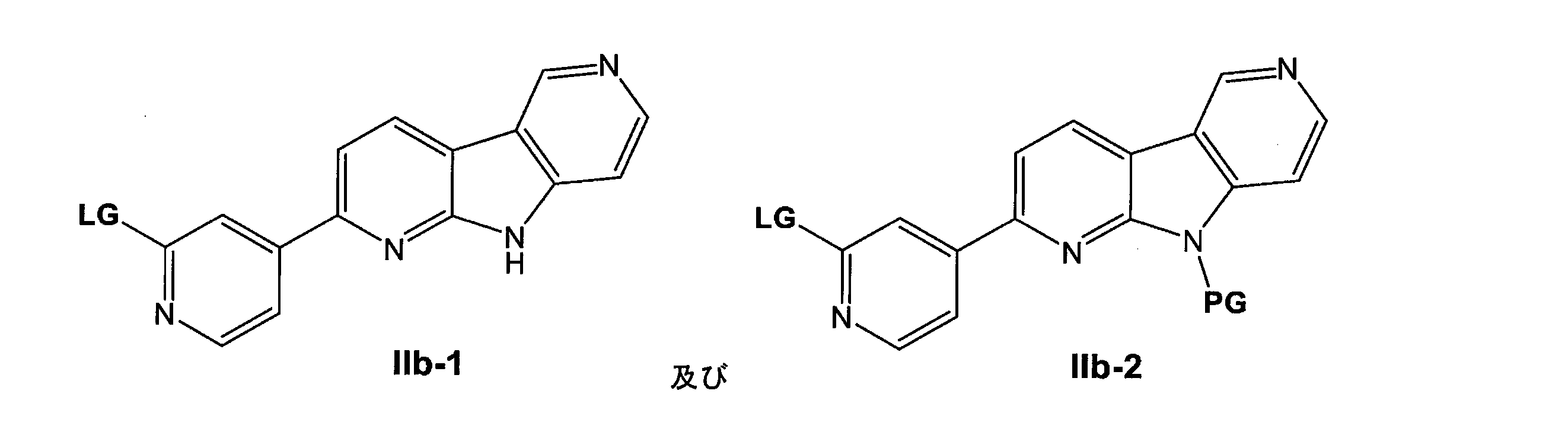
からなる群から選択される。 selected from the group consisting of
これらの化合物において、PG及びLGは、「定義」の節で定義されている通りである。 In these compounds, PG and LG are as defined in the "Definitions" section.
式IIの更により好ましい化合物は、 Even more preferred compounds of formula II are

からなる群から選択され、
X-は、対イオン、例えば、ハロゲン、CF3SO3
-及びCF3CO2
-からなる群から選択される対イオンである。
is selected from the group consisting of
X- is a counterion, such as a counterion selected from the group consisting of halogen, CF3SO3- and CF3CO2- .
式IIのなおより好ましい化合物は、 Even more preferred compounds of formula II are

からなる群から選択され、
X-は、対イオン、例えば、ハロゲン、CF3SO3
-及びCF3CO2
-からなる群から選択される対イオンである。
is selected from the group consisting of
X- is a counterion, such as a counterion selected from the group consisting of halogen, CF3SO3- and CF3CO2- .
工程a)
工程a)は、式IIの化合物
step a)
Step a) comprises a compound of formula II

(式中、
Xは、H又はPGであり、
LGは、脱離基であり、
PGは、アミン保護基である)
を18Fフッ素化薬と反応させることを含む。
(In the formula,
X is H or PG;
LG is a leaving group,
PG is an amine protecting group)
with a 18 F fluorinating agent.
XがHである場合、式Iを有する化合物が得られる。XがPGである場合、式III When X is H, compounds of formula I are obtained. If X is PG then formula III

を有する中間体化合物が得られる。 An intermediate compound having
18Fフッ素化薬は、当業者に周知である。任意の好適な18F-フッ素化薬を用いることができる。典型例には、H18F、アルカリ又はアルカリ土類18Fフッ化物(例えば、K18F、Rb18F、Cs18F及びNa18F)が含まれる。任意選択で、18F-フッ素化薬をクリプタンド(例えば:4,7,13,16,21,24-ヘキサオキサ-1,10-ジアザビシクロ[8.8.8]-ヘキサコサン-Kryptofix(登録商標))又はクラウンエーテル(例えば:18-クラウン-6)等のキレート剤と組み合わせて使用できる。或いは、18F-フッ素化薬は、18Fのテトラアルキルアンモニウム塩又は18Fのテトラアルキルホスホニウム塩、例えば、18Fのテトラ(C1~6アルキル)アンモニウム塩又は18Fのテトラ(C1~6アルキル)ホスホニウム塩であってもよい。これらの例には、テトラブチルアンモニウム[18F]フッ化物及びテトラブチルホスホニウム[18F]フッ化物が含まれる。好ましくは、18F-フッ素化薬は、K18F、H18F、Cs18F、Na18F又はテトラブチルアンモニウム[18F]フッ化物である。更により好ましい実施形態では、18F-フッ素化薬は、K18Fである。別の好ましい実施形態では、18F-フッ素化薬は、テトラブチルアンモニウム[18F]フッ化物である。 18 F fluorinating agents are well known to those skilled in the art. Any suitable 18 F-fluorinating agent can be used. Typical examples include H 18 F, alkali or alkaline earth 18 F fluorides (eg K 18 F, Rb 18 F, Cs 18 F and Na 18 F). Optionally, the 18 F-fluorinating agent is a cryptand (eg: 4,7,13,16,21,24-hexaoxa-1,10-diazabicyclo[8.8.8]-hexacosane-Kryptofix®) or crown It can be used in combination with chelating agents such as ethers (eg: 18-crown-6). Alternatively, the 18 F-fluorinating agent is a tetraalkylammonium salt of 18 F or a tetraalkylphosphonium salt of 18 F, such as a tetra(C 1-6 alkyl)ammonium salt of 18 F or a tetra(C 1 - It may be a 6- alkyl)phosphonium salt. Examples of these include tetrabutylammonium [ 18 F]fluoride and tetrabutylphosphonium [ 18 F]fluoride. Preferably, the 18 F-fluorinating agent is K 18 F, H 18 F, Cs 18 F, Na 18 F or tetrabutylammonium [ 18 F]fluoride. In an even more preferred embodiment, the18F -fluorinating agent is K18F . In another preferred embodiment, the 18 F-fluorinating agent is tetrabutylammonium [ 18 F]fluoride.
18F-フッ素化は、典型的には、好ましくはアセトニトリル、ジメチルスルホキシド、ジメチルホルムアミド、ジメチルアセトアミド、アミルアルコール、tert-ブチルアルコール又はその混合物から選択される溶媒中で実施され、好ましくは、溶媒は、アセトニトリル若しくはDMSOを含有する、又はアセトニトリル若しくはDMSOである。他の溶媒もまた使用することができ、これらは当業者に周知である。溶媒は、水及び/又は他のアルコール、例えば、C1~10直鎖状、分枝状又は環式アルカノールを共溶媒として更に含みうる。好ましい一実施形態では、18F放射性標識化を実施するための溶媒は、ジメチルスルホキシドを含有する。別の好ましい一実施形態では、18F放射性標識化を実施するための溶媒は、アセトニトリルを含有する。好ましい一実施形態では、18F放射性標識化を実施するための溶媒は、ジメチルスルホキシドである。別の好ましい実施形態では、18F放射性標識化を実施するための溶媒は、アセトニトリルである。 18 F-fluorination is typically carried out in a solvent preferably selected from acetonitrile, dimethylsulfoxide, dimethylformamide, dimethylacetamide, amyl alcohol, tert-butyl alcohol or mixtures thereof, preferably the solvent is , contains acetonitrile or DMSO, or is acetonitrile or DMSO. Other solvents can also be used and are well known to those skilled in the art. The solvent may further comprise water and/or other alcohols such as C 1-10 linear, branched or cyclic alkanols as co-solvents. In one preferred embodiment, the solvent for performing 18 F radiolabeling contains dimethylsulfoxide. In another preferred embodiment, the solvent for performing 18 F radiolabeling contains acetonitrile. In one preferred embodiment, the solvent for performing 18 F radiolabeling is dimethylsulfoxide. In another preferred embodiment, the solvent for performing 18 F radiolabeling is acetonitrile.
18F-フッ素化は、典型的には、最大約60分間行われる。好ましい反応時間は、最大約30分間である。更に好ましい反応時間は、最大約15分間である。 18 F-fluorination is typically carried out for up to about 60 minutes. A preferred reaction time is up to about 30 minutes. A more preferred reaction time is up to about 15 minutes.
18F-フッ素化は、典型的には、従来の又はマイクロ波支持された加熱下、約60~約200℃の温度で実施される。好ましい実施形態では、18F-フッ素化は、約100~約180℃で実施される。より好ましい実施形態では、18F-フッ素化は、約100~約160℃で実施される。好ましくは、18F-フッ素化は、従来の加熱下で実施される。従来の加熱は、マイクロ波を使用しない任意の加熱であると理解される。 18 F-fluorination is typically carried out at temperatures from about 60 to about 200° C. under conventional or microwave-supported heating. In preferred embodiments, the 18 F-fluorination is carried out at about 100 to about 180°C. In a more preferred embodiment, the 18 F-fluorination is carried out at about 100 to about 160°C. Preferably, the 18 F-fluorination is carried out under conventional heating. Conventional heating is understood to be any heating that does not use microwaves.
出発材料の量は、特に限定されない。例えば、約0.5~約50μmolの式IIの化合物を、1バッチの式Iの化合物の製造のために使用することができる。好ましい実施形態では、約2~約25μmolの式IIの化合物が使用される。より好ましい実施形態では、約2.5~約15μmolの式IIの化合物が使用される。一実施形態では、少なくとも約2μmolの式IIの化合物が使用される。好ましい実施形態では、少なくとも約2.5μmolの式IIの化合物が使用される。より好ましい実施形態では、少なくとも約3μmolの式IIの化合物が使用される。 The amount of starting material is not particularly limited. For example, from about 0.5 to about 50 μmol of compound of formula II can be used for the preparation of a batch of compound of formula I. In preferred embodiments, from about 2 to about 25 μmol of the compound of formula II is used. In a more preferred embodiment, about 2.5 to about 15 μmol of the compound of formula II is used. In one embodiment, at least about 2 μmol of the compound of Formula II is used. In preferred embodiments, at least about 2.5 μmol of the compound of Formula II is used. In a more preferred embodiment, at least about 3 μmol of the compound of formula II is used.
XがPGである場合、式IIIを有する中間体化合物が得られる。保護基PGは、工程a)又は任意選択のその後の工程b)のいずれかの間に切断されうる。 When X is PG, intermediate compounds of formula III are obtained. The protecting group PG can be cleaved off during either step a) or the optional subsequent step b).
式IIIの好ましい化合物は、 Preferred compounds of formula III are

からなる群から選択される。 selected from the group consisting of
これらの化合物において、PGは、「定義」の節で定義されている通りである。 In these compounds, PG is as defined in the "Definitions" section.
工程b)
工程b)は、式IIIの化合物から保護基PGを切断して式Iの化合物を得ることを含む任意選択の工程である。当業者には明らかである通り、この工程は、工程a)が、Xが水素である式IIの化合物を用いて行われる場合、又は保護基PGが工程a)で既に切断されている場合、適用できない。
step b)
Step b) is an optional step that involves cleaving the protecting group PG from the compound of formula III to give the compound of formula I. As will be apparent to those skilled in the art, this step may be modified if step a) is performed with a compound of formula II wherein X is hydrogen or if the protecting group PG has already been cleaved in step a). Not applicable.
多様な保護基の切断のための反応条件が当業者に周知であり、そのいずれも参照により本明細書に含まれるGreene及びWutsによる教科書、Protecting groups in Organic Synthesis、第3版、494~653頁、並びにP. J. Kocienskiによる教科書、Protecting Groups、第3版、2003に記載されているものから選択されうるが、これらに限定されない。 Reaction conditions for cleavage of a variety of protecting groups are well known to those skilled in the art and are described in the textbook by Greene and Wuts, Protecting groups in Organic Synthesis, 3rd Edition, pp. 494-653, all of which are incorporated herein by reference. , as well as those described in the textbook by P. J. Kocienski, Protecting Groups, 3rd Edition, 2003, but are not limited to these.
工程b)で用いられる条件は、切断される保護基に依存し、したがって、特に限定されない。 The conditions used in step b) depend on the protecting group to be cleaved and are therefore not particularly limited.
可能な反応条件には、i)約60~約160℃での加熱、ii)酸の添加及び約0℃~約160℃での加熱;又はiii)塩基の添加及び約0℃~約160℃での加熱が含まれる。 Possible reaction conditions include i) heating from about 60°C to about 160°C, ii) addition of acid and heating from about 0°C to about 160°C; or iii) addition of base and from about 0°C to about 160°C. including heating at
好ましい酸は、塩酸、硫酸及びリン酸である。1つの好ましい酸は、硫酸である。別の好ましい酸は、リン酸である。好ましい塩基は、水酸化ナトリウム、水酸化カリウムである。 Preferred acids are hydrochloric acid, sulfuric acid and phosphoric acid. One preferred acid is sulfuric acid. Another preferred acid is phosphoric acid. Preferred bases are sodium hydroxide and potassium hydroxide.
好ましい反応条件は、酸の添加及び約25℃~160℃、好ましくは25℃~120℃での加熱である。 Preferred reaction conditions are the addition of acid and heating at about 25°C to 160°C, preferably 25°C to 120°C.
所望の場合、工程a)及びb)は、同じ又は異なる反応ベッセルで実施することができる。好ましくは、工程a)及びb)は、同じ反応ベッセルで実施される。 If desired, steps a) and b) can be performed in the same or different reaction vessels. Preferably steps a) and b) are performed in the same reaction vessel.
所望の場合、工程b)の後に得られる溶液は、そのまま工程c)で使用することができる。或いは、溶液の組成を、HPLCを行うためにより適切であるように、適合することができる。例えば、緩衝液又は希釈剤を、工程c)の前に添加することができる。 If desired, the solution obtained after step b) can be used as such in step c). Alternatively, the composition of the solution can be adapted to be more suitable for performing HPLC. For example, buffers or diluents can be added before step c).
工程c)
工程c)は、式Iの化合物の精製を含む。
step c)
Step c) involves purification of the compound of formula I.
式Iの化合物の精製のための好適な方法は、HPLC、固相抽出(SPE)又はその組合せである。 Preferred methods for purification of compounds of formula I are HPLC, solid phase extraction (SPE) or a combination thereof.
好ましい一実施形態では、工程a)、又は用いられる場合工程b)で得られた式Iの化合物は、エタノール及び水並びに任意選択で酸、塩基、緩衝液、塩及び/又はヒドロキシカルボン酸、ヒドロキシカルボン酸の塩若しくはその混合物を含む固相を使用するHPLCにかけられる。 In one preferred embodiment, the compound of formula I obtained in step a), or step b) if used, is combined with ethanol and water and optionally acids, bases, buffers, salts and/or hydroxycarboxylic, hydroxy It is subjected to HPLC using a solid phase containing salts of carboxylic acids or mixtures thereof.
エタノールの水に対する比は、特に限定されないが、好ましくは、約5/95v/v~約80/20v/v、より好ましくは約5/95v/v~約50/50v/v、更により好ましくは約5/95v/v~約20/80v/vである。 The ratio of ethanol to water is not particularly limited, but is preferably about 5/95 v/v to about 80/20 v/v, more preferably about 5/95 v/v to about 50/50 v/v, still more preferably From about 5/95 v/v to about 20/80 v/v.
移動相のpHは制限されないが、それは好ましくは、約0~約8、好ましくは約0~約6、より好ましくは約1~約5、更により好ましくは約1~約3である。 Although the pH of the mobile phase is not limited, it is preferably from about 0 to about 8, preferably from about 0 to about 6, more preferably from about 1 to about 5, even more preferably from about 1 to about 3.
可能な緩衝液は、アルカリ金属リン酸二水素、ジアルカリ金属リン酸水素、トリアルカリ金属リン酸塩、アルカリ金属酢酸塩、アルカリ土類金属酢酸塩、アルカリ土類金属ギ酸塩、モノ/ジ/トリアルカリ金属クエン酸塩から選択することができる塩を含むことができ、好ましいアルカリ及びアルカリ土類金属は、ナトリウム及びカリウムである。好ましい緩衝液には、アルカリ金属リン酸二水素、ジアルカリ金属リン酸水素、トリアルカリ金属リン酸塩、アルカリ金属酢酸塩、モノ/ジ/トリアルカリ金属クエン酸塩から選択することができる塩が含まれ、好ましいアルカリ金属は、ナトリウム及びカリウムである。 Possible buffers are alkali metal dihydrogen phosphates, dialkali metal hydrogen phosphates, tri-alkali metal phosphates, alkali metal acetates, alkaline earth metal acetates, alkaline earth metal formates, mono/di/tri Salts may be included which may be selected from alkali metal citrates, the preferred alkali and alkaline earth metals being sodium and potassium. Preferred buffers include salts that can be selected from alkali metal dihydrogen phosphates, dialkali metal hydrogen phosphates, trialkali metal phosphates, alkali metal acetates, mono/di/trial alkali metal citrates. Preferred alkali metals are sodium and potassium.
可能な塩基は、水酸化ナトリウム及び/又は水酸化カリウムでありうる。 Possible bases can be sodium hydroxide and/or potassium hydroxide.
所望の場合、移動相のpHは、無機又は有機酸を使用して調整することができる。無機酸の例には、アスコルビン酸、クエン酸及び酢酸が含まれる。有機酸の例には、塩酸、硫酸及びリン酸、好ましくはリン酸が含まれる。 If desired, the pH of the mobile phase can be adjusted using inorganic or organic acids. Examples of inorganic acids include ascorbic acid, citric acid and acetic acid. Examples of organic acids include hydrochloric acid, sulfuric acid and phosphoric acid, preferably phosphoric acid.
好ましい移動相は、約5~約20%v/vエタノール、約95~約80%v/v水、約1~約3のpHを有する約50~約150mM緩衝液(例えば、アルカリリン酸二水素)及び任意選択でラジオスカベンジャーを含む。 A preferred mobile phase is from about 5 to about 20% v/v ethanol, from about 95 to about 80% v/v water, from about 50 to about 150 mM buffer (e.g., alkaline phosphate dibasic) having a pH of from about 1 to about 3. hydrogen) and optionally a radio scavenger.
HPLC方法で使用するための固定相は周知であり、当業者によって適切に選択されうる。好ましい実施形態では、固定相は、「逆相」(RP)固定相である。 Stationary phases for use in HPLC methods are well known and can be appropriately selected by one skilled in the art. In preferred embodiments, the stationary phase is a "reversed phase" (RP) stationary phase.
RP-HPLC固定相の例には、C18、C8、フェニル、シアノ(例えば、シアノプロピル)、ペンタフルオロフェニル、アミノ(例えば、アミノプロピル)、アミド(例えば、C10~24-アルカン-アミノプロピル)、フェニルヘキシル官能化樹脂又は混合相樹脂が含まれる。 Examples of RP-HPLC stationary phases include C18, C8, phenyl, cyano (eg cyanopropyl), pentafluorophenyl, amino (eg aminopropyl), amide (eg C 10-24 -alkane-aminopropyl). , phenylhexyl functionalized resins or mixed phase resins.
一実施形態では、HPLC固定相の粒径は、約1.6~約15μmである。好ましい実施形態では、HPLC固定相の粒径は、約5~約10μmである。別の実施形態では、HPLC固定相の粒径は、約10μmである。 In one embodiment, the HPLC stationary phase has a particle size of about 1.6 to about 15 μm. In a preferred embodiment, the HPLC stationary phase has a particle size of about 5 to about 10 μm. In another embodiment, the HPLC stationary phase has a particle size of about 10 μm.
典型的には、HPLCカラムは、約2.0~約50mmの直径及び約50~約300mmの長さを有する。好ましい実施形態では、HPLCカラムは、約4.6~約20mmの直径及び約150~約250mmの長さを有する。より好ましい実施形態では、HPLCカラムは、10×250mmの寸法を有する。 Typically, HPLC columns have diameters of about 2.0 to about 50 mm and lengths of about 50 to about 300 mm. In preferred embodiments, the HPLC column has a diameter of about 4.6 to about 20 mm and a length of about 150 to about 250 mm. In a more preferred embodiment, the HPLC column has dimensions of 10 x 250 mm.
高速液体クロマトグラフィーにおいて用いられる流速は制限されず、約1~約20mL/分、より典型的には約2~約15mL/分、更により典型的には約2~約7mL/分でありうる。 Flow rates used in high performance liquid chromatography are not limited and can be from about 1 to about 20 mL/min, more typically from about 2 to about 15 mL/min, even more typically from about 2 to about 7 mL/min. .
高速液体クロマトグラフィーにおいて用いられる圧力は特に限定されず、約50~約400bar、典型的には約50~約250bar、より典型的には約50~200barの範囲でありうる。 The pressure used in high performance liquid chromatography is not particularly limited and can range from about 50 to about 400 bar, typically from about 50 to about 250 bar, more typically from about 50 to 200 bar.
任意選択の工程d)は、エタノール、水、ヒドロキシカルボン酸及びヒドロキシカルボン酸の塩からなる群から選択される1種又は複数が、工程c)の後に式Iの化合物との混合においてまだ所望量で存在しない場合、工程c)で得られた式Iの化合物をそれらと混合して、診断用組成物を提供することを含む。更に任意選択で、無機酸、更なる有機酸、塩基又は塩から選択される1種又は複数が、工程c)の後に式Iの化合物との混合においてまだ所望量で存在しない場合、それらを、工程d)において更に添加してもよい。 Optional step d) comprises adding one or more selected from the group consisting of ethanol, water, hydroxycarboxylic acids and salts of hydroxycarboxylic acids in the desired amount still in admixture with the compound of formula I after step c). If not present in step c), the compound of formula I obtained in step c) is mixed therewith to provide a diagnostic composition. Further optionally, one or more selected from inorganic acids, further organic acids, bases or salts, if they are not already present in the desired amount in the mixture with the compound of formula I after step c), Further additions may be made in step d).
診断用組成物が患者に投与されることになる場合、それは、無菌であるべきである。診断用組成物は、任意の公知の方法によって滅菌することができる。一選択肢は、滅菌濾過(工程e)を行うことである。滅菌フィルターは、放射性トレーサー濾過のために使用される標準的な滅菌フィルターでありうる。そのような滅菌フィルターは、当技術分野で周知である。好適な滅菌フィルターは、ポリテトラフルオロエチレン(PTFE)滅菌フィルター(例えば、Millipore社Millex-LG)、ポリエーテルスルホン(PES)滅菌フィルター(例えば、Millipore社Millex-GP)、ポリビニリデンフルオリド(PVDF)滅菌フィルター(例えば、Millipore社Millex-GV)である。より好ましくは、疎水性フィルターは、ポリテトラフルオロエチレン(PTFE)滅菌フィルター又はポリビニリデンフルオリド(PVDF)滅菌フィルターである。 When the diagnostic composition is to be administered to a patient, it should be sterile. Diagnostic compositions can be sterilized by any known method. One option is to perform sterile filtration (step e). The sterile filter can be a standard sterile filter used for radiotracer filtration. Such sterile filters are well known in the art. Suitable sterilizing filters include polytetrafluoroethylene (PTFE) sterilizing filters (e.g. Millex-LG, Millipore), polyethersulfone (PES) sterilizing filters (e.g., Millex-GP, Millipore), polyvinylidene fluoride (PVDF). Sterile filter (eg Millex-GV from Millipore). More preferably, the hydrophobic filter is a polytetrafluoroethylene (PTFE) sterilizing filter or a polyvinylidene fluoride (PVDF) sterilizing filter.
工程e)は、工程d)の後又は工程d)の前に実施することができ、工程c)の後に得られた式Iの化合物が、滅菌濾過にかけられ、次いで、任意選択で、診断用組成物の他の成分と混合され、医薬組成物の他の成分は、無菌であるか又は混合される前に滅菌濾過にかけられる。 Step e) can be performed after step d) or before step d), the compound of formula I obtained after step c) being subjected to sterile filtration and then optionally diagnostic Mixed with the other components of the composition, the other components of the pharmaceutical composition are either sterile or subjected to sterile filtration prior to mixing.
好ましくは、工程a)、工程b)及び工程c)は、合成機によって実施される。より好ましくは、工程a)、工程b)、工程c)及び工程d)が、合成機によって実施される。更により好ましくは、工程a)、工程b)、工程c)、工程d)及び工程e)が、合成機によって実施される。 Preferably steps a), b) and c) are performed by a synthesizer. More preferably, steps a), b), c) and d) are performed by a synthesizer. Even more preferably, steps a), b), c), d) and e) are performed by a synthesizer.
そのような好適な合成デバイスの例には、IBA Synthera、GE Fastlab、GE Tracerlab MX、GE Tracerlab FX、Trasis AllinOne、ORA Neptis Perform、ORA Neptis Mosaic、ORA Neptis Plug、Scintomics GPR、Synthera、Comecer Taddeo、Raytest Synchrom,、Sofie Elixys、Eckert&Ziegler Modular Lab、Sumitomo Heavy Industries F100 F200 F300及びSiemens Exploraが含まれるが、これらに限定されない。 Examples of such suitable synthesis devices include IBA Synthera, GE Fastlab, GE Tracerlab MX, GE Tracerlab FX, Trasis AllinOne, ORA Neptis Perform, ORA Neptis Mosaic, ORA Neptis Plug, Scintomics GPR, Synthera, Comecer Taddeo, Raytest Synchrom, Sofie Elixys, Eckert & Ziegler Modular Lab, Sumitomo Heavy Industries F100 F200 F300 and Siemens Explora.
好ましくは、工程a)、工程b)及び工程c)は、遠隔制御で実施される。より好ましくは、工程a)、工程b)、工程c)及び工程d)が、遠隔制御で実施される。更により好ましくは、工程a)、工程b)、工程c)、工程d)及び工程e)が、遠隔制御で実施される。好ましくは、工程a)、工程b)及び工程c)は、自動化される。より好ましくは、工程a)、工程b)、工程c)及び工程d)が、自動化される。更により好ましくは、工程a)、工程b)、工程c)、工程d)及び工程e)が、自動化される。 Preferably steps a), b) and c) are performed remotely. More preferably, steps a), b), c) and d) are performed remotely. Even more preferably, steps a), b), c), d) and e) are performed remotely. Preferably steps a), b) and c) are automated. More preferably, steps a), b), c) and d) are automated. Even more preferably, steps a), b), c), d) and e) are automated.
診断手順
本発明の診断用組成物は、好ましくは、診断に使用するためのものである。この場合、式Iの化合物のFは、好ましくは18Fである。
Diagnostic Procedures The diagnostic compositions of the invention are preferably for diagnostic use. In this case F in the compound of formula I is preferably 18F .
したがって、第3の態様では、本発明は、診断に使用するための第1の態様で定義される通りの診断用組成物に向けられている。本発明の組成物は、例えばポジトロン放出断層撮影(PET)による、タウ凝集体の画像化に特に好適である。それは、特に診断がポジトロン放出断層撮影によって行われる場合の、タウ凝集体に関連する障害(例えば、神経病理学的障害)の診断又はタウオパチーの診断に使用することができる。タウ凝集体は、ヒト脳にありうる。 Accordingly, in a third aspect the invention is directed to a diagnostic composition as defined in the first aspect for use in diagnosis. The compositions of the invention are particularly suitable for imaging tau aggregates, eg by positron emission tomography (PET). It can be used for the diagnosis of disorders associated with tau aggregates (eg neuropathological disorders) or for the diagnosis of tauopathies, especially when the diagnosis is made by positron emission tomography. Tau aggregates can be found in the human brain.
本発明の診断用組成物は、タウタンパク質凝集体の画像化のために特に好適であることが見出だされた。タウタンパク質に関して、検出可能に標識された式Iの化合物は、病的に凝集したタウ、高リン酸化タウ、神経原線維変化、対らせん状細線維、直線線維、神経毒性可溶性オリゴマー、ポリマー及び原線維等の種々のタイプのタウ凝集体に結合することが可能である。 It has been found that the diagnostic compositions of the invention are particularly suitable for imaging tau protein aggregates. With respect to the tau protein, detectably labeled compounds of formula I can be used to detect pathologically aggregated tau, hyperphosphorylated tau, neurofibrillary tangles, paired helical filaments, linear fibrils, neurotoxic soluble oligomers, polymers and protofibrils. It is possible to bind to various types of tau aggregates such as fibrils.
上記の結合特性のために、検出可能に標識された式Iの化合物は、タウ凝集体に関連する障害の診断に使用するのに好適である。検出可能に標識された式Iの化合物は、タウ沈着物のポジトロン放出断層撮影(PET)画像化に特に好適である。典型的には、化合物が患者に投与されることになる場合、18F標識された式Iの化合物が、検出可能に標識された化合物として用いられる。 Because of the above binding properties, detectably labeled compounds of formula I are suitable for use in diagnosing disorders associated with tau aggregates. Detectably labeled compounds of formula I are particularly suitable for positron emission tomography (PET) imaging of tau deposits. Typically, an 18 F-labeled compound of Formula I is used as the detectably labeled compound when the compound is to be administered to a patient.
以下の実施例において、検出可能に標識された式Iの化合物は、好ましくは、本発明の診断用組成物中で投与されることが理解されることになる。 It will be appreciated that in the examples below, a detectably labeled compound of formula I is preferably administered in the diagnostic compositions of the invention.
本発明の診断用組成物は、したがって、試料又は患者、好ましくはヒトにおいてタウ凝集体に関連する障害の診断についてのデータを収集するための方法であって、
(a)タウ凝集体を含有することが疑われる試料又は特定の身体部分若しくは身体領域を、式Iの化合物を含む組成物と接触させる工程、
(b)化合物をタウ凝集体に結合させる工程、
(c)タウ凝集体に結合した化合物を検出する工程、及び
(d)任意選択で、タウ凝集体と結合する化合物の存在又は非存在を、試料又は特定の身体部分若しくは身体領域におけるタウ凝集体の存在又は非存在と相関付ける工程
を含む、方法において使用することができる。
The diagnostic composition of the invention is therefore a method for collecting data for the diagnosis of a tau aggregate-related disorder in a sample or patient, preferably a human, comprising:
(a) contacting a sample suspected of containing tau aggregates or a particular body part or region with a composition comprising a compound of Formula I;
(b) binding the compound to the tau aggregates;
(c) detecting compounds bound to tau aggregates, and
(d) optionally correlating the presence or absence of a compound that binds tau aggregates with the presence or absence of tau aggregates in a sample or in a particular body part or region; be able to.
対象(例えば、ヒト)におけるタウ沈着物の検出のための具体的な方法は、
1)好適な量の診断用組成物を対象に投与する工程、
2)任意選択で、対象において診断用組成物の分布を待つ工程、
3)ポジトロン放出断層撮影(PET)を行う工程、
4)任意選択で、PET画像化データを再構築する工程、及び
5)PET画像化データを解釈する工程
を含みうる。
A specific method for the detection of tau deposits in a subject (e.g., human) comprises:
1) administering a suitable amount of the diagnostic composition to the subject;
2) optionally waiting for distribution of the diagnostic composition in the subject;
3) performing positron emission tomography (PET);
4) optionally reconstructing the PET imaging data; and
5) may include the step of interpreting the PET imaging data.
好ましくは、診断用組成物は、静脈内投与されることになる。検出可能に標識された式Iの化合物の用量は、当技術分野の医師には明らかであるように、投与されることになる正確な化合物、対象の体重、試料の大きさ及びタイプ、並びに他の不確定要素に依存して変動しうる。一般に、ヒト対象に注射されることになる診断用組成物の体積は、約0.1~約20mL、好ましくは約0.1~約10mL、より好ましくは、約0.5~約10mLでありうる。好ましくは、約100~約740MBq、より好ましくは、100~約400MBq、更により好ましくは約150~約300MBqの診断用組成物が投与されることになる。 Preferably, the diagnostic composition will be administered intravenously. The dose of the detectably-labeled compound of Formula I will depend on the exact compound to be administered, the weight of the subject, the size and type of sample, and other factors, as will be apparent to the practitioner of skill in the art. may vary depending on the uncertainties of Generally, the volume of diagnostic composition to be injected into a human subject can be from about 0.1 to about 20 mL, preferably from about 0.1 to about 10 mL, more preferably from about 0.5 to about 10 mL. Preferably, from about 100 to about 740 MBq, more preferably from 100 to about 400 MBq, even more preferably from about 150 to about 300 MBq of diagnostic composition will be administered.
好ましくは、PET画像獲得は、約5~約30分間、好ましくは約5~約20分間、より好ましくは約10~約20分間実施される。好ましくは、PET獲得は、診断用組成物の注射後約30~120分、より好ましくは注射後約30~約90分、更により好ましくは注射後約45~60分に開始される。PET画像化データの解釈は、目視評価によって又は定量化法によって実施される。 Preferably, PET image acquisition is performed for about 5 to about 30 minutes, preferably about 5 to about 20 minutes, more preferably about 10 to about 20 minutes. Preferably, PET acquisition is initiated about 30 to 120 minutes after injection of the diagnostic composition, more preferably about 30 to about 90 minutes after injection, even more preferably about 45 to 60 minutes after injection. Interpretation of PET imaging data is performed by visual assessment or by quantification methods.
タウ凝集体の画像化において、検出可能に標識された式Iの化合物が投与され、タウ凝集体に特異的に結合する化合物から生じたシグナルが検出される。特異的結合は、式Iの化合物のタウ凝集体への高い結合親和性の結果である。 In imaging tau aggregates, a detectably labeled compound of Formula I is administered and the signal generated by the compound that specifically binds to tau aggregates is detected. Specific binding is a result of the high binding affinity of compounds of formula I to tau aggregates.
好ましい実施形態では、検出可能に標識された式Iの化合物は、タウオパチー(好ましくは、アルツハイマー病)が存在するかを診断するために用いられる。本方法では、検出可能に標識された式Iの化合物は、タウオパチー(好ましくは、アルツハイマー病)を患っていることが疑われる患者又はそのような患者から得られた試料に投与され、検出可能な標識から生じたシグナルが、好ましくはポジトロン放出断層撮影(PET)によって検出される。 In a preferred embodiment, detectably labeled compounds of Formula I are used to diagnose the presence of tauopathy, preferably Alzheimer's disease. In this method, a detectably labeled compound of Formula I is administered to a patient suspected of having a tauopathy (preferably Alzheimer's disease) or to a sample obtained from such a patient and the detectable Signals generated from the labels are preferably detected by positron emission tomography (PET).
検出可能な標識から生じたシグナルが検出されない場合、タウオパチー以外の神経障害が存在することを示す本方法を使用してタウオパチーを除外することができる。 If no signal is detected resulting from the detectable label, the method can be used to rule out tauopathy indicating that a neuropathy other than tauopathy is present.
対象においてアルツハイマー病等のタウタンパク質凝集体に関連する障害又はその傾向を診断する方法において、本方法は、
a)哺乳動物に診断有効量の検出可能に標識された式Iの化合物を投与する工程、
b)検出可能に標識された式Iの化合物を、目的の組織(例えば、脳組織又は脳脊髄液(CSF)等の体液)に分散させる工程、及び
c)目的の組織を画像化する工程であって、正常対照レベルの結合と比較した、検出可能に標識された式Iの化合物の目的の組織への結合の増加が、対象がタウタンパク質凝集体に関連する障害を患っているか又はそれを発症するリスクを有することを示す、工程
を含む。
A method of diagnosing a tau protein aggregate-related disorder, such as Alzheimer's disease, or a propensity thereto in a subject, the method comprising:
a) administering to the mammal a diagnostically effective amount of a detectably labeled compound of Formula I;
b) dispersing a detectably labeled compound of Formula I into a tissue of interest (e.g., brain tissue or a bodily fluid such as cerebrospinal fluid (CSF)), and
c) imaging a tissue of interest, wherein an increase in the binding of the detectably labeled compound of formula I to the tissue of interest compared to normal control levels of binding indicates that the subject is a tau protein aggregate; indicating that you suffer from or are at risk of developing a disorder associated with
検出可能に標識された式Iの化合物は、タウタンパク質凝集体を含有することが疑われる患者の任意の試料又は特定の身体部分若しくは身体領域においてタウタンパク質凝集体を画像化するために使用することができる。検出可能に標識された式Iの化合物は、血液脳関門を通過することができる。その結果、それらは、脳において、及び脳脊髄液(CSF)等の体液において、タウタンパク質凝集体を画像化するのに特に好適である。 A detectably-labeled compound of Formula I is used to image tau protein aggregates in any sample or specific body part or region of a patient suspected of containing tau protein aggregates. can be done. A detectably-labeled compound of Formula I is capable of crossing the blood-brain barrier. As a result, they are particularly suitable for imaging tau protein aggregates in the brain and in body fluids such as cerebrospinal fluid (CSF).
患者におけるタウ障害又はタウ関連障害の傾向の診断は、試料又はインサイチュにおける検出可能に標識された式Iの化合物のタウタンパク質凝集体への特異的結合の検出によって達成することができ、検出は、
(a)タウタンパク質凝集体を含有することが疑われる試料又は特定の身体部分若しくは身体領域を、タウタンパク質凝集体に結合する検出可能に標識された式Iの化合物と接触させる工程、
(b)検出可能に標識された式Iの化合物をタウタンパク質凝集体に結合させて、化合物/タウタンパク質凝集体複合体(本明細書以下で「化合物/タウタンパク質凝集体複合体」は、「化合物/タンパク質凝集体複合体」と略記する)を形成する工程、
(c)化合物/タンパク質凝集体複合体の形成を検出する工程、
(d)任意選択で、化合物/タンパク質凝集体複合体の存在又は非存在を、試料又は特定の身体部分若しくは領域におけるタウタンパク質凝集体の存在又は非存在と相関付ける工程、及び
(e)任意選択で、化合物/タンパク質凝集体複合体の量を正常対照値と比較する工程であって、正常対照値と比較した化合物/タンパク質凝集体複合体の量の増加が、患者がタウ関連障害を患っているか又はそれを発症するリスクを有することを示しうる、工程
を含む。
Diagnosis of a tau disorder or propensity for a tau-related disorder in a patient can be accomplished by detecting specific binding of a detectably labeled compound of formula I to tau protein aggregates in a sample or in situ, the detection comprising:
(a) contacting a sample suspected of containing tau protein aggregates or a particular body part or region with a detectably labeled compound of Formula I that binds to tau protein aggregates;
(b) binding a detectably labeled compound of Formula I to the tau protein aggregate to form a compound/tau protein aggregate complex (hereinafter "compound/tau protein aggregate complex" is referred to as " forming a compound/protein aggregate complex (abbreviated as "compound/protein aggregate complex"),
(c) detecting the formation of compound/protein aggregate complexes;
(d) optionally correlating the presence or absence of the compound/protein aggregate complex with the presence or absence of tau protein aggregates in the sample or in a particular body part or region; and
(e) optionally, comparing the amount of the compound/protein aggregate complex to a normal control value, wherein an increase in the amount of the compound/protein aggregate complex compared to the normal control value is associated with the patient's tau It includes a step that can indicate that you have or are at risk of developing an associated disorder.
試料又は特定の身体部分若しくは身体領域を、検出可能に標識された式Iの化合物と接触させた後、化合物をタウタンパク質凝集体に結合させる。結合に必要とされる時間の長さは試験のタイプ(例えば、インビトロ又はインビボ)に依存し、当業者は慣例の実験によって決定することができる。 After contacting the sample or a particular body part or region with a detectably labeled compound of Formula I, the compound is allowed to bind to tau protein aggregates. The length of time required for binding depends on the type of test (eg, in vitro or in vivo) and can be determined by one skilled in the art by routine experimentation.
タウタンパク質凝集体に結合している化合物は、その後、任意の適切な方法によって検出することができる。好ましい方法は、ポジトロン放出断層撮影(PET)である。 Compounds that bind to tau protein aggregates can then be detected by any suitable method. A preferred method is Positron Emission Tomography (PET).
次いで、任意選択で、化合物/タンパク質凝集体複合体の存在又は非存在が、試料又は特定の身体部分若しくは領域におけるタウタンパク質凝集体の存在又は非存在と相関付けられる。最後に、化合物/タンパク質凝集体複合体の量を、健常対象の試料又は特定の身体部分若しくは身体領域において決定された正常対照値と比較することができ、ここで、正常対照値と比較した化合物/タンパク質凝集体複合体の量の増加は、患者がタウ関連障害を患っているか又はそれを発症するリスクを有することを示しうる。 Optionally, the presence or absence of compound/protein aggregate complexes is then correlated with the presence or absence of tau protein aggregates in the sample or particular body part or region. Finally, the amount of compound/protein aggregate complex can be compared to a normal control value determined in a sample from a healthy subject or in a particular body part or region, where the compound compared to the normal control value An increased amount of /protein aggregate complexes can indicate that the patient has or is at risk of developing a tau-related disorder.
タウタンパク質凝集体に関連する障害を患っており、医薬で処置されている患者の応答性の予測は、
(a)タウタンパク質凝集体を含有することが疑われる試料又は特定の身体部分若しくは身体領域を、検出可能に標識された式Iの化合物と接触させること、
(b)検出可能に標識された式Iの化合物をタウタンパク質凝集体に結合させて、化合物/タンパク質凝集体複合体を形成すること、
(c)化合物/タンパク質凝集体複合体の形成を検出すること、
(d)任意選択で、化合物/タンパク質凝集体複合体の存在又は非存在を、試料又は特定の身体部分若しくは身体領域におけるタウタンパク質凝集体の存在又は非存在と相関付けること、及び
(e)任意選択で、化合物/タンパク質凝集体複合体の量を、正常対照値と比較すること
によって達成されうる。
Prediction of responsiveness in patients suffering from tau protein aggregate-related disorders and being treated with drugs
(a) contacting a sample suspected of containing tau protein aggregates or a particular body part or region with a detectably labeled compound of Formula I;
(b) binding a detectably labeled compound of Formula I to the tau protein aggregate to form a compound/protein aggregate complex;
(c) detecting the formation of compound/protein aggregate complexes;
(d) optionally correlating the presence or absence of the compound/protein aggregate complex with the presence or absence of tau protein aggregates in the sample or in a particular body part or region; and
(e) can optionally be achieved by comparing the amount of compound/protein aggregate complex to a normal control value.
工程(a)~(e)がどのように行われうるかは、上で既に説明した。 It has already been explained above how steps (a) to (e) can be performed.
応答性を予測するための方法において、化合物/タンパク質凝集体複合体の量は、任意選択で、処置の間の様々な時点、例えば、処置開始の前後又は処置開始後の様々な時点で比較することができる。化合物/タンパク質凝集体複合体の量の変化、とりわけ減少は、患者がそれぞれの処置に対して応答性である可能性が高いことを示しうる。 In the method for predicting responsiveness, the amount of compound/protein aggregate complex is optionally compared at various time points during treatment, e.g., before and after treatment initiation or at various time points after treatment initiation. be able to. A change, particularly a decrease, in the amount of compound/protein aggregate complex may indicate that the patient is likely to be responsive to the respective treatment.
本発明の診断用組成物は、いくつかの大きな利点を有する:
- 化学的に安定であり、室温で少なくとも8時間又は更には少なくとも10時間保存できる、
- 最大5μg/mL、好ましくは最大10μg/mLの式Iの化合物の濃度で安定である、
- 診断用組成物の滅菌濾過を、放射能の大幅な損失なしに行うことができる、
- シリンジ及び他の材料で、放射能の大幅な損失なしに対象への投与が可能になる、
- 高放射能濃度、例えば、2GBq/mL以上、好ましくは3GBq/mL以上、より好ましくは5GBq/mL以上で、10時間、好ましくは12時間にわたって式Iの化合物の高純度及び安定性を有する、
- バッチ当たり高放射能レベル、例えば、20GBq以上、好ましくは50GBq以上、より好ましくは100GBq以上で、10時間、好ましくは12時間にわたる式Iの化合物の高純度及び安定性が可能になる、
- 対象におけるタウ沈着物の検出のために使用することができる。
The diagnostic composition of the invention has several significant advantages:
- chemically stable and can be stored at room temperature for at least 8 hours or even at least 10 hours,
- is stable at concentrations of the compound of formula I up to 5 μg/mL, preferably up to 10 μg/mL,
- the diagnostic composition can be sterile filtered without significant loss of radioactivity;
- Syringes and other materials that allow administration to subjects without significant loss of radioactivity;
- high purity and stability of the compound of formula I over 10 hours, preferably 12 hours at high radioactivity concentrations, for example 2 GBq/mL or more, preferably 3 GBq/mL or more, more preferably 5 GBq/mL or more
- high activity levels per batch, for example 20 GBq or more, preferably 50 GBq or more, more preferably 100 GBq or more, allowing high purity and stability of the compound of formula I over 10 hours, preferably 12 hours,
- can be used for the detection of tau deposits in a subject;
本発明を、以下の実施例によって例示するが、それらは限定として解釈されるべきではない。 The invention is illustrated by the following examples, which should not be construed as limiting.
すべての試薬及び溶媒は、販売元から得、更なる精製なしに使用した。プロトン(1H)スペクトルは、重溶媒中、Bruker DRX-400MHz NMR分光計又はBruker AV-400MHz NMR分光計で記録した。質量スペクトル(MS)は、Advion CMS質量分析計で記録した。クロマトグラフィーは、シリカゲル(Fluka社:Silica gel 60、0.063~0.2mm)及び特定の実施例において示される通りの好適な溶媒を使用して実施した。フラッシュ精製は、HP-Sil(Biotage社)又はpuriFlash-columns(Interchim社)、及び特定の実施例において示される溶媒勾配を使用して、Biotage Isolera Oneフラッシュ精製システムを用いて行った。薄層クロマトグラフィー(TLC)は、UV検出を用い、シリカゲルプレート上で実施した。 All reagents and solvents were obtained from commercial suppliers and used without further purification. Proton ( 1 H) spectra were recorded on a Bruker DRX-400 MHz NMR spectrometer or a Bruker AV-400 MHz NMR spectrometer in deuterated solvents. Mass spectra (MS) were recorded on an Advion CMS mass spectrometer. Chromatography was performed using silica gel (Fluka: Silica gel 60, 0.063-0.2 mm) and suitable solvents as indicated in the specific examples. Flash purification was performed using a Biotage Isolera One flash purification system using HP-Sil (Biotage) or puriFlash-columns (Interchim) and the solvent gradients indicated in the specific examples. Thin layer chromatography (TLC) was performed on silica gel plates with UV detection.
略号 Abbreviations


試験化合物の合成
(調製実施例A)
Synthesis of test compounds
(Preparation Example A)

工程A
市販の2,6-ジブロモピリジン(4.12g、16.6mmol)を、エタノール(40mL)に懸濁し、ヒドラジン水和物(10mL、97.6mmol)水溶液(約50~60%)を添加した。混合物を砂浴中約115℃で18時間加熱した。溶媒を除去し、残渣を、酢酸エチル/n-ヘプタン(60/40)を使用し、シリカ上でクロマトグラフィーによって精製して、表題化合物をオフホワイト色の固体(3.05g、93%)として得た。
1H-NMR (400 MHz, CDCl3): δ = 7.33 (t, 1H), 6.83 (d, 1H), 6.67 (d, 1H), 6.00 (br-s, 1H), 3.33-3.00 (br-s, 2H)
Process A
Commercially available 2,6-dibromopyridine (4.12 g, 16.6 mmol) was suspended in ethanol (40 mL) and hydrazine hydrate (10 mL, 97.6 mmol) in water (approximately 50-60%) was added. The mixture was heated in a sand bath at about 115°C for 18 hours. Solvent was removed and the residue was purified by chromatography on silica using ethyl acetate/n-heptane (60/40) to give the title compound as an off-white solid (3.05g, 93%). rice field.
1 H-NMR (400 MHz, CDCl 3 ): δ = 7.33 (t, 1H), 6.83 (d, 1H), 6.67 (d, 1H), 6.00 (br-s, 1H), 3.33-3.00 (br- s, 2H)
工程B
上記工程Aからの表題化合物(10g、53.2mmol)及び市販の1-Boc-4-ピペリドン(10.6g、53.2mmol)を500mLフラスコに添加し、均質なブレンドになるまで混合した。次いで、ポリリン酸(80g、115% H3PO4基準)を添加し、混合物を砂浴中約160℃で加熱した。約120℃で、Boc-保護基が切断され、反応混合物は発泡した。Boc-切断の完了後、泡はつぶれ、暗色の反応混合物を約160℃で20時間撹拌した。反応混合物を室温に冷却させ、水(400mL)を添加した。反応混合物を、ガム状材料が溶解するまで撹拌/超音波処理した。次いで、反応混合物を氷浴中に置き、水酸化ナトリウムの固体ペレット(発熱性)を添加することによって溶液のpHをpH約12に調整した。沈殿物を濾取し、水(400mL)で洗浄して塩を除去した。沈殿物を、超音波処理によってジクロロメタン/メタノール(9/1;1500mL)に溶解し、水(2×400mL)で洗浄して残留塩及び不溶性材料を除去した。有機相をNa2SO4で脱水し、ろ過し、溶媒を減圧下で除去した。暗色の残渣をジクロロメタン(100mL)で処理し、5分間超音波処理し、沈殿物を濾取した。沈殿物をジクロロメタン(40mL)で洗浄し、空気乾燥して、表題化合物をベージュ色の固体(3.5g、26%)として得た。
1H-NMR (400 MHz, DMSO-d6): δ = 11.5 (br-s, 1H), 7.72 (d, 1H), 7.15 (d, 1H), 3.86-3.82 (m, 2H), 3.06-3.00 (m, 2H), 2.71-2.65 (m, 2H)
Process B
The title compound from Step A above (10 g, 53.2 mmol) and commercially available 1-Boc-4-piperidone (10.6 g, 53.2 mmol) were added to a 500 mL flask and mixed until a homogeneous blend. Polyphosphoric acid (80 g, 115% H 3 PO 4 basis) was then added and the mixture was heated at about 160° C. in a sand bath. At about 120°C, the Boc-protecting group was cleaved and the reaction mixture foamed. After completion of Boc-cleavage, the foam collapsed and the dark reaction mixture was stirred at about 160° C. for 20 hours. The reaction mixture was allowed to cool to room temperature and water (400 mL) was added. The reaction mixture was stirred/sonicated until the gummy material dissolved. The reaction mixture was then placed in an ice bath and the pH of the solution was adjusted to pH ˜12 by adding solid pellets of sodium hydroxide (exothermic). The precipitate was collected by filtration and washed with water (400 mL) to remove salts. The precipitate was dissolved in dichloromethane/methanol (9/1; 1500 mL) by sonication and washed with water (2 x 400 mL) to remove residual salts and insoluble material. The organic phase was dried over Na2SO4 , filtered and the solvent removed under reduced pressure . The dark residue was treated with dichloromethane (100 mL), sonicated for 5 minutes and the precipitate filtered. The precipitate was washed with dichloromethane (40 mL) and air dried to give the title compound as a beige solid (3.5 g, 26%).
1 H-NMR (400 MHz, DMSO-d 6 ): δ = 11.5 (br-s, 1H), 7.72 (d, 1H), 7.15 (d, 1H), 3.86-3.82 (m, 2H), 3.06- 3.00 (m, 2H), 2.71-2.65 (m, 2H)
工程C
上記工程Bからの表題化合物(1.75g、6.94mmol)をキシレン(380mL)に懸濁し、酸化マンガン(IV)(6.62g、76.9mmol)を添加した。次いで、反応混合物を砂浴中約160℃で36時間加熱した。冷却した反応混合物を減圧下で蒸発させ、残渣をジクロロメタン/メタノール(1/1;400mL)に懸濁し、室温で30分間撹拌した。次いで、反応混合物をろ紙を通してろ過して酸化マンガン(IV)を除去し、ろ紙をメタノール(50mL)で洗浄した。合わせたろ液を減圧下で蒸発させ、暗色の残渣を、Biotage Isoleraシステムを使用し、シリカ(50g HP-SIL-カートリッジ)上でのクロマトグラフィーによって、酢酸エチル/ヘプタン勾配(5/95~100/0)を用いて精製して、非極性不純物を除去し、続いてジクロロメタン/メタノール(9/1→4/1)を用いて、表題化合物を暗黄色の固体として得た。2回のランの合計収量は、1.77g(51%)であった。
1H-NMR (400 MHz, DMSO-d6): δ = 12.52 (br-s, 1H), 9.42 (s, 1H), 8.61 (d, 1H), 8.53 (d, 1H), 7.56-7.52 (m, 2H)
Process C
The title compound from step B above (1.75 g, 6.94 mmol) was suspended in xylene (380 mL) and manganese(IV) oxide (6.62 g, 76.9 mmol) was added. The reaction mixture was then heated in a sand bath at about 160° C. for 36 hours. The cooled reaction mixture was evaporated under reduced pressure and the residue suspended in dichloromethane/methanol (1/1; 400 mL) and stirred at room temperature for 30 minutes. The reaction mixture was then filtered through filter paper to remove manganese(IV) oxide and the filter paper was washed with methanol (50 mL). The combined filtrates were evaporated under reduced pressure and the dark residue was chromatographed on silica (50 g HP-SIL-cartridge) using a Biotage Isolera system with an ethyl acetate/heptane gradient (5/95 to 100/ 0) to remove non-polar impurities followed by dichloromethane/methanol (9/1→4/1) to give the title compound as a dark yellow solid. The total yield for two runs was 1.77 g (51%).
1 H-NMR (400 MHz, DMSO-d 6 ): δ = 12.52 (br-s, 1H), 9.42 (s, 1H), 8.61 (d, 1H), 8.53 (d, 1H), 7.56-7.52 ( m, 2H)
(調製実施例B) (Preparation Example B)

工程A
調製実施例Aからの表題化合物(0.776g、0.72mmol)のジクロロメタン(65mL)懸濁液に、トリエチルアミン(1.86mL、13mmol)及びトリチル-クロライド(2.63g、9.39mmol)を添加した。4-(ジメチルアミノ)-ピリジン(0.074g、0.608mmol)の添加後、反応混合物を室温で16時間撹拌した。反応混合物をジクロロメタン(150mL)及び水(50mL)で希釈した。有機相を分離し、Na2SO4で脱水し、ろ過し、溶媒を真空中で除去した。残渣を、Biotage Isolera One精製システムを使用し、HP-Sil SNAPカートリッジ(50g)上で、酢酸エチル/n-ヘプタン勾配(5/95→100/0→100/0)を用いて精製して、表題化合物Bを淡黄色の固体(0.831g、54%)として得た。未反応の出発材料を、カートリッジを酢酸エチル/メタノール(90/10)でフラッシュすることによって回収して、出発材料をオフホワイト色の固体(0.195g、25%)として得た。
1H-NMR (400 MHz, CDCl3) δ = 9.22 (s, 1H), 8.23 (d, 1H), 8.13 (d, 1H), 7.48-7.42 (m, 7H), 7.33-7.22 (m, 12H), 6.41 (d, 1H)
MS (ESI); m/z = 490.03/491.96 [M+H]+
Process A
To a suspension of the title compound from Preparative Example A (0.776 g, 0.72 mmol) in dichloromethane (65 mL) was added triethylamine (1.86 mL, 13 mmol) and trityl-chloride (2.63 g, 9.39 mmol). After addition of 4-(dimethylamino)-pyridine (0.074 g, 0.608 mmol), the reaction mixture was stirred at room temperature for 16 hours. The reaction mixture was diluted with dichloromethane (150 mL) and water (50 mL). The organic phase was separated, dried over Na2SO4 , filtered and the solvent removed in vacuo . The residue was purified using a Biotage Isolera One purification system on HP-Sil SNAP cartridges (50 g) with an ethyl acetate/n-heptane gradient (5/95→100/0→100/0), The title compound B was obtained as a pale yellow solid (0.831g, 54%). Unreacted starting material was recovered by flushing the cartridge with ethyl acetate/methanol (90/10) to give starting material as an off-white solid (0.195 g, 25%).
1 H-NMR (400 MHz, CDCl 3 ) δ = 9.22 (s, 1H), 8.23 (d, 1H), 8.13 (d, 1H), 7.48-7.42 (m, 7H), 7.33-7.22 (m, 12H ), 6.41 (d, 1H)
MS (ESI); m/z = 490.03/491.96 [M+H] +
(調製実施例C) (Preparation Example C)

工程A
調製実施例Aからの表題化合物(0.482g、1.94mmol)のジクロロメタン(40mL)懸濁液に、トリエチルアミン(1.15mL、8mmol)及び4,4'-(クロロ(フェニル)メチレン)ビス(メトキシベンゼン;DMTrt-Cl)(1.963g、5.8mmol)を添加した。4-(ジメチルアミノ)-ピリジン(0.046g、0.377mmol)の添加後、反応混合物を室温で3日間撹拌した。反応混合物をジクロロメタン(100mL)及び水(40mL)で希釈した。有機相を分離し、Na2SO4で脱水し、ろ過し、溶媒を真空中で除去した。残渣を、Biotage Isolera One精製システムを使用し、HP-Sil SNAPカートリッジ(50g)上で、酢酸エチル/n-ヘプタン勾配(5/95→100/0→100/0)を用いて精製して、表題化合物Cを淡黄色の固体(0.825g、72%)として得た。未反応の出発材料を、カートリッジを酢酸エチル/メタノール(90/10)でフラッシュすることによって回収して、出発材料をオフホワイト色の固体(0.042g、8.8%)として得た。
1H-NMR (400 MHz, CDCl3) δ = 9.23 (s, 1H), 8.23 (d, 1H), 8.13 (d, 1H), 7.39-7.31 (m, 6H), 7.29-7.25 (4H), 6.80 (d, 4H), 6.41 (dd, 1H), 3.81 (s, 6H)
Process A
To a suspension of the title compound from Preparative Example A (0.482 g, 1.94 mmol) in dichloromethane (40 mL) was added triethylamine (1.15 mL, 8 mmol) and 4,4'-(chloro(phenyl)methylene)bis(methoxybenzene); DMTrt-Cl) (1.963 g, 5.8 mmol) was added. After addition of 4-(dimethylamino)-pyridine (0.046 g, 0.377 mmol), the reaction mixture was stirred at room temperature for 3 days. The reaction mixture was diluted with dichloromethane (100 mL) and water (40 mL). The organic phase was separated, dried over Na2SO4 , filtered and the solvent removed in vacuo . The residue was purified using a Biotage Isolera One purification system on HP-Sil SNAP cartridges (50 g) with an ethyl acetate/n-heptane gradient (5/95→100/0→100/0), The title compound C was obtained as a pale yellow solid (0.825g, 72%). Unreacted starting material was recovered by flushing the cartridge with ethyl acetate/methanol (90/10) to give starting material as an off-white solid (0.042 g, 8.8%).
1 H-NMR (400 MHz, CDCl 3 ) δ = 9.23 (s, 1H), 8.23 (d, 1H), 8.13 (d, 1H), 7.39-7.31 (m, 6H), 7.29-7.25 (4H), 6.80 (d, 4H), 6.41 (dd, 1H), 3.81 (s, 6H)
(実施例1) (Example 1)

工程A
マイクロ波バイアル中の脱気した1,4-ジオキサン(4.3mL)及び水(1mL)の混合物に、ジクロロメタンとの[1,1'-ビス(ジフェニルホスフィノ)フェロセン]ジクロロパラジウム(II)複合体(0.0084g、0.01mmol)、続いて、調製実施例Aの表題化合物(0.05g、0.2mmol)、(2-フルオロピリジン-4-イル)ボロン酸(0.035g、0.245mmol)及び炭酸セシウム(0.133g、0.41mmol)を添加した。次いで、反応混合物を砂浴中約115℃で6時間加熱した。反応混合物を酢酸エチル(60mL)及び水(20mL)で希釈し、有機相を分離し、Na2SO4で脱水し、ろ過し、溶媒を真空中で蒸発させた。暗色の残渣を、Biotage Isoleraシステムを使用し、シリカ(25g HP-SIL)上でのクロマトグラフィーによって、ジクロロメタン/メタノール勾配(100/0→95/5→90/10→80/20)を用いて精製して、表題化合物1(Ib)をオフホワイト色の固体(0.033g、63%)として得た。
1H-NMR (400 MHz, DMSO-d6) δ = 12.50 (br-s, 1H), 9.45 (s, 1H), 8.83 (d, 1H), 8.56-8.52 (m, 1H), 8.43-8.39 (m, 1H), 8.19-8.14 (m, 2H), 7.92 (s, 1H), 7.54-7.50 (m, 1H)
MS (ESI): m/z = 265.04 [M+H]+
Process A
[1,1′-Bis(diphenylphosphino)ferrocene]dichloropalladium(II) complex with dichloromethane in a mixture of degassed 1,4-dioxane (4.3 mL) and water (1 mL) in a microwave vial. (0.0084 g, 0.01 mmol) followed by the title compound of Preparative Example A (0.05 g, 0.2 mmol), (2-fluoropyridin-4-yl)boronic acid (0.035 g, 0.245 mmol) and cesium carbonate (0.133). g, 0.41 mmol) was added. The reaction mixture was then heated in a sand bath at about 115° C. for 6 hours. The reaction mixture was diluted with ethyl acetate (60 mL) and water (20 mL), the organic phase was separated, dried over Na2SO4 , filtered and the solvent evaporated in vacuo . The dark residue was chromatographed on silica (25 g HP-SIL) using a Biotage Isolera system with a dichloromethane/methanol gradient (100/0→95/5→90/10→80/20). Purification gave the title compound 1(Ib) as an off-white solid (0.033 g, 63%).
1 H-NMR (400 MHz, DMSO-d 6 ) δ = 12.50 (br-s, 1H), 9.45 (s, 1H), 8.83 (d, 1H), 8.56-8.52 (m, 1H), 8.43-8.39 (m, 1H), 8.19-8.14 (m, 2H), 7.92 (s, 1H), 7.54-7.50 (m, 1H)
MS (ESI): m/z = 265.04 [M+H] +
(実施例2) (Example 2)

工程A
調製実施例Aの表題化合物(0.430g、1.73mmol)のジクロロメタン(25mL)懸濁液に、トリエチルアミン(1.93mL、13.89mmol)及びジ-tert-ブチルジカーボネート(2.27g、10.02mmol)を添加した。4-(ジメチルアミノ)-ピリジン(0.042g、0.34mmol)の添加後、反応混合物を室温で3日間撹拌した。溶媒を減圧下で除去し、残渣を、Biotage Isolera One精製システムを使用し、HP-Sil SNAPカートリッジ(25g)上で、酢酸エチル/n-ヘプタン勾配(5/95→100/0→100/0)を用いて精製して、表題化合物2(Ia)を白色の固体(0.558g、92%)として得た。
1H-NMR (400 MHz, CDCl3) δ = 9.28 (s, 1H), 8.73 (d, 1H), 8.22 (d, 2H), 7.59 8d, 1H), 1.80 (s, 9H)
Process A
To a suspension of the title compound of Preparative Example A (0.430 g, 1.73 mmol) in dichloromethane (25 mL) was added triethylamine (1.93 mL, 13.89 mmol) and di-tert-butyl dicarbonate (2.27 g, 10.02 mmol). . After addition of 4-(dimethylamino)-pyridine (0.042 g, 0.34 mmol), the reaction mixture was stirred at room temperature for 3 days. The solvent was removed under reduced pressure and the residue was purified using a Biotage Isolera One purification system on an HP-Sil SNAP cartridge (25 g) with an ethyl acetate/n-heptane gradient (5/95→100/0→100/0 ) to give the title compound 2(Ia) as a white solid (0.558 g, 92%).
1 H-NMR (400 MHz, CDCl 3 ) δ = 9.28 (s, 1H), 8.73 (d, 1H), 8.22 (d, 2H), 7.59 8d, 1H), 1.80 (s, 9H)
工程B
マイクロ波バイアル中の脱気した1,4-ジオキサン(3mL)及び水(0.7mL)の混合物に、ジクロロ-メタンとの[1,1'-ビス(ジフェニルホスフィノ)フェロセン]ジクロロパラジウム(II)複合体(0.0058g、0.007mmol)、続いて、上記工程Aからの表題化合物(0.05g、0.143mmol)、(6-フルオロピリジン-3-イル)ボロン酸(0.024g、0.17mmol)及び炭酸セシウム(0.092g、0.286mmol)を添加した。次いで、反応混合物を砂浴中約100℃で4時間加熱した。反応混合物を酢酸エチル(80mL)及び水(35mL)で希釈し、有機相を分離し、Na2SO4で脱水し、濾過し、溶媒を真空中で蒸発させた。暗色の残渣を、Biotage Isoleraシステムを使用し、シリカ(12g、puriFlash、Interchim社)上でのクロマトグラフィーによって、ジクロロメタン/メタノール勾配(100/0→98/2→95/5→90/10→80/20)を用いて精製して、低極性のBoc-保護化合物(0.0255g、49%)及び高極性の表題化合物2(Ia)をオフホワイト色の固体(0.0116g、31%)として得た。
高極性の表題化合物2(Ia):
1H-NMR (400 MHz, DMSO-d6) δ = 12.40 (br-s, 1H), 9.40 (s, 1H), 9.05 (s, 1H), 8.78-8.70 (m, 2H), 8.51 (d, 1H), 8.02 (d, 1H), 7.50 (d, 1H), 7.36 (dd, 1H)
MS (ESI): m/z = 265.09 [M+H]+
低極性のBoc-保護化合物:
1H-NMR (400 MHz, DMSO-d6) δ = 9.48 (s, 1H), 9.13 (d, 1H), 8.84-8.78 (m, 2H), 8.68 (d, 1H), 8.23 (d, 1H), 8.19 (d, 1H), 7.40 (dd, 1H), 1.75 8s, 9H)
Process B
[1,1′-Bis(diphenylphosphino)ferrocene]dichloropalladium(II) with dichloro-methane was added to a mixture of degassed 1,4-dioxane (3 mL) and water (0.7 mL) in a microwave vial. Complex (0.0058g, 0.007mmol), followed by the title compound from step A above (0.05g, 0.143mmol), (6-fluoropyridin-3-yl)boronic acid (0.024g, 0.17mmol) and cesium carbonate (0.092 g, 0.286 mmol) was added. The reaction mixture was then heated in a sand bath at about 100° C. for 4 hours. The reaction mixture was diluted with ethyl acetate (80 mL) and water (35 mL), the organic phase was separated, dried over Na2SO4 , filtered and the solvent evaporated in vacuo . The dark residue was chromatographed over silica (12 g, puriFlash, Interchim) using a Biotage Isolera system with a dichloromethane/methanol gradient (100/0→98/2→95/5→90/10→80 /20) to give the less polar Boc-protected compound (0.0255 g, 49%) and the more polar title compound 2(Ia) as an off-white solid (0.0116 g, 31%). .
Highly polar title compound 2(Ia):
1 H-NMR (400 MHz, DMSO-d 6 ) δ = 12.40 (br-s, 1H), 9.40 (s, 1H), 9.05 (s, 1H), 8.78-8.70 (m, 2H), 8.51 (d , 1H), 8.02 (d, 1H), 7.50 (d, 1H), 7.36 (dd, 1H)
MS (ESI): m/z = 265.09 [M+H] +
Less polar Boc-protected compounds:
1 H-NMR (400 MHz, DMSO-d 6 ) δ = 9.48 (s, 1H), 9.13 (d, 1H), 8.84-8.78 (m, 2H), 8.68 (d, 1H), 8.23 (d, 1H ), 8.19 (d, 1H), 7.40 (dd, 1H), 1.75 8s, 9H)
放射性標識化前駆体の合成
(実施例3-a)
Synthesis of radiolabeled precursors
(Example 3-a)

工程A
マイクロ波バイアル中の脱気した1,4-ジオキサン(4.3mL)及び水(1mL)の混合物に、ジクロロメタンとの[1,1'-ビス(ジフェニルホスフィノ)フェロセン]ジクロロパラジウム(II)複合体(0.0084g、0.01mmol)、調製実施例Bの表題化合物(0.1g、0.2mmol)、2-ニトロ-4-(4,4,5,5,-テトラメチル-1,3,2-ジオキサボロラン-2-イル)ピリジン(0.061g、0.245mmol)及び炭酸セシウム(0.133g、0.41mmol)を添加した。次いで、反応混合物を砂浴中約115℃で6時間加熱した。反応混合物を酢酸エチル(60mL)及び水(20mL)で希釈し、有機相を分離し、Na2SO4で脱水し、ろ過し、溶媒を真空中で蒸発させた。暗色の残渣を、Biotage Isoleraシステムを使用し、シリカ(25g pufiFlash-column、Interchim社)上でのクロマトグラフィーによって、酢酸エチル/n-ヘプタン勾配(5/95→100/0→100/0)を用いて精製して、表題化合物3-aを淡黄色の固体(0.082g、75%)として得た。
1H-NMR (400 MHz, CDCl3) δ = 9.32 (s, 1H); 8.56 (d, 1H), 8.48 (d, 1H), 8.33 (s, 1H); 8.30 (d, 1H), 7.85 (d, 1H), 7.69 (d, 1H), 7.58-7.54 (m, 5H), 7.32-7.25 (m, 10H), 6.48 (d, 1H)
MS (ESI): m/z = 534.28 [M+H]+.
Process A
[1,1′-Bis(diphenylphosphino)ferrocene]dichloropalladium(II) complex with dichloromethane in a mixture of degassed 1,4-dioxane (4.3 mL) and water (1 mL) in a microwave vial. (0.0084 g, 0.01 mmol), title compound of Preparative Example B (0.1 g, 0.2 mmol), 2-nitro-4-(4,4,5,5,-tetramethyl-1,3,2-dioxaborolane- 2-yl)pyridine (0.061 g, 0.245 mmol) and cesium carbonate (0.133 g, 0.41 mmol) were added. The reaction mixture was then heated in a sand bath at about 115° C. for 6 hours. The reaction mixture was diluted with ethyl acetate (60 mL) and water (20 mL), the organic phase was separated, dried over Na2SO4 , filtered and the solvent evaporated in vacuo . The dark residue was chromatographed over silica (25g pufiFlash-column, Interchim) using a Biotage Isolera system with an ethyl acetate/n-heptane gradient (5/95→100/0→100/0). to give the title compound 3-a as a pale yellow solid (0.082 g, 75%).
1 H-NMR (400 MHz, CDCl 3 ) δ = 9.32 (s, 1H); 8.56 (d, 1H), 8.48 (d, 1H), 8.33 (s, 1H); 8.30 (d, 1H), 7.85 ( d, 1H), 7.69 (d, 1H), 7.58-7.54 (m, 5H), 7.32-7.25 (m, 10H), 6.48 (d, 1H)
MS (ESI): m/z = 534.28 [M+H] + .
(実施例3-b)
方法a:
(Example 3-b)
Method a:

工程A
3-a(0.0396g、0.074mmol)のジクロロメタン(5mL)溶液に、トリフルオロ酢酸(1.2mL)を添加した。反応混合物を室温で6時間撹拌し、メタノール(2mL)を添加した。溶媒を真空中で蒸発させ、残渣をメタノール(5mL)に溶解/懸濁した。溶媒を真空中で蒸発させ、残渣を再度メタノール(5mL)に溶解/懸濁した。溶媒を真空中で蒸発させ、残渣をジクロロメタン(2mL)に懸濁した。トリエチルアミン(1mL、7.2mmol)、ジ-tert-ブチルジカーボネート(0.098g、0.43mmol)及び4-(ジメチルアミノ)-ピリジン(0.0018g、0.014mmol)の添加後、反応混合物を室温で18時間撹拌した。反応混合物を酢酸エチル(50mL)及び水(20mL)で希釈した。有機相を分離し、Na2SO4で脱水し、ろ過し、溶媒を真空中で除去した。残渣を、Biotage Isolera One精製システムを使用し、シリカ(25g pufiFlash、Interchim社)上での、酢酸エチル/n-ヘプタン勾配(5/95→100/0→100/0)を用いて精製して、非極性副生成物を溶出し、続いて酢酸エチル/メタノール(95/5)を用いて、表題化合物3-bを淡黄色の固体(0.0184g、63%)として得た。
1H-NMR (400 MHz, CDCl3) δ = 9.36 (s, 1H), 9.15 (s, 1H), 8.82-8.76 (m, 2H), 8.57 (d, 1H), 8.45 (d, 1H), 8.36 (d, 1H), 8.07 (d, 1H), 1.87 (s, 9H)
MS (ESI); m/z = 391.82 [M+H]+
Process A
To a solution of 3-a (0.0396 g, 0.074 mmol) in dichloromethane (5 mL) was added trifluoroacetic acid (1.2 mL). The reaction mixture was stirred at room temperature for 6 hours and methanol (2 mL) was added. The solvent was evaporated in vacuo and the residue dissolved/suspended in methanol (5 mL). The solvent was evaporated in vacuo and the residue redissolved/suspended in methanol (5 mL). The solvent was evaporated in vacuo and the residue suspended in dichloromethane (2 mL). After the addition of triethylamine (1 mL, 7.2 mmol), di-tert-butyl dicarbonate (0.098 g, 0.43 mmol) and 4-(dimethylamino)-pyridine (0.0018 g, 0.014 mmol) the reaction mixture is stirred at room temperature for 18 hours. bottom. The reaction mixture was diluted with ethyl acetate (50 mL) and water (20 mL). The organic phase was separated, dried over Na2SO4 , filtered and the solvent removed in vacuo . The residue was purified using a Biotage Isolera One purification system on silica (25g pufiFlash, Interchim) with an ethyl acetate/n-heptane gradient (5/95→100/0→100/0). was used to elute the non-polar by-products followed by ethyl acetate/methanol (95/5) to give the title compound 3-b as a pale yellow solid (0.0184 g, 63%).
1 H-NMR (400 MHz, CDCl 3 ) δ = 9.36 (s, 1H), 9.15 (s, 1H), 8.82-8.76 (m, 2H), 8.57 (d, 1H), 8.45 (d, 1H), 8.36 (d, 1H), 8.07 (d, 1H), 1.87 (s, 9H)
MS (ESI); m/z = 391.82 [M+H] +
方法b: Method b:

工程A
マイクロ波バイアル中の脱気した1,4-ジオキサン(2.2mL)及び水(0.5mL)の混合物に、ジクロロメタンとの[1,1'-ビス(ジフェニルホスフィノ)フェロセン]ジクロロパラジウム(II)複合体(0.0042g、0.005mmol)、続いて、調製実施例Cの表題化合物(0.055g、0.1mmol)、2-ニトロ-4-(4,4,5,5,-テトラメチル-1,3,2-ジオキサボロラン-2-イル)ピリジン(0.0305g、0.12255mmol)及び炭酸セシウム(0.067g、0.205mmol)を添加した。次いで、反応混合物を砂浴中約115℃で6時間加熱した。反応混合物を酢酸エチル(20mL)で希釈し、沈殿物を濾取し、水(10mL)及びメタノール(5mL)で洗浄し、空気乾燥して、3-c(0.0277g、95%)を得た。
Process A
[1,1′-Bis(diphenylphosphino)ferrocene]dichloropalladium(II) complex with dichloromethane in a mixture of degassed 1,4-dioxane (2.2 mL) and water (0.5 mL) in a microwave vial. (0.0042 g, 0.005 mmol) followed by the title compound of Preparative Example C (0.055 g, 0.1 mmol), 2-nitro-4-(4,4,5,5,-tetramethyl-1,3, 2-dioxaborolan-2-yl)pyridine (0.0305g, 0.12255mmol) and cesium carbonate (0.067g, 0.205mmol) were added. The reaction mixture was then heated in a sand bath at about 115° C. for 6 hours. The reaction mixture was diluted with ethyl acetate (20 mL) and the precipitate was filtered, washed with water (10 mL) and methanol (5 mL) and air dried to give 3-c (0.0277 g, 95%). .
工程B
上記工程Aからの粗製表題化合物(0.0277g、0.095mmol)のジクロロメタン(4mL)懸濁液に、トリエチルアミン(1mL、7.2mmol)、ジ-tert-ブチルジカーボネート(0.2g、0.86mmol)及び4-(ジメチルアミノ)-ピリジン(0.0036g、0.028mmol)を添加した。反応混合物を室温で16時間撹拌し、酢酸エチル(50mL)及び水(20mL)で希釈した。有機相を分離し、Na2SO4で脱水し、濾過し、溶媒を真空中で除去した。残渣を、Biotage Isolera One精製システムを使用し、シリカ(25g pufiFlash、Interchim社)上で、酢酸エチル/n-ヘプタン勾配(5/95→100/0→100/0)を用いて精製して、非極性副生成物を溶出し、続いて酢酸エチル/メタノール(95/5)を用いて、表題化合物3-bを淡黄色の固体(0.0261g、70%)として得た。
1H-NMR (400 MHz, CDCl3) δ = 9.38 (s, 1H), 9.16 (s, 1H), 8.83-8.78 (m, 2H), 8.58 (d, 1H), 8.46 (d, 1H), 8.38 (d, 1H), 8.09 (d, 1H), 1.88 (s, 9H)
MS (ESI); m/z = 391.85 [M+H]+; 291.74 [M+H-Boc]+
Process B
To a suspension of the crude title compound from step A above (0.0277 g, 0.095 mmol) in dichloromethane (4 mL) was added triethylamine (1 mL, 7.2 mmol), di-tert-butyl dicarbonate (0.2 g, 0.86 mmol) and 4- (Dimethylamino)-pyridine (0.0036g, 0.028mmol) was added. The reaction mixture was stirred at room temperature for 16 hours and diluted with ethyl acetate (50 mL) and water (20 mL). The organic phase was separated , dried over Na2SO4 , filtered and the solvent removed in vacuo. The residue was purified on silica (25g pufiFlash, Interchim) using a Biotage Isolera One purification system with an ethyl acetate/n-heptane gradient (5/95→100/0→100/0) Elution of non-polar by-products followed by ethyl acetate/methanol (95/5) gave the title compound 3-b as a pale yellow solid (0.0261 g, 70%).
1 H-NMR (400 MHz, CDCl 3 ) δ = 9.38 (s, 1H), 9.16 (s, 1H), 8.83-8.78 (m, 2H), 8.58 (d, 1H), 8.46 (d, 1H), 8.38 (d, 1H), 8.09 (d, 1H), 1.88 (s, 9H)
MS (ESI); m/z = 391.85 [M+H] + ; 291.74 [M+H-Boc] +
(実施例3-d) (Example 3-d)

工程A
マイクロ波バイアル中の脱気した1,4-ジオキサン(2.2mL)及び水(0.5mL)の混合物に、ジクロロメタンとの[1,1'-ビス(ジフェニルホスフィノ)フェロセン]ジクロロパラジウム(II)複合体(0.0042g、0.005mmol)、続いて、調製実施例Cの表題化合物(0.055g、0.1mmol)、2-ニトロ-4-(4,4,5,5,-テトラメチル-1,3,2-ジオキサボロラン-2-イル)ピリジン(0.0305g、0.12255mmol)及び炭酸セシウム(0.067g、0.205mmol)を添加した。次いで、反応混合物を砂浴中約115℃で6時間加熱した。反応混合物を酢酸エチル(20mL)で希釈し、沈殿物を濾取し、水(10mL)及びメタノール(5mL)で洗浄し、空気乾燥して、3-cを灰色の固体(0.0277g、95%)として得た。
Process A
[1,1′-Bis(diphenylphosphino)ferrocene]dichloropalladium(II) complex with dichloromethane in a mixture of degassed 1,4-dioxane (2.2 mL) and water (0.5 mL) in a microwave vial. (0.0042 g, 0.005 mmol) followed by the title compound of Preparative Example C (0.055 g, 0.1 mmol), 2-nitro-4-(4,4,5,5,-tetramethyl-1,3, 2-dioxaborolan-2-yl)pyridine (0.0305g, 0.12255mmol) and cesium carbonate (0.067g, 0.205mmol) were added. The reaction mixture was then heated in a sand bath at about 115° C. for 6 hours. The reaction mixture was diluted with ethyl acetate (20 mL) and the precipitate was filtered, washed with water (10 mL) and methanol (5 mL) and air dried to give 3-c as a gray solid (0.0277 g, 95% ).
工程B
上記工程Aからの粗製表題化合物(0.0277g、0.095mmol)のジクロロメタン(4mL)懸濁液に、トリエチルアミン(1mL、7.2mmol)、4,4'-(クロロ(フェニル)メチレン)ビス(メトキシベンゼン)(0.081g、0.29mmol)及び4-(ジメチルアミノ)-ピリジン(0.0036g、0.028mmol)を添加した。反応混合物を室温で18時間撹拌し、酢酸エチル(50mL)及び水(20mL)で希釈した。有機相を分離し、Na2SO4で脱水し、ろ過し、溶媒を真空中で除去した。残渣を、Biotage Isolera One精製システムを使用し、シリカ(25g pufiFlash、Interchim社)上で、酢酸エチル/n-ヘプタン勾配(5/95→100/0→100/0)を用いて精製して、表題化合物3-dを淡黄色の固体(0.0261g、44%)として得た。
1H-NMR (400 MHz, CDCl3) δ = 9.32 (s, 1H), 8.58 (d, 1H), 8.50 (d, 1h), 8.36 (s, 1H), 8.30 (d, 1H), 7.85 (d, 1H), 7.74 (d, 1H), 7.52-7.42 (m, 6H), 7.27-7.23 (m, 4H), 6.80 (d, 4H), 6.49 (d, 1H), 3.78 (s, 6H)
Process B
In a suspension of the crude title compound from step A above (0.0277 g, 0.095 mmol) in dichloromethane (4 mL) was added triethylamine (1 mL, 7.2 mmol), 4,4'-(chloro(phenyl)methylene)bis(methoxybenzene). (0.081 g, 0.29 mmol) and 4-(dimethylamino)-pyridine (0.0036 g, 0.028 mmol) were added. The reaction mixture was stirred at room temperature for 18 hours and diluted with ethyl acetate (50 mL) and water (20 mL). The organic phase was separated, dried over Na2SO4 , filtered and the solvent removed in vacuo . The residue was purified on silica (25g pufiFlash, Interchim) using a Biotage Isolera One purification system with an ethyl acetate/n-heptane gradient (5/95→100/0→100/0) The title compound 3-d was obtained as a pale yellow solid (0.0261 g, 44%).
1 H-NMR (400 MHz, CDCl 3 ) δ = 9.32 (s, 1H), 8.58 (d, 1H), 8.50 (d, 1h), 8.36 (s, 1H), 8.30 (d, 1H), 7.85 ( d, 1H), 7.74 (d, 1H), 7.52-7.42 (m, 6H), 7.27-7.23 (m, 4H), 6.80 (d, 4H), 6.49 (d, 1H), 3.78 (s, 6H)
(実施例3-e) (Example 3-e)

工程A
市販のN,N-ジメチル-4-(4,4,5,5-テトラメチル-1,3,2-ジオキサボロラン-2-イル)ピリジン-2-アミン(0.25g、1mmol)をジクロロメタン(5mL)に溶解した。得られた撹拌溶液に、トリフルオロメタンスルホン酸メチル(0.124mL、1.1mmol)を室温で滴下添加した。溶液を室温で4時間撹拌した。反応混合物を濃縮してジクロロメタンを除去し、残渣を真空中で脱水して、黄色のガラス/泡状物を得、これを次の工程に直接使用した。
Process A
Commercially available N,N-dimethyl-4-(4,4,5,5-tetramethyl-1,3,2-dioxaborolan-2-yl)pyridin-2-amine (0.25 g, 1 mmol) was dissolved in dichloromethane (5 mL). dissolved in To the resulting stirred solution was added methyl trifluoromethanesulfonate (0.124 mL, 1.1 mmol) dropwise at room temperature. The solution was stirred at room temperature for 4 hours. The reaction mixture was concentrated to remove dichloromethane and the residue was dried in vacuo to give a yellow glass/foam which was used directly in the next step.
工程B
マイクロ波バイアル中の脱気した1,4-ジオキサン(12mL)及び水(3mL)の溶液に、ジクロロメタンとの[1,1'-ビス(ジフェニルホスフィノ)フェロセン]ジクロロパラジウム(II)複合体(0.034g、0.04mmol)、調製実施例Bの表題化合物(0.4g、0.816mmol)、上記工程Aからの粗製表題化合物(約1mmol)及び炭酸セシウム(0.544g、1.68mmol)を添加した。反応混合物を砂浴中約120℃で6時間加熱した。反応混合物を酢酸エチル(150mL)及び水(50mL)で希釈し、有機相を分離し、Na2SO4で脱水し、ろ過し、溶媒を真空中で蒸発させた。暗色の残渣を、Biotage Isoleraシステムを使用し、シリカ(25g HP-Ultra)上でのクロマトグラフィーによって、酢酸エチル/n-ヘプタン勾配(5/95→100/0→100/0)を用いて精製して、未反応の出発材料及び非極性副生成物を溶出した。次いで、勾配をジクロロメタン/メタノール(100/0→95/5→90/10)に変更して、ジメチルアミン誘導体を淡黄色のガラス状物(0.127g、29%;MS (ESI): m/z = 532.27 [M+H]+)として、及びメチルアミン誘導体を灰色の固体(0.0547g、13%; MS (ESI): m/z = 519.18 [M+H]+)として得た。勾配をジクロロメタン/メタノール(90/10→80/20)に再度変更し、(80/20)で維持して、表題化合物3-eを褐色の固体(0.104g、18%)として得た。
1H NMR (400 MHz, DMSO-d6) δ = 9.47 (s, 1H); 8.89 (d, 1H), 8.55 (d, 1H), 8-35-8.32 (m, 2H), 8.29 (d, 1H), 7.63-7.57 (m, 5H), 7.48 (d, 1H), 7.34-7.25 (m, 10H), 6.48 (d, 1H), 3.60 (s, 9H)
MS (ESI): m/z = 546.26 [M+H]+
Process B
[1,1′-Bis(diphenylphosphino)ferrocene]dichloropalladium(II) complex with dichloromethane ( 0.034 g, 0.04 mmol), the title compound of Preparative Example B (0.4 g, 0.816 mmol), the crude title compound from Step A above (ca. 1 mmol) and cesium carbonate (0.544 g, 1.68 mmol) were added. The reaction mixture was heated in a sand bath at about 120° C. for 6 hours. The reaction mixture was diluted with ethyl acetate (150 mL) and water (50 mL ), the organic phase was separated, dried over Na2SO4 , filtered and the solvent evaporated in vacuo. The dark residue was purified by chromatography on silica (25g HP-Ultra) using a Biotage Isolera system with an ethyl acetate/n-heptane gradient (5/95→100/0→100/0). to elute unreacted starting material and non-polar by-products. The dimethylamine derivative was then converted to a pale yellow glass (0.127 g, 29%; MS (ESI): m/z by changing the gradient to dichloromethane/methanol (100/0→95/5→90/10) = 532.27 [M+H]+) and the methylamine derivative as a gray solid (0.0547 g, 13%; MS (ESI): m/z = 519.18 [M+H]+). The gradient was changed again to dichloromethane/methanol (90/10→80/20) and maintained at (80/20) to give the title compound 3-e as a brown solid (0.104 g, 18%).
1 H NMR (400 MHz, DMSO-d6) δ = 9.47 (s, 1H); 8.89 (d, 1H), 8.55 (d, 1H), 8-35-8.32 (m, 2H), 8.29 (d, 1H ), 7.63-7.57 (m, 5H), 7.48 (d, 1H), 7.34-7.25 (m, 10H), 6.48 (d, 1H), 3.60 (s, 9H)
MS (ESI): m/z = 546.26 [M+H] +
(実施例3-f) (Example 3-f)

工程A
3-e(0.199g、0.364mmol)を、ジクロロメタン(10mL)に懸濁した。トリフルオロ酢酸(10mL)の添加後、反応混合物を室温で18時間撹拌した。溶媒を減圧下で除去し、残渣をメタノール(10mL)に溶解し、溶媒を減圧下で除去した。残渣のメタノール処理を更に2回繰り返した。次いで、残渣をジクロロメタン(20mL)に懸濁し、約5分間超音波処理した。沈殿物を濾取し、ジクロロメタン(10mL)で洗浄し、空気乾燥して、表題化合物3-fを灰色の固体(0.127g、83%)として得た。
1H-NMR (400 MHz, DMSO-d6) δ = 13.76 (br-s, 1H), 9.84 (s, 1H); 8.12 (d, 1H), 8.89 (d, 1H), 8.80 (d, 1H), 8.75 (s, 1H), 8.54-8.50 (m, 2H), 8.04 (d, 1H), 3.72 (s, 9H)
MS (ESI): m/z = 303.91 [M+H]+
Process A
3-e (0.199 g, 0.364 mmol) was suspended in dichloromethane (10 mL). After addition of trifluoroacetic acid (10 mL), the reaction mixture was stirred at room temperature for 18 hours. The solvent was removed under reduced pressure, the residue dissolved in methanol (10 mL) and the solvent removed under reduced pressure. The treatment of the residue with methanol was repeated two more times. The residue was then suspended in dichloromethane (20 mL) and sonicated for about 5 minutes. The precipitate was collected by filtration, washed with dichloromethane (10 mL) and air dried to give the title compound 3-f as a gray solid (0.127 g, 83%).
1 H-NMR (400 MHz, DMSO-d 6 ) δ = 13.76 (br-s, 1H), 9.84 (s, 1H); 8.12 (d, 1H), 8.89 (d, 1H), 8.80 (d, 1H ), 8.75 (s, 1H), 8.54-8.50 (m, 2H), 8.04 (d, 1H), 3.72 (s, 9H)
MS (ESI): m/z = 303.91 [M+H] +
(実施例4-a) (Example 4-a)

工程A
マイクロ波バイアル中の脱気した1,4-ジオキサン(3mL)及び水(0.7mL)の混合物に、ジクロロメタンとの[1,1'-ビス(ジフェニルホスフィノ)フェロセン]ジクロロパラジウム(II)複合体(0.0058g、0.007mmol)、続いて、実施例2の工程Aからの表題化合物(0.05g、0.143mmol)、2-ニトロ-5-(4,4,5,5,-テトラメチル-1,3,2-ジオキサボロラン-2-イル)ピリジン(0.0428g、0.17mmol)及び炭酸セシウム(0.092g、0.286mmol)を添加した。次いで、反応混合物を砂浴中約100℃で4時間加熱した。反応混合物を酢酸エチル(80mL)及び水(35mL)で希釈し、有機相を分離し、Na2SO4で脱水し、ろ過し、溶媒を真空中で蒸発させた。暗色の残渣を、Biotage Isoleraシステムを使用し、シリカ(12g、puriFlash、Interchim社)上でのクロマトグラフィーによって、ジクロロメタン/メタノール勾配(100/0→98/2→95/5→90/10→80/20)を用いて精製して、表題化合物4-aを淡黄色の固体(0.0173g、31%)として得た。
1H NMR (400 MHz, CDCl3/CD3OD) δ = 9.45 (d, 1H), 9.32 (s, 1H), 8.93 (dd, 1H), 8.68-8.64 (m, 2H), 8.46 (d, 1H), 8.35 (d, 1H), 8.14 (d, 1H), 1.82 (s, 9H)
MS (ESI): m/z = 392.13 [M+H]+
Process A
[1,1′-Bis(diphenylphosphino)ferrocene]dichloropalladium(II) complex with dichloromethane in a mixture of degassed 1,4-dioxane (3 mL) and water (0.7 mL) in a microwave vial. (0.0058 g, 0.007 mmol) followed by the title compound from Example 2 step A (0.05 g, 0.143 mmol), 2-nitro-5-(4,4,5,5,-tetramethyl-1, 3,2-dioxaborolan-2-yl)pyridine (0.0428g, 0.17mmol) and cesium carbonate (0.092g, 0.286mmol) were added. The reaction mixture was then heated in a sand bath at about 100° C. for 4 hours. The reaction mixture was diluted with ethyl acetate (80 mL) and water (35 mL), the organic phase was separated, dried over Na2SO4 , filtered and the solvent evaporated in vacuo . The dark residue was chromatographed over silica (12 g, puriFlash, Interchim) using a Biotage Isolera system with a dichloromethane/methanol gradient (100/0→98/2→95/5→90/10→80 /20) to give the title compound 4-a as a pale yellow solid (0.0173 g, 31%).
1 H NMR (400 MHz, CDCl 3 /CD 3 OD) δ = 9.45 (d, 1H), 9.32 (s, 1H), 8.93 (dd, 1H), 8.68-8.64 (m, 2H), 8.46 (d, 1H), 8.35 (d, 1H), 8.14 (d, 1H), 1.82 (s, 9H)
MS (ESI): m/z = 392.13 [M+H] +
18Fを用いた前駆体の放射性標識化 Radiolabeling of precursors with 18 F
図1に示される通りのtracerlab FXで実施した一般的な放射性標識化方法A(放射性標識化、脱保護、HPLC及びSPE) - 比較実施例
[18F]フッ化物を、Sep-Pak Accell Plus QMA lightカートリッジ(Waters社)上で捕捉し、K2CO3/Kryptofix(登録商標)2.2.2溶液で溶出した。95℃でHe又はN2流を使用して水を除去し、MeCN(1mL)で共蒸発乾固させた。その後、溶解した前駆体の溶液を乾燥したK[18F]F-Kryptofix複合体に添加した。反応バイアルを密封し、150℃で15分間加熱した。その後、酸(1~2M HCl、0.5~1M H2SO4又は0.5~2M H3PO4)を添加し、混合物を150℃で10分間加熱した。反応混合物をNaOH 1mL及び2.4mLのprepで希釈した。HPLC移動相及び粗生成物を半分取HPLC(例えば、Phenomenex社、Gemini C18、5μm、250×10mm)を介して4mL/分で精製した。単離したトレーサーを水(20mL+10mg/mLアスコルビン酸ナトリウム)で希釈し、C-18 Plusカートリッジ(Waters社)上で捕捉し、水(10mL+10mg/mLアスコルビン酸ナトリウム)で洗浄し、エタノール(1mL)で溶出し、水(14mL+10mg/mLアスコルビン酸ナトリウム)と混合した。
General Radiolabeling Method A (Radiolabeling, Deprotection, HPLC and SPE) Performed on the tracerlab FX as Shown in Figure 1 - Comparative Example
[ 18 F]Fluoride was captured on a Sep-Pak Accell Plus QMA light cartridge (Waters) and eluted with a K 2 CO 3 /Kryptofix® 2.2.2 solution. Water was removed using He or N 2 flow at 95° C. and co-evaporated to dryness with MeCN (1 mL). The dissolved precursor solution was then added to the dried K[ 18 F]F-Kryptofix complex. The reaction vial was sealed and heated at 150° C. for 15 minutes. Acid (1-2 M HCl, 0.5-1 MH 2 SO 4 or 0.5-2 MH 3 PO 4 ) was then added and the mixture was heated at 150° C. for 10 minutes. The reaction mixture was diluted with NaOH 1 mL and 2.4 mL prep. HPLC mobile phase and crude product were purified via semi-preparative HPLC (eg Phenomenex, Gemini C18, 5 μm, 250×10 mm) at 4 mL/min. The isolated tracer was diluted with water (20 mL + 10 mg/mL sodium ascorbate), captured on a C-18 Plus cartridge (Waters), washed with water (10 mL + 10 mg/mL sodium ascorbate), and ethanol (1 mL) and mixed with water (14 mL+10 mg/mL sodium ascorbate).
図1に示される通りのtracerlab FXで実施した一般的な放射性標識化方法B(放射性標識化、HPLC及びSPE) - 比較実施例
[18F]フッ化物を、Sep-Pak Accell Plus QMA lightカートリッジ(Waters社)上で捕捉し、K2CO3/Kryptofix(登録商標)2.2.2溶液で溶出した。95℃でHe又はN2流を使用して水を除去し、MeCN(1mL)で共蒸発乾固させた。その後、溶解した前駆体の溶液を乾燥したK[18F]F-Kryptofix複合体に添加した。反応バイアルを密封し、150℃で15分間加熱した。反応混合物をNaOH 0.5~1mL及び2.4mLのprepで希釈した。HPLC移動相及び粗生成物を半分取HPLC(例えば、Phenomenex社、Gemini C18、5μm、250×10mm)を介して4mL/分で精製した。単離したトレーサーを水(20mL+10mg/mLアスコルビン酸ナトリウム)で希釈し、C-18 Plusカートリッジ(Waters社)上で捕捉し、水(10mL+10mg/mLアスコルビン酸ナトリウム)で洗浄し、エタノール(1mL)で溶出し、水(14mL+10mg/mLアスコルビン酸ナトリウム)と混合した。
General Radiolabeling Method B (Radiolabeling, HPLC and SPE) Performed on the tracerlab FX as Shown in Figure 1 - Comparative Example
[ 18 F]Fluoride was captured on a Sep-Pak Accell Plus QMA light cartridge (Waters) and eluted with a K 2 CO 3 /Kryptofix® 2.2.2 solution. Water was removed using He or N 2 flow at 95° C. and co-evaporated to dryness with MeCN (1 mL). The dissolved precursor solution was then added to the dried K[ 18 F]F-Kryptofix complex. The reaction vial was sealed and heated at 150° C. for 15 minutes. The reaction mixture was diluted with NaOH 0.5-1 mL and a 2.4 mL prep. HPLC mobile phase and crude product were purified via semi-preparative HPLC (eg Phenomenex, Gemini C18, 5 μm, 250×10 mm) at 4 mL/min. The isolated tracer was diluted with water (20 mL + 10 mg/mL sodium ascorbate), captured on a C-18 Plus cartridge (Waters), washed with water (10 mL + 10 mg/mL sodium ascorbate), and ethanol (1 mL) and mixed with water (14 mL+10 mg/mL sodium ascorbate).
図2に示される通りのIBA Synthera+Synthera HPLCで実施した一般的な放射性標識化方法C(放射性標識化、HPLC)
[18F]フッ化物を、Sep-Pak Accell Plus QMA lightカートリッジ(Waters社)上で捕捉し、K2CO3/Kryptofix(登録商標)2.2.2溶液で溶出した。95~110℃でHe又はN2流を使用して水を除去し、共蒸発乾固させた。その後、溶解した前駆体の溶液を乾燥したK[18F]F-Kryptofix複合体に添加した。反応バイアルを密封し、150℃で15分間加熱した。反応混合物を1M H3PO4 0.5~1mL及び3~3.5mLのprepの水性成分で希釈した。HPLC移動相及び粗生成物を半分取HPLC(例えば、Waters社XBridge Peptide BEH C18、130Å、10μm、10mm×250mm)を介して3~6mL/分で精製した。生成物を含有する画分(5~10mL)を収集し、EtOH 0~2mL、水10~20mL並びにリン酸緩衝液濃縮物(Braun社、20mLの注射用水中、3.05gのリン酸一水素二ナトリウム十二水和物、0.462gのリン酸二水素ナトリウム二水和物)0~4mL及び/又はアスコルビン酸ナトリウム(100~1000mg)及び/又はクエン酸ナトリウム(100~1000mg)及び/又はゲンチジン酸(20~200mg)を含有する希釈媒体で希釈した。
General Radiolabeling Method C (Radiolabeling, HPLC) performed on IBA Synthera+Synthera HPLC as shown in FIG.
[ 18 F]Fluoride was captured on a Sep-Pak Accell Plus QMA light cartridge (Waters) and eluted with a K 2 CO 3 /Kryptofix® 2.2.2 solution. Water was removed using He or N 2 flow at 95-110° C. and co-evaporated to dryness. The dissolved precursor solution was then added to the dried K[ 18 F]F-Kryptofix complex. The reaction vial was sealed and heated at 150° C. for 15 minutes. The reaction mixture was diluted with 0.5-1 mL of 1M H 3 PO 4 and a 3-3.5 mL prep of aqueous components. HPLC mobile phase and crude product were purified via semi-preparative HPLC (eg Waters XBridge Peptide BEH C18, 130 Å, 10 μm, 10 mm×250 mm) at 3-6 mL/min. Fractions containing the product (5-10 mL) were collected and mixed with 0-2 mL EtOH, 10-20 mL water and phosphate buffer concentrate (Braun, 3.05 g dihydrogen phosphate in 20 mL water for injection). sodium dodecahydrate, 0.462 g sodium dihydrogen phosphate dihydrate) 0-4 mL and/or sodium ascorbate (100-1000 mg) and/or sodium citrate (100-1000 mg) and/or gentisic acid (20-200 mg) in dilution media.
図1に示される通りのtracerlab FXで実施した一般的な放射性標識化方法D(放射性標識化、HPLC)
[18F]フッ化物を、Sep-Pak Accell Plus QMA lightカートリッジ(Waters社)上で捕捉し、K2CO3/Kryptofix(登録商標)2.2.2溶液で溶出した。95℃でHe又はN2流を使用して水を除去し、MeCN(1mL)で共蒸発乾固させた。その後、溶解した前駆体の溶液を乾燥したK[18F]F-Kryptofix複合体に添加した。反応バイアルを密封し、150℃で15分間加熱した。反応混合物を1M H3PO4 0.5~1mL及び3~3.5mLのprepの水性成分で希釈した。HPLC移動相及び粗生成物を半分取HPLC(例えば、Waters社XBridge Peptide BEH C18、130Å、10μm、10mm×250mm又はGemini 5μm C18、250×10mm、Phenomenex:00G-4435-N0)を介して3~6mL/分で精製した。生成物を含有する画分(5~10mL)を収集し、EtOH 0~2mL、水10~20mL並びにリン酸緩衝液濃縮物(Braun社)0~4mL及び/又はアスコルビン酸ナトリウム(100~1000mg)及び/又はクエン酸ナトリウム(100~1000mg)及び/又はゲンチジン酸(20~200mg)を含有する希釈媒体で希釈した。
General radiolabeling method D (radiolabeling, HPLC) performed on the tracerlab FX as shown in Figure 1
[ 18 F]Fluoride was captured on a Sep-Pak Accell Plus QMA light cartridge (Waters) and eluted with a K 2 CO 3 /Kryptofix® 2.2.2 solution. Water was removed using He or N 2 flow at 95° C. and co-evaporated to dryness with MeCN (1 mL). The dissolved precursor solution was then added to the dried K[ 18 F]F-Kryptofix complex. The reaction vial was sealed and heated at 150° C. for 15 minutes. The reaction mixture was diluted with 0.5-1 mL of 1M H 3 PO 4 and a 3-3.5 mL prep of aqueous components. HPLC mobile phase and crude product were purified via semi-preparative HPLC (e.g. Waters XBridge Peptide BEH C18, 130 Å, 10 μm, 10 mm x 250 mm or Gemini 5 μm C18, 250 x 10 mm, Phenomenex: 00G-4435-N0) for 3-4 hours. Purified at 6 mL/min. Fractions containing product (5-10 mL) were collected and mixed with 0-2 mL EtOH, 10-20 mL water and 0-4 mL phosphate buffer concentrate (Braun) and/or sodium ascorbate (100-1000 mg). and/or diluted with a diluent medium containing sodium citrate (100-1000 mg) and/or gentisic acid (20-200 mg).
図1に示される通りのtracerlab FXで実施した一般的な放射性標識化方法E(放射性標識化、脱保護、HPLC)
[18F]フッ化物を、Sep-Pak Accell Plus QMA lightカートリッジ(Waters社)上で捕捉し、K2CO3/Kryptofix(登録商標)2.2.2溶液で溶出した。95℃でHe又はN2流を使用して水を除去し、MeCN(1mL)で共蒸発乾固させた。その後、溶解した前駆体の溶液を乾燥したK[18F]F-Kryptofix複合体に添加した。反応バイアルを密封し、150℃で15分間加熱した。その後、0.5M H2SO4 1mLを添加し、混合物を100℃で10分間加熱した。反応混合物を1M NaOH 0.5~1mL及び2~3mLのprepの水性成分で希釈した。HPLC移動相及び粗生成物を半分取HPLC(例えば、Waters社XBridge Peptide BEH C18、130Å、10μm、10mm×250mm又はGemini 5μm C18、250×10mm、Phenomenex:00G-4435-N0)を介して3~6mL/分で精製した。生成物を含有する画分(5~10mL)を収集し、EtOH 0~2mL、水10~20mL並びにリン酸緩衝液濃縮物(Braun社)0~4mL及び/又はアスコルビン酸ナトリウム(100~1000mg)及び/又はクエン酸ナトリウム(100~1000mg)及び/又はゲンチジン酸(20~200mg)を含有する希釈媒体で希釈した。
General radiolabeling method E (radiolabeling, deprotection, HPLC) performed on the tracerlab FX as shown in Figure 1.
[ 18 F]Fluoride was captured on a Sep-Pak Accell Plus QMA light cartridge (Waters) and eluted with a K 2 CO 3 /Kryptofix® 2.2.2 solution. Water was removed using He or N 2 flow at 95° C. and co-evaporated to dryness with MeCN (1 mL). The dissolved precursor solution was then added to the dried K[ 18 F]F-Kryptofix complex. The reaction vial was sealed and heated at 150° C. for 15 minutes. Then 1 mL of 0.5MH 2 SO 4 was added and the mixture was heated at 100° C. for 10 minutes. The reaction mixture was diluted with 0.5-1 mL of 1M NaOH and a 2-3 mL prep of aqueous components. HPLC mobile phase and crude product were purified via semi-preparative HPLC (e.g. Waters XBridge Peptide BEH C18, 130 Å, 10 μm, 10 mm x 250 mm or Gemini 5 μm C18, 250 x 10 mm, Phenomenex: 00G-4435-N0) for 3-4 hours. Purified at 6 mL/min. Fractions containing product (5-10 mL) were collected and mixed with 0-2 mL EtOH, 10-20 mL water and 0-4 mL phosphate buffer concentrate (Braun) and/or sodium ascorbate (100-1000 mg). and/or diluted with a diluent medium containing sodium citrate (100-1000 mg) and/or gentisic acid (20-200 mg).
化学及び放射化学純度の決定
放射化学及び化学純度を分析的HPLC、例えば、カラム:Atlantis T3、Waters社、100×4.6mm、3μm、100;移動相A:40mM酢酸ナトリウム、氷酢酸でpH5.0に最終調整;移動相B:アセトニトリル中35%メタノール;流速:1.8mL/分;勾配:0~5分15~32% B、5~8分32~80% B、8~12分80% B、12~13分80~15% B、13~16分15% Bによって決定した。
Determination of chemical and radiochemical purity Radiochemical and chemical purity was determined by analytical HPLC, e.g. Column: Atlantis T3, Waters, 100 x 4.6 mm, 3 µm, 100; mobile phase B: 35% methanol in acetonitrile; flow rate: 1.8 mL/min; gradient: 0-5 min 15-32% B, 5-8 min 32-80% B, 8-12 min 80% B , 12-13 min 80-15% B, 13-16 min 15% B.
診断用組成物の化学安定性の評価
Table 1(表2)に記載の組成に従う混合物を調製した。化合物1(Ib)の化学純度を、組成物の調製後、及び室温での保存後にHPLC(310nmでのUV検出)によって決定した。
Assessment of chemical stability of diagnostic compositions
A mixture was prepared according to the composition given in Table 1 (Table 2). The chemical purity of compound 1(Ib) was determined by HPLC (UV detection at 310 nm) after preparation of the composition and after storage at room temperature.


滅菌濾過保持の評価 Assessment of sterile filtration retention


Claims (17)

b.エタノール、
c.水、及び
d.ヒドロキシカルボン酸、ヒドロキシカルボン酸の塩又はその混合物
を含み、
前記ヒドロキシカルボン酸、ヒドロキシカルボン酸の塩又はその混合物が、アスコルビン酸、アスコルビン酸ナトリウム、ゲンチジン酸、ゲンチジン酸ナトリウム、クエン酸、クエン酸ナトリウム又はその混合物から選択される、
診断用組成物。 a. Compounds of Formula Ib
b ethanol,
c. water, and
d. containing hydroxycarboxylic acids, salts of hydroxycarboxylic acids, or mixtures thereof;
wherein said hydroxycarboxylic acid, salt of hydroxycarboxylic acid or mixture thereof is selected from ascorbic acid, sodium ascorbate, gentisic acid, sodium gentisate, citric acid, sodium citrate or mixtures thereof;
Diagnostic composition.
約10~約300μmol/mLのヒドロキシカルボン酸、ヒドロキシカルボン酸の塩若しくはその混合物、又は
約25~約300μmol/mLのヒドロキシカルボン酸、ヒドロキシカルボン酸の塩若しくはその混合物を含む、
請求項1又は2に記載の診断用組成物。 about 2.5 to about 500 μmol/mL of a hydroxycarboxylic acid, a salt of a hydroxycarboxylic acid, or a mixture thereof, or
about 10 to about 300 μmol/mL of a hydroxycarboxylic acid, a salt of a hydroxycarboxylic acid , or a mixture thereof, or
about 25 to about 300 μmol/mL of a hydroxycarboxylic acid, a salt of a hydroxycarboxylic acid , or a mixture thereof;
3. The diagnostic composition according to claim 1 or 2 .
前記有機酸、塩若しくはその混合物が、ヒドロキシカルボン酸、ヒドロキシカルボン酸の塩若しくはその混合物とは異なり、又は
前記無機酸、有機酸、塩基、塩若しくはその混合物が、塩化ナトリウム、塩化カリウム、リン酸一ナトリウム、リン酸二ナトリウム、リン酸三ナトリウム、リン酸一カリウム、リン酸二カリウム、リン酸三カリウム、塩酸、リン酸、水酸化ナトリウム及び水酸化カリウムからなる群から選択される、
請求項1から3のいずれか一項に記載の診断用組成物。 further comprising one or more of inorganic acids, organic acids, bases or salts;
the organic acid, salt or mixture thereof is different from a hydroxycarboxylic acid, a salt of a hydroxycarboxylic acid or a mixture thereof, or
The inorganic acid, organic acid, base, salt or mixture thereof is sodium chloride, potassium chloride, monosodium phosphate, disodium phosphate, trisodium phosphate, monopotassium phosphate, dipotassium phosphate, tripotassium phosphate , hydrochloric acid, phosphoric acid, sodium hydroxide and potassium hydroxide,
4. The diagnostic composition according to any one of claims 1-3 .
a.式IIbの化合物

LGは、脱離基であり、
PGは、アミン保護基である)
を18Fフッ素化薬と反応させる工程、
b.任意選択で、XがPGである場合、保護基PGを切断する工程、
c.式Ibの化合物を精製する工程、
d.任意選択で、工程c)で得られた式Ibの化合物を、エタノール、水、ヒドロキシカルボン酸及びヒドロキシカルボン酸の塩からなる群から選択される1種又は複数と混合して、診断用組成物を提供する工程、並びに
e.任意選択で、工程d)の前又は後の滅菌濾過
を含む、方法。 A method for manufacturing a diagnostic composition according to any one of claims 1 to 4 ,
a. Compounds of Formula IIb
LG is a leaving group,
PG is an amine protecting group)
with a 18 F fluorinating agent;
b. optionally, cleaving the protecting group PG when X is PG;
c. purifying the compound of formula Ib ,
d. optionally mixing the compound of formula Ib obtained in step c) with one or more selected from the group consisting of ethanol, water, hydroxycarboxylic acids and salts of hydroxycarboxylic acids for diagnostic providing a composition for
e. A method optionally comprising sterile filtration before or after step d).
LGが、ニトロ、ブロモ、ヨード、クロロ、トリアルキルアンモニウム、ヒドロキシル、ボロン酸、ヨードニウム、スルホンエステルからなる群から選択され、又は
LGが、ニトロ若しくはトリメチルアンモニウムであり、
トリアルキルアンモニウム又はヨードニウムを含有する化合物が、アニオンを更に含んでいてもよい、請求項5に記載の方法。 LG of formula II b is a leaving group, which may be substituted by a nucleophilic [ 18 F]fluorine ion or an electrophilic [ 18 F]fluorine atom , or
LG is selected from the group consisting of nitro, bromo, iodo, chloro, trialkylammonium, hydroxyl, boronic acid, iodonium, sulfone ester, or
LG is nitro or trimethylammonium,
6. The method of claim 5 , wherein the compound containing trialkylammonium or iodonium may further comprise an anion.
PGが、カルボベンジルオキシ(Cbz)、(p-メトキシベンジル)オキシカルボニル(Moz若しくはMeOZ)、tert-ブチルオキシカルボニル(BOC)、9-フルオレニルメチルオキシカルボニル(FMOC)、ベンジル(Bn)、p-メトキシベンジル(PMB)、3,4-ジメトキシベンジル(DMPM)、p-メトキシフェニル(PMP)、トリフェニルメチル(トリチル)、メトキシフェニルジフェニルメチル(MMT)若しくはジメトキシトリチル(DMT)からなる群から選択され、又は
PGが、tert-ブチルオキシカルボニル(BOC)、ジメトキシトリチル(DMT)及びトリフェニルメチル(トリチル)から選択され、又は
PGが、tert-ブチルオキシカルボニル(BOC)若しくはトリフェニルメチル(トリチル)である、
請求項5又は6に記載の方法。 PG of formula IIb is a protecting group, or
PG is carbobenzyloxy (Cbz), (p-methoxybenzyl)oxycarbonyl (Moz or MeOZ), tert-butyloxycarbonyl (BOC), 9-fluorenylmethyloxycarbonyl (FMOC), benzyl (Bn), from the group consisting of p-methoxybenzyl (PMB), 3,4-dimethoxybenzyl (DMPM), p-methoxyphenyl (PMP), triphenylmethyl (trityl), methoxyphenyldiphenylmethyl (MMT) or dimethoxytrityl (DMT) selected or
PG is selected from tert-butyloxycarbonyl (BOC), dimethoxytrityl (DMT) and triphenylmethyl (trityl), or
PG is tert-butyloxycarbonyl (BOC) or triphenylmethyl (trityl),
7. A method according to claim 5 or 6 .
(a)タウ凝集体を含有することが疑われる試料を、式Ibの化合物を含有する請求項1から4のいずれか一項に記載の組成物と接触させる工程、
(b)式Ibの化合物をタウ凝集体に結合させる工程、
(c)タウ凝集体に結合した式Ibの化合物を検出する工程、及び
(d)任意選択で、タウ凝集体と結合する式Ibの化合物の存在又は非存在を、試料におけるタウ凝集体の存在又は非存在と相関付ける工程
を含む、方法。 A method of collecting data for the diagnosis of a tau aggregate-related disorder in a sample or patient, comprising:
(a) contacting a sample suspected of containing tau aggregates with a composition according to any one of claims 1 to 4 containing a compound of formula Ib ;
(b) binding a compound of formula Ib to tau aggregates;
(c) detecting compounds of formula Ib bound to tau aggregates, and
(d) optionally, correlating the presence or absence of a compound of formula Ib that binds tau aggregates with the presence or absence of tau aggregates in the sample .
(a)検査される組織及び/又は体液を代表する試料を用意する工程、
(b)試料を、式Ibの化合物を含有する請求項1から4のいずれか一項に記載の組成物を用いてタウ凝集体の存在について試験する工程、
(c)タウ凝集体に結合した式Ibの化合物の量を決定する工程、並びに
(d)組織及び/又は体液中のタウ凝集体の量を計算する工程
を含む、方法。 1. A method of determining the amount of tau aggregates in tissue and/or body fluids in vitro , comprising:
(a) providing a sample representative of the tissue and/or body fluid to be examined;
(b) testing the sample for the presence of tau aggregates with a composition according to any one of claims 1 to 4 containing a compound of formula Ib ;
(c) determining the amount of compound of formula Ib bound to tau aggregates, and
(d) calculating the amount of tau aggregates in tissue and/or bodily fluids.
(b)式Ibの化合物をタウ凝集体に結合させて、化合物/タウ凝集体複合体を形成する工程、
(c)化合物/タウ凝集体複合体の形成を検出する工程、
(d)任意選択で、化合物/タウ凝集体複合体の存在又は非存在を、試料におけるタウ凝集体の存在又は非存在と相関付ける工程、及び
(e)任意選択で、化合物/タウ凝集体の量を、正常対照値と比較する工程
を含む、方法であって、
(i)試料において式Ibの化合物を含有する請求項1から4のいずれか一項に記載の組成物のタウ凝集体への特異的結合を検出する工程を含む、患者におけるタウ凝集体に関連する障害の傾向を決定するためのデータを収集する方法、
(ii)医薬で処置されたことがある、タウ凝集体に関連する障害を患う患者における残存障害をモニタリングするためのデータを収集する方法、又は
(iii)タウ凝集体に関連する障害を患う、医薬で処置されている患者の応答性を予測するためのデータを収集する方法。 5. The composition of any one of claims 1 to 4 , wherein (a) the sample suspected of containing tau aggregates comprises a compound of formula Ib that specifically binds to tau aggregates. contacting with
(b) binding a compound of Formula Ib to the tau aggregate to form a compound/tau aggregate complex;
(c) detecting the formation of compound/tau aggregate complexes;
(d) optionally correlating the presence or absence of compound/tau aggregate complexes with the presence or absence of tau aggregates in the sample , and
(e) optionally, comparing the amount of compound/tau aggregates to a normal control value, the method comprising:
(i) detecting in the sample specific binding of a composition according to any one of claims 1 to 4 containing a compound of formula Ib to tau aggregates in a patient. methods of collecting data for determining trends in disorders associated with
(ii) a method of collecting data for monitoring residual disability in a patient with a tau aggregate-related disorder who has been treated with a drug; or
(iii) A method of collecting data for predicting responsiveness of a patient being treated with a medicament suffering from a tau aggregate-related disorder.
Applications Claiming Priority (3)
| Application Number | Priority Date | Filing Date | Title |
|---|---|---|---|
| EP18153327.4 | 2018-01-24 | ||
| EP18153327 | 2018-01-24 | ||
| PCT/EP2019/051497 WO2019145293A1 (en) | 2018-01-24 | 2019-01-22 | Diagnostic compositions for pet imaging, a method for manufacturing the diagnostic composition and its use in diagnostics |
Publications (2)
| Publication Number | Publication Date |
|---|---|
| JP2021512070A JP2021512070A (en) | 2021-05-13 |
| JP7260552B2 true JP7260552B2 (en) | 2023-04-18 |
Family
ID=61192647
Family Applications (1)
| Application Number | Title | Priority Date | Filing Date |
|---|---|---|---|
| JP2020540632A Active JP7260552B2 (en) | 2018-01-24 | 2019-01-22 | Diagnostic compositions for PET imaging, methods for making diagnostic compositions and their use in diagnostics |
Country Status (14)
| Country | Link |
|---|---|
| US (1) | US20210047327A1 (en) |
| EP (1) | EP3743115A1 (en) |
| JP (1) | JP7260552B2 (en) |
| KR (1) | KR102789462B1 (en) |
| CN (1) | CN111712265B (en) |
| AU (1) | AU2019210976B2 (en) |
| BR (1) | BR112020014594A8 (en) |
| CA (1) | CA3088232A1 (en) |
| EA (1) | EA202091766A1 (en) |
| IL (1) | IL275990B2 (en) |
| MX (1) | MX2020007487A (en) |
| SG (1) | SG11202006233XA (en) |
| TW (1) | TWI808119B (en) |
| WO (1) | WO2019145293A1 (en) |
Families Citing this family (6)
| Publication number | Priority date | Publication date | Assignee | Title |
|---|---|---|---|---|
| US20210038747A1 (en) * | 2018-01-24 | 2021-02-11 | Ac Immune Sa | Novel method of preparing an imaging compound |
| GB202005282D0 (en) * | 2020-04-09 | 2020-05-27 | Blue Earth Diagnostics Ltd | Pharmaceutical Formulations |
| CN114832118B (en) * | 2022-07-04 | 2022-09-27 | 北京先通国际医药科技股份有限公司 | Compound I liquid composition, preparation method and use thereof |
| CN114835690B (en) * | 2022-07-04 | 2022-09-27 | 北京先通国际医药科技股份有限公司 | Preparation method of liquid composition containing compound I and application of liquid composition in myocardial perfusion PET imaging |
| EP4559890A1 (en) * | 2023-11-27 | 2025-05-28 | Trasis S.A. | Stabilized method for 18f-labeling |
| WO2025114063A1 (en) * | 2023-11-27 | 2025-06-05 | Trasis S.A. | Stabilized method for 18f-labeling |
Citations (6)
| Publication number | Priority date | Publication date | Assignee | Title |
|---|---|---|---|---|
| WO2008099800A1 (en) | 2007-02-13 | 2008-08-21 | Nihon Medi-Physics Co., Ltd. | Method for production of radiation diagnostic imaging agent |
| JP2011503239A (en) | 2007-11-07 | 2011-01-27 | ジーイー・ヘルスケア・ベスローテン・ヴェンノーツハップ | Stabilization of radiopharmaceuticals |
| JP2012514007A (en) | 2008-12-31 | 2012-06-21 | アビド・ラジオファーマシューティカルス・インコーポレイテッド | Synthesis of 18F-radiolabeled styrylpyridine and its stable pharmaceutical composition from tosylate precursor |
| JP2013515694A (en) | 2009-12-23 | 2013-05-09 | ピラマル イメージング ソシエテ アノニム | Formulations suitable for PET imaging using hydrophobic PET agents |
| JP2013525297A (en) | 2010-04-16 | 2013-06-20 | エーシー・イミューン・エス・アー | Novel compounds for treating diseases associated with amyloid or amyloid-like proteins |
| JP2016534979A (en) | 2013-10-08 | 2016-11-10 | エフ.ホフマン−ラ ロシュ アーゲーF. Hoffmann−La Roche Aktiengesellschaft | Diazacarbazole derivatives as tau-PET ligands |
Family Cites Families (7)
| Publication number | Priority date | Publication date | Assignee | Title |
|---|---|---|---|---|
| US10662193B2 (en) * | 2014-01-21 | 2020-05-26 | Ac Immune Sa | Carbazole and carboline compounds for use in the diagnosis, treatment, alleviation or prevention of disorders associated with amyloid or amyloid-like proteins |
| CN107198780A (en) * | 2016-03-18 | 2017-09-26 | 南京江原安迪科正电子研究发展有限公司 | Radiopharmaceutical composition and preparation method thereof, application |
| IL264239B (en) * | 2016-07-22 | 2022-08-01 | Ac Immune Sa | Compounds for imaging tau protein aggregates |
| JP7059270B2 (en) * | 2016-07-22 | 2022-04-25 | エーシー・イミューン・エス・アー | Compounds for imaging tau protein aggregates |
| WO2018024642A1 (en) * | 2016-08-02 | 2018-02-08 | Ucb Biopharma Sprl | 9h-pyrrolo-dipyridine derivatives |
| EP3743426A1 (en) * | 2018-01-24 | 2020-12-02 | AC Immune SA | Azacarboline compounds for the detection of tau aggregates |
| US20210038747A1 (en) * | 2018-01-24 | 2021-02-11 | Ac Immune Sa | Novel method of preparing an imaging compound |
-
2019
- 2019-01-22 JP JP2020540632A patent/JP7260552B2/en active Active
- 2019-01-22 MX MX2020007487A patent/MX2020007487A/en unknown
- 2019-01-22 EA EA202091766A patent/EA202091766A1/en unknown
- 2019-01-22 KR KR1020207024336A patent/KR102789462B1/en active Active
- 2019-01-22 US US16/964,969 patent/US20210047327A1/en not_active Abandoned
- 2019-01-22 WO PCT/EP2019/051497 patent/WO2019145293A1/en not_active Ceased
- 2019-01-22 AU AU2019210976A patent/AU2019210976B2/en active Active
- 2019-01-22 CA CA3088232A patent/CA3088232A1/en active Pending
- 2019-01-22 IL IL275990A patent/IL275990B2/en unknown
- 2019-01-22 EP EP19700951.7A patent/EP3743115A1/en active Pending
- 2019-01-22 BR BR112020014594A patent/BR112020014594A8/en unknown
- 2019-01-22 CN CN201980009350.5A patent/CN111712265B/en active Active
- 2019-01-22 SG SG11202006233XA patent/SG11202006233XA/en unknown
- 2019-01-24 TW TW108102784A patent/TWI808119B/en active
Patent Citations (6)
| Publication number | Priority date | Publication date | Assignee | Title |
|---|---|---|---|---|
| WO2008099800A1 (en) | 2007-02-13 | 2008-08-21 | Nihon Medi-Physics Co., Ltd. | Method for production of radiation diagnostic imaging agent |
| JP2011503239A (en) | 2007-11-07 | 2011-01-27 | ジーイー・ヘルスケア・ベスローテン・ヴェンノーツハップ | Stabilization of radiopharmaceuticals |
| JP2012514007A (en) | 2008-12-31 | 2012-06-21 | アビド・ラジオファーマシューティカルス・インコーポレイテッド | Synthesis of 18F-radiolabeled styrylpyridine and its stable pharmaceutical composition from tosylate precursor |
| JP2013515694A (en) | 2009-12-23 | 2013-05-09 | ピラマル イメージング ソシエテ アノニム | Formulations suitable for PET imaging using hydrophobic PET agents |
| JP2013525297A (en) | 2010-04-16 | 2013-06-20 | エーシー・イミューン・エス・アー | Novel compounds for treating diseases associated with amyloid or amyloid-like proteins |
| JP2016534979A (en) | 2013-10-08 | 2016-11-10 | エフ.ホフマン−ラ ロシュ アーゲーF. Hoffmann−La Roche Aktiengesellschaft | Diazacarbazole derivatives as tau-PET ligands |
Non-Patent Citations (4)
| Title |
|---|
| Appl Radiat Isot.,2009年,67(1),pp.88-94 |
| Applied Radiation and Isotopes,2009年,67,pp.990-995 |
| J. Med. Chem.,2016年,59,pp.8955-8966 |
| J. Med. Chem.,2017年,60,pp.7350-7370 |
Also Published As
| Publication number | Publication date |
|---|---|
| IL275990A (en) | 2020-08-31 |
| WO2019145293A1 (en) | 2019-08-01 |
| IL275990B1 (en) | 2024-04-01 |
| CN111712265B (en) | 2024-02-09 |
| EP3743115A1 (en) | 2020-12-02 |
| TWI808119B (en) | 2023-07-11 |
| CA3088232A1 (en) | 2019-08-01 |
| MX2020007487A (en) | 2020-09-14 |
| KR102789462B1 (en) | 2025-04-03 |
| AU2019210976A1 (en) | 2020-07-23 |
| TW201932108A (en) | 2019-08-16 |
| IL275990B2 (en) | 2024-08-01 |
| AU2019210976B2 (en) | 2024-04-18 |
| SG11202006233XA (en) | 2020-08-28 |
| BR112020014594A2 (en) | 2020-12-01 |
| EA202091766A1 (en) | 2021-02-18 |
| JP2021512070A (en) | 2021-05-13 |
| CN111712265A (en) | 2020-09-25 |
| US20210047327A1 (en) | 2021-02-18 |
| KR20200113241A (en) | 2020-10-06 |
| BR112020014594A8 (en) | 2022-12-13 |
Similar Documents
| Publication | Publication Date | Title |
|---|---|---|
| KR102789462B1 (en) | Diagnostic composition for PET imaging, method for preparing diagnostic composition and use thereof in diagnosis | |
| JP7197476B2 (en) | Compounds for Imaging Tau Protein Aggregates | |
| JP7659988B2 (en) | Novel methods for preparing imaging compounds | |
| JP7059270B2 (en) | Compounds for imaging tau protein aggregates | |
| HK40036136A (en) | Diagnostic compositions for pet imaging, a method for manufacturing the diagnostic composition and its use in diagnostics | |
| HK40036136B (en) | Diagnostic compositions for pet imaging, a method for manufacturing the diagnostic composition and its use in diagnostics | |
| EA046355B1 (en) | COMPOSITIONS FOR DIAGNOSTICS FOR PET VISUALIZATION, METHOD FOR OBTAINING THE COMPOSITION FOR DIAGNOSTICS AND ITS APPLICATION IN DIAGNOSTICS | |
| HK40038489A (en) | Method of preparing an imaging compound | |
| CN115650982B (en) | Compounds for imaging TAU protein aggregates | |
| EA042728B1 (en) | A NEW METHOD FOR OBTAINING A VISUALIZING COMPOUND | |
| HK40038489B (en) | Method of preparing an imaging compound | |
| BR112020014949B1 (en) | METHOD FOR PREPARING AN IMAGE FORMING COMPOUND | |
| RU2778739C2 (en) | Compounds for imaging of tau protein aggregates | |
| EP4615844A1 (en) | Method of purifying a compound |
Legal Events
| Date | Code | Title | Description |
|---|---|---|---|
| A521 | Request for written amendment filed |
Free format text: JAPANESE INTERMEDIATE CODE: A523 Effective date: 20200924 |
|
| A621 | Written request for application examination |
Free format text: JAPANESE INTERMEDIATE CODE: A621 Effective date: 20211029 |
|
| A711 | Notification of change in applicant |
Free format text: JAPANESE INTERMEDIATE CODE: A711 Effective date: 20220711 |
|
| A521 | Request for written amendment filed |
Free format text: JAPANESE INTERMEDIATE CODE: A523 Effective date: 20220927 |
|
| A131 | Notification of reasons for refusal |
Free format text: JAPANESE INTERMEDIATE CODE: A131 Effective date: 20221107 |
|
| A521 | Request for written amendment filed |
Free format text: JAPANESE INTERMEDIATE CODE: A523 Effective date: 20230207 |
|
| TRDD | Decision of grant or rejection written | ||
| A01 | Written decision to grant a patent or to grant a registration (utility model) |
Free format text: JAPANESE INTERMEDIATE CODE: A01 Effective date: 20230313 |
|
| A61 | First payment of annual fees (during grant procedure) |
Free format text: JAPANESE INTERMEDIATE CODE: A61 Effective date: 20230406 |
|
| R150 | Certificate of patent or registration of utility model |
Ref document number: 7260552 Country of ref document: JP Free format text: JAPANESE INTERMEDIATE CODE: R150 |
|
| S531 | Written request for registration of change of domicile |
Free format text: JAPANESE INTERMEDIATE CODE: R313531 |
|
| R350 | Written notification of registration of transfer |
Free format text: JAPANESE INTERMEDIATE CODE: R350 |
|
| R250 | Receipt of annual fees |
Free format text: JAPANESE INTERMEDIATE CODE: R250 |