JP7204643B2 - Targeted mutant interferon-gamma and its uses - Google Patents
Targeted mutant interferon-gamma and its uses Download PDFInfo
- Publication number
- JP7204643B2 JP7204643B2 JP2019521376A JP2019521376A JP7204643B2 JP 7204643 B2 JP7204643 B2 JP 7204643B2 JP 2019521376 A JP2019521376 A JP 2019521376A JP 2019521376 A JP2019521376 A JP 2019521376A JP 7204643 B2 JP7204643 B2 JP 7204643B2
- Authority
- JP
- Japan
- Prior art keywords
- cells
- seq
- ifn
- receptor
- modified
- Prior art date
- Legal status (The legal status is an assumption and is not a legal conclusion. Google has not performed a legal analysis and makes no representation as to the accuracy of the status listed.)
- Active
Links
Images











Classifications
-
- C—CHEMISTRY; METALLURGY
- C07—ORGANIC CHEMISTRY
- C07K—PEPTIDES
- C07K14/00—Peptides having more than 20 amino acids; Gastrins; Somatostatins; Melanotropins; Derivatives thereof
- C07K14/435—Peptides having more than 20 amino acids; Gastrins; Somatostatins; Melanotropins; Derivatives thereof from animals; from humans
- C07K14/52—Cytokines; Lymphokines; Interferons
- C07K14/555—Interferons [IFN]
- C07K14/57—IFN-gamma
-
- A—HUMAN NECESSITIES
- A61—MEDICAL OR VETERINARY SCIENCE; HYGIENE
- A61P—SPECIFIC THERAPEUTIC ACTIVITY OF CHEMICAL COMPOUNDS OR MEDICINAL PREPARATIONS
- A61P31/00—Antiinfectives, i.e. antibiotics, antiseptics, chemotherapeutics
- A61P31/04—Antibacterial agents
-
- A—HUMAN NECESSITIES
- A61—MEDICAL OR VETERINARY SCIENCE; HYGIENE
- A61P—SPECIFIC THERAPEUTIC ACTIVITY OF CHEMICAL COMPOUNDS OR MEDICINAL PREPARATIONS
- A61P31/00—Antiinfectives, i.e. antibiotics, antiseptics, chemotherapeutics
- A61P31/10—Antimycotics
-
- A—HUMAN NECESSITIES
- A61—MEDICAL OR VETERINARY SCIENCE; HYGIENE
- A61P—SPECIFIC THERAPEUTIC ACTIVITY OF CHEMICAL COMPOUNDS OR MEDICINAL PREPARATIONS
- A61P31/00—Antiinfectives, i.e. antibiotics, antiseptics, chemotherapeutics
- A61P31/12—Antivirals
-
- A—HUMAN NECESSITIES
- A61—MEDICAL OR VETERINARY SCIENCE; HYGIENE
- A61P—SPECIFIC THERAPEUTIC ACTIVITY OF CHEMICAL COMPOUNDS OR MEDICINAL PREPARATIONS
- A61P33/00—Antiparasitic agents
-
- A—HUMAN NECESSITIES
- A61—MEDICAL OR VETERINARY SCIENCE; HYGIENE
- A61P—SPECIFIC THERAPEUTIC ACTIVITY OF CHEMICAL COMPOUNDS OR MEDICINAL PREPARATIONS
- A61P35/00—Antineoplastic agents
-
- A—HUMAN NECESSITIES
- A61—MEDICAL OR VETERINARY SCIENCE; HYGIENE
- A61P—SPECIFIC THERAPEUTIC ACTIVITY OF CHEMICAL COMPOUNDS OR MEDICINAL PREPARATIONS
- A61P37/00—Drugs for immunological or allergic disorders
- A61P37/02—Immunomodulators
-
- C—CHEMISTRY; METALLURGY
- C07—ORGANIC CHEMISTRY
- C07K—PEPTIDES
- C07K16/00—Immunoglobulins [IG], e.g. monoclonal or polyclonal antibodies
- C07K16/18—Immunoglobulins [IG], e.g. monoclonal or polyclonal antibodies against material from animals or humans
- C07K16/28—Immunoglobulins [IG], e.g. monoclonal or polyclonal antibodies against material from animals or humans against receptors, cell surface antigens or cell surface determinants
- C07K16/2887—Immunoglobulins [IG], e.g. monoclonal or polyclonal antibodies against material from animals or humans against receptors, cell surface antigens or cell surface determinants against CD20
-
- A—HUMAN NECESSITIES
- A61—MEDICAL OR VETERINARY SCIENCE; HYGIENE
- A61K—PREPARATIONS FOR MEDICAL, DENTAL OR TOILETRY PURPOSES
- A61K38/00—Medicinal preparations containing peptides
-
- C—CHEMISTRY; METALLURGY
- C07—ORGANIC CHEMISTRY
- C07K—PEPTIDES
- C07K2317/00—Immunoglobulins specific features
- C07K2317/20—Immunoglobulins specific features characterized by taxonomic origin
- C07K2317/22—Immunoglobulins specific features characterized by taxonomic origin from camelids, e.g. camel, llama or dromedary
-
- C—CHEMISTRY; METALLURGY
- C07—ORGANIC CHEMISTRY
- C07K—PEPTIDES
- C07K2317/00—Immunoglobulins specific features
- C07K2317/50—Immunoglobulins specific features characterized by immunoglobulin fragments
- C07K2317/56—Immunoglobulins specific features characterized by immunoglobulin fragments variable (Fv) region, i.e. VH and/or VL
- C07K2317/569—Single domain, e.g. dAb, sdAb, VHH, VNAR or nanobody®
-
- C—CHEMISTRY; METALLURGY
- C07—ORGANIC CHEMISTRY
- C07K—PEPTIDES
- C07K2319/00—Fusion polypeptide
- C07K2319/30—Non-immunoglobulin-derived peptide or protein having an immunoglobulin constant or Fc region, or a fragment thereof, attached thereto
-
- C—CHEMISTRY; METALLURGY
- C07—ORGANIC CHEMISTRY
- C07K—PEPTIDES
- C07K2319/00—Fusion polypeptide
- C07K2319/33—Fusion polypeptide fusions for targeting to specific cell types, e.g. tissue specific targeting, targeting of a bacterial subspecies
-
- Y—GENERAL TAGGING OF NEW TECHNOLOGICAL DEVELOPMENTS; GENERAL TAGGING OF CROSS-SECTIONAL TECHNOLOGIES SPANNING OVER SEVERAL SECTIONS OF THE IPC; TECHNICAL SUBJECTS COVERED BY FORMER USPC CROSS-REFERENCE ART COLLECTIONS [XRACs] AND DIGESTS
- Y02—TECHNOLOGIES OR APPLICATIONS FOR MITIGATION OR ADAPTATION AGAINST CLIMATE CHANGE
- Y02A—TECHNOLOGIES FOR ADAPTATION TO CLIMATE CHANGE
- Y02A50/00—TECHNOLOGIES FOR ADAPTATION TO CLIMATE CHANGE in human health protection, e.g. against extreme weather
- Y02A50/30—Against vector-borne diseases, e.g. mosquito-borne, fly-borne, tick-borne or waterborne diseases whose impact is exacerbated by climate change
Landscapes
- Health & Medical Sciences (AREA)
- Chemical & Material Sciences (AREA)
- Organic Chemistry (AREA)
- Life Sciences & Earth Sciences (AREA)
- Medicinal Chemistry (AREA)
- General Health & Medical Sciences (AREA)
- Veterinary Medicine (AREA)
- Immunology (AREA)
- General Chemical & Material Sciences (AREA)
- Nuclear Medicine, Radiotherapy & Molecular Imaging (AREA)
- Chemical Kinetics & Catalysis (AREA)
- Pharmacology & Pharmacy (AREA)
- Public Health (AREA)
- Animal Behavior & Ethology (AREA)
- Biophysics (AREA)
- Proteomics, Peptides & Aminoacids (AREA)
- Molecular Biology (AREA)
- Genetics & Genomics (AREA)
- Biochemistry (AREA)
- Oncology (AREA)
- Communicable Diseases (AREA)
- Toxicology (AREA)
- Zoology (AREA)
- Gastroenterology & Hepatology (AREA)
- Virology (AREA)
- Engineering & Computer Science (AREA)
- Tropical Medicine & Parasitology (AREA)
- Bioinformatics & Cheminformatics (AREA)
- Medicines That Contain Protein Lipid Enzymes And Other Medicines (AREA)
- Peptides Or Proteins (AREA)
- Micro-Organisms Or Cultivation Processes Thereof (AREA)
- Medicinal Preparation (AREA)
Description
分野
本発明は、一部には、変異インターフェロン-γを含むキメラタンパク質およびその治療薬としての使用に関する。
FIELD This invention relates, in part, to chimeric proteins comprising mutant interferon-γ and their use as therapeutic agents.
関連出願の相互参照
本出願は、2016年10月24日に出願された米国仮特許出願第62/411,823号(その内容は、参照により、その全体が本明細書に組み込まれる)の恩典を主張する。
CROSS-REFERENCE TO RELATED APPLICATIONS This application benefits from U.S. Provisional Patent Application No. 62/411,823, filed October 24, 2016, the contents of which are hereby incorporated by reference in their entirety. claim.
配列表
本出願は、ASCIIフォーマットでEFS-Webを介して提出された配列表を含み、これによりその全体が参照により組み込まれる。2017年10月21日頃に作成された前述のASCIIコピーは766KBのサイズであり、ORN-022PC_ST25.txtと命名される。
SEQUENCE LISTING The instant application contains a Sequence Listing which has been submitted via EFS-Web in ASCII format and is hereby incorporated by reference in its entirety. The aforementioned ASCII copy, made around October 21, 2017, is 766KB in size and is ORN-022PC_ST25. txt.
インターフェロン(IFN)は、ウイルス、マイトジェン、および他の物質による刺激に応じて、哺乳類細胞において合成される、タンパク質のファミリーである。インターフェロンは抗ウイルス、抗増殖、および免疫調節性活性を有することが示されている。20を超える別個のインターフェロンがヒトにおいて同定されており、それらはI型、II型、およびIII型インターフェロンに分類される。 Interferons (IFNs) are a family of proteins synthesized in mammalian cells in response to stimulation by viruses, mitogens, and other agents. Interferons have been shown to have antiviral, antiproliferative, and immunomodulatory activities. Over 20 distinct interferons have been identified in humans and they are classified as type I, type II, and type III interferons.
様々なインターフェロンの中で、インターフェロン-ガンマ(IFN-γ)はインターフェロンのII型クラスの唯一のメンバーである。IFN-γはインターフェロン-αおよびインターフェロン-βなどのI型インターフェロンよりも低い抗ウイルス比活性を有するが、I型インターフェロンよりも多くの免疫調節特性を提示する。IFN-γはIFN-γ受容体(IFN-γ受容体1サブユニットとIFN-γ受容体2サブユニットの複合体である)との特異的相互作用を介してその生物学的効果を発揮する。IFN-γは、二量体としてIFN-γ受容体に結合し、結合すると、JAK-STAT経路を活性化する。
Among the various interferons, interferon-gamma (IFN-γ) is the only member of the type II class of interferons. IFN-γ has lower specific antiviral activity than type I interferons, such as interferon-α and interferon-β, but exhibits more immunomodulatory properties than type I interferons. IFN-γ exerts its biological effects through specific interactions with the IFN-γ receptor (which is a complex of IFN-
組換えヒト野生型IFN-γを含む医薬組成物が開発されている(例えば、アクティミューン)。しかしながら、組換えヒトIFN-γの投与は、短い血漿内半減期のために頻繁な注射を伴う。加えて、組換えヒトIFN-γの使用は、発熱、悪寒、発汗、頭痛、筋肉痛、眠気、疼痛、紅斑、肝臓酵素の上昇、可逆顆粒球減少および血小板減少ならびに心毒性を含む副作用と関連する。 Pharmaceutical compositions containing recombinant human wild-type IFN-γ have been developed (eg Actimune). However, administration of recombinant human IFN-γ involves frequent injections due to its short plasma half-life. In addition, the use of recombinant human IFN-γ is associated with side effects including fever, chills, sweating, headache, myalgia, drowsiness, pain, erythema, elevated liver enzymes, reversible granulocytopenia and thrombocytopenia, and cardiotoxicity. do.
したがって、引き起こされる毒性および副作用を最小に抑えつつ疾患および障害を治療するための改善されたIFN-γ組成物が依然として必要とされている。 Thus, there remains a need for improved IFN-γ compositions for treating diseases and disorders while causing minimal toxicity and side effects.
いくつかの態様では、本発明は、シグナル伝達物質として改変インターフェロン-ガンマ(IFN-γ)を含むキメラタンパク質に関する。一実施形態では、IFN-γはヒトIFN-γである。様々な実施形態では、改変IFN-γはその生物活性を低減させる1つ以上の突然変異を含む。様々な実施形態では、改変IFN-γは、治療的受容体に対するその親和性および/または生物活性を低減させる1つ以上の突然変異を含む。一実施形態では、治療的受容体はIFN-γ受容体であり、これはIFN-γ受容体1サブユニットおよびIFN-γ受容体2サブユニットから構成される。一実施形態では、改変IFN-γはIFN-γ受容体1サブユニットに対するその親和性および/または生物活性を低減させる1つ以上の突然変異を含む。別の実施形態では、改変IFN-γはIFN-γ受容体2サブユニットの活性を低減させる1つ以上の突然変異を含む。一実施形態では、改変IFN-γはIFN-γ受容体1サブユニットに対するその親和性および/または生物活性を低減させる1つ以上の突然変異を含み、IFN-γ受容体2サブユニットの活性を低減させる1つ以上の突然変異を含む。様々な実施形態では、突然変異は、アミノ酸置換またはタンパク質トランケーションであってよい。いくつかの実施形態では、突然変異は単鎖IFN-γの形成を含み得る。
In some aspects, the invention relates to chimeric proteins comprising modified interferon-gamma (IFN-γ) as a signaling agent. In one embodiment, the IFN-γ is human IFN-γ. In various embodiments, the modified IFN-γ comprises one or more mutations that reduce its biological activity. In various embodiments, the modified IFN-γ comprises one or more mutations that reduce its affinity and/or biological activity for therapeutic receptors. In one embodiment, the therapeutic receptor is an IFN-γ receptor, which is composed of IFN-
いくつかの実施形態では、キメラタンパク質は、1つ以上の追加のシグナル伝達物質、例えば、限定はされないが、インターフェロン、インターロイキン、および腫瘍壊死因子(改変され得る)を含む。様々な実施形態では、発明のキメラタンパク質は、未改変の、野生型IFN-γと比べて改善された安全性を提供する。 In some embodiments, the chimeric protein comprises one or more additional signaling agents, including but not limited to interferons, interleukins, and tumor necrosis factors (which may be modified). In various embodiments, the chimeric proteins of the invention provide improved safety compared to unmodified, wild-type IFN-γ.
様々な実施形態では、キメラタンパク質は1つ以上のターゲティング部分を含み、それらは認識ドメイン(例えば、限定はされないが様々な抗体フォーマットを含み、シングルドメイン抗体を含む、抗原認識ドメイン)を有し、それらは、関心のある標的(例えば、抗原、受容体)に特異的に結合する。様々な実施形態では、ターゲティング部分は、関心のある標的(例えば、抗原、受容体)に特異的に結合する認識ドメインを有し、1つ以上の免疫細胞上で見出されるものを含み、それは、限定はされないが、T細胞、細胞傷害性Tリンパ球、ヘルパーT細胞、ナチュラルキラー(NK)細胞、ナチュラルキラーT(NKT)細胞、抗腫瘍マクロファージ(例えば、M1マクロファージ)、B細胞、および樹状細胞を含む。いくつかの実施形態では、認識ドメインは関心のある標的(例えば、抗原、受容体)に特異的に結合し、1つ以上の免疫細胞を効果的に動員する。いくつかの実施形態では、関心のある標的(例えば、抗原、受容体)は1つ以上の腫瘍細胞上で見出すことができる。いくつかの実施形態では、本キメラタンパク質は、免疫細胞、例えば、腫瘍細胞を死滅させるおよび/または抑制することができる免疫細胞を、作用部位(例えば、非限定的例として、腫瘍微小環境)に動員できる。いくつかの実施形態では、認識ドメインは、非細胞構造の一部である、関心のある標的(例えば、抗原、受容体)に特異的に結合する。 In various embodiments, the chimeric protein comprises one or more targeting moieties, which have recognition domains (e.g., antigen recognition domains, including but not limited to various antibody formats, including single domain antibodies); They specifically bind to targets of interest (eg antigens, receptors). In various embodiments, a targeting moiety has a recognition domain that specifically binds to a target of interest (e.g., antigen, receptor) and includes those found on one or more immune cells, which include including, but not limited to, T cells, cytotoxic T lymphocytes, helper T cells, natural killer (NK) cells, natural killer T (NKT) cells, antitumor macrophages (e.g., M1 macrophages), B cells, and dendritic Contains cells. In some embodiments, a recognition domain specifically binds a target of interest (eg, antigen, receptor) and effectively recruits one or more immune cells. In some embodiments, targets of interest (eg, antigens, receptors) can be found on one or more tumor cells. In some embodiments, the chimeric protein directs immune cells, e.g., immune cells capable of killing and/or suppressing tumor cells, to the site of action (e.g., as a non-limiting example, the tumor microenvironment). can mobilize. In some embodiments, a recognition domain specifically binds a target of interest (eg, antigen, receptor) that is part of a non-cellular structure.
様々な実施形態では、本キメラタンパク質は、様々な疾患または障害、例えば癌、感染、免疫不全、自己免疫疾患、心血管疾患、創傷治癒、虚血関連疾患、神経変性疾患、代謝疾患、および多くの他の疾患および障害の治療において利用され、本発明は治療の様々な方法を包含する。 In various embodiments, the chimeric proteins are useful in various diseases or disorders such as cancer, infections, immunodeficiencies, autoimmune diseases, cardiovascular diseases, wound healing, ischemia-related diseases, neurodegenerative diseases, metabolic diseases, and many more. The invention encompasses various methods of treatment.
本明細書で開示される任意の態様または実施形態は、本明細書で開示される任意の他の態様または実施形態と組み合わせることができる。 Any aspect or embodiment disclosed herein can be combined with any other aspect or embodiment disclosed herein.
このように、ここで開示される対象物を一般論として記載してきたが、以下、添付の図面を参照する。図面は必ずしも縮尺通りに描かれていない。 Having thus described the subject matter disclosed herein in general terms, reference is now made to the accompanying drawings. Drawings are not necessarily drawn to scale.
本発明は、一部には、1つ以上の受容体に対して低減された親和性および/または生物活性を有する改変IFN-γを含む標的キメラタンパク質が、有益な治療特性および低減された副作用を示すという驚くべき発見に基づく。本発明は、キメラタンパク質を含む医薬組成物および様々な疾患の治療におけるそれらの使用を提供する。本発明のキメラタンパク質および医薬組成物の投与は、著しく低減された副作用を達成する。 The present invention provides, in part, that targeted chimeric proteins comprising modified IFN-γ with reduced affinity and/or biological activity for one or more receptors exhibit beneficial therapeutic properties and reduced side effects. Based on the surprising discovery that shows The present invention provides pharmaceutical compositions comprising chimeric proteins and their use in treating various diseases. Administration of chimeric proteins and pharmaceutical compositions of the invention achieve significantly reduced side effects.
改変インターフェロン-ガンマ
1つの態様では、本発明は、1つ以上の受容体に対して低減された親和性および/または生物活性を有するインターフェロン-ガンマ(IFN-γ)の改変バージョンであるシグナル伝達物質を含むキメラタンパク質を提供する。インターフェロン(IFN)は、多種多様の真核生物細胞により分泌されるサイトカインのよく知られたファミリーである。インターフェロンは、抗ウイルス、免疫調節、免疫制御、および抗増殖特性を含む様々な生物活性を有し、様々な疾患の治療のための治療薬として使用されてきた。
Modified Interferon-Gamma In one aspect, the invention provides signal transducers that are modified versions of interferon-gamma (IFN-γ) that have reduced affinity and/or biological activity for one or more receptors. provides a chimeric protein comprising Interferons (IFNs) are a well-known family of cytokines secreted by a wide variety of eukaryotic cells. Interferons have a variety of biological activities, including antiviral, immunomodulatory, immunoregulatory, and antiproliferative properties, and have been used as therapeutic agents for the treatment of various diseases.
様々なインターフェロンの中で、IFN-γはインターフェロンのII型クラスの唯一のメンバーである。IFN-γは主にナチュラルキラー(NK)およびナチュラルキラーT(NKT)細胞により、自然免疫応答の一部として産生される。IFN-γはまた、CD4 Th1およびCD8細胞傷害性Tリンパ球(CTL)エフェクターT細胞、マクロファージ、樹状細胞、およびB細胞により産生される。活性化IFN-γは二量体を形成し、これは、IFN-γ受容体1サブユニットおよびIFN-γ受容体2サブユニットから構成されるヘテロ二量体受容体(すなわち、IFN-γ受容体またはIFN-γR)を介して作用する。IFN-γ受容体1は主要リガンド結合サブユニットであり、一方のIFN-γ受容体2はシグナル伝達に必要であり、かつそのリガンドに対するIFN-γ受容体1の親和性を増加させる。IFN-γ二量体の受容体への結合はJAK-STATシグナル経路を活性化して様々な生物学的効果を誘発する。
Among the various interferons, IFN-γ is the only member of the type II class of interferons. IFN-γ is produced primarily by natural killer (NK) and natural killer T (NKT) cells as part of the innate immune response. IFN-γ is also produced by CD4 Th1 and CD8 cytotoxic T lymphocyte (CTL) effector T cells, macrophages, dendritic cells, and B cells. Activated IFN-γ forms dimers, which are heterodimeric receptors composed of IFN-
様々な実施形態では、発明のキメラタンパク質はシグナル伝達物質としてIFN-γの改変バージョンを含む。様々な実施形態では、IFN-γはIFN-γの機能的誘導体、類似体、前駆体、アイソフォーム、スプライスバリアント、または断片を包含する。様々な実施形態では、IFN-γは任意の種に由来するIFN-γを包含する。一実施形態では、キメラタンパク質はマウスIFN-γの改変バージョンを含む。別の実施形態では、キメラタンパク質はヒトIFN-γの改変バージョンを含む。 In various embodiments, chimeric proteins of the invention comprise a modified version of IFN-γ as a signaling agent. In various embodiments, IFN-γ includes functional derivatives, analogs, precursors, isoforms, splice variants, or fragments of IFN-γ. In various embodiments, IFN-γ includes IFN-γ from any species. In one embodiment, the chimeric protein comprises a modified version of murine IFN-γ. In another embodiment, the chimeric protein comprises a modified version of human IFN-γ.
ヒトIFN-γは166のアミノ酸残基を含むポリペプチドである。一実施形態では、ヒトIFN-γはSEQ ID NO:946のアミノ酸配列を有し、ここでシグナルペプチドは最初の23のアミノ酸を占める。 Human IFN-γ is a polypeptide containing 166 amino acid residues. In one embodiment, human IFN-γ has the amino acid sequence of SEQ ID NO: 946, where the signal peptide occupies the first 23 amino acids.
本明細書では、ヒトIFN-γは、N末端シグナルペプチドのない成熟ヒトIFN-γを指し得る。この実施形態では、成熟ヒトIFN-γは143のアミノ酸を含み、SEQ ID NO:947のアミノ酸配列を有する。 As used herein, human IFN-γ may refer to mature human IFN-γ without the N-terminal signal peptide. In this embodiment, mature human IFN-γ comprises 143 amino acids and has the amino acid sequence of SEQ ID NO:947.
いくつかの実施形態では、ヒトIFN-γはヒトIFN-γのグリコシル化形態である。いくつかの実施形態では、ヒトIFN-γはヒトIFN-γの非グリコシル化形態である。 In some embodiments, human IFN-γ is a glycosylated form of human IFN-γ. In some embodiments, human IFN-γ is a non-glycosylated form of human IFN-γ.
IFN-γの配列は当技術分野で知られている。様々な実施形態では、改変IFN-γは、IFN-γの公知の野生型アミノ酸配列と少なくとも約60%、または少なくとも約61%、または少なくとも約62%、または少なくとも約63%、または少なくとも約64%、または少なくとも約65%、または少なくとも約66%、または少なくとも約67%、または少なくとも約68%、または少なくとも約69%、または少なくとも約70%、または少なくとも約71%、または少なくとも約72%、または少なくとも約73%、または少なくとも約74%、または少なくとも約75%、または少なくとも約76%、または少なくとも約77%、または少なくとも約78%、または少なくとも約79%、または少なくとも約80%、または少なくとも約81%、または少なくとも約82%、または少なくとも約83%、または少なくとも約84%、または少なくとも約85%、または少なくとも約86%、または少なくとも約87%、または少なくとも約88%、または少なくとも約89%、または少なくとも約90%、または少なくとも約91%、または少なくとも約92%、または少なくとも約93%、または少なくとも約94%、または少なくとも約95%、または少なくとも約96%、または少なくとも約97%、または少なくとも約98%、または少なくとも約99%の配列同一性(例えば、約60%、または約61%、または約62%、または約63%、または約64%、または約65%、または約66%、または約67%、または約68%、または約69%、または約70%、または約71%、または約72%、または約73%、または約74%、または約75%、または約76%、または約77%、または約78%、または約79%、または約80%、または約81%、または約82%、または約83%、または約84%、または約85%、または約86%、または約87%、または約88%、または約89%、または約90%、または約91%、または約92%、または約93%、または約94%、または約95%、または約96%、または約97%、または約98%、または約99%の配列同一性)を有するアミノ酸配列を含む。 The sequence of IFN-γ is known in the art. In various embodiments, the modified IFN-γ is at least about 60%, or at least about 61%, or at least about 62%, or at least about 63%, or at least about 64% the known wild-type amino acid sequence of IFN-γ. %, or at least about 65%, or at least about 66%, or at least about 67%, or at least about 68%, or at least about 69%, or at least about 70%, or at least about 71%, or at least about 72%, or at least about 73%, or at least about 74%, or at least about 75%, or at least about 76%, or at least about 77%, or at least about 78%, or at least about 79%, or at least about 80%, or at least about 81%, or at least about 82%, or at least about 83%, or at least about 84%, or at least about 85%, or at least about 86%, or at least about 87%, or at least about 88%, or at least about 89% %, or at least about 90%, or at least about 91%, or at least about 92%, or at least about 93%, or at least about 94%, or at least about 95%, or at least about 96%, or at least about 97%, or at least about 98%, or at least about 99% sequence identity (e.g., about 60%, or about 61%, or about 62%, or about 63%, or about 64%, or about 65%, or about 66 %, or about 67%, or about 68%, or about 69%, or about 70%, or about 71%, or about 72%, or about 73%, or about 74%, or about 75%, or about 76 %, or about 77%, or about 78%, or about 79%, or about 80%, or about 81%, or about 82%, or about 83%, or about 84%, or about 85%, or about 86% %, or about 87%, or about 88%, or about 89%, or about 90%, or about 91%, or about 92%, or about 93%, or about 94%, or about 95%, or about 96% %, or about 97%, or about 98%, or about 99% sequence identity).
いくつかの実施形態では、改変IFN-γはSEQ ID NO:946のアミノ酸配列を有するヒトIFN-γと少なくとも約60%、または少なくとも約61%、または少なくとも約62%、または少なくとも約63%、または少なくとも約64%、または少なくとも約65%、または少なくとも約66%、または少なくとも約67%、または少なくとも約68%、または少なくとも約69%、または少なくとも約70%、または少なくとも約71%、または少なくとも約72%、または少なくとも約73%、または少なくとも約74%、または少なくとも約75%、または少なくとも約76%、または少なくとも約77%、または少なくとも約78%、または少なくとも約79%、または少なくとも約80%、または少なくとも約81%、または少なくとも約82%、または少なくとも約83%、または少なくとも約84%、または少なくとも約85%、または少なくとも約86%、または少なくとも約87%、または少なくとも約88%、または少なくとも約89%、または少なくとも約90%、または少なくとも約91%、または少なくとも約92%、または少なくとも約93%、または少なくとも約94%、または少なくとも約95%、または少なくとも約96%、または少なくとも約97%、または少なくとも約98%、または少なくとも約99%の配列同一性(例えば、約60%、または約61%、または約62%、または約63%、または約64%、または約65%、または約66%、または約67%、または約68%、または約69%、または約70%、または約71%、または約72%、または約73%、または約74%、または約75%、または約76%、または約77%、または約78%、または約79%、または約80%、または約81%、または約82%、または約83%、または約84%、または約85%、または約86%、または約87%、または約88%、または約89%、または約90%、または約91%、または約92%、または約93%、または約94%、または約95%、または約96%、または約97%、または約98%、または約99%の配列同一性)を有するアミノ酸配列を含む。 In some embodiments, the modified IFN-γ is at least about 60%, or at least about 61%, or at least about 62%, or at least about 63% human IFN-γ having the amino acid sequence of SEQ ID NO:946; or at least about 64%, or at least about 65%, or at least about 66%, or at least about 67%, or at least about 68%, or at least about 69%, or at least about 70%, or at least about 71%, or at least about 72%, or at least about 73%, or at least about 74%, or at least about 75%, or at least about 76%, or at least about 77%, or at least about 78%, or at least about 79%, or at least about 80 %, or at least about 81%, or at least about 82%, or at least about 83%, or at least about 84%, or at least about 85%, or at least about 86%, or at least about 87%, or at least about 88%, or at least about 89%, or at least about 90%, or at least about 91%, or at least about 92%, or at least about 93%, or at least about 94%, or at least about 95%, or at least about 96%, or at least About 97%, or at least about 98%, or at least about 99% sequence identity (e.g., about 60%, or about 61%, or about 62%, or about 63%, or about 64%, or about 65% , or about 66%, or about 67%, or about 68%, or about 69%, or about 70%, or about 71%, or about 72%, or about 73%, or about 74%, or about 75% or about 76%, or about 77%, or about 78%, or about 79%, or about 80%, or about 81%, or about 82%, or about 83%, or about 84%, or about 85% or about 86%, or about 87%, or about 88%, or about 89%, or about 90%, or about 91%, or about 92%, or about 93%, or about 94%, or about 95% , or about 96%, or about 97%, or about 98%, or about 99% sequence identity).
いくつかの実施形態では、改変IFN-γは、SEQ ID NO:947のアミノ酸配列を有するヒトIFN-γと少なくとも約60%、または少なくとも約61%、または少なくとも約62%、または少なくとも約63%、または少なくとも約64%、または少なくとも約65%、または少なくとも約66%、または少なくとも約67%、または少なくとも約68%、または少なくとも約69%、または少なくとも約70%、または少なくとも約71%、または少なくとも約72%、または少なくとも約73%、または少なくとも約74%、または少なくとも約75%、または少なくとも約76%、または少なくとも約77%、または少なくとも約78%、または少なくとも約79%、または少なくとも約80%、または少なくとも約81%、または少なくとも約82%、または少なくとも約83%、または少なくとも約84%、または少なくとも約85%、または少なくとも約86%、または少なくとも約87%、または少なくとも約88%、または少なくとも約89%、または少なくとも約90%、または少なくとも約91%、または少なくとも約92%、または少なくとも約93%、または少なくとも約94%、または少なくとも約95%、または少なくとも約96%、または少なくとも約97%、または少なくとも約98%、または少なくとも約99%の配列同一性(例えば、約60%、または約61%、または約62%、または約63%、または約64%、または約65%、または約66%、または約67%、または約68%、または約69%、または約70%、または約71%、または約72%、または約73%、または約74%、または約75%、または約76%、または約77%、または約78%、または約79%、または約80%、または約81%、または約82%、または約83%、または約84%、または約85%、または約86%、または約87%、または約88%、または約89%、または約90%、または約91%、または約92%、または約93%、または約94%、または約95%、または約96%、または約97%、または約98%、または約99%の配列同一性)を有するアミノ酸配列を含む。 In some embodiments, the modified IFN-γ is at least about 60%, or at least about 61%, or at least about 62%, or at least about 63% human IFN-γ having the amino acid sequence of SEQ ID NO:947 or at least about 64%, or at least about 65%, or at least about 66%, or at least about 67%, or at least about 68%, or at least about 69%, or at least about 70%, or at least about 71%, or at least about 72%, or at least about 73%, or at least about 74%, or at least about 75%, or at least about 76%, or at least about 77%, or at least about 78%, or at least about 79%, or at least about 80%, or at least about 81%, or at least about 82%, or at least about 83%, or at least about 84%, or at least about 85%, or at least about 86%, or at least about 87%, or at least about 88% or at least about 89%, or at least about 90%, or at least about 91%, or at least about 92%, or at least about 93%, or at least about 94%, or at least about 95%, or at least about 96%, or At least about 97%, or at least about 98%, or at least about 99% sequence identity (e.g., about 60%, or about 61%, or about 62%, or about 63%, or about 64%, or about 65% %, or about 66%, or about 67%, or about 68%, or about 69%, or about 70%, or about 71%, or about 72%, or about 73%, or about 74%, or about 75% %, or about 76%, or about 77%, or about 78%, or about 79%, or about 80%, or about 81%, or about 82%, or about 83%, or about 84%, or about 85% %, or about 86%, or about 87%, or about 88%, or about 89%, or about 90%, or about 91%, or about 92%, or about 93%, or about 94%, or about 95% %, or about 96%, or about 97%, or about 98%, or about 99% sequence identity).
様々な実施形態では、改変IFN-γは1つ以上のアミノ酸突然変異を有するアミノ酸配列を含む。いくつかの実施形態では、1つ以上のアミノ酸突然変異は置換、挿入、欠失、およびトランケーションから独立して選択され得る。 In various embodiments, the modified IFN-γ comprises an amino acid sequence with one or more amino acid mutations. In some embodiments, one or more amino acid mutations may be independently selected from substitutions, insertions, deletions, and truncations.
いくつかの実施形態では、アミノ酸突然変異はアミノ酸置換であり、保存的および/または非保存的置換を含み得る。 In some embodiments, amino acid mutations are amino acid substitutions, which may include conservative and/or non-conservative substitutions.
「保存的置換」は、例えば、関連するアミノ酸残基の極性、電荷、サイズ、溶解度、疎水性、親水性、および/または両親媒性における類似性に基づいて実施され得る。20の天然起源のアミノ酸は、下記の6つの標準アミノ酸群に分類できる:(1)疎水性:Met、Ala、Val、Leu、Ile;(2)中性親水性:Cys、Ser、Thr;Asn、Gln;(3)酸性:Asp、Glu;(4)塩基性:His、Lys、Arg;(5)鎖配向に影響する残基:Gly、Pro;および(6)芳香族:Trp、Tyr、Phe。 "Conservative substitutions" can be made, for example, based on the similarity in polarity, charge, size, solubility, hydrophobicity, hydrophilicity, and/or amphiphilicity of related amino acid residues. The twenty naturally occurring amino acids can be classified into six standard amino acid groups: (1) Hydrophobic: Met, Ala, Val, Leu, Ile; (2) Neutral Hydrophilic: Cys, Ser, Thr; Asn. (3) acidic: Asp, Glu; (4) basic: His, Lys, Arg; (5) residues that influence chain orientation: Gly, Pro; and (6) aromatic: Trp, Tyr, Phe.
本明細書では、「保存的置換」は、あるアミノ酸の、上で示される6つの標準アミノ酸群の同じ群内で列挙される別のアミノ酸による交換として規定される。例えば、AspのGluによる交換は、そのように改変されたポリペプチド中で1つの負電荷を維持する。加えて、グリシンおよびプロリンは、α-へリックスを破壊するそれらの能力に基づき、互いに置換され得る。 As used herein, a "conservative substitution" is defined as the replacement of one amino acid by another amino acid listed within the same group of the six standard amino acid groups shown above. For example, replacement of Asp with GIu maintains one negative charge in a polypeptide so modified. Additionally, glycine and proline can be substituted for each other based on their ability to disrupt α-helices.
本明細書では、「非保存的置換」は、上で示される6つの標準アミノ酸群(1)~(6)の異なる群で列挙される別のアミノ酸による交換として規定される。 As used herein, a "non-conservative substitution" is defined as an exchange by another amino acid listed in a different group of the six standard amino acid groups (1)-(6) shown above.
様々な実施形態では、置換はまた、非古典的アミノ酸(例えば、セレノシステイン、ピロールリジン、N-ホルミルメチオニンβ-アラニン、GABAおよびδ-アミノレブリン酸、4-アミノ安息香酸(PABA)、一般的なアミノ酸のD-異性体、2,4-ジアミノ酪酸、α-アミノイソ酪酸、4-アミノ酪酸、Abu、2-アミノ酪酸、γ-Abu、ε-Ahx、6-アミノヘキサン酸、Aib、2-アミノイソ酪酸、3-アミノプロピオン酸、オルニチン、ノルロイシン、ノルバリン、ヒドロキシプロリン、サルコスメ(sarcosme)、シトルリン、ホモシトルリン、システイン酸、t-ブチルグリシン、t-ブチルアラニン、フェニルグリシン、シクロヘキシルアラニン、β-アラニン、フルオロ-アミノ酸、デザイナーアミノ酸、例えばβメチルアミノ酸、Cα-メチルアミノ酸、Nα-メチルアミノ酸、および一般にアミノ酸類似体)を含み得る。 In various embodiments, substitutions also include non-classical amino acids such as selenocysteine, pyrrolelysine, N-formylmethionine beta-alanine, GABA and delta-aminolevulinic acid, 4-aminobenzoic acid (PABA), D-isomers of amino acids, 2,4-diaminobutyric acid, α-aminoisobutyric acid, 4-aminobutyric acid, Abu, 2-aminobutyric acid, γ-Abu, ε-Ahx, 6-aminohexanoic acid, Aib, 2-aminoiso butyric acid, 3-aminopropionic acid, ornithine, norleucine, norvaline, hydroxyproline, sarcosme, citrulline, homocitrulline, cysteic acid, t-butylglycine, t-butylalanine, phenylglycine, cyclohexylalanine, beta-alanine, fluoro-amino acids, designer amino acids such as β-methyl amino acids, C α-methyl amino acids, N α-methyl amino acids, and amino acid analogs in general).
様々な実施形態では、IFN-γは、1つ以上の突然変異を有するように改変される。いくつかの実施形態では、突然変異は、改変IFN-γが、未変異の、例えば、IFN-γの野生型形態と比べて、1つ以上の減弱された活性、例えば1つ以上の低減された結合親和性、低減された内在活性、および低減された特定の生理活性を有するようにさせる。例えば、未変異の、例えば、IFN-γの野生型形態と比べて1つ以上の減弱された活性、例えば低減された結合親和性、低減された内在活性、および低減された特定の生理活性は、IFN-γ受容体などの治療的受容体でのものであってよい。結果として、様々な実施形態では、突然変異は、改変された可溶性作用物質が、未変異の、例えば、IFN-γの野生型形態と比べて、低減された全身毒性、低減された副作用、および低減されたオフターゲット効果を有するようにさせる。 In various embodiments, IFN-γ is modified to have one or more mutations. In some embodiments, the mutation is such that the modified IFN-γ has one or more attenuated activities, eg, one or more reduced activities, compared to the unmutated, eg, wild-type form of IFN-γ. have increased binding affinity, reduced intrinsic activity, and reduced specific biological activity. For example, one or more reduced activities, such as reduced binding affinity, reduced endogenous activity, and reduced specific bioactivity compared to an unmutated, e.g., wild-type form of IFN-γ , at therapeutic receptors such as the IFN-γ receptor. As a result, in various embodiments, the mutation results in the modified soluble agent having reduced systemic toxicity, reduced side effects, and reduced side effects compared to the unmutated, e.g., wild-type form of IFN-γ. to have reduced off-target effects.
様々な実施形態では、IFN-γは、IFN-γ受容体1サブユニットおよびIFN-γ受容体2サブユニットを含むIFN-γ受容体などの治療的受容体で、その結合親和性および/または活性を低減させる突然変異を有するように改変される。いくつかの実施形態では、野生型IFN-γにより提供される活性は、治療的受容体での受容体活性化作用(例えば、治療部位での細胞効果の活性化)である。例えば、野生型IFN-γは治療的受容体を活性化できる。そのような実施形態では、突然変異は、治療的受容体で低減された活性化活性を有する改変IFN-γをもたらす。
In various embodiments, the IFN-γ is a therapeutic receptor, such as an IFN-γ receptor, including IFN-
いくつかの実施形態では、治療的受容体(例えば、IFN-γ受容体)で低減された親和性および/または活性は、ターゲティング部分の付着により回復可能である。他の実施形態では、治療的受容体で低減された親和性および/または活性は、ターゲティング部分の付着により実質的に回復可能でない。様々な実施形態では、本発明の治療的キメラタンパク質はオフターゲット効果を低減させる。なぜならIFN-γは治療的受容体での結合親和性および/または活性を弱める突然変異を有するからである。様々な実施形態では、これは、例えば、野生型IFN-γで観察される副作用を低減させる。様々な実施形態では、改変IFN-γは、治療活性部位への途中で実質的に不活性であり、特異的に標的にされる細胞型上で実質的にその効果を有し、これは望まれない副作用を大きく低減させる。 In some embodiments, reduced affinity and/or activity at a therapeutic receptor (eg, IFN-γ receptor) can be restored by attachment of a targeting moiety. In other embodiments, reduced affinity and/or activity at a therapeutic receptor is not substantially reversible by attachment of a targeting moiety. In various embodiments, therapeutic chimeric proteins of the invention reduce off-target effects. This is because IFN-γ has mutations that weaken its binding affinity and/or activity at therapeutic receptors. In various embodiments, this reduces side effects observed with wild-type IFN-γ, for example. In various embodiments, the modified IFN-γ is substantially inert en route to the therapeutic active site and has substantially its effect on the specifically targeted cell type, which is desirable. Greatly reduces uncommon side effects.
様々な実施形態では、改変IFN-γは、IFN-γが、減弱または低減された親和性および/または活性、例えば、1つ以上の治療的受容体(例えば、IFN-γ受容体)に対する結合(例えば、KD)および/または活性化(例えば、KAおよび/またはEC50として測定可能)を有するようにさせる、1つ以上の突然変異を有する。様々な実施形態では、治療的受容体での低減された親和性および/または活性は、治療的受容体からの活性および/またはシグナル伝達の減弱を可能にする。 In various embodiments, the modified IFN-γ is such that IFN-γ has attenuated or reduced affinity and/or activity, eg, binding to one or more therapeutic receptors (eg, IFN-γ receptors). (eg, K D ) and/or activation (eg, measurable as K A and/or EC 50 ). In various embodiments, reduced affinity and/or activity at a therapeutic receptor allows for diminished activity and/or signaling from the therapeutic receptor.
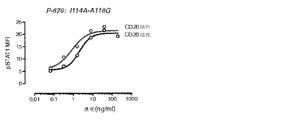
様々な実施形態では、改変IFN-γは、IFN-γ受容体1サブユニットへのその結合またはこれに対するその親和性および/またはこれに対する生物活性を低減させる1つ以上の突然変異を有する。1つの実施形態では、改変IFN-γはIFN-γ受容体1サブユニットで低減された親和性および/または活性を有する。様々な実施形態では、改変IFN-γは、IFN-γ受容体1サブユニットへの結合に関与するアミノ酸残基での1つ以上の突然変異を有するヒトIFN-γである。いくつかの実施形態では、改変IFN-γは、IFN-γ受容体1サブユニットとのインターフェースに位置するアミノ酸で1つ以上の突然変異を有するヒトIFN-γである。様々な実施形態では、1つ以上の突然変異は、限定はされないが、Q1、V5、E9、K12、H19、S20、V22、A23、D24、N25、G26、T27、L30、K108、H111、E112、I114、Q115、A118、E119、およびK125(野生型ヒトIFN-γであり、かつそのN末端シグナル配列を欠く、SEQ ID NO:947に各々関して)から選択されるアミノ酸においてである。いくつかの実施形態では、1つ以上の突然変異は、V5E、S20E、V22A、A23G、A23F、D24G、G26Q、H111A、H111D、I114A、Q115A、およびA118G(各々SEQ ID NO:947に関する)から選択される置換である。実施形態では、1つ以上の突然変異はV22A、A23G、D24G、H111A、H111D、I114A、Q115A、およびA118Gから選択される置換であり;これらの改変IFN-γは、それぞれ、SEQ ID NO:953、SEQ ID NO:954、およびSEQ ID NO:956~SEQ ID NO:961のアミノ酸配列を有する)。
In various embodiments, the modified IFN-γ has one or more mutations that reduce its binding to or its affinity for and/or biological activity against the IFN-
一実施形態では、改変IFN-γは突然変異A23GおよびD24Gを含み、この改変IFN-γはSEQ ID NO:955のアミノ酸配列を有する。別の実施形態では、改変IFN-γは突然変異I114AおよびA118Gを含み、この改変IFN-γはSEQ ID NO:962のアミノ酸配列を有する。さらなる実施形態では、改変IFN-γは突然変異V5E、S20E、A23F、およびG26Qを含む。 In one embodiment, the modified IFN-γ comprises mutations A23G and D24G and the modified IFN-γ has the amino acid sequence of SEQ ID NO:955. In another embodiment, the modified IFN-γ comprises mutations I114A and A118G and the modified IFN-γ has the amino acid sequence of SEQ ID NO:962. In further embodiments, the modified IFN-γ comprises mutations V5E, S20E, A23F, and G26Q.
様々な実施形態では、改変IFN-γは下記の突然変異の1つ以上を含む:残基A23の欠失、残基D24の欠失、S20I置換、A23V置換、D21K置換およびD24A置換。 In various embodiments, the modified IFN-γ comprises one or more of the following mutations: deletion of residue A23, deletion of residue D24, S20I substitution, A23V substitution, D21K substitution and D24A substitution.
いくつかの実施形態では、改変IFN-γは、IFN-γ受容体2サブユニットへのその結合またはこれに対するその親和性および/またはこれに対する生物活性を低減させる1つ以上の突然変異を有する。 In some embodiments, the modified IFN-γ has one or more mutations that reduce its binding to or its affinity for and/or biological activity against the IFN-γ receptor 2 subunit.
いくつかの実施形態では、改変IFN-γは、IFN-γ受容体1サブユニットおよびIFN-γ受容体2サブユニットの両方へのその結合またはこれに対するその親和性および/またはこれに対する生物活性を低減させる1つ以上の突然変異を有する。
In some embodiments, the modified IFN-γ enhances its binding to or its affinity for and/or biological activity for both the IFN-
いくつかの実施形態では、改変IFN-γは、IFN-γ受容体1へのその結合またはこれに対するその親和性および/またはこれに対する生物活性を低減させる1つ以上の突然変異、およびIFN-γ受容体2への結合またはその親和性および/またはこれに対する生物活性を実質的に低減または消失させる1つ以上の突然変異を有する。いくつかの実施形態では、そのような改変IFN-γを有するキメラタンパク質は標的-選択的IFN-γ受容体1活性(例えば、IFN-γ受容体1活性はターゲティング部分を介したターゲティングにより回復可能である)を提供できる。
In some embodiments, the modified IFN-γ has one or more mutations that reduce its binding to or its affinity for and/or biological activity against IFN-
いくつかの実施形態では、改変IFN-γは、IFN-γ受容体1へのその結合またはこれに対するその親和性および/またはこれに対する生物活性を低減させる1つ以上の突然変異、およびIFN-γ受容体1へのその結合またはこれに対するその親和性および/またはこれに対する生物活性を低減させる1つ以上の突然変異を有する。いくつかの実施形態では、そのような改変IFN-γを有するキメラタンパク質は標的-選択的IFN-γ受容体1および/またはIFN-γ受容体1活性を提供できる(例えば、IFN-γ受容体1およびIFN-γ受容体2活性はターゲティング部分によるターゲティングを介して回復可能である)。
In some embodiments, the modified IFN-γ has one or more mutations that reduce its binding to or its affinity for and/or biological activity against IFN-
様々な実施形態では、改変IFN-γはC末端でトランケートされる。いくつかの実施形態では、改変IFN-γはC末端の欠失を有するSEQ ID NO:947のアミノ酸配列を含む成熟IFN-γである。そのような実施形態では、成熟IFN-γは、少なくとも約1個、約2個、約3個、約4個、約5個、約6個、約7個、約8個、約9個、約10個、約11個、約12個、約13個、約14個、約15個、約16個、約17個、約18個、約19個、約20個、約21個、約22個、約23個、約24個、または約25個のアミノ酸残基のC末端トランケーションを含み得る。一実施形態では、改変IFN-γは、5アミノ酸のC末端欠失を有するSEQ ID NO:947のアミノ酸配列を含む成熟IFN-γであり、この改変IFN-γはSEQ ID NO:948のアミノ酸配列を有する。一実施形態では、改変IFN-γは7アミノ酸のC末端欠失を有するSEQ ID NO:947のアミノ酸配列を含む、成熟IFN-γであり、この改変IFN-γはSEQ ID NO:949のアミノ酸配列を有する。一実施形態では、改変IFN-γは、14アミノ酸のC末端欠失を有するSEQ ID NO:947のアミノ酸配列を含む成熟IFN-γであり、この改変IFN-γはSEQ ID NO:950のアミノ酸配列を有する。一実施形態では、改変IFN-γは15アミノ酸のC末端欠失を有するSEQ ID NO:947のアミノ酸配列を含む成熟IFN-γであり、この改変IFN-γはSEQ ID NO:951のアミノ酸配列を有する。一実施形態では、改変IFN-γは16アミノ酸のC末端欠失を有するSEQ ID NO:947のアミノ酸配列を含む成熟IFN-γであり、この改変IFN-γはSEQ ID NO:952のアミノ酸配列を有する。本発明で使用され得るC末端トランケーションを有する追加の改変IFN-γはHaelewyn et al., Biochem. J. (1997), 324:591-595およびLundell et al., Protein Eng. (1991) 4:335-341(全内容はこれにより参照により組み込まれる)において記載される。 In various embodiments, the modified IFN-γ is truncated at the C-terminus. In some embodiments, the modified IFN-γ is mature IFN-γ comprising the amino acid sequence of SEQ ID NO:947 with a C-terminal deletion. In such embodiments, the mature IFN-γ is at least about 1, about 2, about 3, about 4, about 5, about 6, about 7, about 8, about 9, about 10, about 11, about 12, about 13, about 14, about 15, about 16, about 17, about 18, about 19, about 20, about 21, about 22 , about 23, about 24, or about 25 amino acid residues. In one embodiment, the modified IFN-γ is mature IFN-γ comprising the amino acid sequence of SEQ ID NO:947 with a C-terminal deletion of 5 amino acids, wherein the modified IFN-γ comprises the amino acids of SEQ ID NO:948 has an array. In one embodiment, the modified IFN-γ is mature IFN-γ comprising the amino acid sequence of SEQ ID NO:947 with a C-terminal deletion of 7 amino acids, wherein the modified IFN-γ comprises the amino acids of SEQ ID NO:949 has an array. In one embodiment, the modified IFN-γ is mature IFN-γ comprising the amino acid sequence of SEQ ID NO: 947 with a C-terminal deletion of 14 amino acids, wherein the modified IFN-γ comprises the amino acids of SEQ ID NO: 950 has an array. In one embodiment, the modified IFN-γ is a mature IFN-γ comprising the amino acid sequence of SEQ ID NO:947 with a C-terminal deletion of 15 amino acids, wherein the modified IFN-γ has the amino acid sequence of SEQ ID NO:951 have In one embodiment, the modified IFN-γ is a mature IFN-γ comprising the amino acid sequence of SEQ ID NO:947 with a C-terminal deletion of 16 amino acids, wherein the modified IFN-γ has the amino acid sequence of SEQ ID NO:952 have Additional modified IFN-γ with C-terminal truncations that can be used in the present invention are described by Haelewyn et al. , Biochem. J. (1997), 324:591-595 and Lundell et al. , Protein Eng. (1991) 4:335-341, the entire contents of which are hereby incorporated by reference.
様々な実施形態では、改変IFN-γは、例えば、Randal et al. (2001) Structure 9:155-163およびRandal et al. (1998) Protein Sci. 7:1057-1060(全内容はこれにより参照により組み込まれる)において記載される単鎖IFN-γである。いくつかの実施形態では、単鎖IFN-γは、そのC末端で第2のIFN-γ鎖のN末端に連結される第1のIFN-γ鎖を含む。様々な実施形態では、第1および第2のIFN-γ鎖は、本明細書における他の場所で記載されるように、リンカーにより連結される。 In various embodiments, the modified IFN-γ is described, for example, in Randal et al. (2001) Structure 9:155-163 and Randal et al. (1998) Protein Sci. 7:1057-1060, the entire contents of which are hereby incorporated by reference. In some embodiments, the single-chain IFN-γ comprises a first IFN-γ chain linked at its C-terminus to the N-terminus of a second IFN-γ chain. In various embodiments, the first and second IFN-γ chains are linked by a linker, as described elsewhere herein.
いくつかの実施形態では、第1のIFN-γ鎖は、少なくとも約1個、約2個、約3個、約4個、約5個、約6個、約7個、約8個、約9個、約10個、約11個、約12個、約13個、約14個、約15個、約16個、約17個、約18個、約19個、約20個、約21個、約22個、約23個、約24個、または約25個のアミノ酸残基のC末端トランケーションを含む。一実施形態では、第1のIFN-γ鎖は約24アミノ酸残基のC末端トランケーションを含む。いくつかの実施形態では、第2のIFN-γ鎖は少なくとも約1個、約2個、約3個、約4個、または約5個のアミノ酸残基のN末端トランケーションを含む。一実施形態では、第2のIFN-γ鎖は約3アミノ酸残基のN末端トランケーションを含む。いくつかの実施形態では、第2のIFN-γ鎖は少なくとも約1個、約2個、約3個、約4個、約5個、約6個、約7個、約8個、約9個、約10個、約11個、約12個、約13個、約14個、約15個、約16個、約17個、約18個、約19個、約20個、約21個、約22個、約23個、約24個、または約25個のアミノ酸残基のC末端トランケーションを含む。様々な実施形態では、第1および/または第2のIFN-γ鎖は、本明細書における他の場所で記載されるように、Q1、V5、E9、K12、H19、S20、V22、A23、D24、N25、G26、T27、L30、K108、H111、E112、I114、Q115、A118、E119、およびK125での1つ以上のアミノ酸突然変異を含む。様々な実施形態では、第1および/または第2のIFN-γ鎖はV5E、S20E、V22A、A23G、A23F、D24G、G26Q、H111A、H111D、I114A、Q115A、およびA118Gから選択される1つ以上の置換を含む。様々な実施形態では、第1および/または第2のIFN-γ鎖は、V22A、A23G、D24G、H111A、H111D、I114A、Q115A、およびA118Gから選択される1つ以上の置換を含む。様々な実施形態では、第1および/または第2のIFN-γ鎖は、A23GおよびD24G置換を含む。様々な実施形態では、第1および/または第2のIFN-γ鎖はI114AおよびA118G置換を含む。別の実施形態では、突然変異はV5E、S20E、A23F、およびG26Qである。 In some embodiments, the first IFN-γ chain is at least about 1, about 2, about 3, about 4, about 5, about 6, about 7, about 8, about 9, about 10, about 11, about 12, about 13, about 14, about 15, about 16, about 17, about 18, about 19, about 20, about 21 , a C-terminal truncation of about 22, about 23, about 24, or about 25 amino acid residues. In one embodiment, the first IFN-γ chain comprises a C-terminal truncation of about 24 amino acid residues. In some embodiments, the second IFN-γ chain comprises an N-terminal truncation of at least about 1, about 2, about 3, about 4, or about 5 amino acid residues. In one embodiment, the second IFN-γ chain comprises an N-terminal truncation of about 3 amino acid residues. In some embodiments, the second IFN-γ chain is at least about 1, about 2, about 3, about 4, about 5, about 6, about 7, about 8, about 9 about 10, about 11, about 12, about 13, about 14, about 15, about 16, about 17, about 18, about 19, about 20, about 21, Including a C-terminal truncation of about 22, about 23, about 24, or about 25 amino acid residues. In various embodiments, the first and/or second IFN-γ chain is Q1, V5, E9, K12, H19, S20, V22, A23, as described elsewhere herein. Contains one or more amino acid mutations at D24, N25, G26, T27, L30, K108, H111, E112, I114, Q115, A118, E119, and K125. In various embodiments, the first and/or second IFN-γ chain is one or more selected from V5E, S20E, V22A, A23G, A23F, D24G, G26Q, H111A, H111D, I114A, Q115A, and A118G contains the replacement of In various embodiments, the first and/or second IFN-γ chain comprises one or more substitutions selected from V22A, A23G, D24G, H111A, H111D, I114A, Q115A, and A118G. In various embodiments, the first and/or second IFN-γ chain comprises A23G and D24G substitutions. In various embodiments, the first and/or second IFN-γ chain comprises I114A and A118G substitutions. In another embodiment, the mutations are V5E, S20E, A23F, and G26Q.
様々な実施形態では、第1および/または第2のIFN-γ鎖は本明細書で開示される1つ以上の置換を含み、第1および/または第2のIFN-γ鎖は本明細書で開示されるC末端トランケーションを含む。 In various embodiments, the first and/or second IFN-γ chain comprises one or more substitutions disclosed herein and the first and/or second IFN-γ chain is including the C-terminal truncations disclosed in
様々な実施形態では、第1および/または第2のIFN-γ鎖は本明細書で開示される1つ以上の置換、および本明細書で開示されるC末端トランケーションを含む。 In various embodiments, the first and/or second IFN-γ chain comprises one or more substitutions disclosed herein and a C-terminal truncation disclosed herein.
ヒトIFN-γの結晶構造は知られており、例えば、Ealick et al., (1991) Science, 252: 698-702において記載される。特定的には、ヒトIFN-γの構造は、6つのα-へリックスのコアおよびC末端領域における折り畳まれていない拡張配列を含むことが示されている。様々な実施形態では、改変IFN-γは、1つ以上のへリックスにおいて1つ以上の突然変異を有し、これは、治療的受容体(例えば、IFN-γ受容体)でのその結合親和性および/または生物活性を低減させる。 The crystal structure of human IFN-γ is known, see, for example, Ealick et al. , (1991) Science, 252: 698-702. Specifically, the structure of human IFN-γ has been shown to include unfolded extensions in the core and C-terminal regions of six α-helices. In various embodiments, the modified IFN-γ has one or more mutations in one or more helices that reduce its binding affinity at a therapeutic receptor (eg, IFN-γ receptor). reduce sexuality and/or biological activity.
様々な実施形態では、改変IFN-γは、野生型IFN-γと比べて、治療的受容体(例えば、IFN-γ受容体またはそのIFN-γ受容体1サブユニットおよびIFN-γ受容体2サブユニットのいずれか一つ)に対し約1%、または約3%、約5%、約10%、約15%、約20%、約25%、約30%、約35%、約40%、約45%、約50%、約60%、約65%、約70%、約75%、約80%、約85%、約90%、約95%、または約10%-20%、約20%-40%、約50%、約40%-60%、約60%-80%、約80%-100%の親和性および/または生物活性を有する。いくつかの実施形態では、結合親和性および/または生物活性は、野生型IFN-γと比べて、少なくとも約2倍低く、約3倍低く、約4倍低く、約5倍低く、約6倍低く、約7倍低く、約8倍低く、約9倍低く、少なくとも約10倍低く、少なくとも約15倍低く、少なくとも約20倍低く、少なくとも約25倍低く、少なくとも約30倍低く、少なくとも約35倍低く、少なくとも約40倍低く、少なくとも約45倍低く、少なくとも約50倍低く、少なくとも約100倍低く、少なくとも約150倍低く、または約10~50倍低く、約50~100倍低く、約100~150倍低く、約150~200倍低く、または200超倍低い。
In various embodiments, the modified IFN-γ has a therapeutic receptor (eg, IFN-γ receptor or its IFN-
様々な実施形態では、改変IFN-γは、例えば、野生型IFN-γと比べて、IFN-γの内在活性を約75%、または約70%、または約60%、または約50%、または約40%、または約30%、または約25%、または約20%、または約10%、または約5%、または約3%、または約1%に低減させる1つ以上の突然変異を含む。 In various embodiments, the modified IFN-γ reduces the intrinsic activity of IFN-γ by about 75%, or about 70%, or about 60%, or about 50%, or Including one or more mutations that reduce to about 40%, or about 30%, or about 25%, or about 20%, or about 10%, or about 5%, or about 3%, or about 1%.
いくつかの実施形態では、改変IFN-γは、改変IFN-γが、受容体に対して低減された親和性および/または生物活性を有するようにする1つ以上の突然変異を含む。いくつかの実施形態では、受容体に対する改変IFN-γの結合親和性および/または生物活性は、その受容体に対するターゲティング部分の結合親和性および/または生物活性より低い。いくつかの実施形態では、この結合親和性および/または生物活性の差は、同じ細胞上での改変IFN-γ/受容体とターゲティング部分/受容体の間のものである。いくつかの実施形態では、この結合親和性および/または生物活性の差は、改変IFN-γが局所的な、的確な効果を有し、野生型IFN-γで観察される副作用の根底にあるオフターゲット効果を最小に抑えることを可能にする。いくつかの実施形態では、この結合親和性および/または生物活性は、少なくとも約2倍、または少なくとも約5倍、または少なくとも約10倍、または少なくとも約15倍低く、または少なくとも約25倍、または少なくとも約50倍低く、または少なくとも約100倍、または少なくとも約150倍低い。 In some embodiments, the modified IFN-γ comprises one or more mutations that cause the modified IFN-γ to have reduced affinity and/or biological activity for the receptor. In some embodiments, the binding affinity and/or biological activity of the modified IFN-γ for its receptor is lower than the binding affinity and/or biological activity of the targeting moiety for its receptor. In some embodiments, this difference in binding affinity and/or biological activity is between the modified IFN-γ/receptor and the targeting moiety/receptor on the same cell. In some embodiments, this difference in binding affinity and/or biological activity is such that modified IFN-γ has local, targeted effects and underlies the side effects observed with wild-type IFN-γ. Allows for minimizing off-target effects. In some embodiments, the binding affinity and/or biological activity is at least about 2-fold, or at least about 5-fold, or at least about 10-fold, or at least about 15-fold lower, or at least about 25-fold lower, or at least about 25-fold lower, or at least about 5-fold lower About 50 times lower, or at least about 100 times lower, or at least about 150 times lower.
受容体結合活性は当技術分野で知られている方法を使用して測定され得る。例えば、親和性および/または結合活性は、結合データのスキャッチャードプロット分析およびコンピュータ-フィッティング(例えば、Scatchard, 1949)により、またはBrecht et al.(1993)(その全ての全内容がこれにより参照により組み込まれる)により記載されるように、フロースルー条件下での反射干渉分光法により、評価され得る。 Receptor binding activity can be measured using methods known in the art. For example, affinity and/or avidity can be determined by Scatchard plot analysis and computer-fitting of binding data (eg Scatchard, 1949) or by Brecht et al. (1993), the entire contents of which are hereby incorporated by reference, by reflectance interferometry under flow-through conditions.
様々な実施形態では、治療的受容体での減弱された活性、治療的受容体での弱められた親和性および/または生物活性は、治療活性部位で抗原に対する高親和性を有するターゲティング部分(例えば、本明細書で記載される抗体または抗体フォーマット)の付着により回復可能である。ターゲティングは、改変IFN-γをターゲティング部分に連結させることにより実現される。一実施形態では、改変IFN-γは、そのアミノ末端を介してターゲティング部分に連結される。別の実施形態では、改変IFN-γは、そのカルボキシ末端を介してターゲティング部分に連結される。このように、本キメラタンパク質は、いくつかの実施形態では、治療的受容体で、局所的な、的確な、および制御された治療作用を提供する。 In various embodiments, attenuated activity at therapeutic receptors, attenuated affinity at therapeutic receptors and/or biological activity is associated with targeting moieties (e.g., , antibodies or antibody formats described herein). Targeting is accomplished by linking the modified IFN-γ to a targeting moiety. In one embodiment, the modified IFN-γ is linked to the targeting moiety via its amino terminus. In another embodiment, the modified IFN-γ is linked to a targeting moiety through its carboxy terminus. Thus, the chimeric proteins, in some embodiments, provide localized, targeted and controlled therapeutic action at therapeutic receptors.
様々な実施形態では、本発明のキメラタンパク質は、本明細書で開示される1つ以上の置換および/または本明細書で開示されるC末端トランケーションを含むIFN-γを含む。 In various embodiments, chimeric proteins of the invention comprise IFN-γ comprising one or more substitutions disclosed herein and/or C-terminal truncations disclosed herein.
本改変インターフェロン-γを含む治療薬
ターゲティング部分の細胞動員
様々な実施形態では、本発明のキメラタンパク質は、関心のある標的(例えば、抗原、受容体)に特異的に結合する認識ドメインを有する1つ以上のターゲティング部分を追加的に含む。例示的な実施形態では、キメラタンパク質は、2、3、4、5、6、7、8、9、10個またはそれより多いターゲティング部分を含み得る。様々な実施形態では、関心の標的(例えば、抗原、受容体)は、1つ以上の免疫細胞上で見出すことができ、それらとしては、T細胞、細胞傷害性Tリンパ球、ヘルパーT細胞、ナチュラルキラー(NK)細胞、ナチュラルキラーT(NKT)細胞、抗腫瘍マクロファージ(例えば、M1マクロファージ)、B細胞、樹状細胞、またはそれらのサブセットが挙げられるが、それらに限定されない。いくつかの実施形態では、認識ドメインは関心の標的(例えば、抗原、受容体)に特異的に結合し、効果的に、直接的にまたは間接的に、1つ以上の免疫細胞を動員する。いくつかの実施形態では、関心の標的(例えば、抗原、受容体)は1つ以上の腫瘍細胞上で見出すことができる。いくつかの実施形態では、本発明のキメラタンパク質は2つ以上のターゲティング部分を含む。そのような実施形態では、キメラタンパク質は2つの異なる細胞(例えば、シナプスを形成するため)または同じ細胞(例えば、より濃縮されたシグナル伝達物質効果を得るため)を標的にできる。いくつかの実施形態では、本キメラタンパク質は、直接的にまたは間接的に、免疫細胞を、例えば、いくつかの実施形態では、治療部位(例えば、1つ以上の疾患細胞を有する部位または治療効果のために調節される細胞)に動員できる。いくつかの実施形態では、本キメラタンパク質は直接的にまたは間接的に免疫細胞、例えば、腫瘍細胞を死滅させるおよび/または抑制することができる免疫細胞を、作用部位(例えば、非限定的例として、腫瘍微小環境)に動員できる。
Therapeutic Agents Comprising the Modified Interferon-γ Cellular Recruitment of Targeting Moieties In various embodiments, the chimeric proteins of the invention have a recognition domain that specifically binds to a target of interest (eg, antigen, receptor)1 Additionally contains one or more targeting moieties. In exemplary embodiments, a chimeric protein may comprise 2, 3, 4, 5, 6, 7, 8, 9, 10 or more targeting moieties. In various embodiments, targets of interest (e.g., antigens, receptors) can be found on one or more immune cells, including T cells, cytotoxic T lymphocytes, helper T cells, Natural killer (NK) cells, natural killer T (NKT) cells, antitumor macrophages (eg, M1 macrophages), B cells, dendritic cells, or subsets thereof, include, but are not limited to. In some embodiments, a recognition domain specifically binds to a target of interest (eg, antigen, receptor) and effectively recruits, directly or indirectly, one or more immune cells. In some embodiments, targets of interest (eg, antigens, receptors) can be found on one or more tumor cells. In some embodiments, the chimeric proteins of the invention comprise two or more targeting moieties. In such embodiments, the chimeric protein can target two different cells (eg, to form a synapse) or the same cell (eg, to obtain a more concentrated signal transducer effect). In some embodiments, the chimeric protein directly or indirectly targets an immune cell, e.g. cells that are regulated for In some embodiments, the chimeric protein directly or indirectly targets an immune cell capable of killing and/or suppressing an immune cell, e.g., a tumor cell, at a site of action (e.g., by way of non-limiting example , tumor microenvironment).
様々な実施形態では、ターゲティング部分は、疾患細胞および/またはエフェクター細胞などの細胞を直接的にまたは間接的に動員できる。様々な実施形態では、シグナル伝達物質(例えば、改変IFN-γ)は、ターゲティング部分により標的にされる1つ以上の細胞(例えば、疾患細胞および/またはエフェクター細胞などの動員される細胞)を調節できる。例えば、シグナル伝達物質(例えば、改変IFN-γ)は、標的細胞がシグナル伝達物質に対する受容体を発現するかどうかによって、標的細胞(標的細胞はエフェクターおよび/または疾患細胞であってよい)の1つまたは両方を調節できる。 In various embodiments, targeting moieties can directly or indirectly recruit cells, such as disease cells and/or effector cells. In various embodiments, the signaling agent (eg, modified IFN-γ) modulates one or more cells targeted by the targeting moiety (eg, disease cells and/or recruited cells such as effector cells). can. For example, a signaling agent (eg, modified IFN-γ) can be used to target cells (which may be effector and/or disease cells) depending on whether the target cell expresses a receptor for the signaling agent. You can adjust one or both.
いくつかの実施形態では、本キメラタンパク質は、腫瘍の免疫攻撃に有利に免疫細胞の均衡をシフトさせることができ、またはこれを含む方法において用途を見出す。例えば、本キメラタンパク質は、臨床的に重要な部位で、腫瘍を死滅させるおよび/または抑制することができる細胞(例えば、T細胞、細胞傷害性Tリンパ球、ヘルパーT細胞、ナチュラルキラー(NK)細胞、ナチュラルキラーT(NKT)細胞、抗腫瘍マクロファージ(例えば、M1マクロファージ)、B細胞、樹状細胞、またはそれらのサブセット)に有利に、かつ腫瘍を保護する細胞(例えば、骨髄系由来サプレッサー細胞(MDSC)、制御性T細胞(Treg);腫瘍関連好中球(TAN)、M2マクロファージ、腫瘍関連マクロファージ(TAM)、またはそれらのサブセット)に反して、免疫細胞の比率をシフトさせることができる。いくつかの実施形態では、本キメラタンパク質はエフェクターT細胞対制御性T細胞の比を増加させることができる。 In some embodiments, the chimeric proteins find use in methods that can or involve shifting the balance of immune cells in favor of immune attack of tumors. For example, the chimeric protein can be used in clinically relevant sites to kill and/or suppress tumor cells (e.g., T cells, cytotoxic T lymphocytes, helper T cells, natural killer (NK) cells). cells, natural killer T (NKT) cells, anti-tumor macrophages (e.g., M1 macrophages), B cells, dendritic cells, or subsets thereof) and protect tumors (e.g., myeloid-derived suppressor cells). (MDSC), regulatory T cells (Treg); tumor-associated neutrophils (TAN), M2 macrophages, tumor-associated macrophages (TAM), or subsets thereof) can shift the proportion of immune cells . In some embodiments, the chimeric protein can increase the ratio of effector T cells to regulatory T cells.
例えば、いくつかの実施形態では、認識ドメインは、T細胞と関連する標的(例えば、抗原、受容体)に特異的に結合する。いくつかの実施形態では、認識ドメインは、T細胞を直接的にまたは間接的に動員する。一実施形態では、認識ドメインは、エフェクターT細胞に特異的に結合する。いくつかの実施形態では、認識ドメインはエフェクターT細胞を、例えば、いくつかの実施形態では、治療部位(例えば、1つ以上の疾患細胞を有する部位または治療効果のために調節されるべき細胞)に直接的にまたは間接的に動員する。例示的なエフェクターT細胞としては、下記が挙げられる:細胞傷害性T細胞(例えば、αβTCR、CD3+、CD8+、CD45RO+);CD4+エフェクターT細胞(例えば、αβTCR、CD3+、CD4+、CCR7+、CD62Lhi、IL-7R/CD127+);CD8+エフェクターT細胞(例えば、αβTCR、CD3+、CD8+、CCR7+、CD62Lhi、IL-7R/CD127+);エフェクターメモリーT細胞(例えば、CD62Llow、CD44+、TCR、CD3+、IL-7R/CD127+、IL-15R+、CCR7low);セントラルメモリーT細胞(例えば、CCR7+、CD62L+、CD27+;またはCCR7hi、CD44+、CD62Lhi、TCR、CD3+、IL-7R/CD127+、IL-15R+);CD62L+エフェクターT細胞;CD8+エフェクターメモリーT細胞(TEM)、例えば初期エフェクターメモリーT細胞(CD27+CD62L-)および後期エフェクターメモリーT細胞(CD27-CD62L-)(それぞれ、TemEおよびTemL);CD127(+)CD25(low/-)エフェクターT細胞;CD127(-)CD25(-)エフェクターT細胞;CD8+幹細胞メモリーエフェクター細胞(TSCM)(例えば、CD44(low)CD62L(high)CD122(high)sca(+));TH1エフェクターT細胞(例えば、CXCR3+、CXCR6+およびCCR5+;またはαβTCR、CD3+、CD4+、IL-12R+、IFNγR+、CXCR3+)、TH2エフェクターT細胞(例えば、CCR3+、CCR4+およびCCR8+;またはαβTCR、CD3+、CD4+、IL-4R+、IL-33R+、CCR4+、IL-17RB+、CRTH2+);TH9エフェクターT細胞(例えば、αβTCR、CD3+、CD4+);TH17エフェクターT細胞(例えば、αβTCR、CD3+、CD4+、IL-23R+、CCR6+、IL-1R+);CD4+CD45RO+CCR7+エフェクターT細胞、ICOS+エフェクターT細胞;CD4+CD45RO+CCR7(-)エフェクターT細胞;およびIL-2、IL-4および/またはIFN-γを分泌するエフェクターT細胞。 For example, in some embodiments, a recognition domain specifically binds a target (eg, antigen, receptor) associated with T cells. In some embodiments, the recognition domain directly or indirectly recruits T cells. In one embodiment, the recognition domain specifically binds to effector T cells. In some embodiments, the recognition domain is an effector T cell, e.g., in some embodiments, a therapeutic site (e.g., a site with one or more diseased cells or cells to be modulated for therapeutic effect). mobilize directly or indirectly to Exemplary effector T cells include: cytotoxic T cells (eg, αβTCR, CD3 + , CD8 + , CD45RO + ); CD4 + effector T cells (eg, αβTCR, CD3 + , CD4 + , CCR7 + , CD62Lhi, IL - 7R/CD127 + ); CD8 + effector T cells (eg αβTCR, CD3 + , CD8 + , CCR7 + , CD62Lhi, IL - 7R/CD127 + ); effector memory T cells (eg CD62Llow , CD44 + , TCR, CD3 + , IL - 7R/CD127 + , IL-15R + , CCR7low); central memory T cells (eg, CCR7 + , CD62L + , CD27 + ; or CCR7hi, CD44 + , CD62Lhi, TCR, CD3 + , IL-7R/CD127 + , IL-15R + ); CD62L + effector T cells; CD8 + effector memory T cells (TEM), such as early effector memory T cells (CD27 + CD62L − ) and late effector memory T cells. (CD27 − CD62L − ) (TemE and TemL, respectively); CD127( + )CD25(low/−) effector T cells; CD127( − )CD25( − ) effector T cells; CD8 + stem cell memory effector cells (TSCM) ( CD44 (low) CD62L (high) CD122 (high) sca( + )); TH1 effector T cells (e.g. CXCR3 + , CXCR6 + and CCR5 + ; or αβTCR, CD3 + , CD4 + , IL-12R + , IFNγR + , CXCR3 + ), TH2 effector T cells (e.g. CCR3 + , CCR4 + and CCR8 + ; or αβTCR, CD3 + , CD4 + , IL-4R + , IL-33R + , CCR4 + , IL-17RB + , CRTH2 + ); TH9 effector T cells (eg αβTCR, CD3 + , CD4 + ); TH17 effector T cells (eg αβTCR, CD3 + , CD4 + , IL-23R + , CCR6 + , IL-1R + ); CD4 + CD45RO + CCR7 + Effector T cells, ICOS + effector T cells; CD4 + CD45RO + CCR7( - ) effector T cells; and effector T cells secreting IL-2, IL-4 and/or IFN-γ.
関心のある例示的なT細胞抗原としては、例えば下記が挙げられる(該当する場合、細胞外ドメインを含む):CD8、CD3、SLAMF4、IL-2Rα、4-1BB/TNFRSF9、IL-2 R β、ALCAM、B7-1、IL-4 R、B7-H3、BLAME/SLAMFS、CEACAM1、IL-6 R、CCR3、IL-7 Rα、CCR4、CXCR1/IL-S RA、CCR5、CCR6、IL-10R α、CCR 7、IL-10 R β、CCRS、IL-12 R β 1、CCR9、IL-12 R β 2、CD2、IL-13 R α 1、IL-13、CD3、CD4、ILT2/CDS5j、ILT3/CDS5k、ILT4/CDS5d、ILT5/CDS5a、lutegrin α 4/CD49d、CDS、インテグリン α E/CD103、CD6、インテグリン α M/CD 11 b、CDS、インテグリン α X/CD11c、インテグリン β 2/CD1S、KIR/CD15S、CD27/TNFRSF7、KIR2DL1、CD2S、KIR2DL3、CD30/TNFRSFS、KIR2DL4/CD15Sd、CD31/PECAM-1、KIR2DS4、CD40 リガンド/TNFSF5、LAG-3、CD43、LAIR1、CD45、LAIR2、CDS3、ロイコトリエン B4-R1、CDS4/SLAMF5、NCAM-L1、CD94、NKG2A、CD97、NKG2C、CD229/SLAMF3、NKG2D、CD2F-10/SLAMF9、NT-4、CD69、NTB-A/SLAMF6、Common γ鎖/IL-2 R γ、オステオポンチン、CRACC/SLAMF7、PD-1、CRTAM、PSGL-1、CTLA-4、RANK/TNFRSF11A、CX3CR1、CX3CL1、L-セレクチン、CXCR3、SIRP β 1、CXCR4、SLAM、CXCR6、TCCR/WSX-1、DNAM-1、サイモポエチン、EMMPRIN/CD147、TIM-1、EphB6、TIM-2、Fas/TNFRSF6、TIM-3、Fasリガンド/TNFSF6、TIM-4、Fcγ RIII/CD16、TIM-6、TNFR1/TNFRSF1A、グラニュライシン、TNF RIII/TNFRSF1B、TRAIL R1/TNFRSF10A、ICAM-1/CD54、TRAIL R2/TNFRSF10B、ICAM-2/CD102、TRAILR3/TNFRSF10C、IFN-γR1、TRAILR4/TNFRSF10D、IFN-γ R2、TSLP、IL-1 R1およびTSLP R。様々な実施形態では、キメラタンパク質のターゲティング部分はこれらの例示的なT細胞抗原の1つ以上を結合する。 Exemplary T cell antigens of interest include, for example (including extracellular domains where applicable): CD8, CD3, SLAMF4, IL-2Rα, 4-1BB/TNFRSF9, IL-2 Rβ. , ALCAM, B7-1, IL-4 R, B7-H3, BLAME/SLAMFS, CEACAM1, IL-6 R, CCR3, IL-7Rα, CCR4, CXCR1/IL-SRA, CCR5, CCR6, IL-10R α, CCR 7, IL-10 R β, CCRS, IL-12 R β 1, CCR9, IL-12 R β 2, CD2, IL-13 R α 1, IL-13, CD3, CD4, ILT2/CDS5j, ILT3/CDS5k, ILT4/CDS5d, ILT5/CDS5a, lutegrin α4/CD49d, CDS, integrin α E/CD103, CD6, integrin α M/CD11b, CDS, integrin α X/CD11c, integrin β2/CD1S, KIR/CD15S, CD27/TNFRSF7, KIR2DL1, CD2S, KIR2DL3, CD30/TNFRSFS, KIR2DL4/CD15Sd, CD31/PECAM-1, KIR2DS4, CD40 ligands/TNFSF5, LAG-3, CD43, LAIR1, CD45, LAIR2, CDS3, leukotrienes B4-R1, CDS4/SLAMF5, NCAM-L1, CD94, NKG2A, CD97, NKG2C, CD229/SLAMF3, NKG2D, CD2F-10/SLAMF9, NT-4, CD69, NTB-A/SLAMF6, Common gamma chain/IL- 2Rγ, osteopontin, CRACC/SLAMF7, PD-1, CRTAM, PSGL-1, CTLA-4, RANK/TNFRSF11A, CX3CR1, CX3CL1, L-selectin, CXCR3, SIRP β1, CXCR4, SLAM, CXCR6, TCCR/ WSX-1, DNAM-1, Thymopoietin, EMMPRIN/CD147, TIM-1, EphB6, TIM-2, Fas/TNFRSF6, TIM-3, Fas ligand/TNFSF6, TIM-4, FcγRIII/CD16, TIM-6, TNFR1/TNFRSF1A, granulysin, TNF RI II/TNFRSF1B, TRAIL R1/TNFRSF10A, ICAM-1/CD54, TRAIL R2/TNFRSF10B, ICAM-2/CD102, TRAILR3/TNFRSF10C, IFN-γR1, TRAILR4/TNFRSF10D, IFN-γ R2, TSLP, IL-1 R1 and TSLP R. In various embodiments, the targeting portion of the chimeric protein binds one or more of these exemplary T cell antigens.
非限定的例として、様々な実施形態では、本キメラタンパク質は、T細胞上で発現されるチェックポイントマーカー、例えば、PD-1、CD28、CTLA4、ICOS、BTLA、KIR、LAG3、CD137、OX40、CD27、CD40L、TIM3、およびA2aRの1つ以上に向けられるターゲティング部分を有する。 By way of non-limiting example, in various embodiments, the chimeric protein is a checkpoint marker expressed on T cells, such as PD-1, CD28, CTLA4, ICOS, BTLA, KIR, LAG3, CD137, OX40, It has targeting moieties directed to one or more of CD27, CD40L, TIM3, and A2aR.
例えば、いくつかの実施形態では、認識ドメインは、B細胞と関連する標的(例えば、抗原、受容体)に特異的に結合する。いくつかの実施形態では、認識ドメインは、B細胞を、例えば、いくつかの実施形態では、治療部位(例えば、1つ以上の疾患細胞を有する部位または治療効果のために調節されるべき細胞)に直接的にまたは間接的に動員する。関心のある例示的なB細胞抗原としては、例えば、CD10、CD19、CD20、CD21、CD22、CD23、CD24、CD37、CD38、CD39、CD40、CD70、CD72、CD73、CD74、CDw75、CDw76、CD77、CD78、CD79a/b、CD80、CD81、CD82、CD83、CD84、CD85、CD86、CD89、CD98、CD126、CD127、CDw130、CD138、CDw150およびB細胞成熟抗原(BCMA)が挙げられる。様々な実施形態では、キメラタンパク質のターゲティング部分は、これらの例示的なB細胞抗原の1つ以上を結合する。 For example, in some embodiments, a recognition domain specifically binds a target (eg, antigen, receptor) associated with B cells. In some embodiments, the recognition domains target B cells, e.g., in some embodiments, therapeutic sites (e.g., sites with one or more diseased cells or cells to be modulated for therapeutic effect). mobilize directly or indirectly to Exemplary B cell antigens of interest include, for example, CD10, CD19, CD20, CD21, CD22, CD23, CD24, CD37, CD38, CD39, CD40, CD70, CD72, CD73, CD74, CDw75, CDw76, CD77, CD78, CD79a/b, CD80, CD81, CD82, CD83, CD84, CD85, CD86, CD89, CD98, CD126, CD127, CDw130, CD138, CDw150 and B cell maturation antigen (BCMA). In various embodiments, the targeting portion of the chimeric protein binds one or more of these exemplary B-cell antigens.
さらなる例として、いくつかの実施形態では、認識ドメインはナチュラルキラー細胞と関連する標的(例えば、抗原、受容体)に特異的に結合する。いくつかの実施形態では、認識ドメインは、ナチュラルキラー細胞を、例えば、いくつかの実施形態では、治療部位(例えば、1つ以上の疾患細胞を有する部位または治療効果のために調節されるべき細胞)に直接的にまたは間接的に動員する。関心のある例示的なナチュラルキラー細胞抗原としては、例えばTIGIT、2B4/SLAMF4、KIR2DS4、CD155/PVR、KIR3DL1、CD94、LMIR1/CD300A、CD69、LMIR2/CD300c、CRACC/SLAMF7、LMIR3/CD300LF、DNAM-1、LMIR5/CD300LB、Fc-ε RII、LMIR6/CD300LE、Fc-γ RI/CD64、MICA、Fc-γ RIIB/CD32b、MICB、Fc-γ RIIC/CD32c、MULT-1、Fc-γ RIIA/CD32a、ネクチン-2/CD112、Fc-γ RIII/CD16、NKG2A、FcRH1/IRTA5、NKG2C、FcRH2/IRTA4、NKG2D、FcRH4/IRTA1、NKp30、FcRH5/IRTA2、NKp44、Fc-受容体様3/CD16-2、NKp46/NCR1、NKp80/KLRF1、NTB-A/SLAMF6、Rae-1、Rae-1 α、Rae-1 β、Rae-1 δ、H60、Rae-1 ε、ILT2/CD85j、Rae-1 γ、ILT3/CD85k、TREM-1、ILT4/CD85d、TREM-2、ILT5/CD85a、TREM-3、KIR/CD158、TREML1/TLT-1、KIR2DL1、ULBP-1、KIR2DL3、ULBP-2、KIR2DL4/CD158dおよびULBP-3が挙げられる。様々な実施形態では、キメラタンパク質のターゲティング部分は、これらの例示的なNK細胞抗原の1つ以上を結合する。 By way of further example, in some embodiments, the recognition domains specifically bind to targets (eg, antigens, receptors) associated with natural killer cells. In some embodiments, the recognition domains target natural killer cells, e.g., in some embodiments, therapeutic sites (e.g., sites with one or more diseased cells or cells to be modulated for therapeutic effect). ) directly or indirectly. Exemplary natural killer cell antigens of interest include, for example, TIGIT, 2B4/SLAMF4, KIR2DS4, CD155/PVR, KIR3DL1, CD94, LMIR1/CD300A, CD69, LMIR2/CD300c, CRACC/SLAMF7, LMIR3/CD300LF, DNAM- 1, LMIR5/CD300LB, Fc-ε RII, LMIR6/CD300LE, Fc-γ RI/CD64, MICA, Fc-γ RIIB/CD32b, MICB, Fc-γ RIIC/CD32c, MULT-1, Fc-γ RIIA/CD32a , Nectin-2/CD112, Fc-gamma RIII/CD16, NKG2A, FcRH1/IRTA5, NKG2C, FcRH2/IRTA4, NKG2D, FcRH4/IRTA1, NKp30, FcRH5/IRTA2, NKp44, Fc-receptor-like 3/CD16-2 , NKp46/NCR1, NKp80/KLRF1, NTB-A/SLAMF6, Rae-1, Rae-1 α, Rae-1 β, Rae-1 δ, H60, Rae-1 ε, ILT2/CD85j, Rae-1 γ, ILT3/CD85k, TREM-1, ILT4/CD85d, TREM-2, ILT5/CD85a, TREM-3, KIR/CD158, TREML1/TLT-1, KIR2DL1, ULBP-1, KIR2DL3, ULBP-2, KIR2DL4/CD158d and ULBP-3 is included. In various embodiments, the targeting portion of the chimeric protein binds one or more of these exemplary NK cell antigens.
また、いくつかの実施形態では、認識ドメインは、マクロファージ/単球と関連する標的(例えば、抗原、受容体)に特異的に結合する。いくつかの実施形態では、認識ドメインは、マクロファージ/単球を、例えば、いくつかの実施形態では、治療部位(例えば、1つ以上の疾患細胞を有する部位または治療効果のために調節されるべき細胞)に直接的にまたは間接的に動員する。関心のある例示的なマクロファージ/単球抗原としては、例えばSIRP1a、B7-1/CD80、ILT4/CD85d、B7-H1、ILT5/CD85a、Common β鎖、インテグリン α 4/CD49d、BLAME/SLAMF8、インテグリン α X/CD11c、CCL6/C10、インテグリン β 2/CD18、CD155/PVR、インテグリン β 3/CD61、CD31/PECAM-1、ラテキシン、CD36/SR-B3、ロイコトリエン B4 R1、CD40/TNFRSF5、LIMPIIISR-B2、CD43、LMIR1/CD300A、CD45、LMIR2/CD300c、CD68、LMIR3/CD300LF、CD84/SLAMF5、LMIR5/CD300LB、CD97、LMIR6/CD300LE、CD163、LRP-1、CD2F-10/SLAMF9、MARCO、CRACC/SLAMF7、MD-1、ECF-L、MD-2、EMMPRIN/CD147、MGL2、エンドグリン/CD105、オステオアクチビン/GPNMB、Fc-γ RI/CD64、オステオポンチン、Fc-γ RIIB/CD32b、PD-L2、Fc-γ RIIC/CD32c、シグレック-3/CD33、Fc-γ RIIA/CD32a、SIGNR1/CD209、Fc-γ RIII/CD16、SLAM、GM-CSF R α、TCCR/WSX-1、ICAM-2/CD102、TLR3、IFN-γ RI、TLR4、IFN-γ R2、TREM-1、IL-1 RII、TREM-2、ILT2/CD85j、TREM-3、ILT3/CD85k、TREML1/TLT-1、2B4/SLAMF 4、IL-10 R α、ALCAM、IL-10 R β、アミノペプチダーゼN/ANPEP、ILT2/CD85j、Common β鎖、ILT3/CD85k、C1q R1/CD93、ILT4/CD85d、CCR1、ILT5/CD85a、CCR2、インテグリン α 4/CD49d、CCR5、インテグリン α M/CD11 b、CCR8、インテグリン α X/CD11c、CD155/PVR、インテグリン β 2/CD18、CD14、インテグリン β 3/CD61、CD36/SR-B3、LAIR1、CD43、LAIR2、CD45、ロイコトリエン B4-R1、CD68、LIMPIIISR-B2、CD84/SLAMF5、LMIR1/CD300A、CD97、LMIR2/CD300c、LMIR3/CD300LF、凝固因子III/組織因子、LMIR5/CD300LB、CX3CR1、CX3CL1、LMIR6/CD300LE、CXCR4、LRP-1、CXCR6、M-CSF R、DEP-1/CD148、MD-1、DNAM-1、MD-2、EMMPRIN/CD147、MMR、エンドグリン/CD105、NCAM-L1、Fc-γ RI/CD64、PSGL-1、Fc-γ RIIIICD16、RP105、G-CSF R、L-セレクチン、GM-CSF R α、シグレック-3/CD33、HVEM/TNFRSF14、SLAM、ICAM-1/CD54、TCCR/WSX-1、ICAM-2/CD102、TREM-1、IL-6 R、TREM-2、CXCR1/IL-8 RA、TREM-3およびTREML1/TLT-1が挙げられる。様々な実施形態では、キメラタンパク質のターゲティング部分は、これらの例示的なマクロファージ/単球抗原の1つ以上を結合する。 Also, in some embodiments, the recognition domain specifically binds to a target (eg, antigen, receptor) associated with macrophages/monocytes. In some embodiments, the recognition domains target macrophages/monocytes, e.g. cell) directly or indirectly. Exemplary macrophage/monocyte antigens of interest include, for example, SIRP1a, B7-1/CD80, ILT4/CD85d, B7-H1, ILT5/CD85a, Common β chain, Integrin α4/CD49d, BLAME/SLAMF8, Integrin α X/CD11c, CCL6/C10, Integrin β2/CD18, CD155/PVR, Integrin β3/CD61, CD31/PECAM-1, Latexin, CD36/SR-B3, Leukotriene B4 R1, CD40/TNFRSF5, LIMPIIISR-B2 , CD43, LMIR1/CD300A, CD45, LMIR2/CD300c, CD68, LMIR3/CD300LF, CD84/SLAMF5, LMIR5/CD300LB, CD97, LMIR6/CD300LE, CD163, LRP-1, CD2F-10/SLAMF9, MARCO, CRACC/SLAMF7 , MD-1, ECF-L, MD-2, EMMPRIN/CD147, MGL2, Endoglin/CD105, Osteoactivin/GPNMB, Fc-gamma RI/CD64, Osteopontin, Fc-gamma RIIB/CD32b, PD-L2, Fc - gamma RIIC/CD32c, Siglec-3/CD33, Fc-gamma RIIA/CD32a, SIGNR1/CD209, Fc-gamma RIII/CD16, SLAM, GM-CSF R alpha, TCCR/WSX-1, ICAM-2/CD102, TLR3, IFN-γ RI, TLR4, IFN-γ R2, TREM-1, IL-1 RII, TREM-2, ILT2/CD85j, TREM-3, ILT3/CD85k, TREML1/TLT-1, 2B4/SLAMF 4, IL-10 R α, ALCAM, IL-10 R β, Aminopeptidase N/ANPEP, ILT2/CD85j, Common β chain, ILT3/CD85k, C1q R1/CD93, ILT4/CD85d, CCR1, ILT5/CD85a, CCR2, Integrin α4/CD49d, CCR5, integrin αM/CD11b, CCR8, integrin αX/CD11c, CD155/PVR, integrin β2/CD18, CD14, integrin β3/CD61, CD36/SR-B 3, LAIR1, CD43, LAIR2, CD45, Leukotriene B4-R1, CD68, LIMPIIISR-B2, CD84/SLAMF5, LMIR1/CD300A, CD97, LMIR2/CD300c, LMIR3/CD300LF, coagulation factor III/tissue factor, LMIR5/CD300LB, CX3CR1, CX3CL1, LMIR6/CD300LE, CXCR4, LRP-1, CXCR6, M-CSF R, DEP-1/CD148, MD-1, DNAM-1, MD-2, EMMPRIN/CD147, MMR, Endoglin/CD105, NCAM-L1, Fc-γ RI/CD64, PSGL-1, Fc-γ RIIIICD16, RP105, G-CSF R, L-selectin, GM-CSF R α, Siglec-3/CD33, HVEM/TNFRSF14, SLAM, ICAM -1/CD54, TCCR/WSX-1, ICAM-2/CD102, TREM-1, IL-6 R, TREM-2, CXCR1/IL-8 RA, TREM-3 and TREML1/TLT-1. In various embodiments, the targeting portion of the chimeric protein binds one or more of these exemplary macrophage/monocyte antigens.
また、いくつかの実施形態では、認識ドメインは樹状細胞と関連する標的(例えば、抗原、受容体)に特異的に結合する。いくつかの実施形態では、認識ドメインは、樹状細胞を、例えば、いくつかの実施形態では、治療部位(例えば、1つ以上の疾患細胞を有する部位または治療効果のために調節されるべき細胞)に直接的にまたは間接的に動員する。関心のある例示的な樹状細胞抗原としては、例えば、CLEC9A、XCR1、RANK、CD36/SRB3、LOX-1/SR-E1、CD68、MARCO、CD163、SR-A1/MSR、CD5L、SREC-1、CL-P1/COLEC12、SREC-II、LIMPIIISRB2、RP105、TLR4、TLR1、TLR5、TLR2、TLR6、TLR3、TLR9、4-IBB リガンド/TNFSF9、IL-12/IL-23 p40、4-アミノ-1,8-ナフタルイミド、ILT2/CD85j、CCL21/6Ckine、ILT3/CD85k、8-oxo-dG、ILT4/CD85d、8D6A、ILT5/CD85a、A2B5、lutegrin α 4/CD49d、Aag、インテグリン β 2/CD18、AMICA、ランゲリン、B7-2/CD86、ロイコトリエン B4 R1、B7-H3、LMIR1/CD300A、BLAME/SLAMF8、LMIR2/CD300c、C1q R1/CD93、LMIR3/CD300LF、CCR6、LMIR5/CD300LB CCR7、LMIR6/CD300LE、CD40/TNFRSF5、MAG/シグレック-4-a、CD43、MCAM、CD45、MD-1、CD68、MD-2、CD83、MDL-1/CLEC5A、CD84/SLAMF5、MMR、CD97、NCAML1、CD2F-10/SLAMF9、オステオアクチビン GPNMB、Chern 23、PD-L2、CLEC-1、RP105、CLEC-2、CLEC-8、シグレック-2/CD22、CRACC/SLAMF7、シグレック-3/CD33、DC-SIGN、シグレック-5、DC-SIGNR/CD299、シグレック-6、DCAR、シグレック-7、DCIR/CLEC4A、シグレック-9、DEC-205、シグレック-10、デクチン-1/CLEC7A、シグレック-F、デクチン-2/CLEC6A、SIGNR1/CD209、DEP-1/CD148、SIGNR4、DLEC、SLAM、EMMPRIN/CD147、TCCR/WSX-1、Fc-γ R1/CD64、TLR3、Fc-γ RIIB/CD32b、TREM-1、Fc-γ RIIC/CD32c、TREM-2、Fc-γ RIIA/CD32a、TREM-3、Fc-γ RIII/CD16、TREML1/TLT-1、ICAM-2/CD102およびバニロイド R1が挙げられる。様々な実施形態では、キメラタンパク質のターゲティング部分は、これらの例示的なDC抗原の1つ以上を結合する。 Also, in some embodiments, the recognition domains specifically bind to targets (eg, antigens, receptors) associated with dendritic cells. In some embodiments, the recognition domain is associated with a dendritic cell, e.g., in some embodiments, a therapeutic site (e.g., a site having one or more diseased cells or cells to be modulated for therapeutic effect). ) directly or indirectly. Exemplary dendritic cell antigens of interest include, for example, CLEC9A, XCR1, RANK, CD36/SRB3, LOX-1/SR-E1, CD68, MARCO, CD163, SR-A1/MSR, CD5L, SREC-1 , CL-P1/COLEC12, SREC-II, LIMPIIISRB2, RP105, TLR4, TLR1, TLR5, TLR2, TLR6, TLR3, TLR9, 4-IBB ligand/TNFSF9, IL-12/IL-23 p40, 4-amino-1 , 8-naphthalimide, ILT2/CD85j, CCL21/6Ckine, ILT3/CD85k, 8-oxo-dG, ILT4/CD85d, 8D6A, ILT5/CD85a, A2B5, lutegrin α4/CD49d, Aag, integrin β2/CD18, AMICA, Langerin, B7-2/CD86, Leukotriene B4 R1, B7-H3, LMIR1/CD300A, BLAME/SLAMF8, LMIR2/CD300c, C1q R1/CD93, LMIR3/CD300LF, CCR6, LMIR5/CD300LB CCR7, LMIR6/CD300LE, CD40/TNFRSF5, MAG/Siglec-4-a, CD43, MCAM, CD45, MD-1, CD68, MD-2, CD83, MDL-1/CLEC5A, CD84/SLAMF5, MMR, CD97, NCAML1, CD2F-10/ SLAMF9, Osteoactivin GPNMB, Chern 23, PD-L2, CLEC-1, RP105, CLEC-2, CLEC-8, Siglec-2/CD22, CRACC/SLAMF7, Siglec-3/CD33, DC-SIGN, Siglec-5 , DC-SIGNR/CD299, Siglec-6, DCAR, Siglec-7, DCIR/CLEC4A, Siglec-9, DEC-205, Siglec-10, Dectin-1/CLEC7A, Siglec-F, Dectin-2/CLEC6A, SIGNR1 /CD209, DEP-1/CD148, SIGNR4, DLEC, SLAM, EMMPRIN/CD147, TCCR/WSX-1, Fc-gamma R1/CD64, TLR3, Fc-gamma RIIB/CD32b, TREM-1, Fc-gamma RIIC/ CD32c, TREM-2, Fc-gamma RIIA/CD32a, TREM-3, F c-γ RIII/CD16, TREML1/TLT-1, ICAM-2/CD102 and vanilloid R1. In various embodiments, the targeting portion of the chimeric protein binds one or more of these exemplary DC antigens.
いくつかの実施形態では、認識ドメインは、限定はされないが、巨核球、血小板、赤血球、マスト細胞、好塩基球、好中球、好酸球、またはそれらのサブセットから選択される免疫細胞上の標的(例えば、抗原、受容体)に特異的に結合する。いくつかの実施形態では、認識ドメインは、巨核球、血小板、赤血球、マスト細胞、好塩基球、好中球、好酸球、またはそれらのサブセットを、例えば、いくつかの実施形態では、治療部位(例えば、1つ以上の疾患細胞を有する部位または治療効果のために調節されるべき細胞)に直接的にまたは間接的に動員する。 In some embodiments, the recognition domain is on immune cells selected from, but not limited to, megakaryocytes, platelets, erythrocytes, mast cells, basophils, neutrophils, eosinophils, or subsets thereof. Binds specifically to a target (eg, antigen, receptor). In some embodiments, the recognition domain recognizes megakaryocytes, platelets, erythrocytes, mast cells, basophils, neutrophils, eosinophils, or subsets thereof, e.g. (eg, to a site with one or more diseased cells or cells to be modulated for therapeutic effect), either directly or indirectly.
いくつかの実施形態では、認識ドメインは、巨核球および/または血小板と関連する標的(例えば、抗原、受容体)に特異的に結合する。関心のある例示的な巨核球および/または血小板抗原としては、例えば、GPIIb/IIIa、GPIb、vWF、PF4、およびTSPが挙げられる。様々な実施形態では、キメラタンパク質のターゲティング部分は、これらの例示的な巨核球および/または血小板抗原の1つ以上を結合する。 In some embodiments, the recognition domain specifically binds a target (eg, antigen, receptor) associated with megakaryocytes and/or platelets. Exemplary megakaryocyte and/or platelet antigens of interest include, eg, GPIIb/IIIa, GPIb, vWF, PF4, and TSP. In various embodiments, the targeting portion of the chimeric protein binds one or more of these exemplary megakaryocyte and/or platelet antigens.
いくつかの実施形態では、認識ドメインは赤血球と関連する標的(例えば、抗原、受容体)に特異的に結合する。関心のある例示的な赤血球抗原としては、例えば、CD34、CD36、CD38、CD41a(血小板糖タンパク質IIb/IIIa)、CD41b(GPIIb)、CD71(トランスフェリン受容体)、CD105、グリコホリンA、グリコホリンC、c-kit、HLA-DR、H2(MHC-II)、およびアカゲザル抗原が挙げられる。様々な実施形態では、キメラタンパク質のターゲティング部分は、これらの例示的な赤血球抗原の1つ以上を結合する。 In some embodiments, the recognition domain specifically binds to a target (eg, antigen, receptor) associated with red blood cells. Exemplary erythrocyte antigens of interest include, for example, CD34, CD36, CD38, CD41a (platelet glycoprotein IIb/IIIa), CD41b (GPIIb), CD71 (transferrin receptor), CD105, glycophorin A, glycophorin C, c -kit, HLA-DR, H2 (MHC-II), and rhesus monkey antigens. In various embodiments, the targeting portion of the chimeric protein binds one or more of these exemplary red blood cell antigens.
いくつかの実施形態では、認識ドメインはマスト細胞と関連する標的(例えば、抗原、受容体)に特異的に結合する。関心のある例示的なマスト細胞抗原としては、例えば、SCFR/CD117、FcεRI、CD2、CD25、CD35、CD88、CD203c、C5R1、CMA1、FCER1A、FCER2、TPSAB1が挙げられる。様々な実施形態では、キメラタンパク質のターゲティング部分は、これらのマスト細胞抗原の1つ以上を結合する。 In some embodiments, the recognition domains specifically bind to targets (eg, antigens, receptors) associated with mast cells. Exemplary mast cell antigens of interest include, eg, SCFR/CD117, FcεRI, CD2, CD25, CD35 , CD88, CD203c, C5R1, CMA1, FCER1A, FCER2, TPSAB1. In various embodiments, the targeting portion of the chimeric protein binds one or more of these mast cell antigens.
いくつかの実施形態では、認識ドメインは、好塩基球と関連する標的(例えば、抗原、受容体)に特異的に結合する。関心のある例示的な好塩基球抗原としては、例えば、FcεRI、CD203c、CD123、CD13、CD107a、CD107b、およびCD164が挙げられる。様々な実施形態では、キメラタンパク質のターゲティング部分は、これらの好塩基球抗原の1つ以上を結合する。 In some embodiments, the recognition domain specifically binds a target (eg, antigen, receptor) associated with basophils. Exemplary basophil antigens of interest include, eg, Fc ε RI, CD203c, CD123, CD13, CD107a, CD107b, and CD164. In various embodiments, the targeting portion of the chimeric protein binds one or more of these basophil antigens.
いくつかの実施形態では、認識ドメインは好中球と関連する標的(例えば、抗原、受容体)に特異的に結合する。関心のある例示的な好中球抗原としては、例えば、7D5、CD10/CALLA、CD13、CD16(FcRIII)、CD18タンパク質(LFA-1、CR3、およびp150、95)、CD45、CD67、およびCD177が挙げられる。様々な実施形態では、キメラタンパク質のターゲティング部分は、これらの好中球抗原の1つ以上を結合する。 In some embodiments, the recognition domain specifically binds a target (eg, antigen, receptor) associated with neutrophils. Exemplary neutrophil antigens of interest include, for example, 7D5, CD10/CALLA, CD13, CD16 (FcRIII), CD18 proteins (LFA-1, CR3, and p150,95), CD45, CD67, and CD177. mentioned. In various embodiments, the targeting portion of the chimeric protein binds one or more of these neutrophil antigens.
いくつかの実施形態では、認識ドメインは、好酸球と関連する標的(例えば、抗原、受容体)に特異的に結合する。関心のある例示的な好酸球抗原としては、例えば、CD35、CD44およびCD69が挙げられる。様々な実施形態では、キメラタンパク質のターゲティング部分は、これらの好酸球抗原の1つ以上を結合する。 In some embodiments, the recognition domain specifically binds a target (eg, antigen, receptor) associated with eosinophils. Exemplary eosinophil antigens of interest include, for example, CD35, CD44 and CD69. In various embodiments, the targeting portion of the chimeric protein binds one or more of these eosinophil antigens.
様々な実施形態では、認識ドメインは、当業者により知られている任意の適切な標的、抗原、受容体、または細胞表面マーカーに結合し得る。いくつかの実施形態では、抗原または細胞表面マーカーは、組織特異的マーカーである。例示的な組織特異的マーカーとしては、内皮細胞表面マーカー、例えばACE、CD14、CD34、CDH5、ENG、ICAM2、MCAM、NOS3、PECAM1、PROCR、SELE、SELP、TEK、THBD、VCAM1、VWF;平滑筋細胞表面マーカー、例えばACTA2、MYH10、MYH11、MYH9、MYOCD;線維芽細胞(ストロマ)細胞表面マーカー、例えばALCAM、CD34、COL1A1、COL1A2、COL3A1、FAP、PH-4;上皮細胞表面マーカー、例えばCD1D、K6IRS2、KRT10、KRT13、KRT17、KRT18、KRT19、KRT4、KRT5、KRT8、MUC1、TACSTD1;血管新生マーカー、例えばCD13、TFNA、アルファ-v ベータ-3(αVβ3)、E-セレクチン;ならびに脂肪細胞表面マーカー、例えばADIPOQ、FABP4、およびRETNが挙げられるが、それらに限定されない。様々な実施形態では、キメラタンパク質のターゲティング部分は、これらの抗原の1つ以上を結合する。様々な実施形態では、キメラタンパク質のターゲティング部分は、これらの抗原を有する細胞の1つ以上を結合する。 In various embodiments, the recognition domain may bind any suitable target, antigen, receptor, or cell surface marker known by those of skill in the art. In some embodiments the antigen or cell surface marker is a tissue specific marker. Exemplary tissue-specific markers include endothelial cell surface markers such as ACE, CD14, CD34, CDH5, ENG, ICAM2, MCAM, NOS3, PECAM1, PROCR, SELE, SELP, TEK, THBD, VCAM1, VWF; cell surface markers such as ACTA2, MYH10, MYH11, MYH9, MYOCD; fibroblast (stromal) cell surface markers such as ALCAM, CD34, COL1A1, COL1A2, COL3A1, FAP, PH-4; epithelial cell surface markers such as CD1D, K6IRS2, KRT10, KRT13, KRT17, KRT18, KRT19, KRT4, KRT5, KRT8, MUC1, TACSTD1; angiogenic markers such as CD13, TFNA, alpha-v beta-3 (α v β 3 ), E-selectin; and adipose Cell surface markers include, but are not limited to, ADIPOQ, FABP4, and RETN. In various embodiments, the targeting portion of the chimeric protein binds one or more of these antigens. In various embodiments, the targeting portion of the chimeric protein binds one or more of these antigen-bearing cells.
いくつかの実施形態では、認識ドメインは、腫瘍細胞と関連する標的(例えば、抗原、受容体)に特異的に結合する。いくつかの実施形態では、認識ドメインは、腫瘍細胞を直接的にまたは間接的に動員する。例えば、いくつかの実施形態では、腫瘍細胞の直接または間接の動員は、腫瘍細胞を死滅させるおよび/または抑制することができる1つ以上のエフェクター細胞(例えば、本明細書で記載される免疫細胞)に対してである。 In some embodiments, the recognition domain specifically binds to a target (eg, antigen, receptor) associated with tumor cells. In some embodiments, the recognition domain directly or indirectly recruits tumor cells. For example, in some embodiments, direct or indirect recruitment of tumor cells results in one or more effector cells (e.g., immune cells described herein) capable of killing and/or suppressing tumor cells. ).
腫瘍細胞、または癌細胞は、身体器官および系統の正常機能を妨害する、細胞または組織のコントロール不良の増殖および/または細胞生存および/またはアポトーシスの阻止の異常な増加を指す。例えば、腫瘍細胞は良性および悪性癌、ポリープ、過形成、ならびに休眠腫瘍または微小転移を含む。例示的な腫瘍細胞としては、下記の細胞が挙げられるが、それらに限定されない:基底細胞がん、胆道癌;膀胱癌;骨癌;脳および中枢神経系癌;乳癌;腹膜癌;子宮頸癌;絨毛癌;結腸および直腸癌;結合組織癌;消化器系の癌;子宮内膜癌;食道癌;眼癌;頭頸部の癌;胃癌(胃腸癌を含む);神経膠芽腫;肝がん;肝細胞腫;上皮内新生物;腎臓癌または腎癌;喉頭癌;白血病;肝臓癌;肺癌(例えば、小細胞肺癌、非小細胞肺癌、肺の腺がん、および肺の扁平上皮がん);メラノーマ;骨髄腫;神経芽細胞腫;口腔癌(口唇、舌、口、および咽頭);卵巣癌;膵臓癌;前立腺癌;網膜芽細胞腫;横紋筋肉腫;直腸癌;呼吸器系の癌;唾液腺癌腫;肉腫;皮膚癌;扁平細胞癌;胃癌;精巣癌;甲状腺癌;子宮または子宮内膜癌;泌尿器系の癌;外陰部癌;ホジキンおよび非ホジキンリンパ腫を含むリンパ腫、ならびにB細胞リンパ腫(低悪性度/濾胞性非ホジキンリンパ腫(NHL)を含む);小リンパ球性(SL)NHL;中悪性度/濾胞性NHL;中悪性度びまん性NHL;高悪性度免疫芽球性NHL;高悪性度リンパ芽球性NHL;高悪性度小型非切れ込み核細胞性NHL;巨大腫瘤病変NHL;マントル細胞リンパ腫;AIDS関連リンパ腫;およびワルデンストレームマクログロブリン血症;慢性リンパ性白血病(CLL);急性リンパ性白血病(ALL);ヘアリー細胞白血病;慢性骨髄芽球性白血病;ならびに他の癌腫および肉腫;および移植後リンパ増殖性障害(PTLD)、ならびに母斑症と関連する異常な血管増殖、浮腫(例えば、脳腫瘍と関連するもの)、およびメグズ症候群。 A tumor cell, or cancer cell, refers to the uncontrolled proliferation and/or abnormal increase in cell survival and/or inhibition of apoptosis of cells or tissues that interfere with the normal functioning of body organs and systems. For example, tumor cells include benign and malignant cancers, polyps, hyperplasias, and dormant tumors or micrometastases. Exemplary tumor cells include, but are not limited to, the following cells: basal cell carcinoma, biliary tract carcinoma; bladder carcinoma; bone carcinoma; brain and central nervous system carcinoma; choriocarcinoma; colon and rectal cancer; connective tissue cancer; cancer of the digestive system; endometrial cancer; leukemia; liver cancer; lung cancer (e.g., small cell lung cancer, non-small cell lung cancer, lung adenocarcinoma, and lung squamous) neuroblastoma; oral cancer (lip, tongue, mouth, and pharynx); ovarian cancer; pancreatic cancer; prostate cancer; sarcomas; skin cancer; squamous cell carcinoma; gastric cancer; testicular cancer; thyroid cancer; uterine or endometrial cancer; B-cell lymphomas (including low-grade/follicular non-Hodgkin's lymphoma (NHL)); small lymphocytic (SL) NHL; intermediate-grade/follicular NHL; intermediate-grade diffuse NHL; high-grade immunoblasts high-grade lymphoblastic NHL; high-grade small noncleaved cell NHL; large mass NHL; mantle cell lymphoma; AIDS-related lymphoma; acute lymphoblastic leukemia (ALL); hairy cell leukemia; chronic myeloblastic leukemia; and other carcinomas and sarcomas; Vascular proliferation, edema (eg, associated with brain tumors), and Megs syndrome.
腫瘍細胞、または癌細胞としてはまた、癌腫、例えば、様々なサブタイプ(例えば、腺がん、基底細胞がん、扁平上皮がん、および移行上皮がんを含む)、肉腫(例えば、骨および軟部組織を含む)、白血病(例えば、急性骨髄性、急性リンパ芽球性、慢性骨髄、慢性リンパ球性、およびヘアリー細胞を含む)、リンパ腫およびミエローマ(例えば、ホジキンおよび非ホジキンリンパ腫、軽鎖、非分泌性、MGUS、および形質細胞腫を含む)、および中枢神経系癌(例えば、脳(例えば、神経膠腫(例えば、星状細胞腫、乏突起神経膠腫、および上衣腫)、髄膜腫、下垂体腺腫、および神経腫、および脊髄腫瘍(例えば、髄膜腫および神経線維腫を含む)が挙げられるが、それらに限定されない。 Tumor cells, or cancer cells, also include carcinomas, including various subtypes (including, for example, adenocarcinoma, basal cell carcinoma, squamous cell carcinoma, and transitional cell carcinoma), sarcomas (e.g., bone and soft tissue), leukemias (including acute myeloid, acute lymphoblastic, chronic myeloid, chronic lymphocytic, and hairy cells), lymphomas and myeloma (e.g. Hodgkin and non-Hodgkin lymphoma, light chain, nonsecretory, MGUS, and plasmacytoma), and central nervous system cancers (e.g., brain (e.g., gliomas (e.g., astrocytoma, oligodendroglioma, and ependymoma)), meninges. pituitary adenomas, neuromas, and spinal cord tumors (including, for example, meningioma and neurofibroma).
例示的な腫瘍抗原としては、下記が挙げられるが、それらに限定されない:MART-1/Melan-A、gp100、ジペプチジルペプチダーゼIV(DPPIV)、アデノシンデアミナーゼ-結合タンパク質(ADAbp)、シクロフィリンb、結腸直腸関連抗原(CRC)-0017-1A/GA733、癌胎児性抗原(CEA)およびその免疫原性エピトープCAP-1およびCAP-2、etv6、aml1、前立腺特異抗原(PSA)およびその免疫原性エピトープPSA-1、PSA-2、およびPSA-3、前立腺特異的膜抗原(PSMA)、T細胞受容体/CD3-ζ鎖、腫瘍抗原のMAGE-ファミリー(例えば、MAGE-A1、MAGE-A2、MAGE-A3、MAGE-A4、MAGE-A5、MAGE-A6、MAGE-A7、MAGE-A8、MAGE-A9、MAGE-A10、MAGE-A11、MAGE-A12、MAGE-Xp2(MAGE-B2)、MAGE-Xp3(MAGE-B3)、MAGE-Xp4(MAGE-B4)、MAGE-C1、MAGE-C2、MAGE-C3、MAGE-C4、MAGE-C5)、腫瘍抗原のGAGE-ファミリー(例えば、GAGE-1、GAGE-2、GAGE-3、GAGE-4、GAGE-5、GAGE-6、GAGE-7、GAGE-8、GAGE-9)、BAGE、RAGE、LAGE-1、NAG、GnT-V、MUM-1、CDK4、チロシナーゼ、p53、MUCファミリー、HER2/neu、p21ras、RCAS1、α-フェトプロテイン、E-カドヘリン、α-カテニン、β-カテニンおよびγ-カテニン、p120ctn、gp100Pmel117、PRAME、NY-ESO-1、cdc27、大腸腺腫症タンパク質(APC)、フォドリン、コネキシン37、Ig-イディオタイプ、p15、gp75、GM2およびGD2ガングリオシド、ウイルス産物、例えばヒト乳頭腫ウイルスタンパク質、腫瘍抗原のSmadファミリー、lmp-1、NA、EBVがコードする核抗原(EBNA)-1、脳グリコーゲンホスホリラーゼ、SSX-1、SSX-2(HOM-MEL-40)、SSX-1、SSX-4、SSX-5、SCP-1CT-7、c-erbB-2、CD19、CD20、CD22、CD30、CD33、CD37、CD56、CD70、CD74、CD138、AGS16、MUC1、GPNMB、Ep-CAM、PD-L1、PD-L2、およびPMSA。様々な実施形態では、キメラタンパク質のターゲティング部分は、これらの腫瘍抗原の1つ以上を結合する。 Exemplary tumor antigens include, but are not limited to: MART-1/Melan-A, gp100, dipeptidyl peptidase IV (DPPIV), adenosine deaminase-binding protein (ADAbp), cyclophilin b, colon rectal associated antigen (CRC)-0017-1A/GA733, carcinoembryonic antigen (CEA) and its immunogenic epitopes CAP-1 and CAP-2, etv6, aml1, prostate specific antigen (PSA) and its immunogenic epitopes PSA-1, PSA-2 and PSA-3, prostate specific membrane antigen (PSMA), T cell receptor/CD3-zeta chain, MAGE-family of tumor antigens (e.g. MAGE-A1, MAGE-A2, MAGE -A3, MAGE-A4, MAGE-A5, MAGE-A6, MAGE-A7, MAGE-A8, MAGE-A9, MAGE-A10, MAGE-A11, MAGE-A12, MAGE-Xp2 (MAGE-B2), MAGE- Xp3 (MAGE-B3), MAGE-Xp4 (MAGE-B4), MAGE-C1, MAGE-C2, MAGE-C3, MAGE-C4, MAGE-C5), the GAGE-family of tumor antigens (e.g. GAGE-1, GAGE-2, GAGE-3, GAGE-4, GAGE-5, GAGE-6, GAGE-7, GAGE-8, GAGE-9), BAGE, RAGE, LAGE-1, NAG, GnT-V, MUM-1 , CDK4, tyrosinase, p53, MUC family, HER2/neu, p21ras, RCAS1, α-fetoprotein, E-cadherin, α-catenin, β-catenin and γ-catenin, p120ctn, gp100Pmel117, PRAME, NY-ESO-1, cdc27, adenomatous polyposis protein (APC), fodrin, connexin 37, Ig-idiotypes, p15, gp75, GM2 and GD2 gangliosides, viral products such as human papillomavirus proteins, Smad family of tumor antigens, lmp-1, NA , EBV-encoded nuclear antigen (EBNA)-1, brain glycogen phosphorylase, SSX-1, SSX-2 (HOM-MEL-40), SSX-1, SSX-4, SSX-5, SCP-1CT-7, c-erbB-2, CD19, CD20, CD22, CD30, CD33, CD37, CD56, CD70, CD74, CD138, AGS16, M UC1, GPNMB, Ep-CAM, PD-L1, PD-L2, and PMSA. In various embodiments, the targeting portion of the chimeric protein binds one or more of these tumor antigens.
様々な実施形態では、発明のキメラタンパク質は、非細胞構造の一部である標的(例えば、抗原、受容体)に特異的に結合する認識ドメインを有するターゲティング部分を有する。いくつかの実施形態では、抗原または受容体は、無傷の細胞または細胞構造の不可欠な成分ではない。いくつかの実施形態では、抗原または受容体は、細胞外抗原または受容体である。いくつかの実施形態では、標的は非タンパク質、非細胞マーカーであり、例えば、壊死腫瘍細胞から放出されるDNAなどの、DNAまたはRNAを含む核酸、またはコレステロールなどの細胞外沈着物を含むがそれらに限定されない。 In various embodiments, chimeric proteins of the invention have a targeting moiety with a recognition domain that specifically binds to a target (eg, antigen, receptor) that is part of a non-cellular structure. In some embodiments, the antigen or receptor is not an integral component of an intact cell or cell structure. In some embodiments, the antigen or receptor is an extracellular antigen or receptor. In some embodiments, the target is a non-protein, non-cellular marker, including, for example, nucleic acids, including DNA or RNA, such as DNA released from necrotic tumor cells, or extracellular deposits such as cholesterol. is not limited to
いくつかの実施形態では、関心のある標的(例えば、抗原、受容体)は、間質または細胞外マトリクス(ECM)の非細胞成分あるいはこれらと関連するマーカーの一部である。本明細書では、間質は、組織または器官の結合および支持フレームワークを指す。間質は、細胞外マトリクス(ECM)および細胞外分子とともに線維芽細胞/筋線維芽細胞、グリア、上皮、脂肪、免疫、血管、平滑筋、および免疫細胞などの細胞の寄せ集めを含み得る。様々な実施形態では、関心のある標的(例えば、抗原、受容体)は、細胞外マトリクスおよび細胞外分子などの間質の非細胞成分の一部である。本明細書では、ECMは、全ての組織および器官内に存在する非細胞成分を指す。ECMは、限定はされないが、タンパク質、糖タンパク質、プロテオグリカン、および多糖を含む生化学的に別個の成分の大きなコレクションから構成される。ECMのこれらの成分は通常、隣接する細胞により産生され、エキソサイトーシスを介してECM中に分泌される。分泌されるとすぐに、ECM成分はしばしば凝集して、巨大分子の複合ネットワークを形成する。様々な実施形態では、本発明のキメラタンパク質は、ECMの任意の成分上に位置する標的(例えば、抗原または受容体または非タンパク質分子)を認識するターゲティング部分を含む。ECMの例示的な成分としては、プロテオグリカン、非プロテオグリカン多糖、線維、および他のECMタンパク質またはECM非タンパク質、例えば、多糖および/または脂質、またはECM関連分子(例えば、タンパク質または非タンパク質、例えば、多糖、核酸および/または脂質)が挙げられるが、それらに限定されない。 In some embodiments, the target of interest (eg, antigen, receptor) is part of a non-cellular component of the stroma or extracellular matrix (ECM) or a marker associated therewith. As used herein, stroma refers to the connecting and supporting framework of a tissue or organ. The stroma can contain a hodgepodge of cells such as fibroblasts/myofibroblasts, glia, epithelial, adipose, immune, vascular, smooth muscle, and immune cells along with extracellular matrix (ECM) and extracellular molecules. In various embodiments, the target of interest (eg, antigen, receptor) is part of the non-cellular components of the stroma, such as the extracellular matrix and extracellular molecules. As used herein, ECM refers to non-cellular components present in all tissues and organs. The ECM is composed of a large collection of biochemically distinct components including, but not limited to proteins, glycoproteins, proteoglycans, and polysaccharides. These components of the ECM are normally produced by neighboring cells and secreted into the ECM via exocytosis. Once secreted, ECM components often aggregate to form complex networks of macromolecules. In various embodiments, the chimeric proteins of the invention comprise targeting moieties that recognize targets (eg, antigens or receptors or non-protein molecules) located on any component of the ECM. Exemplary components of the ECM include proteoglycans, non-proteoglycan polysaccharides, fibers, and other ECM proteins or non-ECM proteins, such as polysaccharides and/or lipids, or ECM-associated molecules (e.g., proteins or non-proteins, such as polysaccharides). , nucleic acids and/or lipids).
いくつかの実施形態では、ターゲティング部分は、ECMプロテオグリカン上の標的(例えば、抗原、受容体)を認識する。プロテオグリカンはグリコシル化タンパク質である。基本のプロテオグリカン単位は、1つ以上の共有結合により付着されるグリコサミノグリカン(GAG)鎖を有するコアタンパク質を含む。プロテオグリカンは、正電荷を持つナトリウムイオン(Na+)を引きつける正味の負電荷を有し、これは浸透により水分子を引きつけ、ECMおよび常在細胞を水和状態に保つ。プロテオグリカンはまた、ECM内に増殖因子をトラップし保存するのを助けることができる。本発明のキメラタンパク質により標的にされ得る例示的なプロテオグリカンとしては、ヘパラン硫酸、コンドロイチン硫酸、およびケラタン硫酸が挙げられるが、それらに限定されない。一実施形態では、ターゲティング部分は、ヒアルロン酸などの非プロテオグリカン多糖上の標的(例えば、抗原、受容体)を認識する。 In some embodiments, targeting moieties recognize targets (eg, antigens, receptors) on ECM proteoglycans. Proteoglycans are glycosylated proteins. The basic proteoglycan unit comprises a core protein with one or more covalently attached glycosaminoglycan (GAG) chains. Proteoglycans have a net negative charge that attracts positively charged sodium ions (Na+), which by osmosis attracts water molecules, keeping the ECM and resident cells hydrated. Proteoglycans can also help trap and store growth factors within the ECM. Exemplary proteoglycans that can be targeted by the chimeric proteins of the invention include, but are not limited to, heparan sulfate, chondroitin sulfate, and keratan sulfate. In one embodiment, the targeting moiety recognizes a target (eg antigen, receptor) on a non-proteoglycan polysaccharide such as hyaluronic acid.
いくつかの実施形態では、ターゲティング部分はECM線維上の標的(例えば、抗原、受容体)を認識する。ECM線維としては、コラーゲン線維およびエラスチン線維が挙げられる。いくつかの実施形態では、ターゲティング部分はコラーゲンまたはコラーゲン線維上の1つ以上のエピトープを認識する。コラーゲンは、ECM中で最も豊富なタンパク質である。コラーゲンは、ECM中に線維性タンパク質として存在し、常在細胞に対し構造的支持を提供する。1つ以上の実施形態では、ターゲティング部分はECM内に存在する様々な型のコラーゲンを認識し、それらに結合し、それらとしては下記が挙げられるが、それらに限定されない:線維性コラーゲン(I、II、III、V、XI型)、facitコラーゲン(IX、XII、XIV型)、短鎖コラーゲン(VIII、X型)、基底膜コラーゲン(IV型)、および/またはVI、VII、またはXIII型コラーゲン。エラスチン線維は組織に弾性を与え、それらが必要な時に伸張しその後それらの元の状態に戻ることを可能にする。いくつかの実施形態では、標的部分はエラスチンまたはエラスチン線維上の1つ以上のエピトープを認識する。 In some embodiments, targeting moieties recognize targets (eg, antigens, receptors) on ECM fibers. ECM fibers include collagen fibers and elastin fibers. In some embodiments, the targeting moiety recognizes one or more epitopes on collagen or collagen fibers. Collagen is the most abundant protein in the ECM. Collagen exists as a fibrous protein in the ECM and provides structural support to resident cells. In one or more embodiments, the targeting moiety recognizes and binds to various types of collagen present within the ECM, including but not limited to: fibrillar collagen (I, II, III, V, XI), facit collagen (types IX, XII, XIV), short chain collagen (VIII, X), basement membrane collagen (type IV), and/or collagen VI, VII, or XIII. . Elastin fibers give tissues their elasticity, allowing them to stretch when needed and then return to their original state. In some embodiments, the targeting moiety recognizes one or more epitopes on elastin or elastin fibers.
いくつかの実施形態では、ターゲティング部分は、1つ以上のECMタンパク質、例えば、限定はされないが、テネイシン、フィブロネクチン、フィブリン、ラミニン、またはナイドジェン/エンタクチン、を認識する。 In some embodiments, the targeting moiety recognizes one or more ECM proteins, including but not limited to tenascin, fibronectin, fibrin, laminin, or nidogen/entactin.
一実施形態では、ターゲティング部分はテネイシンを認識し、これに結合する。糖タンパク質のテネイシン(TN)ファミリーは、少なくとも4つのメンバー、テネイシン-C、テネイシン-R、テネイシン-X、およびテネイシンWを含む。テネイシンタンパク質の一次構造は、同じ連続配列で順序付けられたいくつかの共通モチーフを含む:アミノ末端の7アミノ酸繰り返し、上皮増殖因子(EGF)様繰り返し、フィブロネクチンIII型ドメイン繰り返し、およびカルボキシル末端フィブリノゲン様球状ドメイン。各タンパク質メンバーは、EGF様およびフィブロネクチンIII型繰り返しの数および性質の典型的なバリエーションと関連する。特にテネイシン-Cに関しては、アイソフォームバリアントもまた存在する。テネイシン-Cの27を超えるスプライスバリアントおよび/またはアイソフォームが知られている。特定の実施形態では、ターゲティング部分はテネイシン-CA1を認識し、これに結合する。同様に、テネイシン-Rもまた、様々なスプライスバリアントおよびアイソフォームを有する。テネイシン-Rは通常、二量体または三量体として存在する。テネイシン-Xはテネイシンファミリーの最も大きなメンバーであり、三量体として存在することが知られている。テネイシン-Wは三量体として存在する。いくつかの実施形態では、ターゲティング部分はテネイシンタンパク質上の1つ以上のエピトープを認識する。いくつかの実施形態では、ターゲティング部分はテネイシンタンパク質の単量体および/または二量体および/または三量体および/または六量体を認識する。 In one embodiment, the targeting moiety recognizes and binds tenascin. The tenascin (TN) family of glycoproteins includes at least four members, tenascin-C, tenascin-R, tenascin-X, and tenascin-W. The primary structure of tenascin proteins contains several common motifs ordered in the same contiguous sequence: an amino-terminal heptad repeat, an epidermal growth factor (EGF)-like repeat, a fibronectin type III domain repeat, and a carboxyl-terminal fibrinogen-like globule. domain. Each protein member is associated with typical variations in the number and nature of EGF-like and fibronectin type III repeats. Especially for tenascin-C, isoform variants also exist. Over 27 splice variants and/or isoforms of tenascin-C are known. In certain embodiments, the targeting moiety recognizes and binds tenascin-CA1. Similarly, tenascin-R also has various splice variants and isoforms. Tenascin-R usually exists as a dimer or trimer. Tenascin-X is the largest member of the tenascin family and is known to exist as a trimer. Tenascin-W exists as a trimer. In some embodiments, the targeting moiety recognizes one or more epitopes on the tenascin protein. In some embodiments, the targeting moiety recognizes a tenascin protein monomer and/or dimer and/or trimer and/or hexamer.
一実施形態では、ターゲティング部分は、フィブロネクチンを認識し、これに結合する。フィブロネクチンは細胞をECM中のコラーゲン線維と連結させる糖タンパク質であり、細胞がECM中を移動するのを可能にする。インテグリンに結合すると、フィブロネクチンはほどかれて、機能的二量体を形成する。いくつかの実施形態では、ターゲティング部分は、フィブロネクチンの単量体および/または二量体を認識する。いくつかの実施形態では、ターゲティング部分はフィブロネクチン上の1つ以上のエピトープを認識する。例示的な実施形態では、ターゲティング部分は、フィブロネクチン細胞外ドメインA(EDA)またはフィブロネクチン細胞外ドメインB(EDB)を認識する。上昇したレベルのEDAは、乾癬、関節リウマチ、糖尿病、および癌を含む様々な疾患および障害と関連する。いくつかの実施形態では、ターゲティング部分はEDAアイソフォームを含むフィブロネクチンを認識し、キメラタンパク質を癌細胞を含む疾病細胞へ標的させるのに使用され得る。いくつかの実施形態では、ターゲティング部分は、EDBアイソフォームを含むフィブロネクチンを認識する。様々な実施形態では、そのようなターゲティング部分は、キメラタンパク質を、腫瘍血管新生を含む腫瘍細胞に標的させるために使用され得る。 In one embodiment, the targeting moiety recognizes and binds fibronectin. Fibronectin is a glycoprotein that connects cells to collagen fibers in the ECM, allowing cells to migrate through the ECM. Upon binding to integrins, fibronectin unfolds to form functional dimers. In some embodiments, the targeting moiety recognizes fibronectin monomers and/or dimers. In some embodiments, targeting moieties recognize one or more epitopes on fibronectin. In exemplary embodiments, the targeting moiety recognizes fibronectin extracellular domain A (EDA) or fibronectin extracellular domain B (EDB). Elevated levels of EDA are associated with various diseases and disorders, including psoriasis, rheumatoid arthritis, diabetes, and cancer. In some embodiments, the targeting moiety recognizes fibronectin containing EDA isoforms and can be used to target the chimeric protein to diseased cells, including cancer cells. In some embodiments, the targeting moiety recognizes fibronectin, including EDB isoforms. In various embodiments, such targeting moieties can be used to target chimeric proteins to tumor cells, including tumor angiogenesis.
一実施形態では、ターゲティング部分はフィブリンを認識し、これに結合する。フィブリンは、ECMのマトリクスネットワークにおいてしばしば見出される別のタンパク質物質である。フィブリンは、フィブリンを重合させるフィブリノゲンに対するプロテアーゼトロンビンの作用により形成される。いくつかの実施形態では、ターゲティング部分は、フィブリン上の1つ以上のエピトープを認識する。いくつかの実施形態では、ターゲティング部分は、フィブリンの単量体形態ならびに重合形態を認識する。 In one embodiment, the targeting moiety recognizes and binds fibrin. Fibrin is another protein substance often found in the matrix network of the ECM. Fibrin is formed by the action of the protease thrombin on fibrinogen which polymerizes fibrin. In some embodiments, the targeting moiety recognizes one or more epitopes on fibrin. In some embodiments, targeting moieties recognize monomeric as well as polymeric forms of fibrin.
一実施形態では、ターゲティング部分はラミニンを認識し、これに結合する。ラミニンは基底層の主要成分であり、それは細胞および器官のためのタンパク質ネットワーク基盤である。ラミニンは、α鎖、aβ鎖、およびγ鎖を含むヘテロ三量体タンパク質である。いくつかの実施形態では、ターゲティング部分は、ラミニン上の1つ以上のエピトープを認識する。いくつかの実施形態では、ターゲティング部分は、ラミニンの単量体、二量体ならびに三量体形態を認識する。 In one embodiment, the targeting moiety recognizes and binds laminin. Laminin is a major component of the stratum basale, which is the protein network foundation for cells and organs. Laminin is a heterotrimeric protein containing α, aβ, and γ chains. In some embodiments, the targeting moiety recognizes one or more epitopes on laminin. In some embodiments, the targeting moiety recognizes monomeric, dimeric as well as trimeric forms of laminin.
一実施形態では、ターゲティング部分は、ナイドジェンまたはエンタクチンを認識し、これに結合する。ナイドジェン/エンタクチンは、高度に保存された、硫酸化糖タンパク質のファミリーである。それらは基底膜の主要構造成分を構成し、基底膜において、ラミニンおよびコラーゲンIVネットワークを連結させるように機能する。このファミリーのメンバーはナイドジェン-1およびナイドジェン-2を含む。様々な実施形態では、ターゲティング部分は、ナイドジェン-1および/またはナイドジェン-2上のエピトープを認識する。 In one embodiment, the targeting moiety recognizes and binds nidogen or entactin. The nidogens/entactins are a family of highly conserved, sulfated glycoproteins. They constitute the major structural component of the basement membrane and function in the basement membrane to connect the laminin and collagen IV networks. Members of this family include nidogen-1 and nidogen-2. In various embodiments, the targeting moiety recognizes an epitope on nidogen-1 and/or nidogen-2.
様々な実施形態では、ターゲティング部分は、本明細書で記載される標的のいずれか(例えば、ECMタンパク質)上に存在するエピトープを認識する抗原認識ドメインを含む。一実施形態では、抗原-認識ドメインは、タンパク質上に存在する1つ以上の直鎖エピトープを認識する。本明細書では、直鎖エピトープは、タンパク質上に存在するアミノ酸の任意の連続配列を指す。別の実施形態では、抗原-認識ドメインは、タンパク質上に存在する1つ以上の立体構造エピトープを認識する。本明細書では、立体構造エピトープは、抗原認識ドメインにより認識され得る特徴および/または形状および/または三次構造を有する3次元表面を形成する、アミノ酸の1つ以上のセクション(不連続であり得る)を指す。 In various embodiments, targeting moieties include antigen recognition domains that recognize epitopes present on any of the targets described herein (eg, ECM proteins). In one embodiment, the antigen-recognition domain recognizes one or more linear epitopes present on the protein. As used herein, a linear epitope refers to any contiguous sequence of amino acids present on a protein. In another embodiment, the antigen-recognition domain recognizes one or more conformational epitopes present on the protein. As used herein, a conformational epitope is one or more sections (which may be discontinuous) of amino acids that form a three-dimensional surface with characteristics and/or shape and/or tertiary structure that can be recognized by an antigen-recognition domain. point to
様々な実施形態では、ターゲティング部分は、本明細書で記載される標的のいずれか(例えば、ECMタンパク質)の全長および/または成熟形態および/またはアイソフォームおよび/またはスプライスバリアントおよび/または断片および/または任意の他の天然起源もしくは合成類似体、バリアント、または変異体に結合し得る。様々な実施形態では、ターゲティング部分は、本明細書で記載されるタンパク質の任意の形態、例えば、単量体、二量体、三量体の、四量体、ヘテロ二量体、多量体および関連の形態に結合し得る。様々な実施形態では、ターゲティング部分は、本明細書で記載されるタンパク質の任意の翻訳後修飾形態、例えばグリコシル化されたおよび/またはリン酸化形態に結合し得る。 In various embodiments, targeting moieties are full-length and/or mature forms and/or isoforms and/or splice variants and/or fragments and/or of any of the targets described herein (e.g., ECM proteins). or any other naturally occurring or synthetic analog, variant, or mutant. In various embodiments, the targeting moiety is any form of the proteins described herein, e.g., monomers, dimers, trimers, tetramers, heterodimers, multimers and Can be combined into related forms. In various embodiments, targeting moieties can be attached to any post-translationally modified form of the proteins described herein, such as glycosylated and/or phosphorylated forms.
様々な実施形態では、ターゲティング部分は、DNAなどの細胞外分子を認識する抗原認識ドメインを含む。いくつかの実施形態では、ターゲティング部分は、DNAを認識する抗原認識ドメインを含む。一実施形態では、DNAは、壊死腫瘍細胞もしくはアポトーシス腫瘍細胞または他の疾病細胞から細胞外空間中に排出される。 In various embodiments, the targeting moiety comprises an antigen recognition domain that recognizes extracellular molecules such as DNA. In some embodiments, the targeting moiety comprises an antigen recognition domain that recognizes DNA. In one embodiment, DNA is exported into the extracellular space from necrotic or apoptotic tumor cells or other diseased cells.
様々な実施形態では、ターゲティング部分は、動脈硬化プラークと関連する1つ以上の非細胞構造を認識する抗原認識ドメインを含む。2つの型の動脈硬化プラークが知られている。線維脂質(線維脂肪)プラークは、動脈の内膜の真下での脂質を多く含む細胞の蓄積により特徴付けられる。内皮の真下に、プラークのアテロームコアを覆う線維皮膜が存在する。コアは、上昇した組織コレステロールおよびコレステロールエステル含量を有する脂質を多く含む細胞(マクロファージおよび平滑筋細胞)、フィブリン、プロテオグリカン、コラーゲン、エラスチン、および細胞デブリを含む。進行プラークでは、プラークの中心コアは通常、細胞外コレステロール沈着物(死細胞から放出される)を含み、これらは空の、針様間隙を有するコレステロール結晶の領域を形成する。プラークの周囲には、より若い泡沫細胞および毛細血管が存在する。線維プラークはまた、内膜下、動脈の壁内に局在し、壁の肥厚および拡大をもたらし、時として、筋肉層のいくらかの萎縮を伴う管腔の斑状の局所的な狭小化をもたらす。線維プラークは、コラーゲン線維(好酸球性)、カルシウムの沈殿物(ヘマトキシリン親和性(hematoxylinophilic))および脂質を多く含む細胞を含む。いくつかの実施形態では、ターゲティング部分はこれらのプラークの非細胞成分、例えば、フィブリン、プロテオグリカン、コラーゲン、エラスチン、細胞デブリ、およびカルシウムまたは他のミネラル沈着物もしくは沈殿物、の1つ以上を認識し、これに結合する。いくつかの実施形態では、細胞デブリは、死細胞から放出される核酸、例えば、DNAまたはRNAである。 In various embodiments, the targeting moiety comprises an antigen recognition domain that recognizes one or more non-cellular structures associated with atherosclerotic plaque. Two types of atherosclerotic plaque are known. Fibrolipid (fibrofatty) plaques are characterized by accumulations of lipid-rich cells beneath the intima of arteries. Beneath the endothelium is a fibrous capsule that covers the atherosclerotic core of the plaque. The core contains lipid-rich cells (macrophages and smooth muscle cells) with elevated tissue cholesterol and cholesterol ester content, fibrin, proteoglycans, collagen, elastin, and cell debris. In advanced plaques, the central core of the plaque usually contains extracellular cholesterol deposits (released from dead cells), which form regions of empty, needle-like interstitial cholesterol crystals. Surrounding the plaque are younger foam cells and capillaries. Fibrous plaques are also localized subintimally, within the wall of arteries, resulting in thickening and widening of the wall, sometimes resulting in patchy focal narrowing of the lumen with some atrophy of the muscular layer. Fibrous plaques contain collagen fibers (eosinophilic), calcium deposits (hematoxylinophilic) and lipid-rich cells. In some embodiments, the targeting moiety recognizes one or more of these plaque non-cellular components, such as fibrin, proteoglycans, collagen, elastin, cellular debris, and calcium or other mineral deposits or precipitates. , to which In some embodiments, cell debris is nucleic acid, such as DNA or RNA, released from dead cells.
様々な実施形態では、ターゲティング部分は、神経変性疾患と関連する脳プラークにおいて見出される1つ以上の非細胞構造を認識する抗原認識ドメインを含む。いくつかの実施形態では、ターゲティング部分は、アルツハイマー病患者の脳で見出されるアミロイドプラーク中に位置する1つ以上の非細胞構造を認識し、これに結合する。例えば、ターゲティング部分は、アミロイドプラークの主要成分であるペプチドアミロイドβを認識し、これに結合できる。いくつかの実施形態では、ターゲティング部分は、ハンチントン病患者において見出される脳プラーク中に位置する1つ以上の非細胞構造を認識し、これに結合する。様々な実施形態では、ターゲティング部分は、他の神経変性または筋骨格疾患、例えばレビー小体認知症および封入体筋炎と関連するプラーク中で見出される1つ以上の非細胞構造を認識し、これに結合する。 In various embodiments, the targeting moiety comprises an antigen recognition domain that recognizes one or more non-cellular structures found in brain plaques associated with neurodegenerative diseases. In some embodiments, the targeting moiety recognizes and binds to one or more non-cellular structures located in amyloid plaques found in the brains of Alzheimer's disease patients. For example, a targeting moiety can recognize and bind to the peptide amyloid-β, a major component of amyloid plaques. In some embodiments, the targeting moiety recognizes and binds to one or more non-cellular structures located in brain plaques found in Huntington's disease patients. In various embodiments, the targeting moiety recognizes and targets one or more non-cellular structures found in plaques associated with other neurodegenerative or musculoskeletal diseases, such as Lewy body dementia and inclusion body myositis. Join.
いくつかの実施形態では、本キメラタンパク質は、2つ以上のターゲティング部分を含む。いくつかの実施形態では、本キメラタンパク質は、(i)T細胞、B細胞、樹状細胞、マクロファージ、NK細胞、またはそれらのサブセットから選択される免疫細胞に向けられる1つ以上のターゲティング部分および(ii)腫瘍細胞に向けられる1つ以上のターゲティング部分を、本明細書で記載される改変された(例えば、変異体)シグナル伝達物質のいずれか(例えば、改変IFN-γ)と共に有する。1つの実施形態では、本キメラタンパク質は(i)T細胞(限定はされないが、エフェクターT細胞を含む)に向けられるターゲティング部分、および(ii)腫瘍細胞に向けられるターゲティング部分を、本明細書で記載される改変された(例えば、変異体)シグナル伝達物質のいずれか(例えば、改変IFN-γ)と共に有する。1つの実施形態では、本キメラタンパク質は、(i)B細胞に向けられるターゲティング部分、および(ii)腫瘍細胞に向けられるターゲティング部分を、本明細書で記載される改変された(例えば、変異体)シグナル伝達物質のいずれか(例えば、改変IFN-γ)と共に有する。1つの実施形態では、本キメラタンパク質は、(i)樹状細胞に向けられるターゲティング部分、および(ii)腫瘍細胞に向けられるターゲティング部分を、本明細書で記載される改変された(例えば、変異体)シグナル伝達物質のいずれか(例えば、改変IFN-γ)と共に有する。1つの実施形態では、本キメラタンパク質は、(i)マクロファージに向けられるターゲティング部分、および(ii)腫瘍細胞に向けられるターゲティング部分を、本明細書で記載される改変された(例えば、変異体)シグナル伝達物質のいずれか(例えば、改変IFN-γ)と共に有する。1つの実施形態では、本キメラタンパク質は、(i)NK細胞に向けられるターゲティング部分、および(ii)腫瘍細胞に向けられるターゲティング部分を、本明細書で記載される改変された(例えば、変異体)シグナル伝達物質のいずれか(例えば、改変IFN-γ)と共に有する。 In some embodiments, the chimeric protein comprises two or more targeting moieties. In some embodiments, the chimeric protein comprises (i) one or more targeting moieties directed to immune cells selected from T cells, B cells, dendritic cells, macrophages, NK cells, or subsets thereof; (ii) have one or more targeting moieties directed to tumor cells together with any of the modified (eg, mutant) signaling agents described herein (eg, modified IFN-γ); In one embodiment, the chimeric protein comprises (i) a targeting moiety directed to T cells (including but not limited to effector T cells) and (ii) a targeting moiety directed to tumor cells, as described herein. with any of the modified (eg, mutant) signaling agents described (eg, modified IFN-γ). In one embodiment, the chimeric protein has (i) a targeting moiety directed to B cells and (ii) a targeting moiety directed to tumor cells modified as described herein (e.g., mutant ) with any signaling agent (eg, modified IFN-γ). In one embodiment, the chimeric protein has (i) a targeting moiety directed to dendritic cells and (ii) a targeting moiety directed to tumor cells modified (e.g., mutated) as described herein. body) with any signaling agent (eg, modified IFN-γ). In one embodiment, the chimeric protein has (i) a targeting moiety directed to macrophages and (ii) a targeting moiety directed to tumor cells modified (e.g., mutant) as described herein. with any of the signaling agents (eg modified IFN-γ). In one embodiment, the chimeric protein has (i) a targeting moiety directed to NK cells and (ii) a targeting moiety directed to tumor cells modified as described herein (e.g., mutant ) with any signaling agent (eg, modified IFN-γ).
非限定的例として、様々な実施形態では、本キメラタンパク質は、(i)、例えば、CD8、SLAMF4、IL-2Rα、4-1BB/TNFRSF9、IL-2Rβ、ALCAM、B7-1、IL-4R、B7-H3、BLAME/SLAMFS、CEACAM1、IL-6R、CCR3、IL-7Rα、CCR4、CXCR1/IL-SRA、CCR5、CCR6、IL-10Rα、CCR7、IL-10Rβ、CCRS、IL-12Rβ1、CCR9、IL-12Rβ2、CD2、IL-13Rα1、IL-13、CD3、CD4、ILT2/CDS5j、ILT3/CDS5k、ILT4/CDS5d、ILT5/CDS5a、lutegrinα4/CD49d、CDS、インテグリンαE/CD103、CD6、インテグリンαM/CD11b、CDS、インテグリンαX/CD11c、インテグリンβ2/CD1S、KIR/CD15S、CD27/TNFRSF7、KIR2DL1、CD2S、KIR2DL3、CD30/TNFRSFS、KIR2DL4/CD15Sd、CD31/PECAM-1、KIR2DS4、CD40リガンド/TNFSF5、LAG-3、CD43、LAIR1、CD45、LAIR2、CDS3、ロイコトリエンB4-R1、CDS4/SLAMF5、NCAM-L1、CD94、NKG2A、CD97、NKG2C、CD229/SLAMF3、NKG2D、CD2F-10/SLAMF9、NT-4、CD69、NTB-A/SLAMF6、Commonγ鎖/IL-2Rγ、オステオポンチン、CRACC/SLAMF7、PD-1、CRTAM、PSGL-1、CTLA-4、RANK/TNFRSF11A、CX3CR1、CX3CL1、L-セレクチン、CXCR3、SIRPβ1、CXCR4、SLAM、CXCR6、TCCR/WSX-1、DNAM-1、サイモポエチン、EMMPRIN/CD147、TIM-1、EphB6、TIM-2、Fas/TNFRSF6、TIM-3、Fasリガンド/TNFSF6、TIM-4、FcγRIII/CD16、TIM-6、TNFR1/TNFRSF1A、グラニュライシン、TNFRIII/TNFRSF1B、TRAILR1/TNFRSF10A、ICAM-1/CD54、TRAILR2/TNFRSF10B、ICAM-2/CD102、TRAILR3/TNFRSF10C、IFN-γR1、TRAILR4/TNFRSF10D、IFN-γR2、TSLP、IL-1R1、またはTSLPRへのターゲティングにより媒介される、T細胞に向けられるターゲティング部分;および(ii)腫瘍細胞に向けられるターゲティング部分を、本明細書で記載される改変された(例えば、変異体)シグナル伝達物質のいずれか(例えば、改変IFN-γ)と共に有する。 By way of non-limiting example, in various embodiments, the chimeric protein comprises (i) e.g. , B7-H3, BLAME/SLAMFS, CEACAM1, IL-6R, CCR3, IL-7Rα, CCR4, CXCR1/IL-SRA, CCR5, CCR6, IL-10Rα, CCR7, IL-10Rβ, CCRS, IL-12Rβ1, CCR9 , IL-12Rβ2, CD2, IL-13Rα1, IL-13, CD3, CD4, ILT2/CDS5j, ILT3/CDS5k, ILT4/CDS5d, ILT5/CDS5a, lutegrinα4/CD49d, CDS, integrin αE/CD103, CD6, integrin αM /CD11b, CDS, integrin αX/CD11c, integrin β2/CD1S, KIR/CD15S, CD27/TNFRSF7, KIR2DL1, CD2S, KIR2DL3, CD30/TNFRSFS, KIR2DL4/CD15Sd, CD31/PECAM-1, KIR2DS4, CD40 ligand/TNFSF5, LAG-3, CD43, LAIR1, CD45, LAIR2, CDS3, Leukotriene B4-R1, CDS4/SLAMF5, NCAM-L1, CD94, NKG2A, CD97, NKG2C, CD229/SLAMF3, NKG2D, CD2F-10/SLAMF9, NT-4 , CD69, NTB-A/SLAMF6, Common γ chain/IL-2Rγ, Osteopontin, CRACC/SLAMF7, PD-1, CRTAM, PSGL-1, CTLA-4, RANK/TNFRSF11A, CX3CR1, CX3CL1, L-selectin, CXCR3, SIRPβ1, CXCR4, SLAM, CXCR6, TCCR/WSX-1, DNAM-1, Thymopoietin, EMMPRIN/CD147, TIM-1, EphB6, TIM-2, Fas/TNFRSF6, TIM-3, Fas ligand/TNFSF6, TIM-4 , FcγRIII/CD16, TIM-6, TNFR1/TNFRSF1A, Granulysin, TNFRIII/TNFRSF1B, TRAILR1/TNFRSF10A, ICAM-1/CD54, TRAILR2/TNFRSF10B, ICAM-2/CD102, TRAILR3/TNFRSF10C, IFN-γ Targeting moieties directed to T cells mediated by targeting to R1, TRAILR4/TNFRSF10D, IFN-γR2, TSLP, IL-1R1, or TSLPR; and (ii) targeting moieties directed to tumor cells are described herein. with any of the modified (eg, mutant) signaling agents described in (eg, modified IFN-γ).
非限定的例として、様々な実施形態では、本キメラタンパク質は、(i)T細胞上で発現されるチェックポイントマーカー、例えば、PD-1、CD28、CTLA4、ICOS、BTLA、KIR、LAG3、CD137、OX40、Cd27、CD40L、TIM3、およびA2aRの1つ以上に向けられるターゲティング部分、および(ii)腫瘍細胞に向けられるターゲティング部分を、本明細書で記載される改変された(例えば、変異体)シグナル伝達物質のいずれか(例えば、改変IFN-γ)と共に有する。 By way of non-limiting example, in various embodiments, the chimeric protein comprises (i) a checkpoint marker expressed on T cells, such as PD-1, CD28, CTLA4, ICOS, BTLA, KIR, LAG3, CD137 , OX40, Cd27, CD40L, TIM3, and A2aR; with any of the signaling agents (eg modified IFN-γ).
様々な実施形態では、本キメラタンパク質は、PD-1に向けられる1つ以上のターゲティング部分を有する。いくつかの実施形態では、キメラタンパク質は、PD-1ポリペプチドを選択的に結合する1つ以上のターゲティング部分を有する。いくつかの実施形態では、キメラタンパク質は、PD-1ポリペプチドを選択的に結合する、1つ以上の抗体、抗体誘導体もしくはフォーマット、ペプチドもしくはポリペプチド、または融合タンパク質を含む。 In various embodiments, the chimeric protein has one or more targeting moieties directed against PD-1. In some embodiments, the chimeric protein has one or more targeting moieties that selectively bind PD-1 polypeptides. In some embodiments, a chimeric protein comprises one or more antibodies, antibody derivatives or formats, peptides or polypeptides, or fusion proteins that selectively bind PD-1 polypeptides.
一実施形態では、ターゲティング部分は、抗PD-1抗体ペムブロリズマブ(別名MK-3475、KEYTRUDA)の誘導体、またはその断片を含む。ペムブロリズマブおよび他のヒト化抗PD-1抗体は、Hamid, et al. (2013) New England Journal of Medicine 369 (2): 134-44、US8,354,509号、およびWO2009/114335号(その全開示内容はこれにより参照により組み込まれる)において開示される。例示的な実施形態では、本明細書で提供される方法において使用するためのペムブロリズマブまたはその抗原結合性フラグメントは、SEQ ID NO:63のアミノ酸配列を含む重鎖;および/またはSEQ ID NO:64のアミノ酸配列を含む軽鎖を含む。 In one embodiment, the targeting moiety comprises a derivative of the anti-PD-1 antibody pembrolizumab (aka MK-3475, KEYTRUDA), or a fragment thereof. Pembrolizumab and other humanized anti-PD-1 antibodies are described in Hamid, et al. (2013) New England Journal of Medicine 369 (2): 134-44, US 8,354,509 and WO 2009/114335, the entire disclosures of which are hereby incorporated by reference. In an exemplary embodiment, the pembrolizumab or antigen-binding fragment thereof for use in the methods provided herein has a heavy chain comprising the amino acid sequence of SEQ ID NO:63; A light chain comprising an amino acid sequence of
一実施形態では、ターゲティング部分は、抗PD-1抗体、ニボルマブ(別名BMS-936558、MDX-1106、ONO-4538、OPDIVO)の誘導体、またはその断片を含む。ニボルマブ(クローン5C4)およびPD-1に特異的に結合する他のヒトモノクローナル抗体は、US8,008,449号およびWO2006/121168号(その全開示内容はこれにより参照により組み込まれる)において開示される。例示的な実施形態では、ニボルマブまたはその抗原結合性フラグメントは、SEQ ID NO:65のアミノ酸配列を含む重鎖;および/またはSEQ ID NO:66のアミノ酸配列を含む軽鎖を含む。 In one embodiment, the targeting moiety comprises an anti-PD-1 antibody, a derivative of nivolumab (aka BMS-936558, MDX-1106, ONO-4538, OPDIVO), or a fragment thereof. Nivolumab (clone 5C4) and other human monoclonal antibodies that specifically bind PD-1 are disclosed in US 8,008,449 and WO2006/121168, the entire disclosures of which are hereby incorporated by reference. . In an exemplary embodiment, nivolumab or an antigen-binding fragment thereof comprises a heavy chain comprising the amino acid sequence of SEQ ID NO:65; and/or a light chain comprising the amino acid sequence of SEQ ID NO:66.
一実施形態では、ターゲティング部分は、抗PD-1抗体ピディリズマブ(別名CT-011、hBATまたはhBAT-1)の誘導体、またはその断片を含む。ピディリズマブおよび他のヒト化抗PD-Iモノクローナル抗体は、US2008/0025980号およびWO2009/101611号(その全開示内容はこれにより参照により組み込まれる)において開示される。例示的な実施形態では、本明細書で提供される方法において使用するための抗PD-1抗体またはその抗原結合性フラグメントは、US2008/0025980号のSEQ ID NO:15~18から選択されるアミノ酸配列を含む軽鎖可変領域:US2008/0025980号のSEQ ID NO:15(SEQ ID NO:67);US2008/0025980号のSEQ ID NO:16(SEQ ID NO:68);US2008/0025980号のSEQ ID NO:17(SEQ ID NO:69);US2008/0025980号のSEQ ID NO:18(SEQ ID NO:70);および/またはUS2008/0025980号のSEQ ID NO:20~24から選択されるアミノ酸配列を含む重鎖:US2008/0025980号のSEQ ID NO:20(SEQ ID NO:71);US2008/0025980号のSEQ ID NO:21(SEQ ID NO:72);US2008/0025980号のSEQ ID NO:22(SEQ ID NO:73);US2008/0025980号のSEQ ID NO:23(SEQ ID NO:74);US2008/0025980号のSEQ ID NO:24(SEQ ID NO:75)を含む。 In one embodiment, the targeting moiety comprises a derivative of the anti-PD-1 antibody pidilizumab (also known as CT-011, hBAT or hBAT-1), or a fragment thereof. Pidilizumab and other humanized anti-PD-I monoclonal antibodies are disclosed in US2008/0025980 and WO2009/101611, the entire disclosures of which are hereby incorporated by reference. In an exemplary embodiment, the anti-PD-1 antibody or antigen-binding fragment thereof for use in the methods provided herein has amino acids selected from SEQ ID NO: 15-18 of US2008/0025980. Light chain variable region containing sequences: SEQ ID NO: 15 (SEQ ID NO: 67) of US2008/0025980; SEQ ID NO: 16 (SEQ ID NO: 68) of US2008/0025980; SEQ ID NO: 68 of US2008/0025980 ID NO: 17 (SEQ ID NO: 69); SEQ ID NO: 18 (SEQ ID NO: 70) of US2008/0025980; and/or SEQ ID NO: 20-24 of US2008/0025980 Heavy chain containing sequences: SEQ ID NO: 20 of US2008/0025980 (SEQ ID NO: 71); SEQ ID NO: 21 of US2008/0025980 (SEQ ID NO: 72); SEQ ID NO of US2008/0025980 :22 (SEQ ID NO:73); SEQ ID NO:23 (SEQ ID NO:74) of US2008/0025980; SEQ ID NO:24 (SEQ ID NO:75) of US2008/0025980.
一実施形態では、ターゲティング部分は、US2008/0025980号のSEQ ID NO:18を含む軽鎖の誘導体およびUS2008/0025980号のSEQ ID NO:22を含む重鎖の誘導体を含む。 In one embodiment, the targeting moiety comprises a derivative of the light chain comprising SEQ ID NO:18 of US2008/0025980 and a derivative of the heavy chain comprising SEQ ID NO:22 of US2008/0025980.
一実施形態では、ターゲティング部分は、AMP-514(別名MEDI-0680)の誘導体を含む。 In one embodiment, the targeting moiety comprises a derivative of AMP-514 (aka MEDI-0680).
一実施形態では、ターゲティング部分は、WO2010/027827号およびWO2011/066342号(その全開示内容はこれにより参照により組み込まれる)において開示される、PD-L2-Fc融合タンパク質AMP-224の誘導体を含む。そのような実施形態では、ターゲティング部分は、WO2010/027827号のSEQ ID NO:4(SEQ ID NO:76)を含むターゲティングドメインおよび/またはWO2010/027827号のSEQ ID NO:83(SEQ ID NO:77)を含むB7-DC融合タンパク質の誘導体を含み得る。 In one embodiment, the targeting moiety comprises a derivative of PD-L2-Fc fusion protein AMP-224, disclosed in WO2010/027827 and WO2011/066342, the entire disclosures of which are hereby incorporated by reference. . In such embodiments, the targeting moiety is a targeting domain comprising SEQ ID NO: 4 (SEQ ID NO: 76) of WO2010/027827 and/or SEQ ID NO: 83 of WO2010/027827 (SEQ ID NO: 77), including derivatives of B7-DC fusion proteins.
一実施形態では、ターゲティング部分は、ペプチドAUNP12の誘導体またはUS2011/0318373号または8,907,053号で開示される他のペプチドのいずれかを含む。例えば、ターゲティング部分は、SEQ ID NO:78の配列を有するAUNP12の誘導体(すなわち、化合物8またはUS2011/0318373号のSEQ ID NO:49)を含み得る: In one embodiment, the targeting moiety comprises a derivative of peptide AUNP12 or any of the other peptides disclosed in US2011/0318373 or 8,907,053. For example, the targeting moiety may comprise a derivative of AUNP12 having the sequence of SEQ ID NO:78 (i.e. compound 8 or SEQ ID NO:49 of US2011/0318373):
一実施形態では、ターゲティング部分は、US2014/0044738号(その全開示内容はこれにより参照により組み込まれる)で開示される、抗PD-1抗体1E3の誘導体、またはその断片を含む。例示的な実施形態では、本明細書で提供される方法において使用するための1E3またはその抗原結合性フラグメントは、SEQ ID NO:79のアミノ酸配列を含む重鎖可変領域;および/またはSEQ ID NO:80のアミノ酸配列を含む軽鎖可変領域を含む。 In one embodiment, the targeting moiety comprises a derivative of the anti-PD-1 antibody 1E3, or fragment thereof, disclosed in US2014/0044738, the entire disclosure of which is hereby incorporated by reference. In an exemplary embodiment, 1E3 or an antigen-binding fragment thereof for use in the methods provided herein is a heavy chain variable region comprising the amino acid sequence of SEQ ID NO:79; : a light chain variable region comprising the 80 amino acid sequence.
一実施形態では、ターゲティング部分は、US2014/0044738号(その全開示内容はこれにより参照により組み込まれる)で開示される、抗PD-1抗体1E8の誘導体、またはその断片を含む。例示的な実施形態では、本明細書で提供される方法において使用するための1E8またはその抗原結合性フラグメントは、SEQ ID NO:81のアミノ酸配列を含む重鎖可変領域;および/またはSEQ ID NO:82のアミノ酸配列を含む軽鎖可変領域を含む。 In one embodiment, the targeting moiety comprises a derivative of anti-PD-1 antibody 1E8, or a fragment thereof, disclosed in US2014/0044738, the entire disclosure of which is hereby incorporated by reference. In an exemplary embodiment, 1E8 or an antigen-binding fragment thereof for use in the methods provided herein is a heavy chain variable region comprising the amino acid sequence of SEQ ID NO:81; : a light chain variable region comprising the 82 amino acid sequence.
一実施形態では、ターゲティング部分は、US2014/0044738号(その全開示内容はこれにより参照により組み込まれる)で開示される、抗PD-1抗体1H3の誘導体、またはその断片を含む。例示的な実施形態では、本明細書で提供される方法において使用するための1H3またはその抗原結合性フラグメントは、SEQ ID NO:83のアミノ酸配列を含む重鎖可変領域;および/またはSEQ ID NO:84のアミノ酸配列を含む軽鎖可変領域を含む。 In one embodiment, the targeting moiety comprises a derivative of the anti-PD-1 antibody 1H3, or fragment thereof, disclosed in US2014/0044738, the entire disclosure of which is hereby incorporated by reference. In an exemplary embodiment, 1H3 or an antigen-binding fragment thereof for use in the methods provided herein is a heavy chain variable region comprising the amino acid sequence of SEQ ID NO:83; : a light chain variable region comprising the 84 amino acid sequence.
一実施形態では、ターゲティング部分は、例えば、US8,907,065号およびWO2008/071447号(その全開示内容はこれにより参照により組み込まれる)で開示されるPD-1に向けられるVHHの誘導体を含む。例示的な実施形態では、PD-1に対するVHHは、US8,907,065号のSEQ ID NO:347~351:US8,907,065号のSEQ ID NO:347(SEQ ID NO:85);US8,907,065号のSEQ ID NO:348(SEQ ID NO:86);US8,907,065号のSEQ ID NO:349(SEQ ID NO:87);US8,907,065号のSEQ ID NO:350(SEQ ID NO:88);US8,907,065号のSEQ ID NO:351(SEQ ID NO:89)を含む。 In one embodiment, the targeting moiety comprises a derivative of VHH directed against PD-1, for example disclosed in US 8,907,065 and WO 2008/071447, the entire disclosures of which are hereby incorporated by reference. . In an exemplary embodiment, the VHHs for PD-1 are SEQ ID NO: 347-351 of US 8,907,065: SEQ ID NO: 347 of US 8,907,065 (SEQ ID NO: 85); US Pat. No. 8,907,065, SEQ ID NO: 348 (SEQ ID NO: 86); US Pat. 350 (SEQ ID NO:88); SEQ ID NO:351 (SEQ ID NO:89) of US Pat. No. 8,907,065.
一実施形態では、ターゲティング部分は、US2011/0271358号およびWO2010/036959号(その全内容はこれにより、参照により組み込まれる)で開示される、抗PD-1抗体のいずれか一つの誘導体、またはその断片を含む。例示的な実施形態では、本明細書で提供される方法において使用するための抗体またはその抗原結合性フラグメントは、US2011/0271358号のSEQ ID NO:25~29から選択されるアミノ酸配列を含む重鎖の誘導体:US2011/0271358号のSEQ ID NO:25(SEQ ID NO:90);US2011/0271358号のSEQ ID NO:26(SEQ ID NO:91);US2011/0271358号のSEQ ID NO:27(SEQ ID NO:92);US2011/0271358号のSEQ ID NO:28(SEQ ID NO:93);US2011/0271358号のSEQ ID NO:29(SEQ ID NO:94);および/またはUS2011/0271358号のSEQ ID NO:30~33から選択されるアミノ酸配列を含む軽鎖の誘導体:US2011/0271358号のSEQ ID NO:30(SEQ ID NO:95);US2011/0271358号のSEQ ID NO:31(SEQ ID NO:96);US2011/0271358号のSEQ ID NO:32(SEQ ID NO:97);US2011/0271358号のSEQ ID NO:33(SEQ ID NO:98)を含む。 In one embodiment, the targeting moiety is a derivative of any one of the anti-PD-1 antibodies disclosed in US2011/0271358 and WO2010/036959, the entire contents of which are hereby incorporated by reference, or Contains fragments. In an exemplary embodiment, an antibody or antigen-binding fragment thereof for use in the methods provided herein is an antibody comprising an amino acid sequence selected from SEQ ID NO: 25-29 of US2011/0271358. Chain Derivatives: SEQ ID NO: 25 of US2011/0271358 (SEQ ID NO: 90); SEQ ID NO: 26 of US2011/0271358 (SEQ ID NO: 91); SEQ ID NO: 27 of US2011/0271358 SEQ ID NO: 28 of US2011/0271358 (SEQ ID NO: 93); SEQ ID NO: 29 of US2011/0271358 (SEQ ID NO: 94); and/or US2011/0271358 SEQ ID NO: 30-33 of US2011/0271358: SEQ ID NO: 30 (SEQ ID NO: 95) of US2011/0271358; (SEQ ID NO:96); SEQ ID NO:32 of US2011/0271358 (SEQ ID NO:97); SEQ ID NO:33 of US2011/0271358 (SEQ ID NO:98).
様々な実施形態では、本キメラタンパク質は、TSR-042(Tesaro, Inc.)、REGN2810(Regeneron Pharmaceuticals, Inc.)、PDR001(Novartis Pharmaceuticals)、およびBGB-A317(BeiGene Ltd.)から選択される、PD-1に向けられる1つ以上の抗体の誘導体、またはその抗体断片を含む。 In various embodiments, the chimeric protein is selected from TSR-042 (Tesaro, Inc.), REGN2810 (Regeneron Pharmaceuticals, Inc.), PDR001 (Novartis Pharmaceuticals), and BGB-A317 (BeiGene Ltd.), It includes one or more derivatives of antibodies directed against PD-1, or antibody fragments thereof.
様々な実施形態では、本キメラタンパク質は、PD-L1に向けられる1つ以上のターゲティング部分を含む。いくつかの実施形態では、キメラタンパク質は、PD-L1ポリペプチドを選択的に結合する1つ以上のターゲティング部分を有する。いくつかの実施形態では、キメラタンパク質は、PD-L1ポリペプチドを選択的に結合する、1つ以上の抗体、抗体誘導体もしくはフォーマット、ペプチドもしくはポリペプチド、または融合タンパク質を含む。様々な実施形態では、本キメラタンパク質は、低親和性でPD-L1に結合する第1のターゲティング部分を含む。 In various embodiments, the chimeric protein comprises one or more targeting moieties directed against PD-L1. In some embodiments, the chimeric protein has one or more targeting moieties that selectively bind PD-L1 polypeptides. In some embodiments, a chimeric protein comprises one or more antibodies, antibody derivatives or formats, peptides or polypeptides, or fusion proteins that selectively bind PD-L1 polypeptides. In various embodiments, the chimeric protein comprises a first targeting moiety that binds PD-L1 with low affinity.
一実施形態では、ターゲティング部分は、抗PD-L1抗体MEDI4736(別名デュルバルマブ)の誘導体、またはその断片を含む。MEDI4736はPD-L1に対して選択的であり、PD-1およびCD80受容体へのPD-L1の結合をブロックする。本明細書で提供される方法において使用するためのMEDI4736およびその抗原結合断片は、重鎖および軽鎖または重鎖可変領域および軽鎖可変領域を含む。MEDI4736の配列はWO/2016/06272号(その全内容はこれにより、参照により組み込まれる)で開示される。例示的な実施形態では、本明細書で提供される方法において使用するためのMEDI4736またはその抗原結合性フラグメントは、SEQ ID NO:99のアミノ酸配列を含む重鎖;および/またはSEQ ID NO:100のアミノ酸配列を含む軽鎖を含む。 In one embodiment, the targeting moiety comprises a derivative of the anti-PD-L1 antibody MEDI4736 (aka durvalumab), or a fragment thereof. MEDI4736 is selective for PD-L1 and blocks PD-L1 binding to PD-1 and CD80 receptors. MEDI4736 and antigen-binding fragments thereof for use in the methods provided herein include heavy and light chains or heavy and light chain variable regions. The sequence of MEDI4736 is disclosed in WO/2016/06272, the entire contents of which are hereby incorporated by reference. In an exemplary embodiment, MEDI4736 or an antigen-binding fragment thereof for use in the methods provided herein is a heavy chain comprising the amino acid sequence of SEQ ID NO:99; A light chain comprising an amino acid sequence of
例示的な実施形態では、本明細書で提供される方法において使用するためのMEDI4736またはその抗原結合性フラグメントは、WO/2016/06272号のSEQ ID NO:4のアミノ酸配列を含む重鎖可変領域(SEQ ID NO:101)および/またはWO/2016/06272号のSEQ ID NO:3のアミノ酸配列を含む軽鎖可変領域(SEQ ID NO:102)を含む。 In an exemplary embodiment, MEDI4736 or an antigen-binding fragment thereof for use in the methods provided herein is a heavy chain variable region comprising the amino acid sequence of SEQ ID NO:4 of WO/2016/06272. (SEQ ID NO: 101) and/or a light chain variable region (SEQ ID NO: 102) comprising the amino acid sequence of SEQ ID NO: 3 of WO/2016/06272.
一実施形態では、ターゲティング部分は、抗PD-L1抗体アテゾリズマブ(別名MPDL3280A、RG7446)の誘導体、またはその断片を含む。例示的な実施形態では、本明細書で提供される方法において使用するためのアテゾリズマブまたはその抗原結合性フラグメントは、SEQ ID NO:103のアミノ酸配列を含む重鎖;および/またはSEQ ID NO:104のアミノ酸配列を含む軽鎖を含む。 In one embodiment, the targeting moiety comprises a derivative of the anti-PD-L1 antibody atezolizumab (aka MPDL3280A, RG7446), or a fragment thereof. In an exemplary embodiment, atezolizumab or an antigen-binding fragment thereof for use in the methods provided herein has a heavy chain comprising the amino acid sequence of SEQ ID NO: 103; A light chain comprising an amino acid sequence of
一実施形態では、ターゲティング部分は、抗PD-L1抗体アベルマブ(別名MSB0010718C)の誘導体、またはその断片を含む。例示的な実施形態では、本明細書で提供される方法において使用するためのアベルマブまたはその抗原結合性フラグメントは、SEQ ID NO:105のアミノ酸配列を含む重鎖および/またはSEQ ID NO:106のアミノ酸配列を含む軽鎖を含む。 In one embodiment, the targeting moiety comprises a derivative of the anti-PD-L1 antibody avelumab (also known as MSB0010718C), or a fragment thereof. In an exemplary embodiment, the avelumab or antigen-binding fragment thereof for use in the methods provided herein is a heavy chain comprising the amino acid sequence of SEQ ID NO:105 and/or the A light chain comprising an amino acid sequence is included.
一実施形態では、ターゲティング部分は、US2013/0309250号およびWO2007/005874号(その全開示内容はこれにより参照により組み込まれる)で開示される、抗PD-L1抗体BMS-936559(別名12A4、MDX-1105)の誘導体、またはその断片を含む。例示的な実施形態では、本明細書で提供される方法において使用するためのBMS-936559またはその抗原結合性フラグメントは、SEQ ID NO:107のアミノ酸配列を含む重鎖可変領域および/またはSEQ ID NO:108のアミノ酸配列を含む軽鎖可変領域を含む。 In one embodiment, the targeting moiety is the anti-PD-L1 antibody BMS-936559 (aka 12A4, MDX- 1105), or fragments thereof. In an exemplary embodiment, BMS-936559 or an antigen-binding fragment thereof for use in the methods provided herein has a heavy chain variable region comprising the amino acid sequence of SEQ ID NO: 107 and/or NO: Contains a light chain variable region comprising the 108 amino acid sequence.
一実施形態では、ターゲティング部分は、US2013/0309250号およびWO2007/005874号(その全開示内容はこれにより参照により組み込まれる)で開示される、抗PD-L1抗体3G10の誘導体、またはその断片を含む。例示的な実施形態では、本明細書で提供される方法において使用するための、3G10またはその抗原結合性フラグメントは、SEQ ID NO:109のアミノ酸配列を含む重鎖可変領域および/またはSEQ ID NO:110のアミノ酸配列を含む軽鎖可変領域を含む。 In one embodiment, the targeting moiety comprises a derivative of the anti-PD-L1 antibody 3G10, or a fragment thereof, disclosed in US2013/0309250 and WO2007/005874, the entire disclosures of which are hereby incorporated by reference. . In an exemplary embodiment, 3G10 or an antigen-binding fragment thereof for use in the methods provided herein is a heavy chain variable region comprising the amino acid sequence of SEQ ID NO:109 and/or SEQ ID NO: : a light chain variable region comprising a 110 amino acid sequence.
一実施形態では、ターゲティング部分は、US2013/0309250号およびWO2007/005874号(その全開示内容はこれにより参照により組み込まれる)で開示される、抗PD-L1抗体10A5の誘導体、またはその断片を含む。例示的な実施形態では、本明細書で提供される方法において使用するための10A5またはその抗原結合性フラグメントは、SEQ ID NO:111のアミノ酸配列を含む重鎖可変領域および/またはSEQ ID NO:112のアミノ酸配列を含む軽鎖可変領域を含む。 In one embodiment, the targeting moiety comprises a derivative of anti-PD-L1 antibody 10A5, or a fragment thereof, disclosed in US2013/0309250 and WO2007/005874, the entire disclosures of which are hereby incorporated by reference. . In an exemplary embodiment, 10A5 or an antigen-binding fragment thereof for use in the methods provided herein has a heavy chain variable region comprising the amino acid sequence of SEQ ID NO:111 and/or SEQ ID NO: It contains a light chain variable region comprising a 112 amino acid sequence.
一実施形態では、ターゲティング部分は、US2013/0309250号およびWO2007/005874号(その全開示内容はこれにより参照により組み込まれる)で開示される、抗PD-L1抗体5F8の誘導体、またはその断片を含む。例示的な実施形態では、本明細書で提供される方法において使用するための5F8またはその抗原結合性フラグメントは、SEQ ID NO:113のアミノ酸配列を含む重鎖可変領域および/またはSEQ ID NO:114のアミノ酸配列を含む軽鎖可変領域を含む。 In one embodiment, the targeting moiety comprises a derivative of anti-PD-L1 antibody 5F8, or a fragment thereof, disclosed in US2013/0309250 and WO2007/005874, the entire disclosures of which are hereby incorporated by reference. . In an exemplary embodiment, 5F8 or an antigen-binding fragment thereof for use in the methods provided herein has a heavy chain variable region comprising the amino acid sequence of SEQ ID NO:113 and/or SEQ ID NO: It contains a light chain variable region comprising a 114 amino acid sequence.
一実施形態では、ターゲティング部分は、US2013/0309250号およびWO2007/005874号(その全開示内容はこれにより参照により組み込まれる)で開示される、抗PD-L1抗体10H10の誘導体、またはその断片を含む。例示的な実施形態では、本明細書で提供される方法において使用するための10H10またはその抗原結合性フラグメントは、SEQ ID NO:115のアミノ酸配列を含む重鎖可変領域および/またはSEQ ID NO:112のアミノ酸配列を含む軽鎖可変領域を含む。 In one embodiment, the targeting moiety comprises a derivative of anti-PD-L1 antibody 10H10, or a fragment thereof, disclosed in US2013/0309250 and WO2007/005874, the entire disclosures of which are hereby incorporated by reference. . In an exemplary embodiment, 10H10 or an antigen-binding fragment thereof for use in the methods provided herein has a heavy chain variable region comprising the amino acid sequence of SEQ ID NO:115 and/or SEQ ID NO: It contains a light chain variable region comprising a 112 amino acid sequence.
一実施形態では、ターゲティング部分は、US2013/0309250号およびWO2007/005874号(その全開示内容はこれにより参照により組み込まれる)で開示される、抗PD-L1抗体1B12の誘導体、またはその断片を含む。例示的な実施形態では、本明細書で提供される方法において使用するための1B12またはその抗原結合性フラグメントは、SEQ ID NO:116のアミノ酸配列を含む重鎖可変領域および/またはSEQ ID NO:108のアミノ酸配列を含む軽鎖可変領域を含む。 In one embodiment, the targeting moiety comprises a derivative of anti-PD-L1 antibody 1B12, or a fragment thereof, disclosed in US2013/0309250 and WO2007/005874, the entire disclosures of which are hereby incorporated by reference. . In an exemplary embodiment, 1B12 or an antigen-binding fragment thereof for use in the methods provided herein has a heavy chain variable region comprising the amino acid sequence of SEQ ID NO:116 and/or SEQ ID NO: It includes a light chain variable region comprising a 108 amino acid sequence.
一実施形態では、ターゲティング部分は、US2013/0309250号およびWO2007/005874号(その全開示内容はこれにより参照により組み込まれる)で開示される、抗PD-L1抗体7H1の誘導体、またはその断片を含む。例示的な実施形態では、本明細書で提供される方法において使用するための7H1またはその抗原結合性フラグメントは、SEQ ID NO:117のアミノ酸配列を含む重鎖可変領域および/またはSEQ ID NO:108のアミノ酸配列を含む軽鎖可変領域を含む。 In one embodiment, the targeting moiety comprises a derivative of the anti-PD-L1 antibody 7H1, or fragment thereof, disclosed in US2013/0309250 and WO2007/005874, the entire disclosures of which are hereby incorporated by reference. . In an exemplary embodiment, 7H1 or an antigen-binding fragment thereof for use in the methods provided herein has a heavy chain variable region comprising the amino acid sequence of SEQ ID NO:117 and/or SEQ ID NO: It includes a light chain variable region comprising a 108 amino acid sequence.
一実施形態では、ターゲティング部分は、US2013/0309250号およびWO2007/005874号(その全開示内容はこれにより参照により組み込まれる)で開示される、抗PD-L1抗体11E6の誘導体、またはその断片を含む。例示的な実施形態では、本明細書で提供される方法において使用するための11E6またはその抗原結合性フラグメントは、SEQ ID NO:118のアミノ酸配列を含む重鎖可変領域および/またはSEQ ID NO:119のアミノ酸配列を含む軽鎖可変領域を含む。 In one embodiment, the targeting moiety comprises a derivative of anti-PD-L1 antibody 11E6, or a fragment thereof, disclosed in US2013/0309250 and WO2007/005874, the entire disclosures of which are hereby incorporated by reference. . In an exemplary embodiment, 11E6 or an antigen-binding fragment thereof for use in the methods provided herein has a heavy chain variable region comprising the amino acid sequence of SEQ ID NO:118 and/or SEQ ID NO: It includes a light chain variable region comprising a 119 amino acid sequence.
一実施形態では、ターゲティング部分は、US2013/0309250号およびWO2007/005874号(その全開示内容はこれにより参照により組み込まれる)で開示される、抗PD-L1抗体12B7の誘導体、またはその断片を含む。例示的な実施形態では、本明細書で提供される方法において使用するための12B7またはその抗原結合性フラグメントは、SEQ ID NO:120のアミノ酸配列を含む重鎖可変領域および/またはSEQ ID NO:121のアミノ酸配列を含む軽鎖可変領域を含む。 In one embodiment, the targeting moiety comprises a derivative of anti-PD-L1 antibody 12B7, or a fragment thereof, disclosed in US2013/0309250 and WO2007/005874, the entire disclosures of which are hereby incorporated by reference. . In an exemplary embodiment, 12B7 or an antigen-binding fragment thereof for use in the methods provided herein has a heavy chain variable region comprising the amino acid sequence of SEQ ID NO: 120 and/or SEQ ID NO: It includes a light chain variable region comprising a 121 amino acid sequence.
一実施形態では、ターゲティング部分は、US2013/0309250号およびWO2007/005874号(その全開示内容はこれにより参照により組み込まれる)で開示される、抗PD-L1抗体13G4の誘導体、またはその断片を含む。例示的な実施形態では、本明細書で提供される方法において使用するための13G4またはその抗原結合性フラグメントはSEQ ID NO:122のアミノ酸配列を含む重鎖可変領域および/またはSEQ ID NO:123のアミノ酸配列を含む軽鎖可変領域を含む。 In one embodiment, the targeting moiety comprises a derivative of the anti-PD-L1 antibody 13G4, or a fragment thereof, disclosed in US2013/0309250 and WO2007/005874, the entire disclosures of which are hereby incorporated by reference. . In an exemplary embodiment, 13G4 or an antigen-binding fragment thereof for use in the methods provided herein has a heavy chain variable region comprising the amino acid sequence of SEQ ID NO:122 and/or SEQ ID NO:123 and a light chain variable region comprising the amino acid sequence of
一実施形態では、ターゲティング部分は、US2014/0044738号(その全開示内容はこれにより参照により組み込まれる)で開示される、抗PD-L1抗体1E12の誘導体、またはその断片を含む。例示的な実施形態では、本明細書で提供される方法において使用するための1E12またはその抗原結合性フラグメントは、SEQ ID NO:124のアミノ酸配列を含む重鎖可変領域および/またはSEQ ID NO:125のアミノ酸配列を含む軽鎖可変領域を含む。 In one embodiment, the targeting moiety comprises a derivative of anti-PD-L1 antibody 1E12, or a fragment thereof, disclosed in US2014/0044738, the entire disclosure of which is hereby incorporated by reference. In an exemplary embodiment, 1E12 or an antigen-binding fragment thereof for use in the methods provided herein has a heavy chain variable region comprising the amino acid sequence of SEQ ID NO:124 and/or SEQ ID NO: It includes a light chain variable region comprising a 125 amino acid sequence.
一実施形態では、ターゲティング部分は、US2014/0044738号(その全開示内容はこれにより参照により組み込まれる)で開示される、抗PD-L1抗体1F4の誘導体、またはその断片を含む。例示的な実施形態では、本明細書で提供される方法において使用するための1F4またはその抗原結合性フラグメントは、SEQ ID NO:126のアミノ酸配列を含む重鎖可変領域および/またはSEQ ID NO:127のアミノ酸配列を含む軽鎖可変領域を含む。 In one embodiment, the targeting moiety comprises a derivative of the anti-PD-L1 antibody 1F4, or a fragment thereof, disclosed in US2014/0044738, the entire disclosure of which is hereby incorporated by reference. In an exemplary embodiment, 1F4 or an antigen-binding fragment thereof for use in the methods provided herein has a heavy chain variable region comprising the amino acid sequence of SEQ ID NO: 126 and/or SEQ ID NO: It contains a light chain variable region comprising a 127 amino acid sequence.
一実施形態では、ターゲティング部分は、US2014/0044738号(その全開示内容はこれにより参照により組み込まれる)で開示される、抗PD-L1抗体2G11の誘導体、またはその断片を含む。例示的な実施形態では、本明細書で提供される方法において使用するための2G11またはその抗原結合性フラグメントは、SEQ ID NO:128のアミノ酸配列を含む重鎖可変領域および/またはSEQ ID NO:129のアミノ酸配列を含む軽鎖可変領域を含む。 In one embodiment, the targeting moiety comprises a derivative of anti-PD-L1 antibody 2G11, or a fragment thereof, disclosed in US2014/0044738, the entire disclosure of which is hereby incorporated by reference. In an exemplary embodiment, 2G11 or an antigen-binding fragment thereof for use in the methods provided herein has a heavy chain variable region comprising the amino acid sequence of SEQ ID NO:128 and/or SEQ ID NO: It includes a light chain variable region comprising a 129 amino acid sequence.
一実施形態では、ターゲティング部分は、US2014/0044738号(その全開示内容はこれにより参照により組み込まれる)で開示される、抗PD-L1抗体3B6の誘導体、またはその断片を含む。例示的な実施形態では、本明細書で提供される方法において使用するための3B6またはその抗原結合性フラグメントは、SEQ ID NO:130のアミノ酸配列を含む重鎖可変領域および/またはSEQ ID NO:131のアミノ酸配列を含む軽鎖可変領域を含む。 In one embodiment, the targeting moiety comprises a derivative of anti-PD-L1 antibody 3B6, or a fragment thereof, disclosed in US2014/0044738, the entire disclosure of which is hereby incorporated by reference. In an exemplary embodiment, 3B6 or an antigen-binding fragment thereof for use in the methods provided herein has a heavy chain variable region comprising the amino acid sequence of SEQ ID NO: 130 and/or SEQ ID NO: It contains a light chain variable region comprising a 131 amino acid sequence.
一実施形態では、ターゲティング部分は、US2014/0044738号およびWO2012/145493号(その全開示内容はこれにより参照により組み込まれる)で開示される、抗PD-L1抗体3D10の誘導体、またはその断片を含む。例示的な実施形態では、本明細書で提供される方法において使用するための3D10またはその抗原結合性フラグメントは、SEQ ID NO:132のアミノ酸配列を含む重鎖可変領域および/またはSEQ ID NO:133のアミノ酸配列を含む軽鎖可変領域を含む。 In one embodiment, the targeting moiety comprises a derivative of the anti-PD-L1 antibody 3D10, or a fragment thereof, disclosed in US2014/0044738 and WO2012/145493, the entire disclosures of which are hereby incorporated by reference. . In an exemplary embodiment, 3D10 or an antigen-binding fragment thereof for use in the methods provided herein has a heavy chain variable region comprising the amino acid sequence of SEQ ID NO: 132 and/or SEQ ID NO: It contains a light chain variable region comprising a 133 amino acid sequence.
一実施形態では、ターゲティング部分は、US2011/0271358号およびWO2010/036959号(その全内容はこれにより、参照により組み込まれる)で開示される抗PD-L1抗体のいずれか一つの誘導体を含む。例示的な実施形態では、本明細書で提供される方法において使用するための抗体またはその抗原結合性フラグメントは、US2011/0271358号のSEQ ID NO:34~38から選択されるアミノ酸配列を含む重鎖:US2011/0271358号のSEQ ID NO:34(SEQ ID NO:134);US2011/0271358号のSEQ ID NO:35(SEQ ID NO:135);US2011/0271358号のSEQ ID NO:36(SEQ ID NO:136);US2011/0271358号のSEQ ID NO:37(SEQ ID NO:137);US2011/0271358号のSEQ ID NO:38(SEQ ID NO:138);および/またはUS2011/0271358号のSEQ ID NO:39~42から選択されるアミノ酸配列を含む軽鎖:US2011/0271358号のSEQ ID NO:39(SEQ ID NO:139);US2011/0271358号のSEQ ID NO:40(SEQ ID NO:140);US2011/0271358号のSEQ ID NO:41(SEQ ID NO:141);US2011/0271358号のSEQ ID NO:42(SEQ ID NO:142)を含む。 In one embodiment, the targeting moiety comprises a derivative of any one of the anti-PD-L1 antibodies disclosed in US2011/0271358 and WO2010/036959, the entire contents of which are hereby incorporated by reference. In an exemplary embodiment, an antibody or antigen-binding fragment thereof for use in the methods provided herein is an antibody comprising an amino acid sequence selected from SEQ ID NOs: 34-38 of US2011/0271358. Chain: SEQ ID NO: 34 of US2011/0271358 (SEQ ID NO: 134); SEQ ID NO: 35 of US2011/0271358 (SEQ ID NO: 135); SEQ ID NO: 136) of US2011/0271358; SEQ ID NO: 37 of US2011/0271358 (SEQ ID NO: 137); SEQ ID NO: 38 of US2011/0271358 (SEQ ID NO: 138); A light chain comprising an amino acid sequence selected from SEQ ID NO: 39-42: SEQ ID NO: 39 of US2011/0271358 (SEQ ID NO: 139); SEQ ID NO: 41 of US2011/0271358 (SEQ ID NO: 141); SEQ ID NO: 42 of US2011/0271358 (SEQ ID NO: 142).
一実施形態では、ターゲティング部分は、WO2011/066389号、US8,779,108号、およびUS2014/0356353号(その全開示内容はこれにより参照により組み込まれる)で開示される、抗PD-L1抗体2.7A4の誘導体、またはその断片を含む。例示的な実施形態では、本明細書で提供される方法において使用するための2.7A4またはその抗原結合性フラグメントは、WO2011/066389号のSEQ ID NO:2のアミノ酸配列を含む重鎖可変領域(SEQ ID NO:143)および/またはWO2011/066389号のSEQ ID NO:7のアミノ酸配列を含む軽鎖可変領域(SEQ ID NO:144)を含む。 In one embodiment, the targeting moiety is anti-PD-L1 antibody 2, disclosed in WO2011/066389, US8,779,108, and US2014/0356353, the entire disclosures of which are hereby incorporated by reference. .7A4 derivatives, or fragments thereof. In an exemplary embodiment, 2.7A4 or an antigen-binding fragment thereof for use in the methods provided herein is a heavy chain variable region comprising the amino acid sequence of SEQ ID NO:2 of WO2011/066389. (SEQ ID NO: 143) and/or a light chain variable region (SEQ ID NO: 144) comprising the amino acid sequence of SEQ ID NO: 7 of WO2011/066389.
一実施形態では、ターゲティング部分は、WO2011/066389号、US8,779,108号、およびUS2014/0356353号(その全開示内容はこれにより参照により組み込まれる)で開示される、抗PD-L1抗体2.9D10の誘導体、またはその断片を含む。例示的な実施形態では、本明細書で提供される方法において使用するための2.9D10またはその抗原結合性フラグメントは、WO2011/066389号のSEQ ID NO:12のアミノ酸配列を含む重鎖可変領域(SEQ ID NO:145)および/またはWO2011/066389号のSEQ ID NO:17のアミノ酸配列を含む軽鎖可変領域(SEQ ID NO:146)を含む。 In one embodiment, the targeting moiety is anti-PD-L1 antibody 2, disclosed in WO2011/066389, US8,779,108, and US2014/0356353, the entire disclosures of which are hereby incorporated by reference. .9D10 derivatives, or fragments thereof. In an exemplary embodiment, 2.9D10 or an antigen-binding fragment thereof for use in the methods provided herein is a heavy chain variable region comprising the amino acid sequence of SEQ ID NO: 12 of WO2011/066389. (SEQ ID NO: 145) and/or a light chain variable region (SEQ ID NO: 146) comprising the amino acid sequence of SEQ ID NO: 17 of WO2011/066389.
一実施形態では、ターゲティング部分は、WO2011/066389号、US8,779,108号、およびUS2014/0356353号(その全開示内容はこれにより参照により組み込まれる)で開示される、抗PD-L1抗体2.14H9の誘導体、またはその断片を含む。例示的な実施形態では、本明細書で提供される方法において使用するための2.14H9またはその抗原結合性フラグメントは、WO2011/066389号のSEQ ID NO:22のアミノ酸配列を含む重鎖可変領域(SEQ ID NO:101)および/またはWO2011/066389号のSEQ ID NO:27のアミノ酸配列を含む軽鎖可変領域(SEQ ID NO:147)を含む。 In one embodiment, the targeting moiety is anti-PD-L1 antibody 2, disclosed in WO2011/066389, US8,779,108, and US2014/0356353, the entire disclosures of which are hereby incorporated by reference. .14H9 derivatives, or fragments thereof. In an exemplary embodiment, the 2.14H9 or antigen-binding fragment thereof for use in the methods provided herein is a heavy chain variable region comprising the amino acid sequence of SEQ ID NO:22 of WO2011/066389. (SEQ ID NO: 101) and/or a light chain variable region (SEQ ID NO: 147) comprising the amino acid sequence of SEQ ID NO: 27 of WO2011/066389.
一実施形態では、ターゲティング部分は、WO2011/066389号、US8,779,108号、およびUS2014/0356353号(その全開示内容はこれにより参照により組み込まれる)で開示される、抗PD-L1抗体2.20A8の誘導体、またはその断片を含む。例示的な実施形態では、本明細書で提供される方法において使用するための2.20A8またはその抗原結合性フラグメントは、WO2011/066389号のSEQ ID NO:32のアミノ酸配列を含む重鎖可変領域(SEQ ID NO:148)および/またはWO2011/066389号のSEQ ID NO:37のアミノ酸配列を含む軽鎖可変領域(SEQ ID NO:149)を含む。 In one embodiment, the targeting moiety is an anti-PD-L1 antibody 2, disclosed in WO2011/066389, US8,779,108, and US2014/0356353, the entire disclosures of which are hereby incorporated by reference. .20A8 derivatives, or fragments thereof. In an exemplary embodiment, 2.20A8 or an antigen-binding fragment thereof for use in the methods provided herein is a heavy chain variable region comprising the amino acid sequence of SEQ ID NO:32 of WO2011/066389. (SEQ ID NO: 148) and/or a light chain variable region (SEQ ID NO: 149) comprising the amino acid sequence of SEQ ID NO: 37 of WO2011/066389.
一実施形態では、ターゲティング部分は、WO2011/066389号、US8,779,108号、およびUS2014/0356353号(その全開示内容はこれにより参照により組み込まれる)で開示される、抗PD-L1抗体3.15G8の誘導体、またはその断片を含む。例示的な実施形態では、本明細書で提供される方法において使用するための3.15G8またはその抗原結合性フラグメントは、WO2011/066389号のSEQ ID NO:42のアミノ酸配列を含む重鎖可変領域(SEQ ID NO:908)および/またはWO2011/066389号のSEQ ID NO:47のアミノ酸配列を含む軽鎖可変領域(SEQ ID NO:150)を含む。 In one embodiment, the targeting moiety is anti-PD-L1 antibody 3, disclosed in WO2011/066389, US8,779,108, and US2014/0356353, the entire disclosures of which are hereby incorporated by reference. .15G8 derivatives, or fragments thereof. In an exemplary embodiment, 3.15G8 or an antigen-binding fragment thereof for use in the methods provided herein is a heavy chain variable region comprising the amino acid sequence of SEQ ID NO:42 of WO2011/066389. (SEQ ID NO:908) and/or a light chain variable region (SEQ ID NO:150) comprising the amino acid sequence of SEQ ID NO:47 of WO2011/066389.
一実施形態では、ターゲティング部分は、WO2011/066389号、US8,779,108号、およびUS2014/0356353号(その全開示内容はこれにより参照により組み込まれる)で開示される、抗PD-L1抗体3.18G1の誘導体、またはその断片を含む。例示的な実施形態では、本明細書で提供される方法において使用するための3.18G1またはその抗原結合性フラグメントは、WO2011/066389号のSEQ ID NO:52のアミノ酸配列を含む重鎖可変領域(SEQ ID NO:151)および/またはWO2011/066389号のSEQ ID NO:57のアミノ酸配列を含む軽鎖可変領域(SEQ ID NO:152)を含む。 In one embodiment, the targeting moiety is anti-PD-L1 antibody 3, disclosed in WO2011/066389, US8,779,108, and US2014/0356353, the entire disclosures of which are hereby incorporated by reference. .18G1 derivatives, or fragments thereof. In an exemplary embodiment, the 3.18G1 or antigen-binding fragment thereof for use in the methods provided herein is a heavy chain variable region comprising the amino acid sequence of SEQ ID NO:52 of WO2011/066389. (SEQ ID NO: 151) and/or a light chain variable region (SEQ ID NO: 152) comprising the amino acid sequence of SEQ ID NO: 57 of WO2011/066389.
一実施形態では、ターゲティング部分は、WO2011/066389号、US8,779,108号、およびUS2014/0356353号、およびUS2014/0356353号(その全開示内容はこれにより参照により組み込まれる)で開示される、抗PD-L1抗体2.7A4OPTの誘導体、またはその断片を含む。例示的な実施形態では、本明細書で提供される方法において使用するための2.7A4OPTまたはその抗原結合性フラグメントは、WO2011/066389号のSEQ ID NO:62のアミノ酸配列を含む重鎖可変領域(SEQ ID NO:153)および/またはWO2011/066389号のSEQ ID NO:67のアミノ酸配列を含む軽鎖可変領域(SEQ ID NO:154)を含む。 In one embodiment, the targeting moiety is disclosed in WO2011/066389, US8,779,108, and US2014/0356353, and US2014/0356353, the entire disclosures of which are hereby incorporated by reference. Including derivatives of the anti-PD-L1 antibody 2.7A4OPT, or fragments thereof. In an exemplary embodiment, 2.7A4OPT or an antigen-binding fragment thereof for use in the methods provided herein is a heavy chain variable region comprising the amino acid sequence of SEQ ID NO: 62 of WO2011/066389. (SEQ ID NO: 153) and/or a light chain variable region (SEQ ID NO: 154) comprising the amino acid sequence of SEQ ID NO: 67 of WO2011/066389.
一実施形態では、ターゲティング部分は、WO2011/066389号、US8,779,108号、およびUS2014/0356353号(その全開示内容はこれにより参照により組み込まれる)で開示される、抗PD-L1抗体2.14H9OPTの誘導体、またはその断片を含む。例示的な実施形態では、本明細書で提供される方法において使用するための2.14H9OPTまたはその抗原結合性フラグメントは、WO2011/066389号のSEQ ID NO:72のアミノ酸配列を含む重鎖可変領域(SEQ ID NO:101)および/またはWO2011/066389号のSEQ ID NO:77のアミノ酸配列を含む軽鎖可変領域(SEQ ID NO:102)を含む。 In one embodiment, the targeting moiety is anti-PD-L1 antibody 2, disclosed in WO2011/066389, US8,779,108, and US2014/0356353, the entire disclosures of which are hereby incorporated by reference. .14H9OPT derivatives, or fragments thereof. In an exemplary embodiment, the 2.14H9OPT or antigen-binding fragment thereof for use in the methods provided herein is a heavy chain variable region comprising the amino acid sequence of SEQ ID NO:72 of WO2011/066389. (SEQ ID NO: 101) and/or a light chain variable region (SEQ ID NO: 102) comprising the amino acid sequence of SEQ ID NO: 77 of WO2011/066389.
一実施形態では、ターゲティング部分は、WO2016/061142号(その全内容はこれにより、参照により組み込まれる)で開示される抗PD-L1抗体のいずれか一つの誘導体を含む。例示的な実施形態では、本明細書で提供される方法において使用するための抗体またはその抗原結合性フラグメントは、WO2016/061142号のSEQ ID NO:18、30、38、46、50、54、62、70、および78から選択されるアミノ酸配列を含む重鎖の誘導体:WO2016/061142号のSEQ ID NO:18(SEQ ID NO:155);WO2016/061142号のSEQ ID NO:30(SEQ ID NO:156);WO2016/061142号のSEQ ID NO:38(SEQ ID NO:157);WO2016/061142号のSEQ ID NO:46(SEQ ID NO:158);WO2016/061142号のSEQ ID NO:50(SEQ ID NO:159);WO2016/061142号のSEQ ID NO:54(SEQ ID NO:160);WO2016/061142号のSEQ ID NO:62:(SEQ ID NO:161);WO2016/061142号のSEQ ID NO:70(SEQ ID NO:162);WO2016/061142号のSEQ ID NO:78(SEQ ID NO:163);および/またはWO2016/061142号のSEQ ID NO:22、26、34、42、58、66、74、82、および86から選択されるアミノ酸配列を含む軽鎖の誘導体:WO2016/061142号のSEQ ID NO:22(SEQ ID NO:164);WO2016/061142号のSEQ ID NO:26(SEQ ID NO:165);WO2016/061142号のSEQ ID NO:34(SEQ ID NO:166);WO2016/061142号のSEQ ID NO:42(SEQ ID NO:167);WO2016/061142号のSEQ ID NO:58(SEQ ID NO:168);WO2016/061142号のSEQ ID NO:66(SEQ ID NO:169);WO2016/061142号のSEQ ID NO:74(SEQ ID NO:170);WO2016/061142号のSEQ ID NO:82(SEQ ID NO:171);WO2016/061142号のSEQ ID NO:86(SEQ ID NO:172)を含む。 In one embodiment, the targeting moiety comprises a derivative of any one of the anti-PD-L1 antibodies disclosed in WO2016/061142, the entire contents of which are hereby incorporated by reference. In an exemplary embodiment, the antibody or antigen-binding fragment thereof for use in the methods provided herein is SEQ ID NO: 18, 30, 38, 46, 50, 54 of WO2016/061142, Heavy chain derivatives comprising amino acid sequences selected from 62, 70 and 78: SEQ ID NO: 18 (SEQ ID NO: 155) of WO2016/061142; SEQ ID NO: 38 of WO2016/061142 (SEQ ID NO: 157); SEQ ID NO: 46 of WO2016/061142 (SEQ ID NO: 158); SEQ ID NO of WO2016/061142: 50 (SEQ ID NO: 159); SEQ ID NO: 54 (SEQ ID NO: 160) of WO2016/061142; SEQ ID NO: 62 of WO2016/061142: (SEQ ID NO: 161); SEQ ID NO: 70 (SEQ ID NO: 162) of WO2016/061142; SEQ ID NO: 78 (SEQ ID NO: 163) of WO2016/061142; Derivatives of light chains comprising amino acid sequences selected from 42, 58, 66, 74, 82 and 86: SEQ ID NO: 22 (SEQ ID NO: 164) of WO2016/061142; SEQ ID NO: 164 of WO2016/061142 SEQ ID NO: 34 (SEQ ID NO: 166) of WO2016/061142; SEQ ID NO: 42 (SEQ ID NO: 167) of WO2016/061142; SEQ ID NO: 58 (SEQ ID NO: 168) of No. WO2016/061142; SEQ ID NO: 66 (SEQ ID NO: 169) of WO2016/061142; SEQ ID NO: 8 of WO2016/061142 2 (SEQ ID NO: 171); including SEQ ID NO: 86 (SEQ ID NO: 172) of WO2016/061142.
一実施形態では、ターゲティング部分は、WO2016/022630号(その全内容はこれにより、参照により組み込まれる)で開示される抗PD-L1抗体のいずれか一つの誘導体を含む。例示的な実施形態では、本明細書で提供される方法において使用するための抗体またはその抗原結合性フラグメントは、WO2016/022630号のSEQ ID NO:2、6、10、14、18、22、26、30、34、38、42、および46から選択されるアミノ酸配列を含む重鎖の誘導体:WO2016/022630号のSEQ ID NO:2(SEQ ID NO:173);WO2016/022630号のSEQ ID NO:6(SEQ ID NO:174);WO2016/022630号のSEQ ID NO:10(SEQ ID NO:175);WO2016/022630号のSEQ ID NO:14(SEQ ID NO:176);WO2016/022630号のSEQ ID NO:18(SEQ ID NO:177);WO2016/022630号のSEQ ID NO:22(SEQ ID NO:178);WO2016/022630号のSEQ ID NO:26(SEQ ID NO:179);WO2016/022630号のSEQ ID NO:30(SEQ ID NO:180);WO2016/022630号のSEQ ID NO:34(SEQ ID NO:181);WO2016/022630号のSEQ ID NO:38(SEQ ID NO:182);WO2016/022630号のSEQ ID NO:42(SEQ ID NO:183);WO2016/022630号のSEQ ID NO:46(SEQ ID NO:184);および/またはWO2016/022630号のSEQ ID NO:4、8、12、16、20、24、28、32、36、40、44、および48から選択されるアミノ酸配列を含む軽鎖の誘導体:WO2016/022630号のSEQ ID NO:4(SEQ ID NO:185);WO2016/022630号のSEQ ID NO:8(SEQ ID NO:186);WO2016/022630号のSEQ ID NO:12(SEQ ID NO:187);WO2016/022630号のSEQ ID NO:16(SEQ ID NO:188);WO2016/022630号のSEQ ID NO:20(SEQ ID NO:189);WO2016/022630号のSEQ ID NO:24(SEQ ID NO:190);WO2016/022630号のSEQ ID NO:28(SEQ ID NO:191);WO2016/022630号のSEQ ID NO:32(SEQ ID NO:192);WO2016/022630号のSEQ ID NO:36(SEQ ID NO:193);WO2016/022630号のSEQ ID NO:40(SEQ ID NO:194);WO2016/022630号のSEQ ID NO:44(SEQ ID NO:195);WO2016/022630号のSEQ ID NO:48(SEQ ID NO:196)を含む。 In one embodiment, the targeting moiety comprises a derivative of any one of the anti-PD-L1 antibodies disclosed in WO2016/022630, the entire contents of which are hereby incorporated by reference. In an exemplary embodiment, the antibody or antigen-binding fragment thereof for use in the methods provided herein is SEQ ID NO: 2, 6, 10, 14, 18, 22 of WO2016/022630, Derivatives of heavy chain comprising an amino acid sequence selected from 26, 30, 34, 38, 42 and 46: SEQ ID NO: 2 (SEQ ID NO: 173) of WO2016/022630; SEQ ID NO: 173 of WO2016/022630 SEQ ID NO: 10 (SEQ ID NO: 175) of WO2016/022630; SEQ ID NO: 14 (SEQ ID NO: 176) of WO2016/022630; WO2016/022630 SEQ ID NO: 18 (SEQ ID NO: 177) of No. WO2016/022630; SEQ ID NO: 22 (SEQ ID NO: 178) of WO2016/022630; SEQ ID NO: 30 of WO2016/022630 (SEQ ID NO: 180); SEQ ID NO: 34 of WO2016/022630 (SEQ ID NO: 181); SEQ ID NO: 38 of WO2016/022630 (SEQ ID NO: 181) SEQ ID NO: 42 of WO2016/022630 (SEQ ID NO: 183); SEQ ID NO: 46 of WO2016/022630 (SEQ ID NO: 184); and/or SEQ ID NO: 184 of WO2016/022630. A derivative of a light chain comprising an amino acid sequence selected from ID NO: 4, 8, 12, 16, 20, 24, 28, 32, 36, 40, 44 and 48: SEQ ID NO: 4 of WO2016/022630 (SEQ ID NO: 185); SEQ ID NO: 8 (SEQ ID NO: 186) of WO2016/022630; SEQ ID NO: 12 (SEQ ID NO: 187) of WO2016/022630; SEQ ID NO: 187 of WO2016/022630 ID NO: 16 (SEQ ID NO: 188); SEQ of WO2016/022630 ID NO: 20 (SEQ ID NO: 189); SEQ ID NO: 24 (SEQ ID NO: 190) of WO2016/022630; SEQ ID NO: 28 (SEQ ID NO: 191) of WO2016/022630; SEQ ID NO: 32 of WO2016/022630 (SEQ ID NO: 192); SEQ ID NO: 36 of WO2016/022630 (SEQ ID NO: 193); ); SEQ ID NO: 44 (SEQ ID NO: 195) of WO2016/022630; SEQ ID NO: 48 (SEQ ID NO: 196) of WO2016/022630.
一実施形態では、ターゲティング部分は、WO2015/112900号(その全内容はこれにより、参照により組み込まれる)で開示される、抗PD-L1抗体のいずれか一つの誘導体を含む。例示的な実施形態では、本明細書で提供される方法において使用するための抗体またはその抗原結合性フラグメントは、WO2015/112900号のSEQ ID NO:38、50、82、および86から選択されるアミノ酸配列を含む重鎖の誘導体:WO2015/112900号のSEQ ID NO:38(SEQ ID NO:197);WO2015/112900号のSEQ ID NO:50(SEQ ID NO:198);WO2015/112900号のSEQ ID NO:82(SEQ ID NO:199);WO2015/112900号のSEQ ID NO:86(SEQ ID NO:200);および/またはWO2015/112900号のSEQ ID NO:42、46、54、58、62、66、70、74、および78から選択されるアミノ酸配列を含む軽鎖の誘導体:WO2015/112900号のSEQ ID NO:42(SEQ ID NO:201);WO2015/112900号のSEQ ID NO:46(SEQ ID NO:202);WO2015/112900号のSEQ ID NO:54(SEQ ID NO:203);WO2015/112900号のSEQ ID NO:58(SEQ ID NO:204);WO2015/112900号のSEQ ID NO:62(SEQ ID NO:205);WO2015/112900号のSEQ ID NO:66(SEQ ID NO:206);WO2015/112900号のSEQ ID NO:70(SEQ ID NO:207);WO2015/112900号のSEQ ID NO:74(SEQ ID NO:208);WO2015/112900号のSEQ ID NO:78(SEQ ID NO:209)を含む。 In one embodiment, the targeting moiety comprises a derivative of any one of the anti-PD-L1 antibodies disclosed in WO2015/112900, the entire contents of which are hereby incorporated by reference. In exemplary embodiments, antibodies or antigen-binding fragments thereof for use in the methods provided herein are selected from SEQ ID NOs: 38, 50, 82, and 86 of WO2015/112900. Heavy chain derivatives comprising amino acid sequences: SEQ ID NO: 38 (SEQ ID NO: 197) of WO2015/112900; SEQ ID NO: 50 (SEQ ID NO: 198) of WO2015/112900; SEQ ID NO: 82 (SEQ ID NO: 199); SEQ ID NO: 86 (SEQ ID NO: 200) of WO2015/112900; and/or SEQ ID NO: 42, 46, 54, 58 of WO2015/112900. , 62, 66, 70, 74, and 78: SEQ ID NO: 42 of WO2015/112900 (SEQ ID NO: 201); SEQ ID NO of WO2015/112900. :46 (SEQ ID NO:202); SEQ ID NO:54 (SEQ ID NO:203) of WO2015/112900; SEQ ID NO:58 (SEQ ID NO:204) of WO2015/112900; SEQ ID NO: 62 of WO2015/112900 (SEQ ID NO: 206); SEQ ID NO: 70 of WO2015/112900 (SEQ ID NO: 207); SEQ ID NO:74 of WO2015/112900 (SEQ ID NO:208); SEQ ID NO:78 of WO2015/112900 (SEQ ID NO:209).
一実施形態では、ターゲティング部分は、WO2010/077634号およびUS8,217,149号(その全開示内容はこれにより参照により組み込まれる)で開示される、抗PD-L1抗体のいずれか一つの誘導体を含む。例示的な実施形態では、本明細書で提供される方法において使用するための抗PD-L1抗体またはその抗原結合性フラグメントは、WO2010/077634号のSEQ ID NO:20のアミノ酸配列を含む重鎖領域の誘導体(SEQ ID NO:210)および/またはWO2010/077634号のSEQ ID NO:21のアミノ酸配列を含む軽鎖可変領域の誘導体(SEQ ID NO:211)を含む。 In one embodiment, the targeting moiety is a derivative of any one of the anti-PD-L1 antibodies disclosed in WO2010/077634 and US8,217,149, the entire disclosures of which are hereby incorporated by reference. include. In an exemplary embodiment, an anti-PD-L1 antibody or antigen-binding fragment thereof for use in the methods provided herein has a heavy chain comprising the amino acid sequence of SEQ ID NO:20 of WO2010/077634. a derivative of the region (SEQ ID NO:210) and/or a derivative of the light chain variable region (SEQ ID NO:211) comprising the amino acid sequence of SEQ ID NO:21 of WO2010/077634.
一実施形態では、ターゲティング部分は、US20120039906号(その全開示内容はこれにより参照により組み込まれる)で開示される、CNCM寄託番号、CNCMI-4122、CNCMI-4080およびCNCMI-4081下でアクセス可能なハイブリドーマから入手可能な抗PD-L1抗体のいずれか一つの誘導体を含む。 In one embodiment, the targeting moiety is a hybridoma accessible under CNCM deposit numbers CNCMI-4122, CNCMI-4080 and CNCMI-4081, disclosed in US20120039906, the entire disclosure of which is hereby incorporated by reference. and derivatives of any one of the anti-PD-L1 antibodies available from
一実施形態では、ターゲティング部分は、例えば、US8,907,065号およびWO2008/071447号(その全開示内容はこれにより参照により組み込まれる)において開示されるPD-L1に向けられるVHHの誘導体を含む。例示的な実施形態では、PD-L1に対するVHHは、US8,907,065号のSEQ ID NO:394~399を含む:US8,907,065号のSEQ ID NO:394(SEQ ID NO:212);US8,907,065号のSEQ ID NO:395(SEQ ID NO:213);US8,907,065号のSEQ ID NO:396(SEQ ID NO:214);US8,907,065号のSEQ ID NO:397(SEQ ID NO:215);US8,907,065号のSEQ ID NO:398(SEQ ID NO:216);US8,907,065号のSEQ ID NO:399(SEQ ID NO:217)。 In one embodiment, the targeting moiety comprises a derivative of a VHH directed against PD-L1, for example disclosed in US 8,907,065 and WO 2008/071447, the entire disclosures of which are hereby incorporated by reference. . In an exemplary embodiment, VHHs for PD-L1 include SEQ ID NO: 394-399 of US 8,907,065: SEQ ID NO: 394 of US 8,907,065 (SEQ ID NO: 212) SEQ ID NO: 395 of US 8,907,065 (SEQ ID NO: 213); SEQ ID NO of US 8,907,065: 396 (SEQ ID NO: 214); SEQ ID of US 8,907,065 NO: 397 (SEQ ID NO: 215); SEQ ID NO: 398 (SEQ ID NO: 216) from US 8,907,065; SEQ ID NO: 399 (SEQ ID NO: 217) from US 8,907,065 .
様々な実施形態では、本キメラタンパク質は、PD-L2に向けられる1つ以上のターゲティング部分を有する。いくつかの実施形態では、キメラタンパク質は、PD-L2ポリペプチドを選択的に結合する1つ以上のターゲティング部分を有する。いくつかの実施形態では、キメラタンパク質は、PD-L2ポリペプチドを選択的に結合する、1つ以上の抗体、抗体誘導体もしくはフォーマット、ペプチドもしくはポリペプチド、または融合タンパク質を含む。様々な実施形態では、本キメラタンパク質は、低親和性でPD-L2に結合する第1のターゲティング部分を含む。 In various embodiments, the chimeric protein has one or more targeting moieties directed against PD-L2. In some embodiments, the chimeric protein has one or more targeting moieties that selectively bind PD-L2 polypeptides. In some embodiments, a chimeric protein comprises one or more antibodies, antibody derivatives or formats, peptides or polypeptides, or fusion proteins that selectively bind PD-L2 polypeptides. In various embodiments, the chimeric protein comprises a first targeting moiety that binds PD-L2 with low affinity.
一実施形態では、ターゲティング部分は、例えば、US8,907,065号およびWO2008/071447号(その全開示内容はこれにより参照により組み込まれる)において開示される、PD-L2に向けられるVHHの誘導体を含む。例示的な実施形態では、PD-L2に対するVHHは、US8,907,065号のSEQ ID NO:449~455:US8,907,065号のSEQ ID NO:449(SEQ ID NO:218);US8,907,065号のSEQ ID NO:450(SEQ ID NO:219);US8,907,065号のSEQ ID NO:451(SEQ ID NO:220);US8,907,065号のSEQ ID NO:452(SEQ ID NO:221);US8,907,065号のSEQ ID NO:453(SEQ ID NO:222);US8,907,065号のSEQ ID NO:454(SEQ ID NO:223);US8,907,065号のSEQ ID NO:455(SEQ ID NO:224)を含む。 In one embodiment, the targeting moiety is a derivative of a VHH directed against PD-L2, for example disclosed in US 8,907,065 and WO 2008/071447, the entire disclosures of which are hereby incorporated by reference. include. In an exemplary embodiment, the VHHs for PD-L2 are SEQ ID NO: 449-455 of US 8,907,065: SEQ ID NO: 449 of US 8,907,065 (SEQ ID NO: 218); SEQ ID NO: 450 (SEQ ID NO: 219) of US Pat. 452 (SEQ ID NO: 221); SEQ ID NO: 453 (SEQ ID NO: 222) of US 8,907,065; SEQ ID NO: 454 (SEQ ID NO: 223) of US 8,907,065; , 907,065, SEQ ID NO: 455 (SEQ ID NO: 224).
一実施形態では、ターゲティング部分は、US2011/0271358号およびWO2010/036959号(その全内容はこれにより、参照により組み込まれる)で開示される、抗PD-L2抗体のいずれか一つの誘導体を含む。例示的な実施形態では、本明細書で提供される方法において使用するための抗体またはその抗原結合性フラグメントは、US2011/0271358号のSEQ ID NO:43~47から選択されるアミノ酸配列を含む重鎖の誘導体:US2011/0271358号のSEQ ID NO:43(SEQ ID NO:225);US2011/0271358号のSEQ ID NO:44(SEQ ID NO:226);US2011/0271358号のSEQ ID NO:45(SEQ ID NO:227);US2011/0271358号のSEQ ID NO:46(SEQ ID NO:228);US2011/0271358号のSEQ ID NO:47(SEQ ID NO:229);および/またはUS2011/0271358号のSEQ ID NO:48~51から選択されるアミノ酸配列を含む軽鎖の誘導体:US2011/0271358号のSEQ ID NO:48(SEQ ID NO:230);US2011/0271358号のSEQ ID NO:49(SEQ ID NO:231);US2011/0271358号のSEQ ID NO:50(SEQ ID NO:232);US2011/0271358号のSEQ ID NO:51(SEQ ID NO:233)を含む。 In one embodiment, the targeting moiety comprises a derivative of any one of the anti-PD-L2 antibodies disclosed in US2011/0271358 and WO2010/036959, the entire contents of which are hereby incorporated by reference. In an exemplary embodiment, an antibody or antigen-binding fragment thereof for use in the methods provided herein is an antibody comprising an amino acid sequence selected from SEQ ID NO: 43-47 of US2011/0271358. Chain Derivatives: SEQ ID NO: 43 of US2011/0271358 (SEQ ID NO: 225); SEQ ID NO: 44 of US2011/0271358 (SEQ ID NO: 226); SEQ ID NO: 45 of US2011/0271358 SEQ ID NO: 46 of US2011/0271358 (SEQ ID NO: 228); SEQ ID NO: 47 of US2011/0271358 (SEQ ID NO: 229); and/or US2011/0271358 SEQ ID NO: 48-51 of US2011/0271358: SEQ ID NO: 48 (SEQ ID NO: 230) of US2011/0271358; (SEQ ID NO:231); SEQ ID NO:50 (SEQ ID NO:232) of US2011/0271358; SEQ ID NO:51 (SEQ ID NO:233) of US2011/0271358.
様々な実施形態では、発明のターゲティング部分は、PD-1、PD-L1、および/またはPD-L2を標的にする配列を含んでよく、これは、本明細書で開示される配列のいずれかに少なくとも約60%、少なくとも約61%、少なくとも約62%、少なくとも約63%、少なくとも約64%、少なくとも約65%、少なくとも約66%、少なくとも約67%、少なくとも約68%、少なくとも約69%、少なくとも約70%、少なくとも約71%、少なくとも約72%、少なくとも約73%、少なくとも約74%、少なくとも約75%、少なくとも約76%、少なくとも約77%、少なくとも約78%、少なくとも約79%、少なくとも約80%、少なくとも約81%、少なくとも約82%、少なくとも約83%、少なくとも約84%、少なくとも約85%、少なくとも約86%、少なくとも約87%、少なくとも約88%、少なくとも約89%、少なくとも約90%、少なくとも約91%、少なくとも約92%、少なくとも約93%、少なくとも約94%、少なくとも約95%、少なくとも約96%、少なくとも約97%、少なくとも約98%、少なくとも約99%、または100%同一である(例えば、本明細書で開示される配列のいずれかと約60%、または約61%、または約62%、または約63%、または約64%、または約65%、または約66%、または約67%、または約68%、または約69%、または約70%、または約71%、または約72%、または約73%、または約74%、または約75%、または約76%、または約77%、または約78%、または約79%、または約80%、または約81%、または約82%、または約83%、または約84%、または約85%、または約86%、または約87%、または約88%、または約89%、または約90%、または約91%、または約92%、または約93%、または約94%、または約95%、または約96%、または約97%、または約98%、約99%または約100%の配列同一性)。 In various embodiments, a targeting moiety of the invention may comprise a sequence targeting PD-1, PD-L1, and/or PD-L2, which may be any of the sequences disclosed herein. at least about 60%, at least about 61%, at least about 62%, at least about 63%, at least about 64%, at least about 65%, at least about 66%, at least about 67%, at least about 68%, at least about 69% , at least about 70%, at least about 71%, at least about 72%, at least about 73%, at least about 74%, at least about 75%, at least about 76%, at least about 77%, at least about 78%, at least about 79% , at least about 80%, at least about 81%, at least about 82%, at least about 83%, at least about 84%, at least about 85%, at least about 86%, at least about 87%, at least about 88%, at least about 89% , at least about 90%, at least about 91%, at least about 92%, at least about 93%, at least about 94%, at least about 95%, at least about 96%, at least about 97%, at least about 98%, at least about 99% , or 100% identical (e.g., about 60%, or about 61%, or about 62%, or about 63%, or about 64%, or about 65%, to any of the sequences disclosed herein, or about 66%, or about 67%, or about 68%, or about 69%, or about 70%, or about 71%, or about 72%, or about 73%, or about 74%, or about 75%, or about 76%, or about 77%, or about 78%, or about 79%, or about 80%, or about 81%, or about 82%, or about 83%, or about 84%, or about 85%, or about 86%, or about 87%, or about 88%, or about 89%, or about 90%, or about 91%, or about 92%, or about 93%, or about 94%, or about 95%, or about 96%, or about 97%, or about 98%, about 99%, or about 100% sequence identity).
様々な実施形態では、発明のターゲティング部分は、本明細書で開示されるPD-1、PD-L1、および/またはPD-L2を標的にする、重鎖、軽鎖、重鎖可変領域、軽鎖可変領域、相補性決定領域(CDR)、およびフレームワーク領域配列の任意の組み合わせを含み得る。 In various embodiments, the targeting moieties of the invention are heavy chains, light chains, heavy chain variable regions, light Any combination of chain variable region, complementarity determining region (CDR), and framework region sequences may be included.
PD-1、PD-L1および/またはPD-L2を選択的に結合するまたは標的にする、追加の抗体、抗体誘導体もしくはフォーマット、ペプチドもしくはポリペプチド、または融合タンパク質は、WO2011/066389号、US2008/0025980号、US2013/0034559号、US8,779,108号、US2014/0356353号、US8,609,089号、US2010/028330号、US2012/0114649号、WO2010/027827号、WO2011/066342号、US8,907,065号、WO2016/062722号、WO2009/101611号、WO2010/027827号、WO2011/066342号、WO2007/005874号、WO2001/014556号、US2011/0271358号、WO2010/036959号、WO2010/077634号、US8,217,149号、US2012/0039906号、WO2012/145493号、US2011/0318373号、米国特許第8,779,108号、US20140044738号、WO2009/089149号、WO2007/00587号、WO2016061142号、WO2016,02263号、WO2010/077634号、およびWO2015/112900号(その全開示内容はこれにより参照により組み込まれる)において開示される。 Additional antibodies, antibody derivatives or formats, peptides or polypeptides, or fusion proteins that selectively bind to or target PD-1, PD-L1 and/or PD-L2 are disclosed in WO2011/066389, US2008/ 0025980, US2013/0034559, US8,779,108, US2014/0356353, US8,609,089, US2010/028330, US2012/0114649, WO2010/027827, WO2011/066307, US8,9 , WO2016/062722, WO2009/101611, WO2010/027827, WO2011/066342, WO2007/005874, WO2001/014556, US2011/0271358, WO2010/03692730, WO2010/0369209, US 2011/0271358 , 217,149, US2012/0039906, WO2012/145493, US2011/0318373, US Pat. No. WO 2010/077634 and WO 2015/112900, the entire disclosures of which are hereby incorporated by reference.
1つの実施形態では、本キメラタンパク質は、(i)T細胞上のチェックポイントマーカー、例えば、PD-1に向けられるターゲティング部分、および(ii)腫瘍細胞、例えば、PD-L1またはPD-L2に向けられるターゲティング部分を、本明細書で記載される改変された(例えば、変異体)シグナル伝達物質のいずれか(例えば、改変IFN-γ)と共に有する。一実施形態では、本キメラタンパク質は、T細胞上のPD-1に向けられるターゲティング部分、および腫瘍細胞上のPD-L1に向けられる第2のターゲティング部分を有する。別の実施形態では、本キメラタンパク質は、T細胞上のPD-1に向けられるターゲティング部分、および腫瘍細胞上のPD-L2に向けられる第2のターゲティング部分を有する。 In one embodiment, the chimeric protein has (i) a targeting moiety directed to a checkpoint marker on T cells, such as PD-1, and (ii) a tumor cell, such as PD-L1 or PD-L2. The directed targeting moiety is with any of the modified (eg, mutant) signaling agents described herein (eg, modified IFN-γ). In one embodiment, the chimeric protein has a targeting moiety directed against PD-1 on T cells and a second targeting moiety directed against PD-L1 on tumor cells. In another embodiment, the chimeric protein has a targeting moiety directed against PD-1 on T cells and a second targeting moiety directed against PD-L2 on tumor cells.
1つの実施形態では、本キメラタンパク質は、(i)例えば、CD8へのターゲティングにより媒介される、T細胞に向けられるターゲティング部分、および(ii)腫瘍細胞に向けられるターゲティング部分を、本明細書で記載される改変された(例えば、変異体)シグナル伝達物質のいずれか(例えば、改変IFN-γ)と共に有する。一実施形態では、本キメラタンパク質は、T細胞上のCD8に向けられるターゲティング部分および腫瘍細胞上のPD-L1またはPD-L2に向けられる第2のターゲティング部分を有する。 In one embodiment, the chimeric protein comprises (i) a targeting moiety directed to T cells, e.g., mediated by targeting to CD8, and (ii) a targeting moiety directed to tumor cells, as described herein. with any of the modified (eg, mutant) signaling agents described (eg, modified IFN-γ). In one embodiment, the chimeric protein has a targeting moiety directed to CD8 on T cells and a second targeting moiety directed to PD-L1 or PD-L2 on tumor cells.
1つの実施形態では、本キメラタンパク質は(i)例えば、CD4へのターゲティングにより媒介されるT細胞に向けられるターゲティング部分、および(ii)腫瘍細胞に向けられるターゲティング部分を、本明細書で記載される改変された(例えば、変異体)シグナル伝達物質のいずれか(例えば、改変IFN-γ)と共に有する。一実施形態では、本キメラタンパク質は、T細胞上のCD4に向けられるターゲティング部分および腫瘍細胞上のPD-L1またはPD-L2に向けられる第2のターゲティング部分を有する。 In one embodiment, the chimeric protein has (i) a targeting moiety directed to T cells, e.g., mediated by targeting to CD4, and (ii) a targeting moiety directed to tumor cells as described herein. with any of the modified (eg, mutant) signaling agents (eg, modified IFN-γ). In one embodiment, the chimeric protein has a targeting moiety directed to CD4 on T cells and a second targeting moiety directed to PD-L1 or PD-L2 on tumor cells.
1つの実施形態では、本キメラタンパク質は、(i)例えば、CD3、CXCR3、CCR4、CCR9、CD70、CD103、または1つ以上の免疫チェックポイントマーカーへのターゲティングにより媒介される、T細胞に向けられるターゲティング部分、および(ii)腫瘍細胞に向けられるターゲティング部分を、本明細書で記載される改変された(例えば、変異体)シグナル伝達物質のいずれか(例えば、改変IFN-γ)と共に有する。一実施形態では、本キメラタンパク質は、T細胞上のCD3に向けられるターゲティング部分、および腫瘍細胞上のPD-L1またはPD-L2に向けられる第2のターゲティング部分を有する。 In one embodiment, the chimeric protein is (i) directed to T cells, e.g., mediated by targeting to CD3, CXCR3, CCR4, CCR9, CD70, CD103, or one or more immune checkpoint markers and (ii) a targeting moiety that is directed to tumor cells, with any of the modified (eg, mutant) signaling agents described herein (eg, modified IFN-γ). In one embodiment, the chimeric protein has a targeting moiety directed to CD3 on T cells and a second targeting moiety directed to PD-L1 or PD-L2 on tumor cells.
1つの実施形態では、本キメラタンパク質は、(i)例えば、PD-1へのターゲティングにより媒介される、T細胞に向けられるターゲティング部分、および(ii)腫瘍細胞に向けられるターゲティング部分を、本明細書で記載される改変された(例えば、変異体)シグナル伝達物質のいずれか(例えば、改変IFN-γ)と共に有する。 In one embodiment, the chimeric protein comprises (i) a targeting moiety directed to T cells, e.g., mediated by targeting to PD-1, and (ii) a targeting moiety directed to tumor cells, as described herein. with any of the modified (eg, mutant) signaling agents described in the literature (eg, modified IFN-γ).
非限定的例として、様々な実施形態では、本キメラタンパク質は、(i)例えば、CD10、CD19、CD20、CD21、CD22、CD23、CD24、CD37、CD38、CD39、CD40、CD70、CD72、CD73、CD74、CDw75、CDw76、CD77、CD78、CD79a/b、CD80、CD81、CD82、CD83、CD84、CD85、CD86、CD89、CD98、CD126、CD127、CDw130、CD138、CDw150およびB細胞成熟抗原(BCMA)へのターゲティングにより媒介される、B細胞に向けられるターゲティング部分;および(ii)腫瘍細胞に向けられるターゲティング部分を、本明細書で記載される改変された(例えば、変異体)シグナル伝達物質のいずれか(例えば、改変IFN-γ)と共に有する。 By way of non-limiting example, in various embodiments, the chimeric protein comprises (i) CD10, CD19, CD20, CD21, CD22, CD23, CD24, CD37, CD38, CD39, CD40, CD70, CD72, CD73, CD74, CDw75, CDw76, CD77, CD78, CD79a/b, CD80, CD81, CD82, CD83, CD84, CD85, CD86, CD89, CD98, CD126, CD127, CDw130, CD138, CDw150 and B cell maturation antigen (BCMA) and (ii) a targeting moiety directed to tumor cells, mediated by targeting of any of the modified (e.g., mutant) signaling agents described herein. (eg modified IFN-γ).
1つの実施形態では、本キメラタンパク質は、(i)例えば、CD19、CD20またはCD70へのターゲティングにより媒介される、B細胞に向けられるターゲティング部分、および(ii)腫瘍細胞に向けられるターゲティング部分を、本明細書で記載される改変された(例えば、変異体)シグナル伝達物質のいずれか(例えば、改変IFN-γ)と共に有する。 In one embodiment, the chimeric protein comprises (i) a targeting moiety directed to B cells, e.g., mediated by targeting to CD19, CD20 or CD70, and (ii) a targeting moiety directed to tumor cells, With any of the modified (eg, mutant) signaling agents described herein (eg, modified IFN-γ).
1つの実施形態では、本キメラタンパク質は、(i)例えば、CD20へのターゲティングにより媒介される、B細胞に向けられるターゲティング部分、および(ii)腫瘍細胞に向けられるターゲティング部分を、本明細書で記載される改変された(例えば、変異体)シグナル伝達物質のいずれか(例えば、改変IFN-γ)と共に有する。一実施形態では、本キメラタンパク質は、B細胞上のCD20に向けられるターゲティング部分、および腫瘍細胞上のPD-L1またはPD-L2に向けられる第2のターゲティング部分を有する。 In one embodiment, the chimeric protein comprises (i) a targeting moiety directed to B cells, e.g., mediated by targeting to CD20, and (ii) a targeting moiety directed to tumor cells, as described herein. with any of the modified (eg, mutant) signaling agents described (eg, modified IFN-γ). In one embodiment, the chimeric protein has a targeting moiety directed to CD20 on B cells and a second targeting moiety directed to PD-L1 or PD-L2 on tumor cells.
非限定的例として、様々な実施形態では、本キメラタンパク質は、(i)例えば、2B4/SLAMF4、KIR2DS4、CD155/PVR、KIR3DL1、CD94、LMIR1/CD300A、CD69、LMIR2/CD300c、CRACC/SLAMF7、LMIR3/CD300LF、DNAM-1、LMIR5/CD300LB、Fc-εRII、LMIR6/CD300LE、Fc-γRI/CD64、MICA、Fc-γRIIB/CD32b、MICB、Fc-γRIIC/CD32c、MULT-1、Fc-γRIIA/CD32a、ネクチン-2/CD112、Fc-γRIII/CD16、NKG2A、FcRH1/IRTA5、NKG2C、FcRH2/IRTA4、NKG2D、FcRH4/IRTA1、NKp30、FcRH5/IRTA2、NKp44、Fc-受容体様3/CD16-2、NKp46/NCR1、NKp80/KLRF1、NTB-A/SLAMF6、Rae-1、Rae-1α、Rae-1β、Rae-1δ、H60、Rae-1ε、ILT2/CD85j、Rae-1γ、ILT3/CD85k、TREM-1、ILT4/CD85d、TREM-2、ILT5/CD85a、TREM-3、KIR/CD158、TREML1/TLT-1、KIR2DL1、ULBP-1、KIR2DL3、ULBP-2、KIR2DL4/CD158d、またはULBP-3へのターゲティングにより媒介される、NK細胞に向けられるターゲティング部分;および(ii)腫瘍細胞に向けられるターゲティング部分を、本明細書で記載される改変された(例えば、変異体)シグナル伝達物質のいずれか(例えば、改変IFN-γ)と共に有する。 By way of non-limiting example, in various embodiments, the chimeric protein is (i) e.g. LMIR3/CD300LF, DNAM-1, LMIR5/CD300LB, Fc-εRII, LMIR6/CD300LE, Fc-γRI/CD64, MICA, Fc-γRIIB/CD32b, MICB, Fc-γRIIC/CD32c, MULT-1, Fc-γRIIA/ CD32a, Nectin-2/CD112, Fc-γRIII/CD16, NKG2A, FcRH1/IRTA5, NKG2C, FcRH2/IRTA4, NKG2D, FcRH4/IRTA1, NKp30, FcRH5/IRTA2, NKp44, Fc-receptor-like 3/CD16-2 , NKp46/NCR1, NKp80/KLRF1, NTB-A/SLAMF6, Rae-1, Rae-1α, Rae-1β, Rae-1δ, H60, Rae-1ε, ILT2/CD85j, Rae-1γ, ILT3/CD85k, TREM to -1, ILT4/CD85d, TREM-2, ILT5/CD85a, TREM-3, KIR/CD158, TREML1/TLT-1, KIR2DL1, ULBP-1, KIR2DL3, ULBP-2, KIR2DL4/CD158d, or ULBP-3 and (ii) a targeting moiety directed to tumor cells, mediated by the targeting of any of the modified (e.g., mutant) signaling agents described herein (eg modified IFN-γ).
1つの実施形態では、本キメラタンパク質は、(i)例えば、Kir1α、DNAM-1またはCD64へのターゲティングにより媒介される、NK細胞に向けられるターゲティング部分、および(ii)腫瘍細胞に向けられるターゲティング部分を、本明細書で記載される改変された(例えば、変異体)シグナル伝達物質のいずれか(例えば、改変IFN-γ)と共に有する。 In one embodiment, the chimeric protein comprises (i) a targeting moiety directed to NK cells, e.g., mediated by targeting to Kir1α, DNAM-1 or CD64, and (ii) a targeting moiety directed to tumor cells. with any of the modified (eg, mutant) signaling agents described herein (eg, modified IFN-γ).
1つの実施形態では、本キメラタンパク質は、(i)例えば、KIR1へのターゲティングにより媒介される、NK細胞に向けられるターゲティング部分、および(ii)腫瘍細胞に向けられるターゲティング部分を、本明細書で記載される改変された(例えば、変異体)シグナル伝達物質のいずれか(例えば、改変IFN-γ)と共に有する。一実施形態では、本キメラタンパク質は、NK細胞上のKIR1に向けられるターゲティング部分、および腫瘍細胞上のPD-L1またはPD-L2に向けられる第2のターゲティング部分を有する。 In one embodiment, the chimeric protein comprises (i) a targeting moiety directed to NK cells, e.g., mediated by targeting to KIR1, and (ii) a targeting moiety directed to tumor cells, as described herein. with any of the modified (eg, mutant) signaling agents described (eg, modified IFN-γ). In one embodiment, the chimeric protein has a targeting moiety directed to KIR1 on NK cells and a second targeting moiety directed to PD-L1 or PD-L2 on tumor cells.
1つの実施形態では、本キメラタンパク質は、(i)例えば、TIGITまたはKIR1へのターゲティングにより媒介される、NK細胞に向けられるターゲティング部分、および(ii)腫瘍細胞に向けられるターゲティング部分を、本明細書で記載される改変された(例えば、変異体)シグナル伝達物質のいずれか(例えば、改変IFN-γ)と共に有する。一実施形態では、本キメラタンパク質は、NK細胞上のTIGITに向けられるターゲティング部分、および腫瘍細胞上のPD-L1またはPD-L2に向けられる第2のターゲティング部分を有する。 In one embodiment, the chimeric protein comprises (i) a targeting moiety directed to NK cells, e.g., mediated by targeting to TIGIT or KIR1, and (ii) a targeting moiety directed to tumor cells, as described herein. with any of the modified (eg, mutant) signaling agents described in the literature (eg, modified IFN-γ). In one embodiment, the chimeric protein has a targeting moiety directed to TIGIT on NK cells and a second targeting moiety directed to PD-L1 or PD-L2 on tumor cells.
非限定的例として、様々な実施形態では、本キメラタンパク質は、(i)例えば、CLEC-9A、XCR1、RANK、CD36/SRB3、LOX-1/SR-E1、CD68、MARCO、CD163、SR-A1/MSR、CD5L、SREC-1、CL-PI/COLEC12、SREC-II、LIMPIIISRB2、RP105、TLR4、TLR1、TLR5、TLR2、TLR6、TLR3、TLR9、4-IBBリガンド/TNFSF9、IL-12/IL-23p40、4-アミノ-1,8-ナフタルイミド、ILT2/CD85j、CCL21/6Ckine、ILT3/CD85k、8-oxo-dG、ILT4/CD85d、8D6A、ILT5/CD85a、A2B5、lutegrinα4/CD49d、Aag、インテグリンβ2/CD18、AMICA、ランゲリン、B7-2/CD86、ロイコトリエンB4RI、B7-H3、LMIR1/CD300A、BLAME/SLAMF8、LMIR2/CD300c、C1qR1/CD93、LMIR3/CD300LF、CCR6、LMIR5/CD300LBCCR7、LMIR6/CD300LE、CD40/TNFRSF5、MAG/シグレック-4-a、CD43、MCAM、CD45、MD-1、CD68、MD-2、CD83、MDL-1/CLEC5A、CD84/SLAMF5、MMR、CD97、NCAMLI、CD2F-10/SLAMF9、オステオアクチビンGPNMB、Chern23、PD-L2、CLEC-1、RP105、CLEC-2、シグレック-2/CD22、CRACC/SLAMF7、シグレック-3/CD33、DC-SIGN、シグレック-5、DC-SIGNR/CD299、シグレック-6、DCAR、シグレック-7、DCIR/CLEC4A、シグレック-9、DEC-205、シグレック-10、デクチン-1/CLEC7A、シグレック-F、デクチン-2/CLEC6A、SIGNR1/CD209、DEP-1/CD148、SIGNR4、DLEC、SLAM、EMMPRIN/CD147、TCCR/WSX-1、Fc-γR1/CD64、TLR3、Fc-γRIIB/CD32b、TREM-1、Fc-γRIIC/CD32c、TREM-2、Fc-γRIIA/CD32a、TREM-3、Fc-γRIII/CD16、TREML1/TLT-1、ICAM-2/CD102、またはバニロイドR1へのターゲティングにより媒介される、樹状細胞に向けられるターゲティング部分;および(ii)腫瘍細胞または免疫細胞に向けられるターゲティング部分を、本明細書で記載される改変された(例えば、変異体)シグナル伝達物質のいずれか(例えば、改変IFN-γ)と共に有する。 By way of non-limiting example, in various embodiments, the chimeric protein comprises (i) e.g., CLEC-9A, XCR1, RANK, CD36/SRB3, LOX-1/SR-E1, CD68, MARCO, CD163, SR- A1/MSR, CD5L, SREC-1, CL-PI/COLEC12, SREC-II, LIMPIIISRB2, RP105, TLR4, TLR1, TLR5, TLR2, TLR6, TLR3, TLR9, 4-IBB ligand/TNFSF9, IL-12/IL -23p40, 4-amino-1,8-naphthalimide, ILT2/CD85j, CCL21/6Ckine, ILT3/CD85k, 8-oxo-dG, ILT4/CD85d, 8D6A, ILT5/CD85a, A2B5, lutegrinα4/CD49d, Aag, Integrin β2/CD18, AMICA, Langerin, B7-2/CD86, Leukotriene B4RI, B7-H3, LMIR1/CD300A, BLAME/SLAMF8, LMIR2/CD300c, C1qR1/CD93, LMIR3/CD300LF, CCR6, LMIR5/CD300LBCCR7, LMIR6/ CD300LE, CD40/TNFRSF5, MAG/Siglec-4-a, CD43, MCAM, CD45, MD-1, CD68, MD-2, CD83, MDL-1/CLEC5A, CD84/SLAMF5, MMR, CD97, NCAMLI, CD2F- 10/SLAMF9, Osteoactivin GPNMB, Chern23, PD-L2, CLEC-1, RP105, CLEC-2, Siglec-2/CD22, CRACC/SLAMF7, Siglec-3/CD33, DC-SIGN, Siglec-5, DC- SIGNR/CD299, Siglec-6, DCAR, Siglec-7, DCIR/CLEC4A, Siglec-9, DEC-205, Siglec-10, Dectin-1/CLEC7A, Siglec-F, Dectin-2/CLEC6A, SIGNR1/CD209, DEP-1/CD148, SIGNR4, DLEC, SLAM, EMMPRIN/CD147, TCCR/WSX-1, Fc-γR1/CD64, TLR3, Fc-γRIIB/CD32b, TREM-1, Fc-γRIIC/CD32c, TREM-2, Fc-γRIIA/CD32a, TREM-3, Fc-γRIII/CD16, TREML1/TLT-1 targeting moieties directed to dendritic cells mediated by targeting to , ICAM-2/CD102, or vanilloid R1; and (ii) targeting moieties directed to tumor cells or immune cells are described herein. with any altered (eg, mutant) signaling agent (eg, altered IFN-γ).
1つの実施形態では、本キメラタンパク質は、(i)例えば、CLEC-9A、DC-SIGN、CD64、CLEC4A、またはDEC205へのターゲティングにより媒介される、樹状細胞に向けられるターゲティング部分、および(ii)腫瘍細胞に向けられるターゲティング部分を、本明細書で記載される改変された(例えば、変異体)シグナル伝達物質のいずれか(例えば、改変IFN-γ)と共に有する。一実施形態では、本キメラタンパク質は、樹状細胞上のCLEC9Aに向けられるターゲティング部分、および腫瘍細胞上のPD-L1またはPD-L2に向けられる第2のターゲティング部分を有する。 In one embodiment, the chimeric protein comprises (i) a targeting moiety directed to dendritic cells, e.g., mediated by targeting to CLEC-9A, DC-SIGN, CD64, CLEC4A, or DEC205, and (ii ) targeting moieties directed to tumor cells, along with any of the modified (eg, mutant) signaling agents described herein (eg, modified IFN-γ). In one embodiment, the chimeric protein has a targeting moiety directed to CLEC9A on dendritic cells and a second targeting moiety directed to PD-L1 or PD-L2 on tumor cells.
1つの実施形態では、本キメラタンパク質は、(i)例えば、CLEC9Aへのターゲティングにより媒介される、樹状細胞に向けられるターゲティング部分、および(ii)腫瘍細胞に向けられるターゲティング部分を、本明細書で記載される改変された(例えば、変異体)シグナル伝達物質のいずれか(例えば、改変IFN-γ)と共に有する。一実施形態では、本キメラタンパク質は、樹状細胞上のCLEC9Aに向けられるターゲティング部分、および腫瘍細胞上のPD-L1またはPD-L2に向けられる第2のターゲティング部分を有する。 In one embodiment, the chimeric protein comprises (i) a targeting moiety directed to dendritic cells, e.g., mediated by targeting to CLEC9A, and (ii) a targeting moiety directed to tumor cells, as described herein. with any of the modified (eg, mutant) signaling agents described in (eg, modified IFN-γ). In one embodiment, the chimeric protein has a targeting moiety directed to CLEC9A on dendritic cells and a second targeting moiety directed to PD-L1 or PD-L2 on tumor cells.
1つの実施形態では、本キメラタンパク質は、(i)例えば、XCR1へのターゲティングにより媒介される、樹状細胞に向けられるターゲティング部分、および(ii)腫瘍細胞に向けられるターゲティング部分を、本明細書で記載される改変された(例えば、変異体)シグナル伝達物質のいずれか(例えば、改変IFN-γ)と共に有する。一実施形態では、本キメラタンパク質は、樹状細胞上のXCR1に向けられるターゲティング部分、および腫瘍細胞上のPD-L1またはPD-L2に向けられる第2のターゲティング部分を有する。 In one embodiment, the chimeric protein comprises (i) a targeting moiety directed to dendritic cells, e.g., mediated by targeting to XCR1, and (ii) a targeting moiety directed to tumor cells, as described herein. with any of the modified (eg, mutant) signaling agents described in (eg, modified IFN-γ). In one embodiment, the chimeric protein has a targeting moiety directed to XCR1 on dendritic cells and a second targeting moiety directed to PD-L1 or PD-L2 on tumor cells.
1つの実施形態では、本キメラタンパク質は、(i)例えば、RANKへのターゲティングにより媒介される、樹状細胞に向けられるターゲティング部分、および(ii)腫瘍細胞に向けられるターゲティング部分を、本明細書で記載される改変された(例えば、変異体)シグナル伝達物質のいずれか(例えば、改変IFN-γ)と共に有する。一実施形態では、本キメラタンパク質は、樹状細胞上のRANKに向けられるターゲティング部分、および腫瘍細胞上のPD-L1またはPD-L2に向けられる第2のターゲティング部分を有する。 In one embodiment, the chimeric protein comprises (i) a targeting moiety directed to dendritic cells, e.g., mediated by targeting to RANK, and (ii) a targeting moiety directed to tumor cells, as described herein. with any of the modified (eg, mutant) signaling agents described in (eg, modified IFN-γ). In one embodiment, the chimeric protein has a targeting moiety directed to RANK on dendritic cells and a second targeting moiety directed to PD-L1 or PD-L2 on tumor cells.
非限定的例として、様々な実施形態では、本キメラタンパク質は、(i)例えば、SIRP1a、B7-1/CD80、ILT4/CD85d、B7-H1、ILT5/CD85a、Conmmonβ鎖、インテグリンα4/CD49d、BLAME/SLAMF8、インテグリンαX/CD11c、CCL6/C10、インテグリンβ2/CD18、CD155/PVR、インテグリンβ3/CD61、CD31/PECAM-1、ラテキシン、CD36/SR-B3、ロイコトリエンB4R1、CD40/TNFRSF5、LIMPIIISR-B2、CD43、LMIR1/CD300A、CD45、LMIR2/CD300c、CD68、LMIR3/CD300LF、CD84/SLAMF5、LMIR5/CD300LB、CD97、LMIR6/CD300LE、CD163、LRP-1、CD2F-10/SLAMF9、MARCO、CRACC/SLAMF7、MD-1、ECF-L、MD-2、EMMPRIN/CD147、MGL2、エンドグリン/CD105、オステオアクチビン/GPNMB、Fc-γRI/CD64、オステオポンチン、Fc-γRIIB/CD32b、PD-L2、Fc-γRIIC/CD32c、シグレック-3/CD33、Fc-γRIIA/CD32a、SIGNR1/CD209、Fc-γRIII/CD16、SLAM、GM-CSFRα、TCCR/WSX-1、ICAM-2/CD102、TLR3、IFN-γRI、TLR4、IFN-γR2、TREM-1、IL-1RII、TREM-2、ILT2/CD85j、TREM-3、ILT3/CD85k、TREML1/TLT-1、2B4/SLAMF4、IL-10Rα、ALCAM、IL-10Rβ、アミノペプチダーゼN/ANPEP、ILT2/CD85j、Common β鎖、ILT3/CD85k、C1qR1/CD93、ILT4/CD85d、CCR1、ILT5/CD85a、CCR2、CD206、インテグリンα4/CD49d、CCR5、インテグリンαM/CD11b、CCR8、インテグリンαX/CD11c、CD155/PVR、インテグリンβ2/CD18、CD14、インテグリンβ3/CD61、CD36/SR-B3、LAIR1、CD43、LAIR2、CD45、ロイコトリエンB4-R1、CD68、LIMPIIISR-B2、CD84/SLAMF5、LMIR1/CD300A、CD97、LMIR2/CD300c、CD163、LMIR3/CD300LF、凝固因子III/組織因子、LMIR5/CD300LB、CX3CR1、CX3CL1、LMIR6/CD300LE、CXCR4、LRP-1、CXCR6、M-CSFR、DEP-1/CD148、MD-1、DNAM-1、MD-2、EMMPRIN/CD147、MMR、エンドグリン/CD105、NCAM-L1、Fc-γRI/CD64、PSGL-1、Fc-γRIIIICD16、RP105、G-CSFR、L-セレクチン、GM-CSFRα、シグレック-3/CD33、HVEM/TNFRSF14、SLAM、ICAM-1/CD54、TCCR/WSX-1、ICAM-2/CD102、TREM-1、IL-6R、TREM-2、CXCR1/IL-8RA、TREM-3、またはTREML1/TLT-1へのターゲティングにより媒介される、単球/マクロファージに向けられるターゲティング部分;および(ii)腫瘍細胞に向けられるターゲティング部分を、本明細書で記載される改変された(例えば、変異体)シグナル伝達物質のいずれか(例えば、改変IFN-γ)と共に有する。 By way of non-limiting example, in various embodiments, the chimeric protein comprises (i) e.g. BLAME/SLAMF8, integrin αX/CD11c, CCL6/C10, integrin β2/CD18, CD155/PVR, integrin β3/CD61, CD31/PECAM-1, latexin, CD36/SR-B3, leukotriene B4R1, CD40/TNFRSF5, LIMPIIISR- B2, CD43, LMIR1/CD300A, CD45, LMIR2/CD300c, CD68, LMIR3/CD300LF, CD84/SLAMF5, LMIR5/CD300LB, CD97, LMIR6/CD300LE, CD163, LRP-1, CD2F-10/SLAMF9, MARCO, CRACC/ SLAMF7, MD-1, ECF-L, MD-2, EMMPRIN/CD147, MGL2, Endoglin/CD105, Osteoactivin/GPNMB, Fc-γRI/CD64, Osteopontin, Fc-γRIIB/CD32b, PD-L2, Fc- γRIIC/CD32c, Siglec-3/CD33, Fc-γRIIA/CD32a, SIGNR1/CD209, Fc-γRIII/CD16, SLAM, GM-CSFRα, TCCR/WSX-1, ICAM-2/CD102, TLR3, IFN-γRI, TLR4, IFN-γR2, TREM-1, IL-1RII, TREM-2, ILT2/CD85j, TREM-3, ILT3/CD85k, TREML1/TLT-1, 2B4/SLAMF4, IL-10Rα, ALCAM, IL-10Rβ, Aminopeptidase N/ANPEP, ILT2/CD85j, Common β chain, ILT3/CD85k, C1qR1/CD93, ILT4/CD85d, CCR1, ILT5/CD85a, CCR2, CD206, Integrin α4/CD49d, CCR5, Integrin αM/CD11b, CCR8, Integrin αX/CD11c, CD155/PVR, Integrin β2/CD18, CD14, Integrin β3/CD61, CD36/SR-B3, LAIR1, CD43, LAIR2, CD45, Leukotriene B4-R1, CD68, LIMPIIISR-B2, CD84/S LAMF5, LMIR1/CD300A, CD97, LMIR2/CD300c, CD163, LMIR3/CD300LF, coagulation factor III/tissue factor, LMIR5/CD300LB, CX3CR1, CX3CL1, LMIR6/CD300LE, CXCR4, LRP-1, CXCR6, M-CSFR, DEP -1/CD148, MD-1, DNAM-1, MD-2, EMMPRIN/CD147, MMR, Endoglin/CD105, NCAM-L1, Fc-γRI/CD64, PSGL-1, Fc-γRIIIICD16, RP105, G- CSFR, L-selectin, GM-CSFRα, Siglec-3/CD33, HVEM/TNFRSF14, SLAM, ICAM-1/CD54, TCCR/WSX-1, ICAM-2/CD102, TREM-1, IL-6R, TREM- 2, targeting moieties directed to monocytes/macrophages mediated by targeting to CXCR1/IL-8RA, TREM-3, or TREML1/TLT-1; with any of the modified (eg, mutant) signaling agents described herein (eg, modified IFN-γ).
1つの実施形態では、本キメラタンパク質は、(i)例えば、B7-H1、CD31/PECAM-1、CD163、CCR2、またはマクロファージマンノース受容体CD206へのターゲティングにより媒介される、単球/マクロファージに向けられるターゲティング部分、および(ii)腫瘍細胞に向けられるターゲティング部分を、本明細書で記載される改変された(例えば、変異体)シグナル伝達物質のいずれか(例えば、改変IFN-γ)と共に有する。 In one embodiment, the chimeric protein is (i) directed to monocytes/macrophages, e.g., mediated by targeting to B7-H1, CD31/PECAM-1, CD163, CCR2, or the macrophage mannose receptor CD206. and (ii) a targeting moiety directed to tumor cells, with any of the modified (eg, mutant) signaling agents described herein (eg, modified IFN-γ).
1つの実施形態では、本キメラタンパク質は、(i)例えば、SIRP1aへのターゲティングにより媒介される、単球/マクロファージに向けられるターゲティング部分、および(ii)腫瘍細胞に向けられるターゲティング部分を、本明細書で記載される改変された(例えば、変異体)シグナル伝達物質のいずれか(例えば、改変IFN-γ)と共に有する。一実施形態では、本キメラタンパク質は、マクロファージ細胞上のSIRP1aに向けられるターゲティング部分、および腫瘍細胞上のPD-L1またはPD-L2に向けられる第2のターゲティング部分を有する。 In one embodiment, the chimeric protein comprises (i) a monocyte/macrophage-directed targeting moiety, e.g., mediated by targeting to SIRP1a, and (ii) a tumor cell-directed targeting moiety, as described herein. with any of the modified (eg, mutant) signaling agents described in the literature (eg, modified IFN-γ). In one embodiment, the chimeric protein has a targeting moiety directed to SIRP1a on macrophage cells and a second targeting moiety directed to PD-L1 or PD-L2 on tumor cells.
様々な実施形態では、本キメラタンパク質は、チェックポイントマーカー、例えば、PD-1/PD-L1またはPD-L2、CD28/CD80またはCD86、CTLA4/CD80またはCD86、ICOS/ICOSLまたはB7RP1、BTLA/HVEM、KIR、LAG3、CD137/CD137L、OX40/OX40L、CD27、CD40L、TIM3/Gal9、およびA2aRの1つ以上に向けられる1つ以上のターゲティング部分を有する。 In various embodiments, the chimeric protein is a checkpoint marker such as PD-1/PD-L1 or PD-L2, CD28/CD80 or CD86, CTLA4/CD80 or CD86, ICOS/ICOSL or B7RP1, BTLA/HVEM , KIR, LAG3, CD137/CD137L, OX40/OX40L, CD27, CD40L, TIM3/Gal9, and A2aR.
いくつかの実施形態では、本キメラタンパク質は、同じまたは異なる免疫細胞に向けられる2つ以上のターゲティング部分を含む。いくつかの実施形態では、本キメラタンパク質は、(i)T細胞、B細胞、樹状細胞、マクロファージ、NK細胞、またはそれらのサブセットから選択される免疫細胞に向けられる1つ以上のターゲティング部分、および(ii)T細胞、B細胞、樹状細胞、マクロファージ、NK細胞、またはそれらのサブセットから選択される同じか別の免疫細胞に向けられる1つ以上のターゲティング部分を、本明細書で記載される改変(例えば、変異)シグナル伝達物質のいずれか(例えば、改変IFN-γ)と共に有する。 In some embodiments, the chimeric protein comprises two or more targeting moieties directed to the same or different immune cells. In some embodiments, the chimeric protein comprises (i) one or more targeting moieties directed to immune cells selected from T cells, B cells, dendritic cells, macrophages, NK cells, or subsets thereof; and (ii) one or more targeting moieties directed to the same or another immune cell selected from T cells, B cells, dendritic cells, macrophages, NK cells, or subsets thereof, as described herein. with any of the modified (eg, mutated) signaling agents (eg, modified IFN-γ).
1つの実施形態では、本キメラタンパク質は、T細胞に向けられる1つ以上のターゲティング部分、および同じか別のT細胞に向けられる1つ以上のターゲティング部分を含む。1つの実施形態では、本キメラタンパク質はT細胞に向けられる1つ以上のターゲティング部分、およびB細胞に向けられる1つ以上のターゲティング部分を含む。1つの実施形態では、本キメラタンパク質は、T細胞に向けられる1つ以上のターゲティング部分、および樹状細胞に向けられる1つ以上のターゲティング部分を含む。1つの実施形態では、本キメラタンパク質は、T細胞に対する1つ以上のターゲティング部分、およびマクロファージに向けられる1つ以上のターゲティング部分を含む。1つの実施形態では、本キメラタンパク質は、T細胞に対する1つ以上のターゲティング部分、およびNK細胞に向けられる1つ以上のターゲティング部分を含む。例えば、例示的な実施形態では、キメラタンパク質は、CD8に対するターゲティング部分およびClec9Aに対するターゲティング部分を含み得る。別の例示的な実施形態では、キメラタンパク質は、CD8に対するターゲティング部分およびCD3に対するターゲティング部分を含み得る。別の例示的な実施形態では、キメラタンパク質は、CD8に対するターゲティング部分およびPD-1に対するターゲティング部分を含み得る。 In one embodiment, the chimeric protein comprises one or more targeting moieties directed to T cells and one or more targeting moieties directed to the same or different T cells. In one embodiment, the chimeric protein comprises one or more targeting moieties directed to T cells and one or more targeting moieties directed to B cells. In one embodiment, the chimeric protein comprises one or more targeting moieties directed to T cells and one or more targeting moieties directed to dendritic cells. In one embodiment, the chimeric protein comprises one or more targeting moieties to T cells and one or more targeting moieties directed to macrophages. In one embodiment, the chimeric protein comprises one or more targeting moieties directed to T cells and one or more targeting moieties directed to NK cells. For example, in an exemplary embodiment, a chimeric protein can include a targeting moiety for CD8 and a targeting moiety for Clec9A. In another exemplary embodiment, a chimeric protein can comprise a targeting moiety for CD8 and a targeting moiety for CD3. In another exemplary embodiment, a chimeric protein may comprise a targeting moiety for CD8 and a targeting moiety for PD-1.
1つの実施形態では、本キメラタンパク質は、B細胞に向けられる1つ以上のターゲティング部分、および同じか別のB細胞に向けられる1つ以上のターゲティング部分を含む。1つの実施形態では、本キメラタンパク質は、B細胞に向けられる1つ以上のターゲティング部分、およびT細胞に向けられる1つ以上のターゲティング部分を含む。1つの実施形態では、本キメラタンパク質は、B細胞に向けられる1つ以上のターゲティング部分、および樹状細胞に向けられる1つ以上のターゲティング部分を含む。1つの実施形態では、本キメラタンパク質は、B細胞に対する1つ以上のターゲティング部分、およびマクロファージに向けられる1つ以上のターゲティング部分を含む。1つの実施形態では、本キメラタンパク質は、B細胞に対する1つ以上のターゲティング部分、およびNK細胞に向けられる1つ以上のターゲティング部分を含む。 In one embodiment, the chimeric protein comprises one or more targeting moieties directed to B cells and one or more targeting moieties directed to the same or different B cells. In one embodiment, the chimeric protein comprises one or more targeting moieties directed to B cells and one or more targeting moieties directed to T cells. In one embodiment, the chimeric protein comprises one or more targeting moieties directed to B cells and one or more targeting moieties directed to dendritic cells. In one embodiment, the chimeric protein comprises one or more targeting moieties directed to B cells and one or more targeting moieties directed to macrophages. In one embodiment, the chimeric protein comprises one or more targeting moieties directed to B cells and one or more targeting moieties directed to NK cells.
1つの実施形態では、本キメラタンパク質は、樹状細胞に向けられる1つ以上のターゲティング部分、および同じか別の樹状細胞に向けられる1つ以上のターゲティング部分を含む。1つの実施形態では、本キメラタンパク質は、樹状細胞に向けられる1つ以上のターゲティング部分、およびT細胞に向けられる1つ以上のターゲティング部分を含む。1つの実施形態では、本キメラタンパク質は、樹状細胞に向けられる1つ以上のターゲティング部分、およびB細胞に向けられる1つ以上のターゲティング部分を含む。1つの実施形態では、本キメラタンパク質は、樹状細胞に対する1つ以上のターゲティング部分、およびマクロファージに向けられる1つ以上のターゲティング部分を含む。1つの実施形態では、本キメラタンパク質は、樹状細胞に対する1つ以上のターゲティング部分、およびNK細胞に向けられる1つ以上のターゲティング部分を含む。 In one embodiment, the chimeric protein comprises one or more targeting moieties directed to dendritic cells and one or more targeting moieties directed to the same or different dendritic cells. In one embodiment, the chimeric protein comprises one or more targeting moieties directed to dendritic cells and one or more targeting moieties directed to T cells. In one embodiment, the chimeric protein comprises one or more targeting moieties directed to dendritic cells and one or more targeting moieties directed to B cells. In one embodiment, the chimeric protein comprises one or more targeting moieties directed to dendritic cells and one or more targeting moieties directed to macrophages. In one embodiment, the chimeric protein comprises one or more targeting moieties directed to dendritic cells and one or more targeting moieties directed to NK cells.
1つの実施形態では、本キメラタンパク質は、マクロファージに向けられる1つ以上のターゲティング部分、および同じか別のマクロファージに向けられる1つ以上のターゲティング部分を含む。1つの実施形態では、本キメラタンパク質は、マクロファージに向けられる1つ以上のターゲティング部分、およびT細胞に向けられる1つ以上のターゲティング部分を含む。1つの実施形態では、本キメラタンパク質は、マクロファージに向けられる1つ以上のターゲティング部分、およびB細胞に向けられる1つ以上のターゲティング部分を含む。1つの実施形態では、本キメラタンパク質は、マクロファージに対する1つ以上のターゲティング部分、および樹状細胞に向けられる1つ以上のターゲティング部分を含む。1つの実施形態では、本キメラタンパク質は、マクロファージに対する1つ以上のターゲティング部分、およびNK細胞に向けられる1つ以上のターゲティング部分を含む。 In one embodiment, the chimeric protein comprises one or more targeting moieties directed to macrophages and one or more targeting moieties directed to the same or different macrophages. In one embodiment, the chimeric protein comprises one or more targeting moieties directed to macrophages and one or more targeting moieties directed to T cells. In one embodiment, the chimeric protein comprises one or more targeting moieties directed to macrophages and one or more targeting moieties directed to B cells. In one embodiment, the chimeric protein comprises one or more targeting moieties directed to macrophages and one or more targeting moieties directed to dendritic cells. In one embodiment, the chimeric protein comprises one or more targeting moieties to macrophages and one or more targeting moieties directed to NK cells.
1つの実施形態では、本キメラタンパク質は、NK細胞に向けられる1つ以上のターゲティング部分、および同じか別のNK細胞に向けられる1つ以上のターゲティング部分を含む。1つの実施形態では、本キメラタンパク質は、NK細胞に向けられる1つ以上のターゲティング部分、およびT細胞に向けられる1つ以上のターゲティング部分を含む。1つの実施形態では、本キメラタンパク質は、NK細胞に向けられる1つ以上のターゲティング部分、およびB細胞に向けられる1つ以上のターゲティング部分を含む。1つの実施形態では、本キメラタンパク質は、NK細胞に対する1つ以上のターゲティング部分、およびマクロファージに向けられる1つ以上のターゲティング部分を含む。1つの実施形態では、本キメラタンパク質は、NK細胞に対する1つ以上のターゲティング部分、および樹状細胞に向けられる1つ以上のターゲティング部分を含む。 In one embodiment, the chimeric protein comprises one or more targeting moieties directed to NK cells and one or more targeting moieties directed to the same or different NK cells. In one embodiment, the chimeric protein comprises one or more targeting moieties directed to NK cells and one or more targeting moieties directed to T cells. In one embodiment, the chimeric protein comprises one or more targeting moieties directed to NK cells and one or more targeting moieties directed to B cells. In one embodiment, the chimeric protein comprises one or more targeting moieties directed to NK cells and one or more targeting moieties directed to macrophages. In one embodiment, the chimeric protein comprises one or more targeting moieties directed to NK cells and one or more targeting moieties directed to dendritic cells.
1つの実施形態では、本キメラタンパク質は、腫瘍細胞に向けられるターゲティング部分、および同じかまたは異なる腫瘍細胞に向けられる第2のターゲティング部分を含む。そのような実施形態では、ターゲティング部分は本明細書で記載される腫瘍抗原のいずれかに結合し得る。 In one embodiment, the chimeric protein comprises a targeting moiety directed to tumor cells and a second targeting moiety directed to the same or different tumor cells. In such embodiments, the targeting moiety can bind to any of the tumor antigens described herein.
様々な実施形態では、キメラコンストラクトは、WO2013/107791号(その全内容はこれにより、参照により組み込まれる)において記載されるように構築される。実施例材料&方法および実施例1を参照されたい。 In various embodiments, chimeric constructs are constructed as described in WO2013/107791, the entire contents of which are hereby incorporated by reference. See Examples Materials & Methods and Example 1.
様々な実施形態では、キメラコンストラクトの機能キャラクタリゼーションは、WO2013/107791号(その全内容はこれにより、参照により組み込まれる)の実施例2~10におけるように実施される。 In various embodiments, functional characterization of chimeric constructs is performed as in Examples 2-10 of WO2013/107791, the entire contents of which are hereby incorporated by reference.
ターゲティング部分フォーマット
様々な実施形態では、本キメラタンパク質のターゲティング部分は、抗体またはその誘導体などの、特異的に結合できるタンパク質に基づく作用物質である。一実施形態では、ターゲティング部分は抗体を含む。様々な実施形態では、抗体は、2本の重鎖および2本の軽鎖を含む全長多量体タンパク質である。各重鎖は1つの可変領域(例えば、VH)および少なくとも3つの定常領域(例えば、CH1、CH2およびCH3)を含み、各軽鎖は1つの可変領域(VL)および1つの定常領域(CL)を含む。可変領域は抗体の特異性を決定する。各可変領域は、4つの比較的保存されるフレームワーク領域(FR)に隣接される相補性決定領域(CDR)としても知られる3つの超可変領域を含む。CDR1、CDR2、およびCDR3と呼ばれる、3つのCDRは抗体結合特異性に寄与する。いくつかの実施形態では、抗体はキメラ抗体である。いくつかの実施形態では、抗体はヒト化抗体である。
Targeting Moiety Formats In various embodiments, the targeting moiety of the chimeric protein is a protein-based agent capable of specific binding, such as an antibody or derivative thereof. In one embodiment the targeting moiety comprises an antibody. In various embodiments, antibodies are full-length multimeric proteins comprising two heavy chains and two light chains. Each heavy chain comprises one variable region (eg, V H ) and at least three constant regions (eg, CH 1 , CH 2 and CH 3 ), and each light chain comprises one variable region (V L ) and one It contains the constant region (C L ). The variable region determines the specificity of the antibody. Each variable region contains three hypervariable regions, also known as complementarity determining regions (CDR), flanked by four relatively conserved framework regions (FR). Three CDRs, termed CDR1, CDR2, and CDR3, contribute to antibody binding specificity. In some embodiments the antibody is a chimeric antibody. In some embodiments, the antibody is a humanized antibody.
いくつかの実施形態では、ターゲティング部分は、抗体誘導体もしくはフォーマットを含む。いくつかの実施形態では、本キメラタンパク質のターゲティング部分は、米国特許第または特許公開第US7,417,130号、US2004/132094号、US5,831,012号、US2004/023334号、US7,250,297号、US6,818,418号、US2004/209243号、US7,838,629号、US7,186,524号、US6,004,746号、US5,475,096号、US2004/146938号、US2004/157209号、US6,994,982号、US6,794,144号、US2010/239633号、US7,803,907号、US2010/119446号、および/またはUS7,166,697号(その内容はこれにより、その全体が参照により組み込まれる)に記載される、シングルドメイン抗体、組換え重鎖のみ抗体(VHH)、単鎖抗体(scFv)、サメの重鎖のみ抗体(VNAR)、微小タンパク質(システインノットタンパク質、ノッチン)、DARPin;テトラネクチン;アフィボディ;トランスボディ;アンチカリン;アドネクチン;アフィリン;ミクロボディ;ペプチドアプタマー;アルテラーゼ;プラスチック抗体;フィロマー;ストラドボディ;マキシボディ;エヴィボディ;フィノマー、アルマジロリピートタンパク質、クニッツドメイン、アヴィマ、アトリマ、プロボディ、イムノボディ、トリオマブ、トロイボディ;ペプボディ;ワクチボディ、ユニボディ;アフィマー、デュオボディ、Fv、Fab、Fab’、F(ab’)2、ペプチド模倣分子、または合成分子である。Storz MAbs. 2011 May-Jun; 3(3): 310-317もまた参照されたい。 In some embodiments the targeting moiety comprises an antibody derivative or format. In some embodiments, the targeting moiety of the chimeric protein is US Pat. 297, US6,818,418, US2004/209243, US7,838,629, US7,186,524, US6,004,746, US5,475,096, US2004/146938, US2004/ 157209, US 6,994,982, US 6,794,144, US 2010/239633, US 7,803,907, US 2010/119446, and/or US 7,166,697, the contents of which are hereby which are incorporated by reference in their entirety), single domain antibodies, recombinant heavy chain only antibodies (VHH), single chain antibodies (scFv), shark heavy chain only antibodies (VNAR), small proteins (cysteine knot proteins tetranectins; affibodies; transbodies; anticalins; adnectins; affilins; microbodies; peptide aptamers; Kunitz domain, avima, atrima, probody, immunobody, triomab, troibody; pepbody; vactibody, unibody; affimer, duobody, Fv, Fab, Fab', F(ab') 2 , peptidomimetic molecule, or synthetic molecule is. Storz MAbs. 2011 May-Jun; 3(3): 310-317.
1つの実施形態では、ターゲティング部分は、例えば、らくだ、サメなどのVHH抗体を産生する生物由来のVHHなどの、シングルドメイン抗体、または設計VHHを含む。VHHは、天然重鎖抗体の特有の構造および機能特性を含む抗体由来治療タンパク質である。VHH技術は、軽鎖を欠くらくだ由来の完全機能抗体に基づく。これらの重鎖抗体は、単一の可変ドメイン(VHH)および2つの定常ドメイン(CH2およびCH3)を含む。VHHは、NANOBODYまたはNANOBODIESの商標で市販される。 In one embodiment, the targeting moiety comprises a single domain antibody, or engineered VHHs, eg, VHHs from organisms that produce VHH antibodies, such as camels, sharks, and the like. VHHs are antibody-derived therapeutic proteins that contain the unique structural and functional properties of naturally occurring heavy chain antibodies. VHH technology is based on fully functional antibodies from camels that lack light chains. These heavy chain antibodies contain a single variable domain (VHH) and two constant domains (CH2 and CH3). VHHs are marketed under the trademark NANOBODY or NANOBODIES.
一実施形態では、ターゲティング部分は、VHHを含む。いくつかの実施形態では、VHHはヒト化VHHまたはラクダ化VHHである。 In one embodiment the targeting moiety comprises a VHH. In some embodiments, the VHH is a humanized VHH or camelized VHH.
いくつかの実施形態では、VHHは、完全ヒトVHドメイン、例えばHUMABODY(Crescendo Biologics, Cambridge, UK)を含む。いくつかの実施形態では、完全ヒトVHドメイン、例えばHUMABODYは一価、二価、または三価である。いくつかの実施形態では、完全ヒトVHドメイン、例えばHUMABODYは、一特異性、二特異性、または三特異性などの一特異性または多特異性である。例示的な完全ヒトVHドメイン、例えばHUMABODIESは、例えば、WO2016/113555号およびWO2016/113557号(その全開示内容は参照により組み込まれる)において記載される。 In some embodiments, the VHH comprises a fully human VH domain, such as HUMABODY (Crescendo Biologies, Cambridge, UK). In some embodiments, a fully human VH domain, eg, HUMABODY, is monovalent, bivalent, or trivalent. In some embodiments, the fully human VH domains, eg, HUMABODY, are monospecific or multispecific, such as monospecific, bispecific, or trispecific. Exemplary fully human VH domains, such as HUMABODIES, are described, for example, in WO2016/113555 and WO2016/113557, the entire disclosures of which are incorporated by reference.
様々な実施形態では、本キメラタンパク質のターゲティング部分は、細胞受容体に対する天然リガンドなどの、細胞受容体に特異的に結合できるタンパク質に基づく作用物質である。様々な実施形態では、細胞受容体は1つ以上の免疫細胞上で見出され、それらは、T細胞、細胞傷害性Tリンパ球、ヘルパーT細胞、ナチュラルキラー(NK)細胞、ナチュラルキラーT(NKT)細胞、抗腫瘍マクロファージ(例えば、M1マクロファージ)、B細胞、樹状細胞、またはそれらのサブセットを含むが、限定されない。いくつかの実施形態では、細胞受容体は、巨核球、血小板、赤血球、マスト細胞、好塩基球、好中球、好酸球、またはそれらのサブセット上で見出される。 In various embodiments, the targeting portion of the chimeric protein is a protein-based agent capable of specifically binding to a cell receptor, such as a natural ligand for the cell receptor. In various embodiments, cell receptors are found on one or more immune cells, which include T cells, cytotoxic T lymphocytes, helper T cells, natural killer (NK) cells, natural killer T ( NKT) cells, antitumor macrophages (eg, M1 macrophages), B cells, dendritic cells, or subsets thereof. In some embodiments, the cellular receptor is found on megakaryocytes, platelets, erythrocytes, mast cells, basophils, neutrophils, eosinophils, or subsets thereof.
いくつかの実施形態では、ターゲティング部分は、ケモカインなどの天然リガンドである。本発明のキメラタンパク質に含まれ得る例示的なケモカインとしては、CCL1、CCL2、CCL4、CCL5、CCL6、CCL7、CCL8、CCL9、CCL10、CCL11、CCL12、CCL13、CCL14、CCL15、CCL16、CL17、CCL18、CCL19、CCL20、CCL21、CCL22、CCL23、CCL24、CLL25、CCL26、CCL27、CXCL1、CXCL2、CXCL3、CXCL4、CXCL5、CXCL6、CXCL7、CXCL8、CXCL9、CXCL10、CXCL11、CXCL12、CXCL13、CXCL14、CXCL15、CXCL16、CXCL17、XCL1、XCL2、CX3CL1、HCC-4、およびLDGF-PBPが挙げられるが、それらに限定されない。例示的な実施形態では、ターゲティング部分は、樹状細胞受容体XCR1を認識し、かつこれに結合するケモカインであるXCL1であってよい。別の例示的な実施形態では、ターゲティング部分はCCL1であり、それは、CCR8を認識し、これに結合するケモカインである。別の例示的な実施形態では、ターゲティング部分はCCL2であり、それは、CCR2またはCCR9を認識し、これに結合するケモカインである。別の例示的な実施形態では、ターゲティング部分はCCL3であり、それは、CCR1、CCR5、またはCCR9を認識し、これに結合するケモカインである。別の例示的な実施形態では、ターゲティング部分はCCL4であり、それは、CCR1またはCCR5またはCCR9を認識し、これに結合するケモカインである。別の例示的な実施形態では、ターゲティング部分はCCL5であり、それは、CCR1またはCCR3またはCCR4またはCCR5を認識し、これに結合するケモカインである。別の例示的な実施形態では、ターゲティング部分はCCL6であり、それは、CCR1を認識し、これに結合するケモカインである。別の例示的な実施形態では、ターゲティング部分はCCL7であり、それは、CCR2またはCCR9を認識し、これに結合するケモカインである。別の例示的な実施形態では、ターゲティング部分はCCL8であり、それは、CCR1またはCCR2またはCCR2BまたはCCR5またはCCR9を認識し、これに結合するケモカインである。別の例示的な実施形態では、ターゲティング部分はCCL9であり、それは、CCR1を認識し、これに結合するケモカインである。別の例示的な実施形態では、ターゲティング部分はCCL10であり、それは、CCR1を認識し、これに結合するケモカインである。別の例示的な実施形態では、ターゲティング部分はCCL11であり、それは、CCR2またはCCR3またはCCR5またはCCR9を認識し、これに結合するケモカインである。別の例示的な実施形態では、ターゲティング部分はCCL13であり、それは、CCR2またはCCR3またはCCR5またはCCR9を認識し、これに結合するケモカインである。別の例示的な実施形態では、ターゲティング部分はCCL14であり、それは、CCR1またはCCR9を認識し、これに結合するケモカインである。別の例示的な実施形態では、ターゲティング部分はCCL15であり、それは、CCR1またはCCR3を認識し、これに結合するケモカインである。別の例示的な実施形態では、ターゲティング部分はCCL16であり、それは、CCR1、CCR2、CCR5、またはCCR8を認識し、これに結合するケモカインである。別の例示的な実施形態では、ターゲティング部分はCCL17であり、それは、CCR4を認識し、これに結合するケモカインである。別の例示的な実施形態では、ターゲティング部分はCCL19であり、それは、CCR7を認識し、これに結合するケモカインである。別の例示的な実施形態では、ターゲティング部分はCCL20であり、それは、CCR6を認識し、これに結合するケモカインである。別の例示的な実施形態では、ターゲティング部分はCCL21であり、それは、CCR7を認識し、これに結合するケモカインである。別の例示的な実施形態では、ターゲティング部分はCCL22であり、それは、CCR4を認識し、これに結合するケモカインである。別の例示的な実施形態では、ターゲティング部分はCCL23であり、それは、CCR1を認識し、これに結合するケモカインである。別の例示的な実施形態では、ターゲティング部分はCCL24であり、それは、CCR3を認識し、これに結合するケモカインである。別の例示的な実施形態では、ターゲティング部分はCCL25であり、それは、CCR9を認識し、これに結合するケモカインである。別の例示的な実施形態では、ターゲティング部分はCCL26であり、それは、CCR3を認識し、これに結合するケモカインである。別の例示的な実施形態では、ターゲティング部分はCCL27であり、それは、CCR10を認識し、これに結合するケモカインである。別の例示的な実施形態では、ターゲティング部分はCCL28であり、それは、CCR3またはCCR10を認識し、これに結合するケモカインである。別の例示的な実施形態では、ターゲティング部分はCXCL1であり、それは、CXCR1またはCXCR2を認識し、これに結合するケモカインである。別の例示的な実施形態では、ターゲティング部分はCXCL2であり、それは、CXCR2を認識し、これに結合するケモカインである。別の例示的な実施形態では、ターゲティング部分はCXCL3であり、それは、CXCR2を認識し、これに結合するケモカインである。別の例示的な実施形態では、ターゲティング部分はCXCL4であり、それは、CXCR3Bを認識し、これに結合するケモカインである。別の例示的な実施形態では、ターゲティング部分はCXCL5であり、それは、CXCR2を認識し、これに結合するケモカインである。別の例示的な実施形態では、ターゲティング部分はCXCL6であり、それは、CXCR1またはCXCR2を認識し、これに結合するケモカインである。別の例示的な実施形態では、ターゲティング部分はCXCL8であり、それは、CXCR1またはCXCR2を認識し、これに結合するケモカインである。別の例示的な実施形態では、ターゲティング部分はCXCL9であり、それは、CXCR3を認識し、これに結合するケモカインである。別の例示的な実施形態では、ターゲティング部分はCXCL10であり、それは、CXCR3を認識し、これに結合するケモカインである。別の例示的な実施形態では、ターゲティング部分はCXCL11であり、それは、CXCR3またはCXCR7を認識し、これに結合するケモカインである。別の例示的な実施形態では、ターゲティング部分はCXCL12であり、それは、CXCR4またはCXCR7を認識し、これに結合するケモカインである。別の例示的な実施形態では、ターゲティング部分はCXCL13であり、それは、CXCR5を認識し、これに結合するケモカインである。別の例示的な実施形態では、ターゲティング部分はCXCL16であり、それは、CXCR6を認識し、これに結合するケモカインである。別の例示的な実施形態では、ターゲティング部分はLDGF-PBPであり、それは、CXCR2を認識し、これに結合するケモカインである。別の例示的な実施形態では、ターゲティング部分はXCL2であり、それは、XCR1を認識し、これに結合するケモカインである。別の例示的な実施形態では、ターゲティング部分はCX3CL1であり、それは、CX3CR1を認識し、これに結合するケモカインである。 In some embodiments, targeting moieties are natural ligands such as chemokines. Exemplary chemokines that can be included in the chimeric proteins of the invention include CCL1, CCL2, CCL4, CCL5, CCL6, CCL7, CCL8, CCL9, CCL10, CCL11, CCL12, CCL13, CCL14, CCL15, CCL16, CL17, CCL18, CCL19、CCL20、CCL21、CCL22、CCL23、CCL24、CLL25、CCL26、CCL27、CXCL1、CXCL2、CXCL3、CXCL4、CXCL5、CXCL6、CXCL7、CXCL8、CXCL9、CXCL10、CXCL11、CXCL12、CXCL13、CXCL14、CXCL15、CXCL16、 Examples include, but are not limited to, CXCL17, XCL1, XCL2, CX3CL1, HCC-4, and LDGF-PBP. In an exemplary embodiment, the targeting moiety can be XCL1, a chemokine that recognizes and binds to the dendritic cell receptor XCR1. In another exemplary embodiment, the targeting moiety is CCL1, which is a chemokine that recognizes and binds CCR8. In another exemplary embodiment, the targeting moiety is CCL2, which is a chemokine that recognizes and binds CCR2 or CCR9. In another exemplary embodiment, the targeting moiety is CCL3, which is a chemokine that recognizes and binds CCR1, CCR5, or CCR9. In another exemplary embodiment, the targeting moiety is CCL4, which is a chemokine that recognizes and binds CCR1 or CCR5 or CCR9. In another exemplary embodiment, the targeting moiety is CCL5, which is a chemokine that recognizes and binds CCR1 or CCR3 or CCR4 or CCR5. In another exemplary embodiment, the targeting moiety is CCL6, which is a chemokine that recognizes and binds CCR1. In another exemplary embodiment, the targeting moiety is CCL7, which is a chemokine that recognizes and binds CCR2 or CCR9. In another exemplary embodiment, the targeting moiety is CCL8, which is a chemokine that recognizes and binds CCR1 or CCR2 or CCR2B or CCR5 or CCR9. In another exemplary embodiment, the targeting moiety is CCL9, which is a chemokine that recognizes and binds CCR1. In another exemplary embodiment, the targeting moiety is CCL10, which is a chemokine that recognizes and binds CCR1. In another exemplary embodiment, the targeting moiety is CCL11, which is a chemokine that recognizes and binds CCR2 or CCR3 or CCR5 or CCR9. In another exemplary embodiment, the targeting moiety is CCL13, which is a chemokine that recognizes and binds CCR2 or CCR3 or CCR5 or CCR9. In another exemplary embodiment, the targeting moiety is CCL14, which is a chemokine that recognizes and binds CCR1 or CCR9. In another exemplary embodiment, the targeting moiety is CCL15, which is a chemokine that recognizes and binds CCR1 or CCR3. In another exemplary embodiment, the targeting moiety is CCL16, which is a chemokine that recognizes and binds CCR1, CCR2, CCR5, or CCR8. In another exemplary embodiment, the targeting moiety is CCL17, which is a chemokine that recognizes and binds CCR4. In another exemplary embodiment, the targeting moiety is CCL19, which is a chemokine that recognizes and binds CCR7. In another exemplary embodiment, the targeting moiety is CCL20, which is a chemokine that recognizes and binds CCR6. In another exemplary embodiment, the targeting moiety is CCL21, which is a chemokine that recognizes and binds CCR7. In another exemplary embodiment, the targeting moiety is CCL22, which is a chemokine that recognizes and binds CCR4. In another exemplary embodiment, the targeting moiety is CCL23, which is a chemokine that recognizes and binds CCR1. In another exemplary embodiment, the targeting moiety is CCL24, which is a chemokine that recognizes and binds CCR3. In another exemplary embodiment, the targeting moiety is CCL25, which is a chemokine that recognizes and binds CCR9. In another exemplary embodiment, the targeting moiety is CCL26, which is a chemokine that recognizes and binds CCR3. In another exemplary embodiment, the targeting moiety is CCL27, which is a chemokine that recognizes and binds CCR10. In another exemplary embodiment, the targeting moiety is CCL28, which is a chemokine that recognizes and binds CCR3 or CCR10. In another exemplary embodiment, the targeting moiety is CXCL1, which is a chemokine that recognizes and binds CXCR1 or CXCR2. In another exemplary embodiment, the targeting moiety is CXCL2, which is a chemokine that recognizes and binds CXCR2. In another exemplary embodiment, the targeting moiety is CXCL3, which is a chemokine that recognizes and binds CXCR2. In another exemplary embodiment, the targeting moiety is CXCL4, which is a chemokine that recognizes and binds CXCR3B. In another exemplary embodiment, the targeting moiety is CXCL5, which is a chemokine that recognizes and binds CXCR2. In another exemplary embodiment, the targeting moiety is CXCL6, which is a chemokine that recognizes and binds CXCR1 or CXCR2. In another exemplary embodiment, the targeting moiety is CXCL8, which is a chemokine that recognizes and binds CXCR1 or CXCR2. In another exemplary embodiment, the targeting moiety is CXCL9, which is a chemokine that recognizes and binds CXCR3. In another exemplary embodiment, the targeting moiety is CXCL10, which is a chemokine that recognizes and binds CXCR3. In another exemplary embodiment, the targeting moiety is CXCL11, which is a chemokine that recognizes and binds CXCR3 or CXCR7. In another exemplary embodiment, the targeting moiety is CXCL12, which is a chemokine that recognizes and binds CXCR4 or CXCR7. In another exemplary embodiment, the targeting moiety is CXCL13, which is a chemokine that recognizes and binds CXCR5. In another exemplary embodiment, the targeting moiety is CXCL16, which is a chemokine that recognizes and binds CXCR6. In another exemplary embodiment, the targeting moiety is LDGF-PBP, which is a chemokine that recognizes and binds CXCR2. In another exemplary embodiment, the targeting moiety is XCL2, which is a chemokine that recognizes and binds XCR1. In another exemplary embodiment, the targeting moiety is CX3CL1, which is a chemokine that recognizes and binds CX3CR1.
様々な実施形態では、本キメラタンパク質は、ターゲティング部分を様々な組み合わせで含む。例示的な実施形態では、本キメラタンパク質は2つのターゲティング部分を含んでよく、ここで、両方のターゲティング部分は抗体またはその誘導体である。別の例示的な実施形態では、本キメラタンパク質は、2つのターゲティング部分を含んでよく、ここで、両方のターゲティング部分は細胞受容体に対する天然リガンドである。さらなる例示的な実施形態では、本キメラタンパク質は、2つのターゲティング部分を含んでよく、ここで、ターゲティング部分の1つは抗体またはその誘導体であり、他のターゲティング部分は細胞受容体に対する天然リガンドである。 In various embodiments, the chimeric protein comprises targeting moieties in various combinations. In exemplary embodiments, the chimeric protein may comprise two targeting moieties, wherein both targeting moieties are antibodies or derivatives thereof. In another exemplary embodiment, the chimeric protein may comprise two targeting moieties, wherein both targeting moieties are natural ligands for cellular receptors. In a further exemplary embodiment, the chimeric protein may comprise two targeting moieties, wherein one targeting moiety is an antibody or derivative thereof and the other targeting moiety is a natural ligand for a cellular receptor. be.
様々な実施形態では、本キメラタンパク質の認識ドメインは、関心のある標的(例えば、抗原、受容体)を機能的に調節する(非制限的に、部分的にまたは完全に中和する)、例えば、抗原が有する生物学的効果を実質的に阻害し、低減し、または中和する。例えば、様々な認識ドメインは、例えば、腫瘍を有する患者の、免疫系を能動的に抑制する、または抑制する能力を有する1つ以上の腫瘍抗原に向けられ得る。例えば、いくつかの実施形態では、本キメラタンパク質は、免疫阻害シグナル、例えば、TIM-3、BTLA、PD-1、CTLA-4、B7-H4、GITR、ガレクチン-9、HVEM、PD-L1、PD-L2、B7-H3、CD244、CD160、TIGIT、SIRPα、ICOS、CD172a、およびTMIGD2の1つ以上を機能的に調節する(例えば、チェックポイント阻害剤)。例えば、いくつかの実施形態では、本キメラタンパク質は、免疫阻害シグナルの伝達、非限定的例として、PD-L1またはPD-L2とのPD-1の結合および/またはAP2M1、CD80、CD86、SHP-2、およびPPP2R5Aの1つ以上とのCTLA-4の結合、を破壊する、ブロックする、低減する、および/または阻害するように操作される。 In various embodiments, the recognition domain of the chimeric protein functionally modulates (non-limitingly, partially or fully neutralizes) the target of interest (e.g., antigen, receptor), e.g. , substantially inhibit, reduce, or neutralize the biological effect that the antigen has. For example, various recognition domains may be directed to one or more tumor antigens that actively suppress or have the ability to suppress the immune system of, eg, a tumor-bearing patient. For example, in some embodiments, the chimeric protein contains immunoinhibitory signals such as TIM-3, BTLA, PD-1, CTLA-4, B7-H4, GITR, galectin-9, HVEM, PD-L1, Functionally modulating one or more of PD-L2, B7-H3, CD244, CD160, TIGIT, SIRPα, ICOS, CD172a, and TMIGD2 (eg, checkpoint inhibitor). For example, in some embodiments, the chimeric protein transduces immunoinhibitory signals, including, but not limited to, PD-1 binding to PD-L1 or PD-L2 and/or AP2M1, CD80, CD86, SHP -2, and the binding of CTLA-4 to one or more of PPP2R5A.
様々な実施形態では、本キメラタンパク質の認識ドメインは、関心のある標的(例えば、抗原、受容体)を結合するが機能的に調節せず、例えば、認識ドメインは、結合抗体であり、またはこれに類似する。例えば、様々な実施形態では、認識ドメインは、抗原または受容体を単に標的にするが、抗原または受容体が有する生物学的効果を実質的に阻害せず、低減せず、または機能的に調節しない。例えば、(例えば、例として、完全抗体と比べて)上記のより小さな抗体フォーマットのいくつかは、アクセスが困難なエピトープを標的にし、より大きな範囲の特異的結合位置を提供する能力を有する。様々な実施形態では、認識ドメインは、その生物活性に重要な抗原または受容体部位(例えば、抗原の活性部位)から物理的に分離されたエピトープを結合する。 In various embodiments, the recognition domain of the chimeric protein binds but does not functionally modulate a target of interest (e.g., antigen, receptor), e.g., the recognition domain is or is a binding antibody. similar to For example, in various embodiments, the recognition domain merely targets the antigen or receptor, but does not substantially inhibit, reduce, or functionally modulate the biological effect that the antigen or receptor has. do not do. For example, some of the smaller antibody formats described above (e.g., compared to whole antibodies, by way of example) have the ability to target difficult-to-access epitopes and provide a greater range of specific binding sites. In various embodiments, the recognition domain binds an epitope that is physically separated from the antigen or receptor site (eg, the active site of the antigen) responsible for its biological activity.
そのような非中和結合は、本発明の様々な実施形態において用途があり、本キメラタンパク質が、活性免疫細胞を必要部位にエフェクター抗原、例えば本明細書で記載されるもののいずれかを介して直接的にまたは間接的に動員するために使用される方法が挙げられる。例えば、様々な実施形態では、本キメラタンパク質は、腫瘍を低減または排除する方法において、CD8を介して細胞傷害性T細胞を腫瘍細胞に直接的にまたは間接的に動員するために使用され得る(例えば、キメラタンパク質は、抗CD8認識ドメインおよび腫瘍抗原に向けられる認識ドメインを含み得る)。そのような実施形態では、CD8発現細胞傷害性T細胞を直接的にまたは間接的に動員するがCD8活性を機能的に調節しないことが望ましい。それどころか、これらの実施形態では、CD8シグナル伝達は、腫瘍を低減するまたは排除する効果の重要な要素である。さらなる例として、腫瘍を低減するまたは排除する様々な方法において、本キメラタンパク質は、CLEC9Aを介して樹状細胞(DC)を直接的にまたは間接的に動員するために使用される(例えば、キメラタンパク質は、抗CLEC9A認識ドメインおよび腫瘍抗原に向けられる認識ドメインを含み得る)。そのような実施形態では、CLEC9A発現DCを直接的にまたは間接的に動員するがCLEC9A活性を機能的に調節しないことが望ましい。それどころか、これらの実施形態では、CLEC9Aシグナル伝達は腫瘍を低減するまたは排除する効果の重要な要素である。 Such non-neutralizing binding finds use in various embodiments of the invention, wherein the chimeric protein directs activated immune cells to sites of interest via effector antigens, such as any of those described herein. Methods used to mobilize, either directly or indirectly, are included. For example, in various embodiments, the chimeric protein can be used to recruit cytotoxic T cells directly or indirectly to tumor cells via CD8 in methods of reducing or eliminating tumors ( For example, a chimeric protein may comprise an anti-CD8 recognition domain and a recognition domain directed against a tumor antigen). In such embodiments, it is desirable to directly or indirectly recruit CD8-expressing cytotoxic T cells but not functionally modulate CD8 activity. Rather, in these embodiments, CD8 signaling is an important component of the tumor-reducing or eliminating effect. As a further example, in various methods of reducing or eliminating tumors, the chimeric proteins are used to recruit dendritic cells (DCs) directly or indirectly through CLEC9A (e.g., chimeric The protein may contain an anti-CLEC9A recognition domain and a recognition domain directed against a tumor antigen). In such embodiments, it is desirable to directly or indirectly recruit CLEC9A-expressing DCs but not functionally modulate CLEC9A activity. Rather, in these embodiments, CLEC9A signaling is an important component of the tumor-reducing or eliminating effect.
様々な実施形態では、本キメラタンパク質の認識ドメインは、例えば、樹状細胞上の、XCR1に結合する。例えば、認識ドメインは、いくつかの実施形態では、XCL1の全てもしくは一部または非中和抗XCR1剤を含む。 In various embodiments, the recognition domain of the chimeric protein binds to XCR1, eg, on dendritic cells. For example, the recognition domain, in some embodiments, comprises all or part of XCL1 or a non-neutralizing anti-XCR1 agent.
様々な実施形態では、本キメラタンパク質の認識ドメインは免疫調節抗原(例えば、免疫刺激または免疫阻害)に結合する。様々な実施形態では、免疫調節抗原は、4-1BB、OX-40、HVEM、GITR、CD27、CD28、CD30、CD40、ICOSリガンド;OX-40リガンド、LIGHT(CD258)、GITRリガンド、CD70、B7-1、B7-2、CD30リガンド、CD40リガンド、ICOS、ICOSリガンド、CD137リガンドおよびTL1Aの1つ以上である。様々な実施形態では、そのような免疫刺激抗原は、腫瘍細胞上で発現される。様々な実施形態では、本キメラタンパク質の認識ドメインは、そのような免疫刺激抗原を結合するが機能的に調節せず、そのため、それらの潜在的な腫瘍を低減するまたは排除する能力の低減または損失なしに、これらの抗原を発現する細胞の動員を可能にする。 In various embodiments, the recognition domain of the chimeric protein binds an immunomodulatory antigen (eg, immunostimulatory or immunoinhibitory). In various embodiments, the immunomodulatory antigen is 4-1BB, OX-40, HVEM, GITR, CD27, CD28, CD30, CD40, ICOS ligand; OX-40 ligand, LIGHT (CD258), GITR ligand, CD70, B7 -1, B7-2, CD30 ligand, CD40 ligand, ICOS, ICOS ligand, CD137 ligand and TL1A. In various embodiments, such immunostimulatory antigens are expressed on tumor cells. In various embodiments, the recognition domains of the present chimeric proteins bind but do not functionally modulate such immunostimulatory antigens, thereby reducing or losing their ability to reduce or eliminate potential tumors. allows recruitment of cells expressing these antigens without
様々な実施形態では、本キメラタンパク質の認識ドメインは、中和活性を有する2つの認識ドメインを含む、または非中和(例えば、結合)活性を有する2つの認識ドメインを含む、または中和活性を有する1つの認識ドメインおよび非中和(例えば、結合)活性を有する1つの認識ドメインを含むキメラタンパク質という状況下にあり得る。 In various embodiments, the recognition domain of the chimeric protein comprises two recognition domains with neutralizing activity, or comprises two recognition domains with non-neutralizing (e.g., binding) activity, or has neutralizing activity. one recognition domain with non-neutralizing (eg, binding) activity.
追加のシグナル伝達物質
1つの態様では、本発明は、本明細書で記載される改変IFN-γに加えて、1つ以上のシグナル伝達物質(例えば、免疫調節剤)を含むキメラタンパク質を提供する。例示的な実施形態では、キメラタンパク質は、本明細書で記載される改変IFN-γに加えて、2、3、4、5、6、7、8、9、10個またはそれより多いシグナル伝達物質を含み得る。様々な実施形態では、追加のシグナル伝達物質は、その受容体の1つ以上に対して低減された親和性および/または生物活性を有するように改変され、これは活性(受容体活性化作用または拮抗作用を含む)の減弱を可能にし、および/または非特異的シグナル伝達またはキメラタンパク質の望ましくない隔離を防ぐ。
Additional Signaling Agents In one aspect, the invention provides chimeric proteins comprising one or more signaling agents (e.g., immunomodulatory agents) in addition to the modified IFN-γ described herein. . In an exemplary embodiment, the chimeric protein has 2, 3, 4, 5, 6, 7, 8, 9, 10 or more signaling proteins in addition to the modified IFN-γ described herein. It can contain substances. In various embodiments, the additional signaling agent is modified to have reduced affinity and/or biological activity for one or more of its receptors, which is active (receptor activating or antagonism) and/or prevent non-specific signaling or unwanted sequestration of the chimeric protein.
様々な実施形態では、追加のシグナル伝達物質は、その野生型形態で拮抗的であり、その拮抗活性を減弱させる1つ以上の突然変異を有する。様々な実施形態では、追加のシグナル伝達物質は、1つ以上の突然変異のため拮抗的であり、例えば、作動性シグナル伝達物質は拮抗的シグナル伝達物質に変換され、そのような変換されたシグナル伝達物質はまた、任意で、その拮抗活性を減弱させる1つ以上の突然変異を有する(例えば、WO2015/007520号(その全内容はこれにより、参照により組み込まれる)において記載される)。 In various embodiments, the additional signaling agent is antagonistic in its wild-type form and has one or more mutations that attenuate its antagonistic activity. In various embodiments, the additional signaling agent is antagonistic due to one or more mutations, e.g., an agonistic signaling agent is converted to an antagonistic signaling agent; The mediator optionally also has one or more mutations that attenuate its antagonistic activity (eg, as described in WO2015/007520, the entire contents of which are hereby incorporated by reference).
様々な実施形態では、追加のシグナル伝達物質は、サイトカイン、増殖因子、およびホルモンの改変バージョンから選択される。そのようなサイトカイン、増殖因子、およびホルモンの例示的な例としては、下記が挙げられるが、それらに限定されない:リンホカイン、モノカイン、伝統的なポリペプチドホルモン、例えばヒト成長ホルモン、N-メチオニルヒト成長ホルモン、およびウシ成長ホルモン;副甲状腺ホルモン;チロキシン;インスリン;プロインスリン;リラキシン;プロリラキシン;糖タンパク質ホルモン、例えば卵胞刺激ホルモン(FSH)、甲状腺刺激ホルモン(TSH)、および黄体形成ホルモン(LH);肝臓増殖因子;線維芽細胞増殖因子;プロラクチン;胎盤性ラクトゲン;腫瘍壊死因子-αおよび腫瘍壊死因子-β;ミュラー管抑制因子;マウスゴナドトロピン関連ペプチド;インヒビン;アクチビン;血管内皮増殖因子;インテグリン;トロンボポエチン(TPO);神経増殖因子、例えばNGF-α;血小板-増殖因子;トランスフォーミング増殖因子(TGF)、例えばTGF-αおよびTGF-β;インスリン様増殖因子-Iおよび-II;骨誘導因子;インターフェロン、例えば、例として、インターフェロン-α、インターフェロン-βおよびインターフェロン-γ(およびI、II、およびIII型インターフェロン)、コロニー刺激因子(CSF)、例えばマクロファージ-CSF(M-CSF);顆粒球-マクロファージ-CSF(GM-CSF);および顆粒球-CSF(G-CSF);インターロイキン(IL)例として、IL-1、IL-1α、IL-2、IL-3、IL-4、IL-5、IL-6、IL-7、IL-8、IL-9、IL-10、IL-11、IL-12、IL-13、およびIL-18など;腫瘍壊死因子、例として、TNF-αまたはTNF-βなど;および他のポリペプチド因子、例えば、LIFおよびkitリガンド(KL)を含む。本明細書では、サイトカイン、増殖因子、およびホルモンは、天然源から得られたタンパク質、または組換え細菌、真核生物または哺乳類細胞培養系から産生されたタンパク質および天然配列サイトカインの生物的に活性な等価物を含む。 In various embodiments, additional signaling agents are selected from cytokines, growth factors, and modified versions of hormones. Illustrative examples of such cytokines, growth factors, and hormones include, but are not limited to: lymphokines, monokines, traditional polypeptide hormones such as human growth hormone, N-methionyl human growth hormone. thyroxine; insulin; proinsulin; relaxin; placental lactogen; tumor necrosis factor-α and tumor necrosis factor-β; Müllerian duct inhibitory factor; mouse gonadotropin-related peptides; platelet-growth factors; transforming growth factors (TGFs) such as TGF-α and TGF-β; insulin-like growth factors-I and -II; bone-inducing factors; For example, interferon-α, interferon-β and interferon-γ (and type I, II, and III interferons), colony stimulating factors (CSF), such as macrophage-CSF (M-CSF); granulocyte-macrophage- CSF (GM-CSF); and Granulocyte-CSF (G-CSF); Interleukins (IL) Examples include IL-1, IL-1α, IL-2, IL-3, IL-4, IL-5, such as IL-6, IL-7, IL-8, IL-9, IL-10, IL-11, IL-12, IL-13 and IL-18; tumor necrosis factors such as TNF-α or TNF -β, etc.; and other polypeptide factors such as LIF and kit ligand (KL). As used herein, cytokines, growth factors, and hormones are proteins obtained from natural sources, or proteins produced from recombinant bacterial, eukaryotic, or mammalian cell culture systems, and biologically active forms of native sequence cytokines. including equivalents.
いくつかの実施形態では、追加のシグナル伝達物質は、限定はされないが、トランスフォーミング増殖因子(TGF)、例えばTGF-αおよびTGF-β、上皮増殖因子(EGF)、インスリン様増殖因子、例えばインスリン様増殖因子-Iおよび-II、線維芽細胞増殖因子(FGF)、ヘレグリン、血小板由来増殖因子(PDGF)、血管内皮増殖因子(VEGF)から選択される増殖因子の改変バージョンである。 In some embodiments, the additional signaling agent is, but is not limited to, transforming growth factors (TGFs) such as TGF-α and TGF-β, epidermal growth factor (EGF), insulin-like growth factors such as insulin Modified versions of growth factors selected from like growth factors-I and -II, fibroblast growth factor (FGF), heregulin, platelet-derived growth factor (PDGF), vascular endothelial growth factor (VEGF).
一実施形態では、増殖因子は、線維芽細胞増殖因子(FGF)の改変バージョンである。例示的なFGFとしては、FGF1、FGF2、FGF3、FGF4、FGF5、FGF6、FGF7、FGF8、FGF9、FGF10、FGF11、FGF12、FGF13、FGF14、マウスFGF15、FGF16、FGF17、FGF18、FGF19、FGF20、FGF21、FGF22、およびFGF23が挙げられるが、それらに限定されない。 In one embodiment, the growth factor is a modified version of fibroblast growth factor (FGF). Exemplary FGFs include FGF1, FGF2, FGF3, FGF4, FGF5, FGF6, FGF7, FGF8, FGF9, FGF10, FGF11, FGF12, FGF13, FGF14, mouse FGF15, FGF16, FGF17, FGF18, FGF19, FGF20, FGF21, Examples include, but are not limited to, FGF22, and FGF23.
一実施形態では、増殖因子は、血管内皮増殖因子(VEGF)の改変バージョンである。例示的なVEGFとしては、VEGF-A、VEGF-B、VEGF-C、VEGF-D、およびPGFならびにそれらのアイソフォーム(VEGF-Aの様々なアイソフォーム、例えば、VEGF121、VEGF121b、VEGF145、VEGF165、VEGF165b、VEGF189、およびVEGF206を含む)が挙げられるが、それらに限定されない。 In one embodiment, the growth factor is a modified version of vascular endothelial growth factor (VEGF). Exemplary VEGFs include VEGF-A, VEGF-B, VEGF-C, VEGF-D, and PGF and isoforms thereof (various isoforms of VEGF-A, such as VEGF 121 , VEGF 121 b, VEGF 145 , VEGF 165 , VEGF 165 b, VEGF 189 , and VEGF 206 ).
一実施形態では、増殖因子は、トランスフォーミング増殖因子(TGF)の改変バージョンである。例示的なTGFとしては、TGF-αおよびTGF-βならびにそのサブタイプ(TGFβ1、TGFβ2、およびTGFβ3を含むTGF-βの様々なサブタイプを含む)が挙げられるが、それらに限定されない。 In one embodiment, the growth factor is a modified version of transforming growth factor (TGF). Exemplary TGFs include, but are not limited to, TGF-α and TGF-β and subtypes thereof (including various subtypes of TGF-β, including TGFβ1, TGFβ2, and TGFβ3).
いくつかの実施形態では、追加のシグナル伝達物質は、限定はされないが、ヒト絨毛性ゴナドトロピン、ゴナドトロピン放出ホルモン、アンドロゲン、エストロゲン、甲状腺-刺激ホルモン、卵胞刺激ホルモン、黄体形成ホルモン、プロラクチン、成長ホルモン、副腎皮質刺激ホルモン、抗利尿ホルモン、オキシトシン、サイロトロピン-放出ホルモン、成長ホルモン放出ホルモン、コルチコトロピン-放出ホルモン、ソマトスタチン、ドパミン、メラトニン、チロキシン、カルシトニン、副甲状腺ホルモン、グルココルチコイド、ミネラルコルチコイド、アドレナリン、ノルアドレナリン、プロゲステロン、インスリン、グルカゴン、アミリン、カルシトリオール、カルシフェロール、心房性ナトリウム利尿ペプチド、ガストリン、セクレチン、コレシストキニン、ニューロペプチドY、グレリン、PYY3-36、インスリン様増殖因子(IGF)、レプチン、トロンボポエチン、エリスロポエチン(EPO)、およびアンジオテンシノーゲンから選択されるホルモンの改変バージョンである。 In some embodiments, the additional signaling agent includes, but is not limited to, human chorionic gonadotropin, gonadotropin-releasing hormone, androgen, estrogen, thyroid-stimulating hormone, follicle-stimulating hormone, luteinizing hormone, prolactin, growth hormone, Adrenocorticotropic hormone, antidiuretic hormone, oxytocin, thyrotropin-releasing hormone, growth hormone-releasing hormone, corticotropin-releasing hormone, somatostatin, dopamine, melatonin, thyroxine, calcitonin, parathyroid hormone, glucocorticoids, mineralocorticoids, adrenaline, noradrenaline , progesterone, insulin, glucagon, amylin, calcitriol, calciferol, atrial natriuretic peptide, gastrin, secretin, cholecystokinin, neuropeptide Y, ghrelin, PYY3-36, insulin-like growth factor (IGF), leptin, thrombopoietin , erythropoietin (EPO), and angiotensinogen.
いくつかの実施形態では、追加のシグナル伝達物質は、免疫調節剤、例えば、インターロイキン、インターフェロン、および腫瘍壊死因子の1つ以上である。 In some embodiments, the additional signaling agent is an immunomodulatory agent, such as one or more of interleukins, interferons, and tumor necrosis factors.
いくつかの実施形態では、追加のシグナル伝達物質は、インターロイキンであり、例えばIL-1;IL-2;IL-3;IL-4;IL-5;IL-6;IL-7;IL-8;IL-9;IL-10;IL-11;IL-12;IL-13;IL-14;IL-15;IL-16;IL-17;IL-18;IL-19;IL-20;IL-21;IL-22;IL-23;IL-24;IL-25;IL-26;IL-27;IL-28;IL-29;IL-30;IL-31;IL-32;IL-33;IL-35;IL-36またはその断片、バリアント、類似体、もしくはファミリー-メンバーを含む。インターロイキンは、リンパ球、単球、およびマクロファージにより合成される多機能性サイトカインの群である。知られている機能としては、免疫細胞(例えば、ヘルパーT細胞、B細胞、好酸球、およびリンパ球)の増殖、好中球およびTリンパ球の走化性、および/またはインターフェロンの阻害を刺激することが挙げられる。インターロイキン活性は、当技術分野で知られているアッセイを使用して決定できる:Matthews et al., in Lymphokines and Interferens: A Practical Approach, Clemens et al., eds, IRL Press, Washington, D.C. 1987, pp. 221-225;およびOrencole & Dinarello (1989) Cytokine 1, 14-20。
In some embodiments, the additional signaling agent is an interleukin, such as IL-1; IL-2; IL-3; IL-12; IL-13; IL-14; IL-15; IL-16; IL-21; IL-22; IL-23; IL-24; IL-25; 33; IL-35; IL-36 or fragments, variants, analogs or family-members thereof. Interleukins are a group of multifunctional cytokines synthesized by lymphocytes, monocytes and macrophages. Known functions include proliferation of immune cells (e.g., helper T cells, B cells, eosinophils, and lymphocytes), chemotaxis of neutrophils and T lymphocytes, and/or inhibition of interferon. stimulating. Interleukin activity can be determined using assays known in the art: Matthews et al. , in Lymphokines and Interferences: A Practical Approach, Clemens et al. , eds, IRL Press, Washington, D. C. 1987, pp. 221-225; and Orencole & Dinarello (1989)
いくつかの実施形態では、追加のシグナル伝達物質は、I、II、およびIII型インターフェロンなどのインターフェロンの改変バージョンである。例示的なインターフェロンとしては、例えば、インターフェロン-α、インターフェロン-β、別のインターフェロン-γ、インターフェロンκ、インターフェロンε、インターフェロンτ、およびインターフェロンωが挙げられる。 In some embodiments, the additional signaling agent is a modified version of interferon, such as type I, II, and III interferons. Exemplary interferons include, eg, interferon-α, interferon-β, another interferon-γ, interferon κ, interferon ε, interferon τ, and interferon ω.
いくつかの実施形態では、追加のシグナル伝達物質は、腫瘍壊死因子(TNF)またはTNFファミリーにおけるタンパク質、例えば、限定はされないが、TNF-α、TNF-β、LT-β、CD40L、CD27L、CD30L、FASL、4-1BBL、OX40L、およびTRAIL、の改変バージョンである。 In some embodiments, the additional signaling agent is tumor necrosis factor (TNF) or a protein in the TNF family, including but not limited to TNF-α, TNF-β, LT-β, CD40L, CD27L, CD30L , FASL, 4-1BBL, OX40L, and TRAIL.
様々な実施形態では、追加のシグナル伝達物質は、1つ以上の突然変異を有するシグナル伝達物質の改変された(例えば、変異体)型である。様々な実施形態では、突然変異は、シグナル伝達物質の未改変のまたは未変異の、すなわち、野生型の形態と比べて(例えば、野生型形態対改変(例えば、変異)形態で同じシグナル伝達物質を比較して)、1つ以上の減弱された活性、例えば1つ以上の低減された結合親和性、低減された内在活性、および低減された特定の生理活性、を有する改変シグナル伝達物質を可能にする。いくつかの実施形態では、結合または親和性を減弱または低減させる突然変異は、結合または活性を実質的に低減または消失させる突然変異を含む。いくつかの実施形態では、結合または親和性を減弱または低減させる突然変異は、結合または活性を実質的に低減または消失させる突然変異とは異なる。その結果として、様々な実施形態では、突然変異は、未変異の、すなわち、野生型のシグナル伝達物質と比べて(例えば、野生型形態対改変(例えば、変異)形態で同じシグナル伝達物質を比較して)、より安全な、例えば、低減された全身毒性、低減された副作用、および低減されたオフターゲット効果を有するシグナル伝達物質を可能にする。 In various embodiments, the additional signaling agent is a modified (eg, mutant) version of the signaling agent having one or more mutations. In various embodiments, the mutation is an unmodified or unmutated, i.e., wild-type form of the signaling agent (e.g., wild-type versus modified (e.g., mutated) form of the same signaling agent). ), allowing for modified signaling agents with one or more reduced activities, such as one or more reduced binding affinity, reduced intrinsic activity, and reduced specific biological activity to In some embodiments, mutations that diminish or reduce binding or affinity include mutations that substantially reduce or eliminate binding or activity. In some embodiments, mutations that attenuate or reduce binding or affinity are different from mutations that substantially reduce or eliminate binding or activity. As a result, in various embodiments, the mutation is compared to an unmutated, i. ), allowing for safer signaling agents, eg, with reduced systemic toxicity, reduced side effects, and reduced off-target effects.
様々な実施形態では、追加のシグナル伝達物質は、その受容体の1つ以上に対するその結合親和性または活性を低減させる、1つ以上の突然変異を有するように改変される。いくつかの実施形態では、シグナル伝達物質は、受容体に対する結合親和性または活性を実質的に低減または消失させる、1つ以上の突然変異を有するように改変される。いくつかの実施形態では、野生型シグナル伝達物質により提供される活性は、受容体での受容体活性化作用(例えば、治療部位での細胞効果の活性化)である。例えば、野生型シグナル伝達物質はその受容体を活性化できる。そのような実施形態では、突然変異は、受容体で低減または消失された活性化活性を有する改変シグナル伝達物質をもたらす。例えば、突然変異は、低減された活性化シグナルを標的細胞に送達する改変シグナル伝達物質をもたらし得、または活性化シグナルが消失され得る。いくつかの実施形態では、野生型シグナル伝達物質により提供される活性は、受容体での拮抗作用(例えば、治療部位での細胞効果のブロッキングまたは減衰)である。例えば、野生型シグナル伝達物質は、受容体をアンタゴナイズまたは阻害し得る。これらの実施形態では、突然変異は、受容体で低減または消失されたアンタゴナイズ活性を有する改変シグナル伝達物質をもたらす。例えば、突然変異は、低減された阻害シグナルを標的細胞に送達する改変シグナル伝達物質をもたらし得、または阻害シグナルが消失され得る。様々な実施形態では、シグナル伝達物質は、1つ以上の突然変異のため拮抗的であり、例えば、作動性シグナル伝達物質は拮抗的シグナル伝達物質に変換され(例えば、WO2015/007520号(その全内容はこれにより、参照により組み込まれる)に記載される)、そのように変換されたシグナル伝達物質はまた、任意で、その受容体の1つ以上に対するその結合親和性または活性を低減させる、またはその受容体の1つ以上に対する結合親和性または活性を実質的に低減または消失させる、1つ以上の突然変異を有する。 In various embodiments, the additional signaling agent is modified to have one or more mutations that reduce its binding affinity or activity for one or more of its receptors. In some embodiments, the signaling agent is modified to have one or more mutations that substantially reduce or eliminate binding affinity or activity for the receptor. In some embodiments, the activity provided by the wild-type signaling agent is receptor activating action at the receptor (eg, activation of cellular effects at the therapeutic site). For example, a wild-type signaling agent can activate its receptor. In such embodiments, the mutation results in an altered signal transducer with reduced or abolished activating activity at the receptor. For example, mutations can result in altered signaling agents that deliver reduced activation signals to target cells, or activation signals can be abolished. In some embodiments, the activity provided by the wild-type signaling agent is antagonism at the receptor (eg, blocking or attenuating cellular effects at the site of treatment). For example, wild-type signaling agents can antagonize or inhibit receptors. In these embodiments, the mutation results in an altered signal transducer with reduced or abolished antagonistic activity at the receptor. For example, mutations can result in altered signal transducers that deliver reduced inhibitory signals to target cells, or inhibitory signals can be abolished. In various embodiments, the signaling agent is antagonistic due to one or more mutations, e.g., an agonistic signaling agent is converted to an antagonistic signaling agent (e.g., WO2015/007520 (in its entirety). the contents of which are hereby incorporated by reference), the signaling agent so converted also optionally reduces its binding affinity or activity for one or more of its receptors, or It has one or more mutations that substantially reduce or eliminate binding affinity or activity for one or more of its receptors.
いくつかの実施形態では、受容体で低減された親和性および/または生物活性は、ターゲティング部分の1つ以上の付着により回復可能である。他の実施形態では、受容体で低減された親和性および/または生物活性は、ターゲティング部分の1つ以上の活性により、実質的に回復可能でない。 In some embodiments, reduced affinity and/or biological activity at a receptor can be restored by attachment of one or more targeting moieties. In other embodiments, the reduced affinity and/or biological activity at the receptor is not substantially reversible by one or more activities of the targeting moiety.
様々な実施形態では、追加のシグナル伝達物質は、標的細胞上で活性である。なぜならターゲティング部分(複数可)は、実質的な活性化に必要とされる損失した/不十分な結合(例えば、限定なしに、および/または結合活性)を補うからである。様々な実施形態では、改変シグナル伝達物質は、治療活性部位への途中で実質的に不活性であり、特異的に標的にされる細胞型上で実質的にその効果を有し、これは望まれない副作用を大きく低減する。 In various embodiments, the additional signaling agent is active on the target cell. This is because the targeting moiety(es) compensates for the lost/insufficient binding (eg, without limitation and/or avidity) required for substantial activation. In various embodiments, the modified signaling agent is substantially inert en route to the therapeutically active site and substantially has its effect on the specifically targeted cell type, which is desirable. Greatly reduces uncommon side effects.
いくつかの実施形態では、追加のシグナル伝達物質は、1つの受容体(すなわち、治療的受容体)に対する結合または親和性を減弱または低減させる1つ以上の突然変異、および第2の受容体での結合または活性を実質的に低減または消失させる1つ以上の突然変異を含み得る。そのような実施形態では、これらの突然変異は、同じかまたは異なる位置に存在し得る(すなわち、同じ突然変異または複数の突然変異)。いくつかの実施形態では、1つの受容体での結合および/または活性を低減させる突然変異(複数可)は、別の受容体で実質的に低減または消失させる突然変異(複数可)とは異なる。いくつかの実施形態では、1つの受容体での結合および/または活性を低減させる突然変異(複数可)は、別の受容体で実質的に低減または消失させる突然変異(複数可)と同じである。いくつかの実施形態では、本キメラタンパク質は、治療的受容体で結合および/または活性を減弱させそれによってより制御された、的確な治療効果(例えば、野生型シグナル伝達物質に比べ)を可能にする突然変異および別の受容体で結合および/または活性を実質的に低減または消失させそれによって副作用を低減させる(例えば、野生型シグナル伝達物質に比べ)突然変異の両方を有する、改変シグナル伝達物質を有する。 In some embodiments, the additional signaling agent is one or more mutations that attenuate or reduce binding or affinity for one receptor (i.e., therapeutic receptor) and at a second receptor. may contain one or more mutations that substantially reduce or eliminate binding or activity of In such embodiments, these mutations may be at the same or different positions (ie, the same mutation or multiple mutations). In some embodiments, the mutation(s) that reduce binding and/or activity at one receptor are different than the mutation(s) that substantially reduce or eliminate at another receptor. . In some embodiments, a mutation(s) that reduces binding and/or activity at one receptor is the same as a mutation(s) that substantially reduces or eliminates at another receptor. be. In some embodiments, the chimeric proteins have attenuated binding and/or activity at therapeutic receptors thereby allowing for more controlled and targeted therapeutic effects (e.g., compared to wild-type signaling agents). and a mutation that substantially reduces or eliminates binding and/or activity at another receptor, thereby reducing side effects (e.g., relative to a wild-type signal transducer). have
いくつかの実施形態では、結合または活性の実質的な低減または消失は、ターゲティング部分により実質的に回復可能でない。いくつかの実施形態では、結合または活性の実質的な低減または消失は、ターゲティング部分により回復可能である。様々な実施形態では、第2の受容体で結合または活性を実質的に低減または消失させることはまた、他の受容体により媒介される有害効果を防止できる。その代わりに、または加えて、他の受容体での結合または活性を実質的に低減または消失させると、治療効果が改善される。なぜなら治療的キメラタンパク質の治療作用部位からの隔離が低減または排除されるからである。例えば、いくつかの実施形態では、これは、他の受容体での損失を補う本キメラタンパク質の高い用量の必要をなくす。用量を低減するそのような能力はさらに、副作用のより低い可能性を提供する。 In some embodiments, the substantial reduction or elimination of binding or activity is not substantially reversible by the targeting moiety. In some embodiments, a substantial reduction or abolition of binding or activity is reversible by the targeting moiety. In various embodiments, substantially reducing or eliminating binding or activity at a second receptor can also prevent adverse effects mediated by other receptors. Alternatively, or in addition, substantially reducing or eliminating binding or activity at other receptors improves therapeutic efficacy. This is because the sequestration of the therapeutic chimeric protein from the therapeutic site of action is reduced or eliminated. For example, in some embodiments this obviates the need for high doses of the subject chimeric proteins to compensate for losses at other receptors. Such ability to reduce doses also provides a lower potential for side effects.
様々な実施形態では、追加の改変シグナル伝達物質は、シグナル伝達物質が、その受容体の1つ以上に対し、低減された、実質的に低減された、または消失された親和性、例えば、結合(例えば、KD)および/または活性化(例えば、改変シグナル伝達物質がその受容体のアゴニストである場合、例えば、KAおよび/またはEC50として測定可能)および/または阻害(例えば、改変シグナル伝達物質がその受容体のアンタゴニストである場合、例えば、KIおよび/またはIC50として測定可能)を有するようにする、1つ以上の突然変異を含む。様々な実施形態では、シグナル伝達物質の受容体での低減された親和性は、活性(受容体活性化作用または拮抗作用を含む)の減弱を可能にする。そのような実施形態では、改変シグナル伝達物質は、野生型シグナル伝達物質と比べて、受容体に対する約1%、または約3%、約5%、約10%、約15%、約20%、約25%、約30%、約35%、約40%、約45%、約50%、約60%、約65%、約70%、約75%、約80%、約85%、約90%、約95%、または約10%-20%、約20%-40%、約50%、約40%-60%、約60%-80%、約80%-100%の親和性を有する。いくつかの実施形態では、結合親和性は、野生型シグナル伝達物質と比べて、少なくとも約2倍低く、約3倍低く、約4倍低く、約5倍低く、約6倍低く、約7倍低く、約8倍低く、約9倍低く、少なくとも約10倍低く、少なくとも約15倍低く、少なくとも約20倍低く、少なくとも約25倍低く、少なくとも約30倍低く、少なくとも約35倍低く、少なくとも約40倍低く、少なくとも約45倍低く、少なくとも約50倍低く、少なくとも約100倍低く、少なくとも約150倍低く、または約10~50倍低く、約50~100倍低く、約100~150倍低く、約150~200倍低く、または200超倍低い。 In various embodiments, the additional modified signaling agent has reduced, substantially reduced, or abolished affinity, e.g., binding, to one or more of its receptors. (e.g., K D ) and/or activation (e.g., measurable as, e.g., K A and/or EC 50 if the modified signal transducer is an agonist of its receptor) and/or inhibition (e.g., modified signal If the transmitter is an antagonist of its receptor, it contains one or more mutations that render it have a KI and/or IC 50 , which can be measured, for example. In various embodiments, the reduced affinity of the signaling agent for the receptor allows for diminished activity, including receptor activating or antagonizing effects. In such embodiments, the modified signaling agent has about 1%, or about 3%, about 5%, about 10%, about 15%, about 20%, about 25%, about 30%, about 35%, about 40%, about 45%, about 50%, about 60%, about 65%, about 70%, about 75%, about 80%, about 85%, about 90 %, about 95%, or about 10%-20%, about 20%-40%, about 50%, about 40%-60%, about 60%-80%, about 80%-100% . In some embodiments, the binding affinity is at least about 2-fold lower, about 3-fold lower, about 4-fold lower, about 5-fold lower, about 6-fold lower, about 7-fold lower than the wild-type signaling agent lower, about 8 times lower, about 9 times lower, at least about 10 times lower, at least about 15 times lower, at least about 20 times lower, at least about 25 times lower, at least about 30 times lower, at least about 35 times lower, at least about 40-fold lower, at least about 45-fold lower, at least about 50-fold lower, at least about 100-fold lower, at least about 150-fold lower, or about 10-50-fold lower, about 50-100-fold lower, about 100-150-fold lower, About 150-200 times lower, or more than 200 times lower.
キメラタンパク質が1つの受容体での結合を低減させかつ第2の受容体での結合を実質的に低減または消失させる突然変異を有する実施形態では、1つの受容体に対する改変シグナル伝達物質の結合親和性の減弱または低減は、他の受容体に対する親和性の実質的な低減または消失よりも小さい。いくつかの実施形態では、1つの受容体に対する改変シグナル伝達物質の結合親和性の減弱または低減は、他の受容体に対する親和性の実質的な低減または消失よりも約1%、または約3%、約5%、約10%、約15%、約20%、約25%、約30%、約35%、約40%、約45%、約50%、約60%、約65%、約70%、約75%、約80%、約85%、約90%、または約95%だけ小さい。様々な実施形態では、実質的な低減または消失は、減弱または低減よりも大きな結合親和性および/または生物活性の低減を指す。 In embodiments where the chimeric protein has a mutation that reduces binding at one receptor and substantially reduces or eliminates binding at a second receptor, the binding affinity of the modified signaling agent for one receptor Attenuation or reduction of affinity is less than substantial reduction or loss of affinity for other receptors. In some embodiments, the attenuation or reduction in binding affinity of the modified signaling agent for one receptor is about 1%, or about 3% greater than the substantial reduction or elimination of affinity for other receptors. , about 5%, about 10%, about 15%, about 20%, about 25%, about 30%, about 35%, about 40%, about 45%, about 50%, about 60%, about 65%, about 70%, about 75%, about 80%, about 85%, about 90%, or about 95% smaller. In various embodiments, substantial reduction or elimination refers to a greater reduction in binding affinity and/or biological activity than attenuation or reduction.
様々な実施形態では、追加の改変シグナル伝達物質は、例えば、野生型シグナル伝達物質と比べて、シグナル伝達物質の内在活性を約75%、または約70%、または約60%、または約50%、または約40%、または約30%、または約25%、または約20%、または約10%、または約5%、または約3%、または約1%に低減させる1つ以上の突然変異を含む。 In various embodiments, the additional modified signaling agent reduces the endogenous activity of the signaling agent by, for example, about 75%, or about 70%, or about 60%, or about 50% compared to the wild-type signaling agent. or about 40%, or about 30%, or about 25%, or about 20%, or about 10%, or about 5%, or about 3%, or about 1%. include.
様々な実施形態では、追加の改変シグナル伝達物質は、シグナル伝達物質が本明細書で記載されるサイトカイン、増殖因子、およびホルモンのいずれか一つの受容体に対して低減された親和性および/または生物活性を有するようにする、1つ以上の突然変異を含む。 In various embodiments, the additional modified signaling entity has reduced affinity and/or It contains one or more mutations that render it biologically active.
いくつかの実施形態では、追加の改変シグナル伝達物質は、シグナル伝達物質がその(それらの)受容体(複数可)に対するターゲティング部分(複数可)の結合親和性よりも低い、その受容体に対する低減された親和性を有するようにする、1つ以上の突然変異を含む。いくつかの実施形態では、この結合親和性差は、同じ細胞上の、シグナル伝達物質/受容体とターゲティング部分/受容体の間である。いくつかの実施形態では、この結合親和性差は、シグナル伝達物質、例えば、変異シグナル伝達物質が局所的な、的確な効果を有し、かつ野生型シグナル伝達物質で観察される副作用の基礎にあるオフターゲット効果を最小に抑えることを可能にする。いくつかの実施形態では、この結合親和性は、少なくとも約2倍、または少なくとも約5倍、または少なくとも約10倍、または少なくとも約15倍低く、または少なくとも約25倍、または少なくとも約50倍低く、または少なくとも約100倍、または少なくとも約150倍である。 In some embodiments, the additional modified signaling agent has a reduced binding affinity for its receptor(s) where the signaling agent is lower than the binding affinity of the targeting moiety(es) for its(their) receptor(s). contains one or more mutations that cause it to have the specified affinity. In some embodiments, this binding affinity difference is between the signaling agent/receptor and the targeting moiety/receptor on the same cell. In some embodiments, this difference in binding affinity underlies the side effects observed with the wild-type signaling agent, as well as the localized, targeted effects of the signaling agent, e.g., the mutated signaling agent. Allows for minimizing off-target effects. In some embodiments, the binding affinity is at least about 2-fold, or at least about 5-fold, or at least about 10-fold, or at least about 15-fold lower, or at least about 25-fold, or at least about 50-fold lower, Or at least about 100-fold, or at least about 150-fold.
受容体結合活性は、当技術分野で知られている方法を使用して測定され得る。例えば、親和性および/または結合活性は、結合データのスキャッチャードプロット分析およびコンピュータ-フィッティング(例えば、Scatchard, 1949)により、または、Brecht et al. (1993)(その全ての全内容がこれにより参照により組み込まれる)により記載される流れ条件下での反射干渉分光法により評価され得る。 Receptor binding activity can be measured using methods known in the art. For example, affinity and/or avidity can be determined by Scatchard plot analysis and computer-fitting of binding data (eg Scatchard, 1949) or as described in Brecht et al. (1993), the entire contents of which are hereby incorporated by reference, by reflection interferometry under flow conditions.
本明細書で記載される野生型シグナル伝達物質のアミノ酸配列は、当技術分野でよく知られている。したがって、様々な実施形態では、追加の改変シグナル伝達物質は、本明細書で記載されるシグナル伝達物質の公知の野生型アミノ酸配列と少なくとも約60%、または少なくとも約61%、または少なくとも約62%、または少なくとも約63%、または少なくとも約64%、または少なくとも約65%、または少なくとも約66%、または少なくとも約67%、または少なくとも約68%、または少なくとも約69%、または少なくとも約70%、または少なくとも約71%、または少なくとも約72%、または少なくとも約73%、または少なくとも約74%、または少なくとも約75%、または少なくとも約76%、または少なくとも約77%、または少なくとも約78%、または少なくとも約79%、または少なくとも約80%、または少なくとも約81%、または少なくとも約82%、または少なくとも約83%、または少なくとも約84%、または少なくとも約85%、または少なくとも約86%、または少なくとも約87%、または少なくとも約88%、または少なくとも約89%、または少なくとも約90%、または少なくとも約91%、または少なくとも約92%、または少なくとも約93%、または少なくとも約94%、または少なくとも約95%、または少なくとも約96%、または少なくとも約97%、または少なくとも約98%、または少なくとも約99%の配列同一性(例えば、約60%、または約61%、または約62%、または約63%、または約64%、または約65%、または約66%、または約67%、または約68%、または約69%、または約70%、または約71%、または約72%、または約73%、または約74%、または約75%、または約76%、または約77%、または約78%、または約79%、または約80%、または約81%、または約82%、または約83%、または約84%、または約85%、または約86%、または約87%、または約88%、または約89%、または約90%、または約91%、または約92%、または約93%、または約94%、または約95%、または約96%、または約97%、または約98%、または約99%の配列同一性)を有するアミノ酸配列を含む。 The amino acid sequences of the wild-type signal transducers described herein are well known in the art. Thus, in various embodiments, the additional modified signaling agent is at least about 60%, or at least about 61%, or at least about 62% the known wild-type amino acid sequence of the signaling agent described herein. or at least about 63%, or at least about 64%, or at least about 65%, or at least about 66%, or at least about 67%, or at least about 68%, or at least about 69%, or at least about 70%, or at least about 71%, or at least about 72%, or at least about 73%, or at least about 74%, or at least about 75%, or at least about 76%, or at least about 77%, or at least about 78%, or at least about 79%, or at least about 80%, or at least about 81%, or at least about 82%, or at least about 83%, or at least about 84%, or at least about 85%, or at least about 86%, or at least about 87% or at least about 88%, or at least about 89%, or at least about 90%, or at least about 91%, or at least about 92%, or at least about 93%, or at least about 94%, or at least about 95%, or at least about 96%, or at least about 97%, or at least about 98%, or at least about 99% sequence identity (e.g., about 60%, or about 61%, or about 62%, or about 63%, or about 64%, or about 65%, or about 66%, or about 67%, or about 68%, or about 69%, or about 70%, or about 71%, or about 72%, or about 73%, or about 74%, or about 75%, or about 76%, or about 77%, or about 78%, or about 79%, or about 80%, or about 81%, or about 82%, or about 83%, or about 84%, or about 85%, or about 86%, or about 87%, or about 88%, or about 89%, or about 90%, or about 91%, or about 92%, or about 93%, or about 94%, or about 95%, or about 96%, or about 97%, or about 98%, or about 99% sequence identity).
様々な実施形態では、追加の改変シグナル伝達物質は、本明細書で開示される配列のいずれかと少なくとも約60%、または少なくとも約61%、または少なくとも約62%、または少なくとも約63%、または少なくとも約64%、または少なくとも約65%、または少なくとも約66%、または少なくとも約67%、または少なくとも約68%、または少なくとも約69%、または少なくとも約70%、または少なくとも約71%、または少なくとも約72%、または少なくとも約73%、または少なくとも約74%、または少なくとも約75%、または少なくとも約76%、または少なくとも約77%、または少なくとも約78%、または少なくとも約79%、または少なくとも約80%、または少なくとも約81%、または少なくとも約82%、または少なくとも約83%、または少なくとも約84%、または少なくとも約85%、または少なくとも約86%、または少なくとも約87%、または少なくとも約88%、または少なくとも約89%、または少なくとも約90%、または少なくとも約91%、または少なくとも約92%、または少なくとも約93%、または少なくとも約94%、または少なくとも約95%、または少なくとも約96%、または少なくとも約97%、または少なくとも約98%、または少なくとも約99%の配列同一性(例えば、約60%、または約61%、または約62%、または約63%、または約64%、または約65%、または約66%、または約67%、または約68%、または約69%、または約70%、または約71%、または約72%、または約73%、または約74%、または約75%、または約76%、または約77%、または約78%、または約79%、または約80%、または約81%、または約82%、または約83%、または約84%、または約85%、または約86%、または約87%、または約88%、または約89%、または約90%、または約91%、または約92%、または約93%、または約94%、または約95%、または約96%、または約97%、または約98%、または約99%の配列同一性)を有するアミノ酸配列を含む。 In various embodiments, the additional modified signaling entity is at least about 60%, or at least about 61%, or at least about 62%, or at least about 63%, or at least about 64%, or at least about 65%, or at least about 66%, or at least about 67%, or at least about 68%, or at least about 69%, or at least about 70%, or at least about 71%, or at least about 72% %, or at least about 73%, or at least about 74%, or at least about 75%, or at least about 76%, or at least about 77%, or at least about 78%, or at least about 79%, or at least about 80%, or at least about 81%, or at least about 82%, or at least about 83%, or at least about 84%, or at least about 85%, or at least about 86%, or at least about 87%, or at least about 88%, or at least about 89%, or at least about 90%, or at least about 91%, or at least about 92%, or at least about 93%, or at least about 94%, or at least about 95%, or at least about 96%, or at least about 97% %, or at least about 98%, or at least about 99% sequence identity (e.g., about 60%, or about 61%, or about 62%, or about 63%, or about 64%, or about 65%, or about 66%, or about 67%, or about 68%, or about 69%, or about 70%, or about 71%, or about 72%, or about 73%, or about 74%, or about 75%, or about 76%, or about 77%, or about 78%, or about 79%, or about 80%, or about 81%, or about 82%, or about 83%, or about 84%, or about 85%, or about 86%, or about 87%, or about 88%, or about 89%, or about 90%, or about 91%, or about 92%, or about 93%, or about 94%, or about 95%, or about 96%, or about 97%, or about 98%, or about 99% sequence identity).
様々な実施形態では、追加の改変シグナル伝達物質は、1つ以上のアミノ酸突然変異を有するアミノ酸配列を含む。いくつかの実施形態では、1つ以上のアミノ酸突然変異は、置換、挿入、欠失、およびトランケーションから独立して選択され得る。 In various embodiments, the additional modified signaling agent comprises an amino acid sequence with one or more amino acid mutations. In some embodiments, one or more amino acid mutations may be independently selected from substitutions, insertions, deletions, and truncations.
いくつかの実施形態では、アミノ酸突然変異はアミノ酸置換であり、本明細書で記載される保存的および/または非保存的置換を含み得る。 In some embodiments, amino acid mutations are amino acid substitutions and can include conservative and/or non-conservative substitutions as described herein.
本明細書では、追加の改変シグナル伝達物質は、1つ以上の受容体での親和性および/または活性に影響する突然変異を有する。様々な実施形態では、治療的受容体、例えば、これを通して所望の治療効果が媒介される(例えば、受容体活性化作用または拮抗作用)受容体での低減された親和性および/または活性が存在する。様々な実施形態では、改変シグナル伝達物質は、受容体、例えば、これを通して所望の治療効果が媒介されない(例えば、結合の混乱の結果として)受容体での親和性および/または活性を実質的に低減または消失させる突然変異を有する。任意の改変シグナル伝達物質、例えば、本明細書で記載されるサイトカイン、増殖因子、およびホルモンの1つの受容体は、当技術分野で知られている。 As used herein, additional modified signaling agents have mutations that affect affinity and/or activity at one or more receptors. In various embodiments, there is reduced affinity and/or activity at the therapeutic receptor, e.g., the receptor through which the desired therapeutic effect is mediated (e.g., receptor activator or antagonism). do. In various embodiments, the modified signaling agent substantially reduces affinity and/or activity at a receptor, e.g., a receptor through which the desired therapeutic effect is not mediated (e.g., as a result of perturbation of binding). Has a mutation that reduces or eliminates it. Any of the modified signaling agents, eg, receptors for one of the cytokines, growth factors, and hormones described herein, are known in the art.
受容体での低減された親和性および/または活性(例えば、作動性)を提供する例示的な突然変異は、WO2013/107791号(例えば、インターフェロンに関して)、WO2015/007542号(例えば、インターロイキンに関して)、およびWO2015/007903号(例えば、TNFに関して)(その各々の全内容はこれにより参照により組み込まれる)において見出される。治療的受容体で低減された親和性および/または活性(例えば、拮抗的)を提供する例示的な突然変異は、WO2015/007520号(その全内容はこれにより、参照により組み込まれる)において見出される。 Exemplary mutations that provide reduced affinity and/or activity (e.g., agonistic) at the receptor are described in WO2013/107791 (e.g., for interferons), WO2015/007542 (e.g., for interleukins). ), and WO2015/007903 (for example regarding TNF), the entire contents of each of which are hereby incorporated by reference. Exemplary mutations that provide reduced affinity and/or activity (e.g., antagonistic) at therapeutic receptors are found in WO2015/007520, the entire contents of which are hereby incorporated by reference. .
いくつかの実施形態では、追加の改変シグナル伝達物質は、シグナル伝達物質がI型サイトカイン受容体、II型サイトカイン受容体、ケモカイン受容体、腫瘍壊死因子受容体(TNFR)スーパーファミリーにおける受容体、TGF-β受容体、免疫グロブリン(Ig)スーパーファミリーにおける受容体、および/またはチロシンキナーゼスーパーファミリーにおける受容体に対して低減された親和性および/または活性を有するようにする、1つ以上の突然変異を含む。 In some embodiments, the additional modified signaling agent is a type I cytokine receptor, a type II cytokine receptor, a chemokine receptor, a receptor in the tumor necrosis factor receptor (TNFR) superfamily, TGF - one or more mutations that result in reduced affinity and/or activity for beta receptors, receptors in the immunoglobulin (Ig) superfamily, and/or receptors in the tyrosine kinase superfamily including.
様々な実施形態では、追加のシグナル伝達物質に対する受容体は、I型サイトカイン受容体である。I型サイトカイン受容体は当技術分野で知られており、IL2(β-サブユニット)、IL3、IL4、IL5、IL6、IL7、IL9、IL11、IL12、GM-CSF、G-CSF、LIF、CNTFに対する受容体、および、また、トロンボポエチン(TPO)、プロラクチン、および成長ホルモンに対する受容体が挙げられるが、それらに限定されない。例示的なI型サイトカイン受容体としては、GM-CSF受容体、G-CSF受容体、LIF受容体、CNTF受容体、TPO受容体、およびI型IL受容体が挙げられるが、それらに限定されない。 In various embodiments, the receptor for the additional signaling agent is a type I cytokine receptor. Type I cytokine receptors are known in the art and include IL2 (β-subunit), IL3, IL4, IL5, IL6, IL7, IL9, IL11, IL12, GM-CSF, G-CSF, LIF, CNTF and, also, receptors for thrombopoietin (TPO), prolactin, and growth hormone. Exemplary type I cytokine receptors include, but are not limited to, GM-CSF receptor, G-CSF receptor, LIF receptor, CNTF receptor, TPO receptor, and type I IL receptor. .
様々な実施形態では、追加のシグナル伝達物質に対する受容体は、II型サイトカイン受容体である。II型サイトカイン受容体は異種サブユニットからなる多量体受容体であり、主にインターフェロンに対する受容体である。受容体のこのファミリーとしては、インターフェロン-α、インターフェロン-βおよびインターフェロン-γ、IL10、IL22、ならびに組織因子に対する受容体が挙げられるが、それらに限定されない。例示的なII型サイトカイン受容体としては、IFN-α受容体(例えば、IFNAR1およびIFNAR2)、IFN-β受容体、IFN-γ受容体(例えば、IFNGR1およびIFNGR2)、およびII型IL受容体が挙げられるが、それらに限定されない。 In various embodiments, the receptor for the additional signaling agent is a type II cytokine receptor. Type II cytokine receptors are multimeric receptors composed of heterogeneous subunits and are primarily receptors for interferons. This family of receptors includes, but is not limited to, receptors for interferon-α, interferon-β and interferon-γ, IL10, IL22, and tissue factor. Exemplary type II cytokine receptors include IFN-α receptors (eg, IFNAR1 and IFNAR2), IFN-β receptors, IFN-γ receptors (eg, IFNGR1 and IFNGR2), and type II IL receptors. include, but are not limited to.
様々な実施形態では、追加のシグナル伝達物質に対する受容体は、Gタンパク質共役受容体である。ケモカイン受容体は、7回膜貫通構造を有しシグナル伝達のためにG-タンパク質に結合されるGタンパク質共役受容体である。ケモカイン受容体としては、CCケモカイン受容体、CXCケモカイン受容体、CX3Cケモカイン受容体、およびXCケモカイン受容体(XCR1)が挙げられるが、それらに限定されない。例示的なケモカイン受容体としては、CCR1、CCR2、CCR3、CCR4、CCR5、CCR6、CCR7、CCR8、CCR9、CCR10、CXCR1、CXCR2、CXCR3、CXCR3B、CXCR4、CXCR5、CSCR6、CXCR7、XCR1、およびCX3CR1が挙げられるが、それらに限定されない。 In various embodiments, the receptor for the additional signaling agent is a G protein-coupled receptor. Chemokine receptors are G protein-coupled receptors that have seven transmembrane structures and are coupled to G-proteins for signal transduction. Chemokine receptors include, but are not limited to, CC Chemokine Receptor, CXC Chemokine Receptor, CX3C Chemokine Receptor, and XC Chemokine Receptor (XCR1). Exemplary chemokine receptors include CCR1, CCR2, CCR3, CCR4, CCR5, CCR6, CCR7, CCR8, CCR9, CCR10, CXCR1, CXCR2, CXCR3, CXCR3B, CXCR4, CXCR5, CSCR6, CXCR7, XCR1, and CX3CR1. include, but are not limited to.
様々な実施形態では、追加のシグナル伝達物質に対する受容体は、TNFRファミリーメンバーである。腫瘍壊死因子受容体(TNFR)ファミリーメンバーは、細長い分子を生成するCXXCXXCのコアモチーフを囲む3つのジスルフィド結合から形成されるシステインリッチドメイン(CRD)を共有する。例示的な腫瘍壊死因子受容体ファミリーメンバーは、下記を含む:CD120a(TNFRSF1A)、CD120b(TNFRSF1B)、リンホトキシンβ受容体(LTBR、TNFRSF3)、CD134(TNFRSF4)、CD40(CD40、TNFRSF5)、FAS(FAS、TNFRSF6)、TNFRSF6B(TNFRSF6B)、CD27(CD27、TNFRSF7)、CD30(TNFRSF8)、CD137(TNFRSF9)、TNFRSF10A(TNFRSF10A)、TNFRSF10B、(TNFRSF10B)、TNFRSF10C(TNFRSF10C)、TNFRSF10D(TNFRSF10D)、RANK(TNFRSF11A)、オステオプロテゲリン(TNFRSF11B)、TNFRSF12A(TNFRSF12A)、TNFRSF13B(TNFRSF13B)、TNFRSF13C(TNFRSF13C)、TNFRSF14(TNFRSF14)、神経増殖因子受容体(NGFR、TNFRSF16)、TNFRSF17(TNFRSF17)、TNFRSF18(TNFRSF18)、TNFRSF19(TNFRSF19)、TNFRSF21(TNFRSF21)、およびTNFRSF25(TNFRSF25)。 In various embodiments, the receptor for the additional signaling agent is a TNFR family member. Tumor necrosis factor receptor (TNFR) family members share a cysteine-rich domain (CRD) formed from three disulfide bonds surrounding a CXXCXXC core motif that produces an elongated molecule. Exemplary tumor necrosis factor receptor family members include: CD120a (TNFRSF1A), CD120b (TNFRSF1B), lymphotoxin beta receptor (LTBR, TNFRSF3), CD134 (TNFRSF4), CD40 (CD40, TNFRSF5), FAS ( FAS、TNFRSF6)、TNFRSF6B(TNFRSF6B)、CD27(CD27、TNFRSF7)、CD30(TNFRSF8)、CD137(TNFRSF9)、TNFRSF10A(TNFRSF10A)、TNFRSF10B、(TNFRSF10B)、TNFRSF10C(TNFRSF10C)、TNFRSF10D(TNFRSF10D)、RANK( TNFRSF11A)、オステオプロテゲリン(TNFRSF11B)、TNFRSF12A(TNFRSF12A)、TNFRSF13B(TNFRSF13B)、TNFRSF13C(TNFRSF13C)、TNFRSF14(TNFRSF14)、神経増殖因子受容体(NGFR、TNFRSF16)、TNFRSF17(TNFRSF17)、TNFRSF18(TNFRSF18) , TNFRSF19 (TNFRSF19), TNFRSF21 (TNFRSF21), and TNFRSF25 (TNFRSF25).
様々な実施形態では、追加のシグナル伝達物質に対する受容体は、TGF-β受容体である。TGF-β受容体は、単回通過セリン/スレオニンキナーゼ受容体である。TGF-β受容体としては、TGFBR1、TGFBR2、およびTGFBR3が挙げられるが、それらに限定されない。 In various embodiments, the receptor for the additional signaling agent is the TGF-beta receptor. TGF-beta receptors are single-pass serine/threonine kinase receptors. TGF-beta receptors include, but are not limited to, TGFBR1, TGFBR2, and TGFBR3.
様々な実施形態では、追加のシグナル伝達物質に対する受容体は、Igスーパーファミリー受容体である。免疫グロブリン(Ig)スーパーファミリーにおける受容体は、免疫グロブリンと構造相同性を共有する。Igスーパーファミリーにおける受容体としては、インターロイキン-1受容体、CSF-1R、PDGFR(例えば、PDGFRAおよびPDGFRB)、およびSCFRが挙げられるが、それらに限定されない。 In various embodiments, the receptor for the additional signaling agent is an Ig superfamily receptor. Receptors in the immunoglobulin (Ig) superfamily share structural homology with immunoglobulins. Receptors in the Ig superfamily include, but are not limited to, interleukin-1 receptor, CSF-1R, PDGFR (eg, PDGFRA and PDGFRB), and SCFR.
様々な実施形態では、追加のシグナル伝達物質に対する受容体は、チロシンキナーゼスーパーファミリー受容体である。チロシンキナーゼスーパーファミリーにおける受容体は当技術分野でよく知られている。約58の公知の受容体チロシンキナーゼ(RTK)が存在し、20のサブファミリーに分類される。チロシンキナーゼスーパーファミリーにおける受容体としては、FGF受容体およびそれらの様々なアイソフォーム、例えばFGFR1、FGFR2、FGFR3、FGFR4、およびFGFR5が挙げられるが、それらに限定されない。 In various embodiments, the receptor for the additional signaling agent is a tyrosine kinase superfamily receptor. Receptors in the tyrosine kinase superfamily are well known in the art. There are approximately 58 known receptor tyrosine kinases (RTKs), grouped into 20 subfamilies. Receptors in the tyrosine kinase superfamily include, but are not limited to, FGF receptors and their various isoforms such as FGFR1, FGFR2, FGFR3, FGFR4, and FGFR5.
一実施形態では、追加の改変シグナル伝達物質は、インターフェロンβである。そのような実施形態では、改変インターフェロンβ作用物質は、IFN-α/β受容体(IFNAR)、すなわち、IFNAR1および/またはIFNAR2鎖に対して低減された親和性および/または活性を有する。いくつかの実施形態では、改変インターフェロンβ作用物質は、IFN-α/β受容体(IFNAR)、すなわち、IFNAR1および/またはIFNAR2鎖に対して実質的に低減または消失された親和性および/または活性を有する。 In one embodiment, the additional modified signaling agent is interferon beta. In such embodiments, the modified interferon-beta agonist has reduced affinity and/or activity for the IFN-α/β receptor (IFNAR), ie, IFNAR1 and/or IFNAR2 chains. In some embodiments, the modified interferon-beta agonist has substantially reduced or abolished affinity and/or activity for the IFN-α/β receptor (IFNAR), ie, IFNAR1 and/or IFNAR2 chains. have
一実施形態では、追加の改変シグナル伝達物質は、別のインターフェロンγである。そのような実施形態では、改変インターフェロンγ作用物質もまた、インターフェロン-γ受容体(IFNGR)、すなわち、インターフェロン-γ受容体1および/またはインターフェロン-γ受容体2サブユニットに対して低減された親和性および/または活性を有する。いくつかの実施形態では、改変インターフェロンγ作用物質は、インターフェロン-γ受容体、すなわち、インターフェロン-γ受容体1および/またはインターフェロン-γ受容体2サブユニットに対して実質的に低減または消失された親和性および/または活性を有する。
In one embodiment, the additional modified signaling agent is another interferon gamma. In such embodiments, the modified interferon-gamma agonist also has reduced affinity for the interferon-gamma receptor (IFNGR), ie, interferon-
いくつかの実施形態では、追加の改変シグナル伝達物質は、血管内皮増殖因子(VEGF)である。VEGFは、生理的だけでなく病理学的な血管新生においても主要な役割を果たす強力な増殖因子であり、血管透過性を制御し、VEGF受容体を発現する細胞上で増殖因子として作用できる。追加の機能としては、とりわけ、マクロファージ系統における細胞移動および内皮細胞の刺激が挙げられる。増殖因子のVEGFファミリーのいくつかのメンバー、ならびに少なくとも3つの受容体(VEGFR-1、VEGFR-2、およびVEGFR-3)が存在する。VEGFファミリーのメンバーは、1を超えるVEGFR型を結合し活性化できる。例えば、VEGF-AはVEGFR-1および-2を結合し、一方、VEGF-CはVEGFR-2および-3を結合できる。VEGFR-1および-2活性化は血管新生を制御し、一方VEGFR-3活性化はリンパ脈管新生と関連する。主要血管新生促進シグナルは、VEGFR-2の活性化により生成される。VEGFR-1活性化は、おそらく血管新生における負の役割と関連することが報告されている。VEGFR-1シグナル伝達は、骨髄由来VEGFR-1陽性細胞(骨における転移前微小環境の形成に寄与)を介するインビボでの腫瘍の進行に重要であることもまた報告されている。VEGF-A指向/中和治療抗体に基づくいくつかの療法が、主として、血管新生に頼る様々なヒト腫瘍の治療において使用するために開発されている。しかし、これらは副作用がないわけではない。これらが一般的な、非細胞/組織特異的VEGF/VEGFR相互作用阻害剤として動作することを考えると、これは驚きではない。よって、VEGF(例えば、VEGF-A)/VEGFR-2阻害を特定の標的細胞(例えば、腫瘍脈管構造内皮細胞)に制限することは望ましいであろう。 In some embodiments, the additional modified signaling agent is vascular endothelial growth factor (VEGF). VEGF is a potent growth factor that plays a major role in physiological as well as pathological angiogenesis, regulates vascular permeability and can act as a growth factor on cells expressing VEGF receptors. Additional functions include cell migration in the macrophage lineage and stimulation of endothelial cells, among others. There are several members of the VEGF family of growth factors and at least three receptors (VEGFR-1, VEGFR-2, and VEGFR-3). Members of the VEGF family can bind and activate more than one VEGFR type. For example, VEGF-A binds VEGFR-1 and -2, while VEGF-C can bind VEGFR-2 and -3. VEGFR-1 and -2 activation regulate angiogenesis, while VEGFR-3 activation is associated with lymphangiogenesis. A major pro-angiogenic signal is generated by activation of VEGFR-2. VEGFR-1 activation has been reported to be associated with a possibly negative role in angiogenesis. VEGFR-1 signaling has also been reported to be important for tumor progression in vivo through bone marrow-derived VEGFR-1-positive cells, which contribute to the formation of the pre-metastatic microenvironment in bone. Several therapies based on VEGF-A-directed/neutralizing therapeutic antibodies have been developed for use primarily in the treatment of various human tumors that rely on angiogenesis. However, they are not without side effects. This is not surprising given that they act as general, non-cell/tissue-specific VEGF/VEGFR interaction inhibitors. Thus, it would be desirable to restrict VEGF (eg, VEGF-A)/VEGFR-2 inhibition to specific target cells (eg, tumor vasculature endothelial cells).
いくつかの実施形態では、VEGFは、VEGF-A、VEGF-B、VEFG-C、VEGF-D、またはVEGF-Eおよび、VEGF121、VEGF121b、VEGF145、VEGF165、VEGF165b、VEGF189、およびVEGF206などのVEGF-Aの様々なアイソフォームを含む、そのアイソフォームである。いくつかの実施形態では、改変シグナル伝達物質は、VEGFR-1(Flt-1)および/またはVEGFR-2(KDR/Flk-1)に対して低減された親和性および/または活性を有する。いくつかの実施形態では、改変シグナル伝達物質は、VEGFR-1(Flt-1)および/またはVEGFR-2(KDR/Flk-1)に対して実質的に低減または消失された親和性および/または活性を有する。一実施形態では、改変シグナル伝達物質は、VEGFR-2(KDR/Flk-1)に対して低減された親和性および/または活性、および/またはVEGFR-1(Flt-1)に対して実質的に低減または消失された親和性および/または活性を有する。そのような実施形態は、例えば、創傷治癒法または虚血関連疾患の治療において用途を見出す(理論に縛られることは望まないが、内皮細胞機能および血管新生に対するVEGFR-2の効果により媒介される)。様々な実施形態では、VEGFR-1(Flt-1)への結合(これは癌および炎症促進活性に関連する)が回避される。様々な実施形態では、VEGFR-1(Flt-1)はデコイ受容体として作用し、そのため、この受容体での親和性および/または活性を実質的に低減または消失させ、治療薬の隔離を回避する。一実施形態では、改変シグナル伝達物質は、VEGFR-1(Flt-1)に対して実質的に低減または消失された親和性および/または活性、および/またはVEGFR-2(KDR/Flk-1)に対して実質的に低減または消失された親和性および/または活性を有する。いくつかの実施形態では、VEGFはVEGF-CまたはVEGF-Dである。そのような実施形態では、改変シグナル伝達物質は、VEGFR-3に対して低減された親和性および/または活性を有する。あるいは、改変シグナル伝達物質は、VEGFR-3に対して実質的に低減または消失された親和性および/または活性を有する。 In some embodiments, VEGF is VEGF-A, VEGF-B, VEFG-C, VEGF-D, or VEGF-E and VEGF 121 , VEGF 121 b, VEGF 145 , VEGF 165 , VEGF 165 b, VEGF 189 , and various isoforms of VEGF-A such as VEGF206 . In some embodiments, the modified signaling agent has reduced affinity and/or activity for VEGFR-1 (Flt-1) and/or VEGFR-2 (KDR/Flk-1). In some embodiments, the modified signaling agent has substantially reduced or abolished affinity for VEGFR-1 (Flt-1) and/or VEGFR-2 (KDR/Flk-1) and/or active. In one embodiment, the modified signaling agent has reduced affinity and/or activity for VEGFR-2 (KDR/Flk-1) and/or substantially have reduced or abolished affinity and/or activity to Such embodiments find use, for example, in wound healing or in the treatment of ischemia-related diseases (without wishing to be bound by theory, VEGFR-2 effects on endothelial cell function and angiogenesis are mediated by ). In various embodiments, binding to VEGFR-1 (Flt-1), which is associated with cancer and pro-inflammatory activity, is avoided. In various embodiments, VEGFR-1 (Flt-1) acts as a decoy receptor, thereby substantially reducing or abolishing affinity and/or activity at this receptor, avoiding therapeutic agent sequestration. do. In one embodiment, the modified signaling agent has substantially reduced or abolished affinity and/or activity for VEGFR-1 (Flt-1) and/or VEGFR-2 (KDR/Flk-1) has substantially reduced or abolished affinity and/or activity for In some embodiments, the VEGF is VEGF-C or VEGF-D. In such embodiments, the modified signaling agent has reduced affinity and/or activity for VEGFR-3. Alternatively, the modified signaling agent has substantially reduced or abolished affinity and/or activity for VEGFR-3.
血管新生促進療法はまた、様々な疾患(例えば、虚血性心疾患、出血など)において重要であり、VEGFに基づく治療法を含む。VEGFR-2の活性化は血管新生促進性である(内皮細胞に作用)。VEFGR-1の活性化は炎症細胞(例えば、マクロファージを含む)の遊走の刺激を引き起こし、炎症関連血管過多透過性に至らしめ得る。VEFGR-1の活性化はまた、骨髄関連腫瘍微小環境形成を促進し得る。よって、VEGFR-2活性化に対し選択的なVEGFに基づく治療が、この場合望ましいであろう。加えて、例えば、内皮細胞への、細胞特異的ターゲティングが望ましいであろう。 Pro-angiogenic therapies are also important in various diseases (eg, ischemic heart disease, hemorrhage, etc.) and include VEGF-based therapies. Activation of VEGFR-2 is pro-angiogenic (acting on endothelial cells). Activation of VEFGR-1 causes stimulation of migration of inflammatory cells, including macrophages, and can lead to inflammation-associated vascular hyperpermeability. Activation of VEFGR-1 can also promote bone marrow-associated tumor microenvironment formation. Thus, a VEGF-based therapy selective for VEGFR-2 activation would be desirable in this case. Additionally, cell-specific targeting, eg, to endothelial cells, would be desirable.
いくつかの実施形態では、追加の改変シグナル伝達物質は、VEGFR-2に対して低減された親和性および/または活性(例えば、拮抗的)を有し、および/または、VEGFR-1に対して実質的に低減または消失された親和性および/または活性を有する。腫瘍内皮細胞マーカー(例えば、PSMAなど)に結合するターゲティング部分を介して腫瘍脈管構造内皮細胞へ標的化されると、そのようなコンストラクトは、そのようなマーカー-陽性細胞上で特異的にVEGFR-2活性化を阻害し、一方、途中で、および標的細胞上で(活性が消失された場合)はVEGFR-1を活性化せず、よって、例えば、炎症反応の誘導を排除する。これは、VEGF-A中和療法と比べて、多くの腫瘍型に対するより選択的で安全な抗血管新生療法を提供する。 In some embodiments, the additional modified signaling agent has reduced affinity and/or activity (eg, antagonistic) for VEGFR-2 and/or It has substantially reduced or abolished affinity and/or activity. When targeted to tumor vasculature endothelial cells via a targeting moiety that binds to a tumor endothelial cell marker (such as PSMA), such constructs are capable of activating VEGFR specifically on such marker-positive cells. -2 activation, while not activating VEGFR-1 along the way and on target cells (when activity is abolished), thus eliminating, for example, the induction of inflammatory responses. This provides a more selective and safe anti-angiogenic therapy for many tumor types compared to VEGF-A neutralizing therapy.
いくつかの実施形態では、追加の改変シグナル伝達物質は、VEGFR-2に対して低減された親和性および/または活性を有し(例えば、作動性)および/または、VEGFR-1に対して実質的に低減または消失された親和性および/または活性を有する。血管内皮細胞へのターゲティングにより、そのようなコンストラクトは、いくつかの実施形態では、VEGFR-1に関連する炎症応答の誘導を引き起こさずに血管新生を促進する。よって、そのようなコンストラクトは、VEGFR-2ならびにVEGR-1の全身活性化により引き起こされる副作用のリスクが実質的に低減された、標的血管新生促進効果を有する。 In some embodiments, the additional modified signaling agent has reduced affinity and/or activity for VEGFR-2 (eg, is agonistic) and/or substantially have dramatically reduced or abolished affinity and/or activity. By targeting to vascular endothelial cells, such constructs, in some embodiments, promote angiogenesis without causing induction of VEGFR-1-associated inflammatory responses. Thus, such constructs have targeted pro-angiogenic effects with substantially reduced risk of side effects caused by systemic activation of VEGFR-2 as well as VEGR-1.
例示的な実施形態では、改変シグナル伝達物質は、VEGF165であり、これはSEQ ID NO:237のアミノ酸配列を有する。 In an exemplary embodiment, the modified signaling agent is VEGF 165 , which has the amino acid sequence of SEQ ID NO:237.
別の例示的な実施形態では、追加の改変シグナル伝達物質は、VEGF165bであり、これはSEQ ID NO:288のアミノ酸配列を有する。 In another exemplary embodiment, the additional modified signaling agent is VEGF 165b , which has the amino acid sequence of SEQ ID NO:288.
これらの実施形態では、改変シグナル伝達物質は、アミノ酸I83での突然変異(例えば、I83での置換変異、例えば、I83K、I83R、またはI83H)を有する。理論に縛られることは望まないが、そのような突然変異は、低減された受容体結合親和性をもたらし得ると考えられる。例えば、米国特許第9,078,860号(その全内容はこれにより、参照により組み込まれる)を参照されたい。 In these embodiments, the modified signaling agent has a mutation at amino acid I83 (eg, a substitution mutation at I83, eg, I83K, I83R, or I83H). While not wishing to be bound by theory, it is believed that such mutations may result in reduced receptor binding affinity. See, for example, US Pat. No. 9,078,860, the entire contents of which are hereby incorporated by reference.
一実施形態では、追加の改変シグナル伝達物質は、TNF-αである。TNFは、細胞増殖、分化、アポトーシス、腫瘍形成、ウイルス複製、自己免疫、免疫細胞機能および輸送、炎症、および敗血症性ショックの制御を含む、多くの多様な機能を有する多面的サイトカインである。それは標的細胞上の2つの別個の膜受容体:TNFR1(p55)およびTNFR2(p75)に結合する。TNFR1は非常に広い発現パターンを示し、一方、TNFR2はリンパ球、Treg、内皮細胞、特定のニューロン、ミクログリア、心筋細胞および間葉系幹細胞の特定の集団上で優先的に発現される。非常に異なった生物学的経路が受容体活性化に応答して活性化されるが、いくらかの重なりも存在する。原則として、理論に縛られることは望まないが、TNFR1シグナル伝達はアポトーシス(細胞死)の誘導と関連し、TNFR2シグナル伝達は細胞生存シグナルの活性化(例えば、NFkB経路の活性化)と関連する。TNFの投与は全身的に毒性であり、これは主にTNFR1の関与のためである。しかしながら、TNFR2の活性化もまた広範な活性と関連し、TNFR1でのように、TNFに基づく治療法の開発との関連で、TNFターゲティングおよび活性のコントロールが重要であることに注意すべきである。 In one embodiment, the additional modified signaling agent is TNF-α. TNF is a pleiotropic cytokine with many diverse functions, including regulation of cell proliferation, differentiation, apoptosis, oncogenesis, viral replication, autoimmunity, immune cell function and trafficking, inflammation, and septic shock. It binds to two distinct membrane receptors on target cells: TNFR1 (p55) and TNFR2 (p75). TNFR1 exhibits a very broad expression pattern, whereas TNFR2 is preferentially expressed on specific populations of lymphocytes, Tregs, endothelial cells, specific neurons, microglia, cardiomyocytes and mesenchymal stem cells. Although very different biological pathways are activated in response to receptor activation, there is also some overlap. In principle, without wishing to be bound by theory, TNFR1 signaling is associated with the induction of apoptosis (cell death) and TNFR2 signaling is associated with activation of cell survival signals (e.g., activation of the NFkB pathway). . Administration of TNF is systemically toxic, primarily due to the involvement of TNFR1. However, it should be noted that activation of TNFR2 is also associated with a wide range of activities and, as with TNFR1, control of TNF targeting and activity is important in the context of developing TNF-based therapeutics. .
いくつかの実施形態では、追加の改変シグナル伝達物質は、TNFR1および/またはTNFR2に対して低減された親和性および/または活性を有する。いくつかの実施形態では、改変シグナル伝達物質は、TNFR1および/またはTNFR2に対して実質的に低減または消失された親和性および/または活性を有する。TNFR1はほとんどの組織で発現され、細胞死シグナル伝達に関与するが、一方、対照的に、TNFR2は細胞生存シグナル伝達に関与する。したがって、癌を治療する方法を対象とする実施形態では、改変シグナル伝達物質は、TNFR1に対して低減された親和性および/または活性、および/またはTNFR2に対して実質的に低減または消失された親和性および/または活性を有する。これらの実施形態では、キメラタンパク質は、アポトーシスが望まれる細胞、例えば、腫瘍細胞または腫瘍脈管構造内皮細胞に標的され得る。例えば、神経変性障害の治療のための神経発生において細胞生存を促進する方法を対象とする実施形態では、改変シグナル伝達物質は、TNFR2に対して低減された親和性および/または活性および/またはTNFR1に対して実質的に低減または消失された親和性および/または活性を有する。別の言い方をすれば、本キメラタンパク質は、いくつかの実施形態では、死または生存シグナルのいずれかを優先させる改変TNF-α作用物質を含む。 In some embodiments, the additional modified signaling agent has reduced affinity and/or activity for TNFR1 and/or TNFR2. In some embodiments, the modified signaling agent has substantially reduced or abolished affinity and/or activity for TNFR1 and/or TNFR2. TNFR1 is expressed in most tissues and is involved in cell death signaling, whereas TNFR2, by contrast, is involved in cell survival signaling. Thus, in embodiments directed to methods of treating cancer, the modified signaling agent has reduced affinity and/or activity for TNFR1 and/or substantially reduced or abolished for TNFR2 Has affinity and/or activity. In these embodiments, the chimeric protein can be targeted to cells in which apoptosis is desired, such as tumor cells or tumor vasculature endothelial cells. For example, in embodiments directed to methods of promoting cell survival in neurogenesis for treatment of neurodegenerative disorders, the modified signaling agent has reduced affinity and/or activity for TNFR2 and/or TNFR1 has substantially reduced or abolished affinity and/or activity for Stated another way, the chimeric protein, in some embodiments, comprises a modified TNF-α agonist that favors either death or survival signals.
いくつかの実施形態では、キメラタンパク質は、TNFR1に対して低減された親和性および/または活性および/またはTNFR2に対して実質的に低減または消失された親和性および/または活性を有する改変TNFを有する。そのようなキメラは、いくつかの実施形態では、野生型TNFおよび/またはTNFR1に対して低減された親和性および/または活性を引き起こす突然変異(複数可)のみを有するキメラと比べて、アポトーシスのより強力な誘導因子である。そのようなキメラは、いくつかの実施形態では、腫瘍細胞死または腫瘍脈管構造内皮細胞死の誘導において(例えば、癌の治療において)用途を見出す。また、いくつかの実施形態では、これらのキメラは、TNFR2を介するTreg細胞の活性化を回避または低減させ、例えば、インビボでのTNFR1媒介抗腫瘍活性をしたがってさらに支持する。 In some embodiments, the chimeric protein comprises a modified TNF that has reduced affinity and/or activity for TNFR1 and/or substantially reduced or abolished affinity and/or activity for TNFR2. have. Such chimeras, in some embodiments, are less susceptible to apoptosis than chimeras having only mutation(s) that cause reduced affinity and/or activity for wild-type TNF and/or TNFR1. A stronger inducer. Such chimeras, in some embodiments, find use in inducing tumor cell death or tumor vasculature endothelial cell death (eg, in the treatment of cancer). Also, in some embodiments, these chimeras avoid or reduce TNFR2-mediated activation of T reg cells, eg, thus further supporting TNFR1-mediated anti-tumor activity in vivo.
いくつかの実施形態では、キメラタンパク質は、TNFR2に対して低減された親和性および/または活性、および/またはTNFR1に対して実質的に低減または消失された親和性および/または活性を有する改変TNFを有する。そのようなキメラは、いくつかの実施形態では、限定はされないが、神経発生の刺激を含む、様々な疾患状況における特定の治療対象となり得る、いくつかの細胞型における細胞生存のより強力な活性化因子である。加えて、そのようなTNFR2に有利に働くキメラはまた、自己免疫疾患(例えば、クローン病、糖尿病、MS、大腸炎などおよび本明細書で記載される多くの他のもの)の治療において有用である。いくつかの実施形態では、キメラは、自己反応性T細胞に標的される。いくつかの実施形態では、キメラはTreg細胞活性化および細胞傷害性T細胞の間接的抑制を促進する。 In some embodiments, the chimeric protein is a modified TNF that has reduced affinity and/or activity for TNFR2 and/or substantially reduced or abolished affinity and/or activity for TNFR1 have Such chimeras may, in some embodiments, be of particular therapeutic interest in a variety of disease settings, including but not limited to stimulation of neurogenesis, with stronger activity of cell survival in some cell types. is a factor. In addition, such TNFR2 favoring chimeras are also useful in the treatment of autoimmune diseases such as Crohn's disease, diabetes, MS, colitis, etc. and many others described herein. be. In some embodiments, chimeras are targeted to autoreactive T cells. In some embodiments, the chimera promotes T reg cell activation and indirect suppression of cytotoxic T cells.
いくつかの実施形態では、キメラは、例えば、TNFR2の活性化および/またはTNFR1の回避(例えば、TNFR2に対して低減された親和性および/または活性、および/または、TNFR1に対して実質的に低減または消失された親和性および/または活性を有する改変TNF)により、自己反応性T細胞の死を引き起こす。理論に縛られることは望まないが、これらの自己反応性T細胞は、例えば、NFkB経路活性/シグナル伝達変更により変更されたそれらのアポトーシス/生存シグナルを有する。 In some embodiments, the chimera is, for example, TNFR2 activation and/or TNFR1 evasion (e.g., reduced affinity and/or activity for TNFR2 and/or substantially Modified TNF with reduced or abolished affinity and/or activity) causes the death of autoreactive T cells. Without wishing to be bound by theory, these autoreactive T cells have their apoptotic/survival signals altered by, for example, NFkB pathway activation/signaling alterations.
いくつかの実施形態では、TNFR2に基づくキメラは、様々な自己免疫疾患、心疾患、脱髄および神経変性障害、ならびに感染性疾患、などを含む疾患において、追加の治療応用を有する。 In some embodiments, TNFR2-based chimeras have additional therapeutic applications in diseases including various autoimmune diseases, cardiac diseases, demyelinating and neurodegenerative disorders, infectious diseases, and the like.
一実施形態では、野生型TNF-αはSEQ ID NO:239のアミノ酸配列を有する。 In one embodiment, wild-type TNF-α has the amino acid sequence of SEQ ID NO:239.
そのような実施形態では、改変TNF-α作用物質は、低減された受容体結合親和性を有する改変TNF-αを生成する1つ以上のアミノ酸位置29、31、32、84、85、86、87、88、89、145、146および147で突然変異を有する。例えば、米国特許第7,993,636号(その全内容はこれにより、参照により組み込まれる)を参照されたい。 In such embodiments, the modified TNF-α agonist is at one or more amino acid positions 29, 31, 32, 84, 85, 86, which produces modified TNF-α with reduced receptor binding affinity. Has mutations at 87, 88, 89, 145, 146 and 147. See, for example, US Pat. No. 7,993,636, the entire contents of which are hereby incorporated by reference.
いくつかの実施形態では、改変ヒトTNF-α部分は、例えば、WO/2015/007903号(その全内容はこれにより、参照により組み込まれる)において記載されるように、1つ以上のアミノ酸位置R32、N34、Q67、H73、L75、T77、S86、Y87、V91、I97、T105、P106、A109、P113、Y115、E127、N137、D143、およびA145で突然変異を有する(ヒトTNF配列、Genbank受入番号BAG70306、バージョンBAG70306.1GI:197692685に従う番号付け)。いくつかの実施形態では、改変ヒトTNF-α部分は、R32G、N34G、Q67G、H73G、L75G、L75A、L75S、T77A、S86G、Y87Q、Y87L、Y87A、Y87F、V91G、V91A、I97A、I97Q、I97S、T105G、P106G、A109Y、P113G、Y115G、Y115A、E127G、N137G、D143N、A145GおよびA145Tから選択される置換変異を有する。一実施形態では、ヒトTNF-α部分は、Y87Q、Y87L、Y87A、およびY87Fから選択される突然変異を有する。別の実施形態では、ヒトTNF-α部分は、I97A、I97Q、およびI97Sから選択される突然変異を有する。さらなる実施形態では、ヒトTNF-α部分は、Y115AおよびY115Gから選択される突然変異を有する。 In some embodiments, the modified human TNF-α portion is at one or more amino acid positions R32, eg, as described in WO/2015/007903, the entire contents of which are hereby incorporated by reference. , N34, Q67, H73, L75, T77, S86, Y87, V91, I97, T105, P106, A109, P113, Y115, E127, N137, D143, and A145 (human TNF sequence, Genbank accession number BAG70306, version BAG70306.1 GI: numbering according to 197692685). In some embodiments, the modified human TNF-α portion is , T105G, P106G, A109Y, P113G, Y115G, Y115A, E127G, N137G, D143N, A145G and A145T. In one embodiment, the human TNF-α portion has a mutation selected from Y87Q, Y87L, Y87A, and Y87F. In another embodiment, the human TNF-α portion has a mutation selected from I97A, I97Q, and I97S. In a further embodiment, the human TNF-α portion has a mutation selected from Y115A and Y115G.
いくつかの実施形態では、改変TNF-α作用物質は、WO2008/124086号(その全内容はこれにより、参照により組み込まれる)で記載されるように、N39Y、S147Y、およびY87Hから選択される1つ以上の突然変異を有する。 In some embodiments, the modified TNF-α agonist is selected from N39Y, S147Y, and Y87H, as described in WO2008/124086, the entire contents of which are hereby incorporated by reference. have one or more mutations.
一実施形態では、追加の改変シグナル伝達物質は、TNF-βである。TNF-βは、ホモ三量体またはLT-β(LT-α1β2)とのヘテロ三量体を形成できる。いくつかの実施形態では、改変シグナル伝達物質は、TNFR1および/またはTNFR2および/またはヘルペスウイルス侵入メディエーター(HEVM)および/またはLT-βRに対して実質的に低減または消失された親和性および/または活性を有する。 In one embodiment, the additional modified signaling agent is TNF-β. TNF-β can form homotrimers or heterotrimers with LT-β (LT-α1β2). In some embodiments, the modified signaling agent has substantially reduced or abolished affinity for TNFR1 and/or TNFR2 and/or herpes virus entry mediator (HEVM) and/or LT-βR and/or active.
一実施形態では、野生型TNF-βはSEQ ID NO:240のアミノ酸配列を有する。 In one embodiment, wild-type TNF-β has the amino acid sequence of SEQ ID NO:240.
そのような実施形態では、改変TNF-β作用物質は、TNFR2に対する低減された受容体結合親和性および/または活性を有する改変TNF-βを生成する、位置106-113での1つ以上のアミノ酸で突然変異を含み得る。一実施形態では、改変シグナル伝達物質は、アミノ酸位置106-113で1つ以上の置換変異を有する。例示的な実施形態では、置換変異は、Q107E、Q107D、S106E、S106D、Q107R、Q107N、Q107E/S106E、Q107E/S106D、Q107D/S106E、およびQ107D/S106Dから選択される。別の実施形態では、改変シグナル伝達物質は、位置106-113での約1~約3のアミノ酸の挿入を有する。 In such embodiments, the modified TNF-β agonist has one or more amino acids at positions 106-113 that produce modified TNF-β with reduced receptor binding affinity and/or activity for TNFR2. may contain mutations in In one embodiment, the modified signaling agent has one or more substitution mutations at amino acid positions 106-113. In exemplary embodiments, the substitution mutations are selected from Q107E, Q107D, S106E, S106D, Q107R, Q107N, Q107E/S106E, Q107E/S106D, Q107D/S106E, and Q107D/S106D. In another embodiment, the modified signaling agent has an insertion of about 1 to about 3 amino acids at positions 106-113.
いくつかの実施形態では、追加の改変作用物質は、TNFファミリーメンバー(例えば、TNF-α、TNF-β)であり、WO2015/007903号(その全内容は参照により組み込まれる)で記載される単鎖三量体バージョンであり得る。 In some embodiments, the additional modifying agent is a TNF family member (e.g., TNF-α, TNF-β), a single agent described in WO2015/007903 (the entire contents of which are incorporated by reference). It can be a chain trimer version.
いくつかの実施形態では、改変作用物質は、TNFR1で低減された親和性および/または活性、すなわち、拮抗活性(例えば、自然拮抗活性または1つ以上の突然変異の結果である拮抗活性、例えば、WO2015/007520号(その全内容はこれにより、参照により組み込まれる)を参照されたい)を有するTNFファミリーメンバー(例えば、TNF-α、TNF-β)である。これらの実施形態では、改変作用物質は、また、任意で、TNFR2に対して実質的に低減または消失された親和性および/または活性を有するTNFファミリーメンバー(例えば、TNF-α、TNF-β)である。いくつかの実施形態では、改変作用物質は、TNFR2で低減された親和性および/または活性、すなわち、拮抗活性(例えば、自然拮抗活性または1つ以上の突然変異の結果である拮抗活性、例えば、WO2015/007520号(その全内容はこれにより、参照により組み込まれる)を参照されたい)を有するTNFファミリーメンバー(例えば、TNF-α、TNF-β)である。これらの実施形態では、改変作用物質は、また、任意で、TNFR1に対して実質的に低減または消失された親和性および/または活性を有するTNFファミリーメンバー(例えば、TNF-α、TNF-β)である。そのような実施形態のコンストラクトは、例えば、細胞特異的様式でTNF応答を減衰させる方法において用途を見出す。いくつかの実施形態では、拮抗的TNFファミリーメンバー(例えば、TNF-α、TNF-β)は、WO2015/007903号で記載される単鎖三量体バージョンである。 In some embodiments, the modifying agent has reduced affinity and/or activity at TNFR1, i.e., antagonistic activity (e.g., natural antagonistic activity or antagonistic activity that is the result of one or more mutations, e.g., TNF family members (eg, TNF-α, TNF-β) with WO2015/007520, the entire contents of which are hereby incorporated by reference. In these embodiments, the modifying agent also optionally has a TNF family member (eg, TNF-α, TNF-β) with substantially reduced or abolished affinity and/or activity for TNFR2. is. In some embodiments, the modifying agent has reduced affinity and/or activity at TNFR2, i.e., antagonistic activity (e.g., natural antagonistic activity or antagonistic activity that is the result of one or more mutations, e.g., TNF family members (eg, TNF-α, TNF-β) with WO2015/007520, the entire contents of which are hereby incorporated by reference. In these embodiments, the modifying agent also optionally has a TNF family member (eg, TNF-α, TNF-β) with substantially reduced or abolished affinity and/or activity for TNFR1. is. The constructs of such embodiments find use, for example, in methods of attenuating TNF responses in a cell-specific manner. In some embodiments, the antagonistic TNF family member (eg, TNF-α, TNF-β) is the single chain trimeric version described in WO2015/007903.
一実施形態では、追加の改変シグナル伝達物質は、TRAILである。いくつかの実施形態では、改変TRAIL作用物質は、DR4(TRAIL-RI)および/またはDR5(TRAIL-RII)および/またはDcR1および/またはDcR2に対して低減された親和性および/または活性を有する。いくつかの実施形態では、改変TRAIL作用物質は、DR4(TRAIL-RI)および/またはDR5(TRAIL-RII)および/またはDcR1および/またはDcR2に対して実質的に低減または消失された親和性および/または活性を有する。 In one embodiment, the additional modified signaling agent is TRAIL. In some embodiments, the modified TRAIL agent has reduced affinity and/or activity for DR4 (TRAIL-RI) and/or DR5 (TRAIL-RII) and/or DcR1 and/or DcR2 . In some embodiments, the modified TRAIL agent has substantially reduced or abolished affinity for DR4 (TRAIL-RI) and/or DR5 (TRAIL-RII) and/or DcR1 and/or DcR2 and / or active.
一実施形態では、野生型TRAILはSEQ ID NO:241のアミノ酸配列を有する。 In one embodiment, wild-type TRAIL has the amino acid sequence of SEQ ID NO:241.
そのような実施形態では、改変TRAIL作用物質は、アミノ酸位置T127-R132、E144-R149、E155-H161、Y189-Y209、T214-1220、K224-A226、W231、E236-L239、E249-K251、T261-H264およびH270-E271で突然変異を含み得る(ヒト配列、Genbank受入番号NP_003801、バージョン10NP_003801.1、GI:4507593に基づく番号付け;上記を参照のこと)。 In such embodiments, the modified TRAIL agent comprises amino acid positions T127-R132, E144-R149, E155-H161, Y189-Y209, T214-1220, K224-A226, W231, E236-L239, E249-K251, T261. - May contain mutations at H264 and H270-E271 (numbering based on human sequence, Genbank accession number NP_003801, version 10NP_003801.1, GI: 4507593; see above).
一実施形態では、追加の改変シグナル伝達物質は、TGFαである。そのような実施形態では、改変TGFα作用物質は、上皮増殖因子受容体(EGFR)に対して低減された親和性および/または活性を有する。いくつかの実施形態では、改変TGFα作用物質は、上皮増殖因子受容体(EGFR)に対して実質的に低減または消失された親和性および/または活性を有する。 In one embodiment, the additional modified signaling agent is TGFα. In such embodiments, the modified TGFα agonist has reduced affinity and/or activity for epidermal growth factor receptor (EGFR). In some embodiments, the modified TGFα agonist has substantially reduced or abolished affinity and/or activity for epidermal growth factor receptor (EGFR).
一実施形態では、追加の改変シグナル伝達物質は、TGFβである。そのような実施形態では、改変シグナル伝達物質は、TGFBR1および/またはTGFBR2に対して低減された親和性および/または活性を有する。いくつかの実施形態では、改変シグナル伝達物質は、TGFBR1および/またはTGFBR2に対して実質的に低減または消失された親和性および/または活性を有する。いくつかの実施形態では、改変シグナル伝達物質は任意で、理論に縛られることは望まないが、TGF-β受容体に対するリガンドのリザーバとして機能し得る、TGFBR3に対して低減された、または実質的に低減または消失された親和性および/または活性を有する。いくつかの実施形態では、TGFβは、TGFBR2よりTGFBR1を、またはTGFBR1よりもTGFBR2を優先し得る。同様に、LAPは、理論に縛られることは望まないが、TGF-β受容体に対するリガンドのリザーバとして作用し得る。いくつかの実施形態では、改変シグナル伝達物質は、TGFBR1および/またはTGFBR2に対して低減された親和性および/または活性、および/または潜在関連ペプチド(LAP)に対して実質的に低減または消失された親和性および/または活性を有する。いくつかの実施形態では、そのようなキメラは、カムラチ・エンゲルマン病、または不適当なTGFβシグナル伝達と関連する他の疾患において用途を見出す。 In one embodiment, the additional modified signaling agent is TGFβ. In such embodiments, the modified signaling agent has reduced affinity and/or activity for TGFBR1 and/or TGFBR2. In some embodiments, the modified signaling agent has substantially reduced or abolished affinity and/or activity for TGFBR1 and/or TGFBR2. In some embodiments, the modified signaling agent optionally, without wishing to be bound by theory, may function as a reservoir of ligand for the TGF-β receptor with reduced or substantial have reduced or abolished affinity and/or activity to In some embodiments, TGFβ may favor TGFBR1 over TGFBR2 or TGFBR2 over TGFBR1. Similarly, without wishing to be bound by theory, LAP may act as a reservoir of ligand for the TGF-β receptor. In some embodiments, the modified signaling agent has reduced affinity and/or activity for TGFBR1 and/or TGFBR2 and/or substantially reduced or abolished for latent associated peptides (LAPs). have a higher affinity and/or activity. In some embodiments, such chimeras find use in Kamurachi-Engelmann disease, or other diseases associated with inappropriate TGFβ signaling.
いくつかの実施形態では、追加の改変作用物質は、TGFBR1、TGFBR2、TGFBR3の1つ以上で、低減された親和性および/または活性、すなわち、拮抗活性(例えば、自然拮抗活性または1つ以上の突然変異の結果である拮抗活性、例えば、WO2015/007520号(その全内容はこれにより、参照により組み込まれる)を参照されたい)を有する、TGFファミリーメンバー(例えば、TGFα、TGFβ)である。これらの実施形態では、改変作用物質は、また、任意で、TGFBR1、TGFBR2、TGFBR3の1つ以上で実質的に低減または消失された親和性および/または活性を有する、TGFファミリーメンバー(例えば、TGFα、TGFβ)である。 In some embodiments, the additional modifying agent has reduced affinity and/or activity, i.e., antagonistic activity (e.g., natural antagonistic activity or one or more of one or more of TGFBR1, TGFBR2, TGFBR3). A TGF family member (eg, TGFα, TGFβ) that has antagonistic activity that is the result of a mutation, eg, see WO2015/007520, the entire contents of which are hereby incorporated by reference. In these embodiments, the modifying agent also optionally has a substantially reduced or abolished affinity and/or activity at one or more of TGFBR1, TGFBR2, TGFBR3 (e.g., TGFα , TGFβ).
いくつかの実施形態では、追加の改変作用物質は、TGFBR1および/またはTGFBR2で、低減された親和性および/または活性、すなわち、拮抗活性(例えば、自然拮抗活性または1つ以上の突然変異の結果である拮抗活性、例えば、WO2015/007520号(その全内容はこれにより、参照により組み込まれる)を参照されたい)を有する、TGFファミリーメンバー(例えば、TGFα、TGFβ)である。これらの実施形態では、改変作用物質は、また、任意で、TGFBR3で実質的に低減または消失された親和性および/または活性を有する、TGFファミリーメンバー(例えば、TGFα、TGFβ)である。 In some embodiments, the additional modifying agent has reduced affinity and/or activity at TGFBR1 and/or TGFBR2, i.e., antagonistic activity (e.g., natural antagonistic activity or as a result of one or more mutations). is a TGF family member (eg, TGFα, TGFβ) that has antagonistic activity, eg, see WO2015/007520, the entire contents of which are hereby incorporated by reference. In these embodiments, the modifying agent also optionally is a TGF family member (eg, TGFα, TGFβ) that has substantially reduced or abolished affinity and/or activity at TGFBR3.
一実施形態では、追加の改変シグナル伝達物質は、IL-1である。一実施形態では、改変シグナル伝達物質は、IL-1αまたはIL-1βである。いくつかの実施形態では、改変シグナル伝達物質は、IL-1R1および/またはIL-1RAcPに対して低減された親和性および/または活性を有する。いくつかの実施形態では、改変シグナル伝達物質は、IL-1R1および/またはIL-1RAcPに対して実質的に低減または消失された親和性および/または活性を有する。いくつかの実施形態では、改変シグナル伝達物質は、IL-1R2に対して低減された親和性および/または活性を有する。いくつかの実施形態では、改変シグナル伝達物質は、IL-1R2に対して実質的に低減または消失された親和性および/または活性を有する。例えば、いくつかの実施形態では、本改変IL-1作用物質は、IL-1R2での相互作用を回避し、そのため治療薬のためのデコイおよび/またはシンクとしてのその機能を実質的に低減する。 In one embodiment, the additional modified signaling agent is IL-1. In one embodiment, the modified signaling agent is IL-1α or IL-1β. In some embodiments, the modified signaling agent has reduced affinity and/or activity for IL-1R1 and/or IL-1RAcP. In some embodiments, the modified signaling agent has substantially reduced or abolished affinity and/or activity for IL-1R1 and/or IL-1RAcP. In some embodiments, the modified signaling agent has reduced affinity and/or activity for IL-1R2. In some embodiments, the modified signaling agent has substantially reduced or abolished affinity and/or activity for IL-1R2. For example, in some embodiments, the modified IL-1 agonist avoids interaction with IL-1R2, thus substantially reducing its function as a decoy and/or sink for therapeutic agents. .
一実施形態では、野生型IL-1βはSEQ ID NO:242のアミノ酸配列を有する。 In one embodiment, wild-type IL-1β has the amino acid sequence of SEQ ID NO:242.
IL1は炎症性サイトカインであり、重要な免疫系制御因子である。これはCD4T細胞応答の強力な活性化因子であり、Th17細胞の割合ならびにIFN-γおよびIL-4産生細胞の拡大を増加させる。IL-1はまた、CD8+T細胞の強力な制御因子であり、抗原特異的CD8+T細胞の増殖、分化、末梢への遊走およびメモリーを増強する。IL-1受容体はIL-1R1およびIL-1R2を含む。IL-1R1への結合およびこれを介するシグナル伝達は、それによりIL-1がその生物学的(および病理学的)活性の多くを媒介するメカニズムを構築する。IL1-R2はデコイ受容体として機能でき、これによりIL-1R1を介する相互作用およびシグナル伝達についてのIL-1利用能を低減する。 IL1 is an inflammatory cytokine and an important regulator of the immune system. It is a potent activator of CD4 T cell responses, increasing the proportion of Th17 cells and the expansion of IFN-γ and IL-4 producing cells. IL-1 is also a potent regulator of CD8 + T cells, enhancing proliferation, differentiation, migration to the periphery and memory of antigen-specific CD8 + T cells. IL-1 receptors include IL-1R1 and IL-1R2. Binding to and signaling through IL-1R1 constitutes the mechanism by which IL-1 mediates many of its biological (and pathological) activities. IL1-R2 can function as a decoy receptor, thereby reducing IL-1 availability for IL-1R1-mediated interactions and signaling.
いくつかの実施形態では、改変IL-1は、IL-1R1に対して低減された親和性および/または活性(例えば、アゴニスト活性)を有する。いくつかの実施形態では、改変IL-1は、IL-1R2に対して実質的に低減または消失された親和性および/または活性を有する。そのような実施形態では、回復可能なIL-1/IL-1R1シグナル伝達、およびIL-R2での治療キメラの損失の防止が存在し、そのため必要とされるIL-1の用量が低減される(例えば、野生型またはIL-R1について減弱突然変異しか有さないキメラと比べて)。そのようなコンストラクトは、例えば、抗癌応答を開始させるために免疫系を刺激することを、例えば含む、癌を治療する方法において用途を見出す。 In some embodiments, the modified IL-1 has reduced affinity and/or activity (eg, agonist activity) for IL-1R1. In some embodiments, the modified IL-1 has substantially reduced or abolished affinity and/or activity for IL-1R2. In such embodiments, there is restorable IL-1/IL-1R1 signaling and prevention of therapeutic chimera loss at IL-R2, thus reducing the dose of IL-1 required. (eg, compared to wild-type or chimeras that have only attenuating mutations for IL-R1). Such constructs find use in methods of treating cancer, including, for example, stimulating the immune system to mount an anti-cancer response.
いくつかの実施形態では、改変IL-1は、IL-1R1に対して低減された親和性および/または活性(例えば、拮抗活性、例えば、自然拮抗活性または1つ以上の突然変異の結果である拮抗活性、例えば、WO2015/007520号(その全内容はこれにより、参照により組み込まれる)を参照されたい)を有する。いくつかの実施形態では、改変IL-1は、IL-1R2に対して実質的に低減または消失された親和性および/または活性を有する。そのような実施形態では、IL-1/IL-1R1シグナル伝達は回復可能ではなく、IL-R2での治療用キメラの損失が防止され、よって必要とされるIL-1の用量が低減される(例えば、野生型またはIL-R1に対して減弱突然変異のみを有するキメラと比べて)。そのようなコンストラクトは、例えば、免疫系を抑制することを含む、例えば、自己免疫疾患を治療する方法において用途を見出す。 In some embodiments, the modified IL-1 has reduced affinity and/or activity for IL-1R1 (e.g., antagonistic activity, e.g., natural antagonistic activity or is the result of one or more mutations has antagonistic activity, eg see WO2015/007520, the entire contents of which are hereby incorporated by reference. In some embodiments, the modified IL-1 has substantially reduced or abolished affinity and/or activity for IL-1R2. In such embodiments, IL-1/IL-1R1 signaling is not restorable and loss of therapeutic chimera at IL-R2 is prevented, thus reducing the required dose of IL-1. (eg, compared to wild-type or chimeras that have only attenuating mutations to IL-R1). Such constructs find use, eg, in methods of treating autoimmune diseases, eg, involving suppressing the immune system.
そのような実施形態では、改変シグナル伝達物質は、アミノ酸52-54の欠失を有し、これはI型IL-1Rに対して低減された結合親和性および低減された生物活性を有する改変ヒトIL-1βを生成する。例えば、WO1994/000491号(その全内容はこれにより、参照により組み込まれる)を参照されたい。いくつかの実施形態では、改変ヒトIL-1βは、例えば、WO2015/007542号およびWO/2015/007536号(その全内容はこれにより、参照により組み込まれる)に記載されるように、A117G/P118G、R120X、L122A、T125G/L126G、R127G、Q130X、Q131G、K132A、S137G/Q138Y、L145G、H146X、L145A/L147A、Q148X、Q148G/Q150G、Q150G/D151A、M152G、F162A、F162A/Q164E、F166A、Q164E/E167K、N169G/D170G、I172A、V174A、K208E、K209X、K209A/K210A、K219X、E221X、E221S/N224A、N224S/K225S、E244K、N245Q(ここで、Xはアミノ酸における任意の変更、例えば、非保存的変更とすることができる)から選択される1つ以上の置換変異を有し、これはIL-1Rへの低減された結合を示す(ヒトIL-1β配列、Genbank受入番号NP_000567、バージョンNP-000567.1、GI:10835145に基づく番号付け)。いくつかの実施形態では、改変ヒトIL-1βは、R120A、R120G、Q130A、Q130W、H146A、H146G、H146E、H146N、H146R、Q148E、Q148G、Q148L、K209A、K209D、K219S、K219Q、E221SおよびE221Kから選択される1つ以上の突然変異を有し得る。一実施形態では、改変ヒトIL-1βは、突然変異Q131GおよびQ148Gを含む。一実施形態では、改変ヒトIL-1βは、突然変異Q148GおよびK208Eを含む。一実施形態では、改変ヒトIL-1βは、突然変異R120GおよびQ131Gを含む。一実施形態では、改変ヒトIL-1βは、突然変異R120GおよびH146Gを含む。一実施形態では、改変ヒトIL-1βは、突然変異R120GおよびK208Eを含む。一実施形態では、改変ヒトIL-1βは、突然変異R120G、F162A、およびQ164Eを含む。 In such embodiments, the modified signaling agent has a deletion of amino acids 52-54, which has reduced binding affinity for type I IL-1R and reduced biological activity. Produces IL-1β. See, for example, WO1994/000491, the entire contents of which are hereby incorporated by reference. In some embodiments, the modified human IL-1β is A117G/P118G, eg, as described in WO2015/007542 and WO/2015/007536, the entire contents of which are hereby incorporated by reference. 、R120X、L122A、T125G/L126G、R127G、Q130X、Q131G、K132A、S137G/Q138Y、L145G、H146X、L145A/L147A、Q148X、Q148G/Q150G、Q150G/D151A、M152G、F162A、F162A/Q164E、F166A、Q164E /E167K, N169G/D170G, I172A, V174A, K208E, K209X, K209A/K210A, K219X, E221X, E221S/N224A, N224S/K225S, E244K, N245Q, where X is any change in amino acid, e.g. (can be a genetic alteration), which exhibit reduced binding to IL-1R (human IL-1β sequence, Genbank Accession No. NP_000567, version NP- 000567.1, numbering based on GI: 10835145). In some embodiments, the modified human IL-1β is from It can have one or more mutations selected. In one embodiment, the modified human IL-1β comprises mutations Q131G and Q148G. In one embodiment, the modified human IL-1β comprises mutations Q148G and K208E. In one embodiment, the modified human IL-1β comprises mutations R120G and Q131G. In one embodiment, the modified human IL-1β comprises mutations R120G and H146G. In one embodiment, the modified human IL-1β comprises mutations R120G and K208E. In one embodiment, the modified human IL-1β comprises mutations R120G, F162A and Q164E.
一実施形態では、追加の改変シグナル伝達物質は、IL-2である。そのような実施形態では、改変シグナル伝達物質は、IL-2Rαおよび/またはIL-2Rβおよび/またはIL-2Rγに対して低減された親和性および/または活性を有する。いくつかの実施形態では、改変シグナル伝達物質は、IL-2Rβおよび/またはIL-2Rγに対して低減された親和性および/または活性を有する。いくつかの実施形態では、改変シグナル伝達物質は、IL-2Rαに対して実質的に低減または消失された親和性および/または活性を有する。そのような実施形態は、例えば改変IL-2がIL-2Rβおよび/またはIL-2Rγで作動性である場合、癌の治療に適切であり得る。例えば、本コンストラクトは、IL2受容体βおよびγを有する、CD8+T細胞(抗腫瘍効果を提供することができる)の減弱された活性化を優先し、IL2受容体α、β、およびγを有する、Treg(免疫抑制、腫瘍促進性効果を提供することができる)に不利に働き得る。さらに、いくつかの実施形態では、IL-2RαよりIL-2Rβおよび/またはIL-2Rγの優先性は、肺浮腫などのIL-2副作用を回避する。またIL-2に基づくキメラは、例えば、改変IL-2がIL-2Rβおよび/またはIL-2Rγで拮抗的である場合(例えば、自然拮抗活性または1つ以上の突然変異の結果である拮抗活性、例えば、WO2015/007520号(その全内容はこれにより、参照により組み込まれる)を参照されたい)、自己免疫疾患の治療に有用である。例えば、本コンストラクトは、IL2受容体βおよびγを有するCD8+T細胞の減弱された抑制を優先し(そのため、免疫反応を弱める)、IL2受容体α、β、およびγを有するTregに不利に働き得る。あるいは、いくつかの実施形態では、IL-2を有するキメラはTregの活性化、よって免疫抑制、およびCD8+T細胞の冷遇の活性化に有利に働く。例えば、これらのコンストラクトは、疾患または免疫抑制から利益を得る疾患、例えば、自己免疫障害の治療において用途を見出す。 In one embodiment, the additional modified signaling agent is IL-2. In such embodiments, the modified signaling agent has reduced affinity and/or activity for IL-2Rα and/or IL-2Rβ and/or IL-2Rγ. In some embodiments, the modified signaling agent has reduced affinity and/or activity for IL-2Rβ and/or IL-2Rγ. In some embodiments, the modified signaling agent has substantially reduced or abolished affinity and/or activity for IL-2Rα. Such embodiments may be suitable for treating cancer, eg, where the modified IL-2 is agonistic at IL-2Rβ and/or IL-2Rγ. For example, the construct favors attenuated activation of CD8 + T cells (which can provide anti-tumor effects) with IL2 receptors β and γ, and IL2 receptors α, β, and γ. can adversely affect Tregs , which can provide immunosuppressive, tumor-promoting effects. Furthermore, in some embodiments, preference for IL-2Rβ and/or IL-2Rγ over IL-2Rα avoids IL-2 side effects such as pulmonary edema. IL-2-based chimeras may also be used, for example, where the modified IL-2 is antagonistic at IL-2Rβ and/or IL-2Rγ (e.g., natural antagonistic activity or antagonistic activity that is the result of one or more mutations). See, for example, WO2015/007520, the entire contents of which are hereby incorporated by reference), are useful in the treatment of autoimmune diseases. For example, the construct favors attenuated suppression of CD8 + T cells with IL2 receptors β and γ (thus weakening the immune response) and disfavors T reg with IL2 receptors α, β, and γ. can work in Alternatively, in some embodiments, chimeras with IL-2 favor T reg activation and thus immunosuppression, and activation of CD8 + T cell indifference. For example, these constructs find use in the treatment of disease or diseases that would benefit from immunosuppression, such as autoimmune disorders.
いくつかの実施形態では、キメラタンパク質は、CD8+T細胞に向けられる、本明細書で記載されるターゲティング部分、ならびにIL-2Rβおよび/またはIL-2Rγに対して低減された親和性および/または活性および/またはIL-2Rαに対して実質的に低減または消失された親和性および/または活性を有する改変IL-2作用物質を有する。いくつかの実施形態では、これらのコンストラクトは、標的CD8+T細胞活性を提供し、Treg細胞に対して一般に不活性である(または実質的に低減された活性を有する)。いくつかの実施形態では、そのようなコンストラクトは、野生型IL-2と比べて増強された免疫刺激効果を有し(例えば、理論に縛られることは望まないが、Tregを刺激しないことによる)、一方、IL-2と関連する全身毒性を排除または低減する。 In some embodiments, the chimeric protein comprises a targeting moiety described herein directed to CD8 + T cells and a reduced affinity for IL-2Rβ and/or IL-2Rγ and/or A modified IL-2 agonist that has activity and/or substantially reduced or abolished affinity and/or activity for IL-2Rα. In some embodiments, these constructs provide targeted CD8 + T cell activity and are generally inactive (or have substantially reduced activity) against T reg cells. In some embodiments, such constructs have enhanced immunostimulatory effects compared to wild-type IL-2 (eg, without wishing to be bound by theory, by not stimulating Tregs). , while eliminating or reducing systemic toxicity associated with IL-2.
一実施形態では、野生型IL-2はSEQ ID NO:243のアミノ酸配列を有する。 In one embodiment, wild-type IL-2 has the amino acid sequence of SEQ ID NO:243.
そのような実施形態では、改変IL-2作用物質は、アミノ酸L72で1つ以上の突然変異(L72G、L72A、L72S、L72T、L72Q、L72E、L72N、L72D、L72R、orL72K)、F42(F42A、F42G、F42S、F42T、F42Q、F42E、F42N、F42D、F42R、またはF42K)およびY45(Y45A、Y45G、Y45S、Y45T、Y45Q、Y45E、Y45N、Y45D、Y45RまたはY45K)を有する。理論に縛られることは望まないが、これらの改変IL-2作用物質は、野生型IL-2と比べて、高親和性IL-2受容体に対して低減された親和性を有し、中間-親和性IL-2受容体に対する親和性を保存すると考えられる。例えば、US特許公開第2012/0244112号(その全内容はこれにより、参照により組み込まれる)を参照されたい。 In such embodiments, the modified IL-2 agent has one or more mutations at amino acid L72 (L72G, L72A, L72S, L72T, L72Q, L72E, L72N, L72D, L72R, or L72K), F42 (F42A, F42G, F42S, F42T, F42Q, F42E, F42N, F42D, F42R, or F42K) and Y45 (Y45A, Y45G, Y45S, Y45T, Y45Q, Y45E, Y45N, Y45D, Y45R, or Y45K). Without wishing to be bound by theory, these modified IL-2 agonists have reduced affinity for the high-affinity IL-2 receptor and intermediate - Affinity thought to preserve affinity for the IL-2 receptor. See, for example, US Patent Publication No. 2012/0244112, the entire contents of which are hereby incorporated by reference.
一実施形態では、追加の改変シグナル伝達物質は、IL-3である。いくつかの実施形態では、改変シグナル伝達物質は、共通のβ(β cまたはCD131)サブユニットと対形成される特有のα鎖を有するヘテロ二量体である、IL-3受容体に対して低減された親和性および/または活性を有する。いくつかの実施形態では、改変シグナル伝達物質は、共通のβ(β cまたはCD131)サブユニットと対形成される特有のα鎖を有するヘテロ二量体である、IL-3受容体に対して実質的に低減または消失された親和性および/または活性を有する。 In one embodiment, the additional modified signaling agent is IL-3. In some embodiments, the modified signaling agent is directed to the IL-3 receptor, which is a heterodimer with unique α chains paired with a common β (β c or CD131) subunit. have reduced affinity and/or activity; In some embodiments, the modified signaling agent is directed to the IL-3 receptor, which is a heterodimer with unique α chains paired with a common β (β c or CD131) subunit. It has substantially reduced or abolished affinity and/or activity.
一実施形態では、追加の改変シグナル伝達物質は、IL-4である。そのような実施形態では、改変シグナル伝達物質は、1型および/または2型IL-4受容体に対して低減された親和性および/または活性を有する。そのような実施形態では、改変シグナル伝達物質は、1型および/または2型IL-4受容体に対して実質的に低減または消失された親和性および/または活性を有する。1型IL-4受容体は共通のγ鎖を有するIL-4Rαサブユニットから構成され、IL-4を特異的に結合する。2型IL-4受容体は、IL-13Rα1として知られる異なるサブユニットに結合されるIL-4Rαサブユニットを含む。いくつかの実施形態では、改変シグナル伝達物質は、2型IL-4受容体に対して実質的に低減または消失された親和性および/または活性を有する。
In one embodiment, the additional modified signaling agent is IL-4. In such embodiments, the modified signaling agent has reduced affinity and/or activity for
一実施形態では、野生型IL-4はSEQ ID NO:244のアミノ酸配列を有する。 In one embodiment, wild-type IL-4 has the amino acid sequence of SEQ ID NO:244.
そのような実施形態では、改変IL-4作用物質は、1つ以上の突然変異をアミノ酸R121(R121A、R121D、R121E、R121F、R121H、R121I、R121K、R121N、R121P、R121T、R121W)、E122(E122F)、Y124(Y124A、Y124Q、Y124R、Y124S、Y124T)およびS125(S125A)で有する。理論に縛られることは望まないが、これらの改変IL-4作用物質はI型受容体により媒介される活性を維持するが、他の受容体により媒介される生物活性を特異的に低減させると考えられる。例えば、米国特許第6,433,157号(その全内容はこれにより、参照により組み込まれる)を参照されたい。 In such embodiments, the modified IL-4 agent has one or more mutations in amino acids R121 (R121A, R121D, R121E, R121F, R121H, R121I, R121K, R121N, R121P, R121T, R121W), E122 ( E122F), Y124 (Y124A, Y124Q, Y124R, Y124S, Y124T) and S125 (S125A). Without wishing to be bound by theory, it is believed that these modified IL-4 agonists retain activity mediated by the type I receptor, but specifically reduce biological activity mediated by other receptors. Conceivable. See, for example, US Pat. No. 6,433,157, the entire contents of which are hereby incorporated by reference.
一実施形態では、追加の改変シグナル伝達物質は、IL-6である。IL-6は、リガンド結合IL-6R鎖(CD126)、およびシグナル伝達成分gp130を含む細胞-表面I型サイトカイン受容体複合体を介してシグナルを送る。IL-6はまた、IL-6Rの細胞外部分であるIL-6Rの可溶性形態(sIL-6R)に結合し得る。sIL-6R/IL-6複合体は神経突起伸長およびニューロンの生存に関与でき、よって、再ミエリン化を介する神経再生において重要であり得る。したがって、いくつかの実施形態では、改変シグナル伝達物質は、IL-6R/gp130および/またはsIL-6Rに対して低減された親和性および/または活性を有する。いくつかの実施形態では、改変シグナル伝達物質は、IL-6R/gp130および/またはsIL-6Rに対して実質的に低減または消失された親和性および/または活性を有する。 In one embodiment, the additional modified signaling agent is IL-6. IL-6 signals through the cell-surface type I cytokine receptor complex, which includes the ligand-binding IL-6R chain (CD126) and the signaling component gp130. IL-6 can also bind to the extracellular portion of IL-6R, the soluble form of IL-6R (sIL-6R). The sIL-6R/IL-6 complex may be involved in neurite outgrowth and neuronal survival and thus may be important in nerve regeneration via remyelination. Accordingly, in some embodiments, the modified signaling agent has reduced affinity and/or activity for IL-6R/gp130 and/or sIL-6R. In some embodiments, the modified signaling agent has substantially reduced or abolished affinity and/or activity for IL-6R/gp130 and/or sIL-6R.
一実施形態では、野生型IL-6はSEQ ID NO:245のアミノ酸配列を有する。 In one embodiment, wild-type IL-6 has the amino acid sequence of SEQ ID NO:245.
そのような実施形態では、改変シグナル伝達物質は、アミノ酸58、160、163、171または177で、1つ以上の突然変異を有する。理論に縛られることは望まないが、これらの改変IL-6作用物質は、IL-6Rαに対して低減された結合親和性、および低減された生物活性を示すと考えられる。例えば、WO97/10338号(その全内容はこれにより、参照により組み込まれる)を参照されたい。 In such embodiments, the modified signaling agent has one or more mutations at amino acids 58, 160, 163, 171 or 177. Without wishing to be bound by theory, it is believed that these modified IL-6 agonists exhibit reduced binding affinity for IL-6Rα and reduced biological activity. See, for example, WO97/10338, the entire contents of which are hereby incorporated by reference.
一実施形態では、追加の改変シグナル伝達物質は、IL-10である。そのような実施形態では、改変シグナル伝達物質は、IL-10受容体-1およびIL-10受容体-2に対して低減された親和性および/または活性を有する。いくつかの実施形態では、改変シグナル伝達物質は、IL-10受容体-1およびIL-10受容体-2に対して実質的に低減または消失された親和性および/または活性を有する。 In one embodiment, the additional modified signaling agent is IL-10. In such embodiments, the modified signaling agent has reduced affinity and/or activity for IL-10 receptor-1 and IL-10 receptor-2. In some embodiments, the modified signaling agent has substantially reduced or abolished affinity and/or activity for IL-10 receptor-1 and IL-10 receptor-2.
一実施形態では、追加の改変シグナル伝達物質は、IL-11である。そのような実施形態では、改変シグナル伝達物質は、IL-11Rαおよび/またはIL-11Rβおよび/またはgp130に対して低減された親和性および/または活性を有する。そのような実施形態では、改変シグナル伝達物質は、IL-11Rαおよび/またはIL-11Rβおよび/またはgp130に対して実質的に低減または消失された親和性および/または活性を有する。 In one embodiment, the additional modified signaling agent is IL-11. In such embodiments, the modified signaling agent has reduced affinity and/or activity for IL-11Rα and/or IL-11Rβ and/or gp130. In such embodiments, the modified signaling agent has substantially reduced or abolished affinity and/or activity for IL-11Rα and/or IL-11Rβ and/or gp130.
一実施形態では、追加の改変シグナル伝達物質は、IL-12である。そのような実施形態では、改変シグナル伝達物質は、IL-12Rβ1および/またはIL-12Rβ2に対して低減された親和性および/または活性を有する。そのような実施形態では、改変シグナル伝達物質は、IL-12Rβ1および/またはIL-12Rβ2に対して実質的に低減または消失された親和性および/または活性を有する。 In one embodiment, the additional modified signaling agent is IL-12. In such embodiments, the modified signaling agent has reduced affinity and/or activity for IL-12Rβ1 and/or IL-12Rβ2. In such embodiments, the modified signaling agent has substantially reduced or abolished affinity and/or activity for IL-12Rβ1 and/or IL-12Rβ2.
一実施形態では、追加の改変シグナル伝達物質は、IL-13である。そのような実施形態では、改変シグナル伝達物質は、IL-4受容体(IL-4Rα)およびIL-13Rα1に対して低減された親和性および/または活性を有する。いくつかの実施形態では、改変シグナル伝達物質は、IL-4受容体(IL-4Rα)またはIL-13Rα1に対して実質的に低減または消失された親和性および/または活性を有する。 In one embodiment, the additional modified signaling agent is IL-13. In such embodiments, the modified signaling agent has reduced affinity and/or activity for the IL-4 receptor (IL-4Rα) and IL-13Rα1. In some embodiments, the modified signaling agent has substantially reduced or abolished affinity and/or activity for the IL-4 receptor (IL-4Rα) or IL-13Rα1.
一実施形態では、野生型IL-13はSEQ ID NO:246のアミノ酸配列を有する。 In one embodiment, wild-type IL-13 has the amino acid sequence of SEQ ID NO:246.
そのような実施形態では、改変IL-13作用物質は、アミノ酸13、16、17、66、69、99、102、104、105、106、107、108、109、112、113および114で1つ以上の突然変異を有する。理論に縛られることは望まないが、これらの改変IL-13作用物質は低減された生物活性を示すと考えられる。例えば、WO2002/018422号(その全内容はこれにより、参照により組み込まれる)を参照されたい。 In such embodiments, the modified IL-13 agonist is one at amino acids 13, 16, 17, 66, 69, 99, 102, 104, 105, 106, 107, 108, 109, 112, 113 and 114 have the above mutations. Without wishing to be bound by theory, it is believed that these modified IL-13 agonists exhibit reduced biological activity. See, for example, WO2002/018422, the entire contents of which are hereby incorporated by reference.
一実施形態では、追加の改変シグナル伝達物質は、IL-18である。いくつかの実施形態では、改変シグナル伝達物質は、IL-18Rαおよび/またはIL-18Rβに対して低減された親和性および/または活性を有する。いくつかの実施形態では、改変シグナル伝達物質は、IL-18Rαおよび/またはIL-18Rβに対して実質的に低減または消失された親和性および/または活性を有する。いくつかの実施形態では、改変シグナル伝達物質は、シグナル伝達に必要とされるTIRドメインを欠くIL-18RαのアイソフォームであるIL-18RαII型に対して実質的に低減または消失された親和性および/または活性を有する。 In one embodiment, the additional modified signaling agent is IL-18. In some embodiments, the modified signaling agent has reduced affinity and/or activity for IL-18Rα and/or IL-18Rβ. In some embodiments, the modified signaling agent has substantially reduced or abolished affinity and/or activity for IL-18Rα and/or IL-18Rβ. In some embodiments, the modified signaling agent has substantially reduced or abolished affinity for IL-18Rα type II, an isoform of IL-18Rα that lacks the TIR domain required for signaling and / or active.
一実施形態では、野生型IL-18はSEQ ID NO:247のアミノ酸配列を有する。 In one embodiment, wild-type IL-18 has the amino acid sequence of SEQ ID NO:247.
そのような実施形態では、改変IL-18作用物質は、WO/2015/007542号(その全内容はこれにより、参照により組み込まれる)で記載されるように、Y37-K44、R49-Q54、D59-R63、E67-C74、R80、M87-A97、N127-K129、Q139-M149、K165-K171、R183およびQ190-N191から選択されるアミノ酸またはアミノ酸領域において1つ以上の突然変異を含み得る(ヒトIL-18配列、Genbank受入番号AAV38697、バージョンAAV38697.1、GI:54696650に基づく番号付け)。 In such embodiments, the modified IL-18 agonist is Y37-K44, R49-Q54, D59, as described in WO/2015/007542, the entire contents of which are hereby incorporated by reference. - may contain one or more mutations in an amino acid or amino acid region selected from R63, E67-C74, R80, M87-A97, N127-K129, Q139-M149, K165-K171, R183 and Q190-N191 (human IL-18 sequence, Genbank accession number AAV38697, version AAV38697.1, numbering based on GI: 54696650).
一実施形態では、追加の改変シグナル伝達物質は、IL-33である。そのような実施形態では、改変シグナル伝達物質は、ST-2受容体およびIL-1RAcPに対して低減された親和性および/または活性を有する。いくつかの実施形態では、改変シグナル伝達物質は、ST-2受容体およびIL-1RAcPに対して実質的に低減または消失された親和性および/または活性を有する。 In one embodiment, the additional modified signaling agent is IL-33. In such embodiments, the modified signaling agent has reduced affinity and/or activity for the ST-2 receptor and IL-1RAcP. In some embodiments, the modified signaling agent has substantially reduced or abolished affinity and/or activity for the ST-2 receptor and IL-1RAcP.
一実施形態では、野生型IL-33はSEQ ID NO:248のアミノ酸配列を有する。 In one embodiment, wild-type IL-33 has the amino acid sequence of SEQ ID NO:248.
そのような実施形態では、改変IL-33作用物質は、WO/2015/007542号(その全内容はこれにより、参照により組み込まれる)で記載されるように、I113-Y122、S127-E139、E144-D157、Y163-M183、E200、Q215、L220-C227およびT260-E269から選択されるアミノ酸またはアミノ酸領域において1つ以上の突然変異を含み得る(ヒト配列、Genbank受入番号NP_254274、バージョンNP_254274.1、GI:15559209に基づく番号付け)。 In such embodiments, the modified IL-33 agonist is I113-Y122, S127-E139, E144, as described in WO/2015/007542, the entire contents of which are hereby incorporated by reference. - may contain one or more mutations in an amino acid or amino acid region selected from D157, Y163-M183, E200, Q215, L220-C227 and T260-E269 (human sequence, Genbank accession number NP_254274, version NP_254274.1, Numbering based on GI: 15559209).
一実施形態では、改変シグナル伝達物質は、上皮増殖因子(EGF)である。EGFは、強力な増殖因子のファミリーのメンバーである。メンバーとしては、EGF、HB-EGF、およびTGFα、アンフィレギュリン、ニューレグリン、エピレギュリン、ベータセルリンなどの他のものが挙げられる。EGFファミリー受容体としては、EGFR(ErbB1)、ErbB2、ErbB3およびErbB4が挙げられる。これらは、ホモ二量体および/またはヘテロ二量体受容体サブタイプとして機能し得る。異なるEGFファミリーメンバーは、様々な受容体サブタイプに対して異なる選択性を示す。例えば、EGFは、ErbB1/ErbB1、ErbB1/ErbB2、ErbB4/ErbB2およびいくつかの他のヘテロ二量体サブタイプと結合する。HB-EGFは同様のパターンを有するが、これはErbB4/4とも結合する。EGF(EGF様)増殖因子シグナル伝達の正または負の調節は、かなりの治療的関心である。例えば、EGFRシグナル伝達の阻害は、様々な癌の治療において興味深く、ここでEGFRシグナル伝達は、主な増殖促進シグナルを構成する。あるいは、EGFRシグナル伝達の刺激は、例えば、創傷治癒促進(急性および慢性)、口腔粘膜炎(限定はされないが、放射線療法を含む様々な癌療法の主副作用)において治療的関心である。 In one embodiment, the modified signaling agent is epidermal growth factor (EGF). EGF is a member of a family of potent growth factors. Members include EGF, HB-EGF, and others such as TGFα, amphiregulin, neuregulin, epiregulin, betacellulin. EGF family receptors include EGFR (ErbB1), ErbB2, ErbB3 and ErbB4. They can function as homodimeric and/or heterodimeric receptor subtypes. Different EGF family members exhibit different selectivities for various receptor subtypes. For example, EGF binds ErbB1/ErbB1, ErbB1/ErbB2, ErbB4/ErbB2 and several other heterodimeric subtypes. HB-EGF has a similar pattern, but it also binds ErbB4/4. Positive or negative regulation of EGF (EGF-like) growth factor signaling is of considerable therapeutic interest. For example, inhibition of EGFR signaling is of interest in the treatment of various cancers, where EGFR signaling constitutes a major growth-promoting signal. Alternatively, stimulation of EGFR signaling is of therapeutic interest, for example, in promoting wound healing (acute and chronic), oral mucositis (a major side effect of various cancer therapies, including but not limited to radiotherapy).
いくつかの実施形態では、追加の改変シグナル伝達物質は、ErbB1、ErbB2、ErbB3、および/またはErbB4に対して低減された親和性および/または活性を有する。そのような実施形態は、例えば、創傷を治療する方法において用途を見出す。いくつかの実施形態では、改変シグナル伝達物質は、1つ以上のErbB1、ErbB2、ErbB3、およびErbB4に結合し、受容体の活性をアンタゴナイズする。そのような実施形態では、改変シグナル伝達物質は、ErbB1、ErbB2、ErbB3、および/またはErbB4に対して低減された親和性および/または活性を有し、これにより、受容体の活性は、減弱された様式でアンタゴナイズされる。そのような実施形態は、例えば、癌の治療において用途を見出す。一実施形態では、改変シグナル伝達物質は、ErbB1に対して低減された親和性および/または活性を有する。ErbB1は、キナーゼ阻害剤の治療標的であり-ほとんどが副作用を有し、なぜならそれらはあまり選択的ではないからである(例えば、ゲフィチニブ、エルロチニブ、アファチニブ、ブリガチニブおよびイコチニブ)。いくつかの実施形態では、減弱された拮抗的ErbB1シグナル伝達はより的確であり、EGFに対する受容体を標的にする他の作用物質より少ない副作用を有する。 In some embodiments, the additional modified signaling agent has reduced affinity and/or activity for ErbB1, ErbB2, ErbB3, and/or ErbB4. Such embodiments find use, for example, in methods of treating wounds. In some embodiments, the modified signaling agent binds to one or more of ErbB1, ErbB2, ErbB3, and ErbB4 and antagonizes the activity of the receptor. In such embodiments, the modified signaling agent has reduced affinity and/or activity for ErbB1, ErbB2, ErbB3, and/or ErbB4, whereby activity of the receptor is attenuated. antagonized in a different way. Such embodiments find use, for example, in the treatment of cancer. In one embodiment, the modified signaling agent has reduced affinity and/or activity for ErbB1. ErbB1 is a therapeutic target for kinase inhibitors—most have side effects because they are not very selective (eg gefitinib, erlotinib, afatinib, brigatinib and icotinib). In some embodiments, attenuated antagonistic ErbB1 signaling is more precise and has fewer side effects than other agents that target the receptor for EGF.
いくつかの実施形態では、追加の改変シグナル伝達物質は、ErbB1に対して低減された親和性および/または活性(例えば、拮抗的、例えば、自然拮抗活性または1つ以上の突然変異の結果である拮抗活性、例えば、WO2015/007520号(その全内容はこれにより、参照により組み込まれる)を参照されたい)、および/またはErbB4またはそれが相互作用し得る他のサブタイプに対して実質的に低減または消失された親和性および/または活性を有する。ターゲティング部分を介する特異的ターゲティングにより、ErbB1/ErbB1受容体活性化の細胞選択的抑制(拮抗作用、例えば、自然拮抗活性または1つ以上の突然変異の結果である拮抗活性、例えば、WO2015/007520号(その全内容はこれにより、参照により組み込まれる)を参照されたい)が達成され-一方、阻害関連副作用と潜在的に関連する他の受容体サブタイプに結合しない。よって、体内の全ての細胞型においてEGFR活性を阻害するEGFRキナーゼ阻害剤と対照的に、そのようなコンストラクトは、細胞選択的な(例えば、受容体の増幅、過剰発現などによる、活性化されたEGFRシグナル伝達を有する腫瘍細胞)抗EGFR(ErbB1)薬物効果を、低減された副作用で提供するであろう。 In some embodiments, the additional modified signaling agent has reduced affinity and/or activity for ErbB1 (e.g., antagonistic, e.g., natural antagonistic activity or the result of one or more mutations Antagonistic activity, e.g., see WO2015/007520 (the entire contents of which are hereby incorporated by reference), and/or substantially reduced against ErbB4 or other subtypes with which it may interact or have lost affinity and/or activity. Cell-selective inhibition of ErbB1/ErbB1 receptor activation by specific targeting via a targeting moiety (antagonism, e.g., natural antagonistic activity or antagonistic activity that is the result of one or more mutations, e.g., WO2015/007520 (see, the entire contents of which are hereby incorporated by reference)) is achieved—while not binding to other receptor subtypes potentially associated with inhibition-related side effects. Thus, in contrast to EGFR kinase inhibitors, which inhibit EGFR activity in all cell types in the body, such constructs are cell-selective (e.g., by receptor amplification, overexpression, etc.), activated Tumor cells with EGFR signaling) would provide anti-EGFR (ErbB1) drug efficacy with reduced side effects.
いくつかの実施形態では、追加の改変シグナル伝達物質は、ErbB4および/またはそれが相互作用し得る他のサブタイプに対して低減された親和性および/または活性(例えば、作動性)を有する。ターゲティング部分を介する特異的標的細胞へのターゲティングにより、ErbB1シグナル伝達の選択的活性化が達成される(例えば、上皮細胞)。そのようなコンストラクトは、いくつかの実施形態では、低減された副作用で、創傷の治療(創傷治癒促進)において、とりわけ、慢性病状の治療および治療薬の局所適用以外の適用(例えば、全身創傷治癒)のための用途を見出す。 In some embodiments, the additional modified signaling entity has reduced affinity and/or activity (eg, agonistic) for ErbB4 and/or other subtypes with which it may interact. Targeting to specific target cells via targeting moieties achieves selective activation of ErbB1 signaling (eg, epithelial cells). Such constructs are, in some embodiments, useful in the treatment of wounds (promoting wound healing), with reduced side effects, especially in the treatment of chronic medical conditions and in applications other than topical application of therapeutic agents (e.g., systemic wound healing). ) find uses for
一実施形態では、改変シグナル伝達物質は、インスリンまたはインスリン類似体である。いくつかの実施形態では、改変インスリンまたはインスリン類似体は、インスリン受容体および/またはIGF1もしくはIGF2受容体に対して低減された親和性および/または活性を有する。いくつかの実施形態では、改変インスリンまたはインスリン類似体は、インスリン受容体および/またはIGF1もしくはIGF2受容体に対して実質的に低減または消失された親和性および/または活性を有する。インスリン受容体での減弱された応答は、糖尿病、肥満、代謝障害などのコントロールを可能にし、一方、IGF1もしくはIGF2受容体からそらし癌促進効果を回避する。 In one embodiment, the modified signaling agent is insulin or an insulin analogue. In some embodiments, the modified insulin or insulin analogue has reduced affinity and/or activity for the insulin receptor and/or the IGF1 or IGF2 receptor. In some embodiments, the modified insulin or insulin analogue has substantially reduced or abolished affinity and/or activity for the insulin receptor and/or the IGF1 or IGF2 receptor. Attenuated responses at the insulin receptor allow control of diabetes, obesity, metabolic disorders, etc., while diverting away from IGF1 or IGF2 receptors to avoid cancer-promoting effects.
一実施形態では、改変シグナル伝達物質は、インスリン様増殖因子-Iまたはインスリン様増殖因子-II(IGF-1またはIGF-2)である。一実施形態では、改変シグナル伝達物質は、IGF-1である。そのような実施形態では、改変シグナル伝達物質は、インスリン受容体および/またはIGF1受容体に対して低減された親和性および/または活性を有する。一実施形態では、改変シグナル伝達物質は、IGF1受容体に結合し、受容体の活性をアンタゴナイズできる。そのような実施形態では、改変シグナル伝達物質は、IGF1受容体に対して低減された親和性および/または活性を有し、これにより、受容体の活性が減弱された様式でアンタゴナイズされる。いくつかの実施形態では、改変シグナル伝達物質は、インスリン受容体および/またはIGF1受容体に対して実質的に低減または消失された親和性および/または活性を有する。いくつかの実施形態では、改変シグナル伝達物質は、IGF2受容体に対して低減された親和性および/または活性を有し、これにより受容体の活性が減弱された様式でアンタゴナイズされる。一実施形態では、改変シグナル伝達物質は、インスリン受容体に対して実質的に低減または消失された親和性および/または活性を有し、したがって、インスリンシグナル伝達を妨害しない。様々な実施形態では、これは癌治療に適用される。様々な実施形態では、本作用物質は、IRアイソフォームAが癌治療への耐性を引き起こすことを防止できる。 In one embodiment, the modified signaling agent is insulin-like growth factor-I or insulin-like growth factor-II (IGF-1 or IGF-2). In one embodiment, the modified signaling agent is IGF-1. In such embodiments, the modified signaling agent has reduced affinity and/or activity for the insulin receptor and/or IGF1 receptor. In one embodiment, the modified signaling agent can bind to the IGF1 receptor and antagonize the activity of the receptor. In such embodiments, the modified signaling agent has reduced affinity and/or activity for the IGF1 receptor, thereby antagonizing the activity of the receptor in an attenuated manner. In some embodiments, the modified signaling agent has substantially reduced or abolished affinity and/or activity for the insulin receptor and/or IGF1 receptor. In some embodiments, the modified signaling agent has reduced affinity and/or activity for the IGF2 receptor, thereby antagonizing the activity of the receptor in an attenuated manner. In one embodiment, the modified signaling agent has substantially reduced or abolished affinity and/or activity for the insulin receptor and thus does not interfere with insulin signaling. In various embodiments, this applies to cancer therapy. In various embodiments, the agent can prevent IR isoform A from causing resistance to cancer therapy.
一実施形態では、改変シグナル伝達物質は、EPOである。様々な実施形態では、改変EPO作用物質は、野生型EPOまたは本明細書で記載される他のEPOに基づく作用物質と比べて、EPO受容体(EPOR)受容体および/またはエフリン受容体(EphR)に対して低減された親和性および/または活性を有する。いくつかの実施形態では、改変EPO作用物質は、EPO受容体(EPOR)受容体および/またはEph受容体(EphR)に対して実質的に低減または消失された親和性および/または活性を有する。例示的なEPO受容体としては、EPORホモ二量体またはEPOR/CD131ヘテロ二量体が挙げられるが、それらに限定されない。EPO受容体として、β-common受容体(βcR)もまた含まれる。例示的なEph受容体としては、EPHA1、EPHA2、EPHA3、EPHA4、EPHA5、EPHA6、EPHA7、EPHA8、EPHA9、EPHA10、EPHB1、EPHB2、EPHB3、EPHB4、EPHB5、およびEPHB6が挙げられるが、それらに限定されない。いくつかの実施形態では、改変EPOタンパク質は、EPOタンパク質が1つ以上の異なるEPO受容体またはEph受容体(例えば、非制限的にEPOR-EPHB4、EPOR-βcR-EPORを含む、ヘテロ二量体、ヘテロ三量体など)を含む受容体に対して低減された親和性を有するようにする1つ以上の突然変異を含む。EP特許公開第2492355号(その全内容はこれにより参照により組み込まれる)の受容体もまた提供され、非制限的にNEPORを含む。 In one embodiment, the modified signaling agent is EPO. In various embodiments, the modified EPO agonist has a higher EPO receptor (EPOR) receptor and/or ephrin receptor (EphR) receptor than wild-type EPO or other EPO-based agents described herein. ) has reduced affinity and/or activity for In some embodiments, modified EPO agonists have substantially reduced or abolished affinity and/or activity for EPO receptor (EPOR) receptors and/or Eph receptors (EphR). Exemplary EPO receptors include, but are not limited to, EPOR homodimers or EPOR/CD131 heterodimers. Also included as EPO receptors is the β-common receptor (βcR). Exemplary Eph receptors include, but are not limited to, EPHA1, EPHA2, EPHA3, EPHA4, EPHA5, EPHA6, EPHA7, EPHA8, EPHA9, EPHA10, EPHB1, EPHB2, EPHB3, EPHB4, EPHB5, and EPHB6. . In some embodiments, the modified EPO protein is a heterodimer, wherein the EPO protein comprises one or more different EPO receptors or Eph receptors (e.g., without limitation EPOR-EPHB4, EPOR-βcR-EPOR , heterotrimers, etc.) to have reduced affinity for the receptor. Receptors of EP Patent Publication No. 2492355 (the entire content of which is hereby incorporated by reference) are also provided and include, without limitation, NEPOR.
一実施形態では、ヒトEPOはSEQ ID NO:249のアミノ酸配列を有し、ここでシグナルペプチドは最初の27アミノ酸を含む。 In one embodiment, human EPO has the amino acid sequence of SEQ ID NO: 249, wherein the signal peptide comprises the first 27 amino acids.
一実施形態では、ヒトEPOタンパク質は、SEQ ID NO:250の配列を有する166アミノ酸残基の糖タンパク質である、EPOの成熟型(シグナルペプチドは切断されている)である。 In one embodiment, the human EPO protein is the mature form of EPO (signal peptide truncated), which is a 166 amino acid residue glycoprotein having the sequence of SEQ ID NO:250.
ヒトEPOタンパク質の構造は、へリックスA、B、C、およびDを含む4ヘリックスバンドルを含むと予測される。様々な実施形態では、改変EPOタンパク質は、生理活性に重要であるEPOタンパク質の4つの領域、すなわち、アミノ酸残基10-20、44-51、96-108、および142-156に位置する1つ以上の突然変異を含む。いくつかの実施形態では、1つ以上の突然変異は、残基11-15、44-51、100-108、および147-151に位置する。これらの残基は、ヘリックスA(Val11、Arg14、およびTyr15)、ヘリックスC(Ser100、Arg103、Ser104、およびLeu108)、ヘリックスD(Asn147、Arg150、Gly151、およびLeu155)、およびA/B連結ループ(残基42-51)に局在する。いくつかの実施形態では、改変EPOタンパク質は、アミノ酸41-52の間とアミノ酸147、150、151、および155の残基において突然変異を含む。理論に縛られることは望まないが、これらの残基の突然変異は、受容体結合およびインビトロ生物活性の両方に実質的な効果を有すると考えられる。いくつかの実施形態では、改変EPOタンパク質は、残基11、14、15、100、103、104、および108で突然変異を含む。理論に縛られることは望まないが、これらの残基の突然変異は、受容体結合活性に対し中程度の効果、およびインビトロ生物活性に対してずっと大きな効果を有すると考えられる。例示的な置換としては、Val11Ser、Arg14Ala、Arg14Gln、Tyr15Ile、Pro42Asn、Thr44Ile、Lys45Asp、Val46Ala、Tyr51Phe、Ser100Glu、Ser100Thr、Arg103Ala、Ser104Ile、Ser104Ala、Leu108Lys、Asn147Lys、Arg150Ala、Gly151Ala、およびLeu155Alaの1つ以上が挙げられるが、それらに限定されない。
The structure of the human EPO protein is predicted to comprise a four-helical bundle containing helices A, B, C, and D. In various embodiments, the modified EPO protein has four regions of the EPO protein that are important for biological activity: one located at amino acid residues 10-20, 44-51, 96-108, and 142-156. Including the above mutations. In some embodiments, one or more mutations are located at residues 11-15, 44-51, 100-108, and 147-151. These residues are helix A (Val11, Arg14, and Tyr15), helix C (Ser100, Arg103, Ser104, and Leu108), helix D (Asn147, Arg150, Gly151, and Leu155), and the A/B connecting loop ( It is located at residues 42-51). In some embodiments, the modified EPO protein contains mutations between amino acids 41-52 and at residues 147, 150, 151, and 155. While not wishing to be bound by theory, mutation of these residues is believed to have substantial effects on both receptor binding and in vitro biological activity. In some embodiments, the modified EPO protein comprises mutations at
いくつかの実施形態では、改変EPOタンパク質は、生理活性に影響するが結合に影響しない突然変異、例えば、Eliot, et al. Mapping of the Active Site of Recombinant Human Erythropoietin January 15, 1997; Blood: 89 (2)(その全内容はこれにより、参照により組み込まれる)において列挙されるものを含む。 In some embodiments, the modified EPO protein has mutations that affect bioactivity but not binding, eg, Eliot, et al. Mapping of the Active Site of Recombinant Human Erythropoietin January 15, 1997; Blood: 89 (2), the entire contents of which are hereby incorporated by reference.
いくつかの実施形態では、改変EPOタンパク質は、受容体接触に関与するEPOタンパク質の表面残基に関する1つ以上の突然変異を含む。理論に縛られることは望まないが、これらの表面残基の突然変異は、タンパク質フォールディングに影響する可能性は低く、よって、いくらかの生物活性を保持すると考えられる。変異され得る例示的な表面残基としては、残基147および150が挙げられるが、それらに限定されない。例示的な実施形態では、突然変異は、N147A、N147K、R150AおよびR150Eの1つ以上を含む置換である。 In some embodiments, the modified EPO protein comprises one or more mutations to surface residues of the EPO protein involved in receptor contact. Without wishing to be bound by theory, it is believed that mutation of these surface residues is unlikely to affect protein folding and thus retain some biological activity. Exemplary surface residues that can be mutated include, but are not limited to, residues 147 and 150. In exemplary embodiments, the mutation is a substitution comprising one or more of N147A, N147K, R150A and R150E.
いくつかの実施形態では、改変EPOタンパク質は、残基N59、E62、L67、およびL70での1つ以上の突然変異、ならびにジスルフィド結合形成に影響する1つ以上の突然変異を含む。理論に縛られることは望まないが、これらの突然変異はフォールディングに影響し、および/または埋没位置にあると予測され、よって生物活性に間接的に影響すると考えられる。 In some embodiments, the modified EPO protein comprises one or more mutations at residues N59, E62, L67, and L70 and one or more mutations that affect disulfide bond formation. Without wishing to be bound by theory, it is believed that these mutations affect folding and/or are predicted to be in a buried position, thus indirectly affecting biological activity.
一実施形態では、改変EPOタンパク質は、受容体結合を著しく低減させるK20E置換を含む。Elliott, et al., (1997) Blood, 89:493-502(その全内容はこれにより、参照により組み込まれる)を参照されたい。 In one embodiment, the modified EPO protein comprises a K20E substitution that significantly reduces receptor binding. Elliott, et al. , (1997) Blood, 89:493-502, the entire contents of which are hereby incorporated by reference.
発明のキメラEPOタンパク質に組み込まれる追加のEPO突然変異は、例えば、Elliott, et al., (1997) Blood, 89:493-502(その全内容はこれにより、参照により組み込まれる)およびTaylor et al., (2010) PEDS, 23(4): 251-260(その全内容はこれにより、参照により組み込まれる)において開示される。 Additional EPO mutations incorporated into chimeric EPO proteins of the invention are described, for example, in Elliott, et al. , (1997) Blood, 89:493-502 (the entire contents of which are hereby incorporated by reference) and Taylor et al. , (2010) PEDS, 23(4): 251-260, the entire contents of which are hereby incorporated by reference.
様々な実施形態では、シグナル伝達物質は、毒素または毒性酵素である。いくつかの実施形態では、毒素または毒性酵素は、植物および細菌に由来する。例示的な毒素または毒性酵素としては、ジフテリア毒素、シュードモナス毒素、炭疽毒素、リボソーム不活性化タンパク質(RIP)、例えばリシンおよびサポリン、モデクシン(modeccin)、アブリン、ゲロニン、およびヤマゴボウ抗ウイルスタンパク質が挙げられるが、それらに限定されない。追加の毒素としては、Mathew et al., (2009) Cancer Sci 100(8): 1359-65(全開示内容はこれにより参照により組み込まれる)で開示されるものが挙げられる。そのような実施形態では、発明のキメラタンパク質は、細胞死を細胞型特異様式で誘導するために使用され得る。そのような実施形態では、毒素は、本明細書で他のシグナル伝達物質で記載されるように、減弱された効果のために毒素の親和性および/または活性を低減させるように改変され、例えば、変異され得る。 In various embodiments, the signaling agent is a toxin or toxic enzyme. In some embodiments, the toxins or toxic enzymes are derived from plants and bacteria. Exemplary toxins or toxic enzymes include diphtheria toxin, pseudomonas toxin, anthrax toxin, ribosome-inactivating proteins (RIPs) such as ricin and saporin, modeccin, abrin, gelonin, and pokeweed antiviral protein. but not limited to them. Additional toxins include Mathew et al. , (2009) Cancer Sci 100(8): 1359-65, the entire disclosure of which is hereby incorporated by reference. In such embodiments, the chimeric proteins of the invention can be used to induce cell death in a cell-type specific manner. In such embodiments, the toxin is modified to reduce the affinity and/or activity of the toxin for attenuated effects, as described for other signaling agents herein, e.g. , can be mutated.
リンカー
いくつかの実施形態では、本キメラタンパク質は任意で、1つ以上のリンカーを含む。いくつかの実施形態では、本キメラタンパク質は、ターゲティング部分およびシグナル伝達物質(例えば、改変IFN-γ)を連結するリンカーを含む。いくつかの実施形態では、本キメラタンパク質は、シグナル伝達物質(例えば、改変IFN-γ)内にリンカーを含む。
Linkers In some embodiments, the chimeric protein optionally comprises one or more linkers. In some embodiments, the chimeric protein includes a linker that connects the targeting moiety and the signaling agent (eg, modified IFN-γ). In some embodiments, the chimeric protein includes a linker within the signaling agent (eg, modified IFN-γ).
いくつかの実施形態では、本明細書で記載されるリンカーのいずれかに単一ヌクレオチド配列として連結される本キメラタンパク質をコードするベクターが提供され、そのようなキメラタンパク質を調製するために使用され得る。 In some embodiments, vectors encoding the subject chimeric proteins linked as a single nucleotide sequence to any of the linkers described herein are provided and used to prepare such chimeric proteins. obtain.
いくつかの実施形態では、リンカー長は、ターゲティング部分とシグナル伝達物質(例えば、改変IFN-γ)のそれらの受容体への効率的な結合を可能にする。例えば、いくつかの実施形態では、リンカー長は、同じ細胞上の受容体へのターゲティング部分の1つとシグナル伝達物質の効率的な結合を可能にする。 In some embodiments, the linker length allows efficient binding of targeting moieties and signaling agents (eg, modified IFN-γ) to their receptors. For example, in some embodiments, the linker length allows efficient binding of one of the targeting moieties and the signaling agent to a receptor on the same cell.
いくつかの実施形態では、リンカー長は、同じ細胞上の受容体に対するターゲティング部分の1つとシグナル伝達物質の結合部位の間の最小距離に少なくとも等しい。いくつかの実施形態では、リンカー長は、同じ細胞上の受容体に対するターゲティング部分の1つとシグナル伝達物質の結合部位の間の最小距離の少なくとも2倍、または3倍、または4倍、または5倍、または10倍、または20倍、または25倍、または50倍、または100倍、あるいはそれより大きい。 In some embodiments, the linker length is at least equal to the minimum distance between one of the targeting moieties and the signaling agent binding site for a receptor on the same cell. In some embodiments, the linker length is at least 2, or 3, or 4, or 5 times the minimum distance between one of the targeting moieties for the receptor on the same cell and the signaling agent binding site. , or 10-fold, or 20-fold, or 25-fold, or 50-fold, or 100-fold, or more.
本明細書では、リンカー長は、同じ細胞上の受容体へのターゲティング部分の1つとシグナル伝達物質の効率的な結合を可能にし、結合は順次的であり、例えば、ターゲティング部分/受容体結合がシグナル伝達物質/受容体結合に先行する。 As used herein, the linker length allows efficient binding of one of the targeting moieties and the signaling agent to a receptor on the same cell, and the binding is sequential, e.g. It precedes signal transducer/receptor binding.
いくつかの実施形態では、単一キメラ中に2つのリンカーが存在し、各々がシグナル伝達物質をターゲティング部分に連結する。様々な実施形態では、リンカーは、疾患細胞およびエフェクター細胞を有する部位の形成を可能にする長さを有し、いずれかの細胞の調節を防止するであろう立体障害を有しない。 In some embodiments, there are two linkers in a single chimera, each linking a signaling entity to a targeting moiety. In various embodiments, the linker has a length that allows for formation of sites with disease and effector cells, and lacks steric hindrance that would prevent modulation of either cell.
発明は、様々なリンカー配列の使用を企図する。様々な実施形態では、リンカーは天然起源の多ドメインタンパク質に由来してよく、または、例えば、Chichili et al., (2013), Protein Sci. 22(2):153-167, Chen et al., (2013), Adv Drug Deliv Rev. 65(10):1357-1369(その全内容はこれにより、参照により組み込まれる)において記載される経験的リンカーである。いくつかの実施形態では、リンカーは、リンカー設計データベースおよびコンピュータプログラム、例えばChen et al., (2013), Adv Drug Deliv Rev. 65(10):1357-1369およびCrasto et al., (2000), Protein Eng. 13(5):309-312(その全内容はこれにより、参照により組み込まれる)に記載されるものを用いて設計され得る。様々な実施形態では、リンカーは機能的であり得る。例えば、限定はされないが、リンカーは、本キメラタンパク質のフォールディングおよび/または安定性を改善する、発現を改善する、薬物動態を改善する、および/または生理活性を改善するように機能し得る。 The invention contemplates the use of various linker sequences. In various embodiments, the linker may be derived from a naturally occurring multidomain protein or as described, eg, Chichili et al. , (2013), Protein Sci. 22(2):153-167, Chen et al. , (2013), Adv Drug Deliv Rev. 65(10):1357-1369, the entire contents of which are hereby incorporated by reference. In some embodiments, the linker is obtained from linker design databases and computer programs such as Chen et al. , (2013), Adv Drug Deliv Rev. 65(10):1357-1369 and Crasto et al. , (2000), Protein Eng. 13(5):309-312, the entire contents of which are hereby incorporated by reference. In various embodiments, a linker can be functional. For example, without limitation, a linker can function to improve folding and/or stability, improve expression, improve pharmacokinetics, and/or improve bioactivity of the chimeric protein.
いくつかの実施形態では、リンカーはポリペプチドである。いくつかの実施形態では、リンカーは約100アミノ酸長未満である。例えば、リンカーは約100、約95、約90、約85、約80、約75、約70、約65、約60、約55、約50、約45、約40、約35、約30、約25、約20、約19、約18、約17、約16、約15、約14、約13、約12、約11、約10、約9、約8、約7、約6、約5、約4、約3、または約2未満のアミノ酸長であり得る。いくつかの実施形態では、リンカーはポリペプチドである。いくつかの実施形態では、リンカーは約100アミノ酸長を超える。例えば、リンカーは約100、約95、約90、約85、約80、約75、約70、約65、約60、約55、約50、約45、約40、約35、約30、約25、約20、約19、約18、約17、約16、約15、約14、約13、約12、約11、約10、約9、約8、約7、約6、約5、約4、約3、または約2を超えるアミノ酸長であり得る。いくつかの実施形態では、リンカーは柔軟である。別の実施形態では、リンカーは剛性である。 In some embodiments the linker is a polypeptide. In some embodiments, the linker is less than about 100 amino acids long. For example, the linker can be about 100, about 95, about 90, about 85, about 80, about 75, about 70, about 65, about 60, about 55, about 50, about 45, about 40, about 35, about 30, about 25, about 20, about 19, about 18, about 17, about 16, about 15, about 14, about 13, about 12, about 11, about 10, about 9, about 8, about 7, about 6, about 5, It can be less than about 4, about 3, or about 2 amino acids in length. In some embodiments the linker is a polypeptide. In some embodiments, the linker is greater than about 100 amino acids long. For example, the linker can be about 100, about 95, about 90, about 85, about 80, about 75, about 70, about 65, about 60, about 55, about 50, about 45, about 40, about 35, about 30, about 25, about 20, about 19, about 18, about 17, about 16, about 15, about 14, about 13, about 12, about 11, about 10, about 9, about 8, about 7, about 6, about 5, It can be greater than about 4, about 3, or about 2 amino acids in length. In some embodiments, linkers are flexible. In another embodiment the linker is rigid.
2つ以上のターゲティング部分を有するキメラタンパク質を対象とするいくつかの実施形態では、リンカーは2つのターゲティング部分を互いに連結し、このリンカーは短い長さを有し、リンカーはターゲティング部分とシグナル伝達物質を連結し、このリンカーは2つのターゲティング部分を連結するリンカーよりも長い。例えば、2つのターゲティング部分を連結するリンカーと、ターゲティング部分とシグナル伝達物質を連結するリンカーの間のアミノ酸長の差は、約100、約95、約90、約85、約80、約75、約70、約65、約60、約55、約50、約45、約40、約35、約30、約25、約20、約19、約18、約17、約16、約15、約14、約13、約12、約11、約10、約9、約8、約7、約6、約5、約4、約3、または約2個のアミノ酸であり得る。 In some embodiments directed to chimeric proteins having two or more targeting moieties, a linker connects the two targeting moieties together, the linker has a short length, and the linker connects the targeting moiety and the signaling agent. and this linker is longer than the linker that connects the two targeting moieties. For example, the amino acid length difference between the linker that connects the two targeting moieties and the linker that connects the targeting moiety and the signaling agent is about 100, about 95, about 90, about 85, about 80, about 75, about 70, about 65, about 60, about 55, about 50, about 45, about 40, about 35, about 30, about 25, about 20, about 19, about 18, about 17, about 16, about 15, about 14, It can be about 13, about 12, about 11, about 10, about 9, about 8, about 7, about 6, about 5, about 4, about 3, or about 2 amino acids.
様々な実施形態では、リンカーは、グリシンおよびセリン残基から実質的に構成される(例えば、約30%、または約40%、または約50%、または約60%、または約70%、または約80%、または約90%、または約95%、または約97%のグリシンおよびセリン)。例えば、いくつかの実施形態では、リンカーは(Gly4Ser)nであり、ここでnは約1~約8、例えば、1、2、3、4、5、6、7、または8である。一実施形態では、リンカー配列は、GGSGGSGGGGSGGGGS(SEQ ID NO:251)である。追加の例示的なリンカーとしては、配列LE、GGGGS(SEQ ID NO:252)、(GGGGS)n(n=1~4;SEQ ID NO:253)、GGGGGGGG(SEQ ID NO:254)、GGGGGG(SEQ ID NO:255)、(EAAAK)n(n=1~3;SEQ ID NO:256)、A(EAAAK)nA(n=2~5;;SEQ ID NO:257)、AEAAAKEAAAKA(SEQ ID NO:258)、A(EAAAK)4ALEA(EAAAK)4A(SEQ ID NO:259)、PAPAP(SEQ ID NO:260)、KESGSVSSEQLAQFRSLD(SEQ ID NO:261)、EGKSSGSGSESKST(SEQ ID NO:262)、GSAGSAAGSGEF(SEQ ID NO:263)、および(XP)nを有するリンカーが挙げられるが、それらに限定されず、Xは任意のアミノ酸、例えば、Ala、Lys、またはGluを指定する。様々な実施形態では、リンカーはGGSである。 In various embodiments, the linker consists essentially of glycine and serine residues (e.g., about 30%, or about 40%, or about 50%, or about 60%, or about 70%, or about 80%, or about 90%, or about 95%, or about 97% glycine and serine). For example, in some embodiments, the linker is (Gly4Ser)n, where n is about 1 to about 8, eg, 1, 2, 3, 4, 5, 6, 7, or 8. In one embodiment, the linker sequence is GGSGGSGGGGSGGGGS (SEQ ID NO: 251). Additional exemplary linkers include sequences LE, GGGGS (SEQ ID NO:252), (GGGGS)n (n=1-4; SEQ ID NO:253), GGGGGGGG (SEQ ID NO:254), GGGGGG ( SEQ ID NO: 255), (EAAAK) n (n = 1-3; SEQ ID NO: 256), A (EAAAK) nA (n = 2-5; : 258), A (EAAAK) 4 ALEA (EAAAK) 4 A (SEQ ID NO: 259), PAPAP (SEQ ID NO: 260), KESGSVSSEQLAQFRSLD (SEQ ID NO: 261), EGKSSGSGSESKST (SEQ ID NO: 262), GSAGSAAGSGEF (SEQ ID NO: 263), and linkers with (XP)n, including but not limited to, where X designates any amino acid, eg, Ala, Lys, or GIu. In various embodiments the linker is GGS.
いくつかの実施形態では、リンカーは、GGGSE(SEQ ID NO:942)、GSESG(SEQ ID NO:943)、GSEGS(SEQ ID NO:944)、GEGGSGEGSSGEGSSSEGGGSEGGGSEGGGSEGGS(SEQ ID NO:945)、および4つのアミノ酸間隔毎にG、S、およびEがランダムに置かれるリンカーの1つ以上である。 In some embodiments, the linker is GGGSE (SEQ ID NO: 942), GSESG (SEQ ID NO: 943), GSEGS (SEQ ID NO: 944), GEGGSGEGSSGEGSSSEGGGSEGGGSEGGGSEGGS (SEQ ID NO: 945), and four amino acids One or more of the linkers randomly placed G, S, and E every interval.
いくつかの実施形態では、リンカーは、抗体の(例えば、サブクラス(例えば、IgG1、IgG2、IgG3、およびIgG4、ならびにIgA1およびIgA2)を含む、IgG、IgA、IgD、およびIgEの)ヒンジ領域である。様々な実施形態では、リンカーは、抗体の(例えば、サブクラス(例えば、IgG1、IgG2、IgG3、およびIgG4、ならびにIgA1およびIgA2)を含む、IgG、IgA、IgD、およびIgEの)ヒンジ領域である。IgG、IgA、IgD、およびIgEクラス抗体において見出されるヒンジ領域は、可動性スペーサとして働き、Fab部分が空間を自由に動くのを可能にする。定常領域と対照的に、ヒンジドメインは構造的に多様であり、免疫グロブリンクラスおよびサブクラスの間で配列および長さの両方が変動する。例えば、ヒンジ領域の長さおよび可動性は、IgGサブクラスの間で変動する。IgG1のヒンジ領域はアミノ酸216-231を包含し、それは自由に可動であるので、Fabフラグメントはそれらの対称軸周りに回転でき、2つの重鎖間ジスルフィド架橋の第1を中心とする球内を動くことができる。IgG2は、IgG1より短いヒンジを有し、12アミノ酸残基および4つのジスルフィド架橋を有する。IgG2のヒンジ領域はグリシン残基を欠き、比較的短く、余分な重鎖間ジスルフィド架橋により安定化された剛性ポリ-プロリン二重らせんを含む。これらの特性は、IgG2分子の可動性を制限する。IgG3は、その特有の延長されたヒンジ領域(IgG1ヒンジの約4倍の長さ)により他のサブクラスとは異なり、62アミノ酸(21個のプロリンおよび11個のシステインを含む)を含み、不動ポリ-プロリン二重らせんを形成する。IgG3では、Fabフラグメントは、Fcフラグメントから比較的遠く離れており、分子により大きな可動性を与える。IgG3中の細長いヒンジはまた、他のサブクラスと比べて、そのより高い分子量の一因である。IgG4のヒンジ領域は、IgG1より短く、その可動性はIgG1とIgG2の間の中間である。ヒンジ領域の可動性は、報告によれば、IgG3>IgG1>IgG4>IgG2の順に減少する。 In some embodiments, the linker is the hinge region of an antibody (e.g., IgG, IgA, IgD, and IgE, including subclasses such as IgG1, IgG2, IgG3, and IgG4, and IgA1 and IgA2) . In various embodiments, the linker is the hinge region of an antibody (eg, IgG, IgA, IgD, and IgE, including subclasses such as IgG1, IgG2, IgG3, and IgG4, and IgA1 and IgA2). The hinge region found in IgG, IgA, IgD, and IgE class antibodies acts as a flexible spacer, allowing the Fab portion to move freely in space. In contrast to the constant region, the hinge domain is structurally diverse, varying in both sequence and length between immunoglobulin classes and subclasses. For example, the length and mobility of the hinge region varies among IgG subclasses. The hinge region of IgG1 encompasses amino acids 216-231, and because it is freely mobile, the Fab fragments can rotate about their axis of symmetry, within a sphere centered on the first of the two inter-heavy chain disulfide bridges. can move. IgG2 has a shorter hinge than IgG1 and has 12 amino acid residues and 4 disulfide bridges. The hinge region of IgG2 lacks glycine residues, is relatively short, and contains a rigid poly-proline duplex stabilized by extra inter-heavy chain disulfide bridges. These properties limit the mobility of IgG2 molecules. IgG3 differs from the other subclasses by its unique extended hinge region (approximately four times as long as the IgG1 hinge), containing 62 amino acids (including 21 prolines and 11 cysteines) and an immobile poly - forms a proline double helix. In IgG3, the Fab fragment is relatively far away from the Fc fragment, giving the molecule greater flexibility. The elongated hinge in IgG3 also contributes to its higher molecular weight compared to other subclasses. The hinge region of IgG4 is shorter than IgG1 and its mobility is intermediate between IgG1 and IgG2. The mobility of the hinge region reportedly decreases in the order IgG3>IgG1>IgG4>IgG2.
結晶学的研究によれば、免疫グロブリンヒンジ領域は機能的に、3つの領域にさらに細分できる:上部ヒンジ領域、コア領域、および下部ヒンジ領域。Shin et al., 1992 Immunological Reviews 130:87を参照されたい。上部ヒンジ領域は、CH1のカルボキシル末端から、動きを制限するヒンジ中の第1の残基、一般に、2つの重鎖間で鎖間ジスルフィド結合を形成する第1のシステイン残基までのアミノ酸を含む。上部ヒンジ領域の長さは抗体のセグメント可動性と相関する。コアヒンジ領域は重鎖間ジスルフィド架橋を含み、下部ヒンジ領域はCH2ドメインのアミノ末端につながり、CH2中の残基を含む。同上。野生型ヒトIgG1のコアヒンジ領域は、配列Cys-Pro-Pro-Cysを含み、これは、ジスルフィド結合形成により二量体化されると、回転軸として作用すると考えられる環状オクタペプチドをもたらし、よって、可動性を与える。様々な実施形態では、本リンカーは、任意の抗体の(例えば、サブクラス(例えば、IgG1、IgG2、IgG3、およびIgG4、ならびにIgA1およびIgA2)を含む、IgG、IgA、IgD、およびIgEの)上部ヒンジ領域、コア領域、および下部ヒンジ領域の1つ、または2つ、または3つを含む。ヒンジ領域はまた、1つ以上のグリコシル化部位を含んでもよく、それらは多くの構造的に別個の型の炭水化物付着部位を含む。例えば、IgA1はヒンジ領域の17アミノ酸のセグメント内に5つのグリコシル化部位を含み、分泌免疫グロブリンに対して有利な特性と考えられる、ヒンジ領域ポリペプチドの腸管プロテアーゼに対する抵抗性を与える。様々な実施形態では、本発明のリンカーは1つ以上のグリコシル化部位を含む。様々な実施形態では、リンカーはヒトIgG4抗体のヒンジ-CH2-CH3ドメインである。 Crystallographic studies have shown that the immunoglobulin hinge region can be functionally subdivided into three regions: the upper hinge region, the core region, and the lower hinge region. Shin et al. , 1992 Immunological Reviews 130:87. The upper hinge region extends amino acids from the carboxyl terminus of CH1 to the first residue in the hinge that limits movement, generally the first cysteine residue that forms an interchain disulfide bond between the two heavy chains. include. The length of the upper hinge region correlates with the segmental mobility of the antibody. The core hinge region contains the inter-heavy chain disulfide bridges and the lower hinge region connects to the amino terminus of the CH2 domain and includes residues in CH2 . Ditto. The core hinge region of wild-type human IgG1 contains the sequence Cys-Pro-Pro-Cys, which when dimerized by disulfide bond formation results in a cyclic octapeptide thought to act as an axis of rotation, thus Give mobility. In various embodiments, the linker is the upper hinge of any antibody (e.g., of IgG, IgA, IgD, and IgE, including subclasses (e.g., IgG1, IgG2, IgG3, and IgG4, and IgA1 and IgA2)). It includes one, two, or three of the regions, the core region, and the lower hinge region. The hinge region may also contain one or more glycosylation sites, which contain many structurally distinct types of carbohydrate attachment sites. For example, IgA1 contains five glycosylation sites within a 17 amino acid segment of the hinge region, which confers resistance of the hinge region polypeptide to intestinal proteases, a property considered advantageous for secretory immunoglobulins. In various embodiments, the linkers of the invention contain one or more glycosylation sites. In various embodiments, the linker is the hinge-CH2-CH3 domain of a human IgG4 antibody.
所望であれば、本キメラタンパク質は、CH2およびCH3ドメインの1つまたは両方、および任意でヒンジ領域を含む、抗体Fc領域に連結されてよい。例えば、Fc領域に単一ヌクレオチド配列として連結される本キメラタンパク質をコードするベクターを、そのようなポリペプチドを調製するために使用できる。 If desired, the chimeric protein may be linked to an antibody Fc region, comprising one or both of the C H 2 and C H 3 domains, and optionally the hinge region. For example, vectors encoding the subject chimeric proteins linked as a single nucleotide sequence to an Fc region can be used to prepare such polypeptides.
いくつかの実施形態では、リンカーはPEGなどの合成リンカーである。 In some embodiments, the linker is a synthetic linker such as PEG.
様々な実施形態では、リンカーは機能的であってよい。例えば、限定はされないが、リンカーは、本キメラタンパク質のフォールディングおよび/または安定性を改善する、発現を改善する、薬物動態を改善する、および/または生理活性を改善するように機能し得る。別の例では、リンカーは、キメラタンパク質を特定の細胞型または位置に標的化するように機能し得る。 In various embodiments, a linker can be functional. For example, without limitation, the linker can function to improve folding and/or stability, improve expression, improve pharmacokinetics, and/or improve bioactivity of the chimeric protein. In another example, a linker can function to target a chimeric protein to a specific cell type or location.
様々な実施形態では、キメラタンパク質の各々は、別の作用物質とコンジュゲートおよび/または融合されて半減期を延長し、またはそうでなければ、薬力学的および薬物動態特性を改善し得る。いくつかの実施形態では、キメラタンパク質は、PEG、XTEN(例えば、rPEGとして)、ポリシアル酸(POLYXEN)、アルブミン(例えば、ヒト血清アルブミンまたはHAS)、エラスチン様タンパク質(ELP)、PAS、HAP、GLK、CTP、トランスフェリン、などの1つ以上と融合またはコンジュゲートされ得る。いくつかの実施形態では、キメラタンパク質は、抗体またはFcフラグメントなどの抗体断片と融合またはコンジュゲートされ得る。例えば、キメラタンパク質は、ヒト免疫グロブリン(Ig)GのFcドメインのN末端またはC末端のいずれかに融合され得る。様々な実施形態では、個々のキメラタンパク質の各々は、BioDrugs(2015)29:215-239(その全内容はこれにより、参照により組み込まれる)に記載される作用物質の1つ以上に融合される。 In various embodiments, each of the chimeric proteins may be conjugated and/or fused to another agent to increase half-life or otherwise improve pharmacodynamic and pharmacokinetic properties. In some embodiments, the chimeric protein is PEG, XTEN (eg, as rPEG), polysialic acid (POLYXEN), albumin (eg, human serum albumin or HAS), elastin-like protein (ELP), PAS, HAP, GLK , CTP, transferrin, and the like. In some embodiments, chimeric proteins can be fused or conjugated to antibodies or antibody fragments such as Fc fragments. For example, the chimeric protein can be fused to either the N-terminus or the C-terminus of the Fc domain of human immunoglobulin (Ig) G. In various embodiments, each individual chimeric protein is fused to one or more of the agents described in BioDrugs (2015) 29:215-239, the entire contents of which are hereby incorporated by reference. .
キメラタンパク質の生成
発明のキメラタンパク質を生成するための方法が本明細書で記載される。例えば、発明のキメラタンパク質をコードするDNA配列(例えば、改変シグナル伝達物質(例えば、改変IFN-β)およびターゲティング部分およびリンカーをコードするDNA配列)は当技術分野で知られている方法を使用して化学的に合成できる。合成DNA配列は、例えば、発現制御配列を含む他の適切なヌクレオチド配列にライゲートされて、所望のキメラタンパク質をコードする遺伝子発現コンストラクトを生成できる。したがって、様々な実施形態では、本発明は、発明のキメラタンパク質をコードするヌクレオチド配列を含む単離核酸を提供する。
Production of Chimeric Proteins Methods for producing chimeric proteins of the invention are described herein. For example, DNA sequences encoding chimeric proteins of the invention (eg, DNA sequences encoding modified signaling agents (eg, modified IFN-β) and targeting moieties and linkers) can be prepared using methods known in the art. can be chemically synthesized by The synthetic DNA sequence can be ligated to other suitable nucleotide sequences containing, for example, expression control sequences to generate a gene expression construct encoding the desired chimeric protein. Accordingly, in various embodiments, the invention provides an isolated nucleic acid comprising a nucleotide sequence encoding a chimeric protein of the invention.
発明のキメラタンパク質をコードする核酸は、発現ベクター中に組み込まれ(ライゲートされる)てよく、これはトランスフェクション、形質転換、または形質導入技術を介して宿主細胞に導入できる。例えば、発明のキメラタンパク質をコードする核酸は、レトロウイルス形質導入により宿主細胞に導入できる。例示的な宿主細胞は、大腸菌細胞、チャイニーズハムスター卵巣(CHO)細胞、ヒト胚性腎臓293(HEK293)細胞、HeLa細胞、ベビーハムスター腎臓(BHK)細胞、サル腎臓細胞(COS)、ヒト肝細胞がん細胞(例えば、HepG2)、および骨髄腫細胞である。形質転換された宿主細胞は、発明のキメラタンパク質をコードする遺伝子を宿主細胞に発現させる条件下で増殖されてよい。したがって、様々な実施形態では、本発明は、発明のキメラタンパク質をコードする核酸を含む発現ベクターを提供する。様々な実施形態では、本発明はさらに、そのような発現ベクターを含む宿主細胞を提供する。 A nucleic acid encoding a chimeric protein of the invention can be incorporated (ligated) into an expression vector, which can be introduced into a host cell via transfection, transformation, or transduction techniques. For example, nucleic acids encoding chimeric proteins of the invention can be introduced into host cells by retroviral transduction. Exemplary host cells include E. coli cells, Chinese hamster ovary (CHO) cells, human embryonic kidney 293 (HEK293) cells, HeLa cells, baby hamster kidney (BHK) cells, monkey kidney cells (COS), human hepatocytes. cancer cells (eg HepG2), and myeloma cells. The transformed host cells may be grown under conditions which allow the host cells to express the genes encoding the chimeric proteins of the invention. Accordingly, in various embodiments, the invention provides expression vectors comprising nucleic acids encoding chimeric proteins of the invention. In various embodiments, the invention further provides host cells comprising such expression vectors.
特異的発現および精製条件は、採用される発現系によって変わるであろう。例えば、遺伝子が大腸菌で発現される場合、それは最初に、好適な細菌プロモーター、例えば、TrpまたはTac、および原核生物シグナル配列から下流に改変遺伝子を配置することにより、発現ベクター中にクローニングされる。別の例では、改変遺伝子が真核生物宿主細胞、例えば、CHO細胞で発現される場合、それは最初に、例えば、好適な真核生物プロモーター、分泌シグナル、エンハンサー、および様々なイントロンを含む発現ベクター中に挿入される。遺伝子コンストラクトは、トランスフェクション、形質転換、または形質導入技術を使用して、宿主細胞に導入できる。 Specific expression and purification conditions will vary with the expression system employed. For example, if the gene is to be expressed in E. coli, it is first cloned into an expression vector by placing the modified gene downstream from a suitable bacterial promoter, such as Trp or Tac, and a prokaryotic signal sequence. In another example, when the modified gene is to be expressed in a eukaryotic host cell, such as a CHO cell, it is first transformed into an expression vector containing, for example, a suitable eukaryotic promoter, secretion signal, enhancer, and various introns. inserted inside. Gene constructs can be introduced into host cells using transfection, transformation, or transduction techniques.
発明のキメラタンパク質は、キメラタンパク質をコードする発現ベクターでトランスフェクトさせた宿主細胞を、タンパク質の発現を可能にする条件下で増殖させることにより生成できる。発現後、タンパク質は、当技術分野でよく知られた技術、例えば、親和性タグ、例えばグルタチオン-S-トランスフェラーゼ(GST)およびヒスチジンタグを使用して、またはクロマトグラフィーにより、収集および精製できる。 A chimeric protein of the invention can be produced by growing host cells transfected with an expression vector encoding the chimeric protein under conditions that allow expression of the protein. After expression, proteins can be collected and purified using techniques well known in the art, eg, affinity tags such as glutathione-S-transferase (GST) and histidine tags, or by chromatography.
したがって、様々な実施形態では、本発明は本発明のキメラタンパク質をコードする核酸を提供する。様々な実施形態では、本発明は本発明のキメラタンパク質をコードする核酸を含む宿主細胞を提供する。 Accordingly, in various embodiments, the invention provides nucleic acids encoding chimeric proteins of the invention. In various embodiments, the invention provides host cells containing nucleic acids encoding the chimeric proteins of the invention.
様々な実施形態では、本キメラタンパク質はインビボで、例えば、患者において発現され得る。例えば、様々な実施形態では、本キメラタンパク質は、本キメラをコードする核酸の形態で投与され得る。様々な実施形態では、核酸はDNAまたはRNAである。いくつかの実施形態では、本キメラタンパク質は、改変mRNA、すなわち1つ以上の修飾ヌクレオチドを含むmRNAによりコードされる。いくつかの実施形態では、改変mRNAは、米国特許第8,278,036号(その全内容はこれにより、参照により組み込まれる)において見出される改変の1つを含む。いくつかの実施形態では、改変mRNAは、m5C、m5U、m6A、s2U、Ψ、および2’-O-メチル-Uの1つ以上を含む。いくつかの実施形態では、本発明は、本キメラタンパク質の1つ以上をコードする改変mRNAを投与することに関する。いくつかの実施形態では、本発明は、これを含む遺伝子治療ベクターに関する。いくつかの実施形態では、本発明は、これを含む遺伝子治療法に関する。様々な実施形態では、核酸は、腫瘍溶解性ウイルス、例えば、アデノウイルス、レトロウイルス、麻疹、単純ヘルペス、ニューカッスル病ウイルスまたはワクチニアの形態である。 In various embodiments, the chimeric protein can be expressed in vivo, eg, in a patient. For example, in various embodiments the chimeric protein can be administered in the form of a nucleic acid encoding the chimera. In various embodiments, the nucleic acid is DNA or RNA. In some embodiments, the chimeric protein is encoded by a modified mRNA, ie an mRNA comprising one or more modified nucleotides. In some embodiments, the modified mRNA comprises one of the modifications found in US Pat. No. 8,278,036, the entire contents of which are hereby incorporated by reference. In some embodiments, the modified mRNA comprises one or more of m5C, m5U, m6A, s2U, Ψ, and 2'-O-methyl-U. In some embodiments, the invention relates to administering modified mRNAs encoding one or more of the subject chimeric proteins. In some embodiments, the invention relates to gene therapy vectors comprising the same. In some embodiments, the invention relates to gene therapy methods comprising the same. In various embodiments, the nucleic acid is in the form of an oncolytic virus, such as adenovirus, retrovirus, measles, herpes simplex, Newcastle disease virus, or vaccinia.
薬学的に許容される塩および賦形剤
本明細書で記載されるキメラタンパク質は十分に塩基性の官能基(それは無機酸もしくは有機酸と反応できる)、またはカルボキシル基(それは無機塩基または有機塩基と反応できる)を有して、薬学的に許容される塩を形成できる。薬学的に許容される酸付加塩は、当技術分野でよく知られる、薬学的に許容される酸から形成される。そのような塩としては、例えば、Journal of Pharmaceutical Science, 66, 2-19 (1977)およびThe Handbook of Pharmaceutical Salts; Properties, Selection, and Use. P. H. Stahl and C. G. Wermuth (eds.), Verlag, Zurich (Switzerland) 2002(これにより、その全体が参照により組み込まれる)に列挙される薬学的に許容される塩が挙げられる。
Pharmaceutically Acceptable Salts and Excipients The chimeric proteins described herein have sufficiently basic functional groups (which can react with inorganic or organic acids), or carboxyl groups (which can react with inorganic or organic bases). ) to form pharmaceutically acceptable salts. Pharmaceutically acceptable acid addition salts are formed from pharmaceutically acceptable acids well known in the art. Such salts are described, for example, in Journal of Pharmaceutical Science, 66, 2-19 (1977) and The Handbook of Pharmaceutical Salts; Properties, Selection, and Use. P. H. Stahl and C.I. G. Wermuth (eds.), Verlag, Zurich (Switzerland) 2002, which is hereby incorporated by reference in its entirety.
薬学的に許容される塩としては、非限定的例として、硫酸塩、クエン酸塩、酢酸塩、シュウ酸塩、塩化物、臭化物、ヨウ化物、硝酸塩、重硫酸塩、リン酸塩、酸性リン酸塩、イソニコチン酸塩、乳酸塩、サリチル酸塩、酸性クエン酸塩、酒石酸塩、オレイン酸塩、タンニン酸塩、パントテン酸塩、酒石酸水素塩、アスコルビン酸塩、コハク酸塩、マレイン酸塩、ゲンチシン酸塩、フマル酸塩、グルコン酸塩、グルクロン酸塩(glucaronate)、サッカラート、ギ酸塩、安息香酸塩、グルタミン酸、メタンスルホン酸塩、エタンスルホン酸塩、ベンゼンスルホン酸塩、p-トルエンスルホン酸塩、カンファスルホン酸塩、パモ酸塩、フェニル酢酸塩、トリフルオロ酢酸塩、アクリル酸塩、クロロ安息香酸塩、ジニトロ安息香酸塩、ヒドロキシ安息香酸塩、メトキシ安息香酸塩、メチル安息香酸塩、o-アセトキシ安息香酸塩、ナフタレン-2-安息香酸塩、イソ酪酸塩、フェニル酪酸塩、α-ヒドロキシ酪酸塩、ブチン-1,4-ジカルボン酸塩、ヘキシン-1,4-ジカルボン酸塩、カプリン酸エステル、カプリル酸塩、桂皮酸塩、グリコール酸塩、ヘプタン酸塩、馬尿酸塩、リンゴ酸塩、ヒドロキシマレイン酸塩、マロン酸塩、マンデル酸塩、メシル酸塩、ニコチン酸塩、フタル酸塩、テレフタル酸塩(teraphthalate)、プロピオル酸塩、プロピオン酸塩、フェニルプロピオン酸塩、セバシン酸塩、スベリン酸塩、p-ブロモベンゼンスルホン酸塩、クロロベンゼンスルホン酸塩、エチルスルホン酸塩、2-ヒドロキシエチルスルホン酸塩、メチルスルホン酸塩、ナフタレン-1-スルホン酸塩、ナフタレン-2-スルホン酸塩、ナフタレン-1,5-スルホン酸塩、キシレンスルホン酸塩、および酒石酸塩(tartarate)が挙げられる。 Pharmaceutically acceptable salts include, by way of non-limiting example, sulfates, citrates, acetates, oxalates, chlorides, bromides, iodides, nitrates, bisulfates, phosphates, acid phosphorus acid, isonicotinate, lactate, salicylate, acid citrate, tartrate, oleate, tannate, pantothenate, bitartrate, ascorbate, succinate, maleate, Gentisate, fumarate, gluconate, glucaronate, saccharate, formate, benzoate, glutamic acid, methanesulfonate, ethanesulfonate, benzenesulfonate, p-toluenesulfonate salt, camphorsulfonate, pamoate, phenylacetate, trifluoroacetate, acrylate, chlorobenzoate, dinitrobenzoate, hydroxybenzoate, methoxybenzoate, methylbenzoate, o - acetoxybenzoate, naphthalene-2-benzoate, isobutyrate, phenylbutyrate, α-hydroxybutyrate, butyne-1,4-dicarboxylate, hexyne-1,4-dicarboxylate, capric acid Ester, caprylate, cinnamate, glycolate, heptanoate, hippurate, malate, hydroxymaleate, malonate, mandelate, mesylate, nicotinate, phthalate , teraphthalate, propiolate, propionate, phenylpropionate, sebacate, suberate, p-bromobenzenesulfonate, chlorobenzenesulfonate, ethylsulfonate, 2-hydroxy ethylsulfonate, methylsulfonate, naphthalene-1-sulfonate, naphthalene-2-sulfonate, naphthalene-1,5-sulfonate, xylenesulfonate, and tartrate .
「薬学的に許容される塩」という用語はまた、酸性官能基、例えばカルボン酸官能基、および塩基を有する本発明の組成物の塩を指す。好適な塩基としては下記が挙げられるが、それらに限定されない:ナトリウム、カリウム、およびリチウムなどのアルカリ金属の水酸化物;カルシウムおよびマグネシウムなどのアルカリ土類金属の水酸化物;アルミニウムおよび亜鉛などの他の金属の水酸化物;アンモニア、および有機アミン、例えば非置換またはヒドロキシ置換モノ、ジ、トリアルキルアミン、ジシクロヘキシルアミン;トリブチルアミン;ピリジン;N-メチル、N-エチルアミン;ジエチルアミン;トリエチルアミン;モノ、ビス、またはトリス-(2-OH-低級アルキルアミン)、例えばモノ、ビス、またはトリス-(2-ヒドロキシエチル)アミン、2-ヒドロキシ-tert-ブチルアミン、またはトリス-(ヒドロキシメチル)メチルアミン、N,N-ジ-低級アルキル-N-(ヒドロキシル-低級アルキル)-アミン、例えばN,N-ジメチル-N-(2-ヒドロキシエチル)アミンまたはトリ-(2-ヒドロキシエチル)アミン;N-メチル-D-グルカミン;およびアミノ酸、例えばアルギニン、リジン、など。 The term "pharmaceutically acceptable salt" also refers to salts of the compositions of the invention having an acidic functionality, such as a carboxylic acid functionality, and a base. Suitable bases include, but are not limited to: alkali metal hydroxides such as sodium, potassium, and lithium; alkaline earth metal hydroxides such as calcium and magnesium; hydroxides of other metals; ammonia, and organic amines such as unsubstituted or hydroxy-substituted mono-, di-, trialkylamines, dicyclohexylamine; tributylamine; pyridine; N-methyl, N-ethylamine; bis, or tris-(2-OH-lower alkylamine), such as mono, bis, or tris-(2-hydroxyethyl)amine, 2-hydroxy-tert-butylamine, or tris-(hydroxymethyl)methylamine, N ,N-di-lower alkyl-N-(hydroxyl-lower alkyl)-amines such as N,N-dimethyl-N-(2-hydroxyethyl)amine or tri-(2-hydroxyethyl)amine; N-methyl- D-glucamine; and amino acids such as arginine, lysine, and the like.
いくつかの実施形態では、本明細書で記載される組成物は、薬学的に許容される塩の形態である。 In some embodiments, the compositions described herein are in the form of pharmaceutically acceptable salts.
医薬組成物および製剤
様々な実施形態では、本発明は、本明細書で記載されるキメラタンパク質および薬学的に許容される担体または賦形剤を含む医薬組成物に関する。本明細書で記載される任意の医薬組成物は、薬学的に許容される担体またはビヒクルを含む組成物の成分として、被験体に投与できる。そのような組成物は任意で、適正な投与のための形態を提供するために、好適な量の薬学的に許容される賦形剤を含む。
Pharmaceutical Compositions and Formulations In various embodiments, the present invention relates to pharmaceutical compositions comprising a chimeric protein described herein and a pharmaceutically acceptable carrier or excipient. Any pharmaceutical composition described herein can be administered to a subject as a component of a composition that includes a pharmaceutically acceptable carrier or vehicle. Such compositions optionally contain pharmaceutically acceptable excipients in suitable amounts so as to provide the form for proper administration.
様々な実施形態では、医薬賦形剤は、水および油などの、液体であってよく、石油、動物、野菜、または合成起源のものを含み、例えばピーナッツ油、大豆油、鉱物油、ゴマ油などである。医薬賦形剤は、例えば、生理食塩水、アカシアゴム、ゼラチン、デンプンペースト、タルク、ケラチン、コロイダルシリカ、尿素などであってよい。加えて、助剤、安定化剤、増粘剤、潤滑剤および着色剤が使用され得る。1つの実施形態では、薬学的に許容される賦形剤は、被験体に投与される場合無菌である。水は、本明細書で記載される任意の作用物質が静脈内投与される場合に有用な賦形剤である。生理食塩水およびデキストロース水溶液およびグリセロール溶液もまた、特に注射用溶液のために、液体賦形剤として使用できる。好適な医薬賦形剤としてはまた、デンプン、グルコース、ラクトース、スクロース、ゼラチン、麦芽、コメ、小麦粉、白亜、シリカゲル、ステアリン酸ナトリウム、モノステアリン酸グリセロール、タルク、塩化ナトリウム、乾燥脱脂乳、グリセロール、プロピレン、グリコール、水、エタノールなどが挙げられる。本明細書で記載される任意の作用物質は、所望であれば、少量の湿潤剤もしくは乳化剤、またはpH緩衝剤も含んでよい。好適な医薬賦形剤の他の例は、Remington’s Pharmaceutical Sciences 1447-1676(Alfonso R. Gennaro eds., 第19版1995)(参照により本明細書に組み込まれる)に記載される。 In various embodiments, pharmaceutical excipients can be liquids, such as water and oils, including those of petroleum, animal, vegetable, or synthetic origin, such as peanut oil, soybean oil, mineral oil, sesame oil, and the like. is. Pharmaceutical excipients can be, for example, saline, gum acacia, gelatin, starch paste, talc, keratin, colloidal silica, urea, and the like. In addition, auxiliaries, stabilizers, thickeners, lubricants and colorants may be used. In one embodiment, the pharmaceutically acceptable excipients are sterile when administered to a subject. Water is a useful excipient when any of the agents described herein is administered intravenously. Saline solutions and aqueous dextrose and glycerol solutions can also be employed as liquid excipients, particularly for injectable solutions. Suitable pharmaceutical excipients also include starch, glucose, lactose, sucrose, gelatin, malt, rice, wheat flour, chalk, silica gel, sodium stearate, glycerol monostearate, talc, sodium chloride, dried skim milk, glycerol, Propylene, glycol, water, ethanol, and the like. Any agents described herein, if desired, can also contain minor amounts of wetting or emulsifying agents, or pH buffering agents. Other examples of suitable pharmaceutical excipients are described in Remington's Pharmaceutical Sciences 1447-1676 (Alfonso R. Gennaro eds., 19th ed. 1995), incorporated herein by reference.
本発明は、様々な製剤での記載される医薬組成物(および/または追加の治療薬)を含む。本明細書で記載される任意の発明の医薬組成物(および/または追加の治療薬)は、溶液、懸濁液、エマルジョン、滴剤、錠剤、丸薬、ペレット、カプセル、液体を含むカプセル、ゼラチンカプセル、粉末、徐放製剤、坐薬、エマルジョン、エアロゾル、噴霧剤、懸濁液、凍結乾燥粉末、凍結懸濁液、乾燥粉末の形態、または使用に好適な任意の他の形態をとることができる。1つの実施形態では、組成物はカプセルの形態である。別の実施形態では、組成物は錠剤の形態である。さらに別の実施形態では、医薬組成物はソフトゲルカプセルの形態で製剤化される。さらなる実施形態では、医薬組成物は、ゼラチンカプセルの形態で製剤化される。さらに別の実施形態では、医薬組成物は液体として製剤化される。 The present invention includes the described pharmaceutical compositions (and/or additional therapeutic agents) in various formulations. Any of the inventive pharmaceutical compositions (and/or additional therapeutic agents) described herein may be solutions, suspensions, emulsions, drops, tablets, pills, pellets, capsules, liquid-containing capsules, gelatin It can take the form of capsules, powders, sustained release formulations, suppositories, emulsions, aerosols, sprays, suspensions, lyophilized powders, frozen suspensions, dry powders, or any other form suitable for use. . In one embodiment, the composition is in the form of a capsule. In another embodiment, the composition is in tablet form. In yet another embodiment, the pharmaceutical composition is formulated in the form of a softgel capsule. In further embodiments, the pharmaceutical compositions are formulated in the form of gelatin capsules. In yet another embodiment, the pharmaceutical composition is formulated as a liquid.
必要であれば、発明の医薬組成物(および/または追加の作用物質)はまた、可溶化剤を含んでよい。また、作用物質は当技術分野で知られる好適なビヒクルまたは送達装置を用いて送達されてよい。本明細書で概略が示される併用療法は、単一の送達ビヒクルまたは送達装置で共送達されてよい。 If desired, the pharmaceutical compositions (and/or additional agents) of the invention may also contain a solubilizing agent. Alternatively, the agents may be delivered using any suitable vehicle or delivery device known in the art. Combination therapies outlined herein may be co-delivered in a single delivery vehicle or delivery device.
本発明の発明の医薬組成物(および/または追加の作用物質)を含む製剤は便宜上、単位剤形で提示され得、薬学の分野でよく知られた方法のいずれかにより調製され得る。そのような方法は一般に、治療薬を、1つ以上の副材料成分を構成する担体と組み合わせる工程を含む。典型的には、製剤は、均一にかつ密接に治療薬を、液体担体、微細化固体担体、または両方と組み合わせ、その後、必要に応じて、生成物を所望の製剤の剤形に成形すること(例えば、湿式または乾式顆粒化、粉末ブレンド、など、続いて当技術分野で知られる従来の方法を使用する打錠)により調製される。 Formulations containing the inventive pharmaceutical compositions (and/or additional agents) of the invention may conveniently be presented in unit dosage form and prepared by any of the methods well-known in the art of pharmacy. Such methods generally include the step of bringing into association the therapeutic agent with the carrier which constitutes one or more accessory ingredients. Typically, the formulation is formed by uniformly and intimately combining the therapeutic agent with a liquid carrier, a finely divided solid carrier, or both, and then, if necessary, shaping the product into the desired formulation. (eg, wet or dry granulation, powder blending, etc., followed by tableting using conventional methods known in the art).
様々な実施形態では、本明細書で記載される任意の医薬組成物(および/または追加の作用物質)は、ルーチン手順にしたがい、本明細書で記載される投与方法のために適合された組成物として製剤化される。 In various embodiments, any pharmaceutical composition (and/or additional agent) described herein is administered according to routine procedures and in a composition adapted for the methods of administration described herein. It is formulated as a product.
投与経路としては、例えば下記が挙げられる:経口、皮内、筋肉内、腹腔内、静脈内、皮下、鼻腔内、硬膜外、舌下、鼻腔内、脳内、腟内、経皮、直腸内、吸入、または局所。投与は局所または全身であってよい。いくつかの実施形態では、投与は経口的に実施される。別の実施形態では、投与は非経口注射による。投与方法は施術者の裁量に委ねることができ、一部には、医学的状態の部位に依存する。大抵の場合、投与は、本明細書で記載される任意の作用物質の血流中への放出をもたらす。 Routes of administration include, for example: oral, intradermal, intramuscular, intraperitoneal, intravenous, subcutaneous, intranasal, epidural, sublingual, intranasal, intracerebral, intravaginal, transdermal, rectal. internal, inhaled, or topical. Administration can be local or systemic. In some embodiments, administration is performed orally. In another embodiment, administration is by parenteral injection. The method of administration is at the discretion of the practitioner and depends in part on the site of the medical condition. In most cases, administration will result in the release of any agent described herein into the bloodstream.
1つの実施形態では、本明細書で記載されるキメラタンパク質は、ルーチン手順にしたがい、経口投与のために適合された組成物として製剤化される。経口送達のための組成物は、例えば、錠剤、ロゼンジ、水性もしくは油性懸濁液、顆粒、粉末、エマルジョン、カプセル、シロップ、またはエリキシル剤の形態であってよい。経口投与される組成物は、薬学的に口当たりのよい調製物を提供するために、1つ以上の作用物質、例えば、甘味剤、例えば果糖、アスパルテームまたはサッカリン;香味剤、例えばペパーミント、ウィンターグリーン油、またはサクランボ;着色剤;および保存剤を含んでよい。その上、錠剤または丸薬形態では、組成物は胃腸管での崩壊および吸収を遅延させるためにコートされてよく、よって、長期間にわたって持続作用を提供する。浸透圧的に活性な駆動する本明細書で記載される任意のキメラタンパク質を取り囲む選択的透過性膜もまた、経口投与される組成物に好適である。これらの後者のプラットフォームでは、カプセルを取り囲む環境からの流体は駆動化合物により吸収され、これは膨潤して、作用物質または作用物質組成物を開口部を通して移動させる。これらの送達プラットフォームは、即時放出製剤のスパイクプロファイルとは対照的に、本質的にゼロ次の送達プロファイルを提供できる。モノステアリン酸グリセロールまたはステアリン酸グリセロールなどの時間遅延材料も有用であり得る。経口組成物は、標準賦形剤、例えばマンニトール、ラクトース、デンプン、ステアリン酸マグネシウム、サッカリンナトリウム、セルロース、および炭酸マグネシウムを含んでよい。1つの実施形態では、賦形剤は医薬品グレードである。懸濁液は、活性化合物に加えて、例えば、エトキシル化イソステアリルアルコール、ポリオキシエチレンソルビトールおよびソルビタンエステル、微結晶セルロース、アルミニウムメタヒドロキシド、ベントナイト、寒天、トラガントなど、およびそれらの混合物などの懸濁剤を含み得る。 In one embodiment, the chimeric proteins described herein are formulated according to routine procedures as a composition adapted for oral administration. Compositions for oral delivery may be in the form of tablets, lozenges, aqueous or oily suspensions, granules, powders, emulsions, capsules, syrups, or elixirs, for example. Orally administered compositions may contain one or more agents to provide a pharmaceutically palatable preparation, such as sweetening agents such as fructose, aspartame or saccharin; flavoring agents such as peppermint, oil of wintergreen; , or cherries; coloring agents; and preservatives. Moreover, in tablet or pill form, the compositions may be coated to delay disintegration and absorption in the gastrointestinal tract, thus providing a sustained action over an extended period of time. Selectively permeable membranes surrounding any of the osmotically active driving chimeric proteins described herein are also suitable for orally administered compositions. In these latter platforms, fluid from the environment surrounding the capsule is imbibed by the driving compound, which swells and moves the agent or agent composition through the opening. These delivery platforms can provide an essentially zero order delivery profile as opposed to the spiked profile of immediate release formulations. A time delay material such as glycerol monostearate or glycerol stearate may also be useful. Oral compositions may include standard excipients such as mannitol, lactose, starch, magnesium stearate, sodium saccharin, cellulose, and magnesium carbonate. In one embodiment, the excipient is pharmaceutical grade. Suspensions contain, in addition to the active compounds, suspensions of, for example, ethoxylated isostearyl alcohols, polyoxyethylene sorbitol and sorbitan esters, microcrystalline cellulose, aluminum metahydroxide, bentonite, agar, tragacanth, and the like, and mixtures thereof. It may contain clouding agents.
非経口投与(例えば、静脈内、筋肉内、腹腔内、皮下および関節内注射および注入)に好適な剤形としては、例えば、溶液、懸濁液、分散物、エマルジョン、などが挙げられる。それらはまた、無菌固体組成物(例えば、凍結乾燥組成物)の形態で製造され得、それは使用直前に無菌注射用媒体中に溶解または懸濁され得る。それらは、例えば、当技術分野で知られている懸濁または分散剤を含み得る。非経口投与に好適な製剤成分としては、無菌希釈剤、例えば注射用水、生理食塩水、固定油、ポリエチレングリコール、グリセリン、プロピレングリコールまたは他の合成溶媒;抗菌剤、例えばベンジルアルコールまたはメチルパラベン;抗酸化剤、例えばアスコルビン酸または亜硫酸水素ナトリウム;キレート剤、例えばEDTA;緩衝液、例えば酢酸塩、クエン酸塩またはリン酸塩;および張度の調整のための作用物質、例えば塩化ナトリウムまたはデキストロースが挙げられる。 Dosage forms suitable for parenteral administration (eg, intravenous, intramuscular, intraperitoneal, subcutaneous and intraarticular injection and infusion) include, for example, solutions, suspensions, dispersions, emulsions, and the like. They can also be manufactured in the form of sterile solid compositions, such as lyophilized compositions, which can be dissolved or suspended in a sterile injectable vehicle immediately prior to use. They may contain, for example, suspending or dispersing agents known in the art. Formulation components suitable for parenteral administration include sterile diluents such as water for injection, saline, fixed oils, polyethylene glycol, glycerin, propylene glycol or other synthetic solvents; antibacterial agents such as benzyl alcohol or methylparaben; antioxidants; chelating agents such as EDTA; buffers such as acetate, citrate or phosphate; and agents for adjusting tonicity such as sodium chloride or dextrose. .
静脈内投与のために、好適な担体としては、生理食塩水、静菌水、クレモフォールELTM(BASF、Parsippany、NJ)またはリン酸緩衝生理食塩水(PBS)が挙げられる。担体は、製造および貯蔵の条件下で安定でなければならず、微生物に対抗して保存されなければならない。担体は、例えば、水、エタノール、ポリオール(例えば、グリセロール、プロピレングリコール、および液体ポリエチレン(polyetheylene)グリコール)、およびそれらの好適な混合物を含む溶媒または分散媒であってよい。 For intravenous administration, suitable carriers include physiological saline, bacteriostatic water, Cremophor ELTM (BASF, Parsippany, NJ) or phosphate buffered saline (PBS). The carrier must be stable under the conditions of manufacture and storage and must be preserved against microorganisms. The carrier can be a solvent or dispersion medium including, for example, water, ethanol, polyols (eg, glycerol, propylene glycol, and liquid polyethylene glycol), and suitable mixtures thereof.
本明細書で提供される組成物は、単独で、または他の好適な成分と組み合わせて、吸入により投与されるエアロゾル製剤(すなわち、「噴霧される」)に製造できる。エアロゾル製剤は、加圧された許容される噴射剤、例えばジクロロジフルオロメタン、プロパン、窒素、などの中に入れることができる。 The compositions provided herein, alone or in combination with other suitable ingredients, can be made into aerosol formulations (ie, "nebulized") to be administered by inhalation. Aerosol formulations can be placed into pressurized acceptable propellants, such as dichlorodifluoromethane, propane, nitrogen, and the like.
本明細書で記載される任意の発明の医薬組成物(および/または追加の作用物質)は、制御放出手段または徐放手段により、あるいは当業者によく知られている送達装置により投与できる。例としては、下に記載されるものが挙げられるが、それらに限定されない:米国特許第3,845,770号;3,916,899号;3,536,809号;3,598,123号;4,008,719号;5,674,533号;5,059,595号;5,591,767号;5,120,548号;5,073,543号;5,639,476号;5,354,556号;および5,733,556号(その各々がその全体として参照により本明細書に組み込まれる)。そのような剤形は、例えば、様々な割合での所望の放出プロファイルを提供するために、ヒドロプロピルセルロース、ヒドロプロピルメチルセルロース、ポリビニルピロリドン、他のポリママトリクス、ゲル、透過膜、浸透圧系、多層コーティング、微小粒子、リポソーム、ミクロスフェア、またはそれらの組み合わせを使用する、1つ以上の活性材料成分の制御された放出または徐放を提供するのに有用であり得る。本明細書で記載されるものを含む、当業者に知られている好適な制御放出製剤または徐放製剤は、本明細書で記載される作用物質の活性材料成分と共に使用するために容易に選択できる。本発明はこのように経口投与に好適な単一単位剤形、例えば、限定はされないが、制御された放出または徐放のために適合された錠剤、カプセル、ジェルキャップ、およびカプレットを提供する。 Any inventive pharmaceutical composition (and/or additional agents) described herein can be administered by controlled or sustained release means or by delivery devices that are well known to those of ordinary skill in the art. Examples include, but are not limited to, those described below: U.S. Pat. Nos. 3,845,770; 3,916,899; 3,536,809; 3,598,123 4,008,719; 5,674,533; 5,059,595; 5,591,767; 5,120,548; 5,073,543; 5,354,556; and 5,733,556, each of which is incorporated herein by reference in its entirety. Such dosage forms include, for example, hydropropylcellulose, hydropropylmethylcellulose, polyvinylpyrrolidone, other polymer matrices, gels, permeable membranes, osmotic systems, multilayers, to provide desired release profiles in varying proportions. It may be useful to provide controlled or sustained release of one or more active ingredients using coatings, microparticles, liposomes, microspheres, or combinations thereof. Suitable controlled- or sustained-release formulations known to those of ordinary skill in the art, including those described herein, are readily selected for use with the active ingredients of the agents described herein. can. The present invention thus provides single unit dosage forms suitable for oral administration such as, but not limited to, tablets, capsules, gelcaps, and caplets adapted for controlled or sustained release.
活性材料成分の制御された放出または徐放は、様々な条件、例えば、限定はされないが、pHの変化、温度の変化、適切な波長の光による刺激、酵素の濃度または利用能、水の濃度または利用能、または他の生理的条件もしくは化合物、により刺激できる。 Controlled or sustained release of active ingredient components can be achieved under a variety of conditions including, but not limited to, changes in pH, changes in temperature, stimulation with light of appropriate wavelength, concentration or availability of enzymes, concentration of water. Or it can be stimulated by availability, or other physiological conditions or compounds.
別の実施形態では、制御放出系は治療される標的エリアに近接して配置でき、そのため、全身用量のほんの一部だけが必要とされる(例えば、Goodson, Medical Applications of Controlled Release,上記, vol. 2, pp. 115-138 (1984)を参照されたい)。Langer, 1990, Science 249:1527-1533によるレビューにおいて記載される他の制御放出系が使用され得る。 In another embodiment, the controlled-release system can be placed in close proximity to the target area to be treated so that only a fraction of the systemic dose is required (see, e.g., Goodson, Medical Applications of Controlled Release, supra, vol. 2, pp. 115-138 (1984)). Other controlled release systems described in the review by Langer, 1990, Science 249:1527-1533 can be used.
医薬製剤は好ましくは無菌である。滅菌は、例えば、無菌濾過膜を通す濾過により達成できる。組成物が凍結乾燥される場合、フィルタ滅菌を実施し、その後、またはその前に、凍結乾燥および再構成を実施できる。 Pharmaceutical formulations are preferably sterile. Sterilization can be accomplished, for example, by filtration through sterile filtration membranes. Where the composition is lyophilized, filter sterilization can be performed, followed by or prior to lyophilization and reconstitution.
投与および投与量
本発明による投与されるキメラタンパク質の実際の用量は、特定の剤形、および投与方法により変動するであろうことが認識されるであろう。キメラタンパク質の作用を改変できる多くの因子(例えば、体重、性別、食事、投与時間、投与経路、排泄速度、被験体の状態、合剤、遺伝的素因および反応感度)は、当業者により考慮できる。投与は連続して、または最大許容用量内の1つ以上の別々の用量で実施できる。所定の組の病状のための最適投与速度は、当業者により、従来の投与量投与試験を用いて確認できる。
Administration and Dosage It will be appreciated that the actual dosage of chimeric protein administered according to the invention will vary according to the particular dosage form and method of administration. Many factors that can modify the action of a chimeric protein (eg, body weight, sex, diet, time of administration, route of administration, excretion rate, condition of the subject, drug combination, genetic predisposition and response sensitivity) can be considered by those skilled in the art. . Administration can be carried out continuously or in one or more separate doses within the maximum tolerated dose. Optimal dosing rates for a given set of medical conditions can be ascertained by one skilled in the art using conventional dose administration trials.
いくつかの実施形態では、キメラタンパク質の好適な投与量は、約0.01mg/kg~約10g/kg被験体体重、約0.01mg/kg~約1g/kg被験体体重、約0.01mg/kg~約100mg/kg被験体体重、約0.01mg/kg~約10mg/kg被験体体重の範囲であり、例えば、約0.01mg/kg、約0.02mg/kg、約0.03mg/kg、約0.04mg/kg、約0.05mg/kg、約0.06mg/kg、約0.07mg/kg、約0.08mg/kg、約0.09mg/kg、約0.1mg/kg、約0.2mg/kg、約0.3mg/kg、約0.4mg/kg、約0.5mg/kg、約0.6mg/kg、約0.7mg/kg、約0.8mg/kg、約0.9mg/kg、約1mg/kg、約1.1mg/kg、約1.2mg/kg、約1.3mg/kg、約1.4mg/kg、約1.5mg/kg、約1.6mg/kg、約1.7mg/kg、約1.8mg/kg、1.9mg/kg、約2mg/kg、約3mg/kg、約4mg/kg、約5mg/kg、約6mg/kg、約7mg/kg、約8mg/kg、約9mg/kg、約10mg/kg体重、約100mg/kg体重、約1g/kg体重、約10g/kg体重であり、それらの間の全ての値および範囲を含む。 In some embodiments, a suitable dosage for chimeric protein is about 0.01 mg/kg to about 10 g/kg subject body weight, about 0.01 mg/kg to about 1 g/kg subject body weight, about 0.01 mg /kg to about 100 mg/kg subject body weight, about 0.01 mg/kg to about 10 mg/kg subject body weight, such as about 0.01 mg/kg, about 0.02 mg/kg, about 0.03 mg /kg, about 0.04 mg/kg, about 0.05 mg/kg, about 0.06 mg/kg, about 0.07 mg/kg, about 0.08 mg/kg, about 0.09 mg/kg, about 0.1 mg/kg kg, about 0.2 mg/kg, about 0.3 mg/kg, about 0.4 mg/kg, about 0.5 mg/kg, about 0.6 mg/kg, about 0.7 mg/kg, about 0.8 mg/kg , about 0.9 mg/kg, about 1 mg/kg, about 1.1 mg/kg, about 1.2 mg/kg, about 1.3 mg/kg, about 1.4 mg/kg, about 1.5 mg/kg, about 1 .6 mg/kg, about 1.7 mg/kg, about 1.8 mg/kg, 1.9 mg/kg, about 2 mg/kg, about 3 mg/kg, about 4 mg/kg, about 5 mg/kg, about 6 mg/kg, about 7 mg/kg, about 8 mg/kg, about 9 mg/kg, about 10 mg/kg body weight, about 100 mg/kg body weight, about 1 g/kg body weight, about 10 g/kg body weight and all values and ranges therebetween. including.
個々の用量のキメラタンパク質は、例えば、約0.01mg~約100g、約0.01mg~約75g、約0.01mg~約50g、約0.01mg~約25g、約0.01mg~約10g、約0.01mg~約7.5g、約0.01mg~約5g、約0.01mg~約2.5g、約0.01mg~約1g、約0.01mg~約100mg、約0.1mg~約100mg、約0.1mg~約90mg、約0.1mg~約80mg、約0.1mg~約70mg、約0.1mg~約60mg、約0.1mg~約50mg、約0.1mg~約40mg活性材料成分、約0.1mg~約30mg、約0.1mg~約20mg、約0.1mg~約10mg、約0.1mg~約5mg、約0.1mg~約3mg、約0.1mg~約1mg/単位剤形、または約5mg~約80mg/単位剤形を含む単位剤形(例えば、錠剤またはカプセル)で投与できる。例えば、単位剤形は約0.01mg、約0.02mg、約0.03mg、約0.04mg、約0.05mg、約0.06mg、約0.07mg、約0.08mg、約0.09mg、約0.1mg、約0.2mg、約0.3mg、約0.4mg、約0.5mg、約0.6mg、約0.7mg、約0.8mg、約0.9mg、約1mg、約2mg、約3mg、約4mg、約5mg、約6mg、約7mg、約8mg、約9mg約10mg、約15mg、約20mg、約25mg、約30mg、約35mg、約40mg、約45mg、約50mg、約55mg、約60mg、約65mg、約70mg、約75mg、約80mg、約85mg、約90mg、約95mg、約100mg、約200mg、約500mg、約1g、約2.5g、約5g、約10g、約25g、約50g、約75g、約100gであってよく、それらの間の全ての値および範囲を含む。 Individual doses of chimeric protein are, for example, about 0.01 mg to about 100 g, about 0.01 mg to about 75 g, about 0.01 mg to about 50 g, about 0.01 mg to about 25 g, about 0.01 mg to about 10 g, about 0.01 mg to about 7.5 g, about 0.01 mg to about 5 g, about 0.01 mg to about 2.5 g, about 0.01 mg to about 1 g, about 0.01 mg to about 100 mg, about 0.1 mg to about 100 mg, about 0.1 mg to about 90 mg, about 0.1 mg to about 80 mg, about 0.1 mg to about 70 mg, about 0.1 mg to about 60 mg, about 0.1 mg to about 50 mg, about 0.1 mg to about 40 mg active Ingredients, about 0.1 mg to about 30 mg, about 0.1 mg to about 20 mg, about 0.1 mg to about 10 mg, about 0.1 mg to about 5 mg, about 0.1 mg to about 3 mg, about 0.1 mg to about 1 mg /unit dosage form, or a unit dosage form (eg, tablet or capsule) containing from about 5 mg to about 80 mg/unit dosage form. For example, the unit dosage form is about 0.01 mg, about 0.02 mg, about 0.03 mg, about 0.04 mg, about 0.05 mg, about 0.06 mg, about 0.07 mg, about 0.08 mg, about 0.09 mg. , about 0.1 mg, about 0.2 mg, about 0.3 mg, about 0.4 mg, about 0.5 mg, about 0.6 mg, about 0.7 mg, about 0.8 mg, about 0.9 mg, about 1 mg, about 2 mg, about 3 mg, about 4 mg, about 5 mg, about 6 mg, about 7 mg, about 8 mg, about 9 mg, about 10 mg, about 15 mg, about 20 mg, about 25 mg, about 30 mg, about 35 mg, about 40 mg, about 45 mg, about 50 mg, about 55 mg, about 60 mg, about 65 mg, about 70 mg, about 75 mg, about 80 mg, about 85 mg, about 90 mg, about 95 mg, about 100 mg, about 200 mg, about 500 mg, about 1 g, about 2.5 g, about 5 g, about 10 g, about 25 g, about 50 g, about 75 g, about 100 g, including all values and ranges therebetween.
1つの実施形態では、キメラタンパク質は、毎日約0.01mg~約100g、毎日約0.01mg~約75g、毎日約0.01mg~約50g、毎日約0.01mg~約25g、毎日約0.01mg~約10g、毎日約0.01mg~約7.5g、毎日約0.01mg~約5g、毎日約0.01mg~約2.5g、毎日約0.01mg~約1g、毎日約0.01mg~約100mg、毎日約0.1mg~約100mg、毎日約0.1mg~約95mg、毎日約0.1mg~約90mg、毎日約0.1mg~約85mg、毎日約0.1mg~約80mg、毎日約0.1mg~約75mg、毎日約0.1mg~約70mg、毎日約0.1mg~約65mg、毎日約0.1mg~約60mg、毎日約0.1mg~約55mg、毎日約0.1mg~約50mg、毎日約0.1mg~約45mg、毎日約0.1mg~約40mg、毎日約0.1mg~約35mg、毎日約0.1mg~約30mg、毎日約0.1mg~約25mg、毎日約0.1mg~約20mg、毎日約0.1mg~約15mg、毎日約0.1mg~約10mg、毎日約0.1mg~約5mg、毎日約0.1mg~約3mg、毎日約0.1mg~約1mg、または毎日約5mg~約80mgの量で投与される。様々な実施形態では、キメラタンパク質は、約0.01mg、約0.02mg、約0.03mg、約0.04mg、約0.05mg、約0.06mg、約0.07mg、約0.08mg、約0.09mg、約0.1mg、約0.2mg、約0.3mg、約0.4mg、約0.5mg、約0.6mg、約0.7mg、約0.8mg、約0.9mg、約1mg、約2mg、約3mg、約4mg、約5mg、約6mg、約7mg、約8mg、約9mg約10mg、約15mg、約20mg、約25mg、約30mg、約35mg、約40mg、約45mg、約50mg、約55mg、約60mg、約65mg、約70mg、約75mg、約80mg、約85mg、約90mg、約95mg、約100mg、約200mg、約500mg、約1g、約2.5g、約5g、約7.5g、約10g、約25g、約50g、約75g、約100gの1日用量で投与され、それらの間の全ての値および範囲を含む。 In one embodiment, the chimeric protein is about 0.01 mg to about 100 g daily, about 0.01 mg to about 75 g daily, about 0.01 mg to about 50 g daily, about 0.01 mg to about 25 g daily, about 0.01 mg to about 50 g daily. 0.01 mg to about 10 g daily about 0.01 mg to about 7.5 g daily about 0.01 mg to about 5 g daily about 0.01 mg to about 2.5 g daily about 0.01 mg to about 1 g daily about 0.01 mg daily to about 100 mg daily about 0.1 mg to about 100 mg daily about 0.1 mg to about 95 mg daily about 0.1 mg to about 90 mg daily about 0.1 mg to about 85 mg daily about 0.1 mg to about 80 mg daily about 0.1 mg to about 75 mg daily about 0.1 mg to about 70 mg daily about 0.1 mg to about 65 mg daily about 0.1 mg to about 60 mg daily about 0.1 mg to about 55 mg daily about 0.1 mg daily about 50 mg, about 0.1 mg to about 45 mg daily, about 0.1 mg to about 40 mg daily, about 0.1 mg to about 35 mg daily, about 0.1 mg to about 30 mg daily, about 0.1 mg to about 25 mg daily, about 0.1 mg to about 20 mg, about 0.1 mg to about 15 mg daily, about 0.1 mg to about 10 mg daily, about 0.1 mg to about 5 mg daily, about 0.1 mg to about 3 mg daily, about 0.1 mg to about 1 mg, or in an amount of about 5 mg to about 80 mg daily. In various embodiments, the chimeric protein is about 0.01 mg, about 0.02 mg, about 0.03 mg, about 0.04 mg, about 0.05 mg, about 0.06 mg, about 0.07 mg, about 0.08 mg, about 0.09 mg, about 0.1 mg, about 0.2 mg, about 0.3 mg, about 0.4 mg, about 0.5 mg, about 0.6 mg, about 0.7 mg, about 0.8 mg, about 0.9 mg, about 1 mg, about 2 mg, about 3 mg, about 4 mg, about 5 mg, about 6 mg, about 7 mg, about 8 mg, about 9 mg, about 10 mg, about 15 mg, about 20 mg, about 25 mg, about 30 mg, about 35 mg, about 40 mg, about 45 mg, about 50 mg, about 55 mg, about 60 mg, about 65 mg, about 70 mg, about 75 mg, about 80 mg, about 85 mg, about 90 mg, about 95 mg, about 100 mg, about 200 mg, about 500 mg, about 1 g, about 2.5 g, about 5 g, A daily dose of about 7.5 g, about 10 g, about 25 g, about 50 g, about 75 g, about 100 g, including all values and ranges therebetween.
発明のある一定の実施形態にしたがい、キメラタンパク質を含む医薬組成物は、例えば、1日1回超(例えば、毎日約2回、約3回、約4回、約5回、約6回、約7回、約8回、約9回、または約10回)、約1日1回、約1日おき、約3日おき、約1週間に1回、約2週間に1回、約1ヶ月に1回、約2ヶ月に1回、約3ヶ月に1回、約6ヶ月に1回、または約1年に1回投与され得る。 According to certain embodiments of the invention, the pharmaceutical composition comprising the chimeric protein is administered, for example, more than once a day (e.g., about 2 times, about 3 times, about 4 times, about 5 times, about 6 times, about 7 times, about 8 times, about 9 times, or about 10 times), about once a day, about every other day, about every 3 days, about once a week, about once every two weeks, about once It can be administered once a month, about once every two months, about once every three months, about once every six months, or about once a year.
併用療法および追加の治療薬
様々な実施形態では、本発明の医薬組成物は、追加の治療薬(複数可)と併用して共投与される。共投与は同時または順次であってよい。
Combination Therapy and Additional Therapeutic Agents In various embodiments, the pharmaceutical compositions of the invention are co-administered in combination with additional therapeutic agent(s). Co-administration may be simultaneous or sequential.
1つの実施形態では、追加の治療薬および本発明のキメラタンパク質は、同時に被験体に投与される。「同時に」という用語は本明細書では、追加の治療薬とキメラタンパク質が約60分以下の、例えば約30分以下、約20分以下、約10分以下、約5分以下、または約1分以下の時間分離で投与されることを意味する。追加の治療薬およびキメラタンパク質の投与は、単一製剤(例えば、追加の治療薬およびキメラタンパク質を含む製剤)のまたは別々の製剤(例えば、追加の治療薬を含む第1の製剤およびキメラタンパク質を含む第2の製剤)の同時投与によってでよい。 In one embodiment, the additional therapeutic agent and the chimeric protein of the invention are administered to the subject at the same time. The term "simultaneously" is used herein when the additional therapeutic agent and the chimeric protein are administered for about 60 minutes or less, such as about 30 minutes or less, about 20 minutes or less, about 10 minutes or less, about 5 minutes or less, or about 1 minute. It is meant to be administered at the following time separations: Administration of the additional therapeutic agent and the chimeric protein can be in a single formulation (e.g., a formulation comprising the additional therapeutic agent and the chimeric protein) or in separate formulations (e.g., a first formulation comprising the additional therapeutic agent and the chimeric protein). by co-administration of a second formulation comprising
共投与は、それらの投与のタイミングが、追加の治療薬とキメラタンパク質の薬理学的活性が時間内で重なり、よって併用治療効果がもたらされるようである場合、治療薬が同時に投与されることを必要としない。例えば、追加の治療薬およびキメラタンパク質は順次投与できる。「順次」という用語は本明細書では、追加の治療薬およびキメラタンパク質が約60分超の時間分離で投与されることを意味する。例えば、追加の治療薬およびキメラタンパク質の順次投与の間の時間は、約60分超、約2時間超、約5時間超、約10時間超、約1日超、約2日超、約3日超、約1週超離して、約2週超離して、または約1ヶ月超離してであってよい。最適投与時間は、投与されている追加の治療薬およびキメラタンパク質の代謝の速度、排泄、および/または薬力学的活性に依存する。追加の治療薬またはキメラタンパク質細胞のどちらかが、最初に投与され得る。 Co-administration means that the therapeutic agents are administered simultaneously when the timing of their administration is such that the pharmacological activities of the additional therapeutic agents and the chimeric protein overlap in time, thus resulting in a combined therapeutic effect. do not need. For example, additional therapeutic agents and chimeric proteins can be administered sequentially. The term "sequentially" is used herein to mean that the additional therapeutic agent and chimeric protein are administered at a time separation of greater than about 60 minutes. For example, the time between sequential administration of the additional therapeutic agent and the chimeric protein is greater than about 60 minutes, greater than about 2 hours, greater than about 5 hours, greater than about 10 hours, greater than about 1 day, greater than about 2 days, about 3 It may be more than a day, more than about a week apart, more than about two weeks apart, or more than about a month apart. Optimal administration times will depend on the rate of metabolism, excretion, and/or pharmacodynamic activity of the additional therapeutic agent being administered and the chimeric protein. Either the additional therapeutic agent or the chimeric protein cells can be administered first.
共投与はまた、治療薬が被験体に同じ投与経路により投与されることを必要としない。むしろ、各治療薬は、任意の適切な経路、例えば、非経口的にまたは非経口的でなく、投与できる。 Co-administration also does not require that the therapeutic agents be administered to the subject by the same route of administration. Rather, each therapeutic agent can be administered by any suitable route, eg, parenterally or non-parenterally.
いくつかの実施形態では、本明細書で記載されるキメラタンパク質は、別の治療薬と共投与されると相乗的に作用する。そのような実施形態では、キメラタンパク質および追加の治療薬は、作用物質が単独療法の状況で使用される場合に採用される用量よりも低い用量で投与され得る。 In some embodiments, the chimeric proteins described herein act synergistically when co-administered with another therapeutic agent. In such embodiments, the chimeric protein and additional therapeutic agent may be administered at dosages lower than those employed when the agents are used in a monotherapy context.
いくつかの実施形態では、本発明は追加の治療薬としての化学療法薬に関する。例えば、限定はされないが、本キメラタンパク質および化学療法薬のそのような併用は、本明細書における他の場所で記載されるように、癌の治療において用途を見出す。化学療法薬の例としては下記が挙げられるが、それらに限定されない:アルキル化剤、例えばチオテパおよびシトキサンシクロスフォスファミド(cyclosphosphamide);スルホン酸アルキル、例えばブスルファン、インプロスルファンおよびピポスルファン;アジリジン、例えばベンゾドーパ、カルボコン、メツレドーパ、およびウレドーパ;エチレンイミンおよびメチラメラミン(methylamelamine)、例えばアルトレタミン、トリエチレンメラミン、トリエチレンホスホラミド(trietylenephosphoramide)、トリエチレンホスホラミド(triethiylenethiophosphoramide)およびトリメチロールメラミン(trimethylolomelamine);アセトゲニン(例えば、ブラタシンおよびブラタシノン);カンプトテシン(合成類似体トポテカンを含む);ブリオスタチン;カリースタチン(cally statin);CC-1065(そのアドゼレシン、カルゼレシンおよびビセレシン合成類似体を含む);クリプトフィシン(例えば、クリプトフィシン1およびクリプトフィシン8);ドラスタチン;デュオカルマイシン(合成類似体、KW-2189およびCB1-TM1を含む);エリュテロビン;パンクラチスタチン;サルコジクチン(sarcodictyin);スポンジスタチン;ナイトロジェンマスタード、例えばクロランブシル、クロルナファジン、クロロホスファミド(cholophosphamide)、エストラムスチン、イホスファミド、メクロレタミン、メクロレタミンオキシド塩酸塩、メルファラン、ノベムビチン、フェネステリン、プレドニムスチン、トロホスファミド、ウラシルマスタード;ニトロソウレア(nitrosurea)、例えばカルムスチン、クロロゾトシン、ホテムスチン、ロムスチン、ニムスチン、およびラニムスチン(ranimnustine);抗生物質、例えばエンジイン抗生物質(例えば、カリチアマイシン、とりわけカリチアマイシンγIIおよびカリチアマイシンωII(例えば、Agnew, Chem. Intl. Ed. Engl., 33: 183-186 (1994)を参照されたい);ダイネマイシン、例えばダイネマイシンA;ビスホスホネート、例えばクロドロネート;エスペラマイシン;ならびにネオカルチノスタチンクロモフォアおよび関連色素タンパク質エンジイン抗生物質クロモフォア)、アクラシノマイシン(aclacinomysin)、アクチノマイシン、アウトラマイシン(authramycin)、アザセリン、ブレオマイシン、カクチノマイシン、カラビシン、カミノマイシン、カルジノフィリン、クロモマイシニス(chromomycinis)、ダクチノマイシン、ダウノルビシン、デトルビシン、6-ジアゾ-5-オキソ-L-ノルロイシン、アドリアマイシンドキソルビシン(モルホリノ-ドキソルビシン、シアノモルホリノ-ドキソルビシン、2-ピロリノ-ドキソルビシンおよびデオキシドキソルビシンを含む)、エピルビシン、エソルビシン、イダルビシン、マルセロマイシン、マイトマイシン、例えばマイトマイシンC、ミコフェノール酸、ノガラマイシン、オリボマイシン、ペプロマイシン、ポトフィロマイシン(potfiromycin)、ピューロマイシン、ケラマイシン(quelamycin)、ロドルビシン(rodorubicin)、ストレプトニグリン、ストレプトゾシン、ツベルシジン、ウベニメクス、ジノスタチン、ゾルビシン;代謝拮抗薬、例えばメトトレキサートおよび5-フルオロウラシル(5-FU);葉酸類似体、例えばデノプテリン(denopterin)、メトトレキサート、プテロプテリン(pteropterin)、トリメトレキサート;プリン類似体、例えばフルダラビン、6-メルカプトプリン、チアミプリン、チオグアニン;ピリミジン類似体、例えばアンシタビン、アザシチジン、6-アザウリジン、カルモフール、シタラビン、ジデオキシウリジン、ドキシフルリジン、エノシタビン、フロクスウリジン;アンドロゲン、例えばカルステロン、プロピオン酸ドロモスタノロン、エピチオスタノール、メピチオスタン、テストラクトン;抗副腎(anti-adrenal)、例えばミノグルテチミド(minoglutethimide)、ミトタン、トリロスタン;葉酸補充薬、例えばフロリン酸(frolinic acid);アセグラトン;アルドホスファミド(aldophosphamide)グリコシド;アミノレブリン酸;エニルウラシル;アムサクリン;ベストラブシル(bestrabucil);ビサントレン;エダトラキサート(edatraxate);デメコルチン;ジアジクオン;エルホルミチン(elformithine);酢酸エリプチニウム(elliptinium acetate);エポチロン;エトグルシド;硝酸ガリウム;ヒドロキシ尿素;レンチナン;ロニダイニン(lonidainine);マイタンシノイド、例えばマイタンシンおよびアンサミトシン;ミトグアゾン;ミトキサントロン;モピダンモール(mopidanmol);ニトラエリン;ペントスタチン;フェナメット(phenamet);ピラルビシン;ロソキサントロン;ポドフィリン酸;2-エチルヒドラジド;プロカルバジン;PSKポリサッカライド複合体(JJHS Natural Products, Eugene, Oreg.);ラゾキサン;リゾキシン;シゾフィラン(sizofuran);スピロゲルマニウム;テヌアゾン酸;トリアジコン;2,2’,2’’-トリクロロトリエチルアミン;トリコテシン(例えば、T-2毒素、ベラクリン(verracurin)A、ロリジンAおよびアングイジン);ウレタン;ビンデシン;ダカルバジン;マンノムスチン;ミトブロニトール;ミトラクトール;ピポブロマン;ガシトシン;アラビノシド(「Ara-C」);シクロホスファミド;チオテパ;タキソイド、例えば、タキソールパクリタキセル(Bristol-Myers Squibb Oncology, Princeton, N.J.)、アブラキサン、パクリタキセルのCremophorを含まない、アルブミン-操作ナノ粒子製剤(American Pharmaceutical Partners, Schaumberg, 111.)、およびタキソテールドキセタキセル(doxetaxel)(Rhone-Poulenc Rorer, Antony, France);クロランブシル(chloranbucil);ジェムザールゲムシタビン;6-チオグアニン;メルカプトプリン;メトトレキサート;白金類似体、例えばシスプラチン、オキサリプラチンおよびカルボプラチン;ビンブラスチン;白金;エトポシド(VP-16);イホスファミド;ミトキサントロン;ビンクリスチン;ナベルビン.ビノレルビン;ノバントロン;テニポシド;エダトレキサート;ダウノマイシン;アミノプテリン;ゼローダ;イバンドロネート;イリノテカン(Camptosar、CPT-11)(イリノテカンの5-FUおよびロイコボリンとの治療レジメンを含む);トポイソメラーゼ阻害剤RFS2000;ジフルオロメチルオルニチン(DMFO);レチノイド、例えばレチノイン酸、オールトランスレチノイン酸(ATRA)、カペシタビン;コンブレタスタチン;ロイコボリン(LV);オキサリプラチン、オキサリプラチン治療レジメン(FOLFOX)を含む;ラパチニブ(Tykerb);PKC-α、Raf、H-Ras、EGFRの阻害剤(例えば、エルロチニブ(タルセバ))および細胞増殖を低減させるVEGF-Aおよび、上記のいずれかの薬学的に許容される塩、酸または誘導体。加えて治療の方法は、放射線の使用をさらに含んでよい。加えて、治療の方法は、光線力学的治療の使用をさらに含んでよい。 In some embodiments, the present invention relates to chemotherapeutic agents as additional therapeutic agents. For example, without limitation, such combinations of the subject chimeric proteins and chemotherapeutic agents find use in the treatment of cancer, as described elsewhere herein. Examples of chemotherapeutic agents include, but are not limited to: alkylating agents such as thiotepa and cytoxan cyclosphosphamide; alkyl sulfonates such as busulfan, improsulfan and piposulfan; aziridine, benzodopa, carbocone, metledopa, and uredopa; ethyleneimine and methylamelamines, such as altretamine, triethylenemelamine, triethylenephosphoramide, triethylenethiophosphoramide and trimethylolmelamine (trimethylol); camptothecins (including the synthetic analogue topotecan); bryostatin; callystatin; CC-1065 (including its adzelesin, carzelesin and biceresin synthetic analogues); ficin 1 and cryptophycin 8); dolastatin; duocarmycins (including synthetic analogues, KW-2189 and CB1-TM1); eruterobin; pancratistatin; sarcodictyin; , chlornafadine, cholophosphamide, estramustine, ifosfamide, mechlorethamine, mechlorethamine oxide hydrochloride, melphalan, novemvitine, phenesterin, prednimustine, trophosphamide, uracil mustard; nitrosureas such as carmustine , chlorozotocin, fotemustine, lomustine, nimustine, and ranimnustine; antibiotics, such as enediyne antibiotics (eg, calicheamicin, especially calicheamicin γII and calicheamicin ωII (eg, Agnew, Chem. Intl. Ed.); Engl., 33: 183-186 (1994)); dynemycins such as dynemycin A; bisphosphonates such as clodronate; and neocarzinostatin chromophore and related chromoprotein enediyne antibiotic chromophore), aclacinomycin, actinomycin, authramycin, azaserine, bleomycin, cactinomycin, carabicin, caminomycin, cardinophyllin, chromomycinis (chromomycinis), dactinomycin, daunorubicin, detorubicin, 6-diazo-5-oxo-L-norleucine, adriamycin doxorubicin (including morpholino-doxorubicin, cyanomorpholino-doxorubicin, 2-pyrrolino-doxorubicin and deoxydoxorubicin), epirubicin, Ethorubicin, idarubicin, marceromycin, mitomycins such as mitomycin C, mycophenolic acid, nogaramycin, olibomycin, peplomycin, potfiromycin, puromycin, quelamycin, rodorubicin, streptonigrin, streptozocin , tubercidin, ubenimex, dinostatin, zorubicin; antimetabolites such as methotrexate and 5-fluorouracil (5-FU); folic acid analogs such as denopterin, methotrexate, pteropterin, trimetrexate; pyrimidine analogues such as ancitabine, azacitidine, 6-azauridine, carmofur, cytarabine, dideoxyuridine, doxifluridine, enocitabine, floxuridine; androgens such as carsterone, dromostanolone propionate, epi thiostanol, mepithiostane, testolactone; anti-adrenals such as minoglutethimide, mitotane, trilostane; folic acid supplements such as florinic acid; acegratone; aldophosphamide glycosides; amsacrine; bestrabucil; bisantrene; edatraxate; elformitine; elliptinium acetate; epothilone; etogluside; gallium nitrate; hydroxyurea; lentinan; 2-ethylhydrazide; procarbazine; PSK polysaccharide complex (JJHS Natural Products, Eugene, Oreg.); sizofran; spirogermanium; tenuazonic acid; triazicon; 2,2′,2″-trichlorotriethylamine; cyclophosphamide; thiotepa; taxoids such as taxol-paclitaxel (Bristol-Myers Squibb Oncology, Princeton, N.); J.), Abraxane, Cremophor-free, albumin-engineered nanoparticulate formulations of paclitaxel (American Pharmaceutical Partners, Schaumberg, 111.), and taxotere doxetaxel (Rhone-Poulenc Rorer, Antony, France); chlorambucil; gemzar gemcitabine; 6-thioguanine; mercaptopurine; methotrexate; platinum analogues such as cisplatin, oxaliplatin and carboplatin; vinorelbine; novantron; teniposide; edatrexate; daunomycin; aminopterin; ornithine (DMFO); retinoids such as retinoic acid, all-transretinoic acid (ATRA), capecitabine; combretastatin; leucovorin (LV); An inhibitor of α, Raf, H-Ras, EGFR (eg erlotinib (Tarceva)) and VEGF-A that reduces cell proliferation and a pharmaceutically acceptable salt, acid or derivative of any of the above. Additionally, the method of treatment may further include the use of radiation. Additionally, the method of treatment may further comprise the use of photodynamic therapy.
限定はされないが、感染性疾患適用を含むいくつかの実施形態では、本発明は追加の治療薬としての抗感染薬に関する。いくつかの実施形態では、抗感染薬は、抗ウイルス薬であり、下記が挙げられるが、それらに限定されない:アバカビル、アシクロビル、アデホビル、アンプレナビル、アタザナビル、シドフォビル、ダルナビル、デラビルジン、ジダノシン、ドコサノール、エファビレンツ、エルビテグラビル、エムトリシタビン、エンフビルチド、エトラビリン、ファムシクロビル、およびホスカルネット。いくつかの実施形態では、抗感染薬は抗菌薬であり、下記が挙げられるが、それらに限定されない:セファロスポリン抗生物質(セファレキシン、セフロキシム、セファドロキシル、セファゾリン、セファロチン、セファクロル、セファマンドール、セフォキシチン、セフプロジル、およびセフトビプロール);フルオロキノロン抗生物質(シプロ、レバキン、フロキシン、テキン、アベロックス、およびノルフロックス);テトラサイクリン抗生物質(テトラサイクリン、ミノサイクリン、オキシテトラサイクリン、およびドキシサイクリン);ペニシリン抗生物質(アモキシシリン、アンピシリン、ペニシリンV、ジクロキサシリン、カルベニシリン、バンコマイシン、およびメチシリン);モノバクタム抗生物質(アズトレオナム);およびカルバペネム抗生物質(エルタペネム、ドリペネム、イミペネム/シラスタチン、およびメロペネム)。いくつかの実施形態では、抗感染薬としては、抗マラリア薬(例えば、クロロキン、キニーネ、メフロキン、プリマキン、ドキシサイクリン、アーテメータ/ルメファントリン、アトバコン/プログアニルおよびスルファドキシン/ピリメタミン)、メトロニダゾール、チニダゾール、イベルメクチン、パモ酸ピランテル、およびアルベンダゾールが挙げられる。 In some embodiments, including but not limited to infectious disease applications, the present invention relates to anti-infective agents as additional therapeutic agents. In some embodiments, the anti-infective agent is an antiviral agent, including but not limited to: abacavir, acyclovir, adefovir, amprenavir, atazanavir, cidofovir, darunavir, delavirdine, didanosine, docosanol , efavirenz, elvitegravir, emtricitabine, enfuvirtide, etravirine, famciclovir, and foscarnet. In some embodiments, the anti-infective agent is an antimicrobial agent, including but not limited to: cephalosporin antibiotics (cephalexin, cefuroxime, cefadroxil, cefazolin, cefalothin, cefaclor, cefamandole, cefoxitin fluoroquinolone antibiotics (Cipro, Levaquin, Phloxine, Tekin, Averox, and Norflox); tetracycline antibiotics (Tetracycline, Minocycline, Oxytetracycline, and Doxycycline); penicillin antibiotics (Amoxicillin, ampicillin, penicillin V, dicloxacillin, carbenicillin, vancomycin, and methicillin); monobactam antibiotics (aztreonam); and carbapenem antibiotics (ertapenem, doripenem, imipenem/cilastatin, and meropenem). In some embodiments, anti-infective agents include antimalarials (e.g., chloroquine, quinine, mefloquine, primaquine, doxycycline, artemator/lumefantrine, atovaquone/proguanil and sulfadoxine/pyrimethamine), metronidazole, tinidazole , ivermectin, pyrantel pamoate, and albendazole.
限定はされないが、自己免疫適用を含むいくつかの実施形態では、追加の治療薬は、免疫抑制剤である。いくつかの実施形態では、免疫抑制剤は、抗炎症薬、例えばステロイド性抗炎症薬または非ステロイド性抗炎症薬(NSAID)である。ステロイド、特に副腎皮質ホルモン剤およびそれらの合成類似体は、当技術分野でよく知られている。本発明において有用なコルチコステロイドの例としては、下記が挙げられるが、それらに限定されない:ヒドロキシルトリアムシノロン、α-メチルデキサメタゾン、β-メチルベタメタゾン、ジプロピオン酸ベクロメタゾン、安息香酸ベタメタゾン、ジプロピオン酸ベタメタゾン、吉草酸ベタメタゾン、吉草酸クロベタゾール、デソニド、デスオキシメタゾン、デキサメタゾン、二酢酸ジフロラゾン、吉草酸ジフルコルトロン、フルアドレノロン、フルクロロロンアセトニド、ピバル酸フルメタゾン、フルオシノロン(fluosinolone)アセトニド、フルオシノニド、フルコルチンブチルエステル、フルオコルトロン、酢酸フルプレドニデン(フルプレドニリデン)、フルランドレノロン、ハルシノニド、酢酸ヒドロコルチゾン、酪酸ヒドロコルチゾン、メチルプレドニゾロン、トリアムシノロンアセトニド、コルチゾン、コルトドキソン、フルセトニド、フルドロコルチゾン、二酢酸ジフルオロゾン、フルラドレノロン(fluradrenolone)アセトニド、メドリゾン、アムシナフェル(amcinafel)、アムシナフィド(amcinafide)、ベタメタゾンおよびそのエステルの平衡、クロロプレドニゾン、クロコルテロン(clocortelone)、クレスシノロン(clescinolone)、ジクロリゾン、ジフルプレドナート、フルクロロニド、フルニソリド、フルオロメタロン(fluoromethalone)、フルペロロン、フルプレドニソロン、ヒドロコルチゾン、メプレドニゾン、パラメタゾン、プレドニゾロン、プレドニゾン、ジプロピオン酸ベクロメタゾン。本発明において使用され得る(NSAID)としては下記が挙げられるが、それらに限定されない:サリチル酸、アセチルサリチル酸、サリチル酸メチル、サリチル酸グリコール、サリチルミド(salicylmide)、ベンジル-2,5-ジアセトキシ安息香酸、イブプロフェン、フリンダク(fulindac)、ナプロキセン、ケトプロフェン、エトフェナマート、フェニルブタゾン、およびインドメタシン。いくつかの実施形態では、免疫抑制剤は、細胞分裂阻害薬、例えばアルキル化剤、代謝拮抗薬(例えば、アザチオプリン、メトトレキサート)、細胞傷害性抗生物質、抗体(例えば、バシリキシマブ、ダクリズマブ、およびムロモナブ)、抗イムノフィリン(例えば、シクロスポリン、タクロリムス、シロリムス)、インターフェロン(inteferon)、オピオイド、TNF結合タンパク質、ミコフェノール酸、および小生物学的製剤(例えば、フィンゴリモド、ミリオシン)であってよい。追加の抗炎症薬は、例えば、米国特許第4,537,776号(その全内容は参照により本明細書に組み込まれる)において記載される。 In some embodiments, including but not limited to autoimmune applications, the additional therapeutic agent is an immunosuppressive agent. In some embodiments, the immunosuppressive agent is an anti-inflammatory drug, such as a steroidal anti-inflammatory drug or non-steroidal anti-inflammatory drug (NSAID). Steroids, particularly corticosteroids and their synthetic analogues, are well known in the art. Examples of corticosteroids useful in the present invention include, but are not limited to: hydroxyltriamcinolone, α-methyldexamethasone, β-methylbetamethasone, beclomethasone dipropionate, betamethasone benzoate, betamethasone dipropionate. , betamethasone valerate, clobetasol valerate, desonide, desoxymethasone, dexamethasone, diflorazone diacetate, diflucortolone valerate, fluadrenolone, fluchlorolone acetonide, flumethasone pivalate, fluosinolone acetonide, fluocinonide, Flucortin Butyl Ester, Fluocortolone, Fluprednidene Acetate (Fluprednilidene), Flurandrenolone, Halcinonide, Hydrocortisone Acetate, Hydrocortisone Butyrate, Methylprednisolone, Triamcinolone Acetonide, Cortisone, Cortodoxone, Flucetonide, Fludrocortisone, Difluorodifluorodiacetate zone, fluadrenolone acetonide, medrysone, amcinafel, amcinafide, equilibrium of betamethasone and its esters, chloroprednisone, clocortelone, clescinolone, dichlorisone, difluprednate, fluchloronide, flunisolide, fluoromethalone, fluperolone, fluprednisolone, hydrocortisone, meprednisone, paramethasone, prednisolone, prednisone, beclomethasone dipropionate. (NSAIDs) that may be used in the present invention include, but are not limited to: salicylic acid, acetylsalicylic acid, methyl salicylate, glycol salicylate, salicylmide, benzyl-2,5-diacetoxybenzoic acid, ibuprofen, Fulindac, Naproxen, Ketoprofen, Etofenamate, Phenylbutazone, and Indomethacin. In some embodiments, the immunosuppressant is a cytostatic drug such as an alkylating agent, an antimetabolite (eg, azathioprine, methotrexate), a cytotoxic antibiotic, an antibody (eg, basiliximab, daclizumab, and muromonab) , anti-immunophilins (eg, cyclosporine, tacrolimus, sirolimus), interferons, opioids, TNF-binding proteins, mycophenolic acid, and small biologics (eg, fingolimod, myriocin). Additional anti-inflammatory agents are described, for example, in US Pat. No. 4,537,776, the entire contents of which are incorporated herein by reference.
いくつかの実施形態では、本発明は、追加の治療薬として肥満を治療するために使用される様々な作用物質に関する。肥満を治療するために使用される例示的な作用物質としては下記が挙げられるが、それらに限定されない:オルリスタット(例えば、ALL1、XENICAL)、ロラカセリン(loracaserin)(例えば、BELVIQ)、フェンテルミン-トピラマート(例えば、QSYMIA)、シブトラメ(sibutramme)(例えば、REDUCTILまたはMERJDIA)、リモナバント(ACOMPLLA)、エキセナチド(例えば、バイエッタ)、プラムリンチド(例えば、SYMLIN)フェンテルミン、ベンズフェタミン、ジエチルプロピオン、フェンジメトラズメ(phendimetrazme)、ブプロピオン、およびメトホルミン。食品中の特定の栄養分を吸収する身体能力を妨害する作用物質は追加の作用物質であり、例えば、オルリスタット(例えば、ALU、XENICAL)、グルコマンナン、およびグアーガムである。食欲を抑える作用物質もまた、追加の作用物質であり、例えば、カテコールアミンおよびそれらの誘導体(例えば、フェンテミン(phenteimine)および他のアンフェタミン系薬物)、様々な抗うつ薬および気分安定薬(例えば、ブプロピオンおよびトピラマート)、食欲低下薬(例えば、デキセドリン、ジゴキシン)である。身体の代謝を増加させる作用物質もまた、追加の作用物質である。 In some embodiments, the invention relates to various agents used to treat obesity as additional therapeutic agents. Exemplary agents used to treat obesity include, but are not limited to: orlistat (eg, ALL1, XENICAL), loracaserin (eg, BELVIQ), phentermine-topiramate (e.g. QSYMIA), sibutramme (e.g. REDUCTIL or MERJDIA), rimonabant (ACOMPLLA), exenatide (e.g. Byetta), pramlintide (e.g. SYMLIN) phentermine, benzphetamine, diethylpropion, phendimetrazme (e.g. phendimetrazme), bupropion, and metformin. Agents that interfere with the body's ability to absorb certain nutrients in foods are additional agents, such as orlistat (eg, ALU, XENICAL), glucomannan, and guar gum. Agents that suppress appetite are also additional agents, such as catecholamines and their derivatives (eg, phenteamine and other amphetamines), various antidepressants and mood stabilizers (eg, bupropion and topiramate), appetite-lowering drugs (eg, dexedrine, digoxin). Agents that increase the body's metabolism are also additional agents.
いくつかの実施形態では、追加の治療薬は、下記の中から選択され得る:食欲抑制剤、神経伝達物質再取り込み阻害剤、ドパミン作動薬、セロトニン作動薬、GABA作動性シグナル伝達のモジュレーター、抗痙攣薬、抗うつ薬、モノアミンオキシダーゼ阻害剤、サブスタンスP(NK1)受容体アンタゴニスト、メラノコルチン受容体アゴニストおよびアンタゴニスト、リパーゼ阻害剤、脂肪吸収の阻害剤、エネルギー摂取または代謝の調節剤、カンナビノイド受容体モジュレーター、嗜癖を治療するための作用物質、メタボリックシンドロームを治療するための作用物質、ペルオキシソーム増殖因子活性化受容体(PPAR)モジュレーター;ジペプチジルペプチダーゼ(dipcptidyl peptidase4)(DPP-4)アンタゴニスト、心血管疾患を治療するための作用物質、上昇したトリグリセリドレベルを治療するための作用物質、低HDLを治療するための作用物質、高コレステロール血症を治療するための作用物質、および高血圧を治療するための作用物質。心血管疾患のためのいくつかの作用物質としては、スタチン(例えば、ロバスタチン、アトルバスタチン、フルバスタチン、ロスバスタチン、シンバスタチンおよびプラバスタチン)およびω3作用物質(例えば、LOVAZA、EPANQVA、VASCEPA、エステル化ω3、一般に、魚油、オキアミ油、藻類油)が挙げられる。いくつかの実施形態では、追加の作用物質は下記の中から選択され得る:アンフェタミン、ベンゾジアゼピン、スルホニル尿素(suifonyl urea)、メグリチニド、チアゾリジンジオン、ビグアナイド、β遮断薬、XCE阻害剤、利尿薬、ナイトレート、カルシウムチャネル遮断薬、フェンレルミン(phenlermine)、シブトラミン、イオルカセリン(iorcaserin)、セチリスタット、リモナバント、タラナバント(taranabant)、トピラマート、ガバペンチン、バルプロ酸、ビガバトリン、ブプロピオン、チアガビン、セルトラリン、フルオキセチン、トラゾドン、ゾニサミド、メチルフェニデート、バレニクリン、ナルトレキソン、ジエチルプロピオン、フェンジメトラジン、ルクパギリニ.デ(rcpaglini.de)、ナテグリニド、グリメピリド、メトホルミン、ピオグリタゾン、ロシグリタゾン、およびシタグリプチン。 In some embodiments, the additional therapeutic agent may be selected from: appetite suppressants, neurotransmitter reuptake inhibitors, dopaminergic agents, serotoninergic agents, modulators of GABAergic signaling, Convulsants, antidepressants, monoamine oxidase inhibitors, substance P (NK1) receptor antagonists, melanocortin receptor agonists and antagonists, lipase inhibitors, inhibitors of fat absorption, regulators of energy intake or metabolism, cannabinoid receptor modulators , agents for treating addiction, agents for treating metabolic syndrome, peroxisome proliferator-activated receptor (PPAR) modulators; dipeptidyl peptidase 4 (DPP-4) antagonists, cardiovascular disease agents to treat, agents to treat elevated triglyceride levels, agents to treat low HDL, agents to treat hypercholesterolemia, and agents to treat hypertension . Some agents for cardiovascular disease include statins (e.g. lovastatin, atorvastatin, fluvastatin, rosuvastatin, simvastatin and pravastatin) and omega-3 agonists (e.g. LOVAZA, EPANQVA, VASCEPA, esterified omega-3, generally fish oil, krill oil, algae oil). In some embodiments, additional agents may be selected from: amphetamines, benzodiazepines, suifonylureas, meglitinides, thiazolidinediones, biguanides, beta blockers, XCE inhibitors, diuretics, night rate, calcium channel blockers, phenlermine, sibutramine, iorcaserin, cetilistat, rimonabant, taranabant, topiramate, gabapentin, valproic acid, vigabatrin, bupropion, tiagabine, sertraline, fluoxetine, trazodone, zonisamide, methyl phenidate, varenicline, naltrexone, diethylpropion, phendimetrazine, rucpagirini. de (rcpaglini.de), nateglinide, glimepiride, metformin, pioglitazone, rosiglitazone, and sitagliptin.
いくつかの実施形態では、本発明は、糖尿病を治療するために追加の治療薬として使用される作用物質に関する。例示的な抗糖尿病薬としては下記が挙げられるが、それらに限定されない:スルホニル尿素(例えば、DYMELOR(アセトヘキサミド)、DIABINESE(クロルプロパミド)、ORINASE(トルブタミド)、およびTOLINASE(トラザミド)、GLUCOTROL(グリピジド)、GLUCOTROLXL(持続放出)、DIABETA(グリブリド)、MICRONASE(グリブリド)、GLYNASE PRESTAB(グリブリド)、およびアマリール(グリメピリド));ビグアナイド(例えば、メトホルミン(GLUCOPHAGE、GLUCOPHAGEXR、RIOMET、FORTAMET、およびGLUMETZA));チアゾリジンジオン(例えば、ACTOS(ピオグリタゾン)およびAVANDIA(ロシグリタゾン);α-グルコシダーゼ阻害剤(例えば、PRECOSE(アカルボース)およびGLYSET(ミグリトール);メグリチニド(例えば、PRANDIN(レパグリニド)およびSTARLIX(ナテグリニド));ジペプチジルペプチダーゼIV(DPP-IV)阻害剤(例えば、ジャヌビア(シタグリプチン)、NESINA(アログリプチン)、オングリザ(サキサグリプチン)、およびトラゼンタ(リナグリプチン));ナトリウム-グルコース共輸送体2(SGLT2)阻害剤(例えば、INVOKANA(カナグリフロジン(canaglifozin)));および併用丸薬(例えば、グルコバンス、これはグリブリド(スルホニル尿素)とメトホルミンを組み合わせる、メタグリップ、これはグリピジド(スルホニル尿素)とメトホルミンを組み合わせる、およびアバンダメット、これはメトホルミンおよびロシグリタゾン(アバンディア)の両方を1つの丸薬中で使用する、KAZANO(アログリプチンおよびメトホルミン)、OSENI(アログリプチン+ピオグリタゾン)、メトホルミン経口、ACTOS経口、バイエッタ皮下、ジャヌビア経口、WELCHOL経口、JANUMET経口、グリピジド経口、グリメピリド経口、GLUCOPHAGE経口、ランタス皮下、グリブリド経口、オングリザ経口、アマリール経口、ランタス SOLOSTAR皮下、ビデュリオン皮下、レベミル FLEXPEN皮下、アクトプラスメット経口、GLUMETZA経口、トラゼンタ経口、ブロモクリプチン経口、KOMBIGLYZE XR経口、INVOKANA経口、PRANDIN経口、レベミル皮下、パーロデル経口、ピオグリタゾン経口、NOVOLOG皮下、NOVOLOG FLEXPEN皮下、ビクトーザ2-PAK皮下、ヒューマログ皮下、STARLIX経口、FORTAMET経口、グルコバンス経口、GLUCOPHAGE XR経口、NOVOLOG Mix70-30FLEXPEN皮下、グリブリド-メトホルミン経口、アカルボース経口、SYMLINPEN60皮下、GLUCOTROlXL経口、ノボリンR inj、GLUCOTROL経口、DUETACT経口、シタグリプチン経口、SYMLINPEN120皮下、ヒューマログ KWIKPEN皮下、JANUMET XR経口、グリピジド-メトホルミン経口、CYCLOSET経口、ヒューマログ MIX75-25皮下、ナテグリニド経口、ヒューマログ Mix75-25KWIKPEN皮下、ヒューマリン70/30皮下、PRECOSE経口、アピドラ皮下、ヒューマリン R inj、Jentadueto経口、ビクトーザ3-Pak皮下、ノボリン70/30皮下、ノボリンN皮下、インスリンデテミル皮下、グリブリド微粒子化経口、GLYNASE経口、ヒューマリン N皮下、インスリングラルギン皮下、RIOMET経口、ピオグリタゾン-メトホルミン経口、アピドラSOLOSTAR皮下、インスリンリスプロ皮下、GLYSET経口、ヒューマリン70/30Pen皮下、コレセベラム経口、シタグリプチン-メトホルミン経口、DIABETA経口、インスリンレギュラーヒトinj、ヒューマリンN Pen皮下、エキセナチド皮下、ヒューマログMix50-50KWIKPEN皮下、リラグルチド皮下、KAZANO経口、レパグリニド経口、クロルプロパミド経口、インスリンアスパルト皮下、NOVOLOG Mix70-30皮下、ヒューマログMix50-50皮下、サキサグリプチン経口、アクトプラスメットXR経口、ミグリトール経口、NPHインスリンヒトrecomb皮下、インスリンNPHおよびレギュラーヒト皮下、トラザミド経口、ミフェプリストン経口、インスリンアスパルトプロタム-インスリンアスパルト皮下、レパグリニド-メトホルミン経口、サキサグリプチン-メトホルミン経口、リナグリプチン-メトホルミン経口、NESINA経口、OSENI経口、トルブタミド経口、インスリンリスプロプロタミンおよびリスプロ皮下、プラムリンチド皮下、インスリングルリジン皮下、ピオグリタゾン-グリメピリド経口、PRANDIMET経口、NOVOLOG PenFill皮下、リナグリプチン経口、エキセナチドミクロスフェア皮下、KORLYM経口、アログリプチン経口、アログリプチン-ピオグリタゾン経口、アログリプチン-メトホルミン経口、カナグリフロジン経口、リスプロ(ヒューマログ);Aspart(NOVOLOG);Glulisine(アピドラ);レギュラー(ノボリンRまたはヒューマリンR);NPH(ノボリンNまたはヒューマリンN);グラルギン(ランタス);Detemir(レベミル);ヒューマリンまたはノボリン70/30;およびNOVOLOG Mix70/30ヒューマログMix75/25または50/50。 In some embodiments, the invention relates to agents used as additional therapeutic agents to treat diabetes. Exemplary anti-diabetic agents include, but are not limited to: sulfonylureas such as DYMELOR (acetohexamide), DIABINESE (chlorpropamide), ORINASE (tolbutamide), and TOLINASE (tolazamide), GLUCOTROL (glipizide), GLUCOTROLXL (sustained release), DIABETA (glyburide), MICRONASE (glyburide), GLYNASE PRESTAB (glyburide), and amaryl (glimepiride)); ); thiazolidinediones (e.g. ACTOS (pioglitazone) and AVANDIA (rosiglitazone); α-glucosidase inhibitors (e.g. PRECOSE (acarbose) and GLYSET (miglitol); meglitinides (e.g. PRANDIN (repaglinide) and STARLIX (nateglinide)). dipeptidyl peptidase IV (DPP-IV) inhibitors (e.g., Januvia (sitagliptin), NESINA (alogliptin), Ongliza (saxagliptin), and Trajenta (linagliptin)); sodium-glucose cotransporter 2 (SGLT2) inhibitors ( INVOKANA (canaglifozin); and combination pills (e.g., glucovance, which combines glyburide (a sulfonylurea) and metformin, Metagrip, which combines glipizide (a sulfonylurea) and metformin, and Aban Damet, which uses both metformin and rosiglitazone (Avandia) in one pill, KAZANO (alogliptin and metformin), OSENI (alogliptin + pioglitazone), metformin oral, ACTOS oral, Byetta subcutaneous, Januvia oral, WELCHOL oral , JANUMET oral, glipizide oral, glimepiride oral, GLUCOPHAGE oral, Lantus subcutaneous, glyburide oral, Onglyza oral, amaryl oral, Lantus SOLOSTAR subcutaneous, Bydurion subcutaneous, Levemir FLEXPEN subcutaneous, Actoplasmet oral, GLUMETZA oral, Trazenta oral, bromocriptine oral, KOMBI GLYZE XR oral, INVOKANA oral, PRANDIN oral, Levemir subcutaneous, Parlodel oral, pioglitazone oral, NOVOLOG subcutaneous, NOVOLOG FLEXPEN subcutaneous, Victoza 2-PAK subcutaneous, Humalog subcutaneous, STARLIX oral, FORTAMET oral, glucovance oral, GLUCOPHAGE XR oral, NOVOLOG Mix 70-30 FLEXPEN subcutaneous, glyburide-metformin oral, acarbose oral, SYMLINPEN 60 subcutaneous, GLUCOTROl XL oral, Novolin R inj, GLUCOTROL oral, DUETACT oral, sitagliptin oral, SYMLINPEN 120 subcutaneous, Humalog KWIEKPEN subcutaneous, JANUMET CYCLOMETXR oral - glipizide oral, Humalog MIX 75-25 subcutaneous, nateglinide oral, Humalog Mix 75-25 KWIKPEN subcutaneous, Humarin 70/30 subcutaneous, PRECOSE oral, Apidra subcutaneous, Humarin R inj, Jentadueto oral, Victoza 3-Pak subcutaneous, Novolin 70/30 subcutaneous, Novolin N subcutaneous, insulin detemir subcutaneous, glyburide micronized oral, GLYNASE oral, Humarin N subcutaneous, insulin glargine subcutaneous, RIOMET oral, pioglitazone-metformin oral, Apidra SOLOSTAR subcutaneous, insulin lispro subcutaneous, GLYSET oral, Humarin 70/ 30Pen subcutaneous, colesevelam oral, sitagliptin-metformin oral, DIABETA oral, insulin regular human inj, humanin N Pen subcutaneous, exenatide subcutaneous, Humalog Mix 50-50KWIKPEN subcutaneous, liraglutide subcutaneous, KAZANO oral, repaglinide oral, chlorpropamide oral, insulin aspart subcutaneous, NOVOLOG Mix 70-30 subcutaneous, Humalog Mix 50-50 subcutaneous, saxagliptin oral, actoplasmet XR oral, miglitol oral, NPH insulin human recomb subcutaneous, insulin NPH and regular human subcutaneous, tolazamide oral, mifepristone oral, insulin aspartoprotam-insulin aspart subcutaneous, repaglinide-metformin oral, saxagliptin-metformin oral, linagliptin-metformin oral, NESIN A oral, OSENI oral, tolbutamide oral, insulin lisproprotamine and lispro subcutaneous, pramlintide subcutaneous, insulin glulisine subcutaneous, pioglitazone-glimepiride oral, PRANDIMET oral, NOVOLOG PenFill subcutaneous, linagliptin oral, exenatide microspheres subcutaneous, KORLYM oral, alogliptin oral, Alogliptin-pioglitazone oral, alogliptin-metformin oral, canagliflozin oral, Lispro (Humalog); Aspart (NOVOLOG); Glulisine (Apidora); Regular (Novolin R or Humarin R); Detemir (Levemir); Humalin or Novolin 70/30; and NOVOLOG Mix 70/30 Humalog Mix 75/25 or 50/50.
いくつかの実施形態では、本発明は、追加の治療薬としてMSを治療するために使用される作用物質に関する。例示的なMS作用物質としては様々な疾患修飾治療が挙げられるが、それらに限定されない:
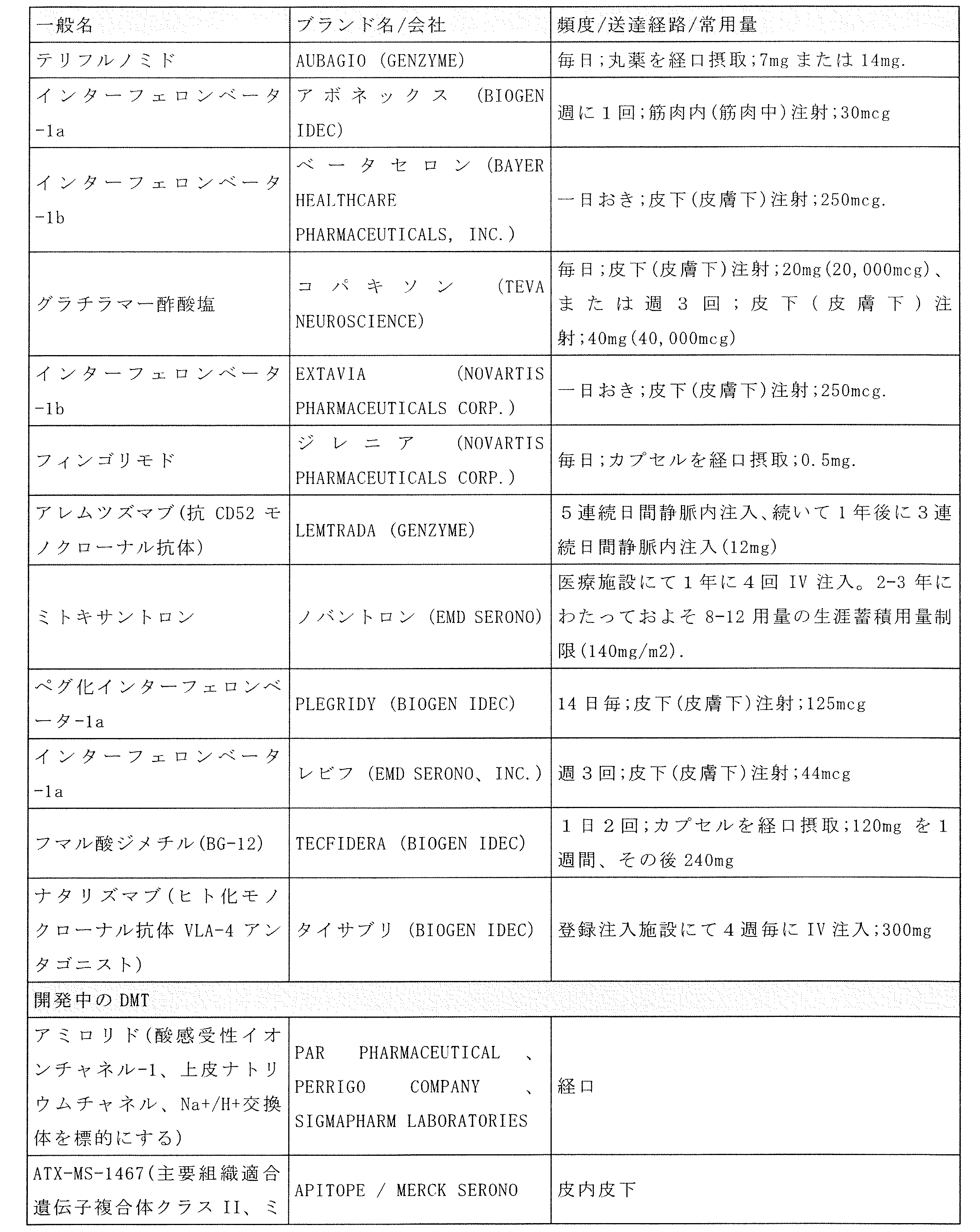

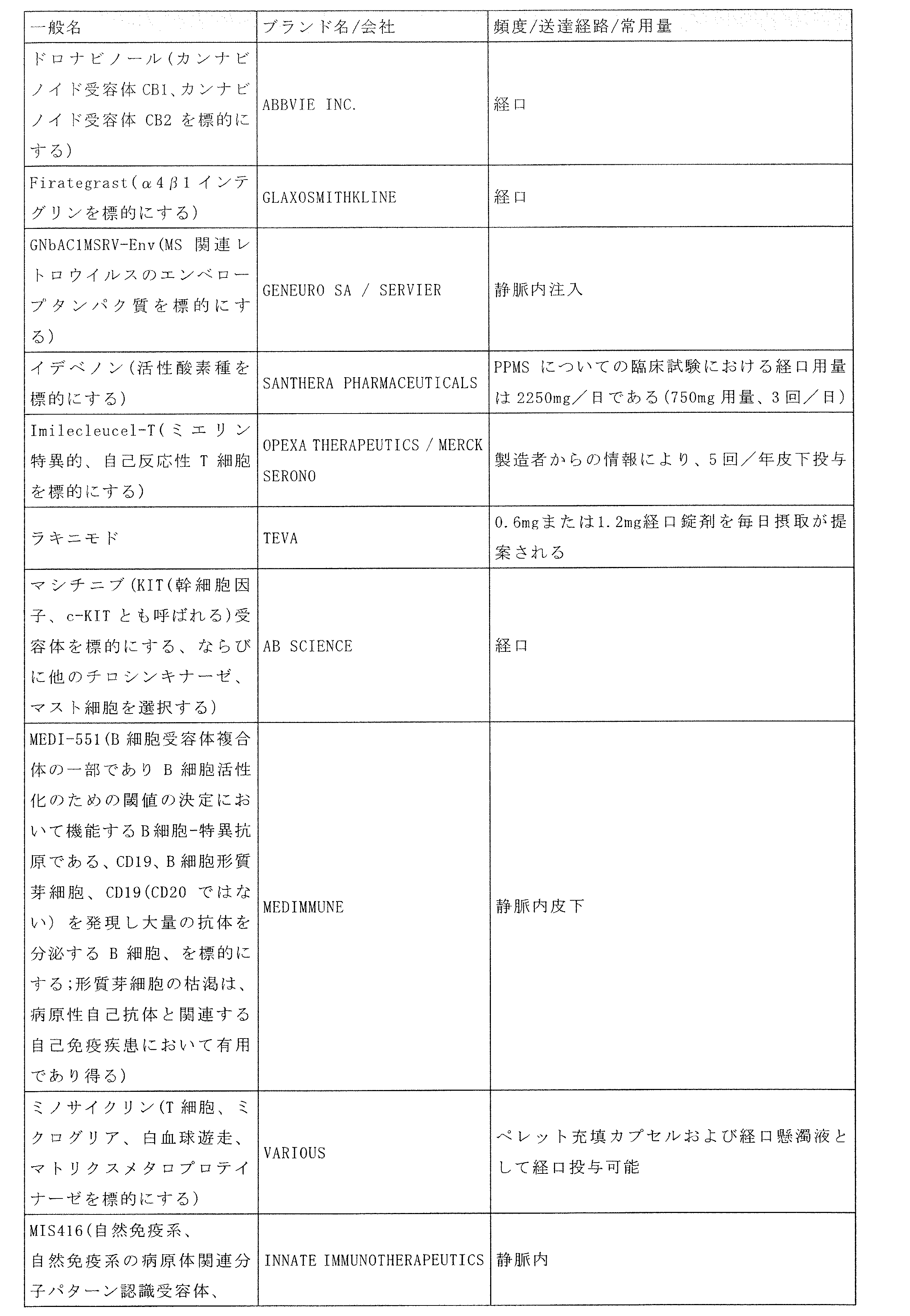

いくつかの実施形態では、本発明は、輸血との併用療法に関する。例えば、本組成物は輸血を補うことができる。いくつかの実施形態では、本発明は、鉄サプリメントとの併用療法に関する。 In some embodiments, the invention relates to combination therapy with blood transfusion. For example, the composition can supplement blood transfusions. In some embodiments, the present invention relates to combination therapy with iron supplements.
いくつかの実施形態では、本発明は、1つ以上のEPOに基づく作用物質を用いる併用療法に関する。例えば、本組成物は、他のEPOに基づく作用物質に対するアジュバントとして使用され得る。いくつかの実施形態では、本組成物は、他のEPOに基づく作用物質に対する維持療法として使用される。他のEPOに基づく作用物質としては下記が挙げられる:エポエチンアルファ、例えば、限定はされないが、DARBEPOETIN(ARANESP)、EPOCEPT(LUPINPHARMA)、NANOKINE(NANOGEN PHARMACEUTICAL)、EPOFIT(INTAS PHARMA)、EPOGEN(AMGEN)、EPOGIN、EPREX、(JANSSEN-CILAG)、BINOCRIT7(SANDOZ)、PROCRIT;エポエチンベータ、例えば、限定はされないが、NEORECORMON(HOFFMANN-LAROCHE)、RECORMON、メトキシポリエチレングリコール-エポエチンベータ(MIRCERA、ROCHE);エポエチンデルタ、例えば、限定はされないが、DYNEPO(赤血球生成刺激タンパク質、SHIRE PLC);エポエチンオメガ、例えば、限定はされないが、EPOMAX;エポエチンゼータ、例えば、限定はされないが、SILAPO(STADA)およびRETACRIT(HOSPIRA)および他のEPO、例えば、限定はされないが、EPOCEPT(LUPIN PHARMACEUTICALS)、EPOTRUST(PANACEABIOTECLTD)、ERYPROSAFE(BIOCONLTD.)、REPOITIN(SERUM INSTITUTE OF INDIA LIMITED)、VINTOR(EMCURE PHARMACEUTICALS)、EPOFIT(INTASPHARMA)、ERYKINE(INTASBIOPHARMACEUTICA)、WEPOX(WOCKHARDT BIOTECH)、ESPOGEN(LG LIFE SCIENCES)、RELIPOIETIN(RELIANCE LIFE SCIENCES)、SHANPOIETIN(SHANTHA BIOTECHNICS LTD)、ZYROP(CADILA HEALTHCARE LTD.)、EPIAO(RHUEPO)(SHENYANG SUNSHINE PHARMACEUTICAL CO.LTD)、CINNAPOIETIN(CINNAGEN)。 In some embodiments, the invention relates to combination therapy with one or more EPO-based agents. For example, the composition can be used as an adjuvant to other EPO-based agents. In some embodiments, the compositions are used as maintenance therapy for other EPO-based agents. Other EPO-based agents include: epoetin alfa, including but not limited to DARBEPOETIN (ARANESP), EPOCEPT (LUPINPHARMA), NANOKINE (NANOGEN PHARMACEUTICAL), EPOFIT (INTAS PHARMA), EPOGEN (AMGEN) , EPOGIN, EPREX, (JANSSEN-CILAG), BINOCRIT7 (SANDOZ), PROCRIT; epoetin beta, including but not limited to NEORECORMON (HOFFMANN-LAROCHE), RECORMON, methoxypolyethylene glycol-epoetin beta (MIRCERA, ROCHE); epoetin delta, such as but not limited to DYNEPO (erythropoiesis stimulating protein, SHIRE PLC); epoetin omega, such as but not limited to EPOMAX; epoetin zeta, such as but not limited to SILAPO (STADA) and RETACRIT (HOSPIRA) ) and other EPOs such as, but not limited to, EPOCEPT (LUPIN PHARMACEUTICALS), EPOTRUST (PANACEABIOTECLTD), ERYPROSAFE (BIOCONLTD.), REPOITIN (SERUM INSTITUTE OF INDIA LIMITED), VINTOR (SPEMCURE PHARMAREUT, ERYKINE(INTASBIOPHARMACEUTICA)、WEPOX(WOCKHARDT BIOTECH)、ESPOGEN(LG LIFE SCIENCES)、RELIPOIETIN(RELIANCE LIFE SCIENCES)、SHANPOIETIN(SHANTHA BIOTECHNICS LTD)、ZYROP(CADILA HEALTHCARE LTD.)、EPIAO(RHUEPO)(SHENYANG SUNSHINE PHARMACEUTICAL CO. LTD), CINNAPOIETIN (CINNAGEN).
いくつかの実施形態では、本発明は、1つ以上の免疫調節剤、例えば、限定はされないが、免疫チェックポイントを調節する作用物質を用いる併用療法に関する。様々な実施形態では、免疫調節剤は、PD-1、PD-L1、およびPD-L2の1つ以上を標的にする。様々な実施形態では、免疫調節剤は、PD-1阻害剤である。様々な実施形態では、免疫調節剤は、PD-1、PD-L1、およびPD-L2の1つ以上に特異的な抗体である。例えば、いくつかの実施形態では、免疫調節剤は、抗体、例えば、制限なしに、ニボルマブ、(ONO-4538/BMS-936558、MDX1106、OPDIVO、BRISTOL MYERS SQUIBB)、ペムブロリズマブ(KEYTRUDA、MERCK)、ピディリズマブ(CT-011、CURE TECH)、MK-3475(MERCK)、BMS936559(BRISTOL MYERS SQUIBB)、MPDL328OA(ROCHE)である。いくつかの実施形態では、免疫調節剤はCD137またはCD137Lの1つ以上を標的にする。様々な実施形態では、免疫調節剤はCD137またはCD137Lの1つ以上に特異的な抗体である。例えば、いくつかの実施形態では、免疫調節剤は抗体であり、例えば、制限なしに、ウレルマブ(BMS-663513および抗4-1BB抗体としても知られている)である。いくつかの実施形態では、本キメラタンパク質は、固形腫瘍および/またはB細胞非ホジキンリンパ腫および/または頭頸部癌および/または多発性骨髄腫の治療のために、ウレルマブと(任意で、ニボルマブ、リリルマブ、およびウレルマブの1つ以上と)組み合わされる。いくつかの実施形態では、免疫調節剤は、CTLA-4、AP2M1、CD80、CD86、SHP-2、およびPPP2R5Aの1つ以上を標的にする作用物質である。様々な実施形態では、免疫調節剤は、CTLA-4、AP2M1、CD80、CD86、SHP-2、およびPPP2R5Aの1つ以上に特異的な抗体である。例えば、いくつかの実施形態では、免疫調節剤は、抗体であり、例えば、制限なしに、イピリムマブ(MDX-010、MDX-101、Yervoy、BMS)および/またはトレメリムマブ(Pfizer)である。いくつかの実施形態では、本キメラタンパク質は、メラノーマ、前立腺癌、および肺癌の1つ以上の治療のために、イピリムマブ(任意でバビツキシマブ)と組み合わされる。様々な実施形態では、免疫調節剤は、CD20を標的にする。様々な実施形態では、免疫調節剤は、CD20に特異的な抗体である。例えば、いくつかの実施形態では、免疫調節剤は抗体であり、例えば、制限なしに、オファツムマブ(GENMAB)、オビヌツズマブ(ガザイバ)、AME-133v(APPLIED MOLECULAR EVOLUTION)、オクレリズマブ(GENENTECH)、TRU-015(TRUBION/EMERGENT)、ベルツズマブ(IMMU-106)である。 In some embodiments, the invention relates to combination therapy using one or more immunomodulatory agents, including but not limited to agents that modulate immune checkpoints. In various embodiments, immunomodulatory agents target one or more of PD-1, PD-L1, and PD-L2. In various embodiments, an immunomodulatory agent is a PD-1 inhibitor. In various embodiments, an immunomodulatory agent is an antibody specific for one or more of PD-1, PD-L1, and PD-L2. For example, in some embodiments, the immunomodulatory agent is an antibody such as, without limitation, nivolumab, (ONO-4538/BMS-936558, MDX1106, OPDIVO, BRISTOL MYERS SQUIBB), pembrolizumab (KEYTRUDA, MERCK), pidilizumab (CT-011, CURE TECH), MK-3475 (MERCK), BMS936559 (BRISTOL MYERS SQUIBB), MPDL328OA (ROCHE). In some embodiments, an immunomodulatory agent targets one or more of CD137 or CD137L. In various embodiments, an immunomodulatory agent is an antibody specific for one or more of CD137 or CD137L. For example, in some embodiments, the immunomodulatory agent is an antibody, such as, without limitation, Urelumab (also known as BMS-663513 and anti-4-1BB antibody). In some embodiments, the chimeric protein is used in combination with urelumab (optionally nivolumab, lililumab , and one or more of Urelumab). In some embodiments, an immunomodulatory agent is an agent that targets one or more of CTLA-4, AP2M1, CD80, CD86, SHP-2, and PPP2R5A. In various embodiments, the immunomodulatory agent is an antibody specific for one or more of CTLA-4, AP2M1, CD80, CD86, SHP-2, and PPP2R5A. For example, in some embodiments, the immunomodulatory agent is an antibody, such as, without limitation, ipilimumab (MDX-010, MDX-101, Yervoy, BMS) and/or tremelimumab (Pfizer). In some embodiments, the chimeric protein is combined with ipilimumab (optionally bavituximab) for the treatment of one or more of melanoma, prostate cancer, and lung cancer. In various embodiments, an immunomodulatory agent targets CD20. In various embodiments, an immunomodulatory agent is an antibody specific for CD20. For example, in some embodiments, the immunomodulatory agent is an antibody such as, without limitation, ofatumumab (GENMAB), obinutuzumab (Gazyva), AME-133v (APPLIED MOLECULAR EVOLUTION), ocrelizumab (GENENTECH), TRU-015 (TRUBION/EMERGENT), veltuzumab (IMMU-106).
いくつかの実施形態では、本発明は、WO2013/10779号、WO2015/007536号、WO2015/007520号、WO2015/007542号、およびWO2015/007903号(その全内容はこれにより、その全体が参照により組み込まれる)に記載される1つ以上のキメラ作用物質を用いる併用療法に関する。 In some embodiments, the present invention relates to the 2003), with one or more of the chimeric agents described.
いくつかの実施形態では、本明細書で記載されるキメラタンパク質は、改変される、すなわち、共有結合により組成物の活性が防止されないように組成物への任意の型の分子の共有結合による、誘導体を含む。例えば、制限はしないが、誘導体は、とりわけ、グリコシル化、脂質化、アセチル化、ペグ化、リン酸化、アミド化、公知の保護/ブロッキング基による誘導体化、タンパク質切断、細胞リガンドまたは他のタンパク質への連結、などにより修飾された組成物を含む。多くの化学修飾のいずれも、公知の技術、例えば、限定はされないが、特異的化学開裂、アセチル化、ホルミル化、ツニカマイシンの代謝合成、などにより実施できる。 In some embodiments, the chimeric proteins described herein are modified, i.e., by covalent attachment of any type of molecule to the composition such that covalent attachment does not prevent the activity of the composition, Including derivatives. For example, without limitation, derivatives can be glycosylated, lipidated, acetylated, pegylated, phosphorylated, amidated, derivatized with known protecting/blocking groups, protein cleavage, cellular ligands or other proteins, among others. , and the like. Any of a number of chemical modifications can be performed by known techniques including, but not limited to, specific chemical cleavage, acetylation, formylation, metabolic synthesis of tunicamycin, and the like.
さらに他の実施形態では、本明細書で記載されるキメラタンパク質は、細胞傷害性薬物をさらに含み、例示的な実施形態では、毒素、化学療法薬、放射性同位体、およびアポトーシスまたは細胞死を引き起こす作用物質を含む。そのような作用物質は、本明細書で記載される組成物にコンジュゲートされ得る。 In still other embodiments, the chimeric proteins described herein further comprise cytotoxic agents, in exemplary embodiments toxins, chemotherapeutic agents, radioisotopes, and agents that induce apoptosis or cell death. Contains active substances. Such agents can be conjugated to the compositions described herein.
本明細書で記載されるキメラタンパク質はこのように、化学リンカーなどのエフェクター部分、例えば蛍光色素などの検出可能部分、酵素、基質、生物発光材料、放射性材料、および化学発光部分、または例えばストレプトアビジン、アビジン、ビオチン、細胞毒、細胞傷害性薬物、および放射性材料などの機能的部分を付加するように、翻訳後に修飾され得る。 The chimeric proteins described herein can thus include effector moieties such as chemical linkers, detectable moieties such as fluorescent dyes, enzymes, substrates, bioluminescent materials, radioactive materials, and chemiluminescent moieties, or, for example, streptavidin. , avidin, biotin, cytotoxins, cytotoxic drugs, and radioactive materials.
例示的な細胞傷害性薬物としては下記が挙げられるが、それらに限定されない:メトトレキサート、アミノプテリン、6-メルカプトプリン、6-チオグアニン、シタラビン、5-フルオロウラシルデカルバジン;アルキル化剤、例えばメクロレタミン、チオエパ(thioepa)クロランブシル、メルファラン、カルムスチン(BSNU)、マイトマイシンC、ロムスチン(CCNU)、1-メチルニトロソウレア、シクロトスファミド(cyclothosphamide)、メクロレタミン、ブスルファン、ジブロモマンニトール、ストレプトゾトシン、マイトマイシンC、cis-ジクロロジアミン白金(II)(DDP)シスプラチンおよびカルボプラチン(パラプラチン);アントラサイクリン、例えばダウノルビシン(以前はダウノマイシン)、ドキソルビシン(アドリアマイシン)、デトルビシン、カルミノマイシン、イダルビシン、エピルビシン、ミトキサントロンおよびビサントレンを含む;抗生物質、例えばダクチノマイシン(アクチノマイシンD)、ブレオマイシン、カリチアマイシン、ミトラマイシン、およびアントラマイシン(AMC);および有糸分裂阻害薬(antimytotic agent)例えばビンカアルカロイド、ビンクリスチンおよびビンブラスチン。他の細胞傷害性薬物としては、パクリタキセル(タキソール)、リシン、シュードモナス外毒素、ゲムシタビン、サイトカラシンB、グラミシジンD、臭化エチジウム、エメチン、エトポシド、テノポシド(tenoposide)、コルヒチン、ジヒドロキシアントラシンジオン(dihydroxy anthracin dione)、1-デヒドロテストステロン、グルココルチコイド、プロカイン、テトラカイン、リドカイン、プロプラノロール、ピューロマイシン、プロカルバジン、ヒドロキシ尿素、アスパラギナーゼ、コルチコステロイド、ミトタン(mytotane)(O,P’-(DDD))、インターフェロン、およびこれらの細胞傷害性薬物の混合物が挙げられる。 Exemplary cytotoxic drugs include, but are not limited to: methotrexate, aminopterin, 6-mercaptopurine, 6-thioguanine, cytarabine, 5-fluorouracil decarbazine; alkylating agents such as mechlorethamine, thioepa (thioepa) chlorambucil, melphalan, carmustine (BSNU), mitomycin C, lomustine (CCNU), 1-methylnitrosourea, cyclothosphamide, mechlorethamine, busulfan, dibromomannitol, streptozotocin, mitomycin C, cis-dichloro diamine platinum (II) (DDP) cisplatin and carboplatin (paraplatin); anthracyclines such as daunorubicin (formerly daunomycin), doxorubicin (adriamycin), detorubicin, carminomycin, idarubicin, epirubicin, mitoxantrone and bisantrene; antibiotics , such as dactinomycin (actinomycin D), bleomycin, calicheamicin, mithramycin, and anthramycin (AMC); and antimitotic agents such as vinca alkaloids, vincristine and vinblastine. Other cytotoxic agents include paclitaxel (Taxol), ricin, pseudomonas exotoxin, gemcitabine, cytochalasin B, gramicidin D, ethidium bromide, emetine, etoposide, tenoposide, colchicine, dihydroxyanthracinedione. anthracin dione), 1-dehydrotestosterone, glucocorticoids, procaine, tetracaine, lidocaine, propranolol, puromycin, procarbazine, hydroxyurea, asparaginase, corticosteroids, mytotane (O,P'-(DDD)), Interferons, and mixtures of these cytotoxic drugs are included.
さらなる細胞傷害性薬物としては下記が挙げられるが、それらに限定されない:化学療法薬、例えばカルボプラチン、シスプラチン、パクリタキセル、ゲムシタビン、カリチアマイシン、ドキソルビシン、5-フルオロウラシル、マイトマイシンC、アクチノマイシンD、シクロホスファミド、ビンクリスチン、ブレオマイシン、VEGFアンタゴニスト、EGFRアンタゴニスト、プラチン(platin)、タキソール、イリノテカン、5-フルオロウラシル、ゲムシタビン(gemcytabine)、ロイコボリン(leucovorine)、ステロイド、シクロホスファミド、メルファラン、ビンカアルカロイド(例えば、ビンブラスチン、ビンクリスチン、ビンデシンおよびビノレルビン)、ムスチン、チロシンキナーゼ阻害剤、放射線療法、性ホルモン拮抗薬、選択的アンドロゲン受容体モジュレーター、選択的エストロゲン受容体モジュレーター、PDGFアンタゴニスト、TNFアンタゴニスト、IL-1アンタゴニスト、インターロイキン(例えば、IL-12またはIL-2)、IL-12Rアンタゴニスト、毒素コンジュゲートモノクローナル抗体、腫瘍抗原特異的モノクローナル抗体、アービタックス、アバスチン、ペルツズマブ、抗CD20抗体、リツキサン、オクレリズマブ、オファツムマブ、DXL625、ハーセプチン(登録商標)、またはそれらの任意の組み合わせ。植物および細菌由来の毒性酵素、例えばリシン、ジフテリア毒素およびシュードモナス毒素が治療薬(例えば、抗体)にコンジュゲートされ得、細胞型特異的死滅試薬を生成する(Youle, et al., Proc. Nat’l Acad. Sci. USA 77:5483 (1980); Gilliland, et al., Proc. Nat’l Acad. Sci. USA 77:4539 (1980); Krolick, et al., Proc. Nat’l Acad. Sci. USA 77:5419 (1980))。 Additional cytotoxic agents include, but are not limited to: chemotherapeutic agents such as carboplatin, cisplatin, paclitaxel, gemcitabine, calicheamicin, doxorubicin, 5-fluorouracil, mitomycin C, actinomycin D, cyclophosphine Phamide, vincristine, bleomycin, VEGF antagonists, EGFR antagonists, platin, taxol, irinotecan, 5-fluorouracil, gemcytabine, leucovorine, steroids, cyclophosphamide, melphalan, vinca alkaloids (e.g. , vinblastine, vincristine, vindesine and vinorelbine), mustines, tyrosine kinase inhibitors, radiotherapy, sex hormone antagonists, selective androgen receptor modulators, selective estrogen receptor modulators, PDGF antagonists, TNF antagonists, IL-1 antagonists, interleukins (eg, IL-12 or IL-2), IL-12R antagonists, toxin-conjugated monoclonal antibodies, tumor antigen-specific monoclonal antibodies, Erbitux, Avastin, Pertuzumab, anti-CD20 antibodies, Rituxan, Ocrelizumab, Ofatumumab, DXL625, Herceptin®, or any combination thereof. Toxic enzymes from plants and bacteria such as ricin, diphtheria toxin and pseudomonas toxin can be conjugated to therapeutic agents such as antibodies to generate cell-type specific killing reagents (Youle, et al., Proc. Nat' USA 77:5483 (1980);Gilliland, et al., Proc.Nat'l Acad.Sci.USA 77:4539 (1980); USA 77:5419 (1980)).
他の細胞傷害性薬物としては、Goldenbergにより米国特許第6,653,104号において記載される細胞傷害性リボヌクレアーゼが挙げられる。発明の実施形態はまた、放射性免疫複合体に関し、ここでαまたはβ粒子を放出する放射性核種は、複合体形成剤の使用ありまたはなしで、キメラタンパク質に安定に結合される。そのような放射性核種としては、β-エミッタ、例えばリン-32、スカンジウム-47、銅-67、ガリウム-67、イットリウム-88、イットリウム-90、ヨウ素-125、ヨウ素-131、サマリウム-153、ルテチウム-177、レニウム-186またはレニウム-188、およびα-エミッタ、例えばアスタチン-211、鉛-212、ビスマス-212、ビスマス-213またはアクチニウム-225が挙げられる。 Other cytotoxic agents include the cytotoxic ribonucleases described by Goldenberg in US Pat. No. 6,653,104. Embodiments of the invention also relate to radioimmunoconjugates, wherein an α- or β-particle-releasing radionuclide is stably bound to a chimeric protein, with or without the use of a complexing agent. Such radionuclides include beta-emitters such as phosphorus-32, scandium-47, copper-67, gallium-67, yttrium-88, yttrium-90, iodine-125, iodine-131, samarium-153, lutetium. -177, rhenium-186 or rhenium-188, and α-emitters such as astatine-211, lead-212, bismuth-212, bismuth-213 or actinium-225.
例示的な検出可能部分としてはさらに、西洋ワサビペルオキシダーゼ、アセチルコリンエステラーゼ、アルカリホスファターゼ、βガラクトシダーゼおよびルシフェラーゼが挙げられるが、それらに限定されない。さらに例示的な蛍光材料としては、ローダミン、フルオレセイン、フルオレセインイソチオシアネート、ウンベリフェロン、ジクロロトリアジニルアミン、フィコエリトリンおよびダンシルクロリドが挙げられるが、それらに限定されない。さらに例示的な化学発光部分としては、ルミノールが挙げられるが、それに限定されない。さらに例示的な生物発光材料としては、ルシフェリンおよびエクオリンが挙げられるが、それらに限定されない。さらに例示的な放射性材料としては、ヨウ素-125、炭素-14、硫黄-35、トリチウムおよびリン-32が挙げられるが、それらに限定されない。 Exemplary detectable moieties further include, but are not limited to, horseradish peroxidase, acetylcholinesterase, alkaline phosphatase, beta-galactosidase and luciferase. Further exemplary fluorescent materials include, but are not limited to, rhodamine, fluorescein, fluorescein isothiocyanate, umbelliferone, dichlorotriazinylamine, phycoerythrin and dansyl chloride. Further exemplary chemiluminescent moieties include, but are not limited to, luminol. Further exemplary bioluminescent materials include, but are not limited to, luciferin and aequorin. Further exemplary radioactive materials include, but are not limited to, iodine-125, carbon-14, sulfur-35, tritium and phosphorus-32.
治療方法
本明細書で記載される方法および組成物は、様々な疾患および障害、例えば、限定はされないが癌、感染、免疫不全、貧血、自己免疫疾患、心血管疾患、創傷治癒、虚血関連疾患、神経変性疾患、代謝疾患および多くの他の疾患および障害の治療に適用される。
Methods of Treatment The methods and compositions described herein are useful in a variety of diseases and disorders, including but not limited to cancer, infection, immunodeficiency, anemia, autoimmune disease, cardiovascular disease, wound healing, ischemia-related disease. It has applications in the treatment of diseases, neurodegenerative diseases, metabolic diseases and many other diseases and disorders.
さらに、本作用物質のいずれも、様々な疾患および障害、例えば、限定はされないが癌、感染、免疫不全、炎症疾患もしくは状態、および自己免疫疾患の治療、またはこれらを治療するための薬物製造において使用され得る。 Additionally, any of the present agents may be used in the treatment of, or in the manufacture of drugs to treat, various diseases and disorders, including but not limited to cancer, infections, immunodeficiencies, inflammatory diseases or conditions, and autoimmune diseases. can be used.
いくつかの実施形態では、本発明は、下記の、またはその1つ以上を有する患者の治療に関する:慢性肉芽腫性疾患、大理石骨病、特発性肺線維症、フリードライヒ運動失調症、アトピー性皮膚炎、シャーガス病、癌、心不全、自己免疫疾患、鎌状赤血球症、地中海貧血症、失血、輸血反応、糖尿病、ビタミンB12欠乏、膠原病性脈管疾患、シュワックマン症候群、血小板減少性紫斑病、セリアック病、内分泌欠乏状態、例えば甲状腺機能低下症またはアジソン病、自己免疫疾患、例えばクローン病、全身性エリテマトーデス、関節リウマチもしくは若年性関節リウマチ、潰瘍性大腸炎免疫不全、例えば好酸球性筋膜炎、低免疫グロブリン血症、または胸腺腫/胸腺がん、移植片対宿主病、前白血病、非造血系症候群(例えば、ダウン、デュボヴィッツ、ゼッケル)、フェルティ症候群、溶血性尿毒症症候群、骨髄異形成症候群、夜間発作性ヘモグロビン尿症、骨髄線維症、汎血球減少症、赤芽球癆、シェーンライン・ヘノッホ紫斑病、マラリア、タンパク質飢餓、月経過多、全身性硬化症、肝硬変、低代謝状態、およびうっ血性心不全。 In some embodiments, the present invention relates to the treatment of patients having, or having one or more of: chronic granulomatous disease, osteopetrosis, idiopathic pulmonary fibrosis, Friedreich's ataxia, atopic Dermatitis, Chagas disease, cancer, heart failure, autoimmune disease, sickle cell disease, thalassemia, blood loss, transfusion reaction, diabetes, vitamin B12 deficiency, collagen vascular disease, Schwackman's syndrome, thrombocytopenic purpura , celiac disease, endocrine deficiency conditions such as hypothyroidism or Addison's disease, autoimmune diseases such as Crohn's disease, systemic lupus erythematosus, rheumatoid arthritis or juvenile rheumatoid arthritis, ulcerative colitis immunodeficiency such as eosinophilic muscle Meningitis, hypoimmunoglobulinemia, or thymoma/thymic carcinoma, graft-versus-host disease, preleukemia, nonhematopoietic syndromes (e.g., Down, Dubowitz, Seckel), Felty's syndrome, hemolytic-uremic syndrome, bone marrow Dysplastic syndrome, nocturnal paroxysmal hemoglobinuria, myelofibrosis, pancytopenia, pure red cell aplasia, Schoenlein-Henoch purpura, malaria, protein starvation, menorrhagia, systemic sclerosis, liver cirrhosis, hypometabolism condition, and congestive heart failure.
いくつかの実施形態では、本発明は、下記の、またはその1つ以上を有する患者の治療に関する:慢性肉芽腫性疾患、大理石骨病、特発性肺線維症、フリードライヒ運動失調症、アトピー性皮膚炎、シャーガス病、マイコバクテリア感染症、癌、強皮症、肝炎、C型肝炎、敗血症性ショック、および関節リウマチ。 In some embodiments, the present invention relates to the treatment of patients having, or having one or more of: chronic granulomatous disease, osteopetrosis, idiopathic pulmonary fibrosis, Friedreich's ataxia, atopic Dermatitis, Chagas disease, mycobacterial infections, cancer, scleroderma, hepatitis, hepatitis C, septic shock, and rheumatoid arthritis.
いくつかの実施形態では、本発明は、癌の、またはそれを有する患者の治療に関する。本明細書では、癌は、身体器官および系統の正常機能を妨害し得る細胞の任意のコントロール不良の増殖を指し、原発性および転移性腫瘍の両方を含む。原発腫瘍またはそれらの元の位置から移動し重要臓器に播種する癌は最終的には、冒された器官の機能的悪化により被験体の死をもたらし得る。転移は、原発腫瘍位置とは異なる、癌細胞の原発腫瘍から身体の他の部分への播種に起因する、癌細胞または癌細胞の群である。転移は最終的には、被験体の死をもたらす。例えば、癌は、良性および悪性癌、ポリープ、過形成、ならびに休眠腫瘍または微小転移を含み得る。 In some embodiments, the invention relates to treatment of patients with or with cancer. As used herein, cancer refers to any uncontrolled growth of cells that can interfere with the normal functioning of body organs and systems, and includes both primary and metastatic tumors. Primary tumors or cancers that migrate from their original location and disseminate to vital organs can ultimately lead to the death of the subject due to functional deterioration of the affected organs. A metastasis is a cancer cell or group of cancer cells resulting from the dissemination of cancer cells from a primary tumor to other parts of the body, different from the primary tumor location. Metastasis ultimately leads to death of the subject. For example, cancer can include benign and malignant cancers, polyps, hyperplasias, and dormant tumors or micrometastases.
治療され得る例示的な癌としては下記が挙げられるが、それらに限定されない:癌腫、例えば、様々なサブタイプ、例えば、腺がん、基底細胞がん、扁平上皮がん、および移行上皮がんを含む)、肉腫(例えば、骨および軟部組織を含む)、白血病(例えば、急性骨髄性、急性リンパ芽球性、慢性骨髄、慢性リンパ球性、ヘアリー細胞を含む)、リンパ腫およびミエローマ(例えば、ホジキンおよび非ホジキンリンパ腫、軽鎖、非分泌性、MGUS、および形質細胞腫を含む)、および中枢神経系癌(例えば、脳(例えば、神経膠腫(例えば、星状細胞腫、乏突起神経膠腫、および上衣腫)、髄膜腫、下垂体腺腫、および神経腫、および脊髄腫瘍(例えば、髄膜腫および神経線維腫)。 Exemplary cancers that may be treated include, but are not limited to: carcinomas, including various subtypes such as adenocarcinoma, basal cell carcinoma, squamous cell carcinoma, and transitional cell carcinoma. sarcoma (including bone and soft tissue), leukemia (including acute myeloid, acute lymphoblastic, chronic myeloid, chronic lymphocytic, hairy cell), lymphoma and myeloma (including e.g. Hodgkin's and non-Hodgkin's lymphomas, including light chain, nonsecretory, MGUS, and plasmacytoma), and central nervous system cancers (e.g., brain, e.g., gliomas (e.g., astrocytoma, oligodendroglioma)). and ependymoma), meningioma, pituitary adenoma, and neuroma, and spinal cord tumors (eg, meningioma and neurofibroma).
治療され得る例示的な癌としては下記が挙げられるが、それらに限定されない:基底細胞がん、胆道癌;膀胱癌;骨癌;脳および中枢神経系癌;乳癌;腹膜癌;子宮頸癌;絨毛癌;結腸および直腸癌;結合組織癌;消化器系の癌;子宮内膜癌;食道癌;眼癌;頭頸部の癌;胃癌(胃腸癌を含む);神経膠芽腫;肝がん;肝細胞腫;上皮内新生物;腎臓癌または腎癌;喉頭癌;白血病;肝臓癌;肺癌(例えば、小細胞肺癌、非小細胞肺癌、肺腺がん、および肺扁平上皮がん);メラノーマ;骨髄腫;神経芽細胞腫;口腔癌(口唇、舌、口、および咽頭);卵巣癌;膵臓癌;前立腺癌;網膜芽細胞腫;横紋筋肉腫;直腸癌;呼吸器系の癌;唾液腺がん;肉腫;皮膚癌;扁平細胞癌;胃癌;精巣癌;甲状腺癌;子宮または子宮内膜癌;泌尿器系の癌;外陰部癌;リンパ腫、例えばホジキンおよび非ホジキンリンパ腫、ならびにB細胞リンパ腫(低悪性度/濾胞性非ホジキンリンパ腫(NHL)を含む;小リンパ球性(SL)NHL;中悪性度/濾胞性NHL;中悪性度びまん性NHL;高悪性度免疫芽球性NHL;高悪性度リンパ芽球性NHL;高悪性度小型非切れ込み核細胞性NHL;巨大腫瘤病変NHL;マントル細胞リンパ腫;AIDS関連リンパ腫;およびワルデンストレームマクログロブリン血症;慢性リンパ性白血病(CLL);急性リンパ性白血病(ALL);ヘアリー細胞白血病;慢性骨髄芽球性白血病;ならびに他の癌腫および肉腫;および移植後リンパ増殖性障害(PTLD)、ならびに母斑症と関連する異常な血管増殖、浮腫(例えば、脳腫瘍と関連するもの)、およびメグズ症候群。 Exemplary cancers that may be treated include, but are not limited to: basal cell carcinoma, biliary tract cancer; bladder cancer; bone cancer; brain and central nervous system cancer; Cancer of the gastrointestinal system; Endometrial cancer; Esophageal cancer; Eye cancer; Head and neck cancer; Gastric cancer (including gastrointestinal cancer); liver cancer; lung cancer (e.g., small cell lung cancer, non-small cell lung cancer, lung adenocarcinoma, and lung squamous cell carcinoma); melanoma; myeloma; neuroblastoma; oral cancer (lip, tongue, mouth, and pharynx); ovarian cancer; pancreatic cancer; prostate cancer; sarcomas; skin cancer; squamous cell carcinoma; gastric cancer; testicular cancer; thyroid cancer; uterine or endometrial cancer; Lymphomas (including low-grade/follicular non-Hodgkin's lymphoma (NHL); small lymphocytic (SL) NHL; intermediate-grade/follicular NHL; intermediate-grade diffuse NHL; high-grade immunoblastic NHL; High-grade lymphoblastic NHL; high-grade small noncleaved cell NHL; bulky mass lesion NHL; mantle cell lymphoma; AIDS-related lymphoma; hairy cell leukemia; chronic myeloblastic leukemia; and other carcinomas and sarcomas; and post-transplant lymphoproliferative disorder (PTLD), and abnormal vascular growth associated with nevus, Edema (eg, associated with brain tumors), and Meigs syndrome.
いくつかの実施形態では、本発明は、微生物感染および/または慢性感染の、またはこれを有する患者の治療に関する。例示的な感染としては、シャーガス病、HIV/AIDS、結核、骨髄炎、B型肝炎、C型肝炎、エプスタイン・バーウイルスまたはパルボウイルス、T細胞白血病ウイルス、細菌過剰症候群、真菌または寄生虫感染が挙げられるが、それらに限定されない。 In some embodiments, the present invention relates to treatment of patients with or having microbial and/or chronic infections. Exemplary infections include Chagas disease, HIV/AIDS, tuberculosis, osteomyelitis, hepatitis B, hepatitis C, Epstein-Barr virus or parvovirus, T-cell leukemia virus, bacterial excess syndrome, fungal or parasitic infections. include, but are not limited to.
様々な実施形態では、本組成物は、1つ以上の炎症疾患または状態、例えば炎症、急性炎症、慢性炎症、呼吸器疾患、アテローム性動脈硬化、再狭窄、喘息、アレルギー性鼻炎、アトピー性皮膚炎、敗血症性ショック、関節リウマチ、炎症性腸疾患、炎症性骨盤疾患、疼痛、眼性炎症疾患、セリアック病、リー症候群、グリセロールキナーゼ欠乏、家族性好酸球増加症(FE)、常染色体劣性痙性失調症、喉頭炎症疾患;結核、慢性胆嚢炎、気管支拡張症、珪肺症および他のじん肺症、を治療または防止するために使用される。 In various embodiments, the composition is used for one or more inflammatory diseases or conditions, such as inflammation, acute inflammation, chronic inflammation, respiratory disease, atherosclerosis, restenosis, asthma, allergic rhinitis, atopic dermatitis. inflammation, septic shock, rheumatoid arthritis, inflammatory bowel disease, inflammatory pelvic disease, pain, ocular inflammatory disease, celiac disease, Leigh syndrome, glycerol kinase deficiency, familial eosinophilia (FE), autosomal recessive Used to treat or prevent spastic ataxia, laryngeal inflammatory disease; tuberculosis, chronic cholecystitis, bronchiectasis, silicosis and other pneumoconiosis.
様々な実施形態では、本組成物は、1つ以上の自己免疫疾患または状態、例えば多発性硬化症、真性糖尿病、ループス、セリアック病、クローン病、潰瘍性大腸炎、ギラン・バレー症候群、強皮症(scleroderms)、グッドパスチャー症候群、ウェゲナー肉芽腫症、自己免疫性てんかん、ラスムッセン脳炎、原発性胆汁性硬化症、硬化性胆管炎、自己免疫性肝炎、アジソン病、橋本甲状腺炎、線維筋痛症、メニエール病(Menier’ssyndrome);移植拒絶反応(例えば、同種移植片拒絶の防止)悪性貧血、関節リウマチ、全身性エリテマトーデス、皮膚筋炎、シェーグレン症候群、エリテマトーデス、多発性硬化症、重症筋無力症、ライター症候群、グレーブス病(Grave’s disease)、および他の自己免疫疾患、を治療または防止するために使用される。 In various embodiments, the composition is used to treat one or more autoimmune diseases or conditions such as multiple sclerosis, diabetes mellitus, lupus, celiac disease, Crohn's disease, ulcerative colitis, Guillain-Barré syndrome, scleroderma. scleroderms, Goodpasture's syndrome, Wegener's granulomatosis, autoimmune epilepsy, Rasmussen's encephalitis, primary biliary sclerosis, sclerosing cholangitis, autoimmune hepatitis, Addison's disease, Hashimoto's thyroiditis, fibromyalgia transplant rejection (e.g. prevention of allograft rejection) pernicious anemia, rheumatoid arthritis, systemic lupus erythematosus, dermatomyositis, Sjögren's syndrome, lupus erythematosus, multiple sclerosis, myasthenia gravis, It is used to treat or prevent Reiter's syndrome, Grave's disease, and other autoimmune diseases.
様々な実施形態では、本組成物は、心血管疾患、例えば心臓および脈管構造に影響を与える疾患または状態、を治療、コントロールまたは防止するために使用され、限定はされないが、冠動脈心疾患(CHD)、脳血管疾患(CVD)、大動脈狭窄、末梢血管疾患、アテローム性動脈硬化、動脈硬化症、心筋梗塞(心臓発作)、脳血管疾患(脳卒中)、一過性脳虚血発作(TIA)、アンギナ(安定および不安定)、心房細動、不整脈、弁膜症(vavular disease)、および/またはうっ血性心不全を含む。 In various embodiments, the compositions are used to treat, control, or prevent cardiovascular disease, including diseases or conditions that affect the heart and vasculature, including, but not limited to, coronary heart disease ( CHD), cerebrovascular disease (CVD), aortic stenosis, peripheral vascular disease, atherosclerosis, arteriosclerosis, myocardial infarction (heart attack), cerebrovascular disease (stroke), transient ischemic attack (TIA) , angina (stable and unstable), atrial fibrillation, arrhythmias, vavular disease, and/or congestive heart failure.
様々な実施形態では、本組成物は、1つ以上の代謝関連障害を治療または防止するために使用される。様々な実施形態では、本発明は、1型および2型糖尿病を含む糖尿病および肥満と関連する糖尿病の治療、コントロールまたは防止に有用である。本発明の組成物および方法は、糖尿病関連障害の治療または防止に有用であり、限定はされないが、糖尿病性腎症、高血糖症、耐糖能障害、インスリン抵抗性、肥満、脂質障害、脂質異常症、高脂血症、高トリグリセリド血症、高コレステロール血症、低HDLレベル、高LDLレベル、アテローム性動脈硬化およびその続発症、血管再狭窄、過敏性腸症候群、炎症性腸疾患、例えばクローン病および潰瘍性大腸炎、他の炎症状態、膵炎、腹部肥満、神経変性疾患、網膜症、新生物状態、脂肪細胞腫瘍、脂肪細胞がん、例えば脂肪肉腫、前立腺癌および他の癌、例えば胃、乳、膀胱および結腸癌、血管新生、アルツハイマー病、乾癬、高血圧、メタボリックシンドローム(例えば、下記障害の3つ以上を有する者:腹部肥満、高トリグリセリド血症、低HDLコレステロール、高血圧、および高い空腹時血糖値)、卵巣アンドロゲン過剰症(多嚢胞性卵巣症候群)、およびインスリン抵抗性が1つの要素である他の障害、例えば睡眠時無呼吸が挙げられる。本発明の組成物および方法は、遺伝的または環境的を含む肥満、および肥満関連障害の治療、コントロール、または防止に有用である。本明細書における肥満関連障害は、肥満と関連し、これにより引き起こされ、またはこれに起因する。肥満関連障害の例としては、肥満、糖尿病、過食、気晴らし食い、および大食症、高血圧、上昇した血漿インスリン濃度およびインスリン抵抗性、脂質異常症、高脂血症、子宮内膜、乳、前立腺、腎臓および結腸癌、変形性関節症、閉塞型睡眠時無呼吸、胆石、心疾患、異常な心拍リズムおよび不整脈(arrythmia)、心筋梗塞、うっ血性心不全、冠動脈心疾患、突然死、脳卒中、多嚢胞性卵巣疾患、頭蓋咽頭腫、プラダー・ウィリー症候群、フレーリッヒ症候群(Frohlich’s syndrome)、GH-欠乏被験体、正常変異低身長、ターナー症候群、および低減された代謝活性または総除脂肪体重のパーセンテージとしての安静時エネルギー消費の減少を示す他の病態、例えば、急性リンパ性白血病を有する子供が挙げられる。肥満関連障害のさらなる例は、メタボリックシンドローム、インスリン抵抗性症候群、生殖ホルモン異常、性的および生殖機能障害、例えば受精能障害、不妊症、男性における性腺機能低下症および女性における多毛症、母系肥満と関連する胎性欠陥、胃腸運動性障害、例えば肥満関連胃食道逆流、呼吸障害、例えば肥満-低換気症候群(ピックウィック症候群)、息切れ、心血管障害、炎症、例えば、脈管構造の全身性炎症、動脈硬化症、高コレステロール血症、腰痛、胆嚢疾患、高尿酸血症、痛風、および腎臓癌、および麻酔リスクの増加である。本発明の組成物および方法はまた、アルツハイマー病を治療するのに有用である。
In various embodiments, the compositions are used to treat or prevent one or more metabolic-related disorders. In various embodiments, the present invention is useful for treating, controlling or preventing diabetes and obesity-related diabetes, including
様々な実施形態では、本組成物は、1つ以上の呼吸器疾患、例えば特発性肺線維症(IPF)、喘息、慢性閉塞性肺疾患(COPD)、気管支拡張症、アレルギー性鼻炎、副鼻腔炎、肺血管収縮、炎症、アレルギー、呼吸妨害、呼吸促迫症候群、嚢胞性線維症、肺高血圧、肺血管収縮、肺気腫、ハンタウイルス肺症候群(HPS)、レフレル症候群、グッドパスチャー症候群、胸膜炎、間質性肺炎、肺浮腫、肺線維症、サルコイドーシス、呼吸器多核体ウイルス感染と関連する合併症、および他の呼吸器疾患を治療または防止するために使用される。 In various embodiments, the composition is used to treat one or more respiratory diseases such as idiopathic pulmonary fibrosis (IPF), asthma, chronic obstructive pulmonary disease (COPD), bronchiectasis, allergic rhinitis, sinuses. inflammation, pulmonary vasoconstriction, inflammation, allergy, respiratory obstruction, respiratory distress syndrome, cystic fibrosis, pulmonary hypertension, pulmonary vasoconstriction, emphysema, hantavirus pulmonary syndrome (HPS), Leffler's syndrome, Goodpasture's syndrome, pleurisy, interstitial It is used to treat or prevent pulmonary pneumonia, pulmonary edema, pulmonary fibrosis, sarcoidosis, complications associated with respiratory syncytial virus infection, and other respiratory diseases.
いくつかの実施形態では、本発明は、1つ以上の神経変性疾患を治療または防止するために使用される。例示的な神経変性疾患としては下記が挙げられるが、それらに限定されない:フリードライヒ運動失調症、多発性硬化症(限定はされないが、良性多発性硬化症;再発性-緩解多発性硬化症(RRMS);二次性進行型多発性硬化症(SPMS);進行性再発性多発性硬化症(PRMS);および一次性進行型多発性硬化症(PPMS)を含む)、アルツハイマー病(限定はされないが、早期発症型アルツハイマー病、遅発型アルツハイマー病、および家族性アルツハイマー病(FAD)を含む)、パーキンソン病およびパーキンソニズム(限定はされないが、特発性パーキンソン病、脳血管性パーキンソニズム、薬剤性パーキンソニズム、レビー小体型認知症、遺伝性パーキンソン病、若年性パーキンソン病を含む)、ハンチントン病、筋萎縮性側索硬化症(ALS、限定はされないが、孤発性ALS、家族性ALS、西太平洋ALS、若年性ALS、ヒラマヤ病(Hiramaya Disease))。 In some embodiments, the present invention is used to treat or prevent one or more neurodegenerative diseases. Exemplary neurodegenerative diseases include, but are not limited to: Friedreich's ataxia, multiple sclerosis (but not limited to benign multiple sclerosis; relapsing-remitting multiple sclerosis ( secondary progressive multiple sclerosis (SPMS); progressive relapsing multiple sclerosis (PRMS); and primary progressive multiple sclerosis (PPMS)), Alzheimer's disease (including but not limited to Parkinson's disease and Parkinsonism (including, but not limited to, idiopathic Parkinson's disease, cerebrovascular Parkinsonism, drug-induced Parkinsonism, Lewy body dementia, hereditary Parkinson's disease, juvenile Parkinson's disease), Huntington's disease, amyotrophic lateral sclerosis (ALS, including but not limited to sporadic ALS, familial ALS, western Pacific ALS, Juvenile ALS, Hiramaya Disease).
様々な実施形態では、本キメラタンパク質は、創傷、例えば、非治癒性創傷、潰瘍、熱傷、または凍傷、慢性または急性創傷、開放創または閉鎖創、内部または外部創傷(例示的な外部創傷は穿通創および非穿通創である)、の治療において用途を見出す。 In various embodiments, the chimeric protein is administered to wounds, e.g., non-healing wounds, ulcers, burns, or frostbite, chronic or acute wounds, open or closed wounds, internal or external wounds (exemplary external wounds are penetrating wounds). It finds use in the treatment of wounds and non-penetrating wounds).
様々な実施形態では、本キメラタンパク質は虚血、非限定的例として、下記と関連する虚血の治療において用途を見出す:急性冠症候群、急性肺損傷(ALI)、急性心筋梗塞(AMI)、急性呼吸促迫症候群(ARDS)、動脈閉塞症、動脈硬化症、関節軟骨欠損、無菌全身性炎症、アテローム動脈硬化性心血管疾患、自己免疫疾患、骨折、骨折、脳浮腫、脳低灌流、バージャー病、熱傷、癌、心血管疾患、軟骨損傷、脳梗塞、脳虚血、脳卒中、脳血管疾患、化学療法誘発性ニューロパチー、慢性感染、慢性腸間膜虚血、跛行、うっ血性心不全、結合組織損傷、挫傷、冠動脈疾患(CAD)、重症虚血肢(CLI)、クローン病、深部静脈血栓症、深創傷、遅延性潰瘍治癒、遅延性創傷-治癒、糖尿病(I型およびII型)、糖尿病性ニューロパチー、糖尿病誘発性虚血、播種性血管内凝固(DIC)、塞栓性脳虚血、凍傷、移植片対宿主病、遺伝性出血性末梢血管拡張虚血性血管疾患、過酸素症傷害、低酸素症、炎症、炎症性腸疾患、炎症疾患、損傷腱、間欠性跛行、腸管虚血、虚血、虚血性脳疾患、虚血性心疾患、虚血性末梢血管疾患、虚血性胎盤、虚血性腎疾患、虚血性血管疾患、虚血性-再灌流傷害、裂傷、左冠動脈主幹部病変、虚血肢、下肢虚血、心筋梗塞、心筋虚血、器官虚血、変形性関節症、骨粗鬆症、骨肉腫、パーキンソン病、末梢動脈疾患(PAD)、末梢動脈疾患、末梢性虚血、末梢性ニューロパチー、末梢血管疾患、前癌、肺浮腫、肺塞栓症、リモデリング障害、腎虚血、網膜虚血、網膜症、敗血症、皮膚潰瘍、固形臓器移植、脊髄損傷、脳卒中、肋軟骨下骨嚢胞、血栓症、血栓性脳虚血、組織虚血、一過性脳虚血発作(TIA)、外傷性脳損傷、潰瘍性大腸炎、腎臓の血管疾患、血管炎症状態、フォンヒッペル・リンダウ症候群、または組織もしくは器官に対する創傷。 In various embodiments, the chimeric proteins find use in the treatment of ischemia, including, but not limited to, ischemia associated with: acute coronary syndrome, acute lung injury (ALI), acute myocardial infarction (AMI), Acute respiratory distress syndrome (ARDS), arterial occlusion, arteriosclerosis, articular cartilage defect, sterile systemic inflammation, atherosclerotic cardiovascular disease, autoimmune disease, bone fracture, bone fracture, cerebral edema, cerebral hypoperfusion, Buerger's disease , Burn, Cancer, Cardiovascular disease, Cartilage injury, Cerebral infarction, Cerebral ischemia, Stroke, Cerebrovascular disease, Chemotherapy-induced neuropathy, Chronic infection, Chronic mesenteric ischemia, Claudication, Congestive heart failure, Connective tissue damage , contusion, coronary artery disease (CAD), critical limb ischemia (CLI), Crohn's disease, deep vein thrombosis, deep wound, delayed ulcer healing, delayed wound-healing, diabetes (types I and II), diabetic Neuropathy, diabetes-induced ischemia, disseminated intravascular coagulation (DIC), embolic cerebral ischemia, frostbite, graft-versus-host disease, hereditary hemorrhagic telangiectasia ischemic vascular disease, hyperoxic injury, hypoxia disease, inflammation, inflammatory bowel disease, inflammatory disease, injured tendon, intermittent claudication, intestinal ischemia, ischemia, ischemic brain disease, ischemic heart disease, ischemic peripheral vascular disease, ischemic placenta, ischemic kidney disease , ischemic vascular disease, ischemic-reperfusion injury, laceration, left main coronary artery lesion, ischemic limb, lower limb ischemia, myocardial infarction, myocardial ischemia, organ ischemia, osteoarthritis, osteoporosis, osteosarcoma, Parkinson's disease, peripheral arterial disease (PAD), peripheral arterial disease, peripheral ischemia, peripheral neuropathy, peripheral vascular disease, precancer, pulmonary edema, pulmonary embolism, remodeling disorder, renal ischemia, retinal ischemia, retinopathy , sepsis, skin ulcer, solid organ transplantation, spinal cord injury, stroke, subchondral bone cyst, thrombosis, thrombotic cerebral ischemia, tissue ischemia, transient ischemic attack (TIA), traumatic brain injury, Ulcerative colitis, renal vascular disease, vascular inflammatory conditions, von Hippel-Lindau syndrome, or wounds to tissues or organs.
様々な実施形態では、本発明は、1つ以上の貧血の治療に関し、慢性腎臓疾患(例えば、透析から)および/または抗癌剤(例えば、化学療法および/またはHIV治療(例えば、ジドブジン(INN)またはアジドチミジン(AZT))、炎症性腸疾患(例えば、クローン病および潰瘍大腸炎)、炎症状態に関連する貧血(例えば、関節炎、ループス、IBD)、糖尿病に関連する貧血、統合失調症、脳マラリア、再生不良性貧血として、および癌の治療(例えば、化学療法および/または放射線)由来の脊髄形成異常症、および様々な骨髄異形成症候群疾患(例えば、鎌状赤血球貧血、ヘモグロビンSC症、ヘモグロビンC症、α-およびβ-サラセミア、早産後の新生児貧血、および同等の状態)に起因する貧血を含む。 In various embodiments, the present invention relates to the treatment of one or more anemia, chronic kidney disease (e.g., from dialysis) and/or anti-cancer agents (e.g., chemotherapy and/or HIV treatment (e.g., zidovudine (INN) or azidothymidine (AZT)), inflammatory bowel disease (e.g. Crohn's disease and ulcerative colitis), anemia associated with inflammatory conditions (e.g. arthritis, lupus, IBD), anemia associated with diabetes, schizophrenia, cerebral malaria, Myelodysplasia as aplastic anemia and from cancer treatment (e.g. chemotherapy and/or radiation), and various myelodysplastic syndrome diseases (e.g. sickle cell anemia, hemoglobin SC disease, hemoglobin C disease) , α- and β-thalassemia, neonatal anemia after preterm birth, and equivalent conditions).
いくつかの実施形態では、本発明は、貧血の、すなわち、赤血球の数および/または赤血球中に見出されるヘモグロビンの量が正常未満である状態の、またはこれを有する患者の治療に関する。様々な実施形態では、貧血は急性または慢性であり得る。例えば、本貧血としては下記が挙げられるが、それらに限定されない:鉄欠乏貧血、腎性貧血、慢性疾患/炎症の貧血、悪性貧血、例えば大球性無酸貧血、若年性悪性貧血および先天性悪性貧血、癌関連貧血、抗癌関連貧血(例えば、化学療法関連貧血、放射線療法関連貧血)、赤芽球癆、過剰の芽細胞を有する不応性貧血、再生不良性貧血、X連鎖性鉄芽球性貧血、溶血性貧血、鎌状赤血球貧血、ESAの産生障害により引き起こされる貧血、脊髄形成異常症候群、低色素性貧血、小球性貧血、鉄芽球性貧血、自己免疫性溶血性貧血、クーリー貧血、地中海貧血症、ダイアモンド・ブラックファン貧血、ファンコニ貧血および薬剤性免疫溶血性貧血。貧血は重篤な症状を引き起こす可能性があり、低酸素症、慢性疲労、集中力欠如、蒼白、低血圧、眩暈および心不全を含む。 In some embodiments, the present invention relates to the treatment of patients with or having anemia, a condition in which the number of red blood cells and/or the amount of hemoglobin found in red blood cells is below normal. In various embodiments, anemia can be acute or chronic. For example, the anemias include, but are not limited to: iron deficiency anemia, renal anemia, anemia of chronic disease/inflammatory conditions, pernicious anemia such as macrocytic anemia, juvenile pernicious anemia and congenital Pernicious anemia, cancer-related anemia, anticancer-related anemia (e.g., chemotherapy-related anemia, radiotherapy-related anemia), aplasia, refractory anemia with excess blasts, aplastic anemia, X-linked sideroblasts Cellular anemia, hemolytic anemia, sickle cell anemia, anemia caused by impaired ESA production, myelodysplastic syndrome, hypochromic anemia, microcytic anemia, sideroblastic anemia, autoimmune hemolytic anemia, Cooley anemia, Thalassemia, Diamond-Blackfan anemia, Fanconi anemia and drug-induced immunohemolytic anemia. Anemia can cause severe symptoms, including hypoxia, chronic fatigue, inability to concentrate, pallor, hypotension, dizziness and heart failure.
いくつかの実施形態では、本発明は、慢性腎不全に起因する貧血の治療に関する。いくつかの実施形態では、本発明は、透析、血液透析、腹膜透析、血液濾過、血液濾過透析、および腎臓移植を含む、1つ以上の腎代替療法の使用に起因する貧血の治療に関する。 In some embodiments, the invention relates to treatment of anemia resulting from chronic renal failure. In some embodiments, the invention relates to treatment of anemia resulting from the use of one or more renal replacement therapies, including dialysis, hemodialysis, peritoneal dialysis, hemofiltration, hemodiafiltration, and kidney transplantation.
いくつかの実施形態では、本発明は、透析を受けていない、慢性腎臓疾患を有する患者における貧血の治療に関する。例えば、本発明は、ステージ1CKD、またはステージ2CKD、またはステージ3CKD、またはステージ4CKD、またはステージ5CKDの患者に関する。いくつかの実施形態では、本患者はステージ4CKDまたはステージ5CKDである。いくつかの実施形態では、本患者は腎臓移植を受けたことがある。いくつかの実施形態では、本発明は、急性腎障害(AKI)を有する患者における貧血の治療に関する。
In some embodiments, the invention relates to treatment of anemia in patients with chronic kidney disease who are not on dialysis. For example, the invention relates to patients with
いくつかの実施形態では、貧血は化学療法により誘発される。例えば、化学療法は任意の骨髄抑制性化学療法であり得る。いくつかの実施形態では、化学療法は、レブリミド、タロミド(Thalomid)、デキサメタゾン、アドリアマイシンおよびドキシルの1つ以上である。いくつかの実施形態では、化学療法は、シスプラチン(例えば、PLATINOL)およびカルボプラチン(例えば、パラプラチン)を含む1つ以上の白金系薬物である。いくつかの実施形態では、化学療法は、本明細書で記載される化学療法薬のいずれか一つである。いくつかの実施形態では、化学療法は、Groopman et al. J Natl Cancer Inst (1999) 91 (19): 1616-1634(その内容はこれにより、その全体が参照により組み込まれる)に記載される任意の作用物質である。いくつかの実施形態では、本組成物および方法は、後期癌患者(例えば、ステージIV、またはステージIII、またはステージII癌)における化学療法関連貧血の治療において使用される。いくつかの実施形態では、本組成物および方法は、投与集中化学療法または他の積極的化学療法レジメンを受けている癌患者における化学療法関連貧血の治療において使用される。 In some embodiments, the anemia is induced by chemotherapy. For example, chemotherapy can be any myelosuppressive chemotherapy. In some embodiments, the chemotherapy is one or more of Revlimid, Thalomid, Dexamethasone, Adriamycin and Doxil. In some embodiments, the chemotherapy is one or more platinum-based drugs, including cisplatin (eg, PLATINOL) and carboplatin (eg, paraplatin). In some embodiments, the chemotherapy is any one of the chemotherapeutic agents described herein. In some embodiments, the chemotherapy is according to Groupman et al. J Natl Cancer Inst (1999) 91 (19): 1616-1634, the contents of which are hereby incorporated by reference in their entirety. In some embodiments, the compositions and methods are used in the treatment of chemotherapy-related anemia in late stage cancer patients (eg, stage IV, or stage III, or stage II cancer). In some embodiments, the compositions and methods are used in the treatment of chemotherapy-related anemia in cancer patients receiving intensive chemotherapy or other aggressive chemotherapy regimens.
いくつかの実施形態では、本発明は、1つ以上の血液に基づく癌、例えば白血病、リンパ腫、および多発性骨髄腫を有する患者における貧血の治療に関する。そのような癌は骨髄を直接冒し得る。さらに、本発明は、骨または骨髄に広がった転移性癌に関する。いくつかの実施形態では、本発明は、放射線療法を受けている患者における貧血の治療に関する。そのような放射線療法は骨髄を損傷する可能性があり、赤血球を生成するその能力を低下させる。さらなる実施形態では、本発明は、鉄、ビタミンB12、および葉酸の1つ以上の低減または欠乏を有する患者における貧血の治療に関する。さらなる実施形態では、本発明は、例えば、限定はされないが、外科手術後の、または内出血を引き起こしている腫瘍からの出血多量を有する患者における貧血の治療に関する。さらなる実施形態では、本発明は、慢性疾患の貧血を有する患者における貧血の治療に関する。 In some embodiments, the invention relates to treatment of anemia in patients with one or more blood-based cancers, such as leukemia, lymphoma, and multiple myeloma. Such cancers can directly affect the bone marrow. Additionally, the present invention relates to metastatic cancer that has spread to the bone or bone marrow. In some embodiments, the invention relates to treatment of anemia in patients undergoing radiation therapy. Such radiation therapy can damage the bone marrow, reducing its ability to produce red blood cells. In further embodiments, the invention relates to treatment of anemia in patients with reduced or deficient one or more of iron, vitamin B12, and folic acid. In further embodiments, the present invention relates to the treatment of anemia, for example, but not limited to, after surgery or in patients with profuse bleeding from tumors causing internal bleeding. In further embodiments, the present invention relates to treatment of anemia in patients with chronic disease anemia.
いくつかの実施形態では、本方法および組成物は、赤血球生成を刺激する。いくつかの実施形態では、本方法および組成物は、骨髄における関与する赤血球前駆細胞の分裂および分化を刺激する。 In some embodiments, the methods and compositions stimulate erythropoiesis. In some embodiments, the methods and compositions stimulate division and differentiation of committed erythroid progenitor cells in the bone marrow.
本発明のある特定の実施形態は、癌患者において化学療法誘発性貧血を治療するのに特に有用である。いくつかの実施形態では、本方法および組成物は、癌患者の化学療法が終了した後のキメラタンパク質の連続投与を可能にする。いくつかの実施形態では、本方法および組成物は、非癌患者と比べて用量低減なしで、癌患者の治療を可能にする。いくつかの実施形態では、本方法および組成物は、化学療法を受けており治癒可能と考えられる癌患者の治療を可能にする。様々な実施形態では、癌患者は、血餅の病歴、最近の外科手術、長期間のベッド安静または活動制限、および化学療法薬による治療の1つ以上を有する。 Certain embodiments of the invention are particularly useful for treating chemotherapy-induced anemia in cancer patients. In some embodiments, the methods and compositions allow for continuous administration of the chimeric protein after the cancer patient's chemotherapy has finished. In some embodiments, the methods and compositions allow treatment of cancer patients without dose reduction compared to non-cancer patients. In some embodiments, the methods and compositions allow treatment of cancer patients who are undergoing chemotherapy and are considered curable. In various embodiments, the cancer patient has one or more of a history of blood clots, recent surgery, prolonged bed rest or activity restriction, and treatment with chemotherapy drugs.
キット
発明はまた、本明細書で記載される任意の作用物質(例えば、様々な追加の治療薬ありまたはなしのキメラタンパク質)の投与のためのキットを提供する。キットは、本明細書で記載される発明の医薬組成物の少なくとも1つを含む、材料または構成要素の集合体である。よって、いくつかの実施形態では、キットは、本明細書で記載される医薬組成物の少なくとも1つを含む。
Kits The invention also provides kits for administration of any of the agents described herein (eg, chimeric proteins with or without various additional therapeutic agents). A kit is a collection of materials or components that includes at least one of the inventive pharmaceutical compositions described herein. Thus, in some embodiments the kit comprises at least one of the pharmaceutical compositions described herein.
キット中で構成される構成要素の正確な性質は、その意図された目的に依存する。1つの実施形態では、キットはヒト被験体を治療する目的で構成される。 The precise nature of the components comprised in the kit will depend on its intended purpose. In one embodiment, the kit is configured for the purpose of treating human subjects.
使用説明書がキットに含められ得る。使用説明書は典型的には、望ましい結果を達成するため、例えば癌を治療するためにキットの構成要素を使用する際に採用すべき技術を記載する具体的な言い回しを含む。任意で、キットはまた他の有用な構成要素、例えば、希釈剤、バッファー、薬学的に許容される担体、シリンジ、カテーテル、アプリケーター、ピペッティングまたは測定ツール、包帯材料または当業者により容易に認識される他の有用な道具を含む。 Instructions for use may be included in the kit. The instructions typically include specific language describing techniques to be employed in using the components of the kit to achieve the desired result, eg, to treat cancer. Optionally, the kit may also include other useful components such as diluents, buffers, pharmaceutically acceptable carriers, syringes, catheters, applicators, pipetting or measuring tools, dressing materials or readily recognized by those skilled in the art. including other useful tools.
キット中に集合させる材料および構成要素は、それらの操作性および有用性を保存する任意の好都合で好適な様式で保存され、施術者に提供され得る。例えば、構成要素は室温、冷蔵温度または凍結温度で提供できる。構成要素は典型的には、好適なパッケージング材料中に含められる。様々な実施形態では、パッケージング材料はよく知られた方法により構築されて、好ましくは、無菌の、汚染物質を含まない環境を提供する。パッケージング材料は外部ラベルを有してよく、これはキットおよび/またはその構成要素の内容および/または目的を示す。 The materials and components assembled into the kit may be stored and provided to the practitioner in any convenient and suitable manner that preserves their operability and utility. For example, components can be provided at room temperature, refrigerated temperature, or frozen temperature. Components are typically contained in suitable packaging materials. In various embodiments, the packaging material is constructed by well-known methods to preferably provide a sterile, contaminant-free environment. The packaging material may have an external label indicating the contents and/or purpose of the kit and/or its components.
定義
本明細書では、「1つの(a、an)」または「その(the)」は1つ以上を意味し得る。
DEFINITIONS As used herein, "a, an" or "the" may mean one or more.
特定的に述べられておらず、文脈から明らかでない限り、本明細書では、「または」という用語は「または」および「および」の両方を含み、包含すると理解される。 Unless specifically stated otherwise and clear from the context, the term "or" as used herein is understood to include and encompass both "or" and "and."
さらに、「約」という用語は、言及される数値表示と関連して使用される場合、言及される数値表示+または-その言及される数値表示の最大で10%、例えば、明言される値の(+または-)10%、9%、8%、7%、6%、5%、4%、3%、2%、1%、0.5%、0.1%、0.05%、または0.01%内を意味する。例えば、「約50」という言葉は、45~55の範囲に及ぶ。 Further, the term "about," when used in connection with a stated numerical designation, means that the stated numerical designation plus or minus up to 10% of the stated numerical designation, e.g. (+ or -) 10%, 9%, 8%, 7%, 6%, 5%, 4%, 3%, 2%, 1%, 0.5%, 0.1%, 0.05%, Or within 0.01%. For example, the term "about 50" ranges from 45-55.
「有効量」は、医学的用途と関連して使用される場合、関心のある疾患の測定可能な治療、防止、または発病率の低減を提供するのに有効な量である。 An "effective amount" is an amount effective to provide measurable treatment, prevention, or reduction in incidence of the disease of interest when used in conjunction with a medical application.
本明細書では、活性および/または効果の読み取りが、作用物質または刺激の存在下で、そのような調節なしと比べて、かなりの量、例えば少なくとも約10%、少なくとも約20%、少なくとも約30%、少なくとも約40%、少なくとも約50%、少なくとも約60%、少なくとも約70%、少なくとも約80%、少なくとも約90%、少なくとも約95%、少なくとも約97%、少なくとも約98%、またはそれより多く、少なくとも約100%を含むそれ以下、低減された場合、なにかが「減少される」。当業者により理解されるように、いくつかの実施形態では、活性は減少され、いくつかの下流読み取りは減少するが、増加し得るものもある。 As used herein, activity and/or effect readings in the presence of an agent or stimulus are significantly greater than without such modulation, e.g., at least about 10%, at least about 20%, at least about 30% %, at least about 40%, at least about 50%, at least about 60%, at least about 70%, at least about 80%, at least about 90%, at least about 95%, at least about 97%, at least about 98%, or more Something is "reduced" if it is reduced by much, including at least about 100%. As will be appreciated by those of skill in the art, in some embodiments activity is reduced, some downstream readout is reduced, while others may be increased.
反対に、活性および/または効果の読み取りが、作用物質または刺激の存在下で、そのような作用物質または刺激なしと比べて、かなりの量、例えば少なくとも約10%、少なくとも約20%、少なくとも約30%、少なくとも約40%、少なくとも約50%、少なくとも約60%、少なくとも約70%、少なくとも約80%、少なくとも約90%、少なくとも約95%、少なくとも約97%、少なくとも約98%、またはそれより多く、少なくとも約100%を含むそれ以下またはそれより多く、少なくとも約2倍、少なくとも約3倍、少なくとも約4倍、少なくとも約5倍、少なくとも約6倍、少なくとも約7倍、少なくとも約8倍、少なくとも約9倍、少なくとも約10倍、少なくとも約50倍、少なくとも約100倍増加される場合、活性は「増加される」。 Conversely, activity and/or effect readings in the presence of an agent or stimulus are greater than in the absence of such agent or stimulus, e.g., at least about 10%, at least about 20%, at least about 30%, at least about 40%, at least about 50%, at least about 60%, at least about 70%, at least about 80%, at least about 90%, at least about 95%, at least about 97%, at least about 98%, or more more, less or more, including at least about 100%, at least about 2-fold, at least about 3-fold, at least about 4-fold, at least about 5-fold, at least about 6-fold, at least about 7-fold, at least about 8-fold An activity is "increased" if it is increased by at least about 9-fold, at least about 10-fold, at least about 50-fold, at least about 100-fold.
本明細書で言及されるように、全ての組成パーセンテージは、他に特に規定がなければ、総組成の重量による。本明細書では、「含む」という単語およびその変形は、非限定的であることが意図され、そのため、リスト中のアイテムの詳述は、この技術の組成物および方法において有用であり得る他の同様のアイテムを排除するものではない。同様に、「できる」および「し得る」という用語およびそれらの変形は、非限定的であることが意図され、そのため、一実施形態が、ある一定の要素または特徴を含んでよい、または含み得るという詳述は、それらの要素または特徴を含まない本技術の他の実施形態を排除しない。 As referred to herein, all compositional percentages are by weight of the total composition, unless otherwise specified. As used herein, the word "comprising" and variations thereof are intended to be non-limiting, so that a detailed description of the items in the list may be useful in compositions and methods of the art. It does not exclude similar items. Similarly, the terms "can" and "could" and variations thereof are intended to be non-limiting, such that an embodiment may or may include certain elements or features Such recitation does not exclude other embodiments of the technology that do not include those elements or features.
含んでいる、含有する、または有するなどの用語の同義語として、「含む」という制約のない用語が、発明を説明し、主張するために本明細書で使用されるが、本発明、またはその実施形態はその代わりに、「から構成される」または「から本質的に構成される」などの代替用語を使用して記載され得る。 As synonymous with terms such as comprising, containing, or having, the open-ended term “comprising” is used herein to describe and claim the invention, but not including the invention, or its Embodiments may instead be described using alternative terms such as “consisting of” or “consisting essentially of”.
本明細書では、「好ましい」および「好ましくは」という単語は、ある特定の状況下で、ある一定の利点を提供する技術の実施形態を指す。しかしながら、他の実施形態もまた、同じまたは他の状況下で好ましい可能性がある。さらに、1つ以上の好ましい実施形態の詳述は、他の実施形態が有用でないことを暗示せず、他の実施形態を技術の範囲から排除することは意図されない。 As used herein, the words "preferred" and "preferably" refer to embodiments of the technology that provide certain advantages, under certain circumstances. However, other embodiments may also be preferred under the same or other circumstances. Furthermore, the recitation of one or more preferred embodiments does not imply that other embodiments are not useful or are not intended to exclude other embodiments from the scope of the technology.
治療効果を達成するために必要とされる本明細書で記載される組成物の量は、特定の目的のための従来の手順に従い、経験的に決定され得る。一般に、治療薬を治療目的で投与するためには、治療薬は、薬理学的に有効な用量で与えられる。「薬理学的有効量」「薬理学的に有効な用量」「治療的有効量」または「有効量」は、特に障害または疾患を治療するための、所望の生理的効果を生成するのに十分な量、または所望の結果を達成できる量を示す。有効量は本明細書では、例えば、障害または疾患の症状の発症を遅延する、障害または疾患の症状の過程を変更する(例えば、疾患の症状の進行を減速させる)、障害または疾患の1つ以上の症状または徴候を低減または排除する、および障害または疾患の症状を逆転させるのに十分な量を含む。治療効果はまた、改善が実現するかどうかに関係なく、基礎疾患または障害の進行を停止または減速させることを含む。 The amount of the compositions described herein required to achieve therapeutic effect can be determined empirically according to conventional procedures for a particular purpose. Generally, for therapeutic administration of a therapeutic agent, the therapeutic agent is given in a pharmacologically effective dose. A "pharmacologically effective amount," "pharmacologically effective dose," "therapeutically effective amount," or "effective amount" is sufficient to produce the desired physiological effect, particularly for treating disorders or diseases. or the amount that will achieve the desired result. An effective amount is used herein, for example, to delay the onset of symptoms of a disorder or disease, to alter the course of symptoms of a disorder or disease (e.g., to slow the progression of symptoms of a disease), to Including amounts sufficient to reduce or eliminate the above symptoms or signs and to reverse the symptoms of the disorder or disease. Therapeutic effect also includes halting or slowing progression of the underlying disease or disorder, regardless of whether improvement is achieved.
有効量、毒性、および治療効果は、例えば、LD50(集団の約50%に対して致死的な用量)およびED50(集団の約50%において治療的に有効な用量)を決定するための、細胞培養物または実験動物における、標準製薬手順により決定できる。投与量は、採用される剤形および使用される投与経路によって変動し得る。毒性効果と治療効果の間の用量比は治療指数であり、比LD50/ED50として表すことができる。いくつかの実施形態では、大きな治療指数を示す組成物および方法が好ましい。治療的に有効な用量は最初に、例えば、細胞培養アッセイを含むインビトロアッセイから推定できる。また、用量は、細胞培養において、または適切な動物モデルにおいて決定されるIC50を含む循環血漿濃度範囲を達成するように、動物モデルにおいて処方できる。血漿中の記載される組成物のレベルは、例えば、高速液体クロマトグラフィーにより測定できる。任意の特定の投与量の効果は好適なバイオアッセイによりモニタできる。投与量は医師により決定でき、必要に応じて、治療の観察される効果を適合させるように調整できる。 Effective doses, toxicity, and therapeutic efficacy are determined, for example, by using cells to determine the LD50 (the dose lethal to about 50% of the population) and the ED50 (the dose therapeutically effective in about 50% of the population). It can be determined by standard pharmaceutical procedures in culture or experimental animals. Dosages may vary depending on the dosage form employed and the route of administration used. The dose ratio between toxic and therapeutic effects is the therapeutic index and it can be expressed as the ratio LD50/ED50. In some embodiments, compositions and methods that exhibit large therapeutic indices are preferred. A therapeutically effective dose can be estimated initially from in vitro assays including, for example, cell culture assays. Also, a dose can be formulated in cell culture or in animal models to achieve a circulating plasma concentration range that includes the IC50 as determined in appropriate animal models. Levels of the described compositions in plasma can be measured, for example, by high performance liquid chromatography. The effect of any particular dosage can be monitored by suitable bioassays. Dosages can be determined by a physician and, if necessary, adjusted to suit observed effects of treatment.
ある特定の実施形態では、効果は、少なくとも約10%、少なくとも約20%、少なくとも約30%、少なくとも約50%、少なくとも約70%、または少なくとも約90%の定量化可能な変化をもたらすであろう。いくつかの実施形態では、効果は、約10%、約20%、約30%、約50%、約70%、または実に約90%またはそれ以上の定量化可能な変化をもたらすであろう。治療効果はまた、改善が実現するかどうかに関係なく、基礎疾患または障害の進行を停止または減速させることを含む。 In certain embodiments, the effect will result in a quantifiable change of at least about 10%, at least about 20%, at least about 30%, at least about 50%, at least about 70%, or at least about 90%. deaf. In some embodiments, the effect will result in a quantifiable change of about 10%, about 20%, about 30%, about 50%, about 70%, or even about 90% or more. Therapeutic effect also includes halting or slowing progression of the underlying disease or disorder, regardless of whether improvement is achieved.
本明細書では、「治療方法」は、本明細書で記載される疾患または障害を治療するための組成物および/または本明細書で記載される疾患または障害を治療するための薬物の製造における使用および/または用途のための組成物の使用に、同じように適用可能である。この発明は、下記の非限定的な実施例によりさらに説明される。 As used herein, a "method of treatment" refers to the preparation of a composition for treating a disease or disorder described herein and/or a medicament for treating a disease or disorder described herein. Equally applicable to the use and/or use of the composition for the application. The invention is further illustrated by the following non-limiting examples.
実施例
IFNγ受容体、例えば、IFNγ受容体1または2サブユニットとの相互作用の損失をもたらすことができ、ならびに、相互作用および受容体活性化がAcTakine(すなわち、シグナル伝達物質およびターゲティング作用物質のキメラ)効果を介して回復できる、ヒトインターフェロンγにおける可能性のある突然変異を、関連するインターフェロン受容体複合体のホモロジーモデリングおよび構造分析に基づいて選択した。
Examples Can result in loss of interaction with IFNγ receptors, e.g.,
実施例1:IFN-γ受容体1サブユニットとの相互作用のためのIFN-γ接触残基の同定
ヒトIFN-γとIFN-γ受容体1サブユニットの複合体の相同性モデルを構築した。
Example 1 Identification of IFN-γ Contact Residues for Interaction with IFN-
IFN-γとIFN-γ受容体1サブユニットの間の接触残基のリストを調査する。この分析に基づき、これらの残基の側鎖を、立体障害を導入せずに接触を除去するように変異させた。
Examine the list of contact residues between IFN-γ and the IFN-
実施例2:IFN-γ含有キメラタンパク質の構築およびキャラクタリゼーション
この実施例では、ヒトCD20を標的にする組換え重鎖のみ抗体(VHH)、可動性20*Gly-Gly-Serリンカー、および改変ヒトIFNガンマ(hIFN-γ)を含むキメラタンパク質を構築し、キャラクタリゼーションした。
Example 2 Construction and Characterization of IFN-γ-Containing Chimeric Protein A chimeric protein containing IFN-gamma (hIFN-γ) was constructed and characterized.
hIFN-γのインターフェロンガンマ受容体1(IFNGR1)への結合に影響すると考えられるアミノ酸部位におけるhIFN-γの変異体を、野生型(本明細書ではP-552と、かつアミノ酸配列SEQ ID NO:947を有するものと呼ばれる)の標準の部位特異的突然変異誘発を用いて作製した。SEQ ID NO:947に関しては、点変異:V22A、A23G、A23G+D24G、D24G、H111A、H111D、I114A、Q115A、A118G、およびI114A+A118Gを含んだ。9つの変異体は本明細書では、それぞれ、P-667~P-676と呼ばれ;改変hIFN-γは、それぞれ、SEQ ID NO:953~SEQ ID NO:962のアミノ酸配列を有する)。また、hIFN-γの5つのC末端欠失を作製した:5アミノ酸欠失(Δc5)、7アミノ酸欠失(Δc7)、14アミノ酸欠失(Δc14)、15アミノ酸欠失(Δc15)、および16アミノ酸欠失(Δc16)。5つのC末端欠失は本明細書では、それぞれ、P-662~P-666と呼ばれ;改変hIFN-γは、それぞれ、SEQ ID NO:948~SEQ ID NO:952のアミノ酸配列を有する)。この実施例において使用される野生型hIFN-γおよび改変hIFN-γの各々は、hIFN-γのN末端シグナル配列を欠くことに注意されたい;SEQ ID NO:946をSEQ ID NO:947と比較する。例示的な改変hIFN-γが図1に示される。 Mutants of hIFN-γ at amino acid positions thought to affect binding of hIFN-γ to interferon gamma receptor 1 (IFNGR1) were designated herein as wild-type (P-552) and the amino acid sequence SEQ ID NO: 947) were generated using standard site-directed mutagenesis. For SEQ ID NO:947, included point mutations: V22A, A23G, A23G+D24G, D24G, H111A, H111D, I114A, Q115A, A118G, and I114A+A118G. The nine variants are referred to herein as P-667 to P-676, respectively; modified hIFN-γ have amino acid sequences of SEQ ID NO:953 to SEQ ID NO:962, respectively). Five C-terminal deletions of hIFN-γ were also made: 5 amino acid deletions (Δc5), 7 amino acid deletions (Δc7), 14 amino acid deletions (Δc14), 15 amino acid deletions (Δc15), and 16 amino acid deletions (Δc15). Amino acid deletion (Δc16). The five C-terminal deletions are referred to herein as P-662 through P-666, respectively; modified hIFN-γ have amino acid sequences of SEQ ID NO: 948 through SEQ ID NO: 952, respectively). . Note that each of the wild-type hIFN-γ and modified hIFN-γ used in this example lack the N-terminal signal sequence of hIFN-γ; compare SEQ ID NO:946 with SEQ ID NO:947. do. An exemplary modified hIFN-γ is shown in FIG.
キメラタンパク質hCD20VHH-(GGS)20-野生型hIFN-γ-6xHisまたはキメラタンパク質hCD20VHH-(GGS)20-改変hIFN-γ-6xHisに対するコード配列を、哺乳類発現のためにpMTWベクターにクローニングした。得られたコンストラクトを、ポリエチレンイミンを使用してHek293T細胞中にトランスフェクトした。タンパク質を、Niセファロース(登録商標)エクセル(GE Healthcare)を使用して上清から精製し;イミダゾールを、PD10カラム(GE Healthcare)を使用して試料から除去した。 The coding sequences for chimeric protein hCD20VHH-(GGS) 20 -wild-type hIFN-γ-6xHis or chimeric protein hCD20VHH-(GGS) 20 -modified hIFN-γ-6xHis were cloned into the pMTW vector for mammalian expression. The resulting constructs were transfected into Hek293T cells using polyethylenimine. Protein was purified from the supernatant using Ni Sepharose® Excel (GE Healthcare); imidazole was removed from the sample using a PD10 column (GE Healthcare).
各IFN-γ突然変異の効果を最初に、GAS-ルシフェラーゼレポーターアッセイにおいて試験し、それは細胞のIFNGR1がIFN-γにより結合されたことを報告した。pGAS-TA-ルシフェラーゼレポーターを使用して、野生型または改変hIFN-γを含むキメラタンパク質のSTAT1シグナル伝達を誘導する能力を、CD20陽性Hek293T細胞およびCD20陰性(mock)Hek293T細胞において比較した。ここで、リン酸カルシウムを使用して、細胞を、CD20発現プラスミドを用いて、または用いずに、GAS-ルシフェラーゼレポーターでトランスフェクトした。トランスフェクション2日後に、細胞を再懸濁し、野生型または変異IFN-γを含むキメラタンパク質の段階希釈(図2A~図2Pに示される)で一晩、刺激した。ルシフェラーゼを、EnSight(商標)リーダー(Perkin Elmer)を用いて測定した。 The effect of each IFN-γ mutation was first tested in a GAS-luciferase reporter assay, which reported that cellular IFNGR1 was bound by IFN-γ. Using the pGAS-TA-luciferase reporter, the ability of chimeric proteins containing wild-type or modified hIFN-γ to induce STAT1 signaling was compared in CD20-positive and CD20-negative (mock) Hek293T cells. Here, calcium phosphate was used to transfect cells with a GAS-luciferase reporter with or without a CD20 expression plasmid. Two days after transfection, cells were resuspended and stimulated overnight with serial dilutions of chimeric proteins containing wild-type or mutant IFN-γ (shown in FIGS. 2A-2P). Luciferase was measured using an EnSight™ reader (Perkin Elmer).
図2D~図2Hおよび図2Pに示されるように、14アミノ酸欠失、15アミノ酸欠失、および16アミノ酸欠失バリアント(それぞれ、P-664、P-665、およびP-666)、V22A1点変異体(P-667)、A23G1点変異体(P-668)、2点変異体A23G-D24G(P-669)、D24G1点変異体(P-670)、および2点変異体I114A-A118G(P-676)は、モックトランスフェクトした細胞に対しCD20を発現する細胞において、増加したルシフェラーゼシグナルを有した。よって、CD20ターゲティング部分を含むこれらのキメラタンパク質は、それらの表面でCD20を発現する細胞中で特異的にシグナル伝達を活性化する。 14 amino acid deletion, 15 amino acid deletion, and 16 amino acid deletion variants (P-664, P-665, and P-666, respectively), the V22A1 point mutation, as shown in FIGS. (P-667), A23G1 point mutant (P-668), two point mutant A23G-D24G (P-669), D24G1 point mutant (P-670), and two point mutant I114A-A118G (P-669) -676) had an increased luciferase signal in cells expressing CD20 relative to mock-transfected cells. Thus, these chimeric proteins containing CD20 targeting moieties activate signaling specifically in cells that express CD20 on their surface.
IFN-γ突然変異の効果をその後、STAT1リン酸化を検出する第2のアッセイにおいて試験し、それは細胞のIFNGR1がIFN-γにより結合されたことを示す。ここで、Hek293Tを、CD20-発現プラスミド(CD20陽性)または空ベクター(CD20陰性)でトランスフェクトした。トランスフェクション2日後に、細胞を、野生型または変異IFN-γを含むキメラタンパク質の段階希釈(図3A~図3Hに示される)で37℃にて15分間刺激した。その後、細胞を固定し(10分、37℃、FixバッファーI;BD Biosciences)、透過処理し(30分、氷上、Perm IIIバッファーI;BD Biosciences)、洗浄し、それから、抗STAT1 pY701抗体(BD Biosciences)で染色した。データを、FACSCalibur(商標)(BD Biosciences)を用いて獲得し、FlowJo(登録商標)ソフトウェア(FlowJo, LLC)を用いて分析した。 The effect of the IFN-γ mutation was then tested in a second assay that detected STAT1 phosphorylation, indicating that cellular IFNGR1 was bound by IFN-γ. Here, Hek293T was transfected with a CD20-expressing plasmid (CD20 positive) or empty vector (CD20 negative). Two days after transfection, cells were stimulated for 15 minutes at 37° C. with serial dilutions of chimeric proteins containing wild-type or mutant IFN-γ (shown in FIGS. 3A-3H). Cells were then fixed (10 min, 37° C., Fix buffer I; BD Biosciences), permeabilized (30 min, on ice, Perm III buffer I; BD Biosciences), washed, and treated with anti-STAT1 pY701 antibody (BD Biosciences). Biosciences). Data were acquired using a FACSCalibur™ (BD Biosciences) and analyzed using FlowJo® software (FlowJo, LLC).
図3B~図3Dおよび図3Fに示されるように、14アミノ酸欠失、15アミノ酸欠失、および16アミノ酸欠失バリアント(それぞれ、P-664、P-665、およびP-666)および2点変異体A23G-D24G(P-669)は、モックトランスフェクトした細胞(CD20陰性)に対しCD20陽性である細胞においてSTAT1リン酸化を誘導する。よって、これらの4つのキメラタンパク質は、それらの表面上でCD20を発現した細胞においてシグナル伝達を特異的に活性化する。 14-amino acid deletion, 15-amino acid deletion, and 16-amino acid deletion variants (P-664, P-665, and P-666, respectively) and two point mutations, as shown in FIGS. A23G-D24G (P-669) induces STAT1 phosphorylation in cells that are CD20 positive versus mock transfected cells (CD20 negative). Thus, these four chimeric proteins specifically activate signaling in cells that expressed CD20 on their surface.
反対に、A23G1点変異体(P-668;図3E)、D24G1点変異体(P-670;図3G)、および2点変異体I114A-A118G(P-676;図3H)は、CD20を発現する細胞およびモックトランスフェクトした細胞において、等しいSTAT1リン酸化を誘導した。よって、これらの他の3つのキメラタンパク質は、それらが第1のアッセイにおいてシグナル伝達を特異的に活性化したとしても、第2のアッセイにおいてシグナル伝達を非特異的に活性化する。 Conversely, the A23G1 point mutant (P-668; Figure 3E), the D24G1 point mutant (P-670; Figure 3G), and the two point mutant I114A-A118G (P-676; Figure 3H) expressed CD20. Equal STAT1 phosphorylation was induced in both transfected and mock-transfected cells. Thus, these other three chimeric proteins non-specifically activate signaling in the second assay even though they specifically activated signaling in the first assay.
2つの異なる実験アッセイを使用して、抗ヒトCD20VHHおよび3つのINF-γ欠失(Δc14、Δc15、およびΔc16)の1つまたは2点-変異体(A23G-D24G)を含むキメラタンパク質は、CD20発現細胞上のIFNGR1に特異的に結合し、活性化する。 Using two different experimental assays, a chimeric protein containing one or two point-mutants (A23G-D24G) of the anti-human CD20 VHH and three INF-γ deletions (Δc14, Δc15, and Δc16) was found to induce CD20 It specifically binds and activates IFNGR1 on expressing cells.
等価物
発明をその特定の実施形態と関連させて記載してきたが、さらなる改変が可能であり、本出願は、一般に、発明の原理に従い、発明が属する分野内での公知の実行または慣行の範囲内にあり、以上で明記され、添付の特許請求の範囲において従う必須の特徴に適用され得る本開示からのそのような逸脱を含む、発明の全ての変更、使用、適合を包含することが意図されることが理解されるであろう。
EQUIVALENTS Although the invention has been described in connection with specific embodiments thereof, further modifications are possible and the application generally conforms to the principles of the invention to the extent known practice or practice within the field to which the invention pertains. The intent is to cover all modifications, uses, adaptations of the invention, including such departures from the present disclosure as may be contained within, specified above, and applied to the essential features that follow in the appended claims. It will be understood that
当業者であれば、単なるルーチン実験だけを用いて、特定的に本明細書で記載される特定の実施形態の多くの等価物を認識し、または確認できる。そのような等価物は、下記特許請求の範囲内に包含されることが意図される。 Those skilled in the art will recognize, or be able to ascertain using no more than routine experimentation, many equivalents to the specific embodiments specifically described herein. Such equivalents are intended to be encompassed within the scope of the following claims.
参照による引用
本明細書で言及される全ての特許および刊行物はこれによりその全体が参照により組み込まれる。
INCORPORATION BY REFERENCE All patents and publications mentioned herein are hereby incorporated by reference in their entirety.
本明細書で記載される刊行物は本出願の出願日前のそれらの開示のためだけに提供される。本発明が、先行発明を理由に、そのような刊行物に先行しないということを容認すると解釈されるものは本明細書にはない。 The publications mentioned herein are provided solely for their disclosure prior to the filing date of the present application. Nothing herein is to be construed as an admission that the present invention is not entitled to antedate such publication by virtue of prior invention.
本明細書では、全ての表題は単なる組織化のためのものであり、本開示をいかなる意味でも制限することを意図しない。任意の個々のセクションの内容は、全てのセクションに同じように適用可能であり得る。 All headings herein are for organizational purposes only and are not intended to limit the disclosure in any way. The content of any individual section may be equally applicable to all sections.
Claims (17)
(i)14、15、または16アミノ酸残基のC末端でのトランケーション、および
(ii)SEQ ID NO:947に関するA23GおよびD24Gの二重置換
から選択される、改変ヒトIFN-γ、および
(b)関心のある抗原または受容体に特異的に結合する認識ドメインを含む、1つ以上のターゲティング部分
を含み、
前記改変ヒトIFN-γおよび前記1つ以上のターゲティング部分は、1つ以上のリンカーを用いて連結される、
キメラタンパク質。 (a) a modified human IFN-γ having one or more mutations compared to wild-type human IFN-γ, said mutations comprising:
a modified human IFN-γ selected from (i) a C-terminal truncation of 14, 15, or 16 amino acid residues, and (ii) a double substitution of A23G and D24G for SEQ ID NO:947 , and
(b) comprising one or more targeting moieties comprising a recognition domain that specifically binds to an antigen or receptor of interest ;
said modified human IFN-γ and said one or more targeting moieties are linked using one or more linkers;
chimeric protein.
前記癌は、基底細胞がん、胆道癌;膀胱癌;骨癌;脳および中枢神経系癌;乳癌;腹膜癌;子宮頸癌;絨毛癌;結腸および直腸癌;結合組織癌;消化器系の癌;子宮内膜癌;食道癌;眼癌;頭頸部の癌;胃癌(胃腸癌を含む);神経膠芽腫;肝がん;肝細胞腫;上皮内新生物;腎臓癌または腎癌;喉頭癌;白血病;肝臓癌;肺癌(例えば、小細胞肺癌、非小細胞肺癌、肺腺がん、および肺扁平上皮がん);メラノーマ;骨髄腫;神経芽細胞腫;口腔癌(口唇、舌、口、および咽頭);卵巣癌;膵臓癌;前立腺癌;網膜芽細胞腫;横紋筋肉腫;直腸癌;呼吸器系の癌;唾液腺がん;肉腫;皮膚癌;扁平細胞癌;胃癌;精巣癌;甲状腺癌;子宮または子宮内膜癌;泌尿器系の癌;外陰部癌;ホジキンおよび非ホジキンリンパ腫を含むリンパ腫、ならびにB細胞リンパ腫(低悪性度/濾胞性非ホジキンリンパ腫(NHL)を含む);小リンパ球性(SL)NHL;中悪性度/濾胞性NHL;中悪性度びまん性NHL;高悪性度免疫芽球性NHL;高悪性度リンパ芽球性NHL;高悪性度小型非切れ込み核細胞性NHL;巨大腫瘤病変NHL;マントル細胞リンパ腫;AIDS関連リンパ腫;およびワルデンストレームマクログロブリン血症;慢性リンパ性白血病(CLL);急性リンパ性白血病(ALL);ヘアリー細胞白血病;慢性骨髄芽球性白血病;ならびに他の癌腫および肉腫;および移植後リンパ増殖性障害(PTLD)、ならびに母斑症と関連する異常な血管増殖、およびメグズ症候群の1つ以上から選択され、
前記自己免疫疾患または自己免疫障害は、多発性硬化症、クローン病、全身性エリテマトーデス、関節リウマチまたは若年性関節リウマチ、好酸球性筋膜炎のような潰瘍性大腸炎免疫不全、低免疫グロブリン血症、または胸腺腫/胸腺がん、移植片対宿主病、前白血病、フェルティ症候群、溶血性尿毒症症候群、骨髄異形成症候群、夜間発作性ヘモグロビン尿症、骨髄線維症、汎血球減少症、赤芽球癆、およびシェーンライン・ヘノッホ紫斑病の1つ以上から選択され、
前記感染は、HIV/AIDS、結核、骨髄炎、B型肝炎、C型肝炎、エプスタイン・バーウイルスまたはパルボウイルス、T細胞白血病ウイルス、細菌過剰症候群、真菌または寄生虫感染から選択される、
キメラタンパク質。 A chimeric protein according to any one of claims 1 to 14 for use in the treatment of cancer, an autoimmune disease or disorder, or an infection,
Bladder cancer; Bone cancer; Brain and central nervous system cancer; Breast cancer; Peritoneal cancer; Cervical cancer; Choriocarcinoma; cancer; endometrial cancer; esophageal cancer; eye cancer; cancer of the head and neck; gastric cancer (including gastrointestinal cancer); Laryngeal cancer; leukemia; liver cancer; lung cancer (e.g., small cell lung cancer, non-small cell lung cancer, lung adenocarcinoma, and lung squamous cell carcinoma); melanoma; myeloma; pancreatic cancer; prostate cancer; retinoblastoma; rhabdomyosarcoma; rectal cancer; cancer of the urinary system; cancer of the genitalia; ); small lymphocytic (SL) NHL; intermediate/follicular NHL; intermediate-grade diffuse NHL; high-grade immunoblastic NHL; high-grade lymphoblastic NHL; AIDS-related lymphoma; and Waldenström's macroglobulinemia; chronic lymphocytic leukemia (CLL); acute lymphocytic leukemia (ALL); hairy cell leukemia; chronic bone marrow blastic leukemia; and other carcinomas and sarcomas; and post-transplant lymphoproliferative disorder (PTLD), and abnormal vascular proliferation associated with nevus, and one or more of Meigs syndrome;
Said autoimmune disease or disorder is multiple sclerosis, Crohn's disease, systemic lupus erythematosus, rheumatoid arthritis or juvenile rheumatoid arthritis, ulcerative colitis immunodeficiency such as eosinophilic fasciitis, low immunoglobulin thymoma/thymic carcinoma, graft-versus-host disease, preleukemia , Felty syndrome, hemolytic uremic syndrome, myelodysplastic syndrome, nocturnal paroxysmal hemoglobinuria, myelofibrosis, pancytopenia , pure red cell aplasia, and Schonlein-Hennoch purpura ;
said infection is selected from HIV/AIDS, tuberculosis, osteomyelitis, hepatitis B, hepatitis C, Epstein-Barr virus or parvovirus, T cell leukemia virus, bacterial excess syndrome, fungal or parasitic infection;
chimeric protein.
Applications Claiming Priority (3)
| Application Number | Priority Date | Filing Date | Title |
|---|---|---|---|
| US201662411823P | 2016-10-24 | 2016-10-24 | |
| US62/411,823 | 2016-10-24 | ||
| PCT/EP2017/077193 WO2018077893A1 (en) | 2016-10-24 | 2017-10-24 | Targeted mutant interferon-gamma and uses thereof |
Publications (3)
| Publication Number | Publication Date |
|---|---|
| JP2019534002A JP2019534002A (en) | 2019-11-28 |
| JP2019534002A5 JP2019534002A5 (en) | 2020-11-26 |
| JP7204643B2 true JP7204643B2 (en) | 2023-01-16 |
Family
ID=60302078
Family Applications (1)
| Application Number | Title | Priority Date | Filing Date |
|---|---|---|---|
| JP2019521376A Active JP7204643B2 (en) | 2016-10-24 | 2017-10-24 | Targeted mutant interferon-gamma and its uses |
Country Status (7)
| Country | Link |
|---|---|
| US (3) | US11084859B2 (en) |
| EP (1) | EP3529264B1 (en) |
| JP (1) | JP7204643B2 (en) |
| CN (1) | CN110114368B (en) |
| CA (1) | CA3040802A1 (en) |
| ES (1) | ES2917000T3 (en) |
| WO (1) | WO2018077893A1 (en) |
Cited By (1)
| Publication number | Priority date | Publication date | Assignee | Title |
|---|---|---|---|---|
| WO2024246427A1 (en) | 2023-05-29 | 2024-12-05 | Onni Biotechnologies Oy | Fas ligand variant and recombinant cell having increased cytotoxicity and greater survival |
Families Citing this family (30)
| Publication number | Priority date | Publication date | Assignee | Title |
|---|---|---|---|---|
| WO2019032628A1 (en) | 2017-08-07 | 2019-02-14 | The Regents Of The University Of California | Platform for generating safe cell therapeutics |
| EP3664829A4 (en) * | 2017-08-09 | 2021-05-05 | Orionis Biosciences, Inc. | PD-1 AND PD-L1 BINDERS |
| CN117924493A (en) * | 2017-08-09 | 2024-04-26 | 奥里尼斯生物科学有限公司 | CLEC9A binding agents and uses thereof |
| EP3665201A4 (en) * | 2017-08-09 | 2021-06-02 | Orionis Biosciences, Inc. | Cd8 binding agents |
| US12655186B2 (en) | 2018-01-26 | 2026-06-16 | Orionis Biosciences, Inc. | Chimeric protein comprising anti-XCR1 antibody and modified interferon alpha 2 |
| CA3090406A1 (en) | 2018-02-05 | 2019-08-08 | Orionis Biosciences, Inc. | Fibroblast binding agents and use thereof |
| US12410226B2 (en) | 2018-07-30 | 2025-09-09 | The Board Of Trustees Of The Leland Stanford Junior University | Interferon-gamma biased agonists |
| EP3890773A4 (en) * | 2018-11-08 | 2022-11-09 | Orionis Biosciences, Inc. | MODULATION OF DENDRITIC CELL LINES |
| JP7689079B2 (en) * | 2019-03-28 | 2025-06-05 | オリオニス バイオサイエンシズ,インコーポレイテッド | Therapeutic interferon alpha 1 protein |
| CN113840833B (en) | 2019-03-28 | 2025-06-17 | 奥里尼斯生物科学股份有限公司 | CLEC9A-based chimeric protein complex |
| WO2020198665A1 (en) | 2019-03-28 | 2020-10-01 | Orionis Biosciences, Inc. | Fibroblast activation protein binding agents and use thereof |
| CN110256563A (en) * | 2019-07-05 | 2019-09-20 | 石河子大学 | CTLA-4 nanobody, preparation method and application thereof |
| CN110256564A (en) * | 2019-07-05 | 2019-09-20 | 石河子大学 | Method for preparing PD-L1 nanobody by immunizing alpacas with PD-L1 antigen |
| WO2021009332A1 (en) | 2019-07-18 | 2021-01-21 | Enyo Pharma | Method for decreasing adverse-effects of interferon |
| CA3163358A1 (en) | 2019-12-03 | 2021-06-10 | Evotec International Gmbh | Interferon-associated antigen binding proteins and uses thereof |
| JP7512413B2 (en) * | 2020-03-31 | 2024-07-08 | ビオテウス・インコーポレイテッド | Anti-PD-L1 and PD-L2 antibodies and their derivatives and uses |
| CN114053403A (en) * | 2020-07-31 | 2022-02-18 | 南京优迈生物科技有限公司 | Use of fusion protein in preparation of vaccine adjuvant or medicament for preventing and treating virus infection |
| JP7743500B2 (en) | 2020-08-05 | 2025-09-24 | シンセカイン インコーポレイテッド | IL10 receptor binding molecules and methods of use |
| WO2022031890A1 (en) * | 2020-08-05 | 2022-02-10 | Synthekine, Inc. | Ifngr2 binding molecules and methods of use |
| US12122839B2 (en) | 2020-08-05 | 2024-10-22 | Synthekine, Inc. | IFNGR binding synthetic cytokines and methods of use |
| AU2021341508A1 (en) | 2020-09-10 | 2023-05-25 | Precirix N.V. | Antibody fragment against fap |
| CN112680454B (en) * | 2020-12-25 | 2022-07-12 | 山东睿鹰制药集团有限公司 | Production method of human interferon-kappa |
| CN113214392B (en) * | 2020-12-30 | 2022-07-01 | 中国人民解放军海军军医大学 | Anti-aquatoxin nano antibody KY031, preparation method and application |
| WO2022214664A1 (en) | 2021-04-09 | 2022-10-13 | Philogen S.P.A. | Improved interferon-gamma mutant |
| US11970548B2 (en) * | 2021-08-27 | 2024-04-30 | Innovative Cellular Therapeutics Holdings, Ltd. | Nanobody target GCC and uses in chimeric antigen receptor cell therapy |
| US20240400633A1 (en) * | 2021-09-30 | 2024-12-05 | Orionis Biosciences, Inc. | Split human ifn-gamma and tnf-alpha constructs and uses thereof |
| WO2023203135A1 (en) | 2022-04-22 | 2023-10-26 | Precirix N.V. | Improved radiolabelled antibody |
| AU2023264245A1 (en) | 2022-05-02 | 2024-12-19 | Precirix N.V. | Pre-targeting |
| EP4646436A2 (en) * | 2023-01-05 | 2025-11-12 | Harpoon Therapeutics, Inc. | Trop2 targeting trispecific protein for treatment of cancer |
| WO2026015864A1 (en) * | 2024-07-12 | 2026-01-15 | Outpace Bio, Inc. | Cd8 binding polypeptides and methods of use |
Citations (2)
| Publication number | Priority date | Publication date | Assignee | Title |
|---|---|---|---|---|
| US20030133907A1 (en) | 2001-04-06 | 2003-07-17 | Maxygen Holdings, Ltd | Interferon gamma polypeptide variants |
| JP2013516170A (en) | 2009-12-31 | 2013-05-13 | バイオリオン テクノロジーズ ビー.ブイ. | Interferon analog |
Family Cites Families (105)
| Publication number | Priority date | Publication date | Assignee | Title |
|---|---|---|---|---|
| US3536809A (en) | 1969-02-17 | 1970-10-27 | Alza Corp | Medication method |
| US3598123A (en) | 1969-04-01 | 1971-08-10 | Alza Corp | Bandage for administering drugs |
| US3845770A (en) | 1972-06-05 | 1974-11-05 | Alza Corp | Osmatic dispensing device for releasing beneficial agent |
| US3916899A (en) | 1973-04-25 | 1975-11-04 | Alza Corp | Osmotic dispensing device with maximum and minimum sizes for the passageway |
| US4008719A (en) | 1976-02-02 | 1977-02-22 | Alza Corporation | Osmotic system having laminar arrangement for programming delivery of active agent |
| US4537776A (en) | 1983-06-21 | 1985-08-27 | The Procter & Gamble Company | Penetrating topical pharmaceutical compositions containing N-(2-hydroxyethyl) pyrrolidone |
| US4855238A (en) | 1983-12-16 | 1989-08-08 | Genentech, Inc. | Recombinant gamma interferons having enhanced stability and methods therefor |
| IE58110B1 (en) | 1984-10-30 | 1993-07-14 | Elan Corp Plc | Controlled release powder and process for its preparation |
| US5073543A (en) | 1988-07-21 | 1991-12-17 | G. D. Searle & Co. | Controlled release formulations of trophic factors in ganglioside-lipsome vehicle |
| IT1229203B (en) | 1989-03-22 | 1991-07-25 | Bioresearch Spa | USE OF 5 METHYLTHETRAHYDROPHOLIC ACID, 5 FORMYLTHETRAHYDROPHOLIC ACID AND THEIR PHARMACEUTICALLY ACCEPTABLE SALTS FOR THE PREPARATION OF PHARMACEUTICAL COMPOSITIONS IN THE FORM OF CONTROLLED RELEASE ACTIVE IN THE THERAPY OF MENTAL AND ORGANIC DISORDERS. |
| EP0489116B1 (en) | 1989-08-22 | 1994-04-06 | Immunex Corporation | Fusion proteins comprising gm-csf and il-3 |
| US5120548A (en) | 1989-11-07 | 1992-06-09 | Merck & Co., Inc. | Swelling modulated polymeric drug delivery device |
| ATE318832T1 (en) | 1990-06-11 | 2006-03-15 | Gilead Sciences Inc | METHOD FOR USING NUCLEIC ACID LIGANDS |
| US6277969B1 (en) | 1991-03-18 | 2001-08-21 | New York University | Anti-TNF antibodies and peptides of human tumor necrosis factor |
| US5580578A (en) | 1992-01-27 | 1996-12-03 | Euro-Celtique, S.A. | Controlled release formulations coated with aqueous dispersions of acrylic polymers |
| SE9201966D0 (en) | 1992-06-25 | 1992-06-25 | Trion Forskning & Utveckling | INTERLEUKIN-1BETA DELETION MUTANT |
| US5591767A (en) | 1993-01-25 | 1997-01-07 | Pharmetrix Corporation | Liquid reservoir transdermal patch for the administration of ketorolac |
| US5914254A (en) | 1993-08-02 | 1999-06-22 | Celtrix Pharmaceuticals, Inc. | Expression of fusion polypeptides transported out of the cytoplasm without leader sequences |
| SE9400088D0 (en) | 1994-01-14 | 1994-01-14 | Kabi Pharmacia Ab | Bacterial receptor structures |
| IT1270594B (en) | 1994-07-07 | 1997-05-07 | Recordati Chem Pharm | CONTROLLED RELEASE PHARMACEUTICAL COMPOSITION OF LIQUID SUSPENSION MOGUISTEIN |
| ES2210306T3 (en) | 1994-07-20 | 2004-07-01 | The General Hospital Corporation | TRAP SYSTEMS FOR INTERACTIONS, TO DETECT PROTEIN INTERACTIONS. |
| WO1997010338A1 (en) | 1995-09-12 | 1997-03-20 | Chiron Corporation | Improved interleukin-6 receptor antagonist |
| EP0770397B1 (en) | 1995-10-18 | 2004-04-21 | Akzo Nobel N.V. | Newcastle disease virus combination vaccine |
| US5986059A (en) | 1996-06-14 | 1999-11-16 | Bayer Corporation | T-cell selective interleukin-4 agonists |
| US6653104B2 (en) | 1996-10-17 | 2003-11-25 | Immunomedics, Inc. | Immunotoxins, comprising an internalizing antibody, directed against malignant and normal cells |
| DE19742706B4 (en) | 1997-09-26 | 2013-07-25 | Pieris Proteolab Ag | lipocalin muteins |
| AUPP221098A0 (en) | 1998-03-06 | 1998-04-02 | Diatech Pty Ltd | V-like domain binding molecules |
| SI1121382T1 (en) | 1998-10-16 | 2007-02-28 | Biogen Idec Inc | Interferon-beta fusion proteins and uses |
| US6818418B1 (en) | 1998-12-10 | 2004-11-16 | Compound Therapeutics, Inc. | Protein scaffolds for antibody mimics and other binding proteins |
| ES2402878T3 (en) | 1999-05-05 | 2013-05-10 | Phylogica Limited | Isolation of biological modulators from collections of biogenic gene fragments |
| DE60045243D1 (en) | 1999-05-26 | 2010-12-30 | Next Biomed Technologies Nbt Oy | METHOD AND MATERIALS FOR GENERATING SH3 DOMAINS WITH ADJUSTED BINDING CHARACTERISTICS |
| MXPA02001878A (en) | 1999-08-23 | 2003-08-20 | Dana Farber Cancer Inst Inc | Novel b74 molecules and uses therefor. |
| JP2003513681A (en) * | 1999-11-12 | 2003-04-15 | マキシゲン・ホールディングス・リミテッド | Interferon gamma conjugate |
| US7101974B2 (en) | 2000-03-02 | 2006-09-05 | Xencor | TNF-αvariants |
| SE0001877D0 (en) | 2000-05-22 | 2000-05-22 | Klaus Mosbach | Molecular imprinting |
| JP4863150B2 (en) | 2000-08-30 | 2012-01-25 | ザ・ペン・ステート・リサーチ・ファンデーション | Amino acid substitution mutant of interleukin-13 |
| EP1332209B1 (en) | 2000-09-08 | 2009-11-11 | Universität Zürich | Collections of repeat proteins comprising repeat modules |
| DE10053224A1 (en) | 2000-10-26 | 2002-05-08 | Univ Goettingen Georg August | Procedure for the exposure of peptides and polypeptides to the cell surface of bacteria |
| EP2284270A3 (en) | 2000-12-13 | 2012-07-25 | Anaphore, Inc. | Method for the identification and isolation of binding polypeptides from combinatorial libraries of proteins having the scaffold structure of C-type lectin-like domains |
| CN1628126A (en) | 2001-08-30 | 2005-06-15 | 比奥雷克西斯药物公司 | Modified transferrin fusion proteins |
| IL149820A0 (en) | 2002-05-23 | 2002-11-10 | Curetech Ltd | Humanized immunomodulatory monoclonal antibodies for the treatment of neoplastic disease or immunodeficiency |
| DE60334303D1 (en) | 2002-07-03 | 2010-11-04 | Tasuku Honjo | IMMUNO-POTENTIAL COMPOSITIONS |
| WO2004031733A2 (en) | 2002-10-02 | 2004-04-15 | Catalyst Biosciences | Methods of generating and screenign for porteases with altered specificity |
| ES2367430T3 (en) | 2002-12-23 | 2011-11-03 | Wyeth Llc | ANTIBODIES AGAINST PD-1 AND ITS USES. |
| PT1587907E (en) | 2003-01-07 | 2011-04-08 | Dyax Corp | Kunitz domain library |
| TW200526780A (en) | 2004-01-06 | 2005-08-16 | Hayashibara Biochem Lab | TNF antagonists and TNF inhibitors comprising the same as the active ingredient |
| US20060008844A1 (en) | 2004-06-17 | 2006-01-12 | Avidia Research Institute | c-Met kinase binding proteins |
| DE102004049479A1 (en) | 2004-10-11 | 2006-04-13 | Scil Proteins Gmbh | Protein conjugates for use in therapy, diagnosis and chromatography |
| EP1812038A1 (en) | 2004-11-18 | 2007-08-01 | VIB vzw | Fibronectin iii domain as leptin receptor antagonists |
| WO2006115800A2 (en) | 2005-04-15 | 2006-11-02 | The Regents Of The University Of California | Enhanced wound healing utilizing an anti-her2 antibody coupled to a tnf alpha |
| US20060251619A1 (en) * | 2005-05-04 | 2006-11-09 | Gilles Borrelly | Modified interferon-gamma polypeptides and methods for using modified interferon-gamma polypeptides |
| EP3530736A3 (en) | 2005-05-09 | 2019-11-06 | ONO Pharmaceutical Co., Ltd. | Human monoclonal antibodies to programmed death 1 (pd-1) and methods for treating cancer using anti-pd-1 antibodies alone or in combination with other immunotherapeutics |
| GB0513047D0 (en) | 2005-06-27 | 2005-08-03 | Thermo Finnigan Llc | Electronic ion trap |
| KR101704734B1 (en) | 2005-07-01 | 2017-02-09 | 이. 알. 스퀴부 앤드 선즈, 엘.엘.씨. | Human monoclonal antibodies to programmed death ligand 1(pd-l1) |
| PL2578685T3 (en) | 2005-08-23 | 2020-01-31 | The Trustees Of The University Of Pennsylvania | Rna containing modified nucleosides and methods of use thereof |
| TW200732347A (en) | 2005-10-06 | 2007-09-01 | Trophogen Inc | VEGF analogs and methods of use |
| US20080038224A1 (en) | 2006-03-28 | 2008-02-14 | Thierry Guyon | Modified interferon-beta (IFN-beta) polypeptides |
| US7947265B2 (en) | 2006-08-02 | 2011-05-24 | Mcgill University | Fusion proteins and methods for modulation of immune response |
| EP1892248A1 (en) | 2006-08-21 | 2008-02-27 | Eidgenössische Technische Hochschule Zürich | Specific and high affinity binding proteins comprising modified SH3 domains of FYN kinase |
| US8907065B2 (en) | 2006-12-15 | 2014-12-09 | Ablynx N.V. | Polypeptides that modulate the interaction between cells of the immune system |
| WO2008124086A2 (en) | 2007-04-05 | 2008-10-16 | President And Fellows Of Harvard College | Chimeric activators: quantitatively designed protein therapeutics and uses thereof |
| SI2185589T1 (en) | 2007-06-01 | 2016-04-29 | University Of Maryland Baltimore | Immunoglobulin constant region fc receptor binding agents |
| PT2170959E (en) | 2007-06-18 | 2014-01-07 | Merck Sharp & Dohme | ANTIBODIES FOR THE PD-1 PROGRAMMED DEATH HUMAN RECEPTOR |
| WO2009003145A1 (en) | 2007-06-26 | 2008-12-31 | University Of Miami | Antibody-endostatin fusion protein and its variants |
| ES2536772T3 (en) | 2007-09-21 | 2015-05-28 | The Regents Of The University Of California | Targeted interferon demonstrates potent apoptotic and antitumor activities |
| ATE554186T1 (en) | 2007-11-29 | 2012-05-15 | Molecular Health Gmbh | EPH-B4 SPECIFIC SIRNA FOR REDUCING EPO-INDUCED TUMOR CELL GROWTH DURING ANEMIA TREATMENT IN CANCER PATIENTS, TISSUE PROTECTION ERYTHROPOIETIN RECEPTOR (NEPOR) AND METHOD OF USE THEREOF |
| WO2009089149A1 (en) | 2008-01-03 | 2009-07-16 | The Johns Hopkins University | B7-h1 (cd274) antagonists induce apoptosis of tumor cells |
| PT2242773T (en) | 2008-02-11 | 2017-09-15 | Cure Tech Ltd | Monoclonal antibodies for tumor treatment |
| US8168757B2 (en) | 2008-03-12 | 2012-05-01 | Merck Sharp & Dohme Corp. | PD-1 binding proteins |
| EA201500417A1 (en) | 2008-08-25 | 2015-11-30 | Эмплиммьюн, Инк. | ANTAGONIST COMPOSITIONS PD-1 AND APPLICATIONS |
| WO2010098788A2 (en) | 2008-08-25 | 2010-09-02 | Amplimmune, Inc. | Pd-i antagonists and methods for treating infectious disease |
| WO2010030671A1 (en) | 2008-09-09 | 2010-03-18 | University Of Medicine And Dentistry Of New Jersey | Type i interferon antagonists |
| WO2010036959A2 (en) | 2008-09-26 | 2010-04-01 | Dana-Farber Cancer Institute | Human anti-pd-1, pd-l1, and pd-l2 antibodies and uses therefor |
| US8334101B2 (en) | 2008-09-26 | 2012-12-18 | University Of Massachusetts | Intracellular DNA receptor |
| CA2749558C (en) | 2008-12-08 | 2019-01-15 | Complix Nv | Single-chain antiparallel coiled coil proteins |
| MX356367B (en) | 2008-12-09 | 2018-05-25 | Genentech Inc | Anti-pd-l1 antibodies and their use to enhance t-cell function. |
| WO2010089411A2 (en) | 2009-02-09 | 2010-08-12 | Universite De La Mediterranee | Pd-1 antibodies and pd-l1 antibodies and uses thereof |
| JP2012521199A (en) * | 2009-03-23 | 2012-09-13 | ウォルター アンド エリザ ホール インスティテュート オブ メディカル リサーチ | Compounds and methods for modulating immune responses |
| RU2583876C2 (en) | 2009-08-17 | 2016-05-10 | Роше Гликарт Аг | Immunoconjugates of directive effect |
| CN102497885A (en) | 2009-09-10 | 2012-06-13 | 赛托斯生物技术公司 | Use of interleukin-1 beta mutein conjugates in the treatment of diabetes |
| EP2504028A4 (en) | 2009-11-24 | 2014-04-09 | Amplimmune Inc | Simultaneous inhibition of pd-l1/pd-l2 |
| EP3279215B1 (en) | 2009-11-24 | 2020-02-12 | MedImmune Limited | Targeted binding agents against b7-h1 |
| US8907053B2 (en) | 2010-06-25 | 2014-12-09 | Aurigene Discovery Technologies Limited | Immunosuppression modulating compounds |
| CN105440123B (en) | 2011-02-10 | 2020-10-09 | 罗切格利卡特公司 | Mutant interleukin-2 polypeptide |
| CA2833636A1 (en) | 2011-04-20 | 2012-10-26 | Amplimmune, Inc. | Antibodies and other molecules that bind b7-h1 and pd-1 |
| WO2012170072A1 (en) | 2011-06-06 | 2012-12-13 | Immungene, Inc. | Engineered antibody-tnfsf member ligand fusion molecules |
| SE535863C2 (en) | 2011-07-18 | 2013-01-22 | Atlas Copco Ind Tech Ab | Motor-driven tool holder including clamping parts with through holes |
| CN104203982B (en) * | 2011-10-28 | 2018-08-31 | 特瓦制药澳大利亚私人有限公司 | Polypeptide constructs and uses thereof |
| WO2013107791A1 (en) | 2012-01-20 | 2013-07-25 | Vib Vzw | Targeted mutant alpha-helical bundle cytokines |
| PL2822575T3 (en) | 2012-03-03 | 2020-08-10 | Immungene, Inc. | Engineered antibody-interferon mutant fusion molecules |
| US9856320B2 (en) | 2012-05-15 | 2018-01-02 | Bristol-Myers Squibb Company | Cancer immunotherapy by disrupting PD-1/PD-L1 signaling |
| CN111363047A (en) | 2013-03-12 | 2020-07-03 | 分子模板公司 | CD20-binding immunotoxins for causing cellular internalization and methods of use |
| KR102322510B1 (en) | 2013-07-18 | 2021-11-08 | 브이아이비 브이지더블유 | Fusokines involving cytokines with strongly reduced receptor binding affinities |
| CA2918518C (en) | 2013-07-19 | 2022-08-16 | Universiteit Gent | Targeted modified il-1 family members |
| MX370565B (en) | 2013-07-19 | 2019-12-17 | Vib Vzw | Targeted modified tnf family members. |
| US9732135B2 (en) | 2013-07-19 | 2017-08-15 | Vib Vzw | Targeting of human interferon antagonists |
| UA122479C2 (en) | 2014-01-24 | 2020-11-25 | Дана-Фарбер Кенсер Інстітьют, Інк. | Isolated ANTIBODY MOLECULE BINDS TO HUMAN PROGRAMMED DEATH-1 (PD-1) PROTEIN |
| WO2016002263A1 (en) | 2014-06-30 | 2016-01-07 | ソニー株式会社 | Wireless communications device, wireless communications method, and program |
| WO2016006272A1 (en) | 2014-07-11 | 2016-01-14 | 株式会社ワコム | Position indicator, position detection device, and input control method for position detection device |
| SG10201901057UA (en) | 2014-08-05 | 2019-03-28 | Cb Therapeutics Inc | Anti-pd-l1 antibodies |
| SG11201702401RA (en) | 2014-10-14 | 2017-04-27 | Novartis Ag | Antibody molecules to pd-l1 and uses thereof |
| DK3209778T3 (en) | 2014-10-24 | 2019-05-27 | Astrazeneca | COMBINATION |
| GB201500463D0 (en) | 2015-01-12 | 2015-02-25 | Cresendo Biolog Ltd | Therapeutic molecules |
| GB201500461D0 (en) | 2015-01-12 | 2015-02-25 | Cresendo Biolog Ltd | Therapeutic molecules |
| EP3371311B1 (en) | 2015-11-06 | 2021-07-21 | Orionis Biosciences BV | Bi-functional chimeric proteins and uses thereof |
-
2017
- 2017-10-24 CN CN201780078647.8A patent/CN110114368B/en active Active
- 2017-10-24 JP JP2019521376A patent/JP7204643B2/en active Active
- 2017-10-24 US US16/344,668 patent/US11084859B2/en active Active
- 2017-10-24 WO PCT/EP2017/077193 patent/WO2018077893A1/en not_active Ceased
- 2017-10-24 CA CA3040802A patent/CA3040802A1/en active Pending
- 2017-10-24 EP EP17797261.9A patent/EP3529264B1/en active Active
- 2017-10-24 ES ES17797261T patent/ES2917000T3/en active Active
-
2021
- 2021-07-02 US US17/366,343 patent/US12522641B2/en active Active
-
2025
- 2025-12-09 US US19/413,296 patent/US20260167691A1/en active Pending
Patent Citations (2)
| Publication number | Priority date | Publication date | Assignee | Title |
|---|---|---|---|---|
| US20030133907A1 (en) | 2001-04-06 | 2003-07-17 | Maxygen Holdings, Ltd | Interferon gamma polypeptide variants |
| JP2013516170A (en) | 2009-12-31 | 2013-05-13 | バイオリオン テクノロジーズ ビー.ブイ. | Interferon analog |
Non-Patent Citations (1)
| Title |
|---|
| PLOS ONE,2014年02月24日,VOL:9, NR:2,PAGE(S):E89878(1 - 10),http://dx.doi.org/10.1371/journal.pone.0089878 |
Cited By (1)
| Publication number | Priority date | Publication date | Assignee | Title |
|---|---|---|---|---|
| WO2024246427A1 (en) | 2023-05-29 | 2024-12-05 | Onni Biotechnologies Oy | Fas ligand variant and recombinant cell having increased cytotoxicity and greater survival |
Also Published As
| Publication number | Publication date |
|---|---|
| CN110114368A (en) | 2019-08-09 |
| CA3040802A1 (en) | 2018-05-03 |
| US12522641B2 (en) | 2026-01-13 |
| EP3529264A1 (en) | 2019-08-28 |
| US20210403525A1 (en) | 2021-12-30 |
| CN110114368B (en) | 2024-08-02 |
| ES2917000T3 (en) | 2022-07-06 |
| WO2018077893A1 (en) | 2018-05-03 |
| US20260167691A1 (en) | 2026-06-18 |
| JP2019534002A (en) | 2019-11-28 |
| US20200055912A1 (en) | 2020-02-20 |
| EP3529264B1 (en) | 2022-03-09 |
| US11084859B2 (en) | 2021-08-10 |
Similar Documents
| Publication | Publication Date | Title |
|---|---|---|
| US12522641B2 (en) | Targeted mutant interferon-gamma and uses thereof | |
| JP7700089B2 (en) | TARGETED MODIFIED INTERFERON AND USES THEREOF | |
| JP7386277B2 (en) | Bispecific signaling substances and their uses | |
| US20230287131A1 (en) | Bi-functional chimeric proteins and uses thereof | |
| US20240025980A1 (en) | Therapeutic targeting of non-cellular structures | |
| KR102642385B1 (en) | Targeted chimeric proteins and uses thereof | |
| JP7105200B2 (en) | Targeted mutant interferon-beta and its uses | |
| US12583898B2 (en) | Therapeutic interferon alpha 1 proteins | |
| KR20240021155A (en) | IL-2 based constructs | |
| US20220119472A1 (en) | Modulation of dendritic cell lineages | |
| US20220378925A1 (en) | Conjugated chimeric proteins | |
| HK40081287A (en) | Bispecific signaling agents and uses thereof |
Legal Events
| Date | Code | Title | Description |
|---|---|---|---|
| A521 | Request for written amendment filed |
Free format text: JAPANESE INTERMEDIATE CODE: A523 Effective date: 20190627 |
|
| A521 | Request for written amendment filed |
Free format text: JAPANESE INTERMEDIATE CODE: A523 Effective date: 20201016 |
|
| A621 | Written request for application examination |
Free format text: JAPANESE INTERMEDIATE CODE: A621 Effective date: 20201016 |
|
| A977 | Report on retrieval |
Free format text: JAPANESE INTERMEDIATE CODE: A971007 Effective date: 20210810 |
|
| A131 | Notification of reasons for refusal |
Free format text: JAPANESE INTERMEDIATE CODE: A131 Effective date: 20210817 |
|
| A521 | Request for written amendment filed |
Free format text: JAPANESE INTERMEDIATE CODE: A523 Effective date: 20211117 |
|
| A131 | Notification of reasons for refusal |
Free format text: JAPANESE INTERMEDIATE CODE: A131 Effective date: 20220329 |
|
| A601 | Written request for extension of time |
Free format text: JAPANESE INTERMEDIATE CODE: A601 Effective date: 20220627 |
|
| A521 | Request for written amendment filed |
Free format text: JAPANESE INTERMEDIATE CODE: A523 Effective date: 20220826 |
|
| TRDD | Decision of grant or rejection written | ||
| A01 | Written decision to grant a patent or to grant a registration (utility model) |
Free format text: JAPANESE INTERMEDIATE CODE: A01 Effective date: 20221206 |
|
| A61 | First payment of annual fees (during grant procedure) |
Free format text: JAPANESE INTERMEDIATE CODE: A61 Effective date: 20221228 |
|
| R150 | Certificate of patent or registration of utility model |
Ref document number: 7204643 Country of ref document: JP Free format text: JAPANESE INTERMEDIATE CODE: R150 |
|
| R250 | Receipt of annual fees |
Free format text: JAPANESE INTERMEDIATE CODE: R250 |