JP6965166B2 - How to image arthritis - Google Patents
How to image arthritis Download PDFInfo
- Publication number
- JP6965166B2 JP6965166B2 JP2017567228A JP2017567228A JP6965166B2 JP 6965166 B2 JP6965166 B2 JP 6965166B2 JP 2017567228 A JP2017567228 A JP 2017567228A JP 2017567228 A JP2017567228 A JP 2017567228A JP 6965166 B2 JP6965166 B2 JP 6965166B2
- Authority
- JP
- Japan
- Prior art keywords
- arthritis
- group
- imaging
- subject
- tracer
- Prior art date
- Legal status (The legal status is an assumption and is not a legal conclusion. Google has not performed a legal analysis and makes no representation as to the accuracy of the status listed.)
- Active
Links
- WTXPOPUHFICXGY-HOFJZWJUSA-N CC(C)(/C(/C)=N/O)NCCC(CCNC)CCNC(C)(C)/C(/C)=N/O Chemical compound CC(C)(/C(/C)=N/O)NCCC(CCNC)CCNC(C)(C)/C(/C)=N/O WTXPOPUHFICXGY-HOFJZWJUSA-N 0.000 description 1
Images


Classifications
-
- A—HUMAN NECESSITIES
- A61—MEDICAL OR VETERINARY SCIENCE; HYGIENE
- A61K—PREPARATIONS FOR MEDICAL, DENTAL OR TOILETRY PURPOSES
- A61K51/00—Preparations containing radioactive substances for use in therapy or testing in vivo
- A61K51/02—Preparations containing radioactive substances for use in therapy or testing in vivo characterised by the carrier, i.e. characterised by the agent or material covalently linked or complexing the radioactive nucleus
- A61K51/04—Organic compounds
- A61K51/08—Peptides, e.g. proteins, carriers being peptides, polyamino acids, proteins
- A61K51/082—Peptides, e.g. proteins, carriers being peptides, polyamino acids, proteins the peptide being a RGD-containing peptide
-
- A—HUMAN NECESSITIES
- A61—MEDICAL OR VETERINARY SCIENCE; HYGIENE
- A61P—SPECIFIC THERAPEUTIC ACTIVITY OF CHEMICAL COMPOUNDS OR MEDICINAL PREPARATIONS
- A61P17/00—Drugs for dermatological disorders
- A61P17/06—Antipsoriatics
-
- A—HUMAN NECESSITIES
- A61—MEDICAL OR VETERINARY SCIENCE; HYGIENE
- A61P—SPECIFIC THERAPEUTIC ACTIVITY OF CHEMICAL COMPOUNDS OR MEDICINAL PREPARATIONS
- A61P19/00—Drugs for skeletal disorders
- A61P19/02—Drugs for skeletal disorders for joint disorders, e.g. arthritis, arthrosis
-
- A—HUMAN NECESSITIES
- A61—MEDICAL OR VETERINARY SCIENCE; HYGIENE
- A61P—SPECIFIC THERAPEUTIC ACTIVITY OF CHEMICAL COMPOUNDS OR MEDICINAL PREPARATIONS
- A61P29/00—Non-central analgesic, antipyretic or antiinflammatory agents, e.g. antirheumatic agents; Non-steroidal antiinflammatory drugs [NSAID]
Landscapes
- Health & Medical Sciences (AREA)
- Life Sciences & Earth Sciences (AREA)
- Medicinal Chemistry (AREA)
- Veterinary Medicine (AREA)
- Public Health (AREA)
- General Health & Medical Sciences (AREA)
- Animal Behavior & Ethology (AREA)
- Chemical & Material Sciences (AREA)
- Pharmacology & Pharmacy (AREA)
- Proteomics, Peptides & Aminoacids (AREA)
- Organic Chemistry (AREA)
- General Chemical & Material Sciences (AREA)
- Chemical Kinetics & Catalysis (AREA)
- Nuclear Medicine, Radiotherapy & Molecular Imaging (AREA)
- Physics & Mathematics (AREA)
- Epidemiology (AREA)
- Optics & Photonics (AREA)
- Bioinformatics & Cheminformatics (AREA)
- Engineering & Computer Science (AREA)
- Rheumatology (AREA)
- Immunology (AREA)
- Orthopedic Medicine & Surgery (AREA)
- Physical Education & Sports Medicine (AREA)
- Pain & Pain Management (AREA)
- Dermatology (AREA)
- Peptides Or Proteins (AREA)
- Medicines Containing Antibodies Or Antigens For Use As Internal Diagnostic Agents (AREA)
Description
本発明は、関節炎を画像化する方法に関する。 The present invention relates to a method of imaging arthritis.
関節リウマチ(RA)は、炎症性関節疾患であり、未治療のままにしておくと、進行性の関節損傷および身体障害をもたらす1。早期の積極的な治療は、RAに長期間の良好な結果を達成する最高の機会を提供するが、そのような治療を必要とする患者において早期に正確な診断を最適に行うことは、依然として難問である。 Rheumatoid arthritis (RA) is an inflammatory joint disease that, if left untreated, results in progressive joint injury and disability 1 . Early aggressive treatment provides RA with the best opportunity to achieve good long-term results, but optimal early and accurate diagnosis still remains in patients in need of such treatment. It's a difficult problem.
RAにおいて炎症を起こした滑膜は、新たな血管形成を豊富に有し、これは初期現象であり、滑膜炎の臨床の程度と相関することが示されている。7,8更に、これらの血管の多くは未成熟であり、このことは高度な代謝回転を示し、血管透過性の増加に寄与する可能性がある。9インテグリンαvβ3は、健康なときには低レベルで発現するが、血管新生のときには活性化された血管内皮細胞によって、ならびに活性化されたマクロファージおよび破骨細胞によって上方制御され、10,11、これらは両方とも炎症関節に蓄積する。12,13αvβ3の発現は、血清反応陽性および血清反応陰性関節炎の両方において、滑膜血管内皮細胞によって著しく上方制御される。14,15 Inflamed synovium in RA has abundant new angioplasty, which is an early phenomenon and has been shown to correlate with the clinical degree of synovitis. 7, 8 In addition, many of these vessels are immature, which exhibits a high degree of turnover and may contribute to increased vascular permeability. 9 Integrin α v β 3 is expressed at low levels during health, but is upregulated by activated vascular endothelial cells during angiogenesis and by activated macrophages and osteoclasts 10 , 11, Both of these accumulate in inflamed joints. Expression of 12,13 α v β 3 is significantly upregulated by synovial vascular endothelial cells in both seropositive and seronegative arthritis. 14,15
過去10年間にわたって、特にパワードプラ(PDUS)評価と組み合わせたとき、関節の高分解能超音波(US)が炎症性関節炎の評価に用いられることが多くなっている。炎症性活性の証拠を臨床的には非炎症性の関節において見ることができ、2USが臨床検査より優れた感度を有することを示している。更に、パワードプラシグナルにより決定された活性滑膜炎症の存在は、関節損傷の予測であることが示されている。3,4PDUSは、滑膜における血管活性を画像化し、組織学的に決定された滑膜血管分布5および炎症6と相関することが示されている。 Over the last decade, high-resolution ultrasound (US) of joints has become increasingly used to assess inflammatory arthritis, especially when combined with Power Doppler (PDUS) assessment. Evidence of inflammatory activity can be found clinically in non-inflammatory joints, demonstrating that 2 US has better sensitivity than laboratory tests. Furthermore, the presence of active synovial inflammation as determined by the powered Doppler signal has been shown to be a predictor of joint damage. 3,4 PDUS have been shown to image vascular activity in the synovium and correlate with histologically determined synovial vascular distribution 5 and inflammation 6.
血管画像化は炎症の持続および関節損傷についてRAの貴重な予測ツールであるという、相当数の証拠が存在する。PDUSは、血管画像化の代用品として使用されてきたが、この技術は、その利用可能性が限定されている。その利点にもかかわらず、USは、比較的少数のリウマチ科においてのみ利用可能である。時間が掛かるので、毎日の診療において評価は数件の関節に限定され、そのため、全ての関節の包括的な画像化は日常的な臨床診療では実行不能である。更に、USは資源という観点から高価であり、必要な技能を備えたリウマチ専門医の数は依然として限定されている。したがって、関節炎を画像化するために、USに対する実践的な代替的方法が必要である。 There is considerable evidence that angiography is a valuable predictor of RA for persistent inflammation and joint damage. PDUS has been used as a substitute for vascular imaging, but this technique has limited availability. Despite its advantages, US is only available in a relatively small number of rheumatology families. Due to the time consuming, assessments are limited to a few joints in daily practice, so comprehensive imaging of all joints is not feasible in routine clinical practice. Moreover, the US is expensive in terms of resources, and the number of rheumatologists with the necessary skills remains limited. Therefore, a practical alternative to US is needed to image arthritis.
磁気共鳴画像化法(MRI)は、関節炎症においてUSに類似した感度を有する。しかし、MRIを使用すると、数個を超える関節を同時に画像化することは実用的ではない。MRIは極めて高価でもある。したがってMRIは、炎症性関節炎の日常的な評価において限定された役割を有し、大部分の症例においてUSの実現可能な代替案ではない。 Magnetic resonance imaging (MRI) has US-like sensitivity in arthritis. However, using MRI, it is not practical to image more than a few joints at the same time. MRI is also extremely expensive. Therefore, MRI has a limited role in the routine assessment of inflammatory arthritis and is not a viable alternative to the US in most cases.
陽電子放射断層撮影法(PET)が、関節炎を画像化する代替的な手法として提案されている。例えば、最近の研究は、RAのPET画像化において、68Ga標識二量体RGDペプチドの取り込みにいくらかの特異性を実証した。22しかし、この研究は、PET画像化と臨床評価の結果に限定された相関関係を実証した。更に、PET画像化は、高額であり、かつPET機器の限定された利用可能性のため、日常的な臨床診療にとって可能性はない。このようにPETは、RAの画像化において、USまたはMRIに対する実用的な代替案ではない。 Positron emission tomography (PET) has been proposed as an alternative method for imaging arthritis. For example, recent studies have demonstrated some specificity in the uptake of 68 Ga-labeled dimeric RGD peptides in PET imaging of RA. 22 However, this study demonstrated a limited correlation between PET imaging and clinical evaluation results. Moreover, PET imaging is not possible for routine clinical practice due to the high cost and limited availability of PET equipment. As such, PET is not a practical alternative to US or MRI in imaging RA.
様々なトレーサーが核画像化における使用について調査されており、99mTcおよび18F標識化合物の両方が、癌における血管新生の画像化のために確認されている。19−21しかし、現在まで、核画像化により関節炎を画像化するのに適した方法は実証されていない。したがって、関節炎を画像化するために、(PD)US、MRI、およびPETに対する実用的な代替的方法が必要である。 A variety of tracers is examined for use in nuclear imaging, both 99m Tc and 18 F-labeled compounds have been identified for imaging of angiogenesis in cancer. 19-21 However, to date, no suitable method for imaging arthritis by nuclear imaging has been demonstrated. Therefore, practical alternatives to (PD) US, MRI, and PET are needed to image arthritis.
本発明者らは、対象において関節炎を画像化する新たな方法を開発した。具体的には、本発明者らは、放射性核種に抱合させたペプチドを含むトレーサーを、2D核画像化により、または単一光子放射事象の3D検出により対象において関節炎を画像化することに非常に有効に使用できることを見出した。 We have developed a new method for imaging arthritis in a subject. Specifically, we are very much in imaging arthritis in a subject by 2D nuclear imaging or by 3D detection of a single photon emission event on a tracer containing a peptide conjugated to a radionuclide. We found that it can be used effectively.
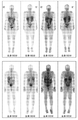
本発明の方法は、(PD)US、MRI、およびPETに関連する問題の多くを克服する。具体的には、本発明の方法は、滑膜炎症の高速で費用対効果の高い全身レベルの画像化を可能にする潜在力を有する。放射性核種に抱合させたペプチドを含むトレーサーの、本明細書に記載されている使用は、滑膜組織内の新生血管形成(neoangiogenic vessels)における特異性に関して、ならびに活性化されたマクロファージおよび破骨細胞への結合によって炎症性関節における貯留の可能性に関して、利点を提供する。更に、本発明者らは、予想外にも、新たな核画像化方法と現存の金字塔的な超音波技術との優れた相関関係を見出した(例えば、図4および5を参照すること)。このように本発明の方法は、炎症を起こした関節の特に高感度で特定的な画像化を可能にする。そのような画像化は、確立されたRAを有する患者において、診断のみならず、治療決定に重要な影響を及ぼすことにも、とりわけ高い疾患活動を有する患者および寛解期にある患者において、高価な生物学的作用物質の使用を最適化することにも、重要である可能性を有する。 The methods of the invention overcome many of the problems associated with (PD) US, MRI, and PET. Specifically, the methods of the invention have the potential to enable fast, cost-effective, systemic-level imaging of synovial inflammation. The use of tracers containing peptides conjugated to radioactive nuclei is described herein with respect to specificity in neoangiogenic vesels in synovial tissue, as well as activated macrophages and osteoclasts. The binding to provides an advantage with respect to the potential for retention in inflammatory joints. Moreover, we have unexpectedly found an excellent correlation between new nuclear imaging methods and existing monumental ultrasound techniques (see, eg, FIGS. 4 and 5). Thus, the methods of the invention allow for particularly sensitive and specific imaging of inflamed joints. Such imaging is expensive in patients with established RA, not only in diagnosis but also in important influences on treatment decisions, especially in patients with high disease activity and in remission. It may also be important to optimize the use of biological agents.
したがって、1つの態様において、本発明は、対象において関節炎を画像化する方法であって、放射性核種に抱合させたペプチドを含むトレーサーを対象に投与すること、および2D核画像化により、または単一光子放射事象の3D検出により、対象を画像化することを含む方法を提供する。通常、対象の画像化は、ガンマカメラを使用する2Dシンチグラフィーにより、または単一光子放射コンピュータ断層撮影法(SPECT)により、対象を画像化することを含む。典型的には、関節炎は炎症性関節炎である。一般に、放射性核種はガンマ線を放射する。多くの場合、ペプチドは、本明細書に記載されているR−G−D部分を含む。 Thus, in one embodiment, the invention is a method of imaging arthritis in a subject by administering to the subject a tracer containing a peptide conjugated to a radionuclide, and by 2D nuclear imaging, or single. Provided are methods that include imaging an object by 3D detection of a photon emission event. Imaging an object typically involves imaging the object by 2D scintigraphy using a gamma camera or by single photon emission computed tomography (SPECT). Typically, arthritis is inflammatory arthritis. In general, radionuclides emit gamma rays. Often, the peptide comprises the R-GD portion described herein.
別の態様において、本発明は、放射性核種に抱合させたペプチドを含むトレーサーを、2D核画像化により、または単一光子放射事象の3D検出により関節炎を画像化するための画像化剤として使用することを提供する。典型的には、トレーサー、画像化剤、関節炎、および対象については、本明細書において更に記載されているとおりである。 In another embodiment, the invention uses a tracer containing a peptide conjugated to a radionuclide as an imaging agent for imaging arthritis by 2D nuclear imaging or by 3D detection of a single photon emission event. Provide that. Typically, tracers, imaging agents, arthritis, and subjects are as described further herein.
本発明の方法は、医療診断において有用性が見出される。したがって、本発明は、対象において関節炎を診断する方法であって、(a)放射性核種に抱合させたペプチドを含むトレーサーを対象に投与すること、(b)2D核画像化により、または単一光子放射事象の3D検出により、対象を画像化すること、および(c)対象が関節炎を有するかを決定することを含む方法を提供する。通常は、トレーサー、画像化剤、関節炎、および対象については、本明細書において更に記載されているとおりである。 The method of the present invention is found to be useful in medical diagnosis. Therefore, the present invention is a method of diagnosing arthritis in a subject, wherein (a) a tracer containing a peptide conjugated to a radionuclide is administered to the subject, (b) by 2D nuclear imaging, or a single photon. 3D detection of radiation events provides methods that include imaging the subject and (c) determining if the subject has arthritis. Usually, tracers, imaging agents, arthritis, and subjects are as described further herein.
本発明は、対象における関節炎の診断に使用されるトレーサーも提供し、トレーサーは、放射性核種に抱合させたペプチドを含み、診断は、(a)トレーサーを対象に投与すること、(b)2D核画像化により、または単一光子放射事象の3D検出により、対象を画像化すること、および(c)対象が関節炎を有するかを決定することを含む。多くの場合には、トレーサー、画像化剤、関節炎、および対象については、本明細書において更に記載されているとおりである。 The present invention also provides a tracer used in the diagnosis of arthritis in a subject, the tracer comprising a peptide conjugated to a radionuclide, the diagnosis being (a) administering to the tracer, (b) 2D nuclei. Includes imaging the subject, either by imaging or by 3D detection of a single photon emission event, and (c) determining if the subject has arthritis. Often, tracers, imaging agents, arthritis, and subjects are as described further herein.
本発明は、関節炎の治療用の医薬品の活性を評価する方法であって、
− トレーサーを対象に投与することであって、トレーサーが、放射性核種に抱合させたペプチドを含み、対象が関節炎を有することと、
− 2D核画像化により、または単一光子放射事象の3D検出により、対象を画像化してトレーサーを検出することと、
− 医薬品を対象に投与することと、
− 医薬品を対象に投与した後、2D核画像化により、または単一光子放射事象の3D検出により、対象を画像化してトレーサーを検出することと、
− 医薬品の投与前後の対象の画像またはトレーサーの検出量の変化を評価することと、
を含む方法も提供する。
通常、トレーサー、画像化剤、関節炎、および対象については、本明細書において更に記載されているとおりである。
The present invention is a method for evaluating the activity of a drug for treating arthritis.
-To administer the tracer to the subject, that the tracer contains a peptide conjugated to a radionuclide and that the subject has arthritis.
− To detect the tracer by imaging the object by 2D nuclear imaging or by 3D detection of a single photon emission event.
− Administering medicines to subjects and
− To detect a tracer by imaging the subject by 2D nuclear imaging or by 3D detection of a single photon emission event after administration of the drug to the subject.
-Evaluating changes in the detected amount of the subject's image or tracer before and after administration of the drug,
Also provides methods including.
Usually, tracers, imaging agents, arthritis, and subjects are as described further herein.
定義
以下の置換基の定義は、本明細書に定義されている化合物に関して適用される。
Definitions The following definitions of substituents apply with respect to the compounds defined herein.
C1〜C10アルキル基は、非置換または置換、直鎖または分枝鎖の飽和炭化水素ラジカルである。典型的には、C1〜C6アルキルであり、例えば、メチル、エチル、プロピル、ブチル、ペンチル、もしくはヘキシルであり、またはC1〜C4アルキルであり、例えば、メチル、i−プロピル、n−プロピル、t−ブチル、s−ブチル、もしくはn−ブチルであり、例えば、C1〜C2アルキルであり、例えばメチルもしくはエチル、典型的にはメチルである。アルキル基が置換されている場合、典型的には、置換または非置換C1〜C10アルキル、置換または非置換アリール(本明細書において定義されている)、シアノ、アミノ、C1〜C10アルキルアミノ、ジ(C1〜C10)アルキルアミノ、アリールアミノ、ジアリールアミノ、アリールアルキルアミノ、アミド、アシルアミド、ヒドロキシ、オキソ、ハロ、カルボキシ、エステル、アシル、アシルオキシ、C1〜C10アルコキシ、アリールオキシ、ハロアルキル、スルホン酸、スルフヒドリル(すなわち、チオール、−SH)、C1〜C10アルキルチオ、アリールチオ、スルホニル、リン酸、リン酸エステル、ホスホン酸、およびホスホン酸エステルから選択される1つ以上の置換基を有する。置換アルキル基の例には、ハロアルキル、ヒドロキシアルキル、アミノアルキル、アルコキシアルキル、およびアルカリル基が含まれる。アルカリルという用語は、本明細書において使用されるとき、少なくとも1個の水素原子がアリール基に置き換えられているC1〜C10アルキル基に関する。そのような基の例には、ベンジル(フェニルメチル、PhCH2−)、ベンズヒドリル(Ph2CH−)、トリチル(トリフェニルメチル、Ph3C−)、フェネチル(フェニルエチル、Ph−CH2CH2−)、スチリル(Ph−CH=CH−)、シンナミル(Ph−CH=CH−CH2−)が含まれるが、これらに限定されない。典型的には、置換C1〜C10アルキル基は、1、2、または3つの置換基、例えば、1または2つを有する。 The C 1 to C 10 alkyl groups are unsubstituted or substituted, straight or branched saturated hydrocarbon radicals. Typically, it is C 1 to C 6 alkyl, eg, methyl, ethyl, propyl, butyl, pentyl, or hexyl, or C 1 to C 4 alkyl, eg, methyl, i-propyl, n. - propyl, t- butyl, a s- butyl or n- butyl, for example a C 1 -C 2 alkyl, such as methyl or ethyl, typically methyl. When the alkyl group is substituted, typically (as defined herein) substituted or unsubstituted C 1 -C 10 alkyl, substituted or unsubstituted aryl, cyano, amino, C 1 -C 10 Alkylamino, di (C 1 to C 10 ) alkylamino, arylamino, diarylamino, arylalkylamino, amide, acylamide, hydroxy, oxo, halo, carboxy, ester, acyl, acyloxy, C 1 to C 10 alkoxy, aryl oxy, haloalkyl, sulfonic acid, sulfhydryl (i.e., thiol, -SH), C 1 -C 10 alkylthio, arylthio, sulfonyl, phosphate, phosphoric acid esters, one or more selected from phosphonic acids and phosphonic acid esters, It has a substituent. Examples of substituted alkyl groups include haloalkyl, hydroxyalkyl, aminoalkyl, alkoxyalkyl, and alkaline groups. The term alkalinel, as used herein, relates to a C 1 to C 10 alkyl group in which at least one hydrogen atom has been replaced with an aryl group. Examples of such groups include benzyl (phenylmethyl, PhCH 2- ), benzhydryl (Ph 2 CH-), trityl (triphenylmethyl, Ph 3 C-), phenethyl (phenylethyl, Ph-CH 2 CH 2). -), Styryl (Ph-CH = CH-), Synamyl (Ph-CH = CH-CH 2- ), but are not limited to these. Typically, substituted C 1 -C 10 alkyl groups have 1, 2 or 3 substituents, for example, 1 or 2.
C2〜C10アルケニル基は、1つ以上、例えば、1または2つの二重結合を有する、非置換または置換、直鎖または分枝鎖の不飽和炭化水素ラジカルである。典型的には、C2〜C6アルケニルであり、例えば、エテニル、プロペニル、ブテニル、ペンテニル、もしくはヘキセニルであり、またはC2〜C4アルケニルであり、例えば、エテニル、i−プロペニル、n−プロペニル、t−ブテニル、s−ブテニル、もしくはn−ブテニルである。アルケニル基が置換されている場合、典型的には、置換または非置換C1〜C10アルキル、置換または非置換アリール(本明細書において定義されている)、シアノ、アミノ、C1〜C10アルキルアミノ、ジ(C1〜C10)アルキルアミノ、アリールアミノ、ジアリールアミノ、アリールアルキルアミノ、アミド、アシルアミド、ヒドロキシ、オキソ、ハロ、カルボキシ、エステル、アシル、アシルオキシ、C1〜C10アルコキシ、アリールオキシ、ハロアルキル、スルホン酸、スルフヒドリル(すなわち、チオール、−SH)、C1〜C10アルキルチオ、アリールチオ、スルホニル、リン酸、リン酸エステル、ホスホン酸、およびホスホン酸エステルから選択される1つ以上の置換基を有する。置換アルケニル基の例には、ハロアルケニル、ヒドロキシアルケニル、アミノアルケニル、アルコキシアルケニル、およびアルケナリル(alkenaryl)基が含まれる。アルケナリルという用語は、本明細書において使用されるとき、少なくとも1個の水素原子がアリール基に置き換えられているC2〜C10アルケニル基に関する。そのような基の例には、スチリル(PhCH=CH−)、Ph2C=CH−、PhCH=C(Ph)−、およびシンナミル(Ph−CH=CH−CH2−)が含まれるが、これらに限定されない。典型的には、置換C2〜C10アルケニル基は、1、2、または3つの置換基、例えば、1または2つを有する。 C 2 -C 10 alkenyl group, one or more, e.g., 1 or having two double bonds, unsubstituted or substituted, unsaturated hydrocarbon radical straight or branched chain. Typically, a C 2 -C 6 alkenyl, such as ethenyl, propenyl, butenyl, a pentenyl or hexenyl, or a C 2 -C 4 alkenyl, e.g., ethenyl, i- propenyl, n- propenyl , T-butenyl, s-butenyl, or n-butenyl. If the alkenyl group is substituted, typically (as defined herein) substituted or unsubstituted C 1 -C 10 alkyl, substituted or unsubstituted aryl, cyano, amino, C 1 -C 10 Alkylamino, di (C 1 to C 10 ) alkylamino, arylamino, diarylamino, arylalkylamino, amide, acylamide, hydroxy, oxo, halo, carboxy, ester, acyl, acyloxy, C 1 to C 10 alkoxy, aryl oxy, haloalkyl, sulfonic acid, sulfhydryl (i.e., thiol, -SH), C 1 -C 10 alkylthio, arylthio, sulfonyl, phosphate, phosphoric acid esters, one or more selected from phosphonic acids and phosphonic acid esters, It has a substituent. Examples of substituted alkenyl groups include haloalkenyl, hydroxyalkenyl, aminoalkenyl, alkoxyalkenyl, and alkenaryl groups. The term alkenaryl, as used herein, relates to a C 2 to C 10 alkenyl group in which at least one hydrogen atom has been replaced with an aryl group. Examples of such groups include styryl (PhCH = CH-), Ph 2 C = CH-, PhCH = C (Ph)-, and cinnamyl (Ph-CH = CH-CH 2- ), although Not limited to these. Typically, substituted C 2 -C 10 alkenyl group has 1, 2 or 3 substituents, for example, 1 or 2.
C3〜C10シクロアルキル基は、非置換または置換アルキル基であり、これはシクリル基でもあり、すなわち、炭素環式化合物の炭素環式環の脂環式環原子から水素原子を除去することによって得られる一価部分であり、この部分は、3〜10個の炭素原子を(他に特に規定がなければ)有し、3〜10個の環原子が含まれる。このように、用語「シクロアルキル」は、サブクラスのシクロアルキエニル(cycloalkyenyl)およびシクロアルキニルを含む。C3〜C10シクロアルキル基の群の例には、C3〜C7シクロアルキル、例えばC5またはC6シクロアルキルが含まれる。C3〜C10シクロアルキル基が置換されている場合、典型的には、非置換のC1〜C6アルキル、アリール(本明細書において定義されている)、シアノ、アミノ、C1〜C10アルキルアミノ、ジ(C1〜C10)アルキルアミノ、アリールアミノ、ジアリールアミノ、アリールアルキルアミノ、アミド、アシルアミド、ヒドロキシ、オキソ、ハロ、カルボキシ、エステル、アシル、アシルオキシ、C1〜C20アルコキシ、アリールオキシ、ハロアルキル、スルホン酸、スルフヒドリル(すなわち、チオール、−SH)、C1〜C10アルキルチオ、アリールチオ、リン酸、リン酸エステル、ホスホン酸、ホスホン酸エステル、およびスルホニルから選択される1つ以上の置換基を有する。典型的には、置換C3〜C10シクロアルキル基は、1、2、または3つの置換基、例えば、1または2つを有する。 C 3 to C 10 cycloalkyl groups are unsubstituted or substituted alkyl groups, which are also cyclic groups, i.e., removing hydrogen atoms from the alicyclic ring atom of the carbocyclic ring of the carbocyclic compound. It is a monovalent portion obtained by, which has 3 to 10 carbon atoms (unless otherwise specified) and contains 3 to 10 ring atoms. Thus, the term "cycloalkyl" includes the subclasses cycloalkynyl and cycloalkynyl. Examples of groups of C 3 to C 10 cycloalkyl groups include C 3 to C 7 cycloalkyl, such as C 5 or C 6 cycloalkyl. When the C 3 to C 10 cycloalkyl groups are substituted, typically unsubstituted C 1 to C 6 alkyl, aryl (as defined herein), cyano, amino, C 1 to C. 10 Alkylamino, di (C 1 to C 10 ) alkylamino, arylamino, diarylamino, arylalkylamino, amide, acylamide, hydroxy, oxo, halo, carboxy, ester, acyl, acyloxy, C 1 to C 20 alkoxy, aryloxy, haloalkyl, sulfonic acid, sulfhydryl (i.e., thiol, -SH), C 1 -C 10 alkylthio, arylthio, phosphoric acid, phosphoric acid esters, phosphonic acids, phosphonic acid esters, and one or more selected from sulfonyl It has a substituent of. Typically, the substituted C 3 to C 10 cycloalkyl groups have 1, 2, or 3 substituents, such as 1 or 2.
C3〜C10シクロアルキル基の例には、C3〜C10シクロアルキル基が非置換である、または上記に定義されたように置換されている、飽和単環式炭化水素化合物から誘導されたもの:シクロプロパン(C3)、シクロブタン(C4)、シクロペンタン(C5)、シクロヘキサン(C6)、シクロヘプタン(C7)、メチルシクロプロパン(C4)、ジメチルシクロプロパン(C5)、メチルシクロブタン(C5)、ジメチルシクロブタン(C6)、メチルシクロペンタン(C6)、ジメチルシクロペンタン(C7)、メチルシクロヘキサン(C7)、ジメチルシクロヘキサン(C8)、メンタン(C10);
不飽和単環式炭化水素化合物から誘導されたもの:シクロプロペン(C3)、シクロブテン(C4)、シクロペンテン(C5)、シクロヘキセン(C6)、メチルシクロプロペン(C4)、ジメチルシクロプロペン(C5)、メチルシクロブテン(C5)、ジメチルシクロブテン(C6)、メチルシクロペンテン(C6)、ジメチルシクロペンテン(C7)、メチルシクロヘキセン(C7)、ジメチルシクロヘキセン(C8);
飽和多環式炭化水素化合物から誘導されたもの:ツジャン(C10)、カラン(C10)、ピナン(C10)、ボルナン(C10)、ノルカラン(C7)、ノルピナン(C7)、ノルボルナン(C7)、アダマンタン(C10)、デカリン(デカヒドロナフタレン)(C10);
不飽和多環式炭化水素化合物から誘導されたもの:カンフェン(C10)、リモネン(C10)、ピネン(C10);
芳香族環を有する多環式炭化水素化合物から誘導されたもの:インデン(C9)、インダン(例えば、2,3−ジヒドロ−1H−インデン)(C9)、テトラリン(1,2,3,4−テトラヒドロナフタレン)(C10)
が含まれるが、これらに限定されない。
Examples of C 3 -C 10 cycloalkyl group, C 3 -C 10 cycloalkyl group is unsubstituted or substituted as defined above, derived from a saturated monocyclic hydrocarbon compound Others: Cyclopropane (C 3 ), Cyclobutane (C 4 ), Cyclopentane (C 5 ), Cyclohexane (C 6 ), CycloHeptane (C 7 ), Methyl Cyclo Propane (C 4 ), Dimethyl Cyclo Propane (C 5) ), cyclobutane (C 5), dimethylcyclobutane (C 6), methylcyclopentane (C 6), dimethylcyclopentane (C 7), methylcyclohexane (C 7), dimethylcyclohexane (C 8), menthane (C 10 );
Derived from unsaturated monocyclic hydrocarbon compounds: cyclopropene (C 3 ), cyclobutene (C 4 ), cyclopentene (C 5 ), cyclohexene (C 6 ), methyl cyclopropene (C 4 ), dimethyl cyclopropene (C 5), methyl-cyclo-butene (C 5), dimethyl cyclobutene (C 6), methylcyclopentene (C 6), dimethyl cyclopentene (C 7), methylcyclohexene (C 7), dimethylcyclohexene (C 8);
Those derived from a saturated polycyclic hydrocarbon compounds: Tsujan (C 10), Curran (C 10), pinane (C 10), bornane (C 10), norcarane (C 7), norpinane (C 7), norbornane (C 7 ), Adamantane (C 10 ), Decalin (decahydronaphthalene) (C 10 );
Derived from unsaturated polycyclic hydrocarbon compounds: camphene (C 10 ), limonene (C 10 ), pinene (C 10 );
Derived from polycyclic hydrocarbon compounds with aromatic rings: indene (C 9 ), indane (
Includes, but is not limited to.
C3〜C10ヘテロシクリル基は、複素環化合物の環原子から水素原子を除去することによって得られる、非置換または置換一価部分であり、この部分は、3〜10個の環原子を(他に特に規定がなければ)有し、そのうち1〜5個が環ヘテロ原子である。好ましくは、各環が3〜7個の環原子を有し、そのうち1〜4個が環ヘテロ原子である。多くの場合、各環が5〜6個の環原子を有し、そのうち1〜2個が環ヘテロ原子である。C3〜C10ヘテロシクリル基が置換されている場合、典型的には、非置換のC1〜C6アルキル、アリール(本明細書において定義されている)、シアノ、アミノ、C1〜C10アルキルアミノ、ジ(C1〜C10)アルキルアミノ、アリールアミノ、ジアリールアミノ、アリールアルキルアミノ、アミド、アシルアミド、ヒドロキシ、オキソ、ハロ、カルボキシ、エステル、アシル、アシルオキシ、C1〜C20アルコキシ、アリールオキシ、ハロアルキル、スルホン酸、スルフヒドリル(すなわち、チオール、−SH)、C1〜C10アルキルチオ、アリールチオ、リン酸、リン酸エステル、ホスホン酸、ホスホン酸エステル、およびスルホニルから選択される1つ以上の置換基を有する。典型的には、置換C3〜C10ヘテロシクリル基は、1、2、または3つの置換基、例えば、1または2つを有する。 A C 3 to C 10 heterocyclyl group is an unsubstituted or substituted monovalent moiety obtained by removing a hydrogen atom from a ring atom of a heterocyclic compound, and this moiety contains 3 to 10 ring atoms (others). (Unless otherwise specified), 1 to 5 of which are ring heteroatoms. Preferably, each ring has 3 to 7 ring atoms, of which 1 to 4 are ring heteroatoms. In most cases, each ring has 5 to 6 ring atoms, of which 1 to 2 are ring heteroatoms. When the C 3 to C 10 heterocyclyl groups are substituted, typically unsubstituted C 1 to C 6 alkyl, aryl (as defined herein), cyano, amino, C 1 to C 10 Alkylamino, di (C 1 to C 10 ) alkylamino, arylamino, diarylamino, arylalkylamino, amide, acylamide, hydroxy, oxo, halo, carboxy, ester, acyl, acyloxy, C 1 to C 20 alkoxy, aryl oxy, haloalkyl, sulfonic acid, sulfhydryl (i.e., thiol, -SH), C 1 -C 10 alkylthio, arylthio, phosphoric acid, phosphoric acid esters, phosphonic acids, phosphonic acid esters, and one or more selected from sulfonyl It has a substituent. Typically, the substituted C 3 to C 10 heterocyclyl groups have one, two, or three substituents, such as one or two.
ヘテロシクリル基の群の例には、C5〜C10ヘテロシクリル、C3〜C7ヘテロシクリル、C5〜C7ヘテロシクリル、およびC5〜C6ヘテロシクリルが含まれる。 Examples of groups of heterocyclyl groups include C 5 to C 10 heterocyclyls, C 3 to C 7 heterocyclyls, C 5 to C 7 heterocyclyls, and C 5 to C 6 heterocyclyls.
(非芳香族)単環式C3〜C10ヘテロシクリル基の例には、
N1から誘導されたもの:アジリジン(C3)、アゼチジン(C4)、ピロリジン(テトラヒドロピロール)(C5)、ピロリン(例えば、3−ピロリン、2,5−ジヒドロピロール)(C5)、2H−ピロールまたは3H−ピロール(イソピロール、イソアゾール)(C5)、ピペリジン(C6)、ジヒドロピリジン(C6)、テトラヒドロピリジン(C6)、アゼピン(C7);
O1から誘導されたもの:オキシラン(C3)、オキセタン(C4)、オキソラン(テトラヒドロフラン)(C5)、オキソール(ジヒドロフラン)(C5)、オキサン(テトラヒドロピラン)(C6)、ジヒドロピラン(C6)、ピラン(C6)、オキセピン(C7);
S1から誘導されたもの:チイラン(C3)、チエタン(C4)、チオラン(テトラヒドロチオフェン)(C5)、チアン(テトラヒドロチオピラン)(C6)、チエパン(C7);
O2から誘導されたもの:ジオキソラン(C5)、ジオキサン(C6)、およびジオキセパン(C7);
O3から誘導されたもの:トリオキサン(C6);
N2から誘導されたもの:イミダゾリジン(C5)、ピラゾリジン(ジアゾリジン)(C5)、イミダゾリン(C5)、ピラゾリン(ジヒドロピラゾール)(C5)、ピペラジン(C6);
N1O1から誘導されたもの:テトラヒドロオキサゾール(C5)、ジヒドロオキサゾール(C5)、テトラヒドロイソオキサゾール(C5)、ジヒドロイソオキサゾール(C5)、モルホリン(C6)、テトラヒドロオキサジン(C6)、ジヒドロオキサジン(C6)、オキサジン(C6);
N1S1から誘導されたもの:チアゾリン(C5)、チアゾリジン(C5)、チオモルホリン(C6);
N2S1から誘導されたもの:オキサジアジン(C6);
O1S1から誘導されたもの:オキサチオール(C5)およびオキサチアン(チオキサン)(C6);ならびに
N1O1S1から誘導されたもの:オキサチアジン(C6)
が含まれるが、これらに限定されない。
Examples of (non-aromatic) monocyclic C 3 to C 10 heterocyclyl groups include:
Derived from N 1 : Aziridine (C 3 ), Azetidine (C 4 ), Pyrrolidine (Tetrahydropyrrole) (C 5 ), Pyrroline (eg 3-pyrroline, 2,5-dihydropyrrole) (C 5 ), 2H-pyrrole or 3H-pyrrole (isopyrrole, isoazole) (C 5 ), piperidine (C 6 ), dihydropyridine (C 6 ), tetrahydropyridine (C 6 ), azepine (C 7 );
O 1 derived ones from: oxirane (C 3), oxetane (C 4), oxolane (tetrahydrofuran) (C 5), Okisoru (dihydrofuran) (C 5), dioxane (tetrahydropyran) (C 6), dihydro Piran (C 6 ), Piran (C 6 ), Oxepin (C 7 );
Derived from S 1 : Thiilan (C 3 ), Thietane (C 4 ), Thioran (Tetrahydrothiophene) (C 5 ), Thiane (Tetrahydrothiophene) (C 6 ), Thiepane (C 7 );
O 2 derived ones from: dioxolane (C 5), dioxane (C 6), and dioxepane (C 7);
O 3 derived ones from: trioxane (C 6);
Derived from N 2 : imidazolidine (C 5 ), pyrazolidine (diazolidine) (C 5 ), imidazoline (C 5 ), pyrazoline (dihydropyrazole) (C 5 ), piperazine (C 6 );
Derived from N 1 O 1 : Tetrahydrooxazole (C 5 ), dihydrooxazole (C 5 ), tetrahydroisoxazole (C 5 ), dihydroisoxazole (C 5 ), morpholine (C 6 ), tetrahydrooxazine (C) 6 ), Dihydrooxazine (C 6 ), Oxazine (C 6 );
Derived from N 1 S 1 : thiazolin (C 5 ), thiazolidine (C 5 ), thiomorpholine (C 6 );
Derived from N 2 S 1 : Oxaziazine (C 6 );
Derived from O 1 S 1 : oxathiol (C 5 ) and oxatian (thioxane) (C 6 ); and derived from N 1 O 1 S 1 : oxathiazine (C 6 )
Includes, but is not limited to.
置換(非芳香族)単環式ヘテロシクリル基の例には、環状形態の多糖から誘導されたもの、例えば、アラビノフラノース、リキソフラノース、リボフラノース、およびキシロフランスなどのフラノース(C5)、ならびにアロピラノース、アルトロピラノース、グルコピラノース、マンノピラノース、グロピラノース、イドピラノース、ガラクトピラノース、およびタロピラノースなどのピラノース(C6)が含まれる。 Examples of substituted (non-aromatic) monocyclic heterocyclyl groups are those derived from cyclic polysaccharides, such as furanose (C 5 ), such as arabinofuranose, lyxofuranose, ribofuranose, and xylofranose. and Aropiranosu, Al tropicity La North, glucopyranose, mannopyranose, Guropiranosu, idopyranose, galactopyranose, and allopyranose is pyranose (C 6), such as are included.
アリール基でもあるC3〜C10ヘテロシクリル基の例は、ヘテロアリール基として下記に記載されている。 Examples of C 3 to C 10 heterocyclyl groups, which are also aryl groups, are described below as heteroaryl groups.
アリール基は、置換または非置換、単環式または縮合多環式の芳香族基であり、典型的には6〜14個の炭素原子、好ましくは6〜10個の炭素原子、例えば6個の炭素原子を環部分に含有する。例には、フェニル(すなわち、単環式)、ナフチル、インデニル、およびインダニル(すなわち、縮合二環式)、アントラセニル(すなわち、縮合三環式)、ならびにピレニル(すなわち、縮合四環式)基が含まれる。アリール基は、非置換である、または置換されている。上記に定義されたアリール基が置換されている場合、典型的には、非置換のC1〜C6アルキル(アラルキル基を形成する)、非置換のアリール、シアノ、アミノ、C1〜C10アルキルアミノ、ジ(C1〜C10)アルキルアミノ、アリールアミノ、ジアリールアミノ、アリールアルキルアミノ、アミド、アシルアミド、ヒドロキシ、ハロ、カルボキシ、エステル、アシル、アシルオキシ、C1〜C20アルコキシ、アリールオキシ、ハロアルキル、スルフヒドリル(すなわち、チオール、−SH)、C1〜C10アルキルチオ、アリールチオ、スルホン酸、リン酸、リン酸エステル、ホスホン酸およびホスホン酸エステル、およびスルホニルから選択される1つ以上の置換基を有する。典型的には、0、1、2、または3つの置換基を有する。置換アリール基は、単一のC1〜C6アルキレン基により、または式−X−C1〜C6アルキレンもしくは−X−C1〜C6アルキレン−X−により表される二座基により、2つの位置で置換されていてもよく、ここでXは、O、S、およびNRから選択され、Rは、H、アリール、またはC1〜C6アルキルである。このように、置換アリール基は、シクロアルキル基またはヘテロシクリル基に縮合しているアリール基でありうる。アラルキルという用語は、本明細書において使用されるとき、少なくとも1個の水素原子(例えば、1、2、3個)がC1〜C6アルキル基で置換されているアリール基に関する。そのような基の例には、トリル(トルエンから)、キシリル(キシレンから)、メシチル(メシチレンから)、クメニル(またはクミル、クメンから)、およびズリル(ズレンから)が含まれるが、これらに限定されない。 Aryl groups are substituted or unsubstituted, monocyclic or condensed polycyclic aromatic groups, typically 6 to 14 carbon atoms, preferably 6 to 10 carbon atoms, such as 6 carbon atoms. A carbon atom is contained in the ring portion. Examples include phenyl (ie, monocyclic), naphthyl, indenyl, and indanyl (ie, condensed bicyclic), anthracenyl (ie, condensed tricyclic), and pyrenyl (ie, condensed tetracyclic) groups. included. Aryl groups are unsubstituted or substituted. If the aryl group as defined is substituted, typically, (to form an aralkyl group) unsubstituted C 1 -C 6 alkyl, unsubstituted aryl, cyano, amino, C 1 -C 10 Alkylamino, di (C 1 to C 10 ) alkylamino, arylamino, diarylamino, arylalkylamino, amide, acylamide, hydroxy, halo, carboxy, ester, acyl, acyloxy, C 1 to C 20 alkoxy, aryloxy, haloalkyl, sulfhydryl (i.e., thiol, -SH), C 1 -C 10 alkylthio, arylthio, sulfonic acid, phosphoric acid, phosphoric acid esters, one or more substituents selected phosphonic acids and phosphonic acid esters, and sulfonyl Has. Typically, it has 0, 1, 2, or 3 substituents. Substituted aryl groups are represented by a single C 1 to C 6 alkylene group, or by a bidentate represented by the formula -X-C 1 to C 6 alkylene or -X-C 1 to C 6 alkylene-X-. It may be substituted at two positions, where X is selected from O, S, and NR and R is H, aryl, or C 1 to C 6 alkyl. Thus, the substituted aryl group can be an aryl group fused to a cycloalkyl group or a heterocyclyl group. The term aralkyl, as used herein, at least one hydrogen atom (e.g., 1, 2, 3) regarding the aryl group is substituted with C 1 -C 6 alkyl group. Examples of such groups include, but are limited to, tolyl (from toluene), xylyl (from xylene), mesitylene (from mesitylene), cumenyl (or from cumyl, cumene), and zulyl (from zulene). Not done.
本明細書において使用されるとき、ヘテロアリール基は、置換または非置換、単環式または縮合多環式(例えば、二環式もしくは三環式)の芳香族基であり、典型的には5〜14個の原子を環部分に含有し、O、S、N、P、Se、およびSiから、より典型的にはO、S、およびNから選択される少なくとも1個のヘテロ原子、例えば、1、2、または3個のヘテロ原子が含まれる。例には、ピリジル、ピラジニル、ピリミジニル、ピリダジニル、フラニル、チエニル、ピラゾリジニル、ピロリル、オキサジアゾリル、イソオキサゾリル、チアジアゾリル、チアゾリル、イミダゾリル、トリアゾリル、ピラゾリル、オキサゾリル、イソチアゾリル、ベンゾフラニル、イソベンゾフラニル、ベンゾチオフェニル、インドリル、インダゾリル、カルバゾリル、アクリジニル、プリニル、シンノリニル、キノキサリニル、ナフチリジニル、ベンゾイミダゾリル、ベンゾオキサゾリル、キノリニル、キナゾリニル、およびイソキノリニルが含まれる。ヘテロアリール基は、多くの場合、5または6員環である。しかし、本明細書において使用されるとき、ヘテロアリール基への参照には、縮合多環式環系も含まれ、例えば、ヘテロアリール基がアリール基に縮合している縮合二環式系が含まれる。ヘテロアリール基がそのような縮合ヘテロアリール基である場合、好ましい例は、5員〜6員ヘテロアリール基がフェニル基に縮合している縮合環系である。そのような縮合環系の例は、ベンゾフラニル、イソベンゾフラニル、ベンゾチオフェニル、インドリル、インダゾリル、ベンゾイミダゾリル、ベンゾオキサゾリル、キノリニル、キナゾリニル、およびイソキノリニル部分である。 As used herein, a heteroaryl group is a substituted or unsubstituted, monocyclic or fused polycyclic (eg, bicyclic or tricyclic) aromatic group, typically 5 At least one heteroatom containing ~ 14 atoms in the ring moiety and selected from O, S, N, P, Se, and Si, more typically O, S, and N, eg, It contains one, two, or three heteroatoms. Examples include pyridyl, pyrazinyl, pyrimidinyl, pyridadinyl, flanyl, thienyl, pyrazolydinyl, pyrrolyl, oxadiazolyl, isooxazolyl, thiadiazolyl, thiazolyl, imidazolyl, triazolyl, pyrazolyl, oxazolyl, isothiazolyl, benzofuranyl, isobenzofuranyl, benzothiophenyl, indrill. , Indazolyl, carbazolyl, acridinyl, prynyl, cinnolinyl, quinoxalinyl, naphthyldinyl, benzoimidazolyl, benzoxazolyl, quinolinyl, quinazolinyl, and isoquinolinyl. Heteroaryl groups are often 5- or 6-membered rings. However, as used herein, references to heteroaryl groups also include condensed polycyclic ring systems, such as fused bicyclic systems in which heteroaryl groups are fused to aryl groups. Is done. When the heteroaryl group is such a fused heteroaryl group, a preferred example is a fused ring system in which a 5- to 6-membered heteroaryl group is fused to a phenyl group. Examples of such fused ring systems are benzofuranyl, isobenzofuranyl, benzothiophenyl, indolyl, indazolyl, benzoimidazolyl, benzoxazolyl, quinolinyl, quinazolinyl, and isoquinolinyl moieties.
ヘテロアリール基は、例えば、アリールについて上記に特定されているように、非置換であっても、置換されていてもよい。典型的には、0、1、2、または3つの置換基を有する。 Heteroaryl groups may be unsubstituted or substituted, for example, as specified above for aryls. Typically, it has 0, 1, 2, or 3 substituents.
C1〜C10アルキレン基は、1〜10個の炭素原子を(他に特に規定がなければ)有する炭化水素化合物の同じ炭素原子から両方とも、または2個の異なる炭素原子からそれぞれ1個ずつ、2個の水素原子を除去することによって得られる非置換または置換二座部分であり、脂肪族または脂環式であってもよく、飽和、部分的に不飽和、または完全に不飽和であってもよい。このように、用語「アルキレン」には、サブクラスのアルケニレン、アルキニレン、シクロアルキレンなどが含まれ、下記に考察されている。しかし、通常は飽和脂肪族(非環状)基である。典型的には、C1〜C6アルキレンまたはC1〜C4アルキレンであり、例えば、メチレン、エチレン、i−プロピレン、n−プロピレン、t−ブチレン、s−ブチレン、またはn−ブチレンである。例えば、C2〜C4アルキレンであってもよい。または、例えばC1〜C3アルキレンであってもよく、例えば、メチレン、エチレン、n−プロピレン、またはi−プロピレンであってもよい。(しかし通常は、本明細書においてC1〜C3アルキレンは、メチレン、エチレン、またはn−プロピレンを指す。)ペンチレン、ヘキシレン、ヘプチレン、オクチレン、およびこれらの様々な分枝鎖異性体でもありうる。アルキレン基は、例えば、アルキルについて上記に特定されているように、非置換であっても、置換されていてもよい。典型的には、置換アルキレン基は、1、2、または3つの置換基、例えば、1または2つを有する。 The C 1 to C 10 alkylene groups are both from the same carbon atom of the hydrocarbon compound having 1 to 10 carbon atoms (unless otherwise specified), or one from each of two different carbon atoms. , An unsubstituted or substituted bidentate obtained by removing two hydrogen atoms, which may be aliphatic or alicyclic, saturated, partially unsaturated, or completely unsaturated. You may. Thus, the term "alkylene" includes the subclasses alkenylene, alkynylene, cycloalkylene, etc., which are discussed below. However, it is usually a saturated aliphatic (acyclic) group. Typically, it is C 1 to C 6 alkylene or C 1 to C 4 alkylene, for example methylene, ethylene, i-propylene, n-propylene, t-butylene, s-butylene, or n-butylene. For example, it may be a C 2 -C 4 alkylene. Alternatively, it may be, for example, C 1 to C 3 alkylene, and may be, for example, methylene, ethylene, n-propylene, or i-propylene. (But usually, C 1 -C 3 alkylene herein, methylene, refers to ethylene or n- propylene.) Pentylene, hexylene, heptylene, can be octylene, and in these various branched chain isomers thereof .. The alkylene group may be unsubstituted or substituted, for example, as specified above for alkyl. Typically, the substituted alkylene group has one, two, or three substituents, such as one or two.
この文脈において、接頭辞(例えば、C1〜C4、C1〜C6、C1〜C7、C1〜C10、C2〜C7、C3〜C7など)は、炭素原子の数または炭素原子の数の範囲を示す。例えば、用語「C1〜C4アルキレン」は、本明細書において使用されるとき、1〜4個の炭素原子を有するアルキレン基に関する。アルキレン基の群の例には、C1〜C4アルキレン(「低級アルキレン」)、C1〜C7アルキレン、およびC1〜C10アルキレンが含まれる。 In this context, prefixes (eg, C 1 to C 4 , C 1 to C 6 , C 1 to C 7 , C 1 to C 10 , C 2 to C 7 , C 3 to C 7, etc.) are carbon atoms. Indicates the number of carbon atoms or the range of the number of carbon atoms. For example, the term "C 1 -C 4 alkylene" as used herein, it relates to an alkylene group having from 1 to 4 carbon atoms. Examples of groups of alkylene groups include C 1 to C 4 alkylene (“lower alkylene”), C 1 to C 7 alkylene, and C 1 to C 10 alkylene.
直鎖飽和C1〜C7アルキレン基の例には、nが1〜7の整数である−(CH2)n−、例えば、−CH2−(メチレン)、−CH2CH2−(エチレン)、−CH2CH2CH2−(プロピレン)、および−CH2CH2CH2CH2−(ブチレン)が含まれるが、これらに限定されない。 In the example of the linear saturated C 1 to C 7 alkylene group, n is an integer of 1 to 7- (CH 2 ) n- , for example, -CH 2- (methylene), -CH 2 CH 2- (ethylene). ), -CH 2 CH 2 CH 2- (propylene), and -CH 2 CH 2 CH 2 CH 2- (butylene), but are not limited thereto.
分枝鎖飽和C1〜C7アルキレン基の例には、−CH(CH3)−、−CH(CH3)CH2−、−CH(CH3)CH2CH2−、−CH(CH3)CH2CH2CH2−、−CH2CH(CH3)CH2−、−CH2CH(CH3)CH2CH2−、−CH(CH2CH3)−、−CH(CH2CH3)CH2−、および−CH2CH(CH2CH3)CH2−が含まれるが、これらに限定されない。 Examples of branched chain saturated C 1 to C 7 alkylene groups include -CH (CH 3 )-, -CH (CH 3 ) CH 2- , -CH (CH 3 ) CH 2 CH 2- , -CH (CH). 3 ) CH 2 CH 2 CH 2 −, −CH 2 CH (CH 3 ) CH 2 −, −CH 2 CH (CH 3 ) CH 2 CH 2 −, −CH (CH 2 CH 3 ) −, −CH (CH) 2 CH 3 ) CH 2 − and −CH 2 CH (CH 2 CH 3 ) CH 2 − are included, but are not limited thereto.
直鎖部分的不飽和C1〜C7アルキレン基の例には、−CH=CH−(ビニレン)、−CH=CH−CH2−、−CH2−CH=CH2−、−CH=CH−CH2−CH2−、−CH=CH−CH2−CH2−CH2−、−CH=CH−CH=CH−、−CH=CH−CH=CH−CH2−、−CH=CH−CH=CH−CH2−CH2−、−CH=CH−CH2−CH=CH−、および−CH=CH−CH2−CH2−CH=CH−が含まれるが、これらに限定されない。 Examples of linear partially unsaturated C 1 to C 7 alkylene groups include -CH = CH- (vinylene), -CH = CH-CH 2- , -CH 2 -CH = CH 2- , -CH = CH. -CH 2 -CH 2 -, - CH = CH-CH 2 -CH 2 -CH 2 -, - CH = CH-CH = CH -, - CH = CH-CH = CH-CH 2 -, - CH = CH -CH = CH-CH 2 -CH 2 -, - CH = CH-CH 2 -CH = CH-, and -CH = CH-CH 2 -CH 2 -CH = CH- include, but are not limited to ..
分枝鎖部分不飽和C1〜C7アルキレン基の例には、−C(CH3)=CH−、−C(CH3)=CH−CH2−、および−CH=CH−CH(CH3)−が含まれるが、これらに限定されない。 Examples of branched partially unsaturated C 1 -C 7 alkylene group, -C (CH 3) = CH -, - C (CH 3) = CH-CH 2 -, and -CH = CH-CH (CH 3 )-Includes, but is not limited to.
脂環式飽和C1〜C7アルキレン基の例には、シクロペンチレン(例えば、シクロペンタ−1,3−イレン)、およびシクロヘキシレン(例えば、シクロヘキサ−1,4−イレン)が含まれるが、これらに限定されない。 Examples of alicyclic saturated C 1 -C 7 alkylene group, cyclopentylene (e.g., cyclopent-1,3-ylene), and cyclohexylene (e.g., cyclohex-1,4-ylene) but are Not limited to these.
脂環式部分不飽和C1〜C7アルキレン基の例には、シクロペンテニレン(例えば、4−シクロペンテン−1,3−イレン)、シクロヘキセニレン(例えば、2−シクロヘキセン−1,4−イレン、3−シクロヘキセン−1,2−イレン、2,5−シクロヘキサジエン−1,4−イレン)が含まれるが、これらに限定されない。 Examples of alicyclic partially unsaturated C 1 -C 7 alkylene group, cyclopentenylene (e.g., 4-cyclopenten-1,3-ylene), cyclohexenylene (e.g., 2-cyclohexen-1,4 (Irene, 3-cyclohexene-1,2-ylene, 2,5-cyclohexadiene-1,4-ylene), but not limited to these.
本明細書において定義されているC1〜C10アルキレンおよびC1〜C10アルキル基は、非中断である、あるいはS、O、もしくはN(R”)(ここでR”は、H、C1〜C6アルキル、C2〜C6アルケニル、C2〜C6アルキニル、アリール(典型的には、フェニル)もしくはヘテロアリールである)などの1個以上のヘテロ原子もしくはヘテロ基により、または1つ以上のアリーレンもしくはヘテロアリーレン基、典型的にはC6〜C10アリーレンもしくはC5〜C10ヘテロアリーレン(典型的にはアリーレン、より典型的にはフェニレン)基により、または1つ以上の−C(O)−、−C(O)O−、−C(O)N(R”)−、もしくは−N(R”)C(O)−基により中断されている。したがって、語句「任意選択で中断されている」は、本明細書において使用されるとき、非中断である、あるいは酸素もしくは硫黄などのヘテロ原子により、またはN(R”)(ここでR”は、H、アリール、ヘテロアリール、もしくはC1〜C6アルキルである)などのヘテロ基により、またはアリーレンもしくはヘテロアリーレン(典型的にはアリーレン、より典型的にはフェニレン)基により、または−C(O)−、−C(O)O−、もしくは−C(O)N(R”)−(ここでも、R”は、H、アリール、もしくはC1〜C6アルキルである)基により、隣接した炭素原子の間で中断されている、上記に定義されたC1〜C10アルキル基またはアルキレン基を指す。 The C 1 to C 10 alkylene and C 1 to C 10 alkyl groups defined herein are non-disruptive, or S, O, or N (R ") (where R" is H, C. By one or more heteroatoms or groups such as 1-C 6 alkyl, C 2- C 6 alkenyl, C 2- C 6 alkynyl, aryl (typically phenyl) or heteroaryl), or 1 By one or more arylene or heteroarylene groups, typically C 6 to C 10 arylene or C 5 to C 10 hetero arylene (typically arylene, more typically phenylene) groups, or by one or more- It is interrupted by a C (O)-, -C (O) O-, -C (O) N (R ")-, or -N (R") C (O) -group. Thus, the phrase "optionally interrupted", as used herein, is uninterrupted, or by a heteroatom such as oxygen or sulfur, or N (R ") (where R" is , H, aryl, by a heteroatom group such as heteroaryl, or a C 1 -C 6 alkyl), or an arylene or heteroarylene (typically arylene, by more typically phenylene) groups, or -C ( O) -, - C (O ) O-, or -C (O) N (R " ) - ( Again, R" is, H, aryl, or a C 1 -C 6 alkyl) by groups, adjacent Refers to the C 1 to C 10 alkyl or alkylene groups defined above that are interrupted between the carbon atoms.
例えば、n−ブチルなどのC1〜C10アルキル基は、以下のようなヘテロ基N(R”):−CH2N(R”)CH2CH2CH3、−CH2CH2N(R”)CH2CH3、または−CH2CH2CH2N(R”)CH3により中断されていてもよい。同様に、n−ブチレンなどのアルキレン基は、以下のようなヘテロ基N(R”):−CH2N(R”)CH2CH2CH2、−CH2CH2N(R”)CH2CH2、または−CH2CH2CH2N(R”)CH2−により中断されていてもよい。典型的には、中断された基、例えば、中断されたC1〜C10アルキレンまたはC1〜C10アルキル基は、1、2、もしくは3個のヘテロ原子もしくはヘテロ基により、または1、2、もしくは3つのアリーレン(典型的には、フェニレン)基により中断されている。より典型的には、中断された基、例えば、中断されたC1〜C10アルキレンまたはC1〜C10アルキル基は、1もしくは2個のヘテロ原子もしくはヘテロ基により、または1もしくは2つのアリーレン(典型的には、フェニレン)基により中断されている。例えば、n−ブチルなどのC1〜C20アルキル基は、2個の以下のようなヘテロ基N(R”):−CH2N(R”)CH2N(R”)CH2CH3により中断されていてもよい。 For example, C 1 to C 10 alkyl groups such as n-butyl have the following heterogroups N (R "): -CH 2 N (R") CH 2 CH 2 CH 3 , -CH 2 CH 2 N ( It may be interrupted by R ") CH 2 CH 3 or -CH 2 CH 2 CH 2 N (R") CH 3. Similarly, alkylene groups such as n-butylene have the following heterogroups N (R "): -CH 2 N (R") CH 2 CH 2 CH 2 , -CH 2 CH 2 N (R ") CH. It may be interrupted by 2 CH 2 or −CH 2 CH 2 CH 2 N (R ”) CH 2 −. Typically, the interrupted group, eg, the interrupted C 1 to C 10 alkylene or C 1 to C 10 alkyl group, is due to 1, 2, or 3 heteroatoms or heterogroups, or 1, 2 Or, it is interrupted by three allylene (typically phenylene) groups. More typically, the interrupted group, eg, the interrupted C 1 to C 10 alkylene or C 1 to C 10 alkyl group, is due to one or two heteroatoms or heterogroups, or one or two arylenes. It is interrupted by a (typically phenylene) group. For example, a C 1 to C 20 alkyl group such as n-butyl has two heterogroups N (R "): -CH 2 N (R") CH 2 N (R ") CH 2 CH 3 as follows. May be interrupted by.
C2〜C10アルケニレン基は、2〜10個の炭素原子を(他に特に規定がなければ)有する炭化水素化合物の同じ炭素原子から両方とも、または2個の異なる炭素原子からそれぞれ1個ずつ、2個の水素原子を除去することによって得られる非置換または置換二座部分であり、脂肪族または脂環式であってもよく、部分的に不飽和、または完全に不飽和である。通常、アルケニレン基は、本明細書において定義されているアルケニル基から2個の水素原子を除去することによって得られる。典型的には、アルケニレン基は、不飽和脂肪族(非環状)基である。典型的には、C2〜C6アルキレンまたはC2〜C4アルキレンであり、例えば、エテニレン、i−プロペニレン、n−プロペニレン、t−ブテニレン、s−ブテニレン、またはn−ブテニレンである。例えば、C2またはC3アルケニレンであってもよく、例えば、エテニレン、n−プロペニレン、またはi−プロペニレンであってもよく、多くの場合にエテニレンでありうる。C2〜C10アルケニレン基は、ペンテニレン、ヘキセニレン、ヘプテニレン、オクテニレン、およびこれらの様々な分枝鎖異性体でもありうる。アルケニレン基は、例えば、アルケニルについて上記に特定されているように、非置換であっても、置換されていてもよい。典型的には、置換アルケニレン基は、1、2、または3つの置換基、例えば、1または2つを有する。 C 2 -C 10 alkenylene group, from 2 to 10 carbon atoms (unless otherwise specified) both from the same carbon atom of a hydrocarbon compound having, or from two different carbon atoms one by one, respectively , An unsubstituted or substituted bidentate obtained by removing two hydrogen atoms, which may be aliphatic or alicyclic, and are partially unsaturated or completely unsaturated. Alkenylene groups are usually obtained by removing two hydrogen atoms from the alkenyl groups defined herein. Typically, the alkenylene group is an unsaturated aliphatic (acyclic) group. Typically, a C 2 -C 6 alkylene or C 2 -C 4 alkylene, for example, ethenylene, i- propenylene, n- propenylene, t-butenylene, a s- butenylene or n- butenylene. For example, it may be C 2 or C 3 alkenylene, for example, ethenylene, n-propenilen, or i-propenilen, and in many cases it can be ethenylene. C 2 -C 10 alkenylene group, pentenylene, hexenylene, heptenylene, can be octenylene, and in these various branched chain isomers thereof. The alkenylene group may be unsubstituted or substituted, for example, as specified above for alkenyl. Typically, the substituted alkenylene group has one, two, or three substituents, such as one or two.
C3〜C10シクロアルキレン基は、3〜10個の炭素原子を(他に特に規定がなければ)有する環状炭化水素化合物の同じ炭素原子から両方とも、または2個の異なる炭素原子からそれぞれ1個ずつ、2個の水素原子を除去することによって得られる非置換または置換二座部分であり、飽和または部分的に不飽和である。通常、シクロアルキレン基は、本明細書において定義されているシクロアルキル基から2個の水素原子を除去することによって得られる。典型的には、シクロアルキレン基はC5〜C8アルケニレン、例えば、C5またはC6シクロアルキレンなどのC5〜C7シクロアルキレンである。ほとんどの場合、シクロアルキレン基は、シクロペンチレンまたはシクロヘキシレンである。シクロアルキレン基は、例えば、シクロアルキルについて上記に特定されているように、非置換であっても、置換されていてもよい。典型的には、置換シクロアルキレン基は、1、2、または3つの置換基、例えば、1または2つを有する。 C 3 to C 10 cycloalkylene groups are from the same carbon atom of a cyclic hydrocarbon compound having 3 to 10 carbon atoms (unless otherwise specified), or from two different carbon atoms, respectively. It is an unsubstituted or substituted bidentate obtained by removing two hydrogen atoms one by one, and is saturated or partially unsaturated. Cycloalkylene groups are usually obtained by removing two hydrogen atoms from the cycloalkyl groups defined herein. Typically, the cycloalkylene group is a C 5 to C 8 alkaneylene, eg, a C 5 to C 7 cycloalkylene, such as a C 5 or C 6 cycloalkylene. In most cases, the cycloalkylene group is cyclopentylene or cyclohexylene. The cycloalkylene group may be unsubstituted or substituted, for example, as specified above for cycloalkyl. Typically, the substituted cycloalkylene group has one, two, or three substituents, such as one or two.
C3〜C10ヘテロシクリレン基は、3〜10個の炭素原子を(他に特に規定がなければ)有する複素環化合物の同じ環原子から両方とも、または2個の異なる環原子からそれぞれ1個ずつ、2個の水素原子を除去することによって得られる非置換または置換二座部分であり、飽和または部分的に不飽和である。通常、ヘテロシクリレン基は、本明細書において定義されているヘテロシクリル基から2個の水素原子を除去することによって得られる。典型的には、ヘテロシクリレン基はC5〜C8ヘテロシクリレン、例えば、C5またはC6ヘテロシクリレンなどのC5〜C7ヘテロシクリレンである。大部分の場合、ヘテロシクリレン基は、ピリジニレン、ピリミジニレン、ピロリジニレンである。ヘテロシクリレン基は、例えば、ヘテロシクリルについて上記に特定されているように、非置換であっても、置換されていてもよい。典型的には、置換ヘテロシクリレン基は、1、2、または3つの置換基、例えば、1または2つを有する。 C 3 to C 10 heterocyclylene groups are from the same ring atom of a heterocyclic compound having 3 to 10 carbon atoms (unless otherwise specified), or from two different ring atoms, respectively. It is an unsaturated or substituted bidentate obtained by removing two hydrogen atoms one by one, and is saturated or partially unsaturated. Heterocyclylene groups are usually obtained by removing two hydrogen atoms from the heterocyclyl group as defined herein. Typically, heterocyclylene groups C 5 -C 8 heterocyclylene, for example, a C 5 -C 7 heterocyclylene such as C 5 or C 6 heterocyclylene. In most cases, the heterocyclylene group is pyridinylene, pyrimidinylene, pyrrolidinylene. The heterocyclylene group may be unsubstituted or substituted, for example, as specified above for heterocyclyl. Typically, the substituted heterocyclylene group has one, two, or three substituents, such as one or two.
アリーレン基は、芳香族化合物の2個の異なる芳香族環原子からそれぞれ1個ずつ、2個の水素原子を除去することによって得られる、非置換または非置換、単環式または縮合多環式二座部分であり、この部分は、5〜14個の環原子を(他に特に規定がなければ)有する。典型的には、各環は5〜7個または5〜6個の環原子を有する。アリーレン基は、例えば、アリールについて上記に特定されているように、非置換であっても、置換されていてもよい。 The arylene group is obtained by removing two hydrogen atoms, one from each of two different aromatic ring atoms of the aromatic compound, and is obtained by removing two hydrogen atoms, both unsubstituted or unsubstituted, monocyclic or condensed polycyclic two. It is a locus portion, which has 5 to 14 ring atoms (unless otherwise specified). Typically, each ring has 5-7 or 5-6 ring atoms. The arylene group may be unsubstituted or substituted, for example, as specified above for aryls.
この文脈において、接頭辞(例えば、C5〜C20、C6〜C20、C5〜C14、C5〜C7、C5〜C6など)は、炭素原子であっても、ヘテロ原子であっても、環原子の数または環原子の数の範囲を示す。例えば、用語「C5〜C6アリーレン」は、本明細書において使用されるとき、5または6環原子を有するアリーレン基に関する。アリーレン基の群の例には、C5〜C20アリーレン、C6〜C20アリーレン、C5〜C14アリーレン、C6〜C14アリーレン、C6〜C10アリーレン、C5〜C12アリーレン、C5〜C10アリーレン、C5〜C7アリーレン、C5〜C6アリーレン、C5アリーレン、およびC6アリーレンが含まれる。 In this context, prefixes (eg, C 5 to C 20 , C 6 to C 20 , C 5 to C 14 , C 5 to C 7 , C 5 to C 6, etc.) are heteroatoms, even if they are carbon atoms. Even if it is an atom, it indicates the number of ring atoms or the range of the number of ring atoms. For example, the term "C 5 to C 6 arylene", as used herein, relates to an arylene group having 5 or 6 ring atoms. Examples of groups of arylene groups include C 5 to C 20 arylenes, C 6 to C 20 arylens, C 5 to C 14 arylens, C 6 to C 14 arylens, C 6 to C 10 arylens, and C 5 to C 12 arylens. , C 5 to C 10 alleles, C 5 to C 7 alleles, C 5 to C 6 alleles, C 5 alleys, and C 6 alleys.
環原子は、「カルボアリーレン基」(例えば、C6〜C20カルボアリーレン、C6〜C14カルボアリーレン、またはC6〜C10カルボアリーレン)においては全て炭素原子でありうる。 The ring atom can be all carbon atoms in the "carboarylene group" (eg, C 6 to C 20 carboarylene, C 6 to C 14 carboarylene, or C 6 to C 10 carboarylene).
環ヘテロ原子を有さないC6〜C20アリーレン基(すなわち、C6〜C20カルボアリーレン基)の例には、アリール基に関して上記に考察された化合物から誘導されたもの、例えば、フェニレンが含まれ、また一緒に結合しているアリール基から誘導されたもの、例えば、フェニレン−フェニレン(ジフェニレン)およびフェニレン−フェニレン−フェニレン(トリフェニレン)も含まれるが、これらに限定されない。 Examples of C 6 to C 20 arylene groups without ring heteroatoms (ie, C 6 to C 20 carboarylene groups) include those derived from the compounds discussed above with respect to aryl groups, such as phenylene. Also included are, but are not limited to, those derived from the aryl groups attached together, such as phenylene-phenylene (diphenylene) and phenylene-phenylene-phenylene (triphenylene).
あるいは、環原子には、「ヘテロアリーレン基」(例えば、C5〜C14ヘテロアリーレン)のように、1個以上のヘテロ原子が含まれてもよい。ヘテロアリーレン基は、複素環式芳香族化合物の2個の異なる芳香族環原子からそれぞれ1個ずつ、2個の水素原子を除去することによって得られる、非置換または非置換、単環式または縮合多環式二座部分であり、この部分は、5〜14個の環原子を(他に特に規定がなければ)有する。典型的には、各環は5〜7個または5〜6個の環原子を有する。ヘテロアリーレン基は、例えば、ヘテロアリールについて上記に特定されているように、非置換であっても、置換されていてもよい。C5〜C14ヘテロアリーレン基の例には、ヘテロアリール基に関した上記に考察された化合物から誘導されたものが含まれるが、これらに限定されない。 Alternatively, the ring atom may include one or more heteroatoms, such as a "heteroallylene group" (eg, C 5 to C 14 heteroarylene). Heteroarylene groups are unsubstituted or unsubstituted, monocyclic or condensed, obtained by removing two hydrogen atoms, one from each of two different aromatic ring atoms of the heterocyclic aromatic compound. It is a polycyclic bidentate, which has 5 to 14 ring atoms (unless otherwise specified). Typically, each ring has 5-7 or 5-6 ring atoms. The heteroarylene group may be unsubstituted or substituted, for example, as specified above for heteroaryl. Examples of C 5 to C 14 heteroarylene groups include, but are not limited to, those derived from the compounds discussed above with respect to heteroaryl groups.
本明細書において使用されるとき、オキソという用語は、式:=Oの基を表す。 As used herein, the term oxo represents a group of formula: = O.
本明細書において使用されるとき、アシルという用語は、式:−C(=O)Rの基を表し、式中、Rは、アシル置換基、例えば、置換もしくは非置換C1〜C20アルキル基、C1〜C20ペルフルオロアルキル基、置換もしくは非置換C3〜C10シクロアルキル基、置換もしくは非置換C3〜C10ヘテロシクリル基、置換もしくは非置換アリール基、ペルフルオロアリール基、または置換もしくは非置換ヘテロアリール基である。アシル基の例には、−C(=O)CH3(アセチル)、−C(=O)CH2CH3(プロピオニル)、−C(=O)C(CH3)3(t−ブチリル)、および−C(=O)Ph(ベンゾイル、フェノン)が含まれるが、これらに限定されない。 As used herein, the term acyl represents a group of formula: -C (= O) R, where R is an acyl substituent, eg, a substituted or unsubstituted C 1- C 20 alkyl. Group, C 1 to C 20 perfluoroalkyl group, substituted or unsubstituted C 3 to C 10 cycloalkyl group, substituted or unsubstituted C 3 to C 10 heterocyclyl group, substituted or unsubstituted aryl group, perfluoroaryl group, or substituted or It is an unsubstituted heteroaryl group. Examples of acyl groups include -C (= O) CH 3 (acetyl), -C (= O) CH 2 CH 3 (propionyl), -C (= O) C (CH 3 ) 3 (t-butyryl). , And -C (= O) Ph (benzoyl, phenone), but are not limited to these.
本明細書において使用されるとき、アシルオキシ(逆エステル)という用語は、式:−OC(=O)Rの基を表し、式中、Rは、アシルオキシ置換基、例えば、置換もしくは非置換C1〜C10アルキル基、置換もしくは非置換C3〜C10ヘテロシクリル基、または置換もしくは非置換アリール基、典型的にはC1〜C6アルキル基である。アシルオキシ基の例には、−OC(=O)CH3(アセトキシ)、−OC(=O)CH2CH3、−OC(=O)C(CH3)3、−OC(=O)Ph、および−OC(=O)CH2Phが含まれるが、これらに限定されない。 As used herein, the term acyloxy (reverse ester) of the formula: -OC (= O) represents the group R, wherein, R is an acyloxy substituent, for example, substituted or unsubstituted C 1 ~ C 10 alkyl groups, substituted or unsubstituted C 3 to C 10 heterocyclyl groups, or substituted or unsubstituted aryl groups, typically C 1 to C 6 alkyl groups. Examples of acyloxy groups include -OC (= O) CH 3 (acetoxy), -OC (= O) CH 2 CH 3 , -OC (= O) C (CH 3 ) 3 , -OC (= O) Ph. , And -OC (= O) CH 2 Ph, but are not limited to these.
本明細書において使用されるとき、エステル(またはカルボキシレート、カルボン酸エステル、もしくはオキシカルボニル)という用語は、式:−C(=O)ORの基を表し、式中、Rは、エステル置換基、例えば、置換もしくは非置換C1〜C10アルキル基、置換もしくは非置換C3〜C20ヘテロシクリル基、または置換もしくは非置換アリール基(典型的には、フェニル基)である。エステル基の例には、−C(=O)OCH3、−C(=O)OCH2CH3、−C(=O)OC(CH3)3、および−C(=O)OPhが含まれるが、これらに限定されない。 As used herein, the term ester (or carboxylate, carboxylic acid ester, or oxycarbonyl) represents a group of formula: -C (= O) OR, where R is an ester substituent. For example, a substituted or unsubstituted C 1 to C 10 alkyl group, a substituted or unsubstituted C 3 to C 20 heterocyclyl group, or a substituted or unsubstituted aryl group (typically a phenyl group). Examples of ester groups include -C (= O) OCH 3 , -C (= O) OCH 2 CH 3 , -C (= O) OC (CH 3 ) 3 , and -C (= O) OPh. However, it is not limited to these.
本明細書において使用されるとき、アミノという用語は、式−NH2の基を表す。C1〜C10アルキルアミノという用語は、式−NHR’の基を表し、式中、R’は、前記に定義されたC1〜C10アルキル基、好ましくはC1〜C6アルキル基である。ジ(C1〜C10)アルキルアミノという用語は、式−NR’R”の基を表し、式中、R’およびR”は、同一または異なって、前記に定義されたC1〜C10アルキル基、好ましくはC1〜C6アルキル基を表す。アリールアミノという用語は、式−NHR’の基を表し、式中、R’は、前記に定義されたアリール基、好ましくはフェニル基である。ジアリールアミノという用語は、式−NR’R”の基を表し、式中、R’およびR”は、同一または異なって、前記に定義された、アリール基、好ましくはフェニル基を表す。アリールアルキルアミノという用語は、式−NR’R”の基を表し、式中、R’は、C1〜C10アルキル基、好ましくはC1〜C6アルキル基であり、R”は、アリール基、好ましくはフェニル基である。 As used herein, the term amino represents a group of formula-NH 2. The term C 1 to C 10 alkylamino represents a group of formula-NHR', where R'is a C 1 to C 10 alkyl group defined above, preferably a C 1 to C 6 alkyl group. be. The term di (C 1- C 10 ) alkylamino represents a group of formula-NR'R ", where R'and R" are the same or different and are defined above C 1- C 10 It represents an alkyl group, preferably a C 1 to C 6 alkyl group. The term arylamino represents a group of formula-NHR', where R'is the aryl group, preferably the phenyl group, as defined above. The term diarylamino represents a group of formula-NR'R ", where R'and R" represent the same or different aryl groups, preferably phenyl groups, as defined above. The term arylalkylamino represents a group of formula-NR'R ", where R'is a C 1 to C 10 alkyl group, preferably a C 1 to C 6 alkyl group, and R" is an aryl. A group, preferably a phenyl group.
ハロ基は、塩素、フッ素、臭素、またはヨウ素(クロロ基、フルオロ基、ブロモ基、またはヨード基)である。典型的には、塩素、フッ素、または臭素である。 The halo group is chlorine, fluorine, bromine, or iodine (chloro group, fluoro group, bromo group, or iodine group). Typically, it is chlorine, fluorine, or bromine.
本明細書において使用されるとき、アミドという用語は、式:−C(=O)NR’R”の基を表し、式中、R’およびR”は、H、C1〜C10アルキル、およびアリールから独立して選択される。アミド基の例には、−C(=O)NH2、−C(=O)NHCH3、−C(=O)N(CH3)2、−C(=O)NHCH2CH3、および−C(=O)N(CH2CH3)2、ならびに、R’およびR”が、それらが結合している窒素原子と一緒になって、例えばピペリジノカルボニル、モルホリノカルボニル、チオモルホリノカルボニル、およびピペラジノカルボニルのような複素環構造を形成するアミド基が含まれるが、これらに限定されない。 As used herein, the term amide represents a group of formula: -C (= O) NR'R ", where R'and R" are H, C 1- C 10 alkyl, And independently selected from aryl. Examples of amide groups include -C (= O) NH 2 , -C (= O) NHCH 3 , -C (= O) N (CH 3 ) 2 , -C (= O) NHCH 2 CH 3 , and. -C (= O) N (CH 2 CH 3 ) 2 , and R'and R "together with the nitrogen atom to which they are attached, for example piperidinocarbonyl, morpholinocarbonyl, thiomorpholinocarbonyl , And amide groups that form heterocyclic structures, such as piperadinocarbonyl, but are not limited to these.
本明細書において使用されるとき、アシルアミドという用語は、式:−NR1C(=O)R2の基を表し、式中、R1は、アミド置換基、例えば、水素、C1〜C10アルキル基、C3〜C20ヘテロシクリル基、アリール基、好ましくは、水素またはC1〜C10アルキル基であり、R2は、アシル置換基、例えば、C1〜C10アルキル基、C3〜C20ヘテロシクリル基、またはアリール基である。好ましくは、R1は水素であり、R2はC1〜C10アルキル基である。アシルアミド基の例には、−NHC(=O)CH3、−NHC(=O)CH2CH3、−NHC(=O)Ph、−NHC(=O)C15H31、および−NHC(=O)C9H19が含まれるが、これらに限定されない。このように置換C1〜C10アルキル基は、−NHC(=O)C5H11または−NHC(=O)C9H19など、式−NHC(=O)−C1〜C10アルキルにより定義されたアシルアミド置換基を含むことができる。R1およびR2は、一緒になって、例えばスクシンイミジル、マレイミジル、およびフタルイミジルのような環状構造を形成することができる。 As used herein, the term acyl amides of the formula: -NR 1 represents C (= O) R 2 group, wherein, R 1 is an amide substituent, for example, hydrogen, C 1 -C 10 alkyl groups, C 3 to C 20 heterocyclyl groups, aryl groups, preferably hydrogen or C 1 to C 10 alkyl groups, where R 2 is an acyl substituent, eg, C 1 to C 10 alkyl groups, C 3 ~ C 20 Heterocyclyl group or aryl group. Preferably, R 1 is hydrogen and R 2 is a C 1 to C 10 alkyl group. Examples of acylamide groups include -NHC (= O) CH 3 , -NHC (= O) CH 2 CH 3 , -NHC (= O) Ph, -NHC (= O) C 15 H 31 , and -NHC ( = O) C 9 H 19 is included, but not limited to these. Thus the substituted C 1 to C 10 alkyl groups are represented by the formula -NHC (= O) -C 1 to C 10 alkyl, such as -NHC (= O) C 5 H 11 or -NHC (= O) C 9 H 19. Can include the acylamide substituents defined by. R 1 and R 2 can be combined together to form a cyclic structure such as succinimidyl, maleimidil, and phthalimidil.

C1〜C10アルキルチオ基は、チオ基に結合している前記のC1〜C10アルキル基、好ましくはC1〜C6アルキル基である。アリールチオ基は、チオ基に結合しているアリール基、好ましくはフェニル基である。 The C 1 to C 10 alkyl thio group is the above-mentioned C 1 to C 10 alkyl group bonded to the thio group, preferably a C 1 to C 6 alkyl group. The arylthio group is an aryl group bonded to the thio group, preferably a phenyl group.
C1〜C10アルコキシ基は、酸素原子に結合している前記の置換または非置換C1〜C10アルキル基である。C1〜C6アルコキシ基は、酸素原子に結合している前記の置換または非置換C1〜C6アルキル基である。C1〜C4アルコキシ基は、酸素原子に結合している置換または非置換C1〜C4アルキル基である。前記のC1〜C10、C1〜C6、およびC1〜C4アルキル基は、本明細書において定義されているように、任意選択で中断されている。C1〜C4アルコキシ基の例には、−OMe(メトキシ)、−OEt(エトキシ)、−O(nPr)(n−プロポキシ)、−O(iPr)(イソプロポキシ)、−O(nBu)(n−ブトキシ)、−O(sBu)(sec−ブトキシ)、−O(iBu)(イソブトキシ)、および−O(tBu)(tert−ブトキシ)が含まれる。C1〜C20アルコキシ基の更なる例は、−O(アダマンチル)、−O−CH2−アダマンチル、および−O−CH2−CH2−アダマンチルである。アリールオキシ基は、酸素原子に結合している、本明細書において定義された置換または非置換アリール基である。アリールオキシ基の例は、−OPh(フェノキシ)である。
The C 1 to C 10 alkoxy groups are the above-mentioned substituted or unsubstituted C 1 to C 10 alkyl groups bonded to an oxygen atom. The C 1 to C 6 alkoxy groups are the above-mentioned substituted or unsubstituted C 1 to C 6 alkyl groups bonded to an oxygen atom. C 1 to C 4 alkoxy groups are substituted or unsubstituted C 1 to C 4 alkyl groups attached to an oxygen atom. The C 1 to C 10 , C 1 to C 6 , and C 1 to C 4 alkyl groups described above are optionally interrupted, as defined herein. Examples of C 1 to C 4 alkoxy groups include -OME (methoxy), -OEt (ethoxy), -O (nPr) (n-propoxy), -O (iPr) (isopropoxy), -O (nBu). Includes (n-butoxy), -O (sBu) (sec-butoxy), -O (iBu) (isobutoxy), and -O (tBu) (tert-butoxy). Further examples of C 1 -C 20 alkoxy groups, -O (adamantyl), - an adamantyl - O-CH 2 - adamantyl, and -O-CH 2 -
他に特に規定がなければ、これらの置換基の周知のイオン性、塩、溶媒和、および保護形態が上記に含まれる。例えば、カルボン酸、カルボキシ、またはカルボキシル基(−COOH)への参照には、アニオン性(カルボキシレート)形態(−COO−)、その塩または溶媒和、ならびに従来の保護形態も含まれる。同様に、アミノ酸への参照には、プロトン化形態(−N+HR1R2)、アミノ基の塩または溶媒和、例えば、塩酸塩、ならびにアミノ基の従来の保護形態が含まれる。同様に、ヒドロキシまたはヒドロキシル基(−OH)への参照には、アニオン性形態(−O−)、その塩または溶媒和、ならびに従来の保護形態も含まれる。 Unless otherwise specified, well-known ionic, salt, solvate, and protective forms of these substituents are included above. For example, a carboxylic acid, the references to the carboxy or carboxyl group, (-COOH), an anionic (carboxylate) form (-COO -), included its salts or solvates, as well as protected forms conventionally. Similarly, references to amino acids include protonated forms (-N + HR 1 R 2 ), salts or solvates of amino groups, such as hydrochlorides, and conventional protected forms of amino groups. Similarly, references to hydroxy or hydroxy (-OH), an anionic form (-O -), a salt or solvate, and also include protected forms conventionally.
特定の化合物は、1つ以上の特定の幾何学的、光学的、鏡像的、ジアステレオマー的、エピマー的、アトロプ的、立体異性的、互変異性的、立体配座的、またはアノマー的形態で存在することができ、シスおよびトランス形態、EおよびZ形態、c、t、およびr形態、エンドおよびエキソ形態、R、S、およびメソ形態、DおよびL形態、dおよびl形態、(+)および(−)形態、ケト、エノール、およびエノレート形態、シンおよびアンチ形態、シンクリナルおよびアンチクリナル形態、αおよびβ形態、アキシアルおよびエクアトリアル形態、船型、椅子型、ねじれ型、封筒型、および半椅子型形態、ならびにこれらの組み合わせが含まれるが、これらに限定されず、本明細書以降、集合的に「異性体」(または「異性体形態」)と呼ばれる。 A particular compound may have one or more particular geometric, optical, mirror imageic, diastereomeric, epimeric, atropic, stereoisomeric, tautomeric, conformational, or anomeric forms. Can be present in the cis and trans forms, the E and Z forms, the c, t, and r forms, the endo and exo forms, the R, S, and meso forms, the D and L forms, the d and l forms, (+). ) And (-) morphology, keto, enol, and enolate morphology, syn and antiform, synclinal and anticlinal morphology, α and β morphology, axial and equitorial morphology, hull, chair, twist, envelope, and semi-chair. Forms, as well as combinations thereof, are included, but not limited to, collectively referred to herein as "isomers" (or "isomer forms").
互変異性形態について下記に考察されることを除いて、とりわけ、構造(または構成)異性体(すなわち、単に空間における原子の位置ではなく、原子間の接続が異なる異性体)が、本明細書において使用される用語「異性体」から除かれることに留意すること。例えば、メトキシ基−OCH3への参照は、その構造異性体のヒドロキシメチル基−CH2OHへの参照と解釈されるべきではない。同様に、オルトクロロフェニルへの参照は、その構造異性体のメタクロロフェニルへの参照と解釈されるべきではない。しかし、構造の部類への参照には、その部類に入る構造異性体形態が十分に含まれうる(例えば、C1〜C7アルキルには、n−プロピルおよびイソ−プロピルが含まれ、ブチルには、n−、イソ−、sec−、およびtert−ブチルが含まれ、メトキシフェニルには、オルト−、メタ−、およびパラ−メトキシフェニルが含まれる)。 Except as discussed below for tautomeric morphology, among other things, structural (or constituent) isomers (ie, isomers with different connections between atoms, not just the positions of the atoms in space) are described herein. Note that it is excluded from the term "isomer" used in. For example, a reference to the methoxy group-OCH 3 should not be construed as a reference to the hydroxymethyl group-CH 2 OH of its structural isomer. Similarly, a reference to orthochlorophenyl should not be construed as a reference to its structural isomer metachlorophenyl. However, references to class structures, structural isomeric forms falling within the category may be included in sufficiently (e.g., the C 1 -C 7 alkyl, n- propyl and iso - contains propyl, butyl Includes n-, iso-, sec-, and tert-butyl, and methoxyphenyl includes ortho-, meta-, and para-methoxyphenyl).
上記の除外は、互変異性形態、例えば、以下の互変異性形態対:ケト/エノール(下記に例示されている)、イミン/エナミン、アミド/イミノアルコール、アミジン/アミジン、ニトロソ/オキシム、チオケトン/エネチオール、N−ニトロソ/ヒロキシアゾ(hyroxyazo)、およびニトロ/アシニトロのような、例えば、ケト、エノール、およびエノレート形態に関連しない。 The above exclusions include tautomeric forms, such as the following tautomeric morphology pairs: keto / enol (exemplified below), imine / enamine, amide / imino alcohol, amidine / amidine, nitroso / oxime, thioketone. Not related to, for example, keto, enol, and enolate forms such as / enethiol, N-nitroso / hiroxyazo, and nitro / asinitro.
他に特に規定がなければ、特定の化合物への参照には、(完全または部分的)ラセミ体および他の混合物を含む、全てのそのような異性体形態が含まれる。そのような異性体形態の調製(例えば、不斉合成)、ならびに分離(例えば、分別結晶およびクロマトグラフ的手段)の方法は、当該技術において知られている、または既知の方法を既知のやり方で適合させることによって容易に得られる。 Unless otherwise specified, references to specific compounds include all such isomer forms, including (complete or partial) racemates and other mixtures. Methods of preparing such isomeric forms (eg, asymmetric synthesis), and separating (eg, fractional crystallization and chromatographic means) are known or known methods of the art in known manners. It is easily obtained by adapting.
他に特に規定がなければ、特定の化合物または錯体への参照には、イオン性、塩、溶媒和、および保護形態も含まれる。 Unless otherwise specified, references to specific compounds or complexes also include ionic, salt, solvate, and protected forms.
本発明の方法
本発明は、対象において関節炎を画像化する方法であって、放射性核種に抱合されたペプチドを含むトレーサーを対象に投与すること、および2D核画像化により、または単一光子放射事象の3D検出により、対象を画像化することを含む方法を提供する。
Methods of the Invention The present invention is a method of imaging arthritis in a subject, in which a tracer containing a peptide conjugated to a radioactive nuclei is administered to the subject, and by 2D nuclear imaging, or a single photon emission event. 3D detection of the above provides a method including imaging an object.
多くの場合、使用される画像化方法は、ガンマカメラの使用を含む。ガンマカメラは、放射性核種としても知られているガンマ線放射性同位体を画像化するために、典型的に使用される装置である。ガンマカメラは、病院および研究所などの多くの設置場所において一般的な機器である。多くのガンマカメラが利用可能であり、任意の適切なカメラを使用することができる。 Imaging methods often used include the use of gamma cameras. A gamma camera is a device typically used to image gamma-ray radioisotopes, also known as radionuclides. Gamma cameras are common equipment in many installation locations such as hospitals and laboratories. Many gamma cameras are available and any suitable camera can be used.
ガンマカメラの使用は、2Dまたは3D画像をもたらすことができる。例えば、シンチグラフィーとして知られている技術によって、2D画像が生成される。シンチグラフィーは、本発明の方法に使用できる適切な技術である。用語「2Dシンチグラフィー」および「平面核画像化」を交換可能に使用することができ、対象における放射性核種から放射されたガンマ線の検出によって、2D画像を生成することを指す。 The use of gamma cameras can result in 2D or 3D images. For example, a technique known as scintigraphy produces 2D images. Scintigraphy is a suitable technique that can be used in the methods of the invention. The terms "2D scintigraphy" and "plane nuclide imaging" can be used interchangeably and refer to the generation of 2D images by the detection of gamma rays emitted from radionuclides in a subject.
3D画像は、SPECT(単一光子放射コンピュータ断層撮影法)とし知られている関連技術によって生成することができる。SPECTは、平面核画像化に対する3D等価物と考慮することができる。このように、多くの場合、本発明の方法において、対象の画像化は、ガンマカメラを使用する2Dシンチグラフィーにより、または単一光子放射コンピュータ断層撮影法(SPECT)により、対象を画像化することを含む。 3D images can be generated by a related technique known as SPECT (Single Photon Emission Computed Tomography). SPECT can be considered as a 3D equivalent for planar nuclear imaging. Thus, in many cases, in the methods of the invention, the imaging of the subject is by imaging the subject by 2D scintigraphy using a gamma camera or by single photon emission computed tomography (SPECT). including.
しかし、SPECTをPET(陽電子放射断層撮影法)と混同するべきではない。SPECTでは、放射性核種から放射されうるガンマ線が直接検出される。対照的に、PETトレーサーは、陽電子を放射し、近接の電子を対消滅させ、2個のガンマ光子を放出させ、これらは反対方向に放出される。したがって、PETは、この「同時発生的」ガンマ線を検出し、一方、SPECTは、単一光子放射事象を検出する。重要なことは、SPECTが、いくつかの場合において、PETトレーサーを使用して実施できることであり、一方、PETは、SPECTトレーサーを使用して実施できるとは限らないことである。このように、典型的には、本発明の方法において、対象の画像化は、PETによる対象の画像を含まない。 However, SPECT should not be confused with PET (positron emission tomography). SPECT directly detects gamma rays that can be emitted from radionuclides. In contrast, PET tracers emit positrons, pair annihilate nearby electrons, and emit two gamma photons, which are emitted in opposite directions. Thus, PET detects this "simultaneous" gamma ray, while SPECT detects a single photon emission event. What is important is that SPECT can be performed using a PET tracer in some cases, while PET cannot always be performed using a SPECT tracer. Thus, typically, in the methods of the invention, the imaging of the subject does not include the image of the subject by PET.
典型的には、本発明の方法において、放射性核種はガンマ線を放射する。ガンマ線を放射する任意の核種など、任意の適切な核種を使用することができる。例えば、本発明の方法において、放射性核種は、多くの場合、99mTc、123I、131I、125I、67Ga、111In、133Xe、18F、68Ga、64Cu、および201Tlから選択される。時々、放射性核種は、99mTc、123I、131I、125I、67Ga、111In、133Xe、18F、64Cu、および201Tlから選択されうる。このように、いくつかの場合において、放射性核種は68Gaではない。しかし、時々、放射性核種は、99mTc、123I、131I、125I、67Ga、111In、133Xe、68Ga、64Cu、および201Tlから選択される。このように、いくつかの場合において、放射性核種は18Fではない。典型的には、放射性核種は、99mTc、123I、131I、125I、67Ga、111In、133Xe、および201Tlから選択される。更に通常は、放射性核種は、99mTc、123I、131I、125I、67Ga、111In、および201Tlから選択される。更により典型的には、放射性核種は、99mTc、123I、131I、125I、および111Inから選択される。最も典型的には、本発明の方法において、放射性核種は99mTcである。 Typically, in the methods of the invention, the radionuclide emits gamma rays. Any suitable nuclide can be used, including any nuclide that emits gamma rays. For example, in the methods of the invention, radionuclides are often from 99 m Tc, 123 I, 131 I, 125 I, 67 Ga, 111 In, 133 Xe, 18 F, 68 Ga, 64 Cu, and 201 Tl. Be selected. From time to time, the radionuclide can be selected from 99 m Tc, 123 I, 131 I, 125 I, 67 Ga, 111 In, 133 Xe, 18 F, 64 Cu, and 201 Tl. Thus, in some cases, the radionuclide is not 68 Ga. However, from time to time, the radionuclide is selected from 99 m Tc, 123 I, 131 I, 125 I, 67 Ga, 111 In, 133 Xe, 68 Ga, 64 Cu, and 201 Tl. Thus, in some cases, the radionuclide is not 18 F. Typically, the radionuclide is selected from 99 m Tc, 123 I, 131 I, 125 I, 67 Ga, 111 In, 133 Xe, and 201 Tl. More usually, the radionuclide is selected from 99 m Tc, 123 I, 131 I, 125 I, 67 Ga, 111 In, and 201 Tl. Even more typically, the radionuclide is selected from 99 m Tc, 123 I, 131 I, 125 I, and 111 In. Most typically, in the method of the invention, the radionuclide is 99 m Tc.
本発明の方法は、対象における関節炎の画像化に有用である。通常、関節炎は、本明細書において定義されているように、炎症性関節炎である。 The method of the present invention is useful for imaging arthritis in a subject. Arthritis is usually inflammatory arthritis, as defined herein.
本発明の方法において、ペプチドは、通常R−G−D部分を含み、ここでRは、アルギニン、N−メチルアルギニン、またはアルギニン模倣体を表し、Gはグリシンを表し、Dは、アスパラギン酸、アスパラギン酸エステル、またはその塩を表す。アルギニン模倣体には、アルギニンの側鎖が複素環部分、例えばピペリジン、アリール部分、例えばベンゼン、またはヘテロアリール部分、例えばピリジンもしくはイソキノリンなどの1つ以上の部分で中断または置き換えられている化合物が含まれる。例示的なアルギニン模倣体には、2−アミノ−3−(4−カルバムイミドイルフェニル)プロパン酸、2−アミノ−3−(1−カルバムイミドイルピペリジン−4−イル)プロパン酸、2−アミノ−2−(1−アミノイソキノリン−6−イル)酢酸などの化合物が含まれる。他のアルギニン模倣体化合物も良く知られている。 In the methods of the invention, the peptide usually comprises an R-GD moiety, where R represents arginine, N-methylarginine, or an arginine mimic, G stands for glycine, D stands for aspartic acid, Represents aspartic acid ester, or a salt thereof. Arginine mimetics include compounds in which the side chain of arginine is interrupted or replaced with a heterocyclic moiety, such as a piperidine, aryl moiety, such as benzene, or a heteroaryl moiety, such as one or more moieties such as pyridine or isoquinoline. Is done. Exemplary arginine mimetics include 2-amino-3- (4-carbamimideylphenyl) propanoic acid, 2-amino-3- (1-carbamimideylpiperidin-4-yl) propanoic acid, 2 -Amino-2- (1-aminoisoquinolin-6-yl) Contains compounds such as acetic acid. Other arginine mimetic compounds are also well known.
通常、R−G−D部分において、Rは、アルギニンまたはN−メチルアルギニンを表し、最も通常には、Rはアルギニンである。通常、Dは、アスパラギン酸またはアスパラギン酸エステルを表し、最も通常には、Dはアスパラギン酸を表す。複数のR−G−D部分がペプチドに存在する場合、各R−G−D部分は、同一または異なっていることができる。 Usually, in the R-GD portion, R stands for arginine or N-methylarginine, most usually R is arginine. Usually, D represents aspartic acid or aspartic acid ester, and most usually D represents aspartic acid. If multiple R-GD moieties are present in the peptide, each R-GD moiety can be the same or different.
典型的には、本発明の方法に使用されるトレーサーは、R−G−D部分を1個だけ含むペプチドを含む。したがって、時々、本発明の方法は、1個のR−G−D部分を含むが、2個以上のR−G−D部分を含まないペプチドを含むトレーサーを、対象に投与することを含む。他の場合では、トレーサーは2個以上のR−G−D部分を含むことができる。トレーサーに存在するペプチドにおけるR−G−D部分の数は、特に制限されない。例えば、本発明の方法は、2〜10個のR−G−D部分を含むトレーサーの使用を含むことができ、ここで、各Rは、アルギニンおよびN−メチルアルギニンから独立して選択され、各Gはグリシンであり、各Dは、アスパラギン酸、アスパラギン酸エステル、およびその塩から独立して選択される。誤解を避けるため、R−G−D部分を1個だけ含むペプチドを含むトレーサーは、通常、1個以上の他の原子または部分を含むが、本明細書において定義されているR−G−D部分を2つ以上含まない。 Typically, the tracer used in the method of the invention comprises a peptide containing only one R-GD moiety. Thus, from time to time, the method of the invention comprises administering to a subject a tracer containing a peptide comprising one R-GD moiety but not two or more R-GD moieties. In other cases, the tracer can include more than one R-GD portion. The number of R-GD moieties in the peptide present in the tracer is not particularly limited. For example, the methods of the invention can include the use of tracers containing 2-10 R-GD moieties, where each R is selected independently of arginine and N-methylarginine. Each G is glycine and each D is independently selected from aspartic acid, aspartic acid ester, and salts thereof. For the avoidance of doubt, a tracer containing a peptide containing only one R-GD moiety usually contains one or more other atoms or moieties, as defined herein. Does not include more than one part.
例えば、本発明の方法に使用されるトレーサーは、2〜5個のR−G−D部分を含むペプチドを含むことができる、または2もしくは3個のR−G−D部分を含むことができる。トレーサーが2〜5個のR−G−D部分を含むとき、多くの場合、6個以上のR−G−D部分を含まない。トレーサーが2または3個のR−G−D部分を含むとき、多くの場合、4個以上のR−G−D部分を含まない。 For example, the tracer used in the methods of the invention can contain peptides containing 2-5 R-GD moieties, or can include 2 or 3 R-GD moieties. .. When a tracer contains 2-5 R-GD parts, it often does not contain more than 6 R-GD parts. When a tracer contains two or three R-GD parts, it often does not contain more than four R-G-D parts.
多くの場合、本発明の方法において、ペプチドは、式(I)の環化R−G−D部分を含む。 Often, in the methods of the invention, the peptide comprises a cyclized R-GD portion of formula (I).
式(I)において、Rは、アルギニン、N−メチルアルギニン、またはアルギニン模倣体を表し、Gはグリシンを表し、Dは、アスパラギン酸、アスパラギン酸エステル、またはその塩を表す。しかし通常には、式(I)において、Rは、アルギニンまたはN−メチルアルギニンを表し、Gはグリシンを表し、Dは、アスパラギン酸、アスパラギン酸エステル、またはその塩を表す。更に通常には、式(I)において、Rは、アルギニンまたはN−メチルアルギニンを表し、Gはグリシンを表し、Dはアスパラギン酸を表し、典型的には、Rはアルギニンを表し、Gはグリシンを表し、Dはアスパラギン酸を表す。 In formula (I), R represents arginine, N-methylarginine, or an arginine mimetic, G represents glycine, and D represents aspartic acid, aspartic acid ester, or a salt thereof. However, usually, in formula (I), R represents arginine or N-methylarginine, G represents glycine, and D represents aspartic acid, aspartic acid ester, or a salt thereof. More usually, in formula (I), R stands for arginine or N-methylarginine, G stands for glycine, D stands for aspartic acid, typically R stands for arginine and G stands for glycine. And D represents aspartic acid.
式(I)において、Yはリンカー基である。典型的には、式(I)の部分は、Yによる1つ以上の結合を介して、分子の残りの部分に接続している。いくつかの場合において、式(I)の部分は、R、G、および/またはDによる1つ以上の結合を介してペプチドの残りの部分に接続することができる。ペプチドの残りの部分は、典型的には、キレート基など、放射性核種への配位を可能にする基を含む。このように、Yは、典型的には、ペプチドの残りの部分により置換または中断されており、通常、Yはペプチドの残りの部分により置換されている。 In formula (I), Y is a linker group. Typically, the portion of formula (I) is connected to the rest of the molecule via one or more bonds by Y. In some cases, the portion of formula (I) can be connected to the rest of the peptide via one or more bindings by R, G, and / or D. The rest of the peptide typically contains groups that allow coordination to radionuclides, such as chelating groups. Thus, Y is typically substituted or interrupted by the rest of the peptide, and usually Y is replaced by the rest of the peptide.
Yは、任意の適切なリンカー基でありうる。例えば、多くの場合にYは、−(Pep)−(Alk)−(Pep)−、−(Pep)−、−(Alk)−、−(Alk)−(Pep)−、−(Pep)−(Alk)−、および−(Alk)−(Pep)−(Alk)−から選択されるリンカー基である。典型的にYは、−(Pep)−(Alk)−(Pep)−、−(Alk)−(Pep)−、−(Pep)−(Alk)−、および−(Pep)−から選択されるリンカー基である。更に通常には、Yは−(Pep)−(Alk)−(Pep)−および−(Pep)−から選択される。 Y can be any suitable linker group. For example, in many cases Y is-(Pep)-(Alk)-(Pep)-,-(Pep)-,-(Alk)-,-(Alk)-(Pep)-,-(Pep)-. A linker group selected from (Alk)-and-(Alk)-(Pep)-(Alk)-. Typically Y is selected from-(Pep)-(Alk)-(Pep)-,-(Alk)-(Pep)-,-(Pep)-(Alk)-, and-(Pep)-. It is a linker group. More usually, Y is selected from-(Pep)-(Alk)-(Pep)-and-(Pep)-.
各(Alk)基は、C1〜C10アルキレンまたはC2〜C10アルケニレンから独立して選択される。多くの場合、(Alk)はC1〜C10アルキレン基であり、C1〜C6アルキレン基など、例えばC1〜C4アルキレン基またはC1〜C3アルキレンである。時々、(Alk)はC1〜C2アルキレン基、例えばメチレン基である。 Each (Alk) group is independently selected from C 1 to C 10 alkylene or C 2 to C 10 alkenylene. Often, (Alk) is a C 1 to C 10 alkylene group, such as a C 1 to C 6 alkylene group, for example a C 1 to C 4 alkylene group or a C 1 to C 3 alkylene group. Sometimes, (Alk) is C 1 -C 2 alkylene group, a methylene group.
各(Alk)基は、C6〜C10アリーレン基、C5〜C10ヘテロアリーレン基、C3〜C10シクロアルキレン基、C3〜C10ヘテロシクリレン基、−O−、−S−、−NRa−、−C(O)−、−NRaC(O)−、および−C(O)NRa−から選択される1つ以上の基により独立して任意選択で停止および/または中断されていてもよい。(Alk)が本明細書において定義されている基により停止および/または中断されている場合、典型的に(Alk)は、C6〜C10アリーレン基、C5〜C10ヘテロアリーレン基、−O−、−S−、−C(O)−、−NRaC(O)−、および−C(O)NRa−から選択される1、2、または3つの基により停止および/または中断されている。(Alk)が本明細書において定義されている基により停止および/または中断されている場合、(Alk)は、より典型的には、C6〜C10アリーレン基、−O−、−S−、−C(O)−、−NRaC(O)−、および−C(O)NRa−から選択される1または2つの基により停止および/または中断されている。例えば、(Alk)は、C6〜C10アリーレン基により任意選択で中断されていてもよく、ならびに/または(Alk)は、−S−および−C(O)−から選択される1もしくは2つの基により任意選択で停止もしくは中断されていてもよい。 Each (Alk) group is a C 6 to C 10 arylene group, a C 5 to C 10 heteroarylene group, a C 3 to C 10 cycloalkylene group, a C 3 to C 10 heterocyclylene group, -O-, -S-. , -NR a- , -C (O)-, -NR a C (O)-, and -C (O) NR a- independently and optionally stopped by one or more groups selected from Or it may be interrupted. When (Alk) is stopped and / or interrupted by the groups defined herein, (Alk) is typically a C 6 to C 10 arylene group, a C 5 to C 10 heteroarylene group,-. Stop and / or suspend by one, two, or three groups selected from O-, -S-, -C (O)-, -NR a C (O)-, and -C (O) NR a- Has been done. When (Alk) is stopped and / or interrupted by the groups defined herein, (Alk) is more typically a C 6- C 10 arylene group, -O-, -S-. , -C (O)-, -NR a C (O)-, and -C (O) NR a- are stopped and / or interrupted by one or two groups selected from. For example, (Alk) may be optionally interrupted by a C 6 to C 10 arylene group, and / or (Alk) is 1 or 2 selected from -S- and -C (O)-. It may be stopped or interrupted arbitrarily by one group.
各(Alk)基は、独立して、非置換である、またはハロゲン、−ORa、−N(Ra)2、および−((CH2)nHet)mRbHetRaから選択される1〜3つの置換基により置換されている。より典型的には、各(Alk)基は、非置換である、または−ORa、−N(Ra)2、および−((CH2)nHet)mRbHetRaから選択される1もしくは2つの置換基により置換されている。多くの場合、各(Alk)基は、非置換である、または−ORa、−N(Ra)2、および−((CH2)nHet)mRbHetRaから選択される1もしくは2つの置換基により置換されている。 Each (Alk) group is independently unsubstituted or selected from halogen, -OR a , -N ( Ra ) 2 , and-((CH 2 ) n Het) m R b HetR a. It is substituted with 1 to 3 substituents. More typically, each (Alk) group is unsubstituted or selected from -OR a , -N ( Ra ) 2 , and-((CH 2 ) n Het) m R b HetR a. It has been substituted with one or two substituents. Often, each (Alk) group is unsubstituted or one or selected from -OR a , -N ( Ra ) 2 , and-((CH 2 ) n Het) m R b HetR a. It is substituted with two substituents.
典型的には、nは1または2であり、多くの場合、nは2である。複数のnが存在する場合(m>1などの場合)、各nは、同一であっても、異なっていてもよい。 Typically, n is 1 or 2, and in many cases n is 2. When a plurality of n exists (when m> 1 or the like), each n may be the same or different.
典型的には、mは1〜6の整数である。多くの場合、mは2〜6の整数であり、3〜6など、例えば、3〜5または4〜6である。例えば、mは、3、4、5、または6でありうる。 Typically, m is an integer of 1-6. In many cases, m is an integer of 2 to 6, such as 3 to 6, for example, 3 to 5 or 4 to 6. For example, m can be 3, 4, 5, or 6.
典型的には、各Hetは、独立して−O−または−NRa−である。誤解を避けるため、各Het基は、同一であっても、異なっていてもよい。典型的には、少なくとも1つのHetが−O−である。時々、少なくとも1つのHetが−O−であり、少なくとも1つのHetが−NRa−である。多くの場合、Hetは−O−である。 Typically, each Het is independently -O- or -NR a - a. For the avoidance of doubt, each Het group may be the same or different. Typically, at least one Het is -O-. Sometimes, at least one Het is -O-, at least one Het is -NR a - a. In most cases, Het is -O-.
典型的には、Rbは、不在である、または任意選択で、1〜3つのオキソ基により置換されていてもよい、ならびに/もしくは−O−および−C(O)−から選択される1〜3つの基により中断されていてもよい、C1〜C6アルキレンである。 Typically, R b may be absent or optionally substituted with 1 to 3 oxo groups, and / or selected from -O- and -C (O)-1. C 1 to C 6 alkylene, which may be interrupted by ~ 3 groups.
典型的には、各Raは、HおよびC1〜C4アルキルから独立して選択される。より典型的には、各Raは、HおよびC1〜C2アルキルから選択され、例えば、Hまたはメチルである。最も典型的には、各RaはHである。誤解を避けるため、複数のRaが存在する場合、各Raは同一であっても、異なっていてもよい。 Typically, each R a is independently selected from H and C 1 -C 4 alkyl. More typically, each R a is selected from H and C 1 -C 2 alkyl, e.g., H or methyl. Most typically, each Ra is H. To avoid misunderstanding, when a plurality of Ras exist, each Ra may be the same or different.
各(Pep)基は、独立してアミノ酸またはペプチド鎖であり、各(Pep)基は、それぞれ任意選択で更に誘導体化されている1〜6個のアミノ酸残基を含む。多くの場合、各(Pep)基は、それぞれ任意選択で更に誘導体化されている1〜4個のアミノ酸残基を含む。典型的には、各(Pep)基は、それぞれ任意選択で更に誘導体化されている1〜3個のアミノ酸残基を含む。したがって、多くの場合には、各(Pep)基は、7個以上のアミノ酸残基を含まず、更に多くの場合には、各(Pep)基は、5個以上のアミノ酸残基を含まず、なお更に多くの場合には、各(Pep)基は、4個以上のアミノ酸残基を含まない。したがって、通常には、各(Pep)基は、それぞれ任意選択で更に誘導体化されている1〜6個のアミノ酸残基からなり、更に通常には、各(Pep)基は、それぞれ任意選択で更に誘導体化されている1〜4個のアミノ酸残基からなり、最も通常には、各(Pep)基は、それぞれ任意選択で更に誘導体化されている1〜3個のアミノ酸残基からなる。 Each (Pep) group is an independent amino acid or peptide chain, and each (Pep) group contains 1 to 6 amino acid residues, each of which is optionally further derivatized. Often, each (Pep) group contains 1 to 4 amino acid residues, each optionally further derivatized. Typically, each (Pep) group contains 1-3 amino acid residues, each optionally further derivatized. Therefore, in many cases, each (Pep) group does not contain 7 or more amino acid residues, and in many cases, each (Pep) group does not contain 5 or more amino acid residues. And even more often, each (Pep) group does not contain more than 4 amino acid residues. Thus, usually, each (Pep) group consists of 1 to 6 amino acid residues, each of which is further derivatized, and more usually, each (Pep) group is, of its own choice. It consists of 1 to 4 amino acid residues that are further derivatized, and most usually each (Pep) group consists of 1 to 3 amino acid residues that are further derivatized, respectively.
例えば、本発明の方法は、式(I)のペプチドを含むトレーサーを対象に投与することを含むことができ、ここでYは、−(Pep)−(Alk)−(Pep)−、−(Pep)−、−(Alk)−、−(Alk)−(Pep)−、−(Pep)−(Alk)−、および−(Alk)−(Pep)−(Alk)−から選択されるリンカー基であり、
− 各(Alk)基は、C1〜C10アルキレンまたはC2〜C10アルケニレンから独立して選択され、各(Alk)基は、C6〜C10アリーレン基、C5〜C10ヘテロアリーレン基、C3〜C10シクロアルキレン基、C3〜C10ヘテロシクリレン基、−O−、−S−、−NRa−、−C(O)−、−NRaC(O)−、および−C(O)NRa−から選択される1つ以上の基により独立して任意選択で停止および/または中断されていてもよく、各(Alk)基は、独立して非置換であり、またはハロゲン、−ORa、−N(Ra)2、および−((CH2)nHet)mRbHetRaから選択される1〜3つの置換基により置換されており、nは、1または2であり、mは、1〜6の整数であり、Hetは、−O−または−NRa−であり、
− Rbは、不在であるか、または任意選択で、1〜3つのオキソ基により置換されていてもよい、ならびに/もしくは−O−および−C(O)−から選択される1〜3つの基により中断されていてもよい、C1〜C6アルキレンであり、
− 各Raは、HおよびC1〜C4アルキルから独立して選択され、
− 各(Pep)基は、独立してアミノ酸またはペプチド鎖であり、各(Pep)基は、それぞれ任意選択で更に誘導体化されている1〜6個のアミノ酸残基を含む。
For example, the method of the present invention can include administering to a subject a tracer containing the peptide of formula (I), where Y is-(Pep)-(Alk)-(Pep)-,-(. Linker group selected from Pep)-,-(Alk)-,-(Alk)-(Pep)-,-(Pep)-(Alk)-, and-(Alk)-(Pep)-(Ark)- And
-Each (Alk) group is independently selected from C 1 to C 10 alkylene or C 2 to C 10 alkaneylene, and each (Alk) group is a C 6 to C 10 arylene group, C 5 to C 10 heteroarylene. Group, C 3 to C 10 cycloalkylene group, C 3 to C 10 heterocyclylene group, -O-, -S-, -NR a- , -C (O)-, -NR a C (O)-, And may be optionally stopped and / or interrupted independently by one or more groups selected from -C (O) NR a-, and each (Alk) group is independently unsubstituted. , Or halogen, -OR a , -N ( Ra ) 2 , and-((CH 2 ) n Het) m R b HetR a are substituted with one to three substituents selected from, where n is: 1 or 2, m is an integer of 1-6, Het is -O- or -NR a- , and
-R b may be absent or optionally substituted with 1 to 3 oxo groups, and / or 1 to 3 selected from -O- and -C (O)-. C 1 to C 6 alkylene, which may be interrupted by a group.
- each R a is independently selected from H and C 1 -C 4 alkyl,
-Each (Pep) group is an independent amino acid or peptide chain, and each (Pep) group contains 1 to 6 amino acid residues, each of which is optionally further derivatized.
更に多くの場合、本発明の方法は、式(I)のペプチドを含むトレーサーを対象に投与することを含むことができ、ここでYは、−(Pep)−(Alk)−(Pep)−および−(Pep)−から選択されるリンカー基であり、
− 各(Pep)基は、独立してアミノ酸またはペプチド鎖であり、各(Pep)基は、それぞれ任意選択で更に誘導体化されている1〜4個のアミノ酸残基を含み、
− (Alk)は、C1〜C10アルキレン基であり、(Alk)は、C6〜C10アリーレン基、C5〜C10ヘテロアリーレン基、−O−、−S−、−C(O)−、−NRaC(O)−、および−C(O)NRa−から選択される1、2、または3つの基により任意選択で停止または中断されていてもよく、(Alk)は、非置換であり、または−ORa、−N(Ra)2、および−((CH2)nHet)mRbHetRaから選択される1または2つの置換基により置換されており、nは、1または2であり、mは、1〜6の整数であり、Hetは、−O−または−NRa−であり、
− Rbは、不在であるか、または任意選択で、1〜3つのオキソ基により置換されていてもよい、ならびに/もしくは−O−および−C(O)−から選択される1〜3つの基により中断されていてもよい、C1〜C6アルキレンであり、
− 各Raは、HおよびC1〜C4アルキルから独立して選択される。
More often, the method of the invention can comprise administering to the subject a tracer containing the peptide of formula (I), where Y is-(Pep)-(Alk)-(Pep)-. And-(Pep)-is a linker group selected from
-Each (Pep) group is an independent amino acid or peptide chain, and each (Pep) group contains 1 to 4 amino acid residues, each of which is optionally further derivatized.
-(Alk) is a C 1 to C 10 alkylene group, and (Alk) is a C 6 to C 10 arylene group, C 5 to C 10 heteroarylene group, -O-, -S-, -C (O). )-, -NR a C (O)-, and -C (O) NR a- may be optionally stopped or interrupted by one, two, or three groups selected from (Alk). , Unsubstituted, or substituted with one or two substituents selected from -OR a , -N ( Ra ) 2 , and-((CH 2 ) n Het) m R b HetR a. n is 1 or 2, m is an integer from 1 to 6, Het is -O- or -NR a - a and,
-R b may be absent or optionally substituted with 1 to 3 oxo groups, and / or 1 to 3 selected from -O- and -C (O)-. C 1 to C 6 alkylene, which may be interrupted by a group.
- each R a is independently selected from H and C 1 -C 4 alkyl.
より典型的には、本発明の方法は、式(I)のペプチドを含むトレーサーを対象に投与することを含むことができ、ここでYは、−(Pep)−(Alk)−(Pep)−および−(Pep)−から選択されるリンカー基であり、
− 各(Pep)基は、独立してアミノ酸またはペプチド鎖であり、各(Pep)基は、それぞれ任意選択で更に誘導体化されている1〜3個のアミノ酸残基を含み、
− (Alk)は、C1〜C10アルキレン基であり、(Alk)は、C6〜C10アリーレン基、−O−、−S−、−C(O)−、−NRaC(O)−、および−C(O)NRa−から選択される1または2つの基により任意選択で停止および/または中断されていてもよく、(Alk)は、非置換であり、または−ORa、−N(Ra)2、および−((CH2)nHet)mRbHetRaから選択される1または2つの置換基により置換されており、mは、1〜4の整数であり、nは1であり、Hetは、−O−または−NRa−であり、
− Rbは、不在であるか、または任意選択で、1〜3つのオキソ基により置換されていてもよい、ならびに/もしくは−O−および−C(O)−から選択される1〜3つの基により中断されていてもよい、C1〜C6アルキレンであり、
− 各Raは、HおよびC1〜C4アルキルから独立して選択される。
More typically, the method of the invention can include administering to the subject a tracer containing the peptide of formula (I), where Y is-(Pep)-(Alk)-(Pep). A linker group selected from − and − (Pep) −
-Each (Pep) group is an independent amino acid or peptide chain, and each (Pep) group contains 1-3 amino acid residues, each of which is optionally further derivatized.
-(Alk) is a C 1 to C 10 alkylene group, and (Alk) is a C 6 to C 10 arylene group, -O-, -S-, -C (O)-, -NR a C (O). )-And -C (O) NR a- may be optionally stopped and / or interrupted by one or two groups selected from-, where (Alk) is unsubstituted or -OR a. , -N ( Ra ) 2 , and-((CH 2 ) n Het) m R b HetR a substituted with one or two substituents selected from, m being an integer of 1-4. , n is 1, Het is, -O- or -NR a - a and,
-R b may be absent or optionally substituted with 1 to 3 oxo groups, and / or 1 to 3 selected from -O- and -C (O)-. C 1 to C 6 alkylene, which may be interrupted by a group.
- each R a is independently selected from H and C 1 -C 4 alkyl.
Yは、−(Pep1)−および−(Pep2)−(Alk)−(Pep3)−から選択される場合があり、更に多くの場合には、Yは−(Pep2)−(Alk)−(Pep3)−である。 Y may be selected from-(Pep1)-and-(Pep2)-(Alk)-(Pep3)-and in many cases Y is-(Pep2)-(Alk)-(Pep3). )-.
(Pep1)は、それぞれ任意選択で更に誘導体化されている2〜3個のアミノ酸残基を含むペプチド鎖であり、(Pep1)は、(i)フェニルアラニン、チロシン、トリプトファン、およびヒスチジンから選択される第1のアミノ酸、ならびに(ii)リシン、アルギニン、アスパラギン、およびグルタミンから選択される第2のアミノ酸を含む。(Pep1)が3個のアミノ酸残基を含む場合、(Pep1)は、限定されない第3のアミノ酸残基を含む。(Pep1)がアミノ酸残基を2個だけ含む場合、第3のアミノ酸残基は不在である。このように(Pep1)は、典型的には、それぞれ任意選択で更に誘導体化されている2〜3個のアミノ酸残基からなる。(Pep1)は、多くの場合、チロシンおよびトリプトファンから選択される第1のアミノ酸残基、ならびにリシンおよびアスパラギンから選択される第2のアミノ酸残基を含む2個のアミノ酸残基からなるペプチド鎖である。(Pep1)は、更に多くの場合、チロシンである第1のアミノ酸残基、およびリシンである第2のアミノ酸残基を含む2個のアミノ酸残基からなるペプチド鎖である。 (Pep1) is a peptide chain containing 2-3 amino acid residues, each of which is optionally further derivatized, and (Pep1) is selected from (i) phenylalanine, tyrosine, tryptophan, and histidine. It contains a first amino acid and (ii) a second amino acid selected from lysine, arginine, asparagine, and glutamine. When (Pep1) contains 3 amino acid residues, (Pep1) contains a third amino acid residue that is not limited. If (Pep1) contains only two amino acid residues, the third amino acid residue is absent. Thus, (Pep1) typically consists of a few amino acid residues, each optionally further derivatized. (Pep1) is a peptide chain consisting of two amino acid residues, often including a first amino acid residue selected from tyrosine and tryptophan, and a second amino acid residue selected from lysine and asparagine. be. (Pep1) is, more often, a peptide chain consisting of two amino acid residues, including a first amino acid residue that is tyrosine and a second amino acid residue that is lysine.
(Pep2)は、それぞれ任意選択で更に誘導体化されている2〜3個のアミノ酸残基を含むペプチド鎖であり、(Pep2)は、(i)アスパラギン酸、グルタミン酸、アスパラギン、グルタミン、リシン、およびアルギニンから選択される第1のアミノ酸、ならびに(ii)システインおよびメチオニンから選択される第2のアミノ酸を含む。(Pep2)が3個のアミノ酸残基を含む場合、(Pep2)は、限定されない第3のアミノ酸残基を含む。(Pep2)がアミノ酸残基を2個だけ含む場合、第3のアミノ酸残基は不在である。このように(Pep2)は、典型的には、それぞれ任意選択で更に誘導体化されている2〜3個のアミノ酸残基からなる。(Pep2)は、多くの場合、アスパラギン酸、グルタミン酸、アスパラギン、リシン、およびアルギニンから選択される第1のアミノ酸残基、ならびにシステインである第2のアミノ酸残基を含む2個のアミノ酸残基からなるペプチド鎖である。(Pep2)は、更に多くの場合、アスパラギン酸、グルタミン酸、およびリシンから選択される第1のアミノ酸残基、ならびにシステインである第2のアミノ酸残基を含む2個のアミノ酸残基からなるペプチド鎖である。例えば、(Pep2)は、リシンである第1のアミノ酸残基、およびシステインである第2のアミノ酸残基を含む2個のアミノ酸残基からなるペプチド鎖でありうる。 (Pep2) is a peptide chain containing 2 to 3 amino acid residues, each of which is further optionally derivatized, and (Pep2) is (i) aspartic acid, glutamic acid, aspartic acid, glutamine, lysine, and It contains a first amino acid selected from arginine and a second amino acid selected from (ii) cysteine and methionine. When (Pep2) contains 3 amino acid residues, (Pep2) contains a third amino acid residue that is not limited. If (Pep2) contains only two amino acid residues, the third amino acid residue is absent. Thus, (Pep2) typically consists of a few amino acid residues, each optionally further derivatized. (Pep2) is often from two amino acid residues, including a first amino acid residue selected from aspartic acid, glutamic acid, aspartic acid, lysine, and arginine, and a second amino acid residue that is cysteine. Is a peptide chain. (Pep2) is a peptide chain consisting of two amino acid residues, more often including a first amino acid residue selected from aspartic acid, glutamic acid, and lysine, and a second amino acid residue that is cysteine. Is. For example, (Pep2) can be a peptide chain consisting of two amino acid residues, including a first amino acid residue that is lysine and a second amino acid residue that is cysteine.
(Pep3)は、それぞれ任意選択で更に誘導体化されている2〜3個のアミノ酸残基を含むペプチド鎖であり、(Pep3)は、(i)バリン、ロイシン、イソロイシン、メチオニン、フェニルアラニン、チロシン、およびトリプトファンから選択される第1のアミノ酸、ならびに(ii)システインおよびメチオニンから選択される第2のアミノ酸を含む。(Pep3)が3個のアミノ酸残基を含む場合、(Pep3)は、限定されない第3のアミノ酸残基を含む。(Pep3)がアミノ酸残基を2個だけ含む場合、第3のアミノ酸残基は不在である。このように(Pep3)は、典型的には、それぞれ任意選択で更に誘導体化されている2〜3個のアミノ酸残基からなる。(Pep3)は、多くの場合、バリン、ロイシン、イソロイシン、メチオニン、フェニルアラニン、チロシン、およびトリプトファンから選択される第1のアミノ酸残基、ならびにシステインである第2のアミノ酸残基を含む3個のアミノ酸残基からなるペプチド鎖である。(Pep3)は、更に多くの場合、バリン、ロイシン、イソロイシン、フェニルアラニン、およびチロシンから選択される第1のアミノ酸残基、ならびにシステインである第2のアミノ酸残基を含む2個のアミノ酸残基からなるペプチド鎖である。例えば、(Pep2)は、フェニルアラニンである第1のアミノ酸残基、およびシステインである第2のアミノ酸残基を含む2個のアミノ酸残基からなるペプチド鎖でありうる。 (Pep3) is a peptide chain containing 2 to 3 amino acid residues, each of which is further optionally derivatized, and (Pep3) is (i) valine, leucine, isoleucine, methionine, phenylalanine, tyrosine, And a first amino acid selected from tryptophan, and (ii) a second amino acid selected from cysteine and methionine. When (Pep3) contains 3 amino acid residues, (Pep3) contains a third amino acid residue that is not limited. If (Pep3) contains only two amino acid residues, the third amino acid residue is absent. Thus, (Pep3) typically consists of a few amino acid residues, each optionally further derivatized. (Pep3) is a three amino acid that often contains a first amino acid residue selected from valine, leucine, isoleucine, methionine, phenylalanine, tyrosine, and tryptophan, and a second amino acid residue that is cysteine. It is a peptide chain consisting of residues. (Pep3) is more often from a first amino acid residue selected from valine, leucine, isoleucine, phenylalanine, and tyrosine, and two amino acid residues, including a second amino acid residue that is cysteine. Is a peptide chain. For example, (Pep2) can be a peptide chain consisting of two amino acid residues, including a first amino acid residue that is phenylalanine and a second amino acid residue that is cysteine.
このように、本発明の方法は、式(I)のペプチドを含むトレーサーを対象に投与することを含むことができ、ここでYは、−(Pep)−(Alk)−(Pep)−および−(Pep)−から選択されるリンカー基であり、
− (Pep1)は、それぞれ任意選択で更に誘導体化されている2〜3個のアミノ酸残基を含むペプチド鎖であり、(Pep1)は、(i)フェニルアラニン、チロシン、トリプトファン、およびヒスチジン、例えばチロシンから選択される第1のアミノ酸、ならびに(ii)リシン、アルギニン、アスパラギン、およびグルタミン、例えばリシンから選択される第2のアミノ酸を含み、
− (Pep2)は、それぞれ任意選択で更に誘導体化されている2〜3個のアミノ酸残基を含むペプチド鎖であり、(Pep2)は、(i)アスパラギン酸、グルタミン酸、アスパラギン、グルタミン、リシン、およびアルギニン、例えばリシンから選択される第1のアミノ酸、ならびに(ii)システインおよびメチオニン、例えばシステインから選択される第2のアミノ酸を含み、
− (Pep3)は、それぞれ任意選択で更に誘導体化されている2〜3個のアミノ酸残基を含むペプチド鎖であり、(Pep3)は、(i)バリン、ロイシン、イソロイシン、メチオニン、フェニルアラニン、チロシン、およびトリプトファン、例えばフェニルアラニンンから選択される第1のアミノ酸、ならびに(ii)システインおよびメチオニン、例えばシステインから選択される第2のアミノ酸を含み、
− (Alk)は、C1〜C10アルキレン基であり、(Alk)は、C6〜C10アリーレン基により任意選択で中断されていてもよく、(Alk)は、−S−および−C(O)−から選択される1または2つの基により任意選択で停止および/または中断されていてもよい。
Thus, the method of the invention can include administering to the subject a tracer containing the peptide of formula (I), where Y is-(Pep)-(Alk)-(Pep)-and. -(Pep)-is a linker group selected from-
-(Pep1) is a peptide chain containing 2-3 amino acid residues, each of which is further optionally derivatized, and (Pep1) is (i) phenylalanine, tyrosine, tryptophan, and histidine, such as tyrosine. Includes a first amino acid selected from, and (ii) a second amino acid selected from lysine, arginine, asparagine, and glutamine, such as lysine.
− (Pep2) is a peptide chain containing 2 to 3 amino acid residues, each of which is further optionally derivatized, and (Pep2) is (i) aspartic acid, glutamic acid, aspartic acid, glutamine, lysine, And arginine, eg, a first amino acid selected from lysine, and (ii) cysteine and methionine, eg, a second amino acid selected from cysteine,
-(Pep3) is a peptide chain containing 2 to 3 amino acid residues, each of which is further optionally derivatized, and (Pep3) is (i) valine, leucine, isoleucine, methionine, phenylalanine, tyrosine. , And tryptophan, eg, a first amino acid selected from phenylalanin, and (ii) cysteine and methionine, eg, a second amino acid selected from cysteine.
− (Alk) is a C 1 to C 10 alkylene group, (Alk) may be optionally interrupted by a C 6 to C 10 arylene group, and (Alk) is −S− and −C. It may be optionally stopped and / or interrupted by one or two groups selected from (O)-.
本発明の方法は、式(II)の化合物であるペプチドを含むトレーサーを、対象に投与することを含むことができ、 The method of the present invention can include administering to a subject a tracer containing a peptide that is a compound of formula (II).
式中、
− Rは、アルギニンまたはN−メチルアルギニンを表し、
− Gは、グリシンを表し、
− Dは、アスパラギン酸を表し、
− Y1は、アスパラギン酸、グルタミン酸、アスパラギン、グルタミン、リシン、およびアルギニンから選択されるアミノ酸残基であり、Y1の側鎖は、側鎖のヘテロ原子を介して部分−L−Zに結合しており、
− 部分−Y2−S−および−Y3−S−は、それぞれ独立して、ジスルフィド結合−Y2−S−S−Y3−を形成することができるアミノ酸残基を表し、
− Y4は、バリン、ロイシン、イソロイシン、メチオニン、フェニルアラニン、チロシン、およびトリプトファンから選択されるアミノ酸残基であり、
− 部分−Y5−(CH2)p−S−は、硫黄含有アミノ酸残基を表し、pは、1または2であり、
− R1は、−(CH2)q−(Ar)r−(CH2)s−を表し、qおよびsは、互いに独立して0または整数であり、q+sは、1〜8の整数であり、rは、0または1であり、Arは、C6アリーレン基であり、
− R2は、不在であるか、または−Het−((CH2)nHet)mRbHetRaを表し、
− nは、1または2であり、
− mは、1〜6の整数であり、
− 各Hetは、独立して−O−または−NRa−であり、
− Rbは、不在であるか、または任意選択で、1〜3つのオキソ基により置換されていてもよい、ならびに/もしくは−O−および−C(O)−から選択される1〜3つの基により中断されていてもよい、C1〜C6アルキレンであり、
− 各Raは、HおよびC1〜C2アルキルから独立して選択され、
− Lは、−C(O)−(C1〜C6アルキレン)−C(O)−であり、Lのアルキレン基は、−O−により任意選択で中断されていてもよく、ならびに/またはLのアルキレン基は、非置換であり、もしくは−OH、C1〜C2アルコキシ、およびC1〜C2アルキルから選択される1もしくは2つの置換基により置換されており、
− Zは、放射性核種に配位することができる部分を表す。
During the ceremony
-R stands for arginine or N-methylarginine
-G stands for glycine
-D stands for aspartic acid
− Y 1 is an amino acid residue selected from aspartic acid, glutamic acid, aspartic acid, glutamine, lysine, and arginine, and the side chain of Y 1 is attached to the partial −L—Z via a heteroatom in the side chain. And
- moiety -Y 2 -S- and -Y 3 -S- are each independently, a disulfide bond -Y 2 -S-S-Y 3 - represents an amino acid residue capable of forming a
− Y 4 is an amino acid residue selected from valine, leucine, isoleucine, methionine, phenylalanine, tyrosine, and tryptophan.
-Part-Y 5- (CH 2 ) p -S- represents a sulfur-containing amino acid residue, p is 1 or 2, and
− R 1 represents − (CH 2 ) q − (Ar) r − (CH 2 ) s −, q and s are 0s or integers independently of each other, and q + s is an integer of 1 to 8. There, r is 0 or 1, Ar is C 6 arylene group,
-R 2 represents absent or -Het-((CH 2 ) n Het) m R b HetR a .
− N is 1 or 2,
− M is an integer from 1 to 6
- each Het is independently -O- or -NR a - a and,
-R b may be absent or optionally substituted with 1 to 3 oxo groups, and / or 1 to 3 selected from -O- and -C (O)-. C 1 to C 6 alkylene, which may be interrupted by a group.
- each R a is independently selected from H and C 1 -C 2 alkyl,
− L is −C (O) − (C 1 to C 6 alkylene) − C (O) −, and the alkylene group of L may be optionally interrupted by −O −, and / or L alkylene group is unsubstituted or -OH, which is substituted by 1 or 2 substituents selected C 1 -C 2 alkoxy, and C 1 -C 2 alkyl,
-Z represents a portion that can be coordinated to a radionuclide.
式(II)において、Rは、典型的にはアルギニンを表す。Y1は、典型的には、アスパラギン酸、グルタミン酸、およびリシンから選択されるアミノ酸残基であり、Y1の側鎖は、側鎖のヘテロ原子を介して部分−L−Zに結合しており、より典型的には、Y1はリシンである。部分−Y2−S−および−Y3−S−のいずれか、または両方は、典型的には独立してシステインを表し、より典型的には、部分−Y2−S−および−Y3−S−は、それぞれシステインを表す。Y4は、多くの場合、バリン、ロイシン、イソロイシン、フェニルアラニン、およびチロシンから選択されるアミノ酸残基であり、より多くの場合、Y4は、フェニルアラニンおよびチロシンから選択され、最も多くの場合、Y4はフェニルアラニンである。部分−Y5−(CH2)p−S−は、典型的にはメチオニンもしくはシステイン、またはこれらの誘導体を表し、より典型的には、−Y5−(CH2)p−S−はシステインを表し、したがって典型的には、pは1である。 In formula (II), R typically represents arginine. Y 1 is typically an amino acid residue selected from aspartic acid, glutamic acid, and lysine, and the side chain of Y 1 is attached to partial -L-Z via a heteroatom in the side chain. Or, more typically, Y 1 is lysine. Moiety -Y 2 -S- and -Y 3 -S- either or both, it will typically represent cysteine independently, more typically, part -Y 2 -S- and -Y 3 -S- represents cysteine, respectively. Y 4 is often an amino acid residue selected from valine, leucine, isoleucine, phenylalanine, and tyrosine, and more often Y 4 is selected from phenylalanine and tyrosine, most often Y. 4 is phenylalanine. Part-Y 5- (CH 2 ) p -S- typically represents methionine or cysteine, or derivatives thereof, and more typically -Y 5- (CH 2 ) p -S- is cysteine. And therefore typically p is 1.
式(II)において、q+sは、典型的には1〜6の整数であり、1〜4または1〜3など、例えば、1または2である。R2は、典型的には−Het−((CH2)nHet)mRbHetRaを表し、したがってR2は、典型的には存在している。nは、多くの場合1であり、mは、多くの場合3〜6の整数、例えば2〜5であり、3〜4などである。多くの場合、式(II)に存在する全てHet基が同一ではないことがある。最も多くの場合、少なくとも1つのHet基が−O−である。時々、2つ以上のHet基が−O−である。最も通常には、Hetは−O−である。多くの場合、各Raは、HおよびC1〜C2アルキルから独立して選択され、Hまたはメチルなど、例えばHである。 In formula (II), q + s is typically an integer of 1-6, such as 1-4 or 1-3, for example 1 or 2. R 2 typically represents -Het-((CH 2 ) n Het) m R b HetR a , so R 2 is typically present. n is often 1, and m is often an integer of 3 to 6, for example 2 to 5, 3 to 4, and so on. In many cases, not all Het groups present in formula (II) are identical. Most often, at least one Het group is -O-. Sometimes two or more Het groups are -O-. Most usually, Het is -O-. Most often, each R a is independently selected from H and C 1 -C 2 alkyl, such as H or methyl, such as H.
式(II)において、Rbは、不在であるか、または任意選択で、1〜3つのオキソ基により置換されていてもよい、ならびに/もしくは−O−および−C(O)−から選択される1〜3つの基により中断されていてもよい、C1〜C6アルキレンである。Rbがオキソ基により置換されている場合、これは、Rbの個別の炭素原子に対する2個の水素原子が、1個の酸素原子により置き換えられ、炭素原子に二重結合して、カルボニル基を形成していることを意味する。Rbは、多くの場合に1または2つのオキソ基により置換されており、したがってRbは、多くの場合にジカルボニル部分である。Rbは、多くの場合に−O−および−C(O)−から選択される1または2つの基によって、より多くの場合には−O−および−C(O)−から選択される1つの基によって中断されている。Rbが中断されている場合、Rbは、通常−O−により中断されており、したがってRbは、最も多くの場合には1つの−O−基により中断されている。 In formula (II), R b may be absent or optionally substituted with 1-3 oxo groups and / or selected from -O- and -C (O)-. C 1 to C 6 alkylene, which may be interrupted by one to three groups. If R b is substituted with an oxo group, this means that two hydrogen atoms for each individual carbon atom of R b are replaced by one oxygen atom, double bonded to the carbon atom and a carbonyl group. It means that it forms. R b is often substituted with one or two oxo groups, so R b is often a dicarbonyl moiety. R b is often selected from one or two groups selected from -O- and -C (O)-and more often selected from -O- and -C (O)-1 Suspended by one group. When R b is interrupted, R b is usually interrupted by -O-, so R b is most often interrupted by one -O- group.
式(II)において、Rbは、多くの場合にC3、C4、またはC5アルキレン基などのC3〜C6アルキレン基である。例えば、Rbは、1または2つのオキソ基により置換され、かつ−O−および−C(O)−から選択される1または2つの基、例えば1つの−O−基により中断されている、C4アルキレン基であってもよい。例えば、Rbは、時々、−C(O)−(CH2)d−O−(CH2)d−C(O)−であり、ここで各dは、独立して1、2、または3であり、したがって、例えばRbは、−C(O)−(CH2)2−O−(CH2)2−C(O)−でありうる。 In formula (II), R b is a C 3 -C 6 alkylene group such as C 3, C 4 or C 5 alkylene group, in many cases. For example, R b is substituted with one or two oxo groups and interrupted by one or two groups selected from -O- and -C (O)-, such as one -O- group. C 4 may be an alkylene group. For example, R b is sometimes −C (O) − (CH 2 ) d −O − (CH 2 ) d −C (O) −, where each d is independently 1, 2, or 3 and therefore, for example, R b can be -C (O)-(CH 2 ) 2- O- (CH 2 ) 2- C (O)-.
式(II)において、Lは、−C(O)−(C1〜C6アルキレン)−C(O)−であり、Lのアルキレン基は、−O−により任意選択で中断されていてもよく、ならびに/またはLのアルキレン基は、非置換であり、もしくは−OH、C1〜C2アルコキシ、およびC1〜C2アルキルから選択される1もしくは2つの置換基により置換されている。多くの場合、Lのアルキレン基は、C3またはC4アルキレン基などのC2〜C4アルキレン基である。通常、Lは、非置換である、または−OH、C1〜C2アルコキシ、およびC1〜C2アルキルから選択される1つの置換基により置換されており、より多くの場合には、Lは非置換である、または−OH、メトキシ、およびメチルから選択される1つの置換基により置換されている。最も多くの場合、Lは非置換である。 In formula (II), L is −C (O) − (C 1 to C 6 alkylene) −C (O) −, even if the alkylene group of L is optionally interrupted by −O−. well, and / or alkylene group L is unsubstituted or -OH, substituted by one or two substituents selected C 1 -C 2 alkoxy, and C 1 -C 2 alkyl. Often, the alkylene group of L is a C 2 -C 4 alkylene group such as C 3 or C 4 alkylene group. Normally, L is unsubstituted or -OH, which is substituted by one substituent selected C 1 -C 2 alkoxy, and C 1 -C 2 alkyl, more often, L Is unsubstituted or substituted with one substituent selected from -OH, methoxy, and methyl. Most often, L is unsubstituted.
式(II)において、Zは放射性核種に配位することができる部分を表す。Zは、多くの場合、放射性核種をキレートする部分を表す。例えば、Zは、式(III)の部分でありうる。 In formula (II), Z represents a portion that can be coordinated to a radionuclide. Z often represents the moiety that chelate the radionuclide. For example, Z can be part of formula (III).
式中、
− 各Rc基は、独立して、HまたはC1〜C2アルキルであり、
− 各R3基は、独立して、C1〜C3アルキレンであり、
− R4は、C1〜C4アルキレンであり、
− 各アルキル基および/または各アルキレン基は、非置換である、または−OH、−N(Ra)2、C1〜C2アルキル、およびC1〜C2アルコキシから選択される1つの置換基により置換されている。
During the ceremony
- each R c group is independently H or C 1 -C 2 alkyl,
- each R 3 groups are independently C 1 -C 3 alkylene,
− R 4 is C 1 to C 4 alkylene,
-Each alkyl group and / or each alkylene group is unsubstituted or one substitution selected from -OH, -N (Ra ) 2 , C 1 to C 2 alkyl, and C 1 to C 2 alkoxy. Substituted by groups.
式(III)において、各Rcは、多くの場合に独立してHまたはメチルであり、より多くの場合、各Rcは独立してHである。誤解を避けるため、各Rc基は、同一であっても、異なっていてもよい。式(III)において、各R3基は、多くの場合に独立して、C2アルキレンなどのC2またはC3アルキレンである。誤解を避けるため、各R3基は、同一であっても、異なっていてもよい。R4は、典型的にはC1〜C3アルキレンであり、C2またはC3アルキレンなど、例えばC2アルキレンである。各R3基およびR4基は、多くの場合に独立して非置換であり、最も多くの場合、各R3基およびR4基は非置換である。各R3およびR4は、同一であっても、異なっていてもよい。例えば、Zは、式(IV)の部分でありうる。 In formula (III), each R c is often independently H or methyl, and more often each R c is independently H. For the avoidance of doubt, each Rc group may be the same or different. In the formula (III), the respective R 3 group is independently often a C 2 or C 3 alkylene, such as C 2 alkylene. For the avoidance of doubt, the R 3 groups may be the same or may be different. R 4 is typically C 1 to C 3 alkylene, such as C 2 or C 3 alkylene, for example C 2 alkylene. Each R 3 and R 4 is often independently unsubstituted, and most often each R 3 and R 4 are unsubstituted. Each R 3 and R 4 may be the same or different. For example, Z can be part of formula (IV).
したがって、本発明の方法は、ペプチドを含むトレーサーを、対象に投与することを含むことができ、ペプチドは、式(II)のものであり、
− Rは、アルギニンまたはN−メチルアルギニンを表し、
− Gは、グリシンを表し、
− Dは、アスパラギン酸を表し、
− Y1は、アスパラギン酸、グルタミン酸、およびリシンから選択されるアミノ酸残基であり、典型的には、Y1はリシンであり、Y1の側鎖は、側鎖のヘテロ原子を介して部分−L−Zに結合しており、
− 部分−Y2−S−および−Y3−S−のいずれか、または両方は、独立してシステインを表し、例えば−Y2−S−および−Y3−S−は、両方ともそれぞれシステインを表し、
− Y4は、バリン、ロイシン、イソロイシン、フェニルアラニン、およびチロシンから選択されるアミノ酸残基であり、フェニルアラニンおよびチロシンなど、例えばフェニルアラニンから選択されるアミノ酸であり、
− 部分−Y5−(CH2)p−S−は、システインを表し(すなわち、pは1であり)、
− R1は、−(CH2)q−(Ar)r−(CH2)s−を表し、qおよびsは、互いに独立して0または整数であり、q+sは、1〜8の整数であり、rは、0または1であり、Arは、C6アリーレン基であり、
− R2は、−Het−((CH2)nHet)mRbHetRaを表し、nは、1または2であり、例えばR2は、−NH−((CH2)2Het)mRbHetRaであり、
− mは、3〜6の整数、例えば、4または5であり、
− 各Hetは、独立して−O−または−NRa−であり、
− Rbは、−C(O)−(CH2)d−O−(CH2)d−C(O)−であり、ここで各dは、独立して1、2、または3であり、例えばRbは、−C(O)−CH2−O−CH2−C(O)−であり、
− 各Raは、HおよびC1〜C2アルキルから独立して選択され、例えば各Raは、Hおよびメチル、例えばHから選択されてもよく、
− Lは、−C(O)−(C1〜C6アルキレン)−C(O)−であり、Lのアルキレン基は非置換であり、例えばLは、非置換−C(O)−(C2〜C4アルキレン)−C(O)−、例えば−C(O)−(C3アルキレン)−C(O)−であってもよく、
− Zは、式(III)の部分、例えば式(IV)の部分である。
Thus, the method of the invention can include administering to the subject a tracer containing the peptide, the peptide of which is of formula (II).
-R stands for arginine or N-methylarginine
-G stands for glycine
-D stands for aspartic acid
− Y 1 is an amino acid residue selected from aspartic acid, glutamic acid, and lysine, typically Y 1 is lysine, and the side chain of Y 1 is partially via a heteroatom in the side chain. It is bound to -L-Z and
- moiety -Y 2 -S- and -Y 3 -S- either or both, may independently represent a cysteine, for example -Y 2 -S- and -Y 3 -S- are both respectively cysteine Represents
− Y 4 is an amino acid residue selected from valine, leucine, isoleucine, phenylalanine, and tyrosine, and is an amino acid selected from, for example, phenylalanine, such as phenylalanine and tyrosine.
-Part-Y 5- (CH 2 ) p -S- represents cysteine (ie, p is 1),
− R 1 represents − (CH 2 ) q − (Ar) r − (CH 2 ) s −, q and s are 0s or integers independently of each other, and q + s is an integer of 1 to 8. There, r is 0 or 1, Ar is C 6 arylene group,
-R 2 represents -Het-((CH 2 ) n Het) m R b HetR a , where n is 1 or 2, for example R 2 is -NH-((CH 2 ) 2 Het) m. R b HetR a ,
-M is an integer of 3 to 6, for example, 4 or 5.
- each Het is independently -O- or -NR a - a and,
−R b is −C (O) − (CH 2 ) d −O− (CH 2 ) d −C (O) −, where each d is independently 1, 2, or 3. For example, R b is -C (O) -CH 2- O-CH 2- C (O)-.
- each R a is independently selected from H and C 1 -C 2 alkyl, for example, each R a may be selected from H and methyl, for example H,
− L is −C (O) − (C 1 to C 6 alkylene) − C (O) −, and the alkylene group of L is unsubstituted, for example, L is unsubstituted − C (O) − ( C 2 -C 4 alkylene) -C (O) -, for example -C (O) - (C 3 alkylene) -C (O) - is an even better,
-Z is a part of formula (III), for example a part of formula (IV).
多くの場合、本発明の方法は、ペプチドを含むトレーサーを、対象に投与することを含むことができ、ペプチドは、式(II)のものであり、
− Rは、アルギニンを表し、
− Gは、グリシンを表し、
− Dは、アスパラギン酸を表し、
− Y1は、側鎖Nを介して部分−L−Zに結合しているリシンであり、
− −Y2−S−および−Y3−S−は、それぞれシステインを表し、
− Y4は、フェニルアラニンであり、
− 部分−Y5−(CH2)p−S−は、システインを表し(すなわち、pは1であり)、
− R1は、−(CH2)q−(Ar)r−(CH2)s−を表し、qおよびsは、互いに独立して0または1であり、q+sは、1または2であり、rは、0または1であり、Arは、C6アリーレン基であり、
− R2は、−NH−((CH2)2Het)m−C(O)−CH2−O−CH2−C(O)−HetRaを表し、mは、4または5の整数であり、各Hetは、独立して−O−または−NRa−であり、例えば、多くの場合にR2は、−NH−(C2H5O)3−C2H5NH−C(O)−CH2−O−CH2−C(O)−NH2であり、
− 各Raは、Hであり、
− Lは、非置換−C(O)−(C2〜C4アルキレン)−C(O)−であり、
− Zは、式(IV)の部分である。
In many cases, the method of the invention can include administering to the subject a tracer containing the peptide, the peptide of which is of formula (II).
-R stands for arginine
-G stands for glycine
-D stands for aspartic acid
−Y 1 is a lysine bound to partial −LZ via the side chain N.
- -S- -Y 2 -S- and -Y 3 each represent a cysteine,
-Y 4 is phenylalanine,
-Part-Y 5- (CH 2 ) p -S- represents cysteine (ie, p is 1),
− R 1 represents − (CH 2 ) q − (Ar) r − (CH 2 ) s −, q and s are 0 or 1 independently of each other, and q + s is 1 or 2. r is 0 or 1, Ar is C 6 arylene group,
-R 2 represents -NH-((CH 2 ) 2 Het) m- C (O) -CH 2- O-CH 2- C (O) -HetR a , where m is an integer of 4 or 5. There, each Het is independently -O- or -NR a - a and, for example, R 2 is often, -NH- (C 2 H 5 O ) 3 -C 2 H 5 NH-C ( O) -CH 2- O-CH 2- C (O) -NH 2
-Each Ra is H,
- L is an unsubstituted -C (O) - (C 2 ~
-Z is a part of formula (IV).
典型的には、本発明の方法は、ペプチドを含むトレーサーを、対象に投与することを含むことができ、ペプチドは、マラシクラチド(maraciclatide)である。マラシクラチドは、NC100692としても知られており、GE Healthcareにより生産されている。NC100692は、例えば、US2013/0129623A1に記載されている。NC100692(GE Healthcare)は、RGDトリペプチドモチーフを含有する小さな環状ペプチドである。23−26インビトロ研究は、αvβ3インテグリンへの高い結合親和性を実証している。NC100692は、広く処方されておらず、本明細書に記載されている研究の前には、合計81人の患者に99mTc−NC100692が与えられている。23,27しかし、安全性評価では、臨床的に重要な安全性の徴候または傾向が示されなかった。健康な志願者による薬物動態研究によって、およそ1時間の平均排出半減期が決定された。10人の対象における免疫原性試験では、4か月目においてNC100692に対する検出可能な抗体は見出されなかった。23 Typically, the method of the invention can comprise administering to the subject a tracer containing the peptide, the peptide being malaciclate. Malacicratide, also known as NC100692, is produced by GE Healthcare. NC100692 is described in, for example, US2013 / 0129623A1. NC100692 (GE Healthcare) is a small cyclic peptide containing the RGD tripeptide motif. 23-26 in vitro studies have demonstrated high binding affinity for α v β 3 integrins. NC100692 is not widely prescribed and a total of 81 patients have been given 99 m Tc-NC100692 prior to the studies described herein. 23,27 However, the safety assessment did not show any clinically significant safety signs or trends. Pharmacokinetic studies by healthy volunteers determined an average elimination half-life of approximately 1 hour. In an immunogenicity test in 10 subjects, no detectable antibody against NC100692 was found at 4 months. 23
マラシクラチドは、式(VI)により示されている式を有する。 Malacicratide has the formula represented by formula (VI).
本発明の方法に使用されるトレーサーにおいて、放射性核種はペプチドの任意の適切な位置に配位することができる。事実、放射性核種はペプチドの原子でありうる。本発明の方法が、放射性核種に抱合させたペプチドを含むトレーサーの投与を含み、放射性核種がペプチドの原子である場合、ペプチドは、放射性核種に配位することができる別個の基を含むこともできるが、典型的には含まない。 In the tracer used in the method of the invention, the radionuclide can be coordinated to any suitable position on the peptide. In fact, the radionuclide can be a peptide atom. If the method of the invention comprises administration of a tracer containing a peptide conjugated to a radionuclide and the radionuclide is an atom of the peptide, the peptide may also contain a separate group capable of coordinating to the radionuclide. Yes, but typically not included.
式VIにおいて、式IVの基は、放射性核種に配位することができる前記の部分である。したがって、放射性核種が、99mTcなどのガンマ線を放射する核種である場合、放射性核種は、典型的には、式IVの部分に配位することによって、ペプチドに配位する。 In formula VI, the group of formula IV is the aforementioned portion that can be coordinated to a radionuclide. Thus, if the radionuclide is a gamma-ray emitting nuclide, such as 99 m Tc, the radionuclide will typically coordinate to the peptide by coordinating to a portion of formula IV.
放射性核種が本明細書に記載されている元素、例えば99mTcである場合、放射性核種は、多くの場合、式(VIa)により示されているマラシクラチドであるペプチドに配位する。このように、本発明の方法は、ペプチドがマラシクラチドであり、放射性核種が99mTcであるトレーサーの使用を含むことができる。 If the radionuclide is an element described herein, for example 99 m Tc, the radionuclide is often coordinated to a peptide that is malacicratide represented by the formula (VIa). Thus, the method of the invention can include the use of a tracer in which the peptide is malacicratide and the radionuclide is 99 m Tc.
本明細書において説明されているように、本発明の方法は、1個以上の本明細書に記載されているR−G−D部分を含むペプチドを含むトレーサーを、投与することを含むことができる。したがって、本発明の方法において、ペプチドは、多くの場合、2〜10個のR−G−D部分を含み、ここで、各Rは、アルギニンおよびN−メチルアルギニンから独立して選択され、各Gはグリシンであり、各Dは、アスパラギン酸、アスパラギン酸エステル、およびその塩から独立して選択される。更に通常には、ペプチドは2〜5個のR−G−D部分を含む。多くの場合、ペプチドは2または3個のR−G−D部分を含む。時々、少なくとも1個のR−G−D部分が、式(V)の部分に存在する。多くの場合には、ペプチドにおけるR−G−D部分が、それぞれ式(V)の部分に存在する。 As described herein, the methods of the invention may include administering a tracer comprising one or more peptides containing the RGD moieties described herein. can. Thus, in the methods of the invention, the peptides often contain 2-10 R-GD moieties, where each R is independently selected from arginine and N-methylarginine, respectively. G is glycine and each D is independently selected from aspartic acid, aspartic acid ester, and salts thereof. More usually, the peptide contains 2-5 R-GD moieties. Often, the peptide contains two or three R-GD moieties. Occasionally, at least one R-GD portion is present in the portion of formula (V). In many cases, the R-GD portion of the peptide is present in the portion of formula (V), respectively.
式中、Y1またはY2のいずれかがチロシンであり、Y2またはY3のいずれかがリシンであり、リシンは、ペプチドの残りの部分にN(6)位において結合している。式(V)において、典型的には、Y1がチロシンであり、Y2がリシンである場合、Y3は、不在であるか、またはアミノ酸残基であり、Y2がチロシンであり、Y3がリシンである場合、Y1は、不在であるか、またはアミノ酸残基であり、および/またはY1がチロシンであり、Y3がリシンである場合、Y2は、不在であるか、またはアミノ酸残基である。多くの場合、Y1はチロシンであり、Y3はリシンであり、Y2は不在である。 In the formula, either Y 1 or Y 2 is tyrosine, either Y 2 or Y 3 is lysine, and lysine is attached to the rest of the peptide at the N (6) position. In formula (V), typically if Y 1 is tyrosine and Y 2 is lysine, then Y 3 is absent or is an amino acid residue and Y 2 is tyrosine and Y. If 3 is lysine, Y 1 is absent or is an amino acid residue, and / or if Y 1 is tyrosine and Y 3 is lysine, then Y 2 is absent or absent. Or an amino acid residue. In most cases, Y 1 is tyrosine, Y 3 is lysine, and Y 2 is absent.
誤解を避けるため、式(V)の部分は、1つ以上の結合によりペプチドの残りの部分に結合している。典型的には、ペプチドの残りの部分への1つ以上の結合は、アミノ酸残基のY1、Y2、および/またはY3のうちの1個から誘導される。多くの場合、式(V)の部分は、リシンであるアミノ酸による結合によって、例えばリシンの側鎖のN(6)原子によるアミド結合の形成によって、ペプチドの残りの部分に結合している。 For the avoidance of doubt, the moiety of formula (V) is attached to the rest of the peptide by one or more bonds. Typically, one or more bonds to the rest of the peptide are derived from one of the amino acid residues Y 1 , Y 2 , and / or Y 3. Often, the portion of formula (V) is attached to the rest of the peptide by binding with an amino acid that is lysine, for example by forming an amide bond with the N (6) atom of the side chain of lysine.
本発明の方法において、トレーサーは、薬物送達ビヒクルにカプセル化または抱合されうる。典型的には、薬物送達ビヒクルは、リポソーム、ペグ化リポソーム、ニオソーム(niosome)、アクアソーム(aquasome)、デンドリマー、ミセル、無機もしくは有機ナノ粒子、脂質、ポリアミノ酸、エマルション、またはヒドロゲルから選択される。更に典型的には、薬物送達ビヒクルは、リポソーム、ペグ化リポソーム、デンドリマー、無機または有機ナノ粒子、およびポリアミノ酸から選択される。多くの場合、薬物送達ビヒクルは、リポソーム、ペグ化リポソーム、デンドリマー、ポリアミノ酸から選択される。通常、薬物送達ビヒクルは、リポソームおよびデンドリマーから選択される。 In the methods of the invention, the tracer can be encapsulated or conjugated to a drug delivery vehicle. Typically, the drug delivery vehicle is selected from liposomes, pegged liposomes, niosomes, aquasomes, dendrimers, micelles, inorganic or organic nanoparticles, lipids, polyamino acids, emulsions, or hydrogels. More typically, the drug delivery vehicle is selected from liposomes, pegged liposomes, dendrimers, inorganic or organic nanoparticles, and polyamino acids. Often, the drug delivery vehicle is selected from liposomes, pegged liposomes, dendrimers, polyamino acids. Usually, the drug delivery vehicle is selected from liposomes and dendrimers.
本発明の方法は、医療的に有用である。本発明の方法は、対象における関節炎の画像化に特に有用である。本明細書に記載されている本発明の方法は、状態を診断する観点から関節炎の画像化に関連しているだけではない。以前に炎症性関節炎と診断された疾患活性を評価するため(例えば、既に関節炎が診断されている患者において疾患進行について情報を得るため)、治療レジメンの効力をモニターするため、医薬品の効力を決定するため、などのために関節炎を画像化することも同様に重要である。本発明の方法の多くの用途および適用は、当業者が思いつくであろう。 The method of the present invention is medically useful. The method of the present invention is particularly useful for imaging arthritis in a subject. The methods of the invention described herein are not only related to the imaging of arthritis in terms of diagnosing the condition. Determine drug efficacy to monitor treatment regimen efficacy to assess disease activity previously diagnosed with inflammatory arthritis (eg, to inform about disease progression in patients who have already been diagnosed with arthritis) It is equally important to image arthritis, for example. Many uses and applications of the methods of the invention will be conceived by those skilled in the art.
通常、関節炎は炎症性関節炎である。例えば、関節炎は、関節リウマチ、強直性脊椎炎、乾癬性関節炎、腸炎性関節炎(entereopathic arthritis)、反応性関節炎、痛風、偽痛風、敗血症性関節炎、骨関節炎、若年性特発性関節炎、全身性エリテマトーデスに関連する関節炎、1つ以上の脊椎関節症に関連する関節炎、腱付着部症もしくは腱付着部炎に関連する関節炎、仙腸関節炎に関連する関節炎、腱鞘炎、腱の炎症、もしくは腱鞘の炎症に関連する関節炎、および/または結合組織疾患に関連する関節炎から選択されうる。関節炎は、典型的には、関節リウマチ、強直性脊椎炎、乾癬性関節炎、腸炎性関節炎、反応性関節炎、痛風、偽痛風、敗血症性関節炎、骨関節炎、若年性特発性関節炎、および全身性エリテマトーデスに関連する関節炎から選択される。多くの場合、関節炎は、関節リウマチ、強直性脊椎炎、乾癬性関節炎、腸炎性関節炎、および反応性関節炎から選択される。通常、関節炎は、関節リウマチ、強直性脊椎炎、および乾癬性関節炎から選択され、最も多くの場合には、関節炎は関節リウマチである。 Arthritis is usually inflammatory arthritis. For example, arthritis includes rheumatoid arthritis, tonic spondylitis, psoriatic arthritis, enteropathic arthritis, reactive arthritis, gout, pseudogout, septic arthritis, osteoarthritis, juvenile idiopathic arthritis, systemic erythematosus. For arthritis associated with, arthritis associated with one or more spondyloarthropathies, arthritis associated with tendon attachment or arthritis associated with tendon attachment, arthritis associated with sacrococcygeal inflammation, tendon sheath inflammation, tendon inflammation, or tendon sheath inflammation It can be selected from related arthritis and / or arthritis associated with connective tissue disease. Arthritis is typically rheumatoid arthritis, tonic spondylitis, psoriatic arthritis, enteritis arthritis, reactive arthritis, gout, pseudogout, septic arthritis, osteoarthritis, juvenile idiopathic arthritis, and systemic erythematosus. Selected from arthritis associated with. Arthritis is often selected from rheumatoid arthritis, ankylosing spondylitis, psoriatic arthritis, enteritis arthritis, and reactive arthritis. Arthritis is usually selected from rheumatoid arthritis, ankylosing spondylitis, and psoriatic arthritis, most often rheumatoid arthritis.
本発明の方法は、対象の全身の画像化を含むことができる。あるいは、本発明の方法は、対象の指、手、肘、肩、つま先、足、足首、膝、または股関節のうち1つ以上を画像化することを含むが、対象の全身を画像化することを含まないことがある。典型的には、対象の画像化は、対象の手および/または足のみの画像化を含むことがあり、この場合、画像化は対象の残りの身体部分の画像化を含まない。通常、本発明の方法は、対象の炎症を起こした関節の画像化を含む。 The method of the present invention can include imaging the whole body of the subject. Alternatively, the method of the present invention comprises imaging one or more of a subject's fingers, hands, elbows, shoulders, toes, feet, ankles, knees, or hip joints, but imaging the entire body of the subject. May not be included. Typically, the imaging of the subject may include the imaging of only the subject's hands and / or feet, in which case the imaging does not include the imaging of the remaining body parts of the subject. Usually, the method of the present invention involves imaging an inflamed joint of a subject.
本発明の方法は、対象における関節炎の画像化に有用である。対象は、哺乳動物、特にヒトである。しかし、非ヒトであってもよい。好ましい非ヒト動物には、マーモセットまたはサルなどの霊長類、ウマ、ウシ、ヒツジ、またはブタなどの商業的に飼育されている家畜、およびイヌ、ネコ、マウス、ラット、モルモット、フェレット、スナネズミ、またはハムスターなどの愛玩動物が含まれるが、これらに限定されない。対象は、関節炎を患う可能性がある任意の動物でありうる。 The method of the present invention is useful for imaging arthritis in a subject. The subject is a mammal, especially a human. However, it may be non-human. Preferred non-human animals include primates such as marmosets or monkeys, commercially-reared domestic animals such as horses, cows, sheep, or pigs, and dogs, cats, mice, rats, guinea pigs, ferrets, snails, or Includes, but is not limited to, pet animals such as hamsters. The subject can be any animal that may suffer from arthritis.
本発明の方法を使用して、対象が無症候性でありうる状況下で、対象において関節炎を画像化することができる。対象は、典型的には、関節炎を患っているものである、または関節炎を患う危険性のあるものである、または以前に関節炎を経験したものである。あるいは、本発明の方法を使用して、対象が症候性でありうる状況下で、対象において関節炎を画像化することができる。対象は、典型的には、関節炎を患っているものである、または関節炎を患う危険性のあるものである、または以前に関節炎を経験したものである。典型的には、対象は関節炎を患っている。本発明の方法を使用して、臨床検査などの他技術が関節炎を明らかにできない個体または状況下において、関節炎を検出することができる。したがって、典型的には、本発明の方法において、対象は、(i)関節炎を患っていた、もしくは患っている、または(ii)関節炎に罹患しやすくなっている。 The methods of the invention can be used to image arthritis in a subject in situations where the subject can be asymptomatic. Subjects typically have or are at risk of developing arthritis, or have previously experienced arthritis. Alternatively, the methods of the invention can be used to image arthritis in a subject in situations where the subject may be symptomatic. Subjects typically have or are at risk of developing arthritis, or have previously experienced arthritis. Typically, the subject suffers from arthritis. The methods of the invention can be used to detect arthritis in individuals or situations where other techniques, such as clinical examination, cannot reveal arthritis. Thus, typically, in the methods of the invention, the subject is (i) suffering from or suffering from arthritis, or is (ii) susceptible to arthritis.
本発明の方法は、トレーサーと、1つ以上の薬学的に許容される賦形剤、および/または希釈剤、および/または担体とを含む組成物を、対象に投与することを含むことができる。 The methods of the invention can include administering to a subject a composition comprising a tracer and one or more pharmaceutically acceptable excipients and / or diluents and / or carriers. ..
本発明の方法は、トレーサーまたはトレーサーを含む組成物を、様々な剤形で対象に投与することを含むことができる。このように、トレーサーまたは組成物を、例えば、錠剤、トローチ剤、ロゼンジ剤、水性もしくは油性懸濁剤、分散性粉末剤、または顆粒剤として経口投与することができる。トレーサーを、皮下、静脈内、筋肉内、胸骨内、経皮、または注入技術にかかわらず、非経口的に投与することもできる。トレーサーを坐剤として投与することもできる。最も多くの場合、トレーサーは経口または非経口投与され、最も多くの場合、トレーサーは非経口投与される。 The methods of the invention can include administering a tracer or a composition comprising a tracer to a subject in various dosage forms. Thus, the tracer or composition can be orally administered as, for example, tablets, lozenges, lozenges, aqueous or oily suspensions, dispersible powders, or granules. Tracers can also be administered parenterally, regardless of subcutaneous, intravenous, intramuscular, intrasternal, transdermal, or injection techniques. The tracer can also be administered as a suppository. Most often, the tracer is orally or parenterally administered, and most often, the tracer is orally administered.
本発明の方法において、トレーサーは、典型的には薬学的に許容される担体または希釈剤と共に投与されるように処方される。例えば、固体経口形態は、活性化合物と一緒に、希釈剤、例えばラクトース、デキストロース、サッカロース、セルロース、トウモロコシデンプン、またはジャガイモデンプン;潤滑剤、例えばシリカ、タルク、ステアリン酸、ステアリン酸マグネシウムもしくはカルシウム、および/またはポリエチレングリコール;結合剤、例えばデンプン、アラビアゴム、ゼラチン、メチルセルロース、カルボキシメチルセルロース、またはポリビニルピロリドン;脱凝集剤(disaggregating agent)、例えばデンプン、アルギン酸、アルギン酸塩、またはデンプングリコール酸ナトリウム(sodium starch glycolate);沸騰剤;色素;甘味剤;レシチン、ポリソルベート、ラウリルスルフェートなどの湿潤剤;ならびに医薬製剤に使用される一般に非毒性であり薬理学的に不活性な物質を含有することができる。そのような医薬調合剤は、既知の方法、例えば、混合、造粒、錠剤成形、糖衣、または被膜方法によって製造することができる。 In the methods of the invention, tracers are typically formulated to be administered with a pharmaceutically acceptable carrier or diluent. For example, solid oral forms, along with active compounds, are diluents such as lactose, dextrose, saccharose, cellulose, corn starch, or potato starch; lubricants such as silica, talc, stearic acid, magnesium or calcium stearate, and / Or polyethylene glycol; binders such as starch, arabic rubber, gelatin, methyl cellulose, carboxymethyl cellulose, or polyvinylpyrrolidone; disaggregating agents such as starch, alginic acid, alginate, or sodium starch glycolate. ); Boiling agents; Dyes; Sweeteners; Wetting agents such as lecithin, polysorbate, laurylsulfate; as well as generally non-toxic and pharmacologically inert substances used in pharmaceutical formulations. Such pharmaceutical formulations can be produced by known methods, such as mixing, granulation, tablet molding, sugar coating, or coating methods.
経口投与用の液体分散剤は、例えば、シロップ剤、乳剤、および懸濁剤でありうる。シロップ剤は、担体として、例えば、サッカロースもしくはサッカロースとグリセリン、および/またはマンニトール、および/またはソルビトールを含有することができる。 Liquid dispersants for oral administration can be, for example, syrups, emulsions, and suspensions. The syrup can contain, for example, saccharose or saccharose and glycerin, and / or mannitol, and / or sorbitol as carriers.
懸濁剤および乳剤は、担体として、例えば天然ゴム、寒天、アルギン酸ナトリウム、ペクチン、メチルセルロース、カルボキシメチルセルロース、またはポリビニルアルコールを含有することができる。筋肉内注射用の懸濁剤または液剤は、活性化合物と一緒に、薬学的に許容される担体、例えば、滅菌水、オリーブ油、オレイン酸エチル、グリコール、例えばプロピレングリコール、望ましい場合、適切な量のリドカイン塩酸塩を含有することができる。 Suspensions and emulsions can contain, for example, natural rubber, agar, sodium alginate, pectin, methylcellulose, carboxymethylcellulose, or polyvinyl alcohol as carriers. Suspensions or solutions for intramuscular injection, along with the active compound, are pharmaceutically acceptable carriers such as sterile water, olive oil, ethyl oleate, glycols such as propylene glycol, preferably in appropriate amounts. It can contain lidocaine hydrochloride.
注射または注入用液剤は、担体として、例えば滅菌水を含有することができる、または通常、これらは滅菌で等張性の水性食塩溶液の形態でありうる。無針注入による送達、例えば経皮送達に適した医薬組成物を使用することもできる。 The injection or infusion solution can contain, for example, sterile water as a carrier, or usually these can be in the form of sterile, isotonic aqueous saline solutions. Pharmaceutical compositions suitable for needleless infusion delivery, eg transdermal delivery, can also be used.
本発明の方法において、対象に投与されるトレーサー(または、その組成物)の用量は、様々なパラメーターに従って、とりわけ、使用される化合物、治療される対象の年齢、体重、および状態、投与経路、ならびに必要とされるレジメンに従って決定されうる。医師は、任意の特定の対象にとって必要な投与経路および投与量を決定することができる。トレーサーの典型的な1日用量は、特定のトレーサーまたはその組成物の活性、治療される対象の年齢、体重、および状態、疾患または状態の種類および重篤度、ならびに投与の頻度および経路に従って、1kgあたり約0.01〜100μg、通常は約0.1μg/kg〜50μg/kg、体重の約0.1μg/kg〜10μg/kgなど、例えば約0.5μg/kg〜約2μg/kgである。典型的には、トレーサーの1日投与量レベルは、1μg〜5mg、より典型的には10μg〜800μg、なおより典型的には約30μg〜150μg、例えば約75μgである。トレーサーを含む組成物の適切な用量は、例えば、組成物におけるトレーサーの重量百分率に基づいて、当業者によって容易に決定することができる。 In the methods of the invention, the dose of tracer (or composition thereof) administered to a subject depends on various parameters, among other things, the compound used, the age, weight, and condition of the subject being treated, the route of administration, And can be determined according to the required regimen. The physician can determine the route of administration and dosage required for any particular subject. A typical daily dose of a tracer depends on the activity of the particular tracer or composition, the age, weight, and condition of the subject being treated, the type and severity of the disease or condition, and the frequency and route of administration. About 0.01-100 μg per kg, usually about 0.1 μg / kg-50 μg / kg, body weight about 0.1 μg / kg-10 μg / kg, for example about 0.5 μg / kg to about 2 μg / kg. .. Typically, the daily dose level of the tracer is 1 μg to 5 mg, more typically 10 μg to 800 μg, and even more typically about 30 μg to 150 μg, such as about 75 μg. Appropriate doses of the composition comprising the tracer can be readily determined by one of ordinary skill in the art, for example, based on the weight percentage of the tracer in the composition.
本発明の方法は、トレーサー、またはトレーサーと、1つ以上の薬学的に許容される賦形剤、および/もしくは希釈剤、および/もしくは担体とを含む組成物を対象に投与することを含むことができ、トレーサーまたは組成物はキットの形態で提供され、これは更に、キットが本明細書に記載の方法により使用されることを可能にする使用説明書、またはどの対象にこの方法を使用できるかに関する詳細を含むことができる。 The method of the invention comprises administering to a subject a composition comprising a tracer, or tracer, and one or more pharmaceutically acceptable excipients and / or diluents and / or carriers. The tracer or composition is provided in the form of a kit, which also allows the kit to be used by the methods described herein, or for which subject this method can be used. Can include details about the.
本発明は、2D核画像化により、または単一光子放射事象の3D検出により関節炎を画像化するための画像化剤としての、放射性核種に抱合させたペプチドを含むトレーサーの使用も提供する。典型的には、トレーサーは、本明細書において定義されたものである、および/または画像化の方法は、本明細書において定義されたものである、および/または対象は、本明細書において定義されたものである。より典型的には、トレーサー、画像化の方法、関節炎、および対象は、全て本明細書において定義されたものである。 The present invention also provides the use of tracers containing peptides conjugated to radionuclides as imaging agents for imaging arthritis by 2D nuclear imaging or by 3D detection of single photon emission events. Typically, the tracer is as defined herein, and / or the method of imaging is as defined herein, and / or the subject is defined herein. It was done. More typically, the tracer, imaging method, arthritis, and subject are all defined herein.
本発明は、対象において関節炎を診断する方法であって、(a)放射性核種に抱合させたペプチドを含むトレーサーを対象に投与すること、(b)2D核画像化により、または単一光子放射事象の3D検出により、対象を画像化すること、および(c)対象が関節炎を有するかを決定することを含む方法も提供する。典型的には、トレーサーは、本明細書において定義されたものである、および/または画像化の方法は、本明細書において定義されたものである、および/または対象は、本明細書において定義されたものである。より典型的には、トレーサー、画像化の方法、関節炎、および対象は、全て本明細書において定義されたものである。対象が関節炎を有するかを決定することは、本明細書に記載されているように実施することができる。 The present invention is a method of diagnosing arthritis in a subject, wherein (a) a tracer containing a peptide conjugated to a radionuclide is administered to the subject, (b) by 2D nuclear imaging, or a single photon emission event. Also provided are methods that include imaging the subject by 3D detection of the subject and (c) determining if the subject has arthritis. Typically, the tracer is as defined herein, and / or the method of imaging is as defined herein, and / or the subject is defined herein. It was done. More typically, the tracer, imaging method, arthritis, and subject are all defined herein. Determining whether a subject has arthritis can be performed as described herein.
本発明は、対象における関節炎の診断に使用されるトレーサーも提供し、トレーサーは、放射性核種に抱合させたペプチドを含み、診断は、(a)トレーサーを対象に投与すること、(b)2D核画像化により、または単一光子放射事象の3D検出により、対象を画像化すること、および(c)対象が関節炎を有するかを決定することを含む。典型的には、トレーサーは、本明細書において定義されたものである、および/または画像化の方法は、本明細書において定義されたものである、および/または対象は、本明細書において定義されたものである。より典型的には、トレーサー、画像化の方法、関節炎、および対象は、全て本明細書において定義されたものである。対象が関節炎を有するかを決定することは、本明細書に記載されているように実施することができる。 The present invention also provides a tracer used in the diagnosis of arthritis in a subject, the tracer comprising a peptide conjugated to a radionuclide, the diagnosis being (a) administering to the tracer, (b) 2D nuclei. Includes imaging the subject, either by imaging or by 3D detection of a single photon emission event, and (c) determining if the subject has arthritis. Typically, the tracer is as defined herein, and / or the method of imaging is as defined herein, and / or the subject is defined herein. It was done. More typically, the tracer, imaging method, arthritis, and subject are all defined herein. Determining whether a subject has arthritis can be performed as described herein.
対象が関節炎を有するかを決定することは、任意の適切な技術に従って実施することができる。例えば、当業者は、トレーサーの蓄積を関節炎のマーカーと関連付けることができる。トレーサーの蓄積を決定することは、異なる対象から得た、または異なる対象の一団から得た、または同じ対象から異なる時点で得た、または同じ対象の異なる身体部分から得た画像などの基準に対して、実施することができる。 Determining whether a subject has arthritis can be performed according to any suitable technique. For example, one of ordinary skill in the art can associate tracer accumulation with a marker of arthritis. Determining tracer accumulation is based on criteria such as images obtained from different subjects, from a group of different subjects, from the same subject at different times, or from different body parts of the same subject. Can be implemented.
本発明は、関節炎の治療用の医薬品の活性を評価する方法であって、
− トレーサーを対象に投与することであって、トレーサーが、放射性核種に抱合させたペプチドを含み、対象が関節炎を有することと、
− 2D核画像化により、または単一光子放射事象の3D検出により、対象を画像化してトレーサーを検出することと、
− 医薬品を対象に投与することと、
− 医薬品を対象に投与した後、2D核画像化により、または単一光子放射事象の3D検出により、対象を画像化してトレーサーを検出することと、
− 医薬品の投与前後の対象の画像またはトレーサーの検出量の変化を評価することと、を含む方法も提供する。
The present invention is a method for evaluating the activity of a drug for treating arthritis.
-To administer the tracer to the subject, that the tracer contains a peptide conjugated to a radionuclide and that the subject has arthritis.
− To detect the tracer by imaging the object by 2D nuclear imaging or by 3D detection of a single photon emission event.
− Administering medicines to subjects and
− To detect a tracer by imaging the subject by 2D nuclear imaging or by 3D detection of a single photon emission event after administration of the drug to the subject.
− Also provided is a method that includes assessing changes in the detected amount of the subject's image or tracer before and after administration of the drug.
典型的には、医薬品の投与後に得た対象の画像におけるトレーサーから生じた応答が、医薬品の投与前に得たものと比較して減少していることは、医薬品の効力を示している。同様に、医薬品の投与後のトレーサーの検出量が、医薬品の投与前に得たものと比較して減少していることは、医薬品の効力を示している。典型的には、トレーサーは、本明細書において定義されたものである、および/または画像化の方法は、本明細書において定義されたものである、および/または対象は、本明細書において定義されたものである。より典型的には、トレーサー、画像化の方法、関節炎、および対象は、全て本明細書において定義されたものである。 Typically, the response generated by the tracer in the image of the subject obtained after administration of the drug is reduced compared to that obtained before administration of the drug, indicating the efficacy of the drug. Similarly, the fact that the amount of tracer detected after administration of the drug is reduced as compared with that obtained before administration of the drug indicates the efficacy of the drug. Typically, the tracer is as defined herein, and / or the method of imaging is as defined herein, and / or the subject is defined herein. It was done. More typically, the tracer, imaging method, arthritis, and subject are all defined herein.
合成
本発明の方法は、トレーサーの投与を含む。本明細書に記載されているトレーサーは、当該技術に既知の任意の適切な方法により生成することができる。そのような方法の多くを当業者が思いつくであろう。例えば、ペプチドを合成し、放射性核種に配位することができる基に抱合させることができる。このように生成された組成物を、放射性核種に配位させることができる。あるいは、本明細書に記載されている放射性核種に配位することができる基を、本明細書に記載されているペプチドに抱合させる前に、そのように配位させて錯体または複合体を形成することができる。本発明の方法に使用されるトレーサーをもたらすのに適している任意の方法を、使用することができる。任意の適切な合成経路を使用して、本発明の方法に使用されるペプチド、放射性核種配位部分、および放射性核種を得ることができ、多くの適切な反応条件を当業者は思いつくことができる。
Synthesis The methods of the invention include administration of a tracer. The tracers described herein can be generated by any suitable method known in the art. Those skilled in the art will come up with many such methods. For example, peptides can be synthesized and conjugated to groups capable of coordinating to radionuclides. The composition thus produced can be coordinated to a radionuclide. Alternatively, groups capable of coordinating to the radionuclides described herein are so coordinated to form a complex or complex prior to conjugation to the peptides described herein. can do. Any method suitable to provide the tracer used in the method of the present invention can be used. Any suitable synthetic pathway can be used to obtain the peptides, radionuclide coordination moieties, and radionuclides used in the methods of the invention, and many suitable reaction conditions can be conceived by those of skill in the art. ..
例えば、本明細書に記載されているペプチドは、任意の適切な技術を使用して生成することができる。例えば、ペプチドは、固相ペプチド合成を使用して、または液相ペプチド合成によって合成することができる。典型的には固相ペプチド合成が使用される。あるいは、ペプチドは、微生物学的技術を使用して、微生物の作用により生成することができる。典型的な微生物には、Escherichia coliなどの細菌、およびSaccharomyces cerevisiaeなどの酵母が含まれる。適切な微生物学的技術は当業者に良く知られている。 For example, the peptides described herein can be produced using any suitable technique. For example, peptides can be synthesized using solid phase peptide synthesis or by liquid phase peptide synthesis. Solid phase peptide synthesis is typically used. Alternatively, peptides can be produced by the action of microorganisms using microbiological techniques. Typical microorganisms include bacteria such as Escherichia coli and yeasts such as Saccharomyces cerevisiae. Suitable microbiological techniques are well known to those of skill in the art.
本明細書に記載されている放射性核種に配位することができる基は、当該技術において良く知られており、商業的に得ることができる、または標準的な有機化学技術を使用して合成することができる。本発明の方法に使用されるトレーサーに存在する放射性核種は、商業的に得ることができる。 The groups that can be coordinated to the radionuclides described herein are well known in the art and are commercially available or synthesized using standard organic chemistry techniques. be able to. The radionuclides present in the tracer used in the methods of the invention are commercially available.
熟練の有機化学者は、放射性核種配位基を、既知の化学を使用して(例えば、アミノ酸のアミノ基を配位部分のカルボン酸基と反応させて、アミド結合を形成することによって)、環ペプチドに容易に結合させることができる。多くのカップリング反応が当業者には知られており、カップリング反応において一緒に反応することができる多くの相補性官能基対が知られている。任意の適切な相補性官能基対を使用することができる。カップリング反応において一緒に反応することができる相補性官能基対の例には、−NHR基とC(=X)OR基との反応(例えば、−NH2基と−C(NH)OMe基との反応、または−NH2基と−COOH基との反応)、アジド基とアルキン基との反応、およびジエンとジエノフィルとの[4+2]付加環化が含まれる。 Skilled organic chemists use known chemistry to place radioactive nuclei-coordinating groups (eg, by reacting the amino group of an amino acid with the carboxylic acid group of the coordinating moiety to form an amide bond). It can be easily attached to a ring peptide. Many coupling reactions are known to those of skill in the art, and many complementary functional group pairs that can react together in a coupling reaction are known. Any suitable complementary functional group pair can be used. Examples of complementary functional group pairs that can react together in a coupling reaction include the reaction of a -NHR group with a C (= X) OR group (eg, two -NH groups and a -C (NH) OMe group. Reaction with, or reaction with -NH 2 and -COOH groups), reaction with azide and alkyne groups, and [4 + 2] addition cyclization of diene and dienophile.
マラシクラチドおよび式(II)の類似した化合物は、WO03/006491に記載されているように調製することができる。 Malacicratide and similar compounds of formula (II) can be prepared as described in WO 03/006491.
以下の実施例は本発明を例示する。しかしこれらは、本発明をいかようにも制限しない。この点において、実施例セクションに記載されている特定の実験は、関節炎の画像化における本発明の方法の適合性示すためだけに設計されていることを理解することが、重要である。 The following examples exemplify the present invention. However, these do not limit the invention in any way. In this regard, it is important to understand that the particular experiments described in the Examples section are designed solely to demonstrate the suitability of the methods of the invention in the imaging of arthritis.
方法
本発明者らは、概念実証パイロット試験を実施して、RAを有する患者における99mTc−NC100692画像化について調査した。活性疾患(DAS28 ESR>3.2)を有する5人のRA患者を動員した。患者は、68/66圧痛関節数/関節腫脹数を含む完全な臨床検査を受け、最近のものが利用できない場合、ESRのために血液を採取した。14MHzプローブを有するGE Loqiq 9超音波スキャナーを標準設定で使用して、超音波走査を38個の関節(両側中手指節関節、近位指節間関節、手首、肘、肩、膝、足首、および第2から第5中足指節関節)に実施した。画像を、滑膜肥厚の0〜3グレースケール(GS)およびパワードプラ(PD)シグナルの半定量的スケールによりスコア付けし、スコアを合計して、それぞれの患者におけるGSおよびPDスコアの合計を得た。
METHODS: We conducted a proof-of-concept pilot study to investigate 99m Tc-NC100692 imaging in patients with RA. Five RA patients with active disease (DAS28 ESR> 3.2) were mobilized. Patients underwent complete laboratory tests, including 68/66 tender joint counts / joint swelling counts, and blood was drawn for ESR if recent ones were not available. Using a
超音波走査および臨床検査の24時間以内に、740MBqに限りなく近い活性を含む75μgの99mTc−NC100692を、患者に静脈内注射した。画像は、3時間にわたって複数の時点でガンマカメラを用いて得た。動画像を、最初の45分間にわたって5分間隔で手から撮った。60分から90分の間に、手、足、および全身の静止画像を撮った。120〜180分に、手、足、および全身の静止画像を撮った。加えて、手の単一のSPECT/CT画像を取得した。SPECT/CT(単一光子放射断層撮影法(SPECT)/コンピュータ断層撮影法(CT))は、解剖学的な局在化のためにCT画像に重ねた、放射性同位体取り込みの3次元画像を取得する画像化技術である。 Within 24 hours of ultrasound scanning and laboratory examination, patients were injected intravenously with 75 μg of 99 m Tc-NC100692 containing activity as close as possible to 740 MBq. Images were obtained using a gamma camera at multiple time points over 3 hours. Video images were taken from the hands at 5-minute intervals over the first 45 minutes. Still images of the hands, feet, and whole body were taken between 60 and 90 minutes. Still images of the hands, feet, and whole body were taken at 120-180 minutes. In addition, a single SPECT / CT image of the hand was acquired. SPECT / CT (Single Photon Emission Tomography (SPECT) / Computed Tomography (CT)) superimposes a three-dimensional image of radioisotope uptake on a CT image for anatomical localization. This is the imaging technology to be acquired.
平面およびSPECT/CT画像を、臨床検査および超音波による知見に盲目な観察者によってスコア付けした。2つのスコア付け方法を使用した。第1では、平面画像化において、各関節(近位指節間関節、中手指節関節、手首、肘、胸鎖関節、肩鎖関節、肩、股関節、膝、足首、横足根関節(midtarsal joint)、および中足指節関節)を、取り込みの存在または不在についてスコア付けし、各患者のために合計を導き出した(バイナリスコア付け)。第2では、平面およびSPECT/CT画像化の両方において、専門のソフトウエアを使用し、関節の周囲に目的の領域を描き、取り込みをバックグラウンドに修正することによって、各関節のために完全定量的スコアを導き出した。両方のスコア付け方法において、各関節の個別のスコアを合計して、各患者の合計スコアを得た。臨床変数と画像化変数の相関関係を、ピアソン相関係数によって検査した(SPSS 22、IBM)。 Plane and SPECT / CT images were scored by a blind observer on clinical examination and ultrasound findings. Two scoring methods were used. First, in planar imaging, each joint (proximal interphalangeal joint, middle finger joint, wrist, elbow, chest chain joint, shoulder chain joint, shoulder, hip joint, knee, ankle, transverse ankle joint (midtarsal) Joint), and metatarsal joints) were scored for the presence or absence of uptake and a total was derived for each patient (binary scoring). Second, in both planar and SPECT / CT imaging, complete quantification for each joint by using specialized software to draw the area of interest around the joint and modify the uptake in the background. Derived the target score. In both scoring methods, the individual scores for each joint were summed to give the total score for each patient. The correlation between clinical and imaging variables was examined by Pearson correlation coefficient (SPSS 22, IBM).
結果
全身の観察において、手および足、ならびにSPECT/CTの画像において、全ての患者の関節に取り込みが明確に見られた(図1〜3)。有意な相関関係は、任意の画像パラメーターと臨床パラメーターの間に見られなかった。強力な相関関係が、PDUSと全身99mTc−NC100692定量的スコアの間に見られた(r2=0.93、p=0.008)(図4)。強力な相関関係が、PDUSと99mTc−NC100692バイナリスコアの間にも見られた(r2=0.88、p=0.019)。GSUSも、全身99mTc−NC100692定量的スコアと強力に相関した(r2=0.79、p=0.042)。境界域有意性(borderline significance)の相関関係が、手のみのPDスコアと、手のCT−SPECTとの間に見られた(r2=0.76、p=0.052)。
Results In whole-body observation, uptake was clearly seen in the joints of all patients in the hands and feet, as well as in SPECT / CT images (FIGS. 1-3). No significant correlation was found between any imaging and clinical parameters. A strong correlation was found between PDUS and whole body 99m Tc-NC100692 quantitative scores (r 2 = 0.93, p = 0.008) (FIG. 4). A strong correlation was also found between PDUS and the 99m Tc-NC100692 binary score (r 2 = 0.88, p = 0.019). GSUS also strongly correlated with the whole-body 99m Tc-NC100692 quantitative score (r 2 = 0.79, p = 0.042). A correlation of borderline significance was found between the hand-only PD score and the hand CT-SPECT (r 2 = 0.76, p = 0.052).
99mTc−NC100692の分析は、取り込み域、また関節炎症域に対応する区域も、超音波による画像における腱鞘炎の区域に対応することを示唆した(図5)。このように、これらの結果は、この技術を使用して、関節外域と関節における滑膜炎症を定量化できることを示唆している。 Analysis of 99m Tc-NC100692 suggested that the area corresponding to the uptake area and the arthritic area also corresponded to the area of tendonitis in the ultrasound image (Fig. 5). Thus, these results suggest that this technique can be used to quantify synovial inflammation in the extra-articular region and joints.
全体的な手順は良好に耐容された。全身、手、および足の静止画像は2つの時点で類似しており、したがって画像化プロトコールを将来の研究において簡素化することができる。 The overall procedure was well tolerated. Still images of the whole body, hands, and feet are similar at two time points, thus simplifying the imaging protocol in future studies.
考察
この原理証明パイロット試験において、本発明者らは、活性RAを有する患者の関節における99mTc−NC100692の取り込みが、全身レベルのPDUSスコアと高度に相関することを示した。本発明者らの結果は、本発明の方法の有用性を確認し、99mTc−NC100692の画像化が、炎症性関節炎を有する患者におけるPDUS画像化の潜在的な代用品となりうることを実証している。
Discussion In this proof-of-principle pilot study, we have shown that uptake of 99m Tc-NC100692 in the joints of patients with active RA is highly correlated with systemic PDUS scores. The results of the present inventors confirmed the usefulness of the method of the present invention and demonstrated that imaging of 99m Tc-NC100692 could be a potential substitute for PDUS imaging in patients with inflammatory arthritis. ing.
RAを診断または評価する臨床診療に適している全身レベルでの滑膜の画像化を可能にする診断ツールは、現在存在しない。USおよびMRIなどの市販されている他の技術は、高価であり、比較的僅かな関節しか画像化することができず、使用には複雑で専門分野の研修が必要となる。99mTc−NC100692画像化は、医療サービス提供者が30分間で素早い全身走査を提供することを可能にする。加えて、標準的な走査機器(ガンマカメラ)を使用することができる。更に、99mTc発生設備は、任意の核医学部において利用可能であり、したがってこれを技術として素早く拡張することができる。 There are currently no diagnostic tools that enable systemic synovial imaging suitable for clinical practice to diagnose or evaluate RA. Other commercially available technologies, such as US and MRI, are expensive, can image relatively few joints, are complex to use and require specialized training. 99m Tc-NC100692 imaging allows the medical service provider to provide a quick whole body scan in 30 minutes. In addition, standard scanning equipment (gamma cameras) can be used. In addition, the 99m Tc generator is available in any nuclear medicine school and can therefore be quickly expanded as a technology.
この試験に用いられた両方のスコア付け技術(完全な定量化および簡単なバイナリ関節数)は、PDUSとの強い相関関係を実証し、したがって観察者間変動の可能性が最小限である。 Both scoring techniques used in this study (complete quantification and simple binary joint count) demonstrate a strong correlation with PDUS, thus minimizing the possibility of inter-observer variation.
RAは、一般人口の0.5〜1%の有病率があり、社会に非常に大きな経済的負担を課し、患者の40%までが診断後に5年間にわたって休職している。27RAの治療費用は、米国および西ヨーロッパにおいて、それぞれ年間190億ドルおよび420億ユーロであると推定される。28,29UKでは、毎年およそ20,000件の新たな診断があり、成人人口において約400,000人の総有病数である。30,31 RA has a prevalence of 0.5 to 1% of the general population, imposes a tremendous financial burden on society, and up to 40% of patients are on leave for five years after diagnosis. The cost of treatment for 27 RA is estimated to be $ 19 billion and € 42 billion annually in the United States and Western Europe, respectively. At 28,29 UK, there are approximately 20,000 new diagnoses each year, a total prevalence of approximately 400,000 in the adult population. 30, 31
RAの有効な診断および管理は、疾患活性の信頼できる評価によって決まる。早期治療が改善された長期帰結をもたらしうるので、早期診断を確実にすることは特に重要である。加えて、確立された疾患を有する患者では、疾患活性の正確な定量化が、高価な生物学的療法に対して患者を層別化すること、例えば、寛解中の患者を、治療がより安全に漸減されうる群に層別化すること、および活性疾患を有する患者を、特定の介入に応答する可能性の高い患者に層別化することを助けることができる。このことは、患者の帰結において、および高価な治療資源の費用対効果の高い使用において幅広い意味を有する(RAは、世界中で一番売れている5つの薬物のうちの3つを占め、世界的な売り上げは2013年では300億ドルである32)。例えば、1つの例示的な臨床設定において、約三分の一のRA患者が生物学的療法を受けており、患者1人あたり毎年約15,000ポンドの費用が掛かっている。 Effective diagnosis and management of RA depends on a reliable assessment of disease activity. Ensuring early diagnosis is especially important, as early treatment can have improved long-term consequences. In addition, in patients with established disease, accurate quantification of disease activity can stratify patients for expensive biological therapies, eg, patients in remission, are safer to treat. It can help stratify into groups that can be taper off, and stratify patients with active disease into patients who are more likely to respond to a particular intervention. This has broad implications for patient consequences and for the cost-effective use of expensive therapeutic resources (RA accounts for three of the five best-selling drugs in the world, making it the world's best. Sales are $ 30 billion in 2013 32 ). For example, in one exemplary clinical setting, about one-third of RA patients receive biological therapy, costing about £ 15,000 per patient each year.
この試験は、以下の患者群において特定の臨床的価値があることを示したUSと一致しており、したがって同等であることを実証している。 This study is consistent with, and therefore equivalent to, US, which has shown specific clinical value in the following patient groups:
早期炎症性関節炎
近年、早期関節リウマチ(ERA)において治療の「絶好の機会(window of opportunit)」があり、その間の積極的な治療は、疾患を長期間にわたって有意に減衰できることが明らかになった。33この期間は3か月間の短さでありうるので、課題は疾患の早期検出および診断である。持続性の糜爛性疾患を発症する高い危険性のある患者を確認する予測アルゴリズムを開発することは、大きな成功を得た。34このスコアは、現在のRA分類の指針の基礎を形成している。35しかし、帰結が不明である中間スコアの患者が、まだ25%存在している。したがって、これらの患者において危険性を正確に決定するため、基準を更に改善する差し迫った必要性が存在する。
Early Inflammatory Arthritis In recent years, there has been a "window of opportunit" of treatment in early rheumatoid arthritis (ERA), during which aggressive treatment has been shown to be able to significantly reduce the disease over a long period of time. .. 33 Since this period can be as short as 3 months, the challenge is early detection and diagnosis of the disease. The development of predictive algorithms to identify patients at high risk of developing persistent erosive disease has been very successful. 34 This score forms the basis of current RA classification guidelines. 35 However, there are still 25% of patients with intermediate scores of unknown outcome. Therefore, there is an urgent need to further improve the criteria in order to accurately determine the risk in these patients.
PDUSは、早期関節炎および確立されたRAを有する患者の前向きコホートにおいて、疾患の持続性および関節糜爛の発生を予測することが示されている。36PDUSスコアは、臨床測定と組み合わせたときに、RAへの進行の予測としての感度を増加することも示されている。37−39ここでも、このことは時間が掛かり、複数の関節の滑膜炎症を素早く(安価に)評価する技術の価値は明らかである。そのような患者の素早い危険性層別化は、治療するまでの時間を低減し、帰結を潜在的に向上させ、早期疾患修飾療法の必要がない患者を良好に層別化する。 PDUS has been shown to predict disease persistence and the development of rheumatoid arthritis in a prospective cohort of patients with early arthritis and established RA. 36 PDUS scores have also been shown to increase sensitivity as a prediction of progression to RA when combined with clinical measurements. 37-39 Again, this is time consuming and the value of techniques for quickly (cheaply) assessing synovial inflammation of multiple joints is clear. Rapid risk stratification of such patients reduces time to treatment, potentially improves outcomes, and favorably stratifies patients who do not require early disease modification therapy.
RAの寛解および低疾患活性
RAに対する生物学的治療の広範囲にわたる使用によって、寛解または低疾患活性状態を達成する患者の数が増加している。臨床的に滑膜炎がないにもかかわらず、関節損傷は一部の患者において進行しうることが十分に確立されているが、4これらの薬物による不確定な危険性および長期治療の費用の観点から、最近の指針は、疾患寛解にある患者において治療を漸減することが推奨されている。40これらの患者のうち多数が再発し、41したがって、どの患者が治療を中止しても安全であるか決定するツールを、開発することが重要である。PDシグナルの増加は、臨床的に炎症を起こしていない関節を含む、臨床的寛解期のRA患者の大部分において見られ、42患者における再発の危険性に関連し、43−45生物学的療法が漸減されると、再燃を予測している。46この危険性は、PDシグナルが少数の関節においてのみ見られる場合であっても観察され、したがって、正確な帰結予測は、多数の関節の系統的評価を必要とし、これも日常的な診療にとって実行不能である。これらの患者の更なる系統的な評価は、薬物漸減に適した患者の層別化を向上させることができ、したがって、高価な長期療法において資源の使用を最適化することができる。
RA Remission and Low Disease Activity The widespread use of biological treatments for RA has increased the number of patients achieving remission or low disease activity. Despite the clinical absence of synovitis, it is well established that joint injury can progress in some patients, but 4 the uncertain risk of these drugs and the cost of long-term treatment. From this perspective, recent guidelines recommend tapering treatment in patients in disease remission. 40 Many of these patients have relapsed, 41 Therefore it is important to develop tools to determine which patients are safe to discontinue treatment. Increased PD signaling is seen in the majority of RA patients in clinical remission, including clinically non-inflamed joints, and is associated with a risk of recurrence in 42 patients, 43-45 biotherapy Is expected to relapse when is gradually reduced. 46 This risk is observed even when PD signals are seen only in a small number of joints, so accurate prediction of outcome requires systematic evaluation of a large number of joints, which is also for routine practice. Infeasible. Further systematic assessment of these patients can improve patient stratification suitable for drug tapering and thus optimize resource use in expensive long-term therapies.
生物学的療法への応答の評価
現在、RAにおける金字塔的な疾患修飾は、平面X線による放射線学的な進行の評価である。臨床診療において、平面X線撮影法が1年未満の期間における変化に限定された感度を有するので、進行は12か月間にわたって日常的に評価される。MRIおよびUSは糜爛の検出により大きな感度を有するが、これらは、とりわけ複数の関節が評価される場合に高価であり、時間が掛かる。生物製剤により治療されたRA患者は、治療の1か月後の早期にPDシグナルに低減があることを示し、この応答は、臨床的および放射線学的帰結の予測でありうる。47−52したがって、99mTc−NC100692に基づいた核画像化などの本発明の方法は、短期間にわたる生物製剤などの新規療法への応答のために強力な定量的決定要素を提供する。更に、PDUS活性は、治療前に生物学的作用物質への応答を予測することが示されており、53,54このことは、活性疾患を有する患者のうち(高いDAS28スコアを有する患者が、常に臨床的に明確な炎症を有するとは限らない場合があるにもかかわらず)、どの患者が、療法の漸増に応答するかを決定する助けとなりうる。現在、多数の製薬会社によってRAのために活発に開発されている、およそ55個の薬物が存在する(Pharmaceutical Research and Manufacturers of America、2014年報告書)。99mTc−NC100692画像化などの本発明の方法は、会社が、臨床試験を加速させること、臨床試験の際に早期に是非の判断(go/no−go decisions)を下すこと、および早期RA疾患の治療に新たな薬物を位置付けることを可能して、薬物の開発に大きな可能性を提供する。
Assessment of Response to Biological Therapy Currently, the monumental disease modification in RA is the assessment of radiological progression by planar X-ray. In clinical practice, progression is routinely assessed over a 12-month period, as planar radiography has limited sensitivity to changes over a period of less than one year. MRI and US are more sensitive to erosion detection, but they are expensive and time consuming, especially when multiple joints are evaluated. RA patients treated with biopharmaceuticals show a reduction in PD signal early one month after treatment, and this response may be a predictor of clinical and radiological consequences. 47-52 Therefore, the methods of the invention, such as nuclear imaging based on 99m Tc-NC100692, provide a powerful quantitative determinant for the response to new therapies such as biologics over a short period of time. Furthermore, PDUS activity, prior to treatment has been shown to predict response to a biological agent, 53 and 54 this is, patients with (high DAS28 scores of patients with active disease, Although it may not always have clinically explicit inflammation), it can help determine which patients respond to increasing therapy. Currently, there are approximately 55 drugs being actively developed for RA by a number of pharmaceutical companies (Pharmaceutical Research and Manufacturers of America, 2014 report). The methods of the invention, such as 99m Tc-NC100692 imaging, allow the company to accelerate clinical trials, make early decisions (go / no-go decisions) during clinical trials, and early RA disease. It makes it possible to position new drugs in the treatment of drugs and offers great potential for drug development.
他のタイプの炎症性関節炎における適用の可能性
本発明者らは、本明細書において99mTc−NC100692画像化がRAに用途があることを示したが、本発明の方法は、乾癬性関節炎、強直性脊椎炎および他の脊椎関節症(SpA)、ならびに全身性エリテマトーデスなどの結合組織疾患に関連する炎症性関節炎が含まれるが、これらに限定されない他の種類の炎症性関節症にも用途を有する。本発明の方法は、(本発明者らにより示されたように)腱鞘および腱付着部などの、超音波による新生血管の増加と関連する筋骨格炎症の関節外部位の画像化にも用途を有する。
Potential for application in other types of inflammatory arthritis We have shown here that 99m Tc-NC100692 imaging has applications in RA, but the methods of the invention are psoriatic arthritis, Uses for other types of inflammatory arthritis, including, but not limited to, tonic spondylitis and other spondyloarthropathies (SpA), as well as inflammatory arthritis associated with connective tissue diseases such as systemic erythematosus. Have. The methods of the invention are also used to image external joint positions of musculoskeletal inflammation associated with ultrasound-induced neovascularization, such as tendon sheaths and tendon attachments (as shown by us). Have.
腱付着部症(骨への腱画の炎症)は、SpAの一般的な特徴であり、症状が中程度である場合、その診断は困難な場合がある。PDUSにより評価された腱付着部新生血管の存在は、後の確立された脊椎関節症への進行を予測することが示されている。複数の腱付着部の超音波走査は、時間的制約のため、日常的な臨床的使用では実行不能である。99mTc−NC100692画像化などの本発明の方法は、単回取得による複数の腱付着部炎症域の画像化に用途を有する。SpA、特に強直性脊椎炎の別の一般的な特徴は、仙腸骨炎である。従来の臨床診療では、仙腸関節の炎症はMRIによってのみ画像化することができる。しかし、99mTc−NC100692画像化などの本発明の方法は、ここでも単回取得による、これらの患者の仙腸骨炎、ならびに関節、腱付着部、および腱の炎症の画像化に用途を有する。現在利用可能な他の画像化様式で、これを実施できる可能性を有するものはない。 Tendon attachment disease (inflammation of tendon drawings to bone) is a common feature of SpA and can be difficult to diagnose if the symptoms are moderate. The presence of tendon attachment neovascularization as assessed by PDUS has been shown to predict the progression to later established spondyloarthropathies. Ultrasound scanning of multiple tendon attachments is not feasible in routine clinical use due to time constraints. The methods of the present invention, such as 99m Tc-NC100692 imaging, have applications in imaging multiple tendon attachment inflamed areas by single acquisition. Another common feature of SpA, especially ankylosing spondylitis, is sacral bone inflammation. In conventional clinical practice, inflammation of the sacroiliac joint can only be imaged by MRI. However, the methods of the invention, such as 99m Tc-NC100692 imaging, also have applications here for single-acquisition imaging of sacral iliac inflammation in these patients, as well as inflammation of joints, tendon attachments, and tendons. .. None of the other imaging formats currently available have the potential to do this.
参考文献
1.Lee DM,Weinblatt ME.Rheumatoid arthritis.Lancet.2001;358(9285):903−11.
2.Wakefield RJ,Green MJ,Marzo−Ortega H,Conaghan PG,Gibbon WW,McGonagle D,et al.Should oligoarthritis be reclassified? Ultrasound reveals a high prevalence of subclinical disease.Ann Rheum Dis.2004;63(4):382−5.
3.Naredo E,Collado P,Cruz A,Palop MJ,Cabero F,Richi P,et al.Longitudinal power Doppler ultrasonographic assessment of joint inflammatory activity in early rheumatoid arthritis:predictive value in disease activity and radiologic progression.Arthritis Rheum.2007;57(1):116−24.
4.Brown AK,Conaghan PG,Karim Z,Quinn MA,Ikeda K,Peterfy CG,et al.An explanation for the apparent dissociation between clinical remission and continued structural deterioration in rheumatoid arthritis.Arthritis Rheum.2008;58(10):2958−67.
5.Walther M,Harms H,Krenn V,Radke S,Faehndrich TP,Gohlke F.Correlation of power Doppler sonography with vascularity of the synovial tissue of the knee joint in patients with osteoarthritis and rheumatoid arthritis.Arthritis Rheum.2001;44(2):331−8.
6.Andersen M,Ellegaard K,Hebsgaard JB,Christensen R,Torp−Pedersen S,Kvist PH,et al.Ultrasound colour Doppler is associated with synovial pathology in biopsies from hand joints in rheumatoid arthritis patients:a cross−sectional study.Annals of the Rheumatic Diseases 73(4):678−83,.2014.
7.Hirohata S,Sakakibara J.Angioneogenesis as a possible elusive triggering factor in rheumatoid arthritis.Lancet.1999;353(9161):1331.
8.Rooney M,Condell D,Quinlan W,Daly L,Whelan A,Feighery C,et al.Analysis of the histologic variation of synovitis in rheumatoid arthritis.Arthritis Rheum.1988;31(8):956−63.
9.Kennedy A,Ng CT,Biniecka M,Saber T,Taylor C,O’Sullivan J,et al.Angiogenesis and blood vessel stability in inflammatory arthritis.Arthritis Rheum.2010;62(3):711−21.
10.Eliceiri BP,Cheresh DA.The role of alphav integrins during angiogenesis:insights into potential mechanisms of action and clinical development.J Clin Invest.1999;103(9):1227−30.
11.Wilder RL.Integrin alpha V beta 3 as a target for treatment of rheumatoid arthritis and related rheumatic diseases.Ann Rheum Dis.2002;61 Suppl 2:ii96−ii9.
12.Gravallese EM,Manning C,Tsay A,Naito A,Pan C,Amento E,et al.Synovial tissue in rheumatoid arthritis is a source of osteoclast differentiation factor.Arthritis Rheum.2000;43(2):250−8.
13.Yanni G,Whelan A,Feighery C,Bresnihan B.Synovial tissue macrophages and joint erosion in rheumatoid arthritis.Ann Rheum Dis.1994;53(1):39−44.
14.Baeten D,Demetter P,Cuvelier C,Van den BF,Kruithof E,Van Damme N,et al.Comparative study of the synovial histology in rheumatoid arthritis,spondyloarthropathy,and osteoarthritis:influence of disease duration and activity.Ann Rheum Dis.2000;59(12):945−53.
15.Walsh DA,Wade M,Mapp PI,Blake DR.Focally regulated endothelial proliferation and cell death in human synovium.American Journal of Pathology.1998;152(3):691−702.
16.Gerlag DM,Borges E,Tak PP,Ellerby HM,Bredesen DE,Pasqualini R,et al.Suppression of murine collagen−induced arthritis by targeted apoptosis of synovial neovasculature.Arthritis Research.2001;3(6):357−61.
17.Koning GA,Schiffelers RM,Wauben MH,Kok RJ,Mastrobattista E,Molema G,et al.Targeting of angiogenic endothelial cells at sites of inflammation by dexamethasone phosphate−containing RGD peptide liposomes inhibits experimental arthritis.Arthritis Rheum.2006;54(4):1198−208.
18.Storgard CM,Stupack DG,Jonczyk A,Goodman SL,Fox RI,Cheresh DA.Decreased angiogenesis and arthritic disease in rabbits treated with an alphavbeta3 antagonist.J Clin Invest.1999;103(1):47−54.
19.Bach−Gansmo T,Danielsson R,Saracco A,Wilczek B,Bogsrud TV,Fangberget A,et al.Integrin receptor imaging of breast cancer:a proof−of−concept study to evaluate 99mTc−NC100692.J Nucl Med.2006;47(9):1434−9.
20.Kenny LM,Coombes RC,Oulie I,Contractor KB,Miller M,Spinks TJ,et al.Phase I trial of the positron−emitting Arg−Gly−Asp(RGD)peptide radioligand 18F−AH111585 in breast cancer patients.J Nucl Med.2008;49(6):879−86.
21.Liu Z,Wang F.Development of RGD−based radiotracers for tumor imaging and therapy:translating from bench to bedside.[Review].Current Molecular Medicine 13(10):1487−505,.2013.
22.Zhu Z,Yin Y,Zheng K,Li F,Chen X,Zhang F,et al.Evaluation of synovial angiogenesis in patients with rheumatoid arthritis using(6)(8)Ga−PRGD2 PET/CT:a prospective proof−of−concept cohort study.Ann Rheum Dis.2014;73(6):1269−72.
23.GE Healthcare.NC100692 Investigators Brochure.2010.
24.Dearling JL,Barnes JW,Panigrahy D,Zimmerman RE,Fahey F,Treves ST,et al.Specific uptake of 99mTc−NC100692,an alphavbeta3−targeted imaging probe,in subcutaneous and orthotopic tumors.Nucl Med Biol.2013;40(6):788−94.
25.Bach−Gansmo T,Bogsrud TV,Skretting A.Integrin scintimammography using a dedicated breast imaging,solid−state gamma−camera and(99m)Tc−labelled NC100692.Clin Physiol Funct Imaging.2008;28(4):235−9.
26.Axelsson R,Bach−Gansmo T,Castell−Conesa J,McParland BJ.An open−label,multicenter,phase 2a study to assess the feasibility of imaging metastases in late−stage cancer patients with the alpha v beta 3−selective angiogenesis imaging agent 99mTc−NC100692.Acta Radiol.2010;51(1):40−6.
27.http://www.rheumatology.org.uk/includes/documents/cm+docs/2013/s/
simple_tasks_fast_ facts_pdf.pdf [accessed April 2015]
28.Birnbaum H,Pike C,Kaufman R,Marynchenko M,Kidolezi Y,Cifaldi M.Societal cost of rheumatoid arthritis patients in the US.Curr Med Res Opin.2010;26(1):77−90.
29.Lundkvist J,Kastang F,Kobelt G.The burden of rheumatoid arthritis and access to treatment:health burden and costs.Eur J Health Econ.2008;8 Suppl 2:S49−S60.
30.Wiles N,Symmons DP,Harrison B,Barrett E,Barrett JH,Scott DG,et al.Estimating the incidence of rheumatoid arthritis:trying to hit a moving target? Arthritis Rheum.1999;42(7):1339−46.
31.Symmons D,Turner G,Webb R,Asten P,Barrett E,Lunt M,et al.The prevalence of rheumatoid arthritis in the United Kingdom:new estimates for a new century.Rheumatology(Oxford).2002;41(7):793−800.
32.www.firstwordpharma.com 2015 [accessed April 2015].
33.Mottonen T,Hannonen P,Korpela M,Nissila M,Kautiainen H,Ilonen J,et al.Delay to institution of therapy and induction of remission using single−drug or combination−disease−modifying antirheumatic drug therapy in early rheumatoid arthritis.Arthritis Rheum.2002;46(4):894−8.
34.AH vdH−vM,Detert J,le CS,Filer A,Bastian H,Burmester GR,et al.Validation of a prediction rule for disease outcome in patients with recent−onset undifferentiated arthritis:moving toward individualized treatment decision−making.Arthritis Rheum.2008;58(8):2241−7.
35.Aletaha D,Neogi T,Silman AJ,Funovits J,Felson DT,Bingham CO,III,et al.2010 Rheumatoid arthritis classification criteria:an American College of Rheumatology/European League Against Rheumatism collaborative initiative.Arthritis Rheum.2010;62(9):2569−81.
36.Funck−Brentano T,Gandjbakhch F,Etchepare F,Jousse−Joulin S,Miquel A,Cyteval C,et al.Prediction of radiographic damage in early arthritis by sonographic erosions and power Doppler signal:a longitudinal observational study.Arthritis care & research 65(6):896−902,.2013.
37.Freeston JE,Wakefield RJ,Conaghan PG,Hensor EM,Stewart SP,Emery P.A diagnostic algorithm for persistence of very early inflammatory arthritis:the utility of power Doppler ultrasound when added to conventional assessment tools.[Erratum appears in Ann Rheum Dis.2011 Aug;70(8):1519].Annals of the Rheumatic Diseases 69(2):417−9,.2010.
38.Filer A,de PP,Allen G,Nightingale P,Jordan A,Jobanputra P,et al.Utility of ultrasound joint counts in the prediction of rheumatoid arthritis in patients with very early synovitis.Annals of the Rheumatic Diseases 70(3):500−7,.2011.
39.Nakagomi D,Ikeda K,Okubo A,Iwamoto T,Sanayama Y,Takahashi K,et al.Ultrasound can improve the accuracy of the 2010 American College of Rheumatology/European League against rheumatism classification criteria for rheumatoid arthritis to predict the requirement for methotrexate treatment.Arthritis & Rheumatism 65(4):890−8,.2013.
40.Excellence NIfHaC.Rheumatoid arthritis:national clincal guideline for management and treatment in adults.www nice org uk [Internet].2009.
41.O’Mahony R,Richards A,Deighton C,Scott D.Withdrawal of disease−modifying antirheumatic drugs in patients with rheumatoid arthritis:a systematic review and meta−analysis.Ann Rheum Dis.2010;69(10):1823−6.
42.Kawashiri SY,Suzuki T,Nakashima Y,Horai Y,Okada A,Iwamoto N,et al.Ultrasonographic examination of rheumatoid arthritis patients who are free of physical synovitis:power Doppler subclinical synovitis is associated with bone erosion.Rheumatology 53(3):562−9,.2014.
43.Saleem B,Keen H,Goeb V,Parmar R,Nizam S,Hensor EM,et al.Patients with RA in remission on TNF blockers:when and in whom can TNF blocker therapy be stopped? Ann Rheum Dis.2010;69(9):1636−42.
44.Scire CA,Montecucco C,Codullo V,Epis O,Todoerti M,Caporali R.Ultrasonographic evaluation of joint involvement in early rheumatoid arthritis in clinical remission:power Doppler signal predicts short−term relapse.Rheumatology 48(9):1092−7,.2009.
45.Peluso G,Michelutti A,Bosello S,Gremese E,Tolusso B,Ferraccioli G.Clinical and ultrasonographic remission determines different chances of relapse in early and long standing rheumatoid arthritis.Annals of the Rheumatic Diseases 70(1):172−5,.2011.
46.Iwamoto T,Ikeda K,Hosokawa J,Yamagata M,Tanaka S,Norimoto A,et al.Prediction of relapse after discontinuation of biologic agents by ultrasonographic assessment in patients with rheumatoid arthritis in clinical remission:high predictive values of total gray−scale and power Doppler scores that represent residual synovial inflammation before discontinuation.Arthritis care & research 66(10):1576−81,.2014.
47.Taylor PC,Steuer A,Gruber J,Cosgrove DO,Blomley MJ,Marsters PA,et al.Comparison of ultrasonographic assessment of synovitis and joint vascularity with radiographic evaluation in a randomized,placebo−controlled study of infliximab therapy in early rheumatoid arthritis.Arthritis Rheum.2004;50(4):1107−16.
48.Taylor PC,Steuer A,Gruber J,McClinton C,Cosgrove DO,Blomley MJ,et al.Ultrasonographic and radiographic results from a two−year controlled trial of immediate or one−year−delayed addition of infliximab to ongoing methotrexate therapy in patients with erosive early rheumatoid arthritis.Arthritis & Rheumatism 54(1):47−53,.2006.
49.Hama M,Uehara T,Takase K,Ihata A,Ueda A,Takeno M,et al.Power Doppler ultrasonography is useful for assessing disease activity and predicting joint destruction in rheumatoid arthritis patients receiving tocilizumab−−preliminary data.Rheumatology International 32(5):1327−33,.2012.
50.Kume K,Amano K,Yamada S,Hatta K,Kuwaba N,Ohta H.Very early improvements in the wrist and hand assessed by power Doppler sonography predicting later favorable responses in tocilizumab−treated patients with rheumatoid arthritis.Arthritis care & research 63(10):1477−81,.2011.
51.Fukae J,Isobe M,Kitano A,Henmi M,Sakamoto F,Narita A,et al.Radiographic prognosis of finger joint damage predicted by early alteration in synovial vascularity in patients with rheumatoid arthritis:Potential utility of power doppler sonography in clinical practice.Arthritis care & research 63(9):1247−53,.2011.
52.Hammer HB,Kvien TK.Comparisons of 7− to 78−joint ultrasonography scores:all different joint combinations show equal response to adalimumab treatment in patients with rheumatoid arthritis.Arthritis Research & Therapy 13(3):R78,.2011.
53.Ellegaard K,Christensen R,Torp−Pedersen S,Terslev L,Holm CC,Konig MJ,et al.Ultrasound Doppler measurements predict success of treatment with anti−TNF−αdrug in patients with rheumatoid arthritis:a prospective cohort study.Rheumatology 50(3):506−12,.2011.
54.Reiche BE,Ohrndorf S,Feist E,Messerschmidt J,Burmester GR,Backhaus M.Usefulness of power Doppler ultrasound for prediction of re−therapy with rituximab in rheumatoid arthritis:a prospective study of longstanding rheumatoid arthritis patients.Arthritis care & research 66(2):204−16,.2014.
References 1. Lee DM, Weinblatt ME. Rheumatoid arthritis. Lancet. 2001; 358 (9285): 903-11.
2. Wakefield RJ, Green MJ, Marzo-Ortega H, Conaghan PG, Gibbon WW, McGonage D, et al. Should oliverthritis be reclassified? Ultrasound revolutions a high prevalence of subclinical disease. Ann Rheum Dis. 2004; 63 (4): 382-5.
3. 3. Naredo E, Collado P, Cruz A, Palop MJ, Cabero F, Richi P, et al. Longitudinal power Doppler ultrasonographic assment of joint inflammation activity in inflammation rheumatoid arthritis: predictive arthritis Artristis Rheum. 2007; 57 (1): 116-24.
4. Brown AK, Conaghan PG, Karim Z, Quinn MA, Ikeda K, Peterfy CG, et al. An expansion for the application dissociation divided clinical remission and consistent deterioration in remission arthritis. Artristis Rheum. 2008; 58 (10): 2958-67.
5. Walther M, Harms H, Krenn V, Radke S, Faehndrich TP, Gohlke F. Correlation of power Doppler sonografy with vascularity of the synovial tissue of the knee joint in patients with osteoarthritis Artristis Rheum. 2001; 44 (2): 331-8.
6. Andersen M, Ellegard K, Hebsgard JB, Christensen R, Top-Pedersen S, Kvist PH, et al. Ultrasound color Doppler is associated with synovial pathology in biopsies from joints in rheumatoid arthritis patients. Anals of the Rheumatic Diseases 73 (4): 678-83 ,. 2014.
7. Hirohata S, Sakakibara J. et al. Angioneogenesis as a positive erusive triggering factor in rheumatoid arthritis. Lancet. 1999; 353 (9161): 1331.
8. Rooney M, Condell D, Quinlan W, Day L, Wholan A, Feery C, et al. Analysis of the histological variation of synovitis in rheumatoid arthritis. Artristis Rheum. 1988; 31 (8): 956-63.
9. Kennedy A, Ng CT, Biniecka M, Saver T, Taylor C, O'Sullivan J, et al. Angiogenesis and blood vessels stability in inflammatory arthritis. Artristis Rheum. 2010; 62 (3): 711-21.
10. Eliceiri BP, Cheresh DA. The roll of alpha integrins dancing angiogenesis: insights into potential mechanisms of action and clinical development. J Clin Invest. 1999; 103 (9): 1227-30.
11. Wilder RL. Integrin alpha V beta 3 as a target for treatment of rheumatoid arthritis and treated rheumatic diseases. Ann Rheum Dis. 2002; 61 Suppl 2: ii96-ii9.
12. Gravalese EM, Manning C, Tsay A, Naito A, Pan C, Amento E, et al. Synovial tissue in synovial arthritis is a source of osteoclast diffusion factory. Artristis Rheum. 2000; 43 (2): 250-8.
13. Yanni G, Wholan A, Feery C, Bresnihan B. Synovial tissue macrophages and joint erosion in synovial arthritis. Ann Rheum Dis. 1994; 53 (1): 39-44.
14. Baeten D, Demeter P, Cubelier C, Van den BF, Kruithof E, Van Damme N, et al. Comparative study of the synovial histology in rheumatoid arthritis, spondyloarthritis, and osteoarthritis: influence of disease. Ann Rheum Dis. 2000; 59 (12): 945-53.
15. Walsh DA, Wade M, Map PI, Blacke DR. Focally regenerated endothelium proliferation and cell death in human syndrome. American Journal of Pathology. 1998; 152 (3): 691-702.
16. Gerlag DM, Borges E, Tak PP, Ellerby HM, Bredesen DE, Pasqualini R, et al. Support of Murine collagen-induced arthritis by targeted apoptosis of synovial neovasculature. Arthritis Research. 2001; 3 (6): 357-61.
17. Koning GA, Schiffels RM, Waven MH, Kok RJ, Masterbatista E, Molema G, et al. Targeting of angiogenic endothelium cells at systems of inflammation by dexamethasone liposome-contining RGD peptide liposomal arthritis. Artristis Rheum. 2006; 54 (4): 1198-208.
18. Storgard CM, Stupack DG, Jonczyk A, Goodman SL, Fox RI, Cheresh DA. Decreased angiogenesis and arthritic disease in rabbits treated with an alphavbeta3 angiogenesis. J Clin Invest. 1999; 103 (1): 47-54.
19. Bach-Gansmo T, Danielsson R, Saracco A, Wilkesek B, Bogsrud TV, Fangberget A, et al. Integrin receptor imaging of breast cancer: a proof-of-concept study to evolve 99mTc-NC100692. J Nucl Med. 2006; 47 (9): 1434-9.
20. Kenny LM, Coombes RC, Oulie I, Controller KB, Miller M, Spinks TJ, et al. Phase I trial of the breast-emitting Arg-Gly-Asp (RGD) peptide radioligand 18F-AH111585 in breast cancer patients. J Nucl Med. 2008; 49 (6): 879-86.
21. Liu Z, Wang F. Development of RGD-based radiotracers for tumor imaging and therapy: translation from bench to beside. [Review]. Current Molecular Medicine 13 (10): 1487-505. 2013.
22. Zhu Z, Yin Y, Zheng K, Li F, Chen X, Zhang F, et al. Assessment of synovial angiogenesis in patients with rheumatoid arthritis (6) (8) Ga-PRGD2 PET / CT: a proof of concept. Ann Rheum Dis. 2014; 73 (6): 1269-72.
23. GE Healthcare. NC100692 Investigators Brochure. 2010.
24. Darling JL, Barnes JW, Panigray D, Zimmerman RE, Fahey F, Treves ST, et al. Special uptake of 99mTc-NC100692, an alpha-vbeta3-targeted imaging probe, in subcutaneous and orthotopic tumors. Nucl Med Biol. 2013; 40 (6): 788-94.
25. Bach-Gansmo T, Bogsrud TV, Skretting A. Integrin scintimammography using a medicalized breast imaging, solid-state gamma-camera and (99m) Tc-labreled NC100692. Clin Physiol Funct Imaging. 2008; 28 (4): 235-9.
26. Axelsson R, Bach-Gansmo T, Castell-Conesa J, McParland BJ. Open-label, multi-label, phase 2a study to assasses the phaseibility of imagining metastasis in late-stage cancer patients Acta Radio. 2010; 51 (1): 40-6.
27. http: // www. rheumatology. org. uk / includes / documents / cm + documents / 2013 / s /
simple_tasks_fast_acts_pdf. pdf [accessed April 2015]
28. Birnbaum H, Picke C, Kaufman R, Marynchenko M, Kidolezi Y, Cifaldi M. et al. Social cost of rheumatoid arthritis patients in the US. Curr Med Res Opin. 2010; 26 (1): 77-90.
29. Lundkvist J, Kastang F, Kobelt G.M. The burnen of rheumatoid arthritis and access to treatment: health burnen and costs. Eur J Health Econ. 2008; 8 Suppl 2: S49-S60.
30. Willes N, Symmons DP, Harrison B, Barrett E, Barrett JH, Scott DG, et al. Estimating the incidence of rheumatoid arthritis: trying to hit a moving target? Artristis Rheum. 1999; 42 (7): 1339-46.
31. Symmons D, Turner G, Webb R, Asten P, Barrett E, Lunt M, et al. The prevalence of rheumatoid arthritis in the United Kingdom: new prevalence for a new city. Rheumatology (Oxford). 2002; 41 (7): 793-800.
32. www. firstwordfarma. com 2015 [accessed April 2015].
33. Mottonen T, Hannonen P, Korpela M, Nissilä M, Kautiainen H, Ilonen J, et al. Delay to instruction of therapy and indication of remission using single-drug or combination-disease-modification anti-rheumatic drug therapy. Artristis Rheum. 2002; 46 (4): 894-8.
34. AH vdH-vM, Detert J, le CS, Filer A, Bastian H, VMester GR, et al. Validation of a prophecy rule for disease outcome in patients with direction-onset indifference arthritis: moving toward illnessed treatment. Artristis Rheum. 2008; 58 (8): 2241-7.
35. Aletaha D, Neogi T, Silman AJ, Funovits J, Felson DT, Bingham CO, III, et al. 2010 Rheumatoid arthritis classification collaboration: an American College of Rheumatology / European Alliance Again. Rheumatism collaboration. Artristis Rheum. 2010; 62 (9): 2569-81.
36. Funk-Brentano T, Gandjbakhch F, Etchepare F, Jousse-Joulin S, Mikel A, Cyteval C, et al. Prediction of radiographic damage in early arthritis by sonografic ultrasounds and power Doppler signal: a longitudinal study. Arthritis care & research 65 (6): 896-902. 2013.
37. Freeston JE, Wakefield RJ, Conaghan PG, Hensor EM, Stewart SP, Emery P. et al. A diagnostic algorithm for persistence of each early inflammatory arthritis: the utility of power [Erratum uppers in Ann Rheum Dis. 2011 Aug; 70 (8): 1519]. Anals of the Rheumatic Diseases 69 (2): 417-9 ,. 2010.
38. Filer A, de PP, Allen G, Nightingale P, Jordan A, Jobanputra P, et al. Utility of ultrasond joint counts in the prophecy of rheumatoid arthritis in patients with very early synovitis. Anals of the Rheumatic Diseases 70 (3): 500-7 ,. 2011.
39. Nakagomi D, Ikeda K, Okubo A, Iwamoto T, Sanayama Y, Takahashi K, et al. Ultrasound can improve the accuracy of the 2010 American College of Rheumatology / European League against rheumatism classification criteria for rheumatoid arthritis to predict the requirement for methotrexate treatment. Arthritis & Rheumatism 65 (4): 890-8 ,. 2013.
40. Excellence NIfHaC. Rheumatoid arthritis: national clinical guideline for management and treatment in adults. www nice org uk [Internet]. 2009.
41. O'Mahony R, Richards A, Deighton C, Scott D. Withdrawal of disease-modifying antirheumatic drugs in patients with rheumatoid arthritis: a systematic review and analysis. Ann Rheum Dis. 2010; 69 (10): 1823-6.
42. Kawashiri SY, Suzuki T, Nakashima Y, Horai Y, Okada A, Iwamoto N, et al. Ultrasonographic erosion of rheumatoid arthritis patients who are free of physical erosion: power Doppler subclinical erosion syndrome. Rheumatology 53 (3): 562-9 ,. 2014.
43. Saleem B, Keen H, Goeb V, Parmar R, Nizam S, Hensor EM, et al. Patients with RA in remission on TNF blockers: who and in home can TNF blocker therapy be stopped? Ann Rheum Dis. 2010; 69 (9): 1636-42.
44. Schire CA, Montecucco C, Codullo V, Epis O, Todoerti M, Caporali R. et al. Ultrasonographic evolution of joint involvement in early rheumatoid arthritis in clinical remission: power Doppler siginal predicts Rheumatology 48 (9): 1092-7 ,. 2009.
45. Peruso G, Michelutti A, Bosello S, Gremese E, Torusso B, Ferraccioli G. et al. Clinical and ultrasonografic remissions different changes of remission in early and long standing rheumatoid arthritis. Anals of the Rheumatic Diseases 70 (1): 172-5. 2011.
46. Iwamoto T, Ikeda K, Hosokawa J, Yamagata M, Tanaka S, Norimoto A, et al. Prediction of relapse after discontinuation of biologic agents by ultrasonographic assessment in patients with rheumatoid arthritis in clinical remission: high predictive values of total gray-scale and power Doppler scores that represent residual synovial inflammation before discontinuation. Arthritis care & research 66 (10): 1576-81 ,. 2014.
47. Taxor PC, Steuer A, Gruber J, Cosgrove DO, Bloomey MJ, Masters PA, et al. Comparison of ultrasonographic assessment of synovitis and joint vascularity with radiographic evolution in a randomized, placebo-controlled study Artristis Rheum. 2004; 50 (4): 1107-16.
48. Taxor PC, Steuer A, Gruber J, McClinton C, Cosgrove DO, Bloomey MJ, et al. Ultrasonographic and radiographic results from a two-year controlled trial of immediate or one-year-delayed addition of infliximab to ongoing methotrexate therapy in patients with erosive early rheumatoid arthritis. Arthritis & Rheumatism 54 (1): 47-53 ,. 2006.
49. Hama M, Uehara T, Takase K, Ihata A, Ueda A, Takeno M, et al. Power Doppler ultrasonography is full for assessing disease activity and prophecy joint destruction in rheumatoid arthritis Rheumatology International 32 (5): 1327-33,. 2012.
50. Kume K, Amano K, Yamada S, Hatta K, Kuwaba N, Ohta H. Very early improvements in the wrist and hand assisted by power Doppler sonography prophecy later favourable respensions in tocilizumab Arthritis care & research 63 (10): 1477-81 ,. 2011.
51. Fukae J, Isobe M, Kitano A, Henmi M, Sakamoto F, Narita A, et al. Radiographic program of joint injury Arthritis care & research 63 (9): 1247-53 ,. 2011.
52. Hammer HB, Kvien TK. Comparisons of 7-to 78-joint ultrasonography strains: all differential joint combinations show equal response to adalimumab arthritis patients. Arthritis Research & Therapy 13 (3): R78 ,. 2011.
53. Ellegard K, Christensen R, Top-Pedersen S, Terslev L, Holm CC, Konig MJ, et al. Ultrasound Doppler therapy treatment of treatment with anti-TNF- α drug in patients with ultrasound. Rheumatology 50 (3): 506-12, .. 2011.
54. Reiche BE, Ohrndorf S, Feist E, Masterschmidt J, Burmester GR, Backhaus M. et al. Use fullness of power Doppler ultrasond for prophecy of re-therapy with rituximab in rheumatoid arthritis: a prospective study Arthritis care & research 66 (2): 204-16, .. 2014.
Claims (31)
前記トレーサーは経口投与または坐薬として投与され、
前記ペプチドが下記式(II)の化合物であり、
− Rが、アルギニンまたはN−メチルアルギニンを表し、
− Gが、グリシンを表し、
− Dが、アスパラギン酸を表し、
− Y1が、アスパラギン酸、グルタミン酸、アスパラギン、グルタミン、リシン、およびアルギニンから選択されるアミノ酸残基であり、Y1の側鎖が、前記側鎖のヘテロ原子を介して部分−L−Zに結合しており、
− 部分−Y2−S−および−Y3−S−が、それぞれ独立して、ジスルフィド結合−Y2−S−S−Y3−を形成することができるアミノ酸残基を表し、
− Y4が、バリン、ロイシン、イソロイシン、メチオニン、フェニルアラニン、チロシン、およびトリプトファンから選択されるアミノ酸残基であり、
− 部分−Y5−(CH2)p−S−が、硫黄含有アミノ酸残基を表し、pが、1または2であり、
− R1が、−(CH2)q−(Ar)r−(CH2)s−を表し、qおよびsが、互いに独立して0または整数であり、q+sが、1〜8の整数であり、rが、0または1であり、Arが、C6アリーレン基であり、
− R2が、不在であるか、または−Het−((CH2)nHet)mRbHetRaを表し、
− nが、1または2であり、
− mが、1〜6の整数であり、
− 各Hetが、独立して−O−または−NRa−であり、
− Rbが、不在であるか、または任意選択で、1〜3のオキソ基により置換されていてもよい、および/または−O−および−C(O)−から選択される1〜3の基により中断されていてもよい、C1〜C6アルキレンであり、
− 各Raが、HおよびC1〜C2アルキルから独立して選択され、
− Lが、−C(O)−(C1〜C6アルキレン)−C(O)−であり、Lの前記アルキレン基が、−O−により任意選択で中断されていてもよく、および/またはLの前記アルキレン基が、非置換であり、あるいは−OH、C1〜C2アルコキシ、およびC1〜C2アルキルから選択される1または2の置換基により置換されており、
− Zが、放射性核種に配位することができる部分を表す、方法。 A method of imaging arthritis in a subject, said subject by administering to the subject a tracer containing a peptide conjugated to a radionuclide, and by 2D nuclear imaging, or by 3D detection of a single photon emission event. Including imaging
The tracer is administered orally or as a suppository and
The peptide is a compound of the following formula (II).
-R represents arginine or N-methylarginine,
-G represents glycine
− D represents aspartic acid,
− Y 1 is an amino acid residue selected from aspartic acid, glutamic acid, aspartic acid, glutamine, lysine, and arginine, and the side chain of Y 1 is divided into part −L—Z via a heteroatom of the side chain. Combined and
- moiety -Y 2 -S- and -Y 3 -S- are each independently, a disulfide bond -Y 2 -S-S-Y 3 - represents an amino acid residue capable of forming a
− Y 4 is an amino acid residue selected from valine, leucine, isoleucine, methionine, phenylalanine, tyrosine, and tryptophan.
-Part-Y 5- (CH 2 ) p -S- represents a sulfur-containing amino acid residue, p is 1 or 2, and
− R 1 represents − (CH 2 ) q − (Ar) r − (CH 2 ) s −, q and s are 0s or integers independently of each other, and q + s is an integer of 1 to 8. There, r is 0 or 1, Ar is a C 6 arylene group,
-R 2 is absent or represents -Het-((CH 2 ) n Het) m R b HetR a .
− N is 1 or 2,
− M is an integer from 1 to 6
- each Het is independently -O- or -NR a - a and,
−R b may be absent or optionally substituted with 1-3 oxo groups, and / or 1-3 selected from −O− and −C (O) − C 1 to C 6 alkylene, which may be interrupted by a group.
- each R a is independently selected from H and C 1 -C 2 alkyl,
− L is −C (O) − (C 1 to C 6 alkylene) − C (O) −, and the alkylene group of L may be optionally interrupted by −O −, and / or said alkylene group L, an unsubstituted or -OH, which is substituted by 1 or 2 substituents selected C 1 -C 2 alkoxy, and C 1 -C 2 alkyl,
A method in which −Z represents a portion that can be coordinated to a radionuclide.
− 各Rc基が、独立して、HまたはC1〜C2アルキルであり、
− 各R3基が、独立して、C1〜C3アルキレンであり、
− R4が、C1〜C4アルキレンであり、
− 各アルキル基および/または各アルキレン基が、非置換である、または−OH、−N(Ra)2、C1〜C2アルキル、およびC1〜C2アルコキシから選択される1つの置換基により置換されている、請求項1から8のいずれか一項に記載の方法。 Z is the part of equation (III),
- each R c group is independently H or C 1 -C 2 alkyl,
- each R 3 group is independently a C 1 -C 3 alkylene,
− R 4 is C 1 to C 4 alkylene,
-One substitution in which each alkyl group and / or each alkylene group is unsubstituted or selected from -OH, -N ( Ra ) 2 , C 1 to C 2 alkyl, and C 1 to C 2 alkoxy. The method according to any one of claims 1 to 8, which is substituted with a group.
− Y1が、リシンであり、
− 部分−Y2−S−および−Y3−S−が、それぞれ独立してシステインを表し、
− Y4が、フェニルアラニンおよびチロシンから選択されるアミノ酸残基であり、
− R2が、−NH−((CH2)2Het)mRbHetRaを表し、
− mが、3〜6の整数であり、
− Hetが、−O−または−NRa−であり、
− Raが、Hであり、
− Rbが、−C(O)−CH2−O−CH2−C(O)−であり、
− Lが、−C(O)−(C1〜C6アルキレン)−C(O)−であり、Lの前記アルキレン基が非置換であり、
− Zが、請求項9に定義されたとおりである、請求項1から9のいずれか一項に記載の方法。 The peptide is of formula (II) as defined in claim 1, and further
− Y 1 is lysine,
-Parts -Y 2 -S- and -Y 3 -S- each independently represent cysteine.
− Y 4 is an amino acid residue selected from phenylalanine and tyrosine,
-R 2 represents -NH-((CH 2 ) 2 Het) m R b HetR a .
− M is an integer of 3 to 6
- Het is, -O- or -NR a - a and,
-Ra is H,
-R b is -C (O) -CH 2- O-CH 2- C (O)-, and
− L is −C (O) − (C 1 to C 6 alkylene) − C (O) −, and the alkylene group of L is unsubstituted.
The method according to any one of claims 1 to 9, wherein −Z is as defined in claim 9.
− Y4が、フェニルアラニンであり、
− Lが、−C(O)−(C2〜C4アルキレン)−C(O)−であり、Lの前記アルキレン基が非置換であり、
− Zが、請求項11に定義されたとおりである、請求項11に記載の方法。 The peptide is of formula (II) as defined in claim 10, and further
-Y 4 is phenylalanine,
- L is, -C (O) - (C 2 ~C 4 alkylene) -C (O) - and is, an unsubstituted said alkylene group L,
The method of claim 11, wherein −Z is as defined in claim 11.
前記トレーサーは経口投与または坐薬として投与され、
前記トレーサーは請求項1及び4から17のいずれか一項で定義されたものである、トレーサーの使用。 The use of a tracer containing a radionuclide-conjugated peptide as an imaging agent for imaging arthritis by 2D nuclear imaging or by 3D detection of a single photon emission event.
The tracer is administered orally or as a suppository and
Use of a tracer, wherein the tracer is as defined in any one of claims 1 and 4-17.
− 前記関節炎が、請求項3および請求項18から20のいずれか一項において定義されたとおりである、および/または
− 前記対象が、請求項25から27いずれか一項において定義されたとおりである、請求項28に記載のトレーサーの使用。 -The imaging method is as defined in any one of claims 2 and 21-24, and / or-the arthritis is any one of claims 3 and 18-20. 28. Use of the tracer as defined in claim 28, and / or-the subject is as defined in any one of claims 25-27.
− 前記関節炎が、請求項3および請求項18から20のいずれか一項において定義されたとおりである、および/または
− 前記対象が、請求項25から27いずれか一項において定義されたとおりである、請求項30に記載のトレーサー。 -The imaging method is as defined in any one of claims 2 and 21-24, and / or-the arthritis is any one of claims 3 and 18-20. 30. The tracer of claim 30, as defined in claim and / or-the subject is as defined in any one of claims 25-27.
Applications Claiming Priority (3)
| Application Number | Priority Date | Filing Date | Title |
|---|---|---|---|
| GB1511036.4 | 2015-06-23 | ||
| GBGB1511036.4A GB201511036D0 (en) | 2015-06-23 | 2015-06-23 | Imaging method |
| PCT/GB2016/051879 WO2016207636A1 (en) | 2015-06-23 | 2016-06-23 | Method for imaging arthritis |
Publications (2)
| Publication Number | Publication Date |
|---|---|
| JP2018518523A JP2018518523A (en) | 2018-07-12 |
| JP6965166B2 true JP6965166B2 (en) | 2021-11-10 |
Family
ID=53784389
Family Applications (1)
| Application Number | Title | Priority Date | Filing Date |
|---|---|---|---|
| JP2017567228A Active JP6965166B2 (en) | 2015-06-23 | 2016-06-23 | How to image arthritis |
Country Status (9)
| Country | Link |
|---|---|
| US (1) | US10729793B2 (en) |
| EP (1) | EP3313453B1 (en) |
| JP (1) | JP6965166B2 (en) |
| DK (1) | DK3313453T3 (en) |
| ES (1) | ES2882848T3 (en) |
| GB (1) | GB201511036D0 (en) |
| HU (1) | HUE057210T2 (en) |
| PL (1) | PL3313453T3 (en) |
| WO (1) | WO2016207636A1 (en) |
Families Citing this family (3)
| Publication number | Priority date | Publication date | Assignee | Title |
|---|---|---|---|---|
| CN114025666A (en) * | 2019-01-25 | 2022-02-08 | 纳维迪亚生物制药有限公司 | Compositions and methods for assessing macrophage-mediated pathologies |
| GB202202919D0 (en) | 2022-03-02 | 2022-04-13 | Serac Healthcare Ltd | Methods for imaging integrin expression |
| WO2025233638A1 (en) | 2024-05-10 | 2025-11-13 | Serac Healthcare Ltd | Radiopharmaceutical imaging method of adenomyosis |
Family Cites Families (6)
| Publication number | Priority date | Publication date | Assignee | Title |
|---|---|---|---|---|
| ES2719088T3 (en) * | 2001-07-10 | 2019-07-08 | Ge Healthcare Ltd | Peptide-based compounds to locate integrin receptors |
| GB0317815D0 (en) | 2003-07-30 | 2003-09-03 | Amersham Health As | Imaging agents |
| US20060029544A1 (en) | 2004-08-06 | 2006-02-09 | The Regents Of The University Of California Office Of Technology Transfer | Receptor-binding cyclic peptides and methods of use |
| WO2008026040A2 (en) * | 2006-08-28 | 2008-03-06 | Ge Healthcare Limited | 68ga-labeled peptide-based radiopharmaceuticals |
| US20080267882A1 (en) * | 2007-04-27 | 2008-10-30 | Stanford University | Imaging compounds, methods of making imaging compounds, methods of imaging, therapeutic compounds, methods of making therapeutic compounds, and methods of therapy |
| US20120203096A1 (en) | 2010-07-15 | 2012-08-09 | Warsaw Orthopedic, Inc. | Methods to diagnose degenerative disc disease using pain stimuli |
-
2015
- 2015-06-23 GB GBGB1511036.4A patent/GB201511036D0/en not_active Ceased
-
2016
- 2016-06-23 HU HUE16732714A patent/HUE057210T2/en unknown
- 2016-06-23 US US15/739,220 patent/US10729793B2/en active Active
- 2016-06-23 DK DK16732714.7T patent/DK3313453T3/en active
- 2016-06-23 JP JP2017567228A patent/JP6965166B2/en active Active
- 2016-06-23 WO PCT/GB2016/051879 patent/WO2016207636A1/en not_active Ceased
- 2016-06-23 ES ES16732714T patent/ES2882848T3/en active Active
- 2016-06-23 EP EP16732714.7A patent/EP3313453B1/en active Active
- 2016-06-23 PL PL16732714T patent/PL3313453T3/en unknown
Also Published As
| Publication number | Publication date |
|---|---|
| HUE057210T2 (en) | 2022-04-28 |
| PL3313453T3 (en) | 2021-11-02 |
| US10729793B2 (en) | 2020-08-04 |
| GB201511036D0 (en) | 2015-08-05 |
| WO2016207636A1 (en) | 2016-12-29 |
| EP3313453A1 (en) | 2018-05-02 |
| DK3313453T3 (en) | 2021-07-26 |
| ES2882848T3 (en) | 2021-12-02 |
| JP2018518523A (en) | 2018-07-12 |
| EP3313453B1 (en) | 2021-04-28 |
| US20180185523A1 (en) | 2018-07-05 |
Similar Documents
| Publication | Publication Date | Title |
|---|---|---|
| Døhn et al. | No overall progression and occasional repair of erosions despite persistent inflammation in adalimumab-treated rheumatoid arthritis patients: results from a longitudinal comparative MRI, ultrasonography, CT and radiography study | |
| Ostrowska et al. | Cartilage and bone damage in rheumatoid arthritis | |
| Hayashi et al. | Imaging for osteoarthritis | |
| Anderson et al. | 64Cu-TETA-octreotide as a PET imaging agent for patients with neuroendocrine tumors | |
| Doria | State‐of‐the‐art imaging techniques for the evaluation of haemophilic arthropathy: present and future | |
| Thiel et al. | The temporal dynamics of poststroke neuroinflammation: a longitudinal diffusion tensor imaging–guided PET study with 11C-PK11195 in acute subcortical stroke | |
| Zeman et al. | Current imaging strategies in rheumatoid arthritis | |
| Mishra et al. | Triantennary GalNAc molecular imaging probes for monitoring hepatocyte function in a rat model of nonalcoholic steatohepatitis | |
| JP6965166B2 (en) | How to image arthritis | |
| Kim et al. | Glycoprotein IIb/IIIa receptor imaging with 18F-GP1 positron emission tomography for acute venous thromboembolism: an open-label, non-randomized, first-in-human phase 1 study | |
| Lee et al. | MR evaluation of radiation synovectomy of the knee by means of intra-articular injection of holmium-166-chitosan complex in patients with rheumatoid arthritis: results at 4-month follow-up | |
| JP2017529388A (en) | Methods, agents and compositions for the treatment of inflammatory conditions | |
| Meysman et al. | Comparison of ventilation-perfusion single-photon emission computed tomography (V/Q SPECT) versus dual-energy CT perfusion and angiography (DECT) after 6 months of pulmonary embolism (PE) treatment | |
| Nishigori et al. | Radioiodinated peptide probe for selective detection of oxidized low density lipoprotein in atherosclerotic plaques | |
| Șerban et al. | Reasons for discordances between ultrasonography and magnetic resonance imaging in the evaluation of the ankle, hindfoot and heel of the patients with rheumatoid arthritis | |
| Foss et al. | Imaging macrophage accumulation in a murine model of chronic pancreatitis with 125I-Iodo-DPA-713 SPECT/CT | |
| Tahara et al. | Molecular imaging of vascular inflammation | |
| Filippi et al. | Functional imaging in musculoskeletal disorders in menopause | |
| Abdelrahman et al. | Value of 18-F-FDG PET/CT in assessment of patients with fever of unknown origin | |
| Ali | Usefulness of PET–CT in the assessment of suspected recurrent colorectal carcinoma | |
| CN102307858B (en) | Molecular probe precursor for pancreatic islet imaging and use of same | |
| Han et al. | Clinical value of 18F-FDG PET/CT in postoperative monitoring for patients with colorectal carcinoma | |
| Arbab et al. | Scan findings of various myocardial SPECT agents in a case of amyloid polyneuropathy with suspected myocardial involvement | |
| Pitkänen et al. | Quantitative Sacro-Iliac Scintigraphy: I. Methodological Aspects | |
| Hascalik et al. | Novel noninvasive detection method for endometriosis: research and development of scintigraphic survey on endometrial implants in rats |
Legal Events
| Date | Code | Title | Description |
|---|---|---|---|
| A621 | Written request for application examination |
Free format text: JAPANESE INTERMEDIATE CODE: A621 Effective date: 20190612 |
|
| A977 | Report on retrieval |
Free format text: JAPANESE INTERMEDIATE CODE: A971007 Effective date: 20200527 |
|
| A131 | Notification of reasons for refusal |
Free format text: JAPANESE INTERMEDIATE CODE: A131 Effective date: 20200616 |
|
| A601 | Written request for extension of time |
Free format text: JAPANESE INTERMEDIATE CODE: A601 Effective date: 20200910 |
|
| A521 | Request for written amendment filed |
Free format text: JAPANESE INTERMEDIATE CODE: A523 Effective date: 20201116 |
|
| A521 | Request for written amendment filed |
Free format text: JAPANESE INTERMEDIATE CODE: A821 Effective date: 20201116 |
|
| A131 | Notification of reasons for refusal |
Free format text: JAPANESE INTERMEDIATE CODE: A131 Effective date: 20210330 |
|
| A521 | Request for written amendment filed |
Free format text: JAPANESE INTERMEDIATE CODE: A523 Effective date: 20210622 |
|
| TRDD | Decision of grant or rejection written | ||
| A01 | Written decision to grant a patent or to grant a registration (utility model) |
Free format text: JAPANESE INTERMEDIATE CODE: A01 Effective date: 20211005 |
|
| A61 | First payment of annual fees (during grant procedure) |
Free format text: JAPANESE INTERMEDIATE CODE: A61 Effective date: 20211020 |
|
| R150 | Certificate of patent or registration of utility model |
Ref document number: 6965166 Country of ref document: JP Free format text: JAPANESE INTERMEDIATE CODE: R150 |
|
| R250 | Receipt of annual fees |
Free format text: JAPANESE INTERMEDIATE CODE: R250 |
|
| R250 | Receipt of annual fees |
Free format text: JAPANESE INTERMEDIATE CODE: R250 |