JP6958552B2 - Information processing equipment, information processing methods, and programs - Google Patents
Information processing equipment, information processing methods, and programs Download PDFInfo
- Publication number
- JP6958552B2 JP6958552B2 JP2018522420A JP2018522420A JP6958552B2 JP 6958552 B2 JP6958552 B2 JP 6958552B2 JP 2018522420 A JP2018522420 A JP 2018522420A JP 2018522420 A JP2018522420 A JP 2018522420A JP 6958552 B2 JP6958552 B2 JP 6958552B2
- Authority
- JP
- Japan
- Prior art keywords
- task
- feature amount
- difficulty level
- sample
- worker
- Prior art date
- Legal status (The legal status is an assumption and is not a legal conclusion. Google has not performed a legal analysis and makes no representation as to the accuracy of the status listed.)
- Active
Links
Images






Classifications
-
- G—PHYSICS
- G06—COMPUTING OR CALCULATING; COUNTING
- G06Q—INFORMATION AND COMMUNICATION TECHNOLOGY [ICT] SPECIALLY ADAPTED FOR ADMINISTRATIVE, COMMERCIAL, FINANCIAL, MANAGERIAL OR SUPERVISORY PURPOSES; SYSTEMS OR METHODS SPECIALLY ADAPTED FOR ADMINISTRATIVE, COMMERCIAL, FINANCIAL, MANAGERIAL OR SUPERVISORY PURPOSES, NOT OTHERWISE PROVIDED FOR
- G06Q50/00—Information and communication technology [ICT] specially adapted for implementation of business processes of specific business sectors, e.g. utilities or tourism
- G06Q50/10—Services
-
- G—PHYSICS
- G06—COMPUTING OR CALCULATING; COUNTING
- G06N—COMPUTING ARRANGEMENTS BASED ON SPECIFIC COMPUTATIONAL MODELS
- G06N20/00—Machine learning
Landscapes
- Engineering & Computer Science (AREA)
- Business, Economics & Management (AREA)
- Theoretical Computer Science (AREA)
- Software Systems (AREA)
- Physics & Mathematics (AREA)
- Tourism & Hospitality (AREA)
- General Physics & Mathematics (AREA)
- General Engineering & Computer Science (AREA)
- Economics (AREA)
- Evolutionary Computation (AREA)
- Data Mining & Analysis (AREA)
- Mathematical Physics (AREA)
- Computer Vision & Pattern Recognition (AREA)
- Artificial Intelligence (AREA)
- Medical Informatics (AREA)
- Health & Medical Sciences (AREA)
- Computing Systems (AREA)
- General Health & Medical Sciences (AREA)
- Human Resources & Organizations (AREA)
- Marketing (AREA)
- Primary Health Care (AREA)
- Strategic Management (AREA)
- General Business, Economics & Management (AREA)
- Management, Administration, Business Operations System, And Electronic Commerce (AREA)
- Information Retrieval, Db Structures And Fs Structures Therefor (AREA)
Description
本技術は、情報処理装置、情報処理方法、及び、プログラムに関し、特に、タスクの難易度を推定する場合に用いて好適な情報処理装置、情報処理方法、及び、プログラムに関する。 The present technology relates to an information processing device, an information processing method, and a program, and more particularly to an information processing device, an information processing method, and a program suitable for use in estimating the difficulty level of a task.
従来、過去に作業者が溶接に要した実績時間、及び、現時点の作業者の習熟度に基づいて、当該作業者が与えられた重量の部品を溶接するのに要する時間を推定する技術が提案されている(例えば、特許文献1参照)。 Conventionally, a technique has been proposed for estimating the time required for a worker to weld a part of a given weight based on the actual time required for welding by the worker in the past and the current proficiency level of the worker. (See, for example, Patent Document 1).
具体的には、特許文献1に記載の発明では、過去の作業者の各重量の部品の溶接に要した実績時間が、所定の習熟度情報を用いて、現時点での作業者の所要時間に補正される。そして、各重量の部品に対する補正後の所要時間に基づいて所要時間予測式が作成され、所要時間予測式に基づいて、現時点において作業者が与えられた重量の部品を溶接するのに必要な時間が推定される。
Specifically, in the invention described in
しかしながら、特許文献1に記載の発明では、例えば、溶接とは異なるタスクの所要時間や、過去の実績時間のデータがない作業者の所要時間を推定することは困難である。
However, in the invention described in
そこで、本技術は、タスクの難易度を容易に推定できるようにするものである。 Therefore, this technique makes it possible to easily estimate the difficulty level of a task.
本技術の一側面の情報処理装置は、タスクの特徴量、前記タスクの処理対象となるサンプルの特徴量、及び、前記タスクを実行する作業者の特徴量に基づいて、前記タスクの難易度であるタスク難易度を推定する推定部と、前記タスクを実行する作業者を募集する場合に、前記タスクの内容とともに前記タスク難易度を提示するように制御する提示制御部とを備える。 The information processing device of one aspect of the present technology determines the difficulty level of the task based on the feature amount of the task, the feature amount of the sample to be processed by the task, and the feature amount of the worker who executes the task. It includes an estimation unit that estimates a certain task difficulty level, and a presentation control unit that controls to present the task difficulty level together with the content of the task when recruiting workers to execute the task .
前記タスクを、ラベル付け、比較、列挙、評価、検索、回答、解答、調査、整理、変換、要約、連想、類推、生成、推薦、計画、詳細化、相談、会話、運搬、製造、設計、及び、テストのうち1つ、又は、2つ以上の組み合わせとすることができる。 Labeling, comparing, enumerating, evaluating, searching, answering, answering, investigating, organizing, transforming, summarizing, associating, analogizing, generating, recommending, planning, refinement, consultation, conversation, transportation, manufacturing, design, And it can be one or a combination of two or more of the tests.
前記推定部には、種類の異なるタスクの前記タスク難易度を、少なくとも各タスクの特徴量に基づいて推定させることができる。 The estimation unit can estimate the task difficulty of different types of tasks based on at least the features of each task.
前記推定部は、前記タスクの特徴量、前記サンプルの特徴量、及び、前記作業者の特徴量に基づいて前記タスク難易度を推定する第1のモデルを用いることができる。 The estimating unit, wherein the amount of the task, the feature quantity of the sample, and can be used first model to estimate the task difficulty based on the feature quantity of the worker.
前記第1のモデルの学習を行う第1の学習部をさらに設けることができる。 A first learning unit for learning the first model can be further provided.
前記第1の学習部には、各作業者の各タスクに対する前記タスク難易度の実績データから得られる各タスクの特徴量及び各作業者の特徴量を用いて、前記第1のモデルの学習を行わせることができる。 In the first learning unit, the first model is learned by using the feature amount of each task and the feature amount of each worker obtained from the actual data of the task difficulty level for each task of each worker. Can be done.
前記タスクの特徴量、前記サンプルの特徴量、及び、前記作業者の特徴量のうち少なくとも1つの抽出を行う特徴量抽出部をさらに設けることができる。 A feature amount extraction unit for extracting at least one of the feature amount of the task, the feature amount of the sample, and the feature amount of the worker can be further provided.
前記タスク難易度を、人にとっての前記タスクの難易度とすることができる。 The task difficulty level can be the difficulty level of the task for a person.
前記タスク難易度を、前記タスクの客観的な基準及び主観的な基準のうち少なくとも1つに基づいて表すことができる。 The task difficulty can be expressed based on at least one of the objective criteria and the subjective criteria of the task.
前記提示制御部には、各作業者に対する前記タスク難易度を作業者毎に個別に提示するように制御させることができる。 The presentation control unit can be controlled so that the task difficulty level for each worker is individually presented for each worker.
前記推定部には、テキストに含まれる各問題に対する前記タスク難易度を推定し、推定結果に基づいて前記テキストの難易度を推定させることができる。 The estimation unit can estimate the task difficulty level for each problem included in the text, and estimate the difficulty level of the text based on the estimation result.
本技術の一側面の情報処理方法は、情報処理装置により実行される、タスクの特徴量、前記タスクの処理対象となるサンプルの特徴量、及び、前記タスクを実行する作業者の特徴量に基づいて、前記タスクの難易度であるタスク難易度を推定する推定ステップと、前記タスクを実行する作業者を募集する場合に、前記タスクの内容とともに前記タスク難易度を提示するように制御する提示制御ステップとを含む。 The information processing method of one aspect of the present technology is based on the feature amount of the task executed by the information processing device, the feature amount of the sample to be processed by the task, and the feature amount of the worker who executes the task. An estimation step for estimating the task difficulty level, which is the difficulty level of the task, and a presentation control for controlling the task difficulty level to be presented together with the content of the task when recruiting workers to execute the task. Including steps.
本技術の一側面のプログラムは、タスクの特徴量、前記タスクの処理対象となるサンプルの特徴量、及び、前記タスクを実行する作業者の特徴量に基づいて、前記タスクの難易度であるタスク難易度を推定する推定ステップと、前記タスクを実行する作業者を募集する場合に、前記タスクの内容とともに前記タスク難易度を提示するように制御する提示制御ステップとを含む処理をコンピュータに実行させる。 The program of one aspect of the present technology is a task whose difficulty level is based on the feature amount of the task, the feature amount of the sample to be processed by the task, and the feature amount of the worker who executes the task. When a worker who executes the task is recruited, the computer is made to execute a process including an estimation step for estimating the difficulty level and a presentation control step for controlling to present the task difficulty level together with the content of the task. ..
本技術の一側面においては、タスクの特徴量、前記タスクの処理対象となるサンプルの特徴量、及び、前記タスクを実行する作業者の特徴量に基づいて、前記タスクの難易度であるタスク難易度が推定され、前記タスクを実行する作業者を募集する場合に、前記タスクの内容とともに前記タスク難易度が提示される。 In one aspect of the present technology, the task difficulty, which is the difficulty level of the task, is based on the feature amount of the task, the feature amount of the sample to be processed by the task, and the feature amount of the worker who executes the task. When the degree is estimated and a worker who executes the task is recruited, the task difficulty level is presented together with the content of the task.
本技術の一側面によれば、タスクの難易度を容易に推定することができる。 According to one aspect of the present technology, the difficulty of the task can be easily estimated.
なお、ここに記載された効果は必ずしも限定されるものではなく、本開示中に記載されたいずれかの効果であってもよい。 The effects described here are not necessarily limited, and may be any of the effects described in the present disclosure.
以下、発明を実施するための形態(以下、「実施形態」と記述する)について図面を用いて詳細に説明する。なお、説明は以下の順序で行う。
1.実施の形態
2.適用例
3.変形例等Hereinafter, embodiments for carrying out the invention (hereinafter, referred to as “embodiments”) will be described in detail with reference to the drawings. The explanation will be given in the following order.
1. 1. Embodiment 2. Application example 3. Deformation example etc.
<<1.実施の形態>>
<1−1.情報処理システム1の構成例>
図1は、本技術を適用した情報処理システム1の一実施の形態を示している。<< 1. Embodiment >>
<1-1. Configuration example of
FIG. 1 shows an embodiment of an
情報処理システム1は、サーバ11及びクライアント12−1乃至12−nを含むように構成される。サーバ11及びクライアント12−1乃至12−nは、ネットワーク13を介して相互に接続されており、互いに通信を行う。サーバ11及びクライアント12−1乃至12−nの通信方式は、有線又は無線に関わらず、任意の通信方式を採用することが可能である。
The
サーバ11は、クライアント12−1乃至12−nを使用するユーザに対して、各種のサービスを提供する。
The
例えば、サーバ11は、クラウドソーシングサービスを提供する。ここで、クラウドソーシングサービスとは、インターネット等を利用してタスクを実行する作業者を募集し、タスクの発注及び受注ができるサービスのことである。例えば、タスクを依頼する発注者は、クライアント12を介してクラウドソーシングサービスを利用して、タスクの発注を行ったり、タスクの実行結果である成果物を受信したりする。一方、作業者は、クライアント12を介してクラウドソーシングのサービスを利用して、タスクを受注したり、成果物を送信したりする。
For example, the
また、サーバ11は、各種のタスクを実行するためのモデル(以下、タスク実行モデルと称する)の学習を行い、タスク実行モデルを生成する。さらに、サーバ11は、タスク実行モデルを用いて各種のタスクを実行し、得られた成果物を提示したり、クライアント12−1乃至12−nを使用するユーザに成果物を提供したりする。
Further, the
クライアント12−1乃至12−nは、例えば、スマートフォン、タブレット、携帯電話機、ノート型のパーソナルコンピュータ等の携帯情報端末、デスクトップ型のパーソナルコンピュータ、ゲーム機、動画再生装置、音楽再生装置等により構成される。また、クライアント12−1乃至12−nは、例えば、眼鏡型、腕時計型、ブレスレット型、ネックレス型、ネックバンド型、イヤフォン型、ヘッドセット型、ヘッドマウント型等の各種のウエアラブル機器により構成される。 The clients 12-1 to 12-n are composed of, for example, a mobile information terminal such as a smartphone, a tablet, a mobile phone, or a notebook personal computer, a desktop personal computer, a game machine, a video playback device, a music playback device, or the like. NS. Further, the clients 12-1 to 12-n are composed of various wearable devices such as eyeglass type, wristwatch type, bracelet type, necklace type, neckband type, earphone type, headset type, and head mount type. ..
クライアント12−1乃至12−nは、例えば、サーバ11が提供するサービスやタスクの成果物を利用するのに用いられる。
Clients 12-1 to 12-n are used, for example, to use the deliverables of services and tasks provided by the
なお、以下、クライアント12−1乃至12−nを個々に区別する必要がない場合、単にクライアント12と称する。
Hereinafter, when it is not necessary to individually distinguish the clients 12-1 to 12-n, the term “
<1−2.サーバ11の構成例>
図2は、サーバ11の構成例を示している。<1-2. Configuration example of
FIG. 2 shows a configuration example of the
サーバ11においては、CPU(Central Processing Unit)101、ROM(Read Only Memory)102、RAM(Random Access Memory)103が、バス104により相互に接続されている。バス104には、さらに、入出力インタフェース105が接続されている。入出力インタフェース105には、入力部106、出力部107、記憶部108、通信部109、及びドライブ110が接続されている。
In the
入力部106は、例えば、キーボード、マウス、マイクロフォン等の入力デバイスにより構成される。
The
出力部107は、例えば、ディスプレイ、スピーカ等により構成される。
The
記憶部108は、例えば、ハードディスクや不揮発性のメモリ等により構成される。
The
通信部109は、例えば、有線又は無線の通信装置、ネットワークインタフェース等により構成される。通信部109には、任意の通信方式を適用することが可能であり、複数の通信方式を適用することも可能である。
The
ドライブ110は、例えば、磁気ディスク、光ディスク、光磁気ディスク、又は半導体メモリなどのリムーバブルメディア111を駆動する。
The
サーバ11では、例えば、CPU101が、記憶部108に記憶されているプログラムを、入出力インタフェース105及びバス104を介して、RAM103にロードして実行することにより、一連の処理が行われる。
In the
サーバ11(CPU101)が実行するプログラムは、例えば、パッケージメディア等としてのリムーバブルメディア111に記録して提供することができる。また、プログラムは、ローカルエリアネットワーク、インターネット、デジタル衛星放送といった、有線または無線の伝送媒体を介して提供することができる。
The program executed by the server 11 (CPU 101) can be recorded and provided on the
サーバ11では、プログラムは、リムーバブルメディア111をドライブ110に装着することにより、入出力インタフェース105を介して、記憶部108にインストールすることができる。また、プログラムは、有線または無線の伝送媒体を介して、通信部109で受信し、記憶部108にインストールすることができる。その他、プログラムは、ROM102や記憶部108に、あらかじめインストールしておくことができる。
In the
なお、以下、サーバ11の各部がバス104や入出力インタフェース105を介して情報等の送受信を行う場合において、バス104及び入出力インタフェース105の記載を省略する。例えば、通信部109が、バス104及び入出力インタフェース105を介して、CPU101に受信データを供給する場合、バス104及び入出力インタフェース105の記載を省略して、通信部109がCPU101に受信データを供給すると表現する。
Hereinafter, when each part of the
<1−3.サーバ11の機能の構成例>
図3は、サーバ11のCPU101により実現される機能のうち、本技術に関連する機能の構成例を示すブロック図である。CPU101が所定の制御プログラムを実行することにより、特徴量抽出部201、タスク関連処理部202、及び、提示制御部203を含む機能が実現される。また、タスク関連処理部202は、難易度推定モデル学習部211、難易度推定部212、タスク実行モデル学習部213、及び、タスク実行部214を含むように構成される。<1-3. Configuration example of
FIG. 3 is a block diagram showing a configuration example of a function related to the present technology among the functions realized by the
特徴量抽出部201は、与えられたデータの特徴量を抽出する。例えば、特徴量抽出部201は、タスクの特徴量、タスクの処理対象となるサンプルの特徴量、及び、タスクを実行する作業者の特徴量を抽出する。特徴量抽出部201は、特徴量の抽出結果を示すデータを、タスク関連処理部202に供給したり、RAM103又は記憶部108に記憶させたりする。
The feature
難易度推定モデル学習部211は、難易度推定モデルの学習を行う。ここで、難易度推定モデルとは、各種のタスクが人にとってどのくらい難しいかを示すタスク難易度を推定するモデルであり、タスク難易度を推定するというタスクを実行するタスク実行モデルの一種である。難易度推定モデル学習部211は、学習の結果得られた難易度推定モデルに関する情報を提示制御部203に供給したり、RAM103又は記憶部108に記憶させたりする。
The difficulty estimation
難易度推定部212は、難易度推定モデル学習部211により生成された難易度推定モデルを用い、タスクに関する情報に基づいて、タスク難易度の推定を行う。難易度推定部212は、タスク難易度の推定結果を、タスク関連処理部202の各部及び提示制御部203に供給したり、RAM103又は記憶部108に記憶させたりする。
The
タスク実行モデル学習部213は、難易度推定モデルを除くタスク実行モデルの学習を行う。タスク実行モデル学習部213は、学習の結果得られたタスク実行モデルに関する情報を提示制御部203に供給したり、RAM103又は記憶部108に記憶させたりする。
The task execution
タスク実行部214は、タスク実行モデル学習部213により生成されたタスク実行モデルを用いて、各種のタスクを実行する。難易度推定部212は、タスクを実行することにより得られた成果物を、タスク関連処理部202の各部及び提示制御部203に供給したり、RAM103又は記憶部108に記憶させたりする。
The
提示制御部203は、出力部107やクライアント12における各種の情報の提示を制御する。例えば、提示制御部203は、タスクの実行結果である成果物の出力部107やクライアント12における提示を制御する。
The
<1−4.タスクの例>
難易度推定モデルを用いてタスク難易度を推定することが可能なタスクは、人が実行可能なタスクであれば特に限定されるものではない。以下に、難易度推定モデルの適用が可能なタスクの類型を挙げる。<1-4. Task example>
The task whose task difficulty level can be estimated using the difficulty level estimation model is not particularly limited as long as it is a task that can be executed by a person. The types of tasks to which the difficulty estimation model can be applied are listed below.
a)ラベル付け
「ラベル付け」は、例えば、所定の条件に従ってサンプルにラベルを付けるタスクである。例えば、以下のようなタスクが「ラベル付け」に該当する。a) Labeling “Labeling” is, for example, the task of labeling a sample according to predetermined conditions. For example, the following tasks correspond to "labeling".
・「鳥」の画像であれば、「鳥」ラベルを付けて。
・画像内の「鳥」の領域にラベルを付けて。
・ウエブサイトにカテゴリを付けて。
・写真の良さを5段階で評価して。
・小説のアイディアを5段階で評価して。
・顧客からの質問又は要望に優先順位を付けて。
・個人情報に当たるか否かのラベルを付けて。
・画像内において閲覧に年齢制限が必要な領域にラベルを付けて。
・自然な日本語かどうかを評価して。・ If it is a "bird" image, attach the "bird" label.
-Label the "bird" area in the image.
・ Add categories to your website.
・ Evaluate the goodness of the photo on a 5-point scale.
・ Evaluate the idea of the novel on a 5-point scale.
· Prioritize customer questions or requests.
・ Label whether or not it corresponds to personal information.
-Label the areas in the image that require age restrictions for viewing.
・ Evaluate whether it is natural Japanese.
例えば、文章に付けるラベルには、以下のようなものがある。 For example, the labels attached to sentences are as follows.
・ポジティブ又はネガティブ
・トピック(例えば、政治、経済、スポーツ等)
・固有表現部分
・品詞
・形態素の切れ目· Positive or negative topics (eg politics, economy, sports, etc.)
・ Named entity part ・ Part of speech ・ Morpheme break
なお、固有表現部分、品詞、及び、形態素の切れ目のラベル付けは、系列ラベリングの一種である。 Labeling of named entity parts, part of speech, and morpheme breaks is a type of series labeling.
例えば、画像に付けるラベルには、以下のようなものがある。 For example, labels attached to images include the following.
・タイトル
・キャプション
・画像内のオブジェクトの種類-Title-Caption-Type of object in the image
b)比較
「比較」は、例えば、複数のサンプルを比較するタスクである。例えば、以下のようなタスクが「比較」に該当する。b) Comparison "Comparison" is, for example, a task of comparing a plurality of samples. For example, the following tasks correspond to "comparison".
・2枚の写真が同じ人物の写真か否かを判定して。
・2つの宣伝文句のうちより良い方を選択して。
・2つの楽曲のうち、よりリラックスできる方を選択して。・ Determine whether the two photos are of the same person.
・ Choose the better of the two advertising claims.
・ Choose the one that is more relaxing from the two songs.
c)列挙
「列挙」は、例えば、所定の条件を満たすサンプルを列挙するタスクである。例えば、以下のようなタスクが「列挙」に該当する。c) Enumeration "Enumeration" is, for example, a task of enumerating samples satisfying a predetermined condition. For example, the following tasks correspond to "enumeration".
・予定表を見たいときに音声エージェントに話しかける言葉をできる限り挙げて。
・妻又は夫への贈り物のアイディアを挙げて。
・ある商品の宣伝文句を挙げて。・ List as many words as possible to speak to the voice agent when you want to see the calendar.
・ Give ideas for gifts to your wife or husband.
・ List the advertising phrase for a certain product.
d)評価
「評価」は、タスクの出来栄え等を評価するタスクである。例えば、以下のようなタスクが、「評価」に該当する。d) Evaluation "Evaluation" is a task to evaluate the performance of a task. For example, the following tasks correspond to "evaluation".
・画像からのテキスト書き起こしが、どの程度合っているかを評価して。 -Evaluate how well the text transcription from the image matches.
e)検索
「検索」は、例えば、条件を満たすサンプルを検索するタスクである。例えば、以下のようなタスクが「検索」に該当する。e) Search "Search" is, for example, a task of searching for samples that satisfy the conditions. For example, the following tasks correspond to "search".
・ディープラーニングに関するWebページを集めて。
・一番安くカメラAを買えるEC(Electronic Commerce)サイトを探して。
・電子メール関連のベンチャー企業をリストアップして。
・ウエブ上で画像の加工ができるサービスを探して。・ Collect web pages related to deep learning.
・ Look for an EC (Electronic Commerce) site where you can buy Camera A at the lowest price.
・ List e-mail related venture companies.
・ Looking for a service that can process images on the web.
f)回答/解答/調査
「回答/解答/調査」は、例えば、質問に対する回答を作成したり、問題に対する解答を作成したり、質問や問題の調査を行ったりするタスクである。例えば、以下のようなタスクが「回答/解答/調査」に該当する。f) Answer / Answer / Survey "Answer / Answer / Survey" is, for example, a task of creating an answer to a question, creating an answer to a question, or investigating a question or question. For example, the following tasks correspond to "answer / answer / survey".
・ディープラーニングとは何ですか?
・数学、国語、英語、社会、理科等に関する問題を解いて。
・数学、国語、英語、社会、理科等に関する問題に適切なヒントを付けて。・ What is deep learning?
・ Solve problems related to mathematics, national language, English, society, science, etc.
・ Give appropriate hints to problems related to mathematics, national language, English, society, science, etc.
g)整理
「整理」は、例えば、サンプルを整理するタスクである。例えば、以下のようなタスクが「整理」に該当する。g) Arrangement "Organization" is, for example, a task of organizing samples. For example, the following tasks correspond to "organization".
・画像を整理して。
・ToDoを整理して。・ Organize images.
・ Organize tasks.
h)変換/要約
「変換/要約」は、例えば、情報を変換したり、要約したりするタスクである。例えば、以下のようなタスクが「変換/要約」に該当する。h) Conversion / Summary “Conversion / Summary” is, for example, a task of transforming or summarizing information. For example, the following tasks correspond to "conversion / summary".
・画像にタイトルを付けて。
・画像に写っている文字をテキスト化して。
・レシートに書かれている購入商品とその値段を書き起こして。
・日本語の文章を英語に翻訳して。
・この日本語の文章をより簡単な日本語の文章にして。
・この本を400字で要約して。-Give a title to the image.
-Convert the characters in the image into text.
・ Transcribe the purchased item and its price written on the receipt.
・ Translate Japanese sentences into English.
・ Make this Japanese sentence a simpler Japanese sentence.
・ Summarize this book in 400 characters.
i)連想/類推
「連想/類推」は、例えば、与えられた条件から連想されるサンプルを挙げたり、複数のサンプル間の関係を求めたり、与えられた条件に対応するサンプルを他の関係に基づいて類推したりするタスクである。例えば、以下のようなタスクが「連想/類推」に該当する。i) Association / Analogy "Association / Analogy" is, for example, listing samples associated with a given condition, finding relationships between multiple samples, and translating samples corresponding to a given condition into other relationships. It is a task to make an analogy based on. For example, the following tasks correspond to "association / analogy".
・アーティストAの代表曲は?
・魚にとっての鱗は、鳥にとって何?
・魚と秋刀魚の関係は?・ What is Artist A's representative song?
・ What are scales for fish and for birds?
・ What is the relationship between fish and saury?
j)生成
「生成」は、例えば、与えられた条件を満たすサンプルを生成するタスクである。例えば、以下のようなタスクが「生成」に該当する。j) Generation "Generation" is, for example, a task of generating a sample satisfying a given condition. For example, the following tasks correspond to "generation".
・鳥のイラストを描いて。
・打ち合わせへの招待に対して丁寧に断るメールを返信して。
・場所Aの写真を撮ってきて。
・鳥の写真を撮ってきて。
・場所Bの音を録音してきて。・ Draw an illustration of a bird.
・ Reply an email that politely declines the invitation to the meeting.
・ Take a picture of place A.
・ Take a picture of the bird.
・ Record the sound of place B.
また、タスクの種類に関わらず、タスクを実行する作業者からタスクを指示した発注者に対して、タスクに関する相談が行われる場合がある。例えば、作業者が、「鳥のイラストを描いて」というタスクに対して情報が不足していると判断した場合、タスクの内容をより具体化するために発注者に相談する場合がある。この「タスクの内容を具体化したタスク指示を生成するタスク」も、「生成」のタスクの一種とみなすことができる。このタスクの成果物は、例えば、より具体化されたタスク指示である。 In addition, regardless of the type of task, the worker who executes the task may consult with the orderer who instructed the task about the task. For example, if the worker determines that there is insufficient information for the task of "drawing an illustration of a bird", he / she may consult with the ordering party in order to make the content of the task more concrete. This "task that generates a task instruction that embodies the contents of the task" can also be regarded as a kind of "generate" task. The deliverable of this task is, for example, a more specific task instruction.
k)推薦
「推薦」は、例えば、与えられた条件を満たすサンプルの推薦を行うタスクである。例えば、以下のようなタスクが「推薦」に該当する。k) Recommendation “Recommendation” is, for example, a task of recommending a sample satisfying a given condition. For example, the following tasks correspond to "recommendation".
・北海道で行った方がよい観光地を教えて。
・作業するときに最適なBGMを教えて。
・作業するときに最適なBGMを再生して。・ Tell me which sightseeing spots you should visit in Hokkaido.
・ Tell me the best BGM when you work.
-Play the best BGM when working.
l)計画/詳細化
「計画/詳細化」は、例えば、与えられた目的を実現するための具体的な手段を考えたり、詳細化したりするタスクである。例えば、以下のようなタスクが「計画/詳細化」に該当する。l) Planning / refinement “Planning / refinement” is, for example, a task of thinking about or refining concrete means for achieving a given purpose. For example, the following tasks correspond to "planning / refinement".
・海に遊びに行きたいから、アイディアと計画を考えて。 ・ I want to go to the sea, so think of ideas and plans.
m)相談/会話
「相談/会話」は、例えば、悩み事等の相談を行ったり、他の人と会話したりするタスクである。例えば、以下のようなタスクが「相談/会話」に該当する。m) Counseling / Conversation "Consultation / Conversation" is, for example, a task of counseling about a problem or having a conversation with another person. For example, the following tasks correspond to "consultation / conversation".
・悩みを聞いて。 ・ Listen to your worries.
n)運搬
「運搬」は、例えば、物(人等の生き物を含む)を運ぶタスクである。例えば、以下のようなタスクが「運搬」に該当する。n) Transportation "Transportation" is, for example, a task of transporting an object (including a living thing such as a human being). For example, the following tasks correspond to "transportation".
・荷物を場所Aから場所Bまで運んで。 ・ Carry your luggage from place A to place B.
o)製造/設計
「製造/設計」は、例えば、何かを作ったり、設計したりするタスクである。例えば、以下のようなタスクが「製造/設計」に該当する。o) Manufacturing / Design “Manufacturing / design” is, for example, a task of making or designing something. For example, the following tasks correspond to "manufacturing / design".
・ボールペンを組み立てて。
・この荷物(例えば、壊れやすいもの)を安全に運べる箱を設計して。・ Assemble the ballpoint pen.
-Design a box that can safely carry this baggage (for example, fragile items).
p)テスト
「テスト」は、例えば、製品やサービス等のテストを実行するタスクである。例えば、以下のようなタスクが「テスト」に該当する。p) Test A "test" is, for example, a task of executing a test of a product, service, or the like. For example, the following tasks correspond to "testing".
・このカメラで場所Aから場所Zまでの写真を撮ってきて。
・このサービスを1ヶ月間使ってみて。・ Take pictures from place A to place Z with this camera.
・ Try using this service for a month.
q)その他
以上のタスクの類型は、その一例であり、他にも以下のようなタスクが挙げられる。q) Others The above task types are examples, and the following tasks can be mentioned.
・歯を治療して。
・会議室の予約をとって。
・道路を工事して。
・この製品を修理して。
・ビル内を掃除して。
・この商品を売ってきて。
・リスト内の商品を買ってきて。・ Treat your teeth.
・ Make a reservation for the conference room.
・ Construction of the road.
・ Repair this product.
・ Clean the inside of the building.
・ Sell this product.
・ Buy the items in the list.
なお、各タスクの類型は、必ずしも明確に分かれるものではなく、複数の類型に含まれるタスクや、複数の類型を組み合わせたタスクが存在する。 The types of each task are not necessarily clearly divided, and there are tasks included in a plurality of types and tasks in which a plurality of types are combined.
次に、タスクの表現方法の例について説明する。タスクの表現方法には、例えば、シングルラベル表現、マルチラベル表現、マイクロタスク表現、自然文表現等がある。 Next, an example of how to express a task will be described. The task expression method includes, for example, a single label expression, a multi-label expression, a microtask expression, a natural sentence expression, and the like.
シングルラベル表現は、タスクを1つの定義されたラベルにより表現するものである。例えば、シングルラベル表現では、鳥のラベル付けをするタスクが、「鳥のラベル付け」という1つのラベルにより表現される。 The single label representation represents a task with one defined label. For example, in a single-label representation, the task of labeling birds is represented by a single label, "Bird Labeling."
マルチラベル表現は、タスクを構成する複数のラベルによりタスクを表現するものである。例えば、マルチラベル表現では、鳥のラベル付けをするタスクが、「ラベル付け」「鳥」という2つのラベルにより表現される。 The multi-label representation expresses a task by a plurality of labels that compose the task. For example, in a multi-label representation, the task of labeling a bird is represented by two labels, "labeling" and "bird".
マイクロタスク表現は、タスクをマイクロタスクに分解して表現するものである。例えば、マイクロタスク表現では、鳥の嘴の色をラベル付けするタスクに対して、DescribeColor(Find(鳥の嘴))という表現が用いられる。ここで、DescribeColor()は、対象の色を表現するマイクロタスクであり、Find()は、対象を見つけるマイクロタスクである。 The microtask representation is a representation of a task decomposed into microtasks. For example, in the microtask representation, the expression DescribeColor (Find) is used for the task of labeling the color of the bird's beak. Here, DescribeColor () is a microtask that expresses the color of the target, and Find () is a microtask that finds the target.
自然文表現は、タスクを自然文で表現するものである。例えば、自然文表現では、鳥のラベル付けをするタスクに対して、「鳥であればラベルをつけて」という表現が用いられる。 Natural sentence expression expresses a task in a natural sentence. For example, in a natural sentence expression, the expression "label a bird" is used for the task of labeling a bird.
なお、各表現方法は、相互に変換したり、組み合わせたりすることができる。 It should be noted that each expression method can be converted or combined with each other.
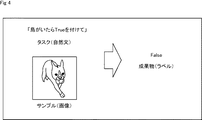
また、タスクの中には、処理対象となるサンプルを用いるものと、サンプルを用いないものが存在する。例えば、図4に示される「鳥がいたらTrueを付けて」というタスクは、サンプルを用いるタスクである。この場合、タスクは自然文で与えられ、画像がサンプルとして与えられる。そして、True又はFalseのラベルが、成果物として得られる。 In addition, some tasks use a sample to be processed and some do not. For example, the task "Add True if there is a bird" shown in FIG. 4 is a task using a sample. In this case, the task is given in natural text and the image is given as a sample. Then, a True or False label is obtained as a deliverable.
また、図5に示される「画像にタイトルを付けて」というタスクも、サンプルを用いるタスクである。この場合、タスクは自然文で与えられ、画像がサンプルとして与えられる。そして、「小犬」等のテキストが、成果物として得られる。 Further, the task of "giving a title to the image" shown in FIG. 5 is also a task using a sample. In this case, the task is given in natural text and the image is given as a sample. Then, a text such as "puppy" is obtained as a deliverable.
一方、図6に示される「機器の音量を大きくしたいと考えたときに、何と発話するのか列挙して」というタスクは、サンプルを用いないタスクである。この場合、タスクは自然文で与えられ、サンプルは与えられない。そして、「音をもっと大きくして」、「音量をあげて」、「音大きくして」、「聞こえるようにして」、「もっと大きくして」等のテキストが、成果物として得られる。 On the other hand, the task of "listing what to say when you want to increase the volume of the device" shown in FIG. 6 is a task that does not use a sample. In this case, the task is given in a natural sentence and no sample is given. Then, texts such as "make the sound louder", "turn up the volume", "make the sound louder", "make it audible", and "make it louder" are obtained as deliverables.
また、図7に示される「花のイラストを描いて」というタスクも、サンプルを用いないタスクである。この場合、タスクは自然文で与えられ、サンプルは与えられない。そして、画像が、成果物として得られる。 Further, the task of "drawing an illustration of a flower" shown in FIG. 7 is also a task that does not use a sample. In this case, the task is given in a natural sentence and no sample is given. Then, the image is obtained as a deliverable.
<1−5.難易度推定モデル学習処理>
次に、図8のフローチャートを参照して、サーバ11により実行される難易度推定モデル学習処理について説明する。<1-5. Difficulty estimation model learning process>
Next, the difficulty estimation model learning process executed by the
難易度推定モデルは、上述したように人にとってのタスクの難易度であるタスク難易度を推定するためのモデルである。例えば、難易度推定モデルは、次式(1)の関数f1により表される。 The difficulty estimation model is a model for estimating the task difficulty level, which is the difficulty level of the task for a person as described above. For example, the difficulty estimation model is represented by the function f1 of the following equation (1).
y=f1(x1,x2,x3) ・・・(1) y = f1 (x1, x2, x3) ... (1)
ここで、x1は、タスクx1の特徴量を表すベクトル(以下、タスクベクトルと称する)である。x2は、タスクx1の処理対象となるサンプルx2の特徴量を表すベクトル(以下、サンプルベクトルと称する)である。x3は、タスクx1を実行する作業者x3の特徴量を表すベクトル(以下、作業者ベクトルと称する)である。すなわち、関数f1は、作業者x3がサンプルx2を処理対象とするタスクx1を実行する場合のタスク難易度yを推定する難易度推定モデルである。また、この関数f1を用いることにより、異なるタスク(任意のタスク)の難易度を1つの難易度推定モデルにより推定することができる。 Here, x1 is a vector (hereinafter, referred to as a task vector) representing the feature amount of the task x1. x2 is a vector (hereinafter, referred to as a sample vector) representing the feature amount of the sample x2 to be processed by the task x1. x3 is a vector (hereinafter, referred to as a worker vector) representing a feature amount of the worker x3 who executes the task x1. That is, the function f1 is a difficulty estimation model that estimates the task difficulty level y when the worker x3 executes the task x1 whose processing target is the sample x2. Further, by using this function f1, the difficulty levels of different tasks (arbitrary tasks) can be estimated by one difficulty level estimation model.
ここで、タスク難易度は、客観的な基準又は主観的な基準に基づいて表される。 Here, the task difficulty level is expressed based on an objective standard or a subjective standard.
例えば、客観的な基準としては、タスクの所要時間、タスクの実行結果である成果物の正確性、成果物の完成度等が挙げられる。 For example, objective criteria include the time required for a task, the accuracy of a deliverable that is the result of executing a task, and the degree of completion of a deliverable.
タスクの所要時間を基準とする場合、例えば、各作業者の所要時間の平均値が短いタスクほどタスク難易度が低くなり、所要時間の平均値が長いタスクほどタスク難易度が高くなる。 When the required time of a task is used as a reference, for example, a task having a shorter average required time of each worker has a lower task difficulty level, and a task having a longer average required time has a higher task difficulty level.
成果物の正確性は、例えば、正解があるタスクの場合、成果物の正答率で表される。例えば、正答率が高いタスクほどタスク難易度が低くなり、正答率が低いタスクほどタスク難易度が高くなる。 The accuracy of the deliverable is expressed by the correct answer rate of the deliverable, for example, in the case of a task with a correct answer. For example, a task with a higher correct answer rate has a lower task difficulty level, and a task with a lower correct answer rate has a higher task difficulty level.
成果物の完成度を基準とする場合、例えば、各作業者の成果物の完成度の平均値が高いタスクほどタスク難易度が低くなり、各作業者の成果物の完成度の平均値が低いタスクほどタスク難易度が高くなる。或いは、例えば、作業者間の成果物の完成度のばらつきが小さいタスクほどタスク難易度が低くなり、作業者間の成果物の完成度のばらつきが大きいタスクほどタスク難易度が高くなる。 When the degree of completion of the deliverable is used as a reference, for example, the higher the average value of the completeness of the deliverable of each worker, the lower the task difficulty, and the lower the average value of the completeness of the deliverable of each worker. The more tasks, the higher the task difficulty. Alternatively, for example, a task with a small variation in the degree of completion of the deliverable among the workers has a lower task difficulty level, and a task with a large variation in the degree of completion of the deliverable among the workers has a higher degree of task difficulty.
主観的な基準としては、例えば、作業者のタスクに対する確信度、作業者のタスクに対する印象等が用いられる。 As the subjective criteria, for example, the degree of certainty of the worker's task, the impression of the worker's task, and the like are used.
作業者のタスクに対する確信度は、例えば、タスクの成果物に対する作業者の自信により表される。例えば、成果物に対して自信を持つ作業者の割合が大きいタスクほどタスク難易度が低くなり、成果物に対して自信を持つ作業者の割合が小さいタスクほどタスク難易度が高くなる。 A worker's confidence in a task is expressed, for example, by the worker's confidence in the deliverable of the task. For example, a task with a large proportion of workers who are confident in the deliverable has a lower task difficulty level, and a task with a smaller proportion of workers who are confident in the deliverable has a higher task difficulty level.
また、例えば、タスクを質問と見なすことができ、サンプルが画像に限定される場合、例えば、タスク難易度には、Visual Question Answering(VQA)によって得られるAnswerの確信度を用いることができる。 Also, for example, if the task can be considered as a question and the sample is limited to images, for example, the task difficulty can be the Answer confidence obtained by Visual Question Answering (VQA).
さらに、作業者のタスクに対する印象を基準とする場合、例えば、難しいと感じる作業者の割合が小さいタスクほどタスク難易度が低くなり、難しいと感じる作業者の割合が大きいタスクほどタスク難易度が高くなる。 Furthermore, when the impression of the worker's task is used as a standard, for example, the task difficulty level is lower for a task with a smaller percentage of workers who find it difficult, and the task difficulty level is higher for a task with a higher percentage of workers who find it difficult. Become.
なお、複数の基準を用いてタスク難易度を表すようにしてもよい。複数の基準を用いる場合、客観的な基準のみ又は主観的な基準のみを用いてタスク難易度を表すようにしてもよいし、客観的な基準と主観的な基準を組み合わせてタスク難易度を表すようにしてもよい。 The task difficulty level may be expressed using a plurality of criteria. When a plurality of criteria are used, the task difficulty may be expressed using only the objective criteria or only the subjective criteria, or the task difficulty may be expressed by combining the objective criteria and the subjective criteria. You may do so.
また、上述した式(1)に示されるように、タスク難易度は、タスク、サンプル、及び、作業者に影響される。 Further, as shown in the above-mentioned equation (1), the task difficulty level is influenced by the task, the sample, and the operator.
例えば、タスク難易度は、タスク自身の難易度、及び、要求されるタスクの完成度や判定基準に影響される。例えば、画像に鳥が写っているか否かのラベルを付けるタスクと、画像内の鳥の種類のラベルを付けるタスクとでは、前者の方がタスク難易度は低くなり、後者の方がタスク難易度は高くなる。また、例えば、鳥の絵を描くタスクの場合、要求される絵の完成度が低いほどタスク難易度は低くなり、要求される絵の完成度が高いほどタスク難易度は高くなる。 For example, the task difficulty level is influenced by the difficulty level of the task itself, the required task completion level, and the judgment criteria. For example, in the task of labeling whether or not a bird appears in an image and the task of labeling a bird type in an image, the former has a lower task difficulty level, and the latter has a task difficulty level. Will be higher. Further, for example, in the case of a task of drawing a bird picture, the lower the required degree of perfection of the picture, the lower the task difficulty level, and the higher the required degree of perfection of the picture, the higher the task difficulty level.
また、例えば、タスク難易度は、タスクの処理対象となるサンプルに影響される。例えば、画像に鳥が写っているか否かのラベルを付けるタスクに対するサンプルとして、図9のAの画像と図9のBの画像が与えられた場合、図9のAの画像に対するタスク難易度の方が、図9のBの画像に対するタスク難易度より低くなる。 Further, for example, the task difficulty level is influenced by the sample to be processed by the task. For example, when the image of A in FIG. 9 and the image of B in FIG. 9 are given as a sample for the task of labeling whether or not a bird is shown in the image, the task difficulty level for the image of A in FIG. 9 is given. This is lower than the task difficulty level for the image B in FIG.
また、タスク難易度は、例えば、作業者の能力、知識、経験等に影響される。例えば、運動神経や反射神経が要求されるタスクのタスク難易度は、作業者の運動神経や反射神経により大きく影響される。また、例えば、画像内の鳥の種類を表すラベルを付けるタスクは、鳥の知識を有する作業者にとっては簡単であり、タスク難易度が低くなるが、鳥の知識を有していない作業者にとっては難しく、タスク難易度が高くなる。 In addition, the task difficulty level is influenced by, for example, the ability, knowledge, and experience of the worker. For example, the task difficulty of a task that requires motor nerves and reflexes is greatly influenced by the motor nerves and reflexes of the worker. Also, for example, the task of labeling a bird type in an image is easy for a worker who has knowledge of birds, and the task difficulty is low, but for a worker who does not have knowledge of birds. Is difficult and the task difficulty is high.
なお、難易度推定モデルの入力データには、必ずしもタスクベクトル、サンプルベクトル、及び、作業者ベクトルを全て用いる必要はなく、必要に応じて1つ又は2つのベクトルのみが用いられる場合がある。次式(2)乃至(7)は、タスクベクトル、サンプルベクトル、及び、作業者ベクトルのうち1つ又は2つを入力データに用いた難易度推定モデルの例を示している。 It should be noted that it is not always necessary to use all the task vector, the sample vector, and the worker vector as the input data of the difficulty estimation model, and only one or two vectors may be used as necessary. The following equations (2) to (7) show an example of a difficulty estimation model using one or two of the task vector, the sample vector, and the worker vector as the input data.
y=f2(x1) ・・・(2) y = f2 (x1) ... (2)
関数f2は、入力データがタスクベクトルのみの難易度推定モデルである。例えば、関数f2は、「イラストを描いて」、「悩みを聞いて」等のサンプルを用いないタイプの任意のタスクのタスク難易度を、作業者の違いを考慮せずに推定する場合に用いられる。或いは、例えば、関数f2は、「サンプルx2のタイトルを付けて」等のサンプルを用いるタイプの任意のタスクのタスク難易度を、サンプル及び作業者の違いを考慮せずに推定する場合に用いられる。 The function f2 is a difficulty estimation model in which the input data is only a task vector. For example, the function f2 is used to estimate the task difficulty of any task of the type that does not use samples such as "draw an illustration" and "listen to troubles" without considering the difference between workers. Be done. Alternatively, for example, the function f2 is used to estimate the task difficulty of any task of the type using a sample, such as "with a title of sample x2", without considering the difference between the sample and the worker. ..
y=f3(x2) ・・・(3) y = f3 (x2) ... (3)
関数f3は、対象となるタスクが予め決まっており(タスクが固定されており)、入力データがサンプルベクトルのみの難易度推定モデルである。関数f3は、例えば、サンプルを用いるタイプの所定のタスクのサンプル毎のタスク難易度を、作業者の違いを考慮せずに推定する場合に用いられる。 The function f3 is a difficulty estimation model in which the target task is predetermined (the task is fixed) and the input data is only the sample vector. The function f3 is used, for example, when estimating the task difficulty level for each sample of a predetermined task of a type using a sample without considering the difference between workers.
y=f4(x3) ・・・(4) y = f4 (x3) ・ ・ ・ (4)
関数f4は、タスクが固定されており、入力データが作業者ベクトルのみの難易度推定モデルである。関数f4は、例えば、サンプルを用いないタイプの所定のタスクの作業者毎のタスク難易度を推定する場合に用いられる。或いは、関数f4は、例えば、サンプルを用いるタイプの所定のタスクの作業者毎のタスク難易度を、サンプルの違いを考慮せずに推定する場合に用いられる。 The function f4 is a difficulty estimation model in which the task is fixed and the input data is only the worker vector. The function f4 is used, for example, when estimating the task difficulty level for each worker of a predetermined task of a type that does not use a sample. Alternatively, the function f4 is used, for example, when estimating the task difficulty level for each worker of a predetermined task of a type using a sample without considering the difference in the sample.
y=f5(x1,x2) ・・・(5) y = f5 (x1, x2) ... (5)
関数f5は、入力データがタスクベクトル及びサンプルベクトルである難易度推定モデルである。例えば、関数f5は、サンプルを用いるタイプの任意のタスクのサンプル毎のタスク難易度を、作業者の違いを考慮せずに推定する場合に用いられる。 The function f5 is a difficulty estimation model in which the input data is a task vector and a sample vector. For example, the function f5 is used to estimate the task difficulty of each sample of an arbitrary task of the type using a sample without considering the difference between workers.
y=f6(x1,x3) ・・・(6) y = f6 (x1, x3) ... (6)
関数f6は、入力データがタスクベクトル及び作業者ベクトルである難易度推定モデルである。例えば、関数f6は、サンプルを用いないタイプの任意のタスクの作業者毎のタスク難易度を推定する場合に用いられる。或いは、例えば、関数f6は、サンプルを用いるタイプの任意のタスクの作業者毎のタスク難易度を、サンプルの違いを考慮せずに推定する場合に用いられる。 The function f6 is a difficulty estimation model in which the input data is a task vector and a worker vector. For example, the function f6 is used to estimate the task difficulty of each worker of any type of task that does not use a sample. Alternatively, for example, the function f6 is used to estimate the task difficulty of each worker of any task of the type using a sample without considering the difference in the sample.
y=f7(x2,x3) ・・・(7) y = f7 (x2, x3) ... (7)
関数f7は、タスクが固定されており、入力データがサンプルベクトル及び作業者ベクトルである難易度推定モデルである。関数f7は、例えば、サンプルを用いるタイプの所定のタスクのサンプル毎及び作業者毎のタスク難易度を推定する場合に用いられる。 The function f7 is a difficulty estimation model in which the task is fixed and the input data is a sample vector and a worker vector. The function f7 is used, for example, to estimate the task difficulty of each sample and each worker of a predetermined task of the type using a sample.
なお、以下、関数f1乃至f7を個々に区別する必要がない場合、単に関数fと称する。 Hereinafter, when it is not necessary to distinguish the functions f1 to f7 individually, the functions f1 to f7 are simply referred to as functions f.
図8の説明に戻り、ステップS1において、特徴量抽出部201は、学習データが入力されたか否かを判定する。学習データが入力されたと判定された場合、処理はステップS2に進む。
Returning to the description of FIG. 8, in step S1, the feature
ここで、学習データとは、難易度推定モデルの学習用のデータであり、入力データ、及び、入力データに対するタスク難易度を示す正解データが含まれる。例えば、入力データには、タスク、サンプル、及び、作業者(を表すデータ)のうち1つ以上が含まれる。なお、入力データに含まれるデータの種類は、上述した関数f1乃至f7のいずれの難易度推定モデルを生成するかにより異なる。 Here, the learning data is data for learning the difficulty estimation model, and includes input data and correct answer data indicating the task difficulty level for the input data. For example, the input data includes one or more of tasks, samples, and workers (data representing). The type of data included in the input data differs depending on which of the above-mentioned functions f1 to f7 is used to generate the difficulty estimation model.
ステップS2において、特徴量抽出部201は、学習データの入力データの特徴量を抽出する。
In step S2, the feature
具体的には、入力データにタスクが含まれる場合、特徴量抽出部201は、例えば、以下の方法によりタスクの特徴量を抽出する。
Specifically, when the input data includes a task, the feature
タスクがテキストデータで表現されている場合、例えば、Bag-of-Words(BoWs)、N-gram、RNN(Recurrent Neural network)等の手法によりタスクの特徴量が抽出される。 When the task is represented by text data, the feature amount of the task is extracted by a method such as Bag-of-Words (BoWs), N-gram, RNN (Recurrent Neural network).
また、タスクがラベルで表現されている場合、例えば、条件を満たすサンプルのみを選択するタスクで、対象が「鳥」といったラベルで表現されている場合、そのラベルが特徴量としてそのまま用いられる。この場合、例えば、1-hot encodingにより特徴量が表される。或いは、例えば、タスクの特徴量が埋め込み表現(embeddingした表現)を用いた特徴量に変換される。この場合、例えば、n次元の実数変数にカテゴリ変数を変換した表現により特徴量が表される。 Further, when the task is represented by a label, for example, in a task that selects only samples satisfying the conditions and the target is represented by a label such as "bird", the label is used as it is as a feature quantity. In this case, for example, the feature amount is represented by 1-hot encoding. Alternatively, for example, the feature amount of the task is converted into the feature amount using the embedded expression (embedding expression). In this case, for example, the feature amount is represented by a representation obtained by converting a categorical variable into an n-dimensional real number variable.
また、例えば、タスクが自然文で表現されている場合、そのタスクを入力データとし、1サンプルあたりの所要時間を正解とする回帰分析により得られるタスクの所要時間推定値をタスクの特徴量に用いてもよい。 Further, for example, when a task is expressed in a natural sentence, the estimated value of the required time of the task obtained by regression analysis with the task as input data and the required time per sample as the correct answer is used as the feature amount of the task. You may.
そして、特徴量抽出部201は、タスクの特徴量をベクトル化したタスクベクトルを生成する。
Then, the feature
また、入力データにサンプルが含まれる場合、特徴量抽出部201は、例えば、以下の方法によりサンプルの特徴量を抽出する。
When the input data includes a sample, the feature
サンプルにテキストデータが含まれる場合、例えば、BoWs、N-gram、NN(特にRNN)等の手法を用いて、テキストデータの特徴量が抽出される。 When the sample contains text data, the features of the text data are extracted by using a method such as BoWs, N-gram, or NN (particularly RNN).
サンプルに画像データが含まれる場合、例えば、NN(特に、CNN(Convolutional Neural Network))を用いた特徴量、HOG(Histograms of Oriented Gradients)、SIFT(Scale-Invariant Feature Transform)、SURF(Speeded Up Robust Features)、Haar-Like等の特徴量が画像データから抽出される。 When the sample contains image data, for example, features using NN (particularly CNN (Convolutional Neural Network)), HOG (Histograms of Oriented Gradients), SIFT (Scale-Invariant Feature Transform), SURF (Speeded Up Robust) Features), Haar-Like, etc. are extracted from the image data.
サンプルに音声データが含まれる場合、例えば、NN(特に、MLP(Multi-Layer Perceptron)やCNN)による特徴量、メル周波数ケプストラム係数等の特徴量が音声データから抽出される。 When the sample contains voice data, for example, features by NN (particularly MLP (Multi-Layer Perceptron) and CNN), features such as mel frequency cepstrum coefficient, etc. are extracted from the voice data.
サンプルから触覚による特徴量を抽出する場合、例えば、表面の粗さを示すパラメータが特徴量として抽出される。 When extracting a tactile feature from a sample, for example, a parameter indicating surface roughness is extracted as a feature.
サンプルから味覚による特徴量を抽出する場合、例えば、味に関する成分の濃度が特徴量として抽出される。 When extracting the feature amount by taste from the sample, for example, the concentration of the component related to taste is extracted as the feature amount.
サンプルから嗅覚による特徴量を抽出する場合、例えば、においに関する成分の濃度が特徴量として抽出される。 When the feature amount by the sense of smell is extracted from the sample, for example, the concentration of the component related to the odor is extracted as the feature amount.
そして、特徴量抽出部201は、サンプルの特徴量をベクトル化したサンプルベクトルを生成する。
Then, the feature
また、学習データに作業者が含まれる場合、特徴量抽出部201は、作業者の特徴量を抽出する。例えば、特徴量抽出部201は、入力された作業者に関するデータや、事前に登録されている作業者に関するデータ(例えば、プロファイル等)から作業者の特徴量を抽出する。
When the learning data includes a worker, the feature
そして、特徴量抽出部201は、作業者の特徴量をベクトル化した作業者ベクトルを生成する。
Then, the feature
特徴量抽出部201は、生成した各特徴量ベクトルを含む学習データを難易度推定モデル学習部211に供給する。
The feature
ステップS3において、難易度推定モデル学習部211は、モデルを更新する。例えば、難易度推定モデル学習部211は、取得した学習データを用いて、所定の手法の機械学習を行うことにより、難易度推定モデルを更新する。
In step S3, the difficulty estimation
例えば、「画像に写っている物体の名称を列挙する」という固定されたタスクの難易度推定モデルを学習する場合、画像(サンプル)を入力データとし、1つの画像当たりの所要時間を正解データとする学習データを用いた回帰分析が行われる。 For example, when learning a difficulty estimation model for a fixed task of "listing the names of objects in an image", the image (sample) is used as input data and the time required for one image is used as correct answer data. Regression analysis is performed using the training data.
また、例えば、自然文で表現された任意のタスクの難易度推定モデルを学習する場合、少なくともタスクを含み、必要に応じて、サンプル、作業者を含む入力データ、及び、タスクの所要時間により表される正解データを含む学習データを用いた回帰分析が行われる。 In addition, for example, when learning a difficulty estimation model of an arbitrary task expressed in a natural sentence, at least the task is included, and if necessary, a table based on a sample, input data including a worker, and the required time of the task. Regression analysis is performed using the learning data including the correct answer data.
難易度推定モデル学習部211は、更新した難易度推定モデルに関する情報を記憶部108に記憶させる。
The difficulty estimation
その後、処理はステップS4に進む。 After that, the process proceeds to step S4.
一方、ステップS1において、学習データが入力されていないと判定された場合、ステップS2及びステップS3の処理はスキップされ、処理はステップS4に進む。 On the other hand, if it is determined in step S1 that the learning data has not been input, the processes of steps S2 and S3 are skipped, and the process proceeds to step S4.
ステップS4において、難易度推定モデル学習部211は、学習を継続するか否かを判定する。学習を継続すると判定された場合、処理はステップS1に戻る。
In step S4, the difficulty estimation
その後、ステップS4において、学習を終了すると判定されるまで、ステップS1乃至S4の処理が繰り返し実行され、難易度推定モデルの学習が行われる。 After that, in step S4, the processes of steps S1 to S4 are repeatedly executed until it is determined that the learning is completed, and the difficulty estimation model is learned.
一方、ステップS4において、難易度推定モデル学習部211は、難易度推定モデルの学習を終了する条件を満たした場合、学習を終了すると判定し、難易度推定モデル学習処理は終了する。
On the other hand, in step S4, when the condition for ending the learning of the difficulty estimation model is satisfied, the difficulty estimation
難易度推定モデルの学習を終了する条件には、例えば、以下の条件のうちの1つ以上が設定される。 For example, one or more of the following conditions are set as the conditions for ending the learning of the difficulty estimation model.
・所定の学習期間が経過したとき
・学習済みの学習データの量が所定の閾値を超えたとき
・過去の学習データを用いた場合の難易度推定モデルの推定精度が所定の閾値を超えたとき
・難易度推定モデルの内部パラメータの変化量が所定の閾値未満になったとき・ When a predetermined learning period has passed ・ When the amount of learned learning data exceeds a predetermined threshold value ・ When the estimation accuracy of the difficulty estimation model using past learning data exceeds a predetermined threshold value・ When the amount of change in the internal parameters of the difficulty estimation model falls below a predetermined threshold
なお、難易度推定モデルの学習において、例えば、各作業者の各タスクに対するタスク難易度の実績データに基づいて、各タスクのタスクベクトル及び各作業者の作業者ベクトルを求め、学習データに用いることも可能である。 In the learning of the difficulty estimation model, for example, the task vector of each task and the worker vector of each worker are obtained based on the actual data of the task difficulty for each task of each worker and used for the learning data. Is also possible.
具体的には、次式(8)の左辺は、各作業者の各タスクに対するタスク難易度(例えば、タスクの所要時間)の実績値を行列により表したものである。例えば、rnmは、作業者nのタスクmに対するタスク難易度を示している。また、Nは総作業者数を示し、Mは総タスク数を示している。なお、必ずしも全ての作業者とタスクの組み合わせに対するタスク難易度の実績値は必要ない。Specifically, the left side of the following equation (8) represents the actual value of the task difficulty level (for example, the required time of the task) for each task of each worker by a matrix. For example, r nm indicates the task difficulty level for the task m of the worker n. Further, N indicates the total number of workers, and M indicates the total number of tasks. It should be noted that the actual value of the task difficulty level is not necessarily required for all combinations of workers and tasks.

ここで、例えば難易度推定モデル学習部211は、行列分解を用いて、式(8)の左辺の行列を、右辺に示されるように作業者の潜在ベクトル群とタスクの潜在ベクトル群とに分解する。
Here, for example, the difficulty estimation
作業者の潜在ベクトル群は、各作業者の潜在ベクトルu1乃至潜在ベクトルuNからなり、タスクの潜在ベクトル群は、各タスクの潜在ベクトルv1乃至潜在ベクトルvNからなる。潜在ベクトルunは、un1からunkまでのk個の要素からなり、潜在ベクトルvmは、vn1からvnkまでのk個の要素からなる。そして、作業者nのタスクmに対するタスク難易度rnmは、式(9)に示されるように、潜在ベクトルunと潜在ベクトルvmの内積により近似される。The latent vector group of the worker is composed of the latent vector u 1 to the latent vector u N of each worker, and the latent vector group of the task is composed of the latent vector v 1 to the latent vector v N of each task. Latent vectors u n consists k elements from u n1 to u nk, latent vectors v m is of k elements from v n1 v to nk. Then, the task difficulty r nm to the task m the operator n, as shown in equation (9), it is approximated by the inner product of latent vectors u n and latent vectors v m.
なお、この行列分解のアルゴリズムには、例えば、Probabilistic Matrix Factorization(PMF)等を用いることができる。 For this matrix factorization algorithm, for example, Probabilistic Matrix Factorization (PMF) or the like can be used.
そして、難易度推定モデルの学習データのタスクベクトルに潜在ベクトルvmを用い、作業者ベクトルに潜在ベクトルunを用いることが可能である。Then, using the latent vectors v m to a task vector of learning data of difficulty estimation model, it is possible to use latent vectors u n worker vector.
このように、タスク難易度の実績データに基づいて、人手による特徴量の設計を必要とせずに、難易度推定モデルの学習データ用のタスクベクトル及び作業者ベクトルを得ることができる。 In this way, it is possible to obtain the task vector and the worker vector for the learning data of the difficulty estimation model based on the actual data of the task difficulty without the need for manual design of the feature amount.
<1−6.タスク難易度推定処理>
次に、図10のフローチャートを参照して、サーバ11により実行されるタスク難易度推定処理について説明する。なお、この処理は、例えば、タスク難易度を推定する対象となる入力データがサーバ11に入力されたとき開始される。入力データには、タスク、サンプル、及び、作業者(を表すデータ)のうち1つ以上が含まれる。<1-6. Task difficulty estimation process>
Next, the task difficulty estimation process executed by the
ステップS101において、特徴量抽出部201は、図8のステップS2の処理と同様に、入力データの特徴量を抽出する。そして、特徴量抽出部201は、抽出した特徴量からなる特徴量ベクトルを難易度推定部212に供給する。この特徴量ベクトルには、タスクベクトル、サンプルベクトル、及び、作業者ベクトルのうち1つ以上が含まれる。
In step S101, the feature
ステップS102において、難易度推定部212は、タスク難易度を推定する。具体的には、難易度推定部212は、記憶部108に記憶されている難易度推定モデルに、特徴量抽出部201から供給された特徴量ベクトルを適用することにより、タスク難易度を推定する。難易度推定部212は、例えば、タスク難易度の推定結果を提示制御部203に供給したり、RAM103又は記憶部108に記憶させたりする。
In step S102, the difficulty
ステップS103において、サーバ11は、タスク難易度を出力する。例えば、提示制御部203は、タスク難易度の推定結果を出力部107に供給し、出力部107のディスプレイに表示させる。また、例えば、提示制御部203は、タスク難易度の推定結果を、通信部109及びネットワーク13を介してクライアント12に送信し、クライアント12においてタスク難易度の推定結果を提示させる。
In step S103, the
その後、タスク難易度推定処理は終了する。 After that, the task difficulty estimation process ends.
以上のようにして、タスクの難易度の推定方法の汎用性を高め、様々なタスクの難易度を容易に推定することが可能になる。 As described above, it is possible to increase the versatility of the task difficulty estimation method and easily estimate the difficulty of various tasks.
例えば、過去に実績のない未知のタスク、未知のサンプル、又は、未知の作業者に対するタスク難易度を容易に推定することが可能になる。具体的には、例えば、上述した特許文献1のように特定のタスクに限定されることなく、任意のタスクに対するタスク難易度を容易に推定することが可能になる。また、例えば、過去にタスクの実績がない作業者に対するタスク難易度を推定することが可能になる。
For example, it becomes possible to easily estimate the task difficulty level for an unknown task, an unknown sample, or an unknown worker who has not been used in the past. Specifically, for example, it is possible to easily estimate the task difficulty level for an arbitrary task without being limited to a specific task as in
また、サンプルや作業者を考慮せずにタスク難易度を推定したり、サンプル毎又は作業者毎にタスク難易度を推定したりすることが可能になる。 In addition, it is possible to estimate the task difficulty level without considering the sample and the worker, and to estimate the task difficulty level for each sample or each worker.
さらに、後述する能動学習等を用いて難易度推定モデルの学習精度を高めることにより、タスク難易度の推定精度を向上させることができる。 Further, by improving the learning accuracy of the difficulty estimation model by using active learning or the like described later, the estimation accuracy of the task difficulty can be improved.
<<2.適用例>>
以下、本技術の適用例について説明する。<< 2. Application example >>
Hereinafter, application examples of this technology will be described.
<2−1.能動学習(Active Learning)への適用例>
例えば、タスク難易度を能動学習に適用することができる。<2-1. Application example to active learning>
For example, task difficulty can be applied to active learning.
機械学習では、学習データの作成、特に学習データの正解データの作成(例えば、ラベル付け等)に多大な労力と時間を要する。そこで、学習効率の高い学習データを選択して用いることで、より少ない学習データで精度の高いモデルを生成する能動学習の研究が進められている。 In machine learning, it takes a lot of labor and time to create learning data, especially to create correct answer data of learning data (for example, labeling). Therefore, research on active learning is underway to generate a highly accurate model with less learning data by selecting and using learning data with high learning efficiency.
ここで、学習効率の高い学習データとは、例えば、モデルの完成度を大きく向上させることができるデータのことである。例えば、”A. Burr, "Active learning literature survey," Technical Report 2010-09-14, University Wisconsin Madison, Computer Sciences Technical Report, 2010.”等によれば、学習データに用いるサンプルを選択する基準には、以下のようなものがある。 Here, the learning data with high learning efficiency is, for example, data that can greatly improve the degree of perfection of the model. For example, according to "A. Burr," Active learning literature survey, "Technical Report 2010-09-14, University Wisconsin Madison, Computer Sciences Technical Report, 2010." , There are the following.
・Uncertainly Sampling:(機械にとって)最も不確かなサンプルを選ぶ。
・Query-By-Committee:多数決で票が割れたサンプルを選ぶ。
・Expected Model Change:モデルの変化が最も大きそうなサンプルを選ぶ。
・Expected Error Reduction:エラーを最も減少させそうなサンプルを選ぶ。
・Density-Weighted Methods:特徴量空間上で密度が高い部分のサンプルを優先する。
・Balance exploration and exploitation:学習されているモデルを利用した活用と、探索のバランスを取る(多腕バンディット問題として解く)。-Uncertainly Sampling: Choose the most uncertain sample (for the machine).
-Query-By-Committee: Select a sample whose votes are broken by majority vote.
-Expected Model Change: Select the sample that seems to change the model most.
-Expected Error Reduction: Select the sample that is most likely to reduce errors.
-Density-Weighted Methods: Priority is given to samples with high density in the feature space.
-Balance exploration and exploitation: Balance utilization and exploration using the trained model (solve as a multi-armed bandit problem).
以上の条件に従ってサンプルを選択し、学習データを作成することで、学習データの作成にかかるコストを削減し、学習効率を高めることができる。 By selecting a sample according to the above conditions and creating learning data, it is possible to reduce the cost of creating the training data and improve the learning efficiency.
ここで、例えば、機械学習においてコンピュータ等の機械にとって不確かなサンプルが、必ずしも人にとって不確かなサンプルであるとは限らない。例えば、機械にとってラベル付けの難易度が高いサンプルが、必ずしも人にとってラベル付けの難易度が高いサンプルであるとは限らない。換言すれば、機械にとって不確かなサンプルの中には、例えば、本当に不確かなサンプル(例えば、人が見てもラベル付けが困難なサンプル)と、本当は明確なサンプル(例えば、人が見れば確実なラベル付けができるサンプル)とがある。 Here, for example, in machine learning, a sample that is uncertain for a machine such as a computer is not necessarily a sample that is uncertain for a person. For example, a sample that is difficult for a machine to label is not necessarily a sample that is difficult for a person to label. In other words, some samples that are uncertain for a machine are, for example, really uncertain samples (eg, samples that are difficult for humans to label) and really clear samples (for example, humans are certain). There is a sample that can be labeled).
例えば、図11のA乃至図11のCのサンプル(画像)に対して「画像に鳥が写っているか否かを示すラベルを付ける」というタスクを実行する場合、機械にとっては、図11のAのサンプルに対する不確かさは低く、図11のB及び図11のCのサンプルに対する不確かさは同程度に高い。すなわち、機械にとっては、図11のAのサンプルに対するラベル付けの難易度は低く、図11のB及び図11のCのサンプルに対するラベル付けの難易度は同程度に高い。従って、図11のB又は図11のCのサンプルを用いた場合の学習効果は、図11のAのサンプルを用いた場合の学習効果より高くなる。 For example, when the task of "labeling an image to indicate whether or not a bird is shown" is executed for the sample (image) of A to C in FIG. 11 for the machine, A in FIG. 11 The uncertainty for the sample is low, and the uncertainty for the sample B in FIG. 11 and C in FIG. 11 is equally high. That is, for the machine, the difficulty of labeling the sample A in FIG. 11 is low, and the difficulty of labeling the sample B in FIG. 11 and the sample C in FIG. 11 is equally high. Therefore, the learning effect when the sample B in FIG. 11 or the sample C in FIG. 11 is used is higher than the learning effect when the sample A in FIG. 11 is used.
一方、人にとっては、図11のA及び図11のCのサンプルに対する不確かさは同程度に低く、図11のBのサンプルに対する不確かさは高い。すなわち、人にとっては、図11のA及び図11のCのサンプルに対するラベル付けの難易度は同程度に低く、図11のBのサンプルに対するラベル付けの難易度は高い。 On the other hand, for humans, the uncertainty with respect to the samples A in FIG. 11 and C in FIG. 11 is equally low, and the uncertainty with respect to the sample B in FIG. 11 is high. That is, for a person, the difficulty of labeling the sample A of FIG. 11 and the sample of FIG. 11C is equally low, and the difficulty of labeling the sample B of FIG. 11 is high.
従って、図11のA乃至図11のCのサンプルの中から学習に用いるサンプルを1つ選択する場合、図11のCのサンプルを選択することにより、学習データの作成(ラベル付け)に要するコストを抑制しつつ、学習効果を高めることができる。 Therefore, when selecting one sample to be used for learning from the samples A to C in FIG. 11, the cost required for creating (labeling) training data by selecting the sample C in FIG. 11 It is possible to enhance the learning effect while suppressing the problem.
また、図12は、特徴量1及び特徴量2に基づいてサンプルにラベル付けする場合の特徴量空間の例を示している。図内の丸で示される点は、人が第1のクラスとラベル付けしたサンプルを表す。バツで表される点は、人が第2のクラスとラベル付けしたサンプルを表す。三角で表される点は、人がまだラベル付けしていないサンプルを表す。また、点線cは、これまでの学習処理により得られた、サンプルを分類するための識別平面を表す。
Further, FIG. 12 shows an example of the feature amount space when the sample is labeled based on the
ここで、図内の三角で表されるサンプルs1及びサンプルs2の中から、次の学習データに用いるサンプルを選択する場合について説明する。なお、以下、サンプルsをラベル付けする場合の人にとっての不確かさ(すなわち、タスク難易度)を推定する関数をf(s)とし、サンプルsを分類する場合の機械にとっての確かさ(以下、確信度と称する)を推定する関数をg(s)とする。関数f(s)の値は、サンプルsに対するタスク難易度が高くなるほど大きくなり、タスク難易度が低いほど小さくなる。関数g(s)の値は、サンプルsに対する確信度が高くなるほど大きくなり、確信度が低くなるほど小さくなる。 Here, a case where a sample to be used for the next training data is selected from the samples s1 and s2 represented by the triangles in the figure will be described. Hereinafter, the function for estimating the uncertainty (that is, task difficulty) for the person when labeling the sample s is defined as f (s), and the certainty for the machine when classifying the sample s (hereinafter referred to as “)”. Let g (s) be a function that estimates (called uncertainty). The value of the function f (s) increases as the task difficulty level for the sample s increases, and decreases as the task difficulty level decreases. The value of the function g (s) increases as the certainty of the sample s increases, and decreases as the certainty decreases.
また、f(s1)=0.8、g(s1)=0.5とし、f(s2)=0.1、g(s1)=0.7とする。すなわち、サンプルs1の方がサンプルs2よりタスク難易度が高く、確信度が低い。 Further, f (s1) = 0.8 and g (s1) = 0.5, and f (s2) = 0.1 and g (s1) = 0.7. That is, the sample s1 has a higher task difficulty level and a lower degree of certainty than the sample s2.
例えば、タスク難易度を用いない場合、識別曲線cにより近く、確信度が低いサンプルs1が、すなわち、どのクラスにも属していなさそうなサンプルs1が、サンプルs2より優先して学習データに用いられる。 For example, when the task difficulty level is not used, the sample s1 which is closer to the identification curve c and has a low certainty, that is, the sample s1 which is unlikely to belong to any class is used for the training data in preference to the sample s2. ..
一方、タスク難易度を用いた場合、f(s)+g(s)の値は、サンプルs1で1.3となり、サンプルs2で0.8となる。そこで、f(s)+g(s)の値がより小さいサンプルs2が、サンプルs1より優先して学習データに用いられる。 On the other hand, when the task difficulty level is used, the value of f (s) + g (s) is 1.3 for sample s1 and 0.8 for sample s2. Therefore, the sample s2 having a smaller value of f (s) + g (s) is used for the training data with priority over the sample s1.
このように、f(s)+g(s)の値がより小さいサンプル、すなわち、人にとっての難易度が低く、機械にとっての確信度がより低いサンプルが優先して学習データに用いられる。例えば、本当に不確かなサンプルより、本当は明確なサンプルが優先して学習データに用いられる。これにより、学習データの作成(ラベル付け)に要するコストを抑制しつつ、学習効果を高めることができる。 As described above, a sample having a smaller value of f (s) + g (s), that is, a sample having a low degree of difficulty for a human and a low degree of certainty for a machine is preferentially used for training data. For example, a really clear sample is used for training data in preference to a really uncertain sample. As a result, the learning effect can be enhanced while suppressing the cost required for creating (labeling) the learning data.
そこで、例えば、難易度推定モデル学習部211は、あるタスクを実行するタスク実行モデルの学習を行う前に、上述した方法により、そのタスクに対する難易度推定モデルを学習する。次に、難易度推定部212は、得られた難易度推定モデルを用いて、学習データに用いる候補となるサンプルに対するタスク難易度を推定する。そして、例えば、タスク実行モデル学習部213は、学習データに用いるサンプルを選択する基準として、上述した基準に加えて、タスク難易度(人にとっての難易度)が低いサンプルを選択するという基準を追加する。
Therefore, for example, the difficulty estimation
これにより、例えば、タスク実行モデル学習部213は、他の基準に基づく学習効果が同程度のサンプルが存在する場合、タスク難易度がより低く、正解データを作成しやすいサンプルを優先して学習データに用いる。
As a result, for example, in the task execution
なお、タスク難易度以外の学習データのサンプルを選択する基準として、必ずしも上述した基準を全て用いる必要はない。ただし、(機械にとって)最も不確かなサンプルを選ぶという基準を少なくとも用いるようにすることが望ましい。 It should be noted that it is not always necessary to use all the above-mentioned criteria as the criteria for selecting a sample of learning data other than the task difficulty level. However, it is desirable to at least use the criteria of choosing the most uncertain sample (for the machine).
また、学習データに用いる入力データは、必ずしもサンプルだけとは限らず、例えば、タスクが含まれる場合がある。これに対して、例えば、機械にとって難易度が高いが、人にとって難易度が低いタスクを優先して学習データに用いることにより、学習データの作成に要するコストを抑制しつつ、学習効果を高めることができる。 Further, the input data used for the learning data is not necessarily limited to the sample, and may include, for example, a task. On the other hand, for example, by giving priority to tasks that are difficult for machines but less difficult for humans to be used for learning data, the learning effect can be enhanced while suppressing the cost required for creating learning data. Can be done.
このように、機械にとっての難易度が高く、人にとっての難易度(タスク難易度)が低い学習データを優先して選択することにより、学習データの作成に要するコストを抑制しつつ、学習効果を高めることができる。 In this way, by preferentially selecting learning data that has a high degree of difficulty for machines and a low degree of difficulty for humans (task difficulty), the learning effect can be achieved while suppressing the cost required to create the learning data. Can be enhanced.
<2−2.クラウドソーシングへの適用例>
また、例えば、タスク難易度はクラウドソーシングに適用することができる。<2-2. Application example to crowdsourcing >
Also, for example, task difficulty can be applied to crowdsourcing.
クラウドソーシングでは、作業者が事前にタスクの難易度を予測することが困難なことが多く、それ故、提示された報酬が適正であるか否かを判断することが難しい。 In crowdsourcing, it is often difficult for workers to predict the difficulty of a task in advance, and therefore it is difficult to determine whether the rewards offered are appropriate.
例えば、図13は、状来のクラウドソーシングにおいて、作業者を募集する際にタスクの内容を提示する対象となる各作業者のクライアント12において表示される募集画面の例を示している。この例では、「画像に花の種類をタグ付け」及び「画像に鳥の種類をタグ付け」というタスクに対して、1タグ当たり3円の報酬が提示されている。しかし、作業者は、画像に花の種類や鳥の種類をタグ付けするタスクがどの程度の難易度であるか予測することが困難であるため、提示された報酬が適正であるか否かを判断することが難しい。
For example, FIG. 13 shows an example of a recruitment screen displayed on a
このような事情もあり、クラウドソーシングでは作業者が安く酷使されているという問題が度々指摘されている。 Due to these circumstances, it is often pointed out that crowdsourcing is a problem in which workers are cheaply abused.
これに対して、上述した技術を用いて、各タスクに対するタスク難易度を機械的に算出し、提示することにより、発注者が適正な報酬でタスクを発注し、作業者が適正な報酬でタスクを受注することが可能になる。 On the other hand, by mechanically calculating and presenting the task difficulty level for each task using the above-mentioned technology, the orderer orders the task with an appropriate reward, and the worker orders the task with an appropriate reward. Will be able to receive orders.
ここで、図14乃至図16を参照して、タスク難易度を用いた場合のタスクの発注から受注までの流れの例について説明する。 Here, an example of a flow from ordering a task to receiving an order when the task difficulty level is used will be described with reference to FIGS. 14 to 16.
図14は、サーバ11の提示制御部203の制御の下に、発注者のクライアント12において表示される発注画面の例を示している。
FIG. 14 shows an example of an ordering screen displayed on the
発注者は、この発注画面において、発注するタスクの内容を具体的に示すタスク指示、サンプルあたりのタスクの報酬、及び、処理対象となるサンプル数を、入力欄301乃至入力欄303に入力することができる。そして、発注者が、タスク指示、サンプルあたりの報酬、及び、サンプル数を入力欄301及び入力欄303に入力すると、入力したデータが、ネットワーク13を介してサーバ11に送信される。このとき、発注者は、必要に応じて、タスクの処理対象となるサンプルを、自分のクライアント12からネットワーク13を介してサーバ11に送信する。
On this ordering screen, the ordering party inputs a task instruction that specifically indicates the content of the task to be ordered, a reward for the task per sample, and the number of samples to be processed in the
サーバ11は、図10を参照して上述した処理により、発注者により入力されたタスクのタスク難易度を推定する。例えば、サーバ11の難易度推定部212は、上述した式(6)の関数f6を用いて、クラウドソーシングサービスに登録されている作業者毎のサンプルあたりのタスクの所要時間をタスク難易度として推定する。また、難易度推定部212は、推定結果に基づいて、全作業者におけるサンプルあたりの推定所用時間の最小値(最短時間)、最大値(最長時間)、及び、平均値(平均時間)を算出する。
The
また、例えば、難易度推定部212は、全サンプルのタスク完了時刻を推定する。例えば、難易度推定部212は、サンプルあたりの推定所要時間の平均値、及び、サンプル数に基づいて、全サンプルのタスクの実行に必要な所要時間を推定し、その推定結果に基づいて、全サンプルのタスクの完了時刻を推定する。
Further, for example, the difficulty
なお、このとき、難易度推定部212は、サンプル当たりの報酬、他のタスクの発注状況、作業者の活動状況等に基づいて、どの程度の作業者が受注し、作業を行うかを推定し、その推定結果を加味して、全サンプルのタスクの所要時間及び完了時刻を推定するようにしてもよい。例えば、多くの作業者が活動する時間帯では、タスクを受注し、実行する作業者が多くなると予想されるため、タスク完了推定時刻が早くなる。また、例えば、他に類似するタスクの発注がある時間帯では、タスクを受注し、実行する作業者が少なくなると予想されるため、タスク完了推定時刻が遅くなる。
At this time, the
そして、サーバ11は、サンプルあたりの推定所用時間の最小値、最大値、及び、平均値の算出結果、並びに、全サンプルのタスクの推定所用時間及び完了推定時刻を発注者のクライアント12に送信する。
Then, the
これにより、図14に示されるように、発注画面において、サンプルあたりの推定所用時間の最小値(最短時間)、平均値(平均時間)、及び、最大値(最長時間)が表示される。また、全サンプルのタスク完了推定時刻、及び、全サンプルのタスクの推定所用時間が、発注画面に表示される。これにより、発注者は、所望の期限までにタスクが完了するか否かを容易に判断することが可能になる。 As a result, as shown in FIG. 14, the minimum value (minimum time), average value (average time), and maximum value (maximum time) of the estimated required time per sample are displayed on the ordering screen. In addition, the estimated task completion time of all samples and the estimated required time of tasks of all samples are displayed on the ordering screen. This allows the ordering party to easily determine whether the task will be completed by the desired deadline.
そして、発注者が発注ボタン305を押下することにより、タスクが発注され、タスクを実行する作業者の募集が開始される。一方、発注者は、キャンセルボタン304を押下することにより、タスクの発注をキャンセルすることができる。
Then, when the orderer presses the
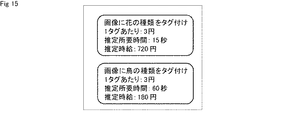
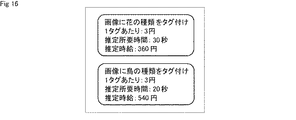
図15及び図16は、タスクの発注後にサーバ11の提示制御部203の制御の下に、各作業者のクライアント12において表示される募集画面の例である。図15は、作業者Aのクライアント12において表示される募集画面の例を示している。図16は、作業者Bのクライアント12において表示される募集画面の例を示している。
15 and 16 are examples of recruitment screens displayed on the
この例では、タスクの内容及び報酬は、上述した図13の募集画面と同様に、全作業者において共通の情報として提示される。例えば、作業者A及び作業者Bの募集画面において、「画像に花の種類をタグ付け」というタスクの報酬が1タグあたり3円、「画像に鳥の種類をタグ付け」というタスクの報酬が1タグあたり3円であることが提示されている。 In this example, the content of the task and the reward are presented as common information among all the workers, as in the recruitment screen of FIG. 13 described above. For example, on the recruitment screens of Worker A and Worker B, the reward for the task of "tagging the type of flower in the image" is 3 yen per tag, and the reward for the task of "tagging the type of bird in the image". It is presented that it is 3 yen per tag.
一方、推定所用時間及び推定時給は、作業者毎に異なる。すなわち、サーバ11において各作業者のタスク難易度として推定された推定所用時間が、各作業者の募集画面において個別に提示される。例えば、作業者Aの募集画面において、「画像に花の種類をタグ付け」というタスクの推定所用時間が15秒、「画像に鳥の種類をタグ付け」というタスクの推定所用時間が60秒であることが提示されている。また、作業者Bの募集画面において、「画像に花の種類をタグ付け」というタスクの推定所用時間が30秒、「画像に鳥の種類をタグ付け」というタスクの推定所用時間が20秒であることが提示されている。
On the other hand, the estimated required time and the estimated hourly wage differ for each worker. That is, the estimated required time estimated as the task difficulty level of each worker on the
また、サーバ11において推定所用時間及び1タグあたりの報酬に基づいて算出された推定時給が、各作業者の募集画面において個別に提示される。例えば、作業者Aの募集画面において、「画像に花の種類をタグ付け」というタスクの推定時給が720円、「画像に鳥の種類をタグ付け」というタスクの推定時給が180円であることが提示されている。また、作業者Bの募集画面において、「画像に花の種類をタグ付け」というタスクの推定時給が360円、「画像に鳥の種類をタグ付け」というタスクの推定時給が540円であることが提示されている。
Further, the estimated hourly wage calculated on the
このように、各作業者の能力やスキル等に応じた推定所用時間(タスク難易度)及び推定時給が提示されるため、各作業者は、自分に適したタスクを見つけたり、タスクの報酬が適正であるかを判断したりすることが容易になる。 In this way, the estimated required time (task difficulty) and estimated hourly wage according to each worker's ability and skill are presented, so that each worker can find a task suitable for him / her and receive a reward for the task. It becomes easy to judge whether it is appropriate.
そして、各作業者は、募集画面を閲覧して、希望するタスクが見つかった場合、そのタスクに応募する。 Then, each worker browses the recruitment screen, and when a desired task is found, applies for the task.
その後、タスクの受注の確定プロセスは、任意に設定することができる。例えば、発注者が応募してきた作業者の中から発注する作業者を選定するようにしてもよいし、先着順にタスクの受注者を確定するようにしてもよい。 After that, the process of confirming the order of the task can be set arbitrarily. For example, the worker who places an order may be selected from the workers who have applied for the orderer, or the contractor of the task may be determined on a first-come, first-served basis.
そして、受注が確定した作業者は、タスクを実行し、その成果物を、自分のクライアント12から、ネットワーク13を介してサーバ11に送信する。サーバ11は、ネットワーク13を介して、受信した成果物を発注者のクライアント12に送信し、発注者は成果物の検収を行う。
Then, the worker whose order is confirmed executes the task and transmits the deliverable from his / her
なお、以上の説明では、実際にタスクの処理対象となるサンプルを考慮せずにタスクの所用時間、完了時刻等を推定し、提示する例を示したが、サンプルを考慮して推定し、提示するようにしてもよい。 In the above explanation, an example of estimating and presenting the required time, completion time, etc. of the task without considering the sample to be actually processed of the task is shown, but the estimation and presentation are made in consideration of the sample. You may try to do it.
また、例えば、図14の発注画面において、発注者が特定の作業者を選択し、選択した作業者のサンプルあたりの推定所用時間やタスク完了推定時刻を提示できるようにしてもよい。これにより、発注者は、客観的なデータに基づいて、適切な作業者を選択することが可能になる。 Further, for example, on the ordering screen of FIG. 14, the ordering party may select a specific worker and present the estimated required time and task completion estimated time per sample of the selected worker. This allows the ordering party to select an appropriate worker based on objective data.
また、タスクをシングルラベル表現又はマルチラベル表現を用いて表現し、図17に示されるように、発注画面において、階層的に選択肢を選ぶことによりタスク指示を生成するようにしてもよい。例えば、図17の例では、第一階層において、「選択」、「比較」、「列挙」等のタスクの種類を選択可能である。第二階層では、「画像」、「テキスト」、「音声」等のサンプルの種類を選択可能である。第三階層では、「鳥」、「花」、「神社」等のサンプルの具体的な内容を選択可能である。 Further, the task may be expressed by using a single label expression or a multi-label expression, and as shown in FIG. 17, a task instruction may be generated by selecting options hierarchically on the ordering screen. For example, in the example of FIG. 17, the type of task such as "selection", "comparison", and "enumeration" can be selected in the first layer. In the second layer, sample types such as "image", "text", and "voice" can be selected. In the third layer, the specific contents of the sample such as "bird", "flower", and "shrine" can be selected.
例えば、第一階層において「選択」を選択し、第二階層において「画像」を選択し、第三階層において「花」を選択することにより、「花」の「画像」を「選択」するというタスク指示が生成される。 For example, by selecting "selection" in the first layer, selecting "image" in the second layer, and selecting "flower" in the third layer, "selection" of "image" of "flower" is performed. A task instruction is generated.
なお、例えば、図17の第三階層において自然文を入力可能にすることにより、シングルラベル表現又はマルチラベル表現と自然文表現とを組み合わせることも可能である。 In addition, for example, by making it possible to input a natural sentence in the third layer of FIG. 17, it is also possible to combine a single label expression or a multi-label expression and a natural sentence expression.
<2−3.テキストの難易度の推定>
また、例えば、難易度推定部212は、難易度推定モデルを用いて、「問題を解く」というタスクのタスク難易度を推定することにより、問題の難易度を推定することができる。従って、個々の問題の難易度の推定結果に基づいて、教科書、問題集、参考書等のテキストの難易度を客観的に表すことができる。例えば、テキストに含まれる問題の難易度の平均、最大、合計等に基づいて、テキストの難易度を客観的に表すことができる。なお、対象となるテキストは、紙媒体のものだけでなく、オンラインの問題集等の電子データによるものも含む。<2-3. Estimating the difficulty of the text>
Further, for example, the difficulty
ここで、問題の難易度(タスク難易度)の推定に用いる特徴量の抽出方法の例について説明する。 Here, an example of a feature extraction method used for estimating the difficulty level (task difficulty level) of a problem will be described.
図18は、数学の問題の難易度の推定に用いる特徴量の抽出方法の例を示している。この例では、問題の種類、次数、最大桁数、項数が特徴量として抽出されている。これらの特徴量のうち、問題の種類は、「数学の問題を解く」というタスクの特徴量となり、次数、最大桁数、項数は、「数学の問題を解く」というタスクの対象となるサンプルの特徴量となる。 FIG. 18 shows an example of a feature extraction method used for estimating the difficulty level of a mathematical problem. In this example, the problem type, order, maximum number of digits, and number of terms are extracted as features. Of these features, the type of problem is the feature of the task "solving a math problem", and the order, maximum number of digits, and number of terms are the samples that are the target of the task "solving a math problem". It becomes the feature amount of.
問題の種類は、方程式、式の変形、計算等の問題の種類を示す特徴量である。 The type of problem is a feature quantity that indicates the type of problem such as an equation, a transformation of an equation, or a calculation.
次数は、問題に含まれる数式の次数を示す特徴量である。 The order is a feature that indicates the order of the mathematical expression included in the problem.
最大桁数は、問題に含まれる数式内の各数字の桁のうち最大のものを示す特徴量である。 The maximum number of digits is a feature quantity indicating the maximum number of digits of each number in the formula included in the problem.
項数は、問題に含まれる数式内の項の数を示す特徴量である。 The number of terms is a feature quantity indicating the number of terms in the mathematical formula included in the problem.
例えば、問題の種類を含むタスクベクトル、及び、次数、最大桁数、項数を含むサンプルベクトルを上述した式(5)の関数f5に適用することにより、各問題のタスク難易度が推定される。 For example, the task difficulty of each problem is estimated by applying the task vector including the type of the problem and the sample vector including the degree, the maximum number of digits, and the number of terms to the function f5 of the above equation (5). ..
図19は、文章問題の一例を示している。この問題は、問題の対象となる文章、及び、問1、問2の小問からなる。 FIG. 19 shows an example of a sentence problem. This question consists of the text that is the subject of the question and the sub-questions of Q1 and Q2.
例えば、問題の対象となる文章に対して、BoWs、N-gram、RNN等を用いて生成される特徴量や、文章長、語彙数等の特徴量(以下、文章特徴量と称する)が抽出される。 For example, the feature amount generated by using BoWs, N-gram, RNN, etc., and the feature amount such as sentence length and vocabulary number (hereinafter referred to as sentence feature amount) are extracted for the sentence to be a problem. Will be done.
また、例えば、問1の文章、及び、問2の文章から問題の種類が特徴量として抽出される。例えば、問1の問題の種類は、「文章の内容と矛盾する選択肢の選択」であり、問2の問題の種類は、「文章の主旨のまとめ」である。 Further, for example, the type of the problem is extracted as a feature quantity from the sentence of Q1 and the sentence of Q2. For example, the type of question in Q1 is "selection of options that contradict the content of the sentence", and the type of question in Q2 is "summary of the purpose of the sentence".
また、例えば、問1の選択肢の文章に対して、BoWs、N-gram、RNN等を用いて生成される特徴量や、文章長、語彙数等の特徴量(以下、問題特徴量と称する)が抽出される。また、問1の選択肢の数が、特徴量として抽出される。
In addition, for example, for the sentence of the option of
例えば、問1の問題のタスク難易度を推定する場合、問1の問題の種類を含む特徴量ベクトルがタスクベクトルに用いられ、文章特徴量、問1の問題特徴量、選択肢の数を含む特徴量ベクトルがサンプルベクトルに用いられる。そして、タスクベクトル及びサンプルベクトルを上述した式(5)の関数f5に適用することにより、問1のタスク難易度が推定される。
For example, when estimating the task difficulty of the question of Q1, a feature vector including the type of the question of Q1 is used as the task vector, and the feature including the sentence feature, the problem feature of Q1, and the number of choices. The quantity vector is used as the sample vector. Then, by applying the task vector and the sample vector to the function f5 of the above-mentioned equation (5), the task difficulty level of
また、問2の問題のタスク難易度を推定する場合、問2の問題の種類を含む特徴量ベクトルがタスクベクトルに用いられ、文章特徴量を含む特徴量ベクトルがサンプルベクトルに用いられる。そして、タスクベクトル及びサンプルベクトルを上述した式(5)の関数f5に適用することにより、問2のタスク難易度が推定される。 Further, when estimating the task difficulty of the question of Q2, the feature vector including the type of the question of Q2 is used as the task vector, and the feature vector including the sentence feature is used as the sample vector. Then, by applying the task vector and the sample vector to the function f5 of the above-mentioned equation (5), the task difficulty level of Question 2 is estimated.
以上のようにして、テキストに含まれる問題のタスク難易度を推定し、各問題のタスク難易度の平均、最大、合計等により、テキストの難易度を客観的に表すことができる。 As described above, the task difficulty of the problem included in the text can be estimated, and the difficulty of the text can be objectively expressed by the average, maximum, total, etc. of the task difficulty of each problem.
<<3.変形例等>>
以下、上述した本技術の実施の形態の変形例等について説明する。<< 3. Modification example >>
Hereinafter, a modified example of the above-described embodiment of the present technology will be described.
例えば、サーバ11の処理の全部又は一部をクライアント12において実行するようにしてもよい。例えば、サーバ11からクライアント12に難易度推定モデルを提供し、クライアント12においてタスク難易度を推定するようにしてもよい。
For example, the
また、例えば、難易度推定モデルの学習又はタスク難易度の推定を行う場合に、タスクベクトル、サンプルベクトル、作業者ベクトルを含む入力データをサーバ11に与えるようにして、サーバ11において特徴量の抽出を行わないようにしてもよい。
Further, for example, when learning a difficulty estimation model or estimating a task difficulty level, input data including a task vector, a sample vector, and a worker vector is given to the
さらに、上述した本技術の適用例は、その一例であり、本技術は、例えば、人にとってのタスクの難易度を推定したり利用したりする各種の装置やサービス等に適用することが可能である。 Further, the above-mentioned application example of the present technology is an example thereof, and the present technology can be applied to, for example, various devices and services for estimating and using the difficulty level of a task for a person. be.
また、上述した一連の処理は、ハードウエアにより実行することもできるし、ソフトウエアにより実行することもできる。 Further, the series of processes described above can be executed by hardware or software.
なお、ソフトウエアにより実行する場合、コンピュータ(例えば、サーバ11、クライアント12)が実行するプログラムは、本明細書で説明する順序に沿って時系列に処理が行われるプログラムであっても良いし、並列に、あるいは呼び出しが行われたとき等の必要なタイミングで処理が行われるプログラムであっても良い。
When executed by software, the program executed by the computer (for example,
また、本明細書において、システムとは、複数の構成要素(装置、モジュール(部品)等)の集合を意味し、すべての構成要素が同一筐体中にあるか否かは問わない。したがって、別個の筐体に収納され、ネットワークを介して接続されている複数の装置、及び、1つの筐体の中に複数のモジュールが収納されている1つの装置は、いずれも、システムである。 Further, in the present specification, the system means a set of a plurality of components (devices, modules (parts), etc.), and it does not matter whether or not all the components are in the same housing. Therefore, a plurality of devices housed in separate housings and connected via a network, and a device in which a plurality of modules are housed in one housing are both systems. ..
さらに、本技術の実施の形態は、上述した実施の形態に限定されるものではなく、本技術の要旨を逸脱しない範囲において種々の変更が可能である。 Further, the embodiment of the present technology is not limited to the above-described embodiment, and various changes can be made without departing from the gist of the present technology.
例えば、本技術は、1つの機能をネットワークを介して複数の装置で分担、共同して処理するクラウドコンピューティングの構成をとることができる。 For example, the present technology can have a cloud computing configuration in which one function is shared by a plurality of devices via a network and jointly processed.
また、上述のフローチャートで説明した各ステップは、1つの装置で実行する他、複数の装置で分担して実行することができる。 Further, each step described in the above-mentioned flowchart can be executed by one device or can be shared and executed by a plurality of devices.
さらに、1つのステップに複数の処理が含まれる場合には、その1つのステップに含まれる複数の処理は、1つの装置で実行する他、複数の装置で分担して実行することができる。 Further, when a plurality of processes are included in one step, the plurality of processes included in the one step can be executed by one device or shared by a plurality of devices.
また、本明細書に記載された効果はあくまで例示であって限定されるものではなく、他の効果があってもよい。 Further, the effects described in the present specification are merely examples and are not limited, and other effects may be obtained.
さらに、例えば、本技術は以下のような構成も取ることができる。 Further, for example, the present technology can have the following configurations.
(1)
タスクに関する情報に基づいて、前記タスクの難易度であるタスク難易度を推定する推定部を
備える情報処理装置。
(2)
前記タスクは、ラベル付け、比較、列挙、評価、検索、回答、解答、調査、整理、変換、要約、連想、類推、生成、推薦、計画、詳細化、相談、会話、運搬、製造、設計、及び、テストのうち1つ、又は、2つ以上の組み合わせからなる
前記(1)に記載の情報処理装置。
(3)
前記推定部は、前記タスクの特徴量、前記タスクの処理対象となるサンプルの特徴量、及び、前記タスクを実行する作業者の特徴量のうち少なくとも1つに基づいて、前記タスク難易度を推定する
前記(1)又は(2)に記載の情報処理装置。
(4)
前記推定部は、種類の異なるタスクの前記タスク難易度を、少なくとも各タスクの特徴量に基づいて推定する
前記(3)に記載の情報処理装置。
(5)
前記推定部は、前記タスクの特徴量、前記サンプルの特徴量、及び、前記作業者の特徴量のうち少なくとも1つに基づいて前記タスク難易度を推定する第1のモデルを用いる
前記(3)又は(4)に記載の情報処理装置。
(6)
前記第1のモデルの学習を行う第1の学習部を
さらに備える前記(5)に記載の情報処理装置。
(7)
前記第1の学習部は、各作業者の各タスクに対する前記タスク難易度の実績データから得られる各タスクの特徴量及び各作業者の特徴量を用いて、前記第1のモデルの学習を行う
前記(6)に記載の情報処理装置。
(8)
前記タスクの特徴量、前記サンプルの特徴量、及び、前記作業者の特徴量のうち少なくとも1つの抽出を行う特徴量抽出部を
さらに備える前記(3)に記載の情報処理装置。
(9)
前記タスク難易度は、人にとっての前記タスクの難易度である
前記(1)乃至(8)のいずれかに記載の情報処理装置。
(10)
前記タスク難易度は、前記タスクの客観的な基準及び主観的な基準のうち少なくとも1つに基づいて表される
前記(9)に記載の情報処理装置。
(11)
前記タスクを実行する第2のモデルの学習用のデータを各データに対する前記タスク難易度に基づいて選択して前記第2のモデルの学習を行う第2の学習部を
さらに備える前記(1)乃至(10)のいずれかに記載の情報処理装置。
(12)
前記第2の学習部は、さらに各データに対する機械にとっての不確かさに基づいて前記学習用のデータの選択を行う
前記(11)に記載の情報処理装置。
(13)
前記タスクを実行する作業者を募集する場合に、前記タスクの内容とともに前記タスク難易度を提示するように制御する提示制御部を
さらに備える前記(1)乃至(12)のいずれかに記載の情報処理装置。
(14)
前記提示制御部は、各作業者に対する前記タスク難易度を作業者毎に個別に提示するように制御する
前記(13)に記載の情報処理装置。
(15)
前記推定部は、テキストに含まれる各問題に対する前記タスク難易度を推定し、推定結果に基づいて前記テキストの難易度を推定する
前記(1)乃至(14)のいずれかに記載の情報処理装置。
(16)
情報処理装置が、
タスクに関する情報に基づいて、前記タスクの難易度であるタスク難易度を推定する推定ステップを
含む情報処理方法。
(17)
タスクに関する情報に基づいて、前記タスクの難易度であるタスク難易度を推定する推定ステップを
含む処理をコンピュータに実行させるためのプログラム。(1)
An information processing device including an estimation unit that estimates a task difficulty level, which is the difficulty level of the task, based on information about the task.
(2)
The tasks include labeling, comparison, enumeration, evaluation, search, answer, answer, survey, organization, transformation, summary, association, analogy, generation, recommendation, planning, refinement, consultation, conversation, transportation, manufacturing, design, The information processing apparatus according to (1) above, which comprises one or a combination of two or more of the tests.
(3)
The estimation unit estimates the task difficulty level based on at least one of the feature amount of the task, the feature amount of the sample to be processed by the task, and the feature amount of the worker who executes the task. The information processing apparatus according to (1) or (2) above.
(4)
The information processing device according to (3), wherein the estimation unit estimates the task difficulty level of different types of tasks based on at least the feature amount of each task.
(5)
The estimation unit uses a first model that estimates the task difficulty level based on at least one of the feature amount of the task, the feature amount of the sample, and the feature amount of the worker (3). Or the information processing device according to (4).
(6)
The information processing apparatus according to (5) above, further comprising a first learning unit for learning the first model.
(7)
The first learning unit learns the first model by using the feature amount of each task and the feature amount of each worker obtained from the actual data of the task difficulty level for each task of each worker. The information processing device according to (6) above.
(8)
The information processing apparatus according to (3), further comprising a feature amount extraction unit that extracts at least one of the feature amount of the task, the feature amount of the sample, and the feature amount of the worker.
(9)
The information processing device according to any one of (1) to (8) above, wherein the task difficulty level is the difficulty level of the task for a person.
(10)
The information processing apparatus according to (9) above, wherein the task difficulty level is expressed based on at least one of an objective standard and a subjective standard of the task.
(11)
(1) to (1) to (1) to (1) to (1) to (1) to (1) to (1) to (1) to (1) to (1) to (1) to (1) to (1) to (1) to (1) to (1) to (1) to (1) to (1) The information processing apparatus according to any one of (10).
(12)
The information processing apparatus according to (11), wherein the second learning unit further selects data for learning based on uncertainty for each data for the machine.
(13)
The information according to any one of (1) to (12) above, further comprising a presentation control unit that controls to present the task difficulty level together with the content of the task when recruiting workers to execute the task. Processing equipment.
(14)
The information processing device according to (13), wherein the presentation control unit controls the task difficulty level to be individually presented to each worker.
(15)
The information processing apparatus according to any one of (1) to (14) above, wherein the estimation unit estimates the task difficulty level for each problem included in the text, and estimates the difficulty level of the text based on the estimation result. ..
(16)
Information processing device
An information processing method including an estimation step for estimating a task difficulty level, which is the difficulty level of the task, based on information about the task.
(17)
A program for causing a computer to execute a process including an estimation step for estimating a task difficulty level, which is the difficulty level of the task, based on information about the task.
1 情報処理システム, 11 サーバ, 12 クライアント, 101 CPU, 201 特徴量抽出部, 202 タスク関連処理部, 203 提示制御部, 211 難易度推定モデル学習部, 212 タスク難易度推定部, 213 タスク実行モデル学習部, 214 タスク実行部 1 Information processing system, 11 servers, 12 clients, 101 CPU, 201 feature quantity extraction unit, 202 task-related processing unit, 203 presentation control unit, 211 difficulty estimation model learning unit, 212 task difficulty estimation unit, 213 task execution model Learning Department, 214 Task Execution Department
Claims (13)
前記タスクを実行する作業者を募集する場合に、前記タスクの内容とともに前記タスク難易度を提示するように制御する提示制御部と
を備える情報処理装置。 An estimation unit that estimates the task difficulty level, which is the difficulty level of the task, based on the feature amount of the task, the feature amount of the sample to be processed by the task, and the feature amount of the worker who executes the task .
When recruiting workers to execute the task, a presentation control unit that controls to present the task difficulty level together with the content of the task
Information processing apparatus including a.
請求項1に記載の情報処理装置。 The tasks include labeling, comparison, enumeration, evaluation, search, answer, answer, survey, organization, transformation, summary, association, analogy, generation, recommendation, planning, refinement, consultation, conversation, transportation, manufacturing, design, The information processing apparatus according to claim 1, further comprising one or a combination of two or more of the tests.
請求項2に記載の情報処理装置。 The information processing device according to claim 2, wherein the estimation unit estimates the task difficulty level of different types of tasks based on at least the feature amount of each task.
請求項2に記載の情報処理装置。 The information processing apparatus according to claim 2, wherein the estimation unit uses a first model that estimates the task difficulty level based on the feature amount of the task, the feature amount of the sample, and the feature amount of the worker. ..
さらに備える請求項4に記載の情報処理装置。 The information processing apparatus according to claim 4, further comprising a first learning unit for learning the first model.
請求項5に記載の情報処理装置。 The first learning unit learns the first model by using the feature amount of each task and the feature amount of each worker obtained from the actual data of the task difficulty level for each task of each worker. The information processing device according to claim 5.
さらに備える請求項2に記載の情報処理装置。 The information processing apparatus according to claim 2, further comprising a feature amount extraction unit that extracts at least one of the feature amount of the task, the feature amount of the sample, and the feature amount of the worker.
請求項1に記載の情報処理装置。 The information processing device according to claim 1, wherein the task difficulty level is the difficulty level of the task for a person.
請求項8に記載の情報処理装置。 The information processing apparatus according to claim 8, wherein the task difficulty level is expressed based on at least one of an objective standard and a subjective standard of the task.
請求項1に記載の情報処理装置。 The information processing device according to claim 1 , wherein the presentation control unit controls the task difficulty level to be individually presented to each worker.
請求項1に記載の情報処理装置。 The information processing device according to claim 1, wherein the estimation unit estimates the task difficulty level for each problem included in the text, and estimates the difficulty level of the text based on the estimation result.
タスクの特徴量、前記タスクの処理対象となるサンプルの特徴量、及び、前記タスクを実行する作業者の特徴量に基づいて、前記タスクの難易度であるタスク難易度を推定する推定ステップと、
前記タスクを実行する作業者を募集する場合に、前記タスクの内容とともに前記タスク難易度を提示するように制御する提示制御ステップと
を含む情報処理方法。 Executed by an information processing device,
An estimation step for estimating the task difficulty level, which is the difficulty level of the task, based on the feature amount of the task, the feature amount of the sample to be processed by the task, and the feature amount of the worker who executes the task .
When recruiting workers to execute the task, a presentation control step that controls to present the task difficulty level together with the content of the task
Information processing method, including.
前記タスクを実行する作業者を募集する場合に、前記タスクの内容とともに前記タスク難易度を提示するように制御する提示制御ステップと
を含む処理をコンピュータに実行させるためのプログラム。 An estimation step for estimating the task difficulty level, which is the difficulty level of the task, based on the feature amount of the task, the feature amount of the sample to be processed by the task, and the feature amount of the worker who executes the task .
When recruiting workers to execute the task, a presentation control step that controls to present the task difficulty level together with the content of the task
A program that causes a computer to perform processing that includes.
Applications Claiming Priority (3)
| Application Number | Priority Date | Filing Date | Title |
|---|---|---|---|
| JP2016115080 | 2016-06-09 | ||
| JP2016115080 | 2016-06-09 | ||
| PCT/JP2017/019830 WO2017212956A1 (en) | 2016-06-09 | 2017-05-29 | Information processing device, information processing method, and program |
Publications (2)
| Publication Number | Publication Date |
|---|---|
| JPWO2017212956A1 JPWO2017212956A1 (en) | 2019-04-04 |
| JP6958552B2 true JP6958552B2 (en) | 2021-11-02 |
Family
ID=60578245
Family Applications (1)
| Application Number | Title | Priority Date | Filing Date |
|---|---|---|---|
| JP2018522420A Active JP6958552B2 (en) | 2016-06-09 | 2017-05-29 | Information processing equipment, information processing methods, and programs |
Country Status (3)
| Country | Link |
|---|---|
| EP (1) | EP3471049A4 (en) |
| JP (1) | JP6958552B2 (en) |
| WO (1) | WO2017212956A1 (en) |
Families Citing this family (6)
| Publication number | Priority date | Publication date | Assignee | Title |
|---|---|---|---|---|
| JP6522173B1 (en) * | 2018-01-16 | 2019-05-29 | 株式会社エンライブ | INFORMATION PROCESSING APPARATUS AND INFORMATION PROCESSING PROGRAM |
| JP7211735B2 (en) * | 2018-08-29 | 2023-01-24 | パナソニック インテレクチュアル プロパティ コーポレーション オブ アメリカ | CONTRIBUTION DETERMINATION METHOD, CONTRIBUTION DETERMINATION DEVICE AND PROGRAM |
| WO2020075255A1 (en) * | 2018-10-11 | 2020-04-16 | 日本電気株式会社 | Learning device, learning method, and non-transitory computer readable medium having program stored thereupon |
| JP7752318B2 (en) * | 2020-07-10 | 2025-10-10 | パナソニックIpマネジメント株式会社 | Information processing device, information processing method, and program |
| JP7504401B2 (en) * | 2020-12-02 | 2024-06-24 | Zerobillbank Japan株式会社 | Work management method, information processing terminal, and program |
| JP2022133124A (en) * | 2021-03-01 | 2022-09-13 | 国立大学法人 鹿児島大学 | Logical thinking ability evaluation device, logical thinking ability evaluation method, and program |
Family Cites Families (5)
| Publication number | Priority date | Publication date | Assignee | Title |
|---|---|---|---|---|
| JP5063632B2 (en) * | 2009-03-10 | 2012-10-31 | 株式会社豊田中央研究所 | Learning model generation apparatus, object detection system, and program |
| JP2011118516A (en) * | 2009-12-01 | 2011-06-16 | Nec Corp | Device, method and program for predicting working hour |
| WO2015147029A1 (en) * | 2014-03-27 | 2015-10-01 | 株式会社 Ikkyo Technology | Censoring device |
| JP2016040580A (en) * | 2014-08-12 | 2016-03-24 | Kddi株式会社 | Difficulty estimation device, question generation device, question setting device, difficulty estimation method, question generation method, question setting method, and program |
| US10482403B2 (en) * | 2014-11-06 | 2019-11-19 | Conduent Business Services, Llc | Methods and systems for designing of tasks for crowdsourcing |
-
2017
- 2017-05-29 EP EP17810135.8A patent/EP3471049A4/en not_active Withdrawn
- 2017-05-29 JP JP2018522420A patent/JP6958552B2/en active Active
- 2017-05-29 WO PCT/JP2017/019830 patent/WO2017212956A1/en not_active Ceased
Also Published As
| Publication number | Publication date |
|---|---|
| JPWO2017212956A1 (en) | 2019-04-04 |
| WO2017212956A1 (en) | 2017-12-14 |
| EP3471049A1 (en) | 2019-04-17 |
| EP3471049A4 (en) | 2019-06-19 |
Similar Documents
| Publication | Publication Date | Title |
|---|---|---|
| JP6958552B2 (en) | Information processing equipment, information processing methods, and programs | |
| US20220382990A1 (en) | System for minimizing repetition in intelligent virtual assistant conversations | |
| Weiner | Why AI/data science projects fail | |
| Lind et al. | Content analysis by the crowd: Assessing the usability of crowdsourcing for coding latent constructs | |
| JP6546922B2 (en) | Model-driven candidate sorting based on audio cues | |
| KR102716679B1 (en) | Method and device for providing customized cultural and art contents curation and for recommending mate playing the contents with user | |
| US10950222B2 (en) | Multimodal video system for generating a personality assessment of a user | |
| US12079582B1 (en) | College admissions and career mentorship platform | |
| US20230100992A1 (en) | Systems and methods for augmented recruiting | |
| CN110704586A (en) | Information processing method and system | |
| Srinivasan | Guide to big data applications | |
| Ihya et al. | J48 algorithms of machine learning for predicting user's the acceptance of an E-orientation systems | |
| Kavikondala et al. | Automated retraining of machine learning models | |
| Nicholas et al. | Employability development in business undergraduates: A qualitative inquiry of recruiter perceptions | |
| Acar et al. | Aspect-based sentiment analysis on social media comments (twitter): the attributes of service robots in the hotel and restaurant industry | |
| Taulli | Natural Language Processing (NLP) How Computers Talk | |
| Ayodele et al. | Cultivating knowledge sharing in universities: An innovative approach integrating deep learning for collaborative learning platforms | |
| Grupac et al. | Immersive engagement and geospatial mapping technologies, deep learning and neural network algorithms, and visual perception and data mining tools in metaverse interactive and extended reality environments | |
| US20240242142A1 (en) | Systems and methods for data extraction and automatic matter assignment | |
| Ali et al. | Predicting patron satisfaction on library service using machine learning approaches: A case study in Indonesia | |
| Syaqufa et al. | How User-Generated Content Influences Hotel Booking Decisions on Traveloka | |
| KR102902382B1 (en) | Method and apparatus for providing recruitment matching information between teachers and schools using artificial intelligence | |
| US20250356122A1 (en) | Artificial intelligence based event generation method and system for generating memoir events based on information associated with users | |
| JPWO2017217242A1 (en) | Information processing apparatus, information processing method, and program | |
| Higgins et al. | Research Data Management in the Humanities: Challenges and Opportunities in the Canadian Context |
Legal Events
| Date | Code | Title | Description |
|---|---|---|---|
| A521 | Request for written amendment filed |
Free format text: JAPANESE INTERMEDIATE CODE: A523 Effective date: 20200414 |
|
| A621 | Written request for application examination |
Free format text: JAPANESE INTERMEDIATE CODE: A621 Effective date: 20200414 |
|
| A131 | Notification of reasons for refusal |
Free format text: JAPANESE INTERMEDIATE CODE: A131 Effective date: 20210316 |
|
| A521 | Request for written amendment filed |
Free format text: JAPANESE INTERMEDIATE CODE: A523 Effective date: 20210507 |
|
| A131 | Notification of reasons for refusal |
Free format text: JAPANESE INTERMEDIATE CODE: A131 Effective date: 20210629 |
|
| A521 | Request for written amendment filed |
Free format text: JAPANESE INTERMEDIATE CODE: A523 Effective date: 20210709 |
|
| TRDD | Decision of grant or rejection written | ||
| A01 | Written decision to grant a patent or to grant a registration (utility model) |
Free format text: JAPANESE INTERMEDIATE CODE: A01 Effective date: 20210907 |
|
| A61 | First payment of annual fees (during grant procedure) |
Free format text: JAPANESE INTERMEDIATE CODE: A61 Effective date: 20210920 |
|
| R151 | Written notification of patent or utility model registration |
Ref document number: 6958552 Country of ref document: JP Free format text: JAPANESE INTERMEDIATE CODE: R151 |