JP6901552B2 - Copolymer compositions for coating and adhesive applications - Google Patents
Copolymer compositions for coating and adhesive applications Download PDFInfo
- Publication number
- JP6901552B2 JP6901552B2 JP2019513882A JP2019513882A JP6901552B2 JP 6901552 B2 JP6901552 B2 JP 6901552B2 JP 2019513882 A JP2019513882 A JP 2019513882A JP 2019513882 A JP2019513882 A JP 2019513882A JP 6901552 B2 JP6901552 B2 JP 6901552B2
- Authority
- JP
- Japan
- Prior art keywords
- subscript
- alternatively
- copolymer
- skin contact
- composition
- Prior art date
- Legal status (The legal status is an assumption and is not a legal conclusion. Google has not performed a legal analysis and makes no representation as to the accuracy of the status listed.)
- Active
Links
Images



Classifications
-
- C—CHEMISTRY; METALLURGY
- C08—ORGANIC MACROMOLECULAR COMPOUNDS; THEIR PREPARATION OR CHEMICAL WORKING-UP; COMPOSITIONS BASED THEREON
- C08L—COMPOSITIONS OF MACROMOLECULAR COMPOUNDS
- C08L83/00—Compositions of macromolecular compounds obtained by reactions forming in the main chain of the macromolecule a linkage containing silicon with or without sulfur, nitrogen, oxygen or carbon only; Compositions of derivatives of such polymers
- C08L83/04—Polysiloxanes
-
- C—CHEMISTRY; METALLURGY
- C08—ORGANIC MACROMOLECULAR COMPOUNDS; THEIR PREPARATION OR CHEMICAL WORKING-UP; COMPOSITIONS BASED THEREON
- C08L—COMPOSITIONS OF MACROMOLECULAR COMPOUNDS
- C08L75/00—Compositions of polyureas or polyurethanes; Compositions of derivatives of such polymers
- C08L75/04—Polyurethanes
-
- A—HUMAN NECESSITIES
- A61—MEDICAL OR VETERINARY SCIENCE; HYGIENE
- A61K—PREPARATIONS FOR MEDICAL, DENTAL OR TOILETRY PURPOSES
- A61K31/00—Medicinal preparations containing organic active ingredients
- A61K31/045—Hydroxy compounds, e.g. alcohols; Salts thereof, e.g. alcoholates
-
- A—HUMAN NECESSITIES
- A61—MEDICAL OR VETERINARY SCIENCE; HYGIENE
- A61K—PREPARATIONS FOR MEDICAL, DENTAL OR TOILETRY PURPOSES
- A61K31/00—Medicinal preparations containing organic active ingredients
- A61K31/16—Amides, e.g. hydroxamic acids
- A61K31/165—Amides, e.g. hydroxamic acids having aromatic rings, e.g. colchicine, atenolol, progabide
- A61K31/167—Amides, e.g. hydroxamic acids having aromatic rings, e.g. colchicine, atenolol, progabide having the nitrogen of a carboxamide group directly attached to the aromatic ring, e.g. lidocaine, paracetamol
-
- A—HUMAN NECESSITIES
- A61—MEDICAL OR VETERINARY SCIENCE; HYGIENE
- A61K—PREPARATIONS FOR MEDICAL, DENTAL OR TOILETRY PURPOSES
- A61K31/00—Medicinal preparations containing organic active ingredients
- A61K31/185—Acids; Anhydrides, halides or salts thereof, e.g. sulfur acids, imidic, hydrazonic or hydroximic acids
- A61K31/19—Carboxylic acids, e.g. valproic acid
-
- A—HUMAN NECESSITIES
- A61—MEDICAL OR VETERINARY SCIENCE; HYGIENE
- A61K—PREPARATIONS FOR MEDICAL, DENTAL OR TOILETRY PURPOSES
- A61K31/00—Medicinal preparations containing organic active ingredients
- A61K31/21—Esters, e.g. nitroglycerine, selenocyanates
- A61K31/215—Esters, e.g. nitroglycerine, selenocyanates of carboxylic acids
- A61K31/235—Esters, e.g. nitroglycerine, selenocyanates of carboxylic acids having an aromatic ring attached to a carboxyl group
- A61K31/24—Esters, e.g. nitroglycerine, selenocyanates of carboxylic acids having an aromatic ring attached to a carboxyl group having an amino or nitro group
- A61K31/245—Amino benzoic acid types, e.g. procaine, novocaine
-
- A—HUMAN NECESSITIES
- A61—MEDICAL OR VETERINARY SCIENCE; HYGIENE
- A61K—PREPARATIONS FOR MEDICAL, DENTAL OR TOILETRY PURPOSES
- A61K31/00—Medicinal preparations containing organic active ingredients
- A61K31/33—Heterocyclic compounds
- A61K31/395—Heterocyclic compounds having nitrogen as a ring hetero atom, e.g. guanethidine or rifamycins
- A61K31/40—Heterocyclic compounds having nitrogen as a ring hetero atom, e.g. guanethidine or rifamycins having five-membered rings with one nitrogen as the only ring hetero atom, e.g. sulpiride, succinimide, tolmetin, buflomedil
- A61K31/403—Heterocyclic compounds having nitrogen as a ring hetero atom, e.g. guanethidine or rifamycins having five-membered rings with one nitrogen as the only ring hetero atom, e.g. sulpiride, succinimide, tolmetin, buflomedil condensed with carbocyclic rings, e.g. carbazole
- A61K31/404—Indoles, e.g. pindolol
- A61K31/405—Indole-alkanecarboxylic acids; Derivatives thereof, e.g. tryptophan, indomethacin
-
- A—HUMAN NECESSITIES
- A61—MEDICAL OR VETERINARY SCIENCE; HYGIENE
- A61K—PREPARATIONS FOR MEDICAL, DENTAL OR TOILETRY PURPOSES
- A61K31/00—Medicinal preparations containing organic active ingredients
- A61K31/60—Salicylic acid; Derivatives thereof
- A61K31/612—Salicylic acid; Derivatives thereof having the hydroxy group in position 2 esterified, e.g. salicylsulfuric acid
- A61K31/616—Salicylic acid; Derivatives thereof having the hydroxy group in position 2 esterified, e.g. salicylsulfuric acid by carboxylic acids, e.g. acetylsalicylic acid
-
- A—HUMAN NECESSITIES
- A61—MEDICAL OR VETERINARY SCIENCE; HYGIENE
- A61K—PREPARATIONS FOR MEDICAL, DENTAL OR TOILETRY PURPOSES
- A61K33/00—Medicinal preparations containing inorganic active ingredients
- A61K33/24—Heavy metals; Compounds thereof
- A61K33/38—Silver; Compounds thereof
-
- A—HUMAN NECESSITIES
- A61—MEDICAL OR VETERINARY SCIENCE; HYGIENE
- A61K—PREPARATIONS FOR MEDICAL, DENTAL OR TOILETRY PURPOSES
- A61K45/00—Medicinal preparations containing active ingredients not provided for in groups A61K31/00 - A61K41/00
- A61K45/06—Mixtures of active ingredients without chemical characterisation, e.g. antiphlogistics and cardiaca
-
- A—HUMAN NECESSITIES
- A61—MEDICAL OR VETERINARY SCIENCE; HYGIENE
- A61K—PREPARATIONS FOR MEDICAL, DENTAL OR TOILETRY PURPOSES
- A61K47/00—Medicinal preparations characterised by the non-active ingredients used, e.g. carriers or inert additives; Targeting or modifying agents chemically bound to the active ingredient
- A61K47/30—Macromolecular organic or inorganic compounds, e.g. inorganic polyphosphates
- A61K47/34—Macromolecular compounds obtained otherwise than by reactions only involving carbon-to-carbon unsaturated bonds, e.g. polyesters, polyamino acids, polysiloxanes, polyphosphazines, copolymers of polyalkylene glycol or poloxamers
-
- A—HUMAN NECESSITIES
- A61—MEDICAL OR VETERINARY SCIENCE; HYGIENE
- A61K—PREPARATIONS FOR MEDICAL, DENTAL OR TOILETRY PURPOSES
- A61K8/00—Cosmetics or similar toiletry preparations
- A61K8/02—Cosmetics or similar toiletry preparations characterised by special physical form
- A61K8/0208—Tissues; Wipes; Patches
-
- A—HUMAN NECESSITIES
- A61—MEDICAL OR VETERINARY SCIENCE; HYGIENE
- A61K—PREPARATIONS FOR MEDICAL, DENTAL OR TOILETRY PURPOSES
- A61K9/00—Medicinal preparations characterised by special physical form
- A61K9/0012—Galenical forms characterised by the site of application
- A61K9/0014—Skin, i.e. galenical aspects of topical compositions
-
- A—HUMAN NECESSITIES
- A61—MEDICAL OR VETERINARY SCIENCE; HYGIENE
- A61K—PREPARATIONS FOR MEDICAL, DENTAL OR TOILETRY PURPOSES
- A61K9/00—Medicinal preparations characterised by special physical form
- A61K9/70—Web, sheet or filament bases ; Films; Fibres of the matrix type containing drug
- A61K9/7023—Transdermal patches and similar drug-containing composite devices, e.g. cataplasms
- A61K9/703—Transdermal patches and similar drug-containing composite devices, e.g. cataplasms characterised by shape or structure; Details concerning release liner or backing; Refillable patches; User-activated patches
- A61K9/7038—Transdermal patches of the drug-in-adhesive type, i.e. comprising drug in the skin-adhesive layer
- A61K9/7046—Transdermal patches of the drug-in-adhesive type, i.e. comprising drug in the skin-adhesive layer the adhesive comprising macromolecular compounds
- A61K9/7069—Transdermal patches of the drug-in-adhesive type, i.e. comprising drug in the skin-adhesive layer the adhesive comprising macromolecular compounds obtained otherwise than by reactions only involving carbon to carbon unsaturated bonds, e.g. polysiloxane, polyesters, polyurethane, polyethylene oxide
-
- A—HUMAN NECESSITIES
- A61—MEDICAL OR VETERINARY SCIENCE; HYGIENE
- A61L—METHODS OR APPARATUS FOR STERILISING MATERIALS OR OBJECTS IN GENERAL; DISINFECTION, STERILISATION OR DEODORISATION OF AIR; CHEMICAL ASPECTS OF BANDAGES, DRESSINGS, ABSORBENT PADS OR SURGICAL ARTICLES; MATERIALS FOR BANDAGES, DRESSINGS, ABSORBENT PADS OR SURGICAL ARTICLES
- A61L15/00—Chemical aspects of, or use of materials for, bandages, dressings or absorbent pads
- A61L15/16—Bandages, dressings or absorbent pads for physiological fluids such as urine or blood, e.g. sanitary towels, tampons
- A61L15/42—Use of materials characterised by their function or physical properties
- A61L15/58—Adhesives
-
- A—HUMAN NECESSITIES
- A61—MEDICAL OR VETERINARY SCIENCE; HYGIENE
- A61L—METHODS OR APPARATUS FOR STERILISING MATERIALS OR OBJECTS IN GENERAL; DISINFECTION, STERILISATION OR DEODORISATION OF AIR; CHEMICAL ASPECTS OF BANDAGES, DRESSINGS, ABSORBENT PADS OR SURGICAL ARTICLES; MATERIALS FOR BANDAGES, DRESSINGS, ABSORBENT PADS OR SURGICAL ARTICLES
- A61L24/00—Surgical adhesives or cements; Adhesives for colostomy devices
- A61L24/04—Surgical adhesives or cements; Adhesives for colostomy devices containing macromolecular materials
-
- A—HUMAN NECESSITIES
- A61—MEDICAL OR VETERINARY SCIENCE; HYGIENE
- A61L—METHODS OR APPARATUS FOR STERILISING MATERIALS OR OBJECTS IN GENERAL; DISINFECTION, STERILISATION OR DEODORISATION OF AIR; CHEMICAL ASPECTS OF BANDAGES, DRESSINGS, ABSORBENT PADS OR SURGICAL ARTICLES; MATERIALS FOR BANDAGES, DRESSINGS, ABSORBENT PADS OR SURGICAL ARTICLES
- A61L24/00—Surgical adhesives or cements; Adhesives for colostomy devices
- A61L24/04—Surgical adhesives or cements; Adhesives for colostomy devices containing macromolecular materials
- A61L24/043—Mixtures of macromolecular materials
-
- A—HUMAN NECESSITIES
- A61—MEDICAL OR VETERINARY SCIENCE; HYGIENE
- A61Q—SPECIFIC USE OF COSMETICS OR SIMILAR TOILETRY PREPARATIONS
- A61Q19/00—Preparations for care of the skin
-
- C—CHEMISTRY; METALLURGY
- C08—ORGANIC MACROMOLECULAR COMPOUNDS; THEIR PREPARATION OR CHEMICAL WORKING-UP; COMPOSITIONS BASED THEREON
- C08G—MACROMOLECULAR COMPOUNDS OBTAINED OTHERWISE THAN BY REACTIONS ONLY INVOLVING UNSATURATED CARBON-TO-CARBON BONDS
- C08G18/00—Polymeric products of isocyanates or isothiocyanates
- C08G18/06—Polymeric products of isocyanates or isothiocyanates with compounds having active hydrogen
- C08G18/08—Processes
- C08G18/10—Prepolymer processes involving reaction of isocyanates or isothiocyanates with compounds having active hydrogen in a first reaction step
-
- C—CHEMISTRY; METALLURGY
- C08—ORGANIC MACROMOLECULAR COMPOUNDS; THEIR PREPARATION OR CHEMICAL WORKING-UP; COMPOSITIONS BASED THEREON
- C08G—MACROMOLECULAR COMPOUNDS OBTAINED OTHERWISE THAN BY REACTIONS ONLY INVOLVING UNSATURATED CARBON-TO-CARBON BONDS
- C08G18/00—Polymeric products of isocyanates or isothiocyanates
- C08G18/06—Polymeric products of isocyanates or isothiocyanates with compounds having active hydrogen
- C08G18/08—Processes
- C08G18/10—Prepolymer processes involving reaction of isocyanates or isothiocyanates with compounds having active hydrogen in a first reaction step
- C08G18/12—Prepolymer processes involving reaction of isocyanates or isothiocyanates with compounds having active hydrogen in a first reaction step using two or more compounds having active hydrogen in the first polymerisation step
-
- C—CHEMISTRY; METALLURGY
- C08—ORGANIC MACROMOLECULAR COMPOUNDS; THEIR PREPARATION OR CHEMICAL WORKING-UP; COMPOSITIONS BASED THEREON
- C08G—MACROMOLECULAR COMPOUNDS OBTAINED OTHERWISE THAN BY REACTIONS ONLY INVOLVING UNSATURATED CARBON-TO-CARBON BONDS
- C08G18/00—Polymeric products of isocyanates or isothiocyanates
- C08G18/06—Polymeric products of isocyanates or isothiocyanates with compounds having active hydrogen
- C08G18/08—Processes
- C08G18/16—Catalysts
- C08G18/22—Catalysts containing metal compounds
- C08G18/227—Catalysts containing metal compounds of antimony, bismuth or arsenic
-
- C—CHEMISTRY; METALLURGY
- C08—ORGANIC MACROMOLECULAR COMPOUNDS; THEIR PREPARATION OR CHEMICAL WORKING-UP; COMPOSITIONS BASED THEREON
- C08G—MACROMOLECULAR COMPOUNDS OBTAINED OTHERWISE THAN BY REACTIONS ONLY INVOLVING UNSATURATED CARBON-TO-CARBON BONDS
- C08G18/00—Polymeric products of isocyanates or isothiocyanates
- C08G18/06—Polymeric products of isocyanates or isothiocyanates with compounds having active hydrogen
- C08G18/28—Polymeric products of isocyanates or isothiocyanates with compounds having active hydrogen characterised by the compounds used containing active hydrogen
- C08G18/30—Low-molecular-weight compounds
- C08G18/32—Polyhydroxy compounds; Polyamines; Hydroxyamines
- C08G18/3203—Polyhydroxy compounds
- C08G18/3206—Polyhydroxy compounds aliphatic
-
- C—CHEMISTRY; METALLURGY
- C08—ORGANIC MACROMOLECULAR COMPOUNDS; THEIR PREPARATION OR CHEMICAL WORKING-UP; COMPOSITIONS BASED THEREON
- C08G—MACROMOLECULAR COMPOUNDS OBTAINED OTHERWISE THAN BY REACTIONS ONLY INVOLVING UNSATURATED CARBON-TO-CARBON BONDS
- C08G18/00—Polymeric products of isocyanates or isothiocyanates
- C08G18/06—Polymeric products of isocyanates or isothiocyanates with compounds having active hydrogen
- C08G18/28—Polymeric products of isocyanates or isothiocyanates with compounds having active hydrogen characterised by the compounds used containing active hydrogen
- C08G18/40—High-molecular-weight compounds
- C08G18/48—Polyethers
- C08G18/4833—Polyethers containing oxyethylene units
-
- C—CHEMISTRY; METALLURGY
- C08—ORGANIC MACROMOLECULAR COMPOUNDS; THEIR PREPARATION OR CHEMICAL WORKING-UP; COMPOSITIONS BASED THEREON
- C08G—MACROMOLECULAR COMPOUNDS OBTAINED OTHERWISE THAN BY REACTIONS ONLY INVOLVING UNSATURATED CARBON-TO-CARBON BONDS
- C08G18/00—Polymeric products of isocyanates or isothiocyanates
- C08G18/06—Polymeric products of isocyanates or isothiocyanates with compounds having active hydrogen
- C08G18/28—Polymeric products of isocyanates or isothiocyanates with compounds having active hydrogen characterised by the compounds used containing active hydrogen
- C08G18/40—High-molecular-weight compounds
- C08G18/61—Polysiloxanes
-
- C—CHEMISTRY; METALLURGY
- C08—ORGANIC MACROMOLECULAR COMPOUNDS; THEIR PREPARATION OR CHEMICAL WORKING-UP; COMPOSITIONS BASED THEREON
- C08G—MACROMOLECULAR COMPOUNDS OBTAINED OTHERWISE THAN BY REACTIONS ONLY INVOLVING UNSATURATED CARBON-TO-CARBON BONDS
- C08G18/00—Polymeric products of isocyanates or isothiocyanates
- C08G18/06—Polymeric products of isocyanates or isothiocyanates with compounds having active hydrogen
- C08G18/70—Polymeric products of isocyanates or isothiocyanates with compounds having active hydrogen characterised by the isocyanates or isothiocyanates used
- C08G18/72—Polyisocyanates or polyisothiocyanates
- C08G18/74—Polyisocyanates or polyisothiocyanates cyclic
- C08G18/75—Polyisocyanates or polyisothiocyanates cyclic cycloaliphatic
- C08G18/751—Polyisocyanates or polyisothiocyanates cyclic cycloaliphatic containing only one cycloaliphatic ring
- C08G18/752—Polyisocyanates or polyisothiocyanates cyclic cycloaliphatic containing only one cycloaliphatic ring containing at least one isocyanate or isothiocyanate group linked to the cycloaliphatic ring by means of an aliphatic group
- C08G18/753—Polyisocyanates or polyisothiocyanates cyclic cycloaliphatic containing only one cycloaliphatic ring containing at least one isocyanate or isothiocyanate group linked to the cycloaliphatic ring by means of an aliphatic group containing one isocyanate or isothiocyanate group linked to the cycloaliphatic ring by means of an aliphatic group having a primary carbon atom next to the isocyanate or isothiocyanate group
- C08G18/755—Polyisocyanates or polyisothiocyanates cyclic cycloaliphatic containing only one cycloaliphatic ring containing at least one isocyanate or isothiocyanate group linked to the cycloaliphatic ring by means of an aliphatic group containing one isocyanate or isothiocyanate group linked to the cycloaliphatic ring by means of an aliphatic group having a primary carbon atom next to the isocyanate or isothiocyanate group and at least one isocyanate or isothiocyanate group linked to a secondary carbon atom of the cycloaliphatic ring, e.g. isophorone diisocyanate
-
- C—CHEMISTRY; METALLURGY
- C08—ORGANIC MACROMOLECULAR COMPOUNDS; THEIR PREPARATION OR CHEMICAL WORKING-UP; COMPOSITIONS BASED THEREON
- C08G—MACROMOLECULAR COMPOUNDS OBTAINED OTHERWISE THAN BY REACTIONS ONLY INVOLVING UNSATURATED CARBON-TO-CARBON BONDS
- C08G18/00—Polymeric products of isocyanates or isothiocyanates
- C08G18/06—Polymeric products of isocyanates or isothiocyanates with compounds having active hydrogen
- C08G18/70—Polymeric products of isocyanates or isothiocyanates with compounds having active hydrogen characterised by the isocyanates or isothiocyanates used
- C08G18/72—Polyisocyanates or polyisothiocyanates
- C08G18/74—Polyisocyanates or polyisothiocyanates cyclic
- C08G18/76—Polyisocyanates or polyisothiocyanates cyclic aromatic
- C08G18/7614—Polyisocyanates or polyisothiocyanates cyclic aromatic containing only one aromatic ring
- C08G18/7621—Polyisocyanates or polyisothiocyanates cyclic aromatic containing only one aromatic ring being toluene diisocyanate including isomer mixtures
-
- C—CHEMISTRY; METALLURGY
- C08—ORGANIC MACROMOLECULAR COMPOUNDS; THEIR PREPARATION OR CHEMICAL WORKING-UP; COMPOSITIONS BASED THEREON
- C08L—COMPOSITIONS OF MACROMOLECULAR COMPOUNDS
- C08L75/00—Compositions of polyureas or polyurethanes; Compositions of derivatives of such polymers
- C08L75/04—Polyurethanes
- C08L75/06—Polyurethanes from polyesters
-
- C—CHEMISTRY; METALLURGY
- C09—DYES; PAINTS; POLISHES; NATURAL RESINS; ADHESIVES; COMPOSITIONS NOT OTHERWISE PROVIDED FOR; APPLICATIONS OF MATERIALS NOT OTHERWISE PROVIDED FOR
- C09D—COATING COMPOSITIONS, e.g. PAINTS, VARNISHES OR LACQUERS; FILLING PASTES; CHEMICAL PAINT OR INK REMOVERS; INKS; CORRECTING FLUIDS; WOODSTAINS; PASTES OR SOLIDS FOR COLOURING OR PRINTING; USE OF MATERIALS THEREFOR
- C09D175/00—Coating compositions based on polyureas or polyurethanes; Coating compositions based on derivatives of such polymers
- C09D175/04—Polyurethanes
-
- C—CHEMISTRY; METALLURGY
- C09—DYES; PAINTS; POLISHES; NATURAL RESINS; ADHESIVES; COMPOSITIONS NOT OTHERWISE PROVIDED FOR; APPLICATIONS OF MATERIALS NOT OTHERWISE PROVIDED FOR
- C09D—COATING COMPOSITIONS, e.g. PAINTS, VARNISHES OR LACQUERS; FILLING PASTES; CHEMICAL PAINT OR INK REMOVERS; INKS; CORRECTING FLUIDS; WOODSTAINS; PASTES OR SOLIDS FOR COLOURING OR PRINTING; USE OF MATERIALS THEREFOR
- C09D175/00—Coating compositions based on polyureas or polyurethanes; Coating compositions based on derivatives of such polymers
- C09D175/04—Polyurethanes
- C09D175/06—Polyurethanes from polyesters
-
- C—CHEMISTRY; METALLURGY
- C09—DYES; PAINTS; POLISHES; NATURAL RESINS; ADHESIVES; COMPOSITIONS NOT OTHERWISE PROVIDED FOR; APPLICATIONS OF MATERIALS NOT OTHERWISE PROVIDED FOR
- C09D—COATING COMPOSITIONS, e.g. PAINTS, VARNISHES OR LACQUERS; FILLING PASTES; CHEMICAL PAINT OR INK REMOVERS; INKS; CORRECTING FLUIDS; WOODSTAINS; PASTES OR SOLIDS FOR COLOURING OR PRINTING; USE OF MATERIALS THEREFOR
- C09D183/00—Coating compositions based on macromolecular compounds obtained by reactions forming in the main chain of the macromolecule a linkage containing silicon, with or without sulfur, nitrogen, oxygen, or carbon only; Coating compositions based on derivatives of such polymers
- C09D183/04—Polysiloxanes
-
- C—CHEMISTRY; METALLURGY
- C09—DYES; PAINTS; POLISHES; NATURAL RESINS; ADHESIVES; COMPOSITIONS NOT OTHERWISE PROVIDED FOR; APPLICATIONS OF MATERIALS NOT OTHERWISE PROVIDED FOR
- C09D—COATING COMPOSITIONS, e.g. PAINTS, VARNISHES OR LACQUERS; FILLING PASTES; CHEMICAL PAINT OR INK REMOVERS; INKS; CORRECTING FLUIDS; WOODSTAINS; PASTES OR SOLIDS FOR COLOURING OR PRINTING; USE OF MATERIALS THEREFOR
- C09D7/00—Features of coating compositions, not provided for in group C09D5/00; Processes for incorporating ingredients in coating compositions
- C09D7/40—Additives
-
- C—CHEMISTRY; METALLURGY
- C09—DYES; PAINTS; POLISHES; NATURAL RESINS; ADHESIVES; COMPOSITIONS NOT OTHERWISE PROVIDED FOR; APPLICATIONS OF MATERIALS NOT OTHERWISE PROVIDED FOR
- C09J—ADHESIVES; NON-MECHANICAL ASPECTS OF ADHESIVE PROCESSES IN GENERAL; ADHESIVE PROCESSES NOT PROVIDED FOR ELSEWHERE; USE OF MATERIALS AS ADHESIVES
- C09J175/00—Adhesives based on polyureas or polyurethanes; Adhesives based on derivatives of such polymers
- C09J175/04—Polyurethanes
-
- C—CHEMISTRY; METALLURGY
- C09—DYES; PAINTS; POLISHES; NATURAL RESINS; ADHESIVES; COMPOSITIONS NOT OTHERWISE PROVIDED FOR; APPLICATIONS OF MATERIALS NOT OTHERWISE PROVIDED FOR
- C09J—ADHESIVES; NON-MECHANICAL ASPECTS OF ADHESIVE PROCESSES IN GENERAL; ADHESIVE PROCESSES NOT PROVIDED FOR ELSEWHERE; USE OF MATERIALS AS ADHESIVES
- C09J175/00—Adhesives based on polyureas or polyurethanes; Adhesives based on derivatives of such polymers
- C09J175/04—Polyurethanes
- C09J175/06—Polyurethanes from polyesters
-
- C—CHEMISTRY; METALLURGY
- C09—DYES; PAINTS; POLISHES; NATURAL RESINS; ADHESIVES; COMPOSITIONS NOT OTHERWISE PROVIDED FOR; APPLICATIONS OF MATERIALS NOT OTHERWISE PROVIDED FOR
- C09J—ADHESIVES; NON-MECHANICAL ASPECTS OF ADHESIVE PROCESSES IN GENERAL; ADHESIVE PROCESSES NOT PROVIDED FOR ELSEWHERE; USE OF MATERIALS AS ADHESIVES
- C09J183/00—Adhesives based on macromolecular compounds obtained by reactions forming in the main chain of the macromolecule a linkage containing silicon, with or without sulfur, nitrogen, oxygen, or carbon only; Adhesives based on derivatives of such polymers
- C09J183/04—Polysiloxanes
-
- A—HUMAN NECESSITIES
- A61—MEDICAL OR VETERINARY SCIENCE; HYGIENE
- A61F—FILTERS IMPLANTABLE INTO BLOOD VESSELS; PROSTHESES; DEVICES PROVIDING PATENCY TO, OR PREVENTING COLLAPSING OF, TUBULAR STRUCTURES OF THE BODY, e.g. STENTS; ORTHOPAEDIC, NURSING OR CONTRACEPTIVE DEVICES; FOMENTATION; TREATMENT OR PROTECTION OF EYES OR EARS; BANDAGES, DRESSINGS OR ABSORBENT PADS; FIRST-AID KITS
- A61F13/00—Bandages or dressings; Absorbent pads
- A61F13/02—Adhesive bandages or dressings
- A61F13/0246—Adhesive bandages or dressings characterised by the skin-adhering layer
- A61F13/0253—Adhesive bandages or dressings characterised by the skin-adhering layer characterized by the adhesive material
-
- A—HUMAN NECESSITIES
- A61—MEDICAL OR VETERINARY SCIENCE; HYGIENE
- A61F—FILTERS IMPLANTABLE INTO BLOOD VESSELS; PROSTHESES; DEVICES PROVIDING PATENCY TO, OR PREVENTING COLLAPSING OF, TUBULAR STRUCTURES OF THE BODY, e.g. STENTS; ORTHOPAEDIC, NURSING OR CONTRACEPTIVE DEVICES; FOMENTATION; TREATMENT OR PROTECTION OF EYES OR EARS; BANDAGES, DRESSINGS OR ABSORBENT PADS; FIRST-AID KITS
- A61F13/00—Bandages or dressings; Absorbent pads
- A61F2013/00361—Plasters
- A61F2013/00655—Plasters adhesive
- A61F2013/00659—Plasters adhesive polymeric base
Landscapes
- Health & Medical Sciences (AREA)
- Chemical & Material Sciences (AREA)
- Medicinal Chemistry (AREA)
- Life Sciences & Earth Sciences (AREA)
- Organic Chemistry (AREA)
- Animal Behavior & Ethology (AREA)
- General Health & Medical Sciences (AREA)
- Public Health (AREA)
- Veterinary Medicine (AREA)
- Chemical Kinetics & Catalysis (AREA)
- Epidemiology (AREA)
- Polymers & Plastics (AREA)
- Engineering & Computer Science (AREA)
- Pharmacology & Pharmacy (AREA)
- Dermatology (AREA)
- Materials Engineering (AREA)
- Wood Science & Technology (AREA)
- Bioinformatics & Cheminformatics (AREA)
- Biomedical Technology (AREA)
- Inorganic Chemistry (AREA)
- Surgery (AREA)
- Vascular Medicine (AREA)
- Heart & Thoracic Surgery (AREA)
- Proteomics, Peptides & Aminoacids (AREA)
- Emergency Medicine (AREA)
- Pain & Pain Management (AREA)
- Hematology (AREA)
- Birds (AREA)
- Polyurethanes Or Polyureas (AREA)
- Materials For Medical Uses (AREA)
- Medicinal Preparation (AREA)
- Cosmetics (AREA)
Description
(関連出願の相互参照)
本出願は、2016年9月19日に出願された米国特許仮出願第62/396,336号の優先権を主張する。米国特許仮出願第62/396,336号は、参照により本明細書に組み込まれる。
(Cross-reference of related applications)
This application claims the priority of US Patent Provisional Application No. 62 / 396,336 filed on September 19, 2016. U.S. Patent Application No. 62 / 396,336 is incorporated herein by reference.
コポリマー組成物は、皮膚接触接着剤及び/又は基材上のコーティングを調製するのに有用である。コポリマー組成物の調製及び使用のための方法が開示される。コポリマー組成物は、有機シロキサンコポリマーを含む。 Copolymer compositions are useful for preparing skin contact adhesives and / or coatings on substrates. Methods for the preparation and use of copolymer compositions are disclosed. The copolymer composition comprises an organic siloxane copolymer.
(序文)
医療用テープ用接着剤、創傷包帯用接着剤、人工補装具用接着剤、オストミー装具用接着剤、医療用モニタリング器具用接着剤、瘢痕治療処置用接着剤、及び経皮薬物送達システムなどの皮膚接触用途に対し、様々な種類の皮膚接触接着剤が提案されている。ヒドロコロイド接着剤及びアクリレート接着剤は、典型的には、最も高い接着を有する(例えば、皮膚から除去するのに最も高いエネルギーを必要とする)。ポリウレタン接着剤は、次に高い接着を有し、シリコーンは、これらの種類の皮膚接触接着剤のなかで、最も低い接着を有する。高い接着を有する(除去に高いエネルギーを必要とする)皮膚接触接着剤は、除去の最中に、除去に必要なエネルギーの低い皮膚接触接着剤よりも、痛みが大きく、場合により外傷を引き起こす可能性がある。特定の皮膚接触接着剤はまた、除去の最中に、皮膚上に望ましくない残留物を残す場合がある。
(preface)
Skin such as medical tape adhesives, wound banding adhesives, artificial prostheses adhesives, ostomy equipment adhesives, medical monitoring equipment adhesives, scar treatment adhesives, and transdermal drug delivery systems Various types of skin contact adhesives have been proposed for contact applications. Hydrocolloidal and acrylate adhesives typically have the highest adhesion (eg, require the highest energy to remove from the skin). Polyurethane adhesives have the next highest adhesion, and silicones have the lowest adhesion of these types of skin contact adhesives. Skin contact adhesives with high adhesion (requiring high energy for removal) are more painful and can cause trauma during removal than skin contact adhesives with low energy required for removal. There is sex. Certain skin contact adhesives may also leave unwanted residues on the skin during removal.
慢性創傷ケアの過程において、接着剤創傷包帯及び/又は医療用テープは、包帯の交換中に、創傷内及び創傷周囲に痛み及び傷害を引き起こすことがある。特に、皮膚が弱い患者にとって、皮膚接触接着剤の繰り返しの適用及び除去は、痛みを伴い、外傷性であり得る。皮膚の弱さは、一般に、裂傷になりやすい皮膚によって特徴付けられ、他の集団よりも高齢者においてより一般的であり得る。老化、日光曝露、及び遺伝的特徴は全て、皮膚の薄化の一因となる。また、経口又は局所コルチコステロイドの長期使用などの特定の投薬により、皮膚及び皮膚内の血管が弱まり、接着剤の除去に伴う外傷を受けやすくなることもある。皮膚が弱い個体ではまた、表皮と真皮との間及び真皮と皮下組織との間の結合が損なわれることがあり、これにより、これらの個体は、特に高い接着を有する皮膚接触接着剤が使用されるとき、皮膚の裂傷及び外傷を起こしやすい。 In the process of chronic wound care, adhesive wound dressings and / or medical tapes can cause pain and injury in and around the wound during bandage replacement. Repeated application and removal of skin contact adhesives can be painful and traumatic, especially for patients with weak skin. Skin weakness is generally characterized by laceration-prone skin and can be more common in the elderly than in other populations. Aging, sun exposure, and genetic characteristics all contribute to skin thinning. Certain medications, such as long-term use of oral or topical corticosteroids, may also weaken the skin and blood vessels within the skin, making it more susceptible to trauma associated with the removal of the adhesive. Individuals with weak skin may also have impaired connections between the epidermis and the dermis and between the dermis and the subcutaneous tissue, which causes these individuals to use skin contact adhesives with particularly high adhesion. When it does, it is prone to skin tears and trauma.
更に、シリコーン接着剤、例えば、2部式の触媒されたシリコーンエラストマーから調製されたシリコーン接着剤は、経皮薬物送達などの特定の皮膚接触接着剤用途での使用には不適切である場合がある。シリコーンエラストマー(ヒドロシリル化のための白金族金属触媒など)を調製するために使用される特定の触媒は、経皮薬物送達デバイス中の医学的活性成分に悪影響を及ぼし得る。 In addition, silicone adhesives, such as silicone adhesives prepared from two-part catalyzed silicone elastomers, may not be suitable for use in certain skin contact adhesive applications such as transdermal drug delivery. is there. Certain catalysts used to prepare silicone elastomers, such as platinum group metal catalysts for hydrosilylation, can adversely affect the medically active ingredients in transdermal drug delivery devices.
皮膚接触接着剤に加えて、ポリウレタン及びポリオルガノシロキサンは、様々な基材上に適用されたコーティングにも使用される。ポリウレタンは、高い機械的強靱性を有することが知られているが、限定された温度耐性、耐水性、及び放射線安定性などの制約を有している。ポリオルガノシロキサンは、環境的に非常に安定である。いくつかのポリオルガノシロキサンをポリウレタン系コーティングに組み込むことは、ポリオルガノシロキサン及びポリウレタンの化学的性質が非常に限定された相溶性を有することから、産業上困難である。 In addition to skin contact adhesives, polyurethanes and polyorganosiloxanes are also used in coatings applied on various substrates. Polyurethanes are known to have high mechanical toughness, but have restrictions such as limited temperature resistance, water resistance, and radiation stability. Polyorganosiloxane is environmentally very stable. Incorporating some polyorganosiloxanes into polyurethane-based coatings is industrially difficult due to the very limited chemistry of polyorganosiloxanes and polyurethanes.
次の利点:良好な接着特性、活性成分を移動させる能力(例えば、経皮薬物送達用途)、耐水性(環境から皮膚へ)、皮膚から環境への水の輸送、安定性、皮膚刺激が最小であること、使用中及び除去中の皮膚への損傷が最小であること、並びに/又は除去中及び除去後の皮膚上の残留物が最小であることのうちの1つ以上を有する皮膚接触接着剤を形成するのに使用することができる組成物を開発することが業界で必要とされている。また、次の利点:ポリウレタンとシリコーンとの間の相溶性の改善、改善された耐候性、疎水性、加水分解安定性、耐放射線性、耐熱性、耐食性、表面の平滑性及び光沢、耐擦傷性、類似の固形分含有量でより低い粘度(揮発性有機含有量VOCに影響を与える)、並びに摩擦の低減のうちの1つ以上を有する、基材上にコーティングを形成するために使用することができる組成物を開発することも業界で必要とされている。 The following advantages: good adhesive properties, ability to transfer active ingredients (eg, transdermal drug delivery applications), water resistance (environment-to-skin), skin-to-environment water transport, stability, minimal skin irritation Skin contact adhesion with one or more of being, minimal damage to the skin during use and removal, and / or minimal residue on the skin during and after removal. There is a need in the industry to develop compositions that can be used to form agents. In addition, the following advantages: improved compatibility between polyurethane and silicone, improved weather resistance, hydrophobicity, hydrolysis stability, radiation resistance, heat resistance, corrosion resistance, surface smoothness and luster, scratch resistance Used to form a coating on a substrate that has one or more of the properties, lower viscosity with similar solids content (affects volatile organic content VOCs), and reduced friction. There is also a need in the industry to develop compositions that can.
コポリマー組成物は、2つ以上の出発材料を含む。コポリマー組成物は、コポリマー(A)及びコポリマー(B)のうちの少なくとも1つを含み、コポリマー(A)は、式: The copolymer composition comprises two or more starting materials. The copolymer composition comprises at least one of a copolymer (A) and a copolymer (B), wherein the copolymer (A) has the formula:
(式中、
各RDは、独立して、二価の炭化水素基又は二価のハロゲン化炭化水素基であり、
各RMは、独立して、一価の炭化水素基又は一価のハロゲン化炭化水素基であり、
各RTは、独立して、水素又は炭化水素基であり、
各下付き文字bは、独立して、0〜1,000,000であり、
下付き文字cは、0〜200,000であり、下付き文字iは、0〜200,000であり、下付き文字w1は、0〜200,000であり、下付き文字w2は、0〜200,000であり、下付き文字w3は、0〜200,000であり、下付き文字w4は、0〜200,000であり、数量(c+i+w1+w2+w3+w4)は、≧1であり、
下付き文字dは、0〜1,000,000であり、
下付き文字eは、0〜1,000,000であり、
下付き文字fは、0〜1,500,000であり、
下付き文字hは、≧0であり、
下付き文字j1は、≧0であり、
各Xは、独立して、窒素、酸素又は硫黄であり、
Xが酸素又は硫黄であるとき、下付き文字o=0であり、Xが窒素であるとき、下付き文字o=1であり、
下付き文字rは、0〜1,500,000,であり、数量f+rは、≧1であり、
下付き文字sは、0〜200,000であり、
下付き文字vは、0〜200,000であり、
下付き文字yは、≧0である]の単位を含む有機シロキサンコポリマーであり、
コポリマー(B)は、式:
(During the ceremony,
Each RD is independently a divalent hydrocarbon group or a divalent halogenated hydrocarbon group.
Each RM is independently a monovalent hydrocarbon group or a monovalent halogenated hydrocarbon group.
Each RT is independently a hydrogen or hydrocarbon group
Each subscript b is independently 0 to 1,000,000.
The subscript c is 0 to 200,000, the subscript i is 0 to 200,000, the subscript w1 is 0 to 200,000, and the subscript w2 is 0 to 0. 200,000, the subscript w3 is 0 to 200,000, the subscript w4 is 0 to 200,000, and the quantity (c + i + w1 + w2 + w3 + w4) is ≧ 1.
The subscript d is 0 to 1,000,000.
The subscript e is 0 to 1,000,000,
The subscript f is 0 to 1,500,000.
The subscript h is ≧ 0,
The subscript j1 is ≧ 0,
Each X is independently nitrogen, oxygen or sulfur,
When X is oxygen or sulfur, the subscript o = 0, and when X is nitrogen, the subscript o = 1.
The subscript r is 0 to 1,500,000, and the quantity f + r is ≧ 1.
The subscript s is 0 to 200,000,
The subscript v is 0 to 200,000,
The subscript y is an organic siloxane copolymer containing the unit [≥0].
The copolymer (B) has the formula:
[式中、RT、RD、RM、並びに下付き文字o、l、s、v、r、c、l、w1、w2、w3、w4、b、及びyは、コポリマー(A)について上に記載するとおりであり、下付き文字j2は、>0であり、j1が>0であるとき、j2/j1は、≧1.1である]の単位を含む有機シロキサンコポリマーである。コポリマー(A)及びコポリマー(B)は、互いに異なる。ブレンドは、
(C)有機ポリオール、あるいは
(D)有機ポリイソシアネートと有機ポリオールとの反応生成物の1つ又は両方を更に含み得る。
Wherein, R T, R D, R M, and subscripts o, l, s, v, r, c, l, w1, w2, w3, w4, b, and y is, for the copolymer (A) As described above, the subscript j2 is> 0, and when j1 is> 0, j2 / j1 is ≧ 1.1]. The copolymer (A) and the copolymer (B) are different from each other. The blend is
It may further contain one or both of (C) an organic polyol or (D) a reaction product of an organic polyisocyanate with an organic polyol.
皮膚接触接着剤組成物は、上記のコポリマー組成物を含み、皮膚接触接着剤組成物は硬化して皮膚接触接着剤を形成する。皮膚接触接着剤は、医療用テープ用接着剤、創傷包帯用接着剤、人工補装具用接着剤、オストミー装具用接着剤、医療用モニタリング器具用接着剤、瘢痕治療処置用接着剤、化粧用パッチ用接着剤、及び経皮薬物送達システムを含む様々な皮膚接触接着剤用途に有用である。 The skin contact adhesive composition comprises the above-mentioned copolymer composition, and the skin contact adhesive composition is cured to form a skin contact adhesive. Skin contact adhesives include medical tape adhesives, wound banding adhesives, artificial prosthesis adhesives, ostomy device adhesives, medical monitoring device adhesives, scar treatment adhesives, cosmetic patches. It is useful in a variety of skin contact adhesive applications, including adhesives for use and transdermal drug delivery systems.
コーティング組成物は、上記のコポリマー組成物を含む。コーティング組成物は、様々な基材上に適用することができ、これを硬化させ、基材上にコーティングを形成することができる。 The coating composition includes the above-mentioned copolymer composition. The coating composition can be applied on a variety of substrates and can be cured to form a coating on the substrate.
コポリマー組成物は、コポリマー(A)及びコポリマー(B)のうちの少なくとも1つを含む。コポリマー組成物は、任意に、出発材料(C)である有機ポリオール;及び出発材料(D)である有機ポリイソシアネートと有機ポリオールとの反応生成物のうちの1つ又は両方を更に含み得る。コポリマー組成物は、少なくとも2つの出発材料を含む。コポリマー組成物は、(A)及び(B)を含み得る。あるいは、コポリマー組成物は、(A)及び(C)を含み得る。あるいは、コポリマー組成物は、(B)及び(C)を含み得る。あるいは、コポリマー組成物は、(A)及び(D)を含み得る。あるいは、コポリマー組成物は、(B)及び(D)を含み得る。あるいは、コポリマー組成物は、(A)、(B)及び(C)を含み得る。あるいは、コポリマー組成物は、(A)、(B)及び(D)を含み得る。あるいは、コポリマー組成物は、(A)、(C)及び(D)を含み得る。あるいは、コポリマー組成物は、(B)、(C)及び(D)を含み得る。あるいは、コポリマー組成物は、(A)、(B)、(C)及び(D)を含み得る。 The copolymer composition comprises at least one of a copolymer (A) and a copolymer (B). The copolymer composition may optionally further comprise one or both of the organic polyol as the starting material (C); and the reaction product of the organic polyisocyanate and the organic polyol as the starting material (D). The copolymer composition contains at least two starting materials. The copolymer composition may include (A) and (B). Alternatively, the copolymer composition may include (A) and (C). Alternatively, the copolymer composition may include (B) and (C). Alternatively, the copolymer composition may include (A) and (D). Alternatively, the copolymer composition may include (B) and (D). Alternatively, the copolymer composition may include (A), (B) and (C). Alternatively, the copolymer composition may include (A), (B) and (D). Alternatively, the copolymer composition may include (A), (C) and (D). Alternatively, the copolymer composition may include (B), (C) and (D). Alternatively, the copolymer composition may include (A), (B), (C) and (D).
コポリマー(A)
コポリマー(A)は、有機シロキサンコポリマーである。コポリマー(A)は、式:
Copolymer (A)
The copolymer (A) is an organic siloxane copolymer. The copolymer (A) has the formula:
の単位を含む。 Including the unit of.
上記の単位式において、各RDは、独立して、以下に定義する、二価の炭化水素基又は二価のハロゲン化炭化水素基である。各RDは、独立して、2〜13個の炭素原子を有し得る。あるいは、各RDは、エチレン若しくはプロピレンなどのアルキレン、フェニレンなどのアリーレン、又はアルカラルキレンから選択され得る。あるいは、各RDは、エチレン又はプロピレンなどのアルキレン基であり得る。 In the above unit formula, each RD is independently a divalent hydrocarbon group or a divalent halogenated hydrocarbon group as defined below. Each RD can independently have 2 to 13 carbon atoms. Alternatively, each RD may be selected from alkylene such as ethylene or propylene, arylene such as phenylene, or alcalalkyrene. Alternatively, each RD can be an alkylene group such as ethylene or propylene.
各RMは、独立して、以下に定義する、一価の炭化水素基又は一価のハロゲン化炭化水素基である。各RMは、1〜13個の炭素原子を有し得る。あるいは、各RMは、脂肪族不飽和を含まない一価の炭化水素基であり得る。例えば、各RMは、メチル、エチル、プロピル、ブチル若しくはヘキシルなどのアルキル;フェニルなどのアリール;又はトリル、キシリル若しくはフェニル−メチルなどのアラルキルから独立して選択され得る。あるいは、各RMは、メチル又はフェニルであり得、あるいは、各RMは、メチルであり得る。 Each RM is independently a monovalent or monovalent halogenated hydrocarbon group as defined below. Each R M may have 1 to 13 carbon atoms. Alternatively, each R M can be a monovalent hydrocarbon radical free of aliphatic unsaturation. For example, each R M is methyl, ethyl, propyl, alkyl such as butyl or hexyl; aryl such as phenyl; or tolyl, xylyl or phenyl - may be independently selected from aralkyl, such as methyl. Alternatively, each R M may be a methyl or phenyl, or, each R M may be methyl.
各RTは、水素又は一価の炭化水素基である。RTに関する一価の炭化水素基は、1〜13個の炭素原子を有し得る。RTに関する一価の炭化水素基は、メチル、エチル、プロピル、ブチル若しくはヘキシルなどのアルキル;フェニルなどのアリール;又はトリル、キシリル若しくはフェニル−メチルなどのアラルキルから独立して選択される。あるいは、各RTは、メチル又はフェニルであり得る。あるいは、各RTは、水素又はメチルであり得る。 Each RT is a hydrogen or monovalent hydrocarbon group. A monovalent hydrocarbon group for RT can have 1 to 13 carbon atoms. The monovalent hydrocarbon group for RT is selected independently of alkyl such as methyl, ethyl, propyl, butyl or hexyl; aryl such as phenyl; or aralkyl such as tolyl, xsilyl or phenyl-methyl. Alternatively, each RT can be methyl or phenyl. Alternatively, each RT can be hydrogen or methyl.
各下付き文字bは、独立して、0以上である。下付き文字bの各例は、コポリマーの異なる単位で異なる値を有し得る。あるいは、下付き文字bは、0〜1,000,000である。あるいは、下付き文字bは、0〜200,000である。あるいは、下付き文字bは、0〜100,000である。あるいは、下付き文字bは、0〜50,000である。あるいは、下付き文字bは、0〜10,000である。あるいは、下付き文字bは、0〜5,000である。あるいは、下付き文字bは、0〜1,000である。あるいは、下付き文字bは、0〜500である。あるいは、下付き文字bは、0〜100である。あるいは、下付き文字bは、1〜100である。あるいは、下付き文字bは、1〜50である。あるいは、下付き文字bは、1〜20である。あるいは、下付き文字bは、0〜1である。あるいは、下付き文字b=1である。あるいは、下付き文字b=2である。あるいは、下付き文字b=3である。あるいは、下付き文字b=4である。あるいは、下付き文字b=5である。 Each subscript b is independently greater than or equal to 0. Each example of the subscript b can have different values in different units of the copolymer. Alternatively, the subscript b is 0 to 1,000,000. Alternatively, the subscript b is 0 to 200,000. Alternatively, the subscript b is 0 to 100,000. Alternatively, the subscript b is 0 to 50,000. Alternatively, the subscript b is 0 to 10,000. Alternatively, the subscript b is 0 to 5,000. Alternatively, the subscript b is 0 to 1,000. Alternatively, the subscript b is 0-500. Alternatively, the subscript b is 0-100. Alternatively, the subscript b is 1-100. Alternatively, the subscript b is 1 to 50. Alternatively, the subscript b is 1-20. Alternatively, the subscript b is 0 to 1. Alternatively, the subscript b = 1. Alternatively, the subscript b = 2. Alternatively, the subscript b = 3. Alternatively, the subscript b = 4. Alternatively, the subscript b = 5.
下付き文字c≧0である。あるいは、下付き文字cは、0〜200,000である。あるいは、下付き文字cは、0〜100,000である。あるいは、下付き文字cは、0〜50,000である。あるいは、下付き文字cは、0〜10,000である。あるいは、下付き文字cは、0〜5,000である。あるいは、下付き文字cは、0〜1,000である。あるいは、下付き文字cは、0〜500である。あるいは、下付き文字cは、0〜100である。あるいは、下付き文字cは、0〜50である。あるいは、下付き文字cは、0〜20である。あるいは、下付き文字cは、0〜10である。あるいは、下付き文字cは、1〜100である。あるいは、下付き文字cは、1〜50である。あるいは、下付き文字cは、1〜20である。あるいは、下付き文字cは、1〜10である。 The subscript c ≧ 0. Alternatively, the subscript c is 0 to 200,000. Alternatively, the subscript c is 0 to 100,000. Alternatively, the subscript c is 0 to 50,000. Alternatively, the subscript c is 0 to 10,000. Alternatively, the subscript c is 0 to 5,000. Alternatively, the subscript c is 0 to 1,000. Alternatively, the subscript c is 0-500. Alternatively, the subscript c is 0-100. Alternatively, the subscript c is 0 to 50. Alternatively, the subscript c is 0-20. Alternatively, the subscript c is 0-10. Alternatively, the subscript c is 1-100. Alternatively, the subscript c is 1-50. Alternatively, the subscript c is 1-20. Alternatively, the subscript c is 1-10.
下付き文字i≧0である。あるいは、下付き文字iは、0〜200,000である。あるいは、下付き文字iは、0〜100,000である。あるいは、下付き文字iは、0〜50,000である。あるいは、下付き文字iは、0〜10,000である。あるいは、下付き文字iは、0〜5,000である。あるいは、下付き文字iは、0〜1,000である。あるいは、下付き文字iは、0〜500である。あるいは、下付き文字iは、0〜100である。あるいは、下付き文字iは、0〜50である。あるいは、下付き文字iは、0〜20である。あるいは、下付き文字iは、0〜10である。あるいは、下付き文字iは、1〜100である。あるいは、下付き文字iは、1〜50である。あるいは、下付き文字iは、1〜20である。あるいは、下付き文字iは、1〜10である。 The subscript i ≧ 0. Alternatively, the subscript i is 0 to 200,000. Alternatively, the subscript i is 0 to 100,000. Alternatively, the subscript i is 0 to 50,000. Alternatively, the subscript i is 0 to 10,000. Alternatively, the subscript i is 0 to 5,000. Alternatively, the subscript i is 0 to 1,000. Alternatively, the subscript i is 0-500. Alternatively, the subscript i is 0-100. Alternatively, the subscript i is 0 to 50. Alternatively, the subscript i is 0-20. Alternatively, the subscript i is 0-10. Alternatively, the subscript i is 1-100. Alternatively, the subscript i is 1-50. Alternatively, the subscript i is 1-20. Alternatively, the subscript i is 1-10.
下付き文字w1≧0である。あるいは、下付き文字w1は、0〜200,000である。あるいは、下付き文字w1は、0〜50,000である。あるいは、下付き文字w1は、0〜10,000である。あるいは、下付き文字w1は、0〜5,000である。あるいは、下付き文字w1は、0〜1,000である。あるいは、下付き文字w1は、0〜500である。あるいは、下付き文字w1は、0〜100である。あるいは、下付き文字w1は、0〜50である。あるいは、下付き文字w1は、0〜20である。あるいは、下付き文字w1は、0〜10である。あるいは、下付き文字w1は、1〜100である。あるいは、下付き文字w1は、1〜50である。あるいは、下付き文字w1は、1〜20である。あるいは、下付き文字w1は、1〜10である。 The subscript w1 ≧ 0. Alternatively, the subscript w1 is 0 to 200,000. Alternatively, the subscript w1 is 0 to 50,000. Alternatively, the subscript w1 is 0 to 10,000. Alternatively, the subscript w1 is 0 to 5,000. Alternatively, the subscript w1 is 0 to 1,000. Alternatively, the subscript w1 is 0-500. Alternatively, the subscript w1 is 0-100. Alternatively, the subscript w1 is 0 to 50. Alternatively, the subscript w1 is 0 to 20. Alternatively, the subscript w1 is 0-10. Alternatively, the subscript w1 is 1-100. Alternatively, the subscript w1 is 1-50. Alternatively, the subscript w1 is 1-20. Alternatively, the subscript w1 is 1-10.
下付き文字w2≧0である。あるいは、下付き文字w2は、0〜200,000である。あるいは、下付き文字w2は、0〜50,000である。あるいは、下付き文字w2は、0〜10,000である。あるいは、下付き文字w2は、0〜5,000である。あるいは、下付き文字w2は、0〜1,000である。あるいは、下付き文字w2は、0〜500である。あるいは、下付き文字w2は、0〜100である。あるいは、下付き文字w2は、0〜50である。あるいは、下付き文字w2は、0〜20である。あるいは、下付き文字w2は、0〜10である。あるいは、下付き文字w2は、1〜100である。あるいは、下付き文字w2は、1〜50である。あるいは、下付き文字w2は、1〜20である。あるいは、下付き文字w2は、1〜10である。 The subscript w2 ≧ 0. Alternatively, the subscript w2 is 0 to 200,000. Alternatively, the subscript w2 is 0 to 50,000. Alternatively, the subscript w2 is 0 to 10,000. Alternatively, the subscript w2 is 0 to 5,000. Alternatively, the subscript w2 is 0 to 1,000. Alternatively, the subscript w2 is 0-500. Alternatively, the subscript w2 is 0-100. Alternatively, the subscript w2 is 0 to 50. Alternatively, the subscript w2 is 0-20. Alternatively, the subscript w2 is 0-10. Alternatively, the subscript w2 is 1-100. Alternatively, the subscript w2 is 1-50. Alternatively, the subscript w2 is 1-20. Alternatively, the subscript w2 is 1-10.
下付き文字w3≧0である。あるいは、下付き文字w3は、0〜200,000である。あるいは、下付き文字w3は、0〜50,000である。あるいは、下付き文字w3は、0〜10,000である。あるいは、下付き文字w3は、0〜5,000である。あるいは、下付き文字w3は、0〜1,000である。あるいは、下付き文字w3は、0〜500である。あるいは、下付き文字w3は、0〜100である。あるいは、下付き文字w3は、0〜50である。あるいは、下付き文字w3は、0〜20である。あるいは、下付き文字w3は、0〜10である。あるいは、下付き文字w3は、1〜100である。あるいは、下付き文字w3は、1〜50である。あるいは、下付き文字w3は、1〜20である。あるいは、下付き文字w3は、1〜10である。 The subscript w3 ≧ 0. Alternatively, the subscript w3 is 0 to 200,000. Alternatively, the subscript w3 is 0 to 50,000. Alternatively, the subscript w3 is 0 to 10,000. Alternatively, the subscript w3 is 0 to 5,000. Alternatively, the subscript w3 is 0 to 1,000. Alternatively, the subscript w3 is 0-500. Alternatively, the subscript w3 is 0-100. Alternatively, the subscript w3 is 0 to 50. Alternatively, the subscript w3 is 0-20. Alternatively, the subscript w3 is 0-10. Alternatively, the subscript w3 is 1-100. Alternatively, the subscript w3 is 1-50. Alternatively, the subscript w3 is 1-20. Alternatively, the subscript w3 is 1-10.
下付き文字w4≧0である。あるいは、下付き文字w4は、0〜200,000である。あるいは、下付き文字w4は、0〜50,000である。あるいは、下付き文字w4は、0〜10,000である。あるいは、下付き文字w4は、0〜5,000である。あるいは、下付き文字w4は、0〜1,000である。あるいは、下付き文字w4は、0〜500である。あるいは、下付き文字w4は、0〜100である。あるいは、下付き文字w4は、0〜50である。あるいは、下付き文字w4は、0〜20である。あるいは、下付き文字w4は、0〜10である。あるいは、下付き文字w4は、1〜100である。あるいは、下付き文字w4は、1〜50である。あるいは、下付き文字w4は、1〜20である。あるいは、下付き文字w4は、1〜10である。 The subscript w4 ≧ 0. Alternatively, the subscript w4 is 0 to 200,000. Alternatively, the subscript w4 is 0 to 50,000. Alternatively, the subscript w4 is 0 to 10,000. Alternatively, the subscript w4 is 0 to 5,000. Alternatively, the subscript w4 is 0 to 1,000. Alternatively, the subscript w4 is 0-500. Alternatively, the subscript w4 is 0-100. Alternatively, the subscript w4 is 0 to 50. Alternatively, the subscript w4 is 0-20. Alternatively, the subscript w4 is 0-10. Alternatively, the subscript w4 is 1-100. Alternatively, the subscript w4 is 1-50. Alternatively, the subscript w4 is 1-20. Alternatively, the subscript w4 is 1-10.
数量(c+i+w1+w2+w3+w4)≧1である。あるいは、一実施形態において、例えば、以下に記載されるように、コポリマーがカルビノール官能性ポリオルガノシロキサンを使用して調製される場合、i=w2=w4=0であり、数量(c+w1+w3)≧1である。代替的実施形態において、例えば、以下に記載されるように、コポリマーがアミン官能性ポリオルガノシロキサンを使用して調製される場合、c=w1=w3=0であり、数量(i+w1+w3)≧1である。 The quantity (c + i + w1 + w2 + w3 + w4) ≧ 1. Alternatively, in one embodiment, for example, when the copolymer is prepared using carbinol functional polyorganosiloxane, i = w2 = w4 = 0 and quantity (c + w1 + w3) ≧, as described below. It is 1. In an alternative embodiment, for example, when the copolymer is prepared using an amine-functional polyorganosiloxane, as described below, c = w1 = w3 = 0 and quantity (i + w1 + w3) ≥ 1. is there.
各Xは、独立して、窒素(N)、酸素(O)又は硫黄(S)である。あるいは、Xは、N又はOである。あるいは、各Xは、Nである。あるいは、各Xは、Oである。XがO又はSであるとき、下付き文字o=0であり、XがNであるとき、下付き文字o=1である。 Each X is independently nitrogen (N), oxygen (O) or sulfur (S). Alternatively, X is N or O. Alternatively, each X is N. Alternatively, each X is O. When X is O or S, the subscript o = 0, and when X is N, the subscript o = 1.
下付き文字d、e及びhは、コポリマー中のシロキサンセグメントのうちの1つの分子量に依存し、制限され得ない(例えば、シロキサン合成化学の最新技術によって達成され得る分子量にのみ制限される)。しかしながら、下付き文字dは、0〜1,000,000であり得、下付き文字eは、0〜1,000,000であり得、下付き文字hは、0〜1,000,000であり得、ただし、数量(d+e+h)≧1である。下付き文字d≧0である。あるいは、下付き文字d>0である。あるいは、下付き文字dは、0〜200,000、あるいは0〜100,000、あるいは0〜50,000、あるいは0〜10,000、あるいは0〜5,000、あるいは0〜1,000、あるいは1〜1,000、あるいは1〜500、あるいは1〜200である。 The subscripts d, e and h depend on the molecular weight of one of the siloxane segments in the copolymer and cannot be limited (eg, limited to the molecular weight that can be achieved by the latest techniques in siloxane synthetic chemistry). However, the subscript d can be 0 to 1,000,000, the subscript e can be 0 to 1,000,000, and the subscript h can be 0 to 1,000,000. It is possible, but the quantity (d + e + h) ≥ 1. The subscript d ≧ 0. Alternatively, the subscript d> 0. Alternatively, the subscript d is 0 to 200,000, or 0 to 100,000, or 0 to 50,000, or 0 to 10,000, or 0 to 5,000, or 0 to 1,000, or It is 1 to 1,000, or 1 to 500, or 1 to 200.
下付き文字e≧0である。あるいは、下付き文字eは、0〜1,000,000である。あるいは、下付き文字eは、0〜200,000、あるいは0〜100,000、あるいは0〜50,000、あるいは0〜10,000、あるいは0〜5,000、あるいは0〜1,000、あるいは1〜1,000、あるいは1〜500、あるいは1〜200である。あるいは、下付き文字e=0である。 The subscript e ≧ 0. Alternatively, the subscript e is 0 to 1,000,000. Alternatively, the subscript e is 0 to 200,000, or 0 to 100,000, or 0 to 50,000, or 0 to 10,000, or 0 to 5,000, or 0 to 1,000, or It is 1 to 1,000, or 1 to 500, or 1 to 200. Alternatively, the subscript e = 0.
下付き文字fは、コポリマー中のウレタン及び/又はウレア単位の数を指す。下付き文字f≧0である。あるいは、下付き文字fは、0〜1,500,000である。あるいは、下付き文字fは、1〜500,000、あるいは1〜200,000、あるいは1〜50,000、あるいは1〜10,000、あるいは1〜5,000、あるいは1〜1,000、あるいは1〜500、あるいは1〜200である。 The subscript f refers to the number of urethane and / or urea units in the copolymer. The subscript f ≧ 0. Alternatively, the subscript f is 0 to 1,500,000. Alternatively, the subscript f is 1 to 500,000, or 1 to 200,000, or 1 to 50,000, or 1 to 10,000, or 1 to 5,000, or 1 to 1,000, or It is 1 to 500, or 1 to 200.
下付き文字h≧0である。あるいは、下付き文字hは、0〜1,000,000である。あるいは、下付き文字hは、0〜200,000、あるいは0〜100,000、あるいは0〜50,000、あるいは0〜10,000、あるいは0〜5,000、あるいは0〜1,000、あるいは1〜1,000、あるいは1〜500、あるいは1〜200である。あるいは、下付き文字h=0である。 The subscript h ≧ 0. Alternatively, the subscript h is 0 to 1,000,000. Alternatively, the subscript h is 0 to 200,000, or 0 to 100,000, or 0 to 50,000, or 0 to 10,000, or 0 to 5,000, or 0 to 1,000, or It is 1 to 1,000, or 1 to 500, or 1 to 200. Alternatively, the subscript h = 0.
下付き文字j1≧0である。あるいは、下付き文字j1は、0超〜500,000である。あるいは、下付き文字j1は、0超〜200,000、あるいは20〜100,000、あるいは50〜50,000、あるいは100〜10,000、あるいは1,000〜5,000、あるいは100〜1,000、あるいは10〜500、あるいは15〜200である。 The subscript j1 ≧ 0. Alternatively, the subscript j1 is greater than 0 to 500,000. Alternatively, the subscript j1 is greater than 0 to 200,000, or 20 to 100,000, or 50 to 50,000, or 100 to 10,000, or 1,000 to 5,000, or 100 to 1, 000, or 10 to 500, or 15 to 200.
下付き文字s≧0である。あるいは、下付き文字sは、0〜200,000である。あるいは、下付き文字sは、0〜150,000、あるいは0〜100,000、あるいは0〜50,000、あるいは1〜10,000、あるいは1〜5,000、あるいは1〜1,000、あるいは1〜500、あるいは1〜200である。 The subscript s ≧ 0. Alternatively, the subscript s is 0 to 200,000. Alternatively, the subscript s is 0 to 150,000, or 0 to 100,000, or 0 to 50,000, or 1 to 10,000, or 1 to 5,000, or 1 to 1,000, or It is 1 to 500, or 1 to 200.
下付き文字v≧0である。あるいは、下付き文字vは、0〜200,000である。あるいは、下付き文字vは、0〜150,000、あるいは0〜100,000、あるいは0〜50,000、あるいは1〜10,000、あるいは1〜5,000、あるいは1〜1,000、あるいは1〜500、あるいは1〜200である。 The subscript v ≧ 0. Alternatively, the subscript v is 0 to 200,000. Alternatively, the subscript v is 0 to 150,000, or 0 to 100,000, or 0 to 50,000, or 1 to 10,000, or 1 to 5,000, or 1 to 1,000, or It is 1 to 500, or 1 to 200.
下付き文字y≧0である。あるいは、下付き文字yは、0〜200,000である。あるいは、下付き文字yは、0〜150,000、あるいは0〜100,000、あるいは0〜50,000、あるいは1〜10,000、あるいは1〜5,000、あるいは1〜1,000、あるいは1〜500、あるいは1〜200、あるいは1〜20、あるいは1である。 The subscript y ≧ 0. Alternatively, the subscript y is 0 to 200,000. Alternatively, the subscript y is 0 to 150,000, or 0 to 100,000, or 0 to 50,000, or 1 to 10,000, or 1 to 5,000, or 1 to 1,000, or 1 to 500, or 1 to 200, or 1 to 20, or 1.
あるいは、下付き文字c=i=w2=w3=w4=e=h=0であるとき、コポリマー(A)は、単位式(I): Alternatively, when the subscript c = i = w2 = w3 = w4 = e = h = 0, the copolymer (A) has the unit formula (I) :.
[式中、RD及びRMは、上に記載するとおりである]を有し得る。各下付き文字aは、独立して、0〜1,000,000であり、各下付き文字mは、独立して、0以上であり、各下付き文字bは、独立して、0以上であり、下付き文字nは、1以上である。あるいは、各下付き文字b≧0である。あるいは、下付き文字bは、0〜1,000,000である。あるいは、下付き文字bは、0〜200,000である。あるいは、下付き文字bは、0〜100,000である。あるいは、下付き文字bは、0〜50,000である。あるいは、下付き文字bは、0〜10,000である。あるいは、下付き文字bは、0〜5,000である。あるいは、下付き文字bは、0〜1,000である。あるいは、下付き文字bは、0〜500である。あるいは、下付き文字bは、0〜100である。あるいは、下付き文字bは、1〜100である。あるいは、下付き文字bは、1〜50である。あるいは、下付き文字bは、1〜20である。あるいは、下付き文字bは、0〜1である。あるいは、下付き文字b=0である。あるいは、下付き文字b=1である。あるいは、下付き文字b=2である。あるいは、下付き文字b=3である。あるいは、下付き文字b=4である。あるいは、下付き文字b=5である。 [In the formula, R D and RM are as described above]. Each subscript a is independently 0 to 1,000,000, each subscript m is independently 0 or greater, and each subscript b is independently 0 or greater. And the subscript n is 1 or more. Alternatively, each subscript b ≧ 0. Alternatively, the subscript b is 0 to 1,000,000. Alternatively, the subscript b is 0 to 200,000. Alternatively, the subscript b is 0 to 100,000. Alternatively, the subscript b is 0 to 50,000. Alternatively, the subscript b is 0 to 10,000. Alternatively, the subscript b is 0 to 5,000. Alternatively, the subscript b is 0 to 1,000. Alternatively, the subscript b is 0-500. Alternatively, the subscript b is 0-100. Alternatively, the subscript b is 1-100. Alternatively, the subscript b is 1 to 50. Alternatively, the subscript b is 1-20. Alternatively, the subscript b is 0 to 1. Alternatively, the subscript b = 0. Alternatively, the subscript b = 1. Alternatively, the subscript b = 2. Alternatively, the subscript b = 3. Alternatively, the subscript b = 4. Alternatively, the subscript b = 5.
あるいは、コポリマー(A)は、式(II): Alternatively, the copolymer (A) is of formula (II) :.
[式中、RD及びRMは、上に記載するとおりであり、下付き文字aは、独立して、0〜1,000,000であり、各下付き文字bは、独立して、0以上であり、下付き文字nは、1以上である]を有し得る。あるいは、各下付き文字b≧0である。あるいは、下付き文字bは、0〜1,000,000である。あるいは、下付き文字bは、0〜200,000である。あるいは、下付き文字bは、0〜100,000である。あるいは、下付き文字bは、0〜50,000である。あるいは、下付き文字bは、0〜10,000である。あるいは、下付き文字bは、0〜5,000である。あるいは、下付き文字bは、0〜1,000である。あるいは、下付き文字bは、0〜500である。あるいは、下付き文字bは、0〜100である。あるいは、下付き文字bは、1〜100である。あるいは、下付き文字bは、1〜50である。あるいは、下付き文字bは、1〜20である。あるいは、下付き文字bは、0〜1である。あるいは、下付き文字b=0である。あるいは、下付き文字b=1である。あるいは、下付き文字b=2である。あるいは、下付き文字b=3である。あるいは、下付き文字b=4である。あるいは、下付き文字b=5である。 Wherein, R D and R M are as described above, the subscript a, are independently 0~1,000,000, letter b is with each of the lower, independently, 0 or more, and the subscript n is 1 or more]. Alternatively, each subscript b ≧ 0. Alternatively, the subscript b is 0 to 1,000,000. Alternatively, the subscript b is 0 to 200,000. Alternatively, the subscript b is 0 to 100,000. Alternatively, the subscript b is 0 to 50,000. Alternatively, the subscript b is 0 to 10,000. Alternatively, the subscript b is 0 to 5,000. Alternatively, the subscript b is 0 to 1,000. Alternatively, the subscript b is 0-500. Alternatively, the subscript b is 0-100. Alternatively, the subscript b is 1-100. Alternatively, the subscript b is 1 to 50. Alternatively, the subscript b is 1-20. Alternatively, the subscript b is 0 to 1. Alternatively, the subscript b = 0. Alternatively, the subscript b = 1. Alternatively, the subscript b = 2. Alternatively, the subscript b = 3. Alternatively, the subscript b = 4. Alternatively, the subscript b = 5.
コポリマー(B)
コポリマー(B)は、式:
Copolymer (B)
The copolymer (B) has the formula:
[式中、RT、RD、RM、並びに下付き文字o、l、s、v、r、c、i、w1、w2、w3、w4、b、及びyは、コポリマー(A)について上に記載するとおりであり、下付き文字j2は、>0である]の単位を含むシロキサン−ウレタン−ウレアコポリマーである。コポリマー(A)及びコポリマー(B)が両方ともコポリマー組成物中に存在し、j1が>0であるとき、J2/j1は≧1.1である。あるいは、下付き文字j2は、1〜500,000である。あるいは、下付き文字j2は、1〜200,000、あるいは20〜100,000、あるいは50〜50,000、あるいは100〜10,000、あるいは1,000〜5,000、あるいは100〜1,000、あるいは10〜500、あるいは15〜200である。 Wherein, R T, R D, R M, and subscripts o, l, s, v, r, c, i, w1, w2, w3, w4, b, and y is, for the copolymer (A) As described above, the subscript j2 is a siloxane-urethane-urea copolymer containing the unit> 0]. When both the copolymer (A) and the copolymer (B) are present in the copolymer composition and j1 is> 0, J2 / j1 is ≧ 1.1. Alternatively, the subscript j2 is 1 to 500,000. Alternatively, the subscript j2 is 1 to 200,000, or 20 to 100,000, or 50 to 50,000, or 100 to 10,000, or 1,000 to 5,000, or 100 to 1,000. , Or 10 to 500, or 15 to 200.
あるいは、コポリマー(B)は、単位式(III): Alternatively, the copolymer (B) is represented by the unit formula (III) :.
[式中、RD、RM、下付き文字a、b及びnは、上に記載するとおりであり、下付き文字n1は、0以上、あるいは0〜200,000、あるいは0〜20,000、あるいは0〜10,000、あるいは0〜5,000、あるいは0〜1,000、あるいは0〜100、あるいは1〜50である]を有し得る。下付き文字n2及びn3は、それぞれ、0又は1であり、数量(n2+n3)=1である。 Wherein, R D, R M, subscript a, b and n are as described above, the subscript n1 is 0 or more, or 0~200,000 or 0~20,000 , Or 0 to 10,000, or 0 to 5,000, or 0 to 1,000, or 0 to 100, or 1 to 50]. The subscripts n2 and n3 are 0 or 1, respectively, and the quantity (n2 + n3) = 1.
(C)有機ポリオール
出発材料(C)は、有機ポリオールである。好適な有機ポリオールは、2つ以上のヒドロキシル基を含有する有機ポリマーである。出発材料(C)の有機ポリオールは、ポリエーテルポリオール、ポリエステルポリオール、ポリアクリレートポリオール、ポリカプロラクトンポリオール、ポリウレタンポリオール、ポリカーボネートポリオール、ポリブタジエンジオール、他のポリマーポリオール、又はこれらの有機ポリオールのうちの2つ以上であり得る。2種以上のポリマーのコポリマーポリオールも使用することができる。フッ素化などのポリマー構造上に他の修飾を有するポリオールもまた使用することができる。あるいは、好適な有機ポリオールは、有機ポリマージオールであり得る。このような有機ポリマージオールとしては、ポリアルキレンオキシドジオール、例えば、ポリエチレンオキシドジオール、ポリプロピレンオキシドジオール及びポリブチレンオキシドジオール;又はポリカーボネートジオールが挙げられる。あるいは、好適な有機ポリオールは、小分子有機ジオールであり得る。このような小分子有機ジオールとしては、グリセロールが挙げられる。有機ポリオールは、コポリマー組成物の表面エネルギー及び/又は親水性/機械的特性を調整するために添加され得る。添加量は、0〜95%、あるいは0〜75%、あるいは0〜50%、あるいは1〜25%であり得る。
(C) Organic polyol The starting material (C) is an organic polyol. Suitable organic polyols are organic polymers containing two or more hydroxyl groups. The organic polyol of the starting material (C) is a polyether polyol, a polyester polyol, a polyacrylate polyol, a polycaprolactone polyol, a polyurethane polyol, a polycarbonate polyol, a polybutadiene diol, another polymer polyol, or two or more of these organic polyols. Can be. Copolymer polyols of two or more polymers can also be used. Polypolymers with other modifications on the polymeric structure, such as fluorination, can also be used. Alternatively, a suitable organic polyol can be an organic polymer diol. Examples of such organic polymer diols include polyalkylene oxide diols such as polyethylene oxide diols, polypropylene oxide diols and polybutylene oxide diols; or polycarbonate diols. Alternatively, a suitable organic polyol may be a small molecule organic diol. Examples of such small molecule organic diols include glycerol. Organic polyols can be added to adjust the surface energy and / or hydrophilicity / mechanical properties of the copolymer composition. The amount added can be 0-95%, or 0-75%, or 0-50%, or 1-25%.
(D)有機ポリイソシアネートと有機ポリオールとの反応生成物
出発材料(D)は、出発材料(C)である上記の有機ポリオールを、1分子当たり平均1つ以上のイソシアネート基を有するイソシアネート化合物と反応させることによって調製することができる。あるいは、有機イソシアネート化合物は、1分子当たり平均2つ以上のイソシアネート基を有し得る。有機イソシアネート化合物は、式:R−(N=C=O)p[式中、Rは、炭化水素基又はハロゲン化炭化水素基であり、下付き文字pは、1分子当たりのイソシアネート基の数を表す整数であり、pは、1以上である]を有し得る。あるいは、下付き文字pは、2、3又は4であり、あるいは下付き文字pは、2又は3であり、あるいは、下付き文字pは、2である。下付き文字pが2であるとき、Rは、二価の炭化水素基である。下付き文字pが3であるとき、Rは、三価の炭化水素基である。下付き文字pが4であるとき、Rは、四価の炭化水素基である。
(D) Reaction product of organic polyisocyanate and organic polyol The starting material (D) reacts the above organic polyol, which is the starting material (C), with an isocyanate compound having an average of one or more isocyanate groups per molecule. It can be prepared by letting it. Alternatively, the organic isocyanate compound may have an average of two or more isocyanate groups per molecule. The organic isocyanate compound is of the formula: R- (N = C = O) p [In the formula, R is a hydrocarbon group or a halogenated hydrocarbon group, and the subscript p is the number of isocyanate groups per molecule. Is an integer representing, and p is greater than or equal to 1]. Alternatively, the subscript p is 2, 3 or 4, or the subscript p is 2 or 3, or the subscript p is 2. When the subscript p is 2, R is a divalent hydrocarbon group. When the subscript p is 3, R is a trivalent hydrocarbon group. When the subscript p is 4, R is a tetravalent hydrocarbon group.
有機イソシアネート化合物としては、モノメリックイソシアネート及びポリメリックイソシアネートが例示される。モノメリックイソシアネートとしては、メタ−テトラメチルキシレンジイソシアネート(TMXDI)、トルエンジイソシアネート(TDI)、フェニレンジイソシアネート、キシレンジイソシアネート、1,5−ナフタレンジイソシアネート、クロロフェニレン2,4−ジイソシアネート、ビトルエンジイソシアネート、ジアニシジンジイソシアネート、トルイジンジイソシアネート及びアルキル化ベンゼンジイソシアネートなどの芳香族ジイソシアネート;ヘキサメチレンジイソシアネート(HDI)、水素化メチレンジフェニルジイソシアネート(HMDI)、1−イソシアナト−3−イソシアナトメチル−3,5,5−トリメチル−シクロヘキサン(イソホロンジイソシアネート、IPDI)及びノナントリイソシアネート(TTI)などの脂肪族及び環式脂肪族イソシアネート、メチレン−ジフェニル−ジイソシアネート(MDI)などのメチレン中断型芳香族ジイソシアネート、特に3,3’−ジメチル−4,4’−ジフェニル−メタンジイソシアネートなどのアルキル化類縁体を含む4,4’−異性体;シクロヘキセンジイソシアネート、4,4’−メチレンジシクロヘキシルジイソシアネートなどの水素化材料;テトラメチルキシリルジイソシアネート、1,4−ビス(1−イソシアナト−1,1’−ジメチルメチル)ベンゼンOCNC(CH3)2C6H4C(CH3)2NCOなどの混合アラルキルジイソシアネート、並びに1,4−テトラメチレンジイソシアネート、1,5−ペンタメチレンジイソシアネート、1,6−ヘキサメチレンジイソシアネート(HDI)、1,7−ヘプタメチレンジイソシアネート、2,2,4−及び2,4,4−トリメチルヘキサメチレンジイソシアネート、1,10−デカメチレンジイソシアネート及び2−メチル−1,5−ペンタメチレンジイソシアネート、ビニルイソシアネートなどのポリメチレンイソシアネート;並びにこれらの組み合わせが挙げられる。 Examples of the organic isocyanate compound include monomeric isocyanate and polypeptide isocyanate. Examples of monomeric isocyanates include meta-tetramethylxamethylene diisocyanate (TMXDI), toluene diisocyanate (TDI), phenylenediisocyanis, xylene diisocyanate, 1,5-naphthalenedisisocyanis, chlorophenylene 2,4-diisocyanis, bitethylene diisocyanate, and dianisidine diisocyanate. , Aromatic diisocyanis such as toluisin diisocyanate and alkylated benzene diisocyanate; hexamethylene diisocyanate (HDI), hydride methylene diphenyl diisocyanate (HMDI), 1-isosyanato-3-isosianatomethyl-3,5,5-trimethyl-cyclohexane ( Hexamethylene and cyclic aliphatic diisocyanis such as isophoron diisocyanis, IPDI) and nonantriisamethylene (TTI), methylene interrupted aromatic diisocyanis such as methylene-diphenyl-diisocyanate (MDI), especially 3,3'-dimethyl-4, 4,4'-isomer containing alkylated relatives such as 4'-diphenyl-methane diisocyanate; hydride materials such as cyclohexamethylene diisocyanate, 4,4'-methylene dicyclohexamdiisocyanis; tetramethylxamethylene diisocyanate, 1,4- Bis (1-isosianato-1,1'-dimethylmethyl) benzene OCNC (CH 3 ) 2 C 6 H 4 C (CH 3 ) 2 Mixed aralkyldiisocyanis such as NCO, and 1,4-tetramethylene diisocyanate, 1,5 −Pentamethylene diisocyanate, 1,6-hexamethylene diisocyanate (HDI), 1,7-heptamethylene diisocyanate, 2,2,4- and 2,4,4-trimethylhexamethylene diisocyanate, 1,10-decamethylene diisocyanate and Polymethylene diisocyanes such as 2-methyl-1,5-pentamethylene diisocyanate and vinyl isocyanate; and combinations thereof can be mentioned.
ポリメリック有機イソシアネートには、二量体化したイソシアネートであるウレチジオン又はウレチジンジオン及びカルボジイミド、三量体化したイソシアネートであるイソシアヌレート、イミノオキサジアジンジオン、ウレトンイミン及び直鎖ポリマーαナイロン;並びに二官能性又は多官能性イソシアネートを各種化合物と反応させてアロファネート、又はビウレット化合物、又はイソシアネート官能性ウレタン又は他のプレポリマーを形成することによる誘導体化イソシアネートが挙げられる。ポリイソシアネートのいくつかは、二官能性であり、すなわち、1分子当たり2つのイソシアネート基を有する。いくつかは、2つより多いイソシアネート基を有する。一例は、2、3及び4つ以上のイソシアネート基を有する分子の混合物であるポリメリックジフェニルメタンジイソシアネートであり、二価より多価の平均官能性(一般に2.7)を有し得る。二価より多価のイソシアネート官能性を有するイソシアネート官能性化合物は、架橋部位として作用し得る。市販のイソシアネート官能性有機化合物としては、Rhodia(Cranbury,NJ)が販売しているイソホロンジイソシアネート三量体であるTolonate XIDT 70SB(固形分70%、12.3重量%のNCO)及びDesmodur N−100ポリイソシアネート(Mobay Corp.から入手可能)が例示される。 Polymeric organic isocyanates include uretidione or uretidinedione and carbodiimides, which are dimerized isocyanates, isocyanurates, iminooxadiazidinediones, uretonimines and linear polymers α-nylon, which are trimeric isocyanates, and bifunctional or bifunctional or Examples thereof include derivatized isocyanates obtained by reacting polyfunctional isocyanates with various compounds to form allophanates or biuret compounds, or isocyanate-functional urethanes or other prepolymers. Some of the polyisocyanates are bifunctional, i.e., have two isocyanate groups per molecule. Some have more than two isocyanate groups. One example is a polypeptide diphenylmethane diisocyanate, which is a mixture of molecules having 2, 3 and 4 or more isocyanate groups, which may have average functionality (generally 2.7) more polyvalent than divalent. An isocyanate functional compound having a divalent or higher valent isocyanate functionality can act as a cross-linking site. Commercially available isocyanate-functional organic compounds include Solonate XIDT 70SB (70% solids, 12.3% by weight NCO) and Desmodur N-100, which are isophorone diisocyanate trimers sold by Rhodia (Cranbury, NJ). Polyisocyanates (available from Mobay Corp.) are exemplified.
あるいは、有機イソシアネート化合物は、ブロックイソシアネートであり得る。イソシアネート基は、フェノール、ノニルフェノール、ブタンオキシム、カプロラクタムなど一般的なブロック剤によってブロックすることができる。これらのブロックイソシアネートは、ある特定の温度で放出され、鎖延長剤及びポリオルガノシロキサンと反応して、有機シロキサンコポリマーを構成することができる。ブロック剤は、ある特定の温度まで加熱することによって、解離/放出され得る。 Alternatively, the organic isocyanate compound can be a blocked isocyanate. The isocyanate group can be blocked by common blocking agents such as phenol, nonylphenol, butane oxime and caprolactam. These blocked isocyanates are released at a particular temperature and can react with chain extenders and polyorganosiloxanes to form organic siloxane copolymers. The blocking agent can be dissociated / released by heating to a certain temperature.
反応生成物(D)は、イソシアネート/OH反応性基のモル比及び反応の進行度に応じて、低分子量化合物、又は低分子量〜中分子量のプレポリマー、又は高分子量ポリマーであることができる。有機ポリオールは、反応生成物中に「ソフトセグメント」の部分を形成するために比較的大きな分子量と低いガラス転移温度(Tg)を有し得るか、反応生成物中に「ハードセグメント」を形成するために低分子量を有し得る。ポリオールのイソシアネートに対するモル比及び反応に応じて、反応生成物(D)は、残余のヒドロキシル基若しくはイソシアネート基、又はイソシアネート基とヒドロキシル基の両方を有し得るか、残余の反応性基を有さない。 The reaction product (D) can be a low molecular weight compound, a low molecular weight to medium molecular weight prepolymer, or a high molecular weight polymer, depending on the molar ratio of isocyanate / OH reactive groups and the progress of the reaction. Organic polyols can have a relatively large molecular weight and a low glass transition temperature (Tg) to form a "soft segment" portion in the reaction product, or form a "hard segment" in the reaction product. Therefore, it may have a low molecular weight. Depending on the molar ratio of the polyol to isocyanate and the reaction, the reaction product (D) may have residual hydroxyl or isocyanate groups, or both isocyanate and hydroxyl groups, or may have residual reactive groups. Absent.
出発材料(すなわち、有機ポリオール及びポリイソシアネート)から反応生成物(D)を製造する方法は、公知であり、ポリウレタンポリマーを製造するための任意の従来の方法を採用することができる。かかる方法は、米国特許第3,384,623号、同第5,200,491号;及び同第5,621,024号に見出すことができる。 Methods for producing the reaction product (D) from starting materials (ie, organic polyols and polyisocyanates) are known and any conventional method for producing polyurethane polymers can be employed. Such methods can be found in US Pat. Nos. 3,384,623, 5,200,491; and 5,621,024.
コポリマー(A)の製造方法
コポリマー(A)を製造するための方法は、反応生成物(D)を製造するための方法に類似している。出発材料を、本明細書に記載される出発材料に変更する以外は、上に引用する参考文献中に記載されている方法を使用することができる。
Method for Producing Copolymer (A) The method for producing the copolymer (A) is similar to the method for producing the reaction product (D). Other than changing the starting material to the starting material described herein, the methods described in the references cited above can be used.
出発材料(A)として上に記載されるコポリマーは、
1)
a)イソシアネート化合物、
b)ポリオルガノシロキサン、及び
c)鎖延長剤を含む各出発材料を反応させることを含む、方法によって調製することができる。
The copolymer described above as the starting material (A) is
1)
a) Isocyanate compound,
It can be prepared by a method that comprises reacting each starting material, including b) polyorganosiloxane, and c) chain extender.
一実施形態において、全ての出発材料を同時に混ぜ合わせ、反応させてもよい。あるいは、a)イソシアネート化合物、及びb)ポリオルガノシロキサンを含む各出発材料を反応させてプレポリマーを形成し、その後、このプレポリマーを、c)鎖延長剤を含む出発材料と、任意選択により、追加量のa)イソシアネート化合物と反応させてコポリマーを形成することができる。あるいは、a)イソシアネート化合物と、c)鎖延長剤とを含む出発材料を反応させて中間体を形成し、その後、この中間体を、b)ポリオルガノシロキサンを含む出発材料と、任意選択により、追加量のa)イソシアネート化合物と反応させてコポリマーを形成することができる。 In one embodiment, all starting materials may be mixed and reacted at the same time. Alternatively, a) an isocyanate compound and b) each starting material containing a polyorganosiloxane are reacted to form a prepolymer, which is then optionally combined with a starting material containing a c) chain extender. An additional amount of a) can be reacted with an isocyanate compound to form a copolymer. Alternatively, a) an isocyanate compound is reacted with a starting material containing a c) chain extender to form an intermediate, which is then optionally combined with a starting material containing a polyorganosiloxane. An additional amount of a) can be reacted with an isocyanate compound to form a copolymer.
これらの全ての実施形態において、ポリオルガノシロキサンを反応させる場合はいずれも、ポリオルガノシロキサンの代わりに、ポリオルガノシロキサンと有機ポリオールの混合物を使用することができる。あるいは、方法は、i)a)イソシアネート化合物を、b)ポリオルガノシロキサン及びd)有機ポリオールと反応させてプレポリマーを形成することと、その後、ii)プレポリマーを、c)鎖延長剤と、任意選択により、追加量のa)イソシアネート化合物と反応させることと、を含み得る。 In all of these embodiments, when the polyorganosiloxane is reacted, a mixture of the polyorganosiloxane and the organic polyol can be used instead of the polyorganosiloxane. Alternatively, the method is to react i) a) isocyanate compound with b) polyorganosiloxane and d) organic polyol to form a prepolymer, and then ii) prepolymer with c) chain extender. Optionally, it may include a) reacting with an additional amount of the isocyanate compound.
上記の方法の各実施形態において、出発材料b)であるポリオルガノシロキサンは、b1)カルビノール官能性ポリオルガノシロキサン、b2)アミン官能性ポリオルガノシロキサン、又はb1)とb2)の両方の混合物であり得る。 In each embodiment of the above method, the starting material b), the polyorganosiloxane, is a mixture of b1) carbinol-functional polyorganosiloxane, b2) amine-functional polyorganosiloxane, or both b1) and b2). possible.
出発材料a)イソシアネート化合物
上記の方法において、a)イソシアネート化合物は、1分子当たり平均して1つ以上のイソシアネート基を有する。あるいはイソシアネート化合物は、1分子当たり平均して2つ以上のイソシアネート基を有し得る。イソシアネート化合物は、式:R−(N=C=O)p[式中、Rは、多価の炭化水素基であるか、又は多価のハロゲン化炭化水素基であり、下付き文字pは、1分子当たりのイソシアネート基の整数の繰り返し数である]を有し得る。下付き文字pは、1以上である。あるいは、下付き文字pは、2、3又は4である。あるいは下付き文字pは、2又は3であり、あるいは、下付き文字pは、2である。下付き文字pが2であるとき、Rは、二価の炭化水素基である。下付き文字pが3であるとき、Rは、三価の炭化水素基である。下付き文字pが4であるとき、Rは、四価の炭化水素基である。
Starting Material a) Isocyanate Compound In the above method, a) Isocyanate compound has one or more isocyanate groups on average per molecule. Alternatively, the isocyanate compound may have two or more isocyanate groups on average per molecule. The isocyanate compound is of the formula: R- (N = C = O) p [In the formula, R is a polyvalent hydrocarbon group or a polyvalent halogenated hydrocarbon group, and the subscript p is It is the number of repetitions of an integer of isocyanate groups per molecule]. The subscript p is 1 or more. Alternatively, the subscript p is 2, 3 or 4. Alternatively, the subscript p is 2 or 3, or the subscript p is 2. When the subscript p is 2, R is a divalent hydrocarbon group. When the subscript p is 3, R is a trivalent hydrocarbon group. When the subscript p is 4, R is a tetravalent hydrocarbon group.
イソシアネート化合物としては、モノメリックイソシアネート及びポリメリックイソシアネートが例示される。モノメリックイソシアネートとしては、メタ−テトラメチルキシレンジイソシアネート(TMXDI)、トルエンジイソシアネート(TDI)、フェニレンジイソシアネート、キシレンジイソシアネート、1,5−ナフタレンジイソシアネート、クロロフェニレン2,4−ジイソシアネート、ビトルエンジイソシアネート、ジアニシジンジイソシアネート、トルイジンジイソシアネート及びアルキル化ベンゼンジイソシアネートなどの芳香族ジイソシアネート;ヘキサメチレンジイソシアネート(HDI)、水素化メチレンジフェニルジイソシアネート(HMDI)、1−イソシアナト−3−イソシアナトメチル−3,5,5−トリメチル−シクロヘキサン(イソホロンジイソシアネート、IPDI)及びノナントリイソシアネート(TTI)などの脂肪族及び環式脂肪族イソシアネート、メチレン−ジフェニル−ジイソシアネート(MDI)などのメチレン中断型芳香族ジイソシアネート、特に3,3’−ジメチル−4,4’−ジフェニル−メタンジイソシアネートなどのアルキル化類縁体を含む4,4’−異性体;シクロヘキセンジイソシアネート、4,4’−メチレンジシクロヘキシルジイソシアネートなどの水素化材料;テトラメチルキシリルジイソシアネート、1,4−ビス(1−イソシアナト−1,1’−ジメチルメチル)ベンゼンOCNC(CH3)2C6H4C(CH3)2NCOなどの混合アラルキルジイソシアネート、及び1,4−テトラメチレンジイソシアネート、1,5−ペンタメチレンジイソシアネート、1,6−ヘキサメチレンジイソシアネート(HDI)、1,7−ヘプタメチレンジイソシアネート、2,2,4−及び2,4,4−トリメチルヘキサメチレンジイソシアネート、1,10−デカメチレンジイソシアネート及び2−メチル−1,5−ペンタメチレンジイソシアネート、ビニルイソシアネートなどのポリメチレンイソシアネート;並びにこれらの組み合わせが挙げられる。 Examples of the isocyanate compound include monomeric isocyanate and polypeptide isocyanate. Examples of monomeric isocyanates include meta-tetramethylxamethylene diisocyanate (TMXDI), toluene diisocyanate (TDI), phenylenediisocyanis, xylene diisocyanate, 1,5-naphthalenedisisocyanis, chlorophenylene 2,4-diisocyanis, bitethylene diisocyanate, and dianisidine diisocyanate. , Aromatic diisocyanis such as toluisin diisocyanate and alkylated benzene diisocyanate; hexamethylene diisocyanate (HDI), hydride methylene diphenyl diisocyanate (HMDI), 1-isosyanato-3-isosianatomethyl-3,5,5-trimethyl-cyclohexane ( Hexamethylene and cyclic aliphatic diisocyanis such as isophoron diisocyanis, IPDI) and nonantriisamethylene (TTI), methylene interrupted aromatic diisocyanis such as methylene-diphenyl-diisocyanate (MDI), especially 3,3'-dimethyl-4, 4,4'-isomer containing alkylated relatives such as 4'-diphenyl-methane diisocyanate; hydride materials such as cyclohexamethylene diisocyanate, 4,4'-methylene dicyclohexamdiisocyanis; tetramethylxamethylene diisocyanate, 1,4- Bis (1-isosianato-1,1'-dimethylmethyl) benzene OCNC (CH 3 ) 2 C 6 H 4 C (CH 3 ) 2 Mixed aralkyldiisocyanis such as NCO, and 1,4-tetramethylene diisocyanate, 1,5 −Pentamethylene diisocyanate, 1,6-hexamethylene diisocyanate (HDI), 1,7-heptamethylene diisocyanate, 2,2,4- and 2,4,4-trimethylhexamethylene diisocyanate, 1,10-decamethylene diisocyanate and Polymethylene diisocyanes such as 2-methyl-1,5-pentamethylene diisocyanate and vinyl isocyanate; and combinations thereof can be mentioned.
ポリメリックイソシアネートには、二量体化したイソシアネートであるウレチジオン又はウレチジンジオン及びカルボジイミド、三量体化したイソシアネートであるイソシアヌレート、イミノオキサジアジンジオン、ウレトンイミン及び直鎖ポリマーαナイロン;並びに二官能性又は多官能性イソシアネートを各種化合物と反応させてアロファネート、又はビウレット化合物、又はイソシアネート官能性ウレタン又は他のプレポリマーを形成することによる誘導体化イソシアネートが挙げられる。ポリイソシアネートのいくつかは、二官能性であり、すなわち、1分子当たり2つのイソシアネート基を有する。いくつかは、2つより多いイソシアネート基を有する。一例は、2、3及び4つ以上のイソシアネート基を有する分子の混合物であるポリメリックジフェニルメタンジイソシアネートであり、二価より多価の平均官能性(一般に2.7)を有し得る。二価より多価のイソシアネート官能性を有するイソシアネート官能性化合物は、架橋部位として作用し得る。市販のイソシアネート官能性有機化合物としては、Rhodia(Cranbury,NJ)が販売しているイソホロンジイソシアネート三量体であるTolonate XIDT 70SB(固形分70%、12.3重量%のNCO)及びDesmodur N−100ポリイソシアネート(Mobay Corp.から入手可能)が例示される。 Polymeric isocyanates include dimerized isocyanates uretidione or uretidinedione and carbodiimide, trimerized isocyanates isocyanurate, iminooxadiazidinedione, uretonimine and linear polymer α-nylon; and bifunctional or polyfunctional. Examples thereof include derivatized isocyanates obtained by reacting functional isocyanates with various compounds to form allophanates or biuret compounds, or isocyanate functional urethanes or other prepolymers. Some of the polyisocyanates are bifunctional, i.e., have two isocyanate groups per molecule. Some have more than two isocyanate groups. One example is a polypeptide diphenylmethane diisocyanate, which is a mixture of molecules having 2, 3 and 4 or more isocyanate groups, which may have average functionality (generally 2.7) more polyvalent than divalent. An isocyanate functional compound having a divalent or higher valent isocyanate functionality can act as a cross-linking site. Commercially available isocyanate-functional organic compounds include Solonate XIDT 70SB (70% solids, 12.3% by weight NCO) and Desmodur N-100, which are isophorone diisocyanate trimers sold by Rhodia (Cranbury, NJ). Polyisocyanates (available from Mobay Corp.) are exemplified.
あるいは、a)イソシアネート化合物は、ブロックイソシアネートを含み得る。イソシアネート基は、フェノール、ノニルフェノール、ブタンオキシム、カプロラクタムなど一般的なブロック剤によってブロックすることができる。これらのブロックイソシアネートは、室温よりも高い温度で加熱するなどの任意の常法によって放出され、鎖延長剤及びポリオルガノシロキサンと反応して、ポリウレタン−ポリオルガノシロキサンコポリマーを構成することができる。 Alternatively, a) the isocyanate compound may include blocked isocyanate. The isocyanate group can be blocked by common blocking agents such as phenol, nonylphenol, butane oxime and caprolactam. These blocked isocyanates can be released by any conventional method, such as heating at a temperature above room temperature, and can react with chain extenders and polyorganosiloxanes to form polyurethane-polyorganosiloxane copolymers.
出発材料b1)カルビノール官能性ポリオルガノシロキサン
上記の方法において、b1)カルビノール官能性ポリオルガノシロキサンは、式:
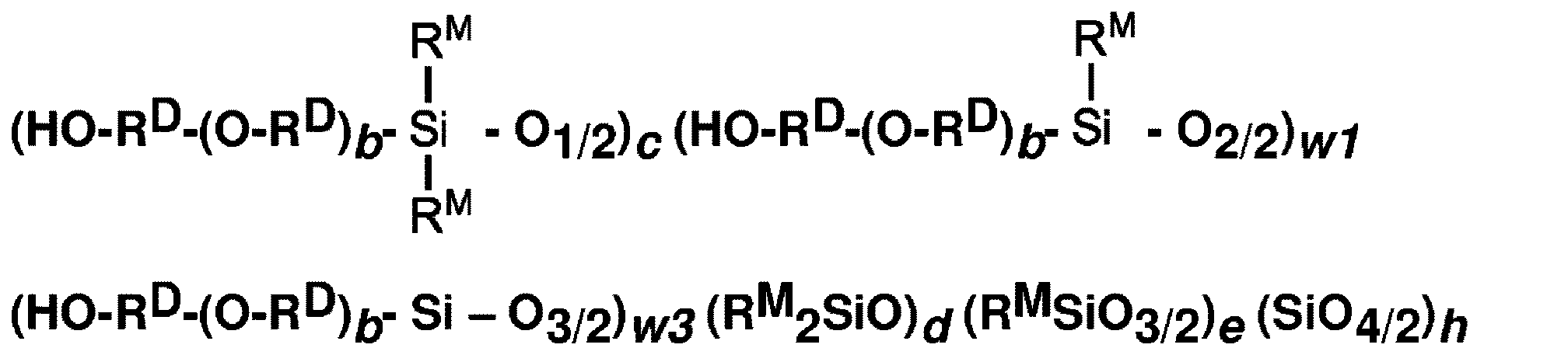
Starting material b1) Carbinol-functional polyorganosiloxane In the above method, b1) Carbinol-functional polyorganosiloxane is composed of the formula:
の単位を含む。この単位式において、各RM、RD、下付き文字b、下付き文字c、下付き文字w1、下付き文字w3、下付き文字d、下付き文字e、及び下付き文字hは、上に記載するとおりである。カルビノール官能性ポリオルガノシロキサンの例は、国際公開第2008/088491号、米国特許第6,528,121号及び米国特許第7,452,956号に開示されている。カルビノール基は、末端基又はペンダント基であり得る。あるいは、カルビノール基は、末端基であり得る。 Including the unit of. In this unit formula, each RM , R D , subscript b, subscript c, subscript w1, subscript w3, subscript d, subscript e, and subscript h are superscripts. As described in. Examples of carbinol functional polyorganosiloxanes are disclosed in WO 2008/088491, US Pat. No. 6,528,121 and US Pat. No. 7,452,956. The carbinol group can be a terminal group or a pendant group. Alternatively, the carbinol group can be a terminal group.
あるいは、b1)カルビノール官能性ポリオルガノシロキサンは、式(II):RCRM 2Si−RDX−(RM 2SiO)r−(RM 2)SiRDX−SiRM 2RC[式中、各RCは、独立して、式HO−RD−(ORD)b−のカルビノール官能基であり、下付き文字b、RM及びRDは、上に記載するとおりであり、各RDXは、O又はRDについて上に記載する二価の炭化水素基から独立して選択され、下付き文字rは、式(II)のカルビノール官能性ポリオルガノシロキサンの重合度を表す]のα,ω−二官能性ポリジオルガノシロキサンを含み得る。下付き文字r>0である。あるいは、下付き文字rは、1〜1,000,000、あるいは50〜1,000、あるいは200〜700であり得る。あるいは、下付き文字rは、0〜200,000、あるいは0〜200,000、あるいは0〜100,000、あるいは0〜50,000、あるいは0〜10,000、あるいは0〜5,000、あるいは0〜1,000、あるいは1〜1,000、あるいは1〜500、あるいは1〜200、あるいは5〜150である。あるいは、各RDXは、Oである。 Alternatively, b1) carbinol-functional polyorganosiloxanes of formula (II): R C R M 2 SiR DX - (R M 2 SiO) r - (R M 2) SiR DX -SiR M 2 R C [ wherein each R C is independently of the formula HO-R D - (oR D ) b - a carbinol functional group, subscript b, R M and R D, were as described above Yes, each RDX is selected independently of the divalent hydrocarbon groups described above for O or RD , and the subscript r is the degree of polymerization of the carbinol-functional polyorganosiloxane of formula (II). Represents] α, ω-bifunctional polydiorganosiloxane. The subscript r> 0. Alternatively, the subscript r can be 1 to 1,000,000, or 50 to 1,000, or 200 to 700. Alternatively, the subscript r is 0 to 200,000, or 0 to 200,000, or 0 to 100,000, or 0 to 50,000, or 0 to 10,000, or 0 to 5,000, or It is 0 to 1,000, or 1 to 1,000, or 1 to 500, or 1 to 200, or 5 to 150. Alternatively, each RDX is O.
出発材料b2)アミン官能性ポリオルガノシロキサン
アミン官能性ポリオルガノシロキサンは、式:
Starting material b2) Amine-functional polyorganosiloxane Amine-functional polyorganosiloxane has the formula:
[式中、RM及びRD、並びに下付き文字b、d、e、h及びiは、上に記載するとおりである]の単位を含む。アミン基は、末端基又はペンダント基であり得る。あるいは、アミン基は、末端基であり得る。 Includes units of [in the formula, RM and R D , and the subscripts b, d, e, h and i are as described above]. The amine group can be a terminal group or a pendant group. Alternatively, the amine group can be a terminal group.
例示的なアミン末端ポリオルガノシロキサンは、式 An exemplary amine-terminated polyorganosiloxane has the formula
[式中、Meはメチル基を表し、Buはブチル基を表す]の末端単位を含み、(RM 2SiO2/2)d(RMSiO3/2)e(SiO4/2)h[式中、RM、RD、並びに下付き文字i、d、e及びhは、上に記載するとおりである]のうちの1つ以上を含む単位を更に含む。 Wherein, Me represents a methyl group, Bu represents a butyl group] includes a terminal unit of, (R M 2 SiO 2/2) d (R M SiO 3/2) e (SiO 4/2) h Further includes a unit comprising one or more of [in the formula, RM , RD , and the subscripts i, d, e and h are as described above].
出発材料c)鎖延長剤
鎖延長剤は、式HO−RD−OH[式中、RDは上に定義するとおりである]のジアルコールであり得る。好適なジアルコールとしては、1,3−ブタンジオール、1,4−ブタンジオール、1,6−ヘキサンジオール、1,10−デカンジオール、1,6−ヘキサメチレンジオール、2,2−ジメチル−1,3−プロパンジオール、1,4−シクロヘキサンジメチロール、1,1’−イソプロピリジン−ビス−(p−フェニレン−オキシ)−ジ−2−エタノール、ポリ(テトラメチレンエーテル)グリコール、及びエチレングリコールが挙げられる。あるいは、鎖延長剤は、2〜20個の炭素原子を含有するジアミンであり得、例えば、1,2−ジアミノエタン、1,4−ジアミノブタン、1,2−プロパンジアミン、ヘキサメチレンジアミン、ジエチレンジアミン、5−アミノ−1−(アミノメチル)−1,3,3−トリメチルシクロヘキサン、4,4’−メチレンビス(シクロヘキシルアミン)、及びエタノールアミンであり得る。あるいは、鎖延長剤は、ジチオール、ジカルボン酸又はジエポキシドであり得る。好適な鎖延長剤は、例えば、米国特許第4,840,796号及び同第5,756,572号に開示されている。
Starting Material c) Chain Extender The chain extender can be a dialcohol of the formula HO- RD- OH [where RD is as defined above]. Suitable dialcohols include 1,3-butanediol, 1,4-butanediol, 1,6-hexanediol, 1,10-decanediol, 1,6-hexamethylenediol, and 2,2-dimethyl-1. , 3-Propanediol, 1,4-Cyclohexanedimethylol, 1,1'-isopropyridine-bis- (p-phenylene-oxy) -di-2-ethanol, poly (tetramethylene ether) glycol, and ethylene glycol Can be mentioned. Alternatively, the chain extender can be a diamine containing 2 to 20 carbon atoms, such as 1,2-diaminoethane, 1,4-diaminobutane, 1,2-propanediamine, hexamethylenediamine, di. It can be ethylenediamine, 5-amino-1- (aminomethyl) -1,3,3-trimethylcyclohexane, 4,4'-methylenebis (cyclohexylamine), and ethanolamine. Alternatively, the chain extender can be dithiol, dicarboxylic acid or diepoxide. Suitable chain extenders are disclosed, for example, in US Pat. Nos. 4,840,796 and 5,756,572.
出発材料d)溶媒
本明細書に記載のコポリマーを調製するための方法中に、溶媒を加えることができる。溶媒としては、コポリマーを溶解し、かつイソシアネート、並びにアミン及び/又はカルビノール化合物に対して比較的非反応性である、任意の有機化合物が好適である。例としては、脂肪族炭化水素、芳香族炭化水素、エステル、エーテル、ケトン及びアミドが挙げられる。例示的な溶媒には、メチルエチルケトン、酢酸エチル、酢酸ブチル又はテトラヒドロフランが挙げられる。
Starting Material d) Solvents Solvents can be added to the methods for preparing the copolymers described herein. As the solvent, any organic compound that dissolves the copolymer and is relatively non-reactive with isocyanates and amine and / or carbinol compounds is suitable. Examples include aliphatic hydrocarbons, aromatic hydrocarbons, esters, ethers, ketones and amides. Exemplary solvents include methyl ethyl ketone, ethyl acetate, butyl acetate or tetrahydrofuran.
使用される溶媒の量は、構造、分子量及び特定のコポリマー調製法を含む、コポリマーの特性に依存し、0〜99%であり得る。一般に、高分子量コポリマーについては、特に高トルク混合機構が使用されない場合、溶媒を添加して粘度を下げ、コポリマーの製造方法の実施中に系を扱いやすくしてもよい。分子量が比較的低く、かつ/又は二軸押出機などの高トルク混合装置が使用される場合、溶媒を使用する必要はない。溶媒を使用する場合、その量は、使用される全ての出発材料の総重量に基づいて、0〜99%、あるいは0〜80%、あるいは1%〜60%、あるいは5%〜50%であり得る。 The amount of solvent used can be 0-99%, depending on the properties of the copolymer, including structure, molecular weight and specific copolymer preparation method. In general, for high molecular weight copolymers, a solvent may be added to reduce the viscosity, especially if a high torque mixing mechanism is not used, to make the system easier to handle during the implementation of the copolymer production process. If the molecular weight is relatively low and / or a high torque mixer such as a twin-screw extruder is used, it is not necessary to use a solvent. If a solvent is used, its amount may be 0-99%, or 0-80%, or 1% -60%, or 5% -50%, based on the total weight of all starting materials used. obtain.
出発材料a)、b)、c)並びにd)及び/又はe)(存在する場合)の各量は、所望のポリオルガノシロキサンの構造及び分子量に応じて、本明細書中の式によって記載されるコポリマーに達するように、大きく変動し得る。出発材料a)のイソシアネート基と、出発材料b)について選択されるポリシロキサン上のカルビノール基又はアミン基の活性水素とのモル比は、0.1〜100、あるいは0.1〜50、あるいは0.1〜10、あるいは0.1〜2、あるいは0.1〜1.5、あるいは0.1〜1.25、あるいは0.1〜1.1、あるいは0.1〜1.05、あるいは0.1〜1.01、あるいは0.1〜1、あるいは0.1〜0.9、あるいは0.1〜0.5、あるいは0.5〜50、あるいは0.5〜10、あるいは0.5〜2、あるいは0.5〜1.5、あるいは0.5〜1.25、あるいは0.5〜1.1、あるいは0.5〜1.05、あるいは0.5〜1.01、あるいは0.5〜1、あるいは0.5〜0.9、あるいは0.4〜0.7であり得る。 The respective amounts of the starting materials a), b), c) and d) and / or e) (if present) are described by the formulas herein, depending on the desired polyorganosiloxane structure and molecular weight. Can vary widely to reach the copolymer. The molar ratio of the isocyanate group of the starting material a) to the active hydrogen of the carbinol group or amine group on the polysiloxane selected for the starting material b) is 0.1 to 100, or 0.1 to 50, or 0.1 to 10, or 0.1 to 2, or 0.1 to 1.5, or 0.1 to 1.25, or 0.1 to 1.1, or 0.1 to 1.05, or 0.1 to 1.01, or 0.1 to 1, or 0.1 to 0.9, or 0.1 to 0.5, or 0.5 to 50, or 0.5 to 10, or 0. 5 to 2, or 0.5 to 1.5, or 0.5 to 1.25, or 0.5 to 1.1, or 0.5 to 1.05, or 0.5 to 1.01, or It can be 0.5 to 1, 0.5 to 0.9, or 0.4 to 0.7.
イソシアネート基と、鎖延長剤上のヒドロキシル基又はアミン基又は他の反応性基上の活性水素とのモル比は、1.001〜1,000,000、あるいは1.001〜500,000、あるいは1.001〜200,000、あるいは1.001〜100,000、あるいは1.001〜50,000、あるいは1.001〜10,000、あるいは1.001〜5,000、あるいは1.001〜1,000、あるいは1.001〜500、あるいは1.001〜100、あるいは1.001〜50、あるいは1.001〜20、あるいは1.001〜10、あるいは1.001〜5、あるいは1.001〜4、あるいは1.001〜3、あるいは1.001〜2、あるいは1.001〜1.5、あるいは1.001〜1.3、あるいは1.001〜1.2、あるいは1.01〜20、あるいは1.01〜10、あるいは1.01〜5、あるいは1.01〜4、あるいは1.01〜3、あるいは1.01〜2、あるいは1.01〜1.5、あるいは1.01〜1.3、あるいは1.01〜1.2であり得る。 The molar ratio of isocyanate groups to active hydrogens on hydroxyl or amine groups on chain extenders or other reactive groups is 1.001 to 1,000,000, or 1.001 to 500,000, or 1.001 to 200,000, or 1.001 to 100,000, or 1.001 to 50,000, or 1.001 to 10,000, or 1.001 to 5,000, or 1.001 to 1. 000, or 1.001 to 500, or 1.001 to 100, or 1.001 to 50, or 1.001 to 20, or 1.001 to 10, or 1.001 to 5, or 1.001 to 4, or 1.001 to 3, 1.001 to 2, or 1.001 to 1.5, or 1.001 to 1.3, or 1.001 to 1.2, or 1.01 to 20. Alternatively, 1.01 to 10, 1.01 to 5, 1.01 to 4, 1.01 to 3, 1.01 to 2, 1.01 to 1.5, or 1.01 to 1. It can be 0.3, or 1.01 to 1.2.
出発材料e)触媒
上記のa)、b)及びc)を含む各出発材料を反応させることは、出発材料であるe)触媒によって触媒され得る。好適な触媒には、3級アミン及び金属塩、例えば、スズの塩が挙げられる。スズ化合物が本明細書における触媒として有用であり、これらとしては、スズの酸化状態が+4又は+2のいずれかであるもの、すなわち、スズ(IV)化合物又はスズ(II)化合物が挙げられる。スズ(IV)化合物の例としては、第二スズ塩、例えば、二ラウリン酸ジブチルスズ、二ラウリン酸ジメチルスズ、ジ−(n−ブチル)スズビス−ケトネート、二酢酸ジブチルスズ、マレイン酸ジブチルスズ、ジブチルスズジアセチルアセトネート、ジブチルスズジメトキシド、カルボメトキシフェニルスズトリス−ウベレート、二オクタン酸ジブチルスズ、二ギ酸ジブチルスズ、イソブチルスズトリセロエート、二酪酸ジメチルスズ、二ネオデカン酸ジメチルスズ、二ネオデカン酸ジブチルスズ、酒石酸トリエチルスズ、二安息香酸ジブチルスズ、三2−エチルヘキサン酸ブチルスズ、二酢酸ジオクチルスズ、オクチル酸スズ、オレイン酸スズ、酪酸スズ、ナフテン酸スズ、二塩化ジメチルスズ、これらの組み合わせ、及び/又はこれらの部分加水分解生成物が挙げられる。スズ(IV)化合物は、当該技術分野において既知であり、例えば、The Dow Chemical Companyの事業部門であるAcima Specialty Chemicals(Switzerland,Europe)から、Metatin(登録商標)740及びFascat(登録商標)4202などとして市販されている。スズ(II)化合物の例としては、有機カルボン酸のスズ(II)塩(二酢酸スズ(II)、ジオクタン酸スズ(II)、ジエチルヘキサン酸スズ(II)、二ラウリン酸スズ(II)等)、カルボン酸の第一スズ塩(オクタン酸第一スズ、オレイン酸第一スズ、酢酸第一スズ、ラウリン酸第一スズ、ステアリン酸第一スズ、ナフテン酸第一スズ、ヘキサン酸第一スズ、コハク酸第一スズ、カプリル酸第一スズなど)、及びこれらの組み合わせが挙げられる。他の金属塩もまた、本反応の好適な触媒である。例としては、酢酸亜鉛及びナフテン酸亜鉛などの亜鉛塩が挙げられる。鉛、ビスマス、コバルト、鉄、アンチモン又はナトリウムの塩、例えば、オクタン酸鉛、硝酸ビスマス及び酢酸ナトリウムなども本反応を触媒することができる。ある特定の場合において、有機水銀化合物も使用することができる。任意選択により、上記の触媒とともに、助触媒を使用してもよい。あるいは、2つ以上の触媒の組み合わせを使用して、例えば、単一触媒で達成される反応よりも速い反応をもたらすこと、又は反応開始時間と反応終了時間の良好なバランスのいずれかをもたらすことができる。
Starting Material e) Catalyst The reaction of each starting material, including the above a), b) and c), can be catalyzed by the starting material e) catalyst. Suitable catalysts include tertiary amines and metal salts, such as tin salts. Tin compounds are useful as catalysts herein, including those in which the tin oxidation state is either +4 or +2, ie tin (IV) compounds or tin (II) compounds. Examples of tin (IV) compounds include ditin salts, such as dibutyltin dilaurate, dimethyltin dilaurate, di- (n-butyl) tinbis-ketonate, dibutyltin diacetate, dibutyltin maleate, dibutyltin diacetylacetonate. , Dibutyltin dimethoxydo, carbomethoxyphenyltin tris-ubelate, dibutyltin dioctanoate, dibutyltin dioctate, triseroate isobutyltin, dimethyltin dibutyrate, dimethyltin dineodecanate, dibutyltin dineodecanate, triethyltin tartrate, dibutyltin dibenzoate , Butyltin tezohexanoate, dioctyltin diacetic acid, tin octylate, tin oleate, tin butyrate, tin naphthenate, dimethyltin dichloride, combinations thereof, and / or partial hydrolysis products thereof. .. Tin (IV) compounds are known in the art and are, for example, from Acima Specialty Chemicals (Switzerland, Europe), a business unit of The Dow Chemical Company, Metatin® 740 and Fascat® 740 and Fascat®. It is commercially available as. Examples of tin (II) compounds include tin (II) salts of organic carboxylic acids (tin diacetate (II), tin dioctanoate (II), tin diethylhexanoate (II), tin dilaurate (II), etc. ), Stannous salt of carboxylic acid (stantinum octanoate, stannous oleate, stannous acetate, stannous laurate, stannous stearate, stannous naphthenate, stannous hexanoate , Stannous succinate, stannous caprylate, etc.), and combinations thereof. Other metal salts are also suitable catalysts for this reaction. Examples include zinc salts such as zinc acetate and zinc naphthenate. Salts of lead, bismuth, cobalt, iron, antimony or sodium, such as lead octanate, bismuth nitrate and sodium acetate, can also catalyze this reaction. In certain cases, organomercury compounds can also be used. A co-catalyst may be used in combination with the above catalyst, optionally. Alternatively, the combination of two or more catalysts can be used, for example, to result in a reaction that is faster than the reaction achieved with a single catalyst, or to provide a good balance between reaction start time and reaction end time. Can be done.
出発材料f)有機ポリオール
上記のコポリマー(A)及び/又はコポリマー(B)を製造するために、任意選択により、有機ポリオールをb)ポリオルガノシロキサンと組み合わせてもよい。好適な有機ポリオールは、2つ以上のヒドロキシル基を含有する有機ポリマーである。出発材料f)の有機ポリオールは、ポリエーテルポリオール、ポリエステルポリオール、ポリアクリレートポリオール、ポリカプロラクトンポリオール、ポリウレタンポリオール、ポリカーボネートポリオール、ポリブタジエンジオール、他のポリマーポリオール、又はこれらの有機ポリオールのうちの2つ以上であり得る。2種以上のポリオールのコポリマーポリオールも使用することができる。フッ素化などのポリマー構造上に他の修飾を有するポリメリックポリオールもまた使用することができる。あるいは、好適な有機ポリオールは、有機ジオールであり得る。好適な有機ジオールとしては、ポリアルキレンオキシドジオール、例えば、ポリエチレンオキシドジオール、ポリプロピレンオキシドジオール及びポリブチレンオキシドジオール;又はポリカーボネートジオールが挙げられる。他の有機ジオールには、グリセロールが挙げられる。有機ポリオールは、調製されるコポリマーの表面エネルギー及び/又は親水性/機械的特性を調整するために添加され得る。添加量は、コポリマーを製造するために使用される全ての出発材料の総重量を基準として、0〜95%、あるいは0〜75%、あるいは0〜50%、あるいは1〜25%であり得る。
Starting Material f) Organic Polyols Organic polyols may optionally be combined with b) polyorganosiloxanes to produce the above copolymers (A) and / or copolymers (B). Suitable organic polyols are organic polymers containing two or more hydroxyl groups. The organic polyol of the starting material f) is a polyether polyol, a polyester polyol, a polyacrylate polyol, a polycaprolactone polyol, a polyurethane polyol, a polycarbonate polyol, a polybutadiene diol, another polymer polyol, or two or more of these organic polyols. possible. Copolymer polyols of two or more polyols can also be used. Polymeric polyols with other modifications on the polymer structure, such as fluorination, can also be used. Alternatively, a suitable organic polyol can be an organic diol. Suitable organic diols include polyalkylene oxide diols such as polyethylene oxide diols, polypropylene oxide diols and polybutylene oxide diols; or polycarbonate diols. Other organic diols include glycerol. Organic polyols can be added to adjust the surface energy and / or hydrophilicity / mechanical properties of the copolymer to be prepared. The amount added can be 0-95%, or 0-75%, or 0-50%, or 1-25%, based on the total weight of all starting materials used to make the copolymer.
出発材料g)任意の末端封止剤
上記のコポリマー(A)及び/又は(B)は、任意選択により、末端封止剤と反応させ、任意の残余のイソシアネート基、ヒドロキシル基又はアミン基を、別の種類の反応性基又は非反応性基に変換することができる。好適な末端封止剤には、エタノール、プロパノール、ブタノールなどのアルコール、酢酸などのカルボン酸、並びに脂肪族不飽和を含有するアルコール及びカルボン酸が挙げられるが、これらに限定されない。チオアルコール、ヒドロキシルアミン、グリコール、アミノ酸及びアミノ糖もまた末端封止剤として好適である。
Starting Material g) Any End Encapsulant The above copolymers (A) and / or (B) are optionally reacted with an end encapsulant to remove any residual isocyanate, hydroxyl or amine groups. It can be converted to another type of reactive or non-reactive group. Suitable end-capping agents include, but are not limited to, alcohols such as ethanol, propanol and butanol, carboxylic acids such as acetic acid, and alcohols and carboxylic acids containing aliphatic unsaturateds. Thiol alcohols, hydroxylamines, glycols, amino acids and amino sugars are also suitable as end-capping agents.
コポリマー(B)の製造方法
コポリマー(B)のための所望の組成に到達するために出発材料の比が変化することを除いて、コポリマー(A)の製造と同じ方法を使用してコポリマー(B)を製造することができる。当業者であれば、コポリマー(A)及びコポリマー(B)が互いに異なるように選択されることを認識するであろう。コポリマー(A)及びコポリマー(B)は、構造、コポリマー単位の選択、コポリマー単位の配列、及び分子量などの少なくとも1つの特性において互いに異なる。
Method for Producing Copolymer (B) Copolymer (B) using the same method as for producing Copolymer (A), except that the ratio of starting materials is changed to reach the desired composition for Copolymer (B). ) Can be manufactured. Those skilled in the art will recognize that the copolymers (A) and the copolymers (B) are selected differently from each other. The copolymers (A) and copolymers (B) differ from each other in at least one property such as structure, choice of copolymer units, arrangement of copolymer units, and molecular weight.
コポリマーの製造方法条件
上記の方法は、加熱しても加熱しなくても実施することができる。反応の温度は、出発材料a)、b)及びc)の選択、並びにd)、e)、f)及び/又はg)のいずれが存在するかに依存するが、温度は、1大気圧で−20℃〜150℃、あるいは0℃〜100℃、あるいは20℃〜60℃の範囲であってよい。この方法が実施される圧力は重要ではない。
Copolymer production method conditions The above method can be carried out with or without heating. The temperature of the reaction depends on the choice of starting materials a), b) and c) and the presence of d), e), f) and / or g), but the temperature is at 1 atm. It may be in the range of −20 ° C. to 150 ° C., 0 ° C. to 100 ° C., or 20 ° C. to 60 ° C. The pressure at which this method is carried out is not important.
上記の方法は、任意の便利な装置において、バッチ式、半バッチ式、半連続式、又は連続式で実施することができる。高分子量コポリマーを調製する場合(例えば、高分子量の出発材料を使用する場合)、方法は、二軸押出機などの押出機で実施することができる。上記のコポリマーは、上記の出発材料を使用することを除き、米国特許第5,756,572号に記載される装置及び方法を使用して調製することができる。 The above method can be carried out in a batch, semi-batch, semi-continuous, or continuous manner in any convenient device. When preparing a high molecular weight copolymer (eg, when using a high molecular weight starting material), the method can be carried out in an extruder such as a twin-screw extruder. The above copolymers can be prepared using the equipment and methods described in US Pat. No. 5,756,572, except that the starting materials described above are used.
皮膚接触接着剤
皮膚接触接着剤は、上記のコポリマー組成物を硬化させることを含む方法によって調製されてもよい。組成物を15℃〜40℃の室温まで冷却し、及び/又は組成物から溶媒を除去するなどの、任意の便利な手段によって硬化を実施してもよい。コポリマー組成物を硬化させることによって調製される皮膚接触接着剤は、医療用テープ用接着剤、創傷包帯用接着剤、人工補装具用接着剤、オストミー装具用接着剤、医療用モニタリング器具用接着剤、化粧用パッチ用接着剤、瘢痕治療処置用接着剤、及び経皮薬物送達システムなどの用途に有用である。
Skin Contact Adhesive The skin contact adhesive may be prepared by a method comprising curing the above copolymer composition. Curing may be carried out by any convenient means, such as cooling the composition to room temperature of 15 ° C. to 40 ° C. and / or removing the solvent from the composition. Skin contact adhesives prepared by curing the copolymer composition are medical tape adhesives, wound banding adhesives, artificial aid adhesives, ostomy equipment adhesives, medical monitoring equipment adhesives. , Cosmetic patch adhesives, scar treatment adhesives, and transdermal drug delivery systems.
上記の皮膚接触接着剤組成物及び皮膚接触接着剤は、(I)上記コポリマー組成物を含む。皮膚接触接着剤組成物は、(II)賦形剤を更に含み得る。上記の皮膚接触接着剤組成物及び皮膚接触接着剤は、任意に、(III)活性成分を更に含み得る。 The skin contact adhesive composition and the skin contact adhesive include (I) the copolymer composition. The skin contact adhesive composition may further comprise the (II) excipient. The skin contact adhesive composition and the skin contact adhesive described above may optionally further contain (III) the active ingredient.
(II)賦形剤
賦形剤は、組成物の製造中及び/若しくは製造後に1つ以上の利点をもたらし、並びに/又は皮膚接触接着剤に1つ以上の利点をもたらす、組成物に添加される成分(I)及び(III)とは異なる任意の成分であり得る。例えば、賦形剤は、(II−1)安定剤、(II−2)結合剤、(II−3)充填剤、(II−4)可溶化剤、(II−5)皮膚浸透助剤、(II−6)接着促進剤、(II−7)水分透過性を改善するための剤、又は(II−1)、(II−2)、(II−3)、(II−4)、(II−5)、(II−6)及び(II−7)のうちの2つ以上の組み合わせであり得る。
(II) Excipients Excipients are added to compositions that provide one or more advantages during and / or after production of the composition and / or provide one or more advantages to skin contact adhesives. It can be any component different from the components (I) and (III). For example, the excipients are (II-1) stabilizer, (II-2) binder, (II-3) filler, (II-4) solubilizer, (II-5) skin penetration aid, (II-6) Adhesion promoter, (II-7) Agent for improving water permeability, or (II-1), (II-2), (II-3), (II-4), ( It can be a combination of two or more of II-5), (II-6) and (II-7).
(II−1)安定剤
組成物は、任意に、(II−1)安定剤を更に含み得る。安定剤は、ビタミンA、ビタミンE、ビタミンC、レチニルパルミテート、セレン、ベンゼンプロパン酸、3,5−ビス(1,1ジメチル−エチル)−4−ヒドロキシ−C7−C9分枝状アルキルエステル(BASFからのIrganox(登録商標)1135)、ペンタエリスリトールテトラキス[3−(3,5−ジ−tert−ブチル−4−ヒドロキシフェニル)プロピオネート](BASFからのIrganox(登録商標)1010)、オクタデシル−3−(3,5−ジ−tert−ブチル−4−ヒドロキシフェニル)プロピオネート(BASFからのIrganox(登録商標)1076)、1,3,5−トリメチル−2,4,6−トリス(3,5−ジ−tert−ブチル−4−ヒドロキシベンジル)ベンゼン(同様にBASFからのIrganox(登録商標)1330)、2−メチル−4,6−ビス[(オクチルチオ)メチル]フェノール(BASFからのIrganox(登録商標)1520)、2,6−ジ−tert−ブチル−メチルフェノール(BHT)、2,2’−メチレン−ビス−(6−tert−ブチル−4−メチルフェノール)(LanXessからのVulkanox BKF)、又はこれらの混合物などの酸化防止剤を含み得る。あるいは、安定剤は、システイン、メチオニン又はこれらの組み合わせなどのアミノ酸を含んでもよい。あるいは、安定剤は、メチルパラベン、プロピルパラベン又はこれらの組み合わせなどのパラベンを含んでもよい。安定剤の量は、組成物が加熱されるかどうか、及び成分(III)が添加されるかどうかを含む、様々な因子に依存するが、安定剤は、組成物の重量に基づいて、0〜2%、あるいは0〜1%、あるいは0.1〜1%、あるいは0.2〜0.7%、あるいは0.2〜0.6%の量で存在し得る。
(II-1) Stabilizer The composition may optionally further comprise a (II-1) stabilizer. Stabilizers are vitamin A, vitamin E, vitamin C, retinyl palmitate, selenium, benzenepropanoic acid, 3,5-bis (1,1 dimethyl-ethyl) -4-hydroxy-C7-C9 branched alkyl ester. (Irganox® from BASF 1135), pentaerythritol tetrakis [3- (3,5-di-tert-butyl-4-hydroxyphenyl) propionate] (Irganox® from BASF 1010), octadecyl- 3- (3,5-di-tert-butyl-4-hydroxyphenyl) propionate (Irganox® from BASF 1076), 1,3,5-trimethyl-2,4,6-tris (3,5) -Di-tert-butyl-4-hydroxybenzyl) Benzene (also Irganox® from BASF® 1330), 2-methyl-4,6-bis [(octylthio) methyl] phenol (Irganox (registered) from BASF) Trademarks) 1520), 2,6-di-tert-butyl-methylphenol (BHT), 2,2'-methylene-bis- (6-tert-butyl-4-methylphenol) (Vulkanox BKF from LanXess), Alternatively, it may contain an antioxidant such as a mixture thereof. Alternatively, the stabilizer may include amino acids such as cysteine, methionine or a combination thereof. Alternatively, the stabilizer may include parabens such as methylparaben, propylparaben or a combination thereof. The amount of stabilizer depends on various factors, including whether the composition is heated and whether component (III) is added, but the stabilizer is 0 based on the weight of the composition. It can be present in an amount of ~ 2%, or 0 to 1%, or 0.1 to 1%, or 0.2 to 0.7%, or 0.2 to 0.6%.
(II−2)結合剤
成分(II−2)の結合剤を、任意に、組成物に添加してもよい。好適な結合剤としては、糖類及びそれらの誘導体(例えば、スクロース及びラクトースなどの二糖類、デンプン若しくはセルロースなどの多糖類、又はキシリトール、ソルビトール若しくはマリトールなどの糖アルコールが挙げられる。他の好適な結合剤としては、ゼラチンなどのタンパク質が挙げられる。結合剤の量は、積層物品の種類及び組成物中の他の成分の選択を含む、様々な因子に依存するが、結合剤の量は、組成物の重量に基づいて、0〜50%であり得る。
(II-2) Binder The binder of the component (II-2) may be optionally added to the composition. Suitable binders include saccharides and derivatives thereof (eg, disaccharides such as sucrose and lactose, polysaccharides such as starch or cellulose, or sugar alcohols such as xylitol, sorbitol or maritor. Other suitable binders. Agents include proteins such as gelatin. The amount of binder depends on various factors, including the type of laminate and the choice of other components in the composition, but the amount of binder is composition. It can be 0-50% based on the weight of the object.
(II−3)充填剤
成分(II−3)の充填剤を、任意に、組成物に添加してもよい。成分(II−3)に好適な充填剤としては、支持体からの組成物の低温流動を防ぐのに役立つシリカが挙げられるが、これに限定されない。選択される充填剤は、皮膚接触接着剤の接着に悪影響を及ぼさないような種類であり、及びそのような量で存在する。充填剤の量は、組成物の重量に基づいて、0〜2%、あるいは0〜1%であり得る。
(II-3) Filler The filler of the component (II-3) may be optionally added to the composition. Suitable fillers for component (II-3) include, but are not limited to, silica, which helps prevent cold flow of the composition from the support. The filler selected is of a type that does not adversely affect the adhesion of the skin contact adhesive, and is present in such an amount. The amount of filler can be 0-2%, or 0-1%, based on the weight of the composition.
(II−4)可溶化剤
成分(II−4)の可溶化剤を、任意に、組成物に添加してもよい。好適な可溶化剤としては、ジメチルスルホキシド、ポビドン(PVP)、並びに鉱油、ヒマワリ油及びピーナッツ油などの天然油が挙げられる。エステル、グリコール、ポリエーテルは、(III)活性成分を可溶化するのに役立ち得る(すなわち、組成物及び当該組成物から調製された皮膚接触接着剤中で成分(III)を非結晶状態に維持し、皮膚への(及び/又は皮膚内への)活性成分の浸透を容易にする)。可溶化剤は、組成物の重量に基づいて、0〜50%、あるいは0〜40%、あるいは0〜25%、あるいは0超〜20%、あるいは20〜25%で存在し得る。あるいは、成分(II−4)に好適な可溶化剤は、コポリマーを製造するための上記の溶媒であってもよい。
(II-4) Solubilizer The solubilizer of the component (II-4) may be optionally added to the composition. Suitable solubilizers include dimethyl sulfoxide, povidone (PVP), and natural oils such as mineral oil, sunflower oil and peanut oil. Esters, glycols and polyethers can help solubilize the active ingredient (III) (ie, keep component (III) in a non-crystalline state in the composition and the skin contact adhesive prepared from the composition. And facilitate the penetration of the active ingredient into the skin (and / or into the skin). The solubilizer may be present at 0-50%, or 0-40%, or 0-25%, or greater than 0-20%, or 20-25%, based on the weight of the composition. Alternatively, the solubilizer suitable for component (II-4) may be the solvent described above for producing the copolymer.
(II−5)皮膚浸透助剤
成分(II−5)の皮膚浸透助剤を、任意に、組成物に添加してもよい。好適な皮膚浸透助剤としては、プロピレングリコール及びポリエチレングリコールなどのグリコール;オレイン酸などの有機酸;オレイルアルコールなどの脂肪族アルコール;並びにアミンが挙げられる。成分(II−5)の量は、組成物から調製された皮膚接触接着剤が適用される場合、皮膚接触接着剤が適用される時間の長さ、及びその目的(例えば、創傷包帯又は経皮薬物送達)を含む、様々な因子に依存するが、その量は、組成物の重量に基づいて、0〜20%未満、あるいは1〜2%の範囲であり得る。
(II-5) Skin Penetration Aid The skin penetration aid of the component (II-5) may be optionally added to the composition. Suitable skin penetration aids include glycols such as propylene glycol and polyethylene glycol; organic acids such as oleic acid; fatty alcohols such as oleic alcohol; and amines. The amount of component (II-5) is the length of time the skin contact adhesive is applied, if a skin contact adhesive prepared from the composition is applied, and its purpose (eg, wound dressing or transdermal). Depending on various factors, including drug delivery), the amount can range from 0 to less than 20%, or 1 to 2%, based on the weight of the composition.
(II−6)接着促進剤
皮膚接触接着剤を除去するために必要な剥離力、及び皮膚上に残る残留物の量などの接着特性を調節するために、当該技術分野において皮膚接触接着剤として公知の材料を本明細書に記載の組成物と混合することができる。これらの材料は、本明細書において接着促進剤として使用され得る。例示的な接着促進剤としては、ヒドロコロイドが挙げられる。接着促進剤の量は、選択される接着促進剤の種類及び所望の接着量に依存するが、接着促進剤の量は、組成物の重量に基づいて、0〜20%未満、あるいは1〜2%であり得る。
(II-6) Adhesive Promoter As a skin contact adhesive in the art, in order to adjust the adhesive properties such as the peeling force required to remove the skin contact adhesive and the amount of residue remaining on the skin. Known materials can be mixed with the compositions described herein. These materials can be used as adhesion promoters herein. An exemplary adhesion promoter includes hydrocolloids. The amount of adhesion accelerator depends on the type of adhesion accelerator selected and the desired amount of adhesion, but the amount of adhesion accelerator is 0 to less than 20%, or 1-2, based on the weight of the composition. Can be%.
(II−7)水分透過性を改善するための剤
成分(II−7)は、任意に組成物に添加されてもよい、水分透過性を改善するための剤である。成分(II−7)に好適な剤としては、ヒドロコロイド、ゼラチン、CMCカルボキシメチルセルロースなどのポリマー、及びポリエチレンオキシドが挙げられるが、これらに限定されない。成分(II−7)の量は、組成物中の他の成分の選択、及び当該組成物から調製される皮膚接触接着剤の最終用途を含む、様々な因子に依存する。しかしながら、成分(II−7)の量は、組成物の重量に基づいて、0.1〜50%、あるいは0.1〜25%、あるいは0.1〜10%、あるいは1〜10%であり得る。当業者であれば、水分透過性を改善する特定の剤はまた、含水量が増加するにつれて包帯をより良好に接着させる粘膜接着剤としても作用し得ることを認識する。
(II-7) Agent for Improving Moisture Permeability Ingredient (II-7) is an agent for improving water permeability which may be optionally added to the composition. Suitable agents for component (II-7) include, but are not limited to, polymers such as hydrocolloids, gelatin, CMC carboxymethyl cellulose, and polyethylene oxide. The amount of component (II-7) depends on a variety of factors, including the selection of other components in the composition and the end use of the skin contact adhesive prepared from the composition. However, the amount of component (II-7) is 0.1 to 50%, or 0.1 to 25%, or 0.1 to 10%, or 1 to 10%, based on the weight of the composition. obtain. Those skilled in the art will recognize that certain agents that improve water permeability can also act as mucosal adhesives that better adhere bandages as the water content increases.
本明細書記載の特定成分は1つを超える機能を有し得るため、上述の組成物の成分を選択する際、成分の種類に重複があり得る。例えば、特定のヒドロコロイドは、水分透過性を改善する剤(II−7)としても、接着促進剤(II−6)としても有用であり得る。ゼラチンは、水分透過性を改善するための剤(II−7)としても、結合剤(II−2)としても有用であり得る。ビタミンA及びビタミンEなどの特定の栄養素は、安定剤(II−1)としても、活性成分(III)としても有用であり得る。複数成分を組成物に添加する場合、成分は互いに異なる。 Since the specific ingredients described herein may have more than one function, there may be duplication in the types of ingredients when selecting the ingredients of the above compositions. For example, certain hydrocolloids can be useful both as an agent for improving water permeability (II-7) and as an adhesion promoter (II-6). Gelatin can be useful both as an agent (II-7) for improving water permeability and as a binder (II-2). Certain nutrients such as Vitamin A and Vitamin E can be useful both as stabilizers (II-1) and as active ingredients (III). When multiple ingredients are added to the composition, the ingredients are different from each other.
(III)活性成分
組成物は、任意に、(III)活性成分を更に含む。成分(III)は、例えば、組成物が、瘢痕処置用途、化粧用パッチ用途、経皮薬物送達用途、及び/又は皮膚への活性成分の送達のための用途における皮膚接触接着剤を調製するために使用される場合、添加することができる。使用される具体的な活性成分は、本発明にとって重要ではなく、本明細書で使用するとき、用語「活性成分」は、その最も広い意味で、それが適用される生物に何らかの有益な効果をもたらすことを意図した材料として解釈されるべきである。
(III) Active Ingredient The composition optionally further comprises (III) Active Ingredient. Ingredient (III), for example, for the composition to prepare a skin contact adhesive for scar treatment applications, cosmetic patch applications, transdermal drug delivery applications, and / or applications for delivery of the active ingredient to the skin. When used in, it can be added. The specific active ingredient used is not important to the present invention, and as used herein, the term "active ingredient", in its broadest sense, has some beneficial effect on the organism to which it is applied. It should be interpreted as the material intended to bring.
成分(III)に好適な例示的活性成分としては、中枢神経系に作用する薬物、腎機能に作用する薬物、心血管機能に作用する薬物、胃腸機能に作用する薬物、蠕虫病の治療用薬物、銀、銀化合物及び/又はクロルヘキシジンなどの抗菌薬、栄養素、ホルモン、ステロイド、並びに皮膚疾患の治療用薬物が挙げられるが、これらに限定されない。例えば、米国特許公開第2007/0172518号段落[0014]に開示されているもの、及び国際公開第2007/092350号(第21〜第28頁)に記載されているものを参照されたい。 Examples of suitable active ingredients for component (III) include drugs that act on the central nervous system, drugs that act on renal function, drugs that act on cardiovascular function, drugs that act on gastrointestinal function, and drugs for the treatment of worm disease. , Silver, silver compounds and / or antibacterial agents such as chlorhexidine, nutrients, hormones, steroids, and therapeutic agents for skin disorders, but are not limited thereto. See, for example, those disclosed in US Patent Publication No. 2007/0172518, paragraph [0014], and those described in International Publication No. 2007/092350 (pages 21-28).
成分(III)に好適な他の活性成分としては、サリチレート、例えば、アセチルサリチル酸などの非ステロイド性抗炎症薬;プロピオン酸誘導体、例えば、(RS)−2−(4−(2−メチルプロピル)フェニル)プロパン酸(イブプロフェン);酢酸誘導体、例えば、2−{1−[(4−クロロフェニル)カルボニル]−5−メトキシ−2−メチル−1H−インドール−3−イル}酢酸(インドメタシン)、エノール酸誘導体;アントラニル酸誘導体、COX−2阻害剤、例えば、N−(4−ヒドロキシフェニル)エタンアミドN−(4−ヒドロキシフェニル)アセトアミド(アセトアミノフェン)、及びスルホンアニリドが挙げられる。成分(III)に好適な他の活性成分としては、エステル基を含有するもの、例えば、4−アミノ安息香酸エチル(ベンゾカイン)などの局所麻酔薬、アミド基を含有するもの、例えば、2−(ジエチルアミノ)−N−(2,6−ジメチルフェニル)アセトアミド(リドカイン);並びに天然由来の局所麻酔薬、例えば、(1R,2S,5R)−2−イソプロピル−5−メチルシクロヘキサノール(メントール)が挙げられる。 Other active ingredients suitable for ingredient (III) include salicylate, eg, non-steroidal anti-inflammatory agents such as acetylsalicylic acid; propionic acid derivatives, eg, (RS) -2- (4- (2-methylpropyl)). Phenyl) propanoic acid (ibuprofene); acetic acid derivatives such as 2- {1-[(4-chlorophenyl) carbonyl] -5-methoxy-2-methyl-1H-indole-3-yl} acetic acid (indomethacin), enolic acid Derivatives; anthranilic acid derivatives, COX-2 inhibitors, such as N- (4-hydroxyphenyl) ethaneamide N- (4-hydroxyphenyl) acetamide (acetaminophen), and sulfonanilides. Other active ingredients suitable for component (III) include those containing an ester group, for example, a local anesthetic such as ethyl 4-aminobenzoate (benzocaine), those containing an amide group, for example 2- ( Diethylamino) -N- (2,6-dimethylphenyl) acetamide (lidocaine); and naturally occurring local anesthetics such as (1R, 2S, 5R) -2-isopropyl-5-methylcyclohexanol (menthol). Be done.
当業者であれば、以下に記載される積層物品において、(III)活性成分は、本明細書に記載される組成物中に成分(III)を含めること(すなわち、当該組成物を硬化して皮膚接触接着剤を形成する前に)によって調製された皮膚接触接着剤に含まれ得ることを認識する。あるいは、(III)活性成分は、積層物品内の別個のリザーバに含まれてもよく、皮膚接触接着剤組成物から調製された皮膚接触接着剤に混合されない。 Those skilled in the art will appreciate that in the laminated articles described below, the active ingredient (III) will include component (III) in the compositions described herein (ie, cure the composition). Recognize that it can be included in the skin contact adhesive prepared by) (before forming the skin contact adhesive). Alternatively, the active ingredient (III) may be contained in a separate reservoir within the laminated article and is not mixed with the skin contact adhesive prepared from the skin contact adhesive composition.
皮膚接触接着剤組成物に使用される(III)活性成分の量は、成分(III)について選択される活性成分の種類、活性成分が組み込まれる積層物品の種類、及び組成物中の任意の他の成分の選択を含む、様々な因子に依存する。しかしながら、成分(III)の量は、皮膚接触接着剤組成物の重量に基づいて、0〜45%、あるいは0超〜25%、あるいは0超〜15%、あるいは0超〜10%、あるいは0.1%超〜10%、あるいは1%超〜10%であり得る。 The amount of (III) active ingredient used in the skin contact adhesive composition depends on the type of active ingredient selected for ingredient (III), the type of laminated article in which the active ingredient is incorporated, and any other in the composition. Depends on a variety of factors, including the selection of ingredients in. However, the amount of component (III) is 0-45%, or more than 0-25%, or more than 0-15%, or more than 0-10%, or 0, based on the weight of the skin contact adhesive composition. It can be greater than 1% to 10%, or greater than 1% to 10%.
積層物品
積層物品は、
i)皮膚対向面と、皮膚とは反対側を向くように意図された反対面とを有する支持体と、
ii)皮膚対向面の少なくとも一部分上の皮膚接触接着剤であって、支持体の皮膚対向面と向かい合う皮膚接触面を有する、皮膚接触接着剤とを含む。
Laminated article Laminated article
i) A support having a skin facing surface and an opposite surface intended to face the opposite side of the skin.
ii) A skin contact adhesive on at least a portion of the skin facing surface, including a skin contact adhesive having a skin contact surface facing the skin facing surface of the support.
支持体は、着用者の身体の一部に容易に適用することができる材料である。支持体は、ポリウレタン、低密度ポリエチレン(LDPE)、中密度ポリエチレン(MDPE)、高密度ポリエチレン(HDPE)、又はポリプロピレンなどのポリオレフィン;ポリオレフィン/ポリウレタン複合体;ポリエステル;又はエチレンビニルアセテート(EVA)などのプラスチックフィルムであり得る。あるいは、支持体は、紙、布地(織布又は不織布)、シリコーンゴム、又は発泡体であってもよい。支持体の全て又は一部分は、積層物品に空気透過性をもたらすために、任意選択により、複数の孔を有し得、例えば、穿孔又は有孔であってよい。好適な支持体は、既知であり、例えば、国際公開第2013/030580号及び国際公開第2014/116281号(第5〜第6頁)を参照されたい。 The support is a material that can be easily applied to a part of the wearer's body. The support may be a polyolefin such as polyurethane, low density polyethylene (LDPE), medium density polyethylene (MDPE), high density polyethylene (HDPE), or polypropylene; a polyolefin / polyurethane composite; polyester; or ethylene vinyl acetate (EVA). It can be a plastic film. Alternatively, the support may be paper, fabric (woven or non-woven), silicone rubber, or foam. All or part of the support may optionally have a plurality of holes, eg, perforated or perforated, in order to provide air permeability to the laminated article. Suitable supports are known, see, for example, WO 2013/030580 and WO 2014/116281 (pages 5-6).
皮膚接触接着剤は、支持体の皮膚対向面の少なくとも一部分上にある。経皮薬物送達などの特定の用途では、皮膚接触接着剤は、薬物を移動させることができる表面積を最大化するために、支持体の皮膚対向面の全て又は大部分を覆ってもよい。あるいは、例えば、皮膚接触接着剤が吸収性材料を創傷に接着させるために使用される場合、皮膚接触接着剤は、支持体の皮膚対向面の一部分上にあってもよい。支持体上の皮膚接触接着剤の量(厚さ)は、用途(例えば、オストミー、創傷ケア及び他の用途)を含む、様々な因子に応じて変動し、長期間の強力な接着では、支持体上の皮膚接触接着剤を厚くすることができ、他方、経皮薬物送達又は包帯又は医療用テープ用の接着剤では、支持体上の皮膚接触接着剤を薄くすることができる。厚さは、均一であってよい。あるいは、厚さは、任意の所与の支持体上で不均一であってもよく、例えば、中央に向かって厚くし、支持体の縁部又はその付近でより薄くしてもよい)。しかしながら、皮膚接触接着剤の厚さは、0.0635mm〜2.54mm、あるいは0.254mm〜1mmの範囲であり得る。 The skin contact adhesive is on at least a portion of the skin facing surface of the support. In certain applications, such as transdermal drug delivery, the skin contact adhesive may cover all or most of the skin facing surface of the support in order to maximize the surface area to which the drug can be transferred. Alternatively, for example, if a skin contact adhesive is used to adhere the absorbent material to the wound, the skin contact adhesive may be on a portion of the skin facing surface of the support. The amount (thickness) of skin contact adhesive on the support varies depending on various factors, including applications (eg, ostomy, wound care and other applications), and supports for long-term strong adhesions. The skin contact adhesive on the body can be thickened, while the adhesive for transdermal drug delivery or bandages or medical tapes can thin the skin contact adhesive on the support. The thickness may be uniform. Alternatively, the thickness may be non-uniform on any given support, eg, thicker towards the center and thinner at or near the edges of the support). However, the thickness of the skin contact adhesive can range from 0.0635 mm to 2.54 mm, or 0.254 mm to 1 mm.
図1は、本発明による積層物品100の部分断面図である。積層物品100は、支持体101を含み、支持体101の皮膚対向面104上に皮膚接触接着剤102の層を有する。剥離ライナー103が皮膚接触接着剤102の層の皮膚接触面105を覆っている。支持体101は、医療用テープ又は絆創膏又は他の創傷包帯のためのバッキング材であってよく、上記のとおりである。
FIG. 1 is a partial cross-sectional view of the
皮膚接触接着剤の層は、連続的であっても不連続であってもよい。不連続である場合、層は、線、線分、小点又は斑点などの様々な形態であってよい。不連続形態は、支持体の表面全体にわたって均一なパターンであってもよく、支持体の異なる領域に異なるパターンを有してもよい。一例は、図4のものであり、これは、オストミー装具(図示せず)で使用するためのフランジ400を示す。フランジ400は、開口部403を画定する支持部材401を有する。本明細書に記載の皮膚接触接着剤402は、支持部材401上の不連続層(円形の線で示される)として形成される。
The layers of the skin contact adhesive may be continuous or discontinuous. If discontinuous, the layer may be in various forms such as lines, line segments, dots or spots. The discontinuous form may be a uniform pattern over the entire surface of the support or may have different patterns in different regions of the support. An example is that of FIG. 4, which shows a
積層物品は、1つ以上の追加の層を更に含んでもよい。例えば、積層物品は、iii)皮膚接触接着剤の皮膚接触面を覆う剥離ライナーを更に含んでもよい。剥離ライナーは、除去可能であり、使用前の積層物品の輸送及び保管に使用することができる。皮膚接触接着剤は、剥離ライナーの除去によって露出させることができる。 The laminated article may further include one or more additional layers. For example, the laminated article may further include a release liner that covers the skin contact surface of the iii) skin contact adhesive. The release liner is removable and can be used for transporting and storing laminated articles before use. The skin contact adhesive can be exposed by removing the release liner.
好適な剥離ライナーとしては、ポリエチレン、ポリプロピレン、フルオロカーボン及びフルオロシリコーンコーティング剥離紙並びにフルオロシリコーンコーティングプラスチックフィルムにより製造されたライナー、又はそれらによりコーティングされたライナーが挙げられる。好適な剥離ライナーは既知であり、例えば、国際公開第2007/092350号に記載されている。理論に束縛されるものではないが、本明細書に記載の組成物を硬化させることによって調製される皮膚接触接着剤の1つの利点は、フッ素化コーティングなしの剥離ライナー(例えば、フルオロカーボンなし及びフルオロシリコーンなし)を皮膚接触接着剤により効果的に使用することができる点であると考えられる。フッ素化コーティングを有する剥離ライナーは、典型的には、フッ素化コーティングを含まない剥離ライナーよりも高価である。あるいは、剥離ライナーとしては、ポリエチレン若しくはポリプロピレンにより製造されたライナー、又はそれらによりコーティングされたライナーが挙げられる。 Suitable release liners include liners made of polyethylene, polypropylene, fluorocarbon and fluorosilicone coated release papers and fluorosilicone coated plastic films, or liners coated with them. Suitable release liners are known and are described, for example, in WO 2007/092350. Without being bound by theory, one advantage of skin contact adhesives prepared by curing the compositions described herein is a release liner without a fluorinated coating (eg, no fluorocarbons and fluorocarbons). It is considered that (without silicone) can be effectively used by the skin contact adhesive. A release liner with a fluorinated coating is typically more expensive than a release liner without a fluorinated coating. Alternatively, the release liner may include a liner made of polyethylene or polypropylene, or a liner coated with them.
積層物品は、任意選択により、iv)吸収性層を更に含んでもよい。吸収性層は、積層物品が図2又はカナダ特許公開第02585933号に示されるものなどの絆創膏である場合など、吸収層が皮膚(例えば、創傷)と直接接触する場合、皮膚接触接着剤の皮膚接触面に取り付けることができる。図2Aは、本明細書に記載される皮膚接触接着剤202の薄層を含む絆創膏200の斜視図を示す。図2Bは、図2Aの線A−Aに沿った絆創膏200の断面図を示す。絆創膏200は、穿孔プラスチック支持体204を有し、支持体204の皮膚対向面203上に皮膚接触接着剤202の層を有する。吸収性層201は、皮膚接触接着剤202の皮膚接触面205上にある。あるいは、例えば、本明細書に記載の皮膚接触接着剤が、国際公開第2007/092350号に示されるものなどの創傷包帯に使用される場合、吸収性層は、皮膚接触接着剤と支持体との間に配置されてもよい。
The laminated article may further include an iv) absorbent layer, optionally. The absorbent layer is the skin of the skin contact adhesive when the absorbent layer is in direct contact with the skin (eg, a wound), such as when the laminated article is an adhesive plaster such as that shown in FIG. 2 or Canadian Patent Publication No. 02585933. Can be attached to the contact surface. FIG. 2A shows a perspective view of the
吸収性層は、流体(例えば、創傷からの滲出物)を吸収することができる織物又はポリマー組成物などの任意の好適な材料であってもよい。吸収性層は、市販製品であってもよく、吸収性ポリマーの例については国際公開第2007/092350号(第12〜第15頁)を参照されたい。例としては、熱可塑性ポリマー、ブロックコポリマー(成分(A)以外)、ポリオレフィン、ヒドロゲル及びヒドロコロイドが挙げられるが、これらに限定されない。 The absorbent layer may be any suitable material, such as a woven or polymer composition capable of absorbing fluid (eg, exudate from a wound). The absorbent layer may be a commercially available product, see International Publication No. 2007/092350 (pages 12-15) for examples of absorbent polymers. Examples include, but are not limited to, thermoplastic polymers, block copolymers (other than component (A)), polyolefins, hydrogels and hydrocolloids.
積層物品は、v)担体を更に含み得る。担体は、積層物品にある程度の剛性をもたらすために使用することができ、また、着用者に積層物品を適用している間、しわを最小限に抑えつつ積層物品を創傷の上に配置し、皮膚接触接着剤が創傷に付着するのを回避することができる。担体は、例えば、積層物品が皮膚に接着固定された後に、任意選択により、除去することができる。担体は、皮膚とは反対側を向くように意図された、支持体の反対側の表面上に取り付けることができる。 Laminated articles may further contain v) carriers. The carrier can be used to provide some rigidity to the laminate and also place the laminate on the wound with minimal wrinkles while applying the laminate to the wearer. It is possible to prevent the skin contact adhesive from adhering to the wound. The carrier can be optionally removed, for example, after the laminated article has been adhered and fixed to the skin. The carrier can be mounted on the surface opposite the support, which is intended to face the opposite side of the skin.
担体は、エチレンビニルアセテート(EVA)、ポリエチレンフィルム、ポリエステルフィルム、又はEVAコーティングでコーティングされた紙であり得る。当業者であれば、担体は、支持体と同じ構造材料、又は異なる構造材料を有し得ることを認識する。担体は、本明細書で使用するとき、積層物品の独立した別個の部品を指す。 The carrier can be ethylene vinyl acetate (EVA), polyethylene film, polyester film, or paper coated with an EVA coating. Those skilled in the art will recognize that the carrier may have the same structural material as the support, or a different structural material. Carrier, as used herein, refers to an independent, separate component of a laminated article.
図3は、本発明による代替的な積層物品300の部分断面図である。積層物品300は、皮膚対向面305と、皮膚とは反対側を向くように意図された反対面303と、を有する支持体304を有する。皮膚接触接着剤(本明細書に記載のもの)308は、支持体304の皮膚対向面305に取り付けられる。皮膚接触接着剤308は、皮膚接触面309を有する層を形成する。剥離ライナー310(別々に剥がすことができる2つの部分を有する)は、皮膚接触接着剤308の皮膚接触面309を覆っている。積層物品は、支持体304の皮膚対向面305と皮膚接触接着剤308の反対面307との間に吸収性層306を更に含む。積層物品は、皮膚対向面及び反対面301を有する担体302を更に含む。担体302は、支持体304の反対面303に除去可能に固着される。
FIG. 3 is a partial cross-sectional view of an alternative
積層物品の製造方法
積層物品を製造するための方法は、
I)支持体の皮膚対向面の少なくとも一部分上に上記の組成物の層を形成することと、
II)組成物を硬化させて、皮膚接触接着剤を形成することと、
を含む。
Method for manufacturing laminated articles The method for manufacturing laminated articles is
I) To form a layer of the above composition on at least a portion of the skin facing surface of the support.
II) Curing the composition to form a skin contact adhesive,
including.
方法は、任意選択により、III)支持体の皮膚対向面と向かい合う皮膚接触接着剤の皮膚接触面に、剥離ライナーを適用すること、を更に含み得る。工程III)は、工程II)の前又は後のいずれかで実行することができる。方法は、IV)組成物を、工程II)で硬化させる前に、支持体と剥離ライナーとの間で圧迫すること、を更に含み得る。 The method may further optionally include III) applying a release liner to the skin contact surface of the skin contact adhesive facing the skin facing surface of the support. Step III) can be performed either before or after step II). The method may further comprise compressing the IV) composition between the support and the release liner prior to curing in step II).
基材に感圧接着剤を適用するために典型的に使用される任意の便利な手段によって、組成物を支持体に適用してもよい。例えば、溶融コーティング、ドクターブレードドローダウン技術、溶媒キャスティング、ナイフコーティング、又はロールコーティングによって組成物を適用してもよい。最初に、支持体又は剥離ライナーに組成物を適用してもよい。例えば、米国特許第5,756,572号に記載される方法を使用して、支持体に組成物を適用してもよい(参考文献に記載されている感圧接着剤を本明細書に記載の組成物に置き換える)。あるいは、組成物は、支持体と剥離ライナーとの間に挟まれてもよく、熱及び/又は圧力を加えて、積層物品を形成し、及び/又は組成物を架橋して、皮膚接触接着剤を形成してもよい。積層物品は、参考文献に開示されているポリウレタンゲル接着剤配合物の代わりに本発明の組成物を使用することを除いて、国際公開第2015/075448号に記載されているように調製することができる。 The composition may be applied to the support by any convenient means typically used to apply the pressure sensitive adhesive to the substrate. The composition may be applied, for example, by melt coating, doctor blade drawdown techniques, solvent casting, knife coating, or roll coating. First, the composition may be applied to the support or release liner. For example, the composition may be applied to the support using the method described in US Pat. No. 5,756,572 (the pressure sensitive adhesives described in the references are described herein. Replace with the composition of). Alternatively, the composition may be sandwiched between the support and the release liner and heat and / or pressure is applied to form a laminated article and / or the composition is crosslinked to provide a skin contact adhesive. May be formed. Laminated articles shall be prepared as described in WO 2015/07544, except that the compositions of the invention are used in place of the polyurethane gel adhesive formulations disclosed in the references. Can be done.
積層物品の製造方法は、任意選択により、III)積層物品を滅菌すること、を更に含み得る。皮膚接触接着剤を含む積層物品は、滅菌することができる。積層物品は、照射(例えば、電子線又はガンマ線)及び/又は乾熱若しくは蒸気などの加熱などの既知の滅菌手段を使用して滅菌することができる。工程III)での滅菌は、上述のように、工程I)又は工程II)の後の別個の工程として実施されてもよい。あるいは、滅菌は、工程I)及び/又は工程II)と並行して行われてもよい。例えば、加熱及び/又は照射を実施し、組成物を架橋し、溶媒を除去し、及び/又は滅菌してもよい。 The method for producing the laminated article may further optionally include III) sterilizing the laminated article. Laminated articles containing skin contact adhesives can be sterilized. Laminated articles can be sterilized using known sterilization means such as irradiation (eg, electron beam or gamma ray) and / or heating such as dry heat or steam. Sterilization in step III) may be performed as a separate step after step I) or step II), as described above. Alternatively, sterilization may be performed in parallel with Step I) and / or Step II). For example, heating and / or irradiation may be performed to crosslink the composition, remove the solvent, and / or sterilize.
用途
本明細書に記載の皮膚接触接着剤は、様々な用途での使用に好適である。組成物を架橋することによって調製される皮膚接触接着剤は、医療用テープ用接着剤、創傷包帯用接着剤、人工補装具用接着剤、オストミー装具用接着剤、医療用モニタリング器具用接着剤、瘢痕治療処置用接着剤、及び経皮薬物送達システムなどの用途に有用である。
Applications The skin contact adhesives described herein are suitable for use in a variety of applications. Skin contact adhesives prepared by cross-linking the composition include medical tape adhesives, wound banding adhesives, artificial prosthesis adhesives, ostomy adhesives, medical monitoring equipment adhesives, It is useful in applications such as adhesives for scar treatment treatment and transdermal drug delivery systems.
例えば、上記の積層物品は、支持体と、その支持体の表面の全て又は一部分上の上記の皮膚接触接着剤とを含み得る。皮膚接触接着剤は、連続的又は不連続的な層に形成されてもよい。一実施形態では、上記の積層物品は、接着剤要素として有用であり得る。皮膚接触接着剤は、支持体の皮膚対向面に適用することができ、皮膚接触接着剤は、支持体を着用者の皮膚に接着するために使用することができる。例えば、上記の皮膚接触接着剤は、四肢障害のある着用者に人工補装具を接着させるために使用されてもよく、又は、皮膚接触接着剤は、ストーマ患者にオストミー装具を密着させるために使用されてもよい。オストミー装具は、典型的には、排泄物を回収するためのパウチを備え、パウチは、開口部を画定するフランジに取り付けられている。フランジは、皮膚対向面上に接着剤を有し、接着剤は、ストーマ患者の皮膚に取り付けるために開口部を取り囲んでいる(図4で上述するとおり)。 For example, the laminated article may include a support and the skin contact adhesive on all or part of the surface of the support. The skin contact adhesive may be formed in continuous or discontinuous layers. In one embodiment, the laminated article may be useful as an adhesive element. The skin contact adhesive can be applied to the skin facing surface of the support, and the skin contact adhesive can be used to adhere the support to the wearer's skin. For example, the skin contact adhesives described above may be used to adhere an artificial prosthesis to a wearer with a limb disorder, or the skin contact adhesive may be used to adhere an ostomy device to a stoma patient. May be done. The ostomy brace typically comprises a pouch for collecting excrement, which is attached to a flange defining the opening. The flange has an adhesive on the skin facing surface, which surrounds the opening for attachment to the skin of the stoma patient (as described above in FIG. 4).
本明細書に記載の皮膚接触接着剤は、米国特許公開第2005/0163978号に開示されている感圧接着剤の代わりに、又は米国特許公開第2014/0323941号で使用されている接着剤の代わりに、皮膚への接着のために、創傷ケア及びオストミーケア用途に使用することができる。 The skin contact adhesives described herein are those used in place of the pressure sensitive adhesives disclosed in US Patent Publication No. 2005/0163978 or in US Patent Publication No. 2014/0323941. Alternatively, it can be used in wound care and ostomy care applications for adhesion to the skin.
本明細書に記載の皮膚接触接着剤は、創傷包帯での使用に好適である。例えば、本明細書に記載の皮膚接触接着剤は、米国特許第5,998,694号のヒドロコロイドの代わりに皮膚接触バリア層として使用することができる。本明細書に記載の皮膚接触接着剤は、国際公開第2007/092350号並びに米国特許公開第2009/0105670号及び同第2015/0313593号の創傷被覆材に使用することができる。 The skin contact adhesives described herein are suitable for use in wound dressings. For example, the skin contact adhesives described herein can be used as a skin contact barrier layer in place of the hydrocolloids of US Pat. No. 5,998,694. The skin contact adhesives described herein can be used in wound dressings of WO 2007/092350 and US Patent Publication Nos. 2009/0105670 and 2015/0313593.
あるいは、本明細書に記載の皮膚接触接着剤は、経皮薬物送達システムにおいて使用されてもよい。この実施形態では、上記の組成物は、成分(III)の活性成分を含み、(II)賦形剤を更に含み得る。理論に束縛されるものではないが、本発明は、皮膚接触接着剤を形成するために組成物を架橋することが(III)活性成分に悪影響を及ぼさないという利点を提供することができると考えられる。本発明の皮膚接触接着剤は、例えば、米国特許第4,840,796号及び同第4,951,657号並びに米国特許公開第2005/0048104号及び同第2007/0172518号に記載されている経皮薬物送達システムに使用することができる。 Alternatively, the skin contact adhesives described herein may be used in transdermal drug delivery systems. In this embodiment, the above composition comprises the active ingredient of ingredient (III) and may further comprise (II) excipients. Without being bound by theory, it is believed that the present invention can provide the advantage that cross-linking the composition to form a skin contact adhesive (III) does not adversely affect the active ingredient. Be done. The skin contact adhesives of the present invention are described, for example, in US Pat. Nos. 4,840,796 and 4,951,657 and US Pat. Nos. 2005/0048104 and 2007/0172518. It can be used in transdermal drug delivery systems.
コーティング組成物
あるいは、上記のコポリマー組成物は、例えば、基材上にコーティングを形成するためのコーティング組成物中に使用されてもよい。コーティング組成物は、(a)上記のコポリマー組成物と、(b)コーティング添加剤と、を含む。コーティング添加剤は、(b1)水捕捉剤、(b2)顔料、(b3)希釈剤、(b4)充填剤、(b5)防錆剤、(b6)可塑剤、(b7)増粘剤、(b8)顔料分散剤、(b9)流動助剤、(b10)溶媒、(b11)接着促進剤、(b12)触媒、(b13)有機共結合剤、(b14)シロキサン共結合剤、(b15)艶消し剤、(b16)レベリング剤、(b17)ワックス、(b18)テクスチャリング添加剤、(b19)耐擦傷添加剤、(b20)光沢調整添加剤、(b21)安定剤、及び(b22)架橋剤、又は(b1)、(b2)、(b3)、(b4)、(b5)、(b6)、(b7)、(b8)、(b9)、(b10)、(b11)、(b12)(b13)、(b14)、(b15)、(b16)、(b17)、(b18)、(b19)、(b20)、(b21)及び(b22)のうちの2つ以上の組み合わせから選択され得る。好適な充填剤としては、シリカ及び二酸化チタン、又は二酸化ジルコニウムが挙げられる。好適な接着促進剤としては、3−グリシドキシプロピルトリメトキシシランなどのアルコキシシランが挙げられる。好適な溶媒は、コポリマー製造方法において上に記載したとおりである。好適な(b2)顔料、(b3)希釈剤、(b4)充填剤、(b5)防錆剤、(b6)可塑剤、(b7)増粘剤、(b8)顔料分散剤、(b9)流動助剤、(b10)溶媒、及び(b11)接着促進剤の例は、米国特許公開第2015/0031797号、並びに国際公開第2015/097064号、同第2015/100258号及び同第2016/126362号に開示されている。出発材料(b12)としてコーティング組成物に使用される触媒は、上記の出発材料e)と同じであってもよく、コーティング組成物を製造するために使用される全ての出発材料の総重量に基づいて、0.01重量%〜5.00重量%の量でコーティング組成物中に存在し得る。出発材料(b13)は、コーティング組成物を製造するために使用される全ての出発材料の総重量に基づいて、0〜99%の量でコーティング組成物に添加され得る、ポリオール、ポリアミン又はポリイソシアネートなどの有機共結合剤である。出発材料(b14)は、コーティング組成物中の全ての出発材料の総重量に基づいて、0〜99%の量で添加され得るシロキサン共結合剤である。出発材料(b15)は、コーティング組成物中の全ての出発材料の総重量に基づいて、0〜30%であり得る艶消し剤である。出発材料(b16)は、コーティング組成物の0〜10%の量で存在し得るレベリング剤である。出発材料の(b17)は、本明細書に記載のコーティング組成物の0〜20%を含み得るワックスである。出発材料(b18)は、0〜20%の量でコーティング組成物に添加することができるテクスチャリング添加剤である。出発材料(b19)、(b20)、(b21)、及び(b22)は、合わせて、コーティング組成物中の全ての出発材料の総量に基づいて、0〜15%であり得る。
Coating Composition Alternatively, the above-mentioned copolymer composition may be used, for example, in a coating composition for forming a coating on a substrate. The coating composition comprises (a) the above-mentioned copolymer composition and (b) a coating additive. The coating additives are (b1) water trapping agent, (b2) pigment, (b3) diluent, (b4) filler, (b5) rust preventive, (b6) plasticizer, (b7) thickener, (b7) thickener. b8) Pigment Dispersant, (b9) Flow Aid, (b10) Solvent, (b11) Adhesion Accelerator, (b12) Catalyst, (b13) Organic Co-Binder, (b14) siloxane Co-Binder, (b15) Gloss Eraser, (b16) Leveling Agent, (b17) Wax, (b18) Textured Additive, (b19) Scratch Resistant Additive, (b20) Gloss Adjusting Additive, (b21) Stabilizer, and (b22) Crosslinker , Or (b1), (b2), (b3), (b4), (b5), (b6), (b7), (b8), (b9), (b10), (b11), (b12) ( You can choose from two or more combinations of b13), (b14), (b15), (b16), (b17), (b18), (b19), (b20), (b21) and (b22). .. Suitable fillers include silica and titanium dioxide, or zirconium dioxide. Suitable adhesion promoters include alkoxysilanes such as 3-glycidoxypropyltrimethoxysilane. Suitable solvents are as described above in the copolymer production process. Suitable (b2) pigments, (b3) diluents, (b4) fillers, (b5) rust inhibitors, (b6) plasticizers, (b7) thickeners, (b8) pigment dispersants, (b9) flow Examples of auxiliaries, (b10) solvents, and (b11) adhesion promoters are US Patent Publication No. 2015/0031797, and International Publication Nos. 2015/097064, 2015/100258, and 2016/126362. It is disclosed in. The catalyst used in the coating composition as the starting material (b12) may be the same as the starting material e) above, based on the total weight of all starting materials used to produce the coating composition. It may be present in the coating composition in an amount of 0.01% to 5.00% by weight. The starting material (b13) can be added to the coating composition in an amount of 0-99% based on the total weight of all starting materials used to make the coating composition, polyol, polyamine or polyisocyanate. It is an organic co-binding agent such as. The starting material (b14) is a siloxane co-binder that can be added in an amount of 0-99% based on the total weight of all starting materials in the coating composition. The starting material (b15) is a matting agent that can be 0-30% based on the total weight of all starting materials in the coating composition. The starting material (b16) is a leveling agent that may be present in an amount of 0-10% of the coating composition. The starting material (b17) is a wax that may contain 0-20% of the coating composition described herein. The starting material (b18) is a texturing additive that can be added to the coating composition in an amount of 0-20%. Starting materials (b19), (b20), (b21), and (b22), together, can be 0-15% based on the total amount of all starting materials in the coating composition.
コーティング組成物は、基材上にプライマー又はトップコートなどのコーティングを形成するために硬化されてもよい。基材は、金属、ガラス、木材、塗装層、プラスチック箔、繊維及び/若しくは織物、又は皮革であり得る。コーティング組成物は、基材(例えば繊維及び/又は織物)に対し、繊維若しくは織物の製造中、又はそれ以後(織物の洗濯中など)に、適用することができる。適用後、例えば、コーティング組成物を周囲温度又は高温で乾燥させることによって、コーティング組成物から溶媒(存在する場合)を除去することができる。基材(例えば繊維及び織物)に適用されるトリートメント組成物の量は、典型的には、基材の乾燥重量に基づいて、基材上に組成物の0.1〜15重量%、あるいは基材の乾燥重量に基づいて、0.2〜5重量%の量をもたらすのに十分な量である。 The coating composition may be cured to form a coating such as a primer or topcoat on the substrate. The substrate can be metal, glass, wood, paint layer, plastic foil, fibers and / or woven fabric, or leather. The coating composition can be applied to a substrate (eg, fiber and / or woven fabric) during the production of the fiber or woven fabric, or later (such as during washing of the woven fabric). After application, the solvent (if present) can be removed from the coating composition, for example by drying the coating composition at ambient temperature or high temperature. The amount of treatment composition applied to the substrate (eg, fibers and textiles) is typically 0.1 to 15% by weight, or group, on the substrate, based on the dry weight of the substrate. An amount sufficient to provide an amount of 0.2-5% by weight, based on the dry weight of the material.
トリートメント組成物で処理可能な繊維及び織物としては、天然繊維(綿、絹、リネン及びウールなど);再生繊維(レーヨン及びアセテートなど);合成繊維(ポリエステル、ポリアミド、ポリアクリロニトリル、ポリエチレン及びポリプロピレンなど);これらの組み合わせ及びこれらのブレンドが挙げられる。繊維の形態としては、より糸、長繊維、トウ、毛糸、織布、編物材料、不織物材料、紙、及びカーペットを挙げることができる。本出願の目的に関し、更なる基材(皮革など)をトリートメント組成物で処理することができる。理論に束縛されるものではないが、シリコーンブロックコポリマーで処理した織物は、従来の疎水性シリコーンに匹敵する触り心地を有するが、織物の親水性にはあまり悪影響を及ぼさないと考えられる。理論に束縛されるものではないが、上記のコーティング組成物から形成されるコーティングは、高光沢、可撓性、硬度、耐擦傷性、及び耐候性、紫外線照射に対する耐性のうちの1つ以上の利点、又はこれらのうちの2つ以上の利点を有し得ると考えられる。 Fibers and textiles that can be treated with the treatment composition include natural fibers (cotton, silk, linen, wool, etc.); recycled fibers (rayon, acetate, etc.); synthetic fibers (polyester, polyamide, polyacrylonitrile, polyethylene, polypropylene, etc.). Examples include combinations thereof and blends thereof. Examples of the fiber form include twine, long fiber, tow, yarn, woven fabric, knitted material, non-woven material, paper, and carpet. For the purposes of this application, additional substrates (such as leather) can be treated with the treatment composition. Without being bound by theory, woven fabrics treated with silicone block copolymers are considered to have a feel comparable to conventional hydrophobic silicones, but do not significantly affect the hydrophilicity of the woven fabrics. Without being bound by theory, the coating formed from the coating composition described above is one or more of high gloss, flexibility, hardness, scratch resistance, and weather resistance, resistance to UV irradiation. It is believed that it may have advantages, or two or more of these advantages.
ここで、以下の実施例において、本発明のいくつかの実施形態を詳細に説明する。参考例は、従来技術であるとの記載がない限り、従来技術ではない。 Here, some embodiments of the present invention will be described in detail in the following examples. Reference examples are not prior art unless otherwise stated to be prior art.
参考例−コポリマーの基本調製手順
500mLの4つ口フラスコを温度制御加熱ブロックに入れ、機械的攪拌機、温度計、滴下漏斗、及び還流冷却器を取り付けた。
1)フラスコにa)イソシアネート化合物及びb)ポリオルガノシロキサンを入れ、混合し、混合物を形成した。
2)混合物を攪拌し、70℃で一定期間加熱し、その後、溶媒を添加し、反応物を40℃未満まで冷却した。
3)残りのイソシアネート化合物を添加した。
4)c)鎖延長剤及び(任意にd)架橋剤を更なる溶媒とともに滴下漏斗に入れ、フラスコ内の混合物に滴下し、次いで、これを一定期間70℃で加熱した。
5)フラスコ内の混合物を室温まで冷却し、2リットル(L)の脱イオン水に注いだ。沈殿したコポリマーを更なる水で洗浄し、回収し、真空オーブンに入れて、75℃及び50ミリバール(mbar)で24時間乾燥させた。
Reference Example-Basic Preparation Procedure for Copolymer A 500 mL four-necked flask was placed in a temperature controlled heating block and fitted with a mechanical stirrer, thermometer, dropping funnel, and reflux condenser.
1) A) isocyanate compound and b) polyorganosiloxane were placed in a flask and mixed to form a mixture.
2) The mixture was stirred and heated at 70 ° C. for a period of time, after which the solvent was added and the reaction was cooled to less than 40 ° C.
3) The remaining isocyanate compound was added.
4) c) Chain extender and (optionally d) crosslinker were placed in a dropping funnel with additional solvent and added dropwise to the mixture in the flask, which was then heated at 70 ° C. for a period of time.
5) The mixture in the flask was cooled to room temperature and poured into 2 liters (L) of deionized water. The precipitated copolymer was washed with additional water, recovered, placed in a vacuum oven and dried at 75 ° C. and 50 mbar (mbar) for 24 hours.
この手順に従って、表1に示す出発材料及び条件を使用して、試料を調製した。 According to this procedure, samples were prepared using the starting materials and conditions shown in Table 1.
表2は、表1の実施例の入手可能なNMR結果及びGPC測定分子量(Mw)を示す。1H−NMR分析(ppm単位、溶媒CDCl3)分析を実施した。GPC条件は:35℃でTHF(1.0mL/分)であった。カラム:Polymer Laboratories PLゲル5μm混合−Cカラム;検出器:Waters2410示差屈折率計。 Table 2 shows the available NMR results and GPC measured molecular weight (Mw) of the examples in Table 1. 1 1 H-NMR analysis (ppm unit, solvent CDCl 3 ) analysis was performed. GPC conditions were: THF (1.0 mL / min) at 35 ° C. Column: Polymer Laboratories PL gel 5 μm mixture-C column; Detector: Waters 2410 differential refractometer.
実施例1.接着試験試料を製造するためのDMS−C16−PU32コポリマー(20%のハードセグメント含有量)の配合物
DMS−C16−PU32と称する5gmのコポリマーをバイアル瓶に量り取り、5グラム(gm)の酢酸エチルを添加した。次いで、全てのコポリマーが酢酸エチルに溶解され、透明な溶液が得られるまで、この材料を混合した。次いで、この混合物を、20milのドローダウンバーを使用してMylarシート上にコーティングした。標準的な感圧接着剤(PSA)手順に従って、積層体を得た。全てのコポリマーは酢酸エチル中の50%溶液であったため、コーティングの溶媒を、まずドラフト内で室温で蒸発させた後、コーティングを通気オーブン内で95℃にて5分間乾燥させた。積層体を更にLDPE剥離ライナーで覆い、室温で一晩放置した。次いで、各試料を接着強度、剥離(peel release)強度、及び凝集強度について試験した。
Example 1. Formulation of DMS-C16-PU32 Copolymer (20% Hard Segment Content) for Producing Adhesion Test Samples Weigh a 5 gm copolymer called DMS-C16-PU32 into a vial and weigh 5 g (gm) of acetate. Ethyl was added. The material was then mixed until all copolymers were dissolved in ethyl acetate to give a clear solution. The mixture was then coated onto a Mylar sheet using a 20 mil drawdown bar. Laminates were obtained according to standard pressure sensitive adhesive (PSA) procedures. Since all copolymers were 50% solutions in ethyl acetate, the coating solvent was first evaporated in a draft at room temperature and then the coating was dried in an aerated oven at 95 ° C. for 5 minutes. The laminate was further covered with an LDPE release liner and left overnight at room temperature. Each sample was then tested for adhesive strength, peel release strength, and cohesive strength.
剥離測定のために、剥離ライナーを下部クランプに固定し、接着剤をコーティングしたポリウレタン積層体を上部クランプに固定した。クランプを130mmにわたって10mm/秒で引き離した。各試験の報告値は、接着剤をコーティングしたポリウレタン積層体から剥離ライナーを引っ張る力(N)/inの平均とする。最初の20mm及び最後の10mmのデータは破棄し、残りの100mmのデータを平均した。反復試験を1〜3回行い、ニュートン/(直線)インチ(N/in)で最終測定値を有する報告値を得た。最終の報告値は、1つ〜3つのテストストリップの平均である(1インチ=〜25mm)。 For peeling measurements, the peeling liner was fixed to the lower clamp and the adhesive coated polyurethane laminate was fixed to the upper clamp. The clamp was pulled apart over 130 mm at 10 mm / sec. The reported value of each test is the average of the force (N) / in pulling the release liner from the polyurethane laminate coated with the adhesive. The first 20 mm and last 10 mm data were discarded and the remaining 100 mm data was averaged. Repeated tests were performed 1-3 times to obtain reported values with final measurements in Newton / (straight) inches (N / in). The final reported value is the average of 1 to 3 test strips (1 inch = ~ 25 mm).
接着測定のために、積層体から剥離ライナーを取り除き、これを1.5in×9in(3.8cm×23cm)のポリカーボネートストリップのつや消し面に接着させた。5ポンド(lb)のゴムコーティングローラーを使用して、1in/秒(2.5cm/秒)の速度で前方に1回及び後方に1回往復させて、積層体をポリカーボネートに貼り付けた。試料をポリカーボネートと30分間接触させたままにした。試験中、ポリカーボネートを下部クランプに固定し、積層体を上部クランプに固定した。剥離試験と同様に、クランプを130mmにわたって10mm/秒で引き離した。ポリカーボネートから積層体(幅1in)を引っ張る力は、ニュートン/(直線)インチ(N/in)での最終測定による100mmにわたる力(130mmの引っ張りのうち最初の20mm及び最後の10mmを除く)を平均した。最終の報告値は、1つ〜3つの試験の平均である。 For adhesion measurement, the release liner was removed from the laminate and adhered to the matte surface of a 1.5 in x 9 in (3.8 cm x 23 cm) polycarbonate strip. The laminate was attached to the polycarbonate using a 5 lb (lb) rubber coated roller, reciprocating once forward and once backward at a rate of 1 in / sec (2.5 cm / sec). The sample was left in contact with the polycarbonate for 30 minutes. During the test, the polycarbonate was clamped to the lower clamp and the laminate was clamped to the upper clamp. Similar to the peeling test, the clamp was pulled apart at 10 mm / sec over 130 mm. The force pulling the laminate (1 in width) from the polycarbonate is the average of the forces over 100 mm (excluding the first 20 mm and the last 10 mm of the 130 mm pull) as measured in Newton / (straight) inches (N / in). did. The final reported value is the average of one to three trials.
凝集破壊パーセントは、接着試験後、ポリカーボネート上に残った接着剤の量を目視で見積もることによって評価した。可能な場合、接着剤の凝集破壊(真の凝集破壊)と、ポリウレタン基材からのポリカーボネートへの移動(基材での接着破壊)とを区別した。ポリカーボネート上に残っている接着剤はいずれも凝集破壊を示すものとした。これらの接着試験結果は表3に含まれる。 The agglomeration failure percentage was evaluated by visually estimating the amount of adhesive remaining on the polycarbonate after the adhesion test. Where possible, a distinction was made between cohesive failure of the adhesive (true cohesive failure) and transfer from the polyurethane substrate to the polycarbonate (adhesive failure at the substrate). All the adhesives remaining on the polycarbonate were considered to show cohesive failure. The results of these adhesion tests are included in Table 3.
実施例2.DMS−C16−PU33コポリマー(20%のハードセグメント含有量)の配合物
DMS−C16−PU32と称するコポリマー(5gm)をガラスバイアル瓶に量り取り、5gmの酢酸エチルを添加した。次いで、全てのコポリマーが酢酸エチルに溶解され、透明な溶液が得られるまで、バイアル瓶の内容物をボルテックスミキサー上で混合した。実施例1と同様に積層物品を調製し、接着強度、剥離強度、及び凝集強度について評価した。
Example 2. Formulation of DMS-C16-PU33 Copolymer (20% Hard Segment Content) A copolymer (5 gm) called DMS-C16-PU32 was weighed into a glass vial and 5 gm of ethyl acetate was added. The contents of the vial were then mixed on a vortex mixer until all copolymers were dissolved in ethyl acetate to give a clear solution. Laminated articles were prepared in the same manner as in Example 1, and the adhesive strength, peel strength, and cohesive strength were evaluated.
実施例3.DMS−C16−PU34コポリマー(17.5%のハード含有量)の配合物
5gmのDMS−C16−PU34をガラスバイアル瓶に量り取り、5gmの酢酸エチルを添加した。次いで、全てのコポリマーが酢酸エチルに溶解され、透明な溶液が得られるまで、この材料をボルテックスミキサー上で混合した。実施例1と同様に積層物品を調製し、試験した。
Example 3. Formulation of DMS-C16-PU34 Copolymer (17.5% Hard Content) 5 gm of DMS-C16-PU34 was weighed into a glass vial and 5 gm of ethyl acetate was added. The material was then mixed on a vortex mixer until all copolymers were dissolved in ethyl acetate to give a clear solution. Laminated articles were prepared and tested in the same manner as in Example 1.
実施例4.DMS−C16−PU39コポリマー(17.5%のハード含有量)の配合物
5gmのDMS−C16−PU39をガラスバイアル瓶に量り取り、5gmの酢酸エチルを添加した。次いで、全てのポリマーが酢酸エチルに溶解され、透明な溶液が得られるまで、材料をボルテックスミキサー上で混合した。実施例1と同様に積層物品を調製し、試験した。
Example 4. Formulation of DMS-C16-PU39 Copolymer (17.5% Hard Content) 5 gm of DMS-C16-PU39 was weighed into a glass vial and 5 gm of ethyl acetate was added. The materials were then mixed on a vortex mixer until all the polymers were dissolved in ethyl acetate and a clear solution was obtained. Laminated articles were prepared and tested in the same manner as in Example 1.
実施例5.DMS−C16−PU40コポリマー(17.5%のハード含有量)の配合物
5gmのDMS−C16−PU40をガラスバイアル瓶に量り取り、5gmの酢酸エチルを添加した。次いで、全てのポリマーが酢酸エチルに溶解され、透明な溶液が得られるまで、材料をボルテックスミキサー上で混合した。実施例1と同様に積層物品を調製し、試験した。
Example 5. Formulation of DMS-C16-PU40 Copolymer (17.5% Hard Content) 5 gm of DMS-C16-PU40 was weighed into a glass vial and 5 gm of ethyl acetate was added. The materials were then mixed on a vortex mixer until all the polymers were dissolved in ethyl acetate and a clear solution was obtained. Laminated articles were prepared and tested in the same manner as in Example 1.
実施例6.DMS−C16−PU23(36.5%のハード含有量)及びDMS−C16−PU33(20%のハード含有量)のブレンド配合物
酢酸エチル中50% DMS−C16−PU23溶液3gmと、酢酸エチル中50% DMS−C16−PU33溶液1.5gmとを、上記のように調製し、ガラスバイアル瓶に量り取った。次いで、各溶液を、透明な溶液が得られるまでボルテックスミキサー上で混合した。次いで、表4に示すように、溶液を異なる比率で混合した。実施例1と同様に積層物品を調製し、試験した。
Example 6. Blend formulation of DMS-C16-PU23 (36.5% hard content) and DMS-C16-PU33 (20% hard content) 50% in ethyl acetate DMS-C16-PU23 solution in 3 gm and in ethyl acetate 1.5 gm of a 50% DMS-C16-PU33 solution was prepared as described above and weighed into a glass vial. Each solution was then mixed on a vortex mixer until a clear solution was obtained. The solutions were then mixed in different ratios, as shown in Table 4. Laminated articles were prepared and tested in the same manner as in Example 1.
同じコポリマーを使用して一連の配合物を調製したが、配合物中のハードからソフト含有量の比率を変更した。全ての配合物を積層体に移し、実施例1の手順に従って接着強度、剥離強度、及び凝集強度について試験した。 A series of formulations were prepared using the same copolymer, but the ratio of hard to soft content in the formulations was changed. All formulations were transferred to the laminate and tested for adhesive strength, peel strength, and cohesive strength according to the procedure of Example 1.
実施例7.コポリマーの合成
カルビノール官能性ポリジメチルシロキサン(C62)とイソホロンジイソシアネートとを下記の表5に示す量で組み合わせることにより、シロキサン−ウレタン−ウレアコポリマーの試料を調製した。異なる分子量を有するポリエチレングリコール(PEG600及びPEG1500)を任意に添加した。上記の出発材料をメチルイソブチルケトン溶媒を用いてフラスコ内で混合し、攪拌しながら60℃まで加熱した。次いで、触媒(ビスマスネオデカノエート)を添加した。温度を80℃まで上昇させ、フラスコの内容物を80℃で2時間加熱した。イソシアネート含有量は、DIN EN ISO 11909に従う滴定によって決定された。
Example 7. Synthesis of Copolymer A sample of a siloxane-urethane-urea copolymer was prepared by combining carbinol-functional polydimethylsiloxane (C62) and isophorone diisocyanate in the amounts shown in Table 5 below. Polyethylene glycols with different molecular weights (PEG600 and PEG1500) were optionally added. The above starting materials were mixed in a flask with a methyl isobutyl ketone solvent and heated to 60 ° C. with stirring. Then a catalyst (bismuth neodecanoate) was added. The temperature was raised to 80 ° C. and the contents of the flask were heated at 80 ° C. for 2 hours. The isocyanate content was determined by titration according to DIN EN ISO 11909.
PPG400は、ポリプロピレングリコールである。実施例7で調製した全ての有機シロキサンコポリマーは、MEK中で透明かつ均質な溶液であった。残留NCO濃度を、理論計算値に従って測定した。 PPG400 is polypropylene glycol. All organic siloxane copolymers prepared in Example 7 were clear and homogeneous solutions in MEK. The residual NCO concentration was measured according to the theoretically calculated value.
実施例9.コーティング
実施例7で調製したコポリマーをコーティング組成物中に配合し、次いで硬化させてコーティングを調製した。コーティング組成物は、以下の表6に示される量の出発材料を含有した。出発材料を機械的にブレンドすることによって、コーティング組成物を調製した。
Example 9. Coating The copolymer prepared in Example 7 was blended into the coating composition and then cured to prepare a coating. The coating composition contained the amounts of starting material shown in Table 6 below. The coating composition was prepared by mechanically blending the starting materials.
表6のコーティング組成物を、アルミニウムQパネルQ36上にコーティングした。フィルム厚は100マイクロメートル(μm)であった。試験前に、周囲条件に7日間曝露することによって、組成物を硬化させた。基材上の各コーティングは、滑らかかつ均質な表面を有した。 The coating composition shown in Table 6 was coated on the aluminum Q panel Q36. The film thickness was 100 micrometers (μm). Prior to testing, the composition was cured by exposure to ambient conditions for 7 days. Each coating on the substrate had a smooth and homogeneous surface.
比較試料(「0」)は、以下の表7に示す組成物を機械的にブレンドすることによって調製した。更に、全有機コーティング組成物を参照(「00」)として調製した。 The comparative sample (“0”) was prepared by mechanically blending the compositions shown in Table 7 below. In addition, the all-organic coating composition was prepared with reference (“00”).
表6の組成物について上述したように、表7の組成物を基材に適用し、硬化させた。コーティング組成物「00」は、透明かつ均質なフィルムを生成した。コーティング「0」は、不均質な液体組成物を生成し、適用後に、多数のピンホール及びクレーターを有するフィルム表面を生成した。このアプローチは、ポリウレタン−ポリオルガノシロキサンコポリマーを含有する組成物の使用することで、コーティング形成の改善を可能にし、かつシリコーン特性をこれらの組成物において高感度で強化できることを示す。 As described above for the compositions in Table 6, the compositions in Table 7 were applied to the substrate and cured. The coating composition "00" produced a transparent and homogeneous film. Coating "0" produced a heterogeneous liquid composition and, after application, produced a film surface with numerous pinholes and craters. This approach shows that the use of compositions containing polyurethane-polyorganosiloxane copolymers can improve coating formation and enhance silicone properties with high sensitivity in these compositions.
表8は、表6の組成物からのコーティングの耐久性試験結果を示す。 Table 8 shows the durability test results of the coating from the composition of Table 6.
表8は、本明細書に記載の有機シロキサンコポリマーで製造されたコーティングの撥水性が、有機系よりも感度が高いことを示す。シロキサン単位が化学的に結合しているため、層の劣化中にいかなる洗い流しもないと考えられる。ケーニッヒ及びクレメン値は、塗料の取り扱い中、及びコーティングの劣化中のひび割れのリスクが低下し、層の可撓性が増加したことを示す。クレメン試験は、加圧時にコーティング上に適用されたタングステン針を使用するコーティング硬度の評価基準である。上昇は、電気強度の低下を示し、コーティングの破損を示す。方法は、ISO1518である。水接触角は、コーティング上に付着した水滴で測定され、デジタルゴニオメーターを装備したカメラを使用して測定される。T0及びT30における角度を記録する。これは次のDIN基準:DIN55660−2である。 Table 8 shows that the water repellency of coatings made with the organic siloxane copolymers described herein is more sensitive than organic. Since the siloxane units are chemically bonded, it is believed that there is no washout during layer degradation. The König and Clement values indicate a reduced risk of cracking during paint handling and deterioration of the coating and increased layer flexibility. The Clement test is a measure of coating hardness using a tungsten needle applied over the coating during pressurization. An increase indicates a decrease in electrical strength and a breakage of the coating. The method is ISO1518. The water contact angle is measured by water droplets adhering to the coating and is measured using a camera equipped with a digital goniometer. Record the angles at T0 and T30. This is the following DIN standard: DIN55660-2.
理論に束縛されるものではないが、上記のように調製されたコーティングは、次の利点:ポリウレタンとシリコーンとの間の相溶性の改善、改善された耐候性、疎水性、加水分解安定性、耐放射線性、耐熱性、耐食性、表面の平滑性及び光沢、耐擦傷性、類似の固形分含有量での粘度の低下(揮発性有機含有量VOCに影響を与える)、並びに摩擦の低減のうちの1つ以上を呈し、これらの利点は、シロキサン系材料が、コーティング層中のウレタンにシロキサンを機械的に分散させる代わりに(本明細書に記載のコポリマーのように)ウレタン主鎖に化学的に結合される場合、耐久性がより高まることであると考えられる。 Without being bound by theory, coatings prepared as described above have the following advantages: improved compatibility between polyurethane and silicone, improved weather resistance, hydrophobicity, hydrolysis stability, Among radiation resistance, heat resistance, corrosion resistance, surface smoothness and luster, scratch resistance, reduction of viscosity at similar solid content (affects volatile organic content VOC), and reduction of friction. These advantages are that the siloxane-based material chemically disperses the siloxane in the urethane in the coating layer (as in the copolymers described herein) in the urethane backbone. When combined with, it is believed to be more durable.
参照番号
100 積層物品
101 支持体
102 皮膚接触接着剤
103 剥離ライナー
104 皮膚対向面
105 皮膚接触面
200 絆創膏
201 吸収層
202 皮膚接触接着剤
203 皮膚対向面
204 支持体
205 皮膚接触面
300 積層物品
301 担体の反対面
302 担体
303 支持体の反対面
304 支持体
305 支持体の皮膚対向面
306 吸収層
307 皮膚接触接着剤の反対面
308 皮膚接触接着剤
309 皮膚接触接着剤の皮膚対向面
310 剥離ライナー
400 フランジ
401 支持部材
402 皮膚接触接着剤
403 開口部
Claims (10)
上記の各構造単位は、記号*を付したところで互いにエステル結合をしてコポリマー(A)を形成しており、
各RMは、独立して、一価の炭化水素基であり、
各RDは、独立して、二価の炭化水素基であり、
各下付き文字aは、独立して、0〜1,000,000であり、各下付き文字bは0であり、各下付き文字mは、≧0であり、下付き文字nは、1以上である]
のコポリマー(A)、及び
ポリエーテルポリオール、ポリエステルポリオール、ポリアクリレートポリオール、ポリカプロラクトンポリオール、ポリウレタンポリオール、ポリカーボネートポリオール、ポリブタジエンジオール、他のポリマーポリオール、又はこれらの有機ポリオールのうちの2つ以上の組み合わせから選択される有機ポリマー
を含むか、
または、
下記単位式(III):
上記の各構造単位は、記号*を付したところで互いにエステル結合をしてコポリマー(B)を形成しており、
各RMは、独立して、一価の炭化水素基であり、
各RDは、独立して、二価の炭化水素基であり、
各下付き文字aは、独立して、0〜1,000,000であり、各下付き文字bは0〜1,000,000であり、
下付き文字nは、1以上であり、下付き文字n1は、0以上であり、下付き文字n2及びn3は、0又は1であり、数量(n2+n3)=1である]
のコポリマー(B)、及び
ポリエーテルポリオール、ポリエステルポリオール、ポリアクリレートポリオール、ポリカプロラクトンポリオール、ポリウレタンポリオール、ポリカーボネートポリオール、ポリブタジエンジオール、他のポリマーポリオール、又はこれらの有機ポリオールのうちの2つ以上の組み合わせから選択される有機ポリマー、の組み合わせを含む、
コポリマー組成物。 Unit formula (I):
Each of the above structural units is ester-bonded to each other at the place marked with the symbol * to form a copolymer (A).
Each RM is independently a monovalent hydrocarbon group,
Each RD is independently a divalent hydrocarbon group,
Each subscript a is independently 0 to 1,000,000, each subscript b is 0, each subscript m is ≧ 0, and each subscript n is 1. That's it]
Copolymer (A) , and
Organic polymers selected from polyether polyols, polyester polyols, polyacrylate polyols, polycaprolactone polyols, polyurethane polyols, polycarbonate polyols, polybutadiene diols, other polymer polyols, or combinations of two or more of these organic polyols. /> Including
Or
The following unit formula (III):
Each of the above structural units is ester-bonded to each other at the place marked with the symbol * to form a copolymer (B).
Each RM is independently a monovalent hydrocarbon group,
Each RD is independently a divalent hydrocarbon group,
Each subscript a is independently 0 to 1,000,000, and each subscript b is 0 to 1,000,000.
The subscript n is 1 or more, the subscript n1 is 0 or more, the subscripts n2 and n3 are 0 or 1, and the quantity (n2 + n3) = 1].
Polymer (B), and from a combination of two or more of a polyether polyol, a polyester polyol, a polyacrylate polyol, a polycaprolactone polyol, a polyurethane polyol, a polycarbonate polyol, a polybutadiene diol, another polymer polyol, or an organic polyol thereof. the organic polymer over selected comprises a combination of,
Copolymer composition.
賦形剤とを含み、
任意選択により活性成分を含んでいてもよい、皮膚接触接着剤組成物。 A copolymer composition according to請Motomeko 1 or 2,
And a excipient,
May contain the active ingredient optionally, skin contact adhesive composition.
コーティング添加剤と、
を含む、コーティング組成物。 A copolymer composition according to請Motomeko 1 or 2,
And co computing additives,
A coating composition comprising.
前記組成物を硬化させてコーティングを形成することと、
を含む、方法。 And applying a coating composition according to the substrate to請Motomeko 7 or 8,
And forming a coating by curing the pre SL composition,
Including methods.
Applications Claiming Priority (3)
| Application Number | Priority Date | Filing Date | Title |
|---|---|---|---|
| US201662396336P | 2016-09-19 | 2016-09-19 | |
| US62/396,336 | 2016-09-19 | ||
| PCT/US2017/047468 WO2018052646A1 (en) | 2016-09-19 | 2017-08-18 | Copolymer composition for coating and adhesive applications |
Publications (2)
| Publication Number | Publication Date |
|---|---|
| JP2019531795A JP2019531795A (en) | 2019-11-07 |
| JP6901552B2 true JP6901552B2 (en) | 2021-07-14 |
Family
ID=59895358
Family Applications (1)
| Application Number | Title | Priority Date | Filing Date |
|---|---|---|---|
| JP2019513882A Active JP6901552B2 (en) | 2016-09-19 | 2017-08-18 | Copolymer compositions for coating and adhesive applications |
Country Status (6)
| Country | Link |
|---|---|
| US (1) | US20210284840A1 (en) |
| EP (1) | EP3515560A1 (en) |
| JP (1) | JP6901552B2 (en) |
| KR (1) | KR102193820B1 (en) |
| CN (1) | CN109843380B (en) |
| WO (1) | WO2018052646A1 (en) |
Families Citing this family (10)
| Publication number | Priority date | Publication date | Assignee | Title |
|---|---|---|---|---|
| US10687986B2 (en) | 2016-09-29 | 2020-06-23 | Ethicon, Inc. | Methods and devices for skin closure |
| USD848624S1 (en) * | 2016-09-29 | 2019-05-14 | Ethicon, Inc. | Release paper for wound treatment devices |
| EP3933006A4 (en) * | 2019-02-28 | 2022-11-23 | Agc Inc. | URETHANE PREPOLYMER, ADHESIVE, DERMAL PATCH MATERIAL, ADHESIVE TAPE, HABITRONIC DEVICE AND HABITRONIC DEVICE KIT |
| CN113026198B (en) * | 2019-12-09 | 2022-07-08 | 中昊晨光化工研究院有限公司 | Functional dressing and preparation method thereof |
| CN111388355A (en) * | 2020-04-06 | 2020-07-10 | 华中科技大学同济医学院附属协和医院 | Skin protective agent for preventing pathogen contact and preparation method thereof |
| JP2023528284A (en) * | 2020-05-22 | 2023-07-04 | ダウ シリコーンズ コーポレーション | Compositions and foamed polyurethane articles formed therewith |
| EP4211003A1 (en) * | 2020-09-11 | 2023-07-19 | Dow Silicones Corporation | Isocyanate-functional prepolymer, composition comprising same, and coating formed therewith |
| CN116239751B (en) * | 2022-12-22 | 2025-03-04 | 广东粤港澳大湾区黄埔材料研究院 | Polyurethane composition, preparation method and application thereof |
| FR3149011A1 (en) * | 2023-05-23 | 2024-11-29 | Universite de Bordeaux | Copolymers containing polydimethylsiloxane (PDMS) moieties |
| FR3168222A1 (en) | 2024-11-07 | 2026-05-08 | Institut Polytechnique De Bordeaux | Compositions comprising copolymers containing polydimethylsiloxane (PDMS) portions |
Family Cites Families (31)
| Publication number | Priority date | Publication date | Assignee | Title |
|---|---|---|---|---|
| US3384623A (en) | 1964-01-11 | 1968-05-21 | Toyo Spinning Co Ltd | Production of polyurethane elastomers |
| US4840796A (en) * | 1988-04-22 | 1989-06-20 | Dow Corning Corporation | Block copolymer matrix for transdermal drug release |
| US4951657A (en) * | 1988-04-22 | 1990-08-28 | Dow Corning Corporation | Heat sealable membrane for transdermal drug release |
| JPH04292676A (en) * | 1991-03-20 | 1992-10-16 | Toyoda Gosei Co Ltd | Coating composition |
| DE4121785A1 (en) | 1991-07-02 | 1993-01-07 | Bayer Ag | METHOD FOR PRODUCING THERMOPLASTIC POLYURETHANE ELASTOMERS |
| US5998694A (en) | 1994-03-02 | 1999-12-07 | Jensen; Ole R. | Occlusive dressing with release sheet having extended tabs |
| DE4437586A1 (en) | 1994-10-20 | 1996-04-25 | Basf Schwarzheide Gmbh | Process for the preparation of thermoplastic polyurethanes |
| US5756572A (en) | 1995-07-24 | 1998-05-26 | Dow Corning Corporation | Silicone pressure sensitive adhesive composition containing thermoplastic multi-segmented copolymer |
| US6528121B2 (en) | 1998-11-19 | 2003-03-04 | Dow Corning Toray Silicone Co., Ltd. | Aqueous treatment agent for wiping paper |
| ES2244422T3 (en) | 1999-04-01 | 2005-12-16 | Alza Corporation | DEVICES FOR THE TRANSDERMAL ADMINISTRATION OF PHARMACOS THAT INCLUDE A POLYURETHANE DEPOSIT FOR PHARMACOS. |
| DE10259036A1 (en) * | 2002-12-17 | 2004-07-08 | Basf Ag | Allyl group-containing polyether urethane |
| DE10326575A1 (en) * | 2003-06-12 | 2005-01-20 | Wacker-Chemie Gmbh | Organopolysiloxane / polyurea / polyurethane block copolymers |
| CN100556929C (en) | 2003-10-10 | 2009-11-04 | 陶氏康宁公司 | Polyurethane compositions containing carbinol-functional silicone resins |
| US20050163978A1 (en) | 2004-01-27 | 2005-07-28 | Esben Strobech | Article having a surface showing adhesive properties |
| US20070172518A1 (en) | 2004-03-12 | 2007-07-26 | Dow Corning Corporation | Method of making silicone pressure sensitive adhesives for delivering hydrophilic drugs |
| EP1588686B1 (en) * | 2004-04-23 | 2010-08-18 | Intercos S.p.A. | Cosmetic compositions and their use |
| US20070071700A1 (en) * | 2005-09-23 | 2007-03-29 | Anjali Abhimanyu Patil | Cosmetic compositions containing silicone/organic copolymers |
| US8377425B2 (en) * | 2005-12-30 | 2013-02-19 | Avon Products, Inc. | Long wearing cosmetic compositions |
| WO2007092350A1 (en) | 2006-02-02 | 2007-08-16 | H.B. Fuller Licensing & Financing, Inc. | Wound care articles, drug delivery systems and methods of using the same |
| BRPI0601479A (en) | 2006-05-03 | 2007-12-18 | Johnson & Johnson Ind Ltda | adhesive bandage |
| DE102006056379A1 (en) * | 2006-11-29 | 2008-06-05 | Wacker Chemie Ag | Siloxane-urea copolymers |
| WO2008088491A2 (en) | 2006-12-20 | 2008-07-24 | Dow Corning Corporation | Silicone resin coating compositions containing blocked isocyanates |
| CA2703942A1 (en) | 2007-10-23 | 2009-04-30 | Boehringer Technologies, L.P. | Thin film wound cover, suction assisted wound treatment system using the same, method of using the thin film wound cover and method of making the same |
| CN102803423A (en) * | 2009-04-17 | 2012-11-28 | 3M创新有限公司 | Silicone gel adhesive construction |
| GB201115182D0 (en) | 2011-09-02 | 2011-10-19 | Trio Healthcare Ltd | Skin contact material |
| JP2013133408A (en) | 2011-12-27 | 2013-07-08 | Dow Corning Toray Co Ltd | Ordinary temperature-curable coating composition |
| WO2014116281A1 (en) | 2013-01-25 | 2014-07-31 | Patenaude Bart | Atraumatic wound care and closure system |
| GB201320432D0 (en) | 2013-11-19 | 2014-01-01 | Scapa Uk Ltd | Novel formulation |
| GB201323041D0 (en) | 2013-12-23 | 2014-02-12 | Dow Corning | Curable coating compositions containing an unsaturated alkoxysilane |
| CN105814156B (en) | 2013-12-23 | 2017-10-31 | 道康宁公司 | UV curable organosilicon compositions and the dust-proof coating composition containing this composition |
| TWI707932B (en) | 2015-02-03 | 2020-10-21 | 美商道康寧公司 | Hardcoat and related compositions, methods, and articles |
-
2017
- 2017-08-18 CN CN201780064745.6A patent/CN109843380B/en active Active
- 2017-08-18 US US16/334,562 patent/US20210284840A1/en not_active Abandoned
- 2017-08-18 JP JP2019513882A patent/JP6901552B2/en active Active
- 2017-08-18 KR KR1020197009464A patent/KR102193820B1/en active Active
- 2017-08-18 WO PCT/US2017/047468 patent/WO2018052646A1/en not_active Ceased
- 2017-08-18 EP EP17768537.7A patent/EP3515560A1/en not_active Withdrawn
Also Published As
| Publication number | Publication date |
|---|---|
| JP2019531795A (en) | 2019-11-07 |
| US20210284840A1 (en) | 2021-09-16 |
| WO2018052646A1 (en) | 2018-03-22 |
| CN109843380A (en) | 2019-06-04 |
| KR20190047716A (en) | 2019-05-08 |
| KR102193820B1 (en) | 2020-12-24 |
| EP3515560A1 (en) | 2019-07-31 |
| CN109843380B (en) | 2021-08-17 |
Similar Documents
| Publication | Publication Date | Title |
|---|---|---|
| KR102193820B1 (en) | Copolymer composition for coating and adhesive applications | |
| KR102315476B1 (en) | Skin contact adhesives and methods of making and using same | |
| KR101715650B1 (en) | Patch material | |
| WO2018052645A1 (en) | Skin contact adhesive and methods for its preparation and use | |
| JP2005518841A (en) | AnB block copolymer comprising poly (vinyl pyrrolidone) units, medical devices, and methods | |
| JP2002501954A (en) | Method for producing polyurethane adhesive, adhesive produced by the method, and medical device using the adhesive | |
| TW201002371A (en) | Medical devices with hydrophilic coatings | |
| EP3930775B1 (en) | Radiopaque medical components and devices | |
| JP2011523962A5 (en) | ||
| KR20180105637A (en) | A drug delivery composition containing a silyl polymer | |
| CN114698371B (en) | Adhesive for skin adhesion, cured product, and adhesive tape for skin adhesion | |
| WO2024209986A1 (en) | Adhesive composition, production method therefor, adhesive, patch, wearable device, and wearable device kit | |
| NL2021630B1 (en) | Polyurethane sheet | |
| WO2020043834A1 (en) | Polyurethane sheet | |
| EP4601713A1 (en) | Adhesive compositions | |
| JP2024094913A (en) | Polyurethane adhesives and patches for skin, wounds, or mucous membranes, skin protective agents for stoma appliances, and wound dressings | |
| WO2023100827A1 (en) | Medical device | |
| JP2021183051A (en) | Adhesive material | |
| WO2025204601A1 (en) | Adhesive composition, production method therefor, adhesive, patch, and transdermal absorption patch | |
| Thomas et al. | Studies on polyurethane potting compound based on HDI-TMP adduct for fabrication of haemodialyzer | |
| SHEYKH et al. | Reactive ester-urethane prepolymer as bioadhesive: Synthesis and evaluation |
Legal Events
| Date | Code | Title | Description |
|---|---|---|---|
| A521 | Request for written amendment filed |
Free format text: JAPANESE INTERMEDIATE CODE: A523 Effective date: 20190410 |
|
| A621 | Written request for application examination |
Free format text: JAPANESE INTERMEDIATE CODE: A621 Effective date: 20190410 |
|
| RD03 | Notification of appointment of power of attorney |
Free format text: JAPANESE INTERMEDIATE CODE: A7423 Effective date: 20190417 |
|
| RD04 | Notification of resignation of power of attorney |
Free format text: JAPANESE INTERMEDIATE CODE: A7424 Effective date: 20190710 |
|
| A131 | Notification of reasons for refusal |
Free format text: JAPANESE INTERMEDIATE CODE: A131 Effective date: 20200427 |
|
| A521 | Request for written amendment filed |
Free format text: JAPANESE INTERMEDIATE CODE: A523 Effective date: 20200707 |
|
| A131 | Notification of reasons for refusal |
Free format text: JAPANESE INTERMEDIATE CODE: A131 Effective date: 20210104 |
|
| A521 | Request for written amendment filed |
Free format text: JAPANESE INTERMEDIATE CODE: A523 Effective date: 20210219 |
|
| TRDD | Decision of grant or rejection written | ||
| A01 | Written decision to grant a patent or to grant a registration (utility model) |
Free format text: JAPANESE INTERMEDIATE CODE: A01 Effective date: 20210524 |
|
| A61 | First payment of annual fees (during grant procedure) |
Free format text: JAPANESE INTERMEDIATE CODE: A61 Effective date: 20210617 |
|
| R150 | Certificate of patent or registration of utility model |
Ref document number: 6901552 Country of ref document: JP Free format text: JAPANESE INTERMEDIATE CODE: R150 |
|
| S802 | Written request for registration of partial abandonment of right |
Free format text: JAPANESE INTERMEDIATE CODE: R311802 |
|
| R350 | Written notification of registration of transfer |
Free format text: JAPANESE INTERMEDIATE CODE: R350 |
|
| R250 | Receipt of annual fees |
Free format text: JAPANESE INTERMEDIATE CODE: R250 |
|
| R250 | Receipt of annual fees |
Free format text: JAPANESE INTERMEDIATE CODE: R250 |
|
| R250 | Receipt of annual fees |
Free format text: JAPANESE INTERMEDIATE CODE: R250 |