JP6545708B2 - Mold material mixture containing resol and amorphous silicon dioxide, mold and core produced thereby, and method for producing it - Google Patents
Mold material mixture containing resol and amorphous silicon dioxide, mold and core produced thereby, and method for producing itInfo
- Publication number
- JP6545708B2 JP6545708B2 JP2016564630A JP2016564630A JP6545708B2 JP 6545708 B2 JP6545708 B2 JP 6545708B2 JP 2016564630 A JP2016564630 A JP 2016564630A JP 2016564630 A JP2016564630 A JP 2016564630A JP 6545708 B2 JP6545708 B2 JP 6545708B2
- Authority
- JP
- Japan
- Prior art keywords
- mold material
- material mixture
- silicon dioxide
- weight
- amorphous silicon
- Prior art date
- Legal status (The legal status is an assumption and is not a legal conclusion. Google has not performed a legal analysis and makes no representation as to the accuracy of the status listed.)
- Active
Links
Classifications
-
- B—PERFORMING OPERATIONS; TRANSPORTING
- B22—CASTING; POWDER METALLURGY
- B22C—FOUNDRY MOULDING
- B22C1/00—Compositions of refractory mould or core materials; Grain structures thereof; Chemical or physical features in the formation or manufacture of moulds
- B22C1/16—Compositions of refractory mould or core materials; Grain structures thereof; Chemical or physical features in the formation or manufacture of moulds characterised by the use of binding agents; Mixtures of binding agents
- B22C1/20—Compositions of refractory mould or core materials; Grain structures thereof; Chemical or physical features in the formation or manufacture of moulds characterised by the use of binding agents; Mixtures of binding agents of organic agents
- B22C1/22—Compositions of refractory mould or core materials; Grain structures thereof; Chemical or physical features in the formation or manufacture of moulds characterised by the use of binding agents; Mixtures of binding agents of organic agents of resins or rosins
- B22C1/2233—Compositions of refractory mould or core materials; Grain structures thereof; Chemical or physical features in the formation or manufacture of moulds characterised by the use of binding agents; Mixtures of binding agents of organic agents of resins or rosins obtained otherwise than by reactions only involving carbon-to-carbon unsaturated bonds
- B22C1/2246—Condensation polymers of aldehydes and ketones
- B22C1/2253—Condensation polymers of aldehydes and ketones with phenols
-
- B—PERFORMING OPERATIONS; TRANSPORTING
- B22—CASTING; POWDER METALLURGY
- B22C—FOUNDRY MOULDING
- B22C1/00—Compositions of refractory mould or core materials; Grain structures thereof; Chemical or physical features in the formation or manufacture of moulds
- B22C1/02—Compositions of refractory mould or core materials; Grain structures thereof; Chemical or physical features in the formation or manufacture of moulds characterised by additives for special purposes, e.g. indicators, breakdown additives
- B22C1/10—Compositions of refractory mould or core materials; Grain structures thereof; Chemical or physical features in the formation or manufacture of moulds characterised by additives for special purposes, e.g. indicators, breakdown additives for influencing the hardening tendency of the mould material
-
- B—PERFORMING OPERATIONS; TRANSPORTING
- B22—CASTING; POWDER METALLURGY
- B22C—FOUNDRY MOULDING
- B22C9/00—Moulds or cores; Moulding processes
- B22C9/02—Sand moulds or like moulds for shaped castings
-
- B—PERFORMING OPERATIONS; TRANSPORTING
- B22—CASTING; POWDER METALLURGY
- B22C—FOUNDRY MOULDING
- B22C9/00—Moulds or cores; Moulding processes
- B22C9/12—Treating moulds or cores, e.g. drying, hardening
- B22C9/123—Gas-hardening
-
- C—CHEMISTRY; METALLURGY
- C04—CEMENTS; CONCRETE; ARTIFICIAL STONE; CERAMICS; REFRACTORIES
- C04B—LIME, MAGNESIA; SLAG; CEMENTS; COMPOSITIONS THEREOF, e.g. MORTARS, CONCRETE OR LIKE BUILDING MATERIALS; ARTIFICIAL STONE; CERAMICS; REFRACTORIES; TREATMENT OF NATURAL STONE
- C04B35/00—Shaped ceramic products characterised by their composition; Ceramics compositions; Processing powders of inorganic compounds preparatory to the manufacturing of ceramic products
- C04B35/01—Shaped ceramic products characterised by their composition; Ceramics compositions; Processing powders of inorganic compounds preparatory to the manufacturing of ceramic products based on oxide ceramics
- C04B35/14—Shaped ceramic products characterised by their composition; Ceramics compositions; Processing powders of inorganic compounds preparatory to the manufacturing of ceramic products based on oxide ceramics based on silica
Landscapes
- Engineering & Computer Science (AREA)
- Chemical & Material Sciences (AREA)
- Mechanical Engineering (AREA)
- Materials Engineering (AREA)
- Chemical Kinetics & Catalysis (AREA)
- Ceramic Engineering (AREA)
- Manufacturing & Machinery (AREA)
- Structural Engineering (AREA)
- Organic Chemistry (AREA)
- Mold Materials And Core Materials (AREA)
- Molds, Cores, And Manufacturing Methods Thereof (AREA)
Description
本発明は、少なくとも耐火性材料と、レゾールに基づく結合剤と、アモルファス二酸化ケイ素とを含む、金属鋳造のための鋳型およびコアを製造するための鋳型材料混合物に関する。本発明はさらに、この鋳型材料混合物を用いて鋳型およびコアを製造するための方法、ならびに鋳型材料混合物の硬化を伴うこの方法によって製造される金属鋳造のための鋳型およびコアに関する。 The present invention relates to a mold material mixture for producing molds and cores for metal casting, comprising at least a refractory material, a resol-based binder, and amorphous silicon dioxide. The invention further relates to a method for producing molds and cores using this mold material mixture, as well as molds and cores for metal casting produced by this method involving curing of the mold material mixture.
鋳型は本質的に、製造すべき鋳造物の凹形を表す鋳型または鋳型とコアとを一緒にしたものからなる。これらの鋳型およびコアは一般的に、たとえば石英砂などの耐火性材料と、成形ツールから取り外された後の鋳型に適切な機械的強度を与える好適な結合剤とからなる。耐火性の基本的な鋳型材料は、好ましくは自由に流動する形であることによって、結合剤と混合された後に好適な中空鋳型に充填され、圧縮され、次いで硬化されることが可能である。硬化後、結合剤が基本鋳型材料の粒子間の堅固な結合を確実にすることによって、鋳造鋳型は必要な機械的安定性を達成する。 The mold consists essentially of the mold or mold and the core representing the concave shape of the casting to be produced. These molds and cores generally consist of a refractory material, for example quartz sand, and a suitable binder which gives the mold adequate mechanical strength after removal from the forming tool. The basic refractory mold material is preferably in free-flowing form so that it can be mixed with a binder and then filled into a suitable hollow mold, compressed and then cured. After curing, the casting mold achieves the necessary mechanical stability by the binder ensuring firm bonding between the particles of the basic mold material.
鋳造において、鋳型は鋳造物に対する外壁を形成し、コアは鋳造物内の中空の空間を形成するために用いられる。鋳型およびコアが同じ材料からなることは絶対的に必要ではない。たとえば、チル鋳造において、鋳造物の外側の成形は永久金属鋳型の助けによって達成される。加えて、異なる方法に従って異なる組成の鋳型材料混合物から製造された鋳型およびコアの組み合わせも可能である。以下においては簡略化の目的のために「鋳型」という用語が用いられ得るが、その記述は同じ鋳型材料混合物に基づいて同じ方法を用いて製造されたコアにも等しく当てはまる(その逆も同様である)。 In casting, the mold forms the outer wall to the casting and the core is used to form a hollow space within the casting. It is not absolutely necessary that the mold and the core consist of the same material. For example, in chill casting, molding on the outside of the casting is accomplished with the help of permanent metal molds. In addition, combinations of molds and cores produced from mold material mixtures of different compositions according to different methods are also possible. In the following the term "template" may be used for the purpose of simplification, but the description applies equally to cores manufactured using the same method based on the same template material mixture (and vice versa) is there).
鋳型を製造するために、有機、無機、および有機/無機混合結合剤(ハイブリッド系)が用いられてもよく、その硬化は冷間法または熱間法によって達成されてもよい。冷間法は、本質的にコアを製造するために用いられる成形ツールを加熱せずに、一般的には室温にて行われるか、高温ガスを導入することによって生成されるか、または発熱反応によって誘導される温度にて行われる方法である。たとえば、硬化される鋳型材料混合物にガスが通されて化学反応を引き起こすことによって、硬化が達成される。熱間法においては、成形後の鋳型材料混合物を、たとえば加熱した成形ツールによって高温に加熱して、結合剤に含まれる溶剤を放出させるか、および/または結合剤を硬化する化学反応を開始させる。 Organic, inorganic and mixed organic / inorganic binders (hybrid systems) may be used to produce the mold, and their hardening may be achieved by the cold method or the hot method. The cold process is generally carried out at room temperature, produced by introducing a hot gas, or exothermic reaction, essentially without heating the forming tool used to produce the core The method is carried out at a temperature induced by For example, curing is achieved by passing a gas through the mold material mixture to be cured to cause a chemical reaction. In the hot method, the mold material mixture after molding is heated to a high temperature, for example by a heated molding tool, to release the solvent contained in the binder and / or to initiate a chemical reaction to cure the binder .
有機ポリウレタン(polyurethane:PU)コールドボックスプロセスにおいては、ポリオール成分とポリイソシアネート成分とからなる2成分(two−component:2C)結合剤に、触媒としてたとえばジメチルエチルアミンなどのガス状または揮発性三級アミンを通すことによって反応させる。 In an organic polyurethane (PU) cold box process, a two-component (2C) binder consisting of a polyol component and a polyisocyanate component is combined with a gaseous or volatile tertiary amine such as dimethylethylamine as a catalyst. React by passing through.
しかし、これらのPUベースの結合剤は、硬化触媒として使用されるアミンが毒性であり、かつ特徴的な非常に不快な臭気を発するという欠点を有する。したがって、PU結合コアによる作業をするときには、鋳型製造および鋳造の両方に対して、非常に効果的な吸引システムおよび高価な排気浄化が必要である。 However, these PU-based binders have the disadvantage that the amines used as curing catalysts are toxic and give off a characteristic very unpleasant odor. Thus, when working with PU bonded cores, a very effective suction system and expensive exhaust purification are required for both mold manufacture and casting.
したがって、コア製造の際にも鋳造の際にも汚染物質を排出しない代替策が求められている。このため、近年は有機/無機ハイブリッド系および純粋な無機結合剤に対する関心が大きく高まっている。 Therefore, there is a need for an alternative that does not emit contaminants during core manufacture as well as during casting. For this reason, in recent years there has been great interest in organic / inorganic hybrids and pure inorganic binders.
ハイブリッド系、すなわちたとえば溶剤としての水など、相当量の無機フラクションを有する有機結合剤は、欧州特許第0323096(B2)号および欧州特許第1228128(B1)号などに開示されている。 Organic binders having a considerable amount of inorganic fractions, such as hybrid systems, ie water as a solvent, for example, are disclosed in EP-A-0 323 096 B2 and EP-B 12 28 128 B1 etc.
鋳型材料混合物をCO2ガスで処理してから結合剤として作用させることによって硬化され得るのは、高アルカリ性のレゾール樹脂である。上記に挙げた特許に記載される結合剤の必須成分はオキシアニオン、たとえばホウ酸イオン(欧州特許第0323096(B2)号)およびホウ酸イオンとアルミン酸イオンとの組み合わせ(欧州特許第1228128(B1)号)などである。 It is a highly alkaline resole resin that can be cured by treating the mold material mixture with CO 2 gas and then acting as a binder. The essential components of the binders described in the patents mentioned above are oxyanions, for example borate ions (EP 0 323 096 B2) and combinations of borate ions and aluminate ions (EP 12 28 128 B1). And so on.
PUコールドボックス結合剤とCO2硬化可能レゾールとの強度を比較すると、後者はPUコールドボックス結合剤の強度レベルを達成しないことが見出されるため、それらの使用範囲はなおも本質的に単純な大きいコアに限られる。確かに、鋳造の際の排出の問題はレゾールの使用によって解決されないが、コア製造の範囲内では、悪臭がありかつ低濃度でも毒性のものもある三級アミンの代わりに無臭のCO2を使用すること、および有機溶剤成分を少なくとも部分的に水で置換することによって、作業雰囲気を良好にできる。 When comparing the strength of PU cold box binders with CO 2 curable resoles, it is found that the latter does not achieve the strength level of PU cold box binders, so their use range is still essentially simple large Limited to the core. Certainly, the problem of emissions during casting is not solved by the use of resole, but within the scope of core manufacture, using odorless CO 2 instead of tertiary amines which are malodorous and which are also low in concentration and toxic The working atmosphere can be improved by doing as well as by at least partially replacing the organic solvent component with water.
したがって、CO2硬化可能レゾールがより高レベルの強度に達するように、CO2硬化可能レゾールをさらに開発することが求められている。その結果として、より複雑なジオメトリを有するコアを製造できるか、または大きい単一コアの結合剤含有量を減少でき、それによって一方ではこの方法の経済性が向上し、他方では鋳造の際に起こる排出の量が低減する。 Therefore, as CO 2 hardenable resole reaches more high level of intensity, there is a need to further develop the CO 2 hardenable resole. As a result, cores with more complex geometries can be produced or the binder content of large single cores can be reduced, which on the one hand improves the economics of the process and on the other hand occurs during casting Reduce the amount of emissions.
よって本発明の目的は、CO2硬化可能レゾール結合剤の特性を改善すること、特にその強度を増加させることである。 The object of the invention is therefore to improve the properties of the CO 2 curable resole binder, in particular to increase its strength.
本発明の組成物
上記に挙げた課題は、独立請求項に記載される鋳型材料混合物、多成分系または方法によって達成される。有利なさらなる発展は従属請求項の主題であるか、または以下に記載されている。
Compositions of the Invention The above mentioned problems are achieved by the template material mixture, multicomponent system or method described in the independent claims. Advantageous further developments are the subject matter of the dependent claims or are described below.
驚くべきことに、少なくとも1つの耐火性基本鋳型材料およびCO2硬化可能レゾールを含む鋳型材料混合物にアモルファス二酸化ケイ素を加えることによって、成形および鋳造の直後、ならびに硬化したコアを室温にて24時間貯蔵した後の両方における強度が改善されることが見出された。加えて本発明は、高い大気湿度における鋳型の貯蔵寿命、およびコアの熱処理後の強度、たとえばコーティング(水性またはアルコール性の耐火性コーティングの適用)を80℃から200℃にて乾燥した後などの強度の両方に対して、好ましい効果を有する。 Surprisingly, by adding amorphous silicon dioxide to a mold material mixture comprising at least one refractory basic mold material and a CO 2 curable resole, immediately after molding and casting, and storing the hardened core at room temperature for 24 hours It has been found that the strength is improved both after. In addition, the present invention provides shelf life of the mold at high atmospheric humidity and strength of the core after heat treatment, eg after drying the coating (application of aqueous or alcoholic fire resistant coating) at 80 ° C. to 200 ° C. It has a positive effect on both strengths.
本発明に従う鋳型材料混合物は、少なくとも以下の材料を含む。
a)耐火性基本鋳型材料、
b)特にアルカリ水溶液の形であり、さらに好ましくは12より高いpHを有する、結合剤または結合剤成分としての未硬化レゾール、および
c)添加剤としてのアモルファスSiO2。
The mold material mixture according to the invention comprises at least the following materials:
a) Fireproof basic mold material,
b) Uncured resole as binder or binder component, in particular in the form of an aqueous alkaline solution, more preferably having a pH higher than 12, and c) amorphous SiO 2 as additive.
本発明はさらに、以下のステップを含む、鋳型またはコアを製造するための方法に関する。
a)結合剤および添加剤を基本鋳型材料と混合するステップ、
b)ステップa)で得られた鋳型材料混合物を成形ツールに導入するステップ、
c)成形ツール内の鋳型材料混合物を硬化するステップ、および
d)任意に、硬化したコアまたは鋳型を成形ツールから取り外すステップ。
The invention further relates to a method for manufacturing a mold or core comprising the following steps:
a) mixing the binder and additives with the basic mold material,
b) introducing the mold material mixture obtained in step a) into a forming tool,
c) curing the mold material mixture in the forming tool, and d) optionally removing the hardened core or mold from the forming tool.
耐火性基本鋳型材料(以下単に基本鋳型材料とも呼ばれる)として、鋳造物の製造のための通常公知の材料およびその混合物が使用されてもよい。好適な材料は、たとえば石英、ジルコニアまたはクロム砂、カンラン石、バーミキュライト、ボーキサイト、耐火粘土、およびいわゆる合成基本鋳型材料、すなわち工業的方法によって球状またはほぼ球状(たとえば楕円体)の形にされた基本鋳型材料などである。その例は、合成球状セラミック砂、すなわちいわゆるCerabeads(登録商標)またはSpherichrome(登録商標)、SpherOX、およびたとえばフライアッシュの構成要素として単離され得るものなどの微粒子などである。 As the refractory base mold material (hereinafter also referred to simply as the base mold material), commonly known materials for the production of castings and mixtures thereof may be used. Suitable materials are, for example, quartz, zirconia or chromium sand, olivine, vermiculite, bauxite, refractory clays, and so-called synthetic basic mold materials, ie spherical or approximately spherical (for example ellipsoidal) shaped by industrial methods It is a mold material etc. Examples are synthetic spherical ceramic sands, ie fine particles such as so-called Cerabeads® or Spherichrome®, SpherOX and, for example, those which can be isolated as components of fly ash.
特に好ましいのは、耐火性基本鋳型材料に基づいて50重量%より多くの石英砂を含有する基本鋳型材料である。耐火性基本鋳型材料は、高い融点(融解温度)を有する物質と定義される。耐火性基本鋳型材料の融点は、有利には600℃より高く、好ましくは900℃より高く、特に好ましくは1200℃より高く、とりわけ好ましくは1500℃より高い。 Particularly preferred is a base mold material containing more than 50% by weight of quartz sand based on the refractory base mold material. The refractory base mold material is defined as a material having a high melting point (melting temperature). The melting point of the refractory basic template material is advantageously higher than 600 ° C., preferably higher than 900 ° C., particularly preferably higher than 1200 ° C., particularly preferably higher than 1500 ° C.
耐火性基本鋳型材料は、好ましくは鋳型材料混合物の80重量%より多く、とりわけ90重量%より多く、特に好ましくは95重量%より多くを構成する。 The refractory base mold material preferably constitutes more than 80% by weight, in particular more than 90% by weight and particularly preferably more than 95% by weight of the mold material mixture.
耐火性基本鋳型材料の平均直径は、一般的に100μmから600μm、好ましくは120μmから550μm、特に好ましくは150μmから500μmである。粒径は、たとえばDIN ISO3310に従うふるい分けなどによって定められ得る。特に好ましいのは、(互いに直角かつ空間のすべての方向に対する)最大寸法対最小寸法の良好な比率である1:1から1:5または1:1から1:3を有する粒子形状、すなわちたとえば繊維状でない粒子形状である。 The average diameter of the refractory basic mold material is generally 100 μm to 600 μm, preferably 120 μm to 550 μm, particularly preferably 150 μm to 500 μm. The particle size can be determined, for example, by sieving in accordance with DIN ISO 3310. Particularly preferred are particle shapes having a good ratio of maximum dimension to minimum dimension (perpendicular to all directions of space), 1: 1 to 1: 5 or 1: 1 to 1: 3, ie fibers, for example Non-spherical particle shape.
耐火性基本鋳型材料は、特に本発明に従う鋳型材料混合物を従来のコアシューティングマシンにおいて加工することを可能にするために、好ましくは自由流動状態を有する。 The refractory base mold material preferably has a free-flowing state, in particular in order to be able to process the mold material mixture according to the invention in a conventional core shooting machine.
本発明に従う鋳型材料混合物は、付加的な成分として、各場合に基本鋳型材料の重量に基づいて1重量%から10重量%、好ましくは1重量%から5重量%、特に好ましくは1重量%から4重量%の量のレゾールを含有する。 The mold material mixture according to the invention contains, as an additional component, in each case from 1% to 10% by weight, preferably from 1% to 5% by weight, particularly preferably from 1% by weight, based on the weight of the basic mold material. It contains resol in an amount of 4% by weight.
本発明の意味でのレゾールとは、メチレン基(−CH2−)および/またはエーテル架橋(特に−CH2−O−CH2−)を通じて結合された芳香族であり、その各々が少なくとも1つの−OH基を有する(ヒドロキシ芳香族)。好適なヒドロキシ芳香族は、フェノール、置換フェノール、たとえばクレゾールまたはノニルフェノールなど、1,2−ジヒドロキシベンゼン(ピロカテコール)、1,2−ジヒドロキシベンゼン(レゾルシノール)、もしくは1,4−ジヒドロキシベンゼン(ヒドロキノン)、またはフェノール化合物、たとえばビスフェノールAなど、任意には(非フェノールも用いられる場合に限り)好ましくはフェノールとの混合物である。 Resoles in the meaning of the invention are aromatics which are linked via methylene groups (-CH 2- ) and / or ether bridges (especially -CH 2 -O-CH 2- ), each of which is at least one It has an -OH group (hydroxy aromatic). Suitable hydroxyaromatics are phenol, substituted phenols such as cresol or nonylphenol, 1,2-dihydroxybenzene (pyrocatechol), 1,2-dihydroxybenzene (resorcinol), or 1,4-dihydroxybenzene (hydroquinone), Or a phenolic compound, such as bisphenol A, optionally (only if non-phenol is also used), preferably a mixture with phenol.
レゾールは、たとえば特に水酸化アンモニウムまたはアルカリ金属水酸化物などの塩基性触媒の存在下で、1つまたはそれ以上のヒドロキシ芳香族と1つまたはそれ以上のアルデヒドとを縮合することなどによって得られてもよい。好ましくは、アルカリ金属水酸化物触媒が使用される。 Resoles are obtained, for example, by condensation of one or more hydroxyaromatics with one or more aldehydes in the presence of a basic catalyst, such as, in particular, ammonium hydroxide or alkali metal hydroxides. May be Preferably, alkali metal hydroxide catalysts are used.
好適なアルデヒドはホルムアルデヒド、パラホルムアルデヒド、ブチルアルデヒド、グリオキサール、およびその混合物である。特に好ましいのはホルムアルデヒド、または(モル量に基づいて)主にホルムアルデヒドを含有する混合物である。 Preferred aldehydes are formaldehyde, paraformaldehyde, butyraldehyde, glyoxal, and mixtures thereof. Particularly preferred is formaldehyde, or a mixture (based on molar amount) mainly formaldehyde.
レゾール樹脂における(任意にはホルムアルデヒドとしての)アルデヒド対フェノールのモル比は、1:1から3:1の範囲で変動してもよいが、好ましくは1.6:1から2.5:1の範囲内である。 The molar ratio of aldehyde to phenol (optionally as formaldehyde) in the resole resin may vary from 1: 1 to 3: 1, preferably from 1.6: 1 to 2.5: 1. It is in the range.
レゾールの製造は、たとえば欧州特許第0323096(B2)号および欧州特許第1228128(B1)号などに開示されている。 The preparation of resoles is disclosed, for example, in EP-A-0,323,096 (B2) and EP-A-1,228,128 (B1).
好ましいレゾールにおいては、メチレン架橋および/またはエーテル架橋を通じて、隣り合うヒドロキシ芳香族が(組み込まれたフェノール/芳香族のヒドロキシ基に関して)オルトおよび/またはパラ位置で結合されており、すなわち付加物のほとんどが「パラ」および/または「オルト」位置にある。 In the preferred resoles, adjacent hydroxyaromatics (with respect to incorporated phenol / aromatic hydroxy groups) are linked in the ortho and / or para positions via methylene and / or ether bridges, ie most of the adducts Is in the "para" and / or "ortho" position.
付加的なレゾールベースの結合剤は、たとえば米国特許第4426467号、米国特許第4474904号、および米国特許第4468359号などに記載されている。3つの特許すべてにおいて、レゾールはエステルによって硬化されており、最初の2つにおいてはたとえばラクトン(米国特許第4426467号)またはトリアセチン(米国特許第4474904号)などの液体硬化剤の添加によって硬化が行われるのに対し、米国特許第4468359号においては、結合剤を硬化するためにたとえばギ酸メチルなどの揮発性エステルによって鋳型材料混合物がガス処理される。これらの結合剤もアモルファスSiO2との組み合わせであってもよいが、強度を増加させる効果はCO2硬化可能レゾールほど顕著ではない。液体エステルによって硬化するレゾールは、必ずしもオキシアニオンの添加を必要としない。しかし、CO2による硬化には、好ましくはオキシアニオンが用いられる。 Additional resole based binders are described, for example, in US Pat. No. 4,426,467, US Pat. No. 4,474,904, and US Pat. No. 4,468,359. In all three patents, the resole is cured with an ester and in the first two curing is achieved by the addition of a liquid curing agent such as lactone (US Pat. No. 4,426,467) or triacetin (US Pat. No. 4,474,904). In contrast, in U.S. Pat. No. 4,468,359, a mold material mixture is gassed with a volatile ester such as, for example, methyl formate to cure the binder. These binders may also be in combination with amorphous SiO 2 , but the effect of increasing the strength is not as pronounced as CO 2 curable resoles. Resoles that cure with liquid esters do not necessarily require the addition of oxyanions. However, for curing with CO 2 , preferably an oxyanion is used.
レゾールはアルカリ水溶液および/またはスラリーの形で用いられ、たとえば30重量%から75重量%の固体フラクションを有し、特にpHは12より高いか、または13より高い。25℃におけるアルカリ水溶液の粘度は、たとえば100mPa・sから800mPas、特に300mPa・sから700mPa・sなどである。粘度は、ブルックフィールド(Brookfield)回転式粘度計(スピンドル21および50rpm)を用いて定められる。 The resoles are used in the form of aqueous alkaline solutions and / or slurries, for example having a solid fraction of 30% by weight to 75% by weight, in particular the pH is higher than 12 or higher than 13. The viscosity of the aqueous alkali solution at 25 ° C. is, for example, 100 mPa · s to 800 mPas, in particular, 300 mPa · s to 700 mPa · s. The viscosity is determined using a Brookfield rotary viscometer (spindle 21 and 50 rpm).
本発明の範囲において、酸素を含有するアニオンはオキシアニオンと呼ばれる。好適なホウ素含有オキシアニオンは、特にホウ酸および/またはアルミニウム含有オキシアニオン、たとえばアルミン酸などである。ホウ素含有オキシアニオンは単独で用いられてもよいし、アルミニウム含有オキシアニオンと組み合わせて用いられてもよい。後者が好ましい。 Within the scope of the present invention, oxygen-containing anions are called oxyanions . Suitable boron-containing oxyanions are, in particular, boric acid and / or aluminum-containing oxyanions, such as, for example, aluminate. The boron-containing oxyanion may be used alone or in combination with the aluminum-containing oxyanion. The latter is preferred.
結合剤合成の際のオキシアニオンの添加は、それらの塩の形で直接行われてもよい。好ましくは、これらの塩はカチオンとしてアルカリまたはアルカリ土類金属を含有し、ここでは特にナトリウムおよびカリウム塩が好ましい。しかし、オキシアニオンをそのままで生成することも可能である。たとえばアルミン酸は、たとえば水酸化アルミニウムなどのアルミニウム化合物を溶解する際に形成する。たとえば水酸化ナトリウム中のホウ酸などのホウ素化合物の溶液は、ホウ素含有オキシアニオンの好適な溶液である。アルカリは塩基の水溶液であってもよく、レゾールとの混合のために同様に使用される。 The addition of the oxyanions in the binder synthesis may take place directly in the form of their salts. Preferably, these salts contain alkali or alkaline earth metals as cations, in particular the sodium and potassium salts here. However, it is also possible to produce the oxyanion as it is. For example, aluminate is formed upon dissolution of an aluminum compound such as, for example, aluminum hydroxide. For example, a solution of a boron compound such as boric acid in sodium hydroxide is a suitable solution of a boron-containing oxyanion. The alkali may be an aqueous solution of a base, which is likewise used for mixing with the resole.
オキシアニオン(B、Alなどとして表される)対ヒドロキシ芳香族基のモル比は、好ましくは0.1:1から1:1であり、排他的にホウ素含有オキシアニオンが用いられるときは、特に好ましくは0.3:1から0.6:1である。ホウ素含有およびアルミニウム含有オキシアニオンの組み合わせの場合、Al:Bの原子比は、好ましくは0.05:1から1:1の範囲内で変動する。特に好ましい範囲は、0.1:1から0.8:1である。 The molar ratio of oxyanions (represented as B, Al etc) to hydroxyaromatic groups is preferably 0.1: 1 to 1: 1, especially when exclusively boron-containing oxyanions are used Preferably, it is 0.3: 1 to 0.6: 1. In the case of combinations of boron-containing and aluminum-containing oxyanions, the atomic ratio of Al: B preferably varies within the range of 0.05: 1 to 1: 1. The particularly preferred range is 0.1: 1 to 0.8: 1.
塩基(一般的には、たとえばレゾールの製造からのレゾールの構成要素)として、好ましくはたとえば水酸化ナトリウムおよび水酸化カリウムなどのアルカリ水酸化物が用いられる。結合剤系における水酸化イオン対ヒドロキシ芳香族基(フェノールなど)のモル比は、好ましくは0.5:1から3:1である。 As bases (generally, for example, constituents of resoles from the preparation of resoles), preferably alkali hydroxides such as, for example, sodium hydroxide and potassium hydroxide are used. The molar ratio of hydroxide ions to hydroxyaromatic groups (such as phenol) in the binder system is preferably 0.5: 1 to 3: 1.
前述の成分に加えて、結合剤系は、好ましくは組成物の重量に基づいて25重量%から50重量%の量の水を含有する。水は、塩基およびおそらくはオキシアニオンを溶解する働きをする。 In addition to the aforementioned components, the binder system preferably contains water in an amount of 25% to 50% by weight based on the weight of the composition. Water serves to dissolve the base and possibly the oxyanion.
加えて、結合剤は最大で25重量%の添加剤、たとえばアルコール、グリコール、界面活性剤、およびシランなどを含有してもよい。 In addition, the binder may contain up to 25% by weight of additives such as alcohols, glycols, surfactants, and silanes.
結合剤は、レゾールを塩基、水およびオキシアニオンと混合することによって製造される。最初にレゾール樹脂と塩基の水溶液とを混合し、次いでたとえば固体または水溶液の形などのオキシアニオンを混合することも可能である。加えて、最初にオキシアニオンを塩基の少なくとも一部および水の少なくとも一部と混合し、この混合物をレゾール樹脂と混合することも可能である。次いで、任意には塩基の残余部、任意には水の残余部、および従来の添加剤が混合される。 The binder is prepared by mixing the resole with a base, water and an oxyanion. It is also possible to first mix the resole resin and the aqueous solution of the base and then mix the oxyanions, for example in the form of a solid or an aqueous solution. In addition, it is also possible to first mix the oxyanion with at least part of the base and at least part of the water and mix this mixture with the resole resin. Then, optionally, the balance of the base, optionally the balance of water, and the conventional additives are mixed.
さらに、本発明に従う鋳型材料混合物は、ある割合のアモルファスSiO 2 を含有する。特に、これは粒子状アモルファスSiO2である。合成によって生成された粒子状アモルファス二酸化ケイ素が特に好ましい。 Furthermore, the template material mixture according to the invention contains a proportion of amorphous SiO 2 . In particular, this is particulate amorphous SiO 2 . Particularly preferred is particulate amorphous silicon dioxide produced by synthesis.
アモルファスSiO2は、特に以下のタイプを含み得る。
a)アルカリケイ酸溶液からの沈殿によって得られるアモルファスSiO2、
b)SiCl4の火炎加水分解によって得られるアモルファスSiO2、
c)石英砂をコークスまたは無煙炭によって一酸化ケイ素に還元し、その後SiO2に酸化することによって得られるアモルファスSiO2、
d)ZrSiO4を熱分解してZrO2およびSiO2を形成するプロセスから得られるアモルファスSiO2、
e)酸素含有ガスによる金属Siの酸化によって得られるアモルファスSiO2、および/または
f)結晶石英の融解後の急冷によって得られるアモルファスSiO2。
Amorphous SiO 2 may in particular comprise the following types:
a) amorphous SiO 2 obtained by precipitation from an alkaline silicic acid solution,
b) amorphous SiO 2 obtained by flame hydrolysis of SiCl 4 ,
c) The quartz sand is reduced to silicon monoxide by coke or anthracite, amorphous SiO 2 obtained by subsequently oxidized to SiO 2,
Amorphous SiO 2 obtained by d) ZrSiO 4 from the process of forming the ZrO 2 and SiO 2 by thermal decomposition,
e) Amorphous SiO 2 obtained by oxidation of metal Si with an oxygen-containing gas, and / or f) Amorphous SiO 2 obtained by quenching after melting of crystalline quartz.
c)は、アモルファスSiO2を主生成物として故意に生成するプロセスと、たとえばシリコンまたはフェロシリコンの生成など、アモルファスSiO2が副生成物として得られるプロセスとの両方を含む。 c) includes both the process of deliberately producing amorphous SiO 2 as the main product and the process of obtaining amorphous SiO 2 as a by-product, such as the production of silicon or ferrosilicon, for example.
使用されるアモルファスSiO2は、合成によって生成されるか、または天然に発生するシリカであってもよい。後者はたとえば独国特許第102007045649号などによって公知であるが、一般的にこれらのものはかなりの結晶フラクションを含有するために発癌性と分類されるので好ましくない。合成という用語は非天然に発生するアモルファスSiO2に適用され、すなわちその製造は故意に行われる化学反応を含み、それはたとえばアルカリケイ酸溶液からのイオン交換プロセスによるシリカゾルの製造、アルカリケイ酸溶液からの沈殿、四塩化ケイ素のフレーム加水分解、ならびにフェロシリコンおよびシリコンの製造における電気アーク炉内でのコークスによる石英砂の還元などの、ヒトによって誘導される化学反応などである。言及した最後の2つの方法に従って製造されたアモルファスSiO2は、熱分解法SiO2とも呼ばれる。 The amorphous SiO 2 used may be synthetically produced or naturally occurring silica. The latter are known, for example, from DE 102 0070 45 649, but are not preferred as these are generally classified as carcinogenic because they contain a significant crystalline fraction. The term synthesis applies to non-naturally occurring amorphous SiO 2 , ie its production involves deliberately performed chemical reactions, for example the production of silica sols by the process of ion exchange from alkaline silicic acid solutions, from alkaline silicic acid solutions Precipitation of silicon tetrachloride, hydrolysis of silicon tetrachloride, and reduction of quartz sand by coke in an electric arc furnace in the production of ferrosilicon and silicon. Amorphous SiO 2 produced according to the last two methods mentioned is also referred to as pyrogenic SiO 2 .
時折、合成アモルファス二酸化ケイ素は排他的に、沈殿されたシリカ(CAS No.112926−00−8)およびフレーム加水分解によって生成されるSiO2(熱分解法シリカ、フュームドシリカ、CAS No.112945−52−5)として定義され、一方でフェロシリコンまたはシリコンの製造の際に形成される生成物は単にアモルファス二酸化ケイ素と呼ばれる(シリカフューム、マイクロシリカ、CAS No.69012−64−12)。本発明の目的に対しては、フェロシリコンまたはシリコンの製造の際に形成される生成物も、合成アモルファスSiO2と定義される。 Occasionally, synthetic amorphous silicon dioxide is exclusively precipitated silica (CAS No. 112926-00-8) and SiO 2 formed by flame hydrolysis (pyrogenic silica, fumed silica, CAS No. 112945- 52-5), while the product formed during the preparation of ferrosilicon or silicon is simply referred to as amorphous silicon dioxide (silica fume, microsilica, CAS No. 69012-64-12). For the purposes of the present invention, the product formed in the production of ferrosilicon or silicon is also defined as synthetic amorphous SiO 2 .
好ましく用いられるのは、沈殿されたシリカおよび熱分解法シリカ、すなわちフレーム加水分解によって、または電気アーク内で生成された二酸化ケイ素である。(独国特許出願公開第102012020509号に記載される)ZrSiO4の熱分解によって生成されたアモルファス二酸化ケイ素、および(独国特許出願公開第102012020510号に記載される)酸素含有ガスによる金属Siの酸化によって生成されるSiO2の使用が特に好ましい。加えて好ましいのは、(独国特許出願公開第102012020511号に記載される)結晶石英から融解および迅速な再冷却によって生成されるために、粒子が割れやすい形ではなく球状の形で存在する粉末石英ガラス(ほとんどがアモルファス二酸化ケイ素)である。 Preferably used are precipitated silica and pyrogenic silica, i.e. silicon dioxide produced by flame hydrolysis or in an electric arc. Amorphous silicon dioxide produced by the thermal decomposition of ZrSiO 4 (described in DE-A 102012020509) and oxidation of metallic Si by an oxygen-containing gas (as described in DE-A 102 2012 0205 10) Particular preference is given to the use of SiO 2 produced by In addition preferred is a powder wherein the particles are present in spherical form rather than in fragile form, as they are produced by melting and rapid recooling from crystalline quartz (as described in DE-A 10 2012 02 05 11) It is quartz glass (mostly amorphous silicon dioxide).
粒子状アモルファス二酸化ケイ素の平均一次粒径は、0.05μmから10μm、特に0.1μmから5μm、特に好ましくは0.1μmから2μmであってもよい。一次粒径は、たとえば動的光散乱(例、堀場(Horiba)LA950)、および走査型電子顕微鏡(たとえばFEI社のNova(商標)NanoSEM230などによるSEM)などによって定められ得る。さらに、SEM観察によって、0.01μmの桁までの一次粒子形状の詳細を見ることが可能になる。SEM測定のために、二酸化ケイ素サンプルを蒸留水に分散させ、次いで水を蒸発させる前に銅テープに重ねられたアルミニウムホルダの上に置いた。 The mean primary particle size of the particulate amorphous silicon dioxide may be 0.05 μm to 10 μm, in particular 0.1 μm to 5 μm, particularly preferably 0.1 μm to 2 μm. The primary particle size can be defined, for example, by dynamic light scattering (eg, Horiba LA 950), scanning electron microscopy (eg, SEM with FEI's NovaTM NanoSEM 230, etc.) and the like. Furthermore, SEM observation makes it possible to see details of the primary particle shape up to the order of 0.01 μm. For SEM measurements, silicon dioxide samples were dispersed in distilled water and then placed on an aluminum holder superimposed on copper tape before the water was evaporated.
加えて、DIN66131に従うガス吸着測定(BET法)を用いて、粒子状アモルファス二酸化ケイ素の比表面積を定めた。粒子状アモルファスSiO2の比表面積は1m2/gから200m2/g、特に1m2/gから50m2/g、特に好ましくは17m2/g未満、または15m2/g未満である。たとえば特定の粒径分布を有する混合物を体系的に得ることなどのために、任意には生成物が混合されてもよい。 In addition, the gas adsorption measurement (BET method) according to DIN 66131 was used to determine the specific surface area of the particulate amorphous silicon dioxide. The specific surface area of the particulate amorphous SiO 2 is from 1 m 2 / g to 200 m 2 / g, in particular from 1 m 2 / g to 50 m 2 / g, particularly preferably less than 17 m 2 / g or less than 15 m 2 / g. The products may optionally be mixed, for example to systematically obtain a mixture having a particular particle size distribution.
粒子状アモルファスSiO2は、異なる量の副生成物を含み得る。たとえば、これに関して以下のものが言及され得る。
−コークスまたは無煙炭によるケイ砂の還元の場合には炭素、
−シリコンまたはフェロシリコンの生成の場合には酸化鉄および/もしくはSi、ならびに/または
−ZrO2およびSiO2を形成するためのZrSiO4の熱分解の場合にはZrO2。
付加的な副生成物は、たとえばAl2O3、P2O5、HfO2、TiO2、CaO、Na2O、およびK2Oなどであってもよい。
Particulate amorphous SiO 2 may contain different amounts of by-products. For example, the following may be mentioned in this regard:
Carbon in the case of reduction of silica sand by coke or anthracite
- if in the case of production of silicon or ferrosilicon is the thermal decomposition of ZrSiO 4 to form the iron oxide and / or Si and / or -ZrO 2 and SiO 2, the ZrO 2.
Additional by-products may be, for example, Al 2 O 3 , P 2 O 5 , HfO 2 , TiO 2 , CaO, Na 2 O, and K 2 O.
好ましくは、本発明に用いられるアモルファスSiO2は、少なくとも70重量%、好ましくは少なくとも80%、特に好ましくは少なくとも90重量%のSiO2含有量を有する。 Preferably, the amorphous SiO 2 used in the present invention has a SiO 2 content of at least 70% by weight, preferably at least 80%, particularly preferably at least 90% by weight.
本発明に従う鋳型材料混合物に加えられるアモルファスSiO2の量は、各場合に基本鋳型材料に基づいて、通常0.05重量%から3重量%、好ましくは0.1重量%から2.5重量%、特に好ましくは0.1重量%から2重量%である。 The amount of amorphous SiO 2 added to the mold material mixture according to the invention is usually 0.05% to 3% by weight, preferably 0.1% to 2.5% by weight, in each case based on the base mold material. Particularly preferably, it is 0.1% by weight to 2% by weight.
基本鋳型材料へのアモルファスSiO2の添加は、水性ペースト、水中のスラリー、または乾燥粉末の形で行われてもよい。後者が好ましい。 The addition of amorphous SiO 2 to the basic template material may be performed in the form of an aqueous paste, a slurry in water, or a dry powder. The latter is preferred.
アモルファスSiO2は、好ましくは粒子状の形で存在する。粒子状アモルファス二酸化ケイ素の粒径は、有利には300μm未満、好ましくは200μm未満、特に好ましくは100μm未満であり、たとえば0.05μmから10μmの平均一次粒径などを有する。125μm(120メッシュ)のメッシュサイズを有するふるいを通した場合の粒子状アモルファスSiO2のふるい残分の量は、有利には10重量%以下、特に好ましくは5重量%以下、特に最も好ましくは2重量%以下である。これとは独立に、63μmのメッシュサイズを有するふるいにおけるふるい残分の量は、10重量%未満、有利には8重量%未満である。ふるい残分は、DIN66165(パート2)に記載される機械ふるい分け法によって定められ、加えてふるい分けの補助としてチェーンリングが用いられる。 Amorphous SiO 2 is preferably present in particulate form. The particle size of the particulate amorphous silicon dioxide is advantageously less than 300 μm, preferably less than 200 μm, particularly preferably less than 100 μm, for example having an average primary particle size of 0.05 μm to 10 μm. The amount of sieve residue of particulate amorphous SiO 2 when passing through a sieve having a mesh size of 125 μm (120 mesh) is advantageously at most 10% by weight, particularly preferably at most 5% by weight, especially most preferably 2 It is at most weight percent. Independently of this, the amount of sieve residue in a sieve having a mesh size of 63 μm is less than 10% by weight, preferably less than 8% by weight. The sieve residue is determined by the mechanical sieving method described in DIN 66165 (part 2), in addition a chain ring is used as a sieving aid.
本発明に従って有利に使用される粒子状アモルファス二酸化ケイ素は、15重量%未満、特に5重量%未満、特に好ましくは1重量%未満の含水量を有する。 The particulate amorphous silicon dioxide preferably used according to the invention has a water content of less than 15% by weight, in particular less than 5% by weight, particularly preferably less than 1% by weight.
粒子状アモルファスSiO2は、好ましくは(塵を含む)粉末の形で使用される。 Particulate amorphous SiO 2 is preferably used in the form of a powder (including dust).
基本鋳型材料へのレゾール樹脂、結合剤およびアモルファスSiO2の添加の順序は、重要ではない。それは結合剤の前もしくは後、またはそれと同時に行われてもよい。しかし好ましくは、最初にアモルファスSiO2が加えられ、次いで結合剤が加えられる。しかしいずれの場合にも、基本鋳型材料にアモルファスSiO2を加える前に結合剤がすでに硬化されてはならない。 The order of addition of resole resin, binder and amorphous SiO 2 to the base mold material is not critical. It may be done before or after, or simultaneously with the binder. Preferably, however, amorphous SiO 2 is added first and then the binder. In any case, however, the binder should not already be cured before adding the amorphous SiO 2 to the base template material.
所望であれば、鋳型材料混合物は付加的に、たとえば酸化鉄、粉砕木部繊維、またはミネラル添加剤などのその他の添加剤を含んでもよい。 If desired, the mold material mixture may additionally contain other additives such as, for example, iron oxide, ground wood fiber or mineral additives.
以下の実施例に限定されることなく基づいて、本発明をさらに詳細に説明する。 The present invention will be described in more detail based on the following examples without being limited thereto.
1.鋳型材料混合物の調製
1.1 アモルファスSiO2を添加しないとき
ホバート(Hobart)ミキサー(モデルHSM10)のボウルに石英砂を入れた。次いで撹拌しながら結合剤を加え、1分間砂と強く混合した。使用された砂、結合剤のタイプ、およびそれぞれの添加量を表1に示す。量は重量部(parts by weight:PBW)にて与えられる。
1. Preparation of mold material mixture 1.1 Without addition of amorphous SiO 2 The quartz sand was placed in the bowl of a Hobart mixer (model HSM10). The binder was then added with stirring and mixed vigorously with sand for 1 minute. The sand used, the type of binder and the amount added of each are shown in Table 1. The amounts are given in parts by weight (PBW).
1.2.アモルファスSiO2を添加するとき
1.1で提供された方法に従い、最初に粒子状アモルファスSiO2を1分間混合してから結合剤添加を行うところを異ならせた。使用されたアモルファスSiO2のタイプおよび添加量を表1に提供する。
1.2. When adding amorphous SiO 2 According to the method provided in 1.1, the particulate amorphous SiO 2 was first mixed for 1 minute and then the binder addition was performed differently. The types and loadings of amorphous SiO 2 used are provided in Table 1.
2.テスト小片の調製
1.1および1.2に従って生成された鋳型材料混合物の一部を、ローパー・ギーセライマシーネン社(Roeper Giessereimaschinen GmbH)、フィーアゼン(Viersen)のH1コアシューティングマシンの貯蔵チャンバに移した。鋳型材料混合物の残りは、コアシューティングマシンを再充填するために使用するまで乾燥から保護するために、注意深く閉じた容器内で保存した。
2. Preparation of Test Pieces A portion of the mold material mixture produced according to 1.1 and 1.2 was transferred to the storage chamber of Roper Gieselaimaschinen GmbH, Viersen's H1 core shooting machine. . The remainder of the mold material mixture was stored in a carefully closed container to protect it from drying until it was used to refill the core shooting machine.
150×22.36×22.36mmの寸法を有する矩形の箱形テスト小片(いわゆるゲオルグ・フィッシャー(Georg Fischer)バー)を製造するための2つの刻み部分が設けられた成形ツール内に、コアシューティングマシンの貯蔵チャンバから圧縮空気(4バール)を用いて鋳型材料混合物を送り込んだ。硬化のために、1リットルのCO2を30秒間成形ツールに通した。 Core shooting in a forming tool provided with two serrations for producing rectangular box test pieces (so-called Georg Fischer bars) having dimensions of 150 × 22.36 × 22.36 mm The mold material mixture was pumped from the storage chamber of the machine using compressed air (4 bar). One liter of CO 2 was passed through the molding tool for 30 seconds for curing.
次いで、ツールからテスト小片を取り外し、予め設定した時間の後にそれらの強度を定めた。強度決定のためのテスト小片の貯蔵は、23℃および相対湿度50%の実験室内、または23℃および相対湿度98%のルバース(Rubarth)社の気候チャンバ内で行われた。 The test strips were then removed from the tool and their strength determined after a preset time. Storage of test strips for strength determination was performed in a laboratory at 23 ° C. and 50% relative humidity, or in a Rubarth climate chamber at 23 ° C. and 98% relative humidity.
3.テスト小片の加熱
各場合において、製造後鋳型材料混合物当り23℃/50%相対湿度にて10分間保存した2つのテスト小片を、循環空気オーブン内で150℃にて30分間保持した。オーブンから取り出して室温に冷却(1h)した後に、強度を定めた。
3. Heating of Test Pieces In each case, two test pieces stored after production for 10 minutes at 23 ° C./50% relative humidity per mold material mixture were held for 30 minutes at 150 ° C. in a circulating air oven. The strength was determined after removing from the oven and cooling (1 h) to room temperature.
4.テスト小片のコーティング
4.1.水コーティング(耐火性鋳型材料コーティング)
各場合において、製造後23℃/50%相対湿度にて10分間保存した鋳型材料混合物当り4つのテスト小片を、水コーティングであるMiratec(登録商標)DC3(ASKケミカルズ社の商品)に3秒間浸漬し、実験室内のラックに置いて乾燥させた。30分間保持した後に、2つのテスト小片の強度を定めた。他方の2つのテスト小片は、コーティングを完全に乾燥させるために循環空気オーブン内で150℃にて30分間保持された。オーブンから取り出して室温に冷却(1h)した後に、強度を定めた。
4. Coating of test strips 4.1. Water coating (refractory mold material coating)
In each case, four test strips per mold material mixture stored for 10 minutes at 23 ° C./50% relative humidity after manufacture are immersed for 3 seconds in the water coating Miratec® DC3 (a product of ASK Chemicals) And placed in a rack in the laboratory to dry. After holding for 30 minutes, the strength of the two test strips was determined. The other two test strips were held at 150 ° C. for 30 minutes in a circulating air oven to completely dry the coating. The strength was determined after removing from the oven and cooling (1 h) to room temperature.
4.2.アルコールコーティング(耐火性鋳型コーティング)
各場合において、製造後23℃/50%相対湿度にて10分間保存した鋳型材料混合物当り4つのテスト小片を、アルコールコーティングであるVelvacoat(登録商標)GH701(ASKケミカルズ社の商品)に3秒間浸漬し、ラックに置いて23℃/50%相対湿度にて乾燥させた。30分間および24時間保持した後に、各々2つのテスト小片の強度を定めた。
4.2. Alcohol coating (refractory mold coating)
In each case, four test strips per mold material mixture stored for 10 minutes at 23 ° C./50% relative humidity after manufacture are immersed for 3 seconds in the alcohol coating Velvacoat® GH 701 (a product of ASK Chemicals) And placed in a rack and dried at 23 ° C./50% relative humidity. After holding for 30 minutes and 24 hours, the strengths of the two test strips were determined each.
5.強度テスト
テスト小片の強度の尺度として、曲げ強度を定めた。この目的のために、3点屈曲装置を備えたジョージ・フィッシャー強度テスト装置にテスト小片を入れ、テスト小片を破壊するために必要とされる力(N/cm2)を測定した。
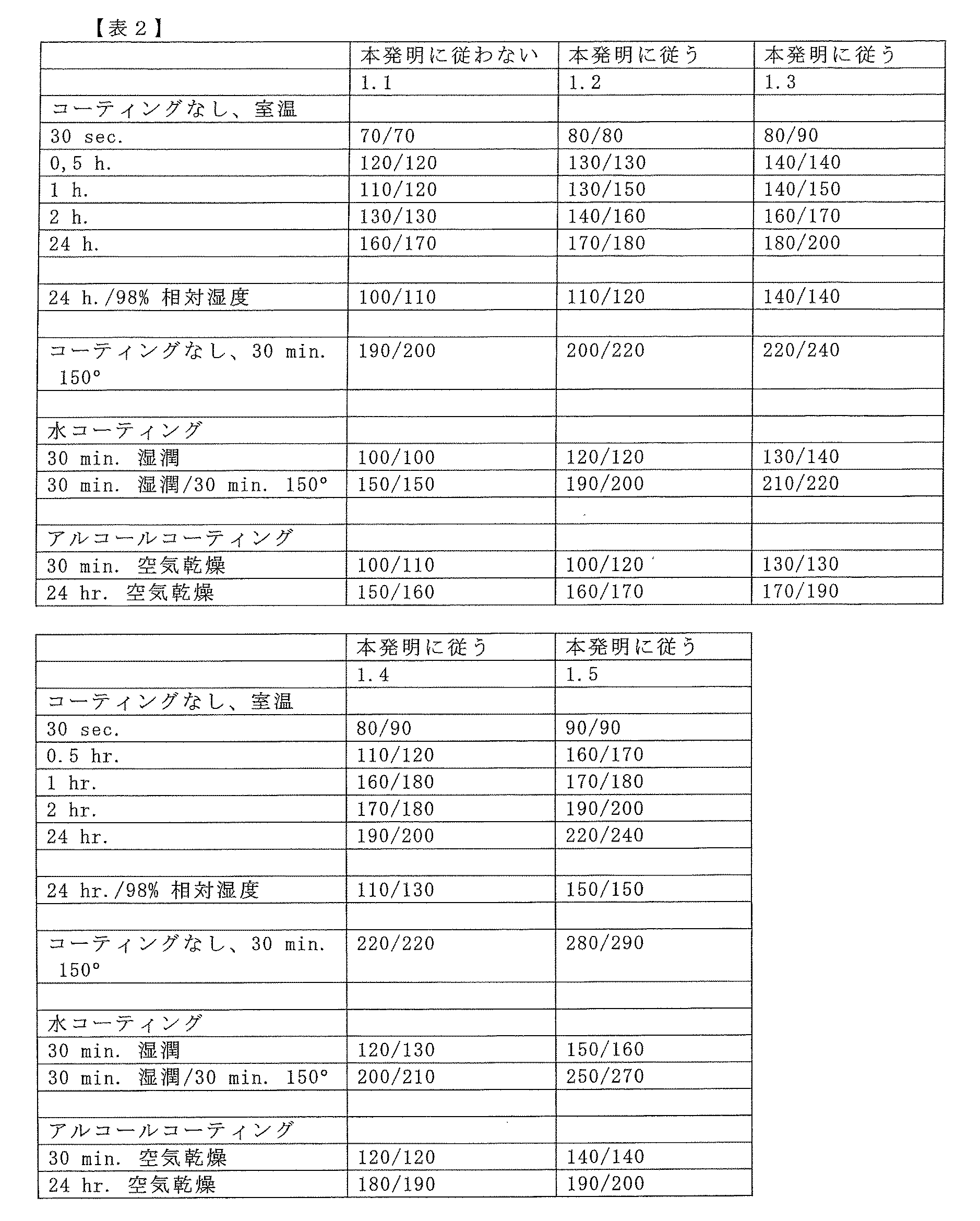
その結果を表2に示す。
5. Strength Test Bending strength was determined as a measure of the strength of the test strip. For this purpose, test strips were placed in a George Fisher strength test apparatus equipped with a three-point bending apparatus and the force (N / cm 2 ) required to break the test strips was measured.
The results are shown in Table 2.
結果:
表2から、鋳型材料混合物へのアモルファスSiO2の添加は、テスト小片の曲げ強度に対して有利な効果を有することが明らかである。これらのテストにおいて、ZrSiO4からZrO2およびSiO2への熱分解によって得られたアモルファスSiO2(実施例1.4および1.5)の効果は、シリコン/フェロシリコンの生成によって得られるSiO2(実施例1.2および1.3)の効果よりも大きい。
result:
From Table 2 it is clear that the addition of amorphous SiO 2 to the mold material mixture has an advantageous effect on the flexural strength of the test strip. In these tests, SiO effect of ZrO 2 and amorphous SiO 2 obtained by thermal decomposition to SiO 2 (Example 1.4 and 1.5) from the ZrSiO 4 is obtained by the generation of silicon / ferrosilicon 2 It is larger than the effect of (Examples 1.2 and 1.3).
Claims (31)
a)耐火性基本鋳型材料と、
b)結合剤または結合剤成分としてのアルカリレゾールおよび水と、
c)添加剤としてのアモルファス二酸化ケイ素と
を含む、鋳型材料混合物。 A mold material mixture for producing a mold or core comprising at least a) a refractory basic mold material,
b) Alkaline resole as a binder or binder component and water,
c) A mixture of mold materials comprising amorphous silicon dioxide as an additive.
(A)水を含まず、レゾールを含まない、粉末形のアモルファス二酸化ケイ素、
(B)前記アルカリレゾールおよび水を含み、アモルファス二酸化ケイ素を含まない結合剤成分(B)、および
(F)耐火性基本鋳型材料を含み、レゾールを含まない自由流動耐火性成分(F)
を含む多成分系を一緒にすることによって得られる、請求項1に記載の鋳型材料混合物。 The template material mixture comprises at least the following components (A), (B) and (F), which are spatially separated from one another: (A) Amorphous powder in powder form, free of water, free of resole Silicon,
(B) A binder component (B) containing the alkali resole and water but no amorphous silicon dioxide, and (F) a free-flowing refractory component (F) containing a refractory basic mold material and no resol
A template material mixture according to claim 1, obtained by combining multicomponent systems comprising
(A)水を含まず、レゾールを含まない、粉末形のアモルファス二酸化ケイ素、
(B)前記アルカリレゾールおよび水を含み、アモルファス二酸化ケイ素を含まない結合剤成分(B)、および
(F)耐火性基本鋳型材料を含み、レゾールを含まない自由流動耐火性成分(F)
を含む、多成分系。 A multicomponent system for producing a template or core, which comprises at least the following components (A), (B) and (F), ie (A) free of water, which are spatially separated from one another, resole Powdery amorphous silicon dioxide, not containing
(B) A binder component (B) containing the alkali resole and water but no amorphous silicon dioxide, and (F) a free-flowing refractory component (F) containing a refractory basic mold material and no resol
Including multi-component systems.
請求項1〜19の何れか一項に記載の前記鋳型材料混合物を提供するステップと、
前記鋳型材料混合物を鋳型に導入するステップと、
前記鋳型に二酸化炭素またはガス状エステルを導入することによって前記鋳型材料混合物を硬化するステップと
を含む、方法。 A method for producing a mold or core,
Providing the mold material mixture according to any one of claims 1-19.
Introducing the mold material mixture into a mold;
Curing the mold material mixture by introducing carbon dioxide or gaseous esters into the mold.
The method according to any one of claims 28 to 30, wherein the mold material mixture is exposed to a temperature of 5 ° C to 60 ° C, or 5 ° C to 25 ° C for curing.
Applications Claiming Priority (3)
| Application Number | Priority Date | Filing Date | Title |
|---|---|---|---|
| DE102014106177.2A DE102014106177A1 (en) | 2014-05-02 | 2014-05-02 | Molding material mixture comprising resoles and amorphous silicon dioxide, molds and cores produced therefrom and methods for their production |
| DE102014106177.2 | 2014-05-02 | ||
| PCT/DE2015/000207 WO2015165436A1 (en) | 2014-05-02 | 2015-04-30 | Mould material mixture containing resols and amorpous silicon dioxide, moulds and cores produced therefrom and method for the production thereof |
Publications (3)
| Publication Number | Publication Date |
|---|---|
| JP2017514695A JP2017514695A (en) | 2017-06-08 |
| JP2017514695A5 JP2017514695A5 (en) | 2018-04-26 |
| JP6545708B2 true JP6545708B2 (en) | 2019-07-17 |
Family
ID=53268562
Family Applications (1)
| Application Number | Title | Priority Date | Filing Date |
|---|---|---|---|
| JP2016564630A Active JP6545708B2 (en) | 2014-05-02 | 2015-04-30 | Mold material mixture containing resol and amorphous silicon dioxide, mold and core produced thereby, and method for producing it |
Country Status (13)
| Country | Link |
|---|---|
| US (1) | US9889498B2 (en) |
| EP (1) | EP3137245B1 (en) |
| JP (1) | JP6545708B2 (en) |
| KR (1) | KR102231585B1 (en) |
| CN (1) | CN106470779B (en) |
| BR (1) | BR112016025694B1 (en) |
| CA (1) | CA2946781C (en) |
| DE (1) | DE102014106177A1 (en) |
| ES (1) | ES2719438T3 (en) |
| HU (1) | HUE043254T2 (en) |
| MX (1) | MX374688B (en) |
| RU (1) | RU2016146831A (en) |
| WO (1) | WO2015165436A1 (en) |
Families Citing this family (10)
| Publication number | Priority date | Publication date | Assignee | Title |
|---|---|---|---|---|
| EP3501690A1 (en) * | 2017-12-20 | 2019-06-26 | Imertech Sas | Method of making particulate refractory material foundry articles, and product made by such method |
| CN109954837A (en) * | 2017-12-22 | 2019-07-02 | 沈阳汇亚通铸造材料有限责任公司 | A kind of carbonic anhydride induration cold box core-manufacturing composition and core-making method |
| CN110386809A (en) * | 2019-08-09 | 2019-10-29 | 兴化市兴东铸钢有限公司 | A kind of silicon-base ceramic core and preparation method thereof |
| DE102019135605A1 (en) * | 2019-12-20 | 2021-06-24 | Ask Chemicals Gmbh | Method for building up bodies in layers, comprising refractory basic molding material and resols, three-dimensional bodies produced according to this method and a binding agent for the 3-dimensional building up of bodies |
| US12285798B2 (en) * | 2020-06-01 | 2025-04-29 | LightSpeed Concepts Inc. | Tool-less method for making molds, cores, and temporary tools |
| DE102020208692A1 (en) | 2020-07-10 | 2022-01-13 | Fraunhofer-Gesellschaft zur Förderung der angewandten Forschung eingetragener Verein | Process for the production and removal of a casting core and for the use of the casting core |
| DE102020119013A1 (en) * | 2020-07-17 | 2022-01-20 | HÜTTENES-ALBERTUS Chemische Werke Gesellschaft mit beschränkter Haftung | Process for the manufacture of an article for use in the foundry industry, corresponding mould, core, feeder element or mold material mixture, as well as devices and uses |
| CN113787166B (en) * | 2021-08-26 | 2023-08-04 | 沈阳汇亚通铸造材料有限责任公司 | Alkaline phenolic resin sand-blown carbon dioxide cold core box composition and core making method |
| EP4554748A1 (en) * | 2022-07-15 | 2025-05-21 | Erico International Corporation | Exothermic welding system |
| CN115921767B (en) * | 2022-11-30 | 2023-12-29 | 武汉纺织大学 | An investment casting shell surface layer refractory material and its preparation method |
Family Cites Families (28)
| Publication number | Priority date | Publication date | Assignee | Title |
|---|---|---|---|---|
| GB1503311A (en) * | 1974-04-17 | 1978-03-08 | Cor Tech Res Ltd | Production of thermosetting phenolformaldehyde resins |
| US4216133A (en) * | 1978-03-22 | 1980-08-05 | Acme Resin Corporation | Shell process foundry resin compositions |
| US4426467A (en) | 1981-01-12 | 1984-01-17 | Borden (Uk) Limited | Foundry molding compositions and process |
| US4474904A (en) | 1982-01-21 | 1984-10-02 | Lemon Peter H R B | Foundry moulds and cores |
| US4468359A (en) | 1982-11-09 | 1984-08-28 | Borden (Uk) Limited | Foundry moulds and cores |
| AU605943B2 (en) | 1987-12-24 | 1991-01-24 | Foseco International Limited | Production of articles of bonded particulate material and binder compositions for use therein |
| DD280328A1 (en) * | 1989-03-08 | 1990-07-04 | Fuerstenwalde Chem Tankanlagen | MOLD FOR THE PRODUCTION OF CHEMICAL-RESISTANT COMPONENTS |
| CA2015488C (en) * | 1989-04-30 | 1997-07-08 | Tomoyasu Tsuda | Polyurethane, process for its production and polyester diol used for its production |
| US5376696A (en) * | 1990-07-13 | 1994-12-27 | Ashland Oil, Inc. | Foundry mixes based upon reclaimed sand |
| GB9105312D0 (en) * | 1991-03-13 | 1991-04-24 | Foseco Int | Binder compositions |
| GB9105314D0 (en) * | 1991-03-13 | 1991-04-24 | Foseco Int | Binder compositions |
| JPH04292650A (en) * | 1991-03-22 | 1992-10-16 | Hitachi Chem Co Ltd | Phenolic resin molding material |
| TW256851B (en) * | 1992-11-18 | 1995-09-11 | Ashland Oil Inc | |
| US5424376A (en) * | 1993-10-04 | 1995-06-13 | Ashland Inc. | Ester cured no-bake foundry binder system |
| JP3281150B2 (en) * | 1993-10-26 | 2002-05-13 | 群栄ボーデン株式会社 | Manufacturing method of casting mold |
| DE19938043C2 (en) * | 1999-08-12 | 2001-12-06 | Ashland Suedchemie Kernfest | Resol-based binder system containing aluminum, process for its production and use, and molding compound |
| US6365646B1 (en) * | 1999-12-08 | 2002-04-02 | Borden Chemical, Inc. | Method to improve humidity resistance of phenolic urethane foundry binders |
| US6335387B1 (en) * | 2000-03-21 | 2002-01-01 | Ashland Inc. | Insulating sleeve compositions containing fine silica and their use |
| GB0410484D0 (en) * | 2004-05-11 | 2004-06-16 | Ashland Uk Ltd | Reclamation of ester-cured phenolic resin bonded foundry sands |
| DE102004042535B4 (en) * | 2004-09-02 | 2019-05-29 | Ask Chemicals Gmbh | Molding material mixture for the production of casting molds for metal processing, process and use |
| US7659327B2 (en) * | 2005-08-11 | 2010-02-09 | Ashland Licensing And Intellectual Property, Llc | Coated microspheres and their use |
| US8133933B2 (en) * | 2005-11-15 | 2012-03-13 | Georgia-Pacific Chemicals Llc | Binder compositions compatible with thermally reclaiming refractory particulate material from molds used in foundry applications |
| US8087450B2 (en) * | 2007-01-29 | 2012-01-03 | Evonik Degussa Corporation | Fumed metal oxides for investment casting |
| DE102007045649B4 (en) | 2007-09-25 | 2015-11-19 | H2K Minerals Gmbh | A method of making a mold and / or a core using comminuted natural particulate amorphous silicic materials in the foundry area and binder composition |
| KR20110060867A (en) | 2008-07-18 | 2011-06-08 | 토마스 더블유. 필즈 | Fixture |
| DE102012020511A1 (en) | 2012-10-19 | 2014-04-24 | Ask Chemicals Gmbh | Forming substance mixtures based on inorganic binders and process for producing molds and cores for metal casting |
| DE102012020509A1 (en) | 2012-10-19 | 2014-06-12 | Ask Chemicals Gmbh | Forming substance mixtures based on inorganic binders and process for producing molds and cores for metal casting |
| DE102012020510B4 (en) | 2012-10-19 | 2019-02-14 | Ask Chemicals Gmbh | Forming substance mixtures based on inorganic binders and process for producing molds and cores for metal casting |
-
2014
- 2014-05-02 DE DE102014106177.2A patent/DE102014106177A1/en not_active Withdrawn
-
2015
- 2015-04-30 ES ES15724929T patent/ES2719438T3/en active Active
- 2015-04-30 RU RU2016146831A patent/RU2016146831A/en not_active Application Discontinuation
- 2015-04-30 CA CA2946781A patent/CA2946781C/en active Active
- 2015-04-30 JP JP2016564630A patent/JP6545708B2/en active Active
- 2015-04-30 EP EP15724929.3A patent/EP3137245B1/en not_active Not-in-force
- 2015-04-30 BR BR112016025694-8A patent/BR112016025694B1/en not_active IP Right Cessation
- 2015-04-30 MX MX2016014297A patent/MX374688B/en active IP Right Grant
- 2015-04-30 US US15/308,398 patent/US9889498B2/en not_active Expired - Fee Related
- 2015-04-30 HU HUE15724929A patent/HUE043254T2/en unknown
- 2015-04-30 KR KR1020167033852A patent/KR102231585B1/en not_active Expired - Fee Related
- 2015-04-30 WO PCT/DE2015/000207 patent/WO2015165436A1/en not_active Ceased
- 2015-04-30 CN CN201580034885.XA patent/CN106470779B/en active Active
Also Published As
| Publication number | Publication date |
|---|---|
| CA2946781A1 (en) | 2015-11-05 |
| MX2016014297A (en) | 2017-05-03 |
| EP3137245B1 (en) | 2019-02-06 |
| US20170050237A1 (en) | 2017-02-23 |
| US9889498B2 (en) | 2018-02-13 |
| EP3137245A1 (en) | 2017-03-08 |
| HUE043254T2 (en) | 2019-08-28 |
| RU2016146831A3 (en) | 2018-11-06 |
| RU2016146831A (en) | 2018-06-05 |
| CN106470779B (en) | 2020-03-03 |
| KR20170008246A (en) | 2017-01-23 |
| BR112016025694B1 (en) | 2021-07-20 |
| CA2946781C (en) | 2022-04-19 |
| DE102014106177A1 (en) | 2015-11-05 |
| JP2017514695A (en) | 2017-06-08 |
| KR102231585B1 (en) | 2021-03-25 |
| MX374688B (en) | 2025-03-06 |
| WO2015165436A1 (en) | 2015-11-05 |
| CN106470779A (en) | 2017-03-01 |
| ES2719438T3 (en) | 2019-07-10 |
Similar Documents
| Publication | Publication Date | Title |
|---|---|---|
| US9889498B2 (en) | Mould material mixture containing resols and amorphous silicon dioxide, moulds and cores produced therefrom and method for the production thereof | |
| RU2703746C2 (en) | Mixtures of molding materials containing boron oxide compound and method of producing molds and rods | |
| JP7345596B2 (en) | Mold material composition and mold manufacturing method using the same | |
| US10144053B2 (en) | Method for the layer-wise building of bodies comprising refractory mold base material and resoles, and molds or cores manufactured according to said method | |
| RU2699133C2 (en) | Mixture of lithium-containing molding material based on inorganic binder to obtain molds and rods for casting metal | |
| RU2650219C2 (en) | Molding materials mixtures based on inorganic binders and a method of producing press molds and cores for metal casting | |
| KR102474312B1 (en) | Method for manufacturing casting molds, cores and mold base materials regenerated therefrom | |
| JP7498112B2 (en) | Cast articles for metalworking applications, methods for making such cast articles, and particulate refractory compositions for use in such methods - Patents.com | |
| JP7749725B2 (en) | Mold material composition and method for manufacturing a mold using the same | |
| HU227857B1 (en) | Resol based binding agent containing aluminium and boron | |
| JP2019063842A (en) | Aggregate composition for mold | |
| JP7712934B2 (en) | Method for layering objects comprising a refractory mould substrate and a resole, three-dimensional objects produced using said method, and binder for three-dimensional structures |
Legal Events
| Date | Code | Title | Description |
|---|---|---|---|
| A521 | Request for written amendment filed |
Free format text: JAPANESE INTERMEDIATE CODE: A523 Effective date: 20180313 |
|
| A621 | Written request for application examination |
Free format text: JAPANESE INTERMEDIATE CODE: A621 Effective date: 20180313 |
|
| A977 | Report on retrieval |
Free format text: JAPANESE INTERMEDIATE CODE: A971007 Effective date: 20181219 |
|
| A131 | Notification of reasons for refusal |
Free format text: JAPANESE INTERMEDIATE CODE: A131 Effective date: 20190115 |
|
| A521 | Request for written amendment filed |
Free format text: JAPANESE INTERMEDIATE CODE: A523 Effective date: 20190415 |
|
| TRDD | Decision of grant or rejection written | ||
| A01 | Written decision to grant a patent or to grant a registration (utility model) |
Free format text: JAPANESE INTERMEDIATE CODE: A01 Effective date: 20190528 |
|
| A61 | First payment of annual fees (during grant procedure) |
Free format text: JAPANESE INTERMEDIATE CODE: A61 Effective date: 20190619 |
|
| R150 | Certificate of patent or registration of utility model |
Ref document number: 6545708 Country of ref document: JP Free format text: JAPANESE INTERMEDIATE CODE: R150 |
|
| R250 | Receipt of annual fees |
Free format text: JAPANESE INTERMEDIATE CODE: R250 |
|
| R250 | Receipt of annual fees |
Free format text: JAPANESE INTERMEDIATE CODE: R250 |
|
| R250 | Receipt of annual fees |
Free format text: JAPANESE INTERMEDIATE CODE: R250 |
|
| R250 | Receipt of annual fees |
Free format text: JAPANESE INTERMEDIATE CODE: R250 |