JP6268552B2 - Flexo print - Google Patents
Flexo print Download PDFInfo
- Publication number
- JP6268552B2 JP6268552B2 JP2016030576A JP2016030576A JP6268552B2 JP 6268552 B2 JP6268552 B2 JP 6268552B2 JP 2016030576 A JP2016030576 A JP 2016030576A JP 2016030576 A JP2016030576 A JP 2016030576A JP 6268552 B2 JP6268552 B2 JP 6268552B2
- Authority
- JP
- Japan
- Prior art keywords
- yellow
- ink
- printing
- flexographic
- pigment
- Prior art date
- Legal status (The legal status is an assumption and is not a legal conclusion. Google has not performed a legal analysis and makes no representation as to the accuracy of the status listed.)
- Active
Links
Description
本発明は水性フレキソ印刷において、黄、紅、藍のプロセス色からなる表刷り及び裏刷りフレキソ印刷にて高彩度の色再現性に優れたフレキソ印刷物に関するものである。 The present invention relates to a flexographic print excellent in color reproducibility with high saturation in surface printing and back printing flexographic printing composed of yellow, red and indigo process colors in aqueous flexographic printing.
パッケージ印刷分野においてグラビア印刷、フレキソ印刷、オフセット印刷、インクジェット印刷、シルクスクリーン印刷等 各種の印刷方式が現在まで手法として用いられてきた。その中で、グラビア印刷、フレキソ印刷は従来から紙、厚紙、不織布、段ボール、メタルフォイル、プラスチックフィルム等のあらゆるパッケージ印刷において利用されている。
近年、環境配慮の観点から植物油を使用したオフセットインキ、ノントルエン型グラビアインキ等様々な環境調和型印刷インキが開発される中、特にグラビア印刷と比較して、低膜厚、高濃度で印刷できるため溶剤排出量の少ないフレキソ印刷方式がパッケージング印刷分野の中で注目されており、その中でも水を主溶媒としたインキを使用する水性フレキソ印刷は最も溶剤排出量の少ない印刷方式の一つである。
水性フレキソ印刷における種々の基材に対するプロセス印刷には表刷り印刷と裏刷り印刷がある。印刷物の観察者から見てインキ層を最上層とする表刷り印刷は紙、厚紙、不織布、段ボールの他、各プラスチックフィルムの印刷に用いられている一方、裏刷り印刷は印刷物の観察者から見て透明なプラスチックフィルムを通してインキ層を見る方式でどちらの方式も食品包材分野、サニタリー分野等広く水性フレキソ印刷が市場展開されている。
現在、広く用いられる黄、紅、藍、墨のプロセス色印刷の主たるインキの刷り順は表刷り印刷であればCMYKで代表されるプロセス4色の中の黄、紅、藍インキの刷り順を黄、紅、藍の順で印刷し、裏刷り印刷であれば藍、紅、黄の順で印刷するのが一般的であり、
表刷り印刷、裏刷り印刷共に印刷物の観察者から見てインキ層の中の黄インキが最下層に
なる刷り順を採用している。
これは現在、汎用で使われているプロセス色用のフレキソ黄インキは一般的に不透明であることが多く、表刷りについてはプロセス色の中で黄を最初に印刷し、裏刷りについてはプロセス色の中で黄を最後に印刷する方法が最も鮮明な色相を得ることができるためであるが、例えば、表刷り印刷において紅、藍色と比較して彩度の高い黄インキを観察者から見て最下層にしているため、透明性の高い黄インキを最上層にしているオフセット方式の印刷物と比較すると黄と紅の重ね部分や黄と藍の重ね部分の演色性が劣る場合があった。
裏刷り印刷においては油性フレキソインキにおいては透明黄顔料が使用される場合もあり、観察者から見て黄インキを最上層にする印刷方式を選択する場合もあったが水性フレキソ印刷においては、透明黄顔料を水溶媒に安定して分散させることが出来ず採用に至っていない。
特に水性フレキソインキの黄インキにおいて水性インキの経時安定性や分散性の問題から不透明な黄インキが汎用的に使用されてきたため、仮に表刷りで黄を最後に印刷する方法を選択すると黄と紅の重ね部分や黄と藍の重ね部分において黄インキの色相や透明度の問題から鮮明な色相が失われる。
In the field of package printing, various printing methods such as gravure printing, flexographic printing, offset printing, ink jet printing, and silk screen printing have been used as techniques. Among them, gravure printing and flexographic printing have been conventionally used in various package printing such as paper, cardboard, non-woven fabric, cardboard, metal foil, and plastic film.
In recent years, various environmentally conscious printing inks such as offset inks using vegetable oil and non-toluene gravure inks have been developed from the viewpoint of environmental consideration. Therefore, flexographic printing methods with low solvent emissions are attracting attention in the field of packaging printing. Among them, water-based flexographic printing using water as the main solvent is one of the printing methods with the lowest solvent emissions. is there.
Process printing on various substrates in water-based flexographic printing includes surface printing and back printing. Surface printing with the ink layer as the top layer as viewed from the observer of the printed material is used for printing on paper, cardboard, non-woven fabric, cardboard and other plastic films, while back printing is viewed from the observer of the printed material. A water-based flexographic printing system is widely developed in the food packaging field and sanitary field.
Currently, the main ink printing order of process color printing of yellow, red, indigo and black, which are widely used, is the printing order of yellow, red and indigo ink in the four process colors represented by CMYK if it is surface printing. It is common to print in the order of yellow, red, and indigo, and in reverse printing, it is usually printed in the order of indigo, red, and yellow.
Both the front printing and the back printing use the printing order in which the yellow ink in the ink layer is the lowest layer as viewed from the observer of the printed matter.
This is because flexo yellow ink for process colors, which is currently used for general purposes, is generally opaque. For surface printing, yellow is printed first among process colors, and process color is used for back printing. This is because the most vivid hue can be obtained by the method of printing yellow last, but for example, in surface printing, yellow ink having higher saturation than red and indigo is viewed from the observer. Therefore, the color rendering properties of the yellow and red overlapped portion and the yellow and indigo overlapped portion may be inferior to those of the offset type printed matter having a highly transparent yellow ink as the uppermost layer.
In back printing, a transparent yellow pigment may be used in oil-based flexographic inks, and a printing method with yellow ink as the top layer may be selected from the viewpoint of an observer. The yellow pigment cannot be stably dispersed in an aqueous solvent and has not been adopted.
Opaque yellow ink has been widely used for yellow inks of water-based flexographic inks due to problems with the stability and dispersibility of water-based inks over time. The clear hue is lost due to the yellow ink hue and transparency problems in the overlapping part of yellow and the overlapping part of yellow and indigo.
フレキソ印刷での演色性を向上させる手段として、パッケージング印刷や商業印刷等において標準プロセスカラーにてPantone Hexachrome(登録商標)を加えた6色印刷(特許文献1)、5色のプロセス色を用いてフレキソ印刷における4色プロセスの色域を拡張する方法(特許文献2)が提案されているが、いずれも黄インキの粒径と透明度による2次色の色域拡大とフレキソ印刷における表刷り、裏刷り印刷工程での刷り順に言及されたものではない。 As means for improving the color rendering properties in flexographic printing, 6-color printing (Patent Document 1) in which Pantone Hexachrome (registered trademark) is added as a standard process color in packaging printing, commercial printing, etc. is used. A method of expanding the color gamut of the four-color process in flexographic printing (Patent Document 2) has been proposed, but in both cases, the secondary color gamut expansion by the yellow ink particle size and transparency and the surface printing in flexographic printing, It is not mentioned in the order of printing in the reverse printing process.
本発明は、このような従来の技術における問題点を解決する為になされたものであり、その課題とするところは、水性フレキソプロセス色印刷において、表刷り及び裏刷りフレキソ印刷において透明黄インキを印刷物の観察者から見て印刷物積層体の中でインキ層部の最上部にすることで黄単色濃度と2次色の鮮明性の向上させる高演色のフレキソ印刷物とフレキソプロセス印刷方法を提供する事である。 The present invention has been made to solve such problems in the prior art, and the object of the present invention is to use a transparent yellow ink in surface printing and back printing flexo printing in aqueous flexo process color printing. To provide a high color rendering flexo print and a flexo process printing method that improve the yellow single color density and the secondary color sharpness by placing the top of the ink layer in the print laminate from the viewpoint of the print observer. It is.
本発明は、透明度が高く、且つ高濃度の水性フレキソ黄インキを用いることでフレキソ印刷において印刷物の観察者から見て黄インキを最上部である時に黄が含まれる2次色部の鮮明性を向上させた水性フレキソ表刷り印刷物及び裏刷り印刷物を得ることである。 The present invention uses a high-concentration, high-concentration aqueous flexo yellow ink to improve the clarity of the secondary color part containing yellow when the yellow ink is at the top when viewed from the observer of the printed matter in flexographic printing. It is to obtain an improved water-based flexographic surface print and back print.
すなわち本発明は基材上に、黄色、紅色、および藍色のフレキソ印刷用インキを用いたフレキソ印刷物であって、印刷物の観察者から見て、インキ層の部分の最上層が黄色インキであり、黄色フレキソ印刷用インキが、黄色顔料、界面活性剤、および樹脂を含んでなり、前記黄色顔料の50%累積平均径が、400nm以下であることを特徴とする表刷り、または裏刷りフレキソ印刷物に関するものである。 That is, the present invention is a flexographic print using yellow, red and indigo flexographic inks on a substrate, and the top layer of the ink layer portion is a yellow ink as viewed from the observer of the print. Ri, yellow flexographic ink is a yellow pigment, a surfactant, and comprises a resin, 50% cumulative average diameter of the yellow pigment, surface printing, characterized in der Rukoto below 400nm or reverse printing, It relates to flexographic prints.
また、本発明は、フレキソ印刷用インキが、すべて水性である上記フレキソ印刷物に関するものである。 The present invention also relates to the above-mentioned flexographic printed matter in which the flexographic ink is all water-based.
また、本発明は、黄色フレキソ印刷用インキ中の黄色顔料が、黄色フレキソ印刷用インキ全体の、10〜30重量%である上記フレキソ印刷物に関するものである。 Moreover, this invention relates to the said flexo printed matter whose yellow pigment in the ink for yellow flexographic printing is 10 to 30 weight% of the whole ink for yellow flexographic printing.
本発明が提供する水性黄色フレキソ印刷用インキを用いることにより、従来の表刷りフレキソ印刷物および裏刷りフレキソ印刷物において黄単色色相及び2次色の部分において鮮明性の高いフレキソ印刷物を得ることが出来る。 By using the water-based yellow flexographic printing ink provided by the present invention, it is possible to obtain a flexographic print having high vividness in a yellow single-color hue and a secondary color portion in conventional front-printed flexographic prints and back-printed flexographic prints.
本発明に使用される黄色フレキソ印刷インキの黄顔料としては従来からフレキソ印刷で使用されている各種の黄色無機及び有機顔料を使用できる。例えば、ピグメントイエロー1、ピグメントイエロー12、ピグメントイエロー13、ピグメントイエロー14、ピグメントイエロー17、ピグメントイエロー63、ピグメントイエロー65、ピグメントイエロー73、ピグメントイエロー74、ピグメントイエロー75、ピグメントイエロー83、ピグメントイエロー97、ピグメントイエロー98、ピグメントイエロー106、ピグメントイエロー114、ピグメントイエロー121、ピグメントイエロー126、ピグメントイエロー127、ピグメントイエロー136、ピグメントイエロー174、ピグメントイエロー176、ピグメントイエロー180、ピグメントイエロー188等が使用でき、好ましくはピグメントイエロー12、ピグメントイエロー13、ピグメントイエロー14、ピグメントイエロー83、ピグメントイエロー174、ピグメントイエロー176を黄インキ中に10−30質量%使うことが好ましい。 Various yellow inorganic and organic pigments conventionally used in flexographic printing can be used as the yellow pigment of the yellow flexographic printing ink used in the present invention. For example, Pigment Yellow 1, Pigment Yellow 12, Pigment Yellow 13, Pigment Yellow 14, Pigment Yellow 17, Pigment Yellow 63, Pigment Yellow 65, Pigment Yellow 73, Pigment Yellow 74, Pigment Yellow 75, Pigment Yellow 83, Pigment Yellow 97, Pigment Yellow 98, Pigment Yellow 106, Pigment Yellow 114, Pigment Yellow 121, Pigment Yellow 126, Pigment Yellow 127, Pigment Yellow 136, Pigment Yellow 174, Pigment Yellow 176, Pigment Yellow 180, Pigment Yellow 188, and the like are preferable. Pigment Yellow 12, Pigment Yellow 13, Pigment Yellow 4, Pigment Yellow 83, Pigment Yellow 174, it is preferable to use 10-30% by weight of Pigment Yellow 176 in yellow ink.
本発明に使用される黄色フレキソ印刷インキにおいて前記黄顔料の他に耐ブロッキング性、乾燥性、ラミネート強度向上等を目的として充填剤として種々の体質顔料を併用することができる。体質顔料としては通常の印刷インキに使用されるものが挙げられ、例えば炭酸カルシウム、炭酸マグネシウム等の炭酸塩、沈降性硫酸バリウム等の硫酸塩、カオリンクレー、シリカ、タルク、マイカ等の珪酸塩等が挙げられ、これらは単独または2種以上を併用して使用することが出来る。 In the yellow flexographic printing ink used in the present invention, various extender pigments can be used in combination as a filler for the purpose of improving blocking resistance, drying property, laminate strength and the like in addition to the yellow pigment. Examples of extender pigments include those used in ordinary printing inks, such as carbonates such as calcium carbonate and magnesium carbonate, sulfates such as precipitated barium sulfate, silicates such as kaolin clay, silica, talc and mica. These may be used alone or in combination of two or more.
本発明には黄顔料の水溶媒中での分散性を向上させ高い透明度の黄色フレキソ印刷インキを得るために種々の界面活性剤を使用できる。界面活性剤としては具体的には、2,4,7,9‐テトラメチル−5−デシン‐4,7−ジオールに代表されるアセチレンジオール誘導体、前記アセチレンジオール誘導体のエチレンオキサイド付加物、ポリオキシエチレンポリオキシプロプレンブロック重合物に代表されるポリプロピレングリコ―ルにエチレンオキシドを付加したノニオン性界面活性剤が挙げられる。 In the present invention, various surfactants can be used for improving the dispersibility of the yellow pigment in an aqueous solvent and obtaining a highly transparent yellow flexographic printing ink. Specific examples of the surfactant include acetylenediol derivatives represented by 2,4,7,9-tetramethyl-5-decyne-4,7-diol, ethylene oxide adducts of the acetylenic diol derivatives, polyoxy Nonionic surfactants obtained by adding ethylene oxide to polypropylene glycol typified by ethylene polyoxypropylene block polymer are listed.
本発明に使用される水性フレキソインキに含有される樹脂としては各種の水溶性溶液樹脂または水溶性エマルジョン樹脂が使用できる。水溶性溶液樹脂としては、スチレン−アクリル系共重合体をアルカリで中和した水溶性溶液樹脂、アクリル系共重合体エマルジョン、水性ポリウレタン樹脂、水性ウレタン−アクリルウレタン樹脂、水性ポリエステル樹脂等を使用できる。
これらの水溶性溶液樹脂または水溶性エマルジョン樹脂は黄顔料を分散させるために水溶媒と共に単体で使用しても良く、前記界面活性剤として併用して使用しても良い。
水性フレキソインキ用液状樹脂の粘度としては50mPa・s−20000mPa・sが好ましく、より好ましくは100mPa・s−10000mPa・sの範囲がインキ製造の際の顔料分散ベースの粘度や最終調整される粘度を考えると好ましい。
As the resin contained in the aqueous flexographic ink used in the present invention, various water-soluble solution resins or water-soluble emulsion resins can be used. As the water-soluble solution resin, a water-soluble solution resin obtained by neutralizing a styrene-acrylic copolymer with an alkali, an acrylic copolymer emulsion, an aqueous polyurethane resin, an aqueous urethane-acrylic urethane resin, an aqueous polyester resin, or the like can be used. .
These water-soluble solution resin or water-soluble emulsion resin may be used alone with a water solvent in order to disperse the yellow pigment, or may be used in combination as the surfactant.
The viscosity of the liquid resin for aqueous flexographic inks is preferably 50 mPa · s-20000 mPa · s, more preferably the range of 100 mPa · s-10000 mPa · s is the viscosity of the pigment dispersion base in the ink production and the final adjusted viscosity. This is preferable.
水溶性液状樹脂を使用する場合の溶媒としては水の他、水混和溶剤を添加混合することができる。水混和性溶剤としては、低級アルコール類、多価アルコール類及びそのアルキルエーテルまたはアルキルエステル類などが挙げられ、具体的には、メタノール、エタノール、ノルマルプロパノール、イソプロパノール等の低級アルコール類、エチレングリコール、プロピレングリコール、ジエチレングリコール、ジプロピレングルコール、グリセリン等の多価アルコール類、エチレングリコールモノメチルエーテル、エチレングリコールモノエチルエーテル、プロピレングリコールモノメチルエーテル、プロピレングリコールモノエチルエーテル、プレプレングリコールアセテート、ジエチレングリコールモノメチルエーテル、ジプロピレングリコール等が使用できる。 In the case of using a water-soluble liquid resin, a water-miscible solvent can be added and mixed in addition to water. Examples of the water-miscible solvent include lower alcohols, polyhydric alcohols and alkyl ethers or alkyl esters thereof. Specifically, lower alcohols such as methanol, ethanol, normal propanol, isopropanol, ethylene glycol, Polyhydric alcohols such as propylene glycol, diethylene glycol, dipropylene glycol, glycerin, ethylene glycol monomethyl ether, ethylene glycol monoethyl ether, propylene glycol monomethyl ether, propylene glycol monoethyl ether, preprene glycol acetate, diethylene glycol monomethyl ether, di Propylene glycol or the like can be used.
本発明には、耐摩擦性及び滑り性付与のために水溶媒中に分散するパラフィン系またはポリエチレン系またはテフロン(登録商標)系ワックス類、印刷時の発泡性を抑制するためのシリコン系、非シリコン系の消泡剤、インキ皮膜硬化を促進する硬化剤を適宜使用することができる。 The present invention includes paraffin-based, polyethylene-based or Teflon (registered trademark) waxes dispersed in an aqueous solvent for imparting friction resistance and slipperiness, silicon-based, non-foaming for suppressing foaming during printing. Silicon-based antifoaming agents and curing agents that accelerate ink film curing can be used as appropriate.
本発明に使用される黄色フレキソ印刷インキは、顔料、添加剤、バインダー樹脂、水または溶剤等をボールミル、アトライター、サンドミル等を用いて顔料粒子を分散し用意される。顔料の平均粒子径は粒度分布測定機等を用いて測定され、その粒度分布は50%累積平均径において好ましくは400nm以下の時に、より好ましくは300nm以下の時に黄インキが含まれる2次色の色相の鮮明性を向上させる。50%累積平均径が400nmより大きいと黄インキの透明性が著しく低下することで黄インキが含まれる2次色色相の鮮明性の低下を生じる。50%累積平均径は粉体の集団の全体積を100%として累積カーブを求めた時、その累積カーブが50%となる点の粒径と定義される。粉体の集団の体積分布は、動的光散乱法にて求められる。 The yellow flexographic printing ink used in the present invention is prepared by dispersing pigment particles using a ball mill, an attritor, a sand mill or the like in a pigment, an additive, a binder resin, water, or a solvent. The average particle diameter of the pigment is measured using a particle size distribution measuring instrument or the like, and the particle size distribution of the secondary color containing yellow ink is preferably when the 50% cumulative average diameter is 400 nm or less, more preferably 300 nm or less. Improve hue clarity. When the 50% cumulative average diameter is larger than 400 nm, the transparency of the yellow ink is remarkably lowered, and the sharpness of the secondary color hue containing the yellow ink is lowered. The 50% cumulative average diameter is defined as the particle diameter at which the cumulative curve becomes 50% when the cumulative curve is determined with the total volume of the powder group as 100%. The volume distribution of the powder population is determined by a dynamic light scattering method.
本発明に使用される紅色フレキソ印刷用インキ、藍色フレキソ印刷用インキは、公知のインキが使用できる。黄色フレキソ印刷用インキが水性である場合は、紅色インキ、藍色インキも水性であることが好ましい。 A well-known ink can be used for the ink for red flexo printing and the ink for indigo color flexo printing used in the present invention. When the yellow flexographic ink is water-based, it is preferable that the red ink and the blue ink are also water-based.
本発明に使用される基材としてはコート紙、上質紙、コートボール紙、ライナー紙、段ボールに代表される紙基材、ポリエステル繊維、ポリオレフィン繊維、レーヨン繊維等プラスチック繊維から形成される不織布、ポリエステルフィルム、延伸ポリプロピレンフィルム、無延伸ポリプロピレンフィルム、ポリスチレンフィルム、延伸ナイロンフィルム、ポリエチレンフィルム、ポリ塩化ビニルフィルム、乳白ポリエチレンフィルムに代表されるプラスチックフィルムが挙げられる。プラスチックフィルムにおいてインキと基材の密着や画像形成に難点がある場合は適宜コロナ処理をかけることが出来る。 As the base material used in the present invention, coated paper, fine paper, coated cardboard, liner paper, paper base represented by cardboard, non-woven fabric formed from plastic fibers such as polyester fiber, polyolefin fiber, rayon fiber, polyester Examples thereof include plastic films such as films, stretched polypropylene films, unstretched polypropylene films, polystyrene films, stretched nylon films, polyethylene films, polyvinyl chloride films, and milk white polyethylene films. When there is a difficulty in the adhesion between the ink and the base material or the image formation in the plastic film, corona treatment can be appropriately applied.
色再現領域の再現方法としては、XYZ表色計(CIE1931表色系)、X10Y10Z10表色系(CIE1964表色系)、L*a*b表色系(CIE1976)、ハンターLab表色系、マンセル表色系、L*u*v表色系(CIE1976)等が挙げられる。 The color reproduction area reproduction method includes XYZ colorimeter (CIE1931 color system), X10Y10Z10 color system (CIE1964 color system), L * a * b color system (CIE1976), Hunter Lab color system, Munsell Color system, L * u * v color system (CIE1976), and the like.
L*a*b表色系では色相に関係なく比較できる明るさの度合いとして「明度」をL*で表現し、L*が大きくなるほど色が明るく、小さくなるほど暗くなることを示している。a*とb*は色の方向を示し+a*は赤、−a*は緑、+b*は黄、−b*は青の方向を示している。各方向とも絶対値が大きくなるほど色鮮やかになり、0に近づくに従ってくすんだ色になることを示しえいる。鮮明さの度合いを数値化する方法として「彩度(C)」が定義されており、各々以下の式にて求めることができる。 In the L * a * b color system, “lightness” is expressed as L * as a degree of brightness that can be compared regardless of hue, and indicates that the color becomes brighter as L * increases and becomes darker as it decreases. a * and b * indicate the color direction, + a * indicates red, -a * indicates green, + b * indicates yellow, and -b * indicates blue. In each direction, the larger the absolute value, the brighter the color, and the closer to 0, the darker the color. “Saturation (C)” is defined as a method for quantifying the degree of sharpness, and can be obtained by the following equations.
フレキソ印刷機としてはCI型多色フレキソ印刷機、ユニット型多色フレキソ印刷機等があり、インキ供給方式についてはチャンバー方式、2ロール方式が挙げることが出来、適宜の印刷機を使用することができる。
フレキソ版はUV光において樹脂を硬化するフォトポリマー基材や画像が彫刻されたゴム版等が適宜のフレキソ版を使用できる。
アニロックスロールについてはクロムメッキアニロックスロール、セラミックアニロックスロール等が汎用で使用されるが、フレキソ印刷機に使用できるものであればこれに限定されるものではない。
Flexographic printing machines include CI type multi-color flexographic printing machines, unit type multi-color flexographic printing machines, etc. The ink supply system can be a chamber system or a 2-roll system, and an appropriate printing machine can be used. it can.
As the flexographic plate, a suitable flexographic plate can be used, such as a photopolymer base material that cures a resin in UV light, or a rubber plate on which an image is engraved.
As the anilox roll, a chrome-plated anilox roll, a ceramic anilox roll or the like is used for general purposes, but is not limited to this as long as it can be used in a flexographic printing machine.
本発明のプロセス色印刷において必要に応じて墨インキ、特色インキを任意の順序で追加することができ、更に必要に応じて白インキを使用することができる。裏刷り印刷の場合は透明プラスチックフィルムに色インキを塗工した後に白インキを塗工することができ、表刷り印刷においては色インキを塗工する前に白インキを下地として塗工することができる。 In the process color printing of the present invention, black ink and special color ink can be added in any order as required, and white ink can be used as necessary. In the case of back printing, white ink can be applied after applying color ink to a transparent plastic film, and in surface printing, white ink can be applied as a base before applying color ink. it can.
本発明のフレキソ印刷物のプロセス色の刷り順は水性フレキソ黄インキの50%累積平均径が400nm以下である透明な黄インキである印刷物について観察者から見て、例えば、黄、紅、および藍色の順を選択する。
具体的には、表刷りにおいては例えば藍、紅、黄色の順に印刷することで印刷物の観察者から見て黄色がインキ層の中で最上層になる。藍と黄の重ね部分と紅と黄の重ね部分において下層である藍色、紅色の色相を透明性の高い黄を通して観察されることで藍と黄の重ね部分においては藍色のb値が黄インキに隠蔽されないため、その結果としてC値が高くなり、紅と黄の重ね部分においては紅インキのa値が黄インキに隠蔽されないため、その結果としてC値が高くなる。C値が高いことは鮮明性が高くすなわち印刷物が高演色であることを示す。基材の裏面に印刷される裏刷り印刷においても同様で、印刷物の観察者から見て黄色がインキ層の最上層になることで透明な黄を含有するフレキソ印刷物の藍と黄の重ね部分と紅と黄の重ね部分について表刷り印刷の場合と同様にC値が高くなり、高演色の印刷物を得ることが出来る。
The printing order of the process colors of the flexographic printed matter of the present invention is, for example, yellow, red, and indigo, as viewed from the observer for a printed matter that is a transparent yellow ink having a 50% cumulative average diameter of aqueous flexo yellow ink of 400 nm or less. Select the order.
Specifically, in front printing, for example, indigo, red, and yellow are printed in this order, so that yellow is the uppermost layer in the ink layer as viewed from the observer of the printed matter. The indigo and yellow overlapped portions of indigo and yellow and the underlying indigo and red hues are observed through highly transparent yellow. Since the ink is not concealed, the C value is increased as a result, and since the a value of the red ink is not concealed by the yellow ink in the overlapping portion of red and yellow, the C value is increased as a result. A high C value indicates high sharpness, that is, the printed material has high color rendering. The same applies to reverse printing that is printed on the back side of the substrate, and yellow is the uppermost layer of the ink layer as seen from the observer of the printed matter, and the indigo and yellow overlapping portions of the flexographic printed matter containing transparent yellow As in the case of surface printing, the C value of the overlapping portion of red and yellow is increased, and a high color rendering product can be obtained.
以下の具体例により本発明を詳細に説明するが、本発明はこれら実施例に限定されるものではない。また、以下の記述の部は重量部、%は重量%を示す。 The present invention will be described in detail by the following specific examples, but the present invention is not limited to these examples. Moreover, the part of the following description shows a weight part and% shows weight%.
樹脂製造例1(水溶性溶液樹脂A)
攪拌装置、温度計、2つの滴下漏斗及び還流冷却器を備えた反応容器にメチルイソブチルケトン94.0部を仕込み、攪拌しながら、窒素還流下で温度が100℃になるまで昇温した。次いで、2つの滴下漏斗において、スチレン50部、α−メチルスチレン5部、メタクリル酸30部ラウリルメタクリレート15部を3時間かけて滴下した。もう一方からはジメチル2,2’−アゾビスイソブチレート5部をメチルイソブチルケトン10部に溶解させ、4時間かけてそれを滴下した。滴下完了後、更に10時間反応させて反応を完了した。冷却後、得られた顔料分散樹脂溶液に更に25%アンモニア水19.5部を加えて中和した。更にイオン交換水を加えて、加熱しながら溶剤置換を行い、最後にイオン交換水をさらに加えて、重量平均分子量が10500、固形分30%、粘度6000mPa・sの水溶性液状樹脂Aを得た。
Resin production example 1 (water-soluble solution resin A)
A reaction vessel equipped with a stirrer, a thermometer, two dropping funnels and a reflux condenser was charged with 94.0 parts of methyl isobutyl ketone, and the temperature was raised to 100 ° C. under nitrogen reflux while stirring. Subsequently, 50 parts of styrene, 5 parts of α-methylstyrene, and 30 parts of methacrylic acid and 15 parts of lauryl methacrylate were dropped in two dropping funnels over 3 hours. From the other side, 5 parts of dimethyl 2,2′-azobisisobutyrate was dissolved in 10 parts of methyl isobutyl ketone and added dropwise over 4 hours. After completion of the dropwise addition, the reaction was completed by further reacting for 10 hours. After cooling, the resulting pigment-dispersed resin solution was further neutralized by adding 19.5 parts of 25% aqueous ammonia. Further, ion-exchanged water was added, solvent substitution was performed while heating, and finally ion-exchanged water was further added to obtain a water-soluble liquid resin A having a weight average molecular weight of 10500, a solid content of 30%, and a viscosity of 6000 mPa · s. .
樹脂製造例2(水溶性エマルジョン樹脂B)
攪拌装置、温度計、2つの滴下漏斗及び還流冷却器を備えた反応容器にイオン交換水92部と製造例1で調整した水溶性樹脂A114部を仕込み、攪拌しながら窒素還流下で温度が80℃になるまで昇温した。次いで、2つの滴下漏斗において、一方からスチレン25部、n−ブチルアクリレート75部を2時間かけて滴下した。もう一方からは、過硫酸アンモニウム20%水溶液5部を2時間かけて滴下した。滴下完了後、更に4時間反応させせた。更にイオン交換水を加えて固形分45% 重量平均分子量42万、粘度1000mPa・sのコアシェル型エマルジョン樹脂である水溶性エマルジョン樹脂Bを得た。
Resin production example 2 (water-soluble emulsion resin B)
A reaction vessel equipped with a stirrer, a thermometer, two dropping funnels and a reflux condenser was charged with 92 parts of ion-exchanged water and 114 parts of the water-soluble resin A prepared in Production Example 1, and the temperature was 80 under nitrogen reflux while stirring. The temperature was raised to 0 ° C. Subsequently, in two dropping funnels, 25 parts of styrene and 75 parts of n-butyl acrylate were dropped from one side over 2 hours. From the other side, 5 parts of a 20% aqueous solution of ammonium persulfate was added dropwise over 2 hours. After completion of the dropwise addition, the reaction was further continued for 4 hours. Further, ion-exchanged water was added to obtain a water-soluble emulsion resin B which is a core-shell emulsion resin having a solid content of 45%, a weight average molecular weight of 420,000, and a viscosity of 1000 mPa · s.
黄インキ実施例及び比較例
表1に示す配合処方でピグメントイエロー13(LIONOL YELLOW FG1314C トーヨーカラー社製)またはピグメントイエロー14(パーマネントイエローGSO クラリアント製 ピグメントイエローTT1407G トーヨーカラー製)
10−30部に対して水溶性溶液樹脂A、水溶性エマルジョン樹脂B、水、ポリエチレンワックス[ケミパールW500 三井化学製]を加えてサンドミルにて分散し黄インキを得た。
サンドミルでの分散時間は、黄インキ実施例1−4では60分であるのに対して、比較例1では20分である。
Yellow Ink Example and Comparative Example Pigment Yellow 13 (LIONOL YELLOW FG1314C manufactured by Toyocolor Co., Ltd.) or Pigment Yellow 14 (manufactured by Permanent Yellow GSO Clariant Pigment Yellow TT1407G manufactured by Toyocolor Co., Ltd.)
To 10-30 parts, water-soluble solution resin A, water-soluble emulsion resin B, water, polyethylene wax [Chemical Pearl W500, manufactured by Mitsui Chemicals] were added and dispersed with a sand mill to obtain yellow ink.
The dispersion time in the sand mill is 60 minutes in the yellow ink example 1-4, whereas it is 20 minutes in the comparative example 1.
紅、藍インキ製造例
表1に示す配合処方でピグメントレッド146(LIONOL RED FG5620 トーヨーカラー社製) またはピグメントブルー15(LIONOL BLUE FG7330 トーヨーカラー社製)20部に対して水溶性樹脂A、ノニオン系界面活性剤[サーフィノール420 日信化学工業製]、水、ポリエチレンワックス[ケミパールW500 三井化学製]を加えてサンドミルにて60分 分散し紅インキ及び藍インキを得た。
Example of red and indigo inks Water-soluble resin A and nonionic resin with respect to 20 parts of Pigment Red 146 (LIONOL RED FG5620 manufactured by Toyocolor Co., Ltd.) or Pigment Blue 15 (manufactured by LIONOL BLUE FG7330 Toyocolor Co., Ltd.) according to the formulation shown in Table 1. Surfactant [Surfinol 420 manufactured by Nissin Chemical Industry], water, and polyethylene wax [Chemical Pearl W500 manufactured by Mitsui Chemicals] were added and dispersed in a sand mill for 60 minutes to obtain red ink and indigo ink.
黄インキの50%累積平均径の測定結果を表2に示す。
黄インキ実施例1−4、比較例1の50%累積平均径について動的光散乱法を測定原理とした粒子径分布測定装置(UPA−EX150 日機装(株)製)を用いて測定した。50%累積平均径は粉体の集団の全体積を100%として累積カーブを求めた時、その累積カーブが50%となる点の粒径と定義される。
実施例1−3の黄インキは50%累積平均径が300nm以下、実施例4の黄インキは340nmに対して比較例1の黄インキは495nmであった。
Table 2 shows the measurement results of the 50% cumulative average diameter of the yellow ink.
The 50% cumulative average diameter of yellow ink Examples 1-4 and Comparative Example 1 was measured using a particle size distribution measuring apparatus (UPA-EX150, manufactured by Nikkiso Co., Ltd.) based on the dynamic light scattering method. The 50% cumulative average diameter is defined as the particle diameter at which the cumulative curve becomes 50% when the cumulative curve is determined with the total volume of the powder group as 100%.
The yellow ink of Example 1-3 had a 50% cumulative average diameter of 300 nm or less, the yellow ink of Example 4 was 340 nm, and the yellow ink of Comparative Example 1 was 495 nm.
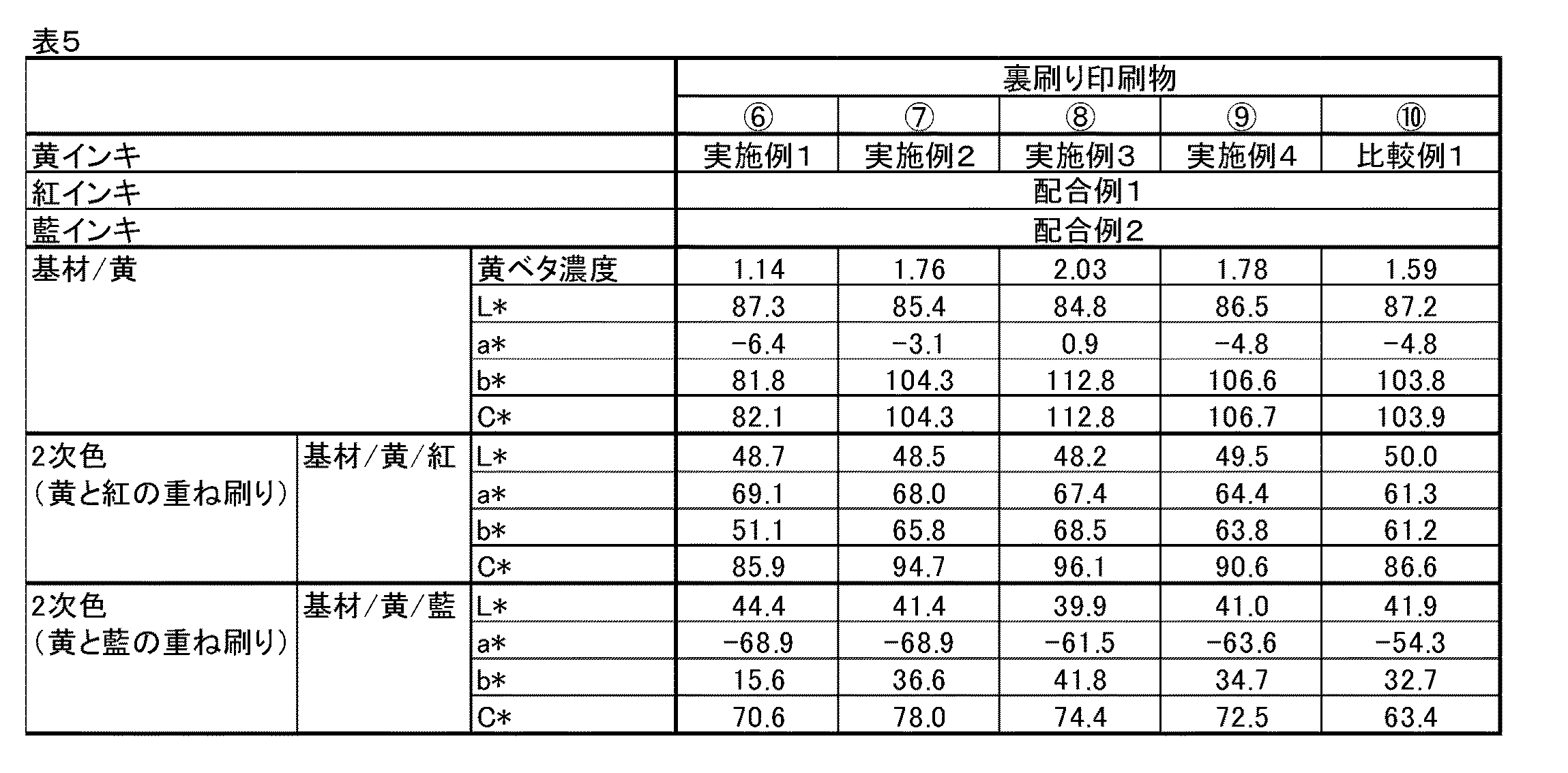
黄インキの透明度を表3 黄インキの濃度、色相、及び黄インキを含む2次色の色相評価結果を表4、表5に示す。
上記で調整したインキ組成物について、フレキシプルーフ100(アニロックスロール 400lpi 6cc/cm2)を用いて 処理OPP基材(2軸延伸ポリプロピレンフィルム フタムラ化学製FOR フィルム厚20μm)に塗工した。
The transparency of the yellow ink is shown in Table 3. Tables 4 and 5 show the evaluation results of the secondary ink including yellow ink density, hue, and yellow ink.
About the ink composition adjusted above, it applied to the process OPP base material (biaxially-stretched polypropylene film FOR film made by Futamura Chemical 20 micrometers in thickness) using the flexiproof 100 (anilox roll 400 lpi 6cc / cm < 2 >).
黄インキの透明度は上記塗工条件にてフィルム上に印刷された黄インキ印刷物について、黒色紙 5枚を重ねたものを下に敷くブラックバッキング方式にてインキ塗工面から分光測色計(X−rite eXact エックスライト社製)にて、彩度を表すL値を測定し黄インキの透明度を判定する基準とした。
黄インキの透明度基準 5:透明性が高い L値:40未満
4:透明性がやや高い L値:40以上50未満
3:透明性が中程度 L値:50以上60未満
2:透明性がやや低い L値:60以上70未満
1:透明性が低い L値:70以上
The transparency of the yellow ink is determined by measuring the spectrophotometer (X-) from the ink coated surface using a black backing method in which a stack of five black papers is laid down on the yellow ink printed on the film under the above coating conditions. Rite eXact (manufactured by X-Rite Co., Ltd.) was used as a reference for determining the transparency of yellow ink by measuring the L value representing saturation.
Transparency standard for yellow ink 5: High transparency L value: less than 40
4: Slightly high transparency L value: 40 or more and less than 50
3: Medium transparency L value: 50 or more and less than 60
2: Slightly low transparency L value: 60 or more and less than 70
1: Low transparency L value: 70 or more
表刷り色相についてはインキを塗工した側、すなわちインキ塗工面から分光測色計(X−rite eXact エックスライト社製)にて色相、濃度を測定し、裏刷り色相についてはインキを塗工した裏側、すなわちフィルム側から分光測色計にて、色相、濃度を測定した。表4中 基材(フィルム)/紅/黄は印刷物の表刷り印刷においては観察者から見て黄色が最上層であり、裏刷り印刷においては観察者から見て紅インキが最上層となることを示す。
濃度については黄、紅、藍の単色ベタ濃度、色相については単色ベタ濃度、黄が含まれる2次色すなわち黄と紅の重ね刷り構成及び 黄と藍の重ね刷り構成の色相(L* a* b* C値) を測定した。
For the surface printing hue, the hue and density were measured with a spectrocolorimeter (X-rite eXact manufactured by X-Rite) from the ink coated side, that is, the ink coated surface, and the ink for the back printing hue was coated. Hue and density were measured with a spectrocolorimeter from the back side, that is, the film side. In Table 4, the base material (film) / red / yellow has yellow as the uppermost layer when viewed from the observer when printed on the surface, and red ink is the uppermost layer when viewed from the observer when printed on the back. Indicates.
Concentrations of yellow, red and indigo monochromatic solids, hues of monochromatic solids, hues of secondary colors containing yellow, ie yellow and red overprint composition, and yellow and indigo overprint composition (L * a * b * C value).
黄実施例が含まれる2次色についてはインキ層の中で黄インキが観察者から見て最上層になる場合について表刷り印刷物においては黄インキ実施例1−4を含む印刷物は紅と黄の重ね部分、藍と黄の重ね部分についていずれも黄インキ比較例1を含む印刷物と比較してC値すなわち鮮明性が高い印刷物が得られた。裏刷り印刷物については黄インキ実施例1を含む印刷物は黄インキ比較例1を含む印刷物と比較して藍と黄の重ね部についてC値が高く、黄インキ実施例2−4は黄インキ比較例1を含む印刷物として紅と黄の重ね部及び藍と黄の重ね部についてC値が高く鮮明性の高い印刷物を得ることが出来た。 Regarding the secondary color including the yellow example, the case where the yellow ink is the uppermost layer as viewed from the observer in the ink layer. In the printed surface print, the printed matter including the yellow ink example 1-4 is red and yellow. Compared with the printed material including the yellow ink comparative example 1, the printed material having a high C value, that is, sharpness, was obtained for both the overlapping portion and the indigo and yellow overlapping portions. As for the back-printed printed matter, the printed matter including yellow ink Example 1 has a higher C value for the indigo and yellow overlapping portions than the printed matter including yellow ink comparative example 1, and yellow ink example 2-4 is a yellow ink comparative example. As a printed matter containing 1, a red and yellow overlapping portion and an indigo and yellow overlapping portion have a high C value and a high sharpness.
Claims (3)
Priority Applications (1)
| Application Number | Priority Date | Filing Date | Title |
|---|---|---|---|
| JP2016030576A JP6268552B2 (en) | 2016-02-22 | Flexo print |
Applications Claiming Priority (1)
| Application Number | Priority Date | Filing Date | Title |
|---|---|---|---|
| JP2016030576A JP6268552B2 (en) | 2016-02-22 | Flexo print |
Publications (2)
| Publication Number | Publication Date |
|---|---|
| JP2017148941A JP2017148941A (en) | 2017-08-31 |
| JP6268552B2 true JP6268552B2 (en) | 2018-01-31 |
Family
ID=
Similar Documents
| Publication | Publication Date | Title |
|---|---|---|
| EP2985323B1 (en) | Aqueous ink for inkjet use, and printing method | |
| JP6795013B2 (en) | Magenta ink for inkjet | |
| JP6827630B2 (en) | Magenta ink for inkjet, ink set, and manufacturing method of printed matter using them | |
| WO2019130704A1 (en) | Pre-treatment liquid and ink set | |
| CN103360863B (en) | Active energy ray-curable ink-jet ink group | |
| JP7277678B1 (en) | Recording liquid set, method for manufacturing printed matter, and printed matter | |
| WO2019013337A1 (en) | Ink set and method for producing printed matter | |
| JP2018178054A (en) | Aqueous inkjet ink and method for producing printed matter | |
| JP2019210452A (en) | Magenta ink for inkjet, ink set, and manufacturing method of printed matter using the same | |
| JP7144231B2 (en) | Aqueous pigment dispersion | |
| JP6061008B1 (en) | Inkjet magenta ink | |
| CN101734011B (en) | Image recording method, recording material | |
| JP6642615B2 (en) | Aqueous inkjet ink and method for producing printed matter | |
| CN107406704A (en) | Non-absorbability base material printing water ink composition for ink jet | |
| JP6390218B2 (en) | Water-based inkjet ink set | |
| JP2017155246A (en) | Inkjet ink | |
| JP2023023938A (en) | Heat resistance improver, aqueous overprint varnish, aqueous ink composition for printing, and printed matter | |
| JP2017155156A (en) | Inkjet ink | |
| JP6557456B2 (en) | Water-based inkjet ink | |
| JP2017148941A (en) | Flexographic printed matter | |
| JPH09297372A (en) | Packaging materials for photographic photosensitive materials | |
| JP3104454B2 (en) | Blue pigment composition | |
| CN108047387A (en) | Modified polyamide resin and preparation method thereof and the water-based ink comprising the modified polyamide resin | |
| JP6003445B2 (en) | Ink composition | |
| WO2016100107A1 (en) | Aqueous inkjet ink containing polymeric binders |