JP6208552B2 - Classifier, identification program, and identification method - Google Patents
Classifier, identification program, and identification method Download PDFInfo
- Publication number
- JP6208552B2 JP6208552B2 JP2013235810A JP2013235810A JP6208552B2 JP 6208552 B2 JP6208552 B2 JP 6208552B2 JP 2013235810 A JP2013235810 A JP 2013235810A JP 2013235810 A JP2013235810 A JP 2013235810A JP 6208552 B2 JP6208552 B2 JP 6208552B2
- Authority
- JP
- Japan
- Prior art keywords
- data
- identification
- unknown
- learning
- pseudo
- Prior art date
- Legal status (The legal status is an assumption and is not a legal conclusion. Google has not performed a legal analysis and makes no representation as to the accuracy of the status listed.)
- Active
Links
Images


Classifications
-
- G—PHYSICS
- G06—COMPUTING OR CALCULATING; COUNTING
- G06N—COMPUTING ARRANGEMENTS BASED ON SPECIFIC COMPUTATIONAL MODELS
- G06N3/00—Computing arrangements based on biological models
- G06N3/02—Neural networks
- G06N3/08—Learning methods
- G06N3/084—Backpropagation, e.g. using gradient descent
-
- G—PHYSICS
- G06—COMPUTING OR CALCULATING; COUNTING
- G06N—COMPUTING ARRANGEMENTS BASED ON SPECIFIC COMPUTATIONAL MODELS
- G06N3/00—Computing arrangements based on biological models
- G06N3/02—Neural networks
- G06N3/04—Architecture, e.g. interconnection topology
- G06N3/045—Combinations of networks
-
- G—PHYSICS
- G06—COMPUTING OR CALCULATING; COUNTING
- G06N—COMPUTING ARRANGEMENTS BASED ON SPECIFIC COMPUTATIONAL MODELS
- G06N3/00—Computing arrangements based on biological models
- G06N3/02—Neural networks
- G06N3/04—Architecture, e.g. interconnection topology
- G06N3/0464—Convolutional networks [CNN, ConvNet]
-
- G—PHYSICS
- G06—COMPUTING OR CALCULATING; COUNTING
- G06N—COMPUTING ARRANGEMENTS BASED ON SPECIFIC COMPUTATIONAL MODELS
- G06N3/00—Computing arrangements based on biological models
- G06N3/02—Neural networks
- G06N3/08—Learning methods
- G06N3/09—Supervised learning
Landscapes
- Engineering & Computer Science (AREA)
- Theoretical Computer Science (AREA)
- Physics & Mathematics (AREA)
- Data Mining & Analysis (AREA)
- General Engineering & Computer Science (AREA)
- Software Systems (AREA)
- Mathematical Physics (AREA)
- Computational Linguistics (AREA)
- General Physics & Mathematics (AREA)
- Evolutionary Computation (AREA)
- Artificial Intelligence (AREA)
- Computing Systems (AREA)
- Molecular Biology (AREA)
- General Health & Medical Sciences (AREA)
- Life Sciences & Earth Sciences (AREA)
- Biophysics (AREA)
- Biomedical Technology (AREA)
- Health & Medical Sciences (AREA)
- Image Analysis (AREA)
Description
本発明は、教師あり学習に基づく識別装置、識別プログラム、及び識別方法に関し、より詳しくは、訓練データに対してデータ拡張を行って学習をして生成した識別モデルを用いる識別装置、識別プログラム、及び識別方法に関するものである。 The present invention relates to an identification device, an identification program, and an identification method based on supervised learning, and more specifically, an identification device, an identification program, and an identification program that use an identification model generated by performing data expansion on training data and learning. And an identification method.
教師あり学習に基づく識別器を構築するには、ターゲット値を伴った訓練データ(教師データともいう)を収取して、それらの入出力関係を機械学習の枠組みによって学習する必要がある。ターゲット値とは、訓練データの出力のことであり、学習時においてはある訓練データを入力させたときに識別器の出力がその訓練データに対応するターゲット値に近づくように学習パラメタの探索が行われる。 In order to construct a discriminator based on supervised learning, it is necessary to collect training data (also referred to as teacher data) with target values and learn their input / output relationship by a machine learning framework. The target value is the output of training data. During learning, when learning data is input, the learning parameters are searched so that the output of the discriminator approaches the target value corresponding to the training data. Is called.
このような学習を経て得られた識別器は、その運用時において、学習データには含まれないもののパターンの似ている未知のデータに対して識別を行うことになる。このような識別の対象となる未知のデータ(以下、単に「未知データ」という。)に対する識別能力を汎化能力という。識別器は、高い汎化能力を有することが望まれる。 The discriminator obtained through such learning discriminates unknown data having a similar pattern although not included in the learning data. Such identification capability for unknown data (hereinafter simply referred to as “unknown data”) to be identified is called generalization capability. The discriminator is desired to have a high generalization capability.
一般に、訓練データは多ければ多いほど、そのような訓練データを用いて学習された識別器の汎化能力は高くなる。しかし、訓練データの収集には人的コストが発生するため、少ない量の訓練データで高い汎化能力を持たせたいという要求がある。つまり訓練データの分布の密度の低さに対する対処が必要となる。 In general, the more training data there is, the higher the generalization ability of the classifier learned using such training data. However, since the collection of training data involves human costs, there is a demand for having a high generalization ability with a small amount of training data. In other words, it is necessary to deal with the low density of the training data distribution.
そこで、P. Y. Simard, D. Steinkraus, J. C. Platt, "Best Practices for Convolutional Neural Networks Applied to Visual Document Analysis", ICDAR 2003.(非特許文献1)やCiresan et al., "Deep Big Simple Neural Nets Excel on Handwritten Digit Recognition", Neural Computation 2010.(非特許文献2)に記載されているようなデータ拡張と呼ばれる発見的方法が提案されてきた。データ拡張とは、サンプルとして与えられているデータに対し、パラメトリックな変形を施すことにより、データの種類を増幅することである。ただし、これらの変形は、元となるデータの所属するクラスに特有の特徴を損なうものであってはならない。 Therefore, PY Simard, D. Steinkraus, JC Platt, “Best Practices for Convolutional Neural Networks Applied to Visual Document Analysis”, ICDAR 2003. and Ciresan et al., “Deep Big Simple Neural Nets Excel on Handwritten A heuristic method called data extension has been proposed as described in “Digit Recognition”, Neural Computation 2010. Data extension is to amplify the type of data by performing parametric transformation on the data given as a sample. However, these modifications must not impair the characteristics peculiar to the class to which the original data belongs.
非特許文献1には、畳み込みニューラルネットワーク(CNN:Convolutional Neural Network)を使った手書き数字認識の研究が記載されている。非特許文献1では、訓練データに対し「弾性歪み」という変換を施すことにより人為的に大量のデータを生成し(データ拡張)、それを学習する。非特許文献1には、このような学習により、データ拡張のない場合と比較して飛躍的に高い識別性能が得られることが記載されている。
Non-Patent
また、非特許文献2には、ニューラルネットワークを使った手書き数字認識の研究が記載されている。非特許文献2では、弾性歪みに加え、回転やスケールの変換を施すことによりデータ拡張を行うことで、非常に高い認識性能を持つことが記載されている。 Non-Patent Document 2 describes a study of handwritten numeral recognition using a neural network. Non-Patent Document 2 describes that data expansion is performed by performing rotation and scale conversion in addition to elastic strain, thereby providing very high recognition performance.
このように、非特許文献1や非特許文献2では、手書き数字認識の問題において、局所的な弾性歪み、微小回転、微小スケール変化といった変形を適用することにより、数字の特徴を失わないデータ拡張を可能とし、拡張のない場合と比べて高い汎化能力を持たせることに成功している。なお、データ拡張による学習をした上で未知データの識別を行うことは、特に画像認識の分野において慣用されている手法である。
As described above, in
本発明は、訓練データを拡張して学習をした上で、未知の入力データの識別をするに際して、入力データをどのクラスに割り当てるかに関するルール(決定則)を改良して、識別性能を向上することを目的とする。 The present invention improves the identification performance by improving the rule (decision rule) regarding which class the input data is assigned to when identifying the unknown input data after expanding the training data and learning. For the purpose.
従来、データ拡張を行った場合においても、データ拡張を行わない場合においても、決定則そのものは同一のものを使用してきた。本発明では、データ拡張を行った場合とデータ拡張を行わない場合とでは、理論的に最適な決定則が異なるとの知見に基づき、データ拡張時の改良された識別手法を提供する。 Conventionally, the same decision rule has been used regardless of whether data is extended or not. The present invention provides an improved identification method at the time of data expansion based on the knowledge that the optimal decision rule is theoretically different between when data expansion is performed and when data expansion is not performed.
本発明の第1の態様は、教師あり学習に基づく識別器であって、未知データに対してデータ拡張を行うデータ拡張部と、前記データ拡張部にて拡張された未知データを識別モデルに適用し、それらの結果を統合してクラス分類を行う識別部とを備えたことを特徴とする。 A first aspect of the present invention is a discriminator based on supervised learning, in which a data expansion unit that performs data expansion on unknown data, and application of unknown data expanded by the data expansion unit to the identification model And an identification unit for classifying the results by integrating the results.
この構成により、未知データが拡張されて複数の疑似未知データが生成され、それらの識別結果が統合されてクラス分類がされるので、未知データそのものを識別する場合と比較して、識別能力が向上する。 With this configuration, unknown data is expanded to generate multiple pseudo-unknown data, and their identification results are integrated and classified into classes, which improves the discrimination ability compared to identifying unknown data itself. To do.
本発明の第2の態様の識別器は、第1の態様の識別器において、前記データ拡張部は、前記識別モデルを生成する際に訓練データに対して行ったデータ拡張と同じ方法で前記未知データに対してデータ拡張を行うことを特徴とする。 The discriminator according to a second aspect of the present invention is the discriminator according to the first aspect, wherein the data extension unit performs the unknown in the same manner as the data extension performed on training data when generating the discrimination model. Data expansion is performed on data.
この構成により、識別モデルを生成する際の訓練データの拡張と同じ方法で未知データの拡張が行われるので、その分布がクラスの事後分布に重なる可能性が高まり、識別モデルを生成する際に訓練データについてデータ拡張を行った場合における識別能力が向上する。 With this configuration, unknown data is expanded in the same way as training data expansion when generating an identification model, so that the possibility that the distribution overlaps the posterior distribution of classes increases, and training is performed when generating an identification model. The identification ability when data is extended for data is improved.
本発明の第3の態様の識別器は、第1又は第2の態様の識別器において、前記識別部は、前記拡張された未知データを前記識別モデルに適用した結果の期待値に基づいてクラス分類を行うことを特徴とする。 The discriminator according to a third aspect of the present invention is the discriminator according to the first or second aspect, wherein the discriminator is configured to class based on an expected value as a result of applying the expanded unknown data to the discrimination model. Classification is performed.
この構成により、識別モデルを生成する際の目的関数を最小にすることを決定則としてクラス分類が行われるので、識別モデルを生成する際に訓練データについてデータ拡張を行った場合における識別能力が向上する。 With this configuration, classification is performed with the objective of minimizing the objective function when generating an identification model as a decision rule, so the discrimination capability when data is expanded for training data when generating an identification model is improved To do.
本発明の第4の態様の識別器は、第1ないし第3のいずれかの態様の識別器において、前記識別部は、前記未知データを前記識別モデルに適用することなく、前記クラス分類を行うことを特徴とする。 A discriminator according to a fourth aspect of the present invention is the discriminator according to any one of the first to third aspects, wherein the discriminator performs the class classification without applying the unknown data to the discrimination model. It is characterized by that.
この構成により、未知データ自体は識別に用いられることなく、当該未知データのクラス分類が行われる。 With this configuration, unknown data itself is not used for identification, and classification of the unknown data is performed.
本発明の第5の態様の識別器は、第1ないし第4のいずれかの態様の識別器において、前記データ拡張部は、乱数を用いて前記未知データに対してデータ拡張を行うことを特徴とする。 The discriminator according to a fifth aspect of the present invention is the discriminator according to any one of the first to fourth aspects, wherein the data extension unit performs data extension on the unknown data using a random number. And
この構成により、未知データが乱数を用いてデータ拡張されるので、その分布がクラスの事後分布に重なる可能性が高まり、識別モデルを生成する際に訓練データについてデータ拡張を行った場合における識別能力が向上する。 With this configuration, unknown data is expanded using random numbers, so there is a high possibility that the distribution will overlap the posterior distribution of the class, and the discriminating ability when data is expanded for training data when generating an identification model Will improve.
本発明の第6の実施の形態は、識別プログラムであって、コンピュータを、教師あり学習に基づく識別器であって、未知データに対してデータ拡張を行うデータ拡張部と、前記データ拡張部にて拡張された未知データを識別モデルに適用し、それらの結果を統合してクラス分類を行う識別部とを備えた識別器として機能させることを特徴とする。 The sixth embodiment of the present invention is an identification program, which is a discriminator based on supervised learning, and includes a data expansion unit that performs data expansion on unknown data, and the data expansion unit. The expanded unknown data is applied to an identification model, and the results are combined to function as a discriminator including a classifying unit that performs class classification.
この構成によっても、未知データが拡張されて複数の疑似未知データが生成され、それらの識別結果が統合されてクラス分類がされるので、未知データそのものを識別する場合と比較して、識別能力が向上する。 Even with this configuration, unknown data is expanded to generate a plurality of pseudo-unknown data, and the identification results are integrated and classified into classes. improves.
本発明の第7の実施の形態は、教師あり学習に基づく識別方法であって、未知データに対してデータ拡張を行うデータ拡張ステップと、前記データ拡張部にて拡張された未知データを識別モデルに適用し、それらの結果を統合してクラス分類を行う識別ステップとを含むことを特徴とする。 A seventh embodiment of the present invention is an identification method based on supervised learning, in which a data expansion step for performing data expansion on unknown data, and an unknown data expanded by the data expansion unit as an identification model And an identification step for classifying the results by integrating the results.
この構成によっても、未知データが拡張されて複数の疑似未知データが生成され、それらの識別結果が統合されてクラス分類がされるので、未知データそのものを識別する場合と比較して、識別能力が向上する。 Even with this configuration, unknown data is expanded to generate a plurality of pseudo-unknown data, and the identification results are integrated and classified into classes. improves.
本発明によれば、未知データが拡張されて、それらの識別結果が統合されてクラス分類がされるので、未知データそのものを識別する場合と比較して、識別能力を向上できる。 According to the present invention, unknown data is expanded, and their identification results are integrated and classified into classes, so that the discrimination ability can be improved as compared with the case of identifying unknown data itself.
以下、本発明の実施の形態の学習装置及び識別器について、図面を参照しながら説明する。なお、以下に説明する実施の形態は、本発明を実施する場合の一例を示すものであって、本発明を以下に説明する具体的構成に限定するものではない。本発明の実施にあたっては、実施の形態に応じた具体的構成が適宜採用されてよい。 Hereinafter, a learning device and a classifier according to an embodiment of the present invention will be described with reference to the drawings. The embodiment described below shows an example when the present invention is implemented, and the present invention is not limited to the specific configuration described below. In carrying out the present invention, a specific configuration according to the embodiment may be adopted as appropriate.
以下では、画像データ等の未知データに対してクラス分類を行うパターン識別器、及びそのパターン識別器にて用いる識別モデルを学習するための学習装置を例に挙げて本発明の実施の形態を説明する。また、識別モデルとして、フィードフォワード型の多層ニューラルネットワークを採用する場合を説明する。なお、識別モデルとしては、畳み込みニューラルネットワーク等の他のモデルを採用してもよい。 In the following, an embodiment of the present invention will be described by taking as an example a pattern discriminator that classifies unknown data such as image data and a learning device for learning an identification model used in the pattern discriminator. To do. A case where a feedforward type multilayer neural network is adopted as an identification model will be described. Note that another model such as a convolutional neural network may be adopted as the identification model.
(学習装置)
図1は、本発明の実施の形態の学習装置の構成を示すブロック図である。学習装置100は、訓練データ記憶部11と、データ拡張部12と、変換パラメタ生成部13と、学習部14とを備えている。学習装置100は、コンピュータによって実現される。このコンピュータは、補助記憶部、一時記憶部、演算処理部、入出力部等を備えており、訓練データ記憶部11は、例えば補助記憶部によって実現される。また、データ拡張部12、変換パラメタ生成部13、及び学習部14は、演算処理部が学習プログラムを実行することで実現される。
(Learning device)
FIG. 1 is a block diagram showing a configuration of a learning device according to an embodiment of the present invention. The
訓練データ記憶部11には、ターゲット値を伴った訓練データ(以下、「データサンプル」ともいう。)が記憶されている。変換パラメタ生成部13は、データ拡張部12にて訓練データ記憶部11に記憶された訓練データを拡張するための変換パラメタを生成する。データ拡張部12は、変換パラメタ生成部13にて生成された変換パラメタを用いて訓練データ記憶部11に記憶された訓練データに対してパナメトリックな変換を施してデータ拡張を行う。
The training
学習部14は、データ拡張部13にて拡張された訓練データを用いて学習を行い、識別器において用いる識別モデルを生成する。学習部14は、多層ニューラルネットワークのパラメタである各層の重みWを決定する。
The
データ拡張部12におけるデータ拡張について説明する。図2は、ある多様体上における、あるクラスのデータ分布(確率密度)を示す図である。実際のデータサンプルはこの分布に従う確率変数であり、確率的に生成されることとなる。
Data expansion in the
図3は、図2に示すデータ分布に対する訓練データを示す図である。図3では、図2に示すデータ分布に対して、訓練データ記憶部11に記憶された訓練データtd1〜td7が示されている。訓練データの個数が無限に近づけば、その確率密度は図2の分布に漸近するが、現実的には限られた数の訓練データしか得られないため、分布の近似精度は荒くならざるを得ない。
FIG. 3 is a diagram showing training data for the data distribution shown in FIG. In FIG. 3, the training data td1 to td7 stored in the training
データ拡張部12は、訓練データを変換することでデータ数を増大させる。この変換は、データの多様体上におけるデータ点近傍へのパラメトリックな変換である。この変換には、例えば、画像の局所的な歪み、局所的な輝度変化、アフィン変換、ノイズの重畳等が含まれる。図4は、識別モデルが画像による手書き数字認識を行うものである場合の手書き数字の訓練データ(オリジナルデータ)及びその訓練データを拡張して得られた新たなデータ(疑似データ)の例を示す図である。
The
図5は、疑似データの分布を示す図である。図5において、疑似データの分布は実線で示されている。与えられている訓練データに対して、クラスの特徴を失わない程度に少し変形を加えたとき、それによって生成される疑似データは、もとの訓練データの近傍に位置することになる。 FIG. 5 is a diagram showing the distribution of pseudo data. In FIG. 5, the distribution of pseudo data is indicated by a solid line. When a little deformation is applied to the given training data so as not to lose the characteristics of the class, the pseudo data generated thereby is located in the vicinity of the original training data.
変換パラメタをまとめたものをθとし、変換式をu(x0;θ)とすると、1つの訓練データから無数に疑似データを生成した場合、疑似データは、下式で表される分布を持つことになる。
学習部14は、拡張された訓練データを学習する。上述のように、本実施の形態では、学習部14は、識別モデルとして、フィードフォワード型の多層ニューラルネットワークを学習する。
The
学習部14は、出力値とターゲット値が近づくほど低い値をとる目的関数を用いて、この目的関数を最小化する識別モデルのパラメタを探索することで、汎化能力の高い識別モデルを決定する。本実施の形態では、目的関数として、クロスエントロピーを採用する。
The
まず、記号の諸定義を図6に示す。図6において、al及びxlは以下のとおり定義される。
また、出力の次元数はクラス数とする。このときターゲット値は、出力の要素のうちの1つが値1を持ち、その他の要素は0を持つものとする。2クラス分類の場合は、出力を1次元としてもよく、このときターゲット値は0または1をとる。
The number of output dimensions is the number of classes. At this time, it is assumed that one of the output elements has the
以下では、まず、データ拡張をしない場合の学習について説明し、それとの比較において、本実施の形態のデータ拡張をする場合の学習について説明する。 In the following, learning when data is not extended will be described first, and learning when data is extended according to the present embodiment will be described in comparison with the learning.
データ拡張を行わない場合の目的関数を下式(1)と(1’)に記す。
このように、ニューラルネットワークの出力にソフトマックス関数を施すことにより、ベクトルが正規化されるとともに正の値に変換される。このベクトルに対し、式(1’)で定義されるクロスエントロピーを施すことで、ある訓練サンプルの分類の悪さが定量化される。なお、1次元の出力y(x0 i;W)の場合は、y1(x0 i;W)=y(x0 i;W)、y2(x0 i;W)=1−y(x0 i;W)、t1=t、t2=1−tと変数を置き換えることで式(1)と(1’)を適用できる。 Thus, by applying the softmax function to the output of the neural network, the vector is normalized and converted to a positive value. By applying the cross-entropy defined by the equation (1 ′) to this vector, the badness of classification of a certain training sample is quantified. In the case of a one-dimensional output y (x 0 i ; W), y 1 (x 0 i ; W) = y (x 0 i ; W), y 2 (x 0 i ; W) = 1−y Expressions (1) and (1 ′) can be applied by replacing variables with (x 0 i ; W), t 1 = t, t 2 = 1−t.
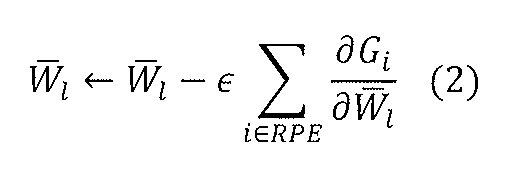
この目的関数の勾配
次に、データ拡張を行う本実施の形態の場合について説明する。本実施の形態の目的関数は、下式(3)、(3’)のとおりとなる。
式(3’)では、式(1’)のように訓練データそのものを学習部14に入力するのではなく、訓練データから変換によって派生した人為的データである疑似データをデータ拡張部12で生成して、それらを学習部14に入力する。また、式(3’)では、式(1’)と異なり、変換パラメタに対するクロスエントロピーの期待値が取られている。学習部14は、この目的関数の最適化方法として、確率的勾配降下法を採用する。
In Expression (3 ′), instead of inputting the training data itself to the
具体的手順は次の通りである。データ拡張部12は、訓練データ記憶部11に記憶された訓練データを1つ選択し、また、変換パラメタ生成部14から変換パラメタを複数個分、適当な確率分布に従う乱数によりサンプリングする。データ拡張部12は、これらのパラメタを使って訓練データに対して変換を施すことにより、この1つの訓練データを複数個に拡張する。学習部14は、これら複数個の疑似データを使って勾配
なお、通常、多層ニューラルネットワークの重みパラメタの更新には勾配法を出力層側から入力層側へ順番に適用する誤差逆伝搬法が使われる。誤差逆伝搬法も勾配法の一種であるので、確率的勾配降下法が適用可能である。誤差逆伝搬法については、C.M.ビショップ,“パターン認識と機械学習”,シュプリンガー・ジャパンに詳しく記載されている。 Normally, the error back-propagation method in which the gradient method is applied in order from the output layer side to the input layer side is used to update the weight parameter of the multilayer neural network. Since the back propagation method is also a kind of gradient method, the stochastic gradient descent method can be applied. For the back propagation method, see C.I. M.M. It is described in detail in Bishop, “Pattern Recognition and Machine Learning”, Springer Japan.
図7は、以上のようにしてデータ拡張部12にて生成された疑似データを学習した結果得られるクラスの事後分布を示す図である。図7において、クラスの事後分布は実線で示されている。識別器では、このクラスの事後分布を識別モデルとして使用して識別を行うことになる。このデータ拡張により、図2に示す本来の分布に対する網羅性を高めることができる。
FIG. 7 is a diagram showing the posterior distribution of classes obtained as a result of learning the pseudo data generated by the
(識別器)
次に、本実施の形態の識別器について説明する。図8は、本実施の形態の識別器の構成を示すブロック図である。識別器200は、データ入力部21と、データ拡張部22と、変換パラメタ生成部23と、識別部24とを備えている。識別器200は、コンピュータによって実現される。このコンピュータは、補助記憶部、一時記憶部、演算処理部、入出力部等を備えており、データ入力部21は、例えば入出力部によって実現される。また、データ拡張部22、変換パラメタ生成部23、及び識別部24は、演算処理部が本発明の実施の形態の識別プログラムを実行することで実現される。
(Identifier)
Next, the classifier of the present embodiment will be described. FIG. 8 is a block diagram showing a configuration of the discriminator according to the present embodiment. The
データ入力部21には、学習に使用していないデータであって、未知データが入力される。図9は、未知データud1〜ud5の例を示す図である。図9のような未知データが入力されたとき、データ拡張によって網羅性を高めたことによって正答できる場合も多いが、未知データud5のように、もとの分布の近似精度の限界から誤答する点もあり得る。
The
そこで、本実施の形態の識別器200では、識別時においても、学習時に行ったものと同様の方法でデータ拡張し、それらに対しての識別結果を適切に統合する。このように、識別時においても乱数を用いてデータを拡張することで、その分布がクラスの事後分布に重なる可能性が高まることから、従来正答できなかった点が正答できる可能性が高くなる。この理由について、以下に詳しく説明する。
Therefore, in the
データ拡張を行っていない場合には、あるデータが入力されたとき、最も適切なクラス分類方法は、下式(5)を満たすクラスcを選択することである。
従来、データ拡張を行った場合においても、データ拡張を行わない場合と同じ決定則が使用されてきた。即ち、学習の際には式(3’)によって学習をしたとしても、識別の際には、データ拡張を行っていない場合に理論上最適となる式(5)の決定則を用いて識別(クラス分類)が行われてきた。しかしながら、データ拡張を行った場合と行わない場合とでは、理論的に最適な決定則が異なっている。即ち、上式(5)の決定則は、データ拡張をしていない場合の目的関数(1’)を最小化しているが、データ拡張をした場合の目的関数(3’)を最小化するものではない。 Conventionally, even when data expansion is performed, the same decision rule as that when data expansion is not performed has been used. That is, even if learning is performed using the equation (3 ′) at the time of learning, the identification is performed using the decision rule of the equation (5) that is theoretically optimal when data expansion is not performed ( Classification) has been carried out. However, the theoretically optimal decision rule differs between when data is extended and when it is not. That is, the decision rule of the above equation (5) minimizes the objective function (1 ′) when data is not expanded, but minimizes the objective function (3 ′) when data is expanded. is not.
データ拡張が行われた場合に、最も適切なクラス分類方法は、下式(6)を満たすクラスcを選択することである。
以上のように、従来法では、データ拡張用の目的関数を学習時に最小化しているにも関わらず、式(5)の決定則を適用しているため、理論上最適なクラス分類が行えていない。これに対して、本実施の形態の識別器200は、識別時においても変換パラメタに対する出力の対数の期待値をとって識別を行う。
As described above, in the conventional method, although the objective function for data expansion is minimized at the time of learning, since the decision rule of Equation (5) is applied, theoretically optimal classification can be performed. Absent. On the other hand, the
具体的には、データ拡張部22は、変換パラメタ生成部23にて生成された変換パラメタを用いてデータ入力部21に入力された未知データを変換して、複数の疑似未知データを生成する。このときデータ拡張部22で用いる変換パラメタは、識別モデルを生成するための学習の際に使用した分布p(θj)から確率的に生成する。図10は、未知データqd5から生成された疑似未知データの標本分布を示す図である。図10において、未知データqd5の標本分布は実線で示されている。
Specifically, the
識別部24は、式(6)の勾配計算を行って、変換パラメタに対する出力の対数の期待値が最大となるクラスレベルを選択する。このように、データ拡張時の最適な決定則を用いることにより、データ収取量が同じ場合で、かつ同じ要領でデータ拡張をした場合であっても、従来よりも高い識別能力を獲得することが可能となる。
The
上記の実施の形態では、目的関数として、クロスエントロピーを採用したが、目的関数はクロスエントロピーに限られない。以下では、目的関数を誤差の二乗の総和とした場合の決定則について説明する。データの拡張がない場合の目的関数は、下式(7)及び(7’)によって表される。
この目的関数の勾配
次に、上記の例においてデータ拡張を行う本実施の形態の場合について説明する。本実施の形態の目的関数は、下式(9)、(9’)のとおりとなる。
このように、式(9’)では、式(7’)と異なり、変換パラメタに対する誤差の二乗の総和の期待値が取られている。 As described above, in the equation (9 ′), unlike the equation (7 ′), an expected value of the sum of squares of errors with respect to the conversion parameter is taken.
従来は、決定則として、下式(10)が用いられていた。
データ拡張を行った場合に、式(11)の決定則を用いることにより、上記の実施の形態と同様に、従来よりも高い識別能力を獲得することが可能となる。 When data expansion is performed, by using the decision rule of Expression (11), it is possible to acquire a higher discrimination ability than the conventional one as in the above embodiment.
以上のように、本実施の形態の識別器200において、データ拡張部22は、未知データに対して、学習時のデータ拡張と同様の方法でデータ拡張を行って疑似未知データを生成し、識別部24は、疑似未知データの期待値に基づいてクラス分類を行う。換言すれば、識別器200は、未知データそのものについてクラス分類を行うのではなく、未知データを拡張してそれらのクラス分類の結果を統合して、クラス分類を行う。即ち、識別器200は、学習を行う際に用いた目的関数を最小化するという決定則によってクラス分類を行う。これにより、与えられた訓練データに対してデータ拡張を行って学習をして識別モデルを生成した場合に、訓練データの収取量が同じであり、かつ同じ要領で訓練データをデータ拡張をした場合の従来法よりも高い識別能力を実現できる。
As described above, in the
(実験例)
以下、本実施の形態の学習装置及び識別器を用いて行った実験を説明する。この実験では、以下のように条件を設定した。データセットとして、手書き数字データセット(MNIST、http://yann.lecun.com/exdb/mnist/、図4参照)を用いた。訓練データとしてMNISTの訓練データセット(60,000セット)のうちの6,000セットを用い、テストデータとしてMNISTのテストデータセット(10,000セット)のうちの1,000セットを用いた。識別モデルとしては、フィードフォワード・全結合型6層ニューラルネットワークを用いた。評価基準として、誤識別率を評価した。
(Experimental example)
Hereinafter, an experiment performed using the learning apparatus and the discriminator of the present embodiment will be described. In this experiment, conditions were set as follows. As a data set, a handwritten numeral data set (MNIST, http://yann.lecun.com/exdb/mnist/, see FIG. 4) was used. 6,000 sets of MNIST training data sets (60,000 sets) were used as training data, and 1,000 sets of MNIST test data sets (10,000 sets) were used as test data. As an identification model, a feedforward / fully coupled 6-layer neural network was used. As an evaluation standard, the misidentification rate was evaluated.
学習装置における学習条件として、従来法による識別を行う場合についても、本発明の実施の形態の識別を行う場合にも同一のデータ拡張を適用した。また、生成されたサンプルからは1度しか微分を計算せず、オリジナルサンプルからは一切微分を計算しないこととした。識別器における識別条件として、従来法では、オリジナルサンプルのみを識別し、本発明の実施の形態の識別器では、複数生成されたサンプルより期待値を評価した。なお、本発明の実施の形態の識別器では、オリジナルサンプルそのものは期待値に使用しなかった。 As a learning condition in the learning apparatus, the same data extension is applied both when the identification is performed by the conventional method and when the identification according to the embodiment of the present invention is performed. In addition, the derivative is calculated only once from the generated sample, and no derivative is calculated from the original sample. As a discrimination condition in the discriminator, in the conventional method, only the original sample is discriminated, and in the discriminator of the embodiment of the present invention, an expected value is evaluated from a plurality of generated samples. In the classifier according to the embodiment of the present invention, the original sample itself is not used as the expected value.
実験結果を図11に示す。図11では、横軸に変換パラメタの種類の数Mをとり、縦軸に誤識別率をとり、従来法を用いた場合の誤識別率も合わせて示している。なお、上述のように、変換パラメタの種類の数Mについては、下式が成り立つ。
図11の結果から、変換パラメタの種類がM=16以上では、従来法でオリジナルサンプルのみを識別した場合よりも誤識別率が低くなっており、本発明の実施の形態の識別時における期待値演算が有効であることがわかる。 From the result of FIG. 11, when the type of conversion parameter is M = 16 or more, the misidentification rate is lower than when only the original sample is identified by the conventional method, and the expected value at the time of identification according to the embodiment of the present invention. It can be seen that the calculation is effective.
本発明は、未知データが拡張されて、それらの識別結果が統合されてクラス分類がされるので、未知データ自体を識別する場合と比較して、識別能力を向上できるという効果を有し、訓練データに対してデータ拡張を行って学習をして生成した識別モデルを用いる識別装置等として有用である。 The present invention expands unknown data, integrates their identification results, and classifies them. Therefore, the present invention has the effect of improving the discrimination ability compared to identifying unknown data itself, and training. The present invention is useful as an identification device using an identification model generated by performing data expansion on data and learning.
100 学習装置
11 訓練データ記憶部
12 データ拡張部
13 変換パラメタ生成部
14 学習部
200 識別装置
21 データ入力部
22 データ拡張部
23 変換パラメタ生成部
24 識別部
DESCRIPTION OF
Claims (7)
識別の対象となる未知データに対してデータ拡張を行って複数の疑似未知データを生成するデータ拡張部と、
前記複数の疑似未知データを識別モデルに適用し、それらの結果を統合してクラス分類を行う識別部と、
を備えたことを特徴とする識別器。 A classifier based on supervised learning,
A data extension unit for generating a plurality of pseudo unknown data by performing data extension on unknown data to be identified;
Applying the plurality of pseudo-unknown data to an identification model, integrating the results and classifying the classification,
A discriminator characterized by comprising:
教師あり学習に基づく識別器であって、
識別の対象となる未知データに対してデータ拡張を行って複数の疑似未知データを生成するデータ拡張部と、
前記複数の疑似未知データを識別モデルに適用し、それらの結果を統合してクラス分類を行う識別部と、
を備えた識別器として機能させることを特徴とする識別プログラム。 Computer
A classifier based on supervised learning,
A data extension unit for generating a plurality of pseudo unknown data by performing data extension on unknown data to be identified;
Applying the plurality of pseudo-unknown data to an identification model, integrating the results and classifying the classification,
An identification program that functions as an identifier having
識別の対象となる未知データに対してデータ拡張を行って複数の疑似未知データを生成するデータ拡張ステップと、
前記複数の疑似未知データを識別モデルに適用し、それらの結果を統合してクラス分類を行う識別ステップと、
を含むことを特徴とする識別方法。 An identification method based on supervised learning,
A data expansion step for generating a plurality of pseudo unknown data by performing data expansion on unknown data to be identified;
An identification step of applying the plurality of pseudo-unknown data to an identification model and integrating the results to classify;
The identification method characterized by including.
Priority Applications (3)
| Application Number | Priority Date | Filing Date | Title |
|---|---|---|---|
| JP2013235810A JP6208552B2 (en) | 2013-11-14 | 2013-11-14 | Classifier, identification program, and identification method |
| DE102014223226.0A DE102014223226A1 (en) | 2013-11-14 | 2014-11-13 | Discriminator, discrimination program and discrimination procedure |
| US14/540,295 US20150134578A1 (en) | 2013-11-14 | 2014-11-13 | Discriminator, discrimination program, and discrimination method |
Applications Claiming Priority (1)
| Application Number | Priority Date | Filing Date | Title |
|---|---|---|---|
| JP2013235810A JP6208552B2 (en) | 2013-11-14 | 2013-11-14 | Classifier, identification program, and identification method |
Publications (2)
| Publication Number | Publication Date |
|---|---|
| JP2015095212A JP2015095212A (en) | 2015-05-18 |
| JP6208552B2 true JP6208552B2 (en) | 2017-10-04 |
Family
ID=53044671
Family Applications (1)
| Application Number | Title | Priority Date | Filing Date |
|---|---|---|---|
| JP2013235810A Active JP6208552B2 (en) | 2013-11-14 | 2013-11-14 | Classifier, identification program, and identification method |
Country Status (3)
| Country | Link |
|---|---|
| US (1) | US20150134578A1 (en) |
| JP (1) | JP6208552B2 (en) |
| DE (1) | DE102014223226A1 (en) |
Cited By (1)
| Publication number | Priority date | Publication date | Assignee | Title |
|---|---|---|---|---|
| US12283092B2 (en) * | 2019-11-13 | 2025-04-22 | Nec Corporation | Information processing device, learning method, and recording medium |
Families Citing this family (32)
| Publication number | Priority date | Publication date | Assignee | Title |
|---|---|---|---|---|
| JP6509694B2 (en) * | 2015-09-15 | 2019-05-08 | 株式会社東芝 | Learning device, speech detection device, learning method and program |
| US10521718B1 (en) * | 2015-09-28 | 2019-12-31 | Google Llc | Adversarial training of neural networks |
| JP6563350B2 (en) * | 2016-02-26 | 2019-08-21 | エヌ・ティ・ティ・コミュニケーションズ株式会社 | Data classification apparatus, data classification method, and program |
| JP6727543B2 (en) | 2016-04-01 | 2020-07-22 | 富士ゼロックス株式会社 | Image pattern recognition device and program |
| WO2018220700A1 (en) * | 2017-05-30 | 2018-12-06 | 株式会社日立国際電気 | New learning dataset generation method, new learning dataset generation device, and learning method using generated learning dataset |
| JP6664715B2 (en) * | 2017-07-28 | 2020-03-13 | 国立大学法人大阪大学 | Judgment of discomfort |
| DE102017213119A1 (en) * | 2017-07-31 | 2019-01-31 | Robert Bosch Gmbh | Method and apparatus for detecting anomalies in a communication network |
| JP6838259B2 (en) * | 2017-11-08 | 2021-03-03 | Kddi株式会社 | Learning data generator, judgment device and program |
| US11132453B2 (en) * | 2017-12-18 | 2021-09-28 | Mitsubishi Electric Research Laboratories, Inc. | Data-driven privacy-preserving communication |
| EP3506160B1 (en) | 2017-12-28 | 2022-06-01 | Dassault Systèmes | Semantic segmentation of 2d floor plans with a pixel-wise classifier |
| EP3506211B1 (en) * | 2017-12-28 | 2021-02-24 | Dassault Systèmes | Generating 3d models representing buildings |
| JP6766839B2 (en) * | 2018-03-14 | 2020-10-14 | オムロン株式会社 | Inspection system, image identification system, identification system, classifier generation system, and learning data generation device |
| US11669746B2 (en) | 2018-04-11 | 2023-06-06 | Samsung Electronics Co., Ltd. | System and method for active machine learning |
| JP6965206B2 (en) * | 2018-05-09 | 2021-11-10 | 株式会社東芝 | Clustering device, clustering method and program |
| US11461693B2 (en) * | 2018-08-20 | 2022-10-04 | United Microelectronics Corp. | Training apparatus and training method for providing sample size expanding model |
| JP6877666B1 (en) * | 2018-09-18 | 2021-05-26 | 株式会社東芝 | Classification device, classification method and program |
| JP2020046883A (en) * | 2018-09-18 | 2020-03-26 | 株式会社東芝 | Classification device, classification method, and program |
| US20210357566A1 (en) * | 2018-10-17 | 2021-11-18 | Asml Netherland B.V. | Methods for generating characteristic pattern and training machine learning model |
| US12541688B2 (en) * | 2018-11-05 | 2026-02-03 | Edge Case Research, Inc. | Systems and methods for evaluating perception system quality |
| JP6569047B1 (en) | 2018-11-28 | 2019-09-04 | 株式会社ツバサファクトリー | Learning method, computer program, classifier, and generator |
| CN113167495B (en) * | 2018-12-12 | 2022-11-15 | 三菱电机株式会社 | Air conditioning control device and air conditioning control method |
| CN113207286B (en) * | 2018-12-19 | 2023-04-25 | 松下知识产权经营株式会社 | Appearance inspection device, method for improving accuracy of judging whether or not there is a defective shape in a welded part and type of defective shape using the appearance inspection device, welding system, and method for welding workpiece |
| JP7106486B2 (en) * | 2019-04-22 | 2022-07-26 | 株式会社東芝 | LEARNING DEVICE, LEARNING METHOD, PROGRAM AND INFORMATION PROCESSING SYSTEM |
| US11842283B2 (en) | 2019-06-17 | 2023-12-12 | Axell Corporation | Learning method, computer program, classifier, generator, and processing system |
| KR20220143119A (en) * | 2020-02-21 | 2022-10-24 | 엣지 케이스 리서치, 잉크. | Automatic identification of training data candidates for cognitive systems |
| US11776287B2 (en) * | 2021-04-27 | 2023-10-03 | International Business Machines Corporation | Document segmentation for optical character recognition |
| US20240257424A1 (en) * | 2021-06-02 | 2024-08-01 | Nec Corporation | Information processing device, information processing method, data production method, and program |
| JP7835119B2 (en) | 2022-06-08 | 2026-03-25 | 日本電気株式会社 | Information processing device, information processing method, and program |
| JPWO2024024437A1 (en) * | 2022-07-27 | 2024-02-01 | ||
| JP2024034309A (en) * | 2022-08-31 | 2024-03-13 | キヤノン株式会社 | Information processing device, shape measuring device, wavefront measuring device, information processing method, program, and recording medium |
| CN115359280B (en) * | 2022-09-01 | 2025-11-25 | 成都知道创宇信息技术有限公司 | Training methods, devices, electronic equipment, and readable storage media based on multi-model ensemble learning |
| JP2024066748A (en) * | 2022-11-02 | 2024-05-16 | 富士通株式会社 | Machine learning program, machine learning method, and information processing device |
Family Cites Families (1)
| Publication number | Priority date | Publication date | Assignee | Title |
|---|---|---|---|---|
| AU780050B2 (en) * | 1999-05-25 | 2005-02-24 | Health Discovery Corporation | Enhancing knowledge discovery from multiple data sets using multiple support vector machines |
-
2013
- 2013-11-14 JP JP2013235810A patent/JP6208552B2/en active Active
-
2014
- 2014-11-13 DE DE102014223226.0A patent/DE102014223226A1/en not_active Ceased
- 2014-11-13 US US14/540,295 patent/US20150134578A1/en not_active Abandoned
Cited By (1)
| Publication number | Priority date | Publication date | Assignee | Title |
|---|---|---|---|---|
| US12283092B2 (en) * | 2019-11-13 | 2025-04-22 | Nec Corporation | Information processing device, learning method, and recording medium |
Also Published As
| Publication number | Publication date |
|---|---|
| US20150134578A1 (en) | 2015-05-14 |
| JP2015095212A (en) | 2015-05-18 |
| DE102014223226A1 (en) | 2015-05-21 |
Similar Documents
| Publication | Publication Date | Title |
|---|---|---|
| JP2015095212A (en) | Identifier, identification program, and identification method | |
| Huang et al. | Graph mixture of experts and memory-augmented routers for multivariate time series anomaly detection | |
| US11816183B2 (en) | Methods and systems for mining minority-class data samples for training a neural network | |
| Zhang et al. | Apricot: A weight-adaptation approach to fixing deep learning models | |
| Li et al. | LGM-Net: Learning to generate matching networks for few-shot learning | |
| CN112001488B (en) | Training generation type antagonism network | |
| Tran et al. | Overview of particle swarm optimisation for feature selection in classification | |
| CN111753751B (en) | An intelligent diagnosis method for fan faults based on improved fireworks algorithm | |
| CN111143838B (en) | Database user abnormal behavior detection method | |
| Abd-Alsabour | A review on evolutionary feature selection | |
| JP6172317B2 (en) | Method and apparatus for mixed model selection | |
| CN114330650B (en) | Small sample feature analysis method and device based on evolutionary element learning model training | |
| CN118410498A (en) | A fine-grained hybrid semantic vulnerability detection method and system | |
| WO2020075462A1 (en) | Learner estimating device, learner estimation method, risk evaluation device, risk evaluation method, and program | |
| CN112926052B (en) | Deep learning model security hole testing and repairing method, device and system based on genetic algorithm | |
| CN118101276A (en) | An intrusion detection method and system based on fusion features | |
| CN117010480B (en) | Model training method, device, equipment, storage medium and program product | |
| CN117033546A (en) | Similar code search method and system | |
| CN119358658B (en) | Water level prediction method and electronic equipment | |
| CN114936598A (en) | Cross-domain small sample learning method, learning system, electronic device and storage medium | |
| CN117792737B (en) | A network intrusion detection method, device, electronic device and storage medium | |
| Babatunde et al. | Comparative analysis of genetic algorithm and particle swam optimization: An application in precision agriculture | |
| Suzuki et al. | Instance-based discovery of ItemSBs leveraging individuality through discretization | |
| CN117938523A (en) | Interpretable malicious domain name detection method and system based on deep learning | |
| Danlami et al. | Focal loss and self-attention convolutional neural network for phishing detection technique |
Legal Events
| Date | Code | Title | Description |
|---|---|---|---|
| RD04 | Notification of resignation of power of attorney |
Free format text: JAPANESE INTERMEDIATE CODE: A7424 Effective date: 20151113 |
|
| A621 | Written request for application examination |
Free format text: JAPANESE INTERMEDIATE CODE: A621 Effective date: 20160318 |
|
| A131 | Notification of reasons for refusal |
Free format text: JAPANESE INTERMEDIATE CODE: A131 Effective date: 20170207 |
|
| TRDD | Decision of grant or rejection written | ||
| A01 | Written decision to grant a patent or to grant a registration (utility model) |
Free format text: JAPANESE INTERMEDIATE CODE: A01 Effective date: 20170829 |
|
| A61 | First payment of annual fees (during grant procedure) |
Free format text: JAPANESE INTERMEDIATE CODE: A61 Effective date: 20170907 |
|
| R150 | Certificate of patent or registration of utility model |
Ref document number: 6208552 Country of ref document: JP Free format text: JAPANESE INTERMEDIATE CODE: R150 |
|
| R250 | Receipt of annual fees |
Free format text: JAPANESE INTERMEDIATE CODE: R250 |
|
| R250 | Receipt of annual fees |
Free format text: JAPANESE INTERMEDIATE CODE: R250 |
|
| R250 | Receipt of annual fees |
Free format text: JAPANESE INTERMEDIATE CODE: R250 |
|
| R250 | Receipt of annual fees |
Free format text: JAPANESE INTERMEDIATE CODE: R250 |
|
| R250 | Receipt of annual fees |
Free format text: JAPANESE INTERMEDIATE CODE: R250 |
|
| R250 | Receipt of annual fees |
Free format text: JAPANESE INTERMEDIATE CODE: R250 |