JP5837726B1 - Rehabilitation effect promoter after nerve injury containing alkyl ether derivative or salt thereof - Google Patents
Rehabilitation effect promoter after nerve injury containing alkyl ether derivative or salt thereof Download PDFInfo
- Publication number
- JP5837726B1 JP5837726B1 JP2015539315A JP2015539315A JP5837726B1 JP 5837726 B1 JP5837726 B1 JP 5837726B1 JP 2015539315 A JP2015539315 A JP 2015539315A JP 2015539315 A JP2015539315 A JP 2015539315A JP 5837726 B1 JP5837726 B1 JP 5837726B1
- Authority
- JP
- Japan
- Prior art keywords
- group
- days
- day
- rehabilitation
- salt
- Prior art date
- Legal status (The legal status is an assumption and is not a legal conclusion. Google has not performed a legal analysis and makes no representation as to the accuracy of the status listed.)
- Active
Links
Images
Classifications
-
- A—HUMAN NECESSITIES
- A61—MEDICAL OR VETERINARY SCIENCE; HYGIENE
- A61K—PREPARATIONS FOR MEDICAL, DENTAL OR TOILETRY PURPOSES
- A61K31/00—Medicinal preparations containing organic active ingredients
- A61K31/075—Ethers or acetals
-
- A—HUMAN NECESSITIES
- A61—MEDICAL OR VETERINARY SCIENCE; HYGIENE
- A61K—PREPARATIONS FOR MEDICAL, DENTAL OR TOILETRY PURPOSES
- A61K31/00—Medicinal preparations containing organic active ingredients
- A61K31/33—Heterocyclic compounds
- A61K31/395—Heterocyclic compounds having nitrogen as a ring hetero atom, e.g. guanethidine or rifamycins
- A61K31/397—Heterocyclic compounds having nitrogen as a ring hetero atom, e.g. guanethidine or rifamycins having four-membered rings, e.g. azetidine
-
- A—HUMAN NECESSITIES
- A61—MEDICAL OR VETERINARY SCIENCE; HYGIENE
- A61K—PREPARATIONS FOR MEDICAL, DENTAL OR TOILETRY PURPOSES
- A61K31/00—Medicinal preparations containing organic active ingredients
- A61K31/33—Heterocyclic compounds
- A61K31/38—Heterocyclic compounds having sulfur as a ring hetero atom
- A61K31/381—Heterocyclic compounds having sulfur as a ring hetero atom having five-membered rings
-
- A—HUMAN NECESSITIES
- A61—MEDICAL OR VETERINARY SCIENCE; HYGIENE
- A61K—PREPARATIONS FOR MEDICAL, DENTAL OR TOILETRY PURPOSES
- A61K9/00—Medicinal preparations characterised by special physical form
- A61K9/0012—Galenical forms characterised by the site of application
- A61K9/0053—Mouth and digestive tract, i.e. intraoral and peroral administration
-
- A—HUMAN NECESSITIES
- A61—MEDICAL OR VETERINARY SCIENCE; HYGIENE
- A61K—PREPARATIONS FOR MEDICAL, DENTAL OR TOILETRY PURPOSES
- A61K9/00—Medicinal preparations characterised by special physical form
- A61K9/20—Pills, tablets, discs, rods
-
- A—HUMAN NECESSITIES
- A61—MEDICAL OR VETERINARY SCIENCE; HYGIENE
- A61K—PREPARATIONS FOR MEDICAL, DENTAL OR TOILETRY PURPOSES
- A61K9/00—Medicinal preparations characterised by special physical form
- A61K9/48—Preparations in capsules, e.g. of gelatin, of chocolate
- A61K9/50—Microcapsules having a gas, liquid or semi-solid filling; Solid microparticles or pellets surrounded by a distinct coating layer, e.g. coated microspheres, coated drug crystals
- A61K9/5005—Wall or coating material
- A61K9/5021—Organic macromolecular compounds
- A61K9/5052—Proteins, e.g. albumin
- A61K9/5057—Gelatin
-
- A—HUMAN NECESSITIES
- A61—MEDICAL OR VETERINARY SCIENCE; HYGIENE
- A61P—SPECIFIC THERAPEUTIC ACTIVITY OF CHEMICAL COMPOUNDS OR MEDICINAL PREPARATIONS
- A61P25/00—Drugs for disorders of the nervous system
-
- A—HUMAN NECESSITIES
- A61—MEDICAL OR VETERINARY SCIENCE; HYGIENE
- A61P—SPECIFIC THERAPEUTIC ACTIVITY OF CHEMICAL COMPOUNDS OR MEDICINAL PREPARATIONS
- A61P25/00—Drugs for disorders of the nervous system
- A61P25/28—Drugs for disorders of the nervous system for treating neurodegenerative disorders of the central nervous system, e.g. nootropic agents, cognition enhancers, drugs for treating Alzheimer's disease or other forms of dementia
Landscapes
- Health & Medical Sciences (AREA)
- Pharmacology & Pharmacy (AREA)
- Veterinary Medicine (AREA)
- Public Health (AREA)
- General Health & Medical Sciences (AREA)
- Chemical & Material Sciences (AREA)
- Animal Behavior & Ethology (AREA)
- Life Sciences & Earth Sciences (AREA)
- Medicinal Chemistry (AREA)
- Epidemiology (AREA)
- Engineering & Computer Science (AREA)
- Bioinformatics & Cheminformatics (AREA)
- Neurosurgery (AREA)
- Neurology (AREA)
- Biomedical Technology (AREA)
- Organic Chemistry (AREA)
- Nuclear Medicine, Radiotherapy & Molecular Imaging (AREA)
- General Chemical & Material Sciences (AREA)
- Chemical Kinetics & Catalysis (AREA)
- Nutrition Science (AREA)
- Physiology (AREA)
- Psychiatry (AREA)
- Hospice & Palliative Care (AREA)
- Pharmaceuticals Containing Other Organic And Inorganic Compounds (AREA)
- Acyclic And Carbocyclic Compounds In Medicinal Compositions (AREA)
Abstract
一般式[1]「式中、R1およびR2は、同一または異なって、水素原子、ハロゲン原子、置換されていてもよいC1−6アルキル基または置換されていてもよいアリール基などを;R3は、保護されていてもよいヒドロキシル基などを;mおよびnは、同一または異なって、1〜6の整数をそれぞれ示す。」で表されるアルキルエーテル誘導体またはその塩を含有することを特徴とする医薬組成物が提供される。本発明の医薬組成物は、神経損傷後のリハビリテーション効果促進剤として有用である。General formula [1] “wherein R1 and R2 are the same or different and each represents a hydrogen atom, a halogen atom, an optionally substituted C1-6 alkyl group, an optionally substituted aryl group, or the like; A hydroxyl group which may be protected; and m and n are the same or different and each represents an integer of 1 to 6], or an alkyl ether derivative or a salt thereof. A pharmaceutical composition is provided. The pharmaceutical composition of the present invention is useful as a rehabilitation effect promoter after nerve injury.
Description
本発明は、アルキルエーテル誘導体またはその塩を含有する優れた神経損傷後のリハビリテーション効果促進剤に関する。 The present invention relates to an excellent rehabilitation effect promoter after nerve injury containing an alkyl ether derivative or a salt thereof.
脳や脊髄などの中枢神経組織が損傷を受けると、損傷を受けた神経が支配する高次機能に障害が起こる。神経損傷の代表的な例である脳卒中の患者数は、日本国内で約130万人と非常に多く、社会的損失は甚大である。 When central nervous tissues such as the brain and spinal cord are damaged, higher-order functions governed by the damaged nerves are impaired. The number of patients with stroke, which is a typical example of nerve damage, is very large, about 1.3 million in Japan, and the social loss is enormous.
脳卒中や脊髄損傷などの神経損傷が起こった場合、機能障害から回復する目的でリハビリテーションが推奨されている。しかしながら、リハビリテーションによる機能障害の回復効果は、不十分であり、リハビリテーションを行っても障害が残る例や、社会復帰できない例が多く報告されている。このように、従来のリハビリテーションによる機能障害回復効果には限界がある(非特許文献1および2)。 If nerve damage such as stroke or spinal cord injury occurs, rehabilitation is recommended to recover from dysfunction. However, the recovery effect of dysfunction due to rehabilitation is inadequate, and there have been many reports of cases in which the disorder remains even after rehabilitation and where rehabilitation is not possible. Thus, there is a limit to the functional disorder recovery effect by conventional rehabilitation (Non-patent Documents 1 and 2).
これまでに、特許文献1および2に記載のアルキルエーテル誘導体が、神経保護作用、神経再生作用、神経突起伸展促進作用および神経細胞新生誘導作用を有することが知られている(特許文献1および2)。 So far, it is known that the alkyl ether derivatives described in Patent Documents 1 and 2 have a neuroprotective action, a nerve regeneration action, a neurite outgrowth promoting action, and a neuronal cell neogenesis-inducing action (Patent Documents 1 and 2). ).
神経損傷後のリハビリテーション効果を促進する作用を示し、神経損傷後のリハビリテーション効果促進剤として有用な化合物が求められている。 There is a demand for a compound that exhibits an action of promoting the rehabilitation effect after nerve injury and is useful as a rehabilitation effect promoter after nerve injury.
このような状況下において、本発明者らは、以下の一般式[1]
本発明によれば、以下の発明が提供される。
(1) 一般式[1]で表されるアルキルエーテル誘導体またはその塩を含有することを特徴とする、神経損傷後のリハビリテーション効果促進剤。
(2) R1およびR2が、同一または異なって、水素原子、ハロゲン原子またはC1−6アルコキシ基であるアルキルエーテル誘導体またはその塩を含有することを特徴とする、(1)に記載の神経損傷後のリハビリテーション効果促進剤。
(3) mが、2;nが、2または3であるアルキルエーテル誘導体またはその塩を含有することを特徴とする、(1)または(2)に記載の神経損傷後のリハビリテーション効果促進剤。
(4) R3が、保護されていてもよいヒドロキシル基であるアルキルエーテル誘導体またはその塩を含有することを特徴とする、(1)〜(3)のいずれか一に記載の神経損傷後のリハビリテーション効果促進剤。
(5) アルキルエーテル誘導体が、1−(3−(2−(1−ベンゾチオフェン−5−イル)エトキシ)プロピル)アゼチジン−3−オールであることを特徴とする、(1)に記載の神経損傷後のリハビリテーション効果促進剤。
(6) 一般式[1]で表されるアルキルエーテル誘導体またはその塩を含有することを特徴とする、リハビリテーションを行う神経損傷患者用の機能障害回復促進剤および/または軽減促進剤。
(7) R1およびR2が、同一または異なって、水素原子、ハロゲン原子またはC1−6アルコキシ基であるアルキルエーテル誘導体またはその塩を含有することを特徴とする、(6)に記載のリハビリテーションを行う神経損傷患者用の機能障害回復促進剤および/または軽減促進剤。
(8) mが、2;nが、2または3であるアルキルエーテル誘導体またはその塩を含有することを特徴とする、(6)または(7)に記載のリハビリテーションを行う神経損傷患者用の機能障害回復促進剤および/または軽減促進剤。
(9) R3が、保護されていてもよいヒドロキシル基であるアルキルエーテル誘導体またはその塩を含有することを特徴とする、(6)〜(8)のいずれか一に記載のリハビリテーションを行う神経損傷患者用の機能障害回復促進剤および/または軽減促進剤。
(10) アルキルエーテル誘導体が、1−(3−(2−(1−ベンゾチオフェン−5−イル)エトキシ)プロピル)アゼチジン−3−オールであることを特徴とする、(6)に記載のリハビリテーションを行う神経損傷患者用の機能障害回復促進剤および/または軽減促進剤。According to the present invention, the following inventions are provided.
(1) A rehabilitation effect promoter after nerve injury, comprising an alkyl ether derivative represented by the general formula [1] or a salt thereof.
(2) R 1 and R 2 are the same or different and contain a hydrogen atom, a halogen atom or an alkyl ether derivative or a salt thereof which is a C 1-6 alkoxy group, according to (1) Rehabilitation effect promoter after nerve injury.
(3) The rehabilitation effect promoter after nerve injury according to (1) or (2), wherein m is 2; and n is an alkyl ether derivative or a salt thereof in which 2 or 3 is present.
(4) R 3 contains an alkyl ether derivative or a salt thereof, which is a hydroxyl group which may be protected, or after nerve injury according to any one of (1) to (3) Rehabilitation effect promoter.
(5) The nerve according to (1), wherein the alkyl ether derivative is 1- (3- (2- (1-benzothiophen-5-yl) ethoxy) propyl) azetidin-3-ol Rehabilitation effect promoter after injury.
(6) A functional disorder recovery promoter and / or a reduction promoter for rehabilitation nerve injury patients, comprising an alkyl ether derivative represented by the general formula [1] or a salt thereof.
(7) The alkyl ether derivative or the salt thereof according to (6), wherein R 1 and R 2 are the same or different and contain a hydrogen atom, a halogen atom or a C 1-6 alkoxy group or a salt thereof. A dysfunction recovery promoter and / or a reduction promoter for nerve injury patients who undergo rehabilitation.
(8) The function for nerve injury patients performing rehabilitation according to (6) or (7), characterized in that it contains an alkyl ether derivative or a salt thereof, wherein m is 2; and n is 2 or 3. Disability recovery promoter and / or mitigation promoter.
(9) The nerve for rehabilitation according to any one of (6) to (8), wherein R 3 contains an alkyl ether derivative or a salt thereof which is an optionally protected hydroxyl group. A dysfunction recovery promoter and / or a relief promoter for an injured patient
(10) The rehabilitation according to (6), wherein the alkyl ether derivative is 1- (3- (2- (1-benzothiophen-5-yl) ethoxy) propyl) azetidin-3-ol. A dysfunction recovery promoter and / or a reduction promoter for nerve injury patients who perform the above.
また、本発明によれば、以下の発明も提供される。
(a) 一般式[1]で表されるアルキルエーテル誘導体またはその塩を含有することを特徴とする、脳卒中後、脳損傷後または脊髄損傷後のリハビリテーション効果促進剤。
(b) 一般式[1]で表されるアルキルエーテル誘導体またはその塩を含有することを特徴とする、リハビリテーションを行う脳卒中患者用、脳損傷患者用または脊髄損傷患者用の機能障害回復促進剤および/または軽減促進剤。
(c) 神経損傷後のリハビリテーション効果促進剤の製造のための、一般式[1]で表されるアルキルエーテル誘導体またはその塩の使用。
(d) 神経損傷後のリハビリテーション効果促進剤が効果を示す疾患の処置剤の製造のための、一般式[1]で表されるアルキルエーテル誘導体またはその塩の使用。
(e) 神経損傷が、脳卒中、脳損傷または脊髄損傷であることを特徴とする、(c)または(d)に記載の使用。
(f) 神経損傷後のリハビリテーション効果促進剤が効果を示す疾患の処置に用いるための方法であって、一般式[1]で表されるアルキルエーテル誘導体またはその塩の処置上有効量を対象(ヒトを含む哺乳動物)に投与する工程を含む方法。
(g) 一般式[1]で表されるアルキルエーテル誘導体またはその塩を、対象(ヒトを含む哺乳動物)に投与する工程を含む、神経損傷後のリハビリテーション効果を促進する方法。
(h) 神経損傷が、脳卒中、脳損傷または脊髄損傷であることを特徴とする、(f)または(g)に記載の方法。The present invention also provides the following inventions.
(A) A rehabilitation effect promoter after stroke, brain injury or spinal cord injury, characterized by containing an alkyl ether derivative represented by the general formula [1] or a salt thereof.
(B) a functional disorder recovery accelerator for rehabilitation stroke patients, brain injury patients or spinal cord injury patients, comprising an alkyl ether derivative represented by the general formula [1] or a salt thereof; / Or mitigation promoter.
(C) Use of an alkyl ether derivative represented by the general formula [1] or a salt thereof for the production of a rehabilitation effect promoter after nerve injury.
(D) Use of an alkyl ether derivative represented by the general formula [1] or a salt thereof for the manufacture of a therapeutic agent for a disease for which a rehabilitation effect promoter after nerve injury is effective.
(E) Use according to (c) or (d), characterized in that the nerve injury is stroke, brain injury or spinal cord injury.
(F) A method for use in the treatment of a disease for which a rehabilitation effect promoter after nerve injury has an effect, wherein a therapeutically effective amount of an alkyl ether derivative represented by the general formula [1] or a salt thereof is used ( A mammal comprising a human).
(G) A method for promoting a rehabilitation effect after nerve injury, comprising a step of administering an alkyl ether derivative represented by the general formula [1] or a salt thereof to a subject (mammal including a human).
(H) The method according to (f) or (g), wherein the nerve injury is stroke, brain injury or spinal cord injury.
本発明の一般式[1]で表されるアルキルエーテル誘導体またはその塩は、神経損傷後のリハビリテーション効果を促進する作用を示し、神経損傷後のリハビリテーション効果促進剤として有用である。 The alkyl ether derivative represented by the general formula [1] of the present invention or a salt thereof exhibits an action of promoting a rehabilitation effect after nerve injury, and is useful as a rehabilitation effect promoter after nerve injury.
以下に本発明について詳細に説明する。
本明細書において、特に断らない限り、各用語は、次の意味を有する。
処置とは、予防または治療を意味する。
処置剤とは、予防または治療の目的で供せられる物質を意味する。The present invention is described in detail below.
In this specification, unless otherwise specified, each term has the following meaning.
Treatment means prevention or treatment.
The treatment agent means a substance provided for the purpose of prevention or treatment.
ハロゲン原子とは、フッ素原子、塩素原子、臭素原子またはヨウ素原子を意味する。
C1−6アルキル基とは、メチル、エチル、プロピル、イソプロピル、ブチル、イソブチル、tert−ブチル、ペンチルおよびヘキシル基などの直鎖状または分岐鎖状のC1−6アルキル基を意味する。
C2−6アルケニル基とは、ビニル、プロペニル、ブテニル、ペンテニルおよびヘキセニルなどのC2−6アルケニル基を意味する。
アシルC1−6アルキル基とは、たとえば、アセチルメチル、ベンゾイルメチル、p−ニトロベンゾイルメチル、p−ブロモベンゾイルメチル、p−メトキシベンゾイルメチルおよび1−ベンゾイルエチルなどのアシルC1−6アルキル基を意味する。
アシルオキシC1−6アルキル基とは、たとえば、アセトキシメチル、プロピオニルオキシメチルおよびピバロイルオキシメチルなどのアシルオキシC1−6アルキル基を意味する。
アリールチオC1−6アルキル基とは、たとえば、フェニルスルフェニルメチルおよび2−(p−ニトロフェニルスルフェニル)エチルなどの基を意味する。
アリールスルホニルC1−6アルキル基とは、たとえば、p−トルエンスルホニルエチルなどのアリールスルホニルC1−6アルキル基を意味する。
含窒素複素環式C1−6アルキル基とは、たとえば、フタルイミドメチルおよびスクシンイミドメチルなどの含窒素複素環式C1−6アルキル基を意味する。
C3−8シクロアルキル基とは、たとえば、シクロプロピル、シクロブチル、シクロペンチルおよびシクロヘキシルなどのC3−8シクロアルキル基を意味する。
C1−6アルキルチオC1−6アルキル基とは、たとえば、メチルチオメチル、エチルチオメチルおよびプロピルチオメチルなどのC1−6アルキルチオC1−6アルキル基を意味する。
C1−6アルコキシC1−6アルキル基とは、たとえば、メトキシメチルおよび1−エトキシエチルなどのC1−6アルキルオキシC1−6アルキル基を意味する。
アルC1−6アルキルオキシC1−6アルキル基とは、たとえば、ベンジルオキシメチルおよびフェネチルオキシメチルなどのアルC1−6アルキルオキシC1−6アルキル基を意味する。A halogen atom means a fluorine atom, a chlorine atom, a bromine atom or an iodine atom.
The C 1-6 alkyl group means a linear or branched C 1-6 alkyl group such as methyl, ethyl, propyl, isopropyl, butyl, isobutyl, tert-butyl, pentyl and hexyl groups.
The C 2-6 alkenyl group means vinyl, propenyl, butenyl, C 2-6 alkenyl groups such as pentenyl and hexenyl.
Acyl C 1-6 alkyl group, e.g., acetyl, methyl, benzoyl methyl, p- nitrobenzoyl methyl, p- bromobenzoyl methyl, p- methoxybenzoyl acyl C 1-6 alkyl group such as methyl and 1-benzoyl ethyl means.
And acyloxy C 1-6 alkyl group, for example, refers to acetoxymethyl, propionyloxymethyl and acyloxy C 1-6 alkyl groups such as pivaloyloxymethyl.
The arylthio C 1-6 alkyl group means groups such as phenylsulfenylmethyl and 2- (p-nitrophenylsulfenyl) ethyl.
An arylsulfonyl C 1-6 alkyl group means an arylsulfonyl C 1-6 alkyl group such as p-toluenesulfonylethyl.
The nitrogen-containing heterocyclic C 1-6 alkyl group means, for example, a nitrogen-containing heterocyclic C 1-6 alkyl group such as phthalimidomethyl and succinimidomethyl.
The C 3-8 cycloalkyl group refers to, for example, a cyclopropyl, cyclobutyl, C 3-8 cycloalkyl groups such as cyclopentyl and cyclohexyl.
The C 1-6 alkylthio C 1-6 alkyl group refers to, for example, a C 1-6 alkylthio C 1-6 alkyl group such as methylthiomethyl, ethylthiomethyl and propyl methylthiomethyl.
The C 1-6 alkoxy C 1-6 alkyl group means, for example, a C 1-6 alkyloxy C 1-6 alkyl group such as methoxymethyl and 1-ethoxyethyl.
The Al C 1-6 alkyloxy C 1-6 alkyl group, for example, means Al C 1-6 alkyloxy C 1-6 alkyl group such as benzyloxymethyl and phenethyl oxymethyl.
C1−6アルコキシ基とは、メトキシ、エトキシ、プロポキシ、イソプロポキシ、ブトキシ、イソブトキシ、tert−ブトキシ、ペンチルオキシおよびヘキシルオキシ基などの直鎖状または分岐鎖状のC1−6アルキルオキシ基を意味する。
C2−6アルケニルオキシ基とは、ビニルオキシ、プロペニルオキシ、ブテニルオキシ、ペンテニルオキシおよびヘキセニルオキシ基などのC2−6アルケニルオキシ基を意味する。C 1-6 alkoxy group means a linear or branched C 1-6 alkyloxy group such as methoxy, ethoxy, propoxy, isopropoxy, butoxy, isobutoxy, tert-butoxy, pentyloxy and hexyloxy groups. means.
The C 2-6 alkenyloxy group means a C 2-6 alkenyloxy group such as vinyloxy, propenyloxy, butenyloxy, pentenyloxy and hexenyloxy groups.
C1−6アルキルチオ基とは、メチルチオ、エチルチオ、プロピルチオ、イソプロピルチオ、ブチルチオ、イソブチルチオ、tert−ブチルチオ、ペンチルチオおよびヘキシルチオなどのC1−6アルキルチオ基を意味する。The C 1-6 alkylthio group means methylthio, ethylthio, propylthio, isopropylthio, butylthio, isobutylthio, tert- butylthio, the C 1-6 alkylthio group such as pentylthio and hexylthio.
アリール基とは、フェニル、ナフチル、インダニルまたはインデニル基を意味する。
アリールオキシ基とは、フェニルオキシ、ナフチルオキシ、インダニルオキシまたはインデニルオキシ基を意味する。
アルC1−6アルキル基とは、ベンジル、ジフェニルメチル、トリチルおよびフェネチル基などのアルC1−6アルキル基を意味する。
アリールチオ基とは、フェニルチオ、ナフチルチオ、インダニルチオまたはインデニルチオ基を意味する。An aryl group means a phenyl, naphthyl, indanyl or indenyl group.
An aryloxy group means a phenyloxy, naphthyloxy, indanyloxy or indenyloxy group.
An al C 1-6 alkyl group means an al C 1-6 alkyl group such as benzyl, diphenylmethyl, trityl and phenethyl groups.
An arylthio group means a phenylthio, naphthylthio, indanylthio or indenylthio group.
アシル基とは、ホルミル基、アセチル、イソバレイル、プロピオニルおよびピバロイルなどのC2−6アルカノイル基、ベンジルカルボニルなどのアルC1−6アルキルカルボニル基またはベンゾイルおよびナフトイルなどのアロイル基を意味する。
C1−6アルキルオキシカルボニル基とは、たとえば、メトキシカルボニル、エトキシカルボニル、1,1−ジメチルプロポキシカルボニル、イソプロポキシカルボニル、2−エチルヘキシルオキシカルボニル、tert−ブトキシカルボニルおよびtert−ペンチルオキシカルボニルなどの直鎖状または分枝鎖状のC1−6アルキルオキシカルボニル基を意味する。
アルC1−6アルキルオキシカルボニル基とは、たとえば、ベンジルオキシカルボニルおよびフェネチルオキシカルボニル基などのアルC1−6アルキルオキシカルボニル基を意味する。
アリールオキシカルボニル基とは、たとえば、フェニルオキシカルボニルなどの基を意味する。
複素環オキシカルボニル基とは、たとえば、2−フルフリルオキシカルボニルおよび8−キノリルオキシカルボニルなどの基を意味する。The acyl group means a formyl group, a C 2-6 alkanoyl group such as acetyl, isovaleyl, propionyl and pivaloyl, an al C 1-6 alkylcarbonyl group such as benzylcarbonyl, or an aroyl group such as benzoyl and naphthoyl.
C 1-6 alkyloxycarbonyl group means, for example, methoxycarbonyl, ethoxycarbonyl, 1,1-dimethylpropoxycarbonyl, isopropoxycarbonyl, 2-ethylhexyloxycarbonyl, tert-butoxycarbonyl, tert-pentyloxycarbonyl and the like. It means a chain or branched C 1-6 alkyloxycarbonyl group.
The Al C 1-6 alkyloxycarbonyl group, for example, means Al C 1-6 alkyloxycarbonyl group such as benzyloxycarbonyl and phenethyloxycarbonyl group.
The aryloxycarbonyl group means a group such as phenyloxycarbonyl, for example.
The heterocyclic oxycarbonyl group means groups such as 2-furfuryloxycarbonyl and 8-quinolyloxycarbonyl, for example.
C1−6アルキルスルホニル基とは、たとえば、メチルスルホニル、エチルスルホニルおよびプロピルスルホニルなどのC1−6アルキルスルホニル基を意味する。
アリールスルホニル基とは、フェニルスルホニル、p−トルエンスルホニルまたはナフチルスルホニル基などを意味する。The C 1-6 alkylsulfonyl group means, for example, a C 1-6 alkylsulfonyl group such as methylsulfonyl, ethylsulfonyl and propylsulfonyl.
The arylsulfonyl group means phenylsulfonyl, p-toluenesulfonyl or naphthylsulfonyl group.
C1−6アルキルアミノ基とは、メチルアミノ、エチルアミノ、プロピルアミノ、イソプロピルアミノ、ブチルアミノ、ジメチルアミノ、ジエチルアミノ、ジイソプロピルアミノおよびジブチルアミノなどのモノ−またはジ−C1−6アルキルアミノ基を意味する。C 1-6 alkylamino group means a mono- or di-C 1-6 alkylamino group such as methylamino, ethylamino, propylamino, isopropylamino, butylamino, dimethylamino, diethylamino, diisopropylamino and dibutylamino. means.
複素環式基とは、ピロリジニル、ピペリジニル、ピペラジニル、ホモピペラジニル、ホモピペリジニル、モルホリル、チオモルホリル、テトラヒドロキノリニル、テトラヒドロイソキノリル、キヌクリジニル、イミダゾリニル、ピロリル、イミダゾリル、ピラゾリル、ピリジル、ピリミジル、キノリル、キノリジニル、チアゾリル、テトラゾリル、チアジアゾリル、ピロリニル、ピラゾリニル、ピラゾリジニル、プリニル、フリル、チエニル、ベンゾチエニル、ピラニル、イソベンゾフラニル、オキサゾリル、イソオキサゾリル、ベンゾフラニル、インドリル、ベンズイミダゾリル、ベンゾオキサゾリル、ベンゾイソオキサゾリル、ベンゾチアゾリル、キノキサリル、ジヒドロキノキサリル、2,3−ジヒドロベンゾチエニル、2,3−ジヒドロベンゾピロリル、2,3−4H−1−チアナフチル、2,3−ジヒドロベンゾフラニル、ベンゾ[b]ジオキサニル、イミダゾ[2,3−a]ピリジル、ベンゾ[b]ピペラジニル、クロメニル、イソチアゾリル、イソオキサゾリル、オキサジアゾリル、ピリダジニル、イソインドリル、イソキノリル、1,3−ベンゾジオキソニルおよび1,4−ベンゾジオキサニル基などの窒素、酸素もしくは硫黄原子から選ばれる少なくとも一つ以上の異項原子を含む5員もしくは6員環、縮合環または架橋環の複素環式基を意味する。 Heterocyclic groups include pyrrolidinyl, piperidinyl, piperazinyl, homopiperazinyl, homopiperidinyl, morpholyl, thiomorpholyl, tetrahydroquinolinyl, tetrahydroisoquinolyl, quinuclidinyl, imidazolinyl, pyrrolyl, imidazolyl, pyrazolyl, pyridyl, pyridyl, quinodilyl, quinolyl, , Tetrazolyl, thiadiazolyl, pyrrolinyl, pyrazolinyl, pyrazolidinyl, purinyl, furyl, thienyl, benzothienyl, pyranyl, isobenzofuranyl, oxazolyl, isoxazolyl, benzofuranyl, indolyl, benzimidazolyl, benzoxazolyl, benzoisoxazolyl, benzothiazolyl Quinoxalyl, dihydroquinoxalyl, 2,3-dihydrobenzothienyl, 2,3-dihi Lobenzopyrrolyl, 2,3-4H-1-thianaphthyl, 2,3-dihydrobenzofuranyl, benzo [b] dioxanyl, imidazo [2,3-a] pyridyl, benzo [b] piperazinyl, chromenyl, isothiazolyl, isoxazolyl, oxadiazolyl 5-membered or 6 containing at least one hetero atom selected from nitrogen, oxygen or sulfur atoms such as, pyridazinyl, isoindolyl, isoquinolyl, 1,3-benzodioxonyl and 1,4-benzodioxanyl groups It means a heterocyclic group having a member ring, condensed ring or bridged ring.
含酸素複素環式基とは、たとえば、2−テトラヒドロピラニルおよび2−テトラヒドロフラニルなどの基を意味する。
含硫黄複素環式基とは、たとえば、テトラヒドロチオピラニルなどの基を意味する。
置換シリル基とは、たとえば、トリメチルシリル、トリエチルシリルおよびトリブチルシリルなどの基を意味する。
C1−6アルキルシリルC1−6アルキル基とは、たとえば、2−(トリメチルシリル)エチルなどの基を意味する。The oxygen-containing heterocyclic group means groups such as 2-tetrahydropyranyl and 2-tetrahydrofuranyl, for example.
The sulfur-containing heterocyclic group means a group such as tetrahydrothiopyranyl, for example.
The substituted silyl group means groups such as trimethylsilyl, triethylsilyl and tributylsilyl, for example.
The C 1-6 alkylsilyl C 1-6 alkyl group means, for example, a group such as 2- (trimethylsilyl) ethyl.
アミノ保護基としては、通常のアミノ基の保護基として使用しうるすべての基を含み、たとえば、W.グリーン(W. Greene)ら、プロテクティブ・グループス・イン・オーガニック・シンセシス(Protective Groups in Organic Synthesis)第4版、第696〜868頁、2007年、ジョン・ウィリイ・アンド・サンズ社(John Wiley & Sons, INC.)に記載されている基が挙げられる。具体的には、たとえば、アシル基、C1−6アルキルオキシカルボニル基、アルC1−6アルキルオキシカルボニル基、アリールオキシカルボニル基、アルC1−6アルキル基、C1−6アルコキシC1−6アルキル基、アルC1−6アルキルオキシC1−6アルキル基、アリールチオ基、C1−6アルキルスルホニル基、アリールスルホニル基および置換シリル基などが挙げられる。Amino protecting groups include all groups that can be used as protecting groups for ordinary amino groups. W. Greene et al., Protective Groups in Organic Synthesis, 4th edition, pages 696-868, 2007, John Wiley & Sons (John Wiley & Sons, INC.). Specifically, for example, an acyl group, a C 1-6 alkyloxycarbonyl group, an al C 1-6 alkyloxycarbonyl group, an aryloxycarbonyl group, an al C 1-6 alkyl group, a C 1-6 alkoxy C 1- 6 alkyl group, ar C 1-6 alkyloxy C 1-6 alkyl group, arylthio group, C 1-6 alkylsulfonyl group, arylsulfonyl group, substituted silyl group and the like can be mentioned.
ヒドロキシル保護基としては、通常のヒドロキシル基の保護基として使用し得るすべての基を含み、たとえば、W.グリーン(W. Greene)ら、プロテクティブ・グループス・イン・オーガニック・シンセシス(Protective Groups in Organic Synthesis)第4版、第16〜299頁、2007年、ジョン・ウィリイ・アンド・サンズ社(John Wiley & Sons, INC.)に記載されている基が挙げられる。具体的には、たとえば、アシル基、C1−6アルキルオキシカルボニル基、アルC1−6アルキルオキシカルボニル基、複素環オキシカルボニル基、C1−6アルキル基、C2−6アルケニル基、アルC1−6アルキル基、含酸素複素環式基、含硫黄複素環式基、C1−6アルコキシC1−6アルキル基、アルC1−6アルキルオキシC1−6アルキル基、C1−6アルキルスルホニル基、アリールスルホニル基および置換シリル基などが挙げられる。Hydroxyl protecting groups include all groups that can be used as protecting groups for conventional hydroxyl groups. W. Greene et al., Protective Groups in Organic Synthesis, 4th edition, pages 16-299, 2007, John Wiley & Sons (John Wiley & Sons, INC.). Specifically, for example, an acyl group, a C 1-6 alkyloxycarbonyl group, an al C 1-6 alkyloxycarbonyl group, a heterocyclic oxycarbonyl group, a C 1-6 alkyl group, a C 2-6 alkenyl group, an al C 1-6 alkyl group, oxygen-containing heterocyclic group, sulfur-containing heterocyclic group, C 1-6 alkoxy C 1-6 alkyl group, al C 1-6 alkyloxy C 1-6 alkyl group, C 1- 6 alkylsulfonyl group, an arylsulfonyl group and a substituted silyl group.
カルボキシル保護基としては、通常のカルボキシル基の保護基として使用し得るすべての基を含み、たとえば、W.グリーン(W. Greene)ら、プロテクティブ・グループス・イン・オーガニック・シンセシス(Protective Groups in Organic Synthesis)第4版、第533〜643頁、2007年、ジョン・ウィリイ・アンド・サンズ社(John Wiley & Sons, INC.)に記載されている基が挙げられる。具体的には、たとえば、C1−6アルキル基、C2−6アルケニル基、アリール基、アルC1−6アルキル基、アシルC1−6アルキル基、アリールチオC1−6アルキル基、アリールスルホニルC1−6アルキル基、含酸素複素環式基、C1−6アルキルシリルC1−6アルキル基、アシルオキシC1−6アルキル基、含窒素複素環式C1−6アルキル基、C3−8シクロアルキル基、C1−6アルコキシC1−6アルキル基、アルC1−6アルキルオキシC1−6アルキル基、C1−6アルキルチオC1−6アルキル基および置換シリル基などが挙げられる。The carboxyl protecting group includes all groups that can be used as protecting groups for ordinary carboxyl groups. W. Greene et al., Protective Groups in Organic Synthesis, 4th edition, pp. 533-643, 2007, John Wiley & Sons (John Wiley & Sons, INC.). Specifically, for example, C 1-6 alkyl group, C 2-6 alkenyl group, aryl group, al C 1-6 alkyl group, acyl C 1-6 alkyl group, arylthio C 1-6 alkyl group, arylsulfonyl C 1-6 alkyl group, oxygen-containing heterocyclic group, C 1-6 alkylsilyl C 1-6 alkyl group, acyloxy C 1-6 alkyl group, nitrogen-containing heterocyclic C 1-6 alkyl group, C 3- 8 cycloalkyl group, C 1-6 alkoxy C 1-6 alkyl group, ar C 1-6 alkyloxy C 1-6 alkyl group, C 1-6 alkylthio C 1-6 alkyl group, substituted silyl group and the like can be mentioned. .
R1およびR2におけるC1−6アルキル基、アリール基、アルC1−6アルキル基、C1−6アルコキシ基、アリールオキシ基、C1−6アルキルチオ基、アリールチオ基、C2−6アルケニル基、C2−6アルケニルオキシ基、C1−6アルキルアミノ基、C1−6アルキルスルホニル基、アリールスルホニル基、カルバモイル基および複素環式基ならびにR3におけるC1−6アルキルアミノ基の置換基としては、ハロゲン原子、C1−6アルキル基、C3−8シクロアルキル基、アリール基、C1−6アルコキシ基、アリールオキシ基、C1−6アルキルチオ基、アリールチオ基、C2−6アルケニル基、C1−6アルキルスルホニル基、アリールスルホニル基、C1−6アルキルアミノ基、保護されていてもよいアミノ基、保護されていてもよいヒドロキシル基、保護されていてもよいカルボキシル基、アシル基および複素環式基などから選ばれる基が挙げられる。C 1-6 alkyl group, aryl group, ar C 1-6 alkyl group, C 1-6 alkoxy group, aryloxy group, C 1-6 alkylthio group, arylthio group, C 2-6 alkenyl for R 1 and R 2 Group, C 2-6 alkenyloxy group, C 1-6 alkylamino group, C 1-6 alkylsulfonyl group, arylsulfonyl group, carbamoyl group and heterocyclic group, and substitution of C 1-6 alkylamino group in R 3 As a group, a halogen atom, a C 1-6 alkyl group, a C 3-8 cycloalkyl group, an aryl group, a C 1-6 alkoxy group, an aryloxy group, a C 1-6 alkylthio group, an arylthio group, a C 2-6 An alkenyl group, a C 1-6 alkylsulfonyl group, an arylsulfonyl group, a C 1-6 alkylamino group, an optionally protected amino group; And a group selected from a non-group, an optionally protected hydroxyl group, an optionally protected carboxyl group, an acyl group and a heterocyclic group.
一般式[1]で表される化合物の塩としては、通常知られているアミノ基などの塩基性基またはヒドロキシルもしくはカルボキシル基などの酸性基における塩を挙げることができる。
塩基性基における塩としては、たとえば、塩酸、臭化水素酸、硝酸および硫酸などの鉱酸との塩;ギ酸、酢酸、クエン酸、シュウ酸、フマル酸、マレイン酸、コハク酸、リンゴ酸、酒石酸、アスパラギン酸、トリクロロ酢酸およびトリフルオロ酢酸などの有機カルボン酸との塩;ならびにメタンスルホン酸、ベンゼンスルホン酸、p-トルエンスルホン酸、メシチレンスルホン酸およびナフタレンスルホン酸などのスルホン酸との塩が挙げられる。Examples of the salt of the compound represented by the general formula [1] include a conventionally known salt in a basic group such as an amino group or an acidic group such as a hydroxyl or carboxyl group.
Examples of salts in basic groups include salts with mineral acids such as hydrochloric acid, hydrobromic acid, nitric acid and sulfuric acid; formic acid, acetic acid, citric acid, oxalic acid, fumaric acid, maleic acid, succinic acid, malic acid, Salts with organic carboxylic acids such as tartaric acid, aspartic acid, trichloroacetic acid and trifluoroacetic acid; and salts with sulfonic acids such as methanesulfonic acid, benzenesulfonic acid, p-toluenesulfonic acid, mesitylenesulfonic acid and naphthalenesulfonic acid. Can be mentioned.
酸性基における塩としては、たとえば、ナトリウムおよびカリウムなどのアルカリ金属との塩;カルシウムおよびマグネシウムなどのアルカリ土類金属との塩;アンモニウム塩;ならびにトリメチルアミン、トリエチルアミン、トリブチルアミン、ピリジン、N,N−ジメチルアニリン、N−メチルピペリジン、N−メチルモルホリン、ジエチルアミン、ジシクロヘキシルアミン、プロカイン、ジベンジルアミン、N−ベンジル−β−フェネチルアミン、1−エフェナミンおよびN,N'−ジベンジルエチレンジアミンなどの含窒素有機塩基との塩などが挙げられる。 Salts in acidic groups include, for example, salts with alkali metals such as sodium and potassium; salts with alkaline earth metals such as calcium and magnesium; ammonium salts; and trimethylamine, triethylamine, tributylamine, pyridine, N, N— Nitrogen-containing organic bases such as dimethylaniline, N-methylpiperidine, N-methylmorpholine, diethylamine, dicyclohexylamine, procaine, dibenzylamine, N-benzyl-β-phenethylamine, 1-ephenamine and N, N′-dibenzylethylenediamine And a salt thereof.
上記した塩の中で、好ましい塩としては、薬理学的に許容される塩が挙げられ、より好ましい塩としては、マレイン酸が挙げられる。 Among the above-mentioned salts, preferred salts include pharmacologically acceptable salts, and more preferred salts include maleic acid.
一般式[1]で表されるアルキルエーテル誘導体またはその塩において、異性体(たとえば、光学異性体、幾何異性体および互変異性体など)が存在する場合、本発明は、それらすべての異性体を包含し、また、水和物、溶媒和物およびすべての結晶形を包含するものである。 In the alkyl ether derivative represented by the general formula [1] or a salt thereof, when there are isomers (for example, optical isomers, geometric isomers, tautomers, etc.), the present invention And also includes hydrates, solvates and all crystalline forms.
本発明に使用される一般式[1]で表されるアルキルエーテル誘導体またはその塩として、好ましいものは、以下の化合物が挙げられる。
R1が、水素原子、ハロゲン原子またはC1−6アルコキシ基である化合物が好ましく、R1が、水素原子である化合物がより好ましい。
R2が、水素原子、ハロゲン原子またはC1−6アルコキシ基である化合物が好ましく、R2が、水素原子である化合物がより好ましい。
R3が、保護されていてもよいヒドロキシル基である化合物が好ましく、R3が、ヒドロキシル基である化合物がより好ましい。
mが、2;nが、2または3である化合物が好ましく、mが、2;nが、3である化合物がより好ましい。
一般式[1]で表されるアルキルエーテル誘導体が、1−(3−(2−(1−ベンゾチオフェン−5−イル)エトキシ)プロピル)アゼチジン−3−オールであることが特に好ましい。Preferred examples of the alkyl ether derivative represented by the general formula [1] or a salt thereof used in the present invention include the following compounds.
A compound in which R 1 is a hydrogen atom, a halogen atom or a C 1-6 alkoxy group is preferable, and a compound in which R 1 is a hydrogen atom is more preferable.
A compound in which R 2 is a hydrogen atom, a halogen atom or a C 1-6 alkoxy group is preferred, and a compound in which R 2 is a hydrogen atom is more preferred.
R 3 is preferably a compound which may be protected is a good hydroxyl group, R 3 is a compound which is a hydroxyl group are more preferable.
A compound in which m is 2; n is 2 or 3 is preferable, and a compound in which m is 2; n is 3 is more preferable.
The alkyl ether derivative represented by the general formula [1] is particularly preferably 1- (3- (2- (1-benzothiophen-5-yl) ethoxy) propyl) azetidin-3-ol.
本発明の一般式[1]で表されるアルキルエーテル誘導体またはその塩は、神経損傷後のリハビリテーション効果を促進する作用を有し、一般式[1]で表されるアルキルエーテル誘導体またはその塩を含有することを特徴とする医薬組成物は、神経損傷後のリハビリテーション効果促進剤が効果を示す疾患の処置に有用である。
本発明の一般式[1]で表されるアルキルエーテル誘導体またはその塩を投与する方法は、本発明の神経損傷後のリハビリテーション効果促進剤が効果を示す疾患の処置方法として、有用である。The alkyl ether derivative represented by the general formula [1] or a salt thereof according to the present invention has an action of promoting the rehabilitation effect after nerve injury, and the alkyl ether derivative represented by the general formula [1] or a salt thereof The pharmaceutical composition characterized by containing is useful for the treatment of the disease for which the rehabilitation effect promoter after nerve injury is effective.
The method of administering an alkyl ether derivative represented by the general formula [1] or a salt thereof of the present invention is useful as a method for treating a disease for which the rehabilitation effect promoter after nerve injury of the present invention is effective.
神経損傷後のリハビリテーションとは、神経損傷後の入院期間の短縮、セルフケアの早期自立およびQOL(クオリティ・オブ・ライフ)向上を目的とし、神経損傷に起因する機能障害をより早期に回復および/または機能障害を軽減(たとえば、神経損傷前の機能レベルに近いレベルまで機能の回復させること)させるために行う訓練過程を意味する。
神経損傷後のリハビリテーションは、たとえば、神経損傷後の時期および患者の状態に応じて、急性期、回復期および/または維持期に行われる。具体的には、筋力増強、手指および膝などの関節可動域訓練ならびに歩行などの動作訓練などの運動機能障害回復訓練、言語機能障害回復訓練および/または認知機能障害回復訓練などが挙げられ、好ましくは、運動機能障害回復訓練が挙げられる。Rehabilitation after nerve injury is aimed at shortening hospital stay after nerve injury, early independence of self-care and improving quality of life (QOL), and recovering dysfunction caused by nerve injury earlier and / or It means a training process performed to reduce dysfunction (for example, to restore function to a level close to that before nerve injury).
Rehabilitation after nerve injury is performed in the acute phase, recovery phase, and / or maintenance phase, for example, depending on the time after nerve injury and the patient's condition. Specific examples include exercise enhancement training such as muscle strength enhancement, joint range of motion training such as fingers and knees, and motion training such as walking, speech dysfunction recovery training, and / or cognitive dysfunction recovery training. Includes exercise recovery training.
リハビリテーション効果とは、リハビリテーションを行うことによる機能障害の回復および/または軽減を意味する。
リハビリテーションによって回復および/または軽減される機能障害としては、神経損傷に起因して生じる機能障害を意味し、具体的には、運動機能障害、感覚機能障害および言語機能障害などが挙げられ、好ましくは、運動機能障害および言語機能障害が挙げられ、より好ましくは、運動機能障害が挙げられる。さらに好ましくは、四肢の運動機能障害が挙げられる。ただし、うつ症状等の精神機能障害および痴呆等の認知機能障害は含まない。The rehabilitation effect means recovery and / or alleviation of dysfunction due to rehabilitation.
The dysfunction recovered and / or alleviated by rehabilitation means a dysfunction caused by nerve damage, and specifically includes motor dysfunction, sensory dysfunction and language dysfunction, preferably , Motor dysfunction and language dysfunction, and more preferably motor dysfunction. More preferably, limb motor dysfunction is mentioned. However, mental dysfunction such as depressive symptoms and cognitive dysfunction such as dementia are not included.
リハビリテーション効果促進とは、リハビリテーションのみを行った場合と比較して、より短期間に機能の回復を促すことおよび/または機能障害の軽減を促すことを意味する。 Promoting the rehabilitation effect means promoting the recovery of function and / or alleviating the dysfunction in a shorter period of time compared to the case where only rehabilitation is performed.
神経損傷としては、たとえば、脳卒中、脳損傷、脊髄損傷、神経変性疾患および脱髄疾患などが挙げられ、好ましくは、脳卒中、脳損傷および脊髄損傷が挙げられる。 Examples of the nerve injury include stroke, brain injury, spinal cord injury, neurodegenerative disease and demyelinating disease, and preferably include stroke, brain injury and spinal cord injury.
脳卒中としては、たとえば、脳梗塞、脳血栓症、脳塞栓症、アテローム血栓性脳梗塞、心原性脳塞栓症、脳出血およびくも膜下出血などが挙げられる。 Examples of the stroke include cerebral infarction, cerebral thrombosis, cerebral embolism, atherothrombotic cerebral infarction, cardiogenic cerebral embolism, cerebral hemorrhage and subarachnoid hemorrhage.
脳損傷とは、原因によらず、脳の一部が損傷を受けた状態を意味する。脳損傷としては、たとえば、外傷性脳損傷、頭部外傷、脳挫傷、後天性脳損傷、脳腫瘍、脳腫瘍摘出および脳炎などが挙げられる。 Brain damage means a state in which a part of the brain is damaged regardless of the cause. Examples of the brain injury include traumatic brain injury, head injury, brain contusion, acquired brain injury, brain tumor, brain tumor removal, and encephalitis.
脊髄損傷とは、原因によらず、脊髄の一部が損傷を受けた状態を意味する。脊髄損傷の原因としては、たとえば、交通事故、高所からの落下、転倒、打撲、下敷きおよびスポーツなどが挙げられる。 Spinal cord injury means that a part of the spinal cord is damaged regardless of the cause. Causes of spinal cord injury include, for example, traffic accidents, falling from high places, falls, bruises, underlays and sports.
神経変性疾患としては、たとえば、脊髄小脳変性症、パーキンソン病、筋萎縮性側索硬化症、ハンチントン病、進行性核上性麻痺および多系統委縮症などが挙げられる。 Examples of neurodegenerative diseases include spinocerebellar degeneration, Parkinson's disease, amyotrophic lateral sclerosis, Huntington's disease, progressive supranuclear palsy and multisystem atrophy.
脱髄疾患としては、たとえば、多発性硬化症、ギランバレー症候群および慢性多発性脱髄性多発神経炎などが挙げられる。 Examples of demyelinating diseases include multiple sclerosis, Guillain-Barre syndrome, and chronic multiple demyelinating polyneuritis.
運動機能障害とは、随意運動が困難、不能または円滑に行えない状態を意味し、運動麻痺および運動失調を意味する。具体的には、たとえば、巧緻運動の障害、ビバンスキー徴候、痙性麻痺、痙性(慢性期)、深部腱反射亢進(慢性期)、筋固縮、動作緩徐、不随意運動(振戦、舞踏運動、アテトーゼ、ジストニア等)、運動失調(四肢・体幹)、およびそれらに起因する歩行機能障害および上肢機能障害、ならびに言語障害および摂食・嚥下障害が挙げられ、好ましくは、歩行機能障害および上肢機能障害が挙げられる。 Motor dysfunction means a state in which voluntary movement is difficult, impossible, or cannot be performed smoothly, and means motor paralysis and ataxia. Specifically, for example, skillful movement disorders, bivansky signs, spastic paralysis, spasticity (chronic phase), deep tendon reflex hypertension (chronic phase), muscle rigidity, slow movement, involuntary movements (tremor, choreography, Athetosis, dystonia, etc.), ataxia (limbs / trunk), and resulting gait and upper limb dysfunctions, as well as language and eating / swallowing disorders, preferably gait dysfunction and upper limb function Obstacles.
感覚機能障害とは、脳の障害により、触覚、圧覚および温覚などの表在感覚、位置感覚および振動覚などの深部感覚ならびに二点識別覚および皮膚書字覚などの複合感覚などの感覚が正常に認識されない状態を意味する。具体的には、感覚消失(脱失)、感覚鈍麻(減退)、感覚過敏および感覚異常(錯感覚)などが挙げられる。また、半身感覚障害、表在感覚障害および全感覚障害などの感覚障害の生じている部位による感覚障害も含まれる。 Sensory dysfunction is caused by brain disorders, such as superficial sensations such as tactile sensation, pressure sensation, and warm sensation, deep sensations such as positional sensation and vibration sensation, and complex sensations such as two-point discrimination and skin writing. It means a state that is not recognized normally. Specific examples include loss of sensation (loss), dullness of sensation (decrease), hypersensitivity and sensory abnormality (illusion). Also included are sensory disturbances caused by sites of sensory disturbances such as half-body sensory disorders, superficial sensory disorders, and total sensory disorders.
言語機能障害とは、言語機能を司る領域の損傷により、言葉を聴く、読む、話すおよび書くといった言語側面の能力低下を呈する失語症;唇、舌および声帯などの発声・発語器官の麻痺ならびに運動の調節障害(失調)によって発声や発音がうまくできなくなるなどの症状を呈する運動障害性構音障害を意味し、好ましくは、運動障害性構音障害を意味する。 Language dysfunction is aphasia with impaired language skills such as listening, reading, speaking, and writing due to damage to the language function area; paralysis and movement of speech and speech organs such as lips, tongue, and vocal cords Dysregulation (ataxia) means dysarthria dysarthria exhibiting symptoms such as inability to speak or pronounce well, preferably dysarthria dysarthria.
神経損傷後のリハビリテーション効果促進剤が効果を示す疾患としては、たとえば、脳卒中、脳損傷、脊髄損傷、神経変性疾患および脱髄疾患などが挙げられ、好ましくは、脳卒中、脳損傷および脊髄損傷が挙げられる。 Examples of the disease for which the agent for promoting rehabilitation effect after nerve injury is effective include stroke, brain injury, spinal cord injury, neurodegenerative disease and demyelinating disease, and preferably include stroke, brain injury and spinal cord injury. It is done.
本発明に使用される一般式[1]で表されるアルキルエーテル誘導体またはその塩は、自体公知の方法またはそれらを適宜組み合わせることにより、また、特許文献1に記載の方法により製造することができる。 The alkyl ether derivative represented by the general formula [1] used in the present invention or a salt thereof can be produced by a method known per se or a combination thereof, or a method described in Patent Document 1. .
本発明に使用される一般式[1]で表されるアルキルエーテル誘導体またはその塩は、賦形剤、結合剤、崩壊剤、崩壊抑制剤、固結・付着防止剤、滑沢剤、吸収・吸着担体、溶剤、増量剤、等張化剤、溶解補助剤、乳化剤、懸濁化剤、増粘剤、被覆剤、吸収促進剤、ゲル化・凝固促進剤、光安定化剤、保存剤、防湿剤、乳化・懸濁・分散安定化剤、着色防止剤、脱酸素・酸化防止剤、矯味・矯臭剤、着色剤、起泡剤、消泡剤、無痛化剤、帯電防止剤、緩衝・pH調節剤などの各種医薬品添加物を配合して、経口剤(錠剤、カプセル剤、散剤、顆粒剤、細粒剤、丸剤、懸濁剤、乳剤、液剤、シロップ剤など)、注射剤、点眼剤などの医薬品製剤とすることができる。
上記各種薬剤は、通常の方法により製剤化される。The alkyl ether derivative represented by the general formula [1] or a salt thereof used in the present invention includes an excipient, a binder, a disintegrant, a disintegration inhibitor, a caking / adhesion preventing agent, a lubricant, an absorption / absorption Adsorption carrier, solvent, extender, tonicity agent, solubilizer, emulsifier, suspending agent, thickener, coating agent, absorption accelerator, gelation / coagulation accelerator, light stabilizer, preservative, Dehumidifier, emulsification / suspension / dispersion stabilizer, anti-coloring agent, deoxygenation / antioxidant, flavoring / flavoring agent, coloring agent, foaming agent, antifoaming agent, soothing agent, antistatic agent, buffer / Contains various pharmaceutical additives such as pH regulators, oral preparations (tablets, capsules, powders, granules, fine granules, pills, suspensions, emulsions, solutions, syrups, etc.), injections, It can be used as pharmaceutical preparations such as eye drops.
The above various drugs are formulated by ordinary methods.
錠剤、散剤、顆粒剤などの経口用固形製剤は、たとえば、乳糖、白糖、塩化ナトリウム、ブドウ糖、デンプン、炭酸カルシウム、カオリン、結晶セルロース、無水第二リン酸カルシウム、部分アルファ化デンプン、コーンスターチおよびアルギン酸などの賦形剤;単シロップ、ブドウ糖液、デンプン液、ゼラチン溶液、ポリビニルアルコール、ポリビニルエーテル、ポリビニルピロリドン、カルボキシメチルセルロース、セラック、メチルセルロース、エチルセルロース、アルギン酸ナトリウム、アラビアゴム、ヒドロキシプロピルメチルセルロース、ヒドロキシプロピルセルロース、水およびエタノールなどの結合剤;乾燥デンプン、アルギン酸、かんてん末、デンプン、架橋ポリビニルピロリドン、架橋カルボキシメチルセルロースナトリウム、カルボキシメチルセルロースカルシウムおよびデンプングリコール酸ナトリウムなどの崩壊剤;ステアリルアルコール、ステアリン酸、カカオバターおよび水素添加油などの崩壊抑制剤;ケイ酸アルミニウム、リン酸水素カルシウム、酸化マグネシウム、タルク、無水ケイ酸などの固結防止・付着防止剤;カルナバロウ、軽質無水ケイ酸、ケイ酸アルミニウム、ケイ酸マグネシウム、硬化油、硬化植物油誘導体、胡麻油、サラシミツロウ、酸化チタン、乾燥水酸化アルミニウムゲル、ステアリン酸、ステアリン酸カルシウム、ステアリン酸マグネシウム、タルク、リン酸水素カルシウム、ラウリル硫酸ナトリウムおよびポリエチレングリコールなどの滑沢剤;第4級アンモニウム塩、ラウリル硫酸ナトリウム、尿素および酵素などの吸収促進剤;デンプン、乳糖、カオリン、ベントナイト、無水ケイ酸、含水二酸化ケイ素、メタケイ酸アルミン酸マグネシウムおよびコロイド状ケイ酸などの吸収・吸着担体などの固形製剤化用医薬用添加物を用い、常法に従い調製すればよい。
さらに錠剤は、必要に応じ、通常の剤皮を施した錠剤、たとえば、糖衣錠、ゼラチン被包錠、胃溶性被覆錠、腸溶性被覆錠および水溶性フィルムコーティング錠とすることができる。
カプセル剤は、上記で例示した各種の医薬品と混合し、硬質ゼラチンカプセルおよび軟質カプセルなどに充填して調製される。
また、溶剤、増量剤、等張化剤、溶解補助剤、乳化剤、懸濁化剤、増粘剤などの上記した各種の液体製剤化用添加物を用い、常法に従い調製して、水性または油性の懸濁液、溶液、シロップおよびエリキシル剤とすることもできる。Oral solid preparations such as tablets, powders and granules include, for example, lactose, sucrose, sodium chloride, glucose, starch, calcium carbonate, kaolin, crystalline cellulose, anhydrous dicalcium phosphate, partially pregelatinized starch, corn starch and alginic acid. Excipients; simple syrup, glucose solution, starch solution, gelatin solution, polyvinyl alcohol, polyvinyl ether, polyvinyl pyrrolidone, carboxymethylcellulose, shellac, methylcellulose, ethylcellulose, sodium alginate, gum arabic, hydroxypropylmethylcellulose, hydroxypropylcellulose, water and Binders such as ethanol; dried starch, alginic acid, candy powder, starch, crosslinked polyvinylpyrrolidone, crosslinked carboxymethylcellulose nato Disintegrants such as calcium, carboxymethylcellulose calcium and sodium starch glycolate; disintegration inhibitors such as stearyl alcohol, stearic acid, cocoa butter and hydrogenated oil; aluminum silicate, calcium hydrogen phosphate, magnesium oxide, talc, silicic anhydride Anti-caking and anti-adhesive agents such as carnauba wax, light anhydrous silicic acid, aluminum silicate, magnesium silicate, hardened oil, hardened vegetable oil derivative, sesame oil, white beeswax, titanium oxide, dry aluminum hydroxide gel, stearic acid, steer Lubricants such as calcium phosphate, magnesium stearate, talc, calcium hydrogen phosphate, sodium lauryl sulfate and polyethylene glycol; absorbents such as quaternary ammonium salts, sodium lauryl sulfate, urea and enzymes Accelerators: Conventional methods using pharmaceutical additives for solid formulation such as absorption / adsorption carriers such as starch, lactose, kaolin, bentonite, silicic anhydride, hydrous silicon dioxide, magnesium aluminate metasilicate and colloidal silicic acid It may be prepared according to
Furthermore, the tablets can be made into tablets with ordinary coatings, for example, sugar-coated tablets, gelatin-encapsulated tablets, gastric-coated tablets, enteric-coated tablets, and water-soluble film-coated tablets as necessary.
Capsules are prepared by mixing with the various pharmaceuticals exemplified above and filling hard gelatin capsules and soft capsules.
In addition, using the various liquid formulation additives described above such as solvents, extenders, tonicity agents, solubilizers, emulsifiers, suspending agents, thickeners, etc. Oily suspensions, solutions, syrups and elixirs may be used.
注射剤は、たとえば、水、エチルアルコール、マクロゴール、プロピレングリコール、クエン酸、酢酸、リン酸、乳酸、乳酸ナトリウム、硫酸および水酸化ナトリウムなどの希釈剤;クエン酸ナトリウム、酢酸ナトリウムおよびリン酸ナトリウムなどのpH調整剤および緩衝剤;ピロ亜硫酸ナトリウム、エチレンジアミン四酢酸、チオグリコール酸およびチオ乳酸などの安定化剤;食塩、ブドウ糖、マンニトールまたはグリセリンなどの等張化剤;カルボキシメチルセルロースナトリウム、プロピレングリコール、安息香酸ナトリウム、安息香酸ベンジル、ウレタン、エタノールアミン、グリセリンなどの溶解補助剤;グルコン酸カルシウム、クロロブタノール、ブドウ糖、ベンジルアルコールなどの無痛化剤;ならびに、局所麻酔剤などの液体製剤化用の医薬品添加物を用い、常法に従い調製すればよい。 Injections include, for example, diluents such as water, ethyl alcohol, macrogol, propylene glycol, citric acid, acetic acid, phosphoric acid, lactic acid, sodium lactate, sulfuric acid and sodium hydroxide; sodium citrate, sodium acetate and sodium phosphate PH adjusters and buffers such as; sodium pyrosulfite, ethylenediaminetetraacetic acid, thioglycolic acid and thiolactic acid and other stabilizers; isotonic agents such as sodium chloride, glucose, mannitol or glycerin; sodium carboxymethylcellulose, propylene glycol, Solubilizers such as sodium benzoate, benzyl benzoate, urethane, ethanolamine, glycerin; soothing agents such as calcium gluconate, chlorobutanol, glucose, benzyl alcohol; and liquids such as local anesthetics Using pharmaceutical additives for formulation, it may be prepared according to a conventional method.
点眼剤は、たとえば、クロロブタノール、デヒドロ酢酸ナトリウム、塩化ベンザルコニウム、塩化セチルピリジウム、フェネチルアルコール、パラオキシ安息香酸メチルおよび塩化ベンゼトニウムなどの保存剤;ホウ砂、ホウ酸およびリン酸二水素カリウムなどの緩衝剤;メチルセルロース、ヒドロキシエチルセルロース、カルボキシメチルセルロース、ヒドロキシプロピルメチルセルロース、ポリビニルアルコール、カルボキシメチルセルロースナトリウムおよびコンドロイチン硫酸などの増粘剤;ポリソルベート80およびポリオキシエチレン硬化ヒマシ油60などの溶解補助剤;エデト酸ナトリウムおよび亜硫酸水素ナトリウムなどの安定化剤;ならびに、塩化ナトリウム、塩化カリウムおよびグリセリンなどの等張化剤を適宜配合し、常法に従い調製すればよい。
Eye drops include, for example, preservatives such as chlorobutanol, sodium dehydroacetate, benzalkonium chloride, cetylpyridinium chloride, phenethyl alcohol, methyl paraoxybenzoate and benzethonium chloride; borax, boric acid and potassium dihydrogen phosphate Thickeners such as methylcellulose, hydroxyethylcellulose, carboxymethylcellulose, hydroxypropylmethylcellulose, polyvinyl alcohol, sodium carboxymethylcellulose and chondroitin sulfate; solubilizers such as polysorbate 80 and polyoxyethylene hydrogenated
上記製剤の投与方法は、特に限定されないが、製剤の形態、患者の年齢、性別その他の条件、患者の症状の程度に応じて適宜決定される。
上記製剤の有効成分の投与量は、用法、患者の年齢、性別、疾患の形態、その他の条件などに応じて適宜選択されるが、通常成人に対して1日0.1〜1000mgを1回から数回に分割して投与すればよく、好ましくは、1日40〜500mgを1回から数回に分割して投与すればよい。Although the administration method of the said formulation is not specifically limited, It determines suitably according to the form of a formulation, a patient's age, sex, other conditions, and the grade of a patient's symptom.
The dosage of the active ingredient in the above preparation is appropriately selected according to the usage, patient age, sex, disease form, other conditions, etc. What is necessary is just to divide and administer to 40 times, Preferably, what is necessary is just to divide and administer 40-500 mg a day in 1 to several times.
次に、本発明を試験例および製剤例で説明するが、本発明はこれらに限定されない。
試験化合物として、1−(3−(2−(1−ベンゾチオフェン−5−イル)エトキシ)プロピル)アゼチジン−3−オールのマレイン酸塩(以下、化合物Aとする)を用いた。Next, although this invention is demonstrated with a test example and a formulation example, this invention is not limited to these.
As a test compound, 1- (3- (2- (1-benzothiophen-5-yl) ethoxy) propyl) azetidin-3-ol maleate (hereinafter referred to as Compound A) was used.
試験例1 凍結損傷による脳損傷後に失われた前肢機能の訓練による回復効果を促進する作用を確認した。
ジャーナル・オブ・ニューロサイエンス・メソッズ(Journal of neuroscience Methods)、第193巻、第1号、第82-85頁(2010年)、およびネイチャー(Nature)、第462巻、第7275号、第915-919頁(2009年)に記載の方法を参考にして、以下の方法で試験を実施した。Test Example 1 The action of promoting the recovery effect by training the forelimb function lost after brain injury due to freezing injury was confirmed.
Journal of neuroscience Methods, 193, 1, 82-85 (2010), and Nature, 462, 7275, 915- With reference to the method described on page 919 (2009), the test was conducted by the following method.
試験には、6週齡の雄性C57BL/6Jマウス(日本チャールスリバー)を使用した。マウスは、餌および水を自由に摂取でき、12時間の明暗サイクル(明期;7:00-19:00、暗期;19:00-7:00)の環境で飼育した。 For the test, 6-week-old male C57BL / 6J mice (Nippon Charles River) were used. Mice were allowed free access to food and water and were housed in a 12-hour light-dark cycle (light period; 7: 00-19: 00, dark period; 19: 00-7: 00).
表1に示す群構成で試験を行った。群分けは無作為に行った。 The test was conducted with the group configuration shown in Table 1. Grouping was done randomly.
4面のうち前面のみが透明で、他の3面が黒色であるアクリル製の方形の囲い(縦×横×高さ;15×8.5×20cm)を用いた。前面の向かって右側に幅0.5cm×高さ13cmのスリットを施した。餌台は、幅8.5cm×高さ1.25cmの透明のアクリル製の板を用いた。評価に使用する餌は、アーモンドダイス(ケーズファクトリー株式会社)を使用した。 An acrylic rectangular enclosure (vertical x horizontal x height; 15 x 8.5 x 20 cm) in which only the front surface of the four surfaces was transparent and the other three surfaces were black was used. A slit with a width of 0.5 cm and a height of 13 cm was made on the right side of the front. A transparent acrylic plate having a width of 8.5 cm and a height of 1.25 cm was used as the feeding stand. Almond dice (K's Factory Co., Ltd.) was used as the bait used for evaluation.
試験環境に馴化する目的で、マウスを馴化操作前に1時間程度、行動実験部屋に静置した。また、試験装置への警戒心を弱くする目的で、ホームケージから床敷を一摘み試験装置内に撒いた。
マウスを試験装置に馴化させる目的で、4日間の馴化操作を行った。具体的には、1日目はマウスを試験装置内に入れ、10分間自由に探索させた。1日目の馴化操作後、アーモンドダイスと破砕した普通餌を混ぜた餌でマウスに摂餌制限(1.5g/匹)をかけた。以後、馴化操作が終了するまで摂餌制限を施した。2日目は試験装置内のスリットがある位置に一摘みのアーモンドダイスを置き、マウスを試験装置内に入れ、10分間自由に探索させた。3日目は2日目と同じ位置に加え、試験装置外に置いた餌台のスリットの位置に一摘みのアーモンドダイスを置き、マウスを試験装置内に入れ、10分間自由に探索させた。4日目は試験装置外に置いた餌台のスリットの位置にのみ一摘みのアーモンドダイスを置き、マウスを試験装置内に入れ、10分間自由に探索させた。For the purpose of acclimatization to the test environment, the mouse was left in the behavioral experiment room for about 1 hour before the acclimatization operation. In addition, for the purpose of weakening the alertness to the test apparatus, a single floor was taken from the home cage and placed in the test apparatus.
For the purpose of acclimatizing the mouse to the test apparatus, acclimatization for 4 days was performed. Specifically, on the first day, mice were placed in the test apparatus and allowed to search freely for 10 minutes. After the habituation operation on the first day, the mice were subjected to food restriction (1.5 g / animal) with a mixture of almond dice and crushed normal food. Thereafter, feeding restriction was applied until the habituation operation was completed. On the second day, a pinch of almond dies were placed in the test apparatus at the position where there was a slit, and the mouse was placed in the test apparatus and allowed to explore freely for 10 minutes. On the third day, in addition to the same position as the second day, a pinch of almond dice was placed at the position of the slit on the feeding platform placed outside the test apparatus, and the mouse was placed in the test apparatus and allowed to explore freely for 10 minutes. On the 4th day, a pinch of almond dice was placed only at the position of the slit on the feeding platform placed outside the test apparatus, and the mouse was placed in the test apparatus and allowed to explore freely for 10 minutes.
試験装置外に置いた餌台から左前肢でアーモンドダイスを取得することを学習させる目的で、4日間の運動学習操作を行った。学習開始前日から馴化操作と同様にマウスに摂餌制限を施した。また、馴化操作と同様に試験環境に馴化する目的で、マウスを学習操作前に1時間程度、行動実験部屋に静置した。さらに、試験装置への警戒心を弱くする目的で、ホームケージから床敷を一摘み試験装置内に撒いた。
運動学習は、スリット左端の延長線上にアーモンドダイスを1粒置き、この餌の取得方法を評価することで行った。この餌の位置は、マウスが右前肢でエサに触れることが出来ない位置である。1日の試行回数は30回とした。また、試験時間は最大20分とし、試行回数が30回に満たない場合でも試験開始から20分経過した時点でその日の試行を終了した。
マウスが左前肢をスリットから伸ばし、アーモンドダイスを落とすことなく口まで運べた場合を成功とした。マウスがアーモンドダイスを弾いた場合、アーモンドダイスを口に運ぶまでに落とした場合、アーモンドダイスに触れることなく前肢をスリットから伸ばした場合または舌でアーモンドダイスを取得した場合を失敗とした。全試行数に対する成功試行数の割合を成功率として算出し、4日目の成功率が25%を超えた個体のみを以下の試験に使用した。For the purpose of learning to acquire almond dice with the left forelimb from a feeding stand placed outside the test apparatus, a 4-day motor learning operation was performed. From the day before the start of learning, the mice were restricted from feeding in the same manner as the habituation operation. In addition, for the purpose of acclimatization to the test environment as in the habituation operation, the mouse was left in the behavior experiment room for about 1 hour before the learning operation. Furthermore, for the purpose of weakening the alertness to the test apparatus, a single floor was taken from the home cage and placed in the test apparatus.
Motor learning was performed by placing one almond dice on the extension of the left end of the slit and evaluating the method of obtaining this food. This bait position is a position where the mouse cannot touch the food with the right forelimb. The number of trials per day was 30. In addition, the test time was set to 20 minutes at the maximum, and even when the number of trials was less than 30, the trial for that day was completed when 20 minutes passed from the start of the test.
The case where the mouse extended the left forelimb from the slit and carried it to the mouth without dropping the almond dice was regarded as successful. The case where the mouse played the almond dice, dropped it before the almond dice was brought into the mouth, extended the forelimb from the slit without touching the almond dice, or acquired the almond dice with the tongue was regarded as failure. The ratio of the number of successful trials to the total number of trials was calculated as a success rate, and only individuals whose success rate on the fourth day exceeded 25% were used in the following tests.
大脳皮質に損傷を与える装置として眼科用冷凍手術ユニット(キーラークライオマチック:M-4000、株式会社キーラー・アンド・ワイナー)を用いた。 An ophthalmic cryosurgical unit (Keeler Cryomatic: M-4000, Keeler & Wiener Co., Ltd.) was used as an apparatus for damaging the cerebral cortex.
運動学習最終日に成功率が25%を超えた個体のみに損傷を加えた。
マウスの全身麻酔には、イソフルランを用いた。麻酔をかけたマウスを脳定位固定装置に固定し、頭皮を正中方向に切開し、頭頂骨を露出させた。ブレグマから右側頭方向に1.0 mmの位置に正中線と並行の線をスキンマーカーで引いた。次に、ブレグマから後頭方向に1.0 mmの位置に正中線と直行する線をスキンマーカーで引いた。電動トレフィン(直径2.0 mm)でこの2線に接する位置となるよう、頭頂骨を円形に除去した。頭頂骨除去後、冷却した網膜剥離用プローブ(直径2.5 mm)を直接脳表面に30秒間、2回あてる事で凍結損傷を施した。凍結損傷終了後、頭皮を縫合し、麻酔から回復させた。回復後、尾を持って持ち上げ、左前肢の麻痺および体の屈曲を確認し、脳損傷の成否を確認した。Only individuals whose success rate exceeded 25% on the last day of motor learning were injured.
Isoflurane was used for general anesthesia of mice. The anesthetized mouse was fixed to a stereotaxic apparatus, the scalp was incised in the midline direction, and the parietal bone was exposed. A line parallel to the midline was drawn with a skin marker at a position of 1.0 mm from the bregma in the right temporal direction. Next, a line perpendicular to the midline was drawn with a skin marker at a position 1.0 mm from the bregma in the occipital direction. The parietal bone was removed in a circular shape so as to be in contact with these two lines with an electric trephine (diameter 2.0 mm). After removing the parietal bone, a frozen retinal detachment probe (2.5 mm in diameter) was applied directly to the surface of the brain twice for 30 seconds to freeze damage. After the freezing injury, the scalp was sutured to recover from anesthesia. After recovery, he lifted with his tail, confirmed paralysis of the left forelimb and flexion of the body, and confirmed the success or failure of brain damage.
凍結損傷翌日から49日後まで1日2回、6時間以上間隔をあけて、試験化合物を経口投与した。群分けは無作為に行った。投与液として、蒸留水に溶解した化合物A溶液(3mg/mL)を調製した。化合物A溶液の投与量は、10mL/kgとした。対照群には、蒸留水を投与した。 The test compound was orally administered twice a day from the day after freezing injury to 49 days later at intervals of 6 hours or more. Grouping was done randomly. As an administration solution, a compound A solution (3 mg / mL) dissolved in distilled water was prepared. The dose of the compound A solution was 10 mL / kg. Distilled water was administered to the control group.
訓練として、馴化操作4日目と同様の条件で試験装置外に置いた餌台のスリットの位置に一摘みのアーモンドダイスを置き、マウスを試験装置内に入れ、30分間自由に探索させた。訓練は凍結損傷22日後から48日後までの間、前肢機能評価を行う日以外、毎日実施した。 As a training, a pinch of almond dice was placed at the position of the slit on the feeding platform placed outside the test apparatus under the same conditions as on the fourth day of the habituation operation, and the mouse was placed in the test apparatus and allowed to freely explore for 30 minutes. Training was carried out every day from 22 days to 48 days after freezing injury, except for the day when the forelimb function was evaluated.
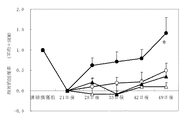
前肢機能評価は、凍結損傷21日後、28日後、35日後、42日後および49日後に実施した。評価実施前日にマウスに摂餌制限(1.5g/匹)を施した。また、試験環境に馴化する目的でマウスを試験実施1時間前に行動実験部屋に静置した。また、試験装置への警戒心を弱くする目的でホームケージから床敷を一摘み試験装置内に撒いた。運動学習と同様の方法で成功率を算出した。運動学習最終日(凍結損傷前)の成功率を1とし、凍結損傷21日後の成功率を0として相対的回復率を求めた。結果を図1に示す。 Forelimb function evaluation was performed 21 days, 28 days, 35 days, 42 days and 49 days after freezing injury. On the day before the evaluation, mice were subjected to food restriction (1.5 g / animal). In order to acclimatize to the test environment, the mice were left in the behavioral experiment room 1 hour before the test. In addition, for the purpose of weakening the alertness to the test apparatus, a single floor was taken from the home cage and placed in the test apparatus. The success rate was calculated in the same way as motor learning. The relative recovery rate was calculated by setting the success rate on the last day of motor learning (before freezing injury) as 1 and the success rate after 21 days of freezing injury as 0. The results are shown in FIG.
化合物A投与および訓練群(●)は、他の群(△、○、▲)に比べて、短期間に顕著に高い相対的回復率を示した(図1)。 The compound A administration and training groups (●) showed a significantly higher relative recovery rate in a short period of time compared to the other groups (Δ, ○, ▲) (FIG. 1).
試験例2 マウス内包出血モデルを用いて、内包出血による脳損傷後に失われた前肢機能の訓練による回復効果を促進する作用を確認した。
プロスワン(Plos One)、第8巻、e67691(2013年)、およびビヘイビオーラル・ブレイン・リサーチ(Behav Brain Res.)、第20巻、第225号、第126-34頁(2011年)を参考にして、以下の方法で試験を実施した。Test Example 2 Using a mouse internal hemorrhage model, the effect of promoting the recovery effect by training the forelimb function lost after brain injury due to internal hemorrhage was confirmed.
See Plos One, Volume 8, e67691 (2013), and Behavioral Brain Research,
試験には、6週齡の雄性C57BL/6Jマウス(日本チャールスリバー)を使用した。マウスは、餌および水を自由に摂取でき、12時間の明暗サイクル(明期;7:00-19:00、暗期;19:00-7:00)の環境で飼育した。 For the test, 6-week-old male C57BL / 6J mice (Nippon Charles River) were used. Mice were allowed free access to food and water and were housed in a 12-hour light-dark cycle (light period; 7: 00-19: 00, dark period; 19: 00-7: 00).
表2に示す群構成で試験を行った。群分けは無作為に行った。 The test was conducted in the group configuration shown in Table 2. Grouping was done randomly.
4面のうち前面のみが透明で、他3面は黒色のアクリル製の方形の囲い(縦×横×高さ;15×8.5×20cm)を用いた。前面向かって右側に幅0.5cm×高さ13cmのスリットを施した。餌台は、幅8.5 cm×高さ1.25cmの透明のアクリル製の板を用いた。評価に使用する餌は、アーモンドダイス(ケーズファクトリー株式会社)を使用した。 Of the four surfaces, only the front surface was transparent, and the other three surfaces used a black acrylic square enclosure (length x width x height; 15 x 8.5 x 20 cm). A slit with a width of 0.5 cm and a height of 13 cm was made on the right side of the front. A transparent acrylic plate having a width of 8.5 cm and a height of 1.25 cm was used as the feeding stand. Almond dice (K's Factory Co., Ltd.) was used as the bait used for evaluation.
試験環境に馴化する目的で、マウスを馴化操作前に1時間程度、行動実験部屋に静置した。また、試験装置への警戒心を弱くする目的で、ホームケージから床敷を一摘み試験装置内に撒いた。
マウスを試験装置に馴化させる目的で、4日間の馴化操作を行った。具体的には、1日目はマウスを試験装置内に入れ、10分間自由に探索させた。1日目の馴化操作後、アーモンドダイスと破砕した普通餌を混ぜた餌でマウスに摂餌制限(1.5g/匹)をかけた。以後、馴化操作が終了するまで摂餌制限を施した。2日目は試験装置内のスリットがある位置に一摘みのアーモンドダイスを置き、マウスを試験装置内に入れ、10分間自由に探索させた。3日目は2日目と同じ位置に加え、試験装置外に置いた餌台のスリットの位置に一摘みのアーモンドダイスを置き、マウスを試験装置内に入れ、10分間自由に探索させた。4日目は試験装置外に置いた餌台のスリットの位置にのみ一摘みのアーモンドダイスを置き、マウスを試験装置内に入れ、10分間自由に探索させた。For the purpose of acclimatization to the test environment, the mice were left in the behavior experimental room for about 1 hour before the acclimatization operation. In addition, for the purpose of weakening the alertness to the test apparatus, a single floor was taken from the home cage and placed in the test apparatus.
For the purpose of acclimatizing the mouse to the test apparatus, acclimatization for 4 days was performed. Specifically, on the first day, mice were placed in the test apparatus and allowed to search freely for 10 minutes. After the habituation operation on the first day, the mice were subjected to food restriction (1.5 g / animal) with a mixture of almond dice and crushed normal food. Thereafter, feeding restriction was applied until the habituation operation was completed. On the second day, a pinch of almond dies were placed in the test apparatus at the position where there was a slit, and the mouse was placed in the test apparatus and allowed to explore freely for 10 minutes. On the third day, in addition to the same position as the second day, a pinch of almond dice was placed at the position of the slit on the feeding platform placed outside the test apparatus, and the mouse was placed in the test apparatus and allowed to explore freely for 10 minutes. On the 4th day, a pinch of almond dice was placed only at the position of the slit on the feeding platform placed outside the test apparatus, and the mouse was placed in the test apparatus and allowed to explore freely for 10 minutes.
試験装置外に置いた餌台から左前肢でアーモンドダイスを取得することを学習させる目的で、4日間の運動学習操作を行った。学習開始前日から馴化操作と同様にマウスに摂餌制限を施した。また、馴化操作と同様に試験環境に馴化する目的で、マウスを学習操作前に1時間程度、行動実験部屋に静置した。さらに、試験装置への警戒心を弱くする目的で、ホームケージから床敷を一摘み試験装置内に撒いた。
運動学習は、スリット左端の延長線上にアーモンドダイスを1粒置き、この餌の取得方法を評価することで行った。この餌の位置は、マウスが右前肢でエサに触れることが出来ない位置である。1日の試行回数は30回とした。また、試験時間は最大20分とし、試行回数が30回に満たない場合でも試験開始から20分経過した時点でその日の試行を終了した。
マウスが左前肢をスリットから伸ばし、アーモンドダイスを落とすことなく口まで運べた場合を成功とした。マウスがアーモンドダイスを弾いた場合、アーモンドダイスを口に運ぶまでに落とした場合、アーモンドダイスに触れることなく前肢をスリットから伸ばした場合または舌でアーモンドダイスを取得した場合を失敗とした。全試行数に対する成功試行数の割合を成功率として算出し、4日目の成功率が25%を超えた個体のみを以下の試験に使用した。For the purpose of learning to acquire almond dice with the left forelimb from a feeding stand placed outside the test apparatus, a 4-day motor learning operation was performed. From the day before the start of learning, the mice were restricted from feeding in the same manner as the habituation operation. In addition, for the purpose of acclimatization to the test environment as in the habituation operation, the mouse was left in the behavior experiment room for about 1 hour before the learning operation. Furthermore, for the purpose of weakening the alertness to the test apparatus, a single floor was taken from the home cage and placed in the test apparatus.
Motor learning was performed by placing one almond dice on the extension of the left end of the slit and evaluating the method of obtaining this food. This bait position is a position where the mouse cannot touch the food with the right forelimb. The number of trials per day was 30. In addition, the test time was set to 20 minutes at the maximum, and even when the number of trials was less than 30, the trial for that day was completed when 20 minutes passed from the start of the test.
The case where the mouse extended the left forelimb from the slit and carried it to the mouth without dropping the almond dice was regarded as successful. The case where the mouse played the almond dice, dropped it before the almond dice was brought into the mouth, extended the forelimb from the slit without touching the almond dice, or acquired the almond dice with the tongue was regarded as failure. The ratio of the number of successful trials to the total number of trials was calculated as a success rate, and only individuals whose success rate on the fourth day exceeded 25% were used in the following tests.
内包からの出血を惹起するために、コラゲナーゼ(Collagenase IV-S, Sigma Aldrich, C5138)を用いた。 Collagenase (Collagenase IV-S, Sigma Aldrich, C5138) was used to induce bleeding from the endothelium.
運動学習最終日に成功率が25%を超えた個体のみに損傷を加えた。
マウスの全身麻酔には、イソフルランを用いた。麻酔をかけたマウスを脳定位固定装置に固定し、頭皮を正中方向に切開し、頭頂骨を露出させた。ブレグマから右側頭方向に2.2 mm、後頭方向に1.0 mmの位置にスキンマーカーでマーキングした。マーキングした箇所を中心として頭頂骨を電動トレフィン(直径2.3 mm)で円形に除去した。頭頂骨除去部位中心にマイクロシリンジ(35gage)を深さ3.5mmまで刺入し5分静置した後に、生理食塩水で溶解し0.03 mg/mLの濃度に希釈したコラゲナーゼ(Collagenase IV-S, Sigma Aldrich, C5138)を毎分0.1μLの流速で合計0.5μLをインジェクションした。インジェクション後7分静置したあとにマイクロシリンジを抜針した。抜針後、頭皮を縫合し、麻酔から回復させた。内包出血惹起直後の個体に対しては、摂食・摂水がしやすいように、水分を含ませて柔らかくした餌を動物のそばに置いた。Only individuals whose success rate exceeded 25% on the last day of motor learning were injured.
Isoflurane was used for general anesthesia of mice. The anesthetized mouse was fixed to a stereotaxic apparatus, the scalp was incised in the midline direction, and the parietal bone was exposed. The skin marker was marked at a position of 2.2 mm in the right temporal direction and 1.0 mm in the occipital direction from the bregma. The parietal bone was removed in a circle with an electric trephine (diameter 2.3 mm) around the marked part. A collagen syringe (Collagenase IV-S, Sigma) dissolved in physiological saline and diluted to a concentration of 0.03 mg / mL after inserting a microsyringe (35 gage) into the center of the parietal bone removal site to a depth of 3.5 mm and allowing to stand for 5 minutes. Aldrich, C5138) was injected at a flow rate of 0.1 μL / min for a total of 0.5 μL. The microsyringe was pulled out after leaving still for 7 minutes after injection. After removing the needle, the scalp was sutured to recover from anesthesia. For individuals immediately after the induction of internal hemorrhage, a soft food containing water was placed near the animals so that they could easily eat and drink water.
内包出血惹起7日後、14日後および21日後に、運動学習と同様の方法で、前肢運動機能を評価し、成功率の平均値を内包出血後の運動機能の成績とした。 After 7 days, 14 days, and 21 days after the onset of hemorrhage, the forelimb motor function was evaluated by the same method as motor learning, and the average success rate was the result of motor function after internal hemorrhage.
内包出血惹起21日後の評価終了後から、試験化合物を1日1回経口投与した。群分けは無作為に行った。投与液として、蒸留水に溶解した化合物A溶液(2mg/mL)を調製した。化合物A溶液の投与量は、10mL/kgとした。対照群には、蒸留水を投与した。 The test compound was orally administered once a day from the end of the evaluation 21 days after the induction of internal hemorrhage. Grouping was done randomly. As an administration solution, a compound A solution (2 mg / mL) dissolved in distilled water was prepared. The dose of the compound A solution was 10 mL / kg. Distilled water was administered to the control group.
訓練は、初回試験化合物投与3日後から連日行った。訓練として、試験装置外に置いた餌台のスリットの位置に一摘みのアーモンドダイスを置き、30分間自由に探索させた。訓練は試験化合物投与1時間後に行った。 Training was performed every day starting 3 days after the first test compound administration. As a training, a pinch of almond dice was placed at the position of the slit on the feeding stand placed outside the test apparatus and allowed to freely explore for 30 minutes. Training was performed 1 hour after administration of the test compound.
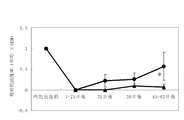
内包出血惹起31日後、38日後、45日後、52日後、59日後および63日後に、運動学習と同様の評価方法で、前肢運動機能を評価し、成功率を算出した。運動学習最終日(内包出血前)の成功率を1とし、内包出血惹起7日後、14日後および21日後(7-21日後)の成功率の平均値を0となるように相対的回復率を求めた。45-63日後の成功率は、45日後、52日後、59日後および63日後の平均値を使用した。結果を図2に示す。 After 31 days, 38 days, 45 days, 52 days, 59 days, and 63 days after the induction of internal hemorrhage, the forelimb motor function was evaluated by the same evaluation method as motor learning, and the success rate was calculated. Relative recovery rate is set so that the success rate on the last day of motor learning (before internal hemorrhage) is 1, and the average success rate after 7 days, 14 days and 21 days (7-21 days) is 0. Asked. The success rate after 45-63 days used the average value after 45 days, 52 days, 59 days and 63 days. The results are shown in FIG.
化合物A投与および訓練群(●)は、対照群(▲)に比べて、顕著に高い相対的回復率を示した(図2)。 Compound A administration and training group (●) showed a significantly higher relative recovery rate than the control group (() (FIG. 2).
試験例3 カニクイザル内包出血モデルを用いて、脳損傷後に失われた上肢機能のリハビリテーション様訓練による回復効果を促進する作用を確認した。 Test Example 3 Using a cynomolgus monkey internal hemorrhage model, the effect of promoting the recovery effect by rehabilitation-like training of upper limb function lost after brain injury was confirmed.
試験には、二頭の雄性カニクイザル(医薬基盤研究所 霊長類医科学研究センター)を使用した。カニクイザルは、餌および水を自由に摂取でき、12時間の明暗サイクル(明期;7:00-19:00、暗期;19:00-7:00)下、旧世界ザル用飼育ケージ(縦×横×高さ;79×47×80cm)で飼育した。 Two male cynomolgus monkeys (Center for Primate Medical Sciences, National Institute of Biomedical Sciences) were used for the test. The cynomolgus monkeys are free to feed and water, and under a 12-hour light-dark cycle (light period; 7: 00-19: 00, dark period; 19: 00-7: 00) X horizontal x height; 79 x 47 x 80 cm).
カニクイザルに飼育ケージの前に提示した餌を取らせることにより、運動学習および上肢機能評価を行った。評価に使用する餌は、3.5または7mm角のリンゴを使用した。 Motor learning and upper limb function evaluation were performed by feeding cynomolgus monkeys to the food presented before the cage. The food used for the evaluation was a 3.5 or 7 mm square apple.
試験装置への馴化および各個体の利き手を決定する目的で、針先につけた7mm角のリンゴをケージ前面中央に提示し、カニクイザルが餌を取る行動を観察した。全150回の試行(1日30回、5日間)で多く用いた側を利き手とした。 For the purpose of acclimatization to the test device and the dominant hand of each individual, a 7 mm square apple attached to the needle tip was presented in the center of the front of the cage, and the behavior of the cynomolgus monkey feeding was observed. The dominant hand was the dominant hand in all 150 trials (30 times a day, 5 days).
提示した餌を利き手で取得することを学習させる目的で、週5日、4週間(合計20日間)の運動学習操作を行った。上肢機能評価およびリハビリテーション様訓練に用いる以下の6種類の課題を用いて、運動学習を行った。学習当日は絶食で課題を実施した。 For the purpose of learning to acquire the presented food with the dominant hand, motor learning operation was performed 5 days a week for 4 weeks (20 days in total). Motor learning was performed using the following six types of tasks used for upper limb function evaluation and rehabilitation-like training. On the day of learning, subjects were fasted.
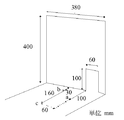
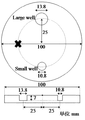
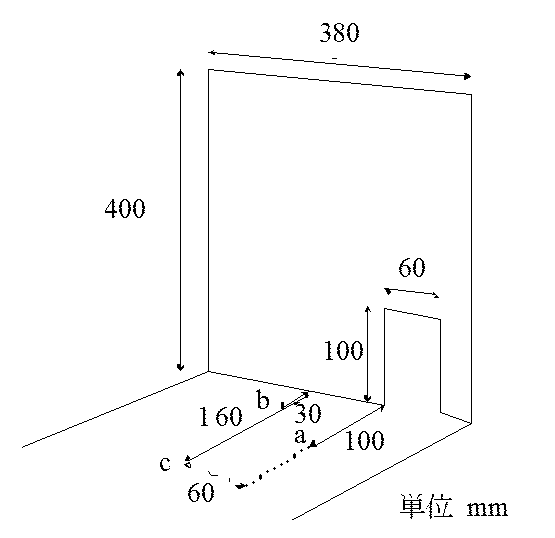
課題A:飼育ケージ前面に図3の装置を設置し、装置のスリット直前に図4のクリューバーボードを設置した。クリューバーボード上の餌を提示する位置は、スリットにもっとも近くなる位置とした。カニクイザルがスリットから手を伸ばし、クリューバーボードに開けられた孔から餌をとる行動を観察した。評価に使用する餌は、3.5mm角のリンゴを使用した。試行は、孔のない場所(図4の×印)に20回、Large wellに20回、Small wellに20回の順に実施した。 Problem A: The apparatus of FIG. 3 was installed in front of the breeding cage, and the clew bar board of FIG. 4 was installed just before the slit of the apparatus. The position where the food was presented on the cruver board was the closest to the slit. We observed the behavior of cynomolgus monkeys reaching out from the slits and feeding on the holes in the cleaver board. A 3.5 mm square apple was used as a bait for the evaluation. The trial was performed in the order of 20 times in a place without a hole (marked with x in FIG. 4), 20 times in a large well, and 20 times in a small well.
課題B:飼育ケージ前面に図3の試験装置(図3は左利き用)を設置し、カニクイザルが装置のスリットから手を伸ばし、図3のa、bおよびcの位置に置かれた餌をとる行動を観察した。評価に使用する餌は、7mm角のリンゴを使用した。試行は、各位置20回ずつ、合計60回実施した。 Task B: Install the test device of Fig. 3 (Fig. 3 is for left-handed) in front of the rearing cage, and the cynomolgus monkey reaches out from the slit of the device and takes the food placed at the positions a, b and c in Fig. 3 Observed behavior. The bait used for the evaluation was a 7 mm square apple. Trials were performed 60 times, 20 times for each position.
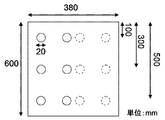
課題C:飼育ケージ前面に図5の装置を設置し、装置に開けられた孔から、針先につけた7mm角のリンゴを水平に提示した。6ヵ所の孔を使用し、右利きの場合は図5に実線の円で示された孔を、左利きの場合は図5に点線の円で示された孔を使用した。評価に使用する餌は、7mm角のリンゴを使用した。カニクイザルが孔から餌をとる行動を観察した。試行は、各孔10回ずつ、合計60回実施した。 Problem C: The apparatus of FIG. 5 was installed in front of the breeding cage, and a 7 mm square apple attached to the needle tip was presented horizontally from a hole opened in the apparatus. Six holes were used. For right-handed use, the hole indicated by a solid circle in FIG. 5 was used, and for left-handed use, the hole indicated by a dotted circle in FIG. 5 was used. The bait used for the evaluation was a 7 mm square apple. We observed the behavior of cynomolgus monkeys feeding through holes. Trials were performed 60 times, 10 times for each hole.
課題D:針先につけた7mm角のリンゴを、飼育ケージ前面から水平に提示した。カニクイザルが餌をとる行動を観察した。合計30回の試行を行った。 Task D: A 7 mm square apple attached to the tip of the needle was presented horizontally from the front of the cage. We observed the behavior of cynomolgus monkeys feeding. A total of 30 trials were performed.
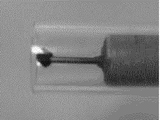
課題E1:図6のように、アクリルパイプを通して、針先につけた7mm角のリンゴを水平に提示した。カニクイザルがアクリルパイプから餌をとる行動を観察した。合計30回の試行を行った。 Problem E1: As shown in FIG. 6, a 7 mm square apple attached to the needle tip was horizontally presented through an acrylic pipe. We observed the behavior of cynomolgus monkeys feeding from acrylic pipes. A total of 30 trials were performed.
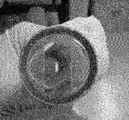
課題E2:E1と同型のアクリルパイプの先端に図7のようにスリットを設置し、針先につけた7mm角のリンゴを課題E1と同様に提示した。カニクイザルがアクリルパイプのスリットから餌をとる行動を観察した。合計30回の試行を行った。 Task E2: A 7 mm square apple with a slit installed at the tip of an acrylic pipe of the same type as E1 as shown in FIG. We observed the behavior of cynomolgus monkeys feeding through the slits in the acrylic pipe. A total of 30 trials were performed.
利き手を用いて一度の試行で餌を落とさずケージ内に引き入れた場合を成功とした。非利き手を使った場合または10秒提示しても餌を取れない場合は失敗とした。餌の提示後10秒経過しても取れない場合は、次の試行に進む前に餌をつけ替えた。最終2日間の成功率(全試行数に対する成功試行の割合)の平均値を運動学習の成績とした。 A case where the hand was pulled into the cage without dropping food in one trial using a dominant hand was regarded as successful. A failure was determined when a non-dominant hand was used or when food could not be taken after 10 seconds of presentation. If 10 seconds have passed after the food is presented, the food was changed before proceeding to the next trial. The average value of the success rate (the ratio of successful trials to the total number of trials) over the last two days was used as the motor learning result.
運動学習を終了した個体に内包出血惹起による脳損傷を加えた。 Brain injury caused by internal hemorrhage was added to individuals who completed motor learning.
内包出血モデル作製前日にMRI画像を撮影した。MRI画像の撮影は塩酸ケタミンと硫酸アトロピンの筋肉内注射で鎮静後、気管挿管し、イソフルラン吸入麻酔下でVital sign(血圧、酸素飽和度および脈拍)を観察しながらステレオ装置により頭部を固定して行った。 An MRI image was taken the day before the internal hemorrhage model was made. MRI images were taken by intramuscular injection of ketamine hydrochloride and atropine sulfate, followed by tracheal intubation, and the head was fixed with a stereo device while observing Vital sign (blood pressure, oxygen saturation, and pulse) under isoflurane inhalation anesthesia. I went.
内包からの出血を惹起するために、コラゲナーゼ(Collagenase IV-S, Sigma Aldrich, C5138)を用いた。 Collagenase (Collagenase IV-S, Sigma Aldrich, C5138) was used to induce bleeding from the endothelium.
Navigation用のMRI画像を撮像し、T1強調画像を参照し、利き手対側の内包後脚を同定した。頭頂に直径3cm程度の皮膚切開を行った。開頭時から硬膜を同定するまでの間、マンニトールを頸静脈的に投与した。マイクロシリンジ刺入部の頭骨をドリルで削り、前後10mm、幅5mm程度の頭骨を除去した。マンニトールの投与を終了し、露出された硬膜の上からNavigation systemで位置および深さを確認しながらマイクロシリンジを刺入して200U/Lコラゲナーゼを3μL注入した。中心を中心溝先端から後方3mm、被殻内側上部直上と定め、その前後および垂直方向9点に注入した。注入後、硬膜上にフランセチンを散布し、筋膜および皮膚を縫合した。 MRI images for navigation were taken, and T1 weighted images were referenced to identify the back leg of the hand on the opposite side of the dominant hand. A skin incision about 3 cm in diameter was made on the top of the head. Mannitol was administered jugularly from the time of craniotomy until the dura mater was identified. The skull of the microsyringe insertion part was sharpened with a drill, and the skull of about 10 mm front and back and about 5 mm wide was removed. Administration of mannitol was terminated, and a microsyringe was inserted from above the exposed dura mater while confirming the position and depth with a navigation system, and 3 μL of 200 U / L collagenase was injected. The center was determined to be 3 mm behind the tip of the central groove and directly above the upper part of the inner side of the shell, and injected at 9 points in the front-rear and vertical directions. After injection, francetin was sprayed on the dura mater and the fascia and skin were sutured.
内包出血惹起1日後、3-5日後、7日後および14日後にMRI画像を撮像し、内包出血による脳の損傷体積を概算し、損傷体積に著しい差が無いことを確認した。 MRI images were taken 1 day, 3-5 days, 7 days, and 14 days after the induction of internal hemorrhage, the brain damage volume due to internal hemorrhage was estimated, and it was confirmed that there was no significant difference in the damage volume.
内包出血惹起1-14日後、麻痺側上肢の使用が観察されるまでの間、ケージ内の自由行動を観察しながら、麻痺側上肢の廃用予防のため、他動的な屈曲伸展および把握動作をそれぞれ15分間施した。 Passive flexion and extension and grasping motion to prevent disuse of the paralyzed upper limb while observing the free behavior in the cage until the use of the paralyzed upper limb is observed 1-14 days after the induction of internal hemorrhage For 15 minutes each.
損傷を施した二頭の雄性カニクイザルのうち一頭には、化合物A投与およびリハビリテーション様訓練を実施した。もう一頭には化合物A投与を行わず、内包出血惹起後の自然回復経過およびリハビリテーション様訓練による回復を観察した。 One of the two injured male cynomolgus monkeys was administered Compound A and rehabilitation-like training. Compound A was not administered to the other animal, and the course of spontaneous recovery after the induction of internal hemorrhage and recovery by rehabilitation-like training were observed.
表3に示す群構成で試験を行った。 The test was conducted with the group configuration shown in Table 3.
針先につけた7mm角のリンゴをケージ前面に提示し、リンゴに対して随意的リーチが可能か観察した。麻痺側上肢による随意的リーチが見られた翌日から、クリューバーボード(図4)上の孔のない場所に餌を提示し、麻痺側上肢を用いた随意的リーチが可能か観察した。麻痺側上肢を用いてクリューバーボードへの随意的リーチが見られた日を麻痺側上肢使用0日目とし、翌日(麻痺側上肢使用1日後)から、上肢運動機能評価、化合物A投与およびリハビリテーション様訓練を実施した。 A 7mm square apple attached to the tip of the needle was presented on the front of the cage, and it was observed whether an arbitrary reach was possible for the apple. From the next day when voluntary reach by the paralyzed upper limb was seen, food was presented in a place without a hole on the cleaver board (FIG. 4), and it was observed whether voluntary reach using the paralyzed upper limb was possible. The day when voluntary reach to the club bar using the paralyzed upper limb was observed was defined as the first day of use on the paralyzed upper limb, and from the next day (one day after use of the paralyzed upper limb), evaluation of upper limb motor function, administration of Compound A and rehabilitation The training was conducted.
麻痺側上肢使用1日後から毎日午前中に、上肢機能評価として、前述の運動学習と同じ課題を実施した。デジタルビデオカメラを用いて各試行の成否を評価するための映像を撮影した。 The same task as the motor learning described above was performed as an upper limb function evaluation in the morning every day after using the upper limb on the paralyzed side. Images were taken using a digital video camera to evaluate the success of each trial.
化合物Aは、麻痺側上肢使用1日後から試験終了まで、毎日午後に1日1回、筋肉内投与で、上肢運動機能評価後に投与した。大塚糖液5%に溶解した化合物A溶液(15mg/mL)を投与液とし、投与量は、0.2mL/kgとした。 Compound A was administered intramuscularly once daily in the afternoon from 1 day after use of the paralyzed upper limb until the end of the test, and after administration of the upper limb motor function evaluation. Compound A solution (15 mg / mL) dissolved in 5% Otsuka sugar solution was used as the administration solution, and the dosage was 0.2 mL / kg.
リハビリテーション様訓練は課題装置への随意的リーチが可能になった翌日から、前述の運動学習と同じ課題を評価終了まで毎日実施した。化合物A投与個体には、投与後2時間以内にリハビリテーション様訓練を実施した。 The rehabilitation-like training was carried out every day from the day after the voluntary reach to the task device became possible until the end of evaluation. Rehabilitation-like training was performed within 2 hours after administration to the compound A-administered individuals.
記録した映像を基に、餌を取る手の動きの詳細な観察と、試行毎の成否を評価した。 Based on the recorded images, detailed observation of the movement of the hand taking food and the success or failure of each trial were evaluated.
脳損傷後、化合物A投与およびリハビリテーション様訓練を実施した個体では顕著な回復傾向が見られた。また、この個体では、リハビリテーション様訓練開始後、脳損傷前と同様の精密把握が観察された。化合物A投与を行わなかった個体では、リハビリテーション様訓練を開始しても障害後の回復は限定的であり、精密把握も見られなかった。 After brain injury, a marked recovery trend was observed in individuals who received Compound A administration and rehabilitation-like training. In this individual, the same precise grasp as before brain injury was observed after the start of rehabilitation-like training. In individuals who did not receive Compound A, recovery after injury was limited even when rehabilitation-like training was started, and precise grasp was not seen.
製剤例1
化合物A50mg、乳糖60mg、セオラスPH302(旭化成ケミカルズ社製)60mg、コリドンCL(BASF社製)4mgおよびステアリン酸マグネシウム1mgの混合物を混合し、1錠重量175mg、直径7mmの円形錠に打錠し、化合物A50mgを含有する錠剤を得た。Formulation Example 1
Compound A 50 mg,
製剤例2
化合物A50mg、D−マンニトール60mg、スターチ1500(カラコン社製)39mgおよびステアリン酸マグネシウム1mgの混合物を混合し、1カプセル当たり150mgを4号ゼラチンカプセルに充填し、カプセル剤を得た。Formulation Example 2
A mixture of 50 mg of Compound A, 60 mg of D-mannitol, 39 mg of Starch 1500 (manufactured by Colorcon) and 1 mg of magnesium stearate was mixed, and 150 mg per capsule was filled into a No. 4 gelatin capsule to obtain a capsule.
Claims (1)
A rehabilitation effect promoter after nerve injury characterized by containing 1- (3- (2- (1-benzothiophen-5-yl) ethoxy) propyl) azetidin-3-ol or a salt thereof .
Priority Applications (1)
| Application Number | Priority Date | Filing Date | Title |
|---|---|---|---|
| JP2015539315A JP5837726B1 (en) | 2014-01-31 | 2015-01-30 | Rehabilitation effect promoter after nerve injury containing alkyl ether derivative or salt thereof |
Applications Claiming Priority (4)
| Application Number | Priority Date | Filing Date | Title |
|---|---|---|---|
| JP2014017587 | 2014-01-31 | ||
| JP2014017587 | 2014-01-31 | ||
| PCT/JP2015/052617 WO2015115582A1 (en) | 2014-01-31 | 2015-01-30 | Post nerve injury rehabilitation effect-enhancing agent comprising alkyl ether derivative or salt thereof |
| JP2015539315A JP5837726B1 (en) | 2014-01-31 | 2015-01-30 | Rehabilitation effect promoter after nerve injury containing alkyl ether derivative or salt thereof |
Related Child Applications (1)
| Application Number | Title | Priority Date | Filing Date |
|---|---|---|---|
| JP2015216722A Division JP6642914B2 (en) | 2014-01-31 | 2015-11-04 | Rehabilitation effect enhancer after nerve injury containing alkyl ether derivative or salt thereof |
Publications (2)
| Publication Number | Publication Date |
|---|---|
| JP5837726B1 true JP5837726B1 (en) | 2015-12-24 |
| JPWO2015115582A1 JPWO2015115582A1 (en) | 2017-03-23 |
Family
ID=53757150
Family Applications (3)
| Application Number | Title | Priority Date | Filing Date |
|---|---|---|---|
| JP2015539315A Active JP5837726B1 (en) | 2014-01-31 | 2015-01-30 | Rehabilitation effect promoter after nerve injury containing alkyl ether derivative or salt thereof |
| JP2015216722A Active JP6642914B2 (en) | 2014-01-31 | 2015-11-04 | Rehabilitation effect enhancer after nerve injury containing alkyl ether derivative or salt thereof |
| JP2019236541A Active JP6825074B2 (en) | 2014-01-31 | 2019-12-26 | Post-nerve rehabilitation enhancer containing alkyl ether derivative or salt thereof |
Family Applications After (2)
| Application Number | Title | Priority Date | Filing Date |
|---|---|---|---|
| JP2015216722A Active JP6642914B2 (en) | 2014-01-31 | 2015-11-04 | Rehabilitation effect enhancer after nerve injury containing alkyl ether derivative or salt thereof |
| JP2019236541A Active JP6825074B2 (en) | 2014-01-31 | 2019-12-26 | Post-nerve rehabilitation enhancer containing alkyl ether derivative or salt thereof |
Country Status (26)
| Country | Link |
|---|---|
| US (2) | US10039744B2 (en) |
| EP (1) | EP3100725B1 (en) |
| JP (3) | JP5837726B1 (en) |
| KR (1) | KR102346219B1 (en) |
| CN (1) | CN106061478B (en) |
| AU (1) | AU2015211753B2 (en) |
| BR (1) | BR112016017747A2 (en) |
| CA (1) | CA2938184C (en) |
| CY (1) | CY1123154T1 (en) |
| DK (1) | DK3100725T3 (en) |
| ES (1) | ES2792950T3 (en) |
| HR (1) | HRP20200796T1 (en) |
| HU (1) | HUE050400T2 (en) |
| IL (1) | IL246925B (en) |
| LT (1) | LT3100725T (en) |
| MX (1) | MX2016009751A (en) |
| MY (1) | MY179290A (en) |
| PH (1) | PH12016501507A1 (en) |
| PL (1) | PL3100725T3 (en) |
| PT (1) | PT3100725T (en) |
| RS (1) | RS60462B1 (en) |
| RU (1) | RU2680247C2 (en) |
| SG (2) | SG11201606173TA (en) |
| SI (1) | SI3100725T1 (en) |
| SM (1) | SMT202000395T1 (en) |
| WO (1) | WO2015115582A1 (en) |
Cited By (1)
| Publication number | Priority date | Publication date | Assignee | Title |
|---|---|---|---|---|
| JP2016074676A (en) * | 2014-01-31 | 2016-05-12 | 富山化学工業株式会社 | Rehabilitation effect promoter after nerve injury containing alkyl ether derivative or salt thereof |
Families Citing this family (11)
| Publication number | Priority date | Publication date | Assignee | Title |
|---|---|---|---|---|
| WO2017111005A1 (en) * | 2015-12-25 | 2017-06-29 | 富山化学工業株式会社 | Tablet comprising 1-(3-(2-(1-benzothiophen-5-yl)ethoxy)propyl)azetidin-3-ol or salt thereof |
| EP3563846B1 (en) * | 2016-12-28 | 2023-07-19 | FUJIFILM Toyama Chemical Co., Ltd. | Pharmaceutical composition and method for producing the same |
| WO2018124284A1 (en) * | 2016-12-28 | 2018-07-05 | 富山化学工業株式会社 | Pharmaceutical composition |
| WO2018124283A1 (en) * | 2016-12-28 | 2018-07-05 | 富山化学工業株式会社 | Pharmaceutical composition |
| WO2018124281A1 (en) * | 2016-12-28 | 2018-07-05 | 富山化学工業株式会社 | Topical composition |
| KR20200003102A (en) | 2017-06-02 | 2020-01-08 | 후지필름 도야마 케미컬 가부시키가이샤 | Amyloid β Protein Amount Reducing Agent |
| CN110691594A (en) * | 2017-06-02 | 2020-01-14 | 富士胶片富山化学株式会社 | Prophylactic or therapeutic agent for tauopathies |
| JP7282028B2 (en) * | 2017-06-02 | 2023-05-26 | 富士フイルム富山化学株式会社 | Cerebral atrophy preventive or therapeutic agent |
| RU2728717C1 (en) * | 2017-06-02 | 2020-07-30 | ФУДЖИФИЛМ Тояма Кемикал Ко., Лтд. | Agent for preventing or treating spinal carbellar ataxia |
| US11541033B2 (en) | 2017-06-02 | 2023-01-03 | Fujifilm Toyama Chemical Co., Ltd. | Agent for preventing or treating Alzheimer's disease |
| JP7227914B2 (en) | 2017-10-30 | 2023-02-22 | 富士フイルム富山化学株式会社 | Emopamil-binding protein binding agent and its use |
Citations (1)
| Publication number | Priority date | Publication date | Assignee | Title |
|---|---|---|---|---|
| JP2013177410A (en) * | 2006-04-26 | 2013-09-09 | Toyama Chem Co Ltd | Neurogenesis inducer and neuropathy therapeutic agent comprising alkyl ether derivative or salt of the same |
Family Cites Families (8)
| Publication number | Priority date | Publication date | Assignee | Title |
|---|---|---|---|---|
| CA2464358C (en) * | 2001-10-19 | 2011-05-24 | Toyama Chemical Co., Ltd. | Alkyl ether derivatives or their salts |
| WO2003045137A1 (en) * | 2001-11-29 | 2003-06-05 | Japan Science And Technology Agency | Method of constructing spinal injury model monkey and utilization thereof |
| KR100935615B1 (en) * | 2002-06-14 | 2010-01-07 | 토야마 케미칼 컴퍼니 리미티드 | Pharmaceutical composition to improve brain function and method for improving brain function |
| ZA200508166B (en) * | 2003-04-17 | 2007-03-28 | Toyama Chemical Co Ltd | Preventive/remedy for retinal nerve diseases containing alkyl ether derivatives or salts thereof |
| SI2348022T1 (en) | 2005-03-28 | 2013-05-31 | Toyama Chemical Co., Ltd. | Process for production of 1-(3-(2-(1-benzothiophen-5-yl)ethoxy)propyl)azetidin-3-ol or salts thereof |
| RU2397169C2 (en) * | 2005-03-28 | 2010-08-20 | Тояма Кемикал Ко., Лтд. | Method for preparing 1-(3-(2-(1-benzothiophene-5-yl)ethoxy)propyl)azetidine-3-ol or its salts |
| US8119625B2 (en) * | 2006-04-26 | 2012-02-21 | Toyama Chemical Co., Ltd. | Neurogenesis inducer or neuropathy therapeutic agent comprising alkyl ether derivative or salt thereof |
| AU2015211753B2 (en) * | 2014-01-31 | 2019-09-12 | Fujifilm Toyama Chemical Co., Ltd. | Post nerve injury rehabilitation effect-enhancing agent comprising alkyl ether derivative or salt thereof |
-
2015
- 2015-01-30 AU AU2015211753A patent/AU2015211753B2/en active Active
- 2015-01-30 PT PT157433673T patent/PT3100725T/en unknown
- 2015-01-30 PL PL15743367T patent/PL3100725T3/en unknown
- 2015-01-30 SG SG11201606173TA patent/SG11201606173TA/en unknown
- 2015-01-30 ES ES15743367T patent/ES2792950T3/en active Active
- 2015-01-30 LT LTEP15743367.3T patent/LT3100725T/en unknown
- 2015-01-30 EP EP15743367.3A patent/EP3100725B1/en active Active
- 2015-01-30 KR KR1020167023717A patent/KR102346219B1/en active Active
- 2015-01-30 WO PCT/JP2015/052617 patent/WO2015115582A1/en not_active Ceased
- 2015-01-30 CN CN201580011450.3A patent/CN106061478B/en active Active
- 2015-01-30 SG SG10201907035TA patent/SG10201907035TA/en unknown
- 2015-01-30 RU RU2016135236A patent/RU2680247C2/en active
- 2015-01-30 RS RS20200754A patent/RS60462B1/en unknown
- 2015-01-30 SI SI201531278T patent/SI3100725T1/en unknown
- 2015-01-30 US US15/115,416 patent/US10039744B2/en active Active
- 2015-01-30 DK DK15743367.3T patent/DK3100725T3/en active
- 2015-01-30 JP JP2015539315A patent/JP5837726B1/en active Active
- 2015-01-30 MY MYPI2016702668A patent/MY179290A/en unknown
- 2015-01-30 HU HUE15743367A patent/HUE050400T2/en unknown
- 2015-01-30 BR BR112016017747A patent/BR112016017747A2/en not_active Application Discontinuation
- 2015-01-30 MX MX2016009751A patent/MX2016009751A/en active IP Right Grant
- 2015-01-30 CA CA2938184A patent/CA2938184C/en active Active
- 2015-01-30 HR HRP20200796TT patent/HRP20200796T1/en unknown
- 2015-01-30 SM SM20200395T patent/SMT202000395T1/en unknown
- 2015-11-04 JP JP2015216722A patent/JP6642914B2/en active Active
-
2016
- 2016-07-25 IL IL24692516A patent/IL246925B/en active IP Right Grant
- 2016-07-29 PH PH12016501507A patent/PH12016501507A1/en unknown
-
2018
- 2018-06-12 US US16/005,774 patent/US10471044B2/en active Active
-
2019
- 2019-12-26 JP JP2019236541A patent/JP6825074B2/en active Active
-
2020
- 2020-07-23 CY CY20201100673T patent/CY1123154T1/en unknown
Patent Citations (1)
| Publication number | Priority date | Publication date | Assignee | Title |
|---|---|---|---|---|
| JP2013177410A (en) * | 2006-04-26 | 2013-09-09 | Toyama Chem Co Ltd | Neurogenesis inducer and neuropathy therapeutic agent comprising alkyl ether derivative or salt of the same |
Non-Patent Citations (1)
| Title |
|---|
| JPN6015014605; Neurochem Int. 48(2), 2006, 124-30 * |
Cited By (1)
| Publication number | Priority date | Publication date | Assignee | Title |
|---|---|---|---|---|
| JP2016074676A (en) * | 2014-01-31 | 2016-05-12 | 富山化学工業株式会社 | Rehabilitation effect promoter after nerve injury containing alkyl ether derivative or salt thereof |
Also Published As
Similar Documents
| Publication | Publication Date | Title |
|---|---|---|
| JP6825074B2 (en) | Post-nerve rehabilitation enhancer containing alkyl ether derivative or salt thereof | |
| JP5695293B2 (en) | Neuronal neurogenesis-inducing agent and psychiatric disorder therapeutic agent containing alkyl ether derivative or salt thereof | |
| JP2003525903A (en) | New uses of cholinesterase inhibitors | |
| NO332847B1 (en) | Use of NK-1 receptor antagonists for the preparation of a drug for intravenous formulation for the treatment and / or prevention of brain, spinal cord or nerve damage | |
| US7834053B2 (en) | Medicinal compositions improving brain function and method for improving brain function | |
| EP2477624B1 (en) | Compounds for use in the treatment of seizure disorders | |
| WO2016199878A1 (en) | Sigma-receptor binding agent | |
| EP1919477B1 (en) | Use of [2-(2-methylimidazol-1-yl)methyl]pyridine for treating sleep disorders | |
| EP1003513A1 (en) | Medicinal product and method for treatment and prevention of cognitive disorders | |
| HK1226298B (en) | Post nerve injury rehabilitation effect-enhancing agent comprising an alkyl ether derivative or a salt thereof | |
| GB2244431A (en) | Treatment of age related memory impairment and other cognitive disorders | |
| NZ722542B2 (en) | Post nerve injury rehabilitation effect-enhancing agent comprising alkyl ether derivative or salt thereof | |
| WO2001007043A1 (en) | Azetidine carboxamide derivatives for the treatment of cns disorders | |
| JPWO2006006617A1 (en) | Recovery promoter for dysfunction after onset of central nervous disease | |
| JPH0840902A (en) | Pharmaceutical composition useful for the treatment of peripheral neuropathy and central nervous degenerative disease | |
| JP4598674B2 (en) | Schizophrenia treatment | |
| KR20000057643A (en) | Remedies/Preventives for Abnormal Movements Accompanying Disorders in Etrapyramidal System | |
| WO2015115509A1 (en) | Therapeutic or prophylactic agent for multiple sclerosis | |
| CN103989667A (en) | Drug for treating senile dementia |
Legal Events
| Date | Code | Title | Description |
|---|---|---|---|
| A871 | Explanation of circumstances concerning accelerated examination |
Free format text: JAPANESE INTERMEDIATE CODE: A871 Effective date: 20150813 |
|
| A521 | Request for written amendment filed |
Free format text: JAPANESE INTERMEDIATE CODE: A523 Effective date: 20150806 |
|
| A621 | Written request for application examination |
Free format text: JAPANESE INTERMEDIATE CODE: A621 Effective date: 20150806 |
|
| A975 | Report on accelerated examination |
Free format text: JAPANESE INTERMEDIATE CODE: A971005 Effective date: 20150916 |
|
| TRDD | Decision of grant or rejection written | ||
| A01 | Written decision to grant a patent or to grant a registration (utility model) |
Free format text: JAPANESE INTERMEDIATE CODE: A01 Effective date: 20151006 |
|
| A61 | First payment of annual fees (during grant procedure) |
Free format text: JAPANESE INTERMEDIATE CODE: A61 Effective date: 20151105 |
|
| R150 | Certificate of patent or registration of utility model |
Ref document number: 5837726 Country of ref document: JP Free format text: JAPANESE INTERMEDIATE CODE: R150 |
|
| R250 | Receipt of annual fees |
Free format text: JAPANESE INTERMEDIATE CODE: R250 |
|
| S111 | Request for change of ownership or part of ownership |
Free format text: JAPANESE INTERMEDIATE CODE: R313111 |
|
| R350 | Written notification of registration of transfer |
Free format text: JAPANESE INTERMEDIATE CODE: R350 |
|
| R250 | Receipt of annual fees |
Free format text: JAPANESE INTERMEDIATE CODE: R250 |
|
| R250 | Receipt of annual fees |
Free format text: JAPANESE INTERMEDIATE CODE: R250 |
|
| R250 | Receipt of annual fees |
Free format text: JAPANESE INTERMEDIATE CODE: R250 |
|
| R250 | Receipt of annual fees |
Free format text: JAPANESE INTERMEDIATE CODE: R250 |
|
| R250 | Receipt of annual fees |
Free format text: JAPANESE INTERMEDIATE CODE: R250 |
|
| R250 | Receipt of annual fees |
Free format text: JAPANESE INTERMEDIATE CODE: R250 |
|
| R250 | Receipt of annual fees |
Free format text: JAPANESE INTERMEDIATE CODE: R250 |