JP5815744B2 - Insoluble azo pigment C.I. Pigment Yellow 74 and coloring composition using the same - Google Patents
Insoluble azo pigment C.I. Pigment Yellow 74 and coloring composition using the same Download PDFInfo
- Publication number
- JP5815744B2 JP5815744B2 JP2013551648A JP2013551648A JP5815744B2 JP 5815744 B2 JP5815744 B2 JP 5815744B2 JP 2013551648 A JP2013551648 A JP 2013551648A JP 2013551648 A JP2013551648 A JP 2013551648A JP 5815744 B2 JP5815744 B2 JP 5815744B2
- Authority
- JP
- Japan
- Prior art keywords
- pigment
- peak
- coloring composition
- particles
- powder
- Prior art date
- Legal status (The legal status is an assumption and is not a legal conclusion. Google has not performed a legal analysis and makes no representation as to the accuracy of the status listed.)
- Active
Links
Images
Classifications
-
- C—CHEMISTRY; METALLURGY
- C09—DYES; PAINTS; POLISHES; NATURAL RESINS; ADHESIVES; COMPOSITIONS NOT OTHERWISE PROVIDED FOR; APPLICATIONS OF MATERIALS NOT OTHERWISE PROVIDED FOR
- C09B—ORGANIC DYES OR CLOSELY-RELATED COMPOUNDS FOR PRODUCING DYES, e.g. PIGMENTS; MORDANTS; LAKES
- C09B51/00—Nitro or nitroso dyes
-
- C—CHEMISTRY; METALLURGY
- C09—DYES; PAINTS; POLISHES; NATURAL RESINS; ADHESIVES; COMPOSITIONS NOT OTHERWISE PROVIDED FOR; APPLICATIONS OF MATERIALS NOT OTHERWISE PROVIDED FOR
- C09B—ORGANIC DYES OR CLOSELY-RELATED COMPOUNDS FOR PRODUCING DYES, e.g. PIGMENTS; MORDANTS; LAKES
- C09B29/00—Monoazo dyes prepared by diazotising and coupling
- C09B29/32—Monoazo dyes prepared by diazotising and coupling from coupling components containing a reactive methylene group
- C09B29/33—Aceto- or benzoylacetylarylides
-
- B—PERFORMING OPERATIONS; TRANSPORTING
- B41—PRINTING; LINING MACHINES; TYPEWRITERS; STAMPS
- B41J—TYPEWRITERS; SELECTIVE PRINTING MECHANISMS, i.e. MECHANISMS PRINTING OTHERWISE THAN FROM A FORME; CORRECTION OF TYPOGRAPHICAL ERRORS
- B41J2/00—Typewriters or selective printing mechanisms characterised by the printing or marking process for which they are designed
- B41J2/005—Typewriters or selective printing mechanisms characterised by the printing or marking process for which they are designed characterised by bringing liquid or particles selectively into contact with a printing material
- B41J2/01—Ink jet
-
- C—CHEMISTRY; METALLURGY
- C09—DYES; PAINTS; POLISHES; NATURAL RESINS; ADHESIVES; COMPOSITIONS NOT OTHERWISE PROVIDED FOR; APPLICATIONS OF MATERIALS NOT OTHERWISE PROVIDED FOR
- C09B—ORGANIC DYES OR CLOSELY-RELATED COMPOUNDS FOR PRODUCING DYES, e.g. PIGMENTS; MORDANTS; LAKES
- C09B29/00—Monoazo dyes prepared by diazotising and coupling
- C09B29/10—Monoazo dyes prepared by diazotising and coupling from coupling components containing hydroxy as the only directing group
- C09B29/12—Monoazo dyes prepared by diazotising and coupling from coupling components containing hydroxy as the only directing group of the benzene series
-
- C—CHEMISTRY; METALLURGY
- C09—DYES; PAINTS; POLISHES; NATURAL RESINS; ADHESIVES; COMPOSITIONS NOT OTHERWISE PROVIDED FOR; APPLICATIONS OF MATERIALS NOT OTHERWISE PROVIDED FOR
- C09B—ORGANIC DYES OR CLOSELY-RELATED COMPOUNDS FOR PRODUCING DYES, e.g. PIGMENTS; MORDANTS; LAKES
- C09B67/00—Influencing the physical, e.g. the dyeing or printing properties of dyestuffs without chemical reactions, e.g. by treating with solvents grinding or grinding assistants, coating of pigments or dyes; Process features in the making of dyestuff preparations; Dyestuff preparations of a special physical nature, e.g. tablets, films
- C09B67/0001—Post-treatment of organic pigments or dyes
- C09B67/0022—Wet grinding of pigments
-
- C—CHEMISTRY; METALLURGY
- C09—DYES; PAINTS; POLISHES; NATURAL RESINS; ADHESIVES; COMPOSITIONS NOT OTHERWISE PROVIDED FOR; APPLICATIONS OF MATERIALS NOT OTHERWISE PROVIDED FOR
- C09B—ORGANIC DYES OR CLOSELY-RELATED COMPOUNDS FOR PRODUCING DYES, e.g. PIGMENTS; MORDANTS; LAKES
- C09B67/00—Influencing the physical, e.g. the dyeing or printing properties of dyestuffs without chemical reactions, e.g. by treating with solvents grinding or grinding assistants, coating of pigments or dyes; Process features in the making of dyestuff preparations; Dyestuff preparations of a special physical nature, e.g. tablets, films
- C09B67/0025—Crystal modifications; Special X-ray patterns
- C09B67/0028—Crystal modifications; Special X-ray patterns of azo compounds
- C09B67/0029—Crystal modifications; Special X-ray patterns of azo compounds of monoazo compounds
-
- C—CHEMISTRY; METALLURGY
- C09—DYES; PAINTS; POLISHES; NATURAL RESINS; ADHESIVES; COMPOSITIONS NOT OTHERWISE PROVIDED FOR; APPLICATIONS OF MATERIALS NOT OTHERWISE PROVIDED FOR
- C09D—COATING COMPOSITIONS, e.g. PAINTS, VARNISHES OR LACQUERS; FILLING PASTES; CHEMICAL PAINT OR INK REMOVERS; INKS; CORRECTING FLUIDS; WOODSTAINS; PASTES OR SOLIDS FOR COLOURING OR PRINTING; USE OF MATERIALS THEREFOR
- C09D11/00—Inks
- C09D11/30—Inkjet printing inks
-
- C—CHEMISTRY; METALLURGY
- C09—DYES; PAINTS; POLISHES; NATURAL RESINS; ADHESIVES; COMPOSITIONS NOT OTHERWISE PROVIDED FOR; APPLICATIONS OF MATERIALS NOT OTHERWISE PROVIDED FOR
- C09D—COATING COMPOSITIONS, e.g. PAINTS, VARNISHES OR LACQUERS; FILLING PASTES; CHEMICAL PAINT OR INK REMOVERS; INKS; CORRECTING FLUIDS; WOODSTAINS; PASTES OR SOLIDS FOR COLOURING OR PRINTING; USE OF MATERIALS THEREFOR
- C09D11/00—Inks
- C09D11/30—Inkjet printing inks
- C09D11/32—Inkjet printing inks characterised by colouring agents
- C09D11/322—Pigment inks
-
- C—CHEMISTRY; METALLURGY
- C09—DYES; PAINTS; POLISHES; NATURAL RESINS; ADHESIVES; COMPOSITIONS NOT OTHERWISE PROVIDED FOR; APPLICATIONS OF MATERIALS NOT OTHERWISE PROVIDED FOR
- C09D—COATING COMPOSITIONS, e.g. PAINTS, VARNISHES OR LACQUERS; FILLING PASTES; CHEMICAL PAINT OR INK REMOVERS; INKS; CORRECTING FLUIDS; WOODSTAINS; PASTES OR SOLIDS FOR COLOURING OR PRINTING; USE OF MATERIALS THEREFOR
- C09D7/00—Features of coating compositions, not provided for in group C09D5/00; Processes for incorporating ingredients in coating compositions
- C09D7/40—Additives
- C09D7/41—Organic pigments; Organic dyes
-
- G—PHYSICS
- G03—PHOTOGRAPHY; CINEMATOGRAPHY; ANALOGOUS TECHNIQUES USING WAVES OTHER THAN OPTICAL WAVES; ELECTROGRAPHY; HOLOGRAPHY
- G03G—ELECTROGRAPHY; ELECTROPHOTOGRAPHY; MAGNETOGRAPHY
- G03G9/00—Developers
- G03G9/08—Developers with toner particles
- G03G9/09—Colouring agents for toner particles
- G03G9/0906—Organic dyes
- G03G9/091—Azo dyes
-
- Y—GENERAL TAGGING OF NEW TECHNOLOGICAL DEVELOPMENTS; GENERAL TAGGING OF CROSS-SECTIONAL TECHNOLOGIES SPANNING OVER SEVERAL SECTIONS OF THE IPC; TECHNICAL SUBJECTS COVERED BY FORMER USPC CROSS-REFERENCE ART COLLECTIONS [XRACs] AND DIGESTS
- Y10—TECHNICAL SUBJECTS COVERED BY FORMER USPC
- Y10T—TECHNICAL SUBJECTS COVERED BY FORMER US CLASSIFICATION
- Y10T428/00—Stock material or miscellaneous articles
- Y10T428/29—Coated or structually defined flake, particle, cell, strand, strand portion, rod, filament, macroscopic fiber or mass thereof
- Y10T428/2982—Particulate matter [e.g., sphere, flake, etc.]
Landscapes
- Chemical & Material Sciences (AREA)
- Organic Chemistry (AREA)
- Life Sciences & Earth Sciences (AREA)
- Engineering & Computer Science (AREA)
- Materials Engineering (AREA)
- Wood Science & Technology (AREA)
- Chemical Kinetics & Catalysis (AREA)
- Physics & Mathematics (AREA)
- General Physics & Mathematics (AREA)
- Inks, Pencil-Leads, Or Crayons (AREA)
- Ink Jet Recording Methods And Recording Media Thereof (AREA)
- Ink Jet (AREA)
Description
本発明は、耐候(光)性等に優れた不溶性アゾ顔料であるC.I.ピグメントイエロー74、及びそれを用いた着色組成物に関する。 The present invention relates to C.I. Pigment Yellow 74, an insoluble azo pigment with excellent weather (light) resistance, and a coloring composition using the same.
例えば、インクジェット記録用のインク(インクジェットインク)に対する要求性能の一つとして、透明性や鮮明性等に優れた画像形成が可能であることが挙げられる。このため、従来、OA用のインクジェットプリンターに用いられるインクには、透明性や鮮明性等に優れた画像形成が可能な染料が色材として用いられてきた。これに対し、近年におけるインクジェット方式の多様な印刷機の普及により、屋外展示用ポスターや建築材用印刷物等、屋外に設置される印刷物を得るためにインクジェットインクが用いられるようになっている。しかしながら、染料を色材として含有する染料インクを用いて記録した画像は、屋外に設置された場合、特に色落ちや色飛びを生じやすいといった課題がある。このような事情から、インクジェット記録用においても、耐候(光)性に優れた顔料を色材として配合した顔料インクの需要が高まっている。 For example, one of the required properties for inkjet recording ink (inkjet ink) is the ability to form images with excellent transparency and clarity. For this reason, dyes capable of forming images with excellent transparency and clarity have traditionally been used as coloring materials for inks used in office inkjet printers. In contrast, with the recent spread of various inkjet printing machines, inkjet inks have come to be used to obtain printed materials to be placed outdoors, such as posters for outdoor exhibitions and printed materials for building materials. However, images recorded using dye inks that contain dyes as coloring materials have the problem that they are particularly prone to color fading and color skipping when placed outdoors. For these reasons, there is an increasing demand for pigment inks containing pigments with excellent weather (light) resistance as coloring materials, even for inkjet recording.
インクジェットインク用の着色剤としては、下記に挙げるようなイエロー、マゼンタ、及びシアン等の顔料が用いられている。マゼンタ顔料及びシアン顔料としては、主としてキナクリドン系顔料やフタロシアニン系顔料等の、耐候(光)性に優れた中高級顔料が用いられている。一方、イエロー顔料としては、製造コスト、製造の容易さ、並びに透明性及び鮮明性等の面から、主として不溶性アゾ黄色顔料であるC.I.ピグメントイエロー74が用いられている。しかしながら、アゾ系顔料であるC.I.ピグメントイエロー74は、マゼンタ顔料やシアン顔料として用いられている中高級顔料に比べて、耐候(光)性が不十分であるといった課題がある。 As colorants for inkjet inks, pigments such as yellow, magenta, and cyan, as listed below, are used. As magenta and cyan pigments, medium to high-grade pigments with excellent weather (light) resistance, such as quinacridone pigments and phthalocyanine pigments, are mainly used. On the other hand, as a yellow pigment, C.I. Pigment Yellow 74, an insoluble azo yellow pigment, is mainly used in terms of production cost, ease of production, transparency, clarity, etc. However, C.I. Pigment Yellow 74, an azo pigment, has the problem of insufficient weather (light) resistance compared to the medium to high-grade pigments used as magenta and cyan pigments.
上記C.I.ピグメントイエロー74は、例えば、芳香族アミン化合物をジアゾ化したジアゾニウム塩とカップリング成分とを反応させるカップリング反応によって合成することができる。例えば、C.I.ピグメントイエロー74の合成方法として、従来公知のアゾ系顔料の合成方法と同様に、ジアゾニウム塩溶液やカップリング反応時の下漬溶液に、主原料(芳香族アミン化合物(ジアゾニウム塩)やカップリング成分)と構造が近似した成分をアクセサリーとして添加して反応させる、アクセサリーカップリング方法が知られている。また、カップリング反応後に加熱処理して結晶成長させ、顔料粒子の堅牢性を高める方法が知られている。しかしながら、いずれの方法であっても、インクジェットインク用の顔料に要求されている諸性能を十分に満足するC.I.ピグメントイエロー74が得られていないのが実情である。 The above C.I. Pigment Yellow 74 can be synthesized, for example, by a coupling reaction in which a diazonium salt obtained by diazotizing an aromatic amine compound is reacted with a coupling component. For example, as a method for synthesizing C.I. Pigment Yellow 74, an accessory coupling method is known in which a component having a structure similar to that of the main raw material (aromatic amine compound (diazonium salt) or coupling component) is added as an accessory to a diazonium salt solution or a grounding solution during a coupling reaction, and reacted, in the same manner as the conventionally known synthesis method for azo pigments. In addition, a method is known in which a heat treatment is performed after the coupling reaction to grow crystals and increase the fastness of the pigment particles. However, the reality is that no C.I. Pigment Yellow 74 that fully satisfies the various performances required of a pigment for inkjet inks has been obtained by any of the methods.
本出願人は、C.I.ピグメントイエロー74に関する技術として、既に、その平均粒子径が30〜150nmであり、X線回折スペクトルにおける最大ピーク又はそれに準ずるピークの半値幅が0.3〜0.7°であり、粒子の長軸と短軸の長さの比(平均値)が1〜1.5であるC.I.ピグメントイエロー74を提案している。(特許文献1参照)。このC.I.ピグメントイエロー74は耐光性に優れており、透明性及び鮮明性の良好な画像記録が可能である。 The applicant has already proposed a technique for C.I. Pigment Yellow 74, which has an average particle size of 30 to 150 nm, a half-width of the maximum peak or a peak equivalent thereto in the X-ray diffraction spectrum of 0.3 to 0.7°, and a ratio (average value) of the length of the long axis to the short axis of the particles of 1 to 1.5 (see Patent Document 1). This C.I. Pigment Yellow 74 has excellent light resistance and is capable of recording images with good transparency and clarity.
しかしながら、本発明者らの検討によれば、近年において益々高まる各種印刷物への要求性能に対しては、特許文献1に記載されたC.I.ピグメントイエロー74を含有するインクを用いた場合であっても、記録される画像の鮮明性及び透明性は必ずしも良好であるとは言い難く、特に、屋外に設置するための印刷物においては、その耐候(光)性の面でさらなる改善の余地があった。また、本発明者らの検討によれば、従来のC.I.ピグメントイエロー74を含有する着色組成物は、その粒径安定性及び保存安定性についても改善の余地があった。本発明で言う「粒径安定性及び保存安定性」とは、その分散液を熱促進実験しても、粘度及び粒度の変化が少ないことを意味している。 However, according to the study by the present inventors, in order to meet the increasingly high performance requirements for various printed matter in recent years, even when an ink containing C.I. Pigment Yellow 74 described in Patent Document 1 is used, the clarity and transparency of the recorded image are not necessarily good, and there is room for further improvement in terms of weather (light) resistance, particularly in printed matter intended for outdoor installation. In addition, according to the study by the present inventors, there is also room for improvement in the particle size stability and storage stability of conventional coloring compositions containing C.I. Pigment Yellow 74. In the present invention, "particle size stability and storage stability" means that there is little change in viscosity and particle size even when the dispersion is subjected to a thermal acceleration experiment.
本発明は、このような従来技術の有する課題に鑑みてなされたものであり、その目的は、従来の顔料に比べて、着色組成物の着色剤に利用した場合の分散性に優れ、粒径安定性及び保存安定性が良好な着色組成物の提供が可能になるとともに、該着色組成物を用いることで、従来技術では達成できていなかった高いレベルの、鮮明性及び透明性に優れた画像形成(記録)が可能になる、耐候(光)性に優れた不溶性アゾ顔料であるC.I.ピグメントイエロー74を提供することにある。 The present invention has been made in consideration of the problems associated with the conventional technology, and its purpose is to provide C.I. Pigment Yellow 74, an insoluble azo pigment with excellent weather (light) resistance, which, when used as a colorant in a coloring composition, has excellent dispersibility and good particle size stability and storage stability compared to conventional pigments, and which enables the formation (recording) of images with a high level of clarity and transparency that could not be achieved by conventional technology.
本発明者らは上記目的を達成すべく鋭意検討した結果、顔料化したC.I.ピグメントイエロー74が、CuKα線を用いた粉末X線回折により測定されるピークのうち、11.7°のピークと26.6°のピークとの回折強度の比(26.6°/11.7°)が特定の範囲内にあり、さらに、その平均一次粒子径が特定の範囲内のものである場合に、上記した従来技術の課題が解決可能になることを見出し、本発明を完成するに至った。 As a result of intensive research conducted by the inventors to achieve the above object, it was discovered that the above-mentioned problems of the conventional technology can be solved when the ratio of the diffraction intensity of the peak at 11.7° to the peak at 26.6° (26.6°/11.7°) of the peaks measured by powder X-ray diffraction using CuKα radiation in the pigmented C.I. Pigment Yellow 74 is within a specific range, and further, when the average primary particle size is within a specific range, the inventors have completed the present invention.
すなわち、本発明は、以下の不溶性アゾ顔料であるC.I.ピグメントイエロー74を提供する。
[1]CuKα線を用いた粉末X線回折により測定されるブラッグ角(2θ±0.2°)における、11.7°のピークの回折強度に対する26.6°のピークの回折強度の比(26.6°/11.7°)が0.85〜0.99であり、かつ、平均一次粒子径が20〜130nmの結晶粒子であることを特徴とする不溶性アゾ顔料であるC.I.ピグメントイエロー74。
[2]前記11.7°のピークの半値幅と前記26.6°のピークの半値幅のいずれもが、0.10〜0.60°の範囲内にある前記[1]に記載のC.I.ピグメントイエロー74。
[3]前記結晶粒子の短軸に対する長軸の比(長軸/短軸)の平均値が1〜1.50である前記[1]又は[2]に記載のC.I.ピグメントイエロー74。
That is, the present invention provides the following insoluble azo pigment, C.I. Pigment Yellow 74.
[1] C.I. Pigment Yellow 74 is an insoluble azo pigment characterized in that the ratio (26.6°/11.7°) of the diffraction intensity of the peak at 26.6° to the diffraction intensity of the peak at 11.7° at a Bragg angle (2θ±0.2°) measured by powder X-ray diffraction using CuKα radiation is 0.85 to 0.99 , and the average primary particle size is 20 to 130 nm.
[2] The C.I. Pigment Yellow 74 according to [1], wherein both the half width of the peak at 11.7° and the half width of the peak at 26.6° are within the range of 0.10 to 0.60°.
[3] The C. I. Pigment Yellow 74 according to [1] or [2], wherein the average ratio of the major axis to the minor axis (major axis/minor axis) of the crystal grains is 1 to 1.50.
また、本発明では、別の実施形態として、以下の着色組成物を提供する。
[4]前記[1]〜[3]のいずれかに記載のC.I.ピグメントイエロー74を着色剤として含有してなる着色組成物。
[5]画像記録用組成物又はインクジェット記録用組成物である前記[4]に記載の着色組成物。
In addition, the present invention provides the following coloring composition as another embodiment.
[4] A coloring composition comprising the C. I. Pigment Yellow 74 according to any one of [1] to [3] above as a colorant.
[5] The coloring composition according to the above [4], which is an image recording composition or an inkjet recording composition.
本発明によれば、着色組成物の着色剤として利用した場合に、従来技術によって提供されている不溶性アゾ顔料であるC.I.ピグメントイエロー74に比べて、明らかに分散性に優れ、顔料の粒径安定性及び着色組成物の保存安定性がより良好な不溶性アゾ顔料であるC.I.ピグメントイエロー74が提供される。また、本発明で提供する上記した優れたC.I.ピグメントイエロー74を含有してなる着色組成物を用いれば、従来技術では達成できていなかった高いレベルの鮮明性及び透明性に優れた画像形成(記録)を可能にすることができ、さらに、得られる画像は耐候(光)性により優れたものとなる。 According to the present invention, C.I. Pigment Yellow 74 is provided, which is an insoluble azo pigment that, when used as a colorant for a coloring composition, is clearly superior in dispersibility, has better pigment particle size stability, and has better storage stability for the coloring composition than C.I. Pigment Yellow 74, an insoluble azo pigment provided by the conventional technology. In addition, by using a coloring composition containing the above-mentioned excellent C.I. Pigment Yellow 74 provided by the present invention, it is possible to form (record) images with a high level of clarity and transparency that could not be achieved by the conventional technology, and the obtained images have better weather (light) resistance.
(C.I.ピグメントイエロー74(不溶性アゾ顔料))
本発明者らは、上記従来技術の課題を解決するため、C.I.ピグメントイエロー74(以下、「P.Y.74」とも記す)の顔料化の条件を種々に変更し、それぞれの条件で顔料化したP.Y.74(P.Y.74顔料とも呼ぶ)について、その結晶性を測定し、これらの値と、得られた各顔料を着色組成物の着色剤に利用した場合における特性の違いに関し詳細な検討を行い、本発明を達成した。すなわち、本発明のP.Y.74顔料は、これを着色組成物の着色剤に用いた場合、従来のP.Y.74顔料を用いた着色組成物と比べ、より優れた粒径安定性及び保存安定性を示す。これとともに、本発明のP.Y.74顔料を用いることで、従来のP.Y.74顔料では達成できなかった高いレベルの鮮明性及び透明性を示す優れた画像形成(記録)が可能になる。さらに、得られる印刷物は、屋外に設置した場合における色変化が少ない、より耐候(光)性に優れたものになる。本発明者らの検討によれば、上記の優れた効果は、顔料化したP.Y.74が、下記の要件を満たすものである場合に安定して得られる。具体的には、本発明のP.Y.74顔料は、CuKα線を用いた粉末X線回折により測定されるブラッグ角(2θ±0.2°)における、11.7°のピークの回折強度に対する26.6°のピークの回折強度の比(26.6°/11.7°)が、0.85〜0.99の範囲内にある結晶性を有し、さらに、その平均一次粒子径が20〜130nmである結晶粒子であることを要する。以下、好ましい実施の形態を挙げて本発明をさらに詳細に説明する。
(C.I. Pigment Yellow 74 (insoluble azo pigment))
In order to solve the above problems of the conventional technology, the present inventors have changed the conditions for pigmenting C.I. Pigment Yellow 74 (hereinafter also referred to as "P.Y.74") in various ways, measured the crystallinity of the P.Y.74 (also referred to as P.Y.74 pigment) pigmented under each condition, and conducted detailed studies on these values and the differences in properties when each of the obtained pigments is used as a colorant of a coloring composition, thereby achieving the present invention. That is, when the P.Y.74 pigment of the present invention is used as a colorant of a coloring composition, it exhibits better particle size stability and storage stability than a coloring composition using a conventional P.Y.74 pigment. In addition, by using the P.Y.74 pigment of the present invention, it is possible to form (record) an excellent image showing a high level of clarity and transparency that could not be achieved with the conventional P.Y.74 pigment. Furthermore, the obtained printed matter has less color change when placed outdoors and is more weather (light) resistant. According to the studies by the present inventors, the above excellent effects are due to the pigmented P.Y. P.Y.74 can be obtained stably when it satisfies the following requirements. Specifically, the P.Y.74 pigment of the present invention must have a crystallinity in which the ratio of the diffraction intensity of the peak at 26.6° to the diffraction intensity of the peak at 11.7° (26.6°/11.7°) at the Bragg angle (2θ±0.2°) measured by powder X-ray diffraction using CuKα radiation is within the range of 0.85 to 0.99 , and further, the average primary particle size of the crystal particles must be 20 to 130 nm. The present invention will be described in more detail below with reference to preferred embodiments.
上記したように、本発明の優れた効果は、特に顔料化したP.Y.74の結晶性に依存し、P.Y.74顔料が、本発明で規定した特定の結晶粒子である場合に安定して得られる。具体的には、本発明のP.Y.74顔料は、その結晶性が、CuKα線を用いた粉末X線回折により測定されるブラッグ角(2θ±0.2°)における、11.7°のピークの回折強度に対する26.6°のピークの回折強度の比(26.6°/11.7°)が0.85〜0.99である結晶粒子であることを要する。本発明者らの検討によれば、P.Y.74顔料は、11.7°のピークの回折強度に対する26.6°のピークの回折強度の比(以下、単に「回折強度比」とも記す)が上記数値範囲内にある結晶粒子であると、これを着色剤に利用して形成した画像の耐候(光)性が顕著に向上する。また、その分散性に優れ、着色剤として着色組成物に含有させた場合に、その粒径安定性及び保存安定性が良好になり、これとともに、鮮明性及び透明性に優れた画像を形成(記録)が可能な着色組成物となる。 As described above, the excellent effect of the present invention depends on the crystallinity of the pigmented P.Y.74, and can be stably obtained when the P.Y.74 pigment is a specific crystal particle as specified in the present invention. Specifically, the P.Y.74 pigment of the present invention must be a crystal particle whose crystallinity is such that the ratio (26.6°/11.7°) of the diffraction intensity of the peak at 26.6° to the diffraction intensity of the peak at 11.7° at the Bragg angle (2θ±0.2°) measured by powder X-ray diffraction using CuKα radiation is 0.85 to 0.99 . According to the study by the present inventors, when the P.Y.74 pigment is a crystal particle whose ratio (hereinafter also simply referred to as "diffraction intensity ratio") of the diffraction intensity of the peak at 26.6° to the diffraction intensity of the peak at 11.7° is within the above numerical range, the weather (light) resistance of the image formed by using this as a colorant is significantly improved. In addition, the dispersibility is excellent, and when the colorant is contained in a coloring composition, the particle size stability and storage stability are improved, and the coloring composition is capable of forming (recording) an image having excellent clarity and transparency.
P.Y.74顔料における上記回折強度比が、上記特定の数値範囲である場合に上記のような効果が得られるメカニズムについては定かではない。ただし、本発明で規定する回折強度比と、P.Y.74の粒子の形状との間には相関関係が存在すると推測され、このことが、上記優れた効果が生じた一因であると考えられる。すなわち、上記した回折強度比が上記数値範囲内であるP.Y.74顔料は、その結晶粒子の形状がより球状に近づき、このことによって分散媒体への分散性が向上し、粒径安定性及び保存安定性が良好な着色組成物を調製可能になったものと考えられる。また、本発明で規定する回折強度比が上記数値範囲内であると、P.Y.74の結晶粒子の結晶性が向上して、このことによって画像の耐候(光)性が向上したものと考えられる。 The mechanism by which the above-mentioned effect is obtained when the diffraction intensity ratio in the P.Y. 74 pigment is within the above-mentioned specific numerical range is not clear. However, it is presumed that there is a correlation between the diffraction intensity ratio specified in the present invention and the shape of the particles of P.Y. 74, and this is considered to be one of the reasons for the above-mentioned excellent effect. In other words, it is considered that the shape of the crystal particles of the P.Y. 74 pigment whose diffraction intensity ratio is within the above numerical range is closer to a spherical shape, which improves dispersibility in the dispersion medium and makes it possible to prepare a coloring composition with good particle size stability and storage stability. In addition, when the diffraction intensity ratio specified in the present invention is within the above numerical range, the crystallinity of the crystal particles of P.Y. 74 is improved, which is considered to improve the weather (light) resistance of the image.
P.Y.74顔料の粉末X線回折は、例えば、粉末X線回折装置(商品名「RINT2000」、リガク社製)を使用し、日本工業規格JIS K0131(X線回折分析通則)に準拠して測定することができる。 The powder X-ray diffraction of the P.Y.74 pigment can be measured, for example, using a powder X-ray diffractometer (product name "RINT2000", manufactured by Rigaku Corporation) in accordance with Japanese Industrial Standard JIS K0131 (General rules for X-ray diffraction analysis).
本発明のP.Y.74顔料は、さらに、CuKα線を用いた粉末X線回折により測定されるブラッグ角(2θ±0.2°)における、11.7°のピークの半値幅と26.6°のピークの半値幅のいずれもが、0.10〜0.60°の範囲内にある結晶粒子であることが好ましく、0.10〜0.58°であることがさらに好ましい。特に、これらの半値幅が、0.10〜0.56°の範囲内にあることが好ましい。なお、「ピークの半値幅」とは、粉末X線回折スペクトルにおいて、ベースラインからそれぞれのピークの1/2の高さ(X線回折強度)におけるピーク巾(角度)を意味する。本発明者らの検討によれば、11.7°のピークの半値幅と26.6°のピークの半値幅がいずれも上記数値範囲であるP.Y.74顔料は、その結晶性が非常に高いものとなる。すなわち、このような高結晶性をもつP.Y.74は、その平均一次粒子径が下記に述べるように非常に小さいにも関わらず、より優れた耐候(光)性を示す。 The P.Y.74 pigment of the present invention is preferably a crystalline particle in which the half-width of the 11.7° peak and the half-width of the 26.6° peak are both within the range of 0.10 to 0.60°, and more preferably 0.10 to 0.58°, at the Bragg angle (2θ±0.2°) measured by powder X-ray diffraction using CuKα radiation. In particular, it is preferable that these half-widths are within the range of 0.10 to 0.56°. The "half-width of the peak" means the peak width (angle) at 1/2 the height (X-ray diffraction intensity) of each peak from the baseline in the powder X-ray diffraction spectrum. According to the study by the present inventors, the P.Y.74 pigment in which the half-width of the 11.7° peak and the half-width of the 26.6° peak are both within the above numerical range has very high crystallinity. That is, such a highly crystalline P.Y. 74 exhibits superior weather (light) resistance, despite its very small average primary particle size, as described below.
本発明のP.Y.74は、平均一次粒子径が20〜130nmの、先に述べた特定の結晶性を有する顔料粒子(結晶粒子)であることを要するが、当該粒子径が50〜120nmであることが好ましく、70〜110nmであることがさらに好ましい。本発明者らの検討によれば、P.Y.74の顔料粒子の平均一次粒子径が上記数値範囲内にあると、これを着色剤として用いた場合に、より透明性及び鮮明性に優れた画像を記録可能な着色組成物(インク)を得ることができる。なお、P.Y.74顔料の平均一次粒子径が130nm超であると、透明性及び鮮明性に優れた画像を記録可能な着色組成物(インク)を得ることができない。一方、P.Y.74の平均一次粒子径が20nm未満であると、顔料同士の凝集が強くなり、分散性が損なわれてしまう。 The P.Y. 74 of the present invention must be pigment particles (crystalline particles) having the specific crystallinity described above with an average primary particle diameter of 20 to 130 nm, but the particle diameter is preferably 50 to 120 nm, and more preferably 70 to 110 nm. According to the inventors' studies, if the average primary particle diameter of the pigment particles of P.Y. 74 is within the above numerical range, a coloring composition (ink) capable of recording an image with better transparency and clarity can be obtained when it is used as a colorant. If the average primary particle diameter of the P.Y. 74 pigment exceeds 130 nm, a coloring composition (ink) capable of recording an image with better transparency and clarity cannot be obtained. On the other hand, if the average primary particle diameter of P.Y. 74 is less than 20 nm, the pigments will aggregate more strongly, and dispersibility will be impaired.
本発明のP.Y.74顔料の平均一次粒子径は、例えば、透過型電子顕微鏡(商品名「H7100」、日立製作所社製)を使用して顔料粒子を撮影し、任意に選択した10個程度の顔料の一次粒子の粒径の平均値として測定及び算出することができる。 The average primary particle size of the P.Y.74 pigment of the present invention can be measured and calculated as the average particle size of approximately 10 arbitrarily selected primary particles of the pigment by photographing the pigment particles using, for example, a transmission electron microscope (product name "H7100", manufactured by Hitachi, Ltd.).
本発明のP.Y.74顔料の結晶粒子の形状は、針状ではなく、楕円球状又は真球状であることが好ましい。そして、P.Y.74の結晶粒子の粒子状態は、均一に揃っていることが好ましい。より具体的なP.Y.74の結晶粒子の形状は、短軸に対する長軸の比(長軸/短軸)の平均値は1〜1.50であることが好ましく、1〜1.30であることがさらに好ましい。本発明者らの検討によれば、P.Y.74の結晶粒子の短軸に対する長軸の比(長軸/短軸)の平均値を上記数値範囲とすることで、これを着色組成物に利用した場合に、分散媒体への分散性をさらに向上させることができる。 The shape of the crystal particles of the P.Y.74 pigment of the present invention is preferably not needle-like but elliptical or spherical. The particle state of the P.Y.74 crystal particles is preferably uniform. More specifically, the average value of the ratio of the major axis to the minor axis (major axis/minor axis) of the shape of the crystal particles of P.Y.74 is preferably 1 to 1.50, more preferably 1 to 1.30. According to the study by the present inventors, by setting the average value of the ratio of the major axis to the minor axis (major axis/minor axis) of the crystal particles of P.Y.74 in the above numerical range, dispersibility in a dispersion medium can be further improved when used in a coloring composition.
P.Y.74の結晶粒子の短軸に対する長軸の比(長軸/短軸)の平均値は、前述の平均一次粒子径を測定する場合と同様にして測定することができる。具体的には、例えば、透過型電子顕微鏡(商品名「H7100」、日立製作所社製)を使用して顔料粒子を撮影する。そして、顔料の一次粒子の短軸と長軸を測定し、短軸に対する長軸の比(長軸/短軸)を算出する。任意に選択した10個程度の顔料の一次粒子について算出した「長軸/短軸」の平均値を、P.Y.74の短軸に対する長軸の比(長軸/短軸)の平均値とすることができる。 The average ratio of the long axis to the short axis (long axis/short axis) of the crystal particles of P.Y. 74 can be measured in the same manner as in the measurement of the average primary particle diameter described above. Specifically, for example, a transmission electron microscope (product name "H7100", manufactured by Hitachi, Ltd.) is used to photograph the pigment particles. Then, the short axis and long axis of the primary particles of the pigment are measured, and the ratio of the long axis to the short axis (long axis/short axis) is calculated. The average value of the "long axis/short axis" calculated for approximately 10 arbitrarily selected primary particles of the pigment can be used as the average ratio of the long axis to the short axis (long axis/short axis) of P.Y. 74.
顔料化してなる、本発明で規定する特定の結晶性と平均粒子径とを有する顔料粒子(結晶粒子)である本発明のP.Y.74を製造する方法としては、例えば、従来公知の顔料化処理前のP.Y.74(以下、便宜上「処理前顔料」と記す)の粒子を湿式摩砕する方法等によって顔料化する方法が挙げられる。また、本発明のP.Y.74顔料の製造方法としては、乾燥状態の処理前顔料を機械的に粉砕し、得られた粉砕物をさらに湿式摩砕することも好ましい形態である。処理前顔料の湿式摩砕は、例えば、従来公知の方法に従って実施することができる。 As a method for producing the P.Y. 74 of the present invention, which is a pigmented pigment particle (crystalline particle) having the specific crystallinity and average particle size specified in the present invention, for example, a method of producing a pigment by wet grinding particles of P.Y. 74 before the conventional pigmentization treatment (hereinafter, for convenience, referred to as "pre-treated pigment") is mentioned. In addition, as a method for producing the P.Y. 74 pigment of the present invention, it is also preferable to mechanically grind the pre-treated pigment in a dry state and further wet grind the obtained ground product. The wet grinding of the pre-treated pigment can be carried out, for example, according to a conventional method.
上記の湿式摩砕の際に使用する装置としては、例えば、ボールミル、サンドミル、アトライター、振動ミル等の衝突粉砕によるもの;横型連続媒体分散機、ニーダー、三本ロール、バンバリーミキサー等の剪断力により粉砕するもの等を挙げることができる。また、分散メディアを用いて湿式摩砕してもよい。分散メディアの具体例としては、ガラスビーズ、スチールボール、ジルコニアボール、チタニアボール、アルミナボール、スチールロッド等を挙げることができる。また、必要に応じて、食塩、無水芒硝、硫酸アルミニウム等の摩砕助剤を用いることができる。 Examples of equipment used in the wet grinding include impact grinding equipment such as ball mills, sand mills, attritors, and vibrating mills; and grinding equipment using shear force such as horizontal continuous media dispersers, kneaders, triple rolls, and Banbury mixers. Wet grinding may also be performed using dispersion media. Specific examples of dispersion media include glass beads, steel balls, zirconia balls, titania balls, alumina balls, and steel rods. If necessary, grinding aids such as table salt, anhydrous sodium sulfate, and aluminum sulfate can be used.
また、本発明のP.Y.74顔料を調製する際における上記湿式摩砕中には、必要に応じて従来公知の添加物が使用できる。例えば、水添ロジン等のロジン類である分散剤の他、界面活性剤等の高分子系分散剤、顔料誘導体、体質顔料等を、単独若しくは併用して混合させて湿式摩砕を実施することも好ましい方法である。このようにすることで、顔料の分散性を考慮し、凝集や付着抑制等に対しても有効な調製に使用できる。この際に用いることのできる添加剤としては、下記のものが挙げられる。例えば、界面活性剤としては、ポリオキシエチレンラウリルエーテル、ポリオキシエチレンステアリルエーテル等のポリオキシアルキレンアルキルエーテルや、ポリオキシアルキレンアルキルフェニルエーテル、ポリオキシアルキレンアルキルアミノエーテル、ソルビタン脂肪酸エステル、グリセリン脂肪酸エステル等のノニオン性界面活性剤、或いは、ポリオキシエチレンラウリルエーテル硫酸ナトリウム、ラウリル硫酸ナトリウム等のスルフォン酸塩や、アルキルリン酸カリウム等のリン酸エステル塩等のアニオン性界面活性剤、或いは、ラウリルトリメチルアンモニウムクロライド、ステアリルトリメチルアンモニウムクロライド等の四級アンモニウム塩に代表されるカチオン性界面活性剤等が挙げられ、好ましく使用できる。 In addition, conventionally known additives can be used as necessary during the wet milling process when preparing the P.Y.74 pigment of the present invention. For example, it is a preferred method to carry out wet milling by mixing, alone or in combination, a polymeric dispersant such as a surfactant, a pigment derivative, an extender pigment, etc., in addition to a dispersant that is a rosin such as hydrogenated rosin. In this way, it is possible to take into account the dispersibility of the pigment and use it in a preparation that is effective in suppressing aggregation and adhesion. Examples of additives that can be used in this case include the following. For example, preferred surfactants include polyoxyalkylene alkyl ethers such as polyoxyethylene lauryl ether and polyoxyethylene stearyl ether, nonionic surfactants such as polyoxyalkylene alkylphenyl ethers, polyoxyalkylene alkylamino ethers, sorbitan fatty acid esters, and glycerin fatty acid esters, anionic surfactants such as sulfonates such as polyoxyethylene lauryl ether sodium sulfate and sodium lauryl sulfate, and phosphate ester salts such as potassium alkyl phosphate, and cationic surfactants such as quaternary ammonium salts such as lauryl trimethyl ammonium chloride and stearyl trimethyl ammonium chloride.
本発明のP.Y.74顔料を調製する際に使用可能な顔料誘導体としては、例えば、アントラキノン、キナクリドン、フタロシアニン、ペリレン等の顔料に対し、アルキル基、スルフォン酸基、スルフォン酸アミド基、スルフォン酸金属塩基、ハロゲン基、フタルイミド基等で置換されたものが挙げられる。また、使用可能な体質顔料としては、シリカ、タルク、炭酸カルシウム、硫酸バリウム、酸化チタン等が挙げられる。これらは特に限定されるものではなく、目的に応じて適宜に使用することができる。 Pigment derivatives that can be used when preparing the P.Y.74 pigment of the present invention include, for example, pigments such as anthraquinone, quinacridone, phthalocyanine, and perylene substituted with an alkyl group, a sulfonic acid group, a sulfonamide group, a metal sulfonate base, a halogen group, and a phthalimide group. Usable extender pigments include silica, talc, calcium carbonate, barium sulfate, and titanium oxide. These are not particularly limited and can be used appropriately depending on the purpose.
本発明のP.Y.74顔料を調製する際に、処理前顔料を湿式摩砕する場合の溶剤としては、顔料の結晶成長を適度に促す水溶性有機溶剤が好ましい。このような効果を有する水溶性有機溶剤の具体例としては、ジエチレングリコール、エチレングリコールモノブチルエーテル、トリエチレングリコールモノブチルエーテル、プロピレングリコール、ポリエチレングリコール(#200、#300等)、グリセリン、ホルムアミド等を挙げることができる。顔料の結晶成長を強めてしまう溶剤(例えば、N−メチル−2−ピロリドン等)では、湿式摩砕の効果よりも、結晶成長の方が促進されてしまうので、本発明で規定する特定の回折強度比に調整した顔料を得ることが困難になる場合があるので好ましくない。処理前顔料の湿式摩砕は、保温又は加熱条件下で実施することが好ましい。保温又は加熱条件下で湿式摩砕することで、本発明で規定する回折強度比及び平均一次粒子径を満たすことのできるP.Y.74顔料の結晶粒子を容易に調製することができる。湿式摩砕は、処理する対象物(処理前顔料)の温度が50〜100℃となるように管理しながら実施することが好ましく、60〜95℃となるように管理しながら実施することがさらに好ましい。また、湿式摩砕に要する時間は特に限定されないが、通常3〜24時間程度である。 When preparing the P.Y.74 pigment of the present invention, the solvent used in wet-milling the untreated pigment is preferably a water-soluble organic solvent that moderately promotes the crystal growth of the pigment. Specific examples of water-soluble organic solvents having such effects include diethylene glycol, ethylene glycol monobutyl ether, triethylene glycol monobutyl ether, propylene glycol, polyethylene glycol (#200, #300, etc.), glycerin, formamide, etc. Solvents that strengthen the crystal growth of the pigment (e.g., N-methyl-2-pyrrolidone, etc.) are not preferred because they promote crystal growth more than the effect of wet milling, making it difficult to obtain a pigment adjusted to the specific diffraction intensity ratio specified in the present invention. It is preferable to carry out the wet milling of the untreated pigment under warm or heated conditions. By carrying out wet milling under warm or heated conditions, it is possible to easily prepare crystal particles of the P.Y.74 pigment that can satisfy the diffraction intensity ratio and average primary particle size specified in the present invention. Wet milling is preferably carried out while controlling the temperature of the object to be treated (pigment before treatment) to be 50 to 100°C, and more preferably to be 60 to 95°C. The time required for wet milling is not particularly limited, but is usually about 3 to 24 hours.
上記したような顔料化処理をして本発明のP.Y.74顔料を得るために必要となる処理前顔料には、市販品を用いてもよく、合成したものを用いてもよい。処理前顔料は、例えば、特公昭60−36224号公報及び特許第3055673号公報等に記載された従来公知のアゾ合成方法により合成することができる。また、その場合、得られる処理前顔料の粒子の凝集を防ぐために、先に挙げたような、公知のロジン、高分子系分散剤、界面活性剤、又は極性基を導入した顔料誘導体等を併用して合成することが好ましい。さらに、必要に応じて、アクセサリーカップリング方法、加熱処理する方法、又は加熱処理の際に水溶性の有機溶剤や疎水性の有機溶剤を添加する方法を併用して、得られる処理前顔料の結晶を成長させることが好ましい。 The pigment before treatment required to obtain the P.Y.74 pigment of the present invention by the above-mentioned pigmentization treatment may be a commercially available product or a synthetic product. The pigment before treatment can be synthesized by a conventionally known azo synthesis method described in, for example, JP-B-60-36224 and JP-A-3055673. In this case, in order to prevent the particles of the resulting pigment before treatment from agglomerating, it is preferable to synthesize the pigment by using a known rosin, polymeric dispersant, surfactant, or pigment derivative with a polar group introduced therein, as mentioned above. Furthermore, if necessary, it is preferable to grow the crystals of the resulting pigment before treatment by using an accessory coupling method, a heat treatment method, or a method of adding a water-soluble organic solvent or a hydrophobic organic solvent during heat treatment.
(着色組成物)
本発明の着色組成物は、前述の本発明のP.Y.74の結晶粒子を着色剤として含有してなる。本発明の着色組成物は、例えば、各種印刷インキ、サイジングカラー、バインダーカラー、コーティング剤、各種塗料、電子複写機用乾式又は湿式トナー等の画像記録用組成物、熱転写記録用インキ、筆記具用インキ、インクジェットインク等として利用することができる。これらのなかでも、優れた粒径安定性及び保存安定性、並びに耐候(光)性、鮮明性、及び透明性に優れた画像を形成(記録)可能であること等が高いレベルで要求される、画像記録用組成物(トナー)及びインクジェットインクとして特に有用である。
(Coloring composition)
The coloring composition of the present invention contains the crystal particles of the P.Y.74 of the present invention as a colorant. The coloring composition of the present invention can be used as, for example, various printing inks, sizing colors, binder colors, coating agents, various paints, image recording compositions such as dry or wet toners for electronic copiers, thermal transfer recording inks, writing inks, inkjet inks, etc. Among these, it is particularly useful as an image recording composition (toner) and inkjet ink, which are required to have high levels of excellent particle size stability and storage stability, as well as weather resistance (light) resistance, clarity, and transparency, and can form (record) images.
本発明の着色組成物において、着色剤として含有されるP.Y.74以外の成分としては、インクジェットインクをはじめとする着色組成物に通常含有されるものを用いることができる。インクジェットインクを調製する場合に用いられるP.Y.74顔料以外の成分としては、例えば、水、水溶性樹脂、界面活性剤、水溶性溶剤等を挙げることができる。 In the coloring composition of the present invention, as the components other than P.Y. 74 contained as the colorant, those usually contained in coloring compositions such as inkjet inks can be used. Examples of components other than the P.Y. 74 pigment used when preparing inkjet ink include water, water-soluble resins, surfactants, water-soluble solvents, etc.
上記で用いる水溶性樹脂の具体例としては、アクリル系樹脂、アクリル−スチレン系樹脂、ポリエステル系樹脂、ポリアミド系樹脂、ポリウレタン系樹脂等を挙げることができる。界面活性剤の具体例としては、アニオン系界面活性剤、非イオン系界面活性剤、両性界面活性剤、カチオン系界面活性剤等を挙げることができる。また、水溶性溶剤の具体例としては、メタノール、エタノール、イソプロピルアルコール等のアルコール;エチレングリコール、ジエチレングリコール、ポリエチレングリコール、グリセリン等の多価アルコール;エチレングリコールモノメチルエーテル、エチレングリコールモノブチルエーテル等の多価アルコールエーテル;ジエタノールアミン、エタノールアミン等のアミン系溶剤;N−メチルピロリドン等の複素環化合物系溶剤;スルホキシド系溶剤;スルホン系溶剤;アセトニトリル等を挙げることができる。 Specific examples of the water-soluble resins used above include acrylic resins, acrylic-styrene resins, polyester resins, polyamide resins, polyurethane resins, etc. Specific examples of surfactants include anionic surfactants, nonionic surfactants, amphoteric surfactants, cationic surfactants, etc. Specific examples of water-soluble solvents include alcohols such as methanol, ethanol, isopropyl alcohol, etc.; polyhydric alcohols such as ethylene glycol, diethylene glycol, polyethylene glycol, glycerin, etc.; polyhydric alcohol ethers such as ethylene glycol monomethyl ether, ethylene glycol monobutyl ether, etc.; amine solvents such as diethanolamine, ethanolamine, etc.; heterocyclic compound solvents such as N-methylpyrrolidone, etc.; sulfoxide solvents; sulfone solvents; acetonitrile, etc.
また、本発明の着色組成物が画像記録用組成物(トナー)である場合には、P.Y.74顔料以外の成分として、通常、P.Y.74顔料粒子を融着させるための結着樹脂が含有される。このような樹脂の具体例としては、ポリスチレン、スチレン−(メタ)アクリル酸エステル共重合体、スチレン−ブタジエン共重合体、ポリエステル、エポキシ樹脂等を挙げることができる。 In addition, when the coloring composition of the present invention is an image recording composition (toner), a binder resin for fusing the P.Y.74 pigment particles is usually contained as a component other than the P.Y.74 pigment. Specific examples of such resins include polystyrene, styrene-(meth)acrylic acid ester copolymers, styrene-butadiene copolymers, polyesters, epoxy resins, etc.
本発明の着色組成物が、着色剤であるP.Y.74顔料を分散媒体中に分散させたものである場合において、分散媒体としては各種用途に対応する分散媒体のいずれをも使用することができる。また、着色組成物中のP.Y.74顔料の含有量は、その用途によって異なるが、着色組成物の全体に対して、通常1〜60質量%程度であればよい。 When the coloring composition of the present invention is a dispersion medium in which the colorant P.Y. 74 pigment is dispersed, any dispersion medium corresponding to various applications can be used as the dispersion medium. The content of the P.Y. 74 pigment in the coloring composition varies depending on the application, but is usually about 1 to 60% by mass based on the entire coloring composition.
本発明の着色剤組成物には、着色組成物の保存性や吐出安定性等の物性を向上させる目的で、表面張力調整剤、粘度調整剤、比抵抗調整剤、消泡剤、防黴剤等の成分を任意に添加してもよい。本発明の着色組成物は、例えば、その必須成分である本発明のP.Y.74顔料と、それ以外の各種成分とを混合した後、定法に従って高分散させることで製造することができる。 To the colorant composition of the present invention, components such as a surface tension modifier, a viscosity modifier, a resistivity modifier, an antifoaming agent, and an antifungal agent may be added arbitrarily for the purpose of improving the physical properties such as the storage stability and ejection stability of the colorant composition. The colorant composition of the present invention can be produced, for example, by mixing the P.Y.74 pigment of the present invention, which is an essential component, with various other components, and then highly dispersing the mixture according to a standard method.
以下、本発明を実施例に基づいて具体的に説明するが、本発明はこれらの実施例に限定されるものではない。なお、実施例、比較例中の「部」及び「%」は、特に断らない限り質量基準である。 The present invention will be described in detail below based on examples, but the present invention is not limited to these examples. Note that "parts" and "%" in the examples and comparative examples are based on mass unless otherwise specified.
(1)処理前顔料の合成
(合成例)
2−メトキシ−4−ニトロアニリンを910部と、2−メトキシアセトアセトアニライドを1220部使用して、従来公知の方法によりアクセサリーカップリング反応させた。さらに、加熱熟成処理を行った後、水洗及び乾燥して、処理前顔料(2−[(2−メトキシ−4−ニトロフェニル)アゾ]−N−(2−メトキシフェニル)−3−オキソブタンアミド)2100部を得た。
(1) Synthesis of pre-treated pigment (synthesis example)
910 parts of 2-methoxy-4-nitroaniline and 1220 parts of 2-methoxyacetoacetanilide were used to carry out accessory coupling reaction by a conventional method. After heat aging treatment, the product was washed with water and dried to obtain 2100 parts of pre-treatment pigment (2-[(2-methoxy-4-nitrophenyl)azo]-N-(2-methoxyphenyl)-3-oxobutanamide).
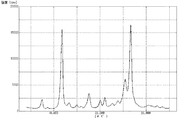
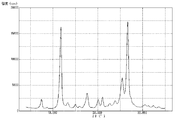
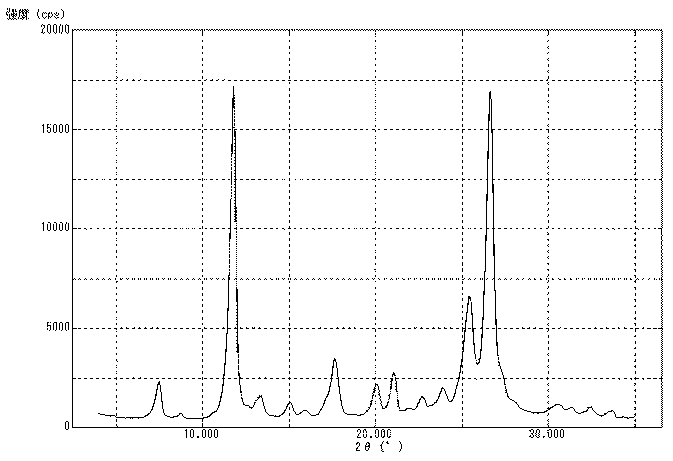
上記で得た処理前顔料を測定用試料として、粉末X線回折装置(商品名「RINT2000」、リガク社製)を使用して、粉末X線回折を行い、測定結果を図1に示した。上記で得た処理前顔料は、粉末X線回折により測定したブラッグ角(2θ±0.2°)において、11.7°のピークの回折強度に対する26.6°のピークの回折強度の比(26.6°/11.7°)は、1.20であった。また、11.7°のピークの半値幅は0.45°であり、26.6°のピークの半値幅は0.53°であった。さらに、透過型電子顕微鏡(商品名「H7100」、日立製作所社製)を使用し、6万倍の撮影条件で処理前顔料(粒子)を撮影した。撮影したものを目視観察により測定した結果、上記で得た処理前顔料(粒子)の平均一次粒子径は、160nmであった。また、処理前顔料(粒子)の形状は針状であり、短軸に対する長軸の比(長軸/短軸)の平均値は2.03であった。なお、他の例におけるX線回折でも、上記した粉末X線回折装置を使用した。また、以下、上記と同様にして測定したピークの回折強度の比(26.6°/11.7°)は、単に「(26.6°/11.7°)回折強度比」と記す。 The untreated pigment obtained above was used as a measurement sample and subjected to powder X-ray diffraction using a powder X-ray diffraction device (product name "RINT2000", manufactured by Rigaku Corporation). The measurement results are shown in Figure 1. The untreated pigment obtained above had a ratio of the diffraction intensity of the 26.6° peak to the diffraction intensity of the 11.7° peak (26.6°/11.7°) at a Bragg angle (2θ±0.2°) measured by powder X-ray diffraction of 1.20. The half-width of the 11.7° peak was 0.45°, and the half-width of the 26.6° peak was 0.53°. Furthermore, the untreated pigment (particles) was photographed at 60,000 times magnification using a transmission electron microscope (product name "H7100", manufactured by Hitachi, Ltd.). The photographs were visually observed and measured, and the average primary particle diameter of the untreated pigment (particles) obtained above was 160 nm. In addition, the shape of the pigment (particles) before treatment was needle-like, and the average ratio of the major axis to the minor axis (major axis/minor axis) was 2.03. The above-mentioned powder X-ray diffraction device was also used for the X-ray diffraction in other examples. In the following, the ratio of the diffraction intensity of the peaks measured in the same manner as above (26.6°/11.7°) will simply be referred to as the "(26.6°/11.7°) diffraction intensity ratio."
(2)顔料の調製
(実施例1)
合成例で作製した処理前顔料を400部、塩化ナトリウムを2400部、及びプロピレングリコールを700部、ニーダーに仕込んで、内容物を均一に湿潤された塊とした。冷却装置及び熱媒装置を調整し、内容物の温度が60〜90℃になるように管理しながら6時間混練摩砕処理して摩砕物を得た。そして、ニーダーより取り出した摩砕物に水40000部を加えて一晩放置した。これを60℃に加熱した後、ろ過及び水洗して塩化ナトリウムとプロピレングリコールを除去した。その後、100℃で24時間乾燥した後に粉砕して、顔料Aを385部得た。
(2) Preparation of Pigment (Example 1)
400 parts of the untreated pigment prepared in the synthesis example, 2400 parts of sodium chloride, and 700 parts of propylene glycol were charged into a kneader, and the contents were made into a uniformly wet mass. The cooling device and the heating medium device were adjusted to control the temperature of the contents to 60 to 90°C, and kneaded and ground for 6 hours to obtain a ground product. Then, 40,000 parts of water were added to the ground product taken out of the kneader and left overnight. After heating to 60°C, the product was filtered and washed with water to remove sodium chloride and propylene glycol. Then, the product was dried at 100°C for 24 hours and pulverized to obtain 385 parts of pigment A.
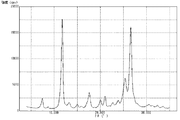
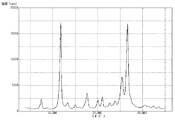
粉末X線回折装置を使用し、上記で得た顔料Aについて粉末X線回折を行い、その測定結果を図2に示した。粉末X線回折により測定したブラッグ角(2θ±0.2°)において、(26.6°/11.7°)回折強度比は0.94であった。また、11.7°のピークの半値幅は0.39°であり、26.6°のピークの半値幅は0.52°であった。さらに、透過型電子顕微鏡を使用し、6万倍の撮影条件で顔料A(粒子)を撮影した。撮影したものを目視観察により測定した顔料A(粒子)の平均一次粒子径は、85nmであった。また、顔料A(粒子)の形状は比較的球状に近いものであり、短軸に対する長軸の比(長軸/短軸)の平均値は1.05であった。 Using a powder X-ray diffractometer, the pigment A obtained above was subjected to powder X-ray diffraction, and the measurement results are shown in Figure 2. At the Bragg angle (2θ±0.2°) measured by powder X-ray diffraction, the diffraction intensity ratio (26.6°/11.7°) was 0.94. The half-width of the peak at 11.7° was 0.39°, and the half-width of the peak at 26.6° was 0.52°. Furthermore, the pigment A (particles) was photographed using a transmission electron microscope at a magnification of 60,000 times. The average primary particle diameter of the pigment A (particles) measured by visual observation of the photographs was 85 nm. The shape of the pigment A (particles) was relatively close to spherical, and the average ratio of the major axis to the minor axis (major axis/minor axis) was 1.05.
削除 delete
削除 delete
(比較例1)
合成例で作製した処理前顔料を400部、塩化ナトリウムを1200部、及びプロピレングリコールを1000部、ニーダーに仕込んで、内容物を均一に湿潤された塊とした。冷却装置及び熱媒装置を調整し、内容物の温度が40〜50℃になるように管理しながら6時間混練摩砕処理して摩砕物を得た。そして、ニーダーより取り出した摩砕物に水40000部を加えて一晩放置した。これを60℃に加熱した後、ろ過及び水洗して塩化ナトリウムとプロピレングリコールを除去した。100℃で24時間乾燥した後に粉砕して顔料Cを385部得た。
(Comparative Example 1)
400 parts of the untreated pigment prepared in the synthesis example, 1200 parts of sodium chloride, and 1000 parts of propylene glycol were charged into a kneader, and the contents were made into a uniformly wet mass. The cooling device and the heating medium device were adjusted to keep the temperature of the contents at 40 to 50°C, and the kneading and grinding treatment was carried out for 6 hours to obtain a ground product. Then, 40,000 parts of water were added to the ground product taken out of the kneader and left overnight. After heating to 60°C, the product was filtered and washed with water to remove sodium chloride and propylene glycol. After drying at 100°C for 24 hours, the product was pulverized to obtain 385 parts of pigment C.
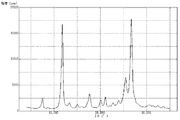
粉末X線回折装置を使用し、上記で得た顔料Cについて粉末X線回折を行い、その測定結果を図3に示した。粉末X線回折により測定したブラッグ角(2θ±0.2°)において、(26.6°/11.7°)回折強度比は1.05であった。また、11.7°のピークの半値幅は0.40°であり、26.6°のピークの半値幅は0.52°であった。さらに、透過型電子顕微鏡を使用し、6万倍の撮影条件で顔料C(粒子)を撮影した。撮影したものを目視観察により測定した顔料C(粒子)の平均一次粒子径は、135nmであった。また、顔料C(粒子)の形状は比較的針状に近いものであり、短軸に対する長軸の比(長軸/短軸)の平均値は1.40であった。 Using a powder X-ray diffractometer, the pigment C obtained above was subjected to powder X-ray diffraction, and the measurement results are shown in FIG. 3. At the Bragg angle (2θ±0.2°) measured by powder X-ray diffraction, the (26.6°/11.7°) diffraction intensity ratio was 1.05. In addition, the half-width of the peak at 11.7° was 0.40°, and the half-width of the peak at 26.6° was 0.52°. Furthermore, using a transmission electron microscope, the pigment C (particles) was photographed at a magnification of 60,000 times. The average primary particle diameter of the pigment C (particles) measured by visual observation of the photographs was 135 nm. In addition, the shape of the pigment C (particles) was relatively close to a needle, and the average ratio of the major axis to the minor axis (major axis/minor axis) was 1.40.
(実施例3)
合成例で作製した処理前顔料を300部、トリエチレングリコールモノブチルエーテルを26部、及び直径3mmのジルコニアビーズを6000部、ボールミル中に仕込んで、内容物を均一に湿潤された塊とした。60rpmで20時間運転し湿式粉砕を行った。引き続き、水2000部を加えて10時間運転した後、内容物(スラリー)を取り出した。取り出したスラリーをろ過及び水洗し、90℃で24時間乾燥させた後に粉砕処理して、目的の顔料Dを290部得た。
Example 3
300 parts of the untreated pigment prepared in the synthesis example, 26 parts of triethylene glycol monobutyl ether, and 6000 parts of zirconia beads with a diameter of 3 mm were charged into a ball mill, and the contents were made into a uniformly wet mass. The mill was operated at 60 rpm for 20 hours to perform wet grinding. Then, 2000 parts of water was added and the mill was operated for 10 hours, after which the contents (slurry) were taken out. The slurry taken out was filtered and washed with water, dried at 90°C for 24 hours, and then ground to obtain 290 parts of the target pigment D.
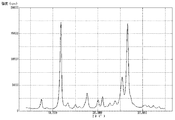
粉末X線回折装置を使用し、上記で得た顔料Dについて粉末X線回折を行い、その測定結果を図4に示した。粉末X線回折により測定したブラッグ角(2θ±0.2°)において、(26.6°/11.7°)回折強度比は0.98であった。また、11.7°のピークの半値幅は0.40°であり、26.6°のピークの半値幅は0.52°であった。さらに、透過型電子顕微鏡を使用し、6万倍の撮影条件で顔料D(粒子)を撮影した。撮影したものを目視観察により測定した顔料D(粒子)の平均一次粒子径は、110nmであった。また、顔料D(粒子)の形状は比較的柱状に近いものであり、短軸に対する長軸の比(長軸/短軸)の平均値は1.25であった。 Using a powder X-ray diffractometer, the pigment D obtained above was subjected to powder X-ray diffraction, and the measurement results are shown in FIG. 4. At the Bragg angle (2θ±0.2°) measured by powder X-ray diffraction, the (26.6°/11.7°) diffraction intensity ratio was 0.98. In addition, the half-width of the peak at 11.7° was 0.40°, and the half-width of the peak at 26.6° was 0.52°. Furthermore, using a transmission electron microscope, the pigment D (particles) was photographed at a magnification of 60,000 times. The average primary particle diameter of the pigment D (particles) measured by visual observation of the photographs was 110 nm. In addition, the shape of the pigment D (particles) was relatively close to a columnar shape, and the average ratio of the major axis to the minor axis (major axis/minor axis) was 1.25.
(比較例2)
合成例で作製した処理前顔料を300部、N−メチル−2−ピロリドンを39部、及び直径3mmのジルコニアビーズを6000部、ボールミル中に仕込んで、内容物を均一に湿潤された塊とした。60rpmで20時間運転し湿式粉砕を行った。引き続き、水2000部を加えて10時間運転した後、内容物(スラリー)を取り出した。取り出したスラリーを、ろ過及び水洗し、90℃で24時間乾燥させた後に粉砕処理して、目的の顔料E290部を得た。
(Comparative Example 2)
300 parts of the untreated pigment prepared in Synthesis Example, 39 parts of N-methyl-2-pyrrolidone, and 6000 parts of zirconia beads with a diameter of 3 mm were charged into a ball mill, and the contents were made into a uniformly wet mass. The ball mill was operated at 60 rpm for 20 hours to carry out wet grinding. Then, 2000 parts of water was added, and the mixture was operated for 10 hours, after which the contents (slurry) were taken out. The slurry taken out was filtered and washed with water, dried at 90°C for 24 hours, and then ground to obtain 290 parts of the target pigment E.
粉末X線回折装置を使用し、上記で得た顔料Eについて粉末X線回折を行い、その測定結果を図5に示した。粉末X線回折により測定したブラッグ角(2θ±0.2°)において、(26.6°/11.7°)回折強度比は1.08であった。また、11.7°のピークの半値幅は0.41°であり、26.6°のピークの半値幅は0.52°であった。さらに、透過型電子顕微鏡を使用し、6万倍の撮影条件で顔料E(粒子)を撮影した。撮影したものを目視観察により測定した顔料E(粒子)の平均一次粒子径は、150nmであった。また、顔料E(粒子)の形状は比較的針状に近いものであり、短軸に対する長軸の比(長軸/短軸)の平均値は2.01であった。 Using a powder X-ray diffractometer, the pigment E obtained above was subjected to powder X-ray diffraction, and the measurement results are shown in FIG. 5. At the Bragg angle (2θ±0.2°) measured by powder X-ray diffraction, the (26.6°/11.7°) diffraction intensity ratio was 1.08. In addition, the half-width of the peak at 11.7° was 0.41°, and the half-width of the peak at 26.6° was 0.52°. Furthermore, using a transmission electron microscope, the pigment E (particles) was photographed at a magnification of 60,000 times. The average primary particle diameter of the pigment E (particles) measured by visual observation of the photographs was 150 nm. In addition, the shape of the pigment E (particles) was relatively close to a needle, and the average ratio of the major axis to the minor axis (major axis/minor axis) was 2.01.
(実施例4)
合成例で作製した処理前顔料を100部、及びトリエチレングリコールモノブチルエーテルを75部、ビーカーに入れ、処理前顔料がまんべんなく濡れるまでガラス棒を用いてよく混練して混練物を得た。得られた混練物を三本ロールミルにて4パス分散させ、分散物を4000部の水中に一晩放置してスラリーとした。このスラリーを撹拌し、ろ過及び水洗した後、90℃で24時間乾燥させた後に粉砕処理して、目的の顔料Fを90部得た。
Example 4
100 parts of the untreated pigment prepared in the synthesis example and 75 parts of triethylene glycol monobutyl ether were placed in a beaker, and the untreated pigment was thoroughly kneaded with a glass rod until it was evenly wetted to obtain a kneaded product. The kneaded product obtained was dispersed four times with a three-roll mill, and the dispersion was left overnight in 4000 parts of water to obtain a slurry. The slurry was stirred, filtered and washed with water, then dried at 90°C for 24 hours and pulverized to obtain 90 parts of the target pigment F.
粉末X線回折装置を使用し、上記で得た得られた顔料Fについて粉末X線回折を行い、その測定結果を図6に示した。粉末X線回折により測定したブラッグ角(2θ±0.2°)において、(26.6°/11.7°)回折強度比は0.99であった。また、11.7°のピークの半値幅は0.40°であり、26.6°のピークの半値幅は0.52°であった。さらに、透過型電子顕微鏡を使用し、6万倍の撮影条件で顔料F(粒子)を撮影した。撮影したものを目視観察により測定した顔料F(粒子)の平均一次粒子径は、120nmであった。また、顔料F(粒子)の形状は比較的針状に近いものであり、短軸に対する長軸の比(長軸/短軸)の平均値は1.29であった。 Using a powder X-ray diffractometer, the obtained pigment F was subjected to powder X-ray diffraction, and the measurement results are shown in FIG. 6. At the Bragg angle (2θ±0.2°) measured by powder X-ray diffraction, the (26.6°/11.7°) diffraction intensity ratio was 0.99. In addition, the half-width of the peak at 11.7° was 0.40°, and the half-width of the peak at 26.6° was 0.52°. Furthermore, the pigment F (particles) was photographed using a transmission electron microscope at a magnification of 60,000 times. The average primary particle diameter of the pigment F (particles) measured by visual observation of the photographs was 120 nm. In addition, the shape of the pigment F (particles) was relatively close to a needle, and the average ratio of the major axis to the minor axis (major axis/minor axis) was 1.29.
上記のようにして調製した顔料の物性値を表1にまとめて示した。
(3)インクジェットインクの調製
(実施例5)
ジルコニアビーズを120部入れた250mLガラスビンに、実施例1で調製した顔料Aを10.0部、水溶性スチレンアクリル系樹脂(固形分45%)を5.0部、及びイオン交換水を45.0部加え、プレミキシングした。さらにペイントコンディショナーを使用して分散処理し、体積平均粒子径が110nm前後の顔料粒子が分散してなる分散液60.0部を得た。この際の分散処理に要した時間は240分であった。なお、上記における体積平均粒子径は、レーザー散乱方式粒度分布計(商品名「N5 Submicron Particle Size Analyzer」、ベックマンコールター社製)を使用して分散処理中に測定した。
(3) Preparation of Inkjet Ink (Example 5)
In a 250 mL glass bottle containing 120 parts of zirconia beads, 10.0 parts of the pigment A prepared in Example 1, 5.0 parts of a water-soluble styrene-acrylic resin (solid content 45%), and 45.0 parts of ion-exchanged water were added and premixed. Further, a paint conditioner was used for dispersion treatment to obtain 60.0 parts of a dispersion liquid in which pigment particles having a volume average particle size of about 110 nm were dispersed. The time required for the dispersion treatment was 240 minutes. The volume average particle size was measured during the dispersion treatment using a laser scattering type particle size distribution analyzer (product name "N5 Submicron Particle Size Analyzer", manufactured by Beckman Coulter, Inc.).
上記で得た分散液を40.0部、トリエチレングリコールモノブチルエーテルを5.0部、グリセリンを5.0部、アセチレングリコール(商品名「サーフィノール(登録商標)」、日信化学工業社製)を0.5部、メタノールを0.5部、10%グリセリル化キトサン(脱アセチル化度:80%、グリセリル置換度:1.1)水溶液を8.0部、及びイオン交換水41.0部を、250mLガラスビンに入れた。そして、内容物を十分撹拌した後に、ポアサイズ5μmのメンブレンフィルターで濾過して粗大粒子を除き、インクジェットインク100.0部を得た。 40.0 parts of the dispersion obtained above, 5.0 parts of triethylene glycol monobutyl ether, 5.0 parts of glycerin, 0.5 parts of acetylene glycol (product name "Surfynol (registered trademark)", manufactured by Nissin Chemical Industry Co., Ltd.), 0.5 parts of methanol, 8.0 parts of a 10% aqueous solution of glyceryl-modified chitosan (degree of deacetylation: 80%, degree of glyceryl substitution: 1.1), and 41.0 parts of ion-exchanged water were placed in a 250 mL glass bottle. The contents were then thoroughly stirred and filtered through a membrane filter with a pore size of 5 μm to remove coarse particles, yielding 100.0 parts of inkjet ink.
(実施例7及び8、比較例3及び4、参考例)
顔料Aに代えて、実施例3及び4、比較例1及び2、並びに合成例で調製した顔料をそれぞれに用いたこと以外は、前述の実施例5と同様にして、それぞれインクジェットインクを得た。
(Examples 7 and 8, Comparative Examples 3 and 4, Reference Example)
Ink-jet inks were obtained in the same manner as in Example 5 described above, except that the pigments prepared in Examples 3 and 4, Comparative Examples 1 and 2, and Synthesis Examples were used instead of pigment A.
(4)評価
(耐候(光)性)
市販のインクジェット用グロス紙にバーコーター規格3番を用いて、上記で調製したそれぞれのインクジェットインクを展色した。展色後のグロス紙を室温で一日放置した後、促進耐候性試験装置を使用して、照射強度100mW/cm2(照射波長:295〜450nmの紫外光)、室温で50時間照射した。次いで、分光濃度計(商品名「500シリーズ」、エックスライト社製)を使用して照射前後の反射濃度を測定し、以下に示した5段階の基準に従って、それぞれ耐候(光)性を評価した。結果を表2にまとめて示した。
[評価基準]
5:反射濃度が、85%以上
4:反射濃度が、70%以上85%未満
3:反射濃度が、55%以上70%未満
2:反射濃度が、40%以上55%未満
1:反射濃度が、40%未満
(4) Evaluation (weather (light) resistance)
Each of the inkjet inks prepared above was applied to a commercially available gloss paper for inkjet printing using a standard No. 3 bar coater. The applied gloss paper was left at room temperature for one day, and then irradiated with ultraviolet light of 295 to 450 nm at an irradiation intensity of 100 mW/ cm2 using an accelerated weather resistance tester for 50 hours at room temperature. Next, a spectrodensitometer (product name "500 Series", manufactured by X-Rite Corporation) was used to measure the reflection density before and after irradiation, and the weather resistance (light) of each was evaluated according to the following five-level criteria. The results are summarized in Table 2.
[Evaluation Criteria]
5: Reflection density is 85% or more 4: Reflection density is 70% or more and less than 85% 3: Reflection density is 55% or more and less than 70% 2: Reflection density is 40% or more and less than 55% 1: Reflection density is less than 40%
(粒径安定性)
先に調製した各インクジェットインクを、それぞれ25℃で1時間静置した。その後、先に使用したと同様のレーザー散乱方式粒度分布計を使用して、それぞれのインクジェットインク中の顔料の体積平均粒子径(初期分散粒径φ1)を測定した。次いで、各インクジェットインクを50℃で10日間保持した後、上記と同様にしてインクジェットインク中の顔料の体積平均粒子径(経時分散粒径φ2)をそれぞれ測定した。そして、初期分散粒径φ1に対する経時分散粒径φ2の比(φ2/φ1)を算出し、以下に示した5段階の基準に従って、それぞれのインクについて粒径安定性を評価した。結果を表2にまとめて示した。
[評価基準]
5:「φ2/φ1」が、1.3以下
4:「φ2/φ1」が、1.3超1.5以下
3:「φ2/φ1」が、1.5超1.7以下
2:「φ2/φ1」が、1.7超1.9以下
1:「φ2/φ1」が、1.9超
(Particle size stability)
Each of the inkjet inks prepared above was allowed to stand at 25° C. for 1 hour. Thereafter, the volume average particle diameter (initial dispersion particle diameter φ1) of the pigment in each of the inkjet inks was measured using the same laser scattering type particle size distribution meter as used above. Next, each of the inkjet inks was kept at 50° C. for 10 days, and then the volume average particle diameter (time-dispersed particle diameter φ2) of the pigment in each of the inkjet inks was measured in the same manner as described above. Then, the ratio of the time-dispersed particle diameter φ2 to the initial dispersion particle diameter φ1 (φ2/φ1) was calculated, and the particle diameter stability of each ink was evaluated according to the following five-level criteria. The results are summarized in Table 2.
[Evaluation Criteria]
5: "φ2/φ1" is 1.3 or less. 4: "φ2/φ1" is more than 1.3 and less than 1.5. 3: "φ2/φ1" is more than 1.5 and less than 1.7. 2: "φ2/φ1" is more than 1.7 and less than 1.9. 1: "φ2/φ1" is more than 1.9
(保存安定性)
先に調製した各インクジェットインクを、それぞれ25℃で1時間静置した。その後、E型粘度計(商品名「RE80型」、東京産業社製、50rpm値)を使用して、それぞれのインクジェットインクの粘度(初期粘度粘度η1)を測定した。次いで、各インクジェットインクを50℃で10日間保持した後、上記と同様にしてインクジェットインクの粘度(経時粘度η2)をそれぞれ測定した。そして、初期粘度(η1)に対する経時粘度(η2)の比(η2/η1)を算出し、以下に示した5段階の基準に従って、それぞれのインクについて保存安定性を評価した。結果を表2にまとめて示した。
[評価基準]
5:「η2/η1」が、1.1以下
4:「η2/η1」が、1.1超1.3以下
3:「η2/η1」が、1.3超1.5以下
2:「η2/η1」が、1.5超1.7以下
1:「η2/η1」が、1.7超
(Storage stability)
Each of the inkjet inks prepared above was allowed to stand at 25° C. for 1 hour. Thereafter, the viscosity (initial viscosity η1) of each of the inkjet inks was measured using an E-type viscometer (product name "RE80 type", manufactured by Tokyo Sangyo Co., Ltd., 50 rpm value). Next, each of the inkjet inks was kept at 50° C. for 10 days, and then the viscosity (aging viscosity η2) of each of the inkjet inks was measured in the same manner as above. Then, the ratio (η2/η1) of the aging viscosity (η2) to the initial viscosity (η1) was calculated, and the storage stability of each ink was evaluated according to the five-level criteria shown below. The results are summarized in Table 2.
[Evaluation Criteria]
5: "η2/η1" is 1.1 or less. 4: "η2/η1" is more than 1.1 and less than 1.3. 3: "η2/η1" is more than 1.3 and less than 1.5. 2: "η2/η1" is more than 1.5 and less than 1.7. 1: "η2/η1" is more than 1.7.
(鮮明性)
先に調製した各インクジェットインクをそれぞれ用いて、ピエゾ振動子を有するオンデマンド型インクジェットプリンターで画像を印刷した。得られた画像を目視観察し、以下に示す基準に従い、それぞれの画像について鮮明性を評価した。結果を表2にまとめて示した。
[評価基準]
◎:良好
〇:実用レベル
△:不明瞭
(Clarity)
Using each of the inkjet inks prepared above, images were printed using an on-demand inkjet printer equipped with a piezoelectric transducer. The images obtained were visually observed, and the clarity of each image was evaluated according to the following criteria. The results are summarized in Table 2.
[Evaluation Criteria]
◎: Good 〇: Practical level △: Unclear
(透明性)
市販のインクジェット用OHPフィルムに、バーコーター規格3番を用いて、先に調製した各インクジェットインクを展色した。展色後のフィルムを目視観察し、以下に示す基準に従い、それぞれの画像について透明性を評価した。結果を表2にまとめて示した。
[評価基準]
○:良好
△:半透明
×:透明性なし
(Transparency)
Each of the inkjet inks prepared above was applied to a commercially available inkjet OHP film using a bar coater standard No. 3. The applied film was visually observed, and the transparency of each image was evaluated according to the following criteria. The results are summarized in Table 2.
[Evaluation Criteria]
○: Good △: Semi-transparent ×: No transparency
本発明のP.Y.74(不溶性アゾ顔料)を用いれば、粒径安定性及び保存安定性が良好であるとともに、鮮明性及び透明性に優れた画像を形成(記録)可能な着色組成物を提供することが可能になる。そして、本発明の着色組成物は、例えば、各種印刷インキ、サイジングカラー、バインダーカラー、コーティング剤、各種塗料、電子写真用乾式又は湿式トナー、熱転写記録用インキ、筆記具用インキ、カラーフィルター画素形成用塗布液、インクジェットインク等として有用であり、その使用が期待される。 By using the P.Y.74 (insoluble azo pigment) of the present invention, it is possible to provide a coloring composition that has good particle size stability and storage stability, and is capable of forming (recording) images with excellent clarity and transparency. The coloring composition of the present invention is useful as, for example, various printing inks, sizing colors, binder colors, coating agents, various paints, dry or wet toners for electrophotography, inks for thermal transfer recording, inks for writing instruments, coating solutions for forming color filter pixels, inkjet inks, etc., and its use is expected.
Claims (5)
Priority Applications (1)
| Application Number | Priority Date | Filing Date | Title |
|---|---|---|---|
| JP2013551648A JP5815744B2 (en) | 2011-12-28 | 2012-12-19 | Insoluble azo pigment C.I. Pigment Yellow 74 and coloring composition using the same |
Applications Claiming Priority (4)
| Application Number | Priority Date | Filing Date | Title |
|---|---|---|---|
| JP2011288579 | 2011-12-28 | ||
| JP2011288579 | 2011-12-28 | ||
| PCT/JP2012/082899 WO2013099730A1 (en) | 2011-12-28 | 2012-12-19 | C.i. pigment yellow 74 (insoluble azo pigment), and coloring composition using same |
| JP2013551648A JP5815744B2 (en) | 2011-12-28 | 2012-12-19 | Insoluble azo pigment C.I. Pigment Yellow 74 and coloring composition using the same |
Publications (2)
| Publication Number | Publication Date |
|---|---|
| JPWO2013099730A1 JPWO2013099730A1 (en) | 2015-05-07 |
| JP5815744B2 true JP5815744B2 (en) | 2015-11-17 |
Family
ID=48697221
Family Applications (1)
| Application Number | Title | Priority Date | Filing Date |
|---|---|---|---|
| JP2013551648A Active JP5815744B2 (en) | 2011-12-28 | 2012-12-19 | Insoluble azo pigment C.I. Pigment Yellow 74 and coloring composition using the same |
Country Status (8)
| Country | Link |
|---|---|
| US (1) | US9657176B2 (en) |
| EP (1) | EP2799499B1 (en) |
| JP (1) | JP5815744B2 (en) |
| KR (1) | KR20140116172A (en) |
| CN (1) | CN104024340A (en) |
| IN (1) | IN2014KN01191A (en) |
| TW (1) | TWI510562B (en) |
| WO (1) | WO2013099730A1 (en) |
Cited By (1)
| Publication number | Priority date | Publication date | Assignee | Title |
|---|---|---|---|---|
| US10301493B2 (en) | 2017-03-17 | 2019-05-28 | Seiko Epson Corporation | Aqueous ink jet ink composition |
Families Citing this family (4)
| Publication number | Priority date | Publication date | Assignee | Title |
|---|---|---|---|---|
| US20160008820A1 (en) * | 2014-07-10 | 2016-01-14 | Xerox Corporation | Magnetic actuated-milled pigment dispersions and process for making thereof |
| WO2020075568A1 (en) * | 2018-10-10 | 2020-04-16 | 富士フイルム株式会社 | Coloring composition, film, method for producing color filter, color filter, solid state imaging device and image display device |
| JP2024058462A (en) | 2022-10-14 | 2024-04-25 | 三菱鉛筆株式会社 | Non-baked pencil lead |
| CN118931226B (en) * | 2024-10-12 | 2024-12-20 | 蓬莱新光颜料化工有限公司 | A high-content red azo lake pigment preformulation and preparation method thereof |
Family Cites Families (7)
| Publication number | Priority date | Publication date | Assignee | Title |
|---|---|---|---|---|
| JPS6036224B2 (en) | 1982-02-26 | 1985-08-19 | 大日精化工業株式会社 | Azo pigment manufacturing method |
| JP2674325B2 (en) * | 1990-12-21 | 1997-11-12 | 三菱化学株式会社 | Yellow toner for color electrophotography and manufacturing method thereof |
| JP3055673B2 (en) | 1997-12-12 | 2000-06-26 | 大日精化工業株式会社 | Coloring composition for image recording |
| JP2002138233A (en) * | 2000-11-06 | 2002-05-14 | Sharp Corp | Ink composition and recording device using the same |
| JP2003012968A (en) * | 2001-06-27 | 2003-01-15 | Sharp Corp | Ink composition and recording device using the same |
| JP2003012960A (en) * | 2001-07-03 | 2003-01-15 | Sharp Corp | Colorant comprising quasi-one-dimensional crystalline yellow organic pigment and ink composition containing the same |
| JP4190218B2 (en) * | 2002-06-24 | 2008-12-03 | 大日精化工業株式会社 | Insoluble azo pigment and coloring composition |
-
2012
- 2012-12-19 EP EP12863374.0A patent/EP2799499B1/en active Active
- 2012-12-19 WO PCT/JP2012/082899 patent/WO2013099730A1/en not_active Ceased
- 2012-12-19 KR KR1020147021180A patent/KR20140116172A/en not_active Ceased
- 2012-12-19 US US14/363,180 patent/US9657176B2/en active Active
- 2012-12-19 JP JP2013551648A patent/JP5815744B2/en active Active
- 2012-12-19 IN IN1191KON2014 patent/IN2014KN01191A/en unknown
- 2012-12-19 CN CN201280065137.4A patent/CN104024340A/en active Pending
- 2012-12-28 TW TW101150893A patent/TWI510562B/en active
Cited By (1)
| Publication number | Priority date | Publication date | Assignee | Title |
|---|---|---|---|---|
| US10301493B2 (en) | 2017-03-17 | 2019-05-28 | Seiko Epson Corporation | Aqueous ink jet ink composition |
Also Published As
| Publication number | Publication date |
|---|---|
| TWI510562B (en) | 2015-12-01 |
| EP2799499B1 (en) | 2018-02-21 |
| TW201335288A (en) | 2013-09-01 |
| US9657176B2 (en) | 2017-05-23 |
| KR20140116172A (en) | 2014-10-01 |
| JPWO2013099730A1 (en) | 2015-05-07 |
| US20140335358A1 (en) | 2014-11-13 |
| EP2799499A4 (en) | 2015-08-12 |
| WO2013099730A1 (en) | 2013-07-04 |
| IN2014KN01191A (en) | 2015-10-16 |
| CN104024340A (en) | 2014-09-03 |
| EP2799499A1 (en) | 2014-11-05 |
Similar Documents
| Publication | Publication Date | Title |
|---|---|---|
| JP5292039B2 (en) | Azo pigment composition, method for producing azo pigment composition, dispersion containing azo pigment composition, coloring composition, and ink for ink jet recording | |
| JP5331468B2 (en) | Azo pigment composition, method for producing azo pigment composition, dispersion containing azo pigment composition, coloring composition, and ink for ink jet recording | |
| ES2280957T3 (en) | FORMULATIONS OF COLORING AGENTS BASED ON WATER, FOR PRINTING BY INK JETS. | |
| JP5704821B2 (en) | Ink, ink jet recording method, ink cartridge, and ink jet recording apparatus | |
| TW201113337A (en) | Ink set, recording method, recorded article and printed article | |
| JP6697571B2 (en) | Method for producing quinacridone solid solution pigment, pigment dispersion, and inkjet ink | |
| WO2013018487A1 (en) | Dispersion containing azo pigment, tinting composition, inkjet recording ink, and method for producing dispersion | |
| CN102165019B (en) | Azo pigment, method for producing azo pigment, dispersion and coloring composition containing azo pigment | |
| JPWO2013099730A1 (en) | Insoluble azo pigment C.I. Pigment Yellow 74 and coloring composition using the same | |
| TW200427793A (en) | Modified organic colorants and dispersions, and methods for their preparation | |
| JP2006233211A (en) | Aqueous pigment dispersion and ink composition for ink jet recording | |
| JP2010138232A (en) | Azo pigment, method for producing azo pigment, azo pigment-containing dispersion, and colored composition | |
| JP7066828B2 (en) | Manufacturing method of quinacridone solid solution pigment, pigment dispersion liquid and ink for inkjet | |
| JP4190218B2 (en) | Insoluble azo pigment and coloring composition | |
| CN115244147B (en) | C.I. Pigment Yellow 180, aqueous pigment dispersion for inkjet ink and aqueous pigment ink | |
| JP5789541B2 (en) | Pigment composition, pigment dispersion, coloring composition, ink, ink for ink jet recording, ink jet recording method, and method for producing pigment composition | |
| JP2011127042A (en) | Azo pigment, method of manufacturing azo pigment, dispersion containing azo pigment, and coloring composition | |
| JP6644994B2 (en) | Method for producing pigment dispersion | |
| TWI772405B (en) | Method for producing quinacridone solid solution pigment, pigment dispersion and ink for inkjet | |
| JP4391073B2 (en) | Water-based magenta ink | |
| JP4510324B2 (en) | Colored ink set for image recording, image recording method and recorded image | |
| JP2013032411A (en) | Azo pigment, method for producing azo pigment, dispersion containing azo pigment, tinting composition and inkjet recording ink | |
| JP2013032412A (en) | Azo pigment, method for producing azo pigment, dispersion containing azo pigment, tinting composition and ink for inkjet recording |
Legal Events
| Date | Code | Title | Description |
|---|---|---|---|
| A131 | Notification of reasons for refusal |
Free format text: JAPANESE INTERMEDIATE CODE: A131 Effective date: 20150217 |
|
| A521 | Request for written amendment filed |
Free format text: JAPANESE INTERMEDIATE CODE: A523 Effective date: 20150416 |
|
| TRDD | Decision of grant or rejection written | ||
| A01 | Written decision to grant a patent or to grant a registration (utility model) |
Free format text: JAPANESE INTERMEDIATE CODE: A01 Effective date: 20150915 |
|
| A61 | First payment of annual fees (during grant procedure) |
Free format text: JAPANESE INTERMEDIATE CODE: A61 Effective date: 20150924 |
|
| R150 | Certificate of patent or registration of utility model |
Ref document number: 5815744 Country of ref document: JP Free format text: JAPANESE INTERMEDIATE CODE: R150 |
|
| R250 | Receipt of annual fees |
Free format text: JAPANESE INTERMEDIATE CODE: R250 |
|
| R250 | Receipt of annual fees |
Free format text: JAPANESE INTERMEDIATE CODE: R250 |
|
| R250 | Receipt of annual fees |
Free format text: JAPANESE INTERMEDIATE CODE: R250 |
|
| R250 | Receipt of annual fees |
Free format text: JAPANESE INTERMEDIATE CODE: R250 |
|
| R250 | Receipt of annual fees |
Free format text: JAPANESE INTERMEDIATE CODE: R250 |
|
| R250 | Receipt of annual fees |
Free format text: JAPANESE INTERMEDIATE CODE: R250 |
|
| R250 | Receipt of annual fees |
Free format text: JAPANESE INTERMEDIATE CODE: R250 |
|
| R250 | Receipt of annual fees |
Free format text: JAPANESE INTERMEDIATE CODE: R250 |