JP5015397B2 - Pharmaceutically active sulfonamide derivatives - Google Patents
Pharmaceutically active sulfonamide derivatives Download PDFInfo
- Publication number
- JP5015397B2 JP5015397B2 JP2001526530A JP2001526530A JP5015397B2 JP 5015397 B2 JP5015397 B2 JP 5015397B2 JP 2001526530 A JP2001526530 A JP 2001526530A JP 2001526530 A JP2001526530 A JP 2001526530A JP 5015397 B2 JP5015397 B2 JP 5015397B2
- Authority
- JP
- Japan
- Prior art keywords
- sulfonyl
- methyl
- thien
- piperidin
- benzamide
- Prior art date
- Legal status (The legal status is an assumption and is not a legal conclusion. Google has not performed a legal analysis and makes no representation as to the accuracy of the status listed.)
- Expired - Fee Related
Links
- 0 C*(N(*)C([Al])=*)[Al]S(*)(=O)=O Chemical compound C*(N(*)C([Al])=*)[Al]S(*)(=O)=O 0.000 description 6
Classifications
-
- C—CHEMISTRY; METALLURGY
- C07—ORGANIC CHEMISTRY
- C07D—HETEROCYCLIC COMPOUNDS
- C07D409/00—Heterocyclic compounds containing two or more hetero rings, at least one ring having sulfur atoms as the only ring hetero atoms
- C07D409/02—Heterocyclic compounds containing two or more hetero rings, at least one ring having sulfur atoms as the only ring hetero atoms containing two hetero rings
- C07D409/12—Heterocyclic compounds containing two or more hetero rings, at least one ring having sulfur atoms as the only ring hetero atoms containing two hetero rings linked by a chain containing hetero atoms as chain links
-
- A—HUMAN NECESSITIES
- A61—MEDICAL OR VETERINARY SCIENCE; HYGIENE
- A61P—SPECIFIC THERAPEUTIC ACTIVITY OF CHEMICAL COMPOUNDS OR MEDICINAL PREPARATIONS
- A61P1/00—Drugs for disorders of the alimentary tract or the digestive system
-
- A—HUMAN NECESSITIES
- A61—MEDICAL OR VETERINARY SCIENCE; HYGIENE
- A61P—SPECIFIC THERAPEUTIC ACTIVITY OF CHEMICAL COMPOUNDS OR MEDICINAL PREPARATIONS
- A61P1/00—Drugs for disorders of the alimentary tract or the digestive system
- A61P1/04—Drugs for disorders of the alimentary tract or the digestive system for ulcers, gastritis or reflux esophagitis, e.g. antacids, inhibitors of acid secretion, mucosal protectants
-
- A—HUMAN NECESSITIES
- A61—MEDICAL OR VETERINARY SCIENCE; HYGIENE
- A61P—SPECIFIC THERAPEUTIC ACTIVITY OF CHEMICAL COMPOUNDS OR MEDICINAL PREPARATIONS
- A61P11/00—Drugs for disorders of the respiratory system
- A61P11/06—Antiasthmatics
-
- A—HUMAN NECESSITIES
- A61—MEDICAL OR VETERINARY SCIENCE; HYGIENE
- A61P—SPECIFIC THERAPEUTIC ACTIVITY OF CHEMICAL COMPOUNDS OR MEDICINAL PREPARATIONS
- A61P19/00—Drugs for skeletal disorders
- A61P19/02—Drugs for skeletal disorders for joint disorders, e.g. arthritis, arthrosis
-
- A—HUMAN NECESSITIES
- A61—MEDICAL OR VETERINARY SCIENCE; HYGIENE
- A61P—SPECIFIC THERAPEUTIC ACTIVITY OF CHEMICAL COMPOUNDS OR MEDICINAL PREPARATIONS
- A61P25/00—Drugs for disorders of the nervous system
-
- A—HUMAN NECESSITIES
- A61—MEDICAL OR VETERINARY SCIENCE; HYGIENE
- A61P—SPECIFIC THERAPEUTIC ACTIVITY OF CHEMICAL COMPOUNDS OR MEDICINAL PREPARATIONS
- A61P25/00—Drugs for disorders of the nervous system
- A61P25/08—Antiepileptics; Anticonvulsants
-
- A—HUMAN NECESSITIES
- A61—MEDICAL OR VETERINARY SCIENCE; HYGIENE
- A61P—SPECIFIC THERAPEUTIC ACTIVITY OF CHEMICAL COMPOUNDS OR MEDICINAL PREPARATIONS
- A61P25/00—Drugs for disorders of the nervous system
- A61P25/14—Drugs for disorders of the nervous system for treating abnormal movements, e.g. chorea, dyskinesia
-
- A—HUMAN NECESSITIES
- A61—MEDICAL OR VETERINARY SCIENCE; HYGIENE
- A61P—SPECIFIC THERAPEUTIC ACTIVITY OF CHEMICAL COMPOUNDS OR MEDICINAL PREPARATIONS
- A61P25/00—Drugs for disorders of the nervous system
- A61P25/14—Drugs for disorders of the nervous system for treating abnormal movements, e.g. chorea, dyskinesia
- A61P25/16—Anti-Parkinson drugs
-
- A—HUMAN NECESSITIES
- A61—MEDICAL OR VETERINARY SCIENCE; HYGIENE
- A61P—SPECIFIC THERAPEUTIC ACTIVITY OF CHEMICAL COMPOUNDS OR MEDICINAL PREPARATIONS
- A61P25/00—Drugs for disorders of the nervous system
- A61P25/28—Drugs for disorders of the nervous system for treating neurodegenerative disorders of the central nervous system, e.g. nootropic agents, cognition enhancers, drugs for treating Alzheimer's disease or other forms of dementia
-
- A—HUMAN NECESSITIES
- A61—MEDICAL OR VETERINARY SCIENCE; HYGIENE
- A61P—SPECIFIC THERAPEUTIC ACTIVITY OF CHEMICAL COMPOUNDS OR MEDICINAL PREPARATIONS
- A61P27/00—Drugs for disorders of the senses
- A61P27/02—Ophthalmic agents
-
- A—HUMAN NECESSITIES
- A61—MEDICAL OR VETERINARY SCIENCE; HYGIENE
- A61P—SPECIFIC THERAPEUTIC ACTIVITY OF CHEMICAL COMPOUNDS OR MEDICINAL PREPARATIONS
- A61P29/00—Non-central analgesic, antipyretic or antiinflammatory agents, e.g. antirheumatic agents; Non-steroidal antiinflammatory drugs [NSAID]
-
- A—HUMAN NECESSITIES
- A61—MEDICAL OR VETERINARY SCIENCE; HYGIENE
- A61P—SPECIFIC THERAPEUTIC ACTIVITY OF CHEMICAL COMPOUNDS OR MEDICINAL PREPARATIONS
- A61P31/00—Antiinfectives, i.e. antibiotics, antiseptics, chemotherapeutics
- A61P31/04—Antibacterial agents
-
- A—HUMAN NECESSITIES
- A61—MEDICAL OR VETERINARY SCIENCE; HYGIENE
- A61P—SPECIFIC THERAPEUTIC ACTIVITY OF CHEMICAL COMPOUNDS OR MEDICINAL PREPARATIONS
- A61P35/00—Antineoplastic agents
-
- A—HUMAN NECESSITIES
- A61—MEDICAL OR VETERINARY SCIENCE; HYGIENE
- A61P—SPECIFIC THERAPEUTIC ACTIVITY OF CHEMICAL COMPOUNDS OR MEDICINAL PREPARATIONS
- A61P37/00—Drugs for immunological or allergic disorders
-
- A—HUMAN NECESSITIES
- A61—MEDICAL OR VETERINARY SCIENCE; HYGIENE
- A61P—SPECIFIC THERAPEUTIC ACTIVITY OF CHEMICAL COMPOUNDS OR MEDICINAL PREPARATIONS
- A61P37/00—Drugs for immunological or allergic disorders
- A61P37/02—Immunomodulators
-
- A—HUMAN NECESSITIES
- A61—MEDICAL OR VETERINARY SCIENCE; HYGIENE
- A61P—SPECIFIC THERAPEUTIC ACTIVITY OF CHEMICAL COMPOUNDS OR MEDICINAL PREPARATIONS
- A61P37/00—Drugs for immunological or allergic disorders
- A61P37/02—Immunomodulators
- A61P37/06—Immunosuppressants, e.g. drugs for graft rejection
-
- A—HUMAN NECESSITIES
- A61—MEDICAL OR VETERINARY SCIENCE; HYGIENE
- A61P—SPECIFIC THERAPEUTIC ACTIVITY OF CHEMICAL COMPOUNDS OR MEDICINAL PREPARATIONS
- A61P43/00—Drugs for specific purposes, not provided for in groups A61P1/00-A61P41/00
-
- A—HUMAN NECESSITIES
- A61—MEDICAL OR VETERINARY SCIENCE; HYGIENE
- A61P—SPECIFIC THERAPEUTIC ACTIVITY OF CHEMICAL COMPOUNDS OR MEDICINAL PREPARATIONS
- A61P9/00—Drugs for disorders of the cardiovascular system
-
- A—HUMAN NECESSITIES
- A61—MEDICAL OR VETERINARY SCIENCE; HYGIENE
- A61P—SPECIFIC THERAPEUTIC ACTIVITY OF CHEMICAL COMPOUNDS OR MEDICINAL PREPARATIONS
- A61P9/00—Drugs for disorders of the cardiovascular system
- A61P9/10—Drugs for disorders of the cardiovascular system for treating ischaemic or atherosclerotic diseases, e.g. antianginal drugs, coronary vasodilators, drugs for myocardial infarction, retinopathy, cerebrovascula insufficiency, renal arteriosclerosis
-
- C—CHEMISTRY; METALLURGY
- C07—ORGANIC CHEMISTRY
- C07D—HETEROCYCLIC COMPOUNDS
- C07D333/00—Heterocyclic compounds containing five-membered rings having one sulfur atom as the only ring hetero atom
- C07D333/02—Heterocyclic compounds containing five-membered rings having one sulfur atom as the only ring hetero atom not condensed with other rings
- C07D333/04—Heterocyclic compounds containing five-membered rings having one sulfur atom as the only ring hetero atom not condensed with other rings not substituted on the ring sulphur atom
- C07D333/26—Heterocyclic compounds containing five-membered rings having one sulfur atom as the only ring hetero atom not condensed with other rings not substituted on the ring sulphur atom with hetero atoms or with carbon atoms having three bonds to hetero atoms with at the most one bond to halogen, e.g. ester or nitrile radicals, directly attached to ring carbon atoms
- C07D333/30—Hetero atoms other than halogen
- C07D333/34—Sulfur atoms
-
- C—CHEMISTRY; METALLURGY
- C07—ORGANIC CHEMISTRY
- C07D—HETEROCYCLIC COMPOUNDS
- C07D409/00—Heterocyclic compounds containing two or more hetero rings, at least one ring having sulfur atoms as the only ring hetero atoms
- C07D409/14—Heterocyclic compounds containing two or more hetero rings, at least one ring having sulfur atoms as the only ring hetero atoms containing three or more hetero rings
-
- C—CHEMISTRY; METALLURGY
- C07—ORGANIC CHEMISTRY
- C07D—HETEROCYCLIC COMPOUNDS
- C07D413/00—Heterocyclic compounds containing two or more hetero rings, at least one ring having nitrogen and oxygen atoms as the only ring hetero atoms
- C07D413/02—Heterocyclic compounds containing two or more hetero rings, at least one ring having nitrogen and oxygen atoms as the only ring hetero atoms containing two hetero rings
- C07D413/12—Heterocyclic compounds containing two or more hetero rings, at least one ring having nitrogen and oxygen atoms as the only ring hetero atoms containing two hetero rings linked by a chain containing hetero atoms as chain links
-
- C—CHEMISTRY; METALLURGY
- C07—ORGANIC CHEMISTRY
- C07D—HETEROCYCLIC COMPOUNDS
- C07D471/00—Heterocyclic compounds containing nitrogen atoms as the only ring hetero atoms in the condensed system, at least one ring being a six-membered ring with one nitrogen atom, not provided for by groups C07D451/00 - C07D463/00
- C07D471/02—Heterocyclic compounds containing nitrogen atoms as the only ring hetero atoms in the condensed system, at least one ring being a six-membered ring with one nitrogen atom, not provided for by groups C07D451/00 - C07D463/00 in which the condensed system contains two hetero rings
- C07D471/04—Ortho-condensed systems
-
- C—CHEMISTRY; METALLURGY
- C07—ORGANIC CHEMISTRY
- C07D—HETEROCYCLIC COMPOUNDS
- C07D471/00—Heterocyclic compounds containing nitrogen atoms as the only ring hetero atoms in the condensed system, at least one ring being a six-membered ring with one nitrogen atom, not provided for by groups C07D451/00 - C07D463/00
- C07D471/02—Heterocyclic compounds containing nitrogen atoms as the only ring hetero atoms in the condensed system, at least one ring being a six-membered ring with one nitrogen atom, not provided for by groups C07D451/00 - C07D463/00 in which the condensed system contains two hetero rings
- C07D471/10—Spiro-condensed systems
-
- C—CHEMISTRY; METALLURGY
- C07—ORGANIC CHEMISTRY
- C07D—HETEROCYCLIC COMPOUNDS
- C07D487/00—Heterocyclic compounds containing nitrogen atoms as the only ring hetero atoms in the condensed system, not provided for by groups C07D451/00 - C07D477/00
- C07D487/02—Heterocyclic compounds containing nitrogen atoms as the only ring hetero atoms in the condensed system, not provided for by groups C07D451/00 - C07D477/00 in which the condensed system contains two hetero rings
- C07D487/08—Bridged systems
-
- C—CHEMISTRY; METALLURGY
- C07—ORGANIC CHEMISTRY
- C07D—HETEROCYCLIC COMPOUNDS
- C07D495/00—Heterocyclic compounds containing in the condensed system at least one hetero ring having sulfur atoms as the only ring hetero atoms
- C07D495/02—Heterocyclic compounds containing in the condensed system at least one hetero ring having sulfur atoms as the only ring hetero atoms in which the condensed system contains two hetero rings
- C07D495/04—Ortho-condensed systems
Landscapes
- Chemical & Material Sciences (AREA)
- Organic Chemistry (AREA)
- Health & Medical Sciences (AREA)
- Engineering & Computer Science (AREA)
- Bioinformatics & Cheminformatics (AREA)
- Life Sciences & Earth Sciences (AREA)
- Public Health (AREA)
- General Chemical & Material Sciences (AREA)
- Medicinal Chemistry (AREA)
- Nuclear Medicine, Radiotherapy & Molecular Imaging (AREA)
- Chemical Kinetics & Catalysis (AREA)
- Pharmacology & Pharmacy (AREA)
- Veterinary Medicine (AREA)
- Animal Behavior & Ethology (AREA)
- General Health & Medical Sciences (AREA)
- Biomedical Technology (AREA)
- Neurosurgery (AREA)
- Immunology (AREA)
- Neurology (AREA)
- Heart & Thoracic Surgery (AREA)
- Cardiology (AREA)
- Pain & Pain Management (AREA)
- Psychology (AREA)
- Rheumatology (AREA)
- Pulmonology (AREA)
- Oncology (AREA)
- Transplantation (AREA)
- Urology & Nephrology (AREA)
- Communicable Diseases (AREA)
- Hospice & Palliative Care (AREA)
- Psychiatry (AREA)
- Ophthalmology & Optometry (AREA)
- Vascular Medicine (AREA)
- Orthopedic Medicine & Surgery (AREA)
- Physical Education & Sports Medicine (AREA)
- Pharmaceuticals Containing Other Organic And Inorganic Compounds (AREA)
- Plural Heterocyclic Compounds (AREA)
- Heterocyclic Carbon Compounds Containing A Hetero Ring Having Oxygen Or Sulfur (AREA)
- Nitrogen Condensed Heterocyclic Rings (AREA)
- Acyclic And Carbocyclic Compounds In Medicinal Compositions (AREA)
Description
【0001】
本発明の分野
本発明は、医薬として活性な化合物としての使用のためのスルホンアミド誘導体に関し、及び上記スルホンアミド誘導体を含む医薬製剤に関する。特に本発明は、JNK(Jun−キナーゼ)の機能又は経路それぞれの十分な調節、顕著な阻害活性を示し、そしてそれにより自己免疫及び神経系の障害の治療、及び/又は予防に特に有用であるところのスルホンアミド誘導体に関する。本発明は、その上新規スルホンアミド誘導体、同様にそれらの調製方法に関する。
【0002】
本発明の背景
プログラムされた細胞死の過程を経るアポトーシスは、細胞の膜、及びオルガネラの複雑なねじれを示す。上述の過程の間、その細胞は、本質的な自殺プログラムを活性化し、そして自らを計画的に破壊する。以下の一連の事象が観察されうる:
・細胞表面に泡状突起が出始め、そしてプロー食細胞シグナルを発現する。アポトーシス細胞全体は、周辺組織に対する被害を最少限に抑えるために、次に貪食により素早く、そして手際よく処理されるところの膜結合性小胞に断片化する。
【0003】
・前記細胞は次にその近隣から分離する。
【0004】
細胞核は、遺伝子的自殺をおかし、クロマチンが凝集し、そして特にDNA断片に分断されるといった形態的変化の特徴的パターンをも経験する。
【0005】
神経細胞死は神経系の正常な成長の確保に重要な役割を演じている。成長している神経の死は、それらが刺激する標的のサイズに依存し:より少数のシナプス・パートナーをもつ細胞は多数のシナプスを形成した細胞よりもおそらく死にやすいようだ。成長している神経系においてシナプス後細胞に対するシナプス前細胞の相対数のバランスが、過程に反映しうる。神経細胞死がアポトーシスであると仮定されたが、発生途中のげっ歯類の脳内の神経が、形態学的、及びDNA断片化により分類されるアポトーシスを経ることが明確に示されたのは、ごく最近であった。発生の間の細胞死が明らかに病理学上の過程ではないので、細胞が実際に存在しなくなることが意味をなす。神経死は、外傷性神経損傷の後又は神経変性疾患の間にアポトーシス又はネクローシスのいずれかを介して起こる。多数の成分が、神経細胞のプログラムされた細胞死の推進する役割をもつキー・プレイヤーとして明らかになっている。神経細胞のアポトーシスを導く前記成分の中には、MAPキナーゼ(MAPKs)のサブ・ファミリーであるSAPK/JNKの仲間が存在する。
【0006】
MAPKs(分裂促進因子活性化タンパク質キナーゼ)は、スレオニン、及びチロシン残基の二重リン酸化により活性化されるところのセリン/スレオニン・キナーゼである。哺乳動物細胞において、MAPKsに対する細胞外刺激により生み出される情報を伝達するところの少なくとも3の別々の、しかし類似の経路がある。上述の経路はERKs(細胞外シグナルに調節されたキナーゼ)、JNKs(c−Jun N−末端キナーゼ)、及びp38/CSBPキナーゼの活性化をもたらすキナーゼ・カスケードから成る。JNK及びp38経路がストレス型分子外シグナルの中継に含まれる一方で、ERK経路は、主に細胞核への分裂促進/分化シグナルの伝達を招く。SAPKカスケードは、分裂促進活性化タンパク質キナーゼ・ファミリーのサブ・ファミリーに相当し、UV照射の結果として起こるDNA損傷、TNF−α、IL−1β、セラミド、細胞ストレス、及び活性酸素種を含むさまざまな外因的刺激により活性化され、かつ、明確な基質特異性を有する。MKK4/JNKを介するMKK3/p38のシグナル伝達は、誘導性転写因子c−Jun及びATF2のリン酸化をもたらし、これらの転写因子は、次にホモダイマーか又はヘテロダイマーとして、下流エフェクターの転写開始に働く。
【0007】
c−Junは、ホモダイマー及び(例えばc−Fosと)ヘテロダイマーを形成し、炎症反応に含まれる多くの遺伝子(例えばマトリックス・メタロプロテイナーゼ)の活性化に必要とされるところのトランス活性化複合体APを生じる。JNKは、いくつかの異なる刺激、例えばUV光、及びTNF−αがタンパク質のN末端の中のセリン残基に特異的なc−Junのリン酸化を刺激したことがわかった際に発見された。
【0008】
Xie Xらの最近の刊行物(Strcture 1998, 6 (8); 983-991)において、ストレスにより活性化されるシグナル伝達経路の活性化は、ラットPC−12、及び上頸神経節(SCG)交感神経細胞におけるNGFの禁断により引き起こされる神経のアポトーシスを必要とすることが示唆された。MAPキナーゼ・キナーゼ3(MKK3)、及びMAPキナーゼ・キナーゼ4(MKK4)又はc−Jun(MKK4カスケードの一部)と呼ばれる、特定のキナーゼの阻害は、アポトーシスの妨害に十分である(Kumagae Y et al, in Brain Res Mol Brain Res, 1999, 67 (1), 10-17 and Yang DD et al in Nature, 1997, 389 (6653); 865-870 も参照のこと)。SCG神経における数時間のNGF欠乏のうちに、c−Junは高度にリン酸化され、そしてタンパク質レベルが増加する。同様にラットP−12細胞におけるNGF,JNK、及びp38の欠乏は、持続した活性化を受ける、一方でERKsは阻害される。これと一致して、JNK3 K0マウスは、海馬における興奮毒性誘導アポトーシスに抵抗性であり、そしてより重要なことにそれらは、正常動物と比較して、興奮毒性に対する反応としてのてんかん様発作の顕著な抑制を示す(Nature 1997, 389, 865-870)。さらに最近、JNKシグナル伝達経路が細胞増殖に影響を与え、そしてT細胞の活性化及び増殖により伝達される、自己免疫における重要な役割を演じうることが報告された(Immunity, 1998, 9, 575-585; Current Biology, 1999, 3, 116-125)。
【0009】
未処置(未分化)CD4+ ヘルパーT(Th)細胞は、T細胞受容体(TCR)複合体を介して抗原提示細胞(APC)上のMHC−ペプチド複合体を特異的に認識する。TCT介在シグナルに加えて、同時刺激性シグナルがAPC上のB7タンパク質を有するT細胞で発現されるCD28の連結により、少なくとも部分的に提供される。これら2のシグナルの取り合わせは、T細胞のクローン発現を誘導する。増殖の4−5日後、未分化のCD4+ T細胞は、免疫系の機能を提供する強化されたエフェクターTh細胞に分化する。分化過程の間、遺伝子発現の再プログラミングが起こる。
【0010】
エフェクターTh細胞の2のサブセットは、それらの異なるサイトカイン分泌パターン、及びそれらの免疫調節効果に基づいて定義される:Th1細胞は、IFNγ、及びLT(TNF−β)を生じ、細胞性免疫反応に必要とされ;Th2細胞は、IL−4,IL−5,IL−6,IL−10、及びIL−13を分泌し、B細胞の活性化及び分化をもたらす。これらの細胞は免疫反応において中心的な役割を演じる。抗原刺激により、JNK MAPキナーゼ経路は、Th1を誘導するが、しかしTh2は誘導しない。さらに、エフェクターTh1にであってTh2細胞にではない未分化のCD4+ T細胞の分化は、JNK1及びJNK2欠損マウスにおいて減少する。それゆえ、近年JNK1キナーゼ経路が、JNK1及びJNK2を通してTh1及びTh2の免疫反応の均衡に重要な役割を演じていることが理解された。
【0011】
JNKキナーゼ経路阻害を目的とし、WO/9849188は、生物学的産物であり、そして障害に関連したアポトーシスの無力化に関してアッセイされてもいるところのヒト・ポリペプチド、つまりJNK−相互作用タンパク質1(JNK-interacting protein 1 (JIP-1))の使用を説明する。上述のヒト・ポリペプチドが、JNKキナーゼ経路の阻害効果を有することは確認されたが、全体的なさまざまな欠点が、それらの使用から連想される:
・活性な生物−ペプチド又は生物−タンパク質は、かなり広範囲な、そして高
価な生合成の手段によってのみ得られ、その結果として、得られた産物をしば
しば非常に高価にさせ、
・前記ペプチドは、乏しい膜貫通力を示すことが知られるので、血液脳膜を横
断できないであろうし、
・ペプチド阻害剤又はペプチド・アンタゴニストの使用の重大な欠点は、腸で
の分解がもたらす低い経口における生物学的利用能の問題である。それ故にそ
れらは非経口的に投与されなくてはならず、そして最後に
・ペプチド阻害剤又はペプチド・アンタゴニストは、しばしばホストの体によ
り除去すべき物質の侵入であると見なされ、それ故に自己免疫反応を誘発する
。
【0012】
したがって、ペプチド又はタンパク質の使用により生じる本質的な全ての前記欠点を回避し、けれども、さまざまな疾患、特に神経又は自己免疫系関連障害の治療に有用であるところの比較的小さな分子を提供することを本発明の目的とする。本発明の注目すべき目的は、好ましくはJNKの機能により介在されるところの疾患に好都合な治療方法に利用できるように、JNK(Junキナーゼ)経路を調節、好ましくは下方制御又は阻害できるところの比較的小分子な化学化合物を提供することである。さらに、本発明の目的は、前述の小分子化学化合物の調製方法を提供することである。本発明のよりさらなる目的は、疾患、好ましくはJNKの機能により介在される疾患の治療用医薬製剤の新たな分野を提供することである。
【0013】
最終的な本発明の目的は、自己免疫、及び/又は神経系の障害による疾患の治療、及び/又は予防のための方法を提供することである。
【0014】
本発明の詳細な説明
前記の目的は、独立請求項により満たされる。好ましい態様は、本明細書に記載の従属項の中で説明される。
【0015】
以下の項は、本発明による化合物を作り上げるさまざまな化学的成分及び用語の定義を提供し、そしてその定義は別の特に述べられる定義がない限り、明細書、及び請求項を通して一貫して利用し、より広範な定義を提供することが意図される。
【0016】
「C1 −C6 −アルキル」は、1〜6の炭素原子を有する一価のアルキルに関する。この用語は、例えばメチル、エチル、n−プロピル、イソプロピル、n−ブチル、イソブチル、tert−ブチル、n−ヘキシル等の基により例示される。
【0017】
「アリール」は、単環(例えばフェニル)又は複縮合環(例えばナフチル)を有する6〜14の炭素原子の不飽和芳香族炭素環式基を指す。好ましいアリールは、フェニル、ナフチル、フェナントレニル等を含む。
【0018】
「C1 −C6 −アルキル・アリール」は、ベンジル、フェネチル等を含む、アリール置換基を有するC1 −C6 −アルキル基を指す。
【0019】
「ヘテロアリール」は、単環複素環式芳香族基又は二環若しくは三環融合複素環式芳香族基を指す。複素環式芳香族基の詳細な例は、場合により置換型ピリジル、ピロールイル、フリール、チエニル、イミダゾールイル、オキサゾールイル、イソオキサゾールイル、チアゾールイル、イソチアゾールイル、ピラゾールイル、1,2,3−トリアゾールイル、1,2,4−トリアゾールイル、1,2,3−オキサジアゾールイル、1,2,4−オキサジアゾールイル、1,2,5−オキサジアゾールイル、1,3,4−オキサジアゾールイル、1,3,4−トリアジニル、1,2,3−トリアジニル、ベンゾフリール、[2,3−ジヒドロ]ベンゾフリール、イソベンゾフリール、ベンゾチエニル、ベンゾトリアゾールイル、イソベンゾチエニル、インドールイル、イソインドールイル、3H−インドールイル、ベンズイミダゾールイル、イミダゾ[1,2−a]ピリジル、ベンゾチアゾールイル、ベンゾキサゾールイル、キノリジニル、キナゾリニル、フサラジニル、キノキサリニル、シンノリニル、ナフチリジニル、ピリド[3,4−b]ピリジル、ピリド[3,2−b]ピリジル、ピリド[4,3−b]ピリジル、キノールイル、イソキノールイル、テトラゾールイル、5,6,7,8−テトラヒドロキノールイル、5,6,7,8−テトラ−ヒドロイソキノールイル、プリニル、プテリジニル、カルバゾールイル、キサントエニル又はベンゾキノールイルを含む。
【0020】
「C1 −C6 −アルキル・ヘテロアリール」は、2−フリールメチル、2−チエニルメチル、2−(1H−インドール−3−イル)エチル等を含む、ヘテロアリール置換基を有するC1 −C6 −アルキル基を指す。
【0021】
「アルケニル」は、アルケニル基、好ましくは2〜6の炭素原子、及び少なくとも1又は2箇所のアルケニル不飽和を有するアルケニル基を指す。好ましいアルケニル基は、エテニル(−CH=CH2 )、n−2−プロペニル(アリル、−CH2 CH=CH2 )等を含む。
【0022】
「アルキニル」は、アルキニル基、好ましくは2〜6の炭素原子、及び少なくとも1−2箇所のアルキニル不飽和を有するアルキニル基を指し、好ましいアルキニル基は、エチニル(−C≡CH)、プロパルギル(−CH2 C≡CH)等を含む。
【0023】
「アシル」は、そのRが「C1 −C6 −アルキル」、「アリール」、「ヘテロアリール」、「C1 −C6 −アルキル・アリール」又は「C1 −C6 −アルキル・ヘテロアリール」を含む−C(O)R基を指す。
【0024】
「アルコキシ」は、そのRが「C1 −C6 −アルキル」、「アリール」、「ヘテロアリール」、「C1 −C6 −アルキル・アリール」又は「C1 −C6 −アルキル・ヘテロアリール」を含む−O−R基を指す。好ましいアルコキシ基は、例としてメトキシ、エトキシ、フェノキシ等を含む。
【0025】
「アルコキシカルボニル」は、そのRが「C1 −C6 −アルキル」、「アリール」、「ヘテロアリール」、「C1 −C6 −アルキル・アリール」又は「C1 −C6 −アルキル・ヘテロアリール」を含む−C(O)OR基を指す。
【0026】
「アミノカルボニル」は、そのそれぞれのR,R’が水素、「C1 −C6 −アルキル」、「アリール」、「ヘテロアリール」、「C1 −C6 −アルキル・アリール」又は「C1 −C6 −アルキル・ヘテロアリール」を独立して含む−C(O)NRR’基を指す。
【0027】
「アシルアミノ」は、そのそれぞれのR,R’が水素、「C1 −C6 −アルキル」、「アリール」、「ヘテロアリール」、「C1 −C6 −アルキル・アリール」又は「C1 −C6 −アルキル・ヘテロアリール」を独立して含む−NR(CO)R’基を指す。
【0028】
「ハロゲン」は、フッ素、塩素、臭素又はヨウ素原子を指す。
【0029】
「スルホニル」は、そのRがH、「アリール」、「ヘテロアリール」、「C1 −C6 −アルキル」、ハロゲンにより置換される「C1 −C6 −アルキル」、例えば−SO2 −CF3 基、「C1 −C6 −アルキル・アリール」又は「C1 −C6 −アルキル・ヘテロアリール」から選ばれる「−SO2 −R」基を指す。
【0030】
「スルホキシ」は、そのRがH、「C1 −C6 −アルキル」、ハロゲンにより置換される「C1 −C6 −アルキル」、例えば−SO−CF3 基、「アリール」、「ヘテロアリール」、「C1 −C6 −アルキル・アリール」又は「C1 −C6 −アルキル・ヘテロアリール」から選ばれる「−S(O)−R」基を指す。
【0031】
「チオアルコキシ」は、そのRが「C1 −C6 −アルキル」、「アリール」、「ヘテロアリール」、「C1 −C6 −アルキル・アリール」又は「C1 −C6 −アルキル・ヘテロアリール」を含む−S−R基を指す。好ましいチオアルコキシ基は、チオメトキシ、チオエトキシ等を含む。
【0032】
「置換型又は非置換型」:個々の置換基の定義により別に強制されない限り、「アルキル」、「アルケニル」、「アルキニル」、「アリール」、及び「ヘテロアリール」などの基のように先に説明した基は、「C1 −C6 −アルキル」、「C1 −C6 −アルキル・アリール」、「C1 −C6 −アルキル・ヘテロアリール」、「C2 −C6 −アルケニル」、「C2 −C6 −アルキニル」、第1級、第2級又は第3級アミノ基又は第4級アンモニア基、「アシル」、「アシルオキシ」、「アシルアミノ」、「アミノカルボニル」、「アルコキシカルボニル」、「アリール」、「ヘテロアリール」、カルボキシル、シアノ、ハロゲン、ヒドロキシ、メルカプト、ニトロ、スルホキシ、スルホニル、アルコキシ、チオアルコキシ、トリハロメチル等から成る群から選ばれる1〜5の置換基により場合により置換されうる。あるいは前記置換は、特にビシナルな機能的置換基が隣接する置換基の閉環を経験しそうして形成、例えばラクタム、ラクトン、環式無水物であるかまた、例えば保護基を得るための努力において閉環により形成されるアセタール、チオアセタール、アミナールを形成するような状況をも含むことができる。
【0033】
「医薬として許容しうる塩」又は「複合体」は、所望の生理活性を保持する式(I)の以下に定義される化合物の塩又は複合体を指す。前述の塩の例は、酸の付加に制限されることなく、無機酸(例えば塩酸、臭化水素酸、硫酸、リン酸、硝酸等)により形成される塩、及び有機酸、例えば酢酸、シュウ酸、酒石酸、コハク酸、リンゴ酸、フマル酸、マレイン酸、アスコルビン酸、安息香酸、タンニン酸、パモン酸(pamoic acid)、アルギン酸、ポリグルタミン酸、ナフタレン・スルホン酸、ナフタレン・ジスルホン酸、及びポリガラクツロン酸により形成される塩を含む。前述の化合物は、当業者によって知られる、式−NR,R’,R”+ Z- の第4級アンモニウム塩を特に含むところの医薬として許容しうる第4級塩として投与されることもできる。前記式−NR,R’,R”+ Z- のR,R’,R”は、独立して水素、アルキル又はベンジルであり、そしてZは、塩素、臭素、ヨウ素、−O−アルキル、トルエンスルホネート、メチル・スルホネート、スルホネート、ホスフェート又はカルボキシレート(例えばベンゾエート、サクシネート、アセテート、グリコレート、マレエート、マレート、フマレート、シトレート、タルトレート、アスコルベート、シンナネート、マンデロエート、及びジフェニルアセテート)を含む対イオンである。
【0034】
「医薬として活性な誘導体」は、患者への投与目的の、本明細書中に開示される活性を直接又は間接的に提供しうるあらゆる化合物を指す。
【0035】
「エナンチオマー過剰」(ee)は、本質的なエナンチオマーの合成又はそれにより少なくとも約52%eeの水準で1のエナンチオマーの残留をもたらすところの対称選択ステップを含む合成により得られるところの産物を指す。エナンチオマー合成の不足において、一方でJunK2及び/又は3阻害剤として本発明の説明する活性をも有するところのラセミ体産物が一般に得られる。
【0036】
非常に驚いたことに、以下の式(I)によるスルホンアミド誘導体が、JNK’s、特にJNK2及び/又は3の活性を効果的に調節、特に下方制御する阻害による好適な医薬活性物質であることがここで発見された。
【0037】
好適な医薬品である本発明による以下の式(I):
【0038】
【化13】
の化合物は、式中のAr1 及びAr2 は、互いに独立して、置換又は非置換型アリール又はヘテロアリール基であり;
Xは、O又はS、好ましくはOであり;
R1 は、水素若しくはC1 −C6 −アルキル基、好ましくは水素であるか、又はR1 は、Ar1 と一緒に置換若しくは非置換型5−6−員飽和若しくは不飽和環を形成し;
nは、0−5の整数、好ましくは1−3、そして最も好ましくは1である。
【0040】
式(I)中のYは、少なくとも1の窒素原子を含む非置換又は置換型4−12−員飽和環式又は二環式アルキルであり、それにより上記環中の窒素原子が式(I)のスルホニル基と結合を形成することによりスルホンアミドを提供する。
【0041】
本発明の好ましい態様において、Yは、以下の式:
【0042】
【化14】
に記載のピペリジン又はピペラジン基である。
【0044】
前述のピペリジン又はピペラジン基において、L1 及びL2 が場合により1−3ヘテロ原子を含み、そして場合によりアリール又はヘテロアリールと融合されるH、置換又は非置換型C1 −C6 −アルキル、置換又は非置換型C2 −C6 −アルケニル、置換又は非置換型C2 −C6 −アルキニル、置換又は非置換型環式C4 −C8 −アルキルを含む又はから成る群から互いに独立して選ばれ;あるいはL1 及びL2 が、置換又は非置換型アリール、置換又は非置換型ヘテロアリール、アリール−C1 −C6 −アルキル、ヘテロアリール−C1 −C6 −アルキル、−C(O)−OR3 ,−C(O)−R3 ,−C(O)−NR3'R3 ,−NR3'R3 ,−NR3'C(O)R3 ,−NR3'C(O)NR3'R3 ,−(SO)R3 ,−(SO2 )R3 ,−NSO2 R3 ,−SO2 NR3'R3 を含む又はから成る群から独立して選ばれる。
【0045】
それについて、R3 及びR3'がH、置換若しくは非置換型C1 −C6 −アルキル、置換若しくは非置換型C2 −C6 −アルケニル、置換若しくは非置換型アリール、置換若しくは非置換型ヘテロアリール、置換若しくは非置換型アリール−C1 −C6 −アルキル、置換又は非置換型ヘテロアリール−C1 −C6 −アルキルを含む又はから成る群から独立して選ばれる置換基である。
【0046】
R6 が、水素、置換若しくは非置換型C1 −C6 −アルキル、置換若しくは非置換型C1 −C6 −アルコキシ、OH、ハロゲン、ニトロ、シアノ、スルホニル、オキソ(=O)、スルホキシ、アシルオキシ、チオアルコキシを含む又はから成る群から選ばれ、そしてn’が、0〜4の整数、好ましくは0である。
【0047】
本発明のさらに好ましい態様により、Yは以下の式:
【0048】
【化15】
に記載のピロリジン、アゼパン又は1,4−ジアゼパン基である。
【0050】
前述の基において、L1 が、場合により1−3ヘテロ原子を含み、そして場合によりアリール又はヘテロアリールと融合される、H、置換若しくは非置換型C1 −C6 アルキル、置換若しくは非置換型C2 −C6 −アルケニル、置換若しくは非置換型C2 −C6 −アルキニル、置換若しくは非置換型環式C4 −C8 −アルキルを含む又はから成る群から選ばれ;あるいはL1 及びL2 が、置換若しくは非置換型アリール、置換若しくは非置換型ヘテロアリール、アリール−C1 −C6 −アルキル、ヘテロアリール−C1 −C6 −アルキル、−C(O)−OR3 ,−C(O)−R3 ,−C(O)−NR3'R3 ,−NR3'R3 ,−NR3'C(O)R3 ,−NR3'C(O)NR3'R3 ,−(SO)R3 ,−(SO2 )R3 ,−NSO2 R3 ,−SO2 NR3'R3 ;を含む又はからなる群から独立して選ばれる。
【0051】
それについて、R3 及びR3'がH、置換若しくは非置換型C1 −C6 −アルキル、置換若しくは非置換型C2 −C6 −アルケニル、置換若しくは非置換型アルール、置換若しくは非置換型ヘテロアリール、置換若しくは非置換型アリール−C1 −C6 −アルキル、置換又は非置換型ヘテロアリール−C1 −C6 −アルキルを含む又はから成る群から独立して選ばれる置換基である。
【0052】
R6 が、水素、置換若しくは非置換型C1 −C6 −アルキル、置換若しくは非置換型C1 −C6 −アルコキシ、OH、ハロゲン、ニトロ、シアノ、スルホニル、オキソ(=O)、スルホキシ、アシルオキシ、チオアルコキシを含む又はから成る群から選ばれ、そしてn’が、0〜4の整数、好ましくは0である。
【0053】
最も好ましいアゼパン又は1,4−ジアゼパン基は、そのL1 が−NR3'R3 であり、ここでR3 が水素、そしてR3'が場合によりシクロアルキル、アリール又はヘテロアリール基により置換されるところのC1 −C12、好ましくはC4 −C6 −アルキルを有する。
【0054】
全ての前述のアリール又はヘテロアリール基は、少なくとも1のトリハロメチルのような置換又は非置換型C1 −C6 −アルキル、置換又は非置換型C1 −C6 −アルコキシ、アシルオキシ、置換又は非置換型C2 −C6 −アルケニル、置換又は非置換型C2 −C6 −アルキニル、アミノ、アシルアミノ、アミノカルボニル、C1 −C6 −アルコキシカルボニル、アリール、カルボキシル、シアノ、ハロゲン、ヒドロキシ、ニトロ、スルホニル、スルホキシ、C1 −C6 −チオアルコキシから選ばれる基により場合により置換されうる。
【0055】
またL1 及びL2 は、一緒にトリアゾリン、テトラゾリン、オキサゾリン、イソオキサゾリン、オキサゾール又はイソオキサゾールのような4−8−員飽和環式アルキル又はヘテロアルキルを形成しうる。好ましい態様において、L1 及びL2 は一緒に2−3の窒素原子を含む5−6−員飽和環式アルキルを形成する。
【0056】
本発明は、式(I)による化合物及び幾何学異性体の光学活性型であるエナンチオマー、ジアステレオマー、及びそれらのラセミ体をも含み、そして医薬として許容しうる塩、及び式(I)のスルホンアミド誘導体の医薬として活性な誘導体をも含みうる。
【0057】
式(I)中の好ましいAr1 及びAr2 は、場合によりトリハロメチルのような置換又は非置換型C1 −C6 −アルキル、置換又は非置換型C1 −C6 −アルコキシ、置換又は非置換型C2 −C6 −アルケニル、置換又は非置換型C2 −C6 −アルキニル、アミノ、アシルアミノ、アミノカルボニル、C1 −C6 −アルコキシカルボニル、アリール、カルボキシル、シアノ、ハロ、ヒドロキシ、ニトロ、スルホニル、スルホキシ、アシルオキシ、C1 −C6 −チオアルコキシにより置換されるフェニル、チエニル、フラニル、ピリジルを含む又はから成る群から独立して選ばれるものである。最も好ましいAr1 は、飽和フェニル、例えば4−クロロフェニル、ニトロフェニル、ヒドロキシフェニル、アルコキシ・フェニル、ピリジル、3,4−ジヒドロキシフェニル、チオキソ−ジヒドロピリジン又はその互変異性体ピラゾールであり、一方最も好ましいAr2 は、不飽和又は飽和チエニル又はフラニル基である。
【0058】
Ar1 が4−クロロフェニル、ニトロフェニル、ヒドロキシフェニル、アルコキシ・フェニル、ピリジル、3,4−ジヒドロキシフェニル、チオキソ−ジヒドロピリジン又はその互変異異性体、ピラゾール基である場合、好ましくはXがO,R1 が水素、nが1、そしてAr2 がチエニル又はフラニルである。
【0059】
本発明の特に好ましい態様は、スルホンアミドに関し、ここでYは以下:
【0060】
【化16】
{式中、R6 ,n,L1 、及びL2 は先に定義されたとおりである。}の置換又は非置換型ピペリジン残基である。
【0062】
式(I)によるスルホンアミド誘導体のより好ましい態様において、Ar1 は4−クロロフェニルであり、XはOであり、R1 は水素であり、nは1であり、Ar2 はチエニルであり、Yは以下の式:
【0063】
【化17】
{式中、L2 はH、そしてL1 は3のヘテロ原子を含む5−員環式基、好ましくは、置換又は非置換型アリール基により融合されることが望ましいトリアゾール環、例えばベンゾトリアゾールであるか又はL2 は−C(O)−R3 若しくは−NHR3 である。}である。
【0065】
それについて、R3 は、置換又は非置換型アリール、置換又は非置換型ヘテロアリール、置換又は非置換型アリール−C1 −C6 −アルキル、置換又は非置換型ヘテロアリール−C1 −C6 −アルキルを含む又はから成る群から選ばれる置換基である。
【0066】
前述のアリール又はヘテロアリールは、場合によりハロゲン、ヒドロキシ、ニトロ、スルホニルにより置換されることができる、例えばトリフルオロメチルスルホニル基である。
【0067】
式(I)の具体的な例は、以下のものを含む:
4−クロロ−N−[5−(ピペラジン−1−スルホニル)−チオフェン−2−イル−メチル]−ベンズアミド、
4−クロロ−N−{5−[4−(3−チオフルオロメタンスルホニル−フェニルアミノ)−ピペリジン−1−スルホニル]−チオフェン−2−イルメチル}−ベンズアミド、
4−クロロ−N−({5−[(4−ピリジン−2−イルピペラジン−1−イル)スルホニル]チエン−2−イル}メチル)ベンズアミド、
4−クロロ−N−[(5−{[4−(4−フルオロベンゾイル)ピペリジン−1−イル]スルホニル}チエン−2−イル)メチル]ベンズアミド、
4−クロロ−N−{[5−({4−[4−(トリフルオロメチル)フェニル]ピペラジン−1−イル}スルホニル)チエン−2−イル]メチル}ベンズアミド、
4−クロロ−N−({5−[(4−{2−ニトロフェニル}ピペラジン−1−イル)スルホニル]チエン−2−イル}メチル)ベンズアミド、
4−クロロ−N−({5−[(4−{4−ニトロフェニル}ピペラジン−1−イル)スルホニル]チエン−2−イル}メチル)ベンズアミド、
4−クロロ−N−[(5−{[4−(2−フロイル)ピペラジン−1−イル]スルホニル}チエン−2−イル)メチル]ベンズアミド、
4−クロロ−N−[(5−{[4−(4−ヒドロキシフェニル)ピペラジン−1−イル]スルホニル}チエン−2−イル)メチル]ベンズアミド、
4−クロロ−N−[(5−{[4−(2−オキソ−2−ピロリジン−1−イルエチル)ピペラジン−1−イル]スルホニル}チエン−2−イル)メチル]ベンズアミド、
4−クロロ−N−[(5−{[4−(2−モルフォリン−4−イル−2−オキソエチル)ピペラジン−1−イル]スルホニル}チエン−2−イル)メチル]ベンズアミド、
4−クロロ−N−[(5−{[4−(ピリジン−4−イルメチル)ピペラジン−1−イル]スルホニル}チエン−2−イル)メチル]ベンズアミド、
4−クロロ−N−[(5−{[4−(2−チエン−2−イルエチル)ピペラジン−1−イル]スルホニル}チエン−2−イル)メチル]ベンズアミド、
4−クロロ−N−[(5−{[4−(3,5−ジメトキシフェニル)ピペラジン−1−イル]スルホニル}チエン−2−イル)メチル]ベンズアミド、
4−クロロ−N−[(5−{[4−(シクロヘキシルメチル)ピペラジン−1−イル]スルホニル}チエン−2−イル)メチル]ベンズアミド、
4−クロロ−N−[(5−{[4−(2−メトキシフェニル)ピペラジン−1−イル]スルホニル}チエン−2−イル)メチル]ベンズアミド、
N−({5−[(4−ベンジルピペラジン−1−イル)スルホニル]チエン−2−イル}メチル)−4−クロロベンズアミド、
4−クロロ−N−[(5−{[4−(2−フェニルエチル)ピペラジン−1−イル]スルホニル}チエン−2−イル)メチル]ベンズアミド、
4−クロロ−N−[(5−{[4−(4−フルオロベンジル)ピペラジン−1−イル]スルホニル}チエン−2−イル)メチル]ベンズアミド、
4−クロロ−N−[(5−{[4−(2−シアノフェニル)ピペラジン−1−イル]スルホニル}チエン−2−イル)メチル]ベンズアミド、
4−クロロ−N−{[5−({4−[4−クロロ−3−(トリフルオロメチル)フェニル]ピペラジン−1−イル}スルホニル)チエン−2−イル]メチル}ベンズアミド、
4−クロロ−N−[(5−{[4−(3−ピペリジン−1−イルプロピル)ピペラジン−1−イル]スルホニル}チエン−2−イル)メチル]ベンズアミド、
4−クロロ−N−({5−[(4−{4−クロロ−2−ニトロフェニル}ピペラジン−1−イル)スルホニル]チエン−2−イル}メチル)ベンズアミド、
4−クロロ−N−[(5−{[4−(6−メチルピリジン−2−イル)ピペラジン−1−イル]スルホニル}チエン−2−イル)メチル]ベンズアミド、
4−クロロ−N−({5−[(4−ヒドロキシ−4−フェニルピペリジン−1−イル)スルホニル]チエン−2−イル}メチル)ベンズアミド、
N−({5−[(4−ベンゾイルピペリジン−1−イル)スルホニル]チエン−2−イル}メチル)−4−クロロベンズアミド、
4−クロロ−N−[(5−{[4−(2−オキソ−2,3−ジヒドロ−1H−ベンズイミダゾール−1−イル)ピペリジン−1−イル]スルホニル}チエン−2−イル)メチル]ベンズアミド、
N−({5−[(4−ベンジルピペリジン−1−イル)スルホニル]チエン−2−イル}メチル)−4−クロロベンズアミド、
4−クロロ−N−({5−[(4−オキソ−1−フェニル−1,3,8−トリアザスピロ[4.5]デシ−8−イル)スルホニル]チエン−2−イル}メチル)ベンズアミド、
4−クロロ−N−{[5−({4−[2−(メチルアニリノ)−2−オキソエチル]ピペラジン−1−イル}スルホニル)チエン−2−イル]メチル}ベンズアミド、
4−クロロ−N−{[5−({4−[ヒドロキシ(ジフェニル)メチル]ピペリジン−1−イル}スルホニル)チエン−2−イル]メチル}ベンズアミド、
4−クロロ−N−[(5−{[4−(3−シアノピラジン−2−イル)ピペラジン−1−イル]スルホニル}チエン−2−イル)メチル]ベンズアミド、
4−クロロ−N−({5−[(4−{5−ニトロピリジン−2−イル}ピペラジン−1−イル)スルホニル]チエン−2−イル}メチル)ベンズアミド、
4−クロロ−N−{[5−({4−[3−クロロ−5−(トリフルオロメチル)ピリジン−2−イル]ピペラジン−1−イル}スルホニル)チエン−2−イル]メチル}ベンズアミド、
4−クロロ−N−{[5−({4−[5−(トリフルオロメチル)ピラジン−2−イル]ピペラジン−1−イル}スルホニル)チエン−2−イル]メチル}ベンズアミド、
4−クロロ−N−{[5−({4−[3−(トリフルオロメチル)ピリジン−2−イル]ピペラジン−1−イル}スルホニル)チエン−2−イル]メチル}ベンズアミド、
4−クロロ−N−[(5−{[4−(2,4−ジフルオロベンゾイル)ピペリジン−1−イル]スルホニル}チエン−2−イル)メチル]ベンズアミド、
5−{4−[(5−{[(4−クロロベンゾイル)アミノ]メチル}チエン−2−イル)スルホニル]ピペラジン−1−イル}−7−(トリフルオロメチル)チエノ[3,2−b]ピリジン−3−カルボン酸メチル、
2−{4−[(5−{[(4−クロロベンゾイル)アミノ]メチル}チエン−2−イル)スルホニル]ピペラジン−1−イル}−5−シアノ−6−メチルニコチン酸エチル、
4−クロロ−N−{[5−({4−[5−シアノ−4,6−ビス(ジメチルアミノ)ピリジン−2−イル]ピペラジン−1−イル}スルホニル)チエン−2−イル]メチル}ベンズアミド、
4−クロロ−N−{[5−({4−[6−メチル−2−(トリフルオロメチル)キノリン−4−イル]ピペラジン−1−イル}スルホニル)チエン−2−イル]メチル}ベンズアミド、
4−[(5−{[(4−クロロベンゾイル)アミノ]メチル}チエン−2−イル)スルホニル]ピペラジン−1−カルボン酸tert−ブチル、
2−{4−[(5−{[(4−クロロベンゾイル)アミノ]メチル}チエン−2−イル)スルホニル]ピペラジン−1−イル}−8−エチル−5−オキソ−5,8−ジヒドロピリド[2,3−d]ピリミド−6−カルボン酸、
7−{4−[(5−{[(4−クロロベンゾイル)アミノ]メチル}チエン−2−イル)スルホニル]ピペラジン−1−イル}−1−エチル−6−フルオロ−4−オキソ−1,4−ジヒドロ[1,8]ナフチリジン−3−カルボン酸、
7−{4−[(5−{[(4−クロロベンゾイル)アミノ]メチル}チエン−2−イル)スルホニル]ピペラジン−1−イル}−1−エチル−6−フルオロ−4−オキソ−1,4−ジヒドロキノリン−3−カルボン酸、
4−クロロ−N−[(5−{[4−(2,3−ジヒドロ−1,4−ベンゾジオキシイン−2−イルカルボニル)ピペラジン−1−イル]スルホニル}チエン−2−イル)メチル]ベンズアミド、
4−クロロ−N−{[5−({4−[(2E)−3−フェニルプロプ−2−エニル]ピペラジン−1−イル}スルホニル)チエン−2−イル]メチル}ベンズアミド、
4−クロロ−N−[(5−{[4−(3−フェニルプロピル)ピペラジン−1−イル]スルホニル}チエン−2−イル)メチル]ベンズアミド、
4−クロロ−N−[(5−{[4−(3,4,5−トリメトキシフェニル)ピペラジン−1−イル]スルホニル}チエン−2−イル)メチル]ベンズアミド、
N−[(5−{[4−(4−tert−ブチルベンジル)ピペラジン−1−イル]スルホニル}チエン−2−イル)メチル]−4−クロロベンズアミド、
4−クロロ−N−[(5−{[4−(4−フルオロフェニル)ピペラジン−1−イル]スルホニル}チエン−2−イル)メチル]ベンズアミド、
4−クロロ−N−[(5−{[4−(2−ヒドロキシフェニル)ピペラジン−1−イル}スルホニル}チエン−2−イル)メチル]ベンズアミド、
4−クロロ−N−{[5−({4−[4−(トリフルオロメチル)ピリジン−2−イル]ピペラジン−1−イル}スルホニル)チエン−2−イル]メチル}ベンズアミド、
4−クロロ−N−[(5−{[4−(5−シアノピリジン−2−イル)ピペラジン−1−イル]スルホニル}チエン−2−イル)メチル]ベンズアミド、
1−[(5−{[(4−クロロベンゾイル)アミノ]メチル}チエン−2−イル)スルホニル]ピペラジン−4−イルカルバミン酸tert−ブチル、
4−クロロ−N−({5−[(4−フェニルピペラジン−1−イル)スルホニル]チエン−2−イル}メチル)ベンズアミド、
4−クロロ−N−{[5−(ピペリジン−1−イルスルホニル)チエン−2−イル]メチル}ベンズアミド、
4−クロロ−N−[(5−{[4−(1−ナフチル)ピペラジン−1−イル]スルホニル}チエン−2−イル)メチル]ベンズアミド、
4−クロロ−N−[(5−{[4−(3,4−ジクロロフェニル)ピペラジン−1−イル]スルホニル}チエン−2−イル)メチル]ベンズアミド、
4−クロロ−N−{[5−({4−[3−(トリフルオロメチル)フェニル]ピペラジン−1−イル}スルホニル)チエン−2−イル]メチル}ベンズアミド、
4−クロロ−N−{[5−({3−ヒドロキシ−4−[3−(トリフルオロメチル)フェニル]ピペリジン−1−イル}スルホニル)チエン−2−イル]メチル}ベンズアミド、
4−クロロ−N−[(5−{[4−(2−メチルフェニル)ピペラジン−1−イル]スルホニル}チエン−2−イル)メチル]ベンズアミド、
N−[(5−{[(1R,4R)−5−ベンジル−2,5−ジアザビシクロ[2.2.1]ヘプト−2−イル]スルホニル}チエン−2−イル)メチル]−4−クロロベンズアミド、
N−[(5−{[4−(ベンジルオキシ)ピペリジン−1−イル]スルホニル}チエン−2−イル)メチル]−4−クロロベンズアミド、
4−クロロ−N−[(5−{[4−(2−クロロジベンゾ[b,f][1,4]オキサゼピン−11−イル)ピペラジン−1−イル]スルホニル}チエン−2−イル)メチル]ベンズアミド、
N−(4−クロロフェニル)−2−(5−{[4−(2−オキソ−2,3−ジヒドロ−1H−ベンズアミダゾール−1−イル)ピペリジン−1−イル]スルホニル}チエン−2−イル)アセトアミド、
4−クロロ−N−({5−[(4−ヒドロキシピペリジン−1−イル)スルホニル]チエン−2−イル}メチル)ベンズアミド、
N−[(5−{[4−(4−アセチルフェニル)ピペラジン−1−イル]スルホニル}チエン−2−イル)メチル]−4−クロロベンズアミド、
4−クロロ−N−[(5−{[4−(3,5−ジクロロピリジン−4−イル)ピペラジン−1−イル]スルホニル}チエン−2−イル)メチル]ベンズアミド、
4−クロロ−N−[(5−{[4−(3−メトキシフェニル)ピペラジン−1−イル]スルホニル}チエン−2−イル)メチル]ベンズアミド、
N−({5−[(4−ベンジル−4−ヒドロキシピペリジン−1−イル)スルホニル]チエン−2−イル}メチル)−4−クロロベンズアミド、
N−{[5−({4−[(2−tert−ブチル−1H−インドール−5−イル)アミノ]ピペリジン−1−イル}スルホニル)チエン−2−イル]メチル}−4−クロロベンズアミド、
4−クロロ−N−{[5−({4−[(フェニルアセチル)アミノ]ピペリジン−1−イル}スルホニル)チエン−2−イル]メチル}ベンズアミド、
4−クロロ−N−[(5−{[4−(テトラヒドロフラン−2−イルカルボニル)ピペラジン−1−イル]スルホニル}チエン−2−イル)メチル]ベンズアミド、
4−クロロ−N−[(5−{[4−(6−クロロピリジン−2−イル)ピペラジン−1−イル]スルホニル}チエン−2−イル)メチル]ベンズアミド、
4−クロロ−N−[(5−{[4−(4−クロロフェニル)ピペラジン−1−イル]スルホニル}チエン−2−イル)メチル]ベンズアミド、
N−[(5−{[4−(2H−1,2,3−ベンゾトリアゾール−2−イル)ピペリジン−1−イル]スルホニル}チエン−2−イル)メチル]−4−クロロベンズアミド、
4−クロロ−N−[(5−{[4−(4−クロロベンゾイル)ピペリジン−1−イル]スルホニル}チエン−2−イル)メチル]ベンズアミド、
4−クロロ−N−({5−[(4−フェノキシピペリジン−1−イル)スルホニル]チエン−2−イル}メチル)ベンズアミド、
N−{[5−({4−[ベンジル(メチル)アミノ]ピペリジン−1−イル}スルホニル)チエン−2−イル]メチル}−4−クロロベンズアミド、
4−クロロ−N−{[5−({4−[3−(2,4−ジクロロフェニル)−1H−ピラゾール−5−イル]ピペリジン−1−イル}スルホニル)チエン−2−イル]メチル}ベンズアミド、
4−クロロ−N−[(5−{[4−(5−チエノ−2−イル−1H−ピラゾール−3−イル)ピペリジン−1−イル]スルホニル}チエン−2−イル)メチル]ベンズアミド、
4−クロロ−N−[(5−{[4−(2,3,4,5,6−ペンタメチルベンゾイル)ピペリジン−1−イル]スルホニル}チエン−2−イル)メチル]ベンズアミド、
4−クロロ−N−[(5−{[4−(フェニルアセチル)−1,4−ジアゼパン−1−イル]スルホニル}チエン−2−イル)メチル]ベンズアミド、
4−クロロ−N−{[5−({4−[5−(4−メトキシフェニル)−1H−ピラゾール−3−イル]ピペリジン−1−イル}スルホニル)チエン−2−イル]メチル}ベンズアミド、
N−({5−[(4−アニリノピペリジン−1−イル)スルホニル]チエン−2−イル}メチル)−4−クロロベンズアミド、
4−クロロ−N−[(5−{[4−(3−フェニル−1,2,4−チアジアゾール−5−イル)ピペラジン−1−イル]スルホニル}チエン−2−イル)メチル]ベンズアミド、
4−クロロ−N−[(5−{[4−(2−フェニルエチル)ピペリジン−1−イル]スルホニル}チエン−2−イル)メチル]ベンズアミド、
4−クロロ−N−({5−[(4−ペプチルピペラジン−1−イル)スルホニル]チエン−2−イル}メチル)ベンズアミド、
4−クロロ−N−({5−[(4−オクチルピペラジン−1−イル)スルホニル]チエン−2−イル}メチル)ベンズアミド、
N−[(5−{[4−(1H−1,2,3−ベンゾトリアゾール−1−イル)ピペリジン−1−イル]スルホニル}チエン−2−イル)メチル]−4−クロロベンズアミド、
2−(5−{[4−(1H−1,2,3−ベンゾトリアゾール−1−イル)ピペリジン−1−イル]スルホニル}チエン−2−イル)−N−(4−クロロフェニル)アセトアミド、
2−{1−[(5−{[(4−クロロベンゾイル)アミノ]メチル}チエン−2−イル)スルホニル]ピペリジン−4−イル}−2H−1,2,3−ベンゾトリアゾール−5−カルボキシル、
4−クロロ−N−[(5−{[4−(5−クロロ−1H−1,2,3−ベンゾトリアゾール−1−イル)ピペリジン−1−イル]スルホニル}チエン−2−イル)メチル]ベンズアミド、
1−{1−[(5−{[(4−クロロベンゾイル)アミノ]メチル}チエン−2−イル)スルホニル]ピペリジン−4−イル}−1H−1,2,3−ベンゾトリアゾール−5−カルボン酸メチル、
1−{1−[(5−{[(4−クロロベンゾイル)アミノ]メチル}チエン−2−イル)スルホニル]ピペリジン−4−イル}−1H−1,2,3−ベンゾトリアゾール−6−カルボン酸メチル、
2−{1−[(5−{[(4−クロロベンゾイル)アミノ]メチル}チエン−2−イル)スルホニル]ピペリジン−4−イル}−2H−1,2,3−ベンゾトリアゾール−5−カルボン酸メチル、
4−クロロ−N−[(5−{[4−(6−クロロ−1H−1,2,3−ベンゾトリアゾール−1−イル)ピペリジン−1−イル]スルホニル}チエン−2−イル)メチル]ベンズアミド、
4−クロロ−N−{[5−({4−[5−(トリフルオロメチル)−1H−1,2,3−ベンゾトリアゾール−1−イル]ピペリジン−1−イル}スルホニル)チエン−2−イル]メチル}ベンズアミド、
N−[(5−{[4−(7−アザ−1H−ベンズイミダゾール−1−イル)ピペリジン−1−イル]スルホニル}チエン−2−イル)メチル]−4−クロロベンズアミド、
1−{1−[(5−{[(4−クロロベンゾイル)アミノ]メチル}チエン−2−イル)スルホニル]ピペリジン−4−イル}−1H−1,2,3−ベンゾトリアゾール−5−カルボキシル、
1−{1−[(5−{[(4−クロロベンゾイル)アミノ]メチル}チエン−2−イル)スルホニル]ピペリジン−4−イル}−1H−1,2,3−ベンゾトリアゾール−6−カルボキシル、
N−[(5−{[4−(2−アミノ−9H−プリン−9−イル)ピペリジン−1−イル]スルホニル}チエン−2−イル)メチル]−4−クロロベンズアミド、
4−クロロ−N−[(5−{[4−(9H−プリン−9−イル)ピペリジン−1−イル]スルホニル}チエン−2−イル)メチル]ベンズアミド、
N−[(5−{[4−(6−アミノ−9H−プリン−9−イル)ピペリジン−1−イル]スルホニル}チエン−2−イル)メチル]−4−クロロベンズアミド、
4−クロロ−N−({5−[(4−{6−ニトロ−1H−ベンズイミダゾール−1−イル}ピペリジン−1−イル)スルホニル]チエン−2−イル}メチル)ベンズアミド、
4−クロロ−N−({5−[(4−{5−ニトロ−1H−ベンズイミダゾール−1−イル}ピペリジン−1−イル)スルホニル]チエン−2−イル}メチル)ベンズアミド、
4−クロロ−N−[(5−{[4−(2H−1,2,3−トリアゾール−2−イル)ピペリジン−1−イル]スルホニル}チエン−2−イル)メチル]ベンズアミド、
N−[(5−{[4−(1H−ベンズイミダゾール−1−イル)ピペリジン−1−イル]スルホニル}チエン−2−イル)メチル]−4−クロロベンズアミド、
4−クロロ−N−{[5−({4−[3−プロピルアニリノ]ピペリジン−1−イル}スルホニル)チエン−2−イル]メチル}ベンズアミド、
4−クロロ−N−{[5−({4−[3−(トリフルオロメチル)アニリノ]ピペリジン−1−イル}スルホニル)チエン−2−イル]メチル}ベンズアミド、
4−クロロ−N−{[5−({4−[3−(ジメチルアミノ)アニリノ]ピペリジン−1−イル}スルホニル)チエン−2−イル]メチル}ベンズアミド、
3−({1−[(5−{[(4−クロロベンゾイル)アミノ]−メチル}チエン−2−イル]スルホニル]ピペリジン−4−イル}アミノ)−安息香酸メチル、
4−クロロ−N−{[5−({4−[3−(メチルスルホニル)アニリノ]ピペリジン−1−イル}スルホニル)チエン−2−イル]メチル}ベンズアミド、
4−クロロ−N−({5−[(4−{3−ニトロアニリノ}ピペリジン−1−イル)スルホニル]チエン−2−イル}メチル)ベンズアミド、
4−クロロ−N−[(5−{[4−(2−メトキシアニリノ)ピペリジン−1−イル]スルホニル}チエン−2−イル)メチル]ベンズアミド、
3−({1−[(5−{[(4−クロロベンゾイル)アミノ]メチル}チエン−2−イル)スルホニル]ピペリジン−4−イル}アミノ)ベンズアミド、
4−クロロ−N−{[5−({4−[2−(トリフルオロメチル)アニリノ]ピペリジン−1−イル}スルホニル)チエン−2−イル]メチル}ベンズアミド、
4−クロロ−N−({5−[(4−{2−ニトロ−4−[(トリフルオロメチル)スルホニル]アニリノ}ピペリジン−1−イル)スルホニル]チエン−2−イル}メチル)ベンズアミド、
4−クロロ−N−[(5−{[4−(4−クロロアニリノ)ピペリジン−1−イル]スルホニル}チエン−2−イル)メチル]ベンズアミド、
4−クロロ−N−{[5−({4−[4−(トリフルオロメチル)アニリノ]ピペリジン−1−イル}スルホニル)チエン−2−イル]メチル}ベンズアミド、
4−クロロ−N−({5−[(4−{4−[(トリフルオロメチル)スルホニル]アニリノ}ピペリジン−1−イル)スルホニル]チエン−2−イル}メチル)ベンズアミド、
4−クロロ−N−({5−[(4−{2−ニトロアニリノ}ピペリジン−1−イル)スルホニル]チエン−2−イル}メチル)ベンズアミド、
N−{[5−({4−[4−(アミノカルボニル)アニリノ]ピペリジン−1−イル}スルホニル)チエン−2−イル]メチル}−4−クロロベンズアミド、
4−クロロ−N−{[5−({4−[4−(1,3−ジチオラン−2−イル)アニリノ]ピペリジン−1−イル}スルホニル)チエン−2−イル]メチル}ベンズアミド、
N−[(5−{[4−(3−クロロアニリノ)ピペリジン−1−イル]スルホニル}チエン−2−イル)メチル]−3−ニトロベンズアミド、
4−クロロ−N−[(5−{[4−(3−クロロアニリノ)ピペリジン−1−イル]スルホニル}チエン−2−イル)メチル]ベンズアミド、
4−クロロ−N−[(5−{[4−(3−メトキシアニリノ)ピペリジン−1−イル]スルホニル}チエン−2−イル)メチル]ベンズアミド、
4−クロロ−N−{[5−({4−[3−(メチルスルホニル)アニリノ]ピペリジン−1−イル}スルホニル)チエン−2−イル]メチル}ベンズアミド、
N−({5−[(4−{3−[アミノ(イミノ)メチル]アニリノ}ピペリジン−1−イル)スルホニル]チエン−2−イル}メチル)−4−クロロベンズアミド、
4−クロロ−N−({5−[(4−{3−[(2−ヒドロキシエチル)スルホニル]アニリノ}ピペリジン−1−イル)スルホニル]チエン−2−イル}メチル)ベンズアミド、
N−[(5−{[4−(2−アミノアニリノ)ピペリジン−1−イル]スルホニル}チエン−2−イル)メチル]−4−クロロベンズアミド、
4−クロロ−N−[(5−{[4−(2−ヒドロキシアニリノ)ピペリジン−1−イル]スルホニル}チエン−2−イル)メチル]ベンズアミド、
4−クロロ−N−[(5−{[4−(4−ヒドロキシアニリノ)ピペリジン−1−イル]スルホニル}チエン−2−イル)メチル]ベンズアミド、
4−クロロ−N−({5−[(4−{3−[(トリフルオロメチル)スルホニル]アニリノ}ピペリジン−1−イル)スルホニル]チエン−2−イル}メチル)ベンズアミド、
4−クロロ−N−[(5−{[4−(3−トルイジノ)ピペリジン−1−イル]スルホニル}チエン−2−イル)メチル]ベンズアミド、
4−クロロ−N−({5−[(4−{[3−クロロ−5−(トリフルオロメチル)ピリジン−2−イル]アミノ}ピペリジン−1−イル)スルホニル]チエン−2−イル}メチル)ベンズアミド、
4−クロロ−N−{[5−({4−[3−(1,3−オキサゾール−5−イル)アニリノ]ピペリジン−1−イル}スルホニル)チエン−2−イル]メチル}ベンズアミド、
N−[(5−{[4−(3−tert−ブチルアニリノ)ピペリジン−1−イル]スルホニル}チエン−2−イル)メチル]−4−クロロベンズアミド、
4−クロロ−N−[(5−{[4−(2−プロピルアニリノ)ピペリジン−1−イル]スルホニル}チエン−2−イル)メチル]ベンズアミド、
4−クロロ−N−{[5−({4−[(2,2−ジオキシド−1,3−ジヒドロ−2−ベンゾチエン−5−イル)アミノ]ピペリジン−1−イル}スルホニル)チエン−2−イル]メチル}ベンズアミド、
4−クロロ−N−[(5−{[4−(2,3−ジヒドロ−1H−インデン−5−イルアミノ)ピペリジン−1−イル]スルホニル}チエン−2−イル)メチル]ベンズアミド、
4−クロロ−N−[(5−{[4−(4−プロピルアニリノ)ピペリジン−1−イル]スルホニル}チエン−2−イル)メチル]ベンズアミド、
4−クロロ−N−[(5−{[4−({3−ニトロピリジン−2−イル}アミノ)ピペリジン−1−イル]スルホニル}チエン−2−イル)メチル]ベンズアミド、
N−{[5−({4−[(3−アミノピリジン−2−イル)アミノ]ピペリジン−1−イル}スルホニル)チエン−2−イル]メチル}−4−クロロベンズアミド、
N−[(5−{[4−([1,1’−ビフェニル]−3−イルアミノ)ピペリジン−1−イル]スルホニル}チエン−2−イル)メチル]−4−クロロベンズアミド、
N−[(5−{[4−(3−ベンジルアニリノ)ピペリジン−1−イル]スルホニル}チエン−2−イル)メチル]−4−クロロベンズアミド、
4−クロロ−N−[(5−{[4−(ピリミジン−2−イルアミノ)ピペリジン−1−イル]スルホニル}チエン−2−イル)メチル]ベンズアミド、
4−クロロ−N−{[5−({4−[4−(モルフォリン−4−イルスルホニル)アニリノ]ピペリジン−1−イル}スルホニル)チエン−2−イル]メチル}ベンズアミド、
4−クロロ−N−({5−[(4−{[4−(トリフルオロメチル)ピリミジン−2−イル]アミノ}ピペリジン−1−イル)スルホニル]チエン−2−イル}メチル)ベンズアミド、
4−クロロ−N−[(5−{[4−(3−シクロヘキシル−4−ヒドロキシアニリノ)ピペリジン−1−イル]スルホニル}チエン−2−イル)メチル]ベンズアミド、
N−({5−[(4−{3−[(ブチルアミノ)スルホニル]アニリノ}ピペリジン−1−イル)スルホニル]チエン−2−イル}メチル)−4−クロロベンズアミド、
4−クロロ−N−[(5−{[4−(3−エチルアニリノ)ピペリジン−1−イル]スルホニル}チエン−2−イル)メチル]ベンズアミド、
4−クロロ−N−[(5−{[4−(5,6,7,8−テトラヒドロナフタレン−1−イルアミノ)ピペリジン−1−イル]スルホニル}チエン−2−イル)メチル]ベンズアミド、
N−{[5−({4−[3−(アミノスルホニル)アニリノ]ピペリジン−1−イル}スルホニル)チエン−2−イル]メチル}−4−クロロベンズアミド、
4−クロロ−N−[(5−{[4−(キノリン−5−イルアミノ)ピペリジン−1−イル]スルホニル}チエン−2−イル)メチル]ベンズアミド、
4−クロロ−N−[(5−{[4−(キノリン−8−イルアミノ)ピペリジン−1−イル]スルホニル}チエン−2−イル)メチル]ベンズアミド、
4−クロロ−N−[(5−{[4−(3−プロピルフェノキシ)ピペリジン−1−イル]スルホニル}チエン−2−イル)メチル]ベンズアミド、
4−クロロ−N−{[5−({4−[(2E)−3−フェニルプロプ−2−エノイル]ピペラジン−1−イル}スルホニル)チエン−2−イル]メチル}ベンズアミド、
4−クロロ−N−({5−[(4−{4−ニトロベンゾイル}ピペラジン−1−イル)スルホニル]チエン−2−イル}メチル)ベンズアミド、
N−({5−[(4−ベンゾイルピペラジン−1−イル)スルホニル]チエン−2−イル}メチル)−4−クロロベンズアミド、
4−クロロ−N−{[5−({4−[4−(トリフルオロメチル)ベンゾイル]ピペラジン−1−イル}スルホニル)チエン−2−イル]メチル}ベンズアミド、
4−クロロ−N−{[5−({4−[4−(ジメチルアミノ)ベンゾイル]ピペラジン−1−イル}スルホニル)チエン−2−イル]メチル}ベンズアミド、
4−クロロ−N−[(5−{[4−(2−フルオロベンゾイル)ピペラジン−1−イル]スルホニル}チエン−2−イル)メチル]ベンズアミド、
4−クロロ−N−[(5−{[4−(2,6−ジフルオロベンゾイル)ピペラジン−1−イル]スルホニル}チエン−2−イル)メチル]ベンズアミド、
4−クロロ−N−[(5−{[4−(3−フルオロベンゾイル)ピペラジン−1−イル]スルホニル}チエン−2−イル)メチル]ベンズアミド、
4−クロロ−N−[(5−{[4−(2−ナフトイル)ピペラジン−1−イル]スルホニル}チエン−2−イル)メチル]ベンズアミド、
4−クロロ−N−[(5−{[4−(1−ナフトイル)ピペラジン−1−イル]スルホニル}チエン−2−イル)メチル]ベンズアミド、
4−クロロ−N−({5−[(4−{2−ニトロベンゾイル}ピペラジン−1−イル)スルホニル]チエン−2−イル}メチル)ベンズアミド、
4−クロロ−N−[(5−{[4−(ピリジノ−3−イルカルボニル)ピペラジン−1−イル]スルホニル}チエン−2−イル)メチル]ベンズアミド、
N−[(5−{[4−(2,1,3−ベンゾキサジアゾール−5−イルカルボニル)ピペラジン−1−イル]スルホニル}チエン−2−イル)メチル]−4−クロロベンズアミド、
4−クロロ−N−[(5−{[4−(2,4−ジフルオロベンゾイル)ピペラジン−1−イル]スルホニル}チエン−2−イル)メチル]ベンズアミド、
4−クロロ−N−[(5−{[4−(2,4,6−トリフルオロベンゾイル)ピペラジン−1−イル]スルホニル}チエン−2−イル)メチル]ベンズアミド、
4−クロロ−N−[(5−{[4−(2,6−ジクロロベンゾイル)ピペラジン−1−イル]スルホニル}チエン−2−イル)メチル]ベンズアミド、
4−クロロ−N−({5−[(4−ヘプタノイルピペラジン−1−イル)スルホニル]チエン−2−イル}メチル)ベンズアミド、
4−クロロ−N−[(5−{[4−(キノリン−8−イルスルホニル)ピペラジン−1−イル]スルホニル}チエン−2−イル)メチル]ベンズアミド、
4−ニトロ−N−({5−[(4−{3−[(トリフルオロメチル)スルホニル]アニリノ}ピペリジン−1−イル)スルホニル]チエン−2−イル}メチル)ベンズアミド、
N−[(5−{[4−(1H−1,2,3−ベンゾトリアゾール−1−イル)ピペリジン−1−イル]スルホニル}チエン−2−イル)メチル]−3−ニトロベンズアミド、
4−ニトロ−N−({5−[(4−{3−[(トリフルオロメチル)スルホニル]アニリノ}ピペリジン−1−イル)スルホニル]チエン−2−イル}メチル)ベンズアミド、
N−[(5−{[4−(2,4−ジフルオロベンゾイル)ピペリジン−1−イル]スルホニル}チエン−2−イル)メチル]−4−ニトロベンズアミド、
N−[(5−{[4−(1H−1,2,3−ベンゾトリアゾール−1−イル)ピペリジン−1−イル]スルホニル}チエン−2−イル)メチル]−4−ニトロベンズアミド、
N−[(5−{[4−(1H−1,2,3−ベンゾトリアゾール−1−イル)ピペリジン−1−イル]スルホニル}チエン−2−イル)メチル]−3−ニトロベンズアミド、
4−ニトロ−N−({5−[(4−{3−[(トリフルオロメチル)スルホニル]アニリノ}ピペリジン−1−イル)スルホニル]チエン−2−イル}メチル)ベンズアミド、
N−[(5−{[4−(2,4−ジフルオロベンゾイル)ピペリジン−1−イル]スルホニル}チエン−2−イル)メチル]−4−ニトロベンズアミド、
N−[(5−{[4−(1H−1,2,3−ベンゾトリアゾール−1−イル)ピペリジン−1−イル]スルホニル}チエン−2−イル)メチル]−4−ニトロベンズアミド、
3−ニトロ−N−[(5−{[4−(3−メトキシアニリノ)ピペリジン−1−イル]スルホニル}チエン−2−イル)メチル]ベンズアミド、
3−ニトロ−N−{[5−({4−[3−(トリフルオロメチル)アニリノ]ピペリジン−1−イル}スルホニル)チエン−2−イル]メチル}ベンズアミド、
N−{[5−({4−[3−(ジメチルアミノ)アニリノ]ピペリジン−1−イル}スルホニル)チエン−2−イル]メチル}−3−ニトロベンズアミド、
3−ニトロ−N−{[5−({4−[3−(メチルスルホニル)アニリノ]ピペリジン−1−イル}スルホニル)チエン−2−イル]メチル}ベンズアミド、
3−ニトロ−N−{[5−({4−[3−(メチルスルファニル)アニリノ]ピペリジン−1−イル}スルホニル)チエン−2−イル]メチル}ベンズアミド、
N−{[5−({4−[3−(アミノスルホニル)アニリノ]ピペリジン−1−イル}スルホニル)チエン−2−イル]メチル}−3−ニトロベンズアミド、
3−{[1−({5−[({3−ニトロベンゾイル}アミノ)メチル]−チエン−2−イル}スルホニル)−ピペリジン−4−イル]アミノ}安息香酸メチル、
N−{[5−({4−[3−(アミノカルボニル)アニリノ]ピペリジン−1−イル}スルホニル}チエン−2−イル]メチル}−3−ニトロベンズアミド、
3−ニトロ−N−({5−[(4−{3−ニトロアニリノ}ピペリジン−1−イル)スルホニル]チエン−2−イル}メチル)ベンズアミド、
3−ニトロ−N−[(5−{[4−(2−メトキシアニリノ)ピペリジン−1−イル]スルホニル}チエン−2−イル)メチル]ベンズアミド、
3−ニトロ−N−{[5−({4−[2−(トリフルオロメチル)アニリノ]ピペリジン−1−イル}スルホニル)チエン−2−イル]メチル}ベンズアミド、
3−ニトロ−N−({5−[(4−{2−ニトロアニリノ}ピペリジン−1−イル)スルホニル]チエン−2−イル}メチル)ベンズアミド、
N−[(5−{[4−(4−クロロアニリノ)ピペリジン−1−イル]スルホニル}チエン−2−イル)メチル]−3−ニトロベンズアミド、
3−ニトロ−N−{[5−({4−[4−(トリフルオロメチル)アニリノ]ピペリジン−1−イル}スルホニル)チエン−2−イル]メチル}ベンズアミド、
3−ニトロ−N−({5−[(4−{4−[(トリフルオロメチル)スルホニル]アニリノ}ピペリジン−1−イル)スルホニル]チエン−2−イル}メチル)ベンズアミド、
N−{[5−({4−[4−(アミノカルボニル)アニリノ]ピペリジン−1−イル}スルホニル)チエン−2−イル]メチル}−3−ニトロベンズアミド、
N−[(5−{[4−(3−プロピルアニリノ)ピペリジン−1−イル]スルホニル}チエン−2−イル)メチル]−3−ニトロベンズアミド、
N−[(5−{[4−(3−クロロアニリノ)ピペリジン−1−イル]スルホニル}チエン−2−イル)メチル]−4−ニトロベンズアミド、
4−ニトロ−N−[(5−{[4−(3−メトキシアニリノ)ピペリジン−1−イル]スルホニル}チエン−2−イル)メチル]ベンズアミド、
4−ニトロ−N−{[5−({4−[3−(トリフルオロメチル)アニリノ]ピペリジン−1−イル}スルホニル)チエン−2−イル]メチル}ベンズアミド、
N−{[5−({4−[3−(ジメチルアミノ)アニリノ]ピペリジン−1−イル}スルホニル)チエン−2−イル]メチル}−4−ニトロベンズアミド、
4−ニトロ−N−[(5−{[4−(3−プロピルアニリノ)ピペリジン−1−イル]スルホニル}チエン−2−イル)メチル]ベンズアミド、
4−ニトロ−N−{[5−({4−[3−(メチルスルホニル)アニリノ]ピペリジン−1−イル}スルホニル)チエン−2−イル]メチル}ベンズアミド、
4−ニトロ−N−{[5−({4−[3−(メチルスルファニル)アニリノ]ピペリジン−1−イル}スルホニル)チエン−2−イル]メチル}ベンズアミド、
N−{[5−({4−[3−(アミノスルホニル)アニリノ]ピペリジン−1−イル}スルホニル)チエン−2−イル]メチル}−4−ニトロベンズアミド、
3−{[1−({5−[({4−ニトロベンゾイル}アミノ)メチル]−チエン−2−イル}スルホニル)ピペリジン−4−イル]アミノ}安息香酸メチル、
3−{[1−({5−[({4−ニトロベンゾイル}アミノ)メチル]チエン−2−イル}スルホニル)ピペリジン−4−イル]アミノ}ベンズアミド、
4−ニトロ−N−({5−[(4−{3−ニトロアニリノ}ピペリジン−1−イル)スルホニル]チエン−2−イル}メチル)ベンズアミド、
4−ニトロ−N−[(5−{[4−(2−メトキシアニリノ)ピペリジン−1−イル]スルホニル}チエン−2−イル)メチル]ベンズアミド、
4−ニトロ−N−{[5−({4−[2−(トリフルオロメチル)アニリノ]ピペリジン−1−イル}スルホニル)チエン−2−イル]メチル}ベンズアミド、
4−ニトロ−N−({5−[(4−{2−ニトロアニリノ}ピペリジン−1−イル)スルホニル]チエン−2−イル}メチル)ベンズアミド、
N−[(5−{[4−(4−クロロアニリノ)ピペリジン−1−イル]スルホニル}チエン−2−イル)メチル]−4−ニトロベンズアミド、
4−ニトロ−N−{[5−({4−[4−(トリフルオロメチル)アニリノ]ピペリジン−1−イル}スルホニル)チエン−2−イル]メチル}ベンズアミド、
4−ニトロ−N−({5−[(4−{4−[(トリフルオロメチル)スルホニル]アニリノ}ピペリジン−1−イル)スルホニル]チエン−2−イル}メチル)ベンズアミド、
N−{[5−({4−[4−(アミノカルボニル)アニリノ]ピペリジン−1−イル}スルホニル)チエン−2−イル]メチル}−4−ニトロベンズアミド、
N−{[5−({4−[4−(1,3−ジチオラン−2−イル)アニリノ]ピペリジン−1−イル}スルホニル)チエン−2−イル]メチル}−4−ニトロベンズアミド、
N−({5−[(4−{3−[アミノ(イミノ)メチル]アニリノ}ピペリジン−1−イル)スルホニル]チエン−2−イル}メチル)−3−ニトロベンズアミド、
N−({5−[(4−{3−[(2−ヒドロキシエチル)スルホニル]アニリノ}ピペリジン−1−イル)スルホニル]チエン−2−イル}メチル)−3−ニトロベンズアミド、
N−({5−[(4−アニリノピペリジン−1−イル)スルホニル]チエン−2−イル}メチル)−3−ニトロベンズアミド、
N−({5−[(4−{3−[(2−ヒドロキシエチル)スルホニル]アニリノ}ピペリジン−1−イル)スルホニル]チエン−2−イル}メチル)−4−ニトロベンズアミド、
N−({5−[(4−アニリノピペリジン−1−イル)スルホニル]チエン−2−イル}メチル)−4−ニトロベンズアミド、
N−({5−[(4−{3−[アミノ(イミノ)メチル]アニリノ}ピペリジン−1−イル)スルホニル]チエン−2−イル}メチル)−4−ニトロベンズアミド、
3−ニトロ−N−({5−[(4−{3−[(トリフルオロメチル)スルホニル]アニリノ}ピペリジン−1−イル)スルホニル]チエン−2−イル}メチル)ベンズアミド、
4−ニトロ−N−({5−[(4−{3−[(トリフルオロメチル)スルファニル]アニリノ}ピペリジン−1−イル)スルホニル]チエン−2−イル}メチル)ベンズアミド、
3−ニトロ−N−[(5−{[4−({3−ニトロピリジン−2−イル}アミノ)ピペリジン−1−イル]スルホニル}チエン−2−イル)メチル]ベンズアミド、
N−{[5−({4−[(2,2−ジオキシド−1,3−ジヒドロ−2−ベンゾチエン−5−イル)アミノ]ピペリジン−1−イル}スルホニル)チエン−2−イル]メチル}−3−ニトロベンズアミド、
N−[(5−{[4−(2,3−ジヒドロ−1H−インデン−5−イルアミノ)ピペリジン−1−イル]スルホニル}チエン−2−イル)メチル]−3−ニトロベンズアミド、
3−ニトロ−N−[(5−{[4−(2−プロピルアニリノ)ピペリジン−1−イル]スルホニル}チエン−2−イル)メチル]ベンズアミド、
3−ニトロ−N−[(5−{[4−(4−プロピルアニリノ)ピペリジン−1−イル]スルホニル}チエン−2−イル)メチル]ベンズアミド、
N−[(5−{[4−(3−tert−ブチルアニリノ)ピペリジン−1−イル]スルホニル}チエン−2−イル)メチル]−3−ニトロベンズアミド、
3−ニトロ−N−{[5−({4−[3−(1,3−オキサゾール−5−イル)アニリノ]ピペリジン−1−イル}スルホニル)チエン−2−イル]メチル}ベンズアミド、
3−ニトロ−N−[(5−{[4−(2−フェニルエチル)ピペリジン−1−イル]スルホニル}チエン−2−イル)メチル]ベンズアミド、
N−({5−[(4−{[3−クロロ−5−(トリフルオロメチル)ピリジン−2−イル]アミノ}ピペリジン−1−イル)スルホニル]チエン−2−イル}メチル)−3−ニトロベンズアミド、
N−[(5−{[4−([1,1’−ビフェニル]−3−イルアミノ)ピペリジン−1−イル]スルホニル}チエン−2−イル)メチル]−3−ニトロベンズアミド、
N−[(5−{[4−(3−ベンジルアニリノ)ピペリジン−1−イル]スルホニル}チエン−2−イル)メチル]−3−ニトロベンズアミド、
3−ニトロ−N−{[5−({4−[3−(モルフォリン−4−イルスルホニル)アニリノ]ピペリジン−1−イル}スルホニル)チエン−2−イル]メチル}ベンズアミド、
3−ニトロ−N−[(5−{[4−(3−プロピルフェノキシ)ピペリジン−1−イル]スルホニル}チエン−2−イル)メチル]ベンズアミド、
4−ニトロ−N−[(5−{[4−(ピリミジン−2−イルアミノ)ピペリジン−1−イル]スルホニル}チエン−2−イル)メチル]ベンズアミド、
N−{[5−({4−[(3−アミノピリジン−2−イル)アミノ]ピペリジン−1−イル}スルホニル)チエン−2−イル]メチル}−4−ニトロベンズアミド、
4−ニトロ−N−[(5−{[4−({3−ニトロピリジン−2−イル}アミノ)ピペリジン−1−イル]スルホニル}チエン−2−イル)メチル]ベンズアミド、
N−[(5−{[4−(2,3−ジヒドロ−1H−インデン−5−イルアミノ)ピペリジン−1−イル]スルホニル}チエン−2−イル)メチル]−4−ニトロベンズアミド、
4−ニトロ−N−[(5−{[4−(2−プロピルアニリノ)ピペリジン−1−イル]スルホニル}チエン−2−イル)メチル]ベンズアミド、
4−ニトロ−N−[(5−{[4−(4−プロピルアニリノ)ピペリジン−1−イル]スルホニル}チエン−2−イル)メチル]ベンズアミド、
N−[(5−{[4−(3−tert−ブチルアニリノ)ピペリジン−1−イル]スルホニル}チエン−2−イル)メチル]−4−ニトロベンズアミド、
4−ニトロ−N−{[5−({4−[3−(1,3−オキサゾール−5−イル)アニリノ]ピペリジン−1−イル}スルホニル)チエン−2−イル]メチル}ベンズアミド、
4−ニトロ−N−[(5−{[4−(2−フェニルエチル)ピペリジン−1−イル]スルホニル}チエン−2−イル)メチル]ベンズアミド、
N−({5−[(4−{[3−クロロ−5−(トリフルオロメチル)ピリジン−2−イル]アミノ}ピペリジン−1−イル)スルホニル]チエン−2−イル}メチル)−4−ニトロベンズアミド、
N−[(5−{[4−([1,1’−ビフェニル]−3−イルアミノ)ピペリジン−1−イル]スルホニル}チエン−2−イル)メチル]−4−ニトロベンズアミド、
N−[(5−{[4−(3−ベンジルアニリノ)ピペリジン−1−イル]スルホニル}チエン−2−イル)メチル]−4−ニトロベンズアミド、
4−ニトロ−N−{[5−({4−[3−(モルフォリン−4−イルスルホニル)アニリノ]ピペリジン−1−イル}スルホニル)チエン−2−イル]メチル}ベンズアミド、
N−[(5−{[4−(2−アミノアニリノ)ピペリジン−1−イル]スルホニル}チエン−2−イル)メチル]−3−ニトロベンズアミド、
3−ニトロ−N−[(5−{[4−(ピリミジン−2−イルアミノ)ピペリジン−1−イル]スルホニル}チエン−2−イル)メチル]ベンズアミド、
N−{[5−({4−[(3−アミノピリジン−2−イル)アミノ]ピペリジン−1−イル}スルホニル)チエン−2−イル]メチル}−3−ニトロベンズアミド、
N−({5−[(4−{2−ニトロ−4−[(トリフルオロメチル)スルホニル]アニリノ}ピペリジン−1−イル)スルホニル]チエン−2−イル}メチル)−3−メトキシベンズアミド、
5−{[(3−メトキシベンゾイル)アミノ]メチル}−2−[(4−{3−[(トリフルオロメチル)スルホニル]アニリノ}ピペリジン−1−イル)スルホニル]チオフェン−3−カルボン酸エチル、
3−ニトロ−N−[(5−{[4−(3−フェニルプロピル)ピペラジン−1−イル]スルホニル}チエン−2−イル)メチル]ベンズアミド、
3−ニトロ−N−({5−[(4−{[4−(トリフルオロメチル)ピペリジン−2−イル]アミノ}ピペリジン−1−イル)スルホニル]チエン−2−イル}メチル)ベンズアミド、
N−[(5−{[4−(3−シクロヘキシル−4−ヒドロキシアニリノ)ピペリジン−1−イル]スルホニル}チエン−2−イル)メチル]−3−ニトロベンズアミド、
N−({5−[(4−{3−[(ブチルアミノ)スルホニル]アニリノ}ピペリジン−1−イル)スルホニル]チエン−2−イル}メチル)−3−ニトロベンズアミド、
N−[(5−{[4−(3−エチルアニリノ)ピペリジン−1−イル]スルホニル}チエン−2−イル)メチル]−3−ニトロベンズアミド、
3−ニトロ−N−[(5−{[4−(5,6,7,8−テトラヒドロナフサレン−1−イルアミノ)ピペリジン−1−イル]スルホニル}チエン−2−イル)メチル]ベンズアミド、
4−ニトロ−N−[(5−{[4−(3−プロピルフェノキシ)ピペリジン−1−イル]スルホニル}チエン−2−イル)メチル]ベンズアミド、
N−[(5−{[4−(2,4−ジフルオロベンゾイル)ピペリジン−1−イル]スルホニル}チエン−2−イル)メチル]−3−ニトロベンズアミド、
N−[(5−{[4−(2,4−ジフルオロベンゾイル)ピペリジン−1−イル]スルホニル}チエン−2−イル)メチル]−3−メトキシベンズアミド、
2−ヒドロキシ−N−({5−[(4−{3−[(トリフルオロメチル)スルホニル]アニリノ}ピペリジン−1−イル)スルホニル]チエン−2−イル}メチル)ベンズアミド、
N−[(5−{[4−(1H−1,2,3−ベンゾトリアゾール−1−イル)ピペリジン−1−イル]スルホニル}チエン−2−イル)メチル]−3−メトキシベンズアミド、
N−[(5−{[4−(1H−1,2,3−ベンゾトリアゾール−1−イル)ピペリジン−1−イル]スルホニル}チエン−2−イル)メチル]−2−ヒドロキシベンズアミド、
N−{[5−({4−[4−(1,3−ジチオラン−2−イル)アニリノ]ピペリジン−1−イル}スルホニル)チエン−2−イル]メチル}−3−ニトロベンズアミド、
3−メトキシ−N−[(5−{[4−(3−メトキシアニリノ)ピペリジン−1−イル]スルホニル}チエン−2−イル)メチル]ベンズアミド、
3−メトキシ−N−{[5−({4−[3−(トリフルオロメチル)アニリノ]ピペリジン−1−イル}スルホニル)チエン−2−イル]メチル}ベンズアミド、
N−{[5−({4−[3−(ジメチルアミノ)アニリノ]ピペリジン−1−イル}スルホニル)チエン−2−イル]メチル}−3−メトキシベンズアミド、
3−メトキシ−N−[(5−{[4−(3−プロピルアニリノ)ピペリジン−1−イル]スルホニル}チエン−2−イル)メチル]ベンズアミド、
3−メトキシ−N−{[5−({4−[3−(メチルスルホニル)アニリノ]ピペリジン−1−イル}スルホニル)チエン−2−イル]メチル}ベンズアミド、
3−メトキシ−N−{[5−({4−[3−(メチルスルファニル)アニリノ]ピペリジン−1−イル}スルホニル)チエン−2−イル]メチル}ベンズアミド、
N−{[5−({4−[3−(アミノスルホニル)アニリノ]ピペリジン−1−イル}スルホニル)チエン−2−イル]メチル}−3−メトキシベンズアミド、
3−({1−[(5−{[(3−メトキシベンゾイル)アミノ]−メチル}チエン−2−イル)スルホニル]ピペリジン−4−イル}アミノ)−安息香酸メチル、
N−{[5−({4−[3−(アミノカルボニル)アニリノ]ピペリジン−1−イル}スルホニル)チエン−2−イル]メチル}−3−メトキシベンズアミド、
3−メトキシ−N−[(5−{[4−(2−メトキシアニリノ)ピペリジン−1−イル]スルホニル}チエン−2−イル)メチル]ベンズアミド、
N−({5−[(4−{3−ニトロアニリノ}ピペリジン−1−イル)スルホニル]チエン−2−イル}メチル)−3−メトキシベンズアミド、
3−メトキシ−N−{[5−({4−[2−(トリフルオロメチル)アニリノ]ピペリジン−1−イル}スルホニル)チエン−2−イル]メチル}ベンズアミド、
N−({5−[(4−{2−ニトロアニリノ}ピペリジン−1−イル)スルホニル]チエン−2−イル}メチル)−3−メトキシベンズアミド、
N−{[5−({4−[4−(アミノカルボニル)アニリノ]ピペリジン−1−イル}スルホニル)チエン−2−イル]メチル}−3−メトキシベンズアミド、
N−{[5−({4−[4−(1,3−ジチオラン−2−イル)アニリノ]ピペリジン−1−イル}スルホニル)チエン−2−イル]メチル}−3−メトキシベンズアミド、
N−[(5−{[4−(3−クロロアニリノ)ピペリジン−1−イル]スルホニル}チエン−2−イル)メチル]−3−メトキシベンズアミド、
N−[(5−{[4−(4−クロロアニリノ)ピペリジン−1−イル]スルホニル}チエン−2−イル)メチル]−3−メトキシベンズアミド、
3−メトキシ−N−({5−[(4−{4−[(トリフルオロメチル)スルホニル]アニリノ}ピペリジン−1−イル)スルホニル]チエン−2−イル}メチル)ベンズアミド、
N−({5−[(4−{3−[アミノ(イミノ)メチル]アニリノ}ピペリジン−1−イル)スルホニル]チエン−2−イル}メチル)−3−メトキシベンズアミド、
N−({5−[(4−{3−[(2−ヒドロキシエチル)スルホニル]アニリノ}ピペリジン−1−イル)スルホニル]チエン−2−イル}メチル)−3−メトキシベンズアミド、
3−メトキシ−N−({5−[(4−{3−[(トリフルオロメチル)スルホニル]アニリノ}ピペリジン−1−イル)スルホニル]チエン−2−イル}メチル)ベンズアミド、
N−({5−[(4−アニリノピペリジン−1−イル)スルホニル]チエン−2−イル}メチル)−3−メトキシベンズアミド、
3−メトキシ−N−({5−[(4−{3−[(トリフルオロメチル)スルホニル]アニリノ}ピペリジン−1−イル)スルホニル]チエン−2−イル}メチル)ベンズアミド、
N−[(5−{[4−(4−ヒドロキシアニリノ)ピペリジン−1−イル]スルホニル}チエン−2−イル)メチル]−3−メトキシベンズアミド、
3−ニトロ−N−({5−[(4−{3−[(トリフルオロメチル)スルファニル]アニリノ}ピペリジン−1−イル)スルホニル]チエン−2−イル}メチル)ベンズアミド、
4−ニトロ−N−({5−[(4−{3−[(トリフルオロメチル)スルファニル]アニリノ}ピペリジン−1−イル)スルホニル]チエン−2−イル}メチル)ベンズアミド、
N−[(5−{[4−(2−ヒドロキシアニリノ)ピペリジン−1−イル]スルホニル}チエン−2−イル)メチル]−3−メトキシベンズアミド、
3−メトキシ−N−[(5−{[4−(ピリミジン−2−イルアミノ)ピペリジン−1−イル]スルホニル}チエン−2−イル)メチル]ベンズアミド、
N−{[5−({4−[(3−アミノピリジン−2−イル)アミノ]ピペリジン−1−イル}スルホニル)チエン−2−イル]メチル}−3−メトキシベンズアミド、
N−[(5−{[4−({3−ニトロピリジン−2−イル}アミノ)ピペリジン−1−イル]スルホニル}チエン−2−イル)メチル]−3−メトキシベンズアミド、
N−{[5−({4−[(2,2−ジオキシド−1,3−ジヒドロ−2−ベンゾチエン−5−イル)アミノ]ピペリジン−1−イル}スルホニル)チエン−2−イル]メチル}−3−メトキシベンズアミド、
N−[(5−{[4−(2,3−ジヒドロ−1H−インデン−5−イルアミノ)ピペリジン−1−イル]スルホニル}チエン−2−イル)メチル]−3−メトキシベンズアミド、
3−メトキシ−N−[(5−{[4−(2−プロピルアニリノ)ピペリジン−1−イル]スルホニル}チエン−2−イル)メチル]ベンズアミド、
3−メトキシ−N−[(5−{[4−(4−プロピルアニリノ)ピペリジン−1−イル]スルホニル}チエン−2−イル)メチル]ベンズアミド、
N−[(5−{[4−(3−tert−ブチルアニリノ)ピペリジン−1−イル]スルホニル}チエン−2−イル)メチル]−3−メトキシベンズアミド、
N−({5−[(4−{[3−クロロ−5−(トリフルオロメチル)ピリジン−2−イル]アミノ}ピペリジン−1−イル)スルホニル]チエン−2−イル}メチル)−3−メトキシベンズアミド、
3−メトキシ−N−{[5−({4−[3−(1,3−オキサゾール−5−イル)アニリノ]ピペリジン−1−イル}スルホニル)チエン−2−イル]メチル}ベンズアミド、
N−[(5−{[4−([1,1’−ビフェニル]−3−イルアミノ)ピペリジン−1−イル]スルホニル}チエン−2−イル)メチル]−3−メトキシベンズアミド、
3−メトキシ−N−[(5−{[4−(3−プロピルフェノキシ)ピペリジン−1−イル]スルホニル}チエン−2−イル)メチル]ベンズアミド、
3−メトキシ−N−{[5−({4−[3−(モルフォリン−4−イルスルホニル)アニリノ]ピペリジン−1−イル}スルホニル)チエン−2−イル]メチル}ベンズアミド、
3−メトキシ−N−[(5−{[4−(2−フェニルエチル)ピペリジン−1−イル]スルホニル}チエン−2−イル)メチル]ベンズアミド、
N−[(5−{[4−(3−ベンジルアニリノ)ピペリジン−1−イル]スルホニル}チエン−2−イル)メチル]−3−メトキシベンズアミド、
3−メトキシ−N−[(5−{[4−(3−フェニルプロピル)ピペラジン−1−イル]スルホニル}チエン−2−イル)メチル]ベンズアミド、
3−メトキシ−N−({5−[(4−{[4−(トリフルオロメチル)ピリミジン−2−イル]アミノ}ピペリジン−1−イル)スルホニル]チエン−2−イル}メチル)ベンズアミド、
N−[(5−{[4−(3−シクロヘキシル−4−ヒドロキシアニリノ)ピペリジン−1−イル]スルホニル}チエン−2−イル)メチル]−3−メトキシベンズアミド、
N−({5−[(4−{3−[(ブチルアミノ)スルホニル]アニリノ}ピペリジン−1−イル)スルホニル]チエン−2−イル}メチル)−3−メトキシベンズアミド、
N−[(5−{[4−(3−エチルアニリノ)ピペリジン−1−イル]スルホニル}チエン−2−イル)メチル]−3−メトキシベンズアミド、
3−メトキシ−N−[(5−{[4−(5,6,7,8−テトラヒドロナフタレン−1−イルアミノ)ピペリジン−1−イル]スルホニル}チエン−2−イル)メチル]ベンズアミド、
N−[(5−{[4−(1H−1,2,3−ベンゾトリアゾール−1−イル)ピペリジン−1−イル]スルホニル}チエン−2−イル)メチル]−5−ニトロ−1H−ピラゾール−3−カルボキシアミド、
N−[(5−{[4−(1H−1,2,3−ベンゾトリアゾール−1−イル)ピペリジン−1−イル]スルホニル}チエン−2−イル)メチル]−2−オキソ−1,2−ジヒドロピリジン−3−カルボキシアミド、
N−[(5−{[4−(1H−1,2,3−ベンゾトリアゾール−1−イル)ピペリジン−1−イル]スルホニル}チエン−2−イル)メチル]−2−チオキソ−1,2−ジヒドロピリジン−3−カルボキシアミド、
N−[(5−{[4−(1H−1,2,3−ベンゾトリアゾール−1−イル)ピペリジン−1−イル]スルホニル}チエン−2−イル)メチル]−3,4−ジヒドロキシベンズアミド、
N−[(5−{[4−(1H−1,2,3−ベンゾトリアゾール−1−イル)ピペリジン−1−イル]スルホニル}チエン−2−イル)メチル]ピリジン−2−カルボキシアミド、
N−[(5−{[4−(ヘキシルオキシ)ピペリジン−1−イル]スルホニル}チエン−2−イル)メチル]−3−メトキシベンズアミド、
N−({5−[(4−ヘプタノイルピペリジン−1−イル)スルホニル]チエン−2−イル}メチル)−3−メトキシベンズアミド、
4−クロロ−N−[(5−{[4−(3−プロピルアニリノ)ピペリジン−1−イル]スルホニル}−2−フリール)メチル]ベンズアミド、
4−クロロ−N−[(5−{[4−(3−クロロアニリノ)ピペリジン−1−イル]スルホニル}−2−フリール)メチル]ベンズアミド、
4−クロロ−N−[(5−{[4−(3−メトキシアニリノ)ピペリジン−1−イル]スルホニル}−2−フリール)メチル]ベンズアミド、
4−クロロ−N−{[5−({4−[3−(トリフルオロメチル)アニリノ]ピペリジン−1−イル}スルホニル)−2−フリール]メチル}ベンズアミド、
4−クロロ−N−{[5−({4−[3−(ジメチルアミノ)アニリノ]ピペリジン−1−イル}スルホニル)−2−フリール]メチル}ベンズアミド、
4−クロロ−N−{[5−({4−[3−(メチルスルホニル)アニリノ]ピペリジン−1−イル}スルホニル)−2−フリール]メチル}ベンズアミド、
4−クロロ−N−{[5−({4−[3−(メチルスルホニル)アニリノ]ピペリジン−1−イル}スルホニル)−2−フリール]メチル}ベンズアミド、
N−{[5−({4−[3−(アミノスルホニル)アニリノ]ピペリジン−1−イル}スルホニル)−2−フリール]メチル}−4−クロロベンズアミド、
3−({1−[(5−{[(4−クロロベンゾイル)アミノ]メチル}−2−フリール)スルホニル]ピペリジン−4−イル}アミノ)安息香酸メチル、
3−({1−[(5−{[(4−クロロベンゾイル)アミノ]メチル}−2−フリール)スルホニル]ピペリジン−4−イル}アミノ)ベンズアミド、
4−クロロ−N−({5−[(4−{3−ニトロアニリノ}ピペリジン−1−イル)スルホニル]−2−フリール}メチル)ベンズアミド、
4−クロロ−N−[(5−{[4−(2−メトキシアニリノ)ピペリジン−1−イル]スルホニル}−2−フリール)メチル]ベンズアミド、
4−クロロ−N−{[5−({4−[2−(トリフルオロメチル)アニリノ]ピペリジン−1−イル}スルホニル)−2−フリール]メチル}ベンズアミド、
4−クロロ−N−({5−[(4−{2−ニトロアニリノ}ピペリジン−1−イル)スルホニル]−2−フリール}メチル)ベンズアミド、
4−クロロ−N−[(5−{[4−(4−クロロアニリノ)ピペリジン−1−イル]スルホニル}−2−フリール)メチル]ベンズアミド、
4−クロロ−N−{[5−({4−[4−(トリフルオロメチル)アニリノ]ピペリジン−1−イル}スルホニル)−2−フリール]メチル}ベンズアミド、
4−クロロ−N−({5−[(4−{4−[(トリフルオロメチル)スルホニル]アニリノ}ピペリジン−1−イル)スルホニル]−2−フリール}メチル)ベンズアミド、
N−{[5−({4−[4−(アミノカルボニル)アニリノ]ピペリジン−1−イル}スルホニル)−2−フリール]メチル}−4−クロロベンズアミド、
4−クロロ−N−{[5−({4−[4−(1,3−ジチオラン−2−イル)アニリノ]ピペリジン−1−イル}スルホニル)−2−フリール]メチル}ベンズアミド、
N−({5−[(4−{3−[アミノ(イミノ)メチル]アニリノ}ピペリジン−1−イル)スルホニル]−2−フリール}メチル)−4−クロロベンズアミド、
4−クロロ−N−({5−[(4−{3−[(トリフルオロメチル)スルホニル]アニリノ}ピペリジン−1−イル)スルホニル]−2−フリール}メチル)ベンズアミド、
N−({5−[(4−アニリノピペリジン−1−イル)スルホニル]−2−フリール}メチル)−4−クロロベンズアミド、
4−ニトロ−N−({5−[(4−{3−[(トリフルオロメチル)スルファニル]アニリノ}ピペリジン−1−イル)スルホニル]2−フリール}メチル)ベンズアミド、
4−クロロ−N−({5−[(3−{3−[(トリフルオロメチル)スルホニル]アニリノ}ピロリジン−1−イル)スルホニル]チエン−2−イル}メチル)ベンズアミド、及び
4−クロロ−N−({5−[(4−{3−[(トリフルオロメチル)スルホニル]アニリノ}アゼパン−1−イル)スルホニル]チエン−2−イル}メチル)ベンズアミド。
【0068】
それらについて、最も好ましい化合物は、以下の:
4−クロロ−N−[(5−{[4−(2,4−ジフルオロベンゾイル)ピペリジン−1−イル]スルホニル}チエン−2−イル)メチル]ベンズアミド、
4−クロロ−N−[(5−{[4−(フェニルアセチル)−1,4−ジアゼパン−1−イル]スルホニル}チエン−2−イル)メチル]ベンズアミド、
N−({5−[(4−アニリノピペリジン−1−イル)スルホニル]チエン−2−イル}メチル)−4−クロロベンズアミド、
N−[(5−{[4−(1H−1,2,3−ベンゾトリアゾール−1−イル)ピペリジン−1−イル]スルホニル}チエン−2−イル)メチル]−4−クロロベンズアミド、
N−[(5−{[4−(1H−ベンズイミダゾール−1−イル)ピペリジン−1−イル]スルホニル}チエン−2−イル)メチル]−4−クロロベンズアミド、
4−クロロ−N−{[5−({4−[3−プロピルアニリノ]ピペリジン−1−イル}スルホニル)チエン−2−イル]メチル}ベンズアミド、
4−クロロ−N−[(5−{[4−(4−クロロアニリノ)ピペリジン−1−イル]スルホニル}チエン−2−イル)メチル]ベンズアミド、
4−クロロ−N−({5−[(4−{3−[(2−ヒドロキシエチル)スルホニル]アニリノ}ピペリジン−1−イル)スルホニル]チエン−2−イル}メチル)ベンズアミド、
N−{[5−({4−[3−(アミノスルホニル)アニリノ]ピペリジン−1−イル}スルホニル)チエン−2−イル]メチル}−4−クロロベンズアミド、
4−クロロ−N−[(5−{[4−(1−ナフトイル)ピペリジン−1−イル]スルホニル}チエン−2−イル)メチル]ベンズアミド、
4−ニトロ−N−[(5−{[4−(3−メトキシアニリノ)ピペリジン−1−イル]スルホニル}チエン−2−イル)メチル]ベンズアミド、
3−{[1−({5−[({4−ニトロベンゾイル}アミノ)メチル]チエン−2−イル}スルホニル)ピペリジン−4−イル]アミノ}安息香酸メチル、
N−[(5−{[4−(1H−1,2,3−ベンゾトリアゾール−1−イル)ピペリジン−1−イル]スルホニル}チエン−2−イル)メチル]−2−ヒドロキシベンズアミド、及び
N−({5−[(4−{2−ニトロアニリノ}ピペリジン−1−イル)スルホニル]チエン−2−イル}メチル)−3−メトキシベンズアミド。
から成る群から選ばれる化合物である。
【0069】
本発明のさらなる側面は、JNKの機能又はシグナル伝達経路に関連した障害、特に神経障害、及び/又は免疫系の障害に対する調節のため−特に下方制御のため、例えば阻害に至るまで−の医薬組成物の調製向けの式(I)によるスルホンアミド誘導体の使用、同様に上記医薬組成物自体にある。好ましいJNK経路は、JNK1、及び/又は2、並びに/もしくはJNK3である。
【0070】
先に指摘のとおり、式(I)の化合物は、医薬品として使用されることに好適である。先の一般式(I)に属するあるいくつかの化合物は、本出願の提出に先立って開示され、それにより9のそれらについて、いかなる医用又は生理活性も今までのところ記載されなかった。したがって、先に説明した一般式(I)に含まれる新規化合物及びいくつかの既知化合物の両者が、哺乳動物、特にヒトの自己免疫系及び神経系の障害の治療への使用に本当に好適であることを本明細書において報告する。より特に、単独又は医薬組成物の形態での式(I)による化合物は、JNK経路の調節、より特にJNK、特にJNK2及び3の異常な発現又は活性に関連した障害の治療又は予防に有用である。前述の調節は一般に好ましくは、JNK経路、特にJNK2及び/又は3の阻害を含む。このようなJNKの異常な発現又は活性は、多くの刺激(例えばストレス、敗血性ショック、酸化ストレス、サイトカイン)により誘発され、そして以下に列挙する障害及び疾患状態にしばしば含まれる制しきれないアポトーシス又は自己免疫疾患を導きえた。したがって、式(I)による化合物は、JNK機能又はシグナル伝達経路の調節による障害の治療のために使用されることができた。前述のJNK機能又はシグナル伝達経路の調節は、その活性化を含みうるが、それだけでなく好ましくはJNK経路、特にJNK1及び/又は2並びに/あるいはJNK3の阻害に至る下方制御をも含む。式(I)による化合物は、単独又はさらなる医薬品、例えばさらなるJNKモジュレーターとの取り合わせて利用されうる。
【0071】
特に、式(I)による化合物は免疫及び/又は神経関連疾患又はJNK2又はJNK3の阻害が重要な役割を演じるところの病理学的な症状、例えばてんかん;アルツハイマー病、ハンチントン病、パーキンソン病を含む神経変性による疾患;網膜疾患;脊髄損傷;頭部外傷、多発性硬化症、炎症性腸疾患(IBD)、慢性関節リューマチを含む自己免疫疾患;喘息;敗血性ショック;移植臓器拒絶反応;乳癌、結腸癌、膵臓癌を含む癌、及び脳卒中、脳虚血、動脈硬化、心筋梗塞症、心筋再灌流障害を含む心血管疾患、の治療又は予防に有用である。
【0072】
非常に驚いたことに、本発明で発見された式(I)による化合物がJNK2及び3の阻害剤として非常に高い活性を示すことが分かった。好ましい態様により、本発明による化合物は、2のさらなるアポトーシス調節酵素、すなわちJNK2及び3と同じファミリーに付随的に属するp38及び/又はERK2の観点において本質的に不活性である。したがって、本発明による化合物は、JNK経路を選択的に調節する、そして特にJNK経路に関連した障害を治療する可能性を提供し、一方でそれらが確かに選択的阻害剤として見られうるようにp38及びERK2のような他の標的に関して本質的に効果をもたない。これは重要な意味をもち、これら関連酵素は、一般的に異なる障害に含まれるので、別の障害の治療のために、対応する選択的医薬品を利用することが望まれる。実際、本明細書での公表より先には、意外なことに今回発見した式(I)による医薬として活性なスルホンアミド誘導体は、JNKキナーゼ経路の阻害剤としての小分子化学化合物の使用の点では知られていなかった。
【0073】
本発明のよりさらなる側面は、事実上新規の式(I)のスルホンアミド誘導体、すなわち従来技術により開示されていなかった式(I)によるそれらのスルホンアミド誘導体にある。それについて、合計9の化合物が、会社のカタログの中で、しかしいかなる医用適応もなく触れられている範囲内で、CEREP社(www.cere.fr)により開示された。一般的に、CEREP社の式(I)による化合物は、そのAr1 が4−クロロフェニル、及びXがO、及びR1 がH、Ar2 がチエニル基であり、一方でYが以下の方法により置換されるピペラジノ−、3−メチル・ピペラジノ−、ピペラジノ−3,5−ジオン−、又はピペリジオン基であり:
・Yがピペラジノ基であるとき、L1 はジフェニルメチル、ベンゾ[1,3]
ジオキソール−5−イル−メチル、4−メトキシ・フェニル、2−ヒドロキシ
エチル、メチル基、4−クロロフェニル・メチルであり、
・Yが3−メチル・ピペラジノのとき、L1 は、4−クロロフェニル・メチル
であり、
・Yがピペラジノ−3,5−ジオン基のとき、L1 は2−フェニル・エチルで
あり、そして
・Yがピペリジノ基のとき、L1 はH、及びL2 は2−ヒドロキシ・エチルで
ある。
【0074】
医療適用とともに従来技術により開示された式(I)による化合物は、以下のそれらであり、ここで:
・Yが1のR6 =ベンゾ[5,6]シクロヘプタ[1,2b]ピリジン、又は
ベンゾ[5,6]シクロヘプト(3,4)エン[1,2b]ピリジンにより前
記スルホンアミド窒素のβ−位で置換されるピペリジノ−又はピロリジノ基で
あり、それによりAr1 がフェニル、Ar2 がチエニル、Xが酸素、R1 が水
素;L1 及びL2 がH、そしてnが1となる、増殖性疾患の治療のためのもの
(WO96/30017)。
【0075】
・Xが酸素、R1 が水素、そしてnが1であり、一方でYがピペラジノ基であ
り、それによりL1 が−C(=NH)−NH2 (ベンズアミジン)基又はそれ
らの保護型により回避できない置換がなされるフェニルを含む置換基であり、
XA因子阻害剤として使用されるもの(WO99/16751)。
【0076】
・2のさらなる化合物は、WO97/45403(すなわち2−{[2−(ベンゾイルアミノメチル)−チオフェン]−5−スルホニル}−1,2,3,5,6,7−ヘキサヒドロ−N,N−ジプロピルシクロペント[f]イソインドール−6−アミン、選択的ドーパミンD3リガンドとして)並びにWO97/30992(すなわちN−[[5−[[7−シアノ−1,2,3,5−テトラヒドロ−1−(1H−イミダゾール−4−イル−メチル)−3−(フェニルメチル)−4H−1,4−ベンゾジアゼピン−4−イル]スルホニル]−2−チエニル]メチル]ベンズアミド及びその塩酸塩、ファルネシル・タンパク質トランスフェラーゼの阻害のために使用)中にむしろ付随的に開示される。
【0077】
・最後に、そのXが酸素、Yが1又は2の窒素原子を含む4−8員飽和環式ア
ルキルであり、上記Yがアミド基(C=O)N(R,R’)によりスルホニル
アミド窒素のα−位で回避できない置換がなされる式(I)の化合物がWO9
8/53814中に開示されており、この化合物は、細胞接着の阻害に有用で
あると言及されている。
【0078】
したがって、完全に新規スルホンアミド誘導体は、以下に説明する一般式(I
):
【0079】
【化18】
のそれであり、それにより先に識別した既知化合物は除外される。
【0081】
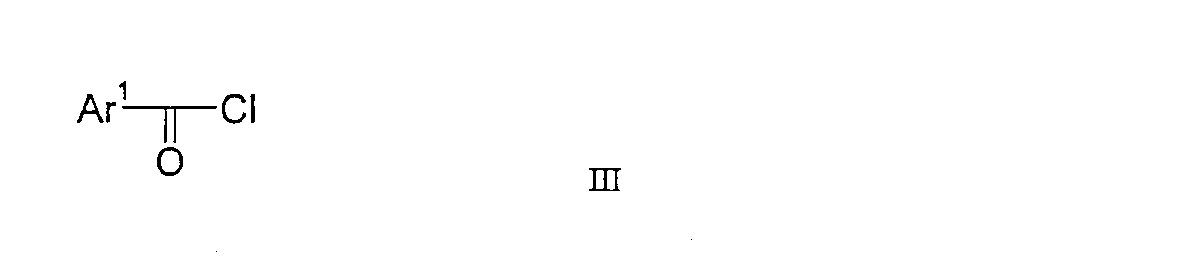
よりさらなる本発明の目的は、先に説明されたところの式(I)による新規スルホンアミド誘導体の調製方法である。本願発明のスルホンアミド誘導体は、以下の慣例の方法及び手順を用いて容易に入手可能な開始物質から調製されうる。典型的又は好ましい実験条件(すなわち反応温度、時間、試薬のモル数、溶媒等)が与えられるとき、特に提示されない限り他の実験条件が、使用されることもできることは理解されるであろう。至適反応条件は、使用される個々の反応物又は溶媒により変化しうるが、しかしその条件は、当業者により慣例の最適化手順によって決定さるうる。合成の好ましい方法において、本発明のスルホンアミド誘導体は、式(II):
【0082】
【化19】
{式中、Ar2 及びR1 は先に定義されたとおりである。}
のアミンを、式(III):
【0084】
【化20】
{式中、Ar1 は先に定義されたとおりである。}
のアシル・クロライドと第1のカップリングをし、式(IV):
【0086】
【化21】
のアミドが提供されることにより調製されうる。
【0088】
式(II)のアミンは、既知化合物又は慣例の手順により既知化合物から調製できる化合物のいずれかである。開始物質として好ましいアミンは、チエン−2−イル−メチルアミン、フラン−2−イル−メチルアミン、ピリジル−2−イルメチルアミン等を含む。式(III)のアシル・クロライドも市販又は前記化合物である。好ましいアシル・クロライドは、4−クロロベンゾイル・クロライド、4−フルオロベンゾイル・クロライド、4−トリフルオロメチルベンゾイル・クロライド等を含む。知らない場合、慣例条件下で対応のカルボン酸と無機酸ハロゲン化物、例えばチオニル・クロライド、ホスホラス・トリクロライド又はオキザリル・クロライドを反応させることにより調製されうる。
【0089】
一般的に、この反応は、約1〜5モル当量の無機酸ハロゲン化物又はオキザリル・クロライドを用いて、ピュア・フォーム中又は不活性溶媒、例えば四塩化炭素中のいずれかで、約0℃〜約80℃の範囲をとる温度で、約1〜約48時間行われる。触媒、N,N−ジメチルホルムアミドをこの反応に使用することもできる。
【0090】
アシル・ハロゲン化物がカップリング反応に利用される場合、それは、反応中に産生された酸を捕捉する好適な塩基の存在下、アミンIIと典型的に反応する。好適な塩基は例としてトリエチルアミン、ジイソプロピルエチルアミン、N−メチルモルフォリン等を含む。あるいは過剰のアミンIIが反応中に産生された酸を捕捉するために使用されうる。あるいは、式(III)のカルボン酸がカップリング反応に利用されうる。式(III)のカルボン酸は、一般に市販品であるか又は慣例の手順により調製されうる。式(III)のカルボン酸(すなわちアシル・クロライド)のカップリング反応は、例えばカルボジイミド、例えばジシクロヘキシルカルボジイミド、N−(3−ジメチルアミノプロピル)−N’−エチルカルボジイミド、及び他の促進剤、例えばN,N−カルボニル−ジイミダゾール又はPyBOPを含む好適なカップリング剤のいずれかを用いて実施される。この反応は、カルボン酸とアミンのカップリングを促進することが知られているところの周知の添加剤、例えばN−ヒドロキシサクシンイミド、1−ヒドロキシベンゾトリアゾール等の使用をともない又はそれなしに実施されうる。酸ハロゲン化物III 又はそのカルボン酸のいずれかを用いたカップリング反応は、好ましくは約0℃〜約6℃の範囲をとる温度で約1〜約24時間実施される。典型的には、前記反応は、前記カルボン酸又はその酸ハロゲン化物に基づくアミンの約1〜約5モル当量を用いる、不活性な非プロトン性極性溶媒、例えばN,N−ジメチルホルムアミド、ジクロロメタン、クロロホルム、アセトニトリル、テトラヒドロフラン等の中で実施される。前記反応が完了すると、前記カルボキサミドIVが、沈殿反応、クロマトグラフィー、ろ過、蒸留等を含む慣例の方法により回収される。式(I)のスルホニル・ピペリジン又はピペラジンの調製に必須の式(V):
【0091】
【化22】
のスルホニル・クロライドは、慣例のスルホン化方法を用いて調製される。この反応における使用に好ましいスルホン化剤はクロロスルホン酸である。典型的には、このスルホン化反応は、式(IV)のカルボキサミドを約5〜約10モル当量のスルホン化剤により不活性溶媒、例えばジクロロメタン中にて約−70℃〜約50℃の温度で処理することにより実施される。好ましくは、クロロスルホン酸の添加が、−70℃で行われ、そして中間体スルホン酸の形成をもたらす。20℃への温度の上昇は、式(V)のスルホニル・クロライドの形成を許す。特に式(V)のスルホニル・クロライドの前合成を導く先に示した方法が適用できない場合、さらに好ましい調製方法により本願発明のスルホニル・ピペリジン及びピペラジンが、以下の:
・式(II)の化合物のアミン官能基の保護;
・芳香族基のクロロスルホニル化;
・スルホンアミド官能基の形成;
・保護基の脱保護;
・上記で産生した遊離アミンのアシル化;
のステップにより調製される。
【0093】
式(II)のアミンは、アミン基の好適な保護基により保護されて式(VI):
【0094】
【化23】
の中間体を提供し、ここでPは保護基を意味する。アミン官能基の多数の保護基P、同様にそれらの導入及び除去は、T.W. Greene and G.M. Wnts, Protecting group in Organic Synthesis, Third Edition, Wiley, New York, 1998、及びそこに引用された文献に詳細に記載されている。好ましくは、酸及び塩基に安定であり、そして遷移金属複合体、例えばパラジウム複合体、例えばアリルカルバメート基(Alloc)又はN,N’−ビスアリル基の使用によりさらに除去されうるところの保護基である。他の好ましい保護基は、実験条件の全ての範囲で安定なマレイミド基である。前述の基の導入は、対応の無水ビスアリルカルボネート又はアリル臭素又は無水マレイン酸を、塩基、例えばトリエチルアミン、ジイソプロピルエチルアミン、N−メチルモルフォリン等の存在下、非プロトン性溶媒、例えばN,N−ジメチルホルムアミド、ジクロロメタン、クロロホルム、アセトニトリル、テトラヒドロフラン等の中において約0℃〜約80℃の温度で反応させることにより実施されうる。式(VI)の化合物は、次に式(VII):
【0096】
【化24】
のスルホニル・クロライドの獲得を許す慣例のとても緩やかなスルホン化手順を用いてスルホン化される。典型的には、保護アミンVIは、塩基、例えばn−ブチルリチウム又はtert−ブチルリチウムにより不活性雰囲気下、極性非プロトン性溶媒、例えばテトラヒドロフラン又はジオキサンのいずれかの中において15分間〜4時間の時間の間、−70℃〜0℃の温度で処理される。そうして形成されたアニオンは次にSO2 Cl2 又は最も好ましくは前記反応混合物中にその気体をバブリングすることによりSO2 によって5分間〜1時間の間、−70℃〜20℃の温度で処理される。得られたスルホネートは、次に0℃〜70℃の温度でN−クロロサクシンイミドと接触することにより式(VII)のスルホニル・クロライドに「その場で(in situ)」で変換される。
【0098】
式(I)のスルホンアミド誘導体は、次に対応の環式アミン、例えば一般式(VII)若しくは(IX):
【0099】
【化25】
のピペラジン若しくはピペリジン誘導体又は次の式:
【0101】
【化26】
{式中、R6 ,n,L1 、及びL2 は先の定義のとおりである。}
のピロリジン、アゼパン若しくは1,4−ジアゼパンと反応させることにより対応の前述スルホニル・クロライドV又はVII から調製される。
【0103】
先に説明した環式アミン、特に式(VIII)又は(IX)は、市販の化合物か又は既知の手順により調製されうる化合物のいずれかである。
【0104】
典型的には、式(VIII)のピペラジンは、当業者に知られる変換法を使用することで調製されうる。L1 及び/又はL2 =アリールについて、好適な調製法は、Tetrahedron Lett. 1996, 37, 8487-8488 及びその中に引用されている文献に記載されている。L1 及び/又はL2 =アリールC1 −C6 アルキルについて、より好ましい方法は、式(X):
【0105】
【化27】
の化合物と対応のピペラジン又はモノ−N−保護ピペラジンの反応であり、ここでXはCl,Br,OTs,OMsである。前記反応は、塩基、例えばトリエチルアミン、ジイソプロピルエチルアミン、カリウム、カーボネート等の存在下、溶媒、例えばN,N−ジメチルホルムアミド、ジメチルスルホキシド、N−メチルピロリドン、エタノール、アセトニトリル中において約0℃〜約100℃の温度で一般的に実施される。
【0107】
L1 及び/又はL2 =−C(S)−のとき、より好ましい方法は、Bull. Soc. Chim. Belgium, 1978, 87,229に記載のとおりアミド基をチオアミド基に変換することを許すところLawesson’s試薬を用いるXI型:
【0108】
【化28】
の化合物の変換である。式(I)のスルホンアミドは、その反応間に発生した酸を捕捉する好適な塩基の存在下、スルホニル・クロライドVを式(VIII)のアミンと接触させることにより容易に調製されうる。好適な塩基は、例としてトリエチルアミン、ジイソプロピルエチルアミン、N−メチルモルフォリン等を含む。好ましくは、前記反応は、溶媒、例えばN,N−ジメチルホルムアミド、ジメチルスルホキシド、N−メチルピロリドン、エタノール、アセトニトリル中、約0℃〜約100℃の温度で実施される。
【0110】
あるいは、式(I)のスルホンアミド誘導体は、一般式(IX)のピペリジンとの反応により対応のスルホニル・クロライドV又はVII から容易に調製される。式(IX)のピペリジンは、市販の化合物か又は既知の手順により調製されうる化合物のいずれかである。典型的には、XI型のピペリジンは、当業者に知られる、及び例としてJ. Pharm. Sci. 1972, 61, 1316; J. Heterocyclic. Chem., 1986, 23, 73; Tetrahedron Lett., 1996, 1297, 37, US 5106983, WO/9113872及びWO/9606609中に記載の慣例の方法を用いて調製されうる。
【0111】
式(IX)のピペリジンを得る好ましい方法は、下記のとおりである:L1 =H及びL2 =(CH2 )n −アリール、ここでn=0,1,2のとき;有機金属種、例えばAr3 (CH2 )n Li又はAr3 (CH2 )n MgBrのモノ−保護4−ピペリジンへの添加、そしてその後にIX型の化合物の形成を許すところのそうして形成された二重結合の還元が引き続く。L2 =−NR−(CH2 )n −アリール、ここでn=0,1,2のとき、好ましい方法は、アリール−(CH2 )n −NR−H型のアミンによる4−ピペリジンの還元的アミノ化である。
【0112】
n=0の場合におけるより好ましい方法は、Tetrahedron Lett. 1995, 36, 6373-6374 に記載のとおりXII 型:
【0113】
【化29】
の活性化アニリンとモノ−N−保護4−ピペリドールの間の「ミツノブ型(Mitsunobu type)」カップリングである。
【0115】
スルファミノ基の脱保護は、次に炭酸カリウムの存在下、チオフェノールを用いて行われる。
【0116】
L2 =−NR3'C(O)R3 ,−NR3'C(O)NR3'R3 ,−NR3'SO2 −R3 のとき、式(IX)の化合物の好ましい合成方法は、当業者に周知の古典的条件下、市販のN−BOC−4−アミノピペリジンのアシル・クロライド、イソシアネート、及びスルホニル・クロライドのそれぞれとの反応である。
【0117】
L2 =−CO−アリールのとき、式(IX)の化合物は、適切に選ばれた芳香族又はヘテロ芳香族環をXII 型:
【0118】
【化30】
の中間体とルイス酸、例えばアルミニウム・トリクロライド又はチタニウム・テトラクロライドの存在下、極性非プロトン性溶媒、例えばジクロロメタン中において接触させることにより容易に調製される。中間体XIIIは、ピペリジン−4−イル・カルボン酸の第1アセチル化、そしてチオニル・クロライドを用いた処理によるアシル・クロライドの形成により容易に得られうる。
【0120】
式(I)のスルホンアミドは、その反応の間に発生した酸を捕捉する好適な塩基の存在下、スルホニル・クロライドVを式(IX)のアミンと接触させることで容易に調製される。好適な塩基は、例としてトリエチルアミン、ジイソプロピルエチルアミン、N−メチルモルフォリン等を含む。好ましくは、前記反応は、溶媒、例えばN,N−ジメチルホルムアミド、ジメチルスルホキシド、N−メチルピロリドン、エタノール、アセトニトリル中において約0℃〜約100℃の温度で実施される。
【0121】
式(XIV)のスルホンアミドは、その反応の間に発生した酸を捕捉する好適な塩の存在下、スルホニル・クロライドVII を式(VIII)又は(IX)のアミンと接触させることで容易に調製されうる。好適な塩基は、例としてトリエチルアミン、ジイソプロピルエチルアミン、N−メチルモルフォリン等を含む。好ましくは、前記反応は、溶媒、例えばN,N−ジメチルホルムアミド、ジメチルスルホキシド、N−メチルピロリドン、エタノール、アセトニトリル中において約0℃〜約100℃の温度で実施される。VII 型のスルホニル・クロライドの使用は、一般式(XIV):
【0122】
【化31】
{式中、R1 ,Ar2 ,Y及びnは先に定義のとおりである。}
のアミンを与えるために当業者に周知の方法を用いて脱保護すべきアミンをもたらす。
【0124】
XIV 型の誘導体は、次に一般式(I)の化合物をもたらす前記好ましい条件においてアミンと酸性塩化物又はカルボン酸との縮合による記載されたアミドの調製方法に従ってアシル化される。Yがピペラジン誘導体を表すところの一般式(I)の化合物の特有の場合において、選びうる調製方法は、本願発明の一部と考えられるべきでもあり、その調製方法は、L1 の性質(前記L1 ,L2 の定義を参照のこと)に依存し選ばれるであろうところの求電子L1 による式(XV):
【0125】
【化32】
のピペラジン誘導体の縮合を含む。これらの形の縮合を行うための手順及び方法は、周知であり、そしてN−置換型ピペラジン誘導体のさまざまな合成について詳細に記載されている。
【0127】
先に説明した一般的な合成方法が式(I)の化合物の獲得のために適当でない場合、当業者により知られる調製方法が使用されるものとする。例えば、Ar2 がフェニルの場合、市販の4−シアノフェニル・スルホニル・クロライドから開始し、そして当業者により知られる変換法を利用して式(I)のスルホンアミド誘導体を獲得すべきである。本発明の最終的な側面は、JNK機能又はシグナル伝達経路の調節のための式(I)による化合物の使用、JNK経路の調節向け医薬組成物の調製のための上述の化合物の使用、同様に式(I)による活性な化合物を含む製剤に関する。前述のJNK経路の調節は、さまざまな障害の好適な治療方法であると思われる。医薬品として利用される場合、本発明のスルホンアミド誘導体は、医薬組成物の形で典型的には投与される。したがって式(I)の化合物及び医薬として許容しうる担体、希釈剤又はそれらのための賦形剤を含む医薬組成物も本発明の範囲の中にある。当業者は、医薬組成物の調製に好適なさまざまな担体、希釈剤又は賦形剤化合物全般に通じている。また、本発明は、医薬品として使用するための化合物を提供する。特に、本発明は、哺乳類、特にヒトの免疫系、同様に神経系の障害の治療用のJNK阻害剤、特にJNK2及びJNK3阻害剤として使用するための式(I)の化合物を単独又は他の医薬品との取り合わせ物で提供する。
【0128】
慣例的に利用されるアジュバント、担体、希釈剤又は賦形剤とともに本発明の化合物は、医薬組成物、及びその投与単位の形態をとり、そして上述の形態として固体、例えば錠剤又は充填カプセルで又は液体、例えば溶液、懸濁液、乳液、エリキシル剤若しくはそれによって満たされたカプセルで全て経口使用に、あるいは(皮下使用を含む)無菌の注射可能な溶液の形で非経口使用に利用されうる。前述の医薬組成物及びそれらの投与単位形態は、さらなる活性成分若しくは活性素をともない又はそれなしに慣例の割合で成分を含み、そして上述の投与単位形態は意図される日用量の範囲と同等のいずれかの好適な有効量の活性成分を含む。
【0129】
医薬品として利用される場合、本願発明のスルホンアミド誘導体は、医薬組成物の形態で典型的には投与される。前述の組成物は、医薬技術で周知の手段により調製されることができ、そして少なくとも1の活性化合物を含む。一般的に本願発明の化合物は医薬としての有効量を投与される。実際に投与される化合物の量は、治療される症状、選ばれた投与経路、投与される実際の化合物、患者それぞれの年齢、体重、及び感応、患者の症状の重さ等を含む関連状況を考慮に入れて、医師により典型的に決定されるであろう。
【0130】
本願発明の医薬組成物は、経口、直腸、経皮、皮下、静脈中、筋中、鼻腔内を含むさまざまな経路により投与されうる。意図した送達経路により、前記化合物は、注射可能な組成物か又は経口的な組成物のいずれかとして好ましくは処方される。経口投与用組成物は、溶液又は懸濁液原体あるいは粉末の原末の形態をとりうる。しかしながら、より一般的には、前記組成物は、正確な投与を容易にする投与単位形態で提供される。用語「投与単位形態」は、治療を受けるヒト及び他の動物のための単位投与に好適な物理的に分かれている単位であり、かつ、好適な医薬賦形剤と共同して所望の治療効果を生じるように計算され、前もって定められた活性物質の量を含むそれぞれの単位に関する。典型的な投与単位形態は、液体組成物の前もって計量され、充填されたアンプル又はシリンジあるいは固体組成物の場合、ピル、錠剤、カプセル等を含む。前述の組成物において、スルホンアミド化合物は、通常さまざまな媒質又は担体であって、そして所望の投与形態の形成のために有用な援助をする残部をともなう微量成分(約0.1〜約50重量%又は好ましくは約1〜約40重量%)である。
【0131】
経口投与に適した液体形態は、緩衝剤、懸濁剤(suspending and dispensing agents)、着色剤、香料等をともなう好適な水性又は非水性媒質を含みうる。固体形態は、例えば以下成分のいずれか又は類似の性質の化合物:結合剤、例えば微細結晶セルロース、トラガカントゴム又はゼラチン;賦形剤、例えばでんぷん又はラクトース、崩壊剤、例えばアルギン酸、プリモゲル(Primogel)又はコーン・スターチ;滑沢剤、例えばステアリン酸マグネシウム;滑剤(glidant)、例えばコロイド性二酸化ケイ素;甘味料、例えばショ糖又はサッカライド;あるいは香料、例えばペパーミント、サリチル酸メチル又はオレンジ香料を含みうる。
【0132】
注射可能な組成物は、典型的には注射可能な無菌の生理的食塩水若しくはリン酸緩衝塩類溶液又は本技術分野で知られる他の注射可能な担体に典型的には基づく。前記のとおり、前述の組成物中の式(I)のスルホンアミド化合物は、典型的には、注射可能な担体等である残部をともなう、しばしば0.05〜10重量%の範囲をとる微量成分である。
【0133】
前記経口投与向け成分又は注射可能な組成物は、単なる典型である。さらなる物質、同様に加工技術等が、Remington's Pharmaceutical Sciences, 17th Edition, 1985, Marck Publishing Company, Easton, Pennsylvania の第8巻(本明細書中に援用)の中に説明されている。本願発明の化合物は、徐放性形態で又は徐放性薬物送達システムから投与されることもできる。典型的な徐放性物質についての記載は、Remington's Pharmaceutical Sciences 中に含まれている物質の中に見ることもできる。
【0134】
下記において、本発明は、いくつかの実施例により例示されるが、この実施例は、本発明の範囲を制限しない。
【0135】
実施例
プロトコール#1
実施例1:4−クロロ−N−[5−(ピペラジン−1−スルホニル)−チオフェン−2−イルメチル]−ベンズアミド1の調製
4−クロロ−N−チオフェン−2−イルメチル−ベンズアミド1a
50mL無水CH2 Cl2 中、4−クロロベンゾイル・クロライド(0.114mol)の溶液を0℃で30分間で撹拌したCH2 Cl2 (200mL)中、2−アミノメチル−チオフェン(0.137mol)と iPr2 NEt(0.25mol)の溶液に加えた。白色の固体を形成し、そして反応液を1時間で室温まで暖めた。その混合物を200mLのCH2 Cl2 で希釈し、HClaq.(0.1N)により2度洗浄し、そしてMgSO4 により水分を除いた。溶媒を蒸発させることで白色固体として表題のベンズアミド28g(98%)をもたらした:融点 153−54℃, 1H NMR(CDCl3 )δ7.9(d,J=8.67Hz,2H),7.58(d,J=8.67Hz,2H),7.44(dd,J=3.77,1.13Hz,1H),7.22(d,J=5.27Hz,1H),7.16(dd,J=3.39,5.27Hz,1H),6.62(br d,1H),4.98(d,J=5.65Hz,2H)。
【0136】
5−({[1−(4−クロロ−フェニル)−メタノイル]−アミノ}−メチル)−チオフェン−2−スルホニル・クロライド1b
CH2 Cl2 (80mL)中、クロロスルホン酸(20.1mL、198mmol)を−80℃でCH2 Cl2 (500mL)中、1a(10g、40mmol)の溶液に滴下により加えた。その混合物を5時間で室温に達しさせた。その反応混合物を水中に注ぎ、そして手早くCH2 Cl2 により抽出した。前記有機層をMgSO4 により水分除去し、そして溶媒を蒸発して乾かし8.8g(63%)の所望のスルホニル・クロライド1bを与えた;融点 133−35℃, 1H NMR(DMSO−d6)δ9.21(t,J=6.4Hz,1H),7.87(d,J=8.67Hz,2H),7.53(d,J=8.67Hz,2H),6.91(d,J=3.39Hz,1H),6.77(d,J=3.39Hz,1H),4.53(d,J=3.77Hz,2H)。
【0137】
4−クロロ−N−[5−(ピペラジン−1−スルホニル)−チオフェン−2−イルメチル]−ベンズアミド1
0.5mL DMF、及び2mL CH2 Cl2 中、1b(1g、2.9mmol)の溶液を0℃でCH2 Cl2 (11mL)中、ピペラジン(985mg、11.4mmol)にゆっくり加えた。その反応液を2時間撹拌し、その間に室温に到達させた。その反応混合物を飽和NaHCO3 により洗浄し、そしてMgSO4 により水分除去した。溶媒を蒸発後1.76g(62%)の1cを単離した。 1H NMR(DMSO−d6)δ9.38(t,J=5.27Hz,1H),7.90(d,J=8.67Hz,2H),7.56(d,J=8.67Hz,2H),7.46(d,J=3.77Hz,1H),7.18(d,J=4.14Hz,1H),4.67(d,J=6.03Hz,2H),2.66−2.84(m,8H)。
【0138】
実施例2:4−クロロ−N−{5−[4−(3−トリフルオロメタンスルホニル−フェニルアミノ)−ピペリジン−1−スルホニル]−チオフェン−2−イルメチル}−ベンズアミド2の調製
撹拌したCH2 Cl2 (250mL)中、4−((3−トリフルオロメタンスルホニル)−フェニルアミノ))−ピペリジン(580mg、1.88mmol)、及びiPr2 NEt(1.46μl、8.6mmol)の溶液にDMF/CH2 Cl2 (1:3、15mL)中、1b(600mg、1.71mmol)を加えた。3時間後その反応混合物をHCl(0.1N)及び飽和NaCl溶液により洗浄し、そしてMgSO4 により水分除去した。溶媒を蒸発し、そして残渣を溶出液としてシクロヘキサン/エチル酢酸1:1を用いてシリカゲルを通してろ過した。2を白色固体として単離した(840mg、79%)。融点:198−199℃. 1H NMR(DMSO−d6)δ9.38(t,J=5.6Hz,1H),7.74(d,J=8.6Hz,2H),7.45−7.33(m,4H),7.28(d,J=7.9Hz,1H),7.06(d,J=3.8Hz,1H),7.02(s,1H),6.90(d,J=7.9Hz,1H),6.69(t,J=5.6Hz,1H),4.68(d,J=5.6Hz,2H),4.00(s,b,Hz,1H),3.71(d,J=12.1Hz,2H),3.32(s,b,1H),2.62(dd,J=12.1Hz,2.26Hz,2H),2.11(d,J=13.56Hz,2H),1.65−1.48(m,2H).M/Z APCI:622.2(M+1),620.1(M−1).C24H23ClF3 N3 O5 S3 Calc.:C:46.34%.H:3.73%.N:6.75%.Found:C:46.05%,H:3.84%,N:6.69%。
【0139】
あるいは、2を、パラレル溶液相法(parallel solution phase approach)により合成しうる。4mL容Alltech(商標)管の中で1当量のアミンを1.2mL CH2 Cl2 /DMF中、ポリマー結合NMM(4当量)と振り混ぜる。15分後CH2 Cl2 /DMF中、1b(1.2当量)の原液1mLを加え、そして反応スラリーを振り混ぜる。3時間後アミノメチル・メリフィールド樹脂(0.4当量)を加え、反応液を一晩振り混ぜる。溶液をろ過して除き、樹脂をCH2 Cl2 により3度洗浄し、そして溶媒を、Savant Speed Vac(商標)Plus吸引遠心機により中温で1時間蒸発させた。
【0140】
以下の化合物を、前記実施例に従ってパラレル法により調製した。以下の表は、言及された実施例のHPLCのデータ、及びマススペクトルのデータを提供する1,2 。
【0141】
1 HPLC条件:C8 Symmetry a−MeCN,0.09% TFA,0→100%(10分)、HPLC条件:C18 b−MeCN,0.09% TFA,0→100%(20分)、c−MeCN,0.09% TFA,0→100%(30分)。
【0142】
2 マススペクトル APCI
【0143】
【表1】
【表2】
【表3】
【表4】
【表5】
実施例91:N−[(5−{[4−(1H−1,2,3−ベンゾトリアゾール−1−イル)ピペリジン−1−イル]スルホニル}チエン−2−イル)メチル]−4−クロロベンズアミド91の調製
4−(1H−1,2,3−ベンゾトリアゾール−1−イル)ピペリジニウムトリフルオロ酢酸、91a
15mL THF中、Boc−4−ヒドロキシ−ピペリジン(201mg、1mmol)、ベンゾトリアゾール(238mg、2mmol)、及びトリフェニルホスフィン(523mg、2mmol)の溶液に10mL THF中、ジエチルアゾジカルボキシレート(326μl、2mmol)の溶液を加えた。その黄色溶液を一晩撹拌し、溶媒を蒸発して乾かし、そしてその未精製残渣をシリカ・ゲル(AcOEt/シクロヘキサン7:3)上で溶出した。1−、及び2−位置異性体を含むその画分を単離した。
【0149】
画分1は2−ベンゾトリアゾール−ピペリジン異性体を含む(250mg、82%)。 1H NMR(CDCl3 )δ7.84(m,2H),7.38(m,2H),4.90(quint.,J=6.8Hz.),4.20(m,2H),3.09(m,2H),2.27(m,4H),1.68(s,9H).M/Z APCI:303.2(M+1),247(M− tbutyl+1),203(M−Boc+1)。
【0150】
画分2は、1−ベンゾトリアゾール−ピペリジン異性体を含む(50mg、16%)。 1H NMR(CDCl3 )δ8.06(d,J=8.3Hz.,1H),7.92(d,J=8.3Hz,1H),7.58(t,J=8.3Hz.),7.42(t,J=8.3Hz),5.25(m,1H),3.52(m,2H),3.20(m,2H),2.55−2.25(m,4H),1.66(s,9H).M/Z APCI:303.2(M+1),247(M− tbutyl+1),203(M−Boc+1)。
【0151】
画分1(250mg、0.82mmol)を5mL CH2 Cl2 中に溶解した。1mL TFAを滴下で加え、そしてその溶液を3時間撹拌した。溶媒を蒸発させて乾かし、そして油を含んだ残渣をジエチルエーテルにより沈殿し、240mg(95%)の91aを与えた: 1H NMR(DMSO−d6)δ9.10(b,m,1H),8.72(b,m,1H),8.07(d,J=8.3Hz.,1H),7.96(d,J=8.3Hz,1H),7.55(t,J=8.3Hz.)7.40(t,J=8.3Hz.),5.25(m,1H),3.52(m,2H),3.20(m,2H),2.55−2.25(m,4H),M/Z APCI:203.2(M+1)。
【0152】
N−[(5−{[4−(1H−1,2,3−ベンゾトリアゾール−1−イル)ピペリジン−1−イル]スルホニル}チエン−2−イル)メチル]−4−クロロベンズアミド91
91を2の合成プロトコールに従って合成した。フラッシュ・クロマトグラフィーの後主要な画分をCH2 Cl2 /シクロヘキサンから再結晶化した。単離収量:3.1g(71%)。融点:174−175℃、 1H NMR(DMSO−d6)δ9.41(t,J=6.0Hz,1H),8.03(d,J=7.9Hz,1H),7.91(d,J=8.7Hz,2H),7.87(d,J=8.7Hz,1H),7.61−7.54(m,3H),7.52(t,J=8.3Hz,1H),7.39(t,J=8.3Hz,1H),7.23(d,J=3.77Hz,1H),),5.01(m,1H),4.70(d,J=5.6Hz,2H),3.78(d,J=10.6Hz,2H),2.80−2.64(m,2H),2.34−2.17(m,4H).M/Z APCI:516.2(M+1),514.1(M−1).C23H22ClN5 O3 S2 Calc.:C:53.53%.H:4.30%.N:13.57%.Found:C:52.74%,H:4.29%,N:13.26%。
【0153】
あるいは、91は2に適用したプロトコールを用いてパラレル溶液相法により合成されうる。
【0154】
以下の化合物を前記実施例に従ってパラレル法により調製した。以下の表は、言及された実施例のHPLCのデータ、及びマススペクトルのデータを提供する。
【0155】
【表6】
実施例110:4−クロロ−N−{ [ 5−({4− [ 3−プロピルアニリノ ] ピペリジン−1−イル}スルホニル)チエン−2−イル ] メチル}ベンズアミド110の調製
4−(3−プロピルアニリノ)ピペリジントリフルオロ酢酸塩110b
Boc−ピペリジン−4−オン(2.5g、12.5mmol)、及び3−ピロピルアニリン塩酸(2.15g、12.5mmol)、並びに2.1mL DIEAを15mL DCE中で1時間撹拌した。この溶液に酢酸(750μl、12.5mmol)、及びトリアセトキシホウ化水素ナトリウム(3.72g、17.6mmol)を加え、そしてその溶液をアルゴン雰囲気下、一晩撹拌した。反応混合物をジエチルエーテルにより希釈し、そして12mLのNaOH(2N)を加えた(pH9−10)。その有機相を食塩水により2度洗浄し、そしてMgSO4 により水分除去した。その未精製物を溶出液として石油エーテル/EtOAc 7:1を用いたシリカゲルによるフラッシュ・クロマトグラフィーにより精製した。3.7g(94%)の純粋な110aを無色固体として単離した。 1H NMR(DMSO−d6)δ6.93(t,J=7.7,1H),6.31−6.39(m,3H),5.31(d,J=8.2,1H),3.84(d,J=13.2Hz,2H),3.33(m,1H.),2.89(m,2H),2.39(t,J=7.7Hz,2H),1.84(dJ=11.3Hz,2H),1.55(m,2H),1.51(s,9H),1.20(m,2H),0.86(t,J=7.3Hz,3H),M/Z ESI:319.2(M+1)。
【0157】
110a(1.5g、4.71mmol)を20mL CH2 Cl2 中に溶解した。5mLのTFAを滴下で加え、そしてその溶液を3時間撹拌した。溶媒を蒸発させて乾かし、そしてその油を含んだ残渣をジエチルエーテルにより沈殿し1.45g(92%)の110bを与えた。 1H NMR(DMSO−d6)δ8.59(m,2H),7.00(t,J=7.7,1H),6.44−6.50(m,3H),3.51(m,1H),3.27(m,2H),3.00(m,2H.),2.42(t,J=7.7Hz,2H),2.00(dJ=11.3Hz,2H),1.57−1.47(m,4H),0.87(t,J=7.3Hz,3H),M/Z ESI:219.2(M+1)。
【0158】
4−クロロ−N−{[5−({4−[3−プロピルアニリノ]ピペリジン−1 −イル}スルホニル)チエン−2−イル]メチル}−ベンズアミド110
110を2の合成プロトコールに従って合成した。フラッシュ・クロマトグラフィーの後その主な画分をCH2 Cl2 /シクロヘキサンから再結晶化した。単離収量:430mg(56%)。融点:169−170℃. 1H NMR(DMSO−d6)δ9.36(t,J=5.8Hz,1H),7.89(d,J=8.7Hz,2H),7.56(d,J=8.7Hz,2H),7.47(d,J=3.8Hz,1H),7.19(d,J=3.8Hz,1H),6.90(t,J=7.5Hz,1H),6.49−6.42(m,3H),5.33(d,J=7.9Hz,1H),4.68(d,J=5.6Hz,2H),3.51(d,J=11.7Hz,2H),3.29(m,1H),2.55(t,J=10.5Hz,2H),2.36(t,J=7.3Hz,2H),1.97(d,J=10.9Hz,2H).1.56−1.37(m,4H),0.84(t,J=7.3Hz,3H).M/Z APCI:532.2(M+1),530.1(M−1).C26H30ClN3 O3 S2 Calc.:C:58.70%.H:5.68%.N:7.90%.Found:C:58.55%,H:5.67%,N:7.93%。
【0159】
あるいは、110はパラレル溶液相法により合成されうる:4mL容Alltech(商標)管中にて1当量のピペリジン・トリフルオロ酢酸塩を1.2mL CH2 Cl2 /DMF中、ポリマー結合NMM(4当量)と振り混ぜる。15分後CH2 Cl2 /DMF中1b原液1mL(1.2当量)を加え、そしてその反応スラリーを振り混ぜる。3時間後アミノメチル・メリフィールド樹脂(0.4当量)を加え、そしてその反応物を一晩撹拌する。ときどき残留アミンをポリマー結合イソシアネート(0.2当量)により除去する。前記スラリーを1時間再び振り混ぜる。溶液をろ過して除き、樹脂をCH2 Cl2 により3度洗浄し、そして溶媒をSavant Speed Vac(商標)Plus吸引遠心機により中温で1時間蒸発させる。
【0160】
以下の化合物を前記実施例に従ってパラレル法により調製した。以下の表は、言及された実施例のHPLCのデータ、及びマススペクトルのデータを提供する。
【0161】
【表7】
【表8】
【表9】
実施例158:4−クロロ−N−[(5−{[4−(3−プロピルフェノキシ)ピペリジン−1−イル]スルホニル}チエン−2−イル)メチル]ベンズアミド158の調製
4−(3−プロピルフェノキシ)ピペリジニウムトリフルオロ酢酸、158a 30mL THF中、Boc−4−ヒドロキシ−ピペリジン(1g、4.97mmol)、3−プロピルフェノール(677mg、4.97mmol)、及びトリフェニルホスフィン(1.304g、4.97mmol)の溶液に10mL THF中、ジエチルアゾジカルボキシレート(866mg、4.97mmol)の溶液を加えた。その黄色溶液を一晩撹拌し、溶媒を蒸発させて乾かし、そして未精製残渣をシリカ・ゲル(AcOEt/シクロヘキサン1:9)により溶出して880mg(56%)の純粋な158aを与えた。
【0165】
158aを10mL CH2 Cl2 中に溶解し、そして2mL TFAを加えた。3時間後反応混合物を蒸発させて乾かし、そして残留油をジエチルエーテルにより沈殿して800mg(92%)の純粋なTFA塩158aを与えた: 1H NMR(DMSO−d6)δ8.42(b,m,2H),7.04(d,J=7.7Hz,1H),6.65(m,3H),4.47(m,1H),3.20−2.80(b,m,4H),2.46(m,2H),1.90(m,2H),1.65(m,2H),1.43(m,2H),0.74(t,J=7.3Hz,3H)。
【0166】
4−クロロ−N−[(5−{[4−(3−プロピルフェノキシ)ピペリジン−1−イル]スルホニル}チエン−2−イル)メチル]−ベンズアミド158
158を2の合成プロトコールに従って合成した。フラッシュ・クロマトグラフィー後その主な画分をCH2 Cl2 /シクロヘキサンから再結晶化した。単離収量:24mg(88%)。 1H NMR(DMSO−d6)δ9.38(t,J=5.6Hz,1H),7.90(d,J=8.7Hz,2H),7.56(d,J=8.7Hz,2H),7.50(d,J=3.7Hz,1H),7.19(d,J=3.7Hz,1H),7.09(t,J=8.1Hz,1H),6.85−6.66(m,3H),4.68(d,J=5.6Hz,2H),3.51(d,J=11.7Hz,2H),3.29(m,1H),2.87(t,J=10.5Hz,2H),2.45(t,J=7.3Hz,2H),2.00(d,J=10.9Hz,2H).1.56−1.37(m,4H),0.84(t,J=7.2Hz,3H).M/Z APCI:533.2(M+1),531.1(M−1)。
【0167】
プロトコール#2
実施例159:4−クロロ−N−{[5−({4−[(2E)−3−フェニルプロプ−2−エノイル]ピペラジン−1−イル}スルホニル)チエン−2−イル]メチル}−ベンズアミド159の調製
撹拌した、CHCl3 (2mL)中、1(36mg、0.09mmol)、及びiPr2 NEt(32μl、0.189mmol)の溶液に[(2E)−3−フェニルプロプ−2−エノイル]クロライド(15mg、0.09mmol)を加えた。4時間後その反応混合物をHCl(1N)及び飽和NaCl溶液により洗浄し、そしてMgSO4 により水分除去した。溶媒を蒸発させ、そして残渣を溶出液としてAcOEt/MeOH 1%を用いてシリカ・ゲルを通してろ過して白色固体として159を与えた(10mg、20%)。M/Z APCI:531.2(M+1),529.1(M−1).分析用HPLC:保持時間=6.18分(方法a)。
【0168】
以下の化合物を前記実施例に従ってパラレル法により調製した。以下の表は、言及された実施例のHPLCのデータ、及びマススペクトルのデータを提供する。
【0169】
【表10】
プロトコール#3
実施例177:4−ニトロ−N−({5−[(4−{3−[(トリフルオロメチル)スルホニル]アニリノ}−ピペリジン−1−イル)スルホニル]チエン−2−イル}メチル)−ベンズアミド177の調製
{[(3−ニトロベンゾイル)アミノ]メチル}チオフェン−2−スルホニル・クロライド177a
100mLのクロロホルム中、2−アミノメチルチオフェン(10.6mL、103mmol)、及びピリジン(9.1mL、104mmol)の溶液に0℃でCH2 Cl2 中、3−ニトロベンゾイル−クロライド(19.2g、103mmol)の溶液を加えた。その反応物を1時間で室温まで暖め、そしてさらに3時間撹拌した。水を3−ニトロ−N−(チエン−2−イルメチル)−ベンズアミド(10.1g)沈殿する間に加えた。その固体をろ過し、そして水により洗浄した。残留する有機層を食塩水で洗浄し、MgSO4 により水分除去し、そして蒸発させて乾かし、補足的な3−ニトロ−N−(チエン−2−イルメチル)ベンズアミド(15.2g)を与えた。全体の収量は25.3g(99.9%)であった。さらに精製することなく3−ニトロ−N−(チエン−2−イルメチル)ベンズアミドを次のステップに使用した。
【0171】
クロロスルホン酸(5.62mL、84mmol)を20mL CH2 Cl2 中に溶解し、そして激しく撹拌しながら100mL CH2 Cl2 中、3−ニトロ−N−(チエン−2−イルメチル)ベンズアミド(11.0g、42mmol)の溶液に加えた。粘着性の固体が形成され、そして反応混合物を3時間撹拌した。その反応物を氷により冷やし、そして氷冷NaHCO3 溶液をpH8.5に達するまで加えた。水層をCH2 Cl2 により2度洗浄した。固体が形成されている間にテトラブチルアンモニウムヒドロキシド(水中40%)(32mL、50mmol)を水層に加えた。沈殿をCH2 Cl2 中で析出させ、そして水層をCH2 Cl2 により3度洗浄した。混合性の有機層をMgSO4 により水分除去し、そして蒸発させて乾かしてテトラブチルアンモニウム5−{[(3−ニトロベンゾイル)アミノ]メチル}チオフェン−2−スルホネート(24g、97%)のわずかに色付いた泡を与えた。NMRスペクトルは純粋な化合物を示し、それを以下の塩素化ステップに使用した。
【0172】
50mL CH2 Cl2 中、テトラブチルアンモニウム5−{[(3−ニトロベンゾイル)アミノ]メチル}チオフェン−2−スルホネート(2.0g、3.4mmol)の溶液に10mL CH2 Cl2 中に溶解したトリホスゲン(800mg、2.7mmol、2.3当量)を加えた。この反応混合物にDMF(0.1mL、1.4mmol)を10分間で滴下で加え、その間気体の産生を観察した。その気体を反応フラスコの出口で2N NaOH溶液によりトラップした。前記反応混合物を3時間撹拌し、そして未精製物を溶出液としてEtOAc/ヘキサン1:2を用いてシリカ・ゲルを通して直接ろ過した。シクロヘキサン/CH2 Cl2 から再結晶化した有機固体を単離することができた。177a(730mg、60%)を無色の針状として得た。 1H NMR(CDCl3 )δ8.83(t,J=1.5Hz,1H),8.35(t,J=7.5Hz,1H),7.76(t,J=4.1Hz,1H),7.70−7.58(m,3H),7.52−7.40(m,2H),7.05(t,J=3.8Hz,1H)。
【0173】
3−ニトロ−N−({5−[(4−{3−[(トリフルオロメチル)スルホニル]アニリノ}ピペリジン−1−イル)スルホニル]チエン−2−イル}メチル)ベンズアミド177
CH2 Cl2 (30mL)中、スルホニル・クロライド177a(573mg、1.58mmol)、4−(3−トリフルオロメタンスルホニル−フェニルアミノ)−ピペリジン(490mg、1.58mmol)、及びEt3 N(330μl、2.38mmol)の懸濁液を23℃で3時間撹拌し、その結果その懸濁液が透明な溶液となった。標準的な操作(HCl 1N;食塩水;MgSO4 )は黄色の泡として未精製産物を与えた。これをDMSO(1mL)、及びCH3 CN(3mL)中に溶解し、そして逆相調製用HPLC(C8、グラジエントH2 O:CH3 CN 60:40→0:100を40分間で、保持時間=20分)にかけた。所望の画分の凍結乾燥は、淡い黄色粉末として667mg(67%)の表題のスルホンアミドを与えた: 1H NMR(DMSO−d6)δ9.69(t,J=5.8Hz,1H),8.72(t,J=1.9Hz,1H),8.41(dd,J=8.3,1.9Hz,1H),8.34(d,J=7.9Hz,1H),7.81(t,J=8.1Hz,1H),7.50(d,J=3.8Hz,1H),7.45(t,J=7.9Hz,1H),7.23(d,J=3.8Hz,1H),7.15−7.11(m,3H),6.52(d,J=7.9Hz,1H),4.73(d,J=5.7Hz,2H),3.57−3.42(br.d,J=11.7Hz,2H),3.52−3.33(m,1H),2.62(t,J=10.4Hz,2H),2.00−1.90(br.d,J=10.6Hz),1.43(qd,J=10.2,3Hz,2H).13C NMR(DMSO−d6)δ164.66(s,C=O),150.51(s),149.32(s),148.20(s),135.30(s),134.22(s),134.11(d),132.98(d),131.49(d),130.67(d),130.44(s),127.00(d),126.60(d),122.38(d),120.41(d),119.81(q,J=326Hz,CF3 ),116.72(d),112.79(d),47.43(d),45.15(t),38.58(t),30.66(t).M/Z APCI:633(M+1),631(M−1).分析用HPLC:R.t=6.41分(方法a).C24H23F3 N4 O7 S3 Calc.:C:45.56%.H:3.66%.N:8.86%.Found:C:45.30%,H:3.73%,N:8.85%。
【0174】
ここに記載した一連の操作において、最初に用いた3−ニトロベンゾイル・クロライドを、(これだけに制限されることなく):4−ニトロベンゾイル、4−クロロベンゾイル・クロライド、3−メトキシベンゾイル・クロライド、トリフルオロ無水酢酸を含む他のアシル化剤により置き換えることができた。
【0175】
以下の化合物を前記実施例に従ってパラレル法により調製した。以下の表は、言及された実施例のHPLCのデータ、及びマススペクトルのデータを提供する。
【0176】
【表11】
【表12】
【表13】
【表14】
【表15】
プロトコール#4
実施例268:N−[(5−{[4−(2,4−ジフルオロベンゾイル)ピペリジン−1−イル]スルホニル}−チエン−2−イル)メチル]−3−メトキシベンズアミド268の調製
{[(3−メトキシベンゾイル)アミノ]メチル}チオフェン−2−スルホニル・クロライド268a
表題のスルホニルクロライドを合成プロトコール#3(実施例177)に従って調製した。溶出液としてシクロヘキサン/EtOAc 1:1を用いたフラッシュ・クロマトグラフィーの後主な画分をCH2 Cl2 /シクロヘキサンから再結晶化して17.5gの純粋な268aを与えた。 1H NMR(CDCl3 )δ7.79(t,J=4.0Hz,1H),7.65(t,J=7.9Hz,1H),7.58(m,1H),7.70−7.35(t,J=8.1Hz,1H),7.06(m,2H),5.07(d,J=3.8Hz,2H),3.88(s,3H)。
【0182】
N−[(5−{[4−(2,4−ジフルオロベンゾイル)ピペリジン−1−イル]スルホニル}チエン−2−イル)メチル]−3−メトキシベンズアミド、268
268を2の調製に適用した一般的な手順プロトコールを用いて調製し、そして無色固体として98%の収率(62mg)で単離できた。M/Z APCI:535(M+1),533(M−1).分析用HPLC:保持時間=6.22分(方法a)。
【0183】
実施例269:2−ヒドロキシ−N−({5−[(4−{3−[(トリフルオロメチル)スルホニル]アニリノ}ピペリジン−1−イル)スルホニル]チエン−2−イル}メチル)−ベンズアミド269の調製
ジアリル−チオフェン−2−イルメチルアミン269a
CH2 Cl2 (1l)中、2−アミノメチル−チオフェン(51.4g、956mmol)、及びi−Pr2 NEt(140g、1081mmol)の溶液をコンデンサー、及び効率的な磁気を用いた撹拌の仕組みを備える3l容フラスコに移す。アリル臭素(115.7g、454mmol)を加えた結果このわずかな放熱反応は、2時間後に自然に還流温度に達した。その混合物を一晩(16時間)撹拌し、洗浄し(NaHCO3 飽和;食塩水)、水分除去し(MgSO4 )、そして濃縮した。得られた油をシリカ・ゲル(EtOAc:ヘキサン1:4)でろ過した。そのろ液を濃縮し、そしてろ過をくり返して褐色−黄色の油として70.3g(80%)の表題のジアリルアミンを与え、NMRにより浄化した:1H NMR(CDCl3 )δ7.25(br.d,J=5.9Hz,1H),6.98(br.dd,J=5.1,2.8Hz,1H),6.94−6.92(m,1H),5.99−5.86(m,2H),5.29−5.18(m,4H),3.85(s,2H),3.16(dd,J=6.3,0.9Hz,4H)。
【0184】
5−ジアリルアミノメチル−チオフェン−2−スルホニル・クロライド269b
Et2 O中、アリル保護チオフェン269a(6.2g、32.1mmol)溶液をアセトン/ドライアイス浴の手法により−70℃まで冷やした。ペンタン中、t−BuLi溶液(21.38mL、1.5M、32.1mmol)を2分間で加えることで内部温度はすぐに−50℃で上昇し、そして前記混合物はオレンジ色に変化した。10分後、SO2 を2分間バブリングし、それが厚い沈殿の即座の形成を導いた。前記反応物を0℃まで到達させて、そしてTHF(20mL)中、NCS(4.63g、32.1mmol)の懸濁液を加えることで、そのスラリーは紫色に変化した。室温で45分後、その混合物をEtOAcにより溶出するSiO2 でろ過した。蒸発、EtOAc:ヘキサン1:5による希釈、及びSiO2 でのろ過が、淡褐色の油として5.0g(53%)の表題のスルホニル・クロライド269bを与え、それをさらなる精製なしに使用した。
【0185】
N,N−ジアリル−N−({5−[(4−{3−[(トリフルオロメチル)スルホニル]アニリノ}ピペリジン−1−イル)スルホニル]−チエン−2−イル}メチル)アミノ269c
CH2 Cl2 (20mL)中、4−(3−トリフルオロメタンスルホニル−フェニルアミノ)−ピペリジン(731mg、2.37mmol)、及びEt3 N(0.5mL、3.58mmol)の溶液を23℃でジアリルアミノ・スルホニル・クロライド269bにより処理した。厚い沈殿が5分以内に現れ、そして(たとえ時間内に終了していなくても)その混合物を一晩撹拌した。CH2 Cl2 (50mL)による希釈、洗浄(H2 O;食塩水)、水分除去(MgSO4 )、及び蒸発が未精製産物を与え、それをシリカ・ゲル(AcOEt:シクロヘキサン1:1)でろ過して1.15g(86%)の表題のビスアリルアミンを与えた。そしてそれをさらなる精製なしに次のステップに使用した。
【0186】
2−ヒドロキシ−N−({5−[(4−{3−[(トリフルオロメチル)スル ホニル]アニリノ}ピペリジン−1−イル)スルホニル]−チエン−2−イル}メチル)ベンズアミド269
CH2 Cl2 (20mL)中、ビスアリルアミン269c(1.15g、2.04mmol)、N,N’−ジメチルバルビツール酸(NDMBA、637mg、4.08mmol)、及びPd(PPh3 )4 (110mg、0.096mmol)の溶液を10分間のアルゴンのバブリングにより脱気した。その反応物を23℃で週末の間(3日間)撹拌し、濃縮し、DMF(12mL)により希釈し、そしてサリチル酸(290mg、2.10mmol)、1−ヒドロキシベンゾトリアゾール(HOBt、283mg、2.10mmol)、及びN−エチル−N’−(3−ジメチルアミノプロピル)−カルボジイミド(EDC、402mg、2.10mmol)により23℃で24時間処理した。EtOAcによる希釈、洗浄(H2 O、飽和NaHCO3 、食塩水)、水分除去(MgSO4 )、及び蒸発が未精製の3−ヒドロキシベンズアミドを与えた。逆相調製用HPLC(C8、H2 O:CH3 CN 60:40→0:100を40分間で、保持時間=23分)及び凍結乾燥による精製が白色粉末として466mg(269cから38%)の表題の3−ヒドロキシベンズアミドを与えた: 1H NMR(DMSO−d6)δ12.1(s,1H),9.48(t,J=5.9Hz,1H),7.86(dd,7.9,1.5Hz,1H),7.50(d,J=3.8Hz,1H),7.45(t,J=8.1Hz,1H),7.41(dd,J=8.9,1.5Hz,1H),7.21(d,J=3.8Hz,1H),7.18−7.10(m,3H),6.93(d,J=8.3Hzm,1H),6.91(td,J=8.4,1.1Hz,1H),6.52(d,J=7.7Hz,1H),4.73(d,J=5.8Hz,2H),3.57−3.47(br.d,J=12.1,2H),3.52−3.35(br.m.,1H),2.62(t,J=10.4Hz,2H),2.07(s,1.2H、残留CH3 CN),2.02−1.92(br.d,J=10.4Hz,2H),1.47(qd,J=11.2,3.6Hz,2H).13C NMR(DMSO−d6)δ167.52(s,C=O),158.36(s),148.98(s),147.85(s),132.83(d),132.74(s),131.47(d),130.00(d),128.98(s),127.09(d),125.52(d),124.83(s),118.92(q,残留CH3 CN),118.34(q,J=326Hz,CF3 ),117.75(d),116.24(d),115.23(d),114.19(q),111.33(d),45.93(d),43.66(t),36.66(t),29.18(t),0.00(s,残留CH3 CN).M/Z APCI:604(M+1),602(M−1).分析用HPLC:保持時間=6.60分(方法a).
C24H24F3 N3 O6 S3 ・0.3 CH3 CN・1.0 H2 O Calc.:C:47.53%.H:4.36%.N:7.44%.Found:C:47.41%,H:4.09%,N:7.49%。
【0187】
このプロトコールにおいて、(これだけに制限されることなく):4−クロロ安息香酸、4−ニトロ安息香酸、3−ニトロ安息香酸、3−メトキシ安息香酸、5−ニトロ−1H−ピラゾール−3−カルボン酸、2−ヒドロキシニコチン酸、2−メルカプトニコチン酸、3,4−ジヒドロキシ安息香酸、2−ピコリン酸を含む他のカルボン酸により置き換えられることができた。
【0188】
以下の化合物を前記実施例に従ってパラレル法により調製した。以下の表は、言及された実施例のHPLCのデータ、及びマススペクトルのデータを提供する。
【0189】
【表16】
【表17】
【表18】
【表19】
実施例326:N−[(5−{[4−(ヘキシルオキシ)ピペリジン−1−イル]スルホニル}チエン−2−イル)メチル]−3−メトキシベンズアミド326の調製
N,N−ジアリル−N−[(5−{[4−(ヘキシルオキシ)ピペリジン−1−イル]スルホニル}チエン−2−イル)メチル]アミン326a
10mL CH2 Cl2 中、4−ヒドロキシ−ピペリジン(190mg、1.88mmol)、及びDIEA(0.87mL、5.13mmol)の溶液に熱DCE中、5−({[1−(4−クロロ−フェニル)−メタノイル]−アミノ}−メチル)−チオフェン−2−スルホニル・クロライド1b(500mg、1.71mmol)の溶液を加えた。その反応混合物を4時間撹拌した。100mL EtOAcを加え、過剰のアミンをHCl(1N)による抽出により除去した。そのスルホンアミド中間体をいずれのさらなる精製もなしに、300mg(0.84mmol)をアルゴン雰囲気下、無水DMF中への溶解に使用した。NaH(60mg、パラフィン油中50%、1.01mmol)を固体で加えた。その反応物の色がオレンジ色に変化した。その反応混合物をガスの発生が観察されなくなるまでの間15分間撹拌した。1mL DMF中に溶解したヨードヘキサン(356mg、1.68mmol)を先の溶液に加え、そしてその反応混合物を一晩70℃で加熱した。DMFを蒸発させて乾かし、そして未精製物をCH2 Cl2 中に取り出した。有機層を水により2度洗浄し、MgSO4 により水分除去し、そして蒸発させて乾かした。その未精製物を溶出液としてシクロヘキサン/EtOAc 3:1を用いたシリカ・ゲルで精製し、無色の油として210mg(59%)の純粋な326aを得た。
【0194】
N−[(5−{[4−(ヘキシルオキシ)ピペリジン−1−イル]スルホニル}チエン−2−イル)メチル]−3−メトキシベンズアミド326
326a(134mg、0.3mmol)、1,3−ジメチルバルビツール酸(94mg、0.6mmol)、及びテトラキス(トリフェニルホスフィン)パラジウム(12mg、0.01mmol)の溶液を3mL CH2 Cl2 中アルゴン雰囲気下で撹拌した。引き続いてその反応物を全ての開始物質が存在しなくなるまでHPLCにかけた。未精物を蒸発させて乾かし、そして無水THF中に取り出した。この溶液にDIEA(230μl、1.5mmol)、及び3−アニソイルクロライド(51mg、0.3mmol)を加えた。その反応物を3時間撹拌し、EtOAcを加え、そしてその有機層を飽和NaHCO3 、HCl(0.1N)、及び食塩水により抽出した。その無水溶液を蒸発させ、そして溶出液としてシクロヘキサン/EtOAc 7:3を用いたシリカ・ゲルでのフラッシュ・クロマトグラフィーにより精製した。326を油として得た(54mg、37%):H1 NMR(CDCl3 )δ7.43−7.25(m,4H),7.15−7.05(m,2H),6.60(m,1H),4.83(d,J=6.0Hz,2H),3.86(s,3H),3.35(d,J=6.6,2H),3.35−3.23(m,3H),2.95(m,2H),1.94(m,2H),1.86(m,2H),1.70−1.50(m,5H),1.30−1.20(m,8H),0.87(t,J=6.8,3H),M/Z APCI:495.2(M+1)。
【0195】
実施例327:N−({5−[(4−ヘプタノイルピペリジン−1−イル)スルホニル]チエン−2−イル}メチル)−3−メトキシベンズアミド327の調製
メチル−1−({5−[(ジアリルアミノ)メチル]チエン−2−イル}スルホニル)ピペリジン−4−カルボキシレート327a
5−ジアリルアミノメチル−チオフェン−2−スルホニル・クロライド269b(270mg、1.88mmol)、及びDIEA(0.88mL、5.13mmol)を10mLクロロホルム中に溶解した。この溶液を1mLクロロホルム中、メチルイソニペコテート(269mg、1.88mmol)に加えた。その反応物を3時間撹拌し、CH2 Cl2 により希釈し、そしてHCl(0.1N)、飽和NaHCO3 、及び食塩水により抽出した。その有機層をMgSO4 により水分除去し、そして蒸発させて乾かした。未精製物を溶出液としてシクロヘキサン/EtOAc 1:1を用いたシリカ・ゲルでのフラッシュ・クロマトグラフィーにより精製して、無色の油として440mg(65%)の327aを得た:H1 NMR(CDCl3 )δ7.30(d,J=3.6Hz,1H),6.83(d,J=3.61H),5.78(m,2H),5.18(m,4H),3.70(s,2H),3.52(m,6H),3.07(m,4H),2.50(m,2H),2.25(m,1H),1.93(m,2H),1.84(m,2H).M/Z APCI:399.2(M+1)。
【0196】
1−({5−[(ジアリルアミノ)メチル]チエン−2−イル}スルホニル)−N−メトキシ−N−メチルピペリジン−4−カルボキサミド327b
327a(390mg、1mmol)、及びN,O−ジメチルヒドロキシルアミン(148mg、1.52mmol)をTHF中、イソプロピルマグネシウム・クロライド(2M、1.65mL、3.23mmol)をゆっくりと加えている間、無水THF中、−20℃で撹拌した。その反応混合物を30分間で室温まで暖め、引き続き室温で30分間さらに撹拌した。前記反応物をアンモニウムクロライド溶液(20%)によりクエンチした。その水層をt−ブチルメチルエーテルにより抽出し、そしてそれを合わせた有機層を食塩水により洗浄し、MgSO4 により水分除去し、そして蒸発させて乾かした。その未精製物を溶出液としてシクロヘキサン/EtOAc 1:1を用いたシリカ・ゲルでのフラッシュ・クロマトグラフィーにより精製した。327b(380mg、90%)を無色の固体として得た:H1 NMR(DMSO d6)δ7.53(d,J=3.7Hz,1H),7.16(d,J=3.61H),5.89(m,2H),5.24(m,4H),3.86(s,2H),3.62(m,5H),3.15(m,7H),2.74(m,1H),2.50(m,2H),2.25(m,2H),1.84(m,2H),1.63(m,2H).M/Z APCI:428.1(M+1)。
【0197】
1−[1−({5−[(ジアリルアミノ)メチル]チエン−2−イル}スルホニル)ピペリジン−4−イル]ヘプタン−1−オン327c
327b(376mg、0.88mmol)を無水THF中に溶解し、そして−20℃まで冷やした。この溶液にヘキシルリチウム(ヘキサン中2M)(2.46mL、6.2mmol)を−20℃で滴下して加えた。この反応物を3時間で室温まで暖め、そして100mL HCl/EtOH(5%)に注ぎ入れた。水層をCH2 Cl2 により抽出し、そしてそれを合わせた有機層をNaOH(2N)、及び食塩水により洗浄し、MgSO4 により水分除去し、そして蒸発させて乾かした。その未精物を溶出液としてシクロヘキサン/EtOH 4:1を用いたシリカ・ゲルでのフラッシュ・クロマトグラフィーにより精製して、茶色がかった油として186mg(47%)の327cを得た:H1 NMR(CDCl3 )δ7.40(d,J=3.6Hz,1H),7.25(d,J=3.61H),5.95(m,2H),5.50(m,4H),4.32(s,2H),3.70−3.50(m,6H),2.50(m,2H),2.32(m,3H),1.85(m,2H),1.68(m,2H),1.46(m,2H),.1.30−1.12(m,6H),0.80(t,J=6.6Hz,3H),M/Z APCI:453.2(M+1)。
【0198】
N−({5−[(4−ヘプタノイルピペリジン−1−イル)スルホニル]チエン−2−イル}メチル)−3−メトキシベンズアミド327
327c(100mg、0.22mmol)、1,3−ジメチルバルビツール酸(69mg、0.44mmol)、及びテトラキス(トリフェニルホスフィン)パラジウム(12mg、0.01mmol)を3mL CH2 Cl2 中で一晩撹拌した。脱保護をTLCにより引き続き行った。保護基の完全な開裂の後、溶媒を蒸発させて乾かした。その未精製物をTHF中に取り出し、DIEA(76μl、0.33mmol)を加え、引き続きTHF中、3−アニソイルクロライド(38mg、0.22mmol)をゆっくりと加えた。その反応物を3時間撹拌し、EtOAcにより希釈し、そしてNaHCO3 、及び食塩水により抽出した。有機層をNa2 SO4 により水分除去し、そして蒸発させて乾かした。その未精製混合物を溶出液としてシクロヘキサン/EtOAc 1:1を用いたシリカ・ゲルでのフラッシュ・クロマトグラフィーにより精製して、無色の油として30mg(50%)の327を得た:H1 NMR(CDCl3 )δ7.40−7.10(m,3H),6.95(m,2H),6.45(m,1H),4.70(d,J=6.0Hz,2H),3.74(s,3H),3.58(m,2H),2.40(m,2H),2.27(t,J=7.5Hz,2H),2.19(m,1H),1.77(m,2H),1.64(m,2H),.1.13(m,8H),0.74(t,J=6.8Hz,3H),M/Z APCI:506.3(M+1)。
【0199】
実施例328:4−クロロ−N−[(5−{[4−(3−プロピルアニリノ)ピペリジン−1−イル]スルホニル}−2−フリール)メチル]ベンズアミド328の調製
4−クロロ−N−2−フリールメチル−ベンズアミド328a
50ml無水CH2 Cl2 中、4−クロロベンゾイル・クロライド(3.2g、18.5mmol)の溶液を撹拌されている、CH2Cl2(200ml)中、2−フルフリルアミン(2g、20.6mmol)、及び iPr2NEt(7ml、41mol)の溶液に0℃で30分間かけて加えた。その反応物を3時間かけて室温まで暖めた。その反応物を200mlのCH2Cl2により希釈し、HCl水溶液(1N)により2度洗浄し、そしてMgSO4により水分除去した。溶媒の蒸発が白色固体として4g(83%)の表題のベンズアミドを与えた: 1H NMR(DMSO−d6 )δ9.05(t,J=5.7Hz,1H),7.89(d,J=8.7Hz,2H),7.57(m,1H),7.53(d,J=8.7Hz,2H),6.40(dd,J=3.7,1.1Hz,1H),6.28(d,J=3.7Hz,1H),4.46(d,J=5.6Hz,2H).M/Z APCI:236.6(M+1),234.8(M−1)。
【0200】
5−({[1−(4−クロロ−フェニル)−メタノイル]−アミノ}−メチル)−フラン−2−スルホニル・クロライド328b
CH2 Cl2 (10ml)中、クロロスルホン酸(494mg、4.24mmol)を−80℃でCH2 Cl2 (20ml)中、9a(500mg、2.12mmol)の溶液に滴下して加えた。その反応物を5時間の間に室温に到達させた。過剰のスルホン酸を氷、及びNaHCO3 によりクエンチした。1.62mlのテトラブチルアンモニウム・ヒドロキシド(40%水溶液、2.54mmol)を加え、そしてこうして形成した塩をDCMにより抽出した。その有機層をMgSO4 により水分除去し、ろ過し、そして蒸発させて乾かした。収率94%で赤色の油(1.11g)を単離でき、それをいずれかのさらなる精製をともない次のステップに使用した。
【0201】
前記中間体スルホン酸テトラブチルアンモニウム塩(1.1g、1.97mmol)を20ml DCM中に溶解し、そしてアルゴンによりフラッシュした。トリホスゲン(410mg、1.38mmol)を固体で加え、引き続き2ml DCM中、60μl DMFの溶液を加えた。その反応液を室温で3時間アルゴン雰囲気下で撹拌した。溶媒を減圧を用いて蒸発させ、そしてその未精製の油を含んだ残渣を溶出液としてPE/EtOAc 2:1を用いたフラッシュ・クロマトグラフィーにより精製した。主な画分が450mg(69%)の表題のスルホニルクロライド328bを与えた。 1H NMR(CDCl3 )δ7.57(d,J=8.7Hz,2H),7.27(d,J=8.7Hz,2H),7.09(d,J=3.4Hz,1H),6.43(t,b,1H),6.40(d,J=3.4Hz,1H),4.57(d,J=6.0Hz,2H)。
【0202】
4−クロロ−N−[(5−{[4−(3−プロピルアニリノ)ピペリジン−1−イル]スルホニル}−2−フリール)メチル]ベンズアミド328
328を2の合成プロトコールに従って合成した。単離収量:21mg(82%)。分析用HPLC:保持時間=5.34分(方法a).M/Z APCI:516.2(M+1),514.1(M−1)。
【0203】
以下の化合物を前記実施例に従ってパラレル法により調製した。以下の表は、言及された実施例のHPLCのデータ、及びマススペクトルのデータを提供する。
【0204】
【表20】
実施例351 4−クロロ−N−({5−[(3−{3−[(トリフルオロメチル)スルホニル]−アニリノ}ピロリジン−1−イル)スルホニル]チエン−2−イル}メチル)ベンズアミド351の調製
4−クロロ−N−[(5−{[(3R)−3−ヒドロキシピロリジン−1−イル]スルホニル}チエン−2−イル)メチル]−ベンズアミド351a
CH2 Cl2 /DMF 1:1中、R−3−ピロリジノール塩酸(530mg、4.29mmol)、及びDIEA(0.75ml、14.3mmol)の懸濁液に5−({[1−(4−クロロ−フェニル)−メタノイル]−アミノ}−メチル)−チオフェン−2−スルホニル・クロライド1b(1.0g、2.86mmol)の溶液を加えた。添加終了時には懸濁液ではなくなった。その反応混合物を一晩撹拌した。100ml EtOAcを加え、そして過剰アミンをHCl(1N)により抽出し、引き続き食塩水により洗浄した。有機層をMgSO4 により水分除去し、そして蒸発させて乾かして、無色の泡として351a(1.14g、99.9%)を与えた:H1 NMR(DMSO d6)δ9.34(t,J=5.8Hz,1H),7.89(d,J=8.7Hz,2H),7.49(d,J=3.8Hz,1H),7.55(d,J=8.7Hz,2H),7.13(d,J=3.8Hz,1H),4.95(d,J=3.4Hz,1H),4.65(d,J=5.6Hz,2H),4.16(m,1H),3.40−3.20(m,5H),3.00(m,1H),3.35−3.23(m,3H),1.80−1.60(m,2H),M/Z APCI:401.2(M+1),398.9(M−1)。
【0206】
4−クロロ−N−({5−[(3−オキソピロリジン−1−イル)スルホニル]チエン−2−イル}メチル)ベンズアミド351b
DMSO(50μl、0.6mmol)をゆっくり加えながら、−80℃でオキザリルクロライド(36mg、0.28mmol)を無水CH2Cl2中に溶解した。この溶液をアルゴン雰囲気下、15分間撹拌した。351a(100mg、0.25mmol)を2ml CH2Cl2 中に溶解し、そしてこの溶液を先の反応混合物に−80℃で滴下して加えた。その反応物を低温で15分間撹拌し、その後DIEA(0.21ml、1.25mmol)を加えた。その反応液を−80℃で30分間撹拌し、そして2時間かけて室温まで暖めた。白色固体が形成され、その反応物を水により冷やし、そして数回CH2 Cl2 により抽出した。それを合わせた有機層をMgSO4 により水分除去し、そして蒸発させて乾かした。その未精製物を溶出液としてEtOAc/シクロヘキサン2:1を用いたシリカ・ゲルでのフラッシュ・クロマトグラフィーにより精製した。351b(80mg、80%)を無色の固体として得た:H1 NMR(CDCl3 )δ7.72(d,J=8.7Hz,2H),7.46(d,J=3.8Hz,1H),7.42(d,J=8.7Hz,2H),7.08(d,J=3.8Hz,1H),6.59(t,J=5.8,1H),4.80(d,J=6.0Hz,2H),3.58(t,J=7.5Hz,2H),3.50(s,3H),2.54(t,J=7.5,2H),3.35−3.23(m,3H),2.95(m,2H),1.94(m,2H),1.86(m,2H),1.70−1.50(m,5H),1.30−1.20(m,8H),0.87(t,J=6.8Hz,3H),M/Z APCI 399.0(M+1),397.2(M−1)。
【0207】
4−クロロ−N−({(5−[(3−{3−[(トリフルオロメチル)スルホニル]アニリノ}ピロリジン−1−イル)スルホニル]チエン−2−イル}メチル)ベンズアミド351
351bをプロトコール#1実施例110に従って調製し、そして収率84%(15mg)で無色の固体として単離した。M/Z APCI:609(M+1),607(M−1)。
【0208】
実施例352:4−クロロ−N−({5−[(4−{3−[(トリフルオロメチル)スルホニル]アニリノ}−アゼパン−1−イル)スルホニル]チエン−2−イル}メチル)ベンズアミド352の調製
352をプロトコール#1実施例110に従って調製し、収率47%(12mg)で無色の固体として単離した。M/Z APCI:637(M+1),639(M−1)。
【0209】
実施例353:医薬製剤の調製
以下の製剤の例は、本発明による代表的な医薬組成物を説明するが、本発明を制限するものではない。
【0210】
製剤1−錠剤
式(I)のスルホンアミド化合物を乾燥粉末として乾燥ゼラチン結合剤と重量比約1:2で混合する。少量のステアリン酸マグネシウムを滑沢剤として加える。その混合物を錠剤圧縮機により240〜270mg錠剤(錠剤当たり80〜90mgの活性スルホンアミド化合物)を形成する。
【0211】
製剤2−カプセル
式(I)のスルホンアミド化合物を乾燥粉末としてでんぷん希釈剤と重量比約1:1で混合する。その混合物を250mgカプセル(カプセル当たり125mgの活性スルホンアミド化合物)に充填する。
【0212】
製剤3−液剤
式(I)のスルホンアミド化合物(1250mg)、ショ糖(1750mg)、及びキサンタン・ゴム(4mg)を混ぜ合わせ、No.10メッシュのU.S.ふるいを通し、そして次に水中、微細結晶セルロース、及びカルボキシメチルセルロース・ナトリウム(11:89、50mg)の前もって調製された溶液と混合した。安息香酸ナトリウム(10mg)、香料、及び着色剤を水により希釈し、そして撹拌しながら加える。次に5mLの総量を生じるように十分な水を加える。
【0213】
製剤4−錠剤
式(I)のスルホンアミド化合物を乾燥粉末として乾燥ゼラチン結合剤と重量比約1:2で混合する。少量のステアリン酸マグネシウムを滑沢剤として加える。その混合物を錠剤圧縮機により450〜900mg錠剤(錠剤当たり150〜300mgの活性スルホンアミド化合物)を形成する。
【0214】
製剤5−注射剤
式(I)のスルホンアミド化合物を緩衝化された無菌性の生理的食塩水の注射可能な水性媒質中に約5mg/mLの濃度で溶解する。
【0215】
実施例354:生物学的アッセイ
生物学的な結果
式(I)として請求されたスルホンアミド誘導体の活性を上記のインビトロ、及びインビボにおける生物学的アッセイを用いて評価した。
【0216】
JNK2、及び3のインビトロにおけるアッセイ:JNK3、及び/又は2のアッセイを、50mM Tris−HCl、pH8.0;10mM MgCl2 ;1mMジチオスレイトール、及び100μM NaVO4 を含む50μlの反応容量中、式(I)のスルホンアミド阻害剤の存在又は不存在下、0.5μgの組換え体、前もって活性化したGST−JNK3又はGST−JNK2をともなう1μgの組換え体、ビオチン化GST−c−Jun及び2μM 33γ−ATP(2nCi/μl)のインキュベーションにより、96ウェルMTTプレートの中で実施する。前記インキュベーションを室温で120分間実施し、そして生理的リン酸緩衝液中、250μgのストレプトアビジン・コートSPAビーズ(Amersham,Inc.)* 、5mM EDTA、0.1% Triton X−100、及び50μM ATPを含む溶液200μlの添加により停止する。室温で60分間のインキュベーション後、ビーズを1500×g、5分間の遠心分離により沈殿させ、5mM EDTA、0.1% Triton X−100、及び50μM ATP含有PBS 200μl中に再懸濁し、そしてその放射活性をシンチレーションβカウンターにより計測し、引き続いてそのビーズを上記のとおり沈殿させた。GST−cJunをビオチン化GST−1ATF2 又はミエリン塩基性タンパク質に置き換えることにより、このアッセイはそれぞれ前もって活性化されたp38、及びERKキナーゼの阻害を計測するために使用されうる。
【0217】
【表21】
表の値はJNK2、及び3、p38、並びにERK2が表すIC50(μM)の観点を示した、すなわち上述の標的(例えばJNK2)の50%阻害を達成するために必要な量である。上記の表から式(I)による試験化合物がJNK2、及び3の両方に有意な効果を有するが、しかしp38、及びERK2にはほとんど効果がなく、これによりその化合物が完全に選択的な阻害効果を導くことを明らかにした。
【0219】
交感神経細胞培養と生存率アッセイ
新生仔ラット(p4)の上頸神経節(SCG)からの交感神経細胞をディスパーゼ中で解離し、ラット尾コラーゲンによりコートした48ウェルMTTプレート中に104 細胞/cm2 の密度で蒔き、そして5%ラット血清、0.75μg/mL NGF 7S(Boehringer Mannheim Corp., Indianapolis, IN.)、及びアラビノシン(arabinosin)10-5M含有Leibowitz培地により培養した。スルホンアミド阻害剤存在又は不存在下、培養細胞を10μg/mLの抗NGF抗体(Boehringer Mannheim Corp., Indianapolis, IN.)含有、及びNGFなし又はアラビノシンなし培地に晒すことにより、細胞死を播種後4日目に誘導する。細胞死誘導の24時間後、細胞生存率の測定を、培養細胞を0.5mg/mLの3−(4,5−ジメチルチアゾール−2−イル)2,5ジフェニル・テトラゾリウム・ブロマイド(MTT)中、37℃で1時間インキュベートすることにより実施する。MTT中でのインキュベーション後、細胞をDMSO中に再懸濁し、96ウェルMTTプレートに移し、そして細胞生存率を590nmで吸光度を計測することにより評価する。
【0220】
さまざまな試験化合物を用いたこのアッセイの結果は、式(I)の化合物が細胞死から神経細胞を救い出していることを証明する(神経生存率(%)が10〜80)。
【0221】
IL−2放出アッセイ:
ヒトT細胞白血病細胞株であるジャーカット細胞(American Type Cultuer Collection # TIB 152)を10%の熱活性化FCS、グルタミン、及びペニシリン−ストレプトマイシン(Penstrep)を追加したRPMI 1640培地(Gibco,BRL)中で培養した。培地による細胞懸濁液を2×10⁶ 細胞/mLまで希釈する。その細胞を異なる濃度の試験化合物(化合物の終濃度10,3,1,0.3,0.1μM)を含む96ウェル・プレートに蒔いた(2×105 細胞/ウェル)。この混合物を加湿CO2 雰囲気中、37℃で30分間インキュベートする。次にネガティブ・コントロールを除く全てのウェルにおいて細胞を10μl PMA+イオノマイシン(Ionomycine)(0.1μM及び1μMの終濃度)により処理した。化合物なしのウェルにおいて、10μlのRPMI 2% DMSO(=終濃度0.1%)を加える。細胞を37℃で24時間インキュベートし、次に上清を採取して(当日に使用しない場合は−20℃で凍結)その後その上清でIL−2 ELISA試験を実施する。
【0222】
IL−2 ELISAアッセイ:
試験化合物の存在又は不存在におけるPMA+イオノ(Iono)刺激したジャーカット細胞による培地中へのIL−2放出をELISAによりアッセイする。前記に引き続く手順を以下に記載した。
【0223】
溶液
洗浄緩衝液:PBS−Tween 0.05%
希釈剤 :PBS−Tween 0.05%
基質溶液 :クエン酸 0.1M/Na2 HPO4 0.1M
停止溶液 :H2 SO4 20%
対応抗体対/標準物質:
R&D Systems製
モノクローナル抗−ヒトIL−2抗体(MAB602)(捕獲)
ビオチン化抗−ヒトIL−2抗体(BAF202)(検出)
組換えヒトIL−2(202−IL−010)(標準物質)
プレートの準備
5μg/mLでPBS中に希釈した捕獲抗体100μlを96ウェルELISAプレートに移し、そして室温で一晩インキュベートする。
【0224】
各ウェルを吸引し、そして洗浄緩衝液により3度洗浄し、最後の洗浄の後プレートを湿らせておく。
【0225】
1.200μl PBS−10% FCSにより飽和し、室温で1時間インキュベートし、
2.洗浄ステップ2をくり返す。
【0226】
アッセイ手順
1.100μlのサンプル又は標準物質(2000,1000,500,250,125,62.5,31.25pg/mL)を加え、そして室温で2時間インキュベートし、
2.3度洗浄し、
3.12.5ng/mLでビオチン化抗−ヒトIL−2抗体100μlを加えて、室温で2時間インキュベートし、
4.3度洗浄し、
5.1:10,000でストレプトアビジン−HRP(Zymed #43−432 3)100μlを加えて、室温で30分間インキュベートし、
6.3度洗浄し、
7.基質溶液(クエン酸/Na2 HPO4 (1:1)+H2 O2 1:2000+OPD)100μlを加えて、室温で20〜30分間インキュベートし、
8.各ウェルに停止溶液50μlを加え、
9.吸光度を570nmでの補正をともなう450nmに設定したマイクロタイタープレート・リーダーを用いて測定する。
【0227】
さまざまな試験化合物を用いたこのアッセイの結果を以下にかいつまんで表す:
【0228】
【表22】
c−Junレポーター・アッセイ
細胞培養
Hlr c−Jun HeLa細胞を10%FCS(Sigma)、2mMグルタミン(Gibco)、P/S、ヒグロマイシンb 100μg/mL、及びG418 250μg/mLを追加したDMEM High Glc中で培養する。
【0230】
細胞培養の準備
細胞の保存
細胞を1.8mL容量の10%ジメチル・スルホキシド含有培地中の細胞懸濁液として液体窒素下でクライオ・チューブ中で冷凍させて保存する。細胞は20回の継代以内の培養にとどめる。
【0231】
培養細胞の解凍
必要な時、細胞の冷凍チューブを水浴中、37℃でゆるやかにゆすって半解凍まで素早く解凍する。次に細胞を懸濁し、そして10mLの培地に加える。
【0232】
その細胞懸濁液を次に1200rpm で5分間遠心分離し、上清を除き、そして細胞塊を培地中に溶き、そして25mLの培地を含む175cm2 容フラスコに加える。そのフラスコを5%CO2 雰囲気中、37℃でインキュベートする。
【0233】
細胞の継代
前記細胞を、80%集密の単層が得られたとき一連の植え継ぎ(継代)する。
【0234】
各フラスコの培地を除き、そして単層を10〜15mLのリン酸緩衝溶液(PBS)により洗浄する。
【0235】
トリプシン−EDTA溶液を細胞単層に加え、37℃でインキュベートし、そして時々ゆるやかにたたいて細胞をはがす。細胞単層の完全な分離、及び分解を顕微鏡観察により確認する。次に細胞を10mLの完全培地中に再懸濁し、そして1200rpm で5分間遠心分離する。
【0236】
上清を除き、細胞を培地に再懸濁しそして175cm2 容フラスコ中に1/5に希釈する。
【0237】
0日目の朝
形質移入用細胞の準備
集密培養間近のフラスコからの細胞を前記のトリプシンによる処理により分離、及び分解する。
【0238】
その細胞を培地中に再懸濁し、そして遠心分離する。
【0239】
その細胞懸濁液を約3.5×10⁶ 細胞/mLとなるまで培地により希釈し、そして1mLの細胞懸濁液を9mLの培地を含む10cm培養皿に入れる。
【0240】
そのプレートを加湿した、大気中5%CO2 の雰囲気中37℃でインキュベートする。
【0241】
0日目の夕方
形質移入
対照 :0.2μg pTK Renilla,5.8μg pBluesc
ript KS,500μl OPTIMEM(GIBCO),18
μl Fugene 6.
誘導 :0.1μg pMEKK1,0.2μg pTK Renilla,
5.7μg pBluescript KS,500μl OPTI
MEM(GIBCO),18μl Figene6、30分間室温。
【0242】
前記形質移入混合物を播種した細胞に加える。そのプレートを加湿した、大気中5%CO2 雰囲気中37℃で一晩インキュベートする。
【0243】
1日目
ウェル当たり100μlの培地を含む96ウェル・プレートを準備する。
【0244】
ネガティブコントロール(媒質):2μlのDMSOをその100μlに加える(3つ1組)。
【0245】
化合物:2μlの該当化合物の保存希釈液をその100μlに加える(3つ1組)。
【0246】
形質移入細胞をトリプシン処理し、そして12mLの培地に再懸濁する。
【0247】
100μlの細胞希釈液を96ウェル・プレートのそれぞれに加える。
【0248】
そのプレートを加湿した、大気中5%CO2 雰囲気中37℃で一晩インキュベートする。
【0249】
該当化合物の希釈
該当化合物の保存濃度は以下の:100%DMSO中、3、1、及び0.1mMである。
【0250】
2日目
試験手順
Dual−Luciferase(商標)Reporter Assay System(Promega)
前記プレートから培地を除き、そして細胞を100μl PBSにより2度洗浄する。PLB試薬を加える前にすすぎ液を完全に除く。各培養ウェル中に5μlの1×PLBを分配する。その培養プレートをゆるやかに振動するプラットホーム(rocking platform)又はオービタル振とう器(orbital shaker)に置く。
【0251】
振動/振とうは1×PLBによる細胞単層の完全な、そして均一な被覆を確実にする。培養プレートを室温で15分間振動する。20μlのライゼートを白色不透明な96ウェル・プレートに移す。ルミノメーターにより読み取る。
−50μlのLuciferase Assay ReagentIIの注入、待機5秒、読み取り10秒。
−50μlのStop & Glo(商標)Reagentの注入、待機5秒、読み取り10秒。
RLU Luciferase/RLU Renilla* 1000を確認する。
【0252】
さまざまな試験化合物を用いたこのアッセイの結果を以下にかいつまんで表す:
【0253】
【表23】
マウスにおけるLPS誘導エンドトキシン・ショック
LPS誘発により誘導された炎症性サイトカインのレベルを有意に低下させる式(I)に記載のJNK阻害剤の能力を以下のプロトコールを用いて評価した:
LPS(S.abortus−Galanos Lab.)を雄C57BL/6に注射(200μg/kg、静脈中)してエンドトキシン・ショックを誘導し、LPS誘発15分前に化合物(0.1,1,10mg/kg)又はNaCl(200μM)を静脈内に注射した(10mL/kg)。LPS誘発後さまざまな時点でヘパリン処理血液を眼窩洞から得て、そしてその血液を9000rpm で10分間4℃で遠心分離しマウスELISAキット、例えばIFNγ(Duoset R&D Ref.DY485)によりサイトカイン産生の計測のための上清を集めた。試験化合物は炎症関連サイトカインの抑制に対して著しい能力を示した。
【0255】
スナネズミにおける広範な虚血
脳卒中事象の間の細胞死の保護に対する式(I)に記載のJNK阻害剤の能力を以下のプロトコールを用いて評価した:
−1−方法
*手術
−麻酔:ハロタン又はイソフルテン(0.5〜4%)。
【0256】
−のどの毛をそり、そして皮膚を切開する。
【0257】
−総頸動脈(左右)を組成から外す。
【0258】
−ブルドッグ・マイクロクランプ(Bulldog microclamp
)を用いて5分間動脈を閉塞する。
【0259】
−手術面を消毒し(Beta dine(商標))、そして皮膚を縫合する
(Autoclip(商標)又はMichel’s hooks)。
【0260】
−加温灯下で覚醒するまで前記動物の飼育(Stabulation)。
【0261】
−個々のおりの中で動物集団での前記動物の飼育。
【0262】
*動物の屠殺
−虚血の7日後(断頭又はペントバルビタールの過剰投与)。
【0263】
−脳をサンプリングする。
【0264】
*組織学的指標
−前記脳をイソペンタン(−20℃)により冷凍し、
−その海馬をクライオ−ミクロトームを用いてスライスし(20μm)、
−クレシル・バイオレット、及び/又はTUNEL法により染色し、
−(海馬のCA1/CA2サブフィールドにおける)障害を評価する。
【0265】
−Gerhard & Boastスコア変法、又は
−CA1/CA2中の細胞数をカウントする。
【0266】
*生化学的指標
−大脳組織状構造(cerebral structures)の顕微解剖
。
【0267】
−指標の測定:DNA断片化、乳酸塩、カルシウム透過。
【0268】
−分析方法:ELISA、比色定量、酵素学、放射測定。
【0269】
−2−処理
−前記試験物質又は媒質の投与:再灌流の15分後(麻酔からの回復の5〜
10分後)。
【0270】
−標準プロトコール
動物50匹:10匹5群(A群:対照、B〜D群:3種類の投与量での試験物質、及びE群:参考化合物(ケタミン3×120mg/kg、腹腔内)又はオロチン酸3×300mg/kg、腹腔内)。
【0271】
前記試験化合物は誘導された広範な虚血の間、神経細胞をアポトーシスから保護する顕著な能力を示した。[0001]
Field of the invention
The present invention relates to sulfonamide derivatives for use as pharmaceutically active compounds and to pharmaceutical formulations comprising the above sulfonamide derivatives. In particular, the present invention exhibits sufficient regulation, significant inhibitory activity of each of JNK (Jun-kinase) functions or pathways, and thereby is particularly useful in the treatment and / or prevention of autoimmunity and nervous system disorders. The present invention relates to sulfonamide derivatives. The invention furthermore relates to novel sulfonamide derivatives as well as to their preparation.
[0002]
Background of the invention
Apoptosis through the process of programmed cell death indicates a complex twist of the cell membrane and organelles. During the process described above, the cell activates an essential suicide program and deliberately destroys itself. The following sequence of events can be observed:
• Foam processes begin to appear on the cell surface and express a pro-phagocytic signal. The entire apoptotic cells are fragmented into membrane-bound vesicles that are then processed quickly and neatly by phagocytosis to minimize damage to surrounding tissues.
[0003]
• The cells are then separated from their neighbors.
[0004]
The cell nucleus also experiences a characteristic pattern of morphological changes, such as genetic suicide, chromatin agglutinating, and in particular fragmented into DNA fragments.
[0005]
Neuronal cell death plays an important role in ensuring normal growth of the nervous system. The death of growing nerves depends on the size of the target they stimulate: cells with fewer synaptic partners are likely to die more than cells that have formed many synapses. The balance of the relative number of presynaptic cells to postsynaptic cells in the growing nervous system can be reflected in the process. It was hypothesized that neuronal cell death was apoptotic, but it was clearly shown that developing nerves in the rodent brain undergo apoptosis that is classified by morphological and DNA fragmentation. It was very recent. Since cell death during development is clearly not a pathological process, it makes sense that the cells do not actually exist. Nerve death occurs via either apoptosis or necrosis after traumatic nerve injury or during neurodegenerative disease. Numerous components have emerged as key players with a role in driving programmed cell death of neurons. Among the components that lead to neuronal apoptosis, there are members of SAPK / JNK, a subfamily of MAP kinases (MAPKs).
[0006]
MAPKs (mitogen activated protein kinases) are serine / threonine kinases that are activated by double phosphorylation of threonine and tyrosine residues. In mammalian cells, there are at least three separate but similar pathways that transmit information generated by extracellular stimuli on MAPKs. The pathway described above consists of ERKs (kinases regulated by extracellular signals), JNKs (c-Jun N-terminal kinase), and a kinase cascade resulting in activation of p38 / CSBP kinase. While the JNK and p38 pathways are involved in relaying stress-type extramolecular signals, the ERK pathway leads primarily to the transmission of mitogenic / differentiation signals to the cell nucleus. The SAPK cascade corresponds to a subfamily of the mitogen-activated protein kinase family and includes a variety of DNA damage, TNF-α, IL-1β, ceramide, cell stress, and reactive oxygen species that occur as a result of UV irradiation. It is activated by exogenous stimuli and has a clear substrate specificity. MKK3 / p38 signaling through MKK4 / JNK results in phosphorylation of the inducible transcription factors c-Jun and ATF2, which in turn act as homodimers or heterodimers to initiate transcription of downstream effectors .
[0007]
c-Jun forms a homodimer and a heterodimer (eg with c-Fos) and is a transactivation complex that is required for the activation of many genes (eg matrix metalloproteinases) involved in the inflammatory response Create an AP. JNK was discovered when several different stimuli such as UV light and TNF-α were found to stimulate phosphorylation of c-Jun specific for the serine residue in the N-terminus of the protein. .
[0008]
In a recent publication by Xie X et al. (Strcture 1998, 6 (8); 983-991), activation of stress-activated signaling pathways is reported in rat PC-12, and superior cervical ganglion (SCG). It has been suggested that neuronal apoptosis is required caused by NGF withdrawal in sympathetic neurons. Inhibition of certain kinases, called MAP kinase kinase 3 (MKK3), and MAP kinase kinase 4 (MKK4) or c-Jun (part of the MKK4 cascade) is sufficient to prevent apoptosis (Kumagae Y et al. al, in Brain Res Mol Brain Res, 1999, 67 (1), 10-17 and Yang DD et al in Nature, 1997, 389 (6653); see also 865-870). Within a few hours of NGF deficiency in SCG neurons, c-Jun is highly phosphorylated and protein levels increase. Similarly, NGF, JNK, and p38 deficiency in rat P-12 cells undergo sustained activation while ERKs are inhibited. Consistent with this, JNK3 K0 mice are resistant to excitotoxicity-induced apoptosis in the hippocampus, and more importantly, they are prominent in epileptiform seizures as a response to excitotoxicity compared to normal animals. (Nature 1997, 389, 865-870). More recently, it has been reported that the JNK signaling pathway affects cell proliferation and may play an important role in autoimmunity, which is transmitted by T cell activation and proliferation (Immunity, 1998, 9, 575). -585; Current Biology, 1999, 3, 116-125).
[0009]
Untreated (undifferentiated) CD4+ Helper T (Th) cells specifically recognize MHC-peptide complexes on antigen presenting cells (APCs) via T cell receptor (TCR) complexes. In addition to the TCT-mediated signal, a costimulatory signal is provided at least in part by ligation of CD28 expressed in T cells with B7 protein on APC. The combination of these two signals induces clonal expression of T cells. 4-4 days after expansion, undifferentiated CD4+ T cells differentiate into enhanced effector Th cells that provide immune system function. During the differentiation process, reprogramming of gene expression occurs.
[0010]
Two subsets of effector Th cells are defined on the basis of their different cytokine secretion patterns and their immunomodulatory effects: Th1 cells produce IFNγ, and LT (TNF-β) and are involved in cellular immune responses Th2 cells secrete IL-4, IL-5, IL-6, IL-10, and IL-13, leading to B cell activation and differentiation. These cells play a central role in the immune response. Upon antigen stimulation, the JNK MAP kinase pathway induces Th1, but not Th2. Furthermore, undifferentiated CD4 that is in effector Th1 but not in Th2 cells+ T cell differentiation is reduced in JNK1 and JNK2 deficient mice. Therefore, it was recently understood that the JNK1 kinase pathway plays an important role in balancing the immune response of Th1 and Th2 through JNK1 and JNK2.
[0011]
For the purpose of inhibiting the JNK kinase pathway, WO / 9849188 is a biological product and a human polypeptide that has been assayed for the disabling of apoptosis associated with disorders, namely JNK-interacting protein 1 ( Explain the use of JNK-interacting protein 1 (JIP-1). Although the above-mentioned human polypeptides have been confirmed to have an inhibitory effect on the JNK kinase pathway, a variety of overall shortcomings are associated with their use:
Active bio-peptides or bio-proteins are fairly broad and high
Can only be obtained by costly biosynthetic means, and as a result, the resulting product is often
Often very expensive,
・ The peptide is known to show poor transmembrane force,
I ca n’t refuse,
A significant disadvantage of the use of peptide inhibitors or peptide antagonists is the intestine
The problem of low oral bioavailability resulting from the degradation of. Therefore
They must be administered parenterally, and finally
Peptide inhibitors or peptide antagonists are often
Is considered to be an invasion of the substance to be removed, and thus induces an autoimmune reaction
.
[0012]
Thus, providing all of the above-mentioned drawbacks inherent to the use of peptides or proteins, but providing relatively small molecules that are useful in the treatment of various diseases, particularly neurological or autoimmune system related disorders. Is an object of the present invention. A notable object of the present invention is that it can modulate, preferably down-regulate or inhibit, the JNK (Jun kinase) pathway, so that it can be used in a therapeutic method that is favorable for a disease that is preferably mediated by the function of JNK. It is to provide relatively small chemical compounds. Furthermore, it is an object of the present invention to provide a method for preparing the aforementioned small molecule chemical compounds. A still further object of the present invention is to provide a new field of pharmaceutical preparations for the treatment of diseases, preferably diseases mediated by the function of JNK.
[0013]
The ultimate object of the present invention is to provide a method for the treatment and / or prevention of diseases caused by autoimmunity and / or nervous system disorders.
[0014]
Detailed Description of the Invention
This object is met by the independent claims. Preferred embodiments are set forth in the dependent claims described herein.
[0015]
The following section provides definitions of various chemical components and terms that make up the compounds according to the invention, and that definition is used consistently throughout the specification and claims, unless otherwise defined. It is intended to provide a broader definition.
[0016]
“C1 -C6 “Alkyl” relates to monovalent alkyl having 1 to 6 carbon atoms. This term is exemplified by groups such as methyl, ethyl, n-propyl, isopropyl, n-butyl, isobutyl, tert-butyl, n-hexyl and the like.
[0017]
“Aryl” refers to an unsaturated aromatic carbocyclic group of from 6 to 14 carbon atoms having a single ring (eg, phenyl) or multiple condensed rings (eg, naphthyl). Preferred aryls include phenyl, naphthyl, phenanthrenyl and the like.
[0018]
“C1 -C6 -Alkyl aryl "is a C having an aryl substituent, including benzyl, phenethyl, and the like.1 -C6 -Refers to an alkyl group.
[0019]
“Heteroaryl” refers to a monocyclic heteroaromatic group or a bicyclic or tricyclic fused heteroaromatic group. Detailed examples of heterocyclic aromatic groups are optionally substituted pyridyl, pyrrolyl, freel, thienyl, imidazolyl, oxazolyl, isoxazolyl, thiazolyl, isothiazolyl, pyrazolyl, 1,2,3- Triazolyl, 1,2,4-triazolyl, 1,2,3-oxadiazolyl, 1,2,4-oxadiazolyl, 1,2,5-oxadiazolyl, 1,3,4 -Oxadiazolyl, 1,3,4-triazinyl, 1,2,3-triazinyl, benzofuryl, [2,3-dihydro] benzofuryl, isobenzofuryl, benzothienyl, benzotriazolyl, iso Benzothienyl, indoleyl, isoindoleyl, 3H-indoleyl, benzimidazolyl, imi Zo [1,2-a] pyridyl, benzothiazolyl, benzoxazolyl, quinolizinyl, quinazolinyl, fusarazinyl, quinoxalinyl, cinnolinyl, naphthyridinyl, pyrido [3,4-b] pyridyl, pyrido [3,2-b] pyridyl , Pyrido [4,3-b] pyridyl, quinolyl, isoquinolyl, tetrazolyl, 5,6,7,8-tetrahydroquinolyl, 5,6,7,8-tetra-hydroisoquinolyl, purinyl, pteridinyl , Carbazolyl, xanthenyl or benzoquinolyl.
[0020]
“C1 -C6 -Alkyl-heteroaryl "is a C having a heteroaryl substituent, including 2-furylmethyl, 2-thienylmethyl, 2- (1H-indol-3-yl) ethyl, and the like.1 -C6 -Refers to an alkyl group.
[0021]
“Alkenyl” refers to alkenyl groups, preferably alkenyl groups having from 2 to 6 carbon atoms and at least one or two alkenyl unsaturations. Preferred alkenyl groups are ethenyl (—CH═CH2 ), N-2-propenyl (allyl, —CH2 CH = CH2 ) Etc.
[0022]
“Alkynyl” refers to alkynyl groups, preferably alkynyl groups having 2 to 6 carbon atoms, and at least 1-2 alkynyl unsaturations, with preferred alkynyl groups being ethynyl (—C≡CH), propargyl (— CH2 C≡CH) and the like.
[0023]
“Acyl” means that R is “C1 -C6 -Alkyl "," aryl "," heteroaryl "," C1 -C6 -Alkyl aryl "or" C1 -C6 -C (O) R group including "-alkyl-heteroaryl".
[0024]
“Alkoxy” means that R is “C1 -C6 -Alkyl "," aryl "," heteroaryl "," C1 -C6 -Alkyl aryl "or" C1 -C6 -O—R groups including “-alkyl-heteroaryl”. Preferred alkoxy groups include, by way of example, methoxy, ethoxy, phenoxy and the like.
[0025]
“Alkoxycarbonyl” means that R is “C1 -C6 -Alkyl "," aryl "," heteroaryl "," C1 -C6 -Alkyl aryl "or" C1 -C6 -C (O) OR group including “alkylheteroaryl”.
[0026]
“Aminocarbonyl” means that each R, R ′ is hydrogen, “C1 -C6 -Alkyl "," aryl "," heteroaryl "," C1 -C6 -Alkyl aryl "or" C1 -C6 -Alkyl heteroaryl "refers to the group -C (O) NRR 'independently.
[0027]
“Acylamino” is such that each R, R ′ is hydrogen, “C1 -C6 -Alkyl "," aryl "," heteroaryl "," C1 -C6 -Alkyl aryl "or" C1 -C6 A —NR (CO) R ′ group that independently contains “alkylheteroaryl”.
[0028]
“Halogen” refers to a fluorine, chlorine, bromine or iodine atom.
[0029]
“Sulfonyl” means that R is H, “aryl”, “heteroaryl”, “C1 -C6 -Alkyl ”,“ C ”substituted by halogen1 -C6 -Alkyl ", for example -SO2 -CFThree Group, “C1 -C6 -Alkyl aryl "or" C1 -C6 "-SO" selected from -alkyl heteroaryl "2 -R "refers to the group.
[0030]
“Sulfoxy” has R as H, “C1 -C6 -Alkyl ”,“ C ”substituted by halogen1 -C6 -Alkyl ", for example -SO-CFThree Groups "aryl", "heteroaryl", "C1 -C6 -Alkyl aryl "or" C1 -C6 “—S (O) —R” group selected from “alkylheteroaryl”.
[0031]
“Thioalkoxy” has R as “C1 -C6 -Alkyl "," aryl "," heteroaryl "," C1 -C6 -Alkyl aryl "or" C1 -C6 Refers to the group —SR, including “alkylheteroaryl”. Preferred thioalkoxy groups include thiomethoxy, thioethoxy and the like.
[0032]
“Substituted or unsubstituted”: unless otherwise constrained by the definition of individual substituents, such as groups such as “alkyl”, “alkenyl”, “alkynyl”, “aryl”, and “heteroaryl” The explained group is “C1 -C6 -Alkyl ”,“ C1 -C6 -Alkyl aryl ”,“ C1 -C6 -Alkyl heteroaryl "," C2 -C6 -Alkenyl "," C2 -C6 -Alkynyl ", primary, secondary or tertiary amino group or quaternary ammonia group," acyl "," acyloxy "," acylamino "," aminocarbonyl "," alkoxycarbonyl "," aryl ", It can be optionally substituted by 1 to 5 substituents selected from the group consisting of “heteroaryl”, carboxyl, cyano, halogen, hydroxy, mercapto, nitro, sulfoxy, sulfonyl, alkoxy, thioalkoxy, trihalomethyl and the like. Alternatively, the substitution may be formed in such a way that a vicinal functional substituent is likely to undergo ring closure of adjacent substituents, for example lactams, lactones, cyclic anhydrides, or ring closure in an effort to obtain a protecting group, for example. The situation of forming an acetal, a thioacetal, or an aminal formed by the above can also be included.
[0033]
“Pharmaceutically acceptable salt” or “complex” refers to a salt or complex of a compound as defined below of formula (I) that retains the desired biological activity. Examples of the aforementioned salts are not limited to acid addition, but salts formed with inorganic acids (eg hydrochloric acid, hydrobromic acid, sulfuric acid, phosphoric acid, nitric acid, etc.) and organic acids such as acetic acid, Acids, tartaric acid, succinic acid, malic acid, fumaric acid, maleic acid, ascorbic acid, benzoic acid, tannic acid, pamonic acid, alginic acid, polyglutamic acid, naphthalene sulfonic acid, naphthalene disulfonic acid, and polygalacturon Includes salts formed with acids. The foregoing compounds are of the formula -NR, R ', R "+ Z- It can also be administered as a pharmaceutically acceptable quaternary salt, particularly comprising the quaternary ammonium salt of Formula -NR, R ', R "+ Z- R, R ′, R ″ are independently hydrogen, alkyl or benzyl, and Z is chlorine, bromine, iodine, —O-alkyl, toluenesulfonate, methylsulfonate, sulfonate, phosphate or carboxylate ( Counterions including, for example, benzoate, succinate, acetate, glycolate, maleate, malate, fumarate, citrate, tartrate, ascorbate, cinnanate, mandeloate, and diphenylacetate).
[0034]
“Pharmaceutically active derivative” refers to any compound that can directly or indirectly provide the activity disclosed herein for administration to a patient.
[0035]
“Enantiomeric excess” (ee) refers to the product resulting from synthesis of the essential enantiomer or synthesis comprising a symmetrical selection step that results in the retention of one enantiomer at a level of at least about 52% ee. In the absence of enantiomeric synthesis, racemic products are generally obtained which, on the other hand, also have the activity described in the present invention as JunK2 and / or 3 inhibitors.
[0036]
Very surprisingly, the sulfonamide derivatives according to the following formula (I) are suitable pharmaceutically active substances by inhibiting, in particular, regulating the activity of JNK's, in particular JNK2 and / or 3, effectively down-regulating It was discovered here.
[0037]
The following formula (I) according to the invention, which is a preferred pharmaceutical product:
[0038]
Embedded image
In the formula:1 And Ar2 Are independently of one another a substituted or unsubstituted aryl or heteroaryl group;
X is O or S, preferably O;
R1 Is hydrogen or C1 -C6 An alkyl group, preferably hydrogen or R1 Is Ar1 Together with it forms a substituted or unsubstituted 5-6-membered saturated or unsaturated ring;
n is an integer from 0-5, preferably 1-3, and most preferably 1.
[0040]
Y in formula (I) is an unsubstituted or substituted 4-12-membered saturated cyclic or bicyclic alkyl containing at least one nitrogen atom, whereby the nitrogen atom in the ring is of formula (I) The sulfonamide is provided by forming a bond with the sulfonyl group of
[0041]
In a preferred embodiment of the invention, Y is represented by the following formula:
[0042]
Embedded image
Or a piperazine group.
[0044]
In the aforementioned piperidine or piperazine group, L1 And L2 H, substituted or unsubstituted C optionally containing 1-3 heteroatoms and optionally fused to aryl or heteroaryl1 -C6 -Alkyl, substituted or unsubstituted C2 -C6 -Alkenyl, substituted or unsubstituted C2 -C6 -Alkynyl, substituted or unsubstituted cyclic CFour -C8 -Independently selected from the group comprising or consisting of alkyl; or L1 And L2 Substituted or unsubstituted aryl, substituted or unsubstituted heteroaryl, aryl-C1 -C6 -Alkyl, heteroaryl-C1 -C6 -Alkyl, -C (O) -ORThree , -C (O) -RThree , -C (O) -NRThree'RThree , -NRThree'RThree , -NRThree'C (O) RThree , -NRThree'C (O) NRThree'RThree ,-(SO) RThree ,-(SO2 ) RThree , -NSO2 RThree , -SO2 NRThree'RThree Independently selected from the group comprising or consisting of
[0045]
About that, RThree And RThree'Is H, substituted or unsubstituted C1 -C6 -Alkyl, substituted or unsubstituted C2 -C6 -Alkenyl, substituted or unsubstituted aryl, substituted or unsubstituted heteroaryl, substituted or unsubstituted aryl-C1 -C6 -Alkyl, substituted or unsubstituted heteroaryl-C1 -C6 -A substituent independently selected from the group comprising or consisting of alkyl.
[0046]
R6 Is hydrogen, substituted or unsubstituted C1 -C6 -Alkyl, substituted or unsubstituted C1 -C6 -Selected from the group comprising or consisting of alkoxy, OH, halogen, nitro, cyano, sulfonyl, oxo (= O), sulfoxy, acyloxy, thioalkoxy, and n 'is an integer from 0 to 4, preferably 0 is there.
[0047]
According to a further preferred embodiment of the present invention, Y is represented by the following formula:
[0048]
Embedded image
The pyrrolidine, azepane or 1,4-diazepane group described in 1.
[0050]
In the foregoing group, L1 H, substituted or unsubstituted C, optionally containing 1-3 heteroatoms and optionally fused to aryl or heteroaryl1 -C6 Alkyl, substituted or unsubstituted C2 -C6 -Alkenyl, substituted or unsubstituted C2 -C6 -Alkynyl, substituted or unsubstituted cyclic CFour -C8 -Selected from the group comprising or consisting of alkyl; or L1 And L2 Is substituted or unsubstituted aryl, substituted or unsubstituted heteroaryl, aryl-C1 -C6 -Alkyl, heteroaryl-C1 -C6 -Alkyl, -C (O) -ORThree , -C (O) -RThree , -C (O) -NRThree'RThree , -NRThree'RThree , -NRThree'C (O) RThree , -NRThree'C (O) NRThree'RThree ,-(SO) RThree ,-(SO2 ) RThree , -NSO2 RThree , -SO2 NRThree'RThree Selected independently from the group comprising or consisting of;
[0051]
About that, RThree And RThree'Is H, substituted or unsubstituted C1 -C6 -Alkyl, substituted or unsubstituted C2 -C6 -Alkenyl, substituted or unsubstituted aryl, substituted or unsubstituted heteroaryl, substituted or unsubstituted aryl-C1 -C6 -Alkyl, substituted or unsubstituted heteroaryl-C1 -C6 -A substituent independently selected from the group comprising or consisting of alkyl.
[0052]
R6 Is hydrogen, substituted or unsubstituted C1 -C6 -Alkyl, substituted or unsubstituted C1 -C6 -Selected from the group comprising or consisting of alkoxy, OH, halogen, nitro, cyano, sulfonyl, oxo (= O), sulfoxy, acyloxy, thioalkoxy, and n 'is an integer from 0 to 4, preferably 0 is there.
[0053]
The most preferred azepane or 1,4-diazepane group is its L1 -NRThree'RThree Where RThree Is hydrogen, and RThreeC wherein 'is optionally substituted by a cycloalkyl, aryl or heteroaryl group1 -C12, Preferably CFour -C6 -With alkyl.
[0054]
All the aforementioned aryl or heteroaryl groups are substituted or unsubstituted C1 such as at least one trihalomethyl.1 -C6 -Alkyl, substituted or unsubstituted C1 -C6 -Alkoxy, acyloxy, substituted or unsubstituted C2 -C6 -Alkenyl, substituted or unsubstituted C2 -C6 -Alkynyl, amino, acylamino, aminocarbonyl, C1 -C6 -Alkoxycarbonyl, aryl, carboxyl, cyano, halogen, hydroxy, nitro, sulfonyl, sulfoxy, C1 -C6 -Optionally substituted by a group selected from thioalkoxy.
[0055]
L1 And L2 Together can form a 4-8-membered saturated cyclic alkyl or heteroalkyl such as triazoline, tetrazoline, oxazoline, isoxazoline, oxazole or isoxazole. In a preferred embodiment, L1 And L2 Together form a 5-6-membered saturated cyclic alkyl containing 2-3 nitrogen atoms.
[0056]
The present invention also includes enantiomers, diastereomers, and racemates thereof, which are optically active forms of the compounds and geometric isomers according to formula (I), and pharmaceutically acceptable salts, and of formula (I) Pharmaceutically active derivatives of sulfonamide derivatives can also be included.
[0057]
Preferred Ar in formula (I)1 And Ar2 Optionally substituted or unsubstituted C, such as trihalomethyl1 -C6 -Alkyl, substituted or unsubstituted C1 -C6 -Alkoxy, substituted or unsubstituted C2 -C6 -Alkenyl, substituted or unsubstituted C2 -C6 -Alkynyl, amino, acylamino, aminocarbonyl, C1 -C6 -Alkoxycarbonyl, aryl, carboxyl, cyano, halo, hydroxy, nitro, sulfonyl, sulfoxy, acyloxy, C1 -C6 -Independently selected from the group comprising or consisting of phenyl, thienyl, furanyl, pyridyl substituted by thioalkoxy. Most preferred Ar1 Is saturated phenyl, such as 4-chlorophenyl, nitrophenyl, hydroxyphenyl, alkoxyphenyl, pyridyl, 3,4-dihydroxyphenyl, thioxo-dihydropyridine or its tautomer pyrazole, while the most preferred Ar2 Is an unsaturated or saturated thienyl or furanyl group.
[0058]
Ar1 Is 4-chlorophenyl, nitrophenyl, hydroxyphenyl, alkoxyphenyl, pyridyl, 3,4-dihydroxyphenyl, thioxo-dihydropyridine or its tautomer, pyrazole group, preferably X is O, R1 Is hydrogen, n is 1, and Ar2 Is thienyl or furanyl.
[0059]
A particularly preferred embodiment of the present invention relates to sulfonamides, where Y is:
[0060]
Embedded image
{Where R is6 , N, L1 , And L2 Is as defined above. } Is a substituted or unsubstituted piperidine residue.
[0062]
In a more preferred embodiment of the sulfonamide derivative according to formula (I), Ar1 Is 4-chlorophenyl, X is O, R1 Is hydrogen, n is 1, Ar2 Is thienyl and Y is the following formula:
[0063]
Embedded image
{Where L2 Is H and L1 Is a 5-membered cyclic group containing 3 heteroatoms, preferably a triazole ring desired to be fused by a substituted or unsubstituted aryl group, for example benzotriazole or L2 Is -C (O) -RThree Or -NHRThree It is. }.
[0065]
About that, RThree Is substituted or unsubstituted aryl, substituted or unsubstituted heteroaryl, substituted or unsubstituted aryl-C1 -C6 -Alkyl, substituted or unsubstituted heteroaryl-C1 -C6 -A substituent selected from the group comprising or consisting of alkyl.
[0066]
The aforementioned aryl or heteroaryl is, for example, a trifluoromethylsulfonyl group which can be optionally substituted by halogen, hydroxy, nitro, sulfonyl.
[0067]
Specific examples of formula (I) include the following:
4-chloro-N- [5- (piperazine-1-sulfonyl) -thiophen-2-yl-methyl] -benzamide,
4-chloro-N- {5- [4- (3-thiofluoromethanesulfonyl-phenylamino) -piperidin-1-sulfonyl] -thiophen-2-ylmethyl} -benzamide,
4-chloro-N-({5-[(4-pyridin-2-ylpiperazin-1-yl) sulfonyl] thien-2-yl} methyl) benzamide,
4-chloro-N-[(5-{[4- (4-fluorobenzoyl) piperidin-1-yl] sulfonyl} thien-2-yl) methyl] benzamide,
4-chloro-N-{[5-({4- [4- (trifluoromethyl) phenyl] piperazin-1-yl} sulfonyl) thien-2-yl] methyl} benzamide;
4-chloro-N-({5-[(4- {2-nitrophenyl} piperazin-1-yl) sulfonyl] thien-2-yl} methyl) benzamide,
4-chloro-N-({5-[(4- {4-nitrophenyl} piperazin-1-yl) sulfonyl] thien-2-yl} methyl) benzamide;
4-chloro-N-[(5-{[4- (2-furoyl) piperazin-1-yl] sulfonyl} thien-2-yl) methyl] benzamide,
4-chloro-N-[(5-{[4- (4-hydroxyphenyl) piperazin-1-yl] sulfonyl} thien-2-yl) methyl] benzamide,
4-chloro-N-[(5-{[4- (2-oxo-2-pyrrolidin-1-ylethyl) piperazin-1-yl] sulfonyl} thien-2-yl) methyl] benzamide;
4-chloro-N-[(5-{[4- (2-morpholin-4-yl-2-oxoethyl) piperazin-1-yl] sulfonyl} thien-2-yl) methyl] benzamide;
4-chloro-N-[(5-{[4- (pyridin-4-ylmethyl) piperazin-1-yl] sulfonyl} thien-2-yl) methyl] benzamide,
4-chloro-N-[(5-{[4- (2-thien-2-ylethyl) piperazin-1-yl] sulfonyl} thien-2-yl) methyl] benzamide;
4-chloro-N-[(5-{[4- (3,5-dimethoxyphenyl) piperazin-1-yl] sulfonyl} thien-2-yl) methyl] benzamide,
4-chloro-N-[(5-{[4- (cyclohexylmethyl) piperazin-1-yl] sulfonyl} thien-2-yl) methyl] benzamide,
4-chloro-N-[(5-{[4- (2-methoxyphenyl) piperazin-1-yl] sulfonyl} thien-2-yl) methyl] benzamide,
N-({5-[(4-benzylpiperazin-1-yl) sulfonyl] thien-2-yl} methyl) -4-chlorobenzamide,
4-chloro-N-[(5-{[4- (2-phenylethyl) piperazin-1-yl] sulfonyl} thien-2-yl) methyl] benzamide,
4-chloro-N-[(5-{[4- (4-fluorobenzyl) piperazin-1-yl] sulfonyl} thien-2-yl) methyl] benzamide,
4-chloro-N-[(5-{[4- (2-cyanophenyl) piperazin-1-yl] sulfonyl} thien-2-yl) methyl] benzamide,
4-chloro-N-{[5-({4- [4-chloro-3- (trifluoromethyl) phenyl] piperazin-1-yl} sulfonyl) thien-2-yl] methyl} benzamide;
4-chloro-N-[(5-{[4- (3-piperidin-1-ylpropyl) piperazin-1-yl] sulfonyl} thien-2-yl) methyl] benzamide;
4-chloro-N-({5-[(4- {4-chloro-2-nitrophenyl} piperazin-1-yl) sulfonyl] thien-2-yl} methyl) benzamide;
4-chloro-N-[(5-{[4- (6-methylpyridin-2-yl) piperazin-1-yl] sulfonyl} thien-2-yl) methyl] benzamide,
4-chloro-N-({5-[(4-hydroxy-4-phenylpiperidin-1-yl) sulfonyl] thien-2-yl} methyl) benzamide;
N-({5-[(4-benzoylpiperidin-1-yl) sulfonyl] thien-2-yl} methyl) -4-chlorobenzamide,
4-chloro-N-[(5-{[4- (2-oxo-2,3-dihydro-1H-benzimidazol-1-yl) piperidin-1-yl] sulfonyl} thien-2-yl) methyl] Benzamide,
N-({5-[(4-benzylpiperidin-1-yl) sulfonyl] thien-2-yl} methyl) -4-chlorobenzamide,
4-chloro-N-({5-[(4-oxo-1-phenyl-1,3,8-triazaspiro [4.5] dec-8-yl) sulfonyl] thien-2-yl} methyl) benzamide;
4-chloro-N-{[5-({4- [2- (methylanilino) -2-oxoethyl] piperazin-1-yl} sulfonyl) thien-2-yl] methyl} benzamide;
4-chloro-N-{[5-({4- [hydroxy (diphenyl) methyl] piperidin-1-yl} sulfonyl) thien-2-yl] methyl} benzamide;
4-chloro-N-[(5-{[4- (3-cyanopyrazin-2-yl) piperazin-1-yl] sulfonyl} thien-2-yl) methyl] benzamide;
4-chloro-N-({5-[(4- {5-nitropyridin-2-yl} piperazin-1-yl) sulfonyl] thien-2-yl} methyl) benzamide;
4-chloro-N-{[5-({4- [3-chloro-5- (trifluoromethyl) pyridin-2-yl] piperazin-1-yl} sulfonyl) thien-2-yl] methyl} benzamide;
4-chloro-N-{[5-({4- [5- (trifluoromethyl) pyrazin-2-yl] piperazin-1-yl} sulfonyl) thien-2-yl] methyl} benzamide;
4-chloro-N-{[5-({4- [3- (trifluoromethyl) pyridin-2-yl] piperazin-1-yl} sulfonyl) thien-2-yl] methyl} benzamide;
4-chloro-N-[(5-{[4- (2,4-difluorobenzoyl) piperidin-1-yl] sulfonyl} thien-2-yl) methyl] benzamide;
5- {4-[(5-{[(4-Chlorobenzoyl) amino] methyl} thien-2-yl) sulfonyl] piperazin-1-yl} -7- (trifluoromethyl) thieno [3,2-b ] Methyl pyridine-3-carboxylate,
2- {4-[(5-{[(4-chlorobenzoyl) amino] methyl} thien-2-yl) sulfonyl] piperazin-1-yl} -5-cyano-6-methylnicotinate,
4-chloro-N-{[5-({4- [5-cyano-4,6-bis (dimethylamino) pyridin-2-yl] piperazin-1-yl} sulfonyl) thien-2-yl] methyl} Benzamide,
4-chloro-N-{[5-({4- [6-methyl-2- (trifluoromethyl) quinolin-4-yl] piperazin-1-yl} sulfonyl) thien-2-yl] methyl} benzamide;
4-[(5-{[(4-chlorobenzoyl) amino] methyl} thien-2-yl) sulfonyl] piperazine-1-carboxylate tert-butyl,
2- {4-[(5-{[(4-chlorobenzoyl) amino] methyl} thien-2-yl) sulfonyl] piperazin-1-yl} -8-ethyl-5-oxo-5,8-dihydropyrido [ 2,3-d] pyrimido-6-carboxylic acid,
7- {4-[(5-{[(4-chlorobenzoyl) amino] methyl} thien-2-yl) sulfonyl] piperazin-1-yl} -1-ethyl-6-fluoro-4-oxo-1, 4-dihydro [1,8] naphthyridine-3-carboxylic acid,
7- {4-[(5-{[(4-chlorobenzoyl) amino] methyl} thien-2-yl) sulfonyl] piperazin-1-yl} -1-ethyl-6-fluoro-4-oxo-1, 4-dihydroquinoline-3-carboxylic acid,
4-Chloro-N-[(5-{[4- (2,3-dihydro-1,4-benzodioxyin-2-ylcarbonyl) piperazin-1-yl] sulfonyl} thien-2-yl) methyl Benzamide,
4-chloro-N-{[5-({4-[(2E) -3-phenylprop-2-enyl] piperazin-1-yl} sulfonyl) thien-2-yl] methyl} benzamide;
4-chloro-N-[(5-{[4- (3-phenylpropyl) piperazin-1-yl] sulfonyl} thien-2-yl) methyl] benzamide,
4-chloro-N-[(5-{[4- (3,4,5-trimethoxyphenyl) piperazin-1-yl] sulfonyl} thien-2-yl) methyl] benzamide,
N-[(5-{[4- (4-tert-butylbenzyl) piperazin-1-yl] sulfonyl} thien-2-yl) methyl] -4-chlorobenzamide,
4-chloro-N-[(5-{[4- (4-fluorophenyl) piperazin-1-yl] sulfonyl} thien-2-yl) methyl] benzamide,
4-chloro-N-[(5-{[4- (2-hydroxyphenyl) piperazin-1-yl} sulfonyl} thien-2-yl) methyl] benzamide,
4-chloro-N-{[5-({4- [4- (trifluoromethyl) pyridin-2-yl] piperazin-1-yl} sulfonyl) thien-2-yl] methyl} benzamide;
4-chloro-N-[(5-{[4- (5-cyanopyridin-2-yl) piperazin-1-yl] sulfonyl} thien-2-yl) methyl] benzamide,
1-[(5-{[(4-chlorobenzoyl) amino] methyl} thien-2-yl) sulfonyl] piperazin-4-ylcarbamate tert-butyl,
4-chloro-N-({5-[(4-phenylpiperazin-1-yl) sulfonyl] thien-2-yl} methyl) benzamide,
4-chloro-N-{[5- (piperidin-1-ylsulfonyl) thien-2-yl] methyl} benzamide,
4-chloro-N-[(5-{[4- (1-naphthyl) piperazin-1-yl] sulfonyl} thien-2-yl) methyl] benzamide,
4-chloro-N-[(5-{[4- (3,4-dichlorophenyl) piperazin-1-yl] sulfonyl} thien-2-yl) methyl] benzamide,
4-chloro-N-{[5-({4- [3- (trifluoromethyl) phenyl] piperazin-1-yl} sulfonyl) thien-2-yl] methyl} benzamide;
4-chloro-N-{[5-({3-hydroxy-4- [3- (trifluoromethyl) phenyl] piperidin-1-yl} sulfonyl) thien-2-yl] methyl} benzamide;
4-chloro-N-[(5-{[4- (2-methylphenyl) piperazin-1-yl] sulfonyl} thien-2-yl) methyl] benzamide,
N-[(5-{[(1R, 4R) -5-benzyl-2,5-diazabicyclo [2.2.1] hept-2-yl] sulfonyl} thien-2-yl) methyl] -4-chloro Benzamide,
N-[(5-{[4- (benzyloxy) piperidin-1-yl] sulfonyl} thien-2-yl) methyl] -4-chlorobenzamide,
4-chloro-N-[(5-{[4- (2-chlorodibenzo [b, f] [1,4] oxazepin-11-yl) piperazin-1-yl] sulfonyl} thien-2-yl) methyl Benzamide,
N- (4-chlorophenyl) -2- (5-{[4- (2-oxo-2,3-dihydro-1H-benzamidazol-1-yl) piperidin-1-yl] sulfonyl} thien-2- Yl) acetamide,
4-chloro-N-({5-[(4-hydroxypiperidin-1-yl) sulfonyl] thien-2-yl} methyl) benzamide,
N-[(5-{[4- (4-acetylphenyl) piperazin-1-yl] sulfonyl} thien-2-yl) methyl] -4-chlorobenzamide,
4-chloro-N-[(5-{[4- (3,5-dichloropyridin-4-yl) piperazin-1-yl] sulfonyl} thien-2-yl) methyl] benzamide,
4-chloro-N-[(5-{[4- (3-methoxyphenyl) piperazin-1-yl] sulfonyl} thien-2-yl) methyl] benzamide,
N-({5-[(4-benzyl-4-hydroxypiperidin-1-yl) sulfonyl] thien-2-yl} methyl) -4-chlorobenzamide,
N-{[5-({4-[(2-tert-butyl-1H-indol-5-yl) amino] piperidin-1-yl} sulfonyl) thien-2-yl] methyl} -4-chlorobenzamide;
4-chloro-N-{[5-({4-[(phenylacetyl) amino] piperidin-1-yl} sulfonyl) thien-2-yl] methyl} benzamide,
4-chloro-N-[(5-{[4- (tetrahydrofuran-2-ylcarbonyl) piperazin-1-yl] sulfonyl} thien-2-yl) methyl] benzamide,
4-chloro-N-[(5-{[4- (6-chloropyridin-2-yl) piperazin-1-yl] sulfonyl} thien-2-yl) methyl] benzamide,
4-chloro-N-[(5-{[4- (4-chlorophenyl) piperazin-1-yl] sulfonyl} thien-2-yl) methyl] benzamide,
N-[(5-{[4- (2H-1,2,3-benzotriazol-2-yl) piperidin-1-yl] sulfonyl} thien-2-yl) methyl] -4-chlorobenzamide;
4-chloro-N-[(5-{[4- (4-chlorobenzoyl) piperidin-1-yl] sulfonyl} thien-2-yl) methyl] benzamide,
4-chloro-N-({5-[(4-phenoxypiperidin-1-yl) sulfonyl] thien-2-yl} methyl) benzamide,
N-{[5-({4- [benzyl (methyl) amino] piperidin-1-yl} sulfonyl) thien-2-yl] methyl} -4-chlorobenzamide,
4-chloro-N-{[5-({4- [3- (2,4-dichlorophenyl) -1H-pyrazol-5-yl] piperidin-1-yl} sulfonyl) thien-2-yl] methyl} benzamide ,
4-chloro-N-[(5-{[4- (5-thieno-2-yl-1H-pyrazol-3-yl) piperidin-1-yl] sulfonyl} thien-2-yl) methyl] benzamide;
4-chloro-N-[(5-{[4- (2,3,4,5,6-pentamethylbenzoyl) piperidin-1-yl] sulfonyl} thien-2-yl) methyl] benzamide;
4-chloro-N-[(5-{[4- (phenylacetyl) -1,4-diazepan-1-yl] sulfonyl} thien-2-yl) methyl] benzamide;
4-chloro-N-{[5-({4- [5- (4-methoxyphenyl) -1H-pyrazol-3-yl] piperidin-1-yl} sulfonyl) thien-2-yl] methyl} benzamide;
N-({5-[(4-anilinopiperidin-1-yl) sulfonyl] thien-2-yl} methyl) -4-chlorobenzamide,
4-chloro-N-[(5-{[4- (3-phenyl-1,2,4-thiadiazol-5-yl) piperazin-1-yl] sulfonyl} thien-2-yl) methyl] benzamide;
4-chloro-N-[(5-{[4- (2-phenylethyl) piperidin-1-yl] sulfonyl} thien-2-yl) methyl] benzamide,
4-chloro-N-({5-[(4-peptylpiperazin-1-yl) sulfonyl] thien-2-yl} methyl) benzamide,
4-chloro-N-({5-[(4-octylpiperazin-1-yl) sulfonyl] thien-2-yl} methyl) benzamide,
N-[(5-{[4- (1H-1,2,3-benzotriazol-1-yl) piperidin-1-yl] sulfonyl} thien-2-yl) methyl] -4-chlorobenzamide;
2- (5-{[4- (1H-1,2,3-benzotriazol-1-yl) piperidin-1-yl] sulfonyl} thien-2-yl) -N- (4-chlorophenyl) acetamide,
2- {1-[(5-{[(4-chlorobenzoyl) amino] methyl} thien-2-yl) sulfonyl] piperidin-4-yl} -2H-1,2,3-benzotriazole-5-carboxyl ,
4-chloro-N-[(5-{[4- (5-chloro-1H-1,2,3-benzotriazol-1-yl) piperidin-1-yl] sulfonyl} thien-2-yl) methyl] Benzamide,
1- {1-[(5-{[(4-Chlorobenzoyl) amino] methyl} thien-2-yl) sulfonyl] piperidin-4-yl} -1H-1,2,3-benzotriazole-5-carvone Methyl acid,
1- {1-[(5-{[(4-chlorobenzoyl) amino] methyl} thien-2-yl) sulfonyl] piperidin-4-yl} -1H-1,2,3-benzotriazole-6-carvone Methyl acid,
2- {1-[(5-{[(4-Chlorobenzoyl) amino] methyl} thien-2-yl) sulfonyl] piperidin-4-yl} -2H-1,2,3-benzotriazole-5-carvone Methyl acid,
4-chloro-N-[(5-{[4- (6-chloro-1H-1,2,3-benzotriazol-1-yl) piperidin-1-yl] sulfonyl} thien-2-yl) methyl] Benzamide,
4-chloro-N-{[5-({4- [5- (trifluoromethyl) -1H-1,2,3-benzotriazol-1-yl] piperidin-1-yl} sulfonyl) thien-2- Yl] methyl} benzamide,
N-[(5-{[4- (7-aza-1H-benzimidazol-1-yl) piperidin-1-yl] sulfonyl} thien-2-yl) methyl] -4-chlorobenzamide;
1- {1-[(5-{[(4-Chlorobenzoyl) amino] methyl} thien-2-yl) sulfonyl] piperidin-4-yl} -1H-1,2,3-benzotriazole-5-carboxyl ,
1- {1-[(5-{[(4-Chlorobenzoyl) amino] methyl} thien-2-yl) sulfonyl] piperidin-4-yl} -1H-1,2,3-benzotriazole-6-carboxyl ,
N-[(5-{[4- (2-Amino-9H-purin-9-yl) piperidin-1-yl] sulfonyl} thien-2-yl) methyl] -4-chlorobenzamide;
4-chloro-N-[(5-{[4- (9H-purin-9-yl) piperidin-1-yl] sulfonyl} thien-2-yl) methyl] benzamide,
N-[(5-{[4- (6-Amino-9H-purin-9-yl) piperidin-1-yl] sulfonyl} thien-2-yl) methyl] -4-chlorobenzamide;
4-chloro-N-({5-[(4- {6-nitro-1H-benzimidazol-1-yl} piperidin-1-yl) sulfonyl] thien-2-yl} methyl) benzamide;
4-chloro-N-({5-[(4- {5-nitro-1H-benzimidazol-1-yl} piperidin-1-yl) sulfonyl] thien-2-yl} methyl) benzamide;
4-chloro-N-[(5-{[4- (2H-1,2,3-triazol-2-yl) piperidin-1-yl] sulfonyl} thien-2-yl) methyl] benzamide;
N-[(5-{[4- (1H-benzimidazol-1-yl) piperidin-1-yl] sulfonyl} thien-2-yl) methyl] -4-chlorobenzamide;
4-chloro-N-{[5-({4- [3-propylanilino] piperidin-1-yl} sulfonyl) thien-2-yl] methyl} benzamide,
4-chloro-N-{[5-({4- [3- (trifluoromethyl) anilino] piperidin-1-yl} sulfonyl) thien-2-yl] methyl} benzamide;
4-chloro-N-{[5-({4- [3- (dimethylamino) anilino] piperidin-1-yl} sulfonyl) thien-2-yl] methyl} benzamide;
3-({1-[(5-{[(4-chlorobenzoyl) amino] -methyl} thien-2-yl] sulfonyl] piperidin-4-yl} amino) -methyl benzoate,
4-chloro-N-{[5-({4- [3- (methylsulfonyl) anilino] piperidin-1-yl} sulfonyl) thien-2-yl] methyl} benzamide;
4-chloro-N-({5-[(4- {3-nitroanilino} piperidin-1-yl) sulfonyl] thien-2-yl} methyl) benzamide,
4-chloro-N-[(5-{[4- (2-methoxyanilino) piperidin-1-yl] sulfonyl} thien-2-yl) methyl] benzamide,
3-({1-[(5-{[(4-chlorobenzoyl) amino] methyl} thien-2-yl) sulfonyl] piperidin-4-yl} amino) benzamide;
4-chloro-N-{[5-({4- [2- (trifluoromethyl) anilino] piperidin-1-yl} sulfonyl) thien-2-yl] methyl} benzamide;
4-chloro-N-({5-[(4- {2-nitro-4-[(trifluoromethyl) sulfonyl] anilino} piperidin-1-yl) sulfonyl] thien-2-yl} methyl) benzamide,
4-chloro-N-[(5-{[4- (4-chloroanilino) piperidin-1-yl] sulfonyl} thien-2-yl) methyl] benzamide,
4-chloro-N-{[5-({4- [4- (trifluoromethyl) anilino] piperidin-1-yl} sulfonyl) thien-2-yl] methyl} benzamide;
4-chloro-N-({5-[(4- {4-[(trifluoromethyl) sulfonyl] anilino} piperidin-1-yl) sulfonyl] thien-2-yl} methyl) benzamide,
4-chloro-N-({5-[(4- {2-nitroanilino} piperidin-1-yl) sulfonyl] thien-2-yl} methyl) benzamide;
N-{[5-({4- [4- (aminocarbonyl) anilino] piperidin-1-yl} sulfonyl) thien-2-yl] methyl} -4-chlorobenzamide;
4-chloro-N-{[5-({4- [4- (1,3-dithiolan-2-yl) anilino] piperidin-1-yl} sulfonyl) thien-2-yl] methyl} benzamide;
N-[(5-{[4- (3-chloroanilino) piperidin-1-yl] sulfonyl} thien-2-yl) methyl] -3-nitrobenzamide,
4-chloro-N-[(5-{[4- (3-chloroanilino) piperidin-1-yl] sulfonyl} thien-2-yl) methyl] benzamide,
4-chloro-N-[(5-{[4- (3-methoxyanilino) piperidin-1-yl] sulfonyl} thien-2-yl) methyl] benzamide,
4-chloro-N-{[5-({4- [3- (methylsulfonyl) anilino] piperidin-1-yl} sulfonyl) thien-2-yl] methyl} benzamide;
N-({5-[(4- {3- [amino (imino) methyl] anilino} piperidin-1-yl) sulfonyl] thien-2-yl} methyl) -4-chlorobenzamide,
4-chloro-N-({5-[(4- {3-[(2-hydroxyethyl) sulfonyl] anilino} piperidin-1-yl) sulfonyl] thien-2-yl} methyl) benzamide;
N-[(5-{[4- (2-aminoanilino) piperidin-1-yl] sulfonyl} thien-2-yl) methyl] -4-chlorobenzamide,
4-chloro-N-[(5-{[4- (2-hydroxyanilino) piperidin-1-yl] sulfonyl} thien-2-yl) methyl] benzamide,
4-chloro-N-[(5-{[4- (4-hydroxyanilino) piperidin-1-yl] sulfonyl} thien-2-yl) methyl] benzamide,
4-chloro-N-({5-[(4- {3-[(trifluoromethyl) sulfonyl] anilino} piperidin-1-yl) sulfonyl] thien-2-yl} methyl) benzamide,
4-chloro-N-[(5-{[4- (3-toluidino) piperidin-1-yl] sulfonyl} thien-2-yl) methyl] benzamide,
4-chloro-N-({5-[(4-{[3-chloro-5- (trifluoromethyl) pyridin-2-yl] amino} piperidin-1-yl) sulfonyl] thien-2-yl} methyl Benzamide,
4-chloro-N-{[5-({4- [3- (1,3-oxazol-5-yl) anilino] piperidin-1-yl} sulfonyl) thien-2-yl] methyl} benzamide;
N-[(5-{[4- (3-tert-butylanilino) piperidin-1-yl] sulfonyl} thien-2-yl) methyl] -4-chlorobenzamide,
4-chloro-N-[(5-{[4- (2-propylanilino) piperidin-1-yl] sulfonyl} thien-2-yl) methyl] benzamide,
4-chloro-N-{[5-({4-[(2,2-dioxide-1,3-dihydro-2-benzothien-5-yl) amino] piperidin-1-yl} sulfonyl) thien-2- Yl] methyl} benzamide,
4-chloro-N-[(5-{[4- (2,3-dihydro-1H-inden-5-ylamino) piperidin-1-yl] sulfonyl} thien-2-yl) methyl] benzamide;
4-chloro-N-[(5-{[4- (4-propylanilino) piperidin-1-yl] sulfonyl} thien-2-yl) methyl] benzamide,
4-chloro-N-[(5-{[4-({3-nitropyridin-2-yl} amino) piperidin-1-yl] sulfonyl} thien-2-yl) methyl] benzamide,
N-{[5-({4-[(3-aminopyridin-2-yl) amino] piperidin-1-yl} sulfonyl) thien-2-yl] methyl} -4-chlorobenzamide,
N-[(5-{[4-([1,1'-biphenyl] -3-ylamino) piperidin-1-yl] sulfonyl} thien-2-yl) methyl] -4-chlorobenzamide;
N-[(5-{[4- (3-Benzylanilino) piperidin-1-yl] sulfonyl} thien-2-yl) methyl] -4-chlorobenzamide,
4-chloro-N-[(5-{[4- (pyrimidin-2-ylamino) piperidin-1-yl] sulfonyl} thien-2-yl) methyl] benzamide,
4-chloro-N-{[5-({4- [4- (morpholin-4-ylsulfonyl) anilino] piperidin-1-yl} sulfonyl) thien-2-yl] methyl} benzamide;
4-chloro-N-({5-[(4-{[4- (trifluoromethyl) pyrimidin-2-yl] amino} piperidin-1-yl) sulfonyl] thien-2-yl} methyl) benzamide;
4-chloro-N-[(5-{[4- (3-cyclohexyl-4-hydroxyanilino) piperidin-1-yl] sulfonyl} thien-2-yl) methyl] benzamide,
N-({5-[(4- {3-[(butylamino) sulfonyl] anilino} piperidin-1-yl) sulfonyl] thien-2-yl} methyl) -4-chlorobenzamide,
4-chloro-N-[(5-{[4- (3-ethylanilino) piperidin-1-yl] sulfonyl} thien-2-yl) methyl] benzamide,
4-chloro-N-[(5-{[4- (5,6,7,8-tetrahydronaphthalen-1-ylamino) piperidin-1-yl] sulfonyl} thien-2-yl) methyl] benzamide;
N-{[5-({4- [3- (aminosulfonyl) anilino] piperidin-1-yl} sulfonyl) thien-2-yl] methyl} -4-chlorobenzamide,
4-chloro-N-[(5-{[4- (quinolin-5-ylamino) piperidin-1-yl] sulfonyl} thien-2-yl) methyl] benzamide,
4-chloro-N-[(5-{[4- (quinolin-8-ylamino) piperidin-1-yl] sulfonyl} thien-2-yl) methyl] benzamide,
4-chloro-N-[(5-{[4- (3-propylphenoxy) piperidin-1-yl] sulfonyl} thien-2-yl) methyl] benzamide,
4-chloro-N-{[5-({4-[(2E) -3-phenylprop-2-enoyl] piperazin-1-yl} sulfonyl) thien-2-yl] methyl} benzamide;
4-chloro-N-({5-[(4- {4-nitrobenzoyl} piperazin-1-yl) sulfonyl] thien-2-yl} methyl) benzamide;
N-({5-[(4-benzoylpiperazin-1-yl) sulfonyl] thien-2-yl} methyl) -4-chlorobenzamide,
4-chloro-N-{[5-({4- [4- (trifluoromethyl) benzoyl] piperazin-1-yl} sulfonyl) thien-2-yl] methyl} benzamide;
4-chloro-N-{[5-({4- [4- (dimethylamino) benzoyl] piperazin-1-yl} sulfonyl) thien-2-yl] methyl} benzamide;
4-chloro-N-[(5-{[4- (2-fluorobenzoyl) piperazin-1-yl] sulfonyl} thien-2-yl) methyl] benzamide,
4-chloro-N-[(5-{[4- (2,6-difluorobenzoyl) piperazin-1-yl] sulfonyl} thien-2-yl) methyl] benzamide;
4-chloro-N-[(5-{[4- (3-fluorobenzoyl) piperazin-1-yl] sulfonyl} thien-2-yl) methyl] benzamide,
4-chloro-N-[(5-{[4- (2-naphthoyl) piperazin-1-yl] sulfonyl} thien-2-yl) methyl] benzamide,
4-chloro-N-[(5-{[4- (1-naphthoyl) piperazin-1-yl] sulfonyl} thien-2-yl) methyl] benzamide,
4-chloro-N-({5-[(4- {2-nitrobenzoyl} piperazin-1-yl) sulfonyl] thien-2-yl} methyl) benzamide;
4-chloro-N-[(5-{[4- (pyridino-3-ylcarbonyl) piperazin-1-yl] sulfonyl} thien-2-yl) methyl] benzamide,
N-[(5-{[4- (2,1,3-Benzoxadiazol-5-ylcarbonyl) piperazin-1-yl] sulfonyl} thien-2-yl) methyl] -4-chlorobenzamide;
4-chloro-N-[(5-{[4- (2,4-difluorobenzoyl) piperazin-1-yl] sulfonyl} thien-2-yl) methyl] benzamide;
4-chloro-N-[(5-{[4- (2,4,6-trifluorobenzoyl) piperazin-1-yl] sulfonyl} thien-2-yl) methyl] benzamide,
4-chloro-N-[(5-{[4- (2,6-dichlorobenzoyl) piperazin-1-yl] sulfonyl} thien-2-yl) methyl] benzamide,
4-chloro-N-({5-[(4-heptanoylpiperazin-1-yl) sulfonyl] thien-2-yl} methyl) benzamide,
4-chloro-N-[(5-{[4- (quinolin-8-ylsulfonyl) piperazin-1-yl] sulfonyl} thien-2-yl) methyl] benzamide;
4-nitro-N-({5-[(4- {3-[(trifluoromethyl) sulfonyl] anilino} piperidin-1-yl) sulfonyl] thien-2-yl} methyl) benzamide,
N-[(5-{[4- (1H-1,2,3-benzotriazol-1-yl) piperidin-1-yl] sulfonyl} thien-2-yl) methyl] -3-nitrobenzamide;
4-nitro-N-({5-[(4- {3-[(trifluoromethyl) sulfonyl] anilino} piperidin-1-yl) sulfonyl] thien-2-yl} methyl) benzamide,
N-[(5-{[4- (2,4-difluorobenzoyl) piperidin-1-yl] sulfonyl} thien-2-yl) methyl] -4-nitrobenzamide;
N-[(5-{[4- (1H-1,2,3-benzotriazol-1-yl) piperidin-1-yl] sulfonyl} thien-2-yl) methyl] -4-nitrobenzamide;
N-[(5-{[4- (1H-1,2,3-benzotriazol-1-yl) piperidin-1-yl] sulfonyl} thien-2-yl) methyl] -3-nitrobenzamide;
4-nitro-N-({5-[(4- {3-[(trifluoromethyl) sulfonyl] anilino} piperidin-1-yl) sulfonyl] thien-2-yl} methyl) benzamide,
N-[(5-{[4- (2,4-difluorobenzoyl) piperidin-1-yl] sulfonyl} thien-2-yl) methyl] -4-nitrobenzamide;
N-[(5-{[4- (1H-1,2,3-benzotriazol-1-yl) piperidin-1-yl] sulfonyl} thien-2-yl) methyl] -4-nitrobenzamide;
3-nitro-N-[(5-{[4- (3-methoxyanilino) piperidin-1-yl] sulfonyl} thien-2-yl) methyl] benzamide,
3-nitro-N-{[5-({4- [3- (trifluoromethyl) anilino] piperidin-1-yl} sulfonyl) thien-2-yl] methyl} benzamide;
N-{[5-({4- [3- (dimethylamino) anilino] piperidin-1-yl} sulfonyl) thien-2-yl] methyl} -3-nitrobenzamide,
3-nitro-N-{[5-({4- [3- (methylsulfonyl) anilino] piperidin-1-yl} sulfonyl) thien-2-yl] methyl} benzamide,
3-nitro-N-{[5-({4- [3- (methylsulfanyl) anilino] piperidin-1-yl} sulfonyl) thien-2-yl] methyl} benzamide;
N-{[5-({4- [3- (aminosulfonyl) anilino] piperidin-1-yl} sulfonyl) thien-2-yl] methyl} -3-nitrobenzamide,
3-{[1-({5-[({3-nitrobenzoyl} amino) methyl] -thien-2-yl} sulfonyl) -piperidin-4-yl] amino} methyl benzoate;
N-{[5-({4- [3- (aminocarbonyl) anilino] piperidin-1-yl} sulfonyl} thien-2-yl] methyl} -3-nitrobenzamide,
3-nitro-N-({5-[(4- {3-nitroanilino} piperidin-1-yl) sulfonyl] thien-2-yl} methyl) benzamide,
3-nitro-N-[(5-{[4- (2-methoxyanilino) piperidin-1-yl] sulfonyl} thien-2-yl) methyl] benzamide,
3-nitro-N-{[5-({4- [2- (trifluoromethyl) anilino] piperidin-1-yl} sulfonyl) thien-2-yl] methyl} benzamide;
3-nitro-N-({5-[(4- {2-nitroanilino} piperidin-1-yl) sulfonyl] thien-2-yl} methyl) benzamide,
N-[(5-{[4- (4-chloroanilino) piperidin-1-yl] sulfonyl} thien-2-yl) methyl] -3-nitrobenzamide,
3-nitro-N-{[5-({4- [4- (trifluoromethyl) anilino] piperidin-1-yl} sulfonyl) thien-2-yl] methyl} benzamide;
3-nitro-N-({5-[(4- {4-[(trifluoromethyl) sulfonyl] anilino} piperidin-1-yl) sulfonyl] thien-2-yl} methyl) benzamide,
N-{[5-({4- [4- (aminocarbonyl) anilino] piperidin-1-yl} sulfonyl) thien-2-yl] methyl} -3-nitrobenzamide,
N-[(5-{[4- (3-propylanilino) piperidin-1-yl] sulfonyl} thien-2-yl) methyl] -3-nitrobenzamide,
N-[(5-{[4- (3-chloroanilino) piperidin-1-yl] sulfonyl} thien-2-yl) methyl] -4-nitrobenzamide,
4-nitro-N-[(5-{[4- (3-methoxyanilino) piperidin-1-yl] sulfonyl} thien-2-yl) methyl] benzamide,
4-nitro-N-{[5-({4- [3- (trifluoromethyl) anilino] piperidin-1-yl} sulfonyl) thien-2-yl] methyl} benzamide;
N-{[5-({4- [3- (dimethylamino) anilino] piperidin-1-yl} sulfonyl) thien-2-yl] methyl} -4-nitrobenzamide,
4-nitro-N-[(5-{[4- (3-propylanilino) piperidin-1-yl] sulfonyl} thien-2-yl) methyl] benzamide,
4-nitro-N-{[5-({4- [3- (methylsulfonyl) anilino] piperidin-1-yl} sulfonyl) thien-2-yl] methyl} benzamide,
4-nitro-N-{[5-({4- [3- (methylsulfanyl) anilino] piperidin-1-yl} sulfonyl) thien-2-yl] methyl} benzamide;
N-{[5-({4- [3- (aminosulfonyl) anilino] piperidin-1-yl} sulfonyl) thien-2-yl] methyl} -4-nitrobenzamide,
3-{[1-({5-[({4-nitrobenzoyl} amino) methyl] -thien-2-yl} sulfonyl) piperidin-4-yl] amino} methyl benzoate,
3-{[1-({5-[({4-nitrobenzoyl} amino) methyl] thien-2-yl} sulfonyl) piperidin-4-yl] amino} benzamide,
4-nitro-N-({5-[(4- {3-nitroanilino} piperidin-1-yl) sulfonyl] thien-2-yl} methyl) benzamide,
4-nitro-N-[(5-{[4- (2-methoxyanilino) piperidin-1-yl] sulfonyl} thien-2-yl) methyl] benzamide,
4-nitro-N-{[5-({4- [2- (trifluoromethyl) anilino] piperidin-1-yl} sulfonyl) thien-2-yl] methyl} benzamide;
4-nitro-N-({5-[(4- {2-nitroanilino} piperidin-1-yl) sulfonyl] thien-2-yl} methyl) benzamide,
N-[(5-{[4- (4-chloroanilino) piperidin-1-yl] sulfonyl} thien-2-yl) methyl] -4-nitrobenzamide,
4-nitro-N-{[5-({4- [4- (trifluoromethyl) anilino] piperidin-1-yl} sulfonyl) thien-2-yl] methyl} benzamide;
4-nitro-N-({5-[(4- {4-[(trifluoromethyl) sulfonyl] anilino} piperidin-1-yl) sulfonyl] thien-2-yl} methyl) benzamide,
N-{[5-({4- [4- (aminocarbonyl) anilino] piperidin-1-yl} sulfonyl) thien-2-yl] methyl} -4-nitrobenzamide,
N-{[5-({4- [4- (1,3-dithiolan-2-yl) anilino] piperidin-1-yl} sulfonyl) thien-2-yl] methyl} -4-nitrobenzamide;
N-({5-[(4- {3- [amino (imino) methyl] anilino} piperidin-1-yl) sulfonyl] thien-2-yl} methyl) -3-nitrobenzamide,
N-({5-[(4- {3-[(2-hydroxyethyl) sulfonyl] anilino} piperidin-1-yl) sulfonyl] thien-2-yl} methyl) -3-nitrobenzamide,
N-({5-[(4-anilinopiperidin-1-yl) sulfonyl] thien-2-yl} methyl) -3-nitrobenzamide,
N-({5-[(4- {3-[(2-hydroxyethyl) sulfonyl] anilino} piperidin-1-yl) sulfonyl] thien-2-yl} methyl) -4-nitrobenzamide,
N-({5-[(4-anilinopiperidin-1-yl) sulfonyl] thien-2-yl} methyl) -4-nitrobenzamide,
N-({5-[(4- {3- [amino (imino) methyl] anilino} piperidin-1-yl) sulfonyl] thien-2-yl} methyl) -4-nitrobenzamide,
3-nitro-N-({5-[(4- {3-[(trifluoromethyl) sulfonyl] anilino} piperidin-1-yl) sulfonyl] thien-2-yl} methyl) benzamide,
4-nitro-N-({5-[(4- {3-[(trifluoromethyl) sulfanyl] anilino} piperidin-1-yl) sulfonyl] thien-2-yl} methyl) benzamide,
3-nitro-N-[(5-{[4-({3-nitropyridin-2-yl} amino) piperidin-1-yl] sulfonyl} thien-2-yl) methyl] benzamide;
N-{[5-({4-[(2,2-dioxide-1,3-dihydro-2-benzothien-5-yl) amino] piperidin-1-yl} sulfonyl) thien-2-yl] methyl} -3-nitrobenzamide,
N-[(5-{[4- (2,3-dihydro-1H-inden-5-ylamino) piperidin-1-yl] sulfonyl} thien-2-yl) methyl] -3-nitrobenzamide;
3-nitro-N-[(5-{[4- (2-propylanilino) piperidin-1-yl] sulfonyl} thien-2-yl) methyl] benzamide,
3-nitro-N-[(5-{[4- (4-propylanilino) piperidin-1-yl] sulfonyl} thien-2-yl) methyl] benzamide,
N-[(5-{[4- (3-tert-butylanilino) piperidin-1-yl] sulfonyl} thien-2-yl) methyl] -3-nitrobenzamide,
3-nitro-N-{[5-({4- [3- (1,3-oxazol-5-yl) anilino] piperidin-1-yl} sulfonyl) thien-2-yl] methyl} benzamide,
3-nitro-N-[(5-{[4- (2-phenylethyl) piperidin-1-yl] sulfonyl} thien-2-yl) methyl] benzamide,
N-({5-[(4-{[3-chloro-5- (trifluoromethyl) pyridin-2-yl] amino} piperidin-1-yl) sulfonyl] thien-2-yl} methyl) -3- Nitrobenzamide,
N-[(5-{[4-([1,1'-biphenyl] -3-ylamino) piperidin-1-yl] sulfonyl} thien-2-yl) methyl] -3-nitrobenzamide;
N-[(5-{[4- (3-benzylanilino) piperidin-1-yl] sulfonyl} thien-2-yl) methyl] -3-nitrobenzamide,
3-nitro-N-{[5-({4- [3- (morpholin-4-ylsulfonyl) anilino] piperidin-1-yl} sulfonyl) thien-2-yl] methyl} benzamide;
3-nitro-N-[(5-{[4- (3-propylphenoxy) piperidin-1-yl] sulfonyl} thien-2-yl) methyl] benzamide,
4-nitro-N-[(5-{[4- (pyrimidin-2-ylamino) piperidin-1-yl] sulfonyl} thien-2-yl) methyl] benzamide,
N-{[5-({4-[(3-aminopyridin-2-yl) amino] piperidin-1-yl} sulfonyl) thien-2-yl] methyl} -4-nitrobenzamide;
4-nitro-N-[(5-{[4-({3-nitropyridin-2-yl} amino) piperidin-1-yl] sulfonyl} thien-2-yl) methyl] benzamide,
N-[(5-{[4- (2,3-dihydro-1H-inden-5-ylamino) piperidin-1-yl] sulfonyl} thien-2-yl) methyl] -4-nitrobenzamide;
4-nitro-N-[(5-{[4- (2-propylanilino) piperidin-1-yl] sulfonyl} thien-2-yl) methyl] benzamide,
4-nitro-N-[(5-{[4- (4-propylanilino) piperidin-1-yl] sulfonyl} thien-2-yl) methyl] benzamide,
N-[(5-{[4- (3-tert-butylanilino) piperidin-1-yl] sulfonyl} thien-2-yl) methyl] -4-nitrobenzamide,
4-nitro-N-{[5-({4- [3- (1,3-oxazol-5-yl) anilino] piperidin-1-yl} sulfonyl) thien-2-yl] methyl} benzamide,
4-nitro-N-[(5-{[4- (2-phenylethyl) piperidin-1-yl] sulfonyl} thien-2-yl) methyl] benzamide,
N-({5-[(4-{[3-chloro-5- (trifluoromethyl) pyridin-2-yl] amino} piperidin-1-yl) sulfonyl] thien-2-yl} methyl) -4- Nitrobenzamide,
N-[(5-{[4-([1,1'-biphenyl] -3-ylamino) piperidin-1-yl] sulfonyl} thien-2-yl) methyl] -4-nitrobenzamide;
N-[(5-{[4- (3-Benzylanilino) piperidin-1-yl] sulfonyl} thien-2-yl) methyl] -4-nitrobenzamide,
4-nitro-N-{[5-({4- [3- (morpholin-4-ylsulfonyl) anilino] piperidin-1-yl} sulfonyl) thien-2-yl] methyl} benzamide,
N-[(5-{[4- (2-aminoanilino) piperidin-1-yl] sulfonyl} thien-2-yl) methyl] -3-nitrobenzamide,
3-nitro-N-[(5-{[4- (pyrimidin-2-ylamino) piperidin-1-yl] sulfonyl} thien-2-yl) methyl] benzamide,
N-{[5-({4-[(3-aminopyridin-2-yl) amino] piperidin-1-yl} sulfonyl) thien-2-yl] methyl} -3-nitrobenzamide,
N-({5-[(4- {2-nitro-4-[(trifluoromethyl) sulfonyl] anilino} piperidin-1-yl) sulfonyl] thien-2-yl} methyl) -3-methoxybenzamide,
5-{[(3-methoxybenzoyl) amino] methyl} -2-[(4- {3-[(trifluoromethyl) sulfonyl] anilino} piperidin-1-yl) sulfonyl] thiophene-3-carboxylate,
3-nitro-N-[(5-{[4- (3-phenylpropyl) piperazin-1-yl] sulfonyl} thien-2-yl) methyl] benzamide,
3-nitro-N-({5-[(4-{[4- (trifluoromethyl) piperidin-2-yl] amino} piperidin-1-yl) sulfonyl] thien-2-yl} methyl) benzamide;
N-[(5-{[4- (3-cyclohexyl-4-hydroxyanilino) piperidin-1-yl] sulfonyl} thien-2-yl) methyl] -3-nitrobenzamide,
N-({5-[(4- {3-[(butylamino) sulfonyl] anilino} piperidin-1-yl) sulfonyl] thien-2-yl} methyl) -3-nitrobenzamide,
N-[(5-{[4- (3-Ethylanilino) piperidin-1-yl] sulfonyl} thien-2-yl) methyl] -3-nitrobenzamide,
3-nitro-N-[(5-{[4- (5,6,7,8-tetrahydronaphthalen-1-ylamino) piperidin-1-yl] sulfonyl} thien-2-yl) methyl] benzamide;
4-nitro-N-[(5-{[4- (3-propylphenoxy) piperidin-1-yl] sulfonyl} thien-2-yl) methyl] benzamide,
N-[(5-{[4- (2,4-difluorobenzoyl) piperidin-1-yl] sulfonyl} thien-2-yl) methyl] -3-nitrobenzamide,
N-[(5-{[4- (2,4-difluorobenzoyl) piperidin-1-yl] sulfonyl} thien-2-yl) methyl] -3-methoxybenzamide,
2-hydroxy-N-({5-[(4- {3-[(trifluoromethyl) sulfonyl] anilino} piperidin-1-yl) sulfonyl] thien-2-yl} methyl) benzamide;
N-[(5-{[4- (1H-1,2,3-benzotriazol-1-yl) piperidin-1-yl] sulfonyl} thien-2-yl) methyl] -3-methoxybenzamide;
N-[(5-{[4- (1H-1,2,3-benzotriazol-1-yl) piperidin-1-yl] sulfonyl} thien-2-yl) methyl] -2-hydroxybenzamide;
N-{[5-({4- [4- (1,3-dithiolan-2-yl) anilino] piperidin-1-yl} sulfonyl) thien-2-yl] methyl} -3-nitrobenzamide;
3-methoxy-N-[(5-{[4- (3-methoxyanilino) piperidin-1-yl] sulfonyl} thien-2-yl) methyl] benzamide,
3-methoxy-N-{[5-({4- [3- (trifluoromethyl) anilino] piperidin-1-yl} sulfonyl) thien-2-yl] methyl} benzamide;
N-{[5-({4- [3- (dimethylamino) anilino] piperidin-1-yl} sulfonyl) thien-2-yl] methyl} -3-methoxybenzamide;
3-methoxy-N-[(5-{[4- (3-propylanilino) piperidin-1-yl] sulfonyl} thien-2-yl) methyl] benzamide,
3-methoxy-N-{[5-({4- [3- (methylsulfonyl) anilino] piperidin-1-yl} sulfonyl) thien-2-yl] methyl} benzamide,
3-methoxy-N-{[5-({4- [3- (methylsulfanyl) anilino] piperidin-1-yl} sulfonyl) thien-2-yl] methyl} benzamide;
N-{[5-({4- [3- (aminosulfonyl) anilino] piperidin-1-yl} sulfonyl) thien-2-yl] methyl} -3-methoxybenzamide;
3-({1-[(5-{[(3-methoxybenzoyl) amino] -methyl} thien-2-yl) sulfonyl] piperidin-4-yl} amino) -methyl benzoate,
N-{[5-({4- [3- (aminocarbonyl) anilino] piperidin-1-yl} sulfonyl) thien-2-yl] methyl} -3-methoxybenzamide;
3-methoxy-N-[(5-{[4- (2-methoxyanilino) piperidin-1-yl] sulfonyl} thien-2-yl) methyl] benzamide,
N-({5-[(4- {3-nitroanilino} piperidin-1-yl) sulfonyl] thien-2-yl} methyl) -3-methoxybenzamide,
3-methoxy-N-{[5-({4- [2- (trifluoromethyl) anilino] piperidin-1-yl} sulfonyl) thien-2-yl] methyl} benzamide;
N-({5-[(4- {2-nitroanilino} piperidin-1-yl) sulfonyl] thien-2-yl} methyl) -3-methoxybenzamide;
N-{[5-({4- [4- (aminocarbonyl) anilino] piperidin-1-yl} sulfonyl) thien-2-yl] methyl} -3-methoxybenzamide;
N-{[5-({4- [4- (1,3-dithiolan-2-yl) anilino] piperidin-1-yl} sulfonyl) thien-2-yl] methyl} -3-methoxybenzamide;
N-[(5-{[4- (3-chloroanilino) piperidin-1-yl] sulfonyl} thien-2-yl) methyl] -3-methoxybenzamide,
N-[(5-{[4- (4-chloroanilino) piperidin-1-yl] sulfonyl} thien-2-yl) methyl] -3-methoxybenzamide,
3-methoxy-N-({5-[(4- {4-[(trifluoromethyl) sulfonyl] anilino} piperidin-1-yl) sulfonyl] thien-2-yl} methyl) benzamide;
N-({5-[(4- {3- [amino (imino) methyl] anilino} piperidin-1-yl) sulfonyl] thien-2-yl} methyl) -3-methoxybenzamide;
N-({5-[(4- {3-[(2-hydroxyethyl) sulfonyl] anilino} piperidin-1-yl) sulfonyl] thien-2-yl} methyl) -3-methoxybenzamide,
3-methoxy-N-({5-[(4- {3-[(trifluoromethyl) sulfonyl] anilino} piperidin-1-yl) sulfonyl] thien-2-yl} methyl) benzamide,
N-({5-[(4-anilinopiperidin-1-yl) sulfonyl] thien-2-yl} methyl) -3-methoxybenzamide,
3-methoxy-N-({5-[(4- {3-[(trifluoromethyl) sulfonyl] anilino} piperidin-1-yl) sulfonyl] thien-2-yl} methyl) benzamide,
N-[(5-{[4- (4-hydroxyanilino) piperidin-1-yl] sulfonyl} thien-2-yl) methyl] -3-methoxybenzamide,
3-nitro-N-({5-[(4- {3-[(trifluoromethyl) sulfanyl] anilino} piperidin-1-yl) sulfonyl] thien-2-yl} methyl) benzamide,
4-nitro-N-({5-[(4- {3-[(trifluoromethyl) sulfanyl] anilino} piperidin-1-yl) sulfonyl] thien-2-yl} methyl) benzamide,
N-[(5-{[4- (2-hydroxyanilino) piperidin-1-yl] sulfonyl} thien-2-yl) methyl] -3-methoxybenzamide,
3-methoxy-N-[(5-{[4- (pyrimidin-2-ylamino) piperidin-1-yl] sulfonyl} thien-2-yl) methyl] benzamide,
N-{[5-({4-[(3-aminopyridin-2-yl) amino] piperidin-1-yl} sulfonyl) thien-2-yl] methyl} -3-methoxybenzamide;
N-[(5-{[4-({3-nitropyridin-2-yl} amino) piperidin-1-yl] sulfonyl} thien-2-yl) methyl] -3-methoxybenzamide;
N-{[5-({4-[(2,2-dioxide-1,3-dihydro-2-benzothien-5-yl) amino] piperidin-1-yl} sulfonyl) thien-2-yl] methyl} -3-methoxybenzamide,
N-[(5-{[4- (2,3-dihydro-1H-inden-5-ylamino) piperidin-1-yl] sulfonyl} thien-2-yl) methyl] -3-methoxybenzamide;
3-methoxy-N-[(5-{[4- (2-propylanilino) piperidin-1-yl] sulfonyl} thien-2-yl) methyl] benzamide,
3-methoxy-N-[(5-{[4- (4-propylanilino) piperidin-1-yl] sulfonyl} thien-2-yl) methyl] benzamide,
N-[(5-{[4- (3-tert-butylanilino) piperidin-1-yl] sulfonyl} thien-2-yl) methyl] -3-methoxybenzamide,
N-({5-[(4-{[3-chloro-5- (trifluoromethyl) pyridin-2-yl] amino} piperidin-1-yl) sulfonyl] thien-2-yl} methyl) -3- Methoxybenzamide,
3-methoxy-N-{[5-({4- [3- (1,3-oxazol-5-yl) anilino] piperidin-1-yl} sulfonyl) thien-2-yl] methyl} benzamide;
N-[(5-{[4-([1,1'-biphenyl] -3-ylamino) piperidin-1-yl] sulfonyl} thien-2-yl) methyl] -3-methoxybenzamide;
3-methoxy-N-[(5-{[4- (3-propylphenoxy) piperidin-1-yl] sulfonyl} thien-2-yl) methyl] benzamide,
3-methoxy-N-{[5-({4- [3- (morpholin-4-ylsulfonyl) anilino] piperidin-1-yl} sulfonyl) thien-2-yl] methyl} benzamide;
3-methoxy-N-[(5-{[4- (2-phenylethyl) piperidin-1-yl] sulfonyl} thien-2-yl) methyl] benzamide,
N-[(5-{[4- (3-benzylanilino) piperidin-1-yl] sulfonyl} thien-2-yl) methyl] -3-methoxybenzamide,
3-methoxy-N-[(5-{[4- (3-phenylpropyl) piperazin-1-yl] sulfonyl} thien-2-yl) methyl] benzamide,
3-methoxy-N-({5-[(4-{[4- (trifluoromethyl) pyrimidin-2-yl] amino} piperidin-1-yl) sulfonyl] thien-2-yl} methyl) benzamide;
N-[(5-{[4- (3-cyclohexyl-4-hydroxyanilino) piperidin-1-yl] sulfonyl} thien-2-yl) methyl] -3-methoxybenzamide;
N-({5-[(4- {3-[(butylamino) sulfonyl] anilino} piperidin-1-yl) sulfonyl] thien-2-yl} methyl) -3-methoxybenzamide,
N-[(5-{[4- (3-Ethylanilino) piperidin-1-yl] sulfonyl} thien-2-yl) methyl] -3-methoxybenzamide,
3-methoxy-N-[(5-{[4- (5,6,7,8-tetrahydronaphthalen-1-ylamino) piperidin-1-yl] sulfonyl} thien-2-yl) methyl] benzamide;
N-[(5-{[4- (1H-1,2,3-benzotriazol-1-yl) piperidin-1-yl] sulfonyl} thien-2-yl) methyl] -5-nitro-1H-pyrazole -3-carboxamide,
N-[(5-{[4- (1H-1,2,3-benzotriazol-1-yl) piperidin-1-yl] sulfonyl} thien-2-yl) methyl] -2-oxo-1,2 -Dihydropyridine-3-carboxamide,
N-[(5-{[4- (1H-1,2,3-benzotriazol-1-yl) piperidin-1-yl] sulfonyl} thien-2-yl) methyl] -2-thioxo-1,2 -Dihydropyridine-3-carboxamide,
N-[(5-{[4- (1H-1,2,3-benzotriazol-1-yl) piperidin-1-yl] sulfonyl} thien-2-yl) methyl] -3,4-dihydroxybenzamide;
N-[(5-{[4- (1H-1,2,3-benzotriazol-1-yl) piperidin-1-yl] sulfonyl} thien-2-yl) methyl] pyridine-2-carboxamide;
N-[(5-{[4- (hexyloxy) piperidin-1-yl] sulfonyl} thien-2-yl) methyl] -3-methoxybenzamide,
N-({5-[(4-heptanoylpiperidin-1-yl) sulfonyl] thien-2-yl} methyl) -3-methoxybenzamide,
4-chloro-N-[(5-{[4- (3-propylanilino) piperidin-1-yl] sulfonyl} -2-furyl) methyl] benzamide,
4-chloro-N-[(5-{[4- (3-chloroanilino) piperidin-1-yl] sulfonyl} -2-furyl) methyl] benzamide,
4-chloro-N-[(5-{[4- (3-methoxyanilino) piperidin-1-yl] sulfonyl} -2-furyl) methyl] benzamide,
4-chloro-N-{[5-({4- [3- (trifluoromethyl) anilino] piperidin-1-yl} sulfonyl) -2-furyl] methyl} benzamide,
4-chloro-N-{[5-({4- [3- (dimethylamino) anilino] piperidin-1-yl} sulfonyl) -2-furyl] methyl} benzamide,
4-chloro-N-{[5-({4- [3- (methylsulfonyl) anilino] piperidin-1-yl} sulfonyl) -2-furyl] methyl} benzamide,
4-chloro-N-{[5-({4- [3- (methylsulfonyl) anilino] piperidin-1-yl} sulfonyl) -2-furyl] methyl} benzamide,
N-{[5-({4- [3- (aminosulfonyl) anilino] piperidin-1-yl} sulfonyl) -2-furyl] methyl} -4-chlorobenzamide,
3-({1-[(5-{[(4-chlorobenzoyl) amino] methyl} -2-furyl) sulfonyl] piperidin-4-yl} amino) methyl benzoate,
3-({1-[(5-{[(4-chlorobenzoyl) amino] methyl} -2-furyl) sulfonyl] piperidin-4-yl} amino) benzamide,
4-chloro-N-({5-[(4- {3-nitroanilino} piperidin-1-yl) sulfonyl] -2-furyl} methyl) benzamide,
4-chloro-N-[(5-{[4- (2-methoxyanilino) piperidin-1-yl] sulfonyl} -2-furyl) methyl] benzamide,
4-chloro-N-{[5-({4- [2- (trifluoromethyl) anilino] piperidin-1-yl} sulfonyl) -2-furyl] methyl} benzamide,
4-chloro-N-({5-[(4- {2-nitroanilino} piperidin-1-yl) sulfonyl] -2-furyl} methyl) benzamide,
4-chloro-N-[(5-{[4- (4-chloroanilino) piperidin-1-yl] sulfonyl} -2-furyl) methyl] benzamide,
4-chloro-N-{[5-({4- [4- (trifluoromethyl) anilino] piperidin-1-yl} sulfonyl) -2-furyl] methyl} benzamide,
4-chloro-N-({5-[(4- {4-[(trifluoromethyl) sulfonyl] anilino} piperidin-1-yl) sulfonyl] -2-furyl} methyl) benzamide,
N-{[5-({4- [4- (aminocarbonyl) anilino] piperidin-1-yl} sulfonyl) -2-furyl] methyl} -4-chlorobenzamide,
4-chloro-N-{[5-({4- [4- (1,3-dithiolan-2-yl) anilino] piperidin-1-yl} sulfonyl) -2-furyl] methyl} benzamide,
N-({5-[(4- {3- [amino (imino) methyl] anilino} piperidin-1-yl) sulfonyl] -2-furyl} methyl) -4-chlorobenzamide;
4-chloro-N-({5-[(4- {3-[(trifluoromethyl) sulfonyl] anilino} piperidin-1-yl) sulfonyl] -2-furyl} methyl) benzamide,
N-({5-[(4-anilinopiperidin-1-yl) sulfonyl] -2-furyl} methyl) -4-chlorobenzamide,
4-nitro-N-({5-[(4- {3-[(trifluoromethyl) sulfanyl] anilino} piperidin-1-yl) sulfonyl] 2-furyl} methyl) benzamide,
4-chloro-N-({5-[(3- {3-[(trifluoromethyl) sulfonyl] anilino} pyrrolidin-1-yl) sulfonyl] thien-2-yl} methyl) benzamide, and
4-Chloro-N-({5-[(4- {3-[(trifluoromethyl) sulfonyl] anilino} azepan-1-yl) sulfonyl] thien-2-yl} methyl) benzamide.
[0068]
For them, the most preferred compounds are:
4-chloro-N-[(5-{[4- (2,4-difluorobenzoyl) piperidin-1-yl] sulfonyl} thien-2-yl) methyl] benzamide;
4-chloro-N-[(5-{[4- (phenylacetyl) -1,4-diazepan-1-yl] sulfonyl} thien-2-yl) methyl] benzamide;
N-({5-[(4-anilinopiperidin-1-yl) sulfonyl] thien-2-yl} methyl) -4-chlorobenzamide,
N-[(5-{[4- (1H-1,2,3-benzotriazol-1-yl) piperidin-1-yl] sulfonyl} thien-2-yl) methyl] -4-chlorobenzamide;
N-[(5-{[4- (1H-benzimidazol-1-yl) piperidin-1-yl] sulfonyl} thien-2-yl) methyl] -4-chlorobenzamide;
4-chloro-N-{[5-({4- [3-propylanilino] piperidin-1-yl} sulfonyl) thien-2-yl] methyl} benzamide,
4-chloro-N-[(5-{[4- (4-chloroanilino) piperidin-1-yl] sulfonyl} thien-2-yl) methyl] benzamide,
4-chloro-N-({5-[(4- {3-[(2-hydroxyethyl) sulfonyl] anilino} piperidin-1-yl) sulfonyl] thien-2-yl} methyl) benzamide;
N-{[5-({4- [3- (aminosulfonyl) anilino] piperidin-1-yl} sulfonyl) thien-2-yl] methyl} -4-chlorobenzamide,
4-chloro-N-[(5-{[4- (1-naphthoyl) piperidin-1-yl] sulfonyl} thien-2-yl) methyl] benzamide,
4-nitro-N-[(5-{[4- (3-methoxyanilino) piperidin-1-yl] sulfonyl} thien-2-yl) methyl] benzamide,
3-{[1-({5-[({4-nitrobenzoyl} amino) methyl] thien-2-yl} sulfonyl) piperidin-4-yl] amino} methyl benzoate,
N-[(5-{[4- (1H-1,2,3-benzotriazol-1-yl) piperidin-1-yl] sulfonyl} thien-2-yl) methyl] -2-hydroxybenzamide, and
N-({5-[(4- {2-nitroanilino} piperidin-1-yl) sulfonyl] thien-2-yl} methyl) -3-methoxybenzamide.
A compound selected from the group consisting of
[0069]
A further aspect of the present invention is a pharmaceutical composition for the modulation of disorders related to JNK function or signaling pathways, in particular neurological disorders and / or disorders of the immune system, in particular for down-regulation, eg leading to inhibition. The use of the sulfonamide derivative according to formula (I) for the preparation of the product, as well as the above pharmaceutical composition itself. Preferred JNK pathways are JNK1, and / or 2, and / or JNK3.
[0070]
As pointed out above, the compounds of formula (I) are suitable for use as pharmaceuticals. Certain compounds belonging to the above general formula (I) were disclosed prior to the filing of the present application, so that no medical or physiological activity has been described so far for nine of them. Therefore, both the novel compounds contained in the general formula (I) described above and some known compounds are truly suitable for use in the treatment of disorders of the autoimmune and nervous systems of mammals, particularly humans. This is reported here. More particularly, compounds according to formula (I) alone or in the form of pharmaceutical compositions are useful for the treatment or prevention of disorders associated with modulation of the JNK pathway, more particularly abnormal expression or activity of JNK, in particular JNK2 and 3. is there. Such modulation generally comprises inhibition of the JNK pathway, in particular JNK2 and / or 3. Such abnormal expression or activity of JNK is induced by a number of stimuli (eg, stress, septic shock, oxidative stress, cytokines), and uncontrollable apoptosis often included in the disorders and disease states listed below Or could lead to autoimmune disease. Thus, the compounds according to formula (I) could be used for the treatment of disorders by modulation of JNK function or signaling pathways. The aforementioned modulation of JNK function or signaling pathway may include its activation, but also preferably includes downregulation leading to inhibition of the JNK pathway, particularly JNK1 and / or 2 and / or JNK3. The compounds according to formula (I) can be used alone or in combination with further pharmaceutical agents, for example further JNK modulators.
[0071]
In particular, the compounds according to formula (I) are immune and / or neurologically related diseases or pathological conditions where inhibition of JNK2 or JNK3 plays an important role, such as epilepsy; nerves including Alzheimer's disease, Huntington's disease, Parkinson disease Diseases caused by degeneration; retinal disease; spinal cord injury; head injury, multiple sclerosis, inflammatory bowel disease (IBD), autoimmune diseases including rheumatoid arthritis; asthma; septic shock; transplant organ rejection; breast cancer, colon It is useful for the treatment or prevention of cancer, cancer including pancreatic cancer, and cardiovascular diseases including stroke, cerebral ischemia, arteriosclerosis, myocardial infarction, myocardial reperfusion injury.
[0072]
Very surprisingly, it was found that the compounds according to formula (I) discovered in the present invention show very high activity as inhibitors of JNK2 and 3. According to a preferred embodiment, the compounds according to the invention are essentially inactive in terms of two additional apoptosis-regulating enzymes, namely p38 and / or ERK2, which incidentally belong to the same family as JNK2 and 3. Thus, the compounds according to the invention offer the possibility of selectively modulating the JNK pathway and in particular treating the disorders associated with the JNK pathway, while they can indeed be seen as selective inhibitors. There is essentially no effect on other targets such as p38 and ERK2. This has important implications, since these related enzymes are generally included in different disorders, it is desirable to utilize corresponding selective pharmaceuticals for the treatment of other disorders. In fact, prior to publication herein, the pharmaceutically active sulfonamide derivative according to formula (I), which was surprisingly discovered this time, is a point of use for small molecule chemical compounds as inhibitors of the JNK kinase pathway. It was not known.
[0073]
A still further aspect of the present invention resides in the novel sulfonamide derivatives of formula (I), ie their sulfonamide derivatives according to formula (I) that have not been disclosed by the prior art. In that regard, a total of 9 compounds were disclosed by CEREP (www.cere.fr) in the company's catalog, but to the extent mentioned without any medical indication. In general, the compound according to formula (I) of CEREP is represented by its Ar1 Is 4-chlorophenyl, and X is O, and R1 Is H, Ar2 Is a thienyl group, while Y is a piperazino-, 3-methyl piperazino-, piperazino-3,5-dione-, or piperidione group substituted by the following method:
-When Y is a piperazino group, L1 Is diphenylmethyl, benzo [1,3]
Dioxol-5-yl-methyl, 4-methoxyphenyl, 2-hydroxy
Ethyl, methyl group, 4-chlorophenyl methyl,
・ When Y is 3-methyl piperazino, L1 Is 4-chlorophenyl methyl
And
・ When Y is a piperazino-3,5-dione group, L1 Is 2-phenyl ethyl
Yes, and
・ When Y is a piperidino group, L1 Are H and L2 Is 2-hydroxyethyl
is there.
[0074]
The compounds according to formula (I) disclosed by the prior art together with medical applications are those where:
・ R with Y = 16 = Benzo [5,6] cyclohepta [1,2b] pyridine, or
Previously by benzo [5,6] cyclohept (3,4) ene [1,2b] pyridine
A piperidino- or pyrrolidino group substituted at the β-position of the sulfonamide nitrogen
Yes, so Ar1 Is phenyl, Ar2 Is thienyl, X is oxygen, R1 Water
Elemental; L1 And L2 For the treatment of proliferative diseases wherein is H and n is 1
(WO 96/30017).
[0075]
・ X is oxygen, R1 Is hydrogen and n is 1, while Y is a piperazino group
And thereby L1 Is -C (= NH) -NH2 (Benzamidine) group or it
Substituents containing phenyl that are unavoidably substituted by their protected form,
Used as a factor XA inhibitor (WO 99/16751).
[0076]
• Further compounds of 2 are WO 97/45403 (ie 2-{[2- (benzoylaminomethyl) -thiophene] -5-sulfonyl} -1,2,3,5,6,7-hexahydro-N, N- DipropylCycloPent [f] isoindole-6-amine, as a selective dopamine D3 ligand) and WO 97/30992 (ie N-[[5-[[7-cyano-1,2,3,5-tetrahydro-1- (1H Inhibition of -imidazol-4-yl-methyl) -3- (phenylmethyl) -4H-1,4-benzodiazepin-4-yl] sulfonyl] -2-thienyl] methyl] benzamide and its hydrochloride, farnesyl protein transferase Rather, it is disclosed incidentally during use.
[0077]
Finally, a 4-8 membered saturated cyclic atom containing a nitrogen atom where X is oxygen and Y is 1 or 2.
Wherein Y is sulfonyl by an amide group (C═O) N (R, R ′)
Compounds of formula (I) in which unavoidable substitutions are made at the α-position of the amide nitrogen are described in WO 9
8/53814, this compound is useful for inhibiting cell adhesion.
It is mentioned that there is.
[0078]
Thus, completely new sulfonamide derivatives have the general formula (I
):
[0079]
Embedded image
Thereby excluding the previously identified known compounds.
[0081]
A still further object of the present invention is a process for the preparation of novel sulfonamide derivatives according to formula (I) as described above. The sulfonamide derivatives of the present invention can be prepared from readily available starting materials using the following conventional methods and procedures. It will be understood that when typical or preferred experimental conditions (ie reaction temperature, time, moles of reagents, solvents, etc.) are given, other experimental conditions may be used unless otherwise indicated. Optimum reaction conditions may vary with the particular reactants or solvent used, but the conditions can be determined by one skilled in the art by routine optimization procedures. In a preferred method of synthesis, the sulfonamide derivatives of the present invention have the formula (II):
[0082]
Embedded image
{Wherein Ar2 And R1 Is as defined above. }
An amine of formula (III):
[0084]
Embedded image
{Wherein Ar1 Is as defined above. }
A first coupling with an acyl chloride of formula (IV):
[0086]
Embedded image
Can be prepared by providing:
[0088]
The amine of formula (II) is either a known compound or a compound that can be prepared from a known compound by conventional procedures. Preferred amines as starting materials include thien-2-yl-methylamine, furan-2-yl-methylamine, pyridyl-2-ylmethylamine and the like. Acyl chlorides of formula (III) are also commercially available or said compounds. Preferred acyl chlorides include 4-chlorobenzoyl chloride, 4-fluorobenzoyl chloride, 4-trifluoromethylbenzoyl chloride, and the like. If not known, it can be prepared by reacting the corresponding carboxylic acid with an inorganic acid halide such as thionyl chloride, phosphorous trichloride or oxalyl chloride under conventional conditions.
[0089]
Generally, this reaction is carried out using about 1 to 5 molar equivalents of inorganic acid halide or oxalyl chloride, either in pure foam or in an inert solvent such as carbon tetrachloride, at about 0 ° C to It is carried out at a temperature in the range of about 80 ° C. for about 1 to about 48 hours. A catalyst, N, N-dimethylformamide, can also be used for this reaction.
[0090]
When an acyl halide is utilized in the coupling reaction, it typically reacts with amine II in the presence of a suitable base that captures the acid produced during the reaction. Suitable bases include, by way of example, triethylamine, diisopropylethylamine, N-methylmorpholine, and the like. Alternatively, excess amine II can be used to scavenge the acid produced during the reaction. Alternatively, the carboxylic acid of formula (III) can be utilized for the coupling reaction. The carboxylic acids of formula (III) are generally commercially available or can be prepared by routine procedures. Coupling reactions of the carboxylic acids of formula (III) (ie acyl chlorides) are for example carbodiimides such as dicyclohexylcarbodiimide, N- (3-dimethylaminopropyl) -N′-ethylcarbodiimide, and other accelerators such as N , N-carbonyl-diimidazole or any suitable coupling agent including PyBOP. This reaction is carried out with or without the use of well known additives known to promote the coupling of carboxylic acids and amines, such as N-hydroxysuccinimide, 1-hydroxybenzotriazole and the like. sell. The coupling reaction using either acid halide III or its carboxylic acid is preferably carried out at a temperature ranging from about 0 ° C. to about 6 ° C. for about 1 to about 24 hours. Typically, the reaction is an inert aprotic polar solvent such as N, N-dimethylformamide, dichloromethane, using about 1 to about 5 molar equivalents of an amine based on the carboxylic acid or acid halide thereof. It is carried out in chloroform, acetonitrile, tetrahydrofuran or the like. When the reaction is complete, the carboxamide IV is recovered by conventional methods including precipitation, chromatography, filtration, distillation and the like. Formula (V) essential for the preparation of the sulfonyl piperidine or piperazine of formula (I):
[0091]
Embedded image
This sulfonyl chloride is prepared using conventional sulfonation methods. A preferred sulfonating agent for use in this reaction is chlorosulfonic acid. Typically, the sulfonation reaction involves the carboxamide of formula (IV) with about 5 to about 10 molar equivalents of a sulfonating agent in an inert solvent such as dichloromethane at a temperature of about −70 ° C. to about 50 ° C. It is implemented by processing. Preferably, the addition of chlorosulfonic acid is performed at -70 ° C and results in the formation of an intermediate sulfonic acid. An increase in temperature to 20 ° C. allows the formation of the sulfonyl chloride of formula (V). In particular, when the method shown above leading to the pre-synthesis of the sulfonyl chloride of formula (V) is not applicable, the sulfonyl piperidine and piperazine of the present invention can be prepared by the following preferred method according to the following:
Protection of the amine function of the compound of formula (II);
-Chlorosulfonylation of aromatic groups;
-Formation of sulfonamide functional groups;
-Deprotection of protecting groups;
Acylation of the free amine produced above;
It is prepared by the following steps.
[0093]
The amine of formula (II) is protected by a suitable protecting group for the amine group to give formula (VI):
[0094]
Embedded image
Wherein P represents a protecting group. Numerous protecting groups P of the amine function, as well as their introduction and removal, are detailed in TW Greene and GM Wnts, Protecting group in Organic Synthesis, Third Edition, Wiley, New York, 1998, and the literature cited therein. It is described in. Preferred are protecting groups that are stable to acids and bases and that can be further removed by the use of transition metal complexes, such as palladium complexes, such as allyl carbamate groups (Alloc) or N, N′-bisallyl groups. . Other preferred protecting groups are maleimide groups that are stable over the full range of experimental conditions. The introduction of the aforementioned groups can be accomplished by reacting the corresponding bisallyl carbonate or allyl bromide or maleic anhydride with an aprotic solvent such as N, N in the presence of a base such as triethylamine, diisopropylethylamine, N-methylmorpholine and the like. -It can be carried out by reacting in dimethylformamide, dichloromethane, chloroform, acetonitrile, tetrahydrofuran, etc. at a temperature of about 0 ° C to about 80 ° C. The compound of formula (VI) is then formula (VII):
[0096]
Embedded image
Is sulfonated using a conventional very mild sulfonation procedure that allows the acquisition of sulfonyl chlorides. Typically, the protected amine VI is used in a polar aprotic solvent such as tetrahydrofuran or dioxane for 15 minutes to 4 hours under an inert atmosphere with a base such as n-butyllithium or tert-butyllithium. It is treated at a temperature of -70 ° C to 0 ° C for a period of time. The anions so formed are then SO2 Cl2 Or most preferably SO by bubbling the gas through the reaction mixture.2 For 5 minutes to 1 hour at a temperature of -70 ° C to 20 ° C. The resulting sulfonate is then contacted with N-chlorosuccinimide at a temperature between 0 ° C. and 70 ° C. to give the sulfonyl chloride of formula (VII) “in situ (in situ) ”.
[0098]
The sulfonamide derivatives of the formula (I) are then the corresponding cyclic amines, such as the general formula (VII) or (IX):
[0099]
Embedded image
Or piperazine or piperidine derivatives of the following formula:
[0101]
Embedded image
{Where R is6 , N, L1 , And L2 Is as defined above. }
From the corresponding sulfonyl chloride V or VII by reaction with pyrrolidine, azepane or 1,4-diazepane.
[0103]
The cyclic amines described above, in particular formula (VIII) or (IX), are either commercially available compounds or compounds that can be prepared by known procedures.
[0104]
Typically, piperazine of formula (VIII) can be prepared using transformation methods known to those skilled in the art. L1 And / or L2 For = aryl, suitable preparation methods are described in Tetrahedron Lett. 1996, 37, 8487-8488 and the literature cited therein. L1 And / or L2 = Aryl C1 -C6 For alkyl, a more preferred method is formula (X):
[0105]
Embedded image
And the corresponding piperazine or mono-N-protected piperazine, wherein X is Cl, Br, OTs, OMs. The reaction is carried out in the presence of a base such as triethylamine, diisopropylethylamine, potassium, carbonate, etc. in a solvent such as N, N-dimethylformamide, dimethyl sulfoxide, N-methylpyrrolidone, ethanol, acetonitrile at about 0 ° C. to about 100 ° C. It is generally carried out at a temperature of
[0107]
L1 And / or L2 When ═—C (S) —, a more preferred method is to use the XI type using Lawesson's reagent, allowing the amide group to be converted to a thioamide group as described in Bull. Soc. Chim. Belgium, 1978, 87,229. :
[0108]
Embedded image
Conversion of the compound. Sulfonamides of formula (I) can be readily prepared by contacting sulfonyl chloride V with an amine of formula (VIII) in the presence of a suitable base that captures the acid generated during the reaction. Suitable bases include, by way of example, triethylamine, diisopropylethylamine, N-methylmorpholine, and the like. Preferably, the reaction is carried out in a solvent such as N, N-dimethylformamide, dimethyl sulfoxide, N-methylpyrrolidone, ethanol, acetonitrile at a temperature of about 0 ° C to about 100 ° C.
[0110]
Alternatively, sulfonamide derivatives of formula (I) are readily prepared from the corresponding sulfonyl chloride V or VII by reaction with a piperidine of general formula (IX). The piperidine of formula (IX) is either a commercially available compound or a compound that can be prepared by known procedures. Typically, XI piperidine is known to those skilled in the art and as an example J. Pharm. Sci. 1972, 61, 1316; J. Heterocyclic. Chem., 1986, 23, 73; Tetrahedron Lett., 1996 , 1297, 37, US 5106983, WO / 9113872 and WO / 9606609.
[0111]
A preferred method of obtaining piperidine of formula (IX) is as follows: L1 = H and L2 = (CH2 )n -Aryl, where n = 0, 1, 2; organometallic species such as ArThree (CH2 )n Li or ArThree (CH2 )n The addition of MgBr to the mono-protected 4-piperidine is followed by the reduction of the double bond so formed which allows the formation of a compound of type IX. L2 = -NR- (CH2 )n -Aryl, where n = 0,1,2, when the preferred method is aryl- (CH2 )n Reductive amination of 4-piperidine with amines of the form —NR—H.
[0112]
A more preferable method in the case of n = 0 is XII type as described in Tetrahedron Lett. 1995, 36, 6373-6374:
[0113]
Embedded image
A “Mitsunobu type” coupling between the activated aniline of sulphonyl and mono-N-protected 4-piperidol.
[0115]
Deprotection of the sulfamino group is then performed with thiophenol in the presence of potassium carbonate.
[0116]
L2 = -NRThree'C (O) RThree , -NRThree'C (O) NRThree'RThree , -NRThree'SO2 -RThree Where the preferred method of synthesizing the compound of formula (IX) is under classical conditions well known to those skilled in the art with the commercially available acyl chloride, isocyanate, and sulfonyl chloride of N-BOC-4-aminopiperidine. It is a reaction.
[0117]
L2 When == CO-aryl, the compound of formula (IX) is a suitably selected aromatic or heteroaromatic ring of the type XII:
[0118]
Embedded image
Are readily prepared by contacting them in a polar aprotic solvent such as dichloromethane in the presence of a Lewis acid such as aluminum trichloride or titanium tetrachloride. Intermediate XIII can be readily obtained by primary acetylation of piperidin-4-yl carboxylic acid and formation of acyl chloride by treatment with thionyl chloride.
[0120]
Sulfonamides of formula (I) are readily prepared by contacting sulfonyl chloride V with an amine of formula (IX) in the presence of a suitable base that captures the acid generated during the reaction. Suitable bases include, by way of example, triethylamine, diisopropylethylamine, N-methylmorpholine, and the like. Preferably, the reaction is carried out in a solvent such as N, N-dimethylformamide, dimethyl sulfoxide, N-methylpyrrolidone, ethanol, acetonitrile at a temperature of about 0 ° C to about 100 ° C.
[0121]
Sulfonamides of formula (XIV) are readily prepared by contacting sulfonyl chloride VII with an amine of formula (VIII) or (IX) in the presence of a suitable salt that traps the acid generated during the reaction. Can be done. Suitable bases include, by way of example, triethylamine, diisopropylethylamine, N-methylmorpholine, and the like. Preferably, the reaction is carried out in a solvent such as N, N-dimethylformamide, dimethyl sulfoxide, N-methylpyrrolidone, ethanol, acetonitrile at a temperature of about 0 ° C to about 100 ° C. The use of VII form sulfonyl chlorides is represented by the general formula (XIV):
[0122]
Embedded image
{Where R is1 , Ar2 , Y and n are as defined above. }
To give the amine to be deprotected using methods well known to those skilled in the art.
[0124]
Derivatives of type XIV are then acylated according to the described process for preparing amides by condensation of amines with acidic chlorides or carboxylic acids in the preferred conditions leading to compounds of general formula (I). In the particular case of compounds of general formula (I) in which Y represents a piperazine derivative, the preparation method that can be chosen should also be considered part of the present invention, the preparation method being L1 Property (L1 , L2 The electrophile L that will be chosen depending on the definition of1 Formula (XV) by:
[0125]
Embedded image
The condensation of the piperazine derivative. Procedures and methods for performing these forms of condensation are well known and have been described in detail for various syntheses of N-substituted piperazine derivatives.
[0127]
If the general synthetic methods described above are not suitable for obtaining the compounds of formula (I), the preparation methods known to those skilled in the art shall be used. For example, Ar2 When is phenyl, the sulfonamide derivative of formula (I) should be obtained starting from commercially available 4-cyanophenyl sulfonyl chloride and utilizing transformation methods known by those skilled in the art. The final aspect of the invention is the use of a compound according to formula (I) for the modulation of JNK function or signaling pathway, the use of the above-mentioned compound for the preparation of a pharmaceutical composition for the modulation of JNK pathway, It relates to a formulation comprising an active compound according to formula (I). The aforementioned modulation of the JNK pathway appears to be a suitable method of treatment for various disorders. When utilized as a pharmaceutical, the sulfonamide derivatives of the present invention are typically administered in the form of a pharmaceutical composition. Accordingly, pharmaceutical compositions comprising a compound of formula (I) and a pharmaceutically acceptable carrier, diluent or excipient therefor are also within the scope of the invention. Those skilled in the art are familiar with a variety of carrier, diluent or excipient compounds suitable for preparing pharmaceutical compositions. The present invention also provides a compound for use as a medicament. In particular, the present invention provides a compound of formula (I) for use as a JNK inhibitor, particularly JNK2 and JNK3 inhibitors for the treatment of mammalian, particularly human immune system, as well as nervous system disorders, alone or in other Provide in combination with pharmaceuticals.
[0128]
The compounds of the present invention, along with conventionally used adjuvants, carriers, diluents or excipients, take the form of pharmaceutical compositions and dosage units thereof, and as a solid as described above, such as tablets or filled capsules or Liquids, such as solutions, suspensions, emulsions, elixirs or capsules filled therewith, can all be used for oral use or for parenteral use in the form of sterile injectable solutions (including subcutaneous use). The aforementioned pharmaceutical compositions and their dosage unit forms comprise ingredients in conventional proportions with or without additional active ingredients or actives, and the aforementioned dosage unit forms are equivalent to the intended daily dose range. Any suitable effective amount of active ingredient is included.
[0129]
When utilized as a pharmaceutical, the sulfonamide derivatives of the present invention are typically administered in the form of a pharmaceutical composition. Such compositions can be prepared by means well known in the pharmaceutical art and comprise at least one active compound. Generally, the compound of the present invention is administered in a pharmaceutically effective amount. The amount of compound actually administered will depend on the relevant conditions, including the condition being treated, the route of administration chosen, the actual compound being administered, the age, weight and sensitivity of each patient, the severity of the patient's symptoms, etc. It will typically be determined by the physician taking into account.
[0130]
The pharmaceutical composition of the present invention can be administered by various routes including oral, rectal, transdermal, subcutaneous, intravenous, intramuscular, and intranasal. Depending on the intended route of delivery, the compound is preferably formulated as either an injectable composition or an oral composition. The composition for oral administration may take the form of a solution or suspension bulk or powder. More generally, however, the composition is provided in dosage unit form to facilitate accurate administration. The term “dosage unit form” is a physically separate unit suitable for unit administration for humans and other animals to be treated, and in conjunction with suitable pharmaceutical excipients, the desired therapeutic effect. For each unit containing a predetermined amount of active substance. Typical dosage unit forms include pre-weighed ampules or syringes for liquid compositions or pills, tablets, capsules, etc. in the case of solid compositions. In the foregoing composition, the sulfonamide compound is usually a various medium or carrier and a minor component (from about 0.1 to about 50 weight percent) with a balance that assists in the formation of the desired dosage form. % Or preferably about 1 to about 40% by weight).
[0131]
Liquid forms suitable for oral administration may include suitable aqueous or non-aqueous media with buffers, suspending and dispensing agents, colorants, flavors and the like. Solid forms may be, for example, any of the following components or compounds of similar nature: binders such as microcrystalline cellulose, tragacanth gum or gelatin; excipients such as starch or lactose, disintegrants such as alginic acid, primogel or corn • Starches; lubricants such as magnesium stearate; glidants such as colloidal silicon dioxide; sweeteners such as sucrose or saccharides; or flavors such as peppermint, methyl salicylate or orange flavors.
[0132]
Injectable compositions are typically based on injectable sterile physiological saline or phosphate buffered saline or other injectable carriers known in the art. As mentioned above, the sulfonamide compound of formula (I) in the aforementioned composition is typically a minor component, often in the range of 0.05 to 10% by weight, with the remainder being an injectable carrier or the like. It is.
[0133]
The orally administrable components or injectable compositions are merely exemplary. Additional materials, as well as processing techniques, etc. are described in Remington's Pharmaceutical Sciences, 17th Edition, 1985, Marck Publishing Company, Easton, Pennsylvania, Volume 8 (incorporated herein). The compounds of the present invention can also be administered in sustained release forms or from sustained release drug delivery systems. A description of typical sustained release materials can also be found in the materials included in Remington's Pharmaceutical Sciences.
[0134]
In the following, the present invention is illustrated by several examples, which do not limit the scope of the invention.
[0135]
Example
Protocol # 1
Example 1: Preparation of 4-chloro-N- [5- (piperazin-1-sulfonyl) -thiophen-2-ylmethyl] -benzamide 1
4-Chloro-N-thiophen-2-ylmethyl-benzamide 1a
50 mL anhydrous CH2 Cl2 In which a solution of 4-chlorobenzoyl chloride (0.114 mol) was stirred at 0 ° C. for 30 minutes in CH2 Cl2 (200 mL) with 2-aminomethyl-thiophene (0.137 mol)iPr2 To a solution of NEt (0.25 mol). A white solid was formed and the reaction was allowed to warm to room temperature over 1 hour. The mixture is mixed with 200 mL CH2 Cl2 Diluted with HCl aq. Wash twice with (0.1N) and MgSOFour The water was removed. Evaporation of the solvent resulted in 28 g (98%) of the title benzamide as a white solid: mp 153-54 ° C.11 H NMR (CDClThree ) Δ 7.9 (d, J = 8.67 Hz, 2H), 7.58 (d, J = 8.67 Hz, 2H), 7.44 (dd, J = 3.77, 1.13 Hz, 1H), 7.22 (d, J = 5.27 Hz, 1H), 7.16 (dd, J = 3.39, 5.27 Hz, 1H), 6.62 (brd, 1H), 4.98 (d, J = 5.65 Hz, 2H).
[0136]
5-({[1- (4-Chloro-phenyl) -methanoyl] -amino} -methyl) -thiophene-2-sulfonyl chloride 1b
CH2 Cl2 Chlorosulfonic acid (20.1 mL, 198 mmol) in CH (80 mL) at −80 ° C.2 Cl2 To a solution of 1a (10 g, 40 mmol) in (500 mL) was added dropwise. The mixture was allowed to reach room temperature in 5 hours. The reaction mixture is poured into water and quickly CH2 Cl2 Extracted by. The organic layer is MgSOFour Dehydrated and evaporated to dryness to give 8.8 g (63%) of the desired sulfonyl chloride 1b; mp 133-35 ° C.,11 H NMR (DMSO-d6) δ 9.21 (t, J = 6.4 Hz, 1H), 7.87 (d, J = 8.67 Hz, 2H), 7.53 (d, J = 8.67 Hz, 2H) ), 6.91 (d, J = 3.39 Hz, 1H), 6.77 (d, J = 3.39 Hz, 1H), 4.53 (d, J = 3.77 Hz, 2H).
[0137]
4-Chloro-N- [5- (piperazin-1-sulfonyl) -thiophen-2-ylmethyl] -benzamide 1
0.5 mL DMF and 2 mL CH2 Cl2 A solution of 1b (1 g, 2.9 mmol) in CH at 0 ° C.2 Cl2 (11 mL) was slowly added to piperazine (985 mg, 11.4 mmol). The reaction was stirred for 2 hours, during which time it was allowed to reach room temperature. The reaction mixture is saturated NaHCO 3Three And MgSOFour To remove water. After evaporation of the solvent, 1.76 g (62%) of 1c was isolated.1H NMR (DMSO-d6) δ 9.38 (t, J = 5.27 Hz, 1H), 7.90 (d, J = 8.67 Hz, 2H), 7.56 (d, J = 8.67 Hz, 2H) ), 7.46 (d, J = 3.77 Hz, 1H), 7.18 (d, J = 4.14 Hz, 1H), 4.67 (d, J = 6.03 Hz, 2H), 2.66. -2.84 (m, 8H).
[0138]
Example 2: Preparation of 4-chloro-N- {5- [4- (3-trifluoromethanesulfonyl-phenylamino) -piperidin-1-sulfonyl] -thiophen-2-ylmethyl} -benzamide 2
Stirred CH2 Cl2 4-((3-trifluoromethanesulfonyl) -phenylamino))-piperidine (580 mg, 1.88 mmol), and iPr in (250 mL)2 A solution of NEt (1.46 μl, 8.6 mmol) in DMF / CH2 Cl2 In (1: 3, 15 mL), 1b (600 mg, 1.71 mmol) was added. After 3 hours the reaction mixture is washed with HCl (0.1N) and saturated NaCl solution and MgSOFour To remove water. The solvent was evaporated and the residue was filtered through silica gel using cyclohexane / ethyl acetate 1: 1 as eluent. 2 was isolated as a white solid (840 mg, 79%). Melting point: 198-199 ° C.1H NMR (DMSO-d6) δ 9.38 (t, J = 5.6 Hz, 1H), 7.74 (d, J = 8.6 Hz, 2H), 7.45-7.33 (m, 4H), 7.28 (d, J = 7.9 Hz, 1H), 7.06 (d, J = 3.8 Hz, 1H), 7.02 (s, 1H), 6.90 (d, J = 7.9 Hz) , 1H), 6.69 (t, J = 5.6 Hz, 1H), 4.68 (d, J = 5.6 Hz, 2H), 4.00 (s, b, Hz, 1H), 3.71 (D, J = 12.1 Hz, 2H), 3.32 (s, b, 1H), 2.62 (dd, J = 12.1 Hz, 2.26 Hz, 2H), 2.11 (d, J = 13.56 Hz, 2H), 1.65-1.48 (m, 2H). M / Z APCI: 622.2 (M + 1), 620.1 (M-1). Ctwenty fourHtwenty threeClFThree NThree OFive SThree Calc. : C: 46.34%. H: 3.73%. N: 6.75%. Found: C: 46.05%, H: 3.84%, N: 6.69%.
[0139]
Alternatively, 2 can be synthesized by a parallel solution phase approach. In a 4 mL Alltech ™ tube, add 1 equivalent of amine to 1.2 mL CH.2 Cl2 / Shake with polymer-bound NMM (4 eq) in DMF. 15 minutes later CH2 Cl2 Add 1 mL of 1b (1.2 eq) stock solution in / DMF and shake the reaction slurry. After 3 hours, aminomethyl Merrifield resin (0.4 eq) is added and the reaction is shaken overnight. Remove the solution by filtration and remove the resin in CH.2 Cl2 And the solvent was evaporated for 1 hour at medium temperature with a Savant Speed Vac ™ Plus suction centrifuge.
[0140]
The following compounds were prepared by the parallel method according to the previous examples. The table below provides HPLC data and mass spectral data for the examples mentioned.1,2 .
[0141]
1 HPLC conditions: C8 Symmetry a-MeCN, 0.09% TFA, 0 → 100% (10 minutes), HPLC conditions: C18 b-MeCN, 0.09% TFA, 0 → 100% (20 minutes), c-MeCN 0.09% TFA, 0 → 100% (30 minutes).
[0142]
2 Mass spectrum APCI
[0143]
[Table 1]
[Table 2]
[Table 3]
[Table 4]
[Table 5]
Example 91: N-[(5-{[4- (1H-1,2,3-benzotriazol-1-yl) piperidin-1-yl] sulfonyl} thien-2-yl) methyl] -4-chloro Preparation of benzamide 91
4- (1H-1,2,3-benzotriazol-1-yl) piperidinium trifluoroacetic acid, 91a
To a solution of Boc-4-hydroxy-piperidine (201 mg, 1 mmol), benzotriazole (238 mg, 2 mmol) and triphenylphosphine (523 mg, 2 mmol) in 15 mL THF, diethyl azodicarboxylate (326 μl, 2 mmol) in 10 mL THF. ) Was added. The yellow solution was stirred overnight, the solvent was evaporated to dryness and the crude residue was eluted on a silica gel (AcOEt / cyclohexane 7: 3). The fraction containing the 1- and 2-positional isomers was isolated.
[0149]
Fraction 1 contains the 2-benzotriazole-piperidine isomer (250 mg, 82%).11 H NMR (CDClThree ) Δ 7.84 (m, 2H), 7.38 (m, 2H), 4.90 (quant., J = 6.8 Hz), 4.20 (m, 2H), 3.09 (m, 2H) ), 2.27 (m, 4H), 1.68 (s, 9H). M / Z APCI: 303.2 (M + 1), 247 (M−tbutyl + 1), 203 (M-Boc + 1).
[0150]
Fraction 2 contains the 1-benzotriazole-piperidine isomer (50 mg, 16%).11 H NMR (CDClThree ) Δ 8.06 (d, J = 8.3 Hz, 1H), 7.92 (d, J = 8.3 Hz, 1H), 7.58 (t, J = 8.3 Hz.), 7.42 ( t, J = 8.3 Hz), 5.25 (m, 1H), 3.52 (m, 2H), 3.20 (m, 2H), 2.55-2.25 (m, 4H), 1 .66 (s, 9H). M / Z APCI: 303.2 (M + 1), 247 (M−tbutyl + 1), 203 (M-Boc + 1).
[0151]
Fraction 1(250 mg, 0.82 mmol) in 5 mL CH2 Cl2 Dissolved in. 1 mL TFA was added dropwise and the solution was stirred for 3 hours. The solvent was evaporated to dryness and the oily residue was precipitated with diethyl ether to give 240 mg (95%) of91a1H NMR (DMSO-d6) δ 9.10 (b, m, 1H), 8.72 (b, m, 1H), 8.07 (d, J = 8.3 Hz, 1H), 7 .96 (d, J = 8.3 Hz, 1H), 7.55 (t, J = 8.3 Hz.) 7.40 (t, J = 8.3 Hz.), 5.25 (m, 1H), 3.52 (m, 2H), 3.20 (m, 2H), 2.55-2.25 (m, 4H), M / Z APCI: 203.2 (M + 1).
[0152]
N-[(5-{[4- (1H-1,2,3-benzotriazol-1-yl) piperidin-1-yl] sulfonyl} thien-2-yl) methyl] -4-chlorobenzamide 91
91 was synthesized according to 2 synthetic protocols. The main fraction after flash chromatography is CH2 Cl2 / Recrystallized from cyclohexane. Isolated yield: 3.1 g (71%). Melting point: 174-175 ° C,1H NMR (DMSO-d6) δ 9.41 (t, J = 6.0 Hz, 1H), 8.03 (d, J = 7.9 Hz, 1H), 7.91 (d, J = 8.7 Hz, 2H) ), 7.87 (d, J = 8.7 Hz, 1H), 7.61-7.54 (m, 3H), 7.52 (t, J = 8.3 Hz, 1H), 7.39 (t , J = 8.3 Hz, 1H), 7.23 (d, J = 3.77 Hz, 1H),), 5.01 (m, 1H), 4.70 (d, J = 5.6 Hz, 2H) 3.78 (d, J = 10.6 Hz, 2H), 2.80-2.64 (m, 2H), 2.34-2.17 (m, 4H). M / Z APCI: 516.2 (M + 1), 514.1 (M-1). Ctwenty threeHtwenty twoClNFive OThree S2 Calc. : C: 53.53%. H: 4.30%. N: 13.57%. Found: C: 52.74%, H: 4.29%, N: 13.26%.
[0153]
Or91Can be synthesized by the parallel solution phase method using the protocol applied to 2.
[0154]
The following compounds were prepared by the parallel method according to the previous examples. The table below provides HPLC data and mass spectral data for the examples mentioned.
[0155]
[Table 6]
Example 110: 4-chloro-N- { [ 5-({4- [ 3-propylanilino ] Piperidin-1-yl} sulfonyl) thien-2-yl ] Preparation of methyl} benzamide 110
4- (3-propylanilino) piperidine trifluoroacetate salt 110b
Boc-piperidin-4-one (2.5 g, 12.5 mmol), and 3-pyropyraniline hydrochloride (2.15 g, 12.5 mmol), and 2.1 mL DIEA were stirred in 15 mL DCE for 1 hour. To this solution was added acetic acid (750 μl, 12.5 mmol) and sodium triacetoxyborohydride (3.72 g, 17.6 mmol) and the solution was stirred overnight under an argon atmosphere. The reaction mixture was diluted with diethyl ether and 12 mL NaOH (2N) was added (pH 9-10). The organic phase is washed twice with brine and MgSOFour To remove water. The crude was purified by flash chromatography on silica gel using petroleum ether / EtOAc 7: 1 as eluent. 3.7 g (94%) of pure 110a was isolated as a colorless solid.1H NMR (DMSO-d6) δ 6.93 (t, J = 7.7, 1H), 6.31-6.39 (m, 3H), 5.31 (d, J = 8.2, 1H), 3.84 (d, J = 13.2 Hz, 2H), 3.33 (m, 1H.), 2.89 (m, 2H), 2.39 (t, J = 7.7 Hz, 2H), 1 .84 (dJ = 11.3 Hz, 2H), 1.55 (m, 2H), 1.51 (s, 9H), 1.20 (m, 2H), 0.86 (t, J = 7.3 Hz) , 3H), M / Z ESI: 319.2 (M + 1).
[0157]
110a (1.5 g, 4.71 mmol) in 20 mL CH2 Cl2 Dissolved in. 5 mL of TFA was added dropwise and the solution was stirred for 3 hours. The solvent was evaporated to dryness and the oily residue was precipitated with diethyl ether to give 1.45 g (92%) of 110b.11 H NMR (DMSO-d6) δ 8.59 (m, 2H), 7.00 (t, J = 7.7, 1H), 6.44-6.50 (m, 3H), 3.51 (m, 1H), 3.27 (m, 2H), 3.00 (m, 2H.), 2.42 (t, J = 7.7 Hz, 2H), 2.00 (dJ = 11.3 Hz, 2H), 1.57-1.47 (m, 4H), 0.87 (t, J = 7.3 Hz, 3H), M / Z ESI: 219.2 (M + 1).
[0158]
4-chloro-N-{[5-({4- [3-propylanilino] piperidine-1 -Yl} sulfonyl) thien-2-yl] methyl} -benzamide 110
110 was synthesized according to 2 synthetic protocols. After flash chromatography the main fraction is CH2 Cl2 / Recrystallized from cyclohexane. Isolated yield: 430 mg (56%). Melting point: 169-170 ° C.11 H NMR (DMSO-d6) δ 9.36 (t, J = 5.8 Hz, 1H), 7.89 (d, J = 8.7 Hz, 2H), 7.56 (d, J = 8.7 Hz, 2H) ), 7.47 (d, J = 3.8 Hz, 1H), 7.19 (d, J = 3.8 Hz, 1H), 6.90 (t, J = 7.5 Hz, 1H), 6.49. -6.42 (m, 3H), 5.33 (d, J = 7.9 Hz, 1H), 4.68 (d, J = 5.6 Hz, 2H), 3.51 (d, J = 1.11. 7 Hz, 2H), 3.29 (m, 1H), 2.55 (t, J = 10.5 Hz, 2H), 2.36 (t, J = 7.3 Hz, 2H), 1.97 (d, J = 10.9 Hz, 2H). 1.56-1.37 (m, 4H), 0.84 (t, J = 7.3 Hz, 3H). M / Z APCI: 532.2 (M + 1), 530.1 (M-1). C26H30ClNThree OThree S2 Calc. : C: 58.70%. H: 5.68%. N: 7.90%. Found: C: 58.55%, H: 5.67%, N: 7.93%.
[0159]
Alternatively, 110 can be synthesized by the parallel solution phase method: 1 equivalent of piperidine trifluoroacetate in 1.2 mL CH in a 4 mL Alltech ™ tube.2 Cl2 / Shake with polymer-bound NMM (4 eq) in DMF. 15 minutes later CH2 Cl2 Add 1 mL (1.2 eq) of 1b stock solution in / DMF and shake the reaction slurry. After 3 hours, aminomethyl Merrifield resin (0.4 eq) is added and the reaction is stirred overnight. Sometimes residual amine is removed with polymer-bound isocyanate (0.2 eq). Shake the slurry again for 1 hour. Remove the solution by filtration and remove the resin in CH.2 Cl2 And the solvent is evaporated at medium temperature for 1 hour with a Savant Speed Vac ™ Plus suction centrifuge.
[0160]
The following compounds were prepared by the parallel method according to the previous examples. The table below provides HPLC data and mass spectral data for the examples mentioned.
[0161]
[Table 7]
[Table 8]
[Table 9]
Example 158: Preparation of 4-Chloro-N-[(5-{[4- (3-propylphenoxy) piperidin-1-yl] sulfonyl} thien-2-yl) methyl] benzamide 158
4- (3-propylphenoxy) piperidinium trifluoroacetic acid, 158a A solution of Boc-4-hydroxy-piperidine (1 g, 4.97 mmol), 3-propylphenol (677 mg, 4.97 mmol), and triphenylphosphine (1.304 g, 4.97 mmol) in 30 mL THF in 10 mL THF. , A solution of diethyl azodicarboxylate (866 mg, 4.97 mmol) was added. The yellow solution was stirred overnight, the solvent was evaporated to dryness, and the crude residue was eluted through a silica gel (AcOEt / cyclohexane 1: 9) to give 880 mg (56%) of pure 158a.
[0165]
158a in 10 mL CH2 Cl2 Dissolved in and 2 mL TFA was added. After 3 hours the reaction mixture was evaporated to dryness and the residual oil was precipitated with diethyl ether to give 800 mg (92%) of pure TFA salt 158a:1H NMR (DMSO-d6) δ 8.42 (b, m, 2H), 7.04 (d, J = 7.7 Hz, 1H), 6.65 (m, 3H), 4.47 (m, 1H) 3.20-2.80 (b, m, 4H), 2.46 (m, 2H), 1.90 (m, 2H), 1.65 (m, 2H), 1.43 (m, 2H) ), 0.74 (t, J = 7.3 Hz, 3H).
[0166]
4-Chloro-N-[(5-{[4- (3-propylphenoxy) piperidin-1-yl] sulfonyl} thien-2-yl) methyl] -benzamide 158
158 was synthesized according to 2 synthesis protocols. After flash chromatography the main fraction is CH2 Cl2 / Recrystallized from cyclohexane. Isolated yield: 24 mg (88%).1H NMR (DMSO-d6) δ 9.38 (t, J = 5.6 Hz, 1H), 7.90 (d, J = 8.7 Hz, 2H), 7.56 (d, J = 8.7 Hz, 2H) ), 7.50 (d, J = 3.7 Hz, 1H), 7.19 (d, J = 3.7 Hz, 1H), 7.09 (t, J = 8.1 Hz, 1H), 6.85 −6.66 (m, 3H), 4.68 (d, J = 5.6 Hz, 2H), 3.51 (d, J = 11.7 Hz, 2H), 3.29 (m, 1H), 2 .87 (t, J = 10.5 Hz, 2H), 2.45 (t, J = 7.3 Hz, 2H), 2.00 (d, J = 10.9 Hz, 2H). 1.56-1.37 (m, 4H), 0.84 (t, J = 7.2 Hz, 3H). M / Z APCI: 533.2 (M + 1), 531.1 (M-1).
[0167]
Protocol # 2
Example 159: 4-chloro-N-{[5-({4-[(2E) -3-phenylprop-2-enoyl] piperazin-1-yl} sulfonyl) thien-2-yl] methyl} -benzamide Preparation of 159
Stirred CHClThree 1 (36 mg, 0.09 mmol), and iPr in (2 mL)2 [(2E) -3-phenylprop-2-enoyl] chloride (15 mg, 0.09 mmol) was added to a solution of NEt (32 μl, 0.189 mmol). After 4 hours the reaction mixture is washed with HCl (1N) and saturated NaCl solution and MgSOFour To remove water. The solvent was evaporated and the residue was filtered through a silica gel using AcOEt / MeOH 1% as eluent to give 159 as a white solid (10 mg, 20%). M / Z APCI: 531.2 (M + 1), 529.1 (M-1). Analytical HPLC: Retention time = 6.18 minutes (Method a).
[0168]
The following compounds were prepared by the parallel method according to the previous examples. The table below provides HPLC data and mass spectral data for the examples mentioned.
[0169]
[Table 10]
Protocol # 3
Example 177: 4-nitro-N-({5-[(4- {3-[(trifluoromethyl) sulfonyl] anilino} -piperidin-1-yl) sulfonyl] thien-2-yl} methyl) -benzamide Preparation of 177
{[(3-Nitrobenzoyl) amino] methyl} thiophene-2-sulfonyl chloride 177a
A solution of 2-aminomethylthiophene (10.6 mL, 103 mmol) and pyridine (9.1 mL, 104 mmol) in 100 mL of chloroform at 0 ° C.2 Cl2 A solution of 3-nitrobenzoyl chloride (19.2 g, 103 mmol) was added in. The reaction was warmed to room temperature over 1 hour and stirred for an additional 3 hours. Water was added during the precipitation of 3-nitro-N- (thien-2-ylmethyl) -benzamide (10.1 g). The solid was filtered and washed with water. The remaining organic layer is washed with brine, MgSOFour Dehydrated and evaporated to dryness to give supplemental 3-nitro-N- (thien-2-ylmethyl) benzamide (15.2 g). The overall yield was 25.3 g (99.9%). 3-Nitro-N- (thien-2-ylmethyl) benzamide was used in the next step without further purification.
[0171]
Chlorosulfonic acid (5.62 mL, 84 mmol) in 20 mL CH2 Cl2 Dissolve in and add 100 mL CH with vigorous stirring.2 Cl2 Medium was added to a solution of 3-nitro-N- (thien-2-ylmethyl) benzamide (11.0 g, 42 mmol). A sticky solid was formed and the reaction mixture was stirred for 3 hours. The reaction is cooled with ice and ice-cold NaHCO 3.Three The solution was added until pH 8.5 was reached. CH2 Cl2 Washed twice. Tetrabutylammonium hydroxide (40% in water) (32 mL, 50 mmol) was added to the aqueous layer while a solid was forming. Precipitate with CH2 Cl2 Precipitated in and the aqueous layer was CH2 Cl2 Washed three times. Combined organic layer with MgSOFour Dehydrated and evaporated to dryness to give a slightly colored foam of tetrabutylammonium 5-{[(3-nitrobenzoyl) amino] methyl} thiophene-2-sulfonate (24 g, 97%). The NMR spectrum showed a pure compound that was used for the following chlorination step.
[0172]
50mL CH2 Cl2 Into a solution of tetrabutylammonium 5-{[(3-nitrobenzoyl) amino] methyl} thiophene-2-sulfonate (2.0 g, 3.4 mmol) in 10 mL CH2 Cl2 Triphosgene (800 mg, 2.7 mmol, 2.3 eq) dissolved in was added. To this reaction mixture was added DMF (0.1 mL, 1.4 mmol) dropwise over 10 minutes, during which time gas production was observed. The gas was trapped with 2N NaOH solution at the outlet of the reaction flask. The reaction mixture was stirred for 3 hours and the crude was filtered directly through a silica gel using EtOAc / hexane 1: 2 as eluent. Cyclohexane / CH2 Cl2 It was possible to isolate the recrystallized organic solid from 177a (730 mg, 60%) was obtained as colorless needles.11 H NMR (CDClThree ) Δ 8.83 (t, J = 1.5 Hz, 1H), 8.35 (t, J = 7.5 Hz, 1H), 7.76 (t, J = 4.1 Hz, 1H), 7.70− 7.58 (m, 3H), 7.52-7.40 (m, 2H), 7.05 (t, J = 3.8 Hz, 1H).
[0173]
3-nitro-N-({5-[(4- {3-[(trifluoromethyl) sulfonyl] anilino} piperidin-1-yl) sulfonyl] thien-2-yl} methyl) benzamide 177
CH2 Cl2 (30 mL) in sulfonyl chloride 177a (573 mg, 1.58 mmol), 4- (3-trifluoromethanesulfonyl-phenylamino) -piperidine (490 mg, 1.58 mmol), and Et.Three A suspension of N (330 μl, 2.38 mmol) was stirred at 23 ° C. for 3 hours, so that the suspension became a clear solution. Standard operation (HCl 1N; brine; MgSOFour ) Gave the crude product as a yellow foam. This is DMSO (1 mL), and CHThree Dissolve in CN (3 mL) and reverse phase preparative HPLC (C8, gradient H2 O: CHThree CN 60: 40 → 0: 100 in 40 minutes, holding time = 20 minutes). Lyophilization of the desired fraction gave 667 mg (67%) of the title sulfonamide as a pale yellow powder:1H NMR (DMSO-d6) δ 9.69 (t, J = 5.8 Hz, 1H), 8.72 (t, J = 1.9 Hz, 1H), 8.41 (dd, J = 8.3, 1 .9 Hz, 1H), 8.34 (d, J = 7.9 Hz, 1H), 7.81 (t, J = 8.1 Hz, 1H), 7.50 (d, J = 3.8 Hz, 1H) 7.45 (t, J = 7.9 Hz, 1H), 7.23 (d, J = 3.8 Hz, 1H), 7.15-7.11 (m, 3H), 6.52 (d, J = 7.9 Hz, 1H), 4.73 (d, J = 5.7 Hz, 2H), 3.57-3.42 (br.d, J = 11.7 Hz, 2H), 3.52-3 .33 (m, 1H), 2.62 (t, J = 10.4 Hz, 2H), 2.00-1.90 (br.d, J = 10.6 Hz), 1.43 (qd, J = 10.2, 3Hz, 2H).13C NMR (DMSO-d6) δ 164.66 (s, C = O), 150.51 (s), 149.32 (s), 148.20 (s), 135.30 (s), 134.22 ( s), 134.11 (d), 132.98 (d), 131.49 (d), 130.67 (d), 130.44 (s), 127.00 (d), 126.60 (d) ), 122.38 (d), 120.41 (d), 119.81 (q, J = 326 Hz, CFThree ), 116.72 (d), 112.79 (d), 47.43 (d), 45.15 (t), 38.58 (t), 30.66 (t). M / Z APCI: 633 (M + 1), 631 (M-1). Analytical HPLC: R.I. t = 6.41 min (method a). Ctwenty fourHtwenty threeFThree NFour O7 SThree Calc. : C: 45.56%. H: 3.66%. N: 8.86%. Found: C: 45.30%, H: 3.73%, N: 8.85%.
[0174]
In the series of operations described herein, the initial 3-nitrobenzoyl chloride used (without limitation): 4-nitrobenzoyl, 4-chlorobenzoyl chloride, 3-methoxybenzoyl chloride, Other acylating agents including trifluoroacetic anhydride could be substituted.
[0175]
The following compounds were prepared by the parallel method according to the previous examples. The table below provides HPLC data and mass spectral data for the examples mentioned.
[0176]
[Table 11]
[Table 12]
[Table 13]
[Table 14]
[Table 15]
Protocol # 4
Example 268: Preparation of N-[(5-{[4- (2,4-difluorobenzoyl) piperidin-1-yl] sulfonyl} -thien-2-yl) methyl] -3-methoxybenzamide 268
{[(3-Methoxybenzoyl) amino] methyl} thiophene-2-sulfonyl chloride 268a
The title sulfonyl chloride was prepared according to Synthesis Protocol # 3 (Example 177). After flash chromatography using cyclohexane / EtOAc 1: 1 as eluent2 Cl2 / Recrystallized from cyclohexane to give 17.5 g of pure 268a.11 H NMR (CDClThree ) Δ 7.79 (t, J = 4.0 Hz, 1H), 7.65 (t, J = 7.9 Hz, 1H), 7.58 (m, 1H), 7.70-7.35 (t, J = 8.1 Hz, 1H), 7.06 (m, 2H), 5.07 (d, J = 3.8 Hz, 2H), 3.88 (s, 3H).
[0182]
N-[(5-{[4- (2,4-difluorobenzoyl) piperidin-1-yl] sulfonyl} thien-2-yl) methyl] -3-methoxybenzamide, 268
268 was prepared using the general procedure protocol applied to the preparation of 2, and could be isolated in 98% yield (62 mg) as a colorless solid. M / Z APCI: 535 (M + 1), 533 (M-1). Analytical HPLC: retention time = 6.22 minutes (method a).
[0183]
Example 269: 2-hydroxy-N-({5-[(4- {3-[(trifluoromethyl) sulfonyl] anilino} piperidin-1-yl) sulfonyl] thien-2-yl} methyl) -benzamide 269 Preparation of
Diallyl-thiophen-2-ylmethylamine 269a
CH2 Cl2 In (1l) 2-aminomethyl-thiophene (51.4 g, 956 mmol), and i-Pr2 A solution of NEt (140 g, 1081 mmol) is transferred to a 3 liter flask equipped with a condenser and an efficient magnetic stirring mechanism. As a result of the addition of allyl bromine (115.7 g, 454 mmol), this slight exothermic reaction spontaneously reached the reflux temperature after 2 hours. The mixture was stirred overnight (16 hours) and washed (NaHCO 3Three Saturated; brine), water removed (MgSOFour ) And concentrated. The resulting oil was filtered through silica gel (EtOAc: Hexane 1: 4). The filtrate was concentrated and the filtration repeated to give 70.3 g (80%) of the title diallylamine as a brown-yellow oil, which was clarified by NMR:11 H NMR (CDClThree ) Δ 7.25 (br.d, J = 5.9 Hz, 1H), 6.98 (br.dd, J = 5.1, 2.8 Hz, 1H), 6.94-6.92 (m, 1H) ), 5.99-5.86 (m, 2H), 5.29-5.18 (m, 4H), 3.85 (s, 2H), 3.16 (dd, J = 6.3, 0 .9Hz, 4H).
[0184]
5-Diallylaminomethyl-thiophene-2-sulfonyl chloride 269b
Et2 A solution of allyl protected thiophene 269a (6.2 g, 32.1 mmol) in O was cooled to −70 ° C. by an acetone / dry ice bath technique. The addition of t-BuLi solution (21.38 mL, 1.5 M, 32.1 mmol) in pentane over 2 minutes immediately increased the internal temperature at −50 ° C. and the mixture turned orange. 10 minutes later, SO2 Was bubbled for 2 minutes, which led to the immediate formation of a thick precipitate. The reaction was allowed to reach 0 ° C. and the slurry turned purple by adding a suspension of NCS (4.63 g, 32.1 mmol) in THF (20 mL). After 45 minutes at room temperature, the mixture is eluted with EtOAc and eluted with SiO.2 And filtered. Evaporation, dilution with EtOAc: hexane 1: 5, and SiO2 Filtration afforded 5.0 g (53%) of the title sulfonyl chloride 269b as a light brown oil that was used without further purification.
[0185]
N, N-diallyl-N-({5-[(4- {3-[(trifluoromethyl) sulfonyl] anilino} piperidin-1-yl) sulfonyl] -thien-2-yl} methyl) amino 269c
CH2 Cl2 4- (3-trifluoromethanesulfonyl-phenylamino) -piperidine (731 mg, 2.37 mmol), and Et in (20 mL).Three A solution of N (0.5 mL, 3.58 mmol) was treated with diallylaminosulfonyl chloride 269b at 23 ° C. A thick precipitate appeared within 5 minutes and the mixture was stirred overnight (even if not finished in time). CH2 Cl2 (50 mL) dilution and washing (H2 O; saline), water removal (MgSOFour ), And evaporation gave a crude product, which was filtered through a silica gel (AcOEt: cyclohexane 1: 1) to give 1.15 g (86%) of the title bisallylamine. It was then used in the next step without further purification.
[0186]
2-hydroxy-N-({5-[(4- {3-[(trifluoromethyl) sulfur Phonyl] anilino} piperidin-1-yl) sulfonyl] -thien-2-yl} methyl) benzamide 269
CH2 Cl2 (20 mL), bisallylamine 269c (1.15 g, 2.04 mmol), N, N'-dimethylbarbituric acid (NDMBA, 637 mg, 4.08 mmol), and Pd (PPhThree )Four A solution of (110 mg, 0.096 mmol) was degassed by bubbling with argon for 10 minutes. The reaction was stirred at 23 ° C. over the weekend (3 days), concentrated, diluted with DMF (12 mL), and salicylic acid (290 mg, 2.10 mmol), 1-hydroxybenzotriazole (HOBt, 283 mg, 2. 10 mmol), and N-ethyl-N ′-(3-dimethylaminopropyl) -carbodiimide (EDC, 402 mg, 2.10 mmol) for 24 hours at 23 ° C. Dilute with EtOAc, wash (H2 O, saturated NaHCOThree , Saline), water removal (MgSOFour ) And evaporation gave crude 3-hydroxybenzamide. HPLC for reverse phase preparation (C8, H2 O: CHThree CN 60: 40 → 0: 100 for 40 minutes, retention time = 23 minutes) and purification by lyophilization gave 466 mg (from 269c to 38%) of the title 3-hydroxybenzamide as a white powder:1H NMR (DMSO-d6) δ 12.1 (s, 1H), 9.48 (t, J = 5.9 Hz, 1H), 7.86 (dd, 7.9, 1.5 Hz, 1H), 7. 50 (d, J = 3.8 Hz, 1H), 7.45 (t, J = 8.1 Hz, 1H), 7.41 (dd, J = 8.9, 1.5 Hz, 1H), 7.21 (D, J = 3.8 Hz, 1H), 7.18-7.10 (m, 3H), 6.93 (d, J = 8.3 Hzm, 1H), 6.91 (td, J = 8. 4, 1.1 Hz, 1H), 6.52 (d, J = 7.7 Hz, 1H), 4.73 (d, J = 5.8 Hz, 2H), 3.57-3.47 (br.d) , J = 12.1, 2H), 3.52-3.35 (br.m., 1H), 2.62 (t, J = 10.4 Hz, 2H), 2.07 (s, 1.2H) , Residual CHThree CN), 2.02-1.92 (br.d, J = 10.4 Hz, 2H), 1.47 (qd, J = 111.2, 3.6 Hz, 2H).13C NMR (DMSO-d6) δ167.52 (s, C = O), 158.36 (s), 148.98 (s), 147.85 (s), 132.83 (d), 132.74 ( s), 131.47 (d), 130.00 (d), 128.98 (s), 127.09 (d), 125.52 (d), 124.83 (s), 118.92 (q , Residual CHThree CN), 118.34 (q, J = 326 Hz, CFThree ), 117.75 (d), 116.24 (d), 115.23 (d), 114.19 (q), 111.33 (d), 45.93 (d), 43.66 (t) 36.66 (t), 29.18 (t), 0.00 (s, residual CHThree CN). M / Z APCI: 604 (M + 1), 602 (M-1). Analytical HPLC: Retention time = 6.60 minutes (Method a).
Ctwenty fourHtwenty fourFThree NThree O6 SThree ・ 0.3 CHThree CN ・ 1.0 H2 O Calc. : C: 47.53%. H: 4.36%. N: 7.44%. Found: C: 47.41%, H: 4.09%, N: 7.49%.
[0187]
In this protocol (without limitation): 4-chlorobenzoic acid, 4-nitrobenzoic acid, 3-nitrobenzoic acid, 3-methoxybenzoic acid, 5-nitro-1H-pyrazole-3-carboxylic acid , 2-hydroxynicotinic acid, 2-mercaptonicotinic acid, 3,4-dihydroxybenzoic acid, and other carboxylic acids including 2-picolinic acid.
[0188]
The following compounds were prepared by the parallel method according to the previous examples. The table below provides HPLC data and mass spectral data for the examples mentioned.
[0189]
[Table 16]
[Table 17]
[Table 18]
[Table 19]
Example 326: Preparation of N-[(5-{[4- (hexyloxy) piperidin-1-yl] sulfonyl} thien-2-yl) methyl] -3-methoxybenzamide 326
N, N-diallyl-N-[(5-{[4- (hexyloxy) piperidin-1-yl] sulfonyl} thien-2-yl) methyl] amine 326a
10mL CH2 Cl2 In a solution of 4-hydroxy-piperidine (190 mg, 1.88 mmol), and DIEA (0.87 mL, 5.13 mmol) in hot DCE, 5-({[1- (4-chloro-phenyl) -methanoyl] A solution of -amino} -methyl) -thiophene-2-sulfonyl chloride 1b (500 mg, 1.71 mmol) was added. The reaction mixture was stirred for 4 hours. 100 mL EtOAc was added and excess amine was removed by extraction with HCl (1N). 300 mg (0.84 mmol) of the sulfonamide intermediate was used for dissolution in anhydrous DMF under an argon atmosphere without any further purification. NaH (60 mg, 50% in paraffin oil, 1.01 mmol) was added as a solid. The color of the reaction changed to orange. The reaction mixture was stirred for 15 minutes until no gas evolution was observed. Iodohexane (356 mg, 1.68 mmol) dissolved in 1 mL DMF was added to the previous solution and the reaction mixture was heated at 70 ° C. overnight. The DMF is evaporated to dryness and the crude is washed with CH.2 Cl2 Removed inside. The organic layer is washed twice with water and MgSOFour Dehydrated and evaporated to dryness. The crude was purified on a silica gel using cyclohexane / EtOAc 3: 1 as eluent to give 210 mg (59%) of pure 326a as a colorless oil.
[0194]
N-[(5-{[4- (hexyloxy) piperidin-1-yl] sulfonyl} thien-2-yl) methyl] -3-methoxybenzamide 326
A solution of 326a (134 mg, 0.3 mmol), 1,3-dimethylbarbituric acid (94 mg, 0.6 mmol), and tetrakis (triphenylphosphine) palladium (12 mg, 0.01 mmol) was added to 3 mL CH2 Cl2 Stir in a medium argon atmosphere. The reaction was subsequently subjected to HPLC until no starting material was present. The raw material was evaporated to dryness and taken up in anhydrous THF. To this solution was added DIEA (230 [mu] l, 1.5 mmol) and 3-anisoyl chloride (51 mg, 0.3 mmol). The reaction was stirred for 3 hours, EtOAc was added and the organic layer was saturated NaHCO 3.Three , HCl (0.1 N), and brine. The aqueous solution was evaporated and purified by flash chromatography on a silica gel using cyclohexane / EtOAc 7: 3 as eluent. 326 was obtained as an oil (54 mg, 37%): H1 NMR (CDClThree ) Δ 7.43-7.25 (m, 4H), 7.15-7.05 (m, 2H), 6.60 (m, 1H), 4.83 (d, J = 6.0 Hz, 2H) 3.86 (s, 3H), 3.35 (d, J = 6.6, 2H), 3.35-3.23 (m, 3H), 2.95 (m, 2H), 1.94. (M, 2H), 1.86 (m, 2H), 1.70-1.50 (m, 5H), 1.30-1.20 (m, 8H), 0.87 (t, J = 6 .8, 3H), M / Z APCI: 495.2 (M + 1).
[0195]
Example 327: Preparation of N-({5-[(4-Heptanoylpiperidin-1-yl) sulfonyl] thien-2-yl} methyl) -3-methoxybenzamide 327
Methyl-1-({5-[(diallylamino) methyl] thien-2-yl} sulfonyl) piperidine-4-carboxylate 327a
5-Diallylaminomethyl-thiophene-2-sulfonyl chloride 269b (270 mg, 1.88 mmol) and DIEA (0.88 mL, 5.13 mmol) were dissolved in 10 mL chloroform. This solution was added to methyl isonipecotate (269 mg, 1.88 mmol) in 1 mL chloroform. The reaction was stirred for 3 hours and CH.2 Cl2 And diluted with HCl (0.1 N), saturated NaHCO 3Three And extracted with brine. The organic layer is MgSOFour Dehydrated and evaporated to dryness. The crude was purified by flash chromatography on silica gel using cyclohexane / EtOAc 1: 1 as eluent to give 440 mg (65%) of 327a as a colorless oil: H1 NMR (CDCl3) δ 7.30 (d, J = 3.6 Hz, 1H), 6.83 (d, J = 3.61H), 5.78 (m, 2H), 5.18 (m, 4H), 3.70 ( s, 2H), 3.52 (m, 6H), 3.07 (m, 4H), 2.50 (m, 2H), 2.25 (m, 1H), 1.93 (m, 2H), 1.84 (m, 2H). M / Z APCI: 399.2 (M + 1).
[0196]
1-({5-[(diallylamino) methyl] thien-2-yl} sulfonyl) -N-methoxy-N-methylpiperidine-4-carboxamide 327b
327a (390 mg, 1 mmol) and N, O-dimethylhydroxylamine (148 mg, 1.52 mmol) in THF while anhydrous isopropylmagnesium chloride (2M, 1.65 mL, 3.23 mmol) was added slowly. Stir in THF at −20 ° C. The reaction mixture was warmed to room temperature over 30 minutes and then further stirred at room temperature for 30 minutes. The reaction was quenched with ammonium chloride solution (20%). The aqueous layer was extracted with t-butyl methyl ether and the combined organic layers were washed with brine, MgSOFour Dehydrated and evaporated to dryness. The crude was purified by flash chromatography on silica gel using cyclohexane / EtOAc 1: 1 as eluent. 327b (380 mg, 90%) was obtained as a colorless solid: H1 NMR (DMSO d6) δ 7.53 (d, J = 3.7 Hz, 1H), 7.16 (d, J = 3.61H), 5.89 (m, 2H), 5.24 (m, 4H) , 3.86 (s, 2H), 3.62 (m, 5H), 3.15 (m, 7H), 2.74 (m, 1H), 2.50 (m, 2H), 2.25 ( m, 2H), 1.84 (m, 2H), 1.63 (m, 2H). M / Z APCI: 428.1 (M + 1).
[0197]
1- [1-({5-[(diallylamino) methyl] thien-2-yl} sulfonyl) piperidin-4-yl] heptan-1-one 327c
327b (376 mg, 0.88 mmol) was dissolved in anhydrous THF and cooled to −20 ° C. To this solution was added hexyllithium (2M in hexane) (2.46 mL, 6.2 mmol) dropwise at -20 ° C. The reaction was warmed to room temperature over 3 hours and poured into 100 mL HCl / EtOH (5%). CH2 Cl2 And the combined organic layers were washed with NaOH (2N), and brine,Four Dehydrated and evaporated to dryness. The crude was purified by flash chromatography on silica gel using cyclohexane / EtOH 4: 1 as eluent to give 186 mg (47%) of 327c as a brownish oil: H1 NMR (CDClThree ) 7.40 (d, J = 3.6 Hz, 1H), 7.25 (d, J = 3.61H), 5.95 (m, 2H), 5.50 (m, 4H), 4.32. (S, 2H), 3.70-3.50 (m, 6H), 2.50 (m, 2H), 2.32 (m, 3H), 1.85 (m, 2H), 1.68 ( m, 2H), 1.46 (m, 2H),. 1.30-1.12 (m, 6H), 0.80 (t, J = 6.6 Hz, 3H), M / Z APCI: 453.2 (M + 1).
[0198]
N-({5-[(4-Heptanoylpiperidin-1-yl) sulfonyl] thien-2-yl} methyl) -3-methoxybenzamide 327
327c (100 mg, 0.22 mmol), 1,3-dimethylbarbituric acid (69 mg, 0.44 mmol), and tetrakis (triphenylphosphine) palladium (12 mg, 0.01 mmol) in 3 mL CH2 Cl2 Stir in overnight. Deprotection was followed by TLC. After complete cleavage of the protecting group, the solvent was evaporated to dryness. The crude was taken up in THF and DIEA (76 μl, 0.33 mmol) was added followed by the slow addition of 3-anisoyl chloride (38 mg, 0.22 mmol) in THF. The reaction was stirred for 3 hours, diluted with EtOAc and NaHCO 3.Three And extracted with brine. The organic layer is Na2 SOFour Dehydrated and evaporated to dryness. The crude mixture was purified by flash chromatography on silica gel using cyclohexane / EtOAc 1: 1 as eluent to give 30 mg (50%) of 327 as a colorless oil: H1 NMR (CDClThree ) Δ 7.40-7.10 (m, 3H), 6.95 (m, 2H), 6.45 (m, 1H), 4.70 (d, J = 6.0 Hz, 2H), 3.74 (S, 3H), 3.58 (m, 2H), 2.40 (m, 2H), 2.27 (t, J = 7.5 Hz, 2H), 2.19 (m, 1H), 1. 77 (m, 2H), 1.64 (m, 2H),. 1.13 (m, 8H), 0.74 (t, J = 6.8 Hz, 3H), M / Z APCI: 506.3 (M + 1).
[0199]
Example 328: Preparation of 4-Chloro-N-[(5-{[4- (3-propylanilino) piperidin-1-yl] sulfonyl} -2-furyl) methyl] benzamide 328
4-Chloro-N-2-furylmethyl-benzamide 328a
50ml anhydrous CH2 Cl2 4-chlorobenzoyl chloride (3.2 g, 18.5)mmol) solution is stirred, CH2Cl2(200 ml) in 2-furfurylamine (2 g, 20.6mmol), andiPr2To a solution of NEt (7 ml, 41 mol) was added at 0 ° C. over 30 minutes. The reaction was warmed to room temperature over 3 hours. The reaction was diluted with 200 ml CH2Cl2Diluted with HC1, washed twice with aqueous HCl (1N), and MgSOFourTo remove water. Evaporation of the solvent gave 4 g (83%) of the title benzamide as a white solid:11 H NMR (DMSO-d6 ) Δ 9.05 (t, J = 5.7 Hz, 1H), 7.89 (d, J = 8.7 Hz, 2H), 7.57 (m, 1H), 7.53 (d, J = 8. 7 Hz, 2H), 6.40 (dd, J = 3.7, 1.1 Hz, 1H), 6.28 (d, J = 3.7 Hz, 1H), 4.46 (d, J = 5.6 Hz) , 2H). M / Z APCI: 236.6 (M + 1), 234.8 (M-1).
[0200]
5-({[1- (4-Chloro-phenyl) -methanoyl] -amino} -methyl) -furan-2-sulfonyl chloride 328b
CH2 Cl2 In 10 ml of chlorosulfonic acid (494 mg, 4.24 mmol) at −80 ° C. in CH2 Cl2 (20 ml) was added dropwise to a solution of 9a (500 mg, 2.12 mmol). The reaction was allowed to reach room temperature during 5 hours. Excess sulfonic acid is iced and NaHCO 3Three Quenched by 1.62 ml of tetrabutylammonium hydroxide (40% aqueous solution, 2.54 mmol) was added and the salt thus formed was extracted with DCM. The organic layer is MgSOFour Dehydrated by filtration, filtered and evaporated to dryness. A red oil (1.11 g) could be isolated in 94% yield and used in the next step with any further purification.
[0201]
The intermediate sulfonic acid tetrabutylammonium salt (1.1 g, 1.97 mmol) was dissolved in 20 ml DCM and flushed with argon. Triphosgene (410 mg, 1.38 mmol) was added as a solid followed by a solution of 60 μl DMF in 2 ml DCM. The reaction was stirred at room temperature for 3 hours under an argon atmosphere. The solvent was evaporated using reduced pressure and the crude oil containing residue was purified by flash chromatography using PE / EtOAc 2: 1 as eluent. The main fraction gave 450 mg (69%) of the title sulfonyl chloride 328b.11 H NMR (CDClThree ) 7.57 (d, J = 8.7 Hz, 2H), 7.27 (d, J = 8.7 Hz, 2H), 7.09 (d, J = 3.4 Hz, 1H), 6.43 ( t, b, 1H), 6.40 (d, J = 3.4 Hz, 1H), 4.57 (d, J = 6.0 Hz, 2H).
[0202]
4-Chloro-N-[(5-{[4- (3-propylanilino) piperidin-1-yl] sulfonyl} -2-furyl) methyl] benzamide 328
328 was synthesized according to 2 synthetic protocols. Isolated yield: 21 mg (82%). Analytical HPLC: retention time = 5.34 minutes (method a). M / Z APCI: 516.2 (M + 1), 514.1 (M-1).
[0203]
The following compounds were prepared by the parallel method according to the previous examples. The table below provides HPLC data and mass spectral data for the examples mentioned.
[0204]
[Table 20]
Example 351 4-chloro-N-({5-[(3- {3-[(trifluoromethyl) sulfonyl] -anilino} pyrrolidin-1-yl) sulfonyl] thien-2-yl} methyl) benzamide 351 Preparation
4-Chloro-N-[(5-{[(3R) -3-hydroxypyrrolidin-1-yl] sulfonyl} thien-2-yl) methyl] -benzamide 351a
CH2 Cl2 / ({[1- (4-chloro-phenyl)] in a suspension of R-3-pyrrolidinol hydrochloride (530 mg, 4.29 mmol) and DIEA (0.75 ml, 14.3 mmol) in DMF 1: 1. ) -Methanoyl] -amino} -methyl) -thiophene-2-sulfonyl chloride 1b (1.0 g, 2.86 mmol) was added. At the end of the addition, it was no longer a suspension. The reaction mixture was stirred overnight. 100 ml EtOAc was added and excess amine was extracted with HCl (1N) followed by washing with brine. The organic layer is MgSOFour Dehydrated and evaporated to dryness to give 351a (1.14 g, 99.9%) as a colorless foam: H1 NMR (DMSO d6) δ 9.34 (t, J = 5.8 Hz, 1H), 7.89 (d, J = 8.7 Hz, 2H), 7.49 (d, J = 3.8 Hz, 1H), 7.55 (d, J = 8.7 Hz, 2H), 7.13 (d, J = 3.8 Hz, 1H), 4.95 (d, J = 3.4 Hz, 1H), 4.65 (d , J = 5.6 Hz, 2H), 4.16 (m, 1H), 3.40-3.20 (m, 5H), 3.00 (m, 1H), 3.35-3.23 (m , 3H), 1.80-1.60 (m, 2H), M / Z APCI: 401.2 (M + 1), 398.9 (M-1).
[0206]
4-chloro-N-({5-[(3-oxopyrrolidin-1-yl) sulfonyl] thien-2-yl} methyl) benzamide 351b
Add oxalyl chloride (36 mg, 0.28 mmol) in anhydrous CH at −80 ° C. while slowly adding DMSO (50 μl, 0.6 mmol).2Cl2Dissolved in. The solution was stirred for 15 minutes under an argon atmosphere. 351a (100 mg, 0.25 mmol) in 2 ml CH2Cl2 Dissolved in and added dropwise to the previous reaction mixture at -80 ° C. The reaction was stirred at low temperature for 15 minutes before DIEA (0.21 ml, 1.25 mmol) was added. The reaction was stirred at −80 ° C. for 30 minutes and allowed to warm to room temperature over 2 hours. A white solid is formed, the reaction is cooled with water and several times CH2 Cl2 Extracted by. The combined organic layers were dehydrated with MgSO4 and evaporated to dryness. The crude was purified by flash chromatography on silica gel using EtOAc / cyclohexane 2: 1 as eluent. 351b (80 mg, 80%) was obtained as a colorless solid: H1 NMR (CDClThree ) Δ 7.72 (d, J = 8.7 Hz, 2H), 7.46 (d, J = 3.8 Hz, 1H), 7.42 (d, J = 8.7 Hz, 2H), 7.08 ( d, J = 3.8 Hz, 1H), 6.59 (t, J = 5.8, 1H), 4.80 (d, J = 6.0 Hz, 2H), 3.58 (t, J = 7) .5Hz, 2H), 3.50 (s, 3H), 2.54 (t, J = 7.5, 2H), 3.35-3.23 (m, 3H), 2.95 (m, 2H) ), 1.94 (m, 2H), 1.86 (m, 2H), 1.70-1.50 (m, 5H), 1.30-1.20 (m, 8H), 0.87 ( t, J = 6.8Hz3H), M / Z APCI 399.0 (M + 1), 397.2 (M-1).
[0207]
4-chloro-N-({(5-[(3- {3-[(trifluoromethyl) sulfonyl] anilino} pyrrolidin-1-yl) sulfonyl] thien-2-yl} methyl) benzamide 351
351b was prepared according to Protocol # 1 Example 110 and was isolated as a colorless solid in 84% yield (15 mg). M / Z APCI: 609 (M + 1), 607 (M-1).
[0208]
Example 352: 4-chloro-N-({5-[(4- {3-[(trifluoromethyl) sulfonyl] anilino} -azepan-1-yl) sulfonyl] thien-2-yl} methyl) benzamide 352 Preparation of
352 was prepared according to Protocol # 1 Example 110 and isolated as a colorless solid in 47% yield (12 mg). M / Z APCI: 637 (M + 1), 639 (M-1).
[0209]
Example 353: Preparation of a pharmaceutical formulation
The following formulation examples illustrate representative pharmaceutical compositions according to the invention, but do not limit the invention.
[0210]
Formulation 1-Tablet
The sulfonamide compound of formula (I) is mixed as a dry powder with a dry gelatin binder in a weight ratio of about 1: 2. Add a small amount of magnesium stearate as a lubricant. The mixture is formed into 240-270 mg tablets (80-90 mg of active sulfonamide compound per tablet) with a tablet press.
[0211]
Formulation 2-Capsules
The sulfonamide compound of formula (I) is mixed as a dry powder with a starch diluent in a weight ratio of about 1: 1. The mixture is filled into 250 mg capsules (125 mg of active sulfonamide compound per capsule).
[0212]
Formulation 3-Liquid
A sulfonamide compound of formula (I) (1250 mg), sucrose (1750 mg), and xanthan gum (4 mg) were mixed together. 10 mesh U.D. S. It was passed through a sieve and then mixed with a pre-prepared solution of microcrystalline cellulose and sodium carboxymethylcellulose (11:89, 50 mg) in water. Sodium benzoate (10 mg), flavor, and color are diluted with water and added with stirring. Then enough water is added to produce a total volume of 5 mL.
[0213]
Formulation 4-Tablets
The sulfonamide compound of formula (I) is mixed as a dry powder with a dry gelatin binder in a weight ratio of about 1: 2. Add a small amount of magnesium stearate as a lubricant. The mixture is formed into 450-900 mg tablets (150-300 mg of active sulfonamide compound per tablet) with a tablet press.
[0214]
Formulation 5-Injection
The sulfonamide compound of formula (I) is dissolved at a concentration of about 5 mg / mL in an injectable aqueous medium of buffered sterile physiological saline.
[0215]
Example 354: Biological assay
Biological results
The activity of the sulfonamide derivatives claimed as formula (I) was evaluated using the in vitro and in vivo biological assays described above.
[0216]
JNK2 and 3 in vitro assays: JNK3 and / or 2 assays were performed using 50 mM Tris-HCl, pH 8.0; 10 mM MgCl.2 1 mM dithiothreitol and 100 μM NaVOFour In a reaction volume of 50 μl, in the presence or absence of a sulfonamide inhibitor of formula (I), 0.5 μg recombinant, 1 μg recombinant with GST-JNK3 or GST-JNK2 previously activated , Biotinylated GST-c-Jun and 2 μM33Perform in 96 well MTT plates by incubation of γ-ATP (2 nCi / μl). The incubation was performed at room temperature for 120 minutes and 250 μg streptavidin-coated SPA beads (Amersham, Inc.) in physiological phosphate buffer.* Stop by adding 200 μl of a solution containing 5 mM EDTA, 0.1% Triton X-100, and 50 μM ATP. After 60 minutes incubation at room temperature, the beads were precipitated by centrifugation at 1500 × g for 5 minutes, resuspended in 200 μl PBS containing 5 mM EDTA, 0.1% Triton X-100, and 50 μM ATP, and the radiation Activity was measured by scintillation β counter and the beads were subsequently precipitated as described above. GST-cJun biotinylated GST-1ATF2 Alternatively, by substituting myelin basic protein, this assay can be used to measure the inhibition of p38 activated in advance and ERK kinase, respectively.
[0217]
[Table 21]
The values in the table are JNK2, and 3, p38, and the IC that ERK2 represents50In terms of (μM), ie the amount necessary to achieve 50% inhibition of the above-mentioned target (eg JNK2). From the above table, the test compound according to formula (I) has a significant effect on both JNK2 and 3, but has little effect on p38 and ERK2, which makes the compound a completely selective inhibitory effect. Clarified to lead.
[0219]
Sympathetic cell culture and viability assay
Sympathetic neurons from the superior cervical ganglion (SCG) of neonatal rats (p4) were dissociated in dispase and 10% in 48-well MTT plates coated with rat tail collagen.Four Cells / cm2 And 5% rat serum, 0.75 μg / mL NGF 7S (Boehringer Mannheim Corp., Indianapolis, IN.), And arabinosin 10-FiveThe cells were cultured in M-containing Leibowitz medium. After seeding cell death by exposing cultured cells to medium containing 10 μg / mL anti-NGF antibody (Boehringer Mannheim Corp., Indianapolis, IN.) And without NGF or arabinosine in the presence or absence of sulfonamide inhibitors Induction on day 4. 24 hours after induction of cell death, cell viability was measured by culturing cultured cells in 0.5 mg / mL 3- (4,5-dimethylthiazol-2-yl) 2,5-diphenyl tetrazolium bromide (MTT) , By incubating at 37 ° C. for 1 hour. Following incubation in MTT, cells are resuspended in DMSO, transferred to 96-well MTT plates, and cell viability is assessed by measuring absorbance at 590 nm.
[0220]
The results of this assay using various test compounds demonstrate that the compound of formula (I) rescues neurons from cell death (% neuronal survival rate 10-80).
[0221]
IL-2 release assay:
Jurkat cells (American Type Cultuer Collection #TIB 152), a human T cell leukemia cell line, in RPMI 1640 medium (Gibco, BRL) supplemented with 10% heat-activated FCS, glutamine, and penicillin-streptomycin (Penstrep) In culture. 2 × 10 cell suspension in medium6 Dilute to cells / mL. The cells were seeded (2 x 10) in 96-well plates containing different concentrations of test compound (final compound concentrations 10, 3, 1, 0.3, 0.1 μM).Five Cells / well). This mixture is humidified CO2 Incubate for 30 minutes at 37 ° C. in an atmosphere. The cells were then treated with 10 μl PMA + Ionomycin (0.1 μM and 1 μM final concentration) in all wells except the negative control. In wells without compound, 10 μl of RPMI 2% DMSO (= final concentration 0.1%) is added. Cells are incubated at 37 ° C. for 24 hours, then the supernatant is harvested (frozen at −20 ° C. if not used that day) and then IL-2 ELISA test is performed on the supernatant.
[0222]
IL-2 ELISA assay:
IL-2 release into the medium by PMA + Iono stimulated Jurkat cells in the presence or absence of test compound is assayed by ELISA. The following procedure is described below.
[0223]
solution
Wash buffer: PBS-Tween 0.05%
Diluent: PBS-Tween 0.05%
Substrate solution: Citric acid 0.1 M / Na2 HPOFour 0.1M
Stop solution: H2 SOFour 20%
Corresponding antibody pair / standard:
Made by R & D Systems
Monoclonal anti-human IL-2 antibody (MAB602) (capture)
Biotinylated anti-human IL-2 antibody (BAF202) (detection)
Recombinant human IL-2 (202-IL-010) (standard)
Preparing the plate
100 μl of capture antibody diluted in PBS at 5 μg / mL is transferred to a 96 well ELISA plate and incubated overnight at room temperature.
[0224]
Each well is aspirated and washed 3 times with wash buffer, leaving the plate moist after the last wash.
[0225]
1. Saturated with 200 μl PBS-10% FCS and incubated for 1 hour at room temperature,
2. Repeat wash step 2.
[0226]
Assay procedure
1. Add 100 μl of sample or standard (2000, 1000, 500, 250, 125, 62.5, 31.25 pg / mL) and incubate for 2 hours at room temperature
2. Wash three times
3. Add 100 μl of biotinylated anti-human IL-2 antibody at 12.5 ng / mL and incubate for 2 hours at room temperature,
4. Wash 3 times
5.1: Add 100 μl of Streptavidin-HRP (Zymed # 43-432 3) at 10,000 and incubate for 30 minutes at room temperature,
6. Wash 3 times
7). Substrate solution (citric acid / Na2 HPOFour (1: 1) + H2 O2 1: 2000 + OPD) and incubate at room temperature for 20-30 minutes,
8). Add 50 μl of stop solution to each well,
9. The absorbance is measured using a microtiter plate reader set at 450 nm with correction at 570 nm.
[0227]
The results of this assay using various test compounds can be summarized as follows:
[0228]
[Table 22]
c-Jun Reporter Assay
Cell culture
Hil c-Jun HeLa cells are cultured in DMEM High Glc supplemented with 10% FCS (Sigma), 2 mM glutamine (Gibco), P / S, hygromycin b 100 μg / mL, and G418 250 μg / mL.
[0230]
Preparing cell culture
Cell preservation
Cells are stored frozen in cryotubes under liquid nitrogen as a cell suspension in a medium containing 1.8 mL of 10% dimethyl sulfoxide. Cells are kept in culture within 20 passages.
[0231]
Thawing cultured cells
When necessary, gently thaw the cell cryotube in a water bath at 37 ° C until half-thawed. The cells are then suspended and added to 10 mL of medium.
[0232]
The cell suspension is then centrifuged at 1200 rpm for 5 minutes, the supernatant is removed and the cell mass is dissolved in medium and 175 cm containing 25 mL of medium.2 Add to volumetric flask. The flask is 5% CO2 Incubate at 37 ° C in an atmosphere.
[0233]
Cell passage
The cells are serially passaged (passaged) when an 80% confluent monolayer is obtained.
[0234]
Remove the media from each flask and wash the monolayer with 10-15 mL of phosphate buffered saline (PBS).
[0235]
Trypsin-EDTA solution is added to the cell monolayer, incubated at 37 ° C., and occasionally tapped gently to peel off the cells. Complete separation and degradation of the cell monolayer is confirmed by microscopic observation. The cells are then resuspended in 10 mL complete medium and centrifuged at 1200 rpm for 5 minutes.
[0236]
The supernatant is removed, the cells are resuspended in medium and 175 cm2 Dilute to 1/5 in volumetric flask.
[0237]
Morning of day 0
Preparation of cells for transfection
Cells from the flask near confluence are separated and degraded by the treatment with trypsin.
[0238]
The cells are resuspended in medium and centrifuged.
[0239]
The cell suspension was about 3.5 × 10⁶ Dilute with medium until cells / mL and place 1 mL of cell suspension into a 10 cm culture dish containing 9 mL of medium.
[0240]
5% CO in the atmosphere with humidified plate2 Incubate at 37 ° C.
[0241]
Evening of day 0
Transfection
Control: 0.2 μg pTK Renilla, 5.8 μg pBluesc
Ript KS, 500 μl OPTIME (GIBCO), 18
μl Fugene 6.
Induction: 0.1 μg pMEKK1, 0.2 μg pTK Renilla,
5.7 μg pBluescript KS, 500 μl OPTI
MEM (GIBCO), 18 μl Figure 6, 30 minutes at room temperature.
[0242]
The transfection mixture is added to the seeded cells. 5% CO in the atmosphere with humidified plate2 Incubate overnight at 37 ° C in atmosphere.
[0243]
Day 1
Prepare a 96 well plate containing 100 μl of medium per well.
[0244]
Negative control (medium): Add 2 μl of DMSO to 100 μl (triplicate).
[0245]
Compounds: Add 2 μl of the relevant compound stock dilution to 100 μl (triplicate).
[0246]
Transfected cells are trypsinized and resuspended in 12 mL of medium.
[0247]
Add 100 μl of cell dilution to each of the 96 well plates.
[0248]
5% CO in the atmosphere with humidified plate2 Incubate overnight at 37 ° C in atmosphere.
[0249]
Dilution of the relevant compound
The storage concentrations of the relevant compounds are: 3, 1, and 0.1 mM in 100% DMSO.
[0250]
The second day
Test procedure
Dual-Luciferase ™ Reporter Assay System (Promega)
The medium is removed from the plate and the cells are washed twice with 100 μl PBS. Remove rinse thoroughly before adding PLB reagent. Dispense 5 μl of 1 × PLB into each culture well. The culture plate is placed on a rocking platform or orbital shaker.
[0251]
Shaking / shaking ensures complete and uniform coverage of the cell monolayer with 1 × PLB. Shake the culture plate for 15 minutes at room temperature. Transfer 20 μl of lysate to white opaque 96 well plate. Read by luminometer.
-Injection of 50 μl Luciferase Assay Reagent II, waiting 5 seconds, reading 10 seconds.
Injection of 50 μl Stop & Glo ™ Reagent, wait 5 seconds, read 10 seconds.
RLU Luciferase / RLU Renilla* Check 1000.
[0252]
The results of this assay using various test compounds can be summarized as follows:
[0253]
[Table 23]
LPS-induced endotoxin shock in mice
The ability of the JNK inhibitor described in Formula (I) to significantly reduce the level of inflammatory cytokines induced by LPS induction was evaluated using the following protocol:
LPS (S. abortus-Galanos Lab.) Was injected into male C57BL / 6 (200 μg / kg, intravenously) to induce endotoxin shock, and compound (0.1, 1, 10 mg / kg) 15 min before LPS induction. kg) or NaCl (200 μM) was injected intravenously (10 mL / kg). Heparinized blood was obtained from the orbital sinus at various times after LPS induction, and the blood was centrifuged at 9000 rpm for 10 minutes at 4 ° C. to measure cytokine production with a mouse ELISA kit such as IFNγ (Duose R & D Ref. DY485). The supernatant was collected. The test compound showed a remarkable ability to suppress inflammation-related cytokines.
[0255]
Extensive ischemia in gerbils
The ability of the JNK inhibitor described in Formula (I) to protect cell death during a stroke event was evaluated using the following protocol:
-1-Method
* Surgery
Anesthesia: halothane or isofluten (0.5-4%).
[0256]
-Shave throat hair and cut skin.
[0257]
-Remove the common carotid artery (left and right) from the composition.
[0258]
-Bulldog microclamp (Bulldog microclamp)
) To occlude the artery for 5 minutes.
[0259]
-Disinfect the surgical surface (Beta dine (TM)) and suture the skin
(Autoclip ™ or Michel's hooks).
[0260]
-Breeding the animals until awakening under a warming lamp.
[0261]
-Rearing said animals in an individual population within an animal population.
[0262]
* Slaughter of animals
7 days after ischemia (decapitation or pentobarbital overdose).
[0263]
-Sampling the brain.
[0264]
* Histological indicators
The brain is frozen with isopentane (−20 ° C.),
-Slice the hippocampus using a cryo-microtome (20 μm),
-Stained by cresyl violet and / or TUNEL method,
-Assess disability (in the hippocampal CA1 / CA2 subfield).
[0265]
-A modified Gerhard & Boost score, or
-Count the number of cells in CA1 / CA2.
[0266]
* Biochemical indicators
-Microdissection of cerebral structures
.
[0267]
-Measurement of indicators:DNA fragmentation, Lactate, calcium permeation.
[0268]
-Analysis method:ELISA, Colorimetry, enzymology, radiometry.
[0269]
-2-Process
-Administration of the test substance or medium: 15 minutes after reperfusion (5 to 5 recovery from anesthesia)
10 minutes later).
[0270]
-Standard protocol
50 animals: 5 groups of 10 animals (Group A: control, Groups B to D: test substances at three doses, and Group E: reference compound (ketamine 3 × 120 mg / kg, intraperitoneal) or orotic acid 3 × 300 mg / kg, intraperitoneal).
[0271]
The test compounds showed a remarkable ability to protect neurons from apoptosis during the extensive ischemia induced.
Claims (8)
4−クロロ−N−[5−(ピペラジン−1−スルホニル)−チオフェン−2−イル−メチル]−ベンズアミド、
4−クロロ−N−{5−[4−(3−チオフルオロメタンスルホニル−フェニルアミノ)−ピペリジン−1−スルホニル]−チオフェン−2−イルメチル}−ベンズアミド、
4−クロロ−N−({5−[(4−ピリジン−2−イルピペラジン−1−イル)スルホニル]チエン−2−イル}メチル)ベンズアミド、
4−クロロ−N−[(5−{[4−(4−フルオロベンゾイル)ピペリジン−1−イル]スルホニル}チエン−2−イル)メチル]ベンズアミド、
4−クロロ−N−{[5−({4−[4−(トリフルオロメチル)フェニル]ピペラジン−1−イル}スルホニル)チエン−2−イル]メチル}ベンズアミド、
4−クロロ−N−({5−[(4−{2−ニトロフェニル}ピペラジン−1−イル)スルホニル]チエン−2−イル}メチル)ベンズアミド、
4−クロロ−N−({5−[(4−{4−ニトロフェニル}ピペラジン−1−イル)スルホニル]チエン−2−イル}メチル)ベンズアミド、
4−クロロ−N−[(5−{[4−(2−フロイル)ピペラジン−1−イル]スルホニル}チエン−2−イル)メチル]ベンズアミド、
4−クロロ−N−[(5−{[4−(4−ヒドロキシフェニル)ピペラジン−1−イル]スルホニル}チエン−2−イル)メチル]ベンズアミド、
4−クロロ−N−[(5−{[4−(2−オキソ−2−ピロリジン−1−イルエチル)ピペラジン−1−イル]スルホニル}チエン−2−イル)メチル]ベンズアミド、
4−クロロ−N−[(5−{[4−(2−モルフォリン−4−イル−2−オキソエチル)ピペラジン−1−イル]スルホニル}チエン−2−イル)メチル]ベンズアミド、
4−クロロ−N−[(5−{[4−(ピリジン−4−イルメチル)ピペラジン−1−イル]スルホニル}チエン−2−イル)メチル]ベンズアミド、
4−クロロ−N−[(5−{[4−(2−チエン−2−イルエチル)ピペラジン−1−イル]スルホニル}チエン−2−イル)メチル]ベンズアミド、
4−クロロ−N−[(5−{[4−(3,5−ジメトキシフェニル)ピペラジン−1−イル]スルホニル}チエン−2−イル)メチル]ベンズアミド、
4−クロロ−N−[(5−{[4−(シクロヘキシルメチル)ピペラジン−1−イル]スルホニル}チエン−2−イル)メチル]ベンズアミド、
4−クロロ−N−[(5−{[4−(2−メトキシフェニル)ピペラジン−1−イル]スルホニル}チエン−2−イル)メチル]ベンズアミド、
N−({5−[(4−ベンジルピペラジン−1−イル)スルホニル]チエン−2−イル}メチル)−4−クロロベンズアミド、
4−クロロ−N−[(5−{[4−(2−フェニルエチル)ピペラジン−1−イル]スルホニル}チエン−2−イル)メチル]ベンズアミド、
4−クロロ−N−[(5−{[4−(4−フルオロベンジル)ピペラジン−1−イル]スルホニル}チエン−2−イル)メチル]ベンズアミド、
4−クロロ−N−[(5−{[4−(2−シアノフェニル)ピペラジン−1−イル]スルホニル}チエン−2−イル)メチル]ベンズアミド、
4−クロロ−N−{[5−({4−[4−クロロ−3−(トリフルオロメチル)フェニル]ピペラジン−1−イル}スルホニル)チエン−2−イル]メチル}ベンズアミド、
4−クロロ−N−[(5−{[4−(3−ピペリジン−1−イルプロピル)ピペラジン−1−イル]スルホニル}チエン−2−イル)メチル]ベンズアミド、
4−クロロ−N−({5−[(4−{4−クロロ−2−ニトロフェニル}ピペラジン−1−イル)スルホニル]チエン−2−イル}メチル)ベンズアミド、
4−クロロ−N−[(5−{[4−(6−メチルピリジン−2−イル)ピペラジン−1−イル]スルホニル}チエン−2−イル)メチル]ベンズアミド、
4−クロロ−N−({5−[(4−ヒドロキシ−4−フェニルピペリジン−1−イル)スルホニル]チエン−2−イル}メチル)ベンズアミド、
N−({5−[(4−ベンゾイルピペリジン−1−イル)スルホニル]チエン−2−イル}メチル)−4−クロロベンズアミド、
4−クロロ−N−[(5−{[4−(2−オキソ−2,3−ジヒドロ−1H−ベンズイミダゾール−1−イル)ピペリジン−1−イル]スルホニル}チエン−2−イル)メチル]ベンズアミド、
N−({5−[(4−ベンジルピペリジン−1−イル)スルホニル]チエン−2−イル}メチル)−4−クロロベンズアミド、
4−クロロ−N−({5−[(4−オキソ−1−フェニル−1,3,8−トリアザスピロ[4.5]デシ−8−イル)スルホニル]チエン−2−イル}メチル)ベンズアミド、
4−クロロ−N−{[5−({4−[2−(メチルアニリノ)−2−オキソエチル]ピペラジン−1−イル}スルホニル)チエン−2−イル]メチル}ベンズアミド、
4−クロロ−N−{[5−({4−[ヒドロキシ(ジフェニル)メチル]ピペリジン−1−イル}スルホニル)チエン−2−イル]メチル}ベンズアミド、
4−クロロ−N−[(5−{[4−(3−シアノピラジン−2−イル)ピペラジン−1−イル]スルホニル}チエン−2−イル)メチル]ベンズアミド、
4−クロロ−N−({5−[(4−{5−ニトロピリジン−2−イル}ピペラジン−1−イル)スルホニル]チエン−2−イル}メチル)ベンズアミド、
4−クロロ−N−{[5−({4−[3−クロロ−5−(トリフルオロメチル)ピリジン−2−イル]ピペラジン−1−イル}スルホニル)チエン−2−イル]メチル}ベンズアミド、
4−クロロ−N−{[5−({4−[5−(トリフルオロメチル)ピラジン−2−イル]ピペラジン−1−イル}スルホニル)チエン−2−イル]メチル}ベンズアミド、
4−クロロ−N−{[5−({4−[3−(トリフルオロメチル)ピリジン−2−イル]ピペラジン−1−イル}スルホニル)チエン−2−イル]メチル}ベンズアミド、
4−クロロ−N−[(5−{[4−(2,4−ジフルオロベンゾイル)ピペリジン−1−イル]スルホニル}チエン−2−イル)メチル]ベンズアミド、
5−{4−[(5−{[(4−クロロベンゾイル)アミノ]メチル}チエン−2−イル)スルホニル]ピペラジン−1−イル}−7−(トリフルオロメチル)チエノ[3,2−b]ピリジン−3−カルボン酸メチル、
2−{4−[(5−{[(4−クロロベンゾイル)アミノ]メチル}チエン−2−イル)スルホニル]ピペラジン−1−イル}−5−シアノ−6−メチルニコチン酸エチル、
4−クロロ−N−{[5−({4−[5−シアノ−4,6−ビス(ジメチルアミノ)ピリジン−2−イル]ピペラジン−1−イル}スルホニル)チエン−2−イル]メチル}ベンズアミド、
4−クロロ−N−{[5−({4−[6−メチル−2−(トリフルオロメチル)キノリン−4−イル]ピペラジン−1−イル}スルホニル)チエン−2−イル]メチル}ベンズアミド、
4−[(5−{[(4−クロロベンゾイル)アミノ]メチル}チエン−2−イル)スルホニル]ピペラジン−1−カルボン酸tert−ブチル、
2−{4−[(5−{[(4−クロロベンゾイル)アミノ]メチル}チエン−2−イル)スルホニル]ピペラジン−1−イル}−8−エチル−5−オキソ−5,8−ジヒドロピリド[2,3−d]ピリミド−6−カルボン酸、
7−{4−[(5−{[(4−クロロベンゾイル)アミノ]メチル}チエン−2−イル)スルホニル]ピペラジン−1−イル}−1−エチル−6−フルオロ−4−オキソ−1,4−ジヒドロ[1,8]ナフチリジン−3−カルボン酸、
7−{4−[(5−{[(4−クロロベンゾイル)アミノ]メチル}チエン−2−イル)スルホニル]ピペラジン−1−イル}−1−エチル−6−フルオロ−4−オキソ−1,4−ジヒドロキノリン−3−カルボン酸、
4−クロロ−N−[(5−{[4−(2,3−ジヒドロ−1,4−ベンゾジオキシイン−2−イルカルボニル)ピペラジン−1−イル]スルホニル}チエン−2−イル)メチル]ベンズアミド、
4−クロロ−N−{[5−({4−[(2E)−3−フェニルプロプ−2−エニル]ピペラジン−1−イル}スルホニル)チエン−2−イル]メチル}ベンズアミド、
4−クロロ−N−[(5−{[4−(3−フェニルプロピル)ピペラジン−1−イル]スルホニル}チエン−2−イル)メチル]ベンズアミド、
4−クロロ−N−[(5−{[4−(3,4,5−トリメトキシフェニル)ピペラジン−1−イル]スルホニル}チエン−2−イル)メチル]ベンズアミド、
N−[(5−{[4−(4−tert−ブチルベンジル)ピペラジン−1−イル]スルホニル}チエン−2−イル)メチル]−4−クロロベンズアミド、
4−クロロ−N−[(5−{[4−(4−フルオロフェニル)ピペラジン−1−イル]スルホニル}チエン−2−イル)メチル]ベンズアミド、
4−クロロ−N−[(5−{[4−(2−ヒドロキシフェニル)ピペラジン−1−イル}スルホニル}チエン−2−イル)メチル]ベンズアミド、
4−クロロ−N−{[5−({4−[4−(トリフルオロメチル)ピリジン−2−イル]ピペラジン−1−イル}スルホニル)チエン−2−イル]メチル}ベンズアミド、
4−クロロ−N−[(5−{[4−(5−シアノピリジン−2−イル)ピペラジン−1−イル]スルホニル}チエン−2−イル)メチル]ベンズアミド、
1−[(5−{[(4−クロロベンゾイル)アミノ]メチル}チエン−2−イル)スルホニル]ピペラジン−4−イルカルバミン酸tert−ブチル、
4−クロロ−N−({5−[(4−フェニルピペラジン−1−イル)スルホニル]チエン−2−イル}メチル)ベンズアミド、
4−クロロ−N−{[5−(ピペリジン−1−イルスルホニル)チエン−2−イル]メチル}ベンズアミド、
4−クロロ−N−[(5−{[4−(1−ナフチル)ピペラジン−1−イル]スルホニル}チエン−2−イル)メチル]ベンズアミド、
4−クロロ−N−[(5−{[4−(3,4−ジクロロフェニル)ピペラジン−1−イル]スルホニル}チエン−2−イル)メチル]ベンズアミド、
4−クロロ−N−{[5−({4−[3−(トリフルオロメチル)フェニル]ピペラジン−1−イル}スルホニル)チエン−2−イル]メチル}ベンズアミド、
4−クロロ−N−{[5−({3−ヒドロキシ−4−[3−(トリフルオロメチル)フェニル]ピペリジン−1−イル}スルホニル)チエン−2−イル]メチル}ベンズアミド、
4−クロロ−N−[(5−{[4−(2−メチルフェニル)ピペラジン−1−イル]スルホニル}チエン−2−イル)メチル]ベンズアミド、
N−[(5−{[(1R,4R)−5−ベンジル−2,5−ジアザビシクロ[2.2.1]ヘプト−2−イル]スルホニル}チエン−2−イル)メチル]−4−クロロベンズアミド、
N−[(5−{[4−(ベンジルオキシ)ピペリジン−1−イル]スルホニル}チエン−2−イル)メチル]−4−クロロベンズアミド、
4−クロロ−N−[(5−{[4−(2−クロロジベンゾ[b,f][1,4]オキサゼピン−11−イル)ピペラジン−1−イル]スルホニル}チエン−2−イル)メチル]ベンズアミド、
N−(4−クロロフェニル)−2−(5−{[4−(2−オキソ−2,3−ジヒドロ−1H−ベンズアミダゾール−1−イル)ピペリジン−1−イル]スルホニル}チエン−2−イル)アセトアミド、
4−クロロ−N−({5−[(4−ヒドロキシピペリジン−1−イル)スルホニル]チエン−2−イル}メチル)ベンズアミド、
N−[(5−{[4−(4−アセチルフェニル)ピペラジン−1−イル]スルホニル}チエン−2−イル)メチル]−4−クロロベンズアミド、
4−クロロ−N−[(5−{[4−(3,5−ジクロロピリジン−4−イル)ピペラジン−1−イル]スルホニル}チエン−2−イル)メチル]ベンズアミド、
4−クロロ−N−[(5−{[4−(3−メトキシフェニル)ピペラジン−1−イル]スルホニル}チエン−2−イル)メチル]ベンズアミド、
N−({5−[(4−ベンジル−4−ヒドロキシピペリジン−1−イル)スルホニル]チエン−2−イル}メチル)−4−クロロベンズアミド、
N−{[5−({4−[(2−tert−ブチル−1H−インドール−5−イル)アミノ]ピペリジン−1−イル}スルホニル)チエン−2−イル]メチル}−4−クロロベンズアミド、
4−クロロ−N−{[5−({4−[(フェニルアセチル)アミノ]ピペリジン−1−イル}スルホニル)チエン−2−イル]メチル}ベンズアミド、
4−クロロ−N−[(5−{[4−(テトラヒドロフラン−2−イルカルボニル)ピペラジン−1−イル]スルホニル}チエン−2−イル)メチル]ベンズアミド、
4−クロロ−N−[(5−{[4−(6−クロロピリジン−2−イル)ピペラジン−1−イル]スルホニル}チエン−2−イル)メチル]ベンズアミド、
4−クロロ−N−[(5−{[4−(4−クロロフェニル)ピペラジン−1−イル]スルホニル}チエン−2−イル)メチル]ベンズアミド、
N−[(5−{[4−(2H−1,2,3−ベンゾトリアゾール−2−イル)ピペリジン−1−イル]スルホニル}チエン−2−イル)メチル]−4−クロロベンズアミド、
4−クロロ−N−[(5−{[4−(4−クロロベンゾイル)ピペリジン−1−イル]スルホニル}チエン−2−イル)メチル]ベンズアミド、
4−クロロ−N−({5−[(4−フェノキシピペリジン−1−イル)スルホニル]チエン−2−イル}メチル)ベンズアミド、
N−{[5−({4−[ベンジル(メチル)アミノ]ピペリジン−1−イル}スルホニル)チエン−2−イル]メチル}−4−クロロベンズアミド、
4−クロロ−N−{[5−({4−[3−(2,4−ジクロロフェニル)−1H−ピラゾール−5−イル]ピペリジン−1−イル}スルホニル)チエン−2−イル]メチル}ベンズアミド、
4−クロロ−N−[(5−{[4−(5−チエノ−2−イル−1H−ピラゾール−3−イル)ピペリジン−1−イル]スルホニル}チエン−2−イル)メチル]ベンズアミド、
4−クロロ−N−[(5−{[4−(2,3,4,5,6−ペンタメチルベンゾイル)ピペリジン−1−イル]スルホニル}チエン−2−イル)メチル]ベンズアミド、
4−クロロ−N−[(5−{[4−(フェニルアセチル)−1,4−ジアゼパン−1−イル]スルホニル}チエン−2−イル)メチル]ベンズアミド、
4−クロロ−N−{[5−({4−[5−(4−メトキシフェニル)−1H−ピラゾール−3−イル]ピペリジン−1−イル}スルホニル)チエン−2−イル]メチル}ベンズアミド、
N−({5−[(4−アニリノピペリジン−1−イル)スルホニル]チエン−2−イル}メチル)−4−クロロベンズアミド、
4−クロロ−N−[(5−{[4−(3−フェニル−1,2,4−チアジアゾール−5−イル)ピペラジン−1−イル]スルホニル}チエン−2−イル)メチル]ベンズアミド、
4−クロロ−N−[(5−{[4−(2−フェニルエチル)ピペリジン−1−イル]スルホニル}チエン−2−イル)メチル]ベンズアミド、
4−クロロ−N−({5−[(4−ペプチルピペラジン−1−イル)スルホニル]チエン−2−イル}メチル)ベンズアミド、
4−クロロ−N−({5−[(4−オクチルピペラジン−1−イル)スルホニル]チエン−2−イル}メチル)ベンズアミド、
N−[(5−{[4−(1H−1,2,3−ベンゾトリアゾール−1−イル)ピペリジン−1−イル]スルホニル}チエン−2−イル)メチル]−4−クロロベンズアミド、
2−(5−{[4−(1H−1,2,3−ベンゾトリアゾール−1−イル)ピペリジン−1−イル]スルホニル}チエン−2−イル)−N−(4−クロロフェニル)アセトアミド、
2−{1−[(5−{[(4−クロロベンゾイル)アミノ]メチル}チエン−2−イル)スルホニル]ピペリジン−4−イル}−2H−1,2,3−ベンゾトリアゾール−5−カルボン酸、
4−クロロ−N−[(5−{[4−(5−クロロ−1H−1,2,3−ベンゾトリアゾール−1−イル)ピペリジン−1−イル]スルホニル}チエン−2−イル)メチル]ベンズアミド、
1−{1−[(5−{[(4−クロロベンゾイル)アミノ]メチル}チエン−2−イル)スルホニル]ピペリジン−4−イル}−1H−1,2,3−ベンゾトリアゾール−5−カルボン酸メチル、
1−{1−[(5−{[(4−クロロベンゾイル)アミノ]メチル}チエン−2−イル)スルホニル]ピペリジン−4−イル}−1H−1,2,3−ベンゾトリアゾール−6−カルボン酸メチル、
2−{1−[(5−{[(4−クロロベンゾイル)アミノ]メチル}チエン−2−イル)スルホニル]ピペリジン−4−イル}−2H−1,2,3−ベンゾトリアゾール−5−カルボン酸メチル、
4−クロロ−N−[(5−{[4−(6−クロロ−1H−1,2,3−ベンゾトリアゾール−1−イル)ピペリジン−1−イル]スルホニル}チエン−2−イル)メチル]ベンズアミド、
4−クロロ−N−{[5−({4−[5−(トリフルオロメチル)−1H−1,2,3−ベンゾトリアゾール−1−イル]ピペリジン−1−イル}スルホニル)チエン−2−イル]メチル}ベンズアミド、
N−[(5−{[4−(7−アザ−1H−ベンズイミダゾール−1−イル)ピペリジン−1−イル]スルホニル}チエン−2−イル)メチル]−4−クロロベンズアミド、
1−{1−[(5−{[(4−クロロベンゾイル)アミノ]メチル}チエン−2−イル)スルホニル]ピペリジン−4−イル}−1H−1,2,3−ベンゾトリアゾール−5−カルボン酸、
1−{1−[(5−{[(4−クロロベンゾイル)アミノ]メチル}チエン−2−イル)スルホニル]ピペリジン−4−イル}−1H−1,2,3−ベンゾトリアゾール−6−カルボン酸、
N−[(5−{[4−(2−アミノ−9H−プリン−9−イル)ピペリジン−1−イル]スルホニル}チエン−2−イル)メチル]−4−クロロベンズアミド、
4−クロロ−N−[(5−{[4−(9H−プリン−9−イル)ピペリジン−1−イル]スルホニル}チエン−2−イル)メチル]ベンズアミド、
N−[(5−{[4−(6−アミノ−9H−プリン−9−イル)ピペリジン−1−イル]スルホニル}チエン−2−イル)メチル]−4−クロロベンズアミド、
4−クロロ−N−({5−[(4−{6−ニトロ−1H−ベンズイミダゾール−1−イル}ピペリジン−1−イル)スルホニル]チエン−2−イル}メチル)ベンズアミド、
4−クロロ−N−({5−[(4−{5−ニトロ−1H−ベンズイミダゾール−1−イル}ピペリジン−1−イル)スルホニル]チエン−2−イル}メチル)ベンズアミド、
4−クロロ−N−[(5−{[4−(2H−1,2,3−トリアゾール−2−イル)ピペリジン−1−イル]スルホニル}チエン−2−イル)メチル]ベンズアミド、
N−[(5−{[4−(1H−ベンズイミダゾール−1−イル)ピペリジン−1−イル]スルホニル}チエン−2−イル)メチル]−4−クロロベンズアミド、
4−クロロ−N−{[5−({4−[3−プロピルアニリノ]ピペリジン−1−イル}スルホニル)チエン−2−イル]メチル}ベンズアミド、
4−クロロ−N−{[5−({4−[3−(トリフルオロメチル)アニリノ]ピペリジン−1−イル}スルホニル)チエン−2−イル]メチル}ベンズアミド、
4−クロロ−N−{[5−({4−[3−(ジメチルアミノ)アニリノ]ピペリジン−1−イル}スルホニル)チエン−2−イル]メチル}ベンズアミド、
3−({1−[(5−{[(4−クロロベンゾイル)アミノ]−メチル}チエン−2−イル]スルホニル]ピペリジン−4−イル}アミノ)−安息香酸メチル、
4−クロロ−N−{[5−({4−[3−(メチルスルホニル)アニリノ]ピペリジン−1−イル}スルホニル)チエン−2−イル]メチル}ベンズアミド、
4−クロロ−N−({5−[(4−{3−ニトロアニリノ}ピペリジン−1−イル)スルホニル]チエン−2−イル}メチル)ベンズアミド、
4−クロロ−N−[(5−{[4−(2−メトキシアニリノ)ピペリジン−1−イル]スルホニル}チエン−2−イル)メチル]ベンズアミド、
3−({1−[(5−{[(4−クロロベンゾイル)アミノ]メチル}チエン−2−イル)スルホニル]ピペリジン−4−イル}アミノ)ベンズアミド、
4−クロロ−N−{[5−({4−[2−(トリフルオロメチル)アニリノ]ピペリジン−1−イル}スルホニル)チエン−2−イル]メチル}ベンズアミド、
4−クロロ−N−({5−[(4−{2−ニトロ−4−[(トリフルオロメチル)スルホニル]アニリノ}ピペリジン−1−イル)スルホニル]チエン−2−イル}メチル)ベンズアミド、
4−クロロ−N−[(5−{[4−(4−クロロアニリノ)ピペリジン−1−イル]スルホニル}チエン−2−イル)メチル]ベンズアミド、
4−クロロ−N−{[5−({4−[4−(トリフルオロメチル)アニリノ]ピペリジン−1−イル}スルホニル)チエン−2−イル]メチル}ベンズアミド、
4−クロロ−N−({5−[(4−{4−[(トリフルオロメチル)スルホニル]アニリノ}ピペリジン−1−イル)スルホニル]チエン−2−イル}メチル)ベンズアミド、
4−クロロ−N−({5−[(4−{2−ニトロアニリノ}ピペリジン−1−イル)スルホニル]チエン−2−イル}メチル)ベンズアミド、
N−{[5−({4−[4−(アミノカルボニル)アニリノ]ピペリジン−1−イル}スルホニル)チエン−2−イル]メチル}−4−クロロベンズアミド、
4−クロロ−N−{[5−({4−[4−(1,3−ジチオラン−2−イル)アニリノ]ピペリジン−1−イル}スルホニル)チエン−2−イル]メチル}ベンズアミド、
N−[(5−{[4−(3−クロロアニリノ)ピペリジン−1−イル]スルホニル}チエン−2−イル)メチル]−3−ニトロベンズアミド、
4−クロロ−N−[(5−{[4−(3−クロロアニリノ)ピペリジン−1−イル]スルホニル}チエン−2−イル)メチル]ベンズアミド、
4−クロロ−N−[(5−{[4−(3−メトキシアニリノ)ピペリジン−1−イル]スルホニル}チエン−2−イル)メチル]ベンズアミド、
4−クロロ−N−{[5−({4−[3−(メチルスルホニル)アニリノ]ピペリジン−1−イル}スルホニル)チエン−2−イル]メチル}ベンズアミド、
N−({5−[(4−{3−[アミノ(イミノ)メチル]アニリノ}ピペリジン−1−イル)スルホニル]チエン−2−イル}メチル)−4−クロロベンズアミド、
4−クロロ−N−({5−[(4−{3−[(2−ヒドロキシエチル)スルホニル]アニリノ}ピペリジン−1−イル)スルホニル]チエン−2−イル}メチル)ベンズアミド、
N−[(5−{[4−(2−アミノアニリノ)ピペリジン−1−イル]スルホニル}チエン−2−イル)メチル]−4−クロロベンズアミド、
4−クロロ−N−[(5−{[4−(2−ヒドロキシアニリノ)ピペリジン−1−イル]スルホニル}チエン−2−イル)メチル]ベンズアミド、
4−クロロ−N−[(5−{[4−(4−ヒドロキシアニリノ)ピペリジン−1−イル]スルホニル}チエン−2−イル)メチル]ベンズアミド、
4−クロロ−N−({5−[(4−{3−[(トリフルオロメチル)スルホニル]アニリノ}ピペリジン−1−イル)スルホニル]チエン−2−イル}メチル)ベンズアミド、
4−クロロ−N−[(5−{[4−(3−トルイジノ)ピペリジン−1−イル]スルホニル}チエン−2−イル)メチル]ベンズアミド、
4−クロロ−N−({5−[(4−{[3−クロロ−5−(トリフルオロメチル)ピリジン−2−イル]アミノ}ピペリジン−1−イル)スルホニル]チエン−2−イル}メチル)ベンズアミド、
4−クロロ−N−{[5−({4−[3−(1,3−オキサゾール−5−イル)アニリノ]ピペリジン−1−イル}スルホニル)チエン−2−イル]メチル}ベンズアミド、
N−[(5−{[4−(3−tert−ブチルアニリノ)ピペリジン−1−イル]スルホニル}チエン−2−イル)メチル]−4−クロロベンズアミド、
4−クロロ−N−[(5−{[4−(2−プロピルアニリノ)ピペリジン−1−イル]スルホニル}チエン−2−イル)メチル]ベンズアミド、
4−クロロ−N−{[5−({4−[(2,2−ジオキシド−1,3−ジヒドロ−2−ベンゾチエン−5−イル)アミノ]ピペリジン−1−イル}スルホニル)チエン−2−イル]メチル}ベンズアミド、
4−クロロ−N−[(5−{[4−(2,3−ジヒドロ−1H−インデン−5−イルアミノ)ピペリジン−1−イル]スルホニル}チエン−2−イル)メチル]ベンズアミド、
4−クロロ−N−[(5−{[4−(4−プロピルアニリノ)ピペリジン−1−イル]スルホニル}チエン−2−イル)メチル]ベンズアミド、
4−クロロ−N−[(5−{[4−({3−ニトロピリジン−2−イル}アミノ)ピペリジン−1−イル]スルホニル}チエン−2−イル)メチル]ベンズアミド、
N−{[5−({4−[(3−アミノピリジン−2−イル)アミノ]ピペリジン−1−イル}スルホニル)チエン−2−イル]メチル}−4−クロロベンズアミド、
N−[(5−{[4−([1,1’−ビフェニル]−3−イルアミノ)ピペリジン−1−イル]スルホニル}チエン−2−イル)メチル]−4−クロロベンズアミド、
N−[(5−{[4−(3−ベンジルアニリノ)ピペリジン−1−イル]スルホニル}チエン−2−イル)メチル]−4−クロロベンズアミド、
4−クロロ−N−[(5−{[4−(ピリミジン−2−イルアミノ)ピペリジン−1−イル]スルホニル}チエン−2−イル)メチル]ベンズアミド、
4−クロロ−N−{[5−({4−[4−(モルフォリン−4−イルスルホニル)アニリノ]ピペリジン−1−イル}スルホニル)チエン−2−イル]メチル}ベンズアミド、
4−クロロ−N−({5−[(4−{[4−(トリフルオロメチル)ピリミジン−2−イル]アミノ}ピペリジン−1−イル)スルホニル]チエン−2−イル}メチル)ベンズアミド、
4−クロロ−N−[(5−{[4−(3−シクロヘキシル−4−ヒドロキシアニリノ)ピペリジン−1−イル]スルホニル}チエン−2−イル)メチル]ベンズアミド、
N−({5−[(4−{3−[(ブチルアミノ)スルホニル]アニリノ}ピペリジン−1−イル)スルホニル]チエン−2−イル}メチル)−4−クロロベンズアミド、
4−クロロ−N−[(5−{[4−(3−エチルアニリノ)ピペリジン−1−イル]スルホニル}チエン−2−イル)メチル]ベンズアミド、
4−クロロ−N−[(5−{[4−(5,6,7,8−テトラヒドロナフタレン−1−イルアミノ)ピペリジン−1−イル]スルホニル}チエン−2−イル)メチル]ベンズアミド、
N−{[5−({4−[3−(アミノスルホニル)アニリノ]ピペリジン−1−イル}スルホニル)チエン−2−イル]メチル}−4−クロロベンズアミド、
4−クロロ−N−[(5−{[4−(キノリン−5−イルアミノ)ピペリジン−1−イル]スルホニル}チエン−2−イル)メチル]ベンズアミド、
4−クロロ−N−[(5−{[4−(キノリン−8−イルアミノ)ピペリジン−1−イル]スルホニル}チエン−2−イル)メチル]ベンズアミド、
4−クロロ−N−[(5−{[4−(3−プロピルフェノキシ)ピペリジン−1−イル]スルホニル}チエン−2−イル)メチル]ベンズアミド、
4−クロロ−N−{[5−({4−[(2E)−3−フェニルプロプ−2−エノイル]ピペラジン−1−イル}スルホニル)チエン−2−イル]メチル}ベンズアミド、
4−クロロ−N−({5−[(4−{4−ニトロベンゾイル}ピペラジン−1−イル)スルホニル]チエン−2−イル}メチル)ベンズアミド、
N−({5−[(4−ベンゾイルピペラジン−1−イル)スルホニル]チエン−2−イル}メチル)−4−クロロベンズアミド、
4−クロロ−N−{[5−({4−[4−(トリフルオロメチル)ベンゾイル]ピペラジン−1−イル}スルホニル)チエン−2−イル]メチル}ベンズアミド、
4−クロロ−N−{[5−({4−[4−(ジメチルアミノ)ベンゾイル]ピペラジン−1−イル}スルホニル)チエン−2−イル]メチル}ベンズアミド、
4−クロロ−N−[(5−{[4−(2−フルオロベンゾイル)ピペラジン−1−イル]スルホニル}チエン−2−イル)メチル]ベンズアミド、
4−クロロ−N−[(5−{[4−(2,6−ジフルオロベンゾイル)ピペラジン−1−イル]スルホニル}チエン−2−イル)メチル]ベンズアミド、
4−クロロ−N−[(5−{[4−(3−フルオロベンゾイル)ピペラジン−1−イル]スルホニル}チエン−2−イル)メチル]ベンズアミド、
4−クロロ−N−[(5−{[4−(2−ナフトイル)ピペラジン−1−イル]スルホニル}チエン−2−イル)メチル]ベンズアミド、
4−クロロ−N−[(5−{[4−(1−ナフトイル)ピペラジン−1−イル]スルホニル}チエン−2−イル)メチル]ベンズアミド、
4−クロロ−N−({5−[(4−{2−ニトロベンゾイル}ピペラジン−1−イル)スルホニル]チエン−2−イル}メチル)ベンズアミド、
4−クロロ−N−[(5−{[4−(ピリジノ−3−イルカルボニル)ピペラジン−1−イル]スルホニル}チエン−2−イル)メチル]ベンズアミド、
N−[(5−{[4−(2,1,3−ベンゾキサジアゾール−5−イルカルボニル)ピペラジン−1−イル]スルホニル}チエン−2−イル)メチル]−4−クロロベンズアミド、
4−クロロ−N−[(5−{[4−(2,4−ジフルオロベンゾイル)ピペラジン−1−イル]スルホニル}チエン−2−イル)メチル]ベンズアミド、
4−クロロ−N−[(5−{[4−(2,4,6−トリフルオロベンゾイル)ピペラジン−1−イル]スルホニル}チエン−2−イル)メチル]ベンズアミド、
4−クロロ−N−[(5−{[4−(2,6−ジクロロベンゾイル)ピペラジン−1−イル]スルホニル}チエン−2−イル)メチル]ベンズアミド、
4−クロロ−N−({5−[(4−ヘプタノイルピペラジン−1−イル)スルホニル]チエン−2−イル}メチル)ベンズアミド、
4−クロロ−N−[(5−{[4−(キノリン−8−イルスルホニル)ピペラジン−1−イル]スルホニル}チエン−2−イル)メチル]ベンズアミド、
4−ニトロ−N−({5−[(4−{3−[(トリフルオロメチル)スルホニル]アニリノ}ピペリジン−1−イル)スルホニル]チエン−2−イル}メチル)ベンズアミド、
N−[(5−{[4−(1H−1,2,3−ベンゾトリアゾール−1−イル)ピペリジン−1−イル]スルホニル}チエン−2−イル)メチル]−3−ニトロベンズアミド、
4−ニトロ−N−({5−[(4−{3−[(トリフルオロメチル)スルホニル]アニリノ}ピペリジン−1−イル)スルホニル]チエン−2−イル}メチル)ベンズアミド、
N−[(5−{[4−(2,4−ジフルオロベンゾイル)ピペリジン−1−イル]スルホニル}チエン−2−イル)メチル]−4−ニトロベンズアミド、
N−[(5−{[4−(1H−1,2,3−ベンゾトリアゾール−1−イル)ピペリジン−1−イル]スルホニル}チエン−2−イル)メチル]−4−ニトロベンズアミド、
N−[(5−{[4−(1H−1,2,3−ベンゾトリアゾール−1−イル)ピペリジン−1−イル]スルホニル}チエン−2−イル)メチル]−3−ニトロベンズアミド、
4−ニトロ−N−({5−[(4−{3−[(トリフルオロメチル)スルホニル]アニリノ}ピペリジン−1−イル)スルホニル]チエン−2−イル}メチル)ベンズアミド、
N−[(5−{[4−(2,4−ジフルオロベンゾイル)ピペリジン−1−イル]スルホニル}チエン−2−イル)メチル]−4−ニトロベンズアミド、
N−[(5−{[4−(1H−1,2,3−ベンゾトリアゾール−1−イル)ピペリジン−1−イル]スルホニル}チエン−2−イル)メチル]−4−ニトロベンズアミド、
3−ニトロ−N−[(5−{[4−(3−メトキシアニリノ)ピペリジン−1−イル]スルホニル}チエン−2−イル)メチル]ベンズアミド、
3−ニトロ−N−{[5−({4−[3−(トリフルオロメチル)アニリノ]ピペリジン−1−イル}スルホニル)チエン−2−イル]メチル}ベンズアミド、
N−{[5−({4−[3−(ジメチルアミノ)アニリノ]ピペリジン−1−イル}スルホニル)チエン−2−イル]メチル}−3−ニトロベンズアミド、
3−ニトロ−N−{[5−({4−[3−(メチルスルホニル)アニリノ]ピペリジン−1−イル}スルホニル)チエン−2−イル]メチル}ベンズアミド、
3−ニトロ−N−{[5−({4−[3−(メチルスルファニル)アニリノ]ピペリジン−1−イル}スルホニル)チエン−2−イル]メチル}ベンズアミド、
N−{[5−({4−[3−(アミノスルホニル)アニリノ]ピペリジン−1−イル}スルホニル)チエン−2−イル]メチル}−3−ニトロベンズアミド、
3−{[1−({5−[({3−ニトロベンゾイル}アミノ)メチル]−チエン−2−イル}スルホニル)−ピペリジン−4−イル]アミノ}安息香酸メチル、
N−{[5−({4−[3−(アミノカルボニル)アニリノ]ピペリジン−1−イル}スルホニル}チエン−2−イル]メチル}−3−ニトロベンズアミド、
3−ニトロ−N−({5−[(4−{3−ニトロアニリノ}ピペリジン−1−イル)スルホニル]チエン−2−イル}メチル)ベンズアミド、
3−ニトロ−N−[(5−{[4−(2−メトキシアニリノ)ピペリジン−1−イル]スルホニル}チエン−2−イル)メチル]ベンズアミド、
3−ニトロ−N−{[5−({4−[2−(トリフルオロメチル)アニリノ]ピペリジン−1−イル}スルホニル)チエン−2−イル]メチル}ベンズアミド、
3−ニトロ−N−({5−[(4−{2−ニトロアニリノ}ピペリジン−1−イル)スルホニル]チエン−2−イル}メチル)ベンズアミド、
N−[(5−{[4−(4−クロロアニリノ)ピペリジン−1−イル]スルホニル}チエン−2−イル)メチル]−3−ニトロベンズアミド、
3−ニトロ−N−{[5−({4−[4−(トリフルオロメチル)アニリノ]ピペリジン−1−イル}スルホニル)チエン−2−イル]メチル}ベンズアミド、
3−ニトロ−N−({5−[(4−{4−[(トリフルオロメチル)スルホニル]アニリノ}ピペリジン−1−イル)スルホニル]チエン−2−イル}メチル)ベンズアミド、
N−{[5−({4−[4−(アミノカルボニル)アニリノ]ピペリジン−1−イル}スルホニル)チエン−2−イル]メチル}−3−ニトロベンズアミド、
N−[(5−{[4−(3−プロピルアニリノ)ピペリジン−1−イル]スルホニル}チエン−2−イル)メチル]−3−ニトロベンズアミド、
N−[(5−{[4−(3−クロロアニリノ)ピペリジン−1−イル]スルホニル}チエン−2−イル)メチル]−4−ニトロベンズアミド、
4−ニトロ−N−[(5−{[4−(3−メトキシアニリノ)ピペリジン−1−イル]スルホニル}チエン−2−イル)メチル]ベンズアミド、
4−ニトロ−N−{[5−({4−[3−(トリフルオロメチル)アニリノ]ピペリジン−1−イル}スルホニル)チエン−2−イル]メチル}ベンズアミド、
N−{[5−({4−[3−(ジメチルアミノ)アニリノ]ピペリジン−1−イル}スルホニル)チエン−2−イル]メチル}−4−ニトロベンズアミド、
4−ニトロ−N−[(5−{[4−(3−プロピルアニリノ)ピペリジン−1−イル]スルホニル}チエン−2−イル)メチル]ベンズアミド、
4−ニトロ−N−{[5−({4−[3−(メチルスルホニル)アニリノ]ピペリジン−1−イル}スルホニル)チエン−2−イル]メチル}ベンズアミド、
4−ニトロ−N−{[5−({4−[3−(メチルスルファニル)アニリノ]ピペリジン−1−イル}スルホニル)チエン−2−イル]メチル}ベンズアミド、
N−{[5−({4−[3−(アミノスルホニル)アニリノ]ピペリジン−1−イル}スルホニル)チエン−2−イル]メチル}−4−ニトロベンズアミド、
3−{[1−({5−[({4−ニトロベンゾイル}アミノ)メチル]−チエン−2−イル}スルホニル)ピペリジン−4−イル]アミノ}安息香酸メチル、
3−{[1−({5−[({4−ニトロベンゾイル}アミノ)メチル]チエン−2−イル}スルホニル)ピペリジン−4−イル]アミノ}ベンズアミド、
4−ニトロ−N−({5−[(4−{3−ニトロアニリノ}ピペリジン−1−イル)スルホニル]チエン−2−イル}メチル)ベンズアミド、
4−ニトロ−N−[(5−{[4−(2−メトキシアニリノ)ピペリジン−1−イル]スルホニル}チエン−2−イル)メチル]ベンズアミド、
4−ニトロ−N−{[5−({4−[2−(トリフルオロメチル)アニリノ]ピペリジン−1−イル}スルホニル)チエン−2−イル]メチル}ベンズアミド、
4−ニトロ−N−({5−[(4−{2−ニトロアニリノ}ピペリジン−1−イル)スルホニル]チエン−2−イル}メチル)ベンズアミド、
N−[(5−{[4−(4−クロロアニリノ)ピペリジン−1−イル]スルホニル}チエン−2−イル)メチル]−4−ニトロベンズアミド、
4−ニトロ−N−{[5−({4−[4−(トリフルオロメチル)アニリノ]ピペリジン−1−イル}スルホニル)チエン−2−イル]メチル}ベンズアミド、
4−ニトロ−N−({5−[(4−{4−[(トリフルオロメチル)スルホニル]アニリノ}ピペリジン−1−イル)スルホニル]チエン−2−イル}メチル)ベンズアミド、
N−{[5−({4−[4−(アミノカルボニル)アニリノ]ピペリジン−1−イル}スルホニル)チエン−2−イル]メチル}−4−ニトロベンズアミド、
N−{[5−({4−[4−(1,3−ジチオラン−2−イル)アニリノ]ピペリジン−1−イル}スルホニル)チエン−2−イル]メチル}−4−ニトロベンズアミド、
N−({5−[(4−{3−[アミノ(イミノ)メチル]アニリノ}ピペリジン−1−イル)スルホニル]チエン−2−イル}メチル)−3−ニトロベンズアミド、
N−({5−[(4−{3−[(2−ヒドロキシエチル)スルホニル]アニリノ}ピペリジン−1−イル)スルホニル]チエン−2−イル}メチル)−3−ニトロベンズアミド、
N−({5−[(4−アニリノピペリジン−1−イル)スルホニル]チエン−2−イル}メチル)−3−ニトロベンズアミド、
N−({5−[(4−{3−[(2−ヒドロキシエチル)スルホニル]アニリノ}ピペリジン−1−イル)スルホニル]チエン−2−イル}メチル)−4−ニトロベンズアミド、
N−({5−[(4−アニリノピペリジン−1−イル)スルホニル]チエン−2−イル}メチル)−4−ニトロベンズアミド、
N−({5−[(4−{3−[アミノ(イミノ)メチル]アニリノ}ピペリジン−1−イル)スルホニル]チエン−2−イル}メチル)−4−ニトロベンズアミド、
3−ニトロ−N−({5−[(4−{3−[(トリフルオロメチル)スルホニル]アニリノ}ピペリジン−1−イル)スルホニル]チエン−2−イル}メチル)ベンズアミド、
4−ニトロ−N−({5−[(4−{3−[(トリフルオロメチル)スルファニル]アニリノ}ピペリジン−1−イル)スルホニル]チエン−2−イル}メチル)ベンズアミド、
3−ニトロ−N−[(5−{[4−({3−ニトロピリジン−2−イル}アミノ)ピペリジン−1−イル]スルホニル}チエン−2−イル)メチル]ベンズアミド、
N−{[5−({4−[(2,2−ジオキシド−1,3−ジヒドロ−2−ベンゾチエン−5−イル)アミノ]ピペリジン−1−イル}スルホニル)チエン−2−イル]メチル}−3−ニトロベンズアミド、
N−[(5−{[4−(2,3−ジヒドロ−1H−インデン−5−イルアミノ)ピペリジン−1−イル]スルホニル}チエン−2−イル)メチル]−3−ニトロベンズアミド、
3−ニトロ−N−[(5−{[4−(2−プロピルアニリノ)ピペリジン−1−イル]スルホニル}チエン−2−イル)メチル]ベンズアミド、
3−ニトロ−N−[(5−{[4−(4−プロピルアニリノ)ピペリジン−1−イル]スルホニル}チエン−2−イル)メチル]ベンズアミド、
N−[(5−{[4−(3−tert−ブチルアニリノ)ピペリジン−1−イル]スルホニル}チエン−2−イル)メチル]−3−ニトロベンズアミド、
3−ニトロ−N−{[5−({4−[3−(1,3−オキサゾール−5−イル)アニリノ]ピペリジン−1−イル}スルホニル)チエン−2−イル]メチル}ベンズアミド、
3−ニトロ−N−[(5−{[4−(2−フェニルエチル)ピペリジン−1−イル]スルホニル}チエン−2−イル)メチル]ベンズアミド、
N−({5−[(4−{[3−クロロ−5−(トリフルオロメチル)ピリジン−2−イル]アミノ}ピペリジン−1−イル)スルホニル]チエン−2−イル}メチル)−3−ニトロベンズアミド、
N−[(5−{[4−([1,1’−ビフェニル]−3−イルアミノ)ピペリジン−1−イル]スルホニル}チエン−2−イル)メチル]−3−ニトロベンズアミド、
N−[(5−{[4−(3−ベンジルアニリノ)ピペリジン−1−イル]スルホニル}チエン−2−イル)メチル]−3−ニトロベンズアミド、
3−ニトロ−N−{[5−({4−[3−(モルフォリン−4−イルスルホニル)アニリノ]ピペリジン−1−イル}スルホニル)チエン−2−イル]メチル}ベンズアミド、
3−ニトロ−N−[(5−{[4−(3−プロピルフェノキシ)ピペリジン−1−イル]スルホニル}チエン−2−イル)メチル]ベンズアミド、
4−ニトロ−N−[(5−{[4−(ピリミジン−2−イルアミノ)ピペリジン−1−イル]スルホニル}チエン−2−イル)メチル]ベンズアミド、
N−{[5−({4−[(3−アミノピリジン−2−イル)アミノ]ピペリジン−1−イル}スルホニル)チエン−2−イル]メチル}−4−ニトロベンズアミド、
4−ニトロ−N−[(5−{[4−({3−ニトロピリジン−2−イル}アミノ)ピペリジン−1−イル]スルホニル}チエン−2−イル)メチル]ベンズアミド、
N−[(5−{[4−(2,3−ジヒドロ−1H−インデン−5−イルアミノ)ピペリジン−1−イル]スルホニル}チエン−2−イル)メチル]−4−ニトロベンズアミド、
4−ニトロ−N−[(5−{[4−(2−プロピルアニリノ)ピペリジン−1−イル]スルホニル}チエン−2−イル)メチル]ベンズアミド、
4−ニトロ−N−[(5−{[4−(4−プロピルアニリノ)ピペリジン−1−イル]スルホニル}チエン−2−イル)メチル]ベンズアミド、
N−[(5−{[4−(3−tert−ブチルアニリノ)ピペリジン−1−イル]スルホニル}チエン−2−イル)メチル]−4−ニトロベンズアミド、
4−ニトロ−N−{[5−({4−[3−(1,3−オキサゾール−5−イル)アニリノ]ピペリジン−1−イル}スルホニル)チエン−2−イル]メチル}ベンズアミド、
4−ニトロ−N−[(5−{[4−(2−フェニルエチル)ピペリジン−1−イル]スルホニル}チエン−2−イル)メチル]ベンズアミド、
N−({5−[(4−{[3−クロロ−5−(トリフルオロメチル)ピリジン−2−イル]アミノ}ピペリジン−1−イル)スルホニル]チエン−2−イル}メチル)−4−ニトロベンズアミド、
N−[(5−{[4−([1,1’−ビフェニル]−3−イルアミノ)ピペリジン−1−イル]スルホニル}チエン−2−イル)メチル]−4−ニトロベンズアミド、
N−[(5−{[4−(3−ベンジルアニリノ)ピペリジン−1−イル]スルホニル}チエン−2−イル)メチル]−4−ニトロベンズアミド、
4−ニトロ−N−{[5−({4−[3−(モルフォリン−4−イルスルホニル)アニリノ]ピペリジン−1−イル}スルホニル)チエン−2−イル]メチル}ベンズアミド、
N−[(5−{[4−(2−アミノアニリノ)ピペリジン−1−イル]スルホニル}チエン−2−イル)メチル]−3−ニトロベンズアミド、
3−ニトロ−N−[(5−{[4−(ピリミジン−2−イルアミノ)ピペリジン−1−イル]スルホニル}チエン−2−イル)メチル]ベンズアミド、
N−{[5−({4−[(3−アミノピリジン−2−イル)アミノ]ピペリジン−1−イル}スルホニル)チエン−2−イル]メチル}−3−ニトロベンズアミド、
N−({5−[(4−{2−ニトロ−4−[(トリフルオロメチル)スルホニル]アニリノ}ピペリジン−1−イル)スルホニル]チエン−2−イル}メチル)−3−メトキシベンズアミド、
5−{[(3−メトキシベンゾイル)アミノ]メチル}−2−[(4−{3−[(トリフルオロメチル)スルホニル]アニリノ}ピペリジン−1−イル)スルホニル]チオフェン−3−カルボン酸エチル、
3−ニトロ−N−[(5−{[4−(3−フェニルプロピル)ピペラジン−1−イル]スルホニル}チエン−2−イル)メチル]ベンズアミド、
3−ニトロ−N−({5−[(4−{[4−(トリフルオロメチル)ピペリジン−2−イル]アミノ}ピペリジン−1−イル)スルホニル]チエン−2−イル}メチル)ベンズアミド、
N−[(5−{[4−(3−シクロヘキシル−4−ヒドロキシアニリノ)ピペリジン−1−イル]スルホニル}チエン−2−イル)メチル]−3−ニトロベンズアミド、
N−({5−[(4−{3−[(ブチルアミノ)スルホニル]アニリノ}ピペリジン−1−イル)スルホニル]チエン−2−イル}メチル)−3−ニトロベンズアミド、
N−[(5−{[4−(3−エチルアニリノ)ピペリジン−1−イル]スルホニル}チエン−2−イル)メチル]−3−ニトロベンズアミド、
3−ニトロ−N−[(5−{[4−(5,6,7,8−テトラヒドロナフサレン−1−イルアミノ)ピペリジン−1−イル]スルホニル}チエン−2−イル)メチル]ベンズアミド、
4−ニトロ−N−[(5−{[4−(3−プロピルフェノキシ)ピペリジン−1−イル]スルホニル}チエン−2−イル)メチル]ベンズアミド、
N−[(5−{[4−(2,4−ジフルオロベンゾイル)ピペリジン−1−イル]スルホニル}チエン−2−イル)メチル]−3−ニトロベンズアミド、
N−[(5−{[4−(2,4−ジフルオロベンゾイル)ピペリジン−1−イル]スルホニル}チエン−2−イル)メチル]−3−メトキシベンズアミド、
2−ヒドロキシ−N−({5−[(4−{3−[(トリフルオロメチル)スルホニル]アニリノ}ピペリジン−1−イル)スルホニル]チエン−2−イル}メチル)ベンズアミド、
N−[(5−{[4−(1H−1,2,3−ベンゾトリアゾール−1−イル)ピペリジン−1−イル]スルホニル}チエン−2−イル)メチル]−3−メトキシベンズアミド、
N−[(5−{[4−(1H−1,2,3−ベンゾトリアゾール−1−イル)ピペリジン−1−イル]スルホニル}チエン−2−イル)メチル]−2−ヒドロキシベンズアミド、
N−{[5−({4−[4−(1,3−ジチオラン−2−イル)アニリノ]ピペリジン−1−イル}スルホニル)チエン−2−イル]メチル}−3−ニトロベンズアミド、
3−メトキシ−N−[(5−{[4−(3−メトキシアニリノ)ピペリジン−1−イル]スルホニル}チエン−2−イル)メチル]ベンズアミド、
3−メトキシ−N−{[5−({4−[3−(トリフルオロメチル)アニリノ]ピペリジン−1−イル}スルホニル)チエン−2−イル]メチル}ベンズアミド、
N−{[5−({4−[3−(ジメチルアミノ)アニリノ]ピペリジン−1−イル}スルホニル)チエン−2−イル]メチル}−3−メトキシベンズアミド、
3−メトキシ−N−[(5−{[4−(3−プロピルアニリノ)ピペリジン−1−イル]スルホニル}チエン−2−イル)メチル]ベンズアミド、
3−メトキシ−N−{[5−({4−[3−(メチルスルホニル)アニリノ]ピペリジン−1−イル}スルホニル)チエン−2−イル]メチル}ベンズアミド、
3−メトキシ−N−{[5−({4−[3−(メチルスルファニル)アニリノ]ピペリジン−1−イル}スルホニル)チエン−2−イル]メチル}ベンズアミド、
N−{[5−({4−[3−(アミノスルホニル)アニリノ]ピペリジン−1−イル}スルホニル)チエン−2−イル]メチル}−3−メトキシベンズアミド、
3−({1−[(5−{[(3−メトキシベンゾイル)アミノ]−メチル}チエン−2−イル)スルホニル]ピペリジン−4−イル}アミノ)−安息香酸メチル、
N−{[5−({4−[3−(アミノカルボニル)アニリノ]ピペリジン−1−イル}スルホニル)チエン−2−イル]メチル}−3−メトキシベンズアミド、
3−メトキシ−N−[(5−{[4−(2−メトキシアニリノ)ピペリジン−1−イル]スルホニル}チエン−2−イル)メチル]ベンズアミド、
N−({5−[(4−{3−ニトロアニリノ}ピペリジン−1−イル)スルホニル]チエン−2−イル}メチル)−3−メトキシベンズアミド、
3−メトキシ−N−{[5−({4−[2−(トリフルオロメチル)アニリノ]ピペリジン−1−イル}スルホニル)チエン−2−イル]メチル}ベンズアミド、
N−({5−[(4−{2−ニトロアニリノ}ピペリジン−1−イル)スルホニル]チエン−2−イル}メチル)−3−メトキシベンズアミド、
N−{[5−({4−[4−(アミノカルボニル)アニリノ]ピペリジン−1−イル}スルホニル)チエン−2−イル]メチル}−3−メトキシベンズアミド、
N−{[5−({4−[4−(1,3−ジチオラン−2−イル)アニリノ]ピペリジン−1−イル}スルホニル)チエン−2−イル]メチル}−3−メトキシベンズアミド、
N−[(5−{[4−(3−クロロアニリノ)ピペリジン−1−イル]スルホニル}チエン−2−イル)メチル]−3−メトキシベンズアミド、
N−[(5−{[4−(4−クロロアニリノ)ピペリジン−1−イル]スルホニル}チエン−2−イル)メチル]−3−メトキシベンズアミド、
3−メトキシ−N−({5−[(4−{4−[(トリフルオロメチル)スルホニル]アニリノ}ピペリジン−1−イル)スルホニル]チエン−2−イル}メチル)ベンズアミド、
N−({5−[(4−{3−[アミノ(イミノ)メチル]アニリノ}ピペリジン−1−イル)スルホニル]チエン−2−イル}メチル)−3−メトキシベンズアミド、
N−({5−[(4−{3−[(2−ヒドロキシエチル)スルホニル]アニリノ}ピペリジン−1−イル)スルホニル]チエン−2−イル}メチル)−3−メトキシベンズアミド、
3−メトキシ−N−({5−[(4−{3−[(トリフルオロメチル)スルホニル]アニリノ}ピペリジン−1−イル)スルホニル]チエン−2−イル}メチル)ベンズアミド、
N−({5−[(4−アニリノピペリジン−1−イル)スルホニル]チエン−2−イル}メチル)−3−メトキシベンズアミド、
3−メトキシ−N−({5−[(4−{3−[(トリフルオロメチル)スルホニル]アニリノ}ピペリジン−1−イル)スルホニル]チエン−2−イル}メチル)ベンズアミド、
N−[(5−{[4−(4−ヒドロキシアニリノ)ピペリジン−1−イル]スルホニル}チエン−2−イル)メチル]−3−メトキシベンズアミド、
3−ニトロ−N−({5−[(4−{3−[(トリフルオロメチル)スルファニル]アニリノ}ピペリジン−1−イル)スルホニル]チエン−2−イル}メチル)ベンズアミド、
4−ニトロ−N−({5−[(4−{3−[(トリフルオロメチル)スルファニル]アニリノ}ピペリジン−1−イル)スルホニル]チエン−2−イル}メチル)ベンズアミド、
N−[(5−{[4−(2−ヒドロキシアニリノ)ピペリジン−1−イル]スルホニル}チエン−2−イル)メチル]−3−メトキシベンズアミド、
3−メトキシ−N−[(5−{[4−(ピリミジン−2−イルアミノ)ピペリジン−1−イル]スルホニル}チエン−2−イル)メチル]ベンズアミド、
N−{[5−({4−[(3−アミノピリジン−2−イル)アミノ]ピペリジン−1−イル}スルホニル)チエン−2−イル]メチル}−3−メトキシベンズアミド、
N−[(5−{[4−({3−ニトロピリジン−2−イル}アミノ)ピペリジン−1−イル]スルホニル}チエン−2−イル)メチル]−3−メトキシベンズアミド、
N−{[5−({4−[(2,2−ジオキシド−1,3−ジヒドロ−2−ベンゾチエン−5−イル)アミノ]ピペリジン−1−イル}スルホニル)チエン−2−イル]メチル}−3−メトキシベンズアミド、
N−[(5−{[4−(2,3−ジヒドロ−1H−インデン−5−イルアミノ)ピペリジン−1−イル]スルホニル}チエン−2−イル)メチル]−3−メトキシベンズアミド、
3−メトキシ−N−[(5−{[4−(2−プロピルアニリノ)ピペリジン−1−イル]スルホニル}チエン−2−イル)メチル]ベンズアミド、
3−メトキシ−N−[(5−{[4−(4−プロピルアニリノ)ピペリジン−1−イル]スルホニル}チエン−2−イル)メチル]ベンズアミド、
N−[(5−{[4−(3−tert−ブチルアニリノ)ピペリジン−1−イル]スルホニル}チエン−2−イル)メチル]−3−メトキシベンズアミド、
N−({5−[(4−{[3−クロロ−5−(トリフルオロメチル)ピリジン−2−イル]アミノ}ピペリジン−1−イル)スルホニル]チエン−2−イル}メチル)−3−メトキシベンズアミド、
3−メトキシ−N−{[5−({4−[3−(1,3−オキサゾール−5−イル)アニリノ]ピペリジン−1−イル}スルホニル)チエン−2−イル]メチル}ベンズアミド、
N−[(5−{[4−([1,1’−ビフェニル]−3−イルアミノ)ピペリジン−1−イル]スルホニル}チエン−2−イル)メチル]−3−メトキシベンズアミド、
3−メトキシ−N−[(5−{[4−(3−プロピルフェノキシ)ピペリジン−1−イル]スルホニル}チエン−2−イル)メチル]ベンズアミド、
3−メトキシ−N−{[5−({4−[3−(モルフォリン−4−イルスルホニル)アニリノ]ピペリジン−1−イル}スルホニル)チエン−2−イル]メチル}ベンズアミド、
3−メトキシ−N−[(5−{[4−(2−フェニルエチル)ピペリジン−1−イル]スルホニル}チエン−2−イル)メチル]ベンズアミド、
N−[(5−{[4−(3−ベンジルアニリノ)ピペリジン−1−イル]スルホニル}チエン−2−イル)メチル]−3−メトキシベンズアミド、
3−メトキシ−N−[(5−{[4−(3−フェニルプロピル)ピペラジン−1−イル]スルホニル}チエン−2−イル)メチル]ベンズアミド、
3−メトキシ−N−({5−[(4−{[4−(トリフルオロメチル)ピリミジン−2−イル]アミノ}ピペリジン−1−イル)スルホニル]チエン−2−イル}メチル)ベンズアミド、
N−[(5−{[4−(3−シクロヘキシル−4−ヒドロキシアニリノ)ピペリジン−1−イル]スルホニル}チエン−2−イル)メチル]−3−メトキシベンズアミド、
N−({5−[(4−{3−[(ブチルアミノ)スルホニル]アニリノ}ピペリジン−1−イル)スルホニル]チエン−2−イル}メチル)−3−メトキシベンズアミド、
N−[(5−{[4−(3−エチルアニリノ)ピペリジン−1−イル]スルホニル}チエン−2−イル)メチル]−3−メトキシベンズアミド、
3−メトキシ−N−[(5−{[4−(5,6,7,8−テトラヒドロナフタレン−1−イルアミノ)ピペリジン−1−イル]スルホニル}チエン−2−イル)メチル]ベンズアミド、
N−[(5−{[4−(1H−1,2,3−ベンゾトリアゾール−1−イル)ピペリジン−1−イル]スルホニル}チエン−2−イル)メチル]−5−ニトロ−1H−ピラゾール−3−カルボキシアミド、
N−[(5−{[4−(1H−1,2,3−ベンゾトリアゾール−1−イル)ピペリジン−1−イル]スルホニル}チエン−2−イル)メチル]−2−オキソ−1,2−ジヒドロピリジン−3−カルボキシアミド、
N−[(5−{[4−(1H−1,2,3−ベンゾトリアゾール−1−イル)ピペリジン−1−イル]スルホニル}チエン−2−イル)メチル]−2−チオキソ−1,2−ジヒドロピリジン−3−カルボキシアミド、
N−[(5−{[4−(1H−1,2,3−ベンゾトリアゾール−1−イル)ピペリジン−1−イル]スルホニル}チエン−2−イル)メチル]−3,4−ジヒドロキシベンズアミド、
N−[(5−{[4−(1H−1,2,3−ベンゾトリアゾール−1−イル)ピペリジン−1−イル]スルホニル}チエン−2−イル)メチル]ピリジン−2−カルボキシアミド、
N−[(5−{[4−(ヘキシルオキシ)ピペリジン−1−イル]スルホニル}チエン−2−イル)メチル]−3−メトキシベンズアミド、
N−({5−[(4−ヘプタノイルピペリジン−1−イル)スルホニル]チエン−2−イル}メチル)−3−メトキシベンズアミド、
4−クロロ−N−[(5−{[4−(3−プロピルアニリノ)ピペリジン−1−イル]スルホニル}−2−フリール)メチル]ベンズアミド、
4−クロロ−N−[(5−{[4−(3−クロロアニリノ)ピペリジン−1−イル]スルホニル}−2−フリール)メチル]ベンズアミド、
4−クロロ−N−[(5−{[4−(3−メトキシアニリノ)ピペリジン−1−イル]スルホニル}−2−フリール)メチル]ベンズアミド、
4−クロロ−N−{[5−({4−[3−(トリフルオロメチル)アニリノ]ピペリジン−1−イル}スルホニル)−2−フリール]メチル}ベンズアミド、
4−クロロ−N−{[5−({4−[3−(ジメチルアミノ)アニリノ]ピペリジン−1−イル}スルホニル)−2−フリール]メチル}ベンズアミド、
4−クロロ−N−{[5−({4−[3−(メチルスルホニル)アニリノ]ピペリジン−1−イル}スルホニル)−2−フリール]メチル}ベンズアミド、
4−クロロ−N−{[5−({4−[3−(メチルスルホニル)アニリノ]ピペリジン−1−イル}スルホニル)−2−フリール]メチル}ベンズアミド、
N−{[5−({4−[3−(アミノスルホニル)アニリノ]ピペリジン−1−イル}スルホニル)−2−フリール]メチル}−4−クロロベンズアミド、
3−({1−[(5−{[(4−クロロベンゾイル)アミノ]メチル}−2−フリール)スルホニル]ピペリジン−4−イル}アミノ)安息香酸メチル、
3−({1−[(5−{[(4−クロロベンゾイル)アミノ]メチル}−2−フリール)スルホニル]ピペリジン−4−イル}アミノ)ベンズアミド、
4−クロロ−N−({5−[(4−{3−ニトロアニリノ}ピペリジン−1−イル)スルホニル]−2−フリール}メチル)ベンズアミド、
4−クロロ−N−[(5−{[4−(2−メトキシアニリノ)ピペリジン−1−イル]スルホニル}−2−フリール)メチル]ベンズアミド、
4−クロロ−N−{[5−({4−[2−(トリフルオロメチル)アニリノ]ピペリジン−1−イル}スルホニル)−2−フリール]メチル}ベンズアミド、
4−クロロ−N−({5−[(4−{2−ニトロアニリノ}ピペリジン−1−イル)スルホニル]−2−フリール}メチル)ベンズアミド、
4−クロロ−N−[(5−{[4−(4−クロロアニリノ)ピペリジン−1−イル]スルホニル}−2−フリール)メチル]ベンズアミド、
4−クロロ−N−{[5−({4−[4−(トリフルオロメチル)アニリノ]ピペリジン−1−イル}スルホニル)−2−フリール]メチル}ベンズアミド、
4−クロロ−N−({5−[(4−{4−[(トリフルオロメチル)スルホニル]アニリノ}ピペリジン−1−イル)スルホニル]−2−フリール}メチル)ベンズアミド、
N−{[5−({4−[4−(アミノカルボニル)アニリノ]ピペリジン−1−イル}スルホニル)−2−フリール]メチル}−4−クロロベンズアミド、
4−クロロ−N−{[5−({4−[4−(1,3−ジチオラン−2−イル)アニリノ]ピペリジン−1−イル}スルホニル)−2−フリール]メチル}ベンズアミド、
N−({5−[(4−{3−[アミノ(イミノ)メチル]アニリノ}ピペリジン−1−イル)スルホニル]−2−フリール}メチル)−4−クロロベンズアミド、
4−クロロ−N−({5−[(4−{3−[(トリフルオロメチル)スルホニル]アニリノ}ピペリジン−1−イル)スルホニル]−2−フリール}メチル)ベンズアミド、
N−({5−[(4−アニリノピペリジン−1−イル)スルホニル]−2−フリール}メチル)−4−クロロベンズアミド、
4−ニトロ−N−({5−[(4−{3−[(トリフルオロメチル)スルファニル]アニリノ}ピペリジン−1−イル)スルホニル]2−フリール}メチル)ベンズアミド、
4−クロロ−N−({5−[(3−{3−[(トリフルオロメチル)スルホニル]アニリノ}ピロリジン−1−イル)スルホニル]チエン−2−イル}メチル)ベンズアミド、及び
4−クロロ−N−({5−[(4−{3−[(トリフルオロメチル)スルホニル]アニリノ}アゼパン−1−イル)スルホニル]チエン−2−イル}メチル)ベンズアミド
の群から選ばれる、スルホンアミド誘導体、又はその幾何学異性体であって、エナンチオマー、ジアステレオマーとしての光学活性体、又はラセミ体、あるいは、これらの医薬として許容される塩。Less than:
4-chloro-N- [5- (piperazine-1-sulfonyl) -thiophen-2-yl-methyl] -benzamide,
4-chloro-N- {5- [4- (3-thiofluoromethanesulfonyl-phenylamino) -piperidin-1-sulfonyl] -thiophen-2-ylmethyl} -benzamide,
4-chloro-N-({5-[(4-pyridin-2-ylpiperazin-1-yl) sulfonyl] thien-2-yl} methyl) benzamide,
4-chloro-N-[(5-{[4- (4-fluorobenzoyl) piperidin-1-yl] sulfonyl} thien-2-yl) methyl] benzamide,
4-chloro-N-{[5-({4- [4- (trifluoromethyl) phenyl] piperazin-1-yl} sulfonyl) thien-2-yl] methyl} benzamide;
4-chloro-N-({5-[(4- {2-nitrophenyl} piperazin-1-yl) sulfonyl] thien-2-yl} methyl) benzamide;
4-chloro-N-({5-[(4- {4-nitrophenyl} piperazin-1-yl) sulfonyl] thien-2-yl} methyl) benzamide;
4-chloro-N-[(5-{[4- (2-furoyl) piperazin-1-yl] sulfonyl} thien-2-yl) methyl] benzamide,
4-chloro-N-[(5-{[4- (4-hydroxyphenyl) piperazin-1-yl] sulfonyl} thien-2-yl) methyl] benzamide,
4-chloro-N-[(5-{[4- (2-oxo-2-pyrrolidin-1-ylethyl) piperazin-1-yl] sulfonyl} thien-2-yl) methyl] benzamide;
4-chloro-N-[(5-{[4- (2-morpholin-4-yl-2-oxoethyl) piperazin-1-yl] sulfonyl} thien-2-yl) methyl] benzamide;
4-chloro-N-[(5-{[4- (pyridin-4-ylmethyl) piperazin-1-yl] sulfonyl} thien-2-yl) methyl] benzamide,
4-chloro-N-[(5-{[4- (2-thien-2-ylethyl) piperazin-1-yl] sulfonyl} thien-2-yl) methyl] benzamide;
4-chloro-N-[(5-{[4- (3,5-dimethoxyphenyl) piperazin-1-yl] sulfonyl} thien-2-yl) methyl] benzamide,
4-chloro-N-[(5-{[4- (cyclohexylmethyl) piperazin-1-yl] sulfonyl} thien-2-yl) methyl] benzamide,
4-chloro-N-[(5-{[4- (2-methoxyphenyl) piperazin-1-yl] sulfonyl} thien-2-yl) methyl] benzamide,
N-({5-[(4-benzylpiperazin-1-yl) sulfonyl] thien-2-yl} methyl) -4-chlorobenzamide,
4-chloro-N-[(5-{[4- (2-phenylethyl) piperazin-1-yl] sulfonyl} thien-2-yl) methyl] benzamide,
4-chloro-N-[(5-{[4- (4-fluorobenzyl) piperazin-1-yl] sulfonyl} thien-2-yl) methyl] benzamide,
4-chloro-N-[(5-{[4- (2-cyanophenyl) piperazin-1-yl] sulfonyl} thien-2-yl) methyl] benzamide,
4-chloro-N-{[5-({4- [4-chloro-3- (trifluoromethyl) phenyl] piperazin-1-yl} sulfonyl) thien-2-yl] methyl} benzamide;
4-chloro-N-[(5-{[4- (3-piperidin-1-ylpropyl) piperazin-1-yl] sulfonyl} thien-2-yl) methyl] benzamide;
4-chloro-N-({5-[(4- {4-chloro-2-nitrophenyl} piperazin-1-yl) sulfonyl] thien-2-yl} methyl) benzamide;
4-chloro-N-[(5-{[4- (6-methylpyridin-2-yl) piperazin-1-yl] sulfonyl} thien-2-yl) methyl] benzamide,
4-chloro-N-({5-[(4-hydroxy-4-phenylpiperidin-1-yl) sulfonyl] thien-2-yl} methyl) benzamide;
N-({5-[(4-benzoylpiperidin-1-yl) sulfonyl] thien-2-yl} methyl) -4-chlorobenzamide,
4-chloro-N-[(5-{[4- (2-oxo-2,3-dihydro-1H-benzimidazol-1-yl) piperidin-1-yl] sulfonyl} thien-2-yl) methyl] Benzamide,
N-({5-[(4-benzylpiperidin-1-yl) sulfonyl] thien-2-yl} methyl) -4-chlorobenzamide,
4-chloro-N-({5-[(4-oxo-1-phenyl-1,3,8-triazaspiro [4.5] dec-8-yl) sulfonyl] thien-2-yl} methyl) benzamide;
4-chloro-N-{[5-({4- [2- (methylanilino) -2-oxoethyl] piperazin-1-yl} sulfonyl) thien-2-yl] methyl} benzamide;
4-chloro-N-{[5-({4- [hydroxy (diphenyl) methyl] piperidin-1-yl} sulfonyl) thien-2-yl] methyl} benzamide;
4-chloro-N-[(5-{[4- (3-cyanopyrazin-2-yl) piperazin-1-yl] sulfonyl} thien-2-yl) methyl] benzamide,
4-chloro-N-({5-[(4- {5-nitropyridin-2-yl} piperazin-1-yl) sulfonyl] thien-2-yl} methyl) benzamide;
4-chloro-N-{[5-({4- [3-chloro-5- (trifluoromethyl) pyridin-2-yl] piperazin-1-yl} sulfonyl) thien-2-yl] methyl} benzamide;
4-chloro-N-{[5-({4- [5- (trifluoromethyl) pyrazin-2-yl] piperazin-1-yl} sulfonyl) thien-2-yl] methyl} benzamide;
4-chloro-N-{[5-({4- [3- (trifluoromethyl) pyridin-2-yl] piperazin-1-yl} sulfonyl) thien-2-yl] methyl} benzamide;
4-chloro-N-[(5-{[4- (2,4-difluorobenzoyl) piperidin-1-yl] sulfonyl} thien-2-yl) methyl] benzamide;
5- {4-[(5-{[(4-Chlorobenzoyl) amino] methyl} thien-2-yl) sulfonyl] piperazin-1-yl} -7- (trifluoromethyl) thieno [3,2-b ] Methyl pyridine-3-carboxylate,
2- {4-[(5-{[(4-chlorobenzoyl) amino] methyl} thien-2-yl) sulfonyl] piperazin-1-yl} -5-cyano-6-methylnicotinate,
4-chloro-N-{[5-({4- [5-cyano-4,6-bis (dimethylamino) pyridin-2-yl] piperazin-1-yl} sulfonyl) thien-2-yl] methyl} Benzamide,
4-chloro-N-{[5-({4- [6-methyl-2- (trifluoromethyl) quinolin-4-yl] piperazin-1-yl} sulfonyl) thien-2-yl] methyl} benzamide;
4-[(5-{[(4-chlorobenzoyl) amino] methyl} thien-2-yl) sulfonyl] piperazine-1-carboxylate tert-butyl,
2- {4-[(5-{[(4-chlorobenzoyl) amino] methyl} thien-2-yl) sulfonyl] piperazin-1-yl} -8-ethyl-5-oxo-5,8-dihydropyrido [ 2,3-d] pyrimido-6-carboxylic acid,
7- {4-[(5-{[(4-chlorobenzoyl) amino] methyl} thien-2-yl) sulfonyl] piperazin-1-yl} -1-ethyl-6-fluoro-4-oxo-1, 4-dihydro [1,8] naphthyridine-3-carboxylic acid,
7- {4-[(5-{[(4-chlorobenzoyl) amino] methyl} thien-2-yl) sulfonyl] piperazin-1-yl} -1-ethyl-6-fluoro-4-oxo-1, 4-dihydroquinoline-3-carboxylic acid,
4-Chloro-N-[(5-{[4- (2,3-dihydro-1,4-benzodioxyin-2-ylcarbonyl) piperazin-1-yl] sulfonyl} thien-2-yl) methyl Benzamide,
4-chloro-N-{[5-({4-[(2E) -3-phenylprop-2-enyl] piperazin-1-yl} sulfonyl) thien-2-yl] methyl} benzamide;
4-chloro-N-[(5-{[4- (3-phenylpropyl) piperazin-1-yl] sulfonyl} thien-2-yl) methyl] benzamide,
4-chloro-N-[(5-{[4- (3,4,5-trimethoxyphenyl) piperazin-1-yl] sulfonyl} thien-2-yl) methyl] benzamide,
N-[(5-{[4- (4-tert-butylbenzyl) piperazin-1-yl] sulfonyl} thien-2-yl) methyl] -4-chlorobenzamide,
4-chloro-N-[(5-{[4- (4-fluorophenyl) piperazin-1-yl] sulfonyl} thien-2-yl) methyl] benzamide,
4-chloro-N-[(5-{[4- (2-hydroxyphenyl) piperazin-1-yl} sulfonyl} thien-2-yl) methyl] benzamide,
4-chloro-N-{[5-({4- [4- (trifluoromethyl) pyridin-2-yl] piperazin-1-yl} sulfonyl) thien-2-yl] methyl} benzamide;
4-chloro-N-[(5-{[4- (5-cyanopyridin-2-yl) piperazin-1-yl] sulfonyl} thien-2-yl) methyl] benzamide,
1-[(5-{[(4-chlorobenzoyl) amino] methyl} thien-2-yl) sulfonyl] piperazin-4-ylcarbamate tert-butyl,
4-chloro-N-({5-[(4-phenylpiperazin-1-yl) sulfonyl] thien-2-yl} methyl) benzamide,
4-chloro-N-{[5- (piperidin-1-ylsulfonyl) thien-2-yl] methyl} benzamide,
4-chloro-N-[(5-{[4- (1-naphthyl) piperazin-1-yl] sulfonyl} thien-2-yl) methyl] benzamide,
4-chloro-N-[(5-{[4- (3,4-dichlorophenyl) piperazin-1-yl] sulfonyl} thien-2-yl) methyl] benzamide,
4-chloro-N-{[5-({4- [3- (trifluoromethyl) phenyl] piperazin-1-yl} sulfonyl) thien-2-yl] methyl} benzamide;
4-chloro-N-{[5-({3-hydroxy-4- [3- (trifluoromethyl) phenyl] piperidin-1-yl} sulfonyl) thien-2-yl] methyl} benzamide;
4-chloro-N-[(5-{[4- (2-methylphenyl) piperazin-1-yl] sulfonyl} thien-2-yl) methyl] benzamide,
N-[(5-{[(1R, 4R) -5-benzyl-2,5-diazabicyclo [2.2.1] hept-2-yl] sulfonyl} thien-2-yl) methyl] -4-chloro Benzamide,
N-[(5-{[4- (benzyloxy) piperidin-1-yl] sulfonyl} thien-2-yl) methyl] -4-chlorobenzamide,
4-chloro-N-[(5-{[4- (2-chlorodibenzo [b, f] [1,4] oxazepin-11-yl) piperazin-1-yl] sulfonyl} thien-2-yl) methyl Benzamide,
N- (4-chlorophenyl) -2- (5-{[4- (2-oxo-2,3-dihydro-1H-benzamidazol-1-yl) piperidin-1-yl] sulfonyl} thien-2- Yl) acetamide,
4-chloro-N-({5-[(4-hydroxypiperidin-1-yl) sulfonyl] thien-2-yl} methyl) benzamide,
N-[(5-{[4- (4-acetylphenyl) piperazin-1-yl] sulfonyl} thien-2-yl) methyl] -4-chlorobenzamide,
4-chloro-N-[(5-{[4- (3,5-dichloropyridin-4-yl) piperazin-1-yl] sulfonyl} thien-2-yl) methyl] benzamide;
4-chloro-N-[(5-{[4- (3-methoxyphenyl) piperazin-1-yl] sulfonyl} thien-2-yl) methyl] benzamide,
N-({5-[(4-benzyl-4-hydroxypiperidin-1-yl) sulfonyl] thien-2-yl} methyl) -4-chlorobenzamide,
N-{[5-({4-[(2-tert-butyl-1H-indol-5-yl) amino] piperidin-1-yl} sulfonyl) thien-2-yl] methyl} -4-chlorobenzamide;
4-chloro-N-{[5-({4-[(phenylacetyl) amino] piperidin-1-yl} sulfonyl) thien-2-yl] methyl} benzamide,
4-chloro-N-[(5-{[4- (tetrahydrofuran-2-ylcarbonyl) piperazin-1-yl] sulfonyl} thien-2-yl) methyl] benzamide,
4-chloro-N-[(5-{[4- (6-chloropyridin-2-yl) piperazin-1-yl] sulfonyl} thien-2-yl) methyl] benzamide,
4-chloro-N-[(5-{[4- (4-chlorophenyl) piperazin-1-yl] sulfonyl} thien-2-yl) methyl] benzamide,
N-[(5-{[4- (2H-1,2,3-benzotriazol-2-yl) piperidin-1-yl] sulfonyl} thien-2-yl) methyl] -4-chlorobenzamide;
4-chloro-N-[(5-{[4- (4-chlorobenzoyl) piperidin-1-yl] sulfonyl} thien-2-yl) methyl] benzamide,
4-chloro-N-({5-[(4-phenoxypiperidin-1-yl) sulfonyl] thien-2-yl} methyl) benzamide,
N-{[5-({4- [benzyl (methyl) amino] piperidin-1-yl} sulfonyl) thien-2-yl] methyl} -4-chlorobenzamide,
4-chloro-N-{[5-({4- [3- (2,4-dichlorophenyl) -1H-pyrazol-5-yl] piperidin-1-yl} sulfonyl) thien-2-yl] methyl} benzamide ,
4-chloro-N-[(5-{[4- (5-thieno-2-yl-1H-pyrazol-3-yl) piperidin-1-yl] sulfonyl} thien-2-yl) methyl] benzamide;
4-chloro-N-[(5-{[4- (2,3,4,5,6-pentamethylbenzoyl) piperidin-1-yl] sulfonyl} thien-2-yl) methyl] benzamide;
4-chloro-N-[(5-{[4- (phenylacetyl) -1,4-diazepan-1-yl] sulfonyl} thien-2-yl) methyl] benzamide;
4-chloro-N-{[5-({4- [5- (4-methoxyphenyl) -1H-pyrazol-3-yl] piperidin-1-yl} sulfonyl) thien-2-yl] methyl} benzamide;
N-({5-[(4-anilinopiperidin-1-yl) sulfonyl] thien-2-yl} methyl) -4-chlorobenzamide,
4-chloro-N-[(5-{[4- (3-phenyl-1,2,4-thiadiazol-5-yl) piperazin-1-yl] sulfonyl} thien-2-yl) methyl] benzamide;
4-chloro-N-[(5-{[4- (2-phenylethyl) piperidin-1-yl] sulfonyl} thien-2-yl) methyl] benzamide,
4-chloro-N-({5-[(4-peptylpiperazin-1-yl) sulfonyl] thien-2-yl} methyl) benzamide,
4-chloro-N-({5-[(4-octylpiperazin-1-yl) sulfonyl] thien-2-yl} methyl) benzamide,
N-[(5-{[4- (1H-1,2,3-benzotriazol-1-yl) piperidin-1-yl] sulfonyl} thien-2-yl) methyl] -4-chlorobenzamide;
2- (5-{[4- (1H-1,2,3-benzotriazol-1-yl) piperidin-1-yl] sulfonyl} thien-2-yl) -N- (4-chlorophenyl) acetamide,
2- {1-[(5-{[(4-Chlorobenzoyl) amino] methyl} thien-2-yl) sulfonyl] piperidin-4-yl} -2H-1,2,3-benzotriazole-5-carvone acid,
4-chloro-N-[(5-{[4- (5-chloro-1H-1,2,3-benzotriazol-1-yl) piperidin-1-yl] sulfonyl} thien-2-yl) methyl] Benzamide,
1- {1-[(5-{[(4-Chlorobenzoyl) amino] methyl} thien-2-yl) sulfonyl] piperidin-4-yl} -1H-1,2,3-benzotriazole-5-carvone Methyl acid,
1- {1-[(5-{[(4-chlorobenzoyl) amino] methyl} thien-2-yl) sulfonyl] piperidin-4-yl} -1H-1,2,3-benzotriazole-6-carvone Methyl acid,
2- {1-[(5-{[(4-Chlorobenzoyl) amino] methyl} thien-2-yl) sulfonyl] piperidin-4-yl} -2H-1,2,3-benzotriazole-5-carvone Methyl acid,
4-chloro-N-[(5-{[4- (6-chloro-1H-1,2,3-benzotriazol-1-yl) piperidin-1-yl] sulfonyl} thien-2-yl) methyl] Benzamide,
4-chloro-N-{[5-({4- [5- (trifluoromethyl) -1H-1,2,3-benzotriazol-1-yl] piperidin-1-yl} sulfonyl) thien-2- Yl] methyl} benzamide,
N-[(5-{[4- (7-aza-1H-benzimidazol-1-yl) piperidin-1-yl] sulfonyl} thien-2-yl) methyl] -4-chlorobenzamide;
1- {1-[(5-{[(4-Chlorobenzoyl) amino] methyl} thien-2-yl) sulfonyl] piperidin-4-yl} -1H-1,2,3-benzotriazole-5-carvone acid,
1- {1-[(5-{[(4-chlorobenzoyl) amino] methyl} thien-2-yl) sulfonyl] piperidin-4-yl} -1H-1,2,3-benzotriazole-6-carvone acid,
N-[(5-{[4- (2-Amino-9H-purin-9-yl) piperidin-1-yl] sulfonyl} thien-2-yl) methyl] -4-chlorobenzamide;
4-chloro-N-[(5-{[4- (9H-purin-9-yl) piperidin-1-yl] sulfonyl} thien-2-yl) methyl] benzamide,
N-[(5-{[4- (6-Amino-9H-purin-9-yl) piperidin-1-yl] sulfonyl} thien-2-yl) methyl] -4-chlorobenzamide;
4-chloro-N-({5-[(4- {6-nitro-1H-benzimidazol-1-yl} piperidin-1-yl) sulfonyl] thien-2-yl} methyl) benzamide;
4-chloro-N-({5-[(4- {5-nitro-1H-benzimidazol-1-yl} piperidin-1-yl) sulfonyl] thien-2-yl} methyl) benzamide;
4-chloro-N-[(5-{[4- (2H-1,2,3-triazol-2-yl) piperidin-1-yl] sulfonyl} thien-2-yl) methyl] benzamide;
N-[(5-{[4- (1H-benzimidazol-1-yl) piperidin-1-yl] sulfonyl} thien-2-yl) methyl] -4-chlorobenzamide;
4-chloro-N-{[5-({4- [3-propylanilino] piperidin-1-yl} sulfonyl) thien-2-yl] methyl} benzamide,
4-chloro-N-{[5-({4- [3- (trifluoromethyl) anilino] piperidin-1-yl} sulfonyl) thien-2-yl] methyl} benzamide;
4-chloro-N-{[5-({4- [3- (dimethylamino) anilino] piperidin-1-yl} sulfonyl) thien-2-yl] methyl} benzamide;
3-({1-[(5-{[(4-chlorobenzoyl) amino] -methyl} thien-2-yl] sulfonyl] piperidin-4-yl} amino) -methyl benzoate,
4-chloro-N-{[5-({4- [3- (methylsulfonyl) anilino] piperidin-1-yl} sulfonyl) thien-2-yl] methyl} benzamide;
4-chloro-N-({5-[(4- {3-nitroanilino} piperidin-1-yl) sulfonyl] thien-2-yl} methyl) benzamide,
4-chloro-N-[(5-{[4- (2-methoxyanilino) piperidin-1-yl] sulfonyl} thien-2-yl) methyl] benzamide,
3-({1-[(5-{[(4-chlorobenzoyl) amino] methyl} thien-2-yl) sulfonyl] piperidin-4-yl} amino) benzamide;
4-chloro-N-{[5-({4- [2- (trifluoromethyl) anilino] piperidin-1-yl} sulfonyl) thien-2-yl] methyl} benzamide;
4-chloro-N-({5-[(4- {2-nitro-4-[(trifluoromethyl) sulfonyl] anilino} piperidin-1-yl) sulfonyl] thien-2-yl} methyl) benzamide,
4-chloro-N-[(5-{[4- (4-chloroanilino) piperidin-1-yl] sulfonyl} thien-2-yl) methyl] benzamide,
4-chloro-N-{[5-({4- [4- (trifluoromethyl) anilino] piperidin-1-yl} sulfonyl) thien-2-yl] methyl} benzamide;
4-chloro-N-({5-[(4- {4-[(trifluoromethyl) sulfonyl] anilino} piperidin-1-yl) sulfonyl] thien-2-yl} methyl) benzamide,
4-chloro-N-({5-[(4- {2-nitroanilino} piperidin-1-yl) sulfonyl] thien-2-yl} methyl) benzamide;
N-{[5-({4- [4- (aminocarbonyl) anilino] piperidin-1-yl} sulfonyl) thien-2-yl] methyl} -4-chlorobenzamide;
4-chloro-N-{[5-({4- [4- (1,3-dithiolan-2-yl) anilino] piperidin-1-yl} sulfonyl) thien-2-yl] methyl} benzamide;
N-[(5-{[4- (3-chloroanilino) piperidin-1-yl] sulfonyl} thien-2-yl) methyl] -3-nitrobenzamide,
4-chloro-N-[(5-{[4- (3-chloroanilino) piperidin-1-yl] sulfonyl} thien-2-yl) methyl] benzamide,
4-chloro-N-[(5-{[4- (3-methoxyanilino) piperidin-1-yl] sulfonyl} thien-2-yl) methyl] benzamide,
4-chloro-N-{[5-({4- [3- (methylsulfonyl) anilino] piperidin-1-yl} sulfonyl) thien-2-yl] methyl} benzamide;
N-({5-[(4- {3- [amino (imino) methyl] anilino} piperidin-1-yl) sulfonyl] thien-2-yl} methyl) -4-chlorobenzamide,
4-chloro-N-({5-[(4- {3-[(2-hydroxyethyl) sulfonyl] anilino} piperidin-1-yl) sulfonyl] thien-2-yl} methyl) benzamide;
N-[(5-{[4- (2-aminoanilino) piperidin-1-yl] sulfonyl} thien-2-yl) methyl] -4-chlorobenzamide,
4-chloro-N-[(5-{[4- (2-hydroxyanilino) piperidin-1-yl] sulfonyl} thien-2-yl) methyl] benzamide,
4-chloro-N-[(5-{[4- (4-hydroxyanilino) piperidin-1-yl] sulfonyl} thien-2-yl) methyl] benzamide,
4-chloro-N-({5-[(4- {3-[(trifluoromethyl) sulfonyl] anilino} piperidin-1-yl) sulfonyl] thien-2-yl} methyl) benzamide,
4-chloro-N-[(5-{[4- (3-toluidino) piperidin-1-yl] sulfonyl} thien-2-yl) methyl] benzamide,
4-chloro-N-({5-[(4-{[3-chloro-5- (trifluoromethyl) pyridin-2-yl] amino} piperidin-1-yl) sulfonyl] thien-2-yl} methyl Benzamide,
4-chloro-N-{[5-({4- [3- (1,3-oxazol-5-yl) anilino] piperidin-1-yl} sulfonyl) thien-2-yl] methyl} benzamide;
N-[(5-{[4- (3-tert-butylanilino) piperidin-1-yl] sulfonyl} thien-2-yl) methyl] -4-chlorobenzamide,
4-chloro-N-[(5-{[4- (2-propylanilino) piperidin-1-yl] sulfonyl} thien-2-yl) methyl] benzamide,
4-chloro-N-{[5-({4-[(2,2-dioxide-1,3-dihydro-2-benzothien-5-yl) amino] piperidin-1-yl} sulfonyl) thien-2- Yl] methyl} benzamide,
4-chloro-N-[(5-{[4- (2,3-dihydro-1H-inden-5-ylamino) piperidin-1-yl] sulfonyl} thien-2-yl) methyl] benzamide;
4-chloro-N-[(5-{[4- (4-propylanilino) piperidin-1-yl] sulfonyl} thien-2-yl) methyl] benzamide,
4-chloro-N-[(5-{[4-({3-nitropyridin-2-yl} amino) piperidin-1-yl] sulfonyl} thien-2-yl) methyl] benzamide,
N-{[5-({4-[(3-aminopyridin-2-yl) amino] piperidin-1-yl} sulfonyl) thien-2-yl] methyl} -4-chlorobenzamide,
N-[(5-{[4-([1,1′-biphenyl] -3-ylamino) piperidin-1-yl] sulfonyl} thien-2-yl) methyl] -4-chlorobenzamide;
N-[(5-{[4- (3-Benzylanilino) piperidin-1-yl] sulfonyl} thien-2-yl) methyl] -4-chlorobenzamide,
4-chloro-N-[(5-{[4- (pyrimidin-2-ylamino) piperidin-1-yl] sulfonyl} thien-2-yl) methyl] benzamide,
4-chloro-N-{[5-({4- [4- (morpholin-4-ylsulfonyl) anilino] piperidin-1-yl} sulfonyl) thien-2-yl] methyl} benzamide;
4-chloro-N-({5-[(4-{[4- (trifluoromethyl) pyrimidin-2-yl] amino} piperidin-1-yl) sulfonyl] thien-2-yl} methyl) benzamide;
4-chloro-N-[(5-{[4- (3-cyclohexyl-4-hydroxyanilino) piperidin-1-yl] sulfonyl} thien-2-yl) methyl] benzamide,
N-({5-[(4- {3-[(butylamino) sulfonyl] anilino} piperidin-1-yl) sulfonyl] thien-2-yl} methyl) -4-chlorobenzamide,
4-chloro-N-[(5-{[4- (3-ethylanilino) piperidin-1-yl] sulfonyl} thien-2-yl) methyl] benzamide,
4-chloro-N-[(5-{[4- (5,6,7,8-tetrahydronaphthalen-1-ylamino) piperidin-1-yl] sulfonyl} thien-2-yl) methyl] benzamide;
N-{[5-({4- [3- (aminosulfonyl) anilino] piperidin-1-yl} sulfonyl) thien-2-yl] methyl} -4-chlorobenzamide,
4-chloro-N-[(5-{[4- (quinolin-5-ylamino) piperidin-1-yl] sulfonyl} thien-2-yl) methyl] benzamide,
4-chloro-N-[(5-{[4- (quinolin-8-ylamino) piperidin-1-yl] sulfonyl} thien-2-yl) methyl] benzamide,
4-chloro-N-[(5-{[4- (3-propylphenoxy) piperidin-1-yl] sulfonyl} thien-2-yl) methyl] benzamide,
4-chloro-N-{[5-({4-[(2E) -3-phenylprop-2-enoyl] piperazin-1-yl} sulfonyl) thien-2-yl] methyl} benzamide;
4-chloro-N-({5-[(4- {4-nitrobenzoyl} piperazin-1-yl) sulfonyl] thien-2-yl} methyl) benzamide;
N-({5-[(4-benzoylpiperazin-1-yl) sulfonyl] thien-2-yl} methyl) -4-chlorobenzamide,
4-chloro-N-{[5-({4- [4- (trifluoromethyl) benzoyl] piperazin-1-yl} sulfonyl) thien-2-yl] methyl} benzamide;
4-chloro-N-{[5-({4- [4- (dimethylamino) benzoyl] piperazin-1-yl} sulfonyl) thien-2-yl] methyl} benzamide;
4-chloro-N-[(5-{[4- (2-fluorobenzoyl) piperazin-1-yl] sulfonyl} thien-2-yl) methyl] benzamide,
4-chloro-N-[(5-{[4- (2,6-difluorobenzoyl) piperazin-1-yl] sulfonyl} thien-2-yl) methyl] benzamide;
4-chloro-N-[(5-{[4- (3-fluorobenzoyl) piperazin-1-yl] sulfonyl} thien-2-yl) methyl] benzamide,
4-chloro-N-[(5-{[4- (2-naphthoyl) piperazin-1-yl] sulfonyl} thien-2-yl) methyl] benzamide,
4-chloro-N-[(5-{[4- (1-naphthoyl) piperazin-1-yl] sulfonyl} thien-2-yl) methyl] benzamide,
4-chloro-N-({5-[(4- {2-nitrobenzoyl} piperazin-1-yl) sulfonyl] thien-2-yl} methyl) benzamide;
4-chloro-N-[(5-{[4- (pyridino-3-ylcarbonyl) piperazin-1-yl] sulfonyl} thien-2-yl) methyl] benzamide,
N-[(5-{[4- (2,1,3-Benzoxadiazol-5-ylcarbonyl) piperazin-1-yl] sulfonyl} thien-2-yl) methyl] -4-chlorobenzamide;
4-chloro-N-[(5-{[4- (2,4-difluorobenzoyl) piperazin-1-yl] sulfonyl} thien-2-yl) methyl] benzamide;
4-chloro-N-[(5-{[4- (2,4,6-trifluorobenzoyl) piperazin-1-yl] sulfonyl} thien-2-yl) methyl] benzamide,
4-chloro-N-[(5-{[4- (2,6-dichlorobenzoyl) piperazin-1-yl] sulfonyl} thien-2-yl) methyl] benzamide,
4-chloro-N-({5-[(4-heptanoylpiperazin-1-yl) sulfonyl] thien-2-yl} methyl) benzamide,
4-chloro-N-[(5-{[4- (quinolin-8-ylsulfonyl) piperazin-1-yl] sulfonyl} thien-2-yl) methyl] benzamide;
4-nitro-N-({5-[(4- {3-[(trifluoromethyl) sulfonyl] anilino} piperidin-1-yl) sulfonyl] thien-2-yl} methyl) benzamide,
N-[(5-{[4- (1H-1,2,3-benzotriazol-1-yl) piperidin-1-yl] sulfonyl} thien-2-yl) methyl] -3-nitrobenzamide;
4-nitro-N-({5-[(4- {3-[(trifluoromethyl) sulfonyl] anilino} piperidin-1-yl) sulfonyl] thien-2-yl} methyl) benzamide,
N-[(5-{[4- (2,4-difluorobenzoyl) piperidin-1-yl] sulfonyl} thien-2-yl) methyl] -4-nitrobenzamide;
N-[(5-{[4- (1H-1,2,3-benzotriazol-1-yl) piperidin-1-yl] sulfonyl} thien-2-yl) methyl] -4-nitrobenzamide;
N-[(5-{[4- (1H-1,2,3-benzotriazol-1-yl) piperidin-1-yl] sulfonyl} thien-2-yl) methyl] -3-nitrobenzamide;
4-nitro-N-({5-[(4- {3-[(trifluoromethyl) sulfonyl] anilino} piperidin-1-yl) sulfonyl] thien-2-yl} methyl) benzamide,
N-[(5-{[4- (2,4-difluorobenzoyl) piperidin-1-yl] sulfonyl} thien-2-yl) methyl] -4-nitrobenzamide;
N-[(5-{[4- (1H-1,2,3-benzotriazol-1-yl) piperidin-1-yl] sulfonyl} thien-2-yl) methyl] -4-nitrobenzamide;
3-nitro-N-[(5-{[4- (3-methoxyanilino) piperidin-1-yl] sulfonyl} thien-2-yl) methyl] benzamide,
3-nitro-N-{[5-({4- [3- (trifluoromethyl) anilino] piperidin-1-yl} sulfonyl) thien-2-yl] methyl} benzamide;
N-{[5-({4- [3- (dimethylamino) anilino] piperidin-1-yl} sulfonyl) thien-2-yl] methyl} -3-nitrobenzamide,
3-nitro-N-{[5-({4- [3- (methylsulfonyl) anilino] piperidin-1-yl} sulfonyl) thien-2-yl] methyl} benzamide,
3-nitro-N-{[5-({4- [3- (methylsulfanyl) anilino] piperidin-1-yl} sulfonyl) thien-2-yl] methyl} benzamide;
N-{[5-({4- [3- (aminosulfonyl) anilino] piperidin-1-yl} sulfonyl) thien-2-yl] methyl} -3-nitrobenzamide,
3-{[1-({5-[({3-nitrobenzoyl} amino) methyl] -thien-2-yl} sulfonyl) -piperidin-4-yl] amino} methyl benzoate;
N-{[5-({4- [3- (aminocarbonyl) anilino] piperidin-1-yl} sulfonyl} thien-2-yl] methyl} -3-nitrobenzamide,
3-nitro-N-({5-[(4- {3-nitroanilino} piperidin-1-yl) sulfonyl] thien-2-yl} methyl) benzamide,
3-nitro-N-[(5-{[4- (2-methoxyanilino) piperidin-1-yl] sulfonyl} thien-2-yl) methyl] benzamide,
3-nitro-N-{[5-({4- [2- (trifluoromethyl) anilino] piperidin-1-yl} sulfonyl) thien-2-yl] methyl} benzamide;
3-nitro-N-({5-[(4- {2-nitroanilino} piperidin-1-yl) sulfonyl] thien-2-yl} methyl) benzamide,
N-[(5-{[4- (4-chloroanilino) piperidin-1-yl] sulfonyl} thien-2-yl) methyl] -3-nitrobenzamide,
3-nitro-N-{[5-({4- [4- (trifluoromethyl) anilino] piperidin-1-yl} sulfonyl) thien-2-yl] methyl} benzamide;
3-nitro-N-({5-[(4- {4-[(trifluoromethyl) sulfonyl] anilino} piperidin-1-yl) sulfonyl] thien-2-yl} methyl) benzamide,
N-{[5-({4- [4- (aminocarbonyl) anilino] piperidin-1-yl} sulfonyl) thien-2-yl] methyl} -3-nitrobenzamide,
N-[(5-{[4- (3-propylanilino) piperidin-1-yl] sulfonyl} thien-2-yl) methyl] -3-nitrobenzamide,
N-[(5-{[4- (3-chloroanilino) piperidin-1-yl] sulfonyl} thien-2-yl) methyl] -4-nitrobenzamide,
4-nitro-N-[(5-{[4- (3-methoxyanilino) piperidin-1-yl] sulfonyl} thien-2-yl) methyl] benzamide,
4-nitro-N-{[5-({4- [3- (trifluoromethyl) anilino] piperidin-1-yl} sulfonyl) thien-2-yl] methyl} benzamide;
N-{[5-({4- [3- (dimethylamino) anilino] piperidin-1-yl} sulfonyl) thien-2-yl] methyl} -4-nitrobenzamide,
4-nitro-N-[(5-{[4- (3-propylanilino) piperidin-1-yl] sulfonyl} thien-2-yl) methyl] benzamide,
4-nitro-N-{[5-({4- [3- (methylsulfonyl) anilino] piperidin-1-yl} sulfonyl) thien-2-yl] methyl} benzamide,
4-nitro-N-{[5-({4- [3- (methylsulfanyl) anilino] piperidin-1-yl} sulfonyl) thien-2-yl] methyl} benzamide;
N-{[5-({4- [3- (aminosulfonyl) anilino] piperidin-1-yl} sulfonyl) thien-2-yl] methyl} -4-nitrobenzamide,
3-{[1-({5-[({4-nitrobenzoyl} amino) methyl] -thien-2-yl} sulfonyl) piperidin-4-yl] amino} methyl benzoate,
3-{[1-({5-[({4-nitrobenzoyl} amino) methyl] thien-2-yl} sulfonyl) piperidin-4-yl] amino} benzamide,
4-nitro-N-({5-[(4- {3-nitroanilino} piperidin-1-yl) sulfonyl] thien-2-yl} methyl) benzamide,
4-nitro-N-[(5-{[4- (2-methoxyanilino) piperidin-1-yl] sulfonyl} thien-2-yl) methyl] benzamide,
4-nitro-N-{[5-({4- [2- (trifluoromethyl) anilino] piperidin-1-yl} sulfonyl) thien-2-yl] methyl} benzamide;
4-nitro-N-({5-[(4- {2-nitroanilino} piperidin-1-yl) sulfonyl] thien-2-yl} methyl) benzamide,
N-[(5-{[4- (4-chloroanilino) piperidin-1-yl] sulfonyl} thien-2-yl) methyl] -4-nitrobenzamide,
4-nitro-N-{[5-({4- [4- (trifluoromethyl) anilino] piperidin-1-yl} sulfonyl) thien-2-yl] methyl} benzamide;
4-nitro-N-({5-[(4- {4-[(trifluoromethyl) sulfonyl] anilino} piperidin-1-yl) sulfonyl] thien-2-yl} methyl) benzamide,
N-{[5-({4- [4- (aminocarbonyl) anilino] piperidin-1-yl} sulfonyl) thien-2-yl] methyl} -4-nitrobenzamide,
N-{[5-({4- [4- (1,3-dithiolan-2-yl) anilino] piperidin-1-yl} sulfonyl) thien-2-yl] methyl} -4-nitrobenzamide;
N-({5-[(4- {3- [amino (imino) methyl] anilino} piperidin-1-yl) sulfonyl] thien-2-yl} methyl) -3-nitrobenzamide,
N-({5-[(4- {3-[(2-hydroxyethyl) sulfonyl] anilino} piperidin-1-yl) sulfonyl] thien-2-yl} methyl) -3-nitrobenzamide,
N-({5-[(4-anilinopiperidin-1-yl) sulfonyl] thien-2-yl} methyl) -3-nitrobenzamide,
N-({5-[(4- {3-[(2-hydroxyethyl) sulfonyl] anilino} piperidin-1-yl) sulfonyl] thien-2-yl} methyl) -4-nitrobenzamide,
N-({5-[(4-anilinopiperidin-1-yl) sulfonyl] thien-2-yl} methyl) -4-nitrobenzamide,
N-({5-[(4- {3- [amino (imino) methyl] anilino} piperidin-1-yl) sulfonyl] thien-2-yl} methyl) -4-nitrobenzamide,
3-nitro-N-({5-[(4- {3-[(trifluoromethyl) sulfonyl] anilino} piperidin-1-yl) sulfonyl] thien-2-yl} methyl) benzamide,
4-nitro-N-({5-[(4- {3-[(trifluoromethyl) sulfanyl] anilino} piperidin-1-yl) sulfonyl] thien-2-yl} methyl) benzamide,
3-nitro-N-[(5-{[4-({3-nitropyridin-2-yl} amino) piperidin-1-yl] sulfonyl} thien-2-yl) methyl] benzamide;
N-{[5-({4-[(2,2-dioxide-1,3-dihydro-2-benzothien-5-yl) amino] piperidin-1-yl} sulfonyl) thien-2-yl] methyl} -3-nitrobenzamide,
N-[(5-{[4- (2,3-dihydro-1H-inden-5-ylamino) piperidin-1-yl] sulfonyl} thien-2-yl) methyl] -3-nitrobenzamide;
3-nitro-N-[(5-{[4- (2-propylanilino) piperidin-1-yl] sulfonyl} thien-2-yl) methyl] benzamide,
3-nitro-N-[(5-{[4- (4-propylanilino) piperidin-1-yl] sulfonyl} thien-2-yl) methyl] benzamide,
N-[(5-{[4- (3-tert-butylanilino) piperidin-1-yl] sulfonyl} thien-2-yl) methyl] -3-nitrobenzamide,
3-nitro-N-{[5-({4- [3- (1,3-oxazol-5-yl) anilino] piperidin-1-yl} sulfonyl) thien-2-yl] methyl} benzamide,
3-nitro-N-[(5-{[4- (2-phenylethyl) piperidin-1-yl] sulfonyl} thien-2-yl) methyl] benzamide,
N-({5-[(4-{[3-chloro-5- (trifluoromethyl) pyridin-2-yl] amino} piperidin-1-yl) sulfonyl] thien-2-yl} methyl) -3- Nitrobenzamide,
N-[(5-{[4-([1,1′-biphenyl] -3-ylamino) piperidin-1-yl] sulfonyl} thien-2-yl) methyl] -3-nitrobenzamide;
N-[(5-{[4- (3-benzylanilino) piperidin-1-yl] sulfonyl} thien-2-yl) methyl] -3-nitrobenzamide,
3-nitro-N-{[5-({4- [3- (morpholin-4-ylsulfonyl) anilino] piperidin-1-yl} sulfonyl) thien-2-yl] methyl} benzamide;
3-nitro-N-[(5-{[4- (3-propylphenoxy) piperidin-1-yl] sulfonyl} thien-2-yl) methyl] benzamide,
4-nitro-N-[(5-{[4- (pyrimidin-2-ylamino) piperidin-1-yl] sulfonyl} thien-2-yl) methyl] benzamide,
N-{[5-({4-[(3-aminopyridin-2-yl) amino] piperidin-1-yl} sulfonyl) thien-2-yl] methyl} -4-nitrobenzamide;
4-nitro-N-[(5-{[4-({3-nitropyridin-2-yl} amino) piperidin-1-yl] sulfonyl} thien-2-yl) methyl] benzamide,
N-[(5-{[4- (2,3-dihydro-1H-inden-5-ylamino) piperidin-1-yl] sulfonyl} thien-2-yl) methyl] -4-nitrobenzamide;
4-nitro-N-[(5-{[4- (2-propylanilino) piperidin-1-yl] sulfonyl} thien-2-yl) methyl] benzamide,
4-nitro-N-[(5-{[4- (4-propylanilino) piperidin-1-yl] sulfonyl} thien-2-yl) methyl] benzamide,
N-[(5-{[4- (3-tert-butylanilino) piperidin-1-yl] sulfonyl} thien-2-yl) methyl] -4-nitrobenzamide,
4-nitro-N-{[5-({4- [3- (1,3-oxazol-5-yl) anilino] piperidin-1-yl} sulfonyl) thien-2-yl] methyl} benzamide,
4-nitro-N-[(5-{[4- (2-phenylethyl) piperidin-1-yl] sulfonyl} thien-2-yl) methyl] benzamide,
N-({5-[(4-{[3-chloro-5- (trifluoromethyl) pyridin-2-yl] amino} piperidin-1-yl) sulfonyl] thien-2-yl} methyl) -4- Nitrobenzamide,
N-[(5-{[4-([1,1′-biphenyl] -3-ylamino) piperidin-1-yl] sulfonyl} thien-2-yl) methyl] -4-nitrobenzamide;
N-[(5-{[4- (3-Benzylanilino) piperidin-1-yl] sulfonyl} thien-2-yl) methyl] -4-nitrobenzamide,
4-nitro-N-{[5-({4- [3- (morpholin-4-ylsulfonyl) anilino] piperidin-1-yl} sulfonyl) thien-2-yl] methyl} benzamide,
N-[(5-{[4- (2-aminoanilino) piperidin-1-yl] sulfonyl} thien-2-yl) methyl] -3-nitrobenzamide,
3-nitro-N-[(5-{[4- (pyrimidin-2-ylamino) piperidin-1-yl] sulfonyl} thien-2-yl) methyl] benzamide,
N-{[5-({4-[(3-aminopyridin-2-yl) amino] piperidin-1-yl} sulfonyl) thien-2-yl] methyl} -3-nitrobenzamide,
N-({5-[(4- {2-nitro-4-[(trifluoromethyl) sulfonyl] anilino} piperidin-1-yl) sulfonyl] thien-2-yl} methyl) -3-methoxybenzamide,
5-{[(3-methoxybenzoyl) amino] methyl} -2-[(4- {3-[(trifluoromethyl) sulfonyl] anilino} piperidin-1-yl) sulfonyl] thiophene-3-carboxylate,
3-nitro-N-[(5-{[4- (3-phenylpropyl) piperazin-1-yl] sulfonyl} thien-2-yl) methyl] benzamide,
3-nitro-N-({5-[(4-{[4- (trifluoromethyl) piperidin-2-yl] amino} piperidin-1-yl) sulfonyl] thien-2-yl} methyl) benzamide;
N-[(5-{[4- (3-cyclohexyl-4-hydroxyanilino) piperidin-1-yl] sulfonyl} thien-2-yl) methyl] -3-nitrobenzamide,
N-({5-[(4- {3-[(butylamino) sulfonyl] anilino} piperidin-1-yl) sulfonyl] thien-2-yl} methyl) -3-nitrobenzamide,
N-[(5-{[4- (3-Ethylanilino) piperidin-1-yl] sulfonyl} thien-2-yl) methyl] -3-nitrobenzamide,
3-nitro-N-[(5-{[4- (5,6,7,8-tetrahydronaphthalen-1-ylamino) piperidin-1-yl] sulfonyl} thien-2-yl) methyl] benzamide;
4-nitro-N-[(5-{[4- (3-propylphenoxy) piperidin-1-yl] sulfonyl} thien-2-yl) methyl] benzamide,
N-[(5-{[4- (2,4-difluorobenzoyl) piperidin-1-yl] sulfonyl} thien-2-yl) methyl] -3-nitrobenzamide,
N-[(5-{[4- (2,4-difluorobenzoyl) piperidin-1-yl] sulfonyl} thien-2-yl) methyl] -3-methoxybenzamide;
2-hydroxy-N-({5-[(4- {3-[(trifluoromethyl) sulfonyl] anilino} piperidin-1-yl) sulfonyl] thien-2-yl} methyl) benzamide;
N-[(5-{[4- (1H-1,2,3-benzotriazol-1-yl) piperidin-1-yl] sulfonyl} thien-2-yl) methyl] -3-methoxybenzamide;
N-[(5-{[4- (1H-1,2,3-benzotriazol-1-yl) piperidin-1-yl] sulfonyl} thien-2-yl) methyl] -2-hydroxybenzamide;
N-{[5-({4- [4- (1,3-dithiolan-2-yl) anilino] piperidin-1-yl} sulfonyl) thien-2-yl] methyl} -3-nitrobenzamide;
3-methoxy-N-[(5-{[4- (3-methoxyanilino) piperidin-1-yl] sulfonyl} thien-2-yl) methyl] benzamide,
3-methoxy-N-{[5-({4- [3- (trifluoromethyl) anilino] piperidin-1-yl} sulfonyl) thien-2-yl] methyl} benzamide;
N-{[5-({4- [3- (dimethylamino) anilino] piperidin-1-yl} sulfonyl) thien-2-yl] methyl} -3-methoxybenzamide;
3-methoxy-N-[(5-{[4- (3-propylanilino) piperidin-1-yl] sulfonyl} thien-2-yl) methyl] benzamide,
3-methoxy-N-{[5-({4- [3- (methylsulfonyl) anilino] piperidin-1-yl} sulfonyl) thien-2-yl] methyl} benzamide,
3-methoxy-N-{[5-({4- [3- (methylsulfanyl) anilino] piperidin-1-yl} sulfonyl) thien-2-yl] methyl} benzamide;
N-{[5-({4- [3- (aminosulfonyl) anilino] piperidin-1-yl} sulfonyl) thien-2-yl] methyl} -3-methoxybenzamide;
3-({1-[(5-{[(3-methoxybenzoyl) amino] -methyl} thien-2-yl) sulfonyl] piperidin-4-yl} amino) -methyl benzoate,
N-{[5-({4- [3- (aminocarbonyl) anilino] piperidin-1-yl} sulfonyl) thien-2-yl] methyl} -3-methoxybenzamide;
3-methoxy-N-[(5-{[4- (2-methoxyanilino) piperidin-1-yl] sulfonyl} thien-2-yl) methyl] benzamide,
N-({5-[(4- {3-nitroanilino} piperidin-1-yl) sulfonyl] thien-2-yl} methyl) -3-methoxybenzamide,
3-methoxy-N-{[5-({4- [2- (trifluoromethyl) anilino] piperidin-1-yl} sulfonyl) thien-2-yl] methyl} benzamide;
N-({5-[(4- {2-nitroanilino} piperidin-1-yl) sulfonyl] thien-2-yl} methyl) -3-methoxybenzamide;
N-{[5-({4- [4- (aminocarbonyl) anilino] piperidin-1-yl} sulfonyl) thien-2-yl] methyl} -3-methoxybenzamide;
N-{[5-({4- [4- (1,3-dithiolan-2-yl) anilino] piperidin-1-yl} sulfonyl) thien-2-yl] methyl} -3-methoxybenzamide;
N-[(5-{[4- (3-chloroanilino) piperidin-1-yl] sulfonyl} thien-2-yl) methyl] -3-methoxybenzamide,
N-[(5-{[4- (4-chloroanilino) piperidin-1-yl] sulfonyl} thien-2-yl) methyl] -3-methoxybenzamide,
3-methoxy-N-({5-[(4- {4-[(trifluoromethyl) sulfonyl] anilino} piperidin-1-yl) sulfonyl] thien-2-yl} methyl) benzamide;
N-({5-[(4- {3- [amino (imino) methyl] anilino} piperidin-1-yl) sulfonyl] thien-2-yl} methyl) -3-methoxybenzamide;
N-({5-[(4- {3-[(2-hydroxyethyl) sulfonyl] anilino} piperidin-1-yl) sulfonyl] thien-2-yl} methyl) -3-methoxybenzamide,
3-methoxy-N-({5-[(4- {3-[(trifluoromethyl) sulfonyl] anilino} piperidin-1-yl) sulfonyl] thien-2-yl} methyl) benzamide,
N-({5-[(4-anilinopiperidin-1-yl) sulfonyl] thien-2-yl} methyl) -3-methoxybenzamide,
3-methoxy-N-({5-[(4- {3-[(trifluoromethyl) sulfonyl] anilino} piperidin-1-yl) sulfonyl] thien-2-yl} methyl) benzamide,
N-[(5-{[4- (4-hydroxyanilino) piperidin-1-yl] sulfonyl} thien-2-yl) methyl] -3-methoxybenzamide,
3-nitro-N-({5-[(4- {3-[(trifluoromethyl) sulfanyl] anilino} piperidin-1-yl) sulfonyl] thien-2-yl} methyl) benzamide,
4-nitro-N-({5-[(4- {3-[(trifluoromethyl) sulfanyl] anilino} piperidin-1-yl) sulfonyl] thien-2-yl} methyl) benzamide,
N-[(5-{[4- (2-hydroxyanilino) piperidin-1-yl] sulfonyl} thien-2-yl) methyl] -3-methoxybenzamide,
3-methoxy-N-[(5-{[4- (pyrimidin-2-ylamino) piperidin-1-yl] sulfonyl} thien-2-yl) methyl] benzamide,
N-{[5-({4-[(3-aminopyridin-2-yl) amino] piperidin-1-yl} sulfonyl) thien-2-yl] methyl} -3-methoxybenzamide;
N-[(5-{[4-({3-nitropyridin-2-yl} amino) piperidin-1-yl] sulfonyl} thien-2-yl) methyl] -3-methoxybenzamide;
N-{[5-({4-[(2,2-dioxide-1,3-dihydro-2-benzothien-5-yl) amino] piperidin-1-yl} sulfonyl) thien-2-yl] methyl} -3-methoxybenzamide,
N-[(5-{[4- (2,3-dihydro-1H-inden-5-ylamino) piperidin-1-yl] sulfonyl} thien-2-yl) methyl] -3-methoxybenzamide;
3-methoxy-N-[(5-{[4- (2-propylanilino) piperidin-1-yl] sulfonyl} thien-2-yl) methyl] benzamide,
3-methoxy-N-[(5-{[4- (4-propylanilino) piperidin-1-yl] sulfonyl} thien-2-yl) methyl] benzamide,
N-[(5-{[4- (3-tert-butylanilino) piperidin-1-yl] sulfonyl} thien-2-yl) methyl] -3-methoxybenzamide,
N-({5-[(4-{[3-chloro-5- (trifluoromethyl) pyridin-2-yl] amino} piperidin-1-yl) sulfonyl] thien-2-yl} methyl) -3- Methoxybenzamide,
3-methoxy-N-{[5-({4- [3- (1,3-oxazol-5-yl) anilino] piperidin-1-yl} sulfonyl) thien-2-yl] methyl} benzamide;
N-[(5-{[4-([1,1′-biphenyl] -3-ylamino) piperidin-1-yl] sulfonyl} thien-2-yl) methyl] -3-methoxybenzamide;
3-methoxy-N-[(5-{[4- (3-propylphenoxy) piperidin-1-yl] sulfonyl} thien-2-yl) methyl] benzamide,
3-methoxy-N-{[5-({4- [3- (morpholin-4-ylsulfonyl) anilino] piperidin-1-yl} sulfonyl) thien-2-yl] methyl} benzamide;
3-methoxy-N-[(5-{[4- (2-phenylethyl) piperidin-1-yl] sulfonyl} thien-2-yl) methyl] benzamide,
N-[(5-{[4- (3-benzylanilino) piperidin-1-yl] sulfonyl} thien-2-yl) methyl] -3-methoxybenzamide,
3-methoxy-N-[(5-{[4- (3-phenylpropyl) piperazin-1-yl] sulfonyl} thien-2-yl) methyl] benzamide,
3-methoxy-N-({5-[(4-{[4- (trifluoromethyl) pyrimidin-2-yl] amino} piperidin-1-yl) sulfonyl] thien-2-yl} methyl) benzamide;
N-[(5-{[4- (3-cyclohexyl-4-hydroxyanilino) piperidin-1-yl] sulfonyl} thien-2-yl) methyl] -3-methoxybenzamide;
N-({5-[(4- {3-[(butylamino) sulfonyl] anilino} piperidin-1-yl) sulfonyl] thien-2-yl} methyl) -3-methoxybenzamide,
N-[(5-{[4- (3-Ethylanilino) piperidin-1-yl] sulfonyl} thien-2-yl) methyl] -3-methoxybenzamide,
3-methoxy-N-[(5-{[4- (5,6,7,8-tetrahydronaphthalen-1-ylamino) piperidin-1-yl] sulfonyl} thien-2-yl) methyl] benzamide;
N-[(5-{[4- (1H-1,2,3-benzotriazol-1-yl) piperidin-1-yl] sulfonyl} thien-2-yl) methyl] -5-nitro-1H-pyrazole -3-carboxamide,
N-[(5-{[4- (1H-1,2,3-benzotriazol-1-yl) piperidin-1-yl] sulfonyl} thien-2-yl) methyl] -2-oxo-1,2 -Dihydropyridine-3-carboxamide,
N-[(5-{[4- (1H-1,2,3-benzotriazol-1-yl) piperidin-1-yl] sulfonyl} thien-2-yl) methyl] -2-thioxo-1,2 -Dihydropyridine-3-carboxamide,
N-[(5-{[4- (1H-1,2,3-benzotriazol-1-yl) piperidin-1-yl] sulfonyl} thien-2-yl) methyl] -3,4-dihydroxybenzamide;
N-[(5-{[4- (1H-1,2,3-benzotriazol-1-yl) piperidin-1-yl] sulfonyl} thien-2-yl) methyl] pyridine-2-carboxamide;
N-[(5-{[4- (hexyloxy) piperidin-1-yl] sulfonyl} thien-2-yl) methyl] -3-methoxybenzamide,
N-({5-[(4-heptanoylpiperidin-1-yl) sulfonyl] thien-2-yl} methyl) -3-methoxybenzamide,
4-chloro-N-[(5-{[4- (3-propylanilino) piperidin-1-yl] sulfonyl} -2-furyl) methyl] benzamide,
4-chloro-N-[(5-{[4- (3-chloroanilino) piperidin-1-yl] sulfonyl} -2-furyl) methyl] benzamide,
4-chloro-N-[(5-{[4- (3-methoxyanilino) piperidin-1-yl] sulfonyl} -2-furyl) methyl] benzamide,
4-chloro-N-{[5-({4- [3- (trifluoromethyl) anilino] piperidin-1-yl} sulfonyl) -2-furyl] methyl} benzamide,
4-chloro-N-{[5-({4- [3- (dimethylamino) anilino] piperidin-1-yl} sulfonyl) -2-furyl] methyl} benzamide,
4-chloro-N-{[5-({4- [3- (methylsulfonyl) anilino] piperidin-1-yl} sulfonyl) -2-furyl] methyl} benzamide,
4-chloro-N-{[5-({4- [3- (methylsulfonyl) anilino] piperidin-1-yl} sulfonyl) -2-furyl] methyl} benzamide,
N-{[5-({4- [3- (aminosulfonyl) anilino] piperidin-1-yl} sulfonyl) -2-furyl] methyl} -4-chlorobenzamide,
3-({1-[(5-{[(4-chlorobenzoyl) amino] methyl} -2-furyl) sulfonyl] piperidin-4-yl} amino) methyl benzoate,
3-({1-[(5-{[(4-chlorobenzoyl) amino] methyl} -2-furyl) sulfonyl] piperidin-4-yl} amino) benzamide,
4-chloro-N-({5-[(4- {3-nitroanilino} piperidin-1-yl) sulfonyl] -2-furyl} methyl) benzamide,
4-chloro-N-[(5-{[4- (2-methoxyanilino) piperidin-1-yl] sulfonyl} -2-furyl) methyl] benzamide,
4-chloro-N-{[5-({4- [2- (trifluoromethyl) anilino] piperidin-1-yl} sulfonyl) -2-furyl] methyl} benzamide,
4-chloro-N-({5-[(4- {2-nitroanilino} piperidin-1-yl) sulfonyl] -2-furyl} methyl) benzamide,
4-chloro-N-[(5-{[4- (4-chloroanilino) piperidin-1-yl] sulfonyl} -2-furyl) methyl] benzamide,
4-chloro-N-{[5-({4- [4- (trifluoromethyl) anilino] piperidin-1-yl} sulfonyl) -2-furyl] methyl} benzamide,
4-chloro-N-({5-[(4- {4-[(trifluoromethyl) sulfonyl] anilino} piperidin-1-yl) sulfonyl] -2-furyl} methyl) benzamide,
N-{[5-({4- [4- (aminocarbonyl) anilino] piperidin-1-yl} sulfonyl) -2-furyl] methyl} -4-chlorobenzamide,
4-chloro-N-{[5-({4- [4- (1,3-dithiolan-2-yl) anilino] piperidin-1-yl} sulfonyl) -2-furyl] methyl} benzamide,
N-({5-[(4- {3- [amino (imino) methyl] anilino} piperidin-1-yl) sulfonyl] -2-furyl} methyl) -4-chlorobenzamide;
4-chloro-N-({5-[(4- {3-[(trifluoromethyl) sulfonyl] anilino} piperidin-1-yl) sulfonyl] -2-furyl} methyl) benzamide,
N-({5-[(4-anilinopiperidin-1-yl) sulfonyl] -2-furyl} methyl) -4-chlorobenzamide,
4-nitro-N-({5-[(4- {3-[(trifluoromethyl) sulfanyl] anilino} piperidin-1-yl) sulfonyl] 2-furyl} methyl) benzamide,
4-chloro-N-({5-[(3- {3-[(trifluoromethyl) sulfonyl] anilino} pyrrolidin-1-yl) sulfonyl] thien-2-yl} methyl) benzamide, and 4-chloro- A sulfonamide derivative selected from the group of N-({5-[(4- {3-[(trifluoromethyl) sulfonyl] anilino} azepan-1-yl) sulfonyl] thien-2-yl} methyl) benzamide ; Or a geometric isomer thereof, an enantiomer, an optically active form as a diastereomer, a racemate, or a pharmaceutically acceptable salt thereof .
4−クロロ−N−[(5−{[4−(2,4−ジフルオロベンゾイル)ピペリジン−1−イル]スルホニル}チエン−2−イル)メチル]ベンズアミド、
4−クロロ−N−[(5−{[4−(フェニルアセチル)−1,4−ジアゼパン−1−イル]スルホニル}チエン−2−イル)メチル]ベンズアミド、
N−({5−[(4−アニリノピペリジン−1−イル)スルホニル]チエン−2−イル}メチル)−4−クロロベンズアミド、
N−[(5−{[4−(1H−1,2,3−ベンゾトリアゾール−1−イル)ピペリジン−1−イル]スルホニル}チエン−2−イル)メチル]−4−クロロベンズアミド、
N−[(5−{[4−(1H−ベンズイミダゾール−1−イル)ピペリジン−1−イル]スルホニル}チエン−2−イル)メチル]−4−クロロベンズアミド、
4−クロロ−N−{[5−({4−[3−プロピルアニリノ]ピペリジン−1−イル}スルホニル)チエン−2−イル]メチル}ベンズアミド、
4−クロロ−N−[(5−{[4−(4−クロロアニリノ)ピペリジン−1−イル]スルホニル}チエン−2−イル)メチル]ベンズアミド、
4−クロロ−N−({5−[(4−{3−[(2−ヒドロキシエチル)スルホニル]アニリノ}ピペリジン−1−イル)スルホニル]チエン−2−イル}メチル)ベンズアミド、
N−{[5−({4−[3−(アミノスルホニル)アニリノ]ピペリジン−1−イル}スルホニル)チエン−2−イル]メチル}−4−クロロベンズアミド、
4−クロロ−N−[(5−{[4−(1−ナフトイル)ピペリジン−1−イル]スルホニル}チエン−2−イル)メチル]ベンズアミド、
4−ニトロ−N−[(5−{[4−(3−メトキシアニリノ)ピペリジン−1−イル]スルホニル}チエン−2−イル)メチル]ベンズアミド、
3−{[1−({5−[({4−ニトロベンゾイル}アミノ)メチル]チエン−2−イル}スルホニル)ピペリジン−4−イル]アミノ}安息香酸メチル、
N−[(5−{[4−(1H−1,2,3−ベンゾトリアゾール−1−イル)ピペリジン−1−イル]スルホニル}チエン−2−イル)メチル]−2−ヒドロキシベンズアミド、及び
N−({5−[(4−{2−ニトロアニリノ}ピペリジン−1−イル)スルホニル]チエン−2−イル}メチル)−3−メトキシベンズアミド
から成る群から選ばれる、スルホンアミド誘導体、又はその幾何学異性体であって、エナンチオマー、ジアステレオマーとしての光学活性体、又はラセミ体、あるいは、これらの医薬として許容される塩。below:
4-chloro-N-[(5-{[4- (2,4-difluorobenzoyl) piperidin-1-yl] sulfonyl} thien-2-yl) methyl] benzamide;
4-chloro-N-[(5-{[4- (phenylacetyl) -1,4-diazepan-1-yl] sulfonyl} thien-2-yl) methyl] benzamide;
N-({5-[(4-anilinopiperidin-1-yl) sulfonyl] thien-2-yl} methyl) -4-chlorobenzamide,
N-[(5-{[4- (1H-1,2,3-benzotriazol-1-yl) piperidin-1-yl] sulfonyl} thien-2-yl) methyl] -4-chlorobenzamide;
N-[(5-{[4- (1H-benzimidazol-1-yl) piperidin-1-yl] sulfonyl} thien-2-yl) methyl] -4-chlorobenzamide;
4-chloro-N-{[5-({4- [3-propylanilino] piperidin-1-yl} sulfonyl) thien-2-yl] methyl} benzamide,
4-chloro-N-[(5-{[4- (4-chloroanilino) piperidin-1-yl] sulfonyl} thien-2-yl) methyl] benzamide,
4-chloro-N-({5-[(4- {3-[(2-hydroxyethyl) sulfonyl] anilino} piperidin-1-yl) sulfonyl] thien-2-yl} methyl) benzamide;
N-{[5-({4- [3- (aminosulfonyl) anilino] piperidin-1-yl} sulfonyl) thien-2-yl] methyl} -4-chlorobenzamide,
4-chloro-N-[(5-{[4- (1-naphthoyl) piperidin-1-yl] sulfonyl} thien-2-yl) methyl] benzamide,
4-nitro-N-[(5-{[4- (3-methoxyanilino) piperidin-1-yl] sulfonyl} thien-2-yl) methyl] benzamide,
3-{[1-({5-[({4-nitrobenzoyl} amino) methyl] thien-2-yl} sulfonyl) piperidin-4-yl] amino} methyl benzoate,
N-[(5-{[4- (1H-1,2,3-benzotriazol-1-yl) piperidin-1-yl] sulfonyl} thien-2-yl) methyl] -2-hydroxybenzamide, and N A sulfonamide derivative selected from the group consisting of-({5-[(4- {2-nitroanilino} piperidin-1-yl) sulfonyl] thien-2-yl} methyl) -3-methoxybenzamide , or a geometry thereof An isomer, an enantiomer, an optically active form as a diastereomer, a racemate, or a pharmaceutically acceptable salt thereof .
Applications Claiming Priority (3)
| Application Number | Priority Date | Filing Date | Title |
|---|---|---|---|
| EP99810869.0 | 1999-09-28 | ||
| EP99810869A EP1088821A1 (en) | 1999-09-28 | 1999-09-28 | Pharmaceutically active sulfonamide derivatives |
| PCT/IB2000/001380 WO2001023378A1 (en) | 1999-09-28 | 2000-09-28 | Pharmaceutically active sulfonamide derivatives |
Related Child Applications (1)
| Application Number | Title | Priority Date | Filing Date |
|---|---|---|---|
| JP2012033604A Division JP2012121904A (en) | 1999-09-28 | 2012-02-20 | Pharmaceutically active sulfonamide derivative |
Publications (3)
| Publication Number | Publication Date |
|---|---|
| JP2003510319A JP2003510319A (en) | 2003-03-18 |
| JP2003510319A5 JP2003510319A5 (en) | 2007-11-08 |
| JP5015397B2 true JP5015397B2 (en) | 2012-08-29 |
Family
ID=8243049
Family Applications (2)
| Application Number | Title | Priority Date | Filing Date |
|---|---|---|---|
| JP2001526530A Expired - Fee Related JP5015397B2 (en) | 1999-09-28 | 2000-09-28 | Pharmaceutically active sulfonamide derivatives |
| JP2012033604A Pending JP2012121904A (en) | 1999-09-28 | 2012-02-20 | Pharmaceutically active sulfonamide derivative |
Family Applications After (1)
| Application Number | Title | Priority Date | Filing Date |
|---|---|---|---|
| JP2012033604A Pending JP2012121904A (en) | 1999-09-28 | 2012-02-20 | Pharmaceutically active sulfonamide derivative |
Country Status (30)
| Country | Link |
|---|---|
| US (1) | US8012995B1 (en) |
| EP (2) | EP1088821A1 (en) |
| JP (2) | JP5015397B2 (en) |
| KR (1) | KR100827533B1 (en) |
| CN (1) | CN1189467C (en) |
| AR (1) | AR031531A1 (en) |
| AT (1) | ATE309998T1 (en) |
| AU (1) | AU777708B2 (en) |
| BG (1) | BG65797B1 (en) |
| BR (1) | BR0014641A (en) |
| CA (1) | CA2379575C (en) |
| CZ (1) | CZ2002880A3 (en) |
| DE (1) | DE60024115T2 (en) |
| DK (1) | DK1218374T3 (en) |
| EA (1) | EA005368B1 (en) |
| EE (1) | EE05109B1 (en) |
| ES (1) | ES2248114T3 (en) |
| HK (1) | HK1048306B (en) |
| HU (1) | HUP0203312A3 (en) |
| IL (2) | IL148876A0 (en) |
| MX (1) | MXPA02003199A (en) |
| NO (1) | NO324792B1 (en) |
| NZ (1) | NZ517424A (en) |
| PL (1) | PL212237B1 (en) |
| SI (1) | SI1218374T1 (en) |
| SK (1) | SK287058B6 (en) |
| TR (1) | TR200200789T2 (en) |
| UA (1) | UA74796C2 (en) |
| WO (1) | WO2001023378A1 (en) |
| ZA (1) | ZA200201509B (en) |
Cited By (1)
| Publication number | Priority date | Publication date | Assignee | Title |
|---|---|---|---|---|
| JP2012121904A (en) * | 1999-09-28 | 2012-06-28 | Merck Serono Sa | Pharmaceutically active sulfonamide derivative |
Families Citing this family (32)
| Publication number | Priority date | Publication date | Assignee | Title |
|---|---|---|---|---|
| EP1088822A1 (en) | 1999-09-28 | 2001-04-04 | Applied Research Systems ARS Holding N.V. | Pharmaceutically active sulfonyl hydrazide derivatives |
| EP1193256A1 (en) * | 2000-09-27 | 2002-04-03 | Applied Research Systems ARS Holding N.V. | Pharmaceutically active benzsulfonamide derivatives as inhibitors of JNK proteins |
| EP1193267A1 (en) * | 2000-09-27 | 2002-04-03 | Applied Research Systems ARS Holding N.V. | Pharmaceutically active hydrophilic sulfonamide derivatives as inhibitors of protein JunKinases |
| EP1193268A1 (en) * | 2000-09-27 | 2002-04-03 | Applied Research Systems ARS Holding N.V. | Pharmaceutically active sulfonamide derivatives bearing both lipophilic and ionisable moieties as inhibitors of protein Junkinases |
| US6657070B2 (en) | 2000-12-13 | 2003-12-02 | Wyeth | Production of chirally pure α-amino acids and N-sulfonyl α-amino acids |
| NZ538100A (en) | 2000-12-13 | 2006-07-28 | Arqule Inc | Heterocyclic sulfonamide inhibitors of beta amyloid production |
| AU2002255263B2 (en) | 2001-04-16 | 2006-12-14 | Eisai R&D Management Co., Ltd. | Novel 1H-indazole compound |
| ATE419247T1 (en) * | 2001-07-23 | 2009-01-15 | Serono Lab | ARYLSULFONAMIDE DERIVATIVES AS INHIBITORS OF C-JUN-TERMINAL KINASES (JNK) |
| WO2003042190A1 (en) | 2001-11-12 | 2003-05-22 | Pfizer Products Inc. | N-alkyl-adamantyl derivatives as p2x7-receptor antagonists |
| PA8557501A1 (en) | 2001-11-12 | 2003-06-30 | Pfizer Prod Inc | BENZAMIDA, HETEROARILAMIDA AND INVESTED AMIDAS |
| CN1656079A (en) | 2002-05-31 | 2005-08-17 | 卫材株式会社 | Pyrazole compound and pharmaceutical composition containing same |
| KR20050010882A (en) | 2002-06-11 | 2005-01-28 | 와이어쓰 | Substituted phenylsulfonamide inhibitors of beta amyloid production |
| US7071223B1 (en) | 2002-12-31 | 2006-07-04 | Pfizer, Inc. | Benzamide inhibitors of the P2X7 receptor |
| PA8591801A1 (en) | 2002-12-31 | 2004-07-26 | Pfizer Prod Inc | BENZAMID INHIBITORS OF THE P2X7 RECEIVER. |
| EP1608373A4 (en) | 2003-03-19 | 2010-09-29 | Exelixis Inc | Tie-2 modulators and methods of use |
| AU2004230844B2 (en) | 2003-03-31 | 2010-12-09 | Wyeth | Fluoro-and trifluoroalkyl-containing heterocyclic sulfonamide inhibitors of beta amyloid production and derivatives thereof |
| ATE551997T1 (en) | 2003-09-12 | 2012-04-15 | Merck Serono Sa | SULFONAMIDE DERIVATIVES FOR THE TREATMENT OF DIABETES |
| CA2552558A1 (en) | 2004-01-16 | 2005-08-11 | Wyeth | Heterocyclic sulfonamide inhibitors of beta amyloid production containing an azole |
| WO2005074921A1 (en) * | 2004-02-09 | 2005-08-18 | University Of Zurich | Treatment of atherosclerosis |
| CN1660811A (en) * | 2004-02-27 | 2005-08-31 | 中国科学院上海药物研究所 | 1,4-disubstituted benzene compounds and their preparation methods and uses |
| WO2005118543A1 (en) * | 2004-06-03 | 2005-12-15 | Ono Pharmaceutical Co., Ltd. | Kinase inhibitor and use thereof |
| JP2008504360A (en) | 2004-06-29 | 2008-02-14 | ファイザー・プロダクツ・インク | 5- [4- (2-hydroxy-propyl) -3,5-dioxo-4,5-dihydro-3H-1,2,4-triazin-2-yl by deprotecting the hydroxyl protected precursor Method for producing benzamide derivative |
| US20060094753A1 (en) | 2004-10-29 | 2006-05-04 | Alcon, Inc. | Use of inhibitors of Jun N-terminal kinases for the treatment of glaucomatous retinopathy and ocular diseases |
| US7803824B2 (en) | 2004-10-29 | 2010-09-28 | Alcon, Inc. | Use of inhibitors of Jun N-terminal kinases to treat glaucoma |
| US20060223807A1 (en) | 2005-03-29 | 2006-10-05 | University Of Massachusetts Medical School, A Massachusetts Corporation | Therapeutic methods for type I diabetes |
| BRPI0613042A2 (en) | 2005-07-15 | 2010-12-14 | Serono Lab | jnk inhibitors for the treatment of endometriosis |
| AU2011265521B9 (en) * | 2005-07-15 | 2014-05-22 | Merck Serono Sa | JNK inhibitors for the treatment of endometreosis |
| KR20080044836A (en) | 2005-07-15 | 2008-05-21 | 라보라뚜와르 세로노 에스. 에이. | KUN inhibitors for the treatment of endometriosis |
| EP1974013A2 (en) | 2005-12-29 | 2008-10-01 | Anthrogenesis Corporation | Improved composition for collecting and preserving placental stem cells and methods of using the composition |
| WO2007141224A2 (en) * | 2006-06-02 | 2007-12-13 | Laboratoires Serono Sa | Jnk inhibitors for treatment of skin diseases |
| WO2011060321A1 (en) | 2009-11-16 | 2011-05-19 | Chdi, Inc. | Transglutaminase tg2 inhibitors, pharmaceutical compositions, and methods of use thereof |
| US8889716B2 (en) | 2011-05-10 | 2014-11-18 | Chdi Foundation, Inc. | Transglutaminase TG2 inhibitors, pharmaceutical compositions, and methods of use thereof |
Citations (5)
| Publication number | Priority date | Publication date | Assignee | Title |
|---|---|---|---|---|
| WO1997030992A1 (en) * | 1996-02-26 | 1997-08-28 | Bristol-Myers Squibb Company | Inhibitors of farnesyl protein transferase |
| WO1997045403A1 (en) * | 1996-05-31 | 1997-12-04 | Pharmacia & Upjohn Company | Aryl substituted cyclic amines as selective dopamine d3 ligands |
| WO1998053814A1 (en) * | 1997-05-29 | 1998-12-03 | Merck & Co., Inc. | Heterocyclic amide compounds as cell adhesion inhibitors |
| WO1999016751A1 (en) * | 1997-10-01 | 1999-04-08 | Merck Patent Gmbh | Benzamidine derivatives as factor xa inhibitors |
| WO1999021859A1 (en) * | 1997-10-10 | 1999-05-06 | Glaxo Group Limited | Azaoxindole derivatives |
Family Cites Families (14)
| Publication number | Priority date | Publication date | Assignee | Title |
|---|---|---|---|---|
| SU1706174A3 (en) * | 1989-02-08 | 1995-10-10 | Институт биохимии Литовской АН | N-substituted 5-phthalimidonaphthalene-1-sulfamides as semiproducts for synthesis of n-substituted aminonaphthalenesulfamides |
| CA2075057A1 (en) | 1990-03-15 | 1991-09-16 | Pharmacia & Upjohn Company Llc | Therapeutically useful heterocyclic indole compounds |
| US5106983A (en) | 1990-04-30 | 1992-04-21 | The United States Of America As Represented By The Secretary Of The Army | Process of making carfentanil and related analgesics |
| US5576313A (en) | 1994-08-29 | 1996-11-19 | Merck & Co., Inc. | Inhibitors of farnesyl-protein transferase |
| US5684013A (en) * | 1995-03-24 | 1997-11-04 | Schering Corporation | Tricyclic compounds useful for inhibition of g-protein function and for treatment of proliferative diseases |
| EP0889876B1 (en) * | 1996-03-29 | 2001-07-25 | G.D. SEARLE & CO. | Meta-substituted phenylene sulphonamide derivatives |
| US6020357A (en) * | 1996-12-23 | 2000-02-01 | Dupont Pharmaceuticals Company | Nitrogen containing heteroaromatics as factor Xa inhibitors |
| US6043083A (en) | 1997-04-28 | 2000-03-28 | Davis; Roger J. | Inhibitors of the JNK signal transduction pathway and methods of use |
| BR9915648A (en) * | 1998-11-25 | 2001-08-14 | Merck Patent Gmbh | Benzo [de] substituted isoquinoline-1,3-diones |
| ES2270867T3 (en) * | 1999-09-23 | 2007-04-16 | Astrazeneca Ab | THERAPEUTIC QUINAZOLINE COMPOUNDS. |
| EP1088821A1 (en) * | 1999-09-28 | 2001-04-04 | Applied Research Systems ARS Holding N.V. | Pharmaceutically active sulfonamide derivatives |
| EP1088815A1 (en) * | 1999-09-28 | 2001-04-04 | Applied Research Systems ARS Holding N.V. | Pharmaceutically active sulfonyl amino acid derivatives |
| EP1088822A1 (en) | 1999-09-28 | 2001-04-04 | Applied Research Systems ARS Holding N.V. | Pharmaceutically active sulfonyl hydrazide derivatives |
| US6506901B2 (en) * | 2000-07-17 | 2003-01-14 | Wyeth | Substituted 2-(S)-hydroxy-3-(piperidin-4-yl-methylamino)-propyl ethers and substituted 2-aryl-2-(R)-hydroxy-1-(piperidin-4-yl-methyl)-ethylamine β-3 adrenergic receptor agonists |
-
1999
- 1999-09-28 EP EP99810869A patent/EP1088821A1/en not_active Withdrawn
-
2000
- 2000-09-26 AR ARP000105044A patent/AR031531A1/en active IP Right Grant
- 2000-09-28 WO PCT/IB2000/001380 patent/WO2001023378A1/en not_active Ceased
- 2000-09-28 EA EA200200417A patent/EA005368B1/en not_active IP Right Cessation
- 2000-09-28 TR TR2002/00789T patent/TR200200789T2/en unknown
- 2000-09-28 US US10/070,954 patent/US8012995B1/en not_active Expired - Fee Related
- 2000-09-28 UA UA2002032472A patent/UA74796C2/en unknown
- 2000-09-28 EE EEP200200165A patent/EE05109B1/en not_active IP Right Cessation
- 2000-09-28 MX MXPA02003199A patent/MXPA02003199A/en active IP Right Grant
- 2000-09-28 EP EP00960921A patent/EP1218374B1/en not_active Expired - Lifetime
- 2000-09-28 ES ES00960921T patent/ES2248114T3/en not_active Expired - Lifetime
- 2000-09-28 CZ CZ2002880A patent/CZ2002880A3/en unknown
- 2000-09-28 CA CA2379575A patent/CA2379575C/en not_active Expired - Fee Related
- 2000-09-28 AU AU73074/00A patent/AU777708B2/en not_active Ceased
- 2000-09-28 KR KR1020027003983A patent/KR100827533B1/en not_active Expired - Fee Related
- 2000-09-28 DK DK00960921T patent/DK1218374T3/en active
- 2000-09-28 JP JP2001526530A patent/JP5015397B2/en not_active Expired - Fee Related
- 2000-09-28 BR BR0014641-2A patent/BR0014641A/en not_active IP Right Cessation
- 2000-09-28 DE DE60024115T patent/DE60024115T2/en not_active Expired - Lifetime
- 2000-09-28 AT AT00960921T patent/ATE309998T1/en active
- 2000-09-28 SI SI200030771T patent/SI1218374T1/en unknown
- 2000-09-28 NZ NZ517424A patent/NZ517424A/en not_active IP Right Cessation
- 2000-09-28 SK SK580-2002A patent/SK287058B6/en not_active IP Right Cessation
- 2000-09-28 PL PL354169A patent/PL212237B1/en not_active IP Right Cessation
- 2000-09-28 CN CNB008135681A patent/CN1189467C/en not_active Expired - Fee Related
- 2000-09-28 HU HU0203312A patent/HUP0203312A3/en unknown
- 2000-09-28 HK HK03100202.1A patent/HK1048306B/en not_active IP Right Cessation
- 2000-09-28 IL IL14887600A patent/IL148876A0/en unknown
-
2002
- 2002-02-22 ZA ZA200201509A patent/ZA200201509B/en unknown
- 2002-03-18 BG BG106527A patent/BG65797B1/en unknown
- 2002-03-25 IL IL148876A patent/IL148876A/en not_active IP Right Cessation
- 2002-03-26 NO NO20021530A patent/NO324792B1/en not_active IP Right Cessation
-
2012
- 2012-02-20 JP JP2012033604A patent/JP2012121904A/en active Pending
Patent Citations (5)
| Publication number | Priority date | Publication date | Assignee | Title |
|---|---|---|---|---|
| WO1997030992A1 (en) * | 1996-02-26 | 1997-08-28 | Bristol-Myers Squibb Company | Inhibitors of farnesyl protein transferase |
| WO1997045403A1 (en) * | 1996-05-31 | 1997-12-04 | Pharmacia & Upjohn Company | Aryl substituted cyclic amines as selective dopamine d3 ligands |
| WO1998053814A1 (en) * | 1997-05-29 | 1998-12-03 | Merck & Co., Inc. | Heterocyclic amide compounds as cell adhesion inhibitors |
| WO1999016751A1 (en) * | 1997-10-01 | 1999-04-08 | Merck Patent Gmbh | Benzamidine derivatives as factor xa inhibitors |
| WO1999021859A1 (en) * | 1997-10-10 | 1999-05-06 | Glaxo Group Limited | Azaoxindole derivatives |
Cited By (1)
| Publication number | Priority date | Publication date | Assignee | Title |
|---|---|---|---|---|
| JP2012121904A (en) * | 1999-09-28 | 2012-06-28 | Merck Serono Sa | Pharmaceutically active sulfonamide derivative |
Also Published As
Similar Documents
| Publication | Publication Date | Title |
|---|---|---|
| JP5015397B2 (en) | Pharmaceutically active sulfonamide derivatives | |
| ES2438185T3 (en) | Pharmaceutically active sulfonamide derivatives bearing lipophilic and ionizable moieties as protein kinase inhibitors Jun | |
| JP4885393B2 (en) | Pharmaceutically active sulfonyl hydrazide derivatives | |
| EP1193256A1 (en) | Pharmaceutically active benzsulfonamide derivatives as inhibitors of JNK proteins | |
| JP5068913B2 (en) | Pharmaceutically active sulfonyl amino acid derivatives | |
| JP4927306B2 (en) | Pharmaceutically active hydrophilic sulfonamide derivatives as inhibitors of protein Jun-kinase | |
| AU2001287990A1 (en) | Pharmaceutically active hydrophilic sulfonamide derivatives as inhibitors of protein junkinases |
Legal Events
| Date | Code | Title | Description |
|---|---|---|---|
| A521 | Request for written amendment filed |
Free format text: JAPANESE INTERMEDIATE CODE: A523 Effective date: 20070919 |
|
| A621 | Written request for application examination |
Free format text: JAPANESE INTERMEDIATE CODE: A621 Effective date: 20070919 |
|
| A711 | Notification of change in applicant |
Free format text: JAPANESE INTERMEDIATE CODE: A711 Effective date: 20080625 |
|
| A131 | Notification of reasons for refusal |
Free format text: JAPANESE INTERMEDIATE CODE: A131 Effective date: 20110322 |
|
| A601 | Written request for extension of time |
Free format text: JAPANESE INTERMEDIATE CODE: A601 Effective date: 20110621 |
|
| A602 | Written permission of extension of time |
Free format text: JAPANESE INTERMEDIATE CODE: A602 Effective date: 20110628 |
|
| A521 | Request for written amendment filed |
Free format text: JAPANESE INTERMEDIATE CODE: A523 Effective date: 20110909 |
|
| A02 | Decision of refusal |
Free format text: JAPANESE INTERMEDIATE CODE: A02 Effective date: 20111018 |
|
| A521 | Request for written amendment filed |
Free format text: JAPANESE INTERMEDIATE CODE: A523 Effective date: 20120220 |
|
| A911 | Transfer to examiner for re-examination before appeal (zenchi) |
Free format text: JAPANESE INTERMEDIATE CODE: A911 Effective date: 20120412 |
|
| TRDD | Decision of grant or rejection written | ||
| A01 | Written decision to grant a patent or to grant a registration (utility model) |
Free format text: JAPANESE INTERMEDIATE CODE: A01 Effective date: 20120508 |
|
| A01 | Written decision to grant a patent or to grant a registration (utility model) |
Free format text: JAPANESE INTERMEDIATE CODE: A01 |
|
| A61 | First payment of annual fees (during grant procedure) |
Free format text: JAPANESE INTERMEDIATE CODE: A61 Effective date: 20120607 |
|
| FPAY | Renewal fee payment (event date is renewal date of database) |
Free format text: PAYMENT UNTIL: 20150615 Year of fee payment: 3 |
|
| R150 | Certificate of patent or registration of utility model |
Free format text: JAPANESE INTERMEDIATE CODE: R150 |
|
| LAPS | Cancellation because of no payment of annual fees |