JP4672003B2 - Voice authentication system - Google Patents
Voice authentication system Download PDFInfo
- Publication number
- JP4672003B2 JP4672003B2 JP2007503538A JP2007503538A JP4672003B2 JP 4672003 B2 JP4672003 B2 JP 4672003B2 JP 2007503538 A JP2007503538 A JP 2007503538A JP 2007503538 A JP2007503538 A JP 2007503538A JP 4672003 B2 JP4672003 B2 JP 4672003B2
- Authority
- JP
- Japan
- Prior art keywords
- keyword
- unit
- voice
- syllable
- similarity
- Prior art date
- Legal status (The legal status is an assumption and is not a legal conclusion. Google has not performed a legal analysis and makes no representation as to the accuracy of the status listed.)
- Expired - Fee Related
Links
Images





Classifications
-
- G—PHYSICS
- G10—MUSICAL INSTRUMENTS; ACOUSTICS
- G10L—SPEECH ANALYSIS TECHNIQUES OR SPEECH SYNTHESIS; SPEECH RECOGNITION; SPEECH OR VOICE PROCESSING TECHNIQUES; SPEECH OR AUDIO CODING OR DECODING
- G10L17/00—Speaker identification or verification techniques
- G10L17/06—Decision making techniques; Pattern matching strategies
- G10L17/14—Use of phonemic categorisation or speech recognition prior to speaker recognition or verification
Landscapes
- Engineering & Computer Science (AREA)
- Human Computer Interaction (AREA)
- Computer Vision & Pattern Recognition (AREA)
- Game Theory and Decision Science (AREA)
- Health & Medical Sciences (AREA)
- Audiology, Speech & Language Pathology (AREA)
- Business, Economics & Management (AREA)
- Physics & Mathematics (AREA)
- Acoustics & Sound (AREA)
- Multimedia (AREA)
- Telephone Function (AREA)
- Telephonic Communication Services (AREA)
- Mobile Radio Communication Systems (AREA)
Description
本発明は、音声を用いて本人確認を行う音声認証システムに関し、特に、テキスト依存型の音声認証システムに関する。 The present invention relates to a voice authentication system that performs identity verification using voice, and more particularly, to a text-dependent voice authentication system.
従来、システム利用者の本人確認の一手段として、音声認証が実用化されている。近年は、モバイル環境における電子商取引等の際の個人認証にバイオメトリクス認証の一つである指紋認証が用いられることが多くなっている。しかし指紋認証には別途特別なセンサが必要であるが、音声を用いて個人認証する場合には、例えば携帯電話ではセンサであるマイクが既に装備されているため、モバイル環境での音声認証に携帯端末を適用することが期待されている。 Conventionally, voice authentication has been put to practical use as a means for confirming the identity of a system user. In recent years, fingerprint authentication, which is one of biometric authentication, is often used for personal authentication in electronic commerce in a mobile environment. However, a special sensor is required for fingerprint authentication. However, when performing personal authentication using voice, for example, a mobile phone is already equipped with a microphone, which is a sensor. It is expected to apply terminals.
音声認証は、テキスト依存型とテキスト自由型の二種類に大きく分類される。テキスト依存型は、あらかじめ、キーワード(パスワード)やフレーズを利用者に読み上げさせてその音声を登録しておき、認証時には、登録時と同じキーワード若しくはフレーズを利用者に発声させ、認証を行う方式である。テキスト自由型は、発話内容には関係なく声質のみで認証を行う方式である。従って、テキスト自由型の場合は、キーワード等を決めておく必要がなく、利用者は任意の発声内容で登録・認証を行える。本発明は前者のテキスト依存型の音声認証に関するものである。 Voice authentication is roughly classified into two types: text-dependent and text-free. The text-dependent type is a method in which the user reads the keyword (password) or phrase in advance and registers the voice, and at the time of authentication, the user speaks the same keyword or phrase as at the time of registration and authenticates. is there. The text-free type is a method in which authentication is performed using only voice quality regardless of the content of speech. Therefore, in the case of the free text type, there is no need to determine a keyword or the like, and the user can register / authenticate with any utterance content. The present invention relates to the former text-dependent voice authentication.
テキスト依存型音声認証では、声質と発声内容(キーワード等)の秘密性の情報の両方に基づいて認証処理を行うので、比較的高い認証精度が得られる。しかし、認証時に傍に他人が居る環境では、秘密のキーワードが聞かれてしまう可能性がある。このため、プライバシーが保たれない環境で認証を行うような用途(例えば、店舗のレジカウンタや自動販売機において決済機能内蔵の携帯電話を用いて支払いをする際の本人確認等)には、利用者の抵抗があるため、テキスト依存型音声認証を採用し難い。 In the text-dependent voice authentication, authentication processing is performed based on both voice quality and confidentiality information of utterance contents (keywords and the like), so that relatively high authentication accuracy can be obtained. However, in an environment where there is another person nearby at the time of authentication, there is a possibility that a secret keyword will be heard. For this reason, it is used for applications where authentication is not performed in an environment where privacy is not maintained (for example, identity verification when paying using a mobile phone with a built-in payment function in a store cashier or vending machine). Text-dependent voice authentication is difficult to adopt because of the resistance of the users.
また、キーワードが暴露された場合、発声内容の秘密性を認証に利用できなくなるため、認証精度が落ちてしまう。さらに、利用者本人が発声した秘密のキーワードを、他人がテープレコーダやICレコーダで不正に録音し、認証時にこれを再生することにより、詐称(録音再生詐称)が成功する恐れもある。 In addition, when the keyword is exposed, the confidentiality of the utterance content cannot be used for authentication, and the authentication accuracy is reduced. Furthermore, there is a possibility that a misrepresentation (recording / replay misrepresentation) may be successful by another person who illegally records a secret keyword uttered by the user himself / herself with a tape recorder or an IC recorder and reproduces it at the time of authentication.
これらの問題に対して、録音再生詐称を防止するために、音声の位相差情報に基づいてスピーカからの再生であることを検出する方法(特許文献1参照)や、伝達特性を比較したり音声にDTMF信号をかぶせて音声透かしを入れたりすることにより録音再生を検出する方法(特許文献2参照)等が提案されている。また、利用者に、認証毎に異なる内容のテキストを発声させることにより、録音再生詐称を防ぐシステムもある(特許文献3参照)。 In order to prevent recording / playback misrepresentation for these problems, a method of detecting playback from a speaker based on audio phase difference information (see Patent Document 1), transfer characteristics comparison, and audio For example, a method of detecting recording / reproduction by covering a DTMF signal with a voice watermark and the like (see Patent Document 2) has been proposed. In addition, there is a system that prevents a recording / playback misrepresentation by causing a user to utter a text having a different content for each authentication (see Patent Document 3).
また、複数種類のパスワードをインデックスと対応づけて登録しておき、認証時には、パスワードと共に、そのパスワードに対応するインデックスを入力させることにより、パスワードが暴露されても詐称を防ぐ方法が提案されている(特許文献4)。また、音声認証に用いる暗証番号を回りに暴露されないようにする手段として、番号それぞれに色が指定された画面を表示し、色の名前を認証時に発声させることにより、暗証番号の漏洩を防ぐ方法も提案されている(特許文献5)。 In addition, a method has been proposed in which multiple types of passwords are registered in association with an index, and at the time of authentication, an index corresponding to the password is entered together with the password to prevent spoofing even if the password is revealed. (Patent Document 4). In addition, as a means to prevent the personal identification number used for voice authentication from being exposed around, a method for preventing the personal identification number from leaking by displaying a screen in which the color is designated for each number and making the name of the color speak during authentication Has also been proposed (Patent Document 5).
また、数字複数桁の音声入力により操作者の認証を行うシステムにおいて、数字桁の入力順序を予め多種類準備し、認証時にそのうちの1種を指示して入力させる方法もある(特許文献6)。また、秘密の記号列を変形して発声するように指定することにより、秘密のパスワードの漏洩を防ぐシステムもある(特許文献7)。さらに、音声入力される暗証番号にダミー番号をランダムに挿入することを指示することによって暗証番号の漏洩を防ぐ音声応答認識装置も知られている(特許文献8)。 In addition, in a system that authenticates an operator by voice input of a plurality of digits, there is a method in which many types of digit digits are input in advance and one of them is designated and input at the time of authentication (Patent Document 6). . In addition, there is a system that prevents leakage of a secret password by designating that a secret symbol string is transformed and uttered (Patent Document 7). Furthermore, a voice response recognition device that prevents leakage of a personal identification number by instructing to randomly insert a dummy number into the personal identification number input by voice is also known (Patent Document 8).
しかしながら、上述の特許文献1〜3に記載されているような録音再生詐称対策を行ったとしても、録音された時点でパスワードは暴露されているため、認証精度は落ちてしまう。また、パスワードの漏洩を防いだり隠匿したりするには、上述の特許文献4〜8に記載されている方法のように、発声内容の変更や特別な操作が必要であり、利用者にとって使いづらいという問題がある。また、認証の度に発声内容を指定する場合には、発話内容(何と発声したか)の秘密性の情報を認証に使えないため、高い精度は得られないという問題がある。 However, even if recording / playback spoofing measures described in
以上の問題に鑑み、本発明は、テキスト依存型の音声認証システムにおいて、キーワードの漏洩や録音詐称を防ぐことにより、キーワードの秘密性を利用して高い認証精度を維持し得る音声認証システムを提供することを目的とする。 In view of the above problems, the present invention provides a voice authentication system capable of maintaining high authentication accuracy by utilizing keyword confidentiality by preventing keyword leakage and recording misrepresentation in a text-dependent voice authentication system. The purpose is to do.
上記の目的を達成するために、本発明にかかる音声認証システムは、キーワードを音声入力させて認証を行うテキスト依存型の音声認証システムであって、発声が可能な単位を最小単位として複数の部分に分割されたキーワードの音声入力を、前記部分毎に時間間隔をおいて複数回にわたって受け付ける入力部と、利用者の登録キーワードを、前記発声が可能な単位で作成された話者モデルとして予め格納した話者モデル格納部と、前記入力部において1回の音声入力で受け付けられたキーワードの部分から、当該部分に含まれる音声の特徴量を求める特徴量変換部と、前記特徴量変換部で求められた特徴量と前記話者モデルとの類似度を求める類似度計算部と、前記類似度計算部で求められた類似度に基づき、前記複数回の音声入力により発声内容に関する情報を判定する発声内容判定部と、該発声内容判定部で判定された発声内容に関する情報に基づき、前記複数回の音声入力の発声内容を用いて登録キーワードを構成しうるか否かを判定するキーワード確認部と、前記キーワード確認部による判定結果と、前記類似度計算部で求められた類似度とに基づき、認証を受理するか棄却するかを判定する認証判定部とを備えたことを特徴とする。 In order to achieve the above object, a speech authentication system according to the present invention is a text-dependent speech authentication system that performs authentication by inputting a keyword by speech, and a plurality of parts with a unit that can be uttered as a minimum unit. An input unit that accepts voice input of keywords divided into a plurality of times with a time interval for each part, and a user's registered keywords are stored in advance as a speaker model created in units that can be uttered A speaker model storage unit, a feature amount conversion unit for determining a feature amount of speech included in the portion from a keyword portion received by one voice input in the input unit, and a feature amount conversion unit A similarity calculation unit for obtaining a similarity between the feature amount obtained and the speaker model, and based on the similarity obtained by the similarity calculation unit, by the plurality of voice inputs. An utterance content determination unit that determines information about the voice content, and whether or not a registered keyword can be configured using the utterance content of the plurality of voice inputs based on the information about the utterance content determined by the utterance content determination unit A determination unit for determining whether to accept or reject authentication based on a determination result by the keyword confirmation unit, a determination result by the keyword confirmation unit, and a similarity obtained by the similarity calculation unit; It is characterized by.
この構成によれば、キーワードを発声が可能な単位を最小単位として複数の部分に分割して音声入力させることにより、周囲に他人が居る環境での認証時に、キーワード全体の漏洩を防止できる。また、キーワード全体を1回で続けて発声しないので、キーワード全体が録音されるのを防げるので録音詐称も抑止できる。さらに、キーワード確認部において、複数回の音声入力により登録キーワードを構成するすべての音韻の音声入力が完了したか否かを判定し、その判定結果と類似度計算部で求められた類似度とに基づいて、認証を受理するか棄却するかを判定することにより、精度の高いテキスト依存型音声認証システムを提供できる。 According to this configuration, the entire keyword can be prevented from being leaked at the time of authentication in an environment where there is another person around by dividing the keyword into a plurality of parts with the unit capable of uttering as a minimum unit and inputting the voice. Moreover, since the entire keyword is not uttered once, it is possible to prevent the entire keyword from being recorded, so that the recording misrepresentation can also be suppressed. Further, the keyword confirmation unit determines whether or not the speech input of all phonemes constituting the registered keyword is completed by a plurality of speech inputs, and the determination result and the similarity calculated by the similarity calculation unit are determined. Based on this, it is possible to provide a highly accurate text-dependent speech authentication system by determining whether to accept or reject the authentication.
本発明にかかる音声認証システムにおいて、前記発声が可能な単位の一例は、音節である。この場合、前記話者モデル格納部において、登録キーワードを構成する各音節の話者モデルに個別のインデックスが付与されており、前記特徴量変換部が、前記音声入力で受け付けられたキーワードの部分から、音節毎の特徴量を求め、前記類似度計算部が、前記音節毎の特徴量と前記話者モデルとの類似度を求め、前記類似度計算部により求められた類似度に基づき、前記音声入力で受け付けられたキーワードの部分が、登録キーワードのどの音節に最も類似するかを判定する音節判定部をさらに備え、前記キーワード確認部が、前記音節判定部の判定結果に基づき、前記複数回の音声入力の発声内容を用いて登録キーワードを構成しうるか否かを判定することが好ましい。これにより、音声認識を行わなくても、認証時に音声入力されたキーワードの発話内容が登録キーワードの発話内容と一致しているかを判定できるため、音声認識用の文法辞書等を持つ必要がなく、システム構成を簡略化できる。 In the voice authentication system according to the present invention, an example of a unit that can be uttered is a syllable. In this case, in the speaker model storage unit, an individual index is assigned to the speaker model of each syllable constituting the registered keyword, and the feature amount conversion unit starts from the keyword portion accepted by the speech input. The feature amount for each syllable is obtained, the similarity calculation unit obtains the similarity between the feature amount for each syllable and the speaker model, and based on the similarity obtained by the similarity calculation unit, the speech The syllable determination unit that determines which syllable of the registered keyword is the most similar to the syllable of the registered keyword, and the keyword confirmation unit is configured to perform the plurality of times based on the determination result of the syllable determination unit. It is preferable to determine whether or not the registered keyword can be configured using the utterance content of the voice input. As a result, it is possible to determine whether the utterance content of the keyword input by voice at the time of authentication matches the utterance content of the registered keyword without performing voice recognition, so there is no need to have a grammar dictionary for voice recognition, System configuration can be simplified.
本発明にかかる音声認証システムにおいて、発声が可能な単位の他の例は、数字の読みまたはアルファベットの読みである。これにより、数字またはアルファベットあるいはこれらの組み合わせからなるキーワードに適応可能である。 In the voice authentication system according to the present invention, another example of a unit that can be uttered is numeric reading or alphabet reading. Accordingly, the present invention can be applied to keywords composed of numbers, alphabets, or combinations thereof.
本発明にかかる音声認証システムにおいて、前記特徴量変換部により求められた特徴量から、不特定話者音声認識により、前記キーワードの部分の音韻を認識する音声認識部をさらに備え、前記キーワード確認部が、前記音声認識部の認識結果に基づいて、登録キーワードを構成しうるか否かを判定することが好ましい。認証時のキーワードの発話内容が登録キーワードの発話内容と一致しているかを音声認識によって判定することにより、高精度な音声認証が可能となる。 In the speech authentication system according to the present invention, the keyword confirmation unit further includes a speech recognition unit that recognizes the phoneme of the keyword portion by unspecified speaker speech recognition from the feature amount obtained by the feature amount conversion unit. However, it is preferable to determine whether or not a registered keyword can be configured based on the recognition result of the voice recognition unit. By determining whether the utterance content of the keyword at the time of authentication matches the utterance content of the registered keyword by voice recognition, high-accuracy voice authentication is possible.
本発明にかかる音声認証システムにおいて、前記キーワードのある部分の音声入力の完了から所定の時間が経過しても次の部分の音声入力がなく、かつ、それまでの音声入力の発声内容の情報を用いて登録キーワードを構成できない場合、前記認証判定部が認証を棄却することが好ましい。セキュリティを強化できるからである。 In the voice authentication system according to the present invention, there is no voice input of the next part even after a predetermined time has elapsed since the completion of voice input of the part having the keyword, and information on the utterance contents of the voice input up to that point is obtained. When the registration keyword cannot be configured using the authentication determination unit, the authentication determination unit preferably rejects the authentication. This is because security can be strengthened.
本発明にかかる音声認証システムにおいて、前記キーワードの部分の音声入力がある度に利用者の所在位置情報を取得する位置情報取得部と、前回の音声入力時に前記位置情報取得部で取得された所在位置情報と、今回の音声入力時に前記位置情報取得部で取得された所在位置情報とを比較し、前回の音声入力時から今回の音声入力時までの間に利用者が所定の距離以上移動したかを確認する位置確認部とをさらに備えたことが好ましい。キーワードを分割して音声入力する際に、音声入力毎に場所を移動した方が、周囲の他人にバスワード全体が知られてしまう可能性をさらに低くすることでセキュリティを強化できるからである。 In the voice authentication system according to the present invention, a location information acquisition unit that acquires location information of a user each time there is a voice input of the keyword part, and a location acquired by the location information acquisition unit at the time of previous voice input The location information is compared with the location information acquired by the location information acquisition unit at the time of the current voice input, and the user has moved a predetermined distance or more from the previous voice input to the current voice input. It is preferable to further include a position confirmation unit for confirming the above. This is because when a keyword is divided and voice input is performed, if the location is moved for each voice input, the possibility that the entire password will be known to other people around can be further reduced, thereby enhancing security.
また、本発明にかかる音声認証システムにおいて、前記複数回の音声入力で受け付けられたキーワードの部分の全てについて、前記類似度計算部で求められた類似度を統合して統合類似度を求める類似度統合部をさらに備え、前記認証判定部が、前記類似度統合部により求められた統合類似度に基づいて認証を受理するか棄却するかを判定することが好ましい。キーワード全体について類似度を統合して判定する方が、発声長が長くなるので、安定した類似度により判定できるからである。 Further, in the voice authentication system according to the present invention, the similarity for obtaining an integrated similarity by integrating the similarities obtained by the similarity calculating unit for all of the keyword parts accepted by the plurality of voice inputs. It is preferable to further include an integration unit, and the authentication determination unit determines whether to accept or reject authentication based on the integrated similarity obtained by the similarity integration unit. This is because, when the similarity is determined for the entire keyword, the utterance length becomes longer, so that the determination can be made with a stable similarity.
また、本発明にかかる音声認証システムにおいて、前記入力部が、利用者の携帯端末より音声入力を受け付けることが好ましい。これにより、最初に音声入力した場所から離れた場所で2回目以降の音声入力を可能にするので、キーワード全体が他人に暴露される可能性を低くすることが可能だからである。 In the voice authentication system according to the present invention, it is preferable that the input unit accepts a voice input from a user's mobile terminal. This is because the second and subsequent voice inputs can be performed at a place away from the place where the voice is first input, so that the possibility that the entire keyword is exposed to others can be reduced.
上記の目的を達成するために、本発明にかかるコンピュータプログラムは、キーワードを音声入力させて認証を行うテキスト依存型の音声認証システムを具現化するコンピュータプログラムであって、発声が可能な単位を最小単位として複数の部分に分割されたキーワードの音声入力を、前記部分毎に時間間隔をおいて複数回にわたって受け付ける入力処理と、1回の音声入力で受け付けられたキーワードの部分から、当該部分に含まれる音声の特徴量を求める特徴量変換処理と、利用者のキーワードが、前記発声が可能な単位で作成された話者モデルとして予め登録された話者モデル格納部を参照し、前記特徴量変換処理で求められた特徴量と、前記話者モデルとの類似度を求める類似度計算処理と、前記類似度計算処理で求められた類似度に基づき、前記複数回の音声入力により発声内容に関する情報を判定する発声内容判定処理と、前記発声内容判定処理で判定された発声内容に関する情報に基づき、前記複数回の音声入力の発声内容を用いて登録キーワードを構成しうるか否かを判定するキーワード確認処理と、前記キーワード確認処理による判定結果と、前記類似度計算処理で求められた類似度とに基づき、認証を受理するか棄却するかを判定する認証判定処理とをコンピュータに実行させることを特徴とする。 In order to achieve the above object, a computer program according to the present invention is a computer program that embodies a text-dependent speech authentication system that performs authentication by inputting a keyword by speech, and has a minimum unit that can be uttered. Included in the part from the input process that accepts the voice input of the keyword divided into a plurality of parts as a unit multiple times at time intervals for each part and the keyword part accepted by one voice input Feature amount conversion processing for obtaining the feature amount of the voice to be generated, and the feature amount conversion by referring to a speaker model storage unit in which a user keyword is registered in advance as a speaker model created in units capable of uttering Similarity calculation processing for obtaining the similarity between the feature amount obtained by the processing and the speaker model, and similarity obtained by the similarity calculation processing Based on the utterance content determination process for determining information related to the utterance content by the plurality of voice inputs, and based on the information about the utterance contents determined in the utterance content determination process, the utterance contents of the plurality of voice inputs are used. Whether to accept or reject the authentication based on the keyword confirmation process for determining whether or not the registered keyword can be configured, the determination result by the keyword confirmation process, and the similarity obtained in the similarity calculation process It is characterized by causing the computer to execute authentication determination processing for determination.
また、上記のコンピュータプログラムを記録した記録媒体も、本発明の一側面である。 A recording medium on which the above computer program is recorded is also an aspect of the present invention.
(第1の実施形態)
本発明にかかる音声認証システムの一実施形態について、以下に説明する。(First embodiment)
An embodiment of a voice authentication system according to the present invention will be described below.
本実施形態にかかる音声認証システムでは、認証を受けようとする利用者は、携帯電話または携帯端末から、予め登録された秘密のキーワード(パスワード)を音声入力することにより、認証を受ける。この音声認証システムにおいて、利用者は、認証時に、キーワードを構成する全ての音節を、1音節または複数音節からなる部分に分割し、分割したキーワードを、時間間隔をあけて、さらに好ましくは場所を移動して、複数回に分けて音声入力する。分割したキーワードの入力順序は、キーワードの順番でも良いし、ランダムな順番でも良い。なお、認証時に、前記複数回の音声入力によって、キーワードを構成するすべての音節を発声することが必要である。 In the voice authentication system according to the present embodiment, a user who wishes to receive authentication is authenticated by inputting a secret keyword (password) registered in advance from a mobile phone or a mobile terminal. In this voice authentication system, at the time of authentication, the user divides all syllables constituting the keyword into parts consisting of one syllable or a plurality of syllables, and more preferably places the divided keywords at time intervals. Move and input voice in multiple steps. The input order of the divided keywords may be the keyword order or a random order. At the time of authentication, it is necessary to utter all syllables constituting the keyword by the voice input a plurality of times.
例えば、キーワードが「カラオケ」である場合、利用者は、このキーワードを例えば「カラ」と「オケ」のように分割し、1回目の分割キーワード(例えば「カラ」)を音声入力してから数秒から数分経過した後に、2回目の分割キーワード(例えば「オケ」)を音声入力する。近くに居る他人にキーワードを聞かれることを避けるために、1回目の音声入力と2回目の音声入力との間で利用者が場所を移動することが好ましい。 For example, when the keyword is “karaoke”, the user divides this keyword into “Kara” and “Oke”, for example, and a few seconds after inputting the first divided keyword (for example, “Kara”) by voice. After a few minutes have elapsed, a second divided keyword (for example, “Oke”) is input by voice. In order to avoid a keyword being heard by another person nearby, it is preferable that the user moves between the first voice input and the second voice input.
キーワードの分割は、「カオ」と「ラケ」、「ケカ」と「オラ」、「ラカ」と「ケオ」のように、音節の順序をランダムにしても良い。また、「カ」と「ケオラ」のように、単音節からなる分割キーワードがあっても良い。さらに、分割数は2に限定されない。 In the keyword division, the order of syllables may be random, such as “Kao” and “Lake”, “Kake” and “Ora”, and “Laka” and “Keo”. There may also be a split keyword consisting of single syllables such as “K” and “Keora”. Furthermore, the number of divisions is not limited to two.
そして、本実施形態の音声認証システムは、このように分割されて発声されたキーワードに基づいて、音声認証を行う。これにより、近くに他人が居る環境でキーワードを発声したとしても、一回の発声ではキーワードの一部しか聞かれることがないので、キーワード全体が他人に知られることを防止できる。 The voice authentication system according to the present embodiment performs voice authentication based on the keywords that are divided and uttered in this way. Thereby, even if a keyword is uttered in an environment where there is another person nearby, only a part of the keyword is heard in one utterance, so that it is possible to prevent the entire keyword from being known to others.
なお、本実施形態にかかる音声認証システムは、キーワードを、1音節または複数音節からなる分割キーワードに分割して音声認証を行うので、音節単位で単語を区切ることが容易な言語(例えば日本語)での音声認証に適している。 Note that the voice authentication system according to the present embodiment performs voice authentication by dividing a keyword into divided keywords consisting of one syllable or a plurality of syllables, so a language that can easily divide words in syllable units (for example, Japanese). Suitable for voice authentication with.
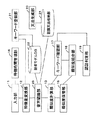
本実施形態にかかる音声認証システムは、図1に示すように、入力部11、特徴量変換部12、類似度計算部13、音節判定部14、類似度保管部15、待機時間管理部16、キーワード確認部17、類似度統合部18、認証判定部19、登録話者別音節モデルデータベース20、および、キーワード登録部21を備えている。 As shown in FIG. 1, the voice authentication system according to the present embodiment includes an
入力部11は、利用者の携帯電話や携帯端末から、認証を受けようとする利用者の利用者IDと音声を入力する。なお、携帯電話のように利用者が1名に限定される場合には、利用者IDの入力手順は不要である。特徴量変換部12は、入力した音声を、話者別音節モデルとの比較に用いられる特徴量に変換する。 The
音節判定部14は、特徴量変換部12で得られた特徴量と、利用者が登録話者別音節モデルデータベース20に予め登録してある話者音節モデルとを比較して類似度を求め、求められた類似度に基づいて、入力音声の各音節が、話者音節モデルのどれに最も類似するかを判定する。類似度保管部15は、入力音声の各音節について、前記音節判定部14で求められた、話者音節モデルに対する類似度を保管する。 The
待機時間管理部16は、キーワードが複数回に分けて発声されるときの発声の時間間隔を監視する。キーワード確認部17は、音節判定部14による音節の認識結果に基づき、複数回の発声によってキーワードの全音節が発声されたかを確認する。類似度統合部18は、類似度保管部15に保管されている音節毎の類似度に基づき、認証時に発声されたキーワード音声が、登録されているキーワード音声に、全体としてどの程度類似しているかを表す統合類似度を求める。認証判定部19は、類似度統合部18で求められた統合類似度に基づき、利用者の認証を受理するか棄却するかを判定する。 The standby
キーワード登録部21は、音声認証システムの利用者がキーワードを登録する際に、当該利用者が入力部11へ音声入力したキーワードから音節モデルを作成し、登録話者別音節モデルデータベース20へ登録する。 When the user of the voice authentication system registers a keyword, the
なお、上記の音声認証システムは、コンピュータおよびその周辺機器によって実現することができる。この場合、類似度保管部15および登録話者別音節モデルデータベース20は、コンピュータ内部またはこのコンピュータからアクセス可能な記憶装置によって実現できる。入力部11、特徴量変換部12、類似度計算部13、音節判定部14、待機時間管理部16、キーワード確認部17、類似度統合部18、認証判定部19、キーワード登録部21は、上記コンピュータのプロセッサに、これら各部の機能を具現化させるプログラムを実行させることによって実現できる。従って、このようなプログラムまたはこのプログラムを記録したコンピュータ読み取り可能な記録媒体も、本発明の一実施形態である。 The voice authentication system described above can be realized by a computer and its peripheral devices. In this case, the
ここで、以上の構成にかかる本実施形態の音声認証システムにおける音声認証の手順について説明する。 Here, the procedure of voice authentication in the voice authentication system of the present embodiment according to the above configuration will be described.
最初に、利用者が、音声認証システムの登録話者別音節モデルデータベース20へキーワードを登録する際の手順について説明する。利用者は、所望のキーワードを決めて、入力部11に接続された携帯電話等のマイクロフォンに対して発声する。このとき、利用者は、キーワードを、1音節ずつ、無音区間で区切って発声する。例えばキーワードが「カラオケ」の場合、このキーワードには「カ」「ラ」「オ」「ケ」の4音節が含まれるので、利用者は、これらの4音節を無音区間で区切って発声する。入力部11は、入力された音節発声を、特徴量変換部12に渡す。特徴量変換部12においては入力された音声波をMFCC(Mel Frequency Cepstral Coefficients)やLPCケプストラムなどの音声の特徴を抽出した特徴ベクトル系列に変換する。その後順次、キーワード登録部21へ渡す。 First, a procedure when the user registers a keyword in the registered speaker-specific
キーワード登録部21は、入力された音節のそれぞれに対して、入力された順に、インデックスを割り当てる。すなわち、上記の例では、「カ(一番目の音節)」へインデックスI1、「ラ(二番目の音節)」へインデックスI2、「オ(三番目の音節)」へインデックスI3、「ケ(四番目の音節)」へインデックスI4を、それぞれ割り当てる。なお、キーワード登録部21は、音節が入力された順番にインデックスを割り当てれば十分であって、各音節の発声(音韻)が何であるかを認識する必要はない。ただし後述の通り、同じ内容の音節がキーワードに含まれているか否かのチェックをこの時点で行う場合もある。 The
キーワード登録部21は、このようにインデックスを割り当てた各音節から話者音節モデルを作成し、上述のように割り当てたインデックスと共に、当該利用者の利用者ID等と関連づけて登録話者別音節モデルデータベース20へ登録する。話者別音節モデルは、例えば不特定話者GMM(Gaussian Mixture Model)をMAP(MaximumA Posteriori)推定により特定話者に適応し、その適応を音節別に実施することで作成することができる。ただし、話者音節モデルはGMMに限定されず、HMM(Hidden Markov Model)など、インデックス別に話者モデルを作成できるものであれば、任意の手法を適用できる。また適応をせずに、登録された特徴ベクトル系列をそのままテンプレートとして保管することによっても話者別音節モデルを作成することも可能である。 The
なお、認証精度を向上させるために、利用者にキーワードをできるだけ多く(3回以上)繰り返して発声させるのが望ましい。この場合、一音節につき、繰り返し回数分(例えば3回繰り返し発声させた場合は3個)の特徴ベクトル系列を用いて話者別音節モデルが適応され、登録話者別音節モデルデータベース20へ登録される。前述のテンプレートとして保管する形態の話者別音節モデルの場合には、繰り返し回数分のテンプレートをもった話者別音節モデルが登録話者別音節モデルデータベース20へ登録される。 In order to improve the authentication accuracy, it is desirable that the user repeats as many keywords as possible (three times or more). In this case, for each syllable, the syllable model for each speaker is applied using the feature vector sequence for the number of repetitions (for example, three when uttered three times) and registered in the registered speaker-specific
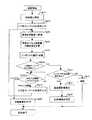
次に、上記の手順によって利用者が「カラオケ」というキーワードを登録した後に、当該利用者が認証を受ける場合の手順について、図3のフローチャートを参照しながら説明する。なお、ここでは、利用者が携帯電話から音声入力を行い、かつ、キーワードを2回に分割して発声する例を示すが、キーワードの分割数は2に限定されない。また、キーワードの入力手段は携帯電話に限らない。 Next, a procedure when the user is authenticated after the user has registered the keyword “karaoke” by the above procedure will be described with reference to the flowchart of FIG. 3. Here, an example is shown in which a user performs voice input from a mobile phone and utters by dividing a keyword into two times, but the number of divided keywords is not limited to two. The keyword input means is not limited to a mobile phone.
携帯電話に認証開始ボタンがある場合にはボタンを押すことにより、あるいは認証が必要なアプリを起動した際、あるいは他のアプリケーションの実行途中で認証要求があった際に、認証処理が開始される。 If the mobile phone has an authentication start button, the authentication process starts when the button is pressed, when an application that requires authentication is activated, or when an authentication request is issued during the execution of another application .
最初に、入力部11は、利用者が携帯電話のキーパッドを用いて入力した利用者ID等を受け付ける(Op11)。なお、携帯電話のように利用者が1名に限定される場合には利用者IDの入力手順は不要となる。次に、利用者が、携帯電話のマイクロフォンに向けて1回目の分割キーワードを発声すると、入力部11はこの音声を受け取る(Op12)。なお、ここでは、前記利用者が、「カラ」と「オケ」にキーワードを分割し、音声入力するものとする。利用者は、1回目の分割キーワードとして、「カ」「ラ」を一音節ずつ無音区間で区切って音声入力する。以降、このように音声入力された「カ」「ラ」の各音節を、入力された順序に従ってS1,S2と表す。 First, the
なお、1回目の分割キーワードの入力が完了したか否かは、無音区間が所定の時間以上続いたか否かによって判断することが可能である。あるいは、分割キーワードの入力が完了した時に、利用者に所定のキー操作をさせるようにしても良い。 Whether or not the input of the first divided keyword has been completed can be determined by whether or not the silent section has continued for a predetermined time or more. Alternatively, the user may be allowed to perform a predetermined key operation when the input of the split keyword is completed.
入力された音節S1,S2のそれぞれは、特徴量変換部12において、登録時と同一の分析方法によりMFCCやLPCケプストラムなどの、話者音節モデルとの比較に用いられる特徴ベクトル系列(特徴量)に変換される(Op13)。特徴量変換部12で得られた特徴量は類似度計算部13へ送られる。 Each of the input syllables S1 and S2 is a feature vector series (feature amount) used for comparison with a speaker syllable model such as MFCC and LPC cepstrum in the feature
次に、類似度計算部13は、登録話者別音節モデルデータベース20から、当該利用者の利用者IDに関連づけて格納されている当該利用者の話者音節モデル(すなわち、上述のインデックスI1〜I4の話者音節モデル)を抽出し、抽出した話者音節モデルに対する前記特徴量の類似度を計算する(Op14)。ここで、インデックスI1の話者音節モデルに対する音節S1の類似度をCS1:I1のように表記するものとする。すなわち、Op14において、例えば音節S1については、CS1:I1、CS1:I2、CS1:I3、CS1:I4の4つの値が類似度として求めら、音節S2については、CS2:I1、CS2:I2、CS2:I3、CS2:I4の4つの値が類似度として求められる。求められた類似度は、音節判定部14へ送られる。Next, the
なお、音節モデルをテンプレートとして登録したときに、キーワードを繰り返して発声させた場合のように、同じ音節について複数回分の話者別音節テンプレートが登録されている場合は、それらの話者別音節テンプレートの全てについて、類似度の計算をそれぞれ行う。従って、キーワード登録時に、「カ」「ラ」「オ」「ケ」を3回繰り返し発声させてテンプレートを話者音節モデルとして登録した場合は、それらの話者音節モデルのインデックスをI1(1)、I1(2)、I1(3)・・・のように割り当てると、Op14では、例えば音節S1について、CS1:I1(1)、CS1:I1(2)、CS1:I1(3)、CS1:I2(1)、CS1:I2(2)、CS1:I2(3)・・・の12個の値が、類似度として得られる。In addition, when a syllable model is registered as a template, if multiple syllable templates for each speaker are registered for the same syllable, as in the case of repeating a keyword, the syllable templates for each speaker are registered. The similarity is calculated for each of the above. Therefore, when a keyword is registered, “K”, “L”, “O”, and “K” are repeatedly uttered three times and templates are registered as speaker syllable models, the indexes of those speaker syllable models are set to I1 (1). , I1 (2) , I1 (3) , and so on, in Op14, for example, for syllable S1, C S1: I1 (1) , C S1: I1 (2) , C S1: I1 (3) , C S1: I2 (1) , C S1: I2 (2) , C S1: I2 (3) ... Are obtained as the similarity.
次に、音節判定部14は、類似度計算部13で求められた類似度に基づき、S1,S2の各音節について、登録話者別音節モデルデータベース20に格納されている話者音節モデルの中で最も類似度の高いモデルのインデックスを選択する(Op15)。 Next, the
例えば、音節S1として利用者が発声したのは「カ」であるため、音節S1についての類似度CS1:I1、CS1:I2、CS1:I3、CS1:I4のうち、インデックスI1(登録時の音節「カ」)の話者音節モデルに対する類似度CS1:I1が最大値となる。従って、図2に示すように、音節判定部14は、発声された音節S1がインデックスI1の話者音節モデルに相当すると判定し、発声済み音節のインデックスデータとして「I1」を類似度保管部15に保管する。また、これと共に、音節S1についての類似度の最大値であるCS1:I1が、音節S1の類似度(音節類似度)として類似度保管部15に保管される。For example, since the user uttered “S” as the syllable S1, the index I1 (of the similarities C S1: I1 , C S1: I2 , C S1: I3 , C S1: I4 for the syllable S1) The similarity C S1: I1 to the speaker syllable model of the syllable “K” at the time of registration is the maximum value. Therefore, as shown in FIG. 2, the
また、上記と同様にして、音節S2についても、話者音節モデルのうち最も類似度の高いモデルのインデックスが選択される。ここで、音節S2として利用者が発声したのは「ラ」であるため、音節S2についての類似度CS2:I1、CS2:I2、CS2:I3、CS2:I4のうち、インデックスI2(登録時の音節「ラ」)の話者音節モデルに対する類似度CS2:I2が最大値となる。これにより、図2に示すように、音節判定部14は、音節S2がインデックスI2に相当すると判定し、発声済み音節のインデックスデータとして「I2」を類似度保管部15に保管する。また、これと共に、音節S2についての類似度の最大値であるCS2:I2も、音節S2の音節類似度として類似度保管部15に保管される。Similarly to the above, for the syllable S2, the index of the model having the highest similarity among the speaker syllable models is selected. Here, since the user uttered “ L ” as the syllable S2, the index I2 among the similarities C S2: I1 , C S2: I2 , C S2: I3 , and C S2: I4 regarding the syllable S2 The similarity C S2: I2 with respect to the speaker syllable model of (syllable “la” at the time of registration) is the maximum value. 2, the
ここで、2回目の分割キーワードの入力がまだ済んでいないので(Op16の結果がNO)、Op17へ進む。 Here, since the second split keyword has not yet been input (the result of Op16 is NO), the process proceeds to Op17.
なお、待機時間管理部16は、入力部11に1回目の分割キーワード(「カラ」)が入力された後の経過時間を、タイマ(図示せず)により測定している。そして、2回目の分割キーワード入力が所定時間(例えば10分)内に開始されない場合は、タイムアウトとしてOp18へ進み、1回目の分割キーワードの処理結果を、類似度保管部15等から消去する(Op18)。この場合、利用者は、認証を受けるためには、1回目の分割キーワード入力からやり直さなければならない。 Note that the standby
なお、第三者へのキーワードの暴露を確実に防止するために、1回目の分割キーワードの音声入力から所定時間(例えば2分)が経過しなければ2回目の分割キーワードの音声入力を受け付けないようにしても良い。この場合、1回目の分割キーワードの入力が終了したときに、2回目の分割キーワードの音声入力までに一定時間をおくように指示するメッセージを利用者の携帯電話等のディスプレイへ表示したり、同様の内容の音声メッセージを当該携帯電話へ送ったりすることが好ましい。 In order to prevent the keyword from being exposed to a third party, the second divided keyword voice input is not accepted unless a predetermined time (for example, two minutes) has elapsed since the first divided keyword voice input. You may do it. In this case, when the input of the first divided keyword is completed, a message instructing to give a certain time until the second divided keyword is input is displayed on the display of the user's mobile phone or the like. It is preferable to send a voice message with the contents of
一方、Op17において、上記の所定時間内に2回目の分割キーワード入力が開始された場合は、待機時間管理部16がタイマをストップ・クリアすると共に、Op19へ進み、2回目の分割キーワード入力を受け付け(Op19)、その後Op13へ進む。 On the other hand, when the second split keyword input is started within the predetermined time at Op17, the standby
この例では、利用者は、2回目の分割キーワードとして、「オ」「ケ」を一音節ずつ区切って発声する。以降、このように音声入力された「オ」「ケ」の各音節を、入力された順序に従ってS3,S4と表すものとする。 In this example, the user utters by dividing “o” and “ke” one syllable at a time as the second divided keyword. Hereinafter, the syllables “o” and “ke” inputted by voice in this way are represented as S3 and S4 according to the inputted order.
入力された音節S3,S4のそれぞれは、特徴量変換部12において特徴量に変換される(Op13)。次に、類似度計算部13は、登録話者別音節モデルデータベース20から、当該利用者の利用者IDに関連づけて格納されている話者音節モデル(すなわち、インデックスI1〜I4の話者音節モデル)を抽出し、抽出した話者音節モデルに対する前記特徴量の類似度を計算する(Op14)。 Each of the input syllables S3 and S4 is converted into a feature value by the feature value conversion unit 12 (Op13). Next, the
これにより、インデックスI1〜I4の話者音節モデルのそれぞれに対して、音節S3,S4のそれぞれについて特徴量変換部12で得られた特徴量との類似度CS3:I1、CS3:I2、CS3:I3、CS3:I4、CS4:I1、CS4:I2、CS4:I3、CS4:I4が計算される。Thereby, for each of the speaker syllable models of the indexes I1 to I4 , the similarity C S3: I1 , C S3: I2 with the feature amount obtained by the feature
なお、キーワードの登録時にキーワードを繰り返し発声させることにより、同じ音節について複数回分の話者音節モデルが登録されている場合は、それらの話者音節モデルの全てについて、類似度の計算をそれぞれ行う。従って、キーワード登録時に、「カ」「ラ」「オ」「ケ」を3回繰り返し発声させて話者音節モデルが登録されている場合は、それらの話者音節モデルのインデックスをI1(1)、I1(2)、I1(3)・・・のように割り当てると、例えば音節S3について、CS3:I1(1)、CS3:I1(2)、CS3:I1(3)、CS3:I2(1)、CS3:I2(2)、CS3:I2(3)・・・の12個の値が、類似度として得られる。Note that, when a plurality of speaker syllable models are registered for the same syllable by repeatedly uttering the keyword at the time of keyword registration, the similarity is calculated for all the speaker syllable models. Accordingly, when a speaker syllable model is registered by repeatedly uttering “ka”, “ra”, “o”, and “ke” three times at the time of keyword registration, the index of those speaker syllable models is set to I1 (1). , I1 (2) , I1 (3) , and so on, for example, for syllable S3, C S3: I1 (1) , C S3: I1 (2) , C S3: I1 (3) ,
次に、音節判定部14は、類似度計算部13で求められた類似度に基づき、S3,S4の各音節について、登録話者別音節モデルデータベース20に格納されている話者音節モデルの中で最も類似度の高いモデルのインデックスを選択する(Op15)。 Next, the
この例では、音節S3として利用者が発声したのは「オ」であるため、音節S3についての類似度CS3:I1、CS3:I2、CS3:I3、CS3:I4のうち、CS3:I3が最大値となる。従って、音節判定部14は、音節S3がインデックスI3に相当すると判定し、発声済み音節のインデックスデータとして「I3」を類似度保管部15に保管する。また、これと共に、音節S3についての類似度の最大値であるCS3:I3も、音節S3の音節類似度として、類似度保管部15に保管される。In this example, since the user uttered “S” as the syllable S3, among the similarities C S3: I1 , C S3: I2 , C S3: I3 , and C S3: I4 for the syllable S3, S3: I3 is the maximum value. Therefore, the
上記と同様にして、音節S4についても、話者音節モデルのうち最も類似度の高いモデルのインデックスが選択される。ここで、音節S4として利用者が発声したのは「ケ」であるため、音節S4についての類似度CS4:I1、CS4:I2、CS4:I3、CS4:I4のうち、CS4:I4が最大値となる。従って、音節判定部14は、音節S4がインデックスI4に相当すると判定し、発声済み音節のインデックスデータとして「I4」を類似度保管部15に保管する。これと共に、音節S4についての類似度の最大値であるCS4:I4も、音節S3の音節類似度として、類似度保管部15に保管される。Similarly to the above, for the syllable S4, the index of the model having the highest similarity among the speaker syllable models is selected. Here, since the user uttered “S” as the syllable S4, the similarity C S4: I1 , C S4: I2 , C S4: I3 , C S4: I4 of the syllable S4, C S4 : I4 is the maximum value. Therefore, the
以上のとおり、2回目の分割キーワードの処理が終了すると(Op16にてYES)、キーワード確認部17が、類似度保管部15に保管されている発声済み音節のインデックスデータに基づき、1回目と2回目の発声によってキーワードの全ての音節が発声されたかを確認する(Op20)。上記の例の場合、類似度保管部15には、発声済み音節のインデックスデータとして「I1」、「I2」、「I3」、「I4」が保管されている。すなわち、登録されているキーワードの全てのインデックス(I1〜I4)が揃っているので、キーワード確認部17は、キーワードの全ての音節が発声されたことを確認できる。Op20の判断結果がNOの場合は、その旨が認証判定部19へ通知され、認証判定部19は当該利用者の認証を棄却する(Op21)。 As described above, when the second divided keyword processing is completed (YES at Op16), the
例えば、上記の例において、1回目の分割キーワードとして「カ」「ラ」と発声し、2回目の分割キーワードとして「カ」「ケ」と発声した場合は、「オ」が発声されていないために、発声済み音節のインデックスデータ中に「オ」のインデックスI3が存在しない。このため、認証は棄却される。 For example, in the above example, if “K” “ra” is uttered as the first divided keyword and “K” “ke” is uttered as the second divided keyword, “o” is not uttered. In addition, there is no “o” index I3 in the index data of the uttered syllable. For this reason, authentication is rejected.
一方、Op20の判断結果がYESの場合は、類似度統合部18が、類似度保管部15に保管されている、音節S1〜S4のそれぞれの音節類似度(CS1:I1,CS2:I2,CS3:I3,CS4:I4)に基づいて、発声されたキーワード全体が登録キーワードにどの程度似ているかを表す統合類似度を算出する(Op22)。統合類似度としては、各音節の音節類似度の総計(すなわち、この例では、CS1:I1+CS2:I2+CS3:I3+CS4:I4)を用いても良いし、各音節の音節類似度の平均値を用いても良い。あるいは、各音節の音節類似度の総和をフレーム数等の時間長で平均化したものを、統合類似度として用いても良い。On the other hand, when the determination result of Op20 is YES, the
このように類似度統合部18で求められた統合類似度は、認証判定部19へ送られ、認証判定部19が、所定の閾値と統合類似度とを比較する。認証判定部19は、統合類似度が所定の閾値を超えていれば当該利用者の認証を受理し、下回っていれば棄却する(Op23)。 The integrated similarity obtained by the
本実施形態にかかる音声認証システムでは、以上の手順により、音声による利用者の認証が可能である。 In the voice authentication system according to the present embodiment, the user can be authenticated by voice by the above procedure.
なお、上記の実施形態では、登録されたキーワードを構成する音節の全てが、複数回に分割されたキーワード発声によって過不足なく発声されたか否かを認識する。従って、上記の具体例では、「カラオケ」というキーワードを「カラ」と「オケ」との2つに分割したが、例えば、「カオ」と「ラケ」、「ケカ」と「オラ」、「ラカ」と「ケオ」のように、音節の順序をランダムにしたキーワードの分割方法をとっても、正しい音声認証が可能である。 In the above embodiment, it is recognized whether or not all of the syllables constituting the registered keyword are uttered without excess or deficiency by the keyword utterance divided into a plurality of times. Therefore, in the above specific example, the keyword “karaoke” is divided into two, “Kara” and “Oke”. For example, “Kao” and “Lake”, “Kake” and “Ora”, “Laka” The correct voice authentication is possible even if a keyword segmentation method in which the syllable order is random, such as “” and “Keo”, is used.
なお、本実施形態では、キーワードの登録時も認証時も音韻を認識しないので、キーワードが同じ音の音節を2つ以上含む場合は、それらの音節を区別することができない。そこで、認証時に音声入力された音節の複数が、登録されている話者音節モデルの複数に対して相互に高い類似度を示した場合は、これらは同じ音節であると見なして処理することが好ましい。 In the present embodiment, the phoneme is not recognized at the time of keyword registration or authentication, and therefore, when the keyword includes two or more syllables of the same sound, the syllables cannot be distinguished. Therefore, when multiple syllables input during authentication show a high degree of similarity to multiple registered speaker syllable models, they can be processed as if they were the same syllable. preferable.
例えば、キーワードが「スキヤキ」である場合、このキーワードの登録時には、キーワード登録部21が、「ス(一番目の音節)」へインデックスI1、「キ(二番目の音節)」へインデックスI2、「ヤ(三番目の音節)」へインデックスI3、「キ(四番目の音節)」へインデックスI4をそれぞれ割り当てて、登録話者別音節モデルデータベース20に話者音節モデルを格納する。 For example, if the keyword is “Sukiyaki”, at the time of registration of this keyword, the
そして、認証時に、例えば利用者が1回目の分割キーワードとして「ス(音節S1)」「キ(音節S2)」、2回目の分割キーワードとして「ヤ(音節S3)」「キ(音節S4)」と発声したとする。この場合、音節S2と音節S4の両方が、インデックスI2,I4の話者音節モデルに対して共に高い類似度を示すが、音節S2とインデックスI2の話者音節モデルとの類似度、音節S4とインデックスI2の話者音節モデルとの類似度、音節S2とインデックスI4の話者音節モデルとの類似度、音節S4とインデックスI4の話者音節モデルとの類似度は、互いに大きな差はないため、音節S2との類似度が最も高いインデックスと、音節S4との類似度が最も高いインデックスとが一致してしまう可能性もある。例えば音節S2とS4との両方がインデックスI2と最も類似すると判断された場合であれば、インデックスI4の音節が発声されていないとして、認証が棄却されてしまう。 At the time of authentication, for example, the user uses “su (syllable S1)” “ki (syllable S2)” as the first divided keyword, and “ya (syllable S3)” “ki (syllable S4)” as the second divided keyword. Say. In this case, both syllable S2 and syllable S4 show a high similarity to the speaker syllable models of indices I2 and I4, but the similarity between syllable S2 and the speaker syllable model of index I2, syllable S4 and The similarity between the speaker syllable model with index I2, the similarity between the syllable S2 and the speaker syllable model with index I4, and the similarity between the syllable S4 and the speaker syllable model with index I4 are not significantly different from each other. There is a possibility that the index having the highest degree of similarity with syllable S2 and the index having the highest degree of similarity with syllable S4 may coincide. For example, if it is determined that both the syllables S2 and S4 are most similar to the index I2, the authentication is rejected because the syllable of the index I4 is not uttered.
従って、このように、複数の音節が、話者音節モデルの複数に対して相互に高い類似度であって、かつ、他の話者音節モデルに対する類似度よりも顕著に高い類似度を示す場合は、Op15において最も類似度の高いインデックスを選択するのではなく、それら複数の音節が同じ音であると見なし、それらの複数の音節との類似度が高い話者音節モデルのインデックスをすべて類似度保管部15へ保持すれば良い。あるいは、登録時に、複数の音節発声が、話者別音節モデルの複数に対して相互に高い類似度か否かを調べる等により、それら複数の音節が同じ音であることをチェックし、それを示す情報を記憶しておき、それらの音節に類似する話者音節モデルのインデックスとして同一のインデックスが類似度保管部15に保管されていれば、全てのインデックスが揃っていなくても認証を棄却しないようにしても良い。 Therefore, when a plurality of syllables have high similarities with respect to a plurality of speaker syllable models in this way, and show significantly higher similarities than similarities with other speaker syllable models. Does not select the index with the highest similarity in Op15, but considers the plurality of syllables to be the same sound, and sets all the indexes of the speaker syllable models having high similarity to the plurality of syllables. What is necessary is just to hold | maintain to the
これにより、上記の例において、「ス」「キ」「ヤ」「キ」の入力音節に対する類似話者音節モデルのインデックスとして、例えば、「I1」,「I2」,「I3」,「I2」が類似度保管部15に保管されていても、キーワードの全ての音節が発声されたものと正しく判断することができる。 As a result, in the above example, for example, “I1”, “I2”, “I3”, “I2” are used as the indexes of the similar speaker syllable models for the input syllables of “su” “ki” “ya” “ki”. Is stored in the
以上、本発明の一実施形態にかかる音声認証システムについて説明したが、上記の説明は、本発明を実施するための一具体例に過ぎず、発明の範囲内で種々の変更が可能である。 Although the voice authentication system according to the embodiment of the present invention has been described above, the above description is only a specific example for carrying out the present invention, and various modifications can be made within the scope of the invention.
例えば、上記の実施形態では、認証時にキーワードを2回に分割して発声する例を説明したが、キーワードの分割数は、2に限定されず、任意である。キーワードの分割数が3以上の場合は、分割キーワードの音声入力と、入力された分割キーワードに対する図3のOp13〜Op15の処理とを、分割数だけ繰り返せば良い。従って、「カ」と「ラオケ」、「オケラ」と「カ」、「ラ」と「ケ」と「オカ」、あるいは、「オ」と「ラ」と「カ」と「ケ」といったような分割によっても、正しい音声認証が可能である。 For example, in the above-described embodiment, an example has been described in which a keyword is divided into two parts at the time of authentication, but the number of keyword divisions is not limited to two and is arbitrary. When the number of keyword divisions is 3 or more, the voice input of the divided keywords and the processing of Op13 to Op15 in FIG. 3 for the inputted divided keywords may be repeated for the number of divisions. Thus, “F” and “Raoke”, “Okera” and “F”, “La” and “K” and “Oka”, or “O” and “La” and “F” and “K”. The correct voice authentication is possible even by the division.
さらに、認証を受けようとする利用者が分割数を任意に決定できるようにしても良い。この場合、分割キーワードを複数回発声することによってキーワード全体の発声が完了したときに、利用者に例えば携帯電話の特定のボタンを押させることとし、音声認証システムは、入力部11において当該ボタンが押されたことを検知すると、図3のOp20以降の処理へ移行するようにすれば良い。あるいは、分割キーワードの発声が終了する毎に、それまでに発声された音節の集合と登録キーワードを構成する音節とを比較し、キーワードを構成する音節が全て発声済みであると判断されたときに、図3のOp20以降の処理へ移行するようにしても良い。 Furthermore, the user who is going to receive authentication may arbitrarily determine the number of divisions. In this case, when utterance of the entire keyword is completed by uttering the divided keyword a plurality of times, the user is allowed to press a specific button of, for example, a mobile phone. When it is detected that the button has been pressed, the process may be shifted to the processing after Op20 in FIG. Alternatively, each time the utterance of the split keyword is completed, the set of syllables uttered so far is compared with the syllables constituting the registered keyword, and it is determined that all the syllables constituting the keyword have been uttered. The process may be shifted to the processing after Op20 in FIG.
また、本実施形態では、2回目の分割キーワードが入力した後に、キーワード確認部17でキーワード確認を行い、さらに、類似度統合部18でキーワード全体としての統合類似度を算出し、認証判定部19で認証を受理するか棄却するかを判定する構成とした。しかし、1回目の分割キーワードの音声入力が終了した時点で、類似度統合部18が、1回目の分割キーワードに含まれる音節だけから統合類似度を算出するものとしても良い。 Further, in the present embodiment, after the second divided keyword is input, the
この場合、1回目の分割キーワードから算出された統合類似度が所定の閾値を下回る場合は、1回目の分割キーワードの音声入力をやりなおさせても良い。このようにすれば、例えば2回目の分割キーワードの類似度が高いが1回目の分割キーワードの類似度が低い場合に、最初から音声入力をやり直す手間が軽減されるという利点がある。 In this case, when the integrated similarity calculated from the first divided keyword is below a predetermined threshold, the voice input of the first divided keyword may be performed again. In this way, for example, when the similarity of the second divided keyword is high but the similarity of the first divided keyword is low, there is an advantage that the trouble of re-inputting voice from the beginning is reduced.
なお、セキュリティを厳しくする観点からは、1回目の分割キーワードの類似度が低い場合は、2回目の分割キーワードを入力させることなく、認証判定部19が認証を棄却するようにしても良い。 From the viewpoint of tightening security, if the similarity of the first divided keyword is low, the
また、2回目の分割キーワードの入力が終了した後に、2回目の分割キーワードの類似度が低い場合は、キーワード確認部17により全音節が発声済みであることが確認されていることを条件として、2回目の分割キーワードの音声入力をやりなおさせても良い。上記の条件を付けるのは、全音節が発声済みであることが確認されていない場合に2回目の分割キーワードの音声入力のやりなおしを認めると、キーワードの試行を許すこととなり、詐称者による認証突破が可能となってしまうからである。 In addition, if the similarity of the second divided keyword is low after the input of the second divided keyword is completed, on the condition that all syllables have been confirmed by the
なお、安定した認証結果を得るためには、分割キーワード毎に類似度を求める方法よりも、分割キーワードの音声入力が全て終了した後にキーワード全体としての統合類似度を算出する方法の方が有利である。分割キーワードは発声長が短いので安定した類似度が得られにくいことがあるのに対して、キーワード全体としての統合類似度は発声長が長いので比較的安定した類似度が得られるからである。そのため、1回目の分割キーワードの類似度で判定する場合のしきい値は全体よりもやや緩めに設定することになる。 In order to obtain a stable authentication result, the method of calculating the integrated similarity as a whole keyword after all voice input of the divided keyword is more advantageous than the method of obtaining the similarity for each divided keyword. is there. This is because a divided keyword has a short utterance length, so that it is difficult to obtain a stable similarity, whereas an integrated similarity as a whole keyword has a long utterance length, and thus a relatively stable similarity can be obtained. For this reason, the threshold value for the determination based on the similarity of the first divided keyword is set slightly looser than the whole.
(第2の実施形態)
本発明にかかる音声認証システムの他の実施形態について、以下に説明する。なお、第1の実施形態で説明した構成と同様の機能を有する構成については、第1の実施形態で用いた参照記号と同じ記号を付記し、その詳細な説明は省略する。(Second Embodiment)
Another embodiment of the voice authentication system according to the present invention will be described below. In addition, about the structure which has the function similar to the structure demonstrated in 1st Embodiment, the same symbol as the reference symbol used in 1st Embodiment is attached, and the detailed description is abbreviate | omitted.
本実施形態にかかる音声認証システムは、英語等のように、音節単位でのキーワード分割が必ずしも容易ではない言語による音声認証にも適している。 The voice authentication system according to the present embodiment is also suitable for voice authentication in a language that is not always easy to divide into keywords such as English.
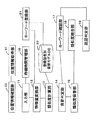
このため、本実施形態にかかる音声認証システムは、図4に示すように、入力部11、特徴量変換部12、類似度計算部13、類似度保管部15、待機時間管理部16、キーワード確認部17、類似度統合部18、認証判定部19、話者モデルデータベース22、キーワード登録部21、文法生成部23、認識文法格納部24、および、音声認識部25を備えている。 For this reason, as shown in FIG. 4, the voice authentication system according to the present embodiment includes an
ここで、本実施形態の音声認証システムにおける音声認証の手順について、図5を参照しながら説明する。 Here, the procedure of voice authentication in the voice authentication system of the present embodiment will be described with reference to FIG.
最初に、利用者が、音声認証システムの話者モデルデータベース22へキーワードを登録する際の手順について説明する。利用者は、所望のキーワードを決めて、入力部11に接続された携帯電話等のマイクロフォンに対して発声する。本実施形態では、文法生成部23が、音声入力されたキーワードを音声認識(不特定話者音声認識)し、認識結果としての認識文法を認識文法格納部24へ登録する。なお登録前に、画面などに認識結果を表示して利用者が登録したキーワードの内容を確認させるのが望ましい。また認識結果を修正する手段(ボタン等)を与えるのが望ましい。 First, a procedure when the user registers a keyword in the speaker model database 22 of the voice authentication system will be described. The user determines a desired keyword and speaks to a microphone such as a mobile phone connected to the
なお、不特定話者音声認識で単音節認識を行うことは精度的に難しいので、利用者は、キーワードを登録する際に、キーワードの発声内容を、例えば携帯電話のキー等を用いて、入力部11に対してテキスト入力するようにするのが望ましい。入力テキスト(キーワードの発声内容)と発声されたキーワード音声は、入力部11から文法生成部23へ渡される。 Since it is difficult to perform single syllable recognition with unspecified speaker voice recognition, the user inputs the utterance content of the keyword using, for example, a mobile phone key when registering the keyword. It is desirable to input text into the
文法生成部23は、テキスト入力された発声内容から、利用者が入力し得るキーワード分割のパターンを認識するための文法を生成する。この文法は、音節単位に限定されず、音素単位の分割による全てのパターンを網羅するように生成される。日本語のように音節単位で切りやすい言語の場合には音節単位で分割しうる全てのパターンを網羅するように生成されるが、英語のように音節単位で切ることが難しい言語の場合には、音素単位の分割による全てのパターンを網羅するように生成される。例えば″verification″というキーワードに対しては″ve,veri,verifi,tion,cation,fication,verifica″等のパターンを受理する文法が生成される。生成された文法は、キーワード登録部21に渡されると共に、認識文法格納部24へ格納される。 The
キーワード登録部21は、登録されたキーワードの音声を用いて適応した話者モデル(すなわち音素または音節単位の話者モデル)を作成し、当該利用者の利用者IDと関連づけて、話者モデルデータベース22へ登録する。音素単位の話者モデルの作成方法としては、不特定話者音声認識によりキーワードの音声と音素の時間対応づけ(アライメントと呼ぶ)を行い、キーワードを構成する音素別に適応を行い、話者別音素モデルを話者モデルとして作成する方法がある。また、適応方法としてはMLLR(Maximum Likelihood Linear Regression)法、MAP法等、モデル適応により話者適応を実現する方法であれば何でもよい。音節単位で話者モデルを作成する場合には音節単位でキーワードとの時間対応付けを行ったのち、話者適応を行い作成する。 The
上記の手順によりキーワード登録が完了した後に、利用者が音声入力により認証を受ける際の手順について、以下に説明する。なお、以下の例においても、キーワードを2回に分割して音声入力する例を説明するが、キーワードの分割数は2に限定されない。 After the keyword registration is completed by the above procedure, a procedure when the user is authenticated by voice input will be described below. In the following example, an example in which a keyword is divided into two times and voice input is described will be described, but the number of keyword divisions is not limited to two.
最初に、入力部11は、利用者が携帯電話のキーパッドを用いて入力した利用者ID等を受け付ける(Op31)。なお、携帯電話のように利用者が1名に限定される場合には利用者IDの入力手順は不要となる。次に、利用者が、携帯電話のマイクロフォンに向けて1回目の分割キーワードを発声すると、入力部11はこの音声を受け取る(Op32)。なお、本実施形態では、利用者は音節毎に区切って音声入力をしなくても良い。例えば、キーワードが「カラオケ」である場合、1回目の分割キーワードを「カラ」とする場合、第1の実施形態のように「カ」と「ラ」の間に無音区間を入れずに、「カラ」と一気に発声しても良い。 First, the
また、英語等は、話者が音節を厳密に意識しない傾向が強いため、キーワードを分割した際に、誤って音節が欠落したり重複したりする可能性がある。音節の重複はキーワード認証に際してあまり問題とならないため、本実施形態では、例えばキーワードが「verification」である場合に、「verifi」と「fication」のように、分割キーワードにおいて音節が重複することは許容される。 In addition, in English and the like, there is a strong tendency for speakers to be unaware of syllables, so there is a possibility that syllables may be missed or duplicated when keywords are divided. Since syllable duplication does not cause much problem in keyword authentication, in this embodiment, for example, when the keyword is “verification”, syllable duplication is allowed in divided keywords such as “verifif” and “fiction”. Is done.
入力された分割キーワードは、特徴量変換部12において、MFCCやLPCケプストラムなどの、音声認識に用いられる特徴量に変換される(Op33)。特徴量変換部12で得られた特徴量は音声認識部25へ送られる。 The input divided keyword is converted by the feature
次に、音声認識部25は、認識文法格納部24に格納されている認識文法を参照し、分割キーワードとして発声された音声の音韻を不特定話者音声認識で認識する(Op34)。認識結果は、類似度計算部13へ送られる。キーワードと異なる発声がされた場合等、認識スコアが非常に悪い場合には「認識できない」と判定した方が良く、この場合には「認識できない」という結果を類似度計算部13に送る。
この例では不特定話者音声認識で認識したが、登録時に適応した話者モデルを利用して認識させても良い。この場合、音声認識時に計算した類似度がそのまま話者モデルに対する類似度となるので、類似度計算部13での類似度計算は不要となる。Next, the
In this example, recognition is performed by unspecified speaker voice recognition, but recognition may be performed using a speaker model adapted at the time of registration. In this case, since the similarity calculated at the time of speech recognition becomes the similarity to the speaker model as it is, the similarity calculation in the
次に、類似度計算部13は、前記の認識結果に基づき、話者モデルデータベース22から、当該利用者の話者モデルのうち、前記Op34で認識された音韻に対応する話者モデルを抽出し、抽出した話者モデルに対する前記特徴量の類似度を計算する(Op35)。 Next, the
Op35の結果に基づき、発声済みの分割キーワードから認識された音韻が、登録キーワードのどの音素を網羅しているかを表す情報(発声済み音素データ)が、類似度保管部15へ保管される(Op36)。これと共に、認識された音韻の話者モデルに対する類似度も、類似度保管部15に保管される。 Based on the result of Op35, information (spoken phoneme data) indicating which phoneme of the registered keyword is covered by the phoneme recognized from the spoken divided keyword is stored in the similarity storage unit 15 (Op36). ). At the same time, the similarity of the recognized phoneme to the speaker model is also stored in the
ここで、2回目の分割キーワードの入力がまだ済んでいないので(Op37の結果がNO)、Op38へ進む。 Here, since the second split keyword has not yet been input (the result of Op37 is NO), the process proceeds to Op38.
なお、待機時間管理部16は、入力部11に1回目の分割キーワードが入力された後の経過時間を、タイマにより測定している。そして、2回目の分割キーワード入力が所定時間内に開始されない場合は、タイムアウトとしてOp39へ進み、1回目の分割キーワードの処理結果を、類似度保管部15等から消去する(Op39)。この場合、利用者は、認証を受けるためには、1回目の分割キーワード入力からやり直さなければならない。 The standby
一方、Op38において、上記の所定時間内に2回目の分割キーワード入力が開始された場合は、待機時間管理部16がタイマをストップ・クリアすると共に、Op40へ進み、2回目の分割キーワード入力を受け付け(Op40)、その後Op33へ進む。 On the other hand, in Op38, when the second divided keyword input is started within the predetermined time, the standby
そして、2回目の分割キーワードに対して、Op33〜Op36の処理を行った後、キーワード確認部17が、類似度保管部15に保管されている発声済み音素データに基づき、1回目と2回目の発声によってキーワードの全ての音素が発声されたかを確認する(Op41)。Op41の判断結果がNOの場合は、その旨が認証判定部19へ通知され、認証判定部19は当該利用者の認証を棄却する(Op42)。 After performing the processing of Op33 to Op36 for the second divided keyword, the
一方、Op41の判断結果がYESの場合は、類似度統合部18が、類似度保管部15に保管されている分割キーワード毎の類似度に基づいて、発声されたキーワード全体が登録キーワードにどの程度似ているかを表す統合類似度を算出する(Op43)。統合類似度としては、分割キーワードの類似度の総計を用いても良いし、分割キーワードの類似度の平均値を用いても良い。 On the other hand, if the determination result in Op41 is YES, the
このように類似度統合部18で求められた統合類似度は、認証判定部19へ送られ、認証判定部19が、所定の閾値と統合類似度とを比較する。認証判定部19は、統合類似度が所定の閾値を超えていれば当該利用者の認証を受理し、下回っていれば棄却する(Op44)。 The integrated similarity obtained by the
本実施形態にかかる音声認証システムでは、以上の手順により、音声による利用者の認証が可能である。本実施形態では、上述のとおり、複数音節をキーワード分割の最小単位としても良いし、形態素または単語など、発声の単位とできるものなら、音節以外をキーワード分割の最小単位としてもよい。 In the voice authentication system according to the present embodiment, the user can be authenticated by voice by the above procedure. In the present embodiment, as described above, a plurality of syllables may be used as a minimum unit for keyword division, and a unit other than a syllable may be used as a minimum unit for keyword division as long as it can be used as a utterance unit such as a morpheme or word.
また、キーワードが数字列(例えば「1234」)である場合、日本語であれば「イチ」、「ニ」、「サン」、「シ」のように、あるいは英語であれば「one」、「two」、「three」、「four」のように、数字を単位としてキーワードの確認および音声認証を行ってもよい。ただし、この場合は、数字認識用の文法を用いる必要がある。 When the keyword is a numeric string (for example, “1234”), “1”, “ni”, “san”, “shi” are used in Japanese, or “one”, “ Keyword confirmation and voice authentication may be performed in units of numbers such as “two”, “three”, and “four”. However, in this case, it is necessary to use a grammar for number recognition.
同様に、キーワードが数字とアルファベット等の混合(例えば「1a2b」)である場合は、数字とアルファベットの認識用文法を用いる必要がある。 Similarly, when the keyword is a mixture of numbers and alphabets (for example, “1a2b”), it is necessary to use a recognition grammar for numbers and alphabets.
(第3の実施形態)
本発明にかかる音声認証システムのさらに他の実施形態について、以下に説明する。なお、第1または第2の実施形態で説明した構成と同様の機能を有する構成については、それらの実施形態で用いた参照記号と同じ記号を付記し、その詳細な説明は省略する。(Third embodiment)
Still another embodiment of the voice authentication system according to the present invention will be described below. In addition, about the structure which has the function similar to the structure demonstrated in 1st or 2nd embodiment, the same symbol as the reference symbol used in those embodiment is attached, and the detailed description is abbreviate | omitted.
本実施形態にかかる音声認証システムは、2回目以降の分割キーワードが音声入力される毎に、前回の分割キーワードの音声入力時から利用者が場所を移動しているか否かを確認し、場所を移動していない場合は音声入力を受け付けない。 The voice authentication system according to the present embodiment confirms whether or not the user has moved from the previous voice input of the divided keyword every time the second and subsequent divided keywords are inputted by voice. When not moving, voice input is not accepted.
このため、本実施形態にかかる音声認証システムは、図6に示すように、入力部11、特徴量変換部12、類似度計算部13、音節判定部14、類似度保管部15、待機時間管理部16、キーワード確認部17、類似度統合部18、認証判定部19、登録話者別音節モデルデータベース20、キーワード登録部21、位置情報取得部31、および、位置確認部32を備えている。すなわち、本実施形態にかかる音声認証システムは、第1の実施形態にかかる音声認証システムに、位置情報取得部31、および、位置確認部32をさらに備えた構成である。 For this reason, as shown in FIG. 6, the voice authentication system according to the present embodiment includes an
位置情報取得部31は、利用者の携帯電話等に組み込まれたGPS(Global Positioning System)により、利用者が分割キーワードを音声入力する都度、利用者の現在位置を表す情報を取得する。位置確認部32は、位置情報取得部31により取得された情報に基づき、前回の分割キーワードの音声入力時から利用者が場所を移動しているか否かを確認する。 The position
以上の構成にかかる、本実施形態の音声認証システムの動作について、図7を参照しながら説明する。 The operation of the voice authentication system of the present embodiment according to the above configuration will be described with reference to FIG.
最初に、入力部11は、利用者が携帯電話のキーパッドを用いて入力した利用者ID等を受け付ける(Op51)。なお携帯電話のように利用者が1名に限定される場合には利用者IDの入力手順は不要となる。次に、利用者が、携帯電話のマイクロフォンに向けて1回目の分割キーワードを発声すると、入力部11はこの音声を受け取る(Op52)。このとき同時に、位置情報取得部31が、利用者の携帯電話に組み込まれたGPSにより、利用者の現在位置を表す情報を取得し、取得した情報を位置確認部32へ渡す(Op53)。 First, the
入力された1回目の分割キーワードの各音節は、特徴量変換部12において特徴量に変換される(Op54)。特徴量変換部12で得られた特徴量は類似度計算部13へ送られる。 Each syllable of the first divided keyword input is converted into a feature value by the feature value conversion unit 12 (Op54). The feature quantity obtained by the feature
次に、類似度計算部13は、登録話者別音節モデルデータベース20から、当該利用者の利用者IDに関連づけて格納されている当該利用者の話者音節モデルを抽出し、抽出した話者音節モデルに対する前記特徴量の類似度を計算する(Op55)。求められた類似度は、音節判定部14へ送られる。 Next, the
次に、音節判定部14は、類似度計算部13で求められた類似度に基づき、1回目の分割キーワードの各音節について、登録話者別音節モデルデータベース20の話者音節モデルの中で最も類似度の高いモデルのインデックスを選択し、その類似度と共に、類似度保管部15に保管する(Op56)。ここで、2回目の分割キーワードの入力がまだ済んでいないので(Op57の結果がNO)、Op58へ進む。 Next, the
第三者へのキーワードの暴露をより確実に防止するために、1回目の分割キーワードの入力が終了したときに、2回目の分割キーワードの音声入力までに場所を移動するように指示するメッセージを利用者の携帯電話等のディスプレイへ表示したり、同様の内容の音声メッセージを当該携帯電話へ送ったりすることが好ましい。 In order to prevent the keyword from being exposed to a third party more reliably, when the input of the first divided keyword is completed, a message instructing the user to move the location before the second divided keyword is input. It is preferable to display on the display of the user's mobile phone or to send a voice message having the same content to the mobile phone.
このため、Op58において、1回目の分割キーワードの音声入力後、適当な時間(例えば1分)が経ったときに、位置情報取得部31が、利用者の携帯電話に組み込まれたGPSにより、利用者の現在位置を表す情報を取得し、取得した情報を位置確認部32へ渡す。 For this reason, in Op58, when an appropriate time (for example, 1 minute) has passed after the voice input of the first divided keyword, the position
位置確認部32は、Op53で取得された1回目の分割キーワード入力時の位置情報と、Op58で取得された位置情報とを比較することにより、1回目の分割キーワードを入力した後に、利用者が所定の距離(例えば50m)以上離れた場所へ移動しているかを確認する(Op59)。なお、前記所定の距離は50mに限定されず、任意である。 The
Op59の確認結果がNOであれば、音声認証システムは、利用者の携帯電話へ、場所を移動するように指示する音声メッセージを送る。あるいは、場所を移動するよう指示する警告メッセージを表示する(Op60)。 If the confirmation result of Op59 is NO, the voice authentication system sends a voice message instructing the user to move to the mobile phone. Alternatively, a warning message instructing to move the place is displayed (Op60).
一方、Op59の確認結果がYESであれば、Op61以降の処理を続行する。Op61〜Op67の処理は、第1の実施形態において説明したOp17〜Op23と同様であるため、説明は省略する。 On the other hand, if the confirmation result of Op59 is YES, the processing after Op61 is continued. Since the processing of Op61 to Op67 is the same as Op17 to Op23 described in the first embodiment, the description thereof is omitted.
以上のように、本実施形態にかかる音声認証システムは、GPS等を利用して利用者の現在位置を確認し、分割キーワードの前回の入力時から利用者が所定の距離以上移動していない場合は、場所を移動するよう指示する。これにより、第三者へキーワードが暴露されることをより確実に防止できる。 As described above, the voice authentication system according to the present embodiment confirms the current position of the user using GPS or the like, and the user has not moved more than a predetermined distance since the last time when the divided keyword was input. Instruct to move the place. Thereby, it can prevent more reliably that a keyword is exposed to a third party.
なお、本実施形態では、第1の実施形態にかかる音声認証システムに、位置情報取得部31および位置確認部32をさらに備えた構成を例示したが、第2の実施形態にかかる音声認証システムに位置情報取得部31および位置確認部32をさらに備えた構成も、本発明の一実施態様である。 In this embodiment, the voice authentication system according to the first embodiment is exemplified by the configuration further including the position
(第4の実施形態)
本発明にかかる音声認証システムのさらに他の実施形態について、以下に説明する。なお、第1〜第3の実施形態で説明した構成と同様の機能を有する構成については、それらの実施形態で用いた参照記号と同じ記号を付記し、その詳細な説明は省略する。(Fourth embodiment)
Still another embodiment of the voice authentication system according to the present invention will be described below. In addition, about the structure which has the function similar to the structure demonstrated in the 1st-3rd embodiment, the same symbol as the reference symbol used in those embodiment is attached, and the detailed description is abbreviate | omitted.
本実施形態にかかる音声認証システムは、キーワードの分割方法等をシステムが利用者へ指示し、利用者が指示どおりに音声入力をしていない場合は、認証を棄却する構成である。 The voice authentication system according to the present embodiment has a configuration in which authentication is rejected when the system instructs the user on a keyword dividing method or the like and the user does not input voice as instructed.
このため、本実施形態にかかる音声認証システムは、図8に示すように、入力部11、特徴量変換部12、類似度計算部13、音節判定部14、類似度保管部15、待機時間管理部16、キーワード確認部17、類似度統合部18、認証判定部19、登録話者別音節モデルデータベース20、キーワード登録部21、および、指示出力部41を備えている。すなわち、本実施形態にかかる音声認証システムは、第1の実施形態にかかる音声認証システムに、指示出力部41をさらに備えた構成である。 For this reason, as shown in FIG. 8, the voice authentication system according to the present embodiment includes an
指示出力部41は、予め定められた複数種類のパターンからランダムに選択したパターンに従って利用者にキーワードを分割入力させるよう指示を出す。 The
そのような指示としては、例えば、「1回目の分割キーワードとして最初の3音節、2回目の分割キーワードとして残りの全音節を入力して下さい。」、「奇数音節を1回目の分割キーワードとし、偶数音節を2回目の分割キーワードとして下さい。」、「キーワードを逆方向から1音節ずつ入力して下さい。」といった指示が考えられる。なお、これらの指示はあくまで一例であり、指示内容は任意である。 As such instructions, for example, “Please input the first three syllables as the first split keyword and all remaining syllables as the second split keyword.”, “Odd syllable as the first split keyword, An instruction such as “Please use even syllables as the second split keyword.” Or “Enter keywords one by one from the opposite direction.” These instructions are merely examples, and the contents of the instructions are arbitrary.
ここで、本実施形態にかかる音声認証システムの動作について、図9を参照しな説明する。なお、利用者によるキーワードの登録手順は第1の実施形態と同様であるため、説明を省略する。 Here, the operation of the voice authentication system according to the present embodiment will be described with reference to FIG. Note that the keyword registration procedure by the user is the same as that in the first embodiment, and a description thereof will be omitted.
最初に、入力部11は、利用者が携帯電話のキーパッドを用いて入力した利用者ID等を受け付ける(Op71)。なお、携帯電話のように利用者が1名に限定される場合には利用者IDの入力手順は不要となる。次に、指示出力部41が、予め定められた複数種類のパターンからランダムに選択したパターンに従って、利用者の携帯電話に対して、1回目の分割キーワードを入力させるための指示を、表示または音声メッセージとして出力する(Op72)。指示出力部41による指示内容は、後のOp76における音節判定部14の処理のために、音節判定部14へも送られる。 First, the
例えばここで、「奇数音節を1回目の分割キーワードとして下さい。」という指示がされた場合、キーワードが「カラオケ」であったとすると、利用者は、1回目の分割キーワードとして「カ」「オ」、2回目の分割キーワードとして「ラ」「ケ」を入力しなければならない。 For example, when the instruction “Please use odd syllable as the first split keyword” is given, and the keyword is “Karaoke”, the user sets “K” and “O” as the first split keywords. “La” and “ke” must be entered as the second split keyword.
利用者が、この指示に従って、携帯電話のマイクロフォンに向けて1回目の分割キーワードを発声すると、入力部11はこの音声を受け取る(Op73)。 When the user utters the first divided keyword to the microphone of the mobile phone according to this instruction, the
入力された音節S1,S2のそれぞれは、特徴量変換部12において、特徴量に変換される(Op74)。特徴量変換部12で得られた特徴量は類似度計算部13へ送られる。 Each of the input syllables S1 and S2 is converted into a feature value by the feature value conversion unit 12 (Op74). The feature quantity obtained by the feature
次に、類似度計算部13は、登録話者別音節モデルデータベース20から、当該利用者の利用者IDに関連づけて格納されている当該利用者の話者音節モデルを抽出し、抽出した話者音節モデルに対する前記特徴量の類似度を計算する(Op75)。求められた類似度は、音節判定部14へ送られる。 Next, the
次に、音節判定部14は、類似度計算部13で求められた類似度に基づき、1回目の分割キーワードの各音節について、登録話者別音節モデルデータベース20に格納されている話者音節モデルの中で最も類似度の高いモデルのインデックスを選択し、その類似度と共に類似度保管部15に保管する(Op76)。 Next, the
また、Op76において、音節判定部14は、1回目の分割キーワードの各音節が、指示出力部41による指示どおりに発声されたかを判定する。すなわち、上記の例では、1回目の分割キーワードとして奇数音節、つまりキーワードの第1音節(インデックスI1)である「カ」と第3音節(インデックスI3)である「オ」を入力する旨の指示が出されている。従って、1回目の分割キーワードの1つ目の音節は、インデックスI1の話者音節モデルとの類似度が最も大きくなければならず、また、2つ目の音節は、インデックスI3の話者音節モデルとの類似度が最も大きくなければならない。そうでない場合は、音節判定部14は、その判定結果を認証判定部19へ通知し、認証判定部19が認証を棄却する。 In Op76, the
なお、図9において、Op77以降は、第1の実施形態において説明したOp16〜Op23と同様であるため、その重複した説明は省略する。 In FIG. 9, Op77 and the subsequent steps are the same as Op16 to Op23 described in the first embodiment, and thus redundant description thereof is omitted.
本実施形態にかかる音声認証システムでは、以上のように、指示出力部41が、キーワードの分割方法が認証毎にランダムになるように、分割方法を利用者へ指示することにより、キーワードの暴露をより確実に防止することができる。 In the voice authentication system according to the present embodiment, as described above, the
なお、上記の説明では、指示出力部41が、キーワードの分割方法を一つ選択して利用者へ指示するものとしたが、指示出力部41が複数パターンの分割方法を利用者へ提示し、利用者がその中からいずれかのパターンを選択するようにしても良い。 In the above description, the
また、本実施形態では、第1の実施形態にかかる音声認証システムに、指示出力部41をさらに備えた構成を例示したが、第2または第3の実施形態にかかる音声認証システムに指示出力部41をさらに備えた構成も、本発明の一実施態様である。 In the present embodiment, the voice authentication system according to the first embodiment is exemplified by the configuration further including the
例えば、第2の実施形態にかかる音声認証システムに指示出力部41を加えた構成の場合であって、キーワードが数字列の場合は、例えば、「1回目の分割キーワードとして2桁および4桁目の数字を入力し、2回目の分割キーワードとして1桁および3桁目の数字を入力して下さい。」、「暗証番号を逆方向から順番に入力して下さい。」といった指示が可能である。さらに、キーワードが数字とアルファベットの混合の場合は、「1回目の分割キーワードとして奇数番目の数字またはアルファベット、2回目に偶数番目の数字またはアルファベットを入力して下さい。」といった指示が可能である。 For example, when the
以上、各実施形態において説明したように、本発明によれば、キーワードを分割して入力することにより、キーワード全体を他人に聞かれることがない。従って、他人がキーワード内容を知ることが難しくなり、またキーワード全体を続けて録音することができないので、録音詐称を防ぐことができる。 As described above, as described in each embodiment, according to the present invention, by dividing and inputting a keyword, the entire keyword is not heard by others. Therefore, it becomes difficult for others to know the keyword contents, and since the entire keyword cannot be recorded continuously, recording spoofing can be prevented.
また、テキスト依存型の音声認証は、キーワード内容が暴露されることが多く、従来は、高い性能維持のためにキーワードを頻繁に変えなければならず、運用のコストが大きいという問題があった。しかし、本発明によれば、キーワード内容が暴露されにくくなり、キーワードを頻繁に変更する必要がなく、キーワード変更のためのコストを削減できるという効果がある。 In addition, the text-dependent voice authentication often exposes the keyword content, and conventionally, the keyword has to be changed frequently in order to maintain high performance, and there is a problem that the operation cost is high. However, according to the present invention, it is difficult to expose the keyword content, and it is not necessary to change the keyword frequently, and the cost for changing the keyword can be reduced.
さらに、例えば人気のない場所で1回目の分割キーワードを音声入力しておき、レジカウンタ前等の公衆の面前では2回目の分割キーワードのみを音声入力するようにすれば、公衆の面前での認証時間を短くすることができるので、スピーディーに決済を行うことができる、という効果もある。 Further, for example, if the first divided keyword is inputted by voice in an unpopular place and only the second divided keyword is inputted by voice in front of the public such as in front of the checkout counter, the authentication in front of the public is possible. Since the time can be shortened, there is an effect that payment can be made quickly.
なお、上記の各実施形態にかかる音声認証システムにおいて、例えば周囲に他人が居ない場合等にキーワードを分割せずに音声認証を行うことが可能となるように、利用者がキーワードを分割入力するか否かを選択できるようにしても良い。 In the voice authentication system according to each of the embodiments described above, for example, when there is no other person around the user, the user divides and inputs the keyword so that the voice authentication can be performed without dividing the keyword. It may be possible to select whether or not.
本発明は、キーワードの漏洩や録音詐称を防ぐことにより、キーワードの秘密性を利用して高い認証精度を維持し得るテキスト依存型の音声認証システムとして有用である。 INDUSTRIAL APPLICABILITY The present invention is useful as a text-dependent voice authentication system capable of maintaining high authentication accuracy by using the confidentiality of keywords by preventing keyword leakage and recording spoofing.
Claims (10)
発声が可能な単位を最小単位として複数の部分に分割されたキーワードの音声入力を、前記部分毎に時間間隔をおいて複数回にわたって受け付ける入力部と、
利用者の登録キーワードを、前記発声が可能な単位で作成された話者モデルとして予め格納した話者モデル格納部と、
前記入力部において1回の音声入力で受け付けられたキーワードの部分から、当該部分に含まれる音声の特徴量を求める特徴量変換部と、
前記特徴量変換部で求められた特徴量と前記話者モデルとの類似度を求める類似度計算部と、
前記類似度計算部で求められた類似度に基づき、前記複数回の音声入力により発声内容を判定する発声内容判定部と、前記複数回の音声入力の発声内容が過不足なく登録キーワードを構成しうるか否かを判定するキーワード確認部と、
前記キーワード確認部による判定結果と、前記類似度計算部で求められた類似度とに基づき、認証を受理するか棄却するかを判定する認証判定部とを備えた音声認証システム。A text-dependent voice authentication system that authenticates keywords by voice input.
An input unit that accepts a voice input of a keyword divided into a plurality of parts with a unit that can be uttered as a minimum unit, with a time interval for each part; and
A speaker model storage unit that stores a registered keyword of the user in advance as a speaker model created in units capable of speaking;
A feature amount conversion unit for obtaining a feature amount of speech included in the portion from a keyword portion accepted by one speech input in the input unit;
A similarity calculation unit for obtaining a similarity between the feature amount obtained by the feature amount conversion unit and the speaker model;
Based on the similarity obtained by the similarity calculation unit, configured the utterance content determining section determines vocalization Description, the utterance contents of multiple audio input and just enough keywords by the plurality of audio input A keyword confirmation unit that determines whether or not
A voice authentication system comprising: an authentication determination unit that determines whether to accept or reject authentication based on a determination result by the keyword confirmation unit and a similarity obtained by the similarity calculation unit.
前記特徴量変換部が、前記音声入力で受け付けられたキーワードの部分から、音節毎の特徴量を求め、
前記類似度計算部が、前記音節毎の特徴量と前記話者モデルとの類似度を求め、
前記類似度計算部により求められた類似度に基づき、前記音声入力で受け付けられたキーワードの部分が、登録キーワードのどの音節に最も類似するかを判定する音節判定部をさらに備え、
前記キーワード確認部が、前記音節判定部の判定結果に基づき、前記複数回の音声入力により判定された音節を用いて登録キーワードを構成しうるか否かを判定する、請求項2に記載の音声認証システム。In the speaker model storage unit, an individual index is assigned to the speaker model of each syllable constituting the registered keyword,
The feature amount conversion unit obtains a feature amount for each syllable from the keyword portion accepted by the voice input,
The similarity calculation unit obtains the similarity between the feature amount for each syllable and the speaker model,
A syllable determination unit that determines which syllable of the registered keyword is most similar to the keyword part accepted by the voice input based on the similarity obtained by the similarity calculation unit,
The voice authentication according to claim 2, wherein the keyword confirmation unit determines whether or not a registered keyword can be configured using a syllable determined by the plurality of voice inputs based on a determination result of the syllable determination unit. system.
前記キーワード確認部が、前記音声認識部の認識結果に基づいて、前記複数回の音声入力により音声認識された結果を用いて、登録キーワードを構成しうるか否かを判定する、請求項1に記載の音声認証システム。A speech recognition unit for recognizing the phonology of the keyword portion by unspecified speaker speech recognition from the feature amount obtained by the feature amount conversion unit;
2. The keyword checking unit according to claim 1, wherein the keyword confirmation unit determines whether or not a registered keyword can be configured based on a recognition result of the voice recognition unit, using a result of voice recognition by the plurality of voice inputs. Voice authentication system.
前回の音声入力時に前記位置情報取得部で取得された所在位置情報と、今回の音声入力時に前記位置情報取得部で取得された所在位置情報とを比較し、前回の音声入力時から今回の音声入力時までの間に利用者が所定の距離以上移動したかを確認する位置確認部とをさらに備えた、請求項1に記載の音声認証システム。A location information acquisition unit that acquires location information of the user each time there is a voice input of the keyword part;
The location information acquired by the location information acquisition unit at the time of the previous voice input is compared with the location position information acquired by the location information acquisition unit at the time of the current voice input. The voice authentication system according to claim 1, further comprising: a position confirmation unit that confirms whether or not the user has moved a predetermined distance or more until the time of input.
前記認証判定部が、前記類似度統合部により求められた統合類似度に基づいて認証を受理するか棄却するかを判定する、請求項1に記載の音声認証システム。For all of the keyword portions accepted by the plurality of voice inputs, the image processing apparatus further includes a similarity integration unit that integrates the similarity obtained by the similarity calculation unit to obtain an integrated similarity.
The voice authentication system according to claim 1, wherein the authentication determination unit determines whether to accept or reject authentication based on the integrated similarity obtained by the similarity integration unit.
発声が可能な単位を最小単位として複数の部分に分割されたキーワードの音声入力を、前記部分毎に時間間隔をおいて複数回にわたって受け付ける入力処理と、
1回の音声入力で受け付けられたキーワードの部分から、当該部分に含まれる音声の特徴量を求める特徴量変換処理と、
利用者のキーワードが、前記発声が可能な単位で作成された話者モデルとして予め登録された話者モデル格納部を参照し、前記特徴量変換処理で求められた特徴量と、前記話者モデルとの類似度を求める類似度計算処理と、
前記類似度計算処理で求められた類似度に基づき、前記複数回の音声入力により発声内容を判定する発声内容判定処理と、
前記複数回の音声入力の発声内容が過不足なく登録キーワードを構成しうるか否かを判定するキーワード確認処理と、
前記キーワード確認処理による判定結果と、前記類似度計算処理で求められた類似度とに基づき、認証を受理するか棄却するかを判定する認証判定処理とをコンピュータに実行させることを特徴とするコンピュータプログラム。A computer program that embodies a text-dependent voice authentication system that performs authentication by inputting a keyword by voice,
An input process for receiving a voice input of a keyword divided into a plurality of parts with a unit that can be uttered as a minimum unit, at a plurality of times with a time interval for each part;
A feature amount conversion process for obtaining a feature amount of speech included in the portion from a keyword portion received by one speech input;
The user's keyword refers to a speaker model storage unit registered in advance as a speaker model created in a unit capable of uttering, the feature amount obtained by the feature amount conversion process, and the speaker model A similarity calculation process for obtaining a similarity with
Based on the similarity obtained by the similarity calculation processing, and utterance content determining process for determining utterance Description by the plurality of voice input,
A keyword confirmation process for determining whether the utterance content of the plurality of voice inputs can constitute a registered keyword without excess or deficiency ;
A computer causing the computer to execute an authentication determination process for determining whether to accept or reject the authentication based on the determination result by the keyword confirmation process and the similarity obtained by the similarity calculation process program.
Applications Claiming Priority (1)
| Application Number | Priority Date | Filing Date | Title |
|---|---|---|---|
| PCT/JP2005/002589 WO2006087799A1 (en) | 2005-02-18 | 2005-02-18 | Audio authentication system |
Publications (2)
| Publication Number | Publication Date |
|---|---|
| JPWO2006087799A1 JPWO2006087799A1 (en) | 2008-07-03 |
| JP4672003B2 true JP4672003B2 (en) | 2011-04-20 |
Family
ID=36916215
Family Applications (1)
| Application Number | Title | Priority Date | Filing Date |
|---|---|---|---|
| JP2007503538A Expired - Fee Related JP4672003B2 (en) | 2005-02-18 | 2005-02-18 | Voice authentication system |
Country Status (4)
| Country | Link |
|---|---|
| US (1) | US7657431B2 (en) |
| JP (1) | JP4672003B2 (en) |
| CN (1) | CN101124623B (en) |
| WO (1) | WO2006087799A1 (en) |
Cited By (3)
| Publication number | Priority date | Publication date | Assignee | Title |
|---|---|---|---|---|
| US11152008B2 (en) | 2017-12-19 | 2021-10-19 | Samsung Electronics Co., Ltd. | Electronic apparatus, method for controlling thereof and computer readable recording medium |
| US20250166623A1 (en) * | 2023-11-21 | 2025-05-22 | International Business Machines Corporation | Threshold-based variable chunk creation for speech recognition |
| US12541581B2 (en) * | 2022-12-27 | 2026-02-03 | Toyota Jidosha Kabushiki Kaisha | Identity authentication device |
Families Citing this family (97)
| Publication number | Priority date | Publication date | Assignee | Title |
|---|---|---|---|---|
| US8073691B2 (en) * | 2005-04-21 | 2011-12-06 | Victrio, Inc. | Method and system for screening using voice data and metadata |
| US8793131B2 (en) | 2005-04-21 | 2014-07-29 | Verint Americas Inc. | Systems, methods, and media for determining fraud patterns and creating fraud behavioral models |
| US8639757B1 (en) | 2011-08-12 | 2014-01-28 | Sprint Communications Company L.P. | User localization using friend location information |
| US8924285B2 (en) * | 2005-04-21 | 2014-12-30 | Verint Americas Inc. | Building whitelists comprising voiceprints not associated with fraud and screening calls using a combination of a whitelist and blacklist |
| US20120053939A9 (en) * | 2005-04-21 | 2012-03-01 | Victrio | Speaker verification-based fraud system for combined automated risk score with agent review and associated user interface |
| US8930261B2 (en) * | 2005-04-21 | 2015-01-06 | Verint Americas Inc. | Method and system for generating a fraud risk score using telephony channel based audio and non-audio data |
| US9113001B2 (en) | 2005-04-21 | 2015-08-18 | Verint Americas Inc. | Systems, methods, and media for disambiguating call data to determine fraud |
| US8510215B2 (en) * | 2005-04-21 | 2013-08-13 | Victrio, Inc. | Method and system for enrolling a voiceprint in a fraudster database |
| US9571652B1 (en) | 2005-04-21 | 2017-02-14 | Verint Americas Inc. | Enhanced diarization systems, media and methods of use |
| US8903859B2 (en) | 2005-04-21 | 2014-12-02 | Verint Americas Inc. | Systems, methods, and media for generating hierarchical fused risk scores |
| US20060248019A1 (en) * | 2005-04-21 | 2006-11-02 | Anthony Rajakumar | Method and system to detect fraud using voice data |
| US20070280436A1 (en) * | 2006-04-14 | 2007-12-06 | Anthony Rajakumar | Method and System to Seed a Voice Database |
| US7958539B2 (en) * | 2006-12-06 | 2011-06-07 | Motorola Mobility, Inc. | System and method for providing secure access to password-protected resources |
| KR100921867B1 (en) * | 2007-10-17 | 2009-10-13 | 광주과학기술원 | Broadband audio signal encoding and decoding apparatus and method |
| EP2065823A1 (en) * | 2007-11-26 | 2009-06-03 | BIOMETRY.com AG | System and method for performing secure online transactions |
| JP2009146263A (en) * | 2007-12-17 | 2009-07-02 | Panasonic Corp | Identification system |
| US8312033B1 (en) | 2008-06-26 | 2012-11-13 | Experian Marketing Solutions, Inc. | Systems and methods for providing an integrated identifier |
| US8190437B2 (en) * | 2008-10-24 | 2012-05-29 | Nuance Communications, Inc. | Speaker verification methods and apparatus |
| US8442824B2 (en) | 2008-11-26 | 2013-05-14 | Nuance Communications, Inc. | Device, system, and method of liveness detection utilizing voice biometrics |
| US9767806B2 (en) * | 2013-09-24 | 2017-09-19 | Cirrus Logic International Semiconductor Ltd. | Anti-spoofing |
| US8762149B2 (en) * | 2008-12-10 | 2014-06-24 | Marta Sánchez Asenjo | Method for verifying the identity of a speaker and related computer readable medium and computer |
| CN102301419B (en) * | 2009-01-30 | 2013-06-12 | 三菱电机株式会社 | Voice recognition device |
| US9652802B1 (en) | 2010-03-24 | 2017-05-16 | Consumerinfo.Com, Inc. | Indirect monitoring and reporting of a user's credit data |
| US9619826B1 (en) * | 2010-07-30 | 2017-04-11 | West Corporation | Third-party authentication systems and methods |
| CN102377736A (en) * | 2010-08-12 | 2012-03-14 | 杭州华三通信技术有限公司 | Authentication method and device based on speech recognition |
| AU2012217565B2 (en) | 2011-02-18 | 2017-05-25 | Csidentity Corporation | System and methods for identifying compromised personally identifiable information on the internet |
| JP5799586B2 (en) * | 2011-05-27 | 2015-10-28 | 富士通株式会社 | Biometric authentication apparatus, biometric authentication method, and biometric authentication computer program |
| US9665854B1 (en) | 2011-06-16 | 2017-05-30 | Consumerinfo.Com, Inc. | Authentication alerts |
| CN102238189B (en) * | 2011-08-01 | 2013-12-11 | 安徽科大讯飞信息科技股份有限公司 | Voiceprint password authentication method and system |
| US8819793B2 (en) | 2011-09-20 | 2014-08-26 | Csidentity Corporation | Systems and methods for secure and efficient enrollment into a federation which utilizes a biometric repository |
| KR101303939B1 (en) * | 2011-10-17 | 2013-09-05 | 한국과학기술연구원 | Display apparatus and contents display method |
| US11030562B1 (en) | 2011-10-31 | 2021-06-08 | Consumerinfo.Com, Inc. | Pre-data breach monitoring |
| CN202563514U (en) * | 2012-02-23 | 2012-11-28 | 江苏华丽网络工程有限公司 | Mobile electronic equipment with multimedia authentication encryption protection function |
| US9368116B2 (en) | 2012-09-07 | 2016-06-14 | Verint Systems Ltd. | Speaker separation in diarization |
| US10134401B2 (en) | 2012-11-21 | 2018-11-20 | Verint Systems Ltd. | Diarization using linguistic labeling |
| US9633652B2 (en) * | 2012-11-30 | 2017-04-25 | Stmicroelectronics Asia Pacific Pte Ltd. | Methods, systems, and circuits for speaker dependent voice recognition with a single lexicon |
| US9704486B2 (en) * | 2012-12-11 | 2017-07-11 | Amazon Technologies, Inc. | Speech recognition power management |
| US8812387B1 (en) | 2013-03-14 | 2014-08-19 | Csidentity Corporation | System and method for identifying related credit inquiries |
| US9633322B1 (en) | 2013-03-15 | 2017-04-25 | Consumerinfo.Com, Inc. | Adjustment of knowledge-based authentication |
| US10664936B2 (en) | 2013-03-15 | 2020-05-26 | Csidentity Corporation | Authentication systems and methods for on-demand products |
| CN103220286B (en) * | 2013-04-10 | 2015-02-25 | 郑方 | Identity verification system and identity verification method based on dynamic password voice |
| US9721147B1 (en) | 2013-05-23 | 2017-08-01 | Consumerinfo.Com, Inc. | Digital identity |
| CN104217149B (en) * | 2013-05-31 | 2017-05-24 | 国际商业机器公司 | Biometric authentication method and equipment based on voice |
| US10846699B2 (en) | 2013-06-17 | 2020-11-24 | Visa International Service Association | Biometrics transaction processing |
| US9754258B2 (en) * | 2013-06-17 | 2017-09-05 | Visa International Service Association | Speech transaction processing |
| US9460722B2 (en) | 2013-07-17 | 2016-10-04 | Verint Systems Ltd. | Blind diarization of recorded calls with arbitrary number of speakers |
| CN103971700A (en) * | 2013-08-01 | 2014-08-06 | 哈尔滨理工大学 | Voice monitoring method and device |
| US9984706B2 (en) | 2013-08-01 | 2018-05-29 | Verint Systems Ltd. | Voice activity detection using a soft decision mechanism |
| US9813905B2 (en) * | 2013-10-14 | 2017-11-07 | U.S. Bank, National Association | DTMF token for automated out-of-band authentication |
| CN104598790A (en) * | 2013-10-30 | 2015-05-06 | 鸿富锦精密工业(深圳)有限公司 | Unlocking system and method of handheld device and handheld device |
| US9646613B2 (en) | 2013-11-29 | 2017-05-09 | Daon Holdings Limited | Methods and systems for splitting a digital signal |
| US9507852B2 (en) * | 2013-12-10 | 2016-11-29 | Google Inc. | Techniques for discriminative dependency parsing |
| US10373240B1 (en) | 2014-04-25 | 2019-08-06 | Csidentity Corporation | Systems, methods and computer-program products for eligibility verification |
| JP6316685B2 (en) * | 2014-07-04 | 2018-04-25 | 日本電信電話株式会社 | Voice imitation voice evaluation device, voice imitation voice evaluation method and program |
| US9959863B2 (en) * | 2014-09-08 | 2018-05-01 | Qualcomm Incorporated | Keyword detection using speaker-independent keyword models for user-designated keywords |
| US10339527B1 (en) | 2014-10-31 | 2019-07-02 | Experian Information Solutions, Inc. | System and architecture for electronic fraud detection |
| WO2016070910A1 (en) * | 2014-11-04 | 2016-05-12 | Nec Europe Ltd. | Method for providing encrypted information and encrypting entity |
| US9875743B2 (en) | 2015-01-26 | 2018-01-23 | Verint Systems Ltd. | Acoustic signature building for a speaker from multiple sessions |
| CN105096121B (en) * | 2015-06-25 | 2017-07-25 | 百度在线网络技术(北京)有限公司 | voiceprint authentication method and device |
| US11151468B1 (en) | 2015-07-02 | 2021-10-19 | Experian Information Solutions, Inc. | Behavior analysis using distributed representations of event data |
| CN106572049B (en) * | 2015-10-09 | 2019-08-27 | 腾讯科技(深圳)有限公司 | A kind of auth method and device |
| US9633659B1 (en) * | 2016-01-20 | 2017-04-25 | Motorola Mobility Llc | Method and apparatus for voice enrolling an electronic computing device |
| US10235993B1 (en) * | 2016-06-14 | 2019-03-19 | Friday Harbor Llc | Classifying signals using correlations of segments |
| US11416593B2 (en) * | 2016-11-11 | 2022-08-16 | Asahi Kasel Kabushiki Kaisha | Electronic device, control method for electronic device, and control program for electronic device |
| US10614797B2 (en) * | 2016-12-01 | 2020-04-07 | International Business Machines Corporation | Prefix methods for diarization in streaming mode |
| KR20180082033A (en) * | 2017-01-09 | 2018-07-18 | 삼성전자주식회사 | Electronic device for recogniting speech |
| US10277590B2 (en) | 2017-01-17 | 2019-04-30 | International Business Machines Corporation | Cognitive intelligence based voice authentication |
| CN108630207B (en) * | 2017-03-23 | 2021-08-31 | 富士通株式会社 | Speaker Confirmation Method and Speaker Confirmation Device |
| CN109147770B (en) | 2017-06-16 | 2023-07-28 | 阿里巴巴集团控股有限公司 | Optimization of voice recognition features, dynamic registration method, client and server |
| CN109146450A (en) * | 2017-06-16 | 2019-01-04 | 阿里巴巴集团控股有限公司 | Method of payment, client, electronic equipment, storage medium and server |
| US10354656B2 (en) * | 2017-06-23 | 2019-07-16 | Microsoft Technology Licensing, Llc | Speaker recognition |
| CN109215643B (en) | 2017-07-05 | 2023-10-24 | 阿里巴巴集团控股有限公司 | An interaction method, electronic device and server |
| JP7166780B2 (en) * | 2017-08-03 | 2022-11-08 | パナソニック インテレクチュアル プロパティ コーポレーション オブ アメリカ | VEHICLE CONTROL DEVICE, VEHICLE CONTROL METHOD AND PROGRAM |
| US10304475B1 (en) * | 2017-08-14 | 2019-05-28 | Amazon Technologies, Inc. | Trigger word based beam selection |
| JP2019053165A (en) * | 2017-09-14 | 2019-04-04 | 株式会社東芝 | Voice recognition device |
| US10699028B1 (en) | 2017-09-28 | 2020-06-30 | Csidentity Corporation | Identity security architecture systems and methods |
| CN109754784B (en) * | 2017-11-02 | 2021-01-29 | 华为技术有限公司 | Method for training filtering model and method for speech recognition |
| US10896472B1 (en) | 2017-11-14 | 2021-01-19 | Csidentity Corporation | Security and identity verification system and architecture |
| US10402149B2 (en) * | 2017-12-07 | 2019-09-03 | Motorola Mobility Llc | Electronic devices and methods for selectively recording input from authorized users |
| US10757323B2 (en) | 2018-04-05 | 2020-08-25 | Motorola Mobility Llc | Electronic device with image capture command source identification and corresponding methods |
| FR3080927B1 (en) * | 2018-05-03 | 2024-02-02 | Proton World Int Nv | AUTHENTICATION OF AN ELECTRONIC CIRCUIT |
| US11538128B2 (en) | 2018-05-14 | 2022-12-27 | Verint Americas Inc. | User interface for fraud alert management |
| US10911234B2 (en) | 2018-06-22 | 2021-02-02 | Experian Information Solutions, Inc. | System and method for a token gateway environment |
| US10887452B2 (en) | 2018-10-25 | 2021-01-05 | Verint Americas Inc. | System architecture for fraud detection |
| CN109920447B (en) * | 2019-01-29 | 2021-07-13 | 天津大学 | Audio recording fraud detection method based on adaptive filter amplitude and phase feature extraction |
| JP7266448B2 (en) * | 2019-04-12 | 2023-04-28 | パナソニック インテレクチュアル プロパティ コーポレーション オブ アメリカ | Speaker recognition method, speaker recognition device, and speaker recognition program |
| IL303147B2 (en) | 2019-06-20 | 2024-09-01 | Verint Americas Inc | Systems and methods for verification and fraud detection |
| US11941065B1 (en) | 2019-09-13 | 2024-03-26 | Experian Information Solutions, Inc. | Single identifier platform for storing entity data |
| US11868453B2 (en) | 2019-11-07 | 2024-01-09 | Verint Americas Inc. | Systems and methods for customer authentication based on audio-of-interest |
| US11508380B2 (en) * | 2020-05-26 | 2022-11-22 | Apple Inc. | Personalized voices for text messaging |
| US11436309B2 (en) | 2020-07-09 | 2022-09-06 | Bank Of America Corporation | Dynamic knowledge-based voice authentication |
| CN112101947A (en) * | 2020-08-27 | 2020-12-18 | 江西台德智慧科技有限公司 | Method for improving voice payment security |
| US12430646B2 (en) | 2021-04-12 | 2025-09-30 | Csidentity Corporation | Systems and methods of generating risk scores and predictive fraud modeling |
| WO2022259836A1 (en) * | 2021-06-11 | 2022-12-15 | パナソニック インテレクチュアル プロパティ コーポレーション オブ アメリカ | Speaker identification method, speaker identification device, and speaker identification program |
| CN113178199B (en) * | 2021-06-29 | 2021-08-31 | 中国科学院自动化研究所 | Digital audio tampering evidence obtaining method based on phase deviation detection |
| TWI839118B (en) * | 2023-02-17 | 2024-04-11 | 三竹資訊股份有限公司 | Device and method of tracking the source of a data breach of voice messages and a computer program thereof |
| US12525234B2 (en) * | 2023-09-18 | 2026-01-13 | Qualcomm Incorporated | Low power always-on listening artificial intelligence (AI) system |
Citations (6)
| Publication number | Priority date | Publication date | Assignee | Title |
|---|---|---|---|---|
| JPH1056449A (en) * | 1996-08-09 | 1998-02-24 | Oki Electric Ind Co Ltd | Security enhancement system |
| JPH10173644A (en) * | 1996-12-11 | 1998-06-26 | Nippon Telegr & Teleph Corp <Ntt> | Authentication method |
| JP2000099090A (en) * | 1998-09-22 | 2000-04-07 | Kdd Corp | Speaker recognition using symbol strings |
| JP2003044445A (en) * | 2001-08-02 | 2003-02-14 | Matsushita Graphic Communication Systems Inc | Authentication system, service providing server device, and device and method for voice authentication |
| JP2004118456A (en) * | 2002-09-25 | 2004-04-15 | Japan Science & Technology Corp | Mobile terminal authentication system using location information |
| JP2004279770A (en) * | 2003-03-17 | 2004-10-07 | Kddi Corp | Speaker authentication device and discriminant function setting method |
Family Cites Families (16)
| Publication number | Priority date | Publication date | Assignee | Title |
|---|---|---|---|---|
| JPS6015990B2 (en) | 1983-04-15 | 1985-04-23 | 富士通株式会社 | Qualified person determination method |
| JPS63207262A (en) | 1987-02-23 | 1988-08-26 | Nec Corp | Personal identification number protecting system |
| JPS63231496A (en) | 1987-03-20 | 1988-09-27 | 富士通株式会社 | Voice recognition response system |
| US5054083A (en) * | 1989-05-09 | 1991-10-01 | Texas Instruments Incorporated | Voice verification circuit for validating the identity of an unknown person |
| US5517558A (en) * | 1990-05-15 | 1996-05-14 | Voice Control Systems, Inc. | Voice-controlled account access over a telephone network |
| AU5359498A (en) * | 1996-11-22 | 1998-06-10 | T-Netix, Inc. | Subword-based speaker verification using multiple classifier fusion, with channel, fusion, model, and threshold adaptation |
| CN1291324A (en) | 1997-01-31 | 2001-04-11 | T-内提克斯公司 | System and method for detecting a recorded voice |
| JP2000148187A (en) | 1998-11-18 | 2000-05-26 | Nippon Telegr & Teleph Corp <Ntt> | Speaker recognition method, apparatus using the method, and program recording medium therefor |
| JP3835032B2 (en) | 1998-12-18 | 2006-10-18 | 富士通株式会社 | User verification device |
| CN1148720C (en) * | 1999-03-11 | 2004-05-05 | 英国电讯有限公司 | Speaker recognition |
| JP4328423B2 (en) | 1999-10-04 | 2009-09-09 | セコム株式会社 | Voice identification device |
| JP4574889B2 (en) | 2001-04-13 | 2010-11-04 | 富士通株式会社 | Speaker authentication device |
| JP2002312318A (en) * | 2001-04-13 | 2002-10-25 | Nec Corp | Electronic device, the principal certification method and program |
| JP4318475B2 (en) * | 2003-03-27 | 2009-08-26 | セコム株式会社 | Speaker authentication device and speaker authentication program |
| JP2004334377A (en) * | 2003-05-01 | 2004-11-25 | Advanced Media Inc | Voice information storage system |
| US7386448B1 (en) * | 2004-06-24 | 2008-06-10 | T-Netix, Inc. | Biometric voice authentication |
-
2005
- 2005-02-18 JP JP2007503538A patent/JP4672003B2/en not_active Expired - Fee Related
- 2005-02-18 CN CN2005800484916A patent/CN101124623B/en not_active Expired - Fee Related
- 2005-02-18 WO PCT/JP2005/002589 patent/WO2006087799A1/en not_active Ceased
-
2007
- 2007-08-17 US US11/889,996 patent/US7657431B2/en not_active Expired - Fee Related
Patent Citations (6)
| Publication number | Priority date | Publication date | Assignee | Title |
|---|---|---|---|---|
| JPH1056449A (en) * | 1996-08-09 | 1998-02-24 | Oki Electric Ind Co Ltd | Security enhancement system |
| JPH10173644A (en) * | 1996-12-11 | 1998-06-26 | Nippon Telegr & Teleph Corp <Ntt> | Authentication method |
| JP2000099090A (en) * | 1998-09-22 | 2000-04-07 | Kdd Corp | Speaker recognition using symbol strings |
| JP2003044445A (en) * | 2001-08-02 | 2003-02-14 | Matsushita Graphic Communication Systems Inc | Authentication system, service providing server device, and device and method for voice authentication |
| JP2004118456A (en) * | 2002-09-25 | 2004-04-15 | Japan Science & Technology Corp | Mobile terminal authentication system using location information |
| JP2004279770A (en) * | 2003-03-17 | 2004-10-07 | Kddi Corp | Speaker authentication device and discriminant function setting method |
Cited By (3)
| Publication number | Priority date | Publication date | Assignee | Title |
|---|---|---|---|---|
| US11152008B2 (en) | 2017-12-19 | 2021-10-19 | Samsung Electronics Co., Ltd. | Electronic apparatus, method for controlling thereof and computer readable recording medium |
| US12541581B2 (en) * | 2022-12-27 | 2026-02-03 | Toyota Jidosha Kabushiki Kaisha | Identity authentication device |
| US20250166623A1 (en) * | 2023-11-21 | 2025-05-22 | International Business Machines Corporation | Threshold-based variable chunk creation for speech recognition |
Also Published As
| Publication number | Publication date |
|---|---|
| US20080172230A1 (en) | 2008-07-17 |
| WO2006087799A1 (en) | 2006-08-24 |
| CN101124623B (en) | 2011-06-01 |
| US7657431B2 (en) | 2010-02-02 |
| CN101124623A (en) | 2008-02-13 |
| JPWO2006087799A1 (en) | 2008-07-03 |
Similar Documents
| Publication | Publication Date | Title |
|---|---|---|
| JP4672003B2 (en) | Voice authentication system | |
| JP4213716B2 (en) | Voice authentication system | |
| JP6394709B2 (en) | SPEAKER IDENTIFYING DEVICE AND FEATURE REGISTRATION METHOD FOR REGISTERED SPEECH | |
| Naik | Speaker verification: A tutorial | |
| Das et al. | Development of multi-level speech based person authentication system | |
| US20230298564A1 (en) | Speech synthesis method and apparatus, device, and storage medium | |
| CN112309406B (en) | Voiceprint registration method, device and computer-readable storage medium | |
| Justin et al. | Speaker de-identification using diphone recognition and speech synthesis | |
| Mansour et al. | Voice recognition using dynamic time warping and mel-frequency cepstral coefficients algorithms | |
| CN111630934A (en) | Voiceprint authentication device and method for privacy protection | |
| CN111402862A (en) | Voice recognition method, device, storage medium and equipment | |
| JPH1173195A (en) | Method for authenticating speaker's proposed identification | |
| JP2007133414A (en) | Speech discrimination capability estimation method and apparatus, and speaker authentication registration and evaluation method and apparatus | |
| JP7339116B2 (en) | Voice authentication device, voice authentication system, and voice authentication method | |
| JP4245948B2 (en) | Voice authentication apparatus, voice authentication method, and voice authentication program | |
| JP4440414B2 (en) | Speaker verification apparatus and method | |
| JP7726199B2 (en) | Personal authentication device | |
| WO2006027844A1 (en) | Speaker collator | |
| JP3818063B2 (en) | Personal authentication device | |
| KR20110079161A (en) | Speaker authentication method and device in mobile terminal | |
| JP2000099090A (en) | Speaker recognition using symbol strings | |
| Thakur et al. | Speaker authentication using gmm-ubm | |
| Nair et al. | A reliable speaker verification system based on LPCC and DTW | |
| Rao et al. | Text-dependent speaker recognition system for Indian languages | |
| Singh et al. | Underlying text independent speaker recognition |
Legal Events
| Date | Code | Title | Description |
|---|---|---|---|
| A621 | Written request for application examination |
Free format text: JAPANESE INTERMEDIATE CODE: A621 Effective date: 20070223 |
|
| A131 | Notification of reasons for refusal |
Free format text: JAPANESE INTERMEDIATE CODE: A131 Effective date: 20100216 |
|
| A521 | Request for written amendment filed |
Free format text: JAPANESE INTERMEDIATE CODE: A523 Effective date: 20100416 |
|
| A521 | Request for written amendment filed |
Free format text: JAPANESE INTERMEDIATE CODE: A523 Effective date: 20100416 |
|
| TRDD | Decision of grant or rejection written | ||
| A01 | Written decision to grant a patent or to grant a registration (utility model) |
Free format text: JAPANESE INTERMEDIATE CODE: A01 Effective date: 20110118 |
|
| A01 | Written decision to grant a patent or to grant a registration (utility model) |
Free format text: JAPANESE INTERMEDIATE CODE: A01 |
|
| A61 | First payment of annual fees (during grant procedure) |
Free format text: JAPANESE INTERMEDIATE CODE: A61 Effective date: 20110118 |
|
| R150 | Certificate of patent or registration of utility model |
Free format text: JAPANESE INTERMEDIATE CODE: R150 |
|
| FPAY | Renewal fee payment (event date is renewal date of database) |
Free format text: PAYMENT UNTIL: 20140128 Year of fee payment: 3 |
|
| LAPS | Cancellation because of no payment of annual fees |