JP4119086B2 - Manufacturing method of wood cement board - Google Patents
Manufacturing method of wood cement board Download PDFInfo
- Publication number
- JP4119086B2 JP4119086B2 JP2000388658A JP2000388658A JP4119086B2 JP 4119086 B2 JP4119086 B2 JP 4119086B2 JP 2000388658 A JP2000388658 A JP 2000388658A JP 2000388658 A JP2000388658 A JP 2000388658A JP 4119086 B2 JP4119086 B2 JP 4119086B2
- Authority
- JP
- Japan
- Prior art keywords
- mica
- wood
- raw material
- plate
- material mixture
- Prior art date
- Legal status (The legal status is an assumption and is not a legal conclusion. Google has not performed a legal analysis and makes no representation as to the accuracy of the status listed.)
- Expired - Lifetime
Links
Classifications
-
- C—CHEMISTRY; METALLURGY
- C04—CEMENTS; CONCRETE; ARTIFICIAL STONE; CERAMICS; REFRACTORIES
- C04B—LIME, MAGNESIA; SLAG; CEMENTS; COMPOSITIONS THEREOF, e.g. MORTARS, CONCRETE OR LIKE BUILDING MATERIALS; ARTIFICIAL STONE; CERAMICS; REFRACTORIES; TREATMENT OF NATURAL STONE
- C04B28/00—Compositions of mortars, concrete or artificial stone, containing inorganic binders or the reaction product of an inorganic and an organic binder, e.g. polycarboxylate cements
- C04B28/02—Compositions of mortars, concrete or artificial stone, containing inorganic binders or the reaction product of an inorganic and an organic binder, e.g. polycarboxylate cements containing hydraulic cements other than calcium sulfates
-
- C—CHEMISTRY; METALLURGY
- C04—CEMENTS; CONCRETE; ARTIFICIAL STONE; CERAMICS; REFRACTORIES
- C04B—LIME, MAGNESIA; SLAG; CEMENTS; COMPOSITIONS THEREOF, e.g. MORTARS, CONCRETE OR LIKE BUILDING MATERIALS; ARTIFICIAL STONE; CERAMICS; REFRACTORIES; TREATMENT OF NATURAL STONE
- C04B2111/00—Mortars, concrete or artificial stone or mixtures to prepare them, characterised by specific function, property or use
- C04B2111/00474—Uses not provided for elsewhere in C04B2111/00
- C04B2111/00482—Coating or impregnation materials
- C04B2111/00577—Coating or impregnation materials applied by spraying
-
- C—CHEMISTRY; METALLURGY
- C04—CEMENTS; CONCRETE; ARTIFICIAL STONE; CERAMICS; REFRACTORIES
- C04B—LIME, MAGNESIA; SLAG; CEMENTS; COMPOSITIONS THEREOF, e.g. MORTARS, CONCRETE OR LIKE BUILDING MATERIALS; ARTIFICIAL STONE; CERAMICS; REFRACTORIES; TREATMENT OF NATURAL STONE
- C04B2111/00—Mortars, concrete or artificial stone or mixtures to prepare them, characterised by specific function, property or use
- C04B2111/00474—Uses not provided for elsewhere in C04B2111/00
- C04B2111/00612—Uses not provided for elsewhere in C04B2111/00 as one or more layers of a layered structure
-
- Y—GENERAL TAGGING OF NEW TECHNOLOGICAL DEVELOPMENTS; GENERAL TAGGING OF CROSS-SECTIONAL TECHNOLOGIES SPANNING OVER SEVERAL SECTIONS OF THE IPC; TECHNICAL SUBJECTS COVERED BY FORMER USPC CROSS-REFERENCE ART COLLECTIONS [XRACs] AND DIGESTS
- Y02—TECHNOLOGIES OR APPLICATIONS FOR MITIGATION OR ADAPTATION AGAINST CLIMATE CHANGE
- Y02W—CLIMATE CHANGE MITIGATION TECHNOLOGIES RELATED TO WASTEWATER TREATMENT OR WASTE MANAGEMENT
- Y02W30/00—Technologies for solid waste management
- Y02W30/50—Reuse, recycling or recovery technologies
- Y02W30/91—Use of waste materials as fillers for mortars or concrete
Landscapes
- Chemical & Material Sciences (AREA)
- Engineering & Computer Science (AREA)
- Ceramic Engineering (AREA)
- Structural Engineering (AREA)
- Inorganic Chemistry (AREA)
- Materials Engineering (AREA)
- Chemical Kinetics & Catalysis (AREA)
- Organic Chemistry (AREA)
- Curing Cements, Concrete, And Artificial Stone (AREA)
- Laminated Bodies (AREA)
- Aftertreatments Of Artificial And Natural Stones (AREA)
- Producing Shaped Articles From Materials (AREA)
- Devices For Post-Treatments, Processing, Supply, Discharge, And Other Processes (AREA)
Description
【0001】
【発明の属する技術分野】
本発明は、主として建築物に使用される木質セメント板の製造方法に関するものである。
【0002】
【従来の技術】
従来、無機質板の補強材としては石綿が使用されていたが、石綿微粉末の飛散によって環境汚染が問題となり、石綿に代わる補強材として木片や木質繊維等の木質補強材が用いられるようになった。
【0003】
しかし、木質補強材で補強した木質セメント板は寸法安定性に劣り、吸湿乾燥によって伸縮し、反り等が起り易くなり、ひどい場合には亀裂に至るという欠点がある。
このような欠点を改良するために、木質補強材とセメントの混合物にマイカを添加することが提案されている(例えば特公昭57−42580号、特開昭60−226439号、特開平2−141446号)。マイカは高弾性率を有し、5〜30重量%程度の添加によって木質セメント板の寸法安定性、切断性、釘打ち性等を大巾に改良するものである。
【0004】
【発明が解決しようとする課題】
しかしながら、木質セメント板の表面に多量のマイカが存在した場合に、通常使用される水性塗料を該木質セメント板の表面に塗布すると、該水性塗料が該木質セメント板表面から内部に均一に浸透することが出来ず、マイカが露出した部分の塗膜の密着性が悪くなり、剥離し易くなるという問題点があった。
また木質セメント板の寸法安定性を向上させるには、吸水による伸縮の大きい木質成分を減量して無機質成分を増加させ、比重を高くすることで基材をしっかりと固める方法がある。しかし、この方法では寸法安定性は向上するが、特にオートクレーブ養生した場合には高温高圧養生の影響により、表面層は逆に靱性がなくなり表面が硬質化して、少しの衝撃でも微細なマイクロクラックが入りやすく、また原料配合が異なる複数層のマットからボードを製造する場合には、層間の異質性のために吸水・放湿のスピードに違いを生じ、片方の層の伸縮に他方の層が追随することが出来ず、そのためにマイクロクラックが発生しやすいと云う問題点があった。
【0005】
したがって、本発明の課題は、マイカを含有してもなお塗膜の密着性に優れかつ寸法安定性が大巾に改良され、かつマイクロクラックが発生しない木質セメント板の製造方法を提供することである。
【0006】
【課題を解決するための手段】
本発明は、上記従来の課題を解決するための手段として、木質補強材とセメント系無機材料とを主体とし平均粒径150μm以上、アスペクト比65以上のマイカを含有する原料を板上に散布してマットをフォーミングし、該マットを圧締して水分存在下に160℃以上の温度でオ−トクレーブ養生する木質セメント板の製造方法を提供するものである。該混合物中該マイカは1〜15重量%含まれることが望ましく、またオ−トクレーブ養生後に該木質セメント板の表面には更に塗装が施されることが望ましい。更にまた該木質セメント板は多層構造を有していることが望ましく、この場合は特に好ましい効果を発揮する。
【0007】
【発明の実施の形態】
以下、本発明を詳細に説明する。
〔木質補強材〕
本発明に用いられる木質補強材としては、木粉、木毛、木片、木質繊維、木質パルプ、木質繊維束、ストランド等があり、該木質補強材には竹繊維、麻繊維、バガス、モミガラ、稲わら等のリグノセルロースを主成分とする材料を混合してもよい。好ましい木質補強材としては、幅0.5〜2mm、長さ1〜20mm、アスペクト比(長さ/厚み)20〜30の木片や、径が0.1〜2.0mm、長さが2〜35mmの分枝および/または彎曲および/または折曲した木質繊維束がある。
【0008】
〔セメント系無機材料〕
本発明に用いられるセメント系無機材料としては、ポルトランドセメント、高炉スラグセメント、シリカセメント、フライアッシュセメント、アルミナセメント等のセメント類;シリカ粉、ケイ砂、ケイ石粉、水ガラス、シリカヒューム、シラスバルーン、パーライト、ケイ藻土、ドロマイト等のケイ酸含有物質と上記セメント類とを混合した混合物等が例示される。これらの中でも、セメント類とケイ酸含有物質との混合物が望ましく、セメント類とケイ酸含有物質との混合比(重量比)は1:2〜6:1であるのが望ましい。
【0009】
〔リジェクト〕
本発明では木質セメント板の廃材粉砕物(リジェクト)を原料の一つとして使用してもよい。該リジェクトは衝撃式粉砕機および/または擦過式粉砕機で該木質セメント板廃材を平均粒径50〜150μm程度に粉砕することによって製造される。
【0010】
〔マイカ〕
本発明において用いられるマイカは、平均粒径150μm以上、アスペクト比が65以上のフレーク状のものであり、特に平均粒径340μm以上、アスペクト比が80以上のものが好ましい。マイカは、通常層状構造を有し、吸湿性がなく、剛性を有する高弾性体であり、木質補強材を含む木質セメント板の寸法安定性を大巾に向上させることが出来る。
【0011】
〔その他の成分〕
本発明の木質セメント板の成形材料には、上記以外の成分として、塩化カルシウム、塩化マグネシウム、硫酸カリウム、硫酸カルシウム、硫酸マグネシウム、硫酸アルミニウム、アルミン酸ナトリウム、アルミン酸カリウム、ギ酸カルシウム、酢酸カルシウム、アクリル酸カルシウム、水ガラス等のセメント硬化促進剤、バーミキュライト、ベントナイト等の鉱物粉末、ロウ、ワックス、パラフィン、シリコン、界面活性剤等の防水剤や撥水剤、発泡性熱可塑性プラスチックビーズ、プラスチック発泡体等が添加されてもよい。なお、これらの例示は本発明を限定するものではない。
【0012】
〔木質セメント板の組成〕
本発明の木質セメント板本体の組成において、木質補強材は3〜40重量%、セメント系無機材料は60〜97重量%、マイカは1〜15重量%(各々固形分)含まれるのが好ましい。マイカの含有量が1重量%未満では、得られる木質セメント板の寸法安定性を十分に向上させることが出来ず、マイカの含有量が15重量%を越えると、原料の均一混合がしにくゝなり、品質の安定した木質セメント板が得られないと共にコストアップにもなる。
【0013】
〔木質セメント板の製造〕
本発明の木質セメント板は、乾式法または半乾式法によって製造することが出来る。
半乾式法においては、まず、上記セメント系無機材料、木質補強材およびマイカを含有する原料混合物に所定量の水分を添加混合し原料混合物とした後、該原料混合物を板(搬送板、基板等)上に散布してマットをフォーミングする。
乾式法においては上記セメント系無機材料、木質補強材およびマイカを含有する原料混合物を水分を添加することなく板上に散布してマットをフォーミングし、該マットに所定量の水を添加する。
そして、フォーミングしたマットを通常2〜4MPaの圧力で圧締して通常60〜80℃、8〜12時間の条件で硬化せしめ、更に160℃以上、望ましくは0.5MPa以上の圧力でオ−トクレーブ養生を行なう。
【0014】
上記原料混合物を板上に散布する場合、複数枚の板をコンベア上に並べて該板を搬送しつゝ原料混合物を遂次該板上に散布し、この際、板搬送方向と逆方向に向けて風を吹付けて風選を行なうと、原料混合物中の微細成分が板側(表面側)に多く配分され、粗大成分が板反対側(裏面側)に多く配分され、緻密表面が得られる。
【0015】
本発明の木質セメント板は二層あるいは三層の複層構造にされてもよい。この場合芯層には木片と、木質繊維束等の大きいなサイズの木質補強材を使用し、また発泡性熱可塑性プラスチックビーズやプラスチック発泡体が添加され、表層あるいは表層と裏層には木片と、木粉等の小さなサイズの木質補強材を使用して、芯層を粗構造とし、表裏層を緻密構造とする。
【0016】
このような多層構造の木質セメント板を乾式法あるいは半乾式法によって製造するには、板上に小さなサイズのマイカと木質補強材を含有する表裏層用原料混合物を散布して表層マットをフォーミングし、その上から大きなサイズのマイカと木質補強材や発泡性熱可塑性プラスチックビーズやプラスチック発泡体を含有する芯層用原料混合物を散布して芯層マットをフォーミングし、三層構造の場合には更にその上から表裏層用原料混合物を散布して裏層マットをフォーミングし、このような多層構造のマットを圧締硬化せしめ、更にオ−トクレーブ養生を行なう。
【0017】
上記木質セメント板の製造工程においては、160℃以上の温度により、望ましくは0.5MPa以上の圧力下のオ−トクレーブ養生によって、マイカ表面からケイ酸質成分やアルミナ成分が溶出し、そのために該マイカ表面が粗面になる。更に該マイカは粒度150μm以上の大きい表面積を有するので、マイカ相互の重なり合い面積が大きくなる。
【0018】
上記したように該マイカの表面は粗面となっているから、重なり合い部分で該セメント系無機質材料から溶出したカルシウム分が該マイカ相互の重なり部分の間に入り込み易く、このカルシウム分がマイカ表面から溶出したケイ酸質成分と反応して安定したケイ酸カルシウム反応物が生成され、該反応物はマイカ相互を接着し、上記したようにマイカ相互の大きな重なり合い面積、即ち接着面積と相剰してマイカ相互が強固に接合される。その結果、本発明の木質セメント板は大きな機械的強度と大巾に改良された寸法安定性を獲得する。
【0019】
更に該マイカ表面は粗面となっているから、該マイカが木質セメント板表面に多量に存在していても、該木質セメント板表面に塗装を施した場合、塗料との密着性が該マイカによって阻害されなくなる。
【0020】
多層構造の場合、表裏層用原料混合物を板上に散布する時、前記風選を行なうと表面側には平均粒径340μm以下の細かいサイズのマイカが配分され、裏面側(芯層側)には平均粒径340μm以上の大きいサイズのマイカが配分される。
【0021】
このような表裏層においては、芯層側に大きいサイズのマイカが配分されているから、マイカ相互の接着面積が大きく、寸法安定性にとって好影響がもたらされ、また表面側には細かいサイズのマイカが配されているから、微細なクラック防止ならびに塗膜の密着性に好影響がもたらされる。
【0022】
このように表層マットフォーミング過程において原料混合物散布時風選を行なうことによって、芯層側に大きいサイズのマイカを配し、表面側に細かいサイズのマイカを配し、大きいサイズのマイカと細かいサイズのマイカを有効に使用することが出来る。
このように適当なサイズのマイカを所望の部位に配分することが出来るのは、乾式法や半乾式法の利点である。
【0023】
このようにして製造された本発明の木質セメント板表面に塗装を施こすには、例えば有機溶剤溶液型のアクリル系樹脂塗料、水性エマルジョン型のアクリル樹脂系塗料、ウレタン系樹脂塗料、シリコン系樹脂塗料等の下塗り塗料が塗布され、更にその上に所望なれば上記下塗り塗料と同様な塗料による中塗り塗料が塗布され、その上に例えば有機溶剤溶液型アクリル樹脂系塗料、水性エマルジョン型のアクリル樹脂系塗料、有機溶剤溶液型シリコンアクリル樹脂系塗料等の上塗り塗料が塗布される。
【0024】
【実施例】
以下、実施例により本発明を更に具体的に説明するが、本発明の範囲はこれらの実施例に限定されるものではない。
【0025】
〔実施例1〜10、比較例1〜4〕
木質セメント板の原料として、表1および比較例として表2に示す組成の混合物を用意した。
【0026】
【表1】
【表2】
上記混合物において、実施例1〜9のマイカは表裏層、芯層共にアスペクト比80、平均粒径340μmのものを使用し、実施例10のマイカは表裏層、芯層共にアスペクト比80、平均粒径230μmのものを使用した。また比較例1はマイカを使用しなかったものであり、比較例2は表裏層、芯層共にアスペクト比55、平均粒径230μmのマイカを使用し、比較例3は表裏層、芯層共にアスペクト比55、平均粒径90μmのマイカを使用し、比較例4は表裏層、芯層共に実施例1〜9と同様のアスペクト比80、平均粒径340μmのマイカを使用したものである。
【0029】
試料として、上記混合物を基板上に所定量散布してマットをフォーミングし、その上から上基板を当接し、圧力3.0MPaで圧締して温度70℃、10時間硬化させた後、圧力0.9MPa、温度180℃、キープ時間7時間でオートクレーブ養生することにより、厚さ18mmの木質セメント板試料を得た。ただし実施例7においては該マットを5.0MPaで圧締し、温度70℃、10時間硬化させた後、上記条件のオートクレーブ養生を行ったものであり、また比較例4は該マットを3.0MPaで圧締し、温度70℃、10時間硬化させた後、圧力0.2MPa、温度130℃、キープ時間7時間でオートクレーブ養生を行ったものである。
【0030】
次に、各木質セメント板試料の表面に、下塗りとしてアクリルウレタンシーラーであるアクリル系樹脂塗料をスプレーによって100g/m2 の塗布量で塗装し105℃、10分の加熱乾燥し、その上に中塗りとして有機溶剤溶液型アクリルウレタン樹脂系塗料をロールコーターによって100g/m2 の塗布量で塗装して105℃、5分の加熱乾燥し、その上に有機溶剤溶液型シリコンアクリル樹脂系塗料を100g/m2 の塗布量で塗装して105℃、5分の加熱乾燥し、更にトップクリア無機塗料を50g/m2 塗布した。
【0031】
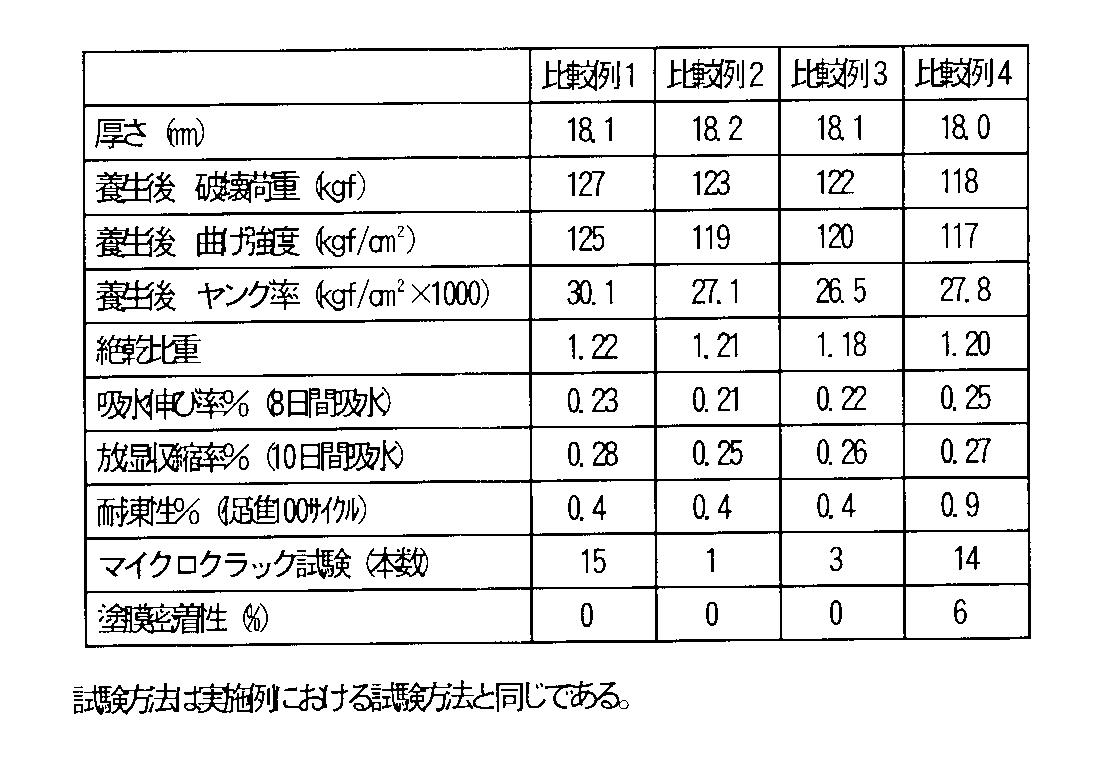
上記各種セメント板試料について、破壊荷重、ヤング率、曲げ強度、絶乾比重、吸水伸び率、放湿収縮率、耐凍性、マイクロクラック試験および塗膜密着試験の各試験を行なった。上記各試験の結果を表3および比較例として表4に示す。各試験方法は各表の下欄に示す通りである。
【0032】
【表3】
【表4】
表3および表4から明らかなように、マイカが添加されていない比較例1の試料は寸法安定性(吸水伸び率、放湿収縮率)に劣り、またマイクロクラックが多数発生し、アスペクト比が65以下のマイカを使用した比較例2は放湿収縮率が若干大きく、またマイクロクラックも多少発生した。
また平均粒径150μm以下、アスペクト比65以下のマイカを使用した比較例3は寸法安定性(吸水伸び率、放湿収縮率)に劣り、かつマイクロクラックが発生し、160℃以下でオ−トクレーブ養生を行なった比較例4は寸法安定性に劣り、また耐凍性が劣るので、マイクロクラックも多数発生し、塗膜密着性も不良であった。
上記した通り、本発明の木質セメント板は、塗膜の密着性および耐透水性能において優れており、マイカを多量に混合することも可能となった。したがって吸水長さ変化率も大きく改善出来るようになった。また、実施例7、8のように高比重のものでも、表面の靱性劣化によるマイクロクラックが発生しない。
【0035】
【発明の効果】
本発明によれば、マイカを含有してもなお塗膜の密着性に優れかつ寸法安定性が大巾に改良され、かつマイクロクラックが発生しない木質セメント板が得られる。[0001]
BACKGROUND OF THE INVENTION
The present invention relates to a method for producing a wood cement board mainly used for buildings.
[0002]
[Prior art]
Conventionally, asbestos has been used as a reinforcing material for inorganic board, but environmental pollution has become a problem due to the scattering of fine asbestos powder, and wood reinforcing materials such as wood fragments and wood fibers have been used as a reinforcing material to replace asbestos. It was.
[0003]
However, a wood cement board reinforced with a wood reinforcing material is inferior in dimensional stability, expands and contracts due to moisture absorption drying, tends to cause warping, and in the worst case, has a drawback of causing cracks.
In order to improve such drawbacks, it has been proposed to add mica to a mixture of a wood reinforcing material and cement (for example, JP-B-57-42580, JP-A-60-226439, JP-A-2-141446). issue). Mica has a high elastic modulus, and greatly improves the dimensional stability, cutting ability, nailability and the like of the wood cement board by adding about 5 to 30% by weight.
[0004]
[Problems to be solved by the invention]
However, when a large amount of mica is present on the surface of the wooden cement board, when the commonly used aqueous paint is applied to the surface of the wooden cement board, the aqueous paint uniformly penetrates from the surface of the wooden cement board to the inside. There is a problem that the adhesiveness of the coating film at the part where the mica is exposed is deteriorated and the film is easily peeled off.
In order to improve the dimensional stability of the wood cement board, there is a method in which the base material is firmly solidified by increasing the specific gravity by reducing the amount of the wood component that is highly stretched by water absorption and increasing the inorganic component. However, this method improves the dimensional stability. However, especially when autoclave curing is performed, the surface layer becomes tough and the surface becomes hard due to the effect of high-temperature and high-pressure curing. When a board is manufactured from multiple layers of mats that are easy to enter and have different raw material formulations, the difference in water absorption and moisture release occurs due to the heterogeneity between layers, and the other layer follows the expansion and contraction of one layer. Therefore, there is a problem that microcracks are likely to occur.
[0005]
Accordingly, an object of the present invention is to provide a method for producing a wood cement board that is excellent in the adhesion of a coating film even if it contains mica, is greatly improved in dimensional stability, and does not generate microcracks. is there.
[0006]
[Means for Solving the Problems]
In the present invention, as means for solving the above-mentioned conventional problems, a raw material containing mica having a mean particle size of 150 μm or more and an aspect ratio of 65 or more mainly composed of a wood reinforcing material and a cement-based inorganic material is dispersed on a plate. Thus, the present invention provides a method for producing a wood cement board which is formed into a mat, and is pressed and cured at a temperature of 160 ° C. or higher in the presence of moisture. The mica is preferably contained in the mixture in an amount of 1 to 15% by weight, and the surface of the wood cement board is preferably further coated after the autoclave curing. Furthermore, it is desirable that the wood cement board has a multilayer structure, and in this case, a particularly advantageous effect is exhibited.
[0007]
DETAILED DESCRIPTION OF THE INVENTION
Hereinafter, the present invention will be described in detail.
[Wood reinforcement]
Examples of the wood reinforcing material used in the present invention include wood flour, wood wool, wood fragments, wood fiber, wood pulp, wood fiber bundles, strands, etc., and the wood reinforcement material includes bamboo fiber, hemp fiber, bagasse, rice bran, A material mainly composed of lignocellulose such as rice straw may be mixed. Preferable wood reinforcing materials include a wood piece having a width of 0.5 to 2 mm, a length of 1 to 20 mm, an aspect ratio (length / thickness) of 20 to 30, a diameter of 0.1 to 2.0 mm, and a length of 2 to 2. There are 35 mm branches and / or bent and / or bent wood fiber bundles.
[0008]
[Cement-based inorganic materials]
Examples of the cement-based inorganic material used in the present invention include Portland cement, blast furnace slag cement, silica cement, fly ash cement, alumina cement, and the like; silica powder, silica sand, quartzite powder, water glass, silica fume, and shirasu balloon Examples thereof include a mixture of a silicate-containing substance such as pearlite, diatomaceous earth, or dolomite and the above cement. Among these, a mixture of cements and silicic acid-containing substances is desirable, and a mixing ratio (weight ratio) of cements and silicic acid-containing substances is desirably 1: 2 to 6: 1.
[0009]
〔reject〕
In this invention, you may use the waste material ground material (reject) of a wood cement board as one of the raw materials. The reject is produced by pulverizing the wood cement board waste to an average particle size of about 50 to 150 μm with an impact pulverizer and / or a rubbing pulverizer.
[0010]
[Mica]
The mica used in the present invention has a flake shape having an average particle size of 150 μm or more and an aspect ratio of 65 or more, and particularly preferably has an average particle size of 340 μm or more and an aspect ratio of 80 or more. Mica usually has a layered structure, has no hygroscopic property, is a highly elastic body having rigidity, and can greatly improve the dimensional stability of a wood cement board including a wood reinforcing material.
[0011]
[Other ingredients]
In the molding material of the wood cement board of the present invention, as components other than the above, calcium chloride, magnesium chloride, potassium sulfate, calcium sulfate, magnesium sulfate, aluminum sulfate, sodium aluminate, potassium aluminate, calcium formate, calcium acetate, Cement hardening accelerators such as calcium acrylate and water glass, mineral powders such as vermiculite and bentonite, waterproofing agents and water repellents such as wax, wax, paraffin, silicon and surfactant, foaming thermoplastic plastic beads, plastic foam Body or the like may be added. In addition, these illustrations do not limit the present invention.
[0012]
[Composition of wood cement board]
In the composition of the wood cement board main body of the present invention, the wood reinforcing material is preferably contained in an amount of 3 to 40% by weight, the cementitious inorganic material in an amount of 60 to 97% by weight, and mica in an amount of 1 to 15% by weight (each solid content). If the mica content is less than 1% by weight, the dimensional stability of the resulting wood cement board cannot be sufficiently improved. If the mica content exceeds 15% by weight, it is difficult to uniformly mix the raw materials. In other words, a wood cement board with stable quality cannot be obtained and the cost is increased.
[0013]
[Manufacture of wood cement board]
The wood cement board of the present invention can be produced by a dry method or a semi-dry method.
In the semi-dry method, first, a predetermined amount of water is added to and mixed with the raw material mixture containing the cement-based inorganic material, the wood reinforcing material and mica to obtain a raw material mixture, and then the raw material mixture is mixed with a plate (conveying plate, substrate, etc. ) Spread the mat to form the mat.
In the dry method, a raw material mixture containing the cement-based inorganic material, the wood reinforcing material and mica is spread on a plate without adding moisture to form a mat, and a predetermined amount of water is added to the mat.
The formed mat is usually pressed at a pressure of 2 to 4 MPa and cured under conditions of usually 60 to 80 ° C. and 8 to 12 hours, and further autoclaved at a pressure of 160 ° C. or higher, preferably 0.5 MPa or higher. Curing is performed.
[0014]
When spraying the raw material mixture on a plate, a plurality of plates are arranged on a conveyor and the plate is transported. The raw material mixture is then sprayed on the plate, and in this case, the direction is opposite to the plate transport direction. When the wind is selected, fine components in the raw material mixture are distributed more on the plate side (front side), and coarse components are distributed more on the opposite side of the plate (back side), resulting in a dense surface. .
[0015]
The wood cement board of the present invention may have a two-layer or three-layer multilayer structure. In this case, a wood piece and a large-sized wood reinforcement material such as a wood fiber bundle are used for the core layer, and foamed thermoplastic beads and plastic foam are added, and the surface layer or the surface layer and the back layer are made of wood pieces. Using a small-sized wood reinforcing material such as wood powder, the core layer has a rough structure and the front and back layers have a dense structure.
[0016]
In order to manufacture such a wood cement board with a multi-layer structure by a dry method or a semi-dry method, a surface mat is formed by spraying a raw material mixture for front and back layers containing small mica and a wood reinforcement material on the board. Then, a core layer mat is formed by spraying a raw material mixture for core layer containing a large size mica and wood reinforcing material, foaming thermoplastic beads and plastic foam, and in the case of a three-layer structure, further From above, the raw material mixture for the front and back layers is sprayed to form the back layer mat, the mat having such a multilayer structure is pressed and cured, and further subjected to autoclave curing.
[0017]
In the production process of the wood cement board, siliceous components and alumina components are eluted from the mica surface by autoclave curing at a temperature of 160 ° C. or higher, preferably under a pressure of 0.5 MPa or higher. The mica surface becomes rough. Further, since the mica has a large surface area with a particle size of 150 μm or more, the overlapping area between mica becomes large.
[0018]
Since the surface of the mica is rough as described above, the calcium content eluted from the cement-based inorganic material at the overlapping portion easily enters between the overlapping portions of the mica, and this calcium content is separated from the mica surface. It reacts with the eluted siliceous component to produce a stable calcium silicate reactant, which adheres to the mica and, as described above, overlaps with the large overlap area of the mica, ie, the adhesion area. Mica is firmly joined together. As a result, the wood cement board of the present invention acquires great mechanical strength and greatly improved dimensional stability.
[0019]
Furthermore, since the mica surface is rough, even if the mica is present on the surface of the wooden cement board, when the surface is coated on the surface of the wooden cement board, the adhesion to the paint is caused by the mica. It will not be disturbed.
[0020]
In the case of a multi-layer structure, when spraying the raw material mixture for the front and back layers on the plate, finer mica having an average particle size of 340 μm or less is distributed on the front side and the back side (core layer side). The large size mica having an average particle size of 340 μm or more is distributed.
[0021]
In such a front and back layer, mica of a large size is distributed on the core layer side, so the adhesion area between the mica is large, which has a positive effect on dimensional stability, and the surface side has a fine size. Since mica is arranged, it has a positive effect on the prevention of fine cracks and the adhesion of the coating film.
[0022]
In this way, by performing wind selection when spraying the raw material mixture in the surface mat forming process, large mica is arranged on the core layer side, fine mica is arranged on the surface side, and large mica and fine size mica are arranged. Mica can be used effectively.
It is an advantage of the dry method or the semi-dry method that mica having an appropriate size can be distributed to a desired part in this way.
[0023]
In order to apply the surface of the wood cement board of the present invention thus produced, for example, an organic solvent solution type acrylic resin paint, an aqueous emulsion type acrylic resin paint, a urethane resin paint, a silicon resin An undercoat paint such as a paint is applied, and if desired, an intermediate coat paint similar to the above undercoat paint is applied thereon, for example, an organic solvent solution type acrylic resin-based paint, an aqueous emulsion type acrylic resin. An overcoating material such as an organic paint or an organic solvent solution type silicon acrylic resin paint is applied.
[0024]
【Example】
EXAMPLES Hereinafter, the present invention will be described more specifically with reference to examples. However, the scope of the present invention is not limited to these examples.
[0025]
[Examples 1 to 10, Comparative Examples 1 to 4]
As raw materials for the wood cement board, a mixture having the composition shown in Table 1 and Table 2 as a comparative example was prepared.
[0026]
[Table 1]
[Table 2]
In the above mixture, both the front and back layers and the core layer used in Examples 1 to 9 had an aspect ratio of 80 and an average particle size of 340 μm. The mica of Example 10 used both the front and back layers and the core layer had an aspect ratio of 80 and an average particle size. The thing with a diameter of 230 micrometers was used. Comparative Example 1 did not use mica, Comparative Example 2 used mica with an aspect ratio of 55 and an average particle size of 230 μm for both the front and back layers and the core layer, and Comparative Example 3 had an aspect for both the front and back layers and the core layer. A mica having a ratio of 55 and an average particle size of 90 μm was used, and Comparative Example 4 used mica having an aspect ratio of 80 and an average particle size of 340 μm as in Examples 1 to 9 for both the front and back layers and the core layer.
[0029]
As a sample, a predetermined amount of the above mixture was dispersed on the substrate to form a mat, the upper substrate was brought into contact with the mixture, pressed at a pressure of 3.0 MPa, cured at 70 ° C. for 10 hours, and then pressure 0 A wood cement board sample having a thickness of 18 mm was obtained by autoclave curing at 9 MPa, a temperature of 180 ° C., and a keep time of 7 hours. However, in Example 7, the mat was pressed at 5.0 MPa, cured at 70 ° C. for 10 hours, and then subjected to autoclave curing under the above conditions. After pressing at 0 MPa and curing for 10 hours at a temperature of 70 ° C., autoclave curing was performed at a pressure of 0.2 MPa, a temperature of 130 ° C., and a keep time of 7 hours.
[0030]
Next, an acrylic resin paint, which is an acrylic urethane sealer, is applied as an undercoat on the surface of each wooden cement board sample by spraying at a coating amount of 100 g / m 2 and dried by heating at 105 ° C. for 10 minutes. As an application, an organic solvent solution type acrylic urethane resin-based paint is applied at a coating amount of 100 g / m 2 by a roll coater and dried by heating at 105 ° C. for 5 minutes. The coating was applied at a coating amount of / m 2 and dried by heating at 105 ° C. for 5 minutes, and a top clear inorganic coating was applied at 50 g / m 2 .
[0031]
Each of the above-mentioned various cement plate samples was subjected to each test of breaking load, Young's modulus, bending strength, absolute dry specific gravity, water absorption elongation rate, moisture release shrinkage rate, freezing resistance, microcrack test and coating film adhesion test. The results of the above tests are shown in Table 3 and Table 4 as a comparative example. Each test method is as shown in the lower column of each table.
[0032]
[Table 3]
[Table 4]
As apparent from Table 3 and Table 4, the sample of Comparative Example 1 to which no mica was added was inferior in dimensional stability (water absorption elongation rate, moisture release shrinkage rate), many microcracks were generated, and the aspect ratio was In Comparative Example 2 using mica of 65 or less, the moisture-shrinkage shrinkage rate was slightly large, and some microcracks were also generated.
Comparative Example 3 using mica having an average particle size of 150 μm or less and an aspect ratio of 65 or less is inferior in dimensional stability (water absorption elongation rate, moisture release shrinkage rate), generates microcracks, and is autoclave at 160 ° C. or less. In Comparative Example 4 in which the curing was performed, the dimensional stability was inferior and the frost resistance was inferior. Therefore, many microcracks were generated, and the coating film adhesion was also poor.
As described above, the woody cement board of the present invention is excellent in the adhesion and water permeation resistance of the coating film, and it is possible to mix a large amount of mica. Therefore, the water absorption length change rate can be greatly improved. Moreover, even if it has a high specific gravity as in Examples 7 and 8, microcracks due to surface toughness degradation do not occur.
[0035]
【The invention's effect】
According to the present invention, it is possible to obtain a wood cement board which is excellent in adhesiveness of a coating film, has a greatly improved dimensional stability and does not generate microcracks even if it contains mica.
Claims (2)
該原料混合物を該板上に散布する際に、該板の搬送方向と逆方向に向けて風を吹付けて風選を行ない、原料混合物中の微細成分を板側(表面側)に多く配分し、粗大成分を板反対側(裏面側)に多く配分し、
オートクレーブ養生は、水分存在下で、160℃以上の温度、0.5MPa以上の圧力で行う
ことを特徴とする木質セメント板の製造方法。 Arranging the plate on the conveyor, while conveying the plate-and wood reinforcement, cement and an inorganic material, the raw material mixture the plate containing the aspect ratio 65 or more mica 3-15% by weight with an average particle diameter of 150μm or more and forming the mat by spraying the above, by pressing the mat, Oh - a Tokurebu method for producing a wood cement board to curing,
When spraying the raw material mixture on the plate, air is blown in the direction opposite to the conveying direction of the plate to select the air, and a large amount of fine components in the raw material mixture is distributed to the plate side (front side) Distribute a large amount of coarse components to the opposite side (back side) of the board,
The method for producing a wood cement board, wherein the autoclave curing is performed in the presence of moisture at a temperature of 160C or higher and a pressure of 0.5 MPa or higher .
該表裏層用原料混合物を該板上に散布する際に、該板の搬送方向と逆方向に向けて風を吹付けて風選を行ない、該表裏層用原料混合物中の平均粒径340μm以下の細かいサイズのマイカを板側(表面側)に多く配分し、平均粒径340μm以上の大きいサイズのマイカを芯層側(裏面側)に多く配分し、
オートクレーブ養生は、水分存在下で、160℃以上の温度、0.5MPa以上の圧力で行う
ことを特徴とする多層構造を有する木質セメント板の製造方法。 Raw material mixture for front and back layers containing 3-15% by weight of wood reinforcing material, cement-based inorganic material, and mica having an average particle size of 150 μm or more and an aspect ratio of 65 or more while arranging the plates on a conveyor To form a surface layer mat, and from above, a raw material mixture for a core layer containing 3-15% by weight of a wood reinforcing material, a cement-based inorganic material, and mica having an average particle size of 150 μm or more and an aspect ratio of 65 or more Multilayer which spreads and forms a core layer mat, further sprays the raw material mixture for the front and back layers from above, forms the back layer mat, presses the mat having such a multilayer structure, and cures the autoclave. A method for producing a wood cement board having a structure,
When spraying the raw material mixture for the front and back layers onto the plate, wind selection is performed by blowing air in the direction opposite to the conveying direction of the plate, and the average particle size in the raw material mixture for the front and back layers is 340 μm or less A large amount of mica of a small size is distributed on the plate side (front side), and a large size of mica having an average particle size of 340 μm or more is distributed on the core layer side (back side).
Autoclave curing is performed at a temperature of 160 ° C. or higher and a pressure of 0.5 MPa or higher in the presence of moisture.
Method for producing a wood cement board to have a multilayer structure, characterized in that.
Priority Applications (1)
| Application Number | Priority Date | Filing Date | Title |
|---|---|---|---|
| JP2000388658A JP4119086B2 (en) | 2000-12-21 | 2000-12-21 | Manufacturing method of wood cement board |
Applications Claiming Priority (1)
| Application Number | Priority Date | Filing Date | Title |
|---|---|---|---|
| JP2000388658A JP4119086B2 (en) | 2000-12-21 | 2000-12-21 | Manufacturing method of wood cement board |
Publications (2)
| Publication Number | Publication Date |
|---|---|
| JP2002187759A JP2002187759A (en) | 2002-07-05 |
| JP4119086B2 true JP4119086B2 (en) | 2008-07-16 |
Family
ID=18855356
Family Applications (1)
| Application Number | Title | Priority Date | Filing Date |
|---|---|---|---|
| JP2000388658A Expired - Lifetime JP4119086B2 (en) | 2000-12-21 | 2000-12-21 | Manufacturing method of wood cement board |
Country Status (1)
| Country | Link |
|---|---|
| JP (1) | JP4119086B2 (en) |
Families Citing this family (7)
| Publication number | Priority date | Publication date | Assignee | Title |
|---|---|---|---|---|
| JP4950611B2 (en) * | 2006-09-26 | 2012-06-13 | ニチハ株式会社 | Inorganic molded body |
| JP5129941B2 (en) * | 2006-09-26 | 2013-01-30 | ニチハ株式会社 | Inorganic molded body and method for producing the same |
| JP5350060B2 (en) * | 2009-04-23 | 2013-11-27 | ニチハ株式会社 | Wood cement board and manufacturing method thereof |
| JP5350061B2 (en) * | 2009-04-23 | 2013-11-27 | ニチハ株式会社 | Wood cement board and manufacturing method thereof |
| JP5118738B2 (en) * | 2010-10-29 | 2013-01-16 | ニチハ株式会社 | Wood cement board and manufacturing method thereof |
| JP6663181B2 (en) * | 2015-07-30 | 2020-03-11 | ケイミュー株式会社 | Method for producing inorganic plate, and inorganic plate |
| JP7210132B2 (en) | 2017-09-28 | 2023-01-23 | ニチハ株式会社 | Inorganic board and manufacturing method thereof |
Family Cites Families (9)
| Publication number | Priority date | Publication date | Assignee | Title |
|---|---|---|---|---|
| JP2754306B2 (en) * | 1992-10-09 | 1998-05-20 | ニチハ株式会社 | Wood cement board |
| JP3136232B2 (en) * | 1994-01-28 | 2001-02-19 | ニチハ株式会社 | Wood cement board |
| JP3023054B2 (en) * | 1994-06-17 | 2000-03-21 | ニチハ株式会社 | Wood chip cement board and its manufacturing method |
| JP2943844B2 (en) * | 1994-08-26 | 1999-08-30 | ニチハ株式会社 | Wood cement board |
| JP3279897B2 (en) * | 1995-11-29 | 2002-04-30 | ニチハ株式会社 | Wood cement board manufacturing method |
| JPH09227252A (en) * | 1996-02-23 | 1997-09-02 | Nichiha Corp | Method for coating inorganic board |
| JP3290069B2 (en) * | 1996-03-26 | 2002-06-10 | 松下電工株式会社 | Manufacturing method of inorganic plate |
| JPH10231161A (en) * | 1997-02-21 | 1998-09-02 | Sekisui Chem Co Ltd | Heat-curing type cement composition and production of wood-based cement board using the same composition |
| JP3980182B2 (en) * | 1998-06-30 | 2007-09-26 | ニチハ株式会社 | Manufacturing method of wood cement board |
-
2000
- 2000-12-21 JP JP2000388658A patent/JP4119086B2/en not_active Expired - Lifetime
Also Published As
| Publication number | Publication date |
|---|---|
| JP2002187759A (en) | 2002-07-05 |
Similar Documents
| Publication | Publication Date | Title |
|---|---|---|
| JP2006062883A (en) | Wood cement board and manufacturing method thereof | |
| JP2002166406A (en) | Method for manufacturing woody cement board | |
| JP2005343740A (en) | Manufacturing process of wood cement board | |
| JP2006069808A (en) | Inorganic board and method for producing the same | |
| JP4180861B2 (en) | Wood cement board and manufacturing method thereof | |
| JP3549790B2 (en) | Inorganic plate and method for producing the same | |
| JP2002187759A (en) | Wood cement board manufacturing method | |
| WO2019065226A1 (en) | Mineral board and production method therefor | |
| AU751814B2 (en) | Precast concrete plates | |
| JPH09328350A (en) | Roof base material and method for manufacturing the same | |
| JP2754306B2 (en) | Wood cement board | |
| JP4226805B2 (en) | Wood cement board and manufacturing method thereof | |
| JPH0867547A (en) | Wood cement board | |
| JP3980182B2 (en) | Manufacturing method of wood cement board | |
| JP4043107B2 (en) | High specific gravity wood cement board, multi-layer high specific gravity wood cement board and manufacturing method thereof | |
| JP4427287B2 (en) | Manufacturing method of wood cement board | |
| JP3136232B2 (en) | Wood cement board | |
| CN1091485C (en) | High strength fibre plain gypsum board | |
| JP3037683B1 (en) | Wood cement board and method for producing the same | |
| JP2006069807A (en) | Inorganic board and its manufacturing method | |
| JP3225025B2 (en) | Wood cement board and method for producing the same | |
| JP4163367B2 (en) | Wood cement board | |
| JPH08259302A (en) | Method for manufacturing inorganic plate | |
| JP3023054B2 (en) | Wood chip cement board and its manufacturing method | |
| JP2652774B2 (en) | Manufacturing method of inorganic plate |
Legal Events
| Date | Code | Title | Description |
|---|---|---|---|
| A621 | Written request for application examination |
Free format text: JAPANESE INTERMEDIATE CODE: A621 Effective date: 20041227 |
|
| A977 | Report on retrieval |
Free format text: JAPANESE INTERMEDIATE CODE: A971007 Effective date: 20071107 |
|
| A131 | Notification of reasons for refusal |
Free format text: JAPANESE INTERMEDIATE CODE: A131 Effective date: 20071109 |
|
| A521 | Written amendment |
Free format text: JAPANESE INTERMEDIATE CODE: A523 Effective date: 20080108 |
|
| RD05 | Notification of revocation of power of attorney |
Free format text: JAPANESE INTERMEDIATE CODE: A7425 Effective date: 20080108 |
|
| TRDD | Decision of grant or rejection written | ||
| A01 | Written decision to grant a patent or to grant a registration (utility model) |
Free format text: JAPANESE INTERMEDIATE CODE: A01 Effective date: 20080422 |
|
| A61 | First payment of annual fees (during grant procedure) |
Free format text: JAPANESE INTERMEDIATE CODE: A61 Effective date: 20080424 |
|
| R150 | Certificate of patent or registration of utility model |
Free format text: JAPANESE INTERMEDIATE CODE: R150 Ref document number: 4119086 Country of ref document: JP Free format text: JAPANESE INTERMEDIATE CODE: R150 |
|
| FPAY | Renewal fee payment (event date is renewal date of database) |
Free format text: PAYMENT UNTIL: 20110502 Year of fee payment: 3 |
|
| FPAY | Renewal fee payment (event date is renewal date of database) |
Free format text: PAYMENT UNTIL: 20130502 Year of fee payment: 5 |
|
| FPAY | Renewal fee payment (event date is renewal date of database) |
Free format text: PAYMENT UNTIL: 20140502 Year of fee payment: 6 |
|
| EXPY | Cancellation because of completion of term |