JP3937726B2 - Method for producing L-glutamic acid by fermentation - Google Patents
Method for producing L-glutamic acid by fermentation Download PDFInfo
- Publication number
- JP3937726B2 JP3937726B2 JP2000506337A JP2000506337A JP3937726B2 JP 3937726 B2 JP3937726 B2 JP 3937726B2 JP 2000506337 A JP2000506337 A JP 2000506337A JP 2000506337 A JP2000506337 A JP 2000506337A JP 3937726 B2 JP3937726 B2 JP 3937726B2
- Authority
- JP
- Japan
- Prior art keywords
- glutamic acid
- gene
- corynebacterium
- strain
- gltbd
- Prior art date
- Legal status (The legal status is an assumption and is not a legal conclusion. Google has not performed a legal analysis and makes no representation as to the accuracy of the status listed.)
- Expired - Fee Related
Links
Images
Classifications
-
- C—CHEMISTRY; METALLURGY
- C12—BIOCHEMISTRY; BEER; SPIRITS; WINE; VINEGAR; MICROBIOLOGY; ENZYMOLOGY; MUTATION OR GENETIC ENGINEERING
- C12N—MICROORGANISMS OR ENZYMES; COMPOSITIONS THEREOF; PROPAGATING, PRESERVING, OR MAINTAINING MICROORGANISMS; MUTATION OR GENETIC ENGINEERING; CULTURE MEDIA
- C12N9/00—Enzymes; Proenzymes; Compositions thereof; Processes for preparing, activating, inhibiting, separating or purifying enzymes
- C12N9/0004—Oxidoreductases (1.)
- C12N9/0012—Oxidoreductases (1.) acting on nitrogen containing compounds as donors (1.4, 1.5, 1.6, 1.7)
- C12N9/0014—Oxidoreductases (1.) acting on nitrogen containing compounds as donors (1.4, 1.5, 1.6, 1.7) acting on the CH-NH2 group of donors (1.4)
- C12N9/0016—Oxidoreductases (1.) acting on nitrogen containing compounds as donors (1.4, 1.5, 1.6, 1.7) acting on the CH-NH2 group of donors (1.4) with NAD or NADP as acceptor (1.4.1)
-
- C—CHEMISTRY; METALLURGY
- C12—BIOCHEMISTRY; BEER; SPIRITS; WINE; VINEGAR; MICROBIOLOGY; ENZYMOLOGY; MUTATION OR GENETIC ENGINEERING
- C12N—MICROORGANISMS OR ENZYMES; COMPOSITIONS THEREOF; PROPAGATING, PRESERVING, OR MAINTAINING MICROORGANISMS; MUTATION OR GENETIC ENGINEERING; CULTURE MEDIA
- C12N9/00—Enzymes; Proenzymes; Compositions thereof; Processes for preparing, activating, inhibiting, separating or purifying enzymes
- C12N9/10—Transferases (2.)
- C12N9/1096—Transferases (2.) transferring nitrogenous groups (2.6)
-
- C—CHEMISTRY; METALLURGY
- C12—BIOCHEMISTRY; BEER; SPIRITS; WINE; VINEGAR; MICROBIOLOGY; ENZYMOLOGY; MUTATION OR GENETIC ENGINEERING
- C12P—FERMENTATION OR ENZYME-USING PROCESSES TO SYNTHESISE A DESIRED CHEMICAL COMPOUND OR COMPOSITION OR TO SEPARATE OPTICAL ISOMERS FROM A RACEMIC MIXTURE
- C12P13/00—Preparation of nitrogen-containing organic compounds
- C12P13/04—Alpha- or beta- amino acids
- C12P13/14—Glutamic acid; Glutamine
Landscapes
- Chemical & Material Sciences (AREA)
- Life Sciences & Earth Sciences (AREA)
- Organic Chemistry (AREA)
- Health & Medical Sciences (AREA)
- Engineering & Computer Science (AREA)
- Zoology (AREA)
- Wood Science & Technology (AREA)
- Genetics & Genomics (AREA)
- Bioinformatics & Cheminformatics (AREA)
- General Health & Medical Sciences (AREA)
- Biochemistry (AREA)
- General Engineering & Computer Science (AREA)
- Microbiology (AREA)
- Biotechnology (AREA)
- Medicinal Chemistry (AREA)
- Molecular Biology (AREA)
- Biomedical Technology (AREA)
- Chemical Kinetics & Catalysis (AREA)
- General Chemical & Material Sciences (AREA)
- Preparation Of Compounds By Using Micro-Organisms (AREA)
- Micro-Organisms Or Cultivation Processes Thereof (AREA)
- Enzymes And Modification Thereof (AREA)
Description
技術分野
本発明は、発酵法によるL−グルタミン酸の製造法に関する。L−グルタミン酸は、食品、医薬品等として重要なアミノ酸である。
背景技術
従来、L−グルタミン酸は、主としてブレビバクテリウム属、コリネバクテリウム属またはミクロバクテリウム属に属するいわゆるコリネ型L−グルタミン酸生産菌またはそれらの変異株を用いた発酵法により製造されている(アミノ酸発酵、学会出版センター、195〜215頁、1986年)。その他の菌株を用いた発酵法によるL−グルタミン酸の製造法としては、バチルス属、ストレプトミセス属、ペニシリウム属等の微生物を用いる方法(米国特許第3,220,929号)、シュードモナス属、アースロバクター属、セラチア属、キャンディダ属等の微生物を用いる方法(米国特許第3,563,857号)等が知られている。従来の方法によりL−グルタミン酸の生産性はかなり高まってはいるが、今後の需要の一層の増大に応えるためには、さらに安価かつ効率的なL−グルタミン酸の製造法の開発が求められている。
L−グルタミン酸は微生物菌体内でクエン酸回路の中間生成物であるα−ケトグルタル酸から生合成されるが、アンモニウムイオンを同化してα−ケトグルタル酸からL−グルタミン酸を生成する生合成経路は2つ存在する。一つは、高濃度のアンモニウムイオン存在下でグルタミン酸デヒドロゲナーゼ(以下「GDH」と略す)の触媒作用により合成される経路であり、もう一つは、L−グルタミン酸とアンモニウムイオンからグルタミンへの反応を触媒するグルタミンシンテターゼ(以下「GS」と略す)およびGSによって生成したグルタミン1分子とα−ケトグルタル酸1分子から2分子のL−グルタミン酸を生成する反応を触媒するグルタミン−オキソグルタル酸アミノトランスフェラーゼ(グルタミン酸シンターゼとも呼ばれる。以下「GOGAT」と略す)によって合成される経路(GS/GOGAT経路)である。これまでGDH活性の増強によりGDH経路を強化した菌株によるL−グルタミン酸生産は報告されているが、GS/GOGAT経路を強化した菌株によるL−グルタミン酸生産は知られていなかった。
発明の開示
本発明の目的は、L−グルタミン酸の需要の一層の増大に応えるために、高いL−グルタミン酸生産能を有する菌株を育種し、より安価かつ効率的なL−グルタミン酸の製造法を提供することにある。
本発明者らは、GS/GOGAT経路にかかわる酵素のうちL−グルタミン酸生成を触媒するGOGATを強化した菌株によるL−グルタミン酸の製造法についての研究を行った結果、コリネバクテリウム属細菌に属し、GOGAT活性が増幅され、かつL−グルタミン酸生産能を有する菌株が高いL−グルタミン酸生産能を持つことを見いだし、本発明を完成するに至った。
すなわち、本発明は、コリネバクテリウム属細菌に属し、細胞中のGOGAT活性が増幅され、かつL−グルタミン酸生産能を有する菌株を提供するものである。前記グルタミン−オキソグルタル酸アミノトランスフェラーゼ活性は、細胞内のグルタミン−オキソグルタル酸アミノトランスフェラーゼをコードする遺伝子のコピー数を高めることによって増幅することができる。また、グルタミン−オキソグルタル酸アミノトランスフェラーゼ活性は、該酵素をコードする遺伝子の発現調節配列の改変によっても増幅することができる。グルタミン−オキソグルタル酸アミノトランスフェラーゼとしては、例えばエシェリヒア属細菌又はコリネバクテリウム属細菌由来のものが挙げられる。
本発明はまた、コリネバクテリウム属細菌由来のグルタミン−オキソグルタル酸アミノトランスフェラーゼをコードする遺伝子であって、配列番号7に示す塩基配列のうち、少なくとも塩基番号565〜6614からなる塩基配列を有することを特徴とする遺伝子を提供する。
また、本発明は、コリネバクテリウム属細菌に属し、GOGAT活性が増幅され、かつL−グルタミン酸生産能を有する菌株を液体培地に培養し、培養液中にL−グルタミン酸を生成蓄積せしめ、これを培養液から採取することを特徴とする発酵法によるL−グルタミン酸の製造法を提供するものである。
以下、本発明を詳細に説明する。
(1)L−グルタミン酸生産能を有するコリネバクテリウム属細菌
本発明にいうコリネバクテリウム属細菌とは、バージーズ・マニュアル・オブ・デターミネイティブ・バクテリオロジー(Bargeys Manual of Determinative Bacteriology)第8版599頁(1974)に定義されている一群の微生物であり、好気性、グラム陽性、非抗酸性、胞子形成能を有しない桿菌であり、従来ブレビバクテリウム属に分類されていたが現在コリネバクテリウム属細菌として統合されたブレビバクテリウム属細菌(Int.J.Syst.Bacteriol.,41,255(1981))を含み、またコリネバクテリウム属細菌と非常に近縁なブレビバクテリウム属細菌及びミクロバテリウム属細菌を含む。このようなコリネバクテリウム属細菌のうち、以下に述べるようなL−グルタミン酸生産性細菌として知られているものが本発明においては、最も好ましいものである。
コリネバクテリウム・アセトアシドフィラム
コリネバクテリウム・アセトグルタミカム
コリネバクテリウム・カルナエ
コリネバクテリウム・グルタミカム
コリネバクテリウム・リリウム(コリネバクテリウム・グルタミカム)
コリネバクテリウム・メラセコーラ
ブレビバクテリウム・ディバリカタム(コリネバクテリウム・グルタミカム)
ブレビバクテリウム・ラクトフェルメンタム(コリネバクテリウム・グルタミカム)
ブレビバクテリウム・サッカロリティカム
ブレビバクテリウム・インマリオフィルム
ブレビバクテリウム・ロゼウム
ブレビバクテリウム・フラバム(コリネバクテリウム・グルタミカム)
ブレビバクテリウム・チオゲニタリス
具体的には、下記の菌株を例示することができる。
コリネバクテリウム・アセトアシドフィラム ATCC 13870
コリネバクテリウム・アセトグルタミカム ATCC 15806
コリネバクテリウム・カルナエ ATCC 15991
コリネバクテリウム・グルタミカム ATCC 13032
コリネバクテリウム・グルタミカム ATCC 13060
ブレビバクテリウム・ディバリカタム ATCC 14020
ブレビバクテリウム・ラクトフェルメンタム ATCC 13869
コリネバクテリウム・リリウム ATCC 15990
コリネバクテリウム・メラセコーラ ATCC 17965
ブレビバクテリウム・サッカロリティクム ATCC 14066
ブレビバクテリウム・インマリオフィルム ATCC 14068
ブレビバクテリウム・ロゼウム ATCC 13825
ブレビバクテリウム・フラバム ATCC 13826
ブレビバクテリウム・チオゲニタリス ATCC 19240
これらを入手するには、例えばアメリカン・タイプ・カルチャー・コレクションより分譲を受けることができる。すなわち、各微生物ごとに対応する登録番号が付与されており、この登録番号を引用して分譲を受けることができる。各微生物に対応する登録番号はアメリカン・タイプ・カルチャー・コレクションのカタログに記載されている。
上記のコリネバクテリウム属細菌を用いてL−グルタミン酸を生産するには次のいずれかの手段が有効である。
1.培地中のビオチン濃度を最適以下(suboptimal)にする。
奥村真二、都河竜一郎、角田俊直、北井淳夫:日本農芸化学会誌,36,197−203(1962)参照。
2.ビオチンが十分量存在する条件で培地に界面活性剤を添加する。
I.Shiio,H.Otsuka,N.Atsuya:J.Biochem.,53,333−340(1963)及びK.Takinami,H,Okada,T.Tsunoda:Agr.Biol.Chem.,27,853−863(1963)参照。
3.ビオチンが十分量存在する条件で培地にペニシリンを添加する。
米国特許第3,080,297号、特公昭37−1695号及び渋川満、栗間理夫、岡部節三、大沢岳義:Amino Acid and Nucleic Acid,17,61−65(1968)参照。
または、上記のコリネバクテリウム属細菌から誘導された変異株を用いる方法によってもL−グルタミン酸を生産することが可能である。このような変異株としては、例えば、
ブレビバクテリウム・ラクトファーメンタム AJ12475(FERM−BP2922、米国特許第5,272,067号公報)
ブレビバクテリウム・ラクトファーメンタム AJ12476(FERM−BP2923、米国特許第5,272,067号公報)
ブレビバクテリウム・フラバム AJ12477(FERM−BP2924、米国特許第5,272,067号公報)
コリネバクテリウム・グルタミカム AJ12478(FERM−BP2925、米国特許第5,272,067号公報)
コリネバクテリウム・グルタミカム ATCC21492
等がある。
本発明では、上記に記載したようなL−グルタミン酸生産性菌株を用いることにことが最も好ましいものである。
(2)GOGAT活性の増幅
細菌細胞中のGOGAT活性を増幅するには、GOGATをコードする遺伝子断片を、コリネバクテリウム属細菌で機能するベクターと連結して組み換えDNAを作製し、これをコリネバクテリウム属細菌に属し、かつL−グルタミン酸生産能を有する宿主に導入して形質転換すればよい。GOGATは、大サブユニットと小サブユニットからなるヘテロオリゴマーであり、それぞれgltB遺伝子およびgltD遺伝子にコードされている。形質転換株の細胞内のGOGATをコードする遺伝子(以下、「gltBD遺伝子」と略する)のコピー数が上昇する結果、GOGAT活性が増幅される。
gltBD遺伝子は、コリネバクテリウム属細菌の遺伝子を用いることも、エシェリヒア・コリ等の他の生物由来の遺伝子を用いることも可能である。コリネバクテリウム属細菌のgltBD遺伝子の塩基配列は明らかではなかったが、エシェリヒア・コリK−12(Gene、第60巻、1〜11頁、1987年)及び酵母(サッカロマイセス・セレビシエ、GenBank accession No.X89221)のgltBD遺伝子は既に塩基配列が明らかにされていることから、これらのgltBD遺伝子の塩基配列に基づいてプライマーを合成し、エシェリヒア・コリK−12及びブレビバクテリウム・ラクトファーメンタム ATCC13869等の微生物の染色体DNAを鋳型にしてPCR法により、これらの微生物のgltBD遺伝子を取得することが可能である。このようなプライマーとして、配列表配列番号3〜6に示す塩基配列を有するプライマーが挙げられる。後記実施例で単離されたブレビバクテリウム・ラクトファーメンタム ATCC13869のgltBD遺伝子の塩基配列を配列表配列番号7に示す。このブレビバクテリウム・ラクトファーメンタムのgltBD遺伝子は、新規な遺伝子である。
遺伝子のクローニングに使用されるプラスミドとしては、エシェリア属細菌等の微生物において複製可能なものであればよく、具体的には、pBR322、pTWV228、pMW119、pUC19等が挙げられる。
コリネバクテリウム属細菌で機能するベクターとは、例えばコリネバクテリウム属細菌で自律複製出来るプラスミドである。具体的に例示すれば、以下のものが挙げられる。
pAM 330 特開昭58−67699号公報参照
pHM 1519 特開昭58−77895号公報参照
pAJ 655 特開昭58−192900号公報参照
pAJ 611 同 上
pAJ 1844 同 上
pCG 1 特開昭57−134500号公報参照
pCG 2 特開昭58−35197号公報参照
pCG 4 特開昭57−183799号公報参照
pCG 11 同 上
GOGATをコードするgltBD遺伝子とコリネバクテリウム属細菌で機能するベクターを連結して組み換えDNAを調製するには、gltBD遺伝子の末端に合うような制限酵素でベクターを切断する。連結は、T4DNAリガーゼ等のリガーゼを用いて行うのが普通である
上記のように調製した組み換えDNAをコリネバクテリウム属細菌に導入するには、これまでに報告されている形質転換法に従って行えばよい。例えば、エシェリヒア・コリ K−12について報告されているような、受容菌細胞を塩化カルシウムで処理してDNAの透過性を増す方法(Mandel,M.and Higa,A.,J.Mol.Biol.,53,159(1970))があり、バチルス・ズブチリスについて報告されているような、増殖段階の細胞からコンピテントセルを調製してDNAを導入する方法(Duncan,C.H.,Wilson,G.A.and Young,F.E.,Gene,1,153(1977))がある。あるいは、バチルス・ズブチリス、放線菌類及び酵母について知られているような、DNA受容菌の細胞を、組換えDNAを容易に取り込むプロトプラストまたはスフェロプラストの状態にして組換えDNAをDNA受容菌に導入する方法(Chang,S,and Choen,S.N.,Molec.Gen.Genet.,168,111(1979);Bibb,M.J.,Ward,J.M.and Hopwood,O.A.,Nature,274,398(1978);Hinnen,A.,Hicks,J.B.and Fink,G.R.,Proc.Natl.Acad.Sci.USA,75 1929(1978))も応用できる。本発明の実施例で用いた形質転換の方法は、電気パルス法(特開平2−207791号公報参照)である。
GOGAT活性の増幅は、gltBD遺伝子を上記宿主の染色体DNA上に多コピー存在させることによっても達成できる。コリネバクテリウム属細菌に属する微生物の染色体DNA上にgltBD遺伝子を多コピーで導入するには、染色体DNA上に多コピー存在する配列を標的に利用して相同組換えにより行う。染色体DNA上に多コピー存在する配列としては、レペッティブDNA、転移因子の端部に存在するインパーティッド・リピートが利用できる。あるいは、特開平2−109985号公報に開示されているように、gltBD遺伝子をトランスポゾンに搭載してこれを転移させて染色体DNA上に多コピー導入することも可能である。いずれの方法によっても形質転換株内のgltBD遺伝子のコピー数が上昇する結果、GOGAT活性が増幅される。
GOGAT活性の増幅は、上記の遺伝子増幅による以外に、gltBD遺伝子のプロモーター等の発現調節配列を強力なものに置換することによっても達成される。たとえば、lacプロモーター、trpプロモーター、trcプロモーター、tacプロモーター、ラムダファージのPRプロモーター、PLプロモーター等が強力なプロモーターとして知られている。これらのプロモーターへの置換により、gltBD遺伝子の発現が強化されることによってGOGAT活性が増幅される。
(3)本発明の菌株を用いたL−グルタミン酸の生産
コリネバクテリウム属細菌に属し、GOGAT活性が増幅され、かつL−グルタミン酸生産能を有する菌株を用いてL−グルタミン酸を生産させるには、炭素源、窒素源、無機塩類、その他必要に応じてアミノ酸、ビタミン等の有機微量栄養素を含有する通常の栄養培地を用いて常法により行うことができる。合成培地または天然培地のいずれも使用可能である。培地に使用される炭素源及び窒素源は、培養する菌株の利用可能なものならばいずれの種類を用いてもよい。
炭素源としては、グルコース、グリセロール、フラクトース、シュクロース、マルトース、マンノース、ガラクトース、澱粉加水分解物、糖蜜等の糖類が使用され、その他、酢酸、クエン酸等の有機酸等も単独あるいは他の炭素源と併用して用いられる。
窒素源としては、アンモニア、硫酸アンモニウム、炭酸アンモニウム、塩化アンモニウム、リン酸アンモニウム、酢酸アンモニウム等のアンモニウム塩または硝酸塩等が使用される。
有機微量栄養素としては、アミノ酸、ビタミン、脂肪酸、核酸、更にこれらのものを含有するペプトン、カザミノ酸、酵母エキス、大豆蛋白分解物等が使用され、生育にアミノ酸等を要求する栄養要求性変異株を使用する場合には要求される栄養素を補添する事が必要である。
無機塩類としてはリン酸塩、マグネシウム塩、カルシウム塩、鉄塩、マンガン塩等が使用される。
培養方法は、発酵温度20〜45℃、pHを5〜9に制御しつつ通気培養を行う。培養中にpHが下がる場合には、炭酸カルシウムを加えるか、アンモニアガス等のアルカリで中和する。かくして10時間〜4日間程度培養することにより培養液中に著量のL−グルタミン酸が蓄積される。
培養終了後の培養液からL−グルタミン酸を採取する方法は、公知の回収方法に従って行えばよい。例えば、培養液から菌体を除去した後に濃縮晶析する方法あるいはイオン交換クロマトグラフィー等によって採取される。
発明を実施するための最良の形態
以下に、実施例により本発明をさらに具体的に説明する。
実施例1
(1)エシェリヒア・コリK−12のgltBD遺伝子のクローニング
エシェリヒア・コリK−12のgltBD遺伝子の塩基配列は既に明らかにされている(Gene、第60巻、1〜11頁、1987年)。報告されている塩基配列に基づいて配列表配列番号1及び2に示すプライマーを合成し、エシェリヒア・コリK−12由来JM109株(宝酒造社製)の染色体DNAを鋳型にしてPCR法によりgltBD遺伝子を増幅した。
合成したプライマーの内、配列番号1は、Gene、第60巻、6頁、1987年に記載されているgltBD遺伝子の塩基配列図の57番目から96番目の塩基に至る配列に相当するが、77番目と78番目の塩基AをGに変更し、制限酵素BamHIの認識配列を挿入している。配列番号2は、Gene、第60巻、7頁、1987年に記載されているgltBD遺伝子の塩基配列図の6261番目から6290番目の塩基に至る配列に相当するが、6380番目の塩基TをGに、6282番目の塩基AをTに、6284番目のAをCに変更し、制限酵素BamHIの認識配列を挿入した。尚、配列番号2に記載した塩基配列は、Gene、第60巻、7頁、1987年に示された塩基配列図の6261番目から6290番目に至る塩基配列の逆ストランドを5′側から表記したものである。
エシェリヒア・コリK−12の染色体DNAの調製は常法によった(生物工学実験書、日本生物工学会編、97〜98頁、培風館、1992年)。また、PCR反応は、PCRテクノロジー(ヘンリーエーリッヒ編、ストックトンプレス、1989年)8頁に記載されている標準反応条件を用いた。
生成したPCR産物を常法により精製後、制限酵素BamHIを反応させ、BamHIで切断したpMW219(ニッポンジーン製)とライゲーションキット(宝酒造社製)を用いで連結した後、エシェリヒア・コリJM109のコンピテントセル(宝酒造社製)を用いて形質転換を行い、IPTG(イソプロピル−β−D−チオガラクトピラノシド)10μg/ml、X−Gal(5−ブロモ−4−クロロ−3−インドリル−β−D−ガラクトシド)40μg/ml及びカナマイシン25μg/mlを含むL培地(バクトトリプトン10g/l、バクトイーストエキストラクト5g/l、NaCl5g/l、寒天15g/l、pH7.2)に塗布し、一晩培養後、出現した白色のコロニーを釣り上げ、単コロニー分離し、形質転換株を得た。
形質転換株からアルカリ法(生物工学実験書、日本生物工学会編、105頁、培風館、1992年)を用いてプラスミドを調製した後、ベクターに挿入されたDNA断片の制限酵素地図を作成し、報告されているgltBD遺伝子の制限酵素地図と比較し、同一制限酵素地図を有するDNA断片が挿入されているプラスミドをpMWGOGAT35と名づけた。
さらにgltBD遺伝子が発現していることを確認するため、pMWGOGAT35をgdhとgltBの欠損株でL−グルタミン酸要求性を示すエシェリヒア・コリPA340株(E.coli Genetic stock center(Yale University , U.S.A.))にエレクトロポレーション法により導入したところ、pMWGOGAT35を導入した形質転換株は、L−グルタミン酸要求性を示さなくなったことから、gltBD遺伝子が発現していることを確認した。
(2)エシェリヒア・コリK−12株のgltBD遺伝子およびコリネバクテリウム属細菌の複製起点を有するプラスミドの作成
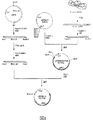
エシェリヒア・コリK−12株のgltBD遺伝子およびコリネバクテリウム属細菌の複製起点を有するプラスミドpBD35−43の構築過程を図1に示した。具体的には、既に取得されているコリネバクテリウム属細菌で自律複製可能なプラスミドpHM1519(Agric.Biol.Chem.,48,2901−2903(1984))由来の複製起点(特開平5−7491号)を持つプラスミドpHK4(特開平5−7491号)を制限酵素BamHI及びKpnIで消化して、複製起点を含む遺伝子断片を取得し、得られた断片をDNA平滑末端化キット(宝酒造社製、Blunting kit)を用い平滑末端化した後、XbaIリンカー(宝酒造社製)を用いて、クローニングしたエシェリヒア・コリK−12株のgltBD遺伝子を挿入したブラスミドpMWGOGAT35のXbaIサイトに挿入した。本プラスミドをpBD35−43と名付けた。(3)コリネバクテリウム属細菌野生型株AJ12036及びAJ13029へのpBD35−43の導入と培養評価
コリネバクテリウム属細菌野生型株AJ12036(Agrjc.Biol.Chem.,51,93−100(1987))及びAJ13029を電気パルス法(特開平2−207791号公報参照)によりプラスミドpBD35−43で形質転換し、形質転換株を得た。野生型株のAJ12036にプラスミドpBD35−43を導入して得られた形質転換株AJ12036/pBD35−43は、ビオチン制限法によるL−グルタミン酸生産のための培養を以下のように行った。25μg/mLのカナマイシンを含むCM2Bプレート培地にて培養して得たAJ12036/pBD35−43株の菌体を、グルコース 80g、KH2PO4 1g、MgSO4・7H2O 0.4g、(NH4)2SO4 30g、FeSO4・7H2O 0.01g、MnSO4・7H2O 0.01g、大豆加水分解液15ml、サイアミン塩酸塩200μg、ビオチン60μg、カナマイシン25mg及びCaCO3 50gを純水1L中に含む培地(KOHを用いてpH8.0に調整されている)に接種し31.5℃にて培地中の糖が消費されるまで振とう培養した。得られた培養物を、ビオチンおよびカナマイシンを添加していないこと以外は同じ組成の培地(以下、「ビオチン制限培地」という)に5%量接種し、31.5℃にて培地中の糖が消費されるまで振とう培養した。コントロールとしてAJ12036株を上記と同様にして培養した。培養終了後、培養液中のL−グルタミン酸蓄積量を旭化成工業社製バイオテックアナライザーAS−210により測定した。このときの結果を表1に示した。
実施例2
(1)ブレビバクテリウム・ラクトファーメンタム ATCC13869のgltBD遺伝子のクローニング
コリネバクテリウム属細菌を用いてグルタミン酸を製造するにあたり、gltBD遺伝子を増幅する際に、そのgltBD遺伝子はコリネバクテリウム属細菌由来であることが好ましい。
大腸菌と酵母のgltB遺伝子産物間でアミノ酸配列の相同性の高い領域を選び、その配列から塩基配列を推定し、配列番号3および配列番号4に示すオリゴヌクレオチドを合成した。一方、Bacterial Genomic DNA Purification Kit(Ad Vanced Genetic Technologies Corp.製)を用いて、ブレビバクテリウム・ラクトファーメンタム ATCC13869の染色体DNAを調製した。この染色体DNAを鋳型とし、前記オリゴヌクレオチドをプライマーに用いて、PCRテクノロジー(ヘンリーエーリッヒ編、ストックトンプレス、1989年)8頁に記載されている標準反応条件でPCRを行った。PCR産物をアガロースゲル電気泳動したところ、約1.4キロベースのDNA断片が増幅されていることが判明した。
得られたDNAは、配列番号3および配列番号4に示すオリゴヌクレオチドを用いて両端の塩基配列の決定を行った。塩基配列の決定は、DNA Sequencing Kit(Applied Biosystems社製)を用いてSangerの方法(J.Mol.Biol.,143,161(1980))に従って行った。決定された塩基配列をアミノ酸配列に翻訳して、大腸菌と酵母のgltB遺伝子から予想されるアミノ酸配列と比較したところ、相同性が高かったので、PCRにより増幅したDNA断片はブレビバクテリウム・ラクトファーメンタム ATCC13869のgltB遺伝子の一部であると判断した。このPCR増幅DNA断片をプローブとし、上記の方法で調製したブレビバクテリウム・ラクトファーメンタム ATCC13869の染色体DNAを定法によりEcoRI、BamHI、HindIII、PstI、SalI(宝酒造社製)で切断した断片について、DIG DNA Labeling and Detection Kit(ベーリンガー・マンハイム社製)を用いてサザンハイブリダイゼーションを行った。その結果、HindIIIで切断された約14キロベースの切断断片がプローブDNAとハイブリダイズすることが判明した。
そこで、定法により調製したブレビバクテリウム・ラクトファーメンタム ATCC13869染色体DNAのHindIII断片をアガロース電気泳動し、約10キロベース以上のDNA断片をガラスパウダーを用いて回収し、回収されたDNA断片と制限酵素HindIII(宝酒造社製)で切断したベクターpMW219(ニッポンジーン製)はライゲーションキット(宝酒造社製)を用いて連結し、エシェリヒア・コリJM109のコンピテントセル(宝酒造社製)を用いて形質転換を行った。形質転換株をIPTG(イソプロピル−β−D−チオガラクトピラノシド)10μg/ml、X−Gal(5−ブロモ−4−クロロ−3−インドリル−β−D−ガラクトシド)40μg/ml及びカナマイシン25μg/mlを含むL培地(バクトトリプトン10g/l、バクトイーストエキストラクト5g/l、NaCl5g/l、寒天15g/l、pH7.2)に塗布し、一晩培養後、出現した白色のコロニーを釣り上げ、単コロニー分離し、約1,000個の形質転換体を得た。
得られた形質転換体は、アルカリ法(生物工学実験書、日本生物工学会編、105頁、培風館、1992年)を用いてプラスミドを調製した。プローブとして用いたDNA配列の中で塩基配列が決定している部分をもとに作製した配列番号5および配列番号6に示す塩基配列を有する合成オリゴヌクレオチドをプライマーとして、上記プラスミドを鋳型として上記の条件でPCRを行い、このプライマーを用いてブレビバクテリウム・ラクトファーメンタム ATCC13869の染色体を鋳型としてPCRを行った時に増幅されるDNA断片と同じ約1.3キロベースの大きさの増幅断片が得られるプラスミドを保持する形質転換体を選択した。
(2)ブレビバクテリウム・ラクトファーメンタム ATCC13869 gltBD遺伝子の塩基配列の決定
上記(1)により得られた形質転換体からアルカリ法により調製したプラスミドDNAは、ブレビバクテリウム・ラクトファーメンタム ATCC13869染色体由来の約14キロベースのDNA断片を含んでいた。上記の方法と同様にして、得られたプラスミドのブレビバクテリウム・ラクトファーメンタム ATCC13869染色体由来の約14キロベースのDNA断片に含まれるgltBD遺伝子の塩基配列決定を行った。
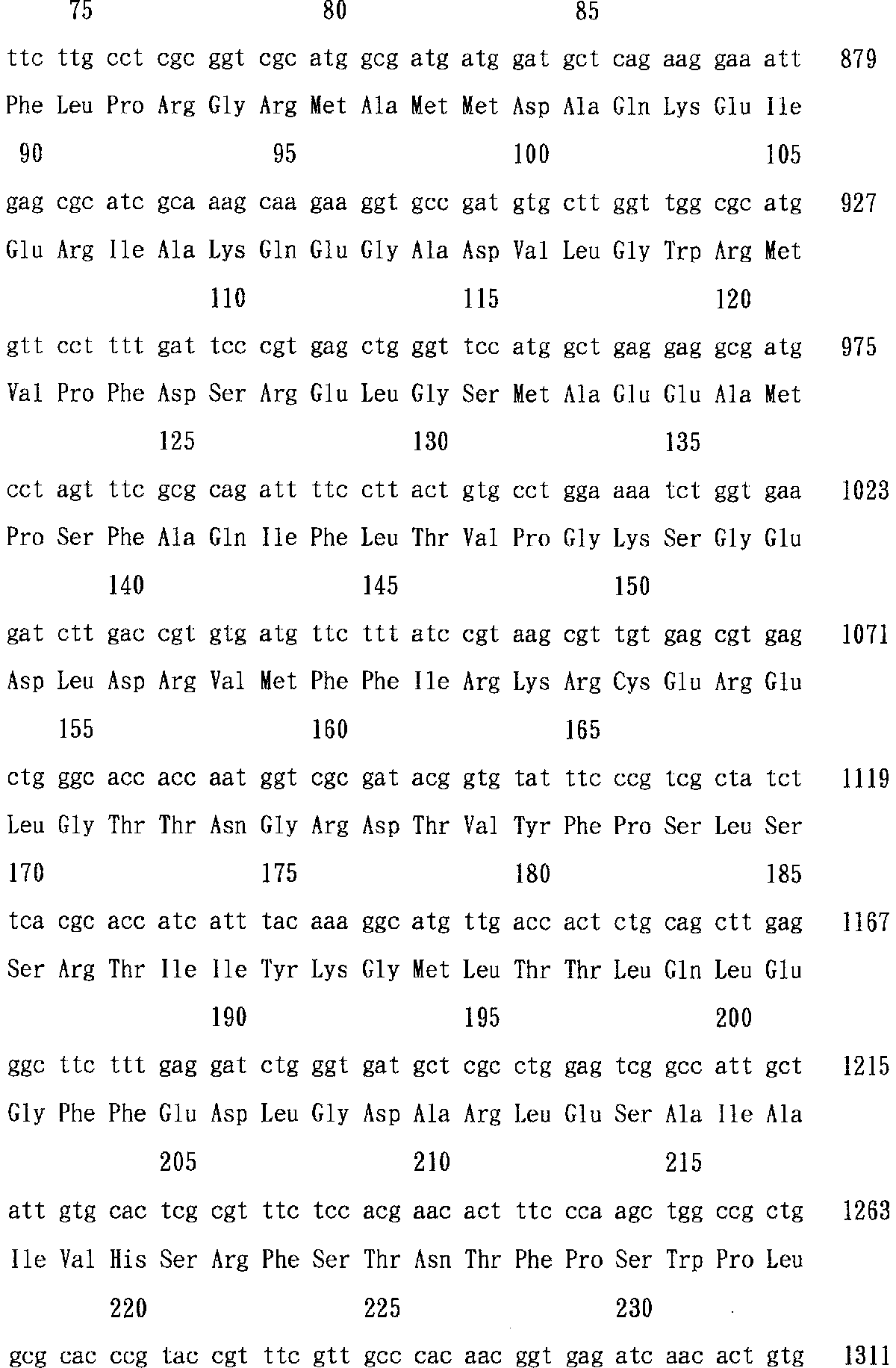
こうして決定された塩基配列のうち、gltBD遺伝子を含むAatII断片の塩基配列を、配列表配列番号7に示す。この塩基配列から、2つのオープン・リーディング・フレームが推定された。これらの塩基配列により推定される翻訳産物のアミノ酸配列も配列表配列番号7に示した。すなわち、配列表配列番号7に示されるアミノ酸配列からなる2つのタンパク質をコードする遺伝子が、ブレビバクテリウム・ラクトファーメンタム ATCC13869のgltBD遺伝子である。このうち、塩基番号565〜5094がgltB遺伝子で、5097〜6614がgltD遺伝子である。gltB遺伝子及びgltD遺伝子によりコードされるアミノ酸配列を、それぞれ順に配列番号8及び配列番号9に示す。なお、タンパク質のN末端にあるメチオニン残基は開始コドンであるATGに由来するため、タンパク質本来の機能とは無関係であることが多く、翻訳後ペプチダーゼの働きにより除去されることがよく知られており、上記タンパク質の場合にもメチオニン残基の除去が生じている可能性がある。
塩基配列、アミノ酸配列おのおのについて既知の配列との相同性比較を行った。用いたデータベースはEMBLおよびSWISS−PROTである。その結果、配列表配列番号7に示されるDNAは、すでに報告されている大腸菌および酵母等のgltBD遺伝子と相同性を持つコリネバクテリウム属細菌では新規な遺伝子であることが判明した。
(3)ブレビバクテリウム・ラクトファーメンタム ATCC13869のgltBD遺伝子およびコリネバクテリウム属細菌の複製起点を有するプラスミドの作成
ブレビバクテリウム・ラクトファーメンタム ATCC13869のgltBD遺伝子の増幅効果を調べるために、ブレビバクテリウム・ラクトファーメンタム ATCC13869のgltBD遺伝子およびコリネバクテリウム属細菌の複製起点を有するプラスミドの構築を行った。具体的には、(1)により得られた形質転換体からアルカリ法により調製したブレビバクテリウム・ラクトファーメンタム ATCC13869染色体由来の約14キロベースのDNA断片含むプラスミドDNAを制限酵素AatIIで切断し、ブレビバクテリウム・ラクトファーメンタム ATCC13869のgltBD遺伝子を含むDNA断片を取得し、取得された断片をDNA平滑末端化キット(宝酒造社製、Blunting kit)を用い平滑末端化した後、既に取得されているコリネバクテリウム属細菌で自律複製可能なプラスミドpAM330由来の複製起点(特開昭58−67699号)を持つプラスミドpVC7の制限酵素SmaIサイトに挿入した。本プラスミドをpVCGOGATと名付けた。尚、pVC7は、以下のようにして、E.coli用ベクターであるpHSG399(Cmr;Takes hita,S.et al.,Gene,61,63−74,(1987)参照)にブレビバクテリウム・ラクトファーメンタムのクリプティックプラスミドであるpAM330を結合することによって構築した。pAM330は、ブレビバクテリウム・ラクトファーメンタムATCC13869から調製した。pHSG399を一箇所切断酵素であるAvaII(宝酒造(株)製)にて切断し、T4DNAポリメラーゼにて平滑末端化したのち、HindIII(宝酒造(株)製)にて切断し、T4DNAポリメラーゼにて平滑末端化したpAM330と接続した。pVK7は、E.coli及びブレビバクテリウム・ラクトファーメンタムの細胞中で自律複製可能であり、かつ、pHSG399由来のマルチプルクローニングサイトとlacZ’を保持している。
さらにgltBD遺伝子が発現していることを確認するため、pVCGOGATをgdhとgltBの欠損株でL−グルタミン酸要求性を示すエシェリヒア・コリPA340株(E.coli Genetic stock center(Yale University,U.S.A.))にエレクトロポレーション法により導入したところ、pVCGOGATを導入した形質転換株は、L−グルタミン酸要求性を示さなくなったことから、gltBD遺伝子が発現していることを確認した。
(4)コリネバクテリウム属細菌野生型株AJ12036へのpVCGOGATの導入と培養評価
コリネバクテリウム属細菌野生型株AJ12036(Agric.Biol.Chem.,51,93−100(1987))を電気パルス法(特開平2−207791号公報参照)によりプラスミドpVCGOGATで形質転換し、形質転換株を得た。野生型株のAJ12036にプラスミドpVCGOGATを導入して得られた形質転換株AJ12036/pVCGOGATは、ビオチン制限法によるL−グルタミン酸生産のための培養を以下のように行った。5μg/mLのクロラムフェニコールを含むCM2Bプレート培地にて培養して得たAJ12036/pVCGOGAT株の菌体を、グルコース 80g、KH2PO4 1g、MgSO4・7H2O 0.4g、(NH4)2SO4 30g、FeSO4・7H2O 0.01g、MnSO4・7H2O 0.01g、大豆加水分解液15ml、サイアミン塩酸塩200μg、ビオチン60μg、クロラムフェニコール10mg及びCaCO3 50gを純水1L中に含む培地(KOHを用いてpH8.0に調整されている)に接種し31.5℃にて培地中の糖が消費されるまで振とう培養した。得られた培養物を、ビオチンおよびクロラムフェニコールを添加していないこと以外は同じ組成の培地(以下、「ビオチン制限培地」という)に5%量接種し、31.5℃にて培地中の糖が消費されるまで振とう培養した。コントロールとしてAJ12036株にpVC7を上記の方法で導入した菌株を、上記と同様にして培養した。培養終了後、培養液中のL−グルタミン酸蓄積量を旭化成工業社製バイオテックアナライザーAS−210により測定した。このときの結果を表3に示した。
本発明の方法により、コリネバクテリウム属細菌に属し、GOGAT活性が増幅され、かつL−グルタミン酸生産能を有する菌株のL−グルタミン酸生産能を高めることができ、L−グルタミン酸を安価かつ効率的に製造することができる。さらに、コリネバクテリウム属細菌由来のgltBD遺伝子が得られ、該遺伝子はコリネバクテリウム属細菌によるグルタミン酸の製造に用いることが可能となった。
【配列表】
【図面の簡単な説明】
図1は、プラスミドpBD35−43の構築過程を示す図である。 Technical field
The present invention relates to a method for producing L-glutamic acid by a fermentation method. L-glutamic acid is an important amino acid for foods, pharmaceuticals and the like.
Background art
Conventionally, L-glutamic acid is mainly produced by fermentation using so-called coryneform L-glutamic acid-producing bacteria belonging to the genus Brevibacterium, Corynebacterium or Microbacterium, or mutants thereof (amino acid fermentation). Society Publishing Center, 195-215, 1986). As a method for producing L-glutamic acid by fermentation using other strains, methods using microorganisms such as Bacillus, Streptomyces, Penicillium (US Pat. No. 3,220,929), Pseudomonas, Arthro Methods using microorganisms such as Bacter genus, Serratia genus and Candida genus (US Pat. No. 3,563,857) are known. Although the productivity of L-glutamic acid is considerably increased by the conventional method, in order to meet the further increase in future demand, development of a more inexpensive and efficient method for producing L-glutamic acid is required. .
L-glutamic acid is biosynthesized from α-ketoglutaric acid, which is an intermediate product of the citric acid cycle, in the microbial cell body. There are two. One is a pathway synthesized by the catalytic action of glutamate dehydrogenase (hereinafter abbreviated as “GDH”) in the presence of a high concentration of ammonium ions, and the other is a reaction from L-glutamate and ammonium ions to glutamine. Glutamine-oxoglutarate aminotransferase (glutamate synthase) that catalyzes the reaction to produce two molecules of L-glutamate from one molecule of glutamine produced by GS and one molecule of α-ketoglutarate by catalyzing glutamine synthetase (hereinafter abbreviated as “GS”) (Hereinafter also referred to as “GOGAT”)) (GS / GOGAT pathway). So far, L-glutamic acid production by strains with enhanced GDH pathway by enhancing GDH activity has been reported, but L-glutamic acid production by strains with enhanced GS / GOGAT pathway has not been known.
Disclosure of the invention
An object of the present invention is to provide a more inexpensive and efficient method for producing L-glutamic acid by breeding a strain having a high ability to produce L-glutamic acid in order to meet the further increase in demand for L-glutamic acid. is there.
As a result of conducting research on a method for producing L-glutamic acid by a strain enhanced by GOGAT that catalyzes the production of L-glutamic acid among enzymes involved in the GS / GOGAT pathway, the present inventors belonged to the genus Corynebacterium, It was found that a strain having amplified GOGAT activity and having an ability to produce L-glutamic acid has a high ability to produce L-glutamic acid, thereby completing the present invention.
That is, the present invention provides a strain belonging to the genus Corynebacterium, having an amplified GOGAT activity in the cell, and having an ability to produce L-glutamic acid. The glutamine-oxoglutarate aminotransferase activity can be amplified by increasing the copy number of the gene encoding glutamine-oxoglutarate aminotransferase in the cell. The glutamine-oxoglutarate aminotransferase activity can also be amplified by modifying the expression regulatory sequence of the gene encoding the enzyme. Examples of the glutamine-oxoglutarate aminotransferase include those derived from bacteria belonging to the genus Escherichia or Corynebacterium.
The present invention also relates to a gene encoding glutamine-oxoglutarate aminotransferase derived from Corynebacterium, which has at least a base sequence consisting of base numbers 565 to 6614 among the base sequences shown in SEQ ID NO: 7. Provide the gene of interest.
The present invention also relates to a strain belonging to the genus Corynebacterium, having a GOGAT activity amplified and having L-glutamic acid-producing ability, cultured in a liquid medium, and producing and accumulating L-glutamic acid in the culture solution. The present invention provides a method for producing L-glutamic acid by a fermentation method characterized by collecting from a culture solution.
Hereinafter, the present invention will be described in detail.
(1) Corynebacterium having an ability to produce L-glutamic acid
The genus Corynebacterium referred to in the present invention is a group of microorganisms defined in Barges Manual of Detergent Bacteriology, 8th edition, page 599 (1974), An aerobic, Gram-positive, non-acidic, gonococcal gonococcus that does not have spore-forming ability and was previously classified as a genus Brevibacterium but is now integrated as a bacterium belonging to the genus Corynebacterium (Int. J Syst. Bacteriol., 41, 255 (1981)) and Brevibacterium and Microbatterium bacteria closely related to Corynebacterium. Among the bacteria belonging to the genus Corynebacterium, those known as L-glutamic acid-producing bacteria as described below are most preferable in the present invention.
Corynebacterium acetoacidophilum
Corynebacterium acetoglutamicum
Corynebacterium carnae
Corynebacterium glutamicum
Corynebacterium Lilium (Corynebacterium glutamicum)
Corynebacterium melacecola
Brevibacterium divaricatam (Corynebacterium glutamicum)
Brevibacterium lactofermentum (Corynebacterium glutamicum)
Brevibacterium saccharolyticum
Brevibacterium immario film
Brevibacterium roseum
Brevibacterium flavum (Corynebacterium glutamicum)
Brevibacterium thiogenitalis
Specifically, the following strains can be exemplified.
Corynebacterium acetoacidophilum ATCC 13870
Corynebacterium acetoglutamicum ATCC 15806
Corynebacterium carnae ATCC 15991
Corynebacterium glutamicum ATCC 13032
Corynebacterium glutamicum ATCC 13060
Brevibacterium divaricatam ATCC 14020
Brevibacterium lactofermentum ATCC 13869
Corynebacterium lilium ATCC 15990
Corynebacterium melasecola ATCC 17965
Brevibacterium saccharolyticum ATCC 14066
Brevibacterium immario film ATCC 14068
Brevibacterium rose ATCC 13825
Brevibacterium flavum ATCC 13826
Brevibacterium thiogenitalis ATCC 19240
You can get them from, for example, American Type Culture Collection. In other words, a corresponding registration number is assigned to each microorganism, and it is possible to receive distribution by quoting this registration number. The registration number corresponding to each microorganism is described in the catalog of American Type Culture Collection.
Any of the following means is effective for producing L-glutamic acid using the aforementioned Corynebacterium.
1. The biotin concentration in the medium is suboptimal.
See Okumura Shinji, Toukawa Ryuichiro, Tsunoda Toshinao, Kitai Ikuo: Journal of Japanese Society for Agricultural Chemistry, 36, 197-203 (1962).
2. A surfactant is added to the medium under conditions where a sufficient amount of biotin is present.
I. Shiio, H .; Otsuka, N .; Atsuya: J.A. Biochem. 53, 333-340 (1963) and K.K. Takanami, H, Okada, T .; Tsunoda: Agr. Biol. Chem. 27, 853-863 (1963).
3. Penicillin is added to the medium under conditions where a sufficient amount of biotin is present.
See U.S. Pat. No. 3,080,297, Japanese Patent Publication No. 37-1695 and Mitsuru Shibukawa, Ritsuo Kurima, Setsuzo Okabe, Takeyoshi Osawa: Amino Acid and Nucleic Acid, 17, 61-65 (1968).
Alternatively, L-glutamic acid can also be produced by a method using a mutant strain derived from the aforementioned Corynebacterium. Examples of such mutant strains include:
Brevibacterium lactofermentum AJ12475 (FERM-BP2922, US Pat. No. 5,272,067)
Brevibacterium lactofermentum AJ12476 (FERM-BP2923, US Pat. No. 5,272,067)
Brevibacterium flavum AJ12477 (FERM-BP2924, US Pat. No. 5,272,067)
Corynebacterium glutamicum AJ12478 (FERM-BP2925, US Pat. No. 5,272,067)
Corynebacterium glutamicum ATCC 21492
Etc.
In the present invention, it is most preferable to use an L-glutamic acid-producing strain as described above.
(2) Amplification of GOGAT activity
To amplify GOGAT activity in bacterial cells, a gene fragment encoding GOGAT is ligated with a vector that functions in Corynebacterium bacteria to produce recombinant DNA, which belongs to Corynebacterium bacteria, and What is necessary is just to introduce | transduce into the host which has L-glutamic-acid production ability, and to transform. GOGAT is a hetero-oligomer composed of a large subunit and a small subunit, and is encoded by the gltB gene and the gltD gene, respectively. As a result of an increase in the copy number of a gene encoding GOGAT (hereinafter abbreviated as “gltBD gene”) in the transformant cell, GOGAT activity is amplified.
As the gltBD gene, a gene of a bacterium belonging to the genus Corynebacterium or a gene derived from another organism such as Escherichia coli can be used. Although the nucleotide sequence of the gltBD gene of Corynebacterium was not clear, Escherichia coli K-12 (Gene, 60, 1-11, 1987) and yeast (Saccharomyces cerevisiae, GenBank accession No. 1). Since the base sequence of the GltBD gene of X89221) has already been clarified, primers were synthesized based on the base sequence of these gltBD genes, and Escherichia coli K-12, Brevibacterium lactofermentum ATCC 13869, etc. It is possible to obtain the gltBD gene of these microorganisms by PCR using the chromosomal DNA of the microorganism as a template. Examples of such primers include primers having the base sequences shown in SEQ ID NOs: 3 to 6. The base sequence of the gltBD gene of Brevibacterium lactofermentum ATCC 13869 isolated in Examples described later is shown in SEQ ID NO: 7 in the Sequence Listing. This Brevibacterium lactofermentum gltBD gene is a novel gene.
The plasmid used for gene cloning may be any plasmid that can be replicated in microorganisms such as Escherichia bacteria, and specific examples include pBR322, pTWV228, pMW119, and pUC19.
The vector that functions in the genus Corynebacterium is, for example, a plasmid that can autonomously replicate in the genus Corynebacterium. Specific examples include the following.
pAM 330 See JP-A-58-67699
pHM 1519 See JP 58-77895 A
pAJ 655 See JP 58-192900 A
pAJ 611 Same as above
pAJ 1844 Same as above
pCG 2 See JP-A-58-35197
pCG 4 See Japanese Patent Application Laid-Open No. 57-183799
pCG 11 Same as above
In order to prepare a recombinant DNA by ligating the gltBD gene encoding GOGAT and a vector that functions in Corynebacterium bacteria, the vector is cleaved with a restriction enzyme that matches the end of the gltBD gene. Ligation is usually performed using a ligase such as T4 DNA ligase.
In order to introduce the recombinant DNA prepared as described above into a bacterium belonging to the genus Corynebacterium, the transformation methods reported so far may be used. For example, as reported for Escherichia coli K-12, recipient cells are treated with calcium chloride to increase DNA permeability (Mandel, M. and Higa, A., J. Mol. Biol. , 53, 159 (1970)), and a method of preparing competent cells from proliferating cells and introducing DNA as reported for Bacillus subtilis (Duncan, C.H., Wilson, G.). A. and Young, FE, Gene, 1, 153 (1977)). Alternatively, DNA-receptive cells, such as those known for Bacillus subtilis, actinomycetes, and yeast, are introduced into the DNA-receptor cells in a protoplast or spheroplast state that readily incorporates recombinant DNA. (Chang, S, and Choen, SN, Molec. Gen. Genet., 168, 111 (1979); Bibb, MJ, Ward, JM and Hopwood, O.A.,). Nature, 274, 398 (1978); Hinnen, A., Hicks, JB and Fink, GR, Proc. Natl. Acad. Sci. USA, 75 1929 (1978)). The transformation method used in the examples of the present invention is the electric pulse method (see JP-A-2-207791).
Amplification of GOGAT activity can also be achieved by the presence of multiple copies of the gltBD gene on the chromosomal DNA of the host. In order to introduce multiple copies of the gltBD gene onto the chromosomal DNA of a microorganism belonging to the genus Corynebacterium, homologous recombination is carried out using a sequence present on the chromosomal DNA as a target. As the sequence present in multiple copies on the chromosomal DNA, repetitive DNA and an indeparted repeat present at the end of the transposable element can be used. Alternatively, as disclosed in JP-A-2-109985, it is also possible to mount the gltBD gene on a transposon, transfer it, and introduce multiple copies onto the chromosomal DNA. In any method, as a result of the increase in the copy number of the gltBD gene in the transformant, GOGAT activity is amplified.
Amplification of GOGAT activity can be achieved not only by the gene amplification described above but also by replacing an expression regulatory sequence such as a promoter of the gltBD gene with a strong one. For example, lac promoter, trp promoter, trc promoter, tac promoter, lambda phage PRPromoter, PLPromoters are known as strong promoters. Substitution with these promoters enhances the expression of the gltBD gene, thereby amplifying GOGAT activity.
(3) Production of L-glutamic acid using the strain of the present invention
In order to produce L-glutamic acid using a strain belonging to the genus Corynebacterium, having an enhanced GOGAT activity and capable of producing L-glutamic acid, a carbon source, a nitrogen source, inorganic salts, and other amino acids as necessary It can be performed by a conventional method using a normal nutrient medium containing organic micronutrients such as vitamins. Either synthetic or natural media can be used. Any kind of carbon source and nitrogen source may be used as long as the strain to be cultured can be used.
As the carbon source, saccharides such as glucose, glycerol, fructose, sucrose, maltose, mannose, galactose, starch hydrolysate, molasses are used, and other organic acids such as acetic acid and citric acid are used alone or in other carbon. Used in combination with a source.
As the nitrogen source, ammonia, ammonium salts such as ammonium sulfate, ammonium carbonate, ammonium chloride, ammonium phosphate, and ammonium acetate, nitrates, and the like are used.
As organic micronutrients, amino acid, vitamin, fatty acid, nucleic acid, and peptone, casamino acid, yeast extract, soy protein hydrolyzate, etc. containing these are used, and auxotrophic mutants that require amino acids for growth. When using, it is necessary to supplement the required nutrients.
As the inorganic salts, phosphates, magnesium salts, calcium salts, iron salts, manganese salts and the like are used.
The culture method performs aeration culture while controlling the fermentation temperature at 20 to 45 ° C. and the pH at 5 to 9. When the pH falls during the cultivation, calcium carbonate is added or neutralized with an alkali such as ammonia gas. Thus, by culturing for about 10 hours to 4 days, a significant amount of L-glutamic acid is accumulated in the culture solution.
The method for collecting L-glutamic acid from the culture solution after completion of the culture may be performed according to a known recovery method. For example, it is collected by removing microbial cells from the culture solution and then concentrating crystallization or ion exchange chromatography.
BEST MODE FOR CARRYING OUT THE INVENTION
Hereinafter, the present invention will be described more specifically with reference to examples.
Example 1
(1) Cloning of the gltBD gene of Escherichia coli K-12
The base sequence of the gltBD gene of Escherichia coli K-12 has already been clarified (Gene, 60, 1-11, 1987). Based on the reported nucleotide sequence, primers shown in SEQ ID NOs: 1 and 2 were synthesized, and the gltBD gene was synthesized by PCR using the chromosomal DNA of Escherichia coli K-12-derived JM109 strain (Takara Shuzo) as a template. Amplified.
Among the synthesized primers, SEQ ID NO: 1 corresponds to the sequence extending from the 57th to the 96th base in the base sequence diagram of the gltBD gene described in Gene, Vol. 60, p. 6, 1987. The 80th and 78th bases A are changed to G, and a recognition sequence for the restriction enzyme BamHI is inserted. SEQ ID NO: 2 corresponds to the sequence extending from the 6261st to the 6290th base in the base sequence diagram of the gltBD gene described in Gene, Vol. 60, p. 7, 1987. In addition, the 6282st base A was changed to T and the 6284th A was changed to C, and a restriction enzyme BamHI recognition sequence was inserted. In addition, the base sequence described in SEQ ID NO: 2 is represented from the 5 ′ side as the reverse strand of the base sequence from 6261 to 6290 in the base sequence diagram shown in Gene, Vol. 60, p. 7, 1987. Is.
The chromosomal DNA of Escherichia coli K-12 was prepared by a conventional method (Biotechnical Experiments, edited by Japan Society for Biotechnology, pages 97-98, Baifukan, 1992). In the PCR reaction, standard reaction conditions described in page 8 of PCR Technology (Henry Erich, Stockton Press, 1989) were used.
The generated PCR product is purified by a conventional method, reacted with restriction enzyme BamHI, ligated using pMW219 (Nippon Gene) cleaved with BamHI and a ligation kit (Takara Shuzo), and then competent cells of Escherichia coli JM109. (Transformation by Takara Shuzo Co., Ltd.), IPTG (isopropyl-β-D-thiogalactopyranoside) 10 μg / ml, X-Gal (5-bromo-4-chloro-3-indolyl-β-D) -Galactoside) applied to L medium (bactotryptone 10 g / l, bacto yeast extract 5 g / l, NaCl 5 g / l, agar 15 g / l, pH 7.2) containing 40 μg / ml and kanamycin 25 μg / ml, overnight After culturing, white colonies that appeared were picked up and separated into single colonies to obtain transformants.
After preparing a plasmid from the transformed strain using the alkaline method (Biotechnological Experiments, Japan Biotechnology Society, page 105, Baifukan, 1992), a restriction enzyme map of the DNA fragment inserted into the vector was prepared, In comparison with the reported restriction map of the gltBD gene, a plasmid into which a DNA fragment having the same restriction map was inserted was named pMWGOGAT35.
Furthermore, in order to confirm that the gltBD gene is expressed, pMWGOGAT35 is an Escherichia coli PA340 strain (E. coli Genetic stock center (Yale University, U. S.), which shows L-glutamic acid requirement in a strain deficient in gdh and gltB. When A.)) was introduced by electroporation, the transformed strain into which pMWGOGAT35 was introduced showed no L-glutamic acid requirement, so that it was confirmed that the gltBD gene was expressed.
(2) Preparation of a plasmid having the gltBD gene of Escherichia coli K-12 and the origin of replication of the genus Corynebacterium
The construction process of plasmid pBD35-43 having the gltBD gene of Escherichia coli K-12 strain and the replication origin of the genus Corynebacterium is shown in FIG. Specifically, an origin of replication derived from a plasmid pHM1519 (Agric. Biol. Chem., 48, 2901-2903 (1984)) capable of autonomous replication in an already acquired Corynebacterium genus (Japanese Patent Laid-Open No. 5-7491). ) Plasmid pHK4 (JP-A-5-7491) is digested with restriction enzymes BamHI and KpnI to obtain a gene fragment containing an origin of replication, and the resulting fragment is a DNA blunting kit (Blunting, manufactured by Takara Shuzo Co., Ltd.). kit) and then inserted into the XbaI site of plasmid pMWGOGAT35 into which the cloned gltBD gene of Escherichia coli K-12 strain was inserted using an XbaI linker (Takara Shuzo). This plasmid was named pBD35-43. (3) Introduction and culture evaluation of pBD35-43 into Corynebacterium wild-type strains AJ12036 and AJ13029
Corynebacterium wild type strain AJ12036 (Agrjc. Biol. Chem., 51, 93-100 (1987)) and AJ13029 were transformed with plasmid pBD35-43 by the electric pulse method (see JP-A-2-207791). Thus, a transformed strain was obtained. The transformed strain AJ12036 / pBD35-43 obtained by introducing the plasmid pBD35-43 into the wild type strain AJ12036 was cultured for L-glutamic acid production by the biotin restriction method as follows. The cells of AJ12036 / pBD35-43 strain obtained by culturing in a CM2B plate medium containing 25 μg / mL kanamycin were mixed with 80 g glucose, KH2PO4 1g MgSO4・ 7H20.4 g of O, (NH4)2SO4 30g, FeSO4・ 7H2O 0.01g, MnSO4・ 7H2O 0.01 g, soybean hydrolyzate 15 ml, thiamine hydrochloride 200 μg, biotin 60 μg, kanamycin 25 mg and CaCO3 A medium containing 50 g in 1 liter of pure water (adjusted to pH 8.0 with KOH) was inoculated and cultured at 31.5 ° C. until the sugar in the medium was consumed. The obtained culture was inoculated in a 5% amount in a medium having the same composition (hereinafter referred to as “biotin-restricted medium”) except that biotin and kanamycin were not added. Shake culture until consumed. As a control, AJ12036 strain was cultured in the same manner as described above. After completion of the culture, the amount of L-glutamic acid accumulated in the culture broth was measured using Biotech Analyzer AS-210 manufactured by Asahi Kasei Corporation. The results at this time are shown in Table 1.
Example 2
(1) Cloning of the gltBD gene of Brevibacterium lactofermentum ATCC 13869
In producing glutamic acid using a Corynebacterium bacterium, when the gltBD gene is amplified, the gltBD gene is preferably derived from a Corynebacterium bacterium.
A region having high amino acid sequence homology was selected between the E. coli and yeast gltB gene products, the nucleotide sequence was deduced from the sequence, and the oligonucleotides shown in SEQ ID NO: 3 and SEQ ID NO: 4 were synthesized. On the other hand, chromosomal DNA of Brevibacterium lactofermentum ATCC 13869 was prepared using Bacterial Genomic DNA Purification Kit (manufactured by Ad Vanced Genetic Technologies Corp.). Using this chromosomal DNA as a template and the oligonucleotide as a primer, PCR was performed under the standard reaction conditions described on page 8 of PCR technology (Henry Erich, Stockton Press, 1989). When the PCR product was subjected to agarose gel electrophoresis, it was found that a DNA fragment of about 1.4 kilobases was amplified.
The obtained DNA was subjected to nucleotide sequence determination at both ends using the oligonucleotides shown in SEQ ID NO: 3 and SEQ ID NO: 4. The nucleotide sequence was determined according to the method of Sanger (J. Mol. Biol., 143, 161 (1980)) using DNA Sequencing Kit (Applied Biosystems). The determined nucleotide sequence was translated into an amino acid sequence and compared with the amino acid sequence expected from the gltB gene of Escherichia coli and yeast. As a result, the DNA fragment amplified by PCR was found to be Brevibacterium lactofer It was determined to be part of the gltB gene of Mentum ATCC 13869. Using this PCR-amplified DNA fragment as a probe, the chromosomal DNA of Brevibacterium lactofermentum ATCC 13869 prepared by the above method was digested with EcoRI, BamHI, HindIII, PstI, SalI (Takara Shuzo Co., Ltd.) by a conventional method. Southern hybridization was performed using DNA Labeling and Detection Kit (Boehringer Mannheim). As a result, it was found that a cleaved fragment of about 14 kilobases cleaved with HindIII hybridizes with the probe DNA.
Therefore, a HindIII fragment of Brevibacterium lactofermentum ATCC 13869 chromosomal DNA prepared by a conventional method was subjected to agarose electrophoresis, and a DNA fragment of about 10 kilobases or more was recovered using glass powder, and the recovered DNA fragment and restriction enzyme were recovered. Vector pMW219 (Nippon Gene) cut with HindIII (Takara Shuzo) was ligated using a ligation kit (Takara Shuzo) and transformed using Escherichia coli JM109 competent cell (Takara Shuzo). . The transformed strain was IPTG (isopropyl-β-D-thiogalactopyranoside) 10 μg / ml, X-Gal (5-bromo-4-chloro-3-indolyl-β-D-galactoside) 40 μg / ml and kanamycin 25 μg. Applied to L medium (bactotryptone 10 g / l, bacto yeast extract 5 g / l, NaCl 5 g / l, agar 15 g / l, pH 7.2). After fishing and single colony separation, about 1,000 transformants were obtained.
From the obtained transformant, a plasmid was prepared by using an alkali method (Biotechnical Experiments, edited by Japan Society for Biotechnology, page 105, Baifukan, 1992). Synthetic oligonucleotides having the nucleotide sequences shown in SEQ ID NO: 5 and SEQ ID NO: 6 prepared based on the portion of the DNA sequence used as the probe, the nucleotide sequence of which was determined, were used as primers, and the above plasmid was used as a template. PCR was performed under the same conditions, and using this primer, an amplified fragment having the size of about 1.3 kilobases was obtained, which was the same as the DNA fragment amplified when PCR was performed using the chromosome of Brevibacterium lactofermentum ATCC 13869 as a template. A transformant carrying the resulting plasmid was selected.
(2) Determination of the nucleotide sequence of Brevibacterium lactofermentum ATCC 13869 gltBD gene
Plasmid DNA prepared by the alkaline method from the transformant obtained in (1) above contained a DNA fragment of about 14 kilobases derived from Brevibacterium lactofermentum ATCC 13869 chromosome. In the same manner as described above, the base sequence of the gltBD gene contained in an about 14 kilobase DNA fragment derived from the Brevibacterium lactofermentum ATCC 13869 chromosome of the obtained plasmid was determined.
Among the nucleotide sequences thus determined, the nucleotide sequence of the AatII fragment containing the gltBD gene is shown in SEQ ID NO: 7 in the sequence listing. From this nucleotide sequence, two open reading frames were deduced. The amino acid sequence of the translation product deduced from these base sequences is also shown in SEQ ID NO: 7 in the sequence listing. That is, a gene encoding two proteins consisting of the amino acid sequence shown in SEQ ID NO: 7 is the gltBD gene of Brevibacterium lactofermentum ATCC 13869. Among these, base numbers 565 to 5094 are gltB genes and 5097 to 6614 are gltD genes. The amino acid sequences encoded by the gltB gene and the gltD gene are shown in SEQ ID NO: 8 and SEQ ID NO: 9, respectively. In addition, since the methionine residue at the N-terminal of the protein is derived from ATG, which is the initiation codon, it is often unrelated to the original function of the protein and is well known to be removed by the action of post-translational peptidases. In the case of the above protein, methionine residue may be removed.
The base sequence and amino acid sequence were compared with known sequences. The databases used are EMBL and SWISS-PROT. As a result, it was found that the DNA shown in SEQ ID NO: 7 in the Sequence Listing is a novel gene in Corynebacterium bacteria having homology with the already reported gltBD gene such as Escherichia coli and yeast.
(3) Brevibacterium lactofermentum ATCC 13869 gltBD gene and preparation of a plasmid having a replication origin of Corynebacterium
In order to examine the amplification effect of the gltBD gene of Brevibacterium lactofermentum ATCC 13869, a plasmid having the gltBD gene of Brevibacterium lactofermentum ATCC 13869 and a replication origin of Corynebacterium was constructed. Specifically, a plasmid DNA containing a DNA fragment of about 14 kilobases derived from the chromosome of Brevibacterium lactofermentum ATCC 13869 prepared from the transformant obtained in (1) by the alkaline method is cleaved with the restriction enzyme AatII, A DNA fragment containing the gltBD gene of Brevibacterium lactofermentum ATCC 13869 was obtained, and the obtained fragment was blunt-ended using a DNA blunt end kit (Blunting kit, manufactured by Takara Shuzo Co., Ltd.). It was inserted into a restriction enzyme SmaI site of plasmid pVC7 having a replication origin derived from plasmid pAM330 capable of autonomous replication in Corynebacterium bacteria (Japanese Patent Laid-Open No. 58-67699). This plasmid was named pVCGOGAT. In addition, pVC7 is the E.C. pHSG399 (CmrTakesita, S .; et al. , Gene, 61, 63-74, (1987)) and ligated with pAM330, a cryptic plasmid of Brevibacterium lactofermentum. pAM330 was prepared from Brevibacterium lactofermentum ATCC 13869. pHSG399 was cleaved with AvaII (manufactured by Takara Shuzo Co., Ltd.), a single cleavage enzyme, blunt-ended with T4 DNA polymerase, then cut with HindIII (manufactured by Takara Shuzo Co., Ltd.), and blunt-ended with T4 DNA polymerase. It was connected with the pAM330 which became. pVK7 is E. coli. It can replicate autonomously in E. coli and Brevibacterium lactofermentum cells, and retains multiple cloning sites derived from pHSG399 and lacZ '.
Furthermore, in order to confirm that the gltBD gene is expressed, Escherichia coli PA340 strain (E. coli Genetic stock center (Yale University, US When introduced into A.)) by the electroporation method, the transformed strain into which pVCGOGAT was introduced no longer showed L-glutamic acid requirement, so that it was confirmed that the gltBD gene was expressed.
(4) Introduction and culture evaluation of pVCGOGAT into Corynebacterium wild type strain AJ12036
Corynebacterium wild-type strain AJ12036 (Agric. Biol. Chem., 51, 93-100 (1987)) was transformed with plasmid pVCGOGAT by the electric pulse method (see JP-A-2-207791), and transformed. Got the stock. The transformed strain AJ12036 / pVCGOGAT obtained by introducing the plasmid pVCGOGAT into the wild-type strain AJ12036 was cultured for L-glutamic acid production by the biotin restriction method as follows. AJ12036 / pVCGOGAT strain obtained by culturing in a CM2B plate medium containing 5 μg / mL of chloramphenicol was prepared by using 80 g of glucose, KH2PO4 1g MgSO4・ 7H20.4 g of O, (NH4)2SO4 30g, FeSO4・ 7H2O 0.01g, MnSO4・ 7H2O 0.01 g, soybean hydrolyzate 15 ml, thiamine hydrochloride 200 μg, biotin 60 μg, chloramphenicol 10 mg and CaCO3 A medium containing 50 g in 1 liter of pure water (adjusted to pH 8.0 with KOH) was inoculated and cultured at 31.5 ° C. until the sugar in the medium was consumed. The obtained culture was inoculated in a 5% amount in a medium having the same composition (hereinafter referred to as “biotin-restricted medium”) except that biotin and chloramphenicol were not added. Shake culture until the sugar was consumed. As a control, a strain obtained by introducing pVC7 into the AJ12036 strain by the above method was cultured in the same manner as described above. After completion of the culture, the amount of L-glutamic acid accumulated in the culture broth was measured using Biotech Analyzer AS-210 manufactured by Asahi Kasei Corporation. The results at this time are shown in Table 3.
By the method of the present invention, L-glutamic acid-producing ability of a strain belonging to the genus Corynebacterium, having an enhanced GOGAT activity and having an ability to produce L-glutamic acid can be increased at low cost and efficiently. Can be manufactured. Furthermore, a gltBD gene derived from Corynebacterium was obtained, and this gene could be used for production of glutamic acid by Corynebacterium.
[Sequence Listing]
[Brief description of the drawings]
FIG. 1 is a diagram showing the construction process of plasmid pBD35-43.
Claims (4)
前記菌株は、前記菌株細胞内のグルタミン−オキソグルタル酸アミノトランスフェラーゼをコードする遺伝子のコピー数を高めること、または前記菌株細胞内のグルタミン−オキソグルタル酸アミノトランスフェラーゼをコードする遺伝子のプロモーターを改変することによって細胞中のグルタミン−オキソグルタル酸アミノトランスフェラーゼ活性が増幅された菌株であることを特徴とする、L−グルタミン酸の製造法。The strain of Corynebacterium bacterium having L- glutamic acid producing ability was cultured in a liquid medium, in a culture medium L- glutamic acid yielding accumulation, by fermentation and recovering it from the culture fluid L- A method for producing glutamic acid , comprising:
The strain is obtained by increasing the copy number of a gene encoding glutamine-oxoglutarate aminotransferase in the strain cell, or by modifying a promoter of a gene encoding glutamine-oxoglutarate aminotransferase in the strain cell. A method for producing L-glutamic acid, which is a strain having an amplified glutamine-oxoglutarate aminotransferase activity .
Applications Claiming Priority (3)
| Application Number | Priority Date | Filing Date | Title |
|---|---|---|---|
| JP21690697 | 1997-08-12 | ||
| JP9-216906 | 1997-08-12 | ||
| PCT/JP1998/003535 WO1999007853A1 (en) | 1997-08-12 | 1998-08-07 | Process for producing l-glutamic acid by fermentation method |
Publications (2)
| Publication Number | Publication Date |
|---|---|
| JPWO1999007853A1 JPWO1999007853A1 (en) | 2002-08-13 |
| JP3937726B2 true JP3937726B2 (en) | 2007-06-27 |
Family
ID=16695778
Family Applications (1)
| Application Number | Title | Priority Date | Filing Date |
|---|---|---|---|
| JP2000506337A Expired - Fee Related JP3937726B2 (en) | 1997-08-12 | 1998-08-07 | Method for producing L-glutamic acid by fermentation |
Country Status (11)
| Country | Link |
|---|---|
| EP (1) | EP1004671B1 (en) |
| JP (1) | JP3937726B2 (en) |
| CN (1) | CN1179045C (en) |
| AU (1) | AU742609B2 (en) |
| BR (1) | BR9811151A (en) |
| DE (1) | DE69833200T2 (en) |
| ID (1) | ID23892A (en) |
| MY (1) | MY123972A (en) |
| PE (1) | PE105599A1 (en) |
| PL (1) | PL338679A1 (en) |
| WO (1) | WO1999007853A1 (en) |
Families Citing this family (19)
| Publication number | Priority date | Publication date | Assignee | Title |
|---|---|---|---|---|
| JP2002338596A (en) * | 1998-12-18 | 2002-11-27 | Ajinomoto Co Inc | Sugar transporter and gene encoding the same |
| ES2941685T3 (en) | 2004-10-07 | 2023-05-24 | Ajinomoto Kk | Method for production of a basic substance |
| US7794989B2 (en) | 2004-12-28 | 2010-09-14 | Ajinomoto Co., Inc. | L-glutamic acid-producing microorganism and a method for producing L-glutamic acid |
| KR100768749B1 (en) * | 2005-12-13 | 2007-10-19 | 씨제이 주식회사 | Gene-inactivated microorganisms encoding 2-oxoglutarate dehydrogenase, methods for preparing the same, and methods for producing L-glutamine using the microorganisms |
| JP2009153382A (en) | 2006-03-30 | 2009-07-16 | Ajinomoto Co Inc | Method for producing carboxylic acid using methanol-assimilating bacterium |
| JP2010130899A (en) | 2007-03-14 | 2010-06-17 | Ajinomoto Co Inc | Microorganism producing l-glutamic acid-based amino acid, and method for producing amino acid |
| PH12014501063A1 (en) | 2011-11-11 | 2014-06-30 | Ajinomoto Kk | A method for producing a target substance by fermentation |
| CN105008532B (en) | 2013-05-13 | 2017-07-21 | 味之素株式会社 | L-Amino Acid Production Method |
| JP2016165225A (en) | 2013-07-09 | 2016-09-15 | 味の素株式会社 | Method for producing useful substance |
| JP2016192903A (en) | 2013-09-17 | 2016-11-17 | 味の素株式会社 | Method for manufacturing l-amino acid from biomass derived from seaweed |
| JP6519476B2 (en) | 2013-10-23 | 2019-05-29 | 味の素株式会社 | Production method of target substance |
| JP6623690B2 (en) | 2015-10-30 | 2019-12-25 | 味の素株式会社 | Method for producing glutamic acid-based L-amino acid |
| JP7066977B2 (en) | 2017-04-03 | 2022-05-16 | 味の素株式会社 | Manufacturing method of L-amino acid |
| WO2020071538A1 (en) | 2018-10-05 | 2020-04-09 | Ajinomoto Co., Inc. | Method for producing target substance by bacterial fermentation |
| KR102075160B1 (en) | 2018-12-13 | 2020-02-10 | 대상 주식회사 | Mutant strain with enhanced L-glutamic acid productivity and method for preparing L-glutamic acid using the same |
| WO2022092018A1 (en) | 2020-10-28 | 2022-05-05 | 味の素株式会社 | Method of producing l-amino acid |
| CN112646766B (en) * | 2020-12-30 | 2023-08-18 | 内蒙古伊品生物科技有限公司 | Recombinant strain for producing L-glutamic acid by modifying gene BBD29_04920 as well as construction method and application thereof |
| JP7716166B1 (en) | 2023-12-28 | 2025-07-31 | 味の素株式会社 | L-glutamic acid producing bacteria and method for producing L-glutamic acid |
| JP7716823B1 (en) | 2023-12-28 | 2025-08-01 | 味の素株式会社 | L-glutamic acid producing bacteria and method for producing L-glutamic acid |
Family Cites Families (2)
| Publication number | Priority date | Publication date | Assignee | Title |
|---|---|---|---|---|
| FR2575492B1 (en) * | 1984-12-27 | 1988-09-16 | Asahi Chemical Ind | DNA FRAGMENT CONTAINING A GENE ENCODING GLUTAMATE DEHYDROGENASE, RECOMBINANT DNA CONTAINING IT, AND MICROORGANISM CONTAINING RECOMBINANT DNA |
| JPH07108228B2 (en) * | 1990-10-15 | 1995-11-22 | 味の素株式会社 | Temperature sensitive plasmid |
-
1998
- 1998-08-07 BR BR9811151-5A patent/BR9811151A/en not_active Application Discontinuation
- 1998-08-07 EP EP98936705A patent/EP1004671B1/en not_active Expired - Lifetime
- 1998-08-07 AU AU85615/98A patent/AU742609B2/en not_active Ceased
- 1998-08-07 WO PCT/JP1998/003535 patent/WO1999007853A1/en not_active Ceased
- 1998-08-07 JP JP2000506337A patent/JP3937726B2/en not_active Expired - Fee Related
- 1998-08-07 ID IDW20000437A patent/ID23892A/en unknown
- 1998-08-07 CN CNB988100835A patent/CN1179045C/en not_active Expired - Fee Related
- 1998-08-07 PL PL98338679A patent/PL338679A1/en not_active Application Discontinuation
- 1998-08-07 DE DE69833200T patent/DE69833200T2/en not_active Expired - Lifetime
- 1998-08-07 PE PE1998000705A patent/PE105599A1/en not_active Application Discontinuation
- 1998-08-11 MY MYPI98003648A patent/MY123972A/en unknown
Also Published As
| Publication number | Publication date |
|---|---|
| EP1004671B1 (en) | 2006-01-11 |
| ID23892A (en) | 2000-05-25 |
| MY123972A (en) | 2006-06-30 |
| AU742609B2 (en) | 2002-01-10 |
| EP1004671A1 (en) | 2000-05-31 |
| PE105599A1 (en) | 1999-11-17 |
| PL338679A1 (en) | 2000-11-20 |
| CN1179045C (en) | 2004-12-08 |
| CN1275165A (en) | 2000-11-29 |
| BR9811151A (en) | 2000-07-25 |
| EP1004671A4 (en) | 2002-10-02 |
| DE69833200T2 (en) | 2006-09-28 |
| WO1999007853A1 (en) | 1999-02-18 |
| AU8561598A (en) | 1999-03-01 |
| DE69833200D1 (en) | 2006-04-06 |
Similar Documents
| Publication | Publication Date | Title |
|---|---|---|
| KR100630604B1 (en) | Method for producing amino acids by fermentation method using amino acid producing bacteria and constructed amino acid producing bacteria | |
| CN100540668C (en) | Novel desensitized aspartokinase | |
| EP1462523B1 (en) | L-Glutamic acid-producing bacterium and method for producing L-glutamic acid | |
| JP3716427B2 (en) | α-ketoglutarate dehydrogenase gene | |
| JP4595506B2 (en) | L-amino acid-producing bacterium and method for producing L-amino acid | |
| CN100358999C (en) | Production of L-glutamic acid by fermentation | |
| US5846790A (en) | Methods of producing L-lysine and L-glutamic acid by fermentation | |
| AU742609B2 (en) | Process for producing L-glutamic acid by fermentation method | |
| US20070172932A1 (en) | L-Glutamic Acid-Producing Microorganism and a Method for Producing L-Glutamic Acid | |
| US5929221A (en) | Gene derived from coryneform bacteria and use thereof | |
| JPWO1999007853A1 (en) | Method for producing L-glutamic acid by fermentation | |
| JP2000201692A (en) | Method for producing L-glutamic acid by fermentation method | |
| KR100930842B1 (en) | L-glutamic acid producing microorganism and method for producing L-glutamic acid | |
| JP3921866B2 (en) | L-glutamic acid-producing bacterium and method for producing L-glutamic acid | |
| JP4144098B2 (en) | L-glutamic acid-producing bacterium and method for producing L-glutamic acid | |
| EP0999267A1 (en) | Method for producing L-arginine | |
| US8110381B2 (en) | L-glutamic acid-producing bacterium and method for production of L-glutamic acid | |
| JP4239334B2 (en) | Method for producing L-glutamic acid by fermentation | |
| JP3651002B2 (en) | Method for constructing amino acid-producing bacteria and method for producing amino acids by fermentation using the constructed amino acid-producing bacteria | |
| JP2007175016A (en) | L-glutamic acid producing bacterium and method for producing l-glutamic acid | |
| AU5757899A (en) | Process for constructing amino acid-producing bacterium and process for producing amino acid by fermentation method with the use of the thus constructed amino acid-producing bacterium |
Legal Events
| Date | Code | Title | Description |
|---|---|---|---|
| A621 | Written request for application examination |
Free format text: JAPANESE INTERMEDIATE CODE: A621 Effective date: 20040514 |
|
| A131 | Notification of reasons for refusal |
Free format text: JAPANESE INTERMEDIATE CODE: A131 Effective date: 20060912 |
|
| A521 | Request for written amendment filed |
Free format text: JAPANESE INTERMEDIATE CODE: A523 Effective date: 20061109 |
|
| TRDD | Decision of grant or rejection written | ||
| A01 | Written decision to grant a patent or to grant a registration (utility model) |
Free format text: JAPANESE INTERMEDIATE CODE: A01 Effective date: 20070306 |
|
| A61 | First payment of annual fees (during grant procedure) |
Free format text: JAPANESE INTERMEDIATE CODE: A61 Effective date: 20070319 |
|
| R150 | Certificate of patent or registration of utility model |
Free format text: JAPANESE INTERMEDIATE CODE: R150 |
|
| FPAY | Renewal fee payment (event date is renewal date of database) |
Free format text: PAYMENT UNTIL: 20100406 Year of fee payment: 3 |
|
| FPAY | Renewal fee payment (event date is renewal date of database) |
Free format text: PAYMENT UNTIL: 20100406 Year of fee payment: 3 |
|
| FPAY | Renewal fee payment (event date is renewal date of database) |
Free format text: PAYMENT UNTIL: 20110406 Year of fee payment: 4 |
|
| FPAY | Renewal fee payment (event date is renewal date of database) |
Free format text: PAYMENT UNTIL: 20110406 Year of fee payment: 4 |
|
| FPAY | Renewal fee payment (event date is renewal date of database) |
Free format text: PAYMENT UNTIL: 20120406 Year of fee payment: 5 |
|
| FPAY | Renewal fee payment (event date is renewal date of database) |
Free format text: PAYMENT UNTIL: 20130406 Year of fee payment: 6 |
|
| FPAY | Renewal fee payment (event date is renewal date of database) |
Free format text: PAYMENT UNTIL: 20130406 Year of fee payment: 6 |
|
| FPAY | Renewal fee payment (event date is renewal date of database) |
Free format text: PAYMENT UNTIL: 20140406 Year of fee payment: 7 |
|
| LAPS | Cancellation because of no payment of annual fees |