JP3791908B2 - SEARCH SYSTEM, SYSTEM, SEARCH METHOD, AND PROGRAM - Google Patents
SEARCH SYSTEM, SYSTEM, SEARCH METHOD, AND PROGRAM Download PDFInfo
- Publication number
- JP3791908B2 JP3791908B2 JP2002046934A JP2002046934A JP3791908B2 JP 3791908 B2 JP3791908 B2 JP 3791908B2 JP 2002046934 A JP2002046934 A JP 2002046934A JP 2002046934 A JP2002046934 A JP 2002046934A JP 3791908 B2 JP3791908 B2 JP 3791908B2
- Authority
- JP
- Japan
- Prior art keywords
- search
- document
- user
- selection
- history
- Prior art date
- Legal status (The legal status is an assumption and is not a legal conclusion. Google has not performed a legal analysis and makes no representation as to the accuracy of the status listed.)
- Expired - Fee Related
Links
Images






Classifications
-
- G—PHYSICS
- G06—COMPUTING OR CALCULATING; COUNTING
- G06F—ELECTRIC DIGITAL DATA PROCESSING
- G06F16/00—Information retrieval; Database structures therefor; File system structures therefor
- G06F16/30—Information retrieval; Database structures therefor; File system structures therefor of unstructured textual data
- G06F16/33—Querying
- G06F16/3331—Query processing
- G06F16/334—Query execution
-
- Y—GENERAL TAGGING OF NEW TECHNOLOGICAL DEVELOPMENTS; GENERAL TAGGING OF CROSS-SECTIONAL TECHNOLOGIES SPANNING OVER SEVERAL SECTIONS OF THE IPC; TECHNICAL SUBJECTS COVERED BY FORMER USPC CROSS-REFERENCE ART COLLECTIONS [XRACs] AND DIGESTS
- Y10—TECHNICAL SUBJECTS COVERED BY FORMER USPC
- Y10S—TECHNICAL SUBJECTS COVERED BY FORMER USPC CROSS-REFERENCE ART COLLECTIONS [XRACs] AND DIGESTS
- Y10S707/00—Data processing: database and file management or data structures
- Y10S707/99931—Database or file accessing
- Y10S707/99933—Query processing, i.e. searching
Landscapes
- Engineering & Computer Science (AREA)
- Theoretical Computer Science (AREA)
- Computational Linguistics (AREA)
- Data Mining & Analysis (AREA)
- Databases & Information Systems (AREA)
- Physics & Mathematics (AREA)
- General Engineering & Computer Science (AREA)
- General Physics & Mathematics (AREA)
- Information Retrieval, Db Structures And Fs Structures Therefor (AREA)
Description
【0001】
【発明の属する技術分野】
本発明は、データベースにおける検索において、効率的に目的とするものを抽出することができる検索システム等に関する。
【0002】
【従来の技術】
近年、多くのコンピュータ装置が、インターネット、社内ネットワーク、LAN(Local Area Network)等のネットワークに接続されて使用されている。これらネットワークには、サービスを提供するコンピュータ装置としてサーバが接続されており、様々な情報がこのサーバに蓄積されている。ユーザは、自分が使用する端末であるコンピュータ装置を、ネットワークを介してサーバに接続させ、様々な情報を入手することができる。
【0003】
ところで、ユーザが情報を取得するには、多量に蓄積された情報から、目的とする情報を抽出する処理を行う必要がある。その方法としては、例えば、ユーザが目的とする情報に含まれるであろうキーワードを想定し、多量に蓄積された情報からそのキーワードを含んだデータを抽出する。このような抽出処理では、検索エンジンと呼ばれるプログラムが広く使用されている。この検索エンジンは、サーバに蓄積された情報を広くサーチし、ユーザが指定したキーワードを含むデータを自動的に抽出する。その結果、ユーザはそのキーワードを含んでいるデータを入手することができる。
【0004】
【発明が解決しようとする課題】
しかしながら、このような検索エンジンを用いて得られるデータの全てが、ユーザの目的とする情報であるとは限られない。例えば、「OLE for Process Control」(プロセス制御のためのOLE)についての情報を入手したい場合を例に挙げて説明すると、「OLE for Process Control 」はしばしば「OPC」という省略語で表現されているので、正式な名称「OLE for Process Control 」をキーワードとして検索しても、「OPC」として表記されている情報は取得することができない。そこで、キーワードとしてこの「OPC」を含めて検索を行うと、「OPC」を含むデータを全て抽出することが可能となる。
【0005】
ところが、「OPC」は「Organic Photo Conductor」(有機光半導体)の省略語でもあるため、ユーザが目的とする「OLE for Process Control」のデータと共に、全く関係のない「Organic Photo Conductor」のデータも抽出されてしまう。したがって、ユーザは抽出されたデータの中から、個別に必要なデータをピックアップしなければならない。この場合、抽出されたデータが多ければ多いほど、目的とするデータを探し出す作業に時間を要し、また大変な手間がかかる。
【0006】
一方、「OLE for Process Control」に関連する新たなキーワード、例えば「制御」をさらに掛け合わせることにより、全く関係のない「Organic Photo Conductor」のデータを排除し、抽出されたデータを絞り込むことも可能である。しかしこの処理を行うと、「OLE for Process Control」のデータであっても、新たなキーワード「制御」を含んでいないものは抽出されない。したがって、本来であれば抽出されるべき「OLE for Process Control」のデータまで排除される可能性が生じてしまう。このように絞り込み検索を行って不必要なデータを排除しようとすると、必要なデータまで排除されてしまい、目的とするデータが得られないといった問題が生じる。
【0007】
本発明は、上記のような技術的課題に基づいてなされたもので、ユーザが必要な情報をより的確に抽出することができる検索システム等を提供することを主たる目的とする。
【0008】
【課題を解決するための手段】
かかる目的のもと、本発明の検索システムは、あらかじめ記憶された文書に対する検索処理を実行するサーバと、サーバに対して検索処理を要求する少なくとも1つの端末を備えた検索システムであって、端末は、検索結果に示される所定の文書に対するユーザの指定を受け付け、指定された文書(指定文書)に基づく拡張検索をサーバに対して要求し、サーバは、拡張検索の要求を受け付け、ユーザもしくはその他のユーザまたは両方が過去に行った検索処理において同時に選択した少なくとも1つの文書からなる1または複数のグループにおいて、指定文書が属するグループを抽出し、抽出されたグループに属する文書を拡張検索結果として出力することを特徴とするものである。この検索システムでは、過去において行われた検索処理を利用して検索を行うことで、目的とする文書を抽出することができる。
【0009】
この検索システムにおいては、端末は、検索結果および拡張検索結果に含まれる文書に対してユーザが行った選択をサーバへ送出し、サーバは、選択から新たなグループを作成し、新たなグループを選択履歴として記憶することができる。また、端末は、拡張検索の要求の前において検索用タームに基づく準備用検索をサーバに対して要求し、指定文書は、準備用検索の結果から選択された文書とすることができる。この場合、サーバは、準備用検索に用いた検索用タームを検索結果と共に選択履歴として記憶することが好ましい。
【0010】
また、本発明はサーバ等のシステムとして捉えることもできる。本発明のシステムは、ユーザからの要求に応じてオブジェクトの検索処理を行うシステムであって、過去の検索処理において、ユーザもしくはその他のユーザまたはその両方が、過去において行った検索処理において同時に選択したオブジェクトを選択履歴データとして記憶する選択履歴記憶部と、拡張検索用にユーザが指定したオブジェクト(指定オブジェクト)に基づく拡張検索要求を受け付ける受付部と、指定オブジェクトの履歴データが、選択履歴記憶部に記憶されているか否かを判断する判断部と、指定オブジェクトの履歴データが選択履歴記憶部に記憶されていると判断部により判断されると、選択履歴記憶部に記憶された検索結果から指定オブジェクトと同時に選択された1または複数のオブジェクトを特定するオブジェクト特定部と、を備えたことを特徴とするものである。
【0011】
このシステムは、オブジェクトを蓄積したオブジェクト・データベースと、オブジェクト特定部により特定されたオブジェクトを、オブジェクト・データベースから抽出するオブジェクト抽出部と、をさらに備えることができる。
また、システムは、過去に選択された回数に関するデータをオブジェクト毎に記憶する選択回数記憶部をさらに備えていてもよい。
【0012】
さらに、本発明は端末として捉えることもできる。本発明の端末は、ネットワークを介してサーバに接続し、目的とするオブジェクトをサーバから抽出可能な端末であって、ユーザからの検索指示を受け付ける入力部と、検索指示に基づいてサーバに対して検索の要求を送出し、検索の結果を受信する送受信部と、ユーザからの入力およびサーバから送出されたデータを表示する表示部とを備え、表示部は、サーバから受信した検索の結果に示されたオブジェクトのうち、任意のオブジェクトの選択を可能とする選択部と、選択されたオブジェクトについての類似検索指示の受け付けを可能とする受け付け部と、を表示することを特徴とするものである。
【0013】
端末の表示部は、類似検索の結果とともに、結果に含まれる類似オブジェクトの選択を可能とする類似オブジェクト選択部を表示することもできる。
また表示部は、類似検索の結果として、選択されたオブジェクトに類似する類似オブジェクトと共に、類似オブジェクトが過去に選択された回数を表示するものであってもよい。
【0014】
その他、本発明は検索方法として捉えることもできる。この検索方法は、データベースから目的とする文書の検索を行う検索方法であって、ユーザの要求に応じて所定のタームを基に1次検索を行うステップと、1次検索の結果に対して所定の文書の選択を受け付けるステップと、選択された所定の文書に基づいて2次検索を行うステップとを有し、2次検索では、ユーザもしくはその他のユーザまたはその両方を含むユーザによる過去の検索処理において所定の文書が抽出されたことがある場合に、所定の文書と同時に選択された履歴を有する文書を抽出することを特徴とする方法である。
【0015】
この検索方法は、2次検索において抽出された文書に対し、ユーザより同時に選択された文書を新たな検索結果として記憶するステップをさらに有することが好ましい。
【0016】
さらに、本発明はプログラムとして捉えることもできる。このプログラムは、類似検索処理をコンピュータ装置に実行させるためのプログラムであって、複数のユーザによって行われた検索における検索結果に対し、ユーザによって選択されたオブジェクトの選択履歴を記憶する手順と、検索用オブジェクトを指定した類似検索要求を受け付ける手順と、指定された検索用オブジェクトについての選択履歴が既に記憶されている場合、選択履歴を抽出する手順と、選択履歴から、検索用オブジェクトと共通点を有する類似オブジェクトを抽出する手順とをコンピュータ装置に実行させることを特徴とするプログラムである。
【0017】
このプログラムにおいて、共通点は、例えば類似オブジェクトが、検索用オブジェクトと同時に抽出されたことである。また、共通点は、類似オブジェクトが、検索用オブジェクトと同じキーワードで抽出されたことである。
【0018】
また本発明のプログラムは、コンピュータ装置において検索要求を処理させるためのプログラムであって、ユーザからの検索指示を受け付ける手順と、検索指示に基づいて検索の要求を行う手順と、検索の結果とともに、所定のオブジェクトを選択する選択手段をユーザに対して表示する手順と、選択された所定のオブジェクトについて他人の検索結果を得るための類似検索指示を受け付ける受付手段をユーザに対して表示する手順と、類似検索指示に基づいて検索指示を行い、他人の検索結果を入手する手順と、をコンピュータ装置に実行させることを特徴とするプログラムである。
【0019】
このプログラムは、類似検索の結果とともに、結果に含まれる類似オブジェクトを選択する選択手段をユーザに対して表示する手順をさらにコンピュータ装置に実行させることができる。
また、類似検索の結果として、所定のオブジェクトに類似するオブジェクトと共に、類似オブジェクトが過去に選択された回数を表示する手順をさらにコンピュータ装置に実行させることもできる。
【0020】
【発明の実施の形態】
以下、添付図面に示す実施の形態に基づいて本発明を詳細に説明する。
図1は、実施の形態における検索サービス提供システムを説明する図である。この検索サービス提供システム(検索システム)では、ユーザが検索を行って目的とする文書(オブジェクト)を探し出す処理に使用するユーザ端末10と、文書データを蓄積して検索を実行するサーバ20と、を備えており、それぞれインターネット等のネットワークを介して接続されている。
【0021】
ユーザ端末10は、ネットワークを介してデータの送受信を行う送受信部11と、ユーザからの入力を受け付けるキーボードやマウス等の入力部12と、出力されるデータを表示するディスプレイ等の表示部13と、CPU等で構成される演算処理部14と、を備えている。
【0022】
サーバ20は、ネットワークを介してデータの送受信を行う送受信部21と、全文検索を実行する全文検索実行部22と、類似文書の検索を実行する類似文書検索実行部23と、選択履歴蓄積処理部24と、データの一時保存を行うメモリ等で構成された記憶部25と、文書のデータを蓄積した文書データベース(以下、データベースをDBと称す)30と、検索履歴のデータを蓄積した履歴DB33(と、を備えている。ここで、あるユーザAが選択した文書Xがあるとした場合、文書Xの「類似文書」とは、過去の検索処理(ユーザA以外のユーザによる検索を含む。)において、文書Xとともに選択されたことがある文書のことをいう。1回の検索処理で同時に選ばれる文書は、関連性が強いと考えられることから、このように称する。
【0023】
サーバ20において、記憶部25は、全文検索結果を一時的に保存する全文検索結果記憶部26と、類似文書の検索結果を一時的に保存する類似文書検索結果記憶部27と、ユーザが選択した文書を一時的に保存する選択結果記憶部28と、を備えている。文書DB30は、文書データを検索しやすくするために作成された索引データを蓄積する索引データ蓄積部31と、文書データそのものを蓄積する本文データ蓄積部32と、を備えている。履歴DB33は、ユーザが選択した文書データの履歴データを蓄積する選択履歴データ蓄積部34を備えている。また、必要な場合には、文書データごとに選択された回数のデータを蓄積する選択回数データ蓄積部35も備えている。
【0024】
図1に示す検索サービス提供システムでは、全文検索(1次検索、準備用検索)を行った後、続けて類似文書検索(2次検索、拡張検索)を行うことで、検索を行うユーザが目的とする文書を簡単に且つ高精度で抽出することができる。以下、検索サービス提供システムにおける検索処理について具体的に説明する。
【0025】
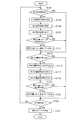
図2は、ユーザ端末10における処理の流れを示す図である。図3は、ユーザ端末10の表示部13に表示されるメイン画面を示す図である。
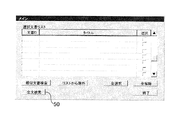
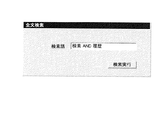
まず、ユーザ端末10は、ユーザによる入力部12を介した全文検索の要求があるか否かを判断する(ステップS101)。具体的には、図3に示す全文検索ボタン50がユーザによって押されると、ユーザ端末10は全文検索の要求があったと判断し、図4に示すようなキーワードを入力するウィンドウを表示部13に表示する。ユーザはこのキーワードを入力する枠内に、ユーザが取得したい情報に含まれるであろうキーワードを入力する。なお、図4に示す枠内には、「検索」と「履歴」が「AND」で繋がれているので、この場合「検索」と「履歴」の双方のキーワードが含まれる文書データが抽出されることとなる。
【0026】
ステップS101において、ユーザ端末10が全文検索の要求はないと判断した場合、後述のステップS113の処理が行われる。一方、全文検索の要求があると判断した場合、サーバ20に対して全文検索を実行するように、ユーザ端末10は送受信部11を介して全文検索実行要求を送出する(ステップS103)。このとき、ユーザが図4に示す枠内に入力したキーワードも一緒に送出する。そして、この全文検索実行要求に対してサーバ20からネットワークを介して送信された全文検索結果を、ユーザ端末10は送受信部11において受信する(ステップS105)。
【0027】
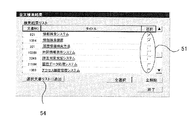
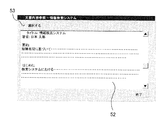
続いて、ユーザ端末10は、受信した全文検索結果を表示部13に表示する(ステップS107)。図5は、表示部13に表示される全文検索結果の画面を示す図である。図5に示すように、全文検索結果の画面には、抽出された文書データごとに選択ボタン(選択部)51が表示されており、ユーザが所定の文書データを選択できるようになっている。なお、この選択に際し、ユーザは画面に表示されたタイトルを元に所定の文書データを選択することができるが、その文書データの本文を参照することで選択することも可能である。具体的には、タイトルを選択指示する(例えば入力部12に接続されたマウスで下線が引かれているタイトルをクリックする)ことで、図6に示すような文書データの本文52を表示させることができる。なお、図6に示すように、本文52を表示させているウィンドウ内にも、その文書データを選択するための選択ボタン53を表示させることもできる。なお、以下に述べる画面においてタイトルの下に下線が引かれているものについては、同様に選択指示することで本文52を表示することが可能である。
【0028】
このようにして選択ボタン53がチェックされた文書データに対して、ユーザ端末10は選択文書リストへの追加要求があるか否かを判断する(ステップS109)。具体的には図5に示す全文検索結果の画面において、選択文書リストに追加ボタン54がユーザによって押されたか否かによって判断する。ステップS109において、ユーザ端末10は、選択文書リストに追加要求がないと判断した場合、後述のステップS113の処理が行われる。追加要求があると判断した場合、選択文書リストにおいて選択された文書を選択文書リストに追加し、さらに選択文書リストのデータをサーバ20に対して送出する(ステップS111)。このとき、図5に示す全文検索結果の選択ボタン51において選択された文書のリストが、図7に示すように、メイン画面に表示される。
【0029】
続けて、ユーザ端末10は、類似文書検索要求があるか否かを判断する(ステップS113)。まず、ユーザは図7に示すメイン画面において表示された文書のリストにおいて、選択ボタン51をチェックすることにより類似文書検索時の基本となる文書を選択する。このようにメイン画面において所定の文書が選択された状態で図7に示すメイン画面の類似文書検索ボタン(受け付け部)55が押されると、ユーザ端末10は類似文書検索の要求がなされたと判断する。
【0030】
ステップS113において、ユーザ端末10が類似文書検索の要求はないと判断した場合、後述のステップS125の処理が行われる。一方、類似文書検索の要求があると判断した場合、ユーザ端末10は送受信部11を介してサーバ20へ類似文書検索実行要求を送出する(ステップS115)。このとき、類似文書検索時の基本となる選択された文書を指定するデータも一緒に送出する。そして、この類似文書検索実行要求に対してサーバ20からネットワークを介して送信された類似文書検索結果を、ユーザ端末10は送受信部11において受信する(ステップS117)。
【0031】
ここで、類似文書検索結果とは、全文検索の結果に対して選択された文書が、過去の他の検索において選択されたことがある場合に抽出される文書グループである。具体的には、他の検索時において今回選択された文書と、その文書と同時に選択された文書とを含む文書グループである。更なる詳細は、後述のサーバ20における処理において説明する。
なお、類似文書検索において、図7のリスト中の文書を複数選択してもよい。この場合、選択された全ての文書が含まれる文書グループを抽出するものであってもよいし(AND抽出)、選択された文書のいずれかが含まれる文書グループを抽出するものであってもよい(OR抽出)。また抽出の方法は、類似文書検索の要求をする際にどちらの方法を希望するかユーザが選択することもできる。
【0032】
続いて、ユーザ端末10は、受信した類似検索結果を表示部13に表示する(ステップS119)。図8は、表示部13に表示される類似文書検索結果の画面を示す図である。図8に示すように類似検索結果の画面には、図5に示す全文検索結果の画面と同様に、文書毎に選択ボタン56が表示されている。ここで既に選択済みの文書は、着色したり、チェック不能な入力属性を持たせることにより、識別可能とすることができる。さらに、選択ボタン56の隣には符号57に示すようにその文書が過去に何回選択されたかの回数が文書毎に表示されている。過去に選択された回数が多いほど、重要性が高い文書であることが多い。したがって、ユーザは、文書のタイトル、本文だけでなく、その文書が過去に選択された回数を参考にして、類似文書検索結果の中から適当であると思う文書を選択することができる。
【0033】
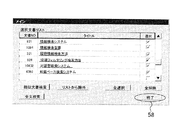
このようにして選択ボタン56がチェックされたリストに対して、ユーザ端末10は選択文書リストへの追加要求があるか否かを判断する(ステップS121)。ユーザ端末10が、選択文書リストに追加要求がないと判断した場合、後述のステップS125の処理が行われる。追加要求があると判断した場合、選択文書リストに選択された文書を追加し、さらに選択文書リストのデータをサーバ20に対して送出する(ステップS123)。このとき、図8に示す類似文書検索結果の選択ボタン56において選択された文書のリストが、図9に示すように、メイン画面に表示される。
【0034】
続けて、ユーザ端末10は、終了要求があるか否かを判断する(ステップS125)。これは、図9に示すメイン画面において表示されている終了ボタン58がユーザによって押されたかどうかに基づいて判断する。終了要求はないと判断した場合、ステップS101に戻って上記の処理を再度行う。終了要求があると判断した場合、図9に示す文書のリストにおいて選択されている文書を指定する選択文書リストをサーバ20に送出し(ステップS127)、本処理を終了する。なお、このように終了要求があった場合、最終的にユーザが選択したリストをユーザが後に使用することができる。具体的には、最終的に選択されたリストを、ユーザ端末10に保存し、ユーザが希望するときに最終的な選択要求されたリストに追加したときの文書が閲覧できるようにすることが可能である。また、ユーザは他のアプリケーション、例えば電子メール等において使用することができる。なお、ここでは、選択マークがついている文書のみを選択文書リストに含めるように構成してもよい。
【0035】
次に、サーバ20における処理の流れを説明する。図10は、サーバ20における処理の流れを示す図である。
まず、サーバ20は、送受信部21を介してユーザ端末10が送出した全文検索実行要求を受信したか否かを判断する(ステップS201)。全文検索実行要求を受信していないと判断した場合、後述のステップS213の処理が行われる。一方、全文検索実行要求を受信したと判断した場合、サーバ20は、全文検索実行要求と共に送られてきたキーワードを基に全文検索実行部22において全文検索を実行する(ステップS203)。
【0036】
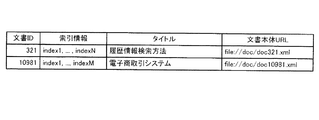
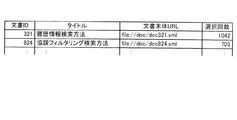
図11は、文書DB30の索引データ蓄積部31に蓄積されたデータの一例を示す図である。ステップS203における全文検索は、全文検索実行部22が索引データ蓄積部31において検索に際し指定されたキーワードが図11に示す索引情報に含まれている文書を抽出する。そして、抽出した全文検索結果は記憶部25の全文検索結果記憶部26に一時的に保存される(ステップS205)。ここで、図13に全文検索結果記憶部26に保存されるデータの一例を示す。続けて、サーバ20は送受信部21を介して全文検索結果をユーザ端末10へ送出する(ステップS207)。
【0037】
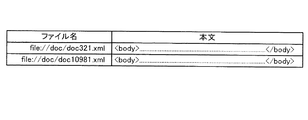
なお、送出した全文検索結果に関連して、ユーザ端末10から所定の文書の本文の閲覧要求が送出される場合がある。この場合、指定された文書に対応する本文のデータを文書DB30の本文データ蓄積部32から抽出してユーザ端末10へ対して送出する。具体的には、本文データ蓄積部32に蓄積された図12に示すようなデータにおいて、該当するファイル名の本文データを抽出する。尚、本文の閲覧要求は、以下の処理においても、要求がある度に随時行われる。
【0038】
続けて、サーバ20は、ユーザ端末10が送出した選択文書リストのデータを受信したか否かを判断する(ステップS209)。選択文書リストのデータを受信していないと判断した場合には、後述のステップS213の処理が行われる。選択文書リストのデータを受信したと判断した場合、記憶部25の選択結果記憶部28に選択結果として選択文書リストのデータを一時保存する(ステップS211)。
【0039】
次に、サーバ20は、ユーザ端末10が送出した類似文書検索実行要求を受信したか否かを判断する(ステップS213)。類似文書検索実行要求を受け付けていないと判断した場合、後述のステップS225の処理が行われる。一方、類似文書検索実行要求を受信したと判断した場合、サーバ20は、類似文書検索実行要求と共に送られてきた選択文書リスト中の文書の識別番号(以下、文書IDという)を基に類似文書検索実行部23において類似文書検索を実行する(ステップS215)。ここで、類似文書検索について詳細を説明する。
【0040】
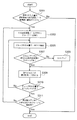
図14は、類似文書検索における具体的な処理の流れを示す図である。
まず、サーバ20の類似文書検索実行部23は、選択文書リストから類似文書検索のために選択された文書(以下、指定文書)についての選択履歴データが、履歴DB33の選択履歴データ蓄積部34に蓄積されているか否かを判断する(ステップS301)。具体的には、類似文書検索の際に図7に示すメイン画面においてユーザによって選択された文書の文書IDと同じ文書IDを有する選択履歴データが、履歴DB33の選択履歴データ蓄積部34にあるか否かを調査し、その同じ文書IDのデータを抽出する。図15は、履歴DB33の選択履歴データ蓄積部34に蓄積された選択履歴データの一例を示す図である。例えば図7に示すような選択がされていた場合、まず選択ボタン51がチェックされている文書ID=821について、図15に示す選択履歴データ蓄積部34に蓄積された選択履歴データから文書ID=821の選択履歴データを探し出す。
【0041】
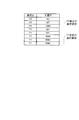
ここで選択履歴データとは、過去の検索処理において、ユーザ(同じユーザに限られない)が検索した結果、得られた複数の文書の集合体の中から、最終的にユーザが閲覧を希望するのに選択された文書からなるグループである。例えば図15では、選択IDがXXの文書が複数個存在するが、これらの文書はXX番目の検索時においてユーザによって最終的に閲覧を希望するために同時に選択された文書である。なお、最終的に閲覧を希望する際に選択される文書とは、後述する図10におけるステップS227で受信する選択文書リストの文書である。
【0042】
ステップS301において類似文書検索実行部23が指定文書についての選択履歴データはないと判断した場合、図14に示す類似文書検索の処理は終了する。一方、指定文書についての選択履歴データはあると判断した場合、その指定文書の選択履歴データが属する文書グループ(同じ選択IDを有する文書のグループ)を1つ抽出する(ステップS303)。例えば図15において指定文書が文書ID=821の場合、選択IDがXXの文書グループを抽出する。続けて、文書グループ内の1つの文書について選択履歴データを抽出する(ステップS305)。例えば図15において文書グループとして選択IDがXXの選択履歴データを抽出した場合、文書ID=321、821、1094のうちの1つ、例えば文書ID=321の選択履歴データを抽出する。
【0043】
続けて、類似文書検索実行部23は、ステップS305において抽出した選択履歴データの文書が、類似文書検索結果にリストアップ済みか否か(類似文書検索結果記憶部27に記憶された文書であるか否か)を判断する(ステップS307)。リストアップされていないと判断した場合、その文書に関するデータを類似文書検索結果記憶部27に記憶し、リストアップする(ステップS308)。ステップS308でリストアップ後およびステップS307でリストアップ済みと判断された場合、この抽出された文書の選択回数データ(図16参照)に1を加える(ステップS309)。このような計数処理を行うことで、過去に選択された回数を単純に合計する場合と比べて、指定文書との関係でより選択頻度の高い文書を示すことが可能となる。次に、ステップS303において抽出された文書グループ内の文書は全てリストアップ済みか否かを判断する(ステップS310)。抽出された文書グループ内の文書においてリストアップ済みでないものが未だあると判断した場合、ステップS305へ戻り、文書グループ内の文書が全てリストアップされるまで処理が繰り返される。
【0044】
ステップS310において抽出された文書グループ内の文書が全てリストアップされたと判断した場合、選択履歴データ蓄積部34において、選択された文書と同じ選択IDを有する文書グループは全て抽出されたか否かを判断する(ステップS311)。例えば指定文書が文書ID=821の場合、図15に示す選択履歴データでは、選択IDがXXの他に、選択IDがYYのデータが存在する。このように1つの選択された文書に対して複数の選択履歴データが存在することがある場合には、その選択履歴データを含む文書グループの全てを抽出するようにする。
【0045】
ステップS311において、未だ全ての文書グループが抽出されていないと判断した場合、ステップS303へ戻って次の文書グループを抽出し、選択履歴データ蓄積部34において指定文書と同じ選択IDを有する文書グループが全て抽出されるまで処理が繰り返される。そして、ステップS311において全ての文書グループが抽出されたと判断した場合、類似文書検索の処理を終了する。
【0046】
以上のようにして、図10のステップS215における類似文書検索が実行された後、得られた類似文書検索結果を、サーバ20は記憶部25の類似文書検索結果記憶部27に一時的に保存する(ステップS217)。図16に類似文書検索結果記憶部27に保存するデータの一例を示す。続けて、サーバ20は類似文書検索結果を、送受信部21を介してユーザ端末10へと送出する(ステップS219)。このとき、類似文書検索結果として、選択履歴データと共にその文書についての選択回数のデータを一緒に送出する。なお、本発明では前述のとおり類似文書の検索処理の過程で選択回数データを蓄積するが、過去の選択回数を履歴DB33の蓄積データからまとめて個別に計算しておき、その合計数を選択回数データとして送出するように構成してもよい。
【0047】
続けて、サーバ20は、類似文書検索結果に対する選択文書リストのデータをユーザ端末10から受信したか否かを判断する(ステップS221)。選択文書リストのデータを受信していないと判断した場合には、後述のステップS225の処理が行われる。選択文書リストのデータを受信したと判断した場合、記憶部25の選択結果記憶部28に選択結果を更新して、一時保存する(ステップS223)。ここで、図17に選択結果記憶部28に保存されたデータの一例を示す。
【0048】
そして、サーバ20は検索処理の終了要求をユーザ端末10から受信したか否かを判断する(ステップS225)。終了要求を受け付けていないと判断した場合、ステップS201へ戻って、上記の検索処理を引き続き行う。例えば、ステップS215において類似文書検索実行を行った結果得られた類似文書検索結果のリストの中から、さらに文書を選択して、その文書についての類似文書検索の要求が行われる可能性がある。一方、サーバ20が終了要求を受信したと判断した場合、続けてユーザ端末10から選択文書リストを受信する(ステップS227)。選択文書リストは、類似文書検索(類似文書検索が行われなかった場合には全文検索)の結果に対してユーザが最終的に閲覧を希望するために選択した文書のリストであり、例えば図9において選択ボックスがチェックされている文書である。
【0049】
サーバ20は、ステップS227において受信した選択文書リストを履歴DB33の選択履歴データ蓄積部34に保存する(ステップS229)。ここで、保存するときの処理について具体的に説明する。図18は、選択文書リストの保存処理の流れを説明する図である。まず、サーバ20の選択履歴蓄積処理部24が、履歴DB33の選択履歴データ蓄積部34に蓄積されている選択履歴データが最大保存数に達しているか否かを判断する(ステップS401)。
【0050】
ステップS401において最大保存数に達していると選択履歴蓄積処理部24が判断した場合、選択履歴データ蓄積部34に蓄積されている選択履歴データのうち、最も古い選択履歴データが属する文書グループのデータを削除する(ステップS403)。そして、データを削除した後、またはステップS401において最大保存数に達していないと判断した場合、選択文書リストのデータ、すなわち文書IDと選択IDのデータを選択履歴データ蓄積部34に蓄積し(ステップS405)、保存処理を終了する。なお、選択履歴データ蓄積部34に蓄積できるデータ量に制限がない場合には、このような保存処理を行わずに、全ての選択履歴データを保存するものであってもよい。
【0051】
このようにして、図10のステップS229における選択文書リストの保存が実行された後、本処理を終了する。なお、選択回数のデータを一括して蓄積しておく場合には、データの更新処理をステップS229の後に実行する(ステップS231)。この場合、データの更新は、選択履歴リストにおいて選択された文書に対し、選択回数データ蓄積部35の選択回数のデータを1つ増分する等の処理である。後述する集約処理を事前に行う場合には、ステップS231が必要となる。
【0052】
以上のように本実施の形態では、一度全文検索を実行した後に得られる全文検索結果において、ユーザが目的とする文書、または目的とする文書に近い文書を選択し、その文書に対する類似文書検索を行う。類似文書検索では、過去に他のユーザが行った検索において最終的に選択された文書グループを抽出することができる。文書グループは、過去の検索において他のユーザが検索結果の中から目的とする文書を抽出した文書の集合体である。したがって、ユーザが選択した目的とする文書を含む文書グループは、今回のユーザの検索において目的とする文書の集合体である可能性が高く、ユーザは目的とする文書を効率良く入手できる。
【0053】
また、通常の検索では所定のキーワードを元に検索を行うので、検索結果にはユーザが目的とする文書とともに不必要な文書も含まれる。しかし、本実施の形態では、類似検索の際に選択した文書とともに過去に選択されたことがある他の文書をユーザに提示することができる。したがって、不必要な文書を高い割合で排除することができるので、全文検索の結果において多量の文書が抽出されても、簡単な処理によりユーザが目的とする文書を高い割合で提示することができる。更には通常の検索では抽出することが難しい文書や、参照頻度が低い文書や、ユーザの全文検索において抽出できなかった文書等も提示することができる。
【0054】
なお、上記実施の形態において、図10に示すステップS229の選択文書リストを文書グループとして保存する処理や文書グループの作成方法は、図18に示す方法に限定されない。例えば、検索に使用する複数のキーワードの組み合わせ(以下、キーワード・セット)を元に目的とする文書グループを形成する方法もある。以下に、他の文書グループの作成方法について具体例(キーワード・セット間の距離を利用する方法、集約処理を事前に行う方法)を挙げて説明する。
【0055】
○キーワード・セット間の距離を利用する方法
まず、キーワード・セット間の距離を求める方法を説明する。例えばキーワード・セットとして、2つのキーワード・セットKS1、KS2があり、それぞれのキーワード・セットが有するキーワード(以下、KWD)を以下に示すものと仮定する。
KS1={KWDa、KWDb、KWDc}
KS2={KWDb、KWDc、KWDd、KWDe、KWDf}
ここで、キーワードはKWDa〜fと6つあるので、6次元の空間にそれぞれKS-1、KS-2の座標上の点KP1、KP2が存在すると考えることができる。
【0056】
そこで、KP1、KP2の2点間の距離Dを計算する。KWDの順にKWDa〜fの順で、そのキーワードがある場合を"1"、ない場合を"0"と仮定して座標値に変換すると以下のようになる。
KP1=(1,1,1,0,0,0)
KP2=(0,1,1,1,1,1)
これを用いて距離Dを計算する。
D2 =(KP1−KP2)2
D2 =12+ 02 + 02+ 12 + 12 + 12
D2 =4=22
【0057】
距離Dは、値が大きいほどKP1、KP2の2点間の距離が大きいと言える(なお、ここでは異なるキーワードは異なる空間軸に有るものとしている)。この距離から、キーワード・セットとしてKS1を用いた検索と、KS2を用いた検索の類似度がわかる。類似度の判断において距離Dの値を比較するときには、単純な値の比較ではなく、次元数に対する割合を考慮する。例えば、距離Dの値が2の場合、4次元しかない空間では共通点はゼロとなるが、10次元の空間であれば共通点は8割と考えられる。
【0058】
なお、検索においてより精度を上げるならば、類義語を考慮に入れることが好ましい。この場合、キーワードの座標値も"0 or 1"ではなく、類義語間の意味の強弱に応じてより広い値をとる等の処置を行う。またキーワードの中には、"システム"などのように頻繁に用いられるがあまり検索対象との結びつきが強くないものも有り得る。こうしたキーワードには座標値として低い値をつけるといった処理を行うこともできる。
【0059】
○集約処理を事前に行う方法
次に、集約処理を事前に行う方法について説明する。例えば、過去の選択結果として下記のデータが存在するものとする。
選択結果1 {DOC1, DOC2, DOC3, DOC4}
選択結果2 {DOC2, DOC4, DOC5}
選択結果3 {DOC5, DOC6, DOC7, DOC8, DOC9}
選択結果4 {DOC6, DOC8, DOC9}
選択結果5 {DOC9, DOC10, DOC11}
【0060】
まず、これらのデータを、選択されている文書の類似性で分類する。ここでは、文書の内容ではなく、選択結果のパターンから分類する。具体的な分類方法は、データの分布などから適切な分類を行う統計的な手法として各種知られている手法を採用できる。例えば、選択結果間の類似性は、上記のキーワード・セット間の距離の計算と同じものでも計算可能である。ただし、適切なグループ数の決め方や、距離を計算するための基準となる座標の決め方、大量データの処理方法等を考慮することが好ましい。
【0061】
例えば、次に示す例ではセット間の距離Dが3以下であるものは同じグループに属すると見なして、得られる選択文書セット1,2,3である。
選択文書セット1:
(選択結果1+2)={DOC1(1), DOC2(2), DOC3(1), DOC4(2), DOC5(1)}
選択文書セット2:
(選択結果3+4)={DOC5(1), DOC6(2), DOC7(1), DOC8(2), DOC9(2)}
選択文書セット3:
(選択結果5)={DOC9(1), DOC10(1), DOC11(1)}
ここで、DOCjのjは、選択されたj番目の文書を表し、DOCj(n)のnは、文書DOCjがn回選択されたことを表す。なお、このようなデータの集約処理は、実際に選択結果が保存される度に行なう方法や、例えば1日分の選択結果をまとめて、夜間などにバッチ処理するといった方法が採用できる。
【0062】
このように集約された集約データが蓄積された状態において、下記のような選択された文書に基づく類似文書検索が行なわれたとする。
指定文書:{DOC1, DOC5}
このとき、{DOC1, DOC5}を含む選択文書セットを蓄積された集約データから検索する。この例では、上記した選択文書セット1が選択され、その結果は以下のようになる。
検索結果:{DOC1(1), DOC2(2), DOC3(1), DOC4(2), DOC5(1) }
【0063】
なお、検索される選択文書セットは複数あっても良い。例えば、下記のような指定文書(選択された文書)に基づく類似文書検索が行なわれたとする。
指定文書:{DOC5}
この場合は、選択文書セット1,2が検索対象となり、その結果は以下のようになる。
検索結果:{DOC1(1), DOC2(2), DOC3(1), DOC4(2), DOC5(2), DOC6(2), DOC7(1), DOC8(2), DOC9(2)}
また、この状態において更に指定文書としてDOC1を追加で選択すると、その結果は以下のようになり、検索においてより正確な絞り込みを行うことができる。
検索結果:{DOC1(1), DOC2(2), DOC3(1), DOC4(2), DOC5(1)}
すなわち、上記のDOC1とDOC5を始めから指定した場合と同じ検索結果が得られる。
【0064】
図19に、以上説明したキーワード・セットと集約処理を用いた選択文書リストの保存処理の流れを示す。
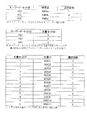
まず、サーバ20は、新たな検索の結果生じた新規キーワード・セットと、選択履歴データ蓄積部34に記憶されているキーワード・セットとの距離Dを計算する(ステップS501)。そしてサーバ20は、距離Dが指定値以下か否かを判断する(ステップS503)。この指定値は、キーワードの数、すなわち次元に応じて適宜設定することができる。
【0065】
ステップS503において距離Dが指定値以下ではないと判断した場合、新規キーワード・セットと、ステップS227で受信した選択文書リストを選択履歴データ蓄積部34に記憶する(ステップS504)。ステップS503において距離Dが指定値以下であると判断した場合、既に選択履歴データ蓄積部34に記憶されているキーワード・セットについてキーワード毎の選択回数を更新させ、すなわち1増加させ、新規キーワードについては選択回数を“1”にセットして記憶する(ステップS505)。
【0066】
続けて、抽出されたキーワード・セットと新規キーワード・セット内の選択文書のグループとの距離D’を計算する(ステップS507)。距離D’が所定の指定値以下であるか否かを判断する(ステップS509)。距離D’が指定値以下ではないと判断した場合、新しい選択文書リストを選択履歴データ蓄積部34に記憶し(ステップS510)、本処理を終了する。距離D’が指定値以下であると判断した場合、選択履歴データ蓄積部34に既に記憶されている選択文書リスト毎の選択回数を更新させ、すなわち1増加させ、新規文書について選択回数を“1”にセットして記憶し(ステップS511)、本処理を終了する。
【0067】
先の例において図19の処理を行った場合の選択回数データの蓄積例を図20に示す。
なお、図20では、キーワード・セットの集約の後、そのキーワード・セット内での選択文書セットによる集約が実行されている。しかしながら、キーワード・セットの集約を省略し、選択文書セットによる集約のみとしてもよいことに注意されたい。
【0068】
このように検索に用いたキーワード・セットに対して距離Dの近い過去のキーワード・セットを抽出し、その過去のキーワード・セットにおいて選択されていた文書を抽出することで、類似文書検索を行うことができる。以上のように、本実施の形態では、類似文書検索として様々な方法を採用することができ、目的とする文書を高い精度で抽出することができる。
【0069】
その他、本実施の形態の検索処理は、上記述べた方法に限定されない。例えば、本実施の形態の検索処理では、類似文書検索の前に全文検索が行われているが、検索方法はこれに限定されず、例えば、タイトルや要約、または番号による検索であってもよい。また、所定の文書を最初に指定することで、全文検索等の前処理を行うことなく初めから類似文書検索を行うことも可能である。
また、本実施の形態においてユーザ端末10における検索は、ユーザ端末10に導入した所定のプログラムで処理されるものであってもよく、またインターネット等のネットワークからのデータを表示するブラウザ上で処理されるものであってもよい。
【0070】
なお、本実施の形態で示したような処理を行うためのプログラムは、以下のような記憶媒体、プログラム伝送装置の形態とすることもできる。すなわち、記憶媒体としては、コンピュータ装置に実行させるプログラムを、CD−ROM、DVD、メモリ、ハードディスク等の記憶媒体に、コンピュータ装置が読み取り可能に記憶させれば良い。また、プログラム伝送装置としては、上記したようなプログラムを記憶させたCD−ROM、DVD、メモリ、ハードディスク等の記憶手段と、この記憶手段から当該プログラムを読み出し、当該プログラムを実行する装置側に、コネクタ、あるいはインターネットやLAN等のネットワークを介して当該プログラムを伝送する伝送手段とを備える構成とすれば良い。
【0071】
その他、検索を行うユーザに対して表示する画面は、本実施の形態で示す検索ごとにウィンドウが切り替わるものに限られない。例えば、全文検索の結果に対して行った類似文書検索の結果を、全文検索の結果においてハイライトをつけたり、並び替えすることで表示させたりすることもできる。
また、本実施の形態では、選択文書リストを作成するための文書の選択は、ユーザによって選択ボタンをチェックすることで行われるが、選択の指定方法はこれに限定されない。例えば、カートのようなものにユーザが選択したい文書を入れる方法であってもよい。また、ユーザが文書の本文や要約を閲覧するためにクリックしたものを自動的に選択されるように処理することもできる。
【0072】
なお、本実施の形態では、検索対象を文書等の文字データとしているが、検索対象はこれに限定されない。例えば、検索対象は画像等の視覚で認識するものや音楽等の音で認識するものに対しても応用することが可能である。
これ以外にも、本発明の主旨を逸脱しない限り、上記実施の形態で挙げた構成を取捨選択したり、他の構成に適宜変更することが可能である。
【0073】
【発明の効果】
このように本発明によれば、検索システムにおいてユーザが必要な情報をより的確に抽出することができる。
【図面の簡単な説明】
【図1】 実施の形態における検索サービス提供システムを説明する図である。
【図2】 ユーザ端末における処理の流れを示す図である。
【図3】 ユーザ端末の表示部に表示されるメイン画面を示す図である。
【図4】 キーワードを入力する画面を示す図である。
【図5】 表示部に表示される全文検索結果の画面を示す図である。
【図6】 文書データの本文を表示させた画面を示す図である。
【図7】 ユーザ端末の表示部に表示されるメイン画面を示す図である。
【図8】 表示部に表示される類似文書検索結果の画面を示す図である。
【図9】 類似検索結果の画面を示す図である。
【図10】 サーバにおける処理の流れを示す図である。
【図11】 文書DBの索引データ蓄積部に蓄積されたデータの一例を示す図である。
【図12】 文書DBの本文データ蓄積部に蓄積されたデータの一例を示す図である。
【図13】 全文検索結果記憶部に保存されるデータの一例を示す図である。
【図14】 類似文書検索における具体的な処理の流れを示す図である。
【図15】 履歴DBの選択履歴データ蓄積部に蓄積された選択履歴データの一例を示す図である。
【図16】 類似文書検索結果記憶部に保存するデータの一例を示す図である。
【図17】 選択結果記憶部に記憶されるデータの一例を示す図である。
【図18】 選択文書リストの保存処理の流れを説明する図である。
【図19】 選択文書リストの保存処理の流れの他の例を説明する図である。
【図20】 図19の集約結果のデータの蓄積例を示す図である。
【符号の説明】
10…ユーザ端末、20…サーバ、22…全文検索実行部、23…類似文書検索実行部(判断部、オブジェクト特定部、オブジェクト抽出部)、24…選択履歴蓄積処理部(選択履歴記憶部)、25…記憶部、26…全文検索結果記憶部、27…類似文書検索結果記憶部、28…選択結果記憶部、30…文書DB(オブジェクト・データベース)、31…索引データ蓄積部、32…本文データ蓄積部、33…履歴DB(選択履歴記憶部)、34…選択履歴データ蓄積部、35…選択回数データ蓄積部[0001]
BACKGROUND OF THE INVENTION
The present invention relates to a search system or the like that can efficiently extract a target in a search in a database.
[0002]
[Prior art]
In recent years, many computer apparatuses have been used by being connected to a network such as the Internet, an in-house network, and a LAN (Local Area Network). A server is connected to these networks as a computer device that provides a service, and various information is stored in the server. A user can obtain various information by connecting a computer device, which is a terminal used by the user, to a server via a network.
[0003]
By the way, in order for a user to acquire information, it is necessary to perform processing for extracting target information from a large amount of accumulated information. As the method, for example, assuming a keyword that will be included in information intended by the user, data including the keyword is extracted from a large amount of accumulated information. In such extraction processing, a program called a search engine is widely used. This search engine searches the information stored in the server widely and automatically extracts data including the keyword specified by the user. As a result, the user can obtain data including the keyword.
[0004]
[Problems to be solved by the invention]
However, all of the data obtained using such a search engine is not necessarily information intended by the user. For example, if you want to obtain information about "OLE for Process Control" (OLE for process control) as an example, "OLE for Process Control" is often expressed by the abbreviation "OPC" Therefore, even if the official name “OLE for Process Control” is searched for as a keyword, information written as “OPC” cannot be acquired. Therefore, if a search is performed including “OPC” as a keyword, all data including “OPC” can be extracted.
[0005]
However, since “OPC” is also an abbreviation for “Organic Photo Conductor”, the data of “Organic Photo Conductor” that has nothing to do with the data of “OLE for Process Control” intended by the user. It will be extracted. Therefore, the user has to pick up necessary data individually from the extracted data. In this case, the more data that is extracted, the longer it takes to find the target data, and the more time is required.
[0006]
On the other hand, new keywords related to “OLE for Process Control”, for example, “control”, can be combined to eliminate “Organic Photo Conductor” data that is completely unrelated and to narrow down the extracted data. It is. However, when this processing is performed, even if the data is “OLE for Process Control”, data that does not include the new keyword “control” is not extracted. Therefore, there is a possibility that even “OLE for Process Control” data that should be extracted is excluded. In this way, if it is attempted to eliminate unnecessary data by performing a narrowing search, there is a problem that even necessary data is excluded and target data cannot be obtained.
[0007]
The present invention has been made on the basis of the technical problems as described above, and it is a main object of the present invention to provide a search system and the like that can more accurately extract information necessary for a user.
[0008]
[Means for Solving the Problems]
For this purpose, the search system of the present invention is a search system comprising a server that executes search processing for a document stored in advance, and at least one terminal that requests the server to perform search processing. Accepts the user's specification for a given document shown in the search result, requests the server for an extended search based on the specified document (specified document), the server accepts the request for the extended search, the user or other The group to which the specified document belongs is extracted from one or a plurality of groups consisting of at least one document selected at the same time in the search processing performed by the user or both in the past, and the document belonging to the extracted group is output as an extended search result It is characterized by doing. In this search system, a target document can be extracted by performing a search using a search process performed in the past.
[0009]
In this search system, the terminal sends the selection made by the user to the documents included in the search result and the extended search result to the server, and the server creates a new group from the selection and selects the new group. It can be stored as a history. In addition, the terminal requests a search for preparation based on the search term before the request for the extended search, and the designated document can be a document selected from the result of the search for preparation. In this case, it is preferable that the server stores the search term used for the search for preparation together with the search result as a selection history.
[0010]
The present invention can also be understood as a system such as a server. The system of the present invention is a system that performs object search processing in response to a request from a user, and in the past search processing, the user or other users or both have selected simultaneously in the search processing performed in the past. A selection history storage unit that stores an object as selection history data, a reception unit that receives an extended search request based on an object (designated object) designated by the user for extended search, and history data of the specified object are stored in the selection history storage unit. When the determination unit determines whether or not the history data of the specified object is stored in the selection history storage unit, the specified object is determined from the search result stored in the selection history storage unit. An object that identifies one or more objects selected at the same time And tough, and is characterized in that it comprises a.
[0011]
The system may further include an object database that stores objects, and an object extraction unit that extracts an object specified by the object specifying unit from the object database.
The system may further include a selection number storage unit that stores data related to the number of times selected in the past for each object.
[0012]
Furthermore, the present invention can also be regarded as a terminal. The terminal of the present invention is a terminal that can connect to a server via a network and extract a target object from the server. The input unit receives a search instruction from a user, and the server based on the search instruction. A transmission / reception unit that sends a search request and receives the search result, and a display unit that displays the input from the user and the data sent from the server. The display unit is shown in the search result received from the server. Among the selected objects, a selection unit that allows an arbitrary object to be selected and a reception unit that can accept a similar search instruction for the selected object are displayed.
[0013]
The display unit of the terminal can also display a similar object selection unit that enables selection of similar objects included in the result, together with the result of the similar search.
The display unit may display the number of times the similar object has been selected in the past together with the similar object similar to the selected object as a result of the similarity search.
[0014]
In addition, the present invention can also be understood as a search method. This search method is a search method for searching for a target document from a database, and includes a step of performing a primary search based on a predetermined term in response to a user request, and a predetermined result for the result of the primary search. A step of accepting selection of a document and a step of performing a secondary search based on the selected predetermined document. In the secondary search, past search processing by a user including a user or another user or both In this method, when a predetermined document has been extracted, a document having a history selected simultaneously with the predetermined document is extracted.
[0015]
This search method preferably further includes a step of storing, as a new search result, a document simultaneously selected by the user with respect to the document extracted in the secondary search.
[0016]
Furthermore, the present invention can be understood as a program. This program is a program for causing a computer device to execute a similarity search process, and stores a selection history of an object selected by a user for a search result in a search performed by a plurality of users, and a search The procedure for accepting the similar search request specifying the search object, and the selection history for the specified search object if the selection history for the specified search object is already stored, A program for causing a computer device to execute a procedure for extracting similar objects.
[0017]
In this program, a common point is that, for example, similar objects are extracted simultaneously with the search object. The common point is that similar objects are extracted with the same keyword as the search object.
[0018]
The program of the present invention is a program for processing a search request in a computer device, a procedure for receiving a search instruction from a user, a procedure for requesting a search based on the search instruction, and a result of the search, A procedure for displaying a selection means for selecting a predetermined object to the user; a procedure for displaying a reception means for receiving a similar search instruction for obtaining a search result of another person for the selected predetermined object; A program for causing a computer apparatus to execute a procedure for performing a search instruction based on a similar search instruction and obtaining a search result of another person.
[0019]
This program can cause the computer apparatus to further execute a procedure for displaying, to the user, selection means for selecting a similar object included in the result together with the result of the similarity search.
Further, as a result of the similarity search, it is possible to cause the computer apparatus to further execute a procedure for displaying the number of times the similar object has been selected in the past together with the object similar to the predetermined object.
[0020]
DETAILED DESCRIPTION OF THE INVENTION
Hereinafter, the present invention will be described in detail based on embodiments shown in the accompanying drawings.
FIG. 1 is a diagram illustrating a search service providing system according to an embodiment. In this search service providing system (search system), a
[0021]
The
[0022]
The
[0023]
In the
[0024]
In the search service providing system shown in FIG. 1, the user who performs the search performs an objective by performing a similar document search (secondary search, extended search) after performing a full text search (primary search, search for preparation). Can be extracted easily and with high accuracy. Hereinafter, the search processing in the search service providing system will be specifically described.
[0025]
FIG. 2 is a diagram illustrating a process flow in the
First, the
[0026]
In step S101, when the
[0027]
Subsequently, the
[0028]
The
[0029]
Subsequently, the
[0030]
In step S113, when the
[0031]
Here, the similar document search result is a document group that is extracted when the document selected for the result of the full-text search has been selected in another search in the past. Specifically, it is a document group including a document selected this time at the time of another search and a document selected simultaneously with the document. Further details will be described in the processing in the
In the similar document search, a plurality of documents in the list of FIG. 7 may be selected. In this case, a document group including all the selected documents may be extracted (AND extraction), or a document group including any of the selected documents may be extracted. (OR extraction). The extraction method can be selected by the user when requesting similar document retrieval.
[0032]
Subsequently, the
[0033]
For the list in which the
[0034]
Subsequently, the
[0035]
Next, the process flow in the
First, the
[0036]
FIG. 11 is a diagram illustrating an example of data stored in the index
[0037]
In addition, in relation to the transmitted full-text search result, a browsing request for the text of a predetermined document may be transmitted from the
[0038]
Subsequently, the
[0039]
Next, the
[0040]
FIG. 14 is a diagram showing a specific processing flow in the similar document search.
First, the similar document search execution unit 23 of the
[0041]
Here, the selection history data means that the user finally wants to browse from a collection of a plurality of documents obtained as a result of searching by a user (not limited to the same user) in the past search processing. This is a group of selected documents. For example, in FIG. 15, there are a plurality of documents having a selection ID XX, but these documents are documents simultaneously selected for the user to finally view the document at the time of the XXth search. The document that is finally selected when browsing is a document in the selected document list received in step S227 in FIG.
[0042]
If the similar document search execution unit 23 determines in step S301 that there is no selection history data for the designated document, the similar document search process shown in FIG. 14 ends. On the other hand, if it is determined that there is selection history data for the designated document, one document group (group of documents having the same selection ID) to which the selection history data of the designated document belongs is extracted (step S303). For example, if the designated document is document ID = 821 in FIG. 15, a document group with a selection ID of XX is extracted. Subsequently, selection history data is extracted for one document in the document group (step S305). For example, when selection history data with a selection ID of XX is extracted as a document group in FIG. 15, one of the document IDs = 321, 821, and 1094, for example, selection history data with a document ID = 321 is extracted.
[0043]
Subsequently, the similar document search execution unit 23 determines whether the document of the selection history data extracted in step S305 has been listed in the similar document search result (whether the document is stored in the similar document search result storage unit 27). (No) is determined (step S307). If it is determined that the document is not listed, data relating to the document is stored in the similar document search
[0044]
If it is determined in step S310 that all documents in the extracted document group have been listed, the selection history
[0045]
If it is determined in step S311 that all document groups have not yet been extracted, the process returns to step S303 to extract the next document group, and a document group having the same selection ID as the designated document is selected in the selection history
[0046]
As described above, after the similar document search in step S215 of FIG. 10 is executed, the
[0047]
Subsequently, the
[0048]
Then, the
[0049]
The
[0050]
If the selection history
[0051]
In this way, after the selected document list is stored in step S229 of FIG. 10, this process is terminated. Note that, in a case where the data of the selected number is stored in a lump, the data update process is executed after step S229 (step S231). In this case, the data update is a process such as incrementing the data of the number of selections of the selection number
[0052]
As described above, in the present embodiment, a user selects a target document or a document close to the target document in a full-text search result obtained after executing a full-text search once, and performs similar document search for the document. Do. In the similar document search, a document group finally selected in a search performed by another user in the past can be extracted. A document group is a collection of documents in which other users have extracted target documents from search results in past searches. Therefore, there is a high possibility that the document group including the target document selected by the user is a collection of target documents in the current user search, and the user can efficiently obtain the target document.
[0053]
Further, since a normal search is performed based on a predetermined keyword, the search result includes unnecessary documents as well as documents intended by the user. However, in the present embodiment, other documents that have been selected in the past can be presented to the user together with the document selected in the similar search. Therefore, since unnecessary documents can be excluded at a high rate, even if a large amount of documents are extracted as a result of the full-text search, it is possible to present a target document at a high rate by a simple process. . Furthermore, it is possible to present a document that is difficult to extract by a normal search, a document with a low reference frequency, a document that could not be extracted by a user's full-text search, and the like.
[0054]
In the above embodiment, the process for saving the selected document list in step S229 shown in FIG. 10 as a document group and the method for creating the document group are not limited to the method shown in FIG. For example, there is a method of forming a target document group based on a combination of a plurality of keywords used for searching (hereinafter referred to as a keyword set). In the following, a method for creating another document group will be described with specific examples (a method of using a distance between keyword sets and a method of performing an aggregation process in advance).
[0055]
○ How to use the distance between keyword sets
First, a method for obtaining the distance between keyword sets will be described. For example, as a keyword set, two keyword sets KS1, KS2It is assumed that keywords (hereinafter referred to as KWD) included in each keyword set are shown below.
KS1= {KWDa, KWDb, KWDc}
KS2= {KWDb, KWDc, KWDd, KWDe, KWDf}
Here, there are six keywords, KWDa ~ f, so each of the KSs in a 6-dimensional space.-1, KS-2Point KP on the coordinates of1, KP2Can be considered to exist.
[0056]
So KP1, KP2The distance D between the two points is calculated. In the order of KWD in the order of KWDa to f, assuming that the keyword is “1” and not having “0”, it is converted into coordinate values as follows.
KP1= (1,1,1,0,0,0)
KP2= (0,1,1,1,1,1)
The distance D is calculated using this.
D2 = (KP1-KP2)2
D2 = 12+ 02 + 02+ 12 + 12 + 12
D2 = 4 = 22
[0057]
The distance D is KP as the value increases.1, KP2It can be said that the distance between the two points is large (here, different keywords are in different spatial axes). From this distance, KS as a keyword set1Search using KS and KS2You can see the similarity of search using. When comparing the value of the distance D in the determination of the similarity, the ratio with respect to the number of dimensions is considered, not the simple value comparison. For example, when the value of the distance D is 2, the common point is zero in a space having only four dimensions, but the common point is considered to be 80% in a 10-dimensional space.
[0058]
It should be noted that synonyms are preferably taken into account if the accuracy is improved in the search. In this case, the coordinate value of the keyword is not “0 or 1”, but a measure such as taking a wider value according to the strength of the meaning between synonyms is performed. Some keywords, such as “system”, are frequently used but are not strongly linked to the search target. Such a keyword can also be processed with a low coordinate value.
[0059]
○ Method of performing aggregation processing in advance
Next, a method for performing the aggregation process in advance will be described. For example, it is assumed that the following data exists as past selection results.
Selection result 1 {DOC1, DOC2, DOC3, DOC4}
Selection result 2 {DOC2, DOC4, DOC5}
Selection result 3 {DOC5, DOC6, DOC7, DOC8, DOC9}
Selection result 4 {DOC6, DOC8, DOC9}
Selection result 5 {DOC9, DOC10, DOC11}
[0060]
First, these data are classified by the similarity of the selected document. Here, classification is performed based on the pattern of the selection result, not the contents of the document. As a specific classification method, various known methods can be adopted as statistical methods for performing appropriate classification based on data distribution and the like. For example, the similarity between the selection results can be calculated by the same calculation as the distance between the keyword sets described above. However, it is preferable to consider a method for determining an appropriate number of groups, a method for determining coordinates as a reference for calculating a distance, a method for processing a large amount of data, and the like.
[0061]
For example, in the following example, the selected document sets 1, 2, and 3 obtained by regarding that the distance D between sets is 3 or less are regarded as belonging to the same group.
Selected document set 1:
(
Selected document set 2:
(
Selected document set 3:
(Selection result 5) = {DOC9 (1), DOC10 (1), DOC11 (1)}
Here, j in DOCj represents the selected j-th document, and n in DOCj (n) represents that the document DOCj has been selected n times. Note that such a data aggregation process may be performed every time selection results are actually saved, or a method in which selection results for one day are collected and batch-processed at night or the like may be employed.
[0062]
Assume that a similar document search based on the selected document as described below is performed in a state where the aggregated data aggregated in this way is accumulated.
Designated document: {DOC1, DOC5}
At this time, the selected document set including {DOC1, DOC5} is searched from the accumulated data. In this example, the selected document set 1 is selected, and the result is as follows.
Search results: {DOC1 (1), DOC2 (2), DOC3 (1), DOC4 (2), DOC5 (1)}
[0063]
Note that there may be a plurality of selected document sets to be searched. For example, it is assumed that a similar document search based on the following designated document (selected document) is performed.
Designated document: {DOC5}
In this case, the selected document sets 1 and 2 are to be searched, and the result is as follows.
Search results: {DOC1 (1), DOC2 (2), DOC3 (1), DOC4 (2), DOC5 (2), DOC6 (2), DOC7 (1), DOC8 (2), DOC9 (2)}
In this state, if DOC1 is additionally selected as the designated document, the result is as follows, and more accurate narrowing down can be performed in the search.
Search results: {DOC1 (1), DOC2 (2), DOC3 (1), DOC4 (2), DOC5 (1)}
That is, the same search result as that obtained when DOC1 and DOC5 are specified from the beginning can be obtained.
[0064]
FIG. 19 shows a flow of the selected document list saving process using the keyword set and the aggregation process described above.
First, the
[0065]
If it is determined in step S503 that the distance D is not less than the specified value, the new keyword set and the selected document list received in step S227 are stored in the selection history data storage unit 34 (step S504). If it is determined in step S503 that the distance D is less than or equal to the specified value, the number of selections for each keyword is updated, i.e., increased by 1, for the keyword set already stored in the selection history
[0066]
Subsequently, the distance D 'between the extracted keyword set and the selected document group in the new keyword set is calculated (step S507). It is determined whether or not the distance D ′ is equal to or smaller than a predetermined designated value (step S509). If it is determined that the distance D 'is not less than the specified value, a new selected document list is stored in the selection history data storage unit 34 (step S510), and this process ends. If it is determined that the distance D ′ is less than or equal to the specified value, the number of selections for each selected document list already stored in the selection history
[0067]
FIG. 20 shows an accumulation example of selection number data when the processing of FIG. 19 is performed in the previous example.
In FIG. 20, after the keyword set is aggregated, the selected document set is aggregated within the keyword set. However, it should be noted that the aggregation of keyword sets may be omitted and only the aggregation by the selected document set may be performed.
[0068]
In this way, a similar keyword search is performed by extracting a past keyword set having a distance D close to the keyword set used for the search and extracting a document selected in the past keyword set. Can do. As described above, in the present embodiment, various methods can be adopted as the similar document search, and the target document can be extracted with high accuracy.
[0069]
In addition, the search processing of the present embodiment is not limited to the method described above. For example, in the search processing of the present embodiment, full-text search is performed before similar document search. However, the search method is not limited to this, and may be search by title, summary, or number, for example. . In addition, by designating a predetermined document first, it is possible to perform similar document retrieval from the beginning without performing preprocessing such as full-text retrieval.
Further, in the present embodiment, the search in the
[0070]
Note that the program for performing the processing as described in the present embodiment may be in the form of the following storage medium and program transmission apparatus. In other words, as a storage medium, a program to be executed by a computer apparatus may be stored in a storage medium such as a CD-ROM, DVD, memory, hard disk or the like so that the computer apparatus can read the program. Further, as the program transmission device, storage means such as a CD-ROM, DVD, memory, hard disk or the like storing the above-described program, and the program side that reads the program from the storage means and executes the program, What is necessary is just to set it as the structure provided with the transmission means which transmits the said program via a connector or networks, such as the internet and LAN.
[0071]
In addition, the screen displayed for the user who performs the search is not limited to the window switching for each search shown in the present embodiment. For example, the result of the similar document search performed on the result of the full text search can be displayed by highlighting or rearranging the result of the full text search.
In the present embodiment, the selection of a document for creating the selected document list is performed by checking the selection button by the user, but the selection designation method is not limited to this. For example, a method of putting a document that the user wants to select into a cart or the like may be used. It is also possible to perform processing so that the user clicks to browse the text or summary of the document is automatically selected.
[0072]
In the present embodiment, the search target is character data such as a document, but the search target is not limited to this. For example, the search target can be applied to what is visually recognized such as an image or what is recognized by sound such as music.
In addition to this, as long as it does not depart from the gist of the present invention, the configuration described in the above embodiment can be selected or changed to another configuration as appropriate.
[0073]
【The invention's effect】
As described above, according to the present invention, information necessary for the user in the search system can be more accurately extracted.
[Brief description of the drawings]
FIG. 1 is a diagram illustrating a search service providing system according to an embodiment.
FIG. 2 is a diagram showing a flow of processing in a user terminal.
FIG. 3 is a diagram showing a main screen displayed on the display unit of the user terminal.
FIG. 4 is a diagram showing a screen for entering keywords.
FIG. 5 is a diagram showing a full-text search result screen displayed on the display unit.
FIG. 6 is a diagram showing a screen on which the text of document data is displayed.
FIG. 7 is a diagram showing a main screen displayed on the display unit of the user terminal.
FIG. 8 is a diagram showing a similar document search result screen displayed on the display unit;
FIG. 9 is a diagram showing a similar search result screen;
FIG. 10 is a diagram showing a flow of processing in the server.
FIG. 11 is a diagram illustrating an example of data stored in an index data storage unit of a document DB.
FIG. 12 is a diagram illustrating an example of data stored in a body data storage unit of a document DB.
FIG. 13 is a diagram illustrating an example of data stored in a full-text search result storage unit.
FIG. 14 is a diagram showing a specific processing flow in a similar document search.
FIG. 15 is a diagram illustrating an example of selection history data stored in a selection history data storage unit of a history DB.
FIG. 16 is a diagram illustrating an example of data stored in a similar document search result storage unit.
FIG. 17 is a diagram illustrating an example of data stored in a selection result storage unit.
FIG. 18 is a diagram for explaining the flow of processing for saving a selected document list.
FIG. 19 is a diagram for explaining another example of the flow of processing for saving a selected document list.
FIG. 20 is a diagram illustrating an example of accumulation of data of the aggregation result of FIG.
[Explanation of symbols]
DESCRIPTION OF
Claims (10)
前記端末は、
検索結果に示される所定の文書に対するユーザの指定を受け付け、
指定された前記文書(指定文書)に基づく拡張検索を前記サーバに対して要求し、
前記サーバは、
前記ユーザもしくはその他のユーザまたはその両方が、過去の検索結果から最終的な閲覧対象として同時に選択した少なくとも1つの文書からなる1または複数のグループを選択履歴として記憶しており、
前記拡張検索の要求を受け付け、
前記選択履歴から、前記指定文書が属するグループを抽出し、
抽出された前記グループに属する文書を拡張検索結果として出力することを特徴とする検索システム。A search system comprising a server that executes search processing for a document stored in advance, and at least one terminal that requests the server to perform search processing,
The terminal
Accepts user specifications for a given document shown in search results,
Requesting the server for an extended search based on the specified document (specified document);
The server
The user or other users or both store one or a plurality of groups consisting of at least one document simultaneously selected as a final browsing target from past search results as a selection history,
Accepts the request for the extended search,
From the selection history, extract the group to which the designated document belongs,
A retrieval system for outputting the extracted document belonging to the group as an extended retrieval result.
前記サーバは、前記選択から新たなグループを作成し、当該新たなグループを前記選択履歴として記憶することを特徴とする請求項1記載の検索システム。The terminal sends a selection of a final browsing target performed by a user to a document included in the extended search result to the server,
The search system according to claim 1, wherein the server creates a new group from the selection and stores the new group as the selection history.
前記指定文書は、前記準備用検索の結果から選択された文書であることを特徴とする請求項1記載の検索システム。The terminal requests the server for a preparation search based on a search term before the request for the extended search,
The search system according to claim 1, wherein the designated document is a document selected from a result of the preparation search.
前記ユーザもしくはその他のユーザまたはその両方が、過去の検索結果から最終的な閲覧対象として同時に選択したオブジェクトを選択履歴データとして記憶する選択履歴記憶部と、
拡張検索用に前記ユーザが指定したオブジェクト(指定オブジェクト)に基づく拡張検索要求を受け付ける受付部と、
前記指定オブジェクトの履歴データが、前記選択履歴記憶部に記憶されているか否かを判断する判断部と、
前記指定オブジェクトの履歴データが前記選択履歴記憶部に記憶されていると前記判断部により判断されると、当該選択履歴記憶部に記憶された前記検索結果から前記指定オブジェクトと同時に選択された1または複数のオブジェクトを特定するオブジェクト特定部と、
を備えたことを特徴とするシステム。A system that performs object search processing in response to a request from a user,
A selection history storage unit that stores, as selection history data, an object that is selected by the user or other user or both from the past search results at the same time as a final browsing target;
A reception unit that receives an extended search request based on an object (specified object) specified by the user for an extended search;
A determination unit that determines whether the history data of the designated object is stored in the selection history storage unit;
When the determination unit determines that the history data of the designated object is stored in the selection history storage unit, the selected object is simultaneously selected from the search result stored in the selection history storage unit. An object specifying unit for specifying a plurality of objects;
A system characterized by comprising:
前記オブジェクト特定部により特定された前記オブジェクトを、前記オブジェクト・データベースから抽出するオブジェクト抽出部と、
をさらに備えたことを特徴とする請求項5記載のシステム。An object database that stores objects;
An object extracting unit for extracting the object specified by the object specifying unit from the object database;
The system of claim 5, further comprising:
前記コンピュータが備える1次検索手段が、ユーザの要求に応じて所定のタームを基に1次検索を行うステップと、
前記コンピュータが備える選択受付手段が、前記1次検索の結果に対して所定の文書の選択を受け付けるステップと、
前記コンピュータが備える2次検索手段が、選択された前記所定の文書に基づいて2次検索を行うステップと、を有し、
前記コンピュータは、前記ユーザもしくはその他のユーザまたはその両方を含むユーザが、過去の検索結果から最終的な閲覧対象として同時に選択した文書の履歴(選択文書履歴)を記憶する記憶手段を有しており、前記2次検索では、前記記憶手段に前記所定の文書の履歴がある場合に、当該所定の文書と同時に選択された履歴を有する文書を抽出することを特徴とする検索方法。A search method in which a target document is searched from a database by a computer,
A primary search means included in the computer performs a primary search based on a predetermined term in response to a user request;
A step of receiving a selection of a predetermined document with respect to the result of the primary search;
A secondary search means included in the computer includes performing a secondary search based on the selected predetermined document;
The computer user including the user or other users or both, and have a storage unit for storing history (selected document history) of documents selected simultaneously from past search results as final browsed In the secondary search, when there is a history of the predetermined document in the storage means, a document having a history selected simultaneously with the predetermined document is extracted.
前記コンピュータ装置は、過去の検索結果から最終的な閲覧対象として選択されたオブジェクトの選択履歴を、当該オブジェクトのグループとして記憶した記憶手段を備えており、
類似検索用にユーザが指定したオブジェクト(指定オブジェクト)に基づく類似検索要求を受け付ける手順と、
前記記憶手段に前記指定オブジェクトについての選択履歴が既に記憶されている場合、当該選択履歴を抽出する手順と、
前記選択履歴から、前記指定オブジェクトと同じグループに属するオブジェクトを抽出する手順と
を前記コンピュータ装置に実行させることを特徴とするプログラム。A program for causing a computer device to execute similar search processing,
The computer device includes storage means for storing a selection history of an object selected as a final browsing target from past search results as a group of the object,
A procedure for accepting a similar search request based on an object (specified object) designated by the user for similar search;
A procedure for extracting the selection history when the selection history for the designated object is already stored in the storage means ;
A program for causing the computer device to execute a procedure for extracting an object belonging to the same group as the designated object from the selection history.
Priority Applications (2)
| Application Number | Priority Date | Filing Date | Title |
|---|---|---|---|
| JP2002046934A JP3791908B2 (en) | 2002-02-22 | 2002-02-22 | SEARCH SYSTEM, SYSTEM, SEARCH METHOD, AND PROGRAM |
| US10/366,833 US7110996B2 (en) | 2002-02-22 | 2003-02-14 | System and method for determining numerical representations for categorical data fields and data processing system |
Applications Claiming Priority (1)
| Application Number | Priority Date | Filing Date | Title |
|---|---|---|---|
| JP2002046934A JP3791908B2 (en) | 2002-02-22 | 2002-02-22 | SEARCH SYSTEM, SYSTEM, SEARCH METHOD, AND PROGRAM |
Publications (2)
| Publication Number | Publication Date |
|---|---|
| JP2003256471A JP2003256471A (en) | 2003-09-12 |
| JP3791908B2 true JP3791908B2 (en) | 2006-06-28 |
Family
ID=27750669
Family Applications (1)
| Application Number | Title | Priority Date | Filing Date |
|---|---|---|---|
| JP2002046934A Expired - Fee Related JP3791908B2 (en) | 2002-02-22 | 2002-02-22 | SEARCH SYSTEM, SYSTEM, SEARCH METHOD, AND PROGRAM |
Country Status (2)
| Country | Link |
|---|---|
| US (1) | US7110996B2 (en) |
| JP (1) | JP3791908B2 (en) |
Families Citing this family (28)
| Publication number | Priority date | Publication date | Assignee | Title |
|---|---|---|---|---|
| WO2000058863A1 (en) | 1999-03-31 | 2000-10-05 | Verizon Laboratories Inc. | Techniques for performing a data query in a computer system |
| US8572069B2 (en) * | 1999-03-31 | 2013-10-29 | Apple Inc. | Semi-automatic index term augmentation in document retrieval |
| US8275661B1 (en) | 1999-03-31 | 2012-09-25 | Verizon Corporate Services Group Inc. | Targeted banner advertisements |
| US6718363B1 (en) | 1999-07-30 | 2004-04-06 | Verizon Laboratories, Inc. | Page aggregation for web sites |
| US6912525B1 (en) | 2000-05-08 | 2005-06-28 | Verizon Laboratories, Inc. | Techniques for web site integration |
| US7460737B2 (en) * | 2004-02-12 | 2008-12-02 | Hoshiko Llc | Method and apparatus for photograph finding |
| JP2005267607A (en) * | 2004-02-20 | 2005-09-29 | Fuji Photo Film Co Ltd | Digital picture book system, picture book search method, and picture book search program |
| JP2006031391A (en) * | 2004-07-15 | 2006-02-02 | Nippon Telegr & Teleph Corp <Ntt> | Information retrieval system |
| US8386453B2 (en) * | 2004-09-30 | 2013-02-26 | Google Inc. | Providing search information relating to a document |
| US7765208B2 (en) * | 2005-06-06 | 2010-07-27 | Microsoft Corporation | Keyword analysis and arrangement |
| JP4281719B2 (en) * | 2005-08-10 | 2009-06-17 | コニカミノルタビジネステクノロジーズ株式会社 | File processing apparatus, file processing method, and file processing program |
| JP2007133809A (en) * | 2005-11-14 | 2007-05-31 | Canon Inc | Information processing apparatus, content processing method, storage medium, and program |
| US7747600B2 (en) * | 2007-06-13 | 2010-06-29 | Microsoft Corporation | Multi-level search |
| JP4323561B2 (en) | 2007-08-08 | 2009-09-02 | パナソニック株式会社 | Program search support apparatus and method |
| US7792813B2 (en) * | 2007-08-31 | 2010-09-07 | Microsoft Corporation | Presenting result items based upon user behavior |
| JP5246932B2 (en) * | 2008-08-29 | 2013-07-24 | 西日本電信電話株式会社 | Search device and method, and computer program |
| JP2012058941A (en) * | 2010-09-08 | 2012-03-22 | Seiko Epson Corp | Information retrieval device, information retrieval method and computer program |
| CN102737038B (en) * | 2011-04-07 | 2015-09-23 | 阿里巴巴集团控股有限公司 | Degree of association defining method and device, information providing method and device |
| CN103678358A (en) * | 2012-09-13 | 2014-03-26 | 腾讯科技(深圳)有限公司 | An information search method and system |
| JP5701846B2 (en) * | 2012-11-28 | 2015-04-15 | 京セラドキュメントソリューションズ株式会社 | Image forming apparatus |
| US9858291B1 (en) * | 2013-10-30 | 2018-01-02 | Google Inc. | Detection of related local entities |
| CN104391958B (en) * | 2014-11-28 | 2018-06-26 | 北京国双科技有限公司 | The correlation detection methods and device of Webpage search keyword |
| RU2632133C2 (en) | 2015-09-29 | 2017-10-02 | Общество С Ограниченной Ответственностью "Яндекс" | Method (versions) and system (versions) for creating prediction model and determining prediction model accuracy |
| RU2692048C2 (en) | 2017-11-24 | 2019-06-19 | Общество С Ограниченной Ответственностью "Яндекс" | Method and a server for converting a categorical factor value into its numerical representation and for creating a separating value of a categorical factor |
| RU2693324C2 (en) | 2017-11-24 | 2019-07-02 | Общество С Ограниченной Ответственностью "Яндекс" | Method and a server for converting a categorical factor value into its numerical representation |
| CN108227954A (en) * | 2017-12-29 | 2018-06-29 | 北京奇虎科技有限公司 | A kind of method, apparatus and electronic equipment that search input associational word is provided |
| CN110427487B (en) * | 2019-07-30 | 2022-05-17 | 中国工商银行股份有限公司 | Data labeling method and device and storage medium |
| CN114303141B (en) * | 2019-10-01 | 2025-09-09 | 杰富意钢铁株式会社 | Information retrieval system |
Family Cites Families (7)
| Publication number | Priority date | Publication date | Assignee | Title |
|---|---|---|---|---|
| JPH096794A (en) | 1995-06-14 | 1997-01-10 | Fuji Xerox Co Ltd | Data retrieval instructing device |
| JPH0962658A (en) | 1995-08-21 | 1997-03-07 | Hitachi Inf Syst Ltd | Inter-document link processing system |
| US5826261A (en) * | 1996-05-10 | 1998-10-20 | Spencer; Graham | System and method for querying multiple, distributed databases by selective sharing of local relative significance information for terms related to the query |
| US5974412A (en) * | 1997-09-24 | 1999-10-26 | Sapient Health Network | Intelligent query system for automatically indexing information in a database and automatically categorizing users |
| US6772150B1 (en) * | 1999-12-10 | 2004-08-03 | Amazon.Com, Inc. | Search query refinement using related search phrases |
| JP2002046934A (en) | 2000-08-03 | 2002-02-12 | Ricoh Co Ltd | Adhesive part peeling device and supply device |
| CN1535433A (en) * | 2001-07-04 | 2004-10-06 | 库吉萨姆媒介公司 | An Extensible Interactive Document Retrieval System Based on Classification |
-
2002
- 2002-02-22 JP JP2002046934A patent/JP3791908B2/en not_active Expired - Fee Related
-
2003
- 2003-02-14 US US10/366,833 patent/US7110996B2/en not_active Expired - Fee Related
Also Published As
| Publication number | Publication date |
|---|---|
| US7110996B2 (en) | 2006-09-19 |
| JP2003256471A (en) | 2003-09-12 |
| US20030163462A1 (en) | 2003-08-28 |
Similar Documents
| Publication | Publication Date | Title |
|---|---|---|
| JP2003256471A (en) | Retrieval system, system, terminal, retrieval method, and program | |
| JP4425641B2 (en) | Search for structured documents | |
| Bergman | White paper: the deep web: surfacing hidden value | |
| JP5638031B2 (en) | Rating method, search result classification method, rating system, and search result classification system | |
| CN102016845B (en) | Social network powered query refinement and recommendations | |
| US7769771B2 (en) | Searching a document using relevance feedback | |
| US10997678B2 (en) | Systems and methods for image searching of patent-related documents | |
| US6564210B1 (en) | System and method for searching databases employing user profiles | |
| US7809717B1 (en) | Method and apparatus for concept-based visual presentation of search results | |
| JP4962967B2 (en) | Web page search server and query recommendation method | |
| CN112100396B (en) | Data processing method and device | |
| US7475074B2 (en) | Web search system and method thereof | |
| US8631027B2 (en) | Integrated external related phrase information into a phrase-based indexing information retrieval system | |
| KR20120030389A (en) | Merging search results | |
| US20100010982A1 (en) | Web content characterization based on semantic folksonomies associated with user generated content | |
| Ru et al. | Indexing the invisible web: a survey | |
| JP3730878B2 (en) | Information search distribution system, information search method, and program | |
| Gretzel et al. | Intelligent search support: Building search term associations for tourism-specific search engines | |
| CN101088082A (en) | Full text query and search systems and methods of use | |
| JP4973503B2 (en) | File search program, method and apparatus | |
| JPH09114847A (en) | Information processor | |
| JPWO2017134760A1 (en) | Information search method, information search device, and information search system | |
| JP5127553B2 (en) | Information processing apparatus, information processing method, program, and recording medium | |
| JP2009003731A (en) | Patent search system | |
| CN110245208A (en) | A retrieval analysis method, device and medium based on big data storage |
Legal Events
| Date | Code | Title | Description |
|---|---|---|---|
| A977 | Report on retrieval |
Free format text: JAPANESE INTERMEDIATE CODE: A971007 Effective date: 20050516 |
|
| A131 | Notification of reasons for refusal |
Free format text: JAPANESE INTERMEDIATE CODE: A131 Effective date: 20050524 |
|
| A521 | Request for written amendment filed |
Free format text: JAPANESE INTERMEDIATE CODE: A523 Effective date: 20050823 |
|
| A131 | Notification of reasons for refusal |
Free format text: JAPANESE INTERMEDIATE CODE: A131 Effective date: 20051004 |
|
| A521 | Request for written amendment filed |
Free format text: JAPANESE INTERMEDIATE CODE: A523 Effective date: 20051219 |
|
| TRDD | Decision of grant or rejection written | ||
| A01 | Written decision to grant a patent or to grant a registration (utility model) |
Free format text: JAPANESE INTERMEDIATE CODE: A01 Effective date: 20060314 |
|
| RD14 | Notification of resignation of power of sub attorney |
Free format text: JAPANESE INTERMEDIATE CODE: A7434 Effective date: 20060316 |
|
| A61 | First payment of annual fees (during grant procedure) |
Free format text: JAPANESE INTERMEDIATE CODE: A61 Effective date: 20060403 |
|
| R150 | Certificate of patent or registration of utility model |
Free format text: JAPANESE INTERMEDIATE CODE: R150 |
|
| FPAY | Renewal fee payment (event date is renewal date of database) |
Free format text: PAYMENT UNTIL: 20090414 Year of fee payment: 3 |
|
| FPAY | Renewal fee payment (event date is renewal date of database) |
Free format text: PAYMENT UNTIL: 20100414 Year of fee payment: 4 |
|
| FPAY | Renewal fee payment (event date is renewal date of database) |
Free format text: PAYMENT UNTIL: 20110414 Year of fee payment: 5 |
|
| FPAY | Renewal fee payment (event date is renewal date of database) |
Free format text: PAYMENT UNTIL: 20110414 Year of fee payment: 5 |
|
| LAPS | Cancellation because of no payment of annual fees |