JP2025520249A - METHOD AND DEVICE FOR APPLYING DYNAMIC CODEBOOK FOR HARQ-ACK FEEDBACK - Patent application - Google Patents
METHOD AND DEVICE FOR APPLYING DYNAMIC CODEBOOK FOR HARQ-ACK FEEDBACK - Patent application Download PDFInfo
- Publication number
- JP2025520249A JP2025520249A JP2024562281A JP2024562281A JP2025520249A JP 2025520249 A JP2025520249 A JP 2025520249A JP 2024562281 A JP2024562281 A JP 2024562281A JP 2024562281 A JP2024562281 A JP 2024562281A JP 2025520249 A JP2025520249 A JP 2025520249A
- Authority
- JP
- Japan
- Prior art keywords
- tag
- harq
- dynamic
- ack
- ack codebook
- Prior art date
- Legal status (The legal status is an assumption and is not a legal conclusion. Google has not performed a legal analysis and makes no representation as to the accuracy of the status listed.)
- Granted
Links
Classifications
-
- H—ELECTRICITY
- H04—ELECTRIC COMMUNICATION TECHNIQUE
- H04L—TRANSMISSION OF DIGITAL INFORMATION, e.g. TELEGRAPHIC COMMUNICATION
- H04L1/00—Arrangements for detecting or preventing errors in the information received
- H04L1/12—Arrangements for detecting or preventing errors in the information received by using return channel
- H04L1/16—Arrangements for detecting or preventing errors in the information received by using return channel in which the return channel carries supervisory signals, e.g. repetition request signals
- H04L1/18—Automatic repetition systems, e.g. Van Duuren systems
- H04L1/1812—Hybrid protocols; Hybrid automatic repeat request [HARQ]
-
- H—ELECTRICITY
- H04—ELECTRIC COMMUNICATION TECHNIQUE
- H04L—TRANSMISSION OF DIGITAL INFORMATION, e.g. TELEGRAPHIC COMMUNICATION
- H04L1/00—Arrangements for detecting or preventing errors in the information received
- H04L1/12—Arrangements for detecting or preventing errors in the information received by using return channel
- H04L1/16—Arrangements for detecting or preventing errors in the information received by using return channel in which the return channel carries supervisory signals, e.g. repetition request signals
- H04L1/18—Automatic repetition systems, e.g. Van Duuren systems
- H04L1/1829—Arrangements specially adapted for the receiver end
- H04L1/1861—Physical mapping arrangements
-
- H—ELECTRICITY
- H04—ELECTRIC COMMUNICATION TECHNIQUE
- H04L—TRANSMISSION OF DIGITAL INFORMATION, e.g. TELEGRAPHIC COMMUNICATION
- H04L1/00—Arrangements for detecting or preventing errors in the information received
- H04L1/12—Arrangements for detecting or preventing errors in the information received by using return channel
- H04L1/16—Arrangements for detecting or preventing errors in the information received by using return channel in which the return channel carries supervisory signals, e.g. repetition request signals
- H04L1/18—Automatic repetition systems, e.g. Van Duuren systems
- H04L1/1829—Arrangements specially adapted for the receiver end
- H04L1/1854—Scheduling and prioritising arrangements
-
- H—ELECTRICITY
- H04—ELECTRIC COMMUNICATION TECHNIQUE
- H04L—TRANSMISSION OF DIGITAL INFORMATION, e.g. TELEGRAPHIC COMMUNICATION
- H04L1/00—Arrangements for detecting or preventing errors in the information received
- H04L1/12—Arrangements for detecting or preventing errors in the information received by using return channel
- H04L1/16—Arrangements for detecting or preventing errors in the information received by using return channel in which the return channel carries supervisory signals, e.g. repetition request signals
- H04L1/18—Automatic repetition systems, e.g. Van Duuren systems
- H04L1/1867—Arrangements specially adapted for the transmitter end
- H04L1/1893—Physical mapping arrangements
-
- H—ELECTRICITY
- H04—ELECTRIC COMMUNICATION TECHNIQUE
- H04L—TRANSMISSION OF DIGITAL INFORMATION, e.g. TELEGRAPHIC COMMUNICATION
- H04L5/00—Arrangements affording multiple use of the transmission path
- H04L5/003—Arrangements for allocating sub-channels of the transmission path
- H04L5/0053—Allocation of signalling, i.e. of overhead other than pilot signals
- H04L5/0055—Physical resource allocation for ACK/NACK
-
- H—ELECTRICITY
- H04—ELECTRIC COMMUNICATION TECHNIQUE
- H04W—WIRELESS COMMUNICATION NETWORKS
- H04W72/00—Local resource management
- H04W72/20—Control channels or signalling for resource management
- H04W72/23—Control channels or signalling for resource management in the downlink direction of a wireless link, i.e. towards a terminal
- H04W72/232—Control channels or signalling for resource management in the downlink direction of a wireless link, i.e. towards a terminal the control data signalling from the physical layer, e.g. DCI signalling
-
- H—ELECTRICITY
- H04—ELECTRIC COMMUNICATION TECHNIQUE
- H04L—TRANSMISSION OF DIGITAL INFORMATION, e.g. TELEGRAPHIC COMMUNICATION
- H04L1/00—Arrangements for detecting or preventing errors in the information received
- H04L1/12—Arrangements for detecting or preventing errors in the information received by using return channel
- H04L1/16—Arrangements for detecting or preventing errors in the information received by using return channel in which the return channel carries supervisory signals, e.g. repetition request signals
- H04L1/1607—Details of the supervisory signal
- H04L1/1614—Details of the supervisory signal using bitmaps
Landscapes
- Engineering & Computer Science (AREA)
- Signal Processing (AREA)
- Computer Networks & Wireless Communication (AREA)
- Mobile Radio Communication Systems (AREA)
Abstract
本開示は、ハイブリッド自動再送要求肯定応答(HARQ-ACK)フィードバックのために動的コードブックを適用する方法、システム、およびデバイスを説明する。1つの方法は、無線通信デバイスによって、2つ以上の動的HARQ-ACKコードブックに基づいて、HARQ-ACKを伝送することを含み、各動的HARQ-ACKコードブックは、タイミングアドバンスグループ(TAG)に対応する。別の方法は、無線通信ノードによって、無線通信デバイスから、2つ以上の動的HARQ-ACKコードブックに基づくHARQ-ACKを受信することを含み、各動的HARQ-ACKコードブックは、TAGに対応する。
This disclosure describes methods, systems, and devices that apply dynamic codebooks for Hybrid Automatic Repeat Request Acknowledgement (HARQ-ACK) feedback. One method includes transmitting, by a wireless communication device, a HARQ-ACK based on two or more dynamic HARQ-ACK codebooks, each dynamic HARQ-ACK codebook corresponding to a Timing Advance Group (TAG). Another method includes receiving, by a wireless communication node, from a wireless communication device, a HARQ-ACK based on two or more dynamic HARQ-ACK codebooks, each dynamic HARQ-ACK codebook corresponding to a TAG.
Description
本開示は、概して、無線通信を対象とする。具体的に、本開示は、ハイブリッド自動再送要求肯定応答(HARQ-ACK)フィードバックのために動的コードブックを適用する方法およびデバイスに関する。 The present disclosure is directed generally to wireless communications. Specifically, the present disclosure relates to methods and devices for applying dynamic codebooks for hybrid automatic repeat request-acknowledgement (HARQ-ACK) feedback.
無線通信技術は、世界をますます接続され、ネットワーク化された社会に向かわせている。本開示では、ハイブリッド自動再送要求肯定応答(HARQ-ACK)フィードバックのために動的コードブックを適用するための種々の実施形態が、説明される。 Wireless communication technologies are moving the world towards an increasingly connected and networked society. In this disclosure, various embodiments are described for applying dynamic codebooks for Hybrid Automatic Repeat Request-Acknowledgement (HARQ-ACK) feedback.
無線通信がキャリア集約(CA)下で実施されるとき、異なるタイミングアドバンスグループ(TAG)に属する種々のキャリア間での情報伝送のために、比較的により長い待ち時間があり得る。動的コードブックを用いたHARQ-ACK情報フィードバックに関連付けられた種々の課題/問題があり得る。例えば、課題/問題のうちの1つは、動的コードブックが、動的スケジューリング(例えば、DCIにおいて示されるダウンリンク割り当て)に関するHARQ-ACK情報フィードバックのために使用されるとき、総ダウンリンク割り当てインデックス(tDAI)またはカウンタダウンリンク割り当てインデックス(cDAI)が、ダウンリンク制御情報(DCI)において正確に示されないこともあることであり得る。 When wireless communication is implemented under carrier aggregation (CA), there may be a relatively longer latency for information transmission among various carriers belonging to different timing advance groups (TAGs). There may be various challenges/problems associated with HARQ-ACK information feedback using a dynamic codebook. For example, one of the challenges/problems may be that when a dynamic codebook is used for HARQ-ACK information feedback for dynamic scheduling (e.g., downlink allocation indicated in DCI), the total downlink allocation index (tDAI) or counter downlink allocation index (cDAI) may not be accurately indicated in the downlink control information (DCI).
ハイブリッド自動再送要求肯定応答(HARQ-ACK)フィードバックのために動的コードブックを適用するための制御機構の改良された適切な設計が、無線アクセスネットワークの効率を改良するために役立ち得る。本開示は、無線通信の性能を改良するために、既存のシステムに関連付けられた課題/問題のうちの少なくとも1つに対処し得る。 Improved and appropriate design of a control mechanism for applying a dynamic codebook for Hybrid Automatic Repeat Request Acknowledgement (HARQ-ACK) feedback can help to improve the efficiency of radio access networks. The present disclosure may address at least one of the challenges/problems associated with existing systems to improve the performance of wireless communications.
本書は、無線通信のための方法、システム、およびデバイスに関し、より具体的に、ハイブリッド自動再送要求肯定応答(HARQ-ACK)フィードバックのために動的コードブックを適用する方法、システム、およびデバイスに関する。本開示内の種々の実施形態は、リソース利用効率を増加させ、無線通信の待ち時間性能を高めるために、HARQ-ACKフィードバックのために動的コードブックを適用することを改良するために有益であり得る。 This document relates to methods, systems, and devices for wireless communication, and more particularly to methods, systems, and devices for applying a dynamic codebook for hybrid automatic repeat request-acknowledgement (HARQ-ACK) feedback. Various embodiments within the present disclosure may be useful for improving the application of a dynamic codebook for HARQ-ACK feedback to increase resource utilization efficiency and improve latency performance of wireless communication.
一実施形態において、本開示は、無線通信のための方法を説明する。方法は、無線通信デバイスによって、2つ以上の動的HARQ-ACKコードブックに基づいて、ハイブリッド自動再送要求肯定応答(HARQ-ACK)を伝送することを含み、各動的HARQ-ACKコードブックは、タイミングアドバンスグループ(TAG)に対応する。 In one embodiment, the present disclosure describes a method for wireless communication. The method includes transmitting, by a wireless communication device, a hybrid automatic repeat request acknowledgement (HARQ-ACK) based on two or more dynamic HARQ-ACK codebooks, each dynamic HARQ-ACK codebook corresponding to a timing advance group (TAG).
一実施形態において、本開示は、無線通信のための方法を説明する。方法は、無線通信ノードによって、無線通信デバイスから、2つ以上の動的HARQ-ACKコードブックに基づくハイブリッド自動再送要求肯定応答(HARQ-ACK)を受信することを含み、各動的HARQ-ACKコードブックは、タイミングアドバンスグループ(TAG)に対応する。 In one embodiment, the present disclosure describes a method for wireless communication. The method includes receiving, by a wireless communication node, from a wireless communication device, a hybrid automatic repeat request acknowledgement (HARQ-ACK) based on two or more dynamic HARQ-ACK codebooks, each dynamic HARQ-ACK codebook corresponding to a timing advance group (TAG).
いくつかの他の実施形態において、無線通信のための装置は、命令を記憶しているメモリと、メモリと通信する処理回路網とを含み得る。処理回路網が命令を実行すると、処理回路網は、上記の方法を行うように構成されている。 In some other embodiments, an apparatus for wireless communication may include a memory storing instructions and processing circuitry in communication with the memory. When the processing circuitry executes the instructions, the processing circuitry is configured to perform the method described above.
いくつかの他の実施形態において、無線通信のためのデバイスは、命令を記憶しているメモリと、メモリと通信する処理回路網とを含み得る。処理回路網が命令を実行すると、処理回路網は、上記の方法を行うように構成される。 In some other embodiments, a device for wireless communication may include a memory storing instructions and processing circuitry in communication with the memory. When the processing circuitry executes the instructions, the processing circuitry is configured to perform the methods described above.
いくつかの他の実施形態において、コンピュータ読み取り可能な媒体は、命令を備え、命令は、コンピュータによって実行されると、上記の方法をコンピュータに行わせる。 In some other embodiments, a computer-readable medium comprises instructions that, when executed by a computer, cause the computer to perform the above-described method.
上記および他の側面およびそれらの実装が、図面、説明、および請求項においてより詳細に説明される。 These and other aspects and their implementations are described in more detail in the drawings, description, and claims.
本開示が、ここで、本開示の一部を形成し、例証として、実施形態の具体的例を示す、付随の図面を参照して、以降、詳細に説明されるであろう。しかしながら、本開示が、様々な異なる形態で具現化され得、したがって、含まれまたは請求される主題が、以下で記載されることになる実施形態のいずれにも限定されないものとして解釈されることを意図することに留意されたい。 The present disclosure will now be described in detail hereinafter with reference to the accompanying drawings, which form a part hereof and which show, by way of illustration, specific examples of embodiments. It should be noted, however, that the present disclosure can be embodied in a variety of different forms, and thus, the subject matter contained or claimed is not intended to be construed as being limited to any of the embodiments that will be described below.
本明細書および請求項の全体を通して、用語は、明示的に述べられた意味を超えて文脈内に示唆または暗示される微妙な意味を有し得る。同様に、本明細書に使用されるような語句「in one embodiment(一実施形態では)」または「in some embodiments(いくつかの実施形態では)」は、必ずしも同じ実施形態を指すわけではなく、本明細書に使用されるような語句「in another embodiment(別の実施形態では)」または「in other embodiments(他の実施形態では)」は、必ずしも異なる実施形態を指すわけではない。本明細書に使用されるような語句「in one implementation(1つの実装では)」または「in some implementations(いくつかの実装では)」は、必ずしも同じ実装を指すわけではなく、本明細書に使用されるような語句「in another implementation(別の実装では)」または「in other implementations(他の実装では)」は、必ずしも異なる実装を指すわけではない。例えば、請求される主題が、全体または一部を問わず、例示的実施形態または実装の組み合わせを含むことが意図される。 Throughout this specification and claims, terms may have subtle meanings suggested or implied in the context beyond their explicitly stated meaning. Similarly, the phrases "in one embodiment" or "in some embodiments" as used herein do not necessarily refer to the same embodiment, and the phrases "in another embodiment" or "in other embodiments" as used herein do not necessarily refer to different embodiments. As used herein, the phrases "in one implementation" or "in some implementations" do not necessarily refer to the same implementation, and as used herein, the phrases "in another implementation" or "in other implementations" do not necessarily refer to different implementations. For example, it is intended that the claimed subject matter includes any combination of example embodiments or implementations, whether in whole or in part.
一般に、専門用語は、少なくとも部分的に文脈における使用から理解され得る。例えば、本明細書で使用されるような「and(および)」、「or(または)」、または「and/or(および/または)」等の用語は、少なくとも部分的にそのような用語が使用される文脈に依存し得る様々な意味を含み得る。典型的に、「or(または)」は、「A,B,or C(A、B、またはC)」等のリストを関連付けるために使用される場合、ここで包括的な意味で使用される「A,B,and C(A、B、およびC)」、ならびにここで排他的な意味で使用される「A,B,or C(A、B、またはC)」を意味することを意図している。加えて、本明細書に使用されるような用語「one or more(1つ以上の)」または「at least one(少なくとも1つ)」は、少なくとも部分的に文脈に応じて、単数形の意味で任意の特徴、構造、または特性を説明するために使用され得るまたは複数形の意味で特徴、構造、または特性の組み合わせを説明するために使用され得る。同様に、再び、「a」、「an」、または「the」等の用語は、少なくとも部分的に文脈に応じて、単数形の使用を伝達するように、または複数形の使用を伝達するように理解され得る。加えて、用語「based on(~に基づく)」または「determined by(~によって決定される)」は、必ずしも、要因の排他的セットを伝達することを意図しているわけではないものとして理解され得、代わりに、再び、少なくとも部分的に文脈に応じて、必ずしも明示的に説明されるわけではない追加の要因の存在を可能にし得る。 Generally, terminology may be understood, at least in part, from its use in context. For example, terms such as "and," "or," or "and/or" as used herein may include various meanings that may depend, at least in part, on the context in which such terms are used. Typically, "or," when used to relate a list such as "A, B, or C," is intended to mean "A, B, and C," as used herein in an inclusive sense, as well as "A, B, or C," as used herein in an exclusive sense. In addition, the terms "one or more" or "at least one," as used herein, may be used to describe any feature, structure, or characteristic in a singular sense or may be used to describe a combination of features, structures, or characteristics in a plural sense, depending, at least in part, on the context. Similarly, terms such as "a," "an," or "the" may be understood to convey singular use or to convey plural use, again depending at least in part on the context. In addition, the terms "based on" or "determined by" may be understood as not necessarily intended to convey an exclusive set of factors, and instead may allow for the existence of additional factors not necessarily explicitly described, again depending at least in part on the context.
本開示は、ハイブリッド自動再送要求肯定応答(HARQ-ACK)フィードバックのために動的コードブックを適用する方法およびデバイスを説明する。種々の実施形態において、HARQ-ACKフィードバックのために動的コードブックを適用することは、HARQ-ACKフィードバックのためにTAG特定の動的コードブックを適用および/または使用することを含み得る。 The present disclosure describes methods and devices for applying a dynamic codebook for Hybrid Automatic Repeat Request Acknowledgement (HARQ-ACK) feedback. In various embodiments, applying a dynamic codebook for HARQ-ACK feedback may include applying and/or using a TAG-specific dynamic codebook for HARQ-ACK feedback.
次世代(NG)または第5世代(5G)無線通信は、高速でダウンロードすることからリアルタイム短待ち時間通信をサポートすることまでの範囲の能力を提供し得る。新世代(NG)モバイル通信システムは、世界をますます接続され、ネットワーク化された社会に向かわせている。高速かつ短待ち時間の無線通信は、ユーザ機器と無線アクセスネットワークノード(限定ではないが、無線基地局を含む)との間における効率的なネットワークリソースの管理および配分に依拠する。 Next generation (NG) or fifth generation (5G) wireless communications may offer capabilities ranging from high speed downloads to supporting real-time low latency communications. New generation (NG) mobile communications systems are moving the world towards an increasingly connected and networked society. High speed and low latency wireless communications rely on efficient management and allocation of network resources between user equipment and radio access network nodes (including but not limited to radio base stations).
キャリア集約(CA)は、セルラーモバイル通信システム(例えば、4G、または5G)における多周波数融合のための重要な技術である。CAは、タイミングアドバンスグループ内(TAG内)キャリア集約と、TAG横断キャリア集約とを含む。ダウンリンクHARQ ACK/NACKのために動的コードブックを使用する場合、UEは、ダウンリンク制御情報(DCI)を通してこのスケジューリングのカウンタダウンリンク割り当てインデックス(DAI)と総DAIとを通知される必要があり得る。いくつかの実装において、総DAIは、一次セル(Pcell)と全ての二次セル(Scell)とを含む全てのキャリアに関するスケジューリング情報を必要とし得る。これは、1つのキャリアに関するDCIが、他のキャリアに関するスケジューリング情報を入手することを必要とし、異なるキャリア間でのスケジューリング情報の交換は、ある時間量を要し得ることを必要とし、ある時間量は、スケジューリング情報の交換のための遅延として公知であり得る。TAG横断CAに関して、異なるTAGのキャリア間でのスケジューリング情報交換遅延は、通常、より大きくあり得、それは、スケジューリングタイミングに深刻に影響を及ぼし、スケジューリング障害さえ引き起こし得る。 Carrier aggregation (CA) is an important technique for multi-frequency fusion in cellular mobile communication systems (e.g., 4G or 5G). CA includes intra-Timing Advance Group (intra-TAG) carrier aggregation and cross-TAG carrier aggregation. When using a dynamic codebook for downlink HARQ ACK/NACK, the UE may need to be informed of this scheduling counter downlink allocation index (DAI) and total DAI through downlink control information (DCI). In some implementations, the total DAI may require scheduling information for all carriers, including the primary cell (Pcell) and all secondary cells (Scells). This requires that the DCI for one carrier obtains scheduling information for other carriers, and the exchange of scheduling information between different carriers may take a certain amount of time, which may be known as the delay for the exchange of scheduling information. For cross-TAG CA, the scheduling information exchange delay between carriers of different TAGs can usually be larger, which can seriously affect the scheduling timing and even cause scheduling failures.
本開示は、2つ以上の動的HARQ-ACKコードブックに基づいて、ハイブリッド自動再送要求肯定応答(HARQ-ACK)を伝送するための種々の実施形態を説明し、各動的HARQ-ACKコードブックは、タイミングアドバンスグループ(TAG)に対応し、それは、現行のシステムに関連付けられた課題/問題のうちの少なくとも1つに対処する。 The present disclosure describes various embodiments for transmitting Hybrid Automatic Repeat Request Acknowledgements (HARQ-ACK) based on two or more dynamic HARQ-ACK codebooks, each corresponding to a Timing Advance Group (TAG), that address at least one of the challenges/issues associated with current systems.
図1は、コアネットワーク(CN)110と、無線アクセスネットワーク(RAN)130と、1つ以上のユーザ機器(UE)(152、154、および156)とを含む無線通信システム100を示す。RAN130は、無線ネットワーク基地局またはNG無線アクセスネットワーク(NG-RAN)基地局またはノードを含み得、それは、モバイル電気通信文脈におけるnodeB(NB、例えば、gNB)を含み得る。一実装において、コアネットワーク110は、5Gコアネットワーク(5GC)を含み得、インターフェース125は、新世代(NG)インターフェースを含み得る。 Figure 1 shows a wireless communication system 100 including a core network (CN) 110, a radio access network (RAN) 130, and one or more user equipments (UEs) (152, 154, and 156). The RAN 130 may include radio network base stations or NG radio access network (NG-RAN) base stations or nodes, which may include nodeBs (NBs, e.g., gNBs) in a mobile telecommunications context. In one implementation, the core network 110 may include a 5G core network (5GC), and the interface 125 may include a new generation (NG) interface.
図1Aを参照すると、第1のUE152は、RAN130から1つ以上のダウンリンク通信142を無線で受信し、RAN130に1つ以上のアップリンク通信141を無線で送信し得る。同様に、第2のUE154は、RAN130からダウンリンク通信144を無線で受信し、RAN130にアップリンク通信143を無線で送信し得、第3のUE156は、RAN130からダウンリンク通信146を無線で受信し、RAN130にアップリンク通信145を無線で送信し得る。例えば、限定ではないが、ダウンリンク通信は、物理ダウンリンク共有チャネル(PDSCH)または物理ダウンリンク制御チャネル(PDCCH)を含み得、アップリンク通信は、物理アップリンク共有チャネル(PUSCH)または物理アップリンク制御チャネル(PUCCH)を含み得る。1つ以上のダウンリンク通信(142、144、および/または146)および/または1つ以上のアップリンク通信(141、143、および/または145)が、1つ以上のTAGとして伝送され得る。 1A, a first UE 152 may wirelessly receive one or more downlink communications 142 from the RAN 130 and wirelessly transmit one or more uplink communications 141 to the RAN 130. Similarly, a second UE 154 may wirelessly receive downlink communications 144 from the RAN 130 and wirelessly transmit uplink communications 143 to the RAN 130, and a third UE 156 may wirelessly receive downlink communications 146 from the RAN 130 and wirelessly transmit uplink communications 145 to the RAN 130. For example, but not limited to, the downlink communications may include a physical downlink shared channel (PDSCH) or a physical downlink control channel (PDCCH), and the uplink communications may include a physical uplink shared channel (PUSCH) or a physical uplink control channel (PUCCH). One or more downlink communications (142, 144, and/or 146) and/or one or more uplink communications (141, 143, and/or 145) may be transmitted as one or more TAGs.
いくつかの実装において、例えば、5G新規無線(NR)実装において、キャリア集約(CA)は、TAG内CAと、TAG間CAとを含む。TAG内CAは、その中の全てのキャリアが同じTAGに属するCAを指し、TAG間CAは、その中の集約されたキャリアが異なるTAGに属するCAを指す。 In some implementations, for example in 5G New Radio (NR) implementations, carrier aggregation (CA) includes intra-TAG CA and inter-TAG CA. Intra-TAG CA refers to a CA in which all carriers belong to the same TAG, and inter-TAG CA refers to a CA in which the aggregated carriers belong to different TAGs.
いくつかの他の実装において、同じTAGに属するキャリアは、1つのタイミングアドバンス(TA)を共有し得る。TA調節信号伝達、例えば、1つのキャリア上でUEによって受信されるTA媒体アクセス制御(MAC)制御要素(CE)は、同じTAGに属する他のキャリアに多重化され得る。 In some other implementations, carriers belonging to the same TAG may share one Timing Advance (TA). TA adjustment signaling, e.g., TA Medium Access Control (MAC) Control Element (CE) received by a UE on one carrier, may be multiplexed onto other carriers belonging to the same TAG.
いくつかの他の実装において、同じnodeB(eNBまたはgNB)サイト上に展開されるキャリアは、同じTAGに属するとして構成される。同じnodeBサイト上に展開されないキャリアは、異なるTAGに属するキャリアとして構成される。したがって、同じnodeBサイト上に展開されるキャリア集約に関して、それは、概して、TAG内CAであると見なされ、異なるnodeBサイト上に展開されるキャリア集約に関して、それは、概して、TAG間CAであると見なされる。 In some other implementations, carriers deployed on the same nodeB (eNB or gNB) site are configured as belonging to the same TAG. Carriers not deployed on the same nodeB site are configured as belonging to different TAGs. Thus, for carrier aggregation deployed on the same nodeB site, it is generally considered to be intra-TAG CA, and for carrier aggregation deployed on different nodeB sites, it is generally considered to be inter-TAG CA.
いくつかの他の実装において、HARQ-ACKコードブックは、1つのHARQフィードバックリソース(例えば、PUCCHまたはPUSCH)でUEによってフィードバックされるHARQ情報の全体を指す。タイミングパラメータ(例えば、K1)は、HARQ-ACKコードブックを決定するための重要なパラメータのうちの1つである。タイミングパラメータ(例えば、K1)は、PDSCHとHARQ-ACKフィードバックのためのPUCCHまたはPUSCHとの間の時間オフセット値であり得る。K1パラメータを示す方法は、ネットワークが、最初に、無線リソース制御情報要素(RRC IE)を通して設定されるK1値を構成し、次いで、ダウンリンク制御情報(DCI)内のHARQフィードバック指示フィールドを通して設定されるK1値における値を動的に示すことである。 In some other implementations, the HARQ-ACK codebook refers to the entire HARQ information fed back by the UE on one HARQ feedback resource (e.g., PUCCH or PUSCH). The timing parameter (e.g., K1) is one of the important parameters for determining the HARQ-ACK codebook. The timing parameter (e.g., K1) may be a time offset value between the PDSCH and the PUCCH or PUSCH for HARQ-ACK feedback. The way to indicate the K1 parameter is that the network first configures the K1 value set through the radio resource control information element (RRC IE), and then dynamically indicates the value in the K1 value set through the HARQ feedback indication field in the downlink control information (DCI).
いくつかの他の実装において、HARQ ACK/NACKコードブックは、動態または半静的であり得る。動的HARQ ACK/NACKコードブックは、HARQ ACK/NACKコードブックのサイズが、CAに関する全てのキャリアを横断したダウンリンク割り当てに基づいて動的に決定され得るコードブック発生方法を指す。5G新規無線(NR)およびロングタームエボリューション(LTE)のための動的コードブック機構は、類似し得る。DCIにおけるカウンタDAIの値は、現在のPDSCHの累積された数を示す。累積された数の統計的シーケンスは、以下の通りである:最初に、コードブックに関してCAに含まれるサービングセルインデックスの昇順に従い、次いで、PDSCH時間ドメイン機会の昇順に従う。DCIにおける総DAIの値は、これまでのCAに関するPDSCHの総数を示す。 In some other implementations, the HARQ ACK/NACK codebook may be dynamic or semi-static. A dynamic HARQ ACK/NACK codebook refers to a codebook generation method in which the size of the HARQ ACK/NACK codebook may be dynamically determined based on downlink allocations across all carriers for CA. The dynamic codebook mechanism for 5G New Radio (NR) and Long Term Evolution (LTE) may be similar. The value of the counter DAI in the DCI indicates the accumulated number of current PDSCHs. The statistical sequence of the accumulated numbers is as follows: first according to the ascending order of the serving cell index included in the CA for the codebook, then according to the ascending order of the PDSCH time domain opportunities. The value of the total DAI in the DCI indicates the total number of PDSCHs for CA so far.
動的コードブックを用いたHARQ ACK/NACKフィードバックの主要な問題のうちの1つは、TAG間CAに関して、各キャリアに関するDCIが、総DAIを計算するために、他のキャリアに関するDAIを必要とすることである。異なるTAGにおけるキャリアを横断したスケジューリング情報交換遅延は、通常、非常に大きく、それは、スケジューリングタイミングに深刻に影響を及ぼし、スケジューリング障害さえ引き起こす。 One of the main problems with HARQ ACK/NACK feedback with dynamic codebook is that for inter-TAG CA, the DCI on each carrier needs the DAI on other carriers to calculate the total DAI. The scheduling information exchange delay across carriers in different TAGs is usually very large, which seriously affects the scheduling timing and even causes scheduling failure.
本発明は、ハイブリッド自動再送要求肯定応答(HARQ-ACK)フィードバックのために動的コードブックを適用するための種々の実施形態を説明する。動的コードブックが、TAG間CAのためのHARQ ACK/NACKフィードバックのために使用されるとき、UEは、2つ以上の動的コードブックを同時に使用し得、各動的コードブックは、1つのTAGに対応する。UEが、複数のキャリア(CA等)で構成され、これらのキャリアが、複数の異なるTAGに属するとき、UEは、HARQ ACK/NACKフィードバックを実施するために、2つ以上の動的コードブックを使用し得る。各動的コードブックは、TAGのうちの1つに属するキャリアのために使用される。TAG間CAに関して、1つの動的コードブックが、TAGのうちの1つに属するキャリアのために使用され、別の動的コードブックが、TAGのうちの別のものに属するキャリアのために使用される。UEが、CAのための複数のTAGに属するキャリア上でPDSCHを同時に受信するとき、UEは、HARQ ACK/NACKフィードバックのために複数の動的コードブックを同時に使用し得、各動的コードブックは、1つのTAGに対応する。 The present invention describes various embodiments for applying dynamic codebooks for hybrid automatic repeat request acknowledgement (HARQ-ACK) feedback. When a dynamic codebook is used for HARQ ACK/NACK feedback for inter-TAG CA, the UE may use two or more dynamic codebooks simultaneously, each dynamic codebook corresponding to one TAG. When the UE is configured with multiple carriers (such as CAs) and these carriers belong to multiple different TAGs, the UE may use two or more dynamic codebooks to implement HARQ ACK/NACK feedback. Each dynamic codebook is used for carriers belonging to one of the TAGs. For inter-TAG CA, one dynamic codebook is used for carriers belonging to one of the TAGs and another dynamic codebook is used for carriers belonging to another of the TAGs. When a UE simultaneously receives PDSCH on carriers belonging to multiple TAGs for CA, the UE may simultaneously use multiple dynamic codebooks for HARQ ACK/NACK feedback, with each dynamic codebook corresponding to one TAG.
非限定的例に関して、TAG間CA状況が、図1Bに示される。HARQ-ACKフィードバックのために使用される2つ以上の動的コードブックがあり得る。各動的コードブックは、TAGに対応し、各動的コードブックは、TAGのうちの1つに属するキャリアのために使用され、例えば、TAG1(176)のための動的コードブック1(171)、および別のTAG(TAG2、177)のための動的コードブック2(172)。TAG1(176)は、1つ以上のキャリア、例えば、キャリア1(173)と、キャリア2(174)とを備え得る。TAG2(177)は、1つ以上のキャリア、例えば、キャリア3(177)を備え得る。 For a non-limiting example, an inter-TAG CA situation is shown in FIG. 1B. There may be more than one dynamic codebook used for HARQ-ACK feedback. Each dynamic codebook corresponds to a TAG, and each dynamic codebook is used for carriers belonging to one of the TAGs, e.g., dynamic codebook 1 (171) for TAG1 (176) and dynamic codebook 2 (172) for another TAG (TAG2, 177). TAG1 (176) may comprise one or more carriers, e.g., carrier 1 (173) and carrier 2 (174). TAG2 (177) may comprise one or more carriers, e.g., carrier 3 (177).
キャリア上のDCIは、同じTAGにおける他のキャリア上でのダウンリンク割り当てに基づいて、カウンタDAIおよび総DAIを決定することが必要であり得る。すなわち、1つのカウンタDAIおよび1つの総DAIが、1つのTAGに対応する。TAG間CAに関して、UEは、2つ以上の動的コードブックに関するカウンタDAIおよび総DAIを同時に受信し得、各動的コードブックは、1つのTAGに対応する。 The DCI on a carrier may need to determine the counter DAI and total DAI based on downlink allocations on other carriers in the same TAG. That is, one counter DAI and one total DAI corresponds to one TAG. For inter-TAG CA, the UE may simultaneously receive counter DAIs and total DAIs for two or more dynamic codebooks, each corresponding to one TAG.
非限定的例に関して、TAG間CA状況が、図1Cに示される。HARQ-ACKフィードバックのために使用される2つ以上の動的コードブックがあり得る。第1のキャリア181および第2のキャリア182が、第1のTAG(TAG1、191)に属し得、第3のキャリア183および第4のキャリア184が、第2のTAG(TAG2、192)に属し得る。これらの4つのキャリアは、全て、時分割複信(TDD)キャリアであり、パターンを伴うダウンリンク-アップリンク構成であり得、1つの周期は、4つのスロットを備え、第1のスロットは、ダウンリンク(D)スロットであり、第2のスロットは、ダウンリンク(D)スロットであり、第3のスロットは、特別(S)スロットであり、第4のスロットは、アップリンク(U)スロットである。単に非限定的例に関して、第1のキャリアに関して、(カウンタDAI,総DAI)を用いた第1のスロット上でのダウンリンク割り当ては、(1,2)であり、第2のキャリアに関して、(カウンタDAI,総DAI)を用いた第1のスロット上でのダウンリンク割り当ては、(2,2)である。いくつかの実装において、(カウンタDAI,総DAI)は、(cDAI,tDAI)と示され得る。単に非限定的例に関して、第1のキャリアに関して、(cDAI、tDAI)を用いた第2のスロット上でのダウンリンク割り当ては、(3,4)であり、第2のキャリアに関して、(cDAI,tDAI)を用いた第2のスロット上でのダウンリンク割り当ては、(4,4)である。第1のキャリアおよび第2のキャリアのための単一の動的コードブックがあり得、それらの両方は、TAG1に属する。 For a non-limiting example, an inter-TAG CA situation is shown in FIG. 1C. There may be more than one dynamic codebook used for HARQ-ACK feedback. The first carrier 181 and the second carrier 182 may belong to a first TAG (TAG1, 191), and the third carrier 183 and the fourth carrier 184 may belong to a second TAG (TAG2, 192). These four carriers may all be time division duplex (TDD) carriers and may be in a downlink-uplink configuration with a pattern, one period comprising four slots, the first slot being a downlink (D) slot, the second slot being a downlink (D) slot, the third slot being a special (S) slot, and the fourth slot being an uplink (U) slot. For a purely non-limiting example, for a first carrier, the downlink assignment on the first slot with (CounterDAI, TotalDAI) is (1,2), and for a second carrier, the downlink assignment on the first slot with (CounterDAI, TotalDAI) is (2,2). In some implementations, (CounterDAI, TotalDAI) may be denoted as (cDAI, tDAI). For a purely non-limiting example, for a first carrier, the downlink assignment on the second slot with (cDAI, tDAI) is (3,4), and for a second carrier, the downlink assignment on the second slot with (cDAI, tDAI) is (4,4). There may be a single dynamic codebook for the first carrier and the second carrier, both of which belong to TAG1.
第3のキャリアおよび第4のキャリアのための別の単一の動的コードブックがあり得、それらの両方は、TAG2に属する。単に非限定的例に関して、第3のキャリアに関して、(cDAI,tDAI)を用いた第1のスロット上でのダウンリンク割り当ては、(1,2)であり、第4のキャリアに関して、(cDAI,tDAI)を用いた第1のスロット上でのダウンリンク割り当ては、(2,2)である。第3のキャリアに関して、(cDAI,tDAI)を用いた第2のスロット上でのダウンリンク割り当ては、(3,4)であり、第4のキャリアに関して、(cDAI,tDAI)を用いた第2のスロット上でのダウンリンク割り当ては、(4,4)である。 There may be another single dynamic codebook for the third carrier and the fourth carrier, both of which belong to TAG2. For a purely non-limiting example, for the third carrier, the downlink assignment on the first slot with (cDAI, tDAI) is (1, 2), and for the fourth carrier, the downlink assignment on the first slot with (cDAI, tDAI) is (2, 2). For the third carrier, the downlink assignment on the second slot with (cDAI, tDAI) is (3, 4), and for the fourth carrier, the downlink assignment on the second slot with (cDAI, tDAI) is (4, 4).
本開示は、ハイブリッド自動再送要求肯定応答(HARQ-ACK)フィードバックのために動的コードブックを適用するための種々の実施形態を説明する。 This disclosure describes various embodiments for applying dynamic codebooks for Hybrid Automatic Repeat Request Acknowledgement (HARQ-ACK) feedback.
図2は、例示的無線アクセスネットワークまたは無線通信基地局200を示す。基地局200は、1つ以上のUEおよび/または1つ以上の他の基地局との通信を伝送/受信するための無線伝送/受信(Tx/Rx)回路網208を含み得る。基地局は、他の基地局および/またはコアネットワークと通信するためのネットワークインターフェース回路網209(例えば、光学または有線相互接続、イーサネット(登録商標)、および/または他のデータ伝送媒体/プロトコル)を含み得る。基地局200は、随意に、オペレータ等と通信するための入/出力(I/O)インターフェース206を含み得る。 FIG. 2 illustrates an exemplary radio access network or wireless communication base station 200. The base station 200 may include radio transmit/receive (Tx/Rx) circuitry 208 for transmitting/receiving communications with one or more UEs and/or one or more other base stations. The base station may include network interface circuitry 209 (e.g., optical or wired interconnects, Ethernet, and/or other data transmission media/protocols) for communicating with other base stations and/or a core network. The base station 200 may optionally include input/output (I/O) interfaces 206 for communicating with an operator, etc.
基地局は、システム回路網204も含み得る。システム回路網204は、プロセッサ221および/またはメモリ222を含み得る。メモリ222は、オペレーティングシステム224と、命令226と、パラメータ228とを含み得る。命令226は、基地局の機能を実施するために、プロセッサ124のうちの1つ以上のために構成され得る。パラメータ228は、命令226の実行をサポートするためのパラメータを含み得る。例えば、パラメータは、ネットワークプロトコル設定、帯域幅パラメータ、無線周波数マッピング割り当て、および/または他のパラメータを含み得る。 The base station may also include system circuitry 204. System circuitry 204 may include processor 221 and/or memory 222. Memory 222 may include operating system 224, instructions 226, and parameters 228. Instructions 226 may be configured for one or more of processors 124 to perform functions of the base station. Parameters 228 may include parameters to support execution of instructions 226. For example, the parameters may include network protocol settings, bandwidth parameters, radio frequency mapping assignments, and/or other parameters.
図3は、例示的ユーザ機器(UE)300を示す。UE300は、モバイルデバイス、例えば、スマートフォンまたは車両内に配置されるモバイル通信モジュールであり得る。UE300は、通信インターフェース302と、システム回路網304と、入/出力インターフェース(I/O)306と、ディスプレイ回路網308と、記憶装置309とを含み得る。ディスプレイ回路網は、ユーザインターフェース310を含み得る。システム回路網304は、ハードウェア、ソフトウェア、ファームウェア、または他の論理/回路網の任意の組み合わせを含み得る。システム回路網304は、例えば、1つ以上のシステムオンチップ(SoC)、特定用途向け集積回路(ASIC)、別々のアナログおよびデジタル回路、および他の回路網を用いて、実装され得る。システム回路網304は、UE300における任意の所望の機能性の実装の一部であり得る。その点について、システム回路網304は、例として、音楽および動画をデコーディングおよび再生すること、例えば、MP3、MP4、MPEG、AVI、FLAC、AC3、またはWAVデコーディングおよび再生、アプリケーションを起動すること、ユーザ入力を受け取ること、アプリケーションデータを保存し、読み出すこと、一例として、インターネットコネクティビティのために、携帯電話コールまたはデータ接続を確立、維持、および終了させること、無線ネットワーク接続、Bluetooth(登録商標)接続、または他の接続を確立、維持、および終了させること、および関連のある情報をユーザインターフェース310上に表示することを促進する論理を含み得る。ユーザインターフェース310および入/出力(I/O)インターフェース306は、グラフィカルユーザインターフェース、タッチセンサ式ディスプレイ、触知フィードバックまたは他の触知出力、音声または顔認識入力、ボタン、スイッチ、スピーカ、および他のユーザインターフェース要素を含み得る。I/Oインターフェース306の追加の例は、マイクロホン、動画および静止画カメラ、温度センサ、振動センサ、回転および向きセンサ、ヘッドセットおよびマイクロホン入/出力ジャック、ユニバーサルシリアルバス(USB)コネクタ、メモリカードスロット、放射センサ(例えば、IRセンサ)、および他のタイプの入力を含み得る。 FIG. 3 illustrates an exemplary user equipment (UE) 300. UE 300 may be a mobile device, such as a smartphone or a mobile communications module disposed in a vehicle. UE 300 may include a communications interface 302, system circuitry 304, an input/output interface (I/O) 306, display circuitry 308, and storage 309. The display circuitry may include a user interface 310. System circuitry 304 may include any combination of hardware, software, firmware, or other logic/circuitry. System circuitry 304 may be implemented, for example, with one or more systems on chips (SoCs), application specific integrated circuits (ASICs), separate analog and digital circuits, and other circuitry. System circuitry 304 may be part of an implementation of any desired functionality in UE 300. In that regard, system circuitry 304 may include, by way of example, logic to facilitate decoding and playing music and video, e.g., MP3, MP4, MPEG, AVI, FLAC, AC3, or WAV decoding and playback, launching applications, receiving user input, storing and retrieving application data, establishing, maintaining, and terminating cellular phone calls or data connections, for Internet connectivity, by way of example, establishing, maintaining, and terminating wireless network connections, Bluetooth connections, or other connections, and displaying relevant information on user interface 310. User interface 310 and input/output (I/O) interface 306 may include a graphical user interface, a touch-sensitive display, tactile feedback or other tactile output, voice or facial recognition input, buttons, switches, speakers, and other user interface elements. Additional examples of I/O interface 306 may include microphones, video and still cameras, temperature sensors, vibration sensors, rotation and orientation sensors, headset and microphone input/output jacks, Universal Serial Bus (USB) connectors, memory card slots, radiation sensors (e.g., IR sensors), and other types of inputs.
図3を参照すると、通信インターフェース302は、1つ以上のアンテナ314を通して、信号の伝送および受信を取り扱う無線周波数(RF)伝送(Tx)および受信(Rx)回路網316を含み得る。通信インターフェース302は、1つ以上の送受信機を含み得る。送受信機は、無線送受信機であり得、変調/復調回路網、デジタル/アナログコンバータ(DAC)、成形テーブル、アナログ/デジタルコンバータ(ADC)、フィルタ、波形成形器、フィルタ、前置増幅器、電力増幅器、および/または、1つ以上のアンテナを通して、または(いくつかのデバイスに関して)物理(例えば、有線)媒体を通して伝送および受信するための他の論理を含む。伝送および受信される信号は、多様なアレイのフォーマット、プロトコル、変調(例えば、QPSK、16-QAM、64-QAM、または256-QAM)、周波数チャネル、ビットレート、およびエンコーディングのうちのいずれかに準拠し得る。1つの具体的例として、通信インターフェース302は、2G、3G、BT、WiFi、ユニバーサル移動体通信システム(UMTS)、高速パケットアクセス(HSPA)+、4G/ロングタームエボリューション(LTE)、および5G規格下での伝送および受信をサポートする送受信機を含み得る。しかしながら、下記に説明される技法は、第3世代パートナーシッププロジェクト(3GPP(登録商標))、GSM(登録商標)アソシエーション、3GPP(登録商標)2、IEEE、または他のパートナーシップまたは標準化団体から生じるかどうかにかかわらず、他の無線通信技術に適用可能である。 3, the communication interface 302 may include radio frequency (RF) transmit (Tx) and receive (Rx) circuitry 316 that handles the transmission and reception of signals through one or more antennas 314. The communication interface 302 may include one or more transceivers. The transceivers may be radio transceivers and include modulation/demodulation circuitry, digital-to-analog converters (DACs), shaping tables, analog-to-digital converters (ADCs), filters, wave shapers, filters, preamplifiers, power amplifiers, and/or other logic for transmitting and receiving through one or more antennas or (for some devices) through a physical (e.g., wired) medium. The transmitted and received signals may conform to any of a diverse array of formats, protocols, modulations (e.g., QPSK, 16-QAM, 64-QAM, or 256-QAM), frequency channels, bit rates, and encodings. As one specific example, the communication interface 302 may include a transceiver supporting transmission and reception under 2G, 3G, BT, WiFi, Universal Mobile Telecommunications System (UMTS), High Speed Packet Access (HSPA)+, 4G/Long Term Evolution (LTE), and 5G standards. However, the techniques described below are applicable to other wireless communication technologies, whether arising from the 3rd Generation Partnership Project (3GPP), GSM Association, 3GPP2, IEEE, or other partnerships or standardization bodies.
図3を参照すると、システム回路網304は、1つ以上のプロセッサ321と、メモリ322とを含み得る。メモリ322は、例えば、オペレーティングシステム324と、命令326と、パラメータ328とを記憶する。プロセッサ321は、UE300に関して所望の機能性を行うために、命令326を実行するように構成される。パラメータ328は、構成を提供および規定し、命令326のためのオプションを動作させ得る。メモリ322は、任意のBT、WiFi、3G、4G、5G、または、UE300が通信インターフェース302を通して送信するであろう(または受信した)他のデータを記憶し得る。種々の実装において、UE300のためのシステム電力が、バッテリまたは変圧器等の電力貯蔵デバイスによって供給され得る。 3, system circuitry 304 may include one or more processors 321 and memory 322. Memory 322 stores, for example, an operating system 324, instructions 326, and parameters 328. Processor 321 is configured to execute instructions 326 to perform desired functionality for UE 300. Parameters 328 may provide and define configuration and operating options for instructions 326. Memory 322 may store any BT, WiFi, 3G, 4G, 5G, or other data that UE 300 will transmit (or receive) through communication interface 302. In various implementations, system power for UE 300 may be provided by a power storage device such as a battery or a transformer.
本開示は、上記の図2および3に説明される無線ネットワーク基地局および/またはユーザ機器上に部分的または完全に実装され得るハイブリッド自動再送要求肯定応答(HARQ-ACK)フィードバックのために動的コードブックを適用する方法およびデバイスのいくつかの実施形態を説明する。 The present disclosure describes several embodiments of methods and devices for applying dynamic codebooks for Hybrid Automatic Repeat Request Acknowledgement (HARQ-ACK) feedback that may be implemented partially or fully on the wireless network base station and/or user equipment described in Figures 2 and 3 above.
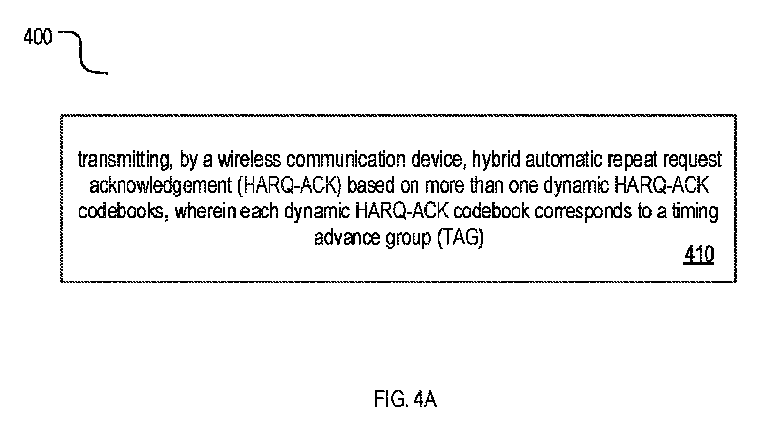
種々の実施形態において、図4Aは、無線通信のための方法400のフロー図を示す。方法400は、ステップ410:無線通信デバイスによって、2つ以上の動的HARQ-ACKコードブックに基づいて、ハイブリッド自動再送要求肯定応答(HARQ-ACK)を伝送することを含み得、各動的HARQ-ACKコードブックは、タイミングアドバンスグループ(TAG)に対応する。 In various embodiments, FIG. 4A illustrates a flow diagram of a method 400 for wireless communication. The method 400 may include, step 410: transmitting, by a wireless communication device, a hybrid automatic repeat request acknowledgement (HARQ-ACK) based on two or more dynamic HARQ-ACK codebooks, each dynamic HARQ-ACK codebook corresponding to a timing advance group (TAG).
いくつかの実装において、各動的HARQ-ACKコードブックは、動的HARQ-ACKコードブックによって対応されるTAGにのみ属するいくつかのキャリアのために使用される。 In some implementations, each dynamic HARQ-ACK codebook is used for some carriers that belong only to the TAG that is served by the dynamic HARQ-ACK codebook.
いくつかの実装において、TAGに対応する動的HARQ-ACKコードブックのために、ダウンリンク制御情報(DCI)に含まれるカウンタダウンリンク割り当てインデックス(cDAI)フィールドは、そのTAGにのみ属するキャリアの数に基づいてカウントされ、動的HARQ-ACKコードブックのためにDCIに含まれる総ダウンリンク割り当てインデックス(tDAI)フィールドは、そのTAGにのみ属するいくつかのキャリアのために使用される。 In some implementations, the counter downlink allocation index (cDAI) field included in the downlink control information (DCI) for a dynamic HARQ-ACK codebook corresponding to a TAG is counted based on the number of carriers that belong only to that TAG, and the total downlink allocation index (tDAI) field included in the DCI for a dynamic HARQ-ACK codebook is used for some carriers that belong only to that TAG.
いくつかの実装において、DCIに含まれるTAGインデックスフィールドが、TAGを示し、TAGは、スケジューリングされた物理ダウンリンク共有チャネル(PDSCH)のための動的HARQ-ACKコードブックに対応する。 In some implementations, a TAG index field included in the DCI indicates a TAG, which corresponds to a dynamic HARQ-ACK codebook for a scheduled physical downlink shared channel (PDSCH).
いくつかの実装において、方法400は、無線通信デバイスによって、構成情報を受信することをさらに含み得、構成情報は、動的HARQ-ACKコードブックとTAGとの間のマッピングを含み、動的HARQ-ACKコードブックは、そのTAGにのみ属するいくつかのキャリアのために使用される。 In some implementations, the method 400 may further include receiving, by the wireless communication device, configuration information, the configuration information including a mapping between the dynamic HARQ-ACK codebook and a TAG, the dynamic HARQ-ACK codebook being used for some carriers that belong only to that TAG.
いくつかの実装において、DCIに含まれる動的HARQ-ACKコードブック情報は、スケジューリングされた物理ダウンリンク共有チャネル(PDSCH)のための動的HARQ-ACKコードブックを示す。 In some implementations, the dynamic HARQ-ACK codebook information included in the DCI indicates a dynamic HARQ-ACK codebook for a scheduled physical downlink shared channel (PDSCH).
種々の実施形態において、図4Bは、無線通信のための方法450のフロー図を示す。方法450は、ステップ460:無線通信ノードによって、無線通信デバイスから、2つ以上の動的HARQ-ACKコードブックに基づくハイブリッド自動再送要求肯定応答(HARQ-ACK)を受信することを含み得、各動的HARQ-ACKコードブックは、タイミングアドバンスグループ(TAG)に対応する。 In various embodiments, FIG. 4B illustrates a flow diagram of a method 450 for wireless communication. The method 450 may include, step 460: receiving, by a wireless communication node, from a wireless communication device, a hybrid automatic repeat request acknowledgement (HARQ-ACK) based on two or more dynamic HARQ-ACK codebooks, each dynamic HARQ-ACK codebook corresponding to a timing advance group (TAG).
いくつかの実装において、各動的HARQ-ACKコードブックは、動的HARQ-ACKコードブックによって対応されるTAGにのみ属するいくつかのキャリアのために使用される。 In some implementations, each dynamic HARQ-ACK codebook is used for some carriers that belong only to the TAG that is served by the dynamic HARQ-ACK codebook.
いくつかの実装において、TAGに対応する動的HARQ-ACKコードブックのために、ダウンリンク制御情報(DCI)に含まれるカウンタダウンリンク割り当てインデックス(cDAI)フィールドは、そのTAGにのみ属するキャリアの数に基づいてカウントされ、動的HARQ-ACKコードブックのためにDCIに含まれる総ダウンリンク割り当てインデックス(tDAI)フィールドは、そのTAGにのみ属するいくつかのキャリアのために使用される。 In some implementations, the counter downlink allocation index (cDAI) field included in the downlink control information (DCI) for a dynamic HARQ-ACK codebook corresponding to a TAG is counted based on the number of carriers that belong only to that TAG, and the total downlink allocation index (tDAI) field included in the DCI for a dynamic HARQ-ACK codebook is used for some carriers that belong only to that TAG.
いくつかの実装において、DCIに含まれるTAGインデックスフィールドが、TAGを示し、TAGは、スケジューリングされた物理ダウンリンク共有チャネル(PDSCH)のための動的HARQ-ACKコードブックに対応する。 In some implementations, a TAG index field included in the DCI indicates a TAG, which corresponds to a dynamic HARQ-ACK codebook for a scheduled physical downlink shared channel (PDSCH).
いくつかの実装において、方法450は、無線通信ノードによって、構成情報を伝送することをさらに含み得、構成情報は、動的HARQ-ACKコードブックとTAGとの間のマッピングを含み、動的HARQ-ACKコードブックは、そのTAGにのみ属するいくつかのキャリアのために使用される。 In some implementations, the method 450 may further include transmitting, by the wireless communication node, configuration information, the configuration information including a mapping between the dynamic HARQ-ACK codebook and a TAG, the dynamic HARQ-ACK codebook being used for some carriers that belong only to that TAG.
いくつかの実装において、DCIに含まれる動的HARQ-ACKコードブック情報は、スケジューリングされた物理ダウンリンク共有チャネル(PDSCH)のための動的HARQ-ACKコードブックを示す。 In some implementations, the dynamic HARQ-ACK codebook information included in the DCI indicates a dynamic HARQ-ACK codebook for a scheduled physical downlink shared channel (PDSCH).
(実施形態1)
本開示は、1つの非限定的実施形態を説明し、1つの非限定的実施形態において、HARQ ACK/NACKフィードバックのためのコードブックタイプが、UEによって動的コードブックとして構成されると、UEは、構成されたTAGの数に従って、動的コードブックの数を決定し、各動的コードブックは、1つのTAGに対応する。
(Embodiment 1)
This disclosure describes one non-limiting embodiment, in which when the codebook type for HARQ ACK/NACK feedback is configured by the UE as a dynamic codebook, the UE determines the number of dynamic codebooks according to the number of configured TAGs, and each dynamic codebook corresponds to one TAG.
いくつかの実装において、動的コードブックのサイズは、対応するTAGにのみ属するコンポーネントキャリアの数に関連し得、他のTAGにおけるコンポーネントキャリアの数によって影響を及ぼされないこともある。 In some implementations, the size of the dynamic codebook may be related to the number of component carriers that belong only to the corresponding TAG and may not be affected by the number of component carriers in other TAGs.
いくつかの実装において、TAG間CAおよび構成される動的コードブックに関して、UEは、1つのコンポーネントキャリア上でPDSCHをスケジューリングするDCIを受信する。DCIにおけるカウンタDAIおよび総DAIは、キャリア上のダウンリンク割り当てと同じTAGに属する他のキャリア上のダウンリンク割り当てとにのみ基づいて決定される。 In some implementations, for inter-TAG CA and a configured dynamic codebook, the UE receives a DCI scheduling a PDSCH on one component carrier. The counter DAI and total DAI in the DCI are determined based only on the downlink allocation on the carrier and the downlink allocation on other carriers that belong to the same TAG.
いくつかの実装において、TAG間CAに関して、UEは、HARQ ACK/NACKフィードバックのために2つ以上の動的HARQ-ACKコードブックを適用し得、各動的HARQ-ACKコードブックは、1つのTAGに対応する。 In some implementations, for inter-TAG CA, the UE may apply two or more dynamic HARQ-ACK codebooks for HARQ ACK/NACK feedback, each dynamic HARQ-ACK codebook corresponding to one TAG.
非限定的例に関して、図1Cの概略図を参照すると、CAに関して、UEは、一次セル(pcell、181)、二次セル1(scell1、182)、二次セル2(scell2、183)、および二次セル3(scell3、184)の4つのコンポーネントキャリア上でダウンリンクデータを受信し得る。pcellおよびscell1は、TAG1に属し得、scell2およびscell3は、TAG2に属し得る。UEは、HARQ ACK/NACKフィードバックのために2つの動的コードブックを適用し得る。一方の動的コードブックが、pcellおよびscell1のためのHARQ ACK/NACKフィードバックのために使用され、他方の動的コードブックが、scell2およびscell3のためのHARQ ACK/NACKフィードバックのために使用される。上記の非限定的例は、UEが、TAG特定の動的コードブックに基づいてHARQ ACK/NACKフィードバックを実施することを示す。 For a non-limiting example, referring to the schematic diagram of FIG. 1C, for CA, a UE may receive downlink data on four component carriers: primary cell (pcell, 181), secondary cell 1 (scell1, 182), secondary cell 2 (scell2, 183), and secondary cell 3 (scell3, 184). pcell and scell1 may belong to TAG1, and scell2 and scell3 may belong to TAG2. The UE may apply two dynamic codebooks for HARQ ACK/NACK feedback. One dynamic codebook is used for HARQ ACK/NACK feedback for pcell and scell1, and the other dynamic codebook is used for HARQ ACK/NACK feedback for scell2 and scell3. The above non-limiting example shows that the UE performs HARQ ACK/NACK feedback based on a TAG-specific dynamic codebook.
図5は、TAG特定の動的コードブックを処理するUEのための方法500のフロー図を示す。方法500は、以下のステップのうちの一部または全てを含み得る:UEが動的コードブックとしてのHARQ ACK/NACKフィードバックのためのコードブックタイプで構成されるステップ510;UEがTAGの数に基づいて動的コードブックの数を決定し、TAGのためのコンポーネントキャリアインスタンスに基づいて各動的コードブックのためのコンポーネントキャリアインスタンスを決定するステップ520;UEが各動的コードブックに基づいてHARQ ACK/NACKフィードバックを伝送するステップ530。 Figure 5 shows a flow diagram of a method 500 for a UE to process TAG-specific dynamic codebooks. Method 500 may include some or all of the following steps: step 510, in which the UE is configured with a codebook type for HARQ ACK/NACK feedback as a dynamic codebook; step 520, in which the UE determines the number of dynamic codebooks based on the number of TAGs and determines a component carrier instance for each dynamic codebook based on the component carrier instance for the TAG; step 530, in which the UE transmits HARQ ACK/NACK feedback based on each dynamic codebook.
ステップ510を参照すると、UEは、動的コードブックとしてのHARQ ACK/NACKフィードバックのコードブックタイプで構成される。UEが、上位層信号伝達(NR RRC IE)を通して、動的コードブックとしてのHARQ-ACKコードブックタイプで構成されると、UEは、HARQ ACK/NACKフィードバックのためにその動的HARQ-ACKコードブックを使用し得る。いくつかの実装において、UEは、PDSCHをスケジューリングするDCIにおけるcDAIおよびtDAIに基づいて、累積ダウンリンク割り当ておよび総ダウンリンク割り当てを取得し得る。 Referring to step 510, the UE is configured with the codebook type for HARQ ACK/NACK feedback as a dynamic codebook. Once the UE is configured with the HARQ-ACK codebook type as a dynamic codebook through higher layer signaling (NR RRC IE), the UE may use the dynamic HARQ-ACK codebook for HARQ ACK/NACK feedback. In some implementations, the UE may obtain the cumulative downlink allocation and the total downlink allocation based on the cDAI and tDAI in the DCI scheduling the PDSCH.
ステップ520を参照すると、UEは、TAGの数に基づいて、動的コードブックの数を決定し、TAGのためのコンポーネントキャリアインスタンスに基づいて、各動的コードブックのためのコンポーネントキャリアインスタンスとを決定する。いくつかの実装において、UEは、構成されるTAGの数に従って、HARQ ACK/NACKフィードバックのための動的コードブックの数を決定し得る。各動的コードブックがTAGに対応するので、UEは、各TAGのためのコンポーネントキャリアインスタンスに従って、各動的コードブックのためのコンポーネントキャリアインスタンスを決定し得る。 Referring to step 520, the UE determines the number of dynamic codebooks based on the number of TAGs, and determines the component carrier instance for each dynamic codebook based on the component carrier instance for the TAG. In some implementations, the UE may determine the number of dynamic codebooks for HARQ ACK/NACK feedback according to the number of configured TAGs. Since each dynamic codebook corresponds to a TAG, the UE may determine the component carrier instance for each dynamic codebook according to the component carrier instance for each TAG.
ステップ530を参照すると、UEは、各動的コードブックに基づいて、HARQ ACK/NACKをフィードバックする。いくつかの実装において、UEは、コンポーネントキャリアが対応する動的コードブックを使用することによって、各コンポーネントキャリア上のPDSCHのためのHARQ ACK/NACKをフィードバックする。 Referring to step 530, the UE feeds back HARQ ACK/NACK based on each dynamic codebook. In some implementations, the UE feeds back HARQ ACK/NACK for the PDSCH on each component carrier by using the dynamic codebook that the component carrier corresponds to.
(実施形態2)
本開示は、別の非限定的実施形態を説明し、別の非限定的実施形態において、TAG特定の動的コードブック機構が、DCIにおけるDAIフィールド(tDAIおよび/またはcDAI)に基づいて発生させられる。いくつかの実装において、DCIは、カウンタDAI情報と、総DAI情報とを含み得る。カウンタDAIの値は、TAGのためのこれまでに受信されたダウンリンク割り当ての累積された数を示す。いくつかの実装において、累積された数の統計的シーケンスは、以下の通りことである:最初に、TAGに属するサービングセルインデックスの昇順に従い、次いで、TAGのための時間ドメインにおけるスケジューリングされたPDSCHの昇順に従う。総DAIの値は、TAGのためのこれまでに受信されたダウンリンク割り当ての総数を示す。
(Embodiment 2)
This disclosure describes another non-limiting embodiment, in which a TAG-specific dynamic codebook mechanism is generated based on the DAI field (tDAI and/or cDAI) in the DCI. In some implementations, the DCI may include counter DAI information and total DAI information. The value of counter DAI indicates the accumulated number of downlink assignments received so far for the TAG. In some implementations, the statistical sequence of the accumulated numbers is as follows: first according to the ascending order of serving cell indexes belonging to the TAG, and then according to the ascending order of scheduled PDSCHs in the time domain for the TAG. The value of total DAI indicates the total number of downlink assignments received so far for the TAG.
いくつかの実装において、UEが、コンポーネントキャリア上でのダウンリンク割り当てを受信すると、UEは、コンポーネントキャリアが属するTAGと、TAG下の他のコンポーネントキャリアの全てとを決定し得る。UEは、DCIにおけるカウンタDAI情報および総DAI情報を取得し、これまでにTAG下で受信されたダウンリンク割り当ての総数と、TAG下でこれまでに受信されたダウンリンク割り当てのための累積された数とを決定する。 In some implementations, when a UE receives a downlink assignment on a component carrier, the UE may determine the TAG to which the component carrier belongs and all of the other component carriers under the TAG. The UE obtains the counter DAI information and the total DAI information in the DCI to determine the total number of downlink assignments received so far under the TAG and the accumulated number for downlink assignments received so far under the TAG.
図6は、TAGのためにDCIにおけるカウンタDAI情報および総DAI情報を処理するUEのための方法600のフロー図を示す。方法600は、以下のステップのうちの一部または全てを含み得る:UEがcDAIおよびtDAIを伴うDCIが受信されたコンポーネントキャリアに基づいてコンポーネントキャリアが属するTAGとTAGに属する他のコンポーネントキャリアの全てとを決定するステップ610;UEが受信されたDCIにおけるカウンタDAI情報および総DAI情報に従って受信されたダウンリンク割り当ての累積数とTAGのための受信されたダウンリンク割り当ての総数とを決定し、UEが動的HARQ-ACKコードブック内のダウンリンク割り当てのための位置を決定するステップ620。 Figure 6 shows a flow diagram of a method 600 for a UE to process counter DAI and total DAI information in a DCI for a TAG. The method 600 may include some or all of the following steps: step 610 in which the UE determines the TAG to which the component carrier belongs based on the component carrier on which the DCI with cDAI and tDAI was received and all of the other component carriers that belong to the TAG; step 620 in which the UE determines the cumulative number of downlink allocations received and the total number of downlink allocations received for the TAG according to the counter DAI and total DAI information in the received DCI, and the UE determines a position for the downlink allocation in the dynamic HARQ-ACK codebook.
ステップ610を参照すると、UEは、コンポーネントキャリア上でcDAIおよびtDAIを伴うDCIを受信する。いくつかの実装において、コンポーネントキャリアのためのTAG構成情報に従って、UEは、コンポーネントキャリアが属するTAGを決定する。いくつかの実装において、TAG構成情報に従って、UEは、TAGに属する他のコンポーネントキャリアの全てを決定する。 Referring to step 610, the UE receives a DCI with a cDAI and a tDAI on a component carrier. In some implementations, according to the TAG configuration information for the component carrier, the UE determines the TAG to which the component carrier belongs. In some implementations, according to the TAG configuration information, the UE determines all of the other component carriers that belong to the TAG.
ステップ620を参照すると、UEは、受信されたDCIにおけるカウンタDAI情報および総DAI情報に従って受信されたダウンリンク割り当ての累積数を決定し、TAGのための受信されたダウンリンク割り当ての総数を決定する。DCIにおけるカウンタDAI情報は、これまでに受信されたダウンリンク割り当ての累積数を示すために使用され、DCIにおける総DAI情報は、TAGのためのこれまでに受信されたダウンリンク割り当ての総数を示すために使用される。UEは、カウンタDAI情報および総DAI情報のフロントおよびバックの複数の対に基づいて、ダウンリンク割り当てを見落としているかどうかを判断し得る。 Referring to step 620, the UE determines the cumulative number of downlink assignments received according to the counter DAI information and the total DAI information in the received DCI, and determines the total number of downlink assignments received for the TAG. The counter DAI information in the DCI is used to indicate the cumulative number of downlink assignments received so far, and the total DAI information in the DCI is used to indicate the total number of downlink assignments received so far for the TAG. The UE may determine whether it has missed a downlink assignment based on multiple pairs of front and back counter DAI information and total DAI information.
UEは、HARQ ACK/NACKフィードバック情報を伝送するために、動的HARQ-ACKコードブック内のダウンリンク割り当てのための位置を決定する。いくつかの実装において、動的HARQ-ACKコードブックは、各ビットがダウンリンク割り当てのためのHARQ情報(ACKまたはNACK等)に対応するビットストリングであり得る。動的HARQ-ACKコードブックのサイズは、TAGによって対応されるダウンリンク割り当ての総数に基づいて決定される。 The UE determines a location for a downlink assignment in a dynamic HARQ-ACK codebook to transmit HARQ ACK/NACK feedback information. In some implementations, the dynamic HARQ-ACK codebook may be a bit string where each bit corresponds to HARQ information (such as ACK or NACK) for a downlink assignment. The size of the dynamic HARQ-ACK codebook is determined based on the total number of downlink assignments supported by the TAG.
(実施形態3)
本開示は、別の非限定的実施形態を説明し、別の非限定的実施形態において、UEは、TAG情報を含むDCIを受信し得、それによって、UEは、TAGと動的コードブックとの間の対応に基づいて動的コードブックを決定し得る。いくつかの実装において、UEは、TAGによって含まれるコンポーネントキャリアインスタンスに基づいて、動的コードブックのためのコンポーネントキャリアインスタンスを取得し得る。
(Embodiment 3)
This disclosure describes another non-limiting embodiment in which a UE may receive a DCI including TAG information, whereby the UE may determine a dynamic codebook based on a correspondence between the TAG and the dynamic codebook. In some implementations, the UE may obtain a component carrier instance for the dynamic codebook based on the component carrier instance included by the TAG.
いくつかの実装において、TAGインデックス(TAG-ID)が、TAG情報を示すために使用され得、DCIは、TAG-IDのためのフィールドを含む。UEは、DCIにおけるTAG-IDフィールドを受信し、TAG情報を取得する。 In some implementations, a TAG index (TAG-ID) may be used to indicate the TAG information, and the DCI includes a field for the TAG-ID. The UE receives the TAG-ID field in the DCI and obtains the TAG information.
図7は、DCIにおけるTAG情報を入手するUEのための方法700のフロー図を示す。方法700は、以下のステップのうちの一部または全てを含み得る:UEがTAG構成情報を取得するステップ710;UEが動的コードブックとTAGとの間の対応に基づいて動的コードブックを決定するステップ720。 Figure 7 shows a flow diagram of a method 700 for a UE to obtain TAG information in a DCI. The method 700 may include some or all of the following steps: step 710 in which the UE obtains TAG configuration information; step 720 in which the UE determines a dynamic codebook based on the correspondence between the dynamic codebook and the TAG.
ステップ710を参照すると、UEは、TAG構成情報を取得する。いくつかの実装において、UEは、TAG-IDを含むサービングセル構成情報を受信し得る。TAG-IDは、サービングセル(キャリア)が属するそのTAGを示し得る。いくつかの実装において、UEは、TAG-IDによって示されるTAG下での全てのコンポーネントキャリアインスタンスを取得し得る。 Referring to step 710, the UE obtains TAG configuration information. In some implementations, the UE may receive serving cell configuration information including a TAG-ID. The TAG-ID may indicate the TAG to which the serving cell (carrier) belongs. In some implementations, the UE may obtain all component carrier instances under the TAG indicated by the TAG-ID.
ステップ720を参照すると、UEは、動的コードブックとTAGとの間の対応に基づいて、動的コードブックを決定する。いくつかの実装において、動的コードブックがTAGに対応するので、UEは、DCIにおいて示されるTAG-ID等のTAG情報から、動的コードブックを決定する。 Referring to step 720, the UE determines the dynamic codebook based on the correspondence between the dynamic codebook and the TAG. In some implementations, since the dynamic codebook corresponds to the TAG, the UE determines the dynamic codebook from TAG information, such as the TAG-ID, indicated in the DCI.
(実施形態4)
本開示は、DCIが動的コードブック情報を含み得る別の非限定的実施形態を説明する。いくつかの実装において、無線リソース構成情報は、動的コードブックとコンポーネントキャリアインスタンスとの間の対応を含む。
(Embodiment 4)
This disclosure describes another non-limiting embodiment in which the DCI may include dynamic codebook information. In some implementations, the radio resource configuration information includes a correspondence between a dynamic codebook and a component carrier instance.
いくつかの実装において、UEによって受信される無線リソース制御(RRC)情報要素(IE)等の構成情報は、動的コードブックとコンポーネントキャリアインスタンスとの間の対応を示すために使用される動的コードブック情報を含む。動的コードブック構成情報のための方法は、限定ではないが、RRC IEが動的コードブック情報を表すこと、またはRRC IEが動的コードブックインデックスを表すことを含む。 In some implementations, configuration information, such as a radio resource control (RRC) information element (IE) received by the UE, includes dynamic codebook information used to indicate the correspondence between dynamic codebooks and component carrier instances. Methods for dynamic codebook configuration information include, but are not limited to, an RRC IE representing the dynamic codebook information or an RRC IE representing a dynamic codebook index.
いくつかの実装において、動的コードブックとコンポーネントキャリアインスタンスとの間の対応は、マッピングと称され得る。動的コードブックとコンポーネントキャリアインスタンスとの間の対応を表す方法は、限定ではないが、以下を含み得る:サービングセル構成情報における動的コードブックインデックス;または動的コードブック構成情報における1つ以上のサービングセルインデックス;または動的コードブックインデックスと1つ以上のサービングセルインデックスとを含む別個の構成情報。 In some implementations, the correspondence between the dynamic codebook and the component carrier instance may be referred to as a mapping. Ways to express the correspondence between the dynamic codebook and the component carrier instance may include, but are not limited to: a dynamic codebook index in the serving cell configuration information; or one or more serving cell indices in the dynamic codebook configuration information; or separate configuration information including the dynamic codebook index and one or more serving cell indices.
いくつかの実装において、動的コードブック情報が、層1信号伝達に含まれる。例えば、UEは、DCIにおいて示される動的コードブック情報を受信し得る。いくつかの実装において、DCI内に動的コードブックを示す方法は、限定ではないが以下を含み得る:DCIにおけるフィールドが動的コードブックインデックスを示すこと;またはDCIにおけるフィールドが動的コードブックに対応すること。 In some implementations, the dynamic codebook information is included in the Layer 1 signaling. For example, the UE may receive the dynamic codebook information indicated in the DCI. In some implementations, the manner of indicating the dynamic codebook in the DCI may include, but is not limited to: a field in the DCI indicating a dynamic codebook index; or a field in the DCI corresponding to the dynamic codebook.
図8は、DCIにおける動的コードブック情報を受信するUEのための方法800のフロー図を示す。方法800は、以下のステップのうちの一部または全てを含み得る:UEが、動的コードブックの構成情報と、動的コードブックとコンポーネントキャリアインスタンスとの間の対応とを受信するステップ810;および、UEがDCIにおける動的コードブック情報を受信し、動的コードブックを決定するステップ820;および、UEが動的コードブックを使用して、HARQ ACK/NACKフィードバックを実施するステップ830。 Figure 8 shows a flow diagram of a method 800 for a UE to receive dynamic codebook information in DCI. The method 800 may include some or all of the following steps: 810, in which the UE receives dynamic codebook configuration information and a correspondence between the dynamic codebook and the component carrier instance; 820, in which the UE receives the dynamic codebook information in the DCI and determines the dynamic codebook; and 830, in which the UE uses the dynamic codebook to perform HARQ ACK/NACK feedback.
本開示は、無線通信のための方法、装置、およびコンピュータ読み取り可能な媒体を説明する。本開示は、ハイブリッド自動再送要求肯定応答(HARQ-ACK)フィードバックのために動的コードブックを適用することに関わる問題に対処する。本開示に説明される方法、デバイス、およびコンピュータ読み取り可能な媒体は、HARQ-ACKフィードバックのために動的コードブックを適用することによって、無線通信の性能を促進し、したがって、効率および全体的性能を改良し得る。本開示に説明される方法、デバイス、およびコンピュータ読み取り可能な媒体は、無線通信システムの全体的効率を改良し得る。 The present disclosure describes methods, apparatus, and computer readable media for wireless communication. The present disclosure addresses issues related to applying a dynamic codebook for hybrid automatic repeat request acknowledgement (HARQ-ACK) feedback. The methods, devices, and computer readable media described in the present disclosure may facilitate performance of wireless communication by applying a dynamic codebook for HARQ-ACK feedback, thus improving efficiency and overall performance. The methods, devices, and computer readable media described in the present disclosure may improve overall efficiency of wireless communication systems.
本明細書全体を通した、特徴、利点、または類似の文言の言及は、本解決策を用いて実現され得る特徴および利点の全てが、その任意の単一の実装に含まれるべきであること、またはそれに含まれることを含意するものではない。むしろ、特徴および利点を指す文言は、ある実施形態と関連して説明される具体的な特徴、利点、または特性が、本解決策の少なくとも1つの実施形態に含まれることを意味するものと理解される。したがって、本明細書の全体を通した特徴および利点、ならびに類似の文言の議論は、必ずしもそうではないが、同じ実施形態を指し得る。 References to features, advantages, or similar language throughout this specification do not imply that all of the features and advantages that may be realized using the solution should or are included in any single implementation thereof. Rather, language referring to features and advantages is understood to mean that the specific feature, advantage, or characteristic described in connection with an embodiment is included in at least one embodiment of the solution. Thus, discussions of features and advantages and similar language throughout this specification may, but do not necessarily, refer to the same embodiment.
さらに、本解決策の説明される特徴、利点、および特性は、1つ以上の実施形態において、任意の好適な様式において組み合わせられ得る。当業者は、本明細書における説明に照らして、本解決策が、特定の実施形態の具体的特徴または利点のうちの1つ以上を伴わずに実践され得ることを認識するであろう。他の事例では、本解決策の全ての実施形態に存在しないこともある追加の特徴および利点が、ある実施形態において認識され得る。 Furthermore, the described features, advantages, and characteristics of the solution may be combined in any suitable manner in one or more embodiments. Those skilled in the art will recognize in light of the description herein that the solution may be practiced without one or more of the specific features or advantages of a particular embodiment. In other cases, additional features and advantages may be recognized in an embodiment that may not be present in all embodiments of the solution.
上記および他の側面およびそれらの実装が、図面、説明、および請求項においてより詳細に説明される。
本発明はさらに、例えば、以下を提供する。
(項目1)
無線通信のための方法であって、前記方法は、
無線通信デバイスによって、2つ以上の動的HARQ-ACKコードブックに基づいて、ハイブリッド自動再送要求肯定応答(HARQ-ACK)を伝送することを含み、
各動的HARQ-ACKコードブックは、タイミングアドバンスグループ(TAG)に対応する、方法。
(項目2)
各動的HARQ-ACKコードブックは、前記動的HARQ-ACKコードブックによって対応される前記TAGにのみ属するいくつかのキャリアのために使用される、項目1に記載の方法。
(項目3)
TAGに対応する動的HARQ-ACKコードブックのために、
ダウンリンク制御情報(DCI)に含まれるカウンタダウンリンク割り当てインデックス(cDAI)フィールドが、前記TAGにのみ属するキャリアの数に基づいてカウントされ、
前記動的HARQ-ACKコードブックのための前記DCIに含まれる総ダウンリンク割り当てインデックス(tDAI)フィールドが、前記TAGにのみ属するいくつかのキャリアのために使用される、項目1-2のいずれかに記載の方法。
(項目4)
DCIに含まれるTAGインデックスフィールドが、TAGを示し、前記TAGは、スケジューリングされた物理ダウンリンク共有チャネル(PDSCH)のための動的HARQ-ACKコードブックに対応する、項目1-3のいずれかに記載の方法。
(項目5)
前記無線通信デバイスによって、構成情報を受信することをさらに含み、
前記構成情報は、動的HARQ-ACKコードブックとTAGとの間のマッピングを含み、
前記動的HARQ-ACKコードブックは、前記TAGにのみ属するいくつかのキャリアのために使用される、項目1に記載の方法。
(項目6)
DCIに含まれる動的HARQ-ACKコードブック情報は、スケジューリングされた物理ダウンリンク共有チャネル(PDSCH)のための動的HARQ-ACKコードブックを示す、項目1-3のいずれかに記載の方法。
(項目7)
無線通信のための方法であって、前記方法は、
無線通信ノードによって、無線通信デバイスから、2つ以上の動的HARQ-ACKコードブックに基づくハイブリッド自動再送要求肯定応答(HARQ-ACK)を受信することを含み、
各動的HARQ-ACKコードブックは、タイミングアドバンスグループ(TAG)に対応する、方法。
(項目8)
各動的HARQ-ACKコードブックは、前記動的HARQ-ACKコードブックによって対応される前記TAGにのみ属するいくつかのキャリアのために使用される、項目7に記載の方法。
(項目9)
TAGに対応する動的HARQ-ACKコードブックのために、
ダウンリンク制御情報(DCI)に含まれるカウンタダウンリンク割り当てインデックス(cDAI)フィールドが、前記TAGにのみ属するキャリアの数に基づいてカウントされ、
前記動的HARQ-ACKコードブックのための前記DCIに含まれる総ダウンリンク割り当てインデックス(tDAI)フィールドが、前記TAGにのみ属するいくつかのキャリアのために使用される、項目7-8のいずれかに記載の方法。
(項目10)
DCIに含まれるTAGインデックスフィールドが、TAGを示し、前記TAGは、スケジューリングされた物理ダウンリンク共有チャネル(PDSCH)のための動的HARQ-ACKコードブックに対応する、項目7-9に記載の方法。
(項目11)
前記無線通信ノードによって、構成情報を伝送することをさらに含み、
前記構成情報は、動的HARQ-ACKコードブックとTAGとの間のマッピングを含み、
前記動的HARQ-ACKコードブックは、前記TAGにのみ属するいくつかのキャリアのために使用される、項目7のいずれかに記載の方法。
(項目12)
DCIに含まれる動的HARQ-ACKコードブック情報は、スケジューリングされた物理ダウンリンク共有チャネル(PDSCH)のための動的HARQ-ACKコードブックを示す、項目7-9に記載の方法。
(項目13)
プロセッサとメモリとを備えている無線通信装置であって、前記プロセッサは、前記メモリからコードを読み取り、項目1-12のいずれかに記載の方法を実施するように構成されている、無線通信装置。
(項目14)
記憶されたコンピュータ読み取り可能なプログラム媒体コードを備えているコンピュータプログラム製品であって、前記コンピュータ読み取り可能なプログラム媒体コードは、プロセッサによって実行されると、項目1-12のいずれかに記載の方法を前記プロセッサに実施させる、コンピュータプログラム製品。
These and other aspects and their implementations are described in more detail in the drawings, description, and claims.
The present invention further provides, for example, the following:
(Item 1)
1. A method for wireless communication, the method comprising:
transmitting, by the wireless communication device, a hybrid automatic repeat request acknowledgement (HARQ-ACK) based on two or more dynamic HARQ-ACK codebooks;
Each dynamic HARQ-ACK codebook corresponds to a Timing Advance Group (TAG).
(Item 2)
2. The method according to claim 1, wherein each dynamic HARQ-ACK codebook is used for some carriers that belong only to the TAG that is supported by the dynamic HARQ-ACK codebook.
(Item 3)
For a dynamic HARQ-ACK codebook corresponding to a TAG,
A counter downlink allocation index (cDAI) field included in a downlink control information (DCI) is counted based on the number of carriers that belong only to the TAG;
3. The method according to any of items 1-2, wherein a total downlink allocation index (tDAI) field included in the DCI for the dynamic HARQ-ACK codebook is used for some carriers that belong only to the TAG.
(Item 4)
4. The method according to any one of items 1 to 3, wherein a TAG index field included in the DCI indicates a TAG, the TAG corresponding to a dynamic HARQ-ACK codebook for a scheduled physical downlink shared channel (PDSCH).
(Item 5)
and receiving, by the wireless communication device, configuration information.
The configuration information includes a mapping between a dynamic HARQ-ACK codebook and a TAG;
2. The method of claim 1, wherein the dynamic HARQ-ACK codebook is used for some carriers that belong only to the TAG.
(Item 6)
The method according to any one of items 1 to 3, wherein the dynamic HARQ-ACK codebook information included in the DCI indicates a dynamic HARQ-ACK codebook for a scheduled physical downlink shared channel (PDSCH).
(Item 7)
1. A method for wireless communication, the method comprising:
receiving, by the wireless communication node, from the wireless communication device, a hybrid automatic repeat request acknowledgement (HARQ-ACK) based on two or more dynamic HARQ-ACK codebooks;
Each dynamic HARQ-ACK codebook corresponds to a Timing Advance Group (TAG).
(Item 8)
8. The method according to claim 7, wherein each dynamic HARQ-ACK codebook is used for some carriers that belong only to the TAG that is supported by the dynamic HARQ-ACK codebook.
(Item 9)
For a dynamic HARQ-ACK codebook corresponding to a TAG,
A counter downlink allocation index (cDAI) field included in a downlink control information (DCI) is counted based on the number of carriers that belong only to the TAG;
9. The method according to any of items 7-8, wherein a total downlink allocation index (tDAI) field included in the DCI for the dynamic HARQ-ACK codebook is used for some carriers that belong only to the TAG.
(Item 10)
10. The method according to any one of claims 7 to 9, wherein a TAG index field included in the DCI indicates a TAG, the TAG corresponding to a dynamic HARQ-ACK codebook for a scheduled physical downlink shared channel (PDSCH).
(Item 11)
transmitting, by the wireless communication node, configuration information;
The configuration information includes a mapping between a dynamic HARQ-ACK codebook and a TAG;
8. The method according to any of claims 7, wherein the dynamic HARQ-ACK codebook is used for some carriers that belong only to the TAG.
(Item 12)
The method according to any one of items 7 to 9, wherein the dynamic HARQ-ACK codebook information included in the DCI indicates a dynamic HARQ-ACK codebook for a scheduled physical downlink shared channel (PDSCH).
(Item 13)
13. A wireless communication device comprising a processor and a memory, the processor configured to read a code from the memory and to perform a method according to any one of claims 1-12.
(Item 14)
13. A computer program product comprising a computer readable program medium code stored thereon, the computer readable program medium code causing the processor to perform the method according to any one of items 1-12 when executed by a processor.
Claims (14)
無線通信デバイスによって、2つ以上の動的HARQ-ACKコードブックに基づいて、ハイブリッド自動再送要求肯定応答(HARQ-ACK)を伝送することを含み、
各動的HARQ-ACKコードブックは、タイミングアドバンスグループ(TAG)に対応する、方法。 1. A method for wireless communication, the method comprising:
transmitting, by the wireless communication device, a hybrid automatic repeat request acknowledgement (HARQ-ACK) based on two or more dynamic HARQ-ACK codebooks;
Each dynamic HARQ-ACK codebook corresponds to a Timing Advance Group (TAG).
ダウンリンク制御情報(DCI)に含まれるカウンタダウンリンク割り当てインデックス(cDAI)フィールドが、前記TAGにのみ属するキャリアの数に基づいてカウントされ、
前記動的HARQ-ACKコードブックのための前記DCIに含まれる総ダウンリンク割り当てインデックス(tDAI)フィールドが、前記TAGにのみ属するいくつかのキャリアのために使用される、請求項1-2のいずれかに記載の方法。 For a dynamic HARQ-ACK codebook corresponding to a TAG,
A counter downlink allocation index (cDAI) field included in a downlink control information (DCI) is counted based on the number of carriers that belong only to the TAG;
A method according to any one of claims 1-2, wherein a total downlink allocation index (tDAI) field included in the DCI for the dynamic HARQ-ACK codebook is used for some carriers belonging only to the TAG.
前記構成情報は、動的HARQ-ACKコードブックとTAGとの間のマッピングを含み、
前記動的HARQ-ACKコードブックは、前記TAGにのみ属するいくつかのキャリアのために使用される、請求項1に記載の方法。 and receiving, by the wireless communication device, configuration information.
The configuration information includes a mapping between a dynamic HARQ-ACK codebook and a TAG;
The method of claim 1 , wherein the dynamic HARQ-ACK codebook is used for some carriers that belong only to the TAG.
無線通信ノードによって、無線通信デバイスから、2つ以上の動的HARQ-ACKコードブックに基づくハイブリッド自動再送要求肯定応答(HARQ-ACK)を受信することを含み、
各動的HARQ-ACKコードブックは、タイミングアドバンスグループ(TAG)に対応する、方法。 1. A method for wireless communication, the method comprising:
receiving, by the wireless communication node, from the wireless communication device, a hybrid automatic repeat request acknowledgement (HARQ-ACK) based on two or more dynamic HARQ-ACK codebooks;
Each dynamic HARQ-ACK codebook corresponds to a Timing Advance Group (TAG).
ダウンリンク制御情報(DCI)に含まれるカウンタダウンリンク割り当てインデックス(cDAI)フィールドが、前記TAGにのみ属するキャリアの数に基づいてカウントされ、
前記動的HARQ-ACKコードブックのための前記DCIに含まれる総ダウンリンク割り当てインデックス(tDAI)フィールドが、前記TAGにのみ属するいくつかのキャリアのために使用される、請求項7-8のいずれかに記載の方法。 For a dynamic HARQ-ACK codebook corresponding to a TAG,
A counter downlink allocation index (cDAI) field included in a downlink control information (DCI) is counted based on the number of carriers that belong only to the TAG;
A method according to any of claims 7-8, wherein a total downlink allocation index (tDAI) field included in the DCI for the dynamic HARQ-ACK codebook is used for some carriers belonging only to the TAG.
前記構成情報は、動的HARQ-ACKコードブックとTAGとの間のマッピングを含み、
前記動的HARQ-ACKコードブックは、前記TAGにのみ属するいくつかのキャリアのために使用される、請求項7のいずれかに記載の方法。 transmitting, by the wireless communication node, configuration information;
The configuration information includes a mapping between a dynamic HARQ-ACK codebook and a TAG;
The method according to claim 7, wherein the dynamic HARQ-ACK codebook is used for some carriers that belong only to the TAG.
Applications Claiming Priority (1)
| Application Number | Priority Date | Filing Date | Title |
|---|---|---|---|
| PCT/CN2022/102898 WO2024000434A1 (en) | 2022-06-30 | 2022-06-30 | Methods and devices for applying dynamic codebook for harq-ack feedback |
Publications (2)
| Publication Number | Publication Date |
|---|---|
| JP2025520249A true JP2025520249A (en) | 2025-07-03 |
| JP7857427B2 JP7857427B2 (en) | 2026-05-12 |
Family
ID=89383799
Family Applications (1)
| Application Number | Title | Priority Date | Filing Date |
|---|---|---|---|
| JP2024562281A Active JP7857427B2 (en) | 2022-06-30 | 2022-06-30 | Method and device for applying dynamic codebooks for HARQ-ACK feedback |
Country Status (6)
| Country | Link |
|---|---|
| US (1) | US20250038895A1 (en) |
| EP (1) | EP4512019A4 (en) |
| JP (1) | JP7857427B2 (en) |
| KR (1) | KR20240167066A (en) |
| CN (1) | CN119072875A (en) |
| WO (1) | WO2024000434A1 (en) |
Citations (3)
| Publication number | Priority date | Publication date | Assignee | Title |
|---|---|---|---|---|
| JP2018512096A (en) * | 2015-01-28 | 2018-05-10 | インターデイジタル パテント ホールディングス インコーポレイテッド | Uplink feedback method for operating with multiple carriers |
| WO2020223195A1 (en) * | 2019-05-01 | 2020-11-05 | Babaei Alireza | Multiple sps and configured grant configurations |
| WO2022031103A1 (en) * | 2020-08-06 | 2022-02-10 | 엘지전자 주식회사 | Method and device for transmitting and receiving wireless signal in wireless communication system |
Family Cites Families (2)
| Publication number | Priority date | Publication date | Assignee | Title |
|---|---|---|---|---|
| WO2020205728A1 (en) * | 2019-03-29 | 2020-10-08 | Apple Inc. | Hybrid automatic repeat request (harq) transmissions for new radio (nr) |
| US12082201B2 (en) * | 2019-06-11 | 2024-09-03 | Comcast Cable Communications, Llc | Wireless communications and control information transmission/reception |
-
2022
- 2022-06-30 CN CN202280095089.7A patent/CN119072875A/en active Pending
- 2022-06-30 KR KR1020247035952A patent/KR20240167066A/en active Pending
- 2022-06-30 WO PCT/CN2022/102898 patent/WO2024000434A1/en not_active Ceased
- 2022-06-30 EP EP22948539.6A patent/EP4512019A4/en active Pending
- 2022-06-30 JP JP2024562281A patent/JP7857427B2/en active Active
-
2024
- 2024-10-15 US US18/915,558 patent/US20250038895A1/en active Pending
Patent Citations (3)
| Publication number | Priority date | Publication date | Assignee | Title |
|---|---|---|---|---|
| JP2018512096A (en) * | 2015-01-28 | 2018-05-10 | インターデイジタル パテント ホールディングス インコーポレイテッド | Uplink feedback method for operating with multiple carriers |
| WO2020223195A1 (en) * | 2019-05-01 | 2020-11-05 | Babaei Alireza | Multiple sps and configured grant configurations |
| WO2022031103A1 (en) * | 2020-08-06 | 2022-02-10 | 엘지전자 주식회사 | Method and device for transmitting and receiving wireless signal in wireless communication system |
Non-Patent Citations (1)
| Title |
|---|
| ZTE, SANECHIPS: "Discussion on the data channel enhancements for 52.6 to 71GHz", 3GPP TSG RAN WG1 #104B-E R1-2103491, JPN6025046167, 20 April 2021 (2021-04-20), pages 1 - 17, ISSN: 0005730161 * |
Also Published As
| Publication number | Publication date |
|---|---|
| CN119072875A (en) | 2024-12-03 |
| EP4512019A4 (en) | 2025-06-18 |
| KR20240167066A (en) | 2024-11-26 |
| US20250038895A1 (en) | 2025-01-30 |
| EP4512019A1 (en) | 2025-02-26 |
| WO2024000434A1 (en) | 2024-01-04 |
| JP7857427B2 (en) | 2026-05-12 |
Similar Documents
| Publication | Publication Date | Title |
|---|---|---|
| US20230091988A1 (en) | Methods and devices for configuring harq-ack feedback | |
| US11632219B2 (en) | Resource determining method, indication method, and apparatus | |
| JP7498282B2 (en) | Method and device for generating HARQ-ACK feedback for multiple PDSCHs scheduled by a single DCI - Patents.com | |
| CN115943583B (en) | Method and device for configuring HARQ-ACK feedback | |
| US12489586B2 (en) | Methods and devices for configuring HARQ-ACK feedback | |
| US20240098724A1 (en) | Methods, devices, and systems for collision resolution | |
| US20230163917A1 (en) | Methods and devices for enhancing sounding reference signal transmission | |
| CN106134266A (en) | TDD and FDD united carrier polymerization in senior LTE | |
| US20210143944A1 (en) | Method And Apparatus For Out-Of-Order Hybrid Automatic Repeat Request Feedback In Mobile Communications | |
| CN117796099A (en) | Physical uplink control channel cell handover method and user equipment | |
| US20240107532A1 (en) | Methods, devices, and systems for configuring and transmitting scheduling request | |
| WO2024103516A1 (en) | Methods and devices for uci multiplexing for pusch and pucch with repetitions | |
| JP7857427B2 (en) | Method and device for applying dynamic codebooks for HARQ-ACK feedback | |
| US20250105976A1 (en) | Methods and devices for requesting release of configuration of periodic sounding reference signal | |
| WO2025156498A1 (en) | Methods, devices, and systems for harq process mechanism enhancement | |
| WO2024164196A1 (en) | Method, device, and system for uci and pucch mapping in wireless networks |
Legal Events
| Date | Code | Title | Description |
|---|---|---|---|
| A521 | Request for written amendment filed |
Free format text: JAPANESE INTERMEDIATE CODE: A523 Effective date: 20241216 |
|
| A621 | Written request for application examination |
Free format text: JAPANESE INTERMEDIATE CODE: A621 Effective date: 20241216 |
|
| A977 | Report on retrieval |
Free format text: JAPANESE INTERMEDIATE CODE: A971007 Effective date: 20251106 |
|
| A131 | Notification of reasons for refusal |
Free format text: JAPANESE INTERMEDIATE CODE: A131 Effective date: 20251112 |
|
| A521 | Request for written amendment filed |
Free format text: JAPANESE INTERMEDIATE CODE: A523 Effective date: 20260122 |
|
| A01 | Written decision to grant a patent or to grant a registration (utility model) |
Free format text: JAPANESE INTERMEDIATE CODE: A01 Effective date: 20260408 |
|
| A61 | First payment of annual fees (during grant procedure) |
Free format text: JAPANESE INTERMEDIATE CODE: A61 Effective date: 20260424 |