JP2024029749A - Epoxy resins, curable resin compositions, cured products thereof, and carbon fiber reinforced composite materials - Google Patents
Epoxy resins, curable resin compositions, cured products thereof, and carbon fiber reinforced composite materials Download PDFInfo
- Publication number
- JP2024029749A JP2024029749A JP2023113998A JP2023113998A JP2024029749A JP 2024029749 A JP2024029749 A JP 2024029749A JP 2023113998 A JP2023113998 A JP 2023113998A JP 2023113998 A JP2023113998 A JP 2023113998A JP 2024029749 A JP2024029749 A JP 2024029749A
- Authority
- JP
- Japan
- Prior art keywords
- weight
- parts
- curable resin
- phenol
- water
- Prior art date
- Legal status (The legal status is an assumption and is not a legal conclusion. Google has not performed a legal analysis and makes no representation as to the accuracy of the status listed.)
- Granted
Links
Classifications
-
- C—CHEMISTRY; METALLURGY
- C08—ORGANIC MACROMOLECULAR COMPOUNDS; THEIR PREPARATION OR CHEMICAL WORKING-UP; COMPOSITIONS BASED THEREON
- C08J—WORKING-UP; GENERAL PROCESSES OF COMPOUNDING; AFTER-TREATMENT NOT COVERED BY SUBCLASSES C08B, C08C, C08F, C08G or C08H
- C08J5/00—Manufacture of articles or shaped materials containing macromolecular substances
- C08J5/04—Reinforcing macromolecular compounds with loose or coherent fibrous material
- C08J5/0405—Reinforcing macromolecular compounds with loose or coherent fibrous material with inorganic fibres
- C08J5/042—Reinforcing macromolecular compounds with loose or coherent fibrous material with inorganic fibres with carbon fibres
-
- C—CHEMISTRY; METALLURGY
- C08—ORGANIC MACROMOLECULAR COMPOUNDS; THEIR PREPARATION OR CHEMICAL WORKING-UP; COMPOSITIONS BASED THEREON
- C08G—MACROMOLECULAR COMPOUNDS OBTAINED OTHERWISE THAN BY REACTIONS ONLY INVOLVING UNSATURATED CARBON-TO-CARBON BONDS
- C08G59/00—Polycondensates containing more than one epoxy group per molecule; Macromolecules obtained by polymerising compounds containing more than one epoxy group per molecule using curing agents or catalysts which react with the epoxy groups
- C08G59/02—Polycondensates containing more than one epoxy group per molecule
- C08G59/04—Polycondensates containing more than one epoxy group per molecule of polyhydroxy compounds with epihalohydrins or precursors thereof
- C08G59/06—Polycondensates containing more than one epoxy group per molecule of polyhydroxy compounds with epihalohydrins or precursors thereof of polyhydric phenols
- C08G59/08—Polycondensates containing more than one epoxy group per molecule of polyhydroxy compounds with epihalohydrins or precursors thereof of polyhydric phenols from phenol-aldehyde condensates
-
- C—CHEMISTRY; METALLURGY
- C08—ORGANIC MACROMOLECULAR COMPOUNDS; THEIR PREPARATION OR CHEMICAL WORKING-UP; COMPOSITIONS BASED THEREON
- C08G—MACROMOLECULAR COMPOUNDS OBTAINED OTHERWISE THAN BY REACTIONS ONLY INVOLVING UNSATURATED CARBON-TO-CARBON BONDS
- C08G59/00—Polycondensates containing more than one epoxy group per molecule; Macromolecules obtained by polymerising compounds containing more than one epoxy group per molecule using curing agents or catalysts which react with the epoxy groups
- C08G59/18—Macromolecules obtained by polymerising compounds containing more than one epoxy group per molecule using curing agents or catalysts which react with the epoxy groups ; e.g. general methods of curing
- C08G59/40—Macromolecules obtained by polymerising compounds containing more than one epoxy group per molecule using curing agents or catalysts which react with the epoxy groups ; e.g. general methods of curing characterised by the curing agents used
- C08G59/50—Amines
-
- C—CHEMISTRY; METALLURGY
- C08—ORGANIC MACROMOLECULAR COMPOUNDS; THEIR PREPARATION OR CHEMICAL WORKING-UP; COMPOSITIONS BASED THEREON
- C08J—WORKING-UP; GENERAL PROCESSES OF COMPOUNDING; AFTER-TREATMENT NOT COVERED BY SUBCLASSES C08B, C08C, C08F, C08G or C08H
- C08J3/00—Processes of treating or compounding macromolecular substances
- C08J3/24—Crosslinking, e.g. vulcanising, of macromolecules
-
- C—CHEMISTRY; METALLURGY
- C08—ORGANIC MACROMOLECULAR COMPOUNDS; THEIR PREPARATION OR CHEMICAL WORKING-UP; COMPOSITIONS BASED THEREON
- C08J—WORKING-UP; GENERAL PROCESSES OF COMPOUNDING; AFTER-TREATMENT NOT COVERED BY SUBCLASSES C08B, C08C, C08F, C08G or C08H
- C08J5/00—Manufacture of articles or shaped materials containing macromolecular substances
- C08J5/24—Impregnating materials with prepolymers which can be polymerised in situ, e.g. manufacture of prepregs
- C08J5/241—Impregnating materials with prepolymers which can be polymerised in situ, e.g. manufacture of prepregs using inorganic fibres
- C08J5/243—Impregnating materials with prepolymers which can be polymerised in situ, e.g. manufacture of prepregs using inorganic fibres using carbon fibres
-
- C—CHEMISTRY; METALLURGY
- C08—ORGANIC MACROMOLECULAR COMPOUNDS; THEIR PREPARATION OR CHEMICAL WORKING-UP; COMPOSITIONS BASED THEREON
- C08J—WORKING-UP; GENERAL PROCESSES OF COMPOUNDING; AFTER-TREATMENT NOT COVERED BY SUBCLASSES C08B, C08C, C08F, C08G or C08H
- C08J2363/00—Characterised by the use of epoxy resins; Derivatives of epoxy resins
Landscapes
- Chemical & Material Sciences (AREA)
- Health & Medical Sciences (AREA)
- Chemical Kinetics & Catalysis (AREA)
- Medicinal Chemistry (AREA)
- Polymers & Plastics (AREA)
- Organic Chemistry (AREA)
- Engineering & Computer Science (AREA)
- Materials Engineering (AREA)
- Inorganic Chemistry (AREA)
- Manufacturing & Machinery (AREA)
- Epoxy Resins (AREA)
- Reinforced Plastic Materials (AREA)
Abstract
【課題】本発明は、耐熱性、曲げ強度に優れるエポキシ樹脂、硬化性樹脂組成物、及びこれらの硬化物並びに炭素繊維強化複合材料を提供する。【解決手段】下記式(1)で表され、エポキシ当量が210g/eq.以上218g/eq.以下であるエポキシ樹脂。【化1】TIFF2024029749000006.tif50168(式(1)中、nは繰り返し数の平均値であり、1<n<15の実数を示す。)【選択図】なしThe present invention provides an epoxy resin having excellent heat resistance and bending strength, a curable resin composition, a cured product thereof, and a carbon fiber reinforced composite material. [Solution] It is represented by the following formula (1), and the epoxy equivalent is 210 g/eq. More than 218g/eq. Epoxy resin which is: [Chemical 1] TIFF2024029749000006.tif50168 (In formula (1), n is the average value of the number of repetitions and represents a real number of 1<n<15.) [Selection diagram] None
Description
本発明は、エポキシ樹脂、硬化性樹脂組成物、及びこれらの硬化物並びに炭素繊維強化複合材料に関する。 The present invention relates to an epoxy resin, a curable resin composition, a cured product thereof, and a carbon fiber reinforced composite material.
エポキシ樹脂は種々の硬化剤で硬化させることにより、機械的性質、耐水性、耐薬品性、耐熱性、電気的性質などに優れた硬化物となり、接着剤、塗料、積層板、成形材料、注型材料などの幅広い分野に利用されている。エポキシ樹脂および硬化剤をマトリックス樹脂として強化繊維に含浸、硬化させた炭素繊維強化複合材料(CFRP)は、軽量化・高強度化といった特性を付与できることから、近年、航空機構造用部材、風車の羽根、自動車外板およびICトレイやノートパソコンの筐体(ハウジング)などのコンピュータ用途等に広く展開され、その需要は増加しつつある。特に、その成型体の軽量且つ高強度という特性をいかし、航空機用途のマトリックスレジンに使用されている。 By curing epoxy resin with various curing agents, it becomes a cured product with excellent mechanical properties, water resistance, chemical resistance, heat resistance, electrical properties, etc., and can be used in adhesives, paints, laminates, molding materials, and adhesives. It is used in a wide range of fields such as mold materials. Carbon fiber reinforced composite materials (CFRP), which are made by impregnating reinforcing fibers with epoxy resin and a curing agent as a matrix resin and curing them, have been used in aircraft structural parts, wind turbine blades, etc. in recent years because they can provide properties such as light weight and high strength. It is widely used in computer applications such as automobile exterior panels, IC trays, and laptop computer housings, and the demand for it is increasing. In particular, it is used in matrix resins for aircraft applications, taking advantage of its lightweight and high strength characteristics.
CFRP等のマトリックスレジンに使用される樹脂として使用されるエポキシ樹脂等の熱硬化性樹脂硬化物は一般的にもろく、航空宇宙用や車両などの構造材料に適応する場合は高い機械的強度が必要になる。この熱硬化性樹脂の低い曲げ強度、靭性、接着性等を補うために熱硬化性樹脂マトリックスに強靭性の高い熱可塑性樹脂を添加する方法が広く知られている(特許文献1~3)。具体的にはポリエーテルスルホンやポリエーテルイミド、ポリアミド等の熱可塑性樹脂の粒子を熱硬化性樹脂マトリックス樹脂に組み合わせることでプリプレグの曲げ強度や靭性を向上させている。 Cured thermosetting resins such as epoxy resins used as matrix resins such as CFRP are generally brittle, but require high mechanical strength when used as structural materials for aerospace and vehicles. become. In order to compensate for the low bending strength, toughness, adhesiveness, etc. of this thermosetting resin, a method of adding a highly tough thermoplastic resin to a thermosetting resin matrix is widely known (Patent Documents 1 to 3). Specifically, the bending strength and toughness of the prepreg are improved by combining particles of thermoplastic resin such as polyether sulfone, polyetherimide, and polyamide with a thermosetting resin matrix resin.
近年、CFRPに対する要求特性は厳しくなっており、航空宇宙用途や車両などの構造材料に適用する場合は180℃以上の耐熱性および100MPa以上の曲げ強度が必要となっている(特許文献4、5)。 In recent years, the required properties for CFRP have become stricter, and when applied to structural materials such as aerospace applications and vehicles, heat resistance of 180°C or higher and bending strength of 100 MPa or higher are required (Patent Documents 4, 5) ).
特許文献6には、低吸水性のエポキシ樹脂が記載されている。しかしながら、特許文献6に記載のエポキシ樹脂は曲げ強度が低く、また、脆い(伸び率が低い)ためCFRP材料として適用するのが困難であった。 Patent Document 6 describes an epoxy resin with low water absorption. However, the epoxy resin described in Patent Document 6 has low bending strength and is brittle (low elongation rate), making it difficult to apply it as a CFRP material.
本発明は、上記状況を鑑みてなされたものであり、耐熱性、曲げ強度に優れるエポキシ樹脂、硬化性樹脂組成物、及びこれらの硬化物並びに炭素繊維強化複合材料を提供することを目的とする。 The present invention was made in view of the above circumstances, and aims to provide an epoxy resin with excellent heat resistance and bending strength, a curable resin composition, a cured product thereof, and a carbon fiber reinforced composite material. .
すなわち本発明は、以下の[1]~[5]に示すものである。なお、本発明において「(数値1)~(数値2)」は上下限値を含むことを示す。
[1]
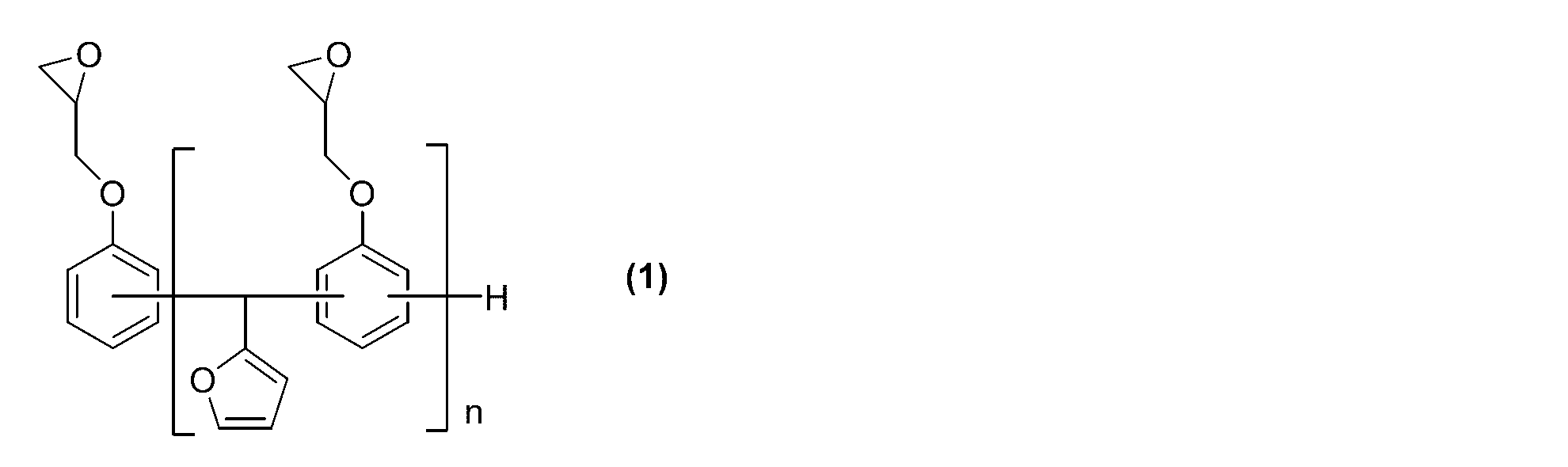
下記式(1)で表され、エポキシ当量が210g/eq.以上218g/eq.以下であるエポキシ樹脂。
That is, the present invention is as shown in [1] to [5] below. In the present invention, "(numerical value 1) to (numerical value 2)" indicates that the upper and lower limits are included.
[1]
It is represented by the following formula (1), and the epoxy equivalent is 210 g/eq. More than 218g/eq. Epoxy resin which is:

(式(1)中、nは繰り返し数の平均値であり、1<n<15の実数を示す。)
[2]
前項[1]に記載のエポキシ樹脂と、硬化剤とを含有する硬化性樹脂組成物。
[3]
前記硬化剤がアミン系硬化剤である前項[2]に記載の硬化性樹脂組成物。
[4]
前項[2]または[3]に記載の硬化性樹脂組成物を硬化してなる硬化物。
[5]
前項[2]または[3]に記載の硬化性樹脂組成物を硬化してなる炭素繊維強化複合材料。
(In formula (1), n is the average value of the number of repetitions, and represents a real number of 1<n<15.)
[2]
A curable resin composition containing the epoxy resin according to item [1] above and a curing agent.
[3]
The curable resin composition according to item [2] above, wherein the curing agent is an amine-based curing agent.
[4]
A cured product obtained by curing the curable resin composition according to item [2] or [3].
[5]
A carbon fiber-reinforced composite material obtained by curing the curable resin composition according to item [2] or [3].
本発明によれば、その硬化物が耐熱性、曲げ強度に優れるエポキシ樹脂、硬化性樹脂組成物、及びこれらの硬化物並びに炭素繊維強化複合材料を提供することができる。 According to the present invention, it is possible to provide an epoxy resin, a curable resin composition, a cured product thereof, and a carbon fiber reinforced composite material, the cured product of which has excellent heat resistance and bending strength.
以下、本発明に係る実施形態(以下、「本実施形態」とも記す)について、さらに詳細に説明する。 Hereinafter, an embodiment (hereinafter also referred to as "this embodiment") according to the present invention will be described in more detail.
本実施形態のエポキシ樹脂は、下記式(1)で表されるものであって、エポキシ当量は、210g/eq.以上218g/eq.以下であることが好ましく、211g/eq.以上218g/eq.以下であることがより好ましく、213g/eq.以上218g/eq.以下であることがさらに好ましい。エポキシ当量が210g/eq.以上であると耐熱性が良好となり、218g/eq.以下であると曲げ強度が良好となる。すなわち、エポキシ当量は、210g/eq.以上218g/eq.以下であることにより耐熱性と曲げ強度の特性を両立することができる。 The epoxy resin of this embodiment is represented by the following formula (1), and has an epoxy equivalent of 210 g/eq. More than 218g/eq. It is preferably less than 211g/eq. More than 218g/eq. It is more preferably less than 213g/eq. More than 218g/eq. It is more preferable that it is the following. Epoxy equivalent is 210g/eq. If it is above, the heat resistance will be good, and it will be 218 g/eq. If it is below, the bending strength will be good. That is, the epoxy equivalent is 210 g/eq. More than 218g/eq. By satisfying the following conditions, both heat resistance and bending strength can be achieved.
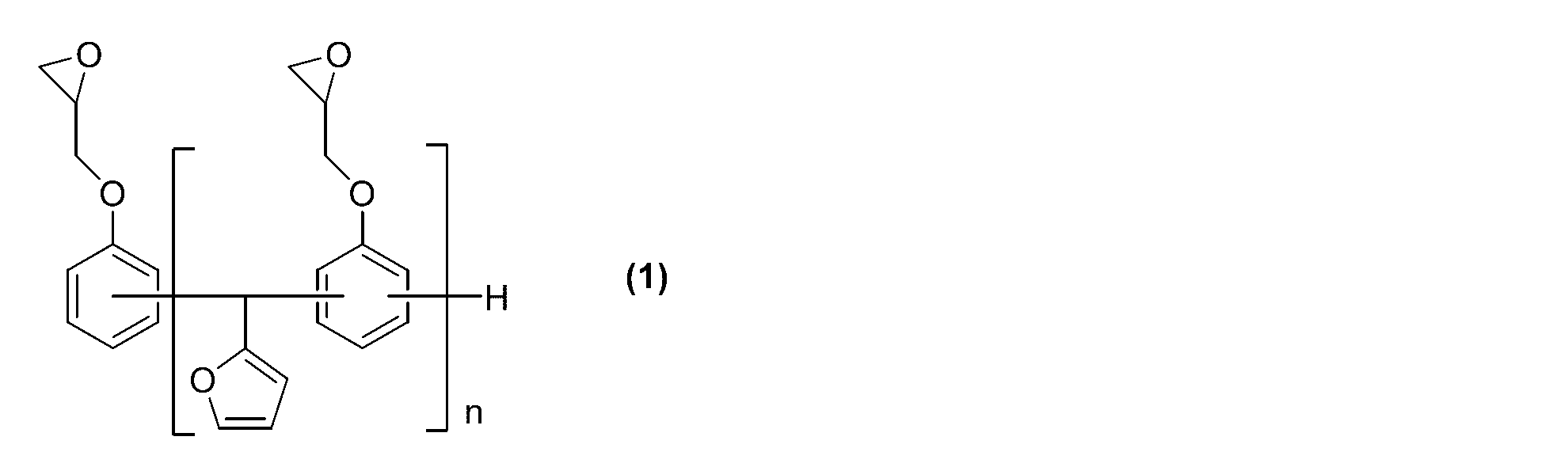
(式(1)中、nは繰り返し数の平均値であり、1<n<15の実数を示す。) (In formula (1), n is the average value of the number of repetitions, and represents a real number of 1<n<15.)
前記式(1)中、nの値はエポキシ樹脂のゲルパーミエーションクロマトグラフィー(GPC、検出器:RI)の測定により求められた数平均分子量、あるいは分離したピークの各々の面積比から算出することができる。nは1<n<15の実数であることが好ましく、1<n<10であることがさら好ましく、1<n<5であることが特に好ましい。 In the above formula (1), the value of n is calculated from the number average molecular weight determined by gel permeation chromatography (GPC, detector: RI) measurement of the epoxy resin, or the area ratio of each separated peak. I can do it. It is preferable that n is a real number such that 1<n<15, more preferably 1<n<10, and particularly preferably 1<n<5.
本実施形態のエポキシ樹脂は、エポキシ当量をコントロールすることで、耐熱性、曲げ強度に優れる硬化物を得ることができる。曲げ強度は100~130MPaであることが好ましく、より好ましくは105~125MPaであり、さらに好ましくは110~120MPaである。曲げ強度が100MPa未満であると炭素繊維強化複合材料としたときの曲げ強度が十分でなく信頼性の低下を招くため好ましくない。なお、本実施形態の曲げ強度は後述の実施例に記載の方法で測定する。 By controlling the epoxy equivalent of the epoxy resin of this embodiment, a cured product having excellent heat resistance and bending strength can be obtained. The bending strength is preferably 100 to 130 MPa, more preferably 105 to 125 MPa, and still more preferably 110 to 120 MPa. If the bending strength is less than 100 MPa, the bending strength when made into a carbon fiber reinforced composite material is insufficient, leading to a decrease in reliability, which is not preferable. Note that the bending strength of this embodiment is measured by the method described in Examples below.
また、本実施形態のエポキシ樹脂から得られる硬化物の曲げ最大伸度は5%以上であるときが特に好ましい。最大値は特に制限がなくても構わないが、好ましい最大値は7%以下である。曲げ最大伸度が5%以上であることで硬化物のも脆さを緩和することができ、強靭な硬化物となる。 Further, it is particularly preferable that the maximum bending elongation of the cured product obtained from the epoxy resin of this embodiment is 5% or more. The maximum value does not need to be particularly limited, but the preferred maximum value is 7% or less. When the maximum bending elongation is 5% or more, the brittleness of the cured product can be alleviated, resulting in a strong cured product.
耐熱性(Tg)は180~300℃であることが好ましく、より好ましくは185~250℃であり、さらに好ましくは190~200℃であり、特に好ましくは220~250℃である。耐熱性が180℃未満であると航空機のエンジン回りなど耐熱性が求められる部材への適応は困難となり、使用時に樹脂が軟化し機械的強度が著しく低くなり、材料の破損につながるので好ましくない。また、エポキシ樹脂の耐熱性は一般的に架橋密度と相関があり、架橋密度が高くなると耐熱性は高くなる。つまり耐熱性が300℃を超えると、架橋密度が高くなり硬化物が脆くなるため好ましくない。なお、本実施形態の耐熱性(Tg)は後述の実施例に記載の方法で測定する。 The heat resistance (Tg) is preferably 180 to 300°C, more preferably 185 to 250°C, even more preferably 190 to 200°C, particularly preferably 220 to 250°C. If the heat resistance is less than 180°C, it will be difficult to apply it to parts that require heat resistance, such as around aircraft engines, and the resin will soften during use, significantly lowering its mechanical strength, leading to damage to the material, which is undesirable. Furthermore, the heat resistance of an epoxy resin generally has a correlation with the crosslink density, and the higher the crosslink density, the higher the heat resistance. That is, if the heat resistance exceeds 300°C, the crosslinking density will increase and the cured product will become brittle, which is not preferable. Note that the heat resistance (Tg) of this embodiment is measured by the method described in Examples below.
前記式(1)で表されるエポキシ樹脂は、下記式(2)で表されるフェノール樹脂とエピハロヒドリンの反応により得ることができる。 The epoxy resin represented by the formula (1) can be obtained by reacting a phenol resin represented by the following formula (2) with epihalohydrin.
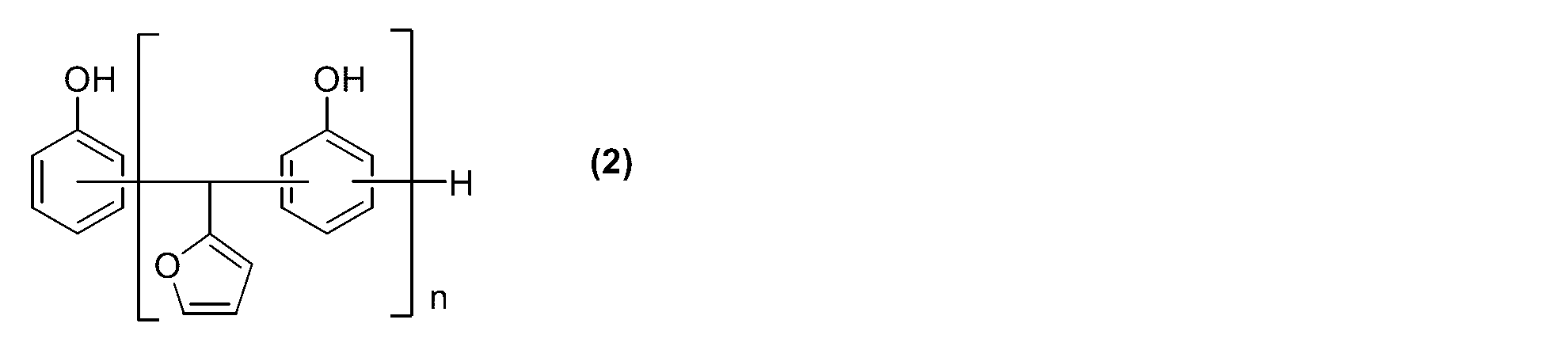
(式(2)中、nは繰り返し数の平均値であり、1<n<15の実数を示す。) (In formula (2), n is the average value of the number of repetitions, and represents a real number of 1<n<15.)
前記式(2)中のnの好ましい範囲は前記式(1)と同じである。 The preferred range of n in the formula (2) is the same as in the formula (1).
前記エピハロヒドリンは市場から容易に入手できる。エピハロヒドリンの使用量は原料フェノール混合物の水酸基1モルに対し好ましくは2.0~10モル、より好ましくは3.0~8.0モル、さらに好ましくは3.5~6.0モルである。本実施形態において用いうるエピハロヒドリンとしては、エピクロルヒドリン、α-メチルエピクロルヒドリン、β-メチルエピクロルヒドリン、エピブロモヒドリン等が好ましく挙げられ、特に、工業的に入手が容易なエピクロルヒドリンが好ましい。 The epihalohydrin is easily available on the market. The amount of epihalohydrin used is preferably 2.0 to 10 mol, more preferably 3.0 to 8.0 mol, and still more preferably 3.5 to 6.0 mol per mol of hydroxyl group in the raw material phenol mixture. Preferred examples of the epihalohydrin that can be used in this embodiment include epichlorohydrin, α-methylepichlorohydrin, β-methylepichlorohydrin, epibromohydrin, and the like, and epichlorohydrin, which is industrially easily available, is particularly preferred.
上記反応において、エポキシ化工程を促進する触媒としてアルカリ金属水酸化物を使用することができる。使用しうるアルカリ金属水酸化物としては水酸化ナトリウム、水酸化カリウム等が挙げられ、固形物を利用してもよく、その水溶液を使用してもよいが、本実施形態においては特に、溶解性、ハンドリングの面からフレーク状に成型された固形物の使用が好ましい。アルカリ金属水酸化物の使用量は原料フェノール混合物の水酸基1モルに対して好ましくは0.90~1.5モルであり、より好ましくは0.95~1.25モル、さらに好ましくは0.99~1.15モルである。 In the above reaction, an alkali metal hydroxide can be used as a catalyst to accelerate the epoxidation process. Examples of alkali metal hydroxides that can be used include sodium hydroxide, potassium hydroxide, etc., and solid forms or aqueous solutions thereof may be used. From the viewpoint of handling, it is preferable to use a solid material shaped into flakes. The amount of alkali metal hydroxide used is preferably 0.90 to 1.5 mol, more preferably 0.95 to 1.25 mol, and even more preferably 0.99 mol per mol of hydroxyl group in the raw material phenol mixture. ~1.15 mol.
また、反応を促進するためにテトラメチルアンモニウムクロライド、テトラメチルアンモニウムブロマイド、トリメチルベンジルアンモニウムクロライド等の4級アンモニウム塩を触媒として添加してもかまわない。4級アンモニウム塩の使用量としては原料フェノール混合物の水酸基1モルに対し好ましくは0.1~15gであり、より好ましくは0.2~10gである。 Further, in order to promote the reaction, a quaternary ammonium salt such as tetramethylammonium chloride, tetramethylammonium bromide, trimethylbenzylammonium chloride, etc. may be added as a catalyst. The amount of the quaternary ammonium salt to be used is preferably 0.1 to 15 g, more preferably 0.2 to 10 g, per mole of hydroxyl groups in the raw phenol mixture.
反応温度は好ましくは30~90℃であり、より好ましくは35~80℃である。特に本実施形態においては、より高純度なエポキシ化のために50℃以上が好ましく、特に60℃以上が好ましい。反応時間は好ましくは0.5~10時間であり、より好ましくは1~8時間、特に好ましくは1~3時間である。反応時間が短いと反応が進みきらず、反応時間が長くなると副生成物ができることから好ましくない。 The reaction temperature is preferably 30 to 90°C, more preferably 35 to 80°C. Particularly in this embodiment, the temperature is preferably 50°C or higher, particularly preferably 60°C or higher for higher purity epoxidation. The reaction time is preferably 0.5 to 10 hours, more preferably 1 to 8 hours, particularly preferably 1 to 3 hours. If the reaction time is too short, the reaction will not proceed to completion, and if the reaction time is too long, by-products will be produced, which is not preferable.
これらのエポキシ化反応の反応物を水洗後、または水洗無しに加熱減圧下でエピハロヒドリンや溶媒等を除去する。また更に加水分解性ハロゲンの少ないエポキシ樹脂とするために、回収したエポキシ樹脂を炭素数4~7のケトン化合物(たとえば、メチルイソブチルケトン、メチルエチルケトン、シクロペンタノン、シクロヘキサノン等が挙げられる。)を溶剤として溶解し、水酸化ナトリウム、水酸化カリウムなどのアルカリ金属水酸化物の水溶液を加えて反応を行い、閉環を確実なものにすることもできる。この場合アルカリ金属水酸化物の使用量はエポキシ化に使用した原料フェノール混合物の水酸基1モルに対して好ましくは0.01~0.3モル、好ましくは0.05~0.2モルである。反応温度は好ましくは50~120℃、反応時間はより好ましくは0.5~2時間である。 After washing the reactants of these epoxidation reactions with water, or without washing with water, epihalohydrin, solvent, etc. are removed under heating and reduced pressure. Furthermore, in order to obtain an epoxy resin with even less hydrolyzable halogen, the recovered epoxy resin is treated with a ketone compound having 4 to 7 carbon atoms (for example, methyl isobutyl ketone, methyl ethyl ketone, cyclopentanone, cyclohexanone, etc.) as a solvent. It is also possible to ensure ring closure by dissolving the compound as a reaction mixture and adding an aqueous solution of an alkali metal hydroxide such as sodium hydroxide or potassium hydroxide to carry out the reaction. In this case, the amount of alkali metal hydroxide used is preferably 0.01 to 0.3 mol, preferably 0.05 to 0.2 mol, per 1 mol of hydroxyl groups in the raw material phenol mixture used for epoxidation. The reaction temperature is preferably 50 to 120°C, and the reaction time is more preferably 0.5 to 2 hours.
反応終了後、生成した塩を濾過、水洗などにより除去し、更に加熱減圧下溶剤を留去することにより本実施形態のエポキシ樹脂が得られる。 After the reaction is completed, the produced salt is removed by filtration, washing with water, etc., and the solvent is distilled off under heating and reduced pressure to obtain the epoxy resin of this embodiment.
前記式(2)で表されるフェノール樹脂の合成法としては、フルフラールとフェノール類との反応(縮合)を行う場合、フェノール類の量はフルフラール1モルに対して好ましくは1.5~20モル、特に好ましくは3~10モルの範囲である。 As a method for synthesizing the phenolic resin represented by the above formula (2), when reacting (condensing) furfural with phenols, the amount of phenols is preferably 1.5 to 20 mol per 1 mol of furfural. , particularly preferably in the range of 3 to 10 mol.
フェノール類としては、2置換フェノールとしてカテコール、レゾルシノール、ハイドロキノン、1置換フェノールとしてフェノール、クレゾール、キシレノールが挙げられ、単独でも2種類以上を併用しても良い。 Examples of phenols include catechol, resorcinol, and hydroquinone as di-substituted phenols, and phenol, cresol, and xylenol as mono-substituted phenols, and may be used alone or in combination of two or more types.
溶媒としては、メタノール、エタノール、プロパノール、イソプロパノール、トルエン、キシレンなどが挙げられるがこれらに限定される物ではなく、単独でも2種以上併用してもよい。溶媒を使用する場合、その使用量はフェノール100重量部に対し、好ましくは5~500重量部、より好ましくは10~300重量部の範囲である。 Examples of the solvent include methanol, ethanol, propanol, isopropanol, toluene, xylene, etc., but are not limited to these, and may be used alone or in combination of two or more. When a solvent is used, the amount used is preferably 5 to 500 parts by weight, more preferably 10 to 300 parts by weight, based on 100 parts by weight of phenol.
上記縮合反応においては塩基触媒を用いるのが好ましい。酸性触媒でも縮重合は可能であるが、フルフラール同士の反応も起こり、副成物が多くなる。また、有機金属化合物を用いる方法もあるが、コスト的に不利である。塩基性触媒の具体例としては、水酸化リチウム、水酸化ナトリウム、水酸化カリウム等のアルカリ金属水酸化物、水酸化マグネシウム、水酸化カルシウム等のアルカリ土類金属水酸化物、ナトリウムメトキシド、ナトリウムエトキシド、カリウムメトキシド、カリウムエトキシド、カリウム-tert-ブトキシド等のアルカリ金属アルコキシド、マグネシウムメトキシド、マグネシウムエトキシド等のアルカリ土類金属アルコキシド等が挙げられるが、これらに限定される物ではなく、単独でも2種以上を併用してもよい。触媒の使用量は、フェノール1モルに対し、好ましくは0.005~2.0倍モル、より好ましくは0.01~1.1倍モルである。 It is preferable to use a base catalyst in the above condensation reaction. Condensation polymerization is possible even with an acidic catalyst, but reactions between furfurals also occur, resulting in a large amount of byproducts. There is also a method using an organometallic compound, but this is disadvantageous in terms of cost. Specific examples of basic catalysts include alkali metal hydroxides such as lithium hydroxide, sodium hydroxide, and potassium hydroxide, alkaline earth metal hydroxides such as magnesium hydroxide and calcium hydroxide, sodium methoxide, and sodium hydroxide. Examples include, but are not limited to, alkali metal alkoxides such as ethoxide, potassium methoxide, potassium ethoxide, and potassium tert-butoxide, and alkaline earth metal alkoxides such as magnesium methoxide and magnesium ethoxide. , may be used alone or in combination of two or more. The amount of catalyst used is preferably 0.005 to 2.0 times, more preferably 0.01 to 1.1 times, per mole of phenol.
これら塩基触媒存在下の縮合反応は好ましくは40~180℃の範囲で行われるのが好ましく、特に好ましくは80~165℃の範囲で行われ、反応時間は好ましくは0.5~10時間の範囲で選定することができる。こうして得られた反応物は系内が中性になるように中和を行ったり溶媒の存在下に水洗を繰り返したりしたのち、水を分離排水後、加熱減圧下、溶媒及び未反応物を除去することにより前記式(2)で表されるフェノール樹脂が得られる。 These condensation reactions in the presence of a base catalyst are preferably carried out at a temperature in the range of 40 to 180°C, particularly preferably in the range of 80 to 165°C, and the reaction time is preferably in the range of 0.5 to 10 hours. can be selected. The reaction product thus obtained is neutralized to make the system neutral, and after repeated washing with water in the presence of a solvent, the water is separated and drained, and the solvent and unreacted materials are removed under heating and reduced pressure. By doing so, a phenol resin represented by the above formula (2) is obtained.
本実施形態の硬化性樹脂組成物は硬化剤を含有する。用い得る硬化剤としては、例えばアミン系硬化剤、酸無水物系硬化剤、アミド系硬化剤、及びフェノール系硬化剤等が挙げられる。 The curable resin composition of this embodiment contains a curing agent. Examples of the curing agent that can be used include amine curing agents, acid anhydride curing agents, amide curing agents, and phenolic curing agents.
本実施形態の硬化性樹脂組成物においては、特に硬化性樹脂組成物の樹脂粘度と樹脂硬化物の耐熱性をバランス良く両立できるためアミン硬化剤が好ましい。アミン系硬化剤としては、3,3’-ジアミノジフェニルスルホン(3,3’-DDS)、4,4’-ジアミノジフェニルスルホン(4,4’-DDS)、ジアミノジフェニルメタン(DDM)、3,3’-ジイソプロピル-4,4’-ジアミノジフェニルメタン、3,3’-ジ-t-ブチル-4,4’-ジアミノジフェニルメタン、3,3’-ジエチル-5,5’-ジメチル-4,4’-ジアミノジフェニルメタン、3,3’-ジイソプロピル-5,5’-ジメチル-4,4’-ジアミノジフェニルメタン、3,3’-ジ-t-ブチル-5,5’-ジメチル-4,4’-ジアミノジフェニルメタン、3,3’,5,5’-テトラエチル-4,4’-ジアミノジフェニルメタン(TEDDM)、3,3’-ジイソプロピル-5,5’-ジエチル-4,4’-ジアミノジフェニルメタン、3,3’-ジ-t-ブチル-5,5’-ジエチル-4,4’-ジアミノジフェニルメタン、3,3’,5,5’-テトライソプロピル-4,4’-ジアミノジフェニルメタン、3,3’-ジ-t-ブチル-5,5’-ジイソプロピル-4,4’-ジアミノジフェニルメタン、3,3’,5,5’-テトラ-t-ブチル-4,4’-ジアミノジフェニルメタン、ジアミノジフェニルエーテル(DADPE)、ビスアニリン、ベンジルジメチルアニリン、2-(ジメチルアミノメチル)フェノール(DMP-10)、2,4,6-トリス(ジメチルアミノメチル)フェノール(DMP-30)、2,4,6-トリス(ジメチルアミノメチル)フェノールの2-エチルヘキサン酸エステル等を使用することができる。また、アニリンノボラック、オルソエチルアニリンノボラック、アニリンとキシリレンクロライドとの反応により得られるアニリン樹脂、アニリンと置換ビフェニル類(4,4’-ビス(クロルメチル)-1,1’-ビフェニル及び4,4’-ビス(メトキシメチル)-1,1’-ビフェニル等)、若しくは置換フェニル類(1,4-ビス(クロロメチル)ベンゼン、1,4-ビス(メトキシメチル)ベンゼン及び1,4-ビス(ヒドロキシメチル)ベンゼン等)等との重縮合により得られるアニリン樹脂等が挙げられる。 In the curable resin composition of the present embodiment, an amine curing agent is particularly preferred because it can achieve both the resin viscosity of the curable resin composition and the heat resistance of the cured resin product in a well-balanced manner. Examples of the amine curing agent include 3,3'-diaminodiphenylsulfone (3,3'-DDS), 4,4'-diaminodiphenylsulfone (4,4'-DDS), diaminodiphenylmethane (DDM), 3,3 '-diisopropyl-4,4'-diaminodiphenylmethane, 3,3'-di-t-butyl-4,4'-diaminodiphenylmethane, 3,3'-diethyl-5,5'-dimethyl-4,4'- Diaminodiphenylmethane, 3,3'-diisopropyl-5,5'-dimethyl-4,4'-diaminodiphenylmethane, 3,3'-di-t-butyl-5,5'-dimethyl-4,4'-diaminodiphenylmethane , 3,3',5,5'-tetraethyl-4,4'-diaminodiphenylmethane (TEDDM), 3,3'-diisopropyl-5,5'-diethyl-4,4'-diaminodiphenylmethane, 3,3' -di-t-butyl-5,5'-diethyl-4,4'-diaminodiphenylmethane, 3,3',5,5'-tetraisopropyl-4,4'-diaminodiphenylmethane, 3,3'-di- t-Butyl-5,5'-diisopropyl-4,4'-diaminodiphenylmethane, 3,3',5,5'-tetra-t-butyl-4,4'-diaminodiphenylmethane, diaminodiphenyl ether (DADPE), bisaniline , benzyldimethylaniline, 2-(dimethylaminomethyl)phenol (DMP-10), 2,4,6-tris(dimethylaminomethyl)phenol (DMP-30), 2,4,6-tris(dimethylaminomethyl) 2-ethylhexanoic acid ester of phenol and the like can be used. In addition, aniline novolak, orthoethylaniline novolac, aniline resin obtained by the reaction of aniline and xylylene chloride, aniline and substituted biphenyls (4,4'-bis(chloromethyl)-1,1'-biphenyl and 4,4 '-bis(methoxymethyl)-1,1'-biphenyl) or substituted phenyls (1,4-bis(chloromethyl)benzene, 1,4-bis(methoxymethyl)benzene and 1,4-bis( Examples include aniline resins obtained by polycondensation with hydroxymethyl)benzene, etc.).
酸無水物系硬化剤としては無水フタル酸、無水トリメリット酸、無水ピロメリット酸、無水マレイン酸、テトラヒドロ無水フタル酸、メチルテトラヒドロ無水フタル酸、無水メチルナジック酸、ヘキサヒドロ無水フタル酸及びメチルヘキサヒドロ無水フタル酸等が挙げられる。 Examples of acid anhydride curing agents include phthalic anhydride, trimellitic anhydride, pyromellitic anhydride, maleic anhydride, tetrahydrophthalic anhydride, methyltetrahydrophthalic anhydride, methylnadic anhydride, hexahydrophthalic anhydride, and methylhexahydro. Examples include phthalic anhydride.
アミド系硬化剤としては、ジシアンジアミド、若しくはリノレン酸の2量体とエチレンジアミンより合成されるポリアミド樹脂等が挙げられる。 Examples of the amide curing agent include polyamide resins synthesized from dicyandiamide or a dimer of linolenic acid and ethylenediamine.
フェノール系硬化剤としては、多価フェノール類(ビスフェノールA、ビスフェノールF、ビスフェノールS、フルオレンビスフェノール、テルペンジフェノール、4,4’-ジヒドロキシビフェニル、2,2’-ジヒドロキシビフェニル、3,3’,5,5’-テトラメチル-(1,1’-ビフェニル)-4,4’-ジオール、ハイドロキノン、レゾルシン、ナフタレンジオール、トリス-(4-ヒドロキシフェニル)メタン及び1,1,2,2-テトラキス(4-ヒドロキシフェニル)エタン等);フェノール類(例えば、フェノール、アルキル置換フェノール、ナフトール、アルキル置換ナフトール、ジヒドロキシベンゼン及びジヒドロキシナフタレン等)と、アルデヒド類(ホルムアルデヒド、アセトアルデヒド、ベンズアルデヒド、p-ヒドロキシベンズアルデヒド、o-ヒドロキシベンズアルデヒド及びフルフラール等)、ケトン類(p-ヒドロキシアセトフェノン及びo-ヒドロキシアセトフェノン等)、若しくはジエン類(ジシクロペンタジエン及びトリシクロペンタジエン等)との縮合により得られるフェノール樹脂;前記フェノール類と、置換ビフェニル類(4,4’-ビス(クロルメチル)-1,1’-ビフェニル及び4,4’-ビス(メトキシメチル)-1,1’-ビフェニル等)、若しくは置換フェニル類(1,4-ビス(クロロメチル)ベンゼン、1,4-ビス(メトキシメチル)ベンゼン及び1,4-ビス(ヒドロキシメチル)ベンゼン等)等との重縮合により得られるフェノール樹脂;前記フェノール類及び/又は前記フェノール樹脂の変性物;テトラブロモビスフェノールA及び臭素化フェノール樹脂等のハロゲン化フェノール類が挙げられる。 As the phenolic curing agent, polyhydric phenols (bisphenol A, bisphenol F, bisphenol S, fluorene bisphenol, terpene diphenol, 4,4'-dihydroxybiphenyl, 2,2'-dihydroxybiphenyl, 3,3',5 , 5'-tetramethyl-(1,1'-biphenyl)-4,4'-diol, hydroquinone, resorcinol, naphthalene diol, tris-(4-hydroxyphenyl)methane and 1,1,2,2-tetrakis( (4-hydroxyphenyl)ethane, etc.); phenols (e.g., phenol, alkyl-substituted phenol, naphthol, alkyl-substituted naphthol, dihydroxybenzene, dihydroxynaphthalene, etc.); aldehydes (formaldehyde, acetaldehyde, benzaldehyde, p-hydroxybenzaldehyde, o - phenolic resin obtained by condensation with hydroxybenzaldehyde, furfural, etc.), ketones (p-hydroxyacetophenone, o-hydroxyacetophenone, etc.), or dienes (dicyclopentadiene, tricyclopentadiene, etc.); Substituted biphenyls (4,4'-bis(chloromethyl)-1,1'-biphenyl and 4,4'-bis(methoxymethyl)-1,1'-biphenyl, etc.), or substituted phenyls (1,4- phenol resin obtained by polycondensation with bis(chloromethyl)benzene, 1,4-bis(methoxymethyl)benzene, 1,4-bis(hydroxymethyl)benzene, etc.); the above phenols and/or the above phenol resin modified products; examples include halogenated phenols such as tetrabromobisphenol A and brominated phenol resins.
本実施形態の硬化性樹脂組成物において、前記式(2)で表されるフェノール樹脂を硬化剤の全量、あるいはその一部として使用することも好ましい。 In the curable resin composition of this embodiment, it is also preferable to use the phenol resin represented by formula (2) above as the entire amount of the curing agent or as a part thereof.
本実施形態の硬化性樹脂組成物において硬化剤の使用量は、エポキシ樹脂のエポキシ基1当量に対して0.7~1.2当量が好ましい。エポキシ基1当量に対して0.7当量に満たない場合、或いは1.2当量を越える場合、いずれも硬化が不完全になり、良好な硬化物性が得られない恐れがある。 In the curable resin composition of the present embodiment, the amount of curing agent used is preferably 0.7 to 1.2 equivalents per equivalent of epoxy groups in the epoxy resin. If the amount is less than 0.7 equivalents or more than 1.2 equivalents per equivalent of epoxy group, curing may be incomplete and good cured physical properties may not be obtained.
また本実施形態の硬化性樹脂組成物においては必要に応じて、硬化促進剤を配合しても良い。硬化促進剤を使用することによりゲル化時間を調整することもできる。使用できる硬化促進剤の例としては2-メチルイミダゾール、2-エチルイミダゾール、2-エチル-4-メチルイミダゾールなどのイミダゾール類、2-(ジメチルアミノメチル)フェノール、1,8-ジアザ-ビシクロ[5,4,0]ウンデセン-7等の第3級アミン類、トリフェニルホスフィンなどのホスフィン類、オクチル酸スズ等の金属化合物が挙げられる。硬化促進剤はエポキシ樹脂100重量部に対して0.01~5.0重量部が必要に応じ用いられる。 Further, in the curable resin composition of this embodiment, a curing accelerator may be added as necessary. The gelation time can also be adjusted by using a curing accelerator. Examples of curing accelerators that can be used include imidazoles such as 2-methylimidazole, 2-ethylimidazole, and 2-ethyl-4-methylimidazole, 2-(dimethylaminomethyl)phenol, and 1,8-diaza-bicyclo[5 ,4,0]undecene-7, phosphines such as triphenylphosphine, and metal compounds such as tin octylate. The curing accelerator is used in an amount of 0.01 to 5.0 parts by weight based on 100 parts by weight of the epoxy resin, if necessary.
本実施形態の硬化性樹脂組成物においては、他のエポキシ樹脂を配合しても良く、具体例としては、フェノール類(フェノール、アルキル置換フェノール、芳香族置換フェノール、ナフトール、アルキル置換ナフトール、ジヒドロキシベンゼン、アルキル置換ジヒドロキシベンゼン、ジヒドロキシナフタレン等)と各種アルデヒド(ホルムアルデヒド、アセトアルデヒド、アルキルアルデヒド、ベンズアルデヒド、アルキル置換ベンズアルデヒド、ヒドロキシベンズアルデヒド、ナフトアルデヒド、グルタルアルデヒド、フタルアルデヒド、クロトンアルデヒド、シンナムアルデヒド等)との重縮合物、フェノール類と各種ジエン化合物(ジシクロペンタジエン、テルペン類、ビニルシクロヘキセン、ノルボルナジエン、ビニルノルボルネン、テトラヒドロインデン、ジビニルベンゼン、ジビニルビフェニル、ジイソプロペニルビフェニル、ブタジエン、イソプレン等)との重合物、フェノール類とケトン類(アセトン、メチルエチルケトン、メチルイソブチルケトン、アセトフェノン、ベンゾフェノン等)との重縮合物、フェノール類と置換ビフェニル類(4,4’-ビス(クロルメチル)-1,1’-ビフェニル及び4,4’-ビス(メトキシメチル)-1,1’-ビフェニル等)、若しくは置換フェニル類(1,4-ビス(クロロメチル)ベンゼン、1,4-ビス(メトキシメチル)ベンゼン及び1,4-ビス(ヒドロキシメチル)ベンゼン等)等との重縮合により得られるフェノール樹脂、ビスフェノール類と各種アルデヒドの重縮合物、アルコール類等をグリシジル化したグリシジルエーテル系エポキシ樹脂、4-ビニル-1-シクロヘキセンジエポキシドや3,4-エポキシシクロヘキシルメチル-3,4’-エポキシシクロヘキサンカルボキシラートなどを代表とする脂環式エポキシ樹脂、テトラグリシジルジアミノジフェニルメタン(TGDDM)やトリグリシジル-p-アミノフェノールなどを代表とするグリシジルアミン系エポキシ樹脂、グリシジルエステル系エポキシ樹脂等が挙げられるが、通常用いられるエポキシ樹脂であればこれらに限定されるものではない。 In the curable resin composition of this embodiment, other epoxy resins may be blended, and specific examples include phenols (phenol, alkyl-substituted phenol, aromatic substituted phenol, naphthol, alkyl-substituted naphthol, dihydroxybenzene). , alkyl-substituted dihydroxybenzene, dihydroxynaphthalene, etc.) and various aldehydes (formaldehyde, acetaldehyde, alkyl aldehyde, benzaldehyde, alkyl-substituted benzaldehyde, hydroxybenzaldehyde, naphthaldehyde, glutaraldehyde, phthalaldehyde, crotonaldehyde, cinnamaldehyde, etc.). Polymers of phenols and various diene compounds (dicyclopentadiene, terpenes, vinylcyclohexene, norbornadiene, vinylnorbornene, tetrahydroindene, divinylbenzene, divinylbiphenyl, diisopropenylbiphenyl, butadiene, isoprene, etc.), phenols and ketones (acetone, methyl ethyl ketone, methyl isobutyl ketone, acetophenone, benzophenone, etc.), phenols and substituted biphenyls (4,4'-bis(chloromethyl)-1,1'-biphenyl and 4,4 '-bis(methoxymethyl)-1,1'-biphenyl) or substituted phenyls (1,4-bis(chloromethyl)benzene, 1,4-bis(methoxymethyl)benzene and 1,4-bis( Phenol resins obtained by polycondensation with hydroxymethyl)benzene, etc., polycondensates of bisphenols and various aldehydes, glycidyl ether epoxy resins obtained by glycidylating alcohols, etc., 4-vinyl-1-cyclohexene diepoxide, etc. Alicyclic epoxy resins such as 3,4-epoxycyclohexylmethyl-3,4'-epoxycyclohexanecarboxylate, and glycidyl amines such as tetraglycidyldiaminodiphenylmethane (TGDDM) and triglycidyl-p-aminophenol. Examples include glycidyl ester type epoxy resins and glycidyl ester type epoxy resins, but the epoxy resins are not limited to these as long as they are commonly used epoxy resins.
本実施形態の硬化性樹脂組成物には、必要に応じて公知の添加剤を配合することができる。用いうる添加剤の具体例としては、ポリブタジエン及びこの変性物、アクリロニトリル共重合体の変性物、ポリフェニレンエーテル、ポリスチレン、ポリエチレン、ポリイミド、フッ素樹脂、マレイミド系化合物、シアネートエステル系化合物、シリコーンゲル、シリコーンオイル、並びにシリカ、アルミナ、炭酸カルシウム、石英粉、アルミニウム粉末、グラファイト、タルク、クレー、酸化鉄、酸化チタン、窒化アルミニウム、アスベスト、マイカ、ガラス粉末等の無機充填材、シランカップリング剤のような充填材の表面処理剤、離型剤、カーボンブラック、フタロシアニンブルー、フタロシアニングリーン等の着色剤が挙げられる。 The curable resin composition of this embodiment may contain known additives, if necessary. Specific examples of additives that can be used include polybutadiene and modified products thereof, modified products of acrylonitrile copolymers, polyphenylene ether, polystyrene, polyethylene, polyimide, fluororesins, maleimide compounds, cyanate ester compounds, silicone gels, and silicone oils. , as well as inorganic fillers such as silica, alumina, calcium carbonate, quartz powder, aluminum powder, graphite, talc, clay, iron oxide, titanium oxide, aluminum nitride, asbestos, mica, glass powder, and fillers such as silane coupling agents. Examples include surface treatment agents for materials, mold release agents, and coloring agents such as carbon black, phthalocyanine blue, and phthalocyanine green.
本実施形態の硬化性樹脂組成物には、必要に応じて公知のマレイミド系化合物を配合することができる。用いうるマレイミド化合物の具体例としては、4,4’-ジフェニルメタンビスマレイミド、ポリフェニルメタンマレイミド、m-フェニレンビスマレイミド、2,2’-ビス〔4-(4-マレイミドフェノキシ)フェニル〕プロパン、3,3’-ジメチル-5,5’-ジエチル-4,4’-ジフェニルメタンビスマレイミド、4-メチル-1,3-フェニレンビスマレイミド、4,4’-ジフェニルエーテルビスマレイミド、4,4’-ジフェニルスルフォンビスマレイミド、1,3-ビス(3-マレイミドフェノキシ)ベンゼン、1,3-ビス(4-マレイミドフェノキシ)ベンゼン、ビフェニルアラルキル型マレイミドなどが挙げられるがこれらに限定されるものではない。これらは単独で用いてもよく、2種以上併用してもよい。マレイミド系化合物を配合する際は、必要により硬化促進剤を配合するが、前記硬化促進剤や、有機化酸化物、アゾ化合物などのラジカル重合開始剤など使用できる。 The curable resin composition of this embodiment may contain a known maleimide compound, if necessary. Specific examples of maleimide compounds that can be used include 4,4'-diphenylmethane bismaleimide, polyphenylmethane maleimide, m-phenylene bismaleimide, 2,2'-bis[4-(4-maleimidophenoxy)phenyl]propane, , 3'-dimethyl-5,5'-diethyl-4,4'-diphenylmethane bismaleimide, 4-methyl-1,3-phenylene bismaleimide, 4,4'-diphenyl ether bismaleimide, 4,4'-diphenyl sulfone Examples include, but are not limited to, bismaleimide, 1,3-bis(3-maleimidophenoxy)benzene, 1,3-bis(4-maleimidophenoxy)benzene, and biphenylaralkyl maleimide. These may be used alone or in combination of two or more. When blending the maleimide compound, a curing accelerator is blended if necessary, and the curing accelerator, radical polymerization initiators such as organic oxides, azo compounds, etc. can be used.
本実施形態の硬化性樹脂組成物は、有機溶剤を添加しワニス状の組成物(以下、単にワニスという。)とすることができる。用いられる溶剤としては、例えばγ-ブチロラクトン類、N-メチルピロリドン、N,N-ジメチルホルムアミド、N,N-ジメチルアセトアミド、N,N-ジメチルイミダゾリジノン等のアミド系溶剤、テトラメチレンスルフォン等のスルフォン類、ジエチレングリコールジメチルエーテル、ジエチレングリコールジエチルエーテル、プロピレングリコール、プロピレングリコールモノメチルエーテル、プロピレングリコールモノメチルエーテルモノアセテート、プロピレングリコールモノブチルエーテル等のエーテル系溶剤、メチルエチルケトン、メチルイソブチルケトン、シクロペンタノン、シクロヘキサノン等のケトン系溶剤、トルエン、キシレンなどの芳香族系溶剤が挙げられる。溶剤は、得られたワニス中の溶剤を除く固形分濃度が好ましくは10~80重量%、より好ましくは20~70重量%となる範囲で使用する。 The curable resin composition of this embodiment can be made into a varnish-like composition (hereinafter simply referred to as varnish) by adding an organic solvent. Examples of the solvents used include amide solvents such as γ-butyrolactones, N-methylpyrrolidone, N,N-dimethylformamide, N,N-dimethylacetamide, and N,N-dimethylimidazolidinone, and tetramethylene sulfone. Ether solvents such as sulfones, diethylene glycol dimethyl ether, diethylene glycol diethyl ether, propylene glycol, propylene glycol monomethyl ether, propylene glycol monomethyl ether monoacetate, propylene glycol monobutyl ether, ketones such as methyl ethyl ketone, methyl isobutyl ketone, cyclopentanone, cyclohexanone, etc. Solvents include aromatic solvents such as toluene and xylene. The solvent is used in such a range that the solid content concentration excluding the solvent in the obtained varnish is preferably 10 to 80% by weight, more preferably 20 to 70% by weight.
本実施形態の硬化性樹脂組成物は、樹脂シート、プリプレグ、炭素繊維強化複合材料として活用することもできる
本実施形態の硬化性樹脂組成物を支持基材の片面または両面に塗布し、樹脂シートとして用いてもよい。塗布方法としては、例えば、注型法、ポンプや押し出し機等により樹脂をノズルやダイスから押し出し、ブレードで厚さを調整する方法、ロールによりカレンダー加工して厚さを表製する方法、スプレー等を用いて噴霧する方法等が挙げられる。なお、層を形成する工程においては、硬化性樹脂組成物の熱分解を回避可能な温度範囲で加熱しながら行ってもよい。また、必要に応じて圧延処理、研削処理等を施してもよい。支持基材としては、例えば紙、布、不織布等からなる多孔質基材、ポリエチレン、ポリプロピレン、ポリエチレンテレフタレート、ポリエステルフィルムなどのプラスチックフィルムあるいはシート、ネット、発泡体、金属箔、およびこれらのラミネート体などの適宜な薄葉体等が挙げられるが、これらに限定されるものではない。支持基材に厚さは特に制限されず、用途に応じて適宜に決定される。
The curable resin composition of this embodiment can also be used as a resin sheet, prepreg, or carbon fiber reinforced composite material. It may also be used as Application methods include, for example, casting, extruding the resin through a nozzle or die using a pump or extruder, adjusting the thickness with a blade, calendering with a roll to measure the thickness, spraying, etc. Examples include a method of spraying using a. In addition, in the step of forming the layer, the curable resin composition may be heated while being heated within a temperature range that can avoid thermal decomposition. Further, rolling treatment, grinding treatment, etc. may be performed as necessary. Examples of supporting substrates include porous substrates made of paper, cloth, nonwoven fabric, etc., plastic films or sheets such as polyethylene, polypropylene, polyethylene terephthalate, and polyester films, nets, foams, metal foils, and laminates thereof. Examples include, but are not limited to, appropriate thin film bodies. The thickness of the supporting base material is not particularly limited and is appropriately determined depending on the application.
本実施形態の硬化性樹脂組成物および/または樹脂シートを加熱溶融して低粘度化して繊維基材に含浸させることにより本実施形態のプリプレグを得ることができる。 The prepreg of this embodiment can be obtained by heating and melting the curable resin composition and/or resin sheet of this embodiment to lower the viscosity and impregnating it into a fiber base material.
また、ワニス状の硬化性樹脂組成物を、繊維基材に含浸させて加熱乾燥させることにより本実施形態のプリプレグを得ることもできる。上記のプリプレグを所望の形に裁断、積層後、積層物にプレス成形法やオートクレーブ成形法、シートワインディング成形法などで圧力をかけながら硬化性樹脂組成物を加熱硬化させることにより本実施形態の炭素繊維強化複合材料を得ることができる。また、プリプレグの積層時に銅箔や有機フィルムを積層することもできる。 Moreover, the prepreg of this embodiment can also be obtained by impregnating a fiber base material with a varnish-like curable resin composition and heating and drying the impregnated fiber base material. After cutting the above prepreg into a desired shape and laminating them, the curable resin composition is heated and cured while applying pressure to the laminate using a press molding method, an autoclave molding method, a sheet winding molding method, etc. A fiber reinforced composite material can be obtained. Moreover, copper foil or an organic film can also be laminated at the time of laminating the prepreg.
さらに、本実施形態の炭素繊維強化複合材料の成形方法は、上記の方法のほかに、公知の方法にて成形して得ることもできる。例えば、炭素繊維基材(通常、炭素繊維織物を使用)を裁断、積層、賦形してプリフォーム(樹脂を含浸する前の予備成形体)を作製、プリフォームを成形型内に配置して型を閉じ、樹脂を注入してプリフォームに含浸、硬化させた後、型を開いて成形品を取り出すレジントランスファー成形技術(RTM法)を用いることもできる。
また、RTM法の一種である、例えば、VaRTM法、SCRIMP(Seeman’s Composite Resin Infusion Molding Process)法、特表2005-527410記載の樹脂供給タンクを大気圧よりも低い圧力まで排気し、循環圧縮を用い、かつ正味の成形圧力を制御することにとよって、樹脂注入プロセス、特にVaRTM法をより適切に制御するCAPRI(Controlled Atmospheric Pressure Resin Infusion)法なども用いることができる。
Furthermore, in addition to the method described above, the carbon fiber reinforced composite material of the present embodiment can be molded by a known method. For example, a carbon fiber base material (usually carbon fiber fabric is used) is cut, laminated, and shaped to create a preform (a preform before being impregnated with resin), and the preform is placed in a mold. It is also possible to use a resin transfer molding technique (RTM method) in which the mold is closed, a resin is injected to impregnate the preform and cured, and then the mold is opened to take out the molded product.
In addition, a type of RTM method, for example, the VaRTM method, the SCRIMP (Seeman's Composite Resin Infusion Molding Process) method, the resin supply tank described in Special Table 2005-527410 is evacuated to a pressure lower than atmospheric pressure, and the cyclic compression is performed. The CAPRI (Controlled Atmospheric Pressure Resin Infusion) method, which more appropriately controls the resin injection process, especially the VaRTM method, can also be used by using and controlling the net molding pressure.
さらに、繊維基材を樹脂シート(フィルム)で挟み込むフィルムスタッキング法や、含浸向上のため強化繊維基材にパウダー状の樹脂を付着させる方法、繊維基材に樹脂を混ぜる過程において流動層あるいは流体スラリー法を用いる成形方法(Powder Impregnated Yarn)、繊維基材に樹脂繊維を混繊させる方法も用いることができる。 In addition, we have developed a film stacking method in which the fiber base material is sandwiched between resin sheets (films), a method in which powdered resin is attached to the reinforcing fiber base material to improve impregnation, and a fluidized bed or fluid slurry method in the process of mixing resin with the fiber base material. A molding method using a powder impregnated yarn method and a method of mixing resin fibers into a fiber base material can also be used.
炭素繊維としては、アクリル系、ピッチ系、レーヨン系などの炭素繊維が挙げられ、なかでも引張強度の高いアクリル系の炭素繊維が好ましく用いられる。炭素繊維の形態としては、有撚糸、解撚糸および無撚糸等を使用することができるが、繊維強化複合材料の成形性と強度特性のバランスが良いため、解撚糸または無撚糸が好ましく用いられる。 Examples of the carbon fibers include acrylic, pitch, and rayon carbon fibers, and among them, acrylic carbon fibers with high tensile strength are preferably used. As the form of the carbon fiber, twisted yarn, untwisted yarn, untwisted yarn, etc. can be used, but untwisted yarn or untwisted yarn is preferably used because it provides a good balance between the formability and strength characteristics of the fiber reinforced composite material.
以下に合成例および実施例を挙げて本発明をさらに具体的に説明する。以下に示す材料、処理内容、処理手順等は、本発明の趣旨を逸脱しない限り適宜変更することができる。したがって、本発明の範囲は以下に示す具体例により限定的に解釈されるべきものではない。 The present invention will be explained in more detail with reference to synthesis examples and examples below. The materials, processing details, processing procedures, etc. shown below can be changed as appropriate without departing from the spirit of the present invention. Therefore, the scope of the present invention should not be interpreted as being limited by the specific examples shown below.
分析方法について以下の条件で行った。
・エポキシ当量
JIS K-7236に記載された方法で測定し、単位はg/eq.である。
・GPC(ゲルパーミエーションクロマトグラフィー)分析
メーカー:Waters
カラム:ガードカラム SHODEX GPC KF-601、KF-602 KF-602.5、KF-603
流速:0.5ml/min.
カラム温度:40℃
使用溶剤:THF(テトラヒドロフラン)
検出器:RI(示差屈折検出器)
The analysis method was conducted under the following conditions.
-Epoxy equivalent Measured by the method described in JIS K-7236, and the unit is g/eq. It is.
・GPC (gel permeation chromatography) analysis Manufacturer: Waters
Column: Guard column SHODEX GPC KF-601, KF-602 KF-602.5, KF-603
Flow rate: 0.5ml/min.
Column temperature: 40℃
Solvent used: THF (tetrahydrofuran)
Detector: RI (differential refraction detector)
[合成例1]
撹拌機、還流冷却管、撹拌装置を備えたフラスコに、フェノール254重量部、水63重量部、水酸化ナトリウム27重量部を仕込み、撹拌、溶解後、110℃へ加熱したところへ、フルフラール63重量部を2時間かけて滴下した。その後110℃で3時間反応させた後、145℃に昇温した。昇温の際、留出してきた水は系外へ除いた。145℃に到達したのちすぐに80℃まで冷却し、水63重量部を仕込み、リン酸4重量部、35%塩酸63重量部を加えて中和した。水洗を繰り返した後、加熱減圧下において、未反応フェノールを留去せしめて、前記式(2)で表されるフェノール樹脂112重量部を得た。得られた前記式(2)で表されるフェノール樹脂78重量部に対してエピクロルヒドリン(ECH、以下同様)254重量部、ジメチルスルホキシド(DMSO、以下同様)64重量部、水13重量部を反応容器に仕込み、加熱、撹拌、溶解後、温度を45℃に保持しながら、フレーク状の水酸化ナトリウム23重量部を2時間かけて分割で仕込んだ。その後、45℃で2時間、70℃で60分更に反応を行った。ついで水洗を繰り返し、副成塩とジメチルスルホキシドを除去した後、油層から加熱減圧下において過剰のエピクロルヒドリンを留去し、残留物に218重量部のメチルイソブチルケトンを添加し溶解した。このメチルイソブチルケトン溶液を70℃に加熱し30%水酸化ナトリウム水溶液7重量部を添加し、1時間反応させた後、反応液の水洗を洗浄液が中性となるまで繰り返した。ついで油層から加熱減圧下においてメチルイソブチルケトンを留去することにより前記式(1)で表されるエポキシ樹脂101重量部を得た(式(1)におけるnは2.2)。得られたエポキシ樹脂のエポキシ当量は218g/eq.であった。
[Synthesis example 1]
254 parts by weight of phenol, 63 parts by weight of water, and 27 parts by weight of sodium hydroxide were charged into a flask equipped with a stirrer, a reflux condenser, and a stirring device, and after stirring and dissolving, the mixture was heated to 110°C, and 63 parts by weight of furfural was added. part was added dropwise over 2 hours. After that, the mixture was reacted at 110°C for 3 hours, and then the temperature was raised to 145°C. When the temperature was raised, the water that had distilled out was removed from the system. After reaching 145°C, it was immediately cooled to 80°C, 63 parts by weight of water was charged, and 4 parts by weight of phosphoric acid and 63 parts by weight of 35% hydrochloric acid were added to neutralize. After repeated washing with water, unreacted phenol was distilled off under heating and reduced pressure to obtain 112 parts by weight of the phenol resin represented by the formula (2). 254 parts by weight of epichlorohydrin (ECH, the same below), 64 parts by weight of dimethyl sulfoxide (DMSO, the same below), and 13 parts by weight of water were added to 78 parts by weight of the obtained phenol resin represented by the above formula (2) in a reaction vessel. After heating, stirring, and dissolving, 23 parts by weight of flaky sodium hydroxide was added in portions over 2 hours while maintaining the temperature at 45°C. Thereafter, the reaction was further carried out at 45°C for 2 hours and at 70°C for 60 minutes. After repeated washing with water to remove by-product salts and dimethyl sulfoxide, excess epichlorohydrin was distilled off from the oil layer under heating and reduced pressure, and 218 parts by weight of methyl isobutyl ketone was added and dissolved in the residue. This methyl isobutyl ketone solution was heated to 70°C, 7 parts by weight of a 30% aqueous sodium hydroxide solution was added, and after reacting for 1 hour, washing of the reaction solution with water was repeated until the washing solution became neutral. Then, methyl isobutyl ketone was distilled off from the oil layer under heating and reduced pressure to obtain 101 parts by weight of an epoxy resin represented by the formula (1) (n in formula (1) is 2.2). The epoxy equivalent of the obtained epoxy resin was 218 g/eq. Met.
[合成例2]
撹拌機、還流冷却管、撹拌装置を備えたフラスコに、フェノール254重量部、水63重量部、水酸化ナトリウム27重量部を仕込み、撹拌、溶解後、110℃へ加熱したところへ、フルフラール53重量部を2時間かけて滴下した。その後110℃で3時間反応させた後、145℃に昇温した。昇温の際、留出してきた水は系外へ除いた。145℃に到達したのち、4時間反応させた。ついで80℃まで冷却し、水63重量部を仕込み、リン酸4重量部、35%塩酸63重量部を加えて中和した。水洗を繰り返した後、加熱減圧下において、未反応フェノールを留去せしめて、前記式(2)で表されるフェノール樹脂109重量部を得た。得られた前記式(2)で表されるフェノール樹脂78重量部に対してECH254重量部、DMSO64重量部、水13重量部を反応容器に仕込み、加熱、撹拌、溶解後、温度を45℃に保持しながら、フレーク状の水酸化ナトリウム23重量部を2時間かけて分割で仕込んだ。その後、45℃で2時間、70℃で60分更に反応を行った。ついで水洗を繰り返し、副成塩とジメチルスルホキシドを除去した後、油層から加熱減圧下において過剰のエピクロルヒドリンを留去し、残留物に218重量部のメチルイソブチルケトンを添加し溶解した。このメチルイソブチルケトン溶液を70℃に加熱し30%水酸化ナトリウム水溶液7重量部を添加し、1時間反応させた後、反応液の水洗を洗浄液が中性となるまで繰り返した。ついで油層から加熱減圧下においてメチルイソブチルケトンを留去することにより前記式(1)で表されるエポキシ樹脂103重量部を得た(式(1)におけるnは2.1)。得られたエポキシ樹脂のエポキシ当量は213g/eq.であった。
[Synthesis example 2]
A flask equipped with a stirrer, a reflux condenser, and a stirring device was charged with 254 parts by weight of phenol, 63 parts by weight of water, and 27 parts by weight of sodium hydroxide. After stirring and dissolving, the mixture was heated to 110°C, and 53 parts by weight of furfural was added. part was added dropwise over 2 hours. After that, the mixture was reacted at 110°C for 3 hours, and then the temperature was raised to 145°C. When the temperature was raised, the water that had distilled out was removed from the system. After reaching 145°C, the reaction was continued for 4 hours. The mixture was then cooled to 80° C., 63 parts by weight of water was charged, and 4 parts by weight of phosphoric acid and 63 parts by weight of 35% hydrochloric acid were added for neutralization. After repeated washing with water, unreacted phenol was distilled off under heating and reduced pressure to obtain 109 parts by weight of a phenol resin represented by the above formula (2). 254 parts by weight of ECH, 64 parts by weight of DMSO, and 13 parts by weight of water were charged into a reaction vessel with respect to 78 parts by weight of the obtained phenol resin represented by the above formula (2), and after heating, stirring, and dissolution, the temperature was raised to 45 ° C. While holding, 23 parts by weight of flaky sodium hydroxide was charged in portions over 2 hours. Thereafter, the reaction was further carried out at 45°C for 2 hours and at 70°C for 60 minutes. After repeated washing with water to remove by-product salts and dimethyl sulfoxide, excess epichlorohydrin was distilled off from the oil layer under heating and reduced pressure, and 218 parts by weight of methyl isobutyl ketone was added and dissolved in the residue. This methyl isobutyl ketone solution was heated to 70°C, 7 parts by weight of a 30% aqueous sodium hydroxide solution was added, and after reacting for 1 hour, washing of the reaction solution with water was repeated until the washing solution became neutral. Then, methyl isobutyl ketone was distilled off from the oil layer under heating and reduced pressure to obtain 103 parts by weight of an epoxy resin represented by the formula (1) (n in formula (1) is 2.1). The epoxy equivalent of the obtained epoxy resin was 213 g/eq. Met.
[合成例3]
撹拌機、還流冷却管、撹拌装置を備えたフラスコに、フェノール254重量部、水63重量部、水酸化ナトリウム27重量部を仕込み、撹拌、溶解後、110℃へ加熱したところへ、フルフラール44重量部を2時間かけて滴下した。その後110℃で3時間反応させた後、145℃に昇温した。昇温の際、留出してきた水は系外へ除いた。145℃に到達したのちすぐに80℃まで冷却し、水63重量部を仕込み、リン酸4重量部、35%塩酸63重量部を加えて中和した。水洗を繰り返した後、加熱減圧下において、未反応フェノールを留去せしめて、前記式(2)で表されるフェノール樹脂109重量部を得た。得られた前記式(2)で表されるフェノール樹脂78重量部に対してECH254重量部、DMSO64重量部、水13重量部を反応容器に仕込み、加熱、撹拌、溶解後、温度を45℃に保持しながら、フレーク状の水酸化ナトリウム23重量部を2時間かけて分割で仕込んだ。その後、45℃で2時間、70℃で60分更に反応を行った。ついで水洗を繰り返し、副成塩とジメチルスルホキシドを除去した後、油層から加熱減圧下において過剰のエピクロルヒドリンを留去し、残留物に218重量部のメチルイソブチルケトンを添加し溶解した。このメチルイソブチルケトン溶液を70℃に加熱し30%水酸化ナトリウム水溶液7重量部を添加し、1時間反応させた後、反応液の水洗を洗浄液が中性となるまで繰り返した。ついで油層から加熱減圧下においてメチルイソブチルケトンを留去することにより前記式(1)で表されるエポキシ樹脂103重量部を得た(式(1)におけるnは2.0)。得られたエポキシ樹脂のエポキシ当量は211g/eq.であった。
[Synthesis example 3]
A flask equipped with a stirrer, a reflux condenser, and a stirring device was charged with 254 parts by weight of phenol, 63 parts by weight of water, and 27 parts by weight of sodium hydroxide. After stirring and dissolving, the mixture was heated to 110°C, and 44 parts by weight of furfural was added. part was added dropwise over 2 hours. After that, the mixture was reacted at 110°C for 3 hours, and then the temperature was raised to 145°C. When the temperature was raised, the water that had distilled out was removed from the system. After reaching 145°C, it was immediately cooled to 80°C, 63 parts by weight of water was charged, and 4 parts by weight of phosphoric acid and 63 parts by weight of 35% hydrochloric acid were added to neutralize. After repeated washing with water, unreacted phenol was distilled off under heating and reduced pressure to obtain 109 parts by weight of a phenol resin represented by the above formula (2). 254 parts by weight of ECH, 64 parts by weight of DMSO, and 13 parts by weight of water were charged into a reaction vessel with respect to 78 parts by weight of the obtained phenol resin represented by the above formula (2), and after heating, stirring, and dissolution, the temperature was raised to 45 ° C. While holding, 23 parts by weight of flaky sodium hydroxide was charged in portions over 2 hours. Thereafter, the reaction was further carried out at 45°C for 2 hours and at 70°C for 60 minutes. After repeated washing with water to remove by-product salts and dimethyl sulfoxide, excess epichlorohydrin was distilled off from the oil layer under heating and reduced pressure, and 218 parts by weight of methyl isobutyl ketone was added and dissolved in the residue. This methyl isobutyl ketone solution was heated to 70°C, 7 parts by weight of a 30% aqueous sodium hydroxide solution was added, and after reacting for 1 hour, washing of the reaction solution with water was repeated until the washing solution became neutral. Then, methyl isobutyl ketone was distilled off from the oil layer under heating and reduced pressure to obtain 103 parts by weight of an epoxy resin represented by the formula (1) (n in formula (1) is 2.0). The epoxy equivalent of the obtained epoxy resin was 211 g/eq. Met.
[合成例4]
撹拌機、還流冷却管、撹拌装置を備えたフラスコに、フェノール254重量部、水63重量部、水酸化ナトリウム27重量部を仕込み、撹拌、溶解後、110℃へ加熱したところへ、フルフラール90重量部を2時間かけて滴下した。その後110℃で3時間反応させた後、145℃に昇温した。昇温の際、留出してきた水は系外へ除いた。145℃に到達したのち、4時間反応させた。ついで80℃まで冷却し、水63重量部を仕込み、リン酸4重量部、35%塩酸63重量部を加えて中和した。水洗を繰り返した後、加熱減圧下において、未反応フェノールを留去せしめて、前記式(2)で表されるフェノール樹脂120重量部を得た。得られた前記式(2)で表されるフェノール樹脂78重量部に対してECH254重量部、DMSO64重量部、水13重量部を反応容器に仕込み、加熱、撹拌、溶解後、温度を45℃に保持しながら、フレーク状の水酸化ナトリウム23重量部を2時間かけて分割で仕込んだ。その後、45℃で2時間、70℃で60分更に反応を行った。ついで水洗を繰り返し、副成塩とジメチルスルホキシドを除去した後、油層から加熱減圧下において過剰のエピクロルヒドリンを留去し、残留物に218重量部のメチルイソブチルケトンを添加し溶解した。このメチルイソブチルケトン溶液を70℃に加熱し30%水酸化ナトリウム水溶液7重量部を添加し、1時間反応させた後、反応液の水洗を洗浄液が中性となるまで繰り返した。ついで油層から加熱減圧下においてメチルイソブチルケトンを留去することにより前記式(1)で表されるエポキシ樹脂90重量部を得た(式(1)におけるnは2.6)。得られたエポキシ樹脂のエポキシ当量は223g/eq.であった。
[Synthesis example 4]
A flask equipped with a stirrer, a reflux condenser, and a stirring device was charged with 254 parts by weight of phenol, 63 parts by weight of water, and 27 parts by weight of sodium hydroxide. After stirring and dissolving, the mixture was heated to 110°C, and 90 parts by weight of furfural was added. part was added dropwise over 2 hours. After that, the mixture was reacted at 110°C for 3 hours, and then the temperature was raised to 145°C. When the temperature was raised, the water that had distilled out was removed from the system. After reaching 145°C, the reaction was continued for 4 hours. The mixture was then cooled to 80° C., 63 parts by weight of water was charged, and 4 parts by weight of phosphoric acid and 63 parts by weight of 35% hydrochloric acid were added for neutralization. After repeated washing with water, unreacted phenol was distilled off under heating and reduced pressure to obtain 120 parts by weight of a phenol resin represented by the above formula (2). 254 parts by weight of ECH, 64 parts by weight of DMSO, and 13 parts by weight of water were charged into a reaction vessel with respect to 78 parts by weight of the obtained phenol resin represented by the above formula (2), and after heating, stirring, and dissolution, the temperature was raised to 45 ° C. While holding, 23 parts by weight of flaky sodium hydroxide was charged in portions over 2 hours. Thereafter, the reaction was further carried out at 45°C for 2 hours and at 70°C for 60 minutes. After repeated washing with water to remove by-product salts and dimethyl sulfoxide, excess epichlorohydrin was distilled off from the oil layer under heating and reduced pressure, and 218 parts by weight of methyl isobutyl ketone was added and dissolved in the residue. This methyl isobutyl ketone solution was heated to 70°C, 7 parts by weight of a 30% aqueous sodium hydroxide solution was added, and after reacting for 1 hour, washing of the reaction solution with water was repeated until the washing solution became neutral. Then, methyl isobutyl ketone was distilled off from the oil layer under heating and reduced pressure to obtain 90 parts by weight of an epoxy resin represented by the above formula (1) (n in formula (1) is 2.6). The epoxy equivalent of the obtained epoxy resin was 223 g/eq. Met.
[合成例5]
撹拌機、還流冷却管、撹拌装置を備えたフラスコに、フェノール254重量部、水63重量部、水酸化ナトリウム27重量部を仕込み、撹拌、溶解後、110℃へ加熱したところへ、フルフラール33重量部を2時間かけて滴下した。その後110℃で3時間反応させた後、145℃に昇温した。昇温の際、留出してきた水は系外へ除いた。145℃に到達したのちすぐに80℃まで冷却し、水63重量部を仕込み、リン酸4重量部、35%塩酸63重量部を加えて中和した。水洗を繰り返した後、加熱減圧下において、未反応フェノールを留去せしめて、前記式(2)で表されるフェノール樹脂90重量部を得た。得られた前記式(2)で表されるフェノール樹脂78重量部に対してECH254重量部、DMSO64重量部、水13重量部を反応容器に仕込み、加熱、撹拌、溶解後、温度を45℃に保持しながら、フレーク状の水酸化ナトリウム23重量部を2時間かけて分割で仕込んだ。その後、45℃で2時間、70℃で60分更に反応を行った。ついで水洗を繰り返し、副成塩とジメチルスルホキシドを除去した後、油層から加熱減圧下において過剰のエピクロルヒドリンを留去し、残留物に218重量部のメチルイソブチルケトンを添加し溶解した。このメチルイソブチルケトン溶液を70℃に加熱し30%水酸化ナトリウム水溶液7重量部を添加し、1時間反応させた後、反応液の水洗を洗浄液が中性となるまで繰り返した。ついで油層から加熱減圧下においてメチルイソブチルケトンを留去することにより前記式(1)で表されるエポキシ樹脂109重量部を得た(式(1)におけるnは1.7)。得られたエポキシ樹脂のエポキシ当量は204g/eq.であった。
[Synthesis example 5]
A flask equipped with a stirrer, a reflux condenser, and a stirring device was charged with 254 parts by weight of phenol, 63 parts by weight of water, and 27 parts by weight of sodium hydroxide. After stirring and dissolving, the mixture was heated to 110°C, and 33 parts by weight of furfural was added. part was added dropwise over 2 hours. After that, the mixture was reacted at 110°C for 3 hours, and then the temperature was raised to 145°C. When the temperature was raised, the water that had distilled out was removed from the system. After reaching 145°C, it was immediately cooled to 80°C, 63 parts by weight of water was charged, and 4 parts by weight of phosphoric acid and 63 parts by weight of 35% hydrochloric acid were added to neutralize. After repeated washing with water, unreacted phenol was distilled off under heating and reduced pressure to obtain 90 parts by weight of a phenol resin represented by the above formula (2). 254 parts by weight of ECH, 64 parts by weight of DMSO, and 13 parts by weight of water were charged into a reaction vessel with respect to 78 parts by weight of the obtained phenol resin represented by the above formula (2), and after heating, stirring, and dissolution, the temperature was raised to 45 ° C. While holding, 23 parts by weight of flaky sodium hydroxide was charged in portions over 2 hours. Thereafter, the reaction was further carried out at 45°C for 2 hours and at 70°C for 60 minutes. After repeated washing with water to remove by-product salts and dimethyl sulfoxide, excess epichlorohydrin was distilled off from the oil layer under heating and reduced pressure, and 218 parts by weight of methyl isobutyl ketone was added and dissolved in the residue. This methyl isobutyl ketone solution was heated to 70°C, 7 parts by weight of a 30% aqueous sodium hydroxide solution was added, and after reacting for 1 hour, washing of the reaction solution with water was repeated until the washing solution became neutral. Then, methyl isobutyl ketone was distilled off from the oil layer under heating and reduced pressure to obtain 109 parts by weight of an epoxy resin represented by the formula (1) (n in formula (1) is 1.7). The epoxy equivalent of the obtained epoxy resin was 204 g/eq. Met.
[実施例1~3、比較例1~2]
合成例1~5で得られたエポキシ樹脂を主剤とし、硬化剤として3,3’,5,5’-テトラエチル-4,4’-ジアミノジフェニルメタン(略称;TEDDM、東京化成株式会社製、活性水素当量78g/eq.)を用いて表1の配合組成に示す重量比で混合し、160℃6時間の硬化条件で硬化させ、硬化物を作成した。
[Examples 1-3, Comparative Examples 1-2]
The epoxy resin obtained in Synthesis Examples 1 to 5 was used as the main resin, and 3,3',5,5'-tetraethyl-4,4'-diaminodiphenylmethane (abbreviation; TEDDM, manufactured by Tokyo Kasei Co., Ltd., active hydrogen) was used as a curing agent. (equivalent weight: 78 g/eq.) were mixed at the weight ratio shown in the formulation in Table 1, and cured at 160° C. for 6 hours to produce a cured product.
物性値の測定は以下の条件で測定した。
<耐熱性(Tg)測定条件>
動的粘弾性測定器:TA-instruments、DMA-2980
測定温度範囲:-30~280℃
昇温速度:2℃/分
Tg:損失弾性率のピーク温度をTgとした。
<曲げ強度、曲げ最大伸度 測定条件>
・JIS K-7074に従い測定した。
Physical property values were measured under the following conditions.
<Heat resistance (Tg) measurement conditions>
Dynamic viscoelasticity measuring instrument: TA-instruments, DMA-2980
Measurement temperature range: -30 to 280℃
Temperature increase rate: 2° C./min Tg: The peak temperature of loss modulus was defined as Tg.
<Bending strength, maximum bending elongation measurement conditions>
- Measured according to JIS K-7074.
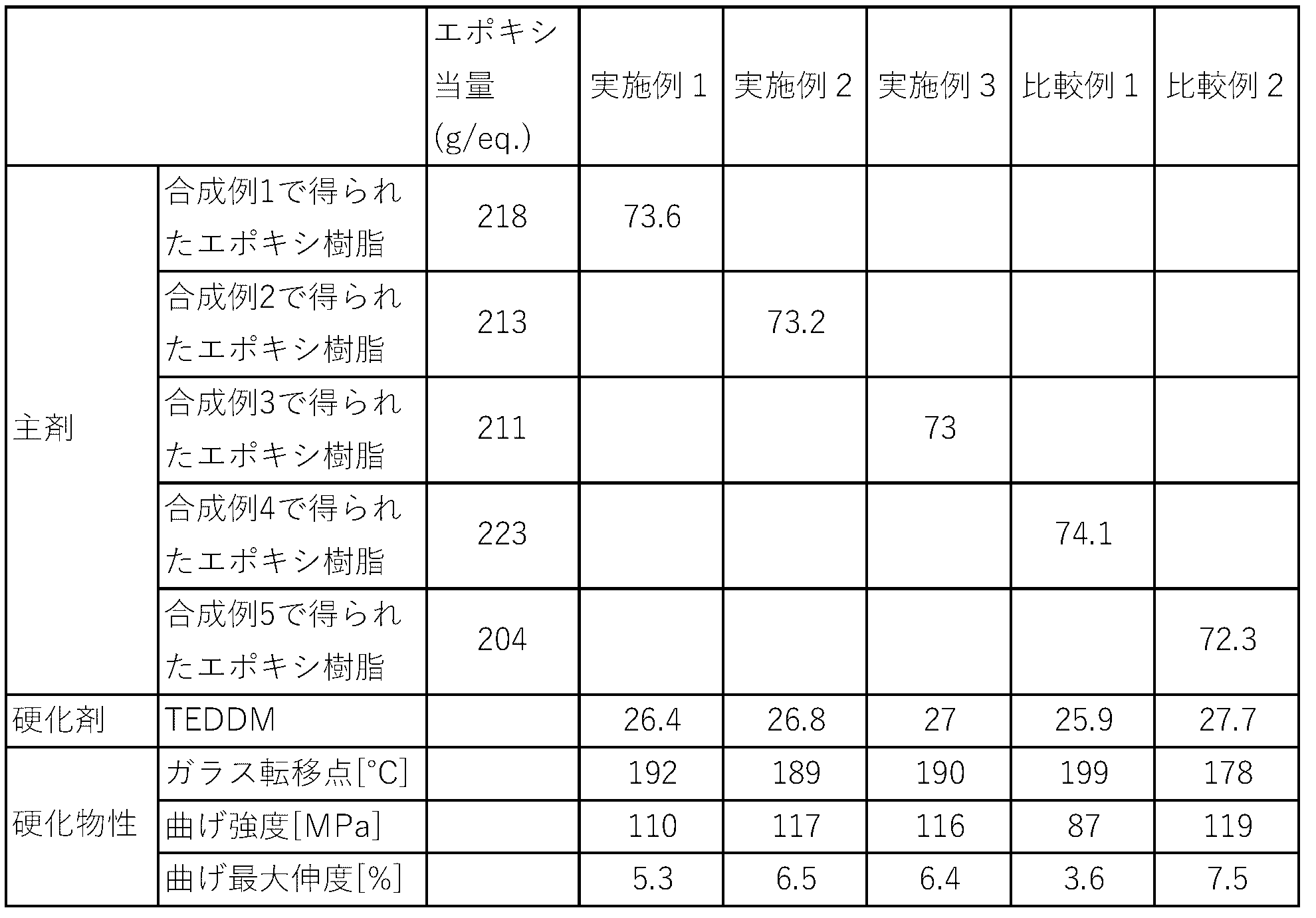
表1の結果より、本願実施例の硬化物は耐熱性、曲げ強度に優れることが確認された。一方、比較例1は曲げ強度及び曲げ最大伸度に、比較例2は耐熱性に課題を抱えることが確認された。 From the results in Table 1, it was confirmed that the cured products of Examples of the present application were excellent in heat resistance and bending strength. On the other hand, it was confirmed that Comparative Example 1 had problems in bending strength and maximum bending elongation, and Comparative Example 2 had problems in heat resistance.
Claims (5)
Priority Applications (6)
| Application Number | Priority Date | Filing Date | Title |
|---|---|---|---|
| JP2023113998A JP7474373B2 (en) | 2023-07-11 | 2023-07-11 | Epoxy resin, curable resin composition, and cured product thereof, and carbon fiber reinforced composite material |
| CN202380100364.4A CN121568979A (en) | 2023-07-11 | 2023-10-04 | Epoxy resin, curable resin composition, cured product of the same, and carbon fiber-reinforced composite material |
| KR1020267000729A KR20260032541A (en) | 2023-07-11 | 2023-10-04 | Epoxy resin, curable resin composition and cured product thereof and carbon fiber reinforced composite material |
| EP23945178.4A EP4745176A1 (en) | 2023-07-11 | 2023-10-04 | EPOXY RESIN, CURTABLE RESIN COMPOSITION, CURTAINED PRODUCTS THEREOF AND CARBON FIBER REINFORCED COMPOSITE |
| PCT/JP2023/036254 WO2025013308A1 (en) | 2023-07-11 | 2023-10-04 | Epoxy resin, curable resin composition, cured products thereof, and carbon fiber-reinforced composite material |
| TW112141570A TW202502860A (en) | 2023-07-11 | 2023-10-30 | Epoxy resin, curable resin composition, cured product thereof, and carbon fiber reinforced plastics |
Applications Claiming Priority (1)
| Application Number | Priority Date | Filing Date | Title |
|---|---|---|---|
| JP2023113998A JP7474373B2 (en) | 2023-07-11 | 2023-07-11 | Epoxy resin, curable resin composition, and cured product thereof, and carbon fiber reinforced composite material |
Publications (2)
| Publication Number | Publication Date |
|---|---|
| JP2024029749A true JP2024029749A (en) | 2024-03-06 |
| JP7474373B2 JP7474373B2 (en) | 2024-04-24 |
Family
ID=90104980
Family Applications (1)
| Application Number | Title | Priority Date | Filing Date |
|---|---|---|---|
| JP2023113998A Active JP7474373B2 (en) | 2023-07-11 | 2023-07-11 | Epoxy resin, curable resin composition, and cured product thereof, and carbon fiber reinforced composite material |
Country Status (6)
| Country | Link |
|---|---|
| EP (1) | EP4745176A1 (en) |
| JP (1) | JP7474373B2 (en) |
| KR (1) | KR20260032541A (en) |
| CN (1) | CN121568979A (en) |
| TW (1) | TW202502860A (en) |
| WO (1) | WO2025013308A1 (en) |
Cited By (3)
| Publication number | Priority date | Publication date | Assignee | Title |
|---|---|---|---|---|
| WO2025169748A1 (en) * | 2024-02-05 | 2025-08-14 | 日本化薬株式会社 | Epoxy resin, curable resin composition, cured products thereof, and carbon fiber-reinforced composite material |
| EP4610205A1 (en) | 2024-02-29 | 2025-09-03 | KYOCERA Document Solutions Inc. | Sheet feeding device and image forming apparatus |
| WO2026121309A1 (en) * | 2024-12-05 | 2026-06-11 | 日本化薬株式会社 | Reactive polycarboxylic acid compound, active energy ray-curable resin composition using same, cured product thereof, article, and printed wiring board |
Families Citing this family (1)
| Publication number | Priority date | Publication date | Assignee | Title |
|---|---|---|---|---|
| WO2026160390A1 (en) * | 2025-01-23 | 2026-07-30 | 日本化薬株式会社 | Epoxy resin mixture, curable resin composition, and cured object therefrom |
Citations (5)
| Publication number | Priority date | Publication date | Assignee | Title |
|---|---|---|---|---|
| JP2000319345A (en) * | 1999-05-14 | 2000-11-21 | Nippon Kayaku Co Ltd | Thermosetting resin composition and cured product thereof |
| JP2001064339A (en) * | 1999-08-25 | 2001-03-13 | Nippon Kayaku Co Ltd | Phenolic resin, epoxy resin, thermosetting resin composition and resin production method |
| JP2007211254A (en) * | 1997-01-10 | 2007-08-23 | Nippon Kayaku Co Ltd | Epoxy resin composition and method for producing epoxy resin |
| JP2022010709A (en) * | 2020-06-29 | 2022-01-17 | 株式会社クボタ | Field water management device |
| JP2022010708A (en) * | 2020-06-29 | 2022-01-17 | 株式会社三共 | Pachinko machine |
Family Cites Families (7)
| Publication number | Priority date | Publication date | Assignee | Title |
|---|---|---|---|---|
| JPS60243113A (en) | 1984-05-17 | 1985-12-03 | Sumitomo Chem Co Ltd | Epoxy resin composition having improved toughness |
| JPH09100358A (en) | 1995-10-04 | 1997-04-15 | Mitsubishi Rayon Co Ltd | Epoxy resin composition for carbon fiber reinforced composite material |
| CA2484174C (en) | 2002-05-29 | 2008-12-02 | The Boeing Company | Controlled atmospheric pressure resin infusion process |
| JP5385011B2 (en) | 2009-05-30 | 2014-01-08 | 東邦テナックス株式会社 | Prepreg |
| JP5887963B2 (en) | 2012-01-31 | 2016-03-16 | 東レ株式会社 | Prepreg and carbon fiber reinforced composites |
| WO2019021879A1 (en) | 2017-07-28 | 2019-01-31 | 株式会社カネカ | Epoxy resin composition |
| JP7788598B2 (en) | 2022-02-04 | 2025-12-19 | パナソニックIpマネジメント株式会社 | Ceiling fan |
-
2023
- 2023-07-11 JP JP2023113998A patent/JP7474373B2/en active Active
- 2023-10-04 WO PCT/JP2023/036254 patent/WO2025013308A1/en not_active Ceased
- 2023-10-04 EP EP23945178.4A patent/EP4745176A1/en active Pending
- 2023-10-04 KR KR1020267000729A patent/KR20260032541A/en active Pending
- 2023-10-04 CN CN202380100364.4A patent/CN121568979A/en active Pending
- 2023-10-30 TW TW112141570A patent/TW202502860A/en unknown
Patent Citations (5)
| Publication number | Priority date | Publication date | Assignee | Title |
|---|---|---|---|---|
| JP2007211254A (en) * | 1997-01-10 | 2007-08-23 | Nippon Kayaku Co Ltd | Epoxy resin composition and method for producing epoxy resin |
| JP2000319345A (en) * | 1999-05-14 | 2000-11-21 | Nippon Kayaku Co Ltd | Thermosetting resin composition and cured product thereof |
| JP2001064339A (en) * | 1999-08-25 | 2001-03-13 | Nippon Kayaku Co Ltd | Phenolic resin, epoxy resin, thermosetting resin composition and resin production method |
| JP2022010709A (en) * | 2020-06-29 | 2022-01-17 | 株式会社クボタ | Field water management device |
| JP2022010708A (en) * | 2020-06-29 | 2022-01-17 | 株式会社三共 | Pachinko machine |
Cited By (5)
| Publication number | Priority date | Publication date | Assignee | Title |
|---|---|---|---|---|
| WO2025169748A1 (en) * | 2024-02-05 | 2025-08-14 | 日本化薬株式会社 | Epoxy resin, curable resin composition, cured products thereof, and carbon fiber-reinforced composite material |
| JPWO2025169748A1 (en) * | 2024-02-05 | 2025-08-14 | ||
| JP7894530B2 (en) | 2024-02-05 | 2026-07-23 | 日本化薬株式会社 | Epoxy resins, curable resin compositions, and cured products thereof, as well as carbon fiber reinforced composite materials |
| EP4610205A1 (en) | 2024-02-29 | 2025-09-03 | KYOCERA Document Solutions Inc. | Sheet feeding device and image forming apparatus |
| WO2026121309A1 (en) * | 2024-12-05 | 2026-06-11 | 日本化薬株式会社 | Reactive polycarboxylic acid compound, active energy ray-curable resin composition using same, cured product thereof, article, and printed wiring board |
Also Published As
| Publication number | Publication date |
|---|---|
| TW202502860A (en) | 2025-01-16 |
| EP4745176A1 (en) | 2026-05-20 |
| KR20260032541A (en) | 2026-03-09 |
| WO2025013308A1 (en) | 2025-01-16 |
| CN121568979A (en) | 2026-02-24 |
| JP7474373B2 (en) | 2024-04-24 |
Similar Documents
| Publication | Publication Date | Title |
|---|---|---|
| JP7474373B2 (en) | Epoxy resin, curable resin composition, and cured product thereof, and carbon fiber reinforced composite material | |
| JP2024102860A (en) | Epoxy resin, curable resin composition, and carbon fiber reinforced composite material | |
| WO2024203426A1 (en) | Epoxy resin, curable resin composition, and cured product | |
| JP6718562B1 (en) | Epoxy resin, epoxy resin composition, epoxy resin composition for carbon fiber reinforced composite material, prepreg, carbon fiber reinforced composite material | |
| JP7589397B1 (en) | Epoxy resin, curable resin composition, and cured product thereof, and carbon fiber reinforced composite material | |
| JP2024143063A (en) | Phenolic resin, epoxy resin, curable resin composition, and carbon fiber reinforced composite material | |
| JP6924292B2 (en) | Epoxy resin mixture, epoxy resin composition and cured product thereof | |
| KR20170040121A (en) | Epoxy resin composition for carbon-fiber-reinforced composite material, resin sheet, prepreg, carbon-fiber-reinforced composite material | |
| JP7307668B2 (en) | Epoxy resin and epoxy resin composition | |
| JP7170162B1 (en) | Epoxy resin mixture and its production method, epoxy resin composition and its cured product | |
| JP7437253B2 (en) | Phenol resin, epoxy resin, epoxy resin composition and cured product thereof | |
| TW202330685A (en) | Epoxy resin, method for producing the same, curable resin composition, cured product, and carbon fiber reinforced composite material wherein the epoxy resin is excellent in heat resistance, mechanical strength, and low water absorption | |
| JP7029575B2 (en) | Epoxy resins, epoxy compounds, epoxy resin compositions, resin sheets, prepregs, carbon fiber reinforced composites, and phenolic resins | |
| TW202330694A (en) | Epoxy resin, curable resin composition, cured product and carbon-fiber-reinforced composite material having excellent thermal resistance, mechanical strength, and low water absorption | |
| WO2025169748A1 (en) | Epoxy resin, curable resin composition, cured products thereof, and carbon fiber-reinforced composite material |
Legal Events
| Date | Code | Title | Description |
|---|---|---|---|
| A621 | Written request for application examination |
Free format text: JAPANESE INTERMEDIATE CODE: A621 Effective date: 20240118 |
|
| A871 | Explanation of circumstances concerning accelerated examination |
Free format text: JAPANESE INTERMEDIATE CODE: A871 Effective date: 20240118 |
|
| A131 | Notification of reasons for refusal |
Free format text: JAPANESE INTERMEDIATE CODE: A131 Effective date: 20240304 |
|
| TRDD | Decision of grant or rejection written | ||
| A01 | Written decision to grant a patent or to grant a registration (utility model) |
Free format text: JAPANESE INTERMEDIATE CODE: A01 Effective date: 20240410 |
|
| A61 | First payment of annual fees (during grant procedure) |
Free format text: JAPANESE INTERMEDIATE CODE: A61 Effective date: 20240412 |
|
| R150 | Certificate of patent or registration of utility model |
Ref document number: 7474373 Country of ref document: JP Free format text: JAPANESE INTERMEDIATE CODE: R150 |