JP2022542657A - Multilayer film containing at least 5 layers and method of making same - Google Patents
Multilayer film containing at least 5 layers and method of making same Download PDFInfo
- Publication number
- JP2022542657A JP2022542657A JP2022503406A JP2022503406A JP2022542657A JP 2022542657 A JP2022542657 A JP 2022542657A JP 2022503406 A JP2022503406 A JP 2022503406A JP 2022503406 A JP2022503406 A JP 2022503406A JP 2022542657 A JP2022542657 A JP 2022542657A
- Authority
- JP
- Japan
- Prior art keywords
- layer
- polyethylene
- polyolefin
- multilayer film
- polyethylene fraction
- Prior art date
- Legal status (The legal status is an assumption and is not a legal conclusion. Google has not performed a legal analysis and makes no representation as to the accuracy of the status listed.)
- Granted
Links
Images
Classifications
-
- B—PERFORMING OPERATIONS; TRANSPORTING
- B32—LAYERED PRODUCTS
- B32B—LAYERED PRODUCTS, i.e. PRODUCTS BUILT-UP OF STRATA OF FLAT OR NON-FLAT, e.g. CELLULAR OR HONEYCOMB, FORM
- B32B27/00—Layered products comprising a layer of synthetic resin
- B32B27/32—Layered products comprising a layer of synthetic resin comprising polyolefins
-
- B—PERFORMING OPERATIONS; TRANSPORTING
- B32—LAYERED PRODUCTS
- B32B—LAYERED PRODUCTS, i.e. PRODUCTS BUILT-UP OF STRATA OF FLAT OR NON-FLAT, e.g. CELLULAR OR HONEYCOMB, FORM
- B32B27/00—Layered products comprising a layer of synthetic resin
- B32B27/30—Layered products comprising a layer of synthetic resin comprising vinyl (co)polymers; comprising acrylic (co)polymers
- B32B27/306—Layered products comprising a layer of synthetic resin comprising vinyl (co)polymers; comprising acrylic (co)polymers comprising vinyl acetate or vinyl alcohol (co)polymers
-
- B—PERFORMING OPERATIONS; TRANSPORTING
- B32—LAYERED PRODUCTS
- B32B—LAYERED PRODUCTS, i.e. PRODUCTS BUILT-UP OF STRATA OF FLAT OR NON-FLAT, e.g. CELLULAR OR HONEYCOMB, FORM
- B32B27/00—Layered products comprising a layer of synthetic resin
- B32B27/06—Layered products comprising a layer of synthetic resin as the main or only constituent of a layer, which is next to another layer of the same or of a different material
- B32B27/08—Layered products comprising a layer of synthetic resin as the main or only constituent of a layer, which is next to another layer of the same or of a different material of synthetic resin
-
- B—PERFORMING OPERATIONS; TRANSPORTING
- B32—LAYERED PRODUCTS
- B32B—LAYERED PRODUCTS, i.e. PRODUCTS BUILT-UP OF STRATA OF FLAT OR NON-FLAT, e.g. CELLULAR OR HONEYCOMB, FORM
- B32B27/00—Layered products comprising a layer of synthetic resin
- B32B27/18—Layered products comprising a layer of synthetic resin characterised by the use of special additives
- B32B27/20—Layered products comprising a layer of synthetic resin characterised by the use of special additives using fillers, pigments, thixotroping agents
-
- B—PERFORMING OPERATIONS; TRANSPORTING
- B32—LAYERED PRODUCTS
- B32B—LAYERED PRODUCTS, i.e. PRODUCTS BUILT-UP OF STRATA OF FLAT OR NON-FLAT, e.g. CELLULAR OR HONEYCOMB, FORM
- B32B27/00—Layered products comprising a layer of synthetic resin
- B32B27/18—Layered products comprising a layer of synthetic resin characterised by the use of special additives
- B32B27/22—Layered products comprising a layer of synthetic resin characterised by the use of special additives using plasticisers
-
- B—PERFORMING OPERATIONS; TRANSPORTING
- B32—LAYERED PRODUCTS
- B32B—LAYERED PRODUCTS, i.e. PRODUCTS BUILT-UP OF STRATA OF FLAT OR NON-FLAT, e.g. CELLULAR OR HONEYCOMB, FORM
- B32B27/00—Layered products comprising a layer of synthetic resin
- B32B27/32—Layered products comprising a layer of synthetic resin comprising polyolefins
- B32B27/325—Layered products comprising a layer of synthetic resin comprising polyolefins comprising polycycloolefins
-
- B—PERFORMING OPERATIONS; TRANSPORTING
- B32—LAYERED PRODUCTS
- B32B—LAYERED PRODUCTS, i.e. PRODUCTS BUILT-UP OF STRATA OF FLAT OR NON-FLAT, e.g. CELLULAR OR HONEYCOMB, FORM
- B32B27/00—Layered products comprising a layer of synthetic resin
- B32B27/32—Layered products comprising a layer of synthetic resin comprising polyolefins
- B32B27/327—Layered products comprising a layer of synthetic resin comprising polyolefins comprising polyolefins obtained by a metallocene or single-site catalyst
-
- B—PERFORMING OPERATIONS; TRANSPORTING
- B32—LAYERED PRODUCTS
- B32B—LAYERED PRODUCTS, i.e. PRODUCTS BUILT-UP OF STRATA OF FLAT OR NON-FLAT, e.g. CELLULAR OR HONEYCOMB, FORM
- B32B27/00—Layered products comprising a layer of synthetic resin
- B32B27/34—Layered products comprising a layer of synthetic resin comprising polyamides
-
- B—PERFORMING OPERATIONS; TRANSPORTING
- B32—LAYERED PRODUCTS
- B32B—LAYERED PRODUCTS, i.e. PRODUCTS BUILT-UP OF STRATA OF FLAT OR NON-FLAT, e.g. CELLULAR OR HONEYCOMB, FORM
- B32B2250/00—Layers arrangement
- B32B2250/05—5 or more layers
-
- B—PERFORMING OPERATIONS; TRANSPORTING
- B32—LAYERED PRODUCTS
- B32B—LAYERED PRODUCTS, i.e. PRODUCTS BUILT-UP OF STRATA OF FLAT OR NON-FLAT, e.g. CELLULAR OR HONEYCOMB, FORM
- B32B2250/00—Layers arrangement
- B32B2250/24—All layers being polymeric
- B32B2250/242—All polymers belonging to those covered by group B32B27/32
-
- B—PERFORMING OPERATIONS; TRANSPORTING
- B32—LAYERED PRODUCTS
- B32B—LAYERED PRODUCTS, i.e. PRODUCTS BUILT-UP OF STRATA OF FLAT OR NON-FLAT, e.g. CELLULAR OR HONEYCOMB, FORM
- B32B2262/00—Composition or structural features of fibres which form a fibrous or filamentary layer or are present as additives
- B32B2262/02—Synthetic macromolecular fibres
- B32B2262/0261—Polyamide fibres
- B32B2262/0269—Aromatic polyamide fibres
-
- B—PERFORMING OPERATIONS; TRANSPORTING
- B32—LAYERED PRODUCTS
- B32B—LAYERED PRODUCTS, i.e. PRODUCTS BUILT-UP OF STRATA OF FLAT OR NON-FLAT, e.g. CELLULAR OR HONEYCOMB, FORM
- B32B2262/00—Composition or structural features of fibres which form a fibrous or filamentary layer or are present as additives
- B32B2262/10—Inorganic fibres
- B32B2262/101—Glass fibres
-
- B—PERFORMING OPERATIONS; TRANSPORTING
- B32—LAYERED PRODUCTS
- B32B—LAYERED PRODUCTS, i.e. PRODUCTS BUILT-UP OF STRATA OF FLAT OR NON-FLAT, e.g. CELLULAR OR HONEYCOMB, FORM
- B32B2264/00—Composition or properties of particles which form a particulate layer or are present as additives
- B32B2264/10—Inorganic particles
- B32B2264/101—Glass
-
- B—PERFORMING OPERATIONS; TRANSPORTING
- B32—LAYERED PRODUCTS
- B32B—LAYERED PRODUCTS, i.e. PRODUCTS BUILT-UP OF STRATA OF FLAT OR NON-FLAT, e.g. CELLULAR OR HONEYCOMB, FORM
- B32B2264/00—Composition or properties of particles which form a particulate layer or are present as additives
- B32B2264/10—Inorganic particles
- B32B2264/102—Oxide or hydroxide
-
- B—PERFORMING OPERATIONS; TRANSPORTING
- B32—LAYERED PRODUCTS
- B32B—LAYERED PRODUCTS, i.e. PRODUCTS BUILT-UP OF STRATA OF FLAT OR NON-FLAT, e.g. CELLULAR OR HONEYCOMB, FORM
- B32B2264/00—Composition or properties of particles which form a particulate layer or are present as additives
- B32B2264/10—Inorganic particles
- B32B2264/104—Oxysalt, e.g. carbonate, sulfate, phosphate or nitrate particles
-
- B—PERFORMING OPERATIONS; TRANSPORTING
- B32—LAYERED PRODUCTS
- B32B—LAYERED PRODUCTS, i.e. PRODUCTS BUILT-UP OF STRATA OF FLAT OR NON-FLAT, e.g. CELLULAR OR HONEYCOMB, FORM
- B32B2270/00—Resin or rubber layer containing a blend of at least two different polymers
-
- B—PERFORMING OPERATIONS; TRANSPORTING
- B32—LAYERED PRODUCTS
- B32B—LAYERED PRODUCTS, i.e. PRODUCTS BUILT-UP OF STRATA OF FLAT OR NON-FLAT, e.g. CELLULAR OR HONEYCOMB, FORM
- B32B2307/00—Properties of the layers or laminate
- B32B2307/50—Properties of the layers or laminate having particular mechanical properties
- B32B2307/54—Yield strength; Tensile strength
-
- B—PERFORMING OPERATIONS; TRANSPORTING
- B32—LAYERED PRODUCTS
- B32B—LAYERED PRODUCTS, i.e. PRODUCTS BUILT-UP OF STRATA OF FLAT OR NON-FLAT, e.g. CELLULAR OR HONEYCOMB, FORM
- B32B2307/00—Properties of the layers or laminate
- B32B2307/50—Properties of the layers or laminate having particular mechanical properties
- B32B2307/558—Impact strength, toughness
-
- B—PERFORMING OPERATIONS; TRANSPORTING
- B32—LAYERED PRODUCTS
- B32B—LAYERED PRODUCTS, i.e. PRODUCTS BUILT-UP OF STRATA OF FLAT OR NON-FLAT, e.g. CELLULAR OR HONEYCOMB, FORM
- B32B2307/00—Properties of the layers or laminate
- B32B2307/50—Properties of the layers or laminate having particular mechanical properties
- B32B2307/582—Tearability
- B32B2307/5825—Tear resistant
-
- B—PERFORMING OPERATIONS; TRANSPORTING
- B32—LAYERED PRODUCTS
- B32B—LAYERED PRODUCTS, i.e. PRODUCTS BUILT-UP OF STRATA OF FLAT OR NON-FLAT, e.g. CELLULAR OR HONEYCOMB, FORM
- B32B2307/00—Properties of the layers or laminate
- B32B2307/70—Other properties
- B32B2307/72—Density
-
- B—PERFORMING OPERATIONS; TRANSPORTING
- B32—LAYERED PRODUCTS
- B32B—LAYERED PRODUCTS, i.e. PRODUCTS BUILT-UP OF STRATA OF FLAT OR NON-FLAT, e.g. CELLULAR OR HONEYCOMB, FORM
- B32B2307/00—Properties of the layers or laminate
- B32B2307/70—Other properties
- B32B2307/732—Dimensional properties
-
- B—PERFORMING OPERATIONS; TRANSPORTING
- B32—LAYERED PRODUCTS
- B32B—LAYERED PRODUCTS, i.e. PRODUCTS BUILT-UP OF STRATA OF FLAT OR NON-FLAT, e.g. CELLULAR OR HONEYCOMB, FORM
- B32B2439/00—Containers; Receptacles
- B32B2439/40—Closed containers
- B32B2439/46—Bags
-
- B—PERFORMING OPERATIONS; TRANSPORTING
- B32—LAYERED PRODUCTS
- B32B—LAYERED PRODUCTS, i.e. PRODUCTS BUILT-UP OF STRATA OF FLAT OR NON-FLAT, e.g. CELLULAR OR HONEYCOMB, FORM
- B32B2439/00—Containers; Receptacles
- B32B2439/70—Food packaging
Landscapes
- Chemical & Material Sciences (AREA)
- Chemical Kinetics & Catalysis (AREA)
- Laminated Bodies (AREA)
- Addition Polymer Or Copolymer, Post-Treatments, Or Chemical Modifications (AREA)
Abstract
本開示の実施形態は、多層フィルムを対象とする。多層フィルムの実施形態は、第1のポリオレフィンを含む第1の層、第2のポリオレフィンを含む第2の層、第3のポリオレフィンを含む第3の層、第4のポリオレフィンを含む第4の層、および第5のポリオレフィンを含む第5の層を含み得る。第2の層は、第1の層と第3の層との間に配置することができ、第3の層は、第2の層と第4の層との間に配置することができ、第4の層は、第3の層と第5の層との間に配置することができる。第1のポリオレフィン、第2のポリオレフィン、第3のポリオレフィン、および第4のポリオレフィンのうちの2つ以上は、同一であっても異なっていてもよい。第3のポリオレフィンは、0.924g/cm3~0.936g/cm3の密度および0.25g/10分~2.0g/10分のメルトインデックス(I2)を有するポリエチレン組成物であり得る。【選択図】図1Embodiments of the present disclosure are directed to multilayer films. Embodiments of multilayer films include a first layer comprising a first polyolefin, a second layer comprising a second polyolefin, a third layer comprising a third polyolefin, a fourth layer comprising a fourth polyolefin , and a fifth layer comprising a fifth polyolefin. the second layer can be positioned between the first layer and the third layer, the third layer can be positioned between the second layer and the fourth layer, and A fourth layer can be positioned between the third and fifth layers. Two or more of the first polyolefin, second polyolefin, third polyolefin, and fourth polyolefin may be the same or different. The third polyolefin can be a polyethylene composition having a density of 0.924 g/cm3 to 0.936 g/cm3 and a melt index (I2) of 0.25 g/10 min to 2.0 g/10 min. [Selection drawing] Fig. 1
Description
関連出願の相互参照
本出願は、2019年8月6日に出願された米国仮特許出願第62/883,475号、および2019年8月6日に出願された米国仮特許出願第62/883,467号の優先権を主張し、その開示全体が参照により本明細書に組み込まれる。
CROSS REFERENCES TO RELATED APPLICATIONS This application is part of U.S. Provisional Patent Application No. 62/883,475, filed August 6, 2019, and U.S. Provisional Patent Application No. 62/883, filed August 6, 2019. , 467, the entire disclosure of which is incorporated herein by reference.
本明細書に記載の実施形態は、一般に、多層フィルム、より具体的には、ポリエチレンを含む多層フィルムに関する。 Embodiments described herein relate generally to multilayer films, and more specifically to multilayer films comprising polyethylene.
持続可能性の改善は、ポリエチレンを含む多層フィルムの製造業者にとって継続的な目標である。したがって、インフレーションまたはキャストフィルムを含み得る単層および多層ポリマーフィルムが、材料費の削減を可能にし得るダウンゲージ(すなわち、より薄いフィルム厚を使用すること)に伴い靭性を示すことは有益である。しかしながら、薄い厚さで十分な靭性を有するポリマーフィルムを得ることは、多くの場合困難である。 Improving sustainability is a continuing goal for manufacturers of multilayer films containing polyethylene. Therefore, it would be beneficial for monolayer and multilayer polymer films, which may include blown or cast films, to exhibit toughness with downgauge (i.e., using thinner film thicknesses), which may allow for reduced material costs. However, it is often difficult to obtain polymer films with sufficient toughness at small thicknesses.
ダウンゲージを推進する業界の1つに、頑丈な輸送用サック(HDSS)市場が含まれる。頑丈な輸送用サックには、10キログラムを超える物品を運ぶように設計された大きな袋が含まれ得る。頑丈な輸送用サックで運ばれる物品のいくつかの例としては、化学樹脂ペレット、顔料、砂糖、肥料、砂、米、中間製品などが挙げられる。しかしながら、HDSS用途で使用される従来の3層フィルムは、一般に、多層フィルムの厚さを減少したときに、靭性と耐クリープ性との適切なバランスを実現することができない。したがって、顧客および業界の要件を満たす、耐ダート/袋落下性、耐穿刺性、耐引裂性、および耐クリープ性などの物理的特性を示す多層フィルムに対する必要性が存在する。いくつかの実施形態では、これらの多層フィルムは、減少した厚さにおいても依然として顧客および業界の要件を満たす物理的特性を維持し得る。 One of the industries driving downgauges includes the heavy duty shipping sack (HDSS) market. Heavy-duty shipping sacks can include large bags designed to carry items in excess of 10 kilograms. Some examples of goods carried in heavy-duty shipping sacks include chemical resin pellets, pigments, sugar, fertilizers, sand, rice, intermediate products, and the like. However, conventional tri-layer films used in HDSS applications generally fail to achieve an adequate balance of toughness and creep resistance when the thickness of the multilayer film is reduced. Therefore, a need exists for multilayer films that exhibit physical properties such as dirt/bag drop resistance, puncture resistance, tear resistance, and creep resistance that meet customer and industry requirements. In some embodiments, these multilayer films can still maintain physical properties that meet customer and industry requirements at reduced thickness.
本開示の実施形態は、剛性および乱用特性(すなわち、ダート、穿刺エネルギー、引裂)のバランスを提供する少なくとも5つの層を含む多層フィルムを提供することによって、それらの必要性を満たす。そのような多層フィルムは、靭性と耐クリープ性との改善されたバランスを示すポリエチレン組成物をコア層に含み得る。さらに、コア層にポリエチレン組成物を含む多層体の全体厚さを減らすとき、この多層フィルムは、従来の多層フィルムと比較して、靭性と耐クリープ性との改善されたバランスを依然として示し得る。 Embodiments of the present disclosure meet those needs by providing multilayer films comprising at least five layers that provide a balance of stiffness and abuse properties (ie dart, puncture energy, tear). Such multilayer films may include in the core layer a polyethylene composition that exhibits an improved balance of toughness and creep resistance. Additionally, when reducing the overall thickness of a multilayer body comprising a polyethylene composition in the core layer, the multilayer film can still exhibit an improved balance of toughness and creep resistance compared to conventional multilayer films.
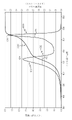
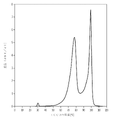
本開示の少なくとも1つの実施形態によれば、多層フィルムは、第1のポリオレフィンを含む第1の層、第2のポリオレフィンを含む第2の層、第3のポリオレフィンを含む第3の層、第4のポリオレフィンを含む第4の層、および第5のポリオレフィンを含む第5の層を含み得る。第1のポリオレフィン、第2のポリオレフィン、第3のポリオレフィン、および第4のポリオレフィンのうちの2つ以上は、組成が同一であっても異なっていてもよい。第2の層は、第1の層と第3の層との間に配置することができる。第3の層は、第2の層と第4の層との間に配置することができる。第4の層は、第3の層と第5の層との間に配置することができる。第3のポリオレフィンは、(a)改善されたコモノマー組成分布(iCCD)分析法による溶出プロファイルにおいて45℃~87℃の温度範囲に単一のピークを有する第1のポリエチレン画分であって、第1のポリエチレン画分面積が、45℃~87℃における第1のポリエチレン画分の単一のピーク下の溶出プロファイル内の面積である、第1のポリエチレン画分と、(b)iCCD分析法による溶出プロファイルにおいて95℃~120℃の温度範囲に単一のピークを有する第2のポリエチレン画分であって、第2のポリエチレン画分面積が、95℃~120℃における第2のポリエチレン画分の単一のピーク下の溶出プロファイル内の面積である、第2のポリエチレン画分と、を含む、ポリエチレン組成物であり得、このポリエチレン組成物は、0.924g/cm3~0.936g/cm3の密度および0.25g/10分~2.0g/10分のメルトインデックス(I2)を有し、第1のポリエチレン画分面積は、溶出プロファイルの総面積の少なくとも40%を構成し、第1のポリエチレン画分面積対第2のポリエチレン画分面積の比は、0.75~2.5であり、ピーク高さの50パーセントでの第2のポリエチレン画分の単一のピークの幅は、5.0℃未満である。
According to at least one embodiment of the present disclosure, the multilayer film comprises a first layer comprising a first polyolefin, a second layer comprising a second polyolefin, a third layer comprising a third polyolefin, a third A fourth layer comprising four polyolefins and a fifth layer comprising a fifth polyolefin may be included. Two or more of the first polyolefin, second polyolefin, third polyolefin, and fourth polyolefin may be the same or different in composition. The second layer can be positioned between the first layer and the third layer. A third layer can be disposed between the second layer and the fourth layer. A fourth layer can be positioned between the third and fifth layers. The third polyolefin is (a) a first polyethylene fraction having a single peak in the temperature range of 45° C. to 87° C. in an improved comonomer composition distribution (iCCD) analysis elution profile; (b) a first polyethylene fraction, where the polyethylene fraction area of 1 is the area within the elution profile under the single peak of the first polyethylene fraction at 45°C to 87°C; A second polyethylene fraction having a single peak in the temperature range of 95°C to 120°C in the elution profile, wherein the area of the second polyethylene fraction is that of the second polyethylene fraction at 95°C to 120°C. and a second polyethylene fraction, which is the area within the elution profile under the single peak, the polyethylene composition comprising 0.924 g/cm 3 to 0.936 g/
本開示の少なくとも1つの別の実施形態によれば、多層フィルムは、0.905g/cm3~0.936g/cm3の密度を有する線状低密度ポリエチレンを含む第1の層、ASTM 742に従って測定したときに、0.940g/cm3を超える密度を有するポリエチレンを含む第2の層、第3のポリオレフィンを含む第3の層、ASTM 742に従って測定したときに、0.940g/cm3を超える密度を有する第4の層、および0.905g/cm3~0.936g/cm3の密度を有する線状低密度ポリエチレンを含む第5の層を含み得る。第1のポリオレフィン、第2のポリオレフィン、第3のポリオレフィン、および第4のポリオレフィンのうちの2つ以上は、組成が同一であっても異なっていてもよい。第2の層は、第1の層と第3の層との間に配置することができる。第3の層は、第2の層と第4の層との間に配置することができる。第4の層は、第3の層と第5の層との間に配置することができる。第3のポリオレフィンは、(a)改善されたコモノマー組成分布(iCCD)分析法による溶出プロファイルにおいて45℃~87℃の温度範囲に単一のピークを有する第1のポリエチレン画分であって、第1のポリエチレン画分面積が、45℃~87℃における第1のポリエチレン画分の単一のピーク下の溶出プロファイル内の面積である、第1のポリエチレン画分と、(b)iCCD分析法による溶出プロファイルにおいて95℃~120℃の温度範囲に単一のピークを有し、第2のポリエチレン画分面積が、95℃~120℃における第2のポリエチレン画分の単一のピーク下の溶出プロファイル内の面積である第2のポリエチレン画分とを含む、ポリエチレン組成物であり得、このポリエチレン組成物は、0.924g/cm3~0.936g/cm3の密度および0.25g/10分~2.0g/10分のメルトインデックス(I2)を有し、第1のポリエチレン画分面積は、溶出プロファイルの総面積の少なくとも40%を構成し、第1のポリエチレン画分面積対第2のポリエチレン画分面積の比は、0.75~2.5であり、ピーク高さの50パーセントでの第2のポリエチレン画分の単一のピークの幅は、5.0℃未満である。
According to at least one other embodiment of the present disclosure, the multilayer film comprises a first layer comprising linear low density polyethylene having a density between 0.905 g/cm 3 and 0.936 g/cm 3 according to ASTM 742. a second layer comprising polyethylene having a density of greater than 0.940 g/ cm3 when measured; a third layer comprising a third polyolefin having a density of greater than 0.940 g/ cm3 when measured according to ASTM 742; A fourth layer having a density greater than 0.905 g/
したがって、本開示の実施形態は、減少した厚さで剛性および乱用特性(例えば、ダート、穿刺エネルギー、引裂)のバランスを提供する多層フィルムを提供し得る。 Accordingly, embodiments of the present disclosure may provide multilayer films that provide a balance of stiffness and abuse properties (eg, dart, puncture energy, tear) at reduced thickness.
これらおよび他の実施形態は、添付の図面と併せて以下の発明を実施するための形態においてより詳細に説明される。 These and other embodiments are described in more detail in the detailed description below in conjunction with the accompanying drawings.
本開示の特定の実施形態の以下の詳細な説明は、以下の図面と併せて読むと最もよく理解することができ、これらの図面では、同様の構造体が同様の参照番号で示される。 The following detailed description of certain embodiments of the present disclosure may be best understood when read in conjunction with the following drawings, in which like structures are indicated by like reference numerals.
ここで、本出願の特定の実施形態について説明する。これらの実施形態は、本開示が詳細かつ完全であり、当業者に特許請求された主題の範囲を完全に伝えるように提供される。 Specific embodiments of the present application will now be described. These embodiments are provided so that this disclosure will be thorough and complete, and will fully convey the scope of the claimed subject matter to those skilled in the art.
相反する記載がなく、文脈から暗示されておらず、または当該技術分野において慣例的でない限り、全ての部および百分率は、重量に基づくものであり、全ての温度は摂氏度(℃)であり、全ての試験方法は、本開示の出願日の時点で最新である。 Unless stated to the contrary, implicit from the context, or customary in the art, all parts and percentages are by weight, all temperatures are in degrees Celsius (°C), All test methods are current as of the filing date of this disclosure.
「ポリマー」という用語は、同じ種類または異なる種類にかかわらず、モノマーを重合することによって調製されるポリマー化合物を指す。このため、ポリマーという総称は、通常、1種類のみのモノマーから調製されたポリマーを指す「ホモポリマー」という用語、ならびに2種類以上の異なるモノマーから調製されたポリマーを指す「コポリマー」を包含する。本明細書で使用される場合、「インターポリマー」という用語は、少なくとも2つの異なる種類のモノマーの重合によって調製されるポリマーを指す。したがって、総称であるインターポリマーは、コポリマー、およびターポリマーなどの、3種類以上の異なるモノマーから調製されたポリマーを含む。 The term "polymer" refers to polymeric compounds prepared by polymerizing monomers, whether of the same or different types. Thus, the generic term polymer encompasses the term "homopolymer", which generally refers to polymers prepared from only one type of monomer, as well as "copolymer", which refers to polymers prepared from two or more different types of monomers. As used herein, the term "interpolymer" refers to polymers prepared by the polymerization of at least two different types of monomers. Thus, the generic term interpolymer includes polymers prepared from three or more different monomers, such as copolymers and terpolymers.
本明細書に記載されるように、「ポリエチレン」または「エチレン系ポリマー」は、過半量(>50mol%)のエチレンモノマーに由来する単位を含むポリマーを指す。これは、ポリエチレンホモポリマーまたはコポリマー(単位が2つ以上のコモノマーに由来することを意味する)を含む。当該技術分野において既知であるポリエチレンの一般的な形態には、低密度ポリエチレン(LDPE)、線状低密度ポリエチレン(LLDPE)、超低密度ポリエチレン(ULDPE)、極低密度ポリエチレン(VLDPE)、線状および実質的に線状の低密度樹脂の両方を含むシングルサイト触媒線状低密度ポリエチレン(m-LLDPE)、エチレン系プラストマー(POP)およびエチレン系エラストマー(POE)、中密度ポリエチレン(MDPE)、ならびに高密度ポリエチレン(HDPE)が含まれる。これらのポリエチレン材料は、当該技術分野において一般に既知であるが、以下の説明は、これらの異なるポリエチレン樹脂のうちのいくつかの間の差異を理解する上で役立ち得る。 As described herein, "polyethylene" or "ethylene-based polymer" refers to a polymer containing a majority (>50 mol%) of units derived from ethylene monomers. This includes polyethylene homopolymers or copolymers (meaning that the units are derived from two or more comonomers). Common forms of polyethylene known in the art include low density polyethylene (LDPE), linear low density polyethylene (LLDPE), ultra low density polyethylene (ULDPE), very low density polyethylene (VLDPE), linear single-site catalyzed linear low density polyethylene (m-LLDPE), ethylene-based plastomers (POP) and ethylene-based elastomers (POE), medium density polyethylene (MDPE), including both and substantially linear low density resins, and High density polyethylene (HDPE) is included. These polyethylene materials are generally known in the art, but the following discussion may help in understanding the differences between some of these different polyethylene resins.
本明細書で使用される場合、「組成物」という用語は、組成物を構成する材料の混合物、ならびに組成物の材料から形成された反応生成物および分解生成物を指す。 As used herein, the term "composition" refers to the mixture of materials that make up the composition, as well as reaction and decomposition products formed from the materials of the composition.
本明細書で使用される場合、「ポリプロピレン」または「プロピレン系ポリマー」という用語は、重合形態で50モル%超のプロピレンモノマーに由来する単位を構成するポリマーを指す。これには、プロピレンホモポリマー、ランダムコポリマーポリプロピレン、インパクトコポリマーポリプロピレン、プロピレン/α-オレフィンコポリマー、およびプロピレン/α-オレフィンコポリマーが含まれる。 As used herein, the term "polypropylene" or "propylene-based polymer" refers to a polymer comprising units derived from greater than 50 mole percent propylene monomer in polymerized form. This includes propylene homopolymers, random copolymer polypropylenes, impact copolymer polypropylenes, propylene/α-olefin copolymers, and propylene/α-olefin copolymers.
「LDPE」という用語は、「高圧エチレンポリマー」または「高度に分岐したポリエチレン」とも称されることがあり、ポリマーが、過酸化物などのフリーラジカル開始剤を使用することによって、14,500psi(100MPa)を超える圧力で、オートクレーブまたは管状反応器において、部分的または完全にホモ重合または共重合されることを意味するように定義される(例えば、参照により本明細書に組み込まれる米国特許第4,599,392号を参照されたい)。LDPE樹脂は、典型的には、0.916~0.940g/cm3の範囲の密度を有する。 The term "LDPE" is also sometimes referred to as "high pressure ethylene polymer" or "highly branched polyethylene", where the polymer can be reduced to 14,500 psi ( 100 MPa) to mean partially or fully homopolymerized or copolymerized in an autoclave or tubular reactor (e.g., U.S. Pat. No. 4, which is incorporated herein by reference). , 599,392). LDPE resins typically have densities in the range of 0.916 to 0.940 g/cm 3 .
「LLDPE」という用語には、チーグラー・ナッタ触媒系を使用して作製された樹脂、ならびにビスメタロセン触媒(「m-LLDPE」と称されることもある)、ホスフィンイミン、および拘束幾何触媒を含むが、これらに限定されないシングルサイト触媒を使用して作製された樹脂、ならびにビス(ビフェニルフェノキシ)触媒(多価アリールオキシエーテル触媒とも称される)を含むが、これに限定されないポストメタロセン分子触媒を使用して作製された樹脂が含まれる。LLDPEは、線状の、実質的に線状の、または不均一なエチレン系コポリマーまたはホモポリマーを含む。LLDPEは、LDPEよりも少ない長鎖分岐を含有し、米国特許第5,272,236号、米国特許第5,278,272号、米国特許第5,582,923号、および米国特許第5,733,155号においてさらに定義される、実質的に線状のエチレンポリマー、米国特許第3,645,992号におけるものなどの、均一分岐線状エチレンポリマー組成物、米国特許第4,076,698号に開示されるプロセスに従って調製されるものなどの不均一分岐エチレンポリマー、ならびにそれらのブレンド(米国特許第3,914,342号および米国特許第5,854,045号に開示されるものなど)を含む。LLDPE樹脂は、当該技術分野で知られている任意の種類の反応器または反応器構成を使用して、気相、液相、もしくはスラリー重合、またはこれらの任意の組み合わせによって作製され得る。 The term "LLDPE" includes resins made using Ziegler-Natta catalyst systems, as well as bismetallocene catalysts (sometimes referred to as "m-LLDPE"), phosphinimines, and constrained geometry catalysts. resins made using, but not limited to, single-site catalysts, and post-metallocene molecular catalysts, including, but not limited to, bis(biphenylphenoxy) catalysts (also referred to as polyvalent aryloxyether catalysts). Includes resins made using LLDPE includes linear, substantially linear, or heterogeneous ethylenic copolymers or homopolymers. LLDPE contains less long chain branching than LDPE and is described in U.S. Pat. 733,155, homogeneously branched linear ethylene polymer compositions such as in U.S. Pat. No. 3,645,992, U.S. Pat. No. 4,076,698 Heterogeneously branched ethylene polymers, such as those prepared according to the processes disclosed in US Pat. No. 3,914,342 and blends thereof (such as those disclosed in US Pat. including. LLDPE resins can be made by gas phase, liquid phase, or slurry polymerization, or any combination thereof, using any type of reactor or reactor configuration known in the art.
「MDPE」という用語は、0.924~0.936g/cm3の密度を有するポリエチレンを指す。「MDPE」は、典型的には、クロムまたはチーグラー・ナッタ触媒を使用して、または置換モノ-またはビス-シクロペンタジエニル触媒(典型的にはメタロセンと称される)、束縛幾何触媒、ホスフィニミン(phosphinimine)触媒、および多価アリールオキシエーテル触媒(典型的にはビスフェニルフェノキシと称される)を含むが、これらに限定されないシングルサイト触媒を使用して作製される。 The term "MDPE" refers to polyethylene having a density of 0.924-0.936 g/ cm3 . "MDPE" typically uses chromium or Ziegler-Natta catalysts or substituted mono- or bis-cyclopentadienyl catalysts (typically referred to as metallocenes), constrained geometry catalysts, phosphinimine (phosphinimine) catalysts, and polyvalent aryloxyether catalysts (typically referred to as bisphenylphenoxy), single-site catalysts.
「HDPE」という用語は、一般にチーグラー・ナッタ触媒、クロム触媒、または置換モノ-もしくはビス-シクロペンタジエニル触媒(典型的にはメタロセンと称される)、束縛幾何触媒、ホスフィミニン触媒、および多価アリールオキシエーテル触媒(典型的にはビスフェニルフェノキシと称される)を含むが、これらに限定されないシングルサイト触媒を用いて調製される、約0.935g/cm3超~最大約0.980g/cm3の密度を有するポリエチレンを指す。
The term "HDPE" generally refers to Ziegler-Natta catalysts, chromium catalysts, or substituted mono- or bis-cyclopentadienyl catalysts (typically referred to as metallocenes), constrained geometry catalysts, phosphiminin catalysts, and polyvalent from greater than about 0.935 g/cm 3 up to about 0.980 g/
「ULDPE」という用語は、一般にチーグラー・ナッタ触媒、クロム触媒、または置換モノ-もしくはビス-シクロペンタジエニル触媒(典型的にはメタロセンと称される)、束縛構造触媒、ホスフィミニン触媒、および多価アリールオキシエーテル触媒(典型的にはビスフェニルフェノキシと称される)を含むが、これらに限定されないシングルサイト触媒を用いて調製される、0.855g/cm3~0.912g/cm3の密度を有するポリエチレンを指す。ULDPEには、ポリエチレン(エチレン系)プラストマーおよびポリエチレン(エチレン系)エラストマーが含まれるが、これらに限定されない。ポリエチレン(エチレン系)エラストマープラストマーは、一般に0.855g/cm3~0.912g/cm3の密度を有する。 The term "ULDPE" generally refers to Ziegler-Natta catalysts, chromium catalysts, or substituted mono- or bis-cyclopentadienyl catalysts (typically referred to as metallocenes), constrained geometry catalysts, phosphiminin catalysts, and polyvalent Densities between 0.855 g/cm 3 and 0.912 g/cm 3 prepared using single-site catalysts including but not limited to aryloxyether catalysts (typically referred to as bisphenylphenoxy) refers to polyethylene having ULDPE include, but are not limited to, polyethylene (ethylene-based) plastomers and polyethylene (ethylene-based) elastomers. Polyethylene (ethylene-based) elastomer plastomers generally have densities between 0.855 g/cm 3 and 0.912 g/cm 3 .
「ブレンド」、「ポリマーブレンド」、および同様の用語は、2つ以上のポリマーの組成物を意味する。そのようなブレンドは、混和性であっても、そうでなくてもよい。そのようなブレンドは、相分離していても、していなくてもよい。そのようなブレンドは、透過電子分光法、光散乱、X線散乱、および当該技術分野で知られている任意の他の方法から決定される、1つ以上のドメイン構成を含有しても、そうでなくてもよい。ブレンドは、積層体ではないが、積層体の1つ以上の層がブレンドを含有してもよい。そのようなブレンドは、乾式ブレンドとして、その場で(例えば、反応器内で)形成されたものとして、溶融ブレンドとして、または当業者に既知の他の技術を使用して調製され得る。 "Blend," "polymer blend," and like terms mean a composition of two or more polymers. Such blends may or may not be miscible. Such blends may or may not be phase separated. Such blends may or may not contain one or more domain configurations as determined from transmission electron spectroscopy, light scattering, X-ray scattering, and any other method known in the art. It doesn't have to be. A blend is not a laminate, but one or more layers of a laminate may contain the blend. Such blends may be prepared as dry blends, formed in situ (eg, in a reactor), as melt blends, or using other techniques known to those skilled in the art.
「多層構造体」または「多層フィルム」とは、2つ以上の層を有するあらゆる構造体を意味する。例えば、多層構造体(例えば、フィルム)は、5つ以上の層を有し得る。多層構造体は、文字で指定された層を有するものとして説明され得る。例えば、A/B/C/D/Eとして指定された5層構造体は、コア層C、および2つの外層AおよびE、ならびに2つの内層BおよびDを有し得る。いくつかの実施形態では、本開示の多層フィルムが、最大11、13、15、またはそれ以上の層を含み得る。 "Multilayer structure" or "multilayer film" means any structure having two or more layers. For example, a multilayer structure (eg, film) can have 5 or more layers. Multilayer structures may be described as having layers designated by letters. For example, a five layer structure designated as A/B/C/D/E may have a core layer C and two outer layers A and E and two inner layers B and D. In some embodiments, multilayer films of the present disclosure may contain up to 11, 13, 15, or more layers.
「含む(comprising)」、「含む(including)」、「有する(having)」という用語、およびそれらの派生語は、任意の追加の構成要素、工程、または手順の存在を、それらが具体的に開示されているか否かにかかわらず、除外することを意図するものではない。いかなる疑念も避けるために、「含む(comprising)」という用語の使用を通して特許請求される全ての組成物は、別段矛盾する記述がない限り、ポリマー性かまたは別のものであるかにかかわらず、いかなる追加の添加剤、アジュバント、または化合物を含んでもよい。対照的に、「から本質的になる」という用語は、操作性に必須ではないものを除き、任意の以降の記述の範囲から任意の他の構成要素、工程、または手順を除外する。「からなる」という用語は、具体的に規定または列記されていないいずれの構成要素、工程、または手順も除外する。 The terms "comprising," "including," "having," and derivatives thereof do not indicate the presence of any additional component, step, or procedure that they specifically No exclusion is intended, whether disclosed or not. For the avoidance of any doubt, all compositions claimed through use of the term "comprising", whether polymeric or otherwise, are Any additional additive, adjuvant, or compound may be included. In contrast, the term "consisting essentially of" excludes from the scope of any subsequent description any other component, step, or procedure, except those not essential to operability. The term “consisting of” excludes any component, step, or procedure not specifically defined or listed.
多層フィルム
ここで、本明細書に記載の多層フィルムの実施形態を参照する。ここに記載される多層フィルムの実施形態は、少なくとも5つの層を含み得る。
Multilayer Films Reference is now made to embodiments of multilayer films described herein. Embodiments of the multilayer films described herein can include at least five layers.
本開示の多層フィルムは、少なくとも5つの層、さらには13層もの層を含み得る。多層フィルムの層の数は、例えば、多層フィルムの各層の組成、多層フィルムの所望の特性、多層フィルムの所望の最終用途、多層フィルムの製造プロセスなどを含む多数の因子に依存し得る。多層フィルムは、A/B/C/D/Eとして指定された5層構造体であり得、第1の層は、Aとして指定され得、第2の層は、Bとして指定され得、第3の層は、Cとして指定され得、第4の層は、Dとして指定され得、第5の層は、Eとして指定され得る。いくつかの実施形態において、第3の層は、「コア層」と称され得る。いくつかの実施形態では、第1の層および第5の層のうちの一方または両方は、「スキン層」または「外層」と称され得る。いくつかの実施形態では、第2の層および第4の層のうちの一方または両方は、「内層」と称され得る。実施形態では、第2の層は、第1の層と第3の層との間に配置され得る。第3の層は、第2の層と第4の層との間に配置され得る。第4の層は、第3の層と第5の層との間に配置され得る。さらなる実施形態では、第1の層および第5の層が、多層フィルムの最外層であり得る。本明細書で使用される場合、多層フィルムの最外層は、最外層が周囲の空気と直接接触するように、最外層上に堆積された別の層があってはならないことを意味すると理解され得る。 Multilayer films of the present disclosure may contain at least 5 layers and even as many as 13 layers. The number of layers in the multilayer film can depend on numerous factors including, for example, the composition of each layer of the multilayer film, the desired properties of the multilayer film, the desired end use of the multilayer film, the manufacturing process of the multilayer film, and the like. The multilayer film may be a 5-layer structure designated as A/B/C/D/E, the first layer may be designated as A, the second layer may be designated as B, and the second layer may be designated as B. The 3rd layer may be designated as C, the 4th layer may be designated as D, and the 5th layer may be designated as E. In some embodiments, the third layer may be referred to as the "core layer." In some embodiments, one or both of the first and fifth layers may be referred to as "skin layers" or "outer layers." In some embodiments, one or both of the second and fourth layers may be referred to as "inner layers." In embodiments, the second layer may be disposed between the first layer and the third layer. A third layer may be disposed between the second layer and the fourth layer. A fourth layer may be disposed between the third and fifth layers. In further embodiments, the first layer and the fifth layer can be the outermost layers of the multilayer film. As used herein, the outermost layer of a multilayer film is understood to mean that there should be no other layers deposited on the outermost layer such that the outermost layer is in direct contact with the surrounding air. obtain.
実施形態では、第1の層、第2の層、第3の層、第4の層、または第5の層のうちの1つ以上が、互いに直接接触していてもよい。本明細書で使用される場合、「直接接触」とは、互いに直接接触している2つの層の間に任意の他の層が配置されてはならないことを意味する。さらなる実施形態では、第1の層が、第2の層と直接接触し得る。いくつかの実施形態では、第2の層が、第1の層および第3の層のうちの一方または両方と直接接触し得る。いくつかの実施形態では、第3の層が、第4の層および第2の層のうちの一方または両方と直接接触し得る。実施形態では、第4の層が、第5の層と直接接触し得る。いくつかの実施形態では、1つ以上のタイ層が、第1の層および第2の層、第2の層および第3の層、第3の層および第4の層、または第4の層および第5の層のうちの1つ以上の間に配設され得る。 In embodiments, one or more of the first layer, second layer, third layer, fourth layer, or fifth layer may be in direct contact with each other. As used herein, "direct contact" means that no other layer should be placed between two layers that are in direct contact with each other. In further embodiments, the first layer may be in direct contact with the second layer. In some embodiments, the second layer can directly contact one or both of the first and third layers. In some embodiments, the third layer can directly contact one or both of the fourth and second layers. In embodiments, the fourth layer may be in direct contact with the fifth layer. In some embodiments, the one or more tie layers are the first and second layers, the second and third layers, the third and fourth layers, or the fourth layer and one or more of the fifth layer.
本開示でより詳しく後述するように、多層フィルムは、第1のポリオレフィンを含む第1の層、第2のポリオレフィンを含む第2の層、第3のポリオレフィンを含む第3の層、第4のポリオレフィンを含む第4の層、および第5のポリオレフィンを含む第5の層を含み得る。第1のポリオレフィン、第2のポリオレフィン、第3のポリオレフィン、第4のポリオレフィン、および第5のポリオレフィンのうちの2つ以上は、組成が同一であっても異なっていてもよい。前述のいずれの層も、当業者に既知の1つ以上の添加剤、例えば、可塑剤、粘度安定剤を含む安定剤、加水分解安定剤、一次および二次酸化防止剤、紫外線吸収剤、帯電防止剤、染料、顔料、または他の着色剤、無機充填剤、難燃剤、潤滑剤、ガラス繊維およびフレークなどの強化剤、合成(例えば、アラミド)繊維またはパルプ、フォーミング剤または発泡剤、加工助剤、スリップ添加剤、シリカまたはタルクなどの粘着防止剤、剥離剤、粘着付与樹脂、またはそれらの2つ以上の組み合わせなどをさらに含んでもよいと理解されたい。炭酸カルシウムなどの無機充填剤およびその類似体も、第1の層、第2の層、第3の層、第4の層、第5の層、およびそれらの組み合わせのうちの1つ以上に組み込むことができる。いくつかの実施形態では、第1の層、第2の層、第3の層、第4の層、第5の層、および組み合わせがそれぞれ、このような追加の添加剤を最大5重量パーセント含み得る。0重量%~5重量%の全ての個々の値およびサブレンジが本明細書に含まれ、開示されており、例えば、第1の層、第2の層、第3の層、第4の層、または第5の層における添加剤の総量は、それぞれの層の総重量に基づいて、0.5重量%~5重量%、0.5重量%~4重量%、0.5重量%~3重量%、0.5重量%~2重量%、0.5重量%~1重量%、1重量%~5重量%、1重量%~4重量%、1重量%~3重量%、1重量%~2重量%、2重量%~5重量%、2重量%~4重量%、2重量%~3重量%、3重量%~5重量%、3重量%~4重量%、または4重量%~5重量%であり得る。添加剤の組み込みは、例えば、乾式ブレンド、様々な構成成分の混合物の押出し、従来のマスターバッチ技術などの任意の既知のプロセスによって行うことができる。 As described in more detail later in this disclosure, the multilayer film includes a first layer comprising a first polyolefin, a second layer comprising a second polyolefin, a third layer comprising a third polyolefin, a fourth A fourth layer comprising a polyolefin and a fifth layer comprising a fifth polyolefin may be included. Two or more of the first polyolefin, second polyolefin, third polyolefin, fourth polyolefin, and fifth polyolefin may be the same or different in composition. Any of the foregoing layers may contain one or more additives known to those skilled in the art, such as plasticizers, stabilizers including viscosity stabilizers, hydrolysis stabilizers, primary and secondary antioxidants, UV absorbers, electrostatic Inhibitors, dyes, pigments, or other colorants, inorganic fillers, flame retardants, lubricants, reinforcing agents such as glass fibers and flakes, synthetic (e.g., aramid) fibers or pulp, foaming or blowing agents, processing aids. agents, slip additives, antiblocking agents such as silica or talc, release agents, tackifying resins, or combinations of two or more thereof, and the like. Inorganic fillers such as calcium carbonate and analogs thereof are also incorporated into one or more of the first layer, second layer, third layer, fourth layer, fifth layer, and combinations thereof. be able to. In some embodiments, the first layer, second layer, third layer, fourth layer, fifth layer, and combination each comprise up to 5 weight percent of such additional additives. obtain. All individual values and subranges from 0% to 5% by weight are included and disclosed herein, for example, first layer, second layer, third layer, fourth layer, or the total amount of additives in the fifth layer is 0.5 wt% to 5 wt%, 0.5 wt% to 4 wt%, 0.5 wt% to 3 wt%, based on the total weight of each layer %, 0.5 wt % to 2 wt %, 0.5 wt % to 1 wt %, 1 wt % to 5 wt %, 1 wt % to 4 wt %, 1 wt % to 3 wt %, 1 wt % to 2 wt%, 2 wt% to 5 wt%, 2 wt% to 4 wt%, 2 wt% to 3 wt%, 3 wt% to 5 wt%, 3 wt% to 4 wt%, or 4 wt% to 5 wt% % by weight. Incorporation of additives can be done by any known process such as, for example, dry blending, extrusion of mixtures of the various components, conventional masterbatch techniques, and the like.
本発明の多層フィルムは、様々な厚さを有することができる。多層フィルムの厚さは、例えば、多層フィルムの層の数、多層フィルムの層の組成、多層フィルムの所望の特性、フィルムの所望の最終用途、多層フィルムの製造プロセスなどを含む多数の因子に依存し得る。実施形態では、多層フィルムは、15マイクロメートル(μmまたはミクロン)~250μmの厚さを有し得る。他の実施形態では、多層フィルムは、15μm~200μm、15μm~1500μm、15μm~100μm、15μm~75μm、15μm~50μm、15μm~25μm、25μm~115μm、25μm~100μm、25μm~75μm、25μm~50μm、50μm~115μm、50μm~100μm、50μm~75μm、75μm~115μm、75μm~100μm、または100μm~115μmの全体厚さを有し得る。 The multilayer films of the present invention can have various thicknesses. The thickness of the multilayer film depends on numerous factors including, for example, the number of layers in the multilayer film, the composition of the layers in the multilayer film, the desired properties of the multilayer film, the desired end use of the film, the manufacturing process of the multilayer film, and the like. can. In embodiments, the multilayer film may have a thickness of 15 micrometers (μm or microns) to 250 μm. In other embodiments, the multilayer film is 15 μm to 200 μm, 15 μm to 1500 μm, 15 μm to 100 μm, 15 μm to 75 μm, 15 μm to 50 μm, 15 μm to 25 μm, 25 μm to 115 μm, 25 μm to 100 μm, 25 μm to 75 μm, 25 μm to 50 μm, It can have an overall thickness of 50 μm to 115 μm, 50 μm to 100 μm, 50 μm to 75 μm, 75 μm to 115 μm, 75 μm to 100 μm, or 100 μm to 115 μm.
本開示の多層フィルムは、例えば、多層フィルムの層の数、多層フィルムの層の組成、多層フィルムの所望の特性、フィルムの所望の最終用途、多層フィルムの製造プロセスなどを含む多数の因子に依存する全体密度を有し得る。実施形態では、多層フィルムは、1立方センチメートル当たり少なくとも0.925グラム(g/cm3)の全体密度を有し得る。他の実施形態では、多層フィルムの全体密度は、0.925g/cm3~0.940g/cm3、0.925g/cm3~0.935g/cm3、0.925g/cm3~0.930g/cm3、0.930g/cm3~0.940g/cm3、0.930g/cm3~0.935g/cm3、または0.935g/cm3~0.940g/cm3であり得る。
Multilayer films of the present disclosure depend on numerous factors including, for example, the number of layers in the multilayer film, the composition of the layers in the multilayer film, the desired properties of the multilayer film, the desired end use of the film, the manufacturing process of the multilayer film, and the like. can have an overall density of In embodiments, the multilayer film can have an overall density of at least 0.925 grams per cubic centimeter (g/cm 3 ). In other embodiments, the multilayer film has an overall density of 0.925 g/cm 3 to 0.940 g/cm 3 , 0.925 g/cm 3 to 0.935 g/cm 3 , 0.925 g/cm 3 to 0.935 g/
本開示の多層フィルムは、ASTM D1709方法Aに従って測定したときに、比較的良好なダート強度を有し得る。実施形態では、多層フィルムは、ASTM D1709方法Aに従って測定したときに、少なくとも700グラムのダート落下衝撃を有し得る。他の実施形態では、多層フィルムは、ASTM D1709方法Aに従って測定したときに、700グラム~2000グラム、700グラム~1500グラム、700グラム~1000グラム、1000グラム~2000グラム、1000グラム~1500グラム、または1500グラム~2000グラムのダート落下衝撃を有し得る。 Multilayer films of the present disclosure can have relatively good dart strength as measured according to ASTM D1709 Method A. In embodiments, the multilayer film may have a dart drop impact of at least 700 grams as measured according to ASTM D1709 Method A. In other embodiments, the multilayer film is 700 grams to 2000 grams, 700 grams to 1500 grams, 700 grams to 1000 grams, 1000 grams to 2000 grams, 1000 grams to 1500 grams, when measured according to ASTM D1709 Method A. or may have a dart drop impact of 1500 grams to 2000 grams.
本開示の多層フィルムは、1.7kg、15時間、および50℃でASTM 2990に従って測定したときに、50%未満の交差方向の引張クリープを有し得る。他の実施形態では、多層フィルムは、1.7kg、15時間、および50℃でASTM 2990に従って測定したときに、40%未満または30%未満の引張クリープを有し得る。 The multilayer film of the present disclosure can have a cross-direction tensile creep of less than 50% when measured according to ASTM 2990 at 1.7 kg, 15 hours, and 50°C. In other embodiments, the multilayer film can have a tensile creep of less than 40% or less than 30% when measured according to ASTM 2990 at 1.7 kg, 15 hours, and 50°C.
本開示の多層フィルムは、本開示で後述する試験方法に従って測定したときに、30in-lbfを超える破断時の穿刺エネルギーを有し得る。他の実施形態では、多層フィルムは、本開示で後述する試験方法に従って測定したときに、40in-lbfまたは50in-lbfを超える破断時の穿刺エネルギーを有し得る。 Multilayer films of the present disclosure may have a puncture energy at break of greater than 30 in-lbf when measured according to the test methods described later in this disclosure. In other embodiments, the multilayer film may have a puncture energy at break greater than 40 in-lbf or 50 in-lbf when measured according to the test methods described later in this disclosure.
本開示の多層フィルムは、ASTM D882に従って測定したときに、少なくとも50,000psiの機械方向の平均割線係数を有し得る。他の実施形態では、多層フィルムは、ASTM D882に従って測定したときに、少なくとも55,000psiまたは60,000psiの機械方向の平均割線係数を有し得る。本開示の多層フィルムは、ASTM D882に従って測定したときに、少なくとも55,000psiの交差方向の平均割線係数を有し得る。他の実施形態では、多層フィルムは、ASTM D882に従って測定したときに、少なくとも60,000psiまたは70,000psiの交差方向の平均割線係数を有し得る。 The multilayer films of the present disclosure can have an average secant modulus in the machine direction of at least 50,000 psi when measured according to ASTM D882. In other embodiments, the multilayer film can have an average secant modulus in the machine direction of at least 55,000 psi or 60,000 psi as measured according to ASTM D882. The multilayer films of the present disclosure can have an average cross-direction secant modulus of at least 55,000 psi when measured according to ASTM D882. In other embodiments, the multilayer film can have an average cross-direction secant modulus of at least 60,000 psi or 70,000 psi when measured according to ASTM D882.
第1の層
前述のように、本開示の多層フィルムは、第1の層を含み得る。5層構造体、A/B/C/D/Eとして指定された多層フィルムにおいて、第1の層は、Aとして指定され得る。いくつかの実施形態では、第1の層は、「スキン層」と呼ばれ得る。さらなる実施形態では、第1の層は、多層フィルムの最外層の1つであり得る。さらなる実施形態では、第1の層が、第2の層と直接接触し得る。
First Layer As noted above, the multilayer films of the present disclosure may include a first layer. The first layer may be designated as A in a 5-layer structure, a multilayer film designated as A/B/C/D/E. In some embodiments, the first layer may be referred to as a "skin layer." In further embodiments, the first layer can be one of the outermost layers of the multilayer film. In further embodiments, the first layer may be in direct contact with the second layer.
本開示の多層フィルムの第1の層は、様々な厚さを有することができる。第1の層の厚さは、例えば、第1の層の組成、多層フィルムの所望の全体的特性、多層フィルムの所望の最終用途、多層フィルムの製造プロセスなどを含む多数の因子に依存し得る。実施形態では、第1の層は、0.5マイクロメートル(μmまたはミクロン)~50μmの厚さを有し得る。他の実施形態では、第1の層は、0.5μm~25μm、0.5μm~10μm、0.5μm~5μm、0.5μm~1.0μm、1.0μm~50μm、1.0μm~25μm、1.0μm~10μm、1.0μm~5μm、5μm~50μm、5μm~25μm、5μm~10μm、10μm~50μm、10μm~25μm、または25μm~50μmの厚さを有し得る。 The first layer of multilayer films of the present disclosure can have various thicknesses. The thickness of the first layer can depend on numerous factors including, for example, the composition of the first layer, the desired overall properties of the multilayer film, the desired end use of the multilayer film, the manufacturing process of the multilayer film, and the like. . In embodiments, the first layer may have a thickness of 0.5 micrometers (μm or microns) to 50 μm. In other embodiments, the first layer is 0.5 μm to 25 μm, 0.5 μm to 10 μm, 0.5 μm to 5 μm, 0.5 μm to 1.0 μm, 1.0 μm to 50 μm, 1.0 μm to 25 μm, It can have a thickness of 1.0 μm to 10 μm, 1.0 μm to 5 μm, 5 μm to 50 μm, 5 μm to 25 μm, 5 μm to 10 μm, 10 μm to 50 μm, 10 μm to 25 μm, or 25 μm to 50 μm.
多層フィルムの第1の層は、多層フィルムの総重量の5重量%~40重量%を構成し得る。いくつかの実施形態では、第1の層は、多層フィルムの総重量の5重量%~30重量%、5重量%~20重量%、5重量%~10重量%、10重量%~40重量%、10重量%~30重量%、10重量%~20重量%、20重量%~40重量%、20重量%~30重量%、または30重量%~40重量%を構成し得る。 The first layer of the multilayer film may constitute 5% to 40% by weight of the total weight of the multilayer film. In some embodiments, the first layer comprises 5% to 30%, 5% to 20%, 5% to 10%, 10% to 40% by weight of the total weight of the multilayer film. , 10% to 30%, 10% to 20%, 20% to 40%, 20% to 30%, or 30% to 40% by weight.
様々な実施形態において、第1の層は、延伸、加工性などを助ける特性を多層フィルムに与える1つ以上の材料を含み得る。実施形態では、第1の層は、第1のポリオレフィンを含み得る。いくつかの実施形態では、第1のポリオレフィンは、第5のポリオレフィンと同一であり得、第5のポリオレフィンは、第5の層に含まれ得る。 In various embodiments, the first layer can include one or more materials that impart properties to the multilayer film that aid in stretching, processability, and the like. In embodiments, the first layer may comprise a first polyolefin. In some embodiments, the first polyolefin can be the same as the fifth polyolefin, and the fifth polyolefin can be included in the fifth layer.
1つ以上の実施形態では、第1の層は、ASTM D792に従って測定したときに、0.905g/cm3~0.930g/cm3の密度を有する線状低密度ポリエチレン(LLDPE)を含み得る。別の実施形態では、線状低密度ポリエチレンの密度は、0.905g/cm3~0.925g/cm3、0.905g/cm3~0.920g/cm3、0.905g/cm3~0.915g/cm3、0.905g/cm3~0.910g/cm3、0.910g/cm3~0.930g/cm3、0.910g/cm3~0.925g/cm3、0.910g/cm3~0.920g/cm3、0.910g/cm3~0.915g/cm3、0.915g/cm3~0.930g/cm3、0.915g/cm3~0.925g/cm3、0.915g/cm3~0.920g/cm3、0.920g/cm3~0.930g/cm3、0.920g/cm3~0.925g/cm3、0.925g/cm3~0.930g/cm3であり得る。
In one or more embodiments, the first layer can comprise linear low density polyethylene (LLDPE) having a density between 0.905 g/cm 3 and 0.930 g/cm 3 as measured according to ASTM D792. . In another embodiment, the linear low density polyethylene has a density of 0.905 g/cm 3 to 0.925 g/cm 3 , 0.905 g/cm 3 to 0.920 g/cm 3 , 0.905 g/cm 3 to 0.915 g/cm 3 , 0.905 g/cm 3 to 0.910 g/cm 3 , 0.910 g/cm 3 to 0.930 g/cm 3 , 0.910 g/cm 3 to 0.925 g/cm 3 , 0 .910 g/cm 3 to 0.920 g/cm 3 , 0.910 g/cm 3 to 0.915 g/cm 3 , 0.915 g/cm 3 to 0.930 g/cm 3 , 0.915 g/cm 3 to 0.915 g/
1つ以上の実施形態では、第1の層の線状低密度ポリエチレン(LLDPE)は、ASTM D1238に従って測定したときに、10分当たり0.2グラム(g/10分)~2.0g/10分のメルトインデックス(I2)を有し得る。線状低密度ポリエチレンのメルトインデックス(I2)が、0.2g/10分~1.5g/10分、0.2g/10分~1.0g/10分、0.2g/10分~0.5g/10分、0.5g/10分~2.0g/10分、0.5g/10分~1.5g/10分、0.5g/10分~1.0g/10分、1.0g/10分~2.0g/10分、1.0g/10分~1.5g/10分、または1.5g/10分~2.0g/10分であり得ることも企図される。 In one or more embodiments, the linear low density polyethylene (LLDPE) of the first layer is between 0.2 grams per 10 minutes (g/10 minutes) and 2.0 g/10 minutes measured according to ASTM D1238. may have a melt index (I 2 ) of 10 minutes. The melt index (I 2 ) of linear low density polyethylene is 0.2 g/10 min to 1.5 g/10 min, 0.2 g/10 min to 1.0 g/10 min, 0.2 g/10 min to 0 .5 g/10 min, 0.5 g/10 min to 2.0 g/10 min, 0.5 g/10 min to 1.5 g/10 min, 0.5 g/10 min to 1.0 g/10 min, 1. It is also contemplated that it may be 0 g/10 min to 2.0 g/10 min, 1.0 g/10 min to 1.5 g/10 min, or 1.5 g/10 min to 2.0 g/10 min.
実施形態によれば、第1の層の線状低密度ポリエチレンは、重量平均分子量対数平均分子量の比(Mw/Mn)として表される、3.5~5.5の範囲の分子量分布を有し得る。追加の実施形態では、第1の層の線状低密度ポリエチレンは、3.5~4.5または4.5~5.5の範囲の分子量分布を有し得る。 According to embodiments, the linear low density polyethylene of the first layer has a molecular weight distribution in the range of 3.5 to 5.5, expressed as the ratio of weight average molecular weight to number average molecular weight (Mw/Mn). can. In additional embodiments, the linear low density polyethylene of the first layer can have a molecular weight distribution in the range of 3.5-4.5 or 4.5-5.5.
1つ以上の追加の実施形態によれば、第1の層の線状低密度ポリエチレンは、本明細書に記載の試験方法に従って測定したときに、1.2~3.0のゼロ剪断粘度比を有し得る。他の実施形態では、第1の層の線状低密度ポリエチレンは、1.2~2.5、1.2~2.0、2.0~3.0、2.0~2.5、または2.5~3.0のゼロ剪断粘度比を有し得る。 According to one or more additional embodiments, the linear low density polyethylene of the first layer has a zero shear viscosity ratio of 1.2 to 3.0 when measured according to the test methods described herein. can have In other embodiments, the linear low density polyethylene of the first layer is 1.2-2.5, 1.2-2.0, 2.0-3.0, 2.0-2.5, or have a zero shear viscosity ratio of 2.5 to 3.0.
線状低密度ポリエチレンの生成について、様々な方法論が企図されている。例えば、線状低密度ポリエチレン樹脂は、チーグラー・ナッタ触媒系、ビスメタロセン触媒および束縛幾何触媒を含むがこれらに限定されないシングルサイト触媒を使用して作製された樹脂、ポストメタロセン分子触媒を使用して作製された樹脂を使用して作製され得る。線状低密度ポリエチレン樹脂には、線状の、実質的に線状の、または不均一な、ポリエチレンコポリマーまたはホモポリマーが含まれ得る。線状低密度ポリエチレン樹脂には、LDPEよりも少ない長鎖分岐が含有され、米国特許第5,272,236号、米国特許第5,278,272号、米国特許第5,582,923号、および米国特許第5,733,155号でさらに定義される実質的に線状のポリエチレンと、米国特許第3,645,992号におけるものなどの均一分岐線状エチレンポリマー組成物と、米国特許第4,076,698号に開示されるプロセスに従って調製されたものなどの不均一分岐エチレンポリマーと、それらのブレンド(米国特許第3,914,342号または米国特許第5,854,045号に開示されるものなど)と、が含まれる。線状低密度ポリエチレン樹脂は、当該技術分野において既知である任意の種類の反応器または反応器構成を使用して、気相、液相、もしくはスラリー重合、またはそれらの任意の組み合わせによって作製することができる。 Various methodologies have been contemplated for the production of linear low density polyethylene. For example, linear low density polyethylene resins include, but are not limited to, Ziegler-Natta catalyst systems, resins made using single-site catalysts including, but not limited to, bismetallocene catalysts and constrained geometry catalysts, using post-metallocene molecular catalysts. It can be made using a made resin. Linear low density polyethylene resins can include linear, substantially linear, or heterogeneous polyethylene copolymers or homopolymers. Linear low density polyethylene resins contain less long chain branching than LDPE and are disclosed in US Pat. and substantially linear polyethylenes further defined in U.S. Pat. No. 5,733,155; homogeneously branched linear ethylene polymer compositions such as in U.S. Pat. Heterogeneously branched ethylene polymers such as those prepared according to the process disclosed in US Pat. No. 4,076,698, and blends thereof (disclosed in US Pat. (such as those that are The linear low density polyethylene resin may be made by gas phase, liquid phase, or slurry polymerization, or any combination thereof, using any type of reactor or reactor configuration known in the art. can be done.
1つ以上の実施形態では、第1の層が、第1の層の総重量に基づいて、50重量%超の線状低密度ポリエチレンを構成する。いくつかの実施形態では、第1の層は、第1の層の総重量に基づいて、約50重量%~約100重量%、約50重量%~約80重量%、約50重量%~約60重量%、約60重量%~約100重量%、約60重量%~約80重量%、または約80重量%~約100重量%のLLDPEを含む。 In one or more embodiments, the first layer comprises greater than 50 wt% linear low density polyethylene, based on the total weight of the first layer. In some embodiments, the first layer comprises from about 50% to about 100%, from about 50% to about 80%, from about 50% to about 60 wt%, about 60 wt% to about 100 wt%, about 60 wt% to about 80 wt%, or about 80 wt% to about 100 wt% LLDPE.
任意選択で、いくつかの実施形態では、第1の層は、低密度ポリエチレン(LDPE)を含み得る。1つ以上の実施形態では、第1の層の低密度ポリエチレンは、2.16kgの負荷および190℃の温度でASTM D1238に従って測定したときに、0.1g/10分~10.0g/10分のメルトインデックスを有し得る。他の実施形態では、第1の層の低密度ポリエチレンは、0.1g/10分~5.0g/10分、または0.5g/10分~5.0g/10分、または0.5g/10分~2.0g/10分のメルトインデックスを有し得る。実施形態では、第1の層の低密度ポリエチレンは、ASTM D792に従って測定したときに、0.916g/cm3~0.935g/cm3の密度を有し得る。別の実施形態では、第1の層の低密度ポリエチレンは、0.916g/cm3~0.925g/cm3の密度を有し得る。 Optionally, in some embodiments, the first layer may comprise low density polyethylene (LDPE). In one or more embodiments, the low density polyethylene of the first layer is between 0.1 g/10 min and 10.0 g/10 min measured according to ASTM D1238 at a load of 2.16 kg and a temperature of 190°C. of melt index. In other embodiments, the low density polyethylene of the first layer is 0.1 g/10 min to 5.0 g/10 min, or 0.5 g/10 min to 5.0 g/10 min, or 0.5 g/10 min to 5.0 g/10 min. It can have a melt index from 10 minutes to 2.0 g/10 minutes. In embodiments, the low density polyethylene of the first layer may have a density of 0.916 g/cm 3 to 0.935 g/cm 3 as measured according to ASTM D792. In another embodiment, the low density polyethylene of the first layer can have a density between 0.916 g/cm 3 and 0.925 g/cm 3 .
1つ以上の実施形態では、第1の層が、第1の層の総重量に基づいて、50重量%未満の低密度ポリエチレンを構成する。いくつかの実施形態では、第1の層は、第1の層の総重量に基づいて、約0重量%~約50重量%、約0重量%~約40重量%、約0重量%~約20重量%、約20重量%~約50重量%、約20重量%~約40重量%、または約40重量%~約50重量%の低密度ポリエチレンを含む。 In one or more embodiments, the first layer comprises less than 50% by weight low density polyethylene, based on the total weight of the first layer. In some embodiments, the first layer comprises from about 0 wt% to about 50 wt%, from about 0 wt% to about 40 wt%, from about 0 wt% to about 20% by weight, from about 20% to about 50%, from about 20% to about 40%, or from about 40% to about 50% by weight of low density polyethylene.
第2の層
前述のように、本開示の多層フィルムは、第2の層を含み得る。5層構造体、A/B/C/D/Eとして指定された多層フィルムにおいて、第2の層は、Bとして指定され得る。いくつかの実施形態では、第2の層は、「内層」と呼ばれ得る。さらなる実施形態では、第2の層は、第1の層および第3の層のうちの一方または両方と直接接触し得る。
Second Layer As noted above, the multilayer films of the present disclosure may include a second layer. In a 5-layer structure, a multilayer film designated as A/B/C/D/E, the second layer may be designated as B. In some embodiments, the second layer may be referred to as an "inner layer." In further embodiments, the second layer may be in direct contact with one or both of the first and third layers.
本開示の多層フィルムの第2の層は、様々な厚さを有することができる。第2の層の厚さは、例えば、第2の層の組成、多層フィルムの所望の全体的特性、多層フィルムの所望の最終用途、多層フィルムの製造プロセスなどを含む多数の因子に依存し得る。実施形態では、第2の層は、0.5マイクロメートル(μmまたはミクロン)~50μmの厚さを有し得る。他の実施形態では、第2の層は、0.5μm~25μm、0.5μm~10μm、0.5μm~5μm、0.5μm~1.0μm、1.0μm~50μm、1.0μm~25μm、1.0μm~10μm、1.0μm~5μm、5μm~50μm、5μm~25μm、5μm~10μm、10μm~50μm、10μm~25μm、または25μm~50μmの厚さを有し得る。 The second layer of multilayer films of the present disclosure can have various thicknesses. The thickness of the second layer can depend on numerous factors including, for example, the composition of the second layer, the desired overall properties of the multilayer film, the desired end use of the multilayer film, the manufacturing process of the multilayer film, and the like. . In embodiments, the second layer may have a thickness of 0.5 micrometers (μm or microns) to 50 μm. In other embodiments, the second layer is 0.5 μm to 25 μm, 0.5 μm to 10 μm, 0.5 μm to 5 μm, 0.5 μm to 1.0 μm, 1.0 μm to 50 μm, 1.0 μm to 25 μm, It can have a thickness of 1.0 μm to 10 μm, 1.0 μm to 5 μm, 5 μm to 50 μm, 5 μm to 25 μm, 5 μm to 10 μm, 10 μm to 50 μm, 10 μm to 25 μm, or 25 μm to 50 μm.
本明細書で開示される多層フィルムの第2の層は、多層フィルムの総重量の5重量%~40重量%を構成し得る。いくつかの実施形態では、第2の層は、多層フィルムの総重量の5重量%~30重量%、5重量%~20重量%、5重量%~10重量%、10重量%~40重量%、10重量%~30重量%、10重量%~20重量%、20重量%~40重量%、20重量%~30重量%、または30重量%~40重量%を構成し得る。 The second layer of the multilayer films disclosed herein may constitute 5% to 40% by weight of the total weight of the multilayer film. In some embodiments, the second layer comprises 5% to 30%, 5% to 20%, 5% to 10%, 10% to 40% by weight of the total weight of the multilayer film. , 10% to 30%, 10% to 20%, 20% to 40%, 20% to 30%, or 30% to 40% by weight.
様々な実施形態において、第2の層は、多層フィルムの剛性を強化する特性を与える1つ以上の材料を含み得る。実施形態では、第2の層は、第2のポリオレフィンを含み得る。いくつかの実施形態では、第2のポリオレフィンは、第4のポリオレフィンと同一であり得、第4のポリオレフィンは、第4の層に含まれ得る。 In various embodiments, the second layer can include one or more materials that impart stiffness-enhancing properties to the multilayer film. In embodiments, the second layer may comprise a second polyolefin. In some embodiments, the second polyolefin can be the same as the fourth polyolefin, and the fourth polyolefin can be included in the fourth layer.
1つ以上の実施形態では、第2のポリオレフィンは、ASTM D792に従って測定したときに、0.935g/cm3~最大0.980g/cm3の密度を有する高密度ポリエチレン(HDPE)を含み得る。別の実施形態では、高密度ポリエチレンの密度は、0.935g/cm3~0.970g/cm3、0.935g/cm3~0.960g/cm3、0.935g/cm3~0.950g/cm3、0.935g/cm3~0.940g/cm3、0.940g/cm3~0.980g/cm3、0.940g/cm3~0.970g/cm3、0.940g/cm3~0.960g/cm3、0.940g/cm3~0.950g/cm3、0.950g/cm3~0.980g/cm3、0.950g/cm3~0.970g/cm3、0.950g/cm3~0.960g/cm3、0.960g/cm3~0.980g/cm3、0.960g/cm3~0.970g/cm3、0.970g/cm3~0.980g/cm3であり得る。
In one or more embodiments, the second polyolefin can comprise high density polyethylene (HDPE) having a density of 0.935 g/cm 3 up to 0.980 g/cm 3 as measured according to ASTM D792. In another embodiment, the density of the high density polyethylene is from 0.935 g/cm 3 to 0.970 g/cm 3 , from 0.935 g/cm 3 to 0.960 g/cm 3 , from 0.935 g/cm 3 to 0.960 g/
1つ以上の実施形態では、第2のポリオレフィンは、2.16kgの負荷および190℃の温度でASTM D1238に従って測定したときに、10分当たり0.1グラム(g/10分)~10.0g/10分のメルトインデックス(I2)を有する高密度ポリエチレンを含み得る。高密度ポリエチレンのメルトインデックス(I2)が、0.1g/10分~5.0g/10分、0.1g/10分~1.0g/10分、1.0g/10分~10.0g/10分、1.0g/10分~5.0g/10分、または5.0g/10分~10.0g/10分であり得ることも企図される。 In one or more embodiments, the second polyolefin is from 0.1 grams per 10 minutes (g/10 minutes) to 10.0 grams per 10 minutes measured according to ASTM D1238 at a load of 2.16 kg and a temperature of 190°C. A high density polyethylene having a melt index (I 2 ) of /10 minutes. The melt index (I 2 ) of high-density polyethylene is 0.1 g/10 min to 5.0 g/10 min, 0.1 g/10 min to 1.0 g/10 min, 1.0 g/10 min to 10.0 g. /10 min, 1.0 g/10 min to 5.0 g/10 min, or 5.0 g/10 min to 10.0 g/10 min.
高密度ポリエチレンの生成について、様々な方法論が企図されている。例えば、高密度ポリエチレン樹脂は、チーグラー・ナッタ触媒系、クロム触媒、またはビスメタロセン触媒および束縛幾何触媒を含むがこれらに限定されないシングルサイト触媒を使用して作製され得る。 Various methodologies have been contemplated for the production of high density polyethylene. For example, high density polyethylene resins can be made using single-site catalysts including, but not limited to, Ziegler-Natta catalyst systems, chromium catalysts, or bismetallocene catalysts and constrained geometry catalysts.
1つ以上の実施形態では、第2の層が、第2の層の総重量に基づいて、50重量%超の高密度ポリエチレンを構成する。いくつかの実施形態では、第2の層は、第2の層の総重量に基づいて、約50重量%~約100重量%、約50重量%~約80重量%、約50重量%~約60重量%、約60重量%~約100重量%、約60重量%~約80重量%、または約80重量%~約100重量%の高密度ポリエチレンを含む。 In one or more embodiments, the second layer comprises greater than 50% by weight high density polyethylene, based on the total weight of the second layer. In some embodiments, the second layer comprises from about 50% to about 100%, from about 50% to about 80%, from about 50% to about 60% by weight, from about 60% to about 100%, from about 60% to about 80%, or from about 80% to about 100% by weight high density polyethylene.
任意選択で、いくつかの実施形態では、第2の層は、低密度ポリエチレン(LDPE)を含み得る。1つ以上の実施形態では、低密度ポリエチレンは、2.16kgの負荷および190℃の温度でASTM D1238に従って測定したときに、0.1g/10分~10.0g/10分のメルトインデックスを有し得る。追加の実施形態では、低密度ポリエチレンは、0.1g/10分~5.0g/10分、または0.5g/10分~5.0g/10分、または0.5g/10分~2.0g/10分のメルトインデックスを有し得る。実施形態では、低密度ポリエチレンは、ASTM D792に従って測定したときに、0.916g/cm3~0.935g/cm3の密度を有し得る。別の実施形態では、低密度ポリエチレンは、0.916g/cm3~0.925g/cm3の密度を有し得る。 Optionally, in some embodiments, the second layer may comprise low density polyethylene (LDPE). In one or more embodiments, the low density polyethylene has a melt index of 0.1 g/10 min to 10.0 g/10 min when measured according to ASTM D1238 at a load of 2.16 kg and a temperature of 190°C. can. In additional embodiments, the low density polyethylene is from 0.1 g/10 min to 5.0 g/10 min, or from 0.5 g/10 min to 5.0 g/10 min, or from 0.5 g/10 min to 2.0 g/10 min. It may have a melt index of 0 g/10 min. In embodiments, the low density polyethylene may have a density between 0.916 g/cm 3 and 0.935 g/cm 3 as measured according to ASTM D792. In another embodiment, the low density polyethylene may have a density between 0.916 g/cm 3 and 0.925 g/cm 3 .
1つ以上の実施形態では、第2の層が、第2の層の総重量に基づいて、50重量%未満の低密度ポリエチレンを構成する。いくつかの実施形態では、第2の層は、第2の層の総重量に基づいて、約0重量%~約50重量%、約0重量%~約40重量%、約0重量%~約20重量%、約20重量%~約50重量%、約20重量%~約40重量%、または約40重量%~約50重量%の低密度ポリエチレンを含む。 In one or more embodiments, the second layer comprises less than 50% by weight low density polyethylene, based on the total weight of the second layer. In some embodiments, the second layer comprises from about 0 wt% to about 50 wt%, from about 0 wt% to about 40 wt%, from about 0 wt% to about 20% by weight, from about 20% to about 50%, from about 20% to about 40%, or from about 40% to about 50% by weight of low density polyethylene.
第3の層
前述のように、本開示の多層フィルムは、第3の層を含み得る。5層構造体、A/B/C/D/Eとして指定された多層フィルムにおいて、第3の層は、Cとして指定され得る。いくつかの実施形態では、第3の層は、「コア層」と呼ばれ得る。さらなる実施形態では、第3の層は、第2の層および第4の層のうちの一方または両方と直接接触し得る。
Third Layer As noted above, the multilayer films of the present disclosure may include a third layer. In a 5-layer structure, a multilayer film designated as A/B/C/D/E, the third layer may be designated as C. In some embodiments, the third layer may be referred to as the "core layer." In further embodiments, the third layer may directly contact one or both of the second and fourth layers.
本開示の多層フィルムの第3の層は、様々な厚さを有することができる。第3の層の厚さは、例えば、第3の層の組成、多層フィルムの所望の全体的特性、多層フィルムの所望の最終用途、多層フィルムの製造プロセスなどを含む多数の因子に依存し得る。実施形態では、第3の層は、0.5マイクロメートル(μmまたはミクロン)~50μmの厚さを有し得る。他の実施形態では、第3の層は、0.5μm~25μm、0.5μm~10μm、0.5μm~5μm、0.5μm~1.0μm、1.0μm~50μm、1.0μm~25μm、1.0μm~10μm、1.0μm~5μm、5μm~50μm、5μm~25μm、5μm~10μm、10μm~50μm、10μm~25μm、または25μm~50μmの厚さを有し得る。 The third layer of multilayer films of the present disclosure can have various thicknesses. The thickness of the third layer can depend on numerous factors including, for example, the composition of the third layer, the desired overall properties of the multilayer film, the desired end use of the multilayer film, the manufacturing process of the multilayer film, and the like. . In embodiments, the third layer may have a thickness of 0.5 micrometers (μm or microns) to 50 μm. In other embodiments, the third layer is 0.5 μm to 25 μm, 0.5 μm to 10 μm, 0.5 μm to 5 μm, 0.5 μm to 1.0 μm, 1.0 μm to 50 μm, 1.0 μm to 25 μm, It can have a thickness of 1.0 μm to 10 μm, 1.0 μm to 5 μm, 5 μm to 50 μm, 5 μm to 25 μm, 5 μm to 10 μm, 10 μm to 50 μm, 10 μm to 25 μm, or 25 μm to 50 μm.
多層フィルムの第3の層は、多層フィルムの総重量の5重量%~40重量%を構成し得る。いくつかの実施形態では、第3の層は、多層フィルムの総重量の5重量%~30重量%、5重量%~20重量%、5重量%~10重量%、10重量%~40重量%、10重量%~30重量%、10重量%~20重量%、20重量%~40重量%、20重量%~30重量%、または30重量%~40重量%を構成し得る。 The third layer of the multilayer film may constitute 5% to 40% by weight of the total weight of the multilayer film. In some embodiments, the third layer comprises 5% to 30%, 5% to 20%, 5% to 10%, 10% to 40% by weight of the total weight of the multilayer film. , 10% to 30%, 10% to 20%, 20% to 40%, 20% to 30%, or 30% to 40% by weight.
様々な実施形態において、第3の層は、靭性および引裂強度の良好なバランスを提供する特性を多層フィルムに与える1つ以上の材料を含み得る。実施形態では、第3の層は、第3のポリオレフィンを含み得る。実施形態では、第3のポリオレフィンは、本開示でより詳しく後述するように、ポリエチレン組成物であり得る。 In various embodiments, the third layer can comprise one or more materials that impart properties to the multilayer film that provide a good balance of toughness and tear strength. In embodiments, the third layer may include a third polyolefin. In embodiments, the third polyolefin may be a polyethylene composition, as described in more detail later in this disclosure.
1つ以上の実施形態では、第3の層が、第3の層の総重量に基づいて、50重量%超のポリエチレン組成物を構成する。いくつかの実施形態では、第3の層は、第3の層の総重量に基づいて、約50重量%~約100重量%、約50重量%~約80重量%、約50重量%~約60重量%、約60重量%~約100重量%、約60重量%~約80重量%、または約80重量%~約100重量%のポリエチレン組成物を含む。 In one or more embodiments, the third layer comprises greater than 50 wt% polyethylene composition, based on the total weight of the third layer. In some embodiments, the third layer comprises from about 50% to about 100%, from about 50% to about 80%, from about 50% to about 60% by weight, from about 60% to about 100%, from about 60% to about 80%, or from about 80% to about 100% by weight of the polyethylene composition.
任意選択で、いくつかの実施形態では、第3の層は、低密度ポリエチレン(LDPE)を含み得る。1つ以上の実施形態では、低密度ポリエチレンは、2.16kgの負荷および190℃の温度でASTM D1238に従って測定したときに、0.1g/10分~10.0g/10分のメルトインデックスを有し得る。他の実施形態では、低密度ポリエチレンは、0.1g/10分~5.0g/10分、または0.5g/10分~5.0g/10分、または0.5g/10分~2.0g/10分のメルトインデックスを有し得る。実施形態では、低密度ポリエチレンは、ASTM D792に従って測定したときに、0.916g/cm3~0.935g/cm3の密度を有し得る。別の実施形態では、低密度ポリエチレンは、0.916g/cm3~0.925g/cm3の密度を有し得る。 Optionally, in some embodiments, the third layer may comprise low density polyethylene (LDPE). In one or more embodiments, the low density polyethylene has a melt index of 0.1 g/10 min to 10.0 g/10 min when measured according to ASTM D1238 at a load of 2.16 kg and a temperature of 190°C. can. In other embodiments, the low density polyethylene is from 0.1 g/10 min to 5.0 g/10 min, or from 0.5 g/10 min to 5.0 g/10 min, or from 0.5 g/10 min to 2.0 g/10 min. It may have a melt index of 0 g/10 min. In embodiments, the low density polyethylene may have a density between 0.916 g/cm 3 and 0.935 g/cm 3 as measured according to ASTM D792. In another embodiment, the low density polyethylene may have a density between 0.916 g/cm 3 and 0.925 g/cm 3 .
1つ以上の実施形態では、第3の層が、第3の層の総重量に基づいて、50重量%未満の低密度ポリエチレンを構成する。いくつかの実施形態では、第1の層は、第3の層の総重量に基づいて、約0重量%~約50重量%、約0重量%~約40重量%、約0重量%~約20重量%、約20重量%~約50重量%、約20重量%~約40重量%、または約40重量%~約50重量%の低密度ポリエチレンを含む。 In one or more embodiments, the third layer comprises less than 50% by weight low density polyethylene, based on the total weight of the third layer. In some embodiments, the first layer comprises, based on the total weight of the third layer, from about 0% to about 50%, from about 0% to about 40%, from about 0% to about 20% by weight, from about 20% to about 50%, from about 20% to about 40%, or from about 40% to about 50% by weight of low density polyethylene.
第4の層
前述のように、本開示の多層フィルムは、第4の層を含み得る。5層構造体、A/B/C/D/Eとして指定された多層フィルムにおいて、第4の層は、Dとして指定され得る。いくつかの実施形態では、第4の層は、「内層」と呼ばれ得る。さらなる実施形態では、第4の層は、第3の層および第5の層のうちの一方または両方と直接接触し得る。
Fourth Layer As noted above, the multilayer films of the present disclosure may include a fourth layer. In a 5-layer structure, a multilayer film designated as A/B/C/D/E, the fourth layer may be designated as D. In some embodiments, the fourth layer may be referred to as the "inner layer." In further embodiments, the fourth layer may directly contact one or both of the third and fifth layers.
本開示の多層フィルムの第4の層は、様々な厚さを有することができる。第4の層の厚さは、例えば、第4の層の組成、多層フィルムの所望の全体的特性、多層フィルムの所望の最終用途、多層フィルムの製造プロセスなどを含む多数の因子に依存し得る。実施形態では、第4の層は、0.5マイクロメートル(μmまたはミクロン)~50μmの厚さを有し得る。他の実施形態では、第4の層は、0.5μm~25μm、0.5μm~10μm、0.5μm~5μm、0.5μm~1.0μm、1.0μm~50μm、1.0μm~25μm、1.0μm~10μm、1.0μm~5μm、5μm~50μm、5μm~25μm、5μm~10μm、10μm~50μm、10μm~25μm、または25μm~50μmの厚さを有し得る。 The fourth layer of multilayer films of the present disclosure can have various thicknesses. The thickness of the fourth layer can depend on numerous factors including, for example, the composition of the fourth layer, the desired overall properties of the multilayer film, the desired end use of the multilayer film, the manufacturing process of the multilayer film, and the like. . In embodiments, the fourth layer may have a thickness of 0.5 micrometers (μm or microns) to 50 μm. In other embodiments, the fourth layer is 0.5 μm to 25 μm, 0.5 μm to 10 μm, 0.5 μm to 5 μm, 0.5 μm to 1.0 μm, 1.0 μm to 50 μm, 1.0 μm to 25 μm, It can have a thickness of 1.0 μm to 10 μm, 1.0 μm to 5 μm, 5 μm to 50 μm, 5 μm to 25 μm, 5 μm to 10 μm, 10 μm to 50 μm, 10 μm to 25 μm, or 25 μm to 50 μm.
多層フィルムの第4の層は、多層フィルムの総重量の5重量%~40重量%を構成し得る。いくつかの実施形態では、第4の層は、多層フィルムの総重量の5重量%~30重量%、5重量%~20重量%、5重量%~10重量%、10重量%~40重量%、10重量%~30重量%、10重量%~20重量%、20重量%~40重量%、20重量%~30重量%、または30重量%~40重量%を構成し得る。 The fourth layer of the multilayer film may constitute 5% to 40% by weight of the total weight of the multilayer film. In some embodiments, the fourth layer comprises 5% to 30%, 5% to 20%, 5% to 10%, 10% to 40% by weight of the total weight of the multilayer film. , 10% to 30%, 10% to 20%, 20% to 40%, 20% to 30%, or 30% to 40% by weight.
様々な実施形態において、第4の層は、多層フィルムの剛性を強化する特性を与える1つ以上の材料を含み得る。実施形態では、第4の層は、第4のポリオレフィンを含み得る。いくつかの実施形態では、第4のポリオレフィンは、第2のポリオレフィンと同一であり得、第2のポリオレフィンは、第2の層に含まれ得る。 In various embodiments, the fourth layer can include one or more materials that impart stiffness-enhancing properties to the multilayer film. In embodiments, the fourth layer may comprise a fourth polyolefin. In some embodiments, the fourth polyolefin can be the same as the second polyolefin, and the second polyolefin can be included in the second layer.
1つ以上の実施形態では、第4のポリオレフィンは、ASTM D792に従って測定したときに、0.935g/cm3~最大0.980g/cm3の密度を有する高密度ポリエチレン(HDPE)を含み得る。別の実施形態では、高密度ポリエチレンの密度は、0.935g/cm3~0.970g/cm3、0.935g/cm3~0.960g/cm3、0.935g/cm3~0.950g/cm3、0.935g/cm3~0.940g/cm3、0.940g/cm3~0.980g/cm3、0.940g/cm3~0.970g/cm3、0.940g/cm3~0.960g/cm3、0.940g/cm3~0.950g/cm3、0.950g/cm3~0.980g/cm3、0.950g/cm3~0.970g/cm3、0.950g/cm3~0.960g/cm3、0.960g/cm3~0.980g/cm3、0.960g/cm3~0.970g/cm3、または0.970g/cm3~0.980g/cm3であり得る。
In one or more embodiments, the fourth polyolefin can comprise high density polyethylene (HDPE) having a density of 0.935 g/cm 3 up to 0.980 g/cm 3 as measured according to ASTM D792. In another embodiment, the density of the high density polyethylene is from 0.935 g/cm 3 to 0.970 g/cm 3 , from 0.935 g/cm 3 to 0.960 g/cm 3 , from 0.935 g/cm 3 to 0.960 g/
1つ以上の実施形態では、第4のポリオレフィンは、2.16kgの負荷および190℃の温度でASTM D1238に従って測定したときに、10分当たり0.1グラム(g/10分)~10.0g/10分のメルトインデックス(I2)を有する高密度ポリエチレンを含み得る。線状低密度ポリエチレンのメルトインデックス(I2)が、0.1g/10分~5.0g/10分、0.1g/10分~1.0g/10分、1.0g/10分~10.0g/10分、1.0g/10分~5.0g/10分、または5.0g/10分~10.0g/10分であり得ることも企図される。 In one or more embodiments, the fourth polyolefin is from 0.1 grams per 10 minutes (g/10 minutes) to 10.0 g when measured according to ASTM D1238 at a load of 2.16 kg and a temperature of 190°C. A high density polyethylene having a melt index (I 2 ) of /10 minutes. The melt index (I 2 ) of linear low density polyethylene is 0.1 g/10 min to 5.0 g/10 min, 0.1 g/10 min to 1.0 g/10 min, 1.0 g/10 min to 10 It is also contemplated that it may be 0.0 g/10 min, 1.0 g/10 min to 5.0 g/10 min, or 5.0 g/10 min to 10.0 g/10 min.
高密度ポリエチレンの生成について、様々な方法論が企図されている。例えば、高密度ポリエチレン樹脂は、チーグラー・ナッタ触媒系、クロム触媒、またはビスメタロセン触媒および束縛幾何触媒を含むがこれらに限定されないシングルサイト触媒を使用して作製され得る。 Various methodologies have been contemplated for the production of high density polyethylene. For example, high density polyethylene resins can be made using single-site catalysts including, but not limited to, Ziegler-Natta catalyst systems, chromium catalysts, or bismetallocene catalysts and constrained geometry catalysts.
1つ以上の実施形態では、第4の層が、第4の層の総重量に基づいて、50重量%超の高密度ポリエチレンを構成する。いくつかの実施形態では、第4の層は、第4の層の総重量に基づいて、約50重量%~約100重量%、約50重量%~約80重量%、約50重量%~約60重量%、約60重量%~約100重量%、約60重量%~約80重量%、または約80重量%~約100重量%の高密度ポリエチレンを含む。 In one or more embodiments, the fourth layer comprises greater than 50% by weight high density polyethylene, based on the total weight of the fourth layer. In some embodiments, the fourth layer comprises from about 50% to about 100%, from about 50% to about 80%, from about 50% to about 60% by weight, from about 60% to about 100%, from about 60% to about 80%, or from about 80% to about 100% by weight high density polyethylene.
任意選択で、いくつかの実施形態では、第4の層は、低密度ポリエチレン(LDPE)を含み得る。1つ以上の実施形態では、低密度ポリエチレンは、2.16kgの負荷および190℃の温度でASTM D1238に従って測定したときに、0.1g/10分~10.0g/10分のメルトインデックスを有し得る。追加の実施形態では、低密度ポリエチレンは、0.1g/10分~5.0g/10分、または0.5g/10分~5.0g/10分、または0.5g/10分~2.0g/10分のメルトインデックスを有し得る。実施形態では、低密度ポリエチレンは、ASTM D792に従って測定したときに、0.916g/cm3~0.935g/cm3の密度を有し得る。別の実施形態では、低密度ポリエチレンは、0.916g/cm3~0.925g/cm3の密度を有し得る。 Optionally, in some embodiments, the fourth layer may comprise low density polyethylene (LDPE). In one or more embodiments, the low density polyethylene has a melt index of 0.1 g/10 min to 10.0 g/10 min when measured according to ASTM D1238 at a load of 2.16 kg and a temperature of 190°C. can. In additional embodiments, the low density polyethylene is from 0.1 g/10 min to 5.0 g/10 min, or from 0.5 g/10 min to 5.0 g/10 min, or from 0.5 g/10 min to 2.0 g/10 min. It may have a melt index of 0 g/10 min. In embodiments, the low density polyethylene may have a density between 0.916 g/cm 3 and 0.935 g/cm 3 as measured according to ASTM D792. In another embodiment, the low density polyethylene may have a density between 0.916 g/cm 3 and 0.925 g/cm 3 .
1つ以上の実施形態では、第4の層が、第1の層の総重量に基づいて、50重量%未満の低密度ポリエチレンを構成する。いくつかの実施形態では、第4の層は、第4の層の総重量に基づいて、約0重量%~約50重量%、約0重量%~約40重量%、約0重量%~約20重量%、約20重量%~約50重量%、約20重量%~約40重量%、または約40重量%~約50重量%の低密度ポリエチレンを含む。 In one or more embodiments, the fourth layer comprises less than 50% by weight low density polyethylene, based on the total weight of the first layer. In some embodiments, the fourth layer comprises from about 0 wt% to about 50 wt%, from about 0 wt% to about 40 wt%, from about 0 wt% to about 20% by weight, from about 20% to about 50%, from about 20% to about 40%, or from about 40% to about 50% by weight of low density polyethylene.
第5の層
前述のように、本開示の多層フィルムは、第5の層を含み得る。5層構造体、A/B/C/D/Eとして指定された多層フィルムにおいて、第5の層は、Eとして指定され得る。いくつかの実施形態では、第5の層は、「スキン層」と呼ばれ得る。さらなる実施形態では、第5の層は、多層フィルムの最外層の1つであり得る。さらなる実施形態では、第5の層が、第4の層と直接接触し得る。
Fifth Layer As noted above, the multilayer films of the present disclosure may include a fifth layer. In a 5-layer structure, a multilayer film designated as A/B/C/D/E, the fifth layer may be designated as E. In some embodiments, the fifth layer may be referred to as a "skin layer." In further embodiments, the fifth layer can be one of the outermost layers of the multilayer film. In further embodiments, the fifth layer can be in direct contact with the fourth layer.
本開示の多層フィルムの第5の層は、様々な厚さを有することができる。第5の層の厚さは、例えば、第5の層の組成、多層フィルムの所望の全体的特性、多層フィルムの所望の最終用途、多層フィルムの製造プロセスなどを含む多数の因子に依存し得る。実施形態では、第5の層は、0.5マイクロメートル(μmまたはミクロン)~50μmの厚さを有し得る。他の実施形態では、第5の層は、0.5μm~25μm、0.5μm~10μm、0.5μm~5μm、0.5μm~1.0μm、1.0μm~50μm、1.0μm~25μm、1.0μm~10μm、1.0μm~5μm、5μm~50μm、5μm~25μm、5μm~10μm、10μm~50μm、10μm~25μm、または25μm~50μmの厚さを有し得る。 The fifth layer of multilayer films of the present disclosure can have various thicknesses. The thickness of the fifth layer can depend on numerous factors including, for example, the composition of the fifth layer, the desired overall properties of the multilayer film, the desired end use of the multilayer film, the manufacturing process of the multilayer film, and the like. . In embodiments, the fifth layer may have a thickness of 0.5 micrometers (μm or microns) to 50 μm. In other embodiments, the fifth layer is 0.5 μm to 25 μm, 0.5 μm to 10 μm, 0.5 μm to 5 μm, 0.5 μm to 1.0 μm, 1.0 μm to 50 μm, 1.0 μm to 25 μm, It can have a thickness of 1.0 μm to 10 μm, 1.0 μm to 5 μm, 5 μm to 50 μm, 5 μm to 25 μm, 5 μm to 10 μm, 10 μm to 50 μm, 10 μm to 25 μm, or 25 μm to 50 μm.
多層フィルムの第5の層は、多層フィルムの総重量の5重量%~40重量%を構成し得る。いくつかの実施形態では、第5の層は、多層フィルムの総重量の5重量%~30重量%、5重量%~20重量%、5重量%~10重量%、10重量%~40重量%、10重量%~30重量%、10重量%~20重量%、20重量%~40重量%、20重量%~30重量%、または30重量%~40重量%を構成し得る。 The fifth layer of the multilayer film may constitute 5% to 40% by weight of the total weight of the multilayer film. In some embodiments, the fifth layer comprises 5% to 30%, 5% to 20%, 5% to 10%, 10% to 40% by weight of the total weight of the multilayer film. , 10% to 30%, 10% to 20%, 20% to 40%, 20% to 30%, or 30% to 40% by weight.
様々な実施形態において、第5の層は、延伸、加工性などを助ける特性を多層フィルムに与える1つ以上の材料を含み得る。実施形態では、第5の層は、第5のポリオレフィンを含み得る。いくつかの実施形態では、第5のポリオレフィンは、第1のポリオレフィンと同一であり得、第1のポリオレフィンは、第1の層に含まれ得る。 In various embodiments, the fifth layer can include one or more materials that impart properties to the multilayer film that aid in orientation, processability, and the like. In embodiments, the fifth layer may comprise a fifth polyolefin. In some embodiments, the fifth polyolefin can be the same as the first polyolefin, and the first polyolefin can be included in the first layer.
1つ以上の実施形態では、第5の層は、ASTM D792に従って測定したときに、0.905g/cm3~0.930g/cm3の密度を有する線状低密度ポリエチレン(LLDPE)を含み得る。別の実施形態では、第5の層の線状低密度ポリエチレンの密度は、0.905g/cm3~0.925g/cm3、0.905g/cm3~0.920g/cm3、0.905g/cm3~0.915g/cm3、0.905g/cm3~0.910g/cm3、0.910g/cm3~0.930g/cm3、0.910g/cm3~0.925g/cm3、0.910g/cm3~0.920g/cm3、0.910g/cm3~0.915g/cm3、0.915g/cm3~0.930g/cm3、0.915g/cm3~0.925g/cm3、0.915g/cm3~0.920g/cm3、0.920g/cm3~0.930g/cm3、0.920g/cm3~0.925g/cm3、0.925g/cm3~0.930g/cm3であり得る。
In one or more embodiments, the fifth layer can comprise linear low density polyethylene (LLDPE) having a density between 0.905 g/cm 3 and 0.930 g/cm 3 as measured according to ASTM D792. . In another embodiment, the linear low density polyethylene of the fifth layer has a density of 0.905 g/cm 3 to 0.925 g/cm 3 , 0.905 g/cm 3 to 0.920 g/
1つ以上の実施形態では、第5の層の線状低密度ポリエチレン(LLDPE)は、ASTM D1238に従って測定したときに、10分当たり0.2グラム(g/10分)~2.0g/10分のメルトインデックス(I2)を有する。第5の層の線状低密度ポリエチレンのメルトインデックス(I2)が、0.2g/10分~1.5g/10分、0.2g/10分~1.0g/10分、0.2g/10分~0.5g/10分、0.5g/10分~2.0g/10分、0.5g/10分~1.5g/10分、0.5g/10分~1.0g/10分、1.0g/10分~2.0g/10分、1.0g/10分~1.5g/10分、または1.5g/10分~2.0g/10分であり得ることも企図される。 In one or more embodiments, the linear low density polyethylene (LLDPE) of the fifth layer is from 0.2 grams per 10 minutes (g/10 minutes) to 2.0 g/10 minutes measured according to ASTM D1238. It has a melt index (I 2 ) of 10 minutes. The melt index (I 2 ) of the linear low density polyethylene of the fifth layer is 0.2 g/10 min to 1.5 g/10 min, 0.2 g/10 min to 1.0 g/10 min, 0.2 g /10 min-0.5 g/10 min, 0.5 g/10 min-2.0 g/10 min, 0.5 g/10 min-1.5 g/10 min, 0.5 g/10 min-1.0 g/ 10 minutes, 1.0 g/10 minutes to 2.0 g/10 minutes, 1.0 g/10 minutes to 1.5 g/10 minutes, or 1.5 g/10 minutes to 2.0 g/10 minutes contemplated.
実施形態によれば、第5の層の線状低密度ポリエチレンは、重量平均分子量対数平均分子量の比(Mw/Mn)として表される、3.5~5.5の範囲の分子量分布を有し得る。追加の実施形態では、線状低密度ポリエチレンは、3.5~4.5または4.5~5.5の範囲の分子量分布を有し得る。 According to embodiments, the linear low density polyethylene of the fifth layer has a molecular weight distribution in the range of 3.5 to 5.5, expressed as the ratio of weight average molecular weight to number average molecular weight (Mw/Mn). can. In additional embodiments, the linear low density polyethylene can have a molecular weight distribution ranging from 3.5 to 4.5 or 4.5 to 5.5.
実施形態によれば、第5の層の線状低密度ポリエチレンは、0.9を超える分子量コモノマー分布指数(MWCDI)値を有し得る。他の実施形態では、線状低密度ポリエチレンは、0.9~10、1.0~10、1.0~8.0、1.0~6.0、1.0~4.0、1.0~2.0、2.0~10、2.0~8.0、2.0~6.0、2.0~4.0、4.0~10、4.0~8.0、4.0~6.0、6.0~10、6.0~8.0、または8.0~10のMWCDI値を有し得る。 According to embodiments, the linear low density polyethylene of the fifth layer may have a molecular weight comonomer distribution index (MWCDI) value greater than 0.9. In other embodiments, the linear low density polyethylene is 0.9-10, 1.0-10, 1.0-8.0, 1.0-6.0, 1.0-4.0, 1 .0-2.0, 2.0-10, 2.0-8.0, 2.0-6.0, 2.0-4.0, 4.0-10, 4.0-8.0 , 4.0-6.0, 6.0-10, 6.0-8.0, or 8.0-10.
第5の層の線状低密度ポリエチレンは、以下の等式を満たすメルトインデックス比(I10/I2)を有し得る:I10/I2≧7.0-1.2×log(I2)。さらに別の実施形態では、第5の層の線状低密度ポリエチレンは、7.0以上、7.1以上、7.2以上、7.3以上のメルトインデックス比I10/I2を有し得る。一実施形態では、第5の層の線状低密度ポリエチレンは、9.2以下、9.0以下、8.8以下、または場合によっては8.5以下のメルトインデックス比I10/I2を有し得る。 The linear low density polyethylene of the fifth layer may have a melt index ratio (I10/ I2 ) that satisfies the following equation: I10 / I2 ≥ 7.0-1.2 x log(I 2 ). In yet another embodiment, the linear low density polyethylene of the fifth layer has a melt index ratio I10 / I2 of 7.0 or greater, 7.1 or greater, 7.2 or greater, 7.3 or greater. obtain. In one embodiment, the linear low density polyethylene of the fifth layer has a melt index ratio I10 / I2 of 9.2 or less, 9.0 or less, 8.8 or less, or in some cases 8.5 or less. can have
1つ以上の追加の実施形態によれば、第5の層の線状低密度ポリエチレンは、本明細書に記載の試験方法に従って測定したときに、1.2~3.0のゼロ剪断粘度比を有し得る。他の実施形態では、線状低密度ポリエチレンは、1.2~2.5、1.2~2.0、2.0~3.0、2.0~2.5、または2.5~3.0のゼロ剪断粘度比を有し得る。 According to one or more additional embodiments, the linear low density polyethylene of the fifth layer has a zero shear viscosity ratio of 1.2 to 3.0 when measured according to the test methods described herein. can have In other embodiments, the linear low density polyethylene is 1.2 to 2.5, 1.2 to 2.0, 2.0 to 3.0, 2.0 to 2.5, or 2.5 to It may have a zero shear viscosity ratio of 3.0.
線状低密度ポリエチレンの生成について、様々な方法論が企図されている。例えば、線状低密度ポリエチレン樹脂は、チーグラー・ナッタ触媒系、ビスメタロセン触媒および束縛幾何触媒を含むがこれらに限定されないシングルサイト触媒を使用して作製された樹脂、ポストメタロセン分子触媒を使用して作製された樹脂を使用して作製され得る。線状低密度ポリエチレン樹脂には、線状の、実質的に線状の、または不均一な、ポリエチレンコポリマーまたはホモポリマーが含まれ得る。線状低密度ポリエチレン樹脂には、LDPEよりも少ない長鎖分岐が含有され、米国特許第5,272,236号、米国特許第5,278,272号、米国特許第5,582,923号、および米国特許第5,733,155号でさらに定義される実質的に線状のポリエチレンと、米国特許第3,645,992号におけるものなどの均一分岐線状エチレンポリマー組成物と、米国特許第4,076,698号に開示されるプロセスに従って調製されたものなどの不均一分岐エチレンポリマーと、それらのブレンド(米国特許第3,914,342号または米国特許第5,854,045号に開示されるものなど)と、が含まれる。線状低密度ポリエチレン樹脂は、当該技術分野において既知である任意の種類の反応器または反応器構成を使用して、気相、液相、もしくはスラリー重合、またはそれらの任意の組み合わせによって作製することができる。 Various methodologies have been contemplated for the production of linear low density polyethylene. For example, linear low density polyethylene resins include, but are not limited to, Ziegler-Natta catalyst systems, resins made using single-site catalysts including, but not limited to, bismetallocene catalysts and constrained geometry catalysts, using post-metallocene molecular catalysts. It can be made using a made resin. Linear low density polyethylene resins can include linear, substantially linear, or heterogeneous polyethylene copolymers or homopolymers. Linear low density polyethylene resins contain less long chain branching than LDPE and are disclosed in US Pat. and substantially linear polyethylenes further defined in U.S. Pat. No. 5,733,155; homogeneously branched linear ethylene polymer compositions such as in U.S. Pat. Heterogeneously branched ethylene polymers such as those prepared according to the process disclosed in US Pat. No. 4,076,698, and blends thereof (disclosed in US Pat. (such as those that are The linear low density polyethylene resin may be made by gas phase, liquid phase, or slurry polymerization, or any combination thereof, using any type of reactor or reactor configuration known in the art. can be done.
1つ以上の実施形態では、第5の層が、第5の層の総重量に基づいて、50重量%超の線状低密度ポリエチレンを構成する。いくつかの実施形態では、第5の層は、第5の層の総重量に基づいて、約50重量%~約100重量%、約50重量%~約80重量%、約50重量%~約60重量%、約60重量%~約100重量%、約60重量%~約80重量%、または約80重量%~約100重量%のLLDPEを含む。 In one or more embodiments, the fifth layer comprises greater than 50 wt% linear low density polyethylene, based on the total weight of the fifth layer. In some embodiments, the fifth layer comprises from about 50% to about 100%, from about 50% to about 80%, from about 50% to about 60 wt%, about 60 wt% to about 100 wt%, about 60 wt% to about 80 wt%, or about 80 wt% to about 100 wt% LLDPE.
任意選択で、いくつかの実施形態では、第5の層は、低密度ポリエチレン(LDPE)を含み得る。1つ以上の実施形態では、低密度ポリエチレンは、2.16kgの負荷および190℃の温度でASTM D1238に従って測定したときに、0.1g/10分~10.0g/10分のメルトインデックスを有し得る。他の実施形態では、低密度ポリエチレンは、0.1g/10分~5.0g/10分、または0.5g/10分~5.0g/10分、または0.5g/10分~2.0g/10分のメルトインデックスを有し得る。実施形態では、低密度ポリエチレンは、ASTM D792に従って測定したときに、0.916g/cm3~0.935g/cm3の密度を有し得る。別の実施形態では、低密度ポリエチレンは、0.916g/cm3~0.925g/cm3の密度を有し得る。 Optionally, in some embodiments, the fifth layer may comprise low density polyethylene (LDPE). In one or more embodiments, the low density polyethylene has a melt index of 0.1 g/10 min to 10.0 g/10 min when measured according to ASTM D1238 at a load of 2.16 kg and a temperature of 190°C. can. In other embodiments, the low density polyethylene is from 0.1 g/10 min to 5.0 g/10 min, or from 0.5 g/10 min to 5.0 g/10 min, or from 0.5 g/10 min to 2.0 g/10 min. It may have a melt index of 0 g/10 min. In embodiments, the low density polyethylene may have a density between 0.916 g/cm 3 and 0.935 g/cm 3 as measured according to ASTM D792. In another embodiment, the low density polyethylene may have a density between 0.916 g/cm 3 and 0.925 g/cm 3 .
1つ以上の実施形態では、第5の層が、第5の層の総重量に基づいて、50重量%未満の低密度ポリエチレンを構成する。いくつかの実施形態では、第5の層は、第5の層の総重量に基づいて、約0重量%~約50重量%、約0重量%~約40重量%、約0重量%~約20重量%、約20重量%~約50重量%、約20重量%~約40重量%、または約40重量%~約50重量%の低密度ポリエチレンを含む。 In one or more embodiments, the fifth layer comprises less than 50% by weight low density polyethylene, based on the total weight of the fifth layer. In some embodiments, the fifth layer comprises from about 0 wt% to about 50 wt%, from about 0 wt% to about 40 wt%, from about 0 wt% to about 20% by weight, from about 20% to about 50%, from about 20% to about 40%, or from about 40% to about 50% by weight of low density polyethylene.
追加の層
前述のように、いくつかの実施形態では、多層フィルムは、1つ以上の追加の層を含んでもよい。いくつかの実施形態では、本開示の多層フィルムは、最大11、13、15、またはそれ以上の層を含み得る。
Additional Layers As noted above, in some embodiments, the multilayer film may include one or more additional layers. In some embodiments, multilayer films of the present disclosure may contain up to 11, 13, 15, or more layers.
1つ以上の追加の層は、延伸、加工性、剛性などを助ける特性を多層フィルムに与える1つ以上の材料を含み得る。実施形態では、1つ以上の追加の層は、1つ以上のポリオレフィンを含み得る。いくつかの実施形態では、1つ以上のポリオレフィンを含むは、0.900g/cm3~0.970g/cm3の密度を有するポリエチレンを1つ以上含み得る。いくつかの実施形態では、1つ以上の追加の層の1つ以上のポリエチレンは、LLDPE、HDPE、MDPE、LDPE、ポリエチレン組成物、および組み合わせを含み得る。 The one or more additional layers may include one or more materials that impart properties to the multilayer film that aid orientation, processability, stiffness, and the like. In embodiments, one or more additional layers may comprise one or more polyolefins. In some embodiments, comprising one or more polyolefins can comprise one or more polyethylenes having densities between 0.900 g/cm 3 and 0.970 g/cm 3 . In some embodiments, the one or more polyethylenes of the one or more additional layers can include LLDPE, HDPE, MDPE, LDPE, polyethylene compositions, and combinations.
いくつかの実施形態では、多層フィルムは、層間の接着を容易にするために、任意選択で結合層を含み得る。いくつかのそのような実施形態では、結合層は、マレイン酸無水物グラフト化ポリエチレンまたは結合層として有用であることが知られている他の官能化樹脂を含み得る。マレイン酸無水物グラフト化ポリエチレンの好適な市販品の例は、The Dow Chemical Company(Midland,MI)のAMPLIFY(商標)TY1057であり、当業者に知られている他のものも使用することができる。 In some embodiments, multilayer films may optionally include tie layers to facilitate adhesion between the layers. In some such embodiments, the tie layer may comprise maleic anhydride grafted polyethylene or other functionalized resins known to be useful as tie layers. A suitable commercial example of maleic anhydride grafted polyethylene is AMPLIFY™ TY1057 from The Dow Chemical Company (Midland, Mich.), others known to those skilled in the art can also be used. .
いくつかの実施形態では、多層フィルムは、任意選択でバリアを含み得る。適切なバリア層は、エチレンビニルアルコールコポリマー、環状オレフィンコポリマー、ポリ酢酸ビニル、またはこれらのポリマーのうちの1つ以上と、ポリエチレン、ポリビニルアルコール、もしくはポリアミドとのブレンドを含む層から選択され得る。 In some embodiments, multilayer films may optionally include barriers. Suitable barrier layers may be selected from layers comprising ethylene vinyl alcohol copolymers, cyclic olefin copolymers, polyvinyl acetate, or blends of one or more of these polymers with polyethylene, polyvinyl alcohol, or polyamides.
ポリエチレン組成物
(A)ポリエチレンの組成および特性評価
1つ以上の実施形態では、ポリエチレン組成物は、0.924g/cm3~0.936g/cm3の密度を有し得る。例えば、本開示のポリエチレン組成物の実施形態は、0.924g/cm3~0.931g/cm3、0.924g/cm3~0.928g/cm3、0.927g/cm3~0.931g/cm3、または0.929g/cm3~0.933g/cm3の密度を有し得る。追加の実施形態によれば、ポリエチレン組成物は、0.924~0.928、0.928g/cm3~0.932g/cm3、0.932g/cm3~0.936g/cm3、またはこれらの範囲の任意の組み合わせの密度を有し得る。
Polyethylene Compositions (A) Polyethylene Composition and Characterization In one or more embodiments, the polyethylene composition can have a density of 0.924 g/cm 3 to 0.936 g/cm 3 . For example, embodiments of the polyethylene composition of the present disclosure are 0.924 g/cm 3 to 0.931 g/cm 3 , 0.924 g/cm 3 to 0.928 g/cm 3 , 0.927 g/cm 3 to 0.928 g/
1つ以上の実施形態では、ポリエチレン組成物は、0.25g/10分~2.0g/10分、例えば、0.5g/10分~1.2g/10分のメルトインデックス(I2)を有し得る。例えば、1つ以上の実施形態では、ポリエチレン組成物は、0.25g/10分~0.5g/10分、0.5g/10分~0.7g/10分、0.7g/10分~0.9g/10分、0.59g/10分~1.1g/10分、1.1g/10分~1.3g/10分、1.3g/10分~1.5g/10分、1.5g/10分~1.7g/10分、1.7g/10分~2.0g/10分、またはこれらの範囲の任意の組み合わせのメルトインデックス(I2)を有し得る。追加の実施形態によれば、ポリエチレン組成物は、0.65g/10分~1.05g/10分のメルトインデックス(I2)を有し得る。 In one or more embodiments, the polyethylene composition has a melt index (I 2 ) from 0.25 g/10 min to 2.0 g/10 min, such as from 0.5 g/10 min to 1.2 g/10 min. can have For example, in one or more embodiments, the polyethylene composition is 0.25 g/10 min to 0.5 g/10 min, 0.5 g/10 min to 0.7 g/10 min, 0.7 g/10 min to 0.9 g/10 min, 0.59 g/10 min to 1.1 g/10 min, 1.1 g/10 min to 1.3 g/10 min, 1.3 g/10 min to 1.5 g/10 min, 1 .5 g/10 min to 1.7 g/10 min, 1.7 g/10 min to 2.0 g/10 min, or any combination of these ranges. According to additional embodiments, the polyethylene composition may have a melt index (I 2 ) from 0.65 g/10 min to 1.05 g/10 min.
実施形態によれば、ポリエチレン組成物は、重量平均分子量対数平均分子量の比(Mw/Mn)として表される、2.5~8.0の範囲の分子量分布を有し得る。例えば、ポリエチレン組成物は、2.5~3.0、3.0~3.5、3.5~4.0、4.0~4.5、4.5~5.0、5.0~5.5、5.5~6.0、6.0~6.5、6.5~7.0、7.0~7.5、7.5~8.0、またはこれらの範囲の任意の組み合わせの分子量分布を有し得る。追加の実施形態では、ポリエチレン組成物は、3.0~5.0の分子量分布を有し得る。ここに記載されるように、分子量分布は、本明細書に記載のゲル浸透クロマトグラフィー(GPC)技術に従って計算することができる。 According to embodiments, the polyethylene composition may have a molecular weight distribution in the range of 2.5 to 8.0, expressed as the ratio of weight average molecular weight to number average molecular weight (Mw/Mn). For example, the polyethylene composition has a ~5.5, 5.5-6.0, 6.0-6.5, 6.5-7.0, 7.0-7.5, 7.5-8.0, or ranges thereof It can have any combination of molecular weight distributions. In additional embodiments, the polyethylene composition may have a molecular weight distribution of 3.0-5.0. As described herein, molecular weight distributions can be calculated according to gel permeation chromatography (GPC) techniques described herein.
1つ以上の追加の実施形態によれば、ポリエチレン組成物は、3.0未満のゼロ剪断粘度比を有し得る。例えば、ポリエチレン組成物は、2.9未満、2.8未満、2.7未満、2.6未満、2.5未満、2.4未満、2.3未満、2.2未満、2.1未満、2.0未満、1.9未満、1.8未満、1.7未満、1.6未満、1.5未満、1.4未満、1.3未満、1.2未満、または場合によっては1.1未満のゼロ剪断粘度比を有し得る。1つ以上の実施形態では、ポリエチレン組成物は、少なくとも1.0のゼロ剪断粘度比を有し得る。 According to one or more additional embodiments, the polyethylene composition can have a zero shear viscosity ratio of less than 3.0. For example, the polyethylene composition is less than 2.9, less than 2.8, less than 2.7, less than 2.6, less than 2.5, less than 2.4, less than 2.3, less than 2.2, 2.1 less than, less than 2.0, less than 1.9, less than 1.8, less than 1.7, less than 1.6, less than 1.5, less than 1.4, less than 1.3, less than 1.2, or optionally may have a zero shear viscosity ratio of less than 1.1. In one or more embodiments, the polyethylene composition can have a zero shear viscosity ratio of at least 1.0.
本明細書に記載されるように、ポリエチレン「画分」とは、ポリエチレン組成物の組成全体の一部を指す。本開示の実施形態は、少なくとも「第1のポリエチレン画分」および「第2のポリエチレン画分」を含む。ポリエチレン組成物に含まれる様々な画分は、溶出プロファイルにおけるその温度範囲によって、改善されたコモノマー組成分布(iCCD)分析法を介して定量化できる。特に明記されていない限り、本明細書で言及されているいずれの溶出プロファイルも、iCCDを介して観察されたものである。そのような画分の例は、本明細書により提供される実施例を考慮してよりよく理解されるであろう。一般に、第1の画分は、第1の画分の温度範囲に単一のピークを含み得、第2の画分は、第2の画分の温度範囲に単一のピークを含み得る。本明細書に記載のポリエチレン組成物は、「マルチモーダル」と呼ぶことができ、これは、それらのポリエチレン組成物が、その溶出プロファイルに少なくとも2つのピークを含むことを意味する。いくつかの実施形態は、「二峰性」であり得、これは、2つの主要なピークが存在することを意味する。 As described herein, a polyethylene "fraction" refers to a portion of the total composition of a polyethylene composition. Embodiments of the present disclosure include at least a "first polyethylene fraction" and a "second polyethylene fraction." The various fractions contained in the polyethylene composition can be quantified via improved comonomer composition distribution (iCCD) analysis by their temperature range in the elution profile. Any elution profiles referred to herein were observed via iCCD, unless otherwise stated. Examples of such fractions will be better understood in view of the examples provided herein. Generally, the first fraction may contain a single peak in the temperature range of the first fraction and the second fraction may contain a single peak in the temperature range of the second fraction. The polyethylene compositions described herein can be referred to as "multimodal," meaning that they contain at least two peaks in their elution profile. Some embodiments may be "bimodal," meaning that there are two major peaks.
既述のiCCD分布を参照すると、図1は、累積重量分率曲線200とともにサンプルiCCD分布100を概略的に示している。図1は、一般に、本明細書で詳細に論じられている第1の画分、第2の画分、半ピーク幅など、ここに記載されているポリエチレン組成物のiCCDプロファイルのいくつかの特徴を示す。したがって、図1は、本明細書で提供されるiCCDプロファイルに関連する開示に関して参照として使用することができる。具体的には、第1の画分102および第2の画分106が示されている。第1の画分102はピーク104を有し、第2の画分106はピーク108を有する。各画分は、半ピーク幅110および112を有する。図1のプロファイルは、実験または観察から得られたものではなく、代わりに、iCCD溶出プロファイルの特定の特徴を説明するという情報提供の目的で提供されていることを理解されたい。
Referring to the iCCD distributions previously described, FIG. 1 schematically shows a
1つ以上の実施形態では、第1のポリエチレン画分は、iCCDを介した溶出プロファイルにおいて、45℃~87℃の温度範囲に単一のピークを有し得る。本明細書で使用される場合、「単一のピーク」は、特定の画分が単一のピークのみを含むiCCDを指す。すなわち、いくつかの実施形態では、第1および第2のポリエチレン画分のiCCDは、上向きの傾斜領域とそれに続く下向きの傾斜領域のみを含んで単一のピークを形成する。1つ以上の実施形態では、第1のポリエチレン画分の単一のピークは、60℃~85℃、例えば、70℃~85℃の温度範囲にあり得る。理論に拘束されるものではないが、ここに開示される、重合に二重反応器設計が使用される、少なくともいくつかのポリエチレン組成物の実施形態では、高密度結晶ドメインと低密度アモルファスドメインとの組み合わせが存在し得ると考えられている。衝撃強度は、主に、アモルファス領域または隣接するラメラを接続するタイ濃度によって制御される。密度が0.910g/cm3未満の場合、相対的なタイチェーン濃度は、比較的大きいと推定される。ここに開示されている組成物中の第1のポリマー画分のピークは、60℃~85℃の温度範囲にあり得、これは、より高いタイチェーン濃度を提供して靭性の改善などの機能的利益をもたらし得る。 In one or more embodiments, the first polyethylene fraction can have a single peak in the elution profile through the iCCD in the temperature range of 45°C to 87°C. As used herein, "single peak" refers to iCCDs in which a particular fraction contains only a single peak. That is, in some embodiments, the iCCDs of the first and second polyethylene fractions form a single peak comprising only an upward sloping region followed by a downward sloping region. In one or more embodiments, the single peak of the first polyethylene fraction may be in the temperature range of 60°C to 85°C, such as 70°C to 85°C. While not wishing to be bound by theory, at least some polyethylene composition embodiments disclosed herein wherein a dual reactor design is used for polymerization, have high density crystalline domains and low density amorphous domains and It is believed that there may be a combination of Impact strength is primarily controlled by the tie concentration that connects the amorphous regions or adjacent lamellae. For densities less than 0.910 g/cm 3 , the relative tie chain concentration is estimated to be relatively large. The peak of the first polymer fraction in the compositions disclosed herein can be in the temperature range of 60° C. to 85° C., which provides higher tie chain concentration for functions such as improved toughness. can bring economic benefits.
第1または第2のポリエチレン画分のピークは、ある確定した温度境界でのそれぞれのポリエチレン画分の極小値によって形成されてはならないことを理解されたい。つまり、ピークは、ポリエチレン画分のしきい値温度によって形成されたピークではなく、その範囲全体のコンテキストの中でのピークでなければならない。例えば、単一のピークとそれに続く単一の谷がポリエチレン画分に存在する場合(上向きの傾斜とそれに続く下向きの傾斜とそれに続く上向きの傾斜)、そのようなポリエチレン画分には単一のピークのみが存在することになる。 It should be understood that the first or second polyethylene fraction peaks must not be formed by local minima of the respective polyethylene fractions at some defined temperature boundary. That is, the peak must be in the context of its entire range, not the peak formed by the threshold temperature of the polyethylene fraction. For example, if a single peak followed by a single valley is present in a polyethylene fraction (an upward slope followed by a downward slope followed by an upward slope), then only a single peak is present in such a polyethylene fraction. will exist.
1つ以上の実施形態では、第2のポリエチレン画分は、iCCDを介した溶出プロファイルにおいて、95℃~120℃の温度範囲に単一のピークを有し得る。95℃~120℃という第2のポリエチレン画分の温度範囲は、95℃~120℃の低分子量かつ高密度な成分により、ポリエチレンが、これらの2つの画分の比率によって説明した場合に、より低密度の画分を維持しつつ、より高い全体密度を達成することが可能になるため、望ましい可能性がある。 In one or more embodiments, the second polyethylene fraction can have a single peak in the elution profile through the iCCD in the temperature range of 95°C to 120°C. The temperature range of the second polyethylene fraction of 95° C. to 120° C. is due to the low molecular weight and high density components of 95° C. to 120° C. making the polyethylene more dense when described by the ratio of these two fractions. This can be desirable because it allows one to achieve higher overall densities while maintaining low density fractions.
1つ以上の実施形態では、ピーク高さの50パーセントでの第2のポリエチレン画分の単一のピークの幅は、5.0℃未満、4℃未満、または場合によっては3℃未満であり得る。一般に、ピーク高さの50パーセントでの低い温度範囲は、「より鋭い」ピークに対応する。特定の理論に拘束されるものではないが、「より鋭い」または「より狭い」ピークは、分子触媒によって生じる特性であり、高密度画分での最小限のコモノマーの取り込みを示し、2つの画分の間でより大きな密度のスプリットを可能にすると考えられている。 In one or more embodiments, the width of a single peak of the second polyethylene fraction at 50 percent of peak height is less than 5.0°C, less than 4°C, or in some cases less than 3°C. obtain. In general, a lower temperature range at 50 percent of peak height corresponds to a "sharper" peak. Without wishing to be bound by any particular theory, the 'sharper' or 'narrower' peaks are characteristic of molecular catalysis and indicate minimal comonomer incorporation in the high-density fraction and two fractions. It is believed to allow greater density splits between minutes.
1つ以上の実施形態では、ポリエチレン組成物は、iCCDを介した溶出プロファイルにおいて80℃~90℃の温度範囲で極小値を有し得る。この極小値は、第1のポリエチレン画分および第2のポリエチレン画分のピークの間に存在し得る。 In one or more embodiments, the polyethylene composition can have a minimum in the elution profile through the iCCD in the temperature range of 80°C to 90°C. This local minimum may exist between the peaks of the first polyethylene fraction and the second polyethylene fraction.
本明細書に記載の実施形態では、第1のポリエチレン画分面積は、第1のポリエチレン画分の単一のピーク下の、45℃~87℃における溶出プロファイル内の面積である。同様に、第2のポリエチレン画分面積は、第2のポリエチレン画分の単一のピーク下の、95℃~120℃における溶出プロファイル内の面積である。第1のポリエチレン画分面積および第2のポリエチレン画分は、それぞれ、一般に、ポリエチレン組成物中の各ポリマー画分の総相対質量に対応し得る。一般に、iCCDプロファイル内のポリエチレン画分面積は、指定された開始温度と終了温度との間でiCCDプロファイルを積分することによって決定できる。 In embodiments described herein, the first polyethylene fraction area is the area within the elution profile between 45°C and 87°C under the single peak of the first polyethylene fraction. Similarly, the second polyethylene fraction area is the area within the elution profile between 95°C and 120°C under the single peak of the second polyethylene fraction. The first polyethylene fraction area and the second polyethylene fraction may each generally correspond to the total relative mass of each polymer fraction in the polyethylene composition. In general, the polyethylene fractional area within the iCCD profile can be determined by integrating the iCCD profile between specified start and end temperatures.
1つ以上の実施形態によれば、第2のポリエチレン画分の単一のピークと第1のポリエチレン画分の単一のピークとの差は、少なくとも10℃であり得る。例えば、第2のポリエチレン画分の単一のピークと第1のポリエチレン画分の単一のピークとの差は、少なくとも12℃、14℃、16℃、18℃、または場合によっては少なくとも20℃であり得る。 According to one or more embodiments, the difference between the single peak of the second polyethylene fraction and the single peak of the first polyethylene fraction can be at least 10°C. For example, the difference between the single peak of the second polyethylene fraction and the single peak of the first polyethylene fraction is at least 12°C, 14°C, 16°C, 18°C, or in some cases at least 20°C. can be
1つ以上の実施形態では、第1のポリエチレン画分面積は、溶出プロファイルの総面積の少なくとも40%を構成する(例えば、溶出プロファイルの総面積の少なくとも42%、少なくとも44%、少なくとも46%、少なくとも48%、少なくとも50%、少なくとも52%、または場合によっては少なくとも54%)。例えば、第1のポリエチレン画分面積は、溶出プロファイルの総面積の40%~65%、例えば、42%~58%、43%~45%、45%~47%、53%~55%、または55%~57%を構成し得る。 In one or more embodiments, the first polyethylene fraction area constitutes at least 40% of the total area of the elution profile (e.g., at least 42%, at least 44%, at least 46%, at least 48%, at least 50%, at least 52%, or in some cases at least 54%). For example, the first polyethylene fraction area is 40% to 65% of the total area of the elution profile, such as 42% to 58%, 43% to 45%, 45% to 47%, 53% to 55%, or 55% to 57%.
1つ以上の実施形態によれば、第2のポリエチレン画分面積は、溶出プロファイルの総面積の少なくとも25%を構成する(例えば、溶出プロファイルの総面積の少なくとも30%、少なくとも35%、または場合によっては少なくとも40%)。例えば、第1のポリエチレン画分面積は、溶出プロファイルの総面積の20%~50%、27%~31%、または41%~48%を構成し得る。 According to one or more embodiments, the second polyethylene fraction area constitutes at least 25% of the total area of the elution profile (e.g., at least 30%, at least 35%, or if at least 40% in some cases). For example, the first polyethylene fraction area can constitute 20%-50%, 27%-31%, or 41%-48% of the total area of the elution profile.
いくつかの実施形態によれば、第1のポリエチレン画分面積対第2のポリエチレン画分面積の比は、0.75~2.5であり得る(例えば、0.75~1.0、1.0~1.25、1.25~1.5、1.5~1.75、1.75~2.0、2.0~2.25、2.25~2.5、またはこれらの範囲の任意の組み合わせ)。 According to some embodiments, the ratio of the first polyethylene fraction area to the second polyethylene fraction area can be 0.75-2.5 (eg, 0.75-1.0, 1 .0 to 1.25, 1.25 to 1.5, 1.5 to 1.75, 1.75 to 2.0, 2.0 to 2.25, 2.25 to 2.5, or these any combination of ranges).
1つ以上の実施形態では、ポリエチレン組成物は、エチレンとC3~C12アルケンなどのコモノマーとの重合から形成される。想定されるコモノマーには、1-オクテンおよび1-ヘキセンなどのC6~C9アルケンが含まれる。1つ以上の実施形態では、コモノマーは1-オクテンである。 In one or more embodiments, polyethylene compositions are formed from the polymerization of ethylene and comonomers such as C3-C12 alkenes. Contemplated comonomers include C6-C9 alkenes such as 1-octene and 1-hexene. In one or more embodiments, the comonomer is 1-octene.
1つ以上の実施形態では、第2のポリエチレン画分の単一のピークと第1のポリエチレン画分の単一のピークとの差は、少なくとも10℃、少なくとも12.5℃、少なくとも15℃、少なくとも17.5℃、または場合によっては少なくとも20℃である。 In one or more embodiments, the difference between the single peak of the second polyethylene fraction and the single peak of the first polyethylene fraction is at least 10°C, at least 12.5°C, at least 15°C, at least 17.5°C, or optionally at least 20°C.
1つ以上の実施形態では、第1のポリエチレン画分は、0.01~0.18g/10分のメルトインデックス(I2)を有し得る。例えば、1つ以上の実施形態によれば、第1のポリエチレン画分は、0.01g/10分~0.03g/10分、0.03g/10分~0.05g/10分、0.05g/10分~0.07g/10分、0.07g/10分~0.09g/10分、0.09g/10分~0.11g/10分、0.11g/10分~0.13g/10分、0.13g/10分~0.15g/10分、0.15g/10分~0.18g/10分、またはこれらの範囲の任意の組み合わせのメルトインデックス(I2)を有し得る。 In one or more embodiments, the first polyethylene fraction can have a melt index (I2) from 0.01 to 0.18 g/10 minutes. For example, according to one or more embodiments, the first polyethylene fraction is between 0.01 g/10 min and 0.03 g/10 min, between 0.03 g/10 min and 0.05 g/10 min, 05g/10min-0.07g/10min, 0.07g/10min-0.09g/10min, 0.09g/10min-0.11g/10min, 0.11g/10min-0.13g /10 min, 0.13 g/10 min to 0.15 g/10 min, 0.15 g/10 min to 0.18 g/10 min, or any combination of these ranges. .
1つ以上の実施形態では、第2のポリエチレン画分は、1~10,000g/10分のメルトインデックス(I2)を有し得る。例えば、1つ以上の実施形態では、第2のポリエチレン画分は、10g/10分~1,000g/10分、20g/10分~800g/10分、1g/10分~100g/10分、100g/10分~1,000g/10分、1,000g/10分~10,000g/10分、またはこれらの範囲の任意の組み合わせのメルトインデックス(I2)を有し得る。 In one or more embodiments, the second polyethylene fraction can have a melt index (I 2 ) from 1 to 10,000 g/10 minutes. For example, in one or more embodiments, the second polyethylene fraction is 10 g/10 min to 1,000 g/10 min, 20 g/10 min to 800 g/10 min, 1 g/10 min to 100 g/10 min, It may have a melt index (I 2 ) from 100 g/10 min to 1,000 g/10 min, from 1,000 g/10 min to 10,000 g/10 min, or any combination of these ranges.
1つの以上の実施形態では、第2のポリエチレン画分の重量平均分子量は、120,000g/mol以下、例えば20,000g/mol~120,000g/mol、または40,000g/mol~65,000g/molであり得る。追加の実施形態では、第2のポリエチレン画分の重量平均分子量は、20,000g/mol~40,000g/mol、40,000g/mol~60,000g/mol、60,000g/mol~80,000g/mol、80,000g/mol~100,000g/mol、100,000g/mol~120,000g/mol、またはこれらの範囲の任意の組み合わせであり得る。ポリエチレン画分の分子量は、以下に記載するように、GPCの結果に基づいて計算することができる。 In one or more embodiments, the weight average molecular weight of the second polyethylene fraction is 120,000 g/mol or less, such as from 20,000 g/mol to 120,000 g/mol, or from 40,000 g/mol to 65,000 g/mol. /mol. In additional embodiments, the weight average molecular weight of the second polyethylene fraction is from 20,000 g/mol to 40,000 g/mol, from 40,000 g/mol to 60,000 g/mol, from 60,000 g/mol to 80, 000 g/mol, 80,000 g/mol to 100,000 g/mol, 100,000 g/mol to 120,000 g/mol, or any combination of these ranges. The molecular weight of the polyethylene fraction can be calculated based on the GPC results, as described below.
本明細書に記載のポリエチレン組成物は、単層インフレーションフィルムに形成されたときに、比較的良好なダート強度を有し得る。1つ以上の実施形態によれば、ポリエチレン組成物から形成され、2ミルの厚さを有する単層インフレーションフィルムは、ASTM D1709方法Aに従って測定されたときに、少なくとも1000グラムのダート落下衝撃を有する。追加の実施形態では、ポリエチレン組成物から形成され、2ミルの厚さを有する単層インフレーションフィルムは、ASTM D1709方法Aに従って測定されたときに、少なくとも1100グラム、少なくとも1200グラム、少なくとも1300グラム、少なくとも1400グラム、少なくとも1500グラム、少なくとも1600グラム、少なくとも1700グラム、少なくとも1800グラム、少なくとも1900グラム、または場合によっては少なくとも2000グラムのダート落下衝撃を有する。 The polyethylene compositions described herein can have relatively good dart strength when formed into single layer blown films. According to one or more embodiments, a single layer blown film formed from the polyethylene composition and having a thickness of 2 mils has a dart drop impact of at least 1000 grams when measured according to ASTM D1709 Method A . In additional embodiments, the single layer blown film formed from the polyethylene composition and having a thickness of 2 mils is at least 1100 grams, at least 1200 grams, at least 1300 grams, at least Has a dart drop impact of 1400 grams, at least 1500 grams, at least 1600 grams, at least 1700 grams, at least 1800 grams, at least 1900 grams, or in some cases at least 2000 grams.
追加の実施形態によれば、ポリエチレン組成物は、5以下、例えば4以下、3以下、2以下、または場合によっては1以下のDowレオロジー指数を有し得る。
According to additional embodiments, the polyethylene composition may have a Dow Rheology Index of 5 or less, such as 4 or less, 3 or less, 2 or less, or in some
1つ以上の実施形態では、ここに開示されているポリエチレン組成物は、1つ以上の添加剤などの追加の成分をさらに含み得る。そのような添加剤としては、帯電防止剤、カラーエンハンサ、染料、潤滑剤、TiO2またはCaCO3などの充填剤、乳白剤、核剤、加工助剤、顔料、一次酸化防止剤、二次酸化防止剤、UV安定剤、ブロッキング防止剤、スリップ剤、粘着付与剤、難燃剤、抗菌剤、臭気低減剤、抗真菌剤、およびそれらの組み合わせが挙げられるが、これらに限定されない。ポリエチレン組成物は、そのような添加剤を含むポリエチレン組成物の重量に基づいて、合わせて約0.1~約10重量パーセントのそのような添加剤を含有し得る。 In one or more embodiments, the polyethylene compositions disclosed herein may further comprise additional ingredients such as one or more additives. Such additives include antistatic agents, color enhancers, dyes, lubricants, fillers such as TiO2 or CaCO3 , opacifiers, nucleating agents, processing aids, pigments, primary antioxidants, secondary oxidation Including, but not limited to, inhibitors, UV stabilizers, antiblocking agents, slip agents, tackifiers, flame retardants, antibacterial agents, odor reducing agents, antifungal agents, and combinations thereof. The polyethylene composition may contain a total of about 0.1 to about 10 weight percent of such additives, based on the weight of the polyethylene composition containing such additives.
(B)重合
本明細書に記載のポリエチレン組成物を生成するためには、任意の従来の重合プロセスを用いてよい。そのような従来の重合プロセスとしては、1つ以上の従来の反応器、例えばループ反応器、等温反応器、撹拌槽反応器、同時式の、連続式のバッチ反応器、および/またはそれらの任意の組み合わせを使用する、スラリー重合プロセス、溶液重合プロセスが挙げられるが、これらに限定されない。ポリエチレン組成物は、例えば、1つ以上のループ反応器、等温反応器、およびそれらの組み合わせを使用する、溶液相重合プロセスによって生成され得る。
(B) Polymerization Any conventional polymerization process may be used to produce the polyethylene compositions described herein. Such conventional polymerization processes include one or more conventional reactors, such as loop reactors, isothermal reactors, stirred tank reactors, simultaneous, continuous batch reactors, and/or any of these. include, but are not limited to, slurry polymerization processes, solution polymerization processes using combinations of Polyethylene compositions can be produced, for example, by solution phase polymerization processes using one or more loop reactors, isothermal reactors, and combinations thereof.
一般に、溶液相重合プロセスは、115~250℃の範囲の温度(例えば、115~210℃)、および300~1,000psiの範囲の圧力(例えば、400~800psi)で、1つ以上の等温ループ反応器または1つ以上の断熱反応器などの1つ以上のよく撹拌された反応器中で行われ得る。いくつかの実施形態では、二重反応器において、第1の反応器の温度は、115~190℃の範囲(例えば、160~180℃)であり、第2の反応器の温度は、150~250℃の範囲(例えば、180~220℃)である。他の実施形態では、単一反応器において、反応器の温度は、115~250℃の範囲(例えば、115~225℃)である。 Generally, the solution phase polymerization process comprises one or more isothermal loops at temperatures in the range of 115-250° C. (eg, 115-210° C.) and pressures in the range of 300-1,000 psi (eg, 400-800 psi). It can be carried out in one or more well-stirred reactors, such as a reactor or one or more adiabatic reactors. In some embodiments, in a dual reactor, the temperature of the first reactor is in the range of 115-190° C. (eg, 160-180° C.) and the temperature of the second reactor is 150-180° C. It is in the range of 250°C (eg 180-220°C). In other embodiments, in a single reactor, the reactor temperature is in the range of 115-250° C. (eg, 115-225° C.).
溶液相重合プロセスにおける滞留時間は、2~30分の範囲(例えば、5~25分)であり得る。エチレン、溶媒、水素、1つ以上の触媒系、任意選択で1つ以上の共触媒、および任意選択で1つ以上のコモノマーが、1つ以上の反応器に連続的に供給される。例示的な溶媒には、イソパラフィンが含まれるが、これに限定されない。例えば、そのような溶媒は、ExxonMobil Chemical Co.、Houston,TexasからISOPAR Eの名称で市販されている。次いで、ポリエチレン組成物と溶媒との得られた混合物は、反応器から取り出され、ポリエチレン組成物が単離される。溶媒は、典型的には、溶媒回収ユニット、例えば熱交換器および気液分離器ドラムを介して回収され、次いで重合系に再循環される。 Residence times in solution phase polymerization processes can range from 2 to 30 minutes (eg, 5 to 25 minutes). Ethylene, solvent, hydrogen, one or more catalyst systems, optionally one or more cocatalysts, and optionally one or more comonomers are fed continuously to one or more reactors. Exemplary solvents include, but are not limited to, isoparaffins. For example, such solvents are available from ExxonMobil Chemical Co.; Inc., Houston, Texas under the designation ISOPAR E. The resulting mixture of polyethylene composition and solvent is then removed from the reactor and the polyethylene composition is isolated. Solvent is typically recovered via a solvent recovery unit, such as a heat exchanger and gas-liquid separator drum, and then recycled to the polymerization system.
いくつかの実施形態では、ポリエチレン組成物は、二重反応器系、例えば、二重ループ反応器系において、エチレンが1つ以上の触媒系の存在下で重合される溶液重合によって生成することができる。いくつかの実施形態では、エチレンのみが重合される。さらに、1つ以上の共触媒が存在してもよい。別の実施形態において、ポリエチレン組成物は、単一反応器系、例えば、単一ループ反応器系において、エチレンが2つの触媒系の存在下で重合される溶液重合によって生成することができる。いくつかの実施形態では、エチレンのみが重合される。 In some embodiments, the polyethylene composition can be produced by solution polymerization, in which ethylene is polymerized in the presence of one or more catalyst systems in a dual reactor system, e.g., a double loop reactor system. can. In some embodiments, only ethylene is polymerized. Additionally, one or more co-catalysts may be present. In another embodiment, the polyethylene composition can be produced by solution polymerization, in which ethylene is polymerized in the presence of two catalyst systems in a single reactor system, eg, a single loop reactor system. In some embodiments, only ethylene is polymerized.
(C)触媒系
本明細書に記載されるポリエチレン組成物を生成するために、1つ以上の実施形態で使用することができる触媒系の特定の実施形態をここで説明する。本開示の触媒系は、異なる形態で実施されてもよく、本開示に記載される特定の実施形態に限定されると解釈されるべきではないことを理解されたい。むしろ、実施形態は、本開示が、徹底的かつ完全となり、また主題の範囲を当業者に完全に伝えるように、提供される。
(C) Catalyst Systems Described herein are specific embodiments of catalyst systems that can be used in one or more embodiments to produce the polyethylene compositions described herein. It should be understood that the catalyst system of this disclosure may be embodied in different forms and should not be construed as limited to the particular embodiments set forth in this disclosure. Rather, the embodiments are provided so that this disclosure will be thorough and complete, and will fully convey the scope of the subject matter to those skilled in the art.
「独立して選択される」という用語は、R1、R2、R3、R4、およびR5などのR基が、同一であっても異なっていてもよいこと(例えば、R1、R2、R3、R4、およびR5が、全て置換アルキルであるか、またはR1およびR2が、置換アルキルであり、R3が、アリールであってもよい、など)を示すために本明細書で使用される。単数形の使用には、複数形の使用が含まれ、またその逆も同様である(例えば、ヘキサン溶媒は複数のヘキサンを含む)。命名されたR基は、一般に、当該技術分野においてその名称を有するR基に対応すると認識されている構造を有するであろう。これらの定義は、当業者に既知の定義を補足し、例示することを意図したものであり、排除するものではない。 The term “independently selected” means that the R groups such as R 1 , R 2 , R 3 , R 4 and R 5 can be the same or different (e.g. R 1 , R 2 , R 3 , R 4 , and R 5 may all be substituted alkyl, or R 1 and R 2 may be substituted alkyl, R 3 may be aryl, etc.) used herein. Use of the singular includes use of the plural and vice versa (eg, solvent in hexane includes pluralities of hexane). A named R group will generally have the structure recognized in the art as corresponding to the R group having that name. These definitions are intended to supplement and exemplify those known to those skilled in the art and are not exclusive.
「プロ触媒」という用語は、活性化剤と組み合わせたときに、触媒活性を有する化合物を指す。「活性化剤」という用語は、プロ触媒を触媒的に活性化された触媒に変換するようにプロ触媒と化学的に反応する化合物を指す。本明細書で使用されるとき、「共触媒」および「活性化剤」という用語は交換可能な用語である。 The term "procatalyst" refers to a compound that has catalytic activity when combined with an activator. The term "activator" refers to a compound that chemically reacts with the procatalyst so as to convert the procatalyst to a catalytically activated catalyst. As used herein, the terms "cocatalyst" and "activator" are interchangeable terms.
特定の炭素原子を含有する化学基を説明するために使用される場合、「(Cx~Cy)」の形態を有する括弧付きの表現は、化学基の非置換形態がxおよびyを含むx個の炭素原子からy個の炭素原子を有することを意味する。例えば、(C1~C40)アルキルは、その非置換形態において1~40個の炭素原子を有するアルキル基である。いくつかの実施形態および一般構造において、特定の化学基は、RSなどの1つ以上の置換基によって置換してもよい。括弧付きの「(Cx~Cy)」を使用して定義される、化学基のRS置換バージョンは、任意の基RSの同一性に応じてy個超の炭素原子を含有し得る。例えば、「RSがフェニル(-C6H5)である厳密に1つの基RSで置換された(C1~C40)アルキル」は、7~46個の炭素原子を含有し得る。したがって、一般に、括弧付きの「(Cx~Cy)」を使用して定義される化学基が1つ以上の炭素原子を含有する置換基RSによって置換されるとき、化学基の炭素原子の最小および最大合計数は、xおよびyの両方に、炭素原子を含有する全ての置換基RSに由来する炭素原子を合わせた和を加えることによって決定される。 When used to describe a chemical group containing a particular carbon atom, a bracketed expression having the form "(C x -C y )" indicates that the unsubstituted form of the chemical group includes x and y. It means having from x carbon atoms to y carbon atoms. For example, (C 1 -C 40 )alkyl is an alkyl group having from 1 to 40 carbon atoms in its unsubstituted form. In some embodiments and general structures, certain chemical groups may be substituted with one or more substituents, such as R S. R S -substituted versions of chemical groups, defined using bracketed "(C x -C y )", may contain more than y carbon atoms depending on the identity of any group R S . For example, “(C 1 -C 40 )alkyl substituted with exactly one group R s where R s is phenyl (—C 6 H 5 )” can contain from 7 to 46 carbon atoms. Thus, in general, when a chemical group defined using a bracketed “(C x -C y )” is substituted with a substituent R S containing one or more carbon atoms, the carbon atoms of the chemical group The minimum and maximum total number of is determined by adding to both x and y the combined sum of carbon atoms from all substituents R S containing carbon atoms.
「置換」という用語は、対応する非置換化合物または官能基の炭素原子またはヘテロ原子に結合した少なくとも1つの水素原子(-H)が置換基(例えば、RS)によって置き換えられることを意味する。「過置換」という用語は、対応する非置換化合物または官能基の炭素原子またはヘテロ原子に結合した全ての水素原子(H)が置換基(例えばRS)によって置き換えられることを意味する。「多置換」という用語は、対応する非置換化合物または官能基の炭素原子またはヘテロ原子に結合した少なくとも2個の、ただし、全てよりは少ない水素原子が置換基によって置き換えられることを意味する。 The term “substituted” means that at least one hydrogen atom (—H) attached to a carbon or heteroatom of the corresponding unsubstituted compound or functional group is replaced by a substituent (eg, R S ). The term "oversubstituted" means that all hydrogen atoms (H) bonded to carbon or heteroatoms of the corresponding unsubstituted compound or functional group are replaced by a substituent (eg, R S ). The term "polysubstituted" means that at least two, but less than all, hydrogen atoms bonded to carbon or heteroatoms of the corresponding unsubstituted compound or functional group are replaced by a substituent.
「-H」という用語は、別の原子に共有結合している水素または水素ラジカルを意味する。「水素」および「-H」は、交換可能であり、明記されていない限り、同一のことを意味する。 The term "-H" means hydrogen or a hydrogen radical covalently bonded to another atom. “Hydrogen” and “—H” are interchangeable and mean the same thing unless specified otherwise.
「(C1~C40)ヒドロカルビル」という用語は、1~40個の炭素原子の炭化水素ラジカルを意味し、「(C1~C40)ヒドロカルビレン」という用語は、1~40個の炭素原子の炭化水素ジラジカルを意味し、各炭化水素ラジカルおよび各炭化水素ジラジカルは、芳香族または非芳香族、飽和または不飽和、直鎖または分岐鎖、環式(単環式および多環式、二環式を含む縮合および非縮合多環式、3個以上の炭素原子を含む)または非環式であり、非置換であるか、もしくは1つ以上のRSによって置換されている。
The term “(C 1 -C 40 )hydrocarbyl” means a hydrocarbon radical of 1 to 40 carbon atoms and the term “(C 1 -C 40 )hydrocarbylene” means a hydrocarbon radical of 1 to 40 carbon atoms. means a hydrocarbon diradical of carbon atoms, each hydrocarbon radical and each hydrocarbon diradical being aromatic or non-aromatic, saturated or unsaturated, straight or branched chain, cyclic (monocyclic and polycyclic, fused and unfused polycyclic, including bicyclic, containing 3 or more carbon atoms) or acyclic, unsubstituted or substituted by one or
本開示において、(C1~C40)ヒドロカルビルは、非置換もしくは置換の(C1~C40)アルキル、(C3~C40)シクロアルキル、(C3~C20)シクロアルキル-(C1~C20)アルキレン、(C6~C40)アリール、または(C6~C20)アリール-(C1~C20)アルキレンであり得る。いくつかの実施形態において、上記の(C1~C40)ヒドロカルビル基の各々は、最大20個の炭素原子を有し(すなわち、(C1~C20)ヒドロカルビル)、他の実施形態では、最大12個の炭素原子を有する。 In the present disclosure, (C 1 -C 40 )hydrocarbyl means unsubstituted or substituted (C 1 -C 40 )alkyl, (C 3 -C 40 )cycloalkyl, (C 3 -C 20 )cycloalkyl-(C 1 -C 20 )alkylene, (C 6 -C 40 )aryl, or (C 6 -C 20 )aryl-(C 1 -C 20 )alkylene. In some embodiments, each of the above (C 1 -C 40 ) hydrocarbyl groups has up to 20 carbon atoms (i.e., (C 1 -C 20 ) hydrocarbyl); It has up to 12 carbon atoms.
「(C1~C40)アルキル」および「(C1~C18)アルキル」という用語は、それぞれ、1~40個の炭素原子または1~18個の炭素原子の、非置換であるか、または1つ以上のRSによって置換されている、飽和直鎖または分岐炭化水素ラジカルを意味する。非置換(C1~C40)アルキルの例は、非置換(C1~C20)アルキル、非置換(C1~C10)アルキル、非置換(C1~C5)アルキル、メチル、エチル、1-プロピル、2-プロピル、1-ブチル、2-ブチル、2-メチルプロピル、1,1-ジメチルエチル、1-ペンチル、1-ヘキシル、1-ヘプチル、1-ノニル、および1-デシルである。置換(C1~C40)アルキルの例は、置換(C1~C20)アルキル、置換(C1~C10)アルキル、トリフルオロメチル、および[C45]アルキルである。「[C45]アルキル」(角括弧付き)という用語は、置換基を含めてラジカル中に最大45個の炭素原子が存在することを意味し、例えば、それぞれ、(C1~C5)アルキルである1つのRSによって置換された(C27~C40)アルキルである。各(C1~C5)アルキルは、メチル、トリフルオロメチル、エチル、1-プロピル、1-メチルエチル、または1,1-ジメチルエチルであり得る。 The terms “(C 1 -C 40 )alkyl” and “(C 1 -C 18 )alkyl” are, respectively, of 1 to 40 carbon atoms or 1 to 18 carbon atoms, unsubstituted or or a saturated straight or branched hydrocarbon radical substituted by one or more R s . Examples of unsubstituted (C 1 -C 40 )alkyl are unsubstituted (C 1 -C 20 )alkyl, unsubstituted (C 1 -C 10 )alkyl, unsubstituted (C 1 -C 5 )alkyl, methyl, ethyl , 1-propyl, 2-propyl, 1-butyl, 2-butyl, 2-methylpropyl, 1,1-dimethylethyl, 1-pentyl, 1-hexyl, 1-heptyl, 1-nonyl, and 1-decyl be. Examples of substituted (C 1 -C 40 )alkyl are substituted (C 1 -C 20 )alkyl, substituted (C 1 -C 10 )alkyl, trifluoromethyl and [C 45 ]alkyl. The term “[C 45 ]alkyl” (with square brackets) means that there are up to 45 carbon atoms in the radical including substituents, for example each (C 1 -C 5 )alkyl (C 27 -C 40 )alkyl substituted by one R s which is Each (C 1 -C 5 )alkyl can be methyl, trifluoromethyl, ethyl, 1-propyl, 1-methylethyl, or 1,1-dimethylethyl.
「(C6~C40)アリール」という用語は、6~40個の炭素原子の非置換であるか、または置換されている(1つ以上のRSによって)単環式、二環式、または三環式の芳香族炭化水素ラジカルを意味し、そのうちの少なくとも6~14個の炭素原子は芳香環炭素原子であり、単環式、二環式または三環式ラジカルは、それぞれ1個、2個または3個の環を含み、1個の環は芳香族であり、2個または3個の環は、独立して縮合または非縮合であり、2個または3個の環のうちの少なくとも1つは芳香族である。非置換(C6~C40)アリールの例は、非置換(C6~C20)アリール、非置換(C6~C18)アリール、2-(C1~C5)アルキル-フェニル、2,4-ビス(C1~C5)アルキル-フェニル、フェニル、フルオレニル、テトラヒドロフルオレニル、インダセニル、ヘキサヒドロインダセニル、インデニル、ジヒドロインデニル、ナフチル、テトラヒドロナフチル、およびフェナントレンである。置換(C6~C40)アリールの例は、置換(C1~C20)アリール、置換(C6~C18)アリール、2,4-ビス[(C20)アルキル]-フェニル、ポリフルオロフェニル、ペンタフルオロフェニル、およびフルオレン-9-オン-1-イルである。 The term “(C 6 -C 40 )aryl” refers to an unsubstituted or substituted (by one or more R 2 S ) monocyclic, bicyclic, or tricyclic aromatic hydrocarbon radicals, of which at least 6 to 14 carbon atoms are aromatic ring carbon atoms, monocyclic, bicyclic or tricyclic radicals each having one, It comprises 2 or 3 rings, 1 ring is aromatic, 2 or 3 rings are independently fused or unfused, and at least of the 2 or 3 rings are One is aromatic. Examples of unsubstituted (C 6 -C 40 )aryl are unsubstituted (C 6 -C 20 )aryl, unsubstituted (C 6 -C 18 )aryl, 2-(C 1 -C 5 )alkyl-phenyl, 2 , 4-bis(C 1 -C 5 )alkyl-phenyl, phenyl, fluorenyl, tetrahydrofluorenyl, indacenyl, hexahydroindacenyl, indenyl, dihydroindenyl, naphthyl, tetrahydronaphthyl, and phenanthrene. Examples of substituted (C 6 -C 40 )aryl include substituted (C 1 -C 20 )aryl, substituted (C 6 -C 18 )aryl, 2,4-bis[(C 20 )alkyl]-phenyl, polyfluoro phenyl, pentafluorophenyl, and fluoren-9-one-1-yl.
「(C3~C40)シクロアルキル」という用語は、非置換であるか、または1つ以上のRSで置換されている、3~40個の炭素原子の飽和環式炭化水素ラジカルを意味する。他のシクロアルキル基(例えば(Cx~Cy)シクロアルキル)は、x~y個の炭素原子を有し、かつ非置換であるか、または1つ以上のRSで置換されているものであるかのいずれかとして、同様の様式で定義される。非置換(C3~C40)シクロアルキルの例は、非置換(C3~C20)シクロアルキル、非置換(C3~C10)シクロアルキル、シクロプロピル、シクロブチル、シクロペンチル、シクロヘキシル、シクロヘプチル、シクロオクチル、シクロノニル、およびシクロデシルである。置換(C3~C40)シクロアルキルの例は、置換(C3~C20)シクロアルキル、置換(C3~C10)シクロアルキル、シクロペンタノン-2-イル、および1-フルオロシクロヘキシルである。 The term “(C 3 -C 40 )cycloalkyl” means a saturated cyclic hydrocarbon radical of 3 to 40 carbon atoms, unsubstituted or substituted with one or more R S do. Other cycloalkyl groups (eg, (C x -C y )cycloalkyl) have x to y carbon atoms and are unsubstituted or substituted with one or more R S is defined in a similar fashion as either Examples of unsubstituted (C3 - C40 ) cycloalkyl are unsubstituted (C3 - C20 ) cycloalkyl, unsubstituted (C3 - C10 ) cycloalkyl, cyclopropyl, cyclobutyl, cyclopentyl, cyclohexyl, cycloheptyl , cyclooctyl, cyclononyl, and cyclodecyl. Examples of substituted (C 3 -C 40 )cycloalkyl are substituted (C 3 -C 20 )cycloalkyl, substituted (C 3 -C 10 )cycloalkyl, cyclopentanon-2-yl, and 1-fluorocyclohexyl. be.
(C1~C40)ヒドロカルビレンの例としては、非置換または置換の(C6~C40)アリーレン、(C3~C40)シクロアルキレン、および(C1~C40)アルキレン(例えば(C1~C20)アルキレン)が挙げられる。いくつかの実施形態において、ジラジカルは、同じ炭素原子上にあるか(例えば、-CH2-)であるか、または隣接する炭素原子上にあるか(すなわち、1,2-ジラジカル)、または1個、2個、または2個より多くの介在する炭素原子によって離間されている(例えば、それぞれ、1,3-ジラジカル、1,4-ジラジカル等)。一部のジラジカルには、α,ω-ジラジカルが含まれる。α,ω-ジラジカルは、ラジカル炭素間に最大の炭素骨格間隔を有するジラジカルである。(C2~C20)アルキレンα,ω-ジラジカルのいくつかの例としては、エタン-1,2-ジイル(すなわち-CH2CH2-)、プロパン-1,3-ジイル(すなわち-CH2CH2CH2-)、2-メチルプロパン-1,3-ジイル(すなわち-CH2CH(CH3)CH2-)が挙げられる。(C6~C50)アリーレンα,ω-ジラジカルのいくつかの例としては、フェニル-1,4-ジイル、ナフタレン-2,6-ジイル、またはナフタレン-3,7-ジイルが挙げられる。 Examples of (C 1 -C 40 )hydrocarbylene include unsubstituted or substituted (C 6 -C 40 )arylene, (C 3 -C 40 )cycloalkylene, and (C 1 -C 40 )alkylene (for example (C 1 -C 20 )alkylene). In some embodiments, the diradicals are on the same carbon atom (eg, —CH 2 —) or on adjacent carbon atoms (ie, 1,2-diradicals), or 1 are separated by one, two, or more than two intervening carbon atoms (eg, 1,3-diradicals, 1,4-diradicals, etc., respectively). Some diradicals include α,ω-diradicals. An α,ω-diradical is a diradical with maximum carbon backbone spacing between the radical carbons. Some examples of (C 2 -C 20 )alkylene α,ω-diradicals include ethane-1,2-diyl (ie —CH 2 CH 2 —), propane-1,3-diyl (ie —CH 2 CH 2 CH 2 —), 2-methylpropane-1,3-diyl (ie —CH 2 CH(CH 3 )CH 2 —). Some examples of (C 6 -C 50 )arylene α,ω-diradicals include phenyl-1,4-diyl, naphthalene-2,6-diyl, or naphthalene-3,7-diyl.
「(C1~C40)アルキレン」という用語は、非置換であるか、または1つ以上のRSで置換されている1~40個の炭素原子の飽和直鎖または分岐鎖のジラジカル(すなわち、ラジカルが環原子上にない)を意味する。非置換(C1~C50)アルキレンの例は、非置換(C1~C20)アルキレンであり、非置換-CH2CH2-、-(CH2)3-、-(CH2)4-、-(CH2)5-、-(CH2)6-、-(CH2)7-、-(CH2)8-、-CH2C*HCH3、および-(CH2)4C*(H)CH3を含み、「C*」は、二級もしくは三級アルキルラジカルを形成するために水素原子が除去された炭素原子を表す。置換(C1~C50)アルキレンの例は、置換(C1~C20)アルキレン、-CF2-、-C(O)-、および-(CH2)14C(CH3)2(CH2)5-(すなわち、6,6-ジメチル置換ノルマル-1,20-エイコシレン)である。前述のように、2つのRSは一緒にして(C1~C18)アルキレンを形成することができるため、置換(C1~C50)アルキレンの例には、1,2-ビス(メチレン)シクロペンタン、1,2-ビス(メチレン)シクロヘキサン、2,3-ビス(メチレン)-7,7-ジメチル-ビシクロ[2.2.1]ヘプタン、および2,3-ビス(メチレン)ビシクロ[2.2.2]オクタンも含まれ得る。 The term “(C 1 -C 40 )alkylene” refers to a saturated straight or branched diradical of 1 to 40 carbon atoms that is unsubstituted or substituted with one or more R S (i.e. , the radical is not on a ring atom). Examples of unsubstituted (C 1 -C 50 )alkylene are unsubstituted (C 1 -C 20 )alkylene, unsubstituted —CH 2 CH 2 —, —(CH 2 ) 3 —, —(CH 2 ) 4 -, -(CH 2 ) 5 -, -(CH 2 ) 6 -, -(CH 2 ) 7 -, -(CH 2 ) 8 -, -CH 2 C*HCH 3 , and -(CH 2 ) 4 C *Including (H) CH3 , "C*" represents a carbon atom from which a hydrogen atom has been removed to form a secondary or tertiary alkyl radical. Examples of substituted (C 1 -C 50 )alkylene include substituted (C 1 -C 20 )alkylene, -CF 2 -, -C(O)-, and -(CH 2 ) 14 C(CH 3 ) 2 (CH 2 ) 5- (ie, 6,6-dimethyl-substituted normal-1,20-eicosylene). As noted above, two R s can be taken together to form a (C 1 -C 18 )alkylene, so examples of substituted (C 1 -C 50 )alkylenes include 1,2-bis(methylene ) cyclopentane, 1,2-bis(methylene)cyclohexane, 2,3-bis(methylene)-7,7-dimethyl-bicyclo[2.2.1]heptane, and 2,3-bis(methylene)bicyclo[ 2.2.2] octane may also be included.
「(C3~C40)シクロアルキレン」という用語は、非置換であるか、または1つ以上のRSで置換されている、3~40個の炭素原子の環式ジラジカル(すなわち、ラジカルが環原子上にある)を意味する。 The term “(C 3 -C 40 )cycloalkylene” refers to a cyclic diradical of 3 to 40 carbon atoms that is unsubstituted or substituted with one or more R S (ie, the radical is on a ring atom).
「ヘテロ原子」という用語は、水素または炭素以外の原子を指す。ヘテロ原子の例としては、O、S、S(O)、S(O)2、Si(RC)2、P(RP)、N(RN)、-N=C(RC)2、-Ge(RC)2-、または-Si(RC)-が挙げられ、各RC、各RN、および各RPは、非置換(C1~C18)ヒドロカルビルまたは-Hである。「ヘテロ炭化水素」という用語は、1個以上の炭素原子がヘテロ原子で置換されている分子または分子骨格を指す。「(C1~C40)ヘテロヒドロカルビル」という用語は、1~40個の炭素原子のヘテロ炭化水素ラジカルを意味し、「(C1~C40)ヘテロヒドロカルビレン」という用語は、1~40個の炭素原子のヘテロ炭化水素ジラジカルを意味し、各ヘテロ炭化水素が1個以上のヘテロ原子を有する。ヘテロヒドロカルビルのラジカルは、炭素原子またはヘテロ原子上に存在し、ヘテロヒドロカルビルのジラジカルは、(1)1個または2個の炭素原子、(2)1個または2個のヘテロ原子、または(3)1つの炭素原子および1つのヘテロ原子上に存在し得る。各(C1-C50)ヘテロヒドロカルビルおよび(C1-C50)ヘテロヒドロカルビレンは、非置換または置換(1つ以上のRSによって)、芳香族または非芳香族、飽和または不飽和、直鎖または分岐鎖、環式(単環式および多環式、縮合多環式および非縮合多環式を含む)または非環式であってもよい。 The term "heteroatom" refers to atoms other than hydrogen or carbon. Examples of heteroatoms are O, S, S(O), S(O) 2 , Si(R C ) 2 , P(R P ), N(R N ), -N=C(R C ) 2 , -Ge(R C ) 2 -, or -Si(R C )-, wherein each R C , each R N , and each R P is unsubstituted (C 1 -C 18 ) hydrocarbyl or -H be. The term "heterohydrocarbon" refers to a molecule or molecular backbone in which one or more carbon atoms have been replaced with heteroatoms. The term “(C 1 -C 40 )heterohydrocarbyl” means a heterohydrocarbon radical of 1 to 40 carbon atoms, and the term “(C 1 -C 40 )heterohydrocarbylene” means a heterohydrocarbylene radical of 1 to 40 carbon atoms. A heterohydrocarbon diradical of 40 carbon atoms is meant, each heterohydrocarbon having one or more heteroatoms. Heterohydrocarbyl radicals are present on carbon atoms or heteroatoms, and heterohydrocarbyl diradicals are composed of (1) 1 or 2 carbon atoms, (2) 1 or 2 heteroatoms, or (3) It can be present on one carbon atom and one heteroatom. Each (C 1 -C 50 )heterohydrocarbyl and (C 1 -C 50 )heterohydrocarbylene is unsubstituted or substituted (by one or more R 2 S ), aromatic or non-aromatic, saturated or unsaturated, It may be straight or branched chain, cyclic (including monocyclic and polycyclic, fused and non-fused polycyclic) or acyclic.
(C1~C40)ヘテロヒドロカルビルは、非置換もしくは置換(C1~C40)ヘテロアルキル、(C1~C40)ヒドロカルビル-O-、(C1~C40)ヒドロカルビル-S-、(C1~C40)ヒドロカルビル-S(O)-、(C1~C40)ヒドロカルビル-S(O)2-、(C1~C40)ヒドロカルビル-Si(RC)2-、(C1~C40)ヒドロカルビル-N(RN)-、(C1~C40)ヒドロカルビル-P(RP)-、(C2~C40)ヘテロシクロアルキル、(C2~C19)ヘテロシクロアルキル-(C1~C20)アルキレン、(C3~C20)シクロアルキル-(C1~C19)ヘテロアルキレン、(C2~C19)ヘテロシクロアルキル-(C1~C20)ヘテロアルキレン、(C1~C40)ヘテロアリール、(C1~C19)ヘテロアリール-(C1~C20)アルキレン、(C6~C20)アリール-(C1~C19)ヘテロアルキレン、または(C1~C19)ヘテロアリール-(C1~C20)ヘテロアルキレンであってもよい。 (C 1 -C 40 )heterohydrocarbyl is unsubstituted or substituted (C 1 -C 40 )heteroalkyl, (C 1 -C 40 )hydrocarbyl-O-, (C 1 -C 40 )hydrocarbyl-S-, ( C 1 -C 40 ) hydrocarbyl-S(O)-, (C 1 -C 40 ) hydrocarbyl-S(O) 2 -, (C 1 -C 40 ) hydrocarbyl-Si(R C ) 2 -, (C 1 -C 40 ) hydrocarbyl-N(R N )-, (C 1 -C 40 ) hydrocarbyl-P(R P )-, (C 2 -C 40 )heterocycloalkyl, (C 2 -C 19 )heterocycloalkyl —(C 1 -C 20 )alkylene, (C 3 -C 20 )cycloalkyl-(C 1 -C 19 )heteroalkylene, (C 2 -C 19 )heterocycloalkyl-(C 1 -C 20 )heteroalkylene , (C 1 -C 40 )heteroaryl, (C 1 -C 19 )heteroaryl-(C 1 -C 20 )alkylene, (C 6 -C 20 )aryl-(C 1 -C 19 )heteroalkylene, or It may be (C 1 -C 19 )heteroaryl-(C 1 -C 20 )heteroalkylene.
「(C4~C40)ヘテロアリール」という用語は、合計4~40個の炭素原子および1~10個のヘテロ原子の非置換または置換(1つ以上のRSによる)単環式、二環式、または三環式ヘテロ芳香族炭化水素ラジカルを意味し、単環式、二環式、または三環式ラジカルは、それぞれ1個、2個、または3個の環を含み、2個または3個の環は、独立して縮合または非縮合であり、2個または3個の環のうちの少なくとも1つは、ヘテロ芳香族である。他のヘテロアリール基(例えば、(C4~C12)ヘテロアリールなど、(Cx~Cy)ヘテロアリール全般)は、x~y個の炭素原子(4~12個の炭素原子など)を有し、かつ非置換であるか、または1つもしくは2つ以上のRSによって置換されているものとして、同様の様式で定義される。単環式ヘテロ芳香族炭化水素ラジカルは、5員環または6員環である。5員環は、5マイナスh個の炭素原子を有し、hは、ヘテロ原子数であり、1、2、または3であり得、各ヘテロ原子は、O、S、N、またはPであり得る。5員環ヘテロ芳香族炭化水素ラジカルの例としては、ピロール-1-イル、ピロール-2-イル、フラン-3-イル、チオフェン-2-イル、ピラゾール-1-イル、イソキサゾール-2-イル、イソチアゾール-5-イル、イミダゾール-2-イル、オキサゾール-4-イル、チアゾール-2-イル、1,2,4-トリアゾール-1-イル、1,3,4-オキサジアゾール-2-イル、1,3,4-チアジアゾール-2-イル、テトラゾール-1-イル、テトラゾール-2-イル、およびテトラゾール-5-イルが挙げられる。6員環は、6マイナスh個の炭素原子を有し、hは、ヘテロ原子数であり、1または2であり得、ヘテロ原子は、NまたはPであり得る。6員環ヘテロ芳香族炭化水素ラジカルの例は、ピリジン-2-イル、ピリミジン-2-イル、およびピラジン-2-イルである。二環式ヘテロ芳香族炭化水素ラジカルは、縮合5,6-または6,6-環系であり得る。縮合5,6-環系二環式ヘテロ芳香族炭化水素ラジカルの例としては、インドール-1-イル、およびベンズイミダゾール-1-イルが挙げられる。縮合6,6-環系二環式ヘテロ芳香族炭化水素ラジカルの例としては、キノリン-2-イル、およびイソキノリン-1-イルが挙げられる。三環式ヘテロ芳香族炭化水素ラジカルは縮合5,6,5-、5,6,6-、6,5,6-、または6,6,6-環系であり得る。縮合5,6,5-環系の例は、1,7-ジヒドロピロロ[3,2-f]インドール-1-イルである。縮合5,6,6-環系の例は、1H-ベンゾ[f]インドール-1-イルである。縮合6,5,6-環系の例は、9H-カルバゾール-9-イルである。縮合6,5,6-環系の例は、9H-カルバゾール-9-イルである。縮合6,6,6-環系の例としては、アクリジン-9-イルである。
The term “(C 4 -C 40 )heteroaryl” refers to unsubstituted or substituted (by one or more R 2 S ) monocyclic, bicyclic It means a cyclic or tricyclic heteroaromatic hydrocarbon radical, wherein a monocyclic, bicyclic or tricyclic radical comprises 1, 2 or 3 rings respectively, and 2 or The 3 rings are independently fused or unfused and at least one of the 2 or 3 rings is heteroaromatic. Other heteroaryl groups (eg, (C 4 -C 12 )heteroaryl, etc., (C x -C y )heteroaryl in general) contain x to y carbon atoms, such as 4 to 12 carbon atoms. and unsubstituted or substituted by one or
前述のヘテロアルキルは、(C1~C50)の炭素原子またはそれより少ない炭素原子および1個以上のヘテロ原子を含有する飽和直鎖または分岐鎖ラジカルであってもよい。同様に、ヘテロアルキレンは、1~50個の炭素原子および1つもしくは2つ以上のヘテロ原子を含む飽和直鎖または分岐鎖ジラジカルであってもよい。上に定義されたようなヘテロ原子は、Si(RC)3、Ge(RC)3、Si(RC)2、Ge(RC)2、P(RP)2、P(RP)、N(RN)2、N(RN)、N、O、ORC、S、SRC、S(O)、およびS(O)2を含んでもよく、ヘテロアルキル基およびヘテロアルキレン基の各々は、非置換であるか、または1つ以上のRSによって置換される。 The aforementioned heteroalkyl may be a saturated straight or branched chain radical containing (C 1 -C 50 ) carbon atoms or fewer carbon atoms and one or more heteroatoms. Similarly, heteroalkylene can be a saturated straight or branched chain diradical containing 1 to 50 carbon atoms and 1 or more heteroatoms. Heteroatoms as defined above are Si(R C ) 3 , Ge(R C ) 3 , Si(R C ) 2 , Ge(R C ) 2 , P(R P ) 2 , P(R P ), N(R N ) 2 , N(R N ), N, O, OR C , S, SR C , S(O), and S(O) 2 , including heteroalkyl and heteroalkylene groups. are unsubstituted or substituted with one or more R s .
非置換(C2~C40)ヘテロシクロアルキルの例としては、非置換(C2~C20)ヘテロシクロアルキル、非置換(C2~C10)ヘテロシクロアルキル、アジリジン-1-イル、オキセタン-2-イル、テトラヒドロフラン-3-イル、ピロリジン-1-イル、テトラヒドロチオフェン-S,S-ジオキシド-2-イル、モルホリン-4-イル、1,4-ジオキサン-2-イル、ヘキサヒドロアゼピン-4-イル、3-オキサ-シクロオクチル、5-チオ-シクロノニル、および2-アザ-シクロデシルが挙げられる。 Examples of unsubstituted (C 2 -C 40 )heterocycloalkyl include unsubstituted (C 2 -C 20 )heterocycloalkyl, unsubstituted (C 2 -C 10 )heterocycloalkyl, aziridin-1-yl, oxetane -2-yl, tetrahydrofuran-3-yl, pyrrolidin-1-yl, tetrahydrothiophen-S,S-dioxid-2-yl, morpholin-4-yl, 1,4-dioxan-2-yl, hexahydroazepine- 4-yl, 3-oxa-cyclooctyl, 5-thio-cyclononyl, and 2-aza-cyclodecyl.
「ハロゲン原子」または「ハロゲン」という用語は、フッ素原子(F)、塩素原子(Cl)、臭素原子(Br)、またはヨウ素原子(I)のラジカルを意味する。「ハロゲン化物」という用語は、フッ化物(F-)、塩化物(Cl-)、臭化物(Br-)、またはヨウ化物(I-)といったハロゲン原子のアニオン形態を意味する。 The term "halogen atom" or "halogen" means a radical of a fluorine atom (F), a chlorine atom (Cl), a bromine atom (Br), or an iodine atom (I). The term "halide" means the anionic form of a halogen atom such as fluoride (F − ), chloride (Cl − ), bromide (Br − ), or iodide (I − ).
「飽和」という用語は、炭素-炭素二重結合、炭素-炭素三重結合、ならびに(ヘテロ原子含有基における)炭素-窒素、炭素-リン、および炭素-ケイ素二重結合を欠くことを意味する。飽和化学基が1つ以上の置換基RSで置換されている場合、1つ以上の二重および/または三重結合は、任意選択で、置換基RS中に存在してもしなくてもよい。「不飽和」という用語は、1つ以上の炭素-炭素二重結合、炭素-炭素三重結合、ならびに(ヘテロ原子含有基における)炭素-窒素、炭素-リン、および炭素-ケイ素二重結合を含有すること、ただし、存在するとしたら置換基RS中に存在し得るか、または存在するとしたら(ヘテロ)芳香族環中に存在し得るような任意の二重結合は含まないことを意味する。
The term "saturated" means devoid of carbon-carbon double bonds, carbon-carbon triple bonds, and (in heteroatom-containing groups) carbon-nitrogen, carbon-phosphorus, and carbon-silicon double bonds. When a saturated chemical group is substituted with one or more substituents R S , one or more double and/or triple bonds may optionally be present or absent in the substituents R S . The term "unsaturated" contains one or more carbon-carbon double bonds, carbon-carbon triple bonds, and (in heteroatom-containing groups) carbon-nitrogen, carbon-phosphorus, and carbon-silicon double bonds. with the proviso that it does not include any double bond which, if present, may be present in the
いくつかの実施形態によれば、ポリエチレン組成物を生成するための触媒系は、下式(I)による金属-配位子錯体を含む。
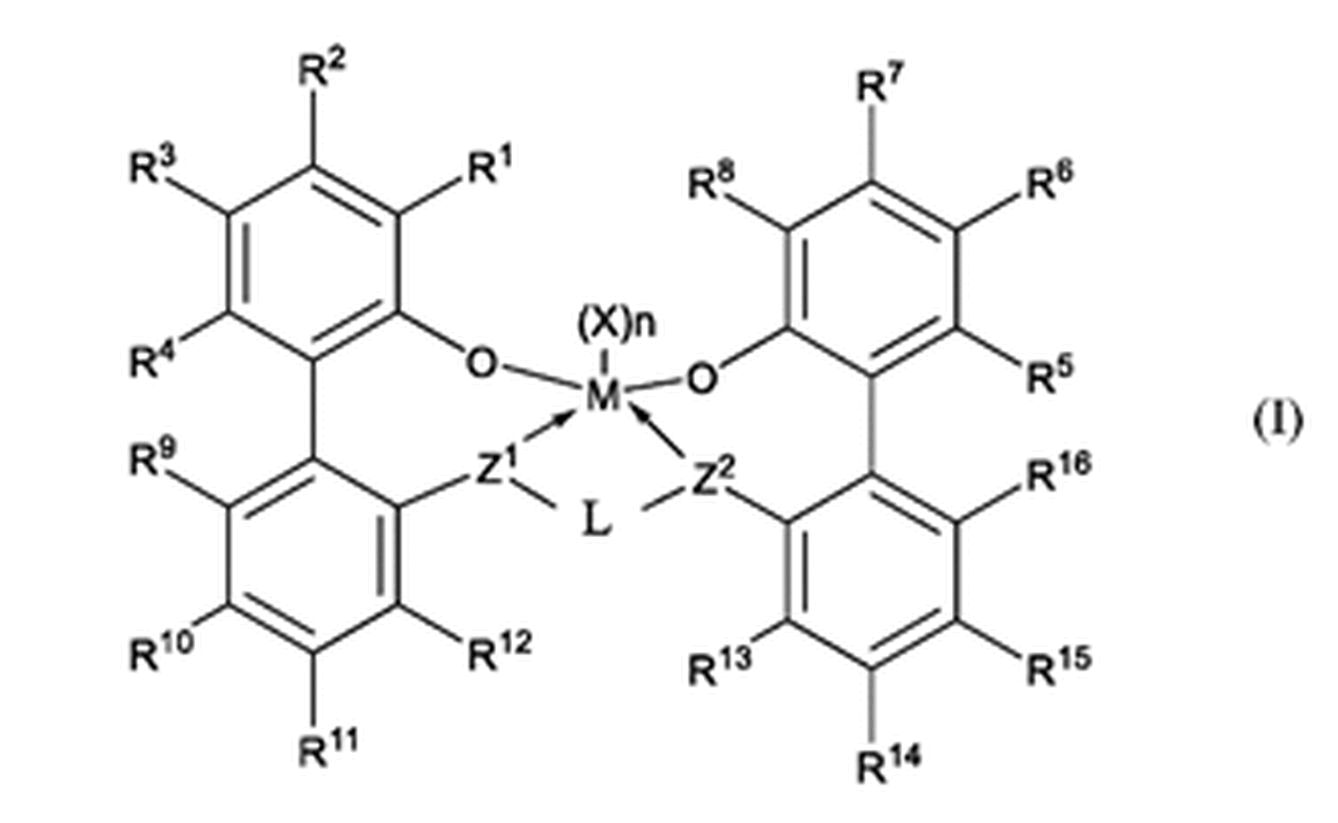
式(I)では、Mは、チタン、ジルコニウム、またはハフニウムから選択される金属であり、金属が、+2、+3、または+4の形式酸化状態にあり、nは、0、1、または2であり、nが1であるとき、Xは、単座配位子または二座配位子であり、nが2であるとき、各Xは、単座配位子であり、かつ同一であるかまたは異なり、金属-配位子錯体は、全体として電荷的に中性であり、各Zは、独立して-O-、-S-、-N(RN)-、または-P(RP)-から選択され、Lは、(C1~C40)ヒドロカルビレンまたは(C1~C40)ヘテロヒドロカルビレンであり、(C1~C40)ヒドロカルビレンが、式(I)の2つのZ基を連結する1炭素原子~10炭素原子のリンカー骨格(これにLが結合している)を含む部分を有するか、または(C1~C40)ヘテロヒドロカルビレンが、式(I)の2つのZ基を連結する1原子~10原子のリンカー骨格を含む部分を有し、(C1~C40)ヘテロヒドロカルビレンの1原子~10原子のリンカー骨格の1~10個の原子の各々が、独立して炭素原子またはヘテロ原子であり、各ヘテロ原子が、独立してO、S、S(O)、S(O)2、Si(RC)2、Ge(RC)2、P(RC)、またはN(RC)であり、各RCが、独立して(C1~C30)ヒドロカルビルまたは(C1~C30)ヘテロヒドロカルビルであり、R1およびR8が、独立して-H、(C1~C40)ヒドロカルビル、(C1~C40)ヘテロヒドロカルビル、-Si(RC)3、-Ge(RC)3、-P(RP)2、-N(RN)2、-ORC、-SRC、-NO2、-CN、-CF3、RCS(O)-、RCS(O)2-、(RC)2C=N-、RCC(O)O-、RCOC(O)-、RCC(O)N(RN)-、(RN)2NC(O)-、ハロゲン、および以下の式(II)、下式(III)、または式(IV)を有するラジカルからなる群から選択される。
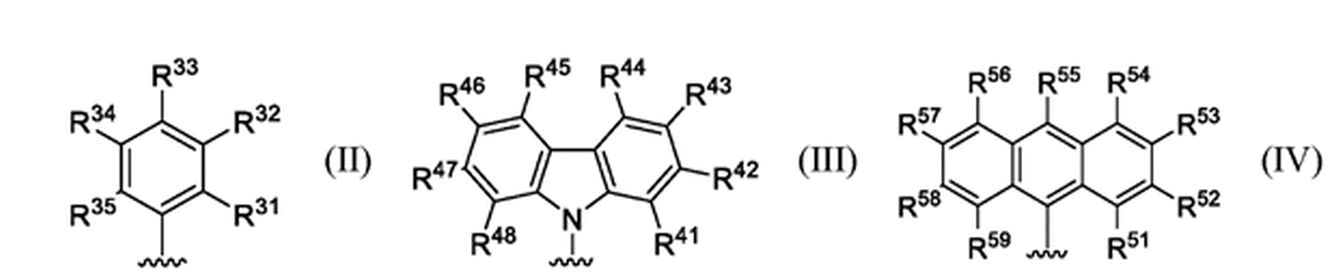
式(II)、(III)、および(IV)において、R31~35、R41~48、またはR51~59の各々は独立して、(C1~C40)ヒドロカルビル、(C1~C40)ヘテロヒドロカルビル、-Si(RC)3、-Ge(RC)3、-P(RP)2、-N(RN)2、-N=CHRC、-ORC、-SRC、-NO2、-CN、-CF3、RCS(O)-、RCS(O)2-、(RC)2C=N-、RCC(O)O-、RCOC(O)-、RCC(O)N(RN)-、(RN)2NC(O)-、ハロゲン、または-Hから選択され、ただし、R1またはR8のうちの少なくとも一方が式(II)、式(III)、または式(IV)を有するラジカルであることを条件とする。 In Formulas (II), (III), and (IV), each of R 31-35 , R 41-48 , or R 51-59 is independently (C 1 -C 40 ) hydrocarbyl, (C 1 - C 40 ) heterohydrocarbyl, —Si(R C ) 3 , —Ge(R C ) 3 , —P(R P ) 2 , —N(R N ) 2 , —N=CHR C , —OR C , —SR C , —NO 2 , —CN, —CF 3 , R C S(O)—, R C S(O) 2 —, (R C ) 2 C═N—, R C C(O)O—, R selected from C OC(O)-, R C C(O)N(R N )-, (R N ) 2 NC(O)-, halogen, or -H, provided that R 1 or R 8 provided that at least one is a radical having formula (II), formula (III), or formula (IV).
式(I)において、R2~4、R5~7、およびR9~16の各々は、独立して(C1~C40)ヒドロカルビル、(C1~C40)ヘテロヒドロカルビル、-Si(RC)3、-Ge(RC)3、-P(RP)2、-N(RN)2、-N=CHRC、-ORC、-SRC、-NO2、-CN、-CF3、RCS(O)-、RCS(O)2-、(RC)2C=N-、RCC(O)O-、RCOC(O)-、RCC(O)N(RN)-、(RC)2NC(O)-、ハロゲン、および-Hから選択される。 In formula (I), each of R 2-4 , R 5-7 , and R 9-16 is independently (C 1 -C 40 ) hydrocarbyl, (C 1 -C 40 ) heterohydrocarbyl, —Si( R C ) 3 , -Ge(R C ) 3 , -P(R P ) 2 , -N(R N ) 2 , -N=CHR C , -OR C , -SR C , -NO 2 , -CN, —CF 3 , R C S(O)—, R C S(O) 2 —, (R C ) 2 C═N—, R C C(O)O—, R C OC(O)—, R C is selected from C(O)N(R N )—, (R C ) 2 NC(O)—, halogen, and —H;
いくつかの実施形態において、ポリエチレン組成物は、第1の反応器において式(I)による第1の触媒および第2の反応器において式(I)による異なる触媒を使用して形成される。 In some embodiments, the polyethylene composition is formed using a first catalyst according to formula (I) in a first reactor and a different catalyst according to formula (I) in a second reactor.
二重ループ反応器が使用される例示的な一実施形態において、第1のループで使用されるプロ触媒は、ジルコニウム、[[2,2’’’-[[ビス[1-メチルエチル)ゲルミレン]ビス(メチレンオキシ-κO)]ビス[3”,5,5”-トリス(1,1-ジメチルエチル)-5’-オクチル[1,1’:3’,1”-テルフェニル]-2’-オラト-κO]](2-)]ジメチル-であり、化学式C86H128F2GeO4Zrおよび以下の構造(V)を有する。
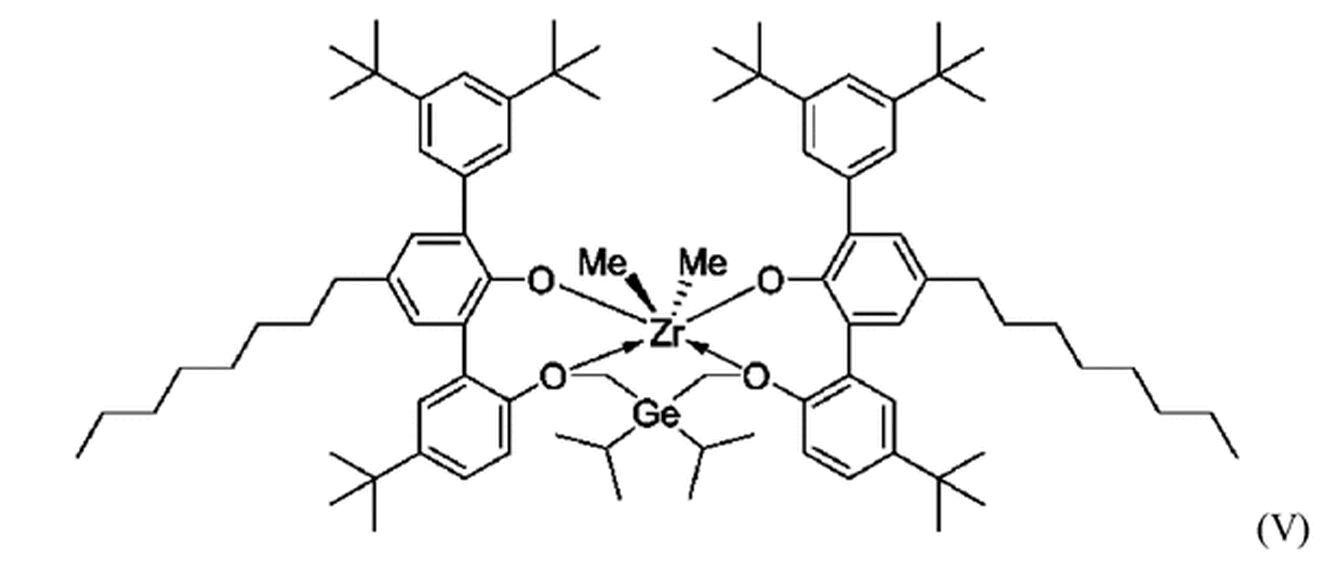
このような実施形態において、第2のループで使用されるプロ触媒は、ジルコニウム、[[2,2’’’-[1,3-プロパンジイルビス(オキシ-κO)]ビス[3-[2,7-ビス(1,1-ジメチルエチル)-9H-カルバゾール-9-イル]]-5’-(ジメチルオクチルシリル)-3’-メチル-5-(1,1,3,3-テトラメチルブチル)[1,1]-ビフェニル]-2-オラト-κO]](2-)]ジメチルであり、化学式C107H154N2O4Si2Zrおよび次の構造(VI)を有する。
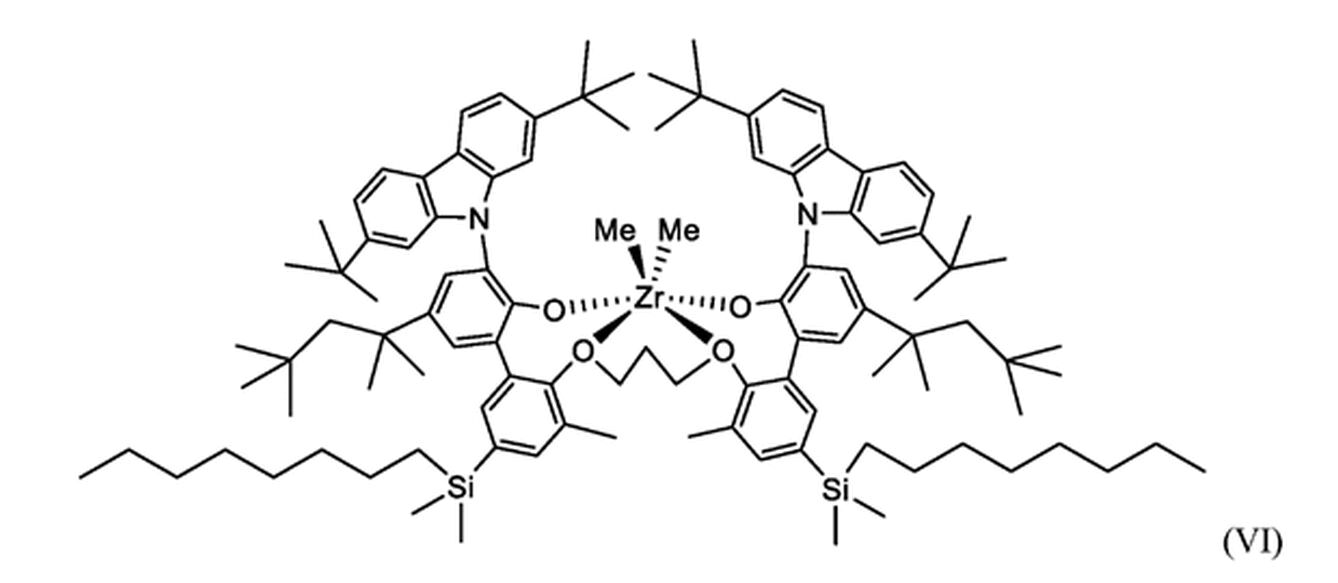
(D)共触媒成分
式(I)の金属-配位子錯体を含む触媒系は、オレフィン重合反応の金属系触媒を活性化するための当該技術分野で既知の任意の技術によって触媒的に活性化され得る。例えば、式(I)の金属-配位子錯体を含む系は、錯体を活性化共触媒と接触させるか、または錯体を活性化共触媒と組み合わせることによって、触媒的に活性化され得る。本発明に使用するのに好適な活性化共触媒としては、アルキルアルミニウム、ポリマーまたはオリゴマーアルモキサン(アルミノキサンとしても知られる)、中性ルイス酸、および非ポリマー性、非配位性、イオン形成性化合物(酸化条件下でのそのような化合物の使用を含む)が挙げられる。好適な活性化技術は、バルク電気分解である。前述の活性化共触媒および技法のうちの1つ以上の組み合わせもまた企図される。「アルキルアルミニウム」という用語は、モノアルキルアルミニウムジヒドリドもしくはモノアルキルアルミニウムジハライド、ジアルキルアルミニムウヒドリドもしくはジアルキルアルミニウムハライド、またはトリアルキルアルミニウムを意味する。ポリマーまたはオリゴマーアルモキサンの例としては、メチルアルモキサン、トリイソブチルアルミニウム修飾メチルアルモキサン、およびイソブチルアルモキサンが挙げられる。
(D) Cocatalyst Component The catalyst system comprising the metal-ligand complex of formula (I) is catalytically activated by any technique known in the art for activating metal-based catalysts of olefin polymerization reactions. can be made For example, a system comprising a metal-ligand complex of formula (I) can be catalytically activated by contacting the complex with an activating cocatalyst or combining the complex with an activating cocatalyst. Suitable activating cocatalysts for use in the present invention include aluminum alkyls, polymeric or oligomeric alumoxanes (also known as aluminoxanes), neutral Lewis acids, and non-polymeric, non-coordinating, ion-forming compounds, including the use of such compounds under oxidizing conditions. A preferred activation technique is bulk electrolysis. Combinations of one or more of the aforementioned activating cocatalysts and techniques are also contemplated. The term "alkylaluminum" means a monoalkylaluminum dihydride or monoalkylaluminum dihalide, a dialkylaluminum hydride or dialkylaluminum halide, or a trialkylaluminum. Examples of polymeric or oligomeric alumoxanes include methylalumoxane, triisobutylaluminum modified methylalumoxane, and isobutylalumoxane.
ルイス酸活性化剤(共触媒)は本明細書に記載されるように、1~3個の(C1~C20)ヒドロカルビル置換基を含有する第13族金属化合物を含む。一実施形態において、第13族金属化合物は、トリ((C1~C20)ヒドロカルビル)置換アルミニウムまたはトリ((C1~C20)ヒドロカルビル)-ホウ素化合物である。他の実施形態では、第13族金属化合物は、トリ(ヒドロカルビル)-置換アルミニウム、トリ((C1~C20)ヒドロカルビル)-ホウ素化合物、トリ((C1~C10)アルキル)アルミニウム、トリ((C6~C18)アリール)ホウ素化合物、およびそれらのハロゲン化(過ハロゲン化を含む)誘導体である。さらなる実施形態では、第13族金属化合物は、トリス(フルオロ置換フェニル)ボラン、トリス(ペンタフルオロフェニル)ボランである。いくつかの実施形態では、活性化共触媒は、トリス((C1~C20)ヒドロカルビルボレート(例えば、トリチルテトラフルオロボレート)またはトリ((C1~C20)ヒドロカルビル)アンモニウムテトラ((C1~C20)ヒドロカルビル)ボラン(例えば、ビス(オクタデシル)メチルアンモニウムテトラキス(ペンタフルオロフェニル)ボラン)である。本明細書で使用される場合、「アンモニウム」という用語は、((C1~C20)ヒドロカルビル)4N+、((C1~C20)ヒドロカルビル)3N(H)+、((C1~C20)ヒドロカルビル)2N(H)2 +、(C1~C20)ヒドロカルビルN(H)3 +、またはN(H)4 +である窒素カチオンを意味し、各(C1~C20)ヒドロカルビルは、2つ以上存在する場合、同一であっても、異なっていてもよい。 Lewis acid activators (co-catalysts), as described herein, include Group 13 metal compounds containing 1-3 (C 1 -C 20 ) hydrocarbyl substituents. In one embodiment, the Group 13 metal compound is a tri((C 1 -C 20 )hydrocarbyl)-substituted aluminum or tri((C 1 -C 20 )hydrocarbyl)-boron compound. In other embodiments, the Group 13 metal compound is tri(hydrocarbyl)-substituted aluminum, tri((C 1 -C 20 )hydrocarbyl)-boron compounds, tri((C 1 -C 10 )alkyl)aluminum, tri ((C 6 -C 18 )aryl)boron compounds and their halogenated (including perhalogenated) derivatives. In a further embodiment, the Group 13 metal compound is tris(fluoro-substituted phenyl)borane, tris(pentafluorophenyl)borane. In some embodiments, the activating cocatalyst is tris((C 1 -C 20 )hydrocarbylborate (eg, trityltetrafluoroborate) or tris((C 1 -C 20 )hydrocarbyl)ammonium tetra((C 1 -C 20 )hydrocarbyl)borane (e.g., bis(octadecyl)methylammoniumtetrakis(pentafluorophenyl)borane).As used herein, the term "ammonium" means ((C 1 -C 20 ) hydrocarbyl) 4 N + , ((C 1 -C 20 ) hydrocarbyl) 3 N(H) + , ((C 1 -C 20 ) hydrocarbyl) 2 N(H) 2 + , (C 1 -C 20 ) hydrocarbyl means a nitrogen cation that is N(H) 3 + , or N(H) 4 + , each (C 1 -C 20 )hydrocarbyl, when two or more are present, may be the same or different; good.
中性ルイス酸活性剤(共触媒)の組み合わせとしては、トリ((C1~C4)アルキル)アルミニウムとハロゲン化トリ((C6~C18)アリール)ホウ素化合物、とりわけ、トリス(ペンタフルオロフェニル)ボランとの組み合わせを含む混合物が挙げられる。他の実施形態は、そのような中性ルイス酸混合物とポリマーまたはオリゴマーアルモキサンとの組み合わせ、および単一の中性ルイス酸、特にトリス(ペンタフルオロフェニル)ボランとポリマーまたはオリゴマーアルモキサンとの組み合わせである。(金属-配位子錯体):(トリス(ペンタフルオロ-フェニルボラン):(アルモキサン)[例えば(第4族金属-配位子錯体):(トリス(ペンタフルオロ-フェニルボラン):(アルモキサン)]のモル数の比は、1:1:1~1:10:30であり、他の実施形態では、1:1:1.5~1:5:10である。 Combinations of neutral Lewis acid activators (cocatalysts) include tri((C 1 -C 4 )alkyl)aluminum and tri((C 6 -C 18 )aryl)boron halide compounds, especially tris(pentafluoro). Mixtures including combinations with phenyl)borane are included. Other embodiments are combinations of such neutral Lewis acid mixtures with polymeric or oligomeric alumoxanes, and combinations of single neutral Lewis acids, particularly tris(pentafluorophenyl)borane, with polymeric or oligomeric alumoxanes. is. (metal-ligand complex): (tris(pentafluoro-phenylborane):(alumoxane) [eg (Group 4 metal-ligand complex): (tris(pentafluoro-phenylborane):(alumoxane)] is from 1:1:1 to 1:10:30, and in other embodiments from 1:1:1.5 to 1:5:10.
式(I)の金属-配位子錯体を含む触媒系を活性化して、1つ以上の共触媒、例えば、カチオン形成性共触媒、強ルイス酸、またはそれらの組み合わせを組み合わせることによって、活性触媒組成物を形成することができる。好適な活性化共触媒としては、ポリマーまたはオリゴマーアルミノキサン、特にメチルアルミノキサン、ならびに不活性、相溶性、非配位性、イオン形成性化合物が挙げられる。例示的な好適な共触媒としては、修飾メチルアルミノキサン(MMAO)、ビス(水素化獣脂アルキル)メチル、テトラキス(ペンタフルオロフェニル)ボレート(1-)アミン、およびそれらの組み合わせが挙げられるが、これらに限定されない。 Activating the catalyst system comprising the metal-ligand complex of formula (I) to form an active catalyst by combining one or more cocatalysts, such as cation-forming cocatalysts, strong Lewis acids, or combinations thereof A composition can be formed. Suitable activating cocatalysts include polymeric or oligomeric aluminoxanes, especially methylaluminoxanes, and inert, compatible, non-coordinating, ion forming compounds. Exemplary suitable cocatalysts include modified methylaluminoxane (MMAO), bis(hydrogenated tallowalkyl)methyl, tetrakis(pentafluorophenyl)borate( 1- )amine, and combinations thereof, including Not limited.
いくつかの実施形態において、前述の活性化共触媒のうちの1つ以上は、互いに組み合わせて使用される。特に好ましい組み合わせは、トリ((C1~C4)ヒドロカルビル)アルミニウム、トリ((C1~C4)ヒドロカルビル)ボラン、またはホウ酸アンモニウムとオリゴマーもしくはポリマーアルモキサン化合物との混合物である。式(I)の1つ以上の金属-配位子錯体の総モル数対1つ以上の活性化共触媒の総モル数の比は、1:10,000~100:1である。いくつかの実施形態では、この比は、少なくとも1:5000であり、他のいくつかの実施形態では少なくとも1:1000、および10:1以下であり、さらにいくつかの他の実施形態では、1:1以下である。アルモキサンを単独で活性化共触媒として使用する場合、好ましくは、用いられるアルモキサンのモル数は、式(I)の金属-配位子錯体のモル数の少なくとも100倍である。トリス(ペンタフルオロフェニル)ボランを単独で活性化共触媒として使用する場合、いくつかの他の実施形態では、式(I)の1つ以上の金属-配位子錯体の総モル数に対して用いられるトリス(ペンタフルオロフェニル)ボランのモル数は、0.5:1~10:1、1:1~6:1、または1:1~5:1である。残りの活性化共触媒は一般に、式(I)の1つ以上の金属-配位子錯体の総モル量におおよそ等しいモル量で用いられる。 In some embodiments, one or more of the aforementioned activating cocatalysts are used in combination with each other. Particularly preferred combinations are tri((C 1 -C 4 )hydrocarbyl)aluminum, tri((C 1 -C 4 )hydrocarbyl)borane, or mixtures of ammonium borate and oligomeric or polymeric alumoxane compounds. The ratio of total moles of one or more metal-ligand complexes of formula (I) to total moles of one or more activating cocatalysts is from 1:10,000 to 100:1. In some embodiments, this ratio is at least 1:5000, in some other embodiments at least 1:1000, and no greater than 10:1, and in some other embodiments 1 : 1 or less. When alumoxane is used alone as an activating cocatalyst, preferably the number of moles of alumoxane used is at least 100 times the number of moles of metal-ligand complex of formula (I). When tris(pentafluorophenyl)borane is used alone as an activating cocatalyst, in some other embodiments, relative to the total number of moles of one or more metal-ligand complexes of formula (I) The number of moles of tris(pentafluorophenyl)borane used is 0.5:1 to 10:1, 1:1 to 6:1, or 1:1 to 5:1. The remaining activating cocatalyst is generally used in a molar amount approximately equal to the total molar amount of one or more metal-ligand complexes of formula (I).
ここに記載される多層フィルムの生成方法
多層フィルムの生成について、様々な方法論が企図されている。1つ以上の実施形態では、多層フィルムを製造するプロセスは、キャストフィルムの押出しまたはインフレーションフィルムの押出しを含み得る。
Methods of Producing Multilayer Films Described Here Various methodologies are contemplated for producing multilayer films. In one or more embodiments, the process of making a multilayer film can include cast film extrusion or blown film extrusion.
いくつかの実施形態では、多層フィルムを製造するプロセスは、インフレーションフィルムバブルを形成することを含み得る。いくつかの実施形態では、インフレーションフィルムバブルは、多層インフレーションフィルムバブルであり得る。この実施形態によれば、さらに、多層インフレーションフィルムバブルは、少なくとも5つの層(本明細書に記載の第1の層、第2の層、第3の層、第4の層、および第5の層による)を含み得、この少なくとも5つの層は互いに付着してもよい。いくつかの実施形態では、第1の層および第5の層の各々は、線状低密度ポリエチレンを含み得、第2の層および第4の層は、高密度ポリエチレンを含み得、第3の層は、本開示で前述したポリエチレン組成物を含み得る。 In some embodiments, the process of making a multilayer film can include forming a blown film bubble. In some embodiments, the blown film bubble can be a multi-layer blown film bubble. Further according to this embodiment, the multilayer blown film bubble comprises at least five layers (first layer, second layer, third layer, fourth layer, and fifth layer described herein). by layer), and the at least five layers may be adhered to each other. In some embodiments, each of the first and fifth layers may comprise linear low density polyethylene, the second and fourth layers may comprise high density polyethylene, and the third and fifth layers may comprise linear low density polyethylene. The layer may comprise the polyethylene composition previously described in this disclosure.
インフレーションフィルムプロセスの実施形態において、押出ダイからの押出フィルムが、形成され(インフレートされ)、タワーを上方に、ニップ上まで引き上げられ得る。次に、そのフィルムをコアに巻き付けることができる。フィルムをコアに巻き付ける前に、折り畳み装置を使用してフィルムの端を切断して折り畳むことができる。それにより、フィルムの層を分離することが困難になり、これは、輸送用途全般、または頑丈な輸送用サック用途に重要であり得る。 In embodiments of the blown film process, the extruded film from the extrusion die can be formed (inflated) and pulled up the tower and onto the nip. The film can then be wrapped around the core. A folding device can be used to cut and fold the edges of the film prior to winding the film onto the core. This makes it difficult to separate the layers of the film, which can be important for shipping applications in general, or heavy-duty shipping sack applications.
さらなる実施形態では、インフレーションフィルムバブルは、30対1以上の長さ対直径(「L/D」)比を有するインフレーションフィルム押出ラインを介して形成され得る。いくつかの実施形態では、押出ラインは、約1~約5、約1~約3、約2~約5、または約2~約3のブローアップ比を有し得る。いくつかの実施形態では、押出ラインは、内部気泡冷却を有するダイを利用してもよい。いくつかの実施形態では、ダイギャップは、約1ミリメートル(mm)~約5mm、約1mm~約3mm、約2mm~約5mm、または約2mm~約3mmであり得る。 In further embodiments, blown film bubbles may be formed via blown film extrusion lines having a length to diameter (“L/D”) ratio of 30 to 1 or greater. In some embodiments, the extrusion line can have a blow-up ratio of about 1 to about 5, about 1 to about 3, about 2 to about 5, or about 2 to about 3. In some embodiments, an extrusion line may utilize a die with internal bubble cooling. In some embodiments, the die gap can be from about 1 millimeter (mm) to about 5 mm, from about 1 mm to about 3 mm, from about 2 mm to about 5 mm, or from about 2 mm to about 3 mm.
いくつかの実施形態では、押出ラインは、フィルム厚ゲージスキャナーを利用してもよい。いくつかの実施形態では、押出プロセスの間、多層フィルム厚は、約15μm~115μmに維持され得る。他の実施形態では、多層フィルム厚は、約15μm~100μm、15μm~75μm、15μm~50μm、15μm~25μm、25μm~115μm、25μm~100μm、25μm~75μm、25μm~50μm、50μm~115μm、50μm~100μm、50μm~75μm、75μm~115μm、75μm~100μm、または100μm~115μmに維持され得る。 In some embodiments, the extrusion line may utilize a film thickness gauge scanner. In some embodiments, the multilayer film thickness can be maintained between about 15 μm and 115 μm during the extrusion process. In other embodiments, the multilayer film thickness is about 15 μm to 100 μm, 15 μm to 75 μm, 15 μm to 50 μm, 15 μm to 25 μm, 25 μm to 115 μm, 25 μm to 100 μm, 25 μm to 75 μm, 25 μm to 50 μm, 50 μm to 115 μm, 50 μm to It can be maintained at 100 μm, 50 μm to 75 μm, 75 μm to 115 μm, 75 μm to 100 μm, or 100 μm to 115 μm.
いくつかの実施形態では、多層インフレーションフィルムバブルの形成ステップは、350~500°F、または375~475°Fの温度で行われ得る。出力速度は、約5lb/時/in~約25lb/時/in、約5lb/時/in~約20lb/時/in、約5lb/時/in~約15lb/時/in、約5lb/時/in~約10lb/時/in、約10lb/時/in~約25lb/時/in、約10lb/時/in~約20lb/時/in、約10lb/時/in~約15lb/時/in、約15lb/時/in~約25lb/時/in、約15lb/時/in~約20lb/時/in、または約20lb/時/in~約25lb/時/inであり得る。 In some embodiments, the step of forming a multilayer blown film bubble can be performed at a temperature of 350-500°F, or 375-475°F. Output rate is about 5 lb/hr/in to about 25 lb/hr/in, about 5 lb/hr/in to about 20 lb/hr/in, about 5 lb/hr/in to about 15 lb/hr/in, about 5 lb/hr. /in to about 10 lb/hr/in, about 10 lb/hr/in to about 25 lb/hr/in, about 10 lb/hr/in to about 20 lb/hr/in, about 10 lb/hr/in to about 15 lb/hr/in in, from about 15 lb/hr/in to about 25 lb/hr/in, from about 15 lb/hr/in to about 20 lb/hr/in, or from about 20 lb/hr/in to about 25 lb/hr/in.
物品
本開示の実施形態はまた、本開示の多層フィルムから形成されたパッケージなどの物品に関する。このようなパッケージは、本明細書に記載されている本開示の任意の多層フィルムから形成することができる。本開示の多層フィルムは、良好な引裂強度およびダート強度が望まれる物品において特に有用である。
Articles Embodiments of the present disclosure also relate to articles, such as packages, formed from the multilayer films of the present disclosure. Such packages can be formed from any of the multilayer films of the present disclosure described herein. Multilayer films of the present disclosure are particularly useful in articles where good tear and dirt strength are desired.
そのような物品の例としては、可撓性パッケージ、パウチ、立式パウチ、および既成パッケージまたはパウチが挙げられる。いくつかの実施形態において、本開示の多層フィルムまたはラミネートは、頑丈な輸送用サックに使用することができる。いくつかの実施形態では、前述の頑丈な輸送用サックの1つ以上を輸送用途で利用することができる。 Examples of such articles include flexible packages, pouches, stand-up pouches, and pre-made packages or pouches. In some embodiments, multilayer films or laminates of the present disclosure can be used in heavy-duty shipping sacks. In some embodiments, one or more of the aforementioned heavy-duty shipping sacks can be utilized in shipping applications.
本明細書で開示されている多層フィルムから物品の実施形態を生成する様々な方法は、当業者によく知られているであろう。 Various methods of producing article embodiments from the multilayer films disclosed herein will be familiar to those skilled in the art.
試験方法
試験方法には、以下が含まれる。
Test Methods Test methods include:
メルトインデックス
ポリマー試料のメルトインデックスI2(またはI2)およびI10(またはI10)は、それぞれ190℃ならびに2.16kgおよび10kgの負荷で、ASTM D-1238(方法B)に従って測定された。それらの値はg/10分で報告される。ポリマー試料の画分は、ポリマー組成物のその特定の画分または部分を生成する反応器から生成物ポリマーを収集することによって測定される。例えば、第1のポリエチレン画分は、ポリマー組成物のより低い密度で、より高分子量の成分を生成する反応器から収集することができる。メルトインデックス測定の前に、ポリマー溶液を真空下で乾燥させる。
Melt Index The melt indices I 2 (or I2) and I 10 (or I10) of polymer samples were measured according to ASTM D-1238 (Method B) at 190° C. and loads of 2.16 kg and 10 kg, respectively. Their values are reported in g/10 min. A fraction of a polymer sample is measured by collecting product polymer from the reactor that produces that particular fraction or portion of the polymer composition. For example, a first polyethylene fraction can be collected from a reactor that produces a lower density, higher molecular weight component of the polymer composition. Prior to melt index measurement, the polymer solution is dried under vacuum.
密度
密度測定用の試料は、ASTM D4703に従って調製した。試料加圧の1時間以内に、ASTM D792、方法Bに従って測定した。
Density Samples for density measurements were prepared according to ASTM D4703. Measured according to ASTM D792, Method B, within 1 hour of sample pressurization.
ASTM D1709ダート落下
フィルムダート落下試験は、自由落下するダートによる衝撃が、規定条件下においてプラスチックフィルムの破損を引き起こすエネルギーを決定する。試験結果は、試験される試験片の50%の破損をもたらすことになる、規定の高さから落ちるこの飛翔体の重量として表されるエネルギーである。
ASTM D1709 Dart Drop The film dart drop test determines the energy at which a free falling dart impact causes failure of a plastic film under specified conditions. The test result is the energy expressed as the weight of this projectile falling from a specified height that will result in failure of 50% of the specimens tested.
フィルムを生成した後、そのフィルムを、ASTM標準に従って23℃(+/-2℃)および50%R.H(+/-5)で少なくとも40時間馴化させた。標準試験条件は、ASTM標準に従って23℃(+/-2℃)および50%R.H(+/-5)である。 After producing the film, the film was annealed at 23° C. (+/-2° C.) and 50% R.I. according to ASTM standards. H(+/−5) conditioned for at least 40 hours. Standard test conditions are 23° C. (+/-2° C.) and 50% R.I. according to ASTM standards. H(+/-5).
試験結果は、直径1.5インチのダートヘッドおよび26インチの落下高を使用する方法A、または直径2.0のダートヘッドおよび60インチの落下高を使用する方法Bのいずれかによって報告され得る。試料の厚さを試料の中心で測定し、次いで試料を5インチの内径を有する環状試験片ホルダーで固定する。ダートを、試料の中心より上に装填し、空気圧または電磁気のいずれかのメカニズムによって放出する。 Test results can be reported by either Method A using a 1.5 inch diameter dart head and 26 inch drop height, or Method B using a 2.0 diameter dart head and 60 inch drop height. . The thickness of the sample is measured at the center of the sample and then the sample is clamped in an annular specimen holder with a 5 inch inner diameter. Darts are loaded above the center of the sample and released by either pneumatic or electromagnetic mechanisms.
試験は、「ステアケース」法に従って実施される。試料が不合格になった場合、ダートの重量が既知の固定量だけ低減された新たな試料を試験する。試料が不合格にならなかった場合、ダートの重量が既知の量だけ増加された新たな試料を試験する。20個の試験片が試験された後、不合格の数が決定される。この数が10である場合、試験を完了する。この数が10未満である場合、10回の不合格が記録されるまで試験を継続する。この数が10より大きい場合、非不合格の総数が10になるまで試験を継続する。ダート落下強度を、ASTM D1709に従って、タイプAのダート落下衝撃としてグラムで表して、これらのデータから決定した。分析した全ての試料は、厚さ2ミルであった。 The test is conducted according to the "Staircase" method. If the sample fails, test a new sample in which the dart weight has been reduced by a known fixed amount. If the sample does not fail, test a new sample with the dart weight increased by a known amount. After 20 specimens have been tested, the number of failures is determined. If this number is 10, complete the test. If this number is less than 10, continue testing until 10 failures are recorded. If this number is greater than 10, continue testing until the total number of non-fails is 10. Dart drop strength, expressed in grams as Type A dart drop impact, was determined from these data according to ASTM D1709. All samples analyzed were 2 mils thick.
計装化ダート衝撃
計装化ダート衝撃法は、ASTM D7192に従って、プラスチックフィルム試験片上で、Instron CEAST 9350衝撃試験機を使用して測定される。試験は、半球形のヘッドを備えた直径12.7mmのタップ、ゴム面のグリップを備えた直径75mmのクランプアセンブリを使用して実施される。機器には、低温または高温で試験するための環境チャンバーが装備されている。典型的な試験片のサイズは125mm×125mmである。標準的な試験速度は200m/分である。フィルム厚は2ミルである。
Instrumented Dart Impact The Instrumented Dart Impact method is measured using an Instron CEAST 9350 impact tester on plastic film specimens according to ASTM D7192. The test is performed using a 12.7 mm diameter tap with a hemispherical head, a 75 mm diameter clamp assembly with a rubber-faced grip. The instrument is equipped with an environmental chamber for cold or hot testing. A typical specimen size is 125 mm x 125 mm. A standard test speed is 200 m/min. Film thickness is 2 mils.
クリープゼロ剪断粘度測定法
ゼロ剪断粘度は、190℃で直径25mmの平行板を使用したAR-G2応力制御レオメーター(TA Instruments、New Castle,Del)で行ったクリープ試験によって得られる。取付け器具をゼロにする前に、レオメーターオーブンを少なくとも30分間試験温度に設定する。その試験温度で、圧縮成形された試料ディスクをプレート間に挿入し、5分かけて平衡させる。次いで、上側プレートを所望の試験間隙(1.5mm)より50μm上に下げる。あらゆる余分な材料をトリミングして除去し、上側プレートを所望の間隙まで下げる。測定は、5L/分の流量での窒素パージ下で行う。デフォルトのクリープ時間は2時間に設定する。
Creep Zero Shear Viscosity Measurements Zero shear viscosities are obtained by creep tests performed on an AR-G2 stress controlled rheometer (TA Instruments, New Castle, Del.) using 25 mm diameter parallel plates at 190°C. Set the rheometer oven to the test temperature for at least 30 minutes before zeroing the fixture. At the test temperature, a compression molded sample disc is inserted between the plates and allowed to equilibrate for 5 minutes. The upper plate is then lowered 50 μm above the desired test gap (1.5 mm). Trim away any excess material and lower the upper plate to the desired gap. Measurements are performed under a nitrogen purge with a flow rate of 5 L/min. The default creep time is set to 2 hours.
定常状態の剪断速度が、ニュートン領域にあるだけの十分な低さを有することを確実にするために、試料の全てに20Paの一定の低剪断応力を加える。得られた定常状態の剪断速度は、この試験における試料については10-3~10-4s-1の範囲内にある。定常状態は、log(J(t))対log(t)(式中、J(t)はクリープコンプライアンスであり、tはクリープ時間である)のプロットの最後の10%の時間ウィンドウ内の全てのデータについて線形回帰を取ることによって決定される。線形回帰の傾きが0.97より大きい場合、定常状態に達したとみなし、次いでクリープ試験を停止する。この試験の全ての場合において、傾きは2時間以内に基準を満たす。定常状態の剪断速度は、ε対t(εは歪みである)のプロットの最後の10%の時間ウィンドウにおける全てのデータポイントの線形回帰の傾きから決定される。ゼロ剪断粘度は、加えられた応力対定常状態の剪断速度の比から決定される。 A constant low shear stress of 20 Pa is applied to all of the samples to ensure that the steady state shear rate has low enough to be in the Newtonian regime. The steady state shear rates obtained are in the range of 10 −3 to 10 −4 s −1 for the samples in this test. Steady state is all within the last 10% time window of a plot of log(J(t)) versus log(t), where J(t) is the creep compliance and t is the creep time. is determined by taking a linear regression on the data. If the slope of the linear regression is greater than 0.97, steady state is considered reached and the creep test is stopped. In all cases of this test, the slope meets the criteria within 2 hours. The steady-state shear rate is determined from the slope of the linear regression of all data points in the last 10% time window of the plot of ε versus t (where ε is the strain). Zero shear viscosity is determined from the ratio of applied stress to steady state shear rate.
クリープ試験中に試料が劣化しているかどうかを決定するために、0.1~100rad/秒で同じ試料についてクリープ試験の前後に小振幅振動剪断試験を行う。2つの試験の複素粘度値を比較する。0.1rad/秒における粘度値の差が5%より大きい場合、クリープ試験中に試料が劣化したとみなし、結果を廃棄する。 To determine if the sample is degrading during the creep test, a small amplitude oscillatory shear test is performed on the same sample before and after the creep test at 0.1-100 rad/sec. Compare the complex viscosity values of the two tests. If the difference in viscosity values at 0.1 rad/sec is greater than 5%, the sample is considered degraded during the creep test and the results are discarded.
ゲル浸透クロマトグラフィー(GPC)
クロマトグラフィーシステムは、内部IR5赤外線検出器(IR5)を装備したPolymerChar GPC-IR(Valencia,Spain)の高温GPCクロマトグラフで構成された。オートサンプラーオーブン区画を摂氏160度に設定し、カラム区画を摂氏150度に設定した。カラムには、4本のAgilent「Mixed A」30cm 20ミクロン線形混合床カラムおよび20umのプレカラムを使用した。使用したクロマトグラフィー溶媒は、1,2,4-トリクロロベンゼンであり、これは、200ppmのブチル化ヒドロキシトルエン(BHT)を含有していた。溶媒源は、窒素スパージされた。使用した注入体積は200マイクロリットルであり、流量は1.0ミリリットル/分であった。
Gel permeation chromatography (GPC)
The chromatographic system consisted of a PolymerChar GPC-IR (Valencia, Spain) high temperature GPC chromatograph equipped with an internal IR5 infrared detector (IR5). The autosampler oven compartment was set at 160 degrees Celsius and the column compartment was set at 150 degrees Celsius. The columns used were four Agilent "Mixed A" 30
GPCカラムセットの較正を、580~8,400,000の範囲の分子量を有する21個の狭い分子量分布のポリスチレン標準物質を用いて行い、個々の分子量の間に少なくとも10倍の間隔を有する6つの「カクテル」混合物中に配列された。標準物質は、Agilent Technologiesから購入した。1,000,000以上の分子量については50ミリリットルの溶媒中の0.025グラムで、また1,000,000未満の分子量については50ミリリットルの溶媒中の0.05グラムでポリスチレン標準物質を調製した。ポリスチレン標準物質を穏やかに撹拌しながら摂氏80度で30分間溶解させた。ポリスチレン標準物質のピーク分子量を、式1を使用してポリエチレン分子量に変換した(Williams and Ward,J.Polym.Sci.,Polym.Let.,6,621(1968)に記載の通り)。
Mポリエチレン=A×(Mポリスチレン)B (EQ1)
式中、Mは分子量であり、Aは0.4315の値を有し、Bは1.0に等しい。
Calibration of the GPC column set was performed using 21 narrow molecular weight distribution polystyrene standards with molecular weights ranging from 580 to 8,400,000, and six columns with at least 10-fold spacing between individual molecular weights. Arranged in a "cocktail" mixture. Standards were purchased from Agilent Technologies. Polystyrene standards were prepared at 0.025 grams in 50 milliliters of solvent for molecular weights greater than or equal to 1,000,000 and 0.05 grams in 50 milliliters of solvent for molecular weights less than 1,000,000. . The polystyrene standards were dissolved at 80 degrees Celsius for 30 minutes with gentle agitation. Peak molecular weights of polystyrene standards were converted to polyethylene molecular weights using Equation 1 (as described in Williams and Ward, J. Polym. Sci., Polym. Let., 6, 621 (1968)).
M polyethylene = A x (M polystyrene ) B (EQ1)
where M is the molecular weight, A has a value of 0.4315 and B equals 1.0.
五次多項式を使用して、それぞれのポリエチレン同等較正点に当てはめた。Aに対してわずかな調整(約0.375~0.445)を行い、カラム分解能およびバンド拡張効果を、線状ホモポリマーポリエチレン標準物質が120,000Mwで得られるように補正した。 A fifth order polynomial was used to fit each polyethylene equivalent calibration point. A slight adjustment (approximately 0.375-0.445) was made to A to correct for column resolution and band broadening effects as linear homopolymer polyethylene standards were obtained at 120,000 Mw.
GPCカラムセットの総プレート計数を、(50ミリリットルのTCB中0.04gで調製し、穏やかに撹拌しながら20分間溶解した)デカンで行う。プレート計数(式2)および対称性(式3)を、以下の式に従って200マイクロリットル注入で測定した。


試料はPolymerChar「Instrument Control」ソフトウェアを用いて半自動様式で調製され、2mg/mlを試料の目標重量とし、PolymerChar高温オートサンプラーを介して、予め窒素スパージされたセプタキャップ付きバイアルに溶媒(200ppmのBHTを含有)を添加した。試料を、「低速」振とうしながら摂氏160度で2時間溶解した。 Samples were prepared in a semi-automated fashion using the PolymerChar “Instrument Control” software with a sample target weight of 2 mg/ml and solvent (200 ppm BHT ) was added. Samples were dissolved at 160 degrees Celsius for 2 hours with "slow" shaking.
Mn(GPC)、Mw(GPC)、およびMz(GPC)の計算は、PolymerChar GPCOne(商標)ソフトウェア、各々の等間隔のデータ回収点(i)におけるベースラインを差し引いたIRクロマトグラム、および式1の点(i)における狭い標準較正曲線から得られるポリエチレン等価分子量を使用して、式4~6によるPolymerChar GPC-IRクロマトグラフの内部IR5検出器(測定チャネル)を使用して、GPC結果に基づいて行われた。
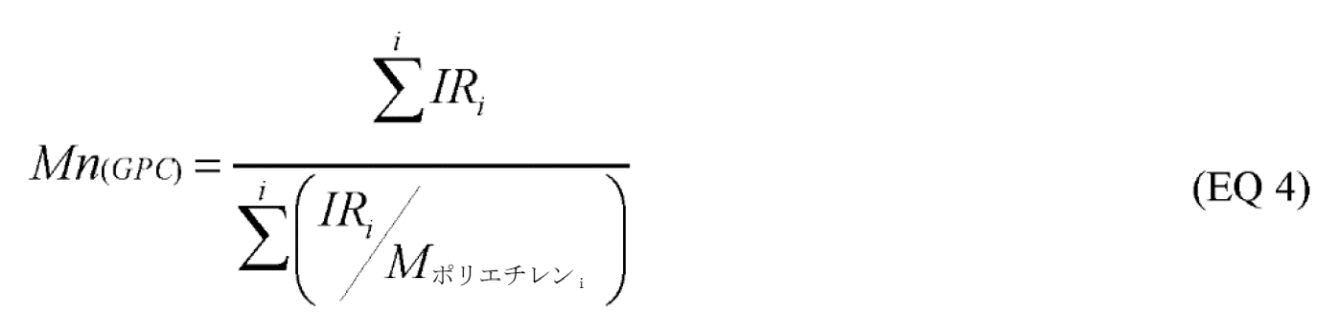
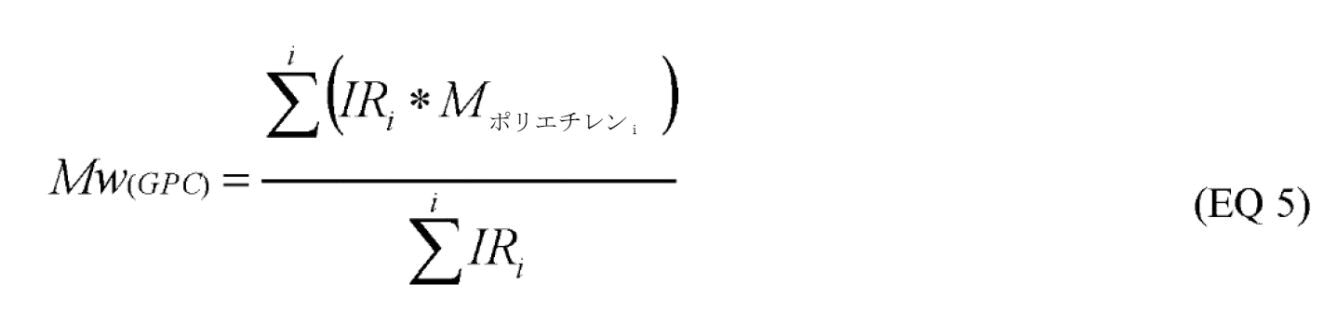
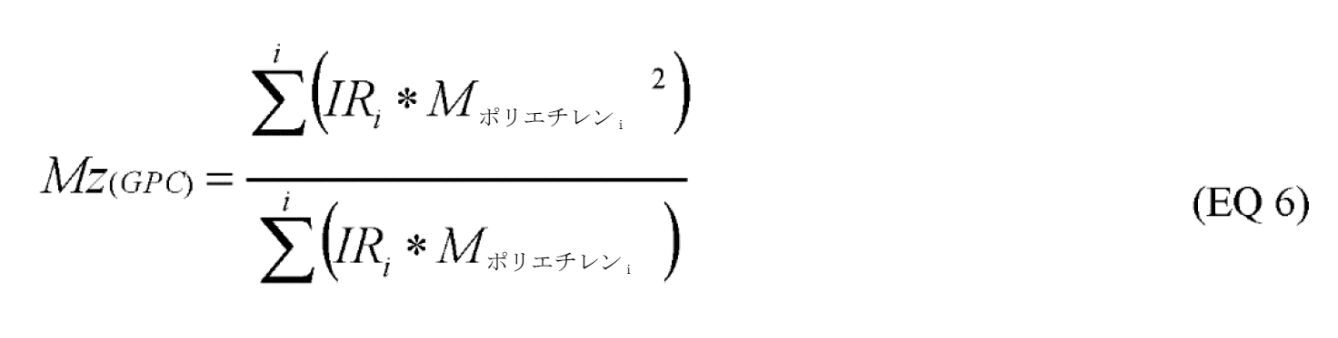
経時的な偏差を監視するために、PolymerChar GPC-IRシステムで制御されたマイクロポンプを介して各試料に流量マーカー(デカン)を導入した。この流量マーカー(FM)は、試料中のそれぞれのデカンピーク(RV(FM試料))のRVを、狭い標準較正(RV(FM較正済み))内のデカンピークのそれと整合することによって各試料のポンプ流量(流量(見かけ))を直線的に較正するために使用された。こうして、デカンマーカーピークの時間におけるいかなる変化も、実行の全体にわたって流量(流量(有効))における線状シフトに関連すると推測される。流量マーカーピークのRV測定の最高精度を促進するために、最小二乗フィッティングルーチンを使用して、流量マーカー濃度クロマトグラムのピークを二次方程式に適合させる。次に、二次方程式の一次導関数を使用して、真のピーク位置を求める。流量マーカーのピークに基づいてシステムを較正した後、(狭い標準較正に対する)有効流量は式7のように計算される。流量マーカーピークの処理は、PolymerChar GPCOne(商標)ソフトウェアにより行われた。許容される流量補正では、有効流量が、見かけ流量の+/-0.5%以内であるべきである。
流量(有効)=流量(見かけ)×(RV(FM較正済み)/RV(FM試料)) (EQ7)
To monitor deviations over time, a flow rate marker (decane) was introduced into each sample via a micropump controlled by a PolymerChar GPC-IR system. This flow rate marker (FM) is determined by matching the RV of each decane peak in the sample (RV(FM sample)) with that of the decane peak in a narrow standard calibration (RV(FM calibrated)). (flow rate (apparent)) was used to linearly calibrate. Thus, any change in the time of the decane marker peak is assumed to be related to a linear shift in flux (flux(effective)) throughout the run. To promote the highest accuracy of the RV measurement of the flow marker peak, a least-squares fitting routine is used to fit the peak of the flow marker concentration chromatogram to a quadratic equation. The first derivative of the quadratic equation is then used to find the true peak position. After calibrating the system based on the peaks of the flow markers, the effective flow (relative to the narrow standard calibration) is calculated as in
Flow rate (effective) = flow rate (apparent) x (RV (FM calibrated)/RV (FM sample)) (EQ7)
改善されたコモノマー含有量分析法(iCCD)
改善されたコモノマー含有量分析法(iCCD)は、2015年に開発された(CongおよびParrottら、WO2017/040127A1)。iCCD試験を、IR-5検出器(PolymerChar,Spain)および二角光散乱検出器モデル2040(Precision Detectors、現在はAgilent Technologies)を備えた結晶化溶出分画機器(CEF)(PolymerChar,Spain)を用いて実施した。検出器オーブン中のIR-5検出器の直前に、5cmまたは10cm(長さ)×1/4インチ(ID)のステンレス鋼に20~27ミクロンのガラス(MoSCi Corporation,USA)を充填したガードカラムを設置した。オルトジクロロベンゼン(ODCB、99%無水グレードまたはテクニカルグレード)を使用した。EMD Chemicalsからシリカゲル40(粒子径0.2~0.5mm、カタログ番号10181-3)を入手した(先にODCB溶媒の乾燥に使用することができる)。CEF機器に、N2パージ能力を備えたオートサンプラーを装備する。使用前に、ODCBに乾燥窒素(N2)を1時間散布する。試料調製を、160℃で1時間振とうしながら、オートサンプラーを4mg/mLで用いて(別途指定のない限り)行った。注入量は300μlであった。iCCDの温度プロファイルは、3℃/分での105℃~30℃への結晶化、30℃での2分間の熱平衡(可溶性画分溶出時間を2分に設定することを含む)、3℃/分での30℃~140℃への溶出であった。結晶化中の流量は、0.0ml/分である。溶出中の流量は、0.50ml/分である。データは、1つのデータポイント/秒で収集した。
Improved comonomer content analysis (iCCD)
An improved comonomer content analysis method (iCCD) was developed in 2015 (Cong and Parrott et al., WO2017/040127A1). iCCD studies were performed on a Crystallization Elution Fractionation Instrument (CEF) (PolymerChar, Spain) equipped with an IR-5 detector (PolymerChar, Spain) and a dual angle light scattering detector model 2040 (Precision Detectors, now Agilent Technologies). was carried out using A guard column of 5 cm or 10 cm (length) x 1/4 inch (ID) stainless steel packed with 20-27 micron glass (MoSCi Corporation, USA) immediately before the IR-5 detector in the detector oven. was installed. Ortho-dichlorobenzene (ODCB, 99% anhydrous grade or technical grade) was used. Silica gel 40 (particle size 0.2-0.5 mm, catalog number 10181-3) was obtained from EMD Chemicals (can be used earlier to dry ODCB solvent). The CEF instrument is equipped with an autosampler with N2 purge capability. The ODCB is sparged with dry nitrogen (N2) for 1 hour prior to use. Sample preparation was performed (unless otherwise specified) using an autosampler at 4 mg/mL with shaking at 160° C. for 1 hour. The injection volume was 300 μl. The temperature profile of the iCCD was crystallization from 105°C to 30°C at 3°C/min, thermal equilibration at 30°C for 2 min (including setting the soluble fraction elution time to 2 min), 3°C/min. Elution from 30°C to 140°C in minutes. The flow rate during crystallization is 0.0 ml/min. The flow rate during elution is 0.50 ml/min. Data were collected at 1 data point/second.
iCCDカラムには、15cm(長さ)×1/4インチ(ID)のステンレス管中の金でコーティングされたニッケル粒子(Bright 7GNM8-NiS、Nippon Chemical Industrial Co.)を詰め込んだ。カラムの詰め込みおよび馴化は、参照文献(Cong,R、Parrott,A.、Hollis,C.、Cheatham,M.WO2017/040127A1)に従ってスラリー法を用いて行われた。TCBスラリーの詰め込みを含む最終圧力は、150バールであった。 The iCCD column was packed with gold-coated nickel particles (Bright 7GNM8-NiS, Nippon Chemical Industrial Co.) in a 15 cm (length) by 1/4 inch (ID) stainless steel tube. Column packing and conditioning was performed using a slurry method according to reference (Cong, R, Parrott, A., Hollis, C., Cheatham, M. WO2017/040127A1). The final pressure, including loading of the TCB slurry, was 150 bar.
カラム温度の較正を、ODCB中の参照物質の線状ホモポリマーポリエチレン(コモノマー含有量がゼロ、メルトインデックス(I2)が1.0、多分散度Mw/Mnがコンベンショナルゲル浸透クロマトグラフィーで約2.6、1.0mg/ml)と、エイコサン(2mg/ml)との混合物を使用して行った。iCCD温度較正は、以下の4つの工程からなった。(1)エイコサンの測定されたピーク溶出温度間の温度オフセットから30.00℃を引いたものとして定義されるディレイボリュームを計算すること、(2)iCCD生温度データから溶出温度の温度オフセットを差し引くこと。この温度オフセットは、溶出温度、溶出流量などの実験条件の関数であることが留意される、(3)線状ホモポリマーポリエチレン参照物が101.0℃でピーク温度を有し、エイコサンが30.0℃のピーク温度を有するように、30.00℃~140.00℃の範囲にわたって溶出温度を変換する線形較正直線を作成すること、(4)30℃で等温的に測定された可溶性画分については、30.0℃未満の溶出温度が、参考物(CerkおよびCongら、US9,688,795)に従って、3℃/分の溶出加熱速度を使用することによって直線的に外挿される。 Column temperature calibration was performed using a reference linear homopolymer polyethylene in ODCB (zero comonomer content, melt index ( I2 ) of 1.0, polydispersity Mw / Mn by conventional gel permeation chromatography). 2.6, 1.0 mg/ml) and eicosane (2 mg/ml). iCCD temperature calibration consisted of the following four steps. (1) calculating the delay volume defined as the temperature offset between the measured peak elution temperatures of eicosane minus 30.00° C., (2) subtracting the temperature offset of the elution temperature from the iCCD raw temperature data. thing. It is noted that this temperature offset is a function of experimental conditions such as elution temperature, elution flow rate, etc. (3) The linear homopolymer polyethylene reference has a peak temperature at 101.0°C and the eicosane at 30.0°C. (4) soluble fraction measured isothermally at 30°C; , elution temperatures below 30.0° C. are linearly extrapolated by using an elution heating rate of 3° C./min according to references (Cerk and Cong et al., US 9,688,795).
コモノマー含有量対iCCDの溶出温度を、12の参照物質(35,000~128,000の範囲のエチレン当量の重量平均分子量を有する、エチレンホモポリマーおよびシングルサイトメタロセン触媒で作製されたエチレン-オクテンランダムコポリマー)を使用することで構築した。これらの参照物質は全て、以前に指定したものと同じ方式で4mg/mLで分析した。報告された溶出ピーク温度は、線形方程式y=-6.3515x.+101.00に線形に適合され、式中、yは、iCCDの溶出温度を表し、xは、オクテンモル%を表し、R2は、0.978であった。 The comonomer content versus the elution temperature of the iCCD was compared with 12 reference materials (ethylene homopolymer and single-site metallocene-catalyzed ethylene-octene randoms with ethylene equivalent weight average molecular weights ranging from 35,000 to 128,000). copolymer). All these reference substances were analyzed at 4 mg/mL in the same manner as previously specified. The reported elution peak temperature is determined by the linear equation y=-6.3515x. Linearly fitted to +101.00, where y represents the elution temperature of the iCCD, x represents the octene mol%, and R2 was 0.978.
ポリマーの分子量およびポリマー画分の分子量は、フォームファクターを1および全てのビリアル係数をゼロと仮定することによって、Rayleigh-Gans-Debys近似(StriegelおよびYau、現代のサイズ排除液体クロマトグラム、242ページおよび263ページ)に従って、LS検出器(90度の角度)および濃度検出器(IR-5)から直接決定された。23.0~120℃の範囲の溶出温度(温度較正は上記で指定)で全てのクロマトグラムを積分するために積分ウィンドウが設定される。 The molecular weights of the polymer and the molecular weights of the polymer fractions are calculated using the Rayleigh-Gans-Debys approximation (Striegel and Yu, Modern Size Exclusion Liquid Chromatograms, page 242 and 263) directly from the LS detector (90 degree angle) and the concentration detector (IR-5). An integration window is set to integrate all chromatograms over an elution temperature range of 23.0-120° C. (temperature calibration specified above).
iCCDからの分子量(Mw)の計算には、次の4つの工程が含まれる。
(1)検出器間オフセットを測定すること。オフセットは、濃度検出器に対するLS検出器間の幾何学的体積オフセットとして定義される。これは、濃度検出器とLSクロマトグラムとのポリマーピークの溶出量(mL)の差として計算される。これが、溶出熱速度および溶出流量を使用することによって、温度オフセットに変換される。線状高密度ポリエチレン(コモノマー含有量がゼロ、メルトインデックス(I2)が1.0、多分散度Mw/Mnがコンベンショナルゲル浸透クロマトグラフィーで約2.6)を使用する。上記の通常のiCCD法と同じ実験条件が使用されるが、10℃/分での140℃~137℃への結晶化、137℃での可溶性画分溶出時間としては1分間の熱平衡、7分間の可溶性画分(SF)時間、3℃/分での137℃~142℃への溶出といったパラメーターは除く。結晶化中の流量は、0.0mL/分である。溶出中の流量は、0.80mL/分である。試料濃度は、1.0mg/mLである。
(2)LSクロマトグラムの各LSデータポイントをシフトして、積分前に検出器間オフセットを補正する。
(3)ベースラインを差し引いたLSおよび濃度クロマトグラムが、工程(1)の溶出温度範囲全体について積分される。MW検出器定数は、100,000~140,000Mwの範囲の既知のMWのHDPE試料と、LSおよび濃度積分信号の面積比を使用して計算される。
(4)ポリマーのMwは、統合光散乱検出器(90度の角度)と濃度検出器との比率を使用し、MW検出器定数を使用して計算される。
Calculation of molecular weight (Mw) from iCCD involves the following four steps.
(1) Measuring the inter-detector offset. Offset is defined as the geometric volume offset between the LS detector to the concentration detector. It is calculated as the difference in elution volume (mL) of the polymer peak between the concentration detector and the LS chromatogram. This is converted to a temperature offset by using the elution heat rate and elution flow rate. Linear high density polyethylene (zero comonomer content, melt index (I 2 ) of 1.0, polydispersity M w /M n of about 2.6 by conventional gel permeation chromatography) is used. The same experimental conditions as the conventional iCCD method described above are used, but crystallization from 140° C. to 137° C. at 10° C./min, soluble fraction elution time at 137° C. of 1 min for thermal equilibrium, 7 min. Parameters such as soluble fraction (SF) time at 3° C./min and elution from 137° C. to 142° C. are excluded. The flow rate during crystallization is 0.0 mL/min. The flow rate during elution is 0.80 mL/min. Sample concentration is 1.0 mg/mL.
(2) Shift each LS data point in the LS chromatogram to correct for inter-detector offset before integration.
(3) The baseline-subtracted LS and concentration chromatograms are integrated over the elution temperature range of step (1). MW detector constants are calculated using HDPE samples of known MW ranging from 100,000 to 140,000 Mw and the area ratio of the LS and concentration integral signals.
(4) The Mw of the polymer is calculated using the ratio of the integrated light scattering detector (90 degree angle) to the concentration detector and using the MW detector constant.
半値幅の計算は、最大ピーク高さの半分での前部温度と後部温度との温度差として定義され、最大ピークの半分での前部温度は、35.0℃から前方に検索され、最大ピークの半分での後部温度は、119.0℃から逆方向に検索される。 The half-width calculation is defined as the temperature difference between the front and back temperatures at half the maximum peak height, the front temperature at half the maximum peak is searched forward from 35.0 °C, and the maximum The tail temperature at half of the peak is retrieved backwards from 119.0°C.
ゼロ剪断粘度比(ZSVR)
ZSVRは、以下の式(EQ)10および11による、等価重量平均分子量(Mw-gpc)における分岐ポリエチレン材料のゼロ剪断粘度(ZSV)と、線状ポリエチレン材料のZSVとの比として定義される。


ZSVR is defined as the ratio of the zero shear viscosity (ZSV) of a branched polyethylene material to the ZSV of a linear polyethylene material at equivalent weight average molecular weight (Mw-gpc) according to Equations (EQ) 10 and 11 below.
ZSV値は、上述の方法による190℃でのクリープ試験から得る。Mw-gpc値は、コンベンショナルGPC法(コンベンショナルGPC法の説明における式5)によって決定される。線状ポリエチレンのZSVとそのMw-gpcとの相関を、一連の線状ポリエチレン参照物質に基づいて確立した。ZSV-Mwの関係についての説明は、ANTECの要旨:Karjala,Teresa P.,Sammler,Robert L.,Mangnus,Marc A.,Hazlitt,Lonnie G.,Johnson,Mark S.,Hagen,Charles M.Jr.,Huang,Joe W.L.,Reichek,Kenneth N.,“Detection of low levels of long-chain branching in polyolefins”,Annual Technical Conference-Society of Plastics Engineers(2008),66th 887-891において見出し得る。 ZSV values are obtained from creep tests at 190° C. according to the method described above. The Mw-gpc value is determined by the conventional GPC method (equation 5 in the description of the conventional GPC method). A correlation between the ZSV of linear polyethylene and its Mw-gpc was established based on a series of linear polyethylene reference materials. A description of the ZSV-Mw relationship can be found in ANTEC abstracts: Karjala, Teresa P.; , Sammler, Robert L.; , Mangnus, Marc A.; , Hazlitt, Lonnie G.; , Johnson, Mark S.; , Hagen, Charles M.; Jr. , Huang, Joe W.; L. , Reichek, Kenneth N.; , "Detection of low levels of long-chain branching in polyolefins", Annual Technical Conference-Society of Plastics Engineers (2008), 66th 887-891.
MD引裂
MD引裂は、ASTM D-1922に従って測定された。フィルム試験片にわたって引裂を伝播させるのに必要なグラムでの力は、Elmendorf引裂試験機を使用して測定される。重力によって作用して、振り子は円弧を描いて振動し、試験片を予めカットしたスリットから引き裂く。引裂部を十字方向に伝播させる。試料は、試験前の温度で最低40時間馴化される。
MD Tear MD tear was measured according to ASTM D-1922. The force in grams required to propagate a tear across a film specimen is measured using an Elmendorf tear tester. Acted by gravity, the pendulum oscillates in an arc, tearing the specimen from the pre-cut slit. Propagate the tear in the cross direction. Samples are conditioned for a minimum of 40 hours at temperature prior to testing.
動的レオロジー分析
実質的に線状のエチレンポリマーのレオロジー挙動を特性評価するために、S LaiおよびG.W.Knight(ANTEC’93 Proceedings,Insite(TM)Technology Polyolefins(ITP)-New Rules in the Structure/Rheology Relationship of Ethylene &-01efin Copolymers,New Orleans,La.,May 1993)が、ポリマーの「長鎖分岐の結果としての正規化された緩和時間」を表す新たなレオロジー測定値、Dowレオロジー指数(DRI)を紹介した。S.Laiら(ANTEC’94,Dow Rheology Index(DRI)for Insite(TM)Technology Polyolefins(ITP):Unique structure-Processing Relationships,pp.1814-1815)は、ポリマー骨格に長鎖分岐を組み込んだ、ITP(DowのInsite技術ポリオレフィン)として知られるエチレン-オクテンコポリマーのレオロジーが、次の正規化された式によって長鎖分岐(LCB)を有さないと報告されている従来の線状均質ポリオレフィンのレオロジーから逸脱する程度としてDRIを定義した。
DRI=[3650000X(τ0/η0)-1]/10
式中、τ0は、この材料に特徴的な緩和時間であり、この材料のゼロ剪断速度複素粘度である。DRIは、以下の一般化交差方程式で、米国特許第6,114,486号に記載されているように、レオロジー曲線の最小二乗適合(動的複素粘度η*(ω)対適用周波数(ω)、例えば、0.01~100rad/秒)によって計算される。
η*(ω)=η0/[1+(ω・τ0)n]
式中、nは、材料のべき法則指数であり、η*(ω)およびωは、それぞれ測定された複素粘度および適用周波数データである。
Dynamic Rheological Analysis To characterize the rheological behavior of substantially linear ethylene polymers, S Lai and G. et al. W. Knight(ANTEC'93 Proceedings,Insite(TM)Technology Polyolefins(ITP)-New Rules in the Structure/Rheology Relationship of Ethylene &-01efin Copolymers,New Orleans,La.,May 1993)が、ポリマーの「長鎖分岐のWe introduced a new rheological measure, the Dow Rheological Index (DRI), which expresses the resulting normalized relaxation time. S. Lai et al. (ANTEC '94, Dow Rheology Index (DRI) for Insite (TM) Technology Polyolefins (ITP): Unique structure-Processing Relationships, pp. 1814-1815) have incorporated long chain branches into the polymer backbone, ITP ( The rheology of ethylene-octene copolymers known as Dow's Insite Technology Polyolefins deviates from the rheology of conventional linear homogeneous polyolefins, which are reported to have no long chain branching (LCB) by the normalized formula: DRI was defined as the degree to which
DRI=[3650000×(τ 0 /η 0 )−1]/10
where τ 0 is the relaxation time characteristic of this material and the zero shear rate complex viscosity of this material. DRI is the least-squares fit of the rheological curve (dynamic complex viscosity η*(ω) versus applied frequency (ω), as described in U.S. Pat. , eg, 0.01-100 rad/s).
η*(ω)=η 0 /[1+(ω·τ 0 ) n ]
where n is the power law exponent of the material, η*(ω) and ω are the measured complex viscosity and applied frequency data, respectively.
動的レオロジー測定は、ASTM D4440に従って、不活性雰囲気下で、動的モードにある、直径25mmの平行板を備えた動的レオメーター(例えば、TA InstrumentsのARESレオメーター)で実行される。全ての実験において、レオメーターは、190℃で少なくとも30分間熱的に安定した後、適切に安定化され(酸化防止剤によって)、圧縮成形された試料を平行板に挿入する。次に、プレートを、メーター上で記録される正の法線力で閉じて、良好な接触を確保する。190℃で約5分経った後、プレートを軽く圧縮し、プレートの周囲の余分なポリマーをトリミングする。熱安定性および法線力がゼロに戻るまで、さらに10分間放置する。つまり、全ての測定は、試料が190℃で約15分間平衡化された後に実行され、完全な窒素ブランケット下で実行される。 Dynamic rheology measurements are performed according to ASTM D4440 on a dynamic rheometer with parallel plates of 25 mm diameter (eg ARES rheometer from TA Instruments) in dynamic mode under an inert atmosphere. In all experiments, the rheometer is thermally stabilized at 190° C. for at least 30 minutes before inserting the appropriately stabilized (with antioxidants) and compression molded samples into the parallel plates. The plates are then closed with a positive normal force recorded on the meter to ensure good contact. After about 5 minutes at 190° C., lightly compress the plate and trim excess polymer around the plate. Let sit for an additional 10 minutes until thermal stability and normal force return to zero. Briefly, all measurements are performed after the samples have been equilibrated at 190° C. for approximately 15 minutes and are performed under a complete nitrogen blanket.
2つのひずみ掃引(SS)実験を、全周波数(例えば、0.01~100rad/秒)範囲にわたって、トランスデューサーの下部スケールの10%よりも大きいトルク信号を生成する線形粘弾性ひずみを決定するために、190℃で最初に実行する。第1のSS実験は、0.1rad/秒という低い適用周波数で実行される。この試験は、低周波数でのトルクの感度を決定するために使用される。第2のSS実験は、100rad/秒という高い適用周波数で実行される。これは、振動レオロジー測定が試験中にポリマーに構造変化を引き起こさないように、選択された適用ひずみがポリマーの線形粘弾性領域内に十分に収まるようにするためである。さらに、時間掃引(TS)実験を、選択されたひずみ(SS実験によって決定される)で、0.1rad/秒という低い適用周波数で実行して、試験中の試料の安定性を確認する。 Two strain sweep (SS) experiments were performed over the entire frequency range (e.g., 0.01-100 rad/s) to determine the linear viscoelastic strain that produces a torque signal greater than 10% of the lower scale of the transducer. , first run at 190°C. A first SS experiment is performed at an applied frequency as low as 0.1 rad/s. This test is used to determine torque sensitivity at low frequencies. A second SS experiment is performed at a high applied frequency of 100 rad/s. This is to ensure that the selected applied strain is well within the linear viscoelastic region of the polymer so that the oscillatory rheological measurements do not induce structural changes in the polymer during testing. In addition, time sweep (TS) experiments are performed at selected strains (determined by SS experiments) and applied frequencies as low as 0.1 rad/s to confirm the stability of the samples during testing.
貯蔵(または弾性)係数、損失(または粘性)係数(G”)、複素係数(G*)、複素粘度(η*)およびtanδ(損失係数と貯蔵係数との比G’VG’)の値は、所与の温度(例えば、190℃)で、周波数(ω)の関数として得られた。 The values of storage (or elastic) modulus, loss (or viscosity) modulus (G"), complex modulus (G*), complex viscosity (η*) and tan δ (ratio of loss modulus to storage modulus G'VG') are , at a given temperature (eg, 190° C.) as a function of frequency (ω).
ASTM D882 MDおよびCD、1%および2%割線係数
フィルムのMD(機械方向)およびCD(交差方向)割線係数をASTM D882に従って決定した。報告された割線係数値は、5回の測定の平均であった。
ASTM D882 MD and CD, 1% and 2% secant modulus The MD (machine direction) and CD (cross direction) secant modulus of the films were determined according to ASTM D882. Reported secant modulus values were the average of 5 measurements.
穿刺強度
穿刺試験は、標準低速、単一試験速度でのプローブの貫通に対するフィルムの耐性を決定する。穿刺試験方法はASTM D5748に基づいている。フィルム生成後、そのフィルムを、ASTM標準に従って23℃(+/-2℃)および50%R.H(+/-5)で少なくとも40時間馴化させた。標準試験条件は、ASTM標準に従って23℃(+/-2℃)および50%R.H(+/-5)である。穿刺は引張試験機で測定した。正方形の試験片を、シートから「6インチ×6インチ」のサイズに切断した。その試験片を、「直径4インチ」の円形試験片ホルダーに固定し、穿刺プローブを、固定されたフィルムの中心に、10インチ/分のクロスヘッド速度で押込んだ。内部試験方法は、1つの修正を加えてASTM D5748に準拠している。この方法は、ASTM D5748の方法とは、使用されたプローブが(D5748において規定されている直径0.75インチの洋ナシ型プローブではなく)、「0.25インチ」の支持具上の「直径0.5インチ」の磨製鋼球であったという点において異なった。
Puncture Strength The puncture test determines a film's resistance to probe penetration at a standard slow, single test speed. The puncture test method is based on ASTM D5748. After film production, the film was annealed at 23° C. (+/-2° C.) and 50% R.I. according to ASTM standards. H(+/−5) conditioned for at least 40 hours. Standard test conditions are 23° C. (+/-2° C.) and 50% R.I. according to ASTM standards. H(+/-5). Puncture was measured with a tensile tester. Square specimens were cut from the sheet to "6 inch by 6 inch" size. The specimen was clamped in a "4 inch diameter" circular specimen holder and a puncture probe was forced into the center of the clamped film at a crosshead speed of 10 inches per minute. The internal test method conforms to ASTM D5748 with one modification. This method differs from the ASTM D5748 method in that the probes used (rather than the 0.75 inch diameter pear-shaped probes specified in D5748) have a "diameter It differed in that it was a 0.5 inch" ground steel ball.
試験治具への損傷を防止するために、「7.7インチ」の最大移動長が存在した。ゲージ長は存在せず、試験前、プローブは、試験片に、接触はしないが可能な限り近付けられた。試験片の中央において、単回の厚さ測定を行った。各試験片について、最大力、破断時の力、貫通距離、および破断までのエネルギーを決定した。合計5つの試験片を試験して、平均穿刺値を決定した。穿刺プローブは、各試験片後に「キムワイプ」を使用して洗浄した。 There was a maximum travel length of "7.7 inches" to prevent damage to the test fixture. There was no gauge length and prior to testing the probe was brought as close as possible, but not touching, to the specimen. A single thickness measurement was taken at the center of the specimen. Maximum force, force at break, penetration distance, and energy to break were determined for each specimen. A total of 5 specimens were tested to determine the average puncture value. The lancing probe was cleaned using a "Kimwipe" after each specimen.
以下の実施例は、本開示の特徴を説明するものであり、本開示の範囲を限定することを意図するものではない。以下の実験で、本明細書に記載の多層フィルムの実施形態の性能を分析した。 The following examples illustrate features of the disclosure and are not intended to limit the scope of the disclosure. The following experiments analyzed the performance of embodiments of the multilayer films described herein.
実施例1A:ポリエチレン組成物1~5の調製
発明を実施するための形態のうちの1つ以上に従って説明されるポリエチレン組成物1~5は、以下に記載の方法によって、ならびに以下に記載の触媒および反応器を利用して調製された。
Example 1A Preparation of Polyethylene Compositions 1-5 Polyethylene compositions 1-5, described according to one or more of the Detailed Description, were prepared by the methods described below and with the catalysts described below. and was prepared using a reactor.
反応環境に導入する前に、全ての原材料(モノマーおよびコモノマー)ならびにプロセス溶媒(狭い沸点範囲の高純度イソパラフィン溶媒、Isopar-E)をモレキュラーシーブで精製する。水素は、高純度グレードとして加圧されて供給され、それ以上精製されない。反応器モノマー供給流は、機械的圧縮機を介して反応圧力以上に加圧される。溶媒およびコモノマーの供給は、ポンプを介して反応圧力以上に加圧される。個々の触媒成分は、精製された溶媒で、手動でバッチ希釈され、反応圧力以上に加圧される。全ての反応供給流は、質量流量計を用いて測定し、コンピュータにより自動化された弁制御システムによって独立して制御される。 All raw materials (monomers and comonomers) and process solvents (narrow boiling range high purity isoparaffinic solvent, Isopar-E) are purified over molecular sieves prior to introduction into the reaction environment. Hydrogen is supplied pressurized as a high purity grade and is not further purified. The reactor monomer feed stream is pressurized above the reaction pressure via a mechanical compressor. The solvent and comonomer feeds are pressurized above the reaction pressure via pumps. The individual catalyst components are manually batch diluted with purified solvent and pressurized above the reaction pressure. All reaction feed streams are measured using mass flow meters and independently controlled by a computer-automated valve control system.
図3で示したように、2つの反応器システムを直列構成で使用する。各連続溶液重合反応器は、熱を除去する連続撹拌タンク反応器(CSTR)を再現した、液体が充填された、非断熱の、等温循環ループ反応器からなる。全ての新鮮な溶媒、モノマー、コモノマー、水素、および触媒成分供給物の独立した制御が可能である。各反応器(溶媒、モノマー、コモノマー、および水素)への全新鮮供給流は、供給流を熱交換器に通過させることによって単一溶液相を維持するように温度制御する。各重合反応器への全新鮮供給物は、各注入場所の間でほぼ等しい反応器体積で、2つの場所で反応器に注入する。新鮮供給物は、各注入器が、全新鮮供給物質量流量の半分を受容して制御される。触媒成分は、注入針を通して重合反応器に注入される。主要な触媒成分供給物は、特定の目標で各反応器のモノマー変換を維持するためにコンピュータ制御する。共触媒成分は、主触媒成分に対する、計算された特定のモル比に基づいて供給される。各反応器供給物の注入場所の直後に、供給流が、静的混合要素を有する循環重合反応器の内容物と混合される。各反応器の内容物を反応熱の大部分を除去する役割を果たす熱交換器に通し、冷却剤側の温度が、特定温度での等温反応環境を維持する役割を果たして、連続的に循環させる。各反応器ループの周りの循環は、ポンプによって提供される。 As shown in FIG. 3, two reactor systems are used in series configuration. Each continuous solution polymerization reactor consists of a liquid-filled, non-adiabatic, isothermal circulating loop reactor that replicates a heat-removing continuous stirred-tank reactor (CSTR). Independent control of all fresh solvent, monomer, comonomer, hydrogen, and catalyst component feeds is possible. All fresh feed streams to each reactor (solvent, monomer, comonomer, and hydrogen) are temperature controlled to maintain a single solution phase by passing the feed streams through heat exchangers. All fresh feed to each polymerization reactor is injected into the reactor at two locations with approximately equal reactor volumes between each injection location. Fresh feed is controlled with each injector receiving half of the total fresh feed volume flow. A catalyst component is injected into the polymerization reactor through an injection needle. The primary catalyst component feeds are computer controlled to maintain monomer conversion in each reactor at specific targets. The cocatalyst component is fed based on a specific calculated molar ratio to the main catalyst component. Immediately after each reactor feed injection location, the feed stream is mixed with the contents of a circulating polymerization reactor with static mixing elements. The contents of each reactor are passed through a heat exchanger that serves to remove most of the heat of reaction, and the temperature on the coolant side serves to maintain an isothermal reaction environment at a particular temperature and is continuously circulated. . Circulation around each reactor loop is provided by a pump.
二重直列反応器構成では、第1の重合反応器からの流出物(溶媒、モノマー、コモノマー、水素、触媒成分、ポリマーを含有する)は、第1の反応器ループを出て、第2の反応器ループに添加される。 In a double series reactor configuration, the effluent from the first polymerization reactor (containing solvent, monomers, comonomers, hydrogen, catalyst components, polymer) exits the first reactor loop and enters the second reactor loop. Added to the reactor loop.
第2の反応器流出物は、好適な試薬(水)の添加およびそれとの反応により流出液が非活性化される帯域に入る。この同じ反応器出口部位において、ポリマー安定化のために他の添加剤が添加される(オクタデシル3,5-ジ-Tert-ブチル-4-ヒドロキシヒドロシンナメート、テトラキス(メチレン(3,5-ジ-Tert-ブチル-4-ヒドロキシヒドロシンナメート))メタン、およびトリス(2,4-ジ-Tert-ブチル-フェニル)ホスファイト)などの押出しおよびフィルム製造時の安定化に適した典型的な酸化防止剤)。
The second reactor effluent enters a zone where the effluent is deactivated by the addition of a suitable reagent (water) and reaction therewith. At this same reactor exit site, other additives are added for polymer stabilization (
触媒の非活性化および添加剤の添加に続いて、反応器流出物は、ポリマーが非ポリマー流から除去される脱揮発系に入る。単離されたポリマー溶融物を、ペレット化して収集する。非ポリマー流は、系から除去されるエチレンの大部分を分離する様々な機器を通過する。溶媒および未反応コモノマーの大部分は、精製系を通過した後、反応器に再循環される。少量の溶媒およびコモノマーを、プロセスからパージする。 Following catalyst deactivation and additive addition, the reactor effluent enters a devolatilization system where polymer is removed from the non-polymer stream. The isolated polymer melt is pelletized and collected. The non-polymer stream is passed through various equipment that separates most of the ethylene removed from the system. Most of the solvent and unreacted comonomer are recycled to the reactor after passing through the purification system. A small amount of solvent and comonomer is purged from the process.
実施例を生成するために使用された、表1の値に対応する反応器流供給データフローは、図3で図式的に説明されている。データは、溶媒再循環系の複雑さが考慮され、かつ反応系が貫流フローダイアグラムとしてより簡単に扱えるように提示される。表1Bは、表1Aで参照されている触媒を示す。
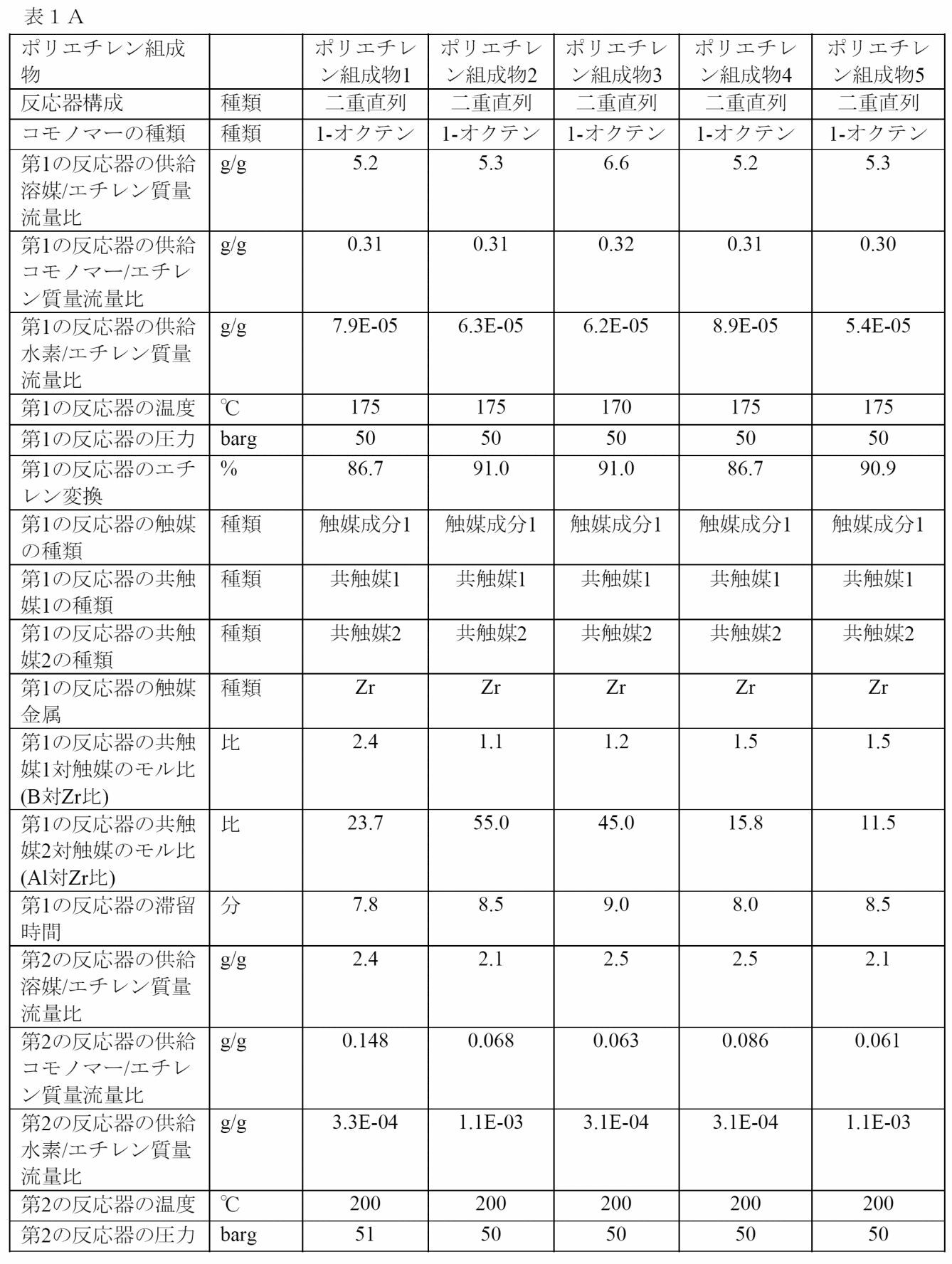
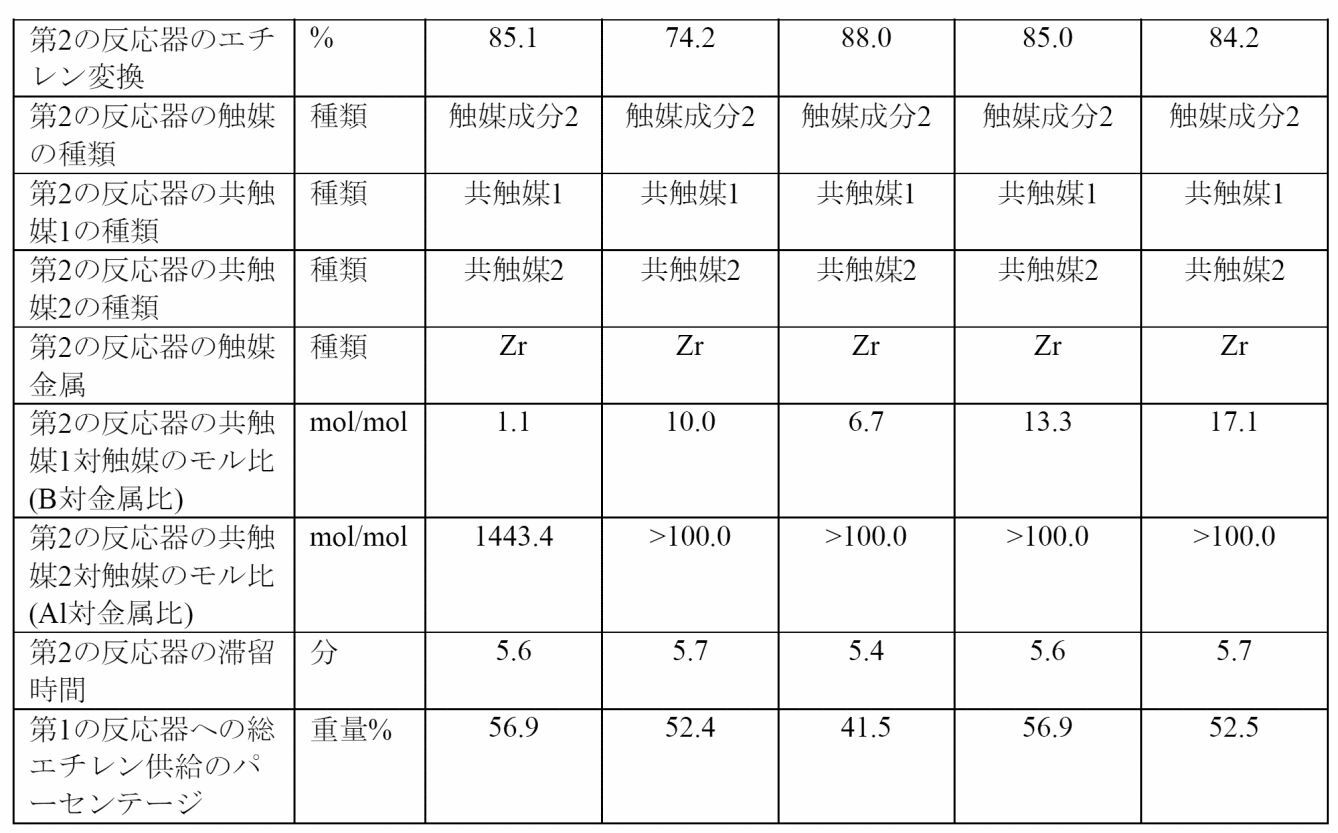
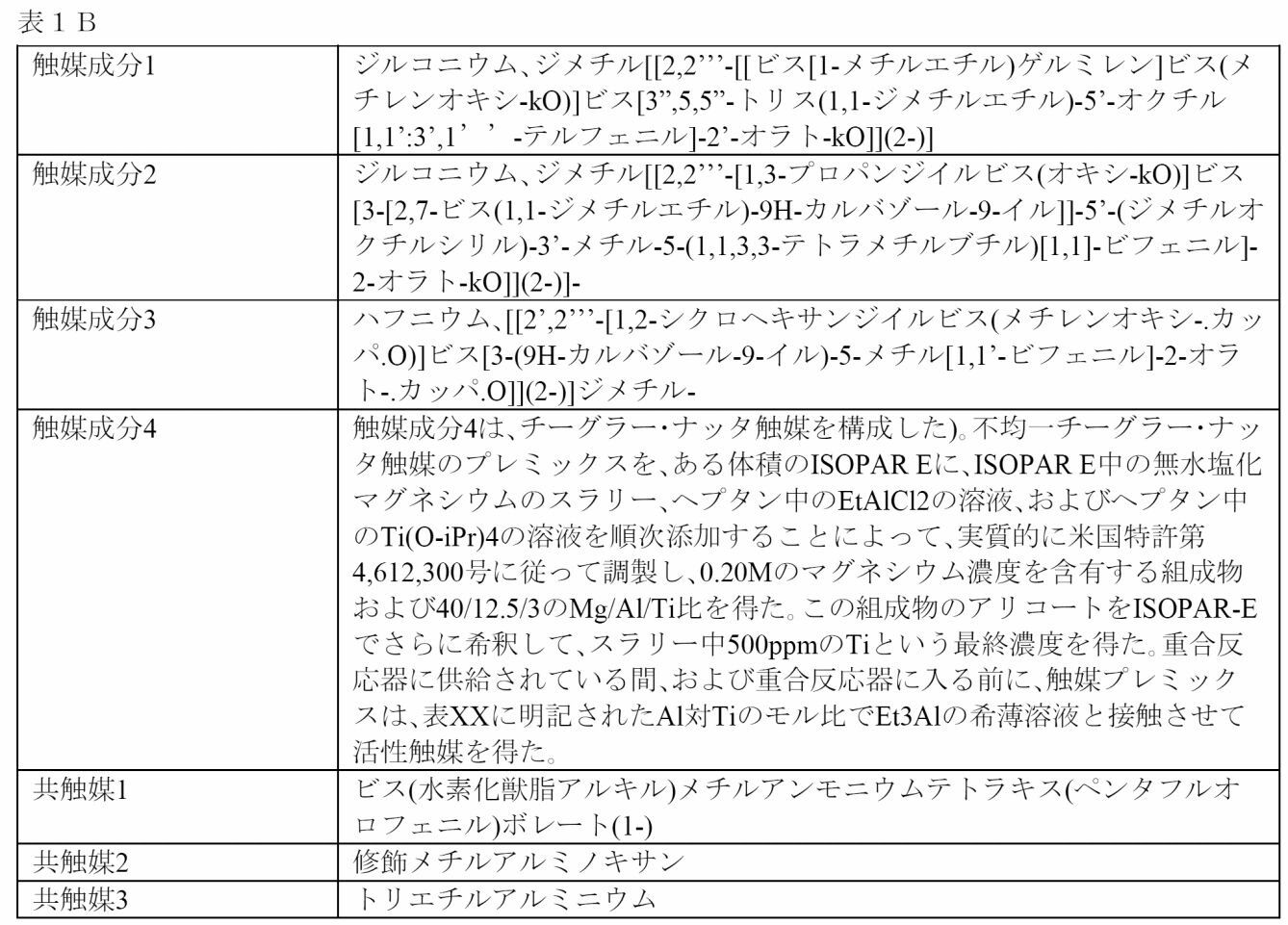
実施例1B:ポリエチレン組成物6の調製
発明を実施するための形態のうちの1つ以上に従って説明されるポリエチレン組成物6および7は、以下に記載の方法によって、ならびに以下に記載の触媒および反応器を利用して調製された。
Example 1B: Preparation of
反応環境に導入する前に、全ての原材料(モノマーおよびコモノマー)ならびにプロセス溶媒(狭い沸点範囲の高純度イソパラフィン溶媒、Isopar-E)をモレキュラーシーブで精製する。水素は、高純度グレードとして加圧されて供給され、それ以上精製されない。反応器モノマー供給流は、機械的圧縮機を介して反応圧力以上に加圧される。溶媒およびコモノマーの供給は、ポンプを介して反応圧力以上に加圧される。個々の触媒成分は、精製された溶媒で、手動でバッチ希釈され、反応圧力以上に加圧される。全ての反応供給流は、質量流量計を用いて測定し、コンピュータにより自動化された弁制御系によって独立して制御される。 All raw materials (monomers and comonomers) and process solvents (narrow boiling range high purity isoparaffinic solvent, Isopar-E) are purified over molecular sieves prior to introduction into the reaction environment. Hydrogen is supplied pressurized as a high purity grade and is not further purified. The reactor monomer feed stream is pressurized above the reaction pressure via a mechanical compressor. The solvent and comonomer feeds are pressurized above the reaction pressure via pumps. The individual catalyst components are manually batch diluted with purified solvent and pressurized above the reaction pressure. All reaction feed streams are measured using mass flow meters and independently controlled by a computer-automated valve control system.
2つの反応器システムを直列構成で使用する。各連続溶液重合反応器は、熱を除去する連続撹拌タンク反応器(CSTR)を再現した、液体が充填された、非断熱の、等温循環ループ反応器からなる。全ての新鮮な溶媒、モノマー、コモノマー、水素、および触媒成分供給物の独立した制御が可能である。各反応器(溶媒、モノマー、コモノマー、および水素)への全新鮮供給流は、供給流を熱交換器に通過させることによって単一溶液相を維持するように温度制御する。各重合反応器への全新鮮供給物は、各注入場所の間でほぼ等しい反応器体積で、2つの場所で反応器に注入する。新鮮供給物は、各注入器が、全新鮮供給物質量流量の半分を受容して制御される。触媒成分を、特別に設計された注入ストリンガーを通って重合反応器に注入する。主要な触媒成分供給物は、特定の目標で各反応器のモノマー変換を維持するためにコンピュータ制御する。共触媒成分は、主触媒成分に対する、計算された特定のモル比に基づいて供給される。各反応器供給物の注入場所の直後に、供給流が、静的混合要素を有する循環重合反応器の内容物と混合される。各反応器の内容物を反応熱の大部分を除去する役割を果たす熱交換器に通し、冷却剤側の温度が、特定温度での等温反応環境を維持する役割を果たして、連続的に循環させる。各反応器ループの周りの循環は、ポンプによって提供される。 A two reactor system is used in series configuration. Each continuous solution polymerization reactor consists of a liquid-filled, non-adiabatic, isothermal circulating loop reactor that replicates a heat-removing continuous stirred-tank reactor (CSTR). Independent control of all fresh solvent, monomer, comonomer, hydrogen, and catalyst component feeds is possible. All fresh feed streams to each reactor (solvent, monomer, comonomer, and hydrogen) are temperature controlled to maintain a single solution phase by passing the feed streams through heat exchangers. All fresh feed to each polymerization reactor is injected into the reactor at two locations with approximately equal reactor volumes between each injection location. Fresh feed is controlled with each injector receiving half of the total fresh feed volume flow. The catalyst components are injected into the polymerization reactor through a specially designed injection stringer. The primary catalyst component feeds are computer controlled to maintain monomer conversion in each reactor at specific targets. The cocatalyst component is fed based on a specific calculated molar ratio to the main catalyst component. Immediately after each reactor feed injection location, the feed stream is mixed with the contents of a circulating polymerization reactor with static mixing elements. The contents of each reactor are passed through a heat exchanger that serves to remove most of the heat of reaction, and the temperature on the coolant side serves to maintain an isothermal reaction environment at a particular temperature and is continuously circulated. . Circulation around each reactor loop is provided by a pump.
第1および第2の重合反応器からの流出物流は、いかなる追加の処理の前に組み合わされる。この最終複合反応器流出物は、好適な試薬(水)の添加およびそれとの反応により流出物が非活性化される帯域に入る。この同じ反応器出口部位において、ポリマー安定化のために他の添加剤が添加される(オクタデシル3,5-ジ-Tert-ブチル-4-ヒドロキシヒドロシンナメート、テトラキス(メチレン(3,5-ジ-Tert-ブチル-4-ヒドロキシヒドロシンナメート))メタン、およびトリス(2,4-ジ-Tert-ブチル-フェニル)ホスファイト)などの押出しおよびインフレーションフィルム製造時の安定化に適した典型的な酸化防止剤)。
The effluent streams from the first and second polymerization reactors are combined prior to any further processing. This final combined reactor effluent enters a zone where the effluent is deactivated by the addition of a suitable reagent (water) and reaction therewith. At this same reactor exit site, other additives are added for polymer stabilization (
触媒の非活性化および添加剤の添加に続いて、反応器流出物は、ポリマーが非ポリマー流から除去される脱揮発系に入る。単離されたポリマー溶融物を、ペレット化して収集する。非ポリマー流は、系から除去されるエチレンの大部分を分離する様々な機器を通過する。溶媒および未反応コモノマーの大部分は、精製系を通過した後、反応器に再循環される。少量の溶媒およびコモノマーを、プロセスからパージする。 Following catalyst deactivation and additive addition, the reactor effluent enters a devolatilization system where polymer is removed from the non-polymer stream. The isolated polymer melt is pelletized and collected. The non-polymer stream is passed through various equipment that separates most of the ethylene removed from the system. Most of the solvent and unreacted comonomer are recycled to the reactor after passing through the purification system. A small amount of solvent and comonomer is purged from the process.
実施例を生成するために使用された、表2Aの値に対応する反応器流供給データフローは、図4で図式的に説明されている。データは、溶媒再循環系の複雑さが考慮され、かつ反応系が貫流フローダイアグラムとしてより簡単に扱えるように提示される。表1Bは、実施例1Aの表2Aで参照されている触媒を示す。
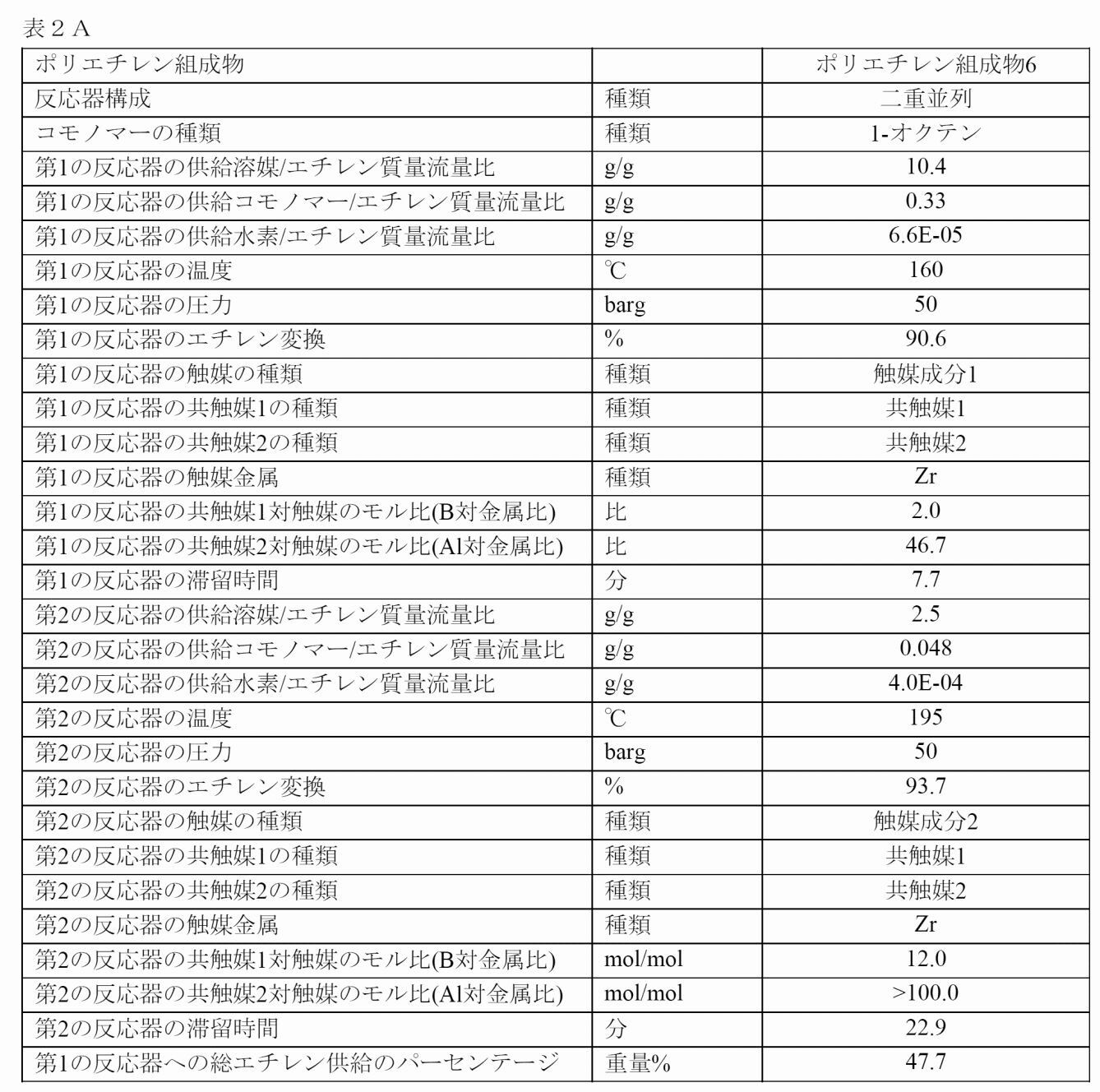
実施例2:比較組成物A~J
比較組成物A~Cは、本明細書において以下に記載される方法によって調製された。比較組成物D~Fは、一般に、PCT公開第2015/200743号で発明第1組成物を調製するために提供された触媒系およびプロセスを使用して調製される二峰性ポリエチレン組成物である。比較組成物G~Jは、市販のポリエチレン組成物である。表3は、比較組成物G~Jの市販のポリエチレン組成物を示している。
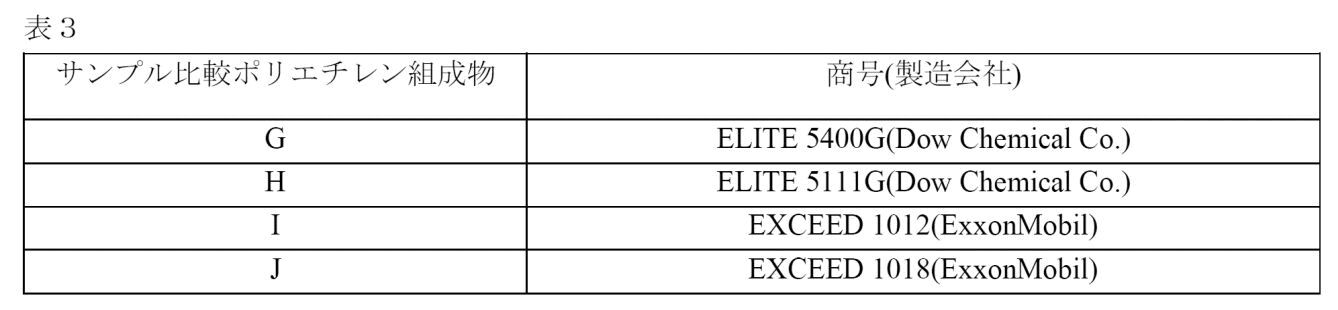
Comparative Compositions AC were prepared by the methods described herein below. Comparative Compositions D-F are generally bimodal polyethylene compositions prepared using the catalyst system and process provided for preparing Inventive Compositions in PCT Publication No. 2015/200743. . Comparative compositions GJ are commercially available polyethylene compositions. Table 3 shows the commercially available polyethylene compositions of Comparative Compositions GJ.
比較組成物A~Cの調製は、以下のように説明される。反応環境に導入する前に、全ての原材料(モノマーおよびコモノマー)ならびにプロセス溶媒(狭い沸点範囲の高純度イソパラフィン溶媒、Isopar-E)をモレキュラーシーブで精製する。水素は、高純度グレードとして加圧されて供給され、それ以上精製されない。反応器モノマー供給流は、機械的圧縮機を介して反応圧力以上に加圧される。溶媒およびコモノマーの供給は、ポンプを介して反応圧力以上に加圧される。個々の触媒成分は、精製された溶媒で、手動でバッチ希釈され、反応圧力以上に加圧される。全ての反応供給流は、質量流量計を用いて測定し、コンピュータにより自動化された弁制御系によって独立して制御される。 The preparation of Comparative Compositions AC is described as follows. All raw materials (monomers and comonomers) and process solvents (narrow boiling range high purity isoparaffinic solvent, Isopar-E) are purified over molecular sieves prior to introduction into the reaction environment. Hydrogen is supplied pressurized as a high purity grade and is not further purified. The reactor monomer feed stream is pressurized above the reaction pressure via a mechanical compressor. The solvent and comonomer feeds are pressurized above the reaction pressure via pumps. The individual catalyst components are manually batch diluted with purified solvent and pressurized above the reaction pressure. All reaction feed streams are measured using mass flow meters and independently controlled by a computer-automated valve control system.
2つの反応器系を直列構成で使用する。各連続溶液重合反応器は、熱を除去する連続撹拌タンク反応器(CSTR)を再現した、液体が充填された、非断熱の、等温循環ループ反応器からなる。全ての新鮮な溶媒、モノマー、コモノマー、水素、および触媒成分供給物の独立した制御が可能である。各反応器(溶媒、モノマー、コモノマー、および水素)への全新鮮供給流は、供給流を熱交換器に通過させることによって単一溶液相を維持するように温度制御する。各重合反応器への全新鮮供給物は、各注入場所の間でほぼ等しい反応器体積で、2つの場所で反応器に注入する。新鮮供給物は、各注入器が、全新鮮供給物質量流量の半分を受容して制御される。触媒成分は、注入針を通して重合反応器に注入される。主要な触媒成分供給物は、特定の目標で各反応器のモノマー変換を維持するためにコンピュータ制御する。共触媒成分は、主触媒成分に対する、計算された特定のモル比に基づいて供給される。各反応器供給物の注入場所の直後に、供給流が、静的混合要素を有する循環重合反応器の内容物と混合される。各反応器の内容物を反応熱の大部分を除去する役割を果たす熱交換器に通し、冷却剤側の温度が、特定温度での等温反応環境を維持する役割を果たして、連続的に循環させる。各反応器ループの周りの循環は、ポンプによって提供される。 Two reactor systems are used in series configuration. Each continuous solution polymerization reactor consists of a liquid-filled, non-adiabatic, isothermal circulating loop reactor that replicates a heat-removing continuous stirred-tank reactor (CSTR). Independent control of all fresh solvent, monomer, comonomer, hydrogen, and catalyst component feeds is possible. All fresh feed streams to each reactor (solvent, monomer, comonomer, and hydrogen) are temperature controlled to maintain a single solution phase by passing the feed streams through heat exchangers. All fresh feed to each polymerization reactor is injected into the reactor at two locations with approximately equal reactor volumes between each injection location. Fresh feed is controlled with each injector receiving half of the total fresh feed volume flow. A catalyst component is injected into the polymerization reactor through an injection needle. The primary catalyst component feeds are computer controlled to maintain monomer conversion in each reactor at specific targets. The cocatalyst component is fed based on a specific calculated molar ratio to the main catalyst component. Immediately after each reactor feed injection location, the feed stream is mixed with the contents of a circulating polymerization reactor with static mixing elements. The contents of each reactor are passed through a heat exchanger that serves to remove most of the heat of reaction, and the temperature on the coolant side serves to maintain an isothermal reaction environment at a particular temperature and is continuously circulated. . Circulation around each reactor loop is provided by a pump.
二重直列反応器構成では、第1の重合反応器からの流出物(溶媒、モノマー、コモノマー、水素、触媒成分、ポリマーを含有する)は、第1の反応器ループを出て、第2の反応器ループに添加される。 In a double series reactor configuration, the effluent from the first polymerization reactor (containing solvent, monomers, comonomers, hydrogen, catalyst components, polymer) exits the first reactor loop and enters the second reactor loop. Added to the reactor loop.
第2の反応器流出物は、好適な試薬(水)の添加およびそれとの反応により流出物が非活性化される帯域に入る。この同じ反応器出口部位において、ポリマー安定化のために他の添加剤が添加される(オクタデシル3,5-ジ-Tert-ブチル-4-ヒドロキシヒドロシンナメート、テトラキス(メチレン(3,5-ジ-Tert-ブチル-4-ヒドロキシヒドロシンナメート))メタン、およびトリス(2,4-ジ-Tert-ブチル-フェニル)ホスファイト)などの押出しおよびフィルム製造時の安定化に適した典型的な酸化防止剤)。
The second reactor effluent enters a zone where the effluent is deactivated by the addition of a suitable reagent (water) and reaction therewith. At this same reactor exit site, other additives are added for polymer stabilization (
触媒の非活性化および添加剤の添加に続いて、反応器流出物は、ポリマーが非ポリマー流から除去される脱揮発系に入る。単離されたポリマー溶融物を、ペレット化して収集する。非ポリマー流は、系から除去されるエチレンの大部分を分離する様々な機器を通過する。溶媒および未反応コモノマーの大部分は、精製系を通過した後、反応器に再循環される。少量の溶媒およびコモノマーを、プロセスからパージする。 Following catalyst deactivation and additive addition, the reactor effluent enters a devolatilization system where polymer is removed from the non-polymer stream. The isolated polymer melt is pelletized and collected. The non-polymer stream is passed through various equipment that separates most of the ethylene removed from the system. Most of the solvent and unreacted comonomer are recycled to the reactor after passing through the purification system. A small amount of solvent and comonomer is purged from the process.
実施例を生成するために使用された、表4Aの値に対応する反応器流供給データフローは、図3で図式的に説明されている。データは、溶媒再循環系の複雑さが考慮され、かつ反応系が貫流フローダイアグラムとしてより簡単に扱えるように提示される。表1Bは、表4Aで示されている触媒および共触媒を示す。
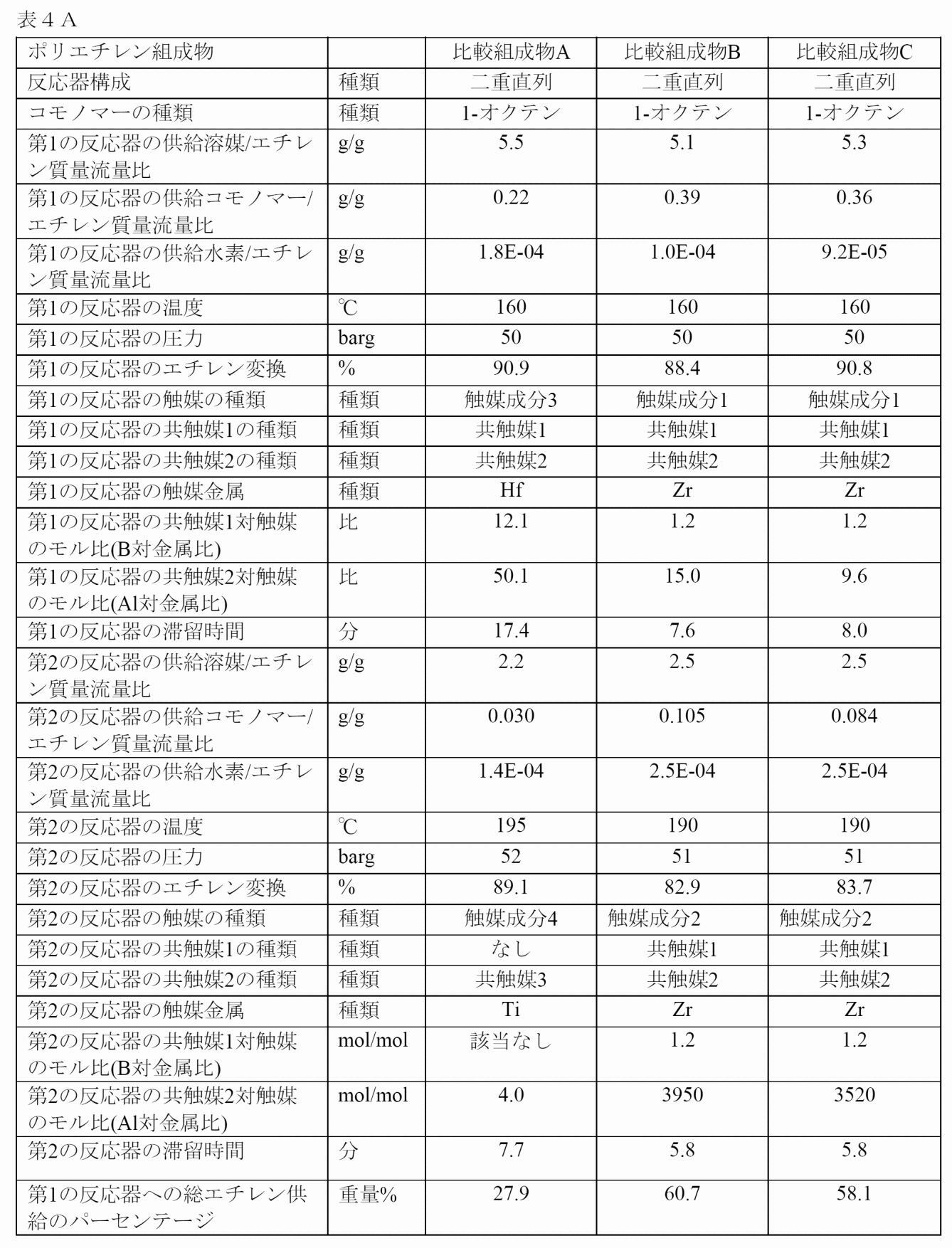
実施例3:ポリエチレン試料の分析
実施例1Aおよび1Bのポリエチレン組成物1~6、実施例2の比較ポリエチレン組成物A~C、ならびに実施例2の市販の比較ポリエチレン試料D~JをiCCDによって分析した。ポリエチレン組成物5のiCCDデータを図2に示す。全ての試料のiCCD試験から生成された追加データを表5Aおよび5Bに示す。具体的には、表5Aおよび5Bには、それぞれの第1および第2ポリエチレン画分の面積(45~87℃および95~120℃)を含むiCCDデータの分析が含まれる。全体密度、ダート強度(方法A)、メルトインデックス、第2のPE画分の重量平均分子量など、各実施例組成物の追加データも提供されている。これらの特性は、各ポリエチレン試料から完全になる単層インフレーションフィルムに基づく。
Example 3 Analysis of Polyethylene Samples Polyethylene compositions 1-6 of Examples 1A and 1B, comparative polyethylene compositions A-C of Example 2, and commercial comparative polyethylene samples D-J of Example 2 were analyzed by iCCD. did. iCCD data for polyethylene composition 5 is shown in FIG. Additional data generated from iCCD testing of all samples are shown in Tables 5A and 5B. Specifically, Tables 5A and 5B contain an analysis of the iCCD data, including the areas of the first and second polyethylene fractions (45-87°C and 95-120°C), respectively. Additional data for each example composition are also provided, such as overall density, dart strength (Method A), melt index, and weight average molecular weight of the second PE fraction. These properties are based on a single layer blown film made entirely from each polyethylene sample.
ダート試験および成形フィルムに基づく他の試験を実施するために、ポリエチレン試料を用いて2ミルのインフレーションフィルムを成形した。具体的には、単層インフレーションフィルムは、ID 3.5インチの半溝付きバレル、30/1のL/D比、バリアスクリュー、およびAlpineエアリングを備えたEgan Davis Standard押出機を介して生成される。押出ラインは、内部気泡冷却を備えた8インチのダイを有する。押出ラインは、フィルム厚ゲージスキャナーも有する。フィルムの製造条件は、フィルム厚は2ミル(0.001inまたは0.0254mm)に維持、ブローアップ比(BUR)は2.5、ダイギャップは70ミル、フロストライン高さ(FLH)は37インチであった。出力速度は260lbs/時で一定であった。
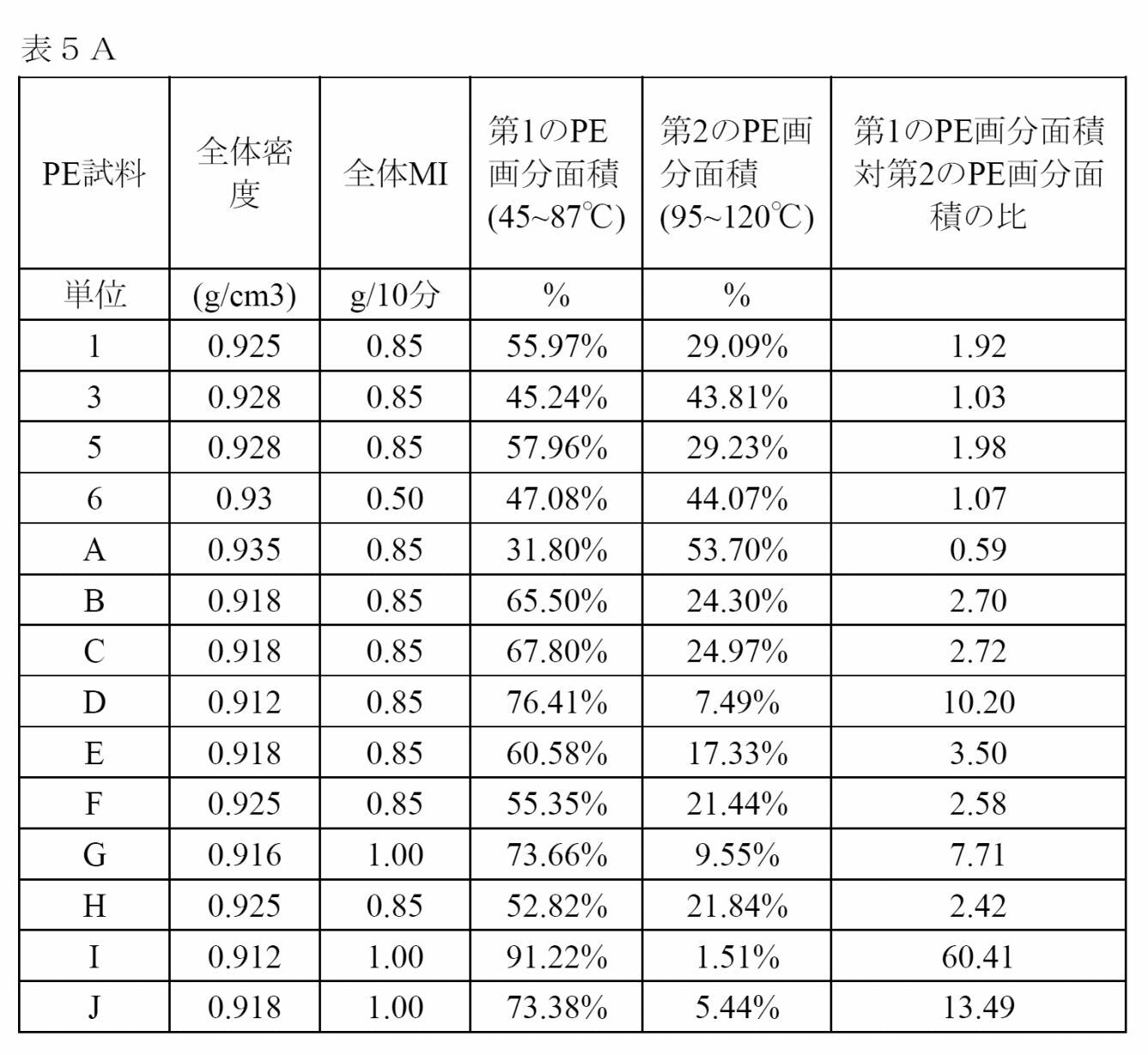
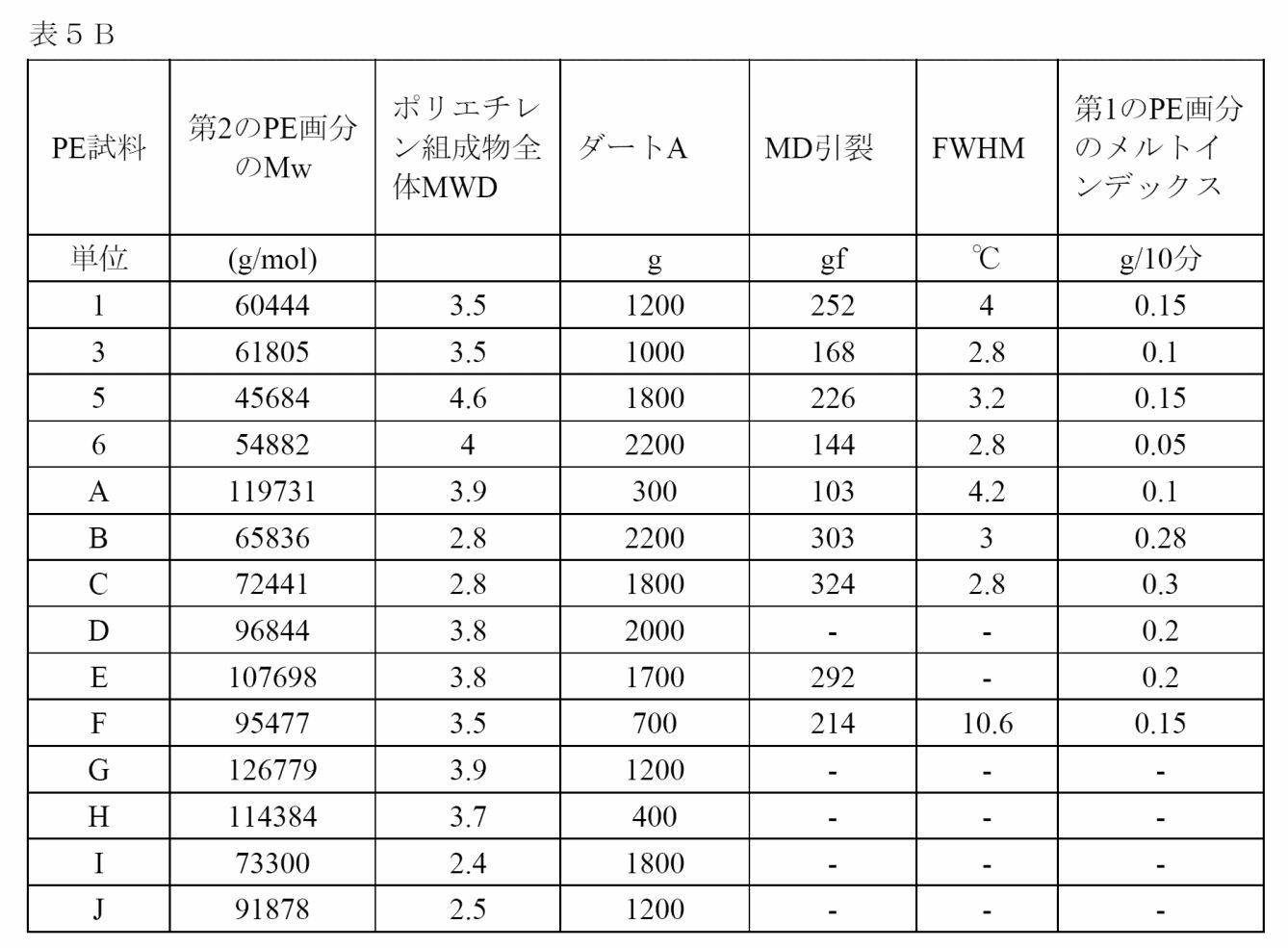
結果は、いずれの比較例組成物も、少なくとも0.924g/cm3の全体密度で同等のダート強度を示さないことを示す。例えば、いくつかの比較例は、高いダート強度を有するが、これらの試料は、はるかに低い密度を有する。高密度比較試料(例えば、0.924g/cm3~0.936g/cm3)は、はるかに低いダート強度(例えば、1000グラム未満)を示す。 The results show that none of the comparative compositions exhibit comparable dart strength at overall densities of at least 0.924 g/cm 3 . For example, some comparative examples have high dart strength, but these samples have much lower densities. High density comparative samples (eg, 0.924 g/cm 3 to 0.936 g/cm 3 ) exhibit much lower dart strength (eg, less than 1000 grams).
さらに、実施例1のいくつかの組成物は、3.5、4.6、および5.5など、10未満のDowレオロジー指数を有していた。 Additionally, several compositions of Example 1 had a Dow Rheology Index of less than 10, such as 3.5, 4.6, and 5.5.
実施例4:比較フィルム4A~4Hの調製。
実施例4では、8つの比較多層フィルムが生成された。比較フィルム4A~4Hの生成に使用した材料には、DOWLEX(商標)2038.68(The Dow Chemical Companyから市販で入手可能)、DMDA 6200(The Dow Chemical Companyから市販で入手可能)、DMDH 6400(The Dow Chemical Companyから市販で入手可能)、AGILITY(商標)1200(The Dow Chemical Companyから市販で入手可能)、ELITE(商標)5960(The Dow Chemical Companyから市販で入手可能)、上記実施例1Aのポリエチレン組成物2、アンチブロックマスターバッチ(Ampacetから市販で入手可能、「MB AB」)、ポリマー加工助剤マスターバッチ(Ingeniaから市販で入手可能、「MB PPA」)、二酸化チタンマスターバッチ(Ampacetから市販で入手可能、「MB TiO2」)、ならびに2つの二峰性ポリエチレン組成物(メルトインデックス:2.16kgおよび190℃で0.85g/10分、密度:0.918g/cm3、「二峰性PE1」)および(メルトインデックス:2.16kgおよび190℃で0.85g/10分、密度:0.926g/cm3、「二峰性PE2」))が含まれた。二峰性PE1および二峰性PE2は、一般に、PCT公開第2015/200743号で発明第1組成物を調製するために提供された触媒系およびプロセスを使用して調製されるポリエチレン組成物である。
Example 4: Preparation of Comparative Films 4A-4H.
In Example 4, eight comparative multilayer films were produced. Materials used to produce Comparative Films 4A-4H included DOWLEX™ 2038.68 (commercially available from The Dow Chemical Company), DMDA 6200 (commercially available from The Dow Chemical Company), DMDH 6400 (commercially available from The Dow Chemical Company). AGILITY™ 1200 (commercially available from The Dow Chemical Company), ELITE™ 5960 (commercially available from The Dow Chemical Company), of Example 1A above.
この実施例のための比較多層フィルムの様々な層の組成は、表6~8に詳述されている。表6~8で提供された組成物については、各層のために提供される重量パーセントは、多層フィルムの総重量に基づいており(すなわち、表8では、層3は、比較フィルム4Fの総重量に基づいて10重量%である)、各材料成分のために提供される重量パーセントは、層の総重量に基づいている(すなわち、表8では、二峰性PE1は、比較フィルム4Fの層3の総重量に基づいて94重量%である)。
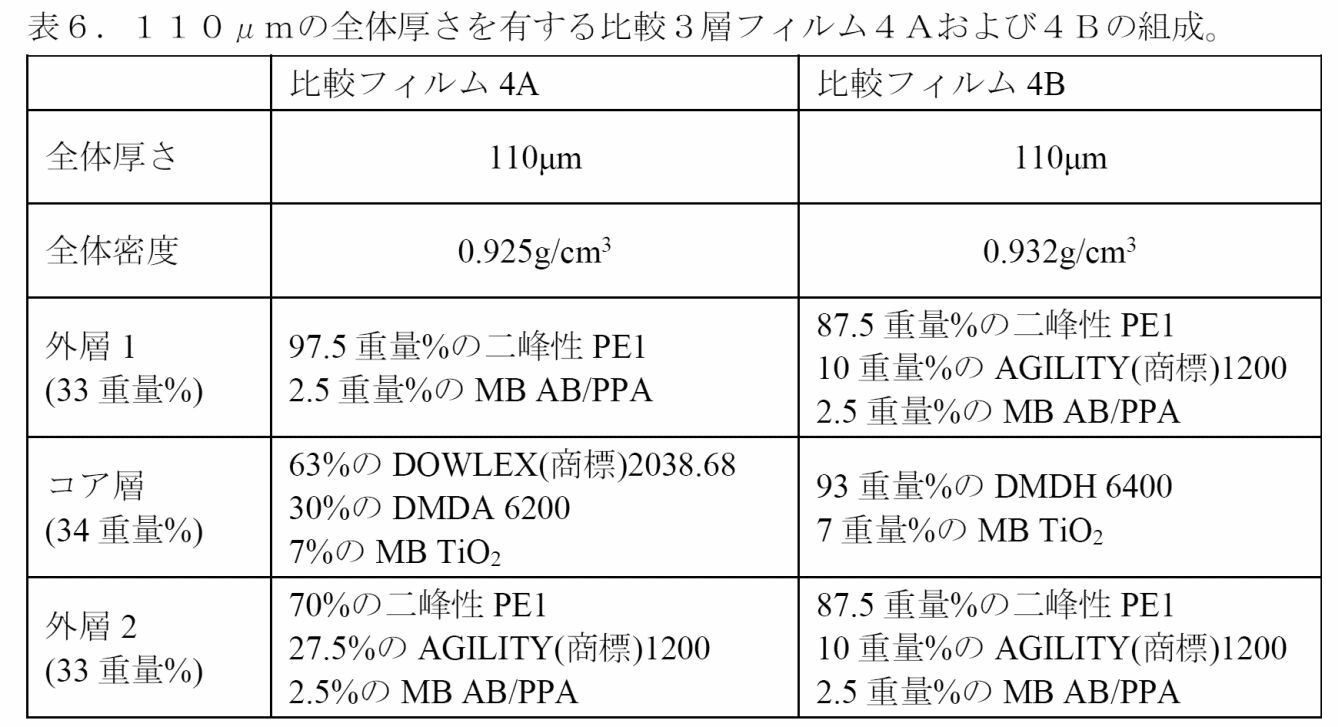
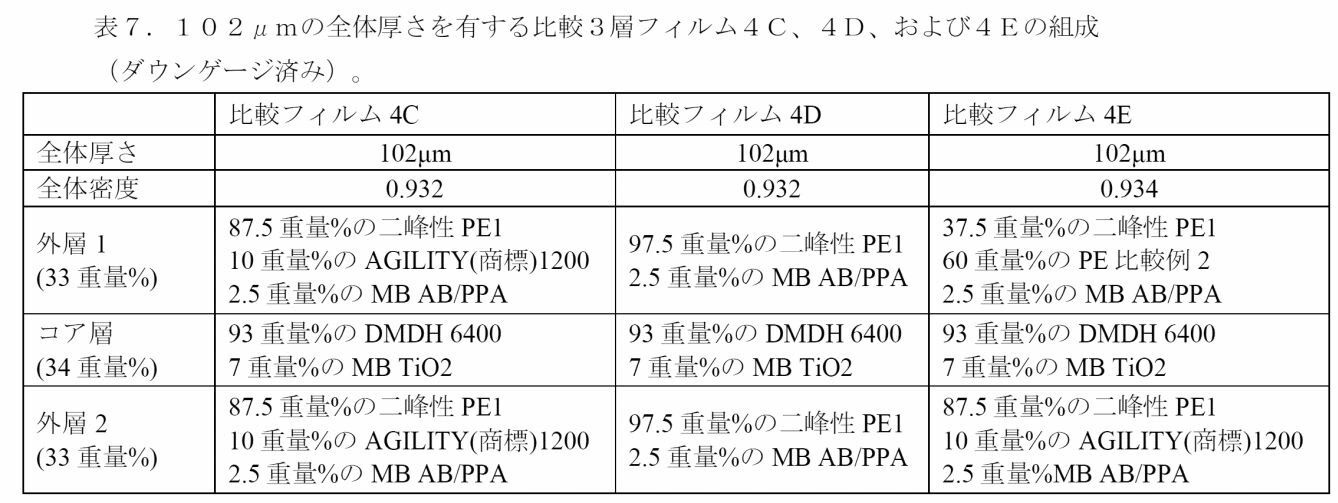
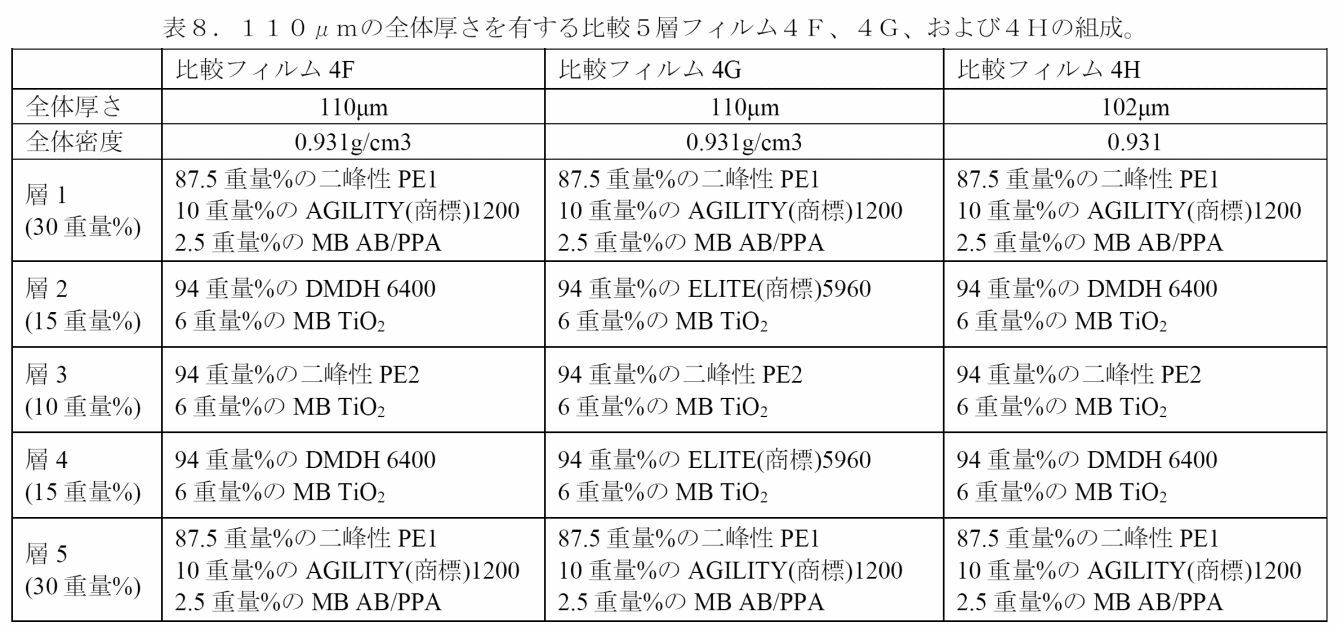
表6および7からわかるように、いくつかの比較フィルムは3つの層(比較フィルム4A、4B、4C、4D、および4E)を有し、いくつかの比較フィルムは5つの層(比較フィルム4F、4G、および4H)を有する。 As can be seen from Tables 6 and 7, some comparative films have three layers (Comparative Films 4A, 4B, 4C, 4D, and 4E) and some comparative films have five layers (Comparative Films 4F, 4G, and 4H).
比較フィルム4Aおよび4Bは、Alpine7層インフレーションフィルムラインで生成された。押出ダイの直径は200ミリメートル(mm)で、ダイギャップは78.7ミルであった。ブローアップ比(BUR)は1.75で、レイフラット幅は21.85インチであった。ニップ速度は60.4~65ft/分であった。総フィルム厚は4.3ミル(1ミル=/1000インチ)であった。ラインには、7台の押出機があった。7層多層フィルム(比較フィルム4Aおよび4B)については、押出機1および2を外層1に使用し、押出機3、4および5をコア層に使用し、押出機6および7を外層2に使用した。押出機の温度プロファイルは380°Fで始まり、450°Fで終了した。ブレンドが特定の層で使用される場合、成分は乾式ブレンドされ、フィーダーに供給された。
Comparative Films 4A and 4B were produced on an
比較フィルム4C、4D、および4Eは、Alpine7層インフレーションフィルムラインで生成された。押出ダイの直径は200ミリメートル(mm)で、ダイギャップは78.7ミルであった。ブローアップ比(BUR)は1.75で、レイフラット幅は21.85インチであった。ニップ速度は60.4~65ft/分であった。総フィルム厚は4.0ミル(1ミル=/1000インチ)であった。ラインには、7台の押出機があった。7層多層フィルム(比較フィルム4C、4Dおよび4E)については、押出機1および2を外層1に使用し、押出機3、4および5をコア層に使用し、押出機6および7を外層2に使用した。押出機の温度プロファイルは380°Fで始まり、450°Fで終了した。ブレンドが特定の層で使用される場合、成分は乾式ブレンドされ、フィーダーに供給された。
Comparative Films 4C, 4D, and 4E were produced on the Alpine 7-layer blown film line. The extrusion die diameter was 200 millimeters (mm) and the die gap was 78.7 mils. The blow-up ratio (BUR) was 1.75 and the layflat width was 21.85 inches. The nip speed was 60.4-65 ft/min. The total film thickness was 4.0 mils (1 mil =/1000 inches). The line had seven extruders. For the 7-layer multilayer films (comparative films 4C, 4D and 4E),
比較フィルム4F、4G、および4Hは、Alpine7層インフレーションフィルムラインで製造された。押出ダイの直径は200ミリメートル(mm)で、ダイギャップは78.7ミルであった。ブローアップ比(BUR)は1.75で、レイフラット幅は21.85インチであった。ニップ速度は60.4~65ft/分であった。総フィルム厚は、フィルム4Fおよびフィルム4Gについては4.3ミルであり、フィルム4Hについては4.0ミルであった(1ミル=/1000インチ)。ラインには、7台の押出機があった。7層多層フィルム(比較フィルム4F、4Gおよび4H)については、押出機1を層1に使用し、押出機2および3を層2に使用し、押出機4を層3に使用し、押出機5および6を層4に使用し、押出機7を層5に使用した。押出機の温度プロファイルは380°Fで始まり、450°Fで終了した。ブレンドが特定の層で使用される場合、成分は乾式ブレンドされ、フィーダーに供給された。
Comparative films 4F, 4G, and 4H were produced on the Alpine 7-layer blown film line. The extrusion die diameter was 200 millimeters (mm) and the die gap was 78.7 mils. The blow-up ratio (BUR) was 1.75 and the layflat width was 21.85 inches. The nip speed was 60.4-65 ft/min. Total film thickness was 4.3 mils for Films 4F and 4G and 4.0 mils for Film 4H (1 mil =/1000 inches). The line had seven extruders. For the 7-layer multilayer films (comparative films 4F, 4G and 4H),
実施例5:フィルム5A~5Eの調製
実施例5では、本明細書で開示された実施形態に従って、5つの多層フィルムが生成される。フィルム5A~5Eの生成に使用した材料には、二峰性PE1、DOWLEX(商標)2038.68(The Dow Chemical Companyから市販で入手可能)、DMDA 6200(The Dow Chemical Companyから市販で入手可能)、DMDH 6400(The Dow Chemical Companyから市販で入手可能)、AGILITY(商標)1200(The Dow Chemical Companyから市販で入手可能)、ELITE(商標)5960(The Dow Chemical Companyから市販で入手可能)、上記実施例1Aのポリエチレン組成物2、アンチブロックマスターバッチ(Ampacetから市販で入手可能、「MB AB」)、ポリマー加工助剤マスターバッチ(Ingeniaから市販で入手可能、「MB PPA」)および二酸化チタンマスターバッチ(Ampacetから市販で入手可能、「MB TiO2」)が含まれた。この実施例のための比較多層フィルムの様々な層の組成は、表9~11に詳述されている。表9~11で提供された組成物については、各層のために提供される重量パーセントは、多層フィルムの総重量に基づいており(すなわち、表9では、層3は、フィルム5Aの総重量に基づいて30重量%である)、各材料成分のために提供される重量パーセントは、層の総重量に基づいている(すなわち、表9では、ポリエチレン組成物2は、フィルム5Aの層3の総重量に基づいて94重量%である)。
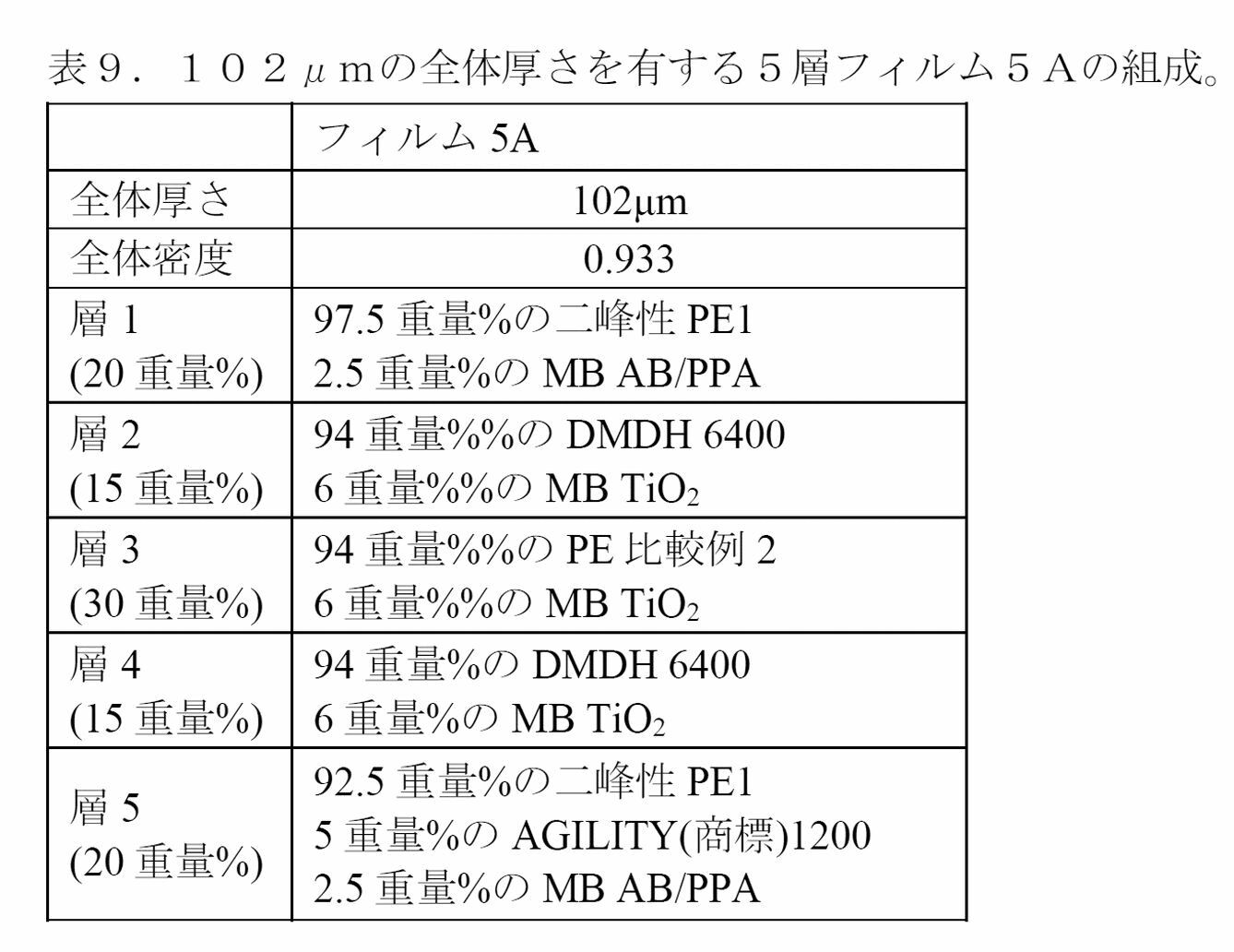
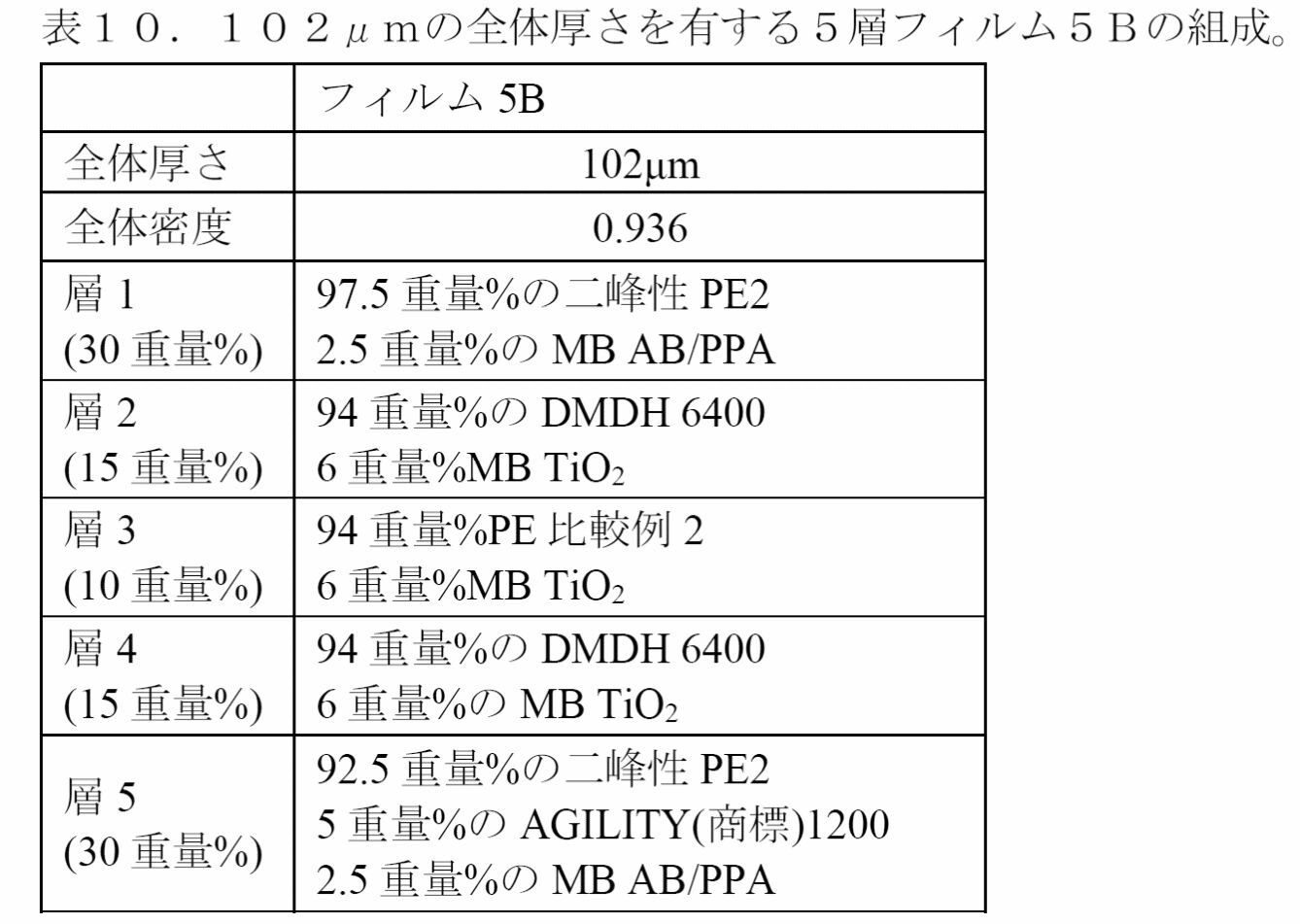
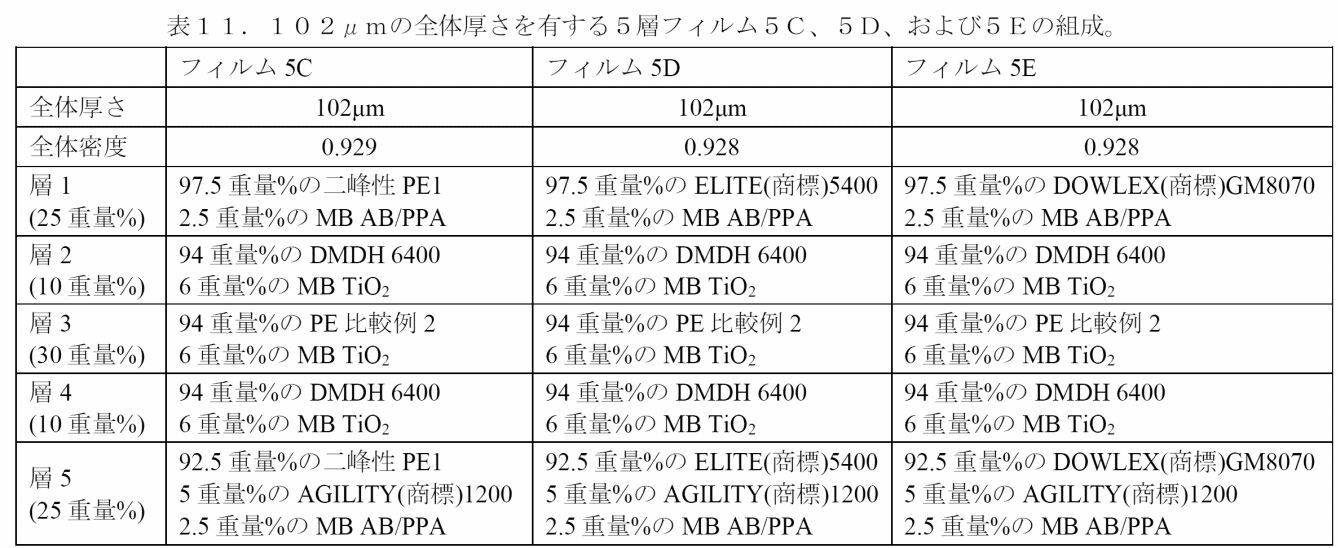
フィルム5A、5B、5C、5D、および5Eは、Alpine7層インフレーションフィルムラインで生成された。押出ダイの直径は200ミリメートル(mm)で、ダイギャップは78.7ミルであった。ブローアップ比(BUR)は1.75で、レイフラット幅は21.85インチであった。ニップ速度は60.4~65ft/分であった。総フィルム厚は4.0ミル(1ミル=/1000インチ)であった。ラインには、7台の押出機があった。7層多層フィルム(フィルム5A、5C、5Dおよび5E)については、押出機1を層1に使用し、押出機2を層2に使用し、押出機3、4および5を層3に使用し、押出機6を層4に使用し、押出機7を層5に使用した。7層多層フィルム(フィルム5B)については、押出機1を層1に使用し、押出機2および3を層2に使用し、押出機4を層3に使用し、押出機5および6を層4に使用し、押出機7を層5に使用した。押出機の温度プロファイルは380°Fで始まり、450°Fで終了した。ブレンドが特定の層で使用される場合、成分は乾式ブレンドされ、フィーダーに供給された。
Films 5A, 5B, 5C, 5D, and 5E were produced on an Alpine 7-layer blown film line. The extrusion die diameter was 200 millimeters (mm) and the die gap was 78.7 mils. The blow-up ratio (BUR) was 1.75 and the layflat width was 21.85 inches. The nip speed was 60.4-65 ft/min. The total film thickness was 4.0 mils (1 mil =/1000 inches). The line had seven extruders. For the 7-layer multilayer films (Films 5A, 5C, 5D and 5E),
実施例6:比較フィルム4A~4Hおよびフィルム5A~5Eの分析。
実施例6において、フィルム5A~5Eの特性は、本明細書で開示された試験方法に従って試験され、分析され、比較フィルム4A~4Hの特性と比較された。フィルム5A~5Eおよび比較フィルム4A~4Hの特性は、表12および13に詳述されている。
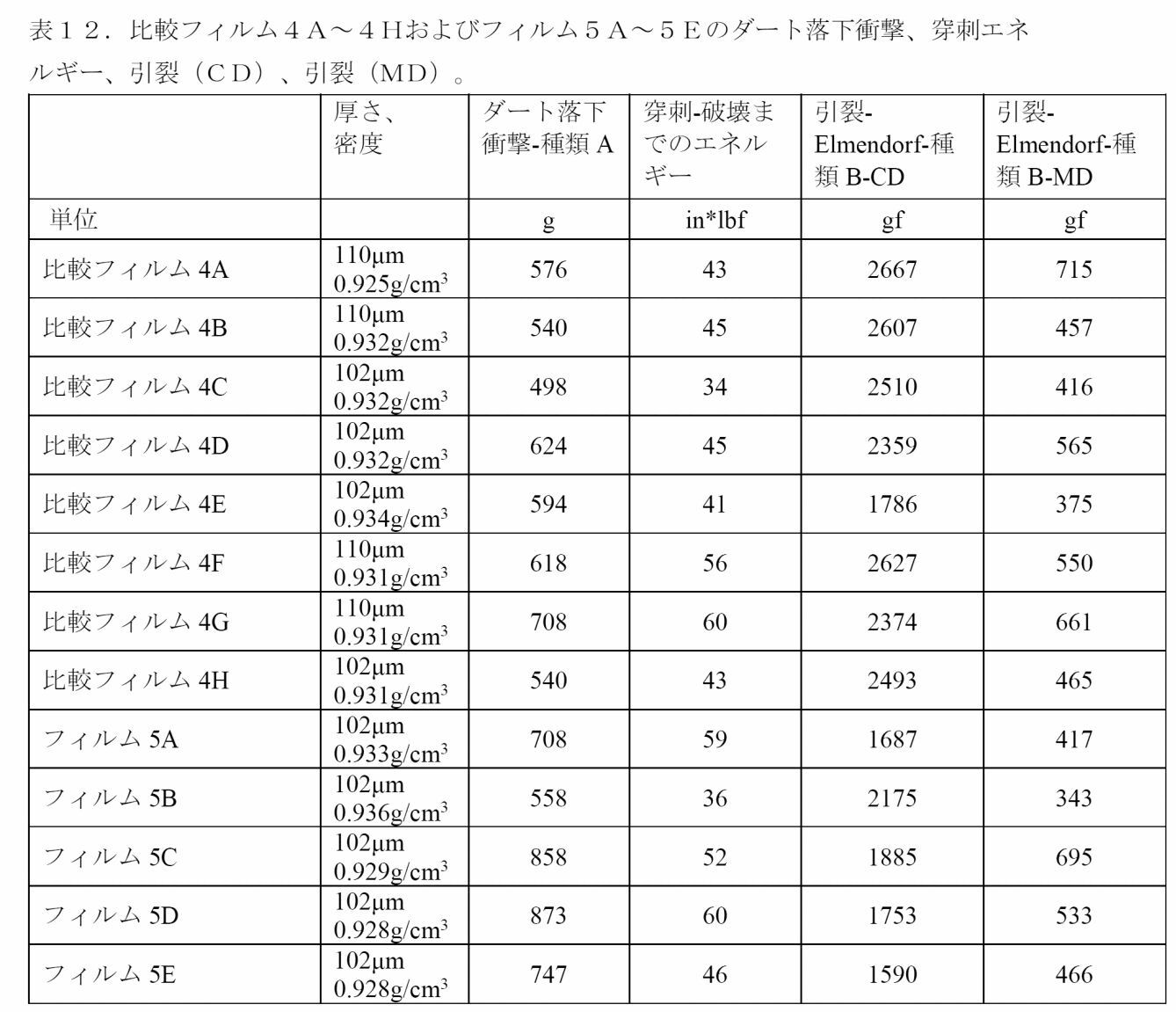
In Example 6, the properties of Films 5A-5E were tested and analyzed according to the test methods disclosed herein and compared to the properties of Comparative Films 4A-4H. The properties of Films 5A-5E and Comparative Films 4A-4H are detailed in Tables 12 and 13.
表12で示されるように、フィルム5A~5Eは、比較フィルム4A~4Hと比較したときに、一般に、改善された(より大きな)ダートおよび穿刺特性を示した。特に、それぞれ110μmの全体厚さを有する5層比較フィルム4E~4Hと比較したときに、それぞれ102μmの全体厚さを有するフィルム5A、5C、5D、および5Eは、より大きなダートおよび穿刺特性を示した。これらの結果は、同等の全体密度では、本明細書に記載のポリエチレン組成物を含む「ダウンゲージされた」フィルム5A~5Eは、110μmの5層比較フィルムよりも改善された特性を示すことを示している。
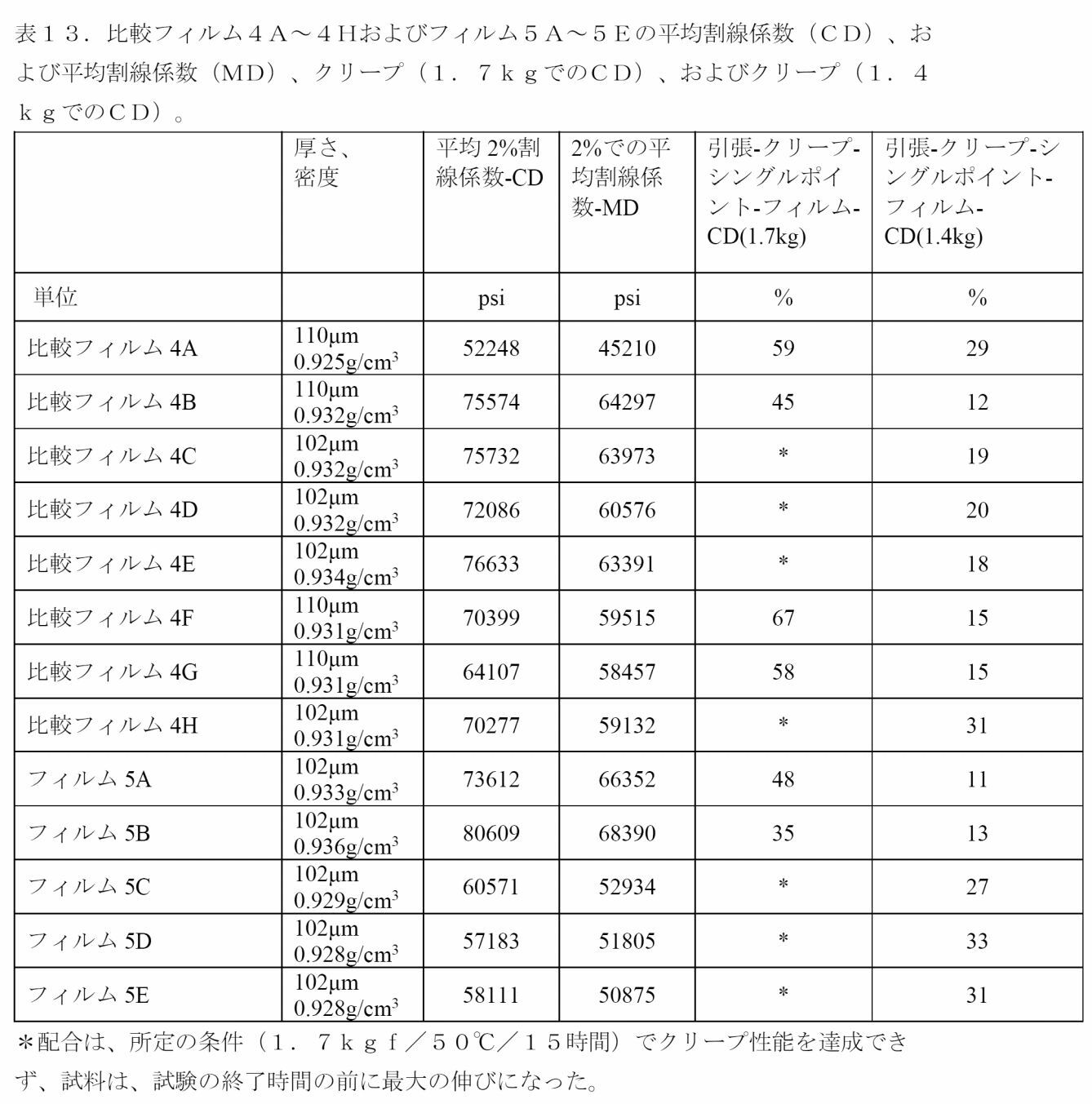
表13で示されるように、フィルム5A~5Eは、比較フィルム4A~4Hと比較したときに、一般に、2%での交差方向および機械方向において、改善された(より大きな)平均割線係数を示した。特に、それぞれ110μmの全体厚さを有する5層比較フィルム4E~4Hと比較したときに、それぞれ102μmの全体厚さを有するフィルム5A~5Eは、2%での交差方向および機械方向の割線係数において、より大きなまたは同等の結果を示した。これらの結果は、同等の全体密度では、本明細書に記載のポリエチレン組成物を含む「ダウンゲージされた」フィルム5A~5Eは、110μmの5層比較フィルムよりも改善された特性を示すことを示している。 As shown in Table 13, Films 5A-5E generally exhibited improved (larger) average secant modulus in the cross and machine directions at 2% when compared to Comparative Films 4A-4H. rice field. In particular, films 5A-5E, each having an overall thickness of 102 μm, had a cross- and machine-direction secant modulus of 2% when compared to the five-layer comparative films 4E-4H, each having an overall thickness of 110 μm. , showed greater or comparable results. These results show that at equivalent overall densities, the "down-gauged" films 5A-5E comprising the polyethylene composition described herein exhibit improved properties over the 110 μm 5-layer comparison film. showing.
したがって、表12および13の結果の両方に基づいて、同等の全体密度では、本明細書に記載のポリエチレン組成物を含む「ダウンゲージされた」フィルム5A~5Eは、110μmの5層比較フィルムよりも改善された特性を示す。さらに、これらの結果は、フィルム5A~5Eが、減少した厚さで、剛性、耐クリープ性、および乱用特性(例えば、ダート、穿刺エネルギー、引裂)のバランスを提供し得ることを示す。 Therefore, based on both the results in Tables 12 and 13, at comparable overall densities, the "down-gauged" films 5A-5E comprising the polyethylene composition described herein are lower than the 110 μm 5-layer comparative film. also show improved properties. Additionally, these results show that Films 5A-5E can provide a balance of stiffness, creep resistance, and abuse properties (eg, dart, puncture energy, tear) at reduced thickness.
添付の特許請求の範囲で定義される本開示の範囲から逸脱することなく、修正および変更が可能であることは明らかであろう。より具体的には、本開示のいくつかの態様は、本明細書において、好ましいか、または特に有利なものとして特定されているが、本開示は、必ずしもこれらの態様に限定されないことが企図される。
It will be apparent that modifications and variations are possible without departing from the scope of the disclosure as defined in the appended claims. More specifically, although certain aspects of the disclosure have been identified herein as being preferred or particularly advantageous, it is contemplated that the disclosure is not necessarily limited to those aspects. be.
Claims (15)
第1のポリオレフィンを含む第1の層と、
第2のポリオレフィンを含む第2の層と、
第3のポリオレフィンを含む第3の層であって、前記第2の層が、前記第1の層と前記第3の層との間に配置されている、第3の層と、
第4のポリオレフィンを含む第4の層であって、前記第3の層が、前記第2の層と前記第4の層との間に配置されている、第4の層と、
第5のポリオレフィンを含む第5の層であって、前記第4の層が、前記第3の層と前記第5の層との間に配置されている、第5の層と、を含み、
前記第1のポリオレフィン、前記第2のポリオレフィン、前記第3のポリオレフィン、前記第4のポリオレフィン、および前記第5のポリオレフィンのうちの2つ以上は、組成が同一であるかまたは異なり、
前記第3のポリオレフィンが、
(a)改善されたコモノマー組成分布(iCCD)分析法による溶出プロファイルにおいて45℃~87℃の温度範囲に単一のピークを有する第1のポリエチレン画分であって、第1のポリエチレン画分面積が、45℃~87℃における前記第1のポリエチレン画分の前記単一のピーク下の前記溶出プロファイル内の面積である、第1のポリエチレン画分と、
(b)前記iCCD分析法による溶出プロファイルにおいて95℃~120℃の温度範囲に単一のピークを有する第2のポリエチレン画分であって、第2のポリエチレン画分面積が、95℃~120℃における前記第2のポリエチレン画分の前記単一のピーク下の前記溶出プロファイル内の面積である、第2のポリエチレン画分と、を含む、ポリエチレン組成物であり、
前記ポリエチレン組成物が、0.924g/cm3~0.936g/cm3の密度および0.25g/10分~2.0g/10分のメルトインデックス(I2)を有し、前記第1のポリエチレン画分面積が、前記溶出プロファイルの総面積の少なくとも40%を構成し、前記第1のポリエチレン画分面積対前記第2のポリエチレン画分面積の比が、0.75~2.5であり、ピーク高さの50パーセントでの前記第2のポリエチレン画分の前記単一のピークの幅が、5.0℃未満である、多層フィルム。 A multilayer film,
a first layer comprising a first polyolefin;
a second layer comprising a second polyolefin;
a third layer comprising a third polyolefin, wherein said second layer is disposed between said first layer and said third layer;
a fourth layer comprising a fourth polyolefin, wherein said third layer is disposed between said second layer and said fourth layer;
a fifth layer comprising a fifth polyolefin, wherein said fourth layer is disposed between said third layer and said fifth layer;
two or more of said first polyolefin, said second polyolefin, said third polyolefin, said fourth polyolefin, and said fifth polyolefin are the same or different in composition;
The third polyolefin is
(a) a first polyethylene fraction having a single peak in the temperature range of 45° C. to 87° C. in an elution profile by improved comonomer composition distribution (iCCD) analysis, wherein the first polyethylene fraction area is the area within said elution profile under said single peak of said first polyethylene fraction at 45°C to 87°C;
(b) a second polyethylene fraction having a single peak in the temperature range of 95°C to 120°C in the elution profile according to the iCCD analysis method, wherein the second polyethylene fraction area is 95°C to 120°C; a second polyethylene fraction that is the area within the elution profile under the single peak of the second polyethylene fraction in
The polyethylene composition has a density of 0.924 g/cm 3 to 0.936 g/cm 3 and a melt index (I 2 ) of 0.25 g/10 min to 2.0 g/10 min; A polyethylene fraction area constitutes at least 40% of the total area of said elution profile, and a ratio of said first polyethylene fraction area to said second polyethylene fraction area is between 0.75 and 2.5. , the width of said single peak of said second polyethylene fraction at 50 percent of peak height is less than 5.0°C.
前記第2の層が、前記第3の層と直接接触しており、
前記第3の層が、前記第4の層と直接接触しており、かつ
前記第4の層が、前記第5の層と直接接触している、請求項1~3のいずれか一項に記載の多層フィルム。 wherein the first layer is in direct contact with the second layer;
the second layer is in direct contact with the third layer;
4. The method of any one of claims 1-3, wherein the third layer is in direct contact with the fourth layer, and the fourth layer is in direct contact with the fifth layer. A multilayer film as described.
0.905g/cm3~0.936g/cm3の密度を有する線状低密度ポリエチレンを含む第1の層と、
ASTM 742に従って測定したときに、0.940g/cm3を超える密度を有するポリエチレンを含む第2の層と、
第3のポリオレフィンを含む第3の層であって、前記第2の層が、前記第1の層と前記第3の層との間に配置されている、第3の層と、
ASTM 742に従って測定したときに、0.940g/cm3を超える密度を有するポリエチレンを含む第4の層であって、前記第3の層が、前記第2の層と前記第4の層との間に配置されている、第4の層と、
0.905g/cm3~0.936g/cm3の密度を有する線状低密度ポリエチレンを含む第5の層であって、前記第4の層が、前記第3の層と前記第5の層との間に配置されている、第5の層と、を含み、
前記第1のポリオレフィン、第2のポリオレフィン、第3のポリオレフィン、および第4のポリオレフィンのうちの2つ以上は、同一または異なるを有し、
前記第3のポリオレフィンが、
(a)改善されたコモノマー組成分布(iCCD)分析法による溶出プロファイルにおいて45℃~87℃の温度範囲に単一のピークを有する第1のポリエチレン画分であって、第1のポリエチレン画分面積が、45℃~87℃における前記第1のポリエチレン画分の前記単一のピーク下の前記溶出プロファイル内の面積である、第1のポリエチレン画分と、
(b)前記iCCD分析法による溶出プロファイルにおいて95℃~120℃の温度範囲に単一のピークを有する第2のポリエチレン画分であって、第2のポリエチレン画分面積が、95℃~120℃における前記第2のポリエチレン画分の前記単一のピーク下の前記溶出プロファイル内の面積である、第2のポリエチレン画分と、を含む、ポリエチレン組成物であり、
前記ポリエチレン組成物が、0.924g/cm3~0.936g/cm3の密度および0.25g/10分~2.0g/10分のメルトインデックス(I2)を有し、前記第1のポリエチレン画分面積が、前記溶出プロファイルの総面積の少なくとも40%を構成し、前記第1のポリエチレン画分面積対前記第2のポリエチレン画分面積の比が、0.75~2.5であり、ピーク高さの50パーセントでの前記第2のポリエチレン画分の前記単一のピークの幅が、5.0℃未満である、多層フィルム。 A multilayer film,
a first layer comprising linear low density polyethylene having a density between 0.905 g/cm 3 and 0.936 g/cm 3 ;
a second layer comprising polyethylene having a density greater than 0.940 g/cm 3 as measured according to ASTM 742;
a third layer comprising a third polyolefin, wherein said second layer is disposed between said first layer and said third layer;
a fourth layer comprising polyethylene having a density greater than 0.940 g/cm 3 as measured according to ASTM 742, wherein said third layer is the second layer between said second layer and said fourth layer; a fourth layer disposed therebetween;
a fifth layer comprising linear low density polyethylene having a density between 0.905 g/cm 3 and 0.936 g/cm 3 , wherein said fourth layer comprises said third layer and said fifth layer; a fifth layer disposed between
two or more of the first polyolefin, second polyolefin, third polyolefin, and fourth polyolefin have the same or different;
The third polyolefin is
(a) a first polyethylene fraction having a single peak in the temperature range of 45° C. to 87° C. in an elution profile by improved comonomer composition distribution (iCCD) analysis, wherein the first polyethylene fraction area is the area within said elution profile under said single peak of said first polyethylene fraction at 45°C to 87°C;
(b) a second polyethylene fraction having a single peak in the temperature range of 95°C to 120°C in the elution profile according to the iCCD analysis method, wherein the second polyethylene fraction area is 95°C to 120°C; a second polyethylene fraction that is the area within the elution profile under the single peak of the second polyethylene fraction in
The polyethylene composition has a density of 0.924 g/cm 3 to 0.936 g/cm 3 and a melt index (I 2 ) of 0.25 g/10 min to 2.0 g/10 min; A polyethylene fraction area constitutes at least 40% of the total area of said elution profile, and a ratio of said first polyethylene fraction area to said second polyethylene fraction area is between 0.75 and 2.5. , the width of said single peak of said second polyethylene fraction at 50 percent of peak height is less than 5.0°C.
前記第1の層が、前記第2の層と直接接触しており、
前記第2の層が、前記第3の層と直接接触しており、
前記第3の層が、前記第4の層と直接接触しており、かつ
前記第4の層が、前記第5の層と直接接触している、請求項14に記載の多層フィルム。
the first layer and the fifth layer are the outermost layers of the multilayer film;
wherein the first layer is in direct contact with the second layer;
the second layer is in direct contact with the third layer;
15. The multilayer film of claim 14, wherein said third layer is in direct contact with said fourth layer, and said fourth layer is in direct contact with said fifth layer.
Applications Claiming Priority (5)
| Application Number | Priority Date | Filing Date | Title |
|---|---|---|---|
| US201962883475P | 2019-08-06 | 2019-08-06 | |
| US201962883467P | 2019-08-06 | 2019-08-06 | |
| US62/883,475 | 2019-08-06 | ||
| US62/883,467 | 2019-08-06 | ||
| PCT/US2020/044862 WO2021026139A1 (en) | 2019-08-06 | 2020-08-04 | Multilayer films that include at least five layers and methods of producing the same |
Publications (2)
| Publication Number | Publication Date |
|---|---|
| JP2022542657A true JP2022542657A (en) | 2022-10-06 |
| JP7653410B2 JP7653410B2 (en) | 2025-03-28 |
Family
ID=72148234
Family Applications (1)
| Application Number | Title | Priority Date | Filing Date |
|---|---|---|---|
| JP2022503406A Active JP7653410B2 (en) | 2019-08-06 | 2020-08-04 | Multilayer film containing at least five layers and method for producing same - Patents.com |
Country Status (9)
| Country | Link |
|---|---|
| US (1) | US11969976B2 (en) |
| EP (1) | EP4010190B1 (en) |
| JP (1) | JP7653410B2 (en) |
| CN (1) | CN114206614B (en) |
| CA (1) | CA3146305A1 (en) |
| ES (1) | ES2956397T3 (en) |
| MX (1) | MX2022001400A (en) |
| MY (1) | MY210279A (en) |
| WO (1) | WO2021026139A1 (en) |
Families Citing this family (8)
| Publication number | Priority date | Publication date | Assignee | Title |
|---|---|---|---|---|
| MX2022014745A (en) * | 2020-05-27 | 2023-01-11 | Dow Global Technologies Llc | POLYMERIC FORMULATIONS AND IRRIGATION PIPES THAT INCLUDE POLYMERIC FORMULATIONS. |
| EP4172251B1 (en) * | 2020-06-30 | 2025-01-22 | Dow Global Technologies LLC | Polyethylene compositions and films including polyethylene compositions |
| WO2023108535A1 (en) * | 2021-12-16 | 2023-06-22 | Dow Global Technologies Llc | Multilayer films |
| EP4219156A1 (en) * | 2022-01-28 | 2023-08-02 | Dow Global Technologies LLC | Multilayer films comprising ethylene-based polymers |
| EP4219155A1 (en) * | 2022-01-28 | 2023-08-02 | Dow Global Technologies LLC | Multilayer films comprising ethylene-based polymers |
| EP4219158A1 (en) * | 2022-01-28 | 2023-08-02 | Dow Global Technologies LLC | Multilayer films comprising ethylene-based polymers |
| CN115855886B (en) * | 2022-11-25 | 2023-08-01 | 广东汇发塑业科技有限公司 | A method for detecting the uniformity of multi-layer co-extruded film |
| EP4484159A1 (en) * | 2023-06-28 | 2025-01-01 | Dow Global Technologies LLC | Development of novel film structures that significantly increase the tear and dart impact properties |
Citations (4)
| Publication number | Priority date | Publication date | Assignee | Title |
|---|---|---|---|---|
| JP2000343658A (en) * | 1999-06-07 | 2000-12-12 | Nippon Polyolefin Kk | Multilayer film for packaging material and method for producing the same |
| JP2008545018A (en) * | 2005-03-17 | 2008-12-11 | ダウ グローバル テクノロジーズ インコーポレイティド | Improvement of impact resistance of thermoplastics with ethylene / α-olefin copolymer |
| JP2016505694A (en) * | 2012-12-27 | 2016-02-25 | ダウ グローバル テクノロジーズ エルエルシー | Polyolefin composition |
| WO2019133373A1 (en) * | 2017-12-26 | 2019-07-04 | Dow Global Technologies Llc | Multimodal ethylene-based polymer compositions having improved toughness |
Family Cites Families (69)
| Publication number | Priority date | Publication date | Assignee | Title |
|---|---|---|---|---|
| USB632416I5 (en) | 1956-03-01 | 1976-03-09 | ||
| US3003000A (en) | 1959-07-01 | 1961-10-03 | Research Corp | Organic peroxides |
| CA849081A (en) | 1967-03-02 | 1970-08-11 | Du Pont Of Canada Limited | PRODUCTION OF ETHYLENE/.alpha.-OLEFIN COPOLYMERS OF IMPROVED PHYSICAL PROPERTIES |
| AU434130B2 (en) | 1967-11-22 | 1973-03-27 | Commonwealth Scientific And Industrial Research Organization | Improved ion-exchange resins |
| US3914342A (en) | 1971-07-13 | 1975-10-21 | Dow Chemical Co | Ethylene polymer blend and polymerization process for preparation thereof |
| US4599392A (en) | 1983-06-13 | 1986-07-08 | The Dow Chemical Company | Interpolymers of ethylene and unsaturated carboxylic acids |
| US5272236A (en) | 1991-10-15 | 1993-12-21 | The Dow Chemical Company | Elastic substantially linear olefin polymers |
| US5278272A (en) | 1991-10-15 | 1994-01-11 | The Dow Chemical Company | Elastic substantialy linear olefin polymers |
| US5582923A (en) | 1991-10-15 | 1996-12-10 | The Dow Chemical Company | Extrusion compositions having high drawdown and substantially reduced neck-in |
| US5693488A (en) | 1994-05-12 | 1997-12-02 | The Rockefeller University | Transmembrane tyrosine phosphatase, nucleic acids encoding the same, and methods of use thereof |
| JP3258534B2 (en) | 1995-07-28 | 2002-02-18 | タイコエレクトロニクスアンプ株式会社 | Female contact |
| RU2184749C2 (en) | 1996-03-05 | 2002-07-10 | Дзе Дау Кемикал Компани | Rheologically modified polyolefins |
| BR9713050A (en) * | 1996-11-13 | 2000-04-04 | Dow Chemical Co | Contractile film and method for making a contractile film. |
| AU753489B2 (en) | 1998-03-16 | 2002-10-17 | Dow Global Technologies Inc. | Liner compositions |
| DE19830975A1 (en) | 1998-07-10 | 2000-01-13 | Wolff Walsrode Ag | Thermoformable, lubricious film based on polyolefins and polyamide |
| EP1044805B1 (en) * | 1999-04-01 | 2005-03-09 | Japan Polychem Corporation | Multi-layer film and medical bag using the same |
| JP5135647B2 (en) | 2000-09-29 | 2013-02-06 | 住友化学株式会社 | Polyethylene resin composition and low gloss polyethylene film |
| ES2361734T3 (en) | 2001-07-19 | 2011-06-21 | Univation Technologies Llc | POLYETHYLENE FILMS WITH IMPROVED PHYSICAL PROPERTIES. |
| CA2536292C (en) | 2003-09-05 | 2012-05-08 | Dow Global Technologies Inc. | Improved resin compositions for extrusion coating |
| EP2298976B1 (en) | 2004-04-30 | 2012-08-22 | Dow Global Technologies LLC | Improved fibers for polyethylene nonwoven fabric |
| ATE478921T1 (en) | 2005-10-21 | 2010-09-15 | Borealis Tech Oy | COMPOSITION |
| AU2007219037A1 (en) | 2006-02-20 | 2007-08-30 | Huhtamaki New Zealand Limited | Improved product packaging |
| EP1935909A1 (en) | 2006-12-21 | 2008-06-25 | Ineos Europe Limited | Copolymers and films thereof |
| EP1950241A1 (en) | 2007-01-25 | 2008-07-30 | Borealis Technology Oy | Multimodal medium density polyethylene polymer composition |
| EP1961558A1 (en) | 2007-02-26 | 2008-08-27 | Borealis Technology OY | Laminated multilayer films |
| MX341836B (en) | 2007-04-10 | 2016-09-05 | Dow Global Tech Llc * | Polyethylene films and method of making the same. |
| JP2012503687A (en) | 2008-09-25 | 2012-02-09 | バーゼル・ポリオレフィン・ゲーエムベーハー | Impact resistant LLDPE composition and film produced therefrom |
| EP2177548A1 (en) | 2008-10-14 | 2010-04-21 | Ineos Europe Limited | Copolymers and films thereof |
| WO2010047709A1 (en) | 2008-10-23 | 2010-04-29 | Exxonmobil Chemical Patents Inc. | High mir linear polye thylenes and coextruded films therefrom |
| KR101769633B1 (en) | 2009-08-10 | 2017-08-18 | 다우 글로벌 테크놀로지스 엘엘씨 | Ldpe for use as a blend component in shrinkage film applications |
| EP2348057A1 (en) | 2010-01-21 | 2011-07-27 | INEOS Manufacturing Belgium NV | Novel polymers |
| CN103168072B (en) * | 2010-06-14 | 2015-12-16 | 陶氏环球技术有限责任公司 | As the polymer composition based on ethene of blend component in shrink film applications |
| US9421743B2 (en) | 2010-06-28 | 2016-08-23 | Dow Global Technologies Llc | Single polymer film structures for use in stand-up-pouches |
| US9126269B2 (en) | 2010-10-26 | 2015-09-08 | Exxonmobil Chemical Patents Inc. | Multilayer polyolefin blown film |
| JP5742016B2 (en) * | 2011-05-31 | 2015-07-01 | 大日本印刷株式会社 | Polyolefin multilayer resin film |
| JP5883940B2 (en) | 2011-10-21 | 2016-03-15 | ダウ グローバル テクノロジーズ エルエルシー | Multilayer shrink film |
| CN104105722B (en) | 2011-12-14 | 2016-11-09 | 英尼奥斯欧洲股份公司 | Polymer |
| EP2653392B1 (en) | 2012-04-18 | 2015-10-07 | Borealis AG | Collation shrink films |
| US20130309375A1 (en) | 2012-05-17 | 2013-11-21 | Curwood, Inc | Pattern Laminated Double Wall Hot Formable Plastic Web With Enhanced Puncture Resistance |
| ES2818913T3 (en) | 2012-09-28 | 2021-04-14 | Dow Global Technologies Llc | Ethylene-based polymers and processes to prepare them |
| US20140134302A1 (en) | 2012-11-13 | 2014-05-15 | Winpak Ltd. | Damage Resistant Package |
| CN104995029B (en) | 2013-01-18 | 2017-05-24 | 赛多利斯斯泰迪姆Fmt有限公司 | Multilayer film comprising a core layer and an outer layer for the wall of a single-use pouch |
| EP3296330A1 (en) | 2013-07-09 | 2018-03-21 | Dow Global Technologies Llc | Ethylene/alpha-olefin interpolymers with improved pellet flowability |
| JP6311262B2 (en) | 2013-10-10 | 2018-04-18 | 東ソー株式会社 | Polyethylene laminate and medical container comprising the same |
| US9242431B2 (en) | 2013-11-12 | 2016-01-26 | Bemis Company, Inc. | Pattern laminated double wall plastic web from heat shrinkable and non-heat shrinkable films |
| EP3160740B1 (en) | 2014-06-26 | 2023-12-20 | Dow Global Technologies LLC | Blown films with improved toughness |
| MX2017001850A (en) | 2014-08-12 | 2017-06-08 | Dow Global Technologies Llc | Polyethylene-based composite films, and articles made therefrom. |
| JP5919346B2 (en) | 2014-09-01 | 2016-05-18 | ファナック株式会社 | Motor controller for correcting inter-axis interference |
| JP6318107B2 (en) | 2015-03-17 | 2018-04-25 | ヤンマー株式会社 | heat pump |
| CN107531034B (en) | 2015-03-17 | 2019-08-20 | 埃克森美孚化学专利公司 | Multilayer film and its preparation method |
| CN106154776A (en) | 2015-05-14 | 2016-11-23 | 佳能株式会社 | Toner |
| WO2016196168A1 (en) | 2015-05-29 | 2016-12-08 | Dow Global Technologies Llc | Coated films and packages formed from same |
| ES3033967T3 (en) | 2015-08-28 | 2025-08-11 | Dow Global Technologies Llc | Chromatography of polymers with reduced co-crystallization |
| JP6701655B2 (en) | 2015-09-25 | 2020-05-27 | 日本ポリエチレン株式会社 | Polyethylene-based multilayer film |
| EP3386750B1 (en) | 2015-12-09 | 2020-11-11 | SABIC Global Technologies B.V. | Multi-layer film |
| EP3426481A1 (en) | 2016-03-11 | 2019-01-16 | ExxonMobil Chemical Patents Inc. | Multilayer films and methods of making the same |
| US10844210B2 (en) | 2016-03-31 | 2020-11-24 | Dow Global Technologies Llc | Modified polyethylene resins and method for making the same |
| PT3390523T (en) | 2016-07-01 | 2019-10-10 | Total Res & Technology Feluy | Polyethylene composition for artificial turf yarn |
| CN109563214A (en) | 2016-08-31 | 2019-04-02 | 陶氏环球技术有限责任公司 | Modified poly ethylene |
| WO2018106388A1 (en) | 2016-12-05 | 2018-06-14 | Exxonmobil Chemical Patents Inc. | Broad orthogonal distribution metallocene polyethylenes for films |
| US10899113B2 (en) | 2016-12-21 | 2021-01-26 | Chevron Phillips Chemical Company Lp | Multilayer cast films with reduced blocking and methods of making same |
| US20190322088A1 (en) | 2017-01-26 | 2019-10-24 | Exxonmobil Chemical Patents Inc. | Multilayer Films and Methods of Making the Same |
| CN110636938A (en) | 2017-03-24 | 2019-12-31 | 博里利斯股份公司 | Oriented Multilayer Barrier Film |
| ES2959311T3 (en) | 2017-09-27 | 2024-02-23 | Dow Global Technologies Llc | Modified polyethylene compositions and method for preparing the same |
| US10358506B2 (en) | 2017-10-03 | 2019-07-23 | Chevron Phillips Chemical Company Lp | Dual catalyst system for producing LLDPE copolymers with improved processability |
| US10683376B2 (en) * | 2017-11-07 | 2020-06-16 | Nova Chemicals (International) S.A. | Manufacturing ethylene interpolymer products at higher production rate |
| EP3732217B1 (en) * | 2017-12-26 | 2023-06-21 | Dow Global Technologies, LLC | Compositions comprising multimodal ethylene based polymers and low density polyethylene (ldpe) |
| ES2938408T3 (en) | 2019-08-06 | 2023-04-10 | Dow Global Technologies Llc | Multilayer films comprising polyethylene and barrier layers and methods for producing the same |
| JP7649773B2 (en) | 2019-08-06 | 2025-03-21 | ダウ グローバル テクノロジーズ エルエルシー | Multilayer film having at least three layers and method for producing same - Patents.com |
-
2020
- 2020-08-04 US US17/632,468 patent/US11969976B2/en active Active
- 2020-08-04 ES ES20758398T patent/ES2956397T3/en active Active
- 2020-08-04 JP JP2022503406A patent/JP7653410B2/en active Active
- 2020-08-04 EP EP20758398.0A patent/EP4010190B1/en active Active
- 2020-08-04 MX MX2022001400A patent/MX2022001400A/en unknown
- 2020-08-04 CA CA3146305A patent/CA3146305A1/en active Pending
- 2020-08-04 MY MYPI2022000587A patent/MY210279A/en unknown
- 2020-08-04 CN CN202080056717.1A patent/CN114206614B/en active Active
- 2020-08-04 WO PCT/US2020/044862 patent/WO2021026139A1/en not_active Ceased
Patent Citations (5)
| Publication number | Priority date | Publication date | Assignee | Title |
|---|---|---|---|---|
| JP2000343658A (en) * | 1999-06-07 | 2000-12-12 | Nippon Polyolefin Kk | Multilayer film for packaging material and method for producing the same |
| JP2008545018A (en) * | 2005-03-17 | 2008-12-11 | ダウ グローバル テクノロジーズ インコーポレイティド | Improvement of impact resistance of thermoplastics with ethylene / α-olefin copolymer |
| JP2016505694A (en) * | 2012-12-27 | 2016-02-25 | ダウ グローバル テクノロジーズ エルエルシー | Polyolefin composition |
| US20160194464A1 (en) * | 2012-12-27 | 2016-07-07 | Dow Global Technologies Llc | A polyolefin composition |
| WO2019133373A1 (en) * | 2017-12-26 | 2019-07-04 | Dow Global Technologies Llc | Multimodal ethylene-based polymer compositions having improved toughness |
Also Published As
| Publication number | Publication date |
|---|---|
| MY210279A (en) | 2025-09-08 |
| CN114206614B (en) | 2024-01-19 |
| MX2022001400A (en) | 2022-05-19 |
| CN114206614A (en) | 2022-03-18 |
| US20220288899A1 (en) | 2022-09-15 |
| JP7653410B2 (en) | 2025-03-28 |
| BR112022001979A2 (en) | 2022-05-10 |
| EP4010190B1 (en) | 2023-07-26 |
| US11969976B2 (en) | 2024-04-30 |
| WO2021026139A1 (en) | 2021-02-11 |
| EP4010190A1 (en) | 2022-06-15 |
| CA3146305A1 (en) | 2021-02-11 |
| ES2956397T3 (en) | 2023-12-20 |
Similar Documents
| Publication | Publication Date | Title |
|---|---|---|
| JP7653410B2 (en) | Multilayer film containing at least five layers and method for producing same - Patents.com | |
| JP7709426B2 (en) | Multilayer film comprising polyethylene and a barrier layer and method for producing same - Patents.com | |
| JP7649773B2 (en) | Multilayer film having at least three layers and method for producing same - Patents.com | |
| JP2022542876A5 (en) | ||
| JP7642610B2 (en) | Polyethylene Composition | |
| JP7658974B2 (en) | Polyethylene Composition | |
| EP4172251B1 (en) | Polyethylene compositions and films including polyethylene compositions | |
| JP2025502099A (en) | Polyethylene Composition | |
| US12263628B2 (en) | Multilayer films and articles comprising the same |
Legal Events
| Date | Code | Title | Description |
|---|---|---|---|
| RD03 | Notification of appointment of power of attorney |
Free format text: JAPANESE INTERMEDIATE CODE: A7423 Effective date: 20220221 |
|
| RD04 | Notification of resignation of power of attorney |
Free format text: JAPANESE INTERMEDIATE CODE: A7424 Effective date: 20220518 |
|
| A621 | Written request for application examination |
Free format text: JAPANESE INTERMEDIATE CODE: A621 Effective date: 20230724 |
|
| A977 | Report on retrieval |
Free format text: JAPANESE INTERMEDIATE CODE: A971007 Effective date: 20240321 |
|
| A131 | Notification of reasons for refusal |
Free format text: JAPANESE INTERMEDIATE CODE: A131 Effective date: 20240326 |
|
| A601 | Written request for extension of time |
Free format text: JAPANESE INTERMEDIATE CODE: A601 Effective date: 20240625 |
|
| A521 | Request for written amendment filed |
Free format text: JAPANESE INTERMEDIATE CODE: A523 Effective date: 20240917 |
|
| A131 | Notification of reasons for refusal |
Free format text: JAPANESE INTERMEDIATE CODE: A131 Effective date: 20241029 |
|
| A521 | Request for written amendment filed |
Free format text: JAPANESE INTERMEDIATE CODE: A523 Effective date: 20241219 |
|
| TRDD | Decision of grant or rejection written | ||
| A01 | Written decision to grant a patent or to grant a registration (utility model) |
Free format text: JAPANESE INTERMEDIATE CODE: A01 Effective date: 20250225 |
|
| A61 | First payment of annual fees (during grant procedure) |
Free format text: JAPANESE INTERMEDIATE CODE: A61 Effective date: 20250317 |
|
| R150 | Certificate of patent or registration of utility model |
Ref document number: 7653410 Country of ref document: JP Free format text: JAPANESE INTERMEDIATE CODE: R150 |
|
| S802 | Written request for registration of partial abandonment of right |
Free format text: JAPANESE INTERMEDIATE CODE: R311802 |
|
| R350 | Written notification of registration of transfer |
Free format text: JAPANESE INTERMEDIATE CODE: R350 |