JP2022160661A - Generation of single-stranded circular DNA templates for single-molecule sequencing - Google Patents
Generation of single-stranded circular DNA templates for single-molecule sequencing Download PDFInfo
- Publication number
- JP2022160661A JP2022160661A JP2022128118A JP2022128118A JP2022160661A JP 2022160661 A JP2022160661 A JP 2022160661A JP 2022128118 A JP2022128118 A JP 2022128118A JP 2022128118 A JP2022128118 A JP 2022128118A JP 2022160661 A JP2022160661 A JP 2022160661A
- Authority
- JP
- Japan
- Prior art keywords
- target nucleic
- nucleic acid
- adapter
- strand
- sequencing
- Prior art date
- Legal status (The legal status is an assumption and is not a legal conclusion. Google has not performed a legal analysis and makes no representation as to the accuracy of the status listed.)
- Pending
Links
Images




Classifications
-
- C—CHEMISTRY; METALLURGY
- C12—BIOCHEMISTRY; BEER; SPIRITS; WINE; VINEGAR; MICROBIOLOGY; ENZYMOLOGY; MUTATION OR GENETIC ENGINEERING
- C12Q—MEASURING OR TESTING PROCESSES INVOLVING ENZYMES, NUCLEIC ACIDS OR MICROORGANISMS; COMPOSITIONS OR TEST PAPERS THEREFOR; PROCESSES OF PREPARING SUCH COMPOSITIONS; CONDITION-RESPONSIVE CONTROL IN MICROBIOLOGICAL OR ENZYMOLOGICAL PROCESSES
- C12Q1/00—Measuring or testing processes involving enzymes, nucleic acids or microorganisms; Compositions therefor; Processes of preparing such compositions
- C12Q1/68—Measuring or testing processes involving enzymes, nucleic acids or microorganisms; Compositions therefor; Processes of preparing such compositions involving nucleic acids
- C12Q1/6869—Methods for sequencing
-
- C—CHEMISTRY; METALLURGY
- C12—BIOCHEMISTRY; BEER; SPIRITS; WINE; VINEGAR; MICROBIOLOGY; ENZYMOLOGY; MUTATION OR GENETIC ENGINEERING
- C12Q—MEASURING OR TESTING PROCESSES INVOLVING ENZYMES, NUCLEIC ACIDS OR MICROORGANISMS; COMPOSITIONS OR TEST PAPERS THEREFOR; PROCESSES OF PREPARING SUCH COMPOSITIONS; CONDITION-RESPONSIVE CONTROL IN MICROBIOLOGICAL OR ENZYMOLOGICAL PROCESSES
- C12Q1/00—Measuring or testing processes involving enzymes, nucleic acids or microorganisms; Compositions therefor; Processes of preparing such compositions
- C12Q1/68—Measuring or testing processes involving enzymes, nucleic acids or microorganisms; Compositions therefor; Processes of preparing such compositions involving nucleic acids
- C12Q1/6869—Methods for sequencing
- C12Q1/6874—Methods for sequencing involving nucleic acid arrays, e.g. sequencing by hybridisation
-
- C—CHEMISTRY; METALLURGY
- C12—BIOCHEMISTRY; BEER; SPIRITS; WINE; VINEGAR; MICROBIOLOGY; ENZYMOLOGY; MUTATION OR GENETIC ENGINEERING
- C12N—MICROORGANISMS OR ENZYMES; COMPOSITIONS THEREOF; PROPAGATING, PRESERVING, OR MAINTAINING MICROORGANISMS; MUTATION OR GENETIC ENGINEERING; CULTURE MEDIA
- C12N15/00—Mutation or genetic engineering; DNA or RNA concerning genetic engineering, vectors, e.g. plasmids, or their isolation, preparation or purification; Use of hosts therefor
- C12N15/09—Recombinant DNA-technology
- C12N15/10—Processes for the isolation, preparation or purification of DNA or RNA
- C12N15/1034—Isolating an individual clone by screening libraries
- C12N15/1068—Template (nucleic acid) mediated chemical library synthesis, e.g. chemical and enzymatical DNA-templated organic molecule synthesis, libraries prepared by non ribosomal polypeptide synthesis [NRPS], DNA/RNA-polymerase mediated polypeptide synthesis
-
- C—CHEMISTRY; METALLURGY
- C12—BIOCHEMISTRY; BEER; SPIRITS; WINE; VINEGAR; MICROBIOLOGY; ENZYMOLOGY; MUTATION OR GENETIC ENGINEERING
- C12Q—MEASURING OR TESTING PROCESSES INVOLVING ENZYMES, NUCLEIC ACIDS OR MICROORGANISMS; COMPOSITIONS OR TEST PAPERS THEREFOR; PROCESSES OF PREPARING SUCH COMPOSITIONS; CONDITION-RESPONSIVE CONTROL IN MICROBIOLOGICAL OR ENZYMOLOGICAL PROCESSES
- C12Q1/00—Measuring or testing processes involving enzymes, nucleic acids or microorganisms; Compositions therefor; Processes of preparing such compositions
- C12Q1/68—Measuring or testing processes involving enzymes, nucleic acids or microorganisms; Compositions therefor; Processes of preparing such compositions involving nucleic acids
- C12Q1/6806—Preparing nucleic acids for analysis, e.g. for polymerase chain reaction [PCR] assay
-
- C—CHEMISTRY; METALLURGY
- C12—BIOCHEMISTRY; BEER; SPIRITS; WINE; VINEGAR; MICROBIOLOGY; ENZYMOLOGY; MUTATION OR GENETIC ENGINEERING
- C12Q—MEASURING OR TESTING PROCESSES INVOLVING ENZYMES, NUCLEIC ACIDS OR MICROORGANISMS; COMPOSITIONS OR TEST PAPERS THEREFOR; PROCESSES OF PREPARING SUCH COMPOSITIONS; CONDITION-RESPONSIVE CONTROL IN MICROBIOLOGICAL OR ENZYMOLOGICAL PROCESSES
- C12Q1/00—Measuring or testing processes involving enzymes, nucleic acids or microorganisms; Compositions therefor; Processes of preparing such compositions
- C12Q1/68—Measuring or testing processes involving enzymes, nucleic acids or microorganisms; Compositions therefor; Processes of preparing such compositions involving nucleic acids
- C12Q1/6844—Nucleic acid amplification reactions
- C12Q1/6853—Nucleic acid amplification reactions using modified primers or templates
- C12Q1/6855—Ligating adaptors
Landscapes
- Chemical & Material Sciences (AREA)
- Life Sciences & Earth Sciences (AREA)
- Organic Chemistry (AREA)
- Health & Medical Sciences (AREA)
- Engineering & Computer Science (AREA)
- Proteomics, Peptides & Aminoacids (AREA)
- Zoology (AREA)
- Wood Science & Technology (AREA)
- Genetics & Genomics (AREA)
- Biotechnology (AREA)
- General Engineering & Computer Science (AREA)
- Bioinformatics & Cheminformatics (AREA)
- Physics & Mathematics (AREA)
- General Health & Medical Sciences (AREA)
- Biophysics (AREA)
- Biochemistry (AREA)
- Molecular Biology (AREA)
- Microbiology (AREA)
- Analytical Chemistry (AREA)
- Immunology (AREA)
- Chemical Kinetics & Catalysis (AREA)
- Biomedical Technology (AREA)
- Bioinformatics & Computational Biology (AREA)
- Crystallography & Structural Chemistry (AREA)
- Plant Pathology (AREA)
- Measuring Or Testing Involving Enzymes Or Micro-Organisms (AREA)
Abstract
【課題】鎖切断部位または鎖合成終結部位を含むアダプターの使用を含む、核酸のそれぞれの鎖を別々に配列決定する新規な方法を提供する。【解決手段】二本鎖標的核酸の末端をアダプターに連結して、二重にアダプター連結した標的核酸を形成する。アダプターは二本鎖ステムおよびプライマー結合部位を含む一本鎖ループを含む一本鎖である。エキソヌクレアーゼと接触させ、二重にアダプター連結した標的核酸を濃縮する。プライマー結合部位にハイブリダイズすることが可能なプライマーと接触させてプライマーを伸長し、標的核酸のそれぞれの鎖を別々に配列決定する。【選択図】なしKind Code: A1 A novel method for separately sequencing each strand of a nucleic acid is provided that includes the use of an adapter that contains a strand cleavage site or a strand synthesis termination site. The ends of a double-stranded target nucleic acid are ligated to adapters to form a doubly adaptor-ligated target nucleic acid. The adapter is single stranded containing a double stranded stem and a single stranded loop containing a primer binding site. Doubly adaptor-ligated target nucleic acids are enriched by contact with an exonuclease. Each strand of the target nucleic acid is sequenced separately by contacting a primer capable of hybridizing to the primer binding site and extending the primer. [Selection figure] None
Description
本発明は核酸分析の分野に関し、より詳しくは、核酸配列決定のための鋳型の調製に関する。 The present invention relates to the field of nucleic acid analysis, and more particularly to template preparation for nucleic acid sequencing.
単一分子核酸の配列決定は、配列決定のステップに標的分子のライブラリーを準備するステップを含む。直鎖状核酸ライブラリーは、多くの場合、配列決定法のパフォーマンスを低下させる直鎖状核酸副産物と共に存在する。標的配列の両方の鎖を連続するポリメラーゼ読み取りで複数回読み取らせる環状二本鎖鋳型を生成するライブラリー準備方法がある。米国特許第7,302,146号および同第8,153,375号を参照されたい。いくつかの適用では、別々のシングルパス読み取りまたはそれぞれの鎖をより望ましいものにする、長い標的分子を読み取る必要がある。本発明は、ライブラリーを効率的に生成し、標的核酸のそれぞれの鎖を別々に配列決定する方法である。方法は、以下において詳細に記載される複数の利点を有する。 Single-molecule nucleic acid sequencing involves providing a library of target molecules to the step of sequencing. Linear nucleic acid libraries often exist with linear nucleic acid by-products that degrade the performance of sequencing methods. There are library preparation methods that generate a circular double-stranded template that allows both strands of the target sequence to be read multiple times with successive polymerase reads. See U.S. Pat. Nos. 7,302,146 and 8,153,375. Some applications require separate single-pass reading or reading of long target molecules, making each strand more desirable. The present invention is a method for efficiently generating libraries and sequencing each strand of a target nucleic acid separately. The method has multiple advantages that are described in detail below.
いくつかの実施形態では、本発明は、標的核酸のそれぞれの鎖を別々に配列決定する方法であって、反応混合物において、二本鎖標的核酸の末端をアダプターに連結して、二重にアダプター連結した(doubly-adapted)標的核酸を形成するステップであって、アダプターが二本鎖ステムおよび一本鎖ループを形成する一本鎖であり、ステムが少なくとも1つの鎖切断部位を含む、ステップと;反応混合物をエキソヌクレアーゼと接触させ、それにより二重にアダプター連結した標的核酸を濃縮するステップと;反応混合物を切断剤と接触させて二重にアダプター連結した標的核酸を切断部位で切断し、それぞれの鎖に伸長可能な末端を形成するステップと;伸長可能な末端を伸長し、それにより標的核酸のそれぞれの鎖を別々に配列決定するステップであって、伸長が切断部位で終結し、相補鎖には進まない、ステップとを含む、方法である。連結は、例えば、標的核酸およびアダプターの粘着末端のライゲーションによるものであり得る。エキソヌクレアーゼは、エキソヌクレアーゼIIIおよびエキソヌクレアーゼVIIの一方または両方から選択され得る。アダプターは、少なくとも1つのバーコードを含み得る。いくつかの実施形態では、切断部位は1つまたは複数のデオキシウリジン(deoxyuracil)を含み、切断剤は、ウラシル-DNA-N-グリコシラーゼ(Uracil-DNA-N-glycosylase)(UNG)およびエンドヌクレアーゼ、例えば、エンドヌクレアーゼIII、エンドヌクレアーゼIV、またはエンドヌクレアーゼVIIIを含む。いくつかの実施形態では、切断部位は1つまたは複数のリボヌクレオチドを含み、切断剤はRNaseHを含む。いくつかの実施形態では、切断部位は1つまたは複数の脱塩基部位を含み、切断剤はエンドヌクレアーゼIII、エンドヌクレアーゼIV、およびエンドヌクレアーゼVIIIから選択されるエンドヌクレアーゼを含む。アダプターは、エキソヌクレアーゼ保護ヌクレオチド、例えば、ホスホロチオエート基を含有するものなどを含み得る。 In some embodiments, the invention provides a method of sequencing each strand of a target nucleic acid separately, wherein the ends of the double-stranded target nucleic acid are ligated to adapters in a reaction mixture to form a doubly adaptor. forming a doubly-adapted target nucleic acid, wherein the adapter is single-stranded forming a double-stranded stem and a single-stranded loop, the stem containing at least one strand break site; contacting the reaction mixture with an exonuclease, thereby enriching the doubly adaptor-ligated target nucleic acid; contacting the reaction mixture with a cleaving agent to cleave the doubly adaptor-ligated target nucleic acid at the cleavage site; forming an extendable end on each strand; extending the extendable end and thereby separately sequencing each strand of the target nucleic acid, wherein the extension terminates at the cleavage site and complements It is a method comprising steps that do not proceed to a chain. Linking can be, for example, by ligation of sticky ends of the target nucleic acid and the adapter. Exonucleases may be selected from one or both of exonuclease III and exonuclease VII. An adapter can include at least one barcode. In some embodiments, the cleavage site comprises one or more deoxyuridines and the cleaving agent is Uracil-DNA-N-glycosylase (UNG) and an endonuclease; For example, Endonuclease III, Endonuclease IV, or Endonuclease VIII. In some embodiments, the cleavage site comprises one or more ribonucleotides and the cleaving agent comprises RNaseH. In some embodiments, the cleavage site comprises one or more abasic sites and the cleaving agent comprises an endonuclease selected from Endonuclease III, Endonuclease IV, and Endonuclease VIII. Adapters may include exonuclease-protected nucleotides, such as those containing phosphorothioate groups.
いくつかの実施形態では、アダプターは、捕捉部分のリガンドを含む。例えば、リガンドはビオチンまたは修飾ビオチンであることが可能であり、捕捉部分はアビジンまたはストレプトアビジンを含む。リガンドはアデノシン配列(オリゴ-dA)であってもよく、捕捉部分はチミジン配列(オリゴ-dT)を含む。 In some embodiments, the adapter comprises a capture moiety ligand. For example, the ligand can be biotin or modified biotin and the capture moiety includes avidin or streptavidin. The ligand may be an adenosine sequence (oligo-dA) and the capture moiety contains a thymidine sequence (oligo-dT).
いくつかの実施形態では、方法は、配列決定の前に、例えば標的特異的プローブを用いた標的濃縮ステップをさらに含む。 In some embodiments, the method further comprises a target enrichment step, eg, using target-specific probes, prior to sequencing.
いくつかの実施形態では、本発明は、標的核酸のそれぞれの鎖を別々に配列決定するための標的核酸のライブラリーを作成する方法であって、反応混合物において、二本鎖標的核酸の末端をアダプターに連結して、二重にアダプター連結した標的核酸を形成するステップであって、アダプターが二本鎖ステムおよび一本鎖ループを形成する一本鎖であり、ステムが鎖切断部位を含む、ステップと;反応混合物をエキソヌクレアーゼと接触させ、それにより二重にアダプター連結した標的核酸を濃縮するステップと;反応混合物を切断剤と接触させて二重にアダプター連結した標的核酸を切断部位で切断し、それぞれの鎖に伸長可能な末端を形成するステップとを含む、方法である。いくつかの実施形態では、本発明は、試料中の標的核酸のライブラリーの配列を決定する方法であって、上述の標的核酸のライブラリーを形成するステップと;伸長可能な末端を伸長させ、それによりライブラリーの標的核酸のそれぞれの鎖を別々に配列決定するステップであって、伸長が切断部位で終結し、相補鎖には進まない、ステップとを含む、方法である。 In some embodiments, the invention provides a method of creating a library of target nucleic acids for sequencing each strand of the target nucleic acid separately, wherein in a reaction mixture the ends of the double-stranded target nucleic acid are ligating to an adapter to form a doubly adaptor-ligated target nucleic acid, wherein the adapter is single stranded forming a double stranded stem and a single stranded loop, the stem comprising a strand break site; contacting the reaction mixture with an exonuclease, thereby enriching the doubly adaptor-ligated target nucleic acid; contacting the reaction mixture with a cleaving agent to cleave the doubly adaptor-ligated target nucleic acid at the cleavage site. and forming extendable ends on each strand. In some embodiments, the invention provides a method of sequencing a library of target nucleic acids in a sample, comprising the steps of forming the library of target nucleic acids described above; thereby separately sequencing each strand of the target nucleic acid of the library, wherein the extension terminates at the cleavage site and does not proceed to the complementary strand.
いくつかの実施形態では、本発明は、標的核酸のそれぞれの鎖を別々に配列決定する方法であって、反応混合物において、二本鎖標的核酸の末端をアダプターに連結して、二重にアダプター連結した標的核酸を形成するステップであって、アダプターが二本鎖ステムおよび一本鎖ループを形成する一本鎖であり、ループがプライマー結合部位を含み、アダプターが鎖合成終結部位をさらに含む、ステップと;反応混合物をエキソヌクレアーゼと接触させ、それにより二重にアダプター連結した標的核酸を濃縮するステップと;反応混合物をプライマー結合部位にハイブリダイズすることが可能なプライマーと接触させるステップと;プライマーを伸長し、それにより標的核酸のそれぞれの鎖を別々に配列決定するステップであって、伸長が鎖合成終結部位で終結し、相補鎖には進まない、ステップを含む、方法である。鎖合成終結部位は、ニック、ギャップ、脱塩基ヌクレオチドおよび非ヌクレオチドリンカーから選択することができる。 In some embodiments, the invention provides a method of sequencing each strand of a target nucleic acid separately, wherein the ends of the double-stranded target nucleic acid are ligated to adapters in a reaction mixture to form a doubly adaptor. forming a ligated target nucleic acid, wherein the adapter is single stranded forming a double stranded stem and a single stranded loop, the loop comprising a primer binding site and the adapter further comprising a strand synthesis termination site; contacting the reaction mixture with an exonuclease, thereby enriching the doubly-adapted target nucleic acids; contacting the reaction mixture with a primer capable of hybridizing to the primer binding site; and thereby separately sequencing each strand of the target nucleic acid, wherein the extension terminates at a strand synthesis termination site and does not proceed to the complementary strand. Strand synthesis termination sites can be selected from nicks, gaps, abasic nucleotides and non-nucleotide linkers.
いくつかの実施形態では、本発明は、標的核酸のそれぞれの鎖を別々に配列決定するためのライブラリーを作成する方法であって、反応混合物において、二本鎖標的核酸の末端をアダプターに連結して、二重にアダプター連結した標的核酸を形成するステップであって、アダプターが二本鎖ステムおよび一本鎖ループを形成する一本鎖であり、ループがプライマー結合部位を含み、アダプターが鎖合成終結部位をさらに含む、ステップと;反応混合物をエキソヌクレアーゼと接触させ、それにより二重にアダプター連結した標的核酸を濃縮し、二重にアダプター連結した標的核酸のライブラリーを形成する、ステップとを含む、方法である。いくつかの実施形態では、本発明は、試料中の標的核酸のライブラリーの配列を決定する方法であって、上述の標的核酸のライブラリーを形成するステップと;ライブラリーを、プライマー結合部位にハイブリダイズすることが可能なプライマーと接触させるステップと;プライマーを伸長させ、それによりライブラリーの標的核酸のそれぞれの鎖を別々に配列決定するステップであって、伸長が鎖合成終結部位で終結し、相補鎖には進まない、ステップとを含む、方法である。 In some embodiments, the invention provides a method of making a library for sequencing each strand of a target nucleic acid separately, wherein in a reaction mixture the ends of the double-stranded target nucleic acid are ligated to adapters to form a doubly adapter-ligated target nucleic acid, wherein the adapter is single stranded forming a double-stranded stem and a single-stranded loop, the loop containing the primer binding site, and the adapter being the strand contacting the reaction mixture with an exonuclease, thereby enriching the doubly-adapted target nucleic acids and forming a library of doubly-adapted target nucleic acids; A method comprising: In some embodiments, the invention provides a method of sequencing a library of target nucleic acids in a sample, comprising the steps of forming the library of target nucleic acids as described above; elongating the primers, thereby separately sequencing each strand of the target nucleic acids of the library, wherein elongation terminates at a strand synthesis termination site; , not proceeding to the complementary strand.
発明の詳細な説明
定義
以下の定義は、本開示の理解を助ける。
DETAILED DESCRIPTION OF THE INVENTION Definitions The following definitions aid in understanding the present disclosure.
用語の「試料」とは、標的核酸を含有するか、または含有すると推測される任意の組成物を意味する。これには、個体から単離された組織または液体の試料、例えば、皮膚、血漿、血清、髄液、リンパ液、滑液、尿、涙液、血球、臓器、および腫瘍など、ならびにまた、ホルマリン固定したパラフィン包埋組織(FFPET)およびそこから単離された核酸を含む、個体から採取した細胞から確立されたin vitro培養の試料が含まれる。また試料には、無細胞材料、例えば、無細胞DNA(cfDNA)または循環腫瘍DNA(ctDNA)を含有する無細胞血液画分も含まれる。 The term "sample" means any composition containing or suspected of containing a target nucleic acid. This includes tissue or fluid samples isolated from an individual, such as skin, plasma, serum, cerebrospinal fluid, lymph, synovial fluid, urine, tears, blood cells, organs, and tumors, and also formalin-fixation. Also included are samples of in vitro cultures established from cells taken from an individual, including paraffin-embedded tissue (FFPET) and nucleic acids isolated therefrom. Samples also include cell-free material, such as cell-free blood fractions containing cell-free DNA (cfDNA) or circulating tumor DNA (ctDNA).
用語の「核酸」とは、DNA、RNA、およびそれらのサブカテゴリー、例えばcDNA、mRNAなどを含む、ヌクレオチドのポリマー(例えば、天然および非天然の両方のリボヌクレオチドおよびデオキシリボヌクレオチド)を意味する。核酸は一本鎖または二本鎖であってよく、一般に、5’-3’ホスホジエステル結合を含むが、ある場合には、ヌクレオチド類似体は他の結合を有し得る。核酸は、天然起源の塩基(アデニン(adenosine)、グアニン(guanosine)、シトシン、ウラシルおよびチミン(thymidine))、ならびに非天然の塩基を含むことがある。非天然の塩基のいくつかの例としては、例えば、Seelaら、(1999) Helv. Chim. Acta 82:1640に記載されているものが挙げられる。非天然の塩基は、特定の機能、例えば、核酸二重鎖の安定性の増加、ヌクレアーゼ消化の阻害、またはプライマー伸長もしくは鎖重合の阻止、を有し得る。 The term "nucleic acid" refers to polymers of nucleotides (eg, ribonucleotides and deoxyribonucleotides, both naturally occurring and unnaturally occurring), including DNA, RNA, and subcategories thereof such as cDNA, mRNA, and the like. Nucleic acids may be single- or double-stranded and generally contain a 5'-3' phosphodiester bond, although in some cases the nucleotide analogs may have other linkages. Nucleic acids may include naturally occurring bases (adenosine, guanosine, cytosine, uracil and thymidine) as well as unnatural bases. Some examples of unnatural bases include, for example, Seela et al. (1999) Helv. Chim. Acta 82:1640. Unnatural bases can have a particular function, such as increasing nucleic acid duplex stability, inhibiting nuclease digestion, or blocking primer elongation or strand polymerization.
用語の「ポリヌクレオチド」および「オリゴヌクレオチド」は同義的に使用される。ポリヌクレオチドは、一本鎖または二本鎖の核酸である。オリゴヌクレオチドは、より短いポリヌクレオチドを説明するために時折使用される用語である。オリゴヌクレオチドは、当技術分野で公知の任意の適切な方法によって、例えば、Narangら (1979)
Meth. Enzymol. 68:90~99; Brownら (1979) Meth. Enzymol. 68:109~151; Beaucageら (1981) Tetrahedron Lett. 22:1859~1862; Matteucciら (1981) J. Am. Chem. Soc. 103:3185~3191に記載されているような直接的化学合成に関する方法によって調製される。
The terms "polynucleotide" and "oligonucleotide" are used interchangeably. A polynucleotide is a nucleic acid that is single- or double-stranded. Oligonucleotide is a term sometimes used to describe shorter polynucleotides. Oligonucleotides may be isolated by any suitable method known in the art, eg, Narang et al. (1979).
Meth. Enzymol. 68:90-99; Brown et al. (1979) Meth. Enzymol. 68:109-151; Beaucage et al. (1981) Tetrahedron Lett. 22:1859-1862; Matteucci et al. (1981) J. Am. Am. Chem. Soc. 103:3185-3191 for direct chemical synthesis.
用語の「修飾ヌクレオチド」とは、アデニン(adenosine)、グアニン(guanosine)、チミン(thymidine)、およびシトシンからなる4つの従来のDNA塩基以外の塩基を有するDNA中のヌクレオチドを説明するために本明細書で使用される。dA、dG、dCおよびdTは、従来のヌクレオシド(nucleotide)である。しかし、デオキシウリジン(deoxyuracil)(dU)およびデオキシイノシン(dI)は、DNAにおける修飾ヌクレオシドである。またDNAに挿入されたリボヌクレオシド(rA、rC、rUおよびrG)も、本発明の文脈において「修飾ヌクレオシド(nucleotide)」と考えられる。最後に、核酸鎖にヌクレオチドの代わりに挿入された非ヌクレオチド部分(例えばPEG)もまた、本発明の文脈では「修飾ヌクレオチド」と考えられる。 The term "modified nucleotide" is used herein to describe nucleotides in DNA that have bases other than the four conventional DNA bases consisting of adenosine, guanosine, thymidine, and cytosine. used in the book. dA, dG, dC and dT are conventional nucleosides. However, deoxyuracil (dU) and deoxyinosine (dI) are modified nucleosides in DNA. Ribonucleosides (rA, rC, rU and rG) inserted into DNA are also considered "modified nucleosides" in the context of the present invention. Finally, non-nucleotide moieties (eg, PEG) inserted in place of nucleotides into nucleic acid strands are also considered "modified nucleotides" in the context of the present invention.
用語の「プライマー」とは、標的核酸(「プライマー結合部位」)の配列とハイブリダイズし、そのような合成に適した条件下で核酸の相補鎖に沿って合成の開始点として作用
することが可能な一本鎖オリゴヌクレオチドを意味する。
The term "primer" is capable of hybridizing to a sequence of a target nucleic acid ("primer binding site") and acting as an initiation point for synthesis along a complementary strand of nucleic acid under conditions suitable for such synthesis. It refers to possible single-stranded oligonucleotides.
用語の「アダプター」とは、別の配列に追加の特性を取り込むようにその配列に付加することができるヌクレオチド配列を意味する。アダプターは、典型的には、一本鎖もしくは二本鎖であり得るオリゴヌクレオチドであるか、または一本鎖部分および二本鎖部分の両方を有し得るオリゴヌクレオチドである。用語の「アダプター連結した標的核酸」とは、アダプターが一方または両方の末端でコンジュゲートされている核酸を意味する。 The term "adapter" means a nucleotide sequence that can be added to another sequence so as to incorporate additional properties into that sequence. Adapters are typically oligonucleotides that can be single-stranded or double-stranded, or can have both single- and double-stranded portions. The term "adapter-ligated target nucleic acid" means a nucleic acid to which adapters have been conjugated at one or both termini.
用語の「ライゲーション」とは、1分子の5’-リン酸基が別の分子の3’-ヒドロキシル基と反応する、2つの核酸鎖を連結する縮合反応を意味する。ライゲーションは、典型的には、リガーゼまたはトポイソメラーゼによって触媒される酵素反応である。ライゲーションは、2つの一本鎖を連結して1つの一本鎖分子を生成することができる。またライゲーションは、二本鎖分子にそれぞれ属する2つの鎖を連結させて、それにより2つの二本鎖分子を連結することができる。またライゲーションは、二本鎖分子の両方の鎖を別の二本鎖分子の両方の鎖に連結させて、それにより2つの二本鎖分子を連結することもできる。またライゲーションは、二本鎖分子内の鎖の2つの末端を連結させて、それにより二本鎖分子のニックを修復することもできる。 The term "ligation" refers to a condensation reaction that joins two nucleic acid strands in which the 5'-phosphate group of one molecule reacts with the 3'-hydroxyl group of another molecule. Ligation is an enzymatic reaction typically catalyzed by a ligase or topoisomerase. Ligation can join two single strands to produce one single-stranded molecule. Ligation can also join two strands belonging to a double-stranded molecule, thereby joining two double-stranded molecules. Ligation can also join both strands of a double-stranded molecule to both strands of another double-stranded molecule, thereby joining two double-stranded molecules. Ligation can also join the two ends of strands within a double-stranded molecule, thereby repairing nicks in the double-stranded molecule.
用語の「バーコード」とは、検出および識別することができる核酸配列を意味する。バーコードは、様々な核酸に組み込むことができる。バーコードは十分に長く、例えば、2、5、20ヌクレオチドであり、その結果、試料中で、バーコードを組み込んだ核酸は、バーコードによって識別またはグループ化され得る。 The term "barcode" means a nucleic acid sequence that can be detected and identified. Barcodes can be incorporated into a variety of nucleic acids. The barcode is sufficiently long, eg, 2, 5, 20 nucleotides, so that nucleic acids incorporating the barcode can be identified or grouped by the barcode in the sample.
用語の「マルチプレックス識別子」または「MID」とは、標的核酸の供給源(例えば、核酸が由来する試料)を識別するバーコードを意味する。同一試料からのすべてのまたは実質的にすべての標的核酸は、同一MIDを共有する。異なる供給源または試料からの標的核酸を混合し、同時に配列決定することができる。MIDの使用により、配列の読み取りを、標的核酸の元となった個々の試料に割り当てることができる。 The term "multiplex identifier" or "MID" refers to a barcode that identifies the source of target nucleic acid (eg, the sample from which the nucleic acid was derived). All or substantially all target nucleic acids from the same sample share the same MID. Target nucleic acids from different sources or samples can be mixed and sequenced simultaneously. The use of MIDs allows sequence reads to be assigned to the individual samples from which the target nucleic acid was derived.
用語の「ユニーク分子識別子」または「UID」という用語は、それが結合されている核酸を識別するバーコードを意味する。同一試料からのすべてのまたは実質的にすべての標的核酸は、異なるUIDを有する。同一の元の標的核酸に由来するすべてのまたは実質的にすべての後代(例えばアンプリコン)は、同一UIDを共有する。 The term "unique molecular identifier" or "UID" means a barcode that identifies the nucleic acid to which it is attached. All or substantially all target nucleic acids from the same sample have different UIDs. All or substantially all progeny (eg, amplicons) derived from the same original target nucleic acid share the same UID.
用語の「ユニバーサルプライマー」および「ユニバーサルプライミング結合部位」または「ユニバーサルプライミング部位」とは、異なる標的核酸中に(典型的には、in vitroでの付加を介して)存在するプライマーおよびプライマー結合部位を意味する。ユニバーサルプライミング部位は、アダプターを使用して、または5’部分にユニバーサルプライミング部位を有する標的特異的(非ユニバーサル)プライマーを使用して、複数の標的核酸に付加される。ユニバーサルプライマーは、ユニバーサルプライミング部位に結合し、そこからプライマー伸長を誘導することができる。 The terms "universal primer" and "universal priming binding site" or "universal priming site" refer to primers and primer binding sites present (typically through in vitro addition) in different target nucleic acids. means. Universal priming sites are added to multiple target nucleic acids using adapters or using target-specific (non-universal) primers with a universal priming site at the 5' portion. A universal primer binds to a universal priming site from which primer extension can be directed.
より一般的には、用語の「ユニバーサル」とは、任意の標的核酸に付加させ、標的核酸配列とは無関係にその機能を実行することができる核酸分子(例えば、プライマーまたは他のオリゴヌクレオチド)を意味する。ユニバーサル分子は、補体にハイブリダイズさせることによって、例えば、ユニバーサルプライマーをユニバーサルプライマー結合部位に、またはユニバーサル環状化オリゴヌクレオチドをユニバーサルプライマー配列にハイブリダイズさせることによって、その機能を実行することができる。 More generally, the term "universal" refers to nucleic acid molecules (e.g., primers or other oligonucleotides) that can be attached to any target nucleic acid and perform its function independently of the target nucleic acid sequence. means. A universal molecule can perform its function by hybridizing to a complement, e.g., by hybridizing a universal primer to a universal primer binding site, or a universal circularizing oligonucleotide to a universal primer sequence.
本明細書で使用する場合、用語の「標的配列」、「標的核酸」または「標的」とは、試
料中の核酸配列の一部で、検出または分析されるものを意味する。用語の標的には、標的配列のすべてのバリアント、例えば、1つまたは複数の変異体バリアントおよび野生型バリアントが含まれる。
As used herein, the terms "target sequence,""target nucleic acid," or "target" refer to a portion of a nucleic acid sequence in a sample to be detected or analyzed. The term target includes all variants of the target sequence, including one or more mutant variants and wild-type variants.
用語の「増幅」とは、標的核酸の追加的複製を作成するプロセスを意味する。増幅は、2つ以上のサイクル、例えば、指数関数的増幅の複数のサイクルを有し得る。増幅は、1サイクルしか有していない場合もある(標的核酸の単一複製の作成)。複製は、追加的配列、例えば、増幅に使用されるプライマーに存在する配列を有していてもよい。また増幅は、1本のみの鎖(線形増幅)、優先的に1本の鎖(非対称PCR)の複製も産生し得る。 The term "amplification" refers to the process of making additional copies of a target nucleic acid. Amplification can have two or more cycles, eg, multiple cycles of exponential amplification. Amplification may have only one cycle (creation of a single copy of the target nucleic acid). The duplicate may have additional sequences, eg, sequences present in the primers used for amplification. Amplification can also produce replication of only one strand (linear amplification), preferentially one strand (asymmetric PCR).
用語の「配列決定」とは、標的核酸中のヌクレオチドの配列を決定する任意の方法を意味する。 The term "sequencing" means any method of determining the sequence of nucleotides in a target nucleic acid.
用語の「自己プライミングアダプター」とは、アダプター自体から鎖伸長(鎖の複製)を開始することが可能なアダプターを意味する。自己プライミングアダプターは、別々のプライマー分子がアダプターに結合してプライマーからの鎖伸長を開始するプライマー結合部位を含む従来のアダプターとは対比的である。 The term "self-priming adapter" means an adapter capable of initiating chain elongation (strand replication) from itself. A self-priming adapter is in contrast to a conventional adapter that contains a primer binding site where a separate primer molecule binds to the adapter to initiate strand elongation from the primer.
単一分子配列決定法は、アダプター連結した標的核酸のライブラリーを生成するステップを含む。いくつかの方法では、ライブラリーは、直鎖状のアダプター連結した標的核酸から作成される。直鎖状のライブラリーを調製するワークフロー中に、配列決定アダプター(Yアダプターまたはhアダプター)が二本鎖DNAにライゲーションされ、その後シークエンサーにロードされる。残念なことに、ライゲーションステップは100%有効ではなく、部分的にライゲーションされた産物またはライゲーションされていない産物が生成される。これらの副産物は、例えば配列決定ポリメラーゼへの結合に対して競合することにより、有効な配列決定の収量および機器のパフォーマンスを低下させる。完全にライゲーションされた産物を濃縮するため、修飾アダプターが設計された。この新しいアダプターは、部分的にライゲーションされた産物またはライゲーションされていない産物を除去するエキソヌクレアーゼのステップを可能にする。 Single-molecule sequencing involves generating a library of adaptor-ligated target nucleic acids. In some methods, libraries are made from linear, adaptor-ligated target nucleic acids. During the linear library preparation workflow, sequencing adapters (Y-adapters or h-adapters) are ligated to the double-stranded DNA and then loaded into the sequencer. Unfortunately, the ligation step is not 100% efficient, producing partially ligated or unligated products. These by-products reduce effective sequencing yield and instrument performance, eg, by competing for binding to the sequencing polymerase. Modified adapters were designed to enrich for fully ligated products. This new adapter allows an exonuclease step to remove partially ligated or unligated products.
本発明の方法は、多数の利点を有する。方法は、(エキソヌクレアーゼ介在性濃縮の効果により)高度に濃縮されたライブラリーの長い単一分子の配列決定を可能にする。さらに、自己プライミングアダプターの使用は、別のプライマーおよびプライマーのアニーリングステップの必要性を省くため、配列決定ワークフローを合理化する。またさらに、同一のアダプターがそれぞれの標的核酸の両末端にライゲーションされ、同一のプライミングメカニズムが使用されるので、鎖配向バイアスがない。またさらに、異なるタイプの標的核酸がこれらのアダプターと適合可能であり、例えばゲノムDNA(gDNA)または増幅産物である。標的核酸のサイズと最終的な読み取り長さは、使用される配列決定プラットフォームによってのみ限定され、ライブラリーの設計によっては限定されない。 The method of the invention has numerous advantages. The method allows long single-molecule sequencing of highly enriched libraries (due to the effect of exonuclease-mediated enrichment). Furthermore, the use of self-priming adapters streamlines the sequencing workflow as it eliminates the need for separate primers and primer annealing steps. Furthermore, since the same adapter is ligated to both ends of each target nucleic acid and the same priming mechanism is used, there is no strand orientation bias. Furthermore, different types of target nucleic acids are compatible with these adapters, such as genomic DNA (gDNA) or amplification products. The target nucleic acid size and final read length are limited only by the sequencing platform used and not by the library design.
本発明は、試料中の標的核酸を検出するステップを含む。いくつかの実施形態では、試料は、対象または患者に由来する。いくつかの実施形態では、試料は、例えば生検による、対象または患者に由来する固形組織または固形腫瘍の断片を含み得る。また試料は、体液(例えば、尿、痰、血清、血漿もしくはリンパ液、唾液、痰、汗、涙液、脳脊髄液、羊水、滑液、心膜液、腹膜液、胸膜液、嚢胞液、胆汁、胃液、腸液、および/または糞便試料)を含み得る。試料は、腫瘍細胞が存在し得る全血または血液画分を含み得る。いくつかの実施形態では、試料、特に液体試料は、無細胞材料、例えば、無細胞腫瘍DNAまたは腫瘍RNAを含む無細胞DNAまたはRNAを含み得る。本発明は、希少で少量の標的を分析するのに特に適している。いくつかの実施形態では、試料は、無細胞試料、例えば、無細胞腫瘍DNAまたは腫瘍RNAが存在する無細胞血液由来の試料である。他の実施形態では、試料は、培養された試料、例えば、感染因子または感染因子に由来する核酸を含有するか、またはそれらを含有することが疑われる培養物または培養上清である。いくつかの実施形態では、感染因子は、細菌、原生動物、ウイルスまたはマイコプラズマである。 The invention includes detecting a target nucleic acid in a sample. In some embodiments, the sample is derived from a subject or patient. In some embodiments, a sample may comprise a piece of solid tissue or solid tumor from a subject or patient, eg, by biopsy. The sample may also be a body fluid (e.g., urine, sputum, serum, plasma or lymph, saliva, sputum, sweat, tears, cerebrospinal fluid, amniotic fluid, synovial fluid, pericardial fluid, peritoneal fluid, pleural fluid, cystic fluid, bile , gastric juice, intestinal fluid, and/or fecal samples). The sample may comprise whole blood or blood fractions in which tumor cells may be present. In some embodiments, a sample, particularly a liquid sample, may comprise cell-free material, eg, cell-free DNA or RNA, including cell-free tumor DNA or RNA. The present invention is particularly suitable for analyzing rare and low-abundance targets. In some embodiments, the sample is a cell-free sample, eg, a cell-free blood-derived sample in which cell-free tumor DNA or RNA is present. In other embodiments, the sample is a cultured sample, eg, a culture or culture supernatant containing or suspected of containing an infectious agent or nucleic acids derived from an infectious agent. In some embodiments, the infectious agent is a bacterium, protozoan, virus or mycoplasma.
標的核酸は、試料に存在し得る目的の核酸である。いくつかの実施形態では、標的核酸は、遺伝子または遺伝子断片である。他の実施形態では、標的核酸は、遺伝子バリアント、例えば一塩基多型もしくはバリアント(SNPもしくはSNV)を含む多型、または、例えば遺伝子融合において生じる遺伝子再配列を含有する。いくつかの実施形態では、標的核酸はバイオマーカーを含む。他の実施形態では、標的核酸は、特定の生物の特徴であり、例えば、病原性生物の識別において有用であるか、または病原生物の特徴、例えば、薬物感受性もしくは薬物耐性である。さらに他の実施形態では、標的核酸は、ヒト対象の特徴であり、例えば、対象に特有のHLAまたはKIR遺伝子型を定義するHLAまたはKIR配列である。さらに他の実施形態では、試料中のすべての配列は、例えば、ショットガンゲノム配列決定における標的核酸である。 A target nucleic acid is a nucleic acid of interest that may be present in a sample. In some embodiments, the target nucleic acid is a gene or gene fragment. In other embodiments, the target nucleic acid contains genetic variants, such as polymorphisms, including single nucleotide polymorphisms or variants (SNPs or SNVs), or genetic rearrangements that occur, for example, in gene fusions. In some embodiments, target nucleic acids comprise biomarkers. In other embodiments, the target nucleic acid is characteristic of a particular organism, eg, useful in identifying pathogenic organisms, or is characteristic of pathogenic organisms, eg, drug susceptibility or drug resistance. In still other embodiments, the target nucleic acid is characteristic of a human subject, eg, an HLA or KIR sequence that defines a subject's unique HLA or KIR genotype. In still other embodiments, all sequences in the sample are target nucleic acids, eg, in shotgun genome sequencing.
本発明の実施形態では、二本鎖標的核酸は、本発明の鋳型配置に変換される。いくつかの実施形態では、標的核酸は、一本鎖形態(例えば、mRNA、マイクロRNA、ウイルスRNAを含むRNA;または一本鎖ウイルスDNA)で天然に存在する。一本鎖標的核酸は、二本鎖形態に変換されて、特許請求される方法のさらなるステップを可能にする。 In embodiments of the invention, a double-stranded target nucleic acid is converted to the template configuration of the invention. In some embodiments, the target nucleic acid naturally exists in single-stranded form (eg, RNA, including mRNA, microRNA, viral RNA; or single-stranded viral DNA). Single-stranded target nucleic acids are converted to double-stranded form to enable further steps in the claimed methods.
長い標的核酸は断片化され得るが、いくつかの適用においては、長い読み取りを達成するために長い標的核酸が所望されることがある。いくつかの実施形態では、標的核酸は自然に断片化され、例えば、循環無細胞DNA(cfDNA)または化学的に分解されたDNA、例えば保存された試料で確認されるものなどである。他の実施形態では、標的核酸は、例えば、物理的手段、例えば超音波処理によって、またはエンドヌクレアーゼ消化、例えば制限消化によって、in vitroで断片化される。 Long target nucleic acids can be fragmented, but in some applications long target nucleic acids may be desired to achieve long reads. In some embodiments, the target nucleic acid is naturally fragmented, such as circulating cell-free DNA (cfDNA) or chemically degraded DNA, such as that found in archived samples. In other embodiments, the target nucleic acid is fragmented in vitro, eg, by physical means, eg, sonication, or by endonuclease digestion, eg, restriction digestion.
いくつかの実施形態では、本発明は、標的濃縮ステップを含む。濃縮は、1つまたは複数の標的特異的プローブを介して標的配列を捕捉することによるものであってもよい。試料中の核酸は、変性され、一本鎖の標的特異的プローブと接触させ得る。プローブは、親和性捕捉部分のリガンドを含んでいてもよく、それによりハイブリダイゼーション複合体が形成された後、それらが親和性捕捉部分を提供することによって捕捉される。いくつかの実施形態では、親和性捕捉部分はアビジンまたはストレプトアビジンであり、リガンドはビオチンまたはデスチオビオチンである。いくつかの実施形態では、この部分は固体支持体に結合される。以下でさらに詳細に説明するように、固体支持体は、超常磁性球状ポリマー粒子、例えばDYNABEADS(商標)磁性ビーズまたは磁性ガラス粒子などを含み得る。 In some embodiments, the invention includes a target enrichment step. Enrichment may be by capturing target sequences via one or more target-specific probes. Nucleic acids in the sample may be denatured and contacted with single-stranded target-specific probes. The probes may contain ligands of affinity capture moieties such that after hybridization complexes are formed they are captured by providing the affinity capture moieties. In some embodiments, the affinity capture moiety is avidin or streptavidin and the ligand is biotin or desthiobiotin. In some embodiments, this moiety is attached to a solid support. As described in more detail below, solid supports can include superparamagnetic spherical polymeric particles, such as DYNABEADS™ magnetic beads or magnetic glass particles.
本発明のいくつかの実施形態では、アダプター分子が標的核酸にライゲーションされる。ライゲーションは、平滑末端ライゲーション、またはより効率的な粘着末端ライゲーションであり得る。標的核酸またはアダプターは、鎖充填を含む「末端修復」により、すなわち、DNAポリメラーゼにより3’-末端を伸長して5’-オーバーハングを除去することにより、平滑末端にすることができる。いくつかの実施形態では、平滑末端アダプターおよび標的核酸は、例えば、DNAポリメラーゼまたはターミナルトランスフェラーゼによって、単一ヌクレオチドをアダプターの3’-末端に付加することにより、また単一相補的ヌクレオチドを標的核酸の3’-末端に付加することにより粘着性にすることができる。さらに他の実施形態では、アダプターおよび標的核酸は、制限エンドヌクレアーゼによる消化によって、粘着末端(オーバーハング)を得ることができる。後者のオプションは、制限酵素認識部位を含むことが知られている公知の標的配列にとってはより有利である。いくつかの実施形態では、他の酵素的ステップがライゲーションを達成するために必要となり得る。いくつかの実施形態では、ポリヌクレオチドキナーゼを使用して、5’-リン酸を標的核酸分子およびアダプター分子に付加することもある。 In some embodiments of the invention, adapter molecules are ligated to target nucleic acids. Ligation can be blunt end ligation or the more efficient sticky end ligation. A target nucleic acid or adapter can be blunt-ended by "end repair," which involves strand filling, ie, by extending the 3'-end with a DNA polymerase to remove the 5'-overhang. In some embodiments, blunt-ended adapters and target nucleic acids are formed by adding a single nucleotide to the 3'-end of the adapter and adding a single complementary nucleotide to the target nucleic acid, e.g., by DNA polymerase or terminal transferase. It can be made sticky by adding it to the 3'-end. In yet other embodiments, adapters and target nucleic acids can be digested with restriction endonucleases to obtain sticky ends (overhangs). The latter option is more advantageous for known target sequences known to contain restriction enzyme recognition sites. In some embodiments, other enzymatic steps may be required to accomplish ligation. In some embodiments, polynucleotide kinase may be used to add 5'-phosphates to target nucleic acid molecules and adapter molecules.
いくつかの実施形態では、アダプターは、二本鎖部分(ステム)と、ステムから遠位の一本鎖部分(ループ)とを含む。ステムは、鎖切断部位を含む(図3)。いくつかの実施形態では、ループは、プライマー結合部位を含む(図4)。そのような実施形態では、アニールされたプライマーは、鎖の複製を開始することもある。いくつかの実施形態では、アダプターは、二本鎖部分(ステム)と、ステムから遠位に非常に小さいループを含む一本鎖部分(ループ)とを含む。そのようなアダプターは、ステムループアダプターまたはヘアピンアダプターであり得る(図7)。ステムは、切断されたアダプターが自己プライミングすることを可能にする、すなわち、別々のプライマーなしで鎖の複製を開始することを可能にする、鎖切断部位を含む。 In some embodiments, the adapter comprises a double-stranded portion (the stem) and a single-stranded portion (the loop) distal from the stem. The stem contains a strand break site (Fig. 3). In some embodiments, the loop includes a primer binding site (Figure 4). In such embodiments, the annealed primer may initiate strand replication. In some embodiments, the adapter comprises a double-stranded portion (the stem) and a single-stranded portion (the loop) comprising a very small loop distal to the stem. Such adapters can be stem-loop adapters or hairpin adapters (Fig. 7). The stem contains a strand cleavage site that allows the cleaved adapter to self-prime, ie initiate strand replication without a separate primer.
いくつかの実施形態では、アダプター分子は、in vitroで合成された人工配列である。他の実施形態では、アダプター分子は、in vitroで合成された天然起源の配列である。さらに他の実施形態では、アダプター分子は、単離された天然起源の分子である。 In some embodiments, the adapter molecule is an artificial sequence synthesized in vitro. In other embodiments, the adapter molecule is a naturally occurring sequence synthesized in vitro. In still other embodiments, the adapter molecule is an isolated, naturally occurring molecule.
いくつかの実施形態では、本発明は、バーコード含有アダプターのライゲーションによるバーコードの標的核酸への導入を含む。個々の分子の配列決定は、典型的には、例えば、米国特許第7,393,665号、同第8,168,385号、同第8,481,292号、同第8,685,678号および同第8,722,368号に記載されているような分子バーコードを必要とする。ユニーク分子バーコードは、試料中の、例えば、典型的にはin vitro操作の最初期ステップ中に患者試料などの試料中のそれぞれの分子に付加される短い人工配列である。バーコードは、分子とその後代をマークする。ユニーク分子バーコード(UID)は複数の用途を有する。バーコードは、試料中のそれぞれの個々の核酸分子を追跡して、例えば、患者の血液中の循環腫瘍DNA(ctDNA)分子の存在および量を評価し、生検することなくがんを検出およびモニターすることができる。米国特許出願第14/209,807号および同第14/774,518号を参照されたい。またユニーク分子バーコードは、配列決定エラーの修正に使用されることもある。単一標的分子の後代全体が同一のバーコードでマークされ、バーコード付けされたファミリーを形成する。バーコード付けされたファミリーのすべてのメンバーで共有されていない配列中のバリエーションは、人工産物であって真の変異ではないものとして廃棄される。ファミリー全体が元の試料中の単一分子を表すので、バーコードは位置の重複排除および標的定量化に使用することもある。同文献を参照されたい。 In some embodiments, the invention involves introduction of barcodes into target nucleic acids by ligation of barcode-containing adapters. Sequencing of individual molecules is typically performed, for example, in U.S. Pat. and 8,722,368. A unique molecular barcode is a short artificial sequence added to each molecule in a sample, eg, a patient sample, typically during the earliest steps of an in vitro manipulation. The barcode marks the molecule and its progeny. Unique molecular barcodes (UIDs) have multiple uses. Barcodes track each individual nucleic acid molecule in a sample to, for example, assess the presence and quantity of circulating tumor DNA (ctDNA) molecules in a patient's blood to detect and detect cancer without biopsy. can be monitored. See US patent application Ser. Nos. 14/209,807 and 14/774,518. Unique molecular barcodes may also be used for correction of sequencing errors. Entire progeny of a single target molecule are marked with the same barcode, forming a barcoded family. Variations in sequences that are not shared by all members of a barcoded family are discarded as artifacts and not true mutations. Barcodes may also be used for positional de-duplication and target quantification, as the entire family represents a single molecule in the original sample. See ibid.
本発明のいくつかの実施形態では、アダプターは、1つまたは複数のバーコードを含む。バーコードは、試料が混合(多重化)されている試料の供給源を識別するために使用されるマルチプレックス試料ID(MID)であり得る。またバーコードは、それぞれの元の分子およびその後代を識別するために使用されるUIDとして機能することもある。またバーコードは、UIDとMIDの組合せであってもよい。いくつかの実施形態では、単一のバーコードがUIDおよびMIDの両方として使用される。 In some embodiments of the invention, the adapter includes one or more barcodes. The barcode can be a multiplex sample ID (MID) used to identify the source of the sample where the sample is mixed (multiplexed). The barcode may also serve as a UID used to identify each original molecule and its progeny. The barcode may also be a combination of UID and MID. In some embodiments, a single barcode is used as both UID and MID.
いくつかの実施形態では、それぞれのバーコードは、予め定義された配列を含む。他の実施形態では、バーコードは、ランダム配列を含む。バーコードは、1~40ヌクレオチド長であり得る。 In some embodiments, each barcode comprises a predefined sequence. In other embodiments, the barcode comprises random sequences. A barcode can be from 1 to 40 nucleotides in length.
本発明の方法では、アダプターは、鎖切断部位を含む。切断部位は、特定のエンドヌク
レアーゼが利用可能な修飾ヌクレオチドから選択される。修飾ヌクレオチド-エンドヌクレアーゼ対の例の非限定的なリストとしては、デオキシウリジン(deoxyuracil) - ウラシル-DNA-N-グリコシラーゼ(Uracil-N-DNA glycosylase)(UNG)とエンドヌクレアーゼ;脱塩基部位 - APヌクレアーゼ;8-オキソグアニン - 8-オキソグアニンDNAグリコシラーゼ(Fpg(ホルムアミドピリミジン[fapy]-DNAグリコシラーゼ)としても知られている);デオキシイノシン - アルキルアデニングリコシラーゼ(AAG)とエンドヌクレアーゼ、およびリボヌクレオチド - RNaseHが挙げられる。
In the methods of the invention, the adapter contains a strand cleavage site. Cleavage sites are selected from modified nucleotides accessible to specific endonucleases. A non-limiting list of examples of modified nucleotide-endonuclease pairs include deoxyuridine-Uracil-N-DNA glycosylase (UNG) and endonuclease; abasic site-AP nuclease; 8-oxoguanine-8-oxoguanine DNA glycosylase (also known as Fpg (formamidopyrimidine [fapy]-DNA glycosylase)); deoxyinosine-alkyladenine glycosylase (AAG) and endonuclease, and ribonucleotide- RNaseH is included.
本発明のいくつかの実施形態では、切断部位を使用して、伸長可能な3’-末端を生成する。そのような実施形態では、切断部位はアダプターのステム部分に位置されており、それにより相補鎖の複製が開始され得る。 In some embodiments of the invention, a cleavage site is used to generate an extendable 3'-end. In such embodiments, the cleavage site is located in the stem portion of the adapter so that replication of the complementary strand can be initiated.
異なる切断剤は、異なる産物を生成する。いくつかの実施形態では、3’-Pを含む産物の混合物を生成するエンドヌクレアーゼVIII(エンドVIII)が使用される。他の実施形態では、3’-ホスホ-α、β-不飽和アルデヒドを生成するエンドヌクレアーゼIII(Endo III)が使用される。さらに他の実施形態では、3’-OH末端を生成するエンドヌクレアーゼIV(Endo IV)が使用される。伸長不可能な末端は、別々の配列決定プライマーが使用される実施形態において有利である。延長可能な3’-末端(3’-OH)は、別々の配列決定プライマーがなく、配列決定反応が延長可能な3’-末端によって自己プライミングされる場合において有利である。 Different cleaving agents produce different products. In some embodiments, endonuclease VIII (endo VIII) is used that produces a mixture of 3'-P containing products. In other embodiments, Endonuclease III (Endo III) is used, which produces 3'-phospho-α,β-unsaturated aldehydes. In still other embodiments, Endonuclease IV (Endo IV) is used, which generates 3'-OH termini. Non-extendable ends are advantageous in embodiments in which separate sequencing primers are used. The extendable 3'-end (3'-OH) is advantageous in the absence of a separate sequencing primer and the sequencing reaction being self-primed by the extendable 3'-end.
他の実施形態では、切断部位は、鎖合成(伸長)ターミネーターとして使用される。そのような実施形態では、切断部位は、プライマー結合部位の上流にあるアダプターのいかなる場所にも配置される。 In other embodiments, the cleavage site is used as a strand synthesis (elongation) terminator. In such embodiments, the cleavage site is located anywhere in the adapter upstream of the primer binding site.
いくつかの実施形態では、この方法は、そのような切断が生じ得る条件下で、切断部位を切断することが可能なエンドヌクレアーゼと反応混合物とを接触させるステップを含む。 In some embodiments, the method includes contacting the reaction mixture with an endonuclease capable of cleaving the cleavage site under conditions where such cleavage can occur.
いくつかの実施形態では、配列決定反応は、自己プライミングステップを含む。切断部位でのエンドヌクレアーゼ鎖切断は、別々の配列決定プライマーを使用することなく、合成反応による配列決定で伸長され得る遊離の3’-末端を生成する(図7)。 In some embodiments, the sequencing reaction includes a self-priming step. Endonuclease strand cleavage at the cleavage site generates a free 3'-end that can be extended in sequencing-by-synthesis reactions without the use of separate sequencing primers (Fig. 7).
いくつかの実施形態では、切断部位は、鎖終結ステップとして作用する。アダプター連結した標的核酸中の2つのアダプターのうちの1つからの鎖(またはプライマー)を延長することにより、配列決定DNAポリメラーゼは、標的核酸中の第2のアダプターの切断部位に達する。鎖切断(break)は、鎖伸長ターミネーターとして作用する。他の実施形態では、修飾ヌクレオチドは、非ヌクレオチドポリマー、例えば、ポリエチレングリコール(PEG)、例えばヘキサエチレングリコール(HEG)である。これらの部分はエンドヌクレアーゼによって切断されないが、複製されている核酸鎖の鎖合成ターミネーターとして作用する。 In some embodiments, the cleavage site acts as a chain termination step. By extending a strand (or primer) from one of the two adapters in the adaptor-ligated target nucleic acid, the sequencing DNA polymerase reaches the cleavage site of the second adapter in the target nucleic acid. Strand breaks act as chain elongation terminators. In other embodiments, the modified nucleotide is a non-nucleotide polymer such as polyethylene glycol (PEG), eg hexaethylene glycol (HEG). These moieties are not cleaved by endonucleases, but act as strand synthesis terminators for the nucleic acid strand being replicated.
いくつかの実施形態では、方法は、アダプター連結した標的核酸または任意の他の配列決定中間体(例えば、ナノポア配列決定で使用されるポアタンパク質、DNAポリメラーゼ、および鋳型の三元複合体)の親和性捕捉を含む。その目的のために、アダプターは、標的が親和性捕捉部分により(例えばストレプトアビジンを介して)捕捉されることを可能にする親和性リガンド(例えばビオチン)を組み込んでいてもよい。いくつかの実施形態では、デスチオビオチンが使用される。いくつかの実施形態では、親和性捕捉は、固体支持体に結合された親和性分子(例えばストレプトアビジン)を利用する。固体支持体は
、溶液中の浮遊物質(例えば、ガラスビーズ、磁気ビーズ、ポリマービーズもしくは他の同様の粒子)、または固相支持体(例えば、シリコンウエハー、ガラススライドなど)であり得る。液相支持体の例としては、超常磁性球状ポリマー粒子、例えばDYNABEADS(商標)磁気ビーズ、または米国特許第656568号、同第6274386号、同第7371830号、同第6870047号、同第6255477号、同第6746874号および同第6258531号に記載されているような磁性ガラス粒子が挙げられる。いくつかの実施形態では、親和性リガンドは核酸配列であり、その親和性分子は相補的配列である。いくつかの実施形態では、固体基質はポリ-Tオリゴヌクレオチドを含み、一方アダプターは少なくとも部分的に一本鎖ポリ-A部分を含む。
In some embodiments, the method measures the affinity of an adaptor-ligated target nucleic acid or any other sequencing intermediate (e.g., a ternary complex of pore protein, DNA polymerase, and template used in nanopore sequencing). Including sex capture. To that end, the adapter may incorporate an affinity ligand (eg biotin) that allows the target to be captured by the affinity capture moiety (eg via streptavidin). In some embodiments desthiobiotin is used. In some embodiments, affinity capture utilizes affinity molecules (eg, streptavidin) bound to solid supports. A solid support can be a substance suspended in solution (eg, glass beads, magnetic beads, polymeric beads or other similar particles), or a solid phase support (eg, silicon wafer, glass slide, etc.). Examples of liquid phase supports include superparamagnetic spherical polymer particles such as DYNABEADS™ magnetic beads, or US Pat. Magnetic glass particles as described in US Pat. Nos. 6,746,874 and 6,258,531 are included. In some embodiments the affinity ligand is a nucleic acid sequence and the affinity molecule is the complementary sequence. In some embodiments, the solid substrate comprises a poly-T oligonucleotide, while the adapter comprises at least partially a single-stranded poly-A portion.
いくつかの実施形態では、鎖単離は、一本鎖結合タンパク質、例えば、細菌SSB、低複雑性DNA C0t DNA(反復配列用に濃縮されたDNA)、または化学薬品、例えば、アルカリ、グリセロール、尿素、DMSO、もしくはホルムアミドなどから選択される様々な薬剤によって増強される。 In some embodiments, strand isolation is performed using single-strand binding proteins such as bacterial SSB, low-complexity DNA C 0 t DNA (DNA enriched for repetitive sequences), or chemical agents such as alkali, It is enhanced by various agents selected from glycerol, urea, DMSO, or formamide.
いくつかの実施形態では、本発明は、アダプターライゲーションステップの後にエキソヌクレアーゼ消化ステップを含む。エキソヌクレアーゼは、反応混合物から遊離末端を含む任意の核酸を除去する。エキソヌクレアーゼ消化は、トポロジー的に環状である、すなわち、遊離末端を含まない、二重にアダプター連結した標的核酸を濃縮する。ライゲーションされていない標的核酸、1つのアダプターだけにライゲーションされた核酸、および過剰のアダプターは、反応混合物から除去される。 In some embodiments, the invention includes an exonuclease digestion step after the adapter ligation step. Exonucleases remove any nucleic acid containing free ends from the reaction mixture. Exonuclease digestion enriches for doubly adaptor-ligated target nucleic acids that are topologically circular, ie, contain no free ends. Unligated target nucleic acid, nucleic acid ligated to only one adapter, and excess adapters are removed from the reaction mixture.
エキソヌクレアーゼは、一本鎖特異的エキソヌクレアーゼ、二本鎖特異的エキソヌクレアーゼ、またはそれらの組合せであってもよい。エキソヌクレアーゼは、エキソヌクレアーゼI、エキソヌクレアーゼIIIおよびエキソヌクレアーゼVIIのうちの1つまたは複数であり得る。 The exonuclease may be a single strand specific exonuclease, a double strand specific exonuclease, or a combination thereof. The exonuclease can be one or more of exonuclease I, exonuclease III and exonuclease VII.
いくつかの実施形態では、本発明は、本明細書に記載の配列決定にすぐに使えるアダプター連結した標的核酸のライブラリーを作成する方法、ならびにその方法によって生成されるライブラリーを含む。詳細には、ライブラリーは、試料中に存在する核酸に由来するアダプター連結した標的核酸のコレクションを含む。ライブラリーのアダプター連結した標的核酸分子は、それぞれの末端でアダプター配列と連結した標的配列を含み、切断部位、および任意選択によりプライマー結合部位を含むトポロジー的に環状の分子である。 In some embodiments, the invention includes a method of making a library of sequencing-ready adaptor-ligated target nucleic acids described herein, as well as a library produced by the method. Specifically, the library contains a collection of adaptor-ligated target nucleic acids derived from nucleic acids present in a sample. The adaptor-ligated target nucleic acid molecules of the library are topologically circular molecules comprising a target sequence ligated at each end with an adapter sequence, a cleavage site, and optionally a primer binding site.
いくつかの実施形態では、本発明は、核酸配列決定により試料中の標的核酸を検出するステップを含む。試料中のすべての核酸を含む複数の核酸は、本発明のライブラリーに変換され、配列決定され得る。 In some embodiments, the invention comprises detecting a target nucleic acid in a sample by nucleic acid sequencing. A plurality of nucleic acids, including all nucleic acids in a sample, can be converted into a library of the invention and sequenced.
いくつかの実施形態では、方法は、配列決定読み込みの質および長さを改善するために、ライブラリーから損傷した標的または分解した標的を除去するステップをさらに含む。このステップは、そのような損傷した標的核酸を分解するために、ウラシル-DNA-N-グリコシラーゼ(uracil DNA N-glycosylase)(UNGもしくはUDG)、APヌクレアーゼ、および8-オキソグアニンDNAグリコシラーゼとしても知られているFpg(ホルムアミドピリミジン[fapy]-DNAグリコシラーゼ)のうちの1つまたは複数とライブラリーを接触させるステップをさらに含む。 In some embodiments, the method further comprises removing damaged or degraded targets from the library to improve sequencing read quality and length. This step uses uracil-DNA-N-glycosylase (UNG or UDG), also known as AP nuclease, and 8-oxoguanine DNA glycosylase, to degrade such damaged target nucleic acids. The step of contacting the library with one or more of the Fpgs (formamidopyrimidine [fapy]-DNA glycosylases) described herein.
配列決定は、当技術分野で公知の任意の方法により実施することができる。特に有利であるのは、長い標的核酸を読み取ることが可能なハイスループット単一分子配列決定である。そのような技術の例としては、SMRTを利用するPacific Biosciencesプラットフォーム(Pacific Biosciences, Menlo
Park, Cal.)、またはナノポア技術を利用するプラットフォーム、例えば、Oxford Nanopore Technologies (Oxford, UK)、もしくはRoche Sequencing Solutions (Roche Genia, Santa Clara, Cal.)によって製造されるものなど、および合成による配列決定の関与の有無を問わない、他の既存のもしくは将来的なDNA塩基配列決定技術が挙げられる。配列決定ステップは、プラットフォームに特異的な配列決定プライマーを利用することができる。
Sequencing can be performed by any method known in the art. Of particular advantage is high-throughput single-molecule sequencing capable of reading long target nucleic acids. Examples of such technologies include the Pacific Biosciences platform (Pacific Biosciences, Menlo
Park, Cal. ), or platforms that utilize nanopore technology, such as those manufactured by Oxford Nanopore Technologies (Oxford, UK), or Roche Sequencing Solutions (Roche Genia, Santa Clara, Cal.), and involving sequencing by synthesis. Other existing or future DNA sequencing technologies may or may not be included. The sequencing step can utilize platform-specific sequencing primers.
分析およびエラー修正
いくつかの実施形態では、配列決定ステップは、配列アライニング(aligning)ステップを含む配列分析を含む。いくつかの実施形態では、アライニングは、複数の配列、例えば、同じバーコード(UID)を有する複数のものからコンセンサス配列を決定するために使用される。いくつかの実施形態では、バーコード(UID)を使用して、すべてが同一のバーコード(UID)を有する複数の配列からコンセンサスを決定する。他の実施形態では、バーコード(UID)を使用して、人工産物、すなわち、同一のバーコード(UID)を有する一部の配列には存在するがすべての配列には存在しないバリエーションを除去する。試料前処理または配列決定エラーから生じるそのような人工産物は除去することができる。
Analysis and Error Correction In some embodiments, the sequencing step comprises sequence analysis, including a sequence aligning step. In some embodiments, aligning is used to determine a consensus sequence from multiple sequences, eg, multiple having the same barcode (UID). In some embodiments, a barcode (UID) is used to determine consensus from multiple sequences that all have the same barcode (UID). In other embodiments, barcodes (UIDs) are used to remove artifacts, i.e. variations that are present in some but not all sequences with the same barcode (UID) . Such artifacts resulting from sample pretreatment or sequencing errors can be removed.
いくつかの実施形態では、試料中のそれぞれの配列の数は、試料中のそれぞれのバーコード(UID)を備えた配列の相対数を定量化することにより定量化することができる。それぞれのUIDは、元の試料中の単一分子を表し、それぞれの配列バリアントに関連した異なるUIDをカウントすることにより、元の試料中のそれぞれの配列の割合を決定することができる。当業者は、コンセンサス配列を決定するために必要な配列読み取り数を決定することができる。いくつかの実施形態では、相対数は、正確な定量的結果に必要なUID当たりの読み取り(「配列深度」)である。いくつかの実施形態では、所望の深度は、UID当たり5~50の読み取りである。 In some embodiments, the number of each sequence in a sample can be quantified by quantifying the relative number of sequences with each barcode (UID) in the sample. Each UID represents a single molecule in the original sample, and by counting the different UIDs associated with each sequence variant, the percentage of each sequence in the original sample can be determined. One skilled in the art can determine the number of sequence reads required to determine a consensus sequence. In some embodiments, the relative number is the number of reads per UID required for accurate quantitative results (“sequence depth”). In some embodiments, the desired depth is 5-50 reads per UID.
例えば、増幅および配列決定のためのアダプター連結した標的核酸のライブラリーを形成する先行技術の方法を図1に示す。ライブラリーは、直鎖状のアダプター連結した標的核酸を含む。対照的に、本発明の方法(図2に示す)は、エキソヌクレアーゼ消化に耐性であり、エキソヌクレアーゼを使用して濃縮され得るトポロジー的に閉じた核酸を形成する。1つのデオキシウリジン(deoxyuracil)(dU)を有するアダプターの一実施形態を図3に示す。複数のdUを有するアダプターの他の実施形態を図4および図7に説明する。アダプターのさらに別の実施形態は、dUの代わりに、非ヌクレオシド(
nucleotide)のポリマー、例えばポリエチレングリコール(PEG)、例えば
ヘキサエチレングリコール(HEG)を有する(図5)。
For example, FIG. 1 illustrates a prior art method of forming a library of adaptor-ligated target nucleic acids for amplification and sequencing. The library contains linear, adaptor-ligated target nucleic acids. In contrast, the method of the present invention (shown in Figure 2) forms topologically closed nucleic acids that are resistant to exonuclease digestion and can be enriched using exonucleases. One embodiment of an adapter with one deoxyuracil (dU) is shown in FIG. Other embodiments of adapters with multiple dUs are illustrated in FIGS. 4 and 7. FIG. Yet another embodiment of the adapter uses a non-nucleoside (
nucleotide), such as polyethylene glycol (PEG), such as hexaethylene glycol (HEG) (FIG. 5).
方法は、反応混合物中の二本鎖核酸の末端にステムループアダプターをライゲーションすることから始まる(図2)。得られる構造は、遊離5’末端および3’末端を欠いているトポロジー的に環状の(閉じた)核酸である。任意のライゲーションされていない標的核酸および使用されていないアダプター分子は反応混合物から除去することができ、それによりアダプター連結した標的核酸が濃縮される(図2)。アダプターは、鎖切断部位となるステム部分に少なくとも1つのデオキシウリジン(deoxyuracil)(dU)を含む(図3)。次に、ウラシル-DNAグリコシラーゼ(uracil-DNA glycosylase)(例えばUNG)を使用してウラシルを切断し、DNA中の脱塩基部位を露出させる。さらに、鎖切断(break)は、APリアーゼ、エンドヌクレアーゼ(例えばエンドヌクレアーゼIV)または非酵素系試薬または一本鎖切断(break)(ニック)を生成する条件を使用して生成される。 The method begins with the ligation of stem-loop adapters to the ends of double-stranded nucleic acids in the reaction mixture (Figure 2). The resulting structure is a topologically circular (closed) nucleic acid lacking free 5' and 3' ends. Any unligated target nucleic acid and unused adapter molecules can be removed from the reaction mixture, thereby enriching the adaptor-ligated target nucleic acid (FIG. 2). The adapter contains at least one deoxyuracil (dU) in the stem that serves as the site of strand cleavage (Fig. 3). Uracil-DNA glycosylase (eg, UNG) is then used to cleave uracil, exposing abasic sites in the DNA. In addition, strand breaks are generated using AP lyase, endonucleases (eg Endonuclease IV) or non-enzymatic reagents or conditions that generate single-strand breaks (nicks).
次に、反応混合物を、アダプターの一本鎖部分のプライマー結合部位に結合し、配列決定プライマー伸長反応を開始することが可能な配列決定プライマーと接触させる。一本鎖部分のプライマー結合部位は、ループ部分にあってもよい(図4)。また一本鎖部分のプライマー結合部位は、エンドヌクレアーゼ切断後に露出したギャップの反対領域にあってもよい(図4)。プライマー伸長は、アダプター連結した標的核酸の反対側アダプターの切断部位(ニック)まで進み、そこで終結する。 The reaction mixture is then contacted with a sequencing primer capable of binding to the primer binding site of the single-stranded portion of the adapter and initiating a sequencing primer extension reaction. The primer binding site of the single-stranded portion may be in the loop portion (Figure 4). The primer binding site of the single-stranded portion may also be in the opposite region of the gap exposed after endonuclease cleavage (Figure 4). Primer extension proceeds to and terminates at the cleavage site (nick) of the opposite adapter of the adaptor-ligated target nucleic acid.
別の実施形態では、図7に示したアダプターが使用される。方法のこの実施形態はまた、反応混合物中の二本鎖核酸の末端にステム-ループアダプターをライゲーションすることから始まる。この実施形態では、別々の配列決定プライマーは必要なく、アダプターのループ領域は、配列決定ステップのための配列決定プライマー結合部位を含有する必要はない。アダプターは、鎖切断部位となるステム部分に1つまたは複数のデオキシウリジン(deoxyuracil)(dU)を含む。得られるアダプター連結した標的核酸は、遊離の5’末端および3’末端を欠いているトポロジー的に環状の(閉じた)核酸である。任意のライゲーションされていない標的核酸および使用されていないアダプター分子を反応混合物から除去し、それによりアダプター連結した標的核酸を濃縮することができる。例えば、遊離の5’末端または3’末端を標的とするエキソヌクレアーゼによる処理を使用することができる。 In another embodiment, the adapter shown in Figure 7 is used. This embodiment of the method also begins with ligating stem-loop adapters to the ends of double-stranded nucleic acids in the reaction mixture. In this embodiment, separate sequencing primers are not required and the loop region of the adapter need not contain sequencing primer binding sites for the sequencing step. The adapter contains one or more deoxyuracils (dU) in the stem portion that act as sites for strand cleavage. The resulting adaptor-ligated target nucleic acid is a topologically circular (closed) nucleic acid lacking free 5' and 3' ends. Any unligated target nucleic acid and unused adapter molecules can be removed from the reaction mixture, thereby enriching the adaptor-ligated target nucleic acid. For example, treatment with exonucleases that target free 5' or 3' ends can be used.
次に、ウラシル-DNAグリコシラーゼ(例えばUNG)を使用して、1つまたは複数のウラシルを切断し、DNAの脱塩基部位を露出させる。さらに、鎖切断(break)は、APリアーゼ、エンドヌクレアーゼ(例えばエンドヌクレアーゼIVもしくはエキソヌクレアーゼVIII)または非酵素系試薬または一本鎖切断(break)(ニック)を生成する条件を使用して行われる。複数のデオキシウラシルが存在する場合、ギャップが生成される。次に、ニック(またはギャップ)中の鎖の遊離3’末端は、配列決定鎖伸長反応において伸長される。いくつかの実施形態では、アダプターは、エキソヌクレアーゼ切断に耐性のヌクレオチドを含む。これらのヌクレオチド(例えば、ホスホロチオエートヌクレオチド)は、切断部位の近くに位置しており、エキソヌクレアーゼ分解から伸長可能な3’-末端を保護する。伸長は、アダプター連結した標的核酸の反対側のアダプターの切断部位(ニックまたはギャップ)まで進み、そこで終結する。 A uracil-DNA glycosylase (eg, UNG) is then used to cleave one or more uracils, exposing abasic sites in the DNA. In addition, strand breaks are performed using AP lyases, endonucleases (e.g. Endonuclease IV or Exonuclease VIII) or non-enzymatic reagents or conditions that produce single-strand breaks (nicks). . Gaps are created when multiple deoxyuracils are present. The free 3' ends of the strands in the nicks (or gaps) are then extended in a sequencing strand extension reaction. In some embodiments, the adapter comprises nucleotides resistant to exonuclease cleavage. These nucleotides (eg, phosphorothioate nucleotides) are located near the cleavage site and protect the extendable 3'-end from exonucleolytic degradation. Extension proceeds to and terminates at the cleavage site (nick or gap) of the adapter on the opposite side of the adaptor-ligated target nucleic acid.
実施例1.dU含有ステム-ループアダプターによるライブラリーの形成および配列決定。
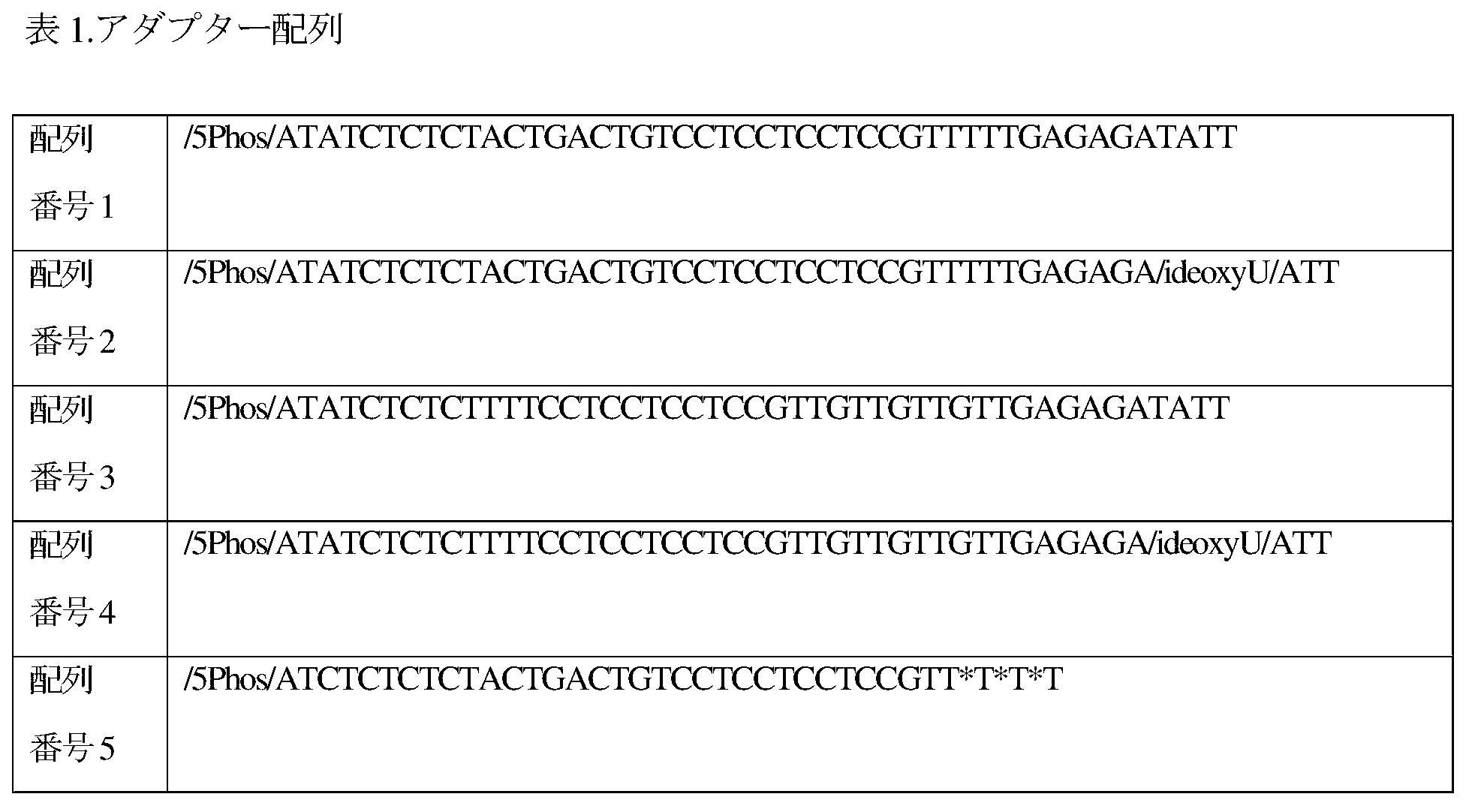
この実施例では、図3に図示したステム-ループアダプターを使用した。SMRTベースの配列決定システム(配列番号3および4)ならびにナノポアベースのシステム(配列番号1および2)のアダプターを作成した。それぞれのアダプターは、ステム領域にデオキシウリジン(deoxyuracil)ヌクレオシド(nucleotide)がある場合とない場合で作成した。アダプター配列領域を表1に示した。
Example 1. Library formation and sequencing with dU-containing stem-loop adapters.
In this example, the stem-loop adapter illustrated in FIG. 3 was used. Adapters were made for SMRT-based sequencing systems (SEQ ID NOs: 3 and 4) and nanopore-based systems (SEQ ID NOs: 1 and 2). Each adapter was made with and without a deoxyuracil nucleotide in the stem region. The adapter sequence regions are shown in Table 1.
HIVゲノムの断片(HIV Genewiz野生型DNA(106個の複製)アンプリコンサイズ1.1kb)を標的核酸として使用した。2ugの精製PCR産物を、市販のライブラリー調製試薬(Kapa Biosystems, Wilmington,
Mass.)を使用してアダプターにライゲーションした。ライゲーション後、反応混合物をエキソヌクレアーゼで処理し、残っているあらゆる直鎖状分子を除去した。直鎖状アダプター(配列番号5)の場合、エキソヌクレアーゼは使用されなかった。Qubitを使用して、ssDNAおよびdsDNAの最終ライブラリー濃度を決定した。次のステップでは、アダプター連結した標的核酸をウラシル-DNAグリコシラーゼ(Uracil DNA glycosylase)(UDG)およびDNAグリコシラーゼ-リアーゼ、エンドヌクレアーゼVIII(USER(商標), New England Biolabs, Waltham, Mass.)で消化した。ウラシルを含まないアダプターの場合(配列番号1、3、および5)、USER(商標)は使用されなかった。USER(商標)処理の後、配列決定プライマーを付加した。配列決定プライマー結合部位は、ループ領域にある(図4)。得られたライブラリーは、Pacific BioSciences RSII プラットフォーム(Pacific Biosciences,
Menlo Park, Cal.)およびナノポアプラットフォーム(Roche Sequencing Solutions, Santa Clara, Cal.)で配列決定された。RSIIプラットフォームでの配列決定読み取りの質および長さを表2にまとめる。
A fragment of the HIV genome (HIV Genewiz wild-type DNA (10 6 copies) amplicon size 1.1 kb) was used as the target nucleic acid. 2 ug of purified PCR product was added to commercially available library preparation reagents (Kapa Biosystems, Wilmington,
Mass. ) was used to ligate into the adapter. After ligation, the reaction mixture was treated with exonuclease to remove any remaining linear molecules. For the linear adapter (SEQ ID NO:5) no exonuclease was used. Final library concentrations of ssDNA and dsDNA were determined using Qubit. In the next step, the adaptor-ligated target nucleic acid was digested with Uracil-DNA glycosylase (UDG) and DNA glycosylase-lyase, Endonuclease VIII (USER™, New England Biolabs, Waltham, Mass.). . For adapters without uracil (SEQ ID NOS: 1, 3, and 5), USER™ was not used. After USER™ treatment, sequencing primers were added. The sequencing primer binding site is in the loop region (Fig. 4). The resulting library is available on the Pacific BioSciences RSII platform (Pacific Biosciences,
Menlo Park, Cal. ) and a nanopore platform (Roche Sequencing Solutions, Santa Clara, Cal.). The quality and length of sequencing reads on the RSII platform are summarized in Table 2.

ナノポアプラットフォームでの配列決定読み取りの質および長さを図6に示す。 The quality and length of sequencing reads on the nanopore platform are shown in FIG.
実施例2(予測的).自己プライミングdU含有ヘアピンアダプターによるライブラリーの形成および配列決定。
この実施例では、図7に図示したヘアピンアダプターを使用する。アダプターは、配列番号6である。
Example 2 (Prophetic). Library formation and sequencing with self-priming dU-containing hairpin adapters.
In this example, the hairpin adapter illustrated in FIG. 7 is used. The adapter is SEQ ID NO:6.
配列番号6:
/5phos/ATCTCTCTCAAATCCTCCTCCTCCGTTGGAGGAACGGAGGAGGA*G*G*AUUUGAGAGAGATT
U-デオキシウリジン(deoxyuracil);*-ホスホロチオエートヌクレオチド
SEQ ID NO:6:
/5phos/ATCTTCTCAAAATCCTCCTCCTCCGTTGGAGGAACGGAGGAGGA * G * G * AUUUGAGAGAGATT
U-deoxyuracil; * -phosphorothioate nucleotides
アダプターは、標準のライブラリー調製試薬(例えば、Kapa Biosystems)を使用して、標的核酸にライゲーションする。アダプター連結した標的核酸を含有する反応混合物を、エキソヌクレアーゼExo VIIおよびExo IIIで処理し、アダプター連結した標的核酸を濃縮する。濃縮されたアダプター連結した標的核酸をUDGおよびエンドヌクレアーゼEndo IVで処理する。UDGはUを切断して脱塩基部位を残し、EndolVは脱塩基部位を切断してオープン3’-OHを残す。このステップは、ヘアピンアダプターを自己プライミングアダプターに変換する。自己プライミングアダプターを備えたアダプター連結した核酸は、読み取りの長いプラットフォーム、例えばナノポアプラットフォームでの直鎖状配列決定に直接適用される。配列決定ポリメラーゼは、自己プライミングアダプターの3’-OHに結合し、直鎖状シングルパス配列決定で鎖を前方に置き換えることにより鎖を伸長する。 Adapters are ligated to target nucleic acids using standard library preparation reagents (eg, Kapa Biosystems). The reaction mixture containing the adaptor-ligated target nucleic acid is treated with the exonucleases Exo VII and Exo III to enrich the adaptor-ligated target nucleic acid. The enriched adaptor-ligated target nucleic acid is treated with UDG and the endonuclease Endo IV. UDG cleaves U leaving an abasic site and EndolV cleaves an abasic site leaving an open 3'-OH. This step converts the hairpin adapter into a self-priming adaptor. Adapter-ligated nucleic acids with self-priming adapters are directly applied to linear sequencing on long-read platforms, such as nanopore platforms. The sequencing polymerase binds to the 3'-OH of the self-priming adapter and extends the strand by displacing it forward in linear single-pass sequencing.
実施例3(予測的).自己プライミングリボヌクレオチド含有ヘアピンアダプターによるライブラリーの形成および配列決定。
この実施例では、図7に図示したヘアピンアダプターが使用される。アダプターは、配列番号7である:
Example 3 (Prophetic). Library formation and sequencing with self-priming ribonucleotide-containing hairpin adapters.
In this example, the hairpin adapter illustrated in FIG. 7 is used. The adapter is SEQ ID NO:7:
配列番号7:
/5phos/ATCTCTCTCTTTTCCTCCTCCTCCGTTGGAGGAACGGAGGAGGA*G*G*ArArArAGAGAGAGATT
rA-リボヌクレオチド;*-ホスホロチオエートヌクレオチド
SEQ ID NO:7:
/5phos/ATCTCTCTCTTTTCCTCCTCCTCCGTTGGAGGAACGGAGGAGGA * G * G * ArArArAGAGAGAGATT
rA - ribonucleotide; * - phosphorothioate nucleotide
アダプターは、標準のライブラリー調製試薬(例えばKapa Biosystems)を使用して、標的核酸にライゲーションされる。アダプター連結した標的核酸を含有する反応混合物をエキソヌクレアーゼExo VIIおよびExo IIIで処理し、アダプター連結した標的核酸を濃縮する。濃縮されたアダプター連結した標的核酸を、リボヌクレオチドを切断し、オープン3’-OHは残すRNaseH2などのRNaseHで処理する。このステップは、ヘアピンアダプターを自己プライミングアダプターに変換する。自己プライミングアダプターを備えたアダプター連結した核酸は、実施例2のように、読み取りの長いプラットフォームでの直鎖状配列決定に直接適用される。 Adapters are ligated to target nucleic acids using standard library preparation reagents (eg Kapa Biosystems). The reaction mixture containing the adaptor-ligated target nucleic acid is treated with the exonucleases Exo VII and Exo III to enrich the adaptor-ligated target nucleic acid. The enriched adaptor-ligated target nucleic acid is treated with an RNase H, such as RNase H2, which cleaves ribonucleotides and leaves an open 3'-OH. This step converts the hairpin adapter into a self-priming adaptor. Adapter-ligated nucleic acids with self-priming adapters are directly applied to linear sequencing on long-read platforms as in Example 2.
特定の例を参照して本発明を詳細に説明してきたが、様々な変更をこの発明の範囲内で行うことができることは、当業者には明白であろう。したがって、本発明の範囲は、本明細書に記載されている例によって限定されるものではなく、以下に示した特許請求の範囲によって限定されるものとする。 Although the present invention has been described in detail with reference to specific examples, it will be apparent to those skilled in the art that various modifications can be made within the scope of the invention. Accordingly, the scope of the invention should not be limited by the examples set forth herein, but rather by the claims set forth below.
Claims (9)
a)反応混合物において、二本鎖標的核酸の末端をアダプターに連結して、二重にアダプター連結した標的核酸を形成するステップであって、前記アダプターが二本鎖ステムおよび一本鎖ループを形成する一本鎖であり、前記ループがプライマー結合部位を含み、前記アダプターが前記プライマー結合部位の3’-側に鎖合成終結部位をさらに含むものであり、前記鎖合成終結部位が、脱塩基ヌクレオチドおよび非ヌクレオチドリンカーから選択される、前記ステップ;
b)反応混合物をエキソヌクレアーゼと接触させ、それにより二重にアダプター連結した標的核酸を濃縮するステップ;
c)反応混合物をプライマー結合部位にハイブリダイズすることが可能なプライマーと接触させるステップ;ならびに
d)プライマーを伸長し、それにより標的核酸のそれぞれの鎖を別々に配列決定するステップであって、前記伸長が鎖合成終結部位で終結し、相補鎖には進まないものである、前記ステップ;
を含む、前記方法。 A method of separately sequencing each strand of a target nucleic acid comprising:
a) ligating the ends of a double-stranded target nucleic acid to an adapter in a reaction mixture to form a doubly-adapted target nucleic acid, said adapter forming a double-stranded stem and a single-stranded loop; wherein said loop comprises a primer binding site, said adapter further comprises a strand synthesis termination site 3'-side of said primer binding site , said strand synthesis termination site comprising an abasic nucleotide and a non-nucleotide linker;
b) contacting the reaction mixture with an exonuclease, thereby enriching the doubly adaptor-ligated target nucleic acids;
c) contacting the reaction mixture with a primer capable of hybridizing to the primer binding site; and d) extending the primer, thereby separately sequencing each strand of the target nucleic acid, said said step, wherein the extension terminates at the strand synthesis termination site and does not proceed to the complementary strand;
The above method, comprising
a)反応混合物において、二本鎖標的核酸の末端をアダプターに連結して、二重にアダプター連結した標的核酸を形成するステップであって、前記アダプターが二本鎖ステムおよび一本鎖ループを形成する一本鎖であり、前記ループがプライマー結合部位を含み、前記アダプターが前記プライマー結合部位の3’-側に鎖合成終結部位をさらに含むものであり、前記鎖合成終結部位が、脱塩基ヌクレオチドおよび非ヌクレオチドリンカーからなる群から選択される、前記ステップ;ならびに
b)反応混合物をエキソヌクレアーゼと接触させ、それにより二重にアダプター連結した標的核酸を濃縮し、二重にアダプター連結した標的核酸のライブラリーを形成する、ステップ;
を含む、前記方法。 A method of creating a library for separately sequencing each strand of a target nucleic acid comprising:
a) ligating the ends of a double-stranded target nucleic acid to an adapter in a reaction mixture to form a doubly-adapted target nucleic acid, said adapter forming a double-stranded stem and a single-stranded loop; wherein said loop comprises a primer binding site, said adapter further comprises a strand synthesis termination site 3'-side of said primer binding site , said strand synthesis termination site comprising an abasic nucleotide and b) contacting the reaction mixture with an exonuclease, thereby enriching the doubly adaptor-ligated target nucleic acid and producing the doubly adaptor-ligated target nucleic acid. forming a library;
The above method, comprising
a)請求項2に記載の方法により標的核酸のライブラリーを形成するステップ;
b)ライブラリーを、プライマー結合部位にハイブリダイズすることが可能なプライマーと接触させるステップ;および
c)プライマーを伸長させ、それによりライブラリーの標的核酸のそれぞれの鎖を別々に配列決定するステップであって、前記伸長が鎖合成終結部位で終結し、相補鎖には進まないものである、前記ステップ;
を含む、前記方法。 A method of sequencing a library of target nucleic acids in a sample, comprising:
a) forming a library of target nucleic acids by the method of claim 2;
b) contacting the library with a primer capable of hybridizing to the primer binding site; and c) extending the primer, thereby separately sequencing each strand of the target nucleic acids of the library. said elongation terminating at a strand synthesis termination site and not proceeding to a complementary strand;
The above method, comprising
に記載の方法。 The method of any one of claims 1-6, wherein the adapter comprises a capture moiety ligand.
The method described in .
Priority Applications (1)
| Application Number | Priority Date | Filing Date | Title |
|---|---|---|---|
| JP2024083207A JP7717903B2 (en) | 2018-03-02 | 2024-05-22 | Creation of single-stranded circular DNA templates for single-molecule sequencing |
Applications Claiming Priority (6)
| Application Number | Priority Date | Filing Date | Title |
|---|---|---|---|
| US201862638034P | 2018-03-02 | 2018-03-02 | |
| US62/638,034 | 2018-03-02 | ||
| US201862685817P | 2018-06-15 | 2018-06-15 | |
| US62/685,817 | 2018-06-15 | ||
| JP2020545582A JP2021514651A (en) | 2018-03-02 | 2019-02-28 | Preparation of single-stranded circular DNA template for single molecule sequencing |
| PCT/EP2019/054938 WO2019166530A1 (en) | 2018-03-02 | 2019-02-28 | Generation of single-stranded circular dna templates for single molecule sequencing |
Related Parent Applications (1)
| Application Number | Title | Priority Date | Filing Date |
|---|---|---|---|
| JP2020545582A Division JP2021514651A (en) | 2018-03-02 | 2019-02-28 | Preparation of single-stranded circular DNA template for single molecule sequencing |
Related Child Applications (1)
| Application Number | Title | Priority Date | Filing Date |
|---|---|---|---|
| JP2024083207A Division JP7717903B2 (en) | 2018-03-02 | 2024-05-22 | Creation of single-stranded circular DNA templates for single-molecule sequencing |
Publications (1)
| Publication Number | Publication Date |
|---|---|
| JP2022160661A true JP2022160661A (en) | 2022-10-19 |
Family
ID=65628782
Family Applications (5)
| Application Number | Title | Priority Date | Filing Date |
|---|---|---|---|
| JP2020545484A Pending JP2021514646A (en) | 2018-03-02 | 2019-02-28 | Creation of double-stranded DNA templates for single-molecule sequencing |
| JP2020545582A Pending JP2021514651A (en) | 2018-03-02 | 2019-02-28 | Preparation of single-stranded circular DNA template for single molecule sequencing |
| JP2022128118A Pending JP2022160661A (en) | 2018-03-02 | 2022-08-10 | Generation of single-stranded circular DNA templates for single-molecule sequencing |
| JP2023175986A Pending JP2024009925A (en) | 2018-03-02 | 2023-10-11 | Generation of double-stranded DNA templates for single molecule sequencing |
| JP2024083207A Active JP7717903B2 (en) | 2018-03-02 | 2024-05-22 | Creation of single-stranded circular DNA templates for single-molecule sequencing |
Family Applications Before (2)
| Application Number | Title | Priority Date | Filing Date |
|---|---|---|---|
| JP2020545484A Pending JP2021514646A (en) | 2018-03-02 | 2019-02-28 | Creation of double-stranded DNA templates for single-molecule sequencing |
| JP2020545582A Pending JP2021514651A (en) | 2018-03-02 | 2019-02-28 | Preparation of single-stranded circular DNA template for single molecule sequencing |
Family Applications After (2)
| Application Number | Title | Priority Date | Filing Date |
|---|---|---|---|
| JP2023175986A Pending JP2024009925A (en) | 2018-03-02 | 2023-10-11 | Generation of double-stranded DNA templates for single molecule sequencing |
| JP2024083207A Active JP7717903B2 (en) | 2018-03-02 | 2024-05-22 | Creation of single-stranded circular DNA templates for single-molecule sequencing |
Country Status (5)
| Country | Link |
|---|---|
| US (1) | US11898204B2 (en) |
| EP (3) | EP4230748A1 (en) |
| JP (5) | JP2021514646A (en) |
| CN (2) | CN111936635B (en) |
| WO (2) | WO2019166565A1 (en) |
Families Citing this family (11)
| Publication number | Priority date | Publication date | Assignee | Title |
|---|---|---|---|---|
| WO2019166565A1 (en) * | 2018-03-02 | 2019-09-06 | F. Hoffmann-La Roche Ag | Generation of double-stranded dna templates for single molecule sequencing |
| CN121472373A (en) | 2018-05-22 | 2026-02-06 | 安序源有限公司 | Methods, systems, and compositions for nucleic acid sequencing |
| US11976275B2 (en) | 2018-06-15 | 2024-05-07 | Kapa Biosystems, Inc. | Generation of double-stranded DNA templates for single molecule sequencing |
| JP7490071B2 (en) * | 2020-03-11 | 2024-05-24 | エフ. ホフマン-ラ ロシュ アーゲー | Novel nucleic acid template structures for sequencing |
| CN114507708A (en) * | 2020-11-16 | 2022-05-17 | 唐纳德·李 | A method for preparing long molecular sequencing DNA |
| US20220195476A1 (en) * | 2020-12-21 | 2022-06-23 | Chen cheng yao | Method and kit for regenerating reusable initiators for nucleic acid synthesis |
| CN114763546B (en) * | 2021-01-12 | 2024-04-12 | 香港城市大学深圳研究院 | dU5' adapter and application thereof, and cDNA library constructed by same |
| CN117062902A (en) | 2021-03-03 | 2023-11-14 | 豪夫迈·罗氏有限公司 | Devices and methods for electrophoretic extraction of nucleic acids from biological samples |
| WO2023055752A2 (en) * | 2021-09-28 | 2023-04-06 | Axbio Inc. | Methods for processing a nucleic acid sample and compositions thereof |
| JP2025509651A (en) * | 2022-03-15 | 2025-04-11 | イルミナ インコーポレイテッド | Parallel sample and index sequencing |
| EP4520840A1 (en) * | 2023-09-05 | 2025-03-12 | Fraunhofer-Gesellschaft zur Förderung der angewandten Forschung e.V. | Suppression pcr-based selective enrichment sequencing |
Citations (4)
| Publication number | Priority date | Publication date | Assignee | Title |
|---|---|---|---|---|
| WO2012012037A1 (en) * | 2010-07-19 | 2012-01-26 | New England Biolabs, Inc. | Oligonucleotide adaptors: compositions and methods of use |
| WO2017162754A1 (en) * | 2016-03-22 | 2017-09-28 | Vib Vzw | Means and methods for amplifying nucleotide sequences |
| WO2018015365A1 (en) * | 2016-07-18 | 2018-01-25 | Roche Sequencing Solutions, Inc. | Asymmetric templates and asymmetric method of nucleic acid sequencing |
| JP2021514646A (en) * | 2018-03-02 | 2021-06-17 | エフ.ホフマン−ラ ロシュ アーゲーF. Hoffmann−La Roche Aktiengesellschaft | Creation of double-stranded DNA templates for single-molecule sequencing |
Family Cites Families (24)
| Publication number | Priority date | Publication date | Assignee | Title |
|---|---|---|---|---|
| US656568A (en) | 1899-09-30 | 1900-08-21 | Truman Noble | Binder for loose sheets. |
| JPH08299A (en) * | 1994-06-17 | 1996-01-09 | Eiken Chem Co Ltd | Method for promoting hybridization of complementary strand nucleic acid to target nucleic acid and method for detecting nucleic acid using the same |
| FR2726277B1 (en) | 1994-10-28 | 1996-12-27 | Bio Merieux | OLIGONUCLEOTIDE FOR USE AS PRIMER IN AN AMPLIFICATION METHOD BASED ON REPLICATION WITH MOVEMENT OF STRAND |
| DE19512361A1 (en) | 1995-04-01 | 1996-10-02 | Boehringer Mannheim Gmbh | Method of isolating a biological material |
| DE19520398B4 (en) | 1995-06-08 | 2009-04-16 | Roche Diagnostics Gmbh | Magnetic pigment |
| KR100463475B1 (en) | 1995-06-08 | 2005-06-22 | 로셰 디아그노스틱스 게엠베하 | Magnetic Pigment |
| DE19622885A1 (en) | 1996-06-07 | 1997-12-11 | Boehringer Mannheim Gmbh | Reagent preparation containing magnetic particles in the form of a tablet |
| US6958225B2 (en) * | 1999-10-27 | 2005-10-25 | Affymetrix, Inc. | Complexity management of genomic DNA |
| GB2378245A (en) | 2001-08-03 | 2003-02-05 | Mats Nilsson | Nucleic acid amplification method |
| US7315019B2 (en) | 2004-09-17 | 2008-01-01 | Pacific Biosciences Of California, Inc. | Arrays of optical confinements and uses thereof |
| US7393665B2 (en) | 2005-02-10 | 2008-07-01 | Population Genetics Technologies Ltd | Methods and compositions for tagging and identifying polynucleotides |
| US20070172839A1 (en) * | 2006-01-24 | 2007-07-26 | Smith Douglas R | Asymmetrical adapters and methods of use thereof |
| EP3064599B1 (en) | 2008-02-15 | 2018-12-12 | Synthetic Genomics, Inc. | Methods for in vitro joining and combinatorial assembly of nucleic acid molecules |
| JP2011515102A (en) | 2008-03-28 | 2011-05-19 | パシフィック バイオサイエンシーズ オブ カリフォルニア, インコーポレイテッド | Compositions and methods for nucleic acid sequencing |
| CN102459592B (en) | 2009-06-15 | 2017-04-05 | 考利达基因组股份有限公司 | Methods and compositions for long read sequencing |
| EP2534263B1 (en) | 2010-02-09 | 2020-08-05 | Unitaq Bio | Methods and compositions for universal detection of nucleic acids |
| EP2619327B1 (en) | 2010-09-21 | 2014-10-22 | Population Genetics Technologies LTD. | Increasing confidence of allele calls with molecular counting |
| WO2012092260A1 (en) | 2010-12-27 | 2012-07-05 | Ibis Biosciences, Inc. | Compositions and methods for producing single-stranded circular dna |
| CN105861487B (en) * | 2012-01-26 | 2020-05-05 | 纽亘技术公司 | Compositions and methods for targeted nucleic acid sequence enrichment and efficient library generation |
| EP2914745B1 (en) * | 2012-11-05 | 2017-09-06 | Rubicon Genomics, Inc. | Barcoding nucleic acids |
| JP7058502B2 (en) * | 2014-04-11 | 2022-04-22 | レッドボールト バイオサイエンシズ エルピー | Systems and methods for clonal replication and amplification of nucleic acid molecules for genomic and therapeutic applications |
| CN120700119A (en) * | 2015-02-11 | 2025-09-26 | 佰隆基因公司 | Methods and compositions for reducing nonspecific amplification products |
| DK3325621T3 (en) | 2015-07-17 | 2021-10-04 | Max Planck Gesellschaft | Cloning of single-stranded nucleic acid |
| WO2018031588A1 (en) * | 2016-08-09 | 2018-02-15 | Takara Bio Usa, Inc. | Nucleic acid adaptors with molecular identification sequences and use thereof |
-
2019
- 2019-02-28 WO PCT/EP2019/055015 patent/WO2019166565A1/en not_active Ceased
- 2019-02-28 CN CN201980014448.XA patent/CN111936635B/en active Active
- 2019-02-28 WO PCT/EP2019/054938 patent/WO2019166530A1/en not_active Ceased
- 2019-02-28 JP JP2020545484A patent/JP2021514646A/en active Pending
- 2019-02-28 CN CN201980016038.9A patent/CN111868257B/en active Active
- 2019-02-28 EP EP23161950.3A patent/EP4230748A1/en not_active Ceased
- 2019-02-28 EP EP19708494.0A patent/EP3759251A1/en not_active Ceased
- 2019-02-28 EP EP19708298.5A patent/EP3759241B1/en active Active
- 2019-02-28 US US16/977,421 patent/US11898204B2/en active Active
- 2019-02-28 JP JP2020545582A patent/JP2021514651A/en active Pending
-
2022
- 2022-08-10 JP JP2022128118A patent/JP2022160661A/en active Pending
-
2023
- 2023-10-11 JP JP2023175986A patent/JP2024009925A/en active Pending
-
2024
- 2024-05-22 JP JP2024083207A patent/JP7717903B2/en active Active
Patent Citations (4)
| Publication number | Priority date | Publication date | Assignee | Title |
|---|---|---|---|---|
| WO2012012037A1 (en) * | 2010-07-19 | 2012-01-26 | New England Biolabs, Inc. | Oligonucleotide adaptors: compositions and methods of use |
| WO2017162754A1 (en) * | 2016-03-22 | 2017-09-28 | Vib Vzw | Means and methods for amplifying nucleotide sequences |
| WO2018015365A1 (en) * | 2016-07-18 | 2018-01-25 | Roche Sequencing Solutions, Inc. | Asymmetric templates and asymmetric method of nucleic acid sequencing |
| JP2021514646A (en) * | 2018-03-02 | 2021-06-17 | エフ.ホフマン−ラ ロシュ アーゲーF. Hoffmann−La Roche Aktiengesellschaft | Creation of double-stranded DNA templates for single-molecule sequencing |
Also Published As
| Publication number | Publication date |
|---|---|
| CN111868257A (en) | 2020-10-30 |
| WO2019166565A1 (en) | 2019-09-06 |
| EP4230748A1 (en) | 2023-08-23 |
| EP3759241B1 (en) | 2025-02-19 |
| JP2024105673A (en) | 2024-08-06 |
| JP7717903B2 (en) | 2025-08-04 |
| CN111936635B (en) | 2024-08-23 |
| EP3759241A1 (en) | 2021-01-06 |
| JP2021514646A (en) | 2021-06-17 |
| EP3759251A1 (en) | 2021-01-06 |
| CN111936635A (en) | 2020-11-13 |
| US11898204B2 (en) | 2024-02-13 |
| JP2024009925A (en) | 2024-01-23 |
| JP2021514651A (en) | 2021-06-17 |
| US20230183797A1 (en) | 2023-06-15 |
| WO2019166530A1 (en) | 2019-09-06 |
| CN111868257B (en) | 2025-03-14 |
Similar Documents
| Publication | Publication Date | Title |
|---|---|---|
| JP7717903B2 (en) | Creation of single-stranded circular DNA templates for single-molecule sequencing | |
| CN109477142B (en) | Asymmetric Templates and Asymmetric Methods for Nucleic Acid Sequencing | |
| CN110062809B (en) | Single-stranded circular DNA library for circular consensus sequencing | |
| CN111801427B (en) | Generation of single-stranded circular DNA templates for single molecules | |
| CN109844137B (en) | Barcoded circular library construction for identification of chimeric products | |
| CN111164219A (en) | Circularization method for sample preparation for single molecule sequencing | |
| WO2019086531A1 (en) | Linear consensus sequencing | |
| CN111315895A (en) | Novel method for generating circular single-stranded DNA libraries | |
| US11976275B2 (en) | Generation of double-stranded DNA templates for single molecule sequencing | |
| EP3853362A1 (en) | System and method for modular and combinatorial nucleic acid sample preparation for sequencing |
Legal Events
| Date | Code | Title | Description |
|---|---|---|---|
| A621 | Written request for application examination |
Free format text: JAPANESE INTERMEDIATE CODE: A621 Effective date: 20220810 |
|
| A131 | Notification of reasons for refusal |
Free format text: JAPANESE INTERMEDIATE CODE: A131 Effective date: 20230906 |
|
| A521 | Request for written amendment filed |
Free format text: JAPANESE INTERMEDIATE CODE: A523 Effective date: 20231101 |
|
| A02 | Decision of refusal |
Free format text: JAPANESE INTERMEDIATE CODE: A02 Effective date: 20240131 |