JP2016091663A - Lithium secondary battery and electric vehicle - Google Patents
Lithium secondary battery and electric vehicle Download PDFInfo
- Publication number
- JP2016091663A JP2016091663A JP2014221995A JP2014221995A JP2016091663A JP 2016091663 A JP2016091663 A JP 2016091663A JP 2014221995 A JP2014221995 A JP 2014221995A JP 2014221995 A JP2014221995 A JP 2014221995A JP 2016091663 A JP2016091663 A JP 2016091663A
- Authority
- JP
- Japan
- Prior art keywords
- secondary battery
- electrolyte
- lithium secondary
- nli
- ionomer
- Prior art date
- Legal status (The legal status is an assumption and is not a legal conclusion. Google has not performed a legal analysis and makes no representation as to the accuracy of the status listed.)
- Pending
Links
Images
Classifications
-
- Y—GENERAL TAGGING OF NEW TECHNOLOGICAL DEVELOPMENTS; GENERAL TAGGING OF CROSS-SECTIONAL TECHNOLOGIES SPANNING OVER SEVERAL SECTIONS OF THE IPC; TECHNICAL SUBJECTS COVERED BY FORMER USPC CROSS-REFERENCE ART COLLECTIONS [XRACs] AND DIGESTS
- Y02—TECHNOLOGIES OR APPLICATIONS FOR MITIGATION OR ADAPTATION AGAINST CLIMATE CHANGE
- Y02E—REDUCTION OF GREENHOUSE GAS [GHG] EMISSIONS, RELATED TO ENERGY GENERATION, TRANSMISSION OR DISTRIBUTION
- Y02E60/00—Enabling technologies; Technologies with a potential or indirect contribution to GHG emissions mitigation
- Y02E60/10—Energy storage using batteries
Landscapes
- Secondary Cells (AREA)
Abstract
【課題】電池性能の向上と安全性向上とを両立可能なリチウム二次電池及び前記リチウム二次電池が搭載された電気自動車を提供する。
【解決手段】非水電解液を用いるリチウム二次電池は、前記非水電解液は、主鎖であるシロキサン骨格の側鎖に、負の電荷を有する官能基のリチウム塩を有するアイオノマー型電解質を含有する。
【選択図】図1The present invention provides a lithium secondary battery capable of improving both battery performance and safety and an electric vehicle equipped with the lithium secondary battery.
In a lithium secondary battery using a non-aqueous electrolyte, the non-aqueous electrolyte includes an ionomer electrolyte having a lithium salt of a functional group having a negative charge on a side chain of a siloxane skeleton that is a main chain. contains.
[Selection] Figure 1
Description
本開示は、非水電解質を用いたリチウム二次電池及び前記リチウム二次電池が搭載された電気自動車に関する。 The present disclosure relates to a lithium secondary battery using a nonaqueous electrolyte and an electric vehicle equipped with the lithium secondary battery.
リチウムイオン二次電池は、例えばニッケル水素電池やニッケルカドミウム電池のような二次電池に比べて高いエネルギー密度を有しており、また軽量かつ高電圧という特性を有している。そのため、近年、携帯型電子機器や電気自動車(ハイブリッド電気自動車を含む)を始めとする様々な用途に広く用いられている。 Lithium ion secondary batteries have a higher energy density than secondary batteries such as nickel metal hydride batteries and nickel cadmium batteries, and are light and have high voltage characteristics. For this reason, in recent years, it has been widely used in various applications including portable electronic devices and electric vehicles (including hybrid electric vehicles).
典型的なリチウム二次電池では、正極の活物質としてマンガン酸リチウムやコバルト酸リチウムのような遷移金属酸化物が用いられ、負極には例えば銅箔の表面に炭素系材料が用いられる。リチウム二次電池では反応電位が高いため、従来の他の二次電池で用いられる水系電解液が使用できず、それに代えて、リチウム化合物を含有する電解質を溶解した非水電解液が用いられている。非水電解液としては、例えばヘキサフルオロリン酸リチウム (LiPF6)のようなリチウム塩電解質を有機溶媒中に溶かしたものが知られている。 In a typical lithium secondary battery, a transition metal oxide such as lithium manganate or lithium cobaltate is used as a positive electrode active material, and a carbon-based material is used for the negative electrode, for example, on the surface of a copper foil. Since lithium secondary batteries have a high reaction potential, the aqueous electrolyte used in other conventional secondary batteries cannot be used. Instead, a non-aqueous electrolyte in which an electrolyte containing a lithium compound is dissolved is used. Yes. As a non-aqueous electrolyte, for example, a lithium salt electrolyte such as lithium hexafluorophosphate (LiPF6) dissolved in an organic solvent is known.
この種の非水電解液では、水分が存在すると、水分が電解質(LiPF6)と反応してフッ酸(HF)が発生する。フッ酸(HF)は、電極表面のSEI(Solid Electrolyte Interface:固体電解質界面)被膜(以下、被膜)に影響し抵抗を上昇させたり、電極活物質と反応することによって、電池容量の低下を引き起こしてしまう。リチウム二次電池では、基本的に、非水電解液が水分に曝されない構成が採用されているものの、実際には様々な要因によって少なからず水分が存在するため、問題となる。 In this type of non-aqueous electrolyte, when water is present, the water reacts with the electrolyte (LiPF6) to generate hydrofluoric acid (HF). Hydrofluoric acid (HF) affects the SEI (Solid Electrolyte Interface) coating (hereinafter referred to as coating) on the electrode surface, increases resistance, and reacts with the electrode active material to cause a decrease in battery capacity. End up. Although the lithium secondary battery basically employs a configuration in which the non-aqueous electrolyte is not exposed to moisture, there is actually a problem due to the presence of moisture due to various factors.
このような水分に起因する劣化の抑制技術として、例えば特許文献1がある。特許文献1では、非水電解液中に、分子構造内にシロキサン骨格を含んだ、1次元構造である直鎖状ポリシロキサン化合物を添加することが開示されている。
As a technique for suppressing such deterioration caused by moisture, there is, for example,
リチウム二次電池は、上述したように反応電圧が高いため、電気分解による劣化進行が問題となっている。特許文献1では、シロキサン骨格を有する添加物を非水電解液に加えることにより劣化抑制を図っているが、更なる劣化抑制が望まれている。
また従来の二次電池で使用される電解液は、一般的に揮発性を有するため、仮に故障や事故が発生した場合、電解液が気化し、燃焼する可能性がある。
Since the lithium secondary battery has a high reaction voltage as described above, the progress of deterioration due to electrolysis is a problem. In
In addition, since the electrolytic solution used in the conventional secondary battery is generally volatile, if a failure or accident occurs, the electrolytic solution may vaporize and burn.
上述の事情に鑑みて、本発明の少なくとも一実施形態は、電池性能の向上と安全性向上とを両立可能なリチウム二次電池及び前記リチウム二次電池が搭載された電気自動車を提供することを目的とする。 In view of the above circumstances, at least one embodiment of the present invention provides a lithium secondary battery that can achieve both improved battery performance and improved safety, and an electric vehicle equipped with the lithium secondary battery. Objective.
(1)本発明の少なくとも一実施形態に係るリチウム二次電池は、上記課題を解決するために、非水電解質を用いるリチウム二次電池であって、前記非水電解質は、主鎖であるシロキサン骨格に側鎖として、負の電荷を有するリチウム塩官能基を有するアイオノマー型電解質を含有することを特徴とする。 (1) A lithium secondary battery according to at least one embodiment of the present invention is a lithium secondary battery using a non-aqueous electrolyte in order to solve the above-described problem, and the non-aqueous electrolyte is a siloxane that is a main chain. It contains an ionomer type electrolyte having a lithium salt functional group having a negative charge as a side chain in the skeleton.
上記(1)の構成によれば、非水電解質はシロキサン骨格を有するため、リチウム二次電池の高い充電電圧に耐えることができる。従って、非水電解質は電気分解が生じにくく、酸化還元による劣化を効果的に抑制できる。
また側鎖は、負の電荷を有するリチウム塩官能基を有する。「負の電荷を有するリチウム塩の側鎖」は、イオン液体のマイナスイオン側と同様の構造(すなわちイオン液体の部分構造)であり、いわゆる柔らかい酸である。そのため、側鎖は、硬いアルカリであるリチウムイオンと解離しやすい構造である。従って、シロキサン骨格の側鎖とすることによってリチウムイオンの伝導性を向上できる。
本実施形態に係るアイオノマー型電解質は、従来の電解質に比べて気化しにくい。従って、リチウム二次電池が仮に事故等によって加熱された場合であっても燃焼しにくく、より安全性の高い二次電池を実現できる。
このように本実施形態に係るリチウム二次電池は、シロキサン骨格の側鎖に、イオン液体を含む柔らかい部分構造を有する非水電解質を備えることにより、電池性能の向上と安全性向上とを両立可能である。
According to the configuration of (1) above, since the nonaqueous electrolyte has a siloxane skeleton, it can withstand the high charging voltage of the lithium secondary battery. Therefore, the non-aqueous electrolyte is unlikely to undergo electrolysis and can effectively suppress deterioration due to redox.
Further, the side chain has a lithium salt functional group having a negative charge. The “side chain of negatively charged lithium salt” has a structure similar to that of the negative ion side of the ionic liquid (that is, a partial structure of the ionic liquid), and is a so-called soft acid. Therefore, the side chain has a structure that easily dissociates from lithium ions that are hard alkalis. Therefore, the conductivity of lithium ions can be improved by using side chains of the siloxane skeleton.
The ionomer type electrolyte according to the present embodiment is less likely to vaporize than a conventional electrolyte. Therefore, even when the lithium secondary battery is heated due to an accident or the like, it is difficult to burn and a secondary battery with higher safety can be realized.
As described above, the lithium secondary battery according to the present embodiment includes both a non-aqueous electrolyte having a soft partial structure containing an ionic liquid in the side chain of the siloxane skeleton, thereby achieving both improved battery performance and improved safety. It is.
尚、本発明の少なくとも一実施形態に係るアイオノマー型電解質は、後述するように、その分子構造に応じて、液体的な性質を示す場合もあれば、固体的な性質を示す場合もある。そのため、本願におけるアイオノマー型電解質は、固体的な性質を示す場合には、それ自身がゲル電解質として用いることができ、又は、当該電解質を溶媒に溶解させることで電解液とすることもできる。一方、アイオノマー型電解質が液体的な性質を示す場合には、それ自身で電解液として用いることができ、又は、他の溶媒と混合した上で電解液として用いることもできる。 The ionomer electrolyte according to at least one embodiment of the present invention may exhibit a liquid property or a solid property depending on its molecular structure, as will be described later. Therefore, when the ionomer type electrolyte in this application shows a solid property, itself can be used as a gel electrolyte, or it can also be used as an electrolytic solution by dissolving the electrolyte in a solvent. On the other hand, when the ionomer-type electrolyte exhibits liquid properties, it can be used as an electrolytic solution by itself, or can be used as an electrolytic solution after being mixed with another solvent.
(2)幾つかの実施形態では、上記(1)の構成において、前記シロキサン骨格は、Si−O骨格である。 (2) In some embodiments, in the configuration of (1), the siloxane skeleton is a Si—O skeleton.
上記(2)の構成によれば、シロキサン骨格は石英のように珪素と酸素の結合からなる強い結合を有する。そのため、非水電解質は電気分解がより生じにくく、酸化還元がよる劣化をより効果的に抑制できる。 According to the configuration of (2) above, the siloxane skeleton has a strong bond composed of a bond of silicon and oxygen like quartz. Therefore, the non-aqueous electrolyte is less prone to electrolysis, and can effectively suppress deterioration due to redox.
(3)幾つかの実施形態では、上記(1)の構成において、前記アイオノマー型電解質は、次式
(−SiR1R2−O−)n (式1)
(式中、R1及びR2の少なくとも一方は(−SO2−NLi−SO2−CF3),(−CF2−SO2−NLi−SO2−CF3),(−SO2−NLi−SO2−F),(−SO2−NLi−SO2−F),
(−CF2CF2−SO2−NLi−SO2−CF2CF3),(−C3H6O−(C2H4O)n−SO2−OLi),(−C3H6O−(C2H4O)n−PO(OLi)2),(−O−C6H4−SO2−NLi−SO2−CF3)のいずれかであると望ましい。nは1以上の整数)である。すなわち、R1、R2の一方がリチウム塩官能基である場合、他方はリチウム塩官能基ではない例えばメチル基などでもよい。
(3) In some embodiments, in the configuration of (1), the ionomer electrolyte has the following formula (—SiR 1 R 2 —O—) n (Formula 1)
(Wherein, R 1 and at least one of R 2 is (-SO 2 -NLi-SO 2 -CF 3), (- CF 2 -SO 2 -NLi-SO 2 -CF 3), (- SO 2 -NLi -SO 2 -F), (- SO 2 -NLi-SO 2 -F),
(—CF 2 CF 2 —SO 2 —NLi—SO 2 —CF 2 CF 3 ), (—C 3 H 6 O— (C 2 H 4 O) n —SO 2 —OLi), (—C 3 H 6 O— (C 2 H 4 O) n —PO (OLi) 2 ) or (—O—C 6 H 4 —SO 2 —NLi—SO 2 —CF 3 ) is desirable. n is an integer of 1 or more. That is, when one of R 1 and R 2 is a lithium salt functional group, the other may not be a lithium salt functional group, for example, a methyl group.
ここでアイオノマー型電解質は、nを調整することによって、その性質をコントロールすることができる。例えばnが大きくなると分子長が大きくなるので、アイオノマー型電解質は粘度が大きくなり、固体的な振る舞いを示す。このように固体的な振る舞いを示すアイオノマー型電解質は、二次電池に用いる際に電極間を隔てるためのセパレータが不要になるため、コスト削減に有利である。
逆にnが小さくなると分子長が小さくなるので、アイオノマー型電解質は粘度が小さくなり、液体的な振る舞いを示す。このように液体的な振る舞いを示すアイオノマー型電解質は、例えばフレキシブルな電極が巻回されることにより表面が曲面状に形成された電極構造においても電極間を容易に満たすことができる点で有利である。
このように上記アイオノマー型電解質の特性は、nを調整することによってコントロール可能である。
Here, the properties of the ionomer electrolyte can be controlled by adjusting n. For example, as n increases, the molecular length increases, so that the ionomer electrolyte increases in viscosity and exhibits a solid behavior. The ionomer electrolyte that exhibits solid behavior in this manner is advantageous in cost reduction because it does not require a separator for separating electrodes when used in a secondary battery.
Conversely, when n decreases, the molecular length decreases, so that the ionomer electrolyte has a low viscosity and exhibits a liquid behavior. The ionomer type electrolyte that exhibits liquid behavior in this way is advantageous in that the gap between the electrodes can be easily filled even in an electrode structure in which the surface is formed into a curved surface by winding a flexible electrode, for example. is there.
Thus, the characteristics of the ionomer electrolyte can be controlled by adjusting n.
また上記式1で示されるアイオノマー型電解質は、一次元的に延在する分子構造を有してもよいし、二次元的に延在する分子構造を有してもよいし、三次元的に延在する分子構造を有してもよい。上述したように、アイオノマー型電解質はnの値によって、その性質が液体的なものから固体的なものに至るまで変化する。このような性質の変化は、分子構造の次元にも依存する。例えば次元数が小さいほど構造が柔らかくなりやすく、より液体的な振る舞いを示しやすい傾向を有する。一方、次元数が大きいほど構造が固くなりやすく、より固体的な振る舞いを示しやすい傾向を有する。
Further, the ionomer type electrolyte represented by the
本発明の少なくとも一実施形態に係る電気自動車は、上述のリチウム二次電池(上記各種態様を含む)が搭載されたことを特徴とする。
尚、本願明細書において電気自動車とは、走行用動力の少なくとも一部を電気エネルギーに基づいて供給可能な車両を意味し、例えば電気エネルギーによって駆動可能な電動機によって専ら動力を発生させる車両、及び、前記電動機に加えてガソリンや軽油のような燃料を使用して動力を発生させるエンジンのような他の動力とを併用する、いわゆるハイブリッド電気自動車を含む。
An electric vehicle according to at least one embodiment of the present invention includes the above-described lithium secondary battery (including the various aspects described above).
In the present specification, an electric vehicle means a vehicle that can supply at least a part of driving power based on electric energy, for example, a vehicle that generates power exclusively by an electric motor that can be driven by electric energy, and In addition to the electric motor, a so-called hybrid electric vehicle that uses a combination of other power such as an engine that generates power using fuel such as gasoline or light oil is included.
本発明の少なくとも一実施形態によれば、電池性能の向上と安全性向上とを両立可能なリチウム二次電池及び前記リチウム二次電池が搭載された電気自動車を提供できる。 According to at least one embodiment of the present invention, it is possible to provide a lithium secondary battery capable of improving both battery performance and safety, and an electric vehicle equipped with the lithium secondary battery.
以下、添付図面を参照して本発明の幾つかの実施形態について説明する。ただし、実施形態として記載されている又は図面に示されている構成部品の寸法、材質、形状、その相対的配置等は、本発明の範囲をこれに限定する趣旨ではなく、単なる説明例にすぎない。
例えば、「ある方向に」、「ある方向に沿って」、「平行」、「直交」、「中心」、「同心」或いは「同軸」等の相対的或いは絶対的な配置を表す表現は、厳密にそのような配置を表すのみならず、公差、若しくは、同じ機能が得られる程度の角度や距離をもって相対的に変位している状態も表すものとする。
また例えば、四角形状や円筒形状等の形状を表す表現は、幾何学的に厳密な意味での四角形状や円筒形状等の形状を表すのみならず、同じ効果が得られる範囲で、凹凸部や面取り部等を含む形状も表すものとする。
一方、一の構成要素を「備える」、「具える」、「具備する」、「含む」、又は、「有する」という表現は、他の構成要素の存在を除外する排他的な表現ではない。
Hereinafter, some embodiments of the present invention will be described with reference to the accompanying drawings. However, the dimensions, materials, shapes, relative arrangements, etc. of the components described in the embodiments or shown in the drawings are not intended to limit the scope of the present invention, but are merely illustrative examples. Absent.
For example, expressions expressing relative or absolute arrangements such as “in a certain direction”, “along a certain direction”, “parallel”, “orthogonal”, “center”, “concentric” or “coaxial” are strictly In addition to such an arrangement, it is also possible to represent a state of relative displacement with an angle or a distance such that tolerance or the same function can be obtained.
In addition, for example, expressions representing shapes such as quadrangular shapes and cylindrical shapes not only represent shapes such as quadrangular shapes and cylindrical shapes in a strict geometric sense, but also within the range where the same effect can be obtained. A shape including a chamfered portion or the like is also expressed.
On the other hand, the expressions “comprising”, “comprising”, “comprising”, “including”, or “having” one constituent element are not exclusive expressions for excluding the existence of the other constituent elements.
[1.電池の構成]
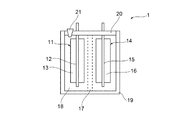
図1は本発明の一実施形態に係るリチウム二次電池1の概略構成を示す断面図である。
リチウム二次電池1は、正極11と、負極14と、セパレータ17と、非水電解質18と、これらを収容する容器19と、前記容器19を封止する蓋体20とを備える。蓋体20は、蓋体の開口部を封止するための封口栓21が設けられている。
[1. Battery configuration]
FIG. 1 is a cross-sectional view showing a schematic configuration of a lithium
The lithium
正極11は、アルミニウムのような導電性箔からなる正極集電体12と、該正極集電体12の表面に設けられたリチウム複合酸化物からなる正極活物質層13とを備えて構成されている。正極活物質は、例えば、LiCoO2、LiMn2O4、LiNiO2のようなリチウム複合酸化物を含有する。
尚、正極集電体12は、正極活物質を結合させるための結着剤(バインダ)を含有していてもよい。結着剤は、例えばポリフッ化ビニリデンである。
The
The positive electrode
負極14は、銅のような導電性箔からなる負極集電体15と、該負極集電体15の表面に設けられた負極活物質層16とを備えて構成されている。負極活物質は、例えば炭素材料を含有する。
尚、負極集電体15は、負極活物質を結合させるための結着剤(バインダ)を含有していてもよい。結着剤は、例えばポリフッ化ビニリデン、スチレンブタジエンゴム(SBR)である。
The
The negative electrode
正極11および負極14には、導電性金属からなるリード(不図示)が接続されている。リードは容器19又は蓋体20と導通するように構成されていてもよい。
セパレータ17は、例えばポリオレフィン、ポリプロピレン、ポリエチレンのような材料からなる多孔膜を用いることができる。
A lead (not shown) made of a conductive metal is connected to the
The
非水電解質18は、リチウム塩と添加剤と上記シロキサンからなる。更に非水系溶媒として、例えばプロピレンカーボネート、エチレンカーボネートのような環状カーボネート、エチルメチルカーボネート、ジメチルカーボネート、ジエチルカーボネートのような鎖状カーボネートを添加することができる。
The
本実施形態において非水系溶媒に溶解される電解質は、シロキサン骨格の側鎖に、負の電荷を有する官能基のリチウム塩を有するアイオノマー型電解質を含有する。当該アイオノマー型電解質は、具体的には上記(式1)で示される。このアイオノマー型電解質は、シロキサン骨格を有するため、リチウム二次電池の高い充電電圧に耐えることができる。 In this embodiment, the electrolyte dissolved in the non-aqueous solvent contains an ionomer type electrolyte having a lithium salt of a functional group having a negative charge in the side chain of the siloxane skeleton. The ionomer electrolyte is specifically represented by the above (formula 1). Since this ionomer type electrolyte has a siloxane skeleton, it can withstand the high charging voltage of a lithium secondary battery.
特に式1のシロキサン骨格は、石英のように珪素と酸素の結合からなる強い結合を有する。そのため、非水電解質は電気分解がより生じにくく、酸化還元がよる劣化をより効果的に抑制できる。
In particular, the siloxane skeleton of
また式1の側鎖はリンカーを介して、負の電荷を有する官能基のリチウム塩を有し、具体的には(−SO2−NLi−SO2−CF3),(−CF2−SO2−NLi−SO2−CF3),(−SO2−NLi−SO2−F),(−SO2−NLi−SO2−F),
(−CF2CF2−SO2−NLi−SO2−CF2CF3),(−C3H6O−(C2H4O)n−SO2−OLi),(−C3H6O−(C2H4O)n−PO(OLi)2),(−O−C6H4−SO2−NLi−SO2−CF3)のいずれかであることが望ましい。このような側鎖は、イオン液体のマイナスイオン側と近似した構造であり、いわゆる柔らかい酸である。
また(式1)の側鎖はリンカーを介していても良い。
Moreover, the side chain of
(—CF 2 CF 2 —SO 2 —NLi—SO 2 —CF 2 CF 3 ), (—C 3 H 6 O— (C 2 H 4 O) n —SO 2 —OLi), (—C 3 H 6 O— (C 2 H 4 O) n —PO (OLi) 2 ) or (—O—C 6 H 4 —SO 2 —NLi—SO 2 —CF 3 ) is desirable. Such a side chain has a structure similar to the negative ion side of the ionic liquid, and is a so-called soft acid.
Moreover, the side chain of (Formula 1) may be via a linker.
アイオノマー型電解質が有する負の電荷を有する官能基のリチウム塩はイオン液体の部分構造に近似している。イオン液体は常温で融けている塩であり、次世代電池電解液として注目されている。(−SO2−NLi−SO2−CF3),(−CF2−SO2−NLi−SO2−CF3),(−SO2−NLi−SO2−F),(−SO2−NLi−SO2−F),
(−CF2CF2−SO2−NLi−SO2−CF2CF3),(−C3H6O−(C2H4O)n−SO2−OLi),(−C3H6O−(C2H4O)n−PO(OLi)2),(−O−C6H4−SO2−NLi−SO2−CF3)は、それぞれイオン液体の構造を部分的に有する。これらの構成は比較的大きな分子構造であり、且つ、マイナス電荷が偏在しない構造である。そのため、カチオンと強力な結合をしにくい。
The lithium salt of the negatively charged functional group of the ionomer electrolyte is close to the partial structure of the ionic liquid. An ionic liquid is a salt that melts at room temperature, and has attracted attention as a next-generation battery electrolyte. (—SO 2 —NLi—SO 2 —CF 3 ), (—CF 2 —SO 2 —NLi—SO 2 —CF 3 ), (—SO 2 —NLi—SO 2 —F), (—SO 2 —NLi) -SO 2 -F),
(—CF 2 CF 2 —SO 2 —NLi—SO 2 —CF 2 CF 3 ), (—C 3 H 6 O— (C 2 H 4 O) n —SO 2 —OLi), (—C 3 H 6 O— (C 2 H 4 O) n —PO (OLi) 2 ) and (—O—C 6 H 4 —SO 2 —NLi—SO 2 —CF 3 ) each have a partial ionic liquid structure. These structures have a relatively large molecular structure and do not have a negative charge unevenly distributed. Therefore, it is difficult to form strong bonds with cations.
このように本実施形態に係るアイオノマー型電解質の側鎖は、硬いアルカリであるリチウムイオンと解離しやすい構造であり、シロキサン骨格の側鎖とすることによってリチウムイオンの伝導性を向上できる。 As described above, the side chain of the ionomer electrolyte according to the present embodiment has a structure that is easily dissociated from the lithium ion that is a hard alkali, and by using the side chain of the siloxane skeleton, the conductivity of the lithium ion can be improved.
本実施形態に係るアイオノマー型電解質は揮発性が少ないため、従来の電解質に比べて気化しにくい。従って、リチウム二次電池が仮に事故等によって加熱された場合であっても燃焼しにくく、より安全性の高い二次電池を実現できる。 Since the ionomer type electrolyte according to the present embodiment is less volatile, it is less likely to vaporize than the conventional electrolyte. Therefore, even when the lithium secondary battery is heated due to an accident or the like, it is difficult to burn and a secondary battery with higher safety can be realized.
尚、非水電解質18は、被膜形成のための添加剤として、例えば、ビニレンカーボネート(VC)を含有していてもよい。
The
容器19は、アルミニウム、鉄、ステンレス等の金属製であってもよく、樹脂製やラミネートフィルムからなるものであってもよい。また、容器の形状は円筒形であってもよく、直方体形状であってもよい。
蓋体20は、アルミニウム、鉄、ステンレス、等の金属等であってもよく、樹脂製からなるものであってもよい。端子部として利用される場合は、適宜極性に適合した素材を選択することができる。
The
The
[2.電解質の生成方法]
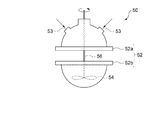
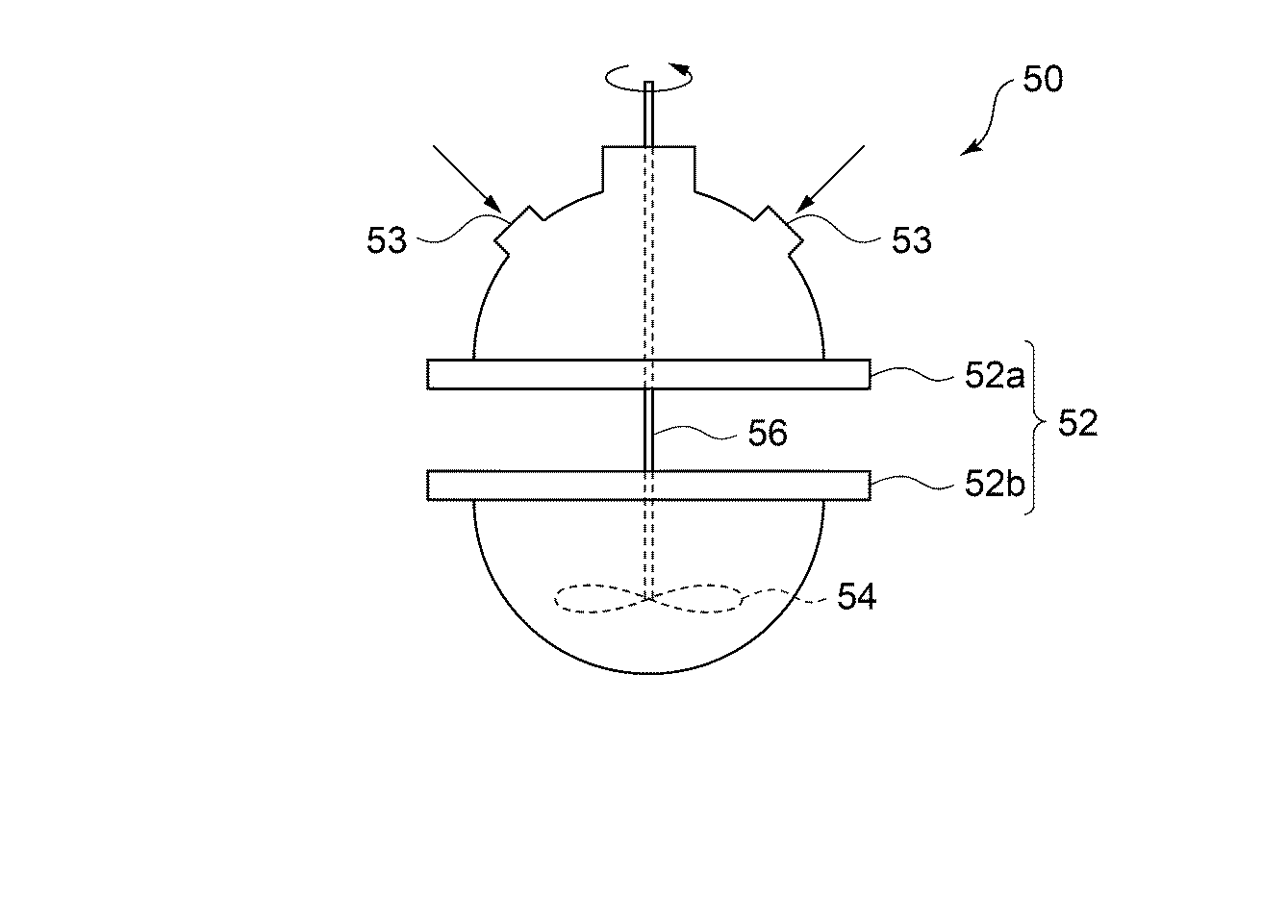
続いて、上記アイオノマー型電解質の生成方法について説明する。図2は上記アイオノマー型電解質の生成装置50を概略的に示す模式図である。生成装置50は、試薬を投入可能なフラスコ52と、該フラスコ52に上方から挿入され、先端に羽54が設けられた撹拌棒56とを備える。撹拌棒56は、不図示のモータのような動力源によって駆動され、フラスコ52の内部に投入された試薬を混合可能に構成されている。
[2. Electrolyte production method]
Next, a method for producing the ionomer electrolyte will be described. FIG. 2 is a schematic diagram schematically showing the ionomer-
フラスコ52は、上部52aと下部52bとに分離可能なセパラブル型フラスコであり、上部52a及び下部52bの合わせ面には、すりが設けられている。またフラスコ52の上部52aには、複数の試薬をそれぞれ投入可能な複数の投入口53が設けられている。
The
アイオノマー型電解質を生成する際には、まずsulfonimide NaOC6H4SO2NNaSO2CF3を用意し、投入口53からフラスコ52に投入する。ここでsulfonimide NaOC6H4SO2NNaSO2CF3は、例えばUS20014/0225153A1に開示される合成方法で得られたものを用い、具体的には次式で表される。
更にフラスコ52にsulfonimide NaOC6H4SO2NNaSO2CF3に対して1/2当量のテトラクロロシランを投入する。sulfonimide NaOC6H4SO2NNaSO2CF3は、テトラクロロシランと反応することにより、次式
更にSol-gel反応によって、次式
尚、アイオノマー型電解質の粘度は、上述したようにnに依存するが、このnは例えばエタノールとの反応時におけるエタノール希釈度によって調整可能である(例えばエタノール希釈度が低い(すなわち粘度が大きい)場合には反応が生じにくいためnは小さくなり、エタノール希釈度が高い(すなわち粘度が大きい)場合には反応が生じやすいためnは大きくなる)。
またアイオノマー型電解質の次元構造(一次元、二次元或いは三次元にするか)は、例えば、クロロシランとの比率を変えることによって行うことができる。
The viscosity of the ionomer electrolyte depends on n as described above, but this n can be adjusted by, for example, the ethanol dilution at the time of reaction with ethanol (for example, the ethanol dilution is low (that is, the viscosity is high)). In some cases, the reaction is difficult to occur, so n is small, and when the ethanol dilution is high (that is, the viscosity is large), the reaction is likely to occur and n is large).
The dimensional structure of the ionomer electrolyte (one-dimensional, two-dimensional, or three-dimensional) can be performed, for example, by changing the ratio with chlorosilane.
尚、上記アイオノマー型電解質では、側鎖に酸素原子とベンゼン環とからなるリンカーを介したリチウム塩が用いられている。このように側鎖にリンカーを有することで、上記生成過程におけるアイオノマー型電解質の集率を向上できる。またリンカーがあることで、生成されたアイオノマー型電解質の性質、例えば有機溶媒的な大きな基との濡れ性を調整することもできる。 In the ionomer type electrolyte, a lithium salt is used via a linker composed of an oxygen atom and a benzene ring in the side chain. By having a linker in the side chain as described above, the ionomer electrolyte concentration in the production process can be improved. Further, the presence of the linker can adjust the properties of the produced ionomer electrolyte, for example, the wettability with a large group like an organic solvent.
以上説明したように、本実施形態によれば、電池性能の向上と安全性向上とを両立可能なリチウム二次電池及び前記リチウム二次電池が搭載された電気自動車を提供できる。 As described above, according to this embodiment, it is possible to provide a lithium secondary battery that can achieve both improved battery performance and improved safety, and an electric vehicle equipped with the lithium secondary battery.
本開示は、非水電解質を用いたリチウム二次電池及び前記リチウム二次電池が搭載された電気自動車に利用可能である。 The present disclosure is applicable to a lithium secondary battery using a nonaqueous electrolyte and an electric vehicle equipped with the lithium secondary battery.
1 リチウム二次電池
11 正極
14 負極
17 セパレータ
18 非水電解質
19 容器
20 蓋体
21 封口栓
DESCRIPTION OF
Claims (4)
前記非水電解質は、主鎖であるシロキサン骨格に側鎖として、負の電荷を有するリチウム塩官能基を有するアイオノマー型電解質を含有することを特徴とするリチウム二次電池。 A lithium secondary battery using a non-aqueous electrolyte,
The non-aqueous electrolyte contains an ionomer-type electrolyte having a lithium salt functional group having a negative charge as a side chain on a siloxane skeleton which is a main chain.
(−SiR1R2−O−)n
(式中、R1及びR2の少なくとも一方は(−SO2−NLi−SO2−CF3),(−CF2−SO2−NLi−SO2−CF3),(−SO2−NLi−SO2−F),(−SO2−NLi−SO2−F),
(−CF2CF2−SO2−NLi−SO2−CF2CF3),(−C3H6O−(C2H4O)n−SO2−OLi),(−C3H6O−(C2H4O)n−PO(OLi)2),(−O−C6H4−SO2−NLi−SO2−CF3)のいずれかである。nは1以上の整数)であることを特徴とする請求項1に記載のリチウム二次電池。 The ionomer-type electrolyte has the following formula (—SiR 1 R 2 —O—) n
(Wherein, R 1 and at least one of R 2 is (-SO 2 -NLi-SO 2 -CF 3), (- CF 2 -SO 2 -NLi-SO 2 -CF 3), (- SO 2 -NLi -SO 2 -F), (- SO 2 -NLi-SO 2 -F),
(—CF 2 CF 2 —SO 2 —NLi—SO 2 —CF 2 CF 3 ), (—C 3 H 6 O— (C 2 H 4 O) n —SO 2 —OLi), (—C 3 H 6 O— (C 2 H 4 O) n —PO (OLi) 2 ) or (—O—C 6 H 4 —SO 2 —NLi—SO 2 —CF 3 ). The lithium secondary battery according to claim 1, wherein n is an integer of 1 or more.
An electric vehicle comprising the lithium secondary battery according to any one of claims 1 and 3.
Priority Applications (1)
| Application Number | Priority Date | Filing Date | Title |
|---|---|---|---|
| JP2014221995A JP2016091663A (en) | 2014-10-30 | 2014-10-30 | Lithium secondary battery and electric vehicle |
Applications Claiming Priority (1)
| Application Number | Priority Date | Filing Date | Title |
|---|---|---|---|
| JP2014221995A JP2016091663A (en) | 2014-10-30 | 2014-10-30 | Lithium secondary battery and electric vehicle |
Publications (1)
| Publication Number | Publication Date |
|---|---|
| JP2016091663A true JP2016091663A (en) | 2016-05-23 |
Family
ID=56017032
Family Applications (1)
| Application Number | Title | Priority Date | Filing Date |
|---|---|---|---|
| JP2014221995A Pending JP2016091663A (en) | 2014-10-30 | 2014-10-30 | Lithium secondary battery and electric vehicle |
Country Status (1)
| Country | Link |
|---|---|
| JP (1) | JP2016091663A (en) |
Cited By (1)
| Publication number | Priority date | Publication date | Assignee | Title |
|---|---|---|---|---|
| US11217824B2 (en) * | 2017-05-26 | 2022-01-04 | Lg Chem, Ltd. | Electrolyte solution for lithium-sulfur battery and lithium-sulfur battery comprising same |
Citations (4)
| Publication number | Priority date | Publication date | Assignee | Title |
|---|---|---|---|---|
| JP2002298913A (en) * | 2001-03-29 | 2002-10-11 | Fuji Photo Film Co Ltd | Polysiloxane salt, electrolyte composition, electrochemical battery, nonaqueous secondary battery and photoelectrochemical battery |
| US20040225153A1 (en) * | 2003-02-13 | 2004-11-11 | The Penn State Research Foundation | Synthesis of polyphosphazenes with sulfonimide side groups |
| WO2006129992A1 (en) * | 2005-06-03 | 2006-12-07 | Hee Jung Kim | Anion receptor and electrolyte using the same |
| JP2012107219A (en) * | 2010-10-29 | 2012-06-07 | Asahi Kasei Corp | Ionic polymer |
-
2014
- 2014-10-30 JP JP2014221995A patent/JP2016091663A/en active Pending
Patent Citations (4)
| Publication number | Priority date | Publication date | Assignee | Title |
|---|---|---|---|---|
| JP2002298913A (en) * | 2001-03-29 | 2002-10-11 | Fuji Photo Film Co Ltd | Polysiloxane salt, electrolyte composition, electrochemical battery, nonaqueous secondary battery and photoelectrochemical battery |
| US20040225153A1 (en) * | 2003-02-13 | 2004-11-11 | The Penn State Research Foundation | Synthesis of polyphosphazenes with sulfonimide side groups |
| WO2006129992A1 (en) * | 2005-06-03 | 2006-12-07 | Hee Jung Kim | Anion receptor and electrolyte using the same |
| JP2012107219A (en) * | 2010-10-29 | 2012-06-07 | Asahi Kasei Corp | Ionic polymer |
Cited By (1)
| Publication number | Priority date | Publication date | Assignee | Title |
|---|---|---|---|---|
| US11217824B2 (en) * | 2017-05-26 | 2022-01-04 | Lg Chem, Ltd. | Electrolyte solution for lithium-sulfur battery and lithium-sulfur battery comprising same |
Similar Documents
| Publication | Publication Date | Title |
|---|---|---|
| CN103797634B (en) | Electrolyte and battery with nonaqueous electrolyte for battery with nonaqueous electrolyte | |
| Muldoon et al. | Polymers: Opening doors to future batteries | |
| CN109565038B (en) | Method for pretreating lithium electrode and lithium metal battery | |
| JP6548984B2 (en) | Lithium-air battery and vehicle equipped with lithium-air battery | |
| JP6044842B2 (en) | Method for producing non-aqueous electrolyte secondary battery | |
| JP6187830B2 (en) | Lithium secondary battery and method for producing the battery | |
| Dong et al. | Single-ion conducting multi-block copolymer electrolyte for lithium-metal batteries with high mass loading NCM811 cathodes | |
| JP2015092476A (en) | Nonaqueous electrolyte, electrolyte for lithium ion secondary batteries and nonaqueous electrolyte battery | |
| CN107181023B (en) | Non-aqueous lithium-air battery | |
| CN105745779A (en) | Composition for addition to electrolyte solutions containing silyl group-containing compound, electrolyte solution for nonaqueous electricity storage devices containing said composition, and lithium ion secondary battery containing said electrolyte solution | |
| CN104471778A (en) | Lithium secondary battery and manufacturing method thereof | |
| JP2016025091A (en) | Lithium air electrochemical cell, battery including lithium air electrochemical cell, and vehicle including the battery | |
| CN104603990A (en) | Lithium secondary battery and production method for same | |
| CN104604009A (en) | Method for manufacturing secondary battery | |
| CN102130363A (en) | High magnification polymer lithium ion power battery and preparation method thereof | |
| JP2016015214A (en) | Non-aqueous electrolyte battery electrolyte and non-aqueous electrolyte battery using the same | |
| CN108064423A (en) | Adhesive including magnetic material for secondary battery | |
| CN104584306A (en) | Method for manufacturing secondary battery | |
| JP2013098057A (en) | Additive for electrolyte and electrolyte containing the same, lithium ion secondary battery | |
| JP2015072863A (en) | Nonaqueous electrolyte, electrolyte for lithium ion secondary battery, and lithium ion secondary battery | |
| JP2015072858A (en) | Nonaqueous electrolyte, electrolyte for lithium ion secondary battery, and lithium ion secondary battery | |
| JP6187829B2 (en) | Lithium secondary battery and method for producing the battery | |
| JP6955672B2 (en) | Electrolyte for lithium secondary battery | |
| JP2016192401A (en) | Electrolyte additive for nonaqueous power storage device, electrolyte for nonaqueous power storage device, and lithium ion secondary battery | |
| JP2012014973A (en) | Electrolyte composition for secondary battery and secondary battery |
Legal Events
| Date | Code | Title | Description |
|---|---|---|---|
| A621 | Written request for application examination |
Free format text: JAPANESE INTERMEDIATE CODE: A621 Effective date: 20171006 |
|
| A131 | Notification of reasons for refusal |
Free format text: JAPANESE INTERMEDIATE CODE: A131 Effective date: 20180727 |
|
| A977 | Report on retrieval |
Free format text: JAPANESE INTERMEDIATE CODE: A971007 Effective date: 20180725 |
|
| A02 | Decision of refusal |
Free format text: JAPANESE INTERMEDIATE CODE: A02 Effective date: 20190205 |