JP2013000091A - Yeast, and method for producing alcoholic fermentation liquor from beet molasses using the yeast - Google Patents
Yeast, and method for producing alcoholic fermentation liquor from beet molasses using the yeast Download PDFInfo
- Publication number
- JP2013000091A JP2013000091A JP2011136913A JP2011136913A JP2013000091A JP 2013000091 A JP2013000091 A JP 2013000091A JP 2011136913 A JP2011136913 A JP 2011136913A JP 2011136913 A JP2011136913 A JP 2011136913A JP 2013000091 A JP2013000091 A JP 2013000091A
- Authority
- JP
- Japan
- Prior art keywords
- yeast
- alcohol
- fermentation
- beet molasses
- concentration
- Prior art date
- Legal status (The legal status is an assumption and is not a legal conclusion. Google has not performed a legal analysis and makes no representation as to the accuracy of the status listed.)
- Granted
Links
- 240000004808 Saccharomyces cerevisiae Species 0.000 title claims abstract description 342
- 238000000855 fermentation Methods 0.000 title claims abstract description 171
- 230000004151 fermentation Effects 0.000 title claims abstract description 171
- 235000013379 molasses Nutrition 0.000 title claims abstract description 113
- 235000016068 Berberis vulgaris Nutrition 0.000 title claims abstract description 109
- 241000335053 Beta vulgaris Species 0.000 title claims abstract description 109
- 238000004519 manufacturing process Methods 0.000 title claims abstract description 52
- 230000001476 alcoholic effect Effects 0.000 title claims abstract description 20
- 235000014680 Saccharomyces cerevisiae Nutrition 0.000 claims abstract description 340
- LFQSCWFLJHTTHZ-UHFFFAOYSA-N Ethanol Chemical compound CCO LFQSCWFLJHTTHZ-UHFFFAOYSA-N 0.000 claims abstract description 169
- 238000012360 testing method Methods 0.000 claims abstract description 57
- 239000002994 raw material Substances 0.000 claims abstract description 20
- 235000013334 alcoholic beverage Nutrition 0.000 claims abstract description 17
- ZXEKIIBDNHEJCQ-UHFFFAOYSA-N isobutanol Chemical compound CC(C)CO ZXEKIIBDNHEJCQ-UHFFFAOYSA-N 0.000 claims abstract description 13
- PHTQWCKDNZKARW-UHFFFAOYSA-N isoamylol Chemical compound CC(C)CCO PHTQWCKDNZKARW-UHFFFAOYSA-N 0.000 claims abstract description 12
- 240000001090 Papaver somniferum Species 0.000 claims abstract description 9
- 235000008753 Papaver somniferum Nutrition 0.000 claims abstract description 9
- 230000001737 promoting effect Effects 0.000 abstract description 3
- 239000002609 medium Substances 0.000 description 65
- 238000004821 distillation Methods 0.000 description 35
- 239000007788 liquid Substances 0.000 description 26
- 239000004254 Ammonium phosphate Substances 0.000 description 22
- 229910000148 ammonium phosphate Inorganic materials 0.000 description 22
- 235000019289 ammonium phosphates Nutrition 0.000 description 22
- MNNHAPBLZZVQHP-UHFFFAOYSA-N diammonium hydrogen phosphate Chemical compound [NH4+].[NH4+].OP([O-])([O-])=O MNNHAPBLZZVQHP-UHFFFAOYSA-N 0.000 description 22
- 238000004458 analytical method Methods 0.000 description 18
- 238000000034 method Methods 0.000 description 18
- IJGRMHOSHXDMSA-UHFFFAOYSA-N Atomic nitrogen Chemical compound N#N IJGRMHOSHXDMSA-UHFFFAOYSA-N 0.000 description 14
- 238000002474 experimental method Methods 0.000 description 12
- 230000001953 sensory effect Effects 0.000 description 10
- 238000012258 culturing Methods 0.000 description 9
- 238000011156 evaluation Methods 0.000 description 9
- 239000007789 gas Substances 0.000 description 9
- 238000011081 inoculation Methods 0.000 description 9
- 238000002360 preparation method Methods 0.000 description 9
- 229920000742 Cotton Polymers 0.000 description 8
- 239000000284 extract Substances 0.000 description 8
- 238000010438 heat treatment Methods 0.000 description 8
- 239000000243 solution Substances 0.000 description 8
- XLYOFNOQVPJJNP-UHFFFAOYSA-N water Substances O XLYOFNOQVPJJNP-UHFFFAOYSA-N 0.000 description 8
- 230000000052 comparative effect Effects 0.000 description 7
- 235000020094 liqueur Nutrition 0.000 description 7
- 238000005259 measurement Methods 0.000 description 7
- 229910052757 nitrogen Inorganic materials 0.000 description 7
- 238000000926 separation method Methods 0.000 description 7
- RTZKZFJDLAIYFH-UHFFFAOYSA-N Diethyl ether Chemical compound CCOCC RTZKZFJDLAIYFH-UHFFFAOYSA-N 0.000 description 6
- 238000009835 boiling Methods 0.000 description 6
- BASFCYQUMIYNBI-UHFFFAOYSA-N platinum Chemical compound [Pt] BASFCYQUMIYNBI-UHFFFAOYSA-N 0.000 description 6
- 238000005292 vacuum distillation Methods 0.000 description 6
- 229910002651 NO3 Inorganic materials 0.000 description 5
- NHNBFGGVMKEFGY-UHFFFAOYSA-N Nitrate Chemical compound [O-][N+]([O-])=O NHNBFGGVMKEFGY-UHFFFAOYSA-N 0.000 description 5
- 125000003118 aryl group Chemical group 0.000 description 5
- 229920001817 Agar Polymers 0.000 description 4
- QGZKDVFQNNGYKY-UHFFFAOYSA-O Ammonium Chemical compound [NH4+] QGZKDVFQNNGYKY-UHFFFAOYSA-O 0.000 description 4
- VEXZGXHMUGYJMC-UHFFFAOYSA-N Hydrochloric acid Chemical compound Cl VEXZGXHMUGYJMC-UHFFFAOYSA-N 0.000 description 4
- AMQJEAYHLZJPGS-UHFFFAOYSA-N N-Pentanol Chemical compound CCCCCO AMQJEAYHLZJPGS-UHFFFAOYSA-N 0.000 description 4
- 229910019142 PO4 Inorganic materials 0.000 description 4
- OFBQJSOFQDEBGM-UHFFFAOYSA-N Pentane Chemical compound CCCCC OFBQJSOFQDEBGM-UHFFFAOYSA-N 0.000 description 4
- CZMRCDWAGMRECN-UHFFFAOYSA-N Rohrzucker Natural products OCC1OC(CO)(OC2OC(CO)C(O)C(O)C2O)C(O)C1O CZMRCDWAGMRECN-UHFFFAOYSA-N 0.000 description 4
- CDBYLPFSWZWCQE-UHFFFAOYSA-L Sodium Carbonate Chemical compound [Na+].[Na+].[O-]C([O-])=O CDBYLPFSWZWCQE-UHFFFAOYSA-L 0.000 description 4
- 239000008272 agar Substances 0.000 description 4
- 239000003205 fragrance Substances 0.000 description 4
- 239000001963 growth medium Substances 0.000 description 4
- MLFHJEHSLIIPHL-UHFFFAOYSA-N isoamyl acetate Chemical compound CC(C)CCOC(C)=O MLFHJEHSLIIPHL-UHFFFAOYSA-N 0.000 description 4
- JVTAAEKCZFNVCJ-UHFFFAOYSA-N lactic acid Chemical compound CC(O)C(O)=O JVTAAEKCZFNVCJ-UHFFFAOYSA-N 0.000 description 4
- 239000000203 mixture Substances 0.000 description 4
- NBIIXXVUZAFLBC-UHFFFAOYSA-K phosphate Chemical compound [O-]P([O-])([O-])=O NBIIXXVUZAFLBC-UHFFFAOYSA-K 0.000 description 4
- 239000010452 phosphate Substances 0.000 description 4
- OKTJSMMVPCPJKN-UHFFFAOYSA-N Carbon Chemical compound [C] OKTJSMMVPCPJKN-UHFFFAOYSA-N 0.000 description 3
- KFZMGEQAYNKOFK-UHFFFAOYSA-N Isopropanol Chemical compound CC(C)O KFZMGEQAYNKOFK-UHFFFAOYSA-N 0.000 description 3
- 240000002853 Nelumbo nucifera Species 0.000 description 3
- 235000006508 Nelumbo nucifera Nutrition 0.000 description 3
- 235000006510 Nelumbo pentapetala Nutrition 0.000 description 3
- MUPFEKGTMRGPLJ-RMMQSMQOSA-N Raffinose Natural products O(C[C@H]1[C@@H](O)[C@H](O)[C@@H](O)[C@@H](O[C@@]2(CO)[C@H](O)[C@@H](O)[C@@H](CO)O2)O1)[C@@H]1[C@H](O)[C@@H](O)[C@@H](O)[C@@H](CO)O1 MUPFEKGTMRGPLJ-RMMQSMQOSA-N 0.000 description 3
- MUPFEKGTMRGPLJ-UHFFFAOYSA-N UNPD196149 Natural products OC1C(O)C(CO)OC1(CO)OC1C(O)C(O)C(O)C(COC2C(C(O)C(O)C(CO)O2)O)O1 MUPFEKGTMRGPLJ-UHFFFAOYSA-N 0.000 description 3
- 229910052799 carbon Inorganic materials 0.000 description 3
- 239000006458 gyp medium Substances 0.000 description 3
- 239000000463 material Substances 0.000 description 3
- 238000011177 media preparation Methods 0.000 description 3
- 229920001542 oligosaccharide Polymers 0.000 description 3
- 150000002482 oligosaccharides Chemical class 0.000 description 3
- 235000019629 palatability Nutrition 0.000 description 3
- 229910052697 platinum Inorganic materials 0.000 description 3
- MUPFEKGTMRGPLJ-ZQSKZDJDSA-N raffinose Chemical compound O[C@H]1[C@H](O)[C@@H](CO)O[C@@]1(CO)O[C@@H]1[C@H](O)[C@@H](O)[C@H](O)[C@@H](CO[C@@H]2[C@@H]([C@@H](O)[C@@H](O)[C@@H](CO)O2)O)O1 MUPFEKGTMRGPLJ-ZQSKZDJDSA-N 0.000 description 3
- 241000894007 species Species 0.000 description 3
- 235000015096 spirit Nutrition 0.000 description 3
- 239000000126 substance Substances 0.000 description 3
- 239000000725 suspension Substances 0.000 description 3
- GHOKWGTUZJEAQD-ZETCQYMHSA-N (D)-(+)-Pantothenic acid Chemical compound OCC(C)(C)[C@@H](O)C(=O)NCCC(O)=O GHOKWGTUZJEAQD-ZETCQYMHSA-N 0.000 description 2
- OWEGMIWEEQEYGQ-UHFFFAOYSA-N 100676-05-9 Natural products OC1C(O)C(O)C(CO)OC1OCC1C(O)C(O)C(O)C(OC2C(OC(O)C(O)C2O)CO)O1 OWEGMIWEEQEYGQ-UHFFFAOYSA-N 0.000 description 2
- GUBGYTABKSRVRQ-XLOQQCSPSA-N Alpha-Lactose Chemical compound O[C@@H]1[C@@H](O)[C@@H](O)[C@@H](CO)O[C@H]1O[C@@H]1[C@@H](CO)O[C@H](O)[C@H](O)[C@H]1O GUBGYTABKSRVRQ-XLOQQCSPSA-N 0.000 description 2
- 241000219310 Beta vulgaris subsp. vulgaris Species 0.000 description 2
- WQZGKKKJIJFFOK-GASJEMHNSA-N Glucose Natural products OC[C@H]1OC(O)[C@H](O)[C@@H](O)[C@@H]1O WQZGKKKJIJFFOK-GASJEMHNSA-N 0.000 description 2
- GUBGYTABKSRVRQ-QKKXKWKRSA-N Lactose Natural products OC[C@H]1O[C@@H](O[C@H]2[C@H](O)[C@@H](O)C(O)O[C@@H]2CO)[C@H](O)[C@@H](O)[C@H]1O GUBGYTABKSRVRQ-QKKXKWKRSA-N 0.000 description 2
- GUBGYTABKSRVRQ-PICCSMPSSA-N Maltose Natural products O[C@@H]1[C@@H](O)[C@H](O)[C@@H](CO)O[C@@H]1O[C@@H]1[C@@H](CO)OC(O)[C@H](O)[C@H]1O GUBGYTABKSRVRQ-PICCSMPSSA-N 0.000 description 2
- CZMRCDWAGMRECN-UGDNZRGBSA-N Sucrose Chemical compound O[C@H]1[C@H](O)[C@@H](CO)O[C@@]1(CO)O[C@@H]1[C@H](O)[C@@H](O)[C@H](O)[C@@H](CO)O1 CZMRCDWAGMRECN-UGDNZRGBSA-N 0.000 description 2
- 229930006000 Sucrose Natural products 0.000 description 2
- 235000021536 Sugar beet Nutrition 0.000 description 2
- 244000047670 Viola x wittrockiana Species 0.000 description 2
- 235000004031 Viola x wittrockiana Nutrition 0.000 description 2
- 230000002378 acidificating effect Effects 0.000 description 2
- WQZGKKKJIJFFOK-PHYPRBDBSA-N alpha-D-galactose Chemical compound OC[C@H]1O[C@H](O)[C@H](O)[C@@H](O)[C@H]1O WQZGKKKJIJFFOK-PHYPRBDBSA-N 0.000 description 2
- 230000001580 bacterial effect Effects 0.000 description 2
- 244000052616 bacterial pathogen Species 0.000 description 2
- WQZGKKKJIJFFOK-VFUOTHLCSA-N beta-D-glucose Chemical compound OC[C@H]1O[C@@H](O)[C@H](O)[C@@H](O)[C@@H]1O WQZGKKKJIJFFOK-VFUOTHLCSA-N 0.000 description 2
- GUBGYTABKSRVRQ-QUYVBRFLSA-N beta-maltose Chemical compound OC[C@H]1O[C@H](O[C@H]2[C@H](O)[C@@H](O)[C@H](O)O[C@@H]2CO)[C@H](O)[C@@H](O)[C@@H]1O GUBGYTABKSRVRQ-QUYVBRFLSA-N 0.000 description 2
- 239000012159 carrier gas Substances 0.000 description 2
- 238000012136 culture method Methods 0.000 description 2
- 230000003247 decreasing effect Effects 0.000 description 2
- 239000012153 distilled water Substances 0.000 description 2
- 239000000706 filtrate Substances 0.000 description 2
- 238000005194 fractionation Methods 0.000 description 2
- 235000011389 fruit/vegetable juice Nutrition 0.000 description 2
- 229930182830 galactose Natural products 0.000 description 2
- 239000008103 glucose Substances 0.000 description 2
- 229940117955 isoamyl acetate Drugs 0.000 description 2
- 238000002955 isolation Methods 0.000 description 2
- 239000004310 lactic acid Substances 0.000 description 2
- 235000014655 lactic acid Nutrition 0.000 description 2
- 239000008101 lactose Substances 0.000 description 2
- 244000005700 microbiome Species 0.000 description 2
- 239000012046 mixed solvent Substances 0.000 description 2
- 230000007935 neutral effect Effects 0.000 description 2
- 235000015097 nutrients Nutrition 0.000 description 2
- 238000012856 packing Methods 0.000 description 2
- 239000000047 product Substances 0.000 description 2
- BDERNNFJNOPAEC-UHFFFAOYSA-N propan-1-ol Chemical compound CCCO BDERNNFJNOPAEC-UHFFFAOYSA-N 0.000 description 2
- 229910000029 sodium carbonate Inorganic materials 0.000 description 2
- 239000005720 sucrose Substances 0.000 description 2
- 235000013343 vitamin Nutrition 0.000 description 2
- 229940088594 vitamin Drugs 0.000 description 2
- 229930003231 vitamin Natural products 0.000 description 2
- 239000011782 vitamin Substances 0.000 description 2
- 239000002699 waste material Substances 0.000 description 2
- 240000006108 Allium ampeloprasum Species 0.000 description 1
- 235000005254 Allium ampeloprasum Nutrition 0.000 description 1
- 241000282461 Canis lupus Species 0.000 description 1
- 244000025254 Cannabis sativa Species 0.000 description 1
- GHOKWGTUZJEAQD-UHFFFAOYSA-N Chick antidermatitis factor Natural products OCC(C)(C)C(O)C(=O)NCCC(O)=O GHOKWGTUZJEAQD-UHFFFAOYSA-N 0.000 description 1
- 240000006766 Cornus mas Species 0.000 description 1
- QWIZNVHXZXRPDR-UHFFFAOYSA-N D-melezitose Natural products O1C(CO)C(O)C(O)C(O)C1OC1C(O)C(CO)OC1(CO)OC1OC(CO)C(O)C(O)C1O QWIZNVHXZXRPDR-UHFFFAOYSA-N 0.000 description 1
- 241000234435 Lilium Species 0.000 description 1
- 241000219745 Lupinus Species 0.000 description 1
- 241000209504 Poaceae Species 0.000 description 1
- 238000009825 accumulation Methods 0.000 description 1
- 150000001298 alcohols Chemical class 0.000 description 1
- BFNBIHQBYMNNAN-UHFFFAOYSA-N ammonium sulfate Chemical compound N.N.OS(O)(=O)=O BFNBIHQBYMNNAN-UHFFFAOYSA-N 0.000 description 1
- 229910052921 ammonium sulfate Inorganic materials 0.000 description 1
- 235000011130 ammonium sulphate Nutrition 0.000 description 1
- 150000001720 carbohydrates Chemical class 0.000 description 1
- 235000014633 carbohydrates Nutrition 0.000 description 1
- 238000011109 contamination Methods 0.000 description 1
- 230000003111 delayed effect Effects 0.000 description 1
- 230000006866 deterioration Effects 0.000 description 1
- 238000010790 dilution Methods 0.000 description 1
- 239000012895 dilution Substances 0.000 description 1
- 230000035622 drinking Effects 0.000 description 1
- 210000005069 ears Anatomy 0.000 description 1
- 235000013399 edible fruits Nutrition 0.000 description 1
- 230000000694 effects Effects 0.000 description 1
- 238000005516 engineering process Methods 0.000 description 1
- 150000002148 esters Chemical class 0.000 description 1
- 235000013305 food Nutrition 0.000 description 1
- 238000009472 formulation Methods 0.000 description 1
- 235000015203 fruit juice Nutrition 0.000 description 1
- 238000004817 gas chromatography Methods 0.000 description 1
- 239000011521 glass Substances 0.000 description 1
- 230000006698 induction Effects 0.000 description 1
- 239000002054 inoculum Substances 0.000 description 1
- 229940035429 isobutyl alcohol Drugs 0.000 description 1
- 239000013028 medium composition Substances 0.000 description 1
- QWIZNVHXZXRPDR-WSCXOGSTSA-N melezitose Chemical compound O([C@@]1(O[C@@H]([C@H]([C@@H]1O[C@@H]1[C@@H]([C@@H](O)[C@H](O)[C@@H](CO)O1)O)O)CO)CO)[C@H]1O[C@H](CO)[C@@H](O)[C@H](O)[C@H]1O QWIZNVHXZXRPDR-WSCXOGSTSA-N 0.000 description 1
- 229940055726 pantothenic acid Drugs 0.000 description 1
- 235000019161 pantothenic acid Nutrition 0.000 description 1
- 239000011713 pantothenic acid Substances 0.000 description 1
- 238000012545 processing Methods 0.000 description 1
- 238000012827 research and development Methods 0.000 description 1
- 230000001954 sterilising effect Effects 0.000 description 1
- 238000004659 sterilization and disinfection Methods 0.000 description 1
- 150000003722 vitamin derivatives Chemical class 0.000 description 1
- 235000015041 whisky Nutrition 0.000 description 1
Images
Landscapes
- Micro-Organisms Or Cultivation Processes Thereof (AREA)
- Alcoholic Beverages (AREA)
Abstract
【課題】ビート糖蜜を発酵原料として十分にアルコール発酵を進めることができ、アルコール飲料を製造することが可能な新規な酵母を提供することにある。さらに本発明は、上記新規な酵母を用いたアルコール飲料の製造方法を提供する。
【解決手段】エゾノヨロイグサの花またはポピーの花から分離されたサッカロミセス・セレビシエに属する酵母。ビート糖蜜濃度17%の培地での30℃、7日間におけるアルコール発酵能試験においてアルコール濃度7%以上の発酵液を生成する能力を有し、
ビート糖蜜濃度13%の培地での30℃、7日間におけるA/B比(i−アミルアルコール/ i−ブチルアルコール比)が2.95〜3.2の範囲である。この酵母を用いて、ビート糖蜜を含有する発酵原料をアルコール発酵して、アルコール発酵液を得ることを含む、アルコール飲料の製造方法。
【選択図】なしAn object of the present invention is to provide a novel yeast capable of sufficiently promoting alcoholic fermentation using beet molasses as a fermentation raw material and capable of producing an alcoholic beverage. Furthermore, this invention provides the manufacturing method of the alcoholic beverage using the said novel yeast.
A yeast belonging to Saccharomyces cerevisiae isolated from a flower of Ezono leugo or poppy. It has the ability to produce a fermentation broth with an alcohol concentration of 7% or more in an alcohol fermentability test at 30 ° C for 7 days in a medium with a beet molasses concentration of 17%.
The A / B ratio (i-amyl alcohol / i-butyl alcohol ratio) at 30 ° C. for 7 days in a medium with a beet molasses concentration of 13% is in the range of 2.95 to 3.2. A method for producing an alcoholic beverage, comprising subjecting a fermentation raw material containing beet molasses to alcohol fermentation using this yeast to obtain an alcoholic fermentation broth.
[Selection figure] None
Description
本発明は、新規酵母及びこの酵母を用いたビート糖蜜からのアルコール発酵液の製造方法に関する。より詳細には、ビート糖蜜のアルコール発酵に対して優れた性能を有する新規酵母、及びこの酵母を用いたビート糖蜜からのアルコール発酵液の製造方法に関する。 The present invention relates to a novel yeast and a method for producing an alcoholic fermentation broth from beet molasses using the yeast. In more detail, it is related with the novel yeast which has the performance outstanding with respect to the alcoholic fermentation of beet molasses, and the manufacturing method of the alcohol fermentation liquid from beet molasses using this yeast.
ビート糖蜜は、ビート(甜菜)から製造された糖蜜であり、主に砂糖の原料として、わが国では北海道で生産されている。ビート糖蜜を砂糖以外の産物に導くことはこれまでほとんどなされていなかった。わずかに、甜菜糖工場廃液を炭素源として用いる酵母の製造方法が知られているに過ぎない(特許文献1)。 Beet molasses is molasses produced from beet (sugar beet) and is produced mainly in Hokkaido as a raw material for sugar in Hokkaido. There has been little done to date beet molasses to products other than sugar. Slightly, only a method for producing yeast using a beet sugar factory waste liquid as a carbon source is known (Patent Document 1).
本発明者らが属するグループでは、ビート糖蜜を発酵原料として用いたアルコール飲料の製造について研究開発を進めている。ビート糖蜜には、糖分以外にビート由来の種々の成分が含まれている。 In the group to which the present inventors belong, research and development are proceeding on the production of alcoholic beverages using beet molasses as a fermentation raw material. In addition to sugar, beet molasses contains various components derived from beet.
特許文献1では、主にパン酵母の培地として甜菜糖工場廃液を用いることが検討されるに過ぎず、ビート糖蜜を発酵原料としてアルコール飲料を製造する際に好適に用いることができる酵母については知られていない。上記のようにビート糖蜜には、糖分以外にビート由来の種々の成分が含まれており、従来のアルコール発酵用の酵母では、ビート糖蜜を発酵原料とした場合、原因は不明であるが、十分にアルコール発酵を進めることができなかった。
In
そこで、本発明の目的は、ビート糖蜜を発酵原料として十分にアルコール発酵を進めることができ、アルコール飲料を製造することが可能な新規な酵母を提供することにある。さらに本発明は、上記新規な酵母を用いたアルコール飲料の製造方法を提供することにある。 Accordingly, an object of the present invention is to provide a novel yeast capable of sufficiently promoting alcoholic fermentation using beet molasses as a fermentation raw material and capable of producing an alcoholic beverage. Furthermore, this invention is providing the manufacturing method of the alcoholic beverage using the said novel yeast.
本発明は、
エゾノヨロイグサの花から分離されたサッカロミセス・セレビシエに属する酵母であって、
ビート糖蜜濃度17%の培地での30℃、7日間におけるアルコール発酵能試験においてアルコール濃度7%以上の発酵液を生成する能力を有し、
ビート糖蜜濃度13%の培地での30℃、7日間におけるA/B比(i−アミルアルコール/ i−ブチルアルコール比)が2.95〜3.2の範囲である酵母に関する。
この酵母は、受託番号NITE P-1074として寄託されている。
The present invention
Yeast belonging to Saccharomyces cerevisiae isolated from the flower of Ezo nooriogusa,
It has the ability to produce a fermentation broth with an alcohol concentration of 7% or more in an alcohol fermentability test at 30 ° C for 7 days in a medium with a beet molasses concentration of 17%.
The present invention relates to a yeast having an A / B ratio (i-amyl alcohol / i-butyl alcohol ratio) in a range of 2.95 to 3.2 at 30 ° C. for 7 days in a medium having a beet molasses concentration of 13%.
This yeast has been deposited under the deposit number NITE P-1074.
さらに本発明は、
ポピーの花から分離されたサッカロミセス・セレビシエに属する酵母であって、
ビート糖蜜濃度17%の培地での30℃、7日間におけるアルコール発酵能試験においてアルコール濃度7%以上の発酵液を生成する能力を有し、
ビート糖蜜濃度13%の培地での30℃、7日間におけるA/B比(i−アミルアルコール/ i−ブチルアルコール比)が2.95〜3.2の範囲である酵母に関する。
この酵母は、受託番号NITE P-1073として寄託されている。
Furthermore, the present invention provides
A yeast belonging to Saccharomyces cerevisiae isolated from poppy flowers,
It has the ability to produce a fermentation broth with an alcohol concentration of 7% or more in an alcohol fermentability test at 30 ° C for 7 days in a medium with a beet molasses concentration of 17%.
The present invention relates to a yeast having an A / B ratio (i-amyl alcohol / i-butyl alcohol ratio) in a range of 2.95 to 3.2 at 30 ° C. for 7 days in a medium having a beet molasses concentration of 13%.
This yeast has been deposited under the deposit number NITE P-1073.
さらに本発明は、上記の酵母を用いて、ビート糖蜜及びリン酸アンモニウムを含有する発酵原料をアルコール発酵して、アルコール発酵液を得ることを含む、アルコール飲料の製造方法に関する。 Furthermore, the present invention relates to a method for producing an alcoholic beverage, which comprises subjecting a fermentation raw material containing beet molasses and ammonium phosphate to alcohol fermentation using the yeast described above to obtain an alcohol fermentation broth.
本発明によれば、ビート糖蜜溶液のアルコール発酵において優れたアルコール生成能を示すとともに、嗜好性に優れた発酵液を生成する酵母を提供することができる。さらに、本発明によれば、ビート糖蜜を原料として、優れた嗜好性を有するアルコール飲料の製造方法を提供することができる。 ADVANTAGE OF THE INVENTION According to this invention, while showing the outstanding alcohol-producing ability in the alcoholic fermentation of a beet molasses solution, the yeast which produces | generates the fermented liquor excellent in palatability can be provided. Furthermore, according to the present invention, a method for producing an alcoholic beverage having excellent palatability can be provided using beet molasses as a raw material.
<酵母>
本発明は、エゾノヨロイグサまたはポピーの花から分離されたサッカロミセス・セレビシエに属する酵母であって、ビート糖蜜濃度17%の培地での30℃、7日間におけるアルコール発酵能試験においてアルコール濃度7%以上の発酵液を生成する能力を有し、ビート糖蜜濃度13%の培地での30℃、7日間におけるA/B比(i−アミルアルコール/ i−ブチルアルコール比)が2.95〜3.2の範囲である酵母に関する。
<Yeast>
The present invention relates to a yeast belonging to Saccharomyces cerevisiae isolated from a flower of Ezonoia russia or poppy, and fermented with an alcohol concentration of 7% or more in an alcohol fermentation ability test at 30 ° C. for 7 days in a medium of beet molasses concentration 17% This invention relates to a yeast having an ability to produce a liquid and having an A / B ratio (i-amyl alcohol / i-butyl alcohol ratio) in a range of 2.95 to 3.2 at 30 ° C. and 7 days in a medium having a beet molasses concentration of 13%. .
上記本発明の酵母は、711種の花のサンプルから発酵性酵母31株を分離し、この31株の中からさらに分離された、ビート糖蜜溶液のアルコール発酵において優れたアルコール生成能を示すとともに、嗜好性に優れた発酵液を生成する酵母である。分離の詳細については実施例において具体的に示す。 The above yeast of the present invention isolates 31 fermentable yeast strains from 711 kinds of flower samples, and further exhibits an alcohol-producing ability in alcohol fermentation of beet molasses solution further separated from the 31 strains, It is a yeast that produces a fermented liquid with excellent palatability. Details of the separation are specifically shown in the examples.
上記本発明の酵母は、エゾノヨロイグサまたはポピーの花から分離されたサッカロミセス・セレビシエに属する酵母である。ポピーの花から分離されたサッカロミセス・セレビシエに属する酵母は、実施例においてはNo.137の酵母であり、エゾノヨロイグサの花から分離されたサッカロミセス・セレビシエに属する酵母は、実施例においてはNo.407の酵母である。さらに、これら本発明の酵母は、上記酵母分離の過程で、リン酸アンモニウム無添加であり、糖濃度が15%であるビート糖蜜溶液を、酵母数1×10⁵/mLで、28℃で発酵させた場合に発酵開始6日目で生成アルコール濃度が4%以上となり、発酵開始7日目で生成アルコール濃度が6%以上となる酵母の中から分離された酵母である。標準的なアルコール発酵酵母であるA−28は、上記発酵条件では、発酵開始6日目で生成アルコール濃度が4%未満(3.2%)であり、かつ発酵開始7日目で生成アルコール濃度が6%未満(5.4%)であった。 The yeast of the present invention is a yeast belonging to Saccharomyces cerevisiae that has been isolated from the flower of Ezo noorengus or poppy. The yeast belonging to Saccharomyces cerevisiae isolated from poppy flowers is No. 137 yeast in the examples, and the yeast belonging to Saccharomyces cerevisiae isolated from Ezo norugosa flowers is No. 407 in the examples. Yeast. Furthermore, these yeasts of the present invention were fermented at 28 ° C. with a beet molasses solution containing no ammonium phosphate and having a sugar concentration of 15% at a yeast number of 1 × 10 5 / mL in the above yeast separation process. In this case, the yeast is separated from the yeast having a produced alcohol concentration of 4% or more on the sixth day from the start of fermentation and a produced alcohol concentration of 6% or more on the seventh day from the start of fermentation. A-28, which is a standard alcohol-fermenting yeast, has a produced alcohol concentration of less than 4% (3.2%) on the 6th day of fermentation under the above fermentation conditions, and a produced alcohol concentration on the 7th day of fermentation start. Was less than 6% (5.4%).
ビート糖蜜は、本来、リン酸源及びアンモニウム(窒素源)に乏しい。本発明の酵母は、このようにリン酸源及びアンモニウム(窒素源)に乏しいビート糖蜜を発酵原料として用いるに適した新規な酵母である。 Beet molasses is inherently poor in phosphate sources and ammonium (nitrogen source). The yeast of the present invention is a novel yeast suitable for using beet molasses, which is poor in a phosphate source and ammonium (nitrogen source), as a fermentation raw material.
さらに本発明の酵母は、既存の醸造酵母8種(清酒酵母、ワイン酵母、ビール酵母および蒸留酒酵母)とは、以下の点で発酵能が相違する新たなアルコール発酵能を有する酵母である。
(1)ビート糖蜜濃度17%の培地での30℃、7日間におけるアルコール発酵能試験においてアルコール濃度7%以上の発酵液を生成する能力を有する。
(2)ビート糖蜜濃度13%の培地での30℃、7日間におけるA/B比(i−アミルアルコール/ i−ブチルアルコール比)が2.95〜3.2の範囲である。
Furthermore, the yeast of the present invention is a yeast having a new alcoholic fermentation ability that differs from the existing 8 types of brewing yeast (sake yeast, wine yeast, brewer's yeast and distilled liquor yeast) in the following points.
(1) It has the ability to produce a fermentation broth having an alcohol concentration of 7% or more in an alcohol fermentability test in a medium of 17% beet molasses at 30 ° C. for 7 days.
(2) The A / B ratio (i-amyl alcohol / i-butyl alcohol ratio) in a medium having a beet molasses concentration of 13% at 30 ° C. for 7 days is in the range of 2.95 to 3.2.
これら本発明の酵母の詳細は実施例に示す。対比に用いた供試酵母は、既存の醸造酵母として清酒酵母の協会7号酵母(K-7酵母)、協会9号酵母(K-9酵母)、ワイン酵母としてOC-2酵母、IFO2220酵母、ビール酵母としてIFO2000酵母、IFO2011酵母および蒸留酒酵母としてIFO2091酵母、A-28酵母の計8株である。これら8株は、醸造酵母として代表的な酵母であるが、本発明の酵母は、上記(1)および(2)の点で、これら既存の醸造酵母とは明らかに相違するものである。さらに、本発明の酵母は、酵母を分離する条件として、ビート糖蜜溶液という通常の酵母の生育には必ずしも適していない条件を用い、かつそのような条件にも関わらず良好なアルコール発酵能を有するものとして選択されたものであることら、いずれも新規な酵母菌株である。 Details of these yeasts of the invention are given in the examples. The test yeasts used for comparison were sake yeast association No. 7 yeast (K-7 yeast), association No. 9 yeast (K-9 yeast), wine yeast OC-2 yeast, IFO2220 yeast, There are 8 strains in total: IFO2000 yeast, IFO2011 yeast as beer yeast, IFO2091 yeast as distilled liquor yeast, and A-28 yeast. These eight strains are typical yeasts as brewing yeasts, but the yeast of the present invention is clearly different from these existing brewing yeasts in the above points (1) and (2). Furthermore, the yeast of the present invention uses a beet molasses solution that is not necessarily suitable for normal yeast growth as a condition for separating the yeast, and has good alcohol fermentability despite such conditions. All of them are novel yeast strains because they have been selected as ones.
本発明の酵母は、エゾノヨロイグサの花から分離されたサッカロミセス・セレビシエに属する酵母No.407は、受託番号NITE P-1074として、また、ポピーの花から分離されたサッカロミセス・セレビシエに属する酵母No.137の酵母は、受託番号NITE P-1073として、2011年3月3日に独立行政法人製品評価技術基盤機構NITE特許微生物寄託センター(NPMD) (千葉県木更津市かずさ鎌足2-5-8)に寄託され、2011年3月28日に受託の通知を受けている。 The yeast of the present invention is yeast No. 407 belonging to Saccharomyces cerevisiae isolated from the flower of Ezo noorengus, under the accession number NITE P-1074 and yeast No. 137 belonging to Saccharomyces cerevisiae isolated from the poppy flower. The yeast was registered with the NITE Patent Microorganism Depositary Center (NPMD) (National Institute for Product Evaluation and Technology (NPMD)) on March 3, 2011 under the accession number NITE P-1073. The deposit was received and the deposit was notified on March 28, 2011.
<アルコール飲料の製造方法>
本発明は、アルコール飲料の製造方法を包含する。本発明のアルコール飲料の製造方法は、上記本発明の酵母を用いて、ビート糖蜜を含有する発酵原料をアルコール発酵して、アルコール発酵液を得ることを含む。
<Method for producing alcoholic beverage>
The present invention includes a method for producing an alcoholic beverage. The method for producing an alcoholic beverage of the present invention includes subjecting a fermentation raw material containing beet molasses to alcohol fermentation using the yeast of the present invention to obtain an alcoholic fermentation broth.
発酵原料は、ビート糖蜜を糖濃度で例えば、10〜20%の範囲で含むものである。但し、ビート糖蜜の糖濃度はこの範囲に限らず、発酵条件および目的とするアルコール発酵液の組成物等を考慮して適宜決定することができる。発酵原料は、発酵を促進する目的で、リン酸源及び窒素源としてリン酸アンモニウムを含有することもできる。リン酸アンモニウムの濃度は、例えば、発酵原料に対して1〜3%の範囲とすることができる。リン酸アンモニウム以外にも、リン酸源及び窒素源やビタミン類を添加することもできる。 The fermentation raw material contains beet molasses in a sugar concentration of, for example, 10 to 20%. However, the sugar concentration of beet molasses is not limited to this range, and can be appropriately determined in consideration of the fermentation conditions and the composition of the target alcoholic fermentation broth. The fermentation raw material can also contain ammonium phosphate as a phosphate source and a nitrogen source for the purpose of promoting fermentation. The concentration of ammonium phosphate can be, for example, in the range of 1 to 3% with respect to the fermentation raw material. In addition to ammonium phosphate, a phosphate source, a nitrogen source, and vitamins can also be added.
アルコール発酵は、例えば、25〜30℃の範囲で実施することが、酵母の活性を良好に維持するという観点から好ましい。但し、発酵環境がより低温である場合には、発酵開始後12〜48時間は、25〜30℃の範囲とし、その後、25℃未満の温度(例えば、10〜20℃)で発酵しても、所望のアルコール発酵液を得ることはできる。発酵期間は、発酵温度にもよるが、例えば、5〜15日の範囲とすることができる。 For example, alcohol fermentation is preferably performed in the range of 25 to 30 ° C. from the viewpoint of maintaining good yeast activity. However, when the fermentation environment is at a lower temperature, 12 to 48 hours after the start of the fermentation is in the range of 25 to 30 ° C, and then fermented at a temperature lower than 25 ° C (for example, 10 to 20 ° C). A desired alcoholic fermentation broth can be obtained. Although it depends on the fermentation temperature, the fermentation period can be in the range of 5 to 15 days, for example.
発酵原料中の酵母数は、発酵原料の組成等を考慮して適宜決定できるが、例えば、酵母数1×10⁴/mL〜1×107/mLの範囲とすることができる。 The number of yeasts in the fermentation raw material can be appropriately determined in consideration of the composition of the fermentation raw material, etc., and can be, for example, in the range of 1 × 10 4 / mL to 1 × 10 7 / mL.
上記方法で得られるアルコール発酵液は、発酵条件にもよるが、アルコール濃度が例えば、6〜8%程度である。また、アルコール発酵液は、アルコール発酵に伴って生成する種々の芳香成分を含有する。しかし、これら芳香成分に加えて、ビート糖蜜に由来する匂い成分も含有するため、通常は、そのままでの飲用には適さない。但し、原料として用いるビート糖蜜を精製することで、ビート糖蜜に由来する匂い成分を一部コントロールをすることは可能である。 Although the alcohol fermentation liquid obtained by the said method is based also on fermentation conditions, alcohol concentration is about 6 to 8%, for example. Moreover, alcohol fermentation liquid contains the various aromatic component produced | generated with alcohol fermentation. However, in addition to these aromatic components, it also contains an odorous component derived from beet molasses, so it is usually not suitable for drinking as it is. However, it is possible to partially control the odor component derived from beet molasses by purifying beet molasses used as a raw material.
<蒸留酒の製造方法>
本発明のアルコール飲料の製造方法は、前記アルコール発酵液を蒸留して蒸留酒を得ることを含む。前記アルコール発酵液を蒸留して蒸留酒とすることで、上記をビート糖蜜に由来する匂い成分を少なくとも部分的に除去し、かつ芳香成分は残したアルコール飲料である蒸留酒を得ることができる。
<Method for producing distilled liquor>
The method for producing an alcoholic beverage of the present invention includes distilling the alcohol fermentation liquor to obtain distilled liquor. By distilling the alcohol fermented liquor into distilled liquor, the above can at least partially remove the odor component derived from beet molasses, and obtain a distilled liquor that is an alcoholic beverage with the aromatic component left.
前記アルコール発酵液の蒸留は、常圧蒸留または減圧蒸留のいずれでも実施することができる。また、常圧蒸留及び減圧蒸留のいずれであっても、アルコール発酵に伴って生成する種々の芳香成分を含有する蒸留酒を製造することができる。常圧蒸留および減圧蒸留ともに、公知の方法を適宜利用できる。 The alcohol fermentation broth can be distilled by either atmospheric distillation or vacuum distillation. Moreover, even if it is any of atmospheric distillation and vacuum distillation, the distilled liquor containing the various aroma components produced | generated with alcohol fermentation can be manufactured. A known method can be used as appropriate for both atmospheric distillation and vacuum distillation.
蒸留酒の製造は、例えば、前記アルコール発酵液を蒸留してアルコール濃度20〜25%の蒸留液を得る工程(1)、および前記蒸留液を再度蒸留してアルコール濃度60〜80%の蒸留液を得る工程(2)を含む方法であることができる。 For the production of distilled liquor, for example, a step (1) of distilling the alcohol fermentation liquor to obtain a distillate having an alcohol concentration of 20 to 25%, and a distillate having an alcohol concentration of 60 to 80% by distilling the distillate again. It is a method including the process (2) of obtaining.
工程(1)
工程(1)では、前記アルコール発酵液を蒸留してアルコール濃度20〜25%の蒸留液を得る。この工程での蒸留は、常圧蒸留であることができる。常圧蒸留は操作が容易であり、大量生産に適している。常圧蒸留では、特有の芳香が蒸留液に回収されるが、ビート糖蜜に由来する匂いも薄まってはいるが、残存する。一方、工程(1)では、減圧蒸留を用いることもでき、減圧蒸留によれば、ビート糖蜜に由来する匂いはより一層薄まるが、減圧蒸留が必ずしも容易ではなく、大量生産には適していない。従って、本発明では、常圧蒸留を用いることが好ましい。
Process (1)
In the step (1), the alcohol fermentation liquor is distilled to obtain a distillate having an alcohol concentration of 20 to 25%. The distillation in this step can be atmospheric distillation. Atmospheric distillation is easy to operate and suitable for mass production. In atmospheric distillation, a specific aroma is recovered in the distillate, but the odor derived from beet molasses is still thin, but remains. On the other hand, in step (1), vacuum distillation can also be used. According to vacuum distillation, the odor derived from beet molasses is further reduced, but vacuum distillation is not always easy and is not suitable for mass production. Therefore, in the present invention, it is preferable to use atmospheric distillation.
常圧蒸留の条件は、ビート糖蜜を原料とし発酵を終了した発酵液(アルコール濃度約8%)を蒸留ポット内に入れ、ポットを加熱し蒸留を行う。加熱し続けると蒸留液が留出を始める。ただし、この留出液は香気成分的に品質が著しく低いことがあるので官能により分取し(取り除き)これを初留とする。初留は2度目の蒸留には利用しないことが望ましいので以後の液とは別にとっておく。官能により初留をカットし、香気的に品質の良い部分から中留として分取する。中留は加熱を開始してから数時間程度(約8時間:加熱の能力による)まで分取する。ただし、加熱の状況により変化する。中留は留出液の品質の低下がみられるまで分取を継続する。その後は後留としてアルコールが1%未満になるまで蒸留を継続する。 The atmospheric distillation conditions are as follows. Fermented liquor (alcohol concentration: about 8%) using beet molasses as a raw material is placed in a distillation pot, and the pot is heated for distillation. The distillate begins to distill as it continues to heat. However, this distillate may have a remarkably low quality as an aroma component, so it is fractionated (removed) by a sensory method and used as the first distillation. Since the first distillation is preferably not used for the second distillation, it is kept separate from the subsequent liquid. The first cut is cut by sensuality, and it is fractionated as a middle cut from the fragrantly high quality part. The middle distillate is collected for about several hours (approximately 8 hours, depending on the heating capacity) after heating is started. However, it varies depending on the heating conditions. Middle distillation continues fractionation until the quality of the distillate drops. Thereafter, the distillation is continued until the alcohol content is less than 1% as the after distillation.
常圧蒸留の条件を変えることで、アルコール濃度20〜25%の蒸留液を得ることができる。また、常圧蒸留の条件を変えることで、得られる蒸留液の香りもコントロールすることができる。 By changing the conditions of atmospheric distillation, a distillate having an alcohol concentration of 20 to 25% can be obtained. Moreover, the fragrance of the obtained distillate can also be controlled by changing the conditions of atmospheric distillation.
工程(2)
工程(2)では、前記アルコール濃度20〜25%の蒸留液を再度蒸留してアルコール濃度60〜80%の蒸留液を得る。再度の蒸留は、工程(1)における蒸留と同様に常圧蒸留であることが、操作が容易であり、大量生産に適していることから好ましい。
Process (2)
In step (2), the distillate having an alcohol concentration of 20 to 25% is distilled again to obtain a distillate having an alcohol concentration of 60 to 80%. As in the distillation in the step (1), the second distillation is preferably an atmospheric distillation because it is easy to operate and suitable for mass production.
工程(1)で得られた蒸留液(中留)をポットに入れ加熱し蒸留を開始する。香気的に品質の低い部分を官能で分取し初留とする。品質の良い部分を中留とし、品質の低下が官能で見られたら中留の分取を終え、後留として留出液のアルコール度数が1%未満になるまで蒸留を継続する。 The distillation liquid (middle distillation) obtained in the step (1) is put in a pot and heated to start distillation. The portion with low aroma quality is separated by sensuality and used as the first stop. The middle-distillate is a portion having a good quality, and when the deterioration of the quality is seen in the sensory manner, the fractionation of the middle-distillation is finished, and the distillation is continued until the alcohol content of the distillate becomes less than 1%.
常圧蒸留の条件を変えることで、アルコール濃度60〜80%の蒸留液を得ることができる。また、常圧蒸留の条件を変えることで、得られる蒸留液の香りもコントロールすることができる。 A distillate having an alcohol concentration of 60 to 80% can be obtained by changing the conditions of atmospheric distillation. Moreover, the fragrance of the obtained distillate can also be controlled by changing the conditions of atmospheric distillation.
前記で得られた蒸留酒(スピリッツ)は、果汁や糖分を添加して、リキュールとすることもできる。例えば、前記アルコール濃度60〜80%の蒸留液に、水、オリゴ糖及びエキス分を加えて、リキュールを得ることができる。オリゴ糖は、例えば、ビート糖由来のオリゴ糖であることができ、エキス分は例えば、ハスカップのエキス分であることができる。 The distilled liquor (spirits) obtained above can also be made into liqueurs by adding fruit juice and sugar. For example, liqueur can be obtained by adding water, oligosaccharide and extract to the distillate having an alcohol concentration of 60 to 80%. The oligosaccharide can be, for example, an oligosaccharide derived from beet sugar, and the extract can be, for example, a lotus cup extract.
以下、本発明を実施例によりさらに詳細に説明する。本発明は実施例によって限定されるものではない。また、本発明において濃度を表わす「%」は、特にことわらない限り、重量%を意味する。なお、実施例に記載した分離酵母No.137株およびNo.407株は、それぞれ、受託番号NITE P-1073およびNITE P-1074として寄託したものである。 Hereinafter, the present invention will be described in more detail with reference to examples. The present invention is not limited by the examples. In the present invention, “%” representing concentration means% by weight unless otherwise specified. The isolated yeast No. 137 and No. 407 strains described in the Examples were deposited under the accession numbers NITE P-1073 and NITE P-1074, respectively.
実施例1
<十勝地方内の花からの有用酵母の分離>
1.実験方法
1)分離源の採取
自然界には多種多様のものが存在し、それぞれの生育環境に適応した多種多様な微生物が生活している。そこで酵母の生育環境を考え、糖質を多くふくむ草花を分離源として採取した。野草は、十勝地方内より、6月から7月にかけ採取された711種の花(試料)を用いた(帯広畜産大学より分譲)。
2)集積培養法
乾熱殺菌した綿栓300mL容三角フラスコに、雑菌繁殖を抑制する物質である乳酸を3.0mL/L、窒素源として硫安を2.0g/L、ビタミンとしてパントテン酸を200μg/Lを加えた22%ビート糖蜜液に、各分離源を入れて、30℃でおよそ5〜7日間培養した。集積培養期間に発酵が確認された時点で酵母が存在する可能性があると判断し、酵母の分離を行った。また7日間経過しても発酵が確認されないものについては酵母が存在しないものとした。
3)集積培養液からの分離方法
表1に示すGYP液体培地を調整し、試験管に10mLずつ分注しオートクレーブで120℃、15分間殺菌して保管した。平板培地や斜面培地用のGYP寒天培地は液体培地にさらに寒天1.5gを加えて加熱溶解し、試験管に10mLずつ分注しオートクレーブで120℃、15分間殺菌して保管した。
あらかじめ180℃、60分間乾熱殺菌したシャーレにエタノールを0.5mL添加した後、GYP寒天培地10mLにて平板培地とした。集積培養液を適宜希釈したものを1滴平板培地に落とし、コンラージ棒にて表面に均一に塗布して30℃で3日間培養した。平板培地で形成させたコロニーから単一で大きいものを無造作に2〜3株選択し、選択した順に番号を付けてGYP液体培地に火炎上接種し30℃で培養した。発酵が旺盛なものをGYP斜面培地に接種し冷蔵保存した。
Example 1
<Separation of useful yeast from flowers in Tokachi region>
1. Experimental method 1) Collection of separation sources There are many different species in nature, and a wide variety of microorganisms adapted to their respective growth environments live. Therefore, considering the growth environment of the yeast, we collected the flowers containing a lot of carbohydrates as the source of separation. Wild grasses used 711 species of flowers (samples) collected from June to July from Tokachi region (sold by Obihiro University of Agriculture and Veterinary Science).
2) Accumulation culture method Dry-sterilized cotton stoppered 300 mL Erlenmeyer flask, 3.0 mL / L of lactic acid, a substance that suppresses the growth of germs, 2.0 g / L of ammonium sulfate as a nitrogen source, and 200 μg / L of pantothenic acid as a vitamin Each separation source was placed in 22% beet molasses with added culturing at 30 ° C. for approximately 5-7 days. When fermentation was confirmed during the enrichment culture period, it was judged that yeast might exist, and yeast was separated. In addition, yeast that was not confirmed even after 7 days had not been fermented.
3) Separation method from enrichment culture solution The GYP liquid medium shown in Table 1 was prepared, dispensed 10 mL each into a test tube, and sterilized in an autoclave at 120 ° C. for 15 minutes and stored. The GYP agar medium for flat plate and slant medium was further dissolved by adding 1.5 g of agar to the liquid medium and heated and dissolved, dispensed 10 mL each into a test tube, sterilized at 120 ° C. for 15 minutes and stored.
After adding 0.5 mL of ethanol to a petri dish previously sterilized by dry heat at 180 ° C. for 60 minutes, it was used as a plate medium with 10 mL of GYP agar medium. An appropriate dilution of the enriched culture broth was dropped onto a flat plate medium, and evenly applied to the surface with a large rod and cultured at 30 ° C. for 3 days. Two to three strains of a single large one were randomly selected from colonies formed on a plate medium, numbered in the order of selection, inoculated on a GYP liquid medium on a flame, and cultured at 30 ° C. A vigorous fermentation was inoculated into a GYP slope medium and stored refrigerated.
2.実験結果
発酵性のある分離酵母は、分離源711試料より、31株を分離した。分離した株の分離源番号と分離源を表2に示す。
2. Experimental results 31 isolates of fermentable isolated yeast were isolated from the sample 711. Table 2 shows the source numbers and sources of the isolated strains.
<分離酵母によるアルコール発酵試験>
前項で発酵性があると推測された酵母について、300mL容三角フラスコを用いて発酵試験を行った。発酵能の比較対照としてA-28酵母(アルコール酵母)を用い、発酵能が同程度あるいはそれ以上のものを選択することを目的とした。
<Alcohol fermentation test using isolated yeast>
About the yeast presumed to be fermentable in the preceding clause, the fermentation test was done using a 300 mL Erlenmeyer flask. As a comparative control of fermentability, A-28 yeast (alcohol yeast) was used, and the purpose was to select those having the same or higher fermentability.
1.実験方法
1)供試酵母
前項で分離した酵母計31株(表2)とアルコール発酵能の比較対照酵母として、A-28酵母(アルコール酵母)を供試酵母として使用した。
2)酵母の前培養
前項で使用したGYP液体培地に分離酵母を1白金耳接種し、30℃、72時間培養し前培養とした。
3)ビート糖蜜発酵液の調製
糖濃度15%に調製したビート糖蜜液(原料に対し5倍容の水を加えたもの)に、リン酸アンモニウムを2.0g/L添加し、これを乾熱殺菌した500mL綿栓三角フラスコに150mL加え、オートクレーブにて120℃、15分間加圧滅菌した。
4)アルコール発酵
ビート糖蜜発酵液に前培養した供試酵母を1mL(全発酵液量が1×10⁵/mLになるよう)添加し30℃、7日間発酵させた。
5)アルコールの測定
国税庁所定分析法注解に従って行った。
1. Experimental Method 1) Test Yeast A total of 31 strains (Table 2) isolated in the previous section and A-28 yeast (alcohol yeast) were used as test yeasts as comparative yeasts for alcohol fermentation.
2) Preculture of yeast One platinum loop of the isolated yeast was inoculated into the GYP liquid medium used in the previous section, and cultured at 30 ° C. for 72 hours to prepare for preculture.
3) Preparation of beet molasses fermentation liquid 2.0g / L of ammonium phosphate is added to beet molasses liquid (with 5 times the volume of water added to the raw material) adjusted to a sugar concentration of 15%. 150 mL was added to the 500 mL cotton stoppered Erlenmeyer flask, and autoclaved at 120 ° C. for 15 minutes in an autoclave.
4)
5) Measurement of alcohol The alcohol was measured according to the National Tax Agency's prescribed analysis method.
2.実験結果
分離した酵母の発酵後のアルコール生成量を表3に示した。
2. Experimental Results Table 3 shows the amount of alcohol produced after fermentation of the separated yeast.
3.考察
表3に示すとおり、A-28酵母と遜色ないアルコール生成(alc.6.9%〜7.1%)する酵母は、No.96(シロ)、No.100(パンジー)、No.116(ルピナス)、No.137(ポピー)、No.201(オオバミズホウズキ)、No.406(ドクゼリ)、No.407(エゾノヨロイグサ)、No.428(ドクゼリ)、No.480(カモミール、No.495(イヌホオズキ)、No.502(ニラ)およびNo.518(ユリ)の12株であった。これらの12株を、アルコール発酵能を有する酵母とし、以後ビート糖蜜発酵優良酵母の選択試験をすることにした。
3. Discussion As shown in Table 3, the yeasts that produce alcohol (alc. 6.9% to 7.1%) comparable to the A-28 yeast are No. 96 (white), No. 100 (pansy), No. 116 (lupine), No. 137 (poppy), No. 201 (Daemon), No. 406 (Dokuzeri), No. 407 (Daemon), No. 428 (Dokuzeri), No. 480 (Camomile, No. 495) There were 12 strains of No. 502 (leek) and No. 518 (lily), and these 12 strains were designated as yeasts having alcohol-fermenting ability.
<有用分離酵母の選択(1)>
前項においてA-28酵母と遜色なくビート糖蜜培地にてアルコール発酵能を有する12株の分離酵母を得た。本項ではさらに付加価値を高めるためにもA-28酵母と同等あるいはそれ以上のアルコール発酵能が安定してあり、官能的にも個性のある酵母を選択することを目的とした。
<Selection of useful isolated yeast (1)>
In the previous section, 12 strains of isolated yeast having the ability to ferment alcohol in beet molasses medium were obtained in the same manner as A-28 yeast. The purpose of this section is to select a yeast that is stable in alcohol fermentability equivalent to or higher than that of A-28 yeast and that is functionally unique in order to further increase the added value.
1.実験方法
1)供試酵母
供試酵母は、前項により得た分離酵母12株(表4に示す)およびA-28(アルコール酵母)の計13株を試験に供した。
1. Experimental Method 1) Test Yeast Test yeasts were used in the test for a total of 13 strains of 12 isolated yeast strains (shown in Table 4) and A-28 (alcoholic yeast) obtained in the previous section.
2)ビート糖蜜発酵培地
前項と同様のビート糖蜜発酵培地を用いた。
3)前培養および接種
GYP培地調整、菌接種、前培養は、前項と同様に行った。
4)発酵条件
発酵条件は、28℃で7日間の発酵で行った。
5)アルコールの測定
前項と同様に行った。
2) Beet molasses fermentation medium The same beet molasses fermentation medium as in the previous section was used.
3) Pre-culture and inoculation
GYP medium preparation, bacterial inoculation, and preculture were performed as described above.
4) Fermentation conditions Fermentation conditions were performed at 28 ° C for 7 days.
5) Measurement of alcohol The alcohol was measured in the same manner as in the previous section.
2.実験結果
表5にリン酸アンモニウム2.0g/L添加、30℃、7日間発酵後の各酵母におけるアルコール生成量を示した。
2. Experimental Results Table 5 shows the amount of alcohol produced in each yeast after fermentation with ammonium phosphate 2.0 g / L and fermentation at 30 ° C. for 7 days.
3.考察
表5に示すとおり、再度の確認試験においてA-28酵母と遜色ないアルコール生成かそれ以上のアルコール生成(7.0%〜7.3%)を有する酵母は、No.96(シロ)、No.100(パンジー)、No.116(ルピナス)、No.137(ポピー)、No.201(オオバミズホウズキ)、No.406(ドクゼリ)およびNo.407(エゾノヨロイグサ)の7株であった。これらの7株を、ビート糖蜜における有用アルコール発酵酵母とし、さらに有用株選択、発酵特性および菌学的特性の検討をすることにした。
3. Discussion As shown in Table 5, in the reconfirmation test, yeast having alcohol production (7.0% to 7.3%) that is comparable to or higher than that of A-28 yeast is No. 96 (white), No. 100 ( Pansy), No. 116 (Lupinas), No. 137 (Poppy), No. 201 (Wolf's dogwood), No. 406 (Dokuzeri) and No. 407 (Ezo no Yorusa). These seven strains were designated as useful alcohol-fermenting yeasts in beet molasses, and further selection of useful strains, fermentation characteristics and mycological characteristics were examined.
<有用分離酵母の選択(2)>
前項においてA-28酵母と遜色なくビート糖蜜培地にてアルコール発酵能を有する7株の分離酵母を選択した。本項ではさらに付加価値を高めるためにもA-28酵母と同等あるいはそれ以上のアルコール発酵能が安定してあり、官能的にも個性のある有用分離酵母を選択することを目的とした。
<Selection of useful isolated yeast (2)>
In the previous section, seven strains of isolated yeast having the ability to ferment alcohol in beet molasses medium were selected as inferior to A-28 yeast. The purpose of this section was to select useful isolated yeasts that are stable in alcohol fermentability equivalent to or higher than those of A-28 yeast and that are functionally unique in order to further increase the added value.
1.実験方法
1)供試酵母
供試酵母は、前項により得た分離酵母7株(表4に示す)およびA-28酵母(アルコール酵母)の計8株(表6)を試験に供した。
1. Experimental Method 1) Test Yeast Test yeasts were used for the test with 8 isolates (shown in Table 4) and A-28 yeast (alcohol yeast) obtained in the previous section (Table 6).
2)ビート糖蜜発酵培地
前項と同様の17%糖濃度(全糖)に調整したビート糖蜜発酵培地を用いた。
3)前培養および接種
GYP培地調整、菌接種、前培養は、前項と同様に行った。
4)発酵条件
発酵条件は、28℃で7日間の発酵で行った。
5)アルコールの測定
前項と同様に行った。
6)香気成分分析
発酵終了後のろ液100mLに内部標準物質としてn-アミルアルコールを50ppmになるよう加え、ジエチルエーテル・n-ペンタン(2:1)混合溶媒で振盪抽出し、抽出区分に1%塩酸を加え塩基性区分を除去後、さらに2%炭酸ナトリウムを加え酸性区分を除去し、中性区分を得、ウィドマーカラムにて上端温度34℃で濃縮した。濃縮して得た試料をガスクロマトグラフィーの試料として用い、低沸点の香気成分の定量を行った。
7)ガスクロマトグラムの分析条件
ガスクロマトグラムはG-3000(日立製)を用い、カラムサイズは0.25mm×60mを用いた。充填剤はTC-WAXで、カラム温度は70℃、検出器はFIDで行った。キャリアガスはN2、N2流速35mL/min.で行った。
2) Beet molasses fermentation medium A beet molasses fermentation medium adjusted to the same 17% sugar concentration (total sugar) as in the previous section was used.
3) Pre-culture and inoculation
GYP medium preparation, bacterial inoculation, and preculture were performed as described above.
4) Fermentation conditions Fermentation conditions were performed at 28 ° C for 7 days.
5) Measurement of alcohol The alcohol was measured in the same manner as the previous section.
6) Aroma component analysis To 100 mL of the filtrate after completion of fermentation, add n-amyl alcohol as an internal standard substance to 50 ppm and shake extract with a mixed solvent of diethyl ether and n-pentane (2: 1). After adding% hydrochloric acid to remove the basic fraction, 2% sodium carbonate was added to remove the acidic fraction to obtain a neutral fraction, which was concentrated on a Widmer column at an upper end temperature of 34 ° C. The sample obtained by concentration was used as a sample for gas chromatography, and a low-boiling aromatic component was quantified.
7) Gas chromatogram analysis conditions G-3000 (manufactured by Hitachi) was used for the gas chromatogram, and the column size was 0.25 mm × 60 m. The packing material was TC-WAX, the column temperature was 70 ° C., and the detector was FID. The carrier gas is N 2, N 2 flow rate of 35 mL / min. I went there.
2.実験結果
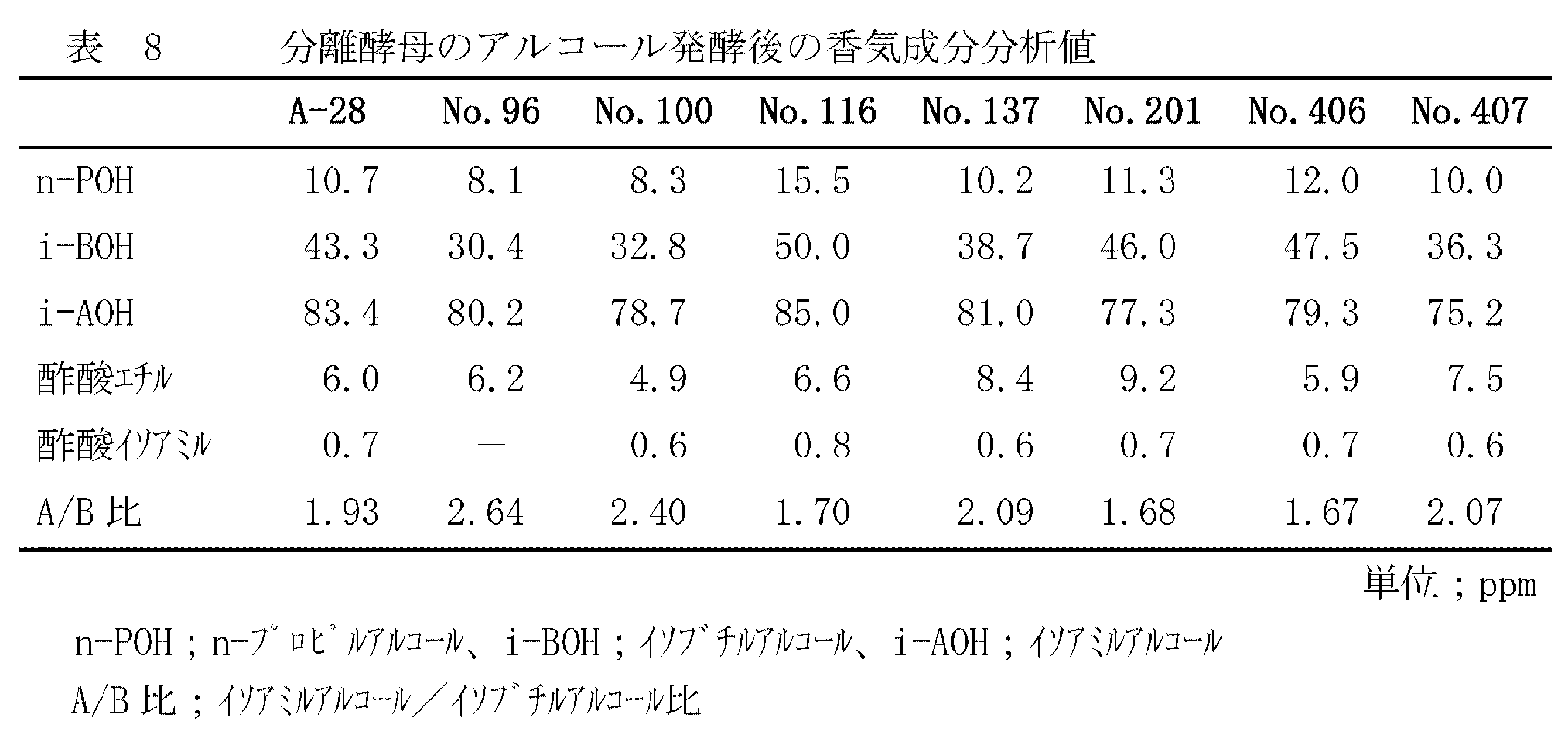
表7にリン酸アンモニウム2.0g/L添加、28℃、7日間発酵後の各酵母におけるアルコール生成量を示した。また表8に28℃、7日間発酵後の各酵母の香気成分を示した。
2. Experimental results Table 7 shows the amount of alcohol produced in each yeast after addition of 2.0 g / L of ammonium phosphate and fermentation at 28 ° C for 7 days. Table 8 shows the aroma components of each yeast after fermentation at 28 ° C. for 7 days.
3.考察
表7に示すとおり、No.96株8.9%、No.100株8.6%、No.137株8.5%、No.201株8.6%およびNo.407株8.6%と対照酵母A-28株の8.4%に対し、同等以上のアルコール生成であった。またNo.116株とNo.406株は、他の分離株よりアルコール生成はやや劣るが、共に8.4%のアルコールを生成し、対照酵母A-28株と変わらない生成量であった。
表8の香気成分分析の結果をみると、香気特性の一つであるA/B比は、アルコール生成の高かったNo.96株(2.64)、No.100株(2.40)、No.137株(2.09)およびNo.407株(2.07)と対照のA-28酵母の1.93よりも高く、A/B比が2以上であったことから、官能的には測れないが華やかさの特徴を示す香気特性を有していると思われる。一方、No.116株(1.70)、No.201株(1.68)およびNo.406株(1.67)と、A/B比は2以下であることから、ウイスキーの香気特性に代表される様に、重厚な香気特性を有していると思われる。しかし、微量な数値の差であることから、ほとんど官能的には変わらないと考えられる。
本実験結果から、アルコール生成能を基本とし、No.96株、No.100株、No.137株、No.201株およびNo.407株を有用分離酵母とした。
3. Discussion As shown in Table 7, No. 96 strain 8.9%, No. 100 strain 8.6%, No. 137 strain 8.5%, No. 201 strain 8.6% and No. 407 strain 8.6% and control yeast A-28 strain 8.4. %, Alcohol production was equivalent or better. In addition, the No. 116 strain and No. 406 strain produced a slightly lower amount of alcohol than the other isolates, but both produced 8.4% alcohol, which was the same amount as the control yeast strain A-28.
Looking at the results of fragrance component analysis in Table 8, the A / B ratio, one of the fragrance characteristics, was No. 96 strain (2.64), No. 100 strain (2.40), and No. 137 strain with high alcohol production. (2.09) and No. 407 strain (2.07), which is higher than 1.93 of control A-28 yeast and A / B ratio was 2 or more, so it is not sensuously measured, but it shows a characteristic of gorgeousness It seems to have characteristics. On the other hand, as No.116 strain (1.70), No.201 strain (1.68) and No.406 strain (1.67) and A / B ratio is 2 or less, as represented by the aroma characteristics of whiskey, It seems to have heavy aroma characteristics. However, since it is a slight difference in numerical values, it is considered that there is almost no change in sensuality.
Based on the results of this experiment, the No. 96 strain, No. 100 strain, No. 137 strain, No. 201 strain and No. 407 strain were designated as useful isolated yeasts based on alcohol production ability.
<有用分離酵母に小仕込み試験>
前項において有用分離酵母5株を見出すことができた。本項においては実地醸造を考慮し、有用分離酵母5株による小仕込み試験を行い、蒸留後の留液の成分分析ならびに官能評価において選択するとともに、成分分析、香気成分分析を行い、実用性について検討を行い、最終的な実用酵母を選択することを目的とした。
<Small preparation test for useful isolated yeast>
In the previous section, 5 useful isolated yeast strains were found. In this section, considering practical brewing, a small preparation test with 5 useful isolated yeast strains is performed, and component analysis and sensory evaluation of the distillate after distillation are selected, and component analysis and aroma component analysis are performed. The purpose of this study was to select the final practical yeast.
1.実験方法
1)供試酵母
前項により選択したNo.96株、No.100株、No.137株、No.201株、No.407株および対照酵母A-28株の6株を供試酵母として用いた。
2)発酵培地の調製
発酵培地の調整は、糖濃度15%(ビート糖蜜363gを水1.5Lに調製したもの)に調製したビート糖蜜液(リン酸アンモニウム2.0g/Lを含む)を乾熱殺菌した2L綿栓三角フラスコに1.5L加え、オートクレーブ内で120℃、15分間加圧殺菌した。
3)前培養および接種
前項と同様のGYP培地を用い行った。菌接種量は、発酵培地の液量に対して酵母数で1×10⁵/mLになるよう、前培養液を添加した。
4)発酵条件
発酵条件は、28℃、7日間行った。
5)蒸留
マントルヒーターによる直接加熱蒸留方法を用いた。直接加熱蒸留は、直接もろみを加熱し、流出するアルコール蒸気を冷却捕集し、留液のアルコール濃度が全留で、40%程度になるまで行った。得た蒸留液のアルコール分を蒸留水にて濃度25%(alc.25°)に調整し、香気成分分析および官能検査に供した。
6)香気成分分析
試料の処理およびガスクロマトグラムの条件は、前項と同様に行った。
7)官能検査
パネリストは、専門的知識を有する10名で、官能検査は、評価法と嗜好による順位付け法で行った。評価法は、対照酵母A-28酵母にて製造したスピリッツを基準(評価3点)に、それぞれの酵母にて製造したスピリッツを5段階(1:とても良い 2:良い 3:同等程度 4:やや劣る 5:劣る)にて評価した。嗜好による順位付け法は、それぞれの酵母にて製造したスピリッツをパネリストの嗜好にて評価し、順位付けをした。
1. Experimental method 1)
2) Preparation of fermentation medium Fermentation medium was prepared by dry heat sterilization of beet molasses liquid (containing 2.0 g / L of ammonium phosphate) with a sugar concentration of 15% (363 g of beet molasses prepared in 1.5 L of water). 1.5 L was added to the 2 L cotton stoppered Erlenmeyer flask and autoclaved at 120 ° C. for 15 minutes in an autoclave.
3) Preculture and inoculation The same GYP medium as in the previous section was used. The preculture solution was added so that the inoculum was 1 × 10 5 / mL in terms of the number of yeasts relative to the amount of the fermentation medium.
4) Fermentation conditions The fermentation conditions were 28 ° C. and 7 days.
5) Distillation A direct heating distillation method using a mantle heater was used. The direct heating distillation was carried out until the mash was directly heated, and the alcohol vapor flowing out was cooled and collected until the alcohol concentration in the distillate reached about 40%. The alcohol content of the obtained distillate was adjusted to a concentration of 25% (alc. 25 °) with distilled water and subjected to aroma component analysis and sensory test.
6) Aroma component analysis Sample processing and gas chromatogram conditions were the same as in the previous section.
7) Sensory test The panelists were 10 persons with specialized knowledge, and the sensory test was conducted by the evaluation method and the ranking method by preference. The evaluation method is based on the spirits produced with the control yeast A-28 yeast (3 points of evaluation), and the spirits produced with each yeast is divided into 5 levels (1: very good 2: good 3: comparable level 4: slightly Inferior 5: Inferior). The preference ranking method evaluated the spirits produced by each yeast according to the panelist's preference and ranked them.
2.実験結果
直接加熱蒸留し、アルコール濃度25%に調整した蒸留液の香気成分結果を表9に、評価法による官能検査結果を表10に、嗜好による順位付け法の官能検査結果を表11に各々示した。
2. Experimental results Table 9 shows the results of the aroma components of the distillate directly distilled by heating and adjusted to an alcohol concentration of 25%, Table 10 shows the results of the sensory test by the evaluation method, and Table 11 shows the results of the sensory test by the preference ranking method. Indicated.
3.考察
香気成分分析の結果より、高級アルコールのうちn-プロピルアルコールでは分離酵母全てが29.1ppm〜51.9ppmと対照のA-28酵母(25.0ppm)に比べ高い値を示した。イソブチルアルコールにおいても分離酵母全てが103.2ppm〜180.6ppmと対照酵母のA-28株(84.0ppm)に比べ高い値を示した。一方イソプロピルアルコールにおいては、No.96 株が274.2ppm、No.407 株が241.6ppmと対照のA-28酵母(288.4ppm)に比べ低い値を示したが、他の分離酵母は300ppm〜306.5ppmと高い値を示した。この結果から、A/B比は、対照のA-28酵母(3.43)に比べ、1.70〜2.91と総じて低い値となり、重厚な好気特性を示す香気特性となった。また酢酸イソアミルが対照のA-28酵母が1.4ppmであったのに対し、分離酵母では1.6ppm(No.100株)〜2.6ppm(No.137株)と僅かではあるが高い値を示した。この酢酸イソアミルの成分値から、分離酵母は、対照酵母に比べにエステルの面からも香気に特性があるといえる。
さらに官能評価の結果より、全ての分離酵母で発酵により得た蒸留液(アルコール分25°調整)は、対照のA-28酵母より得た蒸留液(アルコール分25°調整)より良い評価が得られた。嗜好法による結果では、No.137株とNo.407株が嗜好法による順位付けで他のものより高い順位を示した。特にNo.407株はエゾノヨロイグサより分離した酵母であることから、商品価値の向上の観点からも楽しみな酵母といえる。
3. Discussion From the results of the aroma component analysis, n-propyl alcohol out of higher alcohols showed all isolated yeasts at 29.1-51.9 ppm, higher than the control A-28 yeast (25.0 ppm). Also in isobutyl alcohol, all the isolated yeast showed 103.2 ppm to 180.6 ppm, which was higher than the control yeast strain A-28 (84.0 ppm). On the other hand, in isopropyl alcohol, No.96 strain showed 274.2 ppm, and No.407 strain showed 241.6 ppm, which was lower than the control A-28 yeast (288.4 ppm), but other isolated yeasts showed 300 ppm to 306.5 ppm. And showed a high value. From this result, the A / B ratio was 1.70 to 2.91 as a whole, which was lower than that of the control A-28 yeast (3.43), and the aroma characteristics showed heavy aerobic characteristics. In contrast, isoamyl acetate was 1.4 ppm in the control A-28 yeast, whereas isolated yeast showed a slightly high value of 1.6 ppm (No. 100 strain) to 2.6 ppm (No. 137 strain). . From the component value of this isoamyl acetate, it can be said that the isolated yeast has a characteristic in aroma also from the aspect of ester compared to the control yeast.
Furthermore, as a result of sensory evaluation, the distillate obtained by fermentation in all isolated yeasts (alcohol content 25 ° adjustment) obtained better evaluation than the distillate obtained from the control A-28 yeast (alcohol content 25 ° adjustment). It was. As a result of the preference method, the No. 137 and No. 407 strains ranked higher than the others in the ranking by the preference method. In particular, the No. 407 strain is a yeast that is isolated from Ezo no Yorusa, so it can be said that it is a fun yeast from the viewpoint of improving commercial value.
実施例2
<有用分離酵母の同定>
十勝支庁管内の花より分離した、ビート糖蜜発酵能に優れた有用分離酵母(5株)の属種の同定を行い、菌学的特性を明らかにすることを目的に、糖の発酵性や資化性および硝酸塩の資化性について検討を行った。
Example 2
<Identification of useful isolated yeast>
To identify the genus species of useful isolated yeast (5 strains) with excellent beet molasses fermenting ability isolated from Tokachi branch office flowers, and to clarify mycological characteristics, the fermentability and resources of sugar We investigated the assimilation and nitrate utilization.
1.実験方法
1)供試酵母
供試酵母は、前項で用いた有用分離酵母5株(No.96株、No.100株、No.137株、No.201株およびNo.407株)を試験に供した。表12に供試菌株と分離源を示した。
1. Experimental method 1) Test yeast Test yeast was tested using the 5 useful isolated yeast strains (No. 96, No. 100, No. 137, No. 201 and No. 407) used in the previous section. Provided. Table 12 shows the test strains and the isolation sources.
2)糖の発酵性試験
糖の発酵性は、Yeast Nitrogen Base(Difco社)を基本培地とし、これに各炭素源(グルコース、ガラクトース、シュークロース、マルトース、ラクトースおよびラフィノース)を6%(ラフィノースのみ12%)になるよう添加し、乾熱殺菌した綿栓ダラハム管入り小型試験管に分注後、オートクレーブにて120℃、10分間加圧殺菌した。酵母の接種は、あらかじめYM液体培地で前培養した分離酵母を、殺菌水にて2度洗浄後、洗浄菌体の希釈懸濁液より、殺菌ピペットにて8×10³/mLとなるよう接種し、25℃、5日間培養し、ガス発生の有無より発酵性を判定した。
3)糖の資化性試験
糖の資化性は、Yeast Nitrogen Base(Difco社)を基本培地とし、これに各炭素源(グルコース、ガラクトース、シュークロース、マルトース、ラクトース、ラフィノース、メレジトース、およびα-メチル-d-グルコシド)を0.5%、寒天2%を添加した平板培地上に、あらかじめYM液体培地で前培養した分離酵母を、殺菌水にて2度洗浄後、洗浄菌体の希釈懸濁液より、白金耳にて画線接種し、25℃、5日間培養し、生育の有無より資化性を判定した。
4)硝酸塩(KNO3)の資化性試験
硝酸塩資化性は、表13に示す組成を基本培地とし、これにN源としてKNO3を0.078%、または比較対照として(NH4)2SO4を0.1%加えた培地を用い、これにあらかじめYM液体培地で前培養した分離酵母を、殺菌水にて2度洗浄後、洗浄菌体の希釈懸濁液より、殺菌ピペットにて8×10³/mLとなるよう接種し、25℃、3日間培養し、生育の有無より判定した。
2) Sugar fermentability test Sugar fermentability is 6% (Raffinose only) using Yeast Nitrogen Base (Difco) as the basic medium and each carbon source (glucose, galactose, sucrose, maltose, lactose and raffinose). 12%) and dispensed into a small test tube with a cotton plug Daraham tube sterilized by dry heat, and then autoclaved at 120 ° C. for 10 minutes in an autoclave. For inoculation of yeast, the isolated yeast pre-cultured in YM liquid medium was washed twice with sterilized water, and then inoculated to 8 × 10 3 / mL from the diluted suspension of washed cells with a sterilized pipette. Then, the cells were cultured at 25 ° C. for 5 days, and the fermentability was determined from the presence or absence of gas generation.
3) Sugar assimilation test Sugar assimilation is based on Yeast Nitrogen Base (Difco) as a basic medium, and each carbon source (glucose, galactose, sucrose, maltose, lactose, raffinose, melezitose, and α) -Isolated yeast that had been pre-cultured in YM liquid medium in advance on a plate medium supplemented with 0.5% -methyl-d-glucoside) and 2% agar was washed twice with sterilized water, and then diluted suspension of the washed cells. From the solution, streaks were inoculated with platinum ears, cultured at 25 ° C. for 5 days, and assimilation was determined from the presence or absence of growth.
4) Nitrate (KNO 3 ) assimilation test Nitrate assimilation was performed using the composition shown in Table 13 as the basic medium, and KNO 3 as the N source at 0.078%, or (NH 4 ) 2 SO 4 as the comparative control. Was used, and the isolated yeast pre-cultured in YM liquid medium in advance was washed twice with sterilized water, and then 8 × 10 3 with a sterilized pipette from the diluted suspension of washed cells. / mL was inoculated, cultured at 25 ° C. for 3 days, and judged from the presence or absence of growth.
2.実験結果
有用分離酵母の糖の発酵性試験結果を表14に、有用分離酵母の糖の資化性試験結果を表15に示した。また、有用分離酵母の硝酸塩の資化性試験結果は、全株(−)を示した。
2. Experimental Results Table 14 shows the sugar fermentability test results of useful isolated yeast, and Table 15 shows the sugar assimilation test results of useful isolated yeast. Moreover, the assimilation test result of nitrate of useful isolated yeast showed all strains (-).
3.考察
有用分離酵母の同定は、糖の発酵性、糖の資化性および硝酸塩の資化性試験結果より、有用分離酵母全株をSaccharomyces cerevisiaeと同定した。
有用分離酵母全株がSaccharomyces cerevisiaeであったことから、利用は十分可能であると同時に、安全面でも既に実証されていることから、安心して酒類への利用できるものといえる。
3. Discussion Useful yeast isolates were identified as Saccharomyces cerevisiae from the results of sugar fermentability, sugar assimilation, and nitrate assimilation tests.
Since all the useful isolate yeast strains were Saccharomyces cerevisiae, it can be used sufficiently, and at the same time it has already been demonstrated in terms of safety, so it can be said that it can be used for alcoholic beverages with confidence.
実施例3
<分離酵母(No.137株, No.407株)と既存の醸造酵母との発酵能の差異の検討>
十勝の野草から分離したNo.137株およびNo.407株は、分類学的にはSaccharomyces cerevisiaeになる。しかし、菌株特許を取得するにあたり、本菌株が他の菌株(醸造酵母;Saccharomyces cerevisiae)と菌株的な差異(形質的)、例えば発酵特性などにおいて、明確的にあるいは簡便的に分けられることが重要である。
本分離酵母No.137株およびNo.407株は、分離するに際しビート糖蜜を集積培養液として、集積培養法にて分離を行った。したがって分離菌株の形質的な性質としては、ビート糖蜜培地において増殖やアルコール発酵が極めて良好であると考えられる。
そこで本試験においては、集積培養液に用いた培地の糖度を10%〜20%(全糖換算による)に変え、分離酵母No.137株、No.407株と既存の醸造酵母8種(清酒酵母、ワイン酵母、ビール酵母および蒸留酒酵母)との発酵能の差異の検討を試みた。
Example 3
<Examination of differences in fermentation ability between isolated yeast (No.137 strain, No.407 strain) and existing brewing yeast>
The No. 137 and No. 407 strains isolated from Tokachi wild grass are taxonomically Saccharomyces cerevisiae. However, when obtaining a strain patent, it is important that this strain be clearly or simply separated from other strains (brewing yeast; Saccharomyces cerevisiae) in terms of strain differences (traitological) such as fermentation characteristics It is.
The isolated yeast strains No. 137 and No. 407 were separated by an enrichment culture method using beet molasses as an enrichment culture solution. Therefore, it is considered that growth and alcohol fermentation are extremely good in the beet molasses medium as a trait characteristic of the isolate.
Therefore, in this test, the sugar content of the medium used for the enriched culture medium was changed to 10% to 20% (based on total sugar), and the isolated yeast No. 137 and No. 407 and eight existing brewing yeasts (Sake) Yeast, wine yeast, brewer's yeast and distilled liquor yeast) were examined for differences in fermentability.
1.実験方法
1)供試酵母
供試酵母は、分離酵母のNo.137株、No.407株の2酵母、既存の醸造酵母として清酒酵母の協会7号酵母(K-7酵母)、協会9号酵母(K-9酵母)、ワイン酵母としてOC-2酵母、IFO2220酵母、ビール酵母としてIFO2000酵母、IFO2011酵母および蒸留酒酵母としてIFO2091酵母、A-28酵母の計10株を用いた。
1. Experimental Method 1) Test Yeast Test yeasts are isolated yeast No. 137 and No. 407, two yeast,
2)酵母の前培養
GYP液体培地に各酵母を1白金耳接種し30℃、72時間培養し前培養とした。GYPの培地組成は表16に示すとおりである。
One platinum loop of each yeast was inoculated into a GYP liquid medium and cultured at 30 ° C. for 72 hours to prepare a preculture. The medium composition of GYP is as shown in Table 16.
3)ビート糖蜜培地の調製
全糖換算で糖濃度10%〜20%になるよう調製したビート糖蜜液を、あらかじめ殺菌した500mL綿栓三角フラスコに150mL分注し、オートクレーブにて120℃、15分間加圧滅菌した。この殺菌したビート糖蜜液をビート糖蜜培地とし、各酵母のアルコール発酵試験に用いた。
4)アルコール発酵
ビート糖蜜培地に前培養した供試酵母を1mL(1×10⁴/mLなるよう)添加し30℃、5〜10日間発酵させた。
5)アルコールの測定
国税庁所定分析法注解に従って行った。
6)香気成分分析
発酵終了後のろ液100mLに内部標準物質としてn-アミルアルコールを50ppmになるよう加え、ジエチルエーテル・n-ペンタン(2:1)混合溶媒で振盪抽出し、抽出区分に1%塩酸を加え塩基性区分を除去後、さらに2%炭酸ナトリウムを加え酸性区分を除去し、中性区分を得、ウィドマーカラムにて上端温度34℃で濃縮した。濃縮して得た試料をガスクロマトグラムの試料として用い、低沸点の香気成分の定量を行った。
7)ガスクロマトグラムの分析条件
ガスクロマトグラムはGC-2014(島津製)を用い、カラムサイズは0.25mm×60mを用いた。充填剤はInertCap Pure WAXで、カラム温度は50℃〜80℃昇温法(50℃27分保持-2℃/分で80℃まで昇温、10分保持)、検出器はFIDで行った。キャリアガスはN2ガス、N2ガスの流速は35mL/min.で行った。
3) Preparation of beet molasses medium Beet molasses prepared to a sugar concentration of 10% to 20% in terms of total sugar is dispensed into a 500 mL cotton plug Erlenmeyer flask sterilized in advance, and autoclaved at 120 ° C for 15 minutes. Autoclaved. This sterilized beet molasses liquid was used as a beet molasses medium and used for alcohol fermentation tests of each yeast.
4)
5) Measurement of alcohol The alcohol was measured according to the National Tax Agency's prescribed analysis method.
6) Aroma component analysis To 100 mL of the filtrate after completion of fermentation, add n-amyl alcohol as an internal standard substance to 50 ppm and shake extract with a mixed solvent of diethyl ether and n-pentane (2: 1). After adding% hydrochloric acid to remove the basic fraction, 2% sodium carbonate was added to remove the acidic fraction to obtain a neutral fraction, which was concentrated on a Widmer column at an upper end temperature of 34 ° C. The sample obtained by concentrating was used as a gas chromatogram sample, and a low-boiling aromatic component was quantified.
7) Gas chromatogram analysis conditions GC-2014 (manufactured by Shimadzu Corp.) was used for the gas chromatogram, and the column size was 0.25 mm x 60 m. The packing was InertCap Pure WAX, the column temperature was 50 ° C. to 80 ° C. heating method (holding 50 ° C. for 27 minutes−2 ° C./minute, raising the temperature to 80 ° C., holding for 10 minutes), and the detector was FID. The carrier gas is N 2 gas, and the flow rate of N 2 gas is 35 mL / min. I went there.
2.実験結果および考察
1)分離酵母No.137株、No.407株および各醸造酵母の各ビート糖蜜培地におけるアルコール発酵能の差異の検討:
表17に分離酵母No.137株、No.407株および各醸造酵母の各ビート糖蜜培地におけるアルコール生成値を示した。
2. Experimental results and discussion 1) Examination of differences in alcoholic fermentability in each beet molasses medium of isolated yeast No.137 strain, No.407 strain and each brewing yeast:
Table 17 shows the alcohol production values in each beet molasses medium of the isolated yeast No.137 strain, No.407 strain and each brewing yeast.
アルコール生成の結果(表17)より、分離酵母のNo.137株とNo.407株は、ビート糖蜜の糖濃度が10%、5日間の発酵では3.7%(No.137株)、3.6%(No.407株)、13%、7日間の発酵では6.0%(No.137株)、5.9%(No.407株)、17%、7日間の発酵では7.8%(No.137株)、7.8%(No.407株)、20%、10日間の発酵では8.5%(No.137株)、8.5%(No.407株)とビート糖蜜の糖濃度に関係なく、アルコール発酵は良好であった。 From the results of alcohol production (Table 17), the isolated yeast No.137 and No.407 strains had a sugar concentration of 10% in beet molasses, 3.7% (No.137 strain), 3.6% (5 days fermentation) No.407), 13%, 7 days fermentation 6.0% (No.137 strain), 5.9% (No.407 strain), 17%, 7 days fermentation 7.8% (No.137 strain), 7.8 Alcohol fermentation was good regardless of sugar concentration of beet molasses (% (No.407 strain), 20%, 8.5% (No.137 strain) and 8.5% (No.407 strain) in 10 days fermentation) .
一方供試した既存の醸造酵母では、ビート糖蜜の糖濃度が10%、5日間の発酵では4.0%(A-28酵母)〜3.6%の範囲であり、13%、7日間の発酵では5.4%(A-28酵母)〜3.8%(ビール酵母IFO2011酵母)、17%、7日間の発酵では6.8%(A-28酵母)〜0%(蒸留酒酵母IFO2091酵母、ワイン酵母IFO2220 酵母)、20%、10日間の発酵では7.6%(A-28酵母)〜0%(蒸留酒酵母IFO2091酵母、ワイン酵母IFO2220 酵母、ビール酵母IFO2000酵母)とある程度はアルコール発酵する酵母(A-28 酵母)もあるものの、その他の醸造酵母は糖濃度が上がるに従い、発酵が緩慢となった。酵母によってはアルコール生成が0%と全くできない酵母もあった。 On the other hand, in the existing brewer's yeast, the sugar concentration of beet molasses is 10%, the range of 4.0% (A-28 yeast) to 3.6% for 5 days fermentation, 13%, 5.4% for 7 days fermentation (A-28 yeast) ~ 3.8% (beer yeast IFO2011 yeast), 17%, 6.8% (A-28 yeast) to 0% (distilled liquor yeast IFO2091 yeast, wine yeast IFO2220 yeast), 20% In 10 days fermentation, 7.6% (A-28 yeast) to 0% (distilled liquor yeast IFO2091 yeast, wine yeast IFO2220 yeast, beer yeast IFO2000 yeast) and some yeasts (A-28 yeast) that ferment alcohol to some extent In other brewing yeasts, fermentation slowed as the sugar concentration increased. Some yeasts cannot produce alcohol at 0% at all.
以上の結果より、分離酵母と代表的な既存の醸造酵母にてビート糖蜜の糖濃度と発酵温度によるアルコール発酵能の差異は明確にあり、分離酵母137酵母と407酵母はビート糖蜜の糖濃度に関係なくアルコール発酵能を有する酵母であった。一方、供試した醸造酵母は、ビート糖蜜の糖濃度が高くなるに従い発酵が緩慢となり、酵母によってはアルコール発酵能が全くない酵母もあったことから、発酵能において明確に差異が生じた。
従って、分離酵母(No.137株、No.407株)は、ビート糖蜜濃度17%のビート糖蜜培地での30℃、7日間における発酵において、7%以上のアルコール発酵能を有することから、この発酵条件とした発酵能の差異で酵母の識別判定を行うことができると思われる。
From the above results, there is a clear difference between the sugar concentration of beet molasses and the alcohol fermentation ability depending on the fermentation temperature between isolated yeast and typical existing brewing yeast, and the
Therefore, isolated yeast (No.137 strain, No.407 strain) has an alcohol fermentability of 7% or more in fermentation at 30 ° C. for 7 days in a beet molasses medium having a beet molasses concentration of 17%. It seems that yeast can be identified and determined based on the difference in fermentation ability as the fermentation condition.
2)分離酵母No.137株、No.407株および各醸造酵母の糖濃度13%ビート糖蜜培地における低沸点香気成分の差異の検討:
酵母は、培養基、発酵温度などの発酵条件により、生成する香気成分に特徴を示す。特にA/B比(i−アミルアルコール/ i−ブチルアルコール比)は、香気バランスとして扱われ、酵母をはじめ種々の酒類に特徴がある。この香気バランスの特徴を、酵母の差異のキーと考え、13%ビート糖蜜培地での7日間発酵における低沸点香気成分とその特性について、分離酵母No.137株、No.407株および比較対照として各醸造酵母の代表酵母(K-7酵母、OC-2酵母、IFO2011酵母、A-28酵母およびIFO2091酵母)5酵母を用い、そのアルコール生成比較を行った。
その結果を表18に分離酵母No.137株、No.407株および各醸造酵母の糖濃度13%ビート糖蜜培地における低沸点香気成分分析値として示した。
2) Examination of differences in low boiling point aroma components in isolated yeast No. 137 strain, No. 407 strain and each brewer's yeast in a sugar concentration 13% beet molasses medium:
Yeast is characterized by the aroma components produced by fermentation conditions such as culture medium and fermentation temperature. In particular, the A / B ratio (i-amyl alcohol / i-butyl alcohol ratio) is treated as an aroma balance and is characterized by various alcoholic beverages including yeast. Considering the characteristics of this aroma balance as the key to the difference in yeast, the low boiling point aroma components and their characteristics in 7-day fermentation in 13% beet molasses medium were used as isolated yeast No.137 strain, No.407 strain and comparative control. Alcohol production was compared using 5 representative yeasts (K-7 yeast, OC-2 yeast, IFO2011 yeast, A-28 yeast and IFO2091 yeast) of each brewing yeast.
The results are shown in Table 18 as analysis values of low boiling point aroma components in a beet molasses medium with a sugar concentration of 13% for the isolated yeast No. 137 strain, No. 407 strain and each brewing yeast.
低沸点香気成分分析の結果(表18)より、分離酵母No.137株のi−ブチルアルコールの生成値は13.6ppm、i−アミルアルコールの生成値は40.5ppmとなり、従ってA/B比は2.98であった。No.407株のi−ブチルアルコールの生成値は19.8ppm、i−アミルアルコールの生成値は62.3ppmとなり、従ってA/B比は3.15であった。
一方比較対照酵母の内、糖蜜発酵酵母の代表酵母A-28のi−ブチルアルコールの生成値は17.1ppm、i−アミルアルコールの生成値は70.7ppmとなり、従ってA/B比は4.13と、分離酵母のNo.137株やNo.407株よりも高い値を示した。しかしその他の醸造酵母にあっては、A/B 比は、清酒酵母のK-7酵母が1.97、ワイン酵母のOC-2酵母が2.82、ビール酵母のIFO2011酵母が1.72、蒸留酒酵母のIFO2091酵母が0.83と2.90以下の値であった。
以上供試酵母の比較数は少ないが、13%糖蜜培地で30℃、7日間発酵後の香気成分に顕著に差異が認められ、特に香気バランスを示すA/B比(i−アミルアルコール/ i−ブチルアルコール比)では、分離酵母は2.95から3.2程度にあり、その他の酵母はこの範囲ではなかったことから、A/B比を酵母判定のキーとして活用できると思われる。
From the results of low boiling point aroma component analysis (Table 18), the production value of isolated yeast No.137 strain is 13.6 ppm and the production value of i-amyl alcohol is 40.5 ppm, therefore the A / B ratio is 2.98. Met. The production value of i-butyl alcohol of No. 407 strain was 19.8 ppm, and the production value of i-amyl alcohol was 62.3 ppm. Therefore, the A / B ratio was 3.15.
On the other hand, among the comparative control yeasts, the production value of i-butyl alcohol of the representative yeast A-28 of molasses fermenting yeast was 17.1 ppm, and the production value of i-amyl alcohol was 70.7 ppm, so the A / B ratio was 4.13. The values were higher than those of No.137 strain and No.407 strain of yeast. However, for other brewer's yeast, the A / B ratio was 1.97 for sake yeast K-7 yeast, 2.82 for wine yeast OC-2 yeast, 1.72 for beer yeast IFO2011 yeast, and IFO2091 yeast for distilled liquor yeast. The values were 0.83 and 2.90 or less.
Although the comparison number of the test yeasts is small, there is a marked difference in the aroma components after fermentation for 7 days in a 13% molasses medium, especially A / B ratio (i-amyl alcohol / i -Butyl alcohol ratio), the isolated yeast is around 2.95 to 3.2, and other yeasts were not within this range, so it seems that the A / B ratio can be used as a key for yeast determination.
3.まとめ
分離酵母No.137株とNo.407株と既存酵母との発酵能の差異について検討した。
その結果、以下の試験において、分離酵母No.137株、No.407株は既存酵母と異なる酵母であると判定できた。
1)ビート糖蜜濃度17%のビート糖蜜培地での30℃、7日間における7%以上のアルコール発酵能試験
分離酵母No.137株、No.407株;(+)、既存酵母;(+)〜(−)
2)ビート糖蜜濃度13%培地での30℃、7日間におけるA/B比
分離酵母No.137株、No.407株;2.95〜3.2、既存酵母;2.9以下〜3.2以上
3. Summary The differences in fermentation ability between isolated yeast No.137 and No.407 and existing yeast were investigated.
As a result, in the following tests, it was determined that the isolated yeast No.137 strain and No.407 strain were different from existing yeast.
1) Alcohol fermentation ability test over 7% in 7 days at 30 ° C in beet molasses medium with beet molasses concentration 17% Isolated yeast No.137, No.407; (+), existing yeast; (+) ~ (-)
2) A / B ratio in beet molasses 13% medium at 30 ° C for 7 days Isolation yeast No.137 strain, No.407 strain; 2.95 to 3.2, existing yeast; 2.9 or less to 3.2 or more
実施例4
<実用酵母による発酵特性>
表12、表14〜15に示す有用分離酵母5株より、アルコール発酵能、蒸留液の官能評価等を踏まえ、実用酵母としてNo.137株およびNo.407株を選択した。
これら2株を用い、実地醸造を踏まえアルコール発酵条件の検討を進め、よりよい条件の検討を行った。
Example 4
<Fermentation characteristics with practical yeast>
From 5 useful isolated yeast strains shown in Table 12 and Tables 14 to 15, No.137 strain and No.407 strain were selected as practical yeasts based on alcohol fermentation ability, sensory evaluation of distilled liquid, and the like.
Using these two strains, we proceeded with the study of alcohol fermentation conditions based on field brewing, and examined better conditions.
<栄養源添加無添加による発酵>
1.実験方法
1)供試酵母
実施例2で選択したNo.137株、No.407株および対照としてA-28酵母の3株を供試酵母として用いた。
2)発酵培地の調製
発酵培地の調整は、糖濃度15%(全糖濃度)に調製したビート糖蜜培地(リン酸アンモニウム2.0g/L培地およびリン酸アンモニウム無添加培地)を乾熱殺菌した300mL綿栓三角フラスコに150mL加え、オートクレーブ内で120℃、15分間加圧殺菌した。
3)前培養および接種
実施例1と同様に行った。
4)発酵条件
発酵温度は30℃、発酵日数は10日間とした。
5)酵母の増殖度
酵母の増殖状態を、生成アルコール濃度をもって示した。
6)アルコール濃度の測定
実施例1と同様に行った。
<Fermentation without addition of nutrient sources>
1. Experimental Method 1) Test Yeast Three strains No. 137 and No. 407 selected in Example 2 and A-28 yeast as a control were used as test yeasts.
2) Preparation of fermentation medium 300mL of beet molasses medium (2.0g / L ammonium phosphate medium and ammonium phosphate-free medium) prepared to a sugar concentration of 15% (total sugar concentration) was sterilized by dry heat. 150 mL was added to a cotton stoppered Erlenmeyer flask and pasteurized at 120 ° C. for 15 minutes in an autoclave.
3) Preculture and inoculation The procedure was the same as in Example 1.
4) Fermentation conditions The fermentation temperature was 30 ° C and the fermentation days were 10 days.
5) Yeast growth degree The growth state of the yeast was shown by the concentration of the produced alcohol.
6) Measurement of alcohol concentration It carried out similarly to Example 1.
2.実験結果
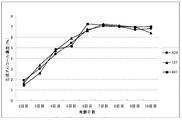
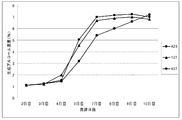
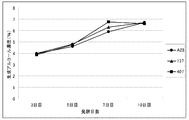
実用酵母2株(No.137株およびNo.407株)および対照のA-28酵母について、リン酸アンモニウム2.0g/Lを含むビート糖蜜培地における生成アルコールの経日変化を図1に、リン酸アンモニウム無添加ビート糖蜜培地における生成アルコールの経日変化を図2に各々示した。
リン酸アンモニウム2.0g/Lを含むビート糖蜜培地における各酵母のアルコール生成は、7日目にほぼピークの7%を生成し、その後7%台を維持し、10日目にはやや減少したものの、ほぼ横ばい傾向を示した。リン酸アンモニウム2.0g/Lを含むビート糖蜜培地における各酵母のアルコール生成は、No.137株、No.407株ともにリン酸アンモニウム添加培地同様7日目でほぼピークの7%を生成し、その後7%台を維持し、10日目にはやや減少したものの、ほぼ横ばい傾向を示したが、対照酵母のA-28株は、前半より緩やかに推移し、10日目で7%台のアルコール生成となった。
2. Experimental results Figure 1 shows the daily changes in alcohol produced in beet molasses medium containing 2.0 g / L of ammonium phosphate for two practical yeast strains (No.137 strain and No.407 strain) and the control A-28 yeast. The changes over time of the alcohol produced in the beet molasses medium without ammonium phosphate are shown in FIG.
Alcohol production of each yeast in beet molasses medium containing 2.0 g / L of ammonium phosphate produced 7% of the peak on the 7th day, then maintained the 7% level, but decreased slightly on the 10th day. Showed a tendency to be almost flat. Alcohol production of each yeast in beet molasses medium containing 2.0 g / L of ammonium phosphate produced 7% of the peak on the 7th day as in the case of ammonium phosphate-added medium in both No.137 and No.407 strains. Although it maintained the 7% level and decreased slightly on the 10th day, it showed a leveling trend. However, the A-28 strain of the control yeast remained more gradual than the first half, and on the 10th day the 7% level of alcohol It became generation.
3.考察
実用酵母のNo.137株およびNo.407株は、本ビート糖蜜培地においては、リン酸アンモニウム添加無添加に係わらず、最終的に7%台のアルコール生成をすることより、栄養源の添加がアルコール発酵に大きな影響を与えないと考えられる。しかし誘導期を含め前半4日間のアルコール発酵において、リン酸アンモニウム添加では、早い段階(2日目)よりアルコール生成が順調に進むのに対して、リン酸アンモニウム無添加においては、ややアルコール生成が遅れ、4日目以降にアルコール生成が盛んになってくる。
この結果を考慮すれば、アルコール発酵4日目までの発酵前半期に、雑菌の汚染あるいは野生酵母の汚染を防ぎ、実用酵母を優先して増殖発酵させるためには、リン酸アンモニウムを添加する必要があるといえる。
3. Discussion No. 137 and No. 407 strains of practical yeasts can be added to the beet molasses medium with the addition of nutrients by finally producing alcohol on the order of 7% regardless of the addition of ammonium phosphate. Does not have a major impact on alcoholic fermentation. However, in the alcohol fermentation for the first 4 days including the induction period, with the addition of ammonium phosphate, the alcohol production progressed smoothly from the early stage (second day), whereas with no addition of ammonium phosphate, the alcohol production was slightly higher. Delayed, alcohol production becomes active after the 4th day.
Considering this result, in the first half of the fermentation up to the 4th day of alcoholic fermentation, it is necessary to add ammonium phosphate in order to prevent contamination of germs or wild yeast and to ferment and ferment yeast with priority on practical yeast There can be said.
<初発培養温度と発酵温度によるアルコール生成>
実用酵母を用い、現場の温度環境を考慮した環境下でのアルコール発酵を行い、最低限のアルコール発酵条件の見出すことを目的に、初発温度30℃で培養後、低温下でのアルコール発酵条件を検討した。
<Alcohol production by initial culture temperature and fermentation temperature>
For the purpose of finding the minimum alcoholic fermentation conditions by performing alcoholic fermentation in an environment that considers the on-site temperature environment using practical yeasts, the conditions for alcoholic fermentation at low temperatures after culturing at an initial temperature of 30 ° C investigated.
1.実験方法
1)供試酵母
前項と同様、No.137株、No.407株および対照としてA-28酵母の3株を供試酵母として用いた。
2)発酵培地の調製
前項と同様、糖濃度15%(全糖濃度)に調製したビート糖蜜培地(リン酸アンモニウム2.0g/Lを含む)を乾熱殺菌した300mL綿栓三角フラスコに150mL加え、オートクレーブ内で120℃、15分間加圧殺菌した。
3)前培養および接種
実施例1と同様に行った。
4)初発培養温度条件と発酵条件
初発培養温度30℃で、1日〜3日間培養を行った後、発酵温度を10℃、13℃および15℃にしアルコール発酵を行った。なお日数については培養日数と発酵日数を合算したトータル日数とし、発酵温度10℃と13℃では12日間、15℃では10日間行った。
5)酵母の増殖度
前項と同様、生成アルコール濃度をもって示した。
6)アルコール濃度の測定
実施例1と同様に行った。
1. Experimental Method 1) Test Yeast As in the previous section, No.137 strain, No.407 strain and three strains of A-28 yeast were used as test yeasts as controls.
2) Preparation of fermentation medium As in the previous section, 150 mL of beet molasses medium (containing 2.0 g / L of ammonium phosphate) prepared at a sugar concentration of 15% (total sugar concentration) was added to a 300 mL cotton stoppered Erlenmeyer flask sterilized by dry heat, It was sterilized by pressure at 120 ° C for 15 minutes in an autoclave.
3) Preculture and inoculation The procedure was the same as in Example 1.
4) Initial culture temperature conditions and fermentation conditions After culturing for 1 to 3 days at an initial culture temperature of 30 ° C., alcohol fermentation was performed at fermentation temperatures of 10 ° C., 13 ° C., and 15 ° C. The total number of days was the sum of the number of culture days and the number of fermentation days. The fermentation was carried out at 10 ° C and 13 ° C for 12 days and at 15 ° C for 10 days.
5) Yield degree of yeast As shown in the previous section, it is shown with the concentration of produced alcohol.
6) Measurement of alcohol concentration It carried out similarly to Example 1.
2.実験結果
実用酵母2株(No.137株およびNo.407株)および対照のA-28酵母について、30℃で培養後発酵温度15℃における生成アルコールの経日変化を図3〜5に各々示した。
2. Experimental results Figures 3-5 show the daily changes in the alcohol produced at 30 ° C after fermentation at 15 ° C for two practical yeast strains (No.137 strain and No.407 strain) and control A-28 yeast. It was.
30℃で培養後発酵温度15℃における生成アルコールの経日変化(図3〜5)では、1日培養後3日目のアルコール濃度は2%〜3%となり、その後7日間(10日目)で7%まで増加し、2日培養では3日目のアルコール濃度は3%〜4%となり、その後7日間(10日目)で7%まで増加し、3日培養では3日目のアルコール濃度は4%台となり、その後7日間(10日目)で6.%台後半まで増加した。30℃で培養後発酵温度13℃における生成アルコールの経日変化(図示せず)では、1日培養後3日目のアルコール濃度は1.5%〜2.5%となり、その後7日間(10日目)で6%後半まで増加し、2日培養では3日目のアルコール濃度は2%後半〜3.5%ほどとなり、その後7日間(10日目)で6.5%まで増加し、3日培養では3日目のアルコール濃度は4%台〜6.5%となり、その後7日間(10日目)で6.%台後半までほぼ横ばい状態であった。30℃で培養後発酵温度10℃における生成アルコールの経日変化(図示せず)では、1日培養後3日目のアルコール濃度は2%となり、その後9日間(12日目)で6.5%ほどまで増加し、2日培養では3日目のアルコール濃度は3%台となり、その後9日間(12日目)5%台まで増加し、3日培養では3日目のアルコール濃度は3.5%ほどとなり、その後9日間(12日目)で65%台後半まで増加した。
これらの結果より、30℃での培養期間が長いほどその間での生成アルコールが高くなり、これに伴い発酵期間(低温期)に入ってからのアルコール生成が緩慢になる傾向が示された。特に発酵温度が下がるほど顕著になり、それに伴って発酵日数も12日と長くなる。また同時に生成するアルコール濃度も低下している。
After culturing at 30 ° C, the alcohol concentration at the fermentation temperature of 15 ° C over time (Figs. 3 to 5) is 2% to 3% on the 3rd day after culturing for 1 day, then 7 days (10th day) In the 2-day culture, the alcohol concentration on the third day is 3% to 4%, and then increases to 7% in the 7th day (10th day). Rose to the 4% level, and then increased to the 6.% level in the 7th day (10th day). After culturing at 30 ° C, the alcohol concentration at the fermentation temperature of 13 ° C over time (not shown) is 1.5% to 2.5% on the 3rd day after culturing for 1 day, then 7 days (10th day) In the second day culture, the alcohol concentration on the third day is about 2% to 3.5%, and then increases to 6.5% in the seventh day (10th day). The alcohol concentration ranged from 4% to 6.5%, and remained almost flat for the next 6 days in the 7th day (10th day). After culturing at 30 ° C, the alcohol concentration at the fermentation temperature of 10 ° C over time (not shown) is 2% on the third day after culturing for 1 day, then about 6.5% for 9 days (12th day). In the 2-day culture, the alcohol concentration on the third day is in the 3% range, and then increases to the 5% range for 9 days (12th day). In the 3-day culture, the alcohol concentration on the third day is about 3.5%. After that, it increased to the lower 65% in 9 days (12th day).
From these results, it was shown that the longer the culture period at 30 ° C., the higher the alcohol produced during that period, and accordingly, the alcohol production after entering the fermentation period (low temperature phase) tended to be slow. In particular, the lower the fermentation temperature, the more prominent it is, and the longer the fermentation period is, 12 days. At the same time, the concentration of alcohol produced is also reduced.
3.考察
30℃で培養後発酵温度15℃における生成アルコールの経日変化(図3〜5)、30℃で培養後発酵温度13℃における生成アルコールの経日変化(図示せず)および30℃で培養後発酵温度10℃における生成アルコールの経日変化(図示せず)より、30℃での培養期間が長いほどその間での生成アルコールが高くなり、これに伴い発酵期間(低温期)に入ってからのアルコール生成が緩慢になる傾向が示された。特に発酵温度が下がるほど顕著になり、それに伴って発酵日数も12日と長くなる。また同時に生成するアルコール濃度も低下している。
低温下でも発酵は進が、その速度は緩やかであり、かつ生成アルコール濃度が低いと推測されることから、低温期間での発酵は避けるのが望ましい。また低温期間を使うのであれば、少なくとも1日は培養温度30℃とし、酵母の増殖を促進させた後、15℃での発酵が適当であると思われる。
3. Consideration
Daily changes of the produced alcohol at the fermentation temperature of 15 ° C after cultivation at 30 ° C (Figs. 3 to 5), changes of the produced alcohol over time at the fermentation temperature of 13 ° C after cultivation at 30 ° C (not shown), and after the cultivation at 30 ° C From the daily change of the produced alcohol at the fermentation temperature of 10 ° C (not shown), the longer the culture period at 30 ° C, the higher the produced alcohol during that period, and accordingly the fermentation period (low temperature period) A tendency to slow alcohol production was shown. In particular, the lower the fermentation temperature, the more prominent it is, and the longer the fermentation period is, 12 days. At the same time, the concentration of alcohol produced is also reduced.
Fermentation proceeds even at low temperatures, but the rate is slow and the concentration of the produced alcohol is estimated to be low. Therefore, it is desirable to avoid fermentation at low temperatures. If a low temperature period is used, the culture temperature should be 30 ° C. for at least one day, and after accelerating yeast growth, fermentation at 15 ° C. may be appropriate.
実施例5
<前記実用酵母によるアルコール生産量の予測>
実地醸造においてアルコールの生産量がどの程度になるかは、製造上重要となる。そこで本項においては、実用酵母がビート糖蜜1tより純アルコールとしてどの程度の生産量があるかを検討し、実地醸造においての生産量予測を行った。
Example 5
<Prediction of alcohol production by the practical yeast>
The level of alcohol production in field brewing is important for manufacturing. Therefore, in this section, we examined the amount of production of practical yeast as pure alcohol from 1 ton of beet molasses, and predicted the production amount in field brewing.
1.実験方法
1)供試酵母
実施例2にて選択したNo.137株、No.407株および対照としてA-28酵母の3株を供試酵母として用いた。
2)発酵培地の調製
発酵培地の調整は、糖濃度15%(全糖濃度)に調製したビート糖蜜培地(リン酸アンモニウム2.0g/Lを含む)を乾熱殺菌した3L綿栓三角フラスコに1.5L加え、オートクレーブ内で120℃、15分間加圧殺菌した。
3)前培養および接種
実施例1と同様に行った。
4)発酵条件
発酵温度は、28℃で行った。発酵日数は、10日間行った。
5)蒸留
ガラス製の単式蒸留器を用い、マントルヒーターによる直接加熱法で行った。蒸留液の回収は、留液のアルコール濃度が全留で38%程度になるまで行った。
6)アルコール濃度の測定
実施例1と同様に行った。
1. Experimental Method 1) Test Yeast Three strains No. 137 and No. 407 selected in Example 2 and A-28 yeast as a control were used as test yeasts.
2) Preparation of fermentation medium Preparation of fermentation medium was done in a 3L cotton plug Erlenmeyer flask sterilized by dry heat of beet molasses medium (containing 2.0 g / L of ammonium phosphate) prepared at a sugar concentration of 15% (total sugar concentration). 5L was added and autoclaved at 120 ° C for 15 minutes in an autoclave.
3) Preculture and inoculation The procedure was the same as in Example 1.
4) Fermentation conditions The fermentation temperature was 28 ° C. Fermentation days were carried out for 10 days.
5) Distillation It was carried out by a direct heating method using a mantle heater, using a single glass distiller. The distillation liquid was collected until the alcohol concentration in the distillate reached about 38% in all distillates.
6) Measurement of alcohol concentration It carried out similarly to Example 1.
2.実験結果
表19にアルコール回収量およびビート糖蜜トン当たりの収量を示した。
No.137 株は、発酵もろみ5360mL(糖蜜使用量1232.8g)から397%アルコールを677mL(純アルコールで268.8mL)回収した。ビート糖蜜トン当たりの収量は、純アルコール換算で331.4L/tであった。No.407 株は、発酵もろみ5320mL(糖蜜使用量1223.6g)から38.7%アルコールを707mL(純アルコールで273.6 mL)回収した。ビート糖蜜トン当たりの収量は、純アルコール換算で334.8L/tであった。比較対照のA-28株は、発酵もろみ5360mL(糖蜜使用量1232.8g)から38.7%アルコールを693mL(純アルコールで268.2mL)回収した。ビート糖蜜トン当たりの収量は、純アルコール換算で330.6L/tであった。
2. Experimental Results Table 19 shows the amount of alcohol recovered and the yield per ton of beet molasses.
For No.137 strain, 677 mL (268.8 mL of pure alcohol) of 397% alcohol was recovered from 5360 mL of fermented mash (molasse use amount 1232.8 g). The yield per ton of beet molasses was 331.4 L / t in terms of pure alcohol. For No. 407 strain, 707 mL (273.6 mL of pure alcohol) of 38.7% alcohol was recovered from 5320 mL of fermentation moromi (molasse molasses usage 1223.6 g). The yield per ton of beet molasses was 334.8 L / t in terms of pure alcohol. The comparative control strain A-28 recovered 693 mL (268.2 mL of pure alcohol) of 38.7% alcohol from 5360 mL of fermentation mash (molasse use amount 1232.8 g). The yield per ton of beet molasses was 330.6 L / t in terms of pure alcohol.
3.考察
No.137 株は、ビート糖蜜トン当たりの収量が純アルコール換算で331.4L/t、No.407 株は、ビート糖蜜トン当たりの収量が純アルコール換算で334.8L/tであったのに対して、比較対照のA-28酵母は、ビート糖蜜トン当たりの収量が純アルコール換算で330.6L/tであった。このこと実用酵母として選択した2株は、比較対照株よりも生産量がビート糖蜜1t当たり0.8Lから4.2L多いことから十分なアルコール生産量を有しており、実地醸造に十分利用できると思われる。
3. Consideration
For No.137 strain, the yield per ton of beet molasses was 331.4L / t in terms of pure alcohol, while for No.407, the yield per ton of beet molasses was 334.8L / t in terms of pure alcohol. The comparative A-28 yeast had a yield per ton of beet molasses of 330.6 L / t in terms of pure alcohol. The two strains selected as practical yeasts have a sufficient amount of alcohol production because their production is 0.8 to 4.2L per ton of beet molasses compared to the control strain, and they can be used for field brewing. It is.
実施例6
<リキュールの嗜好性の検討>
実用酵母(No.137およびNo.407)によるビート糖蜜(糖濃度15%)から得たスピリッツを用い、アルコール分15%に調整した後、ハスカップ果汁やビート糖蜜添加によるリキュールの試作を試みた。
Example 6
<Examination of liquor preference>
Using spirits obtained from beet molasses (sugar concentration 15%) with practical yeasts (No. 137 and No. 407), after adjusting the alcohol content to 15%, trial production of liqueur by adding lotus juice and beet molasses was attempted.
1.実験方法
1)供試スピリッツおよびアルコール分の調整
前項によって得た蒸留液を蒸留水にてアルコール分を15%に調整したものを試験に供した
2)リキュール材料
糖は、日本食品化工製のオリゴ糖(L-95)と、日本甜菜製糖製のビート糖蜜(芽室工場製)を用いた。酸味料は乳酸(90%)を用いた。 果実材料としてはハスカップジュースを用いた。
3)リキュールの配合
リキュールは、酒税法上エキス分が2度以上なければならない2)ため、酒税法を考慮し表20に示す配合で行った。
1. Experimental method 1) Preparation of test spirits and alcohol content The distilled liquid obtained in the previous section was adjusted to 15% alcohol content with distilled water. 2) Liqueur material Sugar was produced by Nippon Food Chemical Co., Ltd. Sugar (L-95) and beet molasses (manufactured by Memuro Factory) made from Japanese sugar beet sugar were used. Lactic acid (90%) was used as the acidulant. As a fruit material, lotus cup juice was used.
3) Formulation of liqueur Since liqueur must have an extract content of 2 or more under the liquor tax law 2) , the liquor was formulated according to Table 20 in consideration of the liquor tax law.
エキス分、アルコール濃度および酸度の測定は、国税庁所定分析法注解2)に従って行った。
2.実験結果
試作したリキュールの成分分析値を表21に示した。
全てのサンプルでエキス分2度以上となった。また酸度が9以上の値となった。
2. Experimental Results Table 21 shows the component analysis values of the prototype liqueur.
All samples had an extract content of 2 degrees or more. The acidity was 9 or more.
本発明はアルコール発酵分野に有用である。 The present invention is useful in the field of alcohol fermentation.
Claims (6)
ビート糖蜜濃度17%の培地での30℃、7日間におけるアルコール発酵能試験においてアルコール濃度7%以上の発酵液を生成する能力を有し、
ビート糖蜜濃度13%の培地での30℃、7日間におけるA/B比(i−アミルアルコール/ i−ブチルアルコール比)が2.95〜3.2の範囲である、
ことを特徴とする酵母。 Yeast belonging to Saccharomyces cerevisiae isolated from the flower of Ezo nooriogusa,
It has the ability to produce a fermentation broth with an alcohol concentration of 7% or more in an alcohol fermentability test at 30 ° C for 7 days in a medium with a beet molasses concentration of 17%.
A / B ratio (i-amyl alcohol / i-butyl alcohol ratio) at 30 ° C. for 7 days in a medium with a beet molasses concentration of 13% is in the range of 2.95 to 3.2,
Yeast characterized by that.
ビート糖蜜濃度17%の培地での30℃、7日間におけるアルコール発酵能試験においてアルコール濃度7%以上の発酵液を生成する能力を有し、
ビート糖蜜濃度13%の培地での30℃、7日間におけるA/B比(i−アミルアルコール/ i−ブチルアルコール比)が2.95〜3.2の範囲である、
ことを特徴とする酵母。 A yeast belonging to Saccharomyces cerevisiae isolated from poppy flowers,
It has the ability to produce a fermentation broth with an alcohol concentration of 7% or more in an alcohol fermentability test at 30 ° C for 7 days in a medium with a beet molasses concentration of 17%.
A / B ratio (i-amyl alcohol / i-butyl alcohol ratio) at 30 ° C. for 7 days in a medium with a beet molasses concentration of 13% is in the range of 2.95 to 3.2,
Yeast characterized by that.
Priority Applications (1)
| Application Number | Priority Date | Filing Date | Title |
|---|---|---|---|
| JP2011136913A JP5891505B2 (en) | 2011-06-21 | 2011-06-21 | Yeast and method for producing alcoholic fermentation broth from beet molasses using this yeast |
Applications Claiming Priority (1)
| Application Number | Priority Date | Filing Date | Title |
|---|---|---|---|
| JP2011136913A JP5891505B2 (en) | 2011-06-21 | 2011-06-21 | Yeast and method for producing alcoholic fermentation broth from beet molasses using this yeast |
Publications (2)
| Publication Number | Publication Date |
|---|---|
| JP2013000091A true JP2013000091A (en) | 2013-01-07 |
| JP5891505B2 JP5891505B2 (en) | 2016-03-23 |
Family
ID=47669350
Family Applications (1)
| Application Number | Title | Priority Date | Filing Date |
|---|---|---|---|
| JP2011136913A Expired - Fee Related JP5891505B2 (en) | 2011-06-21 | 2011-06-21 | Yeast and method for producing alcoholic fermentation broth from beet molasses using this yeast |
Country Status (1)
| Country | Link |
|---|---|
| JP (1) | JP5891505B2 (en) |
Cited By (3)
| Publication number | Priority date | Publication date | Assignee | Title |
|---|---|---|---|---|
| CN103642625A (en) * | 2013-11-26 | 2014-03-19 | 青岛嘉瑞生物技术有限公司 | Composite fermentation type angelica sinensis health-care wine and production technology thereof |
| CN106834148A (en) * | 2017-01-20 | 2017-06-13 | 于洪梅 | One plant of brewer's yeast and its application that can reduce senior alcohol content |
| CN117264720A (en) * | 2023-09-21 | 2023-12-22 | 华南理工大学 | A method for preparing flavored fermented wine using brown sugar as raw material |
Citations (3)
| Publication number | Priority date | Publication date | Assignee | Title |
|---|---|---|---|---|
| JPS63240775A (en) * | 1986-09-22 | 1988-10-06 | Tax Adm Agency | Yeast strain having high alcohol fermentation power |
| JPH01257457A (en) * | 1988-03-31 | 1989-10-13 | Jiyousuke Shimizu | Production of beat wine |
| US20100035316A1 (en) * | 2006-08-18 | 2010-02-11 | Wentao Li | Method of brewing ethanol |
-
2011
- 2011-06-21 JP JP2011136913A patent/JP5891505B2/en not_active Expired - Fee Related
Patent Citations (3)
| Publication number | Priority date | Publication date | Assignee | Title |
|---|---|---|---|---|
| JPS63240775A (en) * | 1986-09-22 | 1988-10-06 | Tax Adm Agency | Yeast strain having high alcohol fermentation power |
| JPH01257457A (en) * | 1988-03-31 | 1989-10-13 | Jiyousuke Shimizu | Production of beat wine |
| US20100035316A1 (en) * | 2006-08-18 | 2010-02-11 | Wentao Li | Method of brewing ethanol |
Non-Patent Citations (6)
| Title |
|---|
| JPN6015022719; とかちABCプロジェクト中核機関 公益財団法人とかち財団: 【参加・出展】北海道コーディネータ・ネットワーク・フォーラムに参加・出展しました , 20110315 * |
| JPN6015022720; 木下 他: 東京農業大学農学集報 , 200809, p. 100-106 * |
| JPN6015022721; '羽ばたけ 十勝の味*ビートで地酒 夢へ一歩*池田でリキュール仕込み*産官学チーム共同開発へ*酵母も管' 北海道新聞朝刊 , 20091201, p. 22 * |
| JPN6015022722; '東農大と共同研究*ビート酒開発*管内の「研究会」*十勝の花から酵母採取計画も' 北海道新聞朝刊 , 20070711, p. 28 * |
| JPN6015022723; '十勝のビートで酒*酵母も地元産*産学官で開発へ' 北海道新聞朝刊 , 20091101, p. 8 * |
| JPN6015022724; 'ローカル・ニューズ・ファイル' 食品工業 第54巻, 20110515, p. 29-30, 鎌田 恒男 株式会社光琳 * |
Cited By (3)
| Publication number | Priority date | Publication date | Assignee | Title |
|---|---|---|---|---|
| CN103642625A (en) * | 2013-11-26 | 2014-03-19 | 青岛嘉瑞生物技术有限公司 | Composite fermentation type angelica sinensis health-care wine and production technology thereof |
| CN106834148A (en) * | 2017-01-20 | 2017-06-13 | 于洪梅 | One plant of brewer's yeast and its application that can reduce senior alcohol content |
| CN117264720A (en) * | 2023-09-21 | 2023-12-22 | 华南理工大学 | A method for preparing flavored fermented wine using brown sugar as raw material |
Also Published As
| Publication number | Publication date |
|---|---|
| JP5891505B2 (en) | 2016-03-23 |
Similar Documents
| Publication | Publication Date | Title |
|---|---|---|
| Fan et al. | Enhanced production of ethyl acetate using co-culture of Wickerhamomyces anomalus and Saccharomyces cerevisiae | |
| López-Alvarez et al. | Ethanol yield and volatile compound content in fermentation of agave must by Kluyveromyces marxianus UMPe-1 comparing with Saccharomyces cerevisiae baker's yeast used in tequila production | |
| KR101542446B1 (en) | Flavour promoted distilled spirit using yeast saccharomyces cerevisiae 88-4 | |
| CN109370929A (en) | Application of Saccharomyces cerevisiae in brewing | |
| KR101788295B1 (en) | Fermentation method of wine by sequential inoculation of Lactobacillus plantarum JH287 followed by Saccharomyces cereivisiae cells | |
| Medeiros et al. | Cachaça and rum | |
| CN103589647A (en) | Monascus purpureus YH-6 strain, application thereof and esterified monascus prepared from strain | |
| JP5891505B2 (en) | Yeast and method for producing alcoholic fermentation broth from beet molasses using this yeast | |
| KR102361392B1 (en) | Aspergillus oryzae N2-2, koji comprising thereof and manufacturing method for traditonal alcoholic drink using the same | |
| Mathis et al. | Tequila and pisco | |
| MX2009014243A (en) | Processes for increasing the fermentative capacity of non-saccharomyces yeasts. | |
| Kocher et al. | Scale up of sugarcane vinegar production by recycling of successive fermentation batches and its organoleptic evaluation | |
| KR102224669B1 (en) | Novel Saccharomyces cerevisiae strain and Uses Thereof | |
| Kim et al. | Microbiological characteristics of wild yeast strain Pichia anomala Y197-13 for brewing Makgeolli | |
| KR102843718B1 (en) | Saccharomyces cerevisiae strain for producing distilled spirits with high ethyl alcohol production capacity and high-quality distilled spirits production method using same | |
| KR102774491B1 (en) | Novel Wickerhamomyces anomalus KJ-1 strain excellent in sugar tolerance, alcohol tolerance and fragrance production ability and uses thereof | |
| KR102741787B1 (en) | Saccharomyces cerevisiae strain nibrfgc000500300 for sweet-typt rice wine and process for preparing method of sweet-typt rice wine using same | |
| WO2020067381A1 (en) | Novel yeast derived from camellia growing in specific region | |
| JP6582275B2 (en) | Caproic acid low-producing yeast | |
| JP2010284081A (en) | New yeast and drink, food and feedstuff using the same | |
| KR987001032A (en) | Novel Aromatic Yeast Strains | |
| Mpofu et al. | Identification of yeasts isolated from mukumbi, a Zimbabwean traditional wine | |
| KR102840658B1 (en) | Saccharomyces cerevisiae strain nibrfgc000501982 for dry-type takju and process for preparing method of dry-type takju using same | |
| Neira-Vielma et al. | Tequila: Biotechnology of Its Production | |
| KR102411443B1 (en) | Yeast saccharomyces cerevisiae gnpea4, manufacturing method of distilled spirit with phehylethyl alcohol and phenethyl acetate flavour compounds using it, and distilled spirit manufactured therefrom |
Legal Events
| Date | Code | Title | Description |
|---|---|---|---|
| A621 | Written request for application examination |
Free format text: JAPANESE INTERMEDIATE CODE: A621 Effective date: 20140327 |
|
| A521 | Written amendment |
Free format text: JAPANESE INTERMEDIATE CODE: A821 Effective date: 20140327 |
|
| A131 | Notification of reasons for refusal |
Free format text: JAPANESE INTERMEDIATE CODE: A131 Effective date: 20150609 |
|
| A521 | Written amendment |
Free format text: JAPANESE INTERMEDIATE CODE: A523 Effective date: 20150806 |
|
| TRDD | Decision of grant or rejection written | ||
| A01 | Written decision to grant a patent or to grant a registration (utility model) |
Free format text: JAPANESE INTERMEDIATE CODE: A01 Effective date: 20151222 |
|
| A61 | First payment of annual fees (during grant procedure) |
Free format text: JAPANESE INTERMEDIATE CODE: A61 Effective date: 20160118 |
|
| R150 | Certificate of patent or registration of utility model |
Ref document number: 5891505 Country of ref document: JP Free format text: JAPANESE INTERMEDIATE CODE: R150 |
|
| LAPS | Cancellation because of no payment of annual fees |