JP2012242584A - Color filter and liquid crystal display device including the same - Google Patents
Color filter and liquid crystal display device including the same Download PDFInfo
- Publication number
- JP2012242584A JP2012242584A JP2011112254A JP2011112254A JP2012242584A JP 2012242584 A JP2012242584 A JP 2012242584A JP 2011112254 A JP2011112254 A JP 2011112254A JP 2011112254 A JP2011112254 A JP 2011112254A JP 2012242584 A JP2012242584 A JP 2012242584A
- Authority
- JP
- Japan
- Prior art keywords
- color filter
- parts
- blue
- transparent electrode
- resin
- Prior art date
- Legal status (The legal status is an assumption and is not a legal conclusion. Google has not performed a legal analysis and makes no representation as to the accuracy of the status listed.)
- Withdrawn
Links
Landscapes
- Materials For Photolithography (AREA)
- Liquid Crystal (AREA)
- Optical Filters (AREA)
Abstract
【課題】色再現域が広く高精細であっても耐熱性に優れるカラーフィルタ、および当該カラーフィルタを具備するカラー液晶表示装置を提供することにある。
【解決手段】透明基板上に少なくとも青色画素を含む複数の着色画素が形成され、その該着色画素上に透明電極が形成されているカラーフィルタであって、該透明電極の形成時における該青色画素の応力変化が18〜23MPaの範囲にあり、また該カラーフィルタを備えることを特徴とするカラーフィタである。
【選択図】なしA color filter having a wide color reproduction range and high definition and excellent heat resistance, and a color liquid crystal display device including the color filter.
A color filter in which a plurality of colored pixels including at least a blue pixel are formed on a transparent substrate and a transparent electrode is formed on the colored pixel, the blue pixel at the time of forming the transparent electrode The color filter is characterized by having a stress change of 18 to 23 MPa and including the color filter.
[Selection figure] None
Description
本発明は、青色感光性樹脂組成物、液晶表示装置用のカラーフィルタに関するものであり、特に、高色度域、高コントラストを達成する青色感光性樹脂組成物、および当該青色感光性樹脂組成物を用いた高精細な着色画素が形成されたカラーフィルタに関する。 The present invention relates to a blue photosensitive resin composition and a color filter for a liquid crystal display device, and in particular, a blue photosensitive resin composition that achieves a high chromaticity range and high contrast, and the blue photosensitive resin composition. The present invention relates to a color filter in which high-definition colored pixels are formed.
カラーフィルタはカラー液晶表示装置などで広く用いられており、一例としては、ブラックマトリクスを設けた透明基板上に複数の色(通常、赤(R)、緑(G)、青(B)の3原色)からなる着色画素が配置され、その上に液晶表示装置の電極となる透明導電膜(透明電極)を積層して提供される。カラーフィルタの製造方法については、形成される着色画素の耐光性、耐熱性および耐溶剤性に優れていることから、感光性樹脂溶液中に顔料を分散させたカラーレジストを用いたフォトリソグラフィによって画素を形成する顔料分散法が主流となっている。 Color filters are widely used in color liquid crystal display devices and the like. As an example, a plurality of colors (usually, red (R), green (G), and blue (B) 3 are provided on a transparent substrate provided with a black matrix. Colored pixels composed of primary colors are disposed, and a transparent conductive film (transparent electrode) serving as an electrode of a liquid crystal display device is stacked thereon. Regarding the method for producing a color filter, the colored pixels to be formed are excellent in light resistance, heat resistance and solvent resistance, so that the pixels are obtained by photolithography using a color resist in which a pigment is dispersed in a photosensitive resin solution. The pigment dispersion method for forming the mainstream is the mainstream.
近年、液晶表示装置に対する高精細化、高輝度化、および高色再現性の要求はますます高まっており、カラーフィルタについても更なる高精細化、高明度化、高色純度化が望まれ、着色画素を形成するカラーレジストについては、カラーフィルタの色特性向上のために、組成物の高顔料濃度化や画素膜厚の厚膜化が必要となっている。また、高精細化の例としては、情報端末やテレビ視聴端末として用途を広げつつあるモバイル機器に関して、2.4インチ型の携帯電話で従来の解像度がQVGA(320×240画素)であったものが、VGA(640×480画素)のものが望まれるようになり、そのような場合、着色画素の1画素の幅が約75μmから約25μmにまで狭くなることになる。 In recent years, demands for higher definition, higher brightness, and higher color reproducibility for liquid crystal display devices are increasing, and it is desired that color filters further increase in definition, brightness, and color purity. For color resists that form colored pixels, it is necessary to increase the pigment concentration of the composition and to increase the pixel film thickness in order to improve the color characteristics of the color filter. In addition, as an example of high definition, a mobile device that is expanding its application as an information terminal or a TV viewing terminal is a 2.4-inch mobile phone with a conventional resolution of QVGA (320 × 240 pixels). However, a VGA (640 × 480 pixels) is desired. In such a case, the width of one colored pixel is reduced from about 75 μm to about 25 μm.
従来のカラーフィルタにおいて、青色画素はその透過域が短波長側にあることに起因して、画素を形成する樹脂の加熱時の黄変により色特性が低下しやすく、配向膜の形成やその他パネル化の製造過程などにおける耐熱性の担保については、透明電極の存在が不可欠であったが、高精細化したカラーフィルタにおいては、透明電極の存在下にあっても色特性の低下が顕著であり、耐熱性としては不十分であった。 In a conventional color filter, the blue pixel has a transmission region on the short wavelength side, so the color characteristics are likely to deteriorate due to yellowing when the resin forming the pixel is heated, and the alignment film formation and other panels The existence of transparent electrodes was indispensable for ensuring heat resistance in the manufacturing process, etc., but in color filters with higher definition, the color characteristics are significantly reduced even in the presence of transparent electrodes. The heat resistance was insufficient.
特許文献1には、耐熱性の十分でない有機のカラーフィルタ上へ、導電性や透明性ならびに微細パターニング性が良好な透明電極を形成する方法が開示されている。ここでは、スパッタリング工程における基板温度を150℃以下で、ターゲット基材として酸化錫を6〜9重量%含有するITO基材を用い、透明電極を製膜後160〜250℃の温度範囲で熱処理する製造方法が示されている。 Patent Document 1 discloses a method of forming a transparent electrode with good conductivity, transparency and fine patterning on an organic color filter with insufficient heat resistance. Here, the substrate temperature in the sputtering process is 150 ° C. or lower, and an ITO base material containing 6 to 9% by weight of tin oxide is used as the target base material, and the transparent electrode is heat-treated in a temperature range of 160 to 250 ° C. after film formation. The manufacturing method is shown.
また、特許文献2には、ITO膜を40〜120℃の基板温度で、アルゴンなどの不活性ガスと酸素の分圧を適当な値に制御してスパッタリングにより形成し、その後220〜330℃の温度範囲でアニール処理をする透明電極の形成方法が開示されている。これらは共にカラーフィルタにおけるITOの公知となっている製膜方法のひとつであるが、これら製法に寄らず、近年の高精細化したカラーフィルタ基板において、200℃以上の熱を加える配向膜の焼成時など、透明電極による青色画素の耐熱性の担保は不十分であった。 Further, in Patent Document 2, an ITO film is formed by sputtering at a substrate temperature of 40 to 120 ° C., controlling the partial pressure of an inert gas such as argon and oxygen to an appropriate value, and then 220 to 330 ° C. A method of forming a transparent electrode that is annealed in a temperature range is disclosed. Both of these are known ITO film forming methods for color filters. However, regardless of these manufacturing methods, the alignment film is baked by applying heat of 200 ° C. or higher on a recent high-definition color filter substrate. At times, the heat resistance of the blue pixel by the transparent electrode was insufficient.
本発明の目的は、上記問題点に鑑みてなされたものであり、色再現域が広く高精細であっても耐熱性に優れるカラーフィルタ、および当該カラーフィルタを具備するカラー液晶表示装置を提供することにある。 The present invention has been made in view of the above problems, and provides a color filter having a wide color reproduction range and high definition and excellent heat resistance, and a color liquid crystal display device including the color filter. There is.
本発明者らは、上記の課題を解決するために検討した結果、高精細パターンを有するカラーフィルタにおける耐熱性悪化が、着色画素と透明電極における膜の応力変化の違いにより、ITOの被覆効果がなくなることに起因することを明らかにし、上記の被覆効果を保持する条件を見出した。 As a result of investigations to solve the above problems, the present inventors have found that the heat resistance deterioration in the color filter having a high-definition pattern is caused by the ITO covering effect due to the difference in the stress change of the film between the colored pixel and the transparent electrode. It was clarified that it was caused by disappearance, and a condition for maintaining the above-mentioned covering effect was found.
すなわち、請求項1に記載の発明は、透明基板上に少なくとも青色画素を含む複数の着色画素が形成され、さらに該着色画素上に透明電極が形成されてなるカラーフィルタであって、該透明電極の形成時における該青色画素の応力変化が18〜23MPaの範囲にあることを特徴とするカラーフィルタである。 That is, the invention according to claim 1 is a color filter in which a plurality of colored pixels including at least a blue pixel are formed on a transparent substrate, and further a transparent electrode is formed on the colored pixel, the transparent electrode The color filter is characterized in that a change in stress of the blue pixel at the time of forming is in a range of 18 to 23 MPa.
また、請求項2に記載の発明は、請求項1に記載のカラーフィルタを備えることを特徴とする液晶表示装置である。 According to a second aspect of the present invention, there is provided a liquid crystal display device comprising the color filter according to the first aspect.
以上の発明により、透明基板上に少なくとも青色画素を含む複数の着色画素が形成され、さらに該着色画素上に透明電極が形成されてなるカラーフィルタにおいて、青色画素の応力変化を制御することにより、下地樹脂と透明電極の熱膨張係数の違いに起因する応力を緩和することができ、ITOによる被覆効果を保持が可能となり、後工程においての耐熱性に優れる青色画素を有するカラーフィルタ、および当該カラーフィルタを具備するカラー液晶表示装置を提供することができる。 By the above invention, in a color filter in which a plurality of colored pixels including at least a blue pixel are formed on a transparent substrate and a transparent electrode is further formed on the colored pixel, by controlling the stress change of the blue pixel, A color filter having a blue pixel that can relieve stress caused by the difference in thermal expansion coefficient between the base resin and the transparent electrode, can maintain the coating effect by ITO, and has excellent heat resistance in the subsequent process, and the color A color liquid crystal display device including a filter can be provided.
以下、まず本発明を要約し、次いで材料面の詳細、カラーフィルタの製造方法について詳述する。 Hereinafter, the present invention will be summarized first, and then the details of the material surface and the manufacturing method of the color filter will be described in detail.
上述したように、透明基板上にブラックマトリクスおよび着色画素が形成され、さらにその上に透明電極が形成されてなるカラーフィルタにおいて、青色画素における耐熱性の低下は、高精細であるほど発生しやすく、このとき、青色画素の応力に注目すると、透明電極形成時における応力変化(=透明電極形成後の青色画素の応力―青色画素形成後の応力)が大きいものほど、低下が容易に発生する傾向が認められる。 As described above, in a color filter in which a black matrix and colored pixels are formed on a transparent substrate, and a transparent electrode is further formed thereon, a decrease in heat resistance of blue pixels is more likely to occur as the resolution becomes higher. At this time, paying attention to the stress of the blue pixel, as the stress change during the formation of the transparent electrode (= the stress of the blue pixel after the formation of the transparent electrode−the stress after the formation of the blue pixel) is larger, the decrease tends to occur more easily. Is recognized.
この現象は、透明電極結晶化のための加熱工程後、室温まで冷やされたときの応力変動において、透明電極に発生する引張り応力に対して、青色画素の応力が変化する場合、透明電極は着色画素に引きずられ熱収縮による寸法変動が面内で均一に収縮することができず、画素の端部などで破綻しているために、透明電極による被覆効果が得られないためと考えられる。 This phenomenon occurs when the stress of the blue pixel changes with respect to the tensile stress generated in the transparent electrode in the stress fluctuation when cooled to room temperature after the heating step for crystallizing the transparent electrode. It is considered that the dimensional variation due to thermal contraction dragged by the pixel cannot be contracted uniformly in the plane and is broken at the end of the pixel, so that the covering effect by the transparent electrode cannot be obtained.
本発明は、透明基板上にブラックマトリクス、着色画素が形成され、さらに該着色画素上に透明電極が形成されてなるカラーフィルタにおいて、透明電極形成時の着色画素にお
ける膜応力の変化(=透明電極形成後の青色画素の応力―青色画素形成後の応力)が18〜23MPaである青色画素において、優れた耐熱性を示すことを見出した。変化量が23MPa以上では、透明電極の被覆が十分になされず、以降の熱履歴により耐熱性の低下が確認されてしまう。応力変化は小さいほど耐熱性担保には有効ではあるが、変化量が小さいものほど着色画素単体の応力自体も低くなり、着色画素の形成時において、画素形状がカマボコ形状になりやすく、高精細パターンにおいて画素内の面内均一性が悪化してしまう。
The present invention relates to a color filter in which a black matrix and colored pixels are formed on a transparent substrate, and a transparent electrode is further formed on the colored pixels, and a change in film stress in the colored pixels when the transparent electrode is formed (= transparent electrode) It was found that a blue pixel having a blue pixel stress after formation-a stress after blue pixel formation) of 18 to 23 MPa exhibits excellent heat resistance. When the amount of change is 23 MPa or more, the transparent electrode is not sufficiently covered, and the heat resistance is confirmed to be lowered by the subsequent heat history. The smaller the change in stress, the more effective for ensuring heat resistance, but the smaller the amount of change, the lower the stress of the colored pixel itself, and when forming colored pixels, the pixel shape tends to be lumpy and high-definition patterns. In-plane uniformity in a pixel deteriorates.
本発明における膜応力は次のように測定することができる。樹脂成分から成る着色画素については非晶質であることから、非特許文献1等で示された関係式を利用して、着色画素、および透明電極の成膜前後のシリコン基板曲率半径の変化を測定することにより応力を求める。 The film stress in the present invention can be measured as follows. Since the colored pixel made of the resin component is amorphous, the change in the radius of curvature of the silicon substrate before and after the deposition of the colored pixel and the transparent electrode is made using the relational expression shown in Non-Patent Document 1 and the like. The stress is obtained by measuring.
詳細な手順は以下のとおりである。 The detailed procedure is as follows.
(1)薄膜ストレス測定装置FLX2328(Tencor Instruments社製)にて、厚さ525μm、直径6インチのシリコン基板の曲率半径を測定する。 (1) The curvature radius of a silicon substrate having a thickness of 525 μm and a diameter of 6 inches is measured using a thin film stress measuring apparatus FLX2328 (manufactured by Tencor Instruments).
(2)前記(1)のシリコン基板の片面に青色画素を形成する。 (2) A blue pixel is formed on one side of the silicon substrate of (1).
(3)青色画素形成後のシリコン基板の曲率半径を測定する。 (3) The curvature radius of the silicon substrate after forming the blue pixel is measured.
(4)式1より青色画素の応力を算出する。 (4) The stress of the blue pixel is calculated from Equation 1.
応力 = Eh2/[6(1−ν)Rt] (式1)
ここで、 E:シリコン基板のヤング率
h:シリコン基板の厚さ
ν:シリコン基板のポアソン比
R:シリコン基板有効曲率半径[R=R1×R2/(R1−R2)]
R1:青色画素成膜前のシリコン基板曲率半径
R2:青色画素成膜後のシリコン基板曲率半径
t:青色画素の膜厚
である。
Stress = Eh 2 / [6 (1-ν) Rt] (Formula 1)
Where E: Young's modulus of the silicon substrate
h: thickness of silicon substrate
ν: Poisson's ratio of silicon substrate
R: Effective radius of curvature of silicon substrate [R = R1 × R2 / (R1-R2)]
R1: Curvature radius of silicon substrate before blue pixel deposition
R2: radius of curvature of the silicon substrate after blue pixel deposition
t: The film thickness of the blue pixel.
(5)前記青色画素形成後のシリコン基板に透明電極を形成する。 (5) A transparent electrode is formed on the silicon substrate after forming the blue pixel.
(6)式2より、透明電極を形成した青色画素の応力を算出する。 (6) From Equation 2, the stress of the blue pixel on which the transparent electrode is formed is calculated.
応力 = Eh2/[6(1−ν)R’t’] (式2)
ここで、
R’:シリコン基板有効曲率半径[R’=R1×R2’/(R1−R2’)]
R2’:透明電極形成後の青色画素付きシリコン基板曲率半径
t’:透明電極形成後の青色画素の膜厚
である。
Stress = Eh 2 / [6 (1-ν) R′t ′] (Formula 2)
here,
R ′: silicon substrate effective radius of curvature [R ′ = R1 × R2 ′ / (R1−R2 ′)]
R2 ′: radius of curvature of silicon substrate with blue pixel after formation of transparent electrode t ′: film thickness of blue pixel after formation of transparent electrode.
また、本発明における青色画素は、(A)着色剤、(B)バインダー樹脂、(C)光重合性モノマー、(D)光重合開始剤を含有する青色感光性樹脂組成物を用いて形成される。本発明に係る青色感光性樹脂組成物を構成する各成分について説明する。 The blue pixel in the present invention is formed using a blue photosensitive resin composition containing (A) a colorant, (B) a binder resin, (C) a photopolymerizable monomer, and (D) a photopolymerization initiator. The Each component constituting the blue photosensitive resin composition according to the present invention will be described.
<着色剤>
本発明の青色感光性樹脂組成物に用いられる着色剤としては、耐熱性や耐候性など、カラーフィルタの要求特性を考慮すると有機顔料が好ましい。用いることのできる有機顔料の具体例を、カラーインデックス番号で示す。青色顔料としては、C.I.ピグメントブルー15、15:1、15:2、15:3、15:4、15:6、16、22、60、64、80等の青色顔料を用いることができ、C.I.ピグメントブルー15:6が好適に用いられる。また、C.I.ピグメントバイオレット1、19、23、27、29、30、32、37、40、42、50等の紫色顔料を併用することができ、C.I.ピグメントバイオレット23が好適に用いられる。
<Colorant>
As the colorant used in the blue photosensitive resin composition of the present invention, an organic pigment is preferable in consideration of required characteristics of the color filter such as heat resistance and weather resistance. Specific examples of organic pigments that can be used are indicated by color index numbers. Examples of blue pigments include C.I. I. Blue pigments such as CI Pigment Blue 15, 15: 1, 15: 2, 15: 3, 15: 4, 15: 6, 16, 22, 60, 64, and 80 can be used; I. Pigment Blue 15: 6 is preferably used. In addition, C.I. I. Violet pigments such as CI Pigment Violet 1, 19, 23, 27, 29, 30, 32, 37, 40, 42, and 50 can be used in combination. I. Pigment Violet 23 is preferably used.
着色剤として顔料を用いる場合には、適宜、樹脂型顔料分散剤、色素誘導体、界面活性剤等の分散剤を用いることができる。分散剤の添加量は特に限定されるものではないが、着色剤100重量%に対して、好ましくは0.1〜40重量%、より好ましくは0.1〜30重量%、さらに好ましくは1〜10重量%の量で用いることができる。 When a pigment is used as the colorant, a dispersant such as a resin-type pigment dispersant, a dye derivative, or a surfactant can be appropriately used. The addition amount of the dispersant is not particularly limited, but is preferably 0.1 to 40% by weight, more preferably 0.1 to 30% by weight, and still more preferably 1 to 100% by weight with respect to 100% by weight of the colorant. It can be used in an amount of 10% by weight.
<バインダー樹脂>
本発明の青色感光性樹脂組成物に用いることのできるバインダー樹脂は、可視光領域の400〜700nmの全波長領域において透過率が好ましくは80%以上、より好ましくは95%以上の透明樹脂であり、熱可塑性樹脂、熱硬化性樹脂などの非感光性樹脂、および感光性樹脂が含まれる。さらには必要に応じて、その前駆体である、放射線照射により硬化して透明樹脂を生成するモノマーもしくはオリゴマーを単独で、または2種以上混合して用いることができる。
<Binder resin>
The binder resin that can be used in the blue photosensitive resin composition of the present invention is a transparent resin having a transmittance of preferably 80% or more, more preferably 95% or more in the entire wavelength region of 400 to 700 nm in the visible light region. , Non-photosensitive resins such as thermoplastic resins and thermosetting resins, and photosensitive resins. Furthermore, if necessary, a monomer or an oligomer that is a precursor thereof and is cured by irradiation with radiation to form a transparent resin can be used alone or in combination of two or more.
前記非感光性樹脂は、エチレン性不飽和二重結合を有しない樹脂であり、熱可塑性樹脂としては、例えば、ブチラール樹脂、スチレン−マレイン酸共重合体、塩素化ポリエチレン、塩素化ポリプロピレン、ポリ塩化ビニル、塩化ビニル−酢酸ビニル共重合体、ポリ酢酸ビニル、ポリウレタン系樹脂、ポリエステル樹脂、アクリル系樹脂、アルキッド樹脂、スチレン樹脂、ポリアミド樹脂、ゴム系樹脂、環化ゴム系樹脂、セルロース類、ポリブタジエン、ポリイミド樹脂等が挙げられる。また、熱硬化性樹脂としては、例えば、エポキシ樹脂、ベンゾグアナミン樹脂、ロジン変性マレイン酸樹脂、ロジン変性フマル酸樹脂、フェノール樹脂、メラミン樹脂、尿素樹脂等が挙げられる。但し、これらの樹脂はアルカリ可溶性を示さない。 The non-photosensitive resin is a resin having no ethylenically unsaturated double bond, and examples of the thermoplastic resin include butyral resin, styrene-maleic acid copolymer, chlorinated polyethylene, chlorinated polypropylene, and polychlorinated resin. Vinyl, vinyl chloride-vinyl acetate copolymer, polyvinyl acetate, polyurethane resin, polyester resin, acrylic resin, alkyd resin, styrene resin, polyamide resin, rubber resin, cyclized rubber resin, celluloses, polybutadiene, A polyimide resin etc. are mentioned. Examples of the thermosetting resin include an epoxy resin, a benzoguanamine resin, a rosin-modified maleic acid resin, a rosin-modified fumaric acid resin, a phenol resin, a melamine resin, and a urea resin. However, these resins do not exhibit alkali solubility.
現在、現像液としては、環境に対する影響の少ないアルカリ現像液が多く使用されている。このため、樹脂バインダーとしてアルカリ可溶型の樹脂を使用することが望ましい。アルカリ可溶型の非感光性透明樹脂とは、アルカリ水溶液に溶解する性質を持つ、エチレン性不飽和二重結合を有しない透明樹脂であり、このようなアルカリ可溶型の非感光性樹脂として具体的には、酸性官能基を有するアクリル樹脂、α−オレフィン−(無水)マレイン酸共重体、スチレン−(無水)マレイン酸共重合体、スチレン−スチレンスルホン酸共重合体、エチレン−(メタ)アクリル酸共重合体、イソブチレン−(無水)マレイン酸共重合体等が挙げられる。なかでも、酸性官能基を有するアクリル樹脂、α−オレフィン−(無水)マレイン酸共重合体、スチレン−(無水)マレイン酸共重合体およびスチレン−スチレンスルホン酸共重合体から選ばれる少なくとも1種の樹脂が好適に用いられる。 At present, as the developer, an alkaline developer having a small influence on the environment is often used. For this reason, it is desirable to use an alkali-soluble resin as the resin binder. The alkali-soluble type non-photosensitive transparent resin is a transparent resin having a property of being dissolved in an alkaline aqueous solution and having no ethylenically unsaturated double bond. As such an alkali-soluble type non-photosensitive resin, Specifically, an acrylic resin having an acidic functional group, an α-olefin- (anhydrous) maleic acid copolymer, a styrene- (anhydrous) maleic acid copolymer, a styrene-styrene sulfonic acid copolymer, ethylene (meth) An acrylic acid copolymer, an isobutylene- (anhydrous) maleic acid copolymer, etc. are mentioned. Among them, at least one kind selected from an acrylic resin having an acidic functional group, an α-olefin- (anhydrous) maleic acid copolymer, a styrene- (anhydride) maleic acid copolymer, and a styrene-styrene sulfonic acid copolymer. Resins are preferably used.
また、前記感光性樹脂としては、反応性官能基を有する線状高分子に、この反応性官能基と反応可能な置換基を有する(メタ)アクリル化合物、ケイヒ酸等を反応させて、エチレン不飽和二重結合を該線状高分子に導入した樹脂が挙げられる。また、反応性官能基を有する(メタ)アクリル化合物、ケイヒ酸等に、この反応性官能基と反応可能な置換基を有する線状高分子を反応させて、エチレン不飽和二重結合を該線状高分子に導入した樹脂が挙げられる。前記反応性官能基としては、水酸基、カルボキシル基、アミノ基等が例示でき、この反応性官能基と反応可能な置換基としては、イソシアネート基、アルデヒド基
、エポキシ基等が例示できる。
In addition, as the photosensitive resin, a linear polymer having a reactive functional group is reacted with a (meth) acrylic compound having a substituent capable of reacting with the reactive functional group, cinnamic acid, or the like, so that the ethylene resin does not react. Examples thereof include a resin in which a saturated double bond is introduced into the linear polymer. In addition, a linear polymer having a substituent capable of reacting with the reactive functional group is reacted with a (meth) acrylic compound having a reactive functional group, cinnamic acid, or the like, to thereby form an ethylenically unsaturated double bond. Resin introduced into the polymer. Examples of the reactive functional group include a hydroxyl group, a carboxyl group, and an amino group, and examples of the substituent capable of reacting with the reactive functional group include an isocyanate group, an aldehyde group, and an epoxy group.
また、スチレン−無水マレイン酸共重合物やα−オレフィン−無水マレイン酸共重合物等の酸無水物を含む線状高分子を、ヒドロキシアルキル(メタ)アクリレート等の水酸基を有する(メタ)アクリル化合物によりハーフエステル化したものも、感光性樹脂として使用できる。 In addition, a linear polymer containing an acid anhydride such as a styrene-maleic anhydride copolymer or an α-olefin-maleic anhydride copolymer is a (meth) acrylic compound having a hydroxyl group such as hydroxyalkyl (meth) acrylate. Those half-esterified with can be used as the photosensitive resin.
<光重合性モノマー>
本発明に係る光重合性モノマーとしては、水酸基を有する(メタ)アクリレートと多官能イソシアネートを反応させて得られる多官能ウレタンアクリレートを用いることができる。
<Photopolymerizable monomer>
As the photopolymerizable monomer according to the present invention, a polyfunctional urethane acrylate obtained by reacting a (meth) acrylate having a hydroxyl group with a polyfunctional isocyanate can be used.
前記水酸基を有する(メタ)アクリレートとしては、2−ヒドロキシエチル(メタ)アクリレート、4−ヒドロキシブチル(メタ)アクリレート、トリメチロールプロパンジ(メタ)アクリレート、トリメチロールプロパントリ(メタ)アクリレート、ペンタエリスリトールトリ(メタ)アクリレート、ジトリメチロールプロパントリ(メタ)アクリレート、ジペンタエリスリトールペンタ(メタ)アクリレート、ジペンタエリスリトールヘキサ(メタ)アクリレート、ジペンタエリスリトールエチレンオキサイド変性ペンタ(メタ)アクリレート、ジペンタエリスリトールプロピレンオキサイド変性ペンタ(メタ)アクリレート、ジペンタエリスリトールカプロカラクトン変性ペンタ(メタ)アクリレート、グリセロールアクリレートメタクリレート、グリセロールジメタクリレート、2−ヒドロキシ−3−アクリロイルプロピルメタクリレート、エポキシ基含有化合物とカルボキシ(メタ)アクリレートの反応物、水酸基含有ポリオールポリアクリレート等が挙げられる。 Examples of the (meth) acrylate having a hydroxyl group include 2-hydroxyethyl (meth) acrylate, 4-hydroxybutyl (meth) acrylate, trimethylolpropane di (meth) acrylate, trimethylolpropane tri (meth) acrylate, and pentaerythritol tris. (Meth) acrylate, ditrimethylolpropane tri (meth) acrylate, dipentaerythritol penta (meth) acrylate, dipentaerythritol hexa (meth) acrylate, dipentaerythritol ethylene oxide modified penta (meth) acrylate, dipentaerythritol propylene oxide modified Penta (meth) acrylate, dipentaerythritol caprocalactone modified penta (meth) acrylate, glycerol acrylate meta Relate, glycerol dimethacrylate, 2-hydroxy-3-acryloyl propyl methacrylate, epoxy group-containing compound and the carboxy (meth) reaction product of acrylate, hydroxyl group-containing polyol polyacrylate, and the like.
また、多官能イソシアネートとしては、トリレンジイソシアネート、ヘキサメチレンジイソシアネート、ジフェニルメチレンジイソシアネート、イソホロンジイソシアネート、ポリイソシアネート等が挙げられる。 Examples of the polyfunctional isocyanate include tolylene diisocyanate, hexamethylene diisocyanate, diphenylmethylene diisocyanate, isophorone diisocyanate, and polyisocyanate.
なお、本発明に係る青色感光性樹脂組成物においては、組成物中の(A)バインダー樹脂に対する(B)光重合性モノマーとの質量比率((B)の固形分質量/(A)の固形分質量)が0.4以上0.7以下であることが好ましい。当該質量比率が0.4より小さい場合は、露光感度や現像性の低下が見られ、0.7より大きい場合は、バインダー樹脂に対する架橋成分が増加することにより、着色画素の応力および透明電極形成時の着色画素の応力変化量が上昇してしまうからである。 In the blue photosensitive resin composition according to the present invention, the mass ratio of (B) photopolymerizable monomer to (A) binder resin in the composition (solid content mass of (B) / solid of (A). (Partial mass) is preferably 0.4 or more and 0.7 or less. When the mass ratio is less than 0.4, the exposure sensitivity and developability are decreased. When the mass ratio is greater than 0.7, the cross-linking component for the binder resin is increased, so that the stress of the colored pixels and the formation of the transparent electrode are increased. This is because the amount of stress change of the colored pixel at that time increases.
<光重合開始剤>
本発明に係る光重合開始剤としては、4−フェノキシジクロロアセトフェノン、4−t−ブチル−ジクロロアセトフェノン、ジエトキシアセトフェノン、1−(4−イソプロピルフェニル)−2−ヒドロキシ−2−メチルプロパン−1−オン、1−ヒドロキシシクロヘキシルフェニルケトン、2−メチル−1[4−(メチルチオ)フェニル]−2−モルフォリノプロパン−1−オン、2−ベンジル−2−ジメチルアミノ−1−(4−モルフォリノフェニル)−ブタン−1−オン等のアセトフェノン系光重合開始剤、ベンゾイン、ベンゾインメチルエーテル、ベンゾインエチルエーテル、ベンゾインイソプロピルエーテル、ベンジルジメチルケタール等のベンゾイン系光重合開始剤、ベンゾフェノン、ベンゾイル安息香酸、ベンゾイル安息香酸メチル、4−フェニルベンゾフェノン、ヒドロキシベンゾフェノン、アクリル化ベンゾフェノン、4−ベンゾイル−4'−メチルジフェニルサルファイド等のベンゾフェノン系光重合開始剤、チオキサントン、2−クロロチオキサントン、2−メチルチオキサントン、イソプロピルチオキサントン、2,4−ジイソプロピルチオキサントン等のチオキサントン系光重合開始剤、2,4,6−トリクロロ−s−トリアジン、2−フェニル−4,6−ビス(トリクロロメチル)−s−トリアジン、2−(p−メトキシフェニル)−4,6−ビス(トリクロロメチル)−s−トリアジン、2−(p−トリル)−4,6−ビス(トリクロロメチル)−s−トリアジン、2−ピペロニル−4,6−ビス(トリクロロメチル)−s−トリアジン、2,4−ビス(トリクロロメチル)−6−スチリル−s−トリアジン、2−(ナフト−1−イル)−4,6−ビス(トリクロロメチル)−s−トリアジン、2−(4−メトキシ−ナフト−1−イル)−4,6−ビス(トリクロロメチル)−s−トリアジン、2,4−トリクロロメチル−(ピペロニル)−6−トリアジン、2,4−トリクロロメチル(4'−メトキシスチリル)−6−トリアジン等のトリアジン系光重合開始剤、ボレート系光重合開始剤、カルバゾール系光重合開始剤、イミダゾール系光重合開始剤等が用いられる。光重合開始剤の使用量は、光重合性モノマーの5〜50質量%、より好ましくは10〜30質量%とすることが望ましい。
<Photopolymerization initiator>
Examples of the photopolymerization initiator according to the present invention include 4-phenoxydichloroacetophenone, 4-t-butyl-dichloroacetophenone, diethoxyacetophenone, 1- (4-isopropylphenyl) -2-hydroxy-2-methylpropane-1- ON, 1-hydroxycyclohexyl phenyl ketone, 2-methyl-1 [4- (methylthio) phenyl] -2-morpholinopropan-1-one, 2-benzyl-2-dimethylamino-1- (4-morpholinophenyl) ) -Butan-1-one and other acetophenone photopolymerization initiators, benzoin, benzoin methyl ether, benzoin ethyl ether, benzoin isopropyl ether, benzyldimethyl ketal and other benzoin photopolymerization initiators, benzophenone, benzoylbenzoic acid, benzoylbenzoic acid Acid , 4-phenylbenzophenone, hydroxybenzophenone, acrylated benzophenone, benzophenone photopolymerization initiators such as 4-benzoyl-4'-methyldiphenyl sulfide, thioxanthone, 2-chlorothioxanthone, 2-methylthioxanthone, isopropylthioxanthone, 2, Thioxanthone photopolymerization initiators such as 4-diisopropylthioxanthone, 2,4,6-trichloro-s-triazine, 2-phenyl-4,6-bis (trichloromethyl) -s-triazine, 2- (p-methoxyphenyl) ) -4,6-bis (trichloromethyl) -s-triazine, 2- (p-tolyl) -4,6-bis (trichloromethyl) -s-triazine, 2-piperonyl-4,6-bis (trichloromethyl) ) -S-triazine, 2,4-bis Trichloromethyl) -6-styryl-s-triazine, 2- (naphth-1-yl) -4,6-bis (trichloromethyl) -s-triazine, 2- (4-methoxy-naphth-1-yl)- Triazines such as 4,6-bis (trichloromethyl) -s-triazine, 2,4-trichloromethyl- (piperonyl) -6-triazine, 2,4-trichloromethyl (4′-methoxystyryl) -6-triazine A photopolymerization initiator, a borate photopolymerization initiator, a carbazole photopolymerization initiator, an imidazole photopolymerization initiator, or the like is used. The amount of the photopolymerization initiator used is desirably 5 to 50% by mass of the photopolymerizable monomer, more preferably 10 to 30% by mass.
上記光重合開始剤は、単独あるいは2種以上混合して用いるが、増感剤として、α−アシロキシエステル、アシルフォスフィンオキサイド、メチルフェニルグリオキシレート、ベンジル、9,10−フェナンスレンキノン、カンファーキノン、エチルアンスラキノン、4,4'−ジエチルイソフタロフェノン、3,3',4,4'−テトラ(t−ブチルパーオキシカルボニル)ベンゾフェノン、4,4'−ジエチルアミノベンゾフェノン等の化合物を併用することもできる。増感剤は、光重合開始剤100重量部に対して、0.1〜60重量部の量で含有させることができる。 The above photopolymerization initiators are used alone or in combination of two or more. As sensitizers, α-acyloxy ester, acylphosphine oxide, methylphenylglyoxylate, benzyl, 9,10-phenanthrenequinone. , Camphorquinone, ethylanthraquinone, 4,4′-diethylisophthalophenone, 3,3 ′, 4,4′-tetra (t-butylperoxycarbonyl) benzophenone, 4,4′-diethylaminobenzophenone, etc. It can also be used together. The sensitizer can be contained in an amount of 0.1 to 60 parts by weight with respect to 100 parts by weight of the photopolymerization initiator.
さらに、着色組成物には、連鎖移動剤としての働きをする多官能チオールを含有させることができる。多官能チオールは、チオール基を2個以上有する化合物であればよく、例えば、ヘキサンジチオール、デカンジチオール、1,4−ブタンジオールビスチオプロピオネート、1,4−ブタンジオールビスチオグリコレート、エチレングリコールビスチオグリコレート、エチレングリコールビスチオプロピオネート、トリメチロールプロパントリスチオグリコレート、トリメチロールプロパントリスチオプロピオネート、トリメチロールプロパントリス(3−メルカプトブチレート)、ペンタエリスリトールテトラキスチオグリコレート、ペンタエリスリトールテトラキスチオプロピオネート、トリメルカプトプロピオン酸トリス(2−ヒドロキシエチル)イソシアヌレート、1,4−ジメチルメルカプトベンゼン、2,4,6−トリメルカプト−s−トリアジン等が挙げられる。 Furthermore, the coloring composition can contain a polyfunctional thiol that functions as a chain transfer agent. The polyfunctional thiol may be a compound having two or more thiol groups. For example, hexanedithiol, decanedithiol, 1,4-butanediol bisthiopropionate, 1,4-butanediol bisthioglycolate, ethylene Glycol bisthioglycolate, ethylene glycol bisthiopropionate, trimethylolpropane tristhioglycolate, trimethylolpropane tristhiopropionate, trimethylolpropane tris (3-mercaptobutyrate), pentaerythritol tetrakisthioglycolate, Pentaerythritol tetrakisthiopropionate, trimercaptopropionic acid tris (2-hydroxyethyl) isocyanurate, 1,4-dimethylmercaptobenzene, 2,4,6-trimercap -s- triazine, and the like.
また、本発明に係る青色感光性樹脂組成物には、必要に応じて有機溶剤を含有することができる。有機溶剤としては、例えばシクロヘキサノン、エチルセロソルブアセテート、ブチルセロソルブアセテート、1−メトキシ−2−プロピルアセテート、ジエチレングリコールジメチルエーテル、エチルベンゼン、エチレングリコールジエチルエーテル、キシレン、エチルセロソルブ、メチル−nアミルケトン、プロピレングリコールモノメチルエーテルトルエン、メチルエチルケトン、酢酸エチル、メタノール、エタノール、イソプロピルアルコール、ブタノール、イソブチルケトン、石油系溶剤等が挙げられ、これらを単独でもしくは混合して用いる。 Moreover, the blue photosensitive resin composition which concerns on this invention can contain an organic solvent as needed. Examples of the organic solvent include cyclohexanone, ethyl cellosolve acetate, butyl cellosolve acetate, 1-methoxy-2-propyl acetate, diethylene glycol dimethyl ether, ethylbenzene, ethylene glycol diethyl ether, xylene, ethyl cellosolve, methyl-n amyl ketone, propylene glycol monomethyl ether toluene, Examples include methyl ethyl ketone, ethyl acetate, methanol, ethanol, isopropyl alcohol, butanol, isobutyl ketone, petroleum solvent, and the like. These may be used alone or in combination.
以下に、本発明のカラーフィルタを得るための方法を記述する。本発明のカラーフィルタは、透明基板上に青色画素以外に少なくとも複数の着色画素を備えており、当該複数の着色画素はそれぞれの着色感光性樹脂組成物から構成されている。複数色には赤、緑、青(加法混色型)の組み合わせやイエロー、マゼンダ、シアン(減法混色型)の組み合わせが挙げられるが、本発明のカラーフィルタは青色画素を有するカラーフィルタに対して特に好ましく適用できる。さらには、本発明のカラーフィルタは透明電極が画素電極としてカラーフィルタ層の上部に設けられている。 Hereinafter, a method for obtaining the color filter of the present invention will be described. The color filter of the present invention includes at least a plurality of colored pixels in addition to a blue pixel on a transparent substrate, and the plurality of colored pixels are composed of respective colored photosensitive resin compositions. A plurality of colors include a combination of red, green, and blue (additive color mixture type) and a combination of yellow, magenta, and cyan (subtractive color mixture type). The color filter of the present invention is particularly suitable for a color filter having blue pixels. It can be preferably applied. Furthermore, in the color filter of the present invention, a transparent electrode is provided as a pixel electrode on the color filter layer.
本発明の方法に用いられる透明基板は可視光に対してある程度の透過率を有するものが好ましく、より好ましくは80%以上の透過率を有するものを用いることができる。一般に液晶表示装置に用いられているものでよく、PETなどのプラスチック基板やガラスが
挙げられるが、通常はガラス基板を用いるとよい。遮光パターンを用いる場合はあらかじめ該透明基板上にクロム等の金属薄膜や遮光性樹脂によるパターンを公知の方法で付けたものを用いればよい。
The transparent substrate used in the method of the present invention preferably has a certain degree of transmittance with respect to visible light, and more preferably has a transmittance of 80% or more. Generally, it may be one used in a liquid crystal display device, and examples thereof include a plastic substrate such as PET and glass, but a glass substrate is usually used. In the case of using a light shielding pattern, it is only necessary to use a metal thin film such as chrome or a pattern made of a light shielding resin previously attached to the transparent substrate by a known method.
本発明における透明基板上への着色画素の形成は、フォトリソグラフィ法により下記の方法で行う。すなわち、透明樹脂中に顔料を光開始剤、重合性モノマーと共に適当な溶剤に分散させた着色感光性樹脂組成物を、透明基板上に、スプレーコートやスピンコート、スリットコート、ロールコート等の塗布方法により、乾燥膜厚が0.2〜5μmとなるように塗布する。必要により乾燥された膜には、この膜と接触あるいは非接触状態で設けられた所定のパターンマスクを介して、高圧水銀灯などを光源として紫外線露光を行う。その後、溶剤またはアルカリ現像液に浸漬するか、もしくはスプレーなどにより現像液を噴霧して未硬化部を除去し所望のパターンを形成したのち、着色レジスト材の重合を促進するため、必要に応じて加熱を施すこともできる。 The colored pixels are formed on the transparent substrate according to the present invention by the following method by photolithography. That is, a colored photosensitive resin composition in which a pigment is dispersed in an appropriate solvent together with a photoinitiator and a polymerizable monomer in a transparent resin is applied to a transparent substrate by spray coating, spin coating, slit coating, roll coating or the like. By a method, it applies so that a dry film thickness may be set to 0.2-5 micrometers. If necessary, the dried film is exposed to ultraviolet rays using a high-pressure mercury lamp or the like as a light source through a predetermined pattern mask provided in contact or non-contact with the film. Then, after immersing in a solvent or an alkaline developer, or spraying the developer with a spray or the like to remove the uncured portion and forming a desired pattern, the polymerization of the colored resist material is promoted as necessary. Heating can also be applied.
現像に際しては、アルカリ現像液として炭酸ナトリウム、水酸化ナトリウム等の水溶液が使用され、ジメチルベンジルアミン、トリエタノールアミン等の有機アルカリを用いることもできる。また、現像液には、消泡剤や界面活性剤を添加することもできる。 In development, an aqueous solution such as sodium carbonate or sodium hydroxide is used as an alkali developer, and an organic alkali such as dimethylbenzylamine or triethanolamine can also be used. Moreover, an antifoamer and surfactant can also be added to a developing solution.
以上の一連の工程を、着色感光性樹脂組成物およびパターンを替え、必要な数だけ繰り返すことで複数色の着色画素を備えるカラーフィルタを得ることができる。 A color filter having a plurality of colored pixels can be obtained by repeating the above-described series of steps by changing the colored photosensitive resin composition and the pattern as many times as necessary.
画素電極となる透明電極は、カラーフィルタ層の上部に設けられ、透明で導電性があり薄膜状に形成できる物質が用いられ、通常ITO(インジウムと錫の複合酸化物)膜が、他にはIZO(インジウムと亜鉛の複合酸化物)やSnO2(二酸化錫)膜などが選択され、各々スパッタリング法、真空蒸着法などのPVD法、あるいはCVD法などの一般的な成膜方法により形成することができる。 The transparent electrode to be the pixel electrode is provided on the color filter layer, is made of a transparent, conductive, and thin film-like material, and usually an ITO (indium and tin composite oxide) film, IZO (composite oxide of indium and zinc) or SnO 2 (tin dioxide) film is selected, and each is formed by a general film forming method such as a sputtering method, a PVD method such as a vacuum deposition method, or a CVD method. Can do.
以下に、実施例により具体的に説明するが、本発明の趣旨を逸脱しない範囲でこれに限定されるものではない。なお、実施例に示される組成含有量は、全て質量比であり、部は質量部である。 Hereinafter, the present invention will be described in detail by way of examples, but the present invention is not limited to these examples without departing from the spirit of the present invention. In addition, all the composition content shown by an Example is a mass ratio, and a part is a mass part.
<透明樹脂の調整>
[アクリル樹脂溶液1]
セパラブル4口フラスコに温度計、冷却管、窒素ガス導入管、撹拌装置を取り付けた反応容器に、シクロヘキサノン370部を入れ、容器に窒素ガスを注入しながら80℃に加熱して、同温度でメタクリル酸(MAA)23部、2−ヒドロキシエチルメタクリレート(HEMA)17部、n−ブチルメタクリレート(BMA)25部、ベンジルメタクリレート(BzMA)22部、パラクミルフェノールエチレンオキサイド変性アクリレート(東亞合成社製「アロニックスM110」)13部、および2,2'−アゾビスイソブチロニトリル12.0部の混合物を1時間かけて滴下し、重合反応を行った。滴下終了後、さらに80℃で3時間反応させた後、アゾビスイソブチロニトリル3.0部をシクロヘキサノン50部に溶解させた溶液を加え、さらに80℃で1時間反応を続けて、アクリル樹脂溶液を得た。室温まで冷却した後、樹脂溶液約2gをサンプリングして180℃、20分加熱乾燥して不揮発分を測定し、先に合成した樹脂溶液に不揮発分が20質量%になるようにシクロヘキサノンを添加して、アクリル樹脂溶液1を調製した。
<Adjustment of transparent resin>
[Acrylic resin solution 1]
Place 370 parts of cyclohexanone in a reaction vessel equipped with a thermometer, a cooling tube, a nitrogen gas inlet tube, and a stirrer in a separable four-necked flask, and heat to 80 ° C. while injecting nitrogen gas into the vessel. 23 parts of acid (MAA), 17 parts of 2-hydroxyethyl methacrylate (HEMA), 25 parts of n-butyl methacrylate (BMA), 22 parts of benzyl methacrylate (BzMA), paracumylphenol ethylene oxide modified acrylate (“Aronix” manufactured by Toagosei Co., Ltd.) M110 ") 13 parts and a mixture of 2,2'-azobisisobutyronitrile 12.0 parts was added dropwise over 1 hour to carry out a polymerization reaction. After completion of the dropwise addition, the mixture was further reacted at 80 ° C. for 3 hours, and then a solution in which 3.0 parts of azobisisobutyronitrile was dissolved in 50 parts of cyclohexanone was added, and the reaction was further continued at 80 ° C. for 1 hour. A solution was obtained. After cooling to room temperature, about 2 g of the resin solution was sampled, heated and dried at 180 ° C. for 20 minutes to measure the nonvolatile content, and cyclohexanone was added to the previously synthesized resin solution so that the nonvolatile content was 20% by mass. Thus, an acrylic resin solution 1 was prepared.
[アクリル樹脂溶液2]
アクリル樹脂溶液1の調整と同様に、反応容器にシクロヘキサノン370部を入れ、容器に窒素ガスを注入しながら80℃に加熱して、同温度でメタクリル酸(MAA)20.
9部、ベンジルメタクリレート(BzMA)20.9部、グリコールメタクリレート(GLM)35.8部、パラクミルフェノールエチレンオキサイド変性(メタ)アクリレート(M110:東亞合成社製 「アロニックスM110」)22.4部および2,2'−アゾビスイソブチロニトリル12.0部の混合物を1時間かけて滴下し、重合反応を行った。滴下終了後、さらに80℃で3時間反応させた後、アゾビスイソブチロニトリル3.0部をシクロヘキサノン50部に溶解させた溶液を加え、さらに80℃で1時間反応を続けて、アクリル樹脂の溶液を得た。次に該アクリル樹脂溶液を40℃に調整し、2−メタクリロイルオキシエチルイソシアネート(昭和電工社製「カレンズMOI」30部を2時間かけて滴下して反応させた。滴下完了後、40℃に保ったまま1時間攪拌してアクリル樹脂溶液2を得た。
[Acrylic resin solution 2]
Similarly to the preparation of the acrylic resin solution 1, 370 parts of cyclohexanone was placed in a reaction vessel, heated to 80 ° C. while injecting nitrogen gas into the vessel, and methacrylic acid (MAA) 20.
9 parts, 20.9 parts of benzyl methacrylate (BzMA), 35.8 parts of glycol methacrylate (GLM), paracumylphenol ethylene oxide modified (meth) acrylate (M110: “Aronix M110” manufactured by Toagosei Co., Ltd.) and A mixture of 12.0 parts of 2,2′-azobisisobutyronitrile was added dropwise over 1 hour to carry out a polymerization reaction. After completion of the dropwise addition, the mixture was further reacted at 80 ° C. for 3 hours, and then a solution in which 3.0 parts of azobisisobutyronitrile was dissolved in 50 parts of cyclohexanone was added, and the reaction was further continued at 80 ° C. for 1 hour. Solution was obtained. Next, the acrylic resin solution was adjusted to 40 ° C., and 2-methacryloyloxyethyl isocyanate (30 parts of “Karenz MOI” manufactured by Showa Denko KK) was added dropwise over 2 hours to cause the reaction. After completion of the addition, the temperature was kept at 40 ° C. The acrylic resin solution 2 was obtained by stirring for 1 hour.
[アクリル樹脂溶液3]
アクリル樹脂溶液1の調整と同様に、反応容器にシクロヘキサノン370部を入れ、容器に窒素ガスを注入しながら80℃に加熱して、同温度でメタクリル酸(MAA)34部、2−ヒドロキシエチルメタクリレート(HEMA)17部、メタクリル酸メチル(MMA)15部、ベンジルメタクリレート(BzMA)21部、パラクミルフェノールエチレンオキサイド変性アクリレート(東亞合成社製「アロニックスM110」)14部、および2,2'−アゾビスイソブチロニトリル12.0部の混合物を1時間かけて滴下し、重合反応を行った。滴下終了後、さらに80℃で3時間反応させた後、アゾビスイソブチロニトリル3.0部をシクロヘキサノン50部に溶解させた溶液を加え、さらに80℃で1時間反応を続けて、アクリル樹脂溶液を得た。室温まで冷却した後、樹脂溶液約2gをサンプリングして180℃、20分加熱乾燥して不揮発分を測定し、先に合成した樹脂溶液に不揮発分が20質量%になるようにシクロヘキサノンを添加して、アクリル樹脂溶液3を調製した。
[Acrylic resin solution 3]
Similarly to the preparation of the acrylic resin solution 1, 370 parts of cyclohexanone is placed in a reaction vessel, heated to 80 ° C. while injecting nitrogen gas into the vessel, and 34 parts of methacrylic acid (MAA) and 2-hydroxyethyl methacrylate at the same temperature. (HEMA) 17 parts, methyl methacrylate (MMA) 15 parts, benzyl methacrylate (BzMA) 21 parts, paracumylphenol ethylene oxide modified acrylate (“Aronix M110” manufactured by Toagosei Co., Ltd.), and 2,2′-azo A mixture of 12.0 parts of bisisobutyronitrile was added dropwise over 1 hour to carry out a polymerization reaction. After completion of the dropwise addition, the mixture was further reacted at 80 ° C. for 3 hours, and then a solution in which 3.0 parts of azobisisobutyronitrile was dissolved in 50 parts of cyclohexanone was added, and the reaction was further continued at 80 ° C. for 1 hour. A solution was obtained. After cooling to room temperature, about 2 g of the resin solution was sampled, heated and dried at 180 ° C. for 20 minutes to measure the nonvolatile content, and cyclohexanone was added to the previously synthesized resin solution so that the nonvolatile content was 20% by mass. Thus, an acrylic resin solution 3 was prepared.
[青色顔料分散体]
下記組成の混合物を均一に攪拌混合した後、直径0.5mmのガラスビースを用いて、サンドミルで5時間分散した後、5μmのフィルタで濾過して青色顔料分散体を作製した。
青色顔料:リオノールブルーES(東洋インキ製造社製) 14.0部
分散剤:ソルスバーズ20000(日本ルーブリゾール社製) 2.0部
アクリル樹脂溶液1(固形分20%) 20.0部
プロピレングリコールモノメチルエーテルアセテート 64.0部
[Blue pigment dispersion]
A mixture having the following composition was stirred and mixed uniformly, then dispersed in a sand mill for 5 hours using glass beads having a diameter of 0.5 mm, and then filtered through a 5 μm filter to prepare a blue pigment dispersion.
Blue pigment: Lionol Blue ES (manufactured by Toyo Ink Manufacturing Co., Ltd.) 14.0 parts Dispersant: Solvers Bird 20000 (manufactured by Nihon Lubrizol Corporation) 2.0 parts Acrylic resin solution 1 (solid content 20%) 20.0 parts Propylene glycol Monomethyl ether acetate 64.0 parts
[紫色顔料分散体]
下記組成の混合物を均一に攪拌混合した後、直径0.5mmのガラスビースを用いて、サンドミルで5時間分散した後、5μmのフィルタで濾過して紫色顔料分散体を作製した。
紫色顔料:リオノゲンバイオレットR−6200(東洋インキ製造社製) 10.0部
分散剤:ソルスバーズ20000(日本ルーブリゾール社製) 1.2部
アクリル樹脂溶液1(固形分20%) 44.0部
プロピレングリコールモノメチルエーテルアセテート 45.0部
[Purple pigment dispersion]
A mixture having the following composition was uniformly stirred and mixed, then dispersed in a sand mill for 5 hours using glass beads having a diameter of 0.5 mm, and then filtered through a 5 μm filter to prepare a purple pigment dispersion.
Purple pigment: Lionogen Violet R-6200 (manufactured by Toyo Ink Manufacturing Co., Ltd.) 10.0 parts Dispersant: Solvers Bird 20000 (manufactured by Nihon Lubrizol Corporation) 1.2 parts Acrylic resin solution 1 (solid content 20%) 44.0 Parts Propylene glycol monomethyl ether acetate 45.0 parts
<実施例1>
下記組成の混合物を均一になるように攪拌混合した後、5μmのフィルタで濾過して青色感光性樹脂組成物1を得た。
上記青色顔料分散体 34.2部
上記紫色顔料分散体 12.0部
アクリル樹脂溶液1(固形分20%) 20.0部
光重合性モノマー(東亞合成社製 アロニックスM402) 4.5部
光開始剤(チバ・ジャパン社製 イルガキュア379) 1.8部
光増感剤(保土ヶ谷化学社製 EAB−F) 0.5部
プロピレングリコールモノメチルエーテルアセテート 27.5部
<Example 1>
A mixture having the following composition was stirred and mixed to be uniform, and then filtered through a 5 μm filter to obtain a blue photosensitive resin composition 1.
34.2 parts of the above blue pigment dispersion 12.0 parts of the above purple pigment dispersion 22.0 parts of acrylic resin solution 1 (solid content 20%) 20.0 parts Photopolymerizable monomer (Aronix M402 manufactured by Toagosei Co., Ltd.) 4.5 parts Agent (Irgacure 379 manufactured by Ciba Japan) 1.8 parts Photosensitizer (EAB-F manufactured by Hodogaya Chemical Co., Ltd.) 0.5 part Propylene glycol monomethyl ether acetate 27.5 parts
<実施例2>
下記組成の混合物を均一になるように攪拌混合した後、5μmのフィルタで濾過して青色感光性樹脂組成物2を得た。
上記青色顔料分散体 34.2部
上記紫色顔料分散体 12.0部
アクリル樹脂溶液1(固形分20%) 18.2部
光重合性モノマー(東亞合成社製 アロニックスM402) 4.9部
光開始剤(チバ・ジャパン社製 イルガキュア379) 1.8部
光増感剤(保土ヶ谷化学社製 EAB−F) 0.5部
プロピレングリコールモノメチルエーテルアセテート 28.4部
<Example 2>
A mixture having the following composition was stirred and mixed to be uniform, and then filtered through a 5 μm filter to obtain a blue photosensitive resin composition 2.
The blue pigment dispersion 34.2 parts The purple pigment dispersion 12.0 parts Acrylic resin solution 1 (solid content 20%) 18.2 parts Photopolymerizable monomer (Aronix M402, Toagosei Co., Ltd.) 4.9 parts Photo initiation Agent (Irgacure 379 manufactured by Ciba Japan Co., Ltd.) 1.8 parts Photosensitizer (EAB-F manufactured by Hodogaya Chemical Co., Ltd.) 0.5 part Propylene glycol monomethyl ether acetate 28.4 parts
<実施例3>
光重合性モノマーを、東亞合成社製:アロニックスM450に変更した以外は、実施例1と同様にして青色感光性樹脂組成物3を得た。
<Example 3>
A blue photosensitive resin composition 3 was obtained in the same manner as in Example 1 except that the photopolymerizable monomer was changed to Toagosei Co., Ltd .: Aronix M450.
<比較例1>
アクリル樹脂溶液1を、アクリル樹脂溶液2に変更した以外は、実施例1と同様にして青色感光性樹脂組成物4を得た。
<Comparative Example 1>
A blue photosensitive resin composition 4 was obtained in the same manner as in Example 1 except that the acrylic resin solution 1 was changed to the acrylic resin solution 2.
<比較例2>
アクリル樹脂溶液1を、アクリル樹脂溶液3に変更した以外は、実施例1と同様にして青色感光性樹脂組成物5を得た。
<Comparative example 2>
A blue photosensitive resin composition 5 was obtained in the same manner as in Example 1 except that the acrylic resin solution 1 was changed to the acrylic resin solution 3.
<比較例3>
下記組成の混合物を均一になるように攪拌混合した後、5μmのフィルタで濾過して青色感光性樹脂組成物6を得た。
上記青色顔料分散体 34.2部
上記紫色顔料分散体 12.0部
アクリル樹脂溶液1(固形分20%) 16.2部
光重合性モノマー(東亞合成社製 アロニックスM402) 5.3部
光開始剤(チバ・ジャパン社製 イルガキュア379) 1.8部
光増感剤(保土ヶ谷化学社製 EAB−F) 0.5部
プロピレングリコールモノメチルエーテルアセテート 30.0部
<Comparative Example 3>
A mixture having the following composition was stirred and mixed so as to be uniform, and then filtered through a 5 μm filter to obtain a blue photosensitive resin composition 6.
The blue pigment dispersion 34.2 parts The purple pigment dispersion 12.0 parts Acrylic resin solution 1 (solid content 20%) 16.2 parts Photopolymerizable monomer (Aronix M402 manufactured by Toagosei Co., Ltd.) 5.3 parts Photo initiation Agent (Irgacure 379 manufactured by Ciba Japan Co., Ltd.) 1.8 parts Photosensitizer (EAB-F manufactured by Hodogaya Chemical Co., Ltd.) 0.5 part Propylene glycol monomethyl ether acetate 30.0 parts
<比較例4>
下記組成の混合物を均一になるように攪拌混合した後、5μmのフィルタで濾過して青色感光性樹脂組成物7を得た。
上記青色顔料分散体 34.2部
上記紫色顔料分散体 12.0部
アクリル樹脂溶液1(固形分20%) 28.0部
光重合性モノマー(東亞合成社製 アロニックスM402) 2.9部
光開始剤(チバ・ジャパン社製 イルガキュア379) 1.8部
光増感剤(保土ヶ谷化学社製 EAB−F) 0.5部
プロピレングリコールモノメチルエーテルアセテート 20.6部
<Comparative example 4>
A mixture having the following composition was stirred and mixed so as to be uniform, and then filtered through a 5 μm filter to obtain a blue photosensitive resin composition 7.
34.2 parts of the above blue pigment dispersion 12.0 parts of the above purple pigment dispersion 12.0 parts Acrylic resin solution 1 (solid content 20%) 28.0 parts Photopolymerizable monomer (Aronix M402 manufactured by Toagosei Co., Ltd.) 2.9 parts Agent (Irgacure 379, manufactured by Ciba Japan Co., Ltd.) 1.8 parts Photosensitizer (EAB-F, manufactured by Hodogaya Chemical Co., Ltd.) 0.5 part Propylene glycol monomethyl ether acetate 20.6 parts
<青色感光性樹脂組成物の評価>
実施例1〜3及び比較例1〜4で得られた青色感光性樹脂組成物1〜7に対して、膜応力、耐熱性および解像性の評価を行った。
<Evaluation of blue photosensitive resin composition>
Film stress, heat resistance and resolution were evaluated for the blue photosensitive resin compositions 1 to 7 obtained in Examples 1 to 3 and Comparative Examples 1 to 4.
(応力評価)
上記青色感光性樹脂組成物1〜7を、スピンコーターにて厚さ525μm、直径6インチのシリコン基板に、乾燥膜厚が2.5μmとなるように塗布し、減圧乾燥後、超高圧水銀ランプを用いて積算光量200mJ、照度30mWで紫外線露光を行った。その後、クリーンオーブンにて230℃で20分加熱焼成することで、それぞれの感光性樹脂組成物の硬化塗膜を得た。この硬化塗膜上に、酸化インジウムスズ(ITO)からなる透明電極(膜厚1400Å)をスパッタリング法により形成した。ITOは室温でスパッタリングした後、クリーンオーブンにて230℃で1時間のアニーリングをした。
応力の測定は前述の測定方法に基づき、青色画素の形成後および透明電極の形成後のそれぞれについて実施し、その変化量を算出した。
(Stress evaluation)
The blue photosensitive resin compositions 1 to 7 are applied to a silicon substrate having a thickness of 525 μm and a diameter of 6 inches by a spin coater so that the dry film thickness is 2.5 μm, and after drying under reduced pressure, an ultrahigh pressure mercury lamp Was used for ultraviolet exposure at an integrated light amount of 200 mJ and an illuminance of 30 mW. Then, the cured coating film of each photosensitive resin composition was obtained by heat-baking for 20 minutes at 230 degreeC in clean oven. On this cured coating film, a transparent electrode (film thickness 1400 mm) made of indium tin oxide (ITO) was formed by sputtering. ITO was sputtered at room temperature and then annealed at 230 ° C. for 1 hour in a clean oven.
Based on the measurement method described above, the stress was measured after each blue pixel was formed and after each transparent electrode was formed, and the amount of change was calculated.
(耐熱性評価)
上記青色感光性樹脂組成物1〜7を、スピンコーターにてガラス基板(100mm×100mm、0.7mm厚)に、乾燥膜厚が2.5μmとなるように塗布し、減圧乾燥後、100μmのストライプパターンおよび25μmのストライプパターンのネガ像を有するフォトマスクを介して超高圧水銀ランプを用いて、積算光量200mJ、照度30mWで紫外線露光を行った。25℃の0.2重量%の炭酸ナトリウム水溶液にて60秒間スプレー現像後、イオン交換水で洗浄し、風乾した。その後、クリーンオーブンにて230℃で20分加熱焼成することで、それぞれの感光性樹脂組成物の硬化塗膜を得た。この硬化塗膜上に、酸化インジウムスズ(ITO)からなる透明電極膜(膜厚1400Å)をスパッタリング法により形成した。ITOは室温でスパッタリングした後、クリーンオーブンにて230℃で1時間のアニーリングをした。
(Heat resistance evaluation)
The blue photosensitive resin compositions 1 to 7 were applied to a glass substrate (100 mm × 100 mm, 0.7 mm thickness) with a spin coater so that the dry film thickness was 2.5 μm, and after drying under reduced pressure, 100 μm Using a super high pressure mercury lamp through a photomask having a stripe pattern and a negative image of a 25 μm stripe pattern, ultraviolet exposure was performed with an integrated light amount of 200 mJ and an illuminance of 30 mW. After spray development with a 0.2 wt% sodium carbonate aqueous solution at 25 ° C. for 60 seconds, it was washed with ion-exchanged water and air-dried. Then, the cured coating film of each photosensitive resin composition was obtained by heat-baking for 20 minutes at 230 degreeC in clean oven. On this cured coating film, a transparent electrode film (thickness 1400 mm) made of indium tin oxide (ITO) was formed by sputtering. ITO was sputtered at room temperature and then annealed at 230 ° C. for 1 hour in a clean oven.
上記のITO付き基板に、追加で230℃3時間のベークを行った。この追加ベークの前後において、顕微分光光度計OSP−SP200(オリンパス光学社製)にて、分光透過率を測定し、C光源での色度(Y,x,y)を用いて色差ΔE*ab(C)を計算した。なお、測定の際にリファレンスはガラスを用いた。耐熱性評価の判定基準については、○:ΔE*ab≦3、△:3<ΔE*ab≦5、×:ΔE*ab>5、とした。 The substrate with ITO was additionally baked at 230 ° C. for 3 hours. Before and after this additional baking, the spectral transmittance was measured with a microspectrophotometer OSP-SP200 (manufactured by Olympus Optical Co., Ltd.), and the color difference ΔE * ab using the chromaticity (Y, x, y) with a C light source. (C) was calculated. In the measurement, glass was used as a reference. The judgment criteria for heat resistance evaluation were as follows: ◯: ΔE * ab ≦ 3, Δ: 3 <ΔE * ab ≦ 5, x: ΔE * ab> 5.
評価結果を表1に示す。 The evaluation results are shown in Table 1.
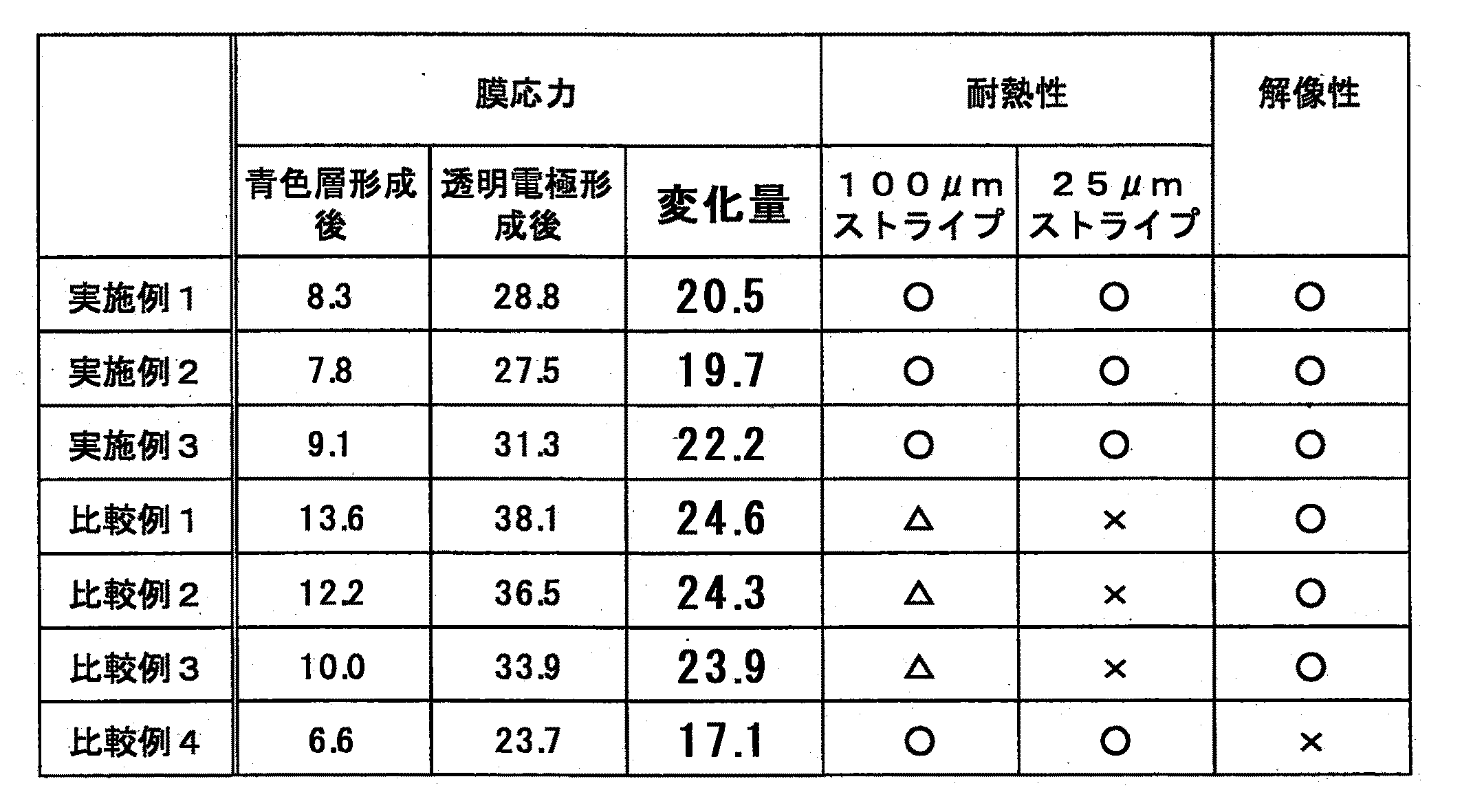
<比較結果>
表1の結果から、以下のことが明らかである。すなわち、実施例1〜3による本発明品は、透明電極形成時における応力変化が小さく、ITOの被覆効果が十分であることから、透明電極形成後の耐熱性が良好である結果を示した。
<Comparison result>
From the results in Table 1, the following is clear. That is, the products of the present invention according to Examples 1 to 3 showed the result that the heat resistance after forming the transparent electrode was good because the stress change during the formation of the transparent electrode was small and the ITO covering effect was sufficient.
これに対し、比較例1〜3による比較品は規定した範囲よりも応力の変化量が大きく、ITOの被覆効果が失われているために耐熱性が劣る結果を示した。また、比較例4においては、応力の変化量は小さく、耐熱性は良好な結果を示しているが、その形状はテーパーが非常に伸びたカマボコ形状となっており、高精細な画素形成には不適であった。 On the other hand, the comparative products according to Comparative Examples 1 to 3 showed a result of inferior heat resistance because the amount of change in stress was larger than the specified range and the coating effect of ITO was lost. In Comparative Example 4, although the amount of change in stress is small and the heat resistance is good, the shape is a scalloped shape with a very long taper. It was inappropriate.
以上のように、透明電極形成時の青色画素の応力変化を制御することにより、下地樹脂と透明電極の熱膨張係数の違いに起因する応力を緩和することができ、ITOによる被覆効果の保持が可能となり、後工程においての耐熱性に優れる青色画素を有するカラーフィルタを得ることができた。 As described above, by controlling the stress change of the blue pixel when forming the transparent electrode, the stress caused by the difference in thermal expansion coefficient between the base resin and the transparent electrode can be relieved, and the covering effect by ITO can be maintained. Thus, it was possible to obtain a color filter having a blue pixel that was excellent in heat resistance in the subsequent process.
Claims (2)
Priority Applications (1)
| Application Number | Priority Date | Filing Date | Title |
|---|---|---|---|
| JP2011112254A JP2012242584A (en) | 2011-05-19 | 2011-05-19 | Color filter and liquid crystal display device including the same |
Applications Claiming Priority (1)
| Application Number | Priority Date | Filing Date | Title |
|---|---|---|---|
| JP2011112254A JP2012242584A (en) | 2011-05-19 | 2011-05-19 | Color filter and liquid crystal display device including the same |
Publications (1)
| Publication Number | Publication Date |
|---|---|
| JP2012242584A true JP2012242584A (en) | 2012-12-10 |
Family
ID=47464367
Family Applications (1)
| Application Number | Title | Priority Date | Filing Date |
|---|---|---|---|
| JP2011112254A Withdrawn JP2012242584A (en) | 2011-05-19 | 2011-05-19 | Color filter and liquid crystal display device including the same |
Country Status (1)
| Country | Link |
|---|---|
| JP (1) | JP2012242584A (en) |
-
2011
- 2011-05-19 JP JP2011112254A patent/JP2012242584A/en not_active Withdrawn
Similar Documents
| Publication | Publication Date | Title |
|---|---|---|
| KR101802093B1 (en) | Coloring composition, color filter and color liquid crystal display device | |
| KR20140101677A (en) | Coloring composition, coloring cured film, display device and solid state imaging device | |
| JP2015011095A (en) | Photospacer-forming photosensitive resin composition and color filter | |
| KR20150032175A (en) | Coloring composition, colored cured film and display device | |
| JP2015108649A (en) | Blue photosensitive composition and color filter substrate | |
| JP5556141B2 (en) | Photosensitive coloring composition, array substrate, and liquid crystal display device using the same | |
| JP2012212051A (en) | Colored composition for color filter, and color filter | |
| JP2013222028A (en) | Photosensitive black resin composition, color filter and liquid crystal display device | |
| WO2012005203A1 (en) | Triarylmethane-based colorant, coloring composition, color filter, and display element | |
| KR101981336B1 (en) | Coloring composition, color filter and display device | |
| JP6790570B2 (en) | Photosensitive coloring compositions and color filters | |
| JP5593637B2 (en) | Color filter | |
| JP5228991B2 (en) | Color filter and liquid crystal display device including the same | |
| JP2017116857A (en) | Green photosensitive coloring composition, color filter using the same, and color display device | |
| JP5672781B2 (en) | Color filter and liquid crystal display device | |
| JP5299098B2 (en) | Color filter manufacturing method and colored layer forming paint set | |
| JP6136528B2 (en) | Color filter and liquid crystal display device | |
| KR102112320B1 (en) | Black photo sensitive resin composition with stair difference and color filter manufacturing method using the same | |
| JP2012242584A (en) | Color filter and liquid crystal display device including the same | |
| JP2013097355A (en) | Photosensitive resin composition, color filter, and method for manufacturing color filter | |
| JP2012226130A (en) | Photosensitive composition and color filter using the same, liquid crystal display and organic el display | |
| JP5499521B2 (en) | Manufacturing method of color filter | |
| JP6878871B2 (en) | Coloring compositions for color filters, and color filters | |
| JP2013097235A (en) | Photosensitive coloring composition and color filter substrate using the same | |
| JP2010139692A (en) | Photosensitive colored composition and method for producing color filter substrate using the same |
Legal Events
| Date | Code | Title | Description |
|---|---|---|---|
| A300 | Withdrawal of application because of no request for examination |
Free format text: JAPANESE INTERMEDIATE CODE: A300 Effective date: 20140805 |