JP2012190084A - Information display medium with metal nano particle - Google Patents
Information display medium with metal nano particle Download PDFInfo
- Publication number
- JP2012190084A JP2012190084A JP2011050883A JP2011050883A JP2012190084A JP 2012190084 A JP2012190084 A JP 2012190084A JP 2011050883 A JP2011050883 A JP 2011050883A JP 2011050883 A JP2011050883 A JP 2011050883A JP 2012190084 A JP2012190084 A JP 2012190084A
- Authority
- JP
- Japan
- Prior art keywords
- unit cell
- metal nanoparticles
- display medium
- information display
- mixed color
- Prior art date
- Legal status (The legal status is an assumption and is not a legal conclusion. Google has not performed a legal analysis and makes no representation as to the accuracy of the status listed.)
- Withdrawn
Links
Images


Landscapes
- Surface Treatment Of Glass (AREA)
Abstract
Description
本発明は、携帯電話やコンピュータ等の電子機器に情報を入力するために光学的な読み取り可能な金属ナノ粒子を用いた情報表示媒体に関するものである。 The present invention relates to an information display medium using optically readable metal nanoparticles for inputting information to an electronic device such as a mobile phone or a computer.
近年において、例えば特許文献1に示すような二次元コードが広く普及しており、その市場規模は今後も拡大すると予想されている。この二次元コードは、単位セル内に白又は黒を表現することにより二進コードを現し、さらにこの単位セルを二次元のマトリックス上にパターンとして配置したものである。この二次元コードの画像をカメラ等の撮像装置を介して撮像することにより取り込み、対象の二次元コード位置を検出して二進コードを切り出す。次に切り出された二次元コードからコードの大きさを求め、その単位セルの座標を求め、更に白又は黒の判別を行うことにより情報に変換する。このような二次元コードは、バーコードとは異なり狭小な面積で多くの情報を重畳させることが可能となる。
In recent years, for example, a two-dimensional code as disclosed in
ところで、このような二次元コードを構成する各単位セルには、あくまで白又は黒による二色のみ表現することを前提としていることから、単位セルには最大でも二進コードのみしか割り当てることができない。単位セルをマトリックス状に二次元的に配置しても、二次元コード全体に重畳できるデータ容量は限られてしまう。特に今後の情報化社会の進展において、より高容量のデータからなる情報を表現することができる二次元コード、ひいては情報表示媒体を提案する必要があった。また、これに加えて製品の小型化が進展するにつれて、この2次元コードをマーキングするエリアは可能な限り小さくすることも求められる。これを実現するために、高開口数の対物レンズを使用し、一の単位セルの大きさが1μmの超高精細マーキング装置も提案されている(例えば、非特許文献1参照。) By the way, since it is assumed that only two colors of white or black are expressed in each unit cell constituting such a two-dimensional code, only a binary code can be assigned to the unit cell at most. . Even if the unit cells are two-dimensionally arranged in a matrix, the data capacity that can be superimposed on the entire two-dimensional code is limited. In particular, in the future progress of the information society, it was necessary to propose a two-dimensional code that can express information consisting of higher-capacity data, and thus an information display medium. In addition to this, as the miniaturization of products progresses, it is required to make the area for marking the two-dimensional code as small as possible. In order to realize this, an ultra-high-definition marking apparatus using an objective lens having a high numerical aperture and having a unit cell size of 1 μm has been proposed (see, for example, Non-Patent Document 1).
しかしながら、上述した非特許文献1による開示技術では、非常に高密度な2次元コードをマーキングすることができるものの、高開口数の対物レンズを使用する必要があり、スループットの減少を招く恐れがあり、マーキングコストが高くなるという問題点があった。
However, although the disclosed technology disclosed in
そこで、本発明は、上述した問題点に鑑みて案出されたものであり、その目的とするところは、携帯電話やコンピュータ等の電子機器に情報を入力するために光学的な読み取り可能な情報表示媒体において、大容量の情報を重畳させることが可能な金属ナノ粒子を用いた情報表示媒体を提供することにある。 Accordingly, the present invention has been devised in view of the above-described problems, and an object of the present invention is to provide optically readable information for inputting information to an electronic device such as a mobile phone or a computer. An object of the present invention is to provide an information display medium using metal nanoparticles capable of superimposing a large amount of information in a display medium.
本発明者は、上述した問題点を解決するために、単位セルを二次元マトリックス状に配列させて2次元コード化を構成する上で、その単位セルにつき互いに径の異なる2種以上の金属ナノ微粒子を形成させることにより、各種金属ナノ微粒子の径に応じた波長の可視光を吸収してその補色を混合させて表示させる点に着目した。そして、この単位セルから発せられる混合色は、上記各吸収すべき可視光の波長に応じて上記各種金属ナノ微粒子の径が予め制御され、また所望の混合色を表示する上で必要な補色の混合比率に対応した上記各種金属ナノ微粒子の面積比率が予め制御されていることにより構成される。 In order to solve the above-described problems, the present inventor has arranged two or more types of metal nano-particles having different diameters for each unit cell when arranging unit cells in a two-dimensional matrix to form a two-dimensional encoding. We paid attention to the fact that by forming fine particles, visible light having a wavelength corresponding to the diameter of various metal nano-particles is absorbed, and their complementary colors are mixed and displayed. The mixed color emitted from the unit cell is a complementary color necessary for displaying the desired mixed color in which the diameters of the various metal nanoparticles are controlled in advance according to the wavelength of the visible light to be absorbed. The area ratio of the various metal nanoparticles corresponding to the mixing ratio is controlled in advance.
請求項1記載の金属ナノ粒子を用いた情報表示媒体は、互いに径の異なる2種以上の金属ナノ微粒子を形成させることにより、各種金属ナノ微粒子の径に応じた波長の可視光を吸収してその補色を混合させて表示する単位セルを備え、上記単位セルは、上記各吸収すべき可視光の波長に応じて上記各種金属ナノ微粒子の径が予め制御され、また所望の上記混合色を表示する上で必要な上記補色の混合比率に対応した上記各種金属ナノ微粒子の面積比率が予め制御されていることを特徴とする。 The information display medium using the metal nanoparticles according to claim 1 absorbs visible light having a wavelength corresponding to the diameter of each metal nanoparticle by forming two or more kinds of metal nanoparticles having different diameters. A unit cell that displays a mixture of the complementary colors is provided. In the unit cell, the diameters of the various metal nanoparticles are controlled in advance according to the wavelength of the visible light to be absorbed, and the desired mixed color is displayed. The area ratio of the various metal nanoparticles corresponding to the mixing ratio of the complementary colors required for the control is controlled in advance.
請求項2記載の金属ナノ粒子を用いた情報表示媒体は、請求項1記載の発明において、上記単位セルから上記混合色を発光させることにより、これに割り当てられているデータを表示することを特徴とする。
The information display medium using the metal nanoparticles according to
請求項3記載の金属ナノ粒子を用いた情報表示媒体は、請求項2記載の発明において、上記単位セルを二次元マトリックス状に配列させて2次元コード化したことを特徴とする。 According to a third aspect of the present invention, there is provided an information display medium using the metal nanoparticles according to the second aspect of the present invention, wherein the unit cells are arranged in a two-dimensional matrix to be two-dimensionally encoded.
請求項4記載の情報表示媒体の情報読取システムは、請求項2又は3項記載の金属ナノ粒子を用いた情報表示媒体と、上記情報表示媒体における各単位セルから発光される混合色を光学的に検出することにより、これに割り当てられているデータを読み取る情報読取装置とを備えることを特徴とする。
An information reading system for an information display medium according to claim 4 is an optical display of an information display medium using the metal nanoparticles according to
本発明を適用した情報表示媒体では、単位セルをマトリックス状に配列させ、各単位セルは、互いに径の異なる2種以上の金属ナノ微粒子を形成させることにより、各種金属ナノ微粒子の径に応じた波長の可視光を吸収してその補色を混合させて表示する。単位セルは、各吸収すべき可視光の波長に応じて各種金属ナノ微粒子の径が予め制御され、また所望の混合色を表示する上で必要な補色の混合比率に対応した各種金属ナノ微粒子の面積比率が予め制御されている。 In the information display medium to which the present invention is applied, the unit cells are arranged in a matrix, and each unit cell forms two or more types of metal nanoparticles having different diameters, thereby depending on the diameter of various metal nanoparticles. Absorbs visible light of wavelength and mixes and displays its complementary color. In the unit cell, the diameters of various metal nanoparticles are controlled in advance according to the wavelength of each visible light to be absorbed, and various metal nanoparticles corresponding to a mixing ratio of complementary colors necessary for displaying a desired mixed color are displayed. The area ratio is controlled in advance.
この各種金属ナノ微粒子の径と、その面積比率を調整することで、所望の混合色を表示させることができ、しかもその混合色は、可視域の色彩全てを割り当てることもできることから、従来の白と黒の2値と比較して、そのデータ数を増やすことができる。また、この単位セルのデータ数を増やすことができれば、これをマトリックス状に配列させた二次元コードのデータ容量を飛躍的に増大させることが可能となる。特に本発明は、極めてシステム構成を簡略化させることも可能となり、安価なシステムとすることも可能となる。 By adjusting the diameter and area ratio of these various metal nanoparticles, it is possible to display a desired mixed color, and the mixed color can be assigned to all colors in the visible range. The number of data can be increased compared with the binary values of black and black. If the number of data in the unit cell can be increased, the data capacity of the two-dimensional code in which the unit cells are arranged in a matrix can be dramatically increased. In particular, according to the present invention, the system configuration can be greatly simplified, and an inexpensive system can be obtained.
以下、本発明の実施の形態として、金属ナノ粒子を用いた情報表示媒体について図面を参照しながら詳細に説明をする。 Hereinafter, as an embodiment of the present invention, an information display medium using metal nanoparticles will be described in detail with reference to the drawings.
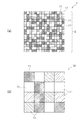
本発明を適用した金属ナノ粒子を用いた情報表示媒体の平面図を図1(a)に示す。この情報表示媒体1は、単位セル11を二次元マトリックス状に配列させて2次元コード10として構成したものである。
A plan view of an information display medium using metal nanoparticles to which the present invention is applied is shown in FIG. This
この単位セル11には、色彩の異なる複数種類のセルが用いられてなる。即ち、この単位セル11は、白色と黒色の2原色のみならず、赤、緑、黄、青等の可視色も表現することが可能なセルである。
The
図1(b)は、複数の単位セル11を集合させてなるコードブロック12の例である。このコードブロック12は、データコードブロック又は誤り訂正コードブロック等として機能するようになっている。そして、このコードブロック12を構成する単位セル11の色彩や組み合わせ、或いは配置に応じて様々な情報を表現する。なお、コードブロック12では、4×4の単位セル11からなる略正方形状の規則的なマトリックス配列で構成されている場合を例に挙げているが、これに限定されるものではなく、例えば2×4の単位セル11からなる長方形状のコードブロック12、或いは単位セル11の不規則な集合からなるコードブロック12で構成されるものであってもよい。
FIG. 1B shows an example of a
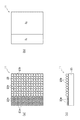
図2は、単位セル11の詳細な構成例を示している。単位セル11は、平面視においてミクロンオーダーもの微細な四角形状で構成されている。例えば、この単位セル11は、平面形状が60μm×60μmの正方形状で構成されていてもよい。この単位セル11は、互いに径の異なる2種以上の金属ナノ微粒子20a、20bを形成されることにより構成される。図2(a)は、より径小な金属ナノ微粒子20aが左側に形成され、より径大な金属ナノ微粒子20bが右側に形成された例である。
FIG. 2 shows a detailed configuration example of the
図2(b)は、金属ナノ微粒子20aが形成されている領域S1と、金属ナノ微粒子20bが形成されている領域S2を示している。この領域S1と、領域S2との間で面積比S1:S2を求めることが可能となる。ちなみに各領域S1、S2において、金属ナノ微粒子20a、20bの形成密度は、実際の二次元コード1への応用時において求められる発光強度に応じて予め調整されるものであってもよい。
FIG. 2B shows a region S 1 where the
ガラス基板25上への金属ナノ微粒子20の形成方法、並びにその単位セル11内における各領域S1、S2の制御方法は、例えば、特開2009−57222号公報に開示の技術を適用するようにしてもよい。
For example, the technique disclosed in Japanese Patent Application Laid-Open No. 2009-57222 is applied to a method for forming the
このような金属ナノ微粒子20は、図2(a),(c)に示すようにガラス基板25上において形成されている。また、この金属ナノ微粒子20の材質は、例えば、金、銀、銅、プラチナ等で構成されている。このような金属ナノ微粒子20の表面には図3に示すように金属の自由電子による表面プラズモンが生じている。この表面プラズモンの振動状態は、バルク金属とは異なり、可視域の振動数の光と共鳴して光吸収を起こす。この光吸収の補色として、ガラス基板25が着色して見えることとなる。可視域の光の吸収波長は、あくまで金属ナノ微粒子20の粒径に依存する。
図4は、金属ナノ微粒子20を金で構成した場合と、銀で構成した場合における、微粒子の径に対する吸収波長の関係を示している。それぞれ、金属ナノ微粒子20を構成する材料及び径に応じて、吸収する可視光の波長が異なり、また発生する補色も異なることが示されている。これは、金属ナノ微粒子20の径に応じて電子運は固有のプラズマ角振動をしている。共鳴する光の波長は、これら金属ナノ微粒子20によって吸収され、その吸収された可視域の色彩に応じた補色が現れることになる。
FIG. 4 shows the relationship between the absorption wavelength and the particle diameter when the
なお、各種金属ナノ微粒子20の誤差は5〜10μmの範囲内において調整されていることが望ましい。あまりに誤差が大きくなると所望の混合色を精度よく表示させることができなくなるためである。
In addition, it is desirable that the errors of the
互いに径の異なる2種の金属ナノ微粒子20a、20bを単位セル11に形成させることにより、当該単位セル11では、金属ナノ微粒子20a、20bそれぞれから互いに異なる波長の可視光が補色として現れることになる。そして、この単位セル11においては、金属ナノ微粒子20a、20bそれぞれから現れる可視光の混合色が現れる。この混合色は、金属ナノ微粒子20aが形成されている領域S1と、金属ナノ微粒子20bが形成されている領域S2との比率に応じたものとなる。この単位セル11から最終的に発せられる混合色が、当該単位セル11により表現されるデータとなる。
By forming two types of
本発明では、この単位セル11から発せられる混合色が、データの最小単位である。この混合色は、白、黒の二色ではなくて、あくまで可視域の色彩全てである。このため、この単位セル11から発せられる可視域の混合色に対してそれぞれデータを割り当てる。これにより、単位セル11における混合色を変化させることで、この単位セル11から様々なデータを表示させることが可能となる。例えば、単位セル11から発せられる混合色において、青が“1”、赤が“2”、黄緑が“3”、紫が“4”、緑が“5”、黄色が“6”、・・等と予めデータを割り当てておく。これにより、例えば、所望のデータ“4”を表示したい場合には、そのデータに応じた混合色である紫となるように混合色を調整しておく必要がある。
In the present invention, the mixed color emitted from the
この混合色の調整については、2種の金属ナノ微粒子20a、20bによる補色の混合比率を調整を行えばよく、その2種の金属ナノ微粒子20a、20bによる補色の混合比率は、金属ナノ微粒子20aが形成されている領域S1と、金属ナノ微粒子20bが形成されている領域S2との比率に対応するものとなる。このため、この領域S1と、領域S2と比率を調整することにより、単位セル11から所望の混合色を発生させることが可能となり、ひいては所望のデータを表示させることが可能となる。
For the adjustment of the mixed color, the mixing ratio of complementary colors by the two types of
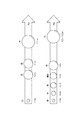
なお、2種の金属ナノ微粒子20a、20bは、図2(a)に示すように並べられている場合に限定されるものではなく、例えば図5(a)に示すように金属ナノ微粒子20a、20bが縞状に構成されていてもよい。また、図5(b)に示すようにランダムに並べられているものであってもよい。かかるランダムに並べられている場合においても、単位セル11内の2種の金属ナノ微粒子20a、20bの面積比率が調整され、これに応じた波長の可視光が発光されることになる。なお、上述した例ではあくまで2種類の金属ナノ微粒子20a、20bを単位セル11に形成させる場合を例にとり説明をしたが、これに限定されるものではなく、3種類以上の金属ナノ微粒子の混合色を表示させるようにしてもよいことは勿論である。
The two types of
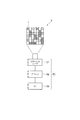
図6は、上述した構成からなる本発明を適用した情報表示媒体1から実際の情報を読み取る情報読取システム6の例を示している。この情報読取システム6は、カラーCCD(Charge Coupled Device)カメラ51と、このカラーCCDカメラ51に接続されたデコーダ52と、デコーダ52に接続されたPC(Personal Computer)53とを備えた情報読取装置50を有している。この情報読取装置50では、情報表示媒体1における各単位セル11から発光される混合色を光学的に検出することにより、これに割り当てられている情報を読み取る。具体的には、先ずカラーCCDカメラ51によりこの情報表示媒体1を撮像して、その撮像信号をデコーダ52へ出力する。デコーダ52は、この撮像信号に基づいて単位セル11から発せられるそれぞれの色彩をデータに数値化する。PC53は、このデコーダから各単位セル11のデータが送信され、単位セル11を二次元マトリックス状に配列させて2次元コード10から情報の読み取りを行う。
FIG. 6 shows an example of an information reading system 6 that reads actual information from the
上述したように、本発明を適用した情報表示媒体1では、単位セル11をマトリックス状に配列させ、各単位セル11は、互いに径の異なる2種以上の金属ナノ微粒子20を形成させることにより、各種金属ナノ微粒子20の径に応じた波長の可視光を吸収してその補色を混合させて表示する。単位セル11は、各吸収すべき可視光の波長に応じて各種金属ナノ微粒子60の径が予め制御され、また所望の混合色を表示する上で必要な補色の混合比率に対応した各種金属ナノ微粒子60の面積比率が予め制御されている。
As described above, in the
この各種金属ナノ微粒子60の径と、その面積比率を調整することで、所望の混合色を表示させることができ、しかもその混合色は、可視域の色彩全てを割り当てることもできることから、従来の白と黒の2値と比較して、そのデータ数を増やすことができる。また、この単位セル11のデータ数を増やすことができれば、これをマトリックス状に配列させた二次元コードのデータ容量を飛躍的に増大させることが可能となる。特に本発明は、カラーCCDカメラ51を使用することにより容易に情報を読み取れるものであることから、高開口数の対物レンズを使用する必要も無くなり、極めてシステム構成を簡略化させることも可能となり、安価なシステムとすることも可能となる。
By adjusting the diameter and area ratio of the various metal nanoparticles 60, it is possible to display a desired mixed color, and the mixed color can be assigned to all colors in the visible range. The number of data can be increased as compared with the binary values of white and black. If the number of data of the
1 情報表示媒体
11 単位セル
10 2次元コード
12 コードブロック
20 金属ナノ微粒子
25 ガラス基板
DESCRIPTION OF
Claims (4)
上記単位セルは、上記各吸収すべき可視光の波長に応じて上記各種金属ナノ微粒子の径が予め制御され、また所望の上記混合色を表示する上で必要な上記補色の混合比率に対応した上記各種金属ナノ微粒子の面積比率が予め制御されていること
を特徴とする金属ナノ粒子を用いた情報表示媒体。 By forming two or more kinds of metal nanoparticles having different diameters, a unit cell that absorbs visible light having a wavelength corresponding to the diameter of each metal nanoparticle and mixes and displays the complementary colors is provided.
In the unit cell, the diameters of the various metal nanoparticles are controlled in advance in accordance with the wavelength of the visible light to be absorbed, and the unit cell corresponds to the mixing ratio of the complementary colors necessary for displaying the desired mixed color. An information display medium using metal nanoparticles, wherein the area ratio of the various metal nanoparticles is controlled in advance.
を特徴とする請求項1記載の金属ナノ粒子を用いた情報表示媒体。 2. The information display medium using metal nanoparticles according to claim 1, wherein the data assigned to the mixed color is displayed by emitting the mixed color from the unit cell. 3.
を特徴とする請求項2記載の金属ナノ粒子を用いた情報表示媒体。 The information display medium using metal nanoparticles according to claim 2, wherein the unit cells are arranged in a two-dimensional matrix to be two-dimensionally encoded.
を特徴とする情報表示媒体の情報読取システム。 The information display medium using the metal nanoparticles according to claim 2 or 3, and the data assigned to the information display medium by optically detecting a mixed color emitted from each unit cell in the information display medium. An information reading system for an information display medium, comprising: an information reading device for reading.
Priority Applications (1)
| Application Number | Priority Date | Filing Date | Title |
|---|---|---|---|
| JP2011050883A JP2012190084A (en) | 2011-03-08 | 2011-03-08 | Information display medium with metal nano particle |
Applications Claiming Priority (1)
| Application Number | Priority Date | Filing Date | Title |
|---|---|---|---|
| JP2011050883A JP2012190084A (en) | 2011-03-08 | 2011-03-08 | Information display medium with metal nano particle |
Publications (1)
| Publication Number | Publication Date |
|---|---|
| JP2012190084A true JP2012190084A (en) | 2012-10-04 |
Family
ID=47083202
Family Applications (1)
| Application Number | Title | Priority Date | Filing Date |
|---|---|---|---|
| JP2011050883A Withdrawn JP2012190084A (en) | 2011-03-08 | 2011-03-08 | Information display medium with metal nano particle |
Country Status (1)
| Country | Link |
|---|---|
| JP (1) | JP2012190084A (en) |
Cited By (2)
| Publication number | Priority date | Publication date | Assignee | Title |
|---|---|---|---|---|
| JP2021189601A (en) * | 2020-05-27 | 2021-12-13 | 国立大学法人九州大学 | High security system, article, authenticity determination method, article discrimination method and information protection method |
| JPWO2024189995A1 (en) * | 2023-03-13 | 2024-09-19 |
-
2011
- 2011-03-08 JP JP2011050883A patent/JP2012190084A/en not_active Withdrawn
Cited By (4)
| Publication number | Priority date | Publication date | Assignee | Title |
|---|---|---|---|---|
| JP2021189601A (en) * | 2020-05-27 | 2021-12-13 | 国立大学法人九州大学 | High security system, article, authenticity determination method, article discrimination method and information protection method |
| JPWO2024189995A1 (en) * | 2023-03-13 | 2024-09-19 | ||
| WO2024189995A1 (en) * | 2023-03-13 | 2024-09-19 | 株式会社村田製作所 | Electronic component, electronic component manufacturing method, and traceability system |
| JP7708320B2 (en) | 2023-03-13 | 2025-07-15 | 株式会社村田製作所 | Electronic components, manufacturing method thereof and traceability system |
Similar Documents
| Publication | Publication Date | Title |
|---|---|---|
| US11713962B2 (en) | Nanostructured optical element, depth sensor, and electronic device | |
| Yi et al. | X-ray-to-visible light-field detection through pixelated colour conversion | |
| Chan et al. | High-resolution light field prints by nanoscale 3D printing | |
| Heydari et al. | Plasmonic color filters as dual‐state nanopixels for high‐density microimage encoding | |
| Yakunin et al. | Radiative lifetime-encoded unicolour security tags using perovskite nanocrystals | |
| Nam et al. | Inkjet printing based mono-layered photonic crystal patterning for anti-counterfeiting structural colors | |
| JP6970087B2 (en) | Devices and methods for optically coding images | |
| Chen et al. | Assembling color on the nanoscale: multichromatic switchable pixels from plasmonic atoms and molecules | |
| Olson et al. | High chromaticity aluminum plasmonic pixels for active liquid crystal displays | |
| Caligiuri et al. | Hybrid plasmonic/photonic nanoscale strategy for multilevel anticounterfeit labels | |
| Jiang et al. | Scalable inkjet-based structural color printing by molding transparent gratings on multilayer nanostructured surfaces | |
| Wang et al. | Optical fireworks based on multifocal three-dimensional color prints | |
| JPWO2012049905A1 (en) | Optical element, light source, and projection display device | |
| US11019328B2 (en) | Nanostructured optical element, depth sensor, and electronic device | |
| CN113924517B (en) | Imaging system and method for generating composite image | |
| JP4853945B2 (en) | Manufacturing method of display device | |
| KR20200018501A (en) | A detector for determining the position of at least one object | |
| CN114026697A (en) | Suppressing scattering of light transmitted through an OLED display | |
| US9978004B2 (en) | Information recording medium, information recording method, and information reproduction method | |
| CN110571233A (en) | Multi-wavelength light source device, multifunctional projector, and electronic device | |
| Waltrich et al. | High-purity single photons obtained with moderate-NA optics from SiV center in nanodiamonds on a bullseye antenna | |
| Du et al. | Advances in femtosecond laser synthesis and micromachining of halide perovskites | |
| JP2017157488A (en) | Optical device, light source device and projector | |
| Heilmann et al. | Multimode lasing in supercell plasmonic nanoparticle arrays | |
| JP2012190084A (en) | Information display medium with metal nano particle |
Legal Events
| Date | Code | Title | Description |
|---|---|---|---|
| RD04 | Notification of resignation of power of attorney |
Free format text: JAPANESE INTERMEDIATE CODE: A7424 Effective date: 20120830 |
|
| RD04 | Notification of resignation of power of attorney |
Free format text: JAPANESE INTERMEDIATE CODE: A7424 Effective date: 20120905 |
|
| A300 | Withdrawal of application because of no request for examination |
Free format text: JAPANESE INTERMEDIATE CODE: A300 Effective date: 20140513 |