JP2010505995A - Chain-end functionalized fluoropolymer with good electrical properties and good chemical reactivity - Google Patents
Chain-end functionalized fluoropolymer with good electrical properties and good chemical reactivity Download PDFInfo
- Publication number
- JP2010505995A JP2010505995A JP2009531368A JP2009531368A JP2010505995A JP 2010505995 A JP2010505995 A JP 2010505995A JP 2009531368 A JP2009531368 A JP 2009531368A JP 2009531368 A JP2009531368 A JP 2009531368A JP 2010505995 A JP2010505995 A JP 2010505995A
- Authority
- JP
- Japan
- Prior art keywords
- fluoropolymer
- chain end
- mol
- end functionalized
- vdf
- Prior art date
- Legal status (The legal status is an assumption and is not a legal conclusion. Google has not performed a legal analysis and makes no representation as to the accuracy of the status listed.)
- Granted
Links
Images

Classifications
-
- C—CHEMISTRY; METALLURGY
- C08—ORGANIC MACROMOLECULAR COMPOUNDS; THEIR PREPARATION OR CHEMICAL WORKING-UP; COMPOSITIONS BASED THEREON
- C08F—MACROMOLECULAR COMPOUNDS OBTAINED BY REACTIONS ONLY INVOLVING CARBON-TO-CARBON UNSATURATED BONDS
- C08F214/00—Copolymers of compounds having one or more unsaturated aliphatic radicals, each having only one carbon-to-carbon double bond, and at least one being terminated by a halogen
- C08F214/18—Monomers containing fluorine
- C08F214/22—Vinylidene fluoride
-
- C—CHEMISTRY; METALLURGY
- C08—ORGANIC MACROMOLECULAR COMPOUNDS; THEIR PREPARATION OR CHEMICAL WORKING-UP; COMPOSITIONS BASED THEREON
- C08F—MACROMOLECULAR COMPOUNDS OBTAINED BY REACTIONS ONLY INVOLVING CARBON-TO-CARBON UNSATURATED BONDS
- C08F214/00—Copolymers of compounds having one or more unsaturated aliphatic radicals, each having only one carbon-to-carbon double bond, and at least one being terminated by a halogen
- C08F214/18—Monomers containing fluorine
- C08F214/22—Vinylidene fluoride
- C08F214/225—Vinylidene fluoride with non-fluorinated comonomers
-
- C—CHEMISTRY; METALLURGY
- C08—ORGANIC MACROMOLECULAR COMPOUNDS; THEIR PREPARATION OR CHEMICAL WORKING-UP; COMPOSITIONS BASED THEREON
- C08F—MACROMOLECULAR COMPOUNDS OBTAINED BY REACTIONS ONLY INVOLVING CARBON-TO-CARBON UNSATURATED BONDS
- C08F8/00—Chemical modification by after-treatment
-
- C—CHEMISTRY; METALLURGY
- C08—ORGANIC MACROMOLECULAR COMPOUNDS; THEIR PREPARATION OR CHEMICAL WORKING-UP; COMPOSITIONS BASED THEREON
- C08F—MACROMOLECULAR COMPOUNDS OBTAINED BY REACTIONS ONLY INVOLVING CARBON-TO-CARBON UNSATURATED BONDS
- C08F8/00—Chemical modification by after-treatment
- C08F8/04—Reduction, e.g. hydrogenation
-
- C—CHEMISTRY; METALLURGY
- C08—ORGANIC MACROMOLECULAR COMPOUNDS; THEIR PREPARATION OR CHEMICAL WORKING-UP; COMPOSITIONS BASED THEREON
- C08F—MACROMOLECULAR COMPOUNDS OBTAINED BY REACTIONS ONLY INVOLVING CARBON-TO-CARBON UNSATURATED BONDS
- C08F8/00—Chemical modification by after-treatment
- C08F8/14—Esterification
-
- C—CHEMISTRY; METALLURGY
- C08—ORGANIC MACROMOLECULAR COMPOUNDS; THEIR PREPARATION OR CHEMICAL WORKING-UP; COMPOSITIONS BASED THEREON
- C08J—WORKING-UP; GENERAL PROCESSES OF COMPOUNDING; AFTER-TREATMENT NOT COVERED BY SUBCLASSES C08B, C08C, C08F, C08G or C08H
- C08J3/00—Processes of treating or compounding macromolecular substances
- C08J3/28—Treatment by wave energy or particle radiation
-
- C—CHEMISTRY; METALLURGY
- C08—ORGANIC MACROMOLECULAR COMPOUNDS; THEIR PREPARATION OR CHEMICAL WORKING-UP; COMPOSITIONS BASED THEREON
- C08L—COMPOSITIONS OF MACROMOLECULAR COMPOUNDS
- C08L27/00—Compositions of homopolymers or copolymers of compounds having one or more unsaturated aliphatic radicals, each having only one carbon-to-carbon double bond, and at least one being terminated by a halogen; Compositions of derivatives of such polymers
- C08L27/02—Compositions of homopolymers or copolymers of compounds having one or more unsaturated aliphatic radicals, each having only one carbon-to-carbon double bond, and at least one being terminated by a halogen; Compositions of derivatives of such polymers not modified by chemical after-treatment
- C08L27/12—Compositions of homopolymers or copolymers of compounds having one or more unsaturated aliphatic radicals, each having only one carbon-to-carbon double bond, and at least one being terminated by a halogen; Compositions of derivatives of such polymers not modified by chemical after-treatment containing fluorine atoms
- C08L27/16—Homopolymers or copolymers or vinylidene fluoride
-
- H—ELECTRICITY
- H10—SEMICONDUCTOR DEVICES; ELECTRIC SOLID-STATE DEVICES NOT OTHERWISE PROVIDED FOR
- H10N—ELECTRIC SOLID-STATE DEVICES NOT OTHERWISE PROVIDED FOR
- H10N30/00—Piezoelectric or electrostrictive devices
- H10N30/80—Constructional details
- H10N30/85—Piezoelectric or electrostrictive active materials
- H10N30/852—Composite materials, e.g. having 1-3 or 2-2 type connectivity
-
- C—CHEMISTRY; METALLURGY
- C08—ORGANIC MACROMOLECULAR COMPOUNDS; THEIR PREPARATION OR CHEMICAL WORKING-UP; COMPOSITIONS BASED THEREON
- C08F—MACROMOLECULAR COMPOUNDS OBTAINED BY REACTIONS ONLY INVOLVING CARBON-TO-CARBON UNSATURATED BONDS
- C08F2800/00—Copolymer characterised by the proportions of the comonomers expressed
- C08F2800/10—Copolymer characterised by the proportions of the comonomers expressed as molar percentages
-
- C—CHEMISTRY; METALLURGY
- C08—ORGANIC MACROMOLECULAR COMPOUNDS; THEIR PREPARATION OR CHEMICAL WORKING-UP; COMPOSITIONS BASED THEREON
- C08F—MACROMOLECULAR COMPOUNDS OBTAINED BY REACTIONS ONLY INVOLVING CARBON-TO-CARBON UNSATURATED BONDS
- C08F2800/00—Copolymer characterised by the proportions of the comonomers expressed
- C08F2800/20—Copolymer characterised by the proportions of the comonomers expressed as weight or mass percentages
-
- C—CHEMISTRY; METALLURGY
- C08—ORGANIC MACROMOLECULAR COMPOUNDS; THEIR PREPARATION OR CHEMICAL WORKING-UP; COMPOSITIONS BASED THEREON
- C08F—MACROMOLECULAR COMPOUNDS OBTAINED BY REACTIONS ONLY INVOLVING CARBON-TO-CARBON UNSATURATED BONDS
- C08F2810/00—Chemical modification of a polymer
- C08F2810/20—Chemical modification of a polymer leading to a crosslinking, either explicitly or inherently
-
- C—CHEMISTRY; METALLURGY
- C08—ORGANIC MACROMOLECULAR COMPOUNDS; THEIR PREPARATION OR CHEMICAL WORKING-UP; COMPOSITIONS BASED THEREON
- C08F—MACROMOLECULAR COMPOUNDS OBTAINED BY REACTIONS ONLY INVOLVING CARBON-TO-CARBON UNSATURATED BONDS
- C08F2810/00—Chemical modification of a polymer
- C08F2810/40—Chemical modification of a polymer taking place solely at one end or both ends of the polymer backbone, i.e. not in the side or lateral chains
-
- C—CHEMISTRY; METALLURGY
- C08—ORGANIC MACROMOLECULAR COMPOUNDS; THEIR PREPARATION OR CHEMICAL WORKING-UP; COMPOSITIONS BASED THEREON
- C08J—WORKING-UP; GENERAL PROCESSES OF COMPOUNDING; AFTER-TREATMENT NOT COVERED BY SUBCLASSES C08B, C08C, C08F, C08G or C08H
- C08J2327/00—Characterised by the use of homopolymers or copolymers of compounds having one or more unsaturated aliphatic radicals, each having only one carbon-to-carbon double bond, and at least one being terminated by a halogen; Derivatives of such polymers
- C08J2327/02—Characterised by the use of homopolymers or copolymers of compounds having one or more unsaturated aliphatic radicals, each having only one carbon-to-carbon double bond, and at least one being terminated by a halogen; Derivatives of such polymers not modified by chemical after-treatment
- C08J2327/12—Characterised by the use of homopolymers or copolymers of compounds having one or more unsaturated aliphatic radicals, each having only one carbon-to-carbon double bond, and at least one being terminated by a halogen; Derivatives of such polymers not modified by chemical after-treatment containing fluorine atoms
- C08J2327/16—Homopolymers or copolymers of vinylidene fluoride
-
- Y—GENERAL TAGGING OF NEW TECHNOLOGICAL DEVELOPMENTS; GENERAL TAGGING OF CROSS-SECTIONAL TECHNOLOGIES SPANNING OVER SEVERAL SECTIONS OF THE IPC; TECHNICAL SUBJECTS COVERED BY FORMER USPC CROSS-REFERENCE ART COLLECTIONS [XRACs] AND DIGESTS
- Y10—TECHNICAL SUBJECTS COVERED BY FORMER USPC
- Y10T—TECHNICAL SUBJECTS COVERED BY FORMER US CLASSIFICATION
- Y10T428/00—Stock material or miscellaneous articles
- Y10T428/31504—Composite [nonstructural laminate]
- Y10T428/3154—Of fluorinated addition polymer from unsaturated monomers
Landscapes
- Chemical & Material Sciences (AREA)
- Health & Medical Sciences (AREA)
- Chemical Kinetics & Catalysis (AREA)
- Medicinal Chemistry (AREA)
- Polymers & Plastics (AREA)
- Organic Chemistry (AREA)
- General Chemical & Material Sciences (AREA)
- Engineering & Computer Science (AREA)
- Composite Materials (AREA)
- Materials Engineering (AREA)
- Addition Polymer Or Copolymer, Post-Treatments, Or Chemical Modifications (AREA)
- Compositions Of Macromolecular Compounds (AREA)
Abstract
良好な化学的反応性、高い破壊電界(E>100MV/m)および高い誘電定数(即ち、ε>10)を呈する鎖末端官能基化フルオロポリマーを開示する。これらのポリマーは、官能性開始剤により1つ以上の付加的なモノマーとともにビニリデンジフルオリドを含めた様々なフルオロモノマーから調製することができる。これらのポリマーを他の誘電性材料と組み合わせて一様な組成および形態を有する複合材料を形成することができる。 Disclosed are chain end functionalized fluoropolymers that exhibit good chemical reactivity, high breakdown field (E> 100 MV / m) and high dielectric constant (ie, ε> 10). These polymers can be prepared from a variety of fluoromonomers including vinylidene difluoride along with one or more additional monomers with a functional initiator. These polymers can be combined with other dielectric materials to form composite materials with uniform composition and morphology.
Description
関連出願
この出願は、「Ferroelectric Polymers With Giant Electrostriction:Based On Semicrystalline Terpolymers Containing Vinylidene Difluoride,Trifluoroethylene and Third Monomer」と題する米国特許第6,355,749号、「A New Process of Preparing Functional Fluoropolymers」と題する米国特許第6,911,509号、および2004年2月17日に出願された米国特許出願第10/778,112号に関係した主題を含んでいるものと考えられ、これらの各特許文献はこれをもって参照により本明細書に組み入れられる。
RELATED APPLICATIONS This application is, "Ferroelectric Polymers With Giant Electrostriction: Based On Semicrystalline Terpolymers Containing Vinylidene Difluoride, Trifluoroethylene and Third Monomer entitled" US Pat. No. 6,355,749, the United States entitled "A New Process of Preparing Functional Fluoropolymers" Which is believed to include subject matter related to US Pat. No. 6,911,509 and US patent application Ser. No. 10 / 778,112 filed Feb. 17, 2004, each of which is incorporated herein by reference. This specification by reference with It is incorporated.
開示の分野
本発明は、良好な化学的反応性、例えば架橋反応および複合材料の調製などでの良好な化学的反応性、高い破壊電界E>100MV/m(メガボルト・パー・メートル)、高い誘電定数(ε>10)、および高いエネルギー密度を呈することができる鎖末端官能基化フルオロポリマーに関係する。より詳細には、本発明は、官能性開始剤によって調製することができる、ビニリデンジフルオリド(VDF)と1つ以上の付加的なモノマー、例えばトリフルオロエチレン(TrFE)、テトラフルオロエチレン(TFE)、クロロトリフルオロエチレン(CTFE)、クロロジフルオロエチレン(CDFE)、クロロフルオロエチレン(CFE)、ヘキサフルオロプロペン(HFP)などとから製造されるフルオロポリマーに関係する。結果として得られる鎖末端官能基化フルオロポリマーは、有利なことに、高い誘電特性および強誘電特性、ならびに良好な化学的反応性を有することができる。
FIELD OF THE DISCLOSURE The present invention relates to good chemical reactivity, eg good chemical reactivity in cross-linking reactions and composite preparation, high breakdown electric field E> 100 MV / m (megavolt per meter), high dielectric Related to chain end functionalized fluoropolymers that can exhibit a constant (ε> 10) and high energy density. More particularly, the present invention relates to vinylidene difluoride (VDF) and one or more additional monomers, such as trifluoroethylene (TrFE), tetrafluoroethylene (TFE), which can be prepared with a functional initiator. , Chlorotrifluoroethylene (CTFE), chlorodifluoroethylene (CDFE), chlorofluoroethylene (CFE), hexafluoropropene (HFP) and the like. The resulting chain end functionalized fluoropolymer can advantageously have high dielectric and ferroelectric properties, and good chemical reactivity.
開示の背景
高い誘電定数を呈し、外部電場により大きな電気変位又は/及び機械的作動を発生するポリマーは、大いに注目を集めており、キャパシタ、トランスデューサ、アクチュエータおよびセンサとして使用されている。現在、高誘電性材料および強誘電性材料でのほとんどの商業的な適用は、それらが多くの欠点、例えば低いひずみレベル、脆性、重量が重いこと、および高い加工温度などの欠点を呈するという事実にもかかわらず、圧電性セラミックスおよび磁気ひずみ材料をベースとしている。その上、これらの材料は、生産するパーツが複雑な形状を有しているときには、加工の困難性を呈する。これとは対照的に、強誘電性ポリマーは、多くの望ましい特性、例えば可撓性、軽量性、高い機械的強度、大きな面積のフィルムに容易に加工され得る能力、および様々な構造に容易に成形され得る能力などの特性を呈する。セラミック材料に優るこれらの利点にもかかわらず、ほとんどのポリマーは、誘電定数に関して低い電界感度、電気変位、圧電係数、電気機械結合係数および場誘起ひずみといった欠点を抱えており、これらの欠点がそのようなポリマーの適用を制限している。
BACKGROUND OF THE DISCLOSURE Polymers that exhibit high dielectric constants and generate large electrical displacements or / and mechanical actuation by an external electric field have received much attention and are used as capacitors, transducers, actuators and sensors. Currently, most commercial applications with high dielectric materials and ferroelectric materials have the fact that they exhibit many drawbacks, such as low strain levels, brittleness, heavy weight, and high processing temperatures. Nevertheless, it is based on piezoelectric ceramics and magnetostrictive materials. In addition, these materials present processing difficulties when the parts to be produced have complex shapes. In contrast, ferroelectric polymers have many desirable properties, such as flexibility, light weight, high mechanical strength, the ability to be easily processed into large area films, and easy to various structures. It exhibits properties such as the ability to be molded. Despite these advantages over ceramic materials, most polymers have the disadvantages of low electric field sensitivity, electrical displacement, piezoelectric coefficient, electromechanical coupling coefficient and field-induced strain with respect to the dielectric constant, which are Limiting the application of such polymers.
これまでの10年間、高誘電性および強誘電性ポリマーにかかわるほとんどの研究活動は、フルオロポリマー、特には半結晶性のVDF/TrFEコポリマーに焦点を当ててきた。多くの研究努力が、強誘電−常誘電(Curie)相転移に対するエネルギー障壁を低減し、環境温度において大きくて迅速な電気誘導型の機械的(圧電)応答を発生させるという一般的な目標に向けてささげられてきた。VDF/TrFEコポリマー(120℃
において分極された延伸フィルム)は比較的高い圧電定数を呈する(Kogaら、J.Appl.Phys.、59、2142、1986)が、電場に対するそれらの双極子の応答は環境温度では非常に遅く、そのコポリマーの分極ヒステリシスループ(極性対電場)は非常に大きい。55モル%のVDFと45モル%のTrFEとからなるVDF/TrFEコポリマーは、VDF/TrEFファミリーにおけるこれらのコポリマーのうちで最も狭い分極ヒステリシスループおよび最も低いCurie温度を呈する(Higashihataら、Ferroelectrics、32、85、1981)が、尚も有意に広いヒステリシスループを呈する。
In the past decade, most research activities involving high dielectric and ferroelectric polymers have focused on fluoropolymers, especially semi-crystalline VDF / TrFE copolymers. Many research efforts are aimed at the general goal of reducing the energy barrier to the ferroelectric-paraelectric (Curie) phase transition and generating a large and rapid electrically induced mechanical (piezoelectric) response at ambient temperatures. Has been devoted. VDF / TrFE copolymer (120 ° C
(Polarized stretched film) at a relatively high piezoelectric constant (Koga et al., J. Appl. Phys., 59, 2142, 1986), but their dipole response to an electric field is very slow at ambient temperature, The polarization hysteresis loop (polar versus electric field) of the copolymer is very large. VDF / TrFE copolymers consisting of 55 mol% VDF and 45 mol% TrFE exhibit the narrowest polarization hysteresis loop and the lowest Curie temperature of these copolymers in the VDF / TrEF family (Higashiata et al., Ferroelectrics, 32 85, 1981) still exhibits a significantly wider hysteresis loop.
結晶構造と電気特性とのこのつながりがきっかけとなり、多くの研究者は、非平衡状態を創出することによりこのコポリマーの形態を変えようとする努力を払うこととなった;結果として、数多くのそのような努力は、幾分改善された電気的応答を呈する強誘電性ポリマーをもたらした。そのような試みは、例えば、強誘電性ポリマーに機械的な変形を受けさせること(Tashiroら、Macromolecules、21、2463、1988、および23、2802、1990)や、電子放射(Daudinら、J.Appl.Phys.、62、994、1987;Zhangら、米国特許第6,423,412号)、一軸延伸(Furukawaら、Japanese Journal of Applied Physics、29、675、1990)、高圧下における結晶化(Yukiら、Jpn.J.Appl.Phys.、37、5372、1998)、および高電場の下における結晶化(Ikedaら、Jpn.J.Appl.Phys.、311112、1992)を含んだ。 This link between crystal structure and electrical properties triggered many researchers to try to change the morphology of this copolymer by creating a nonequilibrium state; Such efforts have resulted in ferroelectric polymers that exhibit a somewhat improved electrical response. Such attempts include, for example, subjecting ferroelectric polymers to mechanical deformation (Tashiro et al., Macromolecules, 21, 2463, 1988, and 23, 2802, 1990), and electron emission (Daudin et al., J. Biol. Appl. Phys., 62, 994, 1987; Zhang et al., US Pat. No. 6,423,412), uniaxial stretching (Furukawa et al., Japane Journal of Applied Physics, 29, 675, 1990), crystallization under high pressure ( Yuki et al., Jpn. J. Appl.
Chungら(米国特許第6,355,749号、Ferroelectrics Letters 28、135、2001)は、少量(<10モル%)のバルキーなターモノマー単位、例えばクロロトリフルオロエチレン(CTFE)単位などを一様な分子構造を有するコポリマーに導入することにより、VDF/TrFEコポリマーの結晶性ドメインを変化させ、リラクサ強誘電挙動を創出するための代替的な方法を示した。結果として得られたそれらのターポリマーは完全に溶解および溶融加工可能であり、環境温度付近においてCurie(極性−非極性結晶相)転移を有する一様なナノ結晶性ドメインを持った望ましいフィルム形態を形成する。また、そのターポリマーの分極ヒステリシスループも非常に狭くなった。従って、これらのターポリマーは、環境温度における非常に高い誘電定数(ε>70)、ならびに外部電場により誘起される迅速で高い電気−機械応答(>5%)を呈する。 Chung et al. (US Pat. No. 6,355,749, Ferroelectrics Letters 28, 135, 2001) uniformly distribute small amounts (<10 mol%) of bulky termonomer units such as chlorotrifluoroethylene (CTFE) units. An alternative method for changing the crystalline domain of VDF / TrFE copolymer and creating relaxor ferroelectric behavior was shown by introducing it into a copolymer having a unique molecular structure. The resulting terpolymers are completely meltable and melt processable and have desirable film morphology with uniform nanocrystalline domains with a Curie (polar-nonpolar crystalline phase) transition near ambient temperature. Form. Also, the polarization hysteresis loop of the terpolymer became very narrow. Thus, these terpolymers exhibit a very high dielectric constant (ε> 70) at ambient temperature, as well as a rapid and high electro-mechanical response (> 5%) induced by an external electric field.
ターポリマーの進展が動機となり、何人かの研究者が、それらの材料の誘電特性を更に増強させることを目的として、特には以下の2つの領域、即ち、(a)大きな電気機械応答で必要となる電圧がもっと低くて済むように、誘電定数を高めること、および(b)装置設計における懸念事項である、特には長期使用での、相転移中における誘電損失を低減させることの領域において、ターポリマー複合材料について詳しく調べた(Nature
419、284、2002;J.Appl.Polym.Sci.82、70、2001)。これらの複合材料の調製は、そのターポリマーと銅フタロシアニン(CuCy)有機分子を含む幾種類かの高誘電性材料との単純な混ぜ合わせにより着手された(J.Appl.Polym.Sci.82、70、2001、Nature 419、284、2002、Macromolecules 38、2247、2005)。しかし、結果として、フルオロポリマーの低い表面エネルギーおよび不粘着(non−stick)特性が、フルオロポリマーと高誘電性材料との間での不適合なブレンドをもたらす。この不適合性は、多くの電気的用途にとって不可欠である良好な機械的特性を備えた一様な複合フィルム(>40μmもの厚み)を調製する上での重大な障害である。全体的に見て、この段階では高性能の誘電性材料を調製することはまだ実現し難い。
Motivated by the development of terpolymers, some researchers have specifically aimed at further enhancing the dielectric properties of their materials, especially in the following two areas: (a) large electromechanical response In the area of increasing the dielectric constant so that the resulting voltage can be lower, and (b) reducing the dielectric loss during phase transition, which is a concern in device design, especially in long term use. We investigated polymer composite materials in detail (Nature)
419, 284, 2002; Appl. Polym. Sci. 82, 70, 2001). The preparation of these composites was undertaken by simple blending of the terpolymer with several high dielectric materials including copper phthalocyanine (CuCy) organic molecules (J. Appl. Polym. Sci. 82, 70, 2001, Nature 419, 284, 2002, Macromolecules 38, 2247, 2005). However, as a result, the low surface energy and non-stick properties of the fluoropolymer result in an incompatible blend between the fluoropolymer and the high dielectric material. This incompatibility is a significant obstacle in preparing uniform composite films (> 40 μm thick) with good mechanical properties that are essential for many electrical applications. Overall, it is still difficult to prepare a high performance dielectric material at this stage.
一般的に、フルオロポリマーを調製する方法は、回分反応器を用いた、水溶液中におけるフリーラジカル乳化重合法および懸濁重合法によるものであった(F.J.Honnら、米国特許第3,053,818号;J.E.Dohanyら、米国特許第3,790,540号;T.Sakagamiら、米国特許第4,554,335号;J.Sakoら、米国特許第4,577,005号;H.Inukaiら、米国特許第5,087,679号;H.Freimuthら、Polymer、37、831、1996)。不均一反応条件の組み合わせ、水中におけるそれらのモノマーの限られたガス拡散、コモノマー反応性比における有意な相違、および回分反応における高いモノマー変換率は、必然的に、広い組成分布および不均一な結晶性ドメインを有するコポリマーおよびターポリマーをもたらす。これに加え、乳化重合法および懸濁重合法の後に、最終生成物の結果的な誘電特性にとって不利な、それぞれ、乳化剤および懸濁化剤(特には極性基を含有した乳化剤および懸濁化剤)を完全に取り除くことも難しい。 In general, the methods for preparing fluoropolymers were by free radical emulsion polymerization and suspension polymerization in aqueous solution using a batch reactor (FJ Honn et al., US Pat. No. 3, JE Dohany et al., US Pat. No. 3,790,540; T. Sakagami et al., US Pat. No. 4,554,335; J. Sako et al., US Pat. No. 4,577,005 H. Inukai et al., US Pat. No. 5,087,679; H. Freimuth et al., Polymer, 37, 831, 1996). The combination of heterogeneous reaction conditions, limited gas diffusion of their monomers in water, significant differences in comonomer reactivity ratios, and high monomer conversion in batch reactions inevitably result in a broad composition distribution and heterogeneous crystals. Resulting in copolymers and terpolymers having sex domains. In addition, emulsifiers and suspending agents (especially emulsifiers and suspending agents containing polar groups), respectively, which are disadvantageous to the resulting dielectric properties of the final product after emulsion and suspension polymerization methods. ) Is difficult to remove completely.
また、Chung(Macromolecules 35、7678、2002;39、5187、2006;および39、4268、2006)は、狭い組成および分子量分布を有するコポリマーおよびターポリマーを形成するコントロールラジカル開始剤、例えばオルガノボラン/酸素付加化合物などを用いた、環境温度における溶液重合法またはバルク重合法にかかわる方法も開示している。この低い温度での比較的ゆっくりとした重合法は、フルオロモノマーのバルク重合に通常付随する安全性に関する懸念も最小限にする。この均一重合は、乳化剤または懸濁化剤を必要とすることなく、狭い分子量および組成分布ならびに高い純度を有するコポリマーおよびターポリマーを調製してきた。幾種類かのコントロールオルガノボラン/酸素ラジカル開始剤が発見され、これらのラジカル開始剤は、リビングラジカル重合特性を呈し、ポリマーの分子量とモノマー変換率との間に直線関係を有していて、逐次的なモノマーの付加によりブロックコポリマーを生成する(Chungら、J.Am.Chem.Soc.、118、705、1996)。 Chung (Macromolecules 35, 7678, 2002; 39, 5187, 2006; and 39, 4268, 2006) also provides control radical initiators that form copolymers and terpolymers with narrow compositions and molecular weight distributions, such as organoborane / oxygen. A method relating to a solution polymerization method or a bulk polymerization method at an ambient temperature using an addition compound or the like is also disclosed. This relatively slow polymerization process at low temperatures also minimizes the safety concerns normally associated with bulk polymerization of fluoromonomers. This homogeneous polymerization has prepared copolymers and terpolymers with narrow molecular weight and composition distribution and high purity without the need for emulsifiers or suspending agents. Several types of control organoborane / oxygen radical initiators have been discovered, these radical initiators exhibit living radical polymerization properties, have a linear relationship between polymer molecular weight and monomer conversion, and The addition of such monomers produces block copolymers (Chung et al., J. Am. Chem. Soc., 118, 705, 1996).
高い誘電定数を有する特定のフルオロポリマーを調製するための方法は公知である(例えば、米国特許第6,355,749号を参照のこと)が、良好な化学的反応性をもたらすことができる反応性官能基と結合した、高い誘電定数を有する特定のフルオロポリマーはまだ認識されていないものと確信される。この相互作用性は多くの有利な特徴を備えたフルオロポリマーをもたらし、そのような有利な特徴は、それらの誘電特性および強誘電特性を更に増強させるための一様な形態を持った高誘電性の有機/無機材料の取り込み、高い機械的強度を呈する3−Dネットワークを形成する能力、極めて高い外部電場の下での高い破壊電圧、ならびに電極への良好な付着を含む。 Methods for preparing specific fluoropolymers with high dielectric constants are known (see, eg, US Pat. No. 6,355,749), but reactions that can provide good chemical reactivity It is believed that certain fluoropolymers with high dielectric constants attached to functional groups have not yet been recognized. This interactivity results in fluoropolymers with many advantageous features, such advantageous features being highly dielectric with a uniform morphology to further enhance their dielectric and ferroelectric properties. Incorporation of organic / inorganic materials, the ability to form 3-D networks exhibiting high mechanical strength, high breakdown voltage under very high external electric fields, and good adhesion to electrodes.
鎖末端官能基化フルオロポリマーを調製するための化学は限られている。鎖末端構造をコントロールする幾つかの例は、3M CompanyのRiceおよびSandbergにより報じられた官能性開始剤の使用を含む(米国特許第3,461,155号を参照のこと)。彼らは、ジエステルペルオキシド開始剤を用いることによる2つのエステル末端基を含有した低分子量VDF/HFPエラストマーの調製について報告した。結果として生じるテレケリックVDF/HFPエラストマーの平均官能価については報じられなかった。しかし、そのような技法は、典型的には、停止工程において多くの副反応を伴うという事実のため、フリーラジカル重合を用いることによるテレケリック構造の調製には幾分かの困難が存在すると考えるのが論理的である。また、最近、Saint−Loupら(Macromolecules、35、1542、2002)も、開始剤として過酸化水素を用いることにより2つの対立するヒドロキシ末端基を含有した鎖末端官能基化VDF/HFPエラストマーを調製しようと試みた。過酸化水素開始剤を用いることによる幾つかの利点は、コスト、高い反応性、およびヒドロキシ末端基を直接的に形成することを含む。しかし、この重合法では多くの副反応も起こり、最終生成物は、ヒドロキシ末端基だけでなく、カルボン酸末端基、更には幾種類かの不飽和末端基も含む。 The chemistry for preparing chain end functionalized fluoropolymers is limited. Some examples of controlling chain end structure include the use of functional initiators reported by Rice and Sandberg of 3M Company (see US Pat. No. 3,461,155). They reported the preparation of a low molecular weight VDF / HFP elastomer containing two ester end groups by using a diester peroxide initiator. The average functionality of the resulting telechelic VDF / HFP elastomer was not reported. However, we believe that there are some difficulties in preparing telechelic structures by using free radical polymerization due to the fact that such techniques typically involve many side reactions in the termination step. Is logical. Recently, Saint-Loop et al. (Macromolecules, 35, 1542, 2002) also prepared chain end functionalized VDF / HFP elastomers containing two opposing hydroxy end groups by using hydrogen peroxide as an initiator. I tried to do it. Some advantages of using a hydrogen peroxide initiator include cost, high reactivity, and direct formation of hydroxy end groups. However, many side reactions also occur in this polymerization process, and the final product contains not only hydroxy end groups, but also carboxylic acid end groups, as well as several types of unsaturated end groups.
鎖末端官能基化フルオロポリマーを調製するために広く使用されている方法が、1970年代の後期および1980年代の初期にDaikin Corp.により開発され(米国特許第4,158,678号および第4,361,678号)、その方法は、2つの末端ヨウ素基を有するフルオロポリマーを調製するためのヨウ素移動重合(ITP)工程を含む。その化学は、可逆的付加−開裂連鎖移動(RAFT)法とα,ω−ジヨードペルフルオロアルカン(I−RF−I)連鎖移動剤との組み合わせに基づいており、ここで、RFはCF2CF2、CF2CF2CF2CF2などを表す。これらの活性CF2−I基はそのポリマー鎖の両端に位置付けられ、成長ポリマー鎖にもかかわらず同様の反応性を維持している。この重合法の特徴は、通常、モノマーの変換率と一体となった分子量の増大および比較的狭い分子量分布(Mw/Mn<2)により示される。この反応プロセスは市販品、即ち、Dai−E1(登録商標)の商標名を有するジヨード末端VDF/HFPエラストマーをもたらしており、この製品は、O−リング、ガスケット、チューブ、バルブおよびベローに対する封止剤として有用であり、更にはライニング、防護手袋、靴などにおいても有用である。 A widely used method for preparing chain end functionalized fluoropolymers was described by Daikin Corp. in the late 1970s and early 1980s. (US Pat. Nos. 4,158,678 and 4,361,678), the process includes an iodine transfer polymerization (ITP) step to prepare a fluoropolymer having two terminal iodine groups . The chemistry is based on a combination of a reversible addition-fragmentation chain transfer (RAFT) method and an α, ω-diiodoperfluoroalkane (I—R F —I) chain transfer agent, where R F is CF 2 CF 2 , CF 2 CF 2 CF 2 CF 2 or the like is represented. These active CF 2 -I group is positioned at each end of its polymer chain, it maintains a similar reactivity despite the growing polymer chain. The characteristics of this polymerization method are usually indicated by an increase in molecular weight combined with monomer conversion and a relatively narrow molecular weight distribution (Mw / Mn <2). This reaction process results in a commercial product, i.e. a diiodo-terminated VDF / HFP elastomer with the trade name Dai-E1 (R), which seals against O-rings, gaskets, tubes, valves and bellows It is useful as an agent, and further useful in linings, protective gloves, shoes and the like.
開示の概要
本発明の利点は、良好な化学的反応性および良好な電気特性を有する鎖末端官能基化フルオロポリマー、ならびにそれらのフルオロポリマーの調製および複合材料を含む。
SUMMARY OF THE DISCLOSURE Advantages of the present invention include chain end functionalized fluoropolymers having good chemical reactivity and good electrical properties, and the preparation and composite materials of those fluoropolymers.
本発明のさらなる利点および他の特徴は、以下に続く説明で明らかにされ、また、一部は下記の事項の試験で当業者に明らかになり、または本開示の実践から学習されよう。それらの利点は添付の特許請求項で特定的に指摘されているようにして実現および達成することができよう。 Additional advantages and other features of the present invention will become apparent in the description that follows and, in part, will become apparent to those skilled in the art upon examination of the following matters or may be learned from the practice of the present disclosure. These advantages may be realized and attained as particularly pointed out in the appended claims.
本発明により、先述の利点および他の利点は、一つには、式(I): In accordance with the present invention, the foregoing and other advantages are in part the formula (I):

[式中、「フルオロポリマー」は、ビニリジンフルオリド(VDF)と、1つのフルオロモノマー、複数のフルオロモノマーの混合物、ならびに1つ以上のフルオロモノマーおよび1つ以上の非フルオロモノマーの混合物からなる群から選択される第2のモノマーとの重合生成物を表し、ここで、前述の第2のモノマーは2個〜15個の炭素原子を有しており;XおよびYは、XまたはYのうちの少なくとも1つが官能性末端基であることを条件として、独立して、同一または異なる末端基である]
を有する鎖末端官能基化フルオロポリマーにより達成される。有利には、この鎖末端官能基化フルオロポリマーは、約100MV/mより大きな破壊電界、例えば約200MV/mより大きな破壊電界を有し、また、少なくとも10、例えば少なくとも15の誘電定数を呈する。様々な実施形態は、このフルオロポリマーが約1,000グラム/モル〜約1,000,000グラム/モルの平均分子量を有しているケース、「フルオロポリマー」が約50モル%〜約95モル%のビニリデンフルオリド(VDF)および約5モル%〜約50モル%の第2のモノマーの重合生成物であるケース、ならびに前述の官能性末端基がSi(R)n(OH)3−n、Si(R)n(OR)3−n、OH、COOH、COOR、無水物、アンモニウム、イミダゾリウム、スルホニウム、ホスホニウムイオンからなる群[式中、nは0〜2であり、RはC1−C6アルキル基である]から選択されるケース
を含む。
[Wherein “fluoropolymer” consists of vinylidine fluoride (VDF) and one fluoromonomer, a mixture of multiple fluoromonomers, and a mixture of one or more fluoromonomers and one or more non-fluoromonomers. Represents a polymerization product with a second monomer selected from the group, wherein said second monomer has from 2 to 15 carbon atoms; X and Y are X or Y Are independently the same or different end groups provided that at least one of them is a functional end group]
Achieved by a chain end functionalized fluoropolymer having Advantageously, the chain end functionalized fluoropolymer has a breakdown field greater than about 100 MV / m, such as greater than about 200 MV / m, and exhibits a dielectric constant of at least 10, such as at least 15. Various embodiments include the case where the fluoropolymer has an average molecular weight of from about 1,000 grams / mole to about 1,000,000 grams / mole, the “fluoropolymer” from about 50 mole% to about 95 moles. % Vinylidene fluoride (VDF) and a polymerization product of about 5 mol% to about 50 mol% of a second monomer, and the aforementioned functional end group is Si (R) n (OH) 3-n , Si (R) n (OR) 3-n , OH, COOH, COOR, anhydride, ammonium, imidazolium, sulfonium, phosphonium ions [wherein n is 0 to 2 and R is C 1 A —C 6 alkyl group].
本発明の別の態様は、鎖末端官能基化フルオロポリマーを含有した複合材料に関する。この複合材料は、上述の鎖末端官能基化フルオロポリマー、第2の誘電性材料、例えば少なくとも50の誘電定数を有する材料および、場合によって、第3のフルオロポリマーを含むことができる。様々な実施形態は、第2の誘電性材料として金属酸化物、例えばBTO(バリウム−チタン−オキシド)およびPZT(鉛−ジルコナート−チタナート)フェロセラミック材料、ならびに有機金属銅フタロシアニン(CuCy)を有する複合材料を含む。 Another aspect of the invention relates to composite materials containing chain end functionalized fluoropolymers. The composite material can include the chain end functionalized fluoropolymer described above, a second dielectric material, eg, a material having a dielectric constant of at least 50, and optionally a third fluoropolymer. Various embodiments include composites having metal oxides, such as BTO (barium-titanium-oxide) and PZT (lead-zirconate-titanate) ferroceramic materials, and organometallic copper phthalocyanine (CuCy) as the second dielectric material. Contains materials.
本発明の別の態様は、上述の鎖末端官能基化フルオロポリマーを調製するための方法に関する。この方法は、VDFおよび第2のモノマーを重合させて式(I)を有する鎖末端官能基化フルオロポリマーを形成することができる条件下において、1つ以上の官能基を有するオルガノボラン開始剤を酸素ならびにVDFおよび第2のモノマーと組み合わせる工程を含む。 Another aspect of the invention relates to a method for preparing the chain end functionalized fluoropolymer described above. This method involves the preparation of an organoborane initiator having one or more functional groups under conditions that allow polymerization of VDF and a second monomer to form a chain end functionalized fluoropolymer having formula (I). Combining oxygen and VDF and a second monomer.
本発明のさらなる利点は、以下の詳細な説明から当業者には容易に明らかになるものと考えられ、そこでは、限定することを目的としたものではなく、単に例示のため、本発明の好適な実施形態のみが示され、開述されている。当然のことながら、本発明は、すべて本発明の精神から逸脱することなく、他の異なる実施形態をとることができ、また、それらのうちの多くの詳細事項は種々の明らかな観点において修正することもできる。従って、添付されている図面および説明は、本質的に、制限的なものではなく、例示的なものとして見なされるべきである。 Further advantages of the present invention will be readily apparent to those skilled in the art from the following detailed description, which is not intended to be limiting, but merely for illustration purposes. Only those embodiments are shown and described. It will be appreciated that the present invention may take other and different embodiments, all without departing from the spirit of the present invention, and many of the details may be modified in various obvious respects. You can also. Accordingly, the accompanying drawings and description are to be regarded as illustrative in nature and not as restrictive.
開示の詳細な説明
この開示は、都合のよいことに良好な化学的反応性、高い破壊電界(E>100MV/m)および高い誘電定数(ε>10)を有することができる官能基を含有した一群のフルオロポリマーに関係する。このフルオロポリマーは、それらの官能基を伴わないフルオロポリマーが使用されたと仮定した場合よりももっと一様な形態を有する複合材料を調製するために使用することができる。好適には、この官能性フルオロポリマーは、非摂動ポリマー鎖構造により、高誘電性材料としての反応性を提供するだけでなく、そのフルオロポリマー自体の望ましい特性を維持することもできる、1個または2個の反応性末端官能基
(例えば極性末端基)を含有した「テレケリック」フルオロポリマーである。以下に検討するように、それらの末端官能基は明確に定義された複合構造を形成する化学的なメカニズムを提供し、高電場条件下においてさえ、充分に分散した構造を維持することができる。その上、これらの官能基は、官能性フルオロポリマーを用いて製造される材料の機械的な強度、破壊電界および長期的な安定性を増大させる架橋ポリマーネットワークの形成を促進することもできる。
Detailed Description of the Disclosure This disclosure contained functional groups that could advantageously have good chemical reactivity, high breakdown electric field (E> 100 MV / m) and high dielectric constant (ε> 10). Related to a group of fluoropolymers. This fluoropolymer can be used to prepare composite materials having a more uniform morphology than would be assumed if fluoropolymers without their functional groups were used. Preferably, the functional fluoropolymer has one or more non-perturbed polymer chain structures that not only provide reactivity as a high dielectric material, but can also maintain desirable properties of the fluoropolymer itself. A “telechelic” fluoropolymer containing two reactive end functional groups (eg, polar end groups). As discussed below, these terminal functional groups provide a chemical mechanism for forming well-defined composite structures and can maintain a well-dispersed structure even under high electric field conditions. In addition, these functional groups can also promote the formation of cross-linked polymer networks that increase the mechanical strength, breakdown field and long-term stability of materials made with functional fluoropolymers.
本発明によれば、鎖末端官能基化フルオロポリマーは、都合のよいことに、良好な化学的反応性、例えば架橋反応および複合材料の調製などでの良好な化学的反応性を有することができ、また、約100MV/mより大きな破壊電界、例えば約200MV/mより大きな破壊電界を呈し、更に、1kHzおよび1気圧において高い誘電定数(ε>10)を呈することができる。この誘電定数は、環境温度を含め、あらゆる温度で測定することができる。本明細書で使用する場合、「環境温度」という用語は、その温度が、誘電定数を測定するときに、制御されてはいないが、室温、即ち、約20〜25℃の温度に成されていることを意味するものと理解される。好適には、これらの鎖末端官能基化フルオロポリマーは、いかなる温度において測定したときにも、または約20℃〜約100℃のある温度で測定したときに、1kHzにおいて少なくとも10の誘電定数を有している。本開示の1つの実施形態においては、それらの鎖末端官能基化フルオロポリマーは、いかなる温度において測定したときにも、1kHzで少なくとも10、15、20、25、30、40、50、70またはそれらの間の何らかの値の誘電定数を有している。別の実施形態においては、それらの鎖末端官能基化フルオロポリマーは、約20℃〜約100℃のいずれかの温度において測定したときに、1kHzで少なくとも10、15、20、25、30、40、50、70またはそれらの間の何らかの値の誘電定数を有している。 In accordance with the present invention, chain end functionalized fluoropolymers can advantageously have good chemical reactivity, such as in cross-linking reactions and composite preparations. Also, it can exhibit a breakdown electric field greater than about 100 MV / m, for example, a breakdown electric field greater than about 200 MV / m, and can further exhibit a high dielectric constant (ε> 10) at 1 kHz and 1 atmosphere. This dielectric constant can be measured at any temperature, including ambient temperature. As used herein, the term “ambient temperature” is defined as a temperature that is not controlled when measuring the dielectric constant, but is at room temperature, ie, about 20-25 ° C. Is understood to mean. Preferably, these chain end functionalized fluoropolymers have a dielectric constant of at least 10 at 1 kHz when measured at any temperature or at a temperature of about 20 ° C. to about 100 ° C. is doing. In one embodiment of the present disclosure, the chain end functionalized fluoropolymers are at least 10, 15, 20, 25, 30, 40, 50, 70 or at 1 kHz when measured at any temperature. Have some value of dielectric constant between. In another embodiment, the chain end functionalized fluoropolymers are at least 10, 15, 20, 25, 30, 40 at 1 kHz when measured at any temperature from about 20 ° C to about 100 ° C. , 50, 70, or some value between them.
本開示の1つの実施形態においては、その官能性フルオロポリマーは、式(I): In one embodiment of the present disclosure, the functional fluoropolymer has the formula (I):
[式中、「フルオロポリマー」は、ビニリジンフルオリド(VDF)と、1つのフルオロモノマー、複数のフルオロモノマーの混合物、ならびに1つ以上のフルオロモノマーおよび1つ以上の非フルオロモノマー、例えば置換型または非フッ素置換型の炭化水素モノマーなどの混合物からなる群から選択される第2のモノマーとの重合生成物を表し、ここで、前述の第2のモノマーは2個〜15個の炭素原子を有しており;XおよびYは、XまたはYのうちの少なくとも1つが官能性末端基(即ち、一般的に化学反応を起こしやすい末端基)であることを条件として、独立して、同一または異なる末端基である]
により表わされる。この鎖末端官能基化フルオロポリマーは、1kHzにおいて少なくとも10、15、20、25、30、40、50、70またはそれらの間の何らかの値の誘電定数を有している。好適なフルオロモノマーは、トリフルオロエチレン(TrFE)、テトラフルオロエチレン(TFE)、ヘキサフルオロプロペン(HFP)、1−クロロ−1−フルオロ−エチレン(1,1−CFE)、1−クロロ−2−フルオロ−エチレン(1,2−CFE)、1−クロロ−2,2−ジフルオロエチレン(CDFE)、クロロトリフルオロエチレン(CTFE)、トリフルオロビニル官能性モノマー、例えば1,1,2−トリフルオロブテン−4−ブロモ−1−ブテンおよび1,1,2−トリフルオロブテン−4−シラン−1−ブテンなど、ペルフルオロアルキルビニルエーテル、例えばペルフルオロメチルビニルエーテル(PMVE)およびペルフルオロプロピルビニルエーテル(PPVE)など、ならびにペルフルオロアクリラートおよびメタクリラート、例えば2,2,2−トリフルオロエチルアクリラートおよび2−(ペルフルオロヘキシル)エチルアクリラートなどから選択される。好適な非フルオロモノマー、例えば置換型または非フッ素置
換型の炭化水素モノマーは、ビニルクロリド、ビニルエーテル、アクリラートおよびメタクリラートから選択される。XまたはYは、Hを含め、いかなる末端基であってもよい。官能基として、XまたはYは、例えばSi(R)n(OH)3−n、Si(R)n(OR)3−n、OH、COOH、COOR、無水物、アンモニウム、イミダゾリウム、スルホニウム、ホスホニウムイオンなどのいかなる官能性末端基であってもよく、ここで、nは0〜2であり、RはC1−C6アルキル基である。1つの実施形態においては、XおよびYの両方がともに官能性末端基である。この開示の1つの態様においては、鎖末端官能基化フルオロポリマーは、約1,000グラム/モル〜約1,000,000グラム/モルの数平均分子量(Mn)、好適には約5,000グラム/モル〜約300,000グラム/モル、一層好適には約10,000グラム/モル〜約200,000グラム/モルのMnを有している。
[Wherein “fluoropolymer” refers to vinylidin fluoride (VDF) and one fluoromonomer, a mixture of fluoromonomers, and one or more fluoromonomers and one or more non-fluoromonomers such as substituted Or represents a polymerization product with a second monomer selected from the group consisting of mixtures such as non-fluorine-substituted hydrocarbon monomers, wherein the second monomer has 2 to 15 carbon atoms. X and Y are independently the same, provided that at least one of X or Y is a functional end group (ie, a terminal group generally susceptible to chemical reaction) Different end groups]
Is represented by The chain end functionalized fluoropolymer has a dielectric constant of at least 10, 15, 20, 25, 30, 40, 50, 70 or some value therebetween at 1 kHz. Suitable fluoromonomers include trifluoroethylene (TrFE), tetrafluoroethylene (TFE), hexafluoropropene (HFP), 1-chloro-1-fluoro-ethylene (1,1-CFE), 1-chloro-2- Fluoro-ethylene (1,2-CFE), 1-chloro-2,2-difluoroethylene (CDFE), chlorotrifluoroethylene (CTFE), trifluorovinyl functional monomers such as 1,1,2-trifluorobutene Perfluoroalkyl vinyl ethers such as -4-bromo-1-butene and 1,1,2-trifluorobutene-4-silane-1-butene, such as perfluoromethyl vinyl ether (PMVE) and perfluoropropyl vinyl ether (PPVE), and perfluoro Acrylate Fine methacrylates are selected such, for example, from 2,2,2-trifluoroethyl acrylate and 2- (perfluorohexyl) ethyl acrylate. Suitable non-fluoro monomers, such as substituted or non-fluorinated hydrocarbon monomers are selected from vinyl chloride, vinyl ether, acrylate and methacrylate. X or Y may be any terminal group including H. As a functional group, X or Y is, for example, Si (R) n (OH) 3-n , Si (R) n (OR) 3-n , OH, COOH, COOR, anhydride, ammonium, imidazolium, sulfonium, It may be any functional end groups such as phosphonium ion, where, n is 0 to 2, R is C 1 -C 6 alkyl group. In one embodiment, both X and Y are functional end groups. In one aspect of this disclosure, the chain end functionalized fluoropolymer has a number average molecular weight (Mn) of about 1,000 grams / mole to about 1,000,000 grams / mole, preferably about 5,000. Gram / mol to about 300,000 grams / mole, more preferably from about 10,000 grams / mole to about 200,000 grams / mole.
鎖末端官能基化フルオロポリマーの他の実施形態は、「フルオロポリマー」が、(a)約30、40または50モル%〜約95モル%のVDF、(b)約5モル%〜約30、40または50モル%の第2のモノマー、例えばTrFEなど、および、場合によって(c)約1モル%〜約10または20モル%の少なくとも1つのターモノマーの重合生成物を表すケースを含む。このターモノマーは先に列挙されているモノマーのうちから選ぶことができ、好適には、CTFE、1,1−CFE、1,2−CFE、CDFE、HFP、トリフルオロビニル官能性モノマー、例えば1,1,2−トリフルオロブテン−4−ブロモ−1−ブテンおよび1,1,2−トリフルオロブテン−4−シラン−1−ブテンなど、ペルフルオロアルキルビニルエーテル、例えばPMVE、PPVEなど、ペルフルオロアクリラートおよびメタクリラート、2,2,2−トリフルオロエチルアクリラート、2−(ペルフルオロヘキシル)エチルアクリラート、ならびにそれらの混合物を含む。この開示の1つの実施形態においては、「フルオロポリマー」はVDFと、TrFE、CTFE及び/又はHFPのうちの1つ以上との重合生成物である。 Other embodiments of chain end functionalized fluoropolymers include: "fluoropolymer" wherein: (a) from about 30, 40 or 50 mole percent to about 95 mole percent VDF; Including cases representing 40 or 50 mol% of a second monomer, such as TrFE, and optionally (c) from about 1 mol% to about 10 or 20 mol% of at least one termonomer polymerization product. This termonomer can be selected from the monomers listed above, preferably CTFE, 1,1-CFE, 1,2-CFE, CDFE, HFP, trifluorovinyl functional monomers such as 1 , 1,2-trifluorobutene-4-bromo-1-butene and 1,1,2-trifluorobutene-4-silane-1-butene, perfluoroalkyl vinyl ethers such as PMVE, PPVE, perfluoroacrylate and Includes methacrylate, 2,2,2-trifluoroethyl acrylate, 2- (perfluorohexyl) ethyl acrylate, and mixtures thereof. In one embodiment of this disclosure, a “fluoropolymer” is a polymerization product of VDF and one or more of TrFE, CTFE, and / or HFP.
鎖末端官能基化フルオロポリマーは、1つ以上の官能基を含有した開始フラグメントを形成することができる官能性フリーラジカル開始剤を適用することにより調製することができる。この官能基を担持したフラグメントが重合を開始させ、ポリマー鎖の始めにその官能基を形成する。先に検討されているように、当技術分野においては、既に報告されている幾つかの官能性フリーラジカル開始剤が存在する(米国特許第3,461,155号、Macromolecules、35、1542、2002)。しかし、この通常のフリーラジカル重合は制御できない多くの連鎖移動反応を起こすことが知られており、これらの制御不能な連鎖移動反応は、その場で、末端官能基を伴わないポリマーを生成する新たな(但し、官能基化されていない)開始剤を形成する。即ち、そのような結果として生じるポリマーは、官能基を伴っているものもあれば、官能基を伴っていないものもある、様々な鎖末端構造を持った混合物である。 Chain end functionalized fluoropolymers can be prepared by applying a functional free radical initiator capable of forming an initial fragment containing one or more functional groups. The fragment carrying this functional group initiates polymerization and forms the functional group at the beginning of the polymer chain. As previously discussed, there are several functional free radical initiators already reported in the art (US Pat. No. 3,461,155, Macromolecules, 35, 1542, 2002). ). However, this normal free radical polymerization is known to cause a number of uncontrollable chain transfer reactions, and these uncontrollable chain transfer reactions are in situ generating new polymers that do not have terminal functional groups. It forms a (but not functionalized) initiator. That is, the resulting polymer is a mixture with various chain end structures, some with functional groups and some with no functional groups.
重合中に低度の連鎖移動反応を呈する1つまたは複数の官能基を含有したコントロールラジカル開始剤を適用することによる方法を使用することが特に有利である。そのような方法は、各ポリマー鎖の始めに組み込まれた少なくとも1つの官能基をもたらす。更に、このコントロールラジカル重合は停止反応を制御することもでき、これは、1つまたは複数の他の官能基の取り込みを含め、それ以外のポリマー鎖末端構造を制御する可能性を提供し、更には最終的なポリマーの構造を制御する可能性をも提供する。2つの成長鎖末端ラジカル間のコントロールカップリング反応は、両方のポリマー鎖末端に官能基を有するテレケリックポリマー構造を形成することができる。また、多数のカップリング部位を有する星型分岐剤を使用した場合には、それぞれのアームが末端官能基を含有している星形(多重アーム(multiple arms))のポリマー構造を形成することもできる。 It is particularly advantageous to use a method by applying a control radical initiator containing one or more functional groups that exhibit a low degree of chain transfer reaction during the polymerization. Such a method results in at least one functional group incorporated at the beginning of each polymer chain. Furthermore, this controlled radical polymerization can also control the termination reaction, which offers the possibility to control other polymer chain end structures, including the incorporation of one or more other functional groups, Also offers the possibility of controlling the structure of the final polymer. A control coupling reaction between two growing chain end radicals can form a telechelic polymer structure with functional groups at both polymer chain ends. In addition, when a star-shaped branching agent having a large number of coupling sites is used, a star-shaped (multiple arm) polymer structure in which each arm contains a terminal functional group may be formed. it can.
1つの適切なコントロールラジカル重合プロセスは、ヨウ素移動重合(ITP)法(米国特許第4,158,678号および第4,361,678号)である。要件としてα,ω−ジヨードペルフルオロアルカン連鎖移動剤および可逆的付加−開裂連鎖移動(RAFT)を含むこの重合メカニズムは、両方の成長鎖末端にCF2−I基を維持し、ジヨード末端フルオロポリマー構造(II)をもたらす。このフルオロポリマーにおけるこれらの末端ヨード基は、更に、式1に示されているように、他の反応性官能基へ変換することもできる。無水マレイン酸が存在している状態でのフリーラジカル条件下において、これらの形成された鎖末端ラジカルは、モノ−エンチェインメント(mono−enchainment)により無水マレイン酸と反応して、薄茶色の無水コハク酸末端ポリマー(III)を形成する。一方、ジヨード末端フルオロポリマーとイミダゾールとの間での単純反応は、対応した薄黄色のイミダゾリウムイオン末端フルオロポリマー(IV)をもたらす。どちらの反応とも、有意な副反応、例えば架橋または分解などを示すことなく、効果的である。
One suitable controlled radical polymerization process is the iodine transfer polymerization (ITP) method (US Pat. Nos. 4,158,678 and 4,361,678). This polymerization mechanism, which includes α, ω-diiodoperfluoroalkane chain transfer agent and reversible addition-cleavage chain transfer (RAFT) as requirements, maintains a CF 2 -I group at both growing chain ends, and a diiodo-terminated fluoropolymer This results in structure (II). These terminal iodo groups in the fluoropolymer can also be converted to other reactive functional groups as shown in
別のコントロールラジカル重合を用いて鎖末端官能基化フルオロポリマーを調製することもできる。式2に図解されているように、その化学は、フルオロモノマーのコントロールラジカル重合を推進し、フルオロポリマー鎖の始めに1つまたは複数の官能基を含有したその開始剤のフラグメントを導入することができる、官能性オルガノボラン/酸素開始剤を要件として含む。 Another control radical polymerization can also be used to prepare chain end functionalized fluoropolymers. As illustrated in Equation 2, the chemistry can drive controlled radical polymerization of the fluoromonomer and introduce a fragment of the initiator containing one or more functional groups at the beginning of the fluoropolymer chain. A functional organoborane / oxygen initiator can be included as a requirement.
ここで、オルガノボラン(A)は対称構造および非対称構造を含む。対称であるときには、X1およびX’は同一であり、エチルトリアクロキシシランリガンドを含むことができる。非対称であるときには、X1およびX’は、酸素酸化をエチルトリアクロキシシランリガンドへ差し向ける封鎖基として作用する。Rは、1個〜約6個、好適には1個〜4個、最も好適には1個〜2個の炭素数を有する直鎖状、分枝状または環状のアルキル基から選択される。シラン基を含有した官能性ボラン開始剤(A)は、ビニルシラン(市販品)と少なくとも1つのB−H基を含有したボラン化合物との単純ヒドロホウ素化反応により調製された。このヒドロホウ素化反応は、環境温度においてほぼ定量的である。その後、制御された量の酸素との官能性ボラン開始剤(A)の単一(mono)酸化反応が室温で自然に起こり、重合を開始させるための反応性B−O−O−C部分を含有する対応ペルオキシルボラン(B)を形成した。この酸化反応は、モノマーの存在を伴って重合中にその場で実施することができる。どのような理論によっても拘束されるものではないが、適切なモノマーの存在下において、形成されたこのB−O−O−C種(B)は、更に、環境温度で、そのペルオキシド結合の溶血性(hemolytic)開裂によりアルコキシルラジカル(C−O*)へ、またはB−O−O−C結合とB−C結合との間での分子間反応によりアルキルラジカル(C*)へ分解するものと確信される。どちらの反応においても、C−O*ラジカルまたはC*ラジカルの形成中にボリナートラジカル(B−O*)も形成される。これらのアルキルラジカルおよびアルコキシルラジカルは、モノマーの重合を開始させることにおける活性を有している。一方、ボリナートラジカル(B−O*)は、ホウ素の空のp軌道への電子の逆供与のため、安定しすぎていて重合を開始させることができないものと確信される。しかし、この「ドーマント種(dormant)」のボリナートラジカルは、成長する鎖端においてそのラジカルと可逆的な結合を形成し、その成長ラジカルの寿命を延ばすことができる。結果として生じるフルオロポリマー(C)はポリマー鎖の始めに末端シラン基を有しており、そのポリマーの分子量はモノマーの濃度および反応時間により制御される。幾つかの反応条件下、特に高い反応温度の下においては、カップリング反応による停止が増強され、結果として生じるポリマー(D)は、そのポリマー鎖の始めおよび終わりに2つの末端シラン基を含有している。更に、それらの成長ラジカルとの多数の反応部位を含有した星型分岐剤を重合の終わりに加え、それぞれのアームが末端官能基を含有した星形(多重アーム)のポリマーを形成することもできる。 Here, the organoborane (A) includes a symmetric structure and an asymmetric structure. When symmetric, X 1 and X ′ are the same and can include an ethyltriacoxysilane ligand. When asymmetric, X 1 and X ′ act as blocking groups that direct oxygen oxidation to the ethyltriacryloxysilane ligand. R is selected from linear, branched or cyclic alkyl groups having 1 to about 6, preferably 1 to 4 and most preferably 1 to 2 carbon atoms. A functional borane initiator (A) containing silane groups was prepared by a simple hydroboration reaction of vinylsilane (commercially available) with a borane compound containing at least one B—H group. This hydroboration reaction is almost quantitative at ambient temperature. Thereafter, a mono-oxidation reaction of the functional borane initiator (A) with a controlled amount of oxygen occurs spontaneously at room temperature to produce a reactive B-O-O-C moiety for initiating polymerization. The corresponding peroxylborane (B) containing was formed. This oxidation reaction can be performed in situ during the polymerization with the presence of monomers. Without being bound by any theory, in the presence of the appropriate monomer, this B—O—O—C species (B) formed is further hemolyzed at its ambient temperature at its peroxide bond. To an alkoxyl radical (C—O * ) by lytic cleavage or to an alkyl radical (C * ) by an intermolecular reaction between a B—O—C bond and a B—C bond Be convinced. In both reactions, borinate radicals (B—O * ) are also formed during the formation of C—O * radicals or C * radicals. These alkyl radicals and alkoxyl radicals have activity in initiating monomer polymerization. On the other hand, the borinate radical (B—O * ) is believed to be too stable to initiate polymerization due to the reverse donation of electrons to the empty p orbitals of boron. However, this “dormant” borinate radical can form a reversible bond with the radical at the growing chain end, extending the lifetime of the growing radical. The resulting fluoropolymer (C) has a terminal silane group at the beginning of the polymer chain, and the molecular weight of the polymer is controlled by the monomer concentration and reaction time. Under some reaction conditions, particularly under high reaction temperatures, termination due to the coupling reaction is enhanced and the resulting polymer (D) contains two terminal silane groups at the beginning and end of the polymer chain. ing. In addition, star-branching agents containing multiple reactive sites with their growing radicals can be added at the end of the polymerization to form star-shaped (multi-armed) polymers, each arm containing a terminal functional group. .
開始剤中のホウ素とモノマー中のフッ素との間でのこの特異的な酸塩基相互作用は、成
長部位へのフルオロモノマーの付加反応を有意に増強する。多くのフリーラジカル重合系とは様相を異にし、このボラン媒介ラジカル重合は環境温度で起こって広範囲にわたる様々なフルオロモノマーを組み入れることができ、そのようなフルオロモノマーは、ビニルフルオリド(VF)、ビニリジンフルオリド(VDF)、トリフルオロエチレン(TrFE)、テトラフルオロエチレン(TFE)、ヘキサフルオロプロペン(HFP)、1−クロロ−1−フルオロ−エチレン(1,1−CFE)、1−クロロ−2−フルオロ−エチレン(1,2−CFE)、1−クロロ−2,2−ジフルオロエチレン(CDFE)、クロロトリフルオロエチレン(CTFE)、ペルフルオロアルキルビニルエーテル、ペルフルオロアクリラートおよびメタクリラート、ペルフルオロビニル官能性モノマー、例えば1,1,2−トリフルオロブテン−4−ブロモ−1−ブテンおよび1,1,2−トリフルオロブテン−4−シラン−1−ブテンなど、ならびに前述のものの混合物を含む。
This specific acid-base interaction between boron in the initiator and fluorine in the monomer significantly enhances the addition reaction of the fluoromonomer to the growth site. Unlike many free radical polymerization systems, this borane mediated radical polymerization occurs at ambient temperature and can incorporate a wide variety of fluoromonomers, such as vinyl fluoride (VF), Vinylidin fluoride (VDF), trifluoroethylene (TrFE), tetrafluoroethylene (TFE), hexafluoropropene (HFP), 1-chloro-1-fluoro-ethylene (1,1-CFE), 1-chloro- 2-fluoro-ethylene (1,2-CFE), 1-chloro-2,2-difluoroethylene (CDFE), chlorotrifluoroethylene (CTFE), perfluoroalkyl vinyl ether, perfluoroacrylate and methacrylate, perfluorovinyl functionality Monomer, for example 1, , 2 trifluoride Rob Ten 4-bromo-1-butene and 1,1,2 trifluoride Rob Ten 4-silane-1-butene, and mixtures of the foregoing.
ランダムコポリマーおよびランダムターポリマーに加え、逐次的なモノマーの付加により、官能性ボラン媒介コントロールラジカル重合をブロックコポリマーに拡大適用することも可能である。即ち、第1のポリマー「ブロック」を形成するのに望ましい程度にまで1つ以上のモノマーの重合を完了させた後、その第1ブロックの端に付着される第2のポリマー「ブロック」を形成すべく、その反応塊状物(reaction mass)に第2のモノマーまたは第2の一組のモノマーが導入される。そのようなモノマーの組み合わせは、1種類のフルオロモノマー、複数の種類のフルオロモノマーの混合物、または1つ以上の種類のフルオロモノマーと非フルオロモノマーとの混合物を含み、ここで、それらのモノマーは2個〜15個の炭素原子を有している。このリビング重合を停止させた後、そのポリマー鎖の始めに位置付けられている部分的に酸化されたボラン残基を反応性の官能性末端基へ完全に相互変換することができる。この逐次的付加プロセスを用いることにより、同一のポリマー鎖末端に1つまたは複数の反応性末端官能基を含有した、広範囲にわたるジブロック、トリブロックなどの種々のコポリマーを調製することができる。 In addition to random copolymers and random terpolymers, functional borane-mediated control radical polymerization can be extended to block copolymers by sequential monomer addition. That is, after completing the polymerization of one or more monomers to the extent desired to form a first polymer “block”, a second polymer “block” is formed that is attached to the end of the first block. To do so, a second monomer or a second set of monomers is introduced into the reaction mass. Such monomer combinations include one type of fluoromonomer, a mixture of multiple types of fluoromonomers, or a mixture of one or more types of fluoromonomers and non-fluoromonomers, where the monomers are 2 It has from 15 to 15 carbon atoms. After stopping this living polymerization, the partially oxidized borane residue located at the beginning of the polymer chain can be completely interconverted into a reactive functional end group. By using this sequential addition process, a wide variety of diblock, triblock, and other copolymers containing one or more reactive end functional groups at the same polymer chain end can be prepared.
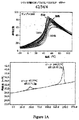
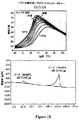
都合のよいことに、官能性フルオロポリマーは、末端官能基を持っていない対応フルオロポリマーと同様な物理的特性を呈し、特に同様な誘電特性および強誘電特性を呈する。図1に示されているように、シラン基を有するボラン開始剤を用いて調製された2種類のシラン末端VDF/TrFE/CDFEターポリマーが加熱−冷却サイクル中のDSCおよび誘電定数により調べられた。一見して、この末端シラン基はこれらのターポリマー特性に影響を及ぼさなかった。この鎖末端官能基化ターポリマーでは、望ましい特性、例えば高い誘電定数および環境Curie温度などを得ることができ、これらの特性は、基本的に、そのターポリマーの主鎖によって決定される。 Conveniently, the functional fluoropolymer exhibits similar physical properties as the corresponding fluoropolymer without terminal functional groups, and in particular exhibits similar dielectric and ferroelectric properties. As shown in FIG. 1, two silane-terminated VDF / TrFE / CDFE terpolymers prepared using borane initiators with silane groups were investigated by DSC and dielectric constant during the heat-cool cycle. . At first glance, this terminal silane group did not affect these terpolymer properties. With this chain end functionalized terpolymer, desirable properties such as high dielectric constant and environmental Curie temperature can be obtained, and these properties are basically determined by the backbone of the terpolymer.
これらの鎖末端官能基化フルオロポリマーにおける官能基は、架橋フルオロポリマーネットワーク構造の形成を可能にする。そのような材料は、300MV/m(メガボルト・パー・メートル)までの極めて高い外部電場の下においてさえ、機械的強度および電気的安定性が高められているものと期待される。その上、これらの官能基は、全体的な誘電特性および強誘電特性を更に高めるために非常に高い誘電定数(1kHzにおいて、ε>50)を有する誘電性の有機または無機の分子または粒子を組み入れることを含め、他の材料の組み入れを可能にする。即ち、官能性フルオロポリマーは一様な複合構造を形成するメカニズムを提供し、高電場条件下においてさえ充分に分散した構造を維持することができる。これらの複合材料は、本官能基化フルオロポリマーを別の材料と単純に混ぜ合わせることにより調製することができる。当然のことながら、この混合プロセスは化学反応および、添加剤、例えば安定剤、グラスファイバおよびカーボンブラックなどを伴った、またはそのような添加剤を伴わない、物理的な混合を含むことができる。更に、このプロセスは、溶液を混合する工程および溶融混合工程も含むことができる。これらの官能性フルオロポリマー複合材料の組成は、2元または3元ブレンドであってよい。そのような2元ブレンド組成物は、例えば、(a)重量で約60部〜99部の式(I)で描かれている官
能性フルオロポリマーおよび(b)重量で約1部〜40部の高誘電性の有機材料または無機材料を含む。また、3元ブレンド組成物は、例えば、(a)重量で約1部〜50部の式(I)で描かれている官能性フルオロポリマー、(b)重量で約50部〜95部の第2のフルオロポリマー、例えば、鎖末端官能基化フルオロポリマー(I)と適合する対応フルオロポリマー(官能基を持たない)、および(c)重量で約1部〜40部の高誘電性の有機材料または無機材料を含む。
The functional groups in these chain end functionalized fluoropolymers allow the formation of a crosslinked fluoropolymer network structure. Such materials are expected to have increased mechanical strength and electrical stability even under extremely high external electric fields up to 300 MV / m (megavolts per meter). In addition, these functional groups incorporate dielectric organic or inorganic molecules or particles having a very high dielectric constant (ε> 50 at 1 kHz) to further enhance the overall dielectric and ferroelectric properties. Other materials can be incorporated. That is, the functional fluoropolymer provides a mechanism to form a uniform composite structure and can maintain a well-dispersed structure even under high electric field conditions. These composite materials can be prepared by simply mixing the functionalized fluoropolymer with another material. Of course, this mixing process can include chemical reactions and physical mixing with or without additives such as stabilizers, glass fibers and carbon black. Further, the process can include mixing the solution and melt mixing. The composition of these functional fluoropolymer composites can be binary or ternary blends. Such binary blend compositions include, for example, (a) from about 60 to 99 parts by weight of the functional fluoropolymer depicted in Formula (I) and (b) from about 1 to 40 parts by weight. Includes highly dielectric organic or inorganic materials. Also, the ternary blend composition may be, for example, (a) about 1 to 50 parts by weight of a functional fluoropolymer depicted in Formula (I), (b) about 50 to 95 parts by weight 2 fluoropolymers, for example corresponding fluoropolymers (no functional groups) compatible with chain end functionalized fluoropolymer (I), and (c) about 1 to 40 parts by weight of high dielectric organic material Or an inorganic material is included.
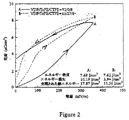
ポリマー鎖の一方の端部または両方の端部に1つもしくは複数の末端官能基を有するフルオロポリマー(I)の1つの大きな利点は、それらのフルオロポリマーが高い化学的反応性を呈することである。これらの反応性末端官能基は良好な移動性を有しており、特異的なカップリング反応を効果的に実行することができる。1つの例は架橋反応である。単純に加熱することにより、式2のテレケリックポリマー(D)における末端シラン基は、比較的明確に定義された構造を有する安定した3−Dネットワークを形成する。テレケリックポリマーの分子量により予め定められる架橋密度に加え、この架橋反応は薄膜形成プロセス中にその場で起こり得る。結果として生じる幾つかのVDFコポリマー薄膜およびターポリマー薄膜は、高い静電容量を伴って、極めて高い破壊電界を示す。図2は、どちらも8モル%のCTFE単位を含み、充電−放電(分極−脱分極)サイクルを伴う単極電場(350MV/m)の下で測定された、92/8および65/27/8のモル比を有する2種類のシラン基末端VDF/CTFEおよびVDF/TrFE/CTFEポリマーのP−E(分極対電場)曲線を比較したものである。92/8のモル比を有するVDF/CTFEコポリマーは、このクラスのコポリマーのうちで最適な組成物であり、大きな静電容量(350MV/mにおいて7.6μC/cm2)および高い破壊電界(>350MV/m)を示す。一方、65/27/8のモル比を有するVDF/TrFE/CTFEターポリマーは、一層高い静電容量(350MV/mにおいて8.4μC/cm2)および充電−放電サイクル中のスリムなヒステリシスループを示し、これは、このターポリマーにおけるリラクサ強誘電挙動を裏付けている。このポリマーにおけるエネルギー貯蔵はP−E曲線から算出することができ、それは、電場および分極電荷の積分面積に等しい。結果は、挿入されている表にまとめられている。充電サイクルにおいては、そのコポリマーは相対的に高い総合帯電エネルギー(17.87J/cm3)を示し、もう一方のターポリマーの場合には350MV/mにおいて11.56J/cm3である。しかし、放電サイクルにおいては、そのターポリマーは、相対的に小さなエネルギー損失3.94J/cm3(これに対し、もう一方のコポリマーの場合には10.19J/cm3)および同様なエネルギー密度(7.6J/cm3)を示す。このエネルギー損失の低減は、多くの装置設計および用途についての考慮すべき事柄である。
One major advantage of fluoropolymers (I) having one or more terminal functional groups at one or both ends of the polymer chain is that the fluoropolymers exhibit high chemical reactivity. . These reactive terminal functional groups have good mobility and can effectively carry out a specific coupling reaction. One example is a crosslinking reaction. By simply heating, the terminal silane groups in the telechelic polymer (D) of formula 2 form a stable 3-D network with a relatively well-defined structure. In addition to the crosslinking density predetermined by the molecular weight of the telechelic polymer, this crosslinking reaction can occur in situ during the film formation process. Some resulting VDF copolymer films and terpolymer films exhibit very high breakdown fields with high capacitance. FIG. 2 shows that 92/8 and 65/27 /, both containing 8 mol% CTFE units, measured under a monopolar electric field (350 MV / m) with a charge-discharge (polarization-depolarization) cycle. 2 compares the PE (polarization versus electric field) curves of two silane-terminated VDF / CTFE and VDF / TrFE / CTFE polymers having a molar ratio of 8. FIG. VDF / CTFE copolymers having a molar ratio of 92/8 are the optimal composition of this class of copolymers, with large capacitance (7.6 μC /
更に、これらの反応性末端官能基は、高い誘電定数を有する幾つかの高誘電性の有機分子または無機分子とのカップリング反応を実行することもできる。即ち、結果として生じる複合材料は、フルオロポリマーマトリックスにおける高誘電性分子のほぼ分子スケールでの分散を伴った状態で、非常に一様な形態をとることができる。同時に、この単相ポリマーまたはナノ複合材料は、例えば一層高い誘電定数、一層低い誘電損失、一層高い破壊電界、および一層良好な薄膜形成能力など、幾つかの誘電特性および強誘電特性を改善する。これらの新たな複合材料は、高電場の下での大きな電気−機械的応答および極めて高いエネルギー密度を伴って、長期間、ロボット性能(robotic performance)を呈することができる。 Furthermore, these reactive terminal functional groups can also carry out coupling reactions with several high dielectric organic or inorganic molecules having a high dielectric constant. That is, the resulting composite material can take a very uniform form with the dispersion of high dielectric molecules in the fluoropolymer matrix at approximately the molecular scale. At the same time, the single phase polymer or nanocomposite improves several dielectric and ferroelectric properties, such as higher dielectric constant, lower dielectric loss, higher breakdown field, and better thin film formation capability. These new composite materials can exhibit robotic performance for long periods of time with a large electro-mechanical response under very high electric fields and very high energy density.
複合材料の調製においては、官能性フルオロポリマー(I)との適合性又は/及び反応性を有する多数の成分を用いることができる。例えば、2元ブレンド組成物は、(a)重量で約60部〜99部の官能性フルオロポリマー(I)および(b)重量で約1部〜40部の高誘電性の有機材料または無機材料を含む。これらの複合材料を調製するために使用することができる高誘電性材料の例は、金属酸化物などの圧電性材料、例えばBTOおよ
びPZTなどを含む。3元ブレンド組成物は、(a)重量で約1部〜50部の官能性フルオロポリマー(I)、(b)重量で約50部〜95部の、鎖末端官能基化フルオロポリマー(I)と適合する対応フルオロポリマー(末端官能基を持たない)、および(c)重量で約1部〜40部の、好適には1kHzにおいてある誘電定数(ε>50)を有する、高誘電性の有機材料または無機材料を含むことができる。
In preparing the composite material, a number of components that are compatible or / and reactive with the functional fluoropolymer (I) can be used. For example, the binary blend composition comprises (a) about 60 parts to 99 parts by weight of functional fluoropolymer (I) and (b) about 1 part to 40 parts by weight of a high dielectric organic or inorganic material. including. Examples of high dielectric materials that can be used to prepare these composite materials include piezoelectric materials such as metal oxides, such as BTO and PZT. The ternary blend composition comprises (a) about 1 to 50 parts by weight of functional fluoropolymer (I), (b) about 50 to 95 parts by weight of chain end functionalized fluoropolymer (I) A corresponding fluoropolymer (without terminal functional groups), and (c) a high dielectric organic having a dielectric constant (ε> 50) of about 1 to 40 parts by weight, preferably at 1 kHz Materials or inorganic materials can be included.
BTOおよびPZTセラミックナノ粒子ならびに銅フタロシアニン(CuCy)有機分子を含め、幾種類かの公知の高誘電性材料が、一様な複合材料の形成に使用された。CuCy分子は、80年代にかなりの関心を集めた。幾つかの実験結果は、高い温度において著しく高い誘電定数(ε>105)が観測されたことを含め、改善された電気特性を示した。これらの独特な電気特性は、多数のフタロシアニン大員環構造における高度のπ電子非局在化の結果であると確信される。これに加え、大員環のエッジの周囲に位置付けられた多数のCOOH基は、対応する反応性末端基(例えばOHおよびNH2など)を含んでいる鎖末端官能性フルオロポリマーとのカップリングのための反応性部位を提供する。式3に示されているように、OH基末端フルオロポリマーとCuCy分子との間でのカップリング反応は、そのフルオロポリマーマトリックスにおけるCuCy分子の分子スケールでの分散を伴った星型分岐ポリマー構造を形成する。 Several known high dielectric materials have been used to form uniform composites, including BTO and PZT ceramic nanoparticles and copper phthalocyanine (CuCy) organic molecules. CuCy molecules attracted considerable interest in the 80s. Several experimental results showed improved electrical properties, including the observation of significantly higher dielectric constants (ε> 10 5 ) at higher temperatures. These unique electrical properties are believed to be the result of a high degree of π-electron delocalization in many phthalocyanine macrocycle structures. In addition, a number of COOH groups located around the edge of the macrocycle are coupled to chain end functional fluoropolymers containing corresponding reactive end groups (such as OH and NH 2 ). Provides a reactive site for As shown in Equation 3, the coupling reaction between the OH-terminated fluoropolymer and the CuCy molecule results in a star-branched polymer structure with molecular-scale dispersion of the CuCy molecule in the fluoropolymer matrix. Form.
記号「フルオロポリマー」は、上記と同じポリマーを表す。この例では、そのフルオロポリマーは末端OH基を有している。 The symbol “fluoropolymer” represents the same polymer as described above. In this example, the fluoropolymer has terminal OH groups.
結果として生じる星型分岐ポリマー構造は良好なせん断シンニング(shear thinning)および高い溶融強度を呈することができ、また、一様なポリマー薄膜の形態に成すことができる。それは、2軸配向(2−D構造による)を有していて、実質的に欠陥のない極薄膜(厚み<約5μm)を形成することが期待される。図3に示されているように、(a)約15,000g/モルの数平均分子量を有するOH末端VDF/TrFE/CTFE(59/34/7のモル比)ターポリマーと(b)例外的に高い誘電定数(ε>50,000)を有するCuCyオリゴマーとの間で80/20の重量比を含有した一様で強い複合フィルムの誘電定数は、50℃において、1kHzで400超、100kHzで300超に達する。この材料の全体的な誘電定数は、高誘電性CuCy分子の含有
量の増加に伴い、1〜100kHzの間で系統的に増大する。更に言えば、その含有量は、誘電定数を高めるために2相の無機/ポリマー複合材料で通常必要となる浸透限界(体積分率>35%)を充分に下回っている。この見掛け上単相の材料においては、ポリマー鎖に沿ったすべての構成単位がその材料の誘電定数に線形的に寄与しているように思われる。これに加え、このフィルムは非常に低い誘電損失および高い破壊電圧を示す。それは、CuCy分子の分子スケールでの分散を伴った単相を有しているものと確信される。
The resulting star-branched polymer structure can exhibit good shear thinning and high melt strength, and can be in the form of a uniform polymer film. It is expected to form a very thin film (thickness <about 5 μm) having biaxial orientation (with a 2-D structure) and substantially free of defects. As shown in FIG. 3, (a) an OH-terminated VDF / TrFE / CTFE (59/34/7 molar ratio) terpolymer having a number average molecular weight of about 15,000 g / mole and (b) exceptional The dielectric constant of a uniform strong composite film containing a weight ratio of 80/20 with a CuCy oligomer having a very high dielectric constant (ε> 50,000) is greater than 400 at 1 kHz and at 100 kHz at 50 ° C. Reach over 300. The overall dielectric constant of this material increases systematically between 1 and 100 kHz with increasing content of high dielectric CuCy molecules. Furthermore, its content is well below the penetration limit (volume fraction> 35%) normally required for a two-phase inorganic / polymer composite to increase the dielectric constant. In this apparently single phase material, all the structural units along the polymer chain appear to contribute linearly to the dielectric constant of the material. In addition, this film exhibits very low dielectric loss and high breakdown voltage. It is believed to have a single phase with molecular scale dispersion of CuCy molecules.
以下の実施例は、本発明の原理および本発明の実施形態の実践を例示するものであって、本質的に決して限定するものではない。当業者であれば、日常的な実験を行うことにより、ここで開述されている特定の物質および手順に対する数多くの同等物を認識し、またはそれらを確認することができよう。 The following examples illustrate the principles of the present invention and the practice of embodiments of the present invention and are in no way limiting in nature. Those skilled in the art will recognize, or be able to ascertain, from routine experimentation, many equivalents to the specific materials and procedures described herein.
実施例1
((C2H5O)3SiCH2CH2)3B官能性開始剤の合成
磁気撹拌棒を備えた500ml容の乾いたフラスコに250mlの乾性THFおよび35g(180mmol)のビニルトリエトキシルシランを注入した。その溶液を0℃に冷却した後、THF(1.0M)中における60mlのBH3を加えた。得られた混合物を0℃で4時間撹拌し、その後、環境温度にまで1時間温め、確実に完全なヒドロホウ素化反応を行った。溶媒の除去後、その生成物を170℃において減圧蒸留することにより、31.4gの((C2H5O)3SiCH2CH2)3B官能性開始剤が得られた。
Example 1
Synthesis of ((C 2 H 5 O) 3 SiCH 2 CH 2 ) 3 B
実施例2
(Cl3SiCH2CH2CH2)3B官能性開始剤の合成
(Cl3SiCH2CH2CH2)3B官能性開始剤は、アリルトリクロロシランのホウ素ヒドリド(3:1のモル比)でのヒドロホウ素化により調製された。ヒドロホウ素化反応は、テトラヒドロフラン(THF)中において0℃で4時間実施された。1つの典型的な実施例では、その反応は、20mlの乾性THFおよび8.7ml(0.06mol)のアリルトリクロロシランを含有する乾いたフラスコ中で実施された。この後、その溶液を0℃にまで冷却し、次いで、その反応フラスコに気密シリンジを介してTHF中における20ml(0.02mol)の0.1Mのホウ素ヒドリドをゆっくりと滴下させた。その溶液を0℃で4時間撹拌した。その後、THFを高真空ポンプ下において除去することにより、約82%の収率でトリ(トリクロロシリルプロピル)ボラン開始剤が得られた。
Example 2
Synthesis of (Cl 3 SiCH 2 CH 2 CH 2) 3 B functional initiator (Cl 3 SiCH 2 CH 2 CH 2) 3 B functional initiator, boron hydride allyl trichlorosilane (3: 1 mole ratio) Prepared by hydroboration with The hydroboration reaction was carried out in tetrahydrofuran (THF) at 0 ° C. for 4 hours. In one exemplary example, the reaction was performed in a dry flask containing 20 ml dry THF and 8.7 ml (0.06 mol) allyltrichlorosilane. After this time, the solution was cooled to 0 ° C. and then 20 ml (0.02 mol) of 0.1 M boron hydride in THF was slowly added dropwise to the reaction flask via an airtight syringe. The solution was stirred at 0 ° C. for 4 hours. Thereafter, THF was removed under a high vacuum pump to obtain tri (trichlorosilylpropyl) borane initiator in about 82% yield.
実施例3
(CH3Cl2SiCH2CH2CH2)3B官能性開始剤の合成
実施例2で開述されているのと同様な手順に従って、(CH3Cl2SiCH2CH2CH2)3B官能性開始剤は、アリルジクロロメチルシランのホウ素ヒドリド(3:1のモル比)でのヒドロホウ素化により調製された。ヒドロホウ素化反応は、テトラヒドロフラン(THF)中において0℃で4時間実施された。高真空下におけるTHFの除去後、(CH3Cl2SiCH2CH2CH2)3B官能性開始剤が87%の収率で得られた。
Example 3
Synthesis of (CH 3 Cl 2 SiCH 2 CH 2 CH 2 ) 3 B Functional Initiator Following a procedure similar to that described in Example 2, (CH 3 Cl 2 SiCH 2 CH 2 CH 2 ) 3 B The functional initiator was prepared by hydroboration of allyldichloromethylsilane with boron hydride (3: 1 molar ratio). The hydroboration reaction was carried out in tetrahydrofuran (THF) at 0 ° C. for 4 hours. After removal of THF under high vacuum, (CH 3 Cl 2 SiCH 2 CH 2 CH 2 ) 3 B functional initiator was obtained in 87% yield.
実施例4
((CH3)2ClSiCH2CH2CH2)3B官能性開始剤の合成
実施例2で開述されているのと同様な手順に従って、((CH3)2ClSiCH2CH2CH2)3B官能性開始剤は、アリルクロロジメチルシランのホウ素ヒドリド(3:1のモル比)でのヒドロホウ素化により調製された。ヒドロホウ素化反応は、テトラヒドロフラン(THF)中において0℃で4時間実施された。高真空下におけるTHFの除去後、(CH3Cl2SiCH2CH2CH2)3B官能性開始剤が90%の収率で得られ
た。
Example 4
Synthesis of ((CH 3 ) 2 ClSiCH 2 CH 2 CH 2 ) 3 B Functional Initiator According to a procedure similar to that described in Example 2, ((CH 3 ) 2 ClSiCH 2 CH 2 CH 2 ) The 3 B functional initiator was prepared by hydroboration of allylchlorodimethylsilane with boron hydride (3: 1 molar ratio). The hydroboration reaction was carried out in tetrahydrofuran (THF) at 0 ° C. for 4 hours. After removal of THF under high vacuum, (CH 3 Cl 2 SiCH 2 CH 2 CH 2 ) 3 B functional initiator was obtained in 90% yield.
実施例5
(C2H5OOCCH2CH2CH2)3B官能性開始剤の合成
実施例2で開述されているのと同様な手順に従って、(C2H5OOCCH2CH2CH2)3B官能性開始剤は、アリルアセタートのホウ素ヒドリド(3:1のモル比)でのヒドロホウ素化により調製された。ヒドロホウ素化反応は、テトラヒドロフラン(THF)中において0℃で4時間実施された。高真空下におけるTHFの除去後、(C2H5OOCCH2CH2CH2)3B官能性開始剤が85%の収率で得られた。
Example 5
Synthesis of (C 2 H 5 OOCCH 2 CH 2 CH 2 ) 3 B Functional Initiator Following a procedure similar to that described in Example 2, (C 2 H 5 OOCCH 2 CH 2 CH 2 ) 3 B The functional initiator was prepared by hydroboration of allyl acetate with boron hydride (3: 1 molar ratio). The hydroboration reaction was carried out in tetrahydrofuran (THF) at 0 ° C. for 4 hours. After removal of THF under high vacuum, (C 2 H 5 OOCCH 2 CH 2 CH 2 ) 3 B functional initiator was obtained in 85% yield.
実施例6
官能性ペルオキシド開始剤の合成
1つの典型的な実施例では、25mlの水中における6gの塩化ナトリウムの混合物を0℃に冷却し、その後、0.28g(3.6mmol)の過酸化ナトリウムをゆっくりと加えた。添加の完了後、その溶液を−25℃に冷却し、激しく撹拌した。0.9g(5mmol)のトリクロロアセチルクロリドをシリンジにより1分間以内にゆっくりと加え、−25℃で5分間攪拌した。この後、その溶液を15mlのクロロホルムで(または、アリルクロロホルマートおよび2−ブロモ−エチルクロロホルマートのケースにおいてはエーテルで)抽出した。この後、その触媒溶液を高真空下において乾燥させることにより、約80%の収率で白色固体のペルオキシド生成物が得られ、重合に使用する準備が整った。
Example 6
Synthesis of Functional Peroxide Initiator In one exemplary embodiment, a mixture of 6 g sodium chloride in 25 ml water is cooled to 0 ° C., after which 0.28 g (3.6 mmol) sodium peroxide is slowly added. added. After the addition was complete, the solution was cooled to −25 ° C. and stirred vigorously. 0.9 g (5 mmol) of trichloroacetyl chloride was slowly added by syringe within 1 minute and stirred at −25 ° C. for 5 minutes. After this time, the solution was extracted with 15 ml of chloroform (or with ether in the case of allyl chloroformate and 2-bromo-ethyl chloroformate). The catalyst solution was then dried under high vacuum to obtain a white solid peroxide product in about 80% yield, ready for use in polymerization.
実施例7
CF2=CFCH2CH2OH官能性モノマーの合成
冷却器および磁気攪拌器を備えた丸底フラスコに3.0g(125mmol)のマグネシウム粉末を導入した。そのフラスコを真空下において約30分間火力乾燥させ、アルゴンを再充填した後、200mlの完全に乾燥したジエチルエーテルを加えた。この後、19.0g(100.5mmol)のCF2=CFCH2CH2Br(BTFB)を2工程に分けて加えた。激しい攪拌下において、第1部分の3.0gのBTFBがそのフラスコに注入された。この発熱反応は溶媒の還流を引き起こす。5分後、残りのBTFBを滴下させながら加え、溶媒の還流を維持した。BTFBの添加が完了した後、その溶液を連続的に更に2時間撹拌し、その後、濾過して固形物を取り除くことにより、透明な薄黄色のCF2=CFCH2CH2MgBr/エーテル溶液が得られた。その後、この透明な薄黄色の溶液を0℃に冷却し、この時、1.3リットル(54mmol)のO2を約30分間にわたってその溶液にゆっくりと導入した。更に30分間攪拌した後、120mlの1MのHCl/H2Oを加えた。得られた混合物を更に30分間攪拌し、その後、水層を除去した。その有機層を50mlのブラインで3回洗い、その後、MgSO4により乾燥させた。濾過によりMgSO4を取り除き、また、80℃での常圧下における蒸留によりエーテルを取り除いた後、その粗生成物を常圧下において分別的に蒸留した。最終生成物が、110℃〜115℃での分別蒸留により、無色透明な液体として回収され、その最終生成物は8.2gのCF2=CFCH2CH2OHであり、全体的な収率は67%であった。
Example 7
Synthesis of CF 2 ═CFCH 2 CH 2 OH Functional Monomer 3.0 g (125 mmol) of magnesium powder was introduced into a round bottom flask equipped with a condenser and a magnetic stirrer. The flask was heat dried under vacuum for about 30 minutes, refilled with argon, and 200 ml of completely dried diethyl ether was added. After this, 19.0 g (100.5 mmol) of CF 2 ═CFCH 2 CH 2 Br (BTFB) was added in two steps. Under vigorous stirring, a first portion of 3.0 g BTFB was injected into the flask. This exothermic reaction causes the solvent to reflux. After 5 minutes, the remaining BTFB was added dropwise, maintaining the reflux of the solvent. After the addition of BTFB was complete, the solution was continuously stirred for an additional 2 hours and then filtered to remove the solids to give a clear light yellow CF 2 ═CFCH 2 CH 2 MgBr / ether solution. It was. The clear light yellow solution was then cooled to 0 ° C., at which time 1.3 liters (54 mmol) of O 2 was slowly introduced into the solution over about 30 minutes. After stirring for another 30 minutes, 120 ml of 1M HCl / H 2 O was added. The resulting mixture was stirred for an additional 30 minutes, after which the aqueous layer was removed. The organic layer was washed 3 times with 50 ml brine and then dried over MgSO 4 . After removal of MgSO 4 by filtration and removal of ether by distillation under normal pressure at 80 ° C., the crude product was fractionally distilled under normal pressure. The final product is recovered as a clear, colorless liquid by fractional distillation at 110 ° C. to 115 ° C., and the final product is 8.2 g CF 2 ═CFCH 2 CH 2 OH, and the overall yield is 67%.
実施例8
CF2=CFCH2CH2OSi(CH3)3官能性モノマーの合成
実施例7の手順に従って、3.0gのMgを300mlのジエチルエーテル中における19.0gのBTFBと反応させることにより、透明な薄黄色のCF2=CFCH2CH2MgBr/エーテル溶液が調製された。次いで、この溶液に7.0g(41mmol)のN,N,N’,N’,N’’−ペンタメチル−ジエチレントリアミン(PMDETA)を加えた。激しい攪拌下において、その混合物に11g(10.2mmol)の(CH3)3SiClを約20分間にわたって滴下させながら加えた。30分間攪拌し続け、結果
として生じたスラリーを濾過し、100mlのエーテルで3回洗った。それらを合わせた濾液を常圧下における70℃での蒸留によってエーテルを除去することにより濃縮し、その後、微量の残ったエーテルおよび過剰なMe3SiClを0℃において真空(0.5mmHg)下で完全に除去した。その純粋な生成物(12.2g)を120℃〜125℃において蒸留したところ、収率は61%であった。
Example 8
According to the procedure of CF 2 = CFCH 2 CH 2 OSi (CH 3) 3 Synthesis Example of functional monomers 7, by reaction with BTFB of 19.0g of Mg of 3.0g during
実施例9
CF2=CFCH2CH2Si(CH3)2H官能性モノマーの合成
実施例7で開述されているのと同じ手順に従って、4.2g(175.0mmol)のMgを300mlのジエチルエーテル中における29.0g(150.2mmol)のBTFBと反応させることにより、透明な薄黄色のCF2=CFCH2CH2MgBr/エーテル溶液が調製された。その溶液を0℃に冷却した後、14.1g(150mmol)の(CH3)2SiHClを加えた。その混合物を2時間以内にゆっくりと室温にまで温め、更に2時間撹拌した。この後、その溶液から固形物を完全に分離させるため、得られた混合物を−40℃に冷却した。次いで残渣からエーテル層をデカントした。70℃においてその溶液からエーテルを蒸留した後、もっと高い温度での蒸留によりCF2=CFCH2CH2Si(CH3)2Hの無色の液体生成物(17.2g)が得られ、収率は60%であった。
Example 9
Synthesis of CF 2 ═CFCH 2 CH 2 Si (CH 3 ) 2 H Functional Monomer According to the same procedure as described in Example 7, 4.2 g (175.0 mmol) Mg in 300 ml diethyl ether A clear, light yellow CF 2 ═CFCH 2 CH 2 MgBr / ether solution was prepared by reacting with 29.0 g (150.2 mmol) of BTFB. After cooling the solution to 0 ° C., 14.1 g (150 mmol) of (CH 3 ) 2 SiHCl was added. The mixture was slowly warmed to room temperature within 2 hours and stirred for an additional 2 hours. After this time, the resulting mixture was cooled to −40 ° C. in order to completely separate the solids from the solution. The ether layer was then decanted from the residue. After distillation of the ether from the solution at 70 ° C., distillation at a higher temperature gave a colorless liquid product (17.2 g) of CF 2 ═CFCH 2 CH 2 Si (CH 3 ) 2 H, yield. Was 60%.
実施例10
末端(C2H5O)3SiCH2CH2基を含有するVDF/TrFEコポリマーの合成
この重合は、磁気撹拌棒を備えたParr高圧反応器(75ml)中で実施された。約0.3gの((C2H5O)3SiCH2CH2)3B開始剤(実施例1から得られたもの)をアルゴン雰囲気下においてこの反応器に加えた。この後、そのオートクレーブを真空にし、液体窒素により外側から冷却し、18gのビニリデンフルオリド(VDF)および12gのトリフルオロエチレン(TrFE)をオートクレーブ中に蒸留した。それらのモノマーおよびトリブチルボランがオートクレーブに加えられた後、0.025×10⁻³モルの酸素をオートクレーブ中に導入し、そのオートクレーブを環境温度にまで温めた。このバルク重合を環境温度で5時間続けた後、あらゆる未反応のモノマーを真空蒸留した。結果として生じた鎖末端官能性コポリマー(10.2g)を回収し、メタノールで洗い、乾燥させた。塩素分析および1H NMR測定によれば、このターポリマーは、65.8モル%のVDFおよび34.2モル%のTrFEから成る組成を有し、末端(C2H5O)3SiCH2CH2基を含有している。このコポリマーは、DSC測定に基づけば、143℃のピーク融解温度および68℃のCurie温度を有していた。
Example 10
Synthesis The polymerization of VDF / TrFE copolymer containing terminal (C 2 H 5 O) 3 SiCH 2 CH 2 group was carried out in Parr high pressure reactor equipped with a magnetic stir bar (75 ml). About 0.3 g of ((C 2 H 5 O) 3 SiCH 2 CH 2 ) 3 B initiator (obtained from Example 1) was added to the reactor under an argon atmosphere. After this time, the autoclave was evacuated and cooled from the outside with liquid nitrogen, and 18 g vinylidene fluoride (VDF) and 12 g trifluoroethylene (TrFE) were distilled into the autoclave. After the monomers and tributylborane were added to the autoclave, 0.025 × 10 −3 moles of oxygen were introduced into the autoclave and the autoclave was warmed to ambient temperature. This bulk polymerization was continued at ambient temperature for 5 hours before any unreacted monomer was vacuum distilled. The resulting chain end functional copolymer (10.2 g) was recovered, washed with methanol and dried. According to chlorine analysis and 1 H NMR measurement, the terpolymer has a composition consisting of 65.8 mol% VDF and 34.2 mol% TrFE and is terminal (C 2 H 5 O) 3 SiCH 2 CH. Contains 2 groups. The copolymer had a peak melting temperature of 143 ° C. and a Curie temperature of 68 ° C. based on DSC measurements.
実施例11〜14
末端(C2H5O)3SiCH2CH2基を含有するVDF/HFPコポリマーの合成
一連の(C2H5O)3Si基末端VDF/HFPコポリマーが、((C2H5O)3SiCH2CH2)3B官能性開始剤(実施例1から得られたもの)を用いることにより調製された。表1はそれらの実験条件および結果をまとめたものである。すべての重合反応は、磁気撹拌棒を備えたParr高圧反応器(200ml)内で実施された。1つの典型的な反応では、4.6gの((C2H5O)3SiCH2CH2)3B(10mmol)がドライボックス内において80mlのCH2Cl2中に溶解され、この後、その反応器が真空ラインに接続され、25.6gのVDF(400mmol)および60gのHFP(400mmol)が液体窒素により真空下において凝縮された。ボラン部分を酸化して重合を開始させるために、約5mmolのO2がその反応器内に充填され、その重合は、60℃で10時間実施された。室温にまで冷却し、圧力を解放した後、その混合物を100mlのヘキサンを含有しているフラスコ内に移した。30分間攪拌した後、そのポリマー粉末を濾過し、洗い、その後、60℃において6時間真空下で乾燥させた。28%の
収率で約24gのポリマー(白色の軟質ワックス)が得られた。このポリマーの構造が1Hおよび19F NMRスペクトルにより確認された。
Examples 11-14
Synthesis of VDF / HFP Copolymer Containing Terminal (C 2 H 5 O) 3 SiCH 2 CH 2 Groups A series of (C 2 H 5 O) 3 Si group terminated VDF / HFP copolymers are ((C 2 H 5 O) Prepared by using 3 SiCH 2 CH 2 ) 3 B functional initiator (obtained from Example 1). Table 1 summarizes the experimental conditions and results. All polymerization reactions were carried out in a Parr high pressure reactor (200 ml) equipped with a magnetic stir bar. In one typical reaction, 4.6 g ((C 2 H 5 O) 3 SiCH 2 CH 2 ) 3 B (10 mmol) is dissolved in 80 ml CH 2 Cl 2 in a dry box, after which The reactor was connected to a vacuum line and 25.6 g VDF (400 mmol) and 60 g HFP (400 mmol) were condensed under vacuum with liquid nitrogen. About 5 mmol of O 2 was charged into the reactor to oxidize the borane moiety and initiate the polymerization, and the polymerization was carried out at 60 ° C. for 10 hours. After cooling to room temperature and releasing the pressure, the mixture was transferred into a flask containing 100 ml of hexane. After stirring for 30 minutes, the polymer powder was filtered, washed and then dried under vacuum at 60 ° C. for 6 hours. About 24 g of polymer (white soft wax) was obtained with a yield of 28%. The structure of this polymer was confirmed by 1 H and 19 F NMR spectra.
実施例15
末端(C2H5O)3SiCH2CH2基を含有するVDF/TrFE/CTFEターポリマーの合成
この重合は、磁気撹拌棒を備えたParr高圧反応器(75ml)中で実施された。約0.3g(0.5×10⁻³モル)の((C2H5O)3SiCH2CH2)3B開始剤(実施例1から得られたもの)をアルゴン雰囲気下においてこの反応器に加えた。この後、そのオートクレーブを真空にし、液体窒素により外側から冷却し、16.7g(0.26モル)のビニリデンフルオリド(VDF)、7.6g(0.09モル)のトリフルオロエチレン(TrFE)および1.7g(0.015モル)のクロロトリフルオロエチレン(CTFE)をオートクレーブ中に蒸留した。それらのモノマーおよびトリブチルボランがオートクレーブに加えられた後、0.025×10⁻³モルの酸素をオートクレーブ中に導入し、そのオートクレーブを環境温度にまで温めた。このバルク重合を環境温度で5時間続けた後、あらゆる未反応のモノマーを真空蒸留した。結果として生じた鎖末端官能性ターポリマー(6.5g)を回収し、メタノールで洗い、乾燥させた。塩素分析および1H NMR測定によれば、このターポリマーは、73.5モル%のVDF、17.6モル%のTrFEおよび8.9モル%のCTFEから成る組成を有し、末端(C2H5O)3SiCH2CH2基を含有している。このターポリマーは、DSC測定に基づく112℃のピーク融解温度、および0.41の固有粘度(MEK、35℃)を有していた。
Example 15
Synthesis of VDF / TrFE / CTFE terpolymer containing terminal (C 2 H 5 O) 3 SiCH 2 CH 2 groups This polymerization was carried out in a Parr high pressure reactor (75 ml) equipped with a magnetic stir bar. About 0.3 g (0.5 × 10 −3 mol) of ((C 2 H 5 O) 3 SiCH 2 CH 2 ) 3 B initiator (obtained from Example 1) was reacted under argon atmosphere. Added to the vessel. The autoclave was then evacuated and cooled from the outside with liquid nitrogen, 16.7 g (0.26 mol) vinylidene fluoride (VDF), 7.6 g (0.09 mol) trifluoroethylene (TrFE). And 1.7 g (0.015 mol) of chlorotrifluoroethylene (CTFE) were distilled into the autoclave. After the monomers and tributylborane were added to the autoclave, 0.025 × 10 −3 moles of oxygen were introduced into the autoclave and the autoclave was warmed to ambient temperature. This bulk polymerization was continued at ambient temperature for 5 hours before any unreacted monomer was vacuum distilled. The resulting chain end functional terpolymer (6.5 g) was recovered, washed with methanol and dried. According to chlorine analysis and 1 H NMR measurement, the terpolymer has a composition consisting of 73.5 mol% VDF, 17.6 mol% TrFE and 8.9 mol% CTFE, and has terminal (C 2 contains a H 5 O) 3 SiCH 2 CH 2 group. The terpolymer had a peak melting temperature of 112 ° C. based on DSC measurements and an intrinsic viscosity of 0.41 (MEK, 35 ° C.).
実施例16〜21
末端(C2H5O)3SiCH2CH2基を含有するVDF/TrFE/CTFEターポリマーの合成
一連の(C2H5O)3SiCH2CH2基末端VDF/TrFE/CTFEターポリマーが、モノマーの供給比率および反応条件を変えた点を除き、実施例15で開述されているものと同様な手順に従って、((C2H5O)3SiCH2CH2)3B開始剤を用いることにより調製された。結果として得られたこれらのターポリマーを元素分析、1H
NMR、DSC、および固有粘度(MEK、35℃)により分析した。表2はそれらの反応条件および実験結果をまとめたものである。
Examples 16-21
Synthesis of VDF / TrFE / CTFE terpolymers containing terminal (C 2 H 5 O) 3 SiCH 2 CH 2 groups A series of (C 2 H 5 O) 3 SiCH 2 CH 2 group terminal VDF / TrFE / CTFE terpolymers ((C 2 H 5 O) 3 SiCH 2 CH 2 ) 3 B initiator according to the same procedure as described in Example 15, except that the monomer feed ratio and reaction conditions were changed. It was prepared by using. The resulting terpolymers were analyzed by elemental analysis, 1 H
Analysis was by NMR, DSC, and intrinsic viscosity (MEK, 35 ° C.). Table 2 summarizes the reaction conditions and experimental results.
実施例22〜27
VDF/CTFEコポリマーの水素化による末端(C2H5O)3SiCH2CH2基を含有したVDF/TrFE/CTFEターポリマーの合成
第1の工程はVDF/CTFEコポリマーの調製である。約0.10g(0.55mmol)の((C2H5O)3SiCH2CH2)3B開始剤を、磁気攪拌器を備えた75mL容のオートクレーブにアルゴン雰囲気下で加えた。次いで、そのオートクレーブを液体窒素で冷却した後、そこに19g(0.59モル)のVDFおよび7.1g(0.061モル)のCTFEモノマーを真空蒸留した。得られた混合物を環境温度にまで温め、0.27ミリモルの酸素をそのオートクレーブに導入して、オルガノボランを酸化し、重合を開始させた。このバルク重合を環境温度で5時間続けた後、あらゆる未反応のモノマーを発散させた。結果として生じたコポリマー(11.3g)を回収し、メタノールで洗い、真空オーブン内において70℃で8時間乾燥させた。塩素分析および1H NMR測定によれば、そのコポリマー組成物は、80.8モル%のVDFおよび19.2モル%のCTFEから成っていた。
Examples 22-27
Synthesis of VDF / TrFE / CTFE terpolymers containing terminal (C 2 H 5 O) 3 SiCH 2 CH 2 groups by hydrogenation of VDF / CTFE copolymers The first step is the preparation of VDF / CTFE copolymers. About 0.10 g (0.55 mmol) of ((C 2 H 5 O) 3 SiCH 2 CH 2 ) 3 B initiator was added to a 75 mL autoclave equipped with a magnetic stirrer under an argon atmosphere. The autoclave was then cooled with liquid nitrogen, and 19 g (0.59 mol) of VDF and 7.1 g (0.061 mol) of CTFE monomer were vacuum distilled there. The resulting mixture was warmed to ambient temperature and 0.27 mmol oxygen was introduced into the autoclave to oxidize the organoborane and initiate polymerization. This bulk polymerization was continued at ambient temperature for 5 hours before any unreacted monomer was released. The resulting copolymer (11.3 g) was collected, washed with methanol and dried in a vacuum oven at 70 ° C. for 8 hours. According to chlorine analysis and 1 H NMR measurements, the copolymer composition consisted of 80.8 mol% VDF and 19.2 mol% CTFE.
このVDF/CTFEコポリマーが水素化によりVDF/TrFE/CTFEターポリマーに更に変換された。1つの典型的な実施例においては、先に結果として得られた約1gのVDF/CTFEコポリマー(80.8/19.2mol%)が25mLのTHF中に溶解され、この後、そのコポリマー溶液に0.206mL(0.77mmol)のトリ(n−ブチル)スズヒドリドおよび0.015g(0.091mmol)のAIBNが加えられた。この水素化反応は60℃で12時間行われた。溶媒を蒸発させた後、結果として得られたVDF/TrFE/CTFEターポリマーを多量のメタノールで洗い、乾燥させた。塩素分析および1H NMR測定によれば、このターポリマー組成物は、80.8モル%のVDF、11.2モル%のTrFEおよび8.0モル%のCTFEから成っていた。表3は数種類のターポリマーの実験結果をまとめたものである。 This VDF / CTFE copolymer was further converted to a VDF / TrFE / CTFE terpolymer by hydrogenation. In one exemplary embodiment, approximately 1 g of the previously obtained VDF / CTFE copolymer (80.8 / 19.2 mol%) was dissolved in 25 mL of THF, after which the copolymer solution was 0.206 mL (0.77 mmol) tri (n-butyl) tin hydride and 0.015 g (0.091 mmol) AIBN were added. This hydrogenation reaction was carried out at 60 ° C. for 12 hours. After evaporating the solvent, the resulting VDF / TrFE / CTFE terpolymer was washed with copious amounts of methanol and dried. According to chlorine analysis and 1 H NMR measurements, the terpolymer composition consisted of 80.8 mol% VDF, 11.2 mol% TrFE and 8.0 mol% CTFE. Table 3 summarizes the experimental results of several terpolymers.
実施例28〜34
末端(C2H5O)(CH3)2SiCH2CH2基を含有するVDF/TrFE/CDFEターポリマーの合成
一連の(C2H5O)(CH3)2SiCH2CH2基末端VDF/TrFE/CDFEターポリマーが、開始剤、CDFEモノマー、モノマーの供給比率および反応条件を変えた点を除き、実施例15で開述されているものと同様な手順に従って、((C2H5O)(CH3)2SiCH2CH2)3B開始剤を用いることにより調製された。結果として得られたこれらのターポリマーを元素分析、1Hおよび19F NMR、DSC、ならびに固有粘度(MEK、35℃)により分析した。表4はそれらの実験結果をまとめたものである。見掛け上、この末端シラン基はこれらのターポリマーの特性に影響を及ぼさなかった。基本的には、鎖末端によってではなく、ターポリマーの組成によって決定される、高い誘電定数および環境Curie温度などの望ましい特性を鎖末端官能基化ターポリマーで得ることができる。
Examples 28-34
Terminus (C 2 H 5 O) ( CH 3) 2 SiCH 2 series of (C 2 H 5 O) Synthesis of VDF / TrFE / CDFE terpolymer containing CH 2 groups (CH 3) 2 SiCH 2 CH 2 group terminated Following the same procedure as described in Example 15 except that the VDF / TrFE / CDFE terpolymer changed the initiator, CDFE monomer, monomer feed ratio and reaction conditions ((C 2 H Prepared by using 5 O) (CH 3 ) 2 SiCH 2 CH 2 ) 3 B initiator. The resulting terpolymers were analyzed by elemental analysis, 1 H and 19 F NMR, DSC, and intrinsic viscosity (MEK, 35 ° C.). Table 4 summarizes the experimental results. Apparently, this terminal silane group did not affect the properties of these terpolymers. Basically, desirable properties such as high dielectric constants and environmental Curie temperatures can be obtained with chain end functionalized terpolymers determined by the composition of the terpolymer rather than by chain ends.
実施例35〜40
末端(C2H5O)(CH3)2SiCH2CH2基を含有するVDF/TrFE/CFEターポリマーの合成
((C2H5O)(CH3)2SiCH2CH2)3B開始剤、CFEモノマー、モノマーの供給比率および反応条件を用いる点を除き、実施例15で開述されているものと同様な手順に従う。結果として得られた種々のターポリマーを元素分析、1Hおよび19F
NMR、DSC、ならびに固有粘度(MEK、35℃)により分析した。一連の(C2H5O)(CH3)2SiCH2CH2基末端VDF/TrFE/CFEターポリマーが表5にまとめられている。
Examples 35-40
Terminus (C 2 H 5 O) ( CH 3) 2 SiCH 2 Synthesis of VDF / TrFE / CFE terpolymers containing CH 2 groups ((C 2 H 5 O) (CH 3) 2 SiCH 2 CH 2) 3 B A procedure similar to that described in Example 15 is followed except that the initiator, CFE monomer, monomer feed ratio and reaction conditions are used. The resulting various terpolymers were analyzed by elemental analysis, 1 H and 19 F
Analysis was by NMR, DSC, and intrinsic viscosity (MEK, 35 ° C.). A series of (C 2 H 5 O) (CH 3 ) 2 SiCH 2 CH 2 group terminated VDF / TrFE / CFE terpolymers are summarized in Table 5.
実施例41〜44
末端(C2H5O)(CH3)2SiCH2CH2基を含有するVDF/TrFE/VCおよびVDF/TrFE/VFターポリマーの合成
((C2H5O)(CH3)2SiCH2CH2)3B開始剤、ビニルクロリド(VC)またはビニルフルオリド(VF)モノマー、モノマーの供給比率および反応条件を用いる点を除き、実施例15で開述されているものと同様な手順に従う。一連の(C2H5O)(CH3)2SiCH2CH2基末端VDF/TrFE/VCおよびVDF/TrFE/VFターポリマーが表6にまとめられている。
Examples 41-44
Terminus (C 2 H 5 O) ( CH 3) 2 SiCH 2 Synthesis of VDF / TrFE / VC and VDF / TrFE / VF terpolymers containing CH 2 groups ((C 2 H 5 O) (CH 3) 2 SiCH 2 CH 2 ) 3 B initiator, vinyl chloride (VC) or vinyl fluoride (VF) monomer, procedure similar to that described in Example 15 except using monomer feed ratio and reaction conditions Follow. A series of (C 2 H 5 O) (CH 3 ) 2 SiCH 2 CH 2 group terminated VDF / TrFE / VC and VDF / TrFE / VF terpolymers are summarized in Table 6.
実施例45〜48
末端(C2H5O)(CH3)2SiCH2CH2基を含有するVDF/TrFE/HFPターポリマーの合成
((C2H5O)(CH3)2SiCH2CH2)3B開始剤、ヘキサフルオロプロペン(HFP)モノマー、モノマーの供給比率および反応条件を用いる点を除き、実施例15で開述されているものと同様な手順に従う。一連の(C2H5O)(CH3)2SiCH2CH2基末端VDF/TrFE/HFPターポリマーが表7にまとめられている。
Examples 45-48
Terminus (C 2 H 5 O) ( CH 3) 2 SiCH 2 Synthesis of VDF / TrFE / HFP terpolymer containing CH 2 groups ((C 2 H 5 O) (CH 3) 2 SiCH 2 CH 2) 3 B A procedure similar to that described in Example 15 is followed except that the initiator, hexafluoropropene (HFP) monomer, monomer feed ratio and reaction conditions are used. A series of (C 2 H 5 O) (CH 3 ) 2 SiCH 2 CH 2 group terminated VDF / TrFE / HFP terpolymers are summarized in Table 7.
実施例49
末端(C2H5O)3SiCH2CH2基を含有するVDF/TrFE/CF2=CFCH2CH2Si(CH3)2Hターポリマーの合成
磁気攪拌器を備えた70ml容のステンレス製オートクレーブ内において対照ラジカル重合を実施した。アルゴン下において3.0gのCF2=CFCH2CH2Si(CH3)2H、0.2gの((C2H5O)3SiCH2CH2)3B、および20mlのCH3CNを加えた後、20mlのVDFおよび7mlのTrFEを液体窒素温度においてそれらのモノマーを凝縮することにより真空下でその反応器内に導入した。この後、約15mlのO2を導入して重合を開始させた。そのオートクレーブを、ゆっくりと室温にまで温めた後、80℃において10時間油浴に浸漬した。未反応のモノマーを回収した後、そのスラリーを真空下において乾燥させることにより、45%の収率で5.5gの白色のポリマー粉末が得られた。塩素分析、ならびに1Hおよび19F NMR測定によれば、そのターポリマーは、63.5モル%のVDF、35.5モル%のTrFEおよび1.0モル%のCF2=CFCH2CH2Si(CH3)2Hから成る組成を持って、(C2H5O)3Si基とSi(CH3)2H基との両方を含有している。このターポリマーは、DSC測定に基づく135℃のピーク融解温度、および0.72の固有粘度(MEK、35℃)を有していた。
Example 49
Synthesis of VDF / TrFE / CF 2 ═CFCH 2 CH 2 Si (CH 3 ) 2 H Terpolymer Containing Terminal (C 2 H 5 O) 3 SiCH 2 CH 2 Group 70 ml stainless steel with magnetic stirrer Control radical polymerization was performed in an autoclave. Under argon, 3.0 g CF 2 ═CFCH 2 CH 2 Si (CH 3 ) 2 H, 0.2 g ((C 2 H 5 O) 3 SiCH 2 CH 2 ) 3 B, and 20 ml CH 3 CN After the addition, 20 ml VDF and 7 ml TrFE were introduced into the reactor under vacuum by condensing their monomers at liquid nitrogen temperature. Thereafter, about 15 ml of O 2 was introduced to initiate the polymerization. The autoclave was slowly warmed to room temperature and then immersed in an oil bath at 80 ° C. for 10 hours. After recovering unreacted monomer, the slurry was dried under vacuum to obtain 5.5 g of white polymer powder in 45% yield. According to chlorine analysis and 1 H and 19 F NMR measurements, the terpolymer was 63.5 mol% VDF, 35.5 mol% TrFE and 1.0 mol% CF 2 ═CFCH 2 CH 2 Si. (CH 3) with a composition consisting of 2 H, contains both a (C 2 H 5 O) 3 Si group and Si (CH 3) 2 H group. This terpolymer had a peak melting temperature of 135 ° C. based on DSC measurements and an intrinsic viscosity of 0.72 (MEK, 35 ° C.).
実施例50
末端(C2H5O)3SiCH2CH2基を含有するVDF/TrFE/CF2=CFCH2CH2OSi(CH3)3ターポリマーの合成
実施例49の場合と同様な手順に従って、2.7gのCF2=CFCH2CH2OSi(CH3)3、0.2gの((C2H5O)3SiCH2CH2)3B、および20mlのCH3CNをアルゴン下において加えた後、20mlのVDFおよび7mlのTrFEを真空下においてその反応器内に導入し、その後、15mlのO2を加えて重合を開始させた。そのオートクレーブを、ゆっくりと室温にまで温めた後、80℃において10時間油浴に浸漬した。未反応のモノマーを回収した後、そのスラリーを真空下において乾燥させることにより、63.9モル%のVDF、34.5モル%のTrFEおよび1.6モル%のCF2=CFCH2CH2OSi(CH3)3から成る組成を持って、(C2H5O)3Si基とSi(CH3)3基との両方を含有する6.5gの白色のポリマーが得られた。このターポリマーは、DSC測定に基づく132℃のピーク融解温度、および0.76の固有粘度(MEK、35℃)を有していた。
Example 50
Terminus (C 2 H 5 O) 3 SiCH according to the same procedure as in the case of VDF / TrFE / CF 2 = CFCH 2 CH 2 OSi (CH 3) 3 terpolymer of Example 49 containing 2 CH 2 group, 2 0.7 g CF 2 ═CFCH 2 CH 2 OSi (CH 3 ) 3 , 0.2 g ((C 2 H 5 O) 3 SiCH 2 CH 2 ) 3 B, and 20 ml of CH 3 CN were added under argon. Later, 20 ml of VDF and 7 ml of TrFE were introduced into the reactor under vacuum, after which 15 ml of O 2 was added to initiate the polymerization. The autoclave was slowly warmed to room temperature and then immersed in an oil bath at 80 ° C. for 10 hours. After recovering unreacted monomer, by drying the slurry under vacuum, 63.9 mol% of VDF, 34.5 mol% of TrFE and 1.6 mole% of CF 2 = CFCH 2 CH 2 OSi (CH 3) with a composition consisting of 3, was obtained (C 2 H 5 O) 3 Si group and Si (CH 3) 6.5g of containing both 3 groups white polymer. This terpolymer had a peak melting temperature of 132 ° C. based on DSC measurements and an intrinsic viscosity of 0.76 (MEK, 35 ° C.).
実施例51
官能性アセチルペルオキシド開始剤によるVDF/HFPの合成
エーテル溶液中における10ml(1.0×10⁻⁴mol)の2−ブロモ−エチルアセチルペルオキシド触媒(実施例6から得られたもの)を75ml容のステンレス鋼製ボ
ンベ(bomb)反応器に注入した。この後、その溶媒を−30℃における真空蒸留により取り除いた。その後、20ml(0.19mol)のVDFおよび10ml(0.1mol)のHFPを液体N2温度において反応器内に真空凝縮させた。次いで、その反応器をゆっくりと50℃にまで温め、この重合温度に18時間維持した後、1つまたは複数の未反応モノマーを真空除去した。この後、得られた5g(約18%の変換率)のVDF/HFPポリマーをアセトン中に溶解し、水/メタノールで数回沈殿させて不純物を取り除き、最後に70℃で真空乾燥させた。
Example 51
Synthesis of VDF / HFP with functional acetyl peroxide initiator 75 ml of 10 ml (1.0 × 10 −4 mol) of 2-bromo-ethylacetyl peroxide catalyst (obtained from Example 6) in ether solution Injection into a stainless steel bomb reactor. Thereafter, the solvent was removed by vacuum distillation at -30 ° C. Subsequently, 20 ml (0.19 mol) VDF and 10 ml (0.1 mol) HFP were vacuum condensed in the reactor at liquid N 2 temperature. The reactor was then slowly warmed to 50 ° C. and maintained at this polymerization temperature for 18 hours, after which one or more unreacted monomers were removed in vacuo. After this, 5 g of the resulting VDF / HFP polymer (about 18% conversion) was dissolved in acetone, precipitated several times with water / methanol to remove impurities, and finally vacuum dried at 70 ° C.
実施例52〜57
アセチルペルオキシド開始剤によるVDF/TrFE/CTFEターポリマーの合成
幾種類かの官能性ペルオキシド開始剤(実施例6から得られたもの)についても調べた。副反応を最小限にするため、凝縮相における純粋なモノマーを有するバルクプロセスの使用を伴い、臭素および二重結合を担持した低温型のペルオキシド開始剤を選択した。表8は、3種類のアセチルペルオキシド開始剤、即ち、(Br−CH2CH2OC(=O)O−)2、(CH2=CHCH2OC(=O)O−)2、および(CH2=CHOC(=O)O−)2が関係した実験結果をまとめたものである。一般的に、モノマー変換率はかなり乏しくて、ポリマーの分子量は非常に低く、高濃度での(Br−CH2CH2OC(=O)O−)2開始剤のみがまともな収率でポリマーをもたらす。結果として得られた種々のポリマーの赤外線スペクトルは、これらの官能性開始剤に存在するカルボニル基の特性ピークである1780cm−1付近に弱い吸光度ピークを示す。
Examples 52-57
Synthesis of VDF / TrFE / CTFE terpolymers with acetyl peroxide initiators Several functional peroxide initiators (obtained from Example 6) were also investigated. In order to minimize side reactions, a low temperature peroxide initiator carrying bromine and double bonds was selected, involving the use of a bulk process with pure monomer in the condensed phase. Table 8 shows three types of acetyl peroxide initiators: (Br—CH 2 CH 2 OC (═O) O—) 2 , (CH 2 ═CHCH 2 OC (═O) O—) 2 , and (CH 2 = CHOC (= O) O-) 2 is a summary of experimental results related to 2 . In general, the monomer conversion is quite poor, the molecular weight of the polymer is very low, and only the (Br—CH 2 CH 2 OC (═O) O—) 2 initiator at a high concentration yields a decent yield of polymer. Bring. The resulting infrared spectra of the various polymers show a weak absorbance peak around 1780 cm −1, which is the characteristic peak for the carbonyl group present in these functional initiators.
実施例58〜61
H2O2開始剤によるVDF/TrFE/CTFEターポリマーの合成
1つの実施例においては、0.2ml(1.8×10⁻³mol)の過酸化水素水溶液(30wt%)および100mlのアセトニトリルを200ml容の反応器内において混合した。この反応器を真空にして空気を除去した後、25ml(0.24mol)のVDF、12.5ml(0.19mol)のTrFE、および1.3ml(0.15mol)のCTFEを液体窒素温度において反応器内に真空蒸留した。次いで、その反応器を急速に100℃にまで加熱し、この温度で4時間維持した。その後、次いで、未反応のモノマーを真空回収し、そのポリマー溶液をメタノール/水混合物中において沈殿させることにより、白色の固体粉末を得た。次いで、そのポリマー固形物をアセトン中に溶解し、メタノール/水で数回沈殿させて不純物を取り除き、最後に70℃で真空乾燥することにより
8.6g(32.6%の変換率)の生成物が得られた。1H NMRおよび元素分析により測定されたこのターポリマーの組成は、VDF/TrFE/CTFE=62.9/30.3/6.8である。GPCにより測定したところ、ポリマーのモル平均分子量(Mn)は約25,000であり、分子量分布は2.0であった。表9は、ヒドロペルオキシド開始剤により調製された数種類のVDF/TrFE/CTFEターポリマーをまとめたものである。全体的に、これらのポリマーの収率は充分に良好であって、(H2O2)の濃度に依存し、このVDF/TrFE/CTFEターポリマーに対する最適値は約2%である。このポリマーの分子量は基本的に(触媒)/(モノマー)の比率によって制御され、比率が高くなればなるほど分子量は低くなる。結果として得られるポリマーは、低分子量(白色の軟質ワックス)から高分子量(白色の粉末)まで広範囲にわたる。
Examples 58-61
Synthesis of VDF / TrFE / CTFE terpolymer with H 2 O 2 initiator In one example, 0.2 ml (1.8 × 10 −3 mol) of aqueous hydrogen peroxide (30 wt%) and 100 ml of acetonitrile were added. Mix in a 200 ml reactor. The reactor was evacuated to remove air and then reacted with 25 ml (0.24 mol) VDF, 12.5 ml (0.19 mol) TrFE, and 1.3 ml (0.15 mol) CTFE at liquid nitrogen temperature. Vacuum distilled in the vessel. The reactor was then rapidly heated to 100 ° C. and maintained at this temperature for 4 hours. Thereafter, unreacted monomer was recovered in vacuo, and the polymer solution was precipitated in a methanol / water mixture to obtain a white solid powder. The polymer solid was then dissolved in acetone, precipitated with methanol / water several times to remove impurities, and finally vacuum dried at 70 ° C. to yield 8.6 g (32.6% conversion). Things were obtained. The composition of this terpolymer as determined by 1 H NMR and elemental analysis is VDF / TrFE / CTFE = 62.9 / 30.3 / 6.8. When measured by GPC, the polymer had a molar average molecular weight (Mn) of about 25,000 and a molecular weight distribution of 2.0. Table 9 summarizes several VDF / TrFE / CTFE terpolymers prepared with hydroperoxide initiators. Overall, the yields of these polymers are good enough and depend on the concentration of (H 2 O 2 ), with the optimum value for this VDF / TrFE / CTFE terpolymer being about 2%. The molecular weight of this polymer is basically controlled by the ratio of (catalyst) / (monomer), and the higher the ratio, the lower the molecular weight. The resulting polymers range from low molecular weight (white soft wax) to high molecular weight (white powder).
実施例62〜66
AIBN//α,ω−ジヨードペルフルオロブタン開始剤によるVDF/TrFE/CTFEターポリマーの合成
1つの典型的な反応においては、0.3g(1.83×10⁻³mol)のAIBN開始剤を30mlのアセトニトリル溶媒中に溶解し、75ml容のステンレス鋼製反応器に入れた。次いで、0.4g(0.84×10⁻³モル)のジヨードペルフルオロブタン連鎖移動剤をその反応器内の溶液に加えた。その反応器を真空にして空気を除去した後、次いで、25ml(0.24mol)のVDF、12.5ml(0.19mol)のTrFE、および1.3ml(0.15mol)のCTFEモノマーを液体窒素温度において反応器内に真空蒸留した。その反応器を急速に80℃にまで加熱し、この温度で4時間維持した。未反応のモノマーを取り除いた後、そのポリマー溶液をメタノール/水混合物中において沈殿させ、アセトン中に溶解し、且つ、水/メタノール混合物で再沈殿させることにより2回精製した。得られた16.0g(48.5%の変換率)のポリマーの組成は68.7/25.5/5.8のVDF/TrFE/CTFEであり、モル平均分子量(Mn)は約20000であり、分子量分布は1.7であった。
Examples 62-66
Synthesis of VDF / TrFE / CTFE terpolymer with AIBN // α, ω-diiodoperfluorobutane initiator In one typical reaction, 0.3 g (1.83 × 10 −3 mol) of AIBN initiator was added. Dissolved in 30 ml acetonitrile solvent and placed in a 75 ml stainless steel reactor. Then 0.4 g (0.84 × 10 −3 mol) of diiodoperfluorobutane chain transfer agent was added to the solution in the reactor. The reactor was evacuated to remove air and then 25 ml (0.24 mol) VDF, 12.5 ml (0.19 mol) TrFE, and 1.3 ml (0.15 mol) CTFE monomer were added to liquid nitrogen. Vacuum distilled into the reactor at temperature. The reactor was rapidly heated to 80 ° C. and maintained at this temperature for 4 hours. After removal of unreacted monomer, the polymer solution was precipitated twice in a methanol / water mixture, dissolved in acetone and reprecipitated with a water / methanol mixture. The composition of the obtained 16.0 g (48.5% conversion) polymer was 68.7 / 25.5 / 5.8 VDF / TrFE / CTFE and the molar average molecular weight (Mn) was about 20000. The molecular weight distribution was 1.7.
実施例67
VDF/TrFE/CF2=CFCH2CH2OHターポリマーの合成
VDF/TrFE/CF2=CFCH2CH2OSi(CH3)3(63/35/2のモル%比)ターポリマー(2g)を30mlのTHF中に溶解した。約10mlの6NのHCl/H2O溶液を加えた後、その混合物を室温で5時間撹拌した。すべての揮発成分を除去した後、得られたポリマーを30mlのメタノールで3回洗い、80℃において24時間真空下で乾燥させた。1H NMRスペクトルに基づけば、O−Si(CH3)3の−OHへの変換率は98%よりも大きかった。
Example 67
VDF / TrFE / CF2 = CFCH2CH2OH terpolymer synthesis VDF / TrFE / CF 2 = CFCH 2 CH 2 OSi (CH 3) 3 ( mol% ratio of 63/35/2) terpolymer (2 g) in THF of 30ml Dissolved. About 10 ml of 6N HCl / H 2 O solution was added and the mixture was stirred at room temperature for 5 hours. After removing all volatile components, the resulting polymer was washed 3 times with 30 ml of methanol and dried under vacuum at 80 ° C. for 24 hours. Based on the 1 H NMR spectrum, the conversion of O—Si (CH 3 ) 3 to —OH was greater than 98%.
実施例68
シンナモイル基を含有するVDF/TrFEコポリマーの合成
実施例67から得られたOH基を含有するVDF/TrFE/CF2=CFCH2CH2OHターポリマー(2g)を30mlのTHF中に溶解した。2.0gのピリジンおよび2.0gのシンナモイルクロリドを加えた後、その混合物を撹拌し、5時間還流させた。すべての揮発成分を除去した後、得られたポリマーを30mlのメタノールで3回洗い、80℃において24時間真空下で乾燥させた。1H NMRスペクトルに基づけば、O−Hの−O−C(=O)CH=CH−C6H5への変換率は95%よりも大きかった。
Example 68
Synthesis of VDF / TrFE Copolymer Containing Cinnamoyl Groups VDF / TrFE / CF 2 = CFCH 2 CH 2 OH terpolymer containing OH groups obtained from Example 67 (2 g) was dissolved in 30 ml of THF. After adding 2.0 g pyridine and 2.0 g cinnamoyl chloride, the mixture was stirred and refluxed for 5 hours. After removing all volatile components, the resulting polymer was washed 3 times with 30 ml of methanol and dried under vacuum at 80 ° C. for 24 hours. Based on the 1 H NMR spectrum, the conversion of OH to —O—C (═O) CH═CH—C 6 H 5 was greater than 95%.
実施例69
紫外線照射によるシンナモイル基を含有したVDF/TrFEコポリマーの架橋
実施例68から得られたシンナモイル基を含有する約50mgのVDF/TrFEコポリマーを0.5mlのアセトン中に完全に溶解した。次いで、その均一なポリマー溶液を30秒間紫外線照射に晒した。即座にその溶液中でゲル粒子が観測された。結果として生じた不溶性ポリマーのFTIRスペクトルは、−O−C(=O)CH=CH−C6H5の環状ブチル構造(架橋剤)への高い変換率(>85%)を示した。
Example 69
Crosslinking of VDF / TrFE copolymer containing cinnamoyl group by UV irradiation About 50 mg of VDF / TrFE copolymer containing cinnamoyl group obtained from Example 68 was completely dissolved in 0.5 ml of acetone. The homogeneous polymer solution was then exposed to UV irradiation for 30 seconds. Immediately gel particles were observed in the solution. The resulting FTIR spectrum of the insoluble polymer showed a high conversion (> 85%) of —O—C (═O) CH═CH—C 6 H 5 to a cyclic butyl structure (crosslinker).
本発明の好適な実施形態およびそれの多能性(versatility)の例のみがこの開示で示され、説明されている。本発明は様々な他の組み合わせおよび環境において使用することができ、また、本明細書で示されているとおりの発明概念の範囲内で変更または修正できることを理解すべきである。従って、例えば、当業者であれば、日常的な実験を行うことにより、ここで開述されている特定の物質および手順に対する数多くの同等物を認識し、またはそれらを確認することができよう。そのような同等物はこの発明の範囲内であると見なされ、以下の特許請求項によりカバーされる。 Only preferred embodiments of the invention and examples of its versatility are shown and described in this disclosure. It should be understood that the present invention can be used in a variety of other combinations and environments, and can be changed or modified within the scope of the inventive concept as set forth herein. Thus, for example, those skilled in the art will recognize, or be able to ascertain using no more than routine experimentation, many equivalents to the specific materials and procedures described herein. Such equivalents are considered to be within the scope of this invention and are covered by the following claims.
Claims (22)
1つ以上の官能基を有するオルガノボラン開始剤を、VDFと第2のモノマーとを重合させて式(I)を有する鎖末端官能基化フルオロポリマーを形成することができる条件下において、酸素、ならびにVDFおよび第2のモノマーと組み合わせる工程
を含む、鎖末端官能基化フルオロポリマーの調製方法。 A method for preparing the chain end functionalized fluoropolymer of claim 1 comprising:
Under conditions where an organoborane initiator having one or more functional groups can be polymerized with VDF and a second monomer to form a chain-end functionalized fluoropolymer having formula (I), oxygen, And a method of preparing a chain end functionalized fluoropolymer comprising combining with VDF and a second monomer.
Applications Claiming Priority (3)
| Application Number | Priority Date | Filing Date | Title |
|---|---|---|---|
| US11/541,781 | 2006-10-03 | ||
| US11/541,781 US7842390B2 (en) | 2006-10-03 | 2006-10-03 | Chain end functionalized fluoropolymers having good electrical properties and good chemical reactivity |
| PCT/US2006/042473 WO2008041998A1 (en) | 2006-10-03 | 2006-10-31 | Chain end functionalized fluoropolymers having good electrical properties and good chemical reactivity |
Publications (2)
| Publication Number | Publication Date |
|---|---|
| JP2010505995A true JP2010505995A (en) | 2010-02-25 |
| JP5230631B2 JP5230631B2 (en) | 2013-07-10 |
Family
ID=38055528
Family Applications (1)
| Application Number | Title | Priority Date | Filing Date |
|---|---|---|---|
| JP2009531368A Expired - Fee Related JP5230631B2 (en) | 2006-10-03 | 2006-10-31 | Chain-end functionalized fluoropolymer with good electrical properties and good chemical reactivity |
Country Status (4)
| Country | Link |
|---|---|
| US (1) | US7842390B2 (en) |
| EP (1) | EP2069411B1 (en) |
| JP (1) | JP5230631B2 (en) |
| WO (1) | WO2008041998A1 (en) |
Cited By (8)
| Publication number | Priority date | Publication date | Assignee | Title |
|---|---|---|---|---|
| JP2009235372A (en) * | 2008-03-03 | 2009-10-15 | Kyoto Univ | Dendrimer particle, mri contrast medium, and production method for dendrimer particle |
| JP2010142108A (en) * | 2008-12-12 | 2010-06-24 | Samsung Electronics Co Ltd | Solid electrolyte polymer, polymer actuator using cross-linked pvdf (polyvinylidene fluoride)-based polymer and production method thereof |
| JP2015513545A (en) * | 2012-02-28 | 2015-05-14 | アルケマ フランス | Method for the synthesis of trifluoroethylene from chlorotrifluoroethylene |
| EP3093303A1 (en) | 2015-05-15 | 2016-11-16 | Shin-Etsu Chemical Co., Ltd. | Photocurable composition and cured product |
| WO2018043165A1 (en) * | 2016-08-29 | 2018-03-08 | 旭硝子株式会社 | Fluorine-containing polymer, method for producing same, and product including cured product of fluorine-containing polymer |
| JP2018530634A (en) * | 2015-08-05 | 2018-10-18 | ゼロックス コーポレイションXerox Corporation | Method for exchanging end groups of PVDF-TrFE copolymer, PVDF-TrFE copolymer with improved ferroelectric properties, and method for producing an electronic device including PVDF-TrFE copolymer |
| JP2018164048A (en) * | 2017-03-27 | 2018-10-18 | 日東電工株式会社 | Piezoelectric laminate |
| JP2023522101A (en) * | 2020-04-21 | 2023-05-26 | ソルベイ スペシャルティ ポリマーズ イタリー エス.ピー.エー. | Aqueous dispersion of polymer containing vinylidene fluoride and trifluoroethylene |
Families Citing this family (27)
| Publication number | Priority date | Publication date | Assignee | Title |
|---|---|---|---|---|
| US20110110015A1 (en) * | 2007-04-11 | 2011-05-12 | The Penn State Research Foundation | Methods to improve the efficiency and reduce the energy losses in high energy density capacitor films and articles comprising the same |
| EP2133370A1 (en) * | 2008-06-02 | 2009-12-16 | Solvay Solexis S.p.A. | Vinylidene fluoride and trifluoroethylene containing polymers |
| JP5663495B2 (en) * | 2009-02-04 | 2015-02-04 | ダウ コーニング コーポレーションDow Corning Corporation | Method for forming non-random copolymer |
| KR101587549B1 (en) * | 2009-02-12 | 2016-01-21 | 삼성전자주식회사 | Polymer and Polymer actuator comprising the same |
| FR2944285B1 (en) * | 2009-04-09 | 2011-11-25 | Francois Bauer | PROCESS FOR PRODUCING TERPOLYMERS BASED ON VDF, TRFE AND CFE OR CTFE |
| US8394905B2 (en) * | 2009-07-16 | 2013-03-12 | E I Du Pont De Nemours And Company | Fluoropolymers having diacrylate ends |
| US8394870B2 (en) * | 2009-07-16 | 2013-03-12 | E.I. Du Pont De Nemours And Company | Crosslinked fluoropolymer networks |
| US8929054B2 (en) * | 2010-07-21 | 2015-01-06 | Cleanvolt Energy, Inc. | Use of organic and organometallic high dielectric constant material for improved energy storage devices and associated methods |
| WO2012066600A1 (en) * | 2010-11-18 | 2012-05-24 | 株式会社日立製作所 | Lithium ion battery and production method therefor |
| US9751967B2 (en) * | 2010-12-22 | 2017-09-05 | Solvay Specialty Polymers Italy S.P.A. | Vinylidene fluoride and trifluoroethylene polymers |
| EP2655442B1 (en) | 2010-12-22 | 2015-03-04 | Solvay Specialty Polymers Italy S.p.A. | Vinylidene fluoride copolymers |
| FR2989972B1 (en) | 2012-04-26 | 2015-03-27 | Arkema France | RADICAL CONTROLLED COPOLYMERIZATION FROM TRIFLUOROETHYLENE |
| WO2014145559A2 (en) | 2013-03-15 | 2014-09-18 | Cleanvolt Energy, Inc. | Improved electrodes and currents through the use of organic and organometallic high dielectric constant materials in energy storage devices and associated methods |
| FR3004185B1 (en) | 2013-04-03 | 2017-10-13 | Arkema France | TERPOLYMERS CONTAINING VINYLIDENE FLUORIDE AND TRIFLUOROETHYLENE |
| FR3004854B1 (en) | 2013-04-19 | 2015-04-17 | Arkema France | FERROELECTRIC MEMORY DEVICE |
| CN105518835B (en) * | 2013-07-31 | 2017-05-10 | 株式会社日立国际电气 | Substrate processing method, substrate processing apparatus, and method for manufacturing semiconductor device |
| WO2016149238A1 (en) * | 2015-03-16 | 2016-09-22 | Arkema Inc. | Modified fluoropolymers |
| FR3042502B1 (en) * | 2015-10-19 | 2019-04-05 | Arkema France | FUNCTIONALIZED FLUORINATED COPOLYMERS |
| CN108698082B (en) * | 2015-12-16 | 2022-12-06 | 索尔维特殊聚合物意大利有限公司 | Multilayer assembly |
| JP6829943B2 (en) * | 2016-03-10 | 2021-02-17 | 株式会社クレハ | Gel electrolyte and its preparation method |
| WO2018004518A1 (en) * | 2016-06-27 | 2018-01-04 | United Technologies Corporation | Electrocaloric heat transfer system |
| FR3070042B1 (en) * | 2017-08-09 | 2020-08-21 | Arkema France | ORGANIC FIELD-EFFECT TRANSISTOR CONTAINING A DIELECTRIC LAYER WITH HIGH DIELECTRIC PERMITTIVITY AND TEMPERATURE STABLE |
| WO2019180586A1 (en) | 2018-03-20 | 2019-09-26 | Sabic Global Technologies B.V. | Flexible and low cost piezoelectric composites with high d33 values |
| EP3948964A1 (en) | 2019-04-02 | 2022-02-09 | SABIC Global Technologies, B.V. | Lead-free piezo composites and methods of making thereof |
| US12048248B2 (en) | 2020-04-02 | 2024-07-23 | Sabic Global Technologies, B.V. | Piezoelectric polymer blend and composite compositions including lithium-doped potassium sodium niobate |
| CN114539704B (en) * | 2022-02-28 | 2023-06-20 | 江苏科技大学 | A kind of antiferroelectric energy storage material and preparation method of PbZrO3 nanoparticles and PVDF-MS composite |
| FR3168220A1 (en) * | 2024-11-03 | 2026-05-08 | Arkema France | P(VDF-TrFE-VC) polymer and production process |
Citations (8)
| Publication number | Priority date | Publication date | Assignee | Title |
|---|---|---|---|---|
| JPS5920310A (en) * | 1982-07-27 | 1984-02-02 | Daikin Ind Ltd | Easily curable fluorocarbon polymer and composition for its curing |
| JPS63150809A (en) * | 1986-12-15 | 1988-06-23 | 株式会社明電舎 | Dielectric sheet |
| JPH10158335A (en) * | 1996-11-27 | 1998-06-16 | Asahi Glass Co Ltd | Hydroxyl-containing fluoropolymer |
| JPH11269225A (en) * | 1998-03-19 | 1999-10-05 | Nippon Mektron Ltd | Preparation of vinylidene fluoride copolymer containing carboxy group |
| JP2002513514A (en) * | 1997-11-18 | 2002-05-08 | ザ ペンステート リサーチファウンデーション | Ferroelectric relaxor polymer |
| JP2005093417A (en) * | 2003-08-08 | 2005-04-07 | Sony Corp | PROTON CONDUCTIVE COMPOSITE, PROCESS FOR PRODUCING THE SAME, AND ELECTROCHEMICAL DEVICE |
| US6911509B1 (en) * | 2004-02-17 | 2005-06-28 | The Penn State Research Foundation | Functional fluoropolymers and process therefor |
| JP2007522332A (en) * | 2004-02-17 | 2007-08-09 | ペン ステート リサーチ ファウンデイション | Cross-reference to functional fluoropolymers and processes related to their preparation This application is subject to similar subject matter to US patent application no., Application, title of invention “telechelic polymer containing functional groups”, Attorney Docket No. 59516-054 Including. |
Family Cites Families (16)
| Publication number | Priority date | Publication date | Assignee | Title |
|---|---|---|---|---|
| US3053818A (en) * | 1956-07-31 | 1962-09-11 | Minnesota Mining & Mfg | Trifluorochloroethylene interpolymers |
| US3461155A (en) * | 1965-01-18 | 1969-08-12 | Minnesota Mining & Mfg | Bis(omega-substituted perfluoroacyl) peroxides |
| US3790540A (en) * | 1971-08-23 | 1974-02-05 | Pennwalt Corp | Elastomeric fluorinated terpolymer having good thermal stability |
| JPS584728B2 (en) * | 1976-06-30 | 1983-01-27 | ダイキン工業株式会社 | Method for producing fluorine-containing multi-segmented polymer |
| JPS5657811A (en) * | 1979-10-17 | 1981-05-20 | Daikin Ind Ltd | Preparation of liquid fluorine-containing polymer |
| JPS56153606A (en) * | 1980-04-28 | 1981-11-27 | Kureha Chemical Ind Co Ltd | High molecular dielectric material |
| JPS603807A (en) * | 1983-06-20 | 1985-01-10 | ダイキン工業株式会社 | Polymer dielectric material |
| JP2773215B2 (en) * | 1989-04-07 | 1998-07-09 | ダイキン工業株式会社 | Polymer dielectric material |
| US5977241A (en) * | 1997-02-26 | 1999-11-02 | Integument Technologies, Inc. | Polymer and inorganic-organic hybrid composites and methods for making same |
| EP0972303A1 (en) * | 1997-04-03 | 2000-01-19 | W.L. Gore & Associates, Inc. | Low dielectric constant material with improved dielectric strength |
| US6235433B1 (en) * | 1997-12-19 | 2001-05-22 | Nec Corporation | High molecular gel electrolyte and secondary battery using the same |
| US6559238B1 (en) * | 1998-06-29 | 2003-05-06 | E. I. Du Pont De Nemours And Company | Thermally cross-linked fluoropolymer |
| US6355749B1 (en) * | 2000-06-02 | 2002-03-12 | The Penn State Research Foundation | Semicrystalline ferroelectric fluoropolymers and process for preparing same |
| WO2002083780A1 (en) | 2001-04-13 | 2002-10-24 | The Penn State Research Foundation | High dielectric constant composites of metallophthalaocyanine oligomer and poly(vinylidene-trifluoroethylene) copolymer |
| US7078101B1 (en) * | 2002-11-21 | 2006-07-18 | The United States Of America As Represented By The Secretary Of The Navy | High strain electrostrictive polymer |
| US7220807B2 (en) * | 2004-02-17 | 2007-05-22 | Penn State Research Foundation | Process of preparing functional fluoropolymers |
-
2006
- 2006-10-03 US US11/541,781 patent/US7842390B2/en active Active
- 2006-10-31 EP EP06836704.4A patent/EP2069411B1/en not_active Not-in-force
- 2006-10-31 JP JP2009531368A patent/JP5230631B2/en not_active Expired - Fee Related
- 2006-10-31 WO PCT/US2006/042473 patent/WO2008041998A1/en not_active Ceased
Patent Citations (8)
| Publication number | Priority date | Publication date | Assignee | Title |
|---|---|---|---|---|
| JPS5920310A (en) * | 1982-07-27 | 1984-02-02 | Daikin Ind Ltd | Easily curable fluorocarbon polymer and composition for its curing |
| JPS63150809A (en) * | 1986-12-15 | 1988-06-23 | 株式会社明電舎 | Dielectric sheet |
| JPH10158335A (en) * | 1996-11-27 | 1998-06-16 | Asahi Glass Co Ltd | Hydroxyl-containing fluoropolymer |
| JP2002513514A (en) * | 1997-11-18 | 2002-05-08 | ザ ペンステート リサーチファウンデーション | Ferroelectric relaxor polymer |
| JPH11269225A (en) * | 1998-03-19 | 1999-10-05 | Nippon Mektron Ltd | Preparation of vinylidene fluoride copolymer containing carboxy group |
| JP2005093417A (en) * | 2003-08-08 | 2005-04-07 | Sony Corp | PROTON CONDUCTIVE COMPOSITE, PROCESS FOR PRODUCING THE SAME, AND ELECTROCHEMICAL DEVICE |
| US6911509B1 (en) * | 2004-02-17 | 2005-06-28 | The Penn State Research Foundation | Functional fluoropolymers and process therefor |
| JP2007522332A (en) * | 2004-02-17 | 2007-08-09 | ペン ステート リサーチ ファウンデイション | Cross-reference to functional fluoropolymers and processes related to their preparation This application is subject to similar subject matter to US patent application no., Application, title of invention “telechelic polymer containing functional groups”, Attorney Docket No. 59516-054 Including. |
Cited By (13)
| Publication number | Priority date | Publication date | Assignee | Title |
|---|---|---|---|---|
| JP2009235372A (en) * | 2008-03-03 | 2009-10-15 | Kyoto Univ | Dendrimer particle, mri contrast medium, and production method for dendrimer particle |
| JP2010142108A (en) * | 2008-12-12 | 2010-06-24 | Samsung Electronics Co Ltd | Solid electrolyte polymer, polymer actuator using cross-linked pvdf (polyvinylidene fluoride)-based polymer and production method thereof |
| JP2015513545A (en) * | 2012-02-28 | 2015-05-14 | アルケマ フランス | Method for the synthesis of trifluoroethylene from chlorotrifluoroethylene |
| US10494507B2 (en) | 2015-05-15 | 2019-12-03 | Shin-Etsu Chemical Co., Ltd. | Photocurable composition and cured product |
| EP3093303A1 (en) | 2015-05-15 | 2016-11-16 | Shin-Etsu Chemical Co., Ltd. | Photocurable composition and cured product |
| JP2018530634A (en) * | 2015-08-05 | 2018-10-18 | ゼロックス コーポレイションXerox Corporation | Method for exchanging end groups of PVDF-TrFE copolymer, PVDF-TrFE copolymer with improved ferroelectric properties, and method for producing an electronic device including PVDF-TrFE copolymer |
| US10875940B2 (en) | 2016-08-29 | 2020-12-29 | AGC Inc. | Fluorinated polymer, method for producing it, and article having cured product of fluorinated polymer |
| KR20190046780A (en) * | 2016-08-29 | 2019-05-07 | 에이지씨 가부시키가이샤 | Fluoropolymer, process for its production, and article comprising a fluoropolymer cured product |
| WO2018043165A1 (en) * | 2016-08-29 | 2018-03-08 | 旭硝子株式会社 | Fluorine-containing polymer, method for producing same, and product including cured product of fluorine-containing polymer |
| KR102411754B1 (en) | 2016-08-29 | 2022-06-21 | 에이지씨 가부시키가이샤 | Fluorinated polymer, manufacturing method thereof, and article comprising cured product of fluorinated polymer |
| JP2018164048A (en) * | 2017-03-27 | 2018-10-18 | 日東電工株式会社 | Piezoelectric laminate |
| JP2023522101A (en) * | 2020-04-21 | 2023-05-26 | ソルベイ スペシャルティ ポリマーズ イタリー エス.ピー.エー. | Aqueous dispersion of polymer containing vinylidene fluoride and trifluoroethylene |
| JP7758683B2 (en) | 2020-04-21 | 2025-10-22 | サイエンスコ スペシャルティ ポリマーズ イタリー エス.ピー.エー. | Aqueous dispersion of polymer containing vinylidene fluoride and trifluoroethylene |
Also Published As
| Publication number | Publication date |
|---|---|
| JP5230631B2 (en) | 2013-07-10 |
| EP2069411B1 (en) | 2013-08-28 |
| WO2008041998A1 (en) | 2008-04-10 |
| US7842390B2 (en) | 2010-11-30 |
| US20080081195A1 (en) | 2008-04-03 |
| EP2069411A1 (en) | 2009-06-17 |
Similar Documents
| Publication | Publication Date | Title |
|---|---|---|
| JP5230631B2 (en) | Chain-end functionalized fluoropolymer with good electrical properties and good chemical reactivity | |
| US6355749B1 (en) | Semicrystalline ferroelectric fluoropolymers and process for preparing same | |
| US6187885B1 (en) | Copolymers of vinylidene fluoride and hexafluoropropylene and process for preparing the same | |
| TWI516504B (en) | Vinylidene fluoride and trifluoroethylene polymers | |
| JP3293630B2 (en) | Iodine-containing chain transfer agents for fluoromonomer polymerization | |
| JP6847119B2 (en) | Use of vinylidene fluoride copolymer to impart adhesiveness to film | |
| CN1230201A (en) | Amorphous fluoropolymer containing perfluoro (ethyl vinyl ether) | |
| KR100829293B1 (en) | Process for Forming Vinylidene Fluoride Homopolymer Thin Films | |
| Demarteau et al. | Controlled synthesis of fluorinated copolymers via cobalt-mediated radical copolymerization of perfluorohexylethylene and vinyl acetate | |
| US12545759B2 (en) | Method of producing fluorine-containing compound and method of producing copolymer | |
| EP2791191A1 (en) | Crosslinkable vinylidene fluoride and trifluoroethylene polymers | |
| EP3331928B1 (en) | Method of exchanging an end group of a pvdf-trfe co-polymer | |
| Bozorg et al. | Synthesis of polyvinylidene fluoride and its copolymers | |
| WO1998010000A1 (en) | Fluorocopolymer and film made therefrom | |
| US7220807B2 (en) | Process of preparing functional fluoropolymers | |
| US6911509B1 (en) | Functional fluoropolymers and process therefor | |
| EP0390078B1 (en) | Vinylidene fluoride copolymer and process for producing the same | |
| EP1720915B1 (en) | Functional fluoropolymers and process therefor | |
| JP3379883B2 (en) | Method for producing vinylidene fluoride resin | |
| JP3015452B2 (en) | Vinyl chloride copolymer and method for producing the same | |
| WO2022054547A1 (en) | Method for producing iodine-containing compound, and iodine-containing compound | |
| Améduri | Use of Vinylidene Fluoride (VDF) Telomers to Obtain Well-architectured Fluoropolymers, and Their Applications | |
| Chung et al. | “Telechelic” Ferroelectric Fluoro Terpolymers With High Chemical Reactivity and Large Electromechanical Response at Ambient Temperature | |
| Petchsuk | The Graduate School Department of Materials Science and Engineering | |
| JP2003012729A (en) | New polymer compound |
Legal Events
| Date | Code | Title | Description |
|---|---|---|---|
| A711 | Notification of change in applicant |
Free format text: JAPANESE INTERMEDIATE CODE: A711 Effective date: 20091208 |
|
| A977 | Report on retrieval |
Free format text: JAPANESE INTERMEDIATE CODE: A971007 Effective date: 20111117 |
|
| A131 | Notification of reasons for refusal |
Free format text: JAPANESE INTERMEDIATE CODE: A131 Effective date: 20111213 |
|
| A521 | Request for written amendment filed |
Free format text: JAPANESE INTERMEDIATE CODE: A523 Effective date: 20120307 |
|
| A131 | Notification of reasons for refusal |
Free format text: JAPANESE INTERMEDIATE CODE: A131 Effective date: 20120821 |
|
| A521 | Request for written amendment filed |
Free format text: JAPANESE INTERMEDIATE CODE: A523 Effective date: 20121119 |
|
| TRDD | Decision of grant or rejection written | ||
| A01 | Written decision to grant a patent or to grant a registration (utility model) |
Free format text: JAPANESE INTERMEDIATE CODE: A01 Effective date: 20130312 |
|
| A61 | First payment of annual fees (during grant procedure) |
Free format text: JAPANESE INTERMEDIATE CODE: A61 Effective date: 20130319 |
|
| FPAY | Renewal fee payment (event date is renewal date of database) |
Free format text: PAYMENT UNTIL: 20160329 Year of fee payment: 3 |
|
| R150 | Certificate of patent or registration of utility model |
Ref document number: 5230631 Country of ref document: JP Free format text: JAPANESE INTERMEDIATE CODE: R150 Free format text: JAPANESE INTERMEDIATE CODE: R150 |
|
| R250 | Receipt of annual fees |
Free format text: JAPANESE INTERMEDIATE CODE: R250 |
|
| S111 | Request for change of ownership or part of ownership |
Free format text: JAPANESE INTERMEDIATE CODE: R313117 |
|
| R350 | Written notification of registration of transfer |
Free format text: JAPANESE INTERMEDIATE CODE: R350 |
|
| R250 | Receipt of annual fees |
Free format text: JAPANESE INTERMEDIATE CODE: R250 |
|
| R250 | Receipt of annual fees |
Free format text: JAPANESE INTERMEDIATE CODE: R250 |
|
| R250 | Receipt of annual fees |
Free format text: JAPANESE INTERMEDIATE CODE: R250 |
|
| R250 | Receipt of annual fees |
Free format text: JAPANESE INTERMEDIATE CODE: R250 |
|
| R250 | Receipt of annual fees |
Free format text: JAPANESE INTERMEDIATE CODE: R250 |
|
| R250 | Receipt of annual fees |
Free format text: JAPANESE INTERMEDIATE CODE: R250 |
|
| R250 | Receipt of annual fees |
Free format text: JAPANESE INTERMEDIATE CODE: R250 |
|
| R250 | Receipt of annual fees |
Free format text: JAPANESE INTERMEDIATE CODE: R250 |
|
| LAPS | Cancellation because of no payment of annual fees |