JP2010146980A - Method of manufacturing catalyst electrode - Google Patents
Method of manufacturing catalyst electrode Download PDFInfo
- Publication number
- JP2010146980A JP2010146980A JP2008326037A JP2008326037A JP2010146980A JP 2010146980 A JP2010146980 A JP 2010146980A JP 2008326037 A JP2008326037 A JP 2008326037A JP 2008326037 A JP2008326037 A JP 2008326037A JP 2010146980 A JP2010146980 A JP 2010146980A
- Authority
- JP
- Japan
- Prior art keywords
- electrode
- catalyst
- fuel cell
- carbon
- supported
- Prior art date
- Legal status (The legal status is an assumption and is not a legal conclusion. Google has not performed a legal analysis and makes no representation as to the accuracy of the status listed.)
- Pending
Links
Images
Classifications
-
- Y—GENERAL TAGGING OF NEW TECHNOLOGICAL DEVELOPMENTS; GENERAL TAGGING OF CROSS-SECTIONAL TECHNOLOGIES SPANNING OVER SEVERAL SECTIONS OF THE IPC; TECHNICAL SUBJECTS COVERED BY FORMER USPC CROSS-REFERENCE ART COLLECTIONS [XRACs] AND DIGESTS
- Y02—TECHNOLOGIES OR APPLICATIONS FOR MITIGATION OR ADAPTATION AGAINST CLIMATE CHANGE
- Y02E—REDUCTION OF GREENHOUSE GAS [GHG] EMISSIONS, RELATED TO ENERGY GENERATION, TRANSMISSION OR DISTRIBUTION
- Y02E60/00—Enabling technologies; Technologies with a potential or indirect contribution to GHG emissions mitigation
- Y02E60/30—Hydrogen technology
- Y02E60/50—Fuel cells
-
- Y—GENERAL TAGGING OF NEW TECHNOLOGICAL DEVELOPMENTS; GENERAL TAGGING OF CROSS-SECTIONAL TECHNOLOGIES SPANNING OVER SEVERAL SECTIONS OF THE IPC; TECHNICAL SUBJECTS COVERED BY FORMER USPC CROSS-REFERENCE ART COLLECTIONS [XRACs] AND DIGESTS
- Y02—TECHNOLOGIES OR APPLICATIONS FOR MITIGATION OR ADAPTATION AGAINST CLIMATE CHANGE
- Y02P—CLIMATE CHANGE MITIGATION TECHNOLOGIES IN THE PRODUCTION OR PROCESSING OF GOODS
- Y02P70/00—Climate change mitigation technologies in the production process for final industrial or consumer products
- Y02P70/50—Manufacturing or production processes characterised by the final manufactured product
Landscapes
- Catalysts (AREA)
- Inert Electrodes (AREA)
- Fuel Cell (AREA)
Abstract
【課題】高い触媒活性を有する燃料電池電極用担持触媒の作製方法を提供する。
【解決手段】白金合金担持カーボンの形態の燃料電池用担持触媒の製造方法であって、該白金合金がPt及びFeを含み、白金合金の粒子化がポリオールによる還元作用を利用して行われ、該粒子化における保護配位子が脂肪族カルボン酸及び脂肪族アミンを含み、該保護配位子の除去が水素濃度4〜40%の水素雰囲気下での300〜500℃、30分間〜2時間の熱処理により行われる方法を提供する。
【選択図】図1A method for producing a supported catalyst for a fuel cell electrode having high catalytic activity is provided.
A method for producing a supported catalyst for a fuel cell in the form of platinum alloy-supported carbon, wherein the platinum alloy contains Pt and Fe, and the formation of the platinum alloy is performed using the reducing action of a polyol, The protective ligand in the granulation includes an aliphatic carboxylic acid and an aliphatic amine, and the removal of the protective ligand is performed at 300 to 500 ° C. for 30 minutes to 2 hours in a hydrogen atmosphere having a hydrogen concentration of 4 to 40%. Provided is a method performed by heat treatment.
[Selection] Figure 1
Description
本発明は、燃料電池用触媒電極の製造方法に関する。具体的には、本発明は、Pt及びFeを含む白金合金担持カーボンの形態の燃料電池用触媒電極の製造方法に関する。 The present invention relates to a method for producing a catalyst electrode for a fuel cell. Specifically, the present invention relates to a method for manufacturing a fuel cell catalyst electrode in the form of platinum alloy-supported carbon containing Pt and Fe.
燃料電池は次世代の発電システムとして大いに期待されるものであり、その中で高分子固体燃料電解質を電解質として用いる固体高分子型燃料電池は、リン酸型燃料電池等の他形式の燃料電池と比較して、動作温度が低く、コンパクトに設計することが可能であり、且つ耐久寿命が長いことから、自動車用電源として有望視されている。 Fuel cells are highly expected as next-generation power generation systems. Among them, solid polymer fuel cells that use polymer solid fuel electrolytes as electrolytes are the same as other types of fuel cells such as phosphoric acid fuel cells. Compared to this, it has a low operating temperature, can be designed compactly, and has a long durability life.
固体高分子型燃料電池は、水素極及び空気極の2つの電極と、これら電極に挟持される高分子固体電解質膜とからなる積層構造を有する。水素極には水素を含む燃料が供給され、空気極には酸素又は空気が供給されることにより、それぞれの電極で生じる酸化・還元反応により電力が取り出される。 A polymer electrolyte fuel cell has a laminated structure including two electrodes, a hydrogen electrode and an air electrode, and a polymer solid electrolyte membrane sandwiched between these electrodes. A hydrogen-containing fuel is supplied to the hydrogen electrode, and oxygen or air is supplied to the air electrode, so that electric power is taken out by an oxidation / reduction reaction that occurs at each electrode.
燃料電池の電極を構成する触媒としては、触媒活性が良好な白金又は白金に別の合金成分(補助金属)を加えた白金合金が広く用いられている(特許文献1)。白金の使用量を抑え、触媒活性を向上させ、また触媒を最大限に利用するための方策として、電極には白金合金担持カーボンが一般に利用されている。特許文献1では、白金合金担持カーボンは、カーボン粒子への白金及び別の合金成分の担持、続く合金化により作製される。 As a catalyst constituting an electrode of a fuel cell, platinum having a good catalytic activity or a platinum alloy obtained by adding another alloy component (auxiliary metal) to platinum is widely used (Patent Document 1). As a measure for suppressing the amount of platinum used, improving the catalytic activity, and utilizing the catalyst to the fullest, platinum alloy-supported carbon is generally used for the electrode. In Patent Document 1, platinum alloy-supported carbon is produced by supporting platinum and another alloy component on carbon particles, followed by alloying.
燃料電池の性能向上のために、触媒電極の触媒活性の向上が求められている。これに関して、担体特性の改善、合金成分の選択、触媒粒子である白金合金の微細化、分散性の向上などについての試みがなされている。 In order to improve the performance of the fuel cell, improvement in the catalytic activity of the catalyst electrode is required. In this regard, attempts have been made to improve carrier characteristics, select alloy components, refine platinum particles as catalyst particles, and improve dispersibility.
特許文献2には、白金を含む3元系合金触媒の製造方法が記載されている。特許文献2では、合金触媒を300〜500℃で熱処理することにより、L10規則相の結晶構造に相転移させるステップを含む方法が記載されている。 Patent Document 2 describes a method for producing a ternary alloy catalyst containing platinum. In Patent Document 2, by heat-treating the alloy catalyst at 300 to 500 ° C., the method comprising the step of phase transition in the crystal structure of the L 10 ordered phase is described.
上記のとおり、燃料電池の触媒電極の活性向上が求められている。特に、広く用いられる白金合金担持カーボンの活性を改善するための具体的な手段が必要である。 As described above, there is a demand for improving the activity of catalyst electrodes of fuel cells. In particular, there is a need for specific means for improving the activity of widely used platinum alloy-supported carbon.
上記の課題に鑑み、本発明者らは、以下に説明するポリオール還元法を用いたPtFe担持カーボンの作製において、一定範囲の濃度の水素雰囲気下での熱処理を行うことにより、触媒活性を顕著に向上させ得ることを見出し、本発明を完成させた。 In view of the above problems, the inventors of the present invention have noticeably improved catalytic activity by performing heat treatment under a hydrogen atmosphere in a certain range of concentration in the production of PtFe-supported carbon using the polyol reduction method described below. The present invention has been completed by finding out that it can be improved.
具体的には、本発明は以下の特徴を有する。
〔1〕白金合金担持カーボンの形態の燃料電池用担持触媒の製造方法であって、該白金合金がPt及びFeを含み、白金合金の粒子化がポリオールによる還元作用を利用して行われ、該粒子化における保護配位子が脂肪族カルボン酸及び脂肪族アミンを含み、該保護配位子の除去が水素濃度4〜40%の水素雰囲気下での300〜500℃、30分間〜2時間の熱処理により行われる上記方法。
〔2〕前記保護配位子が、オレイン酸及びオレイルアミンである、上記〔1〕に記載の方法。
〔3〕前記担持触媒が固体高分子型燃料電池の酸素極用電極のための触媒である、上記〔1〕又は〔2〕に記載の方法。
〔4〕上記〔1〕〜〔3〕のいずれか1つに記載の方法により製造される担持触媒。
〔5〕上記〔4〕に記載の担持触媒を含む電極を備えた固体高分子型燃料電池。
Specifically, the present invention has the following features.
[1] A method for producing a supported catalyst for a fuel cell in the form of platinum alloy-supported carbon, wherein the platinum alloy contains Pt and Fe, and the platinum alloy is granulated using a reducing action of a polyol, The protective ligand in the granulation includes an aliphatic carboxylic acid and an aliphatic amine, and the removal of the protective ligand is performed at 300 to 500 ° C. for 30 minutes to 2 hours in a hydrogen atmosphere with a hydrogen concentration of 4 to 40%. The said method performed by heat processing.
[2] The method according to [1] above, wherein the protective ligand is oleic acid and oleylamine.
[3] The method according to [1] or [2] above, wherein the supported catalyst is a catalyst for an electrode for an oxygen electrode of a polymer electrolyte fuel cell.
[4] A supported catalyst produced by the method according to any one of [1] to [3] above.
[5] A polymer electrolyte fuel cell comprising an electrode comprising the supported catalyst according to [4].
本発明によれば、従来よりも高い活性を有する燃料電池用触媒電極を作製することが可能となる。 According to the present invention, it is possible to produce a fuel cell catalyst electrode having higher activity than before.
本発明は、脂肪族カルボン酸及び脂肪族アミンを保護配位子とするポリオール還元法を用いて作製されるPtFe二元系の担持触媒の製造方法であって、保護配位子の除去を一定濃度の水素雰囲気下で行う方法に関する。 The present invention relates to a method for producing a PtFe binary supported catalyst prepared using a polyol reduction method using an aliphatic carboxylic acid and an aliphatic amine as protective ligands, and the removal of the protective ligands is constant. The present invention relates to a method performed in a hydrogen atmosphere having a concentration.
本発明において担持触媒とは、金属粒子を担体に担持させたものを意味する。担体としては、カーボンなどの導電体を好適に用いることができる。担体の例としては、活性炭、カーボンブラック、カーボン繊維、カーボンナノチューブ、カーボンナノホーン、グラファイト、グラファイトナノファイバー、フラーレン、フラーレンナノウィスカー、フラーレンナノファイバー、グラファイト化処理を施したフラーレンナノウィスカー及びフラーレンナノファイバーなどが挙げられる。本発明では、金属粒子はPtFe合金粒子である。 In the present invention, the supported catalyst means a metal particle supported on a carrier. As the carrier, a conductor such as carbon can be suitably used. Examples of carriers include activated carbon, carbon black, carbon fiber, carbon nanotube, carbon nanohorn, graphite, graphite nanofiber, fullerene, fullerene nanowhisker, fullerene nanofiber, fullerene nanowhisker and fullerene nanofiber subjected to graphitization Is mentioned. In the present invention, the metal particles are PtFe alloy particles.
Pt錯体とFe錯体とを用いるポリオール還元法は、PtFe合金粒子の合成方法としてよく知られている(Yano et al.,Langmuir,2007,23:6438−6445)。ポリオール還元法とは、ポリオール(多価アルコール)の還元作用により、金属イオンを還元し、ナノサイズの金属粒子を析出させる方法である。ポリオール還元法においては、金属錯体等をエチレングリコールなどのポリオールを含む溶液に溶解し、加熱処理を行って、金属イオンを還元して金属粒子を得る。 The polyol reduction method using a Pt complex and an Fe complex is well known as a method for synthesizing PtFe alloy particles (Yano et al., Langmuir, 2007, 23: 6438-6445). The polyol reduction method is a method in which metal ions are reduced and nano-sized metal particles are precipitated by the reducing action of polyol (polyhydric alcohol). In the polyol reduction method, a metal complex or the like is dissolved in a solution containing a polyol such as ethylene glycol, heat treatment is performed, and metal ions are reduced to obtain metal particles.
ポリオールとしては、1,2−ヘキサンジオール、エチレングリコール、ジエチレングリコール、トリエチレングリコール、テトラエチレングリコール、1,2−プロパンジオール、ジプロピレングリコール、1,3−ブタンジオール、1,4−ブタンジオール、2,3−ブタンジオール、1,5−ペンタンジオール、ポリエチレングリコールなどが用いられる。好ましいポリオールは1,2−ブタンジオールである。Pt錯体としてはPt(acac)2が用いられ、Fe錯体としてはFe(acac)3が用いられる。 Examples of the polyol include 1,2-hexanediol, ethylene glycol, diethylene glycol, triethylene glycol, tetraethylene glycol, 1,2-propanediol, dipropylene glycol, 1,3-butanediol, 1,4-butanediol, 2 , 3-butanediol, 1,5-pentanediol, polyethylene glycol and the like are used. A preferred polyol is 1,2-butanediol. Pt (acac) 2 is used as the Pt complex, and Fe (acac) 3 is used as the Fe complex.
加熱処理による還元反応に際しては、反応系に保護配位子として脂肪族カルボン酸及び脂肪族アミンを含有させる。これにより生成される合金金属粒子の凝集を防止することができると考えられる。 In the reduction reaction by heat treatment, the reaction system contains an aliphatic carboxylic acid and an aliphatic amine as protective ligands. It is thought that aggregation of the alloy metal particles produced | generated by this can be prevented.
脂肪族カルボン酸としては、例えば、酢酸、酪酸、ペンタン酸、カプロン酸、ヘキサン酸、カプリン酸(デカン酸)、ドデカン酸、ペンタデカン酸、ラウリン酸、ミリスチン酸、パルミチン酸、ベヘン酸、セロチン酸、モンタン酸などのC2−30飽和脂肪族カルボン酸;オレイン酸、エルカ酸、リノール酸などのC4−24不飽和脂肪族カルボン酸(好ましくはC10−24高級不飽和カルボン酸);セバシン酸などの2価脂肪族カルボン酸などが挙げられる。 Examples of the aliphatic carboxylic acid include acetic acid, butyric acid, pentanoic acid, caproic acid, hexanoic acid, capric acid (decanoic acid), dodecanoic acid, pentadecanoic acid, lauric acid, myristic acid, palmitic acid, behenic acid, serotic acid, C 2-30 saturated aliphatic carboxylic acids such as montanic acid; C 4-24 unsaturated aliphatic carboxylic acids such as oleic acid, erucic acid, linoleic acid (preferably C 10-24 higher unsaturated carboxylic acid); sebacic acid And divalent aliphatic carboxylic acids.
脂肪族アミンとしては、例えば、プロピルアミン、ブチルアミン、ペンチルアミン、ヘキシルアミン、ヘプチルアミン、オクチルアミン(n−オクチルアミン、2−エチルへキシルアミンなど)、ノニルアミン、デシルアミン、ウンデシルアミン、ラウリルアミン(ドデシルアミン)、トリデシルアミン、ミリスチルアミン(テトラデシルアミン)、ペンタデシルアミン、パルミチルアミン(セチルアミン)、ステアリルアミン(オクタデシルアミン)、オレイルアミンなどのC3−24脂肪族アミン、好ましくはC5−24脂肪族アミン、さらに好ましくはC10−24高級脂肪族アミンなどが挙げられる。
好ましい脂肪族カルボン酸と脂肪族アミンの組み合わせは、オレイン酸とオレイルアミンである。
Examples of the aliphatic amine include propylamine, butylamine, pentylamine, hexylamine, heptylamine, octylamine (n-octylamine, 2-ethylhexylamine, etc.), nonylamine, decylamine, undecylamine, laurylamine (dodecyl). amines), tridecyl amine, myristyl amine (tetradecylamine), pentadecyl amine, palmityl amine (cetylamine), stearylamine (octadecylamine), C 3-24 aliphatic amines such as oleylamine, preferably C 5-24 Aliphatic amines, more preferably C 10-24 higher aliphatic amines and the like can be mentioned.
A preferred aliphatic carboxylic acid and aliphatic amine combination is oleic acid and oleylamine.
保護配位子の存在下でポリオール還元法により作製した金属粒子を上記のような担体に担持させる。金属粒子の担持は、例えば脂肪族炭化水素、例えばヘキサン、ノナン;脂環式炭化水素、例えばシクロヘキサン、トルエンなどの適切な溶媒に分散させた金属粒子の分散液に、担体粒子を添加し、これにさらに数倍容のメタノール、エタノール又はアセトンを滴下することにより行うことができる(Yashima et al.,J. Colloid Interface Sci.,2003,268(2):348−356)。 The metal particles produced by the polyol reduction method in the presence of a protective ligand are supported on the carrier as described above. The metal particles are supported, for example, by adding carrier particles to a dispersion of metal particles dispersed in a suitable solvent such as aliphatic hydrocarbons such as hexane and nonane; alicyclic hydrocarbons such as cyclohexane and toluene. (Yashima et al., J. Colloid Interface Sci., 2003, 268 (2): 348-356).
金属粒子を担体に担持させた担持金属粒子を燃料電池用電極に用いるためには、さらに保護配位子の除去ステップを行うことが必要である。作成された金属粒子の表面を保護配位子が覆っており、これにより反応表面積が小さくなり、十分な触媒活性が得られないためである。保護配位子の除去方法として種々のアプローチが用いられているが、本発明では熱処理によりこれを行う。 In order to use the supported metal particles in which the metal particles are supported on the support for the fuel cell electrode, it is necessary to further perform a protective ligand removal step. This is because the surface of the prepared metal particles is covered with a protective ligand, which reduces the reaction surface area and does not provide sufficient catalytic activity. Various approaches are used as a method for removing the protective ligand. In the present invention, this is performed by heat treatment.
本発明においては、保護配位子の除去は、水素濃度4〜40%の水素雰囲気下での300〜500℃、好ましくは350〜450℃、30分間〜2時間、好ましくは45〜90の熱処理により行う。水素の希釈ガスとしては、限定するものではないが、窒素ガス、アルゴンガス、ヘリウムガスなどの不活性ガスが挙げられる。希釈ガスは好ましくは窒素ガスである。 In the present invention, the protective ligand is removed by heat treatment at 300 to 500 ° C., preferably 350 to 450 ° C., 30 minutes to 2 hours, preferably 45 to 90 in a hydrogen atmosphere with a hydrogen concentration of 4 to 40%. To do. Examples of the hydrogen dilution gas include, but are not limited to, inert gases such as nitrogen gas, argon gas, and helium gas. The diluent gas is preferably nitrogen gas.
本発明はまた、本発明の方法により作製された担持触媒、及び該担持触媒を含む電極を備えた燃料電池にも関する。
本発明の方法により作製される担持触媒は、燃料電池の電極(酸素極用電極)の触媒層、とりわけ固体高分子型燃料電池の電極の触媒層の製造に好適である。
The invention also relates to a supported catalyst made by the method of the invention and a fuel cell comprising an electrode comprising the supported catalyst.
The supported catalyst produced by the method of the present invention is suitable for the production of a catalyst layer of a fuel cell electrode (oxygen electrode electrode), particularly a polymer electrolyte fuel cell electrode catalyst layer.
燃料電池の電極の触媒層の形成は、例えば固体高分子型燃料電池の電極の場合、本発明の担持触媒とパーフルオロカーボン系イオン交換樹脂などの高分子電解質膜前駆体とを混合し均一な分散液を得て、該分散液を、パーフルオロカーボン系イオン交換樹脂などからなる高分子電解質膜の両面に塗布して乾燥させた後に、両面を2枚のカーボンクロスまたはカーボンペーパーで密着させるか、あるいは該分散液を2枚のカーボンクロスまたはカーボンペーパー上に塗布して乾燥させた後に分散液が塗布された面が高分子電解質膜と密着するように高分子電解質膜の両面から挟みこむことなどにより形成することができる。 For example, in the case of a polymer electrolyte fuel cell electrode, the catalyst layer of the fuel cell electrode is formed by mixing the supported catalyst of the present invention and a polymer electrolyte membrane precursor such as a perfluorocarbon-based ion exchange resin and uniformly dispersing it. A liquid is obtained, and the dispersion is applied to both sides of a polymer electrolyte membrane made of a perfluorocarbon-based ion exchange resin and dried, and then both sides are adhered with two carbon cloths or carbon paper, or For example, by sandwiching the dispersion from both sides of the polymer electrolyte membrane so that the surface to which the dispersion is applied adheres to the polymer electrolyte membrane after being applied onto two carbon cloths or carbon paper and dried. Can be formed.
本発明の担持触媒は、直接メタノール型燃料電池のメタノール極用電極にも用いることができる。 The supported catalyst of the present invention can also be used for an electrode for a methanol electrode of a direct methanol fuel cell.
1.PtFe粒子の合成
ポリオール還元法によりPtFe粒子を合成した。ポリオール還元法とは、上記のとおり、ポリオール(多価アルコール)の還元力により、金属イオンを還元し、ナノサイズの金属粒子を析出させる方法である。
1. Synthesis of PtFe particles PtFe particles were synthesized by a polyol reduction method. As described above, the polyol reduction method is a method in which metal ions are reduced and nano-sized metal particles are precipitated by the reducing power of polyol (polyhydric alcohol).
具体的には、以下の手順により合成を行った:
0.247gの鉄(III)アセチルアセトナート錯体(Fe(acac)3)、0.12gの白金(II)アセチルアセトナート錯体(Pt(acac)2)(Pt/Feモル比=3/7)、1.6mLのオレイルアミン、1.7mLのオレイン酸をフラスコに加え、密閉して、減圧下で撹拌した。反応液の沸騰が停止したら、160℃に昇温しながら反応容器内を窒素雰囲気に置換した。撹拌を続けながら160℃にて30分間保持し、続いて230℃まで昇温し、390mgの1,2−ヘキサデカンジオールを加えて、撹拌しながら60分間保持した。室温まで冷却し、撹拌しながら反応液に50mLのへキサンを加え、0℃まで冷却し、0℃にて8時間静置した。
黒色〜濃褐色の粘性のある液体が得られた。
Specifically, the synthesis was performed by the following procedure:
0.247 g of iron (III) acetylacetonate complex (Fe (acac) 3 ), 0.12 g of platinum (II) acetylacetonate complex (Pt (acac) 2 ) (Pt / Fe molar ratio = 3/7) 1.6 mL oleylamine, 1.7 mL oleic acid was added to the flask, sealed and stirred under reduced pressure. When the boiling of the reaction solution stopped, the inside of the reaction vessel was replaced with a nitrogen atmosphere while raising the temperature to 160 ° C. While stirring, the temperature was maintained at 160 ° C. for 30 minutes, then the temperature was raised to 230 ° C., 390 mg of 1,2-hexadecanediol was added, and the mixture was maintained for 60 minutes with stirring. After cooling to room temperature, 50 mL of hexane was added to the reaction solution with stirring, cooled to 0 ° C., and allowed to stand at 0 ° C. for 8 hours.
A black to dark brown viscous liquid was obtained.
2.PtFe粒子の抽出
遠心分離(10,000rpm、5分間、0℃)を行い、上清を回収した。続いて沈殿物に50mLのヘキサンを加えて撹拌した後、0℃まで冷却し、8時間静置し、再度遠心分離(10,000rpm、5分間、0℃)し、上清を回収した。得られた上清は黒色の液体である。最初の沈殿物は濃褐色であったが、再度の抽出により褐色に変化した。
2. PtFe particles were extracted and centrifuged (10,000 rpm, 5 minutes, 0 ° C.), and the supernatant was collected. Subsequently, 50 mL of hexane was added to the precipitate and stirred, then cooled to 0 ° C., allowed to stand for 8 hours, centrifuged again (10,000 rpm, 5 minutes, 0 ° C.), and the supernatant was collected. The resulting supernatant is a black liquid. The initial precipitate was dark brown, but turned brown on extraction again.
粘性の低いPtFeヘキサン分散溶液が得られた(PtFe=0.08g、Pt/Fe質量比:4/1)。透過型電子顕微鏡像から測定すると、得られたPtFe粒子の粒径は3〜4nmであった。 A low-viscosity PtFe hexane dispersion solution was obtained (PtFe = 0.08 g, Pt / Fe mass ratio: 4/1). When measured from a transmission electron microscope image, the particle diameter of the obtained PtFe particles was 3 to 4 nm.
3.PtFe粒子のカーボンへの担持
得られたPtFeヘキサン分散溶液に、0.09gのカーボン粉末(Ketjen、粒径:30nm)を加え、400rpmの回転速度で撹拌しながら、室温にて、200mLのエタノールを1mL/分の速度で滴下した。滴下終了後、撹拌を停止し、反応液を静置してカーボンを沈殿させた。
3. Supporting PtFe particles on carbon To the obtained PtFe hexane dispersion solution, 0.09 g of carbon powder (Ketjen, particle size: 30 nm) was added, and 200 mL of ethanol was added at room temperature while stirring at a rotational speed of 400 rpm. The solution was added dropwise at a rate of 1 mL / min. After completion of dropping, stirring was stopped, and the reaction solution was allowed to stand to precipitate carbon.
4.PtFeカーボンの熱処理(保護配位子の除去)
沈殿したカーボン粉末を濾過により回収し、乾燥させ、熱処理炉で種々の水素濃度の水素雰囲気下、400℃にて1時間加熱した。水素の希釈ガスとしては窒素を用いた。
4). Heat treatment of PtFe carbon (removal of protective ligand)
The precipitated carbon powder was collected by filtration, dried, and heated in a heat treatment furnace at 400 ° C. for 1 hour in a hydrogen atmosphere with various hydrogen concentrations. Nitrogen was used as a hydrogen dilution gas.
得られたPtFeカーボン24mgを、0.5重量%ナフィオン(登録商標)溶液(エタノール中;デュポン社製)280gに添加し、超音波発生装置を用いて10分間分散処理を行うことにより、触媒インクを調製した。 24 mg of the obtained PtFe carbon was added to 280 g of a 0.5 wt% Nafion (registered trademark) solution (in ethanol; manufactured by DuPont), and subjected to a dispersion treatment for 10 minutes using an ultrasonic generator, whereby a catalyst ink was obtained. Was prepared.
5.電気化学評価
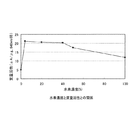
回転ディスク電極(グラッシーカーボン、直径:4.0mm;SEIKO EG&G製)上に、上記で調製したPtFeカーボンインク1μLをシリンジを用いて積載し、自然乾燥させて電極を作製した。この電極について、リニアスイープボルタンメトリー法によって酸素還元電流を測定した。
5. Electrochemical evaluation On a rotating disk electrode (glassy carbon, diameter: 4.0 mm; manufactured by SEIKO EG & G), 1 μL of the PtFe carbon ink prepared above was loaded using a syringe and air-dried to prepare an electrode. For this electrode, the oxygen reduction current was measured by the linear sweep voltammetry method.
回転ディスク電極装置(SEIKO EG&G製)の容器中に電解液(0.1N HClO4)を入れ、室温で保持した。この容器に参照電極(水素電極(RHE))、対電極(Pt)、O2吹込み管を設置した。O2吹込み管からO2を1時間吹き込み、O2飽和の状態にした。上記で作製した電極を電解液(0.1N HClCO4)に10分間浸漬した後に、ポテンショスタットを取り付けて測定を行った。測定条件は以下のとおりである。電解液:0.1N HClO4、参照電極:水素電極(RHE)、対電極:Pt、温度:室温、操作電位(RHEに対して):0〜1.0V、保持時間:1.0Vで120秒間、走査速度:15mV/秒、回転数:400rpm。前処理として、0V←→1.0Vの電位スイープを100回程度繰り返し、同じCV波形を描くことを確認した上で、酸素還元電流の測定を行った。
結果を図1に示す。
An electrolytic solution (0.1N HClO 4 ) was placed in a container of a rotating disk electrode device (manufactured by SEIKO EG & G) and kept at room temperature. In this vessel, a reference electrode (hydrogen electrode (RHE)), a counter electrode (Pt), and an O 2 blowing tube were installed. O 2 O 2 was bubbled for one hour from the blow pipe, and the state of the O 2 saturation. The electrode prepared above was immersed in an electrolytic solution (0.1N HClCO 4 ) for 10 minutes, and then a potentiostat was attached to perform measurement. The measurement conditions are as follows. Electrolytic solution: 0.1 N HClO 4 , reference electrode: hydrogen electrode (RHE), counter electrode: Pt, temperature: room temperature, operating potential (relative to RHE): 0 to 1.0 V, holding time: 120 at 1.0 V Second, scanning speed: 15 mV / sec, rotation speed: 400 rpm. As pretreatment, a potential sweep of 0V ← → 1.0V was repeated about 100 times, and after confirming that the same CV waveform was drawn, the oxygen reduction current was measured.
The results are shown in FIG.
6.COパルス吸着評価
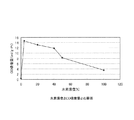
COパルス吸着法によって、各触媒へのCOの吸着量を測定した。COパルス吸着法は、COガスをパルスで送り、熱伝導度検出器(TCD)の時間積分強度から吸着ガス量を求める方法である。測定にあたっては、水素前処理(80℃、15分間)の後、10%COで吸着ガス量の測定を行い、担持触媒中、Pt1gあたりの吸着ガス量を測定した。
結果を図2に示す。
6). CO pulse adsorption evaluation The amount of CO adsorbed on each catalyst was measured by the CO pulse adsorption method. The CO pulse adsorption method is a method in which CO gas is sent in pulses and the amount of adsorbed gas is obtained from the time integrated intensity of a thermal conductivity detector (TCD). In the measurement, after hydrogen pretreatment (80 ° C., 15 minutes), the amount of adsorbed gas was measured with 10% CO, and the amount of adsorbed gas per 1 g of Pt in the supported catalyst was measured.
The results are shown in FIG.
7.透過型電子顕微鏡観察
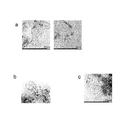
PtFe/C粉末をカーボン支持膜つきマイクログリッド上に散布したサンプルを、10万倍程度の倍率で観察した。
結果を図3に示す。
7). Observation by Transmission Electron Microscope A sample in which PtFe / C powder was dispersed on a microgrid with a carbon support film was observed at a magnification of about 100,000 times.
The results are shown in FIG.
8.結果
図1に示される通り、940mV(参照電極に対して)での酸素還元電流は、水素濃度4〜40%で処理した触媒において特に高くなっている。また、図2に示したCO吸着量測定でも、同様の傾向が見られる。
8). Results As shown in FIG. 1, the oxygen reduction current at 940 mV (relative to the reference electrode) is particularly high in the catalyst treated with a hydrogen concentration of 4-40%. The same tendency is also observed in the CO adsorption amount measurement shown in FIG.
図2のデータにおいて、COが白金表面に吸着すると考えると、吸着CO量が多いほど白金表面が大きいと言える。すなわち、図1に示した酸素還元電流が大きい触媒では、白金表面積が大きいと考えられる。 In the data of FIG. 2, assuming that CO is adsorbed on the platinum surface, it can be said that the larger the amount of adsorbed CO, the larger the platinum surface. That is, it is considered that the platinum surface area is large in the catalyst having a large oxygen reduction current shown in FIG.
上記の通り、白金表面積の大きさは、白金の凝集の度合と、触媒中の残存保護配位子の量とに依存すると考えられる。上記の実験では、水素濃度が4%未満の場合は触媒中に残った保護配位子が燃焼せずに白金表面を覆ってしまっていると推測される。一方、40%を超えると、保護配位子が激しく燃焼し、その熱によって粒子の凝集が起こり、白金表面積が減少したと考えられる。 As described above, the size of the platinum surface area is considered to depend on the degree of aggregation of platinum and the amount of residual protective ligand in the catalyst. In the above experiment, when the hydrogen concentration is less than 4%, it is presumed that the protective ligand remaining in the catalyst has covered the platinum surface without burning. On the other hand, when it exceeds 40%, the protective ligand burns violently, and the aggregation of particles is caused by the heat, and the platinum surface area is considered to be reduced.
図3で透過型電子顕微鏡像から見て取れるように、水素濃度100%で熱処理したPtFeカーボン触媒では、水素濃度40%で熱処理したものと比較して、金属粒子が著しく凝集している。このことから、上記の推測が正しいことが示される。 As can be seen from the transmission electron microscope image in FIG. 3, in the PtFe carbon catalyst heat-treated at a hydrogen concentration of 100%, the metal particles are significantly aggregated as compared with the heat-treated PtFe carbon catalyst at a hydrogen concentration of 40%. This indicates that the above guess is correct.
本発明によれば、触媒活性の高い燃料電池用担持触媒を得ることができる。したがって、本発明は燃料電池の分野での有用性を有する。 According to the present invention, a supported catalyst for a fuel cell having high catalytic activity can be obtained. Accordingly, the present invention has utility in the field of fuel cells.
Claims (5)
Priority Applications (1)
| Application Number | Priority Date | Filing Date | Title |
|---|---|---|---|
| JP2008326037A JP2010146980A (en) | 2008-12-22 | 2008-12-22 | Method of manufacturing catalyst electrode |
Applications Claiming Priority (1)
| Application Number | Priority Date | Filing Date | Title |
|---|---|---|---|
| JP2008326037A JP2010146980A (en) | 2008-12-22 | 2008-12-22 | Method of manufacturing catalyst electrode |
Publications (1)
| Publication Number | Publication Date |
|---|---|
| JP2010146980A true JP2010146980A (en) | 2010-07-01 |
Family
ID=42567150
Family Applications (1)
| Application Number | Title | Priority Date | Filing Date |
|---|---|---|---|
| JP2008326037A Pending JP2010146980A (en) | 2008-12-22 | 2008-12-22 | Method of manufacturing catalyst electrode |
Country Status (1)
| Country | Link |
|---|---|
| JP (1) | JP2010146980A (en) |
Cited By (3)
| Publication number | Priority date | Publication date | Assignee | Title |
|---|---|---|---|---|
| JP2013514172A (en) * | 2009-12-17 | 2013-04-25 | ユーティーシー パワー コーポレイション | Method for treating supported catalyst |
| US9548501B2 (en) | 2009-12-17 | 2017-01-17 | The Research Foundation of State University Of New York Research Development Services, Binghamton University | Supported catalyst |
| CN110265679A (en) * | 2019-06-24 | 2019-09-20 | 厦门大学 | Platinum-phosphorus alloy catalyst, preparation method and fuel cell using the catalyst |
-
2008
- 2008-12-22 JP JP2008326037A patent/JP2010146980A/en active Pending
Cited By (3)
| Publication number | Priority date | Publication date | Assignee | Title |
|---|---|---|---|---|
| JP2013514172A (en) * | 2009-12-17 | 2013-04-25 | ユーティーシー パワー コーポレイション | Method for treating supported catalyst |
| US9548501B2 (en) | 2009-12-17 | 2017-01-17 | The Research Foundation of State University Of New York Research Development Services, Binghamton University | Supported catalyst |
| CN110265679A (en) * | 2019-06-24 | 2019-09-20 | 厦门大学 | Platinum-phosphorus alloy catalyst, preparation method and fuel cell using the catalyst |
Similar Documents
| Publication | Publication Date | Title |
|---|---|---|
| Zhu et al. | Single-walled carbon nanohorns and their applications | |
| US8076261B2 (en) | Preparation method for PtCo nanocube catalyst | |
| Barakat et al. | Cobalt/copper-decorated carbon nanofibers as novel non-precious electrocatalyst for methanol electrooxidation | |
| CN104769759B (en) | Method for producing a catalyst for fuel cells | |
| Kruusenberg et al. | Oxygen electroreduction on multi-walled carbon nanotube supported metal phthalocyanines and porphyrins in alkaline media | |
| CN101595584B (en) | Nanowire supported catalysts for fuel cell electrodes | |
| Chen et al. | Modification of multi-walled carbon nanotubes by microwave digestion method as electrocatalyst supports for direct methanol fuel cell applications | |
| El-Deeb et al. | Microwave-assisted polyol synthesis of PtCu/carbon nanotube catalysts for electrocatalytic oxygen reduction | |
| US20110123908A1 (en) | Method for preparing nano-sized metal particles on a carbon support | |
| Liu et al. | Preparation of nitrogen-doped graphene supporting Pt nanoparticles as a catalyst for oxygen reduction and methanol oxidation | |
| Zang et al. | Bucky diamond produced by annealing nanodiamond as a support of Pt electrocatalyst for methanol electrooxidation | |
| CN111244484B (en) | A kind of preparation method of sub-nano platinum-based ordered alloy | |
| Huang et al. | Preparation of highly dispersed Pt nanoparticles supported on single-walled carbon nanotubes by a microwave-assisted polyol method and their remarkably catalytic activity | |
| Ning et al. | Enhanced performance of phosphorus-doped graphene-supported Pd electrocatalysts for ethanol oxidation | |
| KR20140075918A (en) | Method to produce the cubic shape of Pt/C catalyst, Pt/C catalyst produced thereof, and fuel cell using the same | |
| Li et al. | Ionic liquids-noncovalently functionalized multi-walled carbon nanotubes decorated with palladium nanoparticles: A promising electrocatalyst for ethanol electrooxidation | |
| JP2010146980A (en) | Method of manufacturing catalyst electrode | |
| Heath et al. | The enhancing effect of α–FeOOH on Ni surfaces toward electrolytic water splitting | |
| JPWO2011136186A1 (en) | Electrode material | |
| KR102864305B1 (en) | Copper nanoparticle-nitrogen-doped carbon quantum dot-carbon nanotube hybrid structure and method for manufacturing the same | |
| Batool et al. | Encapsulation of Pt nanocrystals inside pyrolyzed UiO-66-NH2 metal–organic framework supports as oxygen reduction catalysts | |
| JP6008272B2 (en) | Method for producing metal nano-x raster-supported carbon porous body | |
| Saheli et al. | Synthesis of new Pd@ NDG electrocatalyst by using g-C3N4/GO hydrogel toward formic acid electrooxidation reaction in direct formic acid fuel cell | |
| Zhao et al. | Electrodeposition and electrocatalytic properties of platinum nanoparticles on multi-walled carbon nanotubes: effect of the deposition conditions | |
| Loyola et al. | Oxygen reduction reaction on a 68-atom-gold cluster supported on carbon nanotubes: theoretical and experimental analysis |