JP2010146094A - Image processing apparatus, image processing method, and image processing program - Google Patents
Image processing apparatus, image processing method, and image processing program Download PDFInfo
- Publication number
- JP2010146094A JP2010146094A JP2008319931A JP2008319931A JP2010146094A JP 2010146094 A JP2010146094 A JP 2010146094A JP 2008319931 A JP2008319931 A JP 2008319931A JP 2008319931 A JP2008319931 A JP 2008319931A JP 2010146094 A JP2010146094 A JP 2010146094A
- Authority
- JP
- Japan
- Prior art keywords
- glass
- region
- area
- image
- image processing
- Prior art date
- Legal status (The legal status is an assumption and is not a legal conclusion. Google has not performed a legal analysis and makes no representation as to the accuracy of the status listed.)
- Pending
Links
- 238000003672 processing method Methods 0.000 title claims 9
- 239000011521 glass Substances 0.000 claims abstract description 207
- 238000001514 detection method Methods 0.000 claims abstract description 29
- 238000000034 method Methods 0.000 claims description 37
- 238000012544 monitoring process Methods 0.000 claims description 14
- 230000000873 masking effect Effects 0.000 claims description 5
- 241001465754 Metazoa Species 0.000 description 2
- 230000000694 effects Effects 0.000 description 2
- 238000003384 imaging method Methods 0.000 description 2
- 230000000295 complement effect Effects 0.000 description 1
- 238000007796 conventional method Methods 0.000 description 1
- 239000006185 dispersion Substances 0.000 description 1
- 229910044991 metal oxide Inorganic materials 0.000 description 1
- 150000004706 metal oxides Chemical class 0.000 description 1
- 239000004065 semiconductor Substances 0.000 description 1
- 230000035945 sensitivity Effects 0.000 description 1
Images

Landscapes
- Image Processing (AREA)
- Closed-Circuit Television Systems (AREA)
- Image Analysis (AREA)
Abstract
Description
本発明は画像処理技術に関し、特に撮影された画像に含まれる領域のプライバシーを保護する画像処理技術に関する。 The present invention relates to an image processing technique, and more particularly to an image processing technique for protecting the privacy of a region included in a photographed image.
一般的に、画像に含まれる領域のプライバシーを保護すべきか否かは、ある領域、例えばガラス領域を隔てて異なっていることが多い。一例として、監視カメラ等で撮影された画像に、ガラス領域を通して民家等建造物の内部が含まれる場合がある。民家等建造物の内部の人物は、普段外出するときとは違うリラックスした格好をしている場合がほとんどである。ガラス領域を通してなんら衣服を着ていない人物が撮影された画像に含まれていることも十分に考えられる。このため、監視カメラ等でガラス領域を通して民家等建造物の内部が撮影された画像をそのまま画面に表示したのでは、プライバシーの保護に欠ける。このことは、プライバシーガラス等の需要があることからわかる。 In general, whether or not the privacy of an area included in an image should be protected often differs across a certain area, for example, a glass area. As an example, an image taken by a surveillance camera or the like may include the inside of a building such as a private house through a glass region. Most of the people inside buildings such as private houses have a relaxed appearance that is different from when they usually go out. It is quite possible that a person who is not wearing any clothes through the glass area is included in the photographed image. For this reason, if an image obtained by photographing the interior of a building such as a private house through a glass region is displayed on the screen as it is with a surveillance camera or the like, privacy protection is lacking. This can be seen from the demand for privacy glass and the like.
上記のようなプライバシーを保護すべき対象が存在する可能性が高い領域を含む画像をそのまま画像に表示することを解決する技術として、特許文献1、2に記載の技術が開示されている。特許文献1、2には、監視カメラからの画像情報にプライバシー保護対象領域をユーザが設定し、該保護対象領域にマスク処理を行い、保護すべき画像が画面に表示されないよう信号処理をした後に外部に出力する技術が開示されている。
As a technique for solving the above-described display of an image including an area where there is a high possibility that there is a target to protect privacy as described above, techniques disclosed in
特許文献1、2に記載の技術を用いて、画像に含まれるガラス領域をプライバシーの保護対象領域とすれば、ガラス領域を通して撮影された領域のプライバシーが保護される。
ところが、特許文献1、2に記載の技術では、状況に応じてマスク処理を外す等の処理ができない。その様子を、図12、図13、図14、図15を用いて説明する。
By using the techniques described in
However, the techniques described in
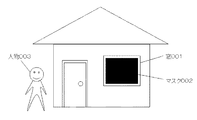
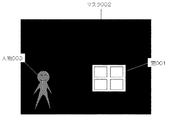
図12は、窓001のガラス領域にマスク処理がされている画像である。すなわち、図12は、ガラス領域がプライバシーを含む可能性がある部分として保護されている画像である。人物003は、保護すべきでない人物、もしくは保護する必要のない人物であり、画像に常に表示されるべき人物である。図13は、人物003の一部が、ガラス領域、すなわちマスク領域002に入った画像である。この画像では、人物003はマスク領域002と重なった部分はマスク領域002に隠れている。
FIG. 12 is an image in which a mask process is performed on the glass region of the
このように、保護すべきでない画像や保護する必要のない画像であっても、マスク処理が行われた領域に重なると、重なった部分はマスク処理されてしまうという問題が従来からあった。 As described above, even in the case of an image that should not be protected or an image that does not need to be protected, there has been a problem that when the mask process is performed, the overlapped part is masked.
このような問題を解決する技術として、特許文献3に記載の技術が開示されている。 As a technique for solving such a problem, a technique described in Patent Document 3 is disclosed.
まず、特許文献3に記載の画像処理装置は、監視カメラから出力される撮像画像中の動き領域を検出する。動き領域の全部が完全にマスク領域に入っている場合には、当該領域のマスク処理は継続され、動き領域はマスク領域に隠される。一方、動き領域の一部がマスク領域に入っている場合には、動き領域の一部でマスク領域と重なっている部分をマスク領域から除くようなマスク処理が行われる。このようにして、特許文献3に記載の画像処理装置は、上述した保護する必要のない画像にマスク処理がされるという問題を解決している。 First, the image processing apparatus described in Patent Document 3 detects a motion region in a captured image output from a surveillance camera. If the entire motion area is completely within the mask area, the mask process for the area is continued and the motion area is hidden in the mask area. On the other hand, when a part of the motion area is in the mask area, a mask process is performed such that a part of the motion area that overlaps the mask area is removed from the mask area. In this way, the image processing apparatus described in Patent Document 3 solves the above-described problem that mask processing is performed on an image that does not need to be protected.
上記の状況とは逆に、図14は、ガラス領域が監視対象であり、それ以外の領域が保護されるべき領域、すなわちマスク領域である様子を表している。 Contrary to the above situation, FIG. 14 shows a state in which the glass region is a monitoring target and the other region is a region to be protected, that is, a mask region.
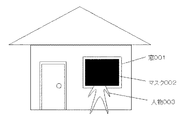
図14は、窓001のガラス領域以外の領域にマスク処理が行われた画像である。ガラス領域以外がプライバシーを保護したい領域である。従って、人物003は、プライバシーの保護がされるべき人物であり、マスク領域002で隠されている。
FIG. 14 is an image obtained by performing mask processing on an area other than the glass area of the
図15は、人物003がガラス領域、すなわちマスク領域002から外れた場合の画像である。人物003のガラス領域に入り込んだ部分は、マスク領域002により保護されていない。保護されなくなった人物003にマスク処理をするためには、さらに人物を認識するための人物認識等の処理が必要である。 FIG. 15 is an image when the person 003 is out of the glass region, that is, the mask region 002. The portion of the person 003 that enters the glass area is not protected by the mask area 002. In order to perform mask processing on the person 003 that is no longer protected, processing such as person recognition for recognizing the person is required.
上記のような関連する技術では、保護する必要のない画像にマスク処理を行わないために、入力画像信号から動きがあった領域を検出し、ひとかたまりの動きのある領域を監視対象物と定義する等の処理が必要であった。このため、多量の演算処理が必要となり、装置に多くの処理負荷がかかる。また、特許文献3に記載の画像処理装置では、保護する必要のない人物が完全にガラス領域などの保護対象領域に入り込んだような状況に対応するには、さらに動き方向判定処理が必要であり、さらに多くの演算処理が必要となる。 In the related technique as described above, in order not to perform mask processing on an image that does not need to be protected, a region where movement has occurred is detected from the input image signal, and a region having a group of movements is defined as a monitoring target. Etc. were necessary. For this reason, a large amount of arithmetic processing is required, and a large processing load is applied to the apparatus. Further, in the image processing apparatus described in Patent Document 3, a motion direction determination process is further required to cope with a situation in which a person who does not need to be protected completely enters a protected area such as a glass area. More computation processing is required.
また、ガラス領域が監視対象であり、ガラス領域以外の領域がプライバシー保護対象領域である場合についても、ガラス領域に保護が必要な人物が入り込んだ場合に、その人物の保護を続けるためには、その人物を認識する等の処理がさらに必要となる。この場合にも、人物認識等の処理のために、多くの処理負荷が装置にかかる。 In addition, in the case where the glass area is a monitoring target and the area other than the glass area is a privacy protection target area, when a person who needs protection enters the glass area, in order to continue protecting the person, Further processing such as recognizing the person is required. Also in this case, a large processing load is applied to the apparatus for processing such as person recognition.
従って、本発明の目的は、ガラス領域に基づいてプライバシー保護の処理の切り分けができ、処理負荷の少ない画像処理装置を提供することにある。 Accordingly, an object of the present invention is to provide an image processing apparatus that can perform privacy protection processing based on a glass area and has a low processing load.
上記目的を達成するために本発明の画像処理装置は、遠赤外線カメラで撮影された画像に基づいてガラス領域を検出し、ガラス領域情報を生成するガラス領域検出部と、前記ガラス領域情報に基づいて、可視光カメラで撮影された画像で、ガラス領域に対応する領域、またはガラス領域に対応する領域以外の領域のいずれか一方にマスク処理を行うマスク処理部と、を有する。 In order to achieve the above object, an image processing apparatus of the present invention detects a glass region based on an image photographed by a far-infrared camera and generates glass region information, and based on the glass region information. And a mask processing unit that performs mask processing on either the region corresponding to the glass region or the region other than the region corresponding to the glass region in the image captured by the visible light camera.
また、本発明の画像処理装置は、遠赤外線カメラ部と、可視光カメラ部と、前記遠赤外線カメラ部で撮影された画像に基づいてガラス領域を検出し、ガラス領域情報を生成するガラス領域検出部と、前記ガラス領域情報に基づいて、前記可視光カメラ部で撮影された画像で、ガラス領域に対応する領域、またはガラス領域に対応する領域以外の領域のいずれか一方にマスク処理を行うマスク処理部と、を有する。 Further, the image processing apparatus of the present invention detects a glass region based on an image photographed by a far infrared camera unit, a visible light camera unit, and the far infrared camera unit, and generates a glass region information. And a mask for performing mask processing on either the area corresponding to the glass area or the area other than the area corresponding to the glass area in the image captured by the visible light camera section based on the glass area information And a processing unit.
また、本発明の画像処理装置は、遠赤外線カメラで撮影された画像と可視光カメラで撮影された画像とのガラス領域の位置を対応させる位置合わせ部を有する。 In addition, the image processing apparatus of the present invention includes an alignment unit that associates the positions of the glass regions between the image captured by the far-infrared camera and the image captured by the visible light camera.
また、本発明の画像処理装置は、人物の顔を認識し、顔領域情報を生成する顔認識部を有する。 The image processing apparatus of the present invention includes a face recognition unit that recognizes a person's face and generates face area information.
本発明によれば、ガラス領域に基づいてプライバシー保護の処理ができるので、演算量を少なくすることができるというすぐれた効果を奏する。 According to the present invention, since privacy protection processing can be performed based on the glass region, there is an excellent effect that the amount of calculation can be reduced.
以下、本発明を実施するための最良の形態を述べる。しかしながら、係る形態は本発明の技術的範囲を限定するものではない。 The best mode for carrying out the present invention will be described below. However, such a form does not limit the technical scope of the present invention.
[第一の実施形態]
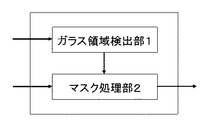
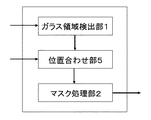
第一の実施形態の画像処理装置を説明する。まずは、図1を用いて全体の構成について詳細に説明する。
[First embodiment]
The image processing apparatus according to the first embodiment will be described. First, the entire configuration will be described in detail with reference to FIG.
本実施形態における画像処理装置は、ガラス領域検出部1とマスク処理部2とから構成される。
The image processing apparatus according to the present embodiment includes a glass
ガラス領域検出部1は、遠赤外線カメラで撮影された画像を入力とし、その画像中からガラス領域を検出する。ガラス領域検出部1は、検出されたガラス領域に基づいて、ガラス領域情報を生成する。ガラス領域情報とは、遠赤外線で撮影された画像中の、ガラス領域の位置を示す情報である。
The glass
マスク処理部2は、可視光カメラで撮影された画像と、ガラス領域検出部1より生成されたガラス領域情報とを入力とし、マスク処理画像を出力する。マスク処理部2は、ガラス領域情報に基づいて、可視光カメラで撮影された画像中でガラス領域に対応する領域、またはガラス領域に対応する領域以外の領域のいずれかにマスク処理を行い、マスク処理画像を生成する。マスク処理とは、撮影した画像の一部の領域に、マスクをかける処理のことである。例えば、ある領域を黒く塗り潰してもよい。なお、遠赤外線カメラで撮影された画像と可視光カメラで撮影された画像とは、ほぼ同じ領域をほぼ同じアングルで撮影されたものであれば良い。
The mask processing unit 2 receives the image taken by the visible light camera and the glass region information generated by the glass
ガラス領域検出部1は、遠赤外線カメラで撮影された画像が入力されると、その画像中からガラス領域を検出する。ガラス領域の検出には、ガラスには遠赤外線を吸収する性質があることが利用されている。つまり、遠赤外線カメラで撮影された画像のガラス領域は画素値が非常に小さくなったように撮影されるという性質が利用されている。ここで画素値とは、例えばグレースケールを表す数値のことである。グレースケールは物体の温度に関係しており、白黒の濃さで表される。画像で、温度が高い部分は白く表され、温度が低い部分は黒く表される。また、温度が高い部分は赤く、低い部分は青く表す等、画像に色を付けても良い。
When an image taken by a far-infrared camera is input, the glass
遠赤外線カメラで撮影するとガラス領域の画素値は非常に小さくなるので、ガラス領域検出部1は、画素値が非常に小さく、画素値の変動も小さいまとまった領域をガラス領域であるとして検出することができる。ガラス領域の検出の一例を説明する。画素値が小さいと判定するための閾値をAとする。また、画素値の変動が小さい場合を検出するための画素値の分散の閾値をVとする。さらに、ガラス領域と判定するための十分な面積の閾値をSとする。面積は例えばピクセル数などで表す。閾値AとVとSとについては、ガラス領域と判定されるのに十分な値を予め定めておく。ここで、任意のフレーム数をTで表す。Tフレーム分の画素値の平均が閾値A以下で、かつTフレーム分の画素値の分散が閾値V以下の領域を検出し、この領域の面積がある閾値S以上の領域をガラス領域として検出する。ガラス領域検出部1は、検出されたガラス領域に基づいて、ガラス領域情報を生成する。
Since the pixel value of the glass region becomes very small when the image is taken with the far-infrared camera, the glass
マスク処理部2は、可視光カメラで撮影された画像とガラス領域情報とが入力される。マスク処理部2は、ガラス領域情報に基づいて、ガラス領域として検出された領域に対応する可視光カメラで撮影された画像の領域にマスク処理を行う。可視光カメラで撮影された画像のガラス領域へのマスク処理により、ガラス領域に含まれるプライバシー保護対象物を保護することができる。 The mask processing unit 2 receives an image photographed by a visible light camera and glass region information. Based on the glass region information, the mask processing unit 2 performs mask processing on the region of the image captured by the visible light camera corresponding to the region detected as the glass region. The privacy protection target object included in the glass region can be protected by masking the glass region of the image photographed by the visible light camera.
逆に、ガラス領域が監視対象であり、ガラス領域以外の領域が保護領域である場合について説明する。この場合、マスク処理部2は、上述の通り、ガラス領域情報に基づいてガラス領域を検出する。そして、マスク処理部2は、ガラス領域以外の領域にマスク処理を行う。可視光カメラで撮影された画像のガラス領域以外の領域をマスク処理することにより、ガラス領域以外の領域に含まれるプライバシー保護対象物を保護することができる。 Conversely, a case where the glass region is a monitoring target and the region other than the glass region is a protection region will be described. In this case, the mask processing unit 2 detects the glass region based on the glass region information as described above. And the mask process part 2 performs a mask process to area | regions other than a glass area | region. By masking an area other than the glass area of the image taken with the visible light camera, it is possible to protect the privacy protection target object included in the area other than the glass area.
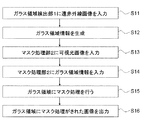
次に、図2を用いて、本実施形態の動作を詳細に説明する。図2は、本実施の形態の動作を示すフローチャートである。 Next, the operation of this embodiment will be described in detail with reference to FIG. FIG. 2 is a flowchart showing the operation of the present embodiment.
まず、ガラス領域検出部1に遠赤外線カメラで撮影された画像が入力される(S11)。ガラス領域検出部1は、複数の画像が入力されると、上述したようにTフレーム分の平均画素値がある閾値A以下で、かつTフレーム分の画素値の分散がある閾値V以下の領域を検出し、この領域の面積がある閾値S以上の領域をガラス領域として検出する。例えば、閾値AとVとSとはガラス領域検出部1に予め記憶されている。ガラス領域検出部1は、検出されたガラス領域情報に基づいて、ガラス領域情報を生成する(S12)。
First, an image photographed by a far-infrared camera is input to the glass region detection unit 1 (S11). When a plurality of images are input, the glass
マスク処理部2に可視光カメラで撮影された画像が入力される(S13)。また、ガラス領域検出部1が生成したガラス領域情報がマスク処理部2に入力される(S14)。マスク処理部2は、入力されたガラス領域情報に基づいて、可視光カメラで撮影された画像に含まれるガラス領域に対応する領域にマスク処理を行う(S15)。
An image photographed with a visible light camera is input to the mask processing unit 2 (S13). Further, the glass region information generated by the glass
以上により、プライバシー保護対象領域であるガラス領域にマスク処理がされた画像が出力される(S16)。 As described above, the image subjected to the mask processing is output to the glass region which is the privacy protection target region (S16).
また、ガラス領域が監視対象であり、ガラス領域以外の領域をプライバシー保護対象領域とする場合は、マスク処理部2はガラス領域として検出された領域以外の領域にマスク処理を行う。 When the glass region is the monitoring target and the region other than the glass region is set as the privacy protection target region, the mask processing unit 2 performs mask processing on the region other than the region detected as the glass region.
可視光カメラで撮影された画像のガラス領域にマスク処理を行うか、ガラス領域以外の領域にマスク処理を行うかを、ユーザが入力するような構成にしても良い。例えば、画像処理装置に、ガラス領域にマスク処理を行うか、ガラス領域以外の領域にマスク処理を行うかを切り替え可能なスイッチの機能を持たせても良い。また、外部よりPC等で切替命令を入力しても良い。これによりユーザは、状況に応じてマスク処理を行う領域を手軽に切り替えることができる。 A configuration may be adopted in which the user inputs whether to perform mask processing on a glass region of an image captured by a visible light camera or to perform mask processing on a region other than the glass region. For example, the image processing apparatus may be provided with a function of a switch that can switch between performing mask processing on a glass region or performing mask processing on a region other than the glass region. In addition, a switching command may be input from a PC or the like from the outside. Thereby, the user can switch easily the area | region which performs a mask process according to a condition.
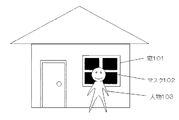
次に、保護対象領域であるガラス領域に、保護する必要のない人物が入り込んだ場面について、図3を用いて詳細に説明する。 Next, a scene in which a person who does not need to be protected enters a glass area that is a protection target area will be described in detail with reference to FIG.
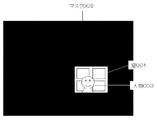
本実施の形態の画像処理装置はガラス領域を検出し、ガラス領域に対してマスク処理を行うことができる。例えば、人物103が窓101のマスク領域102に重なった場合、その領域は遠赤外線カメラから見るとガラス領域としては認識されない。すなわち、ガラス領域と人物103とが重なった領域の画素値は、人物103を表す画素値であり、ガラス領域を表す非常に小さな画素値にはならない。従って、ガラス領域と人物103とが重なった領域は、マスク処理の対象ではなくなる。これにより、動き領域検出等の追加の演算処理の負荷を装置にかけることなく、人物103はマスク領域102に隠れずに表示されることになる。
The image processing apparatus according to the present embodiment can detect a glass region and perform mask processing on the glass region. For example, when the person 103 overlaps the mask area 102 of the
逆に、図4のように、ガラス領域が監視対象であり、それ以外の領域が保護領域である場合について説明する。 Conversely, as shown in FIG. 4, a case where the glass region is a monitoring target and the other region is a protection region will be described.
この場合、ガラス領域と人物103とが重なった領域は、上述のように遠赤外線カメラから見るとガラス領域としては認識されない。従って、ガラス領域が監視対象の場合、ガラス領域と人物103とが重なった領域は、マスク処理の対象となる。これにより、本実施の形態の画像処理装置は、人物認識等の処理を行うことなく、人物103にマスク処理を行い、人物103のプライバシーを保護することができる。 In this case, the region where the glass region and the person 103 overlap is not recognized as the glass region when viewed from the far-infrared camera as described above. Therefore, when the glass region is the monitoring target, the region where the glass region and the person 103 overlap is the target of the mask process. As a result, the image processing apparatus according to the present embodiment can perform mask processing on the person 103 and protect the privacy of the person 103 without performing processing such as person recognition.
以上詳述したように、本発明の第一の実施形態では、ガラス領域に基づいてプライバシー保護の処理ができるので、演算量を少なくすることができる。 As described above in detail, in the first embodiment of the present invention, since privacy protection processing can be performed based on the glass region, the amount of calculation can be reduced.
[第二の実施形態]
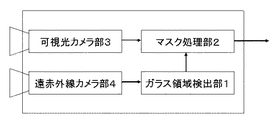
次に、第二の実施形態の画像処理装置を、図5を用いて詳細に説明する。なお、第一の実施形態に係るものと同一の構成部については説明を省略する。
[Second Embodiment]
Next, the image processing apparatus according to the second embodiment will be described in detail with reference to FIG. In addition, description is abbreviate | omitted about the component same as what concerns on 1st embodiment.
本実施形態における画像処理装置は、第一の実施形態のガラス領域検出部1、マスク処理部2に加えて、可視光カメラ部3と、遠赤外線カメラ部4とからなる。可視光カメラ部3は、可視光画像を撮影し、撮影された可視光画像をマスク処理部2へ出力する。すなわち、可視光カメラ部3は、撮影した可視光画像を同一装置内で直接マスク処理部2に出力する。可視光カメラ部3は、通常のCCDセンサ(Charge Coupled Device Sensor)又はCMOSセンサ(Complementary Metal Oxide Semiconductor Sensor)で構成されても良い。また、可視光カメラ部3は、近赤外線まで感度を持つようなセンサで構成されても良い。遠赤外線カメラ部4は、遠赤外線画像を撮影し、撮影された遠赤外線画像をガラス領域検出部1へ出力する。すなわち、遠赤外線カメラ部4は、撮影した遠赤外線画像を同一装置内で直接、ガラス領域検出部1に出力する。遠赤外線カメラ部4は、通常の遠赤外線カメラで構成されても良い。遠赤外線カメラ部4は、可視光カメラ部3で撮影される画像とほぼ同じ対象をほぼ同じアングルで遠赤外線画像を撮影するように調整されていると良い。
The image processing apparatus according to this embodiment includes a visible light camera unit 3 and a far infrared camera unit 4 in addition to the glass
上記の通り、本実施形態の画像処理装置においては、可視光画像の撮影と撮影した画像の入出力と可視光画像へのマスク処理とが同一装置内で行われる。従って、マスク処理がされていない画像が外部に漏れる危険がない。 As described above, in the image processing apparatus according to the present embodiment, capturing of a visible light image, input / output of the captured image, and mask processing for the visible light image are performed in the same apparatus. Therefore, there is no risk that an image that has not been subjected to mask processing leaks to the outside.
また、本実施形態においても、第一の実施形態と同様に、可視光カメラで撮影された画像のガラス領域にマスク処理を行うか、ガラス領域以外の領域にマスク処理を行うかをユーザが入力するような構成にしても良い。 Also in this embodiment, as in the first embodiment, the user inputs whether to perform mask processing on a glass region of an image captured by a visible light camera or to perform mask processing on a region other than the glass region. You may make it the structure which does.
以上詳述したように、本発明の第二の実施形態では、同一装置内で可視光画像の撮影と、画像の入出力と、可視光画像へのマスク処理を行うので、マスク処理がされていない画像が外部に漏れる危険がなく、より強固なプライバシー保護が可能となる。 As described above in detail, in the second embodiment of the present invention, since the photographing of the visible light image, the input / output of the image, and the mask processing to the visible light image are performed in the same apparatus, the mask processing is performed. There is no risk of no image leaking to the outside, and stronger privacy protection is possible.
[第三の実施形態]
次に、第三の実施形態の画像処理装置を、図6を用いて説明する。なお、第一の実施形態に係るものと同一の構成部については説明を省略する。
[Third embodiment]
Next, an image processing apparatus according to a third embodiment will be described with reference to FIG. In addition, description is abbreviate | omitted about the structure part same as what concerns on 1st embodiment.
第三の実施形態における画像処理装置は、遠赤外線カメラと可視光カメラのアングル等が大きくずれてしまった場合でも適切な位置にマスク処理をすることが可能な画像処理装置である。 The image processing apparatus according to the third embodiment is an image processing apparatus capable of performing mask processing at an appropriate position even when the angles of the far-infrared camera and the visible light camera are greatly shifted.
本実施形態における画像処理装置は、第一の実施形態のガラス領域検出部1、マスク処理部2に加えて、さらに位置合わせ部5を有する。位置合わせ部5は、遠赤外線カメラのアングルと可視光カメラのアングルとがずれている場合、ガラス領域の位置を対応させる。また、位置合わせ部5は、遠赤外線画像と可視光画像の重ならない領域の検出も行う。
The image processing apparatus according to the present embodiment further includes an alignment unit 5 in addition to the glass
位置合わせ部5は、画像の対応関係がわかってガラス領域の位置を対応させることができ、遠赤外線画像と可視光画像の重ならない領域を検出できれば、どのような処理にしても良い。 The alignment unit 5 may perform any processing as long as the correspondence between the images can be known and the positions of the glass regions can be matched, and the region where the far-infrared image and the visible light image do not overlap can be detected.
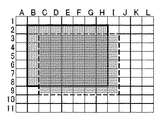
位置合わせ部5がガラス領域の位置を対応させる処理の一例は、位置合わせ部5が、図7のような遠赤外線カメラと可視光カメラが撮影可能な範囲を格子状に区切った対応テーブルを記憶しているものである。図7の、太線で囲った縦網の範囲が遠赤外線カメラの撮影範囲であり、破線で囲った横網の範囲が可視光画像の撮影範囲である。この場合位置合わせ部5は、二つの撮影範囲は一致していないことから、遠赤外線カメラのアングルと、可視光カメラのアングルがずれていると認識する。位置合わせ部5が、ガラス領域情報に基づいて、遠赤外線画像の対応テーブルで、ガラス領域を図7の4−Dと5−Dと4−Eと5−Eであると判定したとする。すると、マスク処理部2は可視光画像の対応テーブルで、4−Dと5−Dと4−Eと5−Eに該当する可視光画像の領域にマスク処理を行う。 An example of processing in which the alignment unit 5 associates the positions of the glass regions is stored in a correspondence table in which the alignment unit 5 divides the range that can be captured by the far-infrared camera and the visible light camera as shown in FIG. It is what you are doing. In FIG. 7, the range of the vertical mesh surrounded by the thick line is the imaging range of the far infrared camera, and the range of the horizontal mesh surrounded by the broken line is the imaging range of the visible light image. In this case, the alignment unit 5 recognizes that the angle of the far-infrared camera and the angle of the visible light camera are shifted because the two shooting ranges do not match. Assume that the alignment unit 5 determines that the glass regions are 4-D, 5-D, 4-E, and 5-E in FIG. 7 in the far-infrared image correspondence table based on the glass region information. Then, the mask processing unit 2 performs mask processing on the visible light image areas corresponding to 4-D, 5-D, 4-E, and 5-E in the visible light image correspondence table.
他の例では、位置合わせ部5の処理は、位置合わせ部5が遠赤外線カメラと可視光カメラのカメラパラメータを算出して、可視光画像のガラス領域に対応する領域を計算により求める処理としても良い。カメラパラメータとは、画像を撮影したときのカメラの位置、向き、焦点距離のことである。カメラパラメータの算出と、算出したカメラパラメータを用いて可視光画像中のガラス領域に対応する領域を計算する処理には、従来の技術を用いれば良い。 In another example, the process of the alignment unit 5 may be a process in which the alignment unit 5 calculates camera parameters of the far-infrared camera and the visible light camera and obtains a region corresponding to the glass region of the visible light image by calculation. good. Camera parameters are the position, orientation, and focal length of the camera when an image is taken. A conventional technique may be used for the calculation of the camera parameter and the process of calculating the region corresponding to the glass region in the visible light image using the calculated camera parameter.
位置合わせ部5が、以上のような処理をすることで、両カメラで撮影された画像がずれている場合にも適切な位置にマスク処理を行うことが可能となる。 By performing the above-described processing, the alignment unit 5 can perform mask processing at an appropriate position even when images captured by both cameras are misaligned.
また、位置合わせ部5は、遠赤外線画像と可視光画像とが重ならない領域の検出も行う。位置合わせ部5は、二つの画像の重ならない領域を、上記のように対応テーブルを用いて検出しても良いし、カメラパラメータを用いて計算して検出しても良い。例えば、対応テーブルを用いて検出する場合、図7のとき位置合わせ部5は、遠赤外線画像と可視光画像とが重ならない領域として、2−Bから2−Hと、2−Bから8−Bと、9−Cから9−Iと、3−Iから9−Iの領域を検出する。 The alignment unit 5 also detects a region where the far-infrared image and the visible light image do not overlap. The alignment unit 5 may detect a region where the two images do not overlap using the correspondence table as described above, or may calculate and detect using the camera parameters. For example, when detecting using the correspondence table, the alignment unit 5 in FIG. 7 determines that the far-infrared image and the visible light image do not overlap with each other as 2-B to 2-H and 2-B to 8- Regions B, 9-C to 9-I, and 3-I to 9-I are detected.
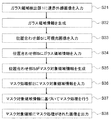
次に、図8を用いて、本実施形態の動作を詳細に説明する。図8は、本実施の形態の動作を示すフローチャートである。 Next, the operation of this embodiment will be described in detail with reference to FIG. FIG. 8 is a flowchart showing the operation of the present embodiment.
まず、ガラス領域検出部1に遠赤外線カメラで撮影された画像が入力される(S31)。続いて、ガラス領域検出部1は、第一の実施形態の場合と同様に、遠赤外線画像からガラス領域を検出し、ガラス領域情報を生成する(S32)。位置合わせ部5に可視光カメラで撮影された画像が入力される(S33)。また、ガラス領域検出部1は、生成したガラス領域情報を位置合わせ部5に出力する(S34)。位置合わせ部5は、入力されたガラス領域情報に基づいて、対応テーブルを参照する、またはカメラパラメータで計算する等して、可視光カメラで撮影された可視光画像中の、ガラス領域に対応する領域の位置を検出する。位置合わせ部5はさらに、対応テーブルを参照する、またはカメラパラメータで計算する等して二つの画像の重ならない領域を検出する。位置合わせ部5は、マスク対象領域情報を生成する(S35)。マスク対象領域情報とは、可視光画像中の、ガラス領域に対応する領域と、二つの画像の重ならない領域とを示す情報である。次に、位置合わせ部5は、可視光画像とマスク対象領域情報とをマスク処理部2に出力する(S36)。
First, an image photographed by a far-infrared camera is input to the glass region detection unit 1 (S31). Subsequently, the glass
マスク処理部2はマスク対象領域情報に基づいて、可視光画像中のガラス領域に対応する領域と二つの画像の重ならない領域にマスク処理を行う(S37)。マスク処理部2は、プライバシー保護対象領域であるガラス領域と、二つの画像の重ならない領域について、マスク処理が行われた画像を出力する(S38)。 Based on the mask target region information, the mask processing unit 2 performs mask processing on a region corresponding to the glass region in the visible light image and a region where the two images do not overlap (S37). The mask processing unit 2 outputs the image on which the mask processing is performed for the glass region which is the privacy protection target region and the region where the two images do not overlap (S38).
逆に、ガラス領域が監視対象であり、ガラス領域以外の領域をプライバシー保護対象領域とする場合は、マスク処理部2は、可視光画像中のガラス領域に対応する領域以外の領域と、二つの画像の重ならない領域についてマスク処理を行う。 On the contrary, when the glass region is the monitoring target and the region other than the glass region is set as the privacy protection target region, the mask processing unit 2 includes two regions other than the region corresponding to the glass region in the visible light image, Masking is performed for areas where images do not overlap.
また、本実施形態においても、第一の実施形態と同様に、可視光画像中のガラス領域に対応する領域にマスク処理を行うか、ガラス領域に対応する領域以外の領域にマスク処理を行うかをユーザが入力するような構成にしても良い。 Also in the present embodiment, whether the mask process is performed on the area corresponding to the glass area in the visible light image or the area other than the area corresponding to the glass area is masked, as in the first embodiment. May be configured such that the user inputs.
また、遠赤外線カメラの視野を、可視光カメラの視野より広くして画像を撮影しても良い。遠赤外線カメラの視野を広くすることで、可視光画像に含まれるガラス領域が、遠赤外線画像で撮影される可能性が高くなるという効果が得られる。 In addition, the far-infrared camera may have a wider field of view than the visible light camera, and an image may be taken. By widening the field of view of the far-infrared camera, there is an effect that the glass region included in the visible light image is more likely to be captured with the far-infrared image.
以上詳述したように、本発明の第三の実施形態では、遠赤外線カメラと可視光カメラとのアングルがずれている場合等にも、正確にガラス領域を検出し、ガラス領域に対応する領域、またはそれ以外の領域にマスク処理を行うことができる。これにより、本発明の第三の実施形態の画像処理装置は、適切にプライバシーを保護することできる。 As described above in detail, in the third embodiment of the present invention, even when the angle between the far-infrared camera and the visible light camera is shifted, the glass region is accurately detected, and the region corresponding to the glass region is detected. Alternatively, mask processing can be performed on other regions. Thereby, the image processing apparatus according to the third embodiment of the present invention can appropriately protect privacy.
[第四の実施形態]
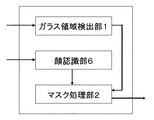
次に、第四の実施形態の画像処理装置を、図9を用いて説明する。なお、第一の実施形態に係るものと同一の構成部については説明を省略する。
[Fourth embodiment]
Next, an image processing apparatus according to a fourth embodiment will be described with reference to FIG. In addition, description is abbreviate | omitted about the structure part same as what concerns on 1st embodiment.
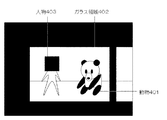
本実施形態における画像処理装置は、第一の実施形態のガラス領域検出部1、マスク処理部2に加えて、さらに、顔認識部6を有する。顔認識部6は、可視光画像中に含まれている人物の顔を認識し、顔領域情報を生成する。顔領域情報とは、人物の顔が含まれる領域を示す情報である。顔認識部6が生成した顔領域情報に基づいて、マスク処理部2は、ガラス領域へのマスク処理とは独立して顔領域にもマスク処理を行う。これにより、図10に示すように、動物401を監視しているカメラの撮影範囲に人物403が入り込んだ場合であっても、人物403のプライバシーは常に保護されることになる。
The image processing apparatus according to the present embodiment further includes a face recognition unit 6 in addition to the glass
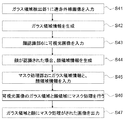
次に、図11を用いて、本実施形態の動作を詳細に説明する。図11は、本実施の形態の動作を示すフローチャートである。 Next, the operation of this embodiment will be described in detail with reference to FIG. FIG. 11 is a flowchart showing the operation of the present embodiment.
まず、ガラス領域検出部1は、遠赤外線カメラで撮影された画像が入力される(S41)。その後、ガラス領域検出部1は、第一の実施形態の場合と同様に、遠赤外線画像からガラス領域を検出し、ガラス領域情報を生成する(S42)。
First, the glass
次に、可視光カメラで撮影された画像が、顔認識部6に入力される(S43)。顔認識部6は、入力された可視光画像中に含まれる人物の顔を認識する。可視光画像中に人物の顔が含まれていない場合は、顔が認識されない。この場合、顔認識部6は、次の可視光画像の入力を待つ。顔認識部6は、人物の顔を認識すると、顔領域情報を生成する(S44)。ガラス領域検出部1はガラス領域情報を、顔認識部6は顔領域情報を、それぞれマスク処理部2に出力する(S45)。また、可視光カメラで撮影された画像がマスク処理部2に入力される。マスク処理部2は、入力されたガラス領域情報と顔領域情報に基づいて、可視光画像の、ガラス領域に対応する領域と顔領域とにマスク処理を行う(S46)。
Next, the image photographed with the visible light camera is input to the face recognition unit 6 (S43). The face recognition unit 6 recognizes a human face included in the input visible light image. When a human face is not included in the visible light image, the face is not recognized. In this case, the face recognition unit 6 waits for the input of the next visible light image. When the face recognition unit 6 recognizes a person's face, the face recognition unit 6 generates face area information (S44). The glass
その後、プライバシー保護対象領域であるガラス領域と、プライバシー保護が必要な人物の顔にマスク処理がされた画像が出力される(S47)。 Thereafter, an image in which the mask process is applied to the glass area as the privacy protection target area and the face of the person who needs privacy protection is output (S47).
以上詳述したように、本発明の第四の実施形態の画像処理装置は、顔認識部6を有するので、ガラス領域とは独立してプライバシーを保護したい人物がいる場合に、顔領域にマスク処理を行い、その人物のプライバシーを保護することができる。 As described above in detail, the image processing apparatus according to the fourth embodiment of the present invention includes the face recognition unit 6, and therefore, when there is a person whose privacy is to be protected independently of the glass area, the face area is masked. Processing can be performed to protect the privacy of the person.
以上説明したように、本発明は、ガラス領域に基づいてプライバシー保護の処理の切り分けができ、処理負荷の少ない監視カメラ装置等の画像処理装置として有用である。 As described above, the present invention is useful as an image processing apparatus such as a monitoring camera apparatus that can perform privacy protection processing based on a glass region and has a low processing load.
1 ガラス領域検出部
2 マスク処理部
3 可視光カメラ部
4 遠赤外線カメラ部
5 位置合わせ部
6 顔認識部
DESCRIPTION OF
Claims (20)
前記ガラス領域情報に基づいて、可視光カメラで撮影された画像で、ガラス領域に対応する領域、またはガラス領域に対応する領域以外の領域のいずれか一方にマスク処理を行うマスク処理部と、
を有することを特徴とする画像処理装置。 A glass region detection unit that detects a glass region based on an image captured by a far-infrared camera and generates glass region information;
Based on the glass area information, in the image taken by the visible light camera, a mask processing unit that performs mask processing on either the area corresponding to the glass area or the area other than the area corresponding to the glass area,
An image processing apparatus comprising:
可視光カメラ部と、
前記遠赤外線カメラ部で撮影された画像に基づいてガラス領域を検出し、ガラス領域情報を生成するガラス領域検出部と、
前記ガラス領域情報に基づいて、前記可視光カメラ部で撮影された画像で、ガラス領域に対応する領域、またはガラス領域に対応する領域以外の領域のいずれか一方にマスク処理を行うマスク処理部と、
を有することを特徴とする画像処理装置。 A far-infrared camera unit;
A visible light camera unit;
A glass region detection unit that detects a glass region based on an image photographed by the far-infrared camera unit and generates glass region information;
A mask processing unit that performs mask processing on either one of the region corresponding to the glass region or the region other than the region corresponding to the glass region in the image captured by the visible light camera unit based on the glass region information; ,
An image processing apparatus comprising:
前記マスク処理部は、前記顔領域情報に基づいて、顔領域にもマスク処理を行うことを特徴とする請求項1から請求項3のいずれか一項に記載の画像処理装置。 A face recognition unit for recognizing a person's face and generating face area information;
4. The image processing apparatus according to claim 1, wherein the mask processing unit also performs a mask process on a face area based on the face area information. 5.
前記ガラス領域情報に基づいて、可視光カメラで撮影された画像で、ガラス領域に対応する領域、またはガラス領域に対応する領域以外の領域のいずれか一方にマスク処理を行うステップと、
を有することを特徴とする画像処理方法。 Detecting a glass region based on an image taken by a far-infrared camera and generating glass region information;
Based on the glass region information, in the image taken by the visible light camera, performing a mask process on either the region corresponding to the glass region or the region other than the region corresponding to the glass region;
An image processing method comprising:
可視光カメラで画像を撮影するステップと、
前記遠赤外線カメラで撮影された画像に基づいてガラス領域を検出し、ガラス領域情報を生成するステップと、
前記ガラス領域情報に基づいて、可視光カメラで撮影された画像で、ガラス領域に対応する領域、またはガラス領域に対応する領域以外の領域のいずれか一方にマスク処理を行うステップと、
を同一装置内で行うことを特徴とする画像処理方法。 Taking a picture with a far-infrared camera;
Taking an image with a visible light camera;
Detecting a glass region based on an image taken by the far-infrared camera and generating glass region information;
Based on the glass area information, in the image taken by the visible light camera, performing a mask process on either the area corresponding to the glass area or the area other than the area corresponding to the glass area;
Is performed in the same apparatus.
前記顔領域情報に基づいて、顔領域にもマスク処理を行うステップと、
をさらに有することを特徴とする請求項8から請求項10のいずれか一項に記載の画像処理方法。 Recognizing a person's face and generating face area information;
Masking the face area based on the face area information; and
The image processing method according to any one of claims 8 to 10, further comprising:
遠赤外線カメラで撮影された画像に基づいてガラス領域を検出し、ガラス領域情報を生成するステップと、
前記ガラス領域情報に基づいて、可視光カメラで撮影された画像で、ガラス領域に対応する領域、またはガラス領域に対応する領域以外の領域のいずれか一方にマスク処理を行うステップと、
を実行させるための画像処理プログラム。 On the computer,
Detecting a glass region based on an image taken by a far-infrared camera and generating glass region information;
Based on the glass area information, in the image taken by the visible light camera, performing a mask process on either the area corresponding to the glass area or the area other than the area corresponding to the glass area;
An image processing program for executing
遠赤外線カメラで撮影された画像と可視光カメラで撮影された画像とのガラス領域の位置を対応させるステップをさらに実行させる請求項15に記載の画像処理プログラム。 On the computer,
The image processing program according to claim 15, further causing the step of associating the position of the glass region between the image captured by the far-infrared camera and the image captured by the visible light camera.
人物の顔を認識し、顔領域情報を生成するステップと、
前記顔領域情報に基づいて、顔領域にもマスク処理を行うステップと、
をさらに実行させる請求項15又は請求項16に記載の画像処理プログラム。 On the computer,
Recognizing a person's face and generating face area information;
Masking the face area based on the face area information; and
The image processing program according to claim 15 or 16, further causing the processing to be executed.
Priority Applications (1)
| Application Number | Priority Date | Filing Date | Title |
|---|---|---|---|
| JP2008319931A JP2010146094A (en) | 2008-12-16 | 2008-12-16 | Image processing apparatus, image processing method, and image processing program |
Applications Claiming Priority (1)
| Application Number | Priority Date | Filing Date | Title |
|---|---|---|---|
| JP2008319931A JP2010146094A (en) | 2008-12-16 | 2008-12-16 | Image processing apparatus, image processing method, and image processing program |
Publications (1)
| Publication Number | Publication Date |
|---|---|
| JP2010146094A true JP2010146094A (en) | 2010-07-01 |
Family
ID=42566512
Family Applications (1)
| Application Number | Title | Priority Date | Filing Date |
|---|---|---|---|
| JP2008319931A Pending JP2010146094A (en) | 2008-12-16 | 2008-12-16 | Image processing apparatus, image processing method, and image processing program |
Country Status (1)
| Country | Link |
|---|---|
| JP (1) | JP2010146094A (en) |
Cited By (7)
| Publication number | Priority date | Publication date | Assignee | Title |
|---|---|---|---|---|
| JP2012098170A (en) * | 2010-11-02 | 2012-05-24 | Shimizu Corp | Image data processing system |
| JP2016005213A (en) * | 2014-06-19 | 2016-01-12 | 株式会社Jvcケンウッド | Imaging apparatus and infrared image generation method |
| JP2017220923A (en) * | 2016-06-07 | 2017-12-14 | パナソニックIpマネジメント株式会社 | Image generating apparatus, image generating method, and program |
| KR20190110304A (en) * | 2018-03-20 | 2019-09-30 | 울산과학기술원 | Apparatus for removing reflection image and operation method of the apparatus |
| JP2021006990A (en) * | 2019-06-14 | 2021-01-21 | アクシス アーベー | How to highlight an object of interest in an image or video |
| KR20210013834A (en) * | 2019-07-29 | 2021-02-08 | 울산과학기술원 | Apparatus for removing reflection image and method thereof |
| US20220114734A1 (en) * | 2020-10-14 | 2022-04-14 | Shutterfly, Llc | System for background and floor replacement in full-length subject images |
Citations (5)
| Publication number | Priority date | Publication date | Assignee | Title |
|---|---|---|---|---|
| JP2004219277A (en) * | 2003-01-15 | 2004-08-05 | Sanyo Electric Co Ltd | Human body detection method and system, program, recording medium |
| JP2004304847A (en) * | 2004-06-25 | 2004-10-28 | Matsushita Electric Ind Co Ltd | Surveillance camera device and display method of surveillance camera |
| JP2005258679A (en) * | 2004-03-10 | 2005-09-22 | Advanced Telecommunication Research Institute International | Image shooting device |
| JP2007140938A (en) * | 2005-11-18 | 2007-06-07 | Nissan Motor Co Ltd | Parking / stopping determination device and parking / stopping determination method |
| JP2008017093A (en) * | 2006-07-05 | 2008-01-24 | Matsushita Electric Ind Co Ltd | Monitoring system, monitoring apparatus and monitoring method |
-
2008
- 2008-12-16 JP JP2008319931A patent/JP2010146094A/en active Pending
Patent Citations (5)
| Publication number | Priority date | Publication date | Assignee | Title |
|---|---|---|---|---|
| JP2004219277A (en) * | 2003-01-15 | 2004-08-05 | Sanyo Electric Co Ltd | Human body detection method and system, program, recording medium |
| JP2005258679A (en) * | 2004-03-10 | 2005-09-22 | Advanced Telecommunication Research Institute International | Image shooting device |
| JP2004304847A (en) * | 2004-06-25 | 2004-10-28 | Matsushita Electric Ind Co Ltd | Surveillance camera device and display method of surveillance camera |
| JP2007140938A (en) * | 2005-11-18 | 2007-06-07 | Nissan Motor Co Ltd | Parking / stopping determination device and parking / stopping determination method |
| JP2008017093A (en) * | 2006-07-05 | 2008-01-24 | Matsushita Electric Ind Co Ltd | Monitoring system, monitoring apparatus and monitoring method |
Cited By (11)
| Publication number | Priority date | Publication date | Assignee | Title |
|---|---|---|---|---|
| JP2012098170A (en) * | 2010-11-02 | 2012-05-24 | Shimizu Corp | Image data processing system |
| JP2016005213A (en) * | 2014-06-19 | 2016-01-12 | 株式会社Jvcケンウッド | Imaging apparatus and infrared image generation method |
| JP2017220923A (en) * | 2016-06-07 | 2017-12-14 | パナソニックIpマネジメント株式会社 | Image generating apparatus, image generating method, and program |
| KR20190110304A (en) * | 2018-03-20 | 2019-09-30 | 울산과학기술원 | Apparatus for removing reflection image and operation method of the apparatus |
| KR102046243B1 (en) * | 2018-03-20 | 2019-11-18 | 울산과학기술원 | Apparatus for removing reflection image and operation method of the apparatus |
| JP2021006990A (en) * | 2019-06-14 | 2021-01-21 | アクシス アーベー | How to highlight an object of interest in an image or video |
| JP7441732B2 (en) | 2019-06-14 | 2024-03-01 | アクシス アーベー | How to highlight objects of interest in an image or video |
| KR20210013834A (en) * | 2019-07-29 | 2021-02-08 | 울산과학기술원 | Apparatus for removing reflection image and method thereof |
| KR102314954B1 (en) * | 2019-07-29 | 2021-10-21 | 울산과학기술원 | Apparatus for removing reflection image and method thereof |
| US20220114734A1 (en) * | 2020-10-14 | 2022-04-14 | Shutterfly, Llc | System for background and floor replacement in full-length subject images |
| US11983886B2 (en) * | 2020-10-14 | 2024-05-14 | Shutterfly, Llc | System for background and floor replacement in full-length subject images |
Similar Documents
| Publication | Publication Date | Title |
|---|---|---|
| KR101945194B1 (en) | Image processing apparatus, image processing method, and program | |
| KR101946436B1 (en) | A photographing method, a photographing apparatus, | |
| US10249055B2 (en) | Image processing apparatus, image processing method and program | |
| JP6003135B2 (en) | Image processing apparatus, image processing method, and imaging apparatus | |
| CN108012078B (en) | Image brightness processing method and device, storage medium and electronic equipment | |
| CN109218663B (en) | Image processing apparatus, image processing method, and storage medium | |
| CN102959970A (en) | Device, method and program for determining obstacles within imaging range during stereoscopic display imaging | |
| EP3654236A2 (en) | Information processing apparatus, control method of information processing apparatus, storage medium, and imaging system | |
| JP2010146094A (en) | Image processing apparatus, image processing method, and image processing program | |
| KR20150021353A (en) | Image systhesis system and image synthesis method | |
| KR102083926B1 (en) | Image fusion system and image fusion method | |
| WO2023040725A1 (en) | White balance processing method and electronic device | |
| JP2017208616A (en) | Image processing apparatus, image processing method, and program | |
| US20160189392A1 (en) | Object tracking apparatus, control method therefor and storage medium | |
| KR101516487B1 (en) | Image processing device using difference camera | |
| JP5142825B2 (en) | Image display device and image display method | |
| JP5395650B2 (en) | Subject area extraction device and control method thereof, subject tracking device, and program | |
| CN108605089B (en) | Monitoring camera and monitoring camera system provided with same | |
| JP2011193066A (en) | Image sensing device | |
| TW201833869A (en) | Photographing processing device, photographing processing method, and recording medium enables photography to be performed in the presence of a distortion derived from a wide-angle lens | |
| JP2020077400A (en) | Image processing unit, image processing method, and program | |
| KR102474697B1 (en) | Image Pickup Apparatus and Method for Processing Images | |
| JP6213640B2 (en) | Image processing apparatus, image processing method, imaging apparatus, and system | |
| EP3370411B1 (en) | Image output method and image capturing device | |
| CN116156334B (en) | Shooting method, device, electronic device and readable storage medium |
Legal Events
| Date | Code | Title | Description |
|---|---|---|---|
| RD01 | Notification of change of attorney |
Free format text: JAPANESE INTERMEDIATE CODE: A7421 Effective date: 20110706 |
|
| A621 | Written request for application examination |
Free format text: JAPANESE INTERMEDIATE CODE: A621 Effective date: 20111024 |
|
| A977 | Report on retrieval |
Free format text: JAPANESE INTERMEDIATE CODE: A971007 Effective date: 20120705 |
|
| A131 | Notification of reasons for refusal |
Free format text: JAPANESE INTERMEDIATE CODE: A131 Effective date: 20120814 |
|
| A521 | Written amendment |
Free format text: JAPANESE INTERMEDIATE CODE: A523 Effective date: 20121012 |
|
| A02 | Decision of refusal |
Free format text: JAPANESE INTERMEDIATE CODE: A02 Effective date: 20130514 |