JP2008521950A - Process for producing polyoxymethylene - Google Patents
Process for producing polyoxymethylene Download PDFInfo
- Publication number
- JP2008521950A JP2008521950A JP2007541858A JP2007541858A JP2008521950A JP 2008521950 A JP2008521950 A JP 2008521950A JP 2007541858 A JP2007541858 A JP 2007541858A JP 2007541858 A JP2007541858 A JP 2007541858A JP 2008521950 A JP2008521950 A JP 2008521950A
- Authority
- JP
- Japan
- Prior art keywords
- polymerization
- polyoxymethylene
- region
- diameter
- zone
- Prior art date
- Legal status (The legal status is an assumption and is not a legal conclusion. Google has not performed a legal analysis and makes no representation as to the accuracy of the status listed.)
- Granted
Links
Classifications
-
- B—PERFORMING OPERATIONS; TRANSPORTING
- B01—PHYSICAL OR CHEMICAL PROCESSES OR APPARATUS IN GENERAL
- B01J—CHEMICAL OR PHYSICAL PROCESSES, e.g. CATALYSIS OR COLLOID CHEMISTRY; THEIR RELEVANT APPARATUS
- B01J19/00—Chemical, physical or physico-chemical processes in general; Their relevant apparatus
- B01J19/0053—Details of the reactor
-
- C—CHEMISTRY; METALLURGY
- C08—ORGANIC MACROMOLECULAR COMPOUNDS; THEIR PREPARATION OR CHEMICAL WORKING-UP; COMPOSITIONS BASED THEREON
- C08G—MACROMOLECULAR COMPOUNDS OBTAINED OTHERWISE THAN BY REACTIONS ONLY INVOLVING UNSATURATED CARBON-TO-CARBON BONDS
- C08G2/00—Addition polymers of aldehydes or cyclic oligomers thereof or of ketones; Addition copolymers thereof with less than 50 molar percent of other substances
- C08G2/18—Copolymerisation of aldehydes or ketones
- C08G2/22—Copolymerisation of aldehydes or ketones with epoxy compounds
-
- B—PERFORMING OPERATIONS; TRANSPORTING
- B01—PHYSICAL OR CHEMICAL PROCESSES OR APPARATUS IN GENERAL
- B01J—CHEMICAL OR PHYSICAL PROCESSES, e.g. CATALYSIS OR COLLOID CHEMISTRY; THEIR RELEVANT APPARATUS
- B01J19/00—Chemical, physical or physico-chemical processes in general; Their relevant apparatus
- B01J19/24—Stationary reactors without moving elements inside
- B01J19/2415—Tubular reactors
-
- C—CHEMISTRY; METALLURGY
- C08—ORGANIC MACROMOLECULAR COMPOUNDS; THEIR PREPARATION OR CHEMICAL WORKING-UP; COMPOSITIONS BASED THEREON
- C08G—MACROMOLECULAR COMPOUNDS OBTAINED OTHERWISE THAN BY REACTIONS ONLY INVOLVING UNSATURATED CARBON-TO-CARBON BONDS
- C08G2/00—Addition polymers of aldehydes or cyclic oligomers thereof or of ketones; Addition copolymers thereof with less than 50 molar percent of other substances
- C08G2/08—Polymerisation of formaldehyde
-
- C—CHEMISTRY; METALLURGY
- C08—ORGANIC MACROMOLECULAR COMPOUNDS; THEIR PREPARATION OR CHEMICAL WORKING-UP; COMPOSITIONS BASED THEREON
- C08G—MACROMOLECULAR COMPOUNDS OBTAINED OTHERWISE THAN BY REACTIONS ONLY INVOLVING UNSATURATED CARBON-TO-CARBON BONDS
- C08G2/00—Addition polymers of aldehydes or cyclic oligomers thereof or of ketones; Addition copolymers thereof with less than 50 molar percent of other substances
- C08G2/10—Polymerisation of cyclic oligomers of formaldehyde
-
- C—CHEMISTRY; METALLURGY
- C08—ORGANIC MACROMOLECULAR COMPOUNDS; THEIR PREPARATION OR CHEMICAL WORKING-UP; COMPOSITIONS BASED THEREON
- C08G—MACROMOLECULAR COMPOUNDS OBTAINED OTHERWISE THAN BY REACTIONS ONLY INVOLVING UNSATURATED CARBON-TO-CARBON BONDS
- C08G2/00—Addition polymers of aldehydes or cyclic oligomers thereof or of ketones; Addition copolymers thereof with less than 50 molar percent of other substances
- C08G2/30—Chemical modification by after-treatment
Landscapes
- Chemical & Material Sciences (AREA)
- Chemical Kinetics & Catalysis (AREA)
- Organic Chemistry (AREA)
- Health & Medical Sciences (AREA)
- Medicinal Chemistry (AREA)
- Polymers & Plastics (AREA)
- General Chemical & Material Sciences (AREA)
- Polyoxymethylene Polymers And Polymers With Carbon-To-Carbon Bonds (AREA)
- Polyethers (AREA)
Abstract
モノマーa)を、カチオン性を示す開始剤b)の存在下で、並びに場合により調節剤c)の存在下で重合させ、次いで失活させ、そしてこのポリマーを分離することによりポリオキシメチレンを製造する方法において、混合領域、重合領域及び失活領域を有し、かつ反応領域の直径が重合領域の直径の<90%である、スタティックミキシングエレメントを有する管型反応器中で重合を実施することを特徴とする、ポリオキシメチレンを製造する方法。 Monomer a) is polymerized in the presence of a cationic initiator b) as well as optionally in the presence of a regulator c) and then deactivated and the polyoxymethylene is produced by separating the polymer. In which the polymerization is carried out in a tubular reactor having a static mixing element having a mixing zone, a polymerization zone and a deactivation zone, and the reaction zone diameter is <90% of the polymerization zone diameter. A process for producing polyoxymethylene, characterized in that
Description
発明の詳細な説明
本発明は、ポリオキシメチレンの改善された製造方法及び該方法により得られるPOMポリマーに関する。
DETAILED DESCRIPTION OF THE INVENTION The present invention relates to an improved process for producing polyoxymethylene and the POM polymer obtained by the process.
管型反応器中でのPOMの溶融重合は、公知である。例えば、種々の構成の管型反応器が記載されてきた:「流動転移(fliessendem Uebergang)」、すなわち、一方では幾何学的に区別されない混合領域(EP−A638599、EP−A638357)、他方では反応領域と停止領域との空間の分離(EP-A80656)。この両方の方法は、種々の物質流束もしくは種々の粘度の液体の十分な混合を確保するための発端である。 The melt polymerization of POM in a tubular reactor is known. For example, tubular reactors of various configurations have been described: “fliessendem Uebergang”, ie, on the one hand, mixing regions that are not geometrically distinct (EP-A 638599, EP-A 638357), on the other hand the reaction Separation of the space between the area and the stop area (EP-A80656). Both of these methods are the starting point for ensuring a thorough mixing of different mass fluxes or liquids of different viscosities.
特定の問題は、溶融重合の際の停止剤の添加である。この場合、極めて少量の低分子成分(無機塩又は有機塩基)と、(高)粘度のポリマー溶融物とを効率的に混合しなければならない。 A particular problem is the addition of a terminator during melt polymerization. In this case, a very small amount of a low molecular component (inorganic salt or organic base) and a (high) viscosity polymer melt must be efficiently mixed.
従来技術は、この問題の解決のために、主として反応器の構成を設定する:
− 停止領域の滞留時間の最適化(EP−A638599、EP−A638357)
− 隘路の組込及び反応器中の流速の変化(EP−A80656)。
The prior art mainly sets the reactor configuration to solve this problem:
-Optimization of the residence time in the stop area (EP-A 638599, EP-A 638357)
-The incorporation of the bottleneck and the change in the flow rate in the reactor (EP-A 80656).
停止剤は、従来技術によれば、常に助剤(水、アルコール、又は他の溶剤)を用いて反応混合物中に導入する、例えばDE−A3703790を参照のこと。 The terminator is always introduced into the reaction mixture according to the prior art with the aid (water, alcohol or other solvent), see for example DE-A 3703790.
有機停止試薬であれば、それぞれの場合において、これはポリマー溶融物中の異物であり、すなわち、停止剤により新規な構造単位が最終生成物中に導入される。有機停止剤が更に溶剤中に存在する場合、付加的な構造単位が導入されることがある。この場合、鎖安定性及び色特性が不利である。 If it is an organic stopping reagent, in each case this is a foreign substance in the polymer melt, i.e. a new structural unit is introduced into the final product by the stopping agent. If an organic terminator is further present in the solvent, additional structural units may be introduced. In this case, chain stability and color properties are disadvantageous.
無機停止試薬の場合、導入される量は理想的には開始剤の量に対して正確に適合させる。それというのも、過剰の塩基(蒸気圧なし)は除去することができないからである。過剰量でも作業することができる。 In the case of inorganic stop reagents, the amount introduced is ideally matched exactly to the amount of initiator. This is because excess base (without vapor pressure) cannot be removed. You can work in excess.
この両方の場合において、生成物の質を改善するために停止剤の量を最小化することが望ましい。 In both cases, it is desirable to minimize the amount of terminator to improve product quality.
更に、異物(溶剤、低分子液体)の量を最小化することが望ましい。 Furthermore, it is desirable to minimize the amount of foreign matter (solvent, low molecular liquid).
従って本発明の課題は、従来技術と比べて以下の利点を有するポリオキシメチレンの改善された製造方法を提供することである:
− ポリマー溶融物における停止剤の添加及びより均一な分布の最適化、
− 改善された最終生成物の質、
− 合成物中の異物の低減、
− 反応器の停止領域中の滞留時間の最適化、
− ポリマー特性のより良好な再生産性、
− 脂肪族溶剤により改善されたポリマーの色、
− 非プロトン性溶剤により達せられるより安定なポリマー末端基。
The object of the present invention is therefore to provide an improved process for producing polyoxymethylene having the following advantages over the prior art:
-Addition of terminators in the polymer melt and optimization of a more uniform distribution,
-Improved end product quality,
-Reduction of foreign matter in the composite,
-Optimization of the residence time in the stop area of the reactor,
-Better reproducibility of polymer properties,
-Polymer color improved by aliphatic solvents,
-More stable polymer end groups achieved by aprotic solvents.
本発明の更なる課題は、低分子POMを可能な限り少ない割合で含有するポリオキシメチレンホモ−又は−コポリマーを製造することである。 A further object of the present invention is to produce polyoxymethylene homo- or copolymers containing as low a proportion of low molecular POM as possible.
これに応じて、モノマーa)を、カチオン性開始剤b)の存在下で、並びに場合により調節剤c)の存在下で重合させ、次いでこのポリマーを失活させ、そして分離することによりポリオキシメチレンを製造する方法において、重合を、スタティックミキシングエレメントを有する管型反応器中で実施し、その際、該管型反応器は混合領域、重合領域及び失活領域を有し、かつ該管型反応器の混合領域の直径が重合領域の直径の<90%であることを特徴とする、ポリオキシメチレンを製造する方法を見出した。 Accordingly, the monomer a) is polymerized in the presence of the cationic initiator b) as well as optionally in the presence of the regulator c), and the polymer is then deactivated and separated by polyoxygenation. In the process for producing methylene, the polymerization is carried out in a tubular reactor having a static mixing element, wherein the tubular reactor has a mixing region, a polymerization region and a deactivation region, and the tubular type We have found a process for producing polyoxymethylene, characterized in that the diameter of the mixing zone of the reactor is <90% of the diameter of the polymerization zone.
好ましい実施態様は、引用形式請求項に記載されている。 Preferred embodiments are set forth in the cited claims.
更に、非対称のモル質量分布を有するPOMポリマーを見出した。 Furthermore, POM polymers with an asymmetric molar mass distribution have been found.
本方法は、高度の混合作用を有するそれぞれの反応器、例えば、トレー、プローシェアミキサ、管型反応器、リスト(List)反応器、ニーダ、撹拌反応器、押出機及びベルト型反応器に基づいて実施することができる。 The method is based on respective reactors with a high degree of mixing action, for example trays, proshear mixers, tubular reactors, List reactors, kneaders, stirred reactors, extruders and belt reactors. Can be implemented.
好適な反応器は、例えば:ケニックス(Kenics)(Chemineer Inc.);インターフェイシャルサーフィスジェネレータ(interfacial surface Generator)ISG及びロープレッシャードロップ(low pressure drop)ミキサ(ROSS Engineering Inc.);SMV、SMX、SMXL、SMR(Sulzer Koch−Glitsch);員ライナー(Inliner)系45(Lightnin Inc.);CSEミキサ(Fluitec Georg AG)。 Suitable reactors include, for example: Kenics (Chemineer Inc.); interfacial surface generator ISG and low pressure drop mixer (ROSS Engineering SM, X, SM; , SMR (Sulzer Koch-Glitsch); Inliner system 45 (Lightnin Inc.); CSE mixer (Fluitec George AG).
生ずるPOMポリマーは当業者には知られており、かつ文献に記載されている。 The resulting POM polymers are known to those skilled in the art and are described in the literature.
殊に一般的には、このポリマーは、ポリマー主鎖中に少なくとも50mol%の繰り返し単位−CH2O−を有する。 In particular, the polymer has at least 50 mol% of repeating units —CH 2 O— in the polymer main chain.
ホモポリマーは、一般的に、モノマーa)、例えばホルムアルデヒド又はトリオキサンの重合により、好ましくは好適な触媒の存在下で製造する。 Homopolymers are generally prepared by polymerization of monomers a) such as formaldehyde or trioxane, preferably in the presence of a suitable catalyst.
本発明の範囲内では、ポリオキシメチレンコポリマーが好ましく、特に、繰り返し単位−CH2O−の他に、更に50まで、好ましくは0.01〜20、特に0.1〜10mol%、殊に好ましくは0.5〜3mol%の繰り返し単位
同様に、例えばトリオキサン、前記した環状エーテルと、第3のモノマー、好ましくは式
この種の好ましいモノマーは、若干の例を挙げれば、エチレンジグリシド、ジグリシジルエーテル及びグリシジレンとホルムアルデヒド、ジオキサン又はトリオキサンとの2:1のモル比のジエーテル、並びにグリシジル化合物2molと2〜8個のC原子を有する脂肪族ジオール1molとからなるジエーテル、例えばエチレングリコール、1,4−ブタンジオール、1,3−ブタンジオール、シクロブタン−1,3−ジオール、1,2−プロパンジオール及びシクロヘキサン−1,4−ジオールのジグリシジルエーテルである。 Preferred monomers of this type include ethylenediglycide, diglycidyl ether and glycidylene and diether in a 2: 1 molar ratio of formaldehyde, dioxane or trioxane, and 2 mol of glycidyl compound and 2 to 8 to name a few. Diethers composed of 1 mol of an aliphatic diol having C atoms, such as ethylene glycol, 1,4-butanediol, 1,3-butanediol, cyclobutane-1,3-diol, 1,2-propanediol and cyclohexane-1, It is a diglycidyl ether of 4-diol.
鎖末端にC−C結合又は−O−CH3結合を有する、末端基が安定化されたポリオキシメチレンポリマーが特に有利である。 Particular preference is given to polyoxymethylene polymers with stabilized end groups having a C—C bond or —O—CH 3 bond at the chain end.
好ましいポリオキシメチレンコポリマーは、少なくとも150℃の融点及び5000〜300000、好ましくは7000〜250000の範囲内の分子量(重量平均)Mwを有する。 Preferred polyoxymethylene copolymers have a melting point of at least 150 ° C. and a molecular weight (weight average) M w in the range of 5000-300000, preferably 7000-250,000.
不均一性(Mw/Mn)2〜15、好ましくは3〜12、特に好ましくは3.5〜9を有するPOMコポリマーが特に好ましい。この測定は、一般に(GPC)SEC(サイズ排除クロマトグラフィー)によって実施し、Mn値(数平均分子量)は一般に(GPC)SEC(サイズ排除クロマトグラフィー)によって測定する。 Particular preference is given to POM copolymers having heterogeneity (M w / M n ) of 2 to 15, preferably 3 to 12, particularly preferably 3.5 to 9. This measurement is generally performed by (GPC) SEC (size exclusion chromatography), and the M n value (number average molecular weight) is generally measured by (GPC) SEC (size exclusion chromatography).
この方法により得られるPOMポリマーは、好ましくは単峰性の分子量分布を有し、その際、低分子の割合は少ない。 The POM polymer obtained by this method preferably has a unimodal molecular weight distribution, with a small proportion of low molecules.
ポリオキシメチレンホモ−又は−コポリマーは特に、2.25〜5.5、好ましくは2.75〜5、特に3.2〜4.5のd50/d10値(Mwに基づく)の商を有する。d90/d50値(Mwに基づく)の商は、好ましくは1.25〜3.25、有利には1.75〜2.75、特に2〜2.5である。 The polyoxymethylene homo- or -copolymers in particular have a quotient of d 50 / d 10 values (based on M w ) of 2.25 to 5.5, preferably 2.75 to 5, in particular 3.2 to 4.5. Have The quotient of the d 90 / d 50 value (based on M w ) is preferably from 1.25 to 3.25, advantageously from 1.75 to 2.75, in particular from 2 to 2.5.
POMポリマーは、極めて小さい低分子の割合を有し、好ましくは、非対称の単峰性分布曲線を有し、その際、上述の商d50/d10とd90/d50との差は少なくとも0.25、好ましくは1〜3、特に1.0〜2.3である。 The POM polymer has a very small proportion of small molecules, and preferably has an asymmetric unimodal distribution curve, where the difference between the quotients d 50 / d 10 and d 90 / d 50 is at least It is 0.25, preferably 1 to 3, especially 1.0 to 2.3.
GPC(ゲル浸透クロマトグラフィー)によるモル質量測定:
溶出剤:ヘキサフルオロイソプロパノール+0.05%トリフルオロ酢酸カリウム塩
カラム温度:40℃
流速:0.5mL/分
検出器:ディファレンシャルレフラクトメータ(Differentialrefraktometer)Agilent G1362A
Molar mass measurement by GPC (gel permeation chromatography):
Eluent: hexafluoroisopropanol + 0.05% potassium trifluoroacetate column temperature: 40 ° C
Flow rate: 0.5 mL / min Detector: Differential refractometer Agilent G1362A
平衡化は、分子量M=505ないしM=2740000を有するFa.PSSの狭い分布のPMMAスタンダードを用いて実施した。この間隔の外に存在する溶出範囲は、外挿法により評価した。 Equilibration is achieved with Fa. With a molecular weight M = 505 to M = 2740000. This was performed using a PMMA standard with a narrow distribution of PSS. The elution range existing outside this interval was evaluated by extrapolation.
d50値は、一般的に当業者には、ポリマーの50%がより小さいMwを有し、かつこれに応じて50%がより大きいMwを有する値であると解される。 The d 50 value is generally understood by those skilled in the art as 50% of the polymer having a smaller M w and correspondingly 50% having a larger M w .
好ましくは、本発明にかかる方法により得られる粗製ポリオキシメチレンは、最大で3%、好ましくは最大で1%、有利には最大で0.05%のペレットのVDA275による残留ホルムアルデヒド含有率を有する。 Preferably, the crude polyoxymethylene obtained by the process according to the invention has a residual formaldehyde content according to VDA275 of up to 3%, preferably up to 1%, advantageously up to 0.05% pellets.
本発明にかかる方法は、好ましくはトリオキサンのホモ−及び共重合に適用する。しかし、モノマーa)として、原則的に、それぞれ上述のモノマー、例えばテトロキサン(Tetroxan)又は(パラ)ホルムアルデヒドを使用することもできる。 The process according to the invention is preferably applied to the homo- and copolymerization of trioxane. However, it is also possible in principle to use the abovementioned monomers, for example Tetroxan or (para) formaldehyde, respectively, as monomer a).
モノマー、例えばトリオキサンは、好ましくは、一般的に60〜180℃の温度で溶融状態で計量供給する。 Monomers, such as trioxane, are preferably metered in the molten state, generally at a temperature of 60-180 ° C.
好ましくは、計量供給の際の反応混合物の温度は、62〜170℃、特に120〜160℃である。 Preferably, the temperature of the reaction mixture during metering is 62-170 ° C., in particular 120-160 ° C.
ポリマーの分子量は、場合により(トリオキサン)重合の際に通常の調節剤c)によって目的の値に調節することができる。調節剤としては、一価アルコールのアセタールもしくはホルマール、アルコール自体並びに連鎖移動剤として機能する少量の水(この存在は一般に完全には回避されない)が挙げられる。調節剤は、10〜10000ppm、好ましくは50〜5000ppmの量で使用する。 The molecular weight of the polymer can optionally be adjusted to the desired value by means of the usual regulator c) during (trioxane) polymerization. Modifiers include acetals or formals of monohydric alcohols, alcohols themselves and small amounts of water that function as chain transfer agents (this presence is generally not completely avoided). The regulator is used in an amount of 10 to 10000 ppm, preferably 50 to 5000 ppm.
開始剤b)(触媒とも称される)としては、(トリオキサン)重合の際に通常のカチオン性開始剤を使用する。プロトン酸、例えばフッ素化又は塩素化されたアルキル−及びアリールスルホン酸、例えば過塩素酸、トリフロロメタンスルホン酸又はルイス酸、例えば四塩化スズ、五フッ化ヒ素、五フッ化リン及び三フッ化ホウ素並びにこれらの錯化合物及び塩状の化合物、例えば三フッ化ホウ素−エーテラート及びトリフェニルメチレンヘキサフルオロホスファートが好適である。この触媒(開始剤)は、約0.001〜1000ppm、好ましくは0.01〜500ppm、特に0.05〜10ppmの量で使用する。一般に、この開始剤を希釈された形で、好ましくは0.005〜5質量%の濃度で添加することが推奨される。このための溶剤としては、不活性化合物、例えば脂肪族、環式脂肪族炭化水素、例えばシクロヘキサン、ハロゲン化された脂肪族炭化水素、グリコールエーテルなどを使用することができる。特に好ましくは、溶剤としてのトリグリム(トリエチレングリコールジメチルエーテル)並びに1,4−ジオキサンである。 As initiator b) (also referred to as catalyst), a normal cationic initiator is used during the (trioxane) polymerization. Protic acids such as fluorinated or chlorinated alkyl- and aryl sulfonic acids such as perchloric acid, trifluoromethanesulfonic acid or Lewis acids such as tin tetrachloride, arsenic pentafluoride, phosphorus pentafluoride and trifluoride Boron and their complex and salt compounds such as boron trifluoride etherate and triphenylmethylene hexafluorophosphate are preferred. This catalyst (initiator) is used in an amount of about 0.001 to 1000 ppm, preferably 0.01 to 500 ppm, especially 0.05 to 10 ppm. In general, it is recommended to add this initiator in diluted form, preferably in a concentration of 0.005 to 5% by weight. As the solvent for this purpose, inert compounds such as aliphatic and cycloaliphatic hydrocarbons such as cyclohexane, halogenated aliphatic hydrocarbons, glycol ethers and the like can be used. Particularly preferred are triglyme (triethylene glycol dimethyl ether) as a solvent and 1,4-dioxane.
モノマー並びにコモノマーa)、開始剤b)及び場合により調節剤c)は任意に予備混合するか又は互いに別々に重合反応器に添加することもできる。更に、EP−A129369又はEP−A128739に記載されているように、成分a)、b)及び/又はc)は、安定化のために、立体障害フェノールを含有してよい。 Monomers and comonomers a), initiator b) and optionally regulator c) can optionally be premixed or added separately from one another to the polymerization reactor. Furthermore, components a), b) and / or c) may contain sterically hindered phenols for stabilization, as described in EP-A 129369 or EP-A 128739.
不安定な末端基の割合を最小化するために、開始剤b)を調節剤c)中に、モノマーa)及び場合によりコモノマーa)への添加前に溶解させることが有利であることが判明している。 In order to minimize the proportion of unstable end groups, it has proved advantageous to dissolve the initiator b) in the regulator c) before addition to the monomer a) and optionally to the comonomer a). is doing.
開始剤を管型反応器の種々の箇所に計量供給することが有利であることが判明している。この場合、好ましい最小の間隔は、1D(D=上述の箇所での反応器の直径)である。 It has been found advantageous to meter the initiator at various points in the tubular reactor. In this case, the preferred minimum spacing is 1D (D = reactor diameter at the location mentioned above).
重合は、混合領域、重合領域及び失活領域を有する管型反応器中で実施する。 The polymerization is carried out in a tubular reactor having a mixing zone, a polymerization zone and a quenching zone.
管型反応器の混合領域の直径は、本発明によれば、重合領域の直径の、具体的には重合領域の最大直径に対して、<90%、好ましくは10〜90%、有利には10〜70%、特に10〜60%である。 According to the invention, the diameter of the mixing zone of the tubular reactor is <90%, preferably 10-90%, advantageously relative to the diameter of the polymerization zone, in particular the maximum diameter of the polymerization zone. 10 to 70%, especially 10 to 60%.
特に、混合領域のスタティックミキシングエレメントのウエブの数は、重合領域と比べて0〜500%、好ましくは0〜300%、特に0〜100%大きい。 In particular, the number of webs of the static mixing element in the mixing area is 0 to 500%, preferably 0 to 300%, in particular 0 to 100% larger than the polymerization area.
本発明にかかる方法の別の実施態様においては、混合領域を種々の直径の区間に分けてよい。好ましくは、反応器中の混合領域全体の直径が同じである。 In another embodiment of the method according to the invention, the mixing zone may be divided into sections of various diameters. Preferably, the diameter of the entire mixing zone in the reactor is the same.
この混合領域中の滞留時間は、好ましくは1〜300秒、特に5〜60秒である。 The residence time in this mixing zone is preferably 1 to 300 seconds, in particular 5 to 60 seconds.
反応器中の混合領域における剪断は、好ましくは5〜1000、好ましくは10〜750、特に20〜500 1/sである。 The shear in the mixing zone in the reactor is preferably 5 to 1000, preferably 10 to 750, in particular 20 to 500 1 / s.
スタティックミキサ中の剪断の計算は、以下のとおり実施する:
k:スタティックミキサの製造元の定数
Calculation of shear in the static mixer is performed as follows:
k: Static mixer manufacturer's constant
粘度は、好ましくは0.1mPas〜100Pas、好ましくは0.1mPas〜10Pasである。 The viscosity is preferably 0.1 mPas to 100 Pas, preferably 0.1 mPas to 10 Pas.
粘度の計算は、以下のとおり実施する:
Δp:ミキシングエレメントにわたる圧力損失
D:スタティックミキサの直径
NeRe:スタティックミキサの特性値(ニュートン−レイノルズ(Neston−Reynolds)数)
L:スタティックミキサの長さ
V:ミキサ中の流速
The viscosity calculation is performed as follows:
L: Length of the static mixer V: Flow velocity in the mixer
重合のための滞留時間は、好ましくは0.1〜40分、特に1〜20分である。この重合は、好ましくは、少なくとも30%、特に60%より大きい変換率になるまで行う。 The residence time for the polymerization is preferably 0.1 to 40 minutes, in particular 1 to 20 minutes. This polymerization is preferably carried out until a conversion of at least 30%, in particular greater than 60%.
一般的に、5〜200bar(絶対圧)、好ましくは10〜100bar(絶対圧)の重合の際の圧力に調節する手法が有効であることが判明している。 In general, it has been found that a technique for adjusting the pressure during the polymerization of 5 to 200 bar (absolute pressure), preferably 10 to 100 bar (absolute pressure) is effective.
本発明の別の実施形態においては、重合領域を種々の直径の区間、特に2〜10区間、好ましくは2〜5区間に分けてよい。最小直径は、最大直径に対して好ましくは20〜100%、特に30〜90%、特に好ましくは45〜75%である。 In another embodiment of the invention, the polymerization region may be divided into sections of various diameters, in particular 2-10 sections, preferably 2-5 sections. The minimum diameter is preferably 20 to 100%, in particular 30 to 90%, particularly preferably 45 to 75% with respect to the maximum diameter.
重合領域中の剪断は、好ましくは1〜300、好ましくは2〜100、特に3〜50 1/sである。粘度は、好ましくは1〜1000、好ましくは10〜500、特に100〜400Pasである。 The shear in the polymerization zone is preferably 1 to 300, preferably 2 to 100, in particular 3 to 50 1 / s. The viscosity is preferably 1-1000, preferably 10-500, in particular 100-400 Pas.
本発明によれば、この重合に引き続いて、重合混合物を、好ましくは相変化させずに直接失活させる。 According to the invention, following this polymerization, the polymerization mixture is deactivated directly, preferably without a phase change.
この触媒残留物の失活は、一般的に少なくとも1種の失活剤d)の添加により実施する。 This deactivation of the catalyst residue is generally carried out by adding at least one deactivator d).
好適な失活剤は、例えばアンモニア、脂肪族及び芳香族アミン、塩基性反応を示す塩、例えばソーダ及びホウ砂である。これらは通常、ポリマーに好ましくは1質量%までの量で添加する。 Suitable quenchers are, for example, ammonia, aliphatic and aromatic amines, salts that exhibit basic reactions, such as soda and borax. These are usually added to the polymer, preferably in an amount of up to 1% by weight.
アルカリ(土類)金属、好ましくはナトリウムの有機化合物には、好ましくは30個までのC原子及び好ましくは1〜4個のカルボキシル基を有する(環状)脂肪族、脂環式、又は芳香族カルボン酸の相応の塩が含まれる。この例は:ギ酸、酢酸、プロピオン酸、酪酸、イソ酪酸、カプリル酸、ステアリン酸、シクロヘキサンカルボン酸、コハク酸、アジピン酸、コルク酸、1,10−デカンジカルボン酸、1,4−シクロヘキサンジカルボン酸、テレフタル酸、1,2,3−プロパントリカルボン酸、1,3,5−シクロヘキサントリカルボン酸、トリメリット酸、1,2,3,4−シクロペンタンテトラカルボン酸、ピロメリット酸、安息香酸、置換安息香酸、二量体酸及び三量体酸のアルカリ金属塩並びに中性及び部分的に中性のモンタンワックス塩又はモンタンワックスエステル塩(モンタナート)である。本発明によれば、他の性質の酸基を有する塩、例えばアルカリパラフィン−、アルカリオレフィン−及びアルカリアリールスルホネート又はフェノラート並びにアルコラート、例えばメタノラート、エタノラート、グリコラートを使用してもよい。 Alkali (earth) metals, preferably sodium organic compounds, preferably (cyclic) aliphatic, alicyclic or aromatic carboxylic acids having up to 30 C atoms and preferably 1 to 4 carboxyl groups The corresponding salt of the acid is included. Examples of this are: formic acid, acetic acid, propionic acid, butyric acid, isobutyric acid, caprylic acid, stearic acid, cyclohexanecarboxylic acid, succinic acid, adipic acid, corkic acid, 1,10-decanedicarboxylic acid, 1,4-cyclohexanedicarboxylic acid , Terephthalic acid, 1,2,3-propanetricarboxylic acid, 1,3,5-cyclohexanetricarboxylic acid, trimellitic acid, 1,2,3,4-cyclopentanetetracarboxylic acid, pyromellitic acid, benzoic acid, substitution Benzoic acid, alkali metal salts of dimer acid and trimer acid, and neutral and partially neutral montan wax salts or montan wax ester salts (montanates). According to the invention, salts with acid groups of other properties, such as alkali paraffins, alkali olefins and alkali aryl sulfonates or phenolates and alcoholates such as methanolates, ethanolates, glycolates may be used.
好ましくは、好ましくは2〜18個のC原子、特に2〜6個のC原子を有し、かつ4個まで、好ましくは2個までのカルボキシル基を有するモノ−及びポリカルボン酸、特に脂肪族モノ−及びポリカルボン酸のナトリウム塩並びに好ましくは2〜15個、特に2〜8個のC原子を有するナトリウムアルコラートを使用することが好ましい。特に好ましい代表例は、酢酸ナトリウム、プロピオン酸ナトリウム、酪酸ナトリウム、シュウ酸ナトリウム、マロン酸ナトリウム、コハク酸ナトリウム、ナトリウムメタノラート、ナトリウムエタノラート、ナトリウムグリコラートである。特に有利には、ナトリウムメタノラートを、使用される成分b)の1〜5倍の等モル量で使用することが殊に好ましい。種々のアルカリ(土類)金属化合物の混合物を使用することもでき、その際、水酸化物も使用可能である。 Preferably mono- and polycarboxylic acids having 2 to 18 C atoms, in particular 2 to 6 C atoms, and having up to 4, preferably up to 2, carboxyl groups, in particular aliphatic Preference is given to using sodium salts of mono- and polycarboxylic acids and preferably sodium alcoholates having 2 to 15 and in particular 2 to 8 C atoms. Particularly preferred representative examples are sodium acetate, sodium propionate, sodium butyrate, sodium oxalate, sodium malonate, sodium succinate, sodium methanolate, sodium ethanolate, and sodium glycolate. It is particularly preferred to use sodium methanolate in an equimolar amount 1 to 5 times the component b) used. Mixtures of various alkali (earth) metal compounds can also be used, and hydroxides can also be used.
更に、アルキル基中に2〜30個のC原子を有するアルカリ土類金属アルキルが失活剤d)として好ましい。特に有利な金属として、Li、Mg及びNaが挙げられ、その際、n−ブチルリチウムが特に好ましい。 Furthermore, alkaline earth metal alkyls having 2 to 30 C atoms in the alkyl group are preferred as the deactivator d). Particularly advantageous metals include Li, Mg and Na, with n-butyllithium being particularly preferred.
好ましい失活剤d)は、式I
R2は、水素又はC1〜C10−アルキル基又はO−R5である]の失活剤である。
Preferred quenching agents d) are those of formula I
好ましい基R1〜R5は、互いに無関係に、水素又はC1〜C4−アルキル基、例えばメチル、エチル、n−プロピル、i−プロピル、n−ブチル、i−ブチル、s−ブチル、t−ブチルである。 Preferred radicals R 1 to R 5 are, independently of one another, hydrogen or C 1 -C 4 -alkyl radicals such as methyl, ethyl, n-propyl, i-propyl, n-butyl, i-butyl, s-butyl, t -Butyl.
特に好ましい失活剤d)は、置換N含有複素環化合物、特にピペリジンの誘導体であり、その際、トリアセトンジアミン(4−アミノ−2,2,6,6−テトラメチルピペリジン)が特に好ましい。 Particularly preferred deactivators d) are substituted N-containing heterocyclic compounds, in particular piperidine derivatives, with triacetonediamine (4-amino-2,2,6,6-tetramethylpiperidine) being particularly preferred.
この失活剤は、トリオキサンの処理量に対して、0.001〜25ppm、好ましくは0.01〜5ppm、特に0.05〜2ppmの量で計量供給する。この失活剤は、好ましくは、後述の担体/溶剤の一つに希釈されて存在する。この失活剤の担体/溶剤中の濃度は、0.001〜10%、好ましくは0.01〜5%、特に0.05〜2%、殊に好ましくは0.1〜1%である。 This quencher is metered in in an amount of 0.001 to 25 ppm, preferably 0.01 to 5 ppm, especially 0.05 to 2 ppm relative to the trioxane throughput. This quencher is preferably present diluted in one of the carriers / solvents described below. The concentration of the deactivator in the carrier / solvent is 0.001 to 10%, preferably 0.01 to 5%, in particular 0.05 to 2%, particularly preferably 0.1 to 1%.
本発明によれば、管型反応器の失活領域の直径は、重合領域の直径の<95%、好ましくは20〜95%、特に30〜90%であり、特に好ましくは50〜85%である。 According to the invention, the diameter of the deactivated area of the tubular reactor is <95% of the diameter of the polymerization area, preferably 20 to 95%, in particular 30 to 90%, particularly preferably 50 to 85%. is there.
特に、失活領域のスタティックミキシングエレメントのウエブの数は、重合領域と比べて、0〜500%、好ましくは50〜300%、特に50〜200%大きい。 In particular, the number of webs of the static mixing element in the deactivated region is 0 to 500%, preferably 50 to 300%, especially 50 to 200% greater than the polymerized region.
本発明の別の実施形態においては、失活領域を種々の直径の区間、特に1〜5区間、好ましくは2区間に分けてよい。この場合、最小区間の直径は、最大区間の直径の20〜100%、好ましくは30〜90%、特に50〜90%である。 In another embodiment of the invention, the deactivation region may be divided into sections of various diameters, in particular 1 to 5 sections, preferably 2 sections. In this case, the diameter of the smallest section is 20 to 100%, preferably 30 to 90%, in particular 50 to 90% of the diameter of the largest section.
2区間の失活領域の特に好ましい実施形態においては、第1の区間が、重合領域と比べて20〜500、好ましくは50〜300、特に50〜200%大きい数のウエブを含有し、かつ第2の区間が、重合領域と比べて−100〜500%、−100〜300%、好ましくは−100〜200%大きい数のウエブを含有する。 In a particularly preferred embodiment of a two-section deactivation region, the first section contains a number of webs 20 to 500, preferably 50 to 300, in particular 50 to 200% greater than the polymerization region, and the first Section 2 contains a number of webs that are -100 to 500%, -100 to 300%, preferably -100 to 200% larger than the polymerization region.
失活領域中の剪断は、好ましくは0.1〜500、好ましくは1〜100、特に3〜75 1/sである。複数の区間(1〜5、好ましくは2)の好ましい実施形態の場合、最小直径を有する区間、好ましくは重合領域の後続の第1の区間の剪断は、10〜200、好ましくは15〜100、特に好ましくは20〜75 1/sである。後続の区間においては、上述の値が当てはまる。 The shear in the deactivated region is preferably 0.1 to 500, preferably 1 to 100, in particular 3 to 75 1 / s. In the preferred embodiment of multiple sections (1-5, preferably 2), the shear of the section having the smallest diameter, preferably the first section following the polymerization zone, is 10-200, preferably 15-100, Most preferably, it is 20-75 1 / s. In subsequent sections, the above values apply.
粘度は、好ましくは1〜1000、好ましくは100〜800、特に150〜600Pasである。 The viscosity is preferably 1-1000, preferably 100-800, in particular 150-600 Pas.
失活領域中の滞留時間は、好ましくは0.5〜20分、特に1〜10分である。 The residence time in the deactivation region is preferably 0.5 to 20 minutes, in particular 1 to 10 minutes.
好ましくは、失活剤d)は、非プロトン性の非芳香族性の溶剤、例えば上述のモノマー及びコモノマー、例えばジオキソラン、トリオキサン、ブタンジオールホルマール、エチレンオキシド又はオリゴマーないしポリマーポリアセタール中で添加する。 Preferably, the quenching agent d) is added in an aprotic, non-aromatic solvent, such as the monomers and comonomers described above, such as dioxolane, trioxane, butanediol formal, ethylene oxide or oligomer or polymer polyacetal.
本発明にかかる方法の特に好ましい実施形態においては、失活剤d)を、エーテル構造単位を有する担体物質中で、重合混合物中に添加する。 In a particularly preferred embodiment of the process according to the invention, the quenching agent d) is added to the polymerization mixture in a carrier material having ether structural units.
好ましくは、それぞれ製造されるべきPOMポリマー中に存在する構造単位と同じ構造単位を有する担体物質が好適である。これらは、特に、上述のモノマーa)並びにオリゴマーないしポリマーポリオキシメチレン又はポリアセタールと解される。 Preferably, carrier materials having the same structural units as those present in the POM polymer to be produced are suitable. These are in particular understood as the above-mentioned monomers a) as well as oligomers or polymers polyoxymethylene or polyacetal.
好ましい液体での添加は、140〜220℃の温度で実施する。 The preferred liquid addition is carried out at a temperature of 140-220 ° C.
担体物質としてオリゴマー又はポリマーPOMポリマーを使用するのであれば、液体形での添加を160〜220℃の温度で行うことが同様に好ましい。かかるポリマーは、場合により慣用の添加剤を含有してよい。失活剤d)を含有する担体物質のかかる溶融物の計量供給のために、好ましくは、付属の押出機、プラグスクリュー(Stopfschnecke)、溶融ポンプ(Schmelzepumpe)などのような装置を使用する。 If an oligomer or polymer POM polymer is used as the carrier material, it is likewise preferred that the addition in liquid form is carried out at a temperature of 160-220 ° C. Such polymers may optionally contain conventional additives. For metering such melts of the carrier material containing the quenching agent d), preferably devices such as attached extruders, plug screws (Stopfschnecke), melt pumps (Schmelzepumpe) and the like are used.
次いで一般的に、生じたポリマーを脱気装置中に供給する。 The resulting polymer is then generally fed into a degasser.
次いで、生じたポリオキシメチレンポリマーを慣用の添加剤、例えば安定剤、ゴム、充填剤などで慣用的に後処理してよい。 The resulting polyoxymethylene polymer may then be conventionally post-treated with conventional additives such as stabilizers, rubbers, fillers and the like.
本発明にかかる手法によれば、停止剤(失活剤)を、より良好に計量供給し、そして混和することができる。 According to the technique of the present invention, the terminator (deactivator) can be better metered and mixed.
本発明にかかる方法により得られるPOMは、質の利点、例えば改善された熱安定性、色、鎖分解の減少、良好な流動特性及び機械特性を有する。 The POM obtained by the method according to the invention has quality advantages such as improved thermal stability, color, reduced chain degradation, good flow properties and mechanical properties.
本発明にかかる手法によれば、多峰性、好ましくは二峰性のモル質量分布を有するポリアセタールを製造することも可能である。このために、例えばトリオキサン流を、平行な管型反応器(少なくとも2つ)中で重合させ、種々のモル質量の分画を生じさせ、次いでこれを混合する。別個の経路において、パラメータの1つ又は組合せにより、所望のポリマーを製造し、次いで混合領域の上流又は下流で、停止剤を用いて、失活領域の下流で、又は脱気装置中又は押出機上で再び混合することができる。部分流を上述の箇所で混合することも可能である。 According to the method of the present invention, it is also possible to produce a polyacetal having a multimodal, preferably bimodal molar mass distribution. For this purpose, for example, a trioxane stream is polymerized in parallel tubular reactors (at least two) to give different molar mass fractions which are then mixed. In a separate path, the desired polymer is produced by one or a combination of parameters and then upstream or downstream of the mixing zone, with a stop agent, downstream of the quenching zone, or in the degasser or in the extruder The above can be mixed again. It is also possible to mix the partial streams at the locations mentioned above.
本発明による例
96.495質量%の液体トリオキサン、3.5質量%のジオキソラン及び0.005質量%のメチラールからの混合物を160℃に加熱し、そしてスタティックミキサ(4ウエブ体及び8ウエブ体)を有する管型反応器中にポンプ輸送した。
Example according to the invention A mixture of 96.495% by weight of liquid trioxane, 3.5% by weight of dioxolane and 0.005% by weight of methylal is heated to 160 ° C. and static mixers (4 and 8 webs) Was pumped into a tubular reactor with
この管型反応器は、反応領域及び停止領域からなるものであった。他方、この反応領域は、種々の直径を有する3区画からなるものであった(第1の反応器部12mm、第2の反応器部15mm、第3の反応器部27mm)。停止領域は、種々の直径を有する2区画からなるものであった(第1の反応器部8ウエブ体17mm、第2の反応器部4ウエブ体27mm)。 This tubular reactor consisted of a reaction zone and a stop zone. On the other hand, this reaction region was composed of three sections having various diameters (a first reactor part 12 mm, a second reactor part 15 mm, and a third reactor part 27 mm). The stop region consisted of two sections with various diameters (first reactor section 8 web body 17 mm, second reactor section 4 web body 27 mm).
反応器と脱気段階との間の管路は、同様に停止領域として機能した。 The line between the reactor and the degassing stage also served as a stop area.
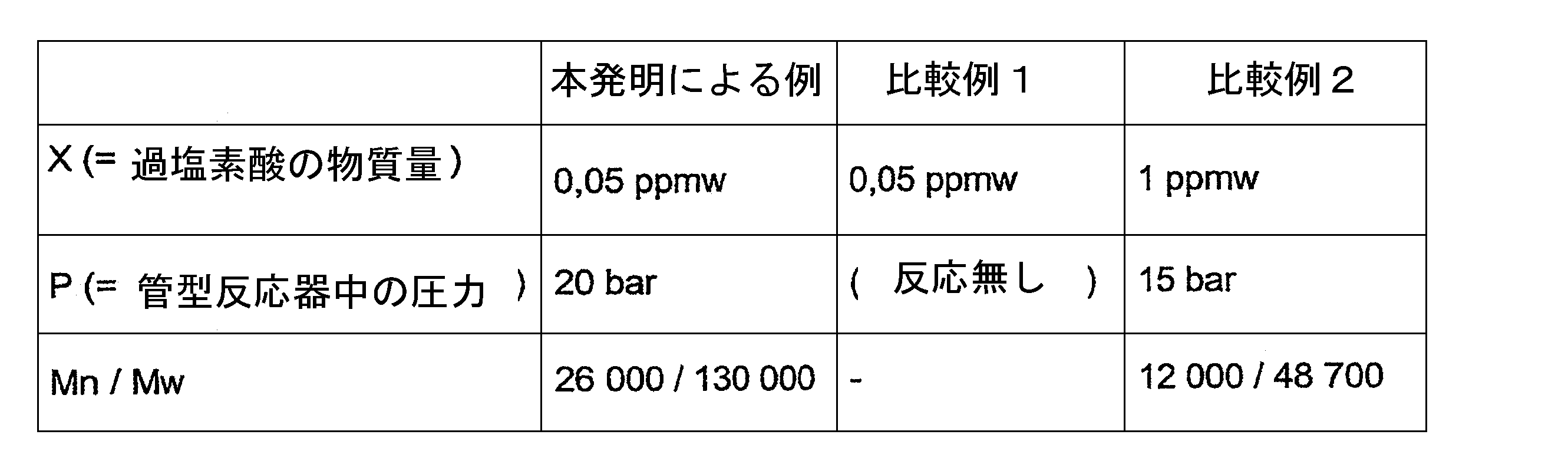
Xppmの過塩素酸(1,4−ジオキサン中の0.01質量%溶液として)の添加により、重合を開始し、反応器出口の圧力を調節弁により調節して、20barになった。反応領域中の温度(165℃)及び停止領域中の温度(195℃)を、二重ジャケットを介して調節した。 Polymerization was initiated by the addition of Xppm perchloric acid (as a 0.01 wt% solution in 1,4-dioxane) and the pressure at the reactor outlet was adjusted by a control valve to 20 bar. The temperature in the reaction zone (165 ° C.) and the temperature in the stop zone (195 ° C.) were adjusted through a double jacket.
2分の滞留時間の後に、過塩素酸に対して10倍過剰の物質量中に停止剤が存在するように、反応器の停止領域中に停止剤としてのトリアセトンジアミン(1,3−ジオキソラン中の0.1質量%の溶液として)を計量供給し、そしてスタティックミキサを介して混和した。 After a residence time of 2 minutes, triacetonediamine (1,3-dioxolane as a stop agent in the stop region of the reactor so that the stop agent is present in a 10-fold excess of material over perchloric acid. (As a 0.1 wt% solution in) and metered in via a static mixer.
更なる3分の滞留時間の後に、生成物(粗製POM)を、調節弁を介して脱気装置中で3barの圧力に下げ、これによりポリマー溶融物の揮発性成分を分離した。このポリマー溶融物中に、トリオキサン及びホルムアルデヒドの残留物が残留した。 After an additional 3 minutes residence time, the product (crude POM) was reduced to a pressure of 3 bar in the degasser via a regulating valve, thereby separating the volatile components of the polymer melt. Trioxane and formaldehyde residues remained in the polymer melt.
この生成物を排出し、そしてGPCにかけた。 The product was discharged and subjected to GPC.
比較例2、比較例3
96.495質量%の液体トリオキサン、3.5質量%のジオキソラン及び0.005質量%のメチラールからの混合物を160℃に加熱し、そしてスタティックミキサを有する管型反応器中にポンプ輸送した。
Comparative Example 2 and Comparative Example 3
A mixture from 96.495% by weight liquid trioxane, 3.5% by weight dioxolane and 0.005% by weight methylal was heated to 160 ° C. and pumped into a tubular reactor with a static mixer.
この管型反応器は、開始剤及び停止剤のための計量供給装置を備えた平らな管からなるものであった。この計量供給装置を、流れの方向に対して60゜の角度で設けた。この管の直径は12mmであった。開始剤及び停止剤の混和のために、スタティックミキシングエレメントを設けた。反応領域中の温度(165℃)及び停止領域中の温度(195℃)を、二重ジャケットを介して調節した。 This tubular reactor consisted of flat tubes with metering devices for the initiator and stop agent. This metering device was provided at an angle of 60 ° with respect to the direction of flow. The diameter of this tube was 12 mm. A static mixing element was provided for mixing the initiator and stop agent. The temperature in the reaction zone (165 ° C.) and the temperature in the stop zone (195 ° C.) were adjusted through a double jacket.
Xppmwの過塩素酸(1,4−ジオキサン中の0.01質量%溶液として)の添加により重合を開始し、反応器中の圧力はPbarであった。 Polymerization was initiated by the addition of X ppmw perchloric acid (as a 0.01 wt% solution in 1,4-dioxane) and the pressure in the reactor was Pbar.
2分の滞留時間の後に、過塩素酸に対して10倍過剰の物質量中に停止剤が存在するように、反応器の停止領域中に停止剤としてのトリアセトンジアミン(1,3−ジオキソラン中の0.1質量%の溶液として)を計量供給し、そしてスタティックミキサを介して混和する。 After a residence time of 2 minutes, triacetonediamine (1,3-dioxolane as a stop agent in the stop region of the reactor so that the stop agent is present in a 10-fold excess of material over perchloric acid. As a 0.1 wt% solution in) and mix via a static mixer.
更なる3分の滞留時間の後に、生成物(粗製POM)を、調節弁を介して脱気装置中で3barの圧力に下げ、これによりポリマー溶融物の揮発性成分を分離した。このポリマー溶融物中に、トリオキサン及びホルムアルデヒドの残留物が残留した。 After an additional 3 minutes residence time, the product (crude POM) was reduced to a pressure of 3 bar in the degasser via a regulating valve, thereby separating the volatile components of the polymer melt. Trioxane and formaldehyde residues remained in the polymer melt.
この生成物を排出し、そしてGPCにかけた。
0.05ppmwの開始剤量では、重合は本発明にかかる反応器中でのみ行われ、比較例1では、トリオキサンの混濁が観察されたにすぎない。開始剤濃度を20倍高めた比較例においては、重合は行われたが、低分子生成物が得られるにすぎなかった。これに対して、本発明にかかる管型反応器によれば、極めて少量の開始剤量で高モル質量のポリアセタールを製造することができる。 With an initiator amount of 0.05 ppmw, the polymerization is carried out only in the reactor according to the invention, and in Comparative Example 1, only trioxane turbidity was observed. In the comparative example in which the initiator concentration was increased 20 times, the polymerization was carried out, but only a low molecular product was obtained. On the other hand, according to the tubular reactor of the present invention, a polyacetal having a high molar mass can be produced with a very small amount of initiator.
Claims (14)
Applications Claiming Priority (3)
| Application Number | Priority Date | Filing Date | Title |
|---|---|---|---|
| DE102004057867.2 | 2004-11-30 | ||
| DE102004057867A DE102004057867A1 (en) | 2004-11-30 | 2004-11-30 | Preparation of polyoxymethylene comprises polymerizing monomers (which is carried out in tubular reactor with mixing-, polymerizing- and deactivating zones) in the presence of cationically active initiators, deactivating and separating |
| PCT/EP2005/012673 WO2006058679A1 (en) | 2004-11-30 | 2005-11-28 | Method for producing polyoxymethylenes |
Publications (2)
| Publication Number | Publication Date |
|---|---|
| JP2008521950A true JP2008521950A (en) | 2008-06-26 |
| JP5502280B2 JP5502280B2 (en) | 2014-05-28 |
Family
ID=35621394
Family Applications (1)
| Application Number | Title | Priority Date | Filing Date |
|---|---|---|---|
| JP2007541858A Expired - Fee Related JP5502280B2 (en) | 2004-11-30 | 2005-11-28 | Process for producing polyoxymethylene |
Country Status (7)
| Country | Link |
|---|---|
| US (1) | US7863393B2 (en) |
| EP (1) | EP1819745A1 (en) |
| JP (1) | JP5502280B2 (en) |
| KR (1) | KR101246508B1 (en) |
| CN (1) | CN101068840B (en) |
| DE (1) | DE102004057867A1 (en) |
| WO (1) | WO2006058679A1 (en) |
Cited By (4)
| Publication number | Priority date | Publication date | Assignee | Title |
|---|---|---|---|---|
| JP2009521537A (en) * | 2005-12-24 | 2009-06-04 | ティコナ ゲゼルシャフト ミット ベシュレンクテル ハフツング | Process for producing oxymethylene polymers, selected polymers, and uses thereof |
| JP2011516703A (en) * | 2008-04-16 | 2011-05-26 | ティコナ ゲーエムベーハー | Method for producing oxymethylene polymer and apparatus suitable for the purpose |
| JP2011516705A (en) * | 2008-04-16 | 2011-05-26 | ティコナ ゲーエムベーハー | Oxymethylene polymer, process for its production and use thereof |
| US11981772B2 (en) | 2018-09-14 | 2024-05-14 | Asahi Kasei Kabushiki Kaisha | Polyoxymethylene and method of producing same |
Families Citing this family (24)
| Publication number | Priority date | Publication date | Assignee | Title |
|---|---|---|---|---|
| DE102004005657A1 (en) | 2004-02-04 | 2005-08-25 | Basf Ag | Flowable polyester molding compounds |
| DE102004005652A1 (en) | 2004-02-04 | 2005-08-25 | Basf Ag | Flowable polyester molding compounds |
| DE102004035357A1 (en) | 2004-07-21 | 2006-03-16 | Basf Ag | Continuous process for the preparation of polyalkylene arylates with hyperbranched polyesters and / or polycarbonates |
| DE102004038976A1 (en) | 2004-08-10 | 2006-02-23 | Basf Ag | Flowable polyester molding compounds with ASA / ABS and SAN |
| DE102004038979A1 (en) | 2004-08-10 | 2006-02-23 | Basf Ag | Impact-modified polyesters with hyperbranched polyesters |
| DE102004049342A1 (en) | 2004-10-08 | 2006-04-13 | Basf Ag | Flowable thermoplastics with halogen-free flame retardance |
| DE102004050025A1 (en) | 2004-10-13 | 2006-04-20 | Basf Ag | Flowable thermoplastics with halogen flame protection |
| DE102004051241A1 (en) | 2004-10-20 | 2006-05-04 | Basf Ag | Flowable polyamides with hyperbranched polyesters / polycarbonates |
| DE102004054629A1 (en) * | 2004-11-11 | 2006-05-18 | Basf Ag | Basic deactivators in POM production |
| DE102005002044A1 (en) | 2005-01-14 | 2006-07-20 | Basf Ag | Flowable polyesters with hydrolysis protection |
| DE102005004856A1 (en) | 2005-02-01 | 2006-08-03 | Basf Ag | Thermoplastic molded materials, useful for the manufacture of fibers, foils and molded articles, comprises thermoplastic polyester, highly-/hyper-branched polycarbonate and/or polyester, carbodiimide and additives |
| DE102005027549A1 (en) | 2005-06-14 | 2006-12-21 | Basf Ag | Multi-component moldings with polyester layers |
| DE102005034490A1 (en) | 2005-07-20 | 2007-01-25 | Basf Ag | Additive-free process for the preparation of polyoxymethylenes |
| DE102005046593A1 (en) * | 2005-09-28 | 2007-04-05 | Basf Ag | Production of (co)polyoxymethylene e.g. for molding composition uses tubular reactor with dynamic inserts in initiator mixing zone before and/or deactivator mixing zone after polymerization zone |
| US20100004409A1 (en) * | 2006-07-26 | 2010-01-07 | Basf Se | Method for producing polyoxymethylenes with certain deactivators |
| DE102008018968A1 (en) * | 2008-04-16 | 2009-10-22 | Ticona Gmbh | Polyoxymethylene molding compounds and molded articles and their use |
| DE102008018965A1 (en) | 2008-04-16 | 2009-10-22 | Ticona Gmbh | Oxymethylene copolymers and their use, as well as processes for the preparation of oxymethylene copolymers |
| US8840976B2 (en) | 2010-10-14 | 2014-09-23 | Ticona Llc | VOC or compressed gas containment device made from a polyoxymethylene polymer |
| EP2505609B1 (en) | 2011-04-01 | 2015-01-21 | Ticona GmbH | High impact resistant polyoxymethylene for extrusion blow molding |
| EP2546272A1 (en) | 2011-07-15 | 2013-01-16 | Ticona GmbH | Process for producing oxymethylene polymers |
| WO2013101624A1 (en) | 2011-12-30 | 2013-07-04 | Ticona Llc | Printable molded articles made from a polyoxymethylene polymer composition |
| US9745467B2 (en) | 2012-12-27 | 2017-08-29 | Ticona, Llc | Impact modified polyoxymethylene composition and articles made therefrom that are stable when exposed to ultraviolet light |
| HK1219695A1 (en) * | 2013-05-29 | 2017-04-13 | Basf Se | Continuous process for the preparation of polyoxazolines |
| CN104628898A (en) * | 2013-11-12 | 2015-05-20 | 中国石油化工股份有限公司 | Olefin polymerization termination method |
Citations (6)
| Publication number | Priority date | Publication date | Assignee | Title |
|---|---|---|---|---|
| JPS59159812A (en) * | 1983-03-01 | 1984-09-10 | Asahi Chem Ind Co Ltd | Continuous polymerization of trioxane |
| JPH03109411A (en) * | 1989-09-21 | 1991-05-09 | Toray Ind Inc | Production of polyoxymethylene copolymer for injection molding |
| JPH0770267A (en) * | 1993-08-13 | 1995-03-14 | Hoechst Ag | Apparatus for continuous production of polyacetal and method of using the same |
| JPH0790037A (en) * | 1993-08-13 | 1995-04-04 | Hoechst Ag | Preparation of polyacetal |
| JPH10237145A (en) * | 1997-02-25 | 1998-09-08 | Polyplastics Co | Method for producing stabilized polyacetal copolymer |
| WO2000017247A1 (en) * | 1998-09-24 | 2000-03-30 | Asahi Kasei Kabushiki Kaisha | Polyoxymethylene copolymer and composition thereof |
Family Cites Families (7)
| Publication number | Priority date | Publication date | Assignee | Title |
|---|---|---|---|---|
| US3269988A (en) * | 1963-03-13 | 1966-08-30 | Grace W R & Co | Chemical process for polymerizing trioxane |
| DE3066423D1 (en) | 1979-11-06 | 1984-03-08 | Ube Industries | Process for polymerizing formaldehyde |
| DE3147309A1 (en) | 1981-11-28 | 1983-06-01 | Basf Ag, 6700 Ludwigshafen | CONTINUOUS PROCESS FOR PRODUCING OXYMETHYLENE POLYMERS |
| DE3703790A1 (en) * | 1987-02-07 | 1988-08-18 | Hoechst Ag | CONTINUOUS METHOD FOR REMOVING UNSTABLE PORTS FROM RAW OXYMETHYLENE COPOLYMER |
| DE4431575A1 (en) * | 1994-09-05 | 1996-03-07 | Hoechst Ag | Process for the preparation of polyacetal copolymers |
| DE10006037A1 (en) * | 2000-02-10 | 2001-08-16 | Basf Ag | Continuous production of polyoxymethylenes useful in copolymerization of trioxane and tetroxane monomers in the presence of cationic initiator with decreased foaming during degassing and reduced fine particle production on granulation |
| DE10302716A1 (en) | 2003-01-23 | 2004-08-05 | Basf Ag | Process for the preparation of polyoxymethylenes |
-
2004
- 2004-11-30 DE DE102004057867A patent/DE102004057867A1/en not_active Withdrawn
-
2005
- 2005-11-28 JP JP2007541858A patent/JP5502280B2/en not_active Expired - Fee Related
- 2005-11-28 EP EP05815897A patent/EP1819745A1/en not_active Withdrawn
- 2005-11-28 CN CN200580041026XA patent/CN101068840B/en not_active Expired - Fee Related
- 2005-11-28 KR KR1020077014888A patent/KR101246508B1/en not_active Expired - Fee Related
- 2005-11-28 US US11/720,414 patent/US7863393B2/en not_active Expired - Fee Related
- 2005-11-28 WO PCT/EP2005/012673 patent/WO2006058679A1/en not_active Ceased
Patent Citations (6)
| Publication number | Priority date | Publication date | Assignee | Title |
|---|---|---|---|---|
| JPS59159812A (en) * | 1983-03-01 | 1984-09-10 | Asahi Chem Ind Co Ltd | Continuous polymerization of trioxane |
| JPH03109411A (en) * | 1989-09-21 | 1991-05-09 | Toray Ind Inc | Production of polyoxymethylene copolymer for injection molding |
| JPH0770267A (en) * | 1993-08-13 | 1995-03-14 | Hoechst Ag | Apparatus for continuous production of polyacetal and method of using the same |
| JPH0790037A (en) * | 1993-08-13 | 1995-04-04 | Hoechst Ag | Preparation of polyacetal |
| JPH10237145A (en) * | 1997-02-25 | 1998-09-08 | Polyplastics Co | Method for producing stabilized polyacetal copolymer |
| WO2000017247A1 (en) * | 1998-09-24 | 2000-03-30 | Asahi Kasei Kabushiki Kaisha | Polyoxymethylene copolymer and composition thereof |
Cited By (4)
| Publication number | Priority date | Publication date | Assignee | Title |
|---|---|---|---|---|
| JP2009521537A (en) * | 2005-12-24 | 2009-06-04 | ティコナ ゲゼルシャフト ミット ベシュレンクテル ハフツング | Process for producing oxymethylene polymers, selected polymers, and uses thereof |
| JP2011516703A (en) * | 2008-04-16 | 2011-05-26 | ティコナ ゲーエムベーハー | Method for producing oxymethylene polymer and apparatus suitable for the purpose |
| JP2011516705A (en) * | 2008-04-16 | 2011-05-26 | ティコナ ゲーエムベーハー | Oxymethylene polymer, process for its production and use thereof |
| US11981772B2 (en) | 2018-09-14 | 2024-05-14 | Asahi Kasei Kabushiki Kaisha | Polyoxymethylene and method of producing same |
Also Published As
| Publication number | Publication date |
|---|---|
| CN101068840A (en) | 2007-11-07 |
| US7863393B2 (en) | 2011-01-04 |
| WO2006058679A1 (en) | 2006-06-08 |
| EP1819745A1 (en) | 2007-08-22 |
| US20080167439A1 (en) | 2008-07-10 |
| KR20070086796A (en) | 2007-08-27 |
| CN101068840B (en) | 2011-03-30 |
| JP5502280B2 (en) | 2014-05-28 |
| DE102004057867A1 (en) | 2006-06-01 |
| KR101246508B1 (en) | 2013-03-26 |
Similar Documents
| Publication | Publication Date | Title |
|---|---|---|
| JP5502280B2 (en) | Process for producing polyoxymethylene | |
| US5608030A (en) | Process for the preparation of polyacetals | |
| US4431794A (en) | Continuous preparation of oxymethylene polymers | |
| US20080097077A1 (en) | Method For Producing Polyoxymethylenes | |
| JP5419450B2 (en) | Production method of polyoxymethylene | |
| JP5709060B2 (en) | Oxymethylene polymer, process for its production and use thereof | |
| JP2013028804A (en) | Process for producing oxymethylene polymers | |
| CN101056907B (en) | Alkaline deactivator for polyoxymethylene production | |
| WO2004065444A1 (en) | Method for the production of polyoxymethylenes | |
| KR102596640B1 (en) | Method for producing oxymethylene polymer | |
| JP2023127499A (en) | Method for producing polyoxymethylene | |
| JP7725277B2 (en) | Polyoxymethylene manufacturing method | |
| JP2023051807A (en) | Method for producing polyacetal resin | |
| EP0391681A2 (en) | Acetal polymer blends | |
| JP7833320B2 (en) | Polyoxymethylene resin composition | |
| DE102005046593A1 (en) | Production of (co)polyoxymethylene e.g. for molding composition uses tubular reactor with dynamic inserts in initiator mixing zone before and/or deactivator mixing zone after polymerization zone | |
| WO2000055227A1 (en) | Polyacetal copolymer and method for producing the same | |
| JP2025158764A (en) | Method for producing polyacetal resin and method for stabilizing polyacetal resin |
Legal Events
| Date | Code | Title | Description |
|---|---|---|---|
| A621 | Written request for application examination |
Free format text: JAPANESE INTERMEDIATE CODE: A621 Effective date: 20080718 |
|
| RD04 | Notification of resignation of power of attorney |
Free format text: JAPANESE INTERMEDIATE CODE: A7424 Effective date: 20101227 |
|
| RD04 | Notification of resignation of power of attorney |
Free format text: JAPANESE INTERMEDIATE CODE: A7424 Effective date: 20101228 |
|
| A977 | Report on retrieval |
Free format text: JAPANESE INTERMEDIATE CODE: A971007 Effective date: 20110914 |
|
| A131 | Notification of reasons for refusal |
Free format text: JAPANESE INTERMEDIATE CODE: A131 Effective date: 20110930 |
|
| A521 | Request for written amendment filed |
Free format text: JAPANESE INTERMEDIATE CODE: A523 Effective date: 20111215 |
|
| A131 | Notification of reasons for refusal |
Free format text: JAPANESE INTERMEDIATE CODE: A131 Effective date: 20120628 |
|
| RD13 | Notification of appointment of power of sub attorney |
Free format text: JAPANESE INTERMEDIATE CODE: A7433 Effective date: 20120705 |
|
| A521 | Request for written amendment filed |
Free format text: JAPANESE INTERMEDIATE CODE: A821 Effective date: 20120705 |
|
| A521 | Request for written amendment filed |
Free format text: JAPANESE INTERMEDIATE CODE: A523 Effective date: 20120921 |
|
| A131 | Notification of reasons for refusal |
Free format text: JAPANESE INTERMEDIATE CODE: A131 Effective date: 20130408 |
|
| A601 | Written request for extension of time |
Free format text: JAPANESE INTERMEDIATE CODE: A601 Effective date: 20130430 |
|
| A602 | Written permission of extension of time |
Free format text: JAPANESE INTERMEDIATE CODE: A602 Effective date: 20130509 |
|
| A521 | Request for written amendment filed |
Free format text: JAPANESE INTERMEDIATE CODE: A523 Effective date: 20130812 |
|
| TRDD | Decision of grant or rejection written | ||
| A01 | Written decision to grant a patent or to grant a registration (utility model) |
Free format text: JAPANESE INTERMEDIATE CODE: A01 Effective date: 20140212 |
|
| A61 | First payment of annual fees (during grant procedure) |
Free format text: JAPANESE INTERMEDIATE CODE: A61 Effective date: 20140313 |
|
| R150 | Certificate of patent or registration of utility model |
Ref document number: 5502280 Country of ref document: JP Free format text: JAPANESE INTERMEDIATE CODE: R150 |
|
| LAPS | Cancellation because of no payment of annual fees |