JP2008009844A - Life navigation system - Google Patents
Life navigation system Download PDFInfo
- Publication number
- JP2008009844A JP2008009844A JP2006181275A JP2006181275A JP2008009844A JP 2008009844 A JP2008009844 A JP 2008009844A JP 2006181275 A JP2006181275 A JP 2006181275A JP 2006181275 A JP2006181275 A JP 2006181275A JP 2008009844 A JP2008009844 A JP 2008009844A
- Authority
- JP
- Japan
- Prior art keywords
- question
- information
- score
- answer
- action
- Prior art date
- Legal status (The legal status is an assumption and is not a legal conclusion. Google has not performed a legal analysis and makes no representation as to the accuracy of the status listed.)
- Pending
Links
Images
Landscapes
- Management, Administration, Business Operations System, And Electronic Commerce (AREA)
Abstract
【課題】ライフナビゲーションシステムを提供する。
【解決手段】表示手段と、入力手段と、現状分析を行うための質問情報と、該質問毎に7つの育の評点情報が関係付けられて記憶された質問データベースと、前記質問データベースに記憶されている質問情報を順に読み出して、前記表示手段に表示する質問処理手段と、前記質問処理手段によって表示された質問に対する回答を前記入力部から取得する回答取得手段と、前記質問データベースに記憶されている評点情報を参照して、前記質問情報に対する回答結果毎の評点情報を読み出し、前記7つの育毎の評点を算出する評点算出手段と、推論ルールベースを参照して、前記7つの育毎の評点に基づく行動目標を推論して求める推論手段と、前記求めた行動目標を前記表示手段に表示する行動目標出力手段とを備えた。
【選択図】図1A life navigation system is provided.
SOLUTION: Display means, input means, question information for analyzing the current situation, a question database in which seven kinds of grade information are associated and stored for each question, and stored in the question database Stored in the question database, question processing means for sequentially reading out the current question information, and displaying it on the display means, answer acquisition means for obtaining an answer to the question displayed by the question processing means from the input unit, and The score information for each answer result with respect to the question information is read with reference to the score information, and score calculation means for calculating the score for each of the seven educations, and the reasoning rule base with reference to the inference rule base. Inference means for inferring an action target based on the score and an action target output means for displaying the obtained action target on the display means are provided.
[Selection] Figure 1
Description
本発明は、幸福な生活を送るために必要な行動目標を作成するライフナビゲーションシステムに関する。 The present invention relates to a life navigation system for creating action goals necessary for a happy life.
従来から、なりゆき人生を排除するために、自己の生存目標年齢や残された人生の全容を計画・設定し、自分がいま人生のどの位置に、どのような状況にあるかを常に検証・調整しながら歩むための長寿社会に対応した人生カレンダーが知られている(例えば、特許文献1参照)。このカレンダーは、年齢欄と、人生の過程を示す人生の過程欄と、人生計画や目標、行動計画を記入する記入欄を設け、自己の現在年齢及び自己の生存目標年齢を示す識別表示を設けたものである。
このカレンダーを用いれば、人生の全容を計画・設定、一望することができるとともに、全生涯を自覚し自分がいまどの位置に、どのような状況にあるかを検証し、未来に向って人生計画や目標、行動計画、現状を調整・管理することができる。
By using this calendar, you can plan, set, and overlook the whole life, be aware of your entire life, verify where you are, in what situation, and plan your life for the future. And can coordinate and manage goals, action plans, and current status.
しかしながら、特許文献1に示すカレンダーにあっては、計画や目標の立案は、従来の方法によって作成しなければならないため、幸福な生活を送るために必要な的確な行動目標を作成することができるとは限らない。また、目標達成の度合いを客観的に把握することができないため、目標達成のためにどのように行動すれば良いかを判断することができないという問題がある。
However, in the calendar shown in
本発明は、このような事情に鑑みてなされたもので、幸福な生活を送るために必要な行動目標を作成し、この行動目標の達成度のチェックして、目標達成に導くことができるライフナビゲーションシステムを提供することを目的とする。 The present invention has been made in view of such circumstances, and creates a life goal necessary to lead a happy life, checks the degree of achievement of this behavior goal, and leads to achievement of the goal. An object is to provide a navigation system.
本発明は、表示手段と、入力手段と、現状分析を行うための質問情報と、該質問毎に7つの育の評点情報が関係付けられて記憶された質問データベースと、前記質問データベースに記憶されている質問情報を順に読み出して、前記表示手段に表示する質問処理手段と、前記質問処理手段によって表示された質問に対する回答を前記入力部から取得する回答取得手段と、前記質問データベースに記憶されている評点情報を参照して、前記質問情報に対する回答結果毎の評点情報を読み出し、前記7つの育毎の評点を算出する評点算出手段と、推論ルールベースを参照して、前記7つの育毎の評点に基づく行動目標を推論して求める推論手段と、前記求めた行動目標を前記表示手段に表示する行動目標出力手段とを備えたことを特徴とする。 The present invention provides a display means, an input means, question information for analyzing the current situation, a question database in which seven kinds of grade information are associated with each question, and stored in the question database. Stored in the question database, question processing means for sequentially reading out the current question information, and displaying it on the display means, answer acquisition means for obtaining an answer to the question displayed by the question processing means from the input unit, and The score information for each answer result with respect to the question information is read with reference to the score information, and score calculation means for calculating the score for each of the seven educations, and the reasoning rule base with reference to the inference rule base. An inference means for inferring an action target based on a score and an action target output means for displaying the obtained action target on the display means are provided.
本発明は、前記推論手段が作成した行動目標の情報を記憶する行動目標記憶手段と、前記行動目標記憶手段に記憶されている行動目標が達成できたか否かをチェックするチェック処理手段とをさらに備えたことを特徴とする。 The present invention further includes an action target storage means for storing information on the action goal created by the inference means, and a check processing means for checking whether or not the action goal stored in the action goal storage means has been achieved. It is characterized by having.
本発明は、行動目標の達成度毎に行うべき施策の情報が記憶された施策データベースと、前記チェック処理手段によって得られた前記行動目標の達成度に応じた施策情報を前記施策データベースから読み出して前記表示手段に表示する施策出力手段とをさらに備えたことを特徴とする。 The present invention reads from the measure database the measure database that stores information on measures to be performed for each achievement degree of the action goal, and the measure information according to the achievement degree of the action goal obtained by the check processing means. And a measure output means for displaying on the display means.
本発明によれば、現状分析の結果に基づいて、行動目標を推論して自動的に作成するようにしたため、現状に応じて的確な行動目標を作成することができるという効果が得られる。また、作成した行動目標を達成したか否かを日々チェックすることができるため、行動目標を達成させる意識を高めることができるという効果が得られる。また、行動目標の達成度に応じて、達成度を向上させるための施策を出力するようにしたため、この施策を実行することにより、達成度を向上させるように導くことができるという効果が得られる。 According to the present invention, since an action target is inferred and automatically created based on the result of the current state analysis, an effect that an accurate action target can be created according to the current state can be obtained. In addition, since it is possible to check daily whether or not the created action goal has been achieved, the effect of increasing the consciousness of achieving the action goal can be obtained. In addition, since the measure for improving the achievement level is output according to the achievement level of the action target, the effect that the achievement level can be improved can be obtained by executing this measure. .
以下、本発明の一実施形態によるライフナビゲーションシステムを説明する。まず、本発明によるライフナビゲーションシステムを実現するために基本となる7育5心3V法について説明する。7育5心3V法は、「7つの育」「5つの心」及び「3つのV」という要素から成り立っている。「生き方」を構成している機能や働き、構造という観点から細かく分解したものが「徳育」、「家育」、「知育」、「体育」、「美育」、「遊育」、「財育」からなる「7つの育」である。 Hereinafter, a life navigation system according to an embodiment of the present invention will be described. First, the 7-five 5-heart 3V method, which is fundamental for realizing the life navigation system according to the present invention, will be described. The 7-child five-heart 3V method is composed of the elements “seven-child”, “five hearts” and “three V”. The functions, work, and structures that make up the way of life are finely disassembled from the viewpoint of structure, as follows: “Tokuiku”, “Home education”, “Intellectual education”, “Physical education”, “Aesthetic education”, “Recreational education”, “Property education” It is "seven education" consisting of.
すなわち、
(1)他人や社会への奉仕の精神、利他の心を持った倫理道徳、礼儀作法、ルール、マナー、エチケット、モラルなどの「徳育」
(2)家族愛、家族の絆、家族育成力、家族を良くする能力としての「家育」
(3)社会生活を営むために必要な知識、学習能力、業務遂行などに必要な専門的な知識、技術、能力であ芯「知育」
(4)規則正しい食事、運動によって体力を維持し、心身の健康を管理する「体育」
(5)感性を育み日常生活を美しく保つ能力、美に感動し美を創造する能力としての「美育」
(6)遊び心やゆとりを持って人生を楽しく生きる能力、趣味などで楽しみを広げる能力である「遊育」
(7)自立して経済を切り盛りする能力、家計を維持し、豊かな生活を営むための「財育」
である。
That is,
(1) “moral education” such as the spirit of service to others and society, ethical morals, etiquette, rules, manners, etiquette, morals, etc.
(2) “Family education” as family love, family bonds, family development skills, and the ability to improve the family
(3) Knowledge that is necessary to run a social life, learning ability, specialized knowledge, skills, and skills necessary for business execution, etc.
(4) “Physical education” to maintain physical strength and manage mental and physical health through regular meals and exercise
(5) “Beauty Education” as the ability to cultivate sensibility and keep daily life beautiful and to be impressed by beauty and create beauty
(6) “Amusement” is the ability to enjoy life with a sense of fun and comfort, and the ability to expand enjoyment through hobbies
(7) “Faculty” to maintain the economy and the ability to live independently and live a rich life
It is.
次に、「7つの育」を支える要素として「心の5つの力」がある。すなわち、
(1)喜びと感謝
(2)積極プラス思考力
(3)判断力・感情の統御力
(4)克己心・忍耐力
(5)勇気・行動力
である。
Next, there are “5 powers of the heart” as an element that supports “seven education”. That is,
(1) Joy and gratitude (2) Positive positive thinking ability (3) Judgment power and emotional control power (4) Self-heartedness and patience (5) Courage and action power
この心の5つの力を日々実践し、目標(vision)、挑戦行動(venture)、勝利・成功(victory)の「3つのV」を基に、人生の成功(ゴール)を目指すことが目的である。この「7育5心3V法」を日々実践していくことにより、生まれながらにして持っている大きな潜在能力が発揮されるようになり、その結果、品格が高められ、人間としての器が大きくなることで、物心両面の満足と公私にわたる人生の成功を実現し、真の自己実現を図ることができる。 The purpose is to practice these five powers of the mind every day, and to aim for the success (goal) of life based on “Three V” of vision, challenging action (venture) and victory / success (victory). is there. By practicing this “7-child five-heart 3V method” every day, the great potential we have is born, and as a result, the dignity is improved and the human vessel is larger. By doing so, we can achieve both self-fulfilled satisfaction and life success through public and private life, and achieve true self-fulfillment.
このように7つに分解した「7育」に分類して現状を認識し、日々「目標管理」を行い、自分の目標に到達するように努力するのを支援するのが本発明によるライフナビゲーションシステムである。 The life navigation according to the present invention is to classify into “7 education” divided into 7 in this way, recognize the current situation, perform “goal management” every day, and support efforts to reach their goals. System.
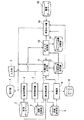
次に、本発明の一実施形態によるライフナビゲーションシステムを図面を参照して説明する。図1は同実施形態の構成を示すブロック図である。この図において、符号1は、情報表示を行うディスプレイ装置等から構成する表示部である。符号2は、キーボードやマウス等の入力装置から構成する入力部である。符号3は、現状分析を行うための質問事項の情報と、各質問毎の評点が予め記憶された質問データベースである。符号4は、質問データベース3に記憶されている質問事項の情報を順に読み出して、表示部1へ表示を行う質問処理部である。符号5は、質問処理部4が表示した質問に対して、入力部2から入力された回答の情報を読み込むことにより回答を取得する回答取得部である。符号6は、回答取得部5が取得した回答情報を質問と特定できる情報と関連付けて記憶する回答記憶部である。符号7は、質問データベース3に記憶されている質問毎の評点を参照して、回答記憶部6に記憶されている質問毎の回答情報に対する評点を算出する評点算出部である。
Next, a life navigation system according to an embodiment of the present invention will be described with reference to the drawings. FIG. 1 is a block diagram showing the configuration of the embodiment. In this figure,
符号8は、評点算出部7が算出した回答に対する評点算出結果を記憶する評点記憶部である。符号9は、現状分析を行うための質問に対する回答の評点算出結果に基づいて、目標とするべき行動目標を推論して作成する推論エンジンから構成する推論部である。符号10は、行動目標を作成する際に推論部9が参照する推論ルールが予め記憶されたルールベースである。符号11は、推論部9が作成した行動目標を表示部1に表示する行動目標出力部である。符号12は、推論部9が作成した行動目標情報を記憶する行動目標記憶部である。符号13は、生活する上での目標とするべき行動目標を実行できたか否かをチェックするチェック処理部である。符号14は、チェック処理部13のチェック結果の情報を記憶するチェック結果記憶部である。符号15は、チェック結果記憶部14に記憶されている行動目標を実行できたか否かのチェック結果に基づいて、行動目標を達成するための施策内容を表示部1へ表示する施策出力部である。符号16は、行動目標を達成するための施策内容の情報が記憶された施策データベースである。
Reference numeral 8 denotes a score storage unit that stores a score calculation result for the answer calculated by the
なお、図1に示すシステム構成は、1台のコンピュータで実現した例を示したが、表示部1、入力部2を除く構成をコンピュータサーバで構成し、表示部1及び入力部2を備えたコンピュータ端末との間をコンピュータネットワークで接続した構成としてもよい。また、表示部1及び入力部2をインターネット接続可能な移動通信端末(携帯電話端末)で実現してもよい。
The system configuration shown in FIG. 1 shows an example realized by one computer, but the configuration excluding the
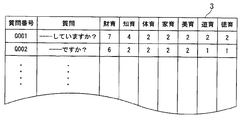
次に、図3を参照して、図1に示す質問データベース3のテーブル構造を説明する。質問データベース3は、質問の文言毎に質問内容を一意に識別可能な質問番号が関連付けられている。また、各質問には、前述した7つの育毎の評点が予め定義されて関連付けられている。この評点は、質問に対して、「Yes」と回答した場合の7つの育の評点が定義されている。
Next, the table structure of the
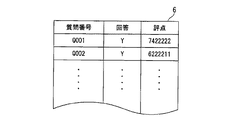
次に、図4を参照して、図1に示す回答記憶部6のテーブル構造を説明する。回答記憶部6は、質問を一意に識別可能な質問番号と、回答取得部5が取得した回答結果(Yesの場合は「Y」、Noの場合は「N」)と、質問データベース3から読み出した7つの育の評点が関連付けられて記憶される。
Next, the table structure of the
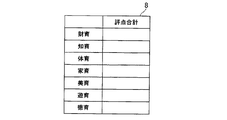
次に、図5を参照して、図1に示す評点記憶部8のテーブル構造を説明する。評点記憶部8は、回答記憶部6に記憶されている各回答毎の評点を、7つの育毎に合計した評点合計値が記憶される。
Next, the table structure of the score storage unit 8 shown in FIG. 1 will be described with reference to FIG. The score storage unit 8 stores a score total value obtained by totaling the scores for each answer stored in the
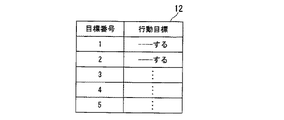
次に、図6を参照して、図1に示す行動目標記憶部12のテーブル構造を説明する。行動目標記憶部12は、推論部9に作成された数(図6の例では5項目)の行動目標の文言と、各行動目標を識別するための目標番号が関連付けられて記憶される。
Next, the table structure of the action
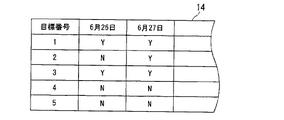
次に、図7を参照して、図1に示すチェック結果記憶部14のテーブル構造を説明する。チェック結果記憶部14は、チェックを実施した日付情報毎に、各目標番号の行動目標が達成できたか否かを示す情報(達成できた場合は「Y」、達成できなかった場合は「N」)が記憶される。
Next, the table structure of the check
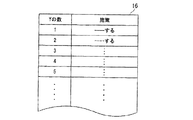
次に、図8を参照して、図1に示す施策データベース16のテーブル構造を説明する。施策データベース16は、チェック結果記憶部14に記憶されている各日付毎の「Y」の数(行動目標を達成できた数)に応じた施策の文言が予め記憶されている。
Next, the table structure of the
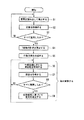
次に、図2を参照して、図1に示すライフナビゲーションシステムの動作を説明する。まず、ユーザが行動目標を作成する機能の選択を入力部2から行うと、質問処理部4は、質問データベース3から質問の文言情報を読み出し、この読み出した質問の文言を表示部1へ表示する(ステップS1)。このとき、質問処理部4は、読み出した質問の質問番号を回答取得部5に通知するとともに、回答取得を指示する。ここで、ユーザは、表示部1に表示された質問の内容を読み、この質問に対する回答を「Yes」または「No」で回答する操作を入力部2に行う。これを受けて、回答取得部5は、入力部2における操作内容を読み取ることにより回答を取得する(ステップS2)。そして、回答取得部5は、質問処理部4から通知された質問番号と、入力部2から取得した回答内容を関連付けて、回答記憶部6へ記憶する。
Next, the operation of the life navigation system shown in FIG. 1 will be described with reference to FIG. First, when the user selects a function for creating an action target from the
次に、質問処理部4は、質問データベース3に記憶されている質問を全て読み出したか否かに基づいて、全ての質問を行ったか否かを判定する(ステップS3)。この判定の結果、全ての質問を行っていなければ、ステップS1へ戻り、次の質問を読み出して表示部1へ表示する。この処理を全ての質問が行われるまで繰り返し実行する。これにより、回答記憶部6には、全ての質問に対する回答(「Y」または「N」)が記憶されたことになる。そして、回答取得部5は、全ての回答を取得した時点で、評点算出部7に対して、評点の算出を指示する。
Next, the
次に、評点算出部7は、回答記憶部6に記憶されている各回答に対応する評点を質問データベース3から読み出し、各回答に関連付けて、回答記憶部6に記憶する。これにより、回答記憶部6には、各質問に対して、回答と評点が関連付けられて記憶されたことになる。続いて、評点算出部7は、回答記憶部6に記憶されている評点に基づいて、7つの育毎の合計値を算出して、評点記憶部8へ記憶する(ステップS4)。回答記憶部6の評点は、各桁が各育(「財育」、「知育」、「体育」、「家育」、「美育」、「遊育」、「徳育」)の評点に該当するため、7つの育毎の合計値は、回答記憶部6に記憶されている評点の各桁毎の合計を算出することにより行う。これにより、評点記憶部8には、「財育」、「知育」、「体育」、「家育」、「美育」、「遊育」、「徳育」それぞれの評点合計値が記憶されたことになる。この評点が、ユーザの現状の状態を分析した結果(現状分析)となる。そして、評点算出部7は、7つの育の評点合計値が算出された時点で、行動目標作成の指示を出す。
Next, the
次に、推論部9は、評点記憶部8に記憶されている評点と、ルールベース10に記憶されている推論知識ルールとに基づいて、行動目標の文言を作成して、行動目標記憶部12へ記憶する(ステップS5)。このとき、推論部9は、複数の行動目標を作成する必要があると判断した場合は、複数の行動目標を作成する。行動目標の作成は、例えば、質問データベース3に記憶されている質問のうち、回答が「No」であったものを抽出し、これらの質問文言に基づいて行動目標の文言を作成する。そして、推論部9は、行動目標の作成が終了した時点で、行動目標出力部11に対して、行動目標の出力を指示する。これを受けて、行動目標出力部11は、行動目標記憶部12に記憶されている行動目標の文言を読み出して、表示部1へ表示する。ここで表示された行動目標がユーザが生活する上で目標とするべき行動目標となる。
Next, the
次に、行動目標が作成済みの状態において、任意のタイミングでユーザが行動目標の達成をチェックする機能を選択する選択を入力部2から行うと、チェック処理部13は、行動目標出力部11に対して、行動目標の出力を指示する。これを受けて、行動目標出力部11は、行動目標記憶部12に記憶されている行動目標の文言を1件ずつ読み出して、表示部1へ表示するとともに、この行動目標を達成できたか否かの質問を表示する(ステップS6)。ここで、ユーザは表示部1に表示された行動目標を達成できたか否か(達成できた場合は「Yes」、できなかった場合は「No」)を入力部2を操作して、回答する。チェック処理部13は、入力部2において操作された内容を読み取ることにより、質問に対する回答を取得する(ステップS7)。そして、チェック処理部13は、取得した回答の情報(「Y」または「N」)を、チェックを実行した日付と関係付けてチェック結果記憶部14に記憶する。
Next, in a state where the action target has been created, when the user selects from the input unit 2 a function for checking the achievement of the action target at an arbitrary timing, the
次に、チェック処理部13は、行動目標記憶部12に記憶されている行動目標に対する質問を全て行ったか否かを判定する(ステップS8)。この判定の結果、全ての質問を行っていなければ、ステップS6へ戻り、次の行動目標に対する回答を取得する処理を繰り返し実行する。これにより、チェック結果記憶部14には、全ての行動目標に対する達成度の質問の回答(「Y」または「N」)がチェック実行日付と関係付けられて記憶されたことになる。そして、チェック処理部13は、全ての回答を取得した時点で、施策出力部15に対して、目標達成度に応じた施策の出力を指示する。
Next, the
次に、施策出力部15は、チェック結果記憶部14に記憶されている最新(日付が最も新しい)の回答結果のうち、回答結果が「Y」である目標の数をカウントし、得られたカウント値(Yの数)に関係付けられた施策の文言を施策データベース16から読み出して、表示部1へ表示する(ステップS9)。これにより、行動目標の達成度に応じてユーザが目標を達成するために行うべき施策の内容が表示されることになる。この行動目標を達成したか否かのチェックは、ユーザの操作に基づいて毎日実施される。これによって、行動目標の達成度を向上させることが可能となる。
Next, the
このように、現状分析の結果に基づいて、行動目標を推論して自動的に作成するようにしたため、現状に応じて的確な行動目標を作成することができる。また、作成した行動目標を達成したか否かを日々チェックすることができるため、行動目標を達成させる意識を高めることができる。さらに、行動目標の達成度に応じて、達成度を向上させるための施策を出力するようにしたため、この施策を実行することにより、達成度を向上させるように導くことができる。 As described above, the behavioral goal is inferred and automatically created based on the result of the current state analysis, so that an accurate behavioral goal can be created according to the current state. In addition, since it is possible to check daily whether or not the created action goal has been achieved, it is possible to increase the awareness of achieving the action goal. Furthermore, since the measure for improving the achievement level is output according to the achievement level of the behavioral goal, it can be guided to improve the achievement level by executing this measure.
なお、図1における処理部の機能を実現するためのプログラムをコンピュータ読み取り可能な記録媒体に記録して、この記録媒体に記録されたプログラムをコンピュータシステムに読み込ませ、実行することによりライフナビゲート処理を行ってもよい。なお、ここでいう「コンピュータシステム」とは、OSや周辺機器等のハードウェアを含むものとする。また、「コンピュータシステム」は、ホームページ提供環境(あるいは表示環境)を備えたWWWシステムも含むものとする。また、「コンピュータ読み取り可能な記録媒体」とは、フレキシブルディスク、光磁気ディスク、ROM、CD−ROM等の可搬媒体、コンピュータシステムに内蔵されるハードディスク等の記憶装置のことをいう。さらに「コンピュータ読み取り可能な記録媒体」とは、インターネット等のネットワークや電話回線等の通信回線を介してプログラムが送信された場合のサーバやクライアントとなるコンピュータシステム内部の揮発性メモリ(RAM)のように、一定時間プログラムを保持しているものも含むものとする。 1 is recorded on a computer-readable recording medium, and the program recorded on the recording medium is read into a computer system and executed, thereby executing life navigation processing. May be performed. Here, the “computer system” includes an OS and hardware such as peripheral devices. The “computer system” includes a WWW system having a homepage providing environment (or display environment). The “computer-readable recording medium” refers to a storage device such as a flexible medium, a magneto-optical disk, a portable medium such as a ROM and a CD-ROM, and a hard disk incorporated in a computer system. Further, the “computer-readable recording medium” refers to a volatile memory (RAM) in a computer system that becomes a server or a client when a program is transmitted via a network such as the Internet or a communication line such as a telephone line. In addition, those holding programs for a certain period of time are also included.
また、上記プログラムは、このプログラムを記憶装置等に格納したコンピュータシステムから、伝送媒体を介して、あるいは、伝送媒体中の伝送波により他のコンピュータシステムに伝送されてもよい。ここで、プログラムを伝送する「伝送媒体」は、インターネット等のネットワーク(通信網)や電話回線等の通信回線(通信線)のように情報を伝送する機能を有する媒体のことをいう。また、上記プログラムは、前述した機能の一部を実現するためのものであっても良い。さらに、前述した機能をコンピュータシステムにすでに記録されているプログラムとの組み合わせで実現できるもの、いわゆる差分ファイル(差分プログラム)であっても良い。 The program may be transmitted from a computer system storing the program in a storage device or the like to another computer system via a transmission medium or by a transmission wave in the transmission medium. Here, the “transmission medium” for transmitting the program refers to a medium having a function of transmitting information, such as a network (communication network) such as the Internet or a communication line (communication line) such as a telephone line. The program may be for realizing a part of the functions described above. Furthermore, what can implement | achieve the function mentioned above in combination with the program already recorded on the computer system, and what is called a difference file (difference program) may be sufficient.
1・・・表示部、2・・・入力部、3・・・質問データベース、4・・・質問処理部、5・・・回答取得部、6・・・回答記憶部、7・・・評点算出部、8・・・評点記憶部、9・・・推論部、10・・・ルールベース、11・・・行動目標出力部、12・・・行動目標記憶部、13・・・チェック処理部、14・・・チェック結果記憶部、15・・・施策出力部、16・・・施策データベース
DESCRIPTION OF
Claims (3)
入力手段と、
現状分析を行うための質問情報と、該質問毎に7つの育の評点情報が関係付けられて記憶された質問データベースと、
前記質問データベースに記憶されている質問情報を順に読み出して、前記表示手段に表示する質問処理手段と、
前記質問処理手段によって表示された質問に対する回答を前記入力部から取得する回答取得手段と、
前記質問データベースに記憶されている評点情報を参照して、前記質問情報に対する回答結果毎の評点情報を読み出し、前記7つの育毎の評点を算出する評点算出手段と、
推論ルールベースを参照して、前記7つの育毎の評点に基づく行動目標を推論して求める推論手段と、
前記求めた行動目標を前記表示手段に表示する行動目標出力手段と
を備えたことを特徴とするライフナビゲーションシステム。 Display means;
Input means;
Question information for analyzing the current situation, and a question database in which seven kinds of grade information are associated and stored for each question,
Question processing means for sequentially reading out the question information stored in the question database and displaying it on the display means;
An answer acquisition means for acquiring an answer to the question displayed by the question processing means from the input unit;
With reference to the score information stored in the question database, score information for each answer result for the question information is read, and score calculation means for calculating the score for each of the seven educations,
An inference means that infers and obtains an action target based on the score of each of the seven educations with reference to the inference rule base;
A life navigation system comprising: an action target output means for displaying the determined action goal on the display means.
前記行動目標記憶手段に記憶されている行動目標が達成できたか否かをチェックするチェック処理手段と
をさらに備えたことを特徴とする請求項1に記載のライフナビゲーションシステム。 Action target storage means for storing information on action goals created by the inference means;
The life navigation system according to claim 1, further comprising: check processing means for checking whether or not the action goal stored in the action goal storage means has been achieved.
前記チェック処理手段によって得られた前記行動目標の達成度に応じた施策情報を前記施策データベースから読み出して前記表示手段に表示する施策出力手段と
をさらに備えたことを特徴とする請求項2に記載のライフナビゲーションシステム。
A measure database that stores information on measures to be taken for each achievement of the goal,
The measure output means which reads the measure information according to the achievement degree of the action target obtained by the check processing means from the measure database, and displays it on the display means. Life navigation system.
Priority Applications (1)
| Application Number | Priority Date | Filing Date | Title |
|---|---|---|---|
| JP2006181275A JP2008009844A (en) | 2006-06-30 | 2006-06-30 | Life navigation system |
Applications Claiming Priority (1)
| Application Number | Priority Date | Filing Date | Title |
|---|---|---|---|
| JP2006181275A JP2008009844A (en) | 2006-06-30 | 2006-06-30 | Life navigation system |
Publications (1)
| Publication Number | Publication Date |
|---|---|
| JP2008009844A true JP2008009844A (en) | 2008-01-17 |
Family
ID=39067971
Family Applications (1)
| Application Number | Title | Priority Date | Filing Date |
|---|---|---|---|
| JP2006181275A Pending JP2008009844A (en) | 2006-06-30 | 2006-06-30 | Life navigation system |
Country Status (1)
| Country | Link |
|---|---|
| JP (1) | JP2008009844A (en) |
Cited By (3)
| Publication number | Priority date | Publication date | Assignee | Title |
|---|---|---|---|---|
| JP2009301354A (en) * | 2008-06-13 | 2009-12-24 | Npo Life Management Center | Ethic information processing device, ethic information processing method and ethic information processing program |
| JP2017168137A (en) * | 2013-05-22 | 2017-09-21 | マーサー (ユーエス) インク.Mercer (Us) Inc. | Participant outcomes, goal management and optimization, systems and methods |
| WO2021186681A1 (en) * | 2020-03-19 | 2021-09-23 | 日本電信電話株式会社 | Type estimation device, type estimation method, and program |
-
2006
- 2006-06-30 JP JP2006181275A patent/JP2008009844A/en active Pending
Cited By (5)
| Publication number | Priority date | Publication date | Assignee | Title |
|---|---|---|---|---|
| JP2009301354A (en) * | 2008-06-13 | 2009-12-24 | Npo Life Management Center | Ethic information processing device, ethic information processing method and ethic information processing program |
| JP2017168137A (en) * | 2013-05-22 | 2017-09-21 | マーサー (ユーエス) インク.Mercer (Us) Inc. | Participant outcomes, goal management and optimization, systems and methods |
| WO2021186681A1 (en) * | 2020-03-19 | 2021-09-23 | 日本電信電話株式会社 | Type estimation device, type estimation method, and program |
| JPWO2021186681A1 (en) * | 2020-03-19 | 2021-09-23 | ||
| JP7396460B2 (en) | 2020-03-19 | 2023-12-12 | 日本電信電話株式会社 | Type estimation device, type estimation method, and program |
Similar Documents
| Publication | Publication Date | Title |
|---|---|---|
| Goss et al. | Not just a specimen: a qualitative study of emotion, morality, and professionalism in one medical school gross anatomy laboratory | |
| Scaife | Supervision in clinical practice: A practitioner's guide | |
| Mahoney et al. | The motivational antecedents of the development of mental toughness: A self-determination theory perspective | |
| Collins | Alternative psychological approaches for social workers and social work students dealing with stress in the UK: Sense of coherence, challenge appraisals, self-efficacy and sense of control | |
| Jandra et al. | The effects of emotional intelligence, family environment and learning styles on social-science learning outcomes: an empirical analysis | |
| Fitzpatrick et al. | Mental health education and hauora | |
| Chen et al. | Integrate classroom physical activity in schools | |
| Krishnan et al. | Emotional Intelligence: A Study on Academic Professionals. | |
| Gruenert et al. | Leveraging the impact of culture and climate: Deep, significant, and lasting change in classrooms and schools (School improvement ideas for driving change and creating a positive school culture) | |
| Eppler-Wolff et al. | In the nest: Case studies from the school-based mental health collaboration | |
| Bainbridge et al. | When learning becomes a fetish: the pledge, turn and prestige of magic tricks | |
| Copley et al. | Decision‐making for occupation‐centred practice with children | |
| Gard et al. | Building the supervisory alliance with beginning therapists | |
| Whitworth et al. | Managing the results trap: Resources drawn from the integration of spirituality, religion, and practice | |
| Tang | The Leader's Guide to Wellbeing | |
| Vanchakova et al. | Pedagogic position of resident physicians as a factor contributing to forming a healthy-oriented lifestyle in patients | |
| Tavares et al. | Community intervention in the Nursing education: experience report | |
| Kaur | Enhancing leadership competencies: Through mentoring process | |
| Cooper et al. | Organisational behaviour for dummies | |
| Joubert | Development and evaluation of a personal internet-usage-at-work structural model | |
| Sehgal | Organizational behaviour: Theory and practice | |
| Rout et al. | Capacity building of teachers on life skills | |
| Jumanne | Teacher-Parent Partnership in Promoting Social and Emotional Learning Competencies Among Secondary School Students in Tanzania: A Case of Mbeya City | |
| Wyżga | Health Promotion and Health Education at School during COVID-19 Pandemic | |
| Maize | The Veteran Experience: AQ Exploration of Coping Strategies, Spiritual and Religious Values, and Mental Health |
Legal Events
| Date | Code | Title | Description |
|---|---|---|---|
| A621 | Written request for application examination |
Free format text: JAPANESE INTERMEDIATE CODE: A621 Effective date: 20090430 |
|
| A977 | Report on retrieval |
Free format text: JAPANESE INTERMEDIATE CODE: A971007 Effective date: 20110412 |
|
| A131 | Notification of reasons for refusal |
Free format text: JAPANESE INTERMEDIATE CODE: A131 Effective date: 20110614 |
|
| A02 | Decision of refusal |
Free format text: JAPANESE INTERMEDIATE CODE: A02 Effective date: 20111108 |