JP2006008564A - Microcapsules and compositions containing the same - Google Patents
Microcapsules and compositions containing the same Download PDFInfo
- Publication number
- JP2006008564A JP2006008564A JP2004186589A JP2004186589A JP2006008564A JP 2006008564 A JP2006008564 A JP 2006008564A JP 2004186589 A JP2004186589 A JP 2004186589A JP 2004186589 A JP2004186589 A JP 2004186589A JP 2006008564 A JP2006008564 A JP 2006008564A
- Authority
- JP
- Japan
- Prior art keywords
- salt
- microcapsule
- microcapsules
- composition
- meth
- Prior art date
- Legal status (The legal status is an assumption and is not a legal conclusion. Google has not performed a legal analysis and makes no representation as to the accuracy of the status listed.)
- Pending
Links
Landscapes
- Absorbent Articles And Supports Therefor (AREA)
- Cosmetics (AREA)
- Addition Polymer Or Copolymer, Post-Treatments, Or Chemical Modifications (AREA)
Abstract
【課題】 水中では不溶であり電解質水溶液中では溶解又は膨潤する塩溶性マイクロカプセルの提供、また、この特徴に基づく放出機能を利用して、化粧料、衛生用品、芳香剤、外用剤、繊維処理剤、毛髪処理剤等の様々な用途に好適に使用することができる組成物を提供する。
【解決手段】 本発明のマイクロカプセルは、塩溶性高分子を膜材とすることを特徴とする。用いる塩溶性高分子としては、水に不溶であり、0.01〜10%以上の塩濃度で溶解するスルホベタイン系高分子であるものが好ましい。
また、本発明の組成物は、上記マイクロカプセルを含有することを特徴とするものであり、組成物としては、例えば、化粧品組成物、衛生用品組成物、芳香剤組成物、繊維処理剤組成物などが挙げられる。
【選択図】 なし
PROBLEM TO BE SOLVED: To provide a salt-soluble microcapsule that is insoluble in water but dissolves or swells in an aqueous electrolyte solution, and uses a release function based on this feature to make cosmetics, hygiene products, fragrance, external preparation, fiber treatment Provided is a composition that can be suitably used for various uses such as a hair preparation and a hair treatment agent.
[MEANS FOR SOLVING PROBLEMS] The microcapsules of the present invention are characterized by using a salt-soluble polymer as a membrane material. The salt-soluble polymer used is preferably a sulfobetaine-based polymer that is insoluble in water and dissolves at a salt concentration of 0.01 to 10% or more.
The composition of the present invention is characterized by containing the above microcapsules. Examples of the composition include a cosmetic composition, a hygiene product composition, a fragrance composition, and a fiber treatment composition. Etc.
[Selection figure] None
Description
本発明は、水中での微少な電解質濃度の変化で溶解状態が変化する高分子化合物を膜材とするマイクロカプセルに関し、更に詳しくは、水中では不溶であり電解質水溶液中では溶解又は膨潤する塩溶性マイクロカプセルであり、この特徴に基づく放出機能を利用して、化粧料、衛生用品、芳香剤、外用剤、繊維処理剤、毛髪処理剤等の様々な組成物の用途に好適に使用することができるマイクロカプセル及びそれを含有する組成物に関する。 TECHNICAL FIELD The present invention relates to a microcapsule having a polymer compound whose dissolved state changes with a slight change in electrolyte concentration in water as a membrane material, and more specifically, salt solubility that is insoluble in water and dissolves or swells in an aqueous electrolyte solution. It is a microcapsule, and it can be suitably used for various compositions such as cosmetics, hygiene products, fragrances, external preparations, fiber treatment agents, hair treatment agents, etc. by utilizing the release function based on this feature. The present invention relates to a microcapsule that can be produced and a composition containing the same.
従来より、マイクロカプセルは、有効成分や機能成分の保護、放出を目的とし、化粧料、衛生用品、芳香剤、外用剤、繊維処理剤、毛髪処理剤等様々な分野で応用展開されている。 Conventionally, microcapsules have been applied and developed in various fields such as cosmetics, hygiene products, fragrances, external preparations, fiber treatment agents, hair treatment agents for the purpose of protecting and releasing active ingredients and functional ingredients.
マイクロカプセルから芯物質となる有効成分や機能成分を放出するには、マイクロカプセルを破壊により放出、マイクロカプセルの細孔から放出といった手段が殆どで、膜材を溶解させて放出させる手段はあまりないものである。 In order to release active ingredients and functional ingredients that are core substances from microcapsules, most means are to release microcapsules by breaking them, and to release them from microcapsule pores, and there are not many means to dissolve and release membrane materials. Is.
マイクロカプセルを破壊して芯物質を放出させるものとしては、例えば、ゲル形成剤、アニオン性ポリマーおよび活性成分からマトリックスを調製し、該マトリックスを、キトサン水溶液に滴下導入することによって得られる、膜と活性成分が少なくとも1種を含有するマトリックスからなる平均直径0.1〜5mmのマイクロカプセル(例えば、特許文献1参照)が知られている。
しかしながら、このマイクロカプセルでは、完全に破壊されず有効成分が全て放出されない場合があるなどの課題がある。
Examples of those that break the microcapsules and release the core substance include a membrane obtained by preparing a matrix from a gel-forming agent, an anionic polymer and an active ingredient, and dropping the matrix into an aqueous chitosan solution. A microcapsule having an average diameter of 0.1 to 5 mm made of a matrix containing at least one active ingredient (for example, see Patent Document 1) is known.
However, this microcapsule has a problem that the active ingredient may not be completely released without being completely destroyed.
また、マイクロカプセルの細孔から芯物質を放出させるものとしては、例えば、芳香剤を含有させてなるセラミック微多孔体をセルロース微粉体に担持させ、前記セラミック微多孔体をセルロース微粉体を媒体として布帛に固着してなる芳香性布帛(例えば、特許文献2参照)が知られ、更に、マイクロカプセルを溶解し香料を放出させるものとしては、サイクロデキストリンを使用して香料を包接したもの(例えば、特許文献3及び4参照)が知られている。 In order to release the core material from the microcapsule pores, for example, a ceramic microporous material containing a fragrance is supported on a cellulose fine powder, and the ceramic microporous material is used as a medium. An aromatic fabric formed by adhering to a fabric is known (for example, see Patent Document 2). Further, as a device for dissolving a microcapsule and releasing a fragrance, a fragrance included using a cyclodextrin (for example, Patent Documents 3 and 4) are known.
しかしながら、上記特許文献2に記載のセラミック微多孔体を用いたマイクロカプセルは、常に香料が放出され、製造してから実際に使用するまでに香気が弱くなる場合があるなどの課題があり、上記特許文献3及び4記載のマイクロカプセルでは、サイクロデキストリンを用いているため、効果を出すために配合量が増えると使用時にべたつきが生じたり、また、解消するため包接した香料としない香料を分けて配合する必要があるなどの課題がある。
本発明は、上記従来技術の課題等について、これを解消しようとするものであり、使用時の電解質の濃度変化、具体的には、例えば、0.5質量%以上の塩が含まれている汗、涙、尿等の人体液等の塩水との接触や、電解質水溶液の濃縮により発現する、生理活性物質、有効成分、香料、薬剤、色素といった成分を放出することが可能な、塩感応放出性を有する塩溶性高分子化合物を膜材とするマイクロカプセルを提供することを目的とする。更に、本マイクロカプセルを用いた化粧品、衛生用品、芳香剤等の組成物を提供することを目的とする。 The present invention intends to solve the above-mentioned problems of the prior art, and includes changes in electrolyte concentration during use, specifically, for example, 0.5% by mass or more of salt. Salt-sensitive release that can release components such as physiologically active substances, active ingredients, fragrances, drugs, and pigments that are expressed by contact with salt water such as human body fluids such as sweat, tears, and urine, and concentration of aqueous electrolyte solutions. It aims at providing the microcapsule which uses the salt-soluble polymer compound which has a property as a film | membrane material. Furthermore, it aims at providing compositions, such as cosmetics, hygiene goods, and a fragrance | flavor, using this microcapsule.
本発明者らは、上記従来の課題等を解決するために、鋭意検討した結果、特定物性の高分子を膜材として用いることによって達成でき、該高分子を相分離法、スプレークーリング法、液中乾燥法、界面重合法等のマイクロカプセル化法によってマイクロカプセルを調製可能となることを見い出し、本発明を完成するに至ったのである。 As a result of intensive studies to solve the above-described conventional problems, the present inventors can achieve this by using a polymer having specific physical properties as a membrane material, and using the polymer as a phase separation method, spray cooling method, liquid The inventors have found that microcapsules can be prepared by a microencapsulation method such as an intermediate drying method or an interfacial polymerization method, and have completed the present invention.
すなわち、本発明は、次の(1)〜(5)に存する。
(1) 塩溶性高分子を膜材とすることを特徴とするマイクロカプセル。
(2) 塩溶性高分子が水には不溶で、0.01〜10%の塩濃度で溶解する上記(1)記載のマイクロカプセル。
(3) 塩溶性高分子がスルホベタイン系高分子である上記(1)又は(2)記載のマイクロカプセル。
(4) 上記(1)〜(3)の何れか一つに記載のマイクロカプセルを含有することを特徴とする組成物。
(5) 組成物が化粧品組成物、衛生用品組成物、芳香剤組成物、繊維処理剤組成物の何れか一つである上記(4)記載の組成物。
That is, the present invention resides in the following (1) to (5).
(1) A microcapsule comprising a salt-soluble polymer as a membrane material.
(2) The microcapsule according to (1) above, wherein the salt-soluble polymer is insoluble in water and dissolves at a salt concentration of 0.01 to 10%.
(3) The microcapsule according to (1) or (2) above, wherein the salt-soluble polymer is a sulfobetaine polymer.
(4) A composition comprising the microcapsule according to any one of (1) to (3) above.
(5) The composition according to (4) above, wherein the composition is any one of a cosmetic composition, a sanitary product composition, a fragrance composition, and a fiber treatment composition.
本発明によれば、使用時の電解質の濃度変化、具体的には、例えば、0.5質量%以上の塩が含まれている汗、涙、尿等の人体液等の塩水との接触や、電解質水溶液の濃縮により発現する、生理活性物質、有効成分、香料、薬剤、色素といった成分を放出することが可能な、塩感応放出性を有する塩溶性高分子を膜材とするマイクロカプセルが調製でき、化粧品、衛生用品、芳香剤、外用剤、繊維処理剤、毛髪処理剤等の各種用途へ安定に含有することができるマイクロカプセル及びそれを含有した組成物が提供される。 According to the present invention, changes in electrolyte concentration during use, specifically contact with salt water such as human body fluids such as sweat, tears, and urine containing 0.5% by mass or more of salt, Preparation of a microcapsule using a salt-soluble polymer with a salt-sensitive release property that can release components such as physiologically active substances, active ingredients, fragrances, drugs, and pigments that are expressed by concentration of aqueous electrolyte solution And a microcapsule that can be stably contained in various uses such as cosmetics, hygiene products, fragrances, external preparations, fiber treatment agents, hair treatment agents, and the like, and compositions containing the same.
以下に、本発明の実施形態を詳しく説明する。
本発明のマイクロカプセルは、塩溶性高分子を膜材とすることを特徴とするものであり、また、本発明の組成物は、上記マイクロカプセルを含有することを特徴とするものである。
具体的には、本発明のマイクロカプセルは、例えば、芯物質として生理活性物質、有効成分、香料、薬剤、色素といった成分と、スルホベタイン系塩感応性高分子化合物などの塩溶性高分子とを主体とした壁膜から構成されるものであり、また、本発明の組成物は、そのマイクロカプセルを安定に化粧品、衛生用品、芳香剤等の組成物に含有したものである。
Hereinafter, embodiments of the present invention will be described in detail.
The microcapsule of the present invention is characterized by using a salt-soluble polymer as a film material, and the composition of the present invention is characterized by containing the microcapsule.
Specifically, the microcapsule of the present invention includes, for example, a physiologically active substance, an active ingredient, a fragrance, a drug, and a dye as a core substance, and a salt-soluble polymer such as a sulfobetaine salt-sensitive polymer compound. The composition of the present invention comprises a microcapsule stably in a composition such as cosmetics, hygiene products, and fragrances.
本発明において、用いる塩溶性高分子としては、塩溶性の高分子であれば、特に限定されないが、好ましくは、易塩溶性、使用性、易製造性の点から、水には不溶で、0.01〜10%の塩濃度で溶解する塩溶性の高分子が望ましく、更に好ましくは、これらの特性(水に不溶で、0.01〜10%の塩濃度で溶解する特性)を有するスルホベタイン系塩感応性高分子化合物が望ましい。
用いるスルホベタイン系塩感応性高分子化合物としては、後述するカプセル調製において、芯物質との親和性、及び、該高分子化合物の水溶性を望ましく制御する点から、スルホベタイン基含有ビニル単量体(A)、及び、疎水性基含有ビニル単量体(B)を構成単位とする共重合体であって、塩感応性を有する高分子化合物が望ましい。
In the present invention, the salt-soluble polymer to be used is not particularly limited as long as it is a salt-soluble polymer, but it is preferably insoluble in water from the viewpoint of easy salt solubility, usability, and ease of manufacture. A salt-soluble polymer that dissolves at a salt concentration of 0.01 to 10% is desirable, and more preferably, a sulfobetaine having these properties (insoluble in water and soluble at a salt concentration of 0.01 to 10%) A salt-sensitive polymer compound is desirable.
The sulfobetaine-based salt-sensitive polymer compound used is a sulfobetaine group-containing vinyl monomer from the viewpoint of desirably controlling the affinity with the core substance and the water solubility of the polymer compound in the capsule preparation described below. A copolymer having (A) and a hydrophobic group-containing vinyl monomer (B) as a constitutional unit and having a salt sensitivity is desirable.
用いるスルホベタイン基含有ビニル単量体(A)とは、単量体中にアニオン性であるスルホン酸基又はその塩とカチオン性基の両者を有するものであり、カチオン性基としてはアミノ基、2級アミノ基、3級アミノ基、4級アンモニウム基等を例示することができ、これらは1種以上の単量体を選択し使用することができる。 The sulfobetaine group-containing vinyl monomer (A) to be used is a monomer having both an anionic sulfonic acid group or a salt thereof and a cationic group, and the cationic group includes an amino group, A secondary amino group, a tertiary amino group, a quaternary ammonium group, etc. can be illustrated, and these can select and use 1 or more types of monomers.
用いる上記単量体(A)としては、例えば、下記一般式(I)で示される化合物が挙げられる。
上記一般式化(I)の化合物は、3級アミノ基含有ビニル単量体のスルホベタイン化により合成することができる。スルホベタイン化は、該3級アミノ基含有単量体と、2−ブロモエタンスルホン酸塩等のハロスルホン酸塩、あるいは1,3−プロパンサルトン、1,4−ブタンサルトン等のサルトン類、等との反応によって得ることができるが、本発明において、好ましくは、反応が速やかに進行し、また、塩を副生しない点からサルトン類との反応が望ましい。 The compound of the above general formula (I) can be synthesized by sulfobetainization of a tertiary amino group-containing vinyl monomer. Sulfobetainization includes the tertiary amino group-containing monomer and a halosulfonate such as 2-bromoethanesulfonate, or a sultone such as 1,3-propane sultone and 1,4-butane sultone, etc. However, in the present invention, the reaction with a sultone is desirable from the viewpoint that the reaction proceeds promptly and that no salt is by-produced.
また、上記3級アミノ基含有単量体としては、具体的には、ジメチルアミノエチル(メタ)アクリレート、ジメチルアミノプロピル(メタ)アクリレート、ジメチルアミノブチル(メタ)アクリレート、ジエチルアミノエチル(メタ)アクリレート、ジメチルアミノエチル(メタ)アクリルアミド、ジメチルアミノプロピル(メタ)アクリルアミド、ジメチルアミノブチル(メタ)アクリルアミド、ジエチルアミノエチル(メタ)アクリルアミドなどが挙げられる。 Further, as the tertiary amino group-containing monomer, specifically, dimethylaminoethyl (meth) acrylate, dimethylaminopropyl (meth) acrylate, dimethylaminobutyl (meth) acrylate, diethylaminoethyl (meth) acrylate, Examples include dimethylaminoethyl (meth) acrylamide, dimethylaminopropyl (meth) acrylamide, dimethylaminobutyl (meth) acrylamide, and diethylaminoethyl (meth) acrylamide.
用いる疎水性基含有ビニル単量体(B)としては、特に限定されないが、下記一般式(II)に示されるもの、または、シリコーンマクロモノマー等の疎水性重合体を含有するマクロモノマーが好適であり、これらは単独で又は2種以上を組合わせて使用することができる。
上記一般式(II)で示される化合物の具体例としては、メチル(メタ)アクリレート、エチル(メタ)アクリレート、プロピル(メタ)アクリレート、ブチル(メタ)アクリレート、t−ブチル(メタ)アクリレート、ヘキシル(メタ)アクリレート、2エチルヘキシル(メタ)アクリレート、シクロヘキシル(メタ)アクリレート、オクチル(メタ)アクリレート、ラウリル(メタ)アクリレート、メチル(メタ)アクリルアミド、エチル(メタ)アクリルアミド、プロピル(メタ)アクリルアミド、ブチル(メタ)アクリルアミド、t−ブチル(メタ)アクリルアミド、ヘキシル(メタ)アクリルアミド、オクチル(メタ)アクリルアミド、ラウリル(メタ)アクリルアミド、ベンジル(メタ)アクリレート、等が挙げられる。 Specific examples of the compound represented by the general formula (II) include methyl (meth) acrylate, ethyl (meth) acrylate, propyl (meth) acrylate, butyl (meth) acrylate, t-butyl (meth) acrylate, hexyl ( (Meth) acrylate, 2-ethylhexyl (meth) acrylate, cyclohexyl (meth) acrylate, octyl (meth) acrylate, lauryl (meth) acrylate, methyl (meth) acrylamide, ethyl (meth) acrylamide, propyl (meth) acrylamide, butyl (meth) ) Acrylamide, t-butyl (meth) acrylamide, hexyl (meth) acrylamide, octyl (meth) acrylamide, lauryl (meth) acrylamide, benzyl (meth) acrylate, and the like.
本発明において、好ましく用いるスルホベタイン系塩感応性高分子化合物は、上記スルホベタイン基含有ビニル単量体(A)と疎水性基含有ビニル単量体(B)を後述する製法等で共重合することにより得られるものであり、上記スルホベタイン基含有ビニル単量体(A)、上記疎水性基含有ビニル単量体(B)の各成分の共重合比は、本発明の目的に適用しうる塩感応性を発現させる点から、好ましくは、上記単量体(B)と上記単量体(A)との質量比〔B〕/〔A〕が0.01〜5、更に好ましくは、0.03〜3とすることが望ましい。
この〔B〕/〔A〕の比が上記0.01〜5の範囲外になると、塩水溶液に溶解できないか、または溶解したとしても本発明の目的に適用し得るだけの塩感応性が得られない場合がある。
In the present invention, the sulfobetaine-based salt-sensitive polymer compound preferably used is a copolymer of the sulfobetaine group-containing vinyl monomer (A) and the hydrophobic group-containing vinyl monomer (B) by a production method described later. The copolymerization ratio of each component of the sulfobetaine group-containing vinyl monomer (A) and the hydrophobic group-containing vinyl monomer (B) can be applied for the purpose of the present invention. From the viewpoint of expressing salt sensitivity, the mass ratio [B] / [A] of the monomer (B) to the monomer (A) is preferably 0.01 to 5, more preferably 0. 0.03 to 3 is desirable.
When the ratio [B] / [A] is outside the range of 0.01 to 5, the salt sensitivity sufficient to be applied to the object of the present invention can be obtained even if it cannot be dissolved in the salt aqueous solution or is dissolved. It may not be possible.
本発明では、塩感応性の機能を更に発揮せしめる点から、更に、共重合可能なビニル単量体(C)を構成成分とすることが好ましい。
上記スルホベタイン基含有ビニル単量体(A)及び疎水性基含有ビニル単量体(B)と共重合可能なビニル単量体(C)としては、特に限定されるものではないが、合成される共重合体の溶解性のコントロールやカプセル膜形成能、塩感応放出機能の調整等の目的に応じて使用することができ、例えば、親水性官能基を有するビニル単量体や架橋性単量体等を使用することができる。
In the present invention, it is preferable that a copolymerizable vinyl monomer (C) is further used as a constituent component in order to further exert a salt-sensitive function.
The vinyl monomer (C) copolymerizable with the sulfobetaine group-containing vinyl monomer (A) and the hydrophobic group-containing vinyl monomer (B) is not particularly limited, but is synthesized. Can be used for purposes such as controlling the solubility of the copolymer and adjusting the capsule membrane-forming ability and the salt-sensitive release function, such as vinyl monomers having a hydrophilic functional group and crosslinkable monomers. The body etc. can be used.
用いることができる親水性官能基を有するビニル単量体としては、例えば、(メタ)アクリル酸(塩)、(メタ)アクリルアミドメタンスルホン酸(塩)、2−(メタ)アクリルアミド−2−メチルプロパンスルホン酸(塩)、メタンスルホン酸(メタ)アクリレート、等のアニオン性基を有するもの、塩化トリメチルアミノエチル(メタ)アクリレート、塩化トリメチルアミノプロピル(メタ)アクリレート、塩化トリメチルアミノブチル(メタ)アクリレート、塩化トリエチルアミノエチル(メタ)アクリレート、塩化トリメチルアミノエチル(メタ)アクリルアミド、塩化トリメチルアミノプロピル(メタ)アクリルアミド、塩化トリメチルアミノブチル(メタ)アクリルアミド、塩化トリエチルアミノエチル(メタ)アクリルアミド、等の4級アンモニウム基を有するもの、ジメチルアミノエチル(メタ)アクリレート、ジメチルアミノプロピル(メタ)アクリレート、ジメチルアミノブチル(メタ)アクリレート、ジエチルアミノエチル(メタ)アクリレート、ジメチルアミノエチル(メタ)アクリルアミド、ジメチルアミノプロピル(メタ)アクリルアミド、ジメチルアミノブチル(メタ)アクリルアミド、ジエチルアミノエチル(メタ)アクリルアミド、等の3級アミノ基を有するもの、または、下記一般式(III)で示される、ポリオキシアルキレン鎖を有するもの、更には、(メタ)アクリルアミド等のアミド基を有するもの、ヒドロキシエチル(メタ)アクリレート等の水酸基を有するもの、若しくは、ビニルピロリドン、ビニルピリジン等を挙げることができる。
また、用いることができる架橋性単量体としては、例えば、エチレングリコールジ(メタ)アクリレート、ジエチレングリコールジ(メタ)アクリレート、ポリエチレングリコールジ(メタ)アクリレート、1,4−ブタンジオールジ(メタ)アクリレート、1.6−ヘキサンジオールジ(メタ)アクリレート、N,N'−メチレンビスアクリルアミド、ジビニルベンゼン、等が挙げられる。これらのビニル単量体(C)としては、1種の化合物を用いることもできるし、また、2種以上の化合物を組み合わせて用いることもできる。
好ましいビニル単量体(C)としては、塩感応性の機能を損なうことなく、共重合体の溶解性コントロールが容易である点から、上記一般式(III)で示される、ポリオキシアルキレン鎖を有するものが望ましい。
Examples of the crosslinkable monomer that can be used include ethylene glycol di (meth) acrylate, diethylene glycol di (meth) acrylate, polyethylene glycol di (meth) acrylate, and 1,4-butanediol di (meth) acrylate. 1.6-hexanediol di (meth) acrylate, N, N′-methylenebisacrylamide, divinylbenzene, and the like. As these vinyl monomers (C), one compound can be used, or two or more compounds can be used in combination.
As a preferred vinyl monomer (C), a polyoxyalkylene chain represented by the above general formula (III) is used since the solubility of the copolymer can be easily controlled without impairing the salt-sensitive function. It is desirable to have it.
本発明において、上記ビニル単量体(C)を好ましく用いる場合にも、上記スルホベタイン基含有ビニル単量体(A)と疎水性基含有ビニル単量体(B)と上記ビニル単量体(C)とを後述する製法等で共重合することにより得られるものであり、これらの各成分の共重合比は、本発明の目的に適用しうる塩感応性を更に発現させる点から、該単量体(B)と該単量体(A)との質量比〔B〕/〔A〕が0.01〜5であり、該単量体(C)と該単量体(A)との質量比〔C〕/〔A〕が0.01〜2、更に好ましくは〔B〕/〔A〕が0.03〜3、〔C〕/〔A〕が0.01〜1であることが望ましい。
これらの〔B〕/〔A〕及び〔C〕/〔A〕が上記各範囲(0.01〜5、0.01〜2)外となると、塩水溶液に溶解できないか、または溶解したとしても本発明の目的に適用し得るだけの塩感応性が得られない場合がある。
In the present invention, when the vinyl monomer (C) is preferably used, the sulfobetaine group-containing vinyl monomer (A), the hydrophobic group-containing vinyl monomer (B), and the vinyl monomer ( C) is copolymerized by the production method described later, and the copolymerization ratio of these components is such that the salt sensitivity that can be applied for the purpose of the present invention is further expressed. The mass ratio [B] / [A] of the monomer (B) and the monomer (A) is 0.01 to 5, and the monomer (C) and the monomer (A) The mass ratio [C] / [A] is 0.01 to 2, more preferably [B] / [A] is 0.03 to 3, and [C] / [A] is 0.01 to 1. desirable.
If these [B] / [A] and [C] / [A] are outside the above ranges (0.01 to 5, 0.01 to 2), they may or may not be dissolved in the salt aqueous solution. In some cases, the salt sensitivity sufficient for the purpose of the present invention cannot be obtained.
本発明において、得られるスルホベタイン系塩感応性高分子化合物(共重合体)の分子量は、特に限定されないが、通常、質量平均分子量で1000〜100万、好ましくは、マイクロカプセルの調製のし易さの点から、1万〜50万の範囲にあるものが望ましい。 In the present invention, the molecular weight of the resulting sulfobetaine-based salt-sensitive polymer compound (copolymer) is not particularly limited, but is usually 1,000 to 1,000,000 in terms of mass average molecular weight, and preferably facilitates the preparation of microcapsules. From this point, the one in the range of 10,000 to 500,000 is desirable.
本発明において、スルホベタイン系塩感応性高分子化合物〔構成成分(A)及び(B)、構成成分(A)〜(C)〕の製造方法は、特に限定されず、溶液重合、乳化重合、沈殿重合等の各種の方法を用いることにより製造することができる。
溶液重合を行う場合は、性質の異なる複数のモノマーを溶解するための重合溶媒が用いられるが、このようなものとしては、例えば、メタノール、エタノール、イソプロパノール、酢酸エチル、トルエン、メチルエチルケトン、シクロヘキサノン等が使用される。また、重合開始剤は特に限定されず、例えば、ベンゾイルパーオキサイド、過硫酸カリウム等の過酸化物、アゾビスイソブチロニトリル、アゾビスシアノ吉草酸等のアゾ化合物を用いることができる。更に、開始剤の使用量も特に限定されず、通常、全モノマー量に対して、0.1〜10モル%である。重合温度は、重合方法や用いる開始剤の種類等により異なるが、通常、50〜100℃である。重合時間は、2〜10時間である。
In the present invention, the production method of the sulfobetaine-based salt-sensitive polymer compound [components (A) and (B), components (A) to (C)] is not particularly limited, and solution polymerization, emulsion polymerization, It can manufacture by using various methods, such as precipitation polymerization.
When performing solution polymerization, a polymerization solvent for dissolving a plurality of monomers having different properties is used. Examples of such solvents include methanol, ethanol, isopropanol, ethyl acetate, toluene, methyl ethyl ketone, and cyclohexanone. used. The polymerization initiator is not particularly limited, and for example, peroxides such as benzoyl peroxide and potassium persulfate, and azo compounds such as azobisisobutyronitrile and azobiscyanovaleric acid can be used. Furthermore, the usage-amount of an initiator is not specifically limited, Usually, it is 0.1-10 mol% with respect to the total amount of monomers. The polymerization temperature varies depending on the polymerization method and the type of initiator used, but is usually 50 to 100 ° C. The polymerization time is 2 to 10 hours.
本発明において、好ましく用いるスルホベタイン系塩感応性高分子化合物は、上述の如く、構成単量体(A)及び(B)、好ましくは更に共重合可能なビニル単量体(C)を上記重合方法等に従って重合することにより製造することができるが、単量体(A)のうち上記一般式(I)で示される単量体に関しては、前駆体である3級アミノ基含有ビニル単量体を単量体(B)、更に(C)と共重合したのち、共重合体中3級アミノ基部をスルホベタイン化することで製造することが可能である。
とりわけ、単量体(C)の一部又は全部として3級アミノ基を有するビニル単量体を選択し、かつ単量体(A)が該3級アミノ基含有単量体のスルホベタイン化反応により得られるものである場合には、最終的に得られる高分子化合物中におけるそれらの構成比が所望となるように、共重合体中該3級アミノ基を部分的にスルホベタイン化反応をすることで、所望の構成比からなる目的のスルホベタイン系塩感応性高分子化合物を得ることができる。
In the present invention, the sulfobetaine-based salt-sensitive polymer compound preferably used is the above-described polymerization of the constituent monomers (A) and (B), preferably a copolymerizable vinyl monomer (C) as described above. The monomer represented by the general formula (I) among the monomers (A) can be produced by polymerization according to the method, etc., and the tertiary amino group-containing vinyl monomer as a precursor Is then copolymerized with the monomer (B) and further with (C), and then the tertiary amino group in the copolymer is converted to sulfobetaine.
In particular, a vinyl monomer having a tertiary amino group is selected as part or all of the monomer (C), and the monomer (A) is a sulfobetaine-forming reaction of the tertiary amino group-containing monomer. In the copolymer, the tertiary amino group is partially subjected to sulfobetainization reaction so that the constituent ratio in the finally obtained polymer compound is desired. Thus, the desired sulfobetaine-based salt-sensitive polymer compound having a desired composition ratio can be obtained.
本発明に使用される芯物質としては、生理活性物質、有効成分、香料、薬剤、色素などといった化粧料、衛生用品、芳香剤、外用剤、繊維処理剤、毛髪処理剤等の各用途に用いられるマイクロカプセルに含有される成分であれば、いずれも使用することができる。
本発明のマイクロカプセルには、上記の各成分が合計量で、マイクロカプセル全量中に、0.1〜70質量%(以下、単に、「%」という)含有されるが、好ましくは、0.5〜50%、更に好ましくは、1.0〜30%含有されることが望ましい。
この含有量が0.1%未満では、その効果は発揮されず、一方、70%を超える含有ではマイクロカプセル化ができなくなるなどの不都合を生じるおそれがある。
As a core substance used in the present invention, it is used for various applications such as cosmetics such as physiologically active substances, active ingredients, fragrances, drugs, pigments, hygiene products, fragrances, external preparations, fiber treatment agents, hair treatment agents, etc. Any component can be used as long as it is contained in the microcapsule.
In the microcapsule of the present invention, the above-mentioned components are contained in a total amount of 0.1 to 70% by mass (hereinafter simply referred to as “%”) in the total amount of the microcapsule. It is desirable to contain 5 to 50%, more preferably 1.0 to 30%.
If the content is less than 0.1%, the effect is not exhibited. On the other hand, if the content exceeds 70%, there is a possibility that inconveniences such as incapability of microencapsulation occur.
また、マイクロカプセルの平均粒子径としては、特に制限はなく目的に応じて適宜選択することができ、0.01μm〜1000μmが好ましく、0.1〜700μmがより好ましい。
このマイクロカプセルの平均粒子径が0.01μm未満であると、マイクロカプセルの調製が難しくなり、一方、1000μmを越えると、製剤中に均一に分散させることが困難になり、外観も悪くなることがある。
The average particle size of the microcapsules is not particularly limited and can be appropriately selected according to the purpose, and is preferably 0.01 μm to 1000 μm, more preferably 0.1 to 700 μm.
When the average particle size of the microcapsule is less than 0.01 μm, it is difficult to prepare the microcapsule. On the other hand, when it exceeds 1000 μm, it is difficult to uniformly disperse in the preparation and the appearance may be deteriorated. is there.
本発明のマイクロカプセルの調製法としては、特に制限されず、公知のマイクロカプセル化方法等を採用することができる。本発明の場合、効率良くマイクロカプセル化できる点、芯物質の安定保護の点から、相分離法やオリフィス法、スプレークーリング法が好適である。以下に示す、好ましい各方法により、更に効率良く目的のマイクロカプセルを調製することができる。 The method for preparing the microcapsule of the present invention is not particularly limited, and a known microencapsulation method or the like can be employed. In the case of the present invention, the phase separation method, the orifice method, and the spray cooling method are preferable from the viewpoint of efficient microencapsulation and stable protection of the core substance. The target microcapsules can be more efficiently prepared by the preferred methods described below.
相分離法とは、膜材となるスルホベタイン系塩感応性高分子化合物等の塩溶性高分子を、塩を含む水溶液に溶解した後、芯物質となる成分を分散し所望する粒子径を調整する。その後、精製水などを滴下し系内の塩濃度を低下することにより、スルホベタイン系塩感応性高分子化合物を相分離させ芯物質の周りに吸着させ、マイクロカプセルを調製する。 The phase separation method is a method in which a salt-soluble polymer such as a sulfobetaine-based salt-sensitive polymer compound, which is a membrane material, is dissolved in an aqueous solution containing a salt, and then the core material is dispersed to adjust the desired particle size. To do. Thereafter, purified water or the like is added dropwise to lower the salt concentration in the system, whereby the sulfobetaine salt-sensitive polymer compound is phase-separated and adsorbed around the core substance to prepare microcapsules.
オリフィス法とは、2重管ノズルの外側にスルホベタイン系塩感応性高分子化合物等の塩溶性高分子を溶解した水溶液を、内側に芯物質含む溶液を流し振動などによって液滴を形成させて、スルホベタイン系塩感応性高分子化合物等の塩溶性高分子の析出が可能な水溶液に滴下させ、マイクロカプセルを調製する。 In the orifice method, an aqueous solution in which a salt-soluble polymer such as a sulfobetaine-based salt-sensitive polymer compound is dissolved outside the double tube nozzle, and a solution containing a core substance is flowed inside to form droplets by vibration or the like. Then, the solution is dropped into an aqueous solution capable of depositing a salt-soluble polymer such as a sulfobetaine-based salt-sensitive polymer compound to prepare a microcapsule.
スプレークーリング法とは、スルホベタイン系塩感応性高分子化合物等の塩溶性高分子を溶解した水溶液に芯物質を分散した水相小物を噴霧し、冷却固化させた後、捕集することにより含水状態のマイクロカプセルを得る方法である。また、低温乾燥や凍結乾燥などによりマイクロカプセルを乾燥して使用することもできる。 The spray cooling method is a method of spraying water phase small components in which a core substance is dispersed in an aqueous solution in which a salt-soluble polymer such as a sulfobetaine-based salt-sensitive polymer compound is dissolved, cooling and solidifying it, and then collecting water. This is a method for obtaining a microcapsule in a state. In addition, the microcapsules can be dried and used by low temperature drying or freeze drying.
本発明で用いられる上記構成のスルホベタイン系塩感応性高分子化合物は、水中では不溶であり、電解質水溶液中では溶解又は膨潤するという特徴を持つと共に、疎水性単量体を共重合モノマーとして組み込んだ場合、疎水性有機物質との親和性に優れるため、電解質水溶液中で疎水性芯物質との界面に吸着しやすい結果、相分離法やオリフィス法、スプレークーリング法といった公知のマイクロカプセル化法により、効率良く該高分子を膜材とするマイクロカプセルを調製できると共に、使用時の電解質の濃度変化、具体的には、例えば、0.5質量%以上の塩が含まれている汗、涙、尿等の人体液等の塩水との接触や、電解質水溶液の濃縮により、生理活性物質、有効成分、香料、薬剤、色素といった成分を放出することが可能な、塩感応放出性を有するマイクロカプセルが得られることとなる。 The sulfobetaine-based salt-sensitive polymer compound having the above-described structure used in the present invention is characterized in that it is insoluble in water and dissolves or swells in an aqueous electrolyte solution, and a hydrophobic monomer is incorporated as a copolymerization monomer. In this case, since it has excellent affinity with hydrophobic organic substances, it is easily adsorbed at the interface with the hydrophobic core substance in the electrolyte aqueous solution. As a result, it can be obtained by known microencapsulation methods such as phase separation method, orifice method, spray cooling method In addition, it is possible to efficiently prepare microcapsules using the polymer as a membrane material, and to change the concentration of the electrolyte during use, specifically, for example, sweat, tears containing 0.5% by mass or more of salt, A salty sensation that can release components such as physiologically active substances, active ingredients, fragrances, drugs, and pigments by contact with salt water such as urine and other human body fluids and by concentration of aqueous electrolyte solution. So that the microcapsules with a release property is obtained.
本発明のマイクロカプセルは、乳液、化粧液、化粧水、美容液、クリーム、ジェル製剤、毛髪処理剤等の化粧料組成物、医薬品、医薬部外品等の外用剤組成物、柔軟剤、あとケア剤、しわ防止スプレー等の繊維処理剤組成物、紙おむつなどの衛生用品組成物、芳香剤組成物などの各用途の組成物に好適に含有せしめることができる。
本発明のマイクロカプセルは、上記各組成物に好適に含有せしめることができるが、この場合の含有量は、各組成物の用途により、変動するものであるが、組成物全量中、0.1〜20%が好ましく、更に好ましくは、0.3〜10%が望ましい。
この含有量が0.1%未満では、本発明のマイクロカプセルの効果が十分に発揮され難く、一方、20%を超えて含有しても、顕著な効果の向上は認められないものとなる。
The microcapsules of the present invention include emulsions, cosmetics, lotions, cosmetics, creams, gel preparations, cosmetic compositions such as hair treatment agents, external preparations such as pharmaceuticals and quasi-drugs, softeners, It can be suitably contained in compositions for various uses such as a care agent, a fiber treatment agent composition such as a wrinkle prevention spray, a sanitary product composition such as a paper diaper, and a fragrance composition.
The microcapsules of the present invention can be suitably contained in each of the above compositions, but the content in this case varies depending on the use of each composition, but is 0.1% in the total amount of the composition. -20% is preferable, More preferably, 0.3-10% is desirable.
If the content is less than 0.1%, the effect of the microcapsule of the present invention is not sufficiently exhibited. On the other hand, if the content exceeds 20%, no significant improvement in the effect is observed.
このように構成される本発明では、生理活性物質、有効成分、香料、薬剤、色素といった成分を芯物質とし、膜材が塩溶性高分子からなるので、例えば、0.5質量%以上の塩が含まれている汗、涙、尿等の人体液等の塩水との接触や、電解質水溶液の濃縮により、上記生理活性物質、有効成分、香料等の成分を効率良く、容易に放出することができるマイクロカプセルが得られると共に、化粧品、衛生用品、芳香剤、外用剤、繊維処理剤、毛髪処理剤等の各種用途の組成物に安定に含有することができるものとなる。 In the present invention configured as described above, a component such as a physiologically active substance, an active ingredient, a fragrance, a drug, and a dye is used as a core substance, and the film material is composed of a salt-soluble polymer. It is possible to efficiently and easily release components such as physiologically active substances, active ingredients, and fragrances by contact with salt water such as human body fluids such as sweat, tears, urine and the like, and concentration of aqueous electrolyte solution. Can be obtained, and can be stably contained in compositions for various uses such as cosmetics, hygiene products, fragrances, external preparations, fiber treatment agents, hair treatment agents and the like.
次に、実施例及び比較例により本発明を更に詳細に説明するが、本発明は下記実施例等に限定されるものではない。 EXAMPLES Next, although an Example and a comparative example demonstrate this invention further in detail, this invention is not limited to the following Example etc.
まず、スルホベタイン系塩感応性高分子化合物を膜材とするマイクロカプセルの調製方法、マイクロカプセルを含有した製剤の調製方法、各評価方法等について、以下に説明する。
(1)スルホベタイン系塩感応性高分子化合物を膜材とするマイクロカプセルの調製方法
かき混ぜ機を備えた溶解槽中に、精製水及び無機塩を所定量入れた後、スルホベタイン系塩感応性高分子化合物を加え、高分子が溶解する温度まで加熱・溶解することにより水相を調製した。
次いで、その水相に後述する記載の芯物質をかき混ぜながら添加し、芯物質を含有する分散物を調製した。この分散物を通常行われている相分離法やオリフィス法、スプレークーリング法によりマイクロカプセル化し、スルホベタイン系塩感応性高分子化合物を膜材とするマイクロカプセルを得た。
First, a method for preparing a microcapsule using a sulfobetaine-based salt-sensitive polymer compound as a membrane material, a method for preparing a preparation containing the microcapsule, each evaluation method, and the like will be described below.
(1) Method for preparing microcapsules using a sulfobetaine salt-sensitive polymer compound as a membrane material After adding a predetermined amount of purified water and an inorganic salt into a dissolution tank equipped with a stirrer, sulfobetaine salt sensitivity An aqueous phase was prepared by adding a polymer compound and heating and dissolving to a temperature at which the polymer was dissolved.
Subsequently, the core substance described later was added to the aqueous phase while stirring to prepare a dispersion containing the core substance. This dispersion was microencapsulated by a conventional phase separation method, orifice method, or spray cooling method to obtain a microcapsule using a sulfobetaine salt-sensitive polymer compound as a membrane material.
(2)化粧品、衛生用品、芳香剤、柔軟剤の組成例
化粧水、乳液、ジェル、紙おむつ、芳香剤、柔軟剤の具体的な各組成を以下に示すが、これら組成に限定されるものではなく、また、製造方法は特に制限されず、一般的な調製法によって配合される。なお、配合単位は、質量%であり、全量100質量%である。
(2) Composition examples of cosmetics, hygiene products, fragrances and softeners Specific compositions of lotion, emulsion, gel, disposable diapers, fragrances and softeners are shown below, but are not limited to these compositions. Further, the production method is not particularly limited, and it is blended by a general preparation method. In addition, a compounding unit is the mass% and the whole quantity is 100 mass%.
<化粧水>
脱アシル型ジェランガム 0.03
塩化カルシウム 0.01
ジプロピレングリコール 4.0
濃グリセリン 4.0
エタノール 3.0
トリメチルグリシン 0.1
アルブチン 0.5
ローズ水 0.1
安息香酸ナトリウム 0.2
マイクロカプセル 1.0
精製水 バランス
<Lotion>
Deacylated gellan gum 0.03
Calcium chloride 0.01
Dipropylene glycol 4.0
Concentrated glycerin 4.0
Ethanol 3.0
Trimethylglycine 0.1
Arbutin 0.5
Rose water 0.1
Sodium benzoate 0.2
Microcapsule 1.0
Purified water balance
<乳液>
ベントナイト 0.3
モノステアリン酸ヘキサグリセリル 1.2
モノラウリン酸ジグリセリル 0.5
セスキオレイン酸ソルビタン 3.0
グリチルリチン酸ジカリウム 0.1
カンゾウフラボノイド 0.05
ミリスチン酸イソプロピル 2.0
デカメチルシクロペンタシロキサン 3.0
植物性スクワラン 6.0
ホホバ油 1.5
ローズヒップ油 0.5
ステアリルアルコール 2.0
濃グリセリン 5.0
ジプロピレングリコール 2.0
カルボキシビニルポリマー 0.12
パラオキシ安息香酸メチル 0.3
パラオキシ安息香酸プロピル 0.1
酸化型コエンザイムA 0.2
トリイソプロパノールアミン 0.1
エタノール 2.0
マイクロカプセル 5.0
精製水 バランス
<Emulsion>
Bentonite 0.3
Hexaglyceryl monostearate 1.2
Diglyceryl monolaurate 0.5
Sorbitan sesquioleate 3.0
Dipotassium glycyrrhizinate 0.1
Licorice flavonoids 0.05
Isopropyl myristate 2.0
Decamethylcyclopentasiloxane 3.0
Plant-based squalane 6.0
Jojoba oil 1.5
Rosehip oil 0.5
Stearyl alcohol 2.0
Concentrated glycerin 5.0
Dipropylene glycol 2.0
Carboxyvinyl polymer 0.12
Methyl paraoxybenzoate 0.3
Propyl paraoxybenzoate 0.1
Oxidized coenzyme A 0.2
Triisopropanolamine 0.1
Ethanol 2.0
Microcapsule 5.0
Purified water balance
<ジェル>
ポリオキシエチレン硬化ヒマシ油(60EO) 0.5
油溶性甘草エキス 0.1
エタノール 7.0
濃グリセリン 1.5
ジプロピレングリコール 3.0
パラオキシ安息香酸メチル 0.1
パラオキシ安息香酸プロピル 0.1
透明溶解性キサンタンガム 0.1
アクリル酸・メタクリル酸アルキル共重合体 0.3
トリイソプロパノールアミン 0.18
クエン酸 0.05
クエン酸ナトリウム 0.05
香料 適量
マイクロカプセル 0.5
クレアチニン 0.1
精製水 バランス
<Gel>
Polyoxyethylene hydrogenated castor oil (60EO) 0.5
Oil-soluble licorice extract 0.1
Ethanol 7.0
Concentrated glycerin 1.5
Dipropylene glycol 3.0
Methyl paraoxybenzoate 0.1
Propyl paraoxybenzoate 0.1
Transparent soluble xanthan gum 0.1
Acrylic acid / alkyl methacrylate copolymer 0.3
Triisopropanolamine 0.18
Citric acid 0.05
Sodium citrate 0.05
Perfume appropriate amount Microcapsule 0.5
Creatinine 0.1
Purified water balance
<芳香剤>
カラギーナン 2.0
リンゴ酸 0.01
ポリオキシエチレンラウリルエーテル(9EO) 5.0
ポリオキシエチレンラウリルエーテル(15EO) 11.0
香料 4.0
ブチルヒドロキシトルエン 0.1
マイクロカプセル 0.5
エチレングリコール 2.0
塩化ナトリウム 0.3
精製水 バランス
<Air freshener>
Carrageenan 2.0
Malic acid 0.01
Polyoxyethylene lauryl ether (9EO) 5.0
Polyoxyethylene lauryl ether (15EO) 11.0
Fragrance 4.0
Butylhydroxytoluene 0.1
Microcapsule 0.5
Ethylene glycol 2.0
Sodium chloride 0.3
Purified water balance
<紙おむつ用吸収剤シート>
吸収性ポリマー0.7g、及びマイクロカプセル1.0gを2枚のクラッシュパルプシート(7cm×15cm、200g/m2)の間に均一に散布した後に、全体を不織布でくるんで紙おむつを作製した。
<Absorbent sheet for disposable diapers>
After 0.7 g of the absorbent polymer and 1.0 g of microcapsules were uniformly dispersed between two crush pulp sheets (7 cm × 15 cm, 200 g / m 2 ), the whole was wrapped with a nonwoven fabric to prepare a paper diaper.
<柔軟剤>
N,N−ジステアロイルオキシエチル−N−メチル,N−ヒドロキシエチルアンモニウムサルフェート 16.5
ポリオキシエチレン変性シリコーン(CF1188) 4.0
ポリオキシエチレンイソドデシルアルコール 2.0
イソチアゾロン液 微量
塩酸 微量
香料 適量
マイクロカプセル 7.0
精製水 バランス
<Softener>
N, N-distearoyloxyethyl-N-methyl, N-hydroxyethylammonium sulfate 16.5
Polyoxyethylene-modified silicone (CF1188) 4.0
Polyoxyethylene isododecyl alcohol 2.0
Isothiazolone liquid trace hydrochloric acid trace fragrance appropriate amount microcapsule 7.0
Purified water balance
(3)マイクロカプセルの平均粒子径の測定方法
位相差顕微鏡により測定した。
(4)マイクロカプセルの香料保持の評価方法
調製物を、攪拌子にてマイクロカプセルを均一分散状態にして、3cm径のシャーレに2g添加した。室温下30分静置後の臭気から、以下の評価基準によりマイクロカプセルの香料保持性を評価した。
マイクロカプセルの香料保持評価基準:
◎:ほとんど感じない
○:僅かに感じる
×:マイクロカプセル中香料と同重量の香料のみと同程度の強さ
(3) Measuring method of average particle diameter of microcapsule It measured with the phase-contrast microscope.
(4) Evaluation method of perfume retention of microcapsules The preparation was added with 2 g to a 3 cm diameter petri dish with the microcapsules uniformly dispersed with a stirrer. From the odor after standing at room temperature for 30 minutes, the perfume retention of the microcapsules was evaluated according to the following evaluation criteria.
Perfume retention criteria for microcapsules:
◎: Almost unsatisfactory ○: Slightly felt ×: Just as strong as the fragrance with the same weight as the fragrance in the microcapsule
(5)マイクロカプセルの溶解性及び香料の放出性試験
以下に示す評価方法によって調製されたマイクロカプセルの塩感応性による芯物質の放出性を目視及び顕微鏡(倍率:×10〜200倍)により評価した。
評価方法:
香料保持評価終了後、30分静置した後のシャーレに2%NaCl水溶液を添加、ゆるやかに攪拌した。1分後の臭気の強さを、2%NaCl水溶液添加直前の臭気と比較し、塩感応放出性を下記評価基準で評価した。
使用時のマイクロカプセルの溶解乃至膨潤及び香料の放出性の評価基準:
◎:容易にマイクロカプセルが溶解乃至膨潤し、香気が顕著に強まっている
○:マイクロカプセルがやや溶解乃至膨潤しにくいが香気がやや強まっている
×:マイクロカプセルが溶解乃至膨潤せず香気の変化はない
(5) Solubility of microcapsules and fragrance release test Evaluate the release of the core substance by the salt sensitivity of the microcapsules prepared by the following evaluation method by visual observation and microscope (magnification: x10 to 200x). did.
Evaluation methods:
After completion of the perfume retention evaluation, a 2% NaCl aqueous solution was added to the petri dish after standing for 30 minutes and gently stirred. The odor intensity after 1 minute was compared with the odor immediately before the addition of the 2% NaCl aqueous solution, and the salt-sensitive release property was evaluated according to the following evaluation criteria.
Evaluation criteria for dissolution or swelling of microcapsules and fragrance release during use:
A: The microcapsule is easily dissolved or swollen, and the aroma is remarkably increased. ○: The microcapsule is slightly dissolved or hardly swelled, but the aroma is slightly increased. X: The aroma is changed without the microcapsule being dissolved or swollen. No
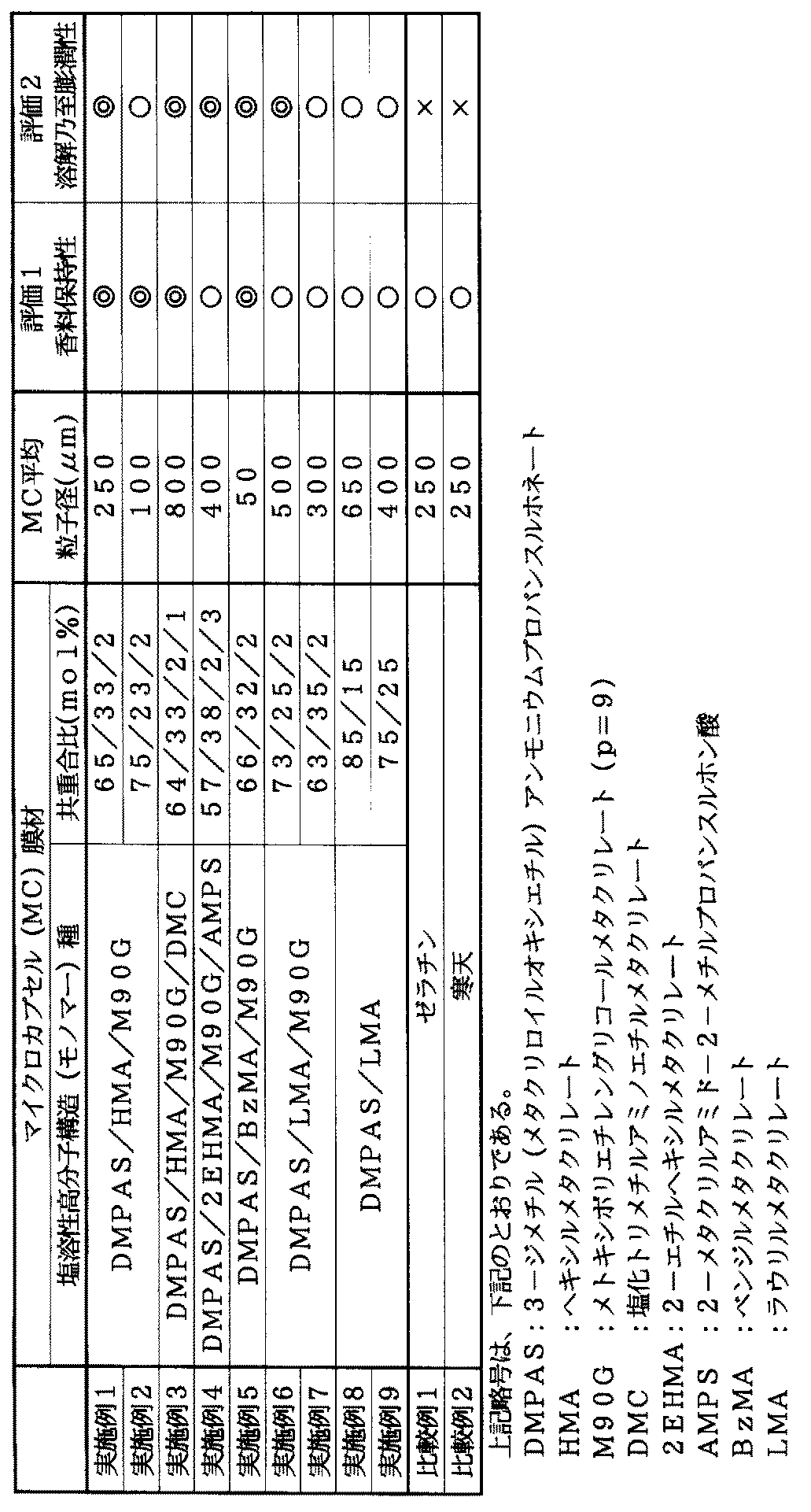
〔実施例1〜9及び比較例1,2〕
下記に各種の塩感応高分子を膜材としたマイクロカプセル、該マイクロカプセルを用いた各組成物(化粧品、衛生用品、芳香剤)の調製例を詳述する。また、実施例1〜9で使用する塩感応高分子は、以下の製造例1に従って調製した。
[Examples 1 to 9 and Comparative Examples 1 and 2]
Hereinafter, preparation examples of microcapsules using various salt-sensitive polymers as membrane materials and compositions (cosmetics, hygiene products, fragrances) using the microcapsules will be described in detail. Moreover, the salt-sensitive polymer used in Examples 1 to 9 was prepared according to the following Production Example 1.
(製造例1)
撹拌機、還流冷却管、温度計、モノマー滴下口、開始剤滴下口及び窒素の導入管を備えた1000mLのセパラブルフラスコに、エタノール155.1gを加え、85℃の湯浴で加温を始めるとともに、窒素導入管より窒素の導入を開始した。一方、300mL容のビーカーに、スルホベタイン基含有ビニル単量体(A)として3−ジメチル(メタクリロイルオキシエチル)アンモニウムプロパンスルホネートの前駆体としてジメチルアミノエチルメタクリレート85.3g、疎水性基含有ビニル単量体(B)としてヘキシルメタクリレート46.9g、(A)及び(B)と共重合可能なビニル単量体(C)としてメトキシポリエチレングリコールメタクリレート(p=9)7.8g、エタノール77.5gを秤取り、かき混ぜて均一なモノマー溶液を調製した。また、100mLのビーカーに2,2´−アゾビス−2−メチルブチロニトリル1.6gを秤取り、エタノール25.8gを加えて溶解し、開始剤溶液を調製した。
次に、前記セパラブルフラスコの内温が78℃になった時点で、滴下ポンプを用いて、開始剤溶液、モノマー溶液を2時間かけて添加し、更に5時間撹拌を続け、重合を終了した。得られた共重合体溶液をエタノールで該共重合体の質量濃度が15%になるように希釈し、液温25℃で、1.3−プロパンサルトン66.3gを1時間かけて滴下し、35℃に昇温後、4時間反応を継続した。冷却後、反応溶媒を除去、乾燥することで、共重合体を得た。
(Production Example 1)
Add 155.1 g of ethanol to a 1000 mL separable flask equipped with a stirrer, reflux condenser, thermometer, monomer addition port, initiator addition port and nitrogen introduction tube, and start heating in a 85 ° C hot water bath. At the same time, nitrogen introduction was started from the nitrogen introduction tube. Meanwhile, in a 300 mL beaker, 85.3 g of dimethylaminoethyl methacrylate as a precursor of 3-dimethyl (methacryloyloxyethyl) ammonium propane sulfonate as a sulfobetaine group-containing vinyl monomer (A), a hydrophobic group-containing vinyl monomer Weighing 46.9 g of hexyl methacrylate as the body (B), 7.8 g of methoxypolyethylene glycol methacrylate (p = 9) and 77.5 g of ethanol as the vinyl monomer (C) copolymerizable with (A) and (B). And stirred to prepare a homogeneous monomer solution. In addition, 1.6 g of 2,2′-azobis-2-methylbutyronitrile was weighed into a 100 mL beaker and dissolved by adding 25.8 g of ethanol to prepare an initiator solution.
Next, when the internal temperature of the separable flask reached 78 ° C., an initiator solution and a monomer solution were added over 2 hours using a dropping pump, and stirring was further continued for 5 hours to complete the polymerization. . The obtained copolymer solution was diluted with ethanol so that the mass concentration of the copolymer was 15%, and 66.3 g of 1.3-propane sultone was added dropwise over 1 hour at a liquid temperature of 25 ° C. The temperature was raised to 35 ° C., and the reaction was continued for 4 hours. After cooling, the reaction solvent was removed and dried to obtain a copolymer.
(実施例1)
3−ジメチル(メタクリロイルオキシエチル)アンモニウムプロパンスルホネート(DMAPS)及びヘキシルメタクリレート(HMA)及びメトキシポリエチレングリコールメタクリレート(p=9)(M90G)の共重合体を、共重合比(mol%)65/33/2で製造例1に従い調製した。
該共重合体の〔B〕/〔A〕(質量比)は0.31、〔C〕/〔A〕(質量比)は0.05であった。300mLのビーカーで塩感応高分子7重量部、0.5%NaCl水溶液93重量部を40℃で混合溶解した溶液に、マイクロカプセルの芯物質となるリモネン(香料)15重量部攪拌しながら添加し粒子径を調整した。
次に、精製水200重量部を1時間掛けて系内に添加することで、塩感応高分子を相分離させて芯物質の周りに吸着させた。系内温度を25℃まで冷却し、塩感応高分子を膜材とするマイクロカプセルを得た。本マイクロカプセルの香料保持効果、香料放出性(溶解乃至膨潤性)の評価を行った結果、下記表1に示すように良好であった。
Example 1
A copolymer of 3-dimethyl (methacryloyloxyethyl) ammonium propane sulfonate (DMAPS) and hexyl methacrylate (HMA) and methoxypolyethylene glycol methacrylate (p = 9) (M90G) was prepared as a copolymerization ratio (mol%) 65/33 /. 2 and according to Preparation Example 1.
[B] / [A] (mass ratio) of the copolymer was 0.31, and [C] / [A] (mass ratio) was 0.05. In a 300 mL beaker, 7 parts by weight of salt-sensitive polymer and 93 parts by weight of 0.5% NaCl aqueous solution were mixed and dissolved at 40 ° C., and 15 parts by weight of limonene (fragrance) as a core substance of microcapsules was added with stirring. The particle size was adjusted.
Next, 200 parts by weight of purified water was added to the system over 1 hour, so that the salt-sensitive polymer was phase-separated and adsorbed around the core substance. The system temperature was cooled to 25 ° C. to obtain microcapsules using a salt-sensitive polymer as a membrane material. As a result of evaluating the perfume retention effect and perfume release (dissolution or swelling) of this microcapsule, it was good as shown in Table 1 below.
(実施例2)
3−ジメチル(メタクリロイルオキシエチル)アンモニウムプロパンスルホネート(DMAPS)及びヘキシルメタクリレート(HMA)及びメトキシポリエチレングリコールメタクリレート(p=9)(M90G)の共重合体を、共重合比(mol%)75/23/2で製造例1に従い調製した。該共重合体の〔B〕/〔A〕(質量比)は0.19、〔C〕/〔A〕(質量比)は0.04であった。300mLのビーカーで塩感応高分子5重量部、0.5%NaCl水溶液95重量部を40℃で混合溶解した溶液に、マイクロカプセルの芯物質となるリモネン(香料)20重量部攪拌しながら添加し粒子径を調整した。次に、0.1%スメクタイト水溶液200重量部を1時間掛けて系内に添加することで、塩感応高分子を相分離させて芯物質の周りに吸着させた。系内温度を25℃まで冷却し、塩感応高分子を膜材とするマイクロカプセルを得た。本マイクロカプセルの香料保持効果、香料放出性(溶解乃至膨潤性)の評価を行った結果、下記表1に示すように良好であった。
(Example 2)
A copolymer of 3-dimethyl (methacryloyloxyethyl) ammonium propane sulfonate (DMAPS) and hexyl methacrylate (HMA) and methoxypolyethylene glycol methacrylate (p = 9) (M90G) was converted into a copolymerization ratio (mol%) 75/23 /. 2 and according to Preparation Example 1. The copolymer had a [B] / [A] (mass ratio) of 0.19 and a [C] / [A] (mass ratio) of 0.04. In a 300 mL beaker, 5 parts by weight of salt-sensitive polymer and 95 parts by weight of 0.5% NaCl aqueous solution were mixed and dissolved at 40 ° C. with stirring while adding 20 parts by weight of limonene (fragrance) as the core material of the microcapsule The particle size was adjusted. Next, 200 parts by weight of a 0.1% smectite aqueous solution was added to the system over 1 hour, so that the salt-sensitive polymer was phase-separated and adsorbed around the core substance. The system temperature was cooled to 25 ° C. to obtain microcapsules using a salt-sensitive polymer as a membrane material. As a result of evaluating the perfume retention effect and perfume release (dissolution or swelling) of this microcapsule, it was good as shown in Table 1 below.
(実施例3)
3−ジメチル(メタクリロイルオキシエチル)アンモニウムプロパンスルホネート(DMAPS)及びヘキシルメタクリレート(HMA)及びメトキシポリエチレングリコールメタクリレート(p=9)(M90G)及び塩化トリメチルアミノエチルメタクリレート(DMC)の共重合体を、共重合比(mol%)64/33/2/1で製造例1に従い調製した。該共重合体の〔B〕/〔A〕(質量比)は0.31、〔C〕/〔A〕(質量比)は0.06であった。300mLのビーカーで塩感応高分子15重量部、0.5%NaCl水溶液285重量部を40℃で混合溶解し水相を調製した。オリフィス管を用い膜材となる水相を外側に、また芯物質となるリモネン(香料)を内側にし、水相/芯物質=50/50なるように液を流した。オリフィス管に振動を与えることによって、マイクロカプセルの粒子径を調整し、精製水中に滴下させていくことで、マイクロカプセルを調製した。本マイクロカプセルの香料保持性、香料放出性(溶解乃至膨潤性)の各評価を行った結果、下記表1に示すように良好であった。
Example 3
A copolymer of 3-dimethyl (methacryloyloxyethyl) ammonium propane sulfonate (DMAPS) and hexyl methacrylate (HMA) and methoxypolyethylene glycol methacrylate (p = 9) (M90G) and trimethylaminoethyl methacrylate chloride (DMC) was copolymerized. Prepared according to Preparation Example 1 at a ratio (mol%) of 64/33/2/1. [B] / [A] (mass ratio) of the copolymer was 0.31, and [C] / [A] (mass ratio) was 0.06. In a 300 mL beaker, 15 parts by weight of salt-sensitive polymer and 285 parts by weight of 0.5% NaCl aqueous solution were mixed and dissolved at 40 ° C. to prepare an aqueous phase. Using an orifice tube, the aqueous phase serving as a membrane material was placed on the outside, and limonene (fragrance) serving as the core material was placed on the inside, and the liquid was flowed so that the aqueous phase / core material = 50/50. The microcapsule was prepared by adjusting the particle size of the microcapsule by applying vibration to the orifice tube and dropping it into purified water. As a result of evaluating each of the perfume retention property and perfume release property (dissolution or swelling property) of this microcapsule, it was satisfactory as shown in Table 1 below.
(実施例4)
3−ジメチル(メタクリロイルオキシエチル)アンモニウムプロパンスルホネート(DMAPS)及び2−エチルヘキシルメタクリレート(2EHMA)及びメトキシポリエチレングリコールメタクリレート(p=9)(M90G)及び2−メタクリルアミド−2−メチルプロパンスルホン酸(AMPS)の共重合体を、共重合比(mol%)57/38/2/3で製造例1に従い調製した。該共重合体の〔B〕/〔A〕(質量比)は0.47、〔C〕/〔A〕(質量比)は0.10であった。掻き取りパドル及びアジホモミキサーを装備した1.5Lのガラス容器に塩感応高分子50重量部、0.2%NaCl水溶液795重量部、リモネン(香料)15重量部、ポリオキシエチレン硬化ヒマシ油(60EO)0.5重量部を配合し、ホモミキサー8000rpm、パドル100rpm、10分で乳化した。得られた乳化物を液体窒素中にスプレーし、凍結したマイクロカプセルを調製後、精製水中に添加することでマイクロカプセルを調製した。本マイクロカプセルの香料保持性、香料放出性(溶解乃至膨潤性)の評価を行った結果、下記表1に示すように良好であった。
Example 4
3-Dimethyl (methacryloyloxyethyl) ammonium propane sulfonate (DMAPS) and 2-ethylhexyl methacrylate (2EHMA) and methoxypolyethylene glycol methacrylate (p = 9) (M90G) and 2-methacrylamide-2-methylpropanesulfonic acid (AMPS) Was prepared according to Production Example 1 at a copolymerization ratio (mol%) of 57/38/2/3. The copolymer had a [B] / [A] (mass ratio) of 0.47 and a [C] / [A] (mass ratio) of 0.10. In a 1.5 L glass container equipped with a scraping paddle and an azimuthal mixer, 50 parts by weight of a salt-sensitive polymer, 795 parts by weight of a 0.2% NaCl aqueous solution, 15 parts by weight of limonene (fragrance), polyoxyethylene hydrogenated castor oil ( 60EO) 0.5 parts by weight was blended and emulsified with homomixer 8000 rpm, paddle 100 rpm, 10 minutes. The obtained emulsion was sprayed into liquid nitrogen to prepare frozen microcapsules and then added to purified water to prepare microcapsules. As a result of evaluating the perfume retention and perfume release (dissolution or swelling) of this microcapsule, it was good as shown in Table 1 below.
(実施例5)
3−ジメチル(メタクリロイルオキシエチル)アンモニウムプロパンスルホネート(DMAPS)及びベンジルメタクリレート(BzMA)及びメトキシポリエチレングリコールメタクリレート(p=9)(M90G)の共重合体を、共重合比(mol%)66/32/2で製造例1に従い調製した。該共重合体の〔B〕/〔A〕(質量比)は0.31、〔C〕/〔A〕(質量比)は0.05であった。300mLのビーカーで塩感応高分子5重量部、0.6%NaCl水溶液95重量部を40℃で混合溶解した溶液に、マイクロカプセルの芯物質となるリモネン(香料)20重量部攪拌しながら添加し粒子径を調整する。次に、精製水200重量部を1時間掛けて系内に添加することで、塩感応高分子を相分離させて芯物質の周りに吸着させた。系内温度を25℃まで冷却し、塩感応高分子を膜材とするマイクロカプセルを得た。本マイクロカプセルの香料保持性、香料放出性(溶解乃至膨潤性)の評価を行った結果、下記表1に示すように良好であった。
(Example 5)
A copolymer of 3-dimethyl (methacryloyloxyethyl) ammonium propane sulfonate (DMAPS) and benzyl methacrylate (BzMA) and methoxypolyethylene glycol methacrylate (p = 9) (M90G) was converted into a copolymerization ratio (mol%) 66/32 / 2 and according to Preparation Example 1. [B] / [A] (mass ratio) of the copolymer was 0.31, and [C] / [A] (mass ratio) was 0.05. In a 300 mL beaker, 5 parts by weight of salt-sensitive polymer and 95 parts by weight of 0.6% NaCl aqueous solution were mixed and dissolved at 40 ° C. with stirring while adding 20 parts by weight of limonene (fragrance) as the core material of the microcapsule. Adjust the particle size. Next, 200 parts by weight of purified water was added to the system over 1 hour, so that the salt-sensitive polymer was phase-separated and adsorbed around the core substance. The system temperature was cooled to 25 ° C. to obtain microcapsules using a salt-sensitive polymer as a membrane material. As a result of evaluating the perfume retention and perfume release (dissolution or swelling) of this microcapsule, it was good as shown in Table 1 below.
(実施例6)
3−ジメチル(メタクリロイルオキシエチル)アンモニウムプロパンスルホネート(DMAPS)及びラウリルメタクリレート(LMA)及びメトキシポリエチレングリコールメタクリレート(p=9)(M90G)の共重合体を、共重合比(mol%)73/25/2で製造例1に従い調製した。該共重合体の〔B〕/〔A〕(質量比)は0.31、〔C〕/〔A〕(質量比)は0.05であった。300mLのビーカーで塩感応高分子10重量部、2%NaCl水溶液90重量部を40℃で混合溶解した溶液に、マイクロカプセルの芯物質となるリモネン(香料)15重量部攪拌しながら添加し粒子径を調整する。次に、精製水200重量部を1時間掛けて系内に添加することで、塩感応高分子を相分離させて芯物質の周りに吸着させた。系内温度を25℃まで冷却し、塩感応高分子を膜材とするマイクロカプセルを得た。本マイクロカプセルの香料保持性、香料放出性(溶解乃至膨潤性)の評価を行った結果、下記表1に示すように良好であった。
(Example 6)
A copolymer of 3-dimethyl (methacryloyloxyethyl) ammonium propane sulfonate (DMAPS) and lauryl methacrylate (LMA) and methoxypolyethylene glycol methacrylate (p = 9) (M90G) was converted into a copolymerization ratio (mol%) 73/25 / 2 and according to Preparation Example 1. [B] / [A] (mass ratio) of the copolymer was 0.31, and [C] / [A] (mass ratio) was 0.05. In a 300 mL beaker, 10 parts by weight of a salt-sensitive polymer and 90 parts by weight of a 2% NaCl aqueous solution were mixed and dissolved at 40 ° C., and 15 parts by weight of limonene (fragrance) as a core material for microcapsules was added with stirring. Adjust. Next, 200 parts by weight of purified water was added to the system over 1 hour, so that the salt-sensitive polymer was phase-separated and adsorbed around the core substance. The system temperature was cooled to 25 ° C. to obtain microcapsules using a salt-sensitive polymer as a membrane material. As a result of evaluating the perfume retention and perfume release (dissolution or swelling) of this microcapsule, it was good as shown in Table 1 below.
(実施例7)
3−ジメチル(メタクリロイルオキシエチル)アンモニウムプロパンスルホネート(DMAPS)及びラウリルメタクリレート(LMA)及びメトキシポリエチレングリコールメタクリレート(p=9)(M90G)の共重合体を、共重合比(mol%)63/35/2で製造例1に従い調製した。該共重合体の〔B〕/〔A〕(質量比)は0.51、〔C〕/〔A〕(質量比)は0.05であった。300mLのビーカーで塩感応高分子7重量部、2%NaCl水溶液93重量部を40℃で混合溶解した溶液に、マイクロカプセルの芯物質となるリモネン(香料)17重量部攪拌しながら添加し粒子径を調整する。次に、5%ポリビニルアルコール水溶液200重量部を1時間掛けて系内に添加することで、塩感応高分子を相分離させて芯物質の周りに吸着させた。系内温度を25℃まで冷却し、塩感応高分子を膜材とするマイクロカプセルを得た。本マイクロカプセルの香料保持性、香料放出性(溶解乃至膨潤性)の評価を行った結果、下記表1に示すように良好であった。
(Example 7)
A copolymer of 3-dimethyl (methacryloyloxyethyl) ammonium propane sulfonate (DMAPS) and lauryl methacrylate (LMA) and methoxypolyethylene glycol methacrylate (p = 9) (M90G) was prepared as a copolymerization ratio (mol%) 63/35 / 2 and according to Preparation Example 1. [B] / [A] (mass ratio) of the copolymer was 0.51, and [C] / [A] (mass ratio) was 0.05. In a 300 mL beaker, 7 parts by weight of a salt-sensitive polymer and 93 parts by weight of a 2% NaCl aqueous solution were mixed and dissolved at 40 ° C., and 17 parts by weight of limonene (fragrance) as a core substance for microcapsules was added with stirring. Adjust. Next, 200 parts by weight of a 5% polyvinyl alcohol aqueous solution was added to the system over 1 hour, so that the salt-sensitive polymer was phase-separated and adsorbed around the core substance. The system temperature was cooled to 25 ° C. to obtain microcapsules using a salt-sensitive polymer as a membrane material. As a result of evaluating the perfume retention and perfume release (dissolution or swelling) of this microcapsule, it was good as shown in Table 1 below.
(実施例8)
3−ジメチル(メタクリロイルオキシエチル)アンモニウムプロパンスルホネート(DMAPS)及びラウリルメタクリレート(LMA)の共重合体を、共重合比(mol%)85/15で製造例1に従い調製した。
該共重合体の〔B〕/〔A〕(質量比)は0.16であった。300mLのビーカーで塩感応高分子5重量部、2%NaCl水溶液95重量部を40℃で混合溶解した溶液に、マイクロカプセルの芯物質となるリモネン(香料)20重量部攪拌しながら添加し粒子径を調整した。
次に、精製水200重量部を1時間掛けて系内に添加することで、塩感応高分子を相分離させて芯物質の周りに吸着させた。系内温度を25℃まで冷却し、塩感応高分子を膜材とするマイクロカプセルを得た。本マイクロカプセルの香料保持性、香料放出性(溶解乃至膨潤性)の評価を行った結果、下記表1に示すように良好であった。
(Example 8)
A copolymer of 3-dimethyl (methacryloyloxyethyl) ammonium propane sulfonate (DMAPS) and lauryl methacrylate (LMA) was prepared according to Preparation Example 1 at a copolymerization ratio (mol%) of 85/15.
[B] / [A] (mass ratio) of the copolymer was 0.16. In a 300 mL beaker, 5 parts by weight of salt-sensitive polymer and 95 parts by weight of 2% NaCl aqueous solution were mixed and dissolved at 40 ° C., and 20 parts by weight of limonene (fragrance) as a core material for microcapsules was added with stirring. Adjusted.
Next, 200 parts by weight of purified water was added to the system over 1 hour, so that the salt-sensitive polymer was phase-separated and adsorbed around the core substance. The system temperature was cooled to 25 ° C. to obtain microcapsules using a salt-sensitive polymer as a membrane material. As a result of evaluating the perfume retention and perfume release (dissolution or swelling) of this microcapsule, it was good as shown in Table 1 below.
(実施例9)
3−ジメチル(メタクリロイルオキシエチル)アンモニウムプロパンスルホネート(DMAPS)及びラウリルメタクリレート(LMA)の共重合体を、共重合比(mol%)75/25で製造例1に従い調製した。
該共重合体の〔B〕/〔A〕(質量比)は0.30であった。300mLのビーカーで塩感応高分子5重量部、6%NaCl水溶液95重量部を40℃で混合溶解した溶液に、マイクロカプセルの芯物質となるリモネン(香料)15重量部攪拌しながら添加し粒子径を調整した。
次に、0.2%スメクタイト水溶液200重量部を1時間掛けて系内に添加することで、塩感応高分子を相分離させて芯物質の周りに吸着させた。系内温度を25℃まで冷却し、塩感応高分子を膜材とするマイクロカプセルを得た。本マイクロカプセルの香料保持性、香料放出性(溶解乃至膨潤性)の評価を行った結果、下記表1に示すように良好であった。
Example 9
A copolymer of 3-dimethyl (methacryloyloxyethyl) ammonium propane sulfonate (DMAPS) and lauryl methacrylate (LMA) was prepared according to Preparation Example 1 with a copolymerization ratio (mol%) of 75/25.
[B] / [A] (mass ratio) of the copolymer was 0.30. In a 300 mL beaker, 5 parts by weight of a salt-sensitive polymer and 95 parts by weight of a 6% NaCl aqueous solution were mixed and dissolved at 40 ° C., while adding 15 parts by weight of limonene (fragrance) as a core material of the microcapsule while stirring. Adjusted.
Next, 200 parts by weight of a 0.2% smectite aqueous solution was added to the system over 1 hour, so that the salt-sensitive polymer was phase-separated and adsorbed around the core substance. The system temperature was cooled to 25 ° C. to obtain microcapsules using a salt-sensitive polymer as a membrane material. As a result of evaluating the perfume retention and perfume release (dissolution or swelling) of this microcapsule, it was good as shown in Table 1 below.
(実施例10)
上記実施例1で得られたマイクロカプセルを、前記組成の化粧水に配合した。製剤中ではマイクロカプセルは安定であり、塗布後人体の汗によりマイクロカプセルが溶解され、香料が放出されることを確認した。これにより、塩溶性マイクロカプセルが含有された安定性に優れた化粧水が得られることが判った。
(Example 10)
The microcapsules obtained in Example 1 were blended in the lotion having the above composition. In the preparation, it was confirmed that the microcapsule was stable, and the microcapsule was dissolved by perspiration of the human body after application and the perfume was released. Thus, it was found that a skin lotion excellent in stability containing salt-soluble microcapsules can be obtained.
(実施例11)
実施例2で得られたマイクロカプセルを、前記組成の紙おむつに配合した。製剤中ではマイクロカプセルは安定であり、塗布後人体の尿によりマイクロカプセルが溶解され、香料が放出されることを確認した。これにより、塩溶性マイクロカプセルが含有された安定性に優れた紙おむつが得られることが判った。
(Example 11)
The microcapsules obtained in Example 2 were blended in a paper diaper having the above composition. It was confirmed that the microcapsules were stable in the preparation, and the microcapsules were dissolved by the human urine after application and the fragrance was released. As a result, it was found that a disposable paper diaper containing salt-soluble microcapsules was obtained.
(実施例12)
実施例3で得られたマイクロカプセルを、前記記載した芳香剤に配合した。製剤中ではマイクロカプセルは安定であり、芳香剤を使用していくと水分が徐々に蒸発し、系内の塩濃度が高くなるにつれてマイクロカプセルが溶解され、香料が徐々に放出されることを確認した。これにより、塩溶性マイクロカプセルが含有された安定性に優れた芳香剤が得られることが判った。
(Example 12)
The microcapsules obtained in Example 3 were blended with the fragrance described above. It is confirmed that the microcapsules are stable in the formulation, and as the fragrance is used, moisture gradually evaporates, and as the salt concentration in the system increases, the microcapsules dissolve and the fragrance is gradually released. did. Thereby, it turned out that the fragrance | flavor excellent in stability containing the salt-soluble microcapsule is obtained.
(実施例13)
実施例5で得られたマイクロカプセルを、前記記載した柔軟剤に配合した。製剤中ではマイクロカプセルは安定であり、柔軟剤により処理された衣類を着用し、汗をかくことでマイクロカプセルが破壊され、香料が徐々に放出されることを確認した。これにより、塩溶性マイクロカプセルが含有された安定性に優れた柔軟剤が得られることが判った。
(Example 13)
The microcapsules obtained in Example 5 were blended with the softening agent described above. It was confirmed that the microcapsules were stable in the formulation, and the microcapsules were destroyed by wearing clothes treated with a softener, and the perfume was gradually released by sweating. Thereby, it was found that a softener excellent in stability containing salt-soluble microcapsules can be obtained.
(比較例1)
マイクロカプセルの膜材として5.0重量部のゼラチン(200〜250ブルーム、牛骨アルカリ処理)、1.2重量部のペクチン(CPケルコ社LMペクチン102AS)を40℃の68.7重量部精製水に溶解した。この水溶液に攪拌下で芯物質となる15.0重量部のリモネン(香料)を分散し、芯物質の粒子径を調整した。次に、5%酢酸水溶液を加えてpH4.3に調整した後、20℃に冷却することにより、マイクロカプセルを調製した。本マイクロカプセルの香料保持性、香料放出性(溶解乃至膨潤性)の評価を行った結果、下記表1に示すように香料の保持効果は良好であったが、塩濃度を変化(2〜10%、以下同様)させても香料の放出はなかった。
(Comparative Example 1)
As a membrane material for microcapsules, 5.0 parts by weight of gelatin (200 to 250 bloom, beef bone alkali treatment) and 1.2 parts by weight of pectin (CP Kelco LM Pectin 102AS) were purified at 68.7 parts by weight at 40 ° C. Dissolved in water. In this aqueous solution, 15.0 parts by weight of limonene (fragrance) that becomes a core substance under stirring was dispersed to adjust the particle diameter of the core substance. Next, 5% aqueous acetic acid solution was added to adjust the pH to 4.3, and then cooled to 20 ° C. to prepare microcapsules. As a result of evaluating the perfume retention and perfume release (dissolution or swelling) of this microcapsule, the perfume retention effect was good as shown in Table 1 below, but the salt concentration was changed (2 to 10). %, The same applies hereinafter), but no fragrance was released.
(比較例2)
マイクロカプセルの膜材として4.5重量部の寒天(局方寒天PS−7)を295.5重量部の精製水に分散後、沸騰させ寒天を溶解した水相を調製した。オリフィス管の外側に膜材となる水相を、内側に芯物質となるリモネン(香料)を90/10になるように液を流した。オリフィス管に振動を与えることによって、マイクロカプセルの粒子径を調整し、ゲル化する温度領域に設定した食用油脂中に滴下しマイクロカプセルを形成した。その後、マイクロカプセルに付着した食用油脂を完全に除去することで、マイクロカプセルを得た。本マイクロカプセルの香料保持性、香料放出性(溶解乃至膨潤性)の評価を行った結果、下記表1に示すように香料の保持効果は良好であったが、塩濃度を変化させても香料の放出はなかった。
(Comparative Example 2)
As a microcapsule membrane material, 4.5 parts by weight of agar (Pharmacopoeia agar PS-7) was dispersed in 295.5 parts by weight of purified water and then boiled to prepare an aqueous phase in which the agar was dissolved. The liquid was allowed to flow so that the aqueous phase serving as a membrane material was placed outside the orifice tube, and limonene (fragrance) serving as a core substance was placed inside 90/10. By applying vibration to the orifice tube, the particle size of the microcapsule was adjusted and dropped into an edible oil and fat set in a temperature range where gelation was performed to form a microcapsule. Then, the edible oil and fat adhering to the microcapsule was completely removed to obtain a microcapsule. As a result of evaluating the perfume retention and perfume release properties (dissolution or swelling) of this microcapsule, the perfume retention effect was good as shown in Table 1 below. There was no release.
上記表1の結果等から明らかなように、本発明の範囲となる実施例1〜12は、本発明の範囲外となる比較例1及び2に較べて、香料、機能性油分などを更に安定に化粧品、衛生用品、芳香剤等の組成物に含有でき、更に、塩濃度の上昇によって容易に膜材が溶解乃至膨潤し芯物質を放出させることができる優れた特性を有するマイクロカプセル及びそれを含有した組成物が得られることが判った。 As is clear from the results in Table 1 above, Examples 1 to 12 that are within the scope of the present invention are more stable in perfume, functional oil, and the like than Comparative Examples 1 and 2 that are outside the scope of the present invention. In addition, it can be contained in a composition such as cosmetics, hygiene products, fragrances, etc., and further, a microcapsule having excellent properties that can easily dissolve or swell the membrane material and release the core substance by increasing the salt concentration, and It was found that the contained composition was obtained.
Claims (5)
Priority Applications (1)
| Application Number | Priority Date | Filing Date | Title |
|---|---|---|---|
| JP2004186589A JP2006008564A (en) | 2004-06-24 | 2004-06-24 | Microcapsules and compositions containing the same |
Applications Claiming Priority (1)
| Application Number | Priority Date | Filing Date | Title |
|---|---|---|---|
| JP2004186589A JP2006008564A (en) | 2004-06-24 | 2004-06-24 | Microcapsules and compositions containing the same |
Publications (1)
| Publication Number | Publication Date |
|---|---|
| JP2006008564A true JP2006008564A (en) | 2006-01-12 |
Family
ID=35776199
Family Applications (1)
| Application Number | Title | Priority Date | Filing Date |
|---|---|---|---|
| JP2004186589A Pending JP2006008564A (en) | 2004-06-24 | 2004-06-24 | Microcapsules and compositions containing the same |
Country Status (1)
| Country | Link |
|---|---|
| JP (1) | JP2006008564A (en) |
Cited By (3)
| Publication number | Priority date | Publication date | Assignee | Title |
|---|---|---|---|---|
| JP2014198070A (en) * | 2013-03-29 | 2014-10-23 | 株式会社ソフト99コーポレーション | Perfume microcapsule-containing aromatic deodorant |
| CN106488759A (en) * | 2014-06-30 | 2017-03-08 | 尤妮佳股份有限公司 | The manufacture method of absorbent commodity |
| CN115566270A (en) * | 2022-11-02 | 2023-01-03 | 江西安驰新能源科技有限公司 | Electrolyte for lithium ion battery and preparation method thereof |
-
2004
- 2004-06-24 JP JP2004186589A patent/JP2006008564A/en active Pending
Cited By (3)
| Publication number | Priority date | Publication date | Assignee | Title |
|---|---|---|---|---|
| JP2014198070A (en) * | 2013-03-29 | 2014-10-23 | 株式会社ソフト99コーポレーション | Perfume microcapsule-containing aromatic deodorant |
| CN106488759A (en) * | 2014-06-30 | 2017-03-08 | 尤妮佳股份有限公司 | The manufacture method of absorbent commodity |
| CN115566270A (en) * | 2022-11-02 | 2023-01-03 | 江西安驰新能源科技有限公司 | Electrolyte for lithium ion battery and preparation method thereof |
Similar Documents
| Publication | Publication Date | Title |
|---|---|---|
| JP6826599B2 (en) | N-vinyllactam cross-linked polymers, cosmetics, ink absorbents and absorbent complexes | |
| CN103068856B (en) | The blend of acrylic copolymer thickening agent | |
| WO2019173062A1 (en) | Reduced permeability microcapsules | |
| JP2006502292A (en) | Water-soluble sheet composition | |
| JP3708531B2 (en) | Thickener and cosmetics containing the same | |
| WO2012030750A2 (en) | Polymers and compositions | |
| JP2007145859A (en) | Anti-photochemical cosmetic composition for topically applied active agents | |
| JPH04323213A (en) | Fine particle of cross-linked n-vinylamide resin, microgel, its production and use | |
| JP2010503715A (en) | Cosmetic preparations based on molecularly imprinted polymers | |
| JP2001055321A (en) | Use of copolymer as additive for cosmetic preparation for skin and preparation for skin and its preparation | |
| JP5584524B2 (en) | Oil-in-water emulsion composition and method for producing the same | |
| TWI287571B (en) | Thickener, cosmetic preparation containing the same, and process for producing the same | |
| JP3585309B2 (en) | Cosmetic base and external cosmetics | |
| WO2014163310A1 (en) | Method for preparing macroporous polymethyl methacrylate | |
| EP1682078A1 (en) | Personal care compositions | |
| JP2021004236A (en) | Hydrogel particle | |
| JP3756042B2 (en) | Skin cosmetics | |
| Mo et al. | Preparation and properties of a fast curing carboxymethyl chitosan hydrogel for skin care | |
| KR20140141577A (en) | Personal care compositions with acidified pectins | |
| JP6321943B2 (en) | Oil-in-water emulsion composition | |
| TW200817041A (en) | Gel-like cosmetics | |
| JP2006503075A (en) | Use of polymers based on N-vinylcaprolactam | |
| CA2558853A1 (en) | Polymer particles containing active agents | |
| JP5398062B2 (en) | Hydrogel external preparation | |
| CN109219622A (en) | Bumps amendment cosmetics |